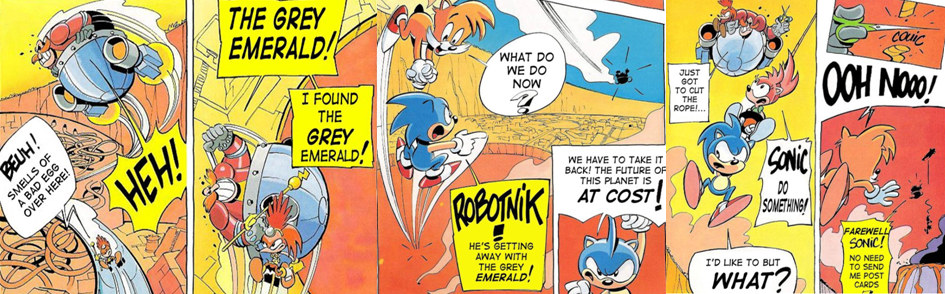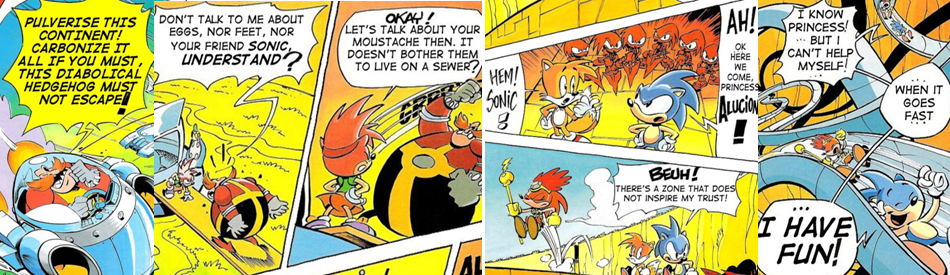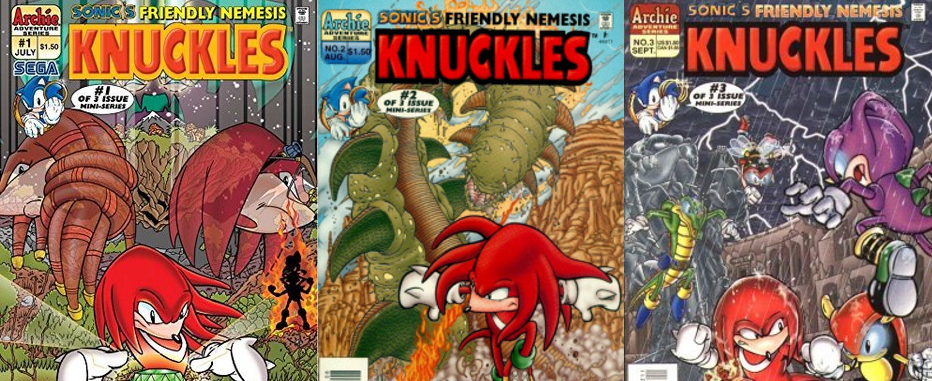

With the release of Sonic the Hedgehog 3(SEGA Technical Institute, 1994), gamers were introduced to Knuckles the Echidna. This mischievous, dreadlocked antagonist was created by Takashi Yuda and his debut was made all the more impressive by virtue of the fact that Sonic 3 was too big to fit on one cartridge, which meant that Knuckles was the first of Sonic’s supporting characters to co-star in a main series videogame when Sonic & Knuckles (ibid) was released on this very day in 1994.
Writers: Mike Kanterovich and Ken Penders – Artist: Art Mawhinney
Story Title: “Rites of Passage, Part One” Published: May 1996
Story Title: “Rites of Passage, Part Two” Published: June 1996
Story Title: “Rites of Passage, Part Three” Published: July 1996
The Background: When Sonic the Hedgehog blasted onto the videogame scene in 1991, he was an immediate hit thanks to his debut title being bundled with the Mega Drive and SEGA’s aggressive marketing campaign. His popularity exploded with Sonic the Hedgehog 2(SEGA Technical Institute, 1992), however, and Sonic merchandise was suddenly everywhere: not only did he feature in the Macy’s Day Parade and in cartoons but he also starred in a number of comic books. Following the initial four-part miniseries which mashed together narrative elements of Sonic’s cartoon adventures, Archie Comics began regular publication of what would become the longest-running videogame comic book ever. In time, to capitalise on Sonic’s continued popularity, a number of spin-off comics were produced, with one of the most prominent being the Knuckles the Echidna sister series. What began as a simple enough three issue miniseries soon expanded into a convoluted lore that eventually became the subject of a bitter lawsuit between Archie and writer/artist Ken Penders that forever changed the way subsequent Sonic comic books were handled.
The Review: Sonic’s Friendly Nemesis: Knuckles begins by first promoting the “mystery of Archimedes” and then giving a very brief rundown on Archie’s take on Knuckles, the downfall of the Echidna society, and his floating home. In these early appearances, Angel Island was known by the Western name of Floating Island and, in Archie Comics especially, was held aloft through the power of just the one Chaos Emerald (and not even the Master Emerald at this point) and incredibly advanced technology. With the Echidna’s long gone, nature has reclaimed much of the island, leaving it in disarray and causing long-forgotten secrets to be buried. Knuckles pays a visit to Mount Fate in search of his missing friends, Mighty the Armadillo, Vector the Crocodile, Espio the Chameleon, and Charmy Bee (collectively known as the Chaotix), who he strongly suspects are being held captive there by the mysterious Archimedes. Archimedes has been making Knuckles’ life a bit of a misery in recent issues and stories, taunting him with riddles about his past, and led Knux to discover that, generations ago, the Echidna brothers Edmund and Dimitri tried to use the Chaos Emerald to return Floating Island to Mobius and, in the process, Dimitri became the evil entity later identified as Enerjak, the “Harbinger of Chaos”. The entire experience caused the Echidnas to renounce technology in all its forms and bury their secrets away beneath Mount Fate and, when Knux arrives, he finds that the chamber is well guarded by a number of electronic lasers, booby traps, and other obstacles specifically designed to keep out (or kill) any intruders.
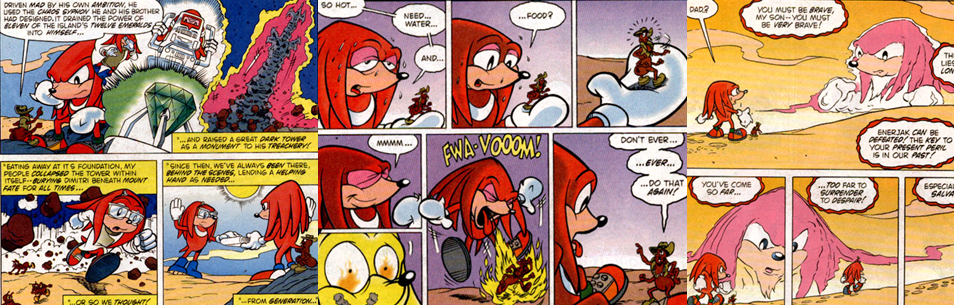
Knuckles’reunion with Chaotix is cut short by the sudden appearance of the all-powerful Enerjak.
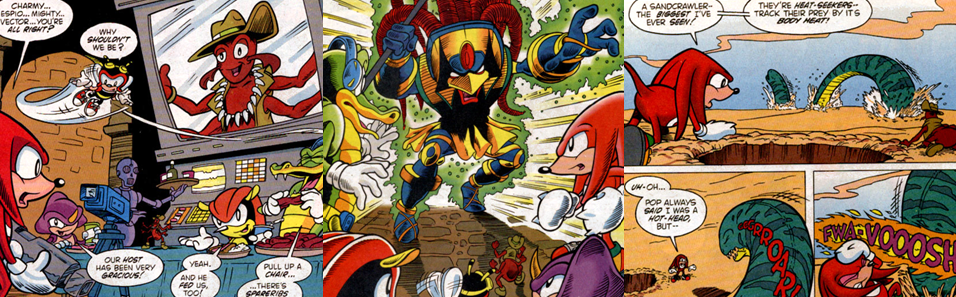
As Knuckles explores his surroundings, he arms himself with a concussive blaster (because that’s what I always think when I think of Knuckles: guns!) and forces his way into the grand observatory at the heart of the temple…only to find that his friends are being treated to a glorious spread as guests of Archimedes, who is revealed to be a weird-looking anthropomorphic fire-ant (yeah…I don’t know, either). Considering all of the games, subterfuge, and questionable behaviour shown by Archimedes, Knuckles is understandably enraged and demands answers but any hostilities between the two are interrupted by the arrival of Enerjak, who broke free from his prison when Knuckles triggered Mount Fate’s traps. Although Knuckles dismisses the Pharaoh-esque madman as a fraud, Enerjak boasts the incredible, unmatched power of eleven Chaos Emeralds (Archie Comics had an almost incalculable number of the gems at the time) and proves his power (and to be more than a match for the combined might of Knuckles, Chaotix, and Archimedes) by overpowering them all, taking Chaotix captive, and blasting Knuckles and Archimedes to the blazing hot desert of the Sandopolis Zone. As the two begin the bleak, day-long journey across the outback, they are attacked by a giant sandcrawler. However, the beast is easily defeated and turned into late-night kebabs for the two when Archimedes uses himself as bait (and his ability to teleport) to trick it into colliding head-first with a stack of rocks. Afterwards, Archimedes regales Knuckles (and bores the shit out of me…) with the story of how his people watched as the Echidnas harnessed the power of many Chaos Emeralds to move the entire city of Echidnapolis out of the path of an incoming comet (why they didn’t just evacuate is beyond me) thanks to the fire-ants performing the “ground-breaking ceremony” to effectively birth Floating Island. Archimedes then recounts, in a little bit more detail, how Dimitri later fashioned the “Chaos Siphon” to absorb the power of eleven Chaos Emeralds and ended up burying himself in the process.
Stuck in the boiling desert, Knux is subjected to endless exposition and visions of his father.
Since then, generation after generation of Echidnas were named Guardian of the Chaos Emerald and the fire-ants watched over them, testing them with a rite of passage to ensure that they would be read to combat threats such as Enerjak. While Knux and Archimedes resolve to work together to face Enerjak, they still need to cross the boiling desert; in his desperate hunger, Knux amusingly tries to eat Archimedes and ends up getting his mouth burned as a result. Later, while succumbing to the heat, Knuckles has a vision of his long-dead father, Locke, who does his best Mufasa (James Earl Jones) impersonation and gives him not only the resolve to continue onwards but also a cryptic clue as to how to defeat Enerjak: “The key to your present peril is in our past!” After reinvigorating himself at a mysterious oasis, Knuckles and Archimedes forge onwards towards Nekronopolis, a mighty city erected by Enerjak’s vast Chaos powers. The city, which Enerjak has built as a dark and corrupt reflection of Echidnaopolis, is home to an army of disposable mechanical minions (known as “Mecha-Nauts”) and Enerjak’s imposing citadel. Knuckles decides that the best approach is to tackle the Mecha-Nauts head on, which earns him Archimedes’ disapproval until he reveals that it was part of a plan to lure the machines to a gate so that he could crush them all (or, at least, a lot of them) in one move. However, while they manage to get into the citadel with a minimum of fuss, inside he is confronted by the Chaotix, who have been brainwashed by Enerjak’s magic and attack the two on his command. The fight (which includes a timely reference to The Mask (Russell, 1994) and even, surprisingly, The Shadow (Mulcahy, 1994), two films that both released in the year prior to this issue) goes poorly for the Chaotix; despite them having the numbers advantage, Knuckles and Archimedes are able to hold them off, forcing Enerjak to intervene and render them both unconscious using his powers (kind of making controlling the Chaotix a waste of time…) With Knuckles and Archimedes helpless against Enerjak’s powers, the would-be tyrant recaps his origins again just in case we didn’t realise how he came to be what he is.
Enerjak’s power may be awesome but the fight ends unresolved.
Despite acknowledging that the Guardian and his newfound fire-ant companion are the only two who could possibly oppose him, Enerjak prefers to boast and monologue rather than destroy them while he has the perfect opportunity. Indeed, Knux goads him into releasing them from his energy field, which gives Archimedes the opportunity to contact his fellow fire-ants. While Knuckles creates a distraction by taunting Enerjak and absorbing the brunt of his anger, Archimedes is able to teleport them out of danger so that Knux can (literally) get the drop on him and, though stunned to learn that he is Knuckles’ great-uncle, Enerjak attacks with a ferocity that is only matched by his augmented strength. Still, the two are relatively evenly matched, potentially because Knuckles has successfully goaded Enerjak into a straight-up fist fight and continues to chastise his great-uncle for his selfish ways and lack of honour. Their fight is cut short when Enerjak’s citadel suddenly transforms into a rocket and blasts into space; Knuckles and Archimedes escape thanks to the efforts of the fire-ants and Chaotix are freed from their pointless mind control. In the aftermath, despite Knuckles not really learning anything from him or really acting in a way that’s that impressive, Archimedes gives Knux his respect. Although Enerjak escaped to live to fight another day, the group is victorious and decide not to worry too much about the mysterious happenings that they experienced along the way (such as the oasis disappearing and the aforementioned rocket) but the story concludes with the revelation (to us) that Locke is actually alive and actively monitoring and assisting Knuckles from a hidden, high-tech bunker.
The Summary: Jesus, what a slog. I’ll be the first to admit that Knuckles is my absolute favourite Sonic the Hedgehog character and I remember being so excited when he debuted in Sonic the Comic (1993 to 2002) and to learn that he was a prominent feature in the Archie comics, which were seen as kind of a continuation/parallel to Sonic the Hedgehog/SatAM (1993 to 1994). Knuckles the Echidna was one of the longest-running spin-off of the Archie Sonic comics, which is a testament to the character’s appeal and popularity, but every time I read his solo run I can’t help but be astounded at how boring and preposterous it is. I don’t usually lark to harp on about this sort of thing but my God is the art terrible in these issues! The covers, drawn by the always amazing Patrick “Spaz” Spaziante, are the best part of the artwork in this miniseries as, while Knuckles generally looks kind of okay, a lot of the characters just look really weird and disproportionate. I can kind of understand it as the majority of the Chaotix are really weird character designs already but Archimedes and the rest of the fire-ants just look ugly, man. Environments are very bland and nonsensical as well and all three issues suffer from the same artistic inconsistency that plagued the Archie Sonic comics for about fifty issues or so. There are, however, some impressive moments in the issues, though. In the rare instances where Knuckles is gliding or in action, he looks suitably bold and striking and, while Enerjak’s design is a bit “busy”, he looks pretty distinct and intimidating and I love how he has all this Egyptian-inspired apparel on his armour. Thanks to having absorbed the powers of eleven Chaos Emeralds, he can fly, wields Chaos energy, and is able to render targets under his control or unconscious and seems to have enhanced durability and strength, and can even erect a fully-functional city and robot minions in just a few panels.
Enerjak has a striking design and is certainly powerful but this was a poor outing for him.
Yet, the exact limits of his powers remains a mystery; he is regarded as a bogeyman-type figure by Archimedes and, as we learn, the reason why the Echidnas eventually renounced technology and he’s certainly a maniacal force but the story ends before we really get to delve into exactly what he wants. And that’s interesting because Sonic’s Friendly Nemesis: Knuckles is about 75% dialogue and exposition. Look, I get it; you can’t assume that people who read issue two or three will have read issue one but every issue starts with a bit of swirling text recapping the previous issue’s events so I really don’t think it was necessary to recap the (literal) rise and fall of Echidna society or Enerjak’s origin three Goddamn times! Sure, have Archimedes explain the fire-ant perspective on it all and introduce the idea of Dimitri there and yeah, Enerjak could share his perspective as well, but they’re largely the same and it just felt like needless filler. Add to that the fact that neither Knuckles nor Archimedes ever shuts up and constantly narrates his every thought and action and you have a story that is more a chore than a thrill to get through, which is a shame as I find Enerjak to be a compelling villain and his slug-fest with Knuckles was gearing up to be something good. It doesn’t help that Archie constantly shoe-horned the Chaotix into Knuckles’ stories, bloating the cast to kind of make it like an alternative to Sonic and the Knothole Freedom Fighters and, considering how useless the Chaotix were in this miniseries, it might’ve been better to omit them entirely and focus solely on Knuckles (and Archimedes, I guess, even though I am not a fan of the character) and his efforts to prove himself a worthy Guardian and oppose Enerjak’s ambitions.
My Rating:
⭐⭐
Rating: 2 out of 5.
Could Be Better
Have you ever read Sonic’s Friendly Nemesis: Knuckles? Did you pick the issues up when they were first released and, if so, what did you think about Knuckles’ first spin-off? What did you think to Archie’s introduction and characterisation of Knuckles and the increasingly-complex depiction of the Echidna society? Were you a fan of Archimedes and Enerjak? Did you like the Chaotix being Knuckles’ running buddies? Which of Archie’s Knuckles stories and/or characters was your favourite and why? Are you celebrating Knuckles’ big day today? Whatever you think about Archie’s Sonic comics, and especially Knuckles, leave a comment down below and let me know.
Easily Marvel Comics’ most recognisable and popular superhero, unsuspecting teenage nerd Peter Parker was first bitten by a radioactive spider and learned the true meaning of power and responsibility in Amazing Fantasy #15, which was first published in August 1962. Since then, the Amazing Spider-Man has featured in numerous cartoons, live-action movies, videogames, action figures, and countless comic book titles and, in celebration of his debut and his very own day of celebration, I’ve been dedicating every Wednesday to talk about everyone’s favourite web-head!
Released: 1991 Developer: Technopop Also Available For: Game Gear, Master System, and Mega-CD
The Background: Shortly after debuting in the pages of Amazing Fantasy, Peter Parker/Spider-Man graduated to his own solo title and quickly became Marvel’s most popular comic book character. Accordingly, Spider-Man was one of the first of Marvel’s superheroes to make the jump to videogames. In the early nineties, SEGA held the licensing rights to produce home console games based on Marvel Comics characters and one of the first, and most popular, of these was Spider-Man (also known as Spider-Man vs. The Kingpin), a game I first played on the Master System before switching to the 16-bit version after being won over by the superior graphics.
The Plot: Wilson Fisk, the Kingpin of Crime, has planted a nuclear bomb in New York City that is set to explode in twenty-four hours, distributed the keys to disarming the bomb to some of Spider-Man’s most lethal foes, and has even framed Spidey for the crime! And, as if all that wasn’t bad enough, Eddie Brock/Venom is stalking the city, further stacking the odds against the web-slinger.
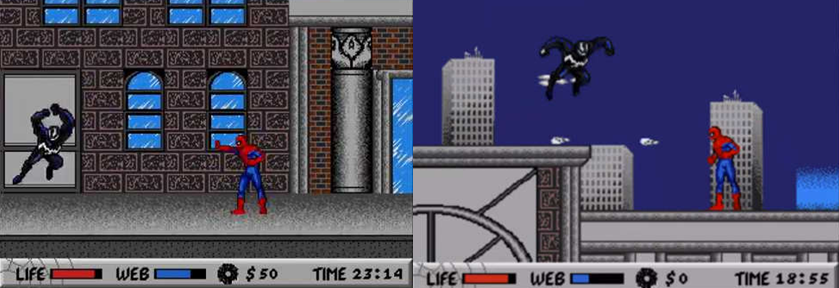
Gameplay: Spider-Man is a 2D, sidescrolling action/platformer with an emphasis on exploration and combat; given the nature of the plot, players have just twenty-four in-game hours to complete the game. Dawdle too long in the game’s locations and you’ll doom the entire city to destruction, which places a real anxiety into the gameplay which is, sadly, not reflected in the game’s mechanics.
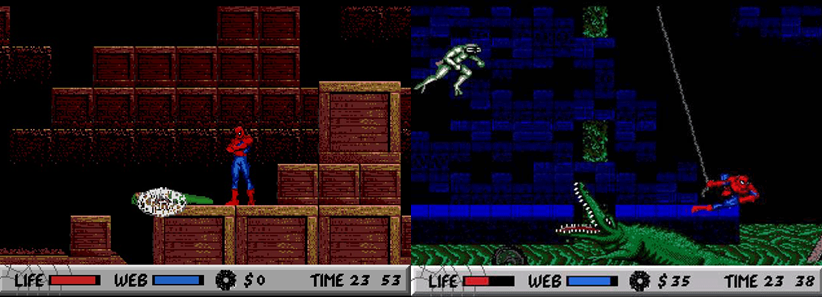
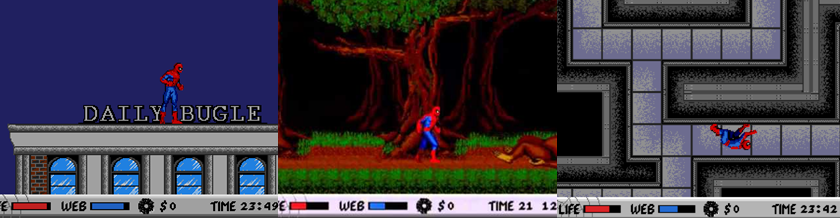
Spidey’s webbing allows him to take out crooks and quickly traverse levels.
Obviously, you take control of Spider-Man, a clunky, stilted, and awkward character who displays all of Spidey’s trademark abilities: he can punch out goons with B, jump with C (be sure to hold the button for a higher jump), and cling to walls, ceilings, and backgrounds by pressing jump twice. He can also shoot webbing with A, which is perfect for taking out goons from a distance or up high as you can diagonally direct Spidey’s web; while you can’t shoot upwards, you can shoot a web out while jumping to swing along horizontally but, while this is great for covering large distances quickly, it’s not so great for the many instances of vertical movement.
Spidey’s webbing is super useful but you’ll need to earn cash from selling photos to refill it.
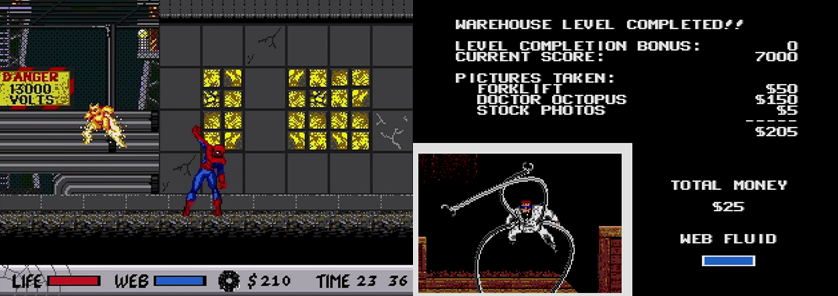
From the pause menu, you can select between two webs: a sticky web projectile and a web shield to help protect Spidey from damage. However, Spidey has a finite supply of webbing and, when he runs out, you’ll have to rely on your punches and jump kicks. After retrieving Parker’s camera from the Daily Bugle though, you can select his camera from the pause menu and take pictures of goons and bosses to earn cash and refill your webbing, but you only have a limited number of shots available so it’s best to save these for getting pictures of Spidey’s more recognisable enemies.
Control is sluggish and awkward, meaning Spidey lacks his trademark grace and agility.
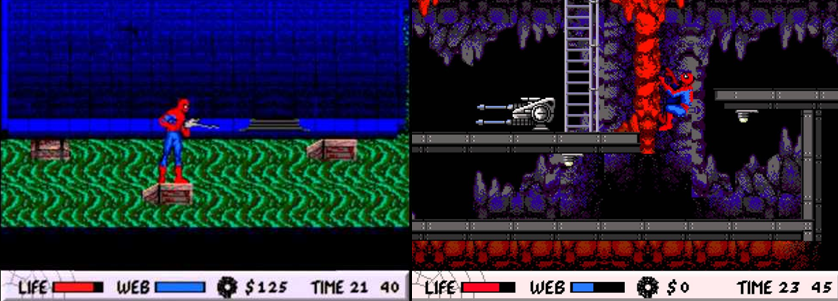
Control is a major issue in Spider-Man; Spidey is slow moving, his punch doesn’t have a lot of reach, and not only is his hit box quite large but so are the ones of his enemies. You can get around this a bit with his webbing, jump kick, and crouching kick but, more often than not, you’ll clip through enemies and fly backwards when hit with attacks. However, the most frustrating thing about Spider-Man, and the game in general, is how janky the jumping and wall-climbing mechanics are; some levels, such as the city streets, easily allow you to climb walls in the backgrounds but others, like the caverns, don’t. In the warehouse and sewers, you’ll need to climb up vertical walls and ceilings to get through air vents and tunnels and navigate past crates and such, but you need to keep C held down to stay attached to the surface. Nowhere is the control more annoying than in the caverns level, a cramped and maze-like environment that restricts your movement and requires you to perform some tricky web-swings and jumps to progress, which can be frustrating to pull off as Spidey prefers to either just drop off ledges or bump his head on ceilings (or just get shot when he finally makes the jump).
Graphics and Sound: Spider-Man is a bright and relatively detailed videogame; it was, however, an early release for the Mega Drive so it’s not exactly making the most of the 16-bit machine’s “blast processing” power. Spider-Man and his recognisable villains all look pretty good, especially Venom and Doctor Otto Octavius/Doctor Octopus, but the regular goons and enemies leave a lot to be desired.
While sprites are colourful and detailed enough, the levels are noticeably lacking in detail.
Where the game’s graphics really fall flat, though, are in the environments; New York City looks pretty good and you can clamber up the sides of buildings, stop a random street mugging, and even encounter J. Jonah Jameson on the streets but the warehouse isn’t exactly exciting or impressive. Central Park is quite dynamic, with benches, trees, water fountains, and an intractable fire hydrant but, like all of the game’s locations, it’s surprising barren in the background and lacking in depth. The power station tries to make up for this but ends up being more of a mess of greys and yellows, though there are, occasionally, some interesting elements to some levels (debris floating in the polluted sewer water, for example).
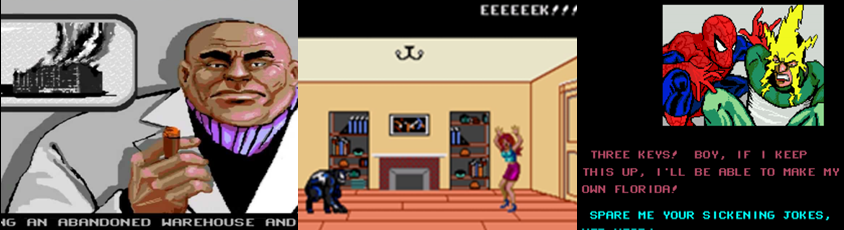
A variety of cutscene styles are employed to tell the game’s story, though the music is pretty poor.
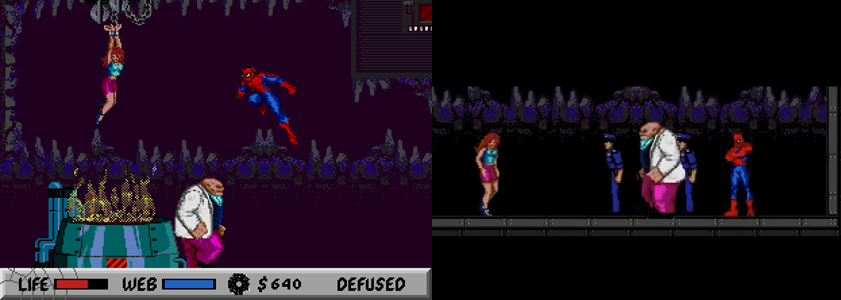
Spider-Man’s story is told through the use of various different types of cutscenes: one is simply the Kingpin making spurious claims through news reports, another is simply the Spider-Man sprite walking in a black void while text scrolls on screen, another uses comic book-like panels and text to show Spidey interrogating his foes, and another use in-game sprites and a bit of text. As you might expect, the comic book panels and sprite-based cutscenes are much more interesting to look at but, even for an early Mega Drive title, they’re very basic. The music is even worse, being bland and uninspiring and, overall, the graphics, music, and presentation were actually better on the Master System, which also featured additional characters and features.
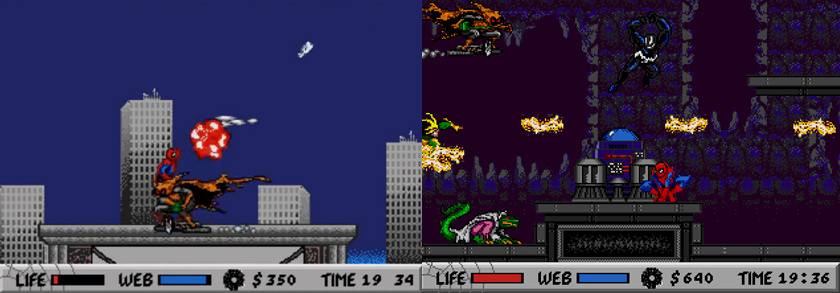
Enemies and Bosses: While racing to confront his rogue’s gallery, Spidey comes up against a handful of hired goons; these guys will shoot at you with handguns from a distance and try to knife you when you get up close and, later, switch to using sniper rifles. You’ll also come up against such cliché enemies as bats, snakes, dogs, and rats and, in the first mission, will be attacked be one of New York’s finest as well. Levels also feature more formidable and elaborate enemies as well as alligators and “Mutant Jumpers” await you in the sewer, electrified bats fly at you at the power station, laser-firing turrets and ED-209-like robots patrol the caverns, and a giant ape will randomly show up in Central Park!
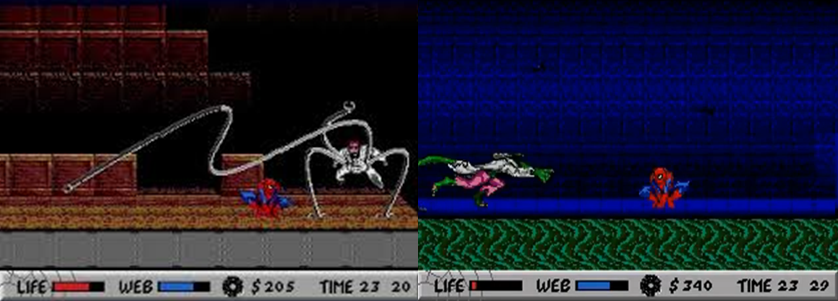
Ducking and using your webbing is the key to besting both Doc Ock and the Lizard.
The only way to disarm the Kingpin’s bomb is to retrieve five keys from some of Spidey’s most notorious foes; you’ll know when a boss or more powerful foe is near because Spidey’s spider-sense will go off and the music will change. The first you’ll battle (once getting past a rampant forklift truck) is Doc Ock, who awaits you in a dank warehouse and attacks you with his trademark arms. In the Master System version, you could web up his arms to hold his attacks at bay but, here, I found that didn’t seem to work so I just crouched under his attacks to get closer and attacked him that way. In the sewers, you’ll encounter Doctor Curt Connors/The Lizard, who scrambles about the place and whips at you with his tail; however, he also has a tendency to just crouch there looking scary so it’s pretty easy to fire webs at him and jump kick him into submission.
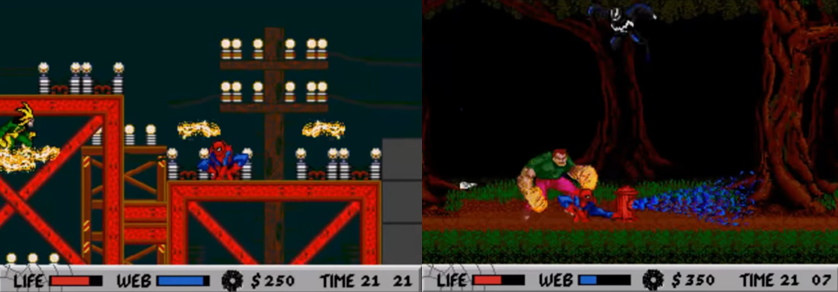
You’ll need to watch out for, and use, the environment to defeat Electro and the Sandman.
As you navigate through the power plant, you’ll be attacked by annoying bolts of electricity that, as you might expect, come from Max Dillon/Electro; Electro flies about the place on a cloud of lightning and shoots thunderbolts at you but his true threat comes from his ability to electrify the girders that you’ll no doubt be standing on so…make sure you’re not on them when that happens! Easily the most unique of the game’s bosses, though, is Flint Marko/The Sandman, who emerges from a sandpit in Central park, turns into sand to avoid your attacks, and attacks with extendable arms and by shooting sand-fists your way. He’s also invulnerable to your attacks so you need to turn around and web-swing back to the start of the level and use the fire hydrant to douse him in water and put an end to him.
Venom shows up more than once to constantly dog your progress and cause you grief.
One of the game’s more persistent bosses is Venom; Venom often shows up at the worst possible moments, such as during other boss fights and at the beginning of the street level (where you’ll also have to watch out for Jameson, who berates you and hurts you if you get too close). Each time you fight Venom, they bound overheard, fire webs at you, and punch you in the face but, generally, the best method of attack is to let them jump over your head, fire your own webs, and punch them whenever they come close. These fights get more difficult as the game progresses thanks to the presence of other enemies and bosses but, in the caverns, I found Venom got a bit stuck on a ledge just out of reach so I could just finish the level without fighting them.
After defeating Hobgoblin, you’ll battle basically every boss at once to get to the bomb!
The main enemy of the city level, though, is Jason Macendale, Jr/Hobgoblin, who flies around the rooftops of the city on his goblin glider and tosses a bunch of explosive pumpkin bombs down at you. Luckily, your diagonal webbing can make short work of Hobgoblin but his threat is magnified when you reach the Kingpin’s bomb, which is protected by all the bosses you’ve fought so far (with the odd exception of Doc Ock). Thus, you must battle the Lizard, Electro, Venom, and the Hobgoblin all at once, which is an impressive sight but extremely chaotic. It’s best to try and focus on one at a time, if possible, and take out guys like Hobgoblin and Electro because they can cause major headaches from the air.
If you’re able to keep M.J. from dying, you can batter the Kingpin into submission to win the day.
After defeating them all, you must select each of the five keys you’ve collected from the pause menu and insert them into the bomb in the correct order; each time you put a key in wrong, you’ll lose a chunk of time but, as long as you get it right and avoid a game over, you’ll be spared the constantly timer counting down. Next, you can pick up some health from the air vents and go one-on-one with a very squat and hunchback-looking Kingpin. This is easily the game’s toughest boss fight as the Kingpin deals massive damage with his big, meaty fists and it’s hard to tell when you’ve actually hit him. To make matters worse, Peter’s wife, Mary Jane Watson-Parker (who was kidnapped by Venom earlier in the game) is suspended over a fiery pit and you must web her chains to keep her from being lowered to her death. This is really tricky to do because your target is just off-screen and it’s hard to get the angle right to web her chains, to say nothing of the Kingpin’s persistent attacks. If M.J. is lowered into the pit, then it’s an instant game over…which is always fun.
Power-Ups and Bonuses: Scattered throughout many of the game’s levels, you’ll find little Spider-Man icons which, when collected, will refill your health. From the pause menu, you’ll also see a little head icon; this is Peter’s head and selecting it will instantly teleport you to Peter’s apartment, where his health bar will slowly refill at the cost of your precious time. This is somewhat pointless as, when you return to the game, you have to start the level from the beginning again but you may have to sacrifice time for health in the game’s tougher moments since you only get one life to finish the game. You can continue if you fail but, again, this will cost you precious time. Otherwise, that’s it; the only way to refill your webbing is to take pictures of Spidey’s famous foes and there are no temporary power-ups or abilities available throughout the game.
Additional Features: From the main “Options” menu, you can select from four different difficulty settings: Practice, Easy, Normal, and Nightmare. Be warned, however, as while these will, obviously make the game easier or harder depending on your choice, you can’t progress beyond the sewers if you play on “Easy”. From the same menu, you can also set your stamina level and the amount of web cartridges you carry, which can be beneficial to keeping you alive and in the fight on the game’s more challenging levels. Sadly, that’s technically as far as it goes; in the Master System version, you could perform a trick to have Spidey wear his black suit and even play a cheeky mini game but you can’t to that here so the only other benefit available to you are the cheats. While in the “Options” menu, place your cursor on the “Difficulty” option and hold Start on controller two; hold A, B, and C and controller one and press up/right and you’ll see a !!! icon appear in the menu. Once you start the game, if you pause the action and press A, you’ll completely refill your webbing; B will refill your health, C will grant you a few seconds of invincibility, and pressing A, B, and C will skip you ahead to the next level. This is useful to progress you through the game but means nothing if you screw up with the bomb or in the final battle as you’ll still fail the game if you don’t defuse the weapon or keep M.J. safe.
The Summary: I really enjoyed the Master System version of Spider-Man; I never finished it in the years when I owned it and stupidly sold it some time ago but it was bright and entertaining with some detailed sprites and backgrounds. As a result, I was really excited to play the Mega Drive version of the game, having been won over by screenshots of the game’s superior graphics. However, graphical superiority doesn’t actually translate into a better game; yes, Spidey and his villains look great but the game is a slow, plodding, awkward experience. Climbing walls and navigating through the game’s unfortunately cramped areas is a pain, the lack of viable health power-ups and extra web abilities is disappointing, and the challenge on offer is artificially high and ridiculously unfair at times. It’s a shame as it wouldn’t take much to make the game a bit more enjoyable; upping Spidey’s speed a bit and giving him a vertical web shot would have been a big help but, in the end, it’s a decent enough title but there are definitely better Spider-Man games to play on the 16-bit consoles.
My Rating:
⭐⭐
Rating: 2 out of 5.
Could Be Better
Have you ever played the Mega Drive version of Spider-Man? If so, what did you think to it? How do you feel it holds up compared to the other versions of the game? How did you find the game’s controls and mechanics? Which of the bosses was your favourite? Did you ever defuse the Kingpin’s bomb and save M.J. or did you fail at the last hurdle? Which Spider-Man videogame is your favourite? Whatever your thoughts, feel free to leave a comment down below.
Sonic the Hedgehog CD (Sonic Team, 1993) released on this day back in 1993. Produced alongside the blockbusterSonic the Hedgehog 2(SEGA Technical Institute, 1992), Sonic CD expanded upon the Blue Blur’s original debut title with lush graphics, a time travel mechanic, gorgeous anime cutscenes, and introduced players to Metal Sonic (one of Sonic’s most popular and enduring rivals) and Amy Rose. Considered by many to be one of the best of the classic Sonic titles, Sonic CD might not be one of my favourites but it’s still a classic in it’s own right and it’s worth looking back on today of all days.
Released: 14 December 2011 Originally Released: 23 September 1993 Developer: Christian Whitehead Original Developer: Sonic Team Also Available For: GameCube, Mega-CD, PC, PlayStation 2, SEGA Mega Drive Mini II (Original); Mobile, PlayStation 3, PlayStation 4, PlayStation 5, Xbox 360, Xbox Series S/X (Remaster)
The Background: Sonic the Hedgehog (Sonic Team, 1991) was specifically created and marketed as SEGA’s Nintendo-beater and, thanks to selling over 15 million copies, succeeded in its goal. Naturally, SEGA were eager to produce a sequel but, rather than create one game, they ended up making two! With Sonic creator Yuji Naka having moved to America to work on Sonic 2, Sonic’s designer, Naoto Oshima, spearheaded an entirely separate title built on the bones of the first game that would be exclusive to SEGA’s ill-fated CD add-on for the Mega Drive.
Sonic CD is largely known as one of the best Sonic games and was made widely available in 2011.
With Sonic 2 more focused on speed, Oshima placed Sonic CD’s focus more on platforming and exploration with its speed-based time travel mechanic (which was cut from Sonic 2) and included gorgeous anime cutscenes from Toei Animation (which would later be the basis for the feature-length original video animation). Artist Kazuyuki Hoshino designed Sonic’s metallic doppelgänger and biggest fan, Amy Rose (though that character actually debuted, in a slightly different form, in a 1992 manga), both of which were as pivotal to the game as the time travel elements. Despite the game’s U.S. release being delayed for an entirely new soundtrack, Sonic CD was met with widespread critical acclaim but, for many such as myself, the game was somewhat elusive since no one I knew had a Mega-CD and it just wasn’t the same playing the PC version. I first played the game properly when it was included in Sonic Gems Collection (Sonic Team, 2005) but jumped at the chance to play the HD remaster when it first dropped on the PlayStation 3. Developed by Christian Whitehead, this new version of the game was widely available, included Achievement support, numerous bug fixes, and a whole host of new elements that make it the definitive version of this cult classic entry in the franchise.
The Plot: When the mysterious Little Planet has makes its annual appearance, Sonic travels to Never Lake but finds the planet has been overtaken by Doctor Eggman’s Badniks! When Sonic’s number one fan, Amy Rose, is kidnapped by his robotic doppelgänger, Metal Sonic, Sonic must race across time itself to keep Eggman from polluting the past, recover the seven Time Stones, and ensure a good future for Little Planet!
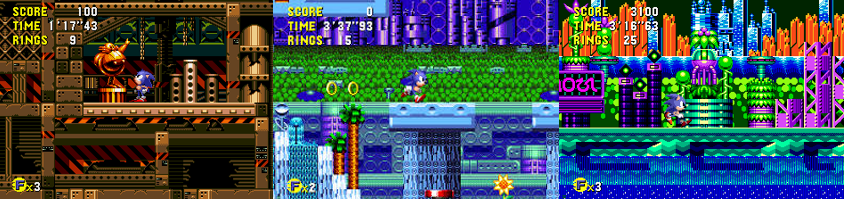
Gameplay: Sonic CD is a 2D, sidescrolling action platformer that once again sees you guiding the titular blue hedgehog across seven stages (known as “Zones”), each split into three parts (simply called “Zone 1” to “Zone 3” rather than being called “Acts”). At the end of each third Act, Sonic must battle Eggman in one of his contraptions but there’s quite a twist this time around. This time, as well as passing Lampposts to create a checkpoint, Sonic will also run past special signposts; once one of these has been triggered, Sonic will begin to sparkle as he runs and, if he builds up enough uninterrupted speed, he will travel to the past or the future depending on which post he activated. While the general layout of the Zone remains the same in the past, present, and future, there are numerous aesthetic and difficulty differences in each one. The past is generally much more lush and vibrant, lacking many of Eggman’s traps and Badniks; the present is a standard-fare Sonic stage; and the future is a pollution and hazard-infested mechanical hell. When in the past, Sonic must search high and low for a Robot Transporter and a holographic projection of Metal Sonic; destroying both in Zone 1 and 2 ensures that Zone 3 earns a good future, which strips it of all Badniks and hazards and even makes the boss battles noticeably easier.
Sonic CD‘s biggest gimmick is the speed-based time travel mechanic.
If you’ve played the first Sonic game then you’ll be immediately familiar with Sonic’s controls and physics. Sonic’s speed, jumping power, and abilities all carry over, making him as tight and responsive as ever, but he is afforded two new abilities. One is a variation on the Sonic 2 Spin Dash (it’s not quite as useful or as fast as in that game, though) and the other is Sonic’s Super Peel-Out manoeuvre, which sees Sonic rev up his legs until they become little more than a blurry figure eight and then rocket ahead at full speed, which is perfect for the few instances where you have the room to travel fast enough to time travel. Sadly, there’s not always the opportunity to do this; like in the first game, Sonic has to earn his breakneck speeds and, all too often, you’ll go running or rolling ahead in a blur of spikes only to slam head-first into a wall, a pit, a bumper, or poorly-placed enemies and hazards. This makes the time travel much harder to pull off than it needs to be as you’ll constantly be fighting to find a long enough stretch of ground or the right opportunity to build up your speed only to accidentally screw up the attempt at the last minute. Similarly, there’s a much greater emphasis on exploration and platforming this time around; every Zone feels like a mixture of speed, loops, and obstacles and the level design is questionable at best and haphazard at worst, with Golden Rings floating inside of the environment and your progress to the many alternate paths either blocked or protected by dead-ends and endless loops. As a result, when you travel back to the past, it can be extremely difficult to navigate through the Zones to find the Robot Transporters and projectors even in the more linear Zones; the bigger, more complicated Zones like Wacky Workbench and Metallic Madness make it nearly impossible to do without a guide or copious amounts of trial and error.
There’s still plenty of opportunities to be bounced around despite the many stage hazards.
Still, speed is a prominent factor in the game; thanks to the Super Peel-Out and new gameplay mechanics, Sonic is much faster than he was in the first game and is still bounced all over the place like a pinball in Zones like Collision Chaos. Indeed, there are technically two ways to play; the slow, methodical Sonic CD way which has you hunting down objects in the past or the faster, more Sonic 2 way which has you racing through Zones as fast as possible and completing them holding fifty Rings or more to enter the game’s Special Stages. Once again, Golden Rings act as your protection from damage; they’ll scatter everywhere when you’re hit and, as always, Sonic is in danger of drowning when underwater in the distinctly Labyrinth Zone-like Tidal Tempest but, thankfully, you don’t seem to spend anywhere near as much time underwater in this Zone. As is to be expected, every Zone has different gimmicks (such as moving or crumbling platforms, tubes, conveyor belts, bumpers, and the like) but these actually change when you travel through time, meaning different routes become accessible in each time period. Zones also take on more and more gimmicks (most of them very dangerous) as you progress but even the first Zone, Palmtree Panic, is crammed full of different ways to navigate. As a result, you’ll be bouncing all over the place in Wacky Workbench but fighting against treadmills and cogs in Quartz Quadrant, racing along tunnels and vast stretches of ground in Stardust Speedway, and dodging spikes, buzzsaws, and a bevy of hazards in Metallic Madness (which also features a unique shrinking mechanic). Thankfully, bottomless pits are a rarity in Sonic CD but crushing weights, sudden spikes, electrified coils, and falling boulders and stalactites more than make up for that! Also, Sonic CD is as difficult as you make it be; if you choose not to try and take the higher, easier, and faster routes or purposely visit the bad futures, then you’re going to have a much tougher time of it than if you actively try and create a good future. This places much more emphasis on your actions actually having consequences as, normally, you only restore (or fail) the world when you lose all of your lives or fail to collect all the jewels but, in Sonic CD, you can actively affect and improve each Zone on a case-by-case basis by collecting the Time Stones or destroying Eggman’s machinery in the past.
Graphics and Sound: Thanks to the graphical enhancements of the Mega-CD, Sonic CD may very well be one of the most visually striking and vibrant games in the franchise, especially amongst the classic titles. Every Zone is awash with colour and life and full of little details and background elements; every time you travel to the past or future, the Zone gets a complete facelift and takes a much more verdant or ominous light depending on how well you play which really adds to the replayability of the game as every Zone has, essentially, four parts to it (past, present, good future, and bad future) that all present a different aesthetic and challenge while still maintaining the basic structure of the Zone.
Zones are packed full of details and vibrant colours but can look a little busy at times.
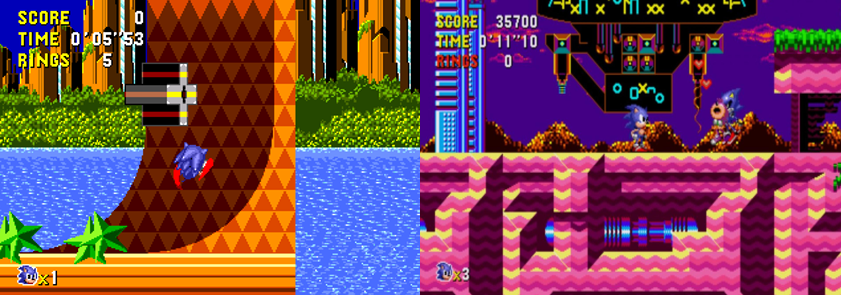
Zones have a real depth to them, allowing you to see into the distance and take in just how badly Eggman has affected each environment. You might see a vast sea full of ruins in the past of Palmtree Panic but all you’ll see is pollution and machinery in the bad future; similarly, Tidal Tempest is an unblemished cave in the past but has been transformed into a mechanical base in the future. Zones are also full of interesting and unique graphical mechanics, such as the pseudo-3D ramp at the start of Palmtree Panic, the Mode-7-like Special Stages, how a certain tube in Palmtree Panic will send Sonic smashing through the background and leave a Sonic-shaped hole in his wake, and the way graphics change size as you bounce and run all over the place. Unfortunately, though, I often find Sonic CD’s Zones to be a little too busy; there’s a lot going in the background and foreground, a lot of competing, clashing colours (especially in the garish pink of Collision Chaos), and it can be difficult to keep track of where you are and what’s going on sometimes.
The power of the Mega-CD makes for some gorgeous and well-animated sprites.
The sprites have, however, benefitted greatly from the graphical upgrade; Sonic has more animation frames and a more dynamic moveset and seems far more lively and energetic despite the majority of his assets being lifted from the first game. Sonic also speaks a little bit, shouting out “Yes!” when he grabs and extra life and “I’m outta here!” when left idle for a few minutes (which causes an instant game over). Other sounds, however, are not quite as appreciated, such as the sound Sonic makes when he jumps (which is decidedly squeakier and much more annoying and it also bugs me when it is recycled in both fan-made and official Sonic games). The bosses, too, are bigger and more elaborate than in the first game, requiring actual strategy on your part to defeat and even Amy Rose gets a lot of personality as she follows Sonic around like a love-sick puppy, desperately trying to hug him while love hearts adorably fly from her head.
The anime sequences really bolster the game’s appeal and capture Sonic’s essence.
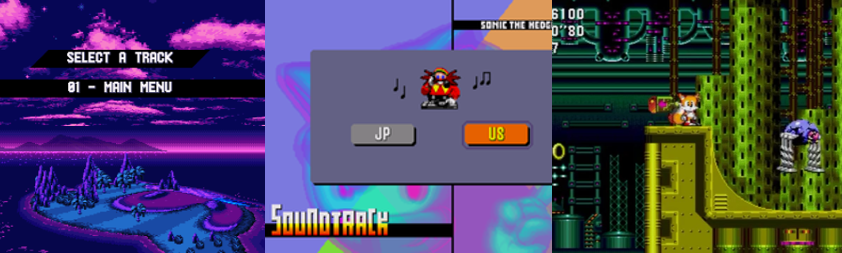
Of course, you can’t talk about Sonic CD without mentioning the anime cutscenes and the soundtrack. The opening and ending of the game features gorgeously animated anime sequences that showcase Sonic at his best, in my opinion; I loved that these were expanded upon in Sonic the Hedgehog (Ikegami, 1999) and I would absolutely be over the moon if they were brought back for future Sonic games. Sonic CD’s soundtrack is also one of the most beloved and contested in the franchise; many prefer the original Japanese soundtrack and, while that is good, it’s much more peppy and vibrant and happy-go-lucky than Spencer Nilsen’s version for the U.S. As a result, while I prefer some tracks from the Japanese soundtrack, overall I prefer the U.S. one; the invincibility music is better, the boss theme is better, and the U.S. soundtrack is much more in the style of rock and metal than anything else, which I prefer.
Enemies and Bosses: Once again, Sonic must contend with Eggman’s Badniks; unlike in the majority of the classic Sonic titles, Badniks don’t drop cute woodland critters and, instead, blossom flowers upon defeat (again tying into the game’s overall theme of restoring Little Planet to health) and, honestly, they’re far less prominent than in other 2D Sonic titles. Indeed, Sonic CD’s Badniks mainly exist to screw up your run-up to a time travel attempt and cost you your hard-earned Rings right before the goal and they’re probably some of the most unremarkable in the original games. Eggman’s theme this time around is definitely geared more towards bugs than anything else as needle-nosed Mozzietrons try to skewer you from above, Arachnisprings jump out at you, Damsiltron and Buzz Bomber 2s hover overhead and take shots at you, and Poghoppers bounce around the place on their springy bases. Probably the worst enemies are the Snail-Spikers due to their spikes, Motherbombs (which are invulnerable to your attacks and explode into a shower of projectiles), and the Flashers, which must be hit at just the right time to avoid taking damage from their laser beams. Your main opponent, though, will be the abundance of spikes, springs, bumpers, and other obstacles that mess up your momentum and cost you valuable Rings.
The first boss is, quite possibly, the easiest of any of the classic Sonic videogames.
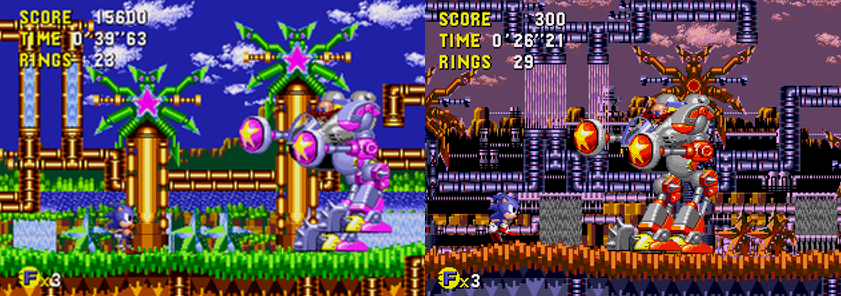
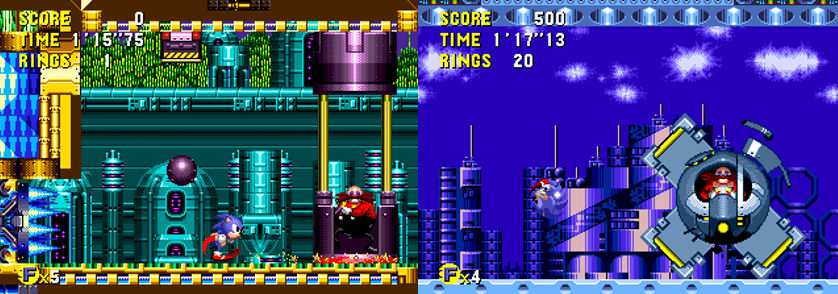
The bosses, though, are a completely different story. Sonic CD features some of the biggest and most unique and interesting boss battles of all the classic games and, while each boss only takes three hits to defeat, they all require different strategies on your part and are affected by whether you battle them in a good or bad future. The first time you battle Eggman, he’s inside of his EGG-HVC-001 mech, which is either a striking pink or an ominous red and sports spikes on the feet. Eggman protects himself from attacks with two bumpers but, after a couple of hits/bounces, these will break off and allow you to land the decisive blow. It’s, quite possibly, the easiest first boss in any Sonic game as even Sonic 2’s Eggmobile took eight hits to defeat.
Bosses require a bit of strategy on your part but are extremely fragile once you get your hits in.
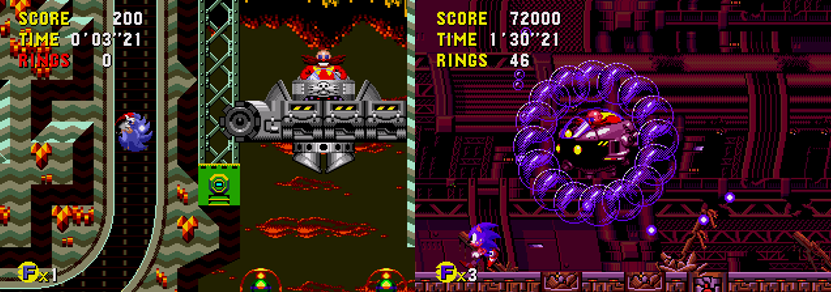
In Collision Chaos, Eggman hides at the top of a giant pinball table and drops weighted balls down at you that can force you to drop down to the lowest level or into some annoyingly-placed spikes. The whole battle is structured very similar to the Star Light and Casino Night Zones and is a clear precursor to Sonic the Hedgehog Spinball(SEGA Technical Institute, 1993) in that players must make use of the flippers to bounce Sonic up each level of the arena, ricocheting off of bumpers and such to ram into Eggman’s machine three times. Your enjoyment of this boss may vary as it all depends on how well you get on with the pinball-based Zones and mechanics of Sonic games; for me, this meant it was quite an annoying boss as it can be tricky to get the angle of your trajectory right to go where you need to. At the end of Tidal Tempest Zone 3, you’ll have to chase Eggman around a short maze similar to the end of Labyrinth Zone; unlike in that encounter, though, this time it’s a simple loop that repeats until you land a few hits and you don’t need to worry about spikes or other hazards. Also, after Eggman flees, he floods the area and surrounds his craft with air bubbles and shoots projectiles at you; in order to finish Eggman off, Sonic has to suck up a couple of the bubbles to make a gap in his defences, which is certainly a unique spin on Sonic’s notorious underwater mechanics.
Compared to some of the other bosses, the final battle is a walk in the park!
Probably one of the more frustrating bosses is encountered in Quartz Quadrant; here, Eggman hides behind a giant piston and Sonic is forced to perpetually run on a treadmill lest he be skewered by spikes on the far left of the arena. Unlike the other Eggman bosses in Sonic CD, this boss isn’t about attacking but surviving as Eggman drops bombs onto you, which must be avoided, and you have to wait for the friction of the treadmill to destroy Eggman’s machine and defeat him. Because of how difficult it can be to maintain your speed and footing when avoiding the bombs and their projectiles, this can be a particularly challenging boss for your patience, if nothing else. In comparison, the final boss is a fairly anti-climatic and simple affair; Eggman surrounds his craft with four blades and hovers in a slow pattern around the arena, shooting them at you or occasionally spinning your way. However, it’s ridiculously easy to attack between the blades and, each time you land a hit, he loses one of them so, even though he speeds up and becomes more erratic, he’s made more vulnerable to attack and, honestly, this final boss is easier than the one in the first game!
The race against Metal Sonic might be Sonic CD‘s most iconic, and annoying, boss battle.
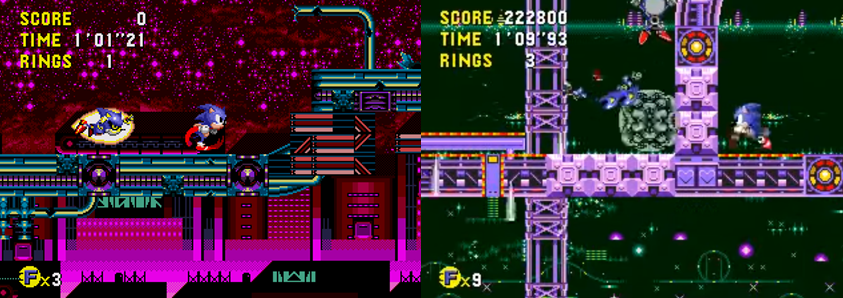
Of course, the most iconic boss battle of Sonic CD comes in Stardust Speedway where you’re forced to race against Metal Sonic! This is a thrilling, if frustrating, experience as Eggman flies along behind you firing an instant-death laser and it can be difficult to get up a good run of speed because, again, of spikes, obstacles, and sudden drops or edges in the path. Metal Sonic is completely invulnerable to harm and will charge at you full-speed or electrify its body, which is helpful for breaking spikes and clearing a path for you. Because of the way the screen is locked, though, this isn’t quite the fast-paced experience it’s often thought and interpreted as and is, instead, a strangely-paced, annoying affair that generally comes down more to luck than anything else. The best thing to do is to stay ahead where you can, jump over Metal Sonic, and then blast past it at every opportunity so that you’re on the right side of that wall when it comes crashing down.
Power-Ups and Bonuses: As is the standard for most Sonic games, a number of power-up monitors are scattered throughout the game’s Zones. Unfortunately, though, there are no new or exclusive items to be found in Sonic CD; instead, you’ll have to make do with either ten Rings, a shield that protects you from damage for one hit, an extra life, speed-up shoes, or a brief invincibility just like in the first two games.
Additional Features: Sonic CD has twelve Achievements for you to earn, some of which are pretty simple; you’d be hard-pressed to play through the game without travelling through time, for example, and you’re guaranteed to get a hug from Amy after defeating Metal Sonic. Others, though, are a bit trickier, requiring you to collect two hundred Rings rather than the usual one hundred, or to find the upper goal signpost in Collision Chaos 2 and a hidden angel statue in Wacky Workbench. Probably the most troublesome Achievements, though, involve beating Metal Sonic without being hit and destroying all of the Robot Transporter and holograms in the past.
Conquer the seven psychedelic Special Stages to get the Time Stones and the best ending.
As in the first game, finishing every Zone except the third with fifty Rings or more allows you to enter a Special Stage by jumping through a Giant Ring. These Special Stages are much more elaborate than in the first game, though, and arguably a bit more forgiving than in the second; here, you must race around a flat area against a tight time limit, avoiding water and other obstacles as you hunt down and destroy a number of UFOs. If you land on water, or similar surfaces, your time will drain exponentially so be sure to avoid these at all costs but don’t go too fast on the booster pads as it can be very difficult to make tight turns. As you destroy UFOs, you can earn Rings and even a time bonus, which is helpful, but while fans can be used to float into UFOs, spiked grates will cost you valuable time. Depth perception is a real issue here as you have to be very precise with your jumps but, if you see your time is about to run about (when it hits, say, ten seconds), you can pause and quit to the main menu and then retry the Special Stage from your save slot, meaning you basically have unlimited tries at each Special Stage and can easily grab all seven Time Stones and get the best ending.
The Xbox Live version of the game includes a host of bonus features, including a playable Tails!
I mentioned before that this was the definitive version of the game and it’s true; you can pick from a variety of display options in the menu, choose between the U.S. and Japanese soundtracks (but can’t mix and match, unfortunately), choose which Spin Dash you want (I recommend the superior Sonic 2 one), and have access to four save slots. Unfortunately, these don’t work like in Sonic the Hedgehog 3(SEGA Technical Institute, 1994), meaning you can’t pick and choose a Zone to replay, which is disappointing. You can, however, unlock a stage select, D.A. Garden (basically a sound test which you can also use to enter a variety of cheats, though Achievements can’t be earned this way), and “Visual Mode” (a gallery for viewing the anime scenes) by completing the “Time Attack” mode fast enough. Perhaps the most notable addition to this version of the game is that you unlock Miles “Tails” Prower after beating the game in any way; Tails controls exactly like he did in Sonic 3, meaning he can fly and swim, but Achievements are disabled when playing as Tails as it’d be too easy to get around Sonic CD’s more annoying level layouts.
The Summary: Sonic CD is an absolutely gorgeous game; it took everything that worked about the first game and expanded upon it wonderfully, bringing a much greater sense of speed and liveliness to the core gameplay and really utilising the power of the Mega-CD to its fullest with its anime sequences, animations, music, and unique time travel mechanic. Yet, as much as I love how visually appealing the game is, I find it lacking in a lot of ways; it’s frustrating at times, the level layouts are massively annoying for a game whose main mechanic is based on speed, and the amount of exploration and trial-and-error needed can get annoying at times. Still, I love how every boss battle is unique and how your actions have actual, visible consequences as you play; it really invites multiple playthroughs to see what each Zone looks like in different situations but, similar to the first game, I find myself less excited to replay Sonic CD and more aggravated as it can be a chore at times. When it shines, it shines brightly and I’d love to see more of this style of 2D Sonic in the future but its more irritating features and mechanics definitely need polishing up first.
My Rating:
⭐⭐⭐⭐
Rating: 4 out of 5.
Great Stuff
Did you enjoy Sonic CD? Did you own this, and a Mega-CD, back in the day or did you first experience it on PC or through some other port? What did you think to the game’s presentation and which of the two soundtracks is your favourite? Were you a fan of the level layouts and time travel gimmick or, like me, do you think they could have been better implemented? Which of the game’s Zones and bosses is your favourite? Are you a fan of Metal Sonic and Amy Rose? How are you celebrating Sonic CD’s anniversary this year? Whatever your thoughts on Sonic CD, or Sonic in general, feel free to leave a comment below.
Released: 9 February 2012 Developer: SEGA Sports R&D/Racjin Also Available For: Nintendo Wii
The Background: During the “Console Wars” of the nineties, there were no truer rivals than Nintendo’s Super Mario and SEGA’s Sonic the Hedgehog; both went head to head as their respective company’s mascots, spearheading the release of some of the greatest and most influential videogames of a generation, and both company’s went to great lengths over the years in a bid to prove that their consoles were the superior. In the end, though, thanks to a variety of expensive and poorly-conceived ideas and an ever-changing marketplace, SEGA were forced to withdraw from developing home consoles; now developing videogames for their competitors, SEGA’s supersonic mascot began appearing in games exclusive to Nintendo consoles and discussions of a long-awaited crossover began between Mario creator Shigeru Miyamoto and Sonic creator Yuji Naka. Rather than have their two iconic mascots meet in a merging of their worlds for a traditional platform title, however, the two were brought together in the spirit of friendly competition after SEGA was awarded the 2008 Beijing Olympic licence. Mario & Sonic at the Olympic Games (SEGA Sports R&D, 2007) followed as a result; though little more than a series of mini games featuring Mario and Sonic characters taking part in a number of Olympic events, the game was a commercial success and led to a series of annual titles being released in conjunction with a number of different Olympic events. After many years of putting it off, I finally got around to playing the 2012 edition of the game, which was set in London since we Brits won the right to host the games that year so, since the Tokyo Olympic Games are set to kick off today, I figured this was an ideal time to leech off of that event and share my thoughts about this title.
The Plot: Sonic, Mario, and all their friends have arrived in London for the 2012 Olympic Games; however, annoyed that they weren’t invited to compete, King Bowser of the Koopas and Doctor Eggman join forces to cover London in the “Phantasmal Fog”, disrupting the games and forcing our heroes to battle against fog-based duplicates of themselves to dispel the fog and allow the Olympic Games to proceed as planned.
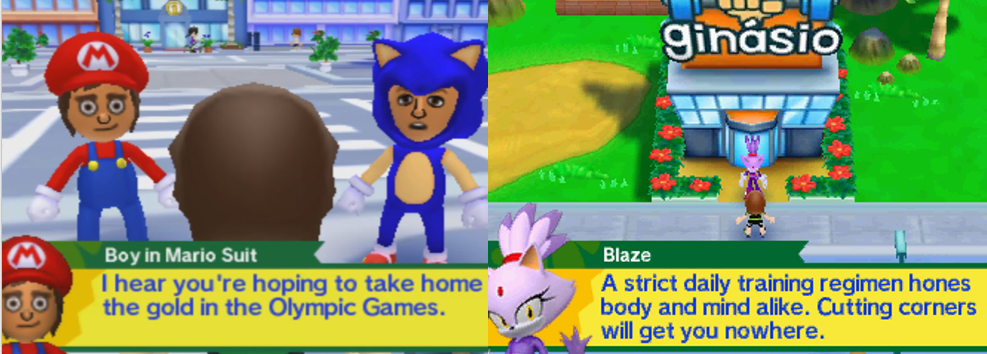
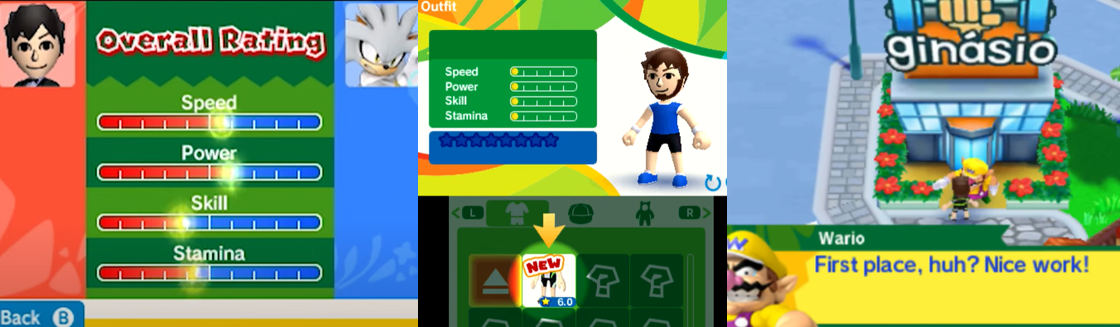
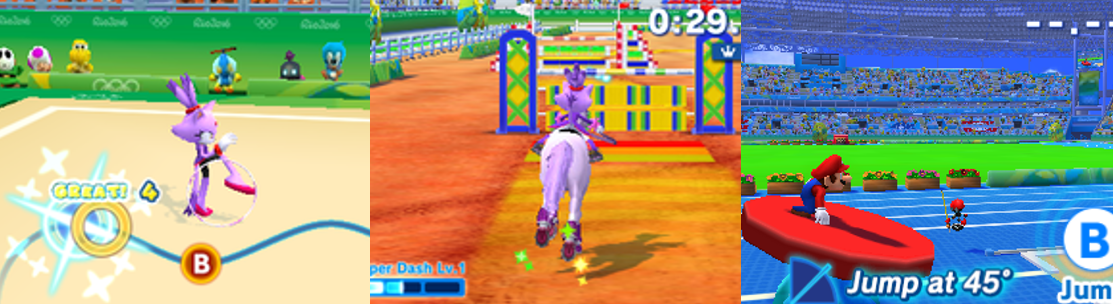
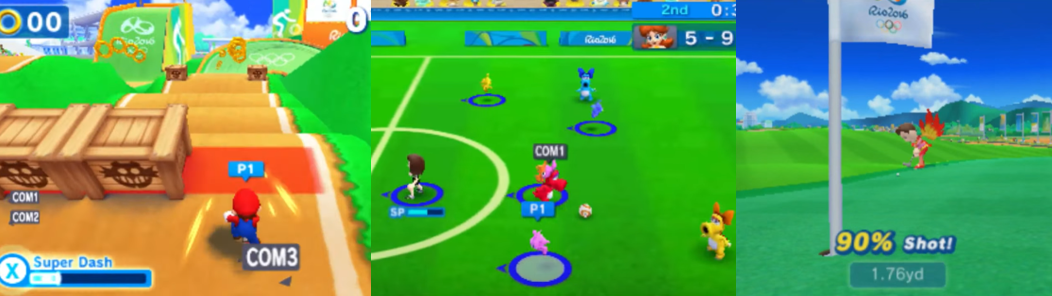
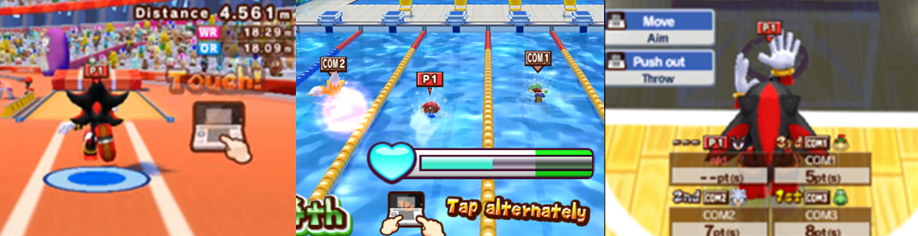
Gameplay: I’ve played games in the Mario & Sonic series before so I knew what to expect heading into Mario & Sonic at the London 2012 Olympic Games; while the games do generally have a story mode these days to make the gameplay a bit more involved than just a simple party game, it is still, nevertheless, a collection of Olympic-themed mini games. Because I’ve never been a fan of the Wii’s motion controls (or the Wii in general, if I’m honest), I always opt for the handheld versions of these sorts of games in the hopes that they will be less frustrating to play. Sadly, for the most part, that isn’t the case with Mario & Sonic at the London 2012 Olympic Games, a game which, seemingly, goes out of its way to use every single button, control, and aspect of the 3DS for its numerous events. The game features twenty playable characters, each of which falls into one of five different character classes (Heroes, Challengers, Girls, Wild Ones, and Tricksters) and, as a result, each character takes part in different events (Sonic, for example, can be used in the Marathon event, Yoshi in Shot Put, Blaze the Cat in Beach Volleyball, Bowser in Wrestling, and Metal Sonic in Hockey) and you cannot mix characters or classes.
The game’s events restrict which characters you can use according to their specific classes.
The moment you start a new game, Omochao rears his ugly little head to talk you through some of the game’s basic controls; you can then select from a few different customisation options, single or multiplayer events, or the game’s story mode. If you choose the single or multiplayer modes, you can select from all of the game’s many and varied events, each of which comes with an easy, normal, and hard criteria to get bronze, silver, and gold medals, respectively, with different goals, scores, or times to hit for each, as well as a brief overview of the event’s controls and objectives. I skipped this, however, and went straight to the story mode. The story allows you to take control of all of the game’s playable characters and the vast majority of the mini games and events the game has to offer, all while dialogue boxes and some limited voice clips and effects convey the game’s simple story. Generally, the story branches into two separate paths, one that follows primarily Mario characters and one that follows mainly Sonic characters, with the groups mixing up, overlapping, and interacting as they investigate the Phantasmal Fog, battle their shadowy doubles, and go head to head with Bower, Eggman, and their underlings.
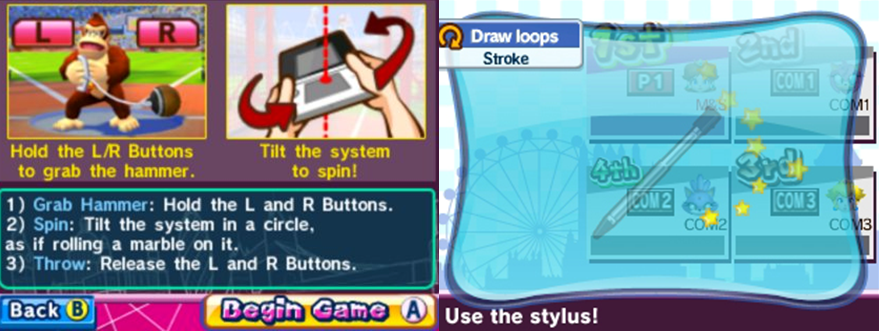
Though you’re given a brief overview of each event’s controls, the actual gameplay can be tricky.
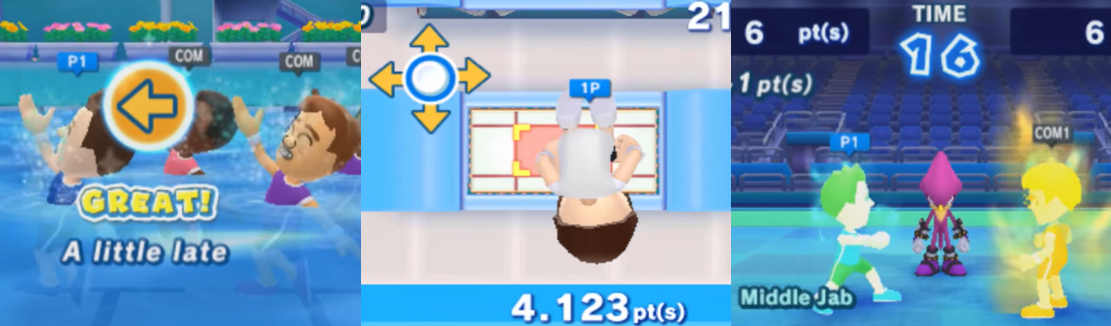
It’s a pretty simple story, one that is geared more towards teaching younger players a little about London and the Olympic Games more than anything, and it’s extremely linear. You can jump to a map screen to replay events (or just let the story take you from one episode to the next), skip cutscenes if you’re retrying an event, and are given a number of Challenges to complete to advance the plot. In the story’s early going, you’ll probably only be required to complete one or two Challenges but, as the story progresses, you’ll be asked to more, with each Challenge being comprised of harder or more complex events. Only first place will do here; if you don’t come first, you fail the Challenge and must either retry or choose a different Challenge if you want to see the story through to completion. As you play, you’ll be required to take part in a number of Olympic Games; it’s kind of weird that characters just spontaneously challenge their rivals to these games, and how the stadiums and arenas and locations and crowds and such just “appear” when you need to compete but…what do you expect? This is the best way, though, to experience a variety of the game’s events and get an idea of what is required of you. Sadly, however, many of the game’s events are an exercise in frustration; as I mentioned, you’ll be given a brief overview of what to do before an event but, sometimes, that doesn’t really help prepare you for the actual gameplay of that event. Generally, you’ll be rapidly tapping buttons, inputting specific button combinations, shouting or blowing into the microphone (which I can’t seem to find on my 3DS and which makes me a little lightheaded since I’m so unfit…), moving the 3DS about, or using the stylus to complete these events. Some, like the Pole Vault and 100M Backstroke, aren’t too difficult (you must angle the circle stick in a diagonal direction to charge your vault and release before the hidden meter overfills and your pole breaks or rapidly draw circles with the stylus to swim faster).
Be careful not to damage your touch screen trying to get to grips with the game’s controls…
Other events, like Archery (Solo) and BMX are maddeningly frustrating (you don’t just aim and shot in Archery, you need to account for wind currents which can screw up your shot, and BMX requires almost perfect hand co-ordination to tilt the 3DS in the right position to give you a much-needed boost). Almost all of the events have one thing in common and that is that they come down to split second timing as much as skill; if you do not time your inputs exactly right, you’re screwed but, often, the game’s button prompts and directions mislead you and cause you to fail. Take the Triple Jump, for example; it seems pretty easy (tap the touch screen left and right in an alternating pattern and then tap in time with the directions to leap) but if you tap for your first jump when the game/button prompt tells you then you will fail on a foul since you jumped too late! Similarly, Basketball only gives you an aiming reticule in the training mode, which makes landing a shot really difficult with the 3DS’s motion controls, and many games that have you draw on the bottom screen have the directions on the top, which is really confusing as you’d expect to tap targets on the touch screen when playing the Shooting events. Others seem incredibly random or unfair just for the sake of it; the 20km Racewalk event, for example, has you moving the stylus to a tempo at just the right speed. The game helpfully tells you when to speed up and penalises you if you need to slow down but it’s more annoying than anything to try and get the balance just right. The Canoe Slalom (Pair) event has you balancing with the circle pad and tapping A to pass through gates, which sounds easy but is super tricky as the control stick is overly sensitive, and you’ll be jerking your 3DS around like a moron trying to hit targets in the Double Trap event.
Other events are troublesome because of a dodgy camera angle and poor onscreen prompts.
Similarly, in a lot of events are handicapped by poor camera angles; it’s hard to see (or know) what you’re doing in the Sprint event as you’re stuck in a bad position and your opponent just rockets away too fast for you to catch, and it’s very difficult to judge your positioning in the ball-based games like Badminton and Football (to say nothing of the Goddamn Table Tennis (Doubles) event which requires you to switch between two characters but sometimes they swap independently and always right as you think you have the rhythm down). It’s equally difficult to make jumps in the 3000m Steeplechase event as the camera position means you don’t see which sort of button press is required of you until the very last second; the same goes for the Marathon event, where the angle is positioned just annoyingly enough to mean you need split-second accuracy to pick up the water bottle at the right time. It’s not all bad, though; some events (like 25m Rapid Fire Pistol, Trampoline, and Wrestling) can be fun but there’s very little room for error here; it may take some practice to understand exactly what is required of you but, generally, once you get the inputs down you can usually scrape by to advance the game’s story to the next episode. Other times, though, you’ll have to take on a number of quick-fire events in a row, with no way to restart if you fail one until you load into the next event (and then you have to restart the whole Challenge so be sure to retry before you fail), and by the end of it all you’ll be too burned out to really want to try out the other events in the game’s single player mode.
Graphics and Sound: Being that it’s a 3DS game, the graphics are serviceable enough; Mario, Sonic, and all their friends and enemies look pretty good and coexist decently enough thanks to their cartoony aesthetic but it’s a bit weird how some characters (the girls, mostly) are dressed to compete and others are not and how characters like Sonic are suddenly only able to communicate in pantomime.
The game’s presentation is decent enough and mixes cartoony characters with real-world locations.
Otherwise, there’s not much to the in-game graphics; the story mode sees the characters visit a number of iconic British landmarks but they’re mostly lifeless voids or obscured by thick, colourful fog. When you enter the events themselves, there’s a decent amount of detail, with minor Mario and Sonic characters filling out the crowds and the arenas sharing the same bright, cartoony aesthetic of the characters. Musically, though, aside from a few recognisable sound clips and sound effects, there’s nothing really Mario or Sonic about this title as it opts for simple trumpets and fanfares.
Enemies and Bosses: Outside of the game’s story mode, your choices for opponents are dictated by which character, class, and event you wish to play; you won’t be able to pit Sonic against Eggman in a Triathalon, for example, but you can pit Knuckles against Donkey Kong in a Boxing match. In the story mode, you’ll mostly compete against evil fog imposters of Mario and Sonic characters; Amy Rose and Princess Daisy, for example, get to take on the imposter versions of Blaze and Princess Peach in Beach Volleyball and Yoshi will have to compete against imposter versions of Shadow the Hedgehog and Silver the Hedgehog in the 1500m and 10km Marathon Swim events. As you progress, the amount of Challenges you have to clear increases, as does the difficulty of your opponents, and you’ll be allowed to choose between different characters to take on different events and imposters. In the course of the game’s story, you’ll also compete against a number of boss characters; it is only by clearing these challenges that you’ll bring that episode to an end and progress to the next part of the story. The first boss battle pits you (as Mario and Luigi) against the duo of Dry Bowser and Dry Bones and has you frantically blowing into the microphone and awkwardly steering your ship across boost panels in the 470 (Pair) event. This is a pretty ridiculous game as the controls are way too slippery and it’s ridiculously easy to just wander into the path of a whirlpool…yet it’s also stupidly easy to win even with minimum effort.
Time your stylus swipes perfectly to beat the Boos at Badminton.
Next, you’ll take on King Boo and Boo in Badminton (Doubles) as Sonic and Miles “Tails” Prower; this involves sliding the stylus (or your finger) down the touch screen as the shuttlecock comes towards you. Don’t do this too soon, though, or you’ll miss like an idiot; instead, you should aim to hit it when the shuttlecock flashes red but this gets tricky as the rallies get faster and faster and, one time, the ball went between Sonic and Tails and they just stood there like lemons! Mario & Sonic at the London 2012 Olympic Games sees the welcome return of Jet the Hawk as a boss character who challenges Shadow to a 3000m Steeplechase, and also has you competing against Rouge the Bat as Peach in the 100m Backstroke, neither of which are particularly challenging thanks to these events being two of the more user-friendly games. When you take on Bowser Jr, however, you must do so in a three-stage event that sees Yoshi having to fight with the poor game prompts in the Triple Jump, hold the 3DS like an idiot in the 10km Marathon Swim, and struggle through a 3000m Steeplechase, or Silver desperately try to aim for the centre and time button presses correctly in Trampoline, fumble through Basketball, and press and hold the stylus without messing up in Floor. Your best bet to beat Bowser Jr is to pick Shadow, whose events are much easier to get through. You’ll also come up against one of the most wasted characters ever introduced into the Sonic franchise, Eggman Nega, and have to compete against him in a 4 x 100 relay that simply asks you to slide the stylus to pass the baton between Luigi, Tails, Mario, and Sonic. Similarly easy-going is Donkey Kong’s encounter with E-123Ω “Omega”, which sees you timing presses of the A and B button and going for a super tackle in the Wrestling – Freestyle event. Unfortunately, when Sonic takes on Magikoopa, it’s in the God-awful BMX event which literally had me tearing my hair out as I just couldn’t figure out how the tilt the 3DS properly to land correctly!
Eggman and Bowser get a significant power up from their Phantasmal Fogfor the story’s finale.
You’ll battle against both Bowser and Dr. Eggman a couple of times in the story mode; you’ll first face Dr. Eggman with Wario and then alongside Waluigi to take on Eggman and Metal Sonic, but he isn’t really a challenge (the Hockey game you must complete is really just a glorified version of Pong (Atari, 1972)). Similarly, Bowser isn’t too difficult to get past if you choose the right events (the Hammer Throw, in particular, isn’t too taxing as long as you can rotate the 3DS fast enough) but they both get a significant power boost for the game’s final chapter. Here, powered up by the Phantasmal Fog, Bowser and Eggman take on Mario and Sonic in Sprint, 20km Race Walk, Judo, and 100m events. Judo isn’t especially hard (it’s just a question of timing your button presses and being a bit aggressive in your attack) and 100m is fine as long as you charge and release A and can tap the button as fast as possible but both Sprint and 20km Race Walk can crawl into a hole and die. Eventually, after much trial and error, I got Sprint down (ignore the onscreen prompts and don’t move or press anything until you’re sure you can dash past Eggman) but the 20km Race Walk mainly came down to luck.
Power-Ups and Bonuses: Being as this is a glorified collection of mini games, there’s not much on offer here; some events have you rapidly tapping A to recover stamina or splashing water on you for the same effect, or touching dash panels for a boost, and many reward a perfect finish with a fancy special flourish but there’s nothing tangible in-game to help increase your chances.
Additional Features: There are a couple of extra incentives on offer here for repeat and expansive play; first, when you first start the game, you can customise your in-game name, flag, and Badge (which is a nice touch for when you’re playing online, I’m sure). You can also aim to break world records in each event, win bronze, silver, and gold medals, and complete each of the game’s events and story modes to earn tickets and Badges. You can then use these tickets in a ball machine to unlock yet more Badges, all of which can be viewed in the game’s Record Log along with (obviously) your best times and records. After you beat the main story campaign, you’ll unlock a series of additional bonus episodes that see you compete as Bowser Jr, Bowser, Metal Sonic, Dr. Eggman, Peach, Blaze, and Amy in some of the toughest challenges yet. Unlike in the Wii version, there are no “Dream Events” to compete in, though you can cobble together custom events to take on both on and offline if you can bring yourself to play a little longer.
The Summary: When it comes to the Mario & Sonic series, you know what to expect: Olympic-themed mini games involving some of gaming’s most iconic characters. Yet, as inoffensive as these games often are, Mario & Sonic at the London 2012 Olympic Games takes things to the next level by needlessly overcomplicating so many of the events and controls. It’s as though the developers were forced to shoe-horn in everything the 3DS was capable of, which would be fine if there were the option to switch to more traditional controls but, nine times out of ten, there isn’t. Instead, you’re left to fumble about the place, shouting at your 3DS and trying to rotate it while alternating between hitting buttons or drawing on the touch screen and it’s just more frustrating than fun. Because I’m a big Sonic fan, I am kind of duty-bound to own these games wherever possible but I’ve never really been fond of them; I’m sure that for groups of players who like motion controls and unfairly-balanced party games, they’re a lot of fun but it can’t help but feel like Nintendo and SEGA left a lot of money on the table by not also producing a more traditional crossover for their iconic mascots.
My Rating:
⭐⭐
Rating: 2 out of 5.
Could Be Better
How did you find the 3DS version of Mario & Sonic at the London 2012 Olympic Games? Perhaps you also owned the Nintendo Wii version; if so, which was better, in your opinion? How did you find the game’s motion controls, assortment of games, and story mode? How do you feel about the Mario & Sonic series overall? Do you agree that the concept is somewhat wasted on the Olympic Games or have you enjoyed the series so far? Which country are you pulling for in this year’s Olympic Games? Either way, feel free to leave a comment below.
Sonic the Hedgehog was first introduced to gamers worldwide on 23 June 1991 and, since then, has become not only SEGA’s most enduring and popular character but also a beloved videogame icon. This year, the Blue Blur turns thirty and what better way to celebrate than by dedicating an entire month’s worth of content to SEGA’s supersonic mascot.
Released: July 2007 Originally Released: June 1991 Developer: Sonic Team Original Developer: Sonic Team Also Available For: Arcade, Game Boy Advance, Gamecube, Game.com, iPod, Mega Drive, Mobile, Nintendo 3DS, Nintendo DS, Nintendo Switch, Nintendo Wii, PC, PlayStation 2, PlayStation 3, PlayStation 4, PlayStation Portable, SEGA Saturn, Xbox, Xbox 360, Xbox Series X
The Background: You know the story by now: there was a time when videogames and home consoles ran rampant and, for a while, it was good. But, inevitably, the market became swamped with lacklustre releases and poorly conceived movie tie-ins; after the collapse of the videogame industry, Nintendo were there to pick up the pieces, dominating the market with the Nintendo Entertainment System (NES) and Super Mario Bros. (Nintendo EAD, 1985). Though they had successfully recaptured the flailing market and seemed unstoppable, one former slot machine developer dared to try and knock Nintendo from their perch. In 1990, SEGA ordered their developers to design a mascot and a title capable of leaving Mario in the dust and showcasing the power of their 16-Bit Mega Drive; after an internal contest produced numerous rejected designs (including a rabbit and an armadillo), SEGA soon settled on Naoto Ohshima’s design of a spiky hedgehog dubbed “Mr. Needlemouse”. With up-and-coming developer Yuji Naka, composer Masato Nakamura, and level designer Hirokazu Yasuhara also onboard, the character’s design was refined and defined, renamed to Sonic, and “Sonic Team” was born. Conceived to be as appealing as possibly, Naka wantedSonic the Hedgehog to focus on speed and user-friendliness; unlike his rival, Mario, Sonic controlled with only the directional pad and one button and his gameplay was based on physics, momentum, and an emphasis on action and speed. Thanks largely to an aggressive marketing campaign and copies of the game being bundled in with SEGA’s brand new console, Sonic the Hedgehog was an immediate success, selling over 15 million copies in this format alone and kick-starting the “Console War” between SEGA and Nintendo that would dominate the nineties. Since then, Sonic has become an enduring icon; he’s had a slew of critical and commercial hits alongside a number of unfortunate and very disappointing hiccups and yet his character and brand remain strong and he is still an iconic character in both videogames and other media to this day.
The Plot: South Island is under siege! The maniacal Doctor Eggman (widely known as “Robotnik” during the game’s original release) has been capturing the island’s animals and turning them into robotic Badniks! With Eggman’s machinery and pollution threatening the entire island, only one super-fast, super-cool hedgehog can stop him!
Gameplay: Sonic the Hedgehog is a 2D, sidescrolling action/platformer in which you control the titular blue hedgehog. Sonic must journey across six stages (known as “Zones”), each split into three “Acts”; at the end of each Zone’s third Act, Sonic must battle Eggman in one of his contraptions and, upon clearing all six Zones, face the diabolical doctor in the game’s Final Zone. Sonic is a smooth and responsive character to play as; slightly weighty, his speed and agility are dependant upon you building momentum and using the game’s level layout and gimmicks to your advantage. When you move Sonic, he quickly breaks from a trot, to a jog, to a run that is so fast his legs appear as little more than a rubber band of red, white, and blue but, in order to reach Sonic’s top speeds, you’ll need to make use of slopes, curves, the game’s signature loop-de-loops, and Sonic’s rolling mechanics.
It’s not all high-speed Badnik bashing; Sonic will also have to pull off some slower platforming.
Any time you press a button, Sonic jumps into a blazing spinning ball of spikes known as the “Super Sonic Spin Attack”. You can use this to destroy Badniks and bounce off of them, springs, and monitors to increase your height, momentum, and speed. Additionally, pressing down whilst running will see Sonic roll along for a similar effect. In the original release of the game, Sonic couldn’t utilise his patented Spin Dash as this wasn’t introduced until the bigger, better sequel but subsequent re-releases and ports have seen this function added in, which can be extremely helpful in moving Sonic along (unfortunately, though, it’s not available in this version of the game). And that’s a noteworthy point as, unlike in the sequels, Sonic is painfully slow in his debut title; the game’s first stage, the iconic and massively over-used Green Hill Zone, is a perfect playground for getting to grips with Sonic’s speed and abilities. You’ll blast through this Zone in no time at all, feeling the rush of adrenaline and action-packed speed, only to literally run into a brick wall with the next stage, Marble Zone, which slows the game down to a crawl so Sonic can navigate precarious platforms, push blocks, activate switches, and simply wait for the game to allow him to continue.
The game’s slower sections betray its marketing as a non-stop action platformer.
That’s not to say that speed doesn’t become a recurring factor in Sonic’s gameplay; both Spring Yard Zone and Starlight Zone give you a chance to stretch your legs again but the pinball mechanics of the former and the obstacle-course-like layout of the latter were definitely refined in the sequel. As a result, most of your time is spent using more traditional platforming skills to progress forward rather than simply blazing through as the game’s marketing would have you believe. This means jumping from platform to platform, navigating maze-like areas, activating switches, and hopping to disappearing, crumbling, or spinning platforms. In Starlight Zone, you’ll also have to use some see-saws to bounce up to higher areas and navigate a bottomless void while Scrap Brain Zone includes teleportation tubes and speed-sapping conveyor belts to screw up your momentum and sense of direction. You’ll also have to watch the in-game timer as well; if you take too long to finish an Act, you’ll lose a life, so it pays to keep moving but, fortunately, none of the game’s Zones or Acts are that long or difficult to get through within the required time limit.
There are many ways to keep Sonic alive and kicking.
Luckily, Sonic is a relatively sturdy videogame character, especially compared to Mario; collecting the many Golden Rings scattered throughout the game’s Zones allows you to survive a single hit. You’ll lose all of your Rings but you won’t lose a life unless you get squashed, fall into one of the game’s many bottomless pits, get hit without a Ring or a shield, or drown. Sonic’s momentum becomes sluggish and awkward when underwater and, unlike his rival, he cannot survive for long in the murky depths of the Labyrinth Zone; linger too long and an ominous, heart-pounding countdown will begin and, if it reaches zero, you’ll drown and lose a life. Fortunately, just as you can collect dropped Rings, you can save yourself from this fate by finding air bubbles. Sonic can also earn an extra life if he collects one hundred Rings or earns a high enough score and you’ll also be given a chance to continue should you lose all of your lives. You can earn extra continues in the game’s Special Stages but you’ll also lose your current accumulated high score if you have to use a continue. Sonic gains points for destroying Badniks, defeating Eggman, and clearing Acts; once you reach the end of Act signpost or break open the prison capsule, you’ll be awarded bonus points for your current score, the time you took to clear the Act, and the amount of Rings you were holding when you did so. As a result, you are actively encouraged to blast through Acts as quickly as possible as this will net you a higher score and more lives and continues.
Labyrinth Zone more than lives up to its name thanks to being far more vertical and maze-like.
Sonic the Hedgehog’s Zones are thus laid out in such a way to allow you to experiment to find the fastest routes; typically, the higher path is the most dangerous but also the fastest compared to the middle and lower paths. This isn’t always the case, however, and this mechanic is not as refined as in later games; some Zones, such as the aforementioned Labyrinth and Spring Yard, are more vertically constructed, meaning that your completion speed will be directly tied to your level of skill and precision with controlling Sonic. For the most part, this isn’t a problem but, unfortunately, Sonic the Hedgehog does suffer from a few noticeable issues that can unfairly impede your progress; early copies of the game featured an infamous glitch whereby, upon landing on a bed of spikes, Sonic would lose his shield, Rings, and then a life all without the usual few seconds of invincibility frames to save him. Other times, especially in Spring Yard Zone, you may find yourself crushed by blocks even though you’re not actually beneath them; Sonic also has a curious animation glitch where he will jump while running in the air if you try to jump to close to obstacles or items, though these issues are, admittedly, rare and minor. Sonic the Hedgehog isn’t an especially difficult game; there are no difficulty settings to choose from so the game’s difficulty is supposed to gradually increase as you progress from Zone to Zone. As you race through Zones, you’ll automatically activate Lampposts as you run past them, which acts as a checkpoint should you die in the Zone, however your skill is tested by the way the game requires you to finish every Act that doesn’t feature a boss battle holding fifty Rings or more in order to try for the game’s six Chaos Emeralds.
Graphics and Sound: Sonic the Hedgehog is still one of the most impressive and visually appealing games of its kind. Everything from the sprites to the background art pops out in gorgeous colours and the game’s Zones are full of life and character, despite being largely cliché in hindsight. You’ll race through verdant fields, explore lava-filled ruins, slog through the sunken remnants of an ancient civilisation, careen around a bonkers pinball-inspired obstacle course, and face a myriad of deadly hazards in Scrap Brain Zone, the heart of Eggman’s operation on South Island.
As much as I like Starlight Zone, it’s quite empty compared to other Zones in the game.
Just about the only Zone that isn’t interesting or fun is Starlight Zone and I say this with a heavy heart as it’s actually one of my favourite Zones in the game and a welcome return to the more speed-orientated gameplay after the annoyance of Labyrinth Zone. However, Starlight Zone is largely empty and lifeless; the wind-based mechanic is clunky, the bottomless pits are insufferable, and the Badniks are far harder to destroy than in other Zones.
Leave Sonic idle and he’ll grow impatient, something videogame avatars have apedever since.
What saves Starlight Zone, however, is its music; in fact, Sonic the Hedgehog has some of the best and most memorable music in videogame history. From the catchy title theme to the iconic sounds of Green Hill Zone, every Zone has an excellent, jaunty, and fitting theme to go with it. This is also true of the game’s boss battles, which all feature the same ominous-yet-lively tune that let you know Eggman is inbound. The game doesn’t feature any cutscenes or story-telling elements; this isn’t entirely unexpected as a lot of games released around this time didn’t and, to be fair, the game’s story is pretty simple to pick up either through association (the Zones change from lush and vibrant to polluted and desolate and woodland critters bounce around the Zones after being freed from captivity) or from the game’s manual. One thing that the game does excel at, though, is giving Sonic a distinct personality; if you leave him idle, he’ll turn to the screen and impatiently tap his foot, a quirk that has been aped and emulated but almost every videogame avatar since.
Enemies and Bosses: In each Zone of the game, Sonic will face opposition from Eggman’s Badniks; these mechanical monsters may look cute and quirky but they can be extremely deadly. Mostly themed after animals, Badniks will fly across the screen shooting fireballs at Sonic, slink along the floor and break into spiked balls upon defeat, toss bombs at his head, and even explode in his face, among other things. Generally, Badniks are exclusive to each Zone but there is some crossover in later stages. While most of these Badniks aren’t too much bother, their placement in the Zones can be frustrating; others, like Roller and Burrobot, can be a pain due to the speed and surprise of their attacks while Badniks like Spike and Orbinaut cause issues due to their spiked defences.
Eggman may have a lot of different attachments for his craft but he’s not much of a challenge.
At the end of each Zone’s third Act, you’ll battle Doctor Eggman in his Egg-O-Matic hovercraft; each time you face him, he has a new, deadly appendage attached to his craft but his attack pattern remains generally the same. He’ll come puttering in, flying from right to left, and trying to attack with his appendage all while remaining a large, open target for Sonic’s Spin Attack. Unfortunately, while Eggman’s wrecking ball is simple to get around, his later appendages become more dangerous thanks to the presence of other hazards; in Marble Zone, he’ll drop fireballs that briefly render the ground too dangerous to stand on but there’s also a pit of lava to watch out for, for example. Attack too fast in Spring Yard Zone and you might drop to your death as Eggman uses his spike to remove parts of the platform you’re standing on. Labyrinth Zone’s boss battle is more of a race than a fight as, no matter how often you hit Eggman, he won’t be defeated; instead, you need to jump up the flooded vertical shaft dodging spikes and fireballs and desperately hoping to reach the top before you drown.
The final boss battle is pretty disappointing and stupidly easy.
Once you’ve cleared all six Zones, you’ll reach the Final Zone; in this final showdown with Eggman, you’re stuck in a room with no escape and no Rings as Eggman tries to crush you with four weights and fry you alive with electrical balls. Fortunately, however, there is always a gap between these sparkling orbs for you to safely jump through and, by simply waiting at the far right of the screen, you can just take your time and ram Eggman whenever he pops up. Compared to the final boss battles of later Sonic games, this one is a bit of a joke, to be honest, and ends the game not with a bang but with a kind of shrug.
Power-Ups and Bonuses: To help tip the odds in your favour, you’ll find a number of computer monitors scattered throughout the game’s Zones. Breaking these open will award you with such gifts as an instant hit of ten Rings, a shield that protects you from losing Rings or a life for one hit, or even an extra life. You can also find monitors containing Power Sneakers, which immediately increase Sonic’s running speed for a short time, or an invincibility, which coats Sonic in a sparkling protective aura. Combine these two together and you’re basically unstoppable unless you run head-first into a bottomless pit.
Additional Features: Playing Sonic the Hedgehog on the Xbox One allows you to earn some pretty simple and easy Achievements; if you’ve played Sonic before, it should be no challenge at all to reach the game’s later Zones, collect one hundred Rings, or complete the game. As I mentioned above, finishing every Act except Act 3 with fifty Rings or more allows you to enter a Special Stage (why they’re not called “Special Zones” I don’t know…); these are accessed by Giant Rings that appear when you pass the end of Act signpost, so jump in quickly before you miss your chance!
Collect all six Chaos Emeralds to earn the game’s best ending.
The Special Stages are a psychedelic maze-like area filled with bright colours and weird effects; here, you’ll have to bounce and roll Sonic (who is in a constant spin) around the arena trying to avoid the flashing “Goal” lights. Touch these and you’re instantly ejected from the Special Stage with nothing to show for it but, if you manage to avoid them, you’ll find a Chaos Emerald hidden within each Special Stage. Collect all six of these and you’ll be awarded with the game’s true ending; without them, Eggman will mock you for failing to collect them all but, aside from seeing flowers blooming in Green Hill Zone and an Achievement, there’s little incentive to collect all six as you don’t unlock anything else. Sadly, thanks to the way Sonic the Hedgehog works on the Xbox One, there’s no way to enter the iconic cheat codes from the original game and, while a save state system is included, it only allows you to save to three separate slots. You can, however, access online leaderboards to compare your score, time, and progress with other players, if that’s your thing.
The Summary: Sonic the Hedgehog will forever be an iconic, classic platformer; its place in the echelon of videogame history was cemented upon its bombastic release and, even to this day, it remains as a solid action/platformer. Unfortunately, years of enjoying the bigger, better, much improved sequels somewhat dampens the appeal of Sonic the Hedgehog. Playing the game in hindsight, you can see how the developers took the very best aspects and elements of this game and improved upon them in the sequel, removing the slower, clunkier elements and focusing more on action and speed. The game’s marketing made Sonic out to be this superfast character with a radical attitude but the actual game is quite slow, for the most part, and elevated above its peers thanks to its eye-catching graphics, distinct personality, and catchy music. It’s still a great game and obviously laid the foundations for even better things to come but is far less impressive than its sequels.
My Rating:
⭐⭐⭐
Rating: 3 out of 5.
Pretty Good
What did you think about Sonic the Hedgehog? Where do you rate it against the other games in the franchise? Did you purchase a Mega Drive simply to play Sonic? Which port or re-release of the game is your favourite? Are you as annoyed as I am that the excellent mobile version of the game isn’t available to play on the Xbox One? How are you celebrating Sonic’s thirtieth anniversary? Whatever you think, feel free to share your thoughts and memories regarding Sonic below.
It’s June 9th, which means that it’s National Donald Duck Day! Disney’s foul-tempered fowl first debuted in The Wise Little Hen (Jackson, 1934) way, way back on 9 June 1934 and has since become one of the multimedia conglomerate’s most enduring and popular characters, featuring in a variety of cartoons, videogames, and other merchandise.
Released: December 1991 Developer: SEGA Also Available For: SEGA Saturn
The Background: As I’ve said once or twice before, Disney had quite the reputation back in the nineties for licensing their popular characters and film franchises and producing some of the best 8- and 16-bit action/platformers on SEGA’s home consoles. Of all their enduring characters, Mickey Mouse, as the brand’s mascot, obviously featured in the majority of these titles but Donald Duck had his fair share of pixelated adventures over the years as well. Generally, Donald’s adventures were very similar to Mickey’s in that he would explore a fantasy world, generally trying to rescue his nephews Huey, Dewey, and Louie, and featured an abundance of jumping and platforming. QuackShot Starring Donald Duck was unique in that respect as, rather than bouncing on enemies and following a linear path from right to left, Donald becomes an Indiana Jones-type figure who travels the world in search of a lost treasure and the game featured a lot more backtracking and puzzle solving than most titles featuring Disney’s characters.
The Plot: When flicking though a book in his Uncle Scrooge McDuck’s library, Donald stumbles across a map that leads to the lost treasure of King Garuzia, former ruler of the Great Duck Kingdom in ancient times. Alongside his three nephews, Donald hops in his biplane and heads out across the world to track down the lost treasure all while Big Bad Pete and his goons try to stop him at every turn and beat Donald to the treasure.
Gameplay: QuackShot Starring Donald Duck is a 2D, sidescrolling action/platformer with a heavy emphasis on backtracking, exploration, and puzzle solving. Players take on the role of Donald Duck, decked out in an Indiana Jones-inspired getup, as he travels from Duckburg to Transylvania, to the South Pole and the ancient tomb of King Garuzia in pursuit of a lost treasure.
Run or slide to move a little faster and avoid a chargrilled butt.
Unlike other Disney titles, especially those starring either Donald or Mickey Mouse, QuackShot is a much slower, more methodical affair; Donald’s standard walking speed is painfully slow but, by holding down the A button, Donald will break out into what can best be described as a “spirited trot” for a few seconds, which really doesn’t speed things up all that much. When ducking, you can press the C button and Donald will slide forwards on his front, which is super handy for passing through small passageways and underneath spiked ceilings and can be a faster way of getting from start to finish.
Stun enemies with plungers or knock them out with popcorn.
Donald can also jump, as you might expect, but it’s more of a hop than anything else; Donald’s jumping height and distance is dependant on his momentum, angle, and the length at which you press the C button. Sadly, Donald cannot defeat enemies by jumping on them and is therefore entirely reliant on his special pop-gun to take out enemies. Donald’s gun can shoot out plungers to stun enemies so he can safely pass by or popcorn to permanently dispose of them; though he has unlimited plungers, Donald’s popcorn shots are limited and run out quite quickly as they fire in a spread. Plus, you know…enemies respawn after you leave the screen anyway so it’s better to just use the plungers.
Travel across the world using the map, checkpoints, and Donald’s handy-dandy biplane.
When you start QuackShot, you are presented with a map and can choose to travel to one of three destinations: Duckburg, Mexico, or Transylvania. Where you choose to go determines how far you can progress in the game; for example, if you visit Duckburg first, you’ll be soon stopped as you don’t have the ability to scale walls yet; if you visit Mexico, you’ll be told that you need a key to progress further; and, if you visit Transylvania first, you’ll need special ammo for your gun to progress further. In each case, a non-playable character (NPC) directs you to one of the other locations so you can get what you need to progress. Donald thus plants a flag (essentially a checkpoint) and you are able to call your nephews in your biplane to return to the map and travel elsewhere. Once you’ve cleared these first three areas, the map will expand and you’ll be able to travel to four new locations where the cycle repeats itself again; you can’t enter the temple in Egypt without retrieving the Sphinx Tear from the palace of the Maharajah and you can’t clear the Viking Ship of its ghost infestation without a special key from the South Pole, and so on. This partial progression and backtracking format makes the game much slower and requires a little more brain power than the average platformer; while NPCs always tell you where you need to go to progress in a particular level, if you miss that message and travel somewhere else instead, the only way to remind yourself of where you need to go is to hope that you remember where you just came from.
Collect enough peppers and you’ll fly into a berserker rage.
Donald’s health is indicated by a small power meter in the game’s heads-up display (HUD); when attacked or otherwise hurt, Donald loses some of his power but can replenish his health by stunning or attacking enemies and picking up ice cream cones or a roast chicken (there’s something very disconcerting about a duck eating chicken to replenish its health…). Attacking enemies adds to your score, which is also displayed in the HUD, and you’ll be awarded with an extra life when you reach a high enough score; extra lives can also be found in levels as well and, if you die, you can grab these again to effectively have infinite lives but, should you exhaust all of your lives, the game has infinite continues so you can simply choose to restart from your last checkpoint. The HUD also shows Donald’s current temper; when he picks up enough red-hot chilli peppers, he flies into a berserker rage that renders him invincible for a few seconds and allows you to attack any particularly annoying enemies. These peppers are few and far between, however, so I didn’t find myself entering this state too often. Some levels feature bottomless pits and instant death traps (falling ceilings, water, or lava) as well so you’ll have to factor this in as you explore the game’s environments. As you explore each area and speak to NPCs, you can access an in-game menu with the Start button. This is how you can call your aircraft (which can only be done when near to a checkpoint flag), use certain items (though these will only work when you’re right next to where they need to be used), and read things such as your map or other items to help you solve puzzles. The game’s puzzles are generally simple enough, requiring you to hop over moving platforms, stun moving blocks so you can progress, or hitch a ride on passing enemies. Probably the game’s more troublesome puzzle comes when Donald is about to be crushed by a falling ceiling and you have to hop on certain blocks in the right order in order to halt it and keep you from being flattened.
Graphics and Sound: As a Disney title on the SEGA Mega Drive, QuackShot looks just as gorgeous and appealing as the rest of their titles released around this time. Disney’s games are always bright, vibrant, and eye-catching and QuackShot is no different, with Donald, Pete, and the game’s various enemies and environments popping out and full of charm. When you leave Donald idle for some time, he’ll tap his foot impatiently like a certain blue hedgehog and he is full of life as he waddles and hops along. Levels aren’t quite as varied and unique as in some of Donald’s other outings, or those that feature Mickey; instead, you’ll visit more real-world locations than fantasy environments, which will see you walking through the streets and jumping across the rooftops of Duckburg, exploring the haunted lower depths of a Viking Ship, and traversing dangerous jungles.
QuackShot is colourful and lively, if a bit by the numbers.
They’re all pretty standard locations for your average action/platformer and they’re not especially teeming with life or background elements but they’re serviceable enough and generally quite short; you’ll play half a level and then have to jet off to another location before you can proceed any further, making playing both short and sweet but also quite long and complex. The game’s music is equally fun and lively and catchy enough but nothing especially ground-breaking or memorable. The game’s plot is told through a combination of stationary cutscenes and in-game dialogue boxes between Donald and recognisable characters like Goofy and Gyro Gearloose; they’re large and cartoony, though, and perfectly in keeping with the cartoon aesthetic of the videogame and certainly a lot more in-depth than those of other platformers from the same time period.
Enemies and Bosses: While Mickey generally had to deal with some fantastical and outlandish enemies, Donald is faced with more lacklustre and generic enemies sucu as vampire bats (that travel along a straight line and are easily avoided), incorporeal ghosts that cannot be harmed, and birds that drop wasp nests or bombs on you. Donald will also butt heads with a number of Pete’s goons who shoot at you or toss bombs at your head, Vikings who hide in barrels and try to shoot you full of arrows, kangaroos (complete with boxing gloves), evil cactus plants that break apart for added annoyance, and even skeletons who try to throw their heads at you.
Bosses are big and lively but pretty simple to put down.
While exploring Dracula’s Castle, you’ll also encounter a giant ghost who floats just out of reach and cannot be harmed; every so often, he breaks up into smaller ghosts before reforming and, rather than try to damage him, you actually have to find a certain platform that will take you to the castle’s upper levels and out of harm’s way. You’ll also come up against a few bosses on your travels, none of which really pose that much of a threat as long as you have enough health, ammo (if necessary), and can avoid their simple attack patterns. Donald has to fight against Count Dracula (easily dispatched by standing beneath him when he opens his cape and shooting plungers upwards), a ferocious fire-breathing tiger (dispatched by firing bubblegum shots when it’s jumping), and a possessed suit of Viking armour that constantly shields against your attacks and can only be harmed by hitting its head.
Pete finds his position as the game’s final boss usurped at the last second…
Eventually, you’ll face off against Pete himself in a bid to retrieve the map; this battle sees Pete circling the area in a massive press machine and attempting to squash Donald into a fine paste. Pete’s goons are also stationed around the arena to make hitting Pete in the face that much harder as you climb higher and higher up the arena but, like all the bosses, this is simply a test of patience rather than being an exercise in frustration.
The game’s true final boss isn’t much of a threat…
Once Pete is taken out, Donald heads over to the Great Duck Treasure Island, where the tomb of King Garuzia lies, to do battle with the knight guarding Garuzia’s treasure. As final battles go, this is a bit of a disappointment; the knight basically stays in the centre of the screen, twirling his sword and trying to fling it at you, and causing blocks to fall from the ceiling. He leaves himself wide open for your attacks, meaning it’s pretty simple to dodge the falling debris and blast him with your plungers or other weapons until he finally gives up King Garuzia’s treasure.
Power-Ups and Bonuses: The only real power-up you can get through regular gameplay is the aforementioned red-hot chilli peppers; you can also collect bags of cash to increase your score, though, and find some cheeky shortcuts peppered through stages that lead either to stockpiles of items and ammo, extra lives and health, or hidden doors to progress further.
Donald’s plunger gets a few upgrades along the way.
As you explore, you’ll receive two upgrades for your pop-gun; the first changes your yellow plunger to a red one, which allows you to scale vertical walls with temporary platforms, and the second changes it to green and allows you to hitch a ride on flying enemies. Gyro also supplies you with bubblegum ammo, which allows you to break open walls and certain blocks so you can explore a bit more of the map and the game’s locations. These bubbles are quite slow and linger around the screen for some time, which can limit your firing speed (which is already quite slow to begin with).
Additional Features: There’s not much replayability in QuackShot beyond playing through a perfectly acceptable action/platformer over and over. There’s no difficulty settings to choose from, no additional characters to unlock or play as, and there aren’t even any cheats or passwords to input. While this does mean you have to rely on old school gaming and memorisation to play through the game’s relatively short length, it also means that you can’t save your progress or jump to a later stage in the game if you have a power cut.
The Summary: Generally speaking, QuackShot Starring Donald Duck isn’t especially challenging but its pacing really ruins the many positive aspects of the game. Donald is so slow and clunky and the gameplay is so plodding and sluggish that there’s no real sense of urgency or agency to the game’s plot or action. QuackShot looks great and isn’t especially punishing or unfair but it’s nowhere near as action-packed or appealing as other Disney titles, even ones that also feature Donald Duck. Instead, you’re left with a perfectly average little title that looks and sounds great but doesn’t exactly leave you clamouring for more or especially excited.
My Rating:
⭐⭐
Rating: 2 out of 5.
Could Be Better
What did you think of QuackShot Starring Donald Duck? Where do you rate the game compared to other Disney titles of that era? Do you agree that it’s not as appealing as other Disney videogames on the Mega Drive or did you find it to be just as enjoyable? Which was your favourite, or least favourite, and who is your favourite Disney character? How are you celebrating National Donald Duck Day? Whatever you think about QuackShot, Donald Duck, or Disney in general, drop a comment below and have a great Donald Duck Day!
Sonic the Hedgehog was first introduced to gamers worldwide on 23 June 1991 and, since then, has become not only SEGA’s most enduring and popular character but also a beloved videogame icon. This year, the Blue Blur turns thirty and what better way to celebrate than by dedicating every Friday of this month to SEGA’s supersonic mascot.
Released: 1 November 1999 Originally Released: 26 January 1996 and 22 March 1996 Director: Kazuho Ikegami Distributor: ADV Films Budget: Unknown Stars: Martin Burke, Lainie Frasier, Bill Wise, Edwin Neal, and Sascha Biesi
The Plot: Doctor Ivo Robotnik (Neal) takes Princess Sara (Biesi) hostage and forces Sonic the Hedgehog (Burke) and Miles “Tails” Prower (Frasier) to journey to Robotropolis to keep Planet Freedom from being destroyed and, in the process, have them battle his ultimate creation: Hyper Metal Sonic (Gary Lipkowitz).
The Background: After Sonic achieved worldwide success and became the hottest pop culture icon of the nineties following the release of Sonic the Hedgehog 2(SEGA Technical Institute, 1992), Sonic was practically everywhere as SEGA capitalised on their mascot’s success with comic books, story books, toys, spin-off videogames, and, of course, animated ventures. Outside of Japan, DiC Entertainment produced two widely differentSonic cartoons that ran simultaneously and would come to inform the long-running Archie Comics series. Just as Japan and the rest of the world saw different Sonicpromotional materials and lore, so too did each country have incredibly different animated ventures for SEGA’s mascot as, in 1996, Perriot studio produced a two part original video animation (OVA), “Welcome to Eggmanland” and “Sonic vs. Metal Sonic!”, that featured a traditional anime aesthetic that was closely modelled on the anime sequences from Sonic the Hedgehog CD (Sonic Team, 1993) and much closer to the source material thanks to the involvement of Sonic Team (specifically Yuji Naka and Naoto Ohshima). As audiences outside of Japan were enduring easily the worst Sonic cartoon ever created, Sonic Underground (1999), and to coincide (somewhat) with the North American release of the Dreamcast, ADV Films combined the two-part OVA into one feature length feature, subjected it to a questionable dubbing process, and released it straight to video. Still, the feature length animation holds largelyfavourable reviews among Sonic fans for its closer adherence to the source material despite being just as removed from it as Sonic’s American cartoons.
The Review: Sonic the Hedgehog: The Movie is this absolutely mental anime adaptation of the videogames that has a slick, detailed aesthetic that not only evokes the artwork of the videogames but also aligns almost perfectly with the anime sequences from Sonic CD. Because of this, though this world is as strange and unique as the various iterations of Mobius, the OVA feels like an authentic tie-in to the source material rather than a distilled, heavily altered commercial product like the cartoons.
Though short-tempered and lazy, Sonic revels in action and adventure.
What really makes the Sonic OVA stand out from other animated adaptations, apart from the anime aesthetic, is its portrayal of Sonic; rather than a wise-cracking show off, OVA-Sonic is a snarky, short-tempered teenager and actually showcases the “attitude” that Sonic was advertised as having. He just wants to sunbathe in peace and quiet and yells at Tails for interrupting his relaxation and has absolutely no interest in helping Robotnik even though the safety of the entire planet is, apparently at stake. Despite his lackadaisical attitude, though, Sonic is quick to race into action when he sees Tails is in real danger and begrudgingly agrees to solve Robotnik’s problem despite never shaking the belief that something fishy is going on. Sonic is not just cocky but also extremely arrogant, surprisingly lazy, quick to anger, and uncouth, something his current incarnations often seem to forget or ignore. While still heroic, Sonic prefers to wait until the very last second, or needs considerable persuasion, to act; Sonic desires challenge and, without it, is mainly lethargic. This is best depicted in his intense and escalating battle with Metal Sonic wherein Sonic’s stupor gives way to a passionate desire to defend his pride and identity.
Tails is at his most capable here, berating Sonic’s inaction and directly influencing the plot.
Tails, also, is far more capable and competent than his other animated counterparts; a genius with machines and computers, it’s heavily implied that he retrofitted all the junk and discarded technology to build his laboratory and aircraft hanger and he’s easily able to reprogram Robotnik’s navigational device to alter Hyper Metal Sonic’s programming and repair the Tornado after it crashes. Crucially, though clearly an enthusiastic and naïve little kid, Tails is Sonic’s conscience and the voice of reason; when Sonic refuses to help, Tails berates him and helps coerce him into action and, while he does need a bit of rescuing, he’s also quite capable of doing far more than just whining or being a mere hostage or a liability.
Sara is a pain in the ass but at least she has more personality than the President.
Tails’s usually annoying characteristics are, instead, supplanted into Sara; a grating, annoying character, Sara is selfish and aggravating, throwing tantrums over the littlest things and revelling in her ability to manipulate the hearts and minds of men with her allure. Interestingly, though, the annoying aspects of her character give her a little more personality than the average damsel in distress since she doesn’t just sit there like a lemon or cringe in fear; she shouts, screams, lashes out, and whines the entire time instead which, yes, means you end up questioning why anyone would want to rescue her annoying ass but an irritating personality is a personality nonetheless, at least, which is more than can be said about her father, the President (Neal), who is a largely ineffectual and useless character.
Knuckles is a far less gullible or bumbling character than he’s now characterised as.
Unlike the majority of Sonic’s American cartoons, the OVA immediately gets extra points from me for actually including my favourite Sonic character: Knuckles the Echidna (Wise). Of course, of all the characters, Knuckles is perhaps the most fundamentally changed by the adaptation process; rather than an echidna, he’s said to be a mole (one, somehow, capable of flying) who is more interested in treasure and bounty hunting than guarding Angel Island and the Master Emerald. In fact, neither of these two elements are ever mentioned, characterising Knuckles as this wandering nomad who is, nevertheless, “Sonic’s best friend”; Knuckles, far from the gullible and foolish character he has become in recent years, is a capable, confident, and knowledgeable source of exposition and gets some fun comedic moments like when he chastises Tails for landing on Sara’s boobs or when his beloved and bad-ass cowboy hat catches fire!
Though a buffoon at times, Robotnik is still a charismatic, deceptive, and competent villain.
For those only familiar with Sonic’s American cartoons, perhaps the most striking character in the OVA is Dr. Robotnik; rather than some bumbling fool or a semi-cybernetic, tyrannical dictator, Robotnik is far closer to his videogame counterpart and, when I think of the Robotnik from Sonic’s 2D videogames, this is the one I think of. A charismatic, deceptive, and a ruthless individual, Robotnik is easily able to intimidate the President by kidnapping his daughter, manipulate Sonic and Tails into doing his bidding, and ultimately capture Sonic’s “life data” to complete Hyper Metal Sonic. There’s a lot of backstory hinted at with this world, primarily through Robotnik, who explains how Planet Freedom works and hints towards previous encounters with Sonic and Tails, and Robotnik actually has a lot of depth to his personality as he seems to genuinely be besotted with Sara while also wishing to destroy Sonic and take over the Land of the Sky. Robotnik, of course, isn’t the only antagonist in the OVA; at first, we’re led to believe that the primary antagonist is the mysterious “Metal Robotnik”, a massive demonic anime mech that is, clearly, being piloted or at least controlled by Robotnik. The deception, however, completely fools everyone despite the fact that Metal Robotnik sounds exactly like Robotnik! The mech suit gives Robotnik a vast array of combat options that briefly give him the upper hand but the destruction of Metal Robotnik isn’t even a set back for Robotnik; it’s all simply part of his master plan, which is surprisingly competent and threatening.
Sonic insists on battling Metal Sonic alone, seeing the robot as a degrading imposter.
Hyper Metal Sonic, obviously, ends up becoming the main antagonist but it doesn’t actually properly appear until after our heroes get past Metal Robotnik, enter Robotropolis, and shut down the Robot Generator; it’s glimpsed in the opening, pre-title sequence, however, and looms over the narrative like an ominous cloud so that, once it does appear, it’s in suitably dramatic and threatening fashion. Hyper Metal Sonic is a cold, calculating, silent antagonist and Sonic sees its mere existence as both an insult and a threat to his position, categorically refusing to have his friends help him and choosing to battle his robotic counterpart alone in increasingly violent confrontations.
The Nitty-Gritty: Though there is a general, prevailing idea that Sonic the Hedgehog: The Movie is much closer to the source material than its other animated counterparts, that isn’t exactly true; the world we are presented with in the film is just as different from that seen in the games as Mobius is in the cartoons and comics, perhaps even more so since this is a strange world that resembles a shattered, post-apocalyptic version of our world more than the wacky, fantasy worlds seen in the videogames. However, the spirit of the videogames is evoked far closer thanks to the OVA’s anime aesthetic and locations closely resembling those seen in the games (Never Lake, for example, appears to be briefly seen onscreen at one point and Sonic races through traps and obstacles very similar to those from the games, including the first and most accurate onscreen portrayal of springs, spikes, and Badniks).
The world is both familiar and yet unique, borrowing from and then influencing Sonic‘s videogames.
One thing I love about this OVA is not just how well it captures the spirit of the source material but also came to influence later videogames and Sonic canon; it’s fitting that this was released outside of Japan around the time of the Dreamcast since there are many visual and aesthetic similarities between the OVA and Sonic Adventure (Sonic Team, 1998): Tails’s workshop, the airstrip that rises out of the ground, the visual of the “relics” of the Land of Darkness (clearly the remnants of New York City) sinking into the ocean are all clearly evoked in Sonic Adventure. Honestly, it’s a shame that more episodes of the OVA weren’t produced and that it hasn’t had a greater impact on larger Sonic canon; ideally, I’d love to see a 2D Sonic videogame utilise an artistic style or anime sequences such as the ones on display here for the cutscenes, if nothing else.
Animation is slick and fluid and the level of detail on offer is astounding at times.
Visually resembling Sonic CD’s impressive anime sequences, and loosely adapting its plot, unlike its American counterparts, the OVA featured a fairly simplistic story, but one given greater depth by its diagetic world. While some exposition exists regarding Planet Freedom and its two opposing “dimensions”, it is clearly not Earth, Mobius, or the Japanese videogame world either, despite some aesthetic resemblances to each. Instead, Planet Freedom is a post-apocalyptic alternate Earth where some calamity has caused the planet’s surface to break away and reduced the lower surface to ruins. As a result, the OVA’s visuals and scenery are amazingly detailed and even somewhat resemble the Zones of the source material. This, coupled with the OVA’s musical composition, evokes Sonic’s spirit in a way that its counterparts failed to do; by appropriating numerous anime tropes and conventions, the OVA’s characters act exactly as you expect and engage in frequent, intense, fast-paced action.
Amusingly, some risquémoments slipped past the OVA’s censors…
Of course, the OVA isn’t perfect; ask most people for their thoughts on it and the first thing they’ll mention is the pretty atrocious voice acting. Tails has a strange, nasally quality; Sonic’s voice is wildly inconsistent, croaking one minute and being strained the next, and Old Man Owl (Charles C. Campbell) is almost unintelligible. Knuckles, however, sounds pretty good and I love Dr. Robotnik’s boisterous, elaborate slightly German accent. Overall, I don’t really mind the voice work; it’s not like the ones in the American cartoons were always great and it actually adds to the OVA’s cheesy, goofy charm. Indeed, the OVA’s flaws come from the poor quality of some of the voice acting rather than the quality of the animation yet, interestingly, though it has the high-quality whitewash of respected Japanese anime to bolster its critical reception, Sonic the Hedgehog: The Movie remains almost as separate from its source material as any of the American animations, though ironically is able to better convey the essence of said source material better than any Sonic animation produced throughout the nineties. Furthermore, the OVA is made more entertaining by the fact that a few questionable moments made it past the censors: Sonic gives Metal Robotnik the finger, Sara is seen breastfeeding in a brief imaginary sequence and kicks the crap out of Metal Sonic when she thinks its looking up her dress, and Sonic lands on his crotch on Robotnik’s craft, which is all very wacky and amusing.
Metal ultimately comes to reflect not just Sonic’s speed and skill but his heroic heart as well.
Sonic the Hedgehog: The Movie excels in the quality of its animation; characters move with blinding super speed like in Dragonball Z (1989 to 1996) but are also slick and smoothly animated. Nowhere is the animation and art style represented better than in the depiction of Sonic’s battle against Hyper Metal Sonic and the design of Metal Sonic (and, also, Metal Robotnik). Their battles are a test of their skill, speed, and endurance as Sonic is somewhat on the backfoot given that Metal doesn’t tire or feel pain but Metal, far from a simple unemotional machine, begins to grow frustrated with Sonic’s persistence and will and evolves to mirror Sonic’s personality and body language as much as his speed. Thanks to Tails’s influence, Metal eventually chooses to sacrifice itself to save Sara and the President, refusing to be save from destruction since “There. Is. Only. One. Sonic”.
The Summary: Sonic the Hedgehog: The Movie is, still, perhaps the greatest Sonic animation ever created even though it still takes numerous, strange liberties with the source material, reflecting neither the Japanese or American versions of Sonic’s story or the story as told in the games themselves. Instead, the OVA is its own thing entirely, implying a continuity and a larger backstory that we, sadly, never get to explore as we only got to see these two episodes edited into one feature-length animation. Nostalgia and the general obscurity and rarity of the OVA obviously all helps to add to its appeal but Sonic the Hedgehog: The Movie is still well worth your time, especially if you’re a Sonic fan or a fan of anime in general since there’s plenty on offer here for both. Between the slick animation, catchy soundtrack, and action-packed narrative, Sonic the Hedgehog: The Movie presents perhaps the most appealing and cohesive bridge between Sonic’s many competing narratives and I’d love to see the concept and aesthetic revisited in more detail at some point. However, since that’s extremely unlikely given how wildly different the Sonic franchise is these days, at least we still have this hidden gem to fall back on.
My Rating:
⭐⭐⭐⭐⭐
Rating: 5 out of 5.
Fantastic
Have you ever seen Sonic the Hedgehog: The Movie? If so, what did you think to it? Were you able to look past the dodgy voice acting or was it simply too much to handle, despite the OVA’s impressive animation? Did you like the unique world of the OVA or do you feel it was too separate from the videogames and generally accepted narrative of the time? Would you like to see a return to this style of characterisation and animation for Sonic or would you prefer something a little different; if so, what? How are you planning on celebrating Sonic’s thirtieth anniversary this year? I’d love to hear your thoughts on the OVA, and Sonic in general, so feel free to leave a comment below.
Released: August 1994 Developer: HeadGames Also Available For:Game Gear and Master System
The Background: Following his debut in “Devil May Hare” (McKimson, 1954) as a dim-witted and voracious foil to Bugs Bunny (Mel Blanc), my absolute favourite Looney Tunes (1930 to present) character, the Tasmanian Devil (or simply “Taz”), became a recurring character in subsequent Looney Tunes cartoons before graduating to his very own show, Taz-Mania (1991 to 1995), as part of the Looney Tunes renaissance of the nineties. Although technically not tied into that cartoon or a sequel to Taz-Mania(Recreational Brainware/Various, 1992), and a fundamentally very different game altogether, Taz in Escape from Mars is emblematic of the character’s enduring popularity. Unlike the previous title, which I was inspired to play after enjoying the Master System version, Taz in Escape from Mars has always been a daunting prospect for me; the game’s reputation is somewhat mixed and I remember it being a tough experience the few times I borrowed it as a kid. However, given my love for the character, I was looking forward to sitting down and actually putting some real time into the game and seeing if I could overcome it after all these years.
The Plot: Having amassed a collection of strange and wondrous alien creatures, Marvin the Martian comes to Earth to kidnap the insatiable Taz and cage him in a special zoo on Mars. Unimpressed at his predicament, Taz breaks free and goes on a rampage in a desperate attempt to return home.
Gameplay: Like its predecessor, Taz in Escape from Mars (or Escape from Mars Starring Taz, as the title screen states) is a 2D, sidescrolling action/platformer which places you in the role of Taz, the ravenous Tasmanian Devil of Looney Tunes fame. Despite sharing many of the same sprites and fundamental mechanics as that game, however, Escape from Mars is a much bigger and more entertaining adventure with more interesting and varied mechanics, a faster pace, and much more freedom of movement (you can now freely move the screen’s camera up and down, for example).
Taz’s spin is a lot more versatile this time around and allows him to reach new areas.
As before Taz can pick up and use objects and use levers and other mechanisms with A, spin like a tornado with B, and jump with C. Unlike in the last game, Taz cannot defeat enemies or damage bosses by jumping on them but his spin attack is much faster and more useful this time around as you can use it to bounce Taz up narrow walls to reach higher areas. You can also hold down the B button to race across certain surfaces, including walls and ceilings, and to break through certain walls to avoid attacks and progress further.
Taz can temporarily grow or shrink in size in order to force his way onwards.
Taz, though still lacking in jumping and walking frames, also moves much faster and the controls, in general, are much tighter and more responsive. Best of all, Escape from Mars appears to be completely free of bottomless pits and instant death traps and has far more variety in the presence of teleporters, grow rays, and shrinking potions. When temporarily super-sized, Taz loses his spin attack but is invulnerable and can stomp his enemies into dust and, while shrunk, he can fit through smaller passageways (though he cannot attack or pick up items of food). Taz can also use his spin attack to tunnel through the dirt in Moleworld and you’ll notice that the game’s worlds and enemies are much more vivid, wacky, and memorable this time around.
A number of new mechanics and gimmicks help make the game bigger and more varied.
Not only is there more depth to the game’s environments, there are more interesting gimmicks in place, such as moving and temporary platforms, floating platforms, using mushrooms to ascend around spiked mazes, and jumping from cow to cow in the Mexican desert to say nothing of encountering more Looney Tunes characters, such as the Roadrunner and Yosemite Sam. You can also use Taz’s spin to go up and down spiral staircases in the Haunted Castle, traverse environments on floating cubes, and there are even some gravity-based mechanics at work in Marvin’s House. Taz can even enter an alien device and be duplicated a few times in this level and you’ll need to hop onto the doppelgänger’s head to reach higher areas. Having said that, though, the game manages to balance out all the improvements it makes on its predecessor with some annoying enemy and hazard placements (there are now two types of bombs, for example, that Taz will happily gobble down and get blown up for his troubles); some enemies, like the aforementioned Yosemite Sam, can’t be defeated and will attack you relentlessly. It can also be frustrating to enter the background through doorways only to instantly get stuck or become lost as you either can’t see where you need to go or there is nowhere to go, making the mechanic a bit pointless. By far the most annoying gimmick in the game are the lasers that instantly turn you to ash in Marvin’s House; you’ll have to desperately float and flail about using the gravity mechanics and attacking the laser generators from precariously small platforms in the hopes of reaching (and eating) the coveted exit sign.
Graphics and Sound: Taz in Escape from Mars takes the charming, cartoony aesthetic from the previous game and expands upon it in every way. Taz’s sprite remains mostly the same except for a new coat of paint, which is a little disappointing as his jump is still lacking in frames and the developers didn’t even program him a new idle animation. They seem to have tried to make up for this by expanding and shrinking him, which is pretty neat, but these mechanics aren’t seen very often (I only grew big once in the entire game) so it would have been nice to see Taz’s sprites and range of motion expanded a bit more alongside his speed and abilities.
Levels are packed full with details and wacky cameos from Looney Tunes characters.
Taking Taz off-world, though, vastly improves the appeal of the game’s environments; big, colourful, and full of wacky enemies and elements, Escape from Mars’ levels are far more unique and appealing as Taz hops from planet to planet in an effort to get home. Taz’s journey takes him from Marvin’s zoo on Mars, to the purple sands of Moleworld, where he’ll be pursued by a giant drilling machine in a desperate auto-scrolling chase that is easily one of the more frustrating and nerve-wracking parts of the game. Planet X is one of the game’s more distinct locations; an alien, mushroom-filled world that features spiked walls and more than a few of those never-ending water slides that require you to jump off at the right moment to progress further. Eventually, Taz makes it back to Earth, specifically Mexico, where he has to jump across a stampede and then navigate through the maze-like city while bandits shoot at him, before ending up in what initially appears to be a quite out of place castle but soon transforms into a mad scientist’s dungeon.
Cutscenes make far better use of the in-game sprites and graphics and fit the game’s aesthetic.
Unlike the previous game, Escape from Mars skips using dialogue and awkwardly-drawn panels for its story and, instead, relies far more on in-game graphics and pantomime, which is all of great benefit as everything has a more cohesive and appealing aesthetic as a result. The music and sound effects are also much improved but, while you’re no longer bombarded with annoying sounds and weirdly-composed tunes, neither are anything particularly catchy or memorable, which is a bit of a shame as that was another area that needed much improvement.
Enemies and Bosses: Another area where Escape from Mars out-does Taz-Mania is in the variety and appeal of its enemies; while no characters from Taz’s cartoon appear apart from Taz himself, the game makes up for this by swapping out bats and weird rock monsters for a handful of crazy alien foes who explode in a swirl of smoke when hit with Taz’s spin.
Escape from Mars is full of wacky alien enemies to help mix things up.
Marvin’s zoo and house, especially, are populated by weird alien frog-like creatures, robots, and his oft-seen minions, the Instant Martians, and his dog, K-9. You’ll also battle a variety of bandits, weird alien snails, raging bulls, and come across Yosemite Sam both in a gun-firing rage and protected by suits of armour. Witch Hazel even makes an appearance in the Haunted Castle, and what appear to be semi-cybernetic moles will blast at you with electrical bolts on Moleworld, and even Roadrunner and Wile E. Coyote will damage you if you slip off your stampeding convoy.
Bosses are much bigger and more complex so you’ll need to use Taz’s new abilities to their fullest.
It’s all very surreal and this is reflected in the game’s bosses, which are much bigger and require a bit more that just spinning into (and jumping on to) them this time around. The first boss is a massive alien elephant thing that swings its trunk at you in a clockwise and anti-clockwise motion and spits spiked balls into the arena. Thankfully, as I mentioned, Taz’s spin will now carry him along walls and ceilings, which allows you to avoid damage and ricochet into the creature’s antenna-like eyes when they briefly appear in order to damage it. The second boss is a giant drilling machine which attacks you in free fall. Using small and otherwise precarious platforms, you must dodge its laser-like whip and missile attacks and spin into the pilot when he pops out from the cockpit. Thankfully, if you fall from your platform, the battle simply continues and I strongly recommend landing on a bigger platform to give yourself more freedom of movement.
It’s tricky to hit the worm’s tail but it’s even harder to time your jumps over Toto.
On Planet X, you’ll battle a gigantic worm-like creature than bursts out from the walls of the arena but sports a big, flashing weak spot on its rear end. Spin into this and you’ll destroy each segment of the worm, making it faster and more aggressive as the fight goes on until only the head remains for the final blow. Things take a bit of a turn for the worst in Mexico, however, where you’ll battle the posturing Toro the Bull; Toro charges at you in a rage and will send you flying into the air with its horns before stopping and posing but don’t think that this is your window to attack! Instead, you have to stand in place while Toro charges his attack and then dash away from him and jump over him right at the last minute so that he runs head-first into the walls of the arena, which can be really difficult to do as he moves very quickly and tends to simply stop right before the wall.
You’ll need to think outside the box and switch bodies with Gossamer to takeit out!
Easily the most confusing and annoying boss comes at the end of the Haunted Castle, however. Here, you are charged at and punched by the big red furry monster Gossamer while a mad scientist blasts at you with laser bolts. Gossamer is completely invulnerable except for in the eyes; you must spin into its eyes a few times until it’s stunned and, hopefully, get it to collapse into one of the seats in the background. Once it’s sat down, dash over to the other seat and pull the lever and you’ll swap bodies with Gossamer, which will allow you to destroy the laser device and end this perplexing boss battle.
Marvin attacks in his giant mech and requires some tricky jumps to hit his weak spot.
The finale sees you taking on Marvin the Martian in a giant mech made in his image. The mech stamps around the arena and tries to kick at you but it also likes to stop and dance about with one of its massive feet. This is one of the trickier bosses as you must quickly jump up the platforms on its feet and legs and then launch a spin attack at the yellow plume on the “head” of the mech in order to damage it. Do this enough times and Marvin’s mech will collapse in a heap and Taz will finally be able to return to his peaceful life back in Tasmania.
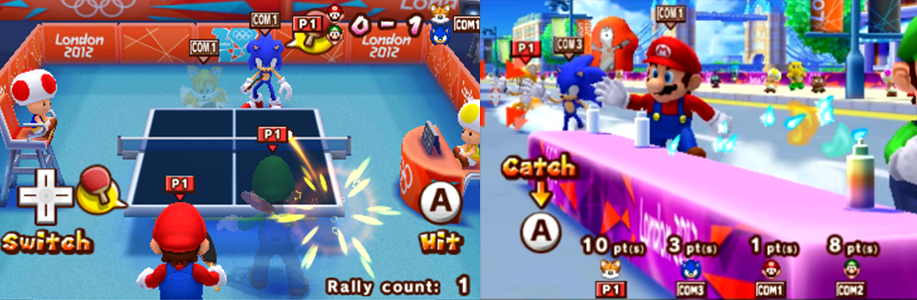
Power-Ups and Bonuses: As in Taz-Mania, Taz will automatically eat any items he comes across and you can blast them away with his spin attack. This means that he will explode if he eats bombs but will regain health if he eats junk food or first-aid kits and earn an extra life by chomping down on Taz icons. This time around, there seems to be a lot less health and far more bombs so, while there are a lot more opportunities to go blasting ahead, be sure to be mindful of your surroundings or you might miss some health when you need it the most. Also, don’t eat the cakes as they contain sticks of dynamite!
In addition to his fire breath, Taz can now spit rocks as well.
Taz can still breathe fire but, this time around, he has to gobble a can of gasoline rather than eating chili peppers. He can also eat boxes of rocks and spit a limited number of rocks at enemies as well, which is useful for taking out goofy aliens from afar and these projectile-based attacks are the only way of defeating some enemies, though there is no longer an invincibility star this time around.
Additional Features: Unlike Taz-Mania, there are no difficulty options in Escape from Mars; what you see is what you get and you’ll just have to deal with it. However, like the last game, you can take advantage of a few cheats by holding A and B on controller one and B and C on controller two when on the SEGA logo screen. If you did it right, you’ll hear a bark and, when you pause the game and press A, a debug menu will appear that allows you to refill your health, skip to any level in the game, and activate “XY” mode that lets you move Taz around the level freely.
The Summary: Taz in Escape from Mars is an improvement on its predecessor in almost every way; the core mechanics remain the same but expands upon them in just enough ways to make it a far more enjoyable experience. It’s funny because I distinctly remember this game being incredibly difficult back in the day but it was actually a lot more accessible than Taz-Mania, affording Taz a few new abilities and a greater range of movement and dramatically improving upon the level and enemy variety. Best of all, the game features no cheap deaths, bottomless pits, or instant death traps but it is populated by far more enemies and hazards. Sadly, a lot of the issues of the last game are still present and even made worse; sure, Taz is faster and more capable but he’s still a big, lumbering goof and levels might be more vibrant and interesting but they can still be frustrating and the music is still a let-down. Ultimately, Escape from Mars is a decent enough cartoony platformer to waste an hour or so on but it’s still a step behind other 16-bit games of the same genre and ends up being, in my opinion, about as enjoyable as its predecessor even with all the much-appreciated improvements.
My Rating:
⭐⭐⭐
Rating: 3 out of 5.
Pretty Good
Were you a fan of Taz in Escape from Mars? How do you think it compared to Taz-Mania and other 16-bit platformers? Were you a fan of Taz’s expanded moveset and the wackier levels and enemies of the game or were you disappointed to see the concept veer away from the Taz-Mania cartoon? Which Looney Tunes character and which of the old Looney Tunes videogames is your favourite? No matter what you think, leave a comment down below and let me know.
Released: July 1992 Developer: Recreational Brainware Also Available For:Game Boy, Game Gear, Master System, Super Nintendo Entertainment System (SNES)
The Background: My absolute favourite Looney Tunes (1930 to present) character, the Tasmanian Devil (or simply “Taz”) first debuted in “Devil May Hare” (McKimson, 1954) as a dim-witted and voracious foil to Bugs Bunny (Mel Blanc). In the early- to mid-nineties, the Warner Bros. cartoons were undergoing something of a renaissance thanks to shows like Tiny Toon Adventures (1990 to 1992) and Animaniacs (1995 to 1998) and Taz became part of this resurgence in popularity when he graduated to his very own cartoon, Taz-Mania (1991 to 1995). To tie into this, several videogame adaptations of the show were produced; while the SNES version, which was more of a pseudo-3D endless runner, was unfavourably received, the Mega Drive title (which, like the others, was a traditional 2D sidescroller) was received very well. Since the Master System version (Technical Wave, 1992) was one of the first videogame cartridges I ever owned and one of my favourite action/platformers, I decided to pick up the Mega Drive version and see how the technically superior title holds up against others of its genre.
The Plot: After being told a tale of a giant seabird that laid massive eggs capable of feeding an entire family for over a year, the ravenous and greedy Taz sets out in search of the Lost Valley and its legendary giant bird in hopes of satisfying his endless appetite.
Gameplay: Taz-Mania is a 2D, sidescrolling action/platformer which has you guiding Taz across a number of locations (though, primarily, through jungles and Aztec ruins). While a variety of enemies populate Taz-Mania’s levels, your biggest enemies will be the controls and the numerous bottomless pits and instant death traps. Taz, though big and colourful and occasionally full of life, is a slow and clumsy character to play as; his jump is awkward, he can’t crouch or look up or down, and his hit box is ridiculously large at times.
Taz spins like a tornado and spits fire but has a large hit box and tends to destroy his own power-ups.
Thankfully, you can get Taz to move his big, useless butt by sending him into his trademark tornado spin; however, while this is great for blasting away most enemies, it also knocks away health and other power-ups when they’re onscreen. You can use the spin in mid-air for a boost but it’s a bit finicky and the game is structured less around letting you blast ahead at full speed and more around awkwardly jumping to platforms, working your way up or across, and making blind jumps across bottomless pits. Taz also has an “Action” button that will let you carry certain items to reach higher areas, activate switches, and breathe fire after eating chilli pepeprs, and can also defeat some enemies and damage bosses by jumping on their heads. Unfortunately, you’ll be spending most of your time struggling with the game’s sluggish controls and annoying platforming elements; in the Badlands, for example, you have to jump from jets of water to reach the exit but, if your jump is a little off (which happens more often than not thanks to Taz’s jumping being a bit stilted and floaty), you’ll get damaged by the water and the knockback will most likely send you falling to your death. Similarly, when you reach the Jungle, you’ll have to make blind jumps to platforms you can’t even see in order to progress and either fall to your death or jump right onto an enemy for your trouble.
Gameplay is slowed to a crawl as you pull levers and try to figure out annoying lift puzzles.
Taz-Mania is much more of a thinking game than the Master System version, which I remember being more of a standard, cutesy platformer; in the Acme Factory, you have to jump up conveyor belts and dodge lasers to pull a series of switches and keep a deadly robot from being assembled. Pull the wrong switches, though, and you’ll be chargrilled as punishment, which is a pretty fast way to burn through your lives. Later, in the Mines, you’ll need to use similar levers to activate lifts to reach new areas; unfortunately, some of these are booby trapped and will send you falling to your death while others are suspended precariously over a bed of instant death spikes or missing entirely (which will also cause you to die immediately). In the Ruins level, you’ll have to make some very tricky and awkward jumps between platforms and if you’re not absolutely pixel-perfect, you’ll simply pass right through your intended target as though it were intangible!
While hopping from logs isn’t too bad, the mine cart section is an absolute nightmare!
More than once, you’ll be tasked with jumping from log to log to cross some rapids; thankfully, you won’t instantly die if you fall or land in the water but you will be bounced out at the cost of some health. These aren’t particularly difficult sections but they become more troublesome when you have to move Taz up and down to the foreground and background, which makes positioning his exact landing point difficult to judge, and when you have to struggle upstream and avoid flying over the edge of a waterfall. By far the most frustrating and unfair section of the game, though, is when you must jump into a runaway mine cart; you can speed up and slow down by pressing left or right and press A to raise the cart up and avoid crashing headfirst into a bumper, but you also have to be careful not to collide with the ceiling, enemies, or to fall off the broken tracks. One mistake and you instantly lose a life, which is ridiculously unreasonable and makes the presence of a life bar almost completely redundant.
Graphics and Sound: If there’s one thing Taz-Mania has going for it, it’s the graphics; sprites are big, cartoony, and colourful and the entire game evokes the look and feel of the cartoon. While the music and sound effects are extremely grating and poorly realised, it’s fun seeing Taz fly into an impatient rage when left idle and the little quirks he has here and there, such as eating the “S” in the opening SEGA logo.
Levels are colourful but not very varied and lacking in depth and complexity.
Sadly, this doesn’t really shine through all of the time and, for the most part, Taz is a very static and awkward character sprite. Similarly, the game’s backgrounds and levels aren’t all that interesting to look at; this game released almost a year after Sonic the Hedgehog (Sonic Team, 1991) and in the same year as Sonic the Hedgehog 2(SEGA Technical Institute, 1992) so there’s really no excuse for the environments being so bland and basic. Occasionally, you’ll see some foreground effects and have to pass through certain walls to reach new or secret areas but, for the most part, there’s not really a lot on offer in terms of variety as the game spends way too much time in barren wastelands and jungles.
Taz-Mania really should have relied on in-game sprites for its story and cutscenes.
By far the most visually interesting levels are the Acme Warehouse and the Iceland, a stage you only visit once yet you’re forced to endure the drab, dark mine and confusing mess of the Jungle for what feels like an eternity. Taz-Mania employs some very simple motion comic-like cutscenes and text to tell its story that, while featuring bigger sprites and including a handful of cameos from the show, featured extremely limited animation and it feels like they could have been swapped out for in-game graphics and sprites like the game’s ending.
Enemies and Bosses: Taz’s journey is obstructed by a handful of enemies, such as bats, frogs, crabs, and anthropomorphic stone heads and man-eating plants that try to take a bite out of you. Your most persistent and annoying obstacle (apart from the controls) will be the abundance of instant death traps and hazards such as pistols, fans, jets of flame, and bombs that dog you at every turn. In Iceland, you’ll also want to avoid landing in the freezing water as you’ll be frozen into a block of ice that will slowly drain your health unless you mash buttons to escape.
A couple of Taz’s adversaries from the cartoon show up as bosses, which is nice to see.
Fans of the cartoon may be slightly disappointed by how few characters carry over into the videogame and, yet, a handful of them do appear. In many levels, you’ll encounter a number of spear-wielding Bushrats, for example, and the first boss you battle is against Bull Gator and Axl in their trademark jeep. If you’ve played Sonic 2, it’s basically the same thing as the Emerald Hill Zone boss; simply hop over it to avoid being crushed and bounce or spin into the truck a few times and they’ll be done. Similarly, at the end of the Jungle level, you’ll encounter Francis X. Bushlad, a red-headed archer who simply shoots arrows at you in a predictable pattern and is easily bested by hopping on his head or spinning into him after jumping over his projectiles.
Taz also battles a giant plant and a stone version of himself.
You’ll also battle against a giant, man-eating plant that the instruction manual encourages you to throw a bag of “No Weed” at but I’m pretty certain I defeated it by simply spinning into it without much trouble at all. In the Ruins stage, one of the many Taz statues will come to life and you’ll have to fight a stone doppelgänger of Taz, who has all the same moves and abilities as you and is thus ridiculously easy to take out by jumping over his spin attacks and hitting him with your own when he’s standing still.
A giant seabird fiercely protects her egg in the finale but a few smacks to the head will dissuade her.
The finale of the game sees you navigating through a stone maze of sorts and then walking, almost completely unopposed, to the giant egg that is Taz’s goal. The egg is, of course, guarded by a giant seabird that attacks you with its humongous wings and talons, both of which are surprisingly easy to avoid. When the bird’s head pops into frame, simply spin into it a few times and you’ll win the day…only to be denied your dinner as the egg hatches and the hatchling mistakes Taz for its mother and amusingly chases him back home.
Power-Ups and Bonuses: One thing Taz is known for is his insatiable appetite and, as a result, he’ll automatically pick up and eat objects and enemies that he comes across. This, however, can be detrimental to your health as Taz will swallow bombs if you’re not careful and get blown up in classic Looney Tunes fashion.
Aside from the bombs, you should eat everything you come across for health, points, and power-ups.
However, the rest of the time, Taz will eat all kinds of food, such as roast chicken, fruit, and water bottles but he’ll also eat smaller enemies to refill his health; you can also eat Taz icons for an extra life and a Star for a brief period of invincibility, though I found very few of these in my playthrough. Furthermore, as mentioned, you can eat chilli peppers to spit fire by pressing A for a short time.
Additional Features: Taz-Mania comes with three different difficulty settings, Practice, Easy, and Hard but you won’t get to experience the full game on Practice and will receive the greatest challenge on Hard. If the game is too easy for you (which, honestly, it probably won’t be given how frustrating and unfair some parts of the game are), you can activate a number of…somewhat useful cheats by holding A, B, and C on both controllers on the title screen and pressing Start. After that, you can pause the game at any time and press A to refill your health, B to become permanently invincible, and A, B, and C to skip to the next level. The invincibility isn’t actually that helpful, though, as you need to activate it every time you die or start a new level and certain hazards (such as ingesting bombs and landing in water) will still damage you and all the invincibility in the world won’t protect you from an instant death trap.
The Summary: I really enjoyed the Master System version of Taz-Mania; it was bright, simple fun and I was excited to finally get my hands on the Mega Drive version after being won over by screenshots of the game for most of my life. Unfortunately, Taz-Mania definitely looks a lot better than it plays and shines much more in still shots than it does in motion. The sprites, especially Taz, are great, very fitting, and cartoony but are noticeably lacking in animation frames and just a sense of character. Taz is one of animation, and Looney Tunes’, most expressive and bombastic characters but he’s depressingly pedestrian here. The emphasis on platforming, blind jumps, and unfair deaths instead of fast-paced action and adventure in the style of Sonic also seems to have been a mistake and, for all its colourful, cartoony appeal, Taz-Mania was an underwhelming and disappointing experience for me, especially compared to the technically inferior Master System version.
My Rating:
⭐⭐
Rating: 2 out of 5.
Could Be Better
Were you a fan of Taz-Mania? How do you think it holds up today? Did the game’s controls, difficulty, and more finicky moments turn you off or is it one of your favourite 16-bit titles? Are you a fan of Taz and his cartoon? If not, which Looney Tunes character is your favourite and, by the same token, which Looney Tunes videogame is your favourite? Whatever your thoughts on Taz-Mania, feel free to leave a comment down below and be sure to check out my review of the follow-up!
Released: 10 June 2009 / 9 September 2009 Originally Released: 2 February 1994 / 18 October 1994 Developer: Sonic Team Original Developer: SEGA Technical Institute Also Available For: Gamecube, Mega Drive, Nintendo DS, Nintendo Wii, PC, PlayStation 2, PlayStation 3, PlayStation 4, PlayStation Portable, SEGA Saturn, Xbox, Xbox 360
The Background: Sonic the Hedgehog 2 was a blockbuster hit for SEGA; thanks to the title selling over 400,000 units in its first week alone (and over six million during the Mega Drive’s lifespan), SEGA was able to catch up to Nintendo in the “Console Wars” of the mid-nineties, raising their stake in the home console market by 40%. Anticipation was high for the release of the third Sonic game, which saw development split between two teams: a Japanese team and an American team, with Yuji Naka, Hirokazu Yasuhara, and Roger Hector at the heart of the game’s development. Sonic 3 introduced a new antagonist character for our heroes; numerous designs were submitted before the team settled on Takashi Yuda’s concept of a super strong red echidna eventually dubbed “Knuckles”. However, thanks to a combination of a strict deadline to release in time for a major McDonald’s marketing campaign, and Naka’s wish for the game to vastly expand upon the gameplay, mechanics, and lore of the previous two games, Sonic 3 proved to be too big for a single 34-megabite cartridge so the decision was made to split the game in two to hit their projected release date. While this proved to be an expensive decision for us gamers, both Sonic 3 and Sonic & Knuckles became two of the Mega Drive’s best-selling titles, with both games selling over one million copies in the United States. Both games received critical acclaim praising both the graphics and Sonic & Knuckles’ innovative “Lock-On” technology. Sadly though, the game (particularly Sonic 3) has run into some legal troubles over the years, mainly regarding Sonic 3’s soundtrack, which meant not only was a combination cartridge of the two games cancelled but a remaster for mobile devices was shot down and Sonic 3 (and, consequently, Sonic 3 & Knuckles) is frequently missing from modern-day compilations.
The Plot: Doctor Eggman’s Death Egg space station has crash-landed on the mythical floating Angel Island, home to the Master Emerald and Knuckles, the sole surviving member of the legendary echidna race. Eggman has tricked the gullible and hot-tempered Knuckles into thinking Sonic and Miles “Tails” Prower wish to steal the Master Emerald, making recovering the seven Chaos Emeralds and putting a stop to Eggman’s diabolical schemes twice as hard for our dynamic duo!
Gameplay: As you might expect, both Sonic 3 and Sonic & Knuckles are 2D, sidescrolling action/platformers in which you travel across a total of twelve stages (known as “Zones”): six in Sonic 3 and six more in Sonic & Knuckles. Just like in Sonic 2, the majority of the game’s Zones are split into two “Acts” but, in a twist, you’ll now have to battle a boss at the end of each Act (with the second Act typically featuring a showdown against Eggman in one of his deadly contraptions). Just as Sonic 2 took everything about its predecessor and improved upon it considerably, so too does Sonic 3 & Knuckles expand upon the options available to you; Zones are now bigger than ever, featuring numerous different paths and mechanics all geared towards having you blast through faster than ever before. Even better, the games are designed with each character’s specific abilities in mind; each character can run, jump, roll into a ball, and blast away in a Spin Dash but they all have different unique abilities as well, meaning that some paths are only available to Knuckles, for example, or some areas can only be reached using Tails’ unique (if limited) flying and swimming mechanics.
Each character has their own abilitiesto help them take different paths in Zones.
Sonic 3 & Knuckles still keeps its controls simple, though, and each of these different abilities is easily activated simply by pressing a button twice; press A twice as Sonic and you’ll be surrounded by his “Insta-Shield” (a brief flash of lightning that can protect Sonic from projectiles and extend the reach of his spin attack to cause damage). Press A twice as Tails and you’ll be able to fly or swim by then rapidly tapping the same button; Tails can even carry Sonic up to new areas but he does get tired rather quickly so, while this is useful for skipping large portions of the game’s Zones, it does have its drawbacks. Knuckles, meanwhile, is probably the most versatile character; he can glide, climb up walls, and bash through certain walls to reach entirely new areas (and bosses) that are unique to him. He is, however, the game’s “hard mode” as he is noticably slower than his two counterparts and his jump is much shorter. As in Sonic 2, the game gives you the option of selecting how to play, this time from its innovative and unique save state menu; while you’re limited to choosing between either Sonic or Knuckles in Sonic & Knuckles, Sonic 3 (and Sonic 3 & Knuckles) allows you to pick between Sonic, Tails, Knuckles, or Sonic and Tails (who, thankfully, is far more useful this time around thanks to his expanded moveset and the game’s new Special Stages). As always, though, you can collect Golden Rings to protect you from harm, earning extra lives for every one hundred and activating Starposts to create a checkpoint and enter the new Bonus Stages if you’re holding a certain number of Rings.
Every Zone is packed with gimmicks but none were more infamous than Carnival Night’s barrel!
Speed is a far greater aspect of Sonic 3 & Knuckles; while the first game heavily promoted how fast and powerful it was, it really wasn’t until Sonic 3 & Knuckles that Sonic Team actually delivered on that promise. Zones are massive, filled with slopes, loops, springs, and all kinds of nifty, unique new mechanics to rocket you forwards. You’ll jump from crumbling (or disappearing) platforms, swing from vines, rush down waterways, bash through walls, teleport across the Zone, and be transported through the air through a number of fast-paced and exciting new mechanics. Each Zone has a unique gimmick to it that is implemented in a far more impressive and engaging manner: Angel Island Zone catches fire halfway through, Marble Garden Zone sees you using pulleys and spinning tops to navigate vertically and desperately trying to outrun the collapsing environment, Sandopolis Zone features a variety of new sand-based mechanics before having you frantically search out for light switches to scare off ghosts, and Sky Sanctuary Zone has you teleporting around, jumping from crumbling platforms, and bouncing from fluffy clouds. Every Zone is densely packed with features and innovative gimmicks, far more than any previous Sonic title, and perhaps none so infamous as Carnival Night Zone’s notorious barrel. I won’t be arrogant enough to say that this barrel wasn’t an obstacle for me back in the day but I don’t have nearly as many bad memories of it as some do; through trial and error, I think I slipped past it easily enough but the solution is simplicity in itself: simply stand still and press up and down alternatively until it lowers enough for you to continue on.
Zones are huge, with multiple paths and areas exclusive to certain characters.
Although the games do have a far greater emphasis on speed, there are still a few slower sections and small puzzles for you figure out; generally, these are as simple as pressing a switch to lower water, reverse gravity, or open doors but, other times, you’ll be blocked off by unbreakable walls or tossed to new areas by Knuckles. There’s always another way around in Sonic 3 & Knuckles, though, no matter who you’re playing as or what you’re up against; balloons allow you to bounce yourself to higher areas in Carnival Night Zone, for example, and you can cause sand to fill the pyramid tomb of Sandopolis Zone Act 2 to progress further (though be careful as you’re just as likely to get crushed if you dawdle). Additionally, you have some returning concerns to be aware of, such as spikes, bottomless pits, and drowning if you linger underwater too long without a shield or grabbing an air bubble. Gameplay is fast and full of variety thanks to the dense nature of the Zones and their many gimmicks but there are a few aspects from Sonic 2 that don’t make the cut, unfortunately; Sonic’s biplane, the Tornado, only shows up in cutscenes, for example. However, things do get mixed up considerably when you reach Lava Reef Zone; not only is this Zone a mixture of lava-based hazards and a crystal-infested cave, it also wildly differs depending on which character you play as. Sonic and Tails will have to play through two Acts, culminating in the reactivation of the Death Egg and a tense battle against Eggman, before proceeding on to the long-awaited Hidden Palace Zone to go head-to-dread against Knuckles. Play as Knuckles, though, and you’ll face no boss in Lava Reef and Hidden Palace is little more of a transitional Zone to take you to Sky Sanctuary Zone, where Knuckles’ game culminates in a final showdown with Mecha Sonic.
There are some bugs and glitches that can see characters reach areas they shouldn’t.
Indeed, the narrative of Sonic 3 & Knuckles differs depending on which game you play; if you play the combined game, the story is far more cohesive, tracking Sonic and Tails across Angel Island, battling Eggman, dealing with (and eventually allying with) Knuckles, and finally returning Angel Island to the sky. Knuckles’ story, though, takes place after the end of the game no matter which version you play; this means his Zones are presented slightly differently, with the background changing to show the island is in the sky, and he faces a vengeful Eggrobo and the aforementioned Mecha Sonic rather than Dr. Eggman. This, in addition to the myriad of different paths Knuckles’ abilities afford him, means that playing as Knuckles offers a slightly different experience in a variety of ways since you won’t face the same obstacles as Sonic and Tails (or you will, but in different ways). Obviously, no game is perfect and Sonic 3 & Knuckles is no exception; occasionally, you’ll go so fast that you’ll out-run the camera, potentially falling victim to one of Eggman’s “secret traps” (or, more accurately, running into a kill zone or causing the game to soft-lock). You can also use glitches and manipulate the game to have characters enter areas they normally can’t but, personally, I never really ran into anything like this in a normal playthrough. Thanks to Sonic 3 and Sonic 3 & Knuckles’ unique save feature, you were able to have multiple save states back in the day, which made completing the game and collecting the Chaos Emeralds easier than ever as you could just jump into any Zone whenever you liked. This feature was, unfortunately, missing in Sonic & Knuckles, which did make that game a bit more difficult back in the day as you would have to complete it in one sitting, but, while the Xbox Live version of the game doesn’t recreate the expansive save state features of Sonic 3 & Knuckles, you do get three save slots for each game to, at least, reduce Sonic & Knuckles’ difficulty a bit.
Graphics and Sound: For my money, Sonic 3 & Knuckles is not only the best 2D Sonic game of its time but also the best looking and sounding; Zones are absolutely huge and full of life and little elements to really make them stand out. No two Acts of any Zone are the same as the environment will change (sometimes subtly, sometimes explicitly) between Acts: Angel Island Zone bursts into flame, Mushroom Hill Zone changes seasons, Ice Cap Zone switches from a mountain top to a frozen sea, the Death Egg looms in the background of Launch Base Zone Act 1, takes off in Act 2, and sits ominously in Lava Reef Zone Act 2 (notably it is missing when playing as Knuckles since his story takes place after Sonic and Tails’s), and Death Egg Zone has been ungraded from a mere elaborate corridor to a twisting, mechanical nightmare of futuristic paths and technology and gravity-shifting mechanics.
Sonic 3 & Knuckles‘ level variety is second to none!
No doubt about it, Sonic 3 & Knuckles features some of my favourite Zones ever; from the aforementioned Marble Garden Zone to Ice Cap Zone, with its unique and breathtaking snowboarding sequence, to the bouncy goodness of Mushroom Hill and the exciting dread of Lava Reef Zone. Even Zones that are more annoying, like Hydrocity Zone, are fun to play through since they look great, are fast-paced, and are filled with interesting gimmicks to keep you moving forward. The game expands and improves upon numerous mechanics from its predecessors, too; while Wing Fortress Zone was decent enough in Sonic 2, Flying Battery Zone takes everything that worked in that Zone and expands upon it, making it feel much more alive and engaging. While Carnival Night Zone isn’t quite as iconic as Casino Night Zone, I actually prefer it for its music, presentation, changing landscape, and better implementation of gimmicks. It’s not like the “casino” theme was completely abandoned either as it shows up, merged expertly with the rotating Special Stage mechanic of the first game, in one of the game’s two all-new Bonus Stages.
Cutscenes and Act/Zone transitionstell the game’s story and help connect its world.
Additionally, Sonic 3 & Knuckles has, hands down, my favourite Special Stage design ever. Gone are the annoying, rotating mazes and cumbersome half-pipes of its predecessors, replaced with an eye-catching spherical design that has you collecting Blue Spheres, avoiding Red Spheres, and, despite some noticeable slowdown and the Stages increasing in speed and difficulty the more you play, these Stages are, by far, the easiest of the classic 2D Sonic titles, which only increases their appeal to me. Probably the best thing about Sonic 3 & Knuckles is its heavy inclusion of cutscenes, all of which perfectly convey the game’s simple (but far more detailed) story through the simple use of pantomime and music. The game opens immediately after the ending of Sonic 2, with Super Sonic flying alongside the Tornado and crashing head-first into Knuckles, who swipes the Chaos Emeralds and runs off with a chuckle. Knuckles reappears at numerous points throughout Sonic and Tails’ story to cause them havoc, activating switches and traps to cause them to fall or be blasted into the next Zone. Even when he’s not present, there is usually a means for the characters to progress to the next Zone, which really makes it feel as though the games (and the island) are linked together in a cohesive way. Not only that but, when you clear Act 1, the next Act immediately loads from that spot without cutting away, giving a sense of the scale of the game’s Zones.
Sonic 3 & Knuckles has probably the best soundtrack of the classic 2D titles.
Characters and sprites are more detailed than ever; Sonic is easily the most noticeably different, now far pudgier and sporting adorably oversized hands and feet, but each has their own idle animation to encourage you to get back to the game and the game’s Badniks and bosses are some of the most impressive and detailed yet, with each taking full advantage of their unique environment. And then there’s the soundtrack; originally composed by famed pop star Michael Jackson, the soundtrack was hastily reworked after SEGA cut their ties to Jackson but similarities between the games tracks and Jackson songs can still be identified. Regardless, both Sonic 3 and Sonic & Knuckles have fantastic soundtracks, full of energy and unique themes not only for the Zones and bosses but also for Knuckles. Sadly, Sonic 3 & Knuckles utilises Sonic & Knuckles’ soundtrack rather than Sonic 3’s (which is superior, in my opinion), and the game’s music is often altered when it is ported for other systems, but that doesn’t stop it from being easily the best and most memorable of all the classic 2D Sonic games.
Enemies and Bosses: As always, you’ll have to contend with Eggman’s Badniks; although still quite cute to look at, these Badniks look more dangerous than ever but are, in actual fact, no more aggressive or dangerous than in previous games. Their placement is much improved over Sonic 2 and their level of difficulty both escalates and drops as you progress due to the nature of Sonic 3 & Knuckles being two games spliced together.
Badniks and hazards are more deadly than ever, often using the environment against you.
This means that you’ll be merrily bouncing off of Rhinobots in Angel Island Zone, dodging Turbo Spiker’s rocket-powered spike in Hydrocity Zone, and timing your attacks to bust open Pointdexter when playing through Sonic 3 and then back to smashing open relatively harmless enemies like Butterdroid and Madmole once you land in Mushroom Hill Zone before you frantically try to smash apart Toxomister before its Ring-draining cloud chokes you to death. As if that isn’t enough, many Badniks and hazards use your enivonment against you; Cluckoid blows a wind to keep you back (often trapping you in a nearby sticky vine in the process), hazards can freeze you into a block of ice, Rock’n can only be damage with a Spin Dash attack, and Chainspikes will try to impale you on their razor sharp chains. Additionally, you’ll also encounter ghosts in Sandopolis Zone that grow increasingly aggressive as the lights dim darker and can only be dissipated by turning the lights up full. Helpfully, though, the game’s many shields (and Sonic’s Insta-Shield) can not only repel enemy projectiles but you’ll also be able to use Spiker’s spikes as a spring to bounce away from danger.
To mix things up a bit, you’ll have to face a mini boss at the end of every first Act.
In a change of pace from the previous two games, you’ll also have to battle a mini boss at the end of every first Act before you can reach the goal post and clear the Act. These range from a hovering, flame-spewing tank to a tree-chopping robot and a sentient animal capsule. Perhaps having learned something from the unique bosses of Sonic the Hedgehog CD(SEGA, 1993), these mini bosses (and the game’s main bosses) require a little more thought that just ramming head-first into them; Hydrocity Zone’s mini boss, for example, rockets around the arena and sucks you up in a whirlpool and can only be damaged when its rockets stop spinning, and Launch Base Zone has you take on two mini bosses at once, each one attacking you (and protecting itself) with a mace-like chain that only speeds up with its partner is destroyed.
Mini bosses generally require a bit more strategy than just “jump and attack”.
Similarly, if you try to blindly attack Sandopolis Zone’s golem, you’ll just get hurt, so you need to attack its head and force it into quicksand to dispose of it, and you’ll find the only way to destroy Flying Battery Zone’s mini boss is to trick it into attacking itself. Probably the game’s most troublesome mini boss (at least, for me) is the mechanical Cyclops you battle in Death Egg Zone; essentially an upgraded version of the Wing Fortress Zone boss, this mini boss has you ramming a giant eye, watching out for explosive spikes, and avoiding spinning spiked platforms while it tries to fry you with is deadly laser.
After he eludes you in Launch Base Zone, you finally confront Knuckles in Hidden Palace Zone.
When playing as Sonic and Tails, you’ll also have to contend with Knuckles; however, Knuckles only appears in cutscenes to cause you grief and you won’t actually get to go blow-for-blow against him until you reach Hidden Palace Zone. Here, Knuckles with glide, Spin Dash, and jump at you much like the battle against Mecha Sonic from Sonic 2. Simply jump on Knuckles’ head or smack him out of the air a few times and he’ll soon be beaten; afterwards, he is enraged to find Eggman has stolen his coveted Master Emerald and, though, wounded, assists you in reaching Sky Sanctuary Zone. Finally, you have the prerequisite showdowns with Dr. Eggman himself; again, though, Knuckles never actually battles Dr. Eggman; barring glitches, Knuckles will, instead, battle against an Eggrobo but, with a couple of exceptions, battles the same bosses as Sonic and Tails. Eggman isn’t messing around this time; rather than try to smack you with a wrecking ball or run you over in the first battle, Eggman will hide behind a waterfall in Angel Island Zone, blasting at you with flame cannons and generally hovering over a bottomless pit.
The direct approach rarely works in this game as Eggman isn’t playing around this time.
After that, you’ll have to mix up your attack strategies a bit, using whirlpools and explosions in the water to ram into Eggman’s craft in Hydrocity, flying around the screen (or dodging spiked chains) to ram into Eggman’s drill machine in Marble Garden Zone, trying not to get sucked into an electrical field in Carnival Night Zone, watching out for blasts of chilled air in Ice Cap Zone, and dodging massive weighted balls in Launch Base Zone. Eggman’s flame machine returns in Mushroom Hill Zone, this time in a chase boss battle that sees you avoiding spiked hazards and jet blasts in what was, probably, the inspiration for the boss battles of Sonic Advance 2 (Dimps/Sonic Team, 2002). Dr. Eggman’s contraptions are even more formidable as you play through Sonic & Knuckles: he swings around at you in Flying Battery Zone, trying to fry and skewer you at the same time; hides behind a massive laser-spouting golem in Sandopolis Zone; and is completely protected from your standard attacks in my favourite regular boss battle of the base game, the Lava Reef Zone boss. Here, you have to jump from platform to platform, avoiding spiked bombs and trying not to fall into lava as Eggman tries to tip you towards him. The Flame Shield really helps in this battle as it allows you to stand on the lava and just hop over the bombs until they send Eggman packing.
Eggman hops into his deadliest Death Egg Robot yet for the penultimate battle!
When playing Sonic 3, you’ll face something of a gauntlet in Act 2 as you’ll have to battle Eggman in Launch Base Zone, knock the smirk of Knuckles’ face in a cutscene, before facing Eggman in two separate contraptions on the outskirts of the Death Egg. The first machine is pretty simple (dodge his lasers and ram him when the little electric ball isn’t blocking your attack) but the second is one of my favourite boss battles of 2D Sonic (with a kick-ass, ominous track to boot). This sees Eggman jump into his “Big Arm” Egg-O-Matic and fly across the screen trying to land on you, grab you, and pound the Rings (or life) out of you. He also flies along the bottom of the screen trying to skewer you with his spikes and the only way to damage him is with a well-timed jump to his cockpit but, once you do, the Death Egg will crash again (this time in the Lava Reef Zone’s volcano) and you can move on to the Sonic & Knuckles portion of the game. Note that when Knuckles faces this boss, it’s in the actual Launch Base Zone as, in his story, the Death Egg is completely absent from the Zone since it’s already been destroyed. When playing as Sonic and Tails, you’ll travel to the Death Egg Zone and battle Eggman in a far bigger, more intimidating and dangerous version of his Death Egg Robot mech. This is, essentially, a three-stage boss battle; first, you have to avoid being squashed by its fingers, destroying them one (or two, if you time your jumps right) at a time. Once its fingers are destroyed, it chases you from the left side of the screen, destroying the platform you’re on and trying to fry you with flames from its nostrils. You’ll have to jump over these flames and smack it in the nose to expose its Master Emerald power core (and weak spot); however, Eggman also charges a screen-filling laser blast from the Master Emerald that you’ll have to watch out for and you’re constantly at risk of falling or slipping to your death.
Although Sonic and Tails battle him three times, it’s up to Knuckles to put down Mecha Sonic.
Once you’ve landed the final hit, be sure to angle your jump back to the platform; now, you have to chase after Eggman as he flees with the Master Emerald, ramming him as you go until he is defeated while desperately trying to not bounce or fall as the platform crumbles behind you. If you’re playing as Knuckles, though, you won’t get to experience this battle or the game’s final Zone; instead, you face Mecha Sonic in Sky Sanctuary Zone. Mecha Sonic acts as Sonic and Tails’s mini boss in Sky Sanctuary Zone, appearing three times; in the first, he’s in Eggman’s wrecking ball machine from the first game, then he jumps into the Metropolis Zone bubble machine from Sonic 2, before essentially recreating the battle against his namesake from Sonic 2. Knuckles, though, has to face a powered-up Mecha Sonic, who absorbs power from the Master Emerald to turn into Super Metal Sonic; faster, invulnerable, and blasting both large energy bolts and weird ring-things at you, Super Mecha Sonic can only be damaged when he reverts to his base form, which gives you a small (very small) window to ram him once (maybe twice) before he powers back up.
Grab all of the game’s Emeralds to pursue Eggman through the atmosphere as Super/Hyper Sonic!
Collect all seven Chaos Emeralds in Sonic & Knuckles (or all seven plus the seven Super Emeralds in Sonic 3 & Knuckles), and you’ll get access to the game’s true final Zone, the Doomsday Zone. Here, Super/Hyper Sonic must fly through the asteroid-littered atmosphere in pursuit of Eggman, who fires missiles and bullets at you, all while racing against the clock as your Rings are continuously drained in these forms. Luckily, Rings are scattered throughout the atmosphere and you can dash ahead by pressing A but it can be very tricky to manoeuvre as not only are asteroids blocking your path, Eggman’s bullets and missiles can send you flying back a ways and Eggman can only initially be damaged by causing his homing missiles to crash into his cockpit. Once you’ve done this enough times, he’ll escape in his Death Egg Robo mech and be finally vulnerable to your head-on attacks but, again, you have to be careful to not let asteroids and projectiles slow you down and be sure to grab any Rings you see or else you’ll fall to your death in seconds.
Power-Ups and Bonuses: As is the tradition in Sonic titles, numerous computer monitors are scattered throughout the game’s Zones. Smashing these monitors will award you with such rewards as ten extra Rings, an extra life, a speed up, or an invincibility but don’t go blindly rushing in to break every monitor you see as there are special new Eggman monitors which, when broken, will damage you.
While all the characters can grab the elemental shields, only Sonic can utilise their full potential.
Sonic 3 & Knuckles mixes things up with the inclusion of three elemental shields; the Water Shield (which keep you from drowning), the Flame Shield (which protects you from flames and lava), and the Lightning Shield (which attracts Rings to you and protects you from electrical hazards). In an interesting piece of realism, the latter two shields will be lost if you jump into water and, while all three characters can acquire these shields, only Sonic can get the most out of them. Grabbing each one as Sonic replaces his Insta-Shield with a new ability (the bounce, flame burst, and double-jump, respectively) which more than makes up for his inability to fly, climb, or swim.
Additional Features: While both Sonic 3 and Sonic & Knuckles come with a handful of Achievements to earn, you sadly don’t get to earn any additional Achievements for playing Sonic 3 & Knuckles. Still, these Achievements are pretty standard fare for the Xbox Sonic ports, featuring such requirements as finishing the game, reaching certain Zones, collecting one (and all) of the Chaos Emeralds, or collecting a certain number of Rings. Thankfully, there are no timed Achievements this time so you don’t have to worry about finishing the game in under an hour or beating certain Zones in a certain time, but this does make getting all of each game’s Achievements incredibly easy As is the tradition, each character can access the game’s Special Stages to try and earn one of the Chaos Emeralds.
Every character gets a flashy Chaos power-up this time around.
You may be tempted to leap into the sparkling halo found when you pass a Starpost with certain Rings but this simply brings you to one of three Bonus stages (where you can earn extra Rings, lives, shields, continues, and bump up your score); instead, hidden throughout the game’s Zones are a number of Giant Rings. Once you find one of these Rings and jump into it, you’ll have to collect every single Blue Sphere to earn a Chaos Emerald. These Blue Sphere Special Stages speed up the longer you’re inside them to make things more difficult and increase in difficulty as you progress, throwing more maze-like constructions in your way and peppering your path with instant-fail Red Spheres. Still, there’s no time limit to worry about and Tails doesn’t cause you any trouble like he did in Sonic 2; plus, there’s only a few Special Stages where a wrong move can cause you hassle and, thanks to the game’s save state feature (in all versions of the games), you can easily return to one of the earlier Zones and retry for a Chaos Emerald as often as you need. Because of this, Special Stages are only really difficult when playing the base Sonic & Knuckles as Sonic since there was no save feature in the original version and, even now, it’s harder to find the elusive Giant Rings with Sonic’s more grounded moveset. Once you collect all seven Chaos Emeralds, both Sonic and Knuckles can transform into Super Sonic or Super Knuckles after collecting fifty Rings and jumping. This will make them invincible and super fast but will drain their Rings over time (and, of course, they can still drown, be crushed, or fall to their deaths). Once you clear Launch Base Zone, you’ll be stripped of your Chaos Emeralds and will have to power them up into Super Emeralds by clearing seven more Special Stages. This allows Sonic and Knuckles to become Hyper Sonic and Hyper Knuckles and allows Tails to become Super Tails. In these forms, characters are even faster and have additional abilities (Hyper Sonic also glows like a rainbow and can dash ahead, Hyper Knuckles can shake the screen to destroy Badniks by gliding into walls, and Super Tails is surrounded by similarly-powered-up Flickies that home in on enemies and bosses to deal additional damage).
Compete in the game’s somewhat-improved multiplayer mode or access addition features with the”Lock-On” feature.
Sonic 3 also comes with a multiplayer component that allows a second player to play as Tails alongside Sonic, as in Sonic 2, or two players to go head-to-head as Sonic, Tails, or Knuckles in the game’s split screen mode. While this is nowhere near as awful as Sonic 2’s thanks to the screen not being stretched to ugly proportions, it is very zoomed out and Knuckles is missing his moveset, though you are able to play through five unique Zones in three different match types (Grand Prix, Match Race, and Time Attack). Sadly, though, this mode (and a playable Tails) is absent from Sonic & Knuckles. As mentioned before, the Xbox Live version of these games doesn’t allow for the original save feature but it does come with three save states for each game and access to online leaderboards. Owning both Sonic 3 and Sonic & Knuckles not only allows you to play Sonic 3 & Knuckles but also gives you access to the “Blue Sphere” mini game to take on a near-infinite number of the game’s Special Stages and, best of all, if you also purchase Sonic 2, you’ll be able to play as Knuckles in that game too.
The Summary: I love Sonic 2, don’t get me wrong, but Sonic 3 is worlds better in every single way and Sonic 3 & Knuckles is just about as perfect a 2D Sonic game as you can get. Certainly, for me, this combined title is the quintessential 2D Sonic title, with only Sonic Mania Plus(PagodaWest Games/Headcannon, 2018) coming close to matching the scope and entertainment offered by Sonic 3 & Knuckles. With massive Zones, loads of gimmicks and tweaks that pretty much perfected Sonic’s gameplay, a fantastic soundtrack, some of the most detailed and animated graphics of the 16-bit era, and a simple but wonderfully well told story, Sonic 3 & Knuckles is the complete package for any self-respecting Sonic fan. Blisteringly fast, with loads of replay value and additional features to keep you coming back for more, the only thing keeping Sonic 3 & Knuckles from being infallible is SEGA’s inability to release a proper remaster of the title for a new generation of players.
My Rating:
⭐⭐⭐⭐⭐
Rating: 5 out of 5.
Fantastic
How do you feel about Sonic 3 & Knuckles? Which of the two games did you prefer? What did you think about Sonic & Knuckles’ “Lock-On” technology? Where do you rank the games against Sonic’s other 2D titles? Perhaps you prefer a different 2D Sonic game; if so, which is it and why? How did you feel about Knuckles upon his debut, the new Super forms introduced in this game, and would you have liked to have played as Sonic and Knuckles or Tails and Knuckles? Would you like to see a remaster of the title? How are you celebrating the anniversary of Sonic 3’s release today? Whatever your thoughts, please feel free to share them and your memories of Sonic 3 & Knuckles below.