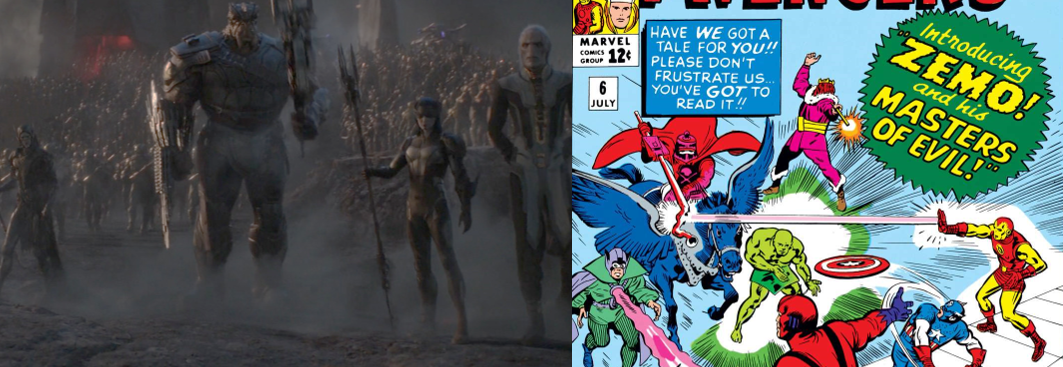
Back Issues [Independence Day]: Captain America Vol. 5 #8-14


First appearing in 1941, Captain Steve Rogers/Captain America, became one of Marvel Comics’ most recognisable and celebrated characters not just for his super patriotism but also for being a prominent member and leader of Marvel’s premier super team, the Avengers. As today is Independence Day, this is the perfect excuse to pay tribute to the star-spangled Avenger.

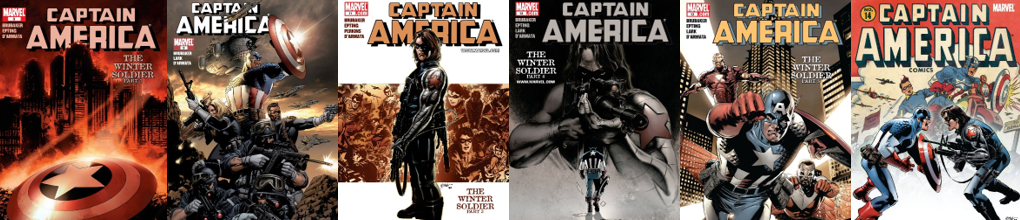
Story Title: “The Winter Soldier” (Part 1 to Conclusion)
Published: 20 July 2005 (cover-dated: September 2005) to 1 February 2006 (cover-dated: April 2006)
Writer: Ed Brubaker
Artist: Steve Epting and Michael Lark

The Background:
By 1941, World War Two was in full swing and, after Nazi Germany invaded Denmark and Norway, the United States finally joined the fight to oppose the triumvirate “Axis powers” of Germany, Japan, and Italy. The ever-escalating conflict meant patriotism and national pride were high in America and Joe Simon and the legendary Jack Kirby capitalised by having Captain America and his kid sidekick, James Buchanan Barnes/Bucky, take the fight to the Axis and encourage readers to support the War. After the War ended, superheroes declined in popularity and Captain America’s solo title was cancelled in 1954. However, he got a new lease of life when he was recast as a “man out of time” and joined the Avengers. For decades, Bucky was one of the few comic book characters whose death seemed permanent but that all changed with this story arc. It was writer Ed Brubaker, fresh off reinventing Cap’s comics as espionage thrillers, who dreamed up the idea of reviving Bucky as part of a life-long desire to reinvent him as a brainwashed, special ops soldier. Although Captain America editor Tom Brevoort initially opposed the idea, he eventually relented when Brubaker pitched the idea as recontextualising Cap’s greatest failure and crafting a new anti-hero for readers to connect with. “The Winter Soldier” was widely praised and is seen as one of the greatest Captain America stories ever told. It also reinvented Bucky for a modern age and set him up to assume the Captain America mantle later down the line. The story was so influential that it was adapted into videogames, cartoons, and brought to life in the Marvel Cinematic Universe, with Sebastian Stan receiving critical acclaim for his portrayal of the character.

The Review:
Our story begins way back in 1945 in an experimental Soviet submarine floundering in the English Channel. There, we find the crew intercepting coded messages from Nazi Germany confirming that Captain America was blown up over the Channel Islands and, accordingly, they move to intercept and discover a heavily injured, one-armed survivor floating in the sea. We then jump to the Helicarrier, the flying battleship headquarters of the Strategic Hazard Intervention Espionage Logistics Directorate (S.H.I.E.L.D.), where Nick Fury and Sharon Carter/Agent 13 show Cap photographic evidence of his old partner, Bucky, appearing older and alive and well despite seemingly perishing in that aforementioned explosion. Naturally, Cap isn’t just sceptical, he’s in full-blown denial, believing it must be some kind of trick and refusing to entertain the idea that his friend is not only alive but responsible for a horrific act of terrorism in Philadelphia. Specifically, a devastating bomb attack that saw Cap clash with Advanced Idea of Destruction (A.I.D.) whose beekeeper agents appeared to recover the tech, mercilessly gunning down any survivors, and set their Military Operatives Designed Only for Combat (MODOC) Squad on Cap. His skills tested by the seemingly semi-cybernetic ninjas as they quickly adapted to his superhuman abilities, Cap nevertheless bested his foes, though was wounded by a knife to the gut. Distracted by the wound, Cap was almost picked off by a MODOC soldier but was unexpectedly saved by a mysterious man in a domino mask and sporting a cybernetic arm, whom Cap recognised as his old partner, seemingly back from the dead and with no memory of his real name. Though his mysterious saviour fled, Cap’s told by Fury that he’s cropped up across the world over the decades as the “Winter Soldier”, a near mythical assassin for the Committee for State Security (KGB) who’s said to be kept in suspended animation between jobs. Unable to deny the evidence, Cap first lashes out and then commits to Fury’s plan to find Aleksander Lukin, the man behind the Philadelphia attack, and relieve him of his Cosmic Cube, dealing with the Winter Soldier if and when he crops up along the way.
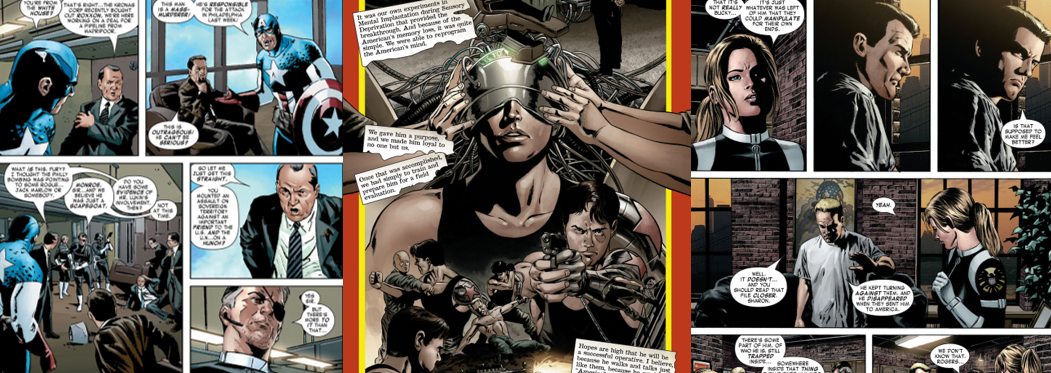
Already frustrated by bureaucracy, Cap’s distraught to learn of Bucky’s horrendous fate.

While Brock Rumlow/Crossbones picks off soldiers stationed at a “re-education facility” and kidnaps the amnesiac Synthia Schmidt, daughter of the Red Skull, to set up a future conflict, Cap and Sharon prepare to drop into Mongolia but find their relationship strained since, just the day before, Sharon raged at Cap for recommending she be kept off the mission. Although Steve argued that he was trying to avoid her going off on a vendetta since her boyfriend was killed in the Philadelphia attack, she believes he was trying to keep her from killing Bucky and remained steadfast in his belief that the overwhelming evidence against his former friend was either faked or a misunderstanding. It doesn’t help that, two days previously, Fury confided to Steve that the mission isn’t authorised by the United States government, primarily due to all the “red tape” and diplomatic drama Lukin caused with his own little empire, Kronas International, on the Mongolian border. Cap, Sharon, Fury, and a S.H.E.I.L.D. squad storm Kronas, setting aside their grievances to fight their way inside, only to find Lukin hosting a meeting with high-ranking American politicians! Though ordered to stand down, Cap is aghast to find they’re brokering an oil pipeline deal with Lukin and refuse to believe he’s anything other than a lucrative businessman since all the evidence points to a convenient patsy, Jack Marlow. Forced to leave and unable to act since Lukin has diplomatic immunity, Cap stews on the ride home though he, Sharon, and Fury vow to topple the maniac one way or another. Luckily for them, a dossier mysteriously vanishes from Lukin’s office and ends up in Cap’s apartment. The document details how the injured Bucky was saved from death by the freezing water, revived by Soviet doctors, and suffered from brain damage that left him only with the instinct to fight. Though dismayed to find he wasn’t subjected to the super soldier serum, Bucky was kept in stasis and later fitted with his prosthetic arm. Bucky was then subjected to invasive brainwashing, reconditioned to become a loyal soldier and assassin for the Soviets, and easily  assassinated high profile targets as the Winter Soldier. The dossier explains, in great detail, the Winter Soldier’s early missions, which were all completed successfully, and that he was kept in stasis since his mental state became increasingly unstable while conscious and threatened to undo their brainwashing.
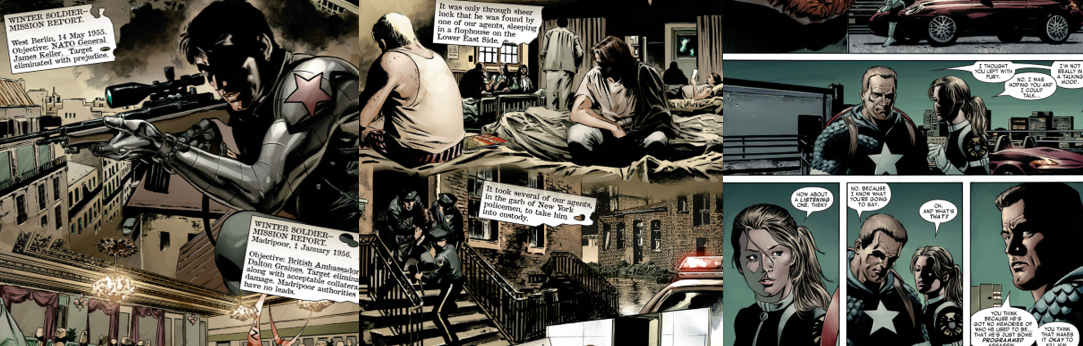
Bucky’s violent past as the Winter Soldier causes tension between Cap and Sharon.

This came to a head in 1973 when, after assassinating his latest target, the Winter Soldier  fled across America. Desperate to retrieve him, the Soviets aggressively interrogated anyone they could before finally following his erratic movements to New York City. Although he was apprehended, the incident rattled the Soviets and they decided not to deploy the Winter Soldier on American soil. The Winter Soldier was next charged with safeguarding Major General Vasily Karpov, who was highly suspicious of his “bodyguard” because of his background, though he took a perverse pleasure in the irony of an American protecting him. After successfully mitigating America’s efforts to invade the Middle East for about five years, the Winter Soldier was decommissioned and left to rot in an undisclosed location alongside other abandoned experiments. Disturbed by the dossier, Steve calls Fury and Sharon to discuss it further, believing Lukin used the Cosmic Cube to deliver the dossier to taunt him. Fury takes the document to be verified, though both he and Steve are confident that it’s accurate. Although Sharon believes that Bucky is lost to decades of Soviet brainwashing, Steve is adamant, based on the evidence, that a part of Bucky’s true self is still alive. Steve’s emotions are heightened by memories of when he and Bucky were celebrated War heroes. Back then, Bucky was an enthusiastic and thrill-seeking teenager in contrast to Steve’s more sombre respect for the harsh reality of war. Steve also remembers when he first met Bucky, then a plucky kid with some impressive fighting skills. Though initially hesitant because of his age, Steve agreed to take Bucky as his partner to inspire teenagers to sign up to the Army. Back in the present day, Steve and Sharon continue to butt heads and morals regarding the Winter Soldier: while Sharon believes he should be killed for his crimes, Steve refuses to entertain the idea that Bucky was anything other than an unwilling puppet.
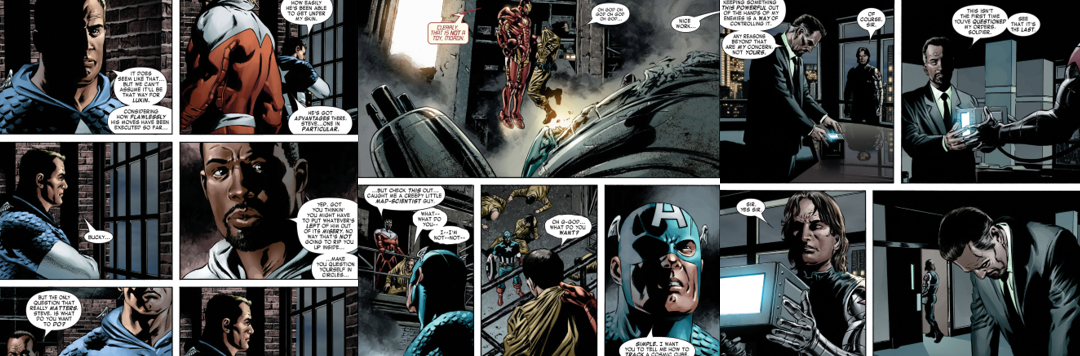
Falcon and Iron Man help Cap track down the Cosmic Cube, which is guarded by the Winter Soldier.

Meanwhile, Lukin hosts a bidding war for his Cosmic Cube, proving its reality-bending power not just by manipulating the bidders to attend but also compelling them to sign documents to make their corporations subsidiaries of Kronas. However, during a recess, Lukin stumbles and appears physically drained by the Cosmic Cube and is driven into a violent rage when his aide dares to caution against its use. While racing across the city rooftops, Cap also finds his emotions in turmoil, desperately willing himself to get it together to save his former partner. He remembers another time when the two were fighting through the Netherlands in pursuit of the Red Skull and they were horrified when their enemy sent boobytrapped prisoners of war to curtail their counterattack. Cap’s thoughts are interrupted by his friend and former partner, Sam Wilson/The Falcon, who offers Steve a friendly ear and speculates that there’s more going on with Lukin and the Winter Soldier. Unlike the sceptical Sharon and Fury, the Falcon agrees to help Steve save Bucky and the two bring in Anthony “Tony” Stark/Iron Man to raid an A.I.D. facility. Though they encounter some resistance from a gigantic, weaponised mech suit, the three subdue their targets and force them to hand over the means to track the Cosmic Cube. Thanks to Tony’s tech, the three discover that the Cosmic Cube is heading to a Kronas research facility, unaware that Lukin has tasked the Winter Soldier with spiriting the Cosmic Cube far away and burying it, believing it to be cursed. Unfortunately, Tony’s unable to accompany them as recent corporate shenanigans would make it look bad for him if he was seen tangling with Kronas. Thus, Steve and Sam head out by themselves (though, once she finds out about it all, Sharon organises a strike team) unaware that the Winter Soldier has taken up a sniping position.
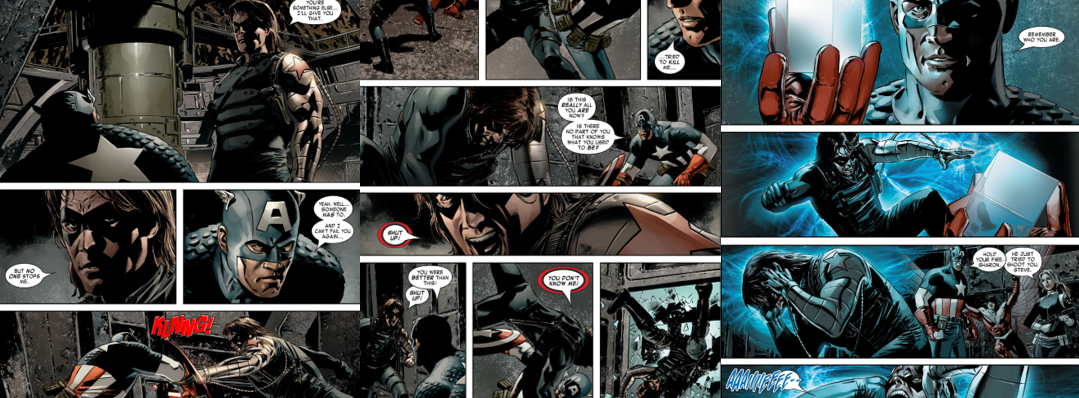
After a brutal slugfest, Cap restores Bucky’s memories with the Cosmic Cube.

Despite having the two dead to rights, the Winter Soldier misses a kill shot when the Falcon’s given a head’s up by the local birds and, his position compromised, calls in some backup to hold the gate. Undeterred, Cap charges through the troops, leaving the Falcon to cover his rear, and finally comes face-to-face with the Winter Soldier. Naturally, a brutal fist fight ensues during which Cap repeatedly tries to reason with his former friend and bring him to his senses and the Winter Soldier stubbornly refuses to listen to Cap’s words. Evenly matched, with the Winter Soldier’s bionic arm countering Cap’s vibranium shield, Bucky’s enraged by Cap’s repeated pleas, the fight spilling the two further into the facility. Realising that the Winter Soldier is determined to kill him, Cap surrenders and dares Bucy to pull the trigger. Sharon and the Falcon arrive in time to see not only the shot but also Cap’s superhuman reflexes; Steve dodges the bullet and tosses his shield, causing it to ricochet off the walls and knock he Cosmic Cube from the Winter Soldier’s grasp. Despite the Falcon earlier warning that no one has ever made the Cosmic Cube to work properly, Cap retrieves the artifact and utters a simple request: “Remember who you are”. Thanks to the Cosmic Cube’s reality warping powers, the Winter Soldier is bombarded by memories of both his past before he became an assassin and his time carrying working for the Soviets. Though Sharon’s ready to kill the Winter Soldier while he’s vulnerable, Cap talks her down and moves to comfort his traumatised friend. Overwhelmed by his actions and coming to his senses, Bucky lashes out in anger and remorse and grabs the Cosmic Cube, seemingly atomising himself as penance for his actions. However, Cap’s suspicions that Bucky’s still alive are quickly shown to be true, though Bucky’s left distressed by the ordeal. The story then ends with the reveal that Lukin shares his consciousness with the disembodied Red Skull, who chastises him for disposing of the Cosmic Cube and vows to assert full control in time.

The Summary:
This is my first time reading the “Winter Soldier” arc and I have to say that it lived up to the hype. Although I’m not the biggest fan of this art style, which was quite prominent in Marvel Comics at the time, it really adds to the mood and tension of the story. The arc is much more of a thriller than an all-out action piece, and a meditation on Captain America’s past and moral compass. As such, there isn’t really a primary villain for him to sink his fists into (an explosive scruffle with A.I.D’s mech is the best we get in this regard) and Cap instead battles more powerful enemies, such bureaucracy and international law. Despite possessing the Cosmic Cube, a device whose power is limited only by the wielder’s imagination (and their ability to keep a strong grip on it), Aleksander Lukin is more of an untouchable manipulator than a physical threat. As related by the Red Skull, Lukin never used the Cosmic Cube to its fullest extent, wary of its power and limited himself to small, controllable actions to mitigate its side effects. Indeed, the moment he experiences negative effects from wielding the Cosmic Cube, Lukin orders the Winter Soldier to dispose of it and is relieved to be rid of it. Still, Lukin remains a despicable villain, perpetrating horrendous acts of terrorism and hiding behind diplomatic immunity, making him the perfect foil for Captain America, who’s unable to bring Lukin to justice lest he spark a global conflict. Seen as a master manipulator who uses mind games and tricks to rile up his foes, Lukin otherwise hides behind his public façade and colludes with other, more disreputable forces (such as the Winter Soldier) to carry out his darker aspirations in secret.
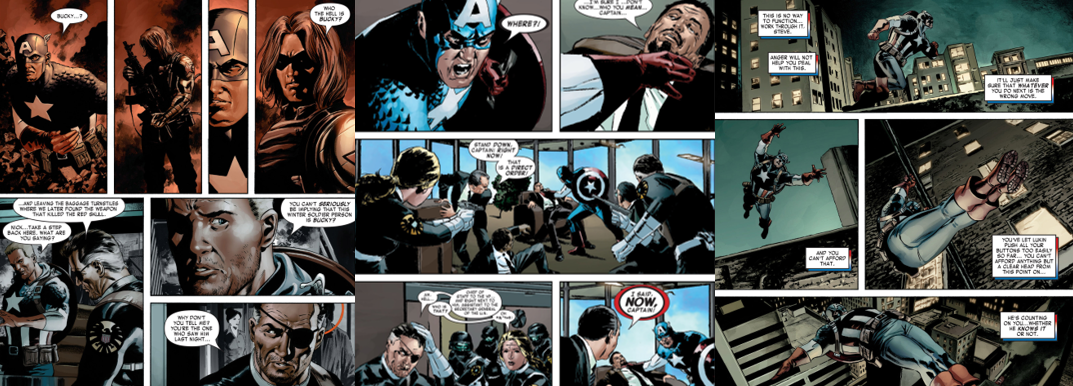
Cap’s emotions are all over the place thanks to Lukin’s machinations and Bucky’s reappearance.

Consequently, “The Winter Soldier” would’ve been an extremely trying and aggravating time for Captain America even without Bucky’s involvement. Steve claims to be level-headed and focused on the mission but repeatedly loses his cool throughout the story thanks to Lukin’s machinations and his inner dialogue shows a man wrestling with his emotions. He has many outbursts over these issues, putting an aggressive beating on A.I.D’s forces and lashing out at both Fury and Sharon when they try to get him to see sense. The only person he doesn’t flip out on is the Falcon, who loyally stands by his side and takes his side even if he has his own doubts about the situation and the Winter Soldier. Cap’s shown to be in deep denial over the whole situation, first refusing to believe that Bucky is still alive, then refusing to believe that he’s a Soviet assassin, and stubbornly refusing to entertain Sharon’s arguments about killing the Winter Soldier or that there isn’t some part of Bucky still alive inside the killer. He’s partially right about this but I wonder if Bucky would’ve regained his senses without Cap using the Cosmic Cube and the story is very ambiguous about this, allowing the reader to see all sides of the argument. It helps that Sharon has a fully justified argument for killing the Winter Soldier. However, while is he responsible for many deaths over the years, Sharon’s judgement is clouded by her personal feelings since Bucky killed her boyfriend. Simultaneously, there’s no doubt that Cap is also biased towards Bucky and, believing he failed the boy by both involving him in his life and causing his condition, Cap’s determined to “save” Bucky, even if it means going against his present-day allies. Numerous flashbacks further reinforce this, showcasing Bucky’s incredible aptitude for fighting, his infectious enthusiasm, and how the atrocities of war affected him over time. Cap’s always carried a great deal of guilt and regret about Bucky’s death so it’s a shock to see his partner alive and turned into a mindless weapon and Cap sees it as a chance for redemption, both for himself and for his young friend. Cap believes so blindly in Bucky that he eventually refuses to fight and leaves his life in the assassin’s hands, then braves severe consequences by wielding the unstable Cosmic Cube to restore Bucky’s memories to the fractured Winter Soldier.
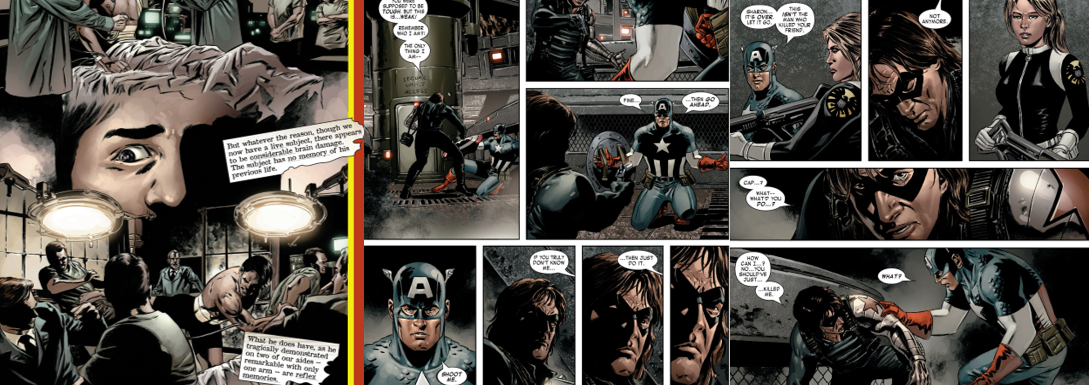
Bucky was totally reinvented as a bad-ass, tortured assassin.

Of course, the star of the show here is the titular Winter Soldier. At the time, I was sceptical about bringing Bucky back since he was one of the rare comic book characters who seemed destined to be dead forever. However, just like when DC Comics brought Jason Todd/Robin back as the Red Hood, retconning Bucky to have survived that explosion was a genius move that not only added new layers to Cap’s characterisation but also brought a bad-ass new anti-hero into Marvel Comics. Sporting long hair, a stoic visage, a form-fitting leather outfit, and an awesome robotic arm, the Winter Soldier cuts an intimidating and mysterious figure that’s only enhanced by his decades of assassinations. Restored to life and brainwashed by the Soviets, Bucky was transformed into a living weapon, a “blank slate” they could program to kill anyone they wished, one who easily infiltrated their enemy’s ranks since he looked and sounded just like them. Depicted as a natural fighter whose first instinct is to fight, the Winter Soldier is a keen marksman and an adept assassin, eliminating numerous targets when activated and easily holding his own against Cap despite lacking superhuman abilities. However, the Winter Soldier’s psyche is fractured, his mental state unstable, and he was frequently noted to be unreliable when activated for too long. When deployed on American soil, the Winter Soldier became confused and almost escaped his Soviet masters, ultimately leading to him being mothballed. It’s not made clear how and why he was released from captivity, but Bucky’s appearance causes a great deal of turmoil for Cap and their encounters cause confusion and anger in the unstable assassin. Obviously, much of Bucky’s past and future was cleared up in subsequent stories but this was a fantastic revival of the character, one that turned Cap’s life upside down and forever transformed Bucky from a plucky, annoying kid sidekick into a sexy, bad-ass killer.

My Rating:

Rating: 4 out of 5.

Great Stuff

Have you ever read the “Winter Soldier” arc? If so, what were your thoughts and what did you think to Bucky being revived? Do you think Sharon was right and that Bucky should’ve been put down? Did you enjoy seeing Cap wrestle with his guilt and conflicting morals? What did you think to the Winter Soldier’s look and backstory? Can you name some of your favourite Winter Soldier moments? How are you celebrating Independence Day today? Whatever your thoughts, drop a comment below and be sure to check out my other Captain America content across the site!


Game Corner: Marvel: Ultimate Alliance 3: The Black Order (Nintendo Switch)

Released: 19 July 2019
Developer: Team Ninja

The Background:
For decades, few videogame publishers were as synonymous with Marvel Comics as Activision, who produced adaptations Marvel’s most popular properties. While some were better than others, Activision’s efforts were largely praised, especially after they partnered with Raven Software on the X-Men Legends games (2004; 2005). Activision and Raven Software expanded their scope to the rest of the Marvel universe with Marvel: Ultimate Alliance (2006), a largely successful team-based brawer praised for improving upon its predecessors. Though now delisted, it was followed by a sequel three years later, courtesy of Vicarious Visions, which tweaked the gameplay with team-based attacks to encourage experimentation. Though Marvel: Ultimate Alliance 2 (2009) was praised for its branching storyline, the stripped down roleplaying mechanics were criticised. While it was also delisted in 2020, fans were clamouring for a follow-up and, just ten years later, Team Ninja stepped in to work alongside Marvel in reviving the franchise. Seeking to place additional emphasis on combat, the developers explored the cosmic scope of the Marvel universe by including the Infinity Stones and lesser-known characters and chose to make the title a Nintendo Switch exclusive after developing a close relationship with Nintendo. Although Marvel: Ultimate Alliance 3: The Black Order was the sixth best-selling game in its first week and was later bolstered by extensive downloadable content (DLC), it was met with mixed reviews that praised the colourful action but criticised its lack of innovation.

The Plot:
While battling Nebula and Ronan the Accuser, the Guardians of the Galaxy stumble upon a plot by the mad titan, Thanos, to collect the six Infinity Stones. Although they scatter the Stones, Thanos’s acolytes, the Black Order, pursue the gems, prompting an alliance of Earth’s mightiest heroes to retrieve them first.

Gameplay and Power-Ups:
Like its predecessors, Marvel: Ultimate Alliance 3: The Black Order is a team-based action role-playing game in which players assemble a squad of four heroes from across the Marvel universe to battle various nefarious baddies, primarily the titular Black Order, who are hunting the six all-powerful Infinity Stones on behalf of their master, Thanos. The game offers five save slots, two initial difficulty levels, and a base roster of thirty-six playable characters, with many being encountered as you play through the story and joining your alliance either after fighting alongside you or being freed from some kind of mind control. Marvel: Ultimate Alliance 3 offers three controller configurations, thankfully none of which involve motion controls, and allows you to toggle overlays, notifications, tips, and other onscreen elements from the “Settings” menu. These include altering the camera placement, which enables a lock-on feature by pressing in the right stick, though the camera generally remains more focused on whichever character you’re controlling rather than offering a bird’s eye view as in the last two games. Although you can fight alongside friends either locally or online, you switch between your teammates with the directional pad (D-pad) when playing alone and your computer-controlled partners are very useful in a fight, attacking, enabling team attacks, and reviving defeated characters without any input from you. Pressing A sees you interact with the environment to activate consoles, pick up or move certain objects, and talk to other characters. You jump with B, executing a double jump, swinging from webs, or flying depending on which character you’re playing as, and throw light attacks with X and heavy attacks with Y. These can be strung together to perform basic combos and you can also perform a mid-air attack and throw objects (like bombs and missiles) by pressing Y. You block incoming attacks by holding the Z trigger and tap it to dodge, and collect glowing red orbs from defeated enemies or smashed crates to restore health, blue orbs to refill your Energy Point (EP) gauge, and credits to spend on upgrades.

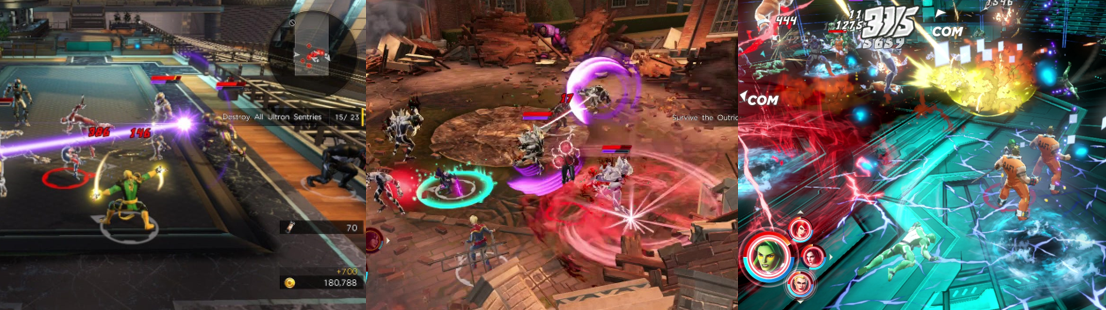
Combat is thick, fast, chaotic, and constant thanks to loads of enemies and character abilities.

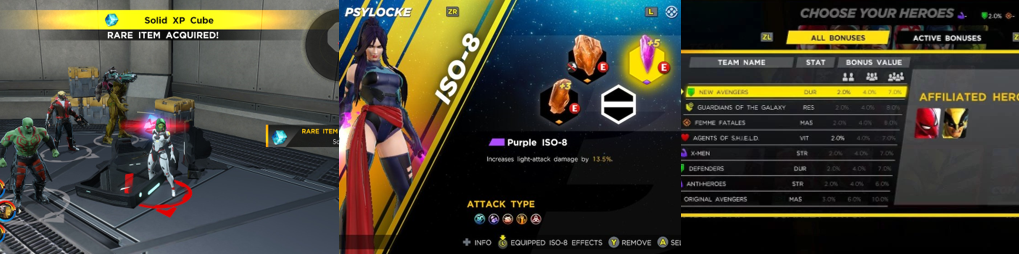
As in the last two games, each character has specific abilities tied to their superpowers or superhero traits. You activate these by holding the Right trigger and selecting an icon using the D-pad; using Abilities drains your EP, however, and each Ability comes with a different cost. However, these attacks allow you to stun, stagger or deal elemental damage to enemies using Peter Parker/Spider-Man’s webs, Thor Odinson’s lightning, and Doctor Robert Bruce Banner/The Hulk’s incredible strength. Many characters have projectile attacks in their arsenal, such as Wade Wilson/Deadpool firing guns and Scott “Slim” Summers/Cyclops blasting his eye beams, while others cause splash damage or specific buffs, like Piotr Rasputin/Colossus being able to reflect projectiles and Wanda Maximoff/The Scarlet Witch healing her allies. Some, like James “Logan” Howlett/Wolverine, have passive abilities that allow them to automatically regenerate health as they walk around; others, like Johnny Blaze/Ghost Rider and Ororo Munroe/Storm, specifically deal in elemental damage. Character’s Abilities can also be mixed and matched by holding ZR and pressing one of the face buttons (or pressing A when prompted); this sees two characters attack in a combo for additional damage. As you dish out and take damage, you’ll also build the Extreme (EX) Gauge). Once full, you can press L and R up to three times to have two to four of your teammates perform a devastating combination attack that’s great against bosses. While the various cannon fodder you fight are easily dispatched, larger commanders and bosses need their “stun” meter drained before you can really put a beating on them and others (and certain treasure chests) require specific combination attacks to breach their shields. Defeating enemies sees your characters gain experience points (XP) to level-up, increasing their statistics (attack, defence, etc), though you can also use the various Orbs you find to manually level-up. Each character’s special Abilities can also be further enhanced using Ability Orbs and credits, reducing the EP cost and increasing their damage, among other benefits. You can also earn “Team Bonuses” depending on your team selection: pick a group of X-Men, for example, and your strength or resistance stat will increase, while picking characters of royalty ups your maximum energy stat.

Search for chests to gain currency and other expendables to upgrade and buff your alliance.

Although you can’t equip gear to your characters, the boss battle against the Destroyer armour sees you temporarily empowered by Asgardian magic and you can eventually equip your team with “ISO-8” crystals, coloured stones that enhance their attack power, resistance to elements, or critical hit ratio, among others. You can further upgrade these with credits and ISO-8 capsules, though some of the rarer ones will also debuff you (for example, your attack my increase but your defence will decrease accordingly). You’ll also inevitably gain access to the Strategic Hazard Intervention Espionage Logistics Directorate (S.H.I.E.L.D.) Lab, which acts as the game’s skill tree. By spending credits and Enhancement Points (EP), you can further increase your team’s overall attack, defence, resistance, vitality, and such and even unlock additional ISO-8 slots (with more being earned by levelling-up). You can also enter the S.H.I.E.L.D. Depot from the main menu to purchase additional costumes and social icons by spending S.H.I.E.L.D. Tokens. Marvel: Ultimate Alliance 3 is pretty forgiving (on the “Friendly” difficulty, at least), with multiple checkpoints in each area. When you activate a S.H.I.E.L.D. checkpoint, your team is fully healed, and you can swap or enhance them if you wish. If a teammate is defeated, you can hold A to revive them, but I wouldn’t recommend it unless you absolutely have to. Not only are revives limited, but downed characters will eventually return to full health even before you reach a checkpoint so it’s not worth risking another character taking damage by healing a partner. Exploration generally leads you to treasure chests or special walls that require a special combination attack to open, or to a “Rift” challenge that takes you away from the main game to tackle a special challenge (usually a boss rematch or enemy gauntlet) for extra rewards. Your path is incredibly linear most of the time, hence why there’s no map, and the game’s primary focus is on chaotic combat and visually manic team-based attacks. Unlike in the last two games, you can no longer grapple or throw enemies (though you can still send them flying off certain platforms) and there are no character-specific team-up moves, meaning the action can quickly get quite tiresome.

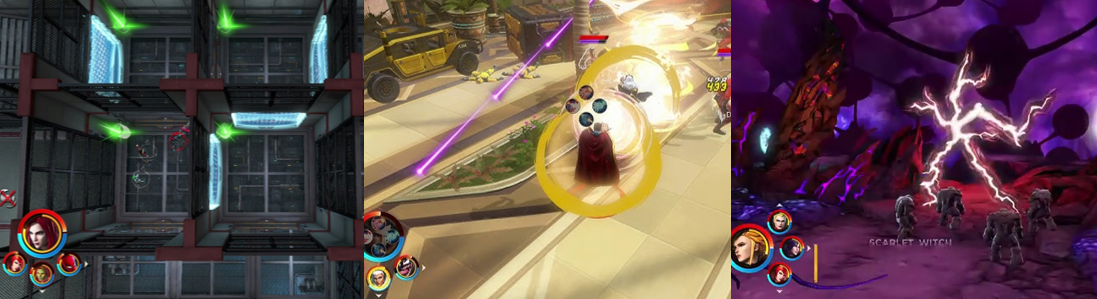
Sadly, puzzles are practically non-existent, with only Rifts offering additional challenges.

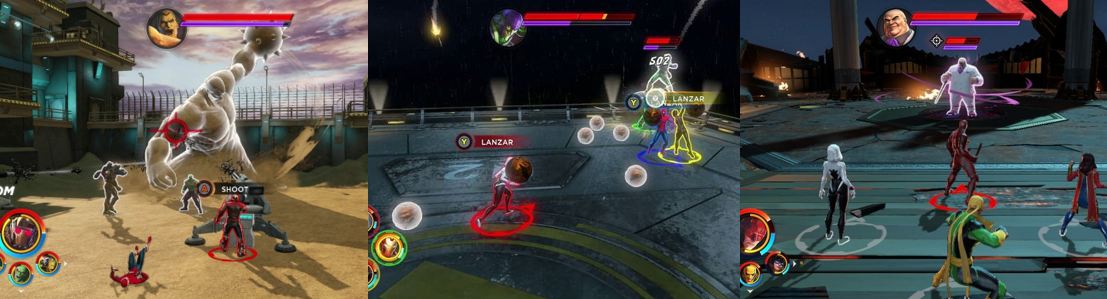
Because of its focus on hectic combat, there’s even less room for puzzles than there is for exploration in Marvel: Ultimate Alliance 3. Puzzles boil down to activating a console to open a door or making a platform move and that’s it. Sometimes, you’ll hold A to move a block and avoid lasers or cannons, but mostly you’ll be timing jumps between said lasers to progress and simply hurling missiles at those cannons. Sometimes, you’ll rotate statues or press switches to progress; others, you’ll be avoiding toxic ooze in Hel or solving door puzzles at the Raft or in Avengers Tower. After hopping across the rooftops of New York City, you’ll infiltrate the heavily fortified fortress of the Hand, dealing with ninjas that drop from the sky and hidden arrow hazards. When in Wakanda, Advanced Idea Mechanics (A.I.M.) corrupt T’Challa/The Black Panther’s defences, leading to an exasperating section where you must avoid snipers and being roasted by a giant panther statue’s energy blast. When transported to the Dark Dimension, you must use portals to reach new areas and defeat waves of demonic enemies to lower magical barriers and progress. Some attacks also screw up your controls or temporarily freeze you; some enemies are best defeated by tossing explosives at them; and many missions have an additional character fighting alongside you who’s often unlocked afterwards. However, a lot of the additional features of the previous games are missing; you can talk to other characters, but there are no dialogue options or character-specific interactions. There are no trivia quizzes, no optional side missions beyond the Rifts, and no character specific challenges to unlock extra stuff for each character. There aren’t even hub areas, in the traditional sense, with characters just appearing around S.H.I.E.L.D. checkpoints at times, though you can destroy a fair bit of the environment, and some encounters have you fleeing towards the camera as bosses chase you or present you with unwinnable battles.

Presentation:
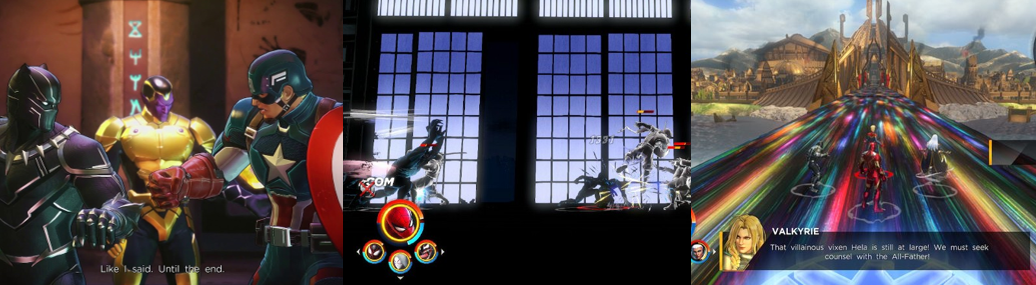
Whereas the last two games primarily based their aesthetics on the comics books, especially the Ultimate comic line, Marvel: Ultimate Alliance 3 adheres very closely to the Marvel Cinematic Universe (MCU), especially in the visuals of its locations. I was hard pressed, for example, to tell the difference between Asgard here and the Asgard to the MCU, with both the golden city and the rainbow bridge, the Bifrost, appearing almost exactly as they’re depicted in the films. The same is true for Wakanda, the Dark Dimension, and Knowhere, all of which are virtually indistinguishable from how they appear in the MCU. There are some differences, of course: Taneleer Tivan/The Collector’s museum, for example, uses coloured cube cages and Wakanda leans much more into traditional architecture than the pseudo-futuristic science of the films (likely because Black Panther (Coogler, 2018) released a year before this game was made). Xavier’s School for the Gifted is lifted almost exactly from the 20th Century Fox X-Men movies (Various, 2000 to 2020), however, including a hedge maze, 1:1 Cerebro room, and basketball court that doubles as a landing pad for the Blackbird. While the Dark Dimension and the cosmic mind trip that is Sanctuary also heavily borrow from the bizarre cosmic imagery of the MCU, the Raft and Avengers Tower are much more akin to their comic book counterparts, though they’re comparatively bland locations, lacking fun areas like the Danger Room or Wakanda’s Necropolis (though you do pass through Anthony “Tony” Stark/Iron Man’s Hall of Armours in the tower). Although you only make a brief stop in Attilan to try and get help from the Inhumans, the architecture is far more visually interesting than that awful television show, seemingly being comprised of Celestial technology, and I enjoyed the ominous gothic presentation of Hel, with its restless Viking warriors and damaging sludge. Unfortunately, Marvel: Ultimate Alliance 3 continues the trend of having disappointingly bland and forgettable music, opting for generic themes for each location, event, and character that are lost amidst the constant fighting.

A visually impressive brawler that takes obvious inspiration from the MCU films.

The game also opts for an almost cel-shaded, action figure-like aesthetic for its colourful cast of characters. While many again both look and sound like their MCU counterparts, there are some exceptions: Peter Quill/Star-Lord, for example, looks nothing like Chris Pratt and the X-Men are far closer to the comic books than Fox’s films. Despite you assembling a custom team of heroes, cutscenes depict either everyone or characters specific to the location you’re in (the corrupted Doctor Stephen Strange in the Dark Dimension, for example) as they’re better suited to advance the plot against the local baddies. With the game shifting to a more third-person perspective, you’re closer than ever to the action and can see more of the environment than in the previous games. However, this comes with some drawbacks: mainly, there are far less opportunities or incentives to explore. Second, environments are painfully linear, with dead ends or locked doors barring your progress. Third, and most frustrating, is the camera, which easily loses track of your opponent/s and often lumbers you with wireframe representations when the foreground blocks the view. Thankfully, you won’t be falling down pits and rarely have to worry about onscreen hazards, but it can be aggravating trying to figure out which platforms and crates can be jumped on and which can’t. Marvel: Ultimate Alliance 3 offers a diverse cast of characters, each with their own idle poses and quips, though these do inevitably repeat. The game’s also surprisingly light on Easter Eggs: you’ll spot Deadpool singing away as he makes tacos in the X-Mansion, but not much else, and there are no optional missions or choices to encourage replaying missions. It’s a far cry from the first game, where there was always something to collect or an additional character to help out. Instead, it’s basically all combat, all the time in Marvel: Ultimate Alliance 3. Luckily, the game looks pretty good (everything’s very colourful and true to its inspirations) and performs really well, though there are some long load screens and it is annoying being forced to continue your game every time you challenge a Rift.

Enemies and Bosses:
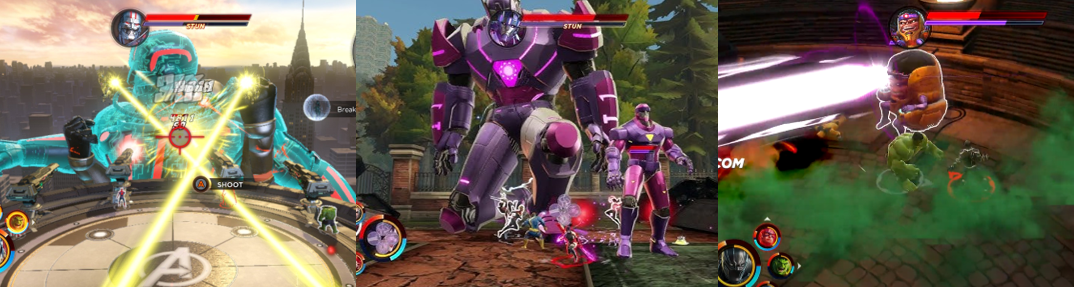
All the usual suspects appear here as disposable cannon fodder for you to endlessly beat up, with many of the game’s goons sharing traits across the various locations. You’ll encounter Kree, Ultron Drones, agents of A.I.M., and Doombats who all pack various energy blasters. Ultron’s clones are the worst for this, relentlessly firing energy blasts and crashing through windows. The Raft’s unscrupulous prisoners attack in large groups, as do the restless Viking warriors who populate Hel, tossing axes from afar and luring you into toxic goop. Gargoyle-like Fire Demons also dwell here, offering a greater challenge with their swoop attack and fire breath, not unlike the monstrous Outriders and Mindless Ones who make up Thanos and the dread Dormammu’s forces, respectively. Alpha Primitives, Hydra goons, and towering Sentinels also appear, with the latter firing huge energy blasts from the palms and best attacked by throwing their explosive energy cores back at them. No matter where you are and what enemies you fight, more powerful commanders will also appear. Larger, tougher, and sporting a stun meter, these commanders should be your top priority as they’ll charge across the screen, cause shockwaves, and generally offer a far greater challenge even when you’re at a higher level. These minions often fight alongside their masters, generally so you can recover some health and EP to better damage the bosses, and will endlessly spawn in one of the additional modes unless you destroy their teleporters. Some of the game’s challenges or story-based missions charge you with defeating a certain number of enemies to progress. Other times, bosses appear in these waves, and you must occasionally flee or purposely lose some fights. This happens when Cain Marko/The Juggernaut comes tearing through the X-Mansion, for example, and in early encounters with the Black Order, who cannot be beaten or will chase you, raining lightning or other attacks from the sky and across the ground.

Few bosses require more than just hit-and-run tactics, even when augmented by an Infinity Stone.

There are loads of bosses to fight in Marvel: Ultimate Alliance 3, with some returning from the previous games, some teaming up, some having a couple of phases, and all boiling down to whittling down their stun bar, unleashing an EX attack and/or your most powerful Abilities, and avoiding damage until you can repeat this. The first ones you’ll face are Nebula and Ronan the Accuser, who often appear as a duo in optional challenges. Nebula is faster and more nimble, wielding blades where Ronan uses a massive warhammer. Both set a standard all bosses follow, which is that they’ll use either a jumping slam or an explosion of energy (or both) to send you flying. While quelling the riot in the Raft, you’ll encounter a version of the Sinister Six, with some unique variations to each battle. Flint Marko/The Sandman, for example, flings waves of sand and erupts his big sand fist from the ground as a large sand creature. You must use A to mount the nearby cannons and unload on him to chip away at his stun meter. Maxwell “Max” Dillon fights alongside Eddie Brock/Venom, raining lighting and electrocuting you with bursts of electricity, before he’s eaten by Venom and starts busting out electrically-enhanced symbiote powers. Venom joins the team after this fight and is tested against Quentin Beck, who first brainwashes Mile Morales/Spider-Man, Gwen Stacy/Spider-Woman, and Kamala Khan/Ms. Marvel to fight you and then unleashes a poisonous mist, teleports about, and confuses you with duplicates, Doctor Otto Octavious/Dr. Octopus is fought in a two-stage fight where you must first avoid his tentacles and scurry charge and then attack each arm to stun him. Finally, you’ll battle Norman Osborn/The Green Goblin for the Time Stone. The Green Goblin swoops overhead and lingers slightly out of reach, peppering the arena with his pumpkin bombs, charging at you, and freezing time to bombard you. He’s noticeably weak to his pumpkin bombs, however, so try and toss them at him before they explode in your face! After battling into the Hand’s fortress, you must first free Elektra Natchios from the Hand’s influence and then face Lester/Bullseye and Wilson Fisk/The Kingpin in separate fights. You must take out the ninjas feeding Elektra power, avoid Bulleye’s spread of razor sharp and explosive cards, and dodge the furniture and massive energy beam thrown by the Power Stone-enhanced Kingpin. The Kingpin also charges like a rhino, leaps at you to cause shockwaves, and even rips up stone columns to use as melee weapons!
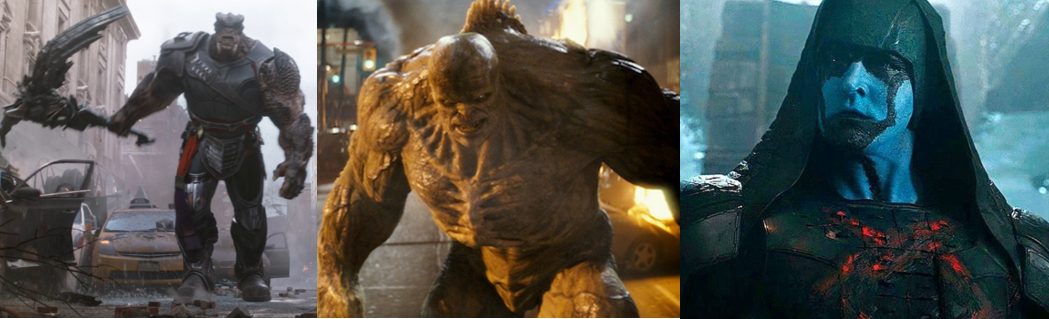
Gigantic bosses and the quirkier villains help mix-up the otherwise tedious combat.

Avengers Tower is then attacked by Ultron and his drones, who assist him in battle. Not that he needs it as the Mind Stone allows Ultron to mess up your controls, to say nothing of his signature face and palm beams. Ultron then grows to gigantic proportions, sweeping the area with his eyebeams before Clint Barton/Hawkeye intervenes and Ultron merges with Ultimo. This is the first giant boss battle in the game and sees you blasting Ultimo with cannons and avoiding his massive swipes. The Infinity Sentinel is comparatively smaller, but no less dangerous thanks to its own face beam and missiles. Though you can damage it with Sentinel cores, it’s finished in a cutscene by Erik “Magnus” Lehnsherr/Magneto, who then tosses debris and throws you off balance with magnetic pulses while Juggernaut pummels you and Raven Darkholme/Mystique tosses daggers. After surviving Mystique’s Danger Room trials, you face Magneto, now even tougher thanks to the Power Stone, before being chased away and banished to the Dark Dimension by the Black Order. There, you battle past Loki Laufeyson (who boasts elemental attacks and duplication tricks) to eventually face the dread Dormammu, who wields the Reality Stone and is the second giant boss. You must subdue his minions and avoid his flame bursts, whittling down his magical barrier either directly or be destroying three nearby orbs, all while dodging his giant fists and ground spikes. The brief fight with Maximus Boltagon is far easier, even though the mad Inhuman carries a massive energy cannon and you must take cover in Thane’s energy bubble to avoid Maximus’s barrage of lasers. Ulysses Klaue/Klaw awaits in Wakanda and his sound-based energy blasts and waves must be overcome to rescue and recruit James Buchanan “Bucky” Barnes/The Winter Soldier. You then fight past A.I.M. to confront their master, George Tarleton/Mental Organism Designed Only for Killing (MODOK), who uses the Soul Stone to turn the Dora Milaje against you and attacks with a slew of appendages, from buzzsaw arms, poison gas, failing tentacles, and his signature forehead blast.

Battles with the empowered Black Order, Thanos, and Thane offer some of the most enjoyable challenges.

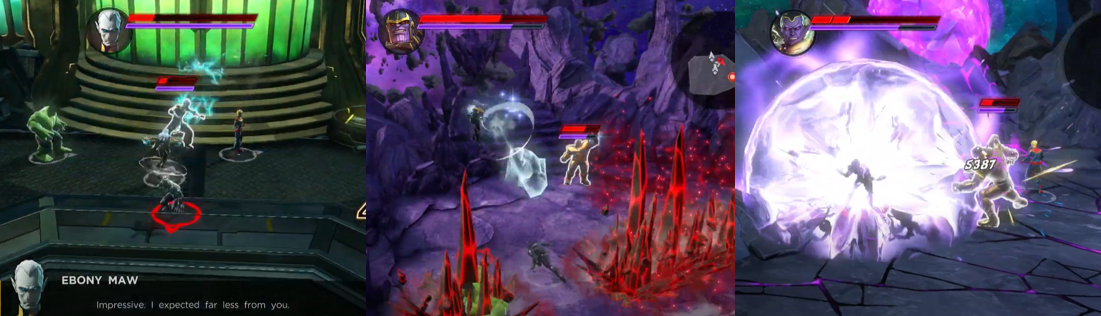
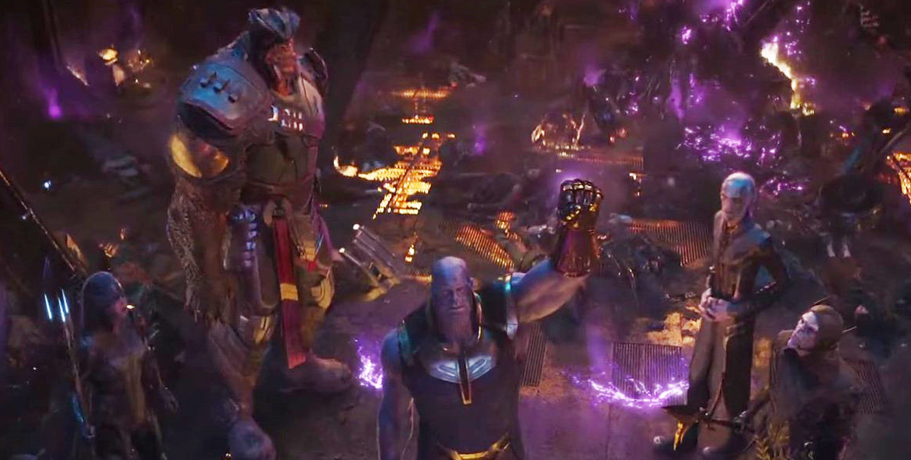
Though your goal in Hel is to confront Hela, you’ll actually battle the fire demon, Surtur, in another giant boss battle. This was a bit of a difficulty spike for me as Surtur’s flaming sword has a long reach and he causes the ground to erupt in flames, to say nothing of stun locking you with repeat sword strikes! Best him and Hela sets Johann Schmidt/The Red Skull on you, with the Nazi madman firing a powerful revolver and sapping your health with his “Dust of Death”. Hela gives the Red Skull a boost, protecting him with a shield and allowing him to fire a Bifrost-like laser, before placing his consciousness into the Destroyer armour. Though bolstered by Hydra forces and boasting a sweeping face beam, you can get a power-up from glowing crystals to overcome this destructive force. Finally, you venture to Knowhere and must run the Black Order gauntlet to retrieve the Infinity Stones, with checkpoints between each fight. Ebony Maw is first, firing a spread of projectiles and rocks and using the Soul Stone to create portals to trip you up. Supergiant tosses dark spheres and a golden homing shot that messes up your controls, though you can toss explosive cores from her minions to deal big damage. Cull Obsidian infuses his battleaxe with the Power Stone, sending out waves of purple energy and massive purple shockwaves, though he’s far slower and also susceptible to the nearby bombs. Corvus Glaive is much faster, landing multiple hits with his lance and using the Reality Stone to spring spikes form the ground and conjure duplicates who fill the arena with energy waves that can stun lock you. Finally, Proxima Midnight takes her fellow’s teleportation trick to the next level with the Space Stone and fills the arena with lightning bolts and strikes. All these powers are then recycled when you face Thanos, who gathers the six Infinity Stones into the Infinity Gauntlet to rain meteors, teleport, mess up your controls, freeze time, and fire his signature eyebeams. Thanos then joins you to battle Thane, who usurps him and boasts similar powers, though also upgraded by the Infinity Armour. Thane exhibits superhuman speed, traps you in a cube, fills the arena with portals and flames, and explodes in fury, though both battles were fun challenges rather than impossible tasks.

Additional Features:
Unlike in the previous two games, you won’t be finding data logs, action figures, or meeting certain requirements to unlock new attacks or costumes. You just fight over and over, earning whatever you need to unlock, buy, or upgrade whatever you wish and finding some concept art in treasure chests. A far harder (but more rewarding) “Superior” difficulty unlocks upon clearing the game alongside an additional “Nightmare” mode, accessible via the “Curse of the Vampire” campaign. You also unlock Thanos and can freely replay any mission on any difficulty (though you must start a new save to play on “Superior”) to grind and enhance your characters and ISO-8. Dimensional Rifts transport you to special challenges (not unlike the S.H.I.E.L.D. Simulator discs from the first game) that are often rematches with bosses or gauntlet challenges, though far tougher and gifting better rewards if you succeed. There are also three additional modes; however, though you can play a taster of each, you must purchase the expansion pass to fully unlock them. “Curse of the Vampire” adds vampiric enemies to the main story in “Nightmare” mode and offers a “Gauntlet” mode where you battle waves of enemies and bosses against both a time limit and a range of debuffs (including limited health restoration and draining EP). You can also tackle an “Endless” mode that’s pretty self-explanatory, and unlock additional characters like Frank Castle/The Punisher and Eric Brooks/Bladeif you buy the DLC. “Rise of the Phoenix” sees you form a four-person team and go head-to-head with a friend or the computer in three-round Danger Room scenarios. These see you tackling bosses again or wiping out hordes of enemies, awarding additional buffs and effects if you meet certain criteria (such as using any Ability or Synergy attack four times). You can only tackle the first challenge without the DLC, so I didn’t get very far, but this could be a fun distraction for those looking to test their skills against a friend. “Shadow of Doom” adds an epilogue story campaign that sees you return to Wakanda to oppose Doctor Victor Von Doom’s invasion. Dr. Doom’s Doombots endlessly spawn unless you destroy their teleporters, and you even battle the arrogant dictator in the recycled Necropolis, with him teleporting, firing lasers form his palms, and having his health restored by his Doombots. You’ll add Marvel’s First Family to your roster (alongside an alternative Thanos and other characters) by buying the expansion pass and battle Annihilus, a gigantic Celestial, and even “God Emperor” Doom!

The Summary:
I quite enjoyed the first two Ultimate Alliance games. They were mindless and largely repetitive, but I liked the large cast of characters and all the different references and locations from the comic books. Still, I put off Marvel: Ultimate Alliance 3: The Black Order for some time, mainly because I was annoyed by it being a Nintendo Switch exclusive; however it turned out to be a decent enough brawler. Despite the different development team, a few tweaks, and an apparent disconnection from the previous games, Marvel: Ultimate Alliance 3 offers a lot of the same gameplay and enjoyment as its predecessors, which is great for long-time fans of the franchise. Unfortunately, it doesn’t improve on these elements in a meaningful way and actually removes some content that I found enjoyable from the last two. There are no optional missions, for example, no alternative endings, no choices, and no character-specific challenges beyond fighting and levelling-up. I found this made the tedious combat even more aggravating after a while as I wasn’t being rewarded with gear or costumes or anything other than stat boosts. Even the skill tree was limited since you must grind to acquire enough credits and expendables to enhance your team, and I found the ISO-8 mode to be more confusing than engaging. The game also does little to improve the boss battles. Very few were very innovative or required more of you than to strike fast, avoid shockwaves and projectiles, and unleash your Extreme attack. The giant bosses were more of a challenge and I liked the final fight against Thanos and Thane, but I was hoping for a bit more complexity, especially given the possibilities offered by the Infinity Stones. There is a fun selection of characters, but they don’t offer much more than what we saw in the last two games and actually offer less as there are no character-specific team-up moves. While I enjoyed the visual influence from the MCU and the variety, I feel like Marvel: Ultimate Alliance 3 played things a little too safe by relying so heavily on combat and not mixing up the gameplay with a few other puzzles and challenges. Overall, it’s a good enough game and a worthy entry in the series, but it’s a shame that the developers didn’t try to be a bit more innovative and offer some more incentive to keep slogging away in endless fights.

My Rating:

Rating: 3 out of 5.

Pretty Good

Did you enjoy Marvel: Ultimate Alliance 3: The Black Order? How do you think it holds up against the previous two games? Which characters did you choose for your team? Were you disappointed that the combat was so similar to the last two games and the bosses so repetitive? Did you ever conquer all the Rift challenges? What did you think to the MCU influences and the final battle with Thanos and Thane? Did you ever play through the DLC? Would you like to see another Ultimate Alliance game? Whatever your thoughts, leave a comment below, support me on Ko-Fi, and go check out my other superhero content across the site.

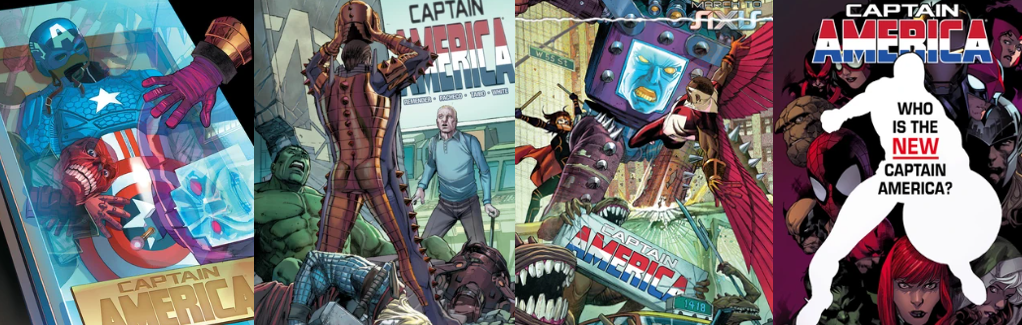
Back Issues: Captain America 22-25

Story Title: “The Tomorrow Soldier” (Part 1 to Conclusion)
Published: 2 July 2014 (cover-dated: September 2014) to 1 October 2014 (cover-dated: December 2014)
Writer: Rick Remender
Artists: Carlos Pacheco and Stuart Immonen

The Background:
By 1941, Nazi Germany had decimated Denmark and Norway and World War Two was fully underway and, after some initial resistance, the United States joined the War against the “Axis powers” of Germany, Japan, and Italy. Patriotism and national pride was high, especially in America, during those dark days, making it the perfect time for Joe Simon and the legendary Jack Kirby to debut Captain Steve Rogers/Captain America and his kid sidekick, James Buchanan Barnes/Bucky, to encourage support of the war effort. Once the War was over, superheroes saw a decline and Captain America’s solo publication was cancelled in 1954. However, Cap got a second chance when he joined the Avengers as a “man out of time”, battling iconic villains like Johann Shmidt/The Red Skull and even opposing his fellow superheroes during a “Civil War”. After surrendering to the authorities, Cap was seemingly killed and his troubled sidekick, better known as the Winter Soldier, took up the mantle until Steve’s inevitable resurrection. However, in 2014, cybernetic supervillain Arnim Zola’s machinations saw Cap drained of the super soldier serum and rapidly aged into an old man! Thus the battle was on the see who would become the new Star-Spangled Avenger, a battle eventually won by Cap’s long-time ally, Sam Wilson/The Falcon, to much undue controversy, Created by Stan Lee and Gene Colon in 1969, the Falcon was the first Black American superhero in mainstream comic books and was specifically created to challenge social perceptions. After a lengthy career as a bit-player in Marvel Comics, Sam made headlines with his promotion, a story arc that achieved mainstream recognition due to Anthony Mackie’s celebrated portrayal of the character in the Marvel Cinematic Universe.

The Review:
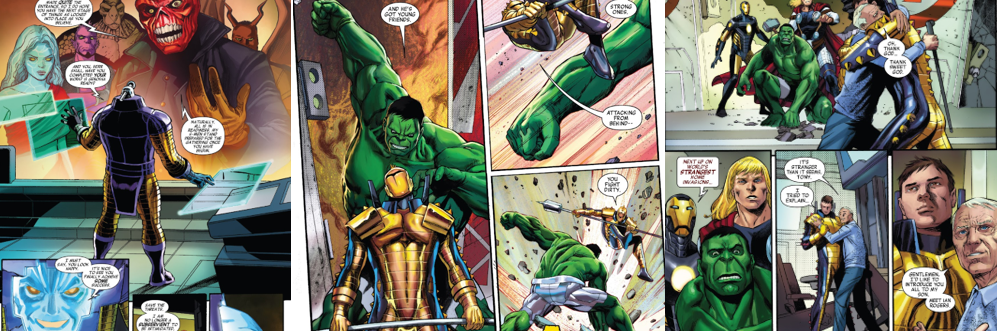
Sam Wilson’s assumption of the Captain America mantle didn’t come easy, nor without drama. In the leadup to this story, Cap was kidnapped by Arnim Zola and spirited away to Dimension Z, where the mad scientist plotted to drain his super soldier serum to create a race of genetic super-beings! Cap broke free but was trapped in Dimension Z for ten years, during which time he raised Zola’s son, Ian, as his own. Though Cap eventually escaped with Jet Zola/Jet Black, Zola’s daughter, both Ian and Cap’s lover, Agent 13/Sharon Carter, were lost. Cap then spent some time working with Sam to mould Jet Black into a hero but, in a battle with former Strategic Homeland Intervention, Enforcement, and Logistics Division (S.H.I.E.L.D.) agent-turned-madman, Ran Shen/Iron Nail, Cap’s super soldier serum was neutralised and he quickly aged into frail, infirm old man! Our story picks up with Steve sequestered at Avengers Mansion, stewing over sensationalist news reports demanding accountability for Captain America and S.H.I.E.L.D.’s dangerous and destructive antics. Steve’s offered council by S.H.I.E.L.D. director maria Hill and the decidedly Samuel L. Jackson-esque Nick Fury Jr., who assure him that he saved countless lives taking down Iron Nail. Unfortunately, his shield has been left too radioactive to be returned to him and Steve’s aghast when he’s told S.H.I.E.L.D. won’t be destroying Gungnir, the weaponised, Transformer-like Helicarrier Iron Nail hijacked and threatened the United States with. Steve is so angered that he starts to wonder if the reports of corruption within the government and S.H.I.E.L.D. aren’t valid, though Fury simply explains that contingencies such as Gungnir are vital to protect innocent civilians and keep the public from being overly reliant on costumed heroes, especial as the Avengers’ roster has dwindled lately.

When Armin Zola’s mutates invade, the Avengers gain an unlikely ally in Steve’s adopted son!

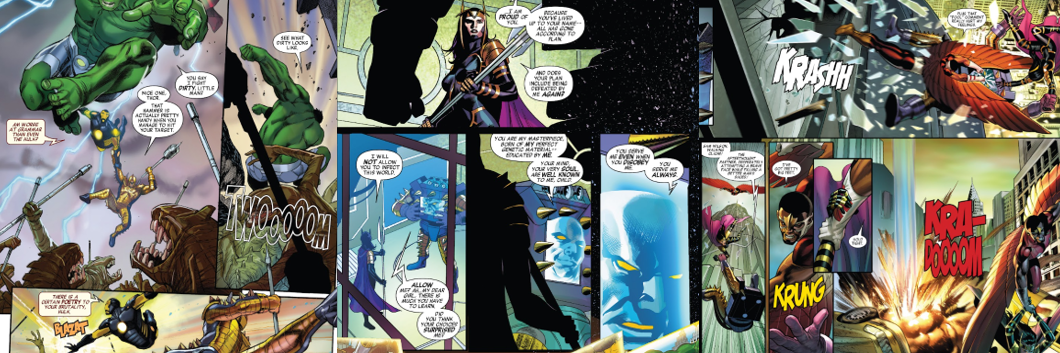
Over on the upper west side, Sam Wilson wakes up to a hell of a hangover and to find he spent the night with Jet Black! Though he’s not exactly thrilled at having crossed that line, he seems won over by her affections, but their tender moment (and the awkwardness) is interrupted when Jet spots a commotion outside. It turns out that her father, Armin Zola, is so eager for revenge that he rips open a hole in the fabric of reality and his monstrous, “hyperevolved mutates” come pouring into Central Park, followed closely by a mysterious man garbed in a spiked battle suit. Zola quickly contacts the Red Skull to co-ordinate their newest efforts in overthrowing the decadent West, asserting himself as a menacing force in his own right and seemingly earning the Red Skull’s respect with his army of mutates. While Anthony “Tony” Stark/Iron Man and Doctor Robert Bruce Banner/The Incredible Hulk work to find some way of restoring Steve’s superhuman condition, they (along with Thor Odinson and Steve himself) are alerted to the crisis via the mansion’s monitors. Steve immediately recognises the threat as Zola; Stark is incredulous but quickly convinced of the danger when the armoured mutate comes crashing through the wall. Luckily, the Hulk is around to face the stranger (with Banner having more control over the Hulk at this point). Naturally, Iron Man adopts a snarky “shoot first, ask questions later” philosophy, leading to an explosive confrontation as he and Thor try to keep the masked intruder from reaching Steve. However, the masked man easily avoids their attacks and even gets the better of Thor, running rings around them, only to be astonished by Steve’s frail condition. This distraction allows the Hulk needs to strike; ironically, though the stranger deftly evades the Green Goliath, Steve easily subdues the masked man. However, Steve is stunned when the intruder unmasks to reveal himself as Ian Ziola, now Ian Rogers, Steve’s adopted son, who was regenerated from death by one of Zola’s “bio-mass [tanks]”.

Zola manipulates events to coerce his daughter, whom the Falcon rushes to defend.

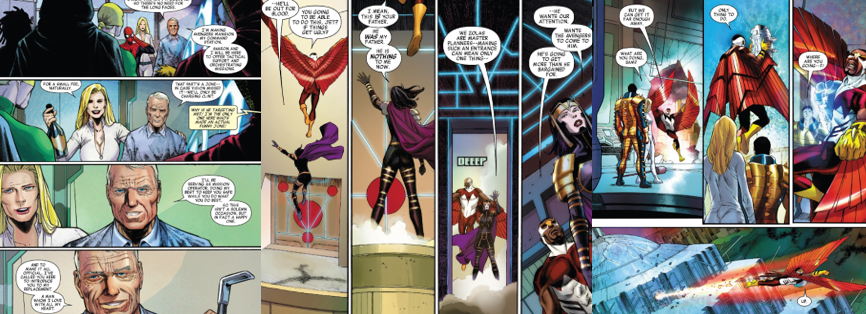
Overjoyed to see Ian alive and that he’s come to help, Steve proudly introduces him to his fellow Avengers but distraught to learn that Ian’s been fighting Zola alone for the last ten years. Steve then gets a call from the Falcon, who relays the extent of Zola’s attack: thanks to the city’s birds, Sam has seen the monsters rapidly spread throughout New York City. Jet Black then reveals she knows a way into her father’s fortified tower that may help them to stop the invasion and calls upon the Avengers to go along with her father’s plan, which is to face him head-on, to provide a suitable distraction. The Avengers readily accept, taking the fight to the ravenous, near-mindless hoards alongside their new ally, and are initially unimpressed by Zola’s forces. However, they’re soon confronted by Zola’s “hyper-mutates”, warped, monstrous copies of the Avengers that call themselves the “Unvengers”! Meanwhile, Jet Black and the Falcon easily infiltrate Zola’s tower, affirming that her allegiances lie anywhere but with her crazed father and insisting on using her position as the madman’s daughter to throw off his mutate guards. The plan works and they advance through the tower, only to find Sharon held hostage in a pitiful cell! After learning about Sharon’s predicament from Sam, Steve immediately asks Ian to leave the fight to the Avengers and go rescue her; though Sharon warns that such an act was all foreseen by Zola. When Jet confronts her father in his control room, he all-but guarantees the Red Skull that he can win her over to their side, claiming everything she’s done – even her betrayal – was also all part of his manipulative will. The Falcon breaks up the tense family reunion, tackling Zola out the window and sending him crashing to the streets below. Zola recovers near-instantly, however, his patience with his “perfect child” wearing thin, but the Falcon immediately intercepts him in mid-air.

Though the Avengers turn on Jet, Sam survives to take up the Captain America mantle.

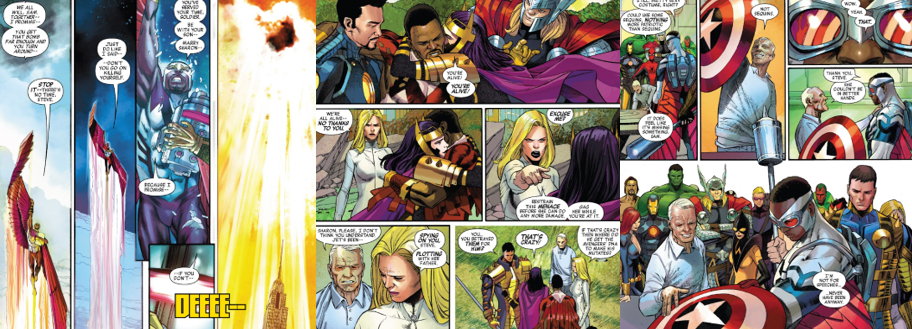
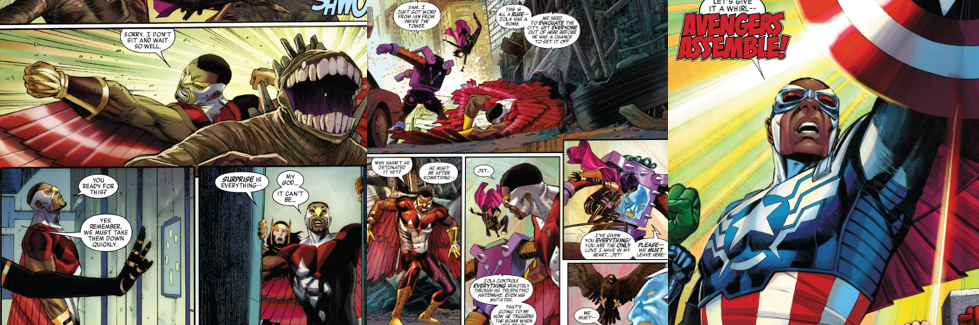
Raging at Zola for his ill treatment of Jet, the Falcon fights valiantly even as Zola smashes a bus onto the mis-matched hero. When Jet rushes to his aid and Zola sees how much she cares for the Falcon, Zola vows to murder him to rid her of such weaknesses all while hypocritically declaring his undying love for her! Thanks to Sharon, Steve warns the Falcon that Zola plans to blow up Avengers Tower, though Sam inadvertently kickstarts the detonation when he has Redwing remove Zola’s “telepathic broadcast doohickey”! When the Unvengers keep Iron Man from helping and Ian and Sharon are unable to disarm it, the Falcon bravely and selflessly grabs the bomb and flies high into the sky, bidding an emotional farewell to Steve and urging him and Sharon to enjoy their retirement with Ian before the bomb explodes in his arms. A horrified Steve thinks back to when he and Sam first met, the adversity he fought through, and how hard he worked to be a hero without any superpowers, fancy gadgets, or special serum as Iron Man sombrely retrieves the Falcon’s surprisingly intact body. Though Zola pleads with Jet Black to return to Dimension Z where she can be safe from the Red Skull’s looming threat, she angrily rebukes him. Sharon, Steve, and the Avengers gather in quiet mourning, only to be astonished when he comes to and reveals that Stark made him some Adamantium wings, which absorbed most of the blast! Though everyone’s overjoyed by this, Sharon blames Jet for Zola’s attack and accuses her of being a double agent. To Jet’s dismay, even Sam has his doubts and, when the Avengers try to restrain her to investigate, she angrily rushes to Zola’s tower, believing her father was right that her new allies couldn’t be trusted. One week later, seemingly every superhero around gathers at Avengers Mansion, where Steve announces his retirement from superheroics due to his condition (though he and Sharon plan to aid the Avengers with tactical support). He also reveals that Sam is the new Captain America and proudly hands him his shield, entrusting one of his oldest friends with his legacy, which Sam humbly accepts with a cry of “Avengers Assemble!

The Summary:
This was a difficult story to just jump into without context. A lot of modern comics are like that, with one series of mini arcs leading to the next, all of it part of a bigger picture. I get it and I accept it and I know there’s some onus on the reader to maybe get some background before diving in feet-first. However, since I’m mostly going on some background reading and what the “Previously…” recap is telling me, there were a few characters and events that I wasn’t very familiar with. Jet Black and Ian Rogers were two main examples; I knew Steve aged into an old man around this time, but I didn’t realise he took a son and a protégé as well. Consequently, Ian’s big reveal didn’t impact me as much as other, more invested readers but I think Rick Remender did a great job of conveying Steve’s shock and joy at seeing his son alive and well. I loved that Steve proudly introduced him to his surrogate family, the Avengers, and that Ian wasn’t some bitter, twisted soul looking to kill his adopted father. Instead, we got a young man who’s actually happy to see and fight alongside his father for a change, something very rare in comics. Ian meshes well with the Avengers, sporting a smart mouth and a capable agility despite his years of fighting against his maniacal father and living in a nightmarish alternate dimension. Similarly, I didn’t have much of a connection with Jet Black but I think the story did a good job of showing her as a character just trying to find her way. I liked her blossoming relationship with Sam (even if his reaction at waking up with her was a little odd) and that she willingly and selflessly opposes her father once he arrives. She does nothing except lash out against Zola, rebuking his offers and voicing her hatred of him even as he tries to win her over with his silver tongue. And, for all her efforts and hard work and personal turmoil, Jet is met with suspicion and accusations from even her own brother. Thus, she’s driven from her newfound allies and retreats back to Zola, devastated to learn that he was right and that she would never be accepted as one of them all because Sharon blew her lid and Sam barely even vouched for Jet’s trustworthiness.

For a story meant to be Sam’s crowning moment, he was strangely portrayed throughout.

Indeed, I hope subsequent issues delved into Sam’s feelings regarding this. He barely says anything when Sharon accuses Jet and gets only one panel where he seems conflicted or upset by what he sees as a betrayal. It’s a weird way to end the conflict, especially considering everyone was just mourning Sam’s loss and celebrating his survival. Sam’s selfless actions and his commitment to justice despite lacking any superpowers are the qualities that make him suitable to take up the Captain America mantle, yet this feels somewhat tarnished since he didn’t showcase any loyalty to Jet or any conviction in defending her. He stood there, stunned, and let everyone run their mouths, which doesn’t scream “Captain America” to me. In fact, this is a bit of an odd story to introduce Sam as Cap in general, really. For most of the issues, he’s not really doing anything except flying around and reporting intel to the Avengers. Sure, this is useful from a tactical standpoint but the mutates were swarming everywhere; I’m pretty sure the Avengers would’ve spotted them without him. The Falcon does take the fight directly to Zola, infiltrating his tower with Jet Black, and he does valiantly fight the cybernetic madman despite clearly being outmatched. During this fight, the Falcon also sticks up for Jet in a way he fails to do once the conflict is resolved and his fighting spirit is certainly commendable, but I feel like any hero would’ve fought just as hard in his stead. The Falcon making the sacrifice play is a great shorthand for the mentality needed to be Captain America but, again, it feels a touch hollow. Like, Iron Man was just about to take care of the bomb before he got interrupted and Sam probably wouldn’t have had to make that call if he hadn’t yanked out Zola’s broadcast device. It just felt a bit rushed and out of nowhere to me and I can’t help but wonder if maybe it would’ve been better to play things a little closer to the ground. Like, have Zola threaten to kill a group of civilians and have Sam shield them with his wings and seemingly be beaten to death, or something like that. Just something a little less random and a bit more in-line with his status as a more grounded, “human” superhero.

I liked that Steve passed on the mantle but the story felt oddly rushed at times.

On the plus side, Carlos Pacheco and Stuart Immonen do good artwork. I liked Iron Man’s darker armour and Ian’s totally nineties emo armour (I mistook him for Robbie Baldwin/Penance at first), though Jet Black felt a bit overdesigned. Similarly, while Sam’s Falcon outfit is a vast improvement over his debut costume, I can’t say I’m a big fan of his Falcon/Captain America hybrid suit. He reckons it’s “sexy” but it looks a bit of a mess to me, with miss-matching colours and a far too “busy” design. Maybe if his chest emblem was just the star, which was an extension of his weird-looking cowl, I’d like it more. I dunno, it just looks uncomfortable to wear and a pain in the ass to draw. I quite enjoyed the passing of the torch, though, in concept. I like seeing Steve rendering incapable of continuing as Captain America and retiring to a more sedentary life, though I do think Bucky is a better choice to take up the mantle. I get the idea that Captain America is a symbol of what a normal man can strive to be, but Steve was at least partially superhuman thanks to the super soldier serum. Then again, considering the Falcon survived having a bus dropped on his head, it’s safe to assume he’s more durably than Joe Public. I really like seeing all the other heroes immediately accept and endorse Sam; there was no question or objection, and he slipped into the role effortlessly. However, I feel he didn’t play a big enough role in this conflict. He fought Zola, sure, but to a standstill and didn’t defeat him; he just stopped his plan, and he lost his girl in the process. It’s a weirdly, tonally confused story for me and a strange way to usher in a new Captain America, though I was left curious to explore how Sam adapted to the role and the fallout from this adventure.

My Rating:

Rating: 3 out of 5.

Pretty Good

What did you think to Sam’s promotion to Captain America? Do you agree that this was a strange story to make that change or did you like the way it went down? What did you think to Sam’s suit, and do you like seeing him in the role? Were you disappointed that the Unvengers didn’t do more, and that Sam didn’t try harder to defend Jet Black? What are some of your favourite moments from Sam’s time as Captain America? Use the comment section below to share your thoughts and go read my other Marvel and Captain America content on the site.

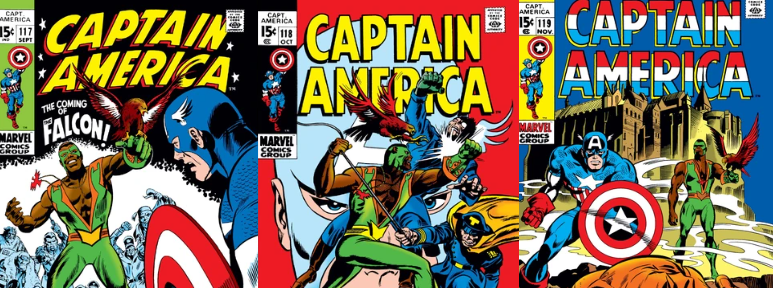
Back Issues: Captain America #117-119

Writer: Stan Lee – Artist: Gene Colon

Story Title: “The Coming of…The Falcon!”
Published: 3 June 1969 (cover-dated: September 1969)

Story Title: “The Falcon Fights On!”
Published: 1 July 1969 (cover-dated: October 1969)

Story Title: “Now Falls the Skull!”
Published: 30 July 1969 (cover-dated: November 1969)

The Background:
World War Two was in full swing by 1941. Nazi Germany had barrelled through Denmark and Norway in April 1940 and, after initially resisting joining the war, the United States entered the fray and provided much needed support against the “Axis powers” of Germany, Japan, and Italy. Patriotism and national pride was high at the time, especially in America, and it was during these dark days that Joe Simon and the legendary Jack Kirby introduced readers Captain Steve Rogers/Captain America and his kid sidekick, James Buchanan Barnes/Bucky, to encourage support of the war effort. However, after the end of the War superheroes declined in popularity and Captain America’s solo comic was cancelled in 1954. Luckily, Cap got a second chance as a “man out of time” when he joined the Avengers, reigniting his superhero career and butting heads with such iconic villains as Johann Shmidt/The Red Skull and even eventually battling his fellow superheroes. In the aftermath of this civil war, Cap was left seemingly dead and his mantle passed to his troubled sidekick, now also a superhuman figure, who operated in the role until Steve’s inevitable resurrection and, in 2014, Sam Wilson took on the mantle, to much undue controversy. Created by Stan Lee and Gene Colon, the man better known as the Falcon was the first Black American superhero in mainstream comic books. Specifically created to be a trendsetter during turbulent times, the Falcon went on to have a lengthy career in Marvel Comics, though mostly as a bit-player until his promotion into the shield-slinging role of Captain America, and has achieved mainstream recognition thanks to Anthony Mackie’s celebrated portrayal of the character in the Marvel Cinematic Universe.

The Review:
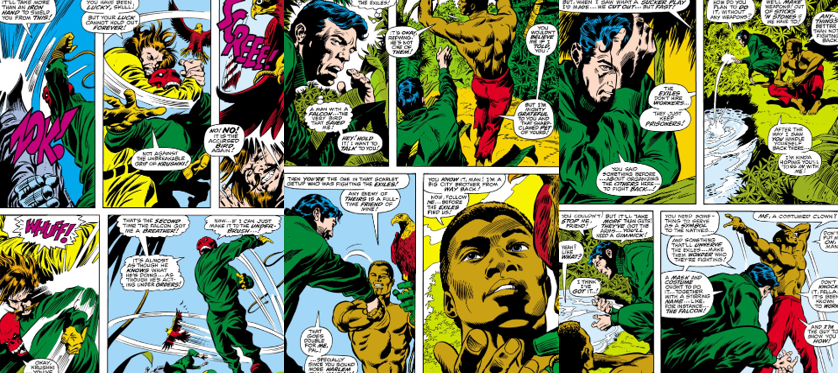
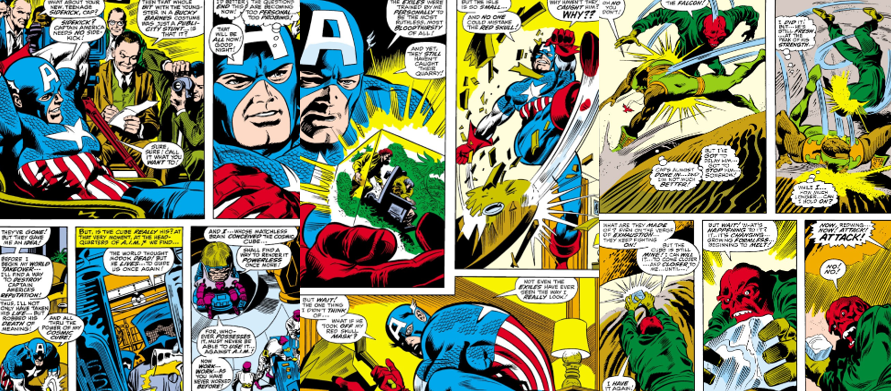
Sam Wilson’s debut in Captain America’s solo title came in the middle of a particularly trying time for the Star-Spangled Avenger. After almost having his identity made public, Cap was ambushed by his old foe, the gruesome Red Skull, who used the power of the Cosmic Cube to switch bodies with his hated enemy! As if being tapped in the body of a skull-faced Nazi wasn’t bad enough, the Cosmic Cube’s near-limitless power dumped Cap on a remote island home to the Exiles, a misfit group of would-be conquerors who hate the Red Skull with a passion. Observing through the Cosmic Cube’s omnipotent power, the Red Skull watches as the wheelchair-bound Franz Cadavus leads his venge-filled fellows in search of the one who robbed them of the Cosmic Cube’s power. When Cap crashes before them after falling from his hiding spot in a tree, he doesn’t even bother trying to explain the situation. Instead, he defends himself against Angelo Baldini and his deadly scarf, easily using his knowledge of his foe’s abilities to his advantage. Cap then uses his incredible agility to dodge Cadavus’s “murder chair” cannons, tossing sand in his eyes, and disarms Jun Ching. However, the numbers soon overwhelm the celebrated Avenger when Eric Gruning restrains him with his whip and “Iron-Hand” Jurgen Hauptmann closes in for the kill. For the observing Red Skull, the irony and glory of it all are too much to witness. Confident that his plot has succeeded, he decides not to witness his hated enemy’s final moments and turns his attention towards his greater goals.

Trapped in the Red Skull’s body, Cap nevertheless inspires young Sam to become a hero.

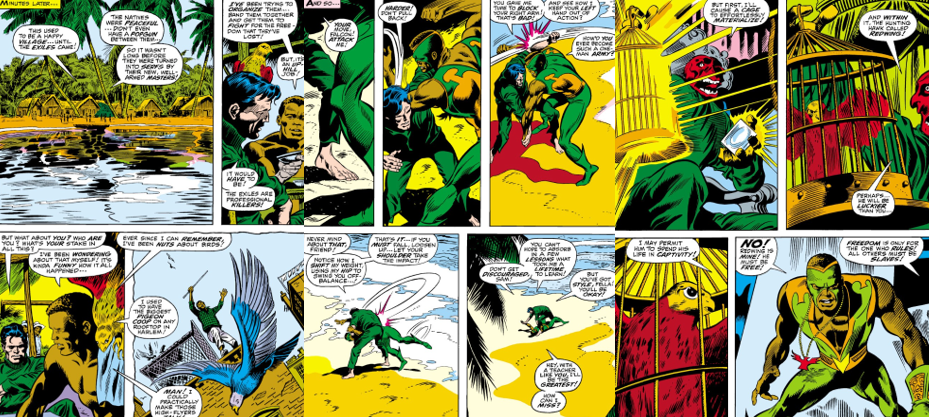
Consequently, the Red Skull doesn’t see the timely intervention of a falcon, later identified as “Redwing”, who distracts Iron-Hand long enough for Cap to fight him off with a swift uppercut. Redwing also helps Cap escape the iron grip of the brutish Ivan Krushki and, as Cap flees to the bushes, he notes that the bird seems to be trained, as if following orders. Cap surmises that the Exiles probably haven’t seen the Red Skull’s true face, so he removes the gruesome mask and manipulates his features with clay to move more freely around the island. In contrast, the Red Skull walks in the guise of Captain America, disgusted by the adulation and awe his appearance inspires and secretly conspiring to enslave everyone. The Red Skull revels in deceiving the masses, taking advantage of their goodwill, before deciding to further his victory against Captain America by destroying his enemy’s distinguished reputation. He is completely unaware that the Mental Organism Designed Only for Killing/MODOK and his beekeeper-suit flunkies at Advanced Idea Mechanics (A.I.M.) are working to render the Cosmic Cube they created powerless to avoid it being used against them. Back on the island, Redwing returns to his master, the jovial Sam Wilson, a lone vigilante against the Exiles. When Cap spots him, he thanks Sam for his assistance and learns that he’s a simple Harlem man who came to the long-peaceful island to organize a resistance against the Exiles. Sam relates that he had an affinity for birds since boyhood, communicating with them in a way beyond a simple animal trainer. When he unwittingly answered the Exiles’ call for a hunting falcon, Sam turned on them, unwilling to help them enslave others. While he initially laughs at Cap’s suggestion that he turn his love for falcons into a symbol, a costumed identity for the natives to rally behind, Cap soon organizes the creation of a garish outfit that will better suit his radical goals and dubs him “The Falcon”.

Despite this God-like power, the Red Skull doesn’t foresee Cap training a new ally.

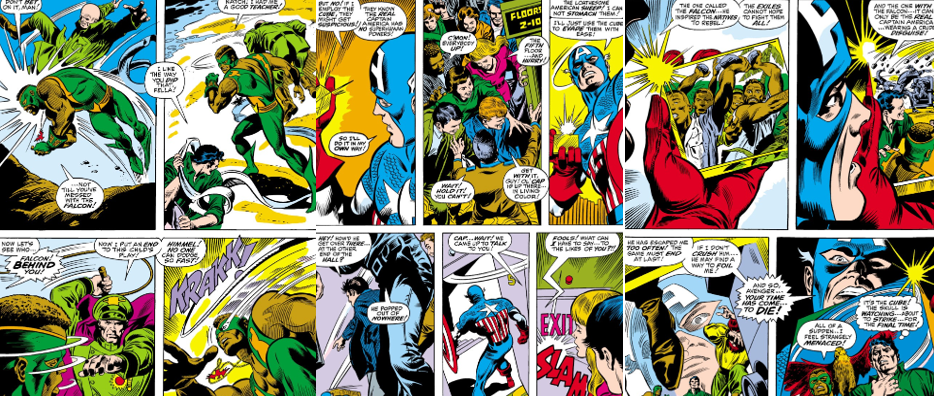
Back in New York City, the Red Skull finally realises, with anger, that his protégés have failed to find or kill their quarry. Realising that Cap must’ve taken off his skull-like visage, he resigns himself to the inevitability that his enemy can’t hide forever. Yet, the Red Skull decides he’s not willing to aid the Exiles or simply blink Cap out of existence with his God-like power and thus doesn’t bother to look in on Cap or witness him bonding with his new friend, whose connection with Redwing constantly impresses the disguised Avenger. Cap teaches the Falcon the basics of superheroing…And by that I mean they spar on the beach, Cap instructing Sam how to fight properly and use an enemy’s momentum and strength against them. Sam’s experience fighting for survival on the mean streets of Harlem see him take to the training like a natural, quickly becoming stronger and more sure of himself, and Cap impresses upon him that he must embody his new identity whenever he’s wearing his awful costume. When the Red Skull is awoken by concerns of an overexcited rabble of Cap fans in the lobby of his hotel, he sees it as the perfect opportunity to discredit Cap’s name. He shouts at the hotel manager and berates the fans, spitting spiteful insults every chance he can get, and even ostracises perennial hanger-on Rick Jones, who had aspirations of becoming Cap’s new sidekick. While A.I.M. continue their experiments, Cap and the Falcon blindside the Exiles, easily besting them even though Cap’s speed and strength are lessened in the Red Skull’s body. The Falcon proves very adept, dodging Gruning’s whip and inspiring the natives to rise up and drive the Exiles into fleeing for their lives.

Ultimately, it’s A.I.M. who quash the red Skull’s dreams of ultimate victory,

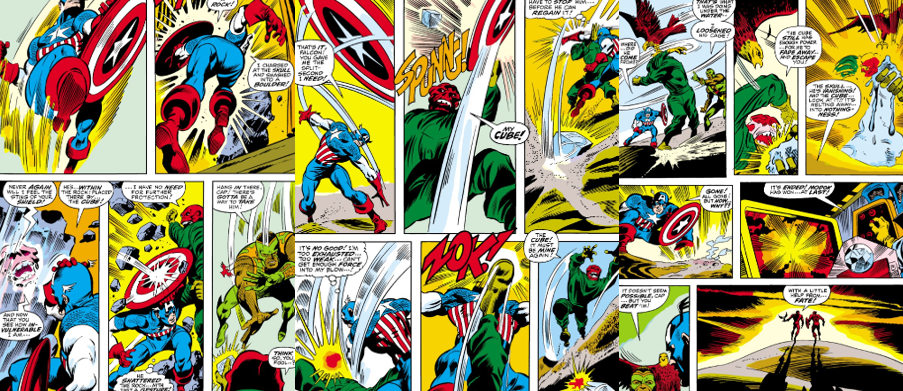
Unfortunately for them, the Red Skull happened to be looking in. Angered and determined to finish his enemy and his new ally off, the Red Skull assumes his more familiar appearance and effortlessly teleports himself to Berchtesgaden Castle, where he once conspired with Adolf Hitler to conquer the world, ravenous to stage his final victory in the castle’s opulent halls. Cap and the Falcon are then violently transported halfway across the world to Berchtesgaden Castle. Though Cap bemoans getting the Falcon caught up in his ages-old rivalry with the skull-faced dictator, Sam vows to face the threat no matter the outcome, but is enraged when the Red Skull’s first act is to cage Redwing. The Red Skull feeds the Falcon’s anger and spirit, goading him into attacking so that he can repel the fledgling hero with a forcefield. Sam is then stunned when the Red Skull uses the Cosmic Cube to undo the mind and body transfer, reverting Cap to his colourful costume and rearming him once more. Galvanised by this revelation, the Falcon willing follows Cap into battle, despite the Red Skull encasing himself in a protective rocky shell and spontaneously conjuring a tidal wave that threatens to drown the two heroes. While the Falcon’s caught off-guard by such tricks, Cap warns of the Red Skull’s power and insanity, which see the villain whisk them to an arid desert. With Sam exhausted, Cap hurls his shield and, incredibly, causes the Red Skull to drop the Cosmic Cube! The two fight valiantly over the prize but, just as the Red Skull reclaims the Cosmic Cube, he watches in horror as it melts between his fingers thanks to MODOK and A.I.M. activating their “Catholite Block” and rendering the weapon inert. Despite this, the Red Skull uses the melting cube’s fading power to teleport away, leaving MODOK victorious and Cap and the Falcon to head into the sunset as triumphant new allies.

The Summary:
I’m honestly not very familiar with the Falcon. This may very well be the first story I’ve ever read where he’s a part of the plot. I’m much more aware of his film counterpart and, honestly, never thought too much of him since his gimmick is very similar to Adrian Toomes/The Vulture, another character I traditionally find lacklustre compared to other, more colourful and appealing characters. However, his appearance here was enjoyable for what it was. There are some holes in his backstory, though, that the story didn’t satisfactorily explain for me. So, he’s a bird-lover, that’s great; he can communicate with Redwing on a near-telepathic level, sure, I’m all for that. But…why did he answer the ad for a hunting falcon? I mean, I guess he just wanted to leave Harlem and I can understand that, but it’s a bit random to jet off to a secluded island on a whim. Also, why did the Exiles need a hunting falcon anyway? Sure, they’re repeatedly shown to be useless at tracking their enemies but still…a falcon? And how did they place an ad for that when they’re exiled to the island? Still, Sam’s heart is in the right place; he won’t stand for injustice, especially slavery, and is determined to encourage the remaining natives to reclaim their land. It’s obviously a very racially and politically charged motivation and character, but I think it’s a universal truth we can all agree to: slavery and mistreatment of others is bad and should be opposed. Sam embodies this ideal before Cap shows up but lacks the proper means to enforce it. He seems to operate mainly from the shadows, but Cap encourages him to stand in the spotlight as a symbol for people to believe in, not unlike he is when in full costume.

It’s a good job Sam’s such a likeable guy because his superhero costume is unsightly!

Unfortunately for Sam, Cap and the natives whisk up one of the worst costumes I’ve ever seen. God, it’s so awful, with its lime-green and brown-gold edging, it’s weird-ass cowl and strangely angled boots. Considering Cap encourages him to take inspiration from his love and use the moniker “The Falcon”, nothing about Sam’s outfit screams “Falcon” to me. He doesn’t have a bird-like cowl like, say, Katar Hall/Hawkman, doesn’t match Redwing’s gold and red/brown feathers, and doesn’t even have his now-iconic wings. Just about the only thing this outfit has going for it is its sense of native tribalism, but otherwise it’s truly a ghastly sight. Luckily, Sam’s personality makes up for it. He’s not some jive-talking street tough or a shallow Blaxploitation cliché; he’s just a regular guy from Harlem with a friendly disposition who wants to do what’s right. His time on the mean streets toughened him, sure, but there’s no sense of malice or ego. The only time he shows any anger is when Redwing is threatened and when confronted by the embodiment of xenophobic oppression. Otherwise, he’s a level-headed, affable young man who luckily turns out to be a natural when it comes to learning how to fight. In a short time, Cap teaches Sam how to defend himself, how to fight smartly, and leads him into battle against the Exiles, a fight that puts them at a disadvantage due to the group’s numbers and weapons but which the heroes ultimately triumph thanks to putting their skills to good use. This also sees the Falcon inspire the natives to rise up, though this was very rushed for me. There was never any indication that the people even know the Falcon was heading into battle that day. All they knew was that Sam was wearing a costume now, not that he’d done anything worth riling them up. Of course, Sam’s natural abilities are only half the story; Redwing gives him a memorable gimmick that helps him stand out against his peers. The bird is exceptionally well trained and intelligent, turning the tide in every battle the Falcon is involved in and proving invaluable to their cause.

The story completely wastes the potential of the Red Skull’s unlimited power.

Beyond this, the story is a bit of a mess. I love the idea of the Red Skull attaining God-like power, and the Cosmic Cube effectively allows him to do anything. He can see anything he likes at will, switch bodies with people, teleport, conjure forcefields and the elements, and is functionally untouchable as long as the cube is in his hands. Unfortunately, the Red Skull is a cackling buffoon. Rather than simply will Captain America out of existence, he swaps bodies with him and dumps him on an island, where inept forces fail time and again to do his dirty work. Rather than reshaping reality in his image, brainwashing the masses and conquering the world a piece at a time, the Red Skull parades around in Cap’s body to take advantage of their goodwill, all while ruminating about how much he hates Americans and the many ways he’ll subjugate and destroy those around him. Rather than doing this, the Red Skull plots to destroy Cap’s reputation by…being rude to people! It’s ridiculous! He doesn’t even watch what’s happening on the island until it’s too late and gets so distracted bringing himself, Cap, and the Falcon to Berchtesgaden Castle that he doesn’t think to set aside his pride and just snuff their lives out with a thought. It’s typical, cliché supervillain behaviour to assume victory, bask in your superiority, and to toy with your enemies but I expected more from someone like the Red Skull! Despite demonstrating that he can protect himself from any attack with a thought, Shmidt is disarmed by a simple throw of Cap’s shield and then he completely fails to consider that A.I.M. might be angry at him swiping their most powerful weapon, leaving him undone not by his enemy, but by his own lack of foresight. Overall, this was a decent enough introduction for Sam Wilson; his costume was awful, but I liked his attitude and his gimmick. What lets it down, though, is the nonsensical main plot regarding Cap and the red Skull switching bodies. It’s a great concept but the story completely wastes it, having Shmidt lounge around thinking nasty thoughts but squandering his great power, leaving him undone in the lamest way possible.

My Rating:

Rating: 3 out of 5.

Pretty Good

What did you think to the Falcon’s debut story? Were you as repulsed by his costume as I was? What did you think to his moxie and his gimmick with Redwing? Were you also disappointed that the red Skull squandered his potential here? What are some of your favourite moments in the Falcon’s long history? There’s a comment section down below; use it to share your thoughts and then go check out my other Marvel content.

Movie Night: Captain America: The First Avenger

Released: 22 July 2011
Director: Joe Johnston
Distributor: Paramount Pictures
Budget: $140 to 216.7 million
Stars: Chris Evans, Hugo Weaving, Hayley Atwell, Sebastian Stan, Dominic Cooper, Tommy Lee Jones, and Stanley Tucci

The Plot:
Steve Rogers (Evans) is desperate to enlist in the United States Army and combat the Axis Forces but is repeatedly rejected because of his frail body. Intrigued, Doctor Abraham Erskine (Tucci) transforms Steve into a veritable superhuman. With World War Two in full swing, Johann Schmidt/The Red Skull (Weaving), acquires the mysterious Tesseract and Steve engages in a crusade to bring down his Hydra forces as Captain America.

The Background:
Captain America: The First Avenger was the fifth film in the Marvel Cinematic Universe (MCU) but a big-screen adaptation of Marvel Comic’s patriotic super soldier was actually in development as far back as the year 2000. After settling an ugly lawsuit regarding the character, and bolstered by the early success of the MCU, producer Kevin Feige soldiered on (no pun intended) with his plan to introduce some of Marvel’s classic characters in solo films before bringing them together for a big team up and chose to focus on setting the stage for Cap’s “man out of time” story arc in the wider MCU. After signing director Joe Johnston, production began in earnest in 2010; after some hesitation, Chris Evans (who had previously starred as Johnny Storm/The Human Torch in separate, unconnected Marvel adaptations) joined the film in the title role and cutting edge digital effects were used to portray him as a weak and frail man prior to showcasing his impressive physique. Perhaps because audience anticipation for the upcoming Avengers movie was reaching its peak, Captain America: The First Avenger was a resounding box office success; the film made over $370 million in worldwide gross and was met with widespread critical acclaim, though some noted that it was maybe playing things a little too safe, which I agreed with at the time. Nevertheless, the film’s success led directly into the aforementioned Avengers movie and galvanised Captain America as an icon for an entirely new audience, one who would go on to become a major part of the MCU as it continued to unfold in subsequent years.

The Review:
Captain America: The First Avenger is bookended by scenes set in the then-modern day; the opening sequence depicts a team of scientists (and a few representatives from the Strategic Homeland Intervention, Enforcement and Logistics Division (S.H.I.E.L.D.)) discovering a futuristic aircraft buried in the Arctic that houses the frozen body of Steve Rogers. From there, the film jumps back to 1942, at the tail-end (and height) of the Second World War; Nazi Germany is aggressively spreading death and destruction across most of Europe and the Allied Powers (mainly the United Kingdom and the United States of America, especially in Hollywood) are frantically trying to push them back. As a result, the U.S. continues to ask for volunteers to join her ranks to fight for the ideals of freedom and equality. None embody these beliefs more than young Steve Rogers, a frightfully malnourished man whose family were killed as a result of the War and who has been repeatedly denied his time in service of his country due to his many physical ailments.

Steve is a frail, sickly young man whose heart and determination are unmatched.

Frustrated at his inability to “do his part”, Steve upholds his ideals on the home front; even when he is clearly physically mismatched against bullies and braggarts, Steve continues to get up and fight back in an effort to prove himself (and to vent his frustrations). While his friend, Sergeant James Buchanan “Bucky” Barnes (Stan) is often on hand to help him out, both physically and with the ladies, Steve desperately wishes to contribute to the war effort despite him being basically infirm and more than a little unlucky in love. His latest effort to lie his way into active service catches the attention of Dr. Erskine, who is inspired by Steve’s moxie and his lofty idealism. Dr. Erskine sees Steve as the perfect candidate to undergo the super soldier procedure not because he is a good soldier, but because he is a good man and Steve, who has no desire to kill anyone and simply wishes to stand up to bullies, jumps at the chance to be a part of “Project: Rebirth” and the Strategic Scientific Reserve (S.S.R.). While Colonel Chester Phillips (Jones) is less than impressed with Dr. Erskine’s selection above the other far more physically capable recruits in his regiment, Dr. Erskine remains resolute in his choice and Steve’s adaptability and never-say-die mentality catches the admiration of British agent Peggy Carter (Atwell). As part of their unit, Steve is put through the paces of basic training and demonstrates his bravery on numerous occasions but the one that stands out the most is when he willingly throws himself upon what is believed to be a live grenade to shield his fellow soldiers.

Cap soon finds himself leading the charge in co-ordinated strikes against Hydra facilities.

The super soldier serum is more than just a simple shot in the arm or a light show; in conjunction with technology provided by Howard Stark (Cooper), Erskine subjects Steve to a series of deep injections and a bombardment of “Vita Rays” that augment his physical stature and abilities far beyond those of a normal man. Now tall, muscular, and sporting a rapid metabolism, Steve is made a veritable superhuman but at the cost of Dr. Erskine’s life as Hydra agents strike following the procedure and cause the super soldier serum to be lost. Angered at being denied an army of super soldiers, Philips decides not to utilise Steve’s amplified abilities and he is, instead, reduced to touring the nation as the colourful “Captain America” to promote war bonds rather than fighting alongside the other troops. When Bucky and his unit are declared missing in action in Berlin, Steve disobeys Philips’ direct orders and goes in alone to rescue them; in the process, he meets his Nazi counterpart and learns of Hydra’s plan to attack major American cities with his Tesseract-powered weapons. Alongside Bucky and his unit, the “Howling Commandos”, Steve is officially drafted into the US army as Captain America and given an amazing suit of red, white, and blue and a circular shield made of the supposedly-indestructible “Vibranium” and sets out to put a stop to the Red Skull’s goals of world conquest. In the process, Steve earns not only the respect of his peers and fellow soldiers but also (after some awkward miscommunication) the love of Carter; however, his crusade against Hydra soon becomes as much of a personal vendetta as a mission to safeguard the world and Steve is soon forced not only into a desperate battle against the Red Skull but also into making the ultimate sacrifice for the greater good.

The Red Skull, and Weaving in general, is one of the film’s biggest highlights.

While the super soldier procedure is a success with Steve, Dr. Erskine’s earlier efforts were just as successful but on the opposite end of the spectrum. Johann Schmidt is an extremely charismatic and learned man; with a fascination and deep knowledge of legends and mythology, he seeks the ultimate tangible power in the form of the Tesseract. To acquire this magical object, he ransacks the small town of Tønsberg using both the imposing force of Hydra and his enigmatic personality. As charming as he is ruthless, Schmidt doesn’t hesitate to kill innocents in his pursuit of power and, having obtained the Tesseract, his goal expands considerably; thanks to the near-limitless power of the cosmic cube, Schmidt and his right-hand man, Doctor Arnim Zola (Toby Jones), is able to develop incredibly advanced weaponry almost overnight and, very quickly, he sets his sights on conquering the world not in the name of his Fuhrer but in the name of Hydra and the Red Skull! Subjected to an incomplete version of the super soldier process, Schmidt has gained incredible superhuman abilities and found his intellect and brutality augmented a thousand-fold but at the cost of his physical appearance. Now sporting a blood red visage beneath a life-like human mask, the Red Skull is a horrific and formidable adversary even without the Tesseract but, once he begins experimenting with its powers, he comes almost unstoppable. Thanks to Weaving’s unparalleled screen charisma and some absolutely top-notch practical effects, the Red Skull is brought to gruesome life; as great as many of the film’s effects, period-appropriate technology and attention to detail, and even Cap’s costume are, the Red Skull’s appearance and portrayal are a constant highlight for me every time I watch Captain America: The First Avenger and I never fail to feel like we were robbed of subsequent appearances by the villain.

The Nitty-Gritty:
When I first saw Captain America: The First Avenger, I was extremely eager to get the film out of the way as it was the final step towards the long-awaited Avengers film; as a result, while I enjoyed it at the time, I wasn’t exactly blown away by it. However, in the years since, I have come to appreciate what an impressive piece of superhero cinema it is. Setting the vast majority of its run-time in the 1940s was a brilliant way to separate it from other MCU movies and to devote the proper time to establishing the ideals and morals of Captain America, a character who could easily be seen as hokey and cheesy in modern times. Additionally, like I mentioned in my review of Iron Man (Favreau, 2008), one of the things that really helped the MCU (and other superhero movies of this time) out was the quality of its casting. Although the film doesn’t ask much of Tommy Lee Jones other than to be every gruff and jaded military commander you’ve ever seen, he steals every scene he’s in; Hayley Atwell is both gorgeous and impressive as Agent Carter (a woman living in a man’s world who is striving to prove herself as much as Steve is); and even the smallest roles are bolstered by some well-placed humour and appealing character actors.

The film’s action and aesthetic are bolstered by Chris Evans’ appealing performance.

Considering how grounded and gritty the film is compared to the other MCU films from that era, Captain America: The First Avenger is no slouch in the action and effects department; while some of the special effects are a little iffy compared to other MCU films as the film came out around the time when it was in-vogue to cater to the 3D market, the costume and set design is incredibly impressive. All of the Hydra forces and weaponry are ripped right out of the comic books, the quaint 1940s technology is given a suitably futuristic flair thanks to the efforts of both Stark and Hydra, and once Cap launches his campaign against the Red Skull the film really ramps up. Thanks to his superhuman metabolism, Cap is virtually inexhaustible and a formidable opponent despite his lack of training and experience compared to his fellow soldiers; crucially, he’s also still a man and capable of being injured, which helps as much as his uncompromising commitment to justice and fairness to make him extremely easy to root for. Much of this is down to Evans’ likeable charisma; he portrays Steve as a shy, quirky man just trying to do the right thing even after he balloons out into a muscular physique and it’s impossible to not be won over by his idealism and rugged good looks.

After losing Bucky, Cap defeats the Red Skull and makes the ultimate sacrifice.

This goes a long way to empathising with Steve after he is left devastated when Bucky falls to his apparent death during his team’s successful mission to capture Zola; although anyone who is familiar with the characters and comics knew that Bucky was destined to return later in life, this is still a powerful scene and motivation for Cap’s renewed efforts to strike back against Hydra using information given to the S.S.R. by the seemingly remorseful Zola. This leads to a physical confrontation between Cap and the Red Skull on a Hydra aircraft carrying devastating weapons of mass destruction. Though physically even, the fight remains a brutal slugfest between the two that sees the Tesseract damaged; when he touches the cube, Schmidt is seemingly vaporised by an intense blast of rainbow energy and Steve is left with no choice but to pilot the craft to a suicide dive into the frozen wasteland. Of course, the film ends with Steve awakening in then-modern times and finding the world has moved on over the last seventy years; though despondent at having missed his chance with Peggy, Steve is immediately approached by Nick Fury (Samuel L. Jackson), director of S.H.I.E.L.D., with a new mission to defend the world from an approaching danger. One aspect that I’ve always enjoyed about the film is the incredible attention to detail to its setting and the wider MCU; not only do we get the prerequisite cameo from Stan Lee but Cap dons a fabric version of his costume that is a direct one-to-one interpretation of his comic book counterpart (and still somehow looks better than the suit in the 1990 movie). The film also includes a brief cameo from Jim Hammond/The Human Torch and iconic Howling Commandos such Timothy “Dum Dum” Dugan (Neal McDonough). Additionally, when we’re first introduced to Zola, he’s framed in a magnifying glass to resemble the android body of his comic book counterpart, Hydra’s Tesseract weapons emit the same distinctive whine as Tony Stark/Iron Man’s (Robert Downey Jr.) Repulsor Rays, and Schmidt makes frequent references to Norse mythology.

The Summary:
Honestly, of all the colourful superheroes in Marvel Comics, I’ve never had much of an affinity for Captain America. This may have something to do with the fact that I am British and not really much of a patriot but, in my experience, he generally falls into the unenviable role of the staunch, righteous leader rather than being an especially interesting or engaging character. My indifference towards the character was changed by this film, and Cap’s portrayal in the MCU in general, though. As I mentioned, on first viewing, I didn’t think much to it; it was just another by-the-numbers superhero origin story that was a necessary step on the road to the Avengers movie and, while I enjoyed it, it didn’t exactly blow me away beyond some impressive special (and practical) effects and performances. Very quickly into the MCU’s second phase of movies, though, I came to appreciate just how entertaining this film is; all too often, many people complain about the MCU being too derivative and indistinguishable but I generally believe to be nonsense as the first phase of films alone dabbles in science-fiction, fantasy, and this period piece that all mesh as part of a greater whole thanks to the film’s having a focused goal in mind. Captain America: The First Avenger is, perhaps, one of the under-rated gems of the MCU that quickly became eclipsed by its bigger, better sequel but make no mistake about it, this is one hell of an entertaining watch that is full of action, heart, and some fantastic performances from the likes of Chris Evans and, especially, Hugo Weaving.

My Rating:

Rating: 4 out of 5.

Great Stuff

What did you think to Captain America: The First Avenger? Were you a fan upon first viewing or, like me, did you come to appreciate it more over time? What did you think to the film’s presentation and special effects, especially the Red Skull and Captain America’s suit? Were you also disappointed that we never got a rematch between Cap and Schmidt? Where does this film rank against the other Captain America movies and the larger MCU? How are you celebrating Captain America this month? Whatever your thoughts, drop a comment below and be sure to pop back for more Captain America content throughout July.

Talking Movies: What If…? Thanos and the Masters of Evil

Talking Movies

In Avengers: Infinity War (Russo and Russo, 2018) the Mad Titan, Thanos (Josh Brolin), finally made a significant appearance in the Marvel Cinematic Universe (MCU). When the idea of a two-film saga based on the Infinity Gauntlet comic book (Starlin, et al, 1991) was first announced, I, like many others, had many theories about what was going to happen, who was going to live and die, and how everything was )going to go down. For example, before Thor: Ragnarok (Waititi, 2017), I was certain that Thanos’ big entrance was going to immediately establish his threat by hanging him storm into Asgard kill Odin Allfather (Anthony Hopkins), and claim the Tesseract (and, obviously, the Space Stone it help). After all, how better to establish this big bad villain than by having him kill a God?

Thanos’ Black Order made their MCU debut in Avengers: Infinity War.

Instead, of course, Thanos wrecked Thor Odinson’s (Chris Hemsworth) ship and slaughtered half of the Asgardians onboard. Still an impressive feat, to be sure, but one that focused more on Thanos’ grandeur and pretentious philosophy rather than his actual physical strength thanks to the bulk of the work being undertaken by his underlings, the “Children of Thanos”. Headed by Ebony Maw (Tom Vaughan-Lawlor), Cull Obsidian (Terry Notary), Proxima Midnight (Carrie Coon/Monique Ganderton), and Corvus Glaive (Michael James Shaw), the Children of Thanos didn’t actually appear in The Infinity Gauntlet and are, instead, relatively recent additions to Thanos’ ranks who first appeared (as the “Black Order”) in Infinity (Hickman, et al, 2013). In the film, we don’t really learn much about these guys at all except that they enforce Thanos’ will with unquestioning loyalty and that he trusts them to help him gather the remaining Infinity Stones and, while they certainly look visually interesting, they’re mostly disposable bad guys for the Avengers to fight in place of Thanos.

While Abomination is a good choice, I definitely think Ronan could’ve taken Cull’s place.

Now, I’ve never read Infinity; I have no emotional attachment to the Black Order or any of the characters and, as a result, they were merely nothing more than henchman to me and I only really recall one of them being referred to be name (“I take it the Maw is dead?”) While I enjoyed their inclusion in the film, I can’t help but feel like they could have been dropped and supplanted with some other, more recognisable MCU villains had some other films and events happened just a little differently. For example, take Cull Obsidian; he’s Thanos’ muscle who basically does nothing and is largely inconsequential. What if, instead of killing Ronan the Accuser (Lee Pace) in Guardians of the Galaxy (Gunn, 2014), Ronan had been soundly defeated and humbled and, having seen the extent of Thanos’ power (he did destroy Xandar (offscreen), which was what Ronan wanted, after all, and would be enough to bring Ronan to heel, I would wager), he pledged himself fully to Thanos’ cause to get revenge against the Guardians of the Galaxy? I’m not massively familiar with Ronan but it seems to me like it was a bit of a miss-step to kill him off when he could have fulfilled a role in Thanos’ little gang at the very least, if not remain as a recurring antagonist for the Guardians. Another potential replacement for Corvus would be Emil Blonsky/Abomination (Tim Roth) who, at the time, had been conspicuous by his absence from the MCU. However, arguably, it wouldn’t make as much sense for Thanos to recruit the Abomination as he’s not exactly floating around in the depths of space for him to encounter.

What if Loki or the Red Skull had aligned themselves with Thanos in place of Ebony Maw…?

Intrigue was equally high in the build-up to The Avengers/Avengers Assemble (Whedon, 2012); I was hoping to see a version of the Masters of Evil, with Loki Laufeyson (Tom Hiddleston) joining forces with Johann Schmidt/The Red Skull (Hugo Weaving) – who was clearly transported away from Earth by the Bifrost at the end of Captain America: The First Avenger (Johnston, 2011 – and either the Abomination or Doctor Samuel Sterns/The Leader (Tim Blake Nelson) once they got to Earth. While I was happy with the first Avengers team-up we got, I do feel this was another missed opportunity that we never saw this anti-Avengers team-up. Consequently, I feel like we could have swapped out Ebony Maw for either of these characters; in The Infinity Gauntly, Thanos was advised by Mephisto, a role many expected Loki to play in Infinity War given his mischievous and devious nature. Naturally, of course, you could argue that this wouldn’t really fit with Loki’s character arc by that point but remember how he feigned loyalty to Thanos and then tried to stab him in the neck? Well, imagine that but throughout a large portion of the movie. Loki pledges fealty, willingly hand shim the Tesseract, and spends the remainder of the film waiting for the perfect moment to strike and then he’s killed for his efforts. Obviously, the Red Skull finally showed up in Avengers: Endgame (Russo and Russo, 2019) in a slightly different role as the Stonekeeper (Ross Marquand), but again…what if the Red Skull had replaced Ebony Maw? How much more interesting and impactful would it have been to see the Red Skull empowered by Thanos and making a triumphant return as Thanos’ chief torturer? Sure, if his death was the same then you could argue that he would’ve been “wasted” or been killed off too easily but I still feel like this would have been a better use of the character than as the keeper of the Soul Stone (a role that could’ve been filled by character’s envisioning the Stonekeeper as someone close to them, perhaps?)

With some tweaks, nebula could have taken Corvus’ role as Thanos’ chief assassin.

Corvus Glaive is a trickier one to “replace” in this hypothetical alternate world, however I have one  suggestion: Nebula (Karen Gillan). Now, similar to Loki joining Thanos, this would require quite a few changes to Nebula’s character arc; in Guardians of the Galaxy Vol. 2 (Gunn, 2017), she finally buried the hatchet with her “sister”, Gamora (Zoey Saldana) and it was great seeing her grow as a character, put aside her hatred, and learn how to work alongside the Guardians and the Avengers. In The Infinity Gauntlet, Nebula spends most of her time as a mindless zombie thanks to Thanos’ wrath but plays a vital role in his downfall by stealing the Gauntlet for herself (and promptly being driven mad by its power). By tweaking her character arc, or having it so that Thanos either intimidates or reprograms her into subservice, you could replace Corvus with a more prominent and recognisable character and still find ways to weave her existing arc into the story. Like, what if, after Guardians of the Galaxy Vol 2, Nebula is forced into Thanos to serve him (maybe he threatens to kill Gamora/the Guardians or promises to “repair” her once he’s assemble the Gauntlet) in Corvus’ place; she could still have been ripped apart and tortured to force Gamora into revealing the Soul Stone’s location and would have even more motivation to turn against her “father” since he would have lied to and manipulated her once again.

If Hela wasn’t going to take Death’s place, she could’ve replaced Proxima Midnight.

Another character who I, like many, expected to play a prominent role in Infinity War was Hela Odindottir (Cate Blanchett), a character who a lot of people expected would take the role of Lady Death as the object of Thanos’ affections. Of course, this didn’t turn out to be true as Hela was killed in Thor: Ragnarok and Thanos’ motivations were changed from worshipping Death to wanting to bring a sense of balance to the galaxy. Still, how awesome would it have been if Hela had taken Proxima Midnight’s place in the Dark Order? If killing the Allfather didn’t show you that Thanos was a bad-ass, bringing the Goddess of Death to heel totally would have and could have made for a much more memorable female villain for the finale in Wakanda. Again, there’s the question of her being killed off but what better way to help showcase Wanda Maximoff’s (Elizabeth Olsen) sheer power than by having her shred a Goddess to pieces? Or you could rewrite her death to maybe come at the hands of her brother, Thor, and his new weapon, Stormbreaker, to sell the awesomeness of the weapon.

As cool as the Black Order were, would a version of the Masters of Evil have been better…?

Ultimately, I was more than happy with Avengers: Infinity War, Endgame, and the MCU’s portrayal of Thanos overall. His underlings were find cannon fodder for the film and helped to serve as extensions of the Mad Titan’s will but I do feel it would have been even more awesome to see these more recognisable villains swayed to Thanos’ cause so that we could see them interact with their rivals, and other heroes, in new and interesting ways. Sure, many have cropped up again since then and the potential of a Masters of Evil in the MCU is still there, I just think that maybe these huge movies could have been made even bigger if things had been slightly changed to accommodate these more familiar characters. Do you agree or disagree? Maybe you’re a big fan of the Black Order from the comics? Perhaps you’d have like to see a different route taken? Do you even want to see the Masters of Evil in the MCU? Either way, feel free to sound off in the comments below.

Game Corner: Captain America and the Avengers (Arcade)

Released: 1991
Developer: Data East
Also Available For: Game Boy, Game Gear, Mega Drive, Nintendo Entertainment System (NES), Super Nintendo Entertainment System (SNES)

The Background:
First created in 1940 by Joe Simon and Jack Kirby, Steve Rogers/Captain America was an icon of the Second World War, embodying America’s obsession with patriotism and pride by taking the fight directly to the Axis Forces. Superhero comics went on a bit of a decline after the war and Captain America wouldn’t return to prominence until 1964, when he was famously revived to join Marvel Comics’ all-star team, the Avengers. Since then, the character has been largely synonymous with Earth’s Mightiest Mortals, often acting as the team’s moral compass and leader. In 1991, both comics and arcades were undergoing something of a renaissance; Marvel published the influential Infinity Gauntlet (Starlin, et al, 1991) during this time and sidescrolling beat-‘em-ups like Final Fight (Capcom, 1989) and The Simpsons (Konami, 1991) were proving popular coin munchers. It is perhaps these factors that led to Data East developing a four-player beat-‘em-up game centred around Marvel’s popular super team, a game that is often forgotten because of genre-defining titles like X-Men (Konami, 1992) and a title I first played on the SEGA Mega Drive in all its inauspicious glory.

The Plot:
Johann Schmidt/The Red Skull has assembled an army of the world’s most dangerous supervillains in order to take over the world using a gigantic, Moon-based laser! Answering the call to action and adventure are Captain America, Tony Stark/Iron Man, Clint Barton/Hawkeye, and the Vision – the Avengers – who are the only ones capable of putting a stop to the Red Skull’s nefarious plans for world domination!

Gameplay:
Captain America and the Avengers is a 2D, sidescrolling beat-‘em-up in which you, and another player if you have a friend, control one of the four Avengers and mindlessly pummel a bunch of robots, cyborgs, and iconic Marvel bad guys across five different stages (referred to as “Scenes”). No matter which character you choose to play as, the game pretty much plays exactly the same with only some minor aesthetic differences separating the characters.

Each Avenger has their own special attack but, otherwise, controls exactly the same.

Despite this, though, I found Cap the most enjoyable character to play as, with Iron Man a close second. The controls are as simple as you could want: you can beat down your enemies with some simple punches and kicks, charge through them with a dash attack, block by holding down the punch button, and perform two different jumping attacks depending on how high you’re jumping. You can also grab and throw enemies (and objects) and unleash a unique ranged attack by pressing down the attack and jump button simultaneously: Captain America hurls his mighty shield, Iron Man fires his repulsor rays, Hawkeye fires arrows, and Vision fires laser blasts from his forehead. I found there to be a bit of a delay in activating these special attacks, however, which can leave you vulnerable but at least they don’t drain your health. Speaking of which, your health is measured in hundreds; you begin each Scene/life with 100 health but can increase it by grabbed the rarely-seen small blue orbs or the power-ups dropped by other Avengers like Prince Namor McKenzie/The Sub-Mariner and Pietro Maximoff/Quicksilver.

Autoscrolling shooting sections help to add some variety to the gameplay.

You can also increase your health, all the way up to “Max”, by entering coins to keep you alive and kicking, effectively sacrificing your pocket money and extra lives for more health. Thankfully, emulation means you don’t need to worry about wasting your hard-earned pocket money so you never have to worry about running out of lives or health. Unlike a lot of arcade games, Captain America and the Avengers doesn’t feature a time limit; however, if you stand around idle for too long, an explosion randomly drains your health until you either die or get moving, which is a cruel but unique inclusion. It’s not all mindless right-to-left fighting, either; Scene 2, Scene 3, and Scene 5 feature autoscrolling shooting sections that take place in the skies of a wrecked city, deep underwater, and in the cold vastness of outer space. If you’re playing as Cap or Hawkeye, you’ll get to pilot a Sky-Cycle in the first of these stages, but for the others you’ll throw on some scuba gear and a rudimentary space suit. Either way, you must blast enemies with your ranged attack (which is now just a simple button press), avoiding their projectiles and holding down punch to block. These sections are only short but they held to mix things up a bit and, when it comes to sidescrolling beat-‘em-ups, variety is hard to find so it’s appreciated.

Graphics and Sound:
I remember Captain America and the Avengers looking very unimpressive on the Mega Drive, with small sprites in large areas and lacking a lot of the detail and quality of other games of the time. In that regard, the arcade game is better since the sprites are much bigger and more distinct and detailed but you’ll notice that they’re not as large, colourful, or intricate as those seen in games like X-Men, for example. Still, it does a decent enough job; the camera is zoomed out quite far compared to other beat-‘em-ups, though, giving you a much larger battlefield which would be a positive but, while areas can get swamped with enemies and do feature interactive elements (mainly barrels and other objects to throw or explode), they are quite empty and there’s little benefit to exploring or attacking your surroundings.

The game is colourful and varied but not as impressive as others in its genre.

You will find some interesting elements, though, such as enemies bursting out of windows and the background, an Avengers mural, burning cars, wrecked buildings, and both a sprawling city in the background and water rushing beneath you as you fly, with comic book sound effects punctuating the onscreen violence. As you might expect, comic book-like panels and text are used to convey the bulk of the story; each character is given a brief demonstration of their in-game abilities and a biography, which is a nice touch, and the game is peppered with some in-game cutscenes that feature dialogue between the Avengers and their enemies. These are some of the most ludicrous examples of mistranslation ever, which hilarious exchanges such as “Seeeeee my powerrr!”, “Where is the laser?”/“Ask the police!”, “You can’t escape!”/“You will be the one escaping!”, and “Why should it goes well!?” It’s cheesy and ridiculous in a “Welcome to die!!” kind of way that adds some unintentional entertainment value to the game, which also features a suitably heroic soundtrack; you’ll hear the main theme quite a bit, since it kicks in once bosses are close to defeat, and while it’s nothing special it’s very catchy and rousing and gives the game a stirring, stimulating gallant feel.

Enemies and Bosses:
For the most part, you’ll battle seemingly endless wave upon wave of robots or cybernetic enemies; the most common of these incessantly shoot at you with lasers, sometimes while jumping, while others carry shields or can grab and hold you with retractable arms. You’ll also battle enemies that hover in jetpacks, bigger, more muscle-bound variants that squeeze the life out of you with a bear hug, and hopping bug-like robots. Underwater, enemies will fire harpoons at you while you try to dodge mines and, in the air, they’ll circle around firing lasers in a simple formation. Most of these are destroyed in just a few hits, and both increase in number and become tougher to defeat as you progress, exploding upon defeat, making me believe them to be cyborgs and mechanical rather than flesh and blood.

In Scene 1, you’ll battle some minor Marvel foes after they rob a bank.

One thing Captain America and the Avengers does really well, though, is its expansive use of Marvel’s rouges gallery; in each Scene, you’ll have to contend with a main boss and a series of sub-bosses, many of whom will be recognisable to fans of the source material (and even the movies, to a degree). In Scene 1, you’ll have to contend with the duo of Arthur Parks/The Living Laser and Ulysses Klaw/Klaw mid-way through the stage as they cover David Cannon/Whirlwind’s escape following a bank robbery. Laser and Klaw are best faced with a partner since they hop around the screen, blasting lasers and projectiles at you, but, like all of the game’s sub-bosses and bosses, can be easily pummelled solo as well. When you do go toe-to-toe with Whirlwind, it’s dead easy to just wail away on him, with his only threat being his ability to transform into a literal whirlwind to dash about the screen and whip up nearby objects to rain them down on you.

After disposing of a Sentinel, you’ll fight the Grim Reaper, though the Wizard or the Mech. Taco are a threat.

Scene 2 sees you having to relentlessly blast away at a Hydra aircraft on your way to the wrecked city and a confrontation with the gigantic, screen-filling “Giant Robot” (clearly a Sentinel). The Sentinel is a slow, plodding sub-boss who tries to smack you out of the sky, fires lasers, and grabs you in its near-endless supply of robot hands. After blowing it to pieces, you’ll battle through the ruins of the city and into a confrontation with Eric Williams/The Grim Reaper, one of the game’s tougher bosses. Grim Reaper can block your projectile attack with his spinning scythe, rush across the screen with lightning speed to slash and strike you, hover in the air, and fires explosive projectiles as the fight progresses. In Scene 3, you’ll battle Bentley Wittman/The Wizard on the deck of a wrecked battleship; the Wizard favours diving punches, throwing discs, and quick-firing laser bolts but is, otherwise, a minor inconvenience at best. After exploring the depths of the ocean, you’ll encounter a giant mechanical octopus referred to as “Mech. Taco”; this is functionally the same fight as against the Sentinel, requiring you to avoid the Taco’s tentacles, swim beneath its lasers, and simply fire at it relentlessly until it explodes.

Even some of Marvel’s most recognisable villains end up being a bit of a pushover.

After emerging victorious, you’ll battle through a submarine and into a confrontation with the Mandarin; the Mandarin is a bit of a trickster, floating around the arena, rocketing into the air, firing at you with lasers, encasing you in ice, and even duplicating himself for double the threat. The Mandarin can command his duplicate to charge at you, send you flying with his floaty movements, and loves to bash you senseless when he gets up close. Like all the other bosses, though, he might have a lot of flair but he’s got a glass jaw and it’s easy to land a few combos and whittle his health down in seconds. Scene 4 sees you infiltrating the Red Skull’s Moon base, where you’ll have to contend with Cain Marko/Juggernaut (who is, ironically, actually smaller than the game’s bruiser enemies…). Juggy likes to roll around the arena in a ball, land big uppercuts, charge at you with a shoulder barge, and trying to cave your skull in with a big double axehandle smash. Oddly, the most difficult thing about fighting him isn’t his much-vaulted strength but actually his speed, since he cannot be damaged in his ball form and likes to speed around the arena like a whippet. After defeating Juggernaut, you’ll eventually battle Ultron, who fires electrical beams from his face, dashes across the screen in a fireball-like form, fires lasers blasts from his hands, pummels you with punches, and causes lasers to rain down across the arena once his health gets low. It’s not an especially difficult fight but, thanks to Ultron’s array of abilities and speedy, damage-dealing moves, it’s comparable to the ones against the Grim Reaper and the Mandarin in that it can be frustrating navigating through Ultron’s attacks but, once you get some hits in, he goes down as easily as any other boss.

Surprisingly, Crossbones is pretty tough, but the final confrontation with the Red Skull couldn’t be simpler.

Having destroyed the Red Skull’s giant laser in Scene 5, you’ll again battle two sub-bosses at once; in this case, “Control” (who is possibly supposed to be Basil Sandhurst/The Controller). This fight is made more troublesome by the buzzsaws that travel across the grid on the ground but is still easier than the first fight against the Living Laser and Klaw since Control just tries to grab you and land flying kicks. Once they’re dealt with, your penultimate boss is against Brock Rumlow/Crossbones, of all people. Not gonna lie but Crossbones is a bit disappointing as a penultimate boss in terms of his character and stature but he’s no pushover; Crossbones leaps, bounds, and tumbles across the arena leaving a shadow in his wake and raining explosive mines (which home in on you) down around you. He also pulls out a pistol to fire at you from a distance and isn’t afraid to either rush at you with his trusty knife or toss the blade your way in rapid succession. Because of his speed and relentless attacks, Crossbones is no pushover but you can tip the tide in your favour by throwing his explosives back at him. Once you corner the Red Skull (who is seen smoking a cigarette in his introduction idle animation!), you’ll go head-to-head with the Nazi superman in a good, old-fashioned slugfest. If you’re wondering where the cliché elevator stage is, it’s right here in this simple fight that turns out to be a trap! Once you drain the Red Skull’s health, he grows into a massive mechanical form and it’s revealed you’ve been fighting a decoy all along. The real Red Skull watches, safely protected within a glass tube, as you battle the formidable “Mech. Skull”, which boasts such devastating attacks as twin gatling guns, energy bolts, massive melee attacks, rockets, a big slam attack, and can summon whirlwinds to mess you up. Still, it’s a big, largely stationary target so it’s pretty simple to get close to it to avoid the majority of its attacks and just pummel away until it explodes, seemingly taking out the Red Skull with it and destroying the Red Skull’s entire Moon base in the process.

Power-Ups and Bonuses:
Unlike most sidescrolling beat-‘em-ups, there aren’t many power-ups to be found in Captain America and the Avengers. Very rarely, in the autoscrolling stages, you’ll find small blue orbs to restore your health and there are a variety of objects to pick up and throw but there are none of the traditional health power-ups, invincibilities, or melee weapons to be found. At certain, predefined points in a lot of Scenes, another Avenger will make a brief cameo and toss out a big health-restoring power-up, which is a fun inclusion. In the autoscrolling sections, you can also pick up a “W” icon and gain the help of Janet van Dyne/Wasp, who encircles your character and can be shot forwards to deal additional damage for a limited time. It’s a shame that more of the other non-playable Avengers don’t aid you in the same way (though Namor does provide some brief assistance in Scene 3).

Additional Features:
It’s an old arcade beat-‘em-up so, of course, there’s really nothing else on offer here except for obtaining or beating the high score or playing alongside a friend. Apparently, some versions of the arcade cabinet supported four-player co-op, which seems like a missed opportunity, but I do know that the consoles versions included different difficulty settings and a “Training” mode that allows you to pit each playable character against each other in a pale imitation of games like Street Fighter II: The World Warrior (Capcom, 1991).

The Summary:
If you’re looking for a classic, sidescrolling arcade beat-‘em-up, you can do a lot better than Captain America and the Avengers. It’s a decent way to waste about half an hour or so and is big, colourful, mindless fun but there are far better arcade beat-‘em-ups out there, whether carrying the Marvel license or not. The game is fun with a second player and for the completely off-the-wall voice acting and dialogue but it’s very empty and basic, even for an early-nineties beat-‘em-up title. I will say, though, having previously owned the Mega Drive version, that the arcade version of the game is the superior of the two so I would recommend playing this version over any of the others…and then jump back into X-Men right after.

My Rating:

Rating: 2 out of 5.

Could Be Better

Have you ever played Captain America and the Avengers? If so, which version did you play and which do you feel was the superior iteration? Which of the four Avengers was your go-to character and which of the unplayable Avengers would you have liked to see made playable characters? What did you think to the game’s many sub-bosses and bosses and cheesy, terribly translated dialogue? Have you got a favourite arcade beat-‘em-up or Marvel videogame; if so, what is it? Either way, I’d love to hear your thoughts so drop a comment below.