Game Corner: Marvel: Ultimate Alliance 3: The Black Order (Nintendo Switch)

Released: 19 July 2019
Developer: Team Ninja

The Background:
For decades, few videogame publishers were as synonymous with Marvel Comics as Activision, who produced adaptations Marvel’s most popular properties. While some were better than others, Activision’s efforts were largely praised, especially after they partnered with Raven Software on the X-Men Legends games (2004; 2005). Activision and Raven Software expanded their scope to the rest of the Marvel universe with Marvel: Ultimate Alliance (2006), a largely successful team-based brawer praised for improving upon its predecessors. Though now delisted, it was followed by a sequel three years later, courtesy of Vicarious Visions, which tweaked the gameplay with team-based attacks to encourage experimentation. Though Marvel: Ultimate Alliance 2 (2009) was praised for its branching storyline, the stripped down roleplaying mechanics were criticised. While it was also delisted in 2020, fans were clamouring for a follow-up and, just ten years later, Team Ninja stepped in to work alongside Marvel in reviving the franchise. Seeking to place additional emphasis on combat, the developers explored the cosmic scope of the Marvel universe by including the Infinity Stones and lesser-known characters and chose to make the title a Nintendo Switch exclusive after developing a close relationship with Nintendo. Although Marvel: Ultimate Alliance 3: The Black Order was the sixth best-selling game in its first week and was later bolstered by extensive downloadable content (DLC), it was met with mixed reviews that praised the colourful action but criticised its lack of innovation.

The Plot:
While battling Nebula and Ronan the Accuser, the Guardians of the Galaxy stumble upon a plot by the mad titan, Thanos, to collect the six Infinity Stones. Although they scatter the Stones, Thanos’s acolytes, the Black Order, pursue the gems, prompting an alliance of Earth’s mightiest heroes to retrieve them first.

Gameplay and Power-Ups:
Like its predecessors, Marvel: Ultimate Alliance 3: The Black Order is a team-based action role-playing game in which players assemble a squad of four heroes from across the Marvel universe to battle various nefarious baddies, primarily the titular Black Order, who are hunting the six all-powerful Infinity Stones on behalf of their master, Thanos. The game offers five save slots, two initial difficulty levels, and a base roster of thirty-six playable characters, with many being encountered as you play through the story and joining your alliance either after fighting alongside you or being freed from some kind of mind control. Marvel: Ultimate Alliance 3 offers three controller configurations, thankfully none of which involve motion controls, and allows you to toggle overlays, notifications, tips, and other onscreen elements from the “Settings” menu. These include altering the camera placement, which enables a lock-on feature by pressing in the right stick, though the camera generally remains more focused on whichever character you’re controlling rather than offering a bird’s eye view as in the last two games. Although you can fight alongside friends either locally or online, you switch between your teammates with the directional pad (D-pad) when playing alone and your computer-controlled partners are very useful in a fight, attacking, enabling team attacks, and reviving defeated characters without any input from you. Pressing A sees you interact with the environment to activate consoles, pick up or move certain objects, and talk to other characters. You jump with B, executing a double jump, swinging from webs, or flying depending on which character you’re playing as, and throw light attacks with X and heavy attacks with Y. These can be strung together to perform basic combos and you can also perform a mid-air attack and throw objects (like bombs and missiles) by pressing Y. You block incoming attacks by holding the Z trigger and tap it to dodge, and collect glowing red orbs from defeated enemies or smashed crates to restore health, blue orbs to refill your Energy Point (EP) gauge, and credits to spend on upgrades.
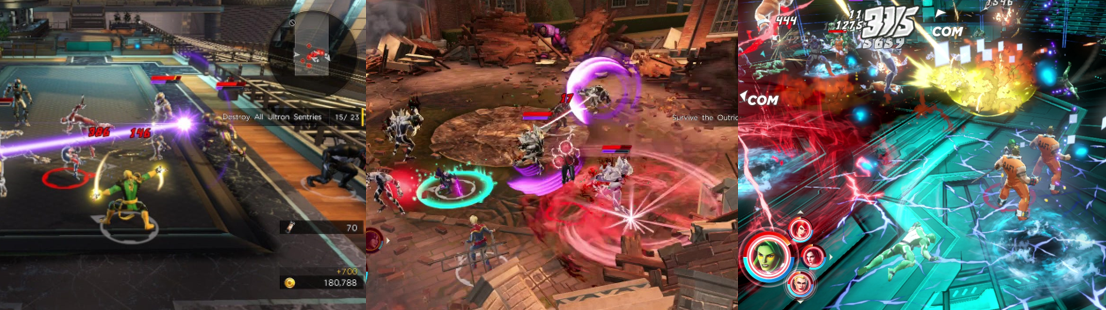
Combat is thick, fast, chaotic, and constant thanks to loads of enemies and character abilities.

As in the last two games, each character has specific abilities tied to their superpowers or superhero traits. You activate these by holding the Right trigger and selecting an icon using the D-pad; using Abilities drains your EP, however, and each Ability comes with a different cost. However, these attacks allow you to stun, stagger or deal elemental damage to enemies using Peter Parker/Spider-Man’s webs, Thor Odinson’s lightning, and Doctor Robert Bruce Banner/The Hulk’s incredible strength. Many characters have projectile attacks in their arsenal, such as Wade Wilson/Deadpool firing guns and Scott “Slim” Summers/Cyclops blasting his eye beams, while others cause splash damage or specific buffs, like Piotr Rasputin/Colossus being able to reflect projectiles and Wanda Maximoff/The Scarlet Witch healing her allies. Some, like James “Logan” Howlett/Wolverine, have passive abilities that allow them to automatically regenerate health as they walk around; others, like Johnny Blaze/Ghost Rider and Ororo Munroe/Storm, specifically deal in elemental damage. Character’s Abilities can also be mixed and matched by holding ZR and pressing one of the face buttons (or pressing A when prompted); this sees two characters attack in a combo for additional damage. As you dish out and take damage, you’ll also build the Extreme (EX) Gauge). Once full, you can press L and R up to three times to have two to four of your teammates perform a devastating combination attack that’s great against bosses. While the various cannon fodder you fight are easily dispatched, larger commanders and bosses need their “stun” meter drained before you can really put a beating on them and others (and certain treasure chests) require specific combination attacks to breach their shields. Defeating enemies sees your characters gain experience points (XP) to level-up, increasing their statistics (attack, defence, etc), though you can also use the various Orbs you find to manually level-up. Each character’s special Abilities can also be further enhanced using Ability Orbs and credits, reducing the EP cost and increasing their damage, among other benefits. You can also earn “Team Bonuses” depending on your team selection: pick a group of X-Men, for example, and your strength or resistance stat will increase, while picking characters of royalty ups your maximum energy stat.
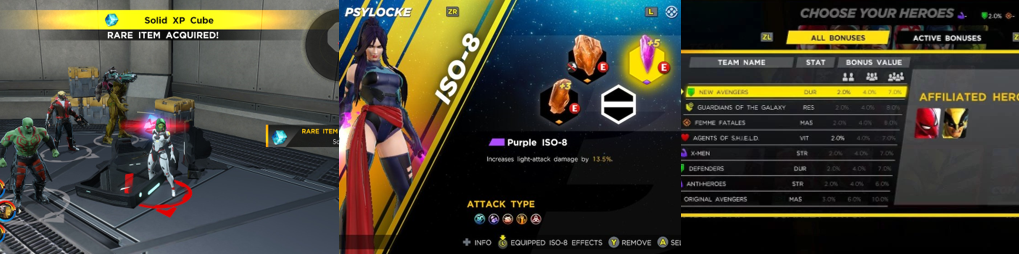
Search for chests to gain currency and other expendables to upgrade and buff your alliance.

Although you can’t equip gear to your characters, the boss battle against the Destroyer armour sees you temporarily empowered by Asgardian magic and you can eventually equip your team with “ISO-8” crystals, coloured stones that enhance their attack power, resistance to elements, or critical hit ratio, among others. You can further upgrade these with credits and ISO-8 capsules, though some of the rarer ones will also debuff you (for example, your attack my increase but your defence will decrease accordingly). You’ll also inevitably gain access to the Strategic Hazard Intervention Espionage Logistics Directorate (S.H.I.E.L.D.) Lab, which acts as the game’s skill tree. By spending credits and Enhancement Points (EP), you can further increase your team’s overall attack, defence, resistance, vitality, and such and even unlock additional ISO-8 slots (with more being earned by levelling-up). You can also enter the S.H.I.E.L.D. Depot from the main menu to purchase additional costumes and social icons by spending S.H.I.E.L.D. Tokens. Marvel: Ultimate Alliance 3 is pretty forgiving (on the “Friendly” difficulty, at least), with multiple checkpoints in each area. When you activate a S.H.I.E.L.D. checkpoint, your team is fully healed, and you can swap or enhance them if you wish. If a teammate is defeated, you can hold A to revive them, but I wouldn’t recommend it unless you absolutely have to. Not only are revives limited, but downed characters will eventually return to full health even before you reach a checkpoint so it’s not worth risking another character taking damage by healing a partner. Exploration generally leads you to treasure chests or special walls that require a special combination attack to open, or to a “Rift” challenge that takes you away from the main game to tackle a special challenge (usually a boss rematch or enemy gauntlet) for extra rewards. Your path is incredibly linear most of the time, hence why there’s no map, and the game’s primary focus is on chaotic combat and visually manic team-based attacks. Unlike in the last two games, you can no longer grapple or throw enemies (though you can still send them flying off certain platforms) and there are no character-specific team-up moves, meaning the action can quickly get quite tiresome.
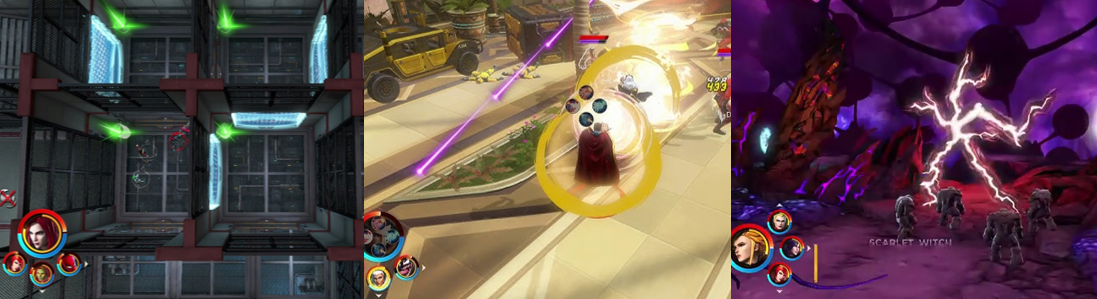
Sadly, puzzles are practically non-existent, with only Rifts offering additional challenges.

Because of its focus on hectic combat, there’s even less room for puzzles than there is for exploration in Marvel: Ultimate Alliance 3. Puzzles boil down to activating a console to open a door or making a platform move and that’s it. Sometimes, you’ll hold A to move a block and avoid lasers or cannons, but mostly you’ll be timing jumps between said lasers to progress and simply hurling missiles at those cannons. Sometimes, you’ll rotate statues or press switches to progress; others, you’ll be avoiding toxic ooze in Hel or solving door puzzles at the Raft or in Avengers Tower. After hopping across the rooftops of New York City, you’ll infiltrate the heavily fortified fortress of the Hand, dealing with ninjas that drop from the sky and hidden arrow hazards. When in Wakanda, Advanced Idea Mechanics (A.I.M.) corrupt T’Challa/The Black Panther’s defences, leading to an exasperating section where you must avoid snipers and being roasted by a giant panther statue’s energy blast. When transported to the Dark Dimension, you must use portals to reach new areas and defeat waves of demonic enemies to lower magical barriers and progress. Some attacks also screw up your controls or temporarily freeze you; some enemies are best defeated by tossing explosives at them; and many missions have an additional character fighting alongside you who’s often unlocked afterwards. However, a lot of the additional features of the previous games are missing; you can talk to other characters, but there are no dialogue options or character-specific interactions. There are no trivia quizzes, no optional side missions beyond the Rifts, and no character specific challenges to unlock extra stuff for each character. There aren’t even hub areas, in the traditional sense, with characters just appearing around S.H.I.E.L.D. checkpoints at times, though you can destroy a fair bit of the environment, and some encounters have you fleeing towards the camera as bosses chase you or present you with unwinnable battles.

Presentation:
Whereas the last two games primarily based their aesthetics on the comics books, especially the Ultimate comic line, Marvel: Ultimate Alliance 3 adheres very closely to the Marvel Cinematic Universe (MCU), especially in the visuals of its locations. I was hard pressed, for example, to tell the difference between Asgard here and the Asgard to the MCU, with both the golden city and the rainbow bridge, the Bifrost, appearing almost exactly as they’re depicted in the films. The same is true for Wakanda, the Dark Dimension, and Knowhere, all of which are virtually indistinguishable from how they appear in the MCU. There are some differences, of course: Taneleer Tivan/The Collector’s museum, for example, uses coloured cube cages and Wakanda leans much more into traditional architecture than the pseudo-futuristic science of the films (likely because Black Panther (Coogler, 2018) released a year before this game was made). Xavier’s School for the Gifted is lifted almost exactly from the 20th Century Fox X-Men movies (Various, 2000 to 2020), however, including a hedge maze, 1:1 Cerebro room, and basketball court that doubles as a landing pad for the Blackbird. While the Dark Dimension and the cosmic mind trip that is Sanctuary also heavily borrow from the bizarre cosmic imagery of the MCU, the Raft and Avengers Tower are much more akin to their comic book counterparts, though they’re comparatively bland locations, lacking fun areas like the Danger Room or Wakanda’s Necropolis (though you do pass through Anthony “Tony” Stark/Iron Man’s Hall of Armours in the tower). Although you only make a brief stop in Attilan to try and get help from the Inhumans, the architecture is far more visually interesting than that awful television show, seemingly being comprised of Celestial technology, and I enjoyed the ominous gothic presentation of Hel, with its restless Viking warriors and damaging sludge. Unfortunately, Marvel: Ultimate Alliance 3 continues the trend of having disappointingly bland and forgettable music, opting for generic themes for each location, event, and character that are lost amidst the constant fighting.
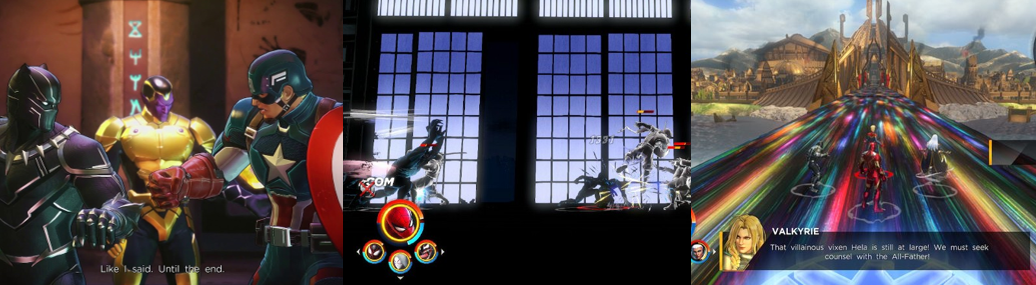
A visually impressive brawler that takes obvious inspiration from the MCU films.

The game also opts for an almost cel-shaded, action figure-like aesthetic for its colourful cast of characters. While many again both look and sound like their MCU counterparts, there are some exceptions: Peter Quill/Star-Lord, for example, looks nothing like Chris Pratt and the X-Men are far closer to the comic books than Fox’s films. Despite you assembling a custom team of heroes, cutscenes depict either everyone or characters specific to the location you’re in (the corrupted Doctor Stephen Strange in the Dark Dimension, for example) as they’re better suited to advance the plot against the local baddies. With the game shifting to a more third-person perspective, you’re closer than ever to the action and can see more of the environment than in the previous games. However, this comes with some drawbacks: mainly, there are far less opportunities or incentives to explore. Second, environments are painfully linear, with dead ends or locked doors barring your progress. Third, and most frustrating, is the camera, which easily loses track of your opponent/s and often lumbers you with wireframe representations when the foreground blocks the view. Thankfully, you won’t be falling down pits and rarely have to worry about onscreen hazards, but it can be aggravating trying to figure out which platforms and crates can be jumped on and which can’t. Marvel: Ultimate Alliance 3 offers a diverse cast of characters, each with their own idle poses and quips, though these do inevitably repeat. The game’s also surprisingly light on Easter Eggs: you’ll spot Deadpool singing away as he makes tacos in the X-Mansion, but not much else, and there are no optional missions or choices to encourage replaying missions. It’s a far cry from the first game, where there was always something to collect or an additional character to help out. Instead, it’s basically all combat, all the time in Marvel: Ultimate Alliance 3. Luckily, the game looks pretty good (everything’s very colourful and true to its inspirations) and performs really well, though there are some long load screens and it is annoying being forced to continue your game every time you challenge a Rift.

Enemies and Bosses:
All the usual suspects appear here as disposable cannon fodder for you to endlessly beat up, with many of the game’s goons sharing traits across the various locations. You’ll encounter Kree, Ultron Drones, agents of A.I.M., and Doombats who all pack various energy blasters. Ultron’s clones are the worst for this, relentlessly firing energy blasts and crashing through windows. The Raft’s unscrupulous prisoners attack in large groups, as do the restless Viking warriors who populate Hel, tossing axes from afar and luring you into toxic goop. Gargoyle-like Fire Demons also dwell here, offering a greater challenge with their swoop attack and fire breath, not unlike the monstrous Outriders and Mindless Ones who make up Thanos and the dread Dormammu’s forces, respectively. Alpha Primitives, Hydra goons, and towering Sentinels also appear, with the latter firing huge energy blasts from the palms and best attacked by throwing their explosive energy cores back at them. No matter where you are and what enemies you fight, more powerful commanders will also appear. Larger, tougher, and sporting a stun meter, these commanders should be your top priority as they’ll charge across the screen, cause shockwaves, and generally offer a far greater challenge even when you’re at a higher level. These minions often fight alongside their masters, generally so you can recover some health and EP to better damage the bosses, and will endlessly spawn in one of the additional modes unless you destroy their teleporters. Some of the game’s challenges or story-based missions charge you with defeating a certain number of enemies to progress. Other times, bosses appear in these waves, and you must occasionally flee or purposely lose some fights. This happens when Cain Marko/The Juggernaut comes tearing through the X-Mansion, for example, and in early encounters with the Black Order, who cannot be beaten or will chase you, raining lightning or other attacks from the sky and across the ground.
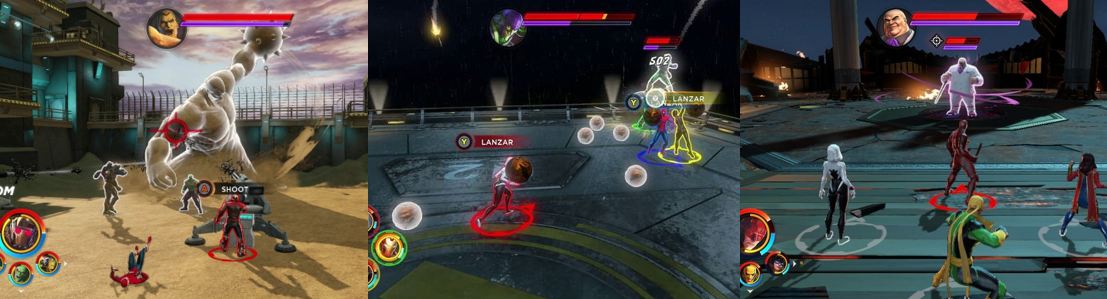
Few bosses require more than just hit-and-run tactics, even when augmented by an Infinity Stone.

There are loads of bosses to fight in Marvel: Ultimate Alliance 3, with some returning from the previous games, some teaming up, some having a couple of phases, and all boiling down to whittling down their stun bar, unleashing an EX attack and/or your most powerful Abilities, and avoiding damage until you can repeat this. The first ones you’ll face are Nebula and Ronan the Accuser, who often appear as a duo in optional challenges. Nebula is faster and more nimble, wielding blades where Ronan uses a massive warhammer. Both set a standard all bosses follow, which is that they’ll use either a jumping slam or an explosion of energy (or both) to send you flying. While quelling the riot in the Raft, you’ll encounter a version of the Sinister Six, with some unique variations to each battle. Flint Marko/The Sandman, for example, flings waves of sand and erupts his big sand fist from the ground as a large sand creature. You must use A to mount the nearby cannons and unload on him to chip away at his stun meter. Maxwell “Max” Dillon fights alongside Eddie Brock/Venom, raining lighting and electrocuting you with bursts of electricity, before he’s eaten by Venom and starts busting out electrically-enhanced symbiote powers. Venom joins the team after this fight and is tested against Quentin Beck, who first brainwashes Mile Morales/Spider-Man, Gwen Stacy/Spider-Woman, and Kamala Khan/Ms. Marvel to fight you and then unleashes a poisonous mist, teleports about, and confuses you with duplicates, Doctor Otto Octavious/Dr. Octopus is fought in a two-stage fight where you must first avoid his tentacles and scurry charge and then attack each arm to stun him. Finally, you’ll battle Norman Osborn/The Green Goblin for the Time Stone. The Green Goblin swoops overhead and lingers slightly out of reach, peppering the arena with his pumpkin bombs, charging at you, and freezing time to bombard you. He’s noticeably weak to his pumpkin bombs, however, so try and toss them at him before they explode in your face! After battling into the Hand’s fortress, you must first free Elektra Natchios from the Hand’s influence and then face Lester/Bullseye and Wilson Fisk/The Kingpin in separate fights. You must take out the ninjas feeding Elektra power, avoid Bulleye’s spread of razor sharp and explosive cards, and dodge the furniture and massive energy beam thrown by the Power Stone-enhanced Kingpin. The Kingpin also charges like a rhino, leaps at you to cause shockwaves, and even rips up stone columns to use as melee weapons!
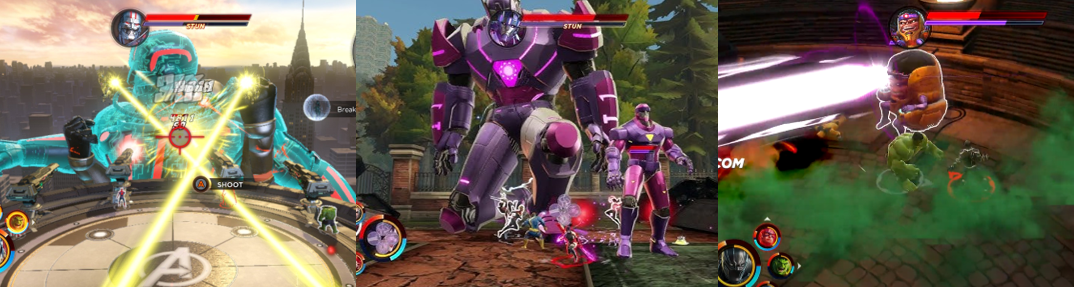
Gigantic bosses and the quirkier villains help mix-up the otherwise tedious combat.

Avengers Tower is then attacked by Ultron and his drones, who assist him in battle. Not that he needs it as the Mind Stone allows Ultron to mess up your controls, to say nothing of his signature face and palm beams. Ultron then grows to gigantic proportions, sweeping the area with his eyebeams before Clint Barton/Hawkeye intervenes and Ultron merges with Ultimo. This is the first giant boss battle in the game and sees you blasting Ultimo with cannons and avoiding his massive swipes. The Infinity Sentinel is comparatively smaller, but no less dangerous thanks to its own face beam and missiles. Though you can damage it with Sentinel cores, it’s finished in a cutscene by Erik “Magnus” Lehnsherr/Magneto, who then tosses debris and throws you off balance with magnetic pulses while Juggernaut pummels you and Raven Darkholme/Mystique tosses daggers. After surviving Mystique’s Danger Room trials, you face Magneto, now even tougher thanks to the Power Stone, before being chased away and banished to the Dark Dimension by the Black Order. There, you battle past Loki Laufeyson (who boasts elemental attacks and duplication tricks) to eventually face the dread Dormammu, who wields the Reality Stone and is the second giant boss. You must subdue his minions and avoid his flame bursts, whittling down his magical barrier either directly or be destroying three nearby orbs, all while dodging his giant fists and ground spikes. The brief fight with Maximus Boltagon is far easier, even though the mad Inhuman carries a massive energy cannon and you must take cover in Thane’s energy bubble to avoid Maximus’s barrage of lasers. Ulysses Klaue/Klaw awaits in Wakanda and his sound-based energy blasts and waves must be overcome to rescue and recruit James Buchanan “Bucky” Barnes/The Winter Soldier. You then fight past A.I.M. to confront their master, George Tarleton/Mental Organism Designed Only for Killing (MODOK), who uses the Soul Stone to turn the Dora Milaje against you and attacks with a slew of appendages, from buzzsaw arms, poison gas, failing tentacles, and his signature forehead blast.
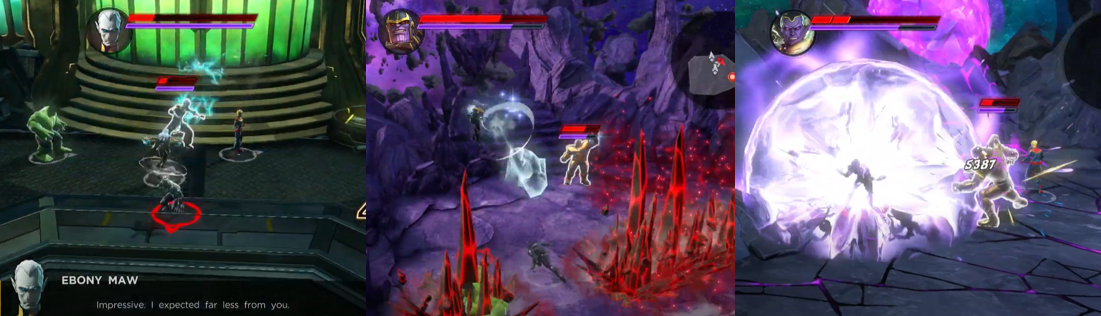
Battles with the empowered Black Order, Thanos, and Thane offer some of the most enjoyable challenges.

Though your goal in Hel is to confront Hela, you’ll actually battle the fire demon, Surtur, in another giant boss battle. This was a bit of a difficulty spike for me as Surtur’s flaming sword has a long reach and he causes the ground to erupt in flames, to say nothing of stun locking you with repeat sword strikes! Best him and Hela sets Johann Schmidt/The Red Skull on you, with the Nazi madman firing a powerful revolver and sapping your health with his “Dust of Death”. Hela gives the Red Skull a boost, protecting him with a shield and allowing him to fire a Bifrost-like laser, before placing his consciousness into the Destroyer armour. Though bolstered by Hydra forces and boasting a sweeping face beam, you can get a power-up from glowing crystals to overcome this destructive force. Finally, you venture to Knowhere and must run the Black Order gauntlet to retrieve the Infinity Stones, with checkpoints between each fight. Ebony Maw is first, firing a spread of projectiles and rocks and using the Soul Stone to create portals to trip you up. Supergiant tosses dark spheres and a golden homing shot that messes up your controls, though you can toss explosive cores from her minions to deal big damage. Cull Obsidian infuses his battleaxe with the Power Stone, sending out waves of purple energy and massive purple shockwaves, though he’s far slower and also susceptible to the nearby bombs. Corvus Glaive is much faster, landing multiple hits with his lance and using the Reality Stone to spring spikes form the ground and conjure duplicates who fill the arena with energy waves that can stun lock you. Finally, Proxima Midnight takes her fellow’s teleportation trick to the next level with the Space Stone and fills the arena with lightning bolts and strikes. All these powers are then recycled when you face Thanos, who gathers the six Infinity Stones into the Infinity Gauntlet to rain meteors, teleport, mess up your controls, freeze time, and fire his signature eyebeams. Thanos then joins you to battle Thane, who usurps him and boasts similar powers, though also upgraded by the Infinity Armour. Thane exhibits superhuman speed, traps you in a cube, fills the arena with portals and flames, and explodes in fury, though both battles were fun challenges rather than impossible tasks.

Additional Features:
Unlike in the previous two games, you won’t be finding data logs, action figures, or meeting certain requirements to unlock new attacks or costumes. You just fight over and over, earning whatever you need to unlock, buy, or upgrade whatever you wish and finding some concept art in treasure chests. A far harder (but more rewarding) “Superior” difficulty unlocks upon clearing the game alongside an additional “Nightmare” mode, accessible via the “Curse of the Vampire” campaign. You also unlock Thanos and can freely replay any mission on any difficulty (though you must start a new save to play on “Superior”) to grind and enhance your characters and ISO-8. Dimensional Rifts transport you to special challenges (not unlike the S.H.I.E.L.D. Simulator discs from the first game) that are often rematches with bosses or gauntlet challenges, though far tougher and gifting better rewards if you succeed. There are also three additional modes; however, though you can play a taster of each, you must purchase the expansion pass to fully unlock them. “Curse of the Vampire” adds vampiric enemies to the main story in “Nightmare” mode and offers a “Gauntlet” mode where you battle waves of enemies and bosses against both a time limit and a range of debuffs (including limited health restoration and draining EP). You can also tackle an “Endless” mode that’s pretty self-explanatory, and unlock additional characters like Frank Castle/The Punisher and Eric Brooks/Bladeif you buy the DLC. “Rise of the Phoenix” sees you form a four-person team and go head-to-head with a friend or the computer in three-round Danger Room scenarios. These see you tackling bosses again or wiping out hordes of enemies, awarding additional buffs and effects if you meet certain criteria (such as using any Ability or Synergy attack four times). You can only tackle the first challenge without the DLC, so I didn’t get very far, but this could be a fun distraction for those looking to test their skills against a friend. “Shadow of Doom” adds an epilogue story campaign that sees you return to Wakanda to oppose Doctor Victor Von Doom’s invasion. Dr. Doom’s Doombots endlessly spawn unless you destroy their teleporters, and you even battle the arrogant dictator in the recycled Necropolis, with him teleporting, firing lasers form his palms, and having his health restored by his Doombots. You’ll add Marvel’s First Family to your roster (alongside an alternative Thanos and other characters) by buying the expansion pass and battle Annihilus, a gigantic Celestial, and even “God Emperor” Doom!
The Summary:
I quite enjoyed the first two Ultimate Alliance games. They were mindless and largely repetitive, but I liked the large cast of characters and all the different references and locations from the comic books. Still, I put off Marvel: Ultimate Alliance 3: The Black Order for some time, mainly because I was annoyed by it being a Nintendo Switch exclusive; however it turned out to be a decent enough brawler. Despite the different development team, a few tweaks, and an apparent disconnection from the previous games, Marvel: Ultimate Alliance 3 offers a lot of the same gameplay and enjoyment as its predecessors, which is great for long-time fans of the franchise. Unfortunately, it doesn’t improve on these elements in a meaningful way and actually removes some content that I found enjoyable from the last two. There are no optional missions, for example, no alternative endings, no choices, and no character-specific challenges beyond fighting and levelling-up. I found this made the tedious combat even more aggravating after a while as I wasn’t being rewarded with gear or costumes or anything other than stat boosts. Even the skill tree was limited since you must grind to acquire enough credits and expendables to enhance your team, and I found the ISO-8 mode to be more confusing than engaging. The game also does little to improve the boss battles. Very few were very innovative or required more of you than to strike fast, avoid shockwaves and projectiles, and unleash your Extreme attack. The giant bosses were more of a challenge and I liked the final fight against Thanos and Thane, but I was hoping for a bit more complexity, especially given the possibilities offered by the Infinity Stones. There is a fun selection of characters, but they don’t offer much more than what we saw in the last two games and actually offer less as there are no character-specific team-up moves. While I enjoyed the visual influence from the MCU and the variety, I feel like Marvel: Ultimate Alliance 3 played things a little too safe by relying so heavily on combat and not mixing up the gameplay with a few other puzzles and challenges. Overall, it’s a good enough game and a worthy entry in the series, but it’s a shame that the developers didn’t try to be a bit more innovative and offer some more incentive to keep slogging away in endless fights.

My Rating:

Rating: 3 out of 5.

Pretty Good

Did you enjoy Marvel: Ultimate Alliance 3: The Black Order? How do you think it holds up against the previous two games? Which characters did you choose for your team? Were you disappointed that the combat was so similar to the last two games and the bosses so repetitive? Did you ever conquer all the Rift challenges? What did you think to the MCU influences and the final battle with Thanos and Thane? Did you ever play through the DLC? Would you like to see another Ultimate Alliance game? Whatever your thoughts, leave a comment below, support me on Ko-Fi, and go check out my other superhero content across the site.

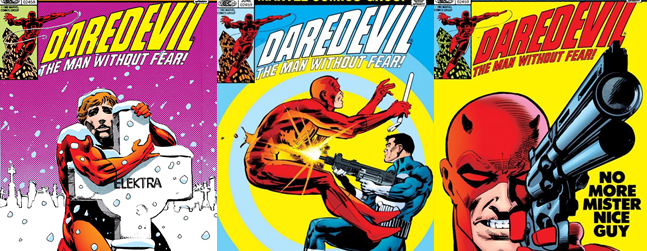
Back Issues [Dare-DAY-vil]: Daredevil #182-184


Blind lawyer Matt Murdock debuted in Daredevil #1 in April 1964 and was co-created by writer/editor Stan Lee and artist Bill Everett, with input from the legendary Jack Kirby. While perhaps not as mainstream as characters like Peter Parker/Spider-Man, Daredevil has become one of Marvel Comics’ greatest creations and has starred in a questionably-received 2003 big-screen adaptation and a critically-successful Netflix series.


Writers: Frank Miller and Roger McKenzie Artist: Frank Miller

Story Title: “She’s Alive”
Published: 26 January 1982 (cover-dated: May 1982)

Story Title: “Child’s Play”
Published: 23 February 1982 (cover-dated: June 1982)

Story Title: “Good Guys Wear Red!”
Published: 23 March 1982 (cover-dated: July 1982)

The Background:
The 1960s were a golden age for Marvel Comics, when Stan Lee teamed with the likes of Steve Ditko and Jack Kirby to create some of their most recognisable superheroes. On 1 April 1964, Stan Lee and artist Bill Everett introduced their most challenging hero yet, Matt Murdock/Daredevil, who became a popular and enduring character thank to the efforts of writer/artist Frank Miller, who spearheaded some of Daredevil’s most memorable stories. It was during Miller’s run that Daredevil first crossed paths with Frank Castle/The Punisher, a Vietnam veteran-turned-mercenary vigilante who first appeared in Amazing Fantasy #15. Inspired by The Executioner (Pendleton, et al, 1969 to present), designed by Gerry Conway, and named by Stan Lee, the Punisher was a natural foil for the more righteous and law abiding Daredevil. The two have clashed, begrudgingly teamed up, and debated their different philosophies numerous times in the years since they first met. Their memorable rivalry even made it to the silver screen when the two clashed on the streets and in the courtroom during Daredevil’s second season (Various, 2016).

The Review:
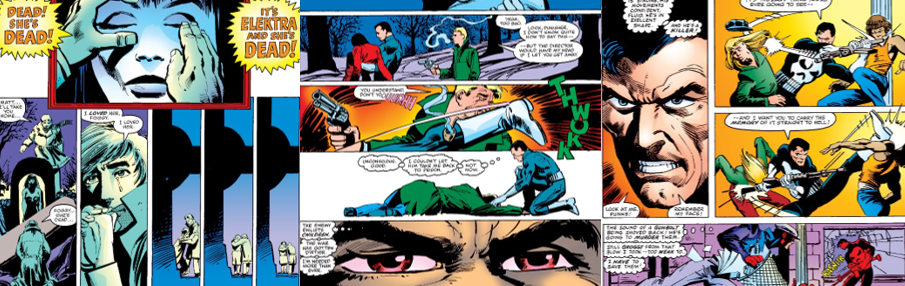
Our story begins with Matt Murdock still reeling from the recent murder of his lover, Elektra Natchios, at the hands of the sadistic mercenary, Lester/Bullseye. Despite having cradled Elektra in his arms, felt her last heartbeat, heard her death rattle, and attended her funeral, Matt awakens from a nightmare convinced that she’s somehow still alive. Overwhelmed by guilt at having not done more to steer Elektra away from the ninja organisation, the Hand, and the dark path that led to her becoming an assassin, and sure that those same ninjas taught her a way to fake her death, Matt pulls on his costume and heads out into the snow swept night to get some answers. This takes him to a “grimy underworld saloon”, where Daredevil kicks the shit out of the patrons, easily dodging their blows and bullets, and accosts one of them into revealing that Wilson Fisk/The Kingpin is holding a summit of the city’s top mobsters at midnight. Sure that the Kingpin must be trying to sell Elektra’s services, Daredevil returns to his civilian identity and has his secretary, Rebecca “Becky” Blake, go through the coroner’s report on Elektra’s body. Despite the evidence stating quite clearly that Elektra suffered mortal wounds, Matt’s convinced that the body could’ve been swapped and is so blinded by his obsession with proving that his former lover is still alive that he gives his current love interest, Heather Glenn, the cold shoulder. Indeed, it’s only when his best friend and law partner, Franklin “Foggy” Nelson, chews him out that Matt begins to question his state of mind. Across the city, in Ryker’s Island penitentiary, Frank Castle is locked up alongside the city’s scumbags. When the Punisher puts Joe Carson/Injun Joe in the infirmary, a few of his boys accost him in the showers and, despite being outnumbered by the armed assailants, the Punisher easily overpowers and kills the three. Though indifferent to his actions, the Punisher is intrigued when an emissary of the “agency” offers to get him out of prison so he can covertly intercept a shipment of narcotics, and promptly escapes via helicopter.

Matt’s obsession over Elektra’s death is compounded when the Punisher goes on a killing spree.

Thus, the Punisher heads to Long Island and lays in wait for the shipment. Thanks to his trip wires, tear gas, and skill with a shotgun and assault rifle, the Punisher wipes out the goons, even gunning one down after he surrenders since “war [doesn’t] take prisoners”. However, the Punisher is distraught to learn his victim was merely a child; laying out the G-man, the Punisher vows to continue his war on crime, especially if evil is corrupting children. Daredevil easily dispatches the Kingpin’s goons and confronts the rotund crime boss regarding Elektra, confusing Fisk with his accusations and eventually leaving after the Kingpin calls his bluff, confirming that Matt hasn’t completely gone off the deep end just yet. Foggy’s concerns are only exacerbated when he’s awoken in the middle of the night to learn that Matt coerced a city judge into signing an exhumation order for Elektra’s body! By the time Foggy gets to the cemetery, Matt has already frantically, feverishly dug up Elektra’s grave, only to confirm with his very hands that his lover is, in fact, dead and causing him to break down in tears in his friend’s arms. Still reeling from this moment, Matt is horrified when a young schoolgirl suddenly freaks out in the middle of a Civics class he’s attending and, convinced that snakes are crawling over her skin, throws herself out the window! Switching to Daredevil, Matt races the girl’s broken body to the hospital, only for her to succumb to her injuries thanks to the “Angel Dust” in her system. Daredevil learns from the doctor that the girl is the latest in a long line of child victims of drugs, with phencyclidine being the most common and most dangerous as it causes many horrible side effects, including psychosis, and lingers in the system for years. Donning a simple disguise (over his costume, no less), Daredevil hits the streets to try and get a lead on Peter Grunter/Hogman, one of the lead pushers of the drug, only to be attacked by drugged-up kids. Although Daredevil pulls his punches, sympathetic to their plight, he’s stunned when the Punisher appears, murders one of them with a knife, and prepares to execute the others in cold blood.

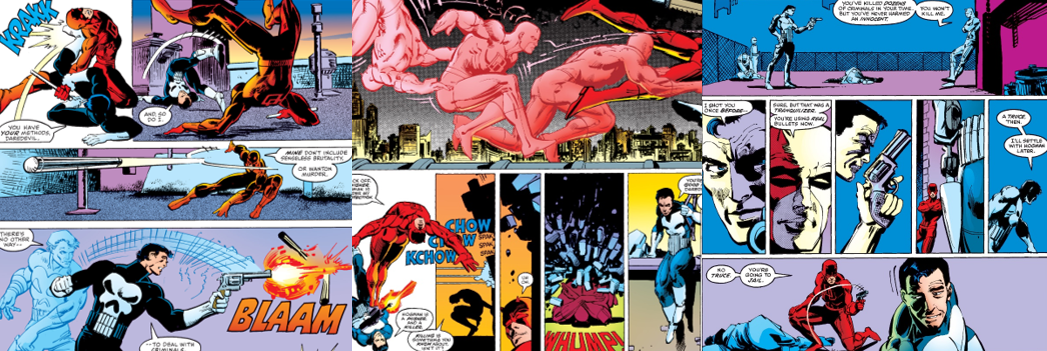
While working to prove a boy’s innocence, Daredevil clashes with the hard-nosed Punisher.

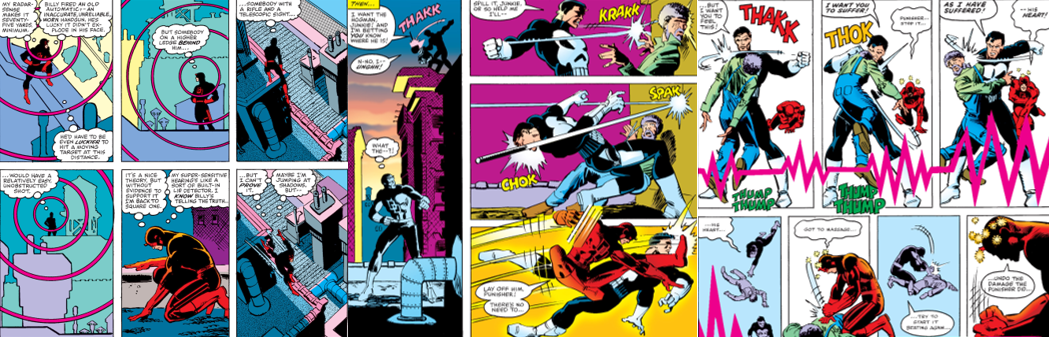
Although Daredevil keeps the Punisher from carrying out the kill, and the Punisher expresses respect for ol’ hornhead, the two are stunned when another shooter guns down one of Daredevil’s attackers. While the Punisher is indifferent, Daredevil is aghast to discover the shooter is William “Billy” O’Koren, the brother of the girl who was driven to suicide. Matt pledges to represent Billy in court, sure that he’s innocent, a hunch he all-but confirms when he returns to the crime scene. The Punisher also suspects that a more competent sniper made the shot, despite a lack of tangible evidence. Daredevil gets some intel on the Punisher from Ben Urich (who’s aware of Matt’s dual identity), who warns him against going toe-to-toe with the Punisher since he’s a well-trained, cold-blooded killer. As luck (or fate) would have it, the Punisher just so happens to be beating up a junkie on a nearby rooftop, so Daredevil intervenes, disgusted by Castle’s brutal methods, which the Punisher defends as the only way to permanently deal with criminals. While Daredevil’s quick to fight, the Punisher suggests they team up to eliminate their common enemy and, when Daredevil adamantly refuses, he spares his foe a quick death by shooting Daredevil with a tranquilizer dart. Severely weakened from the shot, Daredevil’s powerless to stop the Punisher beating his victim so badly that he suffers a heart attack. Luckily, Daredevil’s quick bout of CPR sees the junkie cling to life and point him towards a restaurant, where Daredevil finds the elusive Hogman. When Hogman’s cohorts refuse to back him up, the drug peddler is apprehended by Daredevil and the Punisher’s victim recovers to testify in court, absolving Billy of any wrongdoing, though Matt’s stunned when his super senses reveal that Hogman is also innocent of murdering his partner.

A mistake by Daredevil sees him and the Punisher battling for a boy’s soul.

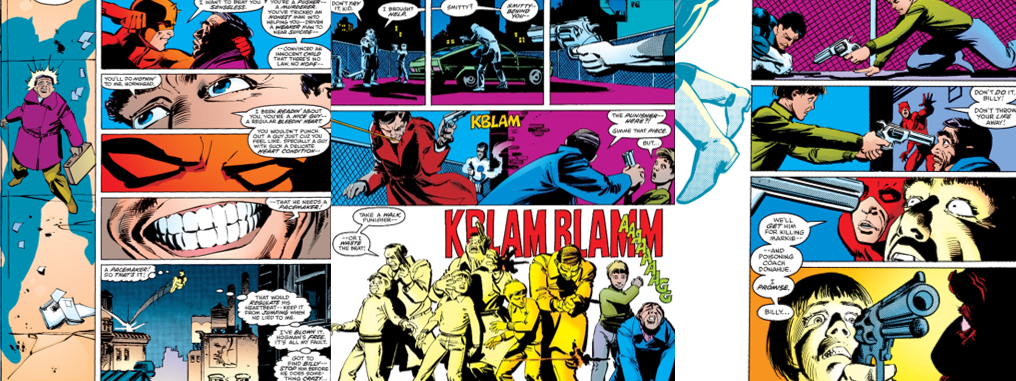
After winning Heather back with a marriage proposal, Matt volunteers to represent Hogman and prove his innocence. Sure that Matt can absolve him of the crime, the arrogant Hogman stuffs his face with pasta, unaware that the stoic Punisher has taken up a sniping position on a rooftop across the street. Luckily, Daredevil is on hand to keep his client safe but, when the Punisher’s shot buries him under a pile of bricks, Daredevil again fails to apprehend the murderous vigilante. Although Matt claims to have evidence to prove that Hogman is being used as a convenient patsy by the true culprit, Billy’s coach, Patrick Donahue, he doesn’t get solid confirmation until Donahue calls him to discuss the whole operation in private. The call costs Matt dearly as he ends up giving Heather the brush off and it leads to Matt being attacked by the rabid Donahue, who’s been driven to a crazed frenzy by his own drugs! Despite the coach’s augmented strength, Matt uses his agility to put him in a choke hold and subdue him, theorising that a third party juiced Donahue up. In court, Matt successfully absolves Hogman of his crime, only to learn afterwards that the scumbag is not only guilty, but gleefully causes his returning customers to overdose to amuse himself. When Daredevil confronts Hogman, threatening to beat him to a pulp, Matt realises he’s been played for a fool as Hogman’s pacemaker screwed up his radar sense. When Billy decides to take the law into his own hands, Daredevil races to intervene, only for the Punisher to show up and subdue Hogman with some well-placed shots. Daredevil stops him from delivering the killing shot and calls the Punisher’s bluff, fully aware that he’s purposely missing and would never knowing kill an innocent person. Although the Punisher again offers a truce, he’s stunned when Daredevil subdues him with a gunshot, leaving Matt free to appeal to Billy’s better nature. His pleas get through and Billy testifies against Hogman, leaving the drug baron facing serious jail time and Matt emphasising the importance of following the law to the impressionable pre-teen.

The Summary:
I’ve talked about this before, but I’m really not a big fan of Frank Miller’s art. He’s nowhere near as bad here as he is in his efforts for DC Comics and his independent publications, but he really does draw some of the ugliest faces I’ve ever seen. His use of shadows and lighting are extraordinary, however, and he draws a very dynamic and intimidating Daredevil, something bolstered by the start darkness of night. In Miller’s hands, New York City and Hell’s Kitchen are a dark, ominous place that feels very dangerous. Violence stalks the streets, but this is taken to the next level here as Hogman sells drugs to kids, using Coach Donahue as a gofer and selling to kids at a Catholic school. Happy to cause overdoses and kill anyone who tries to speak out against him, even if they’re his partners, Hogman thinks nothing of abusing the law system and little children to come out on top. He’s practically giddy when Matt clears him of murder, only to immediately reveal that he’s “guilty as sin”, and Matt’s left humiliated since he was convinced of the villain’s innocence thanks to Hogman’s pacemaker. Matt’s a bit all over the place in these issues, reeling from Elektra’s murder and as desperate to prove that she’s alive as he is to defend Billy and keep the neighbourhood kids free from drugs. Grief hits Matt like a brick wall, causing him to descend into denial and desperation, only to be mocked by the likes of the Kingpin, push away those closest to him, and ultimately go to extreme lengths to prove his theory…only to find that Elektra is well and truly dead. This revelation seemingly snaps Matt from his malady as he’s back to normal in the very next issue and doesn’t mention Elektra again, instead turning his focus towards Hogman, the kids he abuses, and the Punisher.

Sadly, Daredevil and the Punisher don’t clash enough, physically or ideologically, for my tastes.

The Punisher pretty much steals the show here. Still portrayed as a ruthless vigilante killer, he’s largely indifferent to the world around him, as though sleepwalking through life and unconcerned about the machinations of those who would seek to release him onto the streets. Castle couldn’t care less about the scumbags he kills and only shows a shred of remorse when he’s forced to gun down a kid. Even then, rather than dwell on how his actions have cost a misguided youth their life, the Punisher refocuses his energy on taking out those responsible for putting the boy in that position in the first place. Interestingly, the Punisher has no desire to fight Daredevil; indeed, he not only purposely misses his shots but shows a great deal of respect for ol’ hornhead. The Punisher repeatedly offers to form a partnership with Daredevil, believing they’re kindred spirits who fight for the same thing against a common enemy, only to be rebuffed each time. While the Punisher is respectful towards Daredevil, Matt attacks Castle without hesitation, disgusted by his disregard for the law and the lives of his victims. It’s an interesting dichotomy since Matt, as a vigilante, is breaking the laws he so diligently serves in his civilian guise so it’s a touch hypocritical for him to lecture the Punisher on his vigilante ways. Of course, the real difference between the two is that the Punisher kills his victims whereas daredevil just beats them up and has them arrested so they can stand trial, a system the Punisher openly mocks for being flawed and broken. While Daredevil valiantly fights to defend all lives and everyone’s rights, even those of scumbags like Hogman, the Punisher takes a more direct approach, putting the two at natural odds. Unfortunately, this isn’t explored that well here; their fights are very brief, their different ideologies barely touched upon, and much of the potential of their first meeting is secondary to the main plot concerning Hogman. Therefore, these issues are important for being the first meeting between these two characters but there are far better clashes between the two out there, such as Garth Ennis’s iconic story from the early 2000s.

My Rating:

Rating: 4 out of 5.

Great Stuff

What did you think to the first meeting of Daredevil and the Punisher? Do you agree that the story didn’t quite live up to its potential? What did you think to the differences between Daredevil and the Punisher, particularly in their methods? How impactful did you find the main plot concerning kids and drugs? What are some of your favourite Daredevil and Punisher moments and how are you celebrating the Man Without Fear this month? I’d love to know your thoughts so feel free to share them in the comments below, support me on Ko-Fi, and be sure to check out my other Daredevil and Punisher content.

Back Issues: The Punisher #1-5

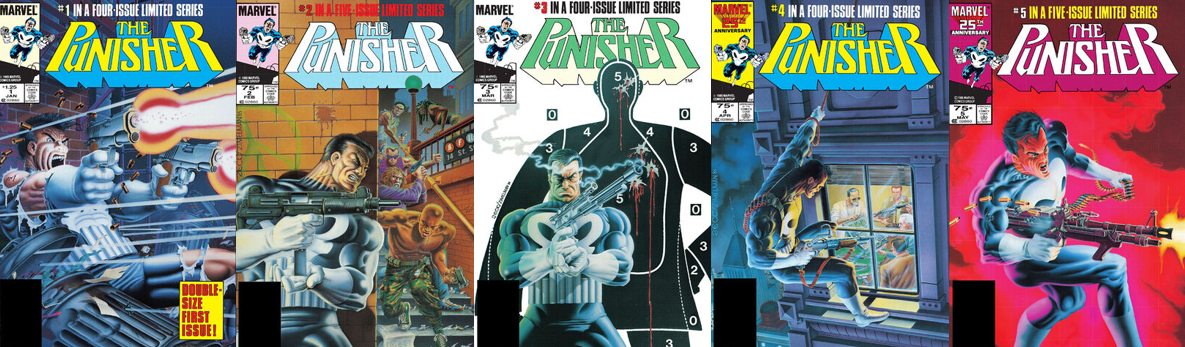
Writer: Steven Grant – Artist: Mike Zeck

Story Title: “Circle of Blood”
Published: 8 October 1985 (cover-dated January 1986)

Story Title: “Back to the War”
Published: 5 November 1985 (cover-dated February 1986)

Story Title: “Slaughterday”
Published: 10 December 1985 (cover-dated March 1986)

Story Title: “Final Solution: Part 1”
Published: 7 January 1986 (cover-dated April 1986)

Story Title: “Final Solution: Part 2”
Published: 11 February 1986 (cover-dated May 1986)

The Background:
By February 1974, Marvel Comic’s iconic teenage superhero, Peter Parker/Spider-Man, had become a mainstay of the publication following his 1962 debut in Amazing Fantasy #15. After earning his own ongoing book, The Amazing Spider-Man, the following year, he amassed quite the gallery of villains, such as Doctor Otto Octavius/Doctor Octopus, Flint Marko/The Sandman, and, of course, Norman Osborn/Green Goblin. In February 1974, Gerry Conway and Ross Andru introduced readers to the Jackal, a crazed scientist whose cloning technology eventually resulted in one of Spider-Man’s most infamous storylines, but who first employed the services of Vietnam veteran-turned-mercenary vigilante Frank Castle/The Punisher to target the web-slinger. Inspired by The Executioner (Pendleton, et al, 1969 to present), designed by Gerry Conway, and named by Marvel mastermind Stan Lee, the Punisher was such a hit that he graduated to this self-titled series. Naturally, given the Punisher’s propensity for killing his enemies, it was difficult for him to amass his own recurring antagonists but one of his most memorable foes is easily William “Billy” Russo/Jigsaw, a mutilated mobster created by Len Wein and Ross Andru who has returned time and again, defying death and fate, to torment the Punisher for nearly fifty years.

The Review:
As huge a fan of the Punisher I am I haven’t really read too much of his stuff. I like to pick up Marvel’s Platinum collections for their characters as they bring together a variety of iconic stories for their biggest names, and sadly the Punisher hasn’t yet received one of these so my experience with him is a little sporadic. Still, I love the simplicity and bleak grittiness of the hardened vigilante and find him to be an extremely compelling and layered character so I’m always glad to read his stories, especially his most influential ones. The Punisher’s first solo series begins with him locked up on Ryker’s Island, a gothic-style prison on a small isle adjacent to New York City. A conversation between warden Jerome Gerty and his aide, Tommy, gives the uninitiated a quick rundown on the Punisher’s backstory (you know the drill: Vietnam vet who turned to vigilantism after his family was killed in a mob attack) and reveals that he’s been locked up after a recent bout of drug-induced madness The warden appears to have big, potentially sinister, plans for the Punisher, whose reputation is so intimidating that all the inmates are scared stiff by his presence. All except for “The Mule”, Frank’s loud-mouthed, musclebound cellmate; unfortunately for the human ox, Frank isn’t impressed by his offer to protect him for a few favours and the Punisher quickly overpowers the Mule and forces him to do his bidding and feed him information. Considering his drug episode originated during a prior stay at Ryker’s, Frank puts the wind up Frisky Martin, one of the inmates who works in the prison cafeteria, and delights in the fear he’s causing amongst the populace. With Frisky suitably intimidated, Frank follows him to the source of the prison’s drug operation and is unsurprised to find Jigsaw peddling the wares from within the walls.

The Punisher infiltrates Ryker’s to get to the bottom of Jigsaw’s drug operation.

After making short work of Jigsaw’s goons, Frank walks into hostile territory, Block D, where the mutilated mobster living in luxury in his cell, only to find himself vastly outnumbered by the violent criminals awaiting there. Following a brutal beating, the Punisher is restrained and facing a broken glass bottle to the face as recompense for him destroying Jigsaw’s face, only for him to power his way out if it and crush Jigsaw’s hand, driving shards of glass into it. Although Jigsaw orders the guards to shoot Frank, the fracas is interrupted by Carlo Cervello, the prison’s resident mafia Don known as “The Brain” for always thinking one step ahead. Cervello reprimands Jigsaw and, to his surprise and outrage, welcomes Frank into his operation when the Punisher offers to join him in breaking out of Ryker’s. A few nights later, the plan begins and Cervello immediately double crosses the Punisher by sending his muscle, Gregario, to kill him using a homemade silencer. This cobbled together appliance is faulty, however, and the Punisher is able to outsmart “The Brain” using a simple mattress. As the escape turns into a full-blown riot, Frank lets the violence play out to whittle down the obstacles in his way before making a break for the control tower, wounding Gregario and scuppering the escape plan using the tower’s defensive measures. Cervello and Jigsaw make their way to the warden’s office where they take Gerty and Tommy hostage and demand the Punisher lays down his gun, only for it to literally backfire in Jigsaw’s face as he tried to shoot unsuitable bullets with it. When Cervello threatens to shoot Gerty, Frank calls his bluff with a cold-hearted stoicism that terrifies Cervello so much that he willingly returns to his cell.

With the Kingpin presumed dead, the Punisher incites a turf war that winds up the local mobsters.

Frank, however, tries to murder the mobster for the attempt on his life and then demands that Gerty escort him out of the prison. Although armed guards defuse the situation, Gerty vouches for the Punisher and reveals that he and Tommy work for a mysterious cartel known as “The Trust”, a well-oiled group who share Frank’s concerns regarding crime. Not only does Gerty offer to allow Frank to escape (though still a wanted man) and furnish him with his iconic skull outfit, he offers to bankroll his operation, asking only that the Punisher eradicate organised crime once he’s out. Despite his suspicions, Frank cannot say no to the opportunity to return to the war, unaware that would-be-doctor Tony Massera has been coerced by his mobster uncle, Charlie Siciliano, to take revenge on the Punisher for killing his father. Ignorant to this, the Punisher gets back to work with a bang, quite literally, by storming the office of the untouchable Kingpin of Crime himself, Wilson Fisk, only to find himself duped by a dummy and sent hurtling out of the seventy-storey building by an explosive trap. Although he slows his fall, the Punisher takes a bad landing and goes into shock, only to awaken in the lavish riverside home of the alluring Angela, who begs to assist the Punisher’s crusade, even offering her body, since organised crime left her family dead. In the aftermath, Frank ruminates on his age, the mistake that almost cost him his life, and his never-ending war; to help tip the odds in his favour, he calls Ben Urich of the Daily Bugle and reports that he assassinated the Kingpin in order to incite a mob war to fill the void, allowing him to easily take care of whoever’s left after the bloodshed. Accordingly, mobsters are offed all across the city and, desperate to avoid all-out war, Siciliano tries to broker peace amongst the disparate mobsters, completely unaware that the Punisher is listening to his every word from his kitted-out Battle Van.

Troubled by the collateral damage, the Punisher tries to stem the cycle of violence he started.

The heads of the city’s top crime families, and some of their lackeys, gather at Grand Central Station, of all places, that evening to hear Siciliano out, only to be set upon by Nolo Contendre, a hitman from Detroit. Although the Punisher is pleased by the ensuing anarchy, he wants to know who hired Contendre so he chases him down to the subway where a violent game of cat-and-mouse breaks out between the two. Frank takes a direct shot to the chest (though he’s saved by his heavy body armour) and is incensed when Contendre breaks the rules of his profession by opening fire upon civilians. Frank wounds Contendre with a knife, enraging him, and ends up decapitating the thug by kicking his head through a window, where it’s promptly taken off as the train pulls into Times Square Station. Seeing the fear in the eyes of the wounded passengers, Frank chastises his recklessness and vows to stop to the violence he has incited, only to be thrown off kilter when his van explodes before his eyes, which his Trust contact, Alaric, suggests is a sign that he needs to partner with the organisation on a more formal basis. Perhaps taking this to heart, the Punisher goes out of his way to protect mobster Tomas Santiago from an assassination attempt by rival gangster Simon Ejszaka all to set up another peace conference with Siciliano. In the interim, he opens up to Angela about the “circle of blood” that surrounds his life and she tries to convince him of the benefits of working with the Trust so he can have some support and back up, with the story revealing to the reader that the Trust not only blew up Frank’s van but also planted Angela to sway him to their cause. Ignorant to this, the Punisher spots Massera watching her building and confronts him, only for Massera to reveal he’s rooting for the Punisher since he can’t stand the violence surrounding his life, with the Punisher warning him to stay out of it or suffer the same fate as his father.

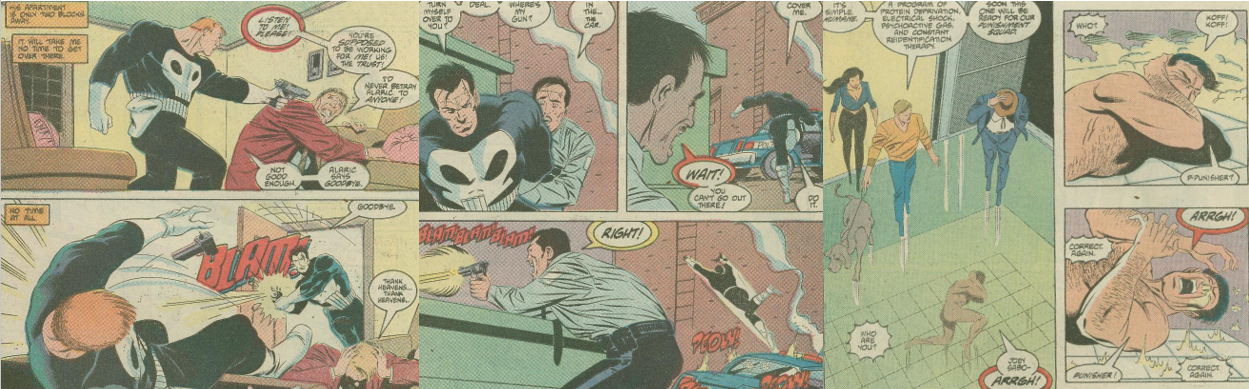
The Punisher is aghast to learn that Alaric has built an army of fake Punishers.

Frank pays a visit to Ejszaka and threatens him into going to Siciliano’s peace meeting and for information regarding Marcus Coriander; he then goes to visit Santiago, only for it to be revealed that Siciliano has been murdered by a fake Punisher! Although Frank puts down the faker, Santiago is killed and all the recent mob murders are revealed to have been perpetrated by Coriander and his gaggle of Punisher look-a-likes. Frank drops in on Coriander, who reveals that he formed this “Punishment Squad” to follow the Punisher’s example and disrupt the city’s criminal underworld before the Kingpin could return to power. After taking care of the fake Punishers (off-panel for maximum imagination), Frank is stunned when Coriander also opens fire on innocent civilians to cover his escape, gunning down a little girl in an experience that breaks the formally small-time crook. When the Punisher confronts him, Coriander exhibits signs of mental trauma but reveals that it was Aleric who was behind everything, right before Angela murders him and shoots the Punisher. He recovers pretty quickly, and without explanation, however (primarily because people refuse to shoot him in the head!) and returns to Ryker’s Island to talk with Gerty about the Trust, an organisation whose goals he can relate to but whose methods fly in the face of his strict moral code. There, he finds Tommy dead courtesy of another doppelgänger, whom he puts down a few blocks (and panels) later when he tracks down Gerty, threatening the warden with death unless he spills the beans on Alaric and the Trust. It turns out that Alaric has brainwashed criminals into his own personal death squad and the fear of Alaric’s reprisals, or being locked in his own prison, leads Gerty to shoot himself in the head before the Punisher’s grim-faced façade. The cops arrive at that exact moment; since the Punisher refuses to fight the police out of respect, he allows himself to be arrested, only for the Punishment Squad to arrive and try and kill them.

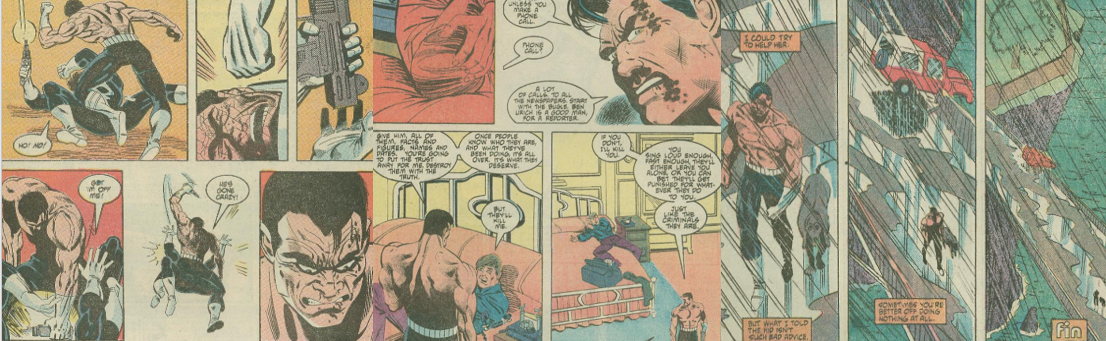
The Punisher callously makes short work of Jigsaw and Alaric and returns to his never-ending war.

One cop goes down but the Punisher convinces the other to uncuff him so he can kill his look-a-likes and coerce Siciliano into taking him to Alaric’s compound outside the city, where he forces his subjects to endure electroshock treatments and a special gas to condition them into thinking they’re the Punisher. Frank creates a distraction and makes his way into the compound, only to find that Jigsaw has also been brainwashed to be one of Alaric’s goons. A haymaker to the jaw is enough to undo Jigsaw’s conditioning and Frank easily hitches a ride to Alaric’s main building via a passing helicopter. Alaric begs his lover, Angela, to get to safety so he can hold off the Punisher without worrying about her and tries one last time to convince the Punisher to join his cause. When Frank stubbornly refuses, he falls into one of Alaric’s electroshock rooms and is subjected to the same brainwashing process so he can lead the Punishment Squad; thankfully, he’s able to withstand the pain of the electroshock floors, plug up his mouth, and make an explosive escape as he had all his equipment on him. His body wracked with pain and nursing several injuries, the Punisher is easy prey for Jigsaw, who delights in brutalising and taunting him, but spends too long gloating and Frank stabs him and beats him into submission. However, Frank inexplicably allows Jigsaw to live, but his actions scare off the Punishment Squad and clear the way for him to reach Alaric. Still, Alaric does a pretty good job of defending himself, surprising the Punisher and frantically beating him with the butt of his rifle, only to be sent into a desperate frenzy by the blood and violence. A stalemate of sorts occurs until Frank wounds Alaric and fends off his attack dog; again, rather than killing his enemy, the Punisher threatens him with death unless he blows the whistle on the Trust, which in itself will mean a death sentence for him when the mob come looking for revenge. Satisfied that Alaric will be punished one way or another, the Punisher leaves with his dog, only to be confronted by Siciliano; the Punisher’s able to talk him down, however, with a soliloquy about the cycle of violence and his part in it. As he leaves the compound, Angela tries to run him down and he callously leaves her to her fate after wrecking her car, heading off into the night to continue his never-ending war.

The Summary:
The first thing that strikes me about these five issues is the art work; fittingly, the Punisher’s solo series uses a far less exaggerated and comic book aesthetic (for the most part), depicting a much darker and grittier side to Marvel Comics that works perfectly with the Punisher’s more no-nonsense and violent attitude. Sure, Mike Zeck makes the Punisher a bit of a man mountain at times and Jigsaw’s face is a bubbling mess of scarred flesh but, for the most part, things are quite realistically done here. The Punisher suffers injuries, dislocating his shoulder, going into shock, and even fearing paralysis on a couple of occasions, which again speaks to his vulnerability as a character as opposed to his more virtuous and superhuman peers. He’s also far more introspective and stoic; his dialogue boxes are both “real time” narration and reflections from his war journal, which reinforces that he sees his mission as a war against all crime, and he’s not one for spouting quips or cliché puns at his victims. In fact, almost every word out of his mouth is a threat or some bleak meditation on the cycle of violence that is his life, and it goes a long way to added depth to his character and laying the foundation of what the Punisher is all about.

The Punisher is tormented by the cycle of death and violence that his life has become.

Indeed, there are many times when the Punisher laments the “circle of blood” that has surrounded his life. With nothing to lose, he’s fully committed to this cycle and he knows full well that it will end in his death and will even carry on after he died, meaning that his life’s mission is ultimately meaningless, and yet he is compelled, almost addicted, to killing criminals and saving as many lives as he can. His grim façade cracks only when there’s mention of his lost family or when he sees innocents being harmed; he’s enraged when Contendre and Alaric fire on civilians, suffering flashbacks to his family’s murder, and distraught by his part in the collateral damage, seeing himself as no different from those he’s sworn to punish. Since he’s just one man, the Punisher sets up a mob war to have the city’s mobsters to wipe each other out and make his job easier; a good plan that almost immediately goes sour. We see very little of this mob war beyond a few key gangsters being assassinated and a lot of dialogue talking about how things have escalated out of control with very little visual representation of this. Literally a few pages after he gets the ball rolling, the Punisher is beating himself up over the collateral damage as though he didn’t think anyone would get hurt in the crossfire, which is a bit ridiculous. I would’ve liked to see the gang war take place over an entire issue, with Frank coming to this realisation at the end or part-way through the next issue and then trying to stop what he started but, as presented, it’s quite rushed and nonsensical as he has to shut down his plan almost right away. Still, this was quite an intense story. I liked how each issue introduced a kind of rival for the Punisher, be it Contendre or one of the other head mobsters, and that his actions had consequences; Siciliano has a vendetta against him for killing his gangster father and, most prominently, Alaric brainwashed criminals into forming the Punishment Squad and perverted the Punisher’s skull logo specifically because he was inspired by Frank’s crusade.

Despite some weak villains, the story delves into the Punisher’s motivations and psychology.

Naturally, the Punisher guns down almost everyone who crosses his path without mercy or hesitation, meaning any kind of prolonged conflict between him and the likes of Contendre or his many look-a-likes is supplanted by a relatively quick kill from the Punisher. When his rivals put up more of a fight, the art really shines; it’s great seeing the Punisher walk into situations with no regard for his own safety and fight, beat, or gun down multiple armed assailants at once and I really enjoyed how many in the criminal underground fear him for his uncompromising mercilessness. Jigsaw is an exception to this rule; his hatred of the Punisher is so strong that it allows him to break free of Alaric’s brainwashing but his presence in the story is more of an extended cameo. It’s not entirely clear why the Punisher doesn’t kill him, either; he’s perfectly happy to kill everyone else but spares Jigsaw out of some half-assed sense of kinship given his own mental imbalance. This leaves Alaric as the story’s primary antagonist and he’s not really capable of matching Jigsaw’s visual or thematic appeal; I think the story might’ve benefitted from Jigsaw being behind the Punishment Squad and his motives being to further tarnish the Punisher’s reputation as Alaric is more of a pen pusher than a fighter. He’s reduced to a quivering wreck when he accidentally kills a little girl and before the Punisher’s fury and is only able to fight back because Frank is a bit weakened, making for a lacklustre villain. Overall, though, it’s an enjoyable Punisher story that explores his motivations and offers some introspection into his mission. There’s a sense of duty, obligation, and self-loathing to the Punisher, whose callous and grim demeanour make him stand out from other Marvel heroes and villains. He’s so committed to his cause that he’ll try and kill the Kingpin the first chance he gets and that disregard for his own wellbeing is wonderfully conveyed here. It’s not perfect but, for fledgling or casual Punisher fans, this miniseries is the perfect place to start reading.

My Rating:

Rating: 3 out of 5.

Pretty Good

Have you ever read the Punisher’s first solo series? What did you think to the deeper insight into Punisher’s character and motivation? Would you have liked to see more focus on the mob war? What did you think to the villains of the miniseries; would you have liked to see more from Jigsaw or Contendre? What are some of your favourite Punisher stories and villains? How are you celebrating the Punisher’s debut this year? Whatever you think about the Punisher, share your opinions down below.

Game Corner [National Superhero Day]: Marvel: Ultimate Alliance (Xbox 360)


In 1995, Marvel Comics created “National Superhero Day” and, in the process, provided comics and superhero fans the world over with a great excuse to celebrate their favourite characters and publications.


Released: 24 October 2006
Developer: Raven Software
Also Available For: Game Boy Advance, Nintendo Wii, PC, PlayStation 2, PlayStation 3, PlayStation 4, PlayStation Portable (PSP), Xbox 360, Xbox One

The Background:
Perhaps few videogame publishers are as synonymous with Marvel Comics than Activision; the publisher has been spearheading adaptations of some of Marvel’s most popular properties since the year 2000. They weren’t all smash hits, of course, but some of their titles have been praised as among the best for characters like Peter Parker/Spider-Man and Marvel’s resident Mutant team, the X-Men. In 2004, the publisher teamed with developers Raven Software and saw big success with X-Men Legends, a team-based brawler that incorporated role-playing elements and simultaneous co-op gameplay. Following similar success with the sequel, Activision’s partnership with Raven Software expanded to incorporate much of the rest of Marvel’s line-up with this title, which was built on Vicarious Visions’ Alchemy engine. The game also greatly benefitted from utilising the Havok physics engine; in addition to including many of Marvel’s most popular characters alongside those added as downloadable content (DLC), Nintendo staples Link and Samus Aran were initially planned to be Wii-exclusive characters before being nixed. Marvel: Ultimate Alliance received generally favourable reviews; critics praised the game’s presentation and for improving and expanding upon its predecessors, and the game was successful enough to warrant an equally-successful sequel three years later and (eventually) a Nintendo Switch-exclusive third entry that received mixed reviews. Sadly, despite a remastered version being developed for PC, PlayStation 4, and Xbox One in 2016, Marvel: Ultimate Alliance is currently delisted from digital storefronts and quite difficult to come back for an affordable price as a result.

The Plot:
When Doctor Victor Von Doom and his Masters of Evil launch an attack against the Strategic Hazard Intervention Espionage Logistics Directorate (S.H.I.E.L.D.), Colonel Nick Fury sends out a distress call to all available superheroes for assistance. Steve Rogers/Captain America, Spider-Man, Thor Odinson, and Logan/Wolverine respond to the call and must soon join forces with a myriad of other Marvel heroes in order to put a stop to Dr. Doom after he attains incredible cosmic powers from Odin Allfather.

Gameplay:
Marvel: Ultimate Alliance is a top-down, team-based brawer peppered with some very light puzzle solving, opportunities for exploration, and role-playing mechanics. Players can (eventually) assemble a team of four from around thirty available superheroes and journey across a number of recognisable Marvel locations battling against the nigh-on endless minions of the Masters of Evil. Up to four players can play at once, though a single player is able to battle on alone, using the Left Trigger and directional pad (D-pad) to direct their computer-controlled team mates or switching to another superhero by pressing a corresponding direction on the D-pad. Players are given two primary attack options: A for a quick attack and B for a stronger attack, which can be charged up, and alternating between these commands will allow you to string together a few simple combos that will stun, trip, or blast your foe into the air, which can be essential to breaking through some enemy’s guards. X is the “action” button, allowing you to open doors, activate consoles, turn levers, or grab enemies to pummel, throw, or relieve them of their weapons, and Y allows you to swim and jump (you can also double jump, web-sling, or fly by double pressing and holding the button, respectively). Players can block incoming attacks by holding the Left Bumper or tap it to dodge out of the way entirely and each character has their own special abilities, which are accessed by holding the Right Trigger and selecting either A, B, X, or Y. Special powers can only be used if you have another energy, which is represented by glowing blue orbs dropped by enemies or uncovered from smashing crates or opening chests, and allow you to fire energy beams, toss projectiles, entrap enemies (by freezing or webbing them up, among other options), boost you (and your team mate’s) defense, attack, and other attributes, and cause status effects to your enemies like stunning, burning, or electrocuting them. While many of the effects are largely shared amongst the roster, each character pulls them off in their own unique way; Tony Stark/Iron Man’s Repulsor blasts are different from Mark Spector/Moon Knight’s projectiles, even though both can ricochet around the environment, and each character has a variety of special powers that you can power-up and assign to the face buttons from the “Hero Management” menu.

Assemble a team of four superheroes and battle the endless forces of the Masters of Evil.

Each character also has a big, character-specific attack that can be performed when your energy gauge is completely full and you press Y while holding RT this will see them unleash a huge, screen-clearing attack specific to them and each character will perform these in succession if their energy gauge is full. You’ll also earn additional bonuses if certain characters pull off their special moves at the same time, and this also happens if your team is formed of characters who have a history together, like the X-Men or the Fantastic Four. The game’s story mode is comprised of five “Acts”, which drop your team in a variety of locations that should be familiar to Marvel Comics fans. After clearing the first mission, which has you retaking a S.H.I.E.L.D. Helicarrier from Dr. Doom’s forces, you’ll be dropped into one of five hub areas where you can interact with Nick Fury, Natasha Romanoff/Black Widow, and other non-playable characters (NPCs) to learn more about your current or next mission, gain insight into the heroes and villains, and be given side quests to perform. In the hub area, and scattered throughout each location, are S.H.I.E.L.D. Access Points where you can save or load your game, change up and upgrade your team, or revive fallen teammates. Just as blue energy orbs can be acquired during gameplay, so too can red health orbs, but some environmental hazards or bottomless pits will see you or your teammates taken out of action. It can take about three minutes for your fallen ally to be ready for revival, but they can only be brought back into the fight from one of these save points. As you defeat enemies, you’ll earn experience points (XP) and level-up once you’ve gained enough XP, which will improve both your individual and team stats and unlock additional special moves for you to utilise. From the Hero Management screen, you can switch your character entirely, change their costume (which affords different abilities), equip gear to boost their stats, and name and improve the competence of your team to increase your odds when in a fight.

The tedious combat is broken up by some simple puzzles, QTEs, or short bites of variety.

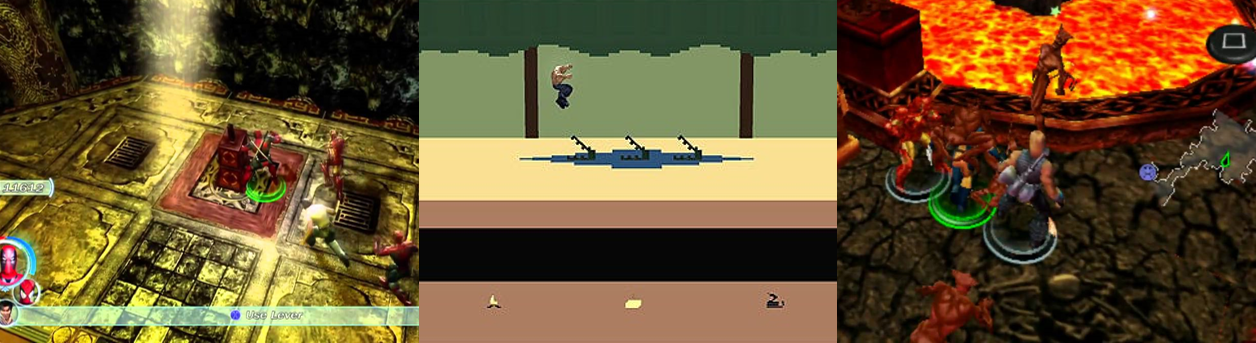
Gameplay in Marvel: Ultimate Alliance quickly grows quite repetitive; you can charge through most missions by repeating the same combos and special moves over and over, and opportunities for exploration are quite limited as areas generally only give the illusion of being large and multi-pathed. Combat doesn’t get much deeper than tripping, stunning, or blasting enemies, or avoiding using physical or energy-based attacks, and it’s surprisingly easy to get turned around in areas even with the presence of a mini map as one dark, grey corridor looks the same as the last. Puzzles aren’t much of a head-scratcher here; you’ll generally fight your way to a console or power generator that needs to be activated or destroyed, though sometimes you’ll need to activate two switches at once with the either of a partner, and you’ll sometimes have to perform these tasks against a time limit. You’ll need to push or pull heavy objects onto pressure pads, redirect sunlight to free Balder Odinson, defend Dum Dum Dugen in a glorified escort mission, perform character-specific motions to activate statues, or complete quick-time events (QTEs) to open doors or take out larger, otherwise-invulnerable bosses. You’ll jump behind the controls of an anti-aircraft cannon, be joined by NPCs like Major Christopher Summers/Corsair, and have to rescue characters like Doctor Bruce Banner and Prince Namor McKenzie/The Sub-Mariner, though some of these are optional side quests. These optional missions appear during the main campaign and often having you searching for items for a specific character, or destroying certain targets along the way, and sometimes you’re faced with an impossible choice between two options which will fundamentally alter the multiple endings. Gameplay really gets interesting, though, when you end up in Murderworld, a twisted funfair featuring bumper cars, a giant pinball set, a hedge maze, and even an old-school Atari-style mini game that sees you awkwardly swinging from ropes and collecting Golden Tickets to rescue Doctor Jean Grey/Phoenix from Arcade’s clutches.

Graphics and Sound:
Marvel: Ultimate Alliance is largely an impressive looking title, despite how old it is now, thanks to the zoomed out, almost isometric camera perspective. This means that the in-game character models, while hardly the most detailed, pop out nicely against the various backgrounds and I liked how they all had their own unique flourishes, like Spider-Man being able to web enemies up when he grabs them and Norrin Radd/The Silver Surfer floating around on his cosmic surfboard. Unlike some similar team-based brawlers, this really helps it to feel as though each character plays a little differently since they don’t just share the same animations and have a little individuality to them; you’ll need a stronger character to move certain objects, for example, and it’s much easier to explore the environment with a character who can fly. While your customised team won’t appear in the pre-rendered cutscenes, they do all have a lot of unique dialogue during the game, and when talking to or fighting against other characters; dialogue trees exist so you can ask a number of questions to NPCs or pick different options, which either helps you answer trivia questions, kicks off a side mission, or has you picking to team up with or save a different character, and villains like “Lester”/Bullseye or Quinten Beck/Mysterio. Unfortunately, the music isn’t really on par with the voice acting; it’s all very generic superhero-y or militaristic themes, and the in-game tracks often awkwardly loop, which is very jarring; the music’s also very loud, so you might want to adjust the sound settings in the options.

While the cutscenes aren’t great, the in-game graphics are decent enough and there’s a lot of dialogue variety.

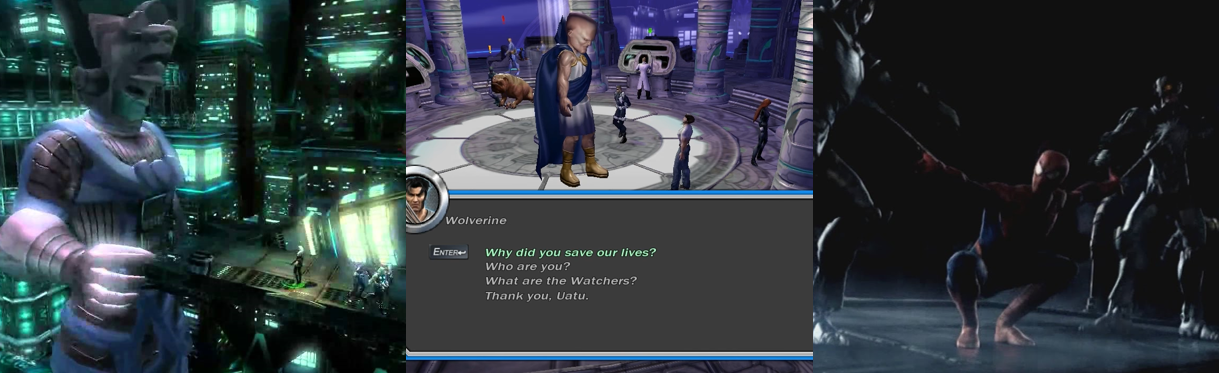
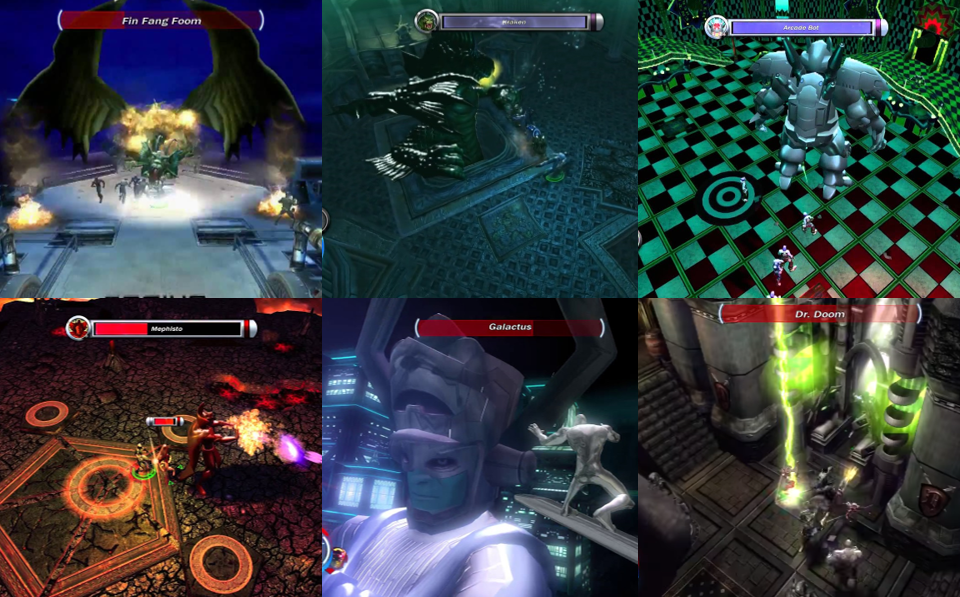
The pre-rendered cutscenes also often let the game down a bit; they haven’t aged too well, and have a very rubbery and surreal quality to them (though they are pretty epic, especially when the Masters of Evil are discussion their evil lot and when Galactus and Uatu/The Watcher enter the story) that I’d criticise more if I could actually see them but the cutscenes are very dark and the only way to brighten them is by changing your television’s settings. The game’s environments often don’t fare much better, either; while it’s fun visiting places like the Sanctum Sanctorum and Valhalla in the hub worlds, the actual mission locations quickly become confusing and boring. While there’s a lot to destroy and see in each area, and even some hidden paths to uncover, rooms, corridors, and sections all start to blend together and the levels themselves can outstay their welcome at times, which only makes the monotonous combat more glaring. That’s not to say that there aren’t some visually interesting locations, though; you’ll swim through the depths of Atlantis, travel to Hell itself, battle across the length of the Bifrost Bridge and through the frozen wastes of Niffleheim, and infiltrate the gothic, regal stone walls of Castle Doom. Easily the most impressive area you’ll visit, though, is the Skrull home world, which is currently under attack by Galactus. The World-Devourer is seen lumbering around in the background between the futuristic skyscrapers and even pursues your across the walkways in an exciting (if frustrating) sequence, though the gameplay and visual variety offered by Valhalla is equally fun as you can visit the Warrior’s Hall (where NPCs are enjoying revels) and hop across Viking ships amidst a cosmic backdrop.

Enemies and Bosses:
Since a gaggle of Marvel’s most notorious villains has joined forces in Marvel: Ultimate Alliance, you can expect to come up against a bevy of disposable goons during your adventure. It doesn’t take long for you to basically have seen everything the game has to offer in this regard, but each location does at least change up the appearance, dialogue, and some of the attacks of the enemies you face; you’ll battle Ultron’s minions, Loki Laufeyson’s trolls, and soldiers from the Shi’ar Empire and the depths of Atlantis, all of whom can be defeated using your standard combos or special powers. You can set your team mates to follow, attack, or defend formations, but I always like to choose an aggressive approach to overwhelm the hoards of enemies that can flood each area. Some of these carry weapons, either melee armaments like axes, spears, and swords which you can appropriate, or laser rifles for long-range attacks; others shield themselves and need to be attacked from behind or stunned. Some, like the imp-like demons from Mephisto’s Realm, leap onto you and drain your health, while others fly above taking pot-shots at you, and some are resistant to physical or energy attacks or need to be tripping, stunning, or blasted into the air. Some are larger, dealing and taking more damage, while others regenerate their health (or their allies), sap your health or energy, or boost the attack of other foes, so it’s best to take those guys out first.

A whole host of Marvel villains stand in your way, though most can just be beaten into submission.

The Masters of Evil have assembled quite the smorgasbord of allies; you’ll do battle with almost every single villain from Marvel Comics throughout the course of the game, sometimes more than once, as various underlings dog your progress throughout each mission. Often, you’ll battle at least two of these sub-bosses at a time; sometimes they flee after an initial encounter and need to be fought again, other times they’re powered up to be more formidable, and in other cases they’re able to heal or shield each other from your attacks by working together. However, defeating the likes of Mac Gargan/The Scorpion, Bullseye, James Buchanan “Bucky” Barnes/The Winter Soldier, Chen Lu/Radioactive Man, Valentin Shatalov/Crimson Dynamo, Aleksei Sytsevich/The Rhino, Herman Schultz/The Shocker, Doctor Curt Connors/The Lizard, Hussar and Neutron, Paibok, and even the corrupted superheroes you eventually fight really don’t require much more than you constantly attacking them with combos and special powers. Indeed, while it’s impressive that so many villains appear in the game, very few actually offer much in the way of a challenge beyond being a little tougher than the regular enemies you encounter, with even the likes of notorious villains like Ultron and Titannus proving quite disappointing encounters as, while they keep you at bay with laser blasts or destroy everything in a rampage, respectively, both can be similarly put down without any complicated strategies. Many of these villains are fought in teams, however, and they can also reappear in the simulator missions you unlock by finding discs, allowing you to battle them with different characters and in different situations, but as long as you string together your usual combos and unleash your best special attacks they go down pretty easily, even when bolstered by disposable minions.

Some of the best sub-bosses require a bit more strategy and forethought to put them down.

Other villains, however, do bring a little bit more to the table: Mysterio uses illusions to throw you off and, while Paul Pierre Duval/Grey Gargoyle can disable you by turning you to stone, Baron Carl Mordo, Kl’rt/Super Skrull, and the Mandarin disable you with elemental attacks to encase you in ice or send you flying with a blast of wind. The Mandarin also ends up being a particularly annoying boss as you need to lure his spider-like robots into teleporting to his safe spot to destroy his endless supply of Ultimos and actually bring him down for good. Mental/Mobile/Mechanized Organism Designed Only for Killing/M.O.D.O.K. challenges you to a trivia quiz to get closer to him, then brings in waves of Advanced Idea Mechanics (A.I.M.) minions to annoy you in addition to firing lasers and shockwaves at you. When battling Byrrah Thakorr-So and Krang, you also need to destroy sonic emitters to progress the mission, while Attuma and Todd Arliss/Tiger Shark can be difficult to hit as they’re swimming all over the place, making for a more aggravating encounter. Dragon Man randomly drops in as a tough obstacle to bypass since he’s capable of dishing out some formidable damage, while Blackheart employs multiple versions of himself to attack you and you’ll need to take on all three members of the Wrecking Crew at once (though they fall pretty easily if you’re wielding an axe or other weapon). Amora the Enchantress can allure you and your teammates into not attacking her, and will heal her brutish ally, Skurge the Executioner, Ulik and Kurse can only be defeated by attacking one with melee attacks and the other with energy attacks, and you’ll need to lower the shields protecting the likes of Kallark/Gladiator, B’nee and C’cil/Warstar, and Cal’syee Neramani-Summers/Deathbird (who flies around the arena tantalisingly out of reach and swooping down to grab you otherwise).

The bigger, more formidable bosses offer a bit more variety and spectacle.

Luckily, the game claws back a bit of challenge and intrigue by its large and engaging end of Act boss battles. After fending off Dr. Doom’s attack on the Helicarrier, you’ll battle Fing Fang Foom on the main deck; this gigantic alien dragon blasts fireballs at you from the air, covers the ground with shockwaves when it lands, and can only be brought down by firing anti-aircraft cannons at it and making good use of your ranged attacks. After making it past his robots and death traps, you’ll battle Arcade’s massive mech in a circus tent, which you need to fire yourself at using cannons and succeed at QTEs in order to have it damage itself in frustration. The eldritch Kracken is one of the ore frustating bosses as you can’t damage it directly and must lure it into attacking the nearby columns so you can complete a QTE sequence, but it seems completely random when it’ll actually smash into these columns, meaning the fight drags a bit. Fittingly, Mephisto awaits you in the depths of Hell; this demonic villain spews hellfire at you, protects himself from attacks with a shield, and can even screw up your controls with his powers, though you can disarm him and use his Hellsword to damage him. You’ll have to take extra care when Mephisto compels Kurt Wagner/Nightcrawler or Jean Grey to attack you, however, and will lose that character forever when they sacrifice themselves to stop Mephisto. At first, Loki isn’t really too much of a threat; sure, he’s got lightning attacks that stun you and is assisted by his Frost Giant minions, but he goes down pretty easily. However, it’s all a ruse as he then poses s Nick Fury to have you activate the indestructible Destroyer, which you must flee from while desperately searching for the ice-shielded Loki; once you find him, simply attack him until his shield breaks and the fight is ended. Galactus, however, is a threat far too big for you to tackle head-on; instead, you must desperately flee from him (destroying his drills if you have time) and then avoid his massive fists to activate three consoles and blast at him as the Silver Surfer in a QTE sequence. Finally, you must take on Dr. Doom himself; however, despite stealing Odin’s power to become a literal God, the mad doctor really isn’t too difficult to defeat even with the corrupted Fantastic Four acting as his personal guard. Simply destroy the four generators powering his shield, chase him down as he dashes and teleports across his throne room, mashing buttons when he grabs you, and pummel him as you would any other enemy or boss and, eventually, he’ll be defeated without too much problem regardless of his electrical attacks or shockwaves.

Power-Ups and Bonuses:
As mentioned, you can refill your energy and health by collecting blue and red orbs, which are dropped by enemies or found by destroying crates or opening chests. While some hazards can whittle your health down pretty quickly, or kill you immediately, health is pretty easy to come back, and you can also grab weapons to dish out greater damage to enemies (in fact, this is highly recommended as weapon attacks easily cut down even the most intimidating Super Soldiers and Doombots). You will also acquire S.H.I.E.L.D. Credits from enemies and the environment, which can be spent on upgrades to your character’s powers, costume-specific abilities, and upgrading your team’s stats; you cans et these to auto-upgrade, but they increase in cost each time you boost them so you can burn through Credits pretty quickly. Defeating the game’s many sub-bosses and bosses will also yield special gear that you can assign to each character; this will boost your attack, XP, or gauges, resist or inflict elemental damage, and offer numerous other perks but you can only equip one item to each character and your inventory has limits, meaning you’ll need to sell some to make way for new pick-ups as you come across them. Finally, as mentioned, you’ll get boosts to your stats and performance for forming teams of related characters, and performing special moves with certain characters, so it can be beneficial to experiment with different combinations and search around the environments for chests for more loot.

Additional Features:
There are forty-six Achievements on offer in Marvel: Ultimate Alliance, with the majority of them popping after clearing each Act and defeating bosses. Other Achievements include tossing enemies to their deaths, performing a certain number of finishing moves, defeating a certain number of enemies, unlocking every character and costume, and finishing the game on Hard mode, among others. Since the only difficulty-based Achievement you get is finishing on Hard, you may as well play through on Easy unless you’re going for that Achievement, and you’ll also get Achievements for finishing missions with another human-controlled character and upgrade every character’s special moves. Throughout each level, you’ll find a number of collectibles scattered about; art books unlock artwork to view, action figures allow you to unlock T’Challa/Black Panther and Matt Murdock/Daredevil as playable characters (and you can play a claw mini game in Murderworld to unlock Eric Brooks/Blade as well), and you can unlock Nick Fury by finishing the game once and the Silver Surfer by earning at least a Bronze medal in the game’s bonus simulator missions. These are unlocked by finding S.H.I.E.L.D. Simulator discs and recreate key moments and battles from each character’s history in a series of tough challenges. You can also take on five sets of trivia questions in each hub world for additional XP and Achievements, replay and revisit any Act, hub, and mission once you’ve finished the game, view movies and other unlocks in the gallery, and go head-to-head with your friends batting for points in an “Arcade” mode. By defeating numerous enemies with each character, you’ll eventually unlock up to four different costumes for each one, with these offering slightly different abilities that you can upgrade. Unfortunately, you can no longer purchase the two additional DLC packs, which added eight new characters to the roster in addition to twelve extra Achievements, none of which can be accessed on home consoles any more, which is a shame as I wanted to have Eddie Brock/Venom on my team and had to settle for symbiote Spider-Man.

The Summary:
I’d played Marvel: Ultimate Alliance before on the PlayStation 3 and, while I’d enjoyed it, I remember being put off by the lack of Trophies to earn and the fact that the DLC was only available on the Xbox 360 version. When I finally bought an Xbox 360, this game was on my buy list and, coincidentally, was a bit more expensive than I’d like and the DLC was still unobtainable, unless I wanted to shell out ridiculous amounts for an imported version. When I finally got it again, I enjoyed getting back into it; the game is very action-packed and chock full of playable characters, cameos, and villains to fight, but there’s really not a great deal to the combat, graphics, or the story. It’s fine and enjoyable enough, but things get repetitive very quickly and you’ve basically seen everything the game has to offer (apart from a few bells and whistles) after the first Act. You’ll beat on the same generic goons with the same tedious combos over and over, solving simplistic puzzles and spending your Coins on upgrades, but very rarely will you actually find much t set this apart from other, similar brawlers. The character selection and variety is great, and I like how they feel distinctive despite basically all being the same, and I enjoyed how some stages were more visually interesting than others, allowing you to swim or venture onto the hull of a space craft. While the sub-bosses weren’t up to much, the bigger bosses offered a bit more challenge and entertainment, but it feels a bit like the developers maybe crammed a little too much into the game without trying to make each villain a unique encounter. Overall, it’s a decent enough team-based brawler that’s probably more fun with a couple of friends to play with; there’s some decent replay value on offer with the different endings you can get based on your decisions and the extra missions and unlocks to find, but it does feel a little lacking in presentation and overall content to really score much higher.

My Rating:

Rating: 3 out of 5.

Pretty Good

Have you ever played Marvel: Ultimate Alliance? If so, what did you think to it and who made it into your team? What did you think to the combat, character selection, and the overall gameplay? Were you disappointed that the boss battles were mostly just a tedious slog? Which of the characters, villains, and locations was your favourite? What endings did you get and did you ever unlock all of the costumes and characters? Did you ever play as the DLC characters? Where would you rate this game against its sequels and other similar games? How are you celebrating National Superhero Day today? Whatever your thoughts, sign up to leave a comment below or leave a comment on my social media, and be sure to stick around for more superhero and comic book content throughout the year.

Movie Night: Avengers Confidential: Black Widow & Punisher

Released: 25 March 2014
Director: Kenichi Shimizu
Distributor: Sony Pictures Home Entertainment
Budget: Unknown
Stars: Jennifer Carpenter, Brian Bloom, Grant George, JB Blanc, Eric Bauza, and John Eric Bentley

The Plot:
After interfering with a top secret mission, Frank Castle/The Punisher (Bloom) is apprehended by Strategic Hazard Intervention Espionage Logistics Directorate (S.H.I.E.L.D.) agent and Avenger Natasha Romanoff/Black Widow(Carpenter) and the two are ordered by director Nick Fury (Bentley) to stop the terrorist organisation known as Leviathan selling stolen S.H.I.E.L.D. technology.

The Background:
After his impressive debut in the pages of The Amazing Spider-Man #129, the Punisher quickly became one of Marvel’s most popular anti-heroes thanks to his tragic backstory and unwavering commitment to the eradication of crime. His popularity has led to the character appearing in a number of multimedia projects outside of the comics, including videogames and both live-action and animated portrayals. Between 2010 and 2011, Marvel Entertainment teamed up with Japanese animation studio Madhouse to produce four anime projects, known as Marvel Anime, to little success. Avengers Confidential: Black Widow & Punisher was the follow-up to those projects; released mid-way through “Phase Two” of the massively successful Marvel Cinematic Universe (MCU), the anime drew a mixed reception despite making over $1 million in domestic home video sales.

The Review:
The movie opens to find the Punisher monitoring a rise in criminal and gang activities, as well as newspaper reports on himself, from his apartment (which, as is tradition, doubles as his armoury) while Black Widow expresses frustration at the Punisher’s mounting reputation as a vigilante. The opening credits play over a very quick montage of stills and images that give a quick recap of each character’s background and origin, showing Frank’s time as a family man and the deaths of his family in a mob hit and Natasha’s time training as a spy and assassin and association with S.H.I.E.L.D.

The Punisher and Black Widow appear to be physical equals but their fights are constantly interrupted.

The Punisher makes short, brutal work of some black-market weapons dealers, filling them with bullet holes and easily taking them apart by himself (despite them having more weapons and the numbers advantage) until only one man, Cain (Hebert) is left. Though disturbed at the high-tech weaponry Cain was selling, his efforts to torture more information out of the perp are interrupted by the arrival of Black Widow. Unimpressed with Fury’s operation and Widow’s criticism of his methods, a fight between the two ensues; though the Punisher demonstrates greater physical ability and immediately goes for his pistols, Widow is easily able to match him blow for blow with her superior acrobatic skill until Fury (modelled after his Ultimate and MCU counterpart) and his soldiers interrupt and Frank is subdued by one of Widow’s tranquiliser darts. However, during all the commotion, Cain manages to slip away unnoticed.

Fury manages to coerce Frank into teaming with Black Widow to infiltrate a Leviathan base.

Aboard the S.H.I.E.L.D. Helicarrier, Fury attempts to reconnect with Frank, whom he has a shared history with, and to impress upon him that his methods, while effective, are disrupting the bigger picture since he has started to interrupt S.H.I.E.L.D.’s procedures. Frank, however, is disgusted at the potential lives Fury’s methods have cost and it’s very quickly established that he and S.H.I.E.L.D., while working towards the same goal, are diametrically opposite. Still, Fury is able to inform Frank that the terrorist organisation Leviathan is selling stolen S.H.I.E.L.D. technology and the two are able to reach an agreement since the Punisher sees that the only reason he has been brought into custody is so that he can be unleashed upon Leviathan. Teamed with Black Widow, the Punisher shares the information Cain gave him and, begrudgingly, the two head to a Leviathan base in the frozen wastes of Slovenia; Widow exposits some background on Leviathan, who have grown into a sophisticated and deadly terrorist organisation that, it is soon revealed, has begun to experiment in created super soldiers and bioweapons. Thanks to their unique skills and training, the two are easily able to infiltrate the base and dispatch of the handful of guards with lethal effectiveness, but the Punisher immediately goes off script as soon as he spots Cain and another fight between the two breaks out.
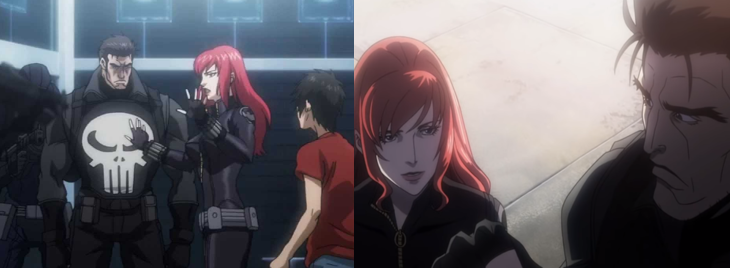
Amadeus accidentally sends the Punisher on a rampage with Leviathan’s mind control technology.

This time, however, it’s much briefer and Frank simply storms out and leaves Widow to blindly follow Fury’s orders. Although he captures Cain, his efforts to torture him for more information are once again thwarted when Cain blinds him with a flash of light and slips away once more. Continuing on mission alone, Black Widow subdues the Leviathan scientists non-lethally before being attacked by her former lover, and ex-S.H.I.E.L.D. agent, Elihas Starr (George), who faked his death and has joined Leviathan. Angered at his betrayal, Widow is no match for Elihas, who easily avoids, counters, and matches her frantic attacks while expositing that he chose to develop super soldiers for Leviathan to prove himself worthy of being Natasha’s equal and partner. Elihas attempts to convince Widow into joining him in Leviathan but, though heartbroken at his betrayal, she vehemently rejects him and fights him with renewed vigour and purpose; the Punisher aids her and destroys the facility and the two bring Cain’s cell phone to S.H.I.E.L.D.’s resident kid super genius, Amadeus Cho (Bauza). Though slovenly, excitable, and a teenager pervert, Amadeus is able to decrypt the phone but inadvertently sets the flash function off once again, which puts the Punisher into a bloodthirsty trance that sees him killing numerous S.H.I.E.L.D. agents before he is brought back to his senses. However, while Widow advocates for the Punisher’s state of mind, he is shaken at his actions and willingly submits himself to S.H.I.E.L.D. incarceration after killing innocent men.

United by a common goal, the Punisher and Black Widow eventually form a mutual respect.

Natasha is left feeling further betrayed when Fury reveals that he not only knew about Elihas but was also fully aware that leviathan possessed mind control technology and that he had stolen the Avengers’ blood in order to create his super soldiers. This is, of course, perfectly in keeping with portrayals of Fury as the ultimate spy whose “secrets have secrets” but his willingness to sacrifice both her and the Punisher spurs Black Widow into defying Fury’s orders and convince the Punisher to help her bring down Elihas and Leviathan. This takes the two to an underworld auction in Mandripoor where Elihas’ super soldiers are being sold off to a number of Marvel’s notorious supervillains and, ultimately, forces the two to pool their resources as a more effective team rather than being at odds with each other. In the end, though the two have opposing methods and beliefs, they are able to find some common ground and build a mutual respect for each other’s methods that culminate sin Widow willingly letting Frank return to his never-ending, one man war on crime rather than arrest him as per Fury’s orders.

The Nitty-Gritty:
Of course, every anime lives and dies by the quality of its animation and Avengers Confidential is a pretty slick and smoothly animated feature. Blood and gore fly in the air with a beautiful grace and characters move with either grace and poise or a heavy, weighty physicality when not standing around like statues. Amadeus is probably the most over the top character in terms of his animation, which plays into his quirky and impulsive personality, and the film does a decent job of emphasising the differences between its two main characters through their movements and physicality as much as their personalities.

While the Punisher is a blunt, brutal instrument, Black Widow is sleek and efficient.

The Punisher is cold, blunt force while Black Widow is slick efficiency; the Punisher seems disconnected from humanity and focused only on solving problems in the most direct way possibly, while Widow (and Fury) are concerned with the bigger picture and a strategic approach to secured the safety of millions. The Punisher’s presence turns a lot of heads around S.H.I.E.L.D., who view him with a mixture of awe and fear, and he earns this reputation thanks to his vicious efficiency; when under the influence of Leviathan’s mind control, he resembles little more than an emotionless killing machine. In comparison, Widow is effortlessly smooth and sexy in her movements, moving like liquid and with a serene grace that allows her to easily incapacitate even larger foes. Initially, Elihas is positioned as the primary antagonist of the feature and, thanks to his rushed connection to Black Widow, ensures that Natasha has a more personal stake in the film’s events beyond simply doing her duty to safeguard the world from Leviathan’s technology. Elihas exposed himself to his own super soldier serum, augmenting his strength and abilities in an effort to prove himself worthy of Widow’s love; though he believe that she loved him in the past, he was spurred by her always choosing missions with the Avengers and her life as a superhero over him and resolved to find a way to truly be her equal. Elihas truly believes that S.H.I.E.L.D. is actually oppressing people rather than saving them and that war and conflict are inevitable; as a result, he is perfectly fine with escalating and even starting wars with Leviathan’s technology and resources and sees his super soldiers as the next logic step towards consolidating their influence on the world.

Both the Avengers and Orion show up too late to do much of anything.

Although the Avengers get top billing in the film’s title and feature prominently on the DVD artwork, they don’t actually play a big role in the film and only show up right at the end. Despite having defied Fury’s orders, Black Widow and the Punisher’s mission to stop Leviathan is provided much-needed support when Tony Stark/Iron Man (Matthew Mercer), Doctor Bruce Banner/The Hulk (Fred Tatasciore), Thor Odinson (Unknown), Clint Barton/Hawkeye (Mercer), James Rhodes/War Machine (Unknown), and Carol Danvers/Captain Marvel (ibid) all arrive to help fight off Leviathan’s super soldiers. This leads to some high-octane action but never really overshadows the more grounded and gritty storyline featuring the two leads, who remain at the forefront of the narrative thanks to Natasha’s arc with Elihas and the Punisher’s vendetta against Cain. This is made even more explicit with how unimpressed the Punisher is by Stark’s bravado and the Avengers’ powers and abilities; he’s there with a mission to fulfil and merely tolerates their presence rather than jumping at the chance to join forces with Earth’s Mightiest Heroes. The true head honcho of Leviathan is the mysterious Orion (Blanc), a semi-cybernetic, cloaked madman who doesn’t even physically appear until the last moments of the film. However, despite Orion’s influence and power, we learn basically nothing about him and he is ultimately unable to hold sway over Elihas; during his climatic and emotionally charged showdown with Black Widow, Elihas finally comes to his senses and realises that the love they two of them shared is still there. This proves to be his undoing, however, as he sacrifices himself to save Natasha’s life after Orion shoots at her and dies in her arms. The film does a decent, if rushed job, of trying to place some emotional significance on Elihas’s character and sacrifice but I find myself oddly apathetic since I have no idea who he is; all of their backstory is conveyed through flashbacks and is told to us. We never get to see them as a proper couple or in action together, which I feel hurts the emotional core of their story; he an extra five or ten minutes been included at the start of the film to show their relationship before his downfall, this might have gone a long way to addressing that issue.

The Summary:
Avengers Confidential: Black Widow & Punisher is a really weird production, to be honest; the animation is great and it has that slick, silky smooth quality that you expect from an anime and some brutal, bloody fight scenes but I’m not really sure what the purpose of it is. As far as I can tell, it’s not supposed to tie into any other Marvel production, which makes characters such as Elihas, Orion, and Leviathan very underdeveloped and inconsequential since I have no real personal stake in their story or motivations, and they exist solely to give the title characters someone to fight against and force an emotional conflict for Black Widow. I feel like Punisher is a strong enough character to have carried the anime by himself but, while it is interesting to juxtapose his more extreme measures with the likes of the Avengers and S.H.I.E.L.D., this doesn’t really work when partnering him with Black Widow. Sure, her methods and motivations are different enough but she’s still a spy, a former assassin, with plenty of “red in her ledger” so I can only imagine that she’s partnered with the Punisher to give the anime some sex appeal. In the end, it’s a short and decent enough story; it doesn’t really add anything new to the Punisher or show you anything you can’t see in other Marvel animations or productions but it manages to be just entertaining and action-packed enough to stay afloat despite its mediocre plot and characterisations.

My Rating:

Rating: 2 out of 5.

Could Be Better

Have you ever seen Avengers Confidential: Black Widow & Punisher; if so, what did you think to it and how do you think it holds up against Marvel’s other anime and animated depictions of these characters? What did you think to the concept of teaming these two up and the animation style? Do you think it would have been better to see a solo Punisher feature or to emphasise the more popular Avengers more or were you happy with the story it told? Do you know who Elihas Starr is and, if so, can you tell me why I should care? What is your favourite Punisher story, character, and adaptation (whether it be a movie or videogame)? How are you celebrating the Punisher’s debut this month? Whatever your thoughts on Avengers Confidential: Black Widow & Punisher, and the Punisher in general, drop a comment down below.

Movie Night [Punisher Month]: Punisher: War Zone


Back in February 1974, Spider-Man/Peter Parker faced a new enemy in the form of Frank Castle, the Punisher, a veteran of the Vietnam War turned bloodthirsty vigilante. The Punisher separated himself from other, traditional costumed heroes by his willingness to kill and uncompromising, suicidal one-man war on crime and what better way to celebrate the debut of this nuanced and complex character by dedicating every Tuesday of this month shining a spotlight on Marvel’s most notorious anti-hero?
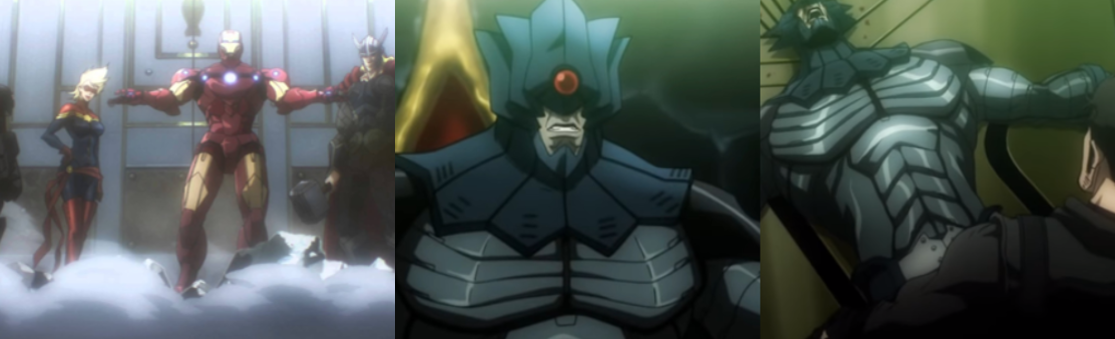

Released: 5 December 2008
Director: Lexi Alexander
Distributor: Sony Pictures Releasing
Budget: $35 million
Stars: Ray Stevenson, Dominic West, Wayne Knight, Dash Mihok, Doug Hutchison, and Colin Salmon

The Plot:
After losing his family to mob violence, former Marina Frank Castle (Stevenson) eradicates criminal scum as “The Punisher”. However, when he accidentally kills an undercover Federal agent, Frank suffers a crisis of conscience. With Agent Paul Budiansky (Salmon) seeking to apprehend him, Frank’s life is further compounded when narcissistic mobster Billy Russoti (West), left brutally scarred, and reigns chaos as the sadistic “Jigsaw”.

The Background:
Having cemented himself as one of Marvel’s most popular anti-heroes following his impressive debut in the pages of The Amazing Spider-Man #129, the Punisher soon became a recurring character in media outside of the comic books. Sadly, neither the 1989 Dolph Lundgren vehicle or the vastly under-rated 2004 film were critically or financially successful, despite one earning a cult following and the other legitimately being one of my favourite movies. Sadly, the story behind Punisher: War Zone is a pretty dour one as star Thomas Jane eventually grew frustrated with waiting for a sequel to his film and walked away from the role only for the sequel’s script to be retooled into a complete reboot that director Lexi Alexander aimed to be a throwback to the action movies of the 1980s. With Ray Stevenson replacing Jane and undergoing rigorous training for the role, tensions rose between Alexander and the film’s American distributor Lions Gate over the film’s rating, and the film’s limited theatrical release meant it was a box office bomb upon release. Reviews were mixed to negative, with some taking exception to the film’s graphic content and others enjoying its extreme violence and fidelity to the source material. For my part, I was annoyed that Jane was replaced as, with just a few tweaks, this could have easily been a direct sequel (hell, even with the recast it could have been) but I found myself enjoying the film’s excessive gore and over-the-top action much more than I expected and found it to be a worthy representation of Marvel’s infamous anti-hero.

The Review:
Punisher: War Zone was part of the sadly short-lived “Marvel Knights” sub-series of Marvel movies; completely unrelated to the two previous Punisher movies, the film begins with Frank Castle already some four years into his vigilante career. From his hidden underground lair, he observes local news and arms himself in the fight against organised crime and criminals all across New York City. This leads him to crashing a party for a known Mafia boss, which sees numerous mobster’s dead but also results in the death of an undercover FBI agent, Nicky Donatelli (Romano Orzari).

The Punisher is appropriately dressed and armed for war.

I initially didn’t think much to Stevenson’s Punisher gear; unlike his predecessors, he’s garbed head-to-toe in in heavy-duty, tactical riot gear that kind of makes him look like a turtle. However, in practice, the outfit works really well; the body armour protects Castle from both gunfire and knives, especially around vulnerable parts of his body like his chest and neck, and he has spray-painted a bad-ass skull on the front in luminous paint to intimidate his prey and draw bullets away from his unprotected head. Like the 1989 film, we learn about Castle’s tragic past through brief flashbacks, news reports, and exposition from other characters; his origins are probably to closest to the source material so far, with his wife and children being victims of a random act of mob violence, and his reputation is one of stark contrasts.

The Punisher’s reputation makes him a feared and controversial figure.

Police officers like Saffiotti (Tony Calabretta) praise his violent actions as he does what others can’t and isn’t restricted by the system, the mobsters are obviously in fear of him and constantly driven to frustration by his interference and persistence, and while Detective Martin Soap (Mihok) is clearly protecting Frank from reprisals as part of the laughable Punisher Task Force, Budiansky makes it his personal mission to bring Castle in after he accidentally kills Donatelli. Budiansky acts as the primary audience surrogate for those unfamiliar with the Punisher; initially angered that Castle has been allowed to run rampant, he eventually becomes a reluctant, and then willing, ally of Castle’s as their interests align.

The Punisher’s allies believe whole-heartedly in the sanctity of his mission.

Like his comic book counterpart, the Punisher also has help from his armoury, Linus Lieberman/Microchip (Knight), a tech-savvy figure who supplies Frank with weapons, armour, and leads to help him in his war on crime. A staunch believer in the Punisher’s actions, Microchip is aghast when Castle, wracked with guilt over Donatelli’s death, considers leaving town and quitting his vigilante ways. Microchip has taken on a protégé, of sorts, in the film, former gangbanger Carlos Cruz (Carlos Gonzalez-Vio), which initially angers Castle but, when Carlos gives his life trying to protect Donatelli’s daughter, Castle finds his black and white view of the world further skewed. While Frank is, as always, a man who has lost everything and has been driven to the edge, with nothing to life for but his suicidal, never-ending war against crime, his allies believe in him so completely that that are willing to not only defy the system for him but to give their lives for him and the greater good, something which Frank is determined to see avenged at every opportunity.

The Russottis are a couple of absolute madmen who steal the show.

Punisher: War Zone really emphasises the traditional Italian-American Mafia life; the film is littered with stereotypical mobsters, Dons, and the like, all of whom are dressed sharp and full of pride and gusto. None are more sharply dressed and full of arrogance than caporegime Billy Russotti; known as “The Beaut”, Billy is a mean, sadistic, gangster who is obsessed with his looks and has a chip on his shoulder about having the answer to tired old men. Dominic West is clearly having the time of his life in the role and this becomes explicitly obvious after the Punisher tosses Billy into a glass-crushing machine and he is left hideously disfigured. Now calling himself “Jigsaw”, Billy goes completely off the rails and, in addition to employing the services of his usual goons and a gang of freerunners, releases his psychopathic brother, James (Hutchison), from a mental institution Also known as Loony Bin Jim (a name both brothers despise), James is a cruel, animalistic cannibal who rips people open to feast on their flesh and innards and regularly (and wilfully) engages in all kinds of disgusting and self-destructive behaviour. James’s influence only encourages Jigsaw’s newfound madness and brutality, escalating Billy’s vendetta against the Punisher and his desire to become the top dog in New York. Thanks to some impressive practical effects, Jigsaw’s gruesome visage is wonderfully brought to life in a way that is both disturbing and ludicrous and West uses the make-up to accentuate his performance into a bombastic glee that is truly entertaining to behold. His referring to God as an “imaginary friend” always gets a chuckle out of me and his performance is perfectly in keeping with the film’s more exaggerated moments that are ripped right out of a Punisher MAX comic book.

The Nitty-Gritty:
One of the absolute best things about Punisher: War Zone is how massively over the top and gory its action scenes and violence are; this version of the Punisher is also a hulking brute of a man who is capable of throwing himself, and any nearby weapons, at his foes and caving in their skulls with his bare hands but, as you might expect, Castle is also a driven, determined, nigh-unstoppable one-man army who is adept with numerous firearms. When the Punisher shoots or stabs people in this movie, it’s not just a few squibs of blood or arterial spray, it’s a fucking bloodbath with bones breaking, heads exploding, and limbs being blown off and it’s absolutely fantastic!

A hardened vigilante, Castle continues to be haunted by his losses and to be a tragic figure.

Whenever the gun fights kick off or Loony Bin Jim gets triggered, the gratuitous violence is quite literally splashed across the screen; the Punisher coldly and mercilessly executes his prey with barely a flicker of emotion, sets his own broken nose at one point, and is more than capable of taking out entire rooms full of armed men all by himself. While Stevenson’s Punisher is a resourceful, militaristic, focused machine of a man, he is also more than capable of conveying the pathos and emotion that are associated with the character. He is haunted by the deaths of his wife and kids and so traumatised at having accidentally killed one of the “good guys” that he desperately tries to make amends with Donatelli’s. Like Lundgren’s Punisher, this sees him all but begging Donatelli’s wife, Angela (Julie Benz), to shoot him in recompense for his mistake.

The film is an unashamedly gratuitous and over the top, action-packed piece of entertainment.

Considering how over the top Punisher: War Zone is, the film is littered with some fantastic performances by character actors like Dominic West, Wayne Knight, and one of my absolute favourite actors, Colin Salmon (who really needs to have bigger film roles). Budiansky’s grouchy demeanour and interactions with Soap and Castle are a real highlight, bringing some levity to the film (his enraged reaction when Castle blows a mobster’s head off with a shotgun is hilarious!) I’m not massively familiar with ray Stevenson and, if we’re being honest, he’s not as good of an actor as Thomas Jane but, having said that, he really nails the Punisher role. Like I say, he’s much more of a stoic military man but he’s still, perhaps surprisingly, fully capable of conveying the character’s complex emotional dichotomy. While Castle’s mission is one deeply rooted in a personal desire for revenge, Jigsaw’s vendetta against him escalates things considerably; after he kills Microchip’s mother, Carlos, kidnaps Donatelli’s daughter, and forces Frank to kill Microchip, it’s incredibly cathartic when the Punisher finally gets his hands on Jigsaw and tortures him to death with a cold, brutal execution worthy of his name.

The Summary:
Even today, The Punisher remains one of my favourite movies and it was a bitter pill to swallow when Thomas Jane walked away from the role and the next film was made as a reboot. However, I was presently surprised at how enjoyable Punisher: War Zone is; it’s a very different type of film and much more over the top and action-orientated but that’s equally as fitting for the character as infusing the story with tragedy and pathos. While it would have been extremely easy to take another pass at the script and frame it as a continuation of the previous film with an older, more seasoned Punisher, Punisher: War Zone stands by itself as an enjoyably entertaining action film that doesn’t hold back one iota. I respect it for that, and for being over the top with its depiction of gratuitous violence and bloodshed, and it resonates with me on many levels as a fan of this genre. As a result, I find it disappointing that the film didn’t perform better as everyone did a really good job and I honestly would have liked to see more from this version of the Punisher and his world.

My Rating:

Rating: 4 out of 5.

Great Stuff

What did you think to Punisher: War Zone? How would you rank it compared to the other two Punisher films? Were you annoyed that Thomas Jane was replaced in the role or do you think this film improves on its predecessor? What did you think to Stevenson’s portrayal of the character and Dominic West as Jigsaw? Did you enjoy the film’s gratuitous violence or did you think it was a little too over the top? Would you have liked to see more from this version of the Punisher and the Marvel Knights sub-series of films? How have you been celebrating the Punisher’s debut this month? Whatever your thoughts on Punisher: War Zone, and the Punisher in general, leave a comment below.

Game Corner [Punisher Month]: The Punisher (PlayStation 2)


Back in February 1974, Spider-Man/Peter Parker faced a new enemy in the form of Frank Castle, the Punisher, a veteran of the Vietnam War turned bloodthirsty vigilante. The Punisher separated himself from other, traditional costumed heroes by his willingness to kill and uncompromising, suicidal one-man war on crime and what better way to celebrate the debut of this nuanced and complex character by dedicating every Tuesday of this month shining a spotlight on Marvel’s most notorious anti-hero?


Released: 16 January 2005
Developer: Volition
Also Available For: Mobile, PC, and Xbox

The Background:
After his impressive debut in the pages of The Amazing Spider-Man #129, Frank Castle/The Punisher quickly became one of Marvel’s most popular anti-heroes thanks to his tragic backstory and unwavering commitment to the eradication of crime. The Punisher has also seen some success outside of the comic books, featuring in movies, cartoons, and a number of licensed videogames. Released to coincide with the 2004 movie of the same name, The Punisher was developed by Volition, a studio purchased by THQ in 2000 and perhaps best known at the time for their work on the Red Faction (ibid, 2001; 2002). Acting as a quasi-sequel to The Punisher (Hensleigh, 2004), The Punisher saw star Thomas Jane return to voice the role but incorporated its aesthetic presentation, storyline, and characters from the comics and was subjected to numerous edits and cuts to tone down its scene of explicit violence and gore and make it financially viable for release. While the game was met with mixed reviews, it sold around one million copies and was considered a success for Volition, who would go on to develop Saints Row (Volition, 2006).

The Plot:
Having dedicated his life to the eradication of crime after losing his family to mobsters, Frank Castle has been working his way through New York City’s underworld as the Punisher. Having carved his way through the low-level street gangs and the Yakuza, he allows himself to be captured and interrogated in order to get closer to the town’s newest head gangster, the mysterious “Jigsaw”, who has a personal grudge against the Punisher.

Gameplay:
The Punisher is a third-person action shooter in which you’re placed into the iconic trenchcoat, combat trousers, and skull-shirt of Frank Castle, the titular Punisher, as he mows his way through countless thugs, lowlifes, and criminals in a one-man war on crime. Although he can’t jump, the Punisher has a number of combat and movement options available to him: he can pick up and swap weapons with the Circle button (note that, while he can dual-wield weapons, he can only hold two types of weapons at once; a smaller weapon like a pistol and a bigger weapon like a shotgun), select between his weapons by pressing down on the directional pad, fire his weapons with R1, toss grenades and other such explosives with L1, and enter a more accurate aiming mode (which is further expanded when he has a sniper rifles) by pressing in the right analogue stick.

Frank’s methods of interrogation basically amount to brutal and sadistic torture.

The Punisher can also dive ahead with a press of R2, duck and crouch walk with L2, and grab thugs and use them as a human shield with X. In this position, or when up close to enemies, you can execute them with a quick kill by pressing Square. Enemies can also be interrogated by pressing X; in this mode, you’re ask to tilt or move the left analogue stick to keep a meter in the right area long enough to “break” your victim, which will award you with hints and Style Points. As you kill enemies, rack up kill combinations, and pull off successfully interrogations, you’ll earn Style Points that can be used to upgrade the Punisher’s various skills and attributes from the main menu in Frank’s apartment. As you encounter enemies and head into fire fights, you’ll notice glowing white Punisher skulls over the heads of certain enemies; once you’ve cleared the immediate area of all other enemies, these guys will give up and you’re tasked with performing a “Special Interrogation” using various parts of the environment (drills, furnaces, shark tanks, or dangling off a ledge, for example). Once you break them, they’ll often lead you to secret areas with new weapons or cause enemies ahead of you to stand down so you can progress easier. You can kill them, but it will cost you Style Points (which can be a little confusing as you’re otherwise rewarded for killing criminals; indeed, you can kill these guys normally after breaking them and not be penalised). Other times, you’ll see a glowing gold Punisher skull in the environment, which allows you to pull off a “Special Kill” (locking a scumbag in a coffin and tossing in a grenade, for example) for additional Style Points.

Enter Slaughter Mode to make short work of your enemies but watch your fire around friendlies!

Considering how linear the game is, it’s surprisingly easy to get lost as you’re often exploring dark, grey corridors and very bland environments; there’s no map or onscreen indication of where you need to go so it’s easy to get a bit turned around at times. Often, you’re joined by a partner character (Natalia Romanova/Black Widow, Nick Fury, and agents of the Strategic Hazard Intervention Espionage Logistics Directorate/S.H.I.E.L.D.) who cannot be harmed by either you or enemies and are, surprisingly, very useful and competent for computer-controlled characters. Occasionally, you’ll be asked with solving some very simple puzzles that amount to finding a key or pulling a lever, rescuing hostages, placing explosive charges, interacting with a hidden switch to open a door, or forcing certain enemies to open doors; it’s nothing massively taxing but, again, it can sometimes be confusing as to where you need to go. The Punisher is quite a durable character whose health is refilled as he breaks thugs through interrogations or talks to rescued innocents but it also regenerates when you press Triangle; this puts you into “Slaughter Mode”, which slows time down to a crawl, turns the screen black and white, and has you tossing throwing knives and performing instant kills as long as the meter lasts. This can be a great way of clearing out rooms filled with perps but, honestly, I generally tended to save it for boss battles as the game is pretty generous with its checkpoints and not especially difficult to get through and I found this mechanic to be quite disorientating. Most of my deaths and mission failures came from accidentally dropping from high ledges or killing innocents; occasionally, enemies will grab hostages and use them as human shields and, if you kill them, you’ll instantly fail the mission so be sure to use your more accurate aiming in this situations.

Graphics and Sound:
For a PlayStation 2 game, The Punisher is pretty decent to look at when you can actually see what’s onscreen. Character models are pretty good, if a bit blocky, but not much to shout about when it comes to enemy variety and aesthetic. Indeed, the character who looks the most dynamic and impressive is, fittingly, the Punisher himself. Decked out in a long trenchcoat, combat trousers, army boots, and skull shirt, the Punisher looks exactly like he stepped right out of the pages of a Garth Ennis comic book. Punisher even dons different outfits for different missions, including ditching the trenchcoat, decking himself out in war paint, and wearing prison clothes and, while he doesn’t have Thomas Jane’s likeness, he looks very much like his comic book counterpart.

Environments can be a bit boring and drab but there are a few that stand out as visually interesting.

Where the game falters, though, is in the level variety and presentation; you’ll skulk around seedy alleyways, dark corridors, and dingy crack houses, which aren’t massively impressive. Even areas like the chop shop, the zoo, and Fisk Industries’ skyscraper aren’t much to shout about as the game’s visuals are dulled with a dark, moody presentation that, while fitting, can make things visually very lifeless and boring. It’s not all bad, though; one mission takes place in a jungle, which helps to spice things up, as does battling through the research and development department of Stark Industries and a nightclub/bar, all of which bring some life and clarity to the action.

While many of its more brutal kills are censored, The Punisher is still a gloriously violent game.

As mentioned, the game’s more brutal and bloodier executions have, sadly, been censored; nevertheless, the game is extremely violent, with enemies spurting blood and being blasted to death as best as the PlayStation 2 can render. The Punisher’s interrogation sequences basically amount to a version of torture and see Frank beating, choking, kicking, or intimidating his victims or threatening this lives using various parts of the environment, which is all very fun to see and take part in and, while these are censored, the implication is still very clear to see.

While the CG cutscenes are a bit fuzzy, the in-game graphics are pretty decent and there’s some fun cameos.

The music isn’t really that interesting or memorable; the game doesn’t seem to pull any tracks or influence from the movie, which is a shame, but the voice acting is top notch. Thomas Jane was always a fantastic Punisher and he continues to narrate events around him, offering wry commentary, dry quips, threats, and conveying just the right amount of dread and anger in the title role. The few amount of CG cutscenes the game uses are decent enough but the icing on the cake were the appearances and cameos from some of Marvel’s more recognisable characters, such as Matt Murdock, Tony Stark/Iron Man, and Wilson Fisk/The Kingpin, which are fun hints at the wider Marvel universe that exists around The Punisher and the cries and screams of the goons you fight are satisfying to hear.

Enemies and Bosses:
As you might expect, the Punisher is confronted by a horde of nameless, faceless goons, thugs, and scumbags in his quest to destroy all crime. Enemies will react with fear and hostility at your presence, shoot at you from behind cover and doors, and throw weapons at you but, for the most part, are quite stupid and easily taken out even when they have the higher ground or the numbers advantage. As the story progresses, though, you’ll come up against more formidable enemies or enemies wielding more powerful weapons, such as shotguns, sniper rifles, and flamethrowers. Enemies will also fire rockets at you from helicopters, commandos don more protective armour to withstand your shots, and Yakuza will dog you at every turn in waves. Thankfully, you always have plenty of options available to take these guys out, from tossing them to giant snakes, smashing their faces into mounted guns, or simply blasting them away with your weapons and, while you’re often asked to hold out against a timer as an endless swarm of enemies rush at you, it’s never like you’re not capable of defending yourself.

Bushwacker gives you the slip more than once before you finally confront him head on.

In terms of bosses, The Punisher has an interesting variety both visually and in terms of how you fight them. The game’s first few missions see you busting up the Gnucci gang; when you get into a shootout with Bobby Gnucci, you need to make use of nearby cover to get a good bead on him to take him out with a headshot. Later, you’ll burst out of a coffin and gun down countless minions of the family and find yourself running around in circles in a confusing attic maze as enemies continuously spawn in and you desperately try to find take out Eddie Gnucci in one of the game’s more confusing and frustrating boss battles. One of the more elusive bosses in the game is Carl Burbank/Bushwacker, a muscle-bound freak with a gun for an arm who constantly dogs your progress and escapes your retribution until you finally confront him in the library at Ma Gnucci’s estate. Goons will continually spawn into this fight and, if you attack Bushwacker head-on, you’ll take massive damage so I found the best tactic was to do a continuous circuit of the library, shooting at Bushwacker as and when, and bust out the Slaughter Mode to bring him down. Afterwards, you are given four minutes to escape the estate as it burns down, shooting sprinklers on the ceiling to get through the flames and performing a Special Kill to make short work of Ma Gnucci.

Though seemingly impervious to pain, environmental hazards and flames will bring the Russian down.

At the end of the docks, you’ll have to grab a nearby rocket launcher to take out the tank that blocks your exit, which is pretty easy to do thanks to all of the handy-dandy containers that offer cover. Afterwards, the game recreates a classic scene from the movie and comics with a battle against the nigh-invulnerable Russian in Frank’s apartment; here, you must stay away from the Russian and stun him with nearby melee weapons, mount his back, and use the Special Interactions to best him. Later, you’ll battle him against around a missile silo; this time, you need to shoot the barrels he grabs before he can throw them at you and, when he comes down to your level, use your grenades, the explosive barrels, and the missile’s flame jet to put him down once and for all while dispatching the endless goons.

Bullseye is a slippery, tricky devil who eludes your attacks and keeps you on the move.

When you infiltrate Fisk Industries, you’ll encounter another elusive and annoying boss, Bullseye. This slippery devil will somersault about the place, tossing knives at you and only really taking damage when you land a headshot thanks to his fancy body armour. You’ll fight him again in an area of the skyscraper that is under construction, which makes it harder for you to get a clean shot thanks to all the walls and obstructions, before you have a finale showdown in Fisk’s penthouse where he pulls a gun out on you. In each of these three areas, you’ll find a weapons cache to keep your ammo topped up and I would recommend returning t it again and again to grab grenades to deal the most damage to Bullseye and knock him down so you can get a cleaner shot at his stupid head.

The finale sees you battling Jigsaw, who is in stolen Iron man tech, on the prison rooftop.

The finale of the game sees you facing off against Jigsaw (who, in a change to the source material, is revealed to be John Saint from the 2004 movie) who has donned stolen Iron Man armour. This is a two-stage boss battle; in the first stage, Jigsaw fires seeking missiles and repulsor blasts at you while hovering in the air and the only way to bring him down and damage him is to run underneath him and fire at his jetpack. Once he’s brought to ground level, he’ll chase after you and blast at you while goons spawn in to back him up. While you can shoot at him, it’s far easier to run to an area of the rooftop where the explosive mines (or “RAMs”) continually respawn; simply position yourself behind parts of the environment and toss these towards Jigsaw and remote detonate them and you’ll blow him away in no time at all.

Power-Ups and Bonuses:
The Punisher is afforded a great deal of weaponry for his crusade, most of it he liberates from defeated enemies or picks up from weapon caches in the environment. You’ll get access to a number of pistols (which Frank can dual-wield), revolvers, sub-machine guns, rifles, and shotguns and you can swap these out at any time when you see a weapon on the ground. You can also find and use flamethrowers (but be careful as flaming enemies can harm you as well) and a rocket launcher, which is perfect for bringing down helicopters, and a sniper rifle to take enemies out from a distance and defend your gondola in the jungle. Other time, you can acquire melee weapons to put a beatdown on your enemies.

Choose from a wide selection of weapons and use Skill Points to upgrade Frank’s abilities.

After clearing a mission, you’ll be awarded with both Medals and Style Points. You can spend these points upgrading a number of the Punisher’s skills and attributes from Frank’s apartment. You can upgrade Frank’s body armour to increase your resistance to damage, increase the duration of your Slaughter Mode, increase your clip capacity, and add a scope or grenade function to certain weapons. Thankfully, you don’t have to worry about upgrading every weapon individually so increasing your accuracy or ammo capacity will do this for every weapon by default.

Additional Features:
The Punisher offers three difficulty settings, which will increase the aggressiveness and durability of your enemies and also allow you to obtain different Medals and gameplay modes. You can earn Bronze, Silver, and Gold Medals in every mission, but Gold Medals are only available when playing on Hard Mode; however, every time you finish a mission, you’ll unlock an additional “Challenge Mode” that presents you with a specific objective to fulfil to unlock extra stuff. Sadly, there is no option to don a different skin or outfit when replaying missions but there are cheat codes to unlock alternative outfits, so that ’s something, at least.

Take on challenges and play on Hard Mode (or cheat…) to unlock additional modes, cheats, and costumes.

From Frank’s apartment, you can view all of the Punisher’s weapons (Thomas Jane even narrates what each weapon is capable of), enemy biographies, cutscenes, flashbacks (which are triggered and unlocked when interrogating certain enemies), and comic books covers (unlocked by clearing challenges). When playing on Hard Mode, you’ll also gain access to “Punishment Mode”, which has you holding out against waves of enemies to earn points and medals. Additionally, clearing Hard Mode will unlock cheats for you to use; you can also unlock these manually but, while it’s fun to run around without fear of harm, you won’t actually be able to progress through the story with these activated.

The Summary:
The Punisher is a pretty decent third-person shooter; considering it’s a licensed game, which are generally regarded as being terrible, it’s a pretty solid effort. I think choosing to veer more towards the source material than the movie was a good choice as it made it more appealing and fresh and, rather than going through the beats of the movie step by step, it crafts an entirely new adventure that is appealing to fans of the film, the comics, and this genre of videogame. It’s not perfect by any means; the censoring of the torture scenes is disappointing, environments are bland and dark and confusing, and certain sections can be frustrating at times but there is a lot of variety and mayhem on offer thanks to the wide array of weapons and kill options at your disposal. It’s probably the most accurate Punisher videogame we’re ever likely to get and has quite a lot of replay value thanks to the additional challenges and such. There might be better third-person shooters out there but The Punisher is definitely worth your time for the violence alone, to say nothing of the references to and cameos of other Marvel characters. Team this up with Deadpool (High Moon Studios, 2013) and X-Men Origins: Wolverine (Raven Software, 2009) and you have some of the best and most accurate videogame depictions of Marvel’s more violent characters.

My Rating:

Rating: 4 out of 5.

Great Stuff

Have you ever played The Punisher? If so, what did you think of it? Were you disappointed that it didn’t follow the movie closer, or have more ties to the movie, or did you enjoy that it was more in line with the source material? What did you think to the game’s violence, executions, and action? Which of the cameos and/or boss battles was your favourite and were there any you felt were missing from the game? Would you like the see the title remastered for modern consoles or do you think it’s best left as a relic of a bygone era? Which Punisher videogame, story, or adaptation is your favourite? Whatever you think about The Punisher, feel free to write a comment below and be sure to check out my other Punisher content.

Movie Night [Punisher Month]: The Punisher: Extended Cut (2004)


Back in February 1974, Spider-Man/Peter Parker faced a new enemy in the form of Frank Castle, the Punisher, a veteran of the Vietnam War turned bloodthirsty vigilante. The Punisher separated himself from other, traditional costumed heroes by his willingness to kill and uncompromising, suicidal one-man war on crime and what better way to celebrate the debut of this nuanced and complex character by dedicating every Tuesday of this month shining a spotlight on Marvel’s most notorious anti-hero?


Released: 21 November 2006
Originally Released: 16 April 2004
Director: Jonathan Hensleigh
Distributor: Lions Gate Films
Budget: $33 million
Stars: Thomas Jane (also billed as “Tom Jane”), John Travolta, Will Patton, James Carpinello, Laura Harring, and Russell Andrews

The Plot:
Frank Castle (Jane), an undercover agent for the Federal Bureau of Investigation (F.B.I.) and former Delta Force veteran, is left devastated and believed dead after crime boss Howard Saint (Travolta) orders the death of his entire family following Frank’s part in the death of his son, Bobby (Carpinello). Turning to alcohol and fuelled by rage, Frank embarks on a suicidal plan to destroy the Saint’s operation from within to punish them for their deeds.

The Background:
While Marvel Comics has its fair share of bright-coloured do-gooders swinging or flying around and dispensing justice, they are also have their fair share of anti-heroes and one of their first, and most notorious, was the Punisher. As one of Marvel’s more “realistic” and low-key characters, it’s perhaps not surprising that the Punisher has seen his fair share of live-action adaptations over the years. While the first attempt at adapting the character was received rather poorly, by 2004 things had changed; superhero movies were now increasingly popular and profitable, with films like Spider-Man (Raimi, 2002) and X-Men (Singer, 2000) paving the way for the juggernaut that is the Marvel Cinematic Universe. Development of a new Punisher movie can be traced back to 2000, when Marvel made a long-term agreement with Artisan Entertainment to adapt fifteen of their characters into films and TV shows, and writer/director Jonathan Hensleigh came onboard with the specific intention to draw inspiration from seminal Punisher writers like Garth Ennis and Dan Abnett. Thomas Jane was producer Avi Arad’s first and only choice for the role and, though not a comic book fan, Jane soon threw himself into meticulous physical and mental preparation for the role. Unfortunately, Hensleigh was not afforded the same budget as other superhero films at the time, meaning he was forced to excise certain scenes from the film, which was an unfortunate financial and critical failure. This stalled plans for a direct sequel and Jane left the role after waiting three years for news of the follow-up, only for a completely unrelated reboot to be produced soon after! Still, I feel The Punisher’s negative reception is unwarranted; it was an instant favourite of mine upon first viewing and I went out of my way to purchase this “Extended Cut”, which added an animated prologue and an additional subplot, both of which add a great deal to what is, in my opinion, already a pretty poignant and bad-ass film.

The Review:
After a short but incredibly effective title sequence set to Carlo Siliotto’s fantastic Punisher theme, “The Skull”, which is like a dirge of military horns, The Punisher immediately sets the stage for its events by opening not in New York City like in the comic books, but in the gorgeously alluring city of Tampa Bay, Florida. While I’m sure some purists lamented this choice at the time, I actually always really enjoyed it; it’s nice to see comic book movies mix the locations up a bit so that they’re not all set in the same damn high-rise cities and the film ends with Frank clearly heading off the New York to continue his work so it’s pretty clear to me that the intention was always to get to the big city in a follow-up movie.

Ruthless mobster Howard Saint is driven to near madness by Castle’s vengeance.

As far as I am aware, Howard Saint has no basis in the source material but, for me, he’s an extremely effective antagonist in this interpretation of the Punisher. While I’m not a fan of John Travolta, he makes for a captivating and enigmatic villain; exuding confidence and authority, Howard clearly believes himself to be the most powerful man in the room and he lords his position as a money launderer and high-ranking mobster. Sharply dressed and living in luxury, it’s implied that he has worked his way up the ladder of success from nothing and he is clearly living his best life with expensive suits, jewellery, opulence, and accessories. In many way, even his wife, Livia (Harring), is another trophy to hang from his arm and he has kept himself in power by being both extremely reliable and extremely protective about his business, personal life, and family. Howard’s empire is vast and wealthy thanks to him funnelling Mike (Eduardo Yáñez and Joe Toro’s (Omar Avila) misbegotten funds through his legitimate business, such as his incredibly successful club, Saints & Sinners (whose unfortunately garish-looking sign looks like it was whipped up using WordArt). In an effort to impress his father with his business acumen and proactivity, Howard’s son, Bobby, agrees to finance an arms deal with the Saint’s lackey, Mickey Duka (Eddie Jemison), only for it to be part of an undercover bust in which Frank has been posing as Mickey’s contact. Frank’s assumed identity is killed in the ensuing conflict, thereby protecting him and his family from reprisals, but, unfortunately, Bobby is also killed by an errant shot, which greatly disappoints Frank as he was hoping for a bloodless end to the operation.

After his entire family is murdered, Frank becomes a hardened vigilante.

Frank, a former Marine, is heralded by his friends and colleagues as the “finest undercover op” in the F.B.I. However, as capable as he is and as legendary as his reputation is, Frank has grown weary of his time in conflict and around death and, with the conclusion of this particular bust, is planning on moving himself and his wife Maria (Samantha Mathis), and son Will (Marcus Johns) to London so he can take a much safer desk job and never have to worry about his identity or their safety being compromised. Unfortunately for Frank, Bobby’s death comes back to haunt him as both Howard and Livia are heartbroken to the point of fury; although Howard spares Mickey’s life, despite his part in Bobby’s death, he actively uses every resource at his disposal to learn Frank’s identity and, upon learning that Frank and his entire family are at a family reunion in Puerto Rico, Livia demands that the entire Castle line is executed as recompense. Accordingly, although Frank and his father, Frank Castle Sr. (the excellent Roy Scheider in one of his last roles) try to hold off Saint’s hitmen with their weapon proficiency, Frank is forced to watch every single member of his family be gunned down in cold blood. Maria and Will try to escape and are run down and killed, leaving Frank wounded and completely at the mercy of Bobby’s twin brother, John (also Carpinello), and Howard’s right-hand man, Quentin Glass (Patton), who beat him, shoot him, and leave him to die in an explosion.

Thomas Jane is the Punisher and captures the character’s spirit amazingly.

While the Saints toast their victory, Frank somehow survives this onslaught; after being nursed back to health by a local medicine man, he returns to the scene of the massacre to acquire his father’s guns and a shirt baring a gruesome skull visage gifted to him by his son the day that he died and, with a grim glare and a stoic utterance (“God’s gonna sit this one out”), vows to have his revenge. He moves into a dilapidated apartment block and begins busying himself sprucing and armouring up an American muscle car, boobytrapping his apartment, cleaning and preparing his guns and drinking himself into a stupor with glass after glass of whiskey. Haunted by his family’s murder and suffering the weight of survivor’s guilt, something flips in Frank’s head and he enters into a cold-blooded, merciless vendetta not just to kill the Saints but to punish them. Although he doesn’t take the name “The Punisher” until the final moments of the film, Frank looks very much the part; unlike Dolph Lundgren, Thomas Jane spends the majority of the film decked out in his iconic skull-branded shirt and sporting a bad-ass leather trench coat and looks like Tim Bradstreet’s impressive artwork come to life. Add to that his physical stature and stern commitment to the role and you have probably one of the best, if not the best, portrayals of the character ever put to film and it still annoys me that Jane never got the chance to feature in a second feature-length Punisher film.

Frank attracts the attention of his misfit, but good-natured, neighbours.

While in the building, he attracts the interest and attention of his neighbours: Joan (Rebecca Romijn), Spacker Dave (Ben Foster), and Nathaniel Bumpo (John Pinette). While Dave and Bumpo basically act as the film’s comic relief (which they both perform admirably through great use of comedic timing, line delivery, and physical performance), Joan feels a great swell of pity and attraction towards Frank, especially after they learn about what happened to his family. Having suffered from a number of abusive relationships and alcohol problems, she is naturally attracted towards damaged people and has formed a kind of oddball surrogate family with Dave and Bumpo. Nevertheless, she attempts to reach what little remains of Frank’s humanity; seeing that he is on a self-destructive, potentially suicidal path, she stresses the importance of clinging on to good memories rather than letting the bad or dark ones tear him apart. While Frank is initially dismissive of his neighbours, he cannot in good conscience ignore their plight when they’re in danger and is mortified when Dave is tortured and mutilated by Quentin simply to hide Frank from Saint’s men. In that moment, Frank realises that there is life after tragedy and is touched by their loyalty to him, a veritable stranger, and thus gifts them with the Saint’s ill-begotten gains when he moves on at the end of the film out of his appreciation for their affection.

The Nitty-Gritty:
Those who have seen the original theatrical cut of The Punisher will immediately notice the differences made to this extended version of the film as the opening is proceeded by an animated prologue that details Frank and Jimmy Weeks’ (Andrews) time as soldiers in Kuwait. While the original version of the film works without this and does allude to Frank’s time as a solider, it only adds to the emotional depth and complexity of the character to see some of the horrors he witnessed in combat. Specifically, we see how Frank openly defied his commanding officer, who wanted to execute some terrorist prisoners, and watched him die when one of the captives pulled a grenade for a suicide blast. This brief animated sequence also does a great job not only of showing that Frank was a veritable one-man army even back in those days but also of lending just a little more depth to Frank and Jimmy’s relationship as we see how Frank saved Jimmy’s life by single-handedly taking out a group of snipers and how Jimmy saved him, in turn, from an RPG attack.

Jimmy’s character is greatly expanded upon in this Extended Cut.

Also added to the film is a new sequence at the start where we see that John tries, unsuccessfully, to talk Bobby out of going along with Mickey’s arms deal, and a scene in the Toro’s casino where they detail some of their past and history with Howard and help him to get leverage on Jimmy by fixing the odds against him. Indeed, Jimmy benefits the most from the Extended Cut by virtue of a number of his excised scenes being restored to the film; this shows how Jimmy has a known and destructive gambling habit and makes it explicitly clear that Howard Saint was able to get the lead on Frank’s name and location by capitalising on Jimmy’s vices. Jimmy is understandably disturbed when Frank returns from the “dead” not just because his old friend turns out to be alive, as in the original cut, but also because he knows that he will eventually fall into Frank’s crosshairs. Indeed, while Frank is too preoccupied with his vendetta against the Saint’s to really socialise with Jimmy all that much, he immediately becomes suspicious of Jimmy’s involvement in his family’s murder when he notices that his friend has traded away his fancy new car and is missing the watch Frank gifted him after Kuwait. As a result, we get an extremely tense, volatile, and heart-wrenching confrontation between the two where Frank gives his old friend and comrade the chance to end his life by his own hand rather than be “punished”.

Castle enacts his revenge by manipulating Saint into killing his friend and wife.

For such a small, low budget film, The Punisher certainly packs a lot into its run time. I said when reviewed The Punisher (Goldblatt, 1989) that, compared to many colourful superheroes, the Punisher is probably one of the easiest to adapt as you simply give a decent actor a gun and a grim visage and do an eighties-style action film. This version of The Punisher, though, both escalates the stakes involved (killing Frank’s entire family rather than “just” his wife and kid/s) and really runs with the implications of Frank’s pseudonym: he’s not just clinically punishing the guilty by murdering them indiscriminately, he’s literally punishing the three people most directly responsible for his family’s murder by turning them against each other and destroying Howard’s operation from the inside out. He does this by coercing Mickey into divulging the Saint’s entire schedule (which is, admittedly conveniently, very predictable and routine), which allows him to make it seem as Livia and Quentin are having an affair and thus manipulates Howard into murdering his wife and his best friend.

Castle is an extremely adaptable and capable foe and expertly wields a range of firearms.

Of course, that’s not to say that The Punisher doesn’t have its fair share of fight fights and action/fighting scenes. The slaughter of the Castle’s is basically a prolonged execution full of big explosions, squibs, and guns going off all over the place that reminds me very much of a tamer version of the sort of gratuitous violence seen in RoboCop (Verhoeven, 1987). When Frank infiltrates Howard’s bank to disrupt his money laundering activities, the film takes on aspects of a traditional Western, with tense, prolonged shots of Frank and his adversaries getting ready to draw and shoot, and Frank’s final assault on Saints & Sinners sees him take on an entire room full of goons and mobsters with a variety of firearms while decked out in skull-stained body armour.

Hitmen Harry Heck and the Russian try, and fail, to stop Castle’s disruptive rampage.

Of course, there are two standout action sequences in The Punisher. Driven to frustration by Frank’s disruptive actions, Howard grows increasingly desperate to track down and stamp out the Punisher; to do this, he hires a couple of hitmen to do the job for him, both of whom unsuccessfully attempt put a stop to Frank’s vendetta. The first of these is Harry Heck (Mark Collie), a Memphis hitman who moonlights as a musician. After trying, fruitlessly, to intimidate Frank (who, by this point, as adopted a permanent “thousand-yard stare”) with a chilling song, Heck runs Frank off the road (sadly totally the proto-Battle Van before it really gets a chance to do anything, which may have been a budgetary thing) and taunts him while holding him at gunpoint only to wind up with a ballistic knife in his throat! Next, Howard brings in the Russian (Kevin Nash), a mute giant who is superhumanly strong and seemingly impervious to pain. This fight, which is almost an exact adaptation of a fight between the two from the 2001 “Welcome Back, Frank” (Ennis, et al) arc, is mostly played for laughs thanks to Bumpo’s opera playing over it and is much more comical compared to the otherwise gritty and grim tone of the film. Still, it’s incredibly enjoyable to see the Russian absolute decimate Frank and a great showcase of Frank’s tenacity, endurance, and adaptability as, although stabbed and brutalised from the assault, he continually finds new ways to try and hurt the behemoth before finally charging him on the stairs and breaking the giant’s neck.

After completing his mission, Frank heads out to hunt more criminals as the Punisher.

Still, a central aspect of the film is Frank’s emotional detachment and grim commitment to enacting his revenge. To pull off his complex plan, he feigns torturing Mickey and specifically targets Livia and Quintin; by following them and compiling a list of their habits, routines, and dirty little secrets, he’s easily able to predict where they’ll be and how best to turn Howard against them. Once he has manipulated Howard into giving in to his jealousy, rage, and the enraged monster dwelling just beneath his façade of respectability, Frank launches a direct assault against the remnants of Howard’s empire. Having lived his entire life by a strict code of honour and within the bounds of a lawfully just system, Frank sees his newfound vigilantism not as a simple matter of revenge but rather as a necessary action to ensure that those who do evil are punished for their misdeeds. As a result, he shows no mercy to John, whom he leaves helpless and holding an anti-personnel mine, and takes absolutely no pleasure in revealing what he has done to Howard. With Howard grovelling and bleeding at his feet, Frank nonchalantly ties him to a car and has him driven into a massive (and, sadly, poorly rendered) series of explosions to finally put an end to those who wronged him. With his mission complete, Frank prepares to end his own life but, at the last minute, stops when recalling a “good memory” of Maria. Although this scene is a bit confusing in the way it’s shot, the intention is made explicit with Frank’s closing narration: realising that there are more scumbags out there who need to be punished, he vows to wage war against them all as “The Punisher” until the day he dies.

The Summary:
I’ve always been a fan of the Punisher. I love the concept of the Punisher as this merciless, unrelenting force fully committed to killing as many criminals as he can until he inevitably dies. It’s an incredibly simple, incredibly bleak, and incredibly realistic concept that Marvel Comics really need to put more effort into pushing as a stark contrast to other, more colourful and law-abiding superheroes. When I first watched The Punisher, I was immediately impressed by just how raw and emotional the film was; it wasn’t just another superhero film or even a bombastic action movie like its predecessor. It was a heart-breaking examination of a man who has literally lost everything, driven to the very brink of death, and come back with only one thought in mind: punishment. You could substitute the word “vengeance” or “punishment” there if you like but it doesn’t change the fact that The Punisher, to me, perfectly captures the uncompromising and gritty spirit of the source material and presents it in a fresh, new way by setting the film in Tampa rather than the traditional New York City. As I said, I’m not a Travolta fan but he really impressed me in this film; exuding power and total authority one moment and then descending into a maniacal rage the next, he gave a performance just shy of scenery chewing and was a perfect foil. The film is, honestly, full of great performances: Will Patton was fantastic as the subdued, sadistic Quentin Glass, Rebecca Romjin and Samantha Mathis did a great job as the film’s emotional anchors, even the guys playing the Toro brothers and guys like Mark Collie and Kevin Nash were clearly having a great time on set. Thomas Jane remains probably my favourite actor to portray the Punisher; not only does he look just like the comic book character, he has exactly the right level of physicality and acting ability to really own the role. It is, as I’ve said, a simple character in many ways but it does require a great deal of emotional range to properly portray the gamut of Frank’s turmoil and Jane did a spectacular job as this grim, haunted avenger who will stop at nothing to punish those responsible for his pain and The Punisher, especially this Extended Cut, remains probably my go-to recommendation for anyone looking to get an idea of what the character is all about.

My Rating:

Rating: 5 out of 5.

Fantastic

What did you think to the Extended Cut of The Punisher? Did you prefer to the theatrical version and how do you think it works as an adaptation of the character? What did you think to Thomas Jane’s performance in the film? Did you like the changes the film made to the source material or do you think it maybe changed a little too much? What did you think to the film’s action scenes and soundtrack? Did you enjoy the slapstick nature of the fight between the Punisher and the Russian or do you think it kind of went against the otherwise grim tone of the film? Which live-action portrayal of the Punisher is your favourite and why? How are you celebrating the Punisher’s debut this month? Whatever you think about The Punisher, feel free to write a comment below and be sure to check out for my review of the videogame tie-in to this film.

Movie Night [Punisher Month]: The Punisher (1989)


Back in February 1974, Spider-Man/Peter Parker faced a new enemy in the form of Frank Castle, the Punisher, a veteran of the Vietnam War turned bloodthirsty vigilante. The Punisher separated himself from other, traditional costumed heroes by his willingness to kill and uncompromising, suicidal one-man war on crime and what better way to celebrate the debut of this nuanced and complex character by dedicating every Tuesday of this month shining a spotlight on Marvel’s most notorious anti-hero?


Released: 25 April 1991
Director: Mark Goldblatt
Distributor: New World International
Budget: $9 million
Stars: Dolph Lundgren, Louis Gossett Jr., Nancy Everhard, Barry Otto, Jeroen Krabbé, and Kim Miyori

The Plot:
After his family are killed by a mafia-planted car bomb intended for him, former ex-Marine Frank Castle (Lundgren) has taken to a life of vigilantism as “The Punisher”; killing criminals and mobsters with special skull-engraved knives and operating from the sewers, he has become New York’s most wanted man. However, when crime boss Gianni Franco (Krabbé) comes out of retirement and butts heads with Lady Tanaka (Miyori) of the Yakuza, the Punisher is the only man capable of stopping all-out war in the streets.

The Background:
Having made an impressive debut in the pages of The Amazing Spider-Man #129, the Punisher quickly became one of Marvel’s most popular anti-heroes thanks to his tragic backstory and unwavering commitment to the eradication of crime. This, in turn, led to him appearing in videogames, cartoons, and a surprising amount of live-action adaptations of the source material. The first of these was produced in 1989 at the end of the action movie renaissance of the 1980s; muscle-bound stars like Arnold Schwarzenegger and Sylvester Stallone had redefined the criteria for the action genre but Dolph Lundgren was no slouch in that department either. The Swedish strongman made quite a name for himself in his own right, even if he was often overshadowed by Schwarzenegger, and adapting the Punisher character into the trappings of an eighties action film made perfect sense at the time. Sadly, the bizarre decision was made to not have Lundgren don the character’s iconic skull shirt and The Punisher was denied a widespread theatrical release in favour of being released straight to video. While most reviews agreed that the film was unimpressive, to say the least, and criticised its presentation and content, others praised Lundgren’s performance and the dark and gritty nature of the movie, though it would be nearly fifteen years before the character would receive another live-action adaptation.

The Review:
The Punisher opens with a depressingly low budget title sequence that’s like something out of a sixties James Bond film; rather than getting you pumped up for a high-octane action film, it’s more like the opening to a bog standard television cop show from the seventies, despite the brief shots of the Punisher gearing up or randomly unloading his machine gun. In many ways, this sets up the tone for the film but, at the same time, misrepresents The Punisher; while it’s not quite the same over-the-top spectacle as the likes of Commando (Lester, 1985) or Rambo III (MacDonald, 1988), it’s a decent enough representation of its genre that is, perhaps, unfairly overlooked against its other, more popular counterparts.

After five years killing mobsters, the Punisher goes public to enact his revenge.

Frank’s tragic background is initially reduced to a brief news report (we later get a proper flashback that shows it but, again, this is more of a snippet rather than an extended sequence) that informs us that the man responsible for the death of Frank’s family, Dino Moretti (Bryan Marshall), has been acquitted for the charges. Moretti arrogantly laughs off concerns about the Punisher seeking retribution against him, despite the fact that Frank has become a notorious underworld vigilante and has at least 125 kills to his name. As you might expect, Moretti’s arrogance is misplaced and Frank not only murders his armed bodyguards one by one but also blows up the mobster’s stately home in a very public display.

While there’s not much for Leary to do, Berkowitz has an emotional connection to the Punisher.

The Punisher is a hot news item; though they are unaware of his true identity, reporters are desperate to cover him and milk his violent actions but the police, and the mayor, would prefer to downplay his actions. After the Punisher appears to die in the explosion at Moretti’s house, the official line is that he is dead but his former partner, Detective Jake Berkowitz (Gossett Jr.), refuses to let the subject lie. Although he has no interest in working with a partner, and has become quite jaded since Frank’s apparent death in a mob hit, Berkowitz is convinced to work with Detective Samantha Leary (Everhard) when she shares his suspicion that Frank is the Punisher. Leary uses what is sold to us as a state-of-the-art computer algorithm to pinpoint the Punisher’s location, which is pretty much her sole contribution to the film other than being a very basic audience surrogate. Berkowitz, however, is a constant highlight of the film; his relatable, no-nonsense attitude stands out amidst a few mediocre performances, with his escape from Mafia custody stands out as a notably amusing sequence. His emotionally-charged reunion with Frank is another standout moment; Berkowitz desperately tries tor each Frank, screaming and manhandling him and clearly heartbroken at the state Frank has found himself in, while Frank remains impassive and unapologetic for his actions.

Already weakened from the Punisher’s actions, Franco wages all-out war with the Yakuza.

The traditional, mostly Italian-American world of organised crime is shaken up by the arrival of the Yakuza. Led by Lady Tanaka, the Yakuza strikes with silent, surgical precision and effectiveness and are easily able to consolidate a stranglehold on the criminal underworld thanks to the Punisher thinning out the competition. Their presence, and the Punisher’s actions, force former kingpin Gianni Franco (Krabbé), a well-dressed and eloquent mobster, out of retirement; to sway him and the remaining Mafia family members into agreeing to a lop-sided alliance with her, Lady Tanaka arranges to have the mobster’s children kidnapped. Tanaka is portrayed as a cold, calculating, merciless foe who willingly slaughtered her own brother and employs any means necessary to get her way while still being confident and cultured and exuding a quiet menace and authority. This is in stark contrast to the hot-headed Mafia Dons, who are driven to the point of desperation by recent events and find themselves easily outmatched at every turn by both the Punisher and the Yakuza.

Frank is convinced to expand his focus from vengeance to rescuing the kids.

One of the kids taken by Tanaka is Franco’s son, Tommy (Brian Rooney), who, unlike the other hostages, is completely unaware of his father’s criminal activities. Having successfully culled much of the Mafia’s numbers in the five years since he became the Punisher, Frank is content to let the remnants fight and kill themselves and has no interest in saving the children or getting involved in the brewing war between the Mafia and the Yakuza. However, he is swayed into action after a guilt-trip from one of his few allies, “Shake” (Otto), a former stage actor turned vagrant who informs Frank of underworld activities and gives him leads in exchange for alcohol.

The Nitty-Gritty:
When talking about the big action stars of the eighties, I can’t help but feel like Dolph Lundgren often gets overlooked; this isn’t massively surprising in a lot of ways as he was largely overshadowed by the bigger and more charismatic Arnold Schwarzenegger and lacked the big-hit franchises associated with Arnold or Sylvester Stallone. Still, he was a pretty decent choice to portray the Punisher at the time despite never wearing the iconic skull-branded outfit of his comic book counterpart. Lundgren’s strained narration also peppers the film as he laments his lot in life and God’s apparent refusal to do anything to protect the innocent and punish the guilty and he throws himself into the action and fight scenes and exudes just the right level of stoicism, vulnerability, conviction, and capability that are so crucial to the Punisher’s characterisation (he even tosses in a bit of snark here and there when faced with agonising torture).

While not as bombastic as its peers, The Punisher still contains a decent amount of action.

As such, Lundgren’s portrayal of the Punisher is as a weary, disassociated man who has lived a life of such extreme violence and hardship that he has become numb to anything and everything around him. While you could argue that Lundgren simply comes across as bored, he excels in the film’s many action scenes, which are surprisingly varied, exciting, and full of gratuitous eighties-style gun fights, a ridiculous amount of explosions, blood squibs, and even some sword-based combat. Here, the Punisher is in his element and has a purpose but, when not in combat, he is a morose and sombre figure to be pitied, which is perfectly in keeping with the Punisher’s character. Best of all, unlike other eighties action heroes, the Punisher is not infallible; he gets hurt, feels pain, and regularly has to perform extreme surgery on himself to stem his wounds.

The Punisher remains a complex and layered character.

Again, this speaks to the Punisher’s roots as an anti-hero; he does good things by association but doesn’t head out into the night expecting to be heralded a hero. Instead, he is completely focused on the brutal eradication or organised crime; he walks (or rides) head-first into gun fights and rooms and crowds of armed opponents with no fear and protected only by his heavy arsenal and his force of will. When captured and tortured by Lady Tanaka, Frank refuses to give in to the pain and expertly breaks free of his bonds to save Shake when he is subjected to the same torture and, when Berkowitz’s life is threatened by Franco, he agrees to an alliance with the remnants of the Mafia, which was a great way to emphasise the character’s adaptability and loyalty to his few allies.

Though lacking the iconic skull, Lundgren embodies the spirit of the character admirably.

The Punisher’s softer side also gets some play when he successfully rescues the kids from their captivity; it seems to be a constant truth that Frank’s hardened exterior cracks somewhat when kids are involved, which is understandable given that he was a father at one time, and it goes a long way to showing that there is still some humanity left in the character. Furthermore, Frank’s suicidal tendencies are also a notable factor in the film; as I mentioned, he makes very little effort to protect himself from damage (he literally refuses body armour for the finale) and walks into firefights without a second’s hesitation and is haunted by nightmares of his family’s murder but this attitude is made heart-wrenchingly explicit at the film’s conclusion. After entering into a frosty alliance with Franco, the Punisher wages all-out war against Lady Tanaka to rescue Tommy; this results in the once efficient Yakuza being reduced to little more than cannon fodder, Lady Tanaka receiving a skull-branded knife to the head, and Frank murdering Franco before Tommy’s eyes. When Tommy holds Frank at gunpoint,  Frank submits to his mercy, welcoming death but when the boy chooses not to pull the trigger, Frank briefly comforts him before warning Tommy not to follow in his father’s footsteps lest he have to punish the boy in the future and returns to his never-ending war against the guilty.

The Summary:
The Punisher is quite a brisk and inoffensive little action movie. It might not really measure up to some of its competition, and there are definitely better eighties action films out there, but you could do a lot worse than this. For me, the Punisher is a ridiculously easy character to adapt compared to his other more colourful and fantastical superhero counterparts; you simply get a rugged actor who can portray the character’s complex emotions, give him a gun and some knives, and put a lot of bodies in his path and, in that respect, The Punisher succeeds very well. Sure, other iterations of the character has done a better job of handling the character’s pathos and complex ideology and attitude but those aspects are still present in The Punisher. Frank Castle isn’t just some muscled up meathead who care barely string two words together and the film tries its best to explore the character’s fading humanity and mental instability; obviously, the typical bombastic eighties action mostly drowns a lot of these elements out but, again, that’s a good thing because who doesn’t like a bit of over-the-top eighties action? I’d even go as far as to say that it doesn’t really matter that Lundgren doesn’t wear the skull-shirt since he does a pretty good job of embodying the character regardless and, while it might be the worst of the three Punisher movies and lacking the star power of Commando and Rambo III, The Punisher is worth your time if you’re a fan of the character and the genre.

My Rating:

Rating: 3 out of 5.

Pretty Good

Have you ever seen The Punisher? If so, what did you think of it? Were you disappointed that Dolph Lundgren didn’t wear the skull-shirt or were you not really all that bothered? What did you think to the film’s action scenes and gratuitous violence? Were you a fan of Lundgren’s casting; if not, which eighties star would you have cast in the role? What did you think to the film’s portrayal of the Punisher and the overall plot and where would you rank this film against others in the genre and the other Punisher adaptations? What is your favourite eighties action movie? Which Punisher videogame, story, or adaptation is your favourite? How are you celebrating the Punisher’s debut this month? Whatever you think about The Punisher, feel free to write a comment below and be sure to check out my other Punisher content!

Game Corner: The Punisher (Arcade)

Released: 1993
Developer: Capcom
Also Available For: Mega Drive

The Background:
Frank Castle, Marvel’s resident one-man army, first debuted in the pages of The Amazing Spider-Man #129. Though originally depicted as an assassin with a specific code of honour, the character went on to become one of Marvel’s most popular anti-heroes; thanks to his tragic backstory and unwavering commitment to the permanent eradication of crime, a mission that he fully admits is a never-ending battle that will (and has) result in his death, the Punisher has subsequently seen some success outside of his comic book origins. Although far from the first videogame to feature the character in a starring role, the arcade version of The Punisher stands a cut above its predecessors thanks to being developed by Capcom and heavily borrowing from classic arcade beat-‘em-ups like Final Fight (Capcom, 1989) and Captain Commando (ibid, 1991). Directed by Noritaka Funamizu, who would go on to be heavily involved in the Street Fighter series (ibid/Various, 1987 to present) The Punisher is notable not only for its classic arcade-style action but also for being the first title in a long and successful partnership between Marvel Comics and Capcom.

The Plot:
After his family is gunned down by mobsters in Central Park, Frank Castle swears revenge and begins a one-man war on crime as the Punisher. Joining forces with Strategic Hazard Intervention Espionage Logistics Directorate (S.H.I.E.L.D.) agent Nick Fury, Frank enacts bloody vengeance on New York’s criminal element, leading to an inevitable clash with the Kingpin of Crime himself, Wilson Fisk!

Gameplay:
If you’ve played Final Fight or any one of a slew of sidescrolling, 2D beat-‘em-ups, then you know exactly what The Punisher is all about. If you’re player one, you control the titular Punisher while player two controls Fury but, in either case, you’re tasked with making your way from the left side of the screen to the right through six action-packed stages filled with a variety of mobsters and other scumbags for you to beat the shit out of. The differences between the two characters are aesthetic, at best; both are capable of punching, jumping, and jump-kicking enemies, grabbing and throwing them when they’re up close, and utilising a slew of weapons to cut down their foes. Pressing punch and jump at the same time will see the two unleash a super move to deal massive damage at the cost of some health and the two are also capable of performing an impressive roll to cover large distances quickly and dash into enemies. The only real difference I noticed between the two is that Fury feels a little faster to control but, whichever character you pick, you’ll be more than capable of taking out anyone that stands in your way.

There’s not much to distinguish the Punisher and Nick Fury beyond cosmetic differences.

Of course, it wouldn’t be the Punisher if you didn’t get to shoot some fools and, whenever armed enemies pop up on screen, your character will pull out their pistol and the mayhem will begin. A targeting reticule appears and automatically targets the enemy closest to you and, as you have unlimited ammo, all you have to do is press attack to riddle your victim full of bullets. This comes in handy during encounters with the game’s tougher enemies and in boss battles but can be a little unreliable as a dependable ranged attack as you can’t safely camp out of range and take shots at your enemies since your bullets only travel so far. Luckily, there are other weapons available to make up for that. Being an arcade game, one of the many objectives you’ll also have is wrecking the game’s large and detailed environments to find bags of cash, gold bars, weapons, and items to not only increase your score, increase your chances at dishing out punishment, but also to restore your health. All the standard goodies are on offer here, from roasted meat dinners to pizza to pudding, and I recommend grabbing them as soon as possible to keep your health bar topped up. As if the swarms of enemies and large, formidable bosses weren’t enough, you’re also battling against a time limit so it pays to make quick work of your enemies wherever possible.

Grab as many points as you can and rosted meat dinners for health.

Naturally, you can pick up and throw a variety of objects at your enemies (from arcade machines to barrels), toss them off moving stages, and set up explosive traps to clear them away. Some enemy and boss attacks also seem to damage other enemies, which is helpful if you can set things up in the right way to take advantage of this feature. Every now and then you’ll also be taken to a bonus stage to mix things up a bit and earn yourself some extra points; here, the Punisher and Fury are pitted against each other to see who can shoot the most barrels under a time limit. At the end of every stage, you’ll also receive a detailed score tally that awards bonus points for how many items you used and your remaining vitality and grenades. Of course, it’s an inevitability that you’ll probably lose all of your lives and be taken to a continue screen where Microchip and fellow S.H.I.E.L.D. agents attempt to revive your character; input another coin, though, and you’ll helpfully be dropped right back into the action where you fell to continue on.

Graphics and Sound:
The Punisher is a gorgeous example of classic arcade, beat-‘em-up action. Sprites are large and detailed and, while the Punisher and Fury don’t have idle animations, they do breathe heavily when you leave them standing and Fury is constantly smoking on a cigar, which is a nice touch. Additionally, some enemies will stop and mock you with laughter and there is an incredible amount of detail applied to the game’s sprites to emulate the look of the comic books as closely as possible.

Cutscenes move the game’s simple plot along at a brisk pace.

While the game’s music is nothing to shout about (and there are some laughably distorted and grainy voice samples to be heard throughout the game), the sound effects carry a decent amount of kick to them. You’ll also be treated to a few pretty decent cutscenes; still images and text relate the game’s story in the opening, in-game graphics and dialogue (which changes depending on which character you’re playing as) feature as transitions between stages, and large, comic book sound effects pop up onscreen as you attack enemies for extra emphasis.

Stages are full of destructible elements and little quirks to bring them to life.

Stages are pretty standard fare (you’ll fight out in the streets, in a sewer, and, of course, on a moving elevator) but quite large and detailed and full of interesting little touches; there are numerous destructible elements to every stage and all sorts of little things to see in the background to bring some life to the stages, like harmless rats running around in the sewers and a dog tied up on the streets. The game also features a decent amount of blood effects, too (fitting considering the carnage onscreen and the violent nature of the Punisher) but this is taken to the next level when you find you can attack and destroy mobster’s cars, leaving a chargrilled skeleton behind!

Enemies and Bosses:
For the most part, you’ll be punching or gunning down a slew of generic street thugs and mobsters; these guys will attack with punches, grab and hold you, or carry melee weapons which you can retrieve after defeating them. While many enemies can swarm the screen at any one time, you’ll generally not have much of a problem against the usual cannon fodder as you’re more than capable of grabbing them or hurling them into one another. Very quickly, though, you’ll come up against armed mobsters who can attack from a distance. You’ll also encounter sword-wielding ninjas who teleport all over the place, fly into a whirlwind of blades, send you crashing down to the ground from the top of the screen, and can even deflect your bullets back at you!

Do battle with some of the Punisher’s most recognisable enemies.

Faster martial artists can also pose a greater threat but perhaps the game’s most troublesome enemies are the Pretty Boys, cyborgs who can take a licking and keep on ticking, attacking with extendable arms, explosive heads, and continue to be a threat even with their torsos blown off. Bosses feature a few names that will be familiar to fans of the Punisher; you’ll encounter Bonebreaker (little more than a cannon-wielding, Mohawked punk fused with a tank), Bushwaker (who can transform his limbs into devastating armaments), and even Jigsaw (though, sadly, he’s more of a mini boss and isn’t too indistinguishable from other machine gun-toting enemies).

Bosses are accompanied by swarms of enemies to keep the action fast-paced and frantic!

You’ll also encounter the Kingpin’s laser-spewing Guardroid on a couple of occasions and have to deal with large, but low level, mooks in the game’s early stages. Each boss battle comes with wave-upon-wave of the game’s regular enemies to help whittle down your health and drag the battle out, though you can often find weapons and health-restoring items in the boss arenas and invariably also have access to your gun to help tip the odds in your favour.

Dodge the Kingpin’s dangerous attacks to topple to rotund mastermind!

Once you reach the Kingpin’s hotel, though, you’ll come face to face with the Kingpin himself. Rendered as a humongous sprite, the Kingpin takes up a good chunk of the screen with his sheer mass and deals devastating damage with just a swipe of his hand to say nothing of his laser-firing cane and…fire breath (…?)….all of which take away a massive chunk of your health. Kingpin is also swarmed with constantly-respawning enemies to distract you and he can hurl you clear across the screen if you get too close but, luckily, he takes damage just like any other boss or enemy and doesn’t appear to have any cheap invincibility frames so you’ll soon be leaving him to crumble alongside his hotel with enough patience and pocket change.

Power-Ups and Bonuses:
There are no invincibility or speed/power-ups to be found in The Punisher; instead, you’ll find a variety of different foods to eat to restore your health or gain access to a slew of additional weaponry to exact justice on New York’s criminal scum. You’ll be wielding the standard beat-‘em-up fare like knives, baseball bats, axes, hammers and pipes but you’ll also get to use throwing stars, boomerangs, M-16 assault rifles, Uzis, fire extinguishers, and even a flamethrower. Every time you pick up a weapon, the amount of uses it has is displayed next to it on the lower left of the screen so you always know how much “ammo” you have left; if you’re running low, you can toss the weapon in a diagonal arc by jumping and pressing attack, leaving you free to switch to a fresh weapon. The Punisher and Fury can also pick up grenades as they progress through the game’s stages; these are also tallied in the bottom left and are best saved for bosses or to clear the screen of enemies. By jumping and pressing jump and attack, you’ll toss a grenade downwards, which explodes to deal massive damage and help to thin out the herd.

Additional Features:
Being a coin-operated, arcade beat-‘em-up, the sole thing to play for is that coveted high score. Aside from that, the game allows for two player simultaneous play, which slightly alters the game’s cutscenes and dialogue and gives you another good reason to play through it.

The Summary:
As far as arcade beat-‘em-ups go, The Punisher is just as iconic and enjoyable as the likes of Final Fight. It doesn’t necessarily add anything new to the genre, or anything you haven’t seen before if you’ve played any of the many beat-‘em-ups released by the likes of Capcom and Konami back in the day, but it shines a little bit thanks to its unique licensing of the Punisher character. With large, detailed, comic book-like sprites, environments that are full of destructible elements and fun little inclusions, and by fully embracing the larger than life aesthetic and hyper violence of its source material and title character, The Punisher is a great way to spend an hour or so. Fast-paced and action-packed, the game is a joy to play through; the music isn’t very memorable and, while the game is quite short at only six stages, it’s well-paced and well-balanced enough that it never begins as tedious and monotonous as some beat-‘em-ups.

My Rating:

Rating: 4 out of 5.

Great Stuff

Did you ever play The Punisher out in the wild? Perhaps you are lucky enough to own the Mega Drive port of the game; if so, how do you think it holds up compared to the arcade original? Which character did you prefer to play as? Can you think of a better character to partner up with the Punisher or do you think Nick Fury fit the role nicely enough? What is your favourite beat-‘em-up game? Whatever your thoughts, feel free to leave a comment below.