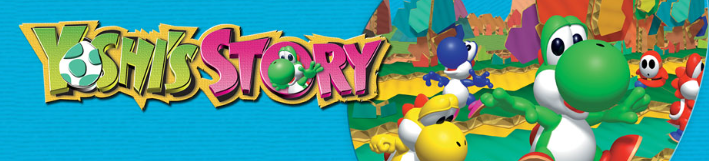
Game Corner [Mario Month]: Yoshi’s Story (Nintendo 64)


So, for no better reason than “Mar.10” resembling Mario’s name, March 10th is widely regarded as being “Mario Day”, a day to celebrate Nintendo’s portly plumber, an overalls-wearing mascot who literally changed the videogame industry forever and shaped the home console market of the nineties.

Released: 21 December 1997
Developer: Nintendo EAD

Also Available For: Nintendo Switch, Nintendo Switch 2, Nintendo Wii, and Nintendo Wii U (Virtual Console)

Metacritic Scores: 65 / 7.2

Quick Facts:
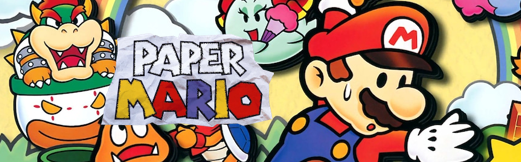
Super Mario World (Nintendo EAD, 1990) showcased the processing power of the Super Nintendo and introduced one of Mario’s most popular supporting characters, Yoshi. Originally designed to be included in the 8-bit games, Yoshi took the spotlight in Super Mario World 2: Yoshi’s Island (Nintendo EAD, 1995), a colourful and innovative platformer that was also a critical and commercial success. This kick-started a slew of Yoshi-centric spin-off titles, including this lush 2.5D adventure originally developed for the ill-fated 64DD peripheral and designed to appeal to gamers of all ages. While criticised for its clunky controls and short length, Yoshi’s Story is almost universally loved for its whimsical music, colourful graphics, and charming gameplay.

Gameplay and Power-Ups:
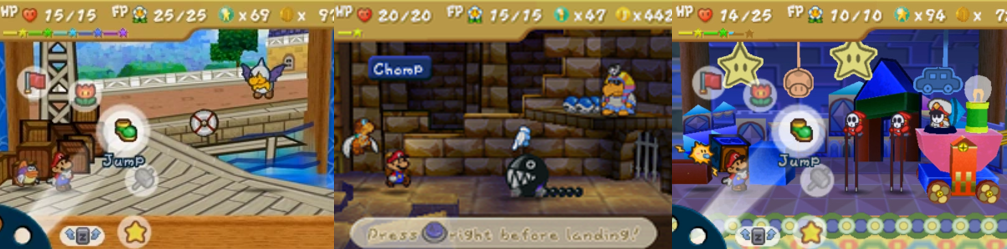
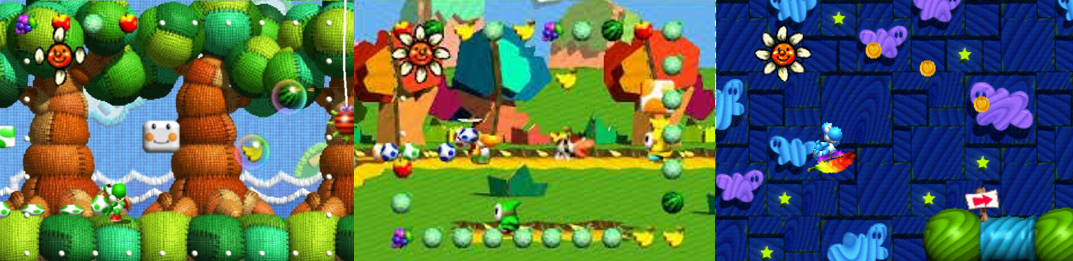
Yoshi’s Story is a colourful 2.5D platforming adventure that sees players pick from one of six different coloured Yoshis and travel through six worlds (or “Pages”), each with four levels apiece, gobbling fruit and avoiding hazards. The game plays almost identically to Super Mario World 2: Yoshi’s Island, though the much-maligned Baby Mario character has been removed, and your Yoshi now has a traditional health system, one represented by a smiling flower that wilts as you take damage. The game offers a “Practice” mode so players can test the game’s controls, which again mirror Super Mario World 2, with all of Yoshi’s previous abilities returning. Yoshi jumps if you press A, jumping higher if you hold the button and frantically kicking his legs in a “flutter” for additional airtime to cross longer gaps or compensate for poorly timed leaps. If you hold down on the control stick while in mid-jump, Yoshi performs a ground pound to crush enemies and break boxes. B sees Yoshi fling out his long, sticky tongue to gobble up fruits or enemies, the latter are swallowed and turned into a line of eggs that trail behind you. To fire eggs, players hold the Z trigger and use the handy reticle to aim, with eggs used to defeat enemies, pop balloons to release more fruit, smash blocks, and even collect Coins or Special Hearts from afar. Eggs also ricochet off walls and can be acquired by hitting Egg Blocks, though you cannot throw them underwater. If you hold the Right trigger, the camera zooms in and Yoshi sniffs around to detect hidden fruit, and you can tap the Left trigger to toggle the heads-up display (HUD) to see how much fruit you’ve collected. Similarly, pressing “Start” pauses the game, allows you to return to the main map, and displays your current score (referred to as Yoshi’s “Mood”) and totals for each stage.

Explore, platform, and toss eggs across colourful stages to gobble up fruit and make the Yoshis happy.

Like pretty much every Super Mario-adjacent title, players collect Coins in Yoshi’s Story; though they’re primarily for your score, collecting some in quick succession may spawn extra fruit. There’s no timer and players are limited to six lives, with their Yoshi being spirited away to Baby Bowser’s keep if they’re defeated and players only able to retrieve them by finding a White Shy Guy and finishing a stage with them trailing behind him. Your goal is to eat thirty fruits per stage; once you do, the stage ends and you’re taken to the next Page, encouraging multiple playthroughs as you won’t play every stage for each Page. If you reach the end of the stage without eating thirty fruits, the stage loops around until you’ve found them all, so it helps to explore and complete the various mini challenges hidden in some stages. While peppers and Black Shy Guys damage Yoshi, eating fruit, Power Bees, and Power Flowers recovers Yoshi’s health, with different Yoshi’s recovering different amounts depending on their tastes. You can also ground pound to change the colours of Shy Guys and restore more health or get a full health refill by collecting Special Hearts or a randomly selected “Lucky Fruit”, and even gobble Bob-ombs to toss them, though they’ll explode and hurt you if you take too long. Occasionally, the enthusiastic pup Poochy aids you by indicating hidden fruit for you to ground pound, or five hopping Coins will spawn that you must devour to spawn a melon. Yoshi can grab and throw Huffin Puffin chicks as a substitute for eggs, utilises Bumber ’Chute umbrellas to avoid hazards and enemies, and occasionally transforms into an egg after eating a tulip to launch to otherwise inaccessible areas. Yoshi can also swim (though can’t toss eggs underwater), temporarily becomes invincible after eating a small, heart-shaped “Super Happy” fruit, and can warp around the stages by finding four Miss Warps or utilising doors and vases. Giant snakes and serpentine dragons carry Yoshi across or up vast chasms and change direction when you jump, though I found Yoshi quite slippery and that it was tricky making precision jumps at times, leaping to some annoying drops or unnecessary deaths.

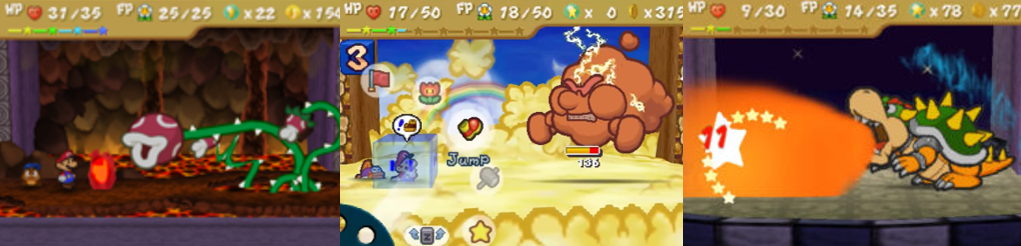
A bunch of vivid hazards and platforming challenges await in this whimiscal adventure.

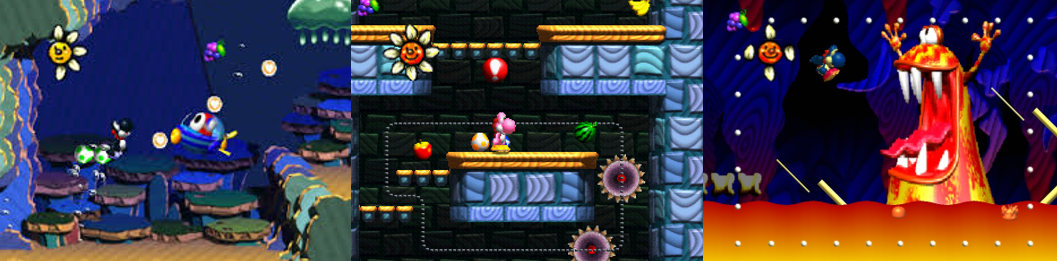
You must be wary of spike beds, bottomless pits, lava, falling spikes, and rotating platforms on your adventure. While Yoshi’s Story is pretty easy, some stages offer a greater challenge with troublesome gimmicks, like forcing you to find a key to unlock a door or swinging off wooden weights to briefly open doors. You’ll be surfing on leaves and ghosts (a clunky task), blasted along by gusts of wind, latching onto Surprise Balls, and bouncing on springs to traverse higher. Message Blocks provide hints and ? Switches temporarily create additional platforms, often to Special Hearts. Hitting ? Blocks initiates a mini game to earn additional melons: you must either quickly devour five Coins, race against an unseen Chomp to eat as many melons as possible before you reach a goal flag, and jump past seven melons. If you spot a melon flowerpot, ground pounding it initiates another mini game where you must frantically try to balance a stack of boxes and bring them to the finish line. These mini games can greatly speed up your progress so they’re worth seeking out, and it’s also advised you ground pound often or burst ? Bubbles for additional rewards. Players must deal with a lot of moving and temporary platforms, see-saws, rails (with players hitting levers to alter their direction), propellers, and swinging vines. Occasionally, large, sword-like spikes travel across or stab from the floors and ceilings, players must traverse cogs without being chewed up between them, Shy Guy’s fire cannons from the background, pistons threaten to crush you, torrents of water push you back, and bumper balls bash you about. There are buzzsaws to avoid, rolling balls to awkwardly run on across gaps, beehives that send a swarm of bees your way, little elephants that obnoxiously block your path with stop signs, thorned piranha plants and living globs of lava that must be subdued with an egg to the face, and jelly that slows your movement and keeps you grounded. Naturally, you also traverse caves, maze-like areas, and being carried across pits or lava, with it being recommended that you always have a full stock of eggs to snag any fruit or dispose of any enemies to make your life easier.

Presentation:
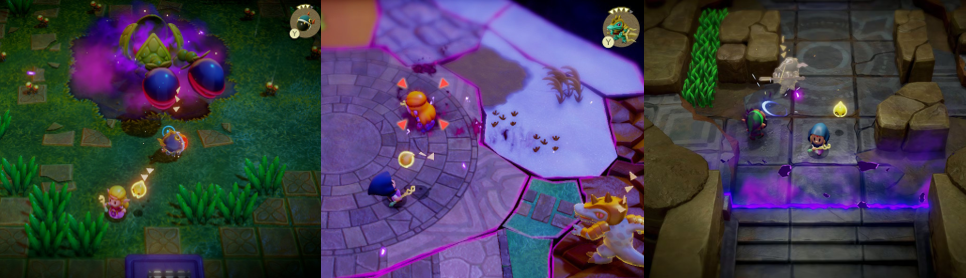
Super Mario World 2 was super cartoony and colourful and Yoshi’s Story takes this aesthetic and really runs with it, presenting every stage with a child-like whimsy that gives it a visual identity unlike most Nintendo 64 games. The Yoshis and their enemies are all lively, plasticine 3D models, with the Yoshis happily dancing when left idle, muttering and yelping, and even panting when low on health and dramatically keeling over when defeated. Poochy excitedly yips and bounds around to get your attention, the game’s sparse cutscenes are related through charming rhyming, and the soundtrack is suitably fanciful, resembling a nursery rhyme. While the Yoshis don’t sound or play any differently, which is a shame, the pop-up book aesthetic of the cutscenes is very charming (though it gets a bit laborious seeing the game recap your entire adventure once you beat it). The score board is rendered as a chalk board and Pages are presented with a unique hand-crafted aesthetic, with some appearing to be made from cardboard and construction paper while others are plastic, wool, or other crafting materials. It certainly gives Yoshi’s Story a unique (if somewhat blurry) appearance, one that’s far more detailed and colourful than Super Mario World 2’s picture-book aesthetic (which is still evoked at times), but it can make things a bit cluttered. If you enable the HUD, this is exacerbated to an almost painful degree so I’d recommend disabling it, but some environments are so dense and their colours clash and blend so much that it can be difficult to determine what’s a platform or where enemies are. A great example is Piranha Grove, where thorned piranha plants slink around in the dense, thorny jungle in the background while twists of thorny vines and winding piranha plants pop up from the foreground. Some stages attempt to provide branching paths, others have you loop and warp around to reach fruit; others have you crouch-walking past hazards or exploring dark, dingy caves. A lot of it stays very close to the usual Super Mario formula, for sure, but the game’s visual identity and unique completion mechanic allow it to stand out as you may want tow ait to eat that last fruit so you can find any missing Special Hearts.

The game’s picture book, crafted, plasticine aesthetic bolsters its unique visual identity.

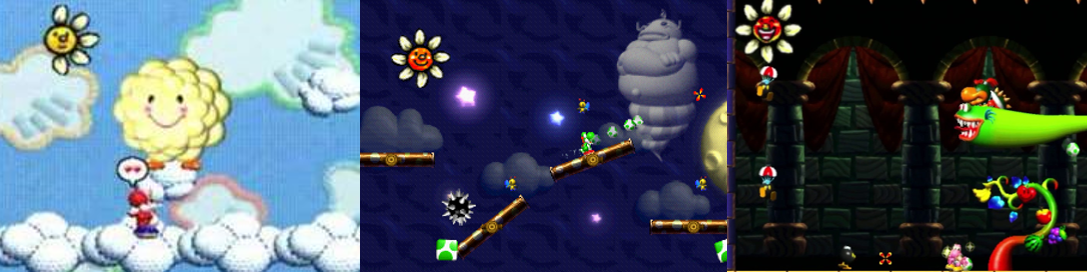
You start in a vaguely field-like area, which contains rail lifts and a tower, before descending into a cavern filled with bones, fire-breathing skeletal dragons, and jelly-filled pipes. When you reach the “Summit”, you’re up in the clouds or atop snowy mountains, before tackling the dense jungle with its thorns, waters, hollowed out trees, and gigantic Blurps. The “Ocean” Page has you swimming around a coral reef, stealing fruit from the many flailing tentacles of Sea Anemones or racing past a beach front as Shy Guy’s shoot cannons from their pirate ship. The game culminates in Baby Bowser’s tough, hazard-filled castle that’s full of Boos, magma, buzzsaws, and mechanical obstacles, to say nothing of the pits and insta-kill lava. Progression is, however, a bit odd in Yoshi’s Story. While you’re often given the chance to pick which stage you want to play on each Page, you won’t visit every stage in succession like in other Super Mario games and platformers. This means that no two playthroughs are the same, with the game limiting which stages you can pick depending on how many Special Hearts you collect. I played through the first stage of every Page in my first playthrough, for example, then the second, but the game wouldn’t let me play every stage three unless I’d previously collected enough Special Hearts, which encourages replayability and exploration, but is surprisingly obtuse for such a simplistic title. Still, I enjoyed how each stage offered different gimmicks and aesthetics: you’re not just exploring the skies in “Summit”, for example. P.3-1 has you hopping to clouds and riding snakes up in the sky, P.3-2 sees the night sky brought to life by cardboard cutouts, while P.3-3 and P.3-4 take place on a snow-filled mountaintop. Similarly, I liked how Baby Bowser’s castle changed depending on which stage you picked, favouring either a medieval aesthetic, a haunted mansion, or a lava-filled cavern. Since I found the “Jungle” Page a bit headache inducing, my favourite Page was the “Cavern”, with its dark and gloomy dinosaur graveyard, Blaarg’s lava-filled boiler with its dipping bones and skeletal bridges, and the jelly-encrusted drainage pipes. I wasn’t a big fan of the underwater stages in “Ocean” and much preferred the beach setting since Yoshi’s abilities are limited underwater and he controls a bit too loosely for my liking when swimming.

Enemies and Bosses:
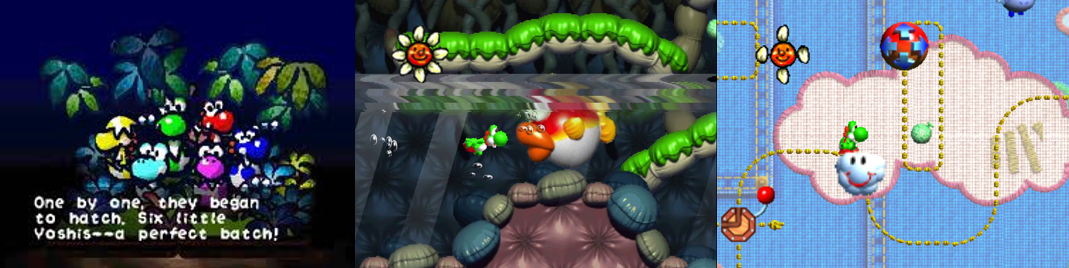
While Yoshi’s Story features a bunch of new, bizarre enemies, there are some familiar faces. The most obvious and recurring are the Shy Guys, who wander about, drop bombs or spiked fruit or carry fruit on propellers, stomp around on stilts, hide in trees, captain pirate ships, hop about on pogo springs, toss snowballs from the background, and even pilot missile-firing submarines! Lakitu also appears, awarding melons when you complete mini games, tossing spiked balls, and even blasting you with water jets. Boos haunt the “Ghost Castle”, going shy when you face them, masquerading as blocks, and even mimicking your movements in a line, Bob-ombs parachute from the sky, Bullet Bills fly at you, Chomps try to take a bite out of you, and gigantic Blurps try to swallow you whole. You’ll be taking out spiders, knocking slug-like slimes from vines, avoiding spiked and puffer fish and eels when underwater, clambering to Raven’s to gain extra height off jumps, and keeping an eye out for mischievous ghosts who hide in sticky jelly. A moss-encrusted Wiggler makes an appearance, frogs hop in your face, bat-like ComBats swoop when you get close, spiked centipedes slither around, and bumblebees buzz around trees and nests. A rainbow-coloured smiley face of death bounces about and tries to ram you, Blaarg, Bone Dragons, and Piranha Plants pop up to give you a scare and spew fireballs, and the floating Piranha Pests will temporarily shrink you to near-microscopic size, rendering you defenceless for a time, if they eat you. When exploring the “Bone Dragon Pit”, you’ll probably come across a three-headed Bone Dragon, whose Hydra-like heads must each be taken out with eggs to earn three melons. A giant, pinkish slug lurks in “Jelly Pipe”, with its only weak spot being its large, expressive eyes, while the strange, worm-like Snorkel Snake loops around the waters of “Lots O’Jelly Fish”. Its long length, circular motion, and spiked body make the Snorkel Snake a constant headache, one you’re denied the catharsis of defeating since Yoshis can’t throw eggs when underwater!

Even the more challenging bosses are ridiculously easy if you’re fast with your egg throwing.

There are five bosses to contend with in Yoshi’s Story, with all but one fought when clearing a stage in the third world, “Summit”. Each introduces themselves via a fun little cutscene and is fought in an enclosed arena, taking three hits to defeat, with the exception of the final boss. I fought the Cloudjin on my first playthrough, which takes place above a bottomless pit and sees you hopping to see-saw platforms, grabbing eggs as the gigantic cloud-like genie floats about and drops spiked balls that roll into you. He’s a big target and there are a lot of hazards to worry about, but you can simply spam your eggs and have a good chance of beating him fairly quickly. Inviso was a lot tougher since he turns invisible, barely peeking out from the background, and flooding the arena with chicks. Luckily, like all other boss battles, you can gobble Power Bees and other items to replenish health. Next, I fought Cloud N. Candy, who’s an absolutely joke. He’s big and hops about, but you can literally just spam your egg throw and beat him in, like, five seconds. Don Bongo’s fight can be tricky, though, since you’re in an enclosed space and his tantrum rains debris from above. You must target his lips, which become enlarged with each hit to make them an easier target. Naturally, Baby Bowser is the game’s toughest boss, with the fight being a two-phase affair. You can eat from the constantly replenishing Super Lucky Tree to replenish your health, though, and toss Bob-omb’s at the ceiling spikes to hit Baby Bowser as he flies around on ghosts. After three hits, he takes a more grounded approach, spitting fireballs and trying to crush you with his butt, but you can easily toss or ricochet Bob-ombs to do him in.

Additional Features:
There are three Special Hearts in each stage of Yoshi’s Island. Collecting them not only fully replenishes your health and adds to your final score but also unlocks stages in subsequent Pages, allowing you to experience every stage and boss in Yoshi’s Story (though always on separate playthroughs). Collecting Coins, eating enemies, and eating fruit also adds to your score, with players entering their names on the game’s high score table after finishing the game. However, while Yoshi’s Story doesn’t allow you to review this high score table until you finish the game, you can replay any stage you’ve beaten (as long as you collect all the Special Hearts) using the “Trial Mode” option. If you explore the “Caverns” and “Summit” pages, you may find a black- or white-spotted Giant Egg. Complete the stage with this in your inventory and you’ll unlock the Black or White Yoshi, who again only differ in their colouration rather than having additional abilities like unlimited health or eggs, though every fruit is their favourite, so they do enjoy the benefits of greater health replenishment. There’s also an invincibility code you can input if things are getting too difficult, and you can utilise a save state feature if playing through the Nintendo Switch Online + Expansion Pack.

Final Thoughts:
This was my first time playing Yoshi’s Story, a game I’d never had all that much interest in as a kid but which I decided to pick up for my modest Nintendo 64 library since it’s a reasonable price. It’s interesting that the developers chose to make a more traditional, 2.5D platformer rather than translate Yoshi’s gameplay into 3D like with Mario, especially as 3D gaming was all the rage back then and games like this were often seen as outdated as a consequence. Nevertheless, Yoshi’s Story certainly impresses with its whimsical, colourful crafted worlds that showcase the Nintendo 64’s ability to surpass its 16-bit predecessors with detailed, if familiar, locations. I really enjoyed the personality of the plasticine models, though I would’ve liked to see the Yoshis play a little differently (perhaps being faster, slower, having more or less eggs, or being better at swimming) to add some variety. A two-player co-op mode would’ve been nice as well, as well as the ability to free play any stage without entering the “Trial Mode”. The Special Heart progression system threw me, confusing me for a bit, and potentially handicaps players who simply eat every fruit without exploring. It’s weird that all the bosses are fought in “Summit” and, while I enjoyed their appearances, they’re all far too easy. It is fun that the finale offers different challenges depending on which stage you pick, and that each playthrough is different depending on which stage you select, but it does become a touch tedious when you just want to play through each stage successively. Still, Yoshi’s Story is a lot of fun, despite how slippery Yoshi can be and some of the more awkward mechanics. It’s hardly the most impressive Nintendo 64 title and doesn’t really showcase what the console was truly capable of, but it’s a fun, colourful little adventure that harkens back to the glory days of 16-bit platformers and it gives Yoshi a chance to shine as a fully capable solo star rather than a glorified babysitter.

My Rating:

Rating: 3 out of 5.

Pretty Good

Was Yoshi’s Story in your Nintendo 64 library back in the day? What did you think to the crafted aesthetic and bizarre stages? Were you disappointed that the Yoshis didn’t have different attributes? Did you ever collect all the Special Hearts and beat every stage? Are you a fan of Yoshi and, if so, which of his games is your favourite? How are you celebrating Mario’s birthday this year? Whatever your thoughts on Yoshi’s Story, feel free to share them below, support me on Ko-Fi, and be sure to check out my other Mario content!

Movie Night [National Pokémon Day]: Pokémon: Jirachi: Wish Maker


Pokémon: Blue Version and Pokémon: Red Version (Game Freak, 1996) saw a new craze sweep entire generations. Accordingly, February 27th is internationally recognised as “National Pokémon Day”.


Released: 19 July 2003
Director: Kunihiko Yuyama
Distributor: Toho

Budget: Unknown
Box Office: ¥4.5 billion
Rotten Tomatoes Score: 61%

Quick Facts:
Given how popular Pokémon was at the time, it’s no surprise that the aptly-titled Pokémon: The First Movie: Mewtwo Strikes Back (Yuyama, 1998) was a box office success. Subsequent feature films soon followed, though they were released straight to video by 2003, right in the middle of “Generation III”. With the highly regarded Pokémon: Emerald Version (Game Freak, 2004) imminent, this feature spotlighted the elusive Jirachi and was somewhat divisive among audiences.

The Review:
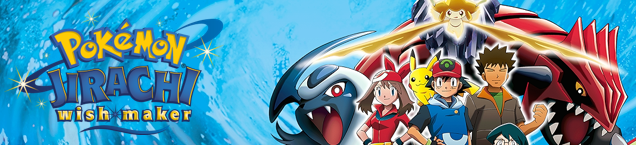
Set during the Advanced era of the anime (2002 to 2003) and continuing the streak of feature-length films based on the third generation of Pokémon videogames, Pokémon: Jirachi: Wish Maker sees aspiring Pokémon Master Ash Ketchum (Veronica Taylor), his partner Pokémon Pikachu (Ikue Otani), and his friends, former Rock-Type Gym Leader Brock (Eric Stuart) and siblings May (Veronica Taylor) and Max (Amy Birnbaum), take a detour from their journey across the Hoenn region to witness the Millennium Comet, which appears once every thousand years. Though initially disappointed to find the location of the advertised festival to be an empty valley, the group are amazed when a troop of vehicles pull up and quickly erect an elaborate fairground, including a huge tent for the Great Butler’s (Wayne Grayson) exciting magic show. Assisted by Diane (Megan Hollingshead), Kirlia (Unknown), and Mightyena (ibid), Butler wows the crowd by conjuring Pokémon out of thin air and Brock is immediately besotted when the magician does the same with Diane, though Max is more drawn to the mystical crystalline object in Diana’s hands. Rushing to investigate, Max and Ash are quickly roped into Butler’s show but their fifteen minutes of fame are rudely interrupted by Team Rocket – Jessie (Rachael Lillis), James (Eric Stuart), and Meowth (Maddie Blaustein) – who pose as clowns to steal some Pokémon and briefly snag Pikachu before being scuppered by Butler and his Dusclops (Unknown) to the delight of the unsuspecting audience. Impressed that Max can hear the rock’s calling, Butler lets him take the crystal and reveals it contains a sleeping Mythical Pokémon, the titular Jirachi (Kerry Williams), which is said to awaken and grant wishes for seven days while the Millennium Comet is overhead.

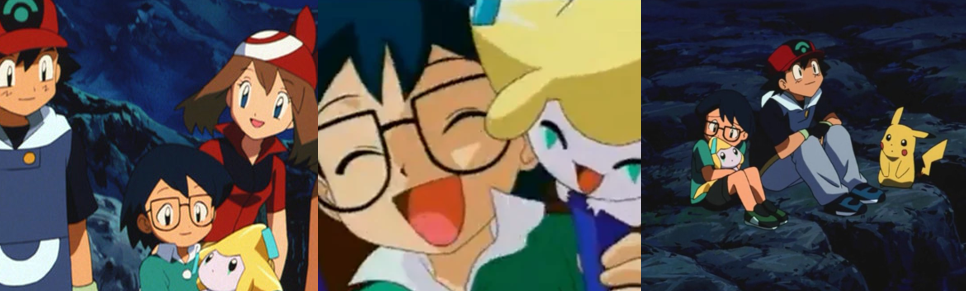
Max takes the spotlight as he bonds with the playful Jirachi during his brief awakening.

That night, May “sings” what’s said to be a soothing lullaby (but is just her going “doo-de-doo” over and over) to help Max sleep and inadvertently awakens Jirachi, much to Max’s delight. Although the pixie-like Pokémon fails to live up to its legend by merely teleporting objects or people when granting wishes, Max forms an immediate bond with the childlike sprite and spends every waking moment playing with Jirachi, causing some mischief when Jirachi insists on playing when the gang are supposed to be helping Butler. Max is thus horrified when a local Absol (Eric Stuart), sensing a coming calamity, suddenly attacks Jirachi and equally enraged when May insists on counting down the days on her dreamcatcher-like trinket in anticipation of making her own wish. While I’ve never been Max’s biggest fan, it is sweet seeing him take the spotlight and form a genuine friendship with Jirachi like Ash and Pikachu. Indeed, when Max lashes out at May for constantly reminding him that his time with Jirachi is short, it’s Ash who consoles him by sharing his own experience with saying goodbye to close friends and remembering them. Though Max is extremely protective of Jirachi, he’s young and easily distracted and also not a Pokémon trainer, though even his more seasoned friends are unable to keep Jirachi from being Pokénapped by Butler. Although they save Jirachi, thanks to Absol and Diane, Jirachi is left injured in the fracas, turning the movie into a brief road trip to Jirachi’s home, Forina, so it can recover. Along the way, Max and Jirachi grow closer, making their inevitable separation even harder for Max as he just wants to do is play and be with his new friend.

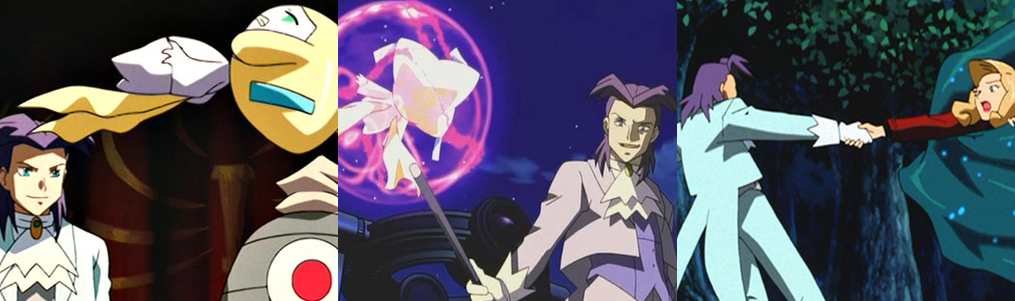
Humiliated by Team Magma, Butler embarks on a misguided plot to abuse Jirachi’s power.

Unfortunately, this isn’t meant to be due to Jirachi’s nature as it routinely hibernates for a thousand years after only seven days. While this means Max’s time with Jirachi is limited, it also means Butler’s working to a very short timetable. Though appearing to be an amiable magician, Butler was once a scientist working for the nefarious Team Magma and attempted to impress them by reanimating the Legendary Pokémon Groudon from a small fossil. When his machine malfunctioned, Butler was ridiculed and excommunicated, so he plotted to awaken Jirachi and forcibly acquire the power he needed to resurrect Groudon. Butler does this by abducting Jirachi and using Dusclops to force open its “true eye”, which absorbs incredible power from the Millennium Comet and would grant Butler his wish to be acknowledged as a credible scientist. Butler’s misguided desires see him shun Diane, who’s as in love with him as he is with her, and happily endanger anyone in his path, even torturing Jirachi to achieve his ends. Butler’s aided by his fearsome Salamence (Unknown) and a slew of devices (presumably of his own making) that tie into his status as a magician. A master illusionist, Butler easily makes it seem like people and Pokémon are disappearing and even beats Ash and the others to Forina and sets up mechanical capture devices to ensnare Jirachi and properly focus its power. Butler’s Pokémon and tricks are even enough to keep the feared pseudo-Legendary Absol at bay and fend off a local Flygon (Shinichiro Miki) who helps the heroes. As is tradition for these films, Team Rocket are largely here for comic relief and have little relevance. When Jirachi awakens, they greedily follow Ash and the others to try and snag it only to end up absorbed by Butler’s abomination of a Groudon and once again relying on their enemies to save their asses.

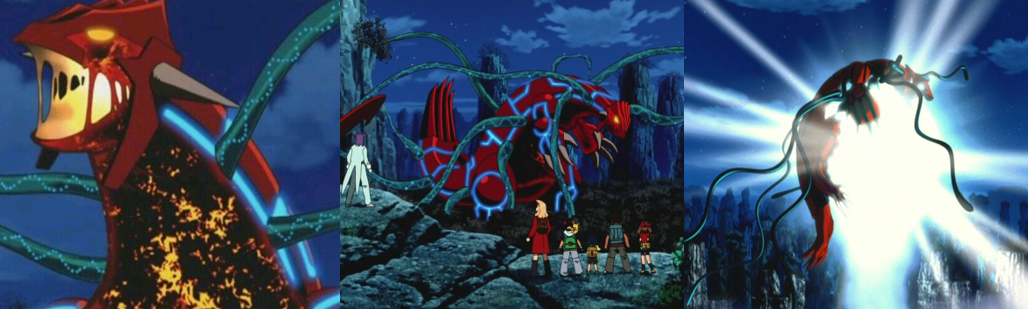
Though fearsome, Meta Groudon is undone by Jirachi’s incredible pre-nap power.

Indeed, while Ash and the others save Jirachi from Butler’s machine, the damage has been done and a titanic, grotesque mockery of Groudon goes on a mindless rampage. Rather than being the fabled Ground-Type kaiju, this corrupted Groudon is said to be “pure evil” and sets about absorbing energy from the land, immediately decaying plant life and absorbing Pokémon and humans with its glob-like tentacles. Fearsome and completely invulnerable, this “Meta Groudon” shrugs off all attacks and absorbs anything in its path, including Absol, Team Rocket, and Diane. Horrified by what he’s unleashed and at his beloved’s fate, the remorseful Butler immediately works to reverse the damage. Though naturally distrustful of Butler, Ash agrees to help spirit Jirachi back to the magician’s machine to reverse the polarity and dispel the fake Groudon, only to be absorbed by the creature shortly before preparing his machine. Drawn to Jirachi’s energy, Meta Groudon begins to melt to try and drown the pixie-like Pokémon, only for Jirachi to successfully absorb natural energy and unleash Doom Desire, rocketing Meta Groudon into the night sky where it explodes like a firework, freeing its captives. Upon reuniting with his new friends, the exhausted Jirachi asks Max to sing the lullaby to send it back into hibernation and, though distraught to say goodbye, Max and the others willingly oblige. Thus, Jirachi turns back into a crystalline form, though Max consoles himself with the knowledge that his friend will always be with him. In the aftermath, a repentant Butler vows to recommit himself to more tangible matters, like his relationship with Diane, having learned to value what really matters in life. Though upset to have missed her chance at making a wish, May agrees with Ash that the best way to make dreams come true is to keep pursuing them, ending the film on a heart-warming message about never giving up on your goals and never forgetting your friends.

Final Thoughts:
I’ll admit that I’m slightly biased when it comes to Pokémon: Jirachi: Wish Maker. I much prefer it when the Pokémon movies have high stakes and big, explosive battles between fearsome Legendary Pokémon. It also really bugs me that we never got a movie pitting Groudon, Kyogre, and Rayquaza against each other as that could’ve made for an awesome, world threatening adventure. I’m also not a big fan of Max, who’s especially bratty here, or Jirachi, a relatively weak and largely forgettable Pokémon compared to some of its peers. Still, I don’t necessarily hate this film. It lovingly explores the nature of friendship through Max’s relationship with Jirachi, which is seen as whimsical and carefree but doomed to end in heartache as Jirachi’s time awake is so limited. There’s a meaningful lesson about enjoying the time you have, being mature enough to say goodbye, and always remembering your friends even if they’re gone and this ties in nicely with Butler’s character arc. Shunned and humiliated by Team Magma, Butler becomes obsessed with proving his intellectual superiority, forsaking everything to achieve his goal, only to be horrified when his wish comes true and results in catastrophe. Meta Groudon is a frightening presence that’s sadly underutilised and easily dispatched but results in a pretty intense finale as it wrecks the natural landscape and threatens our heroes, though I still would’ve preferred to see the real Groudon or at least seen this corrupted version battle something more interesting than an Absol. Pokémon: Jirachi: Wish Maker is one of a handful of the features that’s clearly aimed at a different, younger audience than myself and I can accept that, but it doesn’t mean I have to like missing out on what could’ve been. While there’s a heart-warming message here and some fun visuals and moments, it’s not enough for me to say this is one of the better Pokémon movies and it’s ultimately forgettable when you consider some of its messages were told far better in other films and episodes.

My Rating:

Rating: 2 out of 5.

Could Be Better

What did you think to Pokémon: Jirachi: Wish Maker? Do you prefer the more action-packed Pokémon movies? Did you like the focus on Max and his relationship with Jirachi? Were you also disappointed that we never got a true Groudon in the films? Which Pokémon game, generation, and creature is your favourite and why? How are you celebrating National Pokémon Day today? Whatever your thoughts, leave a comment below and donate to my Ko-Fi to fund more Pokémon content on the site.

Game Corner [Zelda Day]: The Legend of Zelda: Echoes of Wisdom (Nintendo Switch)


On this day in 1986, legendary game designer Shigeru Miyamoto and Takashi Tezuka launched the Legend of Zelda series, now one of Nintendo’s most popular franchises.


Released: 13 September 2024
Developer: Nintendo EPD and Grezzo

Also Available For: Nintendo Switch 2
Metacritic Scores: 85 / 8.4

Quick Facts:
After the original Nintendo Entertainment System (NES) Zelda sold over 6.5 million copies, the franchise spawned a handful of generally questionable spin-offs, though the titular princess only took the spotlight in a much-maligned and poorly conceived release for the ill-fated Phillips CD-i. Following the critical and commercial success of their 2019 diorama-inspired remake of The Legend of Zelda: Link’s Awakening (ibid, 1993), Nintendo and developers Grezzo originally conceived the follow-up as an expansion of Link’s Awakening’s dungeon editor. The project changed to put the princess at the forefront and the dungeon editor mechanics became the “Echoes” system (purposely included over series protagonist Link), and the game was specifically designed to appeal to all gamers. The Legend of Zelda: Echoes of Wisdom released to largely positive reviews that praised the innovative changes to the franchise formula and adorable visuals while criticising the restrictive combat options and clunky user interface.

Gameplay and Power-Ups:
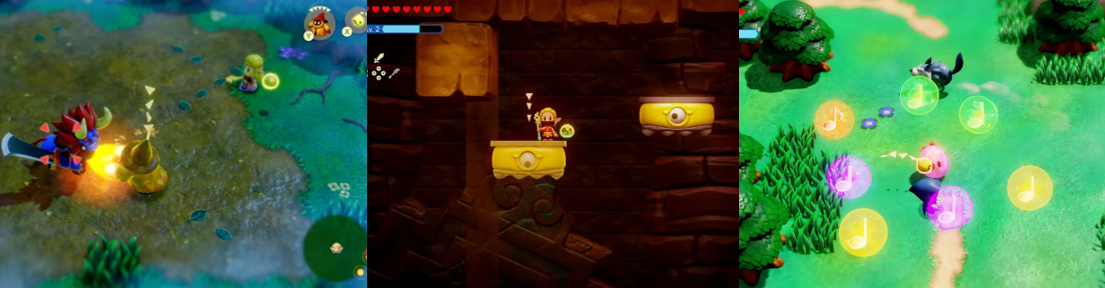
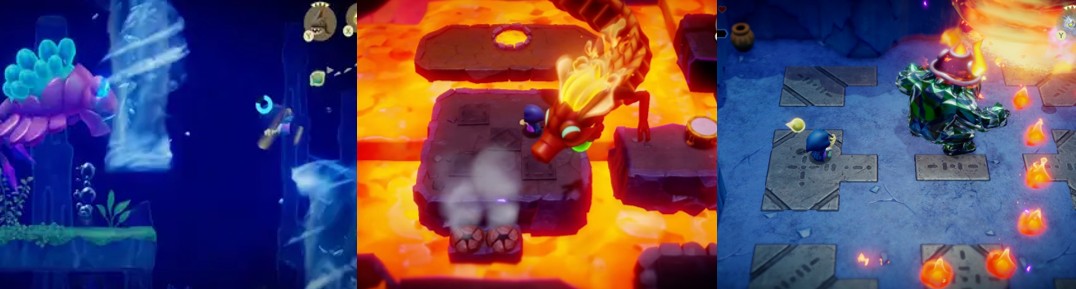
Much like the adorable and fun-packed diorama-like remake of Link’s Awakening, The Legend of Zelda: Echoes of Wisdom is a 2.5D, quasi-top down adventure in which players explore a version of the fantasy land Hyrule that closely mirrors The Legend of Zelda: A Link to the Past (Nintendo EAD, 1991) and its sequel. Of course, the most obvious thing that separates Echoes of Wisdom from other Zelda titles is that players now play as the titular princess for the first time in a mainline game…after clearing a quick pre-game sequence where you control a fully powered-up Link and battle the Demon King, Ganon. Once Link is sucked into a rift and lost in the “Still World”, however, you exclusively guide Zelda across Hyrule, sealing rifts and collecting “Sanctions” of the legendary Goddesses to confront the being responsible for the rifts, Null. If you’ve played the Link’s Awakening remake or the classic Zelda titles, Echoes of Wisdom will be immediately familiar, though it does include elements from The Legend of Zelda: Breath of the Wild (Nintendo EPD, 2017) and Tears of the Kingdom (ibid, 2023). Players talk to non-playable characters (NPCs), open chests and doors, or pick up various items with A, jump with B, and perform a spin attack with the Right trigger to cut through grass and move a bit faster (though it doesn’t damage enemies). Unlike Link, Zelda doesn’t carry a sword and shield, but she can still target enemies with ZL to send her “Echoes” in to attack. Zelda wields the Tri Rod, gifted to her by the pixie-like companion, Tri. By defeating enemies or encountering shimmering objects, Zelda can add Echoes to her repertoire with ZR and spawn them with Y. Each has a different cost, as indicated by Tri’s current level, and you must seal rifts and rescue Tri’s friends to level him up, which reduces the cost of using Echoes so you can spawn more to solve puzzles and attack enemies.

Echoes and Automatons do Zelda’s fighting for her and and are essential for puzzle solving.

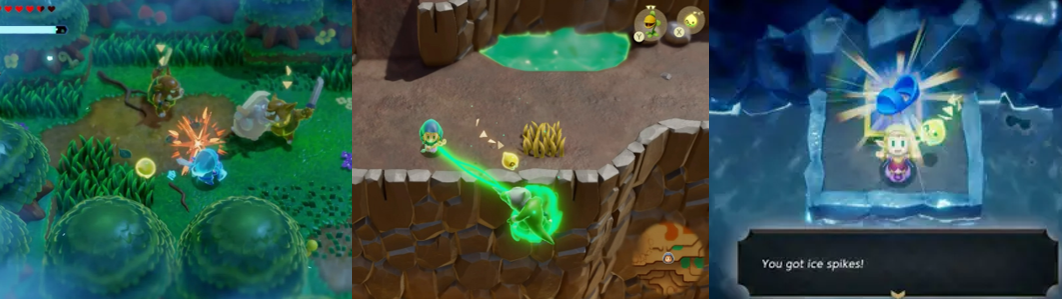
There are loads of Echoes to learn; they’re mapped to the right directional pad (D-pad), and you can set favourites and sort them by type and order obtained. They remind me of the classic Sonic the Hedgehog (Various, 1991 to 1994) debug modes as you spawn regular props (chairs, creates, etc) or enemies who attack on your behalf. Sadly, this means Zelda mostly takes a backseat in combat as you use Moblins, Wizzrobes, Chompfins, and the like to fight for you. There are different levels, too, with the stronger Echoes taking more hits and dealing additional damage but costing more to spawn. Echoes are also essential for solving the game’s various puzzles. You’ll need flaming Echoes to light torches, keep you warm on Holy Mount Lanayru and melt ice, meat to distract enemies, hopping Armos statues to press pressure pads, ranged Echoes to activate switches, and Wind Cannons to extinguish flames or push you across gaps. Echoes create stationary, moving, and temporary platforms, spawn Strandtulas to create webs to climb between, Bombfish to blow up weak walls and blocks, and Mothulas you can grab to float across gaps. You can spawn beds to sleep in and refill Zelda’s health (though enemies still drop hearts and you can still extend her health by finding Heart Pieces), burrow through soft dirt with Holmills, and light up dark underwater caverns with Tanglers. It can be fun experimenting with Echoes to find hidden areas and solve puzzles, though I stuck to a handful of specific Echoes to get past most areas. There are times when you need specific Echoes like the animal statues specifically created for the Gerudo Dungeon and the Ancient Orb used to access the Great Deku Tree. Other times, you spawn boulders to weigh down platforms, summon specific enemies to appease NPCs, use lava rocks to safely bypass lava, or spawn Water Blocks to swim between bodies of water in the bizarre Still World. Similarly, Zelda can eventually unleash six of Dampé’s “Automatons”, mechanical duplicates of various enemies that deal greater damage and take more hits, but cost Rupees and “Monster Stones” to repair. Considering how many Echoes there are, I found little use for these and honestly got annoyed with the Echo system as it wasn’t as much fun as fighting directly.

The limited Swordfighter form, versatile Tri, and various accessories add to the gameplay.

The Still World is Echoes of Wisdom’s take on the “Dark World” concept from previous Zelda games. Areas of Hyrule are blemished and impassable thanks to rifts that spawn shadowy monsters who cannot be learned and don’t drop hearts or Rupees and can only be dispelled by venturing into the surreal, twisted Still World. In here, elements of the regular world are slanted, fragmented, and turned upside down, forcing you to use Echoes in new ways to traverse the endless void and locate Tri’s friends. This opens new areas on the map and levels-up Tri, who also latches onto objects and enemies with X, allowing you to move blocks from afar or carry objects to NPCs to complete side quests. You can also latch onto moving platforms to be carried across pits and solve puzzles from a distance. Soon into the game, Zelda acquires Link’s “Sword of Might” and assumes his form by pressing up on the D-pad. This allows you to swing and charge the sword and, eventually, fire arrows and toss bombs, but only for as long as the Energy Gauge lasts. You refill this by collecting energy (generally by defeating enemies in the Still World) and the gauge can be increased and her weapons upgraded by saving Tri’s friends and finding “Might Crystals” around Hyrule. I found it best to save the Swordfighter for bosses as even a fully upgraded Energy Guage won’t keep sustain the form for long. Zelda can extend her time in this form, locate Might Crystals, improve her swimming, and gain additional benefits from various accessories. While you can only equip a couple at a time (unless you pay a Great Fairy to make you more “stylish”), these are super useful for negating quicksand, preventing slipping on ice, and spawning more hearts or energy. Similarly, Zelda can wear different clothing for additional benefits, such as recovering more hearts when sleeping in her pyjamas, talking to cats to solve side quests, and increasing her spin radius.

Echoes help you navigate Hyrule, the dungeons, and seal the rifts spilling into the Still World.

You’ll be collecting Rupees to buy items from shops, helping NPCs to earn Might Crystals, Heart Pieces, and empty bottles to store restorative fairies, and collecting keys and maps to progress in dungeons. Like in Breath of the Wild and Tears of the Kingdom, enemies and chests often yield monster parts or various fruits. These can be brought to Deku Scrub vendors to mix smoothies to recover health or energy, stave off frigid cold and resist fire damage for a set time, reduce damage for a set time, and speed up your wall climbing, among other benefits. Every NPC provides hints about where you should go next, though you’re free to explore and tackle each area, rift, and dungeon in any order. Zelda doesn’t acquire new items from dungeons, just additional parts for her Swordfighter form that aren’t necessary to solve puzzles, so you’re free to tackle the main and side quests however you like. These are tracked on the map, and you can set stamps and waypoints to guide you, though some areas are more challenging. Holy Mount Lanayru features freezing water and areas that sap your hearts, the Gerudo Desert is full of quicksand, lava is rife on (and in) Eldin Volcano, and you must grab air bubbles to properly navigate the Jabul Waters and its ruins. As ever, dungeons get larger and more complex as you progress. These include a mixture of top-down and 2.5D sidescrolling sections and have you spawning Echoes to activate switches, open gates, and acquire keys to progress. You move giant boulders, ride elevators, defeat all enemies, climb walls, pull levers, and step on pressure pads as standard. Often, you must use Tri to latch onto objects beyond gates to progress; other times, you must place statues in specific spots or destroy blocks to find keys. Faron Temple has you going in and out, weighing down platforms and lighting up dark areas, while Lanayru Temple sees you heating up (or cooling down) special orbs to thaw or freeze up different areas. Gerudo Sanctum has you pulling out giant plugs to fill areas with or drain them of sand, you must spawn lava rock Echoes to cross and ride flava plumes in Eldin Temple, and you must strategically place (or destroy) Armos statues in Faron Temple.

Presentation:
As it’s based on the Link’s Awakening remake, Echoes of Wisdom looks, (mostly) plays, sounds, and feels exactly the same. This is great, for me, as I’m a big fan of the diorama-like, plasticine art style used to bring this epic fantasy world to life. It’s exactly in keeping with the aesthetic of the classic Zelda games and I much prefer the traditional, top-down approach to Zelda. Like Link, Zelda is mute here, talking only through pantomime or Tri, but she gets a chance to show more personality than ever as she’s framed for the rifts and initially goes incognito, meets Hyrule’s various races and helps with their rifts, issues, and worries, and tirelessly traverses both worlds to save her people and rescue Link. Zelda assumes a few different forms with her Swordfighter ability and clothing, though this latter mechanic doesn’t get much attention, unfortunately. This may be the biggest and most diverse 2.5D rendition of Hyrule yet, but it’s easy to explore (even with the rifts) and the fast travel system makes getting around a doddle. All the classic Zelda locations return, with the mischievous, all-female Gerudo waiting in the desert, two warring factions of Zora out by the swamp, and Gorons residing in the mountains. They’re joined by Tri’s people and the yeti-like Condé on Hebra Mountain, yet locations like Kakariko Village, Lake Hylia, and Hyrule Castle all make welcome returns alongside a typical mist-shrouded forest, spooky graveyard, and dingy swamp. As colourful and varied as Hyrule is, the game really impresses and ups its challenge in the ominous Still World, where a desolate void lurks in the background, NPCs are frozen in time, and parts of the environment are scattered about as bizarre makeshift platforms.

The unique story and reimagined locations are married with some all-too-familiar dungeons.

These are areas where Echoes of Wisdom shines best as it mirrors Breath of the Wild and Tears of the Kingdom by offering largely visually uninspiring dungeons. They’re not as confusing or layered as other 2 and 2.5D Zelda dungeons and are surprisingly easy to figure out considering the additional mechanics offering by Tri and the Echoes. It’s not too difficult to work out when you have to latch onto something and move it to higher ground, for example, or hit a faraway switch with something like a Boomerang Boarblin. Suthorn Ruins eases you into things nicely, appearing as an ancient, cave-like temple of cracked walkways and broken paths. Jabul Ruins emphasises swimming, with you avoiding whirlpools and grabbing air bubbles alongside stepping on coloured switches to raise a waterspout in the main chamber. Gerudo Sanctum features a wind gimmick and is structured like a boobytrapped training ground, forcing you to clear away and drain sand to progress, while Eldin Temple is housed within an active volcano. You must ride steam bursts, cross lava, and carefully climb rocky walls to progress. Faron Temple steps up the visuals as it’s housed within the Still World, so it’s got a surreal air to it, dark chambers, and crystals to charge with electrical attacks. Lanayru Temple and the surrounding mountains was probably my favourite area as you must fight against the slippery ice, stave off the frigid cold, and power up machinery to freeze or thaw different rooms. Things go full bonkers when you confront Null, however, as you battle through his insides alongside Link like the Kafai side quest in The Legend of Zelda: Majora’s Mask (Nintendo EAD, 2000) and traverse a fractured, bastardised version of Hyrule to reach the end. The game’s story is primarily told through speech bubbles, though some higher quality cutscenes crop up now and then. Musically, Echoes of Wisdom does well, emphasising more relaxed tunes than usual and peppering remixes of “Zelda’s Lullaby” and the main overture into the mix, though nothing really jumped out at me as very memorable.

Enemies and Bosses:
All the usual suspects return in Echoes of Wisdom, with every enemy (save for their rift-spawned shadows) capable of being spawned as Echoes. You’ll be swatting crow-like Guays and bat-like Keese from the air (with these latter also boasting fire, ice, and lightning variants), slaughtering spear- and sword-wielding Moblins (the tougher variants also boasting shields), and struggling to reflect Octorock’s projectiles without a shield. Lizalfos thrust and leap with tridents, Peahats pop from the ground and fly at you with their bladed underbellies, Mini-Moldorms snake around, Torch and Freeze Slugs crawl along leaving damaging trails, and elemental Wizzrobes teleport about small areas firing magical energy waves. Tektites pounce from the water, Beamos fire lasers from their eyes, snake-like Ropes lurk in grass, and you’ll even track down a super-strong Lynel that’s worth adding to your Echo line-up. ReDeads and Gibdos freeze you with a horrifying scream, Poes become intangible and toss flames from their lanterns, Darknuts wield giant axes, and ravenous Chompfin wait in the sea. There are also some new enemies to contend with, like the rain-spawning Drippitune and distracting Ribbitune (though they pose little threat), the Tweelus rock monsters who fly into a rage when attacked, swooping Albatrawl, and armadillo-like Caromadillo who roll into a ball to attack you. Many enemies receive shadowy variants in and around rifts and some (like the Ball-and-Chain Trooper and White Wolfos) act as mini bosses. Other optional mini bosses appear in side quests: the centipede-like Lanmola lurks in the Gerudo Desert, the Barinade-like Bori is fought in the wrecked ship, the red-hot Volcanic Talus is battled in Summit Cave, and the sentient gas ball Smog is encountered in the Eastern Temple. Naturally, these tend to be tougher battles, with Volcanic Talus being a flaming variant on the Seismic Talus boss battle and Bori emitting a powerful electrical field that’s difficult to avoid as you frantically destroy its mini jellyfish.

Amidst the fun mini bosses, you’ll find dark copies of Zelda and multiple iterations of series hero Link.

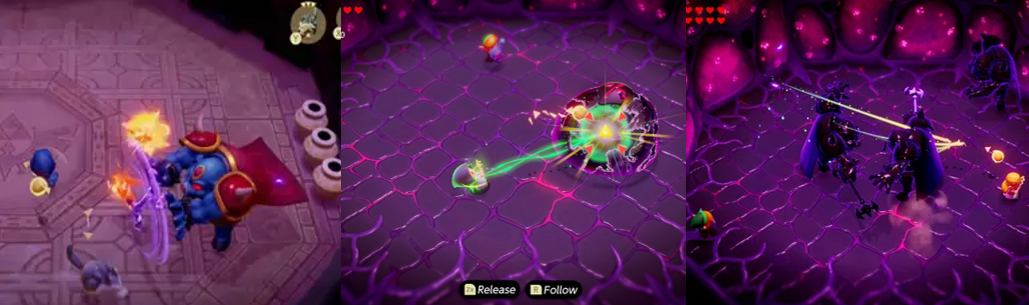
There are six mini bosses to contend with across Echoes of Wisdom, with your first being a battle against Ganon himself! This is essentially a stripped down version of A Link to the Past’s final battle as sees you (as Link) swatting Ganon with your sword as he teleports about, tosses his trident, and lunges from across the screen. You must defeat an Echo of Lord Jabu-Jabu to access the Jabul Ruins, and this fight sees you tossing Bombfish when he breaths in deeply and frantically swimming or hopping to wooden planks as he chomps around in the water. In Faron Temple, you encounter the multi-headed plant monster Manhandla twice, with you again stunning it by tricking it into eating Bombfishes so you can sever each head. In the second fight, it sprouts more heads, with two spitting projectiles. Lanayru Temple’s Slime Eye was a bit of a pain as you must avoid being squashed when it drops from above and spawn ice Echoes to freeze it. Each time you shatter it, it splits into smaller forms, which can quickly clog up the screen and make it difficult to avoid taking damage. When in the Stilled Ancient Ruins, Zelda battles her rift-spawned doppelgänger, who floats about and spawns shadow monsters of her own. You must lock onto her and fire your arrows to knock her down, preferably spawning a Lynel to handle her minions and deal big damage to her as she has a lot of help. Additionally, your most persistent enemy in Echoes of Wisdom is a shadowy double of Link who’s fought three times. Each time, he adds a new weapon to his arsenal which you receive upon victory, meaning you must battle against his sword swings, bomb tosses, and arrows. Link fires up to three arrows, charges a Spin Attack, jumps about, and powers up to be faster or spawn duplicates. Still, it’s generally easy enough to distract him with one Echo and spawn another to hit him from behind even with pits or multiple attacks to worry about.

Some large and complex, unique, familiar, and challenging bosses stand in Zelda’s path.

There are also eight regular bosses, with some being returning faces from the franchise. I fought the Seismic Talus first, which circles the arena and rapidly spins its long, rocky arms or slams them to the ground. You must target the exposed core on its back when it’s stunned or distracted, but the weak spot moves as the fight progresses. Next, I battled the fish-like Vocavor underwater in a 2.5D setting. You must grab air bubbles and dodge the whirlpools it spawns and its tail attack, dropping Bombfish to target the growths on its skin and leave it vulnerable for your sword. The giant mole Mogryph burrows under the sand, sending sand plumes at you, and diving across the sand to skewer you. You must trick it into colliding with the statues to stun it, then spawn your own when it takes to the air, watching for quicksand and sand twisters. I was super happy to see Volvagia return in Eldin Temple for a pretty challenging battle. Volvagia’s largely invulnerable when circling and you must avoid falling into the lava or stepping on red-hot tiles. When it pops from a lava pool, fire your arrows or use Tri to tug at its necklace to stun it, but watch for the energy balls and fireballs it spits and its wide-arching head swipe. Another familiar face, Gohma, guards Faron Temple. This time, you must use electrical Echoes to quickly attack the green crystals on her body to stun her, avoiding or burning the webs she spits out and taking out her babies as they appear. As you deal damage, Gohma stomps about and tries to trap you in her pincers and fires a sweeping laser. Skorchill awaits in Lanayru Temple and spins around on the ice, stomping to drop icicles, or switching to its fire helmet to spit fireballs and performing a flaming spin. You must alternate between ice- and fire-based Echoes depending on which helmet Skorchill’s wearing, with it eventually rapidly switching between both forms by the finale.

As tough as Ganon is, newcomer Null pushes your Echo-casting and Tri-throwing to their limit.

Ganon returns in Hyrule Castle, now noticeably more formidable since Zelda lacks Link’s usual attacks. In addition to his massive trident and teleporting antics, Ganon tosses fireballs and goads you into playing dead man’s volley, so be sure to have your Energy Gauge topped up. This was easily the toughest fight of the early game for me since Ganon is very aggressive. However, Ganon’s not the big bad here. Instead, it’s Null, a shadowy being once imprisoned by the Goddesses that somewhat reminds me of Nightmare from Link’s Awakening. The final battle with Null has three distinct phases, with Link joining you for two of them. In the first, you must latch onto Null’s arms and stretch them out so Link and your (Lynel) Echoes can attack. When it hides in the walls, you must avoid the draining goop it spawns and yank on its arms, again relying on Link and your Echoes since Zelda loses her Swordfighter form in the endgame. In the second phase, Zelda battles alone in Null’s bloodstream, like the Vocavor fight, swimming past giant whirlpools and spawning Chompfins to attack Null’s tentacles. The final phase is basically the same as the first, but much tougher. Null has more hands that are harder to snag (seriously, I kept grabbing Link or my Lynel, which was super frustrating!) and transforms into each of the previous bosses and uses their signature attacks, sometimes becoming multiple at once, or mixing and matching them, meaning you could be faced with as many as four Ganons alongside two flying Mogryphs! This was easily the most troublesome phase as the arena is filled with giant enemies and attacks that are difficult to avoid, so it’s best to sneak in a nap when you can or drink some special smoothies to even the odds. After enough hits, you must snag the “Prime Energy” from its body, rapidly tapping A to dispel the creature and restore the land.

Additional Features:
As in every Legend of Zelda videogame, there are numerous Heart Pieces to be found here. You get full ones for defeating each boss, and another heart for every four pieces you find, with forty of them spread across the map. There are also 150 Might Crystals to find which, when taken to Lueberry, will upgrade your Energy Gauge and Swordfighter form. You only need 125 to upgrade everything but, with all 150, Lueberry builds a machine to fill the Energy Gauge at will (not that you’ll need it by then). There are also sixty-nine (…nice) smoothie recipes to make, with you earning new accessories for crafting set amounts, and twenty-eight accessories to find, buy, or earn. There are eleven outfits to wear, though three are unlocked using Amiibos and one is only awarded after finding all twenty-five stamp locations. Each time you fill a stamp card, the Stamp Guy gives you a reward, such as a bottle or golden egg, and finding all twenty-five lets you dress as him. After finishing the game, you get a stamp on your save file and are free to finish up any side quests or tasks, with the map expanded to show any Echoes or collectibles you’ve missed. There are fifty-one side quests, from showing monsters to NPCs, finding a stray horse, talking to local cats while wearing cat clothes, tackling options side dungeons and mini bosses, ferrying items back and forth, locating a possible spy in the Hyrule guard’s ranks, and playing hide and seek. You can also collect acorns for rewards, play the game in the more challenging “Hero” mode, or head to the Slumber Dojo to tackle timed challenges. These see you battling enemies with various restrictions (such as having no Echoes or items at the start, playing in darkness or against elemental forces, or having healing drinks banned) and endure boss rushes, with various awards gifted depending on how fast you complete each challenge (with the final reward being Link’s iconic green tunic).

Final Thoughts:
I was super excited for The Legend of Zelda: Echoes of Wisdom because I was such a fan of the Link’s Awakening remake and this visual style for the franchise. This is the Zelda I enjoy: colourful, oddball, top-down adventuring with a clear progression system, a bunch of collectibles, and fun enemies and bosses to face.  In that regard, Echoes of Wisdom more than delivers with its clear allusions to A Link to the Past, incorporating the side quest tracking and certain mechanics from Breath of the Wild and Tears of the Kingdom, and giving long-time fans something new to experience through Zelda. While the dungeons were somewhat basic, I really enjoyed all the mini bosses peppered throughout the game, especially the fights against Dark Link, and the bosses were surprisingly challenging. Ganon and newcomer Null were especially taxing at times, though I suspect players who take advantage of the smoothie, accessory, and Echo system may fare better. Unfortunately, as fun as the Echo system can be, I wasn’t a fan of how it replaced real-time combat with almost a real-time strategy flavour. Zelda cannot attack unless she transforms into what’s basically Link, robbing her of a lot of agency (especially as she’s known to be a keen archer) and making battles needlessly tedious. The Echoes were good for puzzle solving but even this aspect was downplayed, with many of the puzzles being far too familiar and not as innovative as the system promises. It’s a shame as there’s a lot to like here but it mostly felt like I was playing with a janky debug mode, spawning random crap into each area to see what would happen, which wasn’t that fun as many Echoes are pretty useless. I wonder if a back-and-forth system might’ve been better, where players control Link and Zelda, switching between them depending on the situation. Echoes of Wisdom is still a gorgeous and enjoyable title, however, and well worth your time, I just think it fails to live up to its full potential at times.

My Rating:

Rating: 3 out of 5.

Pretty Good

What did you think to The Legend of Zelda: Echoes of Wisdom? Were you happy to see Zelda take the spotlight for a change? What did you think to the Echo system and how it took control away from the player? Did you enjoy the surreal appearance of the Still World? What did you think to Null and did you also struggle against his final form? Did you ever complete all the side quests and conquer the Slumber Dojo? Which Zelda game is your favourite and how did you celebrate the franchise today? Whatever your thoughts on Echoes of Wisdom, drop a comment down below, go check out my other Zelda reviews, and donate to my Ko-Fi to see more Zelda content.
Movie Night: Pokémon: Lucario and the Mystery of Mew

Released: 16 July 2005
Director: Kunihiko Yuyama
Distributor: Toho

Budget: Unknown
Box Office: ¥4.3 billion
Rotten Tomatoes Score: 81%

Quick Facts:
An instant phenomenon, Pokémon (Nintendo/Creatures/Game Freak, 1995 to present) dominated playgrounds with videogames, trading cards, and an ongoing anime series (1997 to present). This led to the successful first feature film, which spawned a slew of sequels. By 2005, these were being released straight to video outside of Japan but continued to feature popular Pokémon like Mew, who famously birthed Mewtwo on this day.

The Review:
Taking place during the Advanced Battle portion of the anime series (2004 to 2005) and featuring Pokémon from the upcoming Diamond and Pearl releases (Game Freak, 2006), Lucario and the Mystery of Mew opens in the distant past of the Kanto region. At this time, the beautiful Cameron Palace was caught in the middle of a brutal war was fought between two, heavily armoured Pokémon armies. This impending danger is discovered by the titular Lucario (Sean Schemmel), a stoic and proud Fighting/Steel-Type Pokémon who wields incredible power through its “Aura” abilities. Focusing its power through a nearby crystalline formation, Lucario warns its master – “Aura Guardian” Sir Aran (Jason Griffith) – of the danger before being attacked and temporarily blinded by two Houndoom (Koichi Sakaguchi). Although Lucario fends off the Pokémon, he’s stunned when Sir Aran abandons Queen Rin (Bella Hudson) and the castle. When the aghast Lucario pursues, Sir Aran traps it within a magical staff, leaving it feeling hurt and betrayed. History, however, remembers Sir Aran very differently as it’s said he travelled to the nearby “Tree of Beginning” and ended the conflict between the Pokémon armies, restoring peace to the land. Sir Aran’s so well-renowned that Cameron Palace holds an annual festival to celebrate its hero, one that aspiring Pokémon Master Ash Ketchum (Veronica Taylor) and his friends just so happen to be present for. Ash, Brock (Eric Stuart), May (Veronica Taylor), Max (Amy Birnbaum), and (reluctantly) Pikachu (Ikue Ōtani) dress in period-appropriate outfits for the occasion and Ash (garbed in an outfit resembling Sir Aran’s) conveniently wins the annual Pokémon tournament to be crowned “Aura Champion”. Though he’s annoyed to miss out on the dancing and revelry, Ash is amazed by an ancient staff he’s gifted and the whispers he can hear emanating from it and is absolutely gob-smacked when Lucario is unexpectedly released from it.

Betrayed by its master, Lucario struggles to trust humans and their intentions.

Still partially blinded and confused from the time dilation, Lucario initially mistakes Ash for Sir Aran and flees, amazed to find that hundreds of years have passed, but is calmed by Lady Ilene (Bella Hudson), who recognises it from legend. Lucario’s awakened just in time as a mischievous Mew (Satomi Kōrogi) has been masquerading as various Pokémon (including the legendary Ho-Oh) during the festivities and playing with Pikachu and other Pokémon, unaware that world-renowned record breaker and part-time Pokémon trainer Kidd Summers (Rebecca Soler) is hoping to track it to the fabled Tree of Beginning. A miscommunication sees her Weavile (Eric Stuart) get a little rough with Mew, Pikachu, and Team Rocket’s outspoken mascot, Meowth (Maddie Blaustein), leading Mew to teleport itself, Meowth, and the injured Pikachu to the Tree of Beginning to heal. When Max informs the others, Kidd eagerly joins them in journeying to the Tree of Beginning (much to Brock’s delight) and Lucario obediently agrees to lead them, though it’s fraught with scepticism about human nature. The journey sees Lucario learn of Ash and Pikachu’s friendship and remember happier times with Sir Aran, where its master taught him to hone his Aura to attack and communicate. Somewhat uptight and reserved, Lucario struggled to let its guard down even when encouraged by its master and lashes out whenever Ash and the others invite it to bathe or share food, believing humans cannot be trusted. Local “time flowers” only further sour its mood as he’s reminded of Sir Aran’s treachery and it eventually comes to blows with Ash, believing Ash would abandon his so-called friend just as easily. Max helps make peace with some chocolate and Ash later tearfully apologises, aware that he’s on edge with worry about his lost friend.

The mischievous Mew accidentally endangers our heroes when they venture to the Tree of Beginning.

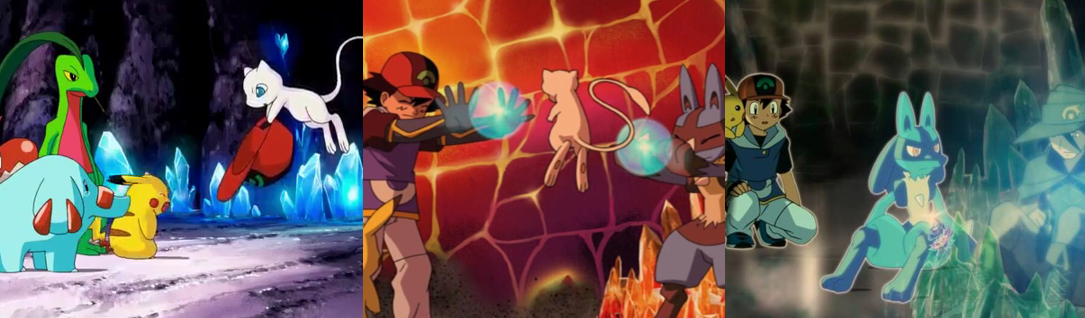
While Meowth enjoys hanging out with Mew at the Tree of Beginning, Pikachu is equally eager to reunite with Ash but compelled to stay by Mew, who wants to keep playing. When Ash and the others – included Meowth’s Team Rocket cohorts James (Eric Stuart) and Jessie (Rachael Lillis) – reach the Tree of Beginning, they’re violently attacked by its three guardians, the legendary Regice (Kunihiro Kawamoto), Recirock (Eiji Miyashita), and Registeel (Atsushi Kakehashi), mindless near-automatons who attack both groups and drive them further into the Tree of Beginning. Within, the humans are attacked by “antibodies” that resemble fossil Pokémon and swallow them as a defensive measure, shrugging off their attempts to fight back and leaving any Pokémon unharmed in favour of consuming their human companions. This leaves Pikachu so distraught when Ash seemingly dies (…again) that Mew reluctantly uses its incredible powers to converse with the Tree of Beginning and restore those it absorbed, quelling the Regis and reuniting the trainers with their Pokémon. The antibody subplot was a touch unnecessary, I feel, and distracted from the inclusion of the Regis, who were enough of a threat by themselves since even Lucario couldn’t hold them off. While the Tree of Beginning makes for an interesting natural maze and beautiful background, it gets very samey and the film even drops the ball on finally paying off the Ho-Oh tease from the anime’s first episode. I’m also not sure if this Mew is supposed to be the same one from the first movie and it’s a little lacklustre having the main plot be kicked off because the cheeky little kitty wanted to play with its new friends. This means May and Max don’t get much to do beyond berating Ash or helping to melt Lucario’s heart, though Kidd makes for a fun temporary addition to the cast as she’s a pioneer with all kinds of nifty gadgets that are sadly wasted on this adventure.

When restoring Ash imperils Mew, Lucario makes the ultimate sacrifice to reunite with Sir Aran.

There is no central antagonist in Lucario and the Mystery of Mew. The antibodies and Regis are simply defending the Tree of Beginning, which has a symbiotic relationship with Mew and threatens to degenerate after the effort of restoring everyone drains Mew’s life force. Determined to save Mew using the Tree of Beginning’s fabled regenerative powers, our heroes journey to the tree’s heart and find Sir Aran’s gloves resting on a pulsating crystalline structure containing his frozen corpse. A nearby time flower reveals that Sir Aran shunned Lucario to keep it from following him to the Tree of Beginning, where Sir Aran sacrificed his life using his Aura to stop the warring Pokémon. Galvanised and guilt-ridden by this revelation, Lucario attempts to use its own Aura to restore Mew and thus save the Tree of Beginning, only to find it lacks the strength. However, Ash conveniently has the same Aura potential as Sir Aran so he slips on the hero’s gloves and helps boost Lucario’s power, somehow just willing himself to generate Aura without any training or knowledge of how to do so. Of course, the plan works and all is restored, but the effort proves fatal to Lucario. A time flower shows Sir Aran’s last moments, where he tearfully wishes his Pokémon well and hoped to be reunited with it someday and Lucario weeps, acknowledging Sir Aran as his friend and saying its farewells before dissipating into energy sparkles and reuniting with his friend in death. Exiting into the fresh air, Ash promises to also keep them both close by and Kidd vows to never reveal the Tree of Beginning’s location to keep it safe from tourists. Lucario is also immortalised alongside Sir Aran at Cameron Palace and Mew even gains a new playmate: a Bonsly (Eric Stuart) May befriended on the journey.

Final Thoughts:
I had high hopes for Lucario and the Mystery of Mew. I liked Lucario and even used one on my Diamond team back in the day, though it ended up being far from the dark counterpart to Mewtwo I imagined it to be. It’s kind of weird seeing a Fighting/Steel-Type Pokémon have telepathic powers but the movie kinda explains it through its “Aura” gimmick, a semi-psychic power that makes this Lucario exceptional and which Ash also conveniently has. I don’t think this was necessary; I think his physical resemblance to Sir Aran would’ve been enough and he (and the others) could’ve just given Lucario emotional support in the finale rather than seeing Ash emit an Aura Sphere out of nowhere. If you’re looking for spectacular Pokémon battles, you won’t find them here as Ash has one of his weakest teams ever and this film is more focused on exploring Lucario’s lost faith in humanity and realising that its friend didn’t betray him after all. I do wonder if the film might’ve been improved by having Kidd be an antagonist looking to capture Mew or gain control of the Tree of Beginning as the film suffers somewhat without a villain. The Regis are painfully wasted, leading only to chase scenes, though the antibodies offer some of the more harrowing moments where characters, believing they’re about to die, release their Pokémon (Ash even tells Pikachu he loves it before being devoured). I was disappointed to see that Ho-Oh was simply Mew in disguise, however, and had no relevance to the plot and that Mew didn’t get more significance until its life was suddenly in danger. In the end, Lucario and the Mystery of Mew was a decent, somewhat emotional adventure with some relevant lessons to teach about human nature and such, but it’s a somewhat by-the-numbers Pokémon feature that I don’t think really lived up to its full potential.

My Rating:

Rating: 3 out of 5.

Pretty Good

Are you a fan of Lucario and the Mystery of Mew? Did you guess that Sir Aran hadn’t really betrayed Lucario? Were you also unimpressed that Ash could wield Aura? Do you think the film squandered the potential of the Regis and Mew? Were you disappointed that Ho-Oh didn’t factor into the plot? Which Pokémon feature film is your favourite? Whatever your thoughts, leave them in the comments below and donate to my Ko-Fi to suggest more Pokémon content for the site.

Back Issues [Sci-Fanuary]: Super Metroid


January celebrates two notable dates in science-fiction history: “National Science Fiction Day” on January 2 to coincide with the birth of world renowned sci-fi writer Isaac Asimov, and 12 January being when Arthur C. Clarke’s HAL 9000 was created. Accordingly, I dedicate January to celebrating sci-fi in all its forms.


Writer / Artist: Benimaru Itoh

Story Title: “Chapter 1: Red Alarm!”
Published: February 1994

Story Title: “Chapter 2: Zebes Rising”
Published: March 1994

Story Title: “Chapter 3: Back to the Nest”
Published: April 1994

Story Title: “Chapter 4: Samus’ Story”
Published: May 1994

Story Title: “Chapter 5: Red Alarm!”
Published: June 1994

Quick Facts:
Debuting in the widely acclaimed Metroid (Nintendo R&D1/Intelligent Systems, 1986) and popularising a new sub-genre of gaming, bounty hunter Samus Aran starred in perhaps her greatest outing when the celebrated Super Metroid (ibid, 1994) released on Nintendo’s ground-breaking Super Nintendo Entertainment Systems (SNES). Like some of her contemporaries, Samus’ adventure was adapted into a comic strip in Nintendo Power (1988 to 2012), a fondly remembered magazine that offered hints, reviews, and information about Nintendo’s games.

The Review:
Oddly enough, this story begins with famed bounty hunter Samus Aran suffering a fatal encounter with a bunch of fireball-spewing floating heads! Of course, this is merely a nightmare that awakens Samus to “another day, another battle”. After showering and changing into her bad-ass power suit, Samus hops in her ship and returns to the stars for duty as “protector of the galaxy” (again making me think Nintendo didn’t know what a “bounty hunter” is). While flying through space, Samus recalls her adventures in Metroid and Metroid II: Return of Samus (Nintendo R&D1, 1991), which saw her tasked by the Galactic Federation to eliminate the Space Pirates of Zebes whose leader, Mother Brain, was creating an army of powerful Metroids to threaten the galaxy. After being handsomely rewarded, Samus was then dispatched to SR388, the Metroid home world, to eliminate the parasitic threat, including their monstrous queen, only to imprint on a Metroid hatchling after she was done. These memories are interrupted by a distress call from the Ceres Space Colony, where Samus had previously delivered the hatchling to the resident scientists. Samus lands to find the colony in flames, badly damaged, bodies strewn everywhere, and her archenemy, the draconian Ridley, stealing the hatchling in Mother Brain’s name. Samus’s urge to kill her enemy takes a backseat when Ridley reveals he’s set the colony to self-destruct, forcing Samus to try and override it via the main computer. Unfortunately, she’s unsuccessful and must be forcibly dragged to safety by fellow bounty hunter Armstrong Houston, narrowly escaping the colony’s destruction but nonetheless determined to hunt down Ridley and retrieve the hatchling. Unfortunately, Samus and Houston’s ships are immediately set upon by Space Pirates, who have rebuilt their forces after their defeat and attempt to blast the bounty hunters from the stars, only to be easily bested by the friendly rivals as they reduce the Space Pirates to flaming debris. Samus and Houston return to Federation bureau headquarters to warn them of the situation, only for the gluttonous and lethargic Chief Hardy to outrageously deny claims that the Space Pirates have returned!

When she’s injured hunting the Space Pirates, Samus turns to her surrogate family for help.

Luckily, Chairman Keaton believes Samus’s story and allows Samus to return to the apparently deserted Zebes to root out the evildoers. On the way, she berates Houston for following her, accusing him of chasing the reward rather than caring about safeguarding the galaxy, and heads there alone to help the planet’s “bird men”. Thus, like Super Metroid, Samus lands in a rainstorm and descends into the ruins of the bird people’s civilisation, only to be ambushed by Space Pirates. Despite claiming her power suit gives her the edge, her experience fighting these enemies, and her determination, Samus is momentarily overpowered and only saved from having her head crushed by Houston, who tosses her an energy ball that briefly engulfs her suit in flames to destroy the creatures. Although still dismissive of Houston, especially as he’s collecting Space Pirate claws for profit, Samus begrudgingly allows Houston to tag along despite him wearing an inferior suit and even calls upon him to help fend off a flock of Skrees, though she still admonishes him for wasting time collecting carcasses rather than focusing on the bigger picture. As Samus races to complete her mission, she triggers a boobytrap and gets impaled through the shoulder on a floor spike. Chastising her recklessness, Samus stubbornly refuses Houston’s help but is in no position to stop him from cutting her loose and carrying her back to her ship. Chairman Keaton is concerned to learn of Samus’s abrupt departure, and that she’s not returning to headquarters, and supersedes Chief Hardy’s incompetence to investigate Zebes himself, only to be summarily apprehended by Ridley. Unfamiliar with the controls of Samus’s ship (despite it appearing exactly the same as his but with a different colour scheme…), Houston crash lands on the mysterious planet Nest, where they’re greeted by “Old Bird”, a wizened member of the bird-like Chozo race who created Samus’s power suit.

Old Bird gives some insight into Samus’s tragic backstory and her drive to defeat the Space Pirates.

As a sceptical Houston watches, Old Bird strips Samus of her power suit and places her in a restorative bubble, revealing that Samus as the “blood of a Chozo” and giving Houston a history lesson. Generations ago, the Chozo were an advanced and enlightened civilisation before the ferocious Space Pirates pillaged and plundered their world, leaving only ruins and the Chozo close to extinction. A passive race with no weapons, the Chozo were powerless to oppose the Space Pirates as they conquered Zebes and attacked a nearby Earth colony. This attack saw the colony left little more than smouldering wreckage and a lone survivor: baby Samus. The Chozo took Samus in and raised her, fostering her warrior instincts and infusing her with Chozo blood to give her their “natural powers” (…whatever they are). Trained in combat and battle strategy, Samus was gifted a power suit purposely build for her and moulded into the “protector of the galaxy”. As Samus’s suit is designed to protect her when she’s fully alert, Old Bird suggests that she may have been distracted by Houston when she was injured…or, more likely, the Metroid hatchling that Ridley abducted. Speaking of which, the hatchling is brought to the grotesque, semi-cybernetic Mother Brain on Tourian, who’s frustrated that the hatchling refuses to obey her commands since it sees Samus as its mother. Ridley offers a solution by bringing her the captive Chairman Keaton and Chief Hardy, suggesting they use them as bait to lure Samus into a trap and kill her in front of the hatchling, thus forcing it to acknowledge Mother Brain as its true matriarch. Despite Chairman Keaton pleading with Chief Hardy to get himself under control, the chief desperately cries for help, playing into Ridley’s hands claws talons as he amplifies Chief Hardy’s cries with a “psycho-amplifier”. Sure enough, Samus hears Chief Hardy’s torment and begs to be released to help, convincing Old Bird to utilise the “power bombs” to expediate her recovery.

When Ridley flees and the hatchling is killed, Samus turns her rage on Mother Brain.

Though hesitant due to the danger, Old Bird places a power bomb into Samus’s healing bubble so she can absorb its energy to heal herself. Following a spectacular explosion, Samus is fully restored and eagerly dons her repaired power suit, passing her everlasting gratitude to Old Bird. Before she leaves, Old Bird warns that the Space Pirates have started employing cloning techniques to expand their army and that Samus must stay focused to avoided by injured again. Ridley delights upon hearing that the renewed Samus and Houston are heading into his trap. When Ridley leaves to inform Mother Brain, Chairman Keaton lures a Space Pirate over with one of Chief Hardy’s sandwiches and dupes him into freeing him right as the alarms go off and Samus rips through the base, blasting and pummelling Space Pirates and other assorted aliens into goo and vapour. Concerned by Samus’s dramatic increase in power, Ridley opts for a tactical retreat, reasoning that Mother Brain can handle the bounty hunter. After ensuring Chairman Keaton and Chief Hardy are safe, Samus pursues the cowardly dragon and runs into Mother Brain’s glass capsule (which is noticeably less defended than in the game!) Though Samus makes short work of Mother Brain, she quickly rises again in her gigantic cybernetic body and is easily tossed aside. However, after seeing the hatchling has been mutated to gargantuan proportions and summarily gunned down by the unsuspecting Chief Hardy, Samus flies into a rage and destroys Mother Brain. This apparently causes a chain reaction that sees Tourian explode in spectacular fashion. Luckily, Samus and the others escape in time. Although Houston offers his condolences to Samus regarding the hatchling, she pointedly refuses to partner with him and returns to her adventures alone.

Final Thoughts: 
This was a pretty decent read, all things considered. The art was especially eye-catching and did a great job of translating the box art, manual illustrations, and sprite art of the games into a manga-esque style. Samus particularly benefitted from this, portrayed as a bad-ass, hardened fighter who tears through her enemies when at full power and fully focused. I loved that the art would often show Samus’s true visage beneath her helmet and didn’t shy away from showing her as a sexy, but fully capable, woman who’s used to battling alone. Her ship and the likes of Ridley, Mother Brain, and the Space Pirates were all brought to life in colourful and gruesome detail, though there aren’t many recognisable environments from the source material. Well, I mean… they are here but the story doesn’t linger there for very long. It does a great job of adapting the iconic Super Metroid opening and translating the rainswept ruins of Zebes from the videogame, but Tourian just looks like any mechanical facility and no other planets or areas from the videogame are visited. Even iconic bosses like Crocmire and Kraid are missing, which is a shame, though the comic is obviously more focused on detailing some of Samus’s tragic backstory rather than focusing on action. Interestingly, the comic introduces a rival for Samus in Armstrong Houston, who wears less powerful armour and is more focused on profit than safeguarding the galaxy. While Houston denies this (and prioritises Samus’s health over his haul) and Samus is forced to rely on him when she’s hurt, there’s never a sense of who Houston really is or what’s really driving him. It’s hinted that he’s attracted to Samus (and, honestly, who could blame him?) and that he’s more honourable than she thinks, but he’s mostly just kind of there to give Samus someone to bark at and I’d wager the story would’ve worked just as well without him since it’s not like he has a meaningful character arc.

A visually engaging comic that delves into Samus’s origin but skips a lot of the source material.

Luckily, the story largely (and fittingly) focuses on Samus, who’s depicted as a loner who takes her job very seriously. Despite being a bounty hunter, Samus is more of a space hero, trained from an orphaned child to be the “protector of the galaxy” by a race with no interest in fighting and dispatching Space Pirates and Metroids without mercy. It’s thus surprising that she’s so attached to the Metroid hatchling, which distracts her focus and drives her into a vengeful rage, and a bit of a shame that the comic doesn’t delve deeper into her connection to the hatchling. We do get some insight into her past but, oddly, the comic doesn’t use this tragedy as a catalyst for Samus’s hatred of the Space Pirates. Indeed, her antagonism with Ridley is barely touched upon and they don’t even get a proper fight as Ridley flees when Samus storms Tourian, which was an odd choice considering Ridley abducted the Metroid hatchling. Samus’s rage is therefore completely focused on Mother Brain, who’s noticeable and disappointingly far weaker than in the videogame despite being just as ghastly. Samus isn’t obliterated by Mother Brain’s laser, doesn’t get a power-up from the hatchling’s sacrifice, and simply dispatches Moher Brain with her regular weaponry. Luckily, these battles are all rendered beautifully by Benimaru Itoh but I can’t help but be a little disappointed that the comic strays so far from the videogame narrative when there were so many interesting areas and iconic bosses that could’ve bolstered the narrative. Like, Samus could’ve at least battled Kraid while thinking about her tragic past, or gone all-out against Ridley, bouncing off walls and shredding his wings as revenge for killing her parents. Instead, what we’re left with is a visually appealing, heavily truncated story that spotlights some of Samus’s past, rejigs some of the lore, and essentially acts as a teaser for the videogame. This isn’t uncommon for comic adaptations of videogames but it fell a little flat for me as I guess I was just expecting a little more considering the potential of the story.

My Rating:

Rating: 3 out of 5.

Great Stuff

Did you enjoy Nintendo Power’s adaptation of Super Metroid? Were you disappointed that it cut most of the bosses and environments from the game? Did you like the insight into Samus’s background? Were you a fan of Armstrong Houston and the depiction of Ridley? Did you diligently read and/or collect Nintendo Power back in the day? Which Metroid game is your favourite and what sci-fi videogames are you playing this month? Whatever your thoughts, feel free to leave a comment below and donate to my Ko-Fi to fund more Metroid content.
Game Corner: Shinobi III: Return of the Ninja Master (Nintendo Switch)

Released: 14 March 2018
Originally Released: 23 July 1993
Developer: SEGA
Also Available For: Mega Drive, Nintendo 3DS, Nintendo Wii, PC, PlayStation 2, PlayStation 3, PlayStation 4, PlayStation 5, PlayStation Portable (PSP), Xbox 360, Xbox One, Xbox Series S/X

The Background:
Ninjas were a big deal back in the day, whether they were mutated turtles, rainbow-coloured fighters, or mysterious assassins. Ninjas and videogames went hand in hand, resulting in titles so challenging that they defined a generation of players. Eager to have a piece of that pie, SEGA saw notable success with Shinobi (SEGA, 1987), a difficult but enjoyable arcade title later refined for home consoles. Director Noriyoshi Ohba aimed to make the sequel a technical showcase for the then-new Mega Drive hardware, one purpose-built for home consoles and which became notorious for including unlicensed appearances by pop culture icons. A widely praised release, The Revenge of Shinobi (SEGA, 1989) is now regarded as a classic of its generation and inspired not just a semi-recurring comic strip in the United Kingdom, but also a third game. Originally scheduled for release in 1992, Shinobi III: Return of the Ninja Master was vastly overhauled when the developers were dissatisfied with the original version, leading to a lot of content being cut and replaced with new mechanics. Though largely seen as being much easier than its predecessor, Shinobi III impressed with its refined gameplay mechanics and visual presentation, with many seeing it as the best of the classic Shinobi titles. This positive reception (and the lack of copyright issues compared to its predecessor) no doubt contributed to Shinobi III having a lucrative lifespan beyond the Mega Drive as the game was included in numerous SEGA collections, converted to 3D, and added to the Nintendo Switch’s online service in 2018, which eased the pain of how expensive an original copy can be.

The Plot:
When Neo Zeed returns under the command of the mysterious Shadow Master, the legendary Shinobi, Joe Musashi, fights to end their sinister bio- and cybernetic research.

Gameplay and Power-Ups:
Shinobi III: Return of the Ninja Master is the last of the Shinobi titles released for the Mega Drive and, like its predecessor, is an action/platformer with a strong emphasis on projectile-based combat. Like in the last game, players take Joe Musashi through multiple levels (or “Rounds”), each with at least three stages, though this time there are only seven Rounds. As before, there are four difficulty settings to choose from, with the harder settings dramatically reducing your total life count, and players can continue their game a handful of times if they exhaust all their lives. Unlike in The Revenge of Shinobi, however, Shinobi III’s control scheme is locked to a preset that maps your jump to A, tosses shuriken with B, and activates your “ninjitsu” magic with Y. You can still set how many shuriken you start with, however, and you can still pull off a somersault by pressing A at the height of your jump. Press B when somersaulting to unleash a shuriken spread to take out multiple enemies or press down on the directional pad to pull off a flying kick. As before, Musashi can assume a “defensive pose” to deflect incoming projectiles, but this is now done manually by holding B and you can even do it while crouching and crouch-walking. Shinobi can also dash by quickly tapping left and right, dramatically speeding up the action, wall jump by…jumping off walls…and cross gaps and hazards or navigate stages while clinging to ceilings, pipes, and such by holding B. Various goodies are found by smashing crates, ranging from health-restoring hearts, rare extra lives and ninjitsu replenishments, to additional shuriken and the ever-annoying time bomb. Musashi is far faster and more versatile this time around, moving at a swifter pace and boasting a few additional tricks to make combat and gameplay smoother. It’s still tricky pulling off his somersault and the wall jump can be finicky, but I found Shinobi III far more forgiving than its predecessor and focusing more on action than platforming.

Musashi is faster and more deadly than ever, to say nothing of a master rider and surfer!

Players can once again collect “Power-Ups” to boost Shinobi’s attacks, adding his deadly sword to his melee attack and block and transforming his shuriken into flaming projectiles. Players also gain points for every enemy defeated and item collected, and the end of Round score tally also adds points depending on if you used your ninjutsu magic or your remaining health. By pausing the game, players select which ninjitsu technique to use with Y, with each functioning exactly like The Revenge of Shinobi: Jutsu of Ikazuchi temporarily protects Shinobi with an electrical shield, Jutsu of Kariu summons flaming pillars to damage all enemies, Jutsu of Fushin enhances your jumping speed and height, and Jutsu of Mijin has Shinobi self-destruct (costing him a life) to destroy enemies. Only one of these can be used per life but you gain additional uses by finding items, though I found less use for them this time around as Shinobi is largely grounded and the game encourages you to wall jump and spider-walk to clear gaps. Musashi gains two additional abilities, the first being a horse and the second some bitchin’ surfin’ skills! Round 2 sees you racing across a marsh-like field on horseback, jumping obstacles and taking out enemies with your shuriken or ninjutsu. Round 4 has you surging across the water, jumping off ramps to collect items and avoid mines while defeating waves of enemies, with both instances functioning like autoscrolling shooter. Round 6 also sees you in freefall down a canyon, forcing you to hop to falling boulders to keep from dropping to your doom, while many stages force you to clamber to higher levels by finding surfaces to cling to (which isn’t always obvious).

Though more forgiving, some new gimmicks and refined mechanics add to the challenge.

Shinobi III is much more challenging, overall, than its predecessor, throwing far more enemies and hazards at you but with the caveat that most stages keep you quite grounded and I found extra lives a touch more plentiful. Bottomless pits are commonplace, of course, and many times platforms will either be temporary or will require time bombs to destroy so you can progress, but insta-kill hazards are limited to crushing spikes rather than lava pits. Sometimes, you must time your wall jumps and spider-walk to avoid electrified walls and ceilings; others, you cling to or run across conveyers to progress. There are instances where you ride platforms either across a zig-zag-like track or directly upwards, with Round 2 featuring a vertical autoscroller that’ll see you crushed or left behind if you don’t pay attention. Round 3 dumps you in a disgusting, bio-organic nest where the sticky ground slows your movement and Round 4 sees you hopping to sinking barrels around an oil rig, leaping to firmer ground before you drown. Round 5 mimics a similar stage from The Revenge of Shinobi in that you can somersault over chain-link fences but, this time, you must also avoid hidden mines that eventually explode under your feet! Toxic goop, electrical sparks, and support beams hanging under Neo Zeed’s fancy blimp all make traversal an issue in their own way. Round 7 takes you inside the blimp, where drones attack as you ride a precarious moving platform, while the final area of this stage features platforming and skill-based challenges so troublesome that no enemies are required! As if tricky jumps weren’t bad enough, Round 6 puts you in a mist-filled pagoda where spikes jut from the ground and another damn door maze awaits! This was much simpler to figure out compared to the one in The Revenge of Shinobi (I simply guessed the route by taking the high ground), though made more challenging since enemies respawn each time you looped around!

Presentation:
Although Shinobi III is visually very similar to its predecessor, there have been a few improvements between the games. Musashi still doesn’t have an idle pose, but his sprite is much bigger, more detailed, and versatile thanks to his expanded move set. He now grabs the hilt of his sword when powered-up, cuts a mean pose when surfing, and blood splatters whenever he or his enemies take damage! While many sound effects are unchanged from The Revenge of Shinobi and enemies still explode in spectacular fashion, the soundtrack is overall inferior to the last game. Obviously, I have more nostalgia for The Revenge of Shinobi so I’m naturally biased towards that game, but Shinobi III really disappointed in its tracks, and in the less visually interesting enemies (especially compared to the beta version). However, larger enemies (such as samurai and various mechs) do appear more often, almost as mini bosses, and you’ll face far greater numbers and waves of enemies, with no visible slowdown or performance issues. I liked that the bombs now had a visual timer, the additional weather effects (such as rain, wind, and parts of the environment reacting to these elements), and the greater depth added to the backgrounds. Stages are far more detailed, lively, and have many more instances of parallax scrolling, making for a technically more impressive title. This is best felt in the expanded introduction (featuring a larger, more impressive, animated interpretation of Musashi), the new map screen, and the detailed artwork that pops up after you clear a Round. The game also features more story text at the start and end, and even end credits this time around (though there’s only one ending in Shinobi III).

The visuals and gameplay are vastly improved over the last game, resulting in a more impressive title.

Things start with a visual bang in Round 1’s dense forest, with grass and leaves rustling in the wind, which leads into a dank, dark cave filled with waterfalls and rippling water. I loved the marsh lands and docks that rush past in Round 2 and 4, respectively, which see clouds, kites, and tanks in the distance. The cyberpunk-like city of Round 2, the industrial factory/oil rig of Round 4, and the cybernetic research area seen in Round 5 were all worlds above the visuals offered in the last game, with foreground elements (mostly trees, pipes, and other machinery) bringing each area alive and never being too intimidating in how cluttered they were. While Round 6 was mostly relegated to a grey canyon, I loved the sense of speed as you fall to certain doom, though the night sky and full Moon are done far better in Round 7, where thick clouds rush past. Rounds 3 and 5 impressed me the most, however. Round 3 takes place in an ominous, high-tech bio-weapon facility where Neo Zeed’s bizarre abominations and brain-like experiments slumber or burst free from captivity. This leads to a revolting sewer where Neo Zeed dispose of their toxic waste and experiments, meaning the surfaces are teeming with sticky, biological sludges and malformed monsters lurk. Round 5 takes the military base from the last game and sets it against a raging inferno and explosive oil drums, then sees you slashing through another high-tech factory, this one with molten metal bubbling in the background and ominous, vaguely familiar mechanical dinosaurs waiting to be activated. The final battle occurs in a bizarre, cyberspace-like environment that really messes with your mind, while additional lighting effects and environmental details add a level of polish to the Shinobi formula that keeps it both traditional and bizarre and better showcases the Mega Drive’s power.

Enemies and Bosses:
Neo Zeed’s forces are once again primarily comprised of ninjas and soldiers, though these are noticeably cybernetically enhanced. Ninjas drop from trees, somersault over you, toss shuriken, and fly about on bat-like wings, as before, and come in different colours to indicate when you’re getting closer to the big bad. Larger samurai guard the tunnels in Round 1, slashing an energy wave and cutting with their large katana, though these are defeated as easily as the regular ninjas. The soldiers still fire machine guns, but now use mortals rather than grenades and there are no Marines bolstering their ranks, though red-clad female assassins still pop up. Ninjas now ride futuristic hoverbikes, pilot mechs, and are joined by odd, blowpipe-firing figures and floating kabuki-style warriors who emit flame bursts. Crawling brains and sludge monsters attack in the depths of Neo Zeed’s laboratory, soldiers wield laser rifles, shields, and boomerang-like projectiles, and mutated bugs, laser turrets, and persistent drones also await your presence. Steam bursts from vents, enemies crawl on ceilings like spiders, and more mini bosses appear during your playthrough. These include the return of the agile and Shadow Dancer (who now rains spears while jumping around), a gauntlet against an army of mutated brains as toxic goop bubbles nearby, large mechs that dash and attack with rapid-fire pulse cannons, and Karura, a lance-carrying bird man who attacks as you plummet in Round 6 and becomes invulnerable when seen as a whirring blur of feathers. You’ll also take on another supercomputer, though this one zaps you with an electrical field and fires explosive shells into the arena. Round 4 ends with a two-phase battle against an intimidating mech boss that begins as little more than a giant cannon in the water and soon takes to the air and requires you to blast away its cannon and shield before attacking its main body.

Some bizarre and gigantic bosses set the stage for the game’s formidable final challenge.

The first boss you face is another giant samurai, one mutated to sport four arms (two holding katana and two wielding a spear). Though you can’t hop to the high ground and this guy can dash, it’s easy enough to jump over him, use your somersault attack, or roast him with Jutsu of Kariu. Shinobi III takes a turn into the bizarre and macabre in Round 3, which sees Musashi targeted by a gigantic, malformed blob of mewling flesh while navigating the sewers and then facing off with the ghastly abomination. It lumbers in from the right or emerges from the disgusting ground, tossing chunks of flesh or swiping with its deformed hand, and noticeably degrades as you deal damage to its drooping eyes. While Shinobi III opts not to tow the line between parody and copyright infringement with its enemies and bosses, the developers couldn’t help but include an appearance from Mechagodzilla in Round 5. This gigantic, impressively detailed sprite emerges from the darkness and plods about in the background, breathing fire and raining debris. After destroying its head, it’ll unleash a barrage of projectiles from its chest, making this a tricky encounter even though touching it doesn’t hurt you. Round 6 ends with a rematch against Neo Zeed’s big boss, a squat, masked, demonic figure who whips his hair. This time, the fight occurs in a dark room full of doors that the masked fiend emerges from, tricking you with a duplicate. Though the fight is noticeably easier, it can be tough picking the right one and he becomes more aggressive, flinging a spread of darts after enough hits. This time, the final battle is against the Shadow Master, which is a two-phase affair fought in a psychedelic environment. The Shadow Master is super-fast and aggressive, leaping about, tossing kunai, teleporting, rushing at you with a sword, and delivering an explosive hit. After enough damage, he powers up and tosses energy projectiles, a flurry of blasts, and a charged shot from his arm.

Additional Features:
While Shinobi III is quite a challenge even on “Easy”, you can make things even more difficult by selecting harder difficulties, thus limiting your lives and continues. While you can accumulate points, there’s still no high score table to put your name on, though the “Options” menu has been expanded to include sound effects and voices. As in The Revenge of Shinobi, you can grant yourself unlimited shuriken with a simple trick but, even better, Shinobi III features an invincibility cheat activated by playing certain songs in the right order. Not that you really need that when playing this version of the game as the Nintendo Switch offers rewind and save state features to cut the challenge off at the knees. Finally, if you’re playing the version included in the SEGA Mega Drive Ultimate Collection (Backbone Entertainment, 2009), you get an Achievement for finishing the first stage without a continue and, in the SEGA Mega Drive Classics collection (SEGA/D3T, 2018), you get an Achievement if you beat any level without tossing a shuriken.

The Summary:
I never grew up playing Shinobi III: Return of the Ninja Master, so I don’t have the same level of nostalgia for it as for The Revenge of Shinobi. However, this did everything I’d expect from a sequel: it took what worked in the last game and expanded upon it. The visuals are greatly improved, with Joe Musashi being much faster and tighter to control. His additional moves and abilities were a welcome inclusion, mitigating my difficulties at mastering his somersault and adding an extra layer to the platforming and jumping challenges. I appreciated the added emphasis on fast-paced, hack-and-slash combat and the autoscrolling sections, which nicely broke up the gameplay and served as fun distractions. While the soundtrack was disappointing and I wasn’t blown away by the enemies, the bosses were a big step up from the last game. There are more of them, for starters, and the developers shied away from ripping off pop culture characters for some gruesome, intimidating, and fun affairs that better test your skills as a player. I did find the ninjitsu a bit wasted here, however, and it was a shame Musashi didn’t gain new magic or power-ups to use, but the visual variety offered by the stage design more than made up for it. I appreciated that the game veered more towards the surreal and science-fiction to try and mix things up, and that you were rewarded for playing well in stages. There are few cheap deaths and hazards here, and the game does get very challenging when you’re presented with small platforms, temporary ground, and tricky jumps. I can see this being aggravating on original hardware, but this version of the game makes it a breeze even without the invincibility code. Ultimately, while I would probably still choose to play The Revenge of Shinobi due to my nostalgia for that title, Shinobi III was a worthy follow-up that vastly improved almost every aspect of its sequel, making it equally good in my eyes.

My Rating:

Rating: 4 out of 5.

Great Stuff

What did you think to Shinobi III: Return of the Ninja Master? How do you think it compares to The Revenge of Shinobi and what did you think to Musashi’s new abilities? Were you also disappointed by the soundtrack and the lack of new ninjutsu magic? What did you think to the new bosses and how bizarre some of them were? Did you enjoy the autoscrolling sections and manage to beat the game on original hardware? Which Shinobi game is your favourite? Let me know your thoughts and memories of Shinobi III: Return of the Ninja Master in the comments, support me on Ko-Fi, and check out my other Shinobi reviews.

Game Corner: Ninja Gaiden (Nintendo Switch)

Released: 12 December 2018
Originally Released: 9 December 1988
Developer: Tecmo
Also Available For: Mobile, Nintendo 3DS (Virtual Console), Nintendo Entertainment System (NES), Nintendo Wii (Virtual Console), Nintendo Wii U (Virtual Console), PC Engine, Super Nintendo Entertainment System (SNES; remake), Xbox (Unlocked in Ninja Gaiden (Team Ninja, 2004))

The Background:
Whether they were silent assassins working for the US government, mutated turtles, or rainbow-coloured warriors fighting for and against our world, ninjas were a staple of the 1980s, especially in videogames. While often depicted as agile foes, ninjas also made up some of gaming’s most memorable characters and, in 1988, a very particular ninja effectively defined the difficulty of 8-bit games for a generation of players. Developed alongside a beat-‘em-up arcade title of the same name, Ninja Giaden was specifically created to capitalise on the ninja craze of the eighties and marked developer Masato Kato’s first full-time project as a video game designer. Inspired by some of Nintendo’s most popular titles, director Hideo Yoshizawa sought to create both an iconic protagonist and truly challenge players to give them their money’s worth. The game stood out by emphasising story as much as action through impressive, anime-style cutscenes and was re-titled for its North American release. Ninja Gaiden’s difficulty was a major talking point upon release and this reputation grew into legend over the years, with many reviews and online personalities ranking it as one of the most challenging retrogames of all time. Regardless (or, perhaps, because of this), Ninja Gaiden is also noted as one of the best of its era, despite some drawbacks in its design, and it even inspired some well-regarded sequels back in the day, to say nothing of challenging a new generation of gamers through 3D reboots decades later.

The Plot:
When ninja Ryu Hayabusa’s father is seemingly killed in a duel by an unknown assailant, he sets out on a quest for revenge that soon pits him against a demonic entity known as Jaquio.

Gameplay and Power-Ups:
Ninja Gaiden, one of the most notorious and quintessential titles for the classic NES, is a 2D, sidescrolling action adventure in which players assume the role of Ryu Hayabusa, a black clad, katana-wielding ninja who battles his way through six levels (referred to as “Acts”), each with as many as four different screens (or “Areas”), to avenge the supposed death of his father. There are no difficulty options here; instead, you must endure one of the games that defined the term “NES Hard” with only unlimited continues and your own perseverance. Well, that’s not quite true. Ryu Hayabusa is extremely fast, agile, and capable, quickly slashing and defeating most enemies with one hit with a press of B or X and nimbly hopping across gaps, to platforms, and to ladders with A. Each enemy you defeat awards points (though there’s no high score table and these don’t seem to grant you extra lives) or a special jar to restore some health. These are must-have items as you’ll be bombarded by respawning enemies (seriously, they often spawn the second you kill one!) and destructible projectiles. You must also be mindful of the timer, which pushes you to keep moving and risk plummeting your death across the game’s many chasms. Oh, and be wary of the extreme knockback Ryu suffers when hit, which often sends him careening to his death. If you lose all your lives and have to continue, you must start from the first Area of the last Act you played, though the game throws you a bone in Act IV by not forcing you to battle past the penultimate boss more than once.

Slash, wall jump, and toss projectiles at an endless swarm of enemies in this tough platformer!

While Ryu is quick and agile, he can be cumbersome in mid-air and is prone to falling through platforms that are otherwise solid, so you must time your jumps properly, which is easier said than done with the sheer amount of chaos on screen! Ninja Gaiden’s big gimmick is Ryu’s wall-spring jump ability, which allows players to hop between walls and vertical sections by tapping A. This is super fun and utilised perfectly, with Ryu clinging to the wall until you press A and easily hopping to higher ground. However, Ryu’s strangely unable to climb over edges, forcing you to jump to a nearby platform and then jump back to progress, and also cannot drop down a pit even if he climbed up it. These sections never outlive their welcome, however, and, if anything, I would’ve liked to see more of them as opposed to the tricky jumps across bottomless pits! Ryu can also utilise special items, usually by pressing up and B, though these are tied to a “Spiritual Strength” ammo count and are usually best saved for bosses or more hectic sections. Ryu can toss shuriken for a ranged attack and utilise boomerang shuriken, blast a fire wheel in a spread attack, and turn his jump into a bladed somersault with the “jump and slash technique”, which instantly kills all bosses! Each of these costs a different amount of Spiritual Strength, so you must smash lanterns and defeat birds to increase your ammo. I’d also recommend holding down and B when you have the jump-slash since it must be saved for the final boss and costs the most Spiritual Power to use. Players may also find the odd extra life, protect themselves with a rare flaming shield, and even freeze all onscreen enemies with a sand timer, though it’s best to time this just right as you don’t want to take damage from the frozen enemies! Any power-ups are lost between Acts, forcing you to get yourself up to strength for each boss, though every projectile can be destroyed if you time your attack just right and many enemies can be tricked into falling to their deaths or despawning if you can manipulate the screen correctly.

Ninja Gaiden does not let up for an instant and constantly screws you over at every turn.

Ninja Gaiden fully deserves its reputation. I played on the Nintendo Switch, so I had the advantage of save states and rewinds, and even then I could see how challenging this game would be back in the day. Things start off quite tame, to be fair, and you’re introduced to Ryu’s wall-spring jump and the platforming challenges in a way that eases you into the gameplay loop. However, it’s not long before birds are swooping in, ninjas are leaping from offscreen, and enemies and projectiles are filling the screen, screwing up your jumps, knocking you down pits, or whittling down your health bar as you hop and climb about. There isn’t much to the game, technically speaking, with no environmental hazards to worry about save for some dragon-themed turrets and the many pits that fill the stages. there is no lava, for example, no toxic funk, and Act III doesn’t include slippery platforms or icicles. Platforms don’t even move or crumble beneath your feet; they’re just spaced further apart, get gradually smaller or have enemies perched on them, and the game tasks you to clamber up ladders or hop up vertical shafts to progress. Some Areas do have you moving from the right side of the screen to the left, to be fair; each Act has different destructible gimmicks to drop items and power-ups; and you occasionally climb long-ass ladders, avoiding birds as you go. There are no bonus stages to break up the action, however, though the game places a surprising emphasis on story, more so than most games of its era. Ninja Gaiden’s difficulty is in its platforming challenges and the sheer influx of enemies, who constantly fly at you and spawn in no matter how many times you defeat them. They linger right where you need to drop, guard small platforms over pits, and rain down in large numbers, mocking your attacks as you struggle to be quick enough to clear some breathing space. There’s always something else up ahead and you’re constantly being tested, with the game requiring split second decisions and punishing you severely if you hesitate or don’t take risks. The special items certainly help in these situations, but it’s a calculated risk as you don’t want to be left on empty when the boss appears!

Presentation:
I was honestly blown away by Ninja Gaiden. While the game’s a little too zoomed out at times, making the sprites a bit too small and reducing their detail, this greatly benefits the gameplay as you can always see the entire screen and get a better idea of what’s coming at you. Every sprite and projectile stands out against the different, colourful backgrounds and I never lost track of Ryu, even when the game noticeably struggled to keep up with the action. Sprite flickering and screen tearing is common in the later stages of Ninja Gaiden, where the enemy numbers increase, you’re more likely to be tossing projectiles, and the bosses get bigger and more ambitious. Still, I can forgive this as it’s a product of its era and adds to the charm and my progress was never impeded by these issues, just the damn knockback, Ryu’s stiff mid-air movement, and the cacophony of hazards onscreen! While enemies are somewhat basic and Ryu doesn’t have an idle animation, he exudes a lot of personality in his swift movements and fun wall jump and is fleshed out beyond most other 8-bit protagonists thanks to the many anime-style cutscenes that relate the game’s story. These were incredibly impressive, boasting large, partially animated sprite art and a lot of dialogue, even if there were some translation errors. Ryu’s battle sees him accosted by the Central Intelligence Agency (CIA), fall for the beautiful and mysterious Irene Law, learn of an ancient curse on some statues, and get mixed up with demonic forces! Cutscenes occasionally interrupt the gameplay, providing a dramatic view of the ominous Temple of Darkness and seeing Ryu challenged by Bloody Malth, to say nothing of detailing Ryu’s quest for revenge and some unexpected revelations regarding his father! This is all set up from the opening cutscene, which includes some parallax scrolling and sets the standard of the anime aesthetic for the game, though I admit that I wasn’t blown away by the game’s soundtrack, which was fitting for the action but not exactly memorable.

The game’s anime-style cutscenes and impressive visuals were a surprising highlight.

Players battle across some varied, if uninspired, environments throughout Ninja Gaiden, including the city streets (with alleyways, buildings in the foreground, basic skyscrapers in the background, and neon signs to jump to), battle the first boss in a seedy bar, and hop to girders against the rocky walls of a spawling factory. This leads to an outside location where you must hop to stone platforms and pillars against a mountain range, a flowing river with wooden platforms dotted across its surface, and the aforementioned snowy mountaintop where Ryu must climb vines as makeshift ladders. Act IV sees Ryu parachut into an Amazon rainforest, where the background is a mess of tangled greenery and the swamp-like water spells instant death if you slip from the log platforms. This ends with you scaling another mountain and magically infiltrating the Temple of Darkness, a suitably gothic castle full of tracks, mine carts, and featuring a long stone bridge, with dark brick work contrasting the orange foreground. When you venture into the Temple of Darkness, you’re faced with an excruciating grey backdrop, one dotted with demonic statues and imagery, that’s rivalled by Act V’s purple brick background and stone-grey platforms. Thankfully, this eventually gives way to a looming mountainside, and you’re tasked with hopping across some of the game’s trickiest jumps and heading up the mountain, which stretches high into the sky and ends with a castle rooftop set against a cloudy night sky. What really impressed me about this final Area was that it returns as the first Area of Act VI, with you now going to the left for Ryu’s toughest challenge yet! As you venture deeper into the gothic structure, you’re faced with columns, tall walls, and demonic imagery. With more surfaces to cling to, you may find your jumps or progress impeded as Ryu accidentally clings to walls you weren’t aiming for, which is just another headache to contend with as enemies fill the screen and tax the 8-bit hardware to its limit.

Enemies and Bosses:
There are a handful of enemies that stand between Ryu Hayabusa and his vengeance, with most of them being recycled again and again and only becoming more troublesome due to their sheer number and annoying placement. At first, you’re slaughtering street punks who rush you with baseball bats, toss knives, or fist-fight you while wearing boxing gloves. Dogs scramble across the floor at high speed, bats and various birds fill the airspace and screw up your jumps, and even tigers take a shot at you once you land in the rainforest! You’ll come across soldiers who charge at you, fire bursts from machine guns, and wield bazookas, sword-wielding baddies, martial artists who fly at you with a propeller kick, and even brutes swinging maces! Green-clad ninjas rain from the sky and slice at you with katana, Halloween-themed killers toss machetes and axes in sporadic arcs that seem to always hit you thanks to the game’s janky hit boxes, and dragon-themed cannons spit fireballs. Ninjas fly overhead on jetpacks, tossing a spread of shuriken that are all-but-impossible to avoid, gaunt corpses slink about, and Grim Reaper-like banshees chuck wooden swords (or possibly crosses). By far the worst of the regular enemies, in my opinion, are the scythe-tossing minions whose blades fly like boomerangs and are incredibly difficult to avoid or destroy, especially when other enemies leap from offscreen or they respawn half a second after being destroyed! As you play, you’ll inevitably spot the “Enemy” health bar in the heads-up display. This is reserved for encounters with the game’s bosses, the “Malice Four”, and shows you’re doing damage to your tougher foes even if your health is dropping dangerously low.
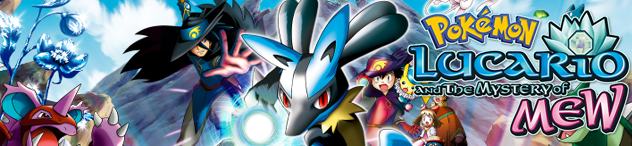
While some bosses are easily exploited, you’ll need specific special weapons for the final challenges.

The first of the four is the hulking Barbarian, who slowly stalks you in a dive bar and swings a cutlass-like sword up close. You must use your speed and wall-spring jump to outmanoeuvre him, which is easier said than done due to his hit box. The masked Bomberhead awaits in Act II and carries a chain blade that he twirls around and flings your way. This can be tricky to avoid as its direction is seemingly random, but your projectiles serve you well here and you can toss everything since you lose it all anyway. Act III’s Basaquer is much more daunting since he’s far more mobile and harder to hit. He somersaults overhead and kicks up a slew of destructible stones upon impact, but the flame wheel makes short work of him. Act IV forces you to battle two foes at once, each with their own health bar, in an enclosed space, with sprites flickering and the hardware limping along. The large, dog-like Kelbeross hop around and ruin your health bar, but you can position yourself under the pillars to stay safe and whittle them away at your leisure. Bloody Malth certainly cuts an intimidating figure with his ceremonial armour and lightning, but his shield is purely for show so just toss your projectiles until he’s done and don’t fall off the roof! The difficulty really spikes at the end of Act VI, where you face three bosses back-to-back, starting with Ryu’s brainwashed father, attacking an orb rather than his sprite to undo his brainwashing. Then, the demonic wraith Guardia de Mieux/Jaquio attacks, floating above and spitting two fireballs that are virtually impossible to avoid! Honestly, without the insta-kill jump-slash, I have no idea how you’re supposed to beat this guy so be sure to have that item when you reach him or you’ll have to play through Act VI again! Finally, a Xenomorph-like demon represents your final challenge. This is a far easier battle, however, as all you must do is avoid or destroy the fireballs he rains down and attack his dome-like head and spiked tail to reveal his glowing heart, which must be destroyed to gain victory.
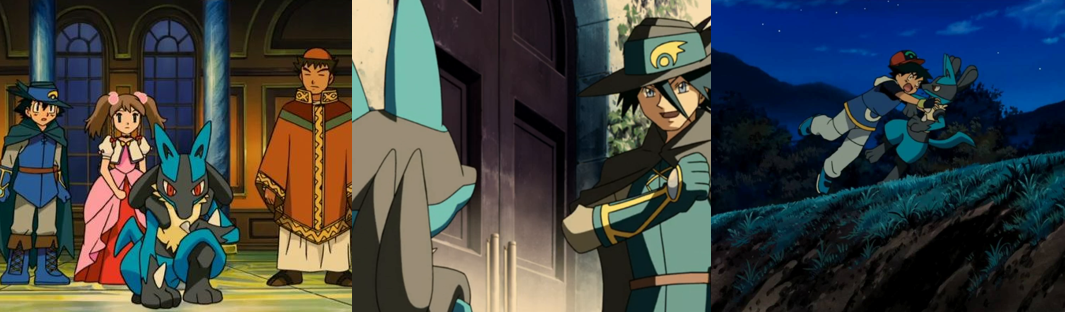
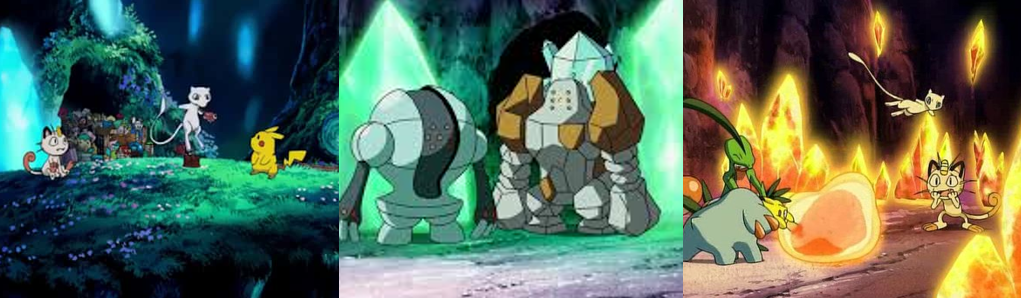
Additional Features:
There’s nothing else on offer in Ninja Gaiden, unfortunately. Not even a high score table or additional difficulty modes, which is very rare for a game of this era. There are no cheat codes for the NES version, either, so the only additional features of note are the save state and rewind features offered by the Nintendo Switch. These are a godsend for this game and dramatically reduce the difficulty, replacing it with frustration as you constantly rewind back to undo mistakes, though it’ll be no help at all if you reach Jaquio with anything but the jump-slash!

The Summary:
I’d heard all about Ninja Gaiden and was well aware of its reputation as one of the hardest games of the 8-bit era of gaming. It was a daunting prospect, one I doubt I would’ve tackled without the Nintendo Switch’s modern-day features, but I’m glad that I did. The game is very visually impressive, making the most of the NES hardware and being particularly ambitious with its anime-style cutscenes and story-based narrative. While his sprite is very basic, Ryu Hayabusa exudes a lot of personality and has a remarkable range of movement. There are a lot of special attacks on offer to help keep the game interesting and fun, though it’s incredibly satisfying to slash enemies into an explosion of fireworks with your katana. The wall-spring mechanic was inspired, adding an extra layer of verticality and fun to the otherwise simplistic platforming, with my only note being that I would’ve liked to see more of it! The enemies wore out their welcome very quickly, unfortunately, both visually and with the slew of enemies and projectiles reaching obnoxious levels simply to frustrate players and encourage further rentals. I much preferred the big, more fearsome bosses, though even they are handicapped by a lack of attacks and animation frames. While environments aren’t anything too innovative, I liked how the game emphasised high walls and pillars at times, even if many were purely there to mess up your jumps. The challenge offered by the platforming is truly taxing and I’m sure it tested many NES kids back in the day. The rewind and save states help with this, but you still need a lot of skill, luck, and trial and error to deal with everything happening on the screen. I had a lot of fun with Ninja Gaiden, even in its more frustrating moments, and I was impressed by a lot of it, even when the hardware struggles at times. However, I would’ve liked to see a bit more from the game, be it a bonus round, difficulty options, or more emphasis on the jumping and climbing.

My Rating:

Rating: 3 out of 5.

Pretty Good

Was Ninja Gaiden a beloved addition to your NES library? How did you fare with the game’s challenge and did you ever beat it on original hardware? What did you think to Ryu’s wall-spring jump and special attacks? Did you struggle in the penultimate battle against Jaquio? Which game in the franchise is your favourite and would you like to see the original series re-released on modern consoles? Let me know your memories and thoughts on Ninja Gaiden in the comments, support me on Ko-Fi, and check out my other retrogame reviews on the site.

Game Corner: Sparkster: Rocket Knight Adventures 2 (Nintendo Switch)

Released: 11 June 2024
Originally Released: 23 September 1994
Developer: Konami
Also Available For: Mega Drive, PC, PlayStation 4, PlayStation 5

The Background:
The success of Sonic the Hedgehog (Sonic Team, 1991) saw anthropomorphic mascot platformers become a popular trope throughout the nineties, with a superpowered earthworm, an intergalactic adventurer, and a gun-toting jackrabbit making a rocket pack-wearing possum seem normal! The brainchild of Nobuya Nakazato, the man behind many Contra titles (Konami, 1987 to present), Rocket Knight Adventures (Konami, 1993) was one of the most popular and celebrated Mega Drive titles. Despite a port for the Super Nintendo being allegedly cancelled, Rocket Knight Adventures was followed by two sequels the very next year: one exclusive to the Super Nintendo and the other this notoriously expensive Mega Drive-exclusive title. Although not as well-regarded as its predecessor and seen as inferior to its Super Nintendo counterpart, Sparkster: Rocket Knight Adventures 2 was praised for its colourful gameplay and tweaked rocket pack mechanics. Sparkster: Rocket Knight Adventures 2 inspired a six-part story in Sonic the Comic (1993 to 2002) but the franchise was dead in the water until Climax Studios attempted a revival in 2010, to mixed reviews. However, the game, the other 16-bit Rocket Knight titles, finally received a modern re-release with this Re-Sparked! collection, a widely praised release that came with some fun bonus materials and quality of life features.

The Plot:
When King Gedol’s lizard forces invade the kingdom of Zephyrus and rogue Rocket Knight Axel Gear kidnaps Princess Cherry, Sparkster searches for seven magical swords to oppose the Gedol Empire and best his rival.

Gameplay and Power-Ups:
Just like the other 16-bit Rocket Knight games, Sparkster: Rocket Knight Adventures 2 is a 2D, sidescrolling action platformer. However, unlike the original game and its similarly titled Super Nintendo cousin, there are no run-and-gun elements to Rocket Knight Adventures 2 as Sparkster’s sword has been robbed of its sword beam. This significantly impacts the primary gameplay as you now rely on Sparkster’s bog-standard sword swings, which can fall a little short at times. You attack with Y and jump with B, executing a jump sword swing and clinging to poles using Sparkster’s paws and tail when you jump to them. Unlike in the other games, Sparkster’s rocket pack charges automatically and has different levels of effectiveness depending on how full the meter is. As long as the meter’s at least partially full, you can press A to rocket dash in the direction you’re facing, diagonally to take out turrets, and upwards to get higher. If you press A without a direction, Sparkster spins on the spot to attack enemies and, when the rocket pack is fully charged, Sparkster spirals in a “Screw Attack” (no relation), travels further, and bashes through destructible blocks and walls. While waiting for the meter to charge does take a lot of agency away from the player, it charges pretty quickly and you have far more control over Sparkster off a upwards boost, which greatly aids with reaching platforms. Sparkster can still ricochet off walls to get higher, though this is still underutilised, in my opinion, with Rocket Knight Adventures 2 focusing more on traditional platforming. Players still collect gems for points, though this time there are two types: regular blue ones and red ones that kick-start a slot machine for additional gems, health (now apples and chunks of meat), extra lives, or a rocket pack that instantly sends you flying in a Screw Attack. Naturally, these can all be found in the game’s stages, too, and you receive a score tally after clearing each stage for bonus points.

Sparkster’s sword is nerfed but his rocket pack and mech game are stronger than ever!

Sparkster can also grab the new power-up icon that gifts him a flaming sword to increase your attack power, though you’ll lose this when hit or advance to the next stage and I can’t say I noticed a significant difference, especially as many enemies die in one hit. Rocket Knight Adventures 2 has seven stages and four difficulty settings, with players only seeing the true ending by beating the game’s harder difficulties. Sadly, the shoot-‘em-up stages from the other two games are gone, replaced by three sections where you control Sparkster’s giant mech, the SparkRobo. Two of these are Rock ’Em Sock ’Em Robot battles with Axel Gear that are similar to that one boss from the first game, and the other is a sidescrolling autorunner where you blast enemies from the sky using the SparkRobo’s rocket punch (Y, which can also be charged) and jump over bombs tossed by enemies on the ground (also with Y). Sparkster doesn’t ride any minecarts or miniature mechs here and only has to deal with one autoscrolling section, where players dispatch enemies, destroy or jump to crates, and hop between train carriages to avoid a nasty spill. Spikes, flame plumes and lava, and insta-death traps are still present, however, with quicksand swallowing you, moving platforms ridden past spikes, and even a sand twister tossing you about atop a pyramid in Stage 2. This stage has a higher and lower path, which you may wish to switch between for different rewards and dangers, while Stage 5 features many switches to open doors, doors guarded by projectile-firing gargoyles, and conveyer belts. Stage 2’s pyramid gimmick differs from the Super Nintendo version, featuring a race from rolling balls and false doors that loop you back to the outside until you find the correct path. You’ll also cross lava on moving platforms and by clinging to overhead pipes, which gain destructible spiked hazards and even Gedol henchmen by Stage 5. Stage 3 sees Paeli, leader of Gedol’s lizard ninjas, bombard Sparkster and the blocks of the stage from his airship. This destroys the ground and forces you to take high-speed tubes up to the top of the ship to destroy barriers and drop the ship from the sky.

Presentation:
Sparkster: Rocket Knight Adventures 2 is a bit of a mixed bag, visually, something immediately evident from the lacklustre title screen (simply the game title against a moving sky background). This does pan down into the opening cinematic and mech battle against Axel Gear, however, a fight you can skip if you wish, which causes you to miss a collectible and displays an absolutely garish secondary title screen. Unlike in the Super Nintendo game, stage intros are back but they’re far less visually interesting than in the first game, and every sprite has been redesigned to give it a more anime flair. Although I miss the cute, squat Sparkster of Rocket Knight Adventures, he looks pretty good here and is far more animated. He bops about as if itching to get going, his rocket pack is almost constantly aflame, and he stands heroically when left idle. Sparkster also squeals when hit, reacts when piloting the SparkRobo, has more animation frames, and displays more personality than on the Super Nintendo thanks to Rocket Knight Adventures 2 including more pantomime-like, sprite-based cutscenes. These are similar to those of the first game, seeing Sparkster leap into action when Axel Gear kidnaps Princess Cherry and advance between stages, with elements from previous stages (such as Stage 1’s train) appearing in others. Unfortunately, like the Super Nintendo title, Rocket Knight Adventures 2 cannot live up to or surpass the original’s soundtrack. Things are jaunty enough, for sure, but nothing stuck in my head like the main from the first game. Interestingly, Rocket Knight Adventures 2 does replicate the slowdown from the first game, with the frame rate noticeably dipping when Gedol’s forces drive vehicles or too many sprites and explosion effects appear at once.

The visual overhaul is great for Sparkster but not so much for the enemies and environments.

Perhaps most unforgivably, Rocket Knight Adventures 2 appears far blander than the first game and its Super Nintendo counterpart. Stage 1’s forest section is disappointingly subpar compared to the first game, with the ground being a far more basic block of sprites and the background having little to distract you, even when the overgrown ruins creep into play. The train section adds some spice and variety, for sure, but it paled in comparison to the Super Nintendo title. Similarly, while both games include a desert, they’re rendered very differently. Stage 2 has a neat shifting sand and heat shimmer effect in the background, but its pyramid is blockier and more akin to ruins, making it far less visually engaging than SEGA’s competition. Stage 3 took place atop the pyramid’s ruins and in an airship, which was, again, a far cry from the steampunk-style battle craft from the first game, even with its fake doppelgängers of Princess Cherry and larger, blade-like propellers. Stage 4 was like a poor imitation of a similar city stage from Rocket Knight Adventures; sure, the SparkRobo looks cool (if a tad goofy), but the city lacks the detail and appeal of the first game. Things pick up in Stage 5, which takes place outside and inside King Gedol’s heavily fortified castle-cum-weapons factory. The background is a bit busy at times, but I liked all the moving parts, alternate routes, and the danger brought on by the turrets. While the mech battles against Axel Gear are in bland, dark caverns, you battle him in a traditional swordfight against a grandiose background and confront King Gedol in his opulent throne room. If you find all seven “Keys to the Seal” swords, you’re also treated to a great sprite-based cutscene of Sparkster becoming “Gold Sparkster”, a form he retains for the end credits and loses when he returns the combined magical sword in the game’s ending.

Enemies and Bosses:
Instead of fighting pigs or wolves, Sparkster tackles the lizard forces of the Gedol Empire, whose infantry leaves a lot to be desired. Sure, armoured lizard-men spontaneously appear from boulders or even gems, but it takes a long time before they attack with swords. In Stage 1, for example, they might get the drop on you, but they just charge at you while unarmed; they don’t even lose their armour when defeated, making them far less satisfying to kill. By Stage 5, they’re hiding in large, snake-themed turrets and you’ll battle more formidable forces, such as gun-toting lizards (who oddly explode when defeated) and sword-wielding snakes whose body parts can hit you. Gedol’s forces drive steampunk-style vehicles in Stage 1, flailing their buzzsaw-like arms and forcing you to strike and rocket to safety, and pilot chicken-like mech walkers and float on balloons in Stage 4. Their forces are bolstered by some robotic enemies, such as annoying spiked balls that home in on you in Stage 3 and the returning robotic owls who can screw up your jumps. Interestingly, not only are bosses far weaker when playing on the easier difficulties, but you’ll miss some additional screens and mini bosses if you play on “Easy”. Stage 1 sees you battle a disturbing living plant that can only be damaged by rocketing into its face, which it protects with its extendable arms. You’ll also get an assist from some possum helpers when facing an ugly-ass lizard, with the two of you bouncing about an enclosed arena and the boss tossing bombs or rolling into you. A sentient plume of lava awaits in Stage 2, one that spews a flamethrower and controls the lava and forces you to the rail above to rocket into is face. Finally, there’s a large, robotic lizard face that hounds you throughout Stage 5, dropping spiked enemies, summoning lightning walls and lizard minions, and screwing up your traction with a conveyor belt.

Large bosses can cause a headache with their wide-reaching attacks and limiting your attack window.

The first true boss is a variation of the Raccoon Robot enemy from the first game, this time integrated into a train. You must rocket away from its wide-reaching ball arm and avoid its projectiles, quickly striking the weak spot on the front of the train and dashing to safety as the arm flails wildly, which is quite taxing as the arm covers almost the entire screen and the projectiles can catch you off guard. Stage 2 ends with a gigantic, armoured snake whose only weak spot is its torso. You must dodge its claw arm, which it’ll fire out to reel you in and vigorously shake you, then chase it to the background. While hiding back there, it bursts its long, extendable tail, bursting from the ground and swishes it about, though you’ll also have to watch when it leaps across the tomb. King Gedol’s second-in-command, Paeli, is fought on the roof of his airship and seems to be a sorcerer or genie or something. He fires a flaming shot that both hurts and shrinks you, transforms into a genie-like form, then bursts into harmless miniatures that rain down as bombs and apples. One of these miniatures sparkles, so that’s your target; hit him and Paeli runs around in a panic like Captain Fleagle for you to deal real damage to him. Near the end of Stage 5, tall, spindly robots stomp about, spinning their long, stick-like arms, tossing bombs, and firing lasers. They’re easy enough to take down, even with the rails, conveyers, and enemies nearby, but you’ll then fall into a small arena and battle two of them. One fires pellets, lasers, and spins its arms but, upon defeat, is replaced by its green brethren, who leaps to the ceiling dropping bombs and drops to the floor to be finished off.

Match your skills against Axel Gear then power-up to Gold Sparkster to depose King Gedol.

As in the other Rocket Knight titles, your most persistent foe is the rival Rocket Knight Axel Gear, who you fight in a mech battle at the start. Though this is optional, you’ll miss a Key to the Seal sword and learning the SparkRobo’s controls for later on. You must avoid Axel’s punches and hold A to block when he throws a shot or a projectile. Though you don’t get a projectile attack, you can throw uppercuts with B or Y or hold one of these to charge a straight punch. While this battle is much easier than the top-down mech fight from the Super Nintendo game, it’s no less tedious. Axel constantly guards and backs away and there’s a noticeable delay between button presses that can catch you out. While you don’t necessarily have to win this first mech fight, you will have to in Stage 4. However, to get to this rematch you must race through the streets and avoid Axel’s missiles, hitting them back at him to cause him to flee to his mech. Best his mech (with patience and persistence) and you battle Axel in a sword fight. Axel summons lightning walls that you can ricochet off otherwise they’ll hurt you and Axel again sports the same attacks as you, rocketing about, spinning as a flaming dervish, and swinging his sword. He does tend to hover about doing nothing, leaving himself open, and drops the final Key to the Seal upon defeat. With all seven, Gold Sparkster gets a permanent rocket charge and is much faster, which is very useful in the final fight with King Gedol. This is a two-stage affair, with the lizard king blinding you with a flash and charging lightning bolts from above or spawning a meteor shower. You can only attack him during this charge animation and, after enough hits, he transforms into a gigantic form that takes up the entire background! In this phase, King Gedol fires eye lasers that travel across the floor, walls, and ceilings, ricochet about, or randomly fire in all directions. You must dodge these and rocket into the gemstone that appears on his forehead to finally put him down for good.

Additional Features:
Sparkster: Rocket Knight Adventures 2 has four difficulty settings that fundamentally change the nature of the game, altering the length and challenge of the stages and changing the ending depending on how hard a challenge you set for yourself. You can further adjust the game’s difficulty from the main “Options” menu, changing how many lives and continues you play with. The game also includes a password feature, allowing you to skip to later stages and easily acquire all seven Keys to the Seal. These magical blades are hidden in each stage, sometimes in plain sight and sometimes requiring a bit of exploration to find. You’ll need all seven to play as Gold Sparkster and get the best ending, encouraging a replay or two (though be sure to take out Axel’s mech at the start for the first sword!) This Re-Sparked version also comes with the American and Japanese versions of the game, boasts an awesome anime opening, allows you to apply filters and borders, and negates even the hardest difficulty with a rewind and save state feature. The collection also comes with a boss rush, advertisements and concept art, the box art and manual, and the entire soundtrack for all three games. Those playing the PlayStation 4/5 version can also earn nine Trophies, one for clearing the first five stages, one for beating the game on any difficulty, one for unlocking Gold Sparkster, one for achieving the true ending, and one for beating the boss rush.

The Summary:
I’ve played Sparkster: Rocket Knight Adventures 2 before thanks to the magic of emulation, but never got past the first stage because, as a big fan of the original and an avid Mega Drive collector, I always wanted to own a physical copy of the game. It took a while, but the Re-Sparked collection finally made that a reality, only to present me with a game that’s visually inferior to its predecessor and Super Nintendo cousin in many ways. While Sparkster looks great and there are some interesting effects in some stages, the environments just seem far blander and far less engaging compared to the other 16-bit titles. Honestly, the game made a bad impression from the start and never really recovered; the rocket gameplay is much improved, but the main enemies lack animation frames and personality. The locations lack the steampunk trappings of the other titles and are far more generic which, coupled with the bizarre downplaying of the rocket pack and ricochet gimmick and removing Sparkster’s sword beam, means Rocket Knight Adventures 2 is just another colourful platformer. It’s fun enough, for sure, and some stages have interesting gimmicks, such as zipping through the airship and piloting the SparkRobo, but where are the flying sections? Where’s the quirky humour? Where’s the memorable music? The bosses were decent enough and I liked that you face more of them on harder difficulties. The one-on-one with Axel Gear is probably the best version of that fight, it’s just a shame you have to sit through another tedious mech battle to get to it. Rocket Knight Adventures 2 is also far too linear at times and felt the easiest of the three 16-bit titles, with King Gedol being the simplest of the final bosses and the hardest part being tracking down those hidden swords. In the end, I enjoyed Sparkster: Rocket Knight Adventures 2 but nowhere near as much as I wanted to. It fails to live up to its predecessor, lacks the visual punch of the Super Nintendo title, and was a disappointing experience after years of pining for it.

My Rating:

Rating: 3 out of 5.

Pretty Good

Do you think I’m being too harsh on Sparkster: Rocket Knight Adventures 2? How did you think it compared to the first game and the Super Nintendo sequel? What did you think to the new rocket pack mechanics and the lack of sword beam? Were you disappointed to see the flying sections removed? Did you ever find all the Keys to the Seal and unlock Gold Sparkster? Would you like to see a new entry in the Rocket Knight series? Tell me what you thought to Sparkster: Rocket Knight Adventures 2 in the comments, support me on Ko-Fi, and go read my other Rocket Knight reviews.

Game Corner: Sparkster (Nintendo Switch)

Released: 11 June 2024
Originally Released: 15 September 1994
Developer: Konami
Also Available For: PC, PlayStation 4, PlayStation 5, Super Nintendo Entertainment System (SNES)

The Background:
Sonic the Hedgehog’s (Sonic Team, 1991) incredible success paved the way for a slew anthropomorphic mascot platformers back in the 1990s. We had everything from a heroic frog, a gun-toting jackrabbit, an intergalactic adventurer, a fragile bobcat, and a superpowered earthworm, so why not a possum with a rocket pack? Created by Nobuya Nakazato, who spearheaded many Contra titles (Konami, 1987 to present), Rocket Knight Adventures (Konami, 1993) became one of the most popular and lauded titles for the Mega Drive. Although a SNES port was allegedly cancelled, Rocket Knight Adventures was followed by two sequels the very next year: one a notoriously expensive Mega Drive-exclusive title and this similarly-titled but unrelated SNES-exclusive game. Although largely praised for its visuals and gameplay, Sparkster was criticised for not further expanding upon the first game’s formula and 1994 was, essentially, the end of Sparkster’s brief time in the spotlight. Although Sparkster did get a six-part story in Sonic the Comic (1993 to 2002), he didn’t get a cartoon like his more popular peers and was forgotten until Climax Studios attempted a revival in 2010, to mixed reviews. Sparkster, and its other 16-bit titles, finally got a modern re-release with this Re-Sparked! collection, a well-received release that included bonus materials and quality of life features.

The Plot:
When the kingdom of Eginasem is attacked by Generalissimo Lioness’s Wolf Army and Princess Flora is kidnapped by rogue Rocket Knight Axel Gear, Sparkster fights to save the land.

Gameplay and Power-Ups:
Like its predecessor, Sparkster is a 2D, sidescrolling action platformer with run-and-gun action in which players take control of Sparkster and his rocket pack and battle through a fantasy land infused with a dollop of steampunk madness. As before, players choose between three different difficulties, though you’ll only experience the full game and the true ending by playing on at least “Hard”. To aid with this, Sparkster incorporates a password system, one still relevant as the rewind and save state features won’t help you when you get to a nigh-impossible boss battle in the late game. Sparkster’s entire repertoire of moves and abilities returns alongside a couple of additional abilities. You jump with B and attack with Sparkster’s sword and sword beam with Y. As before, holding this button charges Sparkster’s rocket pack, allowing him to blast off in the direction he’s facing, straight up, or diagonally. If you don’t press a direction, he simply spins on the spot and, when aimed at walls, he’ll ricochet to higher areas. While there’s no need to swim this time around, Sparkster still clings to vines, branches, and poles with his tail and you’ll be hopping, sliding, and jumping to these purchases a lot more this time around. Pressing L or R sees Sparkster perform a flaming kick, of sorts, for an additional attack and mid-air boost, something you’ll be using a lot to reach higher platforms as Sparkster’s otherwise uncontrollable after blasting off. Although there are still no power-ups to collect, you can grab gems to increase your score (and your life count once you get 100 gems), the odd 1-up, and fruit (apples and bananas) to refill your health. There are far more gems this time around as well, possibly to offset the steep difficulty curve, but there are no horizontal sections where you blast along using Sparkster’s rocket pack.

Rocket along for more action-packed adventure and a handful of new gimmicks.

However, the spirit of these sections is evoked when Sparkster hops on a chicken-like mech and races through the jungles in Stage 3. In this long section, you press Y to fire a ring shot from the mech’s mouth while also attacking with Sparkster’s sword beam to dispatch enemies coming from behind. You must also duck under spikes and other hazards, get launched to other mechs, and take out waves of enemies as you race along. Later, in Stage 7, the game adopts a top-down view and you control Sparkster as be flies through space in pursuit of Generalissimo Lioness’s massive ship. In this section, you can still fire Sparkster’s sword beam but can also hold B to fire a spread of pellets to take out turrets and enemies. This is actually a bit awkward thanks to the button placements and it’s easy to miss incoming projectiles as a result, though the section is a burst of exhilarating fun until you get to the near-impassable wall that is a top-down Rock ’Em Sock ’Em Robot mech-battle against Axel Gear. In Stage 4, you use tubes to blast around the interior of an attack submarine and must avoid water jets that blast you into ceiling spikes. Stage 5 sees you venture into a pyramid, one that constantly shifts as you pass door-like tiles. You must shift and rotate the environment to find goodies and progress, which can be very aggravating and confusing as it’s not immediately clear which configuration you need to move on. Later in this same stage, you ride a translucent, rotating triangle platform up a shaft, avoiding spikes as you go, while high-speed tubes masquerading as musical instruments blast you along or send you back a fair bit in Stage 6. This stage also sees you bouncing to drums, riding air currents, and using teleports not unlike those in Rocket Knight Adventures.

New, even cheaper hazards will test your reflexes, patience, and rocket skills.

Sparkster is extremely similar to Rocket Knight Adventures, so much so that, at times, it feels like a SNES reimagining of the first game. You begin in a very familiar medieval forest setting, blast to a steampunk-like ship, and encounter many of the same hazards at times. Similarly, the game’s difficulty curve is slow but steep and things start off easy enough, even with the seemingly endless waves of enemies spawning in, but you’ll soon see boulders transform into enemies, clamber between bars and poles to avoid molten metal, and battle against conveyer belt platforms that push you towards instant-death gears. Giant crushing hazards are also present alongside an odd paint mechanic in Stage 2 that briefly turns you red, sheer drops in Stage 3 where it’s almost impossible to avoid being damaged by robotic owls, and bursts of steam courtesy of wolves running on treadmills in Stage 4, which also includes an all-too-brief pogo mechanic. Stage 4 also sees you frantically outracing a wall of rushing water not unlike the flame wall from Rocket Knight Adventures, except this one pushes you into wall spikes or drowns you in seconds if it overtakes you. Stage 6 also has you quickly hopping between cymbals trying to avoid being crushed when they clap together and falling into the tubas, which warp you back to the start of the obstacle course. Stage 7 is, essentially, a pretty standard top-down space shooter that has you weaving between laser blasts and destroying turrets, while Stage 8 has you traversing a long corridor on a space station and ducking under gigantic missiles that instantly kill you on contact. You’ll also ride a flame burst up a long shaft battling an oddly shaped wolf mech and encounter ceiling turrets that bounce lasers off bug-shaped robots. While instant death hazards and bottomless pits aren’t as prominent in Sparkster and there are far less tricky sections where you’re outracing crushing or dangerous hazards, the gigantic bosses and some cheap moments are sure to wipe out your stock of lives.

Presentation:
Although Sparkster overhauls the graphics and presentation of Rocket Knight Adventures, redesigning Sparkster into a more serious, anime-inspired protagonist, it continues the same cartoonish charm of the first game. Leaner and sporting a grim frown, Sparkster constantly has one paw on the hilt of his sword, glares at you when left idle, and squeals when hit or killed. Sparkster outdoes its predecessor with a more elaborate title screen and opening cutscene, which employs in-game sprites to show Axel Gear kidnapping another princess. This scene, Sparkster’s cannon blast to space, and Axel’s later escape from Sparkster’s wrath all closely resemble cutscenes seen in Rocket Knight Adventures, lending more credibility to my claim that this game is part-sequel, part-remake. Unfortunately, there are far less cutscenes like this in Sparkster, no stage intros, and the music is a far cry from the first game. While it’s jaunty enough, there are no tunes to rival the main theme of Rocket Knight Adventures and, while the game performs far better, with none of the slowdown from the first game, this is greatly aided by Rocket Knight Adventures: Re-Sparked’s “Boost” toggle from the ZL menu. Still, there are a lot of impressive visual effects included here; day turns to dusk turns to night, the Stage 7 missiles have a quasi-3D look, Sparkster’s rocket pack seems to charge faster, and there’s a unique (if odd) feature in Stage 2 where all sprites are rendered as silhouettes behind giant white screens. I also really enjoyed the sense of speed as you race along on your chicken-walker in Stage 3. The environment blurs past and there’s a lot of action here and, thankfully, no bottomless pits or unfair, split-second tests of your reflexes.

Anime paintjob aside, Sparkster rehashes much of the first game in its visuals and mechanics.

Sparkster seems to lean into the steampunk/fantasy aesthetic far more than Rocket Knight Adventures. You start in an open field, hopping to branches and trees, before blasting to Axel’s ship in what’s basically a combination of two stages from the first game. Clouds fly past the ship, which features flashing lights, destructible elements, and wolves popping from holes in the floor. Stage 2 is a cluttered factory that’s a mess of chains, lights, steam, and tubes and can be tricky to navigate as a result. Similarly, Stage 5’s desert exterior can be confusing as many columns and stone blocks obscure you. There’s a neat heat shimmer effect to this stage and I did like venturing into the pyramid; as perplexing as it was, it was far more memorable than the attack sub. You do end up outside this submarine, going to the left side of the screen and taking down biplanes, but it’s a bit dull compared to Stage 6’s bizarre musical-themed world. While this sticks out like a sore thumb against the other steampunk and medieval settings, it’s certainly whimsical and unique, even if it’d be more suitably in Zool: Ninja of the Nth Dimension (Gremlin Graphics, 1992). Stage 7 may just be a space shooter but there’s a lot of detail on the Generalissimo’s gigantic mothership (too much, at times, as turrets, enemies, and projectiles are hard to spot). Generalissimo Lioness’s space station has an impressive curve effect to its long-ass missile corridor, multiple missiles sitting stationary, and claustrophobic missile shafts to ricochet around in. It’s all very visually similar to Rocket Knight Adventures but just different enough to be unique. Still, I would’ve liked a greater visual distinction between the Wolf Army and the Devotindos Empire as the wolves’ armour even flies off like the pig infantry’s and the game ends with a big sprite art of Sparkster flying at the screen, just like before. While this art and the background accompanying the credits is more detailed, it’s still all a little too similar to be truly original.

Enemies and Bosses:
Just as you decimated an army of wacky pigs in Rocket Knight Adventures, so too will you cut through various wolves in your quest to liberate Eginasem. These wolves are functionally identical to the Devotindos Empire’s infantry, charging you with swords and powering defences to keep you at bay. While they don’t wield bazookas, they pop from the foreground, transform from boulders, bounce you back with shields, and wear different outfits depending on which stage you’re on. Various wolf mechs also appear, such as the one fought when you ride a flame pillar in Stage 7, and wolves riding chicken walkers in Stage 5. Stage 5 also sees a wolf pilot the Elephant Robot in a fight that’s functionally identical to the Raccoon Robot mini boss from Rocket Knight Adventures. You must avoid its extending arms and buzzsaw hands (which play the keys at your feet), dodge the explosive maracas, and rocket into the orb on its forehead. Robotic enemies also appear, such as the aforementioned owls (returning from the first game) and various robotic drones shot down in Stage 3 and 7. Robotic shrimp-type-things bounce about on Stage 6, robotic worms pop from walls in Stage 4, and the massive, wacky robot monkey, Ukkey-Ukikky that acts as the mini boss of Stage 1. Ukkey-Ukikky leaps and dives at you, chasing you and trying to stomp you, and becoming more aggressive when you steal its bananas, though it’s not too difficult to rocket-charge into its big, stupid head. You battle a tripod robot not unlike an octopus in the pyramid, one which flies about after a few hits by spinning hits legs like helicopter blades. Stage 2’s mini boss is fought on a rising elevator whose core looms overhead as a glaringly obvious target, one protected by two turrets. You must also defeat a gigantic flying mech in Stage 7, one that punches, fires a spread shot, and explodes in a shower of apples upon defeat.

Gigantic and troublesome mechs box you in and stand between you and victory.

Colonel Wolfheim confronts you midway through Stage 3, piloting a praying mantis-like mech and relentlessly tossing bombs and flailing its long arms. Unlike the fight against Captain Fleagle, you simply attack Colonel Wolfheim’s mech directly rather than reflecting his bombs. Colonel Wolfheim returns atop the attack sub, now commanding a giant cannon protected by smaller turrets. After you deal enough damage, the cannon detaches and is revealed to be a mech, which fires a massive flame burst and swings its spiked arms around wildly. Your best bet is to get behind Colonel Wolfheim’s mech and rocket-burst into it. The first boss is Temper-Drilln, a gigantic suit of golden armour that bursts through the airship’s hull, spawns wolves to distract you, and fires an eye laser. You must hop to its fists as they punch through the floor and time your rocket charge into its eyes to bring it down, a difficult task given the limited room to manoeuvre. Stage 2 culminates in a battle against a massive trash compactor. You can cling to the pole overheard to attack the exposed core and dodge some of its attacks, which consist of debris and buzzsaw-like arms. If you drop down, be wary as the ground is a conveyor belt that causes you to take damage from the boss. Stage 3 ends in an autoscroller battle against the Crazy Caterpillar, a robotic insect that wriggles along an overhead vine and drops parts of its body to bounce and explode into you after taking damage. It also tosses regular bombs and bounces in front of you firing flame bursts that can be hard to avoid given your larger hit box thanks to your chicken-mech. At the end of the desert, you battle a robotic worm around a bunch of ruins, forcing you to platform about to chase it down. It also burrows underground, breathes fire, and splits apart when you hit the glowing red sections of its body. Midway through Stage 8, you attack the core of the Generalissmo’s space station, rocketing into four rotating crystals and destroying the rings that protect it, which speed up as you deal damage.  

The only consolation to Axel Gear being so damn difficult is the final bosses are much easier…

Like in Rocket Knight Adventures, Sparkster constantly pursues Axel Gear, a rival and corrupt Rocket Knight who kidnaps the local princess and evades Sparkster at every turn. You finally battle him at the end of Stage 6 before a giant organ. Like in the first game, Axel Gear has the same abilities as you, ricocheting about, flinging sword beams, spinning into you, and diving with a flaming kick. Thanks to the verticality of the arena, it can be difficult hitting Axel Gear, but it’s nothing compared to the top-down mech battle at the end of Stage 7! Here, you press Y to fire a weak-ass projectile, tap L and R to punch with each robotic fist, and hold the triggers to block. You can hold Y to charge a dash but, in my experience, it did nothing, and I wouldn’t guard for long as Axel destroys your arms. While you can land a few solid shots, Axel constantly has his guard up, rushes you, and obliterates you with an unblockable barrage. I genuinely have no idea how you’re supposed to beat this fight as I was forced to use a password to skip to Stage 8. This is, obviously, Generalissimo Lioness, who breathes fire across the ground, conjures a boomerang-like energy wave, and fires two electrical beams using his sceptre. It’s best to stay in the middle of these, duck under the energy waves, and perfectly time a jumping vertical rocket boost to avoid the Generalissimo’s attacks, attacking whenever you can until his biological visage reveals his cybernetic interior. The final boss, accessed only on “Hard” mode or higher, is the Missile Core, a large, stationary target that fills the screen with flaming projectiles resembling wolf heads, drops spiked mines, and fires a gigantic laser across the screen. You should dash to the far left to avoid the mines and safely destroy the projectiles then rocket-charge into the core, landing a quick sword beam strike before dashing to safety, though the projectiles increase as the fight progresses.

Additional Features:
Rocket Knight Adventures: Re-Sparked includes both the American and Japanese versions of Sparkster alongside the impressive anime opening, different filters and borders, the aforementioned “Boost” toggle, and the incredibly helpful rewind and save state features. The collection also includes a boss rush for the game, various advertisements and concept art, the box art and manual, and the entire soundtrack alongside various Trophies for the PlayStation 4/5 version. These require you to clear every stage (meaning you must play on at least “Hard” mode), finish the game on “Normal” mode, and clear the boss rush. There is also a hidden “Crazy Hard” mode in Sparkster that’s accessed with a push button cheat code and passwords to jump you to any stage on any difficulty, which is basically required as I have no idea how the hell you beat that Axel Gear mech fight!

The Summary:
As a huge, lifelong fan of Rocket Knight Adventures, I’ve always wanted to give Sparkster a go but, being a SEGA kid, I never got the opportunity, which is another reason I’m grateful for Rocket Knight Adventures: Re-Sparked. Although the visuals have been overhauled and are more anime inspired, losing the chubby, chibi-style look of the first game, everything is as colourful and sharp as ever. Sparkster is now grim and serious, constantly ready to fight and ploughing through enemies with a burst of gusto, and has more gems to collect that ever. Interestingly, Sparkster places more emphasis on traditional platforming than its rocket pack gimmick, even omitting the horizontal shooter sections from the first game, which was a bit of a mistake, in my opinion. The chicken-walker chase and top-down space shooter sections had the same energy, but it was disappointing to not do more with the rocket pack. I liked that there were less chase sections and insta-death hazards and there were some interesting new gimmicks, like the shifting pyramid, though it also felt a little too safe. Many sections, cutscenes, and even bosses felt very similar to Rocket Knight Adventures, almost as though the developers wanted to atone for not porting the first game to the SNES. I didn’t mind this, but it felt more like a rehash at times and was especially disappointing as none of the game’s tunes match those of Rocket Knight Adventures. I did enjoy the massive bosses and how they continued to be creative and visually appealing, but that mech battle against Axel Gear can go and burn in hell! Honestly, I was tempted to knock another star off simply for that, and the requirement that you must play on at least “Hard” mode to finish the game. Thankfully, the rewind and save state features eased the pain of these sections but I was annoyed that I needed a password to skip that boss, especially as the subsequent bosses were much easier. In the end, Sparkster is a worthy follow-up that has a lot of visual appeal. It performs really well and challenges even the most seasoned platformer player, but its difficulty curve and more repetitive sections bring it down a notch compared to the first, especially as the develops didn’t take full use of the SNES to expand on the story and in-game cutscenes.

My Rating:

Rating: 4 out of 5.

Great Stuff

Did you own Sparkster back in the day? How do you think it compares to Rocket Knight Adventures? What did you think to the anime paint job given to the sprites? Did you ever legitimately beat Axel Gear’s mech and, if so, how? Which of the new gimmicks was your favourite? Would you like to see a new entry in the Rocket Knight series? Whatever you think about Sparkster, share your thoughts below, consider supporting me on Ko-Fi, and check out my other Rocket Knight reviews.

Game Corner: Rocket Knight Adventures (Nintendo Switch)

Released: 11 June 2024
Originally Released: 6 August 1993
Developer: Konami
Also Available For: Mega Drive, PC, PlayStation 4, PlayStation 5

The Background:
Thanks, largely, to the phenomenal success of Sonic the Hedgehog (Sonic Team, 1991), anthropomorphic mascot platformers were all the rage back in the 1990s to the point where, in a landscape featuring a gun-toting jackrabbit, an acrobatic bat, a superpowered earthworm, and an intergalactic adventurer, a sword singing possum with a rocket pack doesn’t seem all that strange! Designed by Nobuya Nakazato, the man behind many of the notoriously challenging Contra videogames (Konami, 1987 to present), Rocket Knight Adventures was lauded as one of the best titles available for SEGA’s all-powerful Mega Drive. Though a popular and well-regarded title, Rocket Knight Adventures was essentially Sparkster’s peak; a Super Nintendo port was allegedly cancelled and its sequels were both region-locked and ridiculously expensive for decades. While Sparkster received a six-part story in Sonic the Comic (1993 to 2002), he didn’t get an animated spin-off like some of his peers and remained in obscurity until Climax Studios attempted a revival in 2010. Mixed reviews notwithstanding, the game captured a lot of Rocket Knight Adventures’ spirit and long-time fans of the franchise finally got a modern re-release of the original three games with this Re-Sparked! collection, a warmly received release that included a handful of bonus materials to celebrate the unfairly forgotten series.

The Plot:
When the Kingdom of Zephyrus is invaded by Emperor Devilgus Devotindos’s pig army, heroic Rocket Knight Sparkster fights to rescue Princess Sherry from the clutches of his rival, Axel Gear, and stop their forces.

Gameplay and Power-Ups:
Rocket Knight Adventures is a 2D, sidescrolling action platformer with elements of run-and-gun action and some sidescrolling shoot-‘em-up sections. Players take control of Sparkster, the titular Rocket Knight, a possum clad head to toe in armour, armed with a sword, and carrying a surprisingly versatile rocket pack on his back. You swing Sparkster’s sword with A or Y, sending out an energy spiral to attack enemies from a set distance, and press B to jump, with Sparkster snagging poles and branches with his tail. By holding A or Y, you charge Sparkster’s rocket pack; once the meter is full and flashing, you can release and Sparkster will fly off in the direction you press. You must often use this manoeuvre to richochet off walls to progress higher in stages, sometimes over lava, and to blast between vines over large, spiked balls. If you don’t press a direction, Sparkster performs a grounded spin attack to deal damage and reflect certain projectiles and Sparkster is often invulnerable when performing his rocket attacks. The rocket pack can take some time to charge so it’s worth planning ahead if you’re looking to quickly blast away and you must often blast off while jumping for additional height, either to reach doors, platforms, or high up goodies. Sparkster has a large health bar (represented by hearts) but it’s whittled down quite quickly. Apples and bananas will partially or fully fill it and you can snag a handful of generous 1-ups along the way. You also earn extra lives if you collect enough points, receiving a bonus at the end of each stage. Before you start, you can also adjust the game’s difficulty, which changes how many lives and continues you have, though trust me when I say the game’s hard enough even on “Easy” mode.

Rocket through colourful stages and take on tricky platforming as the sword-wielding Sparkster.

Occasionally, Sparkster collects a power pack or is dropped into an area where he flies indefinitely. These sections turn the game into a high-speed, action-packed autoscrolling shoot-‘em-up and have you weaving Sparkster between missile and other projectiles while picking off airborne enemies. Sparkster can also swim, automatically treading water and moving through the drink depending on your button presses, attacking with his sword and blasting from the water with his jet pack. However, his movement becomes noticeably sluggish and his hit box alters, making it tricky to navigate the tight, hazard-ladened depths. Each stage tests Sparkster’s platforming and rocket pack skills in different ways, from simple ricochet tricks to jumping to vines and branches, to racing from hazards (such as walls of fire, spiked knights, and crushing floors) that spell instant doom to the Rocket Knight. Platforming is largely satisfactory here and the usual tropes of swinging platforms and precarious handholds appear, but you’ll also be riding mine carts, leaping across bottomless pits and ducking under spiked ceilings. Stage 2 has you pass behind waterfalls using special platforms to progress, Stage 3 sees you using the reflective surface of rising and falling lava to hop to platforms, while Stage 4 has you clambering on the underbelly of Axel’s ship trying not to plummet to your doom. When on the roof, and during the final confrontation with Axel, you battle a strong wind that’ll suck you to an instant death, while Stage 5 has you race through claustrophobic tunnels avoiding knights that kill you on contact. The challenge is palpable but increases as you progress, easing you into the game’s surprising difficulty and introducing new gimmicks that test how you control Sparkster. Unfortunately, there are no power-ups to aid you (no shields or invincibility or anything like that) and you’re limited by your lives and continues, though thankfully this version includes rewind and save state features that finally allowed me to beat the game after more than thirty years!

Various gimmicks and dangerous hazards make the late game a considerable challenge.

It’s not long before hazards become troublesome for Sparkster. Each stage is split into multiple, interconnected areas, with the first stage culminating in you traversing Castle Zephyrus, which is full of burning pits and sees you being chased by a wall of fire. This will instantly kill you if you don’t keep moving, made harder by the stone walls you must hop over and the flame bursts you must duck to avoid, though this is all practice for a similar section in Stage 5, where you must run, ricochet, and jump away from Axel as he pursues in an insta-death mech suit! While it’s simple enough to hop to tree branches in Stage 1, Stage 2 introduces spiked balls to avoid while jumping, while spiked ceilings and surfaces dog both your high-speed jaunts on mine carts and your efforts to control a propeller platform in Stage 5. Stage 4 sees you taking out bazooka-wielding pig soldiers in tight corridors, your progress barred by temporary energy barriers, while Stage 5 introduces the rising floor gimmick that ended my runs as a kid. With enough speed and timing, you can outrun this hazard but it’s very tight, even when abusing the rewind feature. This stage also includes teleporter doors that represent your goal in each section, though they’re functionally no different from the regular doors you enter prior to this stage. Stage 7 introduces a springing ground, almost a quasi-anti-gravity feature, to boost your jumps, though it’s limited to snagging some out of the way goodies and battling a boss. The autoscrolling sections start off simple, with you mowing down aerial enemies and attacking a giant, robotic snake, but your manoeuvrability is tested in Stage 5, where you weave between gigantic missiles and cross-crossing gunfire and engage in glorified dog fights with mech walkers. Things are much simpler when you’re blasting through an asteroid field in Stage 6, though you must still be mindful of the small projectiles that can get lost against the stars. Stage 5 also culminates in you taking control of your own giant mech, though your options are simply limited to stomping back and forth and swinging its buzzsaw arms with A or Y; there’s no block or charge attack or anything.

Presentation:
Rocket Knight Adventures is and always has been a joy to play, purely from a visual standpoint. Released at the peak of the Mega Drive’s popularity, when mascot platformers were extremely popular, the game oozes colourful, cartoonish appeal. Presented with a steampunk-style fantasy land, players explore environments teeming with personality. You see the castle being attacked in the background of the first stage, panicked civilians and chickens run and flutter, and enemies are sent into a panic when hit, running around with their briefs on show! Though he can be a little clunky and his hit box is quite large, Sparkster is a wonderfully realised character. Blasting past the Konami logo at the start and standing proud against the title screen and in the brief prelude, he radiates heroism. Not only does Sparkster bop up and down by default, but he also judges the player when idle and calls to them to get a move on. He also squeals in pain when killed, reacts with panic when falling, and regularly advances towards his objective and enemies in the handful of cutscenes between stages. As if these stunningly lively and detailed visuals weren’t enough, Rocket Knight Adventures is bolstered by an infectious soundtrack, one of my favourites of the era. However, it’s true that the game peaks with Stage 1’s iconic and instantly memorable overture, which is rightly evoked for the end stage score tally. Still, the boss themes are really good and add to the tension when facing these troublesome foes. One negative about Rocket Knight Adventures, however, is the slowdown which occurs when there’s too many sprites on the screen. Thanks to the large scale of some enemies and the many explosions and effects peppering certain moments, the game can struggle along for a few seconds. It’s never impacted my progress, but it is noticeable. Furthermore, the title screen, despite showcasing large sprite art for Sparkster and the game logo, is surprisingly bland, especially compared to the detailed environments.

A visually impressive treat with one of gaming’s best and most memorable soundtracks.

Things start out safe enough with Stage 1’s flat fields, which act as a testing ground for players to test Sparkster’s moves, but even this area is full of detail, from the aforementioned castle in the background to the besieged homes and ransacked environment. As you blast through the skies, mountains and water rush past, with a lovely splash effect appearing as you skim the water’s surface. Sparkster loves to charge head-first into enemy strongholds, the first of which includes busts, skewed portraits, and windows where the first stage’s boss looms. While Stage 2 starts comparatively bland, you’re soon climbing vines and avoiding spikes amidst a large waterfall and racing around on high-speed mine carts. Stage 3 begins in a quartz cavern with a reflective effect applied to the lava, extends to an underwater cavern, and ends with you battling a gigantic robotic fish in a volcano. Stage 4 takes place on Axel’s ship and really leans into the steampunk aesthetic, having you navigate inside and outside the ship, clambering to poles, jumping to platforms, and passing energy barriers powered by pigs on treadmills! Stage 5 takes the steampunk aesthetic to the next level as you blast through the skies of a heavily polluted, heavily guarded pig city. There’s a real depth to the polluted backgrounds that’s married with the mechanical facility to crash into, a robot factory full of narrow corridors and insta-kill hazards. Stage 6 and 7 add a science-fiction twist to the steampunk fantasy and see Sparkster blasting through an asteroid field and infiltrating Emperor Devotindos’s “Pig Star” space station. Though you’re limited to a few rooms and boss battles here, you can see the stars and asteroids in the background and end up falling back to Earth in an escape pod, burning up on re-entry and showered by debris from the exploding space station! The large sprite art returns for the end credits, which feature Sparkster heroically flying towards the camera, and the pantomime-like cutscenes add to the game’s visual charm, with Princess Sherry, King Zephyrus, and Axel gear all exuding the same personality seen in Sparkster’s cartoonish animations.

Enemies and Bosses:
The Devotindos Empire is primary made up of armour-clad pigs, disposable ground forces who stand no chance against Sparkster’s sword and rocket pack. Though they leap from the background, drop down on balloons, and wield swords of their own, the pig infantry is easily dispatched in a single hit. Occasionally, you battle large groups of them, but you can simply rocket through them, making them more of a nuisance than anything. The sailor variants are a bit more formidable thanks to their bazookas and you being confined to tight corridors, as are the jet ski riders, who fire a spread shot while you’re floundering in the water. Pigs also race around in steampunk-style cars and chicken walkers, which can be trickier to put down as they’re much bigger and take more hits to defeat. At least they can be defeated, though, which is more than can be said of the later spiked armour variants. You’ll simply bounce off these guys and be killed if you touch them, so you must run from them and lure them into a molten metal trap to end their threat. Emperor Devotindos bolsters his forces with other robot minions, such as robo-owls who can spoil your jumps and robotic duplicates of himself, which spring to life at the worst possible moments, take a few hits to put down, and offer a significant obstacle thanks to their large hit boxes and pursuing you across the environment.

The piggy pests pilot some perilous mechanical marvels that’ll test your reflexes.

The pig infantry also controls numerous large, steampunk-style craft to act as mini- and end bosses. The first is a lumbering tank that fires slow moving cannonballs and tries to roast you with its flamethrower. Your best bet is to rocket behind it to quickly pummel it, but you’re then forced to avoid and frantically slash it as it pinballs around in the rapids in an exploding frenzy. A large mech greets you at the start of Stage 2, taking up the background and sporting extendable arms with buzzsaw-like hands. You must battle the finnicky swimming controls to avoid being hit, attacking the glowing red sphere on the front of the mech to put it down. Stage 3 sees you battle a gigantic crab mech, attacking its extendable pincers and avoiding its ring shots once they’re destroyed, floating precariously close to the craft to hit its cockpit. This stage ends with you fighting a giant robot fish in a battle not unlike the Lava Reef Zone boss. You must jump to floating platforms, which get faster and faster, avoiding the lava and the shower of pellets the fish spits. When the pilot appears, be sure to smack him a few times and grab the bananas if you’re low on health. A more powerful pig walker attacks in Stage 5, one that fires dual lasers and is protected by an energy barrier you must whittle down before the craft can be destroyed. Finally, Captain Fleagle constantly hounds you in Stage 4. First, he hides behind an energy barrier and tosses bombs which you must reflect back at him (the timing can be tricky and the bombs have a large blast radius, so watch out!) You must avoid Captain Fleagle’s shots on the roof and send him running once more. After knocking sentient bombs onto a flying mechanical pig head on the underside of the ship, Captain Fleagle calls in his large mechanical doppelgänger. Mirroring Captain Fleagle’s movements, this mech causes debris to  by shaking its hips and fires large blasts from its torso, giving you a small window to attack it. Once it’s destroyed, the battered Captain Fleagle runs and jumps around in a panic as the battleship explodes, finally finished for good after a few whacks with your sword.

Giant, steampunk-style robots and mechs often act as gruelling end of stage bosses.

Gigantic mechanical enemies also appear as mini- and end bosses, such as the Snake Mecha that lunges at you in the first flying section and the Big Spider at the end of Stage 1. This thing crashes its head through the castle walls and ceilings, giving you a chance to land some attacks, but you must avoid standing in the wrong place and being smacked by its spiked tail. Stage 2 features a weird collection of spheres, not unlike a mechanical caterpillar, that dives in and out of a waterfall. You must do the same and blast between vines to avoid its wide arc and pummel the weak spot on the end of its tail, which is pretty tricky given the hazardous environment. Stage 2 ends with you battling a menacing steampunk train that charges towards you firing slow shots and then transitions to an upper path, swinging and extending its claw arms, before finally firing bouncing shots from its wrecked behind, its weak spot changing each time. A satellite-like robot challenges you in Stage 6’s asteroid field, blocking your shots with a shield and firing a dual spread shot, and you must take on the strangely sized pig mothership, too. Since this hurts you if you touch it and fires relentlessly, you must target the many turrets to deal damage, switching position as it teleports in and out, taking out its minions, and dispatching its giant mouth cannon before you get fried! As the fight progresses, the cockpit detaches, leaving you to destroy the main body of the ship. However, the cockpit transforms into a mech that fires pellets, a ricocheting laser, and flailing its arms. You must strike the ball it bounces between its hands to deal damage, then fly around as it bounces around the screen in a frenzy, which makes for a troublesome boss due to its large hit box and the lack of health pickups.

Axel Gear and the persistent Emperor Devotindos won’t go down without a fight!

Your most persistent enemy is rival, corrupt Rocket Knight Axel Gear, who kidnaps Princess Sherry and constantly ducks you. When you finally go toe-to-toe with Axel in Stage 5, it’s in a Rock ’Em Sock ’Em Robots mech battle. After racing to your mech, you must avoid his hits and tap A or Y to swing your buzzsaw-like, extendable arms and damage his craft. It’s a bit clunky and difficult to avoid damage but, eventually, Axel’s mech is destroyed. Axel then appears at the end of the asteroid section of Stage 6, now sporting a gigantic laser cannon and firing smaller homing missiles. You must loop behind him to attack and take out his smaller shots, watching for his circular movements as he prepares each shot. Axel than challenges you to a more traditional sword fight mid-way through Stage 7’s gruelling boss gauntlet. Here, Axel sports the same abilities as you, swinging his sword, unleashing a rocket spin, and ricocheting about. Note that your sword beams cancel each other out and he’ll eventually cause explosive decompression! You must cling to the poles, attacking Axel with your sword beam and avoiding his missiles and circle motions, finally flying with your rocket charge when he’s charging his own. Emperor Devotindos is the game’s final boss and certainly doesn’t go down easily! Your first battle isn’t too bad, with you simply dashing from across the screen and charging into the pig monarch, dodging his progressively faster projectiles. After enough hits, he reconstitutes himself into a maniacal cyborg and you must avoid his extendable legs and rocket into him diagonally. Emperor Devotindos downloads his consciousness into the Pig Star’s main core, causing it to float, teleport, and bounce around firing various laser spreads that you must avoid while charging at the small red weak spot. As you escape the exploding Pig Star, Emperor Devotindos (now little more than a television screen) pursues you, thrashing tentacle-like limbs, firing ring projectiles, and barging into you. You cannot attack here and must simply survive until atmospheric re-entry finishes the bovine bastard off, a daunting prospect as Emperor Devotindos is hard to avoid and deals a lot of damage.

Additional Features:
There are four difficulty settings to challenge in Rocket Knight Adventures, with each one altering how many lives and continues you play with and slightly altering the end text. If you beat the game on anything other than the hardest difficulty, you’ll be challenged to try a harder difficulty once the credits have rolled. Interestingly, you can input a code from the pause screen to record your progress as the game’s demo mode, though the level select code apparently only works in the Japanese version of the game. Luckily, Rocket Knight Adventures: Re-Sparked lets you pick between the American and Japanese versions of the game and offers a host of additional features, too. There’s the slick, sexy, anime style opening that makes me wish we’d gotten a cartoon back in the day, various filter and border effects, and the always helpful rewind and save state features. You can also play a boss rush mode and view various advertisements and concept art for the game, peruse the box art and manuals, and freely listen to the game’s kick-ass soundtrack. The PlayStation 4/5 version also comes with numerous Trophies for you to earn, with nine specifically earned from playing this game (best done on the hardest mode to stack them) and clearing its boss rush.

The Summary:
I’ve been in love with Rocket Knight Adventures since I was a kid. I was captivated by its bright, cartoonish visuals and fun, action-packed gameplay from the start and regularly find myself humming that memorable Stage 1 theme in my day-to-day life. One of the biggest gripes of my life-long gaming career is that I was never able to beat this game back in the day; that damn crushing floor always ended my playthroughs. However, this version of the game changed all that. It’s telling that I needed the rewind and save state features to finally beat this game and shows just how challenging Rocket Knight Adventures is. It lulls you into a false sense of security by easing you into the challenge, slowly adding more and more obstacles and insta-death hazards and leaning more on split second reaction times as you progress through its detailed and varied stages. Yet, while the difficulty curve is off-putting at times and the game occasionally seems needlessly unfair and cheap (infinite continues would’ve helped mitigate this), I still find it a hugely enjoyable experience. Sparkster is a fantastic character and often unfairly forgotten in the pantheon of mascot platformers and I loved his sword- and rocket-based gameplay. The ricochet mechanics were a neat feature; however, if anything, they were underutilised and the game relies on traditional platforming tropes and mechanics than its unique selling point, which is a bit odd. I loved all the big enemies and bosses, the switch to sidescrolling shooter sections, and the sheer variety on offer. No two stages are the same and the game’s constantly throwing new gimmicks at you, from mine carts to flying platforms to mech battles and races through mazes. There are few games as visually appealing on the Mega Drive than Rocket Knight Adventures, which has such franchise and merchandise appeal that I’m honestly surprised we didn’t get more games and tie-ins, such as toys and comics and cartoons. Still, that doesn’t diminish how enjoyable Rocket Knight Adventures is. To this day, it’s one of the best platformers on the system and this Re-Sparked version just makes it more accessible and entertaining than ever before.

My Rating:

Rating: 5 out of 5.

Fantastic

Was Rocket Knight Adventures in your Mega Drive library back in the day? What did you think of the rocket-based mechanics and the colourful visuals? Which of the game’s bosses was your favourite? Did you manage to clear the game without modern quality of life features? Which of Sparkster’s sequels was your favourite and would you like to see him brought back from obscurity? Either way, whatever your thoughts on Rocket Knight Adventures, leave a comment below, consider supporting me on Ko-Fi, and check out my other Rocket Knight reviews.