Back Issues: The Sentry #1-5 / The Sentry vs. The Void #1

Writer: Paul Jenkins Artist: Jae Lee

Story Title: “Act 1: The Suit”
Published: 19 July 2000 (cover-dated: September 2000)

Story Title: “Act 2: The Unicorn”
Published: 16 August 2000 (cover-dated: October 2000)

Story Title: “Act 3: The Photograph”
Published: 20 September 2000 (cover-dated: November 2000)

Story Title: “Act 4: The Conspiracy”
Published: 18 October 2000 (cover-dated: December 2000)

Story Title: “Act 5: The Betrayal”
Published: 15 November 2000 (cover-dated: January 2001)

Story Title: “The Truth”
Published: 31 January 2001 (cover-dated: February 2001)

The Background:
Debuting in 1938, Clark Kent/Kal-El/Superman wasn’t just an immediate hit with readers, he was also the first-ever costumed superhero, inspiring every single colourful crimefighter that came after him. Oddly, despite co-creating and bringing to life some of the industry’s most recognisable and beloved characters, Marvel Comics legend Stan Lee struggled to emulate the success of the Man of Steel. Over the years, many Marvel characters have been positioned as the company’s parallel to Superman, with none really making much of an impact. Robert “Bob” Reynolds/The Sentry, however, is perhaps the closest Marvel came to this endeavour. First conceived of by Paul Jenkins and Rick Veitch back in the late-1990s, the Sentry was pitched as an over-the-hill superhero struggling with addiction and was cleverly positioned as a “forgotten” hero from Marvel history. Easily one of Marvel’s most overpowered heroes, the Sentry was also a figurehead for mental illness thanks to his drug addiction and psychotic split personality, though this often led to him being seen an aggravating and inconsistent character. Despite some bad-ass moments and turning the tide in many conflicts due to his awesome power and unpredictable nature, Marvel’s insistence of reverting to the status quo meant the character has had more downs than ups over the years, to the point of fading from the spotlight. Indeed, as of this writing the Sentry has only ever appeared in supporting roles in Marvel videogames, with no animated appearances to his name, though the character did make the jump to the Marvel Cinematic Universe, courtesy of Lewis Pullman, in 2025.

The Review:
We first meet Bob Reynolds when he’s awoken by a lightning storm that triggers memories of an aggressive alien menace known as “The Void”. After reassuring his wife, Lindy Lee-Reynolds, Bob retrieves a bottle of liquid and is haunted by scattered memories that emulate the art style of the legendary Jack Kirby. Through them, we learn that a young, naïve Bob stumbled upon the mysterious “Professor’s” secret serum and drank it, fashioning a golden costume and blue cape and fighting both crime and supervillains as “The Sentry”. As Bob struggles to reconcile these memories, torn between them being fanciful delusions made from a comic book and real-life recollections of his battles against the Void alongside the Avengers, he remembers dispelling the Void with “the power of a million exploding suns” and the shadowy villain’s vow to return one day. Plagued by self-doubt, Bob’s memories shift to a decidedly darker, more Frank Miller-esque style as the Professor runs down his strengths and weaknesses. The serum supercharged his molecules, causing each atom to be slightly out of shift with time, granting him a “hyperstate of consciousness” and rendering him functionally immortal thanks to the power of the Sun. His only weakness was that his powers were tied to the serum, though the Sentry ignored the Professor’s warnings of him becoming addicted to the drug in favour of saving the galaxy from the Void. Desperate to regain a more coherent sense of himself and to be “vigilant” once more, Bob swigs from the serum and is immediately wracked by pain and spasms. Visions of the Void see Bob branded a common junkie and lectured about the emptiness of life so, when Lindy discovers him delirious and with an empty botte nearby, she naturally assumes he’s fallen off the wagon. Refusing to see her lover destroy himself before her eyes, Lindy walks out, leaving Bob to fool himself into thinking he’s slipping back into his costume and answering “the Sentry Signal” when, in reality, he’s simply put on a jacket with a crude cape pegged to the back! Still, he can fly, at the very least, so he heads to New York City (vaguely remembering when the Void reduced Manhattan to a smouldering crater) and is confronted by Doctor Reed Richards/Mister Fantastic. Though Bob speaks to Mr. Fantastic as an old friend, Reed has no idea who he is, though the word “unicorn” triggers something in the curious adventurer.
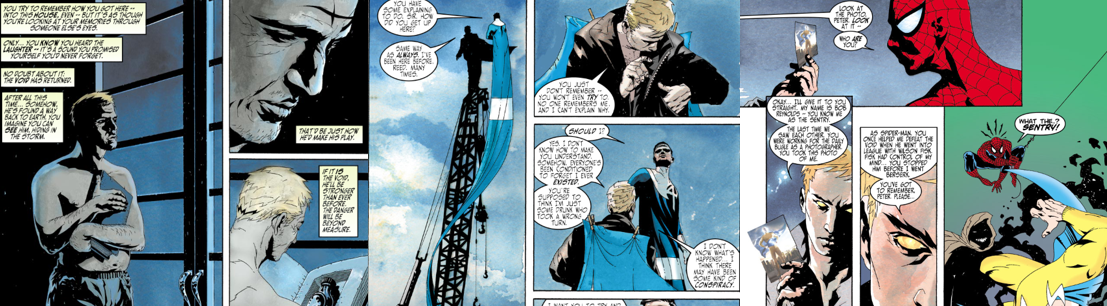
Triggered by cloudy memories, Bob tries to reconnect with a world that’s forgotten his heroics.

While Bob remembers Lindy accepting his superhero life right before their wedding, Mr. Fantastic talks the incident over with his family, perturbed by the sudden appearance of a golden unicorn that Bob gifted to Reed, who was his best friend. Disturbed and curious, Reed discovers a VHS tape in the unicorn that contains a warning from himself about the Void, but the tape explodes before the Fantastic Four learn anything tangible. Meanwhile, Bob (who “becomes” the Sentry the more he recalls his fragmented past, with his rudimentary costume even being revitalised) visits Doctor Robert Bruce Banner/The Hulk. Unlike the others, the Hulk remembers “Golden Man” as his “best amigo”, though Bob is disturbed to find the Green Goliath hasn’t evolved past his savage, childlike demeanour. Bob shares his concerns regarding a conspiracy surrounding him and convinces the Hulk to stand by him when the Void returns. Bob then meets Peter Parker/Spider-Man, who doesn’t remember Bob, sees only a blank piece of paper when Bob shows him a photograph he once took of the Sentry, and brands Bob a “fruitcake”. However, as he goes to leave, Bob begs Spidey to investigate further. As the world is thrown into turmoil, Peter’s memory is jogged after he confirms that multiple publications have been excised from public record. Additionally, Doctor Stephen Strange confirms the Void’s threat to Reed and, though he refuses to elaborate, he does magically conjure a memory of the Fantastic Four and Dr. Strange erasing everyone’s memories of the Sentry and Reed forcing Dr. Strange to keep that information hidden. Bob has a psychic parlay with Professor Charles Xavier/Professor X, causing Professor X’s memories resurface, and the X-Men to be put on alert. Similarly, Anthony “Tony” Stark/Iron Man remembers the Sentry, leading Bob to fly into a tirade about how he inspired all the world’s superheroes and was simply forgotten. Bob remembers that the Avengers staged an intervention regarding his overreliance on the serum and the lingering threat of the Void, with all begrudgingly agreeing that the Sentry, despite his many good deeds, should disappear. Since Tony stood up for him, Bob begs him to get the others onboard before flying to a desolate area of the city, his impressive super suit finally reformed. He returns to his long-forgotten fortress, the Watchtower, while his scarred and disabled former sidekick, Billy Turner/Scout, awakens from a disturbing nightmare.
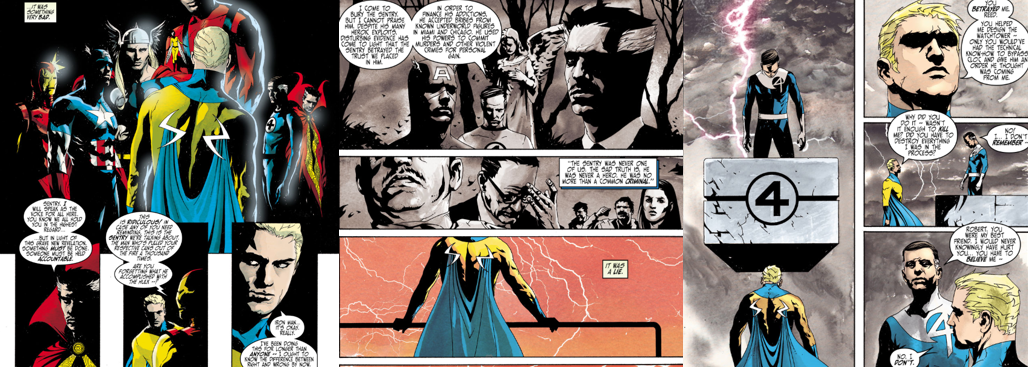
Despite fragmented memories of betrayal, the Sentry rallies to oppose the Void’s return.

Inside the Watchtower, the Sentry reunites with its Centrally Located Organic Computer/C.L.O.C. to investigate a subliminal message being transmitted around the world by a small, bug-like transmitter that’s powered by the same serum that gives the Sentry his incredible abilities. Thanks to a “self-modifying loop virus”, C.L.O.C. cannot directly aid the Sentry without being destroyed, so the Sentry disables the crude device himself. This leads to a brief and near imperceptible shift in the fabric of reality and, suddenly, kids discover their Sentry memorabilia, Billy finds his old costume, and people are filled first with relief at remembering their hero…and then horror as they also remember the Void. They also remember the Sentry dying in battle (at least, as far as the public were concerned), marking the end of a “Golden Age” of heroes. This event also sees the Sentry remembering Reed condemn him as a traitor and a criminal, claiming that Bob accepted bribes from the criminal underworld to fund his addictions and then mislead the public into thinking he was a hero while also profiting from his violent impulses. Angered at this betrayal and slander, the Sentry reconciles with a remorseful Lindy, only for her to be attacked and threatened by the Void. Gleefully, the Void spitefully monologues about his scheme to bathe the world in darkness and devour every living soul in the universe, saving his hated foe until last just to make him suffer. With that, the Void tosses Lindy aside and conjures an alarming and devastating hurricane out at sea that threatens the mainland. The Sentry makes a quick public address to announce his return, protest his innocence, and warn that the storm signals the return of the Void. After calling for a mass evacuation, the Sentry pleads with his superpowered cohorts to stand by his side once more against the threat on Liberty Island. Though he’s uncharacteristically afraid, the Hulk is the first to arrive out of gratitude for all the support the Sentry once showed him. Spider-Man, the X-Men, the Avengers, and all the city’s costumed protectors then arrive soon after, alongside Billy Turner. When Mr. Fantastic arrives, the Sentry berates him for his betrayal, though Reed’s still got some gaps in his memory and is adamant that he’d never betray his best friend like that.
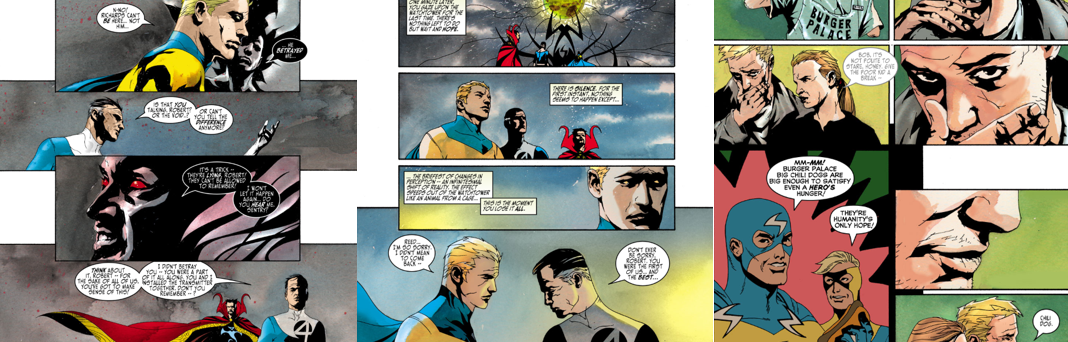
A remorseful Bob is forced to sacrifice his reputation to keep the Sentry, and the Void, forgotten.

Faced with the Void’s pending arrival and the potential end of the world, the Sentry steels himself, with friends and foes at his back, for the assault. The Void attacks with “infinitendrils” that sap even the Sentry’s abilities and confidence. The trinkets the Sentry gifted to his allies barely keep them from succumbing to the Void’s influence and unnamed heroes and untold civilians die as the Void’s attack decimates the city. During the chaos. Dr. Strange prompts Reed to remember when the Void attacked Manhattan in the past, causing catastrophic damage and leaving a pile of slaughtered bodies in his wake, only for Susan Storm/The Invisible Woman to discover the Void and the Sentry were one and the same! In the face of the Void’s destructive power, which left a million people dead, and faced with a man they’d known and respected and could clearly see was suffering a psychotic episode that manifested in a separate personality, Reed and Bob came up with a plan. After Bob shared his concerns about himself and admitted to his addiction, the two constructed the hypnotic transmitters to ensure that no one, not even Bob, would remember the Sentry, thus keeping the Void at bay.  Thus, at Bob’s insistence, the Sentry’s death was faked, his funeral staged, and his reputation tarnished to ensure that the people who loved and admired him so much would submit to the hypnosis. In the present, the physical and existential battle between the Sentry and the Void rages, breaking even the Hulk’s super-tough body, until Reed intervenes. Although the Void whispers poison in Bob’s ear, fuelling his confusion and anger, Reed triggers Bob’s memories, much to the Void’s anger. Desperate to live and to wreak havoc, the Void threatens to take full control of Bob’s body, so the Sentry rushes back to C.LO.C. alongside his allies. After a moment’s hesitation, the Sentry orders C.L.O.C to reactivate the transmitter and Bob gets a brief moment to reconcile with his best friend before their memories are wiped. In the aftermath, the devastation is blamed on a “temporal anomaly” and Bob returns to his mundane life with Lindy. However, when they stop for a bite and are served by Billy, a flash of a memory suggests the Sentry may not be completely forgotten…

The Summary:
This was my first time reading the Sentry’s debut story arc and I was quite excited to get into it. I don’t know much about the Sentry, but I remember his debut being quite a big deal and have seen it being talked about, and seen him pop up in a few crossover events and such, so I was eager to get into this and see if it lived up to the hype. Unfortunately, I really don’t think it did and I was left a bit disappointed. For starters, it bugged me that the story wasn’t contained in a five or six-issue arc. Instead, we have five issues laying the foundation for the Sentry and the Void, a couple of team-up stories that take between #5 and The Sentry vs. The Void #1, and that standalone resolution to the arc. This was a story clearly written for trade collections, which is fine on paper as that’s my preferred way to read comics, but it’s pretty damn arrogant of Marvel Comics to assume that people are going to be this heavily invested in their brand-new superhero right off the bat. Luckily, the central concept has a lot of legs to it, and I did enjoy the story as a very different, more cerebral superhero tale. It’s always engaging and interesting when comic books are more than just big superhero fights or cosmic events, and the Sentry’s debut definitely delves more into the psychological thriller genre as Bob, Reed, and the reader try to piece together the truth about this strange and apparently forgotten character. The mystery of the Void was equally well done and I liked that he was perceived as a world (well, universe) ending threat and the sense of desperation behind him. The idea that someone or something was so dangerous to all life that even the Avengers and the Fantastic Four blurred their morals to erase the minds of everyone in the world is very powerful and still holds up now, even knowing the truth about the two.
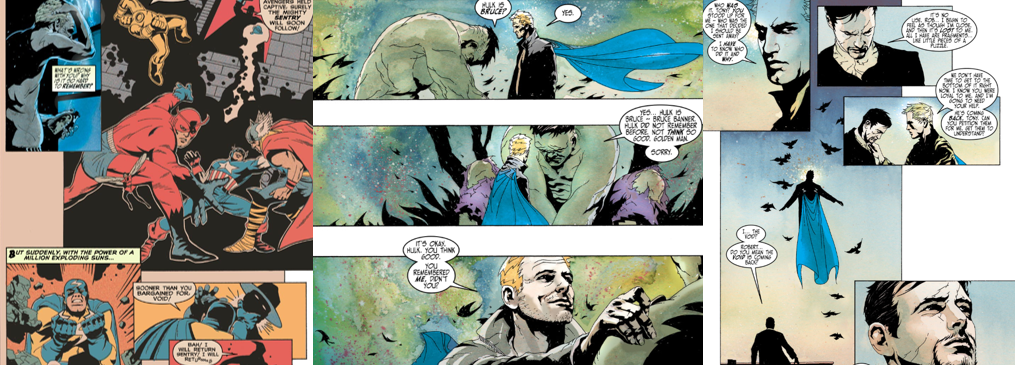
The Sentry is a bit of a Gary Stu and changes long-running aspects of Marvel continuity.

I liked that Bob is presented as an out of shape everyman. He’s a nobody whose wife barely seems to tolerate him and who’s haunted by nightmares and faded memories that could just as easily be comic books he read as a kid. When something (it’s not clear what) triggers the revival of the Void, Bob’s ordinary life is turned upside down and his body undergoes a slow and dramatic change upon drinking the mysterious serum that makes him an all-powerful demigod. I’m not sure how this transforms his costume or why a simple potion can give him such incredible power, but Bob’s memories, personality, and sense of self worth return the more he indulges in the serum and the more he meets with his old allies. Even his physical appearance changes, returning him to the superman physique he enjoyed in his prime, and his trip down memory lane changes many preconceptions of existing Marvel heroes. The Sentry is said to be the “first” costumed superhero, the one who inspired all the others, and his deeds were almost incalculable. He tamed the Hulk, was best friends with Reed Richards, scored Peter Parker his first Pulitzer Prize, and saved the world countless times. Indeed, this debut story goes out of its way to really hammer home that the Sentry was the bastion of all that’s good in the world, that no one could compare to him, and that he was the example others lived by. He had an elaborate headquarters in the heart of New York City, a kid sidekick, and all kinds of gadgets, making him very much a child’s perfect amalgamation of what makes a good superhero. It’s a bit grating, to be honest, primarily because we don’t really get to see any of the Sentry’s past deeds. We simply hear people talk about them and how great he is, with little evidence to back it up since even Bob barely remembers fact from fiction. Equally, we never get to see any of the Sentry’s incredible and much-touted powers beyond a few brief glimpses. Sure, he can fly and take a hit, but I’m not sure what “the power of a million exploding suns” means or how it scales with, say, the Hulk or Thor Odinson.
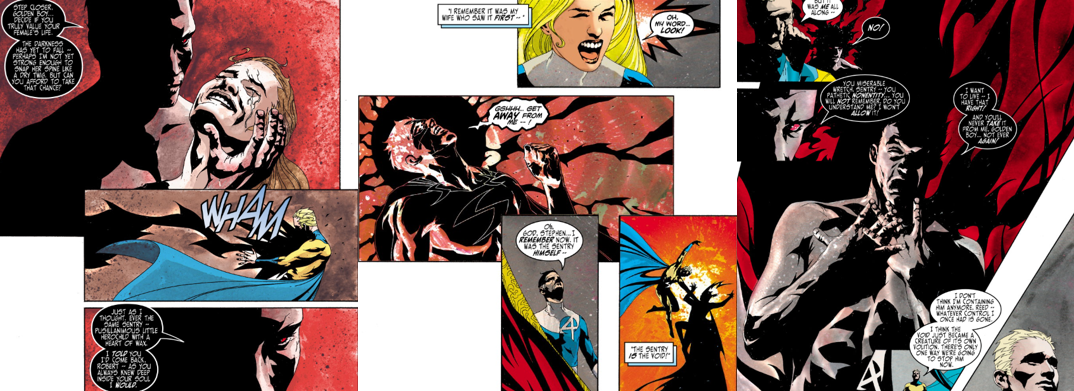
A unique and engaging story, but one that didn’t live up to its full potential for me.

I really enjoyed the panels that reflected other artists and key eras in comic book history. They went a long way to keeping up the ruse that the Sentry was a long-forgotten hero from Marvel’s glory days, dusted off and reinserted into mainstream continuity. In fact, I’d go as far as to say that we should’ve gotten more of these. They could’ve helped flesh out Bob’s backstory and past exploits, his relationship with Billy, and maybe retroactively insert him into key moments in Marvel history. Instead, they’re just fun panels that don’t live up to their potential, which is a shame. While you could argue that the mystery surrounding the Void, how stubbornly cagy Dr. Strange was and how fragmented records were, hinted towards the final reveal as much as Bob’s obvious unstable mental state, I think it landed really well. There’s a degree of responsibility on the reader’s part to understand that things aren’t quite what they seem. When the heroes assemble to help repel the Void in the finale, they’re not necessarily standing with the Sentry against the oncoming storm. Instead, they’re observing him violently lashing out as the Void reasserts control. While I would’ve liked more panels devoted to the destruction, it’s painted as the greatest threat the world has ever seen and one that the heroes are unable to stop through conventional means. It’s only by appealing to the man they once knew that the heroes manage to contain the Void once more, convincing Bob to make the ultimate sacrifice one more time since his powers and mentality are too unstable to be trusted. It’s a very unusual and dramatic end to a superhero story and paints the Sentry as a very fragile and complex character, one who would continue to suffer from his mental health issues and addictions in subsequent appearances. Unfortunately, I do feel the execution was a bit lacking and the story didn’t quite live up to its full potential. This seems par for the course with the Sentry, who doesn’t seem all that relevant these days, which is also a shame as I really think there’s something here and that it’s a very unique way to introduce a new superhero and supervillain.

My Rating:

Rating: 3 out of 5.

Pretty Good

What did you think to the Sentry’s debut story, and the character in general? Were you surprised and excited by the unusual depiction of the character? Did you guess that the Sentry and the Void were the same person or was it a surprise for you? What did you think to the Sentry being retroactively inserted into Marvel continuity? Do you agree that the story fell a little flat in the end or were you intrigued to see more? What are some of your favourite moments involving the Sentry? Which of Marvel’s Superman knock-offs is your favourite? Whatever your thoughts on the Sentry, leave a comment below, support me on Ko-Fi, and check out my other Marvel content on the site.


Game Corner: Marvel: Ultimate Alliance 3: The Black Order (Nintendo Switch)

Released: 19 July 2019
Developer: Team Ninja

The Background:
For decades, few videogame publishers were as synonymous with Marvel Comics as Activision, who produced adaptations Marvel’s most popular properties. While some were better than others, Activision’s efforts were largely praised, especially after they partnered with Raven Software on the X-Men Legends games (2004; 2005). Activision and Raven Software expanded their scope to the rest of the Marvel universe with Marvel: Ultimate Alliance (2006), a largely successful team-based brawer praised for improving upon its predecessors. Though now delisted, it was followed by a sequel three years later, courtesy of Vicarious Visions, which tweaked the gameplay with team-based attacks to encourage experimentation. Though Marvel: Ultimate Alliance 2 (2009) was praised for its branching storyline, the stripped down roleplaying mechanics were criticised. While it was also delisted in 2020, fans were clamouring for a follow-up and, just ten years later, Team Ninja stepped in to work alongside Marvel in reviving the franchise. Seeking to place additional emphasis on combat, the developers explored the cosmic scope of the Marvel universe by including the Infinity Stones and lesser-known characters and chose to make the title a Nintendo Switch exclusive after developing a close relationship with Nintendo. Although Marvel: Ultimate Alliance 3: The Black Order was the sixth best-selling game in its first week and was later bolstered by extensive downloadable content (DLC), it was met with mixed reviews that praised the colourful action but criticised its lack of innovation.

The Plot:
While battling Nebula and Ronan the Accuser, the Guardians of the Galaxy stumble upon a plot by the mad titan, Thanos, to collect the six Infinity Stones. Although they scatter the Stones, Thanos’s acolytes, the Black Order, pursue the gems, prompting an alliance of Earth’s mightiest heroes to retrieve them first.

Gameplay and Power-Ups:
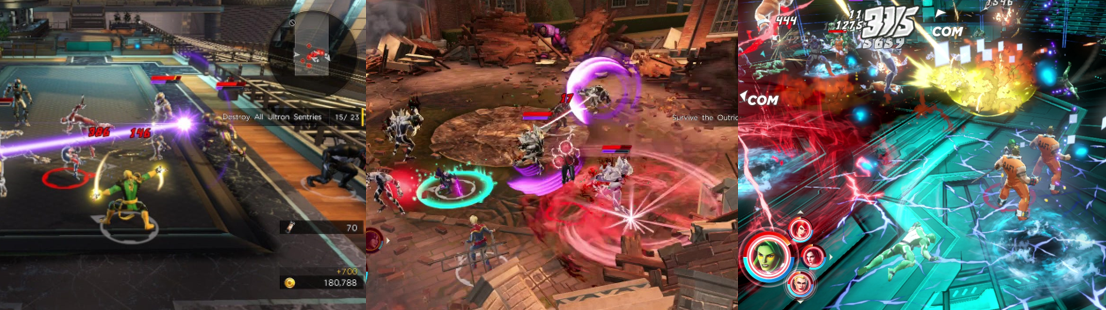
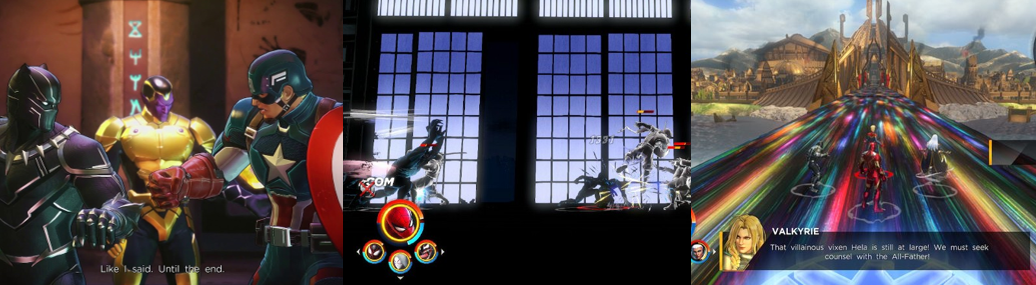
Like its predecessors, Marvel: Ultimate Alliance 3: The Black Order is a team-based action role-playing game in which players assemble a squad of four heroes from across the Marvel universe to battle various nefarious baddies, primarily the titular Black Order, who are hunting the six all-powerful Infinity Stones on behalf of their master, Thanos. The game offers five save slots, two initial difficulty levels, and a base roster of thirty-six playable characters, with many being encountered as you play through the story and joining your alliance either after fighting alongside you or being freed from some kind of mind control. Marvel: Ultimate Alliance 3 offers three controller configurations, thankfully none of which involve motion controls, and allows you to toggle overlays, notifications, tips, and other onscreen elements from the “Settings” menu. These include altering the camera placement, which enables a lock-on feature by pressing in the right stick, though the camera generally remains more focused on whichever character you’re controlling rather than offering a bird’s eye view as in the last two games. Although you can fight alongside friends either locally or online, you switch between your teammates with the directional pad (D-pad) when playing alone and your computer-controlled partners are very useful in a fight, attacking, enabling team attacks, and reviving defeated characters without any input from you. Pressing A sees you interact with the environment to activate consoles, pick up or move certain objects, and talk to other characters. You jump with B, executing a double jump, swinging from webs, or flying depending on which character you’re playing as, and throw light attacks with X and heavy attacks with Y. These can be strung together to perform basic combos and you can also perform a mid-air attack and throw objects (like bombs and missiles) by pressing Y. You block incoming attacks by holding the Z trigger and tap it to dodge, and collect glowing red orbs from defeated enemies or smashed crates to restore health, blue orbs to refill your Energy Point (EP) gauge, and credits to spend on upgrades.

Combat is thick, fast, chaotic, and constant thanks to loads of enemies and character abilities.

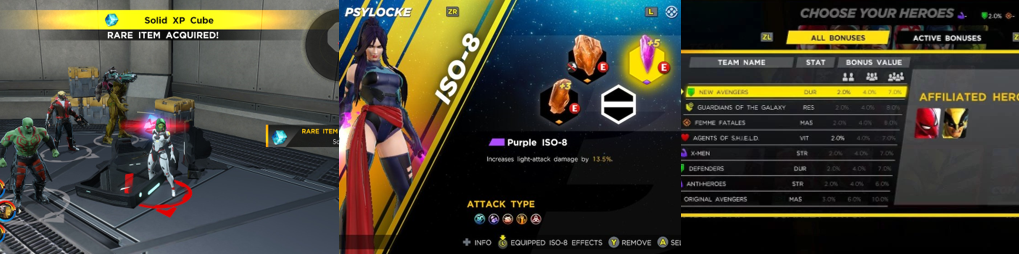
As in the last two games, each character has specific abilities tied to their superpowers or superhero traits. You activate these by holding the Right trigger and selecting an icon using the D-pad; using Abilities drains your EP, however, and each Ability comes with a different cost. However, these attacks allow you to stun, stagger or deal elemental damage to enemies using Peter Parker/Spider-Man’s webs, Thor Odinson’s lightning, and Doctor Robert Bruce Banner/The Hulk’s incredible strength. Many characters have projectile attacks in their arsenal, such as Wade Wilson/Deadpool firing guns and Scott “Slim” Summers/Cyclops blasting his eye beams, while others cause splash damage or specific buffs, like Piotr Rasputin/Colossus being able to reflect projectiles and Wanda Maximoff/The Scarlet Witch healing her allies. Some, like James “Logan” Howlett/Wolverine, have passive abilities that allow them to automatically regenerate health as they walk around; others, like Johnny Blaze/Ghost Rider and Ororo Munroe/Storm, specifically deal in elemental damage. Character’s Abilities can also be mixed and matched by holding ZR and pressing one of the face buttons (or pressing A when prompted); this sees two characters attack in a combo for additional damage. As you dish out and take damage, you’ll also build the Extreme (EX) Gauge). Once full, you can press L and R up to three times to have two to four of your teammates perform a devastating combination attack that’s great against bosses. While the various cannon fodder you fight are easily dispatched, larger commanders and bosses need their “stun” meter drained before you can really put a beating on them and others (and certain treasure chests) require specific combination attacks to breach their shields. Defeating enemies sees your characters gain experience points (XP) to level-up, increasing their statistics (attack, defence, etc), though you can also use the various Orbs you find to manually level-up. Each character’s special Abilities can also be further enhanced using Ability Orbs and credits, reducing the EP cost and increasing their damage, among other benefits. You can also earn “Team Bonuses” depending on your team selection: pick a group of X-Men, for example, and your strength or resistance stat will increase, while picking characters of royalty ups your maximum energy stat.

Search for chests to gain currency and other expendables to upgrade and buff your alliance.

Although you can’t equip gear to your characters, the boss battle against the Destroyer armour sees you temporarily empowered by Asgardian magic and you can eventually equip your team with “ISO-8” crystals, coloured stones that enhance their attack power, resistance to elements, or critical hit ratio, among others. You can further upgrade these with credits and ISO-8 capsules, though some of the rarer ones will also debuff you (for example, your attack my increase but your defence will decrease accordingly). You’ll also inevitably gain access to the Strategic Hazard Intervention Espionage Logistics Directorate (S.H.I.E.L.D.) Lab, which acts as the game’s skill tree. By spending credits and Enhancement Points (EP), you can further increase your team’s overall attack, defence, resistance, vitality, and such and even unlock additional ISO-8 slots (with more being earned by levelling-up). You can also enter the S.H.I.E.L.D. Depot from the main menu to purchase additional costumes and social icons by spending S.H.I.E.L.D. Tokens. Marvel: Ultimate Alliance 3 is pretty forgiving (on the “Friendly” difficulty, at least), with multiple checkpoints in each area. When you activate a S.H.I.E.L.D. checkpoint, your team is fully healed, and you can swap or enhance them if you wish. If a teammate is defeated, you can hold A to revive them, but I wouldn’t recommend it unless you absolutely have to. Not only are revives limited, but downed characters will eventually return to full health even before you reach a checkpoint so it’s not worth risking another character taking damage by healing a partner. Exploration generally leads you to treasure chests or special walls that require a special combination attack to open, or to a “Rift” challenge that takes you away from the main game to tackle a special challenge (usually a boss rematch or enemy gauntlet) for extra rewards. Your path is incredibly linear most of the time, hence why there’s no map, and the game’s primary focus is on chaotic combat and visually manic team-based attacks. Unlike in the last two games, you can no longer grapple or throw enemies (though you can still send them flying off certain platforms) and there are no character-specific team-up moves, meaning the action can quickly get quite tiresome.

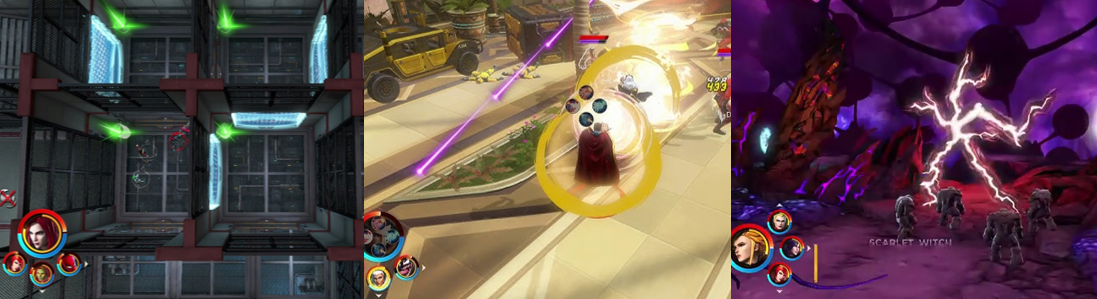
Sadly, puzzles are practically non-existent, with only Rifts offering additional challenges.

Because of its focus on hectic combat, there’s even less room for puzzles than there is for exploration in Marvel: Ultimate Alliance 3. Puzzles boil down to activating a console to open a door or making a platform move and that’s it. Sometimes, you’ll hold A to move a block and avoid lasers or cannons, but mostly you’ll be timing jumps between said lasers to progress and simply hurling missiles at those cannons. Sometimes, you’ll rotate statues or press switches to progress; others, you’ll be avoiding toxic ooze in Hel or solving door puzzles at the Raft or in Avengers Tower. After hopping across the rooftops of New York City, you’ll infiltrate the heavily fortified fortress of the Hand, dealing with ninjas that drop from the sky and hidden arrow hazards. When in Wakanda, Advanced Idea Mechanics (A.I.M.) corrupt T’Challa/The Black Panther’s defences, leading to an exasperating section where you must avoid snipers and being roasted by a giant panther statue’s energy blast. When transported to the Dark Dimension, you must use portals to reach new areas and defeat waves of demonic enemies to lower magical barriers and progress. Some attacks also screw up your controls or temporarily freeze you; some enemies are best defeated by tossing explosives at them; and many missions have an additional character fighting alongside you who’s often unlocked afterwards. However, a lot of the additional features of the previous games are missing; you can talk to other characters, but there are no dialogue options or character-specific interactions. There are no trivia quizzes, no optional side missions beyond the Rifts, and no character specific challenges to unlock extra stuff for each character. There aren’t even hub areas, in the traditional sense, with characters just appearing around S.H.I.E.L.D. checkpoints at times, though you can destroy a fair bit of the environment, and some encounters have you fleeing towards the camera as bosses chase you or present you with unwinnable battles.

Presentation:
Whereas the last two games primarily based their aesthetics on the comics books, especially the Ultimate comic line, Marvel: Ultimate Alliance 3 adheres very closely to the Marvel Cinematic Universe (MCU), especially in the visuals of its locations. I was hard pressed, for example, to tell the difference between Asgard here and the Asgard to the MCU, with both the golden city and the rainbow bridge, the Bifrost, appearing almost exactly as they’re depicted in the films. The same is true for Wakanda, the Dark Dimension, and Knowhere, all of which are virtually indistinguishable from how they appear in the MCU. There are some differences, of course: Taneleer Tivan/The Collector’s museum, for example, uses coloured cube cages and Wakanda leans much more into traditional architecture than the pseudo-futuristic science of the films (likely because Black Panther (Coogler, 2018) released a year before this game was made). Xavier’s School for the Gifted is lifted almost exactly from the 20th Century Fox X-Men movies (Various, 2000 to 2020), however, including a hedge maze, 1:1 Cerebro room, and basketball court that doubles as a landing pad for the Blackbird. While the Dark Dimension and the cosmic mind trip that is Sanctuary also heavily borrow from the bizarre cosmic imagery of the MCU, the Raft and Avengers Tower are much more akin to their comic book counterparts, though they’re comparatively bland locations, lacking fun areas like the Danger Room or Wakanda’s Necropolis (though you do pass through Anthony “Tony” Stark/Iron Man’s Hall of Armours in the tower). Although you only make a brief stop in Attilan to try and get help from the Inhumans, the architecture is far more visually interesting than that awful television show, seemingly being comprised of Celestial technology, and I enjoyed the ominous gothic presentation of Hel, with its restless Viking warriors and damaging sludge. Unfortunately, Marvel: Ultimate Alliance 3 continues the trend of having disappointingly bland and forgettable music, opting for generic themes for each location, event, and character that are lost amidst the constant fighting.

A visually impressive brawler that takes obvious inspiration from the MCU films.

The game also opts for an almost cel-shaded, action figure-like aesthetic for its colourful cast of characters. While many again both look and sound like their MCU counterparts, there are some exceptions: Peter Quill/Star-Lord, for example, looks nothing like Chris Pratt and the X-Men are far closer to the comic books than Fox’s films. Despite you assembling a custom team of heroes, cutscenes depict either everyone or characters specific to the location you’re in (the corrupted Doctor Stephen Strange in the Dark Dimension, for example) as they’re better suited to advance the plot against the local baddies. With the game shifting to a more third-person perspective, you’re closer than ever to the action and can see more of the environment than in the previous games. However, this comes with some drawbacks: mainly, there are far less opportunities or incentives to explore. Second, environments are painfully linear, with dead ends or locked doors barring your progress. Third, and most frustrating, is the camera, which easily loses track of your opponent/s and often lumbers you with wireframe representations when the foreground blocks the view. Thankfully, you won’t be falling down pits and rarely have to worry about onscreen hazards, but it can be aggravating trying to figure out which platforms and crates can be jumped on and which can’t. Marvel: Ultimate Alliance 3 offers a diverse cast of characters, each with their own idle poses and quips, though these do inevitably repeat. The game’s also surprisingly light on Easter Eggs: you’ll spot Deadpool singing away as he makes tacos in the X-Mansion, but not much else, and there are no optional missions or choices to encourage replaying missions. It’s a far cry from the first game, where there was always something to collect or an additional character to help out. Instead, it’s basically all combat, all the time in Marvel: Ultimate Alliance 3. Luckily, the game looks pretty good (everything’s very colourful and true to its inspirations) and performs really well, though there are some long load screens and it is annoying being forced to continue your game every time you challenge a Rift.

Enemies and Bosses:
All the usual suspects appear here as disposable cannon fodder for you to endlessly beat up, with many of the game’s goons sharing traits across the various locations. You’ll encounter Kree, Ultron Drones, agents of A.I.M., and Doombats who all pack various energy blasters. Ultron’s clones are the worst for this, relentlessly firing energy blasts and crashing through windows. The Raft’s unscrupulous prisoners attack in large groups, as do the restless Viking warriors who populate Hel, tossing axes from afar and luring you into toxic goop. Gargoyle-like Fire Demons also dwell here, offering a greater challenge with their swoop attack and fire breath, not unlike the monstrous Outriders and Mindless Ones who make up Thanos and the dread Dormammu’s forces, respectively. Alpha Primitives, Hydra goons, and towering Sentinels also appear, with the latter firing huge energy blasts from the palms and best attacked by throwing their explosive energy cores back at them. No matter where you are and what enemies you fight, more powerful commanders will also appear. Larger, tougher, and sporting a stun meter, these commanders should be your top priority as they’ll charge across the screen, cause shockwaves, and generally offer a far greater challenge even when you’re at a higher level. These minions often fight alongside their masters, generally so you can recover some health and EP to better damage the bosses, and will endlessly spawn in one of the additional modes unless you destroy their teleporters. Some of the game’s challenges or story-based missions charge you with defeating a certain number of enemies to progress. Other times, bosses appear in these waves, and you must occasionally flee or purposely lose some fights. This happens when Cain Marko/The Juggernaut comes tearing through the X-Mansion, for example, and in early encounters with the Black Order, who cannot be beaten or will chase you, raining lightning or other attacks from the sky and across the ground.

Few bosses require more than just hit-and-run tactics, even when augmented by an Infinity Stone.

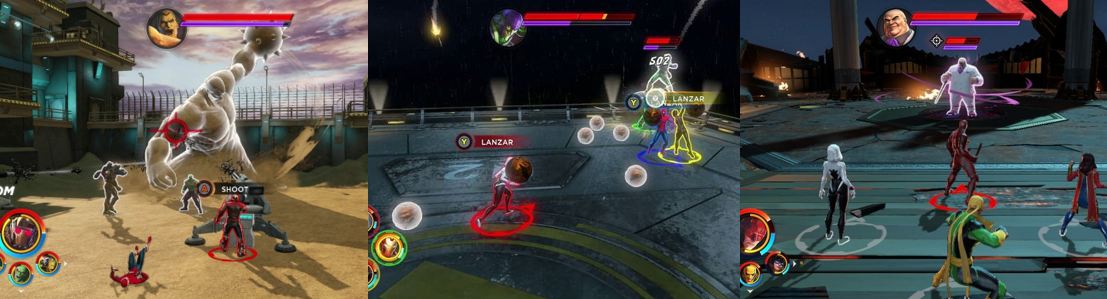
There are loads of bosses to fight in Marvel: Ultimate Alliance 3, with some returning from the previous games, some teaming up, some having a couple of phases, and all boiling down to whittling down their stun bar, unleashing an EX attack and/or your most powerful Abilities, and avoiding damage until you can repeat this. The first ones you’ll face are Nebula and Ronan the Accuser, who often appear as a duo in optional challenges. Nebula is faster and more nimble, wielding blades where Ronan uses a massive warhammer. Both set a standard all bosses follow, which is that they’ll use either a jumping slam or an explosion of energy (or both) to send you flying. While quelling the riot in the Raft, you’ll encounter a version of the Sinister Six, with some unique variations to each battle. Flint Marko/The Sandman, for example, flings waves of sand and erupts his big sand fist from the ground as a large sand creature. You must use A to mount the nearby cannons and unload on him to chip away at his stun meter. Maxwell “Max” Dillon fights alongside Eddie Brock/Venom, raining lighting and electrocuting you with bursts of electricity, before he’s eaten by Venom and starts busting out electrically-enhanced symbiote powers. Venom joins the team after this fight and is tested against Quentin Beck, who first brainwashes Mile Morales/Spider-Man, Gwen Stacy/Spider-Woman, and Kamala Khan/Ms. Marvel to fight you and then unleashes a poisonous mist, teleports about, and confuses you with duplicates, Doctor Otto Octavious/Dr. Octopus is fought in a two-stage fight where you must first avoid his tentacles and scurry charge and then attack each arm to stun him. Finally, you’ll battle Norman Osborn/The Green Goblin for the Time Stone. The Green Goblin swoops overhead and lingers slightly out of reach, peppering the arena with his pumpkin bombs, charging at you, and freezing time to bombard you. He’s noticeably weak to his pumpkin bombs, however, so try and toss them at him before they explode in your face! After battling into the Hand’s fortress, you must first free Elektra Natchios from the Hand’s influence and then face Lester/Bullseye and Wilson Fisk/The Kingpin in separate fights. You must take out the ninjas feeding Elektra power, avoid Bulleye’s spread of razor sharp and explosive cards, and dodge the furniture and massive energy beam thrown by the Power Stone-enhanced Kingpin. The Kingpin also charges like a rhino, leaps at you to cause shockwaves, and even rips up stone columns to use as melee weapons!

Gigantic bosses and the quirkier villains help mix-up the otherwise tedious combat.

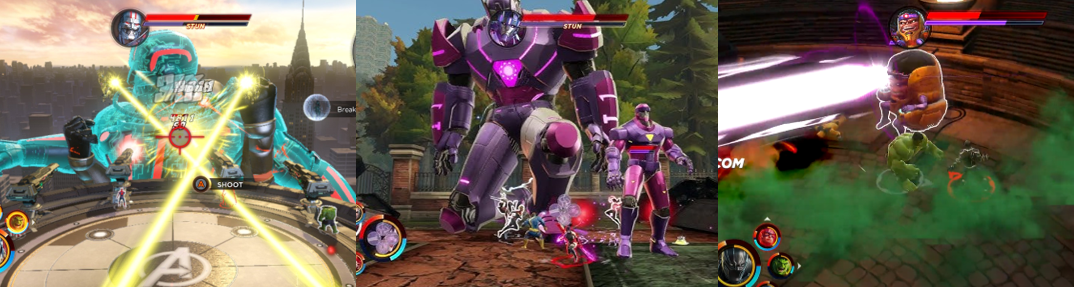
Avengers Tower is then attacked by Ultron and his drones, who assist him in battle. Not that he needs it as the Mind Stone allows Ultron to mess up your controls, to say nothing of his signature face and palm beams. Ultron then grows to gigantic proportions, sweeping the area with his eyebeams before Clint Barton/Hawkeye intervenes and Ultron merges with Ultimo. This is the first giant boss battle in the game and sees you blasting Ultimo with cannons and avoiding his massive swipes. The Infinity Sentinel is comparatively smaller, but no less dangerous thanks to its own face beam and missiles. Though you can damage it with Sentinel cores, it’s finished in a cutscene by Erik “Magnus” Lehnsherr/Magneto, who then tosses debris and throws you off balance with magnetic pulses while Juggernaut pummels you and Raven Darkholme/Mystique tosses daggers. After surviving Mystique’s Danger Room trials, you face Magneto, now even tougher thanks to the Power Stone, before being chased away and banished to the Dark Dimension by the Black Order. There, you battle past Loki Laufeyson (who boasts elemental attacks and duplication tricks) to eventually face the dread Dormammu, who wields the Reality Stone and is the second giant boss. You must subdue his minions and avoid his flame bursts, whittling down his magical barrier either directly or be destroying three nearby orbs, all while dodging his giant fists and ground spikes. The brief fight with Maximus Boltagon is far easier, even though the mad Inhuman carries a massive energy cannon and you must take cover in Thane’s energy bubble to avoid Maximus’s barrage of lasers. Ulysses Klaue/Klaw awaits in Wakanda and his sound-based energy blasts and waves must be overcome to rescue and recruit James Buchanan “Bucky” Barnes/The Winter Soldier. You then fight past A.I.M. to confront their master, George Tarleton/Mental Organism Designed Only for Killing (MODOK), who uses the Soul Stone to turn the Dora Milaje against you and attacks with a slew of appendages, from buzzsaw arms, poison gas, failing tentacles, and his signature forehead blast.

Battles with the empowered Black Order, Thanos, and Thane offer some of the most enjoyable challenges.

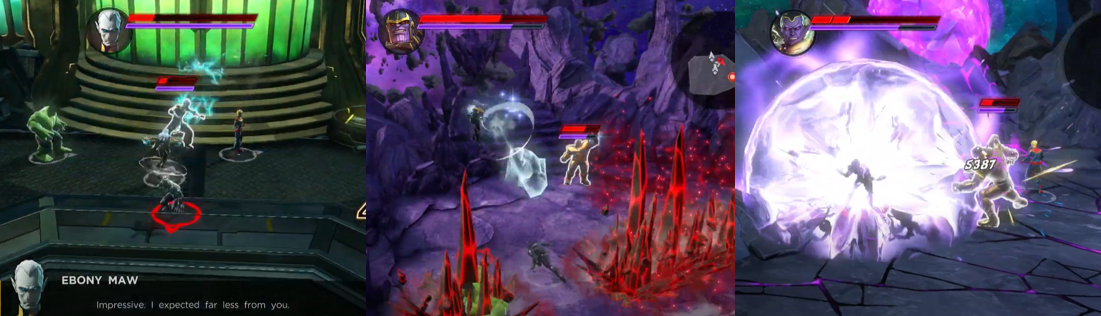
Though your goal in Hel is to confront Hela, you’ll actually battle the fire demon, Surtur, in another giant boss battle. This was a bit of a difficulty spike for me as Surtur’s flaming sword has a long reach and he causes the ground to erupt in flames, to say nothing of stun locking you with repeat sword strikes! Best him and Hela sets Johann Schmidt/The Red Skull on you, with the Nazi madman firing a powerful revolver and sapping your health with his “Dust of Death”. Hela gives the Red Skull a boost, protecting him with a shield and allowing him to fire a Bifrost-like laser, before placing his consciousness into the Destroyer armour. Though bolstered by Hydra forces and boasting a sweeping face beam, you can get a power-up from glowing crystals to overcome this destructive force. Finally, you venture to Knowhere and must run the Black Order gauntlet to retrieve the Infinity Stones, with checkpoints between each fight. Ebony Maw is first, firing a spread of projectiles and rocks and using the Soul Stone to create portals to trip you up. Supergiant tosses dark spheres and a golden homing shot that messes up your controls, though you can toss explosive cores from her minions to deal big damage. Cull Obsidian infuses his battleaxe with the Power Stone, sending out waves of purple energy and massive purple shockwaves, though he’s far slower and also susceptible to the nearby bombs. Corvus Glaive is much faster, landing multiple hits with his lance and using the Reality Stone to spring spikes form the ground and conjure duplicates who fill the arena with energy waves that can stun lock you. Finally, Proxima Midnight takes her fellow’s teleportation trick to the next level with the Space Stone and fills the arena with lightning bolts and strikes. All these powers are then recycled when you face Thanos, who gathers the six Infinity Stones into the Infinity Gauntlet to rain meteors, teleport, mess up your controls, freeze time, and fire his signature eyebeams. Thanos then joins you to battle Thane, who usurps him and boasts similar powers, though also upgraded by the Infinity Armour. Thane exhibits superhuman speed, traps you in a cube, fills the arena with portals and flames, and explodes in fury, though both battles were fun challenges rather than impossible tasks.

Additional Features:
Unlike in the previous two games, you won’t be finding data logs, action figures, or meeting certain requirements to unlock new attacks or costumes. You just fight over and over, earning whatever you need to unlock, buy, or upgrade whatever you wish and finding some concept art in treasure chests. A far harder (but more rewarding) “Superior” difficulty unlocks upon clearing the game alongside an additional “Nightmare” mode, accessible via the “Curse of the Vampire” campaign. You also unlock Thanos and can freely replay any mission on any difficulty (though you must start a new save to play on “Superior”) to grind and enhance your characters and ISO-8. Dimensional Rifts transport you to special challenges (not unlike the S.H.I.E.L.D. Simulator discs from the first game) that are often rematches with bosses or gauntlet challenges, though far tougher and gifting better rewards if you succeed. There are also three additional modes; however, though you can play a taster of each, you must purchase the expansion pass to fully unlock them. “Curse of the Vampire” adds vampiric enemies to the main story in “Nightmare” mode and offers a “Gauntlet” mode where you battle waves of enemies and bosses against both a time limit and a range of debuffs (including limited health restoration and draining EP). You can also tackle an “Endless” mode that’s pretty self-explanatory, and unlock additional characters like Frank Castle/The Punisher and Eric Brooks/Bladeif you buy the DLC. “Rise of the Phoenix” sees you form a four-person team and go head-to-head with a friend or the computer in three-round Danger Room scenarios. These see you tackling bosses again or wiping out hordes of enemies, awarding additional buffs and effects if you meet certain criteria (such as using any Ability or Synergy attack four times). You can only tackle the first challenge without the DLC, so I didn’t get very far, but this could be a fun distraction for those looking to test their skills against a friend. “Shadow of Doom” adds an epilogue story campaign that sees you return to Wakanda to oppose Doctor Victor Von Doom’s invasion. Dr. Doom’s Doombots endlessly spawn unless you destroy their teleporters, and you even battle the arrogant dictator in the recycled Necropolis, with him teleporting, firing lasers form his palms, and having his health restored by his Doombots. You’ll add Marvel’s First Family to your roster (alongside an alternative Thanos and other characters) by buying the expansion pass and battle Annihilus, a gigantic Celestial, and even “God Emperor” Doom!

The Summary:
I quite enjoyed the first two Ultimate Alliance games. They were mindless and largely repetitive, but I liked the large cast of characters and all the different references and locations from the comic books. Still, I put off Marvel: Ultimate Alliance 3: The Black Order for some time, mainly because I was annoyed by it being a Nintendo Switch exclusive; however it turned out to be a decent enough brawler. Despite the different development team, a few tweaks, and an apparent disconnection from the previous games, Marvel: Ultimate Alliance 3 offers a lot of the same gameplay and enjoyment as its predecessors, which is great for long-time fans of the franchise. Unfortunately, it doesn’t improve on these elements in a meaningful way and actually removes some content that I found enjoyable from the last two. There are no optional missions, for example, no alternative endings, no choices, and no character-specific challenges beyond fighting and levelling-up. I found this made the tedious combat even more aggravating after a while as I wasn’t being rewarded with gear or costumes or anything other than stat boosts. Even the skill tree was limited since you must grind to acquire enough credits and expendables to enhance your team, and I found the ISO-8 mode to be more confusing than engaging. The game also does little to improve the boss battles. Very few were very innovative or required more of you than to strike fast, avoid shockwaves and projectiles, and unleash your Extreme attack. The giant bosses were more of a challenge and I liked the final fight against Thanos and Thane, but I was hoping for a bit more complexity, especially given the possibilities offered by the Infinity Stones. There is a fun selection of characters, but they don’t offer much more than what we saw in the last two games and actually offer less as there are no character-specific team-up moves. While I enjoyed the visual influence from the MCU and the variety, I feel like Marvel: Ultimate Alliance 3 played things a little too safe by relying so heavily on combat and not mixing up the gameplay with a few other puzzles and challenges. Overall, it’s a good enough game and a worthy entry in the series, but it’s a shame that the developers didn’t try to be a bit more innovative and offer some more incentive to keep slogging away in endless fights.

My Rating:

Rating: 3 out of 5.

Pretty Good

Did you enjoy Marvel: Ultimate Alliance 3: The Black Order? How do you think it holds up against the previous two games? Which characters did you choose for your team? Were you disappointed that the combat was so similar to the last two games and the bosses so repetitive? Did you ever conquer all the Rift challenges? What did you think to the MCU influences and the final battle with Thanos and Thane? Did you ever play through the DLC? Would you like to see another Ultimate Alliance game? Whatever your thoughts, leave a comment below, support me on Ko-Fi, and go check out my other superhero content across the site.
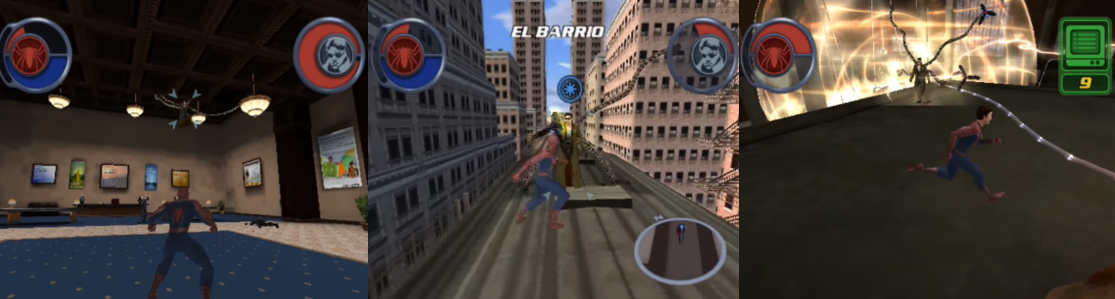
Game Corner [Spidey Month]: Spider-Man 3 (Xbox 360)


Easily Marvel Comics’ most recognisable and popular superhero, unsuspecting teenage nerd Peter Parker was first bitten by a radioactive spider and learned the true meaning of power and responsibility in Amazing Fantasy #15, which was first published in August 1962. Since then, the Amazing Spider-Man has featured in numerous cartoons, live-action movies, videogames, action figures, and countless comic book titles. To coincide with his debut and his very own day of celebration, I’ve been dedicating every Tuesday of August to talk about everyone’s favourite web-head!


Released: 4 May 2007
Developer: Treyarch
Also Available For: Game Boy Advance, Nintendo DS, Nintendo Wii, PC, PlayStation 2, PlayStation 3, PlayStation Portable (PSP)

The Background:
It seemed like every single cinema release was accompanied by a videogame adaptation back in the day, regardless of how necessary this was, and Peter Parker/Spider-Man is no exception to this. Considering his popularity, Spider-Man has a long and varied history with videogame adaptations across numerous platforms, but arguably hit an unexpected peak with developer Treyarch’s celebrated adaptation tie-in to Spider-Man 2 (Raimi, 2004). Widely regarded as one of Spider-Man’s greatest videogame outings, Spider-Man 2 (Treyarch, 2004) was followed by Ultimate Spider-Man (ibid, 2005), a cel-shaded reskin of sorts that acted as a companion piece to the Ultimate Spider-Man comics (2000 to 2011). This game expanded upon the web-slinging and combat of its predecessor while also offering two ways to play by including the hulking Eddie Brock/Venom as a playable character. Interestingly, though, this latter approach would not be included in Treyarch’s tie-in to Spider-Man 3 (Raimi, 2007), which instead simply reduced Venom’s inclusion to some new rage-empowered abilities for the titular wall-crawler. This time around, different villains featured in the different console versions of the game, but Spider-Man 3 ended up being almost as polarising as its source material. Reviews criticised the dull combat and repetitive gameplay, though the thrilling web-slinging and impressive size of the game world continued to be praised.

The Plot:
Peter Parker’s superhero life is turned upside down by a turf war in New York City that only escalates when his mentor transforms into a man-lizard, a crazed hunter comes to town, his former friend Harry Osborn seeks revenge, and a common crook is gifted extraordinary sand powers! Pushed to the edge, Peter is tempted by the power and allure of a mysterious black suit from space that greatly augments both his powers and his rage!

Gameplay:
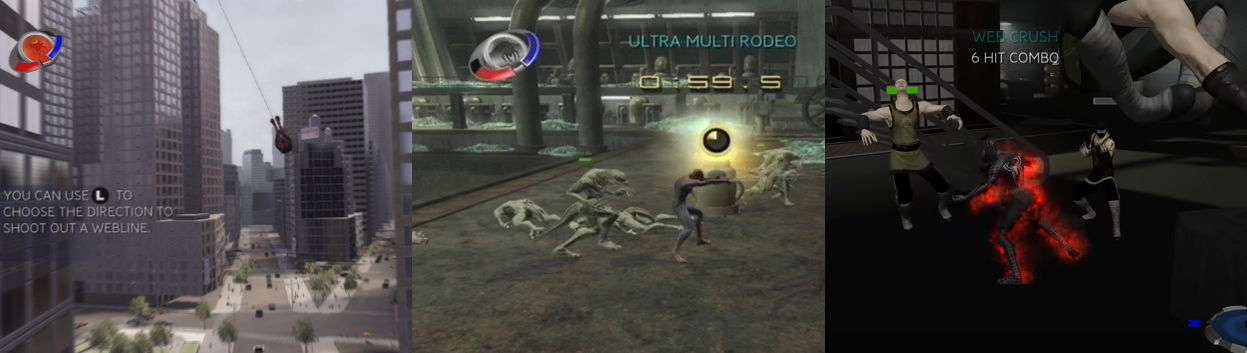
If you’ve played the highly-regarded Spider-Man 2 before, then Spider-Man 3 will be very familiar to you. Having perfected the art of open-world web-slinging, developers Treyarch haven’t strayed too far from their game engine here and once again present an expansive map of New York City filled with skyscrapers to swing from, random crimes to stop, and landmarks to visit. Accordingly, the control scheme and gameplay mechanics aren’t much different from Spider-Man 2, but there are some noticeable differences: you can attack enemies with X and Y, holding each button to charge up for a strike to deal more damage and break their blocks and mixing up these button presses (in conjunction with others) to deliver some fun combos that see Spidey webbing foes to lampposts, pinballing about the place, and kicking the crap out of punks in a whirlwind. B sees you webbing enemies, either pulling them in for a strike or temporarily subduing them if you hold the button, and you can press it at the end of a combo to fire a flurry of web balls. B is also used to stick to walls and ceilings, with the camera continuing to go all janky and mess up your perspective every time you do this, while A lets you jump. You can hold the button to charge a big jump and press it again in mid-air for a double jump, and at the end of a swing to gain extra height and distance when web-slinging. Unfortunately, there’s no way to lock-on to enemies or objects here and the camera can be very erratic, meaning you can easily end up punching thin air or getting turned about during chases and combat. However, you can press in the right stick to activate Spidey’s spider sense for a short time, which puts a greyscale filter over the environment to highlight enemies and points of interest.

Spidey’s web-slinging and combat are augmented by the rage-inducing black suit!

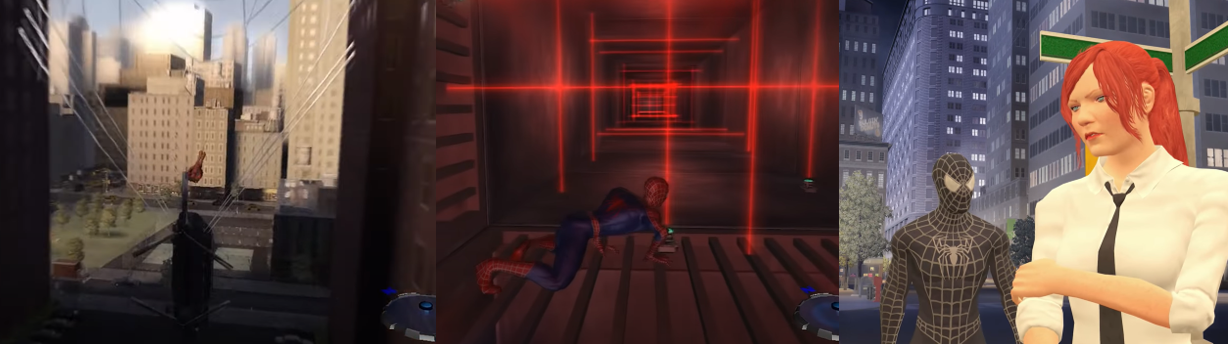
The web-slinging mechanics are similar to those in Spider-Man 2. You can start web-slinging by holding the Right Trigger, but Spider-Man will only comply if there’s a building or other tall structure nearby, so once again you’ll see him snapping off webs in a way that more accurately replicates his web-slinging from the films. You can hold down the Left Trigger to speed up your swing (this also allows Spidey to run and crawl faster) and will eventually unlock upgrades that let you swing from two webs by pressing LT and RT at the same time or quickly zip along flat surfaces by tapping RT. Another upgrade lets you climb up a web by pressing up on the directional pad (D-pad) with a ceiling above you (which is great for avoiding laser tripwires). Holding the Left Bumper activates Spider-Man’s “spider reflexes”, which slows down the game for as long as your blue meter lasts, effectively acting as “bullet time” and allowing you to dodge incoming attacks by wiggling the left stick and unleash a counterattack with X or toss missiles back at helicopters with B. This meter automatically refills over time, just as the red super meter fills as you land attacks. Once full, you can press the Right Button and A, B, X, or Y to unleash a super move, such as webbing up and swinging multiple enemies or performing a ground pound for crowd control. Later in the game, Spider-Man will be consumed by the symbiote, and his speed, defence, and strength will be augmented by his black suit. When wearing the black suit, you can tap RB to build up a rage meter and then rapidly tap it to enter an enraged mode that greatly enhances your regular and super attacks for a short time. As you complete missions, stop random crimes, and defeat enemies, you’ll increase your “crime fighter” rating and unlock upgrades to all of Spidey’s repertoire. These extend his health, add new combos to his arsenal, and upgrade his swinging speed, amongst others, and you can view these at any time from the pause menu.
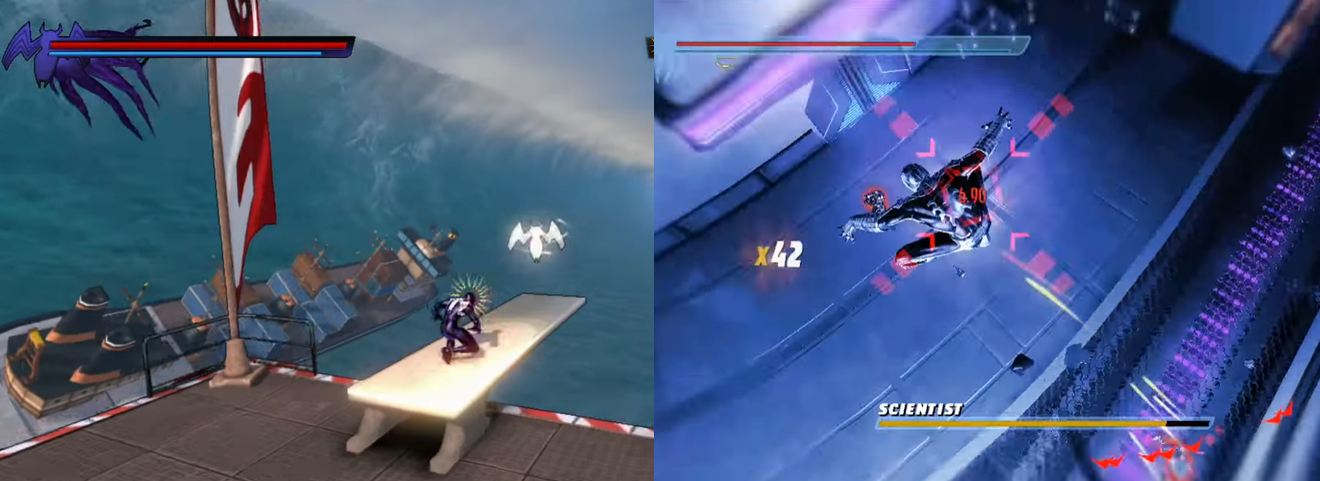
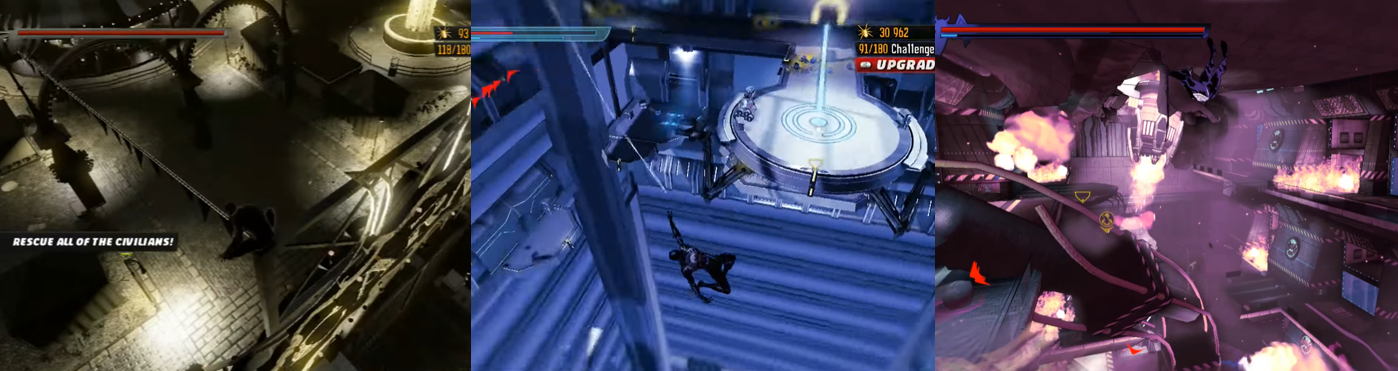
There are many side missions and challenges, from fighting crime to photographing UFOs!

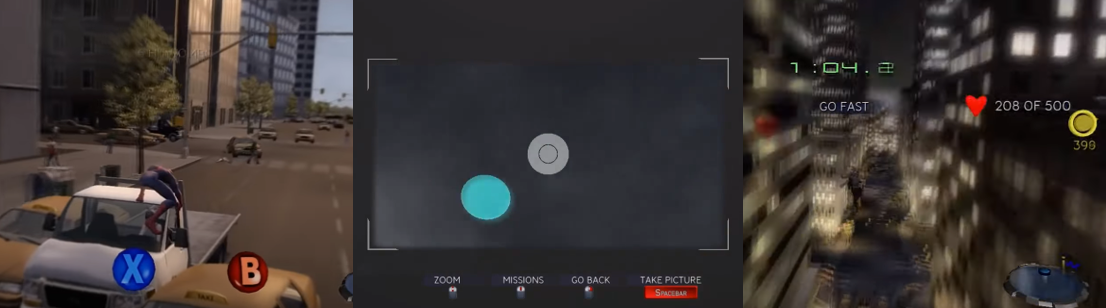
While the game includes a helpful onscreen compass that highlights points of interest, crimes in progress, and enemy placements, you can also view an overheard map of the city by pressing the ‘Back’ button. This time around, you can filter to see story missions, tasks such as time trials and skydiving challenges, and areas where random crimes will catch your attention, and you can also set waypoints to guide you to specific areas, which is extremely helpful. Side missions in Spider-Man 3 involve stopping runaway cars or fleeing criminals by leaping on top of their vehicles, pounding away with X, and then mashing X and B to disable the vehicle, whereupon you’ll invariably need to beat up any remaining goons. You’ll also be stopping bank robberies, encountering various gangs as they fight each other in the streets, hold up armoured vans, rob cash machines and civilians, and generally cause chaos. Thankfully, there are no balloons to recover or civilians in peril from falls here, though you’re still given time trials to reach destinations or track down hoodlums. Gangs will steal stuff and then make a getaway, and you’ll need to use your handy-dandy radar to track them down and recover the items, and you’ll sometimes need to carry civilians to safety, again while racing a time limit. One of the most prominent times you’ll do this is in the Mary Jane/M. J. “thrill ride” missions, where you need to swing fast, high, or low depending on her instructions to earn hearts. You can also collect hearts dotted along the route and these missions get trickier as the game progresses, with short times between locations and gangs scaring your girl, but you’ll also be charged with scaring her later when you aggressively carry her while in the black suit. Occasionally, some missions will see you joined by allies. Generally, these are just regular cops or inadvertent assistance from other gangs as they injure each other, but you’ll team up with MacDonald “Mac” Gragan/The Scorpion for one mission and boss fight and also tentatively work with Detective Jean DeWolfe to bust crooked cops. These missions, like those handed out at the Daily Bugle, generally require you to stay out of sight and photograph some evidence. You can do this by pressing down on the D-pad and the Daily Bugle assignments will see you snapping photos of man-sized lizards (both real and fake), gang wars, and a fake Spider-Man who you have to save from a fatal fall!

Alongside numerous button-mashing sections, the game is crammed full of QTE sequences!

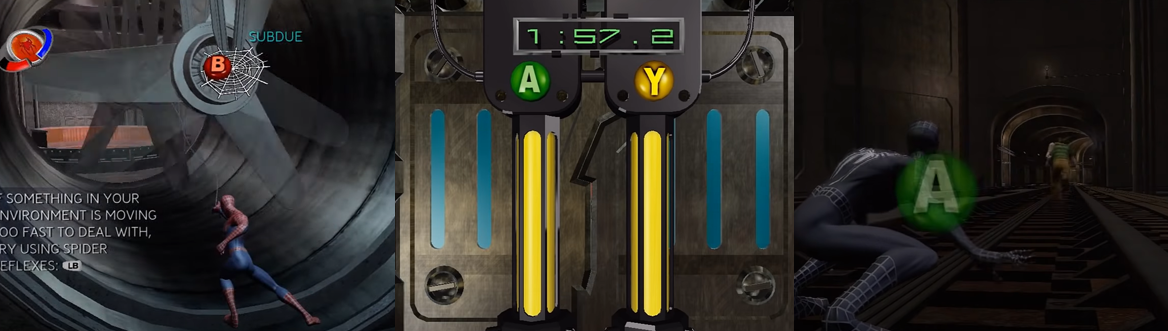
Perhaps the biggest new addition to the gameplay formula here is the inclusion of quick-time events (QTEs). Stopping a car? QTE! Finishing off a boss? QTE! Escaping a collapsing building? QTE! Disarming a bomb? Oh, you better believe that’s a QTE! For the most part, Spider-Man 3’s QTEs aren’t too bad but they definitely pop up at the worst possible times and the margin for error is basically zero. If you fail even once, you have to restart the entire sequence again. Failure also costs you some health so if you’re near death, the chances are that you’ll have to start an entire mission or boss battle over again since the game can be very stingy with checkpoints. Luckily, the button and stick movements required are the same every time so it’s easy to memorise them, but they get very tricky and much faster by the end of the game. You’ll also be using QTEs to stop a runaway subway chain, catch a crashing helicopter, mashing buttons to lift heavy debris off civilians (and even an enemy at one point), wrench open doors, or slingshoting great distances. One of the most prominent QTE sequences is the abundance of bombs you’ll be disarming throughout the course of the “Mad Bomber” missions. These include a little bit of everything, from rotating the right stick to unscrew panels, to re-routing currents, and even a bit of a rhythm mini game…as well as times when you just need to charge a kick to punt the bomb into the river! Other tasks are a little easier in execution but can still be aggravating, such as rescuing hostages (at one point you need to constantly ferry one to safety and even rescue J. Jonah Jameson from a fatal plunge!), activating levers and consoles, chasing helicopters and frantically webbing up their blades in mid-air with B, destroying generators, and defending antidote dispensers in the sewers. Missions can go awry very quickly, especially when there are lots of enemies about, and there’s no way to alter the game’s difficulty so you just need to keep at it until you succeed. There are a couple of fun moments where you take control of different characters, such as fighting off waves of enemies as the Scorpion or battling Flint Marko/The Sandman’s monstrous form as the New Goblin, which are a nice (if equally frustrating in their own way) change of pace.

Graphics and Sound:  
Beyond a pre-rendered opening cinematic, Spider-Man 3 relies wholesale on its in-game graphics and models for its cutscenes. It doesn’t even include any clips from the movie, which is very surprising for a tie-in videogame, and the game’s story barely even touches upon the events from the film since you’ll be spending more time helping Doctor Curtis “Curt” Connors with his Lizard problem than fighting the likes of the Sandman. This is good and bad in different ways; good in the sense that many sequences and plot threads from the film are actually executed far better here (Peter and M. J.’s argument and break-up, for example, and the complete absence of the Stacys), but bad because every film-related element is swept aside and rushed (Harry disappears from the game completely until the end after the New Goblin fight and Eddie Brock’s issues with Peter are even more rushed than in the film). These issues are compounded by Tobey Maguire’s continued lack of enthusiasm for voicing the titular web-slinger; in fact, all the movie’s returning actors do a lacklustre job and, with the exception of J. K. Simmons as Jonah Jameson, they all sound bored and wooden. This contrasts with how janky the game’s physics can be; while Spider-Man has only basic idle animations until he gets his black suit, he flails around the place like ragdoll and can easily be pummelled and bounced around. Although New York City is fully populated with pedestrians, none of them will react to you. The streets are filled with traffic that obediently follows traffic signals but also crashes into each other (and you!) at various points, and I noticed times when the game suffered from slowdown and odd glitches, like enemies not spawning or clipping through buildings.

As fun as web-slinging is, dull interior levels and atrocious in-game models really let the game down.

Once again, New York City is the focal piece of the game; the game map is vast, including all the peripheral islands and recognisable landmarks both real (like the Statue of Liberty) and fictional (like the Daily Bugle building). Opportunities to go inside are severely limited, which is great for keeping the sense of action and momentum, but it does make things a bit empty and repetitive at times. When you are inside, it’s mainly to explore the subway and sewers under the city, where you’ll have to watch out for speeding trains and wade through the dank sewage water as you investigate the Lizard’s nests. The Scorpion’s missions see you infiltrating the high-tech facilities of MechaBioCon, where the game emulates the first game by trapping you in claustrophobic, futuristic laboratories, hallways, and facilities. Missions see you swinging all over the city, stopping bombs at City Hall and battling psycho schoolgirls in the Natural History Museum and a church, or visiting Peter’s apartment and even a cool sequence where Spider-Man (in a cutscene) stops a helicopter with a giant web. Crimes pop up all over the place as you swing around, with some being more important and worthy of your attention than others. Full scale gang wars can break out, helicopters need to be chased, and day turns to night turns to day as you web around righting wrongs. Unfortunately, Spider-Man 3 still doesn’t include any of the iconic musical cues from the movie and nowhere near the amount of visual variety as the last game. Sure, there’s a mission where you have to photograph a UFO, lizard-men ran rampant in the streets and sewers, and you’ll even have to contend with giant mech suits at one point, but the game’s missing a lot of the bizarre comic book flair, even when the likes of Sergei Kravinoff/Kraven the Hunter and Calypso Ezili/Calypso show up to hunt the Lizard and wield strangely out of place magical abilities. Things do pick up for the final showdown, which includes a monstrous version of the Sandman and a raging sandstorm amidst a construction site, but there’s really nothing we haven’t seen in other Spider-Man videogames, or much to make this one stand-out visually speaking.

Enemies and Bosses:
New York City is in the midst of a turf war between three rival gangs: the Arsenic Candies, the Apocalypse gang, and the Dragon Tails. Each has a couple of different types of goons in them, from standard guys who punch, kick, and block to those with ranged weapons like pistols, machines guns, and grenades, to larger or more skilled variants. The Apocalypse gang are a bunch of punks who are often bolstered by larger guys carrying street signs or decked out like rejects from the Mad Max films (Various, 1979 to present). The Arsenic Candies are annoying schoolgirls who attack and block with umbrellas, and the Dragon Tails are martial artists who fly at you with kicks or swords. Even the standard punks can be an issue, but the elite members can be a real pain in the ass. They inexplicably block and dodge all your attacks, forcing you to use your spider reflexes and more elaborate combos to actually land a hit, and often you’ll be greeted by a sneak attack or an explosive to the face! Sometimes the gangs are bolstered by mech suits courtesy of Luke Carlyle/The Mad Bomber, hovering overhead and rapidly firing at or tagging you with delayed explosives, which is super annoying, and you’ll often have to face large groups of them while rescuing hostage, activating consoles, disarming bombs, or rescuing civilians. Thanks to Dr. Connors, New York’s streets (and, more prominently, its subways and sewers) are also over-run by lizard-men. These reptilian bastards like to leap out from the shadows or water, spit acid, and slash at you and will absolutely have you tearing your hair out when you try to defend the antidote capsules from them. You’ll also have to contend with trigger happy crooked cops, the wasp- and spider-like robotic defences of MechaBioCon, inept security guards dressed in riot vests, burning buildings, rocket-toting gang members, and heavily armed mercenaries who like to set bombs and take hostages.

The game takes a sharp, frustrating difficulty spike whenever you battle the QTE-ladened bosses!

As part of your efforts to quell the three gangs, you’ll inevitably come up against their tougher forces, from explosive-bear-toting Arsenic Candies, to well-armed helicopters, and full-on battles in ornate palaces. The brutish leader of the Apocalypse gang is fought down near the docks, you’ll wade through an unending horde of Arsenic Candies when you break up the shotgun wedding of their leader, Priscilla, and you’ll have to fight off the Dragon Tail’s elite fighters to tackle their samurai-like leader, who favours teleporting and forcing you to engage your spider reflexes to land a hit and avoid his sword swipes. All three of these are fought later in the game, in-between extremely frustrating fist fights with Wilson Fisk/The Kingpin. Unlike other fights in the game, the battles against the Kingpin are not ones you can win simply by mashing buttons and pummelling him with combos. Instead, you need to wait for him to strike and the dodge, counterattack, and get out of harm’s way to avoid him making mincemeat of you with a few ridiculously powerful sumo slaps, headbutts, or slams. Once you’ve built up your rage, you can get to button mashing your best combos, but this fight really is a sudden uphill battle compared to those that came before it, which is saying a lot considering how goddamn frustrating Spider-Man 3’s boss encounters are! Depending on how you tackle the game’s missions, you might not see this right away but I sure as hell did when I chose to engage the New Goblin mission. This boss fight sees Peter attacked in the street like in the film, but it’s made up of two phases: the first is a QTE sequence where you must time button and stick presses to avoid the New Goblin’s attacks, and the second sees you battling him at street level as he hovers about. You absolutely must ace the first phase; if you get hurt here or die in the second phase, do not select “Retry” as this drops you in the second phase of the fight with the New Goblin at full health! As Harry’s sword swipes and pumpkin bombs can decimate your health bar very quickly, it’s far easier to get a slight edge by winning the first phase and then spamming your spider reflexes and combos. However, don’t be too trigger happy as this fight (like all the boss fights in Spider-Man 3) ends in a QTE sequence and you can easily mess it up if you mash X too much!

Some of Spidey’s most recognisable C-list villains show up for some aggravating boss battles!

One boss battle that was a bit different is the showdown with the Mad Bomber’s heavily armed helicopter. You must dart behind cover to avoid the chopper’s missile barrage and gatling gun, then use your spider reflexes to send a missile back at it a few times to bring it down, all while the rooftop disintegrates around you and Jonah cowers nearby. Dr. Connors transforms himself into a lizard and, after tracking him and defeating his minions, you’ll battle him on some treadmills that lead into meatgrinder-like blades! You need to use your spider reflexes to counter the Lizard’s dodge and then mash A to flip him into the grinders a few times; after that, you’ll fight him on equal ground, avoiding his slashes and tail swipe and fleeing to safety when he flies into a rage. Later, Kraven and Calypso come to town to hunt the Lizard; fighting Kraven can be tough as his potions grant him bear-like strength, talon-like flight, and panther-like speed, to say nothing of his duplication, invisibility, and charge attacks. Once you defeat him, you tangle with the Lizard again, this time in a monstrous form; in the first phase, he can’t be harmed so you have to mess about webbing up his hands and swinging him by the tail into four generators like he’s fuckin’ Bowser to lower his shield, then you can go to town on him but watch for his chomping bite and wall leap! Another recurring foe is the Scorpion, who attacks with his hooked tail and claws. After chasing him across the city, you’ll also battle him on a bridge and need to subdue him long enough to forcibly use his tail lasers to destroy a shield array but he ends up becoming an unexpected ally when you fight Alexander O’Hirn/The Rhino. The Rhino is so tough and heavily armoured that he’s completely immune to a frontal assault. Instead, you need to avoid his earth-shattering slams and punches and attack from behind (or distract him so that the Scorpion can do this). The Rhino will charge around, destroying the area and swinging girders at you, but these attacks leave him momentarily dizzy and open to a double team attack from Spider-Man and the Scorpion. You can also hop on him and complete QTE sequences to ram him into walls, though this remains as aggravating as the other boss battles.

Spidey gets some help from the New Goblin to battle the monstrous Sandman and ravenous Venom!

Finally, there are the other two villains from the movie, the Sandman and Venom. The Sandman is fought in the subway and acts as a kind of tutorial for your new black suit abilities. You need to avoid being hit by subway trains and dodge his mace and hammer-like arms to build up your rage meter and deliver a hefty beat down. The Sandman can form shields with his body and blast you with sand streams, and you’ll need to complete QTE sequences to both drop him further down the shaft and disintegrate him with a water jet like in the movie. The Sandman then disappears until the final showdown, where he’s approached by an embittered Eddie Brock; in this version of the story, Eddie is slighted when Spider-Man catches him faking pictures of him and threatens the Sandman’s family if he doesn’t help him kill Spider-Man. This final battle is similar to the one in the movie and involves three phases. The first sees Spider-Man fighting Venom in a partially-constructed skyscraper. Venom uses brute strength and cheap tactics to attack you; you’ll need to mash A when he tries to choke you with his webbing and avoid his web/uppercut combo. When he flies into a rage, smash some of the respawning pipes to stun him with noise and deliver a few combos but try to not be tossed from the site as it takes bloody ages to climb back up! The second phase sees Harry (who doesn’t get scarred or amnesia here) suit up as the New Goblin to help his buddy like in the film. The New Goblin can strafe, boost, attack with fast and heavy sword swipes, and toss pumpkin bombs with B and you’ll need to use these to take out the monstrous Sandman. Simply target his arms or his head and complete a QTE sequence, then douse him with water from a hydrant to actually do some damage. I found the best tactic to avoid being hit is to constantly strafe around him, mashing or holding B and using RB and X, Y, and B to unleash a barrage of bombs. You’ll then need to complete another QTE sequence before the fight switches back to Spidey and Venom, who are now surrounded by a raging sandstorm and at very low health. The strategy is the same, but made more difficult by Venom’s increased aggression, the sandstorm, and how annoying it is having to jump up to where the pipes are. Stun and beat on Venom a few times and you’ll initiate one last QTE sequence, the fastest and toughest of the game, that ends with Venom skewered on some spikes and apparently leaves Harry alive.

Power-Ups and Bonuses:
Spider-Man 3 is surprisingly light on in-game power-ups. Your health is restored every time you stop a crime or beat up some thugs (assuming you stick around long enough to collect the health that drops) and you’ll occasionally find health scattered throughout the game or hidden in crates, but I found this to be quite rare. You can extend your health and gain upgrades to your abilities by raising your crime fighter status, but this isn’t quite the same as gaining experience points. It simply goes up the more side quests and story missions you complete and that’s it; you don’t spend points and can’t customise your gameplay progression as you might expect. The only real tangible power-up is the black suit, which makes the game far more enjoyable. You’re faster, stronger, hardier, and have access to a rage meter than can make combat much more enjoyable, but you’ll naturally lose this as the story progresses.

Additional Features:
There are forty-three Achievements to snag in Spider-Man 3, eleven of which are awarded simply for beating the game and defeating the bosses. You’ll grab Achievements for swinging great distances, webbing up enemies, completing the different side missions, and one for riding around on a vehicle for five miles. Scattered across the city are gang tokens, time trials, combat tours, and skyscraper tokens. Finding and completing each of these nets you more Achievements, as does completing all the Daily Bugle assignments and random crimes that pop up across the city. Time trials are a test of your swinging skills and see you racing about through rings, combat tours have you webbing about to battle the various gangs against a time limit, there are bomb disarming challenges as well, and you’ll occasionally find collectible tokens on the city’s largest buildings. Unfortunately, there are no other difficulty modes to challenge, no comic book covers, concept art, or movie clips to unlock, and the only skin you get is the black suit. When you finish the game, you can switch to the black suit, which allows you to basically play a new game all the way through in Spidey’s symbiote attire and can switch back to your cleared save file at any time to mop up anything you’ve missed there. Sadly, that’s about it. There was some downloadable content that includes various banners and icons for the Xbox dashboard and the ability to play as the New Goblin and take on additional challenges, but there’s not much replay value to be had here, especially if you completed all the missions in your first play through.

The Summary:
Spider-Man 3 is an interesting beast. On the one hand, much of the gameplay and appeal of Spider-Man 2 has been recreated with some new bells and whistles to keep things fresh but, on the other hand, a lot of the game is a tedious and frustrating, sometimes even broken, mess of repetitive tasks and unfulfilling combat. While the city looks great, there’s some noticeably pop-up, lag, and glitches in the game world; the character models and voice acting are, by and large, atrocious and don’t seem to be much of a step up from the PlayStation 2 graphics. The villain selection is also very lacklustre; was anyone really crying out to see Kraven and the Scorpion again? And how many times have we seen the same old “Lizard builds a nest in the sewers/turns people into lizards” plot in Spider-Man games? I’m actually surprised the developers didn’t do more with the symbiote aspect of the story, such as having civilians be infected and forcing you to battle endless Venom clones. I basically hated every boss battle in the game, especially the ones against the New Goblin, the Kingpin and the Rhino, which were so frustrating that I was almost tearing my goddamn face off! You can power through, but why aren’t these more exciting and fun to play? Why are they such an uphill battle? Even the regular street punks put up quite a fight and Spider-Man just feels so weak and janky for much of the game that it was hard to find much enjoyment in the content. It doesn’t help that everything’s so repetitive; I lost count of how many speeding cars and bombs I disarmed, not to mention the copious and aggravating use of QTEs with no margin for error that just pop up out of nowhere, so you never get a second to rest! Ironically, I actually enjoyed (if not preferred) the few times game actually bothers with the movie’s story, which drops a lot of the worst parts of the film, but it wasn’t enough to save this. I think what’s happened here is the developers got a little lazy; maybe they were resting on their laurels, maybe they had run out of ideas. Either way, Spider-Man 3 just feels like more of them same but with a tedious focus on distracting you with boring side missions and dull villains rather than delivering a solid overall gameplay experience.

My Rating:

Rating: 2 out of 5.

Could Be Better

Have you ever played Spider-Man 3? What did you think to the open-world gameplay and Spidey’s symbiote abilities? Were you also frustrated by some of its more tedious features and focus on other villains? What did you think to the battles against the New Goblin, the Kingpin, and the Rhino and the inclusion of QTE sequences? Were you disappointed by the presentation, lack of unlockables, and padded gameplay? Which Spider-Man videogame or movie adaptation is your favourite? Head down below or over to my social media to share your thoughts on Spider-Man 3 and be sure to check out my other Spider-Man content.

Game Corner [Spidey Month]: Spider-Man 2 (PlayStation 2)


Easily Marvel Comics’ most recognisable and popular superhero, unsuspecting teenage nerd Peter Parker was first bitten by a radioactive spider and learned the true meaning of power and responsibility in Amazing Fantasy #15, which was first published in August 1962. Since then, the Amazing Spider-Man has featured in numerous cartoons, live-action movies, videogames, action figures, and countless comic book titles and, in celebration of his debut and his very own day of celebration, I’ve been dedicating every Saturday of August to talk about everyone’s favourite web-head!


Released: 28 June 2004
Developer: Treyarch
Also Available For: Game Boy Advance, GameCube, Mac-OS X, N-Gage, Nintendo DS, PC, PlayStation Portable, and Xbox

The Background:
Back in the day, it seemed like every single cinema release was accompanied by a videogame adaptation, whether they warranted it or not. Naturally, considering his popularity, Spider-Man has a long and varied history with videogame adaptations across numerous platforms, and developers Treyarch began development of a tie-in to Spider-Man 2 (Raimi, 2004) soon after the success of the first movie. No strangers to the wall-crawler, Treyarch sought to dramatically improve upon their previous efforts by incorporating a large populated recreation of New York City, expanding on the film’s story, and placing a heavy emphasis on Spider-Man’s web-slinging. The new system, which utilised ray casting to automatically map infinite points where players could attach webs to swing from, was developed by designer Jamie Fristrom and has long been the subject of praise amongst fans of the videogame, and the character. Indeed, Spider-Man 2 has been met with a surprising amount of positivity for a videogame tie-in; while some of the more repetitive aspects were criticised, reviews praised the combat and controls, seamless open world and mission variety, presentation, and even the minigames. Even in the face of its bigger, more graphically impressive successors, Spider-Man 2 is often lauded as one of the character’s greatest videogame outings; the praise for this game is so great that I was actually a little intimidated to try it out for this review, which is my first time actually playing it.

The Plot:
Two years after the events of the first game, Peter Parker is struggling with his personal life and his responsibilities as the superhero Spider-Man. Unable to ignore the threat posed by criminals and supervillains alike, Peter’s social life begins to suffer, but his powers are put to the ultimate test when renowned scientist Doctor Otto Octavius becomes a four-limbed madman and threatens the entire city!

Gameplay:
In a change of pace from its predecessor, and basically every Spider-Man title released up until that point, Spider-Man 2 is an open-world adventure in which you’re given free reign to use all of Spider-Man’s amazing abilities throughout one of the largest and most faithful digital recreations of New York City ever seen at that time. Unlike the previous game, which was basically a reskinned version of Neversoft’s fun but limited 2000 adaptation of the web-slinger, Spider-Man is hardly ever trapped in an enclosed environment and thus a primary focus of Spider-Man 2 is on swinging around the city, stopping random crimes and helping non-playable characters (NPCs) with various issues. Thankfully, Spider-Man is more than equipped to handle everything the game has to throw at him, and the controls and combat options have been revised to accommodate this new focus. Spider-Man can attack enemies or interact with objects and NPCs with the Square button; successive presses in conjunction with directional inputs and the Triangle and Circle button will see him pull off combos, often involving webbing and tossing his enemies, and you’ll awkwardly home in on the nearest enemy when in air combat as well. You can stick to walls by pressing Circle, which is also used to evade incoming attacks and bullets whenever Spider-Man’s spider sense goes off (as indicated by his glowing head); this also fills up your “Spider Reflexes” meter and allows you to execute a counter attack but I found evading (and the combat in general) to be a little clunky and haphazard at times, especially as even New York’s most common thugs can take quite a beating and even block against your attacks. Triangle shoots a web; holding the button will temporarily tie enemies up, pressing up and Triangle fires a ball of impact webbing, and you can even use your webs to disarm foes, though it’s next to useless against most bosses and mechanical enemies. Spider-Man jumps with X; pressing it twice performs a double jump and you can hold the button to charge a big jump and executing a jump at the apex of a web sling is crucial to covering vast distances when swinging about. Holding down L2 sees Spidey spring or get a boost to his swing, Triangle (and in conjunction with Circle) will allow you to pick up injured NPCs or grapple thugs, and you can press down to lock-on to nearby targets.

Combat is much improved but the highlight of the game was the ground-breaking web-slinging.

Once the aforementioned meter has a bit of blue in it, you can press L1 to activate your Spider Reflexes, which effectively functions as a form of bullet time, slowing down the action until the meter depletes or you press L1 again and allowing you to better dodge and attack enemies. The meat and potatoes of the game, though, is in the web-slinging; the game offers two options for this, “Easy Swinging” and “Normal Swinging”, with the latter requiring more input from the player to direct Spider-Man’s swings. Either way, R2 sees you throwing a web and swinging through the city but, unlike in every other Spider-Man game before this, you can only web-sling when there are buildings or suitable purchase holds nearby. This means you’ll see Spider-Man veer to the left or right as he shoots webs at the nearest building and allows for the most realistic and innovative web-slinging ever seen. Spider-Man can also eventually web-zip by pressing L2 and R2 together to quickly cover flat distances and you can easily speed through the skyscrapers by attaching to buildings and gaining extra height with your jumps, though you can’t clamber up your web as you swing as in other games, which can make chasing through the city a bit frustrating at times. Equally annoying are the number of dead ends and the various heights of the city’s buildings, which can interrupt your flow; thankfully, the onscreen mini map is a great help for getting around and spotting crimes in progress, side missions, and directing you towards your next story-based objective. You can review these at any time from the pause menu and expand the map out by pressing ‘Select’; this displays the current time and all landmarks and places of note, but sadly doesn’t include the option to place waypoints so you still have to manually read the map and follow the onscreen indicators to get to objectives. Spider-Man 2 is split into chapters, beginning with a simple and in-depth tutorial where Bruce Campbell’s disembodied and snarky voice teaches you the fundamentals of gameplay. To progress through the story, you need to complete story-based objectives; generally, this amounts to following the compass to a certain place in the city to advance the story or confront a boss, but you’ll also need to earn “Hero Points” and acquire new abilities from the various shops dotted across the city.

There’s always someone in peril, or a crime to stop, or a race to be had.

Hero Points are earned from stopping crimes, rescuing civilians, completing time trial races, and other similar distractions; it’s a bit annoying that the game effectively grinds to a halt while you work to obtain the required Hero Points, but you get a fair amount for each side quest you complete and it’s not as if you’re short on things to do. It seems someone’s being mugged or needs help every thirty seconds, and you’ll often stop a burglary only for a child to lose their balloon across the street or an armoured car be attacked a block over. Sometimes, you’ll help an NPC only to be jumped by a gang of thugs in a sneak attack; other times, criminals will hijack vehicles to make a quick getaway and you’ll need to chase them down and land on top of the car, which can be tricky unless you lock-on to it. Once on the roof, you need to pound away with Square and dodge their bullets with Circle until they’re forced out for a fistfight and, as the story progresses, you’ll find burglars and shoot outs often culminating in one of these chase sequences. You’ll also run into Felicia Hardy/Black Cat numerous times throughout the story; each time you do you need to chase after her as she leaps and grapnels around the city, which can be aggravating as she makes erratic turns and it’s difficult to stay on the rooftops. Similarly, you’ll need to chase after Dr. Octopus when he makes an escape in a helicopter and can take on timed challenges where you must race through rings, and the game’s pretty unforgiving, slapping you with failure if you even remotely fall behind or stay too far. More often than not, you’ll face a timer as you race to story-based locations, with the final race to Dr. Ock’s lair being the tightest of them all, or be asked to deliver pizzas and swing over to specific points on the map or skyscrapers to automatically take pictures, or will have to quickly crawl up buildings to rescue civilians in danger or falling, or quickly take injured civilians to the hospital. There’s quite a lot to do in this regard, and it’s fun to pop over to the Daily Bugle and change to Peter Parker in the men’s toilets, but the variety of these side missions soon wears thin as you repeat the same cycle of requests over and over but with more enemies or a tighter time limit.

Graphics and Sound:  
It’s obvious that a lot more time and effort went into Spider-Man 2 compared to its predecessor; most videogame tie-ins suffer from a rushed development schedule, and this is often reflected in their length, variety, and presentation but Spider-Man 2 does pretty well in all three regards. Spider-Man’s character model is much improved compared to the last game, with far more animations when he’s web-slinging and battering crooks on the streets; Spidey even runs along buildings when he swings close, can perform a variety of mid-air tricks with well-timed jumps, and NPCs will even automatically dodge out his way and throw insults at him when he runs or swings through the streets. Sadly, the enemy models and NPCs don’t fare nearly as well; you’ll see the same polygonal faces and voices repeated over and over, but it’s hard to begrudge this as this was symptomatic of the games of this era. What I can’t defend, however, is the soundtrack and voice acting; once again, the game opts for a soundalike to Danny Elfman’s iconic Spider-Man score that just doesn’t work as well and suffers from awkward looping or disappears entirely for no reason. Only a handful of the movie’s actors returned to voice their polygonal counterparts as well; while Alfred Molina continues to shine as Dr. Octopus, both Tobey Maguire and Kirsten Dunst sound bored to death recording their lines, though I did enjoy that Spider-Man throws quips and monologues to himself as you play. When the character models are used for in-game cutscenes, the game also falls apart under close scrutiny, though the higher quality cinematics fare much better, despite the rubbery appearance of the models, and I liked how the film’s events were recreated but also altered and expanded upon here, even if sub-plots like Peter losing his powers were dropped.

It’s lucky for the ropey cutscenes and voices that the digital recreation of New York is so good.

Naturally, the game’s biggest selling point is the sprawling and bustling recreation of New York; all the landmarks you associate with the city are present and accounted for, alongside recreations of locations from the films such as Peter’s apartment, the Daily Bugle building, Dr. Octopus’s pier lair, and the pizza parlour (though relocated and redesigned here). Not only can you web-sling across the city without any noticeable slowdown or load times, the game also includes a day and night cycle and the story is geared towards pushing you to visiting new areas, such as Roosevelt Island, the Statue of Liberty (accessible only by hitching a ride on a helicopter or using Mysterio’s UFO-like drones), Central Park, and Oscorp. 90% of the game takes place outside amidst the city skyscrapers; traffic and pedestrians mingle around down below, crime is rampant, and the enemies you encounter even change as the story progresses. While you can only enter a handful of buildings, those that you can offer some rewards, such as interacting with the Daily Bugle staff for tasks or purchasing upgrades. The handful of other times you’re forced into a warehouse or an open-air stadium, it’s for a close-quarters boss battle or to take on one of Mysterio’s challenges, meaning the only interior of any real note is Mysterio’s madcap “funhouse” that sees you venturing into a hall of mirrors and through upside-down environments. The thrill of swinging through New York is definitely palpable but I’d be lying if it doesn’t lose its appeal pretty soon; with no options for fast travel and only one real collectible on offer, there’s not really much to see beyond the digital recreation of the city or to do beyond stopping the same crimes over and over.

Enemies and Bosses:
As you swing about the city in your colourful underoos, a gaggle of the dregs of society will inevitably crawl out of the woodwork to cause trouble in the streets. New York is rife with purse snatchers, bank robbers, and armed gangs who love to rob armoured cars and get into shoot-outs with the cops or hijack passing cars and you’ll get to beat the ever-loving piss out of them all multiple times. Most enemies you encounter will simply try to bash your head in, but others have crowbars and bats or can guard against your attacks, requiring you to execute a counter after dodging their attacks. The worst are those armed with guns as Spider-Man doesn’t do too well when riddled with bullets, so it’s best to either disarm them, web them up, or try to take them out early, which can be easier said than done when you’re literally surrounded by enemies on all sides. Eventually, New York will also be attacked by Mysterio’s robotic drones, which fly about the place and blast at you with lasers; these can be tricky to hit as mid-air combat is actually less refined than in the previous game in many ways, though that weird homing function comes in handy here. Herman Schutlz/The Shocker’s goons also end up terrorising the citizens as well, firing high velocity blasts to send you flying, and all of the game’s enemies except the robots can take quite a beating before they go down. You’ll also have to contend with three mech-wearing goons in one particular mission that sees Spidey and Black Cat gate-crash an auction. This mission is one of the game’s toughest, on paper, due to the sheer number of bullets, enemies, and explosions happening all around you but an easy way to get past it is to simply swing about back and forth overhead; eventually, the mechs will take each other and most of the other enemies out, leaving you to pick up the scraps.

After tangling with the Rhino, Black Cat lends a hand in two annoying battles with the Shocker.

Disappointingly, though, Spider-Man 2 only contains four actual bosses, but you’ll face some of them more than once, at least. The first one you battle is Aleksei Sytsevich/The Rhino as he’s in the middle of a bit of thievery; the Rhino is too powerful to take on head-first so you need to rapidly tap Circle to avoid his swings or dodge his charge, both of which will leave him dizzy and vulnerable to a good pummelling. Instead of fighting Black Cat, you’ll chase her across the city (so many times that it got legitimately annoying for me) to encounters with the Shocker, who you’ll battle twice alongside Black Cat. The first fight takes place inside a warehouse and sees the Shocker blasting himself about the place, constantly staying on the move and making himself a difficult and annoying target. When you do get close to him, you only have time to rattle off a quick combo before you need to get the hell away from him to avoid his huge concussive blast, which sends you flying. The Shocker’s blasts are also used to keep you at bay, he shrugs off your webbing, and is joined by some goons in this fight, which quickly becomes laborious because of the hit and run tactics. Sadly, you’re forced to repeat these in the second encounter, which takes place in an even smaller, enclosed arena where the Shocker is protected by a shield. You need to head up top, dodging his blasts when your spider sense goes off, and activate whatever console is opposite from the one Black Cat is at to lower his shield. These weird blasts of water (or energy, I couldn’t tell) form platforms in the middle of the arena, giving the Shocker the high ground, but the same strategy as before is needed to whittle his health down. Eventually, Black Cat will shut his shield down for good, meaning you’re on the home stretch, but she doesn’t really seem to actively do damage to him when she’s attacking him.

Mysterio’s “tests” prove to be frustrating test of your patience.

Easily the game’s more persistent enemy is Mysterio; when you first face him as plain old Quentin Beck, he challenges you to a series of “games” in an effort to prove Spidey’s a fraud, which involves you grabbing and tossing goons into green highlighted pits faster than him in a game of human basketball and then clambering about on elevated, moving, and twisting platforms trying not to get hit by his laser cannon. The second time, he swarms New York with his UFO-like drones and takes hostages at a theatre; this was an annoying section as you have to fend off his drones, watch out for a flaming floor, and battle a brief time limit to rescue everyone there but it’s nothing compared to when he encases the Statue of Liberty in an elaborate mechanical construction to resemble an alien attack. I was tearing my hair out at the finnicky controls as I webbed my way over the Lady Liberty and fell countless times into the water to be washed ashore and have to start all over, and near enough lost my rag when tasked with destroying the eight orbs surrounding Mysterio’s machine to expose the “brain”. Eventually, I was somehow able to gain enough height to get up there and take them all out and then get up to where the brain is before the orbs could respawn and dispel the illusion, but it was a pain in my ass, for sure. Afterwards, you track Mysterio to his apartment and hidden funhouse lair, where you have to fend off a swarm of twisted Spider-Man clones to find a hidden exit in his hall of mirrors and shut down his hologram. Finally, Mysterio shows up in the flesh later in the game to rob a deli; this was actually really amusing as the game loads in this ridiculously long and layered health bar and makes it seem like it’s going to be this long and epic showdown but all you have to do is punch him once and Mysterio folds like a paper plane.

Thanks to his thrashing limbs and raging machine, Doc Ock proves an aggravating and formidable foe.

Finally, there’s the main man himself, Dr. Octopus, who you encounter four times throughout the game. The first encounter is during the mishap with his fusion experiment and is one of the most frustrating parts of this or any other game; the reactor is going crazy, sending out intermittent energy bolts that you must dodge the second your spider sense goes off as these pulsating waves of energy that not only do massive damage (three hits is usually enough to kill you) but send you flying across the screen! Through a combination of luck, timing, and the patience of a saint, you need to dodge past all this shit and hit four consoles to power the machine down, but this almost had me rage-quitting right then and there. Next, you’ll fight Dr. Octopus and his grenade launching goons at the bank, which establishes the strategy you’ll need to best him in all encounters; you need to dodge his tentacles and then quickly fire a web to pin each one down and leave him vulnerable to attack, but this is very hard to do and he’s easily able to grab you, slam you about, toss you around, and beat you to death in just a few hits. After chasing his helicopter and rescuing Aunt May from the train tracks, you’ll battle Doc Ock on the roof of a train just like in the film…eventually, because first you need to battle the game’s controls and camera to actually get on the damn train! Here, it’s more of the same and actually a little easier than the last encounter except for the fact that Doc Ock can toss you off the train if he grabs you. Finally, it’s the worst of both worlds at his pier lair as Doc Ock relentlessly chases you, protected by a shield generated from his rampaging machine and able to spam-beat you to death in the blink of an eye if you don’t constantly keep moving, dodging, and webbing him up. You need to deactivate nine consoles scattered about the lair, with one high above and one down below near the instant-death water, all while avoiding the electrical bolts, the thankfully less damaging but no less annoying energy waves, and Doc Ock himself. Once you finally take care of that, you’ll go one-on-one with him again where you’ll need to be super fast on the dodge and webs to stop his relentless thrashing tentacles and avoid being tossed into the aforementioned water, but once you land a good few combos he finally goes down for good.

Power-Ups and Bonuses:
In the spirit of the movie upon which it is based, Spider-Man has an infinite supply of webbing in Spider-Man 2 so you never need to worry about collecting extra web cartridges, though the game does lack some of the fancier web-based moves potentially as a result of this. Every time you defeat a wave of enemies in side missions, they’ll drop some health to fully restore your health bar, but these won’t be present in boss encounters, which can make them all the more frustrating. Additionally, while there are “secrets” to be found around the city, they simply grant a few more Hero Points so there’s no pick-ups to boost Spidey’s abilities. Instead, you’ll gain new buffs, tricks, combos, and such by spending Hero Points in the many shops scattered around the city; these increase the speed of your swing, add fancy moves to your jumps, and add a little more flourish to your combos but I found little use for most of them and got along pretty well just mashing Square and peppering in the odd Circle and Triangle here and there.

Additional Features:
As mentioned, there are many secrets dotted around the city; these are pretty hard to find, and I only stumbled upon three or four by chance but they do allow access to a couple of new moves. There are also some races and timed challenges you can take on for more points, and which probably count towards you achieving the list of “Awards” offered by the game (though most of these are story-based). Although there are some options available to you to change the game’s display, sound, and control scheme, there are no difficulty settings here, no costumes to unlock (though you do get to play as Peter and unmasked Spidey in the story), and no additional characters or modes to unlock or play as even using cheats. The best on offer here is a code to award you a bunch of Hero Points and upgrades, making this a significant step down not just from the last game but Neversoft’s previous efforts with their many additional costumes and modes. However, after you clear the game, you’re dropped back into a free roaming mode and are free to stop crimes until the end of time across the city; you can also purchase access to the Battle Arena where you can not only battle the game’s bosses in endurance fights but also face off with a secret additional boss, Calypso Ezili/Calypso, though I’ll leave it up to you to decide if this is actually worth your time.

The Summary:
All I’ve heard since 2004 is how great Spider-Man 2 is; it either tops or is included in so many “best of” lists for videogame tie-ins and superhero videogames that I knew I had to get it once I started building my PlayStation 2 library, even though I am primarily against videogame tie-ins unless I’m trying to increase my Gamer Score. The difference between this and the last game, and other Spider-Man games before it, is immediate and reinforced throughout; the sheer size of New York City and the number of crimes to stop is very impressive for the time and never before has a videogame so perfectly captured the rush of being Marvel’s famous web-slinger. The drama and crime even interrupts the story on numerous occasions, really throwing you into Spidey’s troubled shoes, and the web-swinging mechanics definitely live up to all the hype. The versatility and accessibility of swinging through the city was unparalleled at the time and perfectly recreates the speed and exhilaration of the web-slinging seen in Sam Raimi’s films. Sadly, the combat doesn’t really live up to this, being clunky and oddly unbalanced at times even when you manage to land a dodge and a counter. Naturally, character models and cutscenes haven’t aged too well, but I can forgive that; what I can’t forgive is how empty, repetitive, and frustrating parts of the game can feel. It’s great having all of New York to explore, but there’s not a lot to see and you’ll be stopping the same crimes over and over, which can get very old very quickly. I would’ve liked to see comic book covers and other collectibles scattered about to unlock costumes and concept art, but there’s none of that here, meaning there’s little incentive to explore. The few bosses there are can also be annoying; I got so sick of chasing after Black Cat, being tossed about like a ragdoll by the Shocker and Dr. Octopus’s bloody machine, and being mullered by bullets, to say nothing of that God-awful encounter with Mysterio at the Statue of Liberty. The game was also a lot shorter than I was expecting, with the gameplay padded out by the story forcing you to acquire Hero Points to load in the next chase, battle, or cutscene, and I found myself just feeling relieved when the game was over. Overall, I can certainly see why the game was so beloved at the time and is so highly regarded; it still holds up pretty well, despite some obvious flaws, and was the most immersive Spider-Man game at the time, but it’s obviously been overshadowed by better, more polished Spidey title sin the years since.

My Rating:

Rating: 3 out of 5.

Pretty Good

Have you ever played this beloved tie-in game? What did you think to the open-world gameplay and web-slinging mechanics back in the day? Do you think Spider-Man 2 still holds up today or were you also frustrated by some of its more tedious features? What did you think to the battles against Mysterio, the chases against Black Cat, and the encounters with the Shocker? Were you disappointed by the lack of unlockables and additional gameplay options? Which Spider-Man videogame or movie adaptation is your favourite? Head down below to share your thoughts and memories of Spider-Man 2.

Game Corner [Spidey Month]: Spider-Man: Shattered Dimensions (Xbox 360)


Easily Marvel Comic’s most recognisable and popular superhero, unsuspecting teenage nerd Peter Parker was first bitten by a radioactive spider and learned the true meaning of power and responsibility in Amazing Fantasy #15, which was first published in August 1962. Since then, the Amazing Spider-Man has featured in numerous cartoons, live-action movies, videogames, action figures, and countless comic book titles and, in celebration of his debut and his very own day of celebration, I’ll be dedicating every Friday of August to talk about everyone’s favourite web-head!


Released: 7 September 2010
Developer: Beenox
Also Available For: Nintendo DS, Nintendo Wii, PC, and PlayStation 3

The Background:
Eager to capitalise on his success with the Fantastic Four, Marvel Comics editor and head writer Stan Lee conceived of Peter Parker/Spider-Man alongside Steve Ditko and the troubled teenage superhero first appeared in the pages of Amazing Fantasy #15. A near-instant hit, Spider-Man quickly made the leap to cartoons, films, action figures, and a number of videogames as well as seeing numerous other incarnations in the pages of Marvel Comics. In 2010, developers Beenox brought together four distinct versions of Spider-Man, each with their own aesthetic design and playstyle, for Activision’s next Spider-Man game. The developers sought to have the bosses of the game be just as distinct, as well as including some first-person sequences to break up the action and employing the talents of many notable Spider-Man voice actors to pay homage to the character’s long history. Although the game received mostly positive reviews, in addition to some downloadable content (DLC), it was eventually de-listed after Activision lost the Spider-Man license.

The Plot:
During a fight between Spider-Man and Quentin Beck/Mysterio, the mythical Tablet of Order and Chaos is shattered into fragments, causing chaos throughout the multiverse and falling into the hands of some of Spidey’s most notorious foes. To retrieve the pieces of the Tablet, Cassandra Webb/Madame Web unites four versions of Spider-Man from across the multiverse: the classic “Amazing” Spider-Man, the grim and stoic Spider-Man Noir, Miguel O’Hara of the futuristic 2099, and the black-suited teenaged “Ultimate” Spider-Man.

Gameplay:
Spider-Man: Shattered Dimensions is a linear, mission-based third-person action title that has players battle a number of Spider-Man’s most iconic foes as four distinctively different versions of Spider-Man, each with their own unique appearance, levels, and personality. While some Spider-Men have slightly different abilities, combat styles, and gameplay, there are many fundamental gameplay mechanics which the four Spider-Men share: they all jump with A (and tapping A again in mid-air will perform a double jump), can land a fast strike with X and a strong attack with Y (and holding down either button performs a charge attack and an air launcher, respectively), and web or grab objects and enemies with B and you can mix and match these attack commands to string together a few basic combos. Naturally, you can web-sling by holding the Right Trigger; release the trigger and hold it again to perform successive web-slings or tap RT to perform a super handy web-zip to quickly dash to perches and platforms. Tapping the Right Bumper sees you fire off a quick web shot (which I found to be largely useless), you can press up on the directional pad to enable the spider-sense (which acts almost exactly like the “Detective Mode” from the Batman: Arkham videogames (Rocksteady Studios/Various, 2009 to 2015) and allows you to see through walls and obstacles to highlight enemies and collectibles), and you can also hold the Left Trigger to enter an “Evasive Stance” that lets you dodge and roll away from enemy attacks.

While the Amazing Spider-Man takes the direct approach, his Noir counterpart sticks to the shadows.

Each Spider-Man has a few different options available to them that make their gameplay a little different; the Amazing variant is a pretty standard Spider-Man with no additional abilities whose gameplay consists of a mixture of combat, web-slinging, and wall-crawling with some very light puzzle-solving thrown in for good measure. His Noir counterpart may not have any additional abilities but he plays considerably different from his mulitversal allies; for one thing, Spider-Man Noir’s world is rendered entirely in the moody black-and-white of the 1930s and, for another, he’s far more reliant on stealth. Again, like the Batman: Arkham games, Spider-Man Noir has to stick to the shadows and avoid spotlights and being spotted by gangsters, who will fill him full of lead if they spot him and briefly hunt him down unless you flee to the shadows. This means you have to stay up high, out of the way, and in the darkness, sneaking up on enemies or taking them down from a variety of positions with the B button. Spider-Man Noir does also get to engage enemies in direct combat but only in specifically designed sections; most of your time will be spent webbing up gangsters from the shadows, which is pretty fun but nowhere near as challenging or varied as in the Batman: Arkham games as Spider-Man Noir doesn’t have any gadgets or options to distract or toy with his prey.

Ultimate Spider-Man and Spider-Man 2099 have special abilities that are unique to them.

Both Spider-Man 2099 and Ultimate Spider-Man make use of the Left Bumper; since he’s wearing the bestial black suit, Ultimate Spider-Man can build up a “Rage” meter by attacking enemies and, when it’s full, pressing LB sees him fly into a rage and attack enemies faster and with more powerful tendril attacks. In this regard, Ultimate Spider-Man seems to be more geared towards combat but, in practise, I found his gameplay mostly the same to his Amazing counterpart but with the added bonus of a useful attack buff. Spider-Man 2099 can utilise LB to activate his “Accelerated Vision”, which briefly slows down time and allows him to better dodge and react to incoming attacks and obstacles, and this meter will automatically refills over time. Spider-Man 2099 also has to endure a number of freefall sections that see you holding A to dive faster towards a target and use B to grab them and X to punch them all while avoiding debris and other obstacles.

Annoying first-person segments and rescue missions mix up the gameplay.

Other than that, the four Spider-Men share the remaining gameplay mechanics: this means you’ll be mashing B on certain walls and objects to rip them down or toss them at enemies and bosses, rescuing and protecting civilians and scientists by fending off enemies, swinging over to them, picking them up with B, and carrying them to a safety point; and taking part in some awkward first-person punching sequences. These appear during the majority of the game’s boss battles and see you using the two analogue sticks to punch or dodge, which is an interesting mechanic to add in but ultimately seems like something that could have been restricted to just the Amazing Spider-Man to help him stand out from the others. Other challenges include web-slinging away from danger (sometimes towards the camera, which can be very disorientating), web-zipping to enemies perched above, destroying certain objects, or activating or deactivating generators. Each level generally repeats these sections at least three times; if you have to rescue three civilians in the early part of a level, you can bet that you’ll be rescuing five a little later on, for example.

The game’s not especially difficult but can be long and tedious at times.

When not in combat or an action situation, each Spider-Man’s health will slowly regenerate, though you can also replenish it with Gold Spider Emblems scattered throughout each level. Occasionally, you’ll find water, acid, or electrified pits that will cause an instant respawn; other times, if you fall or fail a web-sling, you can recover with RT to save yourself. Spider-Man: Shattered Dimensions has three difficulty settings (Easy, Normal, and Hard), though the game isn’t massively difficult on Normal. Hard mode obviously results in more durable and aggressive enemies, and mixes up their placement and how many hits will defeat a boss, but there are many checkpoints and respawn points sprinkled through the game’s levels, which can get quite long and tedious as you progress. Additionally, like many Spider-Man videogames, mechanics such as wall-crawling and web-slinging can get a bit janky in Spider-Man: Shattered Dimensions thanks to the controls bugging out when on walls and ceilings and the camera proving unreliable and jerky at times.

Graphics and Sound:
Spider-Man: Shattered Dimension’s levels are entirely linear; there’s no free roaming or overworld to be found here, which is fine as that can be a little daunting, and instead you’ll explore a variety of levels that can be both large and intimidating and narrow and claustrophobic. When in wider, more open areas, your options for exploration are largely limited by walls (both visible and invisible) and gameplay objectives that constantly push you forwards. Still, there are at least a wide variety of locations on offer; you’ll scale Osborn Tower in the city, a disused desert mine, a ruin-filled jungle, and a hydroelectric dam amongst others. Primarily, the game leans towards a vibrant, quasi-cel-shaded style, especially for the Amazing and Ultimate Spider-Men, though not to the extent where it looks like ugly 2D characters monstrously rendered in 3D as in other games.

The game is full of visual variety in its levels, graphics, and characters.

Where the game really shines, though, are in the Noir and 2099 levels; the Noir levels are rendered entirely in monochrome, with sporadic use of colour only appearing when using the spider-sense. The heavy shadows and stark contrast of white on black immediately makes these sections stand out not just from the rest of the game but also its closest competitors, the Batman: Arkham titles, and reminds more of MadWorld (PlatinumGames, 2009) and Frank Miller’s Sin City comics and films (ibid, 1991 to 2002; ibid and Rodriguez, 2005; 2014). Similarly, the 2099 levels are an explosion of futuristic neon and technology; indeed, I found the 2009 levels to be a bit of a sensory overload and a bit difficult to digest, making it tricky to know where I was supposed to go since every level was so bustling with lights, metal, and colours. Still, it’s a great way to make each Spider-Man’s locations even more visually distinct from each other, though there was maybe a missed opportunity to mix things up a bit later in the game to have, say, Spider-Man Noir in the 2099 world.

The graphics hold up really well but it’s the voice work that really makes the game shine.

While the game’s music isn’t much more than the standard superhero fare of rousing horns and tunes, the voice acting is absolutely top notch! Each Spider-Man is voiced by a notable and popular Spidey voice actor from his many cartoons, which saw not only Dan Gilvezan’s return to the character after a twenty-five year absence but also the return of Christopher Daniel Bares, who voiced the Spider-Man I grew up with in the nineties cartoon. Neil Patrick Harris is easily the best of the four, though; he always makes for a fun and fitting Spider-Man and his delivery really sells the character’s many quips and witticisms. Stan Lee narrates the start and end of each chapter and Nolan North even reprises his role as Wade W. Wilson/Deadpool, who steals the show in his oil rig-turned-reality show by constantly berating and taunting Ultimate Spider-Man and breaking the fourth wall at every opportunity. The in-game graphics are brilliant; levels and enemies are as visually distinct as the four Spider-Man and the game runs very fast and smooth (when the camera isn’t freaking out on you). The cutscenes are equally impressive, if a bit inconsistent as they’re comprised of the in-game graphics, higher quality cinematics, and partially animated sequences, but they tell the story well enough and are always fun to watch.

Enemies and Bosses:
There are a number of goons to pit your spider-powers against in Spider-Man: Shattered Dimensions but, for the most part, once you’ve faced the first wave of enemies in the first level, you’ll encounter the same troupes again and again but in new skins. You’ll find regular enemies who come at you with their fists and melee weapons (baseball bats and swords and such), gun-toting enemies who either chip away at your health or blast you full of holes when playing as Spider-Man Noir, shield-carrying enemies who you must zip towards and hop over with A to attack from behind, and larger enemies who will put up a block that you need to break with your air launcher attack. Other enemies include smaller versions or duplicates of the level’s main foe that can generally be taken out in one or two hits but swarm all over you, larger enemies that toss out grenades or seeking rockets, and all manner of zombies and genetically-engineered monstrosities. One aspect I really enjoyed was that enemies can actually attack and harm each other, which is incredibly helpful when swarmed by foes, and you can also throw objects such as barrels and flaming debris at enemies to help whittle them (or, at least, their health) down.

The Amazing Spider-Man battles Kraven, the Sandman, and the Juggernaut for the Tablet pieces.

Each level is structured around locating, pursuing, and/or confronting one of Spider-Man’s villains and retrieving a piece of the Tablet from them; thus, each level concludes in a boss battle but you’ll actually battle each boss a number of times throughout each level. The first boss the Amazing Spider-Man comes up against is Sergei Kravinoff/Kraven the Hunter, who leads you on a merry jaunt through the jungle, shoots at you through his sniper rifle, and initially battles you inside of a caged arena. Here, you’ll need to dodge and evade his jumping strikes and counterattack in response, web-zip to the convenient columns to avoid the floor spikes, and finish him off with some first-person punching. In the second battle, he’s much stronger and faster thanks to the Tablet fragment but the strategy remains the same; take advantage of the spawning columns to avoid his attacks and strike as and when you can but don’t linger in one area for too long or he’ll knock your ass down. Later, you’ll have to pursue Flint Marko/The Sandman through an abandoned mine, using your web pull to drench his raging sand tornado and battle his gigantic form within the mine itself. Here, you must trick him into slamming his fists into water carts to muddy them up and make them vulnerable, then toss barrels at his face to defeat him. Afterwards, he draws you within his chaotic sandstorm and his personality begins to unravel; you must web-zip around the floating debris avoiding his giant fists and tossing water barrels at his face so you can deal some real damage and put him down once and for all. Finally, you’ll battle and purse Cain Marko/The Juggernaut in a construction site, through the city, and in the wreckage of Osborn Tower; initially, you simply have to avoid his charge attack to cause him to ram into specific towers and beat on him when he’s lodged in the ground, but his later empowered form sees him add a whole bunch of annoying ground pounds and smashes to his repertoire. Still, as long as you dodge away and stay away from his powerful grapple moves, it’s not too difficult to avoid his attacks and projectiles and put a big beating on him when prompted.  

Spider-Man Noir’s bosses can be a bit tricky, confusing, and mundane, respectively.

In the train yard, Spider-Man Noir follows Joseph Lorenzini/Hammerhead and it’s in the first fight against him that you might hit a considerable difficulty wall; Hammerhead uses a huge Gatling gun to keep you at bay whenever his lights (or the spotlights in the arena) spot even the slightest part of you. After taking cover behind walls, you must wait for Hammerhead to rotate away and run around behind him, staying wide and in the shadows, and press B when prompted to put a beating on him but the game doesn’t make this very clear and Hammerhead spots you way too easily. In the second fight, you have to avoid his machine gun fire and toss barrels at him to force him to blow up a piece of machinery with his rocket launcher, then zip up to the higher platform as he fires wildly into the fog to do big damage with a takedown, and then avoid his head-on charge to finish him off. Later, Spider-Man Noir pursues Adrian Toomes/The Vulture through the grimy streets and confronts him in a large warehouse; the Vulture is another annoying and confusing boss as he darts around slicing at you and tossing knives and you’re encouraged to use the spotlights to blind him and deal big damage but it’s unnecessarily random and difficult to get him into position to actually utilise this mechanic. When powered by the Tablet fragment, the Vulture’s claws and bite need to be avoided in first-person and then you go through the previous battle again but this time he also tosses Molotov cocktails at you (which you can cause him to drop to damage him instead). Finally, Spider-Man Noir tracks Norman Osborn/The Goblin to a warped fairground and has a number of first-person encounters with him before finally facing him inside the circus tent. The Goblin isn’t really all that, though; simply web towards him and jump over him to attack the glowing weak spot on his back, then zip up to higher ground when the lights go out to hit a takedown, before fending off his goons (or causing the Goblin to attack them himself) and avoiding the swipes from his column and pummel him when he’s stuck in the ground.

Ultimate Spider-Man’s bosses were probably the most fun and varied for me.

Ultimate Spider-Man’s first foe is Max Dillon/Electro, who he battles and pursues through a hydroelectric power plant to a huge dam; the first fight is quite annoying as Electro blasts at you with a huge laser and protects himself with an electrical field but the second bout is initially quite confusing as Electro teleports across generators and shields himself from your attacks. Soon, he drops to the floor and sends electrical blasts your way, but these leave him exhausted and vulnerable to your attacks. After fending off his electrical minions and draining his health, he’ll use the Tablet fragment to grow to gigantic properties and become invulnerable, similar to the Sandman fight. To defeat this giant Electro, you need to use your webbing on his hands to cause him to damage the dam behind him while avoiding his laser beams. When the fight switches to the other side of the dam, you’ll need to survive against the enemies he spawns and avoid his fists on an increasingly-small platform until prompted to web his head so the breached dam can finish him. While on the oil rig, Spider-Man is forced to take part in Deadpool’s warped reality show; this inevitably leads to a showdown between them that sees Deadpool teleporting around, slicing at you with his swords, and shooting at you all while his devoted fanboys rush in to join the fight. When he’s standing with a B prompt above his head, don’t web-zip over to him or else he’ll just teleport away; instead, rush over and approach from the ground to best him. After outrunning a tidal wave, you’ll battle him inside a caged arena, where he uses the Tablet to duplicate himself and rains explosive punching bags between rounds. However, simply evade these, and his attacks, and target each of his duplicates in turn and he’ll soon go down, but the final battle against Carnage is particularly striking since the creature has ransacked the Triskelion and corrupted its inhabitants into bloodthirsty monsters! In the first fight against Carnage, it leaps about the remains and wreckage of Quinjets and Helicarriers swiping and skewering you with spikes, but is perfectly susceptible to your attacks and can be dealt big damage by web-zipping it into the conveniently-placed furnaces nearby. In the second phase, Carnage encases itself in a bulbous, tentacled shield that some mechs will destroy with flamethrowers; this leads to a first-person sequence and Carnage blasting spikes, maniacally hopping around the place, and it draining your health to replenish its own if it gets hold of you!

Spider-Man 2099’s bosses tend to be very samey, tedious, and chaotic.

Spider-Man 2099 first butts heads with the Hobgoblin during a freefall sequence that sees you pummelling him and smashing him through obstacles. When you hit the ground, Hobgoblin hovers out of reach and tosses pumpkin bombs at you that you must grab with your webs and throw back at him to down him for a beating. After being empowered by the Tablet, the Hobgoblin conjures gargoyles to distract you and adds a bombardment of bombs to his arsenal, but the strategy remains the same; he’s just faster and more aggressive and you have to finish him off with a mid-air, first-person pummelling. O’Hara’s second boss is Kron Stone/The Scorpion, who leaves explosive, acidic eggs and spawns smaller versions of himself; the Scorpion initially charges at you and tries to smash you with his tail, but if you evade these attacks he’s left vulnerable to a beating and you can easily toss his eggs at him when he takes the high ground to spit acid at you and use B to beat him down. When powered by the Tablet, things are mostly the same but there’s also a large pit in middle of the room that Scorpion pounces at you in and fills with acid; however, throwing eggs at him will cause him to take a dip and be left wide open for a beating. Finally, O’Hara has to fight through Doctor Serena Patel/Doctor Octopus’ elaborate facility, avoiding her mechanical arms in freefall and trashing her gigantic Mecharms before confronting her at the heart of the complex. Here, you need to web pull three generators to lower her shield while avoiding her lasers, then jump over her energy shockwaves to do damage on her. When she powers up, she scuttles around fully shielded and firing lasers across the ground, but you can easily trick her into offing her own minions and defeat her by tossing their explosive cores at her.

All four Spider-Man take it in turns to whittle down and defeat Mysterio in the finale.

Once all of the bosses are beaten, the levels cleared, and the Tablets recovered, all four Spider-Man are thrown into a dimension of pure chaos as Mysterio uses the completed Tablet to become a gigantic, all-powerful God. First, you have to web-zip across floating, fragment platforms as Spider-Man Noir; there are no enemies to fight but you must make sure to avoid the light or else Mysterio will fire projectiles your way, and then simply press B when prompted to web pull his head into a rock. Ultimate Spider-Man then has to fend off a whole bunch of illusionary goons and then destroy the floating orbs after they’ve conjured an illusionary version of a boss, which hurts Mysterio, before quickly web-zipping across the wreckage when Mysterio destroys your platform and then hitting another web pull. Spider-Man 2099 has the easiest time in this fight as you simply have to freefall past Mysterio’s projectiles and magic obstacles to grab and pummel him, but the Amazing Spider-Man has to endure a gruelling gauntlet against a whole bunch of monsters while avoiding Mysterio’s projectiles. Once the enemies are cleared away, you can use the web pull to send a rock flying at Mysterio and must then web-zip to another, smaller platform and repeat the process until he’s downed for one last smash of his helmet to defeat his aspirations for good.

Power-Ups and Bonuses:
As you explore the various levels in Spider-Man: Shattered Dimensions, you may be disappointed to find that there aren’t any power-ups to find beyond the odd health-restoring Gold Spider Emblem. However, every level contains a number of challenges that make up the “Web of Destiny”; while most of these are unavoidable and story-based, many others are optional an easily missed unless you check the Web in each level. You may have to complete certain sections under a time limit, defeat certain enemies in certain ways, or perform certain moves a number of times in order to clear the challenges but the reward is some extra “Spider Essence”.

Collecting Spider Essence allows you to upgrade your abilities and unlock new costumes.

As you clear defeat enemies and bosses, clear levels, and complete these challenges, you’ll be awarded with Spider Essence, which essentially acts as a combination of currency and experience points and can be spent upgrading your health and regenerative capabilities, and unlocking new costumes and attacks, all of which make the game even easier and more chaotic as you plough through enemies with a longer health bar and additional strikes. You can also acquire additional Spider Essence by finding Silver Spider Tokens and Hidden Spiders in every level, which also count towards completing the Web of Destiny, so it pays to give each area a quick scan with your spider-sense for any collectibles.

Additional Features:
Spider-Man: Shattered Dimensions has forty-two Achievements on offer, with the vast majority of them popping as you play through the story and take down the game’s villains. There are also Achievements for completing the Web of Destiny, unlocking all the upgrades, and finding every Spider Token and Hidden Spider, which adds some replayability to the game. Other Achievements pop when you defeat up to five-hundred enemies, complete the game on each difficulty (which are stackable), maintain Ultimate Spider-Man’s Rage mode for a full minute, and perform a combo of up to two-hundred hits but there aren’t too many fun or quirky ones that ask you to go off the beaten track. Otherwise, that’s about it; you receive either a Bronze, Silver, or Gold Medal and unlock character models and concept art after clearing levels and there were some additional costumes for those who pre-ordered the game back in the day but there’s not really anything else to come back to besides any Achievements you missed. It might have been nice to include a boss rush or a survival mode, or as mentioned earlier mix and match the Spider-Man in a free play mode, but the Web of Destiny will keep you pretty busy for a few hours, I’m sure.

The Summary:
I’ve wanted to play Spider-Man: Shattered Dimensions for years; sadly, I missed out on it when it first released, and the game has become very expensive and hard to come by since then. Thankfully, I was able to snap it up and finally get to grips with it and it was actually a pretty good way to spend a few hours. It’s not especially long or difficult, at least not on Normal mode, and can probably be finished in a day if you play non-stop from morning the late evening but there’s a fair amount to come back to once you’re done. Fittingly, the four Spider-Men are the main highlight of the game; each one looks, sounds, and plays a little differently from the other and it’s fun to go nuts with Ultimate Spider-Man’s rage and then stealthily stalk gangster as Spider-Man Noir. Splitting the game into individual levels helps to keep things interesting and fun, but levels do tend to drag on and enemy and boss variety doesn’t really hold up under close scrutiny. Most of the bosses boil down to winning one of those annoying first-person sequences, pursuing them through the level, battling their first form (usually with hit-and-run tactics, using their own attacks against them, or taking advantage of them getting stuck) and then fighting their Tablet form, which is either a giant version of the boss or a faster, more powerful version. A janky camera and awkward wall-crawling and web-slinging can make the game frustrating but these are recurring concerns in Spider-Man videogames and, overall, I found the game to be pretty fun and entertaining for the voice acting and visual variety alone.

My Rating:

Rating: 3 out of 5.

Pretty Good

Have you played Spider-Man: Shattered Dimensions? If so, what did you think to it? Which of the four Spider-Men was your favourite? What did you think to the way the game handled the four Spider-Men and the different playstyles? Which level and boss battle was your favourite (or most frustrating)? Are you a fan of Spider-Man teaming up with his multiversal incarnations?? Which Spider-Man videogame is your favourite? Whatever you think, sign up and leave a comment or let me know on my social media and check in next Friday for more from Spider-Man Month.

Movie Night: Spider-Man: Far From Home

SpideyFarLogo

Released: July 2019
Director: Jon Watts
Distributor: Sony Pictures Releasing
Budget: $160 million
Stars: Tom Holland, Jake Gyllenhaal, Zendaya, Jacob Batalon, Samuel L. Jackson, and Jon Favreau

The Plot:
Following Avengers: Endgame (Russo Brothers, 2019), Peter Parker/Spider-Man (Holland) is struggling with the death of his friend, mentor, and father-figure, Iron Man/Tony Stark (Robert Downey, Jnr). However, he is once again forced to choose between living his life as a normal high school student and saving the world when he is recruited by Nick Fury (Jackson) to battle monstrous elemental creatures alongside the charismatic Quentin Beck/Mysterio (Gyllenhaal).

The Background:
Spider-Man: Homecoming (Watts, 2017) fleshed out Spider-Man’s role in the Marvel Cinematic Universe as a quirky, inexperienced-but-enthusiastic young superhero who longed to be an Avenger but, eventually, learned to keep his feet on the ground as a friendly neighbourhood Spider-Man. However, after his excursion into outer space and his efforts in standing against Thanos (Josh Bolin), it’s safe to say that a lot of things have changed for Spider-Man. As the first MCU movie post-Endgame, Far From Home serves not only as the final movie in Marvel’s third phase of movies but also the first step in an uncertain future for the MCU, where, seemingly, anything can happen.

The Review:
Spider-Man: Far From Home is, once again, a high school comedy first with a high-octane superhero film threaded through it; as a result, the film’s primary focus is on comedy and awkward moments, particularly involving Peter and his attempts to express his feelings for MJ (Zedanya) and his ongoing friendship with Ned Leeds (Batalon). While it could be argued that the MCU’s increasing focus on comedy undermines some of the more dramatic moments in their bigger, more cosmic-focused movies, it’s perfectly at home in a Spider-Man film as the character has always been about his snarky sense of humour.

SpideyFarKids.PNG
At its core, Far From Home is a high school comedy first.

That’s not to say that Far From Home doesn’t have its fair share of impressive action sequences, though. As in Homecoming, Marvel have taken one of Spidey’s lesser foes and not only cast a spectacular actor in the role but also improved the character by leaps and bounds by casting him as a potential replacement for Iron Man. Mysterio, who is decked out in a fantastically realised version of the character’s classic costume, is at the heart of the film’s action sequences as he goes toe-to-toe with the gigantic Elementals, creatures made of earth, wind, fire, and water that threaten to destroy entire cities. Additionally, Beck acts as a mentor and confidante to Peter, offering advice and understanding at a time when he is struggling with his identity and responsibility.

SpideyFarElementals.PNG
The Elementals threaten to destroy entire cities!

Seeking a brief hiatus from his duties as Spider-Man and the pressure of living up to Iron Man’s legacy, Peter jumps at the chance to go on a trip to Europe with his class. However, soon after landing, he is approached by Nick Fury and reluctantly recruited to help battle the Elementals. This brings the MCU Spidey much closer to his classic comic book portrayal as he is now forced to constantly choose between his desires and dreams and living a normal life and using his powers to do good while also struggling with the idea that he cannot live up to Stark’s expectations.

The Nitty-Gritty:
The moment I saw that Mysterio was the villain in this movie, I knew that he would turn out to be the bad guy; I mean, we all did, right? Beck claims to be from a parallel world, confirming a multiverse in the MCU, and appears to be a charismatic, confident, and well-honed superhero in his own right. Beck ticks every box for Fury and, especially, Peter, who is struggling to assume the role of Iron Man, and Peter is only too happy to hand over control of Stark’s A.I. to Beck…only for Beck to reveal his true nature as a complete and utter fraud.

SpideyFarStark.PNG
Peter is still reeling from Stark’s death.

A former Stark employee, Beck created the virtual reality technology we previously saw Stark showcase in Captain America: Civil War (Russo Brothers, 2016) and grew embittered when he was fired by Stark. Feeling used and undervalued, he teamed up with other resentful Stark employees to use drones and virtual reality tech to create a superhero so universally loved that he would not only become an Avenger but also get his hands on Stark’s limitless technology.

SpideyFarMysterio.PNG
Only the MCU could take something as lame as this and make it awesome.

As I said, I knew this twist would come but even I was starting to get fooled by the character, so great is Gyllenhaal’s performance; Beck not only defends and befriends Peter, he seems to have all the motivation and experience necessary to be a trusted and reliable hero. Once the turn is revealed, though, the character’s darker side starts to come through wonderfully, making for some fantastically nightmarish fight scenes. This is where the idea to use a lame villain like Mysterio is totally justified as the best part about using Mysterio is the potentially limitless visuals his illusion-tech offers, and Far From Home definitely delivered on that front. So far, I am really happy with the portrayal of Spider-Man’s villains in the MCU; if they can make his lesser villains this interesting and dangerous, imagine what they will do with his heavy-hitters!

SpideyFarPeterBeck.PNG
Who will be the next Iron Man…?

As per the trailer, it is revealed that MJ has figured out that Peter is Spider-Man; MJ is featured pretty strongly before this but actually has something to do and plays a small role in the finale once she reveals this knowledge. This also culminates in Peter and MJ officially hooking up, though the film’s first post credits scene may put some strain on that relationship going forward. So, with his illusions revealed and Spider-Man wading through an army of drones, Mysterio takes a stray bullet and dies, self-righteous to the end. Fury has accepted Spider-Man and given him props, Peter is finally with MJ, and everything seems to be tied up in a nice little bow…and then J.K. Simmons returns as J. Jonah Jameson to reveal that Beck used doctored footage to frame Spider-Man for his death and the drone attacks and to reveal Peter’s true identity to the world! It was amazing to see Simmons back in the role, though I am curious to see another actor’s take on Jameson, but the revelation of Spidey’s identity will no doubt cause him some serious issues in future Spider-Man movies.

The Summary:
Spider-Man: Far From Home
is a rollercoaster ride of action, comedy, and heart as Peter struggles with his relationships, the expectations placed upon him, and some potentially world-ending situations. Gyllenhaal shines as Beck and raises Mysterio’s profile wonderfully, providing a perfect substitute for Iron Man in Spidey’s life, and the dialogue, action scenes, and tone of the film are an exhilarating ride that takes everything that was good in Spider-Man: Homecoming and dials it up to eleven while still laying some interesting foundations for the future of the MCU.

My Rating:

Rating: 4 out of 5.

Great Stuff