Movie Night [May the Fourth]: Star Wars: The Clone Wars


May 4th is known the world over as Star Wars Day thanks to it acting as perhaps one of the most fitting and amusing puns ever devised (“May the Fourth be with you” in place of the traditional “May the Force be with you”). The first and most popular of what can easily become a three day celebration of the influential science-fiction series, the day stands as the perfect excuse for Star Wars fans to celebrate the beloved franchise in a variety of ways.


Released: 15 August 2008
Director: Dave Filoni
Distributor: Warner Bros. Pictures
Budget: $8.5 million
Stars: Matt Lanter, Ashley Eckstein, James Arnold Taylor, Tom Kane, Dee Bradley Baker, Nika Futterman, David Acord, and Christopher Lee

The Plot:
Count Dooku (Lee) orchestrates a plan to turn notorious crime lord Jabba the Hutt (Kevin Michael Richardson) against the Galactic Republic by framing the Jedi for the kidnapping of his son, Rotta the Huttlet (Acord). While Jedi Master Obi-Wan Kenobi (Taylor) battles the Separatist army, Jedi Knight Anakin Skywalker (Lanter) is lumbered with an overly enthusiastic apprentice, Ahsoka Tano (Eckstein), in his attempts to deliver Rotta back to his father and expose Dooku’s plot.

The Background:
In 1977, George Lucas introduced the world to his “space opera” Star Wars saga and, almost immediately, birthed a phenomenon that inspired not just one generation but, thanks to multiple sequels and lucrative merchandising, numerous generations for years to come. Before selling his lucrative franchise to Disney in 2012, Lucas licensed the property out to multiple different multimedia ventures, including videogames, a slew of original novels, and a computer-generated animated series that looked to bridge the gap between his two trilogies. Impressed by completed footage of some early episodes, Lucas began developing a big-screen feature film to act as an introduction to what would become one of the most beloved and influential spin-offs of the mainstream Star Wars saga. Inspired by anime, Lucas urged his animators at Lucasfilm and Lucasfilm Animation to create a stylistic look rather than a realistic one, one that would be produced using similar techniques to a traditional live-action film. Although Star Wars: The Clone Wars made an impressive $68.3 million at the box office and led to the aforementioned animated series, the feature was met with largely negative reviews; reviews criticised the wooden animation, dull characterisations, and the line delivery, and the film is generally regarded as one of the worst Star Wars productions ever made.

The Review:
I feel it’s only fair to preface this review by saying that I never really watched The Clone Wars (2008 to 2020; 2021) when it aired; I’ve seen a few episodes, mainly from the first season, and caught it every now and then but I just wasn’t really watching many cartoons in that time. I had seen this movie, though, and don’t remember being massively impressed by it, which may have been part of the reason why I didn’t venture into the show until I heard Darth Maul (Sam Witwer) had shown up, but a major reason why I didn’t really want to watch The Clone Wars was purely because of my immediate dislike for the character of Ahsoka Tano, but I’ll get into that a little later into the review. The Clone Wars begins in a time of considerable galactic turmoil, as told to us through a homage to military recruitment videos: the battle between the Separatists and the Republic wages, with Count Dooku/Darth Tyranus leading the droid army (Matthew Wood) and seizing control of major hyperspace lanes to cut Chancellor Palpatine (Ian Abercrombie) off from the majority of his clone army (Baker). As a result, the Jedi Order has been forced to take a far more active role in the combat, which means that peace and order across the galaxy has suffered as a consequence, and directly results in the main plot of this film coming to pass as Jabba beseeches the Jedi order to rescue his kidnapped son from a rival band of pilots.

Jabba’s so desperate that he asks the Jedi for help, who can only spare two guys knee-deep in conflict.

Although both Palpatine and Jedi Master Mace Windu (Samuel L. Jackson) are cautious of getting involved with a crime lord like Jabba, Palpatine reasons that rescuing young Rotta would greatly aid the war effort as Jabba controls the space lanes around Tatooine. With the Jedi routed by General Grievous (Matthew Wood), Windu is only able to spare Jedi Master Obi-Wan Kenobi and his Jedi Knight partner, Anakin Skywalker, to aid in the rescue. The two are currently knee-deep in battle on the planet Christophsis; their relationship is very much (and very fittingly) somewhere in the middle of Obi-Wan’s strained mentorship from Star Wars: Episode II: Attack of the Clones (Lucas, 2002) and his more peer-based camaraderie from Star Wars: Episode III: Revenge of the Sith (ibid, 2005). Anakin is clearly not the brash, pouty youth from Attack of the Clones and has been hardened by battle (something his nifty new eye scar is a helpful indication of), but is still growing into his role as a leader of the Republic forces. Obi-Wan is thus still a much-needed counterbalance to Anakin’s more impetuous nature; the two share a brotherly relationship based on mutual trust and confidence in each other’s abilities and strengths, but Anakin remains the more hot-headed and unpredictable of the two, though they do share some battlefield banter that helps to show that they’re completely at ease with each other in the midst of even overwhelming odds. Fatigued and having suffered heavy losses and in desperate need of reinforcements and supplies, both Jedi are stunned when, rather than receiving much-needed resources, they are greeted by Ahsoka Tano, a Youngling Jedi dispatched to deliver Jedi Master Yoda’s (Kane) message regarding the situation on Tatooine.

Anakin is unimpressed to find himself lumbered with the reckless Ahsoka as his new apprentice.

For Anakin, Ahsoka’s presence is more than a shock, it’s a downright insult as he feels like the Jedi are ignorant to the struggles they’ve faced on Christophsis and has little time for fledgling Jedi. Already indifferent towards Obi-Wan’s insistence that he take up a Padawan to help train the next generation of Jedi and learn something about himself in the process, Anakin is overly dismissive of Ahsoka after being forced by Yoda to supervise her training and their relationship is noticeably frosty due to his belief that an unprepared and undisciplined Youngling would only slow him down. His abrasive attitude is only exacerbated by her snarky nature, wide-eyed optimism, and overly friendly personality; she openly greets everyone with a plucky vigour and riles Anakin up no end by tagging him with the grating nickname “SkyGuy” (to which he counters by calling her “Snips”). Eager to offer her assistance and to gain the battle experience necessary to her training, Ahsoka jumps at the chance to break through the droid army’s energy shield; even though Anakin agrees with her suggestion in theory, he’s aggravated that she continuously speaks above her position and by her refusal to respect his seniority. Although her overenthusiasm means that she’s yet to learn her place in the pecking order, Ahsoka continuously comes up with viable suggestions that even Anakin is forced to agree with, but her inexperience and immaturity continually cause friction between the two and trouble for the plot; she’s handy with a lightsaber, that’s for sure, but blunders into obvious traps due to her recklessness and her abilities with the Force lack in the finesse that comes from time and practice.
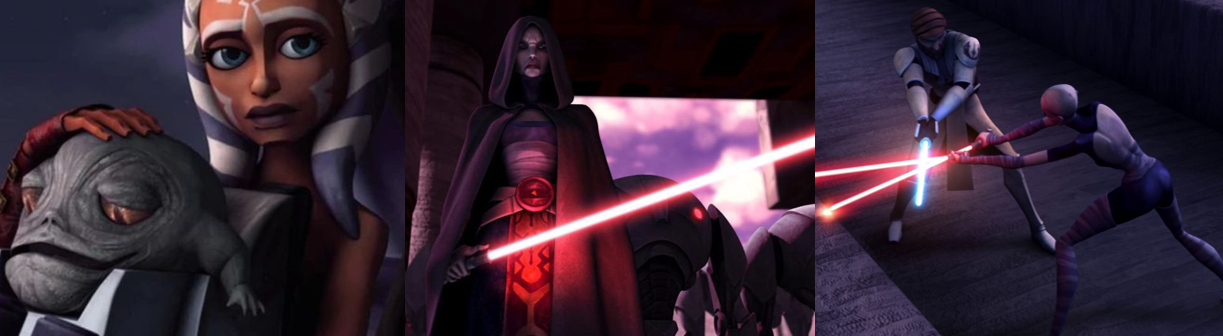
Although Rotta is rescued, the Jedi are opposed by Dooku’s mysterious disciple, Asajj Ventress.

Still, Anakin comes to offer his begrudging respect and sees a lot of himself in Ahsoka; he agrees to take her on as his apprentice and she accompanies him to the Teth system to rescue Rotta while Obi-Wan travels to Tatooine to negotiate a treaty with Jabba. Jabba is understandably anxious to see his son returned to him; he’s angered when the heads of the bounty hunters he hired are returned to him and gives the Jedi only one Tatooine day to succeed, after which he fully intends to employ the services of Count Dooku and the Separatists. Rotta’s rescue is very much a trial by fire for Ahsoka thanks to the fortress where he’s being held being heavily fortified and defended by the droid army; still, the Jedi are able to secure the fortress and find the infantile Huttling, but Count Dooku is able to use the footage to frame the Jedi as having kidnapped the child. Indeed, it transpires that Rotta’s kidnapping was part of a grand scheme by Chancellor Palpatine, who secretly leads the Separatist forces as the malevolent Darth Sidious; Dooku acts as Sidious’s commanding officer and as the public face of the army, and here further distorts the nonsensical “Rule of Two” by having an apprentice of his own, Asajj Ventress (Futterman). A mysterious and vindictive Dark Jedi, Ventress doesn’t really get much characterisation or backstory; all we really learn about her is that she’s motivated by revenge against the Jedi, commands a great deal of respect within the droid army, and wields a double-bladed lightsaber, so again we’re left with a villainous character who looks, sounds, and fights extremely well but about whom we’re forced to do extensive reading or research to find out anything about. Still, Ventress’s appearance does result in a thrilling lightsaber duel that pits her against Obi-Wan; he exhibits a familiarity with her (I believe they fought in the original Star Wars: Clone Wars (Tartakovsky, 2003 to 2005) micro-series) and their battle is easily one of the few non-clone/droid conflict highlights of the film thanks to Taylor’s enigmatic performance as Obi-Wan and the slick presentation of the fight.    

The Nitty-Gritty:
Star Wars: The Clone Wars definitely stands out from other animated movies of the time with its visual presentation; character models are a bit stiff and rigid, not unlike the marionettes seen in Gerry Anderson’s productions, and yet surprisingly fluid when in action. The presentation kind of resembles a more grown-up version of the LEGO videogames and feature films, resulting in visuals that maybe aren’t as technically impressive or as detailed as other animated films but are surprisingly fitting for the Star Wars universe. It’s not a stretch to see these characters as exaggerated versions of their film counterparts, and the aesthetics and filmmaking techniques all perfectly evoke the atmosphere and presentation of the Prequel Trilogy. Even though some of the main cast don’t reprise their roles, their replacements are more than capable of bringing these characters to life and, in some cases, actually do a better job (Matt Lanter is able to bring far more depth and emotional complexity to Anakin thanks to the additional screen time and context given by the film and series). However, considering it’s an animated feature, there aren’t many unique or visually interesting locations on offer; we get the usual trappings like the Jedi Temple of Coruscant and the bridge of various Republic star cruisers, but Christophsis is a largely barren and war-torn cityscape and even Teth, where Ventress ambushes the Jedi, isn’t exactly mind blowing. Of course, for me the greatest is crime is the return to the desolate wasteland of Tatooine; sand planets and settings have never been all that visually interesting to me and I remain continuously disappointed by Star Wars’ insistence of returning to this location or trope again and again, but it’s especially egregious here, where the animatiors had the freedom to dream up new characters and locations and instead the filmmakers defaulted back to tried, tested, and tired trappings like Jabba and Tatooine.

War is at the forefront of The Clone Wars, more so than other Star Wars features.

The Clone Wars definitely feels like a natural expansion of Attack of the Clones in the depiction of conflict, its presentation, and the ominous nature of Darth Sidious’s looming threat. Being that The Clone Wars is set at the height of the titular conflict, war and battle are a central focus of the film; the battle on Christophsis is indicative of that, and stylistically very similar to the final assault on Geonosis from Attack of the Clones. Here, the full force of the droid army is seen in foreboding detail as their various different mechanical attack droids lay down a veritable wall of suppressing fire against the Republic’s forces but, as is often the case, the Jedi remain the x-factor necessary to turn the tide and cause a retreat. Naturally, the clone troopers play a big role in the film and are given a surprising amount of personality and distinctiveness considering that all have the same face and voice; their co-ordination and dedication to their cause makes them a near-inexhaustible force, but they are wisely made distinct and more relatable through slight colouring and hair variations and Obi-Wan and Anakin’s familiarity with Captain Rex (Baker) and Commander Cody (ibid). Interestingly, despite being portrayed as an overwhelming, inexhaustible, and constant threat and being responsible for many clone trooper deaths, the droids are also paradoxically played for comedic effect; during the campaign on Teth, the droid commanders bicker and suffer numerous pratfalls that I guess are there to ease the tension from the conflict but result in them just coming across as an inconsistent menace. It’s not all ground- and space-based combat, either; Obi-Wan outsmarts the Christophsis general, Whorm Loathsom (Corey Burton), by feigning surrender and Anakin and Ahsoka sneak their way past the army’s forces to destroy their energy shield, indicating that the conflicts are solved by strategy and intelligence as much as brute force and reinforcements.
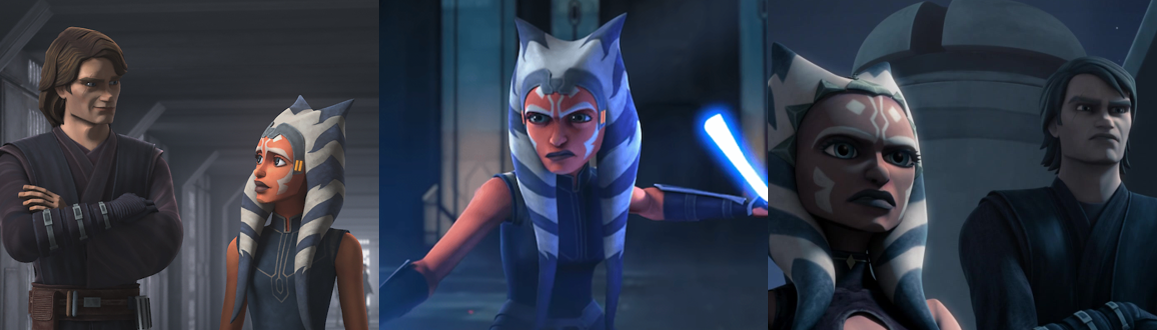
Ahosoka eventually became a fan favourite, but she’s a pain in the ass to me.

So, I mentioned at the top that I wasn’t a fan of Ahsoka and that is largely because of her characterisation in this feature. Ahsoka is an annoying, smart mouthed little know-it-all who grates on my patience almost as much as she does Anakin’s. She’s inexperienced and overeager, constantly rushing head-first into conflicts without thought of the consequences, and what’s worse is how often her approach or observations get results! It was her idea that allowed the energy barrier to be lowered on Christophsis, she logically pushes Anakin to prioritise Rotta’s life over aiding Rex and the clones, she even saves Anakin’s life more than once with her reckless methods, and her passion to be an active combatant and gain the experience necessary to earn respect actually pays off as both Anakin and Captain Rex are impressed by her efforts. Her insubordination and overconfidence are trying; it’s more annoying than endearing that she constantly has to comment on everything, from Anakin’s techniques, to the teachings of the Jedi, to battle plans and her surroundings, and it’s pretty clear that she was written to be as aggravating as possible so that her potential and thematic parallels to Anakin could be all the more explicit. Anakin is on the cusp of becoming a Jedi Master but has yet to properly learn what it means to be a humble and considerate member of the Jedi order; his faith in his abilities has only increased as he has won and commanded more and more battles, and Yoda purposely lumbered him with an apprentice in an effort to teach him the greater aim of a Jedi beyond combat. Indeed, Ahsoka mirrors many of Anakin’s worst personality traits and is much like he was as a child and in Attack of the Clones, but without the anger that would later spell the end of the Jedi Order. Thus, Ahsoka shows Anakin how much he’s grown and gives him a taste of his own medicine; however, while I’m sure that Ahsoka became much more likeable and interesting over the course of many episodes and years, I have little interest in seeing that growth since I just don’t really enjoy her character in principal or in context and think the idea of Anakin having a hitherto-unheard of Padawan just raises more unnecessary questions (chief among them being where was she in Revenge of the Sith?)

The timely intervention of Padmé sees Jabba agree to a treaty, though darkness still looms…

After rescuing Rotta, and stabilising his fever, Anakin and Ahsoka are attacked and shot down over Tatooine by Dooku’s forces to curry favour with the bulbous warlord; Anakin battles Dooku on the sands of Tatooine with a decoy, but is forced to rush off when he sees Ahsoko is in danger. However, he goes right to Jabba’s Palace, forcing Ahsoko to prove her mettle against the robotic MagnaGuards; although he’s elated to be reunited with Rotta, Jabba orders the two Jedi to be executed. Thankfully, though, Anakin’s secret wife, Senator Padmé Amidala (Catherine Taber) makes a late-film arrival and discovers that Jabba’s uncle, Ziro (Corey Burton), conspired with Dooku to have Rotta kidnapped as part of an elaborate plan to seize control of Jabba’s territory for himself. Having learned of the truth, Jabba agrees to grant the Republic use of his trade routes and ends his hostilities with the Jedi, however this victory is tainted somewhat by the continued threat posed by the Sith lurking in the background. While the galaxy is divided by conflict and the Jedi are distracted by war and growing unrest across the many systems, Sidious is easily able to manipulate events in his favour; kidnaping Rotta, attempting to frame the Jedi, and causing disruptions and hostilities across the galaxy all contribute to his endgame, which is larger than any one battle or single loss. Consequently, even when the Jedi score a victory in battle or succeed in winning Jabba’s favour, Sidious remains undeterred in the larger goals of his machinations against the Jedi Order.

The Summary:
I don’t absolutely hate Star Wars: The Clone Wars; I wouldn’t go as far as to say that it’s the worst Star Wars film to ever be produced, but it’s not exactly the best either. I think, for me, a big issue with the feature is that it’s set during the Prequel Trilogy, which is not an era of Star Wars that I look back upon fondly. I know that, for a lot of people, the subsequent animated series really helped to redeem the Prequels by vastly expanding upon the lore, conflict, and characters portrayed so questionably in the films, but I don’t subscribe to this logic. None of the character growth from the series is reflected in Revenge of the Sith; it’s easy to assume that, between Attack of the Clones and Revenge of the Sith, Anakin was hardened by battle and grew into a more competent Jedi, and there’s certainly no indication that he learned any valuable lessons from an unnecessary Padawan. I get the idea of Ahsoko Tano as a fresh face for the spin-off and a thematic parallel to Anakin to help him grow, but I can’t get over just how weird it is to see Anakin taking on an apprentice when there was no mention or indication of this in the films. The animation is pretty good, though; I get why it’s not everyone’s cup of tea but I think it’s very fitting for the Star Wars universe, especially in recreating the presentation and essence of the Prequel Trilogy, and the scenes of conflict are all very well done. I think it helps that the whole film is computer-generated, which makes everything look a lot better than slapping actors on green and blue screens with a reckless excess like in Lucas’s films, and the characterisations really go a long way to fleshing Anakin and Obi-Wan out. The greater overall threat of the Sith plot sadly takes a bit of a back seat due to the odd decision to focus on rescuing a Huttling, but it’s a decent enough animated adventure to set the stage for the popular spin-off and probably worth a watch if you’ve never seen The Clone Wars before, though it definitely isn’t as exciting or engaging as the live-action films by any means.

My Rating:

Rating: 2 out of 5.

Could Be Better

How do you feel about Star Wars: The Clone Wars? Did you enjoy the film or are you in agreement with the general consensus that it’s a poor effort for Star Wars? Are you a fan of Ahosko and, if so, what was it about her that won you over and how long did it take you to become a fan? What did you think to the rescue plot and the depiction of conflict in the film? How are you celebrating May the Fourth this year? What’s the worst piece of Star Wars media you’ve ever seen? Whatever your thoughts, feel free to leave them below or drop a comment on my social media, and check out my other Star Wars content!

Movie Night: Evil Dead Rise

Released: 21 April 2023
Director: Lee Cronin
Distributor: Warner Bros. Pictures
Budget: $19 million
Stars: Lily Sullivan, Alyssa Sutherland, Gabrielle Echols, Morgan Davies, and Nell Fisher

The Plot:
Road-weary Beth (Sullivan) pays an overdue visit to her older sister Ellie (Sutherland), who is raising three kids on her own in a cramped Los Angeles apartment. Their reunion is cut short by the discovery of a mysterious book deep in the bowels of Ellie’s building, giving rise to flesh-possessing demons, and thrusting Beth into a primal battle for survival as she is faced with the most nightmarish version of motherhood imaginable.

The Background:
The Evil Dead (Raimi, 1981) was the brainchild of now-legendary horror director Sam Raimi and his long-time friend Bruce Campbell, who eventually became a horror icon for his portrayal of long-time franchise protagonist Ashley “Ash” Williams. Audiences were horrified by The Evil Dead, which became an unexpected critical and financial hit. After reluctantly returning to the franchise for the bigger and better Evil Dead II: Dead by Dawn (ibid, 1987), Raimi and Campbell divided audiences with the slapstick stylings of Army of Darkness (ibid, 1993), which left the franchise dead in the water (beyond videogames and comic books) for the better part of twenty years. However, Evil Dead rose from the grave with Evil Dead (Álvarez, 2013), a brutal re-imagining that proved a commercial and critical success; naturally, talk of a sequel soon followed, but Raimi also bizarrely spoke of plans to produce a sequel to Army of Darkness, which would then be followed by another film that linked the original films to the remake. Although both projects ultimately never came to fruition, Campbell reprised his role and the franchise continued on in the critically-acclaimed Starz series Ash vs. Evil Dead (2015 to 2018) before retiring as Ash, leaving the fate of another Evil Dead movie up in the air. However, Raimi, Campbell, and their long-time producer friend Robert G. Tapert officially revived the franchise in 2019; Raimi hand-picked Lee Cronin to direct and Cronin later proudly claimed that the film used over 6,500 litres of fake blood! Originally set to be released exclusively on HBO Max, test screenings proved so positive that Warner Bros. upgraded Evil Dead Rise to a theatrical release where it proved to be an unexpected financial success. Evil Dead Rise made nearly $150 million worldwide and been met with overwhelmingly positive reviews. Critics praised the lively gore, the surprisingly poignant performances, and the new direction, which focused on motherhood and family, leaving the franchise in a good place for potential follow-up movies that explore the lengthy, bloody history of the Deadites and their damnable book.

The Review:
I think I detailed my opinions on the Evil Dead movies pretty well in my individual reviews; I’ve always been a bit fan of the series and really enjoyed the gritty, gory, madcap nature of the original movies. While my ranking of all four is pretty clear-cut and I have my issues with the original film and Army of Darkness, I think the franchise has, overall, hit more than it missed. Granted, a lot of this was because of the grotesque content of the first two films and Bruce Campbell’s career-defining turn as the franchise’s quick-witted, chainsaw-armed protagonist, but Evil Dead showed that the series still had plenty of gas in it even as a remake. Evil Dead is easily one of my most favourite horror movies; I loved how the filmmakers took the concept seriously, put some real money behind it, and yet still didn’t hold back with the gore. If anything, Evil Dead pushed things further than even the ghastly original movie, and I remember being super happy to see that the remake performed well, critically and commercially, and yet disappointed to find that we never got a follow-up, much less closure regarding the film’s abrupt ending. When the ridiculously fun Ash vs. Evil Dead landed, I held out hope that maybe we’d see a team up between Ash and Mia Allen (Jane Levy) but, sadly, it wasn’t to be and the closest we got to this was seeing characters from across the franchise crop up in Evil Dead: The Game (Saber Interactive 2022). I was thus sceptical when the first trailers for Evil Dead Rise landed; not only did it seem to be doing something very different with the concept (which isn’t necessarily a bad thing as we’ve seen the “cabin in the woods” trope done to death at this point), but it was hard to tell where it fit into the canon; was it a continuation of Sam Raimi’s original films, the remake, the series, or its own thing entirely? Evil Dead Rise ends up subtly being all of these things at once, and it works a lot better than I thought it would.

Perpetual screw-up Beth is forced to defend her family after her sister is possessed by a demonic force.

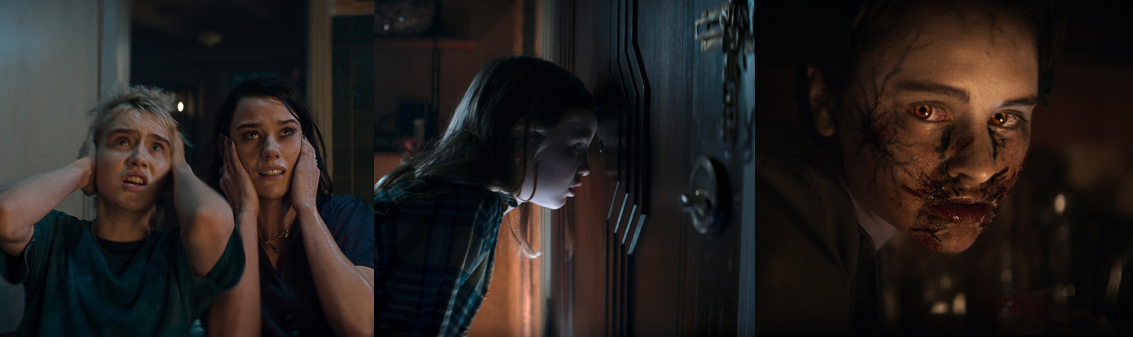
The film begins in familiar territory; twenty-somethings Teresa (Mirabai Pease), Caleb (Richard Crouchley), and Jessica (Anna-Maree Thomas) are enjoying themselves at a secluded lakeside cabin with Jessica violently succumbs to demonic possession and attacks her friends, but this cold-open is really just there for a big of explicit fan service and homage to the original movie and to get things off to a gruesome start as the rest of the film takes place in the claustrophobic corridors and dank apartment of a Los Angeles tower block. There, struggling tattoo artist Ellie lives with her three kids – eco-warrior Bridget (Echols), wannabe disc jockey Danny (Davies), and imaginative Kassie (Fisher) – and is facing impending eviction as their building is scheduled for demolition. Their family dynamic is at the heart of the film and based on mutual respect; though they miss their father and want to see him and Ellie patch things up, they’re not lashing out or resenting her efforts to keep a roof under their heads and are all largely pragmatic about their less-than-ideal situation. This is similar to the relationship between Ellie and Beth; they used to be very close as kids but drifted apart somewhat as Beth took to the road as a “groupie” and has been so focused on getting her music career off the ground that she’s neglected to stay in contact with her sister, nieces, and nephew. Yet, despite arriving too late to help with Ellie’s messy break-up, the two power past any bitterness since Ellie can intuit that something’s bothering Beth; specifically, she’s struggling with the revelation that she’s pregnant, and much of the film’s focus is on her accepting this and being put through a gruesome trial by fire as she fights to protect her sister’s kids. I really enjoyed Beth and Ellie’s relationship; it’s clear that Beth feels bad about not staying in touch and that she wasn’t there for her sister like she’s always been for her, but she’s trying her best and Ellie doesn’t give her a hard time over it. Once Ellie gets possessed and starts violently lashing out, Beth steps into a matriarchal role with ease since she already had a good relationship with the kids as their bad-ass aunt.

The kids witness some truly horrific sights, and some even succumb to the malicious evil force!

I actually didn’t mind the kids, either; kids can often be hit or miss, especially in horror movies, but the kids in Evil Dead Rise thankfully avoided being stroppy, confrontational teenagers or whining, annoying brats. Although Danny and Bridget clash a little bit, especially when she interrupts him, and there’s a little resentment as he’s older and can drive, there’s no antagonism between them and they have some fun banter and a playful relationship with youngster Kassie, probably the standout of the three, especially considering the horrors she’s subject to throughout the film! While coming back from fetching pizza, Bridget, Danny, and Kassie are rocked by a sudden earthquake which opens up a hole in the parking garage of their tower block. Unable to resist his curiosity, Danny ventures down into a hidden vault from the building’s past as a bank and discovers a couple of vinyl records and a mysterious book sealed by fang-like thorns. Ever the budding DJ, he plays the tapes and learns of this third volume of Naturom Demonto, unwittingly unleashing the demonic force that possesses and corrupts his mother into a twisted, snarling Deadite. This is primarily where relationships briefly break down between Bridget and Danny; she begged him not to mess around in the vault, chastised him for stealing the book and records, and angrily lashes out at him after he reveals his part in the nightmarish events that have taken place. Danny’s smart enough not to object to this or even fight back; he carries a tremendous guilt knowing that he’s caused harm to his mother and is indirectly responsible for some truly shocking deaths, but Beth is on hand to cool their tempers and ensure that they all stick together as a family. Still, Danny is compelled to fight back against the demonic Ellie to try and make amends and when Bridget is also claimed by the evil force regardless, he tries to comfort Kassie, but ultimately even he ends up another victim to the spiteful evil after taking a face full of blood bile from his possessed sister and a few wince-inducing stabs to the arms.

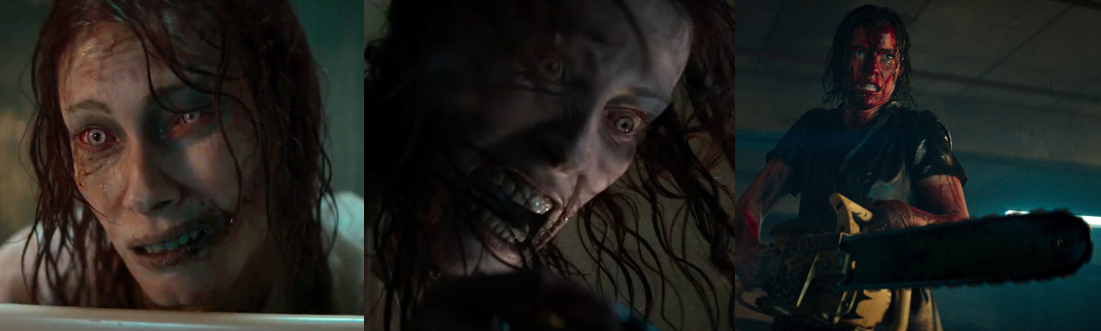
Possessed by the evil force, Ellie may be the most formidable and wicked of all the Deadites!

I mentioned that this is the third volume of the Naturom Demonto and it’s true; the tape recording explicitly states this, which is enough of an explanation for me (it’s easy to believe that the original trilogy, the remake, and this film are all in the same canon, just with different books) and this is only bolstered when you remember that there were three books in Army of Darkness, something I somehow forgot about until after seeing this film. The evil force unleashed here is similar to what we’ve seen before, but also very different; what we see of the book is mainly ghastly prophetic drawings inked in human blood, and this particular book was discovered by a group of priests, one of whom foolishly read from it in a bid to understand the afterlife and heal the sick, and who was forced to lock it away after finding it quite indestructible. Still, the evil is still represented by a rushing, disembodied force that latches onto its victim through violent assault; poor Ellie never even sees it coming; she’s lashed up in elevator cables, has her earring ripped out, and is bent and broken by the invading spirit, which spitefully twists her love for her family against her. In previous Evil Dead films, the possessed would briefly revert back to normal but it was always a trick by the demons; here, Ellie does have brief moments of genuine lucidity, but the rest of the time it’s the demon maliciously tormenting her family and trying to trick them into letting her in, which the poor naïve Kassie almost falls for. Once possessed, Ellie demonstrates horrific superhuman strength, speed, and a contortionist’s agility; she easily manhandles the handful of other tenants, chewing out an eyeball, ripping limbs from bodies, and throwing off her attackers with ease. Unlike other Deadites, Ellie is practically unstoppable; the tape details how the possessed now shrug off all injury, even being set aflame, and that the only permanent solution is total bodily dismemberment and even then, Ellie just keeps coming back! Although her kids and Beth manage to barricade themselves in the apartment, the evil still seeps in thanks to Bridget suffering the smallest of nicks; that (and a disgusting kiss from her mother) is enough for the evil to claim her as well, turning her into a rabid, feral child who, like her mother, pounces upon her prey with snarling glee.

The Nitty-Gritty:
Evil Dead Rise definitely goes back to the smaller, grittier, isolated horror that was so prevalent in the original. While this is the first time an Evil Dead movie has taken place in a major city, an all-out Deadite infestation isn’t the focus here; instead, the isolation of a cabin in the woods is replaced by a similar, claustrophobic horror of a cramped apartment in a dilapidated apartment building where the power and elevator are less than reliable. The earthquake also takes out the stairwell and causes power fluctuations, further recreating the sense of despair that permeated the previous cabin-based movies. Where Evil Dead Rise really stands out, though, is that it focuses primarily on one Deadite, the possessed form of a mother and sister, rather than a group of the undead or the ritualistic sacrifice of souls to summon a greater evil. This scaling back of the threat works really well in the context of the movie; Beth and the kids can’t just leave as they’re cut off from escape and feel a sense of obligation to tend to Ellie’s rotting corpse, then they’re forced to endure psychological and horrific bodily harm at the revived Ellie’s hands with no real hope of salvation. Indeed, the handful of other residents prove to be little more than cannon fodder to the flesh-hungry Deadite; a wonderful sequence provides just enough of a hint of Ellie’s brutality as Beth watches in horror through the peep hole in the apartment door, but that comes after she ravenously rips a bloke’s eye out and spits it into someone else’s mouth! This isn’t the only reference to Evil Dead II in the film, though; in fact, there are lots of them peppered throughout, from similar tilting shots and situations (like the stairway having collapsed like the bridge was destroyed), to explicit lines (“Come get some!” and the gaggle of zombified corpses littering the corridor chanting “Dead by dawn!” over and over), to Beth’s eventually handiness with a chainsaw, but I also appreciated that evil infecting Bridget was depicted as a putrid, tar-like corruption of her veins, similar to in the first film.

Alongside its mounting, atmospheric dread, Evil Dead Rise doesn’t skimp on the brutal gore!

Of course, one explicit way that Evil Dead Rise evokes not just Evil Dead II but the majority of the franchise is through its gore. While a surprising amount of the film is actually devoted to building tension and focusing on the mounting horror inside the apartment as Beth and the kids struggle to come to grips with what’s happened, Evil Dead Rise is unrelenting when the blood starts spilling. Things are off to a gruesome start in the cold open when the possessed Jessica rips Teresa’s scalp off, shoves a drone’s blades into her face and tosses Caleb’s severed head from the lake but Ellie’s bone-crunching possession and the way her body is twisted and contorted by the invading spirit is extremely gruelling to watch, and even evokes the controversial “tree rape” scene from the original movie. Once claimed by the evil, Ellie becomes a sneering, cackling ghoul who stabs a shard of glass into Beth’s hands, tears through the other tenants, and even tries to stick a tattoo needle in Bridget’s eye! At one point, Ellie is briefly stunned when Beth shoves a pair of scissors up her nose and blows her arms and a leg off, but her unrelenting assault sees poor Bridget get possessed as well. Bridget announces this by chewing on a wine glass, the shards piercing her throat, and gleefully runs a cheese grater down Beth’s calf, turning her skin into ribbons of gore! Bridget’s attack upon her siblings is much briefer than her mother’s thanks to Kassie’s little mop friend; when Bridget leaps to devour her little sister, she gets the broken end of the mop’s handle shoved right through her skull, but she soon recovers from this to brutalise Danny, who also turns into a Deadite after being repeatedly stabbed by his possessed, knife-wielding sister. There’s a fair bit of disgusting vomit here, too; Ellie spews up a load of creamy-white gunk before collapsing and Bridget practically drowns Danny in bloody bile before being set alight. The film even has a bit of an ode to The Shining (Kubrick, 1980) for a scene where Beth and Kassie are forced to escape in the malfunctioning elevator and it fills up with thick, bubbling gore that is deposited, alongside them, into the ground floor car park!

After enduring a gruelling assault, Beth is forced to dismember her possessed sister to dispatch the evil force.

This volume of Naturom Demonto unleashes a slightly altered demonic force, one far more durably and malicious than those we’ve seen before; sure, Ellie could be compared to the cackling witch from Evil Dead II and the possessed Mia delighted in tormenting her friends in Evil Dead, but there’s something more visceral and horrifying about a mother spitting such venom at her cowering children and twisting Ellie’s emotions against her family. Although the recordings reveal to Beth that complete bodily dismemberment could put a stop to Ellie, she’s not exactly got the tools for that in the tiny apartment, but there is a convenient woodchipper in the parking garage. At first, this isn’t Beth’s goal; she’s simply trying to get Kassie to safety, which she manages to do after subduing her attackers with a shotgun and taking the bloody express elevator to the ground floor. However, the possessed Danny and Bridget rip their way into their mother’s body and the three of them come together as a multi-limbed, screeching monstrosity known as the “Marauder”. This almost spider-like amalgamation of limbs and teeth follows Beth and Kassie to the garage and stalks them in scenes reminiscent to Mia’s final stand against the Abomination (Randal Wilson/Rupert Degas). Disturbingly quick and inhumanly powerful, the Marauder corners Kassie and revels in her horror as it closes in on her with a chainsaw, but Beth manages to save her young niece with a well-timed shotgun blast and claim the chainsaw her herself. She’s then able to hold her own against the beast, retaining all of her limbs in the process, so Kassie can activate the woodchipper; the Marauder’s foot gets caught in the spinning blades and it’s reduced to chinks of gore with an agonised wailing. However, even with its body being chewed up and when left a blinking, twitching, severed head, it continues to taunt Beth, who simply chops into it with her chainsaw and boots the head into the machine, finally finishing it off and allowing her and Kassie (both drenched in blood) to escape the apartment building. The film ends with the reveal that Jessica was also a tenant in the building and, in a homage to the ending of The Evil Dead, she’s attacked by the disembodied force while investigating the garage. Personally, I would’ve liked to see the cold-open replaced with a slightly different scene (perhaps a flashback to the book’s reading from 1923 so that Bruce Campbell could’ve made more than a voice cameo) and replaced Jessica with one of the characters from Evil Dead, just to tie things together a little better, but I appreciated the homage and enjoyed the blood-soaked finale, which worked as a cathartic, heroic evolution for the previously unsure and hesitant Beth, who has now become a battle-hardened protector figure.

The Summary:
I don’t want to say I was anxious about Evil Dead Rise, but I was curious; to be honest, I was a bit annoyed that we never got a direct sequel to Evil Dead, as much as I enjoyed Ash vs. Evil Dead, and was worried that the film would either ignore the remake or just be another reboot. Thankfully, the one, throwaway line about there being three books satisfied my urge for some kind of explanation and the film provided enough entertainment to keep me engaged regardless. This is again another brilliant indication that the Evil Dead franchise doesn’t need Ash to be enjoyable, and I really liked that Evil Dead Rise mixed things up a bit by focusing on a family trapped in their apartment rather than the cliché cabin in the woods. The location was almost too perfect at evoking the same sense of isolation and dread as being trapped in a secluded cabin and the focus on the family dynamic and drama made the horror so much more impactful and meaningful. Ellie might be the most intimidating and malicious Deadite in the entire series; seeing her love for her children twisted against them and her voracious need to torment and consume them was just horrendous in ways beyond the simple terror of a rabi, zombie-like demon scratching at the door, and this was conveyed really well through the child actors. I liked how each of them stood out in their own ways; the whole family was a little alternative and had a great dynamic, and the central story of Beth needing to step up and defend her family, stand on her own two feet, and realise her role as a mother came through really well. Gorehounds should also be very satisfied with Evil Dead Rise; the film does a great job building tension and focusing on psychological terror rather than going a mile a minute with the splatter-horror but, when the blood does start flowing, it’s brutal and glorious to see! I especially enjoyed that Ellie was twisted into an all-new monstrosity at the end and the implication that each book unleashes a slightly different evil, and, overall, I was extremely impressed by the film, which again took the concept seriously (while still having a little fun) and delivered both chilling tension and shocking gore in equal amounts.

My Rating:

Rating: 4 out of 5.

Great Stuff

What did you think to Evil Dead Rise? Where would you rate it compared to other entries in the franchise? What did you think to the new direction and were you satisfied by its links to the other films? Which of the characters was your favourite and what did you think to the family-orientated focus of the horror? What did you think to the film’s gore and callbacks to previous Evil Dead films? Were you surprised by how durable Ellie was and what did you think to her multi-limbed Marauder form? Where would you like to see the franchise go next? Whatever your think about Evil Dead Rise and the franchise, feel free to leave a comment below or on my social media, and go check out my other Evil Dead reviews!

Movie Night [Alien Day]: Aliens: Special Edition


Audiences were first introduced to the horrific, biomechanical Xenomorphs in this classic science-fiction horror film in which an unsuspecting cargo crew investigates a beacon on the barren world of LV-426 and, as a result, the 26th of April is widely celebrated as “Alien Day”, a day to celebrate one of the greatest sci-fi/horror franchises ever created.


Released: 1 June 1991
Originally Released: 18 July 1986
Director: James Cameron
Distributor:
20th Century Fox
Budget:
$18.5 million
Stars:
Sigourney Weaver, Michael Biehn, Paul Reiser, Carrie Henn, Bill Paxton, Jenette Goldstein, William Hope, and Lance Henriksen

The Plot:
Having survived an attack by a vicious alien creature (Bolaji Badejo), Lieutenant Ellen Ripley (Weaver) is awakened from stasis only to find fifty-seven years have passed her pay, and the desolate world where her doomed crewmates discovered the Xenomorph has been terraformed and colonised by the shady Weyland-Yutani Corporation. However, when the colony stumbles across the derelict alien craft and its gruesome cargo, Ripley is forced to join a crack team of Colonial Marines and confront her worst nightmares by returning to the planet to face the alien menace once more.

The Background:
In 1979, writers Dan O’Bannon and Ronald Shusett’s concept ofJaws (Spielberg, 1975) in space” was brought to life by director John Carpenter as Alien; the idea of “truckers in space” was injected with the unsettling visuals of Swiss artist H. R. Giger, and the film became a surprise commercial success. Though it was met with mixed reviews at the time, Alien is now widely regarded as one of the greatest movies of all time, and the film’s financial success meant that the studio was eager to produce a sequel, but it would take seven years for the follow-up to come to fruition due to financial concerns and the viability of replicating Alien’s success. After settling a questionable lawsuit, production finally began to pick up steam when James Cameron, hot off the success of The Terminator (ibid, 1984), pitched a potential treatment for the sequel; although others warned him off trying to follow in Carpenter’s footsteps, Cameron pushed onwards and convinced the studio to invest in his idea for a bigger, more action-packed sequel. Though initially reluctant to return to her role as Ripley, star Weaver had to be convinced the sequel wasn’t simply a cheap cash-grab and negotiated an unprecedented $1 million salary to join the production; she was initially set to star alongside James Remar, but was paired up with Cameron’s Terminator star Michael Biehn after Remar was arrested for drug possession. The seventy-five day shoot was made stressful for Cameron as many of the crew were dismissive of him due to his lack of directorial experience; however, he stayed the course and used his familiarity with smaller special-effects studios to secure the services of the legendary Stan Winston. Giger was reportedly unhappy to be left out of the production, but Winston was able to convincingly create the illusion that hoards of Xenomorphs were onscreen despite only twelve practical suits being made, and film’s most impressive effect, the Xenomorph Queen, was realised through a combination of visual effects, puppetry, and complex animatronics. Although the exact figures vary, Aliens proved to be even more successful than its predecessor; it made between $131 and 183 million at the box office, far exceeding Alien’s financial return, and was also received far more favourably upon release. Critics praised the set-pieces and presentation, its intensity and horror, and it was generally regarded as being the most shockingly intense film in years. Thanks to its action scenes, themes of motherhood and the atrocities of war, Aliens has stood the test of time; regarded as one of the greatest films ever made, Aliens forever influenced the cultural and multimedia impact of the franchise, with many of its characters, designs, locations, and themes being evoked in Alien comic books, videogames, and spin-off for decades to come.

The Review:
Aliens is another of those classic sci-fi/horror films that I grew up watching, and one of a number of sequels that are arguably better than the original; certainly, I struggle sometimes with which of the two I prefer. Aliens, for me, is definitely more watchable in a casual sense; I feel I have to get into a certain mind frame to watch Alien, one where it can’t just mindlessly be on in the background or else I don’t get to experience the full immersion. With Aliens, I could honestly put it on whenever and wherever and know that I’ll be in for a good time regardless of how much attention I pay, but just as Alien wasn’t merely some shlock horror film with a big space monster, so too is Aliens so much more than just a mindless action film. There are some impressively complex themes at work in this movie and it definitely established many of the lore and tropes that would become so synonymous with, and endlessly emulated throughout, the franchise and its subsequent crossovers.

A traumatised Ripley awakens to find herself 57 years out of the loop.

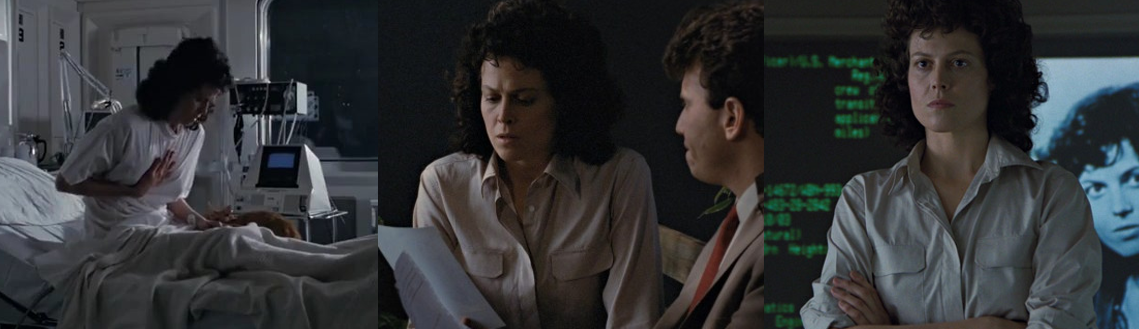
Aliens begins seemingly right where the first film left off, with Ripley and Jones the Cat (Boris) drifting through space in the Nostromo’s shuttle craft, safely dreaming away in hypersleep. When the shuttle is breached by a deep space salvage crew and the two are revived on a Weyland-Yutani space station in Earth orbit, Ripley is at first confused by the station’s presence and then shocked to learn from Weyland-Yutani representative Carter Burke (Reiser) that fifty-seven years have passed! However, that’s the least of her troubles as she suddenly starts convulsing from a pain in her chest; she writhes and begs the doctors to kill her and is horrified to see a Chestburster emerging from her body! Luckily, for her, this is just the first of many recurring nightmares for her; her experiences with the Xenomorph have left her severely traumatised, to the point where sleep is impossible without such nightmares plaguing her. As distressing as her memories are, however, they’re nothing compared to the heartbreak she feels at learning that her daughter (Elizabeth Inglis) has died during her absence or the betrayal she feels when a Weyland-Yutani committee, led by Van Leuwen (Paul Maxwell), grill her on the destruction of the Nostromo. They force her to retell a truncated version of the events of Alien over and over, forcing her to relive her traumatic experiences and explode in a rage when they continue to imply that she sabotaged and destroy her ship and her crew “for reasons unknown”. They discount her description of the Xenomorph and account of events due to lack of physical evidence and suspend her pilot’s license, but she’s more concerned about the fact that LV-426 is no longer an inhospitable world thanks to the efforts of terraformers.

While Apone’s marines might be gung-ho for the action, they’re as in over their heads as Gorman.

While the review board doesn’t believe that the Xenomorphs exist since they haven’t discovered any evidence of such a creature on LV-426 or any of the three-hundred-plus worlds mankind has surveyed, Ripley knows better and, wouldn’t you know it, a group of colonists stumble upon the crashed Engineer ship while out on a scouting mission and, before long, Burke is knocking on Ripley’s door with Lieutenant Scott Gorman (Hope). Understandably, Ripley is a boiling pot of emotions when they ask her to accompany a troop of Colonial Marines to investigate LV-426; not only does she feel betrayed by Burke and the Company for framing her as a patsy, she is so traumatised by her experiences with the Xenomorph that she has absolutely no desire to face her fears and believes that she wouldn’t be any use even in an advisory role. However, after suffering another of her nightmares, she begrudgingly agrees to make the trip but only after Burke swears that the purpose isn’t to capture or study the creatures, but to annihilate them. This introduces her to rowdy Sergeant Apone’s (Al Matthews) ragtag group of soldiers: privates Hudson (Paxton), Vasquez (Goldstein), Drake (Mark Rolston), Frost (Ricco Ross), Spunkmeyer (Daniel Kash), Crowe (Tip Tipping), and Wierzbowski (Trevor Steedman); and corporals Dwayne Hicks (Biehn), Dietrich (Cynthia Dale Scott), and Ferro (Colette Hiller). Although many of his troops are loudmouthed cynics or rowdy meatheads, Apone runs a tight ship and doesn’t stand for any nonsense; a proud man who is fully committed to the corps, he demands nothing but absolute focus from his team and for them to follow orders, even ones that don’t make sense to them. The marines are heavily armed and well experienced in a number of combat drops and scenarios, which mean they’re less than impressed with Gorman’s comparative lack of field experience and Ripley’s refusal to sit with “the rest of [the] grunts” in the canteen. However, while they exhibit a lack of distrust and respect for the Company and its representatives, they are a well-oiled team out in the field, sharing a level of trust and banter than brings levity without compromising their integrity.

Vasquez and Hudson standout from the pack with their memorable temperaments and characteristics.

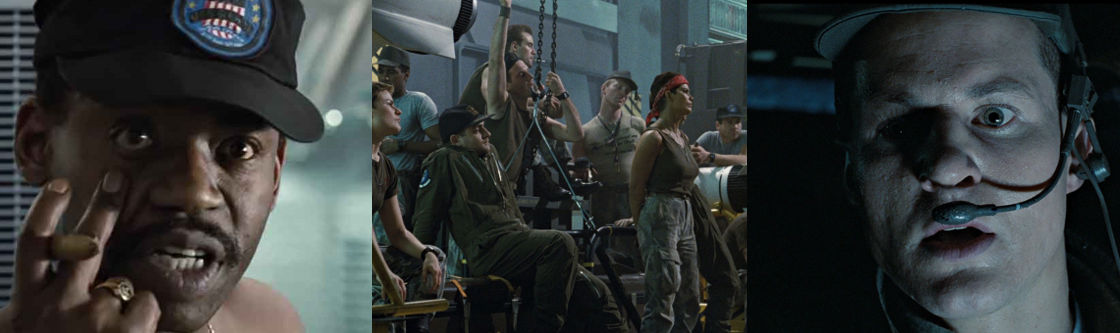
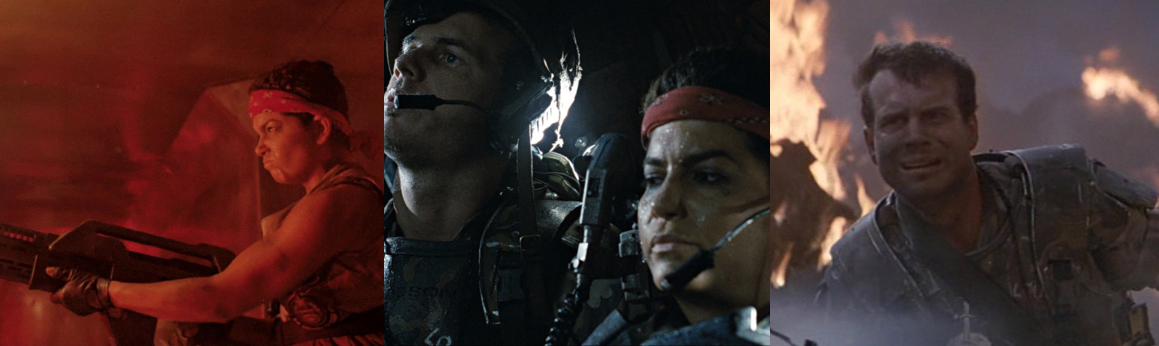
Obviously, many of these marines are just there to add to the body count once the Xenomorphs start literally emerging from the walls and shadows but, of all the marines, there are three obvious standouts: Vasquez, Hudson, and Hicks. Vasquez is a tough-as-nails soldier who shows nothing but contempt towards Ripley and the orders to holster their weapons to avoid rupturing the colony with their gunfire. Her and Drake have a very close partnership and she is devastated when he is killed during the first skirmish with the aliens. Blaming his death directly on Gorman, she lashes out at the injured lieutenant and remains a hot-headed, explosive member of the survivors; ultimately, she’s forced to rely on Gorman to avoid being impregnated by the aliens, which sadly means them taking their own lives to be spared this fate. While all of the marines provide a measure of comic relief with their biting wit and overly macho behaviour, Hudson takes this to the extreme and beyond; he’s so confidant in his abilities and the superior firepower of his team that he’s aloof and arrogant as a result. Of the all, he’s the one who is most vocal of their bad-assery and the first to succumb to despair when they’re wiped out after being ambushed by the Xenomorphs. With limited resources and manpower and no hope of backup, Hudson’s bravado and resolve don’t just crack, they cave in to hopelessness and Ripley is forced to order him to compartmentalise his issues and get his shit together to help fortify their defences and strengthen their campaign against the aliens. Ultimately, his trigger-happy countenance and desire to strike back against his enemy lead to his downfall, as he’s pulled to his death during a particularly harrowing firefight, but the late, great Pill Paxton definitely stole the show with his performance here.

No mere grunt, Hicks is smart enough to keep his head, take charge, and utilise Ripley’s expertise.

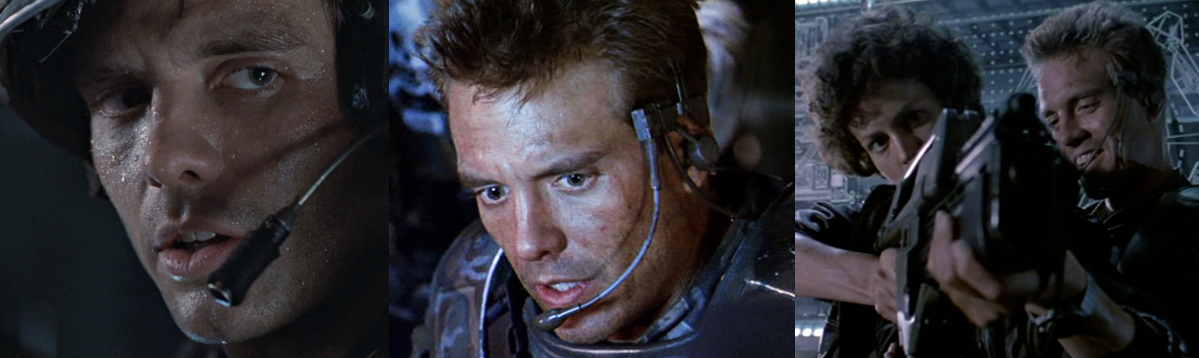
And then, of course, there’s the calm and composed Corporal Hicks played by the massively under-rated Michael Biehn. Unlike many of his peers, Hicks is a level-headed and respectful soldier; he follows his orders without talking back to his superiors, is prepared enough to be carrying a non-explosive shotgun for “close encounters”, and, while he clearly has no love for corporate interference or figureheads like Burke, he is smart enough to know when to keep his mouth shut. With Apone lost during the initial encounter with the aliens, Hicks assumes command of the mission and, having witnessed first-hand that Ripley’s tall tales of biomechanical monsters with acid for blood make this more than the standard “bug hunt”, is fully prepared to take her expertise onboard and make preparations to destroy Hadley’s Hope despite Burke’s protests. There’s a bit of a romantic subplot between Ripley and Hicks, one that grows out of this mutual respect and admiration for each other’s ability, intelligence, and resolve; they never really get beyond the flirting stage, and their flirting is done while Hicks teaches Ripley how to handle the marines’ standard-issue Pulse Rifle, but the ease at which he steps into a position of command and supports her really helps to make his leadership qualities shine. Although clearly terrified and feeling the pressure of the situation, Hicks never gives in to despair or allows himself to become unfocused from the primary objective of survival and escape; when he’s injured by the aliens’ acid, he’s forced to take a backseat and cannot help Ripley in the film’s finale beyond ensuring that the dropship is waiting for her when she gets back, meaning that he never oversteps his boundaries to take away from Ripley’s agency as the primary protagonist and is, instead, and incredibly dependable soldier.

While Burke’s true nature is soon revealed, Bishop proves to be a trustworthy ally to the end.

Ripley’s relationship with science officer Bishop (Henriksen) is far more antagonistic; immediately revealed to be an “artificial human”, Ripley meets Bishop with a distrust that steps right into hostility based on her experience with a similar android in the first film. Throughout the movie, Ripley either ignores or irritably brushes Bishop off, convinced that he’s either a tool of the Company or a risk to herself and others just like Ash (Ian Holm), but Bishop remains nothing but polite and courteous throughout the entire movie. Having said that, though, he does seem to be as enamoured by the Facehugger and the Xenomorph species as his predecessor, and there are several moments where his intentions are cast into doubt, not least when Ripley finds the dropship missing at the finale and assumes the Bishop has left her to die. In the end, though, Bishop proves to be a trustworthy and reliable ally and earns Ripley’s respect by coming through in the end, which is more than can be said or Burke. It’s not long into the mission to Hadley’s Hope that Burke’s true nature as a corporate pen pusher comes to light; despite his assurances that they’re there to eradicate the Xenomorphs, he’s soon arguing against destroying the colony and trying to sell the survivors on the greater financial and military glory offered by the species. He even goes so far as to try and impregnate Ripley and Rebecca Jorden/Newt (Henn) with a Facehugger in order to get a specimen safely through quarantine and back to Earth, and is only spared being executed by the marines for his betrayal by an alien attack, which sees him get his just desserts.

Ripley connects with Newt, and soon takes a proactive role in fighting the alien threat to protect her.

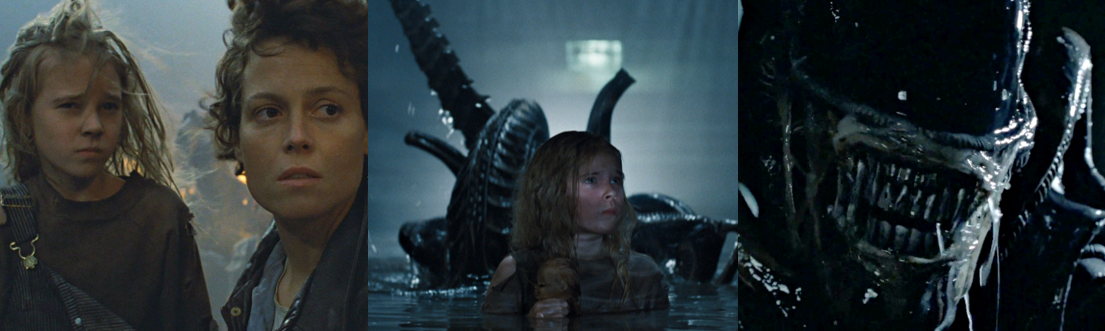
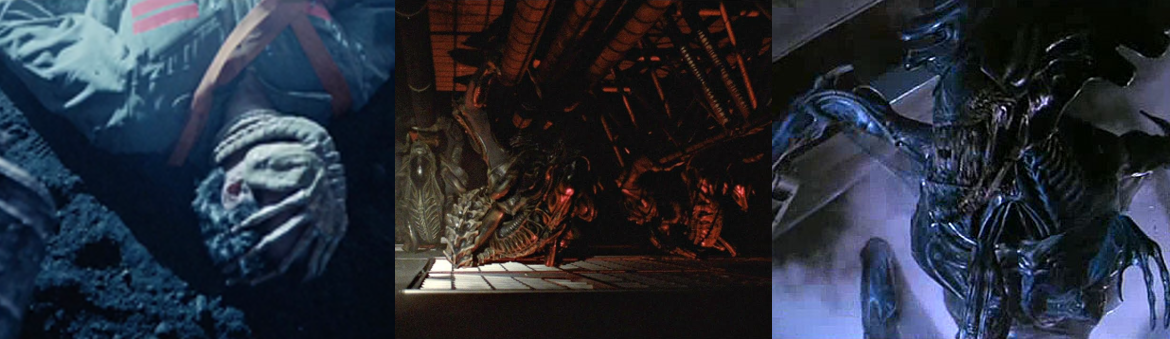
Speaking of Newt, this resourceful and adorable little girl captures Ripley’s attention, heart, and respect for having not only witnessed the alien’s infestation first-hand but having the wherewithal to use the colony vents to stay safe and undetected. Initially a traumatised, almost animalistic girl traumatised by the horrors she’s seen, Newt proves a valuable resource to the remaining marines thanks to her knowledge of Hadley’s Hope, and Ripley does everything she possibly can to give her a sense of security and normalcy. When Newt is abducted by an alien warrior, Ripley immediately takes up arms to venture into the Xenomorph nest to rescue her before she can be impregnated, and through her finds a sense of redemption and hope thanks to the surrogate family they form alongside Hicks. As for the Xenomorphs themselves, Aliens greatly expands upon their nature, society, and screen time. It still takes about an hour for the first of many Xenomorph drones to appear onscreen, which builds a sense of dread and anticipation, and their appearances are always accompanied by ominous shadows or flashing lights to help keep them horrific creatures. Having overrun Hadley’s Hope, the aliens have not only impregnated and killed many of the colonists but also overtaken the environment with a biomechanical infestation that hides their numbers and allows them to strike undetected. Lacking the smooth, phallic skull of the original creature, and these creatures have a rigid, fearsome headpiece and are seen to be far more aggressive thanks to their superior numbers. The aliens scramble across walls and ceilings, hide in the shadows, and exhibit a great deal of intelligence by literally throwing themselves against the marines’ turrets to exhaust their ammo and getting the drop on the marines by using the vents and narrow passageways to get about. Of course, the most memorable and iconic addition to their species is the presence of a massive Xenomorph Queen; this horrific, disgusting matriarch is revealed to be the source of the eggs seen in the Engineer ship and fundamentally alters the Xenomorph’s nature from a self-sustaining biomechanical lifeform to something more akin to ants.

The Nitty-Gritty:
Although Aliens is a very different movie compared to its predecessor, director James Cameron does a masterful job of maintaining a lot of the same horror elements and atmosphere through his incredibly detailed sets, fantastic use of lighting and shadows, and James Horner’s orchestral score. Both melancholy and rallying, depending on the situation, the score really goes a long way to bolstering both the tension felt when the marines are investigating the aftermath of Hadley’s Hope’s last stand against the aliens and when they’re engaging with their violent enemy with all guns blazing. Additionally, this is the film where the aliens gain their signature death squeal which, like the camaraderie between the marines, would become a staple of the franchise and its spin-offs. The marines are clearly a tight-knit group and have been through a lot together, which means they’re not ashamed to bust each other’s balls or through some shade at each other. Even Apone gets in on the action and has a very close, ground-level relationship with his troops; he easily assumes a position of command when required, and is clearly well respected by his marines, but is also clearly seen to be one of them as he sits and eats with them and is just as incredulous to Gorman’s nonsensical orders and inexperience. Many of the marines echo the anti-authority sentiment of some of the Nostromo’s crewmen; Gorman has little combat experience and is left completely overwhelmed when the aliens first attack as it goes against his by-the-book preparations, and the marines are only too happy to go against the Company’s orders (and Burke’s insistences) in order to better ensure their own survival rather than worrying about financial gain.

The additional scenes work in tandem with the practical effects to expand on the aliens’ nature.

Even now, coming up to forty years later, Aliens continues to impress thanks to its impressive sets and practical special effects; a number of tried-and-tested camera and filmmaking techniques and tricks are used to give Hadley’s Hope and the colony a sense of scale beyond what they were actually capable of. Model shots, composite shots, miniatures, and incredibly detailed practical suits are the order of the day here and help give the impression that there are hundreds of aliens scuttling through the colony at once. This is masterfully done during the first skirmish with the aliens, which is a frantic and terrifying experience told mostly through the marines’ head cameras and quick, violent cuts to the marines being picked off one by one by aliens or taken out by their own gunfire. Far more animalistic than their bipedal predecessor, the Xenomorphs are now scrambling, skeletal, hive-like creatures that seek only to cocoon and impregnate others to increase their numbers and to protect their queen. One of the biggest additional scenes added back into the film shows us life on Hadley’s Hope before the aliens infest the colony; here, we get to meet a few new characters, such as colony administrator Al Simpson (Mac McDonald) and Newt’s family, mother Anne (Holly de Jong), father Russ (Jay Benedict), and brother Timmy (Christopher Henn). While there’s a case to be made that the addition of these scenes escalates the timeline of the film somewhat (it’s not entirely clear how long passes between the alien ship being discovered and Ripley being drafted into the marines, but it seems like mere hours), I think it’s great to actually see the colonists alive and well and working away completely oblivious to the danger not far from their little outpost. This also gives Cameron the perfect excuse to recreate the Engineer ship from the first movie, and evoke the feeling of dread its crescent shape inspires in the knowing audience; furthermore, we see that Newt’s family were the ones who not only discovered the ship but also brought the infestation to Hadley’s Hope after her father was attacked by a Facehugger. Perhaps most damning of all is the explicit implication that Simpson was ordered to send the Jorden’s out there by the Company, presumably after hearing Ripley’s testimony during her emotional debriefing, thus framing the subsequent alien infestation as less of an inevitability due to the creatures being on the planet and more of a calculated plot by the Company to breed viable subjects for their bio-weapons division.

Everyone underestimates the aliens but Ripley, who knows only too well of the danger they pose.

Rather than focusing on themes of isolation, dread, and mounting horror, Aliens is the story of one traumatised woman facing her nightmares head on and a disregarded threat proving to be a formidable force. I read somewhere once (I forget exactly where) that someone thought it was amusing and ironic that so many Aliens videogames choose to place players in the role of a Colonial Marine considering that they’re kind of depicted as overconfident, unprepared buffoons who are almost completely wiped out by a superior, far more aggressive force. Some have noted that Aliens is an allegory for the  Vietnam War, where a heavily armed and superior force was caught off-guard by a technically inferior native army, and the depiction of the marines definitely lends itself to this reading; all of them, to one degree or extreme, are absolutely confident to the point of arrogance that they have the skills, resources, and firepower to overcome any foe based on their training and previous success in the field. Most of them don’t take Ripley’s account of the alien seriously, which is their first mistake, but they’re left virtually defenceless (or, you could say, impotent) when they’re forced to turn in their grenades and explosive rounds, which means they’re easy prey for the aliens. There’s an argument to be made that Aliens reduced the Xenomorph threat somewhat; it went from being the “perfect organism” that “can’t” be killed to a swarm of insectile-like monsters that can be blasted apart with sustained gunfire, but I’d argue that their threat has never been greater than in this film! Yes, the marines have the weapons to gun down countless numbers of the Xenomorphs, but those weapons are finite, for a start, and continuously shown to do more harm than good thanks to the aliens’ acid blood. In the end, while Ripley may have more weapons and options available to her this time around, the sheer number and aggressiveness of the Xenomorphs makes them a force to be reckoned with and all the bravado and macho bullshit in the world means nothing when one of those ugly bastards is baring down to strike. As before, Ripley is extremely adaptable once backed into a corner; she ends up one of the few survivors thanks to her knowledge and level-headedness despite clearly being traumatised, and all the machoism in the world is nothing compared to her inner strength.

In the end, Ripley faces hear fears, saves her “daughter”, and puts her nightmares to rest…for now…

One of the most crucial scenes added to the Special Edition is the revelation that Ripley was a mother this whole time, which adds new layers to her connection with Newt; in the theatrical cut, this is famed as simply a maternal instinct kicking in and it works incredibly well just in that reading but, here, it’s so much more than that. It might have simply been easier for the effects team (and spared Weaver’s modesty) to have her nightmare Chestburster come from her abdomen but it actually ties into these themes of motherhood very well in this context. Ripley’s transformation into a bad-ass action hero is her most basic character arc in the film; faced with the slaughter of the marines and Gorman’s inability to act, Ripley has no choice but to take charge and be proactive and her expertise and survival instinct make her a valuable voice of authority once the survivors are forced to build fortifications against the aliens. Alongside this, she builds a surrogate family with Hicks and Newt, and these arcs converge for the finale; for much of the film, the survivors are concerned with holding out long enough for rescue to arrive but, when Newt is abducted, Ripley’s forced to strap together a flamethrower and a Pulse Rifle to delve into the Alien’s nest and rescue her. This turns Ripley’s final journey into the depths of LV-426 not just into a quest to retrieve her surrogate daughter from the monstrous creatures that have ruined her life, but also into a story of redemption; although she couldn’t have predicted that she’d be stuck in space for nearly sixty years thanks to a biomechanical alpha predator, Ripley is wracked with guilt over having missed out on Amanda’s entire life and determined to atone for this by rescuing Newt. Thus, she comes face-to-face not just with the ultimate manifestation of her trauma and horror but also her thematic parallel: the incredibly impressive and grotesque Xenomorph Queen. Like Ripley, the queen is incredibly protective of her young and seems to understand the threat Ripley poses to her eggs, but she explodes into a rage when Ripley turns her weapons on the eggs, gunning down drones and blasting open the revolting egg sack in a trigger happy fury that would make John Rambo (Sylvester Stallone) proud. With the colony on the verge of exploding, Ripley is picked up by Bishop at literally the last second but, just like in the first film, the threat isn’t quite over yet. The queen stows onboard the dropship and makes a dramatic reappearance to rip Bishop in two and hunt down Newt, forcing Ripley to take the controls of a power loader and engage with her foe in one-on-one combat. This is a cathartic moment for Ripley, who was so crippled by her experiences that she had no intention to ever return to LV-426 and is forced to tackle her nightmares head first to overpower and force the queen into an airlock and blast her out into space to finally put her bad dreams to rest…or so it would seem

The Summary:
For me, Aliens is a similar quandary to the first two Terminator films (Cameron, 1984; 1991) in that it’s hard for me to pick which I prefer out of this one and the first one; both are very different films, with the first focusing more on atmospheric dread and mounting horror and the second being far more action-orientated, but they’re both magnificent sci-fi/horror masterpieces in their own right. If you were to put a gun to my head, though, and make me choose, I would pick Aliens every time; I think Aliens is probably my favourite in the entire franchise as well, even though I have a love of love for many of the films and remain a big fan of the franchise to this day despite the most recent efforts. The action-orientated approach definitely helps with that, especially when I first watched it as a kid; it really helped me to overcome the terror I felt watching the original film to see the Xenomorphs being blasted to shreds and in a more vulnerable light, but the film never positions them as an inferior force and they remain an aggressive and horrifying threat through their sheer tenacity, ferocity, and surprising intelligence. As I got older and more experienced, and turned my focus towards academic studies, my love and appreciate for Aliens only grew; now, the themes of motherhood and family and a technically superior force being overwhelmed because of their ill-preparedness and arrogance make the film just as engaging and impactful as its incredible practical effects. More me, Aliens is a quintessential example of just how powerful and realistic animatronics and suits can be to a film and the techniques on display here have more than stood the test of time to make it just as impressive now as it was back then. Moreover, Aliens forever changed the lore and focus of the franchise; not only would Lance Henricksen be forever associated with the franchise but from this point on, subsequent films, spin-offs, and media would continuously return to the idea of a group of well-armed marines combatting the aliens or utilise the Xenomorph Queen as the final threat and I think, even now, Aliens is probably the main reason why the franchise has had such a long life since it was able to capture a wider audience with its greater focus on action horror.

My Rating:

Rating: 5 out of 5.

Fantastic

Are you a fan of Aliens? What did you think to the additional scenes added to the Special Edition? Which of the marines was your favourite and why? What did you think to the addition of the Xenomorph Queen to the lore? Were you a fan of Ripley’s story arc here, her transformation into an action hero and surrogate mother? What did you think to the greater malevolence placed upon the Company? Which of the Alien movies is your favourite and why, and how are you celebrating Alien Day this year? Whatever your thoughts, feel free to sign up and leave them below or drop a comment on my social media. Stay frosty!

Movie Night [Crossover Crisis]: AVPR: Aliens vs. Predator – Requiem


In April 1985, the first issue of the ground-breaking Crisis on Infinite Earths (Wolfman, et al, 1986) released and saw the temporary destruction of the “Multiverse”. To celebrate this momentous event, I’m discussing multiversal crossovers all throughout April in an event I dubbed “Crossover Crisis”.


Released: 25 December 2007
Director: The Brothers Strause
Distributor:
20th Century Fox
Budget: $40 million
Stars:
Steven Pasquale, Ian Whyte, Johnny Lewis, Reiko Aylesworth, Kristen Hager, and Tom Woodruff Jr.

The Plot:
Following the last clash between Xenomorph and Predator, a “Predalien” (Woodruff Jr.) hybrid begins a bloody rampage in a small Colorado town. While former convict Dallas Howard (Rasquale), his troublesome younger brother Ricky (Lewis), and soldier Kelly O’Brien (Aylesworth) desperately try to survive as their town is overrun with viscous alien drones, a lone Predator, “Wolf” (Whyte), is dispatched to remove all traces of the creatures from the town by any means necessary.

The Background:
Starting life in the pages of Dark Horse Comics with a three-issue short story courtesy of writer Chris Warner, the Aliens vs. Predator concept quickly expanded into multiple follow-up stories, an expansive toy line, and videogames. After a lengthy stint in Development Hell in which notable figureheads from the Alien franchise (Various, 1977 to present) openly criticised a crossover between the two horror icons, Paul W. S. Anderson won over the studio with his pitch and turned a tidy profit with AVP: Alien vs. Predator (ibid, 2004). Though the film was subjected to largely negative reviews, brothers Colin and Greg Strause were brought in to helm a follow-up, having previously unsuccessfully pitched a similar crossover and making a mark in Hollywood with their work as visual effects supervisors. Excited at the prospect on working on such a film, the two insisted that the bulk of the film’s effects were achieved practically, with CGI being used sparingly to render alien spacecraft, the more elaborate sets, and to bolster the practical effects wherever possible. Amalgamated Dynamics, Inc. created the monstrous Predalien suit, which incorporated visually recognisable aspects of both species and was brought to life using an animatronic head and practical suit. Despite the brothers’ attention to detail and clear love of both franchises, and making a respectable $130.2 million worldwide gross, Aliens vs. Predator: Requiem failed to impress critics: many have cited it as one of the worst films in either franchise and critics dismissed the film as a mindless, violent mess akin to a videogame that suffered from dull human characters and poor lighting. While some were impressed by the film, especially compared to the first one, plans for another movie was indefinitely suspended and fans would have to settle for the 2010 videogame as a quasi-third entry as both franchises have continued on separately on the silver screen.

The Review:
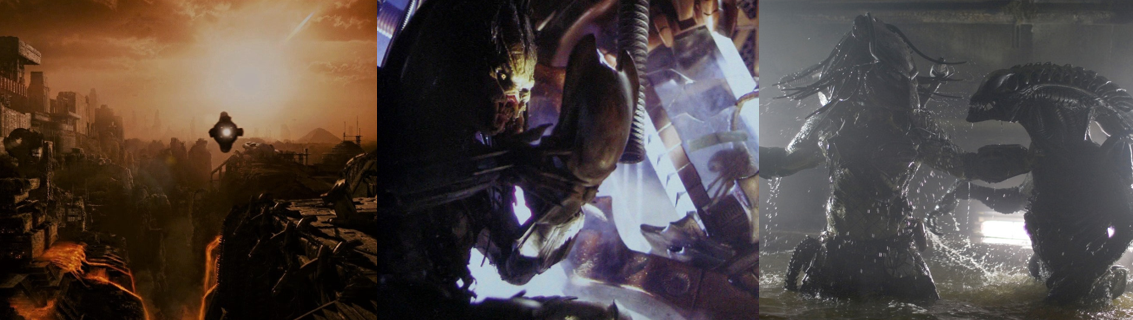
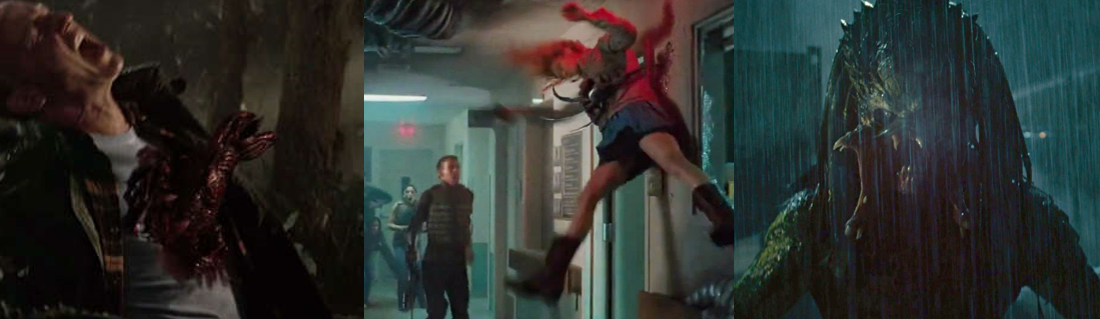
As a big fan of both the Alien and Predator franchises, and of their crossover comic books and videogames, I was left pretty disappointed with the first AVP film. While I believe that the premise of pitting these two iconic extraterrestrial monsters against each other has a lot of potential, and should be a license to print money, the execution of their long-awaited clash fell flat thanks to a by-the-numbers, toothless effort on behalf of all involved. Despite some decent practical effects and an interesting expansion of the Predator lore, the film just played things far too safe and couldn’t live up to either the standards of its predecessors or the expectations set by other meetings between the two. Unfortunately, AVP: R had a bit of a mountain to climb in that regard as many audiences went into it with low expectations after the last film and because it picks up immediately where AVP left off, meaning the entire film beyond the opening sequence is set on then-modern-day Earth. And in the suburbs, no less! While I’ll never agree with the decision to set the conflict between the two creatures on Earth in the mid-2000s rather than in the far future and on another world, at least AVP: R doesn’t shy away from the gore and immediately delivers something new by quickly accelerating the birth of Scar’s (Whyte) progeny and bringing to life a truly gruesome Alien/Predator hybrid, the Predalien.

Sadly, AVP: R falters with its human characters, who are far too generic to make an impression.

After slaughtering the Predator’s on their shuttle and causing it to crash-land in the forests of Gunnison, Colorado, the Predalien immediately sets about establishing a nest for itself in the sewers under the town, while the ship’s payload of Facehuggers gets to work impregnating the unsuspecting townsfolk…including a little boy, showing that AVP: R really isn’t pulling any punches compared to the last film. One of the things I criticised about the first film was the strength and quality of its cast; however, at least AVP had Colin Salmon and Lance Henricksen to add some gravitas to the proceedings. AVP: R is completely robbed of this benefit, giving us a cast of no-name television actors who struggle to offer any kind of dimension or intrigue to the largely expendable human characters. The film ties to focus itself around Ricky, a normal, everyday high schooler who works a shitty job, is the target of farcical jock-like bullies, and pines after the unreasonably attractive Jesse Salinger (Hager). I guess we’re supposed to like and connect with Ricky because he’s just a regular kid, but he’s basically just every semi-rebellious, resentful teenager you’ve ever seen. While he’s not very appealing by himself, I ironically didn’t mind the relationship between him and his older, far more interesting brother, Dallas. A former convict with a no-nonsense attitude who’s trying to turn his life around, Dallas might be burdened by desperate attempts to make him appealing (he’s a rugged ex-con, he shares his name with Tom Skerritt’s Alien character, he shares an awkward flirtation with Kelly, and he even gets the iconic “Get to the chopper!” line) but at least he demonstrates a brief glimmer of character through his practical, if blunt, solutions to the escalating horror. Kelly is shoehorned into the mandatory “tough female protagonist” role made synonymous with the Alien films by Lieutenant Ellen Ripley (Sigourney Weaver); sadly, like Lex Woods (Sanaa Lathan) before her, Kelly struggles in this role; she’s not nearly dynamic or captivating enough to be a strong female protagonist, despite her being given a layer of vulnerability and maternal appeal in her strained relationship with her young daughter, Molly (Gade). Kelly is barely seen processing the death of her husband, Tim (Sam Trammell), before she’s flirting with ex-cons and blasting shotguns and Xenomorphs and it seems she’s primarily there in a half-hearted attempt to call-back to the far ore memorable Ripley and to have someone in the group who can pilot them to safety in the finale.

Gunnison is caught not just between the Aliens and Predator but the rampage of the monstrous hybrid.

Gunnison is naturally a central focus of the film; the Xenomorphs nest and rampage through the town and its inhabitants are picked off and impregnated by them for the first half of the film, with the town’s homeless and gung-ho hunters particularly suffering in the early going. Law and order is maintained in the town by Sheriff Eddie Morales (John Ortiz), a childhood friend of Dallas’s and former problem child himself who makes efforts to help him get his life back on track but who’s soon overwhelmed by the sudden invasion of bloodthirsty biomechanical monstrosities. Completely out of his depth, Morales calls in the National Guard (who are promptly slaughtered) and desperately radios for military aid; however, he refuses to heed Dallas and Kelly’s advice that Colonel Stevens (Robert Joy) is misleading them with the promise of an air evacuation and therefore dooms himself and his posse, who are so terrified that they’re focused only on escaping rather than using rational thought. Gunnison is also home to some disreputable characters; bullies Dale Collins (David Paetkau), Mark (Matt Ward), and Nick (Michal Suchánek) give Ricky more than his fair share of grief, with Dale beating him in the street for giving him backchat and eyeing up his girl, Jesse. Despite their differences, they’re forced to band together when they’re attack by a Xenomorph in the school pool and hunted through the school corridors, with the bullies soon paying for their misguided machismo. For all the focus AVP: R puts on the mutual attraction between Ricky and Jesse, it’s absolutely brutal when she is unceremoniously cut in half by Wolf’s shuriken-like Smart Disc; her death is so spontaneous that it’s both shocking and amusing and indicates just how much more ruthless AVP: R is compared to its predecessor. However, nowhere is this more evident when the Predalien stalks through a maternity ward at the local hospital, where it uses its proboscis to lay a bunch of Chestbursters into the bellies of the pregnant women in there! While this kind of cruelty may understandable frowned upon by some, I’m actually a big fan of shock value and AVP: R certainly delivers in that regard thanks to being unapologetically gory and violent.

Wolf comes to clean up the Alien infestation and proves to be the film’s most interesting character.

Similar to the last film, and true to the nature of the concept, the Predator takes an active role as an anti-hero throughout the film’s events, however I’d argue that Wolf is such a presence here that he’s almost portrayed as the film’s primary character. After the Predator shuttle crashes and the Facehuggers and Predalien escape into the wild, Wolf picks up the signal (giving us our first live-action glimpse of the Predator home world) and immediately sets out to contain the outbreak. An accomplished hunter and veteran, Wolf is far more capable and experienced compared to the rookies seen in the last film; carrying the acid scars on his face and missing a mandible, Wolf is portrayed as something of a “cleaner” and damage control for unwanted or unsanctioned Xenomorph infestations, but comes across more like a detective in his investigation of the crash site, which sees him arm himself with two shoulder cannons, and his meticulous destruction of all traces of either species using a corrosive blue goop. Though largely surreptitious and focused on this mission, Wolf does stray to partake in a little hunting, recreating scenes from Predator when interrupted by the Gunnison search party in the  forest (actually skinning his victims rather than just stringing them up as in the last film) and bringing undue attention to himself by causing a blackout when picking off Xenomorph’s at the town power plant. However, humans are of little interest to this Predator, meaning we’re thankfully spared any awkward and cheesy team ups between Wolf and Dallas; indeed, Wolf is largely nonplussed when the townsfolk get caught in the crossfire between him and his prey and he’s perfectly happy to blast their heads off if it means containing the outbreak. Sporting all the tried-and-true weapons and tactics associated with the alien hunter, Wolfe is given the tactical and technological edge that the humans sorely lack; he can view multiple spectrums and review recorded footage from his fallen comrades using his helmet, has all the tools and toys of his predecessors (but with two shoulder cannons), and is far more adept at dealing with Xenomorphs than any other Predator we’ve seen before.

Led by the grotesque Predalien, the Xenomorphs swarm through the sleepy, unassuming town.

As before, the Xenomorphs are portrayed as being more stereotypically and recognisably “bad” compared to Wolf, who’s firmly entrenched as a bad-ass anti-hero. Alien acid severs limbs and melts faces, and Facehuggers and scurrying to the sewers to set up a nest. The fully-grown Xenomorphs seem largely unfazed at their urban settings, easily skulking through town in the dead of night to pick off victims and being framed in a suffocating, near constant darkness that really helps to add to their terror (when you can actually see them, that is). In a nice change of pace, AVP: R doesn’t rely on the cliché of a Xenomorph Queen and instead has the creatures directed by a far more mobile and altogether more versatile and horrifying alpha, the Predalien. A hulking, drooling nightmarish mish-mash of Alien and Predator biology, the Predalien is framed very much like the original Xenomorph drone (Bolaji Badejo) and a figure of disgusting, uncomfortable sexually-charged horror rather than some disposable, squealing drone. Although I often think of the Predalien as being a masculine counterpart to the Alien Queen, it’s actually an asexual creature, able to impregnate multiple Chestbursters directly into a host using its proboscis. Not only does the Predalien sport the mandibles and dreadlocks of a Predator but it also rips the spines out of its prey much like the alien hunter; seen as an abomination by Wolf, the two have a deep-rooted instinctual hatred of one another and their inevitable conflict is so brutal that it would be a fight to the death even without the impending threat of nuclear destruction.

The Nitty-Gritty:
AVP: R tends to get a bad name primarily because of its poor lighting; when I went to see it in the cinema, I don’t remember it being that dark or difficult to make out what’s happening but it’s hard to deny that sections of the film are all-but impossible to see since they’re bathed in a pitch-black darkness. On the one hand, I don’t actually mind this; it recalls the dark atmospheric horror of the first Alien film and returns these creatures to their roots as frightening monsters rather than lessening their threat through over exposure, however I think the Brothers Strause went a little too far into the dark, perhaps in an attempt to keep the film from upsetting the censors by adding unnecessary monster horror to its gore, swearing, and violence. Fiddling with your TV settings and the lighting in your home can improve things, for sure, but it’s a shame that so much of the film, suits, and brutality is lost to this impenetrable blackness. Unlike the last film, AVP: R is unapologetically R-rated; characters swear throughout the film and blood and gore are far more prevalent, bringing the film more in line with the standards set by previous entries in the series. As alluded to, this also can be taken as a detriment as the Brothers Strause go super dark by having Chestbursters burst out of children and pregnant women, but these films have always had some uncomfortable gory scenes and I’m certainly not going to complain about this considering how toothless the first AVP film was. I also have to commend the Brothers Strause for their clear affection for the source material; this is evident right from the start, where the film’s credits are a mixture of both franchise’s fonts and the ambient sound is a mash-up of the classic motion tracker beeping and the Predator’s thermal vision, and the amalgamation of the franchises continues to be felt throughout the film in Brian Tyler’s score.

The increased focus on gore and recreating both franchise’s atmospheres is very much appreciated.

As ever, the main appeal of the film are the practical effects used to bring both species to life; again, this is why the low lighting is such a drawback as the Aliens finally include their most memorable design (the rigged skull variant from the second film) and we never really get a decent look at the Predalien thanks to the all-encompassing darkness and wash of rain throughout the movie. Still, the suits, puppets, and animatronics are as good as they’ve ever been and sometimes benefit from the darkness; Wolf sticks very closely to the classic Predator look defined in the first two films, though with a more visually interesting helmet and sporting the battle scars of his many hunts. The cloaking effect is much improved this time around, as are the CGI blasts used to represent his shoulder cannon projectiles, both of which harken back to the first two films and Wolf even uses the trajectory tracking system seen in the first Predator. Best of all, his face more resembles the classic Stan Winston design rather than the butt-ugly travesty we saw in AVP, and we get an all-too-brief glimpse of the Predator home world, a searing hot planet of ancient pyramids and structures that just cries out to be revisited in more detail some time, and the additional toys Wolf gets to play with. Wolf has the spear and the gauntlets but also has little mapping devices that double as laser traps he to cover his back and cut down any Xenomorphs, he can charge up his gauntlet to burst through solid concrete, has a slick razor-sharp whip, and he’s also easily powerful and adept enough to hold multiple Xenomorphs off at once. The Aliens not only have their signature squeal, but we also get to see them feeding on human brains; they’re also slimier and more grotesque than ever, though none more so than the Predalien. This thing is absolutely abhorrent to look at, drooling and stomping about with a real weight. In many ways, it reminds me of the Newborn (Tom Woodruff Jr./Joan La Barbara/Archie Hahn) in that it’s an even more monstrous variant of one of cinema’s classic creatures, though the Predalien enforces its will far more aggressively than the Queen, striking Xenomorphs when they try to eat or act before it and slashing at its victims with its huge claw-like hands and prehensile tail.

Sadly, the brawl is interrupted by a nuke that kills the town and puts an end to the alien threat.

Many of the human survivors are whittled down in their efforts to arm themselves thanks to Wolf using them as bait and picking them off simply for being armed; the National Guard and absolutely massacred by the Xenomorphs as well, and the remaining survivors split up after disagreeing about Colonel Steven’s evacuation plan. Colonel Stevens directs the survivors to the centre of town on the pretence of an evacuation but it’s actually to ensure that the Aliens all congregate on ground zero of his tactical nuclear strike, which obliterates the entire town and all traces of the alien infestation save for Wolf’s shoulder blaster. Before the town is destroyed, however, Dallas, Kelly, Molly, and a wounded Ricky fight their way to the roof of the town hospital (which has been partially converted into a horrific Alien nest) to get to the helicopter and escape the incoming blast in tense scenes awash in darkness and flickering lights that recall Ripley’s desperate last-minute escapes as much as Kelly’s drive through the wrecked streets calls back to Ripley’s rescue of the Colonial Marines in their armoured transports. Barely able to fend off the skulking Xenomorphs with their weapons, Dallas covers their escape by wielding Wolf’s repurposed shoulder cannon, but ultimately it comes down to a one-on-one, hand-to-hand slugfest between Wolf and the Predalien. This takes place on the rooftop of the hospital, in the dead of night, and amidst a torrential downpour with their destruction an inarguable guarantee since we know Stevens has a missile inbound. And yet, as in the last film, actually seeing the Predator go at it with the Aliens and that horrific hybrid are the highlight of the film despite the low lighting; overpowered by the Predalien and ready to fight to the death, Wolf discards his weapons and battles his rival in a test of strength that sees him rip out its inner mouth, stab it through the head, and be left impaling on its spear-like tail. Unfortunately, Wolf is incinerated along with his foe and the entire town by Stevens’ missile; although our human protagonists escape, the shockwave causes their helicopter to crash and they’re apprehended by military police shortly afterwards. In the aftermath, Colonel Stevens recovers Wolf’s damage cannon from Dallas and presents it to Ms. Yutani (Françoise Yip) of the Yutani Corporation, awkwardly implying that they were somehow able to reverse-engineer enough technology from this one weapon to eventually become a universe-spanning colonising force alongside the Weyland Industries some two-hundred years in the future.

The Summary:
I’m a firm believer that AVPR: Aliens vs. Predator – Requiem isn’t as bad as people make it out to be, but also that it still has plenty of undeniable flaws that keep it from being classified as under-rated and which also make me hesitate to rate it much higher. I’ve always enjoyed that the film veers back to the horror atmosphere that popularised each franchise; the swearing, blood, gore, and shocking violence all make quite an impact and make this film the extreme other end of the spectrum compared to the first AVP movie. I also enjoy Wolf’s character and presence throughout the film; in many ways, I almost wish that we’d followed him more as he’s far more interesting a character than any of the disposable humans, but I would be surprised if we ever saw something like that in a live-action movie. I also really enjoyed the Prealien; as much as I love the Xenomorph Queen, she’s very played out and it’s nice when the franchise uses a similar concept but in a different, uniquely grotesque way and the Predalien is such a striking character design and vicious concept that it really helps to up the ante in a more visceral way. In these regards, AVP: R is worlds better than its predecessor; the tone, presentation, and atmosphere are far more in line with what I expect from each franchise and I would choose to watch this one out of the two on any day of the week…but sadly it’s still a mess of a movie. The film’s just way too dark, there’s no denying it; some scenes are just a blank screen of darkness with the vaguest hint of movement and the sounds of gnashing, slobbering teeth, and the impressive practical effects are almost entirely lost in this death shroud. Furthermore, the characters and setting are just awful; an urban environment might be something different from the franchise but a present-day setting just doesn’t work for this concept and the lack of any strong, recognisable faces and human protagonists means it’s almost impossible to give a damn when they’re in danger or die. Overall, this was a step in the right direction in many ways but the execution again fell short of the mark; it’s a shame that we probably won’t see a proper Aliens versus Predator film set in space and in the future and that we’re left with these two largely disappointing live-action adaptations as the premise has so much potential but the studio clearly didn’t have faith to put the money and effort behind it so we’re left with these sub-par efforts that really could’ve, and should’ve, been much better.

My Rating:

Rating: 3 out of 5.

Pretty Good

Are you a fan of AVPR: Aliens vs. Predator – Requiem? How do you think it compares to the first film and other films in each franchise? Were you disappointed that it continued the modern-day setting? Did the poor lighting and shock value of the gore and horror bother you? Which of the humans was your favourite? What did you think to Wolf and his mission to erase all traces of the Aliens? Were you a fan of the Prealien or do you find it to be a little too unrealistic? Which of the Aliens vs. Predator stories or adaptations was your favourite? Would you like to see the two cross paths again in some form or another? Whatever you think about Alien vs. Predator, leave a comment down below or share your thoughts on my social media.

Movie Night [Robin Month]: Teen Titans Go! To the Movies


In April of 1940, about a year after the debut of arguably their most popular character, Bruce Wayne/Batman, DC Comics debuted “the sensational find of [that year]”, Dick Grayson/Robin. Since then, Batman’s pixie-boots-wearing partner has changed outfits and a number of different characters have assumed the mantle as the Dynamic Duo of Batman and Robin have become an iconic staple of DC Comics. Considering my fondness for the character and those who assumed the mantle over the years, what better way to celebrate this dynamic debut than to dedicate every Thursday of April to celebrating the character?


Released: 27 July 2018
Director: Peter Rida Michail and Aaron Horvath
Distributor: Warner Bros. Pictures
Budget: $10 million
Stars: Scott Menville, Hynden Walch, Khary Payton, Tara Strong, Greg Cipes, Will Arnett, Kristen Bell, and Nicolas Cage

The Plot:
Determined to be a Hollywood star, Dick Grayson/Robin (Menville) will go to any lengths to impress director Jade Wilson (Bell) to notice him and his team! With a few madcap ideas and musical numbers, the Teen Titans try to take the limelight, but when Slade Wilson/Deathstroke the Terminator (Arnett) messes with their plans, the Teen Titans will have to become true superheroes to save the world!

The Background:
About four years after the debut of the Justice League of America (JLA), their teen sidekicks came together to form the Teen Titans, presumably to appeal to younger readers. The team were a relatively consistent presence throughout the 1960s and 1970s but writer Marv Wolfman and George Pérez breathed new life into the concept with characters like Victor Stone/Cyborg and Princess Koriand’r/Starfire, who became synonymous with the team. No strangers to adaptation, the Teen Titans have seen some success in animated ventures; Teen Titans (2003 to 2006) was widely regarded as a popular spin-off of the incredibly well-regarded animated series pioneered by Bruce Timm and Paul Dini. Many long-term fans were therefore put off when the show was retooled into a more kid-friendly aesthetic with the slapstick Teen Titans Go! (2013 to 2022), though many praised the show for its bizarre nature and light-hearted humour. Additionally, the show was popular enough to spawn this feature-length production; universally praised for its metatextual comedy, its gleeful destruction of superhero tropes, and its unhinged comedy, Teen Titans Go! To the Movies also gave finally star Nicolas Cage the chance to portray Clark Kent/Superman after missing out on a live-action appearance in the nineties. With a box office gross of $52.1 million, the film was followed by a reasonably well received straight-to-DVD crossover between the Go! Titans and their more serious predecessors, as well as a couple of other similar features of varying quality.

The Review:
So, like a lot of kids my age, I watched a fair amount of Bruce Timm and Paul Dini’s DC cartoons back in the day; even into my late teenage years, I was enjoying Justice League Unlimited (2004 to 2006), and I really enjoyed the original Teen Titans cartoon. Although never explicitly stated to be a part of the same fictional universe, I always liked to think that Teen Titans was a spin-off from the main DC Animated Universe and I loved how it gave a bit of a gritty edge and a commanding presence to one of my favourite characters, Robin, and allowed him to be in the spotlight in a world where he’s often given the shaft in live-action movies. I’d be lying if seeing Teen Titans Go! for the first time wasn’t a little off-putting for me in this regard; however, it was clearly aimed at a younger audience and I found it to be quite funny the few times I did watch it, the same as Batman: The Brave and the Bold (2008 to 2011), which showcased a more light-hearted version of the Dark Knight but in a fun and action-packed way. There is room for both interpretations of these characters, as much as I prefer the darker interpretations as they’re truer to the original spirit of Batman and his world, and it’s not as if there weren’t other animated ventures that showcased this side of the likes of Batman and Robin, so it was still pretty exciting when a feature-length presentation was announced, especially as it aimed to poke fun at Warner Bros.’ tumultuous history with cashing in on their DC Comics franchises.

The happy-go-lucky Titans are distraught to learn the public and their peers see them as bumbling fools.

Things get off to a loud and action-packed start as Jump City is attacked by the megalomaniacal supervillain known as Balloon Man (Greg Davies), a ludicrous character who is quite literally a gigantic, anthropomorphic balloon who can easily smash his way into a bank and squeeze through small gaps by expanding and contracting his bulbous body. Although Jump City’s police are no match for the inflated villain, the Teen Titans soon arrive to help out; what follows is a fight scene, set to an electric guitar remix of the Teen Titans Go! main theme, that helps to establish the characters and abilities of the titular team for those who are unfamiliar. Robin is the leader, jumping head-first into the fight and partially tearing Balloon Man’s hide with his shuriken; Cyborg (Payton) is the enthusiastic muscle, able to transform his body into all kinds of heavy ordinance; Starfire (Walch) is a naïve, childlike misfit from another world who wields incredible cosmic power but is easily distracted by cute things; Rachel Roth/Raven (Strong) is the dark, stoic enchantress capable of manipulating others and creating constructs out of a black magical energy; and Garfield “Gar” Logan/Beast Boy (Cipes) is the team’s goofball shape-shifter, who delights in monkeying around and transforming into a range of green-hued animals (including becoming a porcupine to pierce Balloon Man’s butt for an extended fart gag). So consumed by their own hype are the team that they completely miss that the Justice League – Superman (Cage), Diana Prince/Wonder Woman (Halsey), and Jon Stewart/Green Lantern (Lil Yachty) – take out Balloon Man and are saddened to learn that both the public, and the superhero community, see them as a team of goofballs rather than “real” superheroes worthy of their own movies. Despite the fact that people “don’t talk” about Green Lantern’s movie, Superman advises the team that they’ll never be seen as anything other than a joke unless they shape up and start acting like real heroes rather than goofing off for food and dance numbers. Despite the evidence lobbied against them, Robin is adamant that he and his friends are not only world-renowned heroes but worthy of their own movie; it’s been his lifelong dream to have his own movie franchise, after all, and he’s determined to prove that he’s worthy of this accolade.

Robin’s so determined to get his own movie that he briefly messes up with the timeline.

Unfortunately, he and his friends are aghast to learn that they’re not on the list to attend the premiere of Batman’s (Jimmy Kimmel) newest film, and even more insulted when the Challengers of the Unknown, of all people, are more known than they are. Thanks to Raven’s ability to teleport them using her extradimensional portals, the team are able to gate crash the screening and steal the Challengers’ seats, introducing them to beloved superhero movie director Jade Wilson. Robin is dejected to see first-hand that he’s not only not slated to appear in a movie, but that the entire superhero community laughs him off as simply a sidekick and a nobody. After dispelling Robin’s depression with a musical number, the team head to Warner Bros. Studios in Hollywood, determined to demand that they get their own movie from Jade. Unfortunately, she’s not interested in the prospect of a solo Robin movie and states that she would only consider it if there were no other superheroes in the world, a dismissive comment that gives him the outrageous idea to travel through time to prevent the world’s superheroes from ever coming into being using their time cycles (because their regular time machine is too “boring”). Thus, the team prevents Krypton’s destruction (using disco-synth, no less), stealing Wonder Woman’s magical lasso when she’s just a girl, cause Arthur Curry/Aquaman (Eric Bauza) to get caught up in trash and drown as a baby, prevent four turtles from coming into contact with radioactive ooze, and redirect Thomas, Martha, and young Bruce Wayne (Kal-El Cage) from going down Crime Alley. As you might expect, this results in the world being overrun by supervillains in the present day and therefore no superhero movies being produced, so the Teen Titans immediately travel back to undo their efforts…resulting in them being directly responsible for Krypton’s destruction and gleefully pushing Thomas and Martha Wayne to their deaths with a smile and a thumbs-up!

Slade’s master plan to control the world brings him into conflict with the Teen Titans.

Since rewriting the space/time continuum did nothing to improve their standing in the superhero community, the Teen Titans resolve to prove themselves the old-fashioned way. Earlier, the others suggested to Robin that they’re not taken seriously because they lack a cool archnemesis with an ominous name and they attempt to address this by confronting Deathstroke (as ever referred to simply as “Slade”) as he steals “the perfect plot device”, the Ditronium Crystal, from Scientific and Technological Advanced Research Laboratories (S.T.A.R. Labs). A bombastic villain who mocks the Teen Titans pose and easily tricks them with simple illusions and distractions, Slade is nonetheless fully capable of holding the team off using only his skill, weapons, and vast array of gadgets. Still, by taking themselves seriously, the team is able to retrieve the crystal on their second encounter, but Slade easily escapes by preying on Robin’s ego and painting himself as his archnemesis. Incensed at their interference, Slade vows to divide the team to take away their greatest advantage, something made considerably easier when jade summons the team to Warner Bros. Studios, impressed by their fight, to start shooting their movie. However, when the others embarrass him by repeatedly pooping in a prop toilet, attacking their co-star and subduing Superman with Kryptonite, causing havoc, and almost destroying her Digitally Ordering Online Movies Streaming Directly At You (D.O.O.M.S.D.A.Y.) Device (Phil Morris), Robin angrily ditches his friends in order to have his own solo movie and shake the stigma of their idiocy from his character. Heartbroken at his decision, especially after they supported his dream all throughout the movie, the team leave him to indulge his greatest fantasies on the set of his very own movie, finally bringing him the adulation he has craved for so long, though all the digital enhancements and action sequences in the world can’t make up for the loss of his friends.

The Nitty-Gritty:
I gather there are a lot of people who dislike the art and animation style of shows like Teen Titans Go!; many comparisons are made to the likes of Steven Universe (2013 to 2019), though I’m not sure why that’s a bad thing as, while I’ve never watched it, I always thought the show was quite popular. Again, it’s potentially because of the nostalgia and love for Timm and Dini’s traditionally dark and moody visual style, and the anime influences seen in the original Teen Titans, but I thought the change in visual direction was a great way to immediately show that Teen Titans Go! is aimed at a completely different audience to its predecessor, and enjoyed the presentation because it, like some of the line-towing humour, reminded me of The Ren & Stimpy Show (1991 to 1996; 2003). Jump City is a bright maze of skyscrapers and beaches, its inhabitants all sport comically oversized heads and cartoonish proportions, and much of the allure of the movie’s visual style comes from the short, sharp movements characters make that remind me of traditional animation techniques such those using construction paper. The movie’s tongue-in-cheek approach is also evident right from the start, as DC’s heroes are chibi-fied in the opening credits to fit with the show’s more exaggerated art style; the movie even appears to ape the traditional Marvel Studios opening by rapidly flicking through pages of Teen Titans comics, only to subvert expectations and show that it’s simply a seagull flicking through a comic book! In this cartoonish world, the DC superheroes are such huge celebrities that they have their own merchandise and movie franchises, just like in the real world, with even the grim Dark Knight playing up to the paparazzi at the premiere of his new film, Batman Again, and heroes like Kara Zor-El/Supergirl (Meredith Salenger) and even Doctor Raymond “Ray” Palmer/The Atom (Patton Oswold) being treated as Hollywood starlets.

The movie is jam packed with references, cameos, and fun musical numbers.

This is taken to the nth level when we see just how many superheroes are being given feature-films and the lengths to which Hollywood is going to milk Batman’s popularity with movies about his loyal butler, Alfred Pennyworth, his high-tech vehicle, the Batmobile, and even his utility belt! Although a hilarious gag at the time, and with some basis in truth given how much Batman content had been produced by 2018, this lands even harder now considering Alfred received his own live-action television series and we even got a Cars-like (Various, 2006 to 2022) Batmobile cartoon! Even the D.O.O.M.S.D.A.Y. Device is a precursor to the stranglehold over the genre that Marvel Studios would get with the onset of Disney+, making the film scarily ahead of its time in its metacommentary. The film also stands out with its fourth-wall-breaking humour; this includes jabs not only at existing DC properties, but also gags like the Teen Titans mistaken Slade for Wade W. Wilson/Deadpool, a parody of the iconic opening of The Lion King (Allers and Minkoff, 1994), references to one of my favourite cartoons, Animaniacs (1993 to 1998; 2020 to present), Superman (Donner, 1978) and the Tim Burton Batman movies (1989; 1992), and the Back to the Future trilogy (Zemeckis, 1985 to 1990), a gratuitous and self-referential cameo by Stan Lee himself, a fantastic jab at the whole “Martha!” debacle during the filming of Batman vs. Superman: Part II by having the two come to blows because their fathers have different names, and having Robin’s team mates embarrass him when they kick the crap out of Shia LaBeouf (James Arnold Taylor). Musical numbers also play a huge role here; we get our first taste of this when Balloon Man insults and shocks the group by claiming not to know who they are (he thinks they’re “lesser members” of the Justice League of the Guardians of the Galaxy), leading to them performing a rap number running down their names, powers, and a bit of their background (“GO!”). Unfortunately, they get so wrapped up in their singing and dancing that they’re completely upstaged by the Justice League. Struggling with his sense of self-worth and disheartened at being mocked by everyone, even the team’s adorable hand-crafted movie fails to cheer Robin up; it takes an amusingly generic “upbeat, inspirational song” to reignite Robin’s spark and renew his enthusiasm (“Upbeat Inspirational Song About Life”). Additionally, Robin’s able to describe his perfect solo superhero through song, resulting in a montage and homages to Batman: The Dark Knight Returns (Miller, et al, 1986),  Batman: The Animated Series (1992 to 1995) specifically designed to emphasise Robin’s competency, cute butt, and totally adult hands (“My Superhero Movie”). When the Teen Titans travel through time to take out their competition, the sequence is brilliantly set to A-ha’s “Take On Me” and Huey Lewis and the News’s “Back in Time”, they play Krypton’s crystals like a DJ deck to prevent the decidedly Donner-esque planet from exploding, and Cyborg, Starfire, Raven, and Beast Boy get themselves kicked out of their own movie by pulling pranks all over the Warner Bros. Studio (“Shenanigans”).

In the end, the Titans come together to defeat Slade and earn the respect of their superhero peers.

Robin is so caught up in finally getting his time in the spotlight, away from the shadow of the Batman and the goofiness of his teammates, that he doesn’t even question Jade’s motivations or inputting the code to the vault as part of his movie’s finale. All too late, he realises that he’s been tricked into opening the actual vault and that Jade has been Slade in disguise all along in a surprising, and amusing, twist. Thanks to his manipulations as Jade, Slade has effectively subdued the Justice League by distracting them with their movies, leaving him free to steal the Ditronium Crystal, insert it into the D.O.O.M.S.D.A.Y. Device, and control the minds of the world’s populace as part of a diabolical scheme for world domination. Thanks to his baby hands and Bat-gadgets, Robin is able to escape the exploding Titans Tower; seeing his home and his friends’ possessions go up in smoke makes him realise how selfish and foolish he’s been but his friends enthusiastically return to his side to aid him in stopping the broadcast of Robin: The Movie to prevent Slade’s plans from coming to fruition. After unmasking Slade before their superhero peers, the Teen Titans are forced to battle the Justice League when Slade uses the D.O.O.M.S.D.A.Y. Device to turn them into his mindless slaves; thanks to a golf cart and Raven’s portal abilities, they’re able to take the Justice League out of the equation but, when Robin engages Slade in a one-on-one fight, Robin’s unable to resist watching footage of his film and is compelled to attack his friends. Robin’s brought to his senses when forced to watch the remainder of the homemade film the Titans made for him, reuniting the team in friendship just in time to battle Slade’s ridiculously oversized robot! Although Slade mocks them and boasts at his invincibility, Robin realises that their greatest asset is their goofball antics and they’re able to take out Slade’s robot using another of their dope songs (“GO! (Battle Remix)”) and an overwhelming combination of their unique powers and abilities. With the world freed from Slade’s control, the Ditronium Crystal destroyed, and Slade defeated, the Teen Titans finally earn the approval and respect of their peers, though Robin’s denied the chance to deliver a meaningful speech as everyone else insists that the movie’s over.

The Summary:
Teen Titans Go! To the Movies is a ridiculously over the top, slapstick romp in this exaggerated and cartoonish spin-off of the darker DC Animated Universe. Everything from the visuals, the gags, and the action is designed to appeal to younger audiences, ones who will delight at the instances of toilet humour and the fun music numbers, yet there’s a fair amount here for older audiences to enjoy as well. From cameos, references to other movies and DC properties, and some surprisingly dark inclusions that might go over the heads of little kids but had my spitting out my drink at times. The overriding narrative of the Teen Titans trying to earn respect for being superheroes is done pretty well, and wisely focuses on Robin’s obsession with being seen as more than a sidekick and worthy of his own movie, though the film doesn’t dwell too much on the wedge this causes between him and his friends. Similarly, the time travel side plot was primarily there as a gag, a funny one to be sure but one immediately undone to focus on the campaign against Slade. I would’ve liked to see the Teen Titans realise their worth in a world without the other superheroes, but it was fun seeing Slade mock them and wipe the floor with them and be revealed to have been disguised as Jade all along. While there isn’t much here for the other Teen Titans to do beyond be goofy, say their catchphrases, and sing and fight alongside Robin, the metacommentary on the influx of superhero movies was amusing and I found myself thoroughgoingly entertained through the film. I always enjoy it when animated movies sprinkle their narratives with little Easter Eggs for adults to enjoy and Teen Titans Go! To the Movies certainly succeeds in this regard, and with including some genuinely funny gags that keep the energy high, resulting in a very enjoyable animated romp.

My Rating:

Rating: 4 out of 5.

Great Stuff

Did you enjoy Teen Titans Go! To the Movies? Were you a fan of the cartoon or did the move towards slapstick put you off? Which member of the team was your favourite and what did you think to Robin’s desire to be taken seriously as a superhero? Did you enjoy the musical numbers and the sprinklings of dark humour laced throughout? What s your favourite incarnation of the Teen Titans? Who is your favourite Robin and how are you celebrating the Boy Wonder’s debut this month? Whatever your thoughts on this film, Teen Titans, and Robin, leave a comment either below or on my social media.

Movie Night [Crossover Crisis]: AVP: Alien vs. Predator: Extreme Edition


In April 1985, the first issue of the ground-breaking Crisis on Infinite Earths (Wolfman, et al, 1986) released and saw the temporary destruction of the “Multiverse”. To celebrate this momentous event, I’m discussing multiversal crossovers all throughout April in an event I dubbed “Crossover Crisis”.


Released: 7 March 2005
Originally Released: 12 August 2004
Director: Paul W. S. Anderson
Distributor:
20th Century Fox
Budget: $60 to 70 million
Stars:
Sanaa Lathan, Raoul Bova, Colin Salmon, Ewen Bremner, Ian Whyte, Tom Woodruff Jr., and Lance Henriksen

The Plot:
When sickly, wealthy industrialist Charles Weyland (Henriksen) discovers a pyramid buried in Antarctica, he coerces experienced guide Alexa “Lex” Woods (Lathan) to lead a team of scientists, mercenaries, and archaeologists to investigate. However, they soon find themselves caught in a war as three Predators (Whyte) seek to prove their worth against the ferocious Xenomorphs (Woodruff Jr.), whom they breed within the ancient structure.

The Background:
The concept of Aliens vs. Predator originated in the pages of Dark Horse Comics; founded in 1980 by Mike Richardson, Dark Horse Comics stood out from its competition by by primarily publishing creator-owned titles and achieved mainstream success with its licensed adaptations of horror and science-fiction films, such as the original meeting of these two icons in a three-issue short story, courtesy of writer Chris Warner, which was then followed by multiple follow-ups, action figures, and videogames. Although it appears that plans for a live-action adaptation can be traced back to the late-nineties, these were paused to focus on Alien Resurrection (Jeunet, 1997) and, despite director James Cameron and actor Sigourney Weaver openly criticising the idea of diluting both creatures with a crossover, with director Paul W. S. Anderson spearheading the production after pursuing the project for eight years and winning over the studio with his pitch. While the comic books were set in the future like the Alien films (Various, 1977 to present), AVP was set in the then-modern day, but Anderson strived to maintain continuity by setting the film in the wilderness of Antarctica. Anderson’s focus on continuity and paying homage to the existing franchise compelled him to bring star Lance Henriksen back to play an ancestor of the Bishop seen in previous films, though star Arnold Schwarzenegger was unable to make an appearance. Amalgamated Dynamics Incorporated (ADI), who had worked on the last two Alien films, created AVP’s special effects, which focused on practical suits as often as possible, which led to ADI re-using many of the suits and animatronics from the previous movies. Although Alien vs. Predator eventually grossed over $177 million at the box office, it was met with overwhelmingly negative reviews; while some found it to be an enjoyably dumb action/horror flick, others saw it as a boring film filled with one-dimensional characters and lacking in either franchise’s trademark gore. The box office was clearly enough to convince the studio to push forward with a sequel, however, and, prior to that film’s release, this “Extreme Edition” of AVP was released on home video and contained a few extended scenes for home audiences.

The Review:
In all honesty, AVP was off to a bad start in my book right away with its rating; while it’s possible to have violent, gory, and sweary 15-rated films, scary monsters and subject matter need to be factored into the equation, meaning AVP lacks not only the iconic soundtracks from its forefathers but also completely wastes its one f-bomb and denies us the signature “Ugly motherfucker” line. This method of playing things way too safe extends to the film’s setting, which, unlike the comic books and videogames, takes place on then-present-day Earth, a decision that works for the Predator narrative but somewhat conflicted with the Alien timeline as we know it back then. It tries to get around this by having the bulk of the plot take place in secluded Antarctica, but it just doesn’t work for me. I feel like the simplest solution would’ve been to set it in the future, perhaps between the second and third Alien film, and have it take place on a remote ice world; you replace Weyland’s mercenaries with renegade Colonial Marines, splice in a bit more of the malevolent designs of his corporation, and maybe throw in an android (Maxwell Stafford (Salmon) would be my pick) and you’d already be on a better path than shoehorning Xenomorphs onto Earth long before their existence was discovered. Instead, we get the briefest tease of a space-based film before a Weyland satellite picks up an unexplained heat flare at a whaling station way down South and then we’re meeting Weyland’s recruits for an expedition to investigate. Just when you feel you can accept the setting presented, AVP immediately throws a few idiotic decisions at you within the first five minutes; Lex is supposed to be this experienced Arctic explorer and yet she’s climbing up a mountain without any face coverings and she somehow failed to hear Stafford’s helicopter land above her. Later, she even rushes out in the dark, bitterly cold temperatures of the whaling station in little more than a body suit, surely inviting hypothermia despite the scattered fires, but these are the least of AVP’s problems.

Lex and Sebastian are stuck between an age-old conflict between two alien races.

Lex is the best at what she does; she’s climbed everything and is highly recommended, so naturally Weyland seeks her out the lead his expedition. A hardened veteran of numerous climbs, Lex believes in being prepared; she’s far from intimidated or impressed by Weyland’s wealth or Stafford’s guns and balks at the idea of heading to the site without proper training or preparation. In fact, she chooses to abandon the expedition entirely when the two ignore her warnings and is only convinced to stay when archaeologist Professor Sebastian De Rosa (Bova) and chemical engineer Doctor Graeme Miller (Bremner) point out that they spend a better chance of surviving with her there and without her and, once they reach the site, she’s quick to enforce her rules to ensure their survival no mater how much it irks Stafford. There’s a subtle romantic tension between Lex and Sebastian, but thankfully it’s not dwelled upon all that much; a down on his luck digger who’s just about ran out of money for his excavations, he jumps at the chance to be a part of Weyland’s team and his expertise is invaluable first in recognising that the pyramid contains elements of Cambodian, Egyptian, and Aztec structures and, later, in translating the hieroglyphics contained within, though his warnings go unheeded by Weyland’s gung-ho mercenaries. Against his better judgement, Sebastian is left with no choice but to go along with Lex’s plan to side (or, at least, appease) the Predators since their true targets are the Xenomorphs infesting the pyramid; her entire character is built around survival, by any means necessary, while he’s more inclined towards braving the odds to find a way out. While I never for a second believed they had any chemistry, it was still a sad moment when Lex was forced to mercy kill him rather than let him suffer the agony of a Chestburster, but I can’t help but feel like this would’ve landed better if there’d been less disposable mercenaries and more time spent on developing their characters and interactions (and a better script…and a couple of better actors to boot…) Miller is primarily part of the group to be the somewhat awkward, likeable everyman who we will feel sorry for when he inevitably falls victim to the extraterrestrial menaces within the pyramid; you know he’s destined for a bad ending the moment he whips out pictures of his kids and, while he lasts a fair amount of time, this eventually comes to pass when he’s cocooned up for a Facehugger buffet.

Stafford and Weyland just about manage to stand out against a bunch of forgettable characters.

Still, at least he shows a bit of character, however cliché, which is a bit more than can be said about most of Weyland’s team; Adele Rousseau (Agathe de La Boulaye) seems like she’s channelling a bit of Private First Class Jenette Vasquez (Jenette Goldstein) in her snarky, non-nonsense attitude but she never even gets the chance to put up a fight and is the first of the team to be imploded from within by a disappointingly bloodless Chestburster. Mark Verheiden (Tommy Flanagan) cuts an intimidating figure with his facial scar and surly demeanour and for a second it seems like him and Miller are going to be to odd couple pairing of the group but then he’s unceremoniously offed in a scene that apes the fate of Captain Dallas (Tom Skerritt). Thankfully, Colin Salmon is on hand to lend some gravitas and presence to the proceedings; Stafford comes across as an arrogant, conceited mercenary who always believes that he’s right and that his weapons and training are more valuable than expert knowledge, but he’s sadly wasted here. It’s fun seeing his icy demeanour crack as the pyramid constantly shifts and changes around him; I also liked that he ends up giving Weyland some backchat after his obsession costs so many lives and that he met a suitably gruesome end, but I can always do with more Colin Salmon in my films and he was criminally underutilised here. That just leaves Charles Bishop Weyland himself; it’s always a blast seeing Lance Henriksen and he really lends a legitimacy to this farce of a film. Although incredibly wealthy, and powerful and influential enough to do almost anything, Weyland can see the end of his life coming and knows that his legacy will only be remembered as a businessman rather than anything tangible. Having witnessed her father die from his obsession with climbing and exploration, she recognises the condition in the deathly ill Weyland and cautions him about pursuing his fixation when he’s physically incapable of taking the strain; however, just as she earns his respect through her expertise, so too does he manage to convince her that he needs to explore the strange pyramid to feel like his life was actually worth something. His need to show that he’s not out of the fight just yet comes to bite him, however, when he angrily confronts the lead Predator (known as “Scar”) and ends up skewered after forcing the alien hunter to recognise him as a threat, thereby becoming one of only two actors to be killed by a Xenomorph, Predator, and a T-800.

With his comrades easily offed, Scar is left to achieve glory in the great hunt.

More than ever, the Predator is naturally a key character in the film; a novice hunter compared to the Predators we’ve seen before, Scar and his comrades – “Chopper” and “Celtic” (both also played by Whyte) – make landfall hoping to prove their mettle by hunting the ultimate prey. The pyramid is thousands of years old and the film very blatantly shows that the Predators were instrumental in the development of the human race; worshipped as Gods and using ancient humanity as slave workers and sacrificial victims to the Xenomorphs, the Predators are recast as being the inspiration for, at the very least, the Egyptian deities of lore. Scar and his comrades might be much bigger and sport shinier armaments but, without the ritual scar that one earns from a Xenomorph kill, they’re far less experienced than their predecessors. Indeed, these rookies don’t even come equipped with their signature shoulder blasters; these weapons are hidden within the pyramid and act as the trigger to set off the automated process that sees their captive Xenomorph Queen literally thawed out and laying eggs ready for the hunt. Still, that’s not to say that they’re completely useless; they sport all the same weaponry and technology as the “City Hunter” (Kevin Peter Hall), meaning they can bend light to appear invisible, have wrist-mounted blades, an extendable lance, an alternative version of the Smart Disc that appears more like a shuriken, and their razor-sharp net. As ever, they’re also afforded the benefits of their helmets, which allows them to see in a variety of spectrums and stalk their prey, but they’re woefully ineffectual against even a single Xenomorph; only Scar proves capable enough to earn his mark and even then he’s impregnated by a Facehugger with a ridiculous amount of ease and essentially a dead Predator walking for the rest of the film.

Lex and Scar team up against a hoard of Aliens led by their enraged Queen.

With all of her comrades dead, Lex is left no choice but to force a team up with Scar, something he’s understandably disinterested in. not only is there an obvious language barrier between the two, there’s also a cultural one; the Predator clearly sees her (and all humans) as little more than cannon fodder and he’s ready to kill her before she impresses him by killing a Xenomorph. Thus, in easily one of the cheesiest scenes in the film, franchise, and all of cinema, Scar cobbles together a weapon and shield for her and the two literally run off into the pyramid to fight their way out. As is often the case in these types of movies, one of the two monsters are cast as being more recognisably “evil” and, in this case, it’s the Xenomorphs. Vicious, brutal, and animalistic in nature, the Xenomorphs are little more than a swarm of near-mindless locusts intent only on killing, feeding, and defending their Queen. Since the Predators are more recognisably humanoid, and obviously have a twisted code of honour of sorts, it makes sense for them to be the more heroic of the two, but Scar is more of an anti-hero and his partnership with Lex is one of convenience more than anything. Also, it can’t be forgotten that the film makes it very explicitly clear that the Predators bred the Xenomorphs using humans and that the film’s entire events happen because they returned to embark on their great hunt, meaning that they’re just as destructive and dangerous as the more voracious Xenomorphs. Although largely interchangeable and disposable, one Xenomorph manages to stay out from the pack after being scarred by the Predator’s net; “Grid” crops up as a recurring threat throughout the film, but is naturally supplanted by the fearsome Alien Queen once she breaks free from her shackles and goes on a rampage for the film’s bombastic finale.

The Nitty-Gritty:
I’m not really sure that this “Extreme Edition” really makes the best use of its rare second chance to improve upon the theatrical release; this version of the film adds a very brief opening sequence showing a cloaked Predator chasing down some poor fool at the whaling station in 1904 but that really doesn’t add a whole hell of a lot to the film. We know the whaling station’s been abandoned, it’s said in the script, and the fact that a fuckin’ Predator pyramid is hidden beneath it kind of heavily implies that the creatures slaughtered whoever was there a hundred-plus years ago so it basically adds nothing except the short thrill of hearing that iconic Predator gurgle within the first two minutes. There’s a little bit ore time spent with some of the characters at the start of the film, none of which really amounts to all that much; we already know Sebastian is struggling for financing and that Verheiden is an asshole, though I did like the clarification that Sebastian was planning to decline and return to his dig with Weyland’s money). The main addition beyond the useless opening is some extra gore courtesy of some CGI blood; it’s not enough to salvage the film or bring it on par with its predecessors, but it helps to add a bit of colour to the proceedings and at least pretend to be an Alien/Predator film. The issue is, however, that there are fundamental missteps with the entire film from a script and concept level; AVP betrays its gory roots in favour of trying to capture a wider audience, reducing both franchises to a mindless action/monster film full of one-dimensional and forgettable characters. Try as she might, Lex is no Lieutenant Ellen Ripley (Sigourney Weaver) and Sanaa Lathan fails to impress as a tough leading lady. Of course, it doesn’t help that characters are constantly just saying the obvious simply to spell out what’s happening and to have something to say; subtlety was never Paul W.S. Anderson’s strong suit but he abandons it entirely for endless diatribes about the nature of the pyramid and its monstrous inhabitants just in case the kids watching can’t keep track of what’s happening.

When the two monsters actually go at it, it’s a pretty impressive and brutal physical affair.

AVP is a strange contradiction; on the one hand, the film is awash with CGI and green screen, shots, with the Predators’ cloaking effects and shoulder cannon being the most egregious, but, on the other hand, it employs traditional practical effects and composite shots. The result is that, for much of the film, the two creatures are brought to life using men in suits; specifically, the Xenomorphs recall (or are perhaps ripped straight from) Alien Resurrection and the Xenomorph Queen is a bigger and more complex animatronic than the original, though I can’t say that I’m a fan of the woeful redesign of the Predator’s face, which somehow looks even worse than the 1987 original thanks to a misguided attempt to make Scar appear more sympathetic. Other missteps can be found when the Predators slaughter the drilling team on the surface; this scene plays out like a rushed and toothless rendition of its predecessors, made all the more obvious by the bodies being strewn up but not skinned. When the two monsters do finally do battle, however, the film largely delivers; the scuffles we do see are primarily suit-on-suit or suit-on-animatronic action, though some odd creative licenses were made regarding the length of the Xenomorph’s tails and the Predators are disappointingly neutered in these conflicts. Chopper is impaled through the back like a loser and, despite Celtic absolutely dominating Grid during their destructive brawl, he ends up being pounced up and having his brains blasted out. Although Scar dispatches of a Xenomorph with a deft skill and earns his mark, even he’s unable to keep himself from being impregnated, though he is able to use his self-destruct device to destroy the pyramid and contain the Xenomorph outbreak in keeping with the traditions of his people. While I’m unimpressed with the digital coat of paint given to the Predator’s technology, it’s the impotent portrayal of the Xenomorphs that really lets this film down; the incubation time of the Chestbursters has been shortened from days or hours to mere minutes and they pop out with barely a splash of blood, and the only time we really see them splattering gore is when they’re spilling the vivid neon green blood of the Predators.

Although Lex earns the clan’s respect, Scar doesn’t make it and gives birth to an even greater threat…

Eventually, of course, Lex is the only human left standing; armed with the gutted skull of a Xenomorph and a modified spear, she accompanies her newfound partner to the exit of the pyramid, with Scar destroying the entire structure but getting injured following a surprise attack by a Xenomorph. Still, the two manage to escape to the surface, burying all evidence behind them and, in a moment of respect, Scar brands Lex with the sacred mark in recognition of her Xenomorph kill (despite the fact that she got lucky, something I’m pretty sure the Predators would’ve acknowledged). However, the Xenomorph Queen somehow escaped the blast to menace them in the film’s finale; here, the Queen is a combination of a massive animatronic, puppetry, and CGI and the result isn’t actually half bad, making for a pretty impressive last few minutes as Scar and Lex desperately try to fight it off with their weaponry. With Scar having lost his shoulder cannon during the escape, the two have to improvise somewhat; Lex takes cover in a frozen bone yard and the remains of the whaling station, which only riles the Queen up more, but Scar is able to impale her through the head with his lance. Unfortunately for the young hunter, Scar is run through from behind just like Weyland’s android counterpart while helping Lex to tangle the Queen up in a water tower; it’s thus Lex who not only delivers the coup de grâce to the rampaging matriarch, sending her plunging to the frigid depths of the ocean, but who is honoured by the Predator Elder (Whyte). Just like in Predator 2 (Hopkins, 1990), a group of Predators decloak before her and grant her a gift for her bravery before departing with Scar’s body, which I have to give props to as any film that actually acknowledges the under-rated Predator 2 gets a nod from me. While Lex’s fate is unknown (there’s a snowmobile nearby so presumably she uses that to get back to civilisation), Scar is taken back aboard the Predator ship and left on a ceremonial alter in reverence to his accomplishments (such as they are)…only for a disgusting little Alien/Predator hybrid Chestburster to emerge from his chest to set up for the sequel…

The Summary:
As a fan of both franchises, and the concept of Aliens Versus Predator, I was pretty disappointed by AVP: Alien vs. Predator. Everything that made the two franchises great has been stripped away and replaced by a by-the-number monster/action flickthat has none of the nuance of the Alien series or the machismo of the Predator films. It comes to something when the comic books are gorier than the movies and I think AVP really let itself and its honestly impressive practical effects down by toning back the violence and blood and slipping in some unnecessary CGI. Although it massively contradicted the mythology we’d seen in the films up until that point; I enjoyed the flashback to the conflict between the Predators and Aliens; I’ve always liked the idea of the Xenomorphs being the ultimate prey and even the idea that the Predators were frequent visitors to Earth has sone legs, I just find it questionable depicted the Aliens being on Earth in 2004. Still, there are still quite a few elements from the Dark Horse Comics here, most notably the Predator using a strung-up Xenomorph Queen to breed their prey and depositing them across the galaxy. Aesthetically, there’s a few noteworthy elements too; I like that the film’s set in the frozen wilderness as I think it’s important to place the Predators in new environments and the dark, claustrophobic corridors of the ever-shifting pyramid recall the atmospheric, oppressive nature of the first and third Alien film. Scar is a notable highlight of the film, for sure, and I did enjoy his brutal throwdown with the Xenomorph Queen and the inclusion of Lance Henricksen, but the overall toothless nature of the film really stops it from being everything it could’ve been. There’s enough here to like if you’re just looking for a mindless monster romp but, as both franchises are capable of so much more, I can’t help but remain disappointed by the end product, especially as it would’ve been so easy to bring it more in line with the standards set by its predecessors.

My Rating:

Rating: 2 out of 5.

Could Be Better

What did you think to the live-action version of Alien vs. Predator? Were you disappointed by the lack of gore, the modern-day setting, and the toothless execution of its titular monsters? Which of the humans was your favourite and what did you think to Lex and her alliance with Scar? What did you think to the alternations made to the Predator lore and the relationship/conflict between the two species? Which of the Aliens vs. Predator stories or adaptations was your favourite? Would you like to see the two battle again in some form or another? Whatever your thoughts on Alien vs. Predator, drop a comment down below or share your thoughts on my social media.

Movie Night [National Anime Day]: Street Fighter II: The Animated Movie


15 April has been designated National Anime Day to celebrate the stylistic genre, which achieved mainstream success thanks to animators like Osamu Tezuka.


Released: 6 August 1994
Director: Gisaburō Sugii
Distributor:
Toei Company
Budget: $6 million
Stars:
Hank Smith, Ted Richards, Mary Briscoe, Donald Lee, Steve Davis, and Phil Matthews

The Plot:
M. Bison (Matthews), the vicious and powerful head of the notorious Shadowlaw syndicate, is brainwashing street fighters across the world to carry out assassinations and has his sights set on Ryu (Smith), a formidable martial artist who bested one of Bison’s lieutenants. When he’s unable to track Ryu down, Bison targets Ryu’s friend and sparring partner, Ken Masters (Richards), and Ryu finds himself joining forces with Captain Guile (Lee) and Interpol agent Chun-Li (Briscoe) in an effort to track down Bison and stop his mad schemes.

The Background:
In 1987, Capcom brought the very first Street Fighter to arcades across the world; conceived of by Takashi Nishiyama, who sought to expand upon the boss fights of Kung-Fu Master (Irem, 1984) and inspired by The Game of Death (Lee, 1972), Street Fighter stood out from other videogames by utilising unique pressure-sensitive pads for its controls but was generally met with widespread criticism for its graphics and gameplay. Undeterred, Capcom chose to develop a sequel that expanded on the alternative, six-button control setup; Street Fighter II: The World Warrior (Capcom, 1991) expanded on everything from its predecessor, from the graphics to the roster of playable characters, and took the world by storm, ushering in an entire sub-genre dedicated to competitive fighting games that only expanded further when the game was bolstered by ports and upgrades. Such was the popularity of Street Fighter II that Capcom began expanding their franchise outside of the videogame industry; Street Fighter II: The Animated Movie was not just the first anime film I ever saw, but also the franchise’s first foray into animation. The slickly animated anime  couldn’t have been more different from the much-maligned live-action adaptation that released in the same year; it became one of the top-grossing films of that year in Japan and is widely regarded as one of the best videogame adaptations ever produced.

The Review:
I have a bit of a confession to make…I’m not actually a massive fan of the Street Fighter franchise. Sure, I researched it and wrote extensively about it for my PhD, but my actual experience with playing the games is quite limited. I grew up playing Street Fighter II on the Amiga, and my version was “cracked” so it had all kinds of helpful cheats to make playing through it a doddle. When I moved on to Super Street Fighter II: The New Challengers (ibid, 1993) and Street Fighter II’: Special Champion Edition (ibid, 1993), I didn’t have the benefit of any cheats so my tactic to just blindly flailing away as Blanka or Ken didn’t really amount to a whole hell of a lot. To this day, I struggle with the franchise, which is so dependent on frame cancels and complex button combos, but I do have an affinity for it and that’s mainly down to the glorious slice of cheese that was the live-action adaptation and this slick, beautiful anime that not only introduced me to the concept of anime but remains, for me, the quintessential Street Fighter II adaptation.

After defeating Sagat, Ryu looks for inner peace while Ken struggles to find a real fight.

Street Fighter II: The Animated Movie begins with a brief prologue, which takes place between the opening credits. Framed very much like the iconic opening of Super Street Fighter II: The New Challengers and bolstered by some rocking electric guitar chords, we are introduced to main character Ryu at conclusion of his violent battle against Muay Thai champion Sagat. Despite Sagat’s mountainous size and incredible speed, Ryu is able to match him blow for blow and even counter his ki-based attacks with one of his own, a devastating  Shōryūken that splits open Sagat’s chest and leaves him with a humiliating scar throughout the remainder of the movie. Driven to a mindless rage by the disgrace and his inability to put Ryu down, Sagat charges head-first into the blast of Ryu’s Hadōken, which puts Sagat down and earns Ryu worldwide respect as one of the world’s most powerful fighters. However, in the time following this fight, Ryu has become a nomad; travelling the world learning to focus his ki and carrying with him the lessons of his master (George Celik) and memories of sparring with his friend, Ken, Ryu makes a point to help others in need but, despite his fantastic abilities and fighting potential, is haunted by his master’s unanswered riddle: “What do you see beyond your fist?” In their youth, Ryu and Ken were like brothers; they constantly trained together, and Ken’s more playful, carefree nature often clashed with Ryu’s more pragmatic and focused mindset. While Ryu dropped off the face of the earth, Ken is a much more public figure who regularly participates in street fights for cash. Not that he really needs the money, judging by his fancy sports car; instead, Ken fights to try and find an opponent worth his time and effort, and is continuously disappointed to find that nobody can give him a fight quite like his old sparring partner. Despite the affections of the beautiful Eliza (Toni Burke), Ken is just as haunted by this lack of competition as Ryu is by his master’s riddle, and vehemently declines to fight glory hounds like T. Hawk (Richard Cardona) since he sees it as a waste of his time and skills. Since Bison’s unable to locate Ryu, he targets Ken, whose fighting potential is theorised to be equal, and personally arrives to “recruit” him into his organisation. Ken’s desire for a real fight is more than met when Bison comes calling and he’s easily overwhelmed and subjected to Bison’s intense and horrific mind control powers, transforming him into a violent and mindless assassin.

E. Honda adds a bit of levity, but sadly Chun-Li gets sidelined and Guile gets wrecked by M. Bison.

While wandering the world, Ryu is pushed into an underground fight by a raucous crowd, instantly besting his opponent with a headbutt to the nose. This attracts the curiosity of Fei Long (Phil Williams), a champion of the underground fight scene who has since become an arrogant and successful action movie star. Fei Long would much rather get into the ring with Ryu than heed the call of his director (Kevin Seymour) but, while he’s a talented and agile fighter with his own mastery of ki, Fei Long’s ego means he doesn’t know when to quit and results in him being badly beaten and defeated by Ryu. Still, the two find a mutual respect for each other from the fight and Fei Long gives Ryu the rundown on where Sagat headed after his defeated, bringing Shadowlaw to his attention for the first time. Ryu’s travels then take him to Calcutta, where his ki arouses the attention of Dhalsim (Don Carey) and intrigues him so much that he forfeits his fight against E. Honda (Patrick Gilbert). A bombastic and aloof sumo wrestler, E. Honda is the film’s comic relief and he offers both shelter for Ryu out of a sense of brotherhood and amusing commentary on the film’s events. The main plot kicks in right after the opening credits, when government minister Sellers (Peter Brooks) is brutally executed in front of a gaggle of reports and eyewitnesses. The assassin was Cammy White (S. J. Charvin), an MI6 special agent who was brainwashed into becoming a terrorist for Shadowlow, an underground criminal organisation that seeks out street fighters and subjects them to torturous mind control. Heading the investigation into Shadowlaw is Chun-Li, a pragmatic and committed Interpol agent who almost immediately clashes with Guile, who holds a personal vendetta against Shadowlaw’s head honcho, M. Bison, after he killed his best friend. Guile’s abrasive attitude and refusal to cooperate winds Chun-Li up, but they soon reach an understanding after she shares with him that she also has a personal stake in the investigation as Bison killed her father. Unlike the live-action movie, though, neither Chun-Li nor Guile really have that much impact on the plot; despite having the most personal investment in Bison’s schemes, they’re merely supporting characters there to deliver exposition on Shadowlaw, and Chun-Li ends up being hospitalised after a brutal attack. Guile does show up for the finale and gets to engage with Bison, but is pitifully cast aside with very little effort on Bison’s part and left a broken, helpless mess at the bottom of a ravine, leaving the heaving lifting to the real main characters of the franchise Ryu and Ken.

M. Bison is a cruel would-be dictator who bends others to his will with his extraordinary powers.

Bision’s cyborgs constantly monitor the street fighters, giving us a rundown of their fighting potential, strength, reflexes, and other statistics and keeping him a persistent and ominous presence throughout the film despite the fact that he only really appears sporadically. When he’s introduced, Bison is flanked by his three lieutenants (Sagat, Balrog (Joe Michaels), and Vega (Davis)) and cuts quite the intimidating figure; a massive muscle-bound freak garbed in a glorious cape, Bison strides through his hidden facility with purpose and wears both a constant grimace and stoic expression. Tellingly, both Bison and Sagat are completely devoid of pupils, giving them a demonic air; but where Sagat is a mostly silent underling whose only spark of individuality is his lust to settle the score with Ryu, Bison is a malicious individual who demands results and doesn’t tolerate any questions or insubordination. Cold-hearted and cruel, Bison thinks nothing of breaking minds with his “Psycho Power” or discarding his “puppets” once they’ve outlived their usefulness. Bison’s abilities are portrayed as near limitless and incredibly powerful; he exhibits a degree of psychic power, being able to lift and toss people around with his mind and can easily bounce back projectiles and move faster than the eye can track. Essentially superhuman and untouchable, Bison relishes the thought of toying with and punishing his prey, so drops his power down for the finale and yet remains a fearsome opponent even when the odds are stacked against him.

The sadistic Vega lays an unsettlingly and brutal beating on Chun-Li to take her out of action.

Bison’s mercenaries are a strange bunch; despite his big introduction in the anime’s prologue, Sagat is basically a non-factor throughout the film and his vendetta against Ryu has absolutely no impact on the film (he doesn’t even fight Ryu again, or appear in the finale). Similarly, Balrog really doesn’t get much of anything to do except stand around, look good in a tuxedo, and trade blows with E. Honda at the end. Thus, the standout from the group is easily Vega; hiding behind his blank mask and carrying a nasty claw, Vega’s physical threat is matched only by his perverse nature; he and Bison drool over security footage of Chun-Li and Vega takes a sadistic pleasure in targeting her right after she’s finished showering (making for one of the anime’s most memorable moments of full frontal nudity and, of course, a fight sequence where Chun-Li is brutalised while wearing very little). Fast and vicious, with a bloodlust that matches his sick fantasises, Vega mercilessly slices and beats on Chun-Li, licking her blood from her claws and overwhelming her but, of course, his greatest weakness is his narcissism; when Chun-Li attacks his exposed face, he flies into a rage that ultimately proves his undoing, as she’s able to summon the last of her strength to kick him out of a window. Although it’s stated that Sagat chose to work for Bison, presumably to get the power and opportunity to fight Ryu again, Bison subjects his underlings to the full extent of his Psycho Power, in conjunction with a sophisticated machine, to twist and individual’s mind into that of a cold, vicious servant. This easily allows him to prey on Ken’s passion for fighting and relationship with Ryu and fashion him into a replacement for Vega, but he underestimates the depth of the bond between the two friends and unwittingly brings about his own end as a result.

The Nitty-Gritty:
To clarify (and no doubt upset all the anime purists” out there), I am watching (and pretty much always watch) the American dub of Street Fighter II: The Animated Movie. There are, however, some fantastic benefits to this; first and foremost is the inclusion of songs from bands like Korn, Alice in Chains, and Silverchair and, perhaps even more memorably, some fantastically memorable lines from the dubbed script. Sure, Ken’s delivery is a little weird at times and Ryu’s very American for a Japanese guy, and there’s nothing to match or better Raul Julia’s iconic lines from the live-action adaption, there are some brilliant lines here: Ken scoffing at Bison and killing him “buffalo” is hilarious, as is Guile pointlessly and awkwardly flexing his muscles while vowing to avenge Chun-Li. Guile delivers again in the finale, when he promises to “rip [Bison’s] fucking heart out” and Bison wonderfully taunts him with this line soon after; Bison also delivers a brilliant callous “I don’t give a shit; if her jobs finished, she’s finished!” that’s equalled only by E. Honda’s random outburst of “I gotta kill this nut before I kill myself” and he and Balrog hilarious screaming “Oh shiiiiit!” while tumbling off a cliff edge!

The film is very violent and full of some tantalisingly adult content.

Although the lighting in anime is very dark at times, this actually gives it a real mood; the film is surprisingly adult and serious, especially compared to its live-action counterpart, and the fights are slick, fast, brutal, and beautifully animated. Guile is introduced at an airbase that greatly resembles his stage and the characters are all ripped right from the videogame artwork and all wear their game-accurate costumes and even adopt recognisable stances; even better, they all perform their signature moves, and even announce them more often than not, with no other explanation other than the idea of them being skilled fighters with a lot of potential. For a fan of the Street Fighter videogames, this is a dream come true and just goes to show that you don’t need to skirt around the concept of ki or superhuman abilities; you can just showcase them and have that be enough of an explanation because we’ve all played the games and we all expect them to have these abilities. However, it does have to be said that the anime is a little bloated and a little short on character development for a lot of its characters: Guile is little more than a gruff, buff guy with a personal vendetta and a rod up his ass. He develops a camaraderie with Chun-Li, who is revealed to have a far more playful personality than is first evident, simply because the plot demands that they get on the same page and the sidelining of Sagat for the finale is very odd considering how important he is seen to be at the start, but this prologue is mainly about establishing how strong Ryu is rather than placing any significance on the rivalry between him at Sagat.

Although some characters being mere cameos, the finale pitting is a slick and brutal affair.

However, there’s no tournament structure and street fights aren’t really a part of the plot; every character from Super Street Fighter II is included in some way, though many amount to little more than cameos, such as when Guile and Chun-Li ask Dee Jay (John Hammond) to help gather information about Shadowlaw but this is never revisited and serve sonly to alert Bison of Guile and Chun-Li’s presence. Sadly, this also means that characters such as Zangief (William Johnson) and my favourite fighter, Blanka (Tom Carlton), are reduced to bit parts, with these latter two simply showing up for an action-packed brawl in Balrog’s casino that is cut short to get to Chun-LI’s titties. Still, the main focus of the film is the bond between Ryu and Ken; rather than focusing on the politics or a military movement against Shadowlaw, the friendship between these two are their unfinished business is a central part of the anime. We get to see them training together, the brotherly bond between them, and origin of Ryu’s headband (Ken gave it to him after accidentally injuring him), and both have struggled to find an opponent or a purpose as meaningful as what they found in those years training together. This reaches a fantastic culmination in the finale, where Ryu refuses to fight his brainwashed friend despite Ken attacking him with a relentless brutality; Ryu is able to get through to Ken and help him remember their friendship, which breaks Bison’s control over him just in time for them to join forces and destroy Bison. Thanks to Bison lowering his power level, the two are able to double-team him very effectively with their most powerful and iconic signature moves, finally finishing him off with a double Hadōken and the United States/Interpol assault on Shadowlaw effectively ends Bison’s threat once and for all. In the aftermath, Ryu and Ken awkwardly part was and, as Korn’s “Blind” blares up, it’s randomly revealed that Bison actually survived and the anime ends on a massive cliff-hanger as Ryu leaps in to confront the would-be dictator once more.

The Summary:
I still have vague memories of spotting Street Fighter II: The Animated Movie scheduled to run late at night on the Sci-Fi Channel and setting up my VCR to record it. I’m pretty sure that this was my first ever exposure to anime and I was absolutely blown away by his crisp and beautiful the animated was, the memorable soundtrack and lines, and the level of violence, swearing, and nudity on offer. My interest in anime spring-boarded from there, though I’ll admit that I haven’t been exposed a huge variety of movies or shows since I used Street Fighter II: The Animated Movie as the bar of quality for the longest time. While the narrative is pretty bare bones and many of the characters are one-dimensional or inconsequential, Street Fighter II: The Animated Movie remains, for me, the best and most accurate adaptation of the source material ever produced; I’ve seen all of the subsequent cartoons and anime and still consider this to be the most entertaining and faithful of them all. Bison is a fantastically alluring, malevolent villain who exudes menace even when he’s just striding through a hallway or sitting in a chair, to say nothing of him being a fearsome opponent thanks to his Psycho Power. I love that the anime focuses on the relationship between Ryu and Ken and is framed around bringing them together for the first time in years to fight both against, and alongside, each other. While this does unfortunately mean that other characters do get pushed to the side, there’s plenty for series fans to enjoy here thanks to the accurate depiction of the characters’ looks, abilities, and special moves, and that’s not even mentioning Vega’s brutal attack against Chun-Li or the lewd showcase prior to that fight, which I’m sure has a great deal of appeal for horny teenagers. Still, the action and animation quality make Street Fighter II: The Animated Movie an endlessly appealing experience and I always enjoy revisiting it to see the action-packed fight scenes, rock along to the soundtrack, and marvel at the ridiculousness of some of the dubbed lines.

My Rating:

Rating: 5 out of 5.

Fantastic

Are you a fan of Street Fighter II: The Animated Movie? Did you like that it focused on Ryu and Ken or were you disappointed to see the other characters pushed aside? How do you think the anime compares to its live-action counterpart and which of the other Street Fighter cartoons and anime is your favourite? Did you enjoy the soundtrack and the fight scenes in the anime and what did you think to the adult content in the film? Which Street Fighter character or videogame is your favourite? How are you celebrating National Anime Day today? Whatever you think about Street Fighter II: The Animated Movie, or anime in general, please do sign up to comment below.

Movie Night: The Super Mario Bros. Movie

Released: 7 April 2023
Director: Aaron Horvath and Michael Jelenic
Distributor: Universal Pictures
Budget: $100 million
Stars: Chris Pratt, Anya Taylor-Joy, Jack Black, Charlie Day, Seth Rogen, and Keegan-Michael Key

The Plot:
Struggling plumber brothers Mario (Pratt) and Luigi (Day) are sucked into the magical Mushroom Kingdom, where Luigi is captured by the nefarious King of the Koopas, Bowser (Black). To rescue him, Mario must embark on a quest with Princess Peach (Joy), whose people are threatened by Bowser’s perverted designs for her.

The Background:
It didn’t take long for Nintendo’s portly plumber Mario to become a mainstream icon; there was a time when Mario’s popularity eclipsed even Mickey Mouse so it wasn’t all that surprising to see Super Mario Bros, expand into a multimedia franchise. However, while the plumber duo may have seen some success in cartoons and comics, they didn’t exactly take the world by storm when they made the jump to the silver screen. Super Mario Bros. (Morton and Jankel, 1993) wasn’t just a critical and commercial flop, it was derided by both its cast and crew, and Mario creator Shigeru Miyamoto was so disappointed by the film that Nintendo largely shied away from feature-film adaptations. Miyamoto’s position softened decades later when he believed such films had the potential to grow Nintendo’s brands and we got our first hint that a new Super Mario Bros. movie was on the cards following the November 2014 hack of Sony Pictures. After partnering with Illumination, whose animated ventures and proven critically and commercially popular, production on an all-CGI Mario movie was officially announced in November 2017. The production would push Illumination’s techniques to new heights and the filmmakers specifically aimed to make the film both cartoony and somewhat realistic so that the dangers would be taken seriously, when appropriate. Sadly, the film attracted toxic, unnecessary criticism after Chris Pratt landed the Mario role over long-term Mario voice actor Charles Martinet, though Martinet did cameo in the film and the filmmaker’s defended their decision as it tied into their desire to craft an origin story for the titular brothers. Although The Super Mario Bros. Movie has currently grossed over $445.3 million at the box office, the critical reaction has been mixed: some praised the film’s carefree presentation and narrative, the colourful visuals, and some of the performances, but others couldn’t get past their bias against Chris Pratt and criticised the simple plot and influx of fan pandering. Still, as of this writing, all involved have expressed interest in producing sequels and potential spin-offs

The Review:
Unlike the vast majority of audiences, I actually didn’t mind the first Super Mario Bros. movie; sure, it had barely anything to do with the source material but adaptation is all about change and reconfiguring media into new forms. Plus, videogame adaptations weren’t exactly commonplace back then and the medium wasn’t exactly well renowned at the time, so it made sense to try and alter the admittedly bizarre source material into something a little more accessible and mainstream. Finally, I thought it was a perfectly fun action/adventure for kids, and the whole family, with some enjoyable performances and a great visual style, but it can’t be denied that the poor reception to the film pretty much soured Nintendo on ever trying something like that again. Luckily, Mario and their other characters lived on in animated ventures and comic books but Nintendo has such a rich and diverse library of characters that it’s a shame we don’t see more feature films based on their properties; I’m still waiting for a Lord of the Rings (Jackson, 2001 to 2003) or Willow (Howard, 1988) inspired outing for the Legend of Zelda series (Various, 1986 to present) and an epic sci-fi/action film based on the Metroid games (ibid, 1986 to present). So, yes, I was very excited to hear that Nintendo were finally getting back in the cinema industry and teaming up with Illumination for an all-CGI Super Mario Bros. movie. Illumination have done some really fun films in their time and seemed like a perfect fit for the franchise, and going all CGI just makes so much more sense than doing a live-action film or even a hybrid as then there are far less restrictions on what the filmmakers can do and the gap between the source material and the movie screen is suitably shortened as the mediums are much easier to compare.

Mario’s never-say-die attitude drives him to overcome his failings and reunite with his beloved brother.

The Super Mario Bros. Movie once again has the titular brothers be depicted as blue-collar plumbers operating out of Brooklyn, New York. Having recently quit the employ of the Wrecking Crew corporation and sunk their entire life savings in building a recognisable, independent brand for themselves, the Marios are struggling to make it on their own; their colourful extended family disapproves of their decision and Mario struggles with the constant belittlement he faces for daring to dream big. In an effort to establish himself and his brother as legitimate, Mario insists that the two try and save the city from being flooded and the two are subsequently separated when they’re sucked through a mysterious pipe while venturing into the sewers. Mario is deposited into the Mushroom Kingdom, a surreal land of fungus, floating blocks, and populated almost exclusively by diminutive mushroom men like Toad (Key). The excitable Toad offers to bring Mario to the kingdom’s benevolent matriarch, Princess Peach, to help him rescue Luigi, who they theorise has almost certainly been captured by Bowser. Awestruck by the Mushroom Kingdom, Mario insists on accompanying Peach on her mission to recruit the King army from the nearby Jungle Kingdom in a bid to defend her lands from Bowser’s forces. However, while she’s excited to meet another human, Peach also questions Mario’s stature and suitability for such a mission and demands that he complete a hazardous obstacle course and get to grips with the various power-ups that are scattered throughout the land. Though Mario struggles with this, a montage is used to show him improving bit by bit and learning the jumping, fighting, and survival skills he’ll need later in the movie; crucially, though, this montage and much of Mario’s character arc is focused on his never-give-up attitude. Even when he fails time and time again or is being pummelled by a physically superior foe, Mario never quits and keeps getting back up; it’s this attitude as much as his love for his brother that pushes him to overcome the various platforming challenges set before him, take life-threatening risks when racing along Rainbow Road, and even find the courage to challenge Donkey Kong (Rogen) to a battle in order to recruit the Kong’s aid.

Surprisingly, it’s Luigi who needs rescuing and Peach leads Mario in recruiting help from the Kongs.

While Mario lands in the Mushroom Kingdom and embarks on a wacky adventure filled with fun references to the videogames, Luigi is unceremoniously spat out into the dark lands, a nightmarish landscape filled with lava and patrolled by Bowser’s forces. Unlike his bold, daring older brother, Luigi is far more cautious and resorts to running from danger rather than facing it head-on like Mario. In a surprising twist, it’s not Princess Peach who is captured by Bowser and must be rescued; it’s Luigi, who is picked up by a group of Shyguy and summarily trapped in a cage above a lava pit to be sacrificed as tribute to the Koopa King’s would-be bride. Still, despite his terror, Luigi puts up a good effort in resisting Bower’s torture, though he’s left with no choice but to give up his brother’s name when the Koopa King rips at his moustache. It’s interesting that the filmmakers chose to separate the Mario Brothers for the majority of the film; the dynamic between the two is charming and relatable and they absolutely feels like two brothers who love each other and work well together. Luigi does thankfully get some time to shine in the finale, but he doesn’t get to try out any of the power-ups Mario does and is basically a hostage for the entire film. this means that it’s Princess Peach who acts as Mario’s primary partner throughout; sure, Toad is there as well to whip up some goodies and offer his unwavering support, but it’s Peach who teaches Mario about the world and the power-ups and with whom Mario bonds over his relationship with his brother. Princess Peach is depicted as a strong, courageous, and incredible capable matriarch and fighter; she can easily conquer the obstacle course that continuously defeats Mario, makes effective use of her dress and the various power-ups in a fight, and is definitely not a damsel in distress. While I feel like we could’ve seen this and had both Mario and Luigi accompany her on her quest, there focus is still firmly on the brothers’ bond and I definitely think Luigi will have more time to shine in a potential sequel.

Mario is forced to fight Donkey Kong to sway the Kongs to Peach’s cause and net them some sweet wheels.

Mario and Toad join Princess Peach as she travels (on foot, strangely) across the land to the Jungle Kingdom. Confident that she can sway the Kongs to join her cause after Bowser decimates the Penguin Kingdom and steals the fabled “Super Star”, Peach is initially prepared to travel alone but allows Mario and Toad to accompany her after being impressed by their heart. The Jungle Kingdom sports Aztec-inspired ruins, a life-threatening series of racetracks through the treetops, and is ruled over by Cranky Kong (Fred Armisen), a cantankerous old ape who knows that he commands the greatest army in the land and initially has no interest in offering his aid. However, when he suggests that he’ll be swayed if Mario can defeat his son, Donkey Kong, in a fight, Mario doesn’t hesitate to take the challenge despite having no idea of what’s awaiting him in the arena. A natural showboat and possessing both great strength and an ego to match, Donkey Kong delights in pummelling his outclassed foe and, even when eventually trounced by Mario in his cat form, refuses to openly admit defeat or let go of his grudge against the plumber after he and the other Kongs get to work building special karts for the heroes to use to get the Bowser. However, Mario and Donkey Kong manage to build a mutual respect for each other after Mario goes out of his way to save DK’s life and the burly ape returns the favour, resulting in them fighting side by side against Bowser in the finale. Although its only briefly touched upon, there’s a surprising amount of emotional depth to the grandstanding ape; he’s riled up by the suggestion that all he has to offer is his incredible strength and he and Mario bond over their mutual desire to prove to their fathers that they’re not a joke.

The cruel and insecure Bowser wishes to use the Super Star to win over Princess Peach and rule the land.

Naturally, the film’s primary antagonist is the half-dragon, half-turtle Koopa King, Bowser. Bowser and his minions (including Koopas, Goombas, Parakoopas, Bullet Bills, Shyguys, and Piranha Plants) travel across the land on a gigantic slab of molten rock and lava and easily lay claim to the Super Star with a minimum of effort. While Kamek’s (Kevin Michael Richardson) magic and aid is of much assistance to Bowser, the Koopa King cuts an intimidating figure all on his own; alongside possessing incredible strength and surprising speed, he’s able to bring entire kingdoms to his knees with his fire breath and is not above leaving his prisoners to dangle over a lava pit or sacrificing them to prove his love to Princess Peach. Indeed, Bowser’s entire motivation for stealing the Super Star was not to harness its power for himself, but to impress Peach and convince her to marry him so that they could conquer all the lands side by side. Though he’s a cruel and merciless ruler, Bowser is deeply insecure; when he learns that Mario is accompanying the princess, he grows increasingly jealous and enraged and he’s in constant need of pep talks from Kamek and his minions to help him find the courage to propose to Peach. Bowser even takes the time to compose a ballad for his beloved “Peaches” and has no desire to destroy her kingdom unnecessarily, though he threatens to do so and kill all of her people if she doesn’t agree to marry him. Although they don’t actually meet until the film’s finale, Bowser’s hatred for Mario  is palpable since he views him not as a threat to his power, but a rival for Peach’s affections; he revels in the idea of immolating Luigi just to teach Mario a lesson and orders his troops to attack without mercy to intercept the heroes when they race along Rainbow Road. Here, Mario and the others encounter a particularly stubborn Koopa (Scott Menville) who delivers a decisive blow to the heroes by blowing up the Rainbow Road in his blue shell form, which allows all the Kongs to be captured and sees Mario and DK getting briefly swallowed up by a Maw-Maw before rocketing to Bowser’s domain to interrupt the ceremony at the film’s climax.

The Nitty-Gritty:
When I saw the first full trailer for The Super Mario Bros. Movie, I was a little worried that the film might be trying to do too much: in addition to the main plot, we have a fight between Mario and Donkey Kong, a kart race, and all these other elements being thrown at us but, thankfully, the pace, execution, and balance of these sequences is absolutely spot on. Also, the film is absolutely stuffed to the brim with Easter Eggs, references, and little background details to not just the Super Mario franchise, but other Nintendo properties as well: Mario and Luigi frequent a pizzeria themed after Punch-Out!! (Nintendo R&D3, 1987), Mario plays Kid Icarus (Nintendo R&D1/Tose, 1986) after being upset by his father (Charles Martinet), the heroes pass by a herd of Yoshis on their quest, Diddy, Chunky, and Dixie Kong cameo during the fight between DK and Mario (which also includes various references to Donkey Kong (Nintendo R&D1, 1981) and a Jumpman-themed Donkey Kong knock-off is also seen in the Punch-Out Pizzeria), and we even get a flashback showing Baby Mario and Baby Luigi (though, in my opinion, the filmmakers missed a trick by not having Wario be the bully who picks on Baby Luigi). Music and sound effects from the games are also included in the film’s soundtrack to great effect Mario and Luigi star in a hilarious and catchy ad for their plumbing services that sees them adopt comically exaggerated Italian accents, and there are numerous times when the film switches to a side-on perspective to recreate the platforming action of the videogames.

A fun-filled animated jaunt full of visual gags and references to the videogames.

The Super Mario Bros. Movie is a fun-filled action/adventure movie that’s full of visual gags, cartoonish humour, and a surprising amount of heart. The plot is simplicity at its best, but I fail to see how that’s a negative as the Super Mario games have never (or, at least, very rarely) showcased a deeper plot other than “rescue the princess”. Much of the humour comes from Mario’s struggles to adapt to the Mushroom Kingdom; he’s constantly being bashed about by the high-speed pipes, gets pummelled by Peach’s obstacle course, and is far less adept at holding onto his power-ups compared to the princess. Since he hates mushrooms, Mario is reluctant to devour the Super Mushroom but delights in being tall and super strong from its power; unfortunately, he’s so taken by this form that he falls victim to the shrinking Mini Mushroom in his fight with Donkey Kong, though he is able to make use of the cat and raccoon suits to best DK and keep Bowser’s gigantic Banzai Bill from destroying Peach’s castle. DK and Peach also get time to shine with the power-ups, making use of a Fire Flower and Ice Flower, respectively, when the wedding ceremony descends into all-out chaos. Mario’s fight with DK is a notable highlight; though overpowered and outclassed, Mario keeps getting back up and ultimately emerges victorious, leading to the Kongs building custom karts for him, Peach, and Toad. They, and the Kong army, take a shortcut along Rainbow Road to intercept Bowser and, when the Koopas give chase, we’re treated to a brief adaptation of the Mario Kart series (Various, 1992 to present) as characters toss banana peels and Koopa shells, switch to a glider and anti-gravity mode, and fire rockets at each other in a unexpectedly brutal race to the death. We even get a very brief underwater section where Mario and DK are trapped inside a Maw-Maw that, admittedly, is more there for dramatic effect and an obvious fake-out death, but it works to unite these two rivals for the finale. One last aspect I particularly enjoyed and didn’t see coming was the inclusion of the extended Mario family; since most of them delight in putting Mario down, they primarily act as a catalyst to push Mario into trying and fighting harder to prove that he’s not a joke.

Reunited and empowered by the Super Star, the Mario Brothers defeat Bowser and prove themselves heroes.

Although Mario’s victory over Donkey Kong means the Kongs agree to join Princess Peach’s fight, the ape army is denied the chance to actually fight against Boswer’s forces as they’re left stranded on Rainbow Road or locked up in cages alongside Luigi and Bowser’s other captives. To spare her people, Peach agrees to marry Bowser but this is simply a ruse to get close to him; using an Ice Flower, she’s able to temporarily freeze the Koopa King and free his captives, with Mario swooping in at the last second in his raccoon suit to save Luigi from a gruesome fate. Enraged by the betrayal and defiance, Bowser orders a gigantic Banzai Bill be fired at Peach’s castle; though Mario is able to entice the weapon away, and into a warp pipe, the explosion causes a dimensional vortex that sucks them all into the streets of Brooklyn. There, an incensed Bowser targets Mario relentlessly and briefly sends him running before he’s inspired by his own advertisement and stands alongside his brother and newfound allies to battle Bowser. I was very happy to see Mario and Luigi team up for the finale after spending most of the movie apart; it really reinforced their bond and allowed them to share the spotlight rather than simply having Mario be the one to single-handedly stand against Bowser. Thanks to Princess Peach, the reunited Mario Brothers are able to grab the Super Star, which turns out to actually be a Starman power-up rather than a Power Star; this grants them temporary invincibility and superhuman abilities, allowing them to charge through Bowser’s minions and put a beating on the Koopa King, pummelling him in submission and force-feeding a Mini Mushroom to end his threat. In the aftermath, the city celebrates its heroes, and the Mario Brothers finally earn the respect of their friends and family, however they choose to stay in the Mushroom Kingdom and help rebuild the damage caused by Bowser’s attack.

The Summary:
I had a good feeling about The Super Mario Bros. Movie right from the first announcement; each trailer just got me more excited for it as it really seemed to be a fun-filled, colourful adventure film that did justice to the source material and I still can’t get over the fact that people were more focused on unnecessarily targeting the casting, specifically Chris Pratt, than focusing on how good the film looked. You can count on one hand the number of times that the videogame cast have featured in an adaptation, so I really don’t understand the pushback against Chris Pratt, especially as he was perfectly fine in the role and his dynamic with Charlie Day went a long way to making the Mario Brothers a charismatic and relatable duo. For me, The Super Mario Bros. Movie is probably the best feature-film adaptation of a videogame (and I’m something of an expert in that field); it’s startling faithful to the source material, featuring a bevy of references and Easter Eggs for fans of the games as well as adapting the platforming action of the source material in a fun and visually engaging way. While it’s a shame that the brothers were separated throughout the film, their bond is at the heart of the story and they come together beautifully in the finale, and I loved that Princess Peach was a strong, independent character who could hold her own alongside Mario. Bowser was also a highlight; his comical buffoonery and swooning over Peach didn’t diminish his threat and it was great seeing Mario, Luigi, Toad, peach, and DK unite to stand against him. honestly, you couldn’t really ask for more from a Super Mario Bros. movie; it takes everything that made the games so popular and brings it to life as a thoroughly entertaining animated venture that’s only bolstered by the all-CGI presentation, the ideal format for these characters and their surreal adventures.

My Rating:

Rating: 5 out of 5.

Fantastic

Did you enjoy The Super Mario Bros. Movie? How do you feel it compares to the live-action film and Mario’s animated adventures? What did you think to the casting and the performances in the film? Do you agree that going all CGI was the best way to bring the source material to life? What did you think to Princess Peach having a more proactive role and would you like to see Luigi get more of the spotlight in a potential sequel? What Easter Eggs and references did you spot? Which Nintendo franchise would you most like to see get a feature-film adaptation? Whatever you think, leave a comment below or on my social media and be sure to check out my other Super Mario content on my site.

Movie Night: Shazam! Fury of the Gods

Released: 17 March 2023
Director: David F. Sandberg
Distributor: Warner Bros. Pictures
Budget: $110 to 125 million
Stars: Zachary Levi, Asher Angel, Jack Dylan Grazer, Lucy Liu, Grace Caroline Currey, Helen Mirren, and Djimon Hounsou

Plot:
Troubled orphan turned magically-empowered superhero Billy Batson/Shazam (Angel/Levi) struggles to keep his adopted family together as a superhuman team. However, when the daughters of Atlas – led by Hespera (Mirren) and Kalypso (Liu) – arrive seeking to reclaim the Wizards (Hounsou) powers, Billy and his family must come together to defend their city and reinforce their bond.

The Background:
In a bid to cash in on the success of Clark Kent/Superman and Bruce Wayne/Batman, Fawcett Publications drafted ideas for their own colourful superheroes, each imbued with the powers of Greco-Roman Gods, before Ralph Daigh combined them into a superpowered entity to rival Superman eventually dubbed Captain Marvel. While battling legal issues around his name, Captain Marvel and his colourful extended family joined DC Comics and found some success on the small screen with the 1970s live-action television show. Initially, Captain Marvels big-screen debut was to feature former wrestler Dwayne “The Rock” Johnson as Teth-Adam/Black Adam, though the project lingered in Development Hell before director David F. Sandberg delivered a critically and commercially successful action/comedy that was soon followed by the mixed reviews of Johnsons solo Black Adam venture. Plans for a sequel to Shazam! (Sandberg, 2019) began soon after the films opening weekend, with star Zachary Levi and many of his co-stars signed on to return for multiple films. Mark Strong was revealed to not be returning, and Sandberg was forced to cut classic Shazam villain Mister Mind from the script to keep the focus on the family dynamic and the battle against Atlass daughters, with veteran actress Helen Mirren landing a prominent role as Hespera. Although the sequel was delayed numerous times thanks to the impact and fallout of the COVID-19 pandemic, Shazam! Fury of the Gods finally released to the tune of a disappointing $134 million at the box office. Reviews were also somewhat mixed; some saw it as corny, but harmless, fun, while others regarded it as one of the worst DCEU movies ever made. Although newly-appointed DCEU head honcho James Gunn expressed interest in continuing Shazam’s story in future films, director David F. Sandberg stated this would depend on the film’s reception and hinted that he was burned out with superhero films after seeing the mixed critical response to the movie.

The Review:
I really enjoyed Shazam!; even now, it’s one of the better DCEU films since it really embraced the colourful spirit of the character and delivered not only some surprisingly poignant messages about friendship and family but stood as a stark contrast to the rest of the disappointingly bleak and gritty DCEU. Now, I’m not against this in principle; a great way for the DCEU to stand out against the Marvel films is to adopt a more mature and darker aesthetic, but that tone doesn’t work for every superhero. As much as I loved Henry Cavill as Superman, for instance, I don’t really enjoy seeing him moping about, barely saying a word, and being openly, routinely, and publicly criticised; similarly, while I like the idea of Ben Affleck’s older, jaded Batman, it’s not really true to Batman’s character to have him swearing and running around murdering everyone but his most iconic villains. Thus, yeah, sue me; I was all onboard for a more jovial adventure and, for me, movies like Shazam! and Aquaman (Wan, 2018) and even Wonder Woman (Jenkins, 2017) represented the direction I wanted the DCU to steer towards. Although I was annoyed and disappointed to find that Black Adam wouldn’t feature in the Shazam! sequel, especially as that would’ve made perfect sense and would’ve been a great way to expand on the lore established in the first film, I was still excited for it as I enjoyed the goofy humour, carefree action, and heartfelt message of Shazam!, especially as it co-existed alongside some surprisingly disturbing scenes.

Billy struggles to keep his family together as a superhero unit out of fear of losing them.

Shazam! Fury of the Gods picks up about two years after Billy and his adopted siblings – half-crippled Frederick “Freddy” Freeman (Grazer), budding academic Mary Bromfield (Currey), enthusiastic daydreamer Darla Dudley (Faithe Herman), gaming aficionado Eugene Choi (Ian Chen), and introvert homosexual  Pedro Peña (Jovan Armand) – defeated Doctor Thaddeus Sivana (Mark Strong) and using their superhero forms, in which they possess the wisdom of Solomon, the strength of Hercules, the stamina of Atlas, the power of Zeus, the courage of Achilles, and the speed of Mercury. Since then, this unnamed group have set up a base within the magical Rock of Eternity (an extradimensional cavern that was once home to the Council of Wizards and contains an endless library, countless doors to other realms and locations, and apparently a bitter Wi-Fi signal that most urban areas) and regularly workshop their strategies as superheroes. Unfortunately for them, their hometown of Philadelphia has been less than impressed with their superhero antics; they’re regularly called out for the destruction their blunders causes and it’s safe to say that they don’t have the best reputation. Nor, it turns out, do they have official superhero names or a team name; despite the fact that the Wizard clearly told Billy what his name was in the last film, a major side plot in Shazam! Fury of the Gods revolves around him – and his siblings – trying to settle on an appropriate name, something that vaguely ties into a general sense of teenage identity and the group forging a name for themselves individually and collectively, but primarily ends up being an extended commentary on how the characters are incapable of telling people their superhero names without turning to and from their child and adult forms.

Freddy’s role is greatly expanded as he seeks to strike out his own and embarks on a few side quests.

Oddly, Billy Batson is strangely absent from the film; he spends the majority of the movie in his superhuman form though, thankfully, there’s less of a disparity between the two; Shazam still acts like more of a man-child than Billy, but it no longer feels like they’re two completely different characters and there’s even an acknowledgement that he rarely employs the wisdom of Solomon and instead relies on his family, specifically Mary, to help him make decisions). On the cusp of turning eighteen, Billy is afraid that the only family he’s ever had will turf him out once he’s no longer legally obligated to remain under the care of his loving foster parents, Rosa and Victor Vásquez (Marta Milans and Cooper Andrews) and, since he’s been abandoned by everyone he’s ever loved up until this point, he’s holding on a little too tight, trying a little too hard, to keep his family together both in and out of costume. This is causes some tension between him and Mary, who it turns out didn’t go off to college (for unspecified reasons but it’s implied to be because of her duties as Mary Marvel), but more explicitly between him and Freddy. Freddy actually has a far larger role here than Billy; he he’s eager to go out on his own as “Captain Everypower” (Adam Brody) and, despite his love and friendship for Billy, can’t help but feel suffocated by Billy’s insecurities. When he meets and falls for new girl Anne (Rachel Zegler), Freddy gets an opportunity to stand on his own and forge his own path, one where his quirky, awkward sense of humour and encyclopaedic knowledge of superheroes is seen as a positive. Even when Anne begrudgingly betrays him and reveals herself to be the 6000-year-old Anthea, the third daughter of Atlas who wields the confusing (but visually impressive) power to rearrange the environment at will, and loses his powers to the Wizard’s staff, Fredy continues to play a prominent role. Imprisoned in a dungeon is the desolate realm of the Gods, Freddy teams up with the depowered but randomly very much alive Wizard in a bid to stop the daughters of Atlas from destroying Earth, thereby showing his heroism even without his amazing powers.

When the daughters of Atlas disagree, Kalypso seizes the staff and attacks the mortals.

The daughters of Atlas are, as far as I am aware, brand-new characters for this movie; rather than deliver on the promise of the Monster Society of Evil, led by Mister Mind (David F. Sandberg) teased at the end of the last movie (and this one), or include a throwdown against Black Adam, Billy and his family must contend with Hespera and Kalypso, the enraged daughters of Zeus who Billy unknowingly freed from confinement when he destroy the Wizard’s staff in the last movie. Hespera, who wields the power of the elements, is capable of turning men to stone and even encases much of Philadelphia in an impenetrable dome, to say nothing of being able to instantly nerf the Shazam Family with the Wizard’s reconstructed staff in a bid to rob them of the powers she feels they are unworthy to possess. While both she and Kalypso have a grudge against the Wizard and his Champions for stealing the power of the Gods, Kalypso is the only one of them driven by an inconsolable rage; able to twist the mind’s of others and bend them to her will, Kalypso isn’t satisfied with merely reclaiming the powers and the lost seed that will restore their world and instead turns on her sisters, planting the seed on Earth and birthing not only a legion of demonic, mythological creatures (including harpies, chimeras, and cyclopes) but also commanding the terrifying dragon Ladon, a being so immensely powerful that it cripples its prey by literally emanating fear and is cable to charbroil Shazam’s costume with is magical fire breath. Although Hespera attempts to oppose Kalypso’s plot, suggesting she has some morals, both characters are painfully one-dimensional and rely solely on the star power of their actors and the impressive visuals of their costumes and powers. Their anger is justified, and the power is more than a match for the Champions, especially as they’re able to remove their powers at will, and yet all too often the battle against them boils down to simple stuff like manhandling them or blasting them with lightning.

The Nitty-Gritty:
Shazam! surprised me with it’s poignant message about family; Billy’s arc of being a bit of a troublemaker who had no interest in forging ties with anyone as he was determined to find his mother, only to discover that his true family lay in his adopted home, really separated the film from other superhero productions. In that respect, I can somewhat understand why Billy takes a bit of a backseat here; however, the name of the movie is Shazam! so I was surprised to see that Billy’s arc was more concerned with him not being such a control freak and learning to trust that he’s accepted within his family unit, and that more of the film focused on Freddy. As a result, there really isn’t much for his other siblings to do: Mary expresses frustration at having missed out on college but otherwise remains loyal to her siblings, with no real explanation given as to why she didn’t go or resolution to this plot thread; Pedro randomly blurts out that he’s gay and is immediately accepted by his family, with his only other characteristic being that even his superhero persona (D. J. Cotrona) sucks at dodging. Although Eugene is reduced to exploring the many doors in the Rock of Eternity, this doesn’t really factor into the plot in a meaningful way, though Darla is able to help the depowered Champions assist Shazam in the finale by randomly tracking down a herd of unicorns (strangely the only creature the mythological demons fear) and taming them with Skittles. Indeed, as much as I enjoy the Shazam Family, their colourful costumes, youthful demeanours, and fun dynamic, I can’t help but feel like there’s too many of them; just Billy, Freddy, and Mary would be enough, I think, as the other siblings are just left making up the numbers.

Some fun visuals and action scenes keep the film entertaining, if a little muddled at times.

Thankfully, there’s some decent action, effects, and visuals on offer here that help to keep the film entertaining. The Shazam costumes have been tweaked and now look better than ever (though Zachary Levi continues to look a little out of proportion, especially in the head and neck area), and I loved that we get to see more of the Rock of Eternity. The Champions have pimped it out with TVs and games and such, but the depths hide doorways to strange dimensions and a library full of flying books and home to a helpful magic pen named Steve. When the Champions are in action, they work pretty well together; there’s not a huge amount of forethought to their strategy, which mainly boils down to saving as many people as possibly and trying to prevent greater damage and results in a fair amount of resentment as they’d unable to fulfil this latter objective, but it like that Shazam tried to do post-mission team talks to help them improve as a group. Each of them exhibits the same powers, including flight, super strength and speed, and the ability to shoot lighting from their hands, but all of them are rendered powerless at various points throughout the film (with the exception of Billy) and are forced to find other means to help out. As fun as it is to see Shazam fist fight a dragon and slam it through a building, and as impressive as Ladon’s effects are, the CGI takes a serious hit once Kalypso raises her army of monsters. These scenes, and the opening heist in a museum, recall the disturbing violence perpetrated by the Seven Deadly Sins in the first film but are somehow rendered a little more toothless thanks to the mythological creatures lacking substance and looking a little too cartoonish. The daughters of Atlas showcase ill-defined powers that make for some interesting visuals, such as Hespera turning a room full of people to stone and Kalypso cutting through the skyline on Ladon’s back, but I’m still confused by Anthea’s powers. She appears to be able to rearrange buildings and the environment to confuse, teleport, and attack her foes, but at the same time she isn’t actually rearranging the city as it returns to normal and these powers are rendered mute when she tries to avoid Kalypso’s depowering shot only for the bolt to find her anyway.

Whatever meaning Shazam’s sacrifice has is undone when Wonder Woman steals his thunder…

Despite Freddy’s best efforts, the daughters of Atlas are able to retrieve the seed from the Rock of Eternity after Hespera allows herself to get captured and the Champions just…forget that she’s a God of immense power and believe a simple cage will hold her. From the seed spawns a corrupted Tree of Life and, from that, Kalypso’s demonic creatures, which lay siege to Philadelphia and force the depowered Champions to recruit the aid of a herd of unicorns to help create a distraction for Shazam, the last empowered Champion standing. Thanks to this, and his own unique blend of distraction and fighting, Shazam is able to retrieve the Wizard’s staff from Kalypso; realising that the staff absorbs magical power and can be used to destroy the Tree of Life, Shazam convinces the dying Hespera to help him contain the force of the explosion by reducing the protective dome to a small area, trapping himself, Kalypso, and Ladon within and preparing to sacrifice himself after a tearful farewell to his family. The bold move is successful; the Tree of Life is destroyed, taking all the mythological creatures with it and reducing the slighted Gods to ash, however Billy is killed in the process. Heartbroken, his family lay him to rest in the desolate God world but, at the very last second, Diana Prince/Wonder Woman (Gal Gadot) conveniently shows up (since Billy had been pestering her for a date throughout the film) and uses her divine power to restore the God world, and Shazam, to life, thereby allowing the Champions to return to action and the Wizard to begin exploring man’s world. This deus ex machina of a cameo really didn’t sit right with me; I think if they were going to do that, it would’ve been better to have Wonder Woman show up right as Billy lay dead on the battlefield rather than waste time pretending like he’s really gone, and it takes away from the characters to have all their problems solved so easily. Compounding matters are the two completely pointless post-credit scenes in which Shazam is approached about joining the Justice Society and Dr. Sivana continues to plot with Mr. Mind, two plot threads that I really doubt we’ll ever see resolved in the near future.

The Summary:
To say I was disappointed by Shazam! Fury of the Gods would be a bit of an understatement. In many ways, I don’t think it’s fair to punish the film because egos, politics, and production shenanigans meant that we couldn’t see Black Adam in this film…but man, would have made so much more sense for Black Adam to have been introduced here, or at least show up looking to reclaim the power of the Gods from unworthy children, and therefore give the Champions a far more charismatic and interesting threat to go up against. There’s a lot to like here regardless, such as the expansion of this more colourful corner of the DCEU, the dynamic between the Champions, and Billy’s relationship to his family. I especially liked Freddy’s side plot of him wanting to strike out on his own, and Billy learning that he’ll always have a place with his family, but it’s very strange to see so little of Billy in the film. I equally found it odd that at least one of the characters, such as Mary, didn’t express relief at losing their powers and exploring what it meant to return to a more normal life. While the visuals were impressive for the most part, things got really muddled and CGI heavy once the digital minions swarmed the streets and the villains, while slightly compelling in their motivations, just didn’t interest me as much as I think the filmmakers were hoping for given the actors cast in those roles. I also feel like it’s hard to really care that much about Shazam! Fury of the Gods as we have no idea if these characters have a place in the DCEU going forward, resulting in a decent enough movie that just felt lacking in some areas; it’s a good companion piece to the first one, which I guess is a positive, but didn’t really impress in the same way and so, ultimately, I ended up feeling a little disappointed with the final product.

My Rating:

Rating: 3 out of 5.

Pretty Good

Did you enjoy Shazam! Fury of the Gods? Were you disappointed at Billy’s absence in the film? What did you think to his character arc and Freddy’s solo ventures? Do you agree that there are too many characters in the film to sustain the plot? What did you think to the daughters of Atlas, their powers and motivations, and were you disappointed that Black Adam or the Monster Society of Evil didn’t feature in the film? Where do you think we’ll see Shazam next, if at all, in the revamped DCEU? Whatever your thoughts on Shazam! Fury of the Gods, feel free to drop them below or leave a comment on my social media.


Movie Night: Evil Dead

Released: 5 April 2013
Director: Fede Álvarez
Distributor: Sony Pictures Releasing
Budget: $17 million
Stars: Jane Levy, Shiloh Fernandez, Lou Taylor Pucci, Jessica Lucas, Elizabeth Blackmore, and Randal Wilson/Rupert Degas

The Plot:
Mia Allen (Levy) is taken to a remote cabin by her friends and estranged brother, David (Fernandez), in hopes of forcing her to go cold turkey with her addiction to heroin. When they discover a macabre book filled with incantations in the morbid cellar, Mia is tormented by ghastly visions that turn out to be all-too-real as an ancient, demonic force seeks to brutalise and possess her and her friends.

The Background:
In 1981, critics and audiences were horrified when The Evil Dead hit cinemas. The result of a collaboration between now-legendary horror director Sam Raimi and his long-time friend Bruce Campbell (as well as friends and family alike), The Evil Dead might have been a low-brow, low-budget splatter-horror film, but it was a surprising critical and commercial hit. After failing to achieve mainstream success, Raimi reunited with Campbell for the bigger and better sequel; Evil Dead II: Dead by Dawn (Raimi, 1987) became a cult classic thanks to its over the top gore and iconic action hero, however it was only this latter element that was expanded upon for the third film, Army of Darkness (ibid, 1993), which divided audiences due to its heavier focus on slapstick comedy. While the story continued in videogames and comic books, rumours of a remake or fourth entry circled Hollywood for years; although Campbell declared the project dead in the water in 2007, he later announced that it had found new life with a script that was more a re-imagining of the original film than a straight-up remake. Director Fede Álvarez made his feature-film debut with the remake, which he saw as a continuation of the original film; Álvarez also made the creative decision to focus on practical effects and make-up wherever possible even though it took longer and cost more. Evil Dead proved a surprising success; it made just shy of $100 million at the box office and was met with largely positive reviews that praised the brutal gore and grittier tone, though there were inevitably some who took issue with the debauched content and the absence of Campbell’s memorable protagonist. While these latter criticisms were addressed when Campbell returned for an admittedly awesome three-season spin-off, Sam Raimi teased a continuation of Army of Darkness before finally opting to produce another standalone entry in the franchise rather than a sequel to Evil Dead.

The Review:
I went into great detail in my reviews of the original Evil Dead trilogy about my thoughts on the franchise; while I can respect the hustle and ambition of the first film, and there’s an appeal to Bruce Campbell’s unfiltered bravado in the third, it’s the second one that strikes the perfect tone between horror, action, and comedy that I think works best for the franchise. I’ll always recommend people go to Evil Dead II before the original and had long held the belief that The Evil Dead just hadn’t aged as well as its far superior sequel. There’s often a lot of hatred levelled at remakes, and deservedly so at times, but I would argue horror, of all genres, has fared pretty well whenever it gets a new coat of paint. After seeing the first trailers and getting over the fact that Campbell wouldn’t be returning (and, wisely, wasn’t recast), I remember being really excited for this darker, gritter re-imagining of the first film, an almost comical venture in hindsight that was in desperate need of an update no matter how highly I regard its sequel.

After quitting her addiction, Mia is possessed and tormented by a spiteful evil force!

So, no, Ash Williams is not in Evil Dead. It would’ve been a fool’s errand to ask any actor to try and fill those shoes so, instead, we get an all new, young and sexy cast with an entirely different motivation behind isolating themselves in a creepy cabin in the woods. Like the original movie, Evil Dead features five main characters, two of which are brother and sister. Mia and David were close as children but have since grown apart and there’s a fair amount of bad blood between them since David left Mia to care for their dying mother all alone. As if that wasn’t bad enough, Mia has become addicted to heroin and has tried, unsuccessfully, on many occasions to kick the habit. This is the first time that David has been present for her intervention, however, and much of the film’s focus is on him trying to care for her and make amends with her as she struggles with painful withdrawal symptoms, which manifest in the form of horrific visions of a demonic force seeking to devour her. Mia is, at her core, a fundamentally broken character; she has a loving and caring support network but, despite their best efforts, none of her friends truly understand what’s going through and she feels increasingly isolated when her claims to be haunted by a malicious evil are chalked up to her going cold turkey. When they refuse to give in to her desperate demands to leave, adamant to force her to kick her destructive habit once and for all, she tries to leave by herself, only to crash and be confronted by the evil in the forest, which here takes the form of a demonic doppelgänger of herself. Targeting her as the weakest member of the group, the demon possesses her through a far more logical (though no less traumatic) version of the infamous “tree rape” scene and she’s driven to abusing herself and others through increasing violent behaviour.

Mia’s friends and family fall victim to the evil’s malicious influence and suffer terribly as a result.

Mia is cared for by her best friend, Olivia (Lucas), a nurse who’s suffered through Mia’s attempts to kick her habit before and is at her wit’s end with it all, especially after Mia not only previously made the same promises to quit but after legally died after overdosing in the past. Her previous experiences with Mia’s wild hallucinations mean she fails to heed her friend’s scathing warnings about the stench coming from the cellar (which is full of dead cats hanging on meat hooks!) and their impending doom after they discover the Naturom Demonto. It’s all new to David, however, who is so desperate to keep his sister safe out of a sense of guilt that he doesn’t hesitate to take her to safety after discovering her scalding her body in the shower, only to be undone by the rising evil forces in the area. Although he might not seem it, David is closer to Ash than you might think; he’s a “charming liar” who’s been through his fair share of women and has the same terrible taste in neck-wear, and he’s also a sceptic and reluctant hero whose concerns begin and end with Mia and only extend further once the shit really hits the fan. His current girlfriend, Natalie (Blackmore), is a stranger to the group and naturally quite dependant on David as a result; she’s struggles to fit in and is adamant that they should leave once things start to escalate but David remains largely dumbfounded, only really taking things seriously once Mia starts puking up red bile and mutilating her tongue with a box cutter! Poor Natalie ends up the most unfortunate victim of the horrific events at the cabin; driven to near madness by the rotting infection in her arm, she severs it in a daze before attacking her friends in a possessed frenzy and being put out of her misery. Things don’t fare much better for Olivia, who is equally driven to maim her face as per depictions in the Naturom Demonto and ending up little more than a crazed, bloodthirsty demon who needs to be beaten to death.

The evil force now has a consistent physical form that yearns to wreck havoc.

The demonic force that plagues these characters is significantly altered in Evil Dead; the film opens with a young girl (Phoenix Connolly) suffering from the book’s possession and the lore behind it only escalates from there. Though lacking the monstrous visage on the front cover, the Naturom Demonto is still bound in human flesh and inked in human blood but now contains helpful warnings, written in English, not to read its incantations out loud. It also contains many drawings of the fates the characters later suffer before schoolteacher Eric (Pucci), who makes no bones about chewing David out for his absenteeism and who you’d think would be one of the film’s smarter characters, decides to ignore all these warnings and read from the book, awakening the familiar evil force from the woods. While Eric suffers greatly (and comically) for his foolishness, he also acts as a source of exposition for the events occurring; this time, the book unleashes a disembodied, demonic spirit known as “The Abomination” (Wilson/Degas), which possesses a host and then sets about claiming five souls in order to take physical form in a dirge of rain. The possessed are driven into a violent daze, mutilating themselves and attacking others in a spiteful rage, while Mia cackles and looks on with glee from the cellar. While the only way to stop them is again by bodily dismemberment, the victim’s souls can only be saved from damnation using “purifying” fire, driving grieving fathers to watch their possessed daughters suffer, or a live burial. While David is able to succeed at the latter, the evil force manages to claim enough souls to burst from the ground in terrifying and gore-soaked fashion, though it appears throughout the film as a snarling, animalistic doppelgänger of Mia that delights in her torment and commits the cardinal sin of driving her to bash her and David’s beloved dog Grandpa (Inca) to death with a hammer!

The Nitty-Gritty:
Evil Dead is easily the heaviest of the entire franchise thanks to its focus on addiction; Mia has struggled so badly from the trauma of watching her mother waste away and then die that she turned to heroin for a release and this addiction has caused her nothing but further pain. Her friends, though doubtful, support her attempts to get clean but very much prescribe toe a “tough love” philosophy since she’s sworn off the drugs before and always relapsed. This, as much as anything, proves to be their downfall when they fail to take her claims seriously, resulting in her becoming more and more possessed and them suffering greatly. Another prominent aspect of the film involves David trying to make amends for abandoning Mia; the brother/sister dynamic was barely a thing in The Evil Dead but, here, it’s at the forefront of these characters. It’s because of his guilt and love for her that David tries to get Mia to safety, and that same sense of duty compels him to defend her even when she’s a cackling witch and even sacrifice himself in an attempt to safeguard her, foolish as that decision was. Thus evil Dead thematically and visually has very few links to the previous films; the tilting and rushing camera is back but the cabin and book are both very different. The cabin now has a close link to the two main characters and brings back many painful memories for both Mia and David, the former because of how hard it was to see her mother suffer and the latter because of his guilt and not being there to support them. The location isn’t quite the same and the nature of the possessed and the evil itself are also much different, though you can still spot Ash’s prized Oldsmobile on the grounds and Campbell makes a completely pointless post-credit cameo (I would’ve much preferred he had waved the kids off at the start or even if they’d stumbled upon his corpse).

The film is unrelenting with the brutality and viciousness of its gore and effects!

As ambitious and admittedly impressive as the traditional make-up and practical effects were in the original trilogy, Evil Dead definitely reaps the benefits of modern technology, and from emphasising practical effects throughout its production. The gore on display is truly unsettling; you really feel the brutality of each wound and it’s genuinely sickening seeing Natalie’s arm drop to the floor with a wet squelch. Indeed, the movie really excels is in taking the concept and really treating it seriously; there’s very little humour in Evil Dead and the evil force is far more malevolent than playful, though elements of this latter characterisation can still be found when the possessed Mia spitefully barks at her friends. Instead, the focus is on brutal and unashamed gore; that girl is absolutely roasted in the opening sequence, Mia’s skin bubbles from the searing-hot water, and she sicks up a spew of blood bile onto Olivia, who is ten compelled by the book (and the evil force) to carve open her face with a shard of glass. Poor Natalie gets assaulted by the possessed Mia in the cellar in a disturbingly sexual way before receiving an infectious bite to her hand and being compelled to saw the diseased limb off with an electric knife in a far more gruesome scene than any of Ash’s struggles with his own infected appendage. She’s then driven to attack her friends with a nail gun, only to end up losing her other limb to a shotgun blast and bleeding out on the cabin floor! And that’s before we even touch upon Mia scalding herself, a demonic root forcing itself way down her throat, and slicing into her tongue with a box cutter! Of all the characters, it’s Eric who suffers the most abuse, however. This bespectacled dumbass sure as hell can take a licking and keep on ticking; he slips on a piece of Olivia’s skin, landing on the toilet as he falls, before being brutalised by repeated stabs to the face by a needle, riddled with nails, and ending up with his arm being bludgeoned by the possessed Natalie and a bloodied and beaten mess courtesy of her crowbar attack, and yet he still keeps breathing!

The Abomination puts Mia through the wringer in the blood-drenched finale.

In comparison, Mia gets off quite lightly; she doesn’t end up having her head bashed in with a piece of ceramic and all of the injuries and ailments she suffers while possessed magically disappear after she spontaneously returns to life following David’s effort to purify her with a live burial, though she makes up for this in grisly fashion in the last act of the movie. With all of their friends dead or springing to unlife as violent and crazed demons, and with the book proving to be indestructible, David is forced to step up and protect Mia despite his best, most futile efforts to lie to himself about her condition. He ventures into the cellar to confront her and is manhandled in comical fashion by her crazed attack; it’s only thanks to one last gasp of life from Eric that David is able to bundle Mia up and bury her alive, purging her of the evil’s malicious influence and then immediately jump-starting her heart with a jerry-rigged defibrillator that he stabs haphazardly into her chest! Though this works, Eric’s possessed corpse attacks him and David is forced to sacrifice himself to keep Mia safe, setting the cabin (and himself) alight with a small explosion. This, however, proves to be the final sacrifice needed to bring the Abomination back to life; the skies literally pour blood and the creature, a twisted and demonic mirror of Mia, claws its way out of the ground in a recreation of the original film’s iconic poster. It attacks Mia with a ravenous malice scalding her skin with the lightest touch; Mia’s desperate attempts to hide and fight back also mirror Ash’s panicked escape from the unseen evil, but this finale proves easily the most unsettling sequence in the entire franchise thus far thanks to actually being able to see the blood-drenched demon as it scrambles after its prey. Although Mia severs the Abomination’s legs with a chainsaw, the gnarled demon overturns David’s truck and crushes Mia’s left wrist! Desperate and in agony, Mia has no choice but to tear her wrist free! Considering the film already showed a severed limb, I had no idea this was going to happen at the time and, even now, it’s absolutely brutal to watch! However, it’s a fantastic character moment for Mia as she finally takes charge and attacks her demons, given horrific physical form, to put an end to her misery by thrusting the stump into the chainsaw’s handle, and sawing through the Abomination’s head in a crazy fury! Defeated, the creature sinks into the ground and the blood rain promptly stops, leaving Mia a dishevelled and traumatised mess as she wanders off for help, the Naturom Demonto left forgotten and very much intact…

The Summary:
I remember being stunned by Evil Dead when I first watched it. Although a long-time fan of the franchise, even I would admit that the only one of the original trilogy I really enjoyed and highly rated was the second one, with the first having aged poorly and the third being too comical for my tastes. Thus, I was excited to see a gritty, no-nonsense modern take on the concept and Evil Dead certainly brought the horror back to this cult franchise! While it’s true that the film isn’t as immediately iconic without its smart-mouthed action hero, no actor could really fill Bruce Campbell’s boots and the cast we have is surprisingly strong for a horror film. Mia’s struggles with addiction and the impact it’s had on her friends is violent, tragic, and palpable, even more so for David, who is burdened by guilt at having been absent during his mother’s illness and Mia’s suffering. Of them all, Eric proved the most exasperating character; he’s constantly giving David a hard time (and rightfully so) and stupidly reads from the book despite clear warnings not to, but he make sup for it being enduring some truly horrific abuse once the shit hits the fan! And that’s what really makes Evil Dead a standout entry for me and one of the top horror remakes; it takes the source material seriously, pays homage to the originals by reconfiguring some of their most memorable moments into a gory new context, and expands on the lore in ways that are both familiar and unique to this incarnation. The film is worth the price of admission for its unrelenting, sickening gore but it proves to be a visually stunning and ominously engaging, spiteful horror that makes no apologies for its content and proudly showcases some truly disturbing moments as if in defiance of a slew of poorly-regarded PG-13 horror productions. As much as I enjoyed the spin-off TV show, it never fails to disappoint me that we never got a follow-up to the remake; it made money and proved popular but, sadly, we never got to see Ash and Mia team up as chainsaw buddies, but luckily we can also return to this gritty, unrelentingly brutal film whenever we want a good taste of visceral horror!

My Rating:

Rating: 5 out of 5.

Fantastic

What did you think to Evil Dead? Where would you rate it compared to other entries in the franchise? Were you disappointed by Ash and Bruce Campbell’s absence? What did you think to the new characters and the depiction of addiction? Were you impressed by the film’s unrelenting gore and effects or is it a little too much for you? What did you think to the changes made to the lore and the depiction of the Abomination? Were you disappointed that we never got a follow-up to this film? What are some of your favourite remakes? Whatever your think about Evil Dead and its franchise, feel free to leave a comment below or on my social media.