Movie Night [MK Day]: Mortal Kombat (2021)


This image has an empty alt attribute; its file name is mortalmonday.png

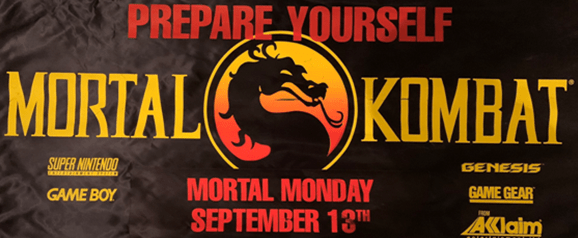
To celebrate the simultaneous worldwide release of Mortal Kombat (Midway, 1992) on home consoles, 13 September 1993 was dubbed “Mortal Monday”. Mortal Kombat’s move to home consoles impacted not only the ongoing “Console War” between SEGA and Nintendo but also videogames forever thanks to its controversial violence. Thus, it’s only fitting that we continue celebrating this influential fighting series every September 13th…except this year that clashes with Friday the 13th so…


Released: 23 April 2021
Director: Simon McQuoid
Distributor: Warner Bros. Pictures
Budget: $55 million
Stars: Lewis Tan, Jessica McNamee, Josh Lawson, Joe Taslim, Mehcad Brooks, Tadanobu Asano, and Chin Han

The Plot:
Struggling fighter Cole Young (Tan) is targeted by the relentless Bi-Han/Sub-Zero (Taslim), an assassin working under orders by the malevolent sorcerer Shang Tsung (Han) to kill Earthrealm’s chosen warriors before they can compete in the ages-old martial arts tournament known as Mortal Kombat.

The Background:
Inspired by the success of Street Fighter II: The World Warrior (Capcom, 1991), developers Ed Boon and John Tobias used innovative digitised sprites to unleash Mortal Kombat upon impressionable gamers. Attracting both popularity and controversy for its bloody content and gruesome “Fatalities”, Mortal Kombat soon expanded its scope not just with additional videogames but also into mainstream media thanks, largely, to catching the eye of producer Lawrence Kasanoff. Kasanoff envisioned a multimedia venture for the franchise and initially got off to a great start with the first live-action adaptation. Mortal Kombat (Anderson, 1995) became a cult hit that’s still one of the most highly regarded videogame adaptations ever made. Unfortunately, this success didn’t pan out quite as Kasanoff originally planned. A universally panned sequel was followed by lukewarm television ventures and talks of a third film evaporated into Development Hell. After the series made a dramatic comeback following Midway’s bankruptcy, hopes for a new Mortal Kombat movie were raised through the web series helmed by Kevin Tancharoen. Although he never got to direct a big screen adaptation, Tancharoen’s efforts were picked up by producer James Wan, writer Greg Russo, and director Simon McQuoid, with the trio determined to bring the franchise’s gory violence to life in all its glory. Despite long-running rumours of the original movie’s cast returning for another film, this new Mortal Kombat featured an all-new cast and attracted early controversy for creating a new audience surrogate and its poor use of Goro, now a disappointing CGI creature rather than a traditional effect. While the film’s $84.4 million box office made it a mild success, reviews were somewhat mixed. The fights and gore were praised but the characters, acting, and plot all drew criticism. Yet, despite it not living up to the standards set by the 1995 film, Mortal Kombat delivered some stellar fight scenes between the franchise’s most popular characters and was successful enough to warrant a 2025 sequel.

The Review:
I’ve always enjoyed the original Mortal Kombat movie. Even now, it’s still my favourite live-action adaptation of a videogame, to the point where I wrote an entire chapter of my PhD thesis about the film and its infamous legacy! I waited eagerly for the follow-up, only to be met with a surreal, nonsensical bombardment of noise and mess that basically killed the franchise dead. Even the relatively enjoyable television ventures couldn’t undo the damage, and Mortal Kombat was left to fester for years as fans waited for news of a third film or an all-out reboot. Those dreams were almost answered by Kevin Tancharoen, whose online videos showed a certain promise, but Warner Bros. randomly decided to go in a different direction and sign-off on this reboot instead. From the first trailers, things looked somewhat promising by focusing on bloody combat, the franchise’s trademark Fatalities, and with much of the marketing revolving around fan favourite ninjas Hanzo Hasashi/Scorpion (Sanada) and Sub-Zero. Indeed, Mortal Kombat immediately makes up for the character assassination these icons received under the direction of Paul W.S. Anderson by opening in 17th century Japan and depicting the wholesale slaughter of Hasahi’s ninja clan, the Shirai Ryu, at the hands of Bi-Han and his own ninja assassins, the Lin Kuei. Hasashi, an honourable family man who lives a relatively peaceful life tending to the land with his wife, Harumi (Yukiko Shinohara), and young son, Satoshi “Jubei” Hasashi (Ren Miyagawa), and infant daughter (Mia Hall). However, when his family and clan are threatened, Hasashi becomes a force to be reckoned with, making use of a digging trowel as a makeshift kunai to oppose the assassins, only to realise all-too-late that the attack was merely a distraction so the sadistic Bi-Han could leave Harumi and Jubei little more than ice sculptures for the grief-stricken Hasashi to find. 

A strong opening soon gives way to an audience surrogate no-one asked for.

Naturally, a fierce battle ensues between the two rivals that sees Bi-Han’s face permanently scarred and Hasashi stabbed and killed by his own weapon, condemning his soul of the hellish Netherrealm, ending his bloodline, and leaving the Lin Kuei victorious. Well…not quite, for Hasashi’s baby survived and was recovered by Raiden (Asano), God of Thunder and protector of Earthrealm, since it was foretold that the “blood of a Hasashi” would unite Earth’s champions against the realm-conquering Outworld. Honestly, Mortal Kombat might’ve fared better if the entirety of its runtime was built around the Hasashi/Bi-Han rivalry, taking place in the past and including select appearances from other prominent franchise characters. Instead, the story jumps ahead to 2021, a time when Outworld has won nine out of ten Mortal Kombat tournaments and needs just one more victory to legally invade our world. They have succeeded in this endeavour thanks to the unmatched sorcery and deceitful nature of Outworld representative Shang Tsung, an enigmatic man who uses any means at his disposal (including bending the sacred rules of the tournament) to preemptively target those destined to fight against Outworld. Thus, any Earthrealmer bearing a dragon-shaped birthmark is targeted by Shang Tsung’s lead assassin, Bi-Han, now clad in armour and taking the name Sub-Zero, who presumably retains his youth and vigour thanks to the sorcerer’s influence. Sub-Zero’s latest target is Cole Young, a down-on-his luck mixed martial artist who’s struggling with self-doubt and to make a career out of his skills to provide for his family, wife Allison (Laura Brent) and daughter Emily (Matilda Kimber). Once a champion fighter, Cole has been reduced to taking $200 fights to put food on the table and is thus incredulous when Jax shows up inquiring about his unique dragon mark. 

Cole is amazed when he’s drawn into a world of supernatural violence.

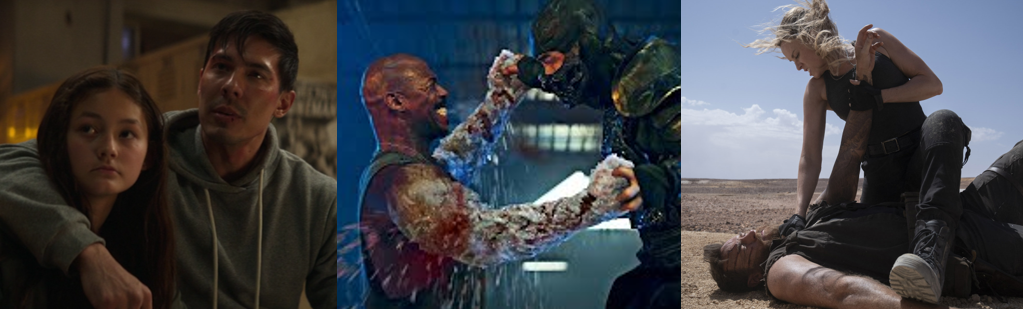
Cole is drawing into the crazy world of Mortal Kombat when Sub-Zero attacks him and his family at dinner, and it’s only the intervention of Jax that allows the Asano to escape. While Cole follows Jax’s instructions to meet with his partner, Sonya Blade (McNamee), Jax ends up mutilated when he battles Sub-Zero to cover Cole’s escape. Hopelessly outmatched despite his size and power, Jax has his arms frozen and shattered by the cruel cyromancer. Unlike Cole, and the other chosen warriors, Sonya does not carry a dragon mark, which is a source of great distress for her and something adversarial mercenary Kano (Lawson) and even Raiden mock her for. However, Sonya is acutely aware of Mortal Kombat, the threat against Earth, and the bizarre individuals associated with it. While Cole is sceptical, despite witnessing Sub-Zero’s abilities, his cynicism is quashed when another of Shang Tsung’s assassins, the voracious Syzoth/Reptile, who viciously attacks Sonya’s hideout. Since he’s her only chance to track down Raiden’s hidden temple, Sonya is forced to free Kano to assist in the fight. Although his face is mauled by the beast, Kano circumnavigates Reptile’s camouflage by stabbing him with a flare and proves his viciousness by tearing the Saurian’s heart out. While he’s a crude, crass, antagonistic criminal who can’t be trusted, Sonya is forced to bribe Kano with money she doesn’t have and he reluctantly joins the group, and the allies they find there, delighting in lording his superiority, verbally tearing them down, and excited at the prospect of gaining superpowers under Liu Kang’s (Lin) tutelage. Similar to Tancharoen’s previous adaptation, Mortal Kombat explains the videogames’ special moves not just in explicitly bestowing them to Shang Tsung’s demonic forces but in the concept of “Arcana”,  abilities unique to those with the dragon mark. Since she doesn’t have a mark, Sonya can’t unlock her power but is permitted to stay and help train the others, giving Kano ample opportunity to rile her up, though Cole also struggles to unlock his Arcana despite his efforts.

Raiden is unimpressed by Earthrealm’s chosen fighters.

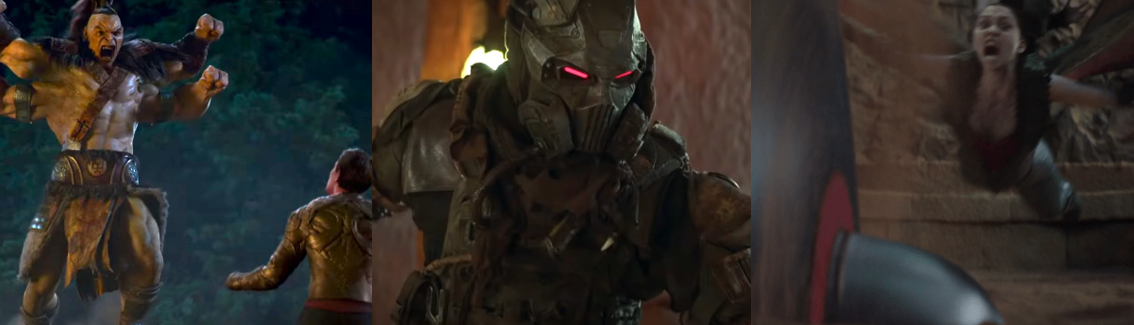
Protected from Shang Tsung’s assassins by Raiden’s mystical barrier, Cole, Sonya, and Kano train alongside warrior monks Liu Kang and Kung Lao (Max Huang), who also tend to Jax’s wounds and furnish him with a rudimentary set of cybernetic arms. Like Cole, Jax is frustrated by his newfound handicap, but Liu Kang and Kung Lao strive to push them all to unlock their true potential to defend Earthrealm. Staunch believers in Raiden’s cause, Liu Kang and Kung Lao have already unlocked their Arcanas, demonstrating incredible abilities such as fireballs and teleportation, and Kung Lao also utilises his iconic razor-sharp hat. Although Liu Kang is sympathetic to their confusion, time is against the would-be champions and he and his fellow Shaolin repeatedly subject the group to intense sparring sessions to push their bodies and minds to the absolute limit. Unfortunately for them, the only one who achieves this is Kano who, angered by “Kung Pow’s” dismissive attitude towards him, suddenly fires lasers from his injured eye. Far from the wise, playful mentor of previous adaptations, this version of Raiden is a blunt deity. Indeed, he’s so disappointed by the fighters and Cole’s progress that he regularly runs them down and even out-right dismissing Cole when, after revealing his lineage as Hasashi’s ancestor, he expresses displeasure that the struggling fighter didn’t live up to the expectations set by his forefather. When returned to his family, however, Cole finally unlocks his Arcana to defend them from Prince Goro (Angus Sampson), a four-armed Shokan who attempts to kill them and is instead torn to pieces when Cole spontaneously grows organic armour that allows him to absorb any attack, grow tonfas to attack with, and grants him superhuman strength. 

Outworld’s monstrous forces meet gruesome ends at the hands of our heroes.

Galvanised by his awakened abilities and his victory over Goro, Cole reunites with his allies, now shaken following Kano’s betrayal. After a discussion with former ally Kabal (Daniel Nelson/Damon Herriman), Kano is convinced to betray Raiden, lowering the shield and allowing Shang Tsung’s assassins to attack. In the fracas, Jax unlocks his Arcana to save Sonya, upgrading his gaunt metal arms to more formidable appendages, but Kung Lao is lost when Shang Tsung steals his soul. Retreating to a void between realms to regroup, Cole shares a plan to target Shang Tsung’s warriors individually before teaming up to tackle Sub-Zero, their greatest threat, together. Like the original movie, Shang Tsung’s minions are given very little characterisation outside of two exceptions, Sub-Zero and Kabal. It’s genuinely upsetting seeing Goro reduced to an easily-dispatched underling and that more time wasn’t spent making Nitara (Mel Jarnson), Mileena (Sisi Stringer), and Reiko (Nathan Jones) more than lifeless minions for the good guys to fight. It seems the filmmakers were banking on Nitara’s and Mileena’s sex appeal (and the former’s unique, if poorly realised, vampiric abilities) and Reiko’s gargantuan stature to make up for this, but it doesn’t really work and it’s hard to care when they’re defeated, however gory it is, making me wish that Goro had taken Reiko’s place. Thankfully, Kabal somewhat makes up for this. He and Kano have the same snarky demeanour and Kabal has an awesome look, but we learn very little about their time together in the Black Dragon Clan and it’s weird that Liu Kang believed killing Kabal avenged Kung Lao’s death when Shang Tsung dealt the finishing blow. Similarly, Chin Han is as miscast as the sorcerer as Tadanobu Asano is as Raiden; neither can hold a candle to their predecessors or even their television counterparts and, while Han tries to exude an authoritative menace, both are very weak and forgettable in their roles. 

The Nitty-Gritty:
Similar to the much-maligned Mortal Kombat: Annihilation, faith in yourself and teamwork are core themes of this new Mortal Kombat. Much of Cole’s characterisation comes from his declining martial arts career; he went from a champion to a chump and he struggles with feelings of inadequacy and self-doubt, despite having a caring and supportive family behind him. It’s this, as much as his scepticism, that holds him back while training, and these issues are only compounded when Raiden literally tells him he was destined for more and has failed to accomplish even half of his potential. It’s thus telling that Cole’s Arcana awakens when he’s defending his loved ones, but it’s hard to deny that Cole’s bland and completely unnecessary character. The Mortal Kombat franchise has one of the biggest and most diverse rosters in all its genre but the filmmakers created a brand-new audience surrogate when Johnny Cage would’ve fulfilled this role just as well. Hell, it would only have taken a couple of slight tweaks to have Cage assume Cole’s role, and all the hints towards Cage’s future involvement can’t make up for his absence here. Cole’s struggles are echoed in both Jax and Sonya, who both face an uphill battle to overcome either their physical limitations or their lack of an official brand to contribute to Earthrealm’s defence, something they ultimately accomplish when forced to go beyond their limits to save their friends or avenge their losses. 

This adaptation is much more faithful to the violent nature of the source material.

While the first Mortal Kombat unquestionably captured the spirit of the source material, smartly drawing from martial arts cinema to focus more on memorable characters and fights than the trademark gore, this Mortal Kombat clearly draws from NetherRealm’s modern titles and even explicitly recreates Kung Lao’s infamous “Razor’s Edge” Fatality by having him slice Nitara in two with his hat! Similarly, Jax crushes Reiko’s head and Liu Kang conjures a flaming dragon to take out Kabal, just like in the videogames, and of course there’s Kano’s classic heart rip Fatality, which are all suitably gruesome and give the film an entertaining edge since it’s the first time we’ve seen such explicit gore in an official live-action adaptation of the famous franchise. Similarly, the film is full of cursing, with Kano clearly channelling the late Trevor Goddard into his performance as the bombastic and outrageous Kano to steal the show like his predecessor did with his rude quips and abrasive attitude. I do enjoy these more adult aspects of the film and, in many ways, they make it a superior and more faithful adaptation than the original film, but all the blood and swearing in the world can’t make up for bland characters and uninspiring acting. Say what you will about the original’s tame content but at least the main cast was charismatic and embodied their roles. I like the performances from Liu Kang and Kung Lao here but they show up so late into the story and we learn so little about them that it’s difficult to be too attached to them. Raiden is an unlikeable jackass, most of Shang Tsung’s underlings are disposable baddies to be offed, and once again Sonya fails to impress as a bad-ass female protagonist, coming across more like a spare part since she isn’t even a chosen warrior. It’s as though the filmmakers did the opposite of the original film, focusing on gore and spectacle over character and heart, meaning it also falls short of being a definitive adaptation and can’t even rely on a memorable soundtrack to get by since the remix of “Techno Syndrome” isn’t used as prominently as in the original film. 

The film’s bookended by the best parts and limp’s to an uninspired finish.

Mortal Kombat tries to claw back some credibility in the finale when, after dispatching Shang Tsung’s dull minions and finally granting Sonya an Arcana and a dragon mark when she kills Kano, Cole is drawn into a confrontation with Sub-Zero after he kidnaps Allison and Emily. Unfortunately, even with his organic armour, Cole is no match for the cold-blooded assassin. Luckily, however, Raiden gifted Cole his ancestor’s kunai, which returns Hasashi from the Netherrealm as the vengeful Scorpion. Thus, the film comes full circle as the two most popular characters battle once more, completely stealing the thunder from Cole and making all the time spent with the other characters largely superfluous. If Johnny Cage wasn’t going to be used in Cole’s place, Cole could’ve at least been a reincarnation of Hasashi or have been transformed into Scorpion by the Arcana or the kunai. Instead, Cole’s left freeing his family and watching from the sidelines as his ancestor avenges himself on his killer in a bloody battle that’s easily the best of the film. Again, this is why these two should’ve been the primary focus. If you’re not going to do the tournament anyway, you may as well focus on the two most interesting characters in the franchise, and Taslim and Sanada excel in their kinetic, brutal fight scenes. In this rematch, the two are far more equally matched and Scorpion takes his revenge, immolating the injured assassin alive. Strangely there’s a moment of sympathy for Sub-Zero that, like Shang Tsung’s throwaway line regarding the resurrection of his fallen forces, is potentially a hint at his return in the next instalment, possibly as Noob Saibot. In the aftermath, Hasashi charges Cole with protecting their bloodline and returns to the Netherrealm. As Shang Tsung threatened to bring an entire army to their door, the galvanised Cole readily accepts Raiden’s offer to find and train new warriors and heads out to recruit movie star Johnny Cage (Unseen) to the cause. 

The Summary:
I was pretty excited about Mortal Kombat at the time. I’d wanted to see a new adaptation for years and truly believed the original movie could be outdone if the filmmakers drew inspiration from it as much as the modern videogames. Obviously, nostalgia is a huge factor in the original’s appeal. Truthfully, it has many flaws that go beyond its tame nature, but it’s still an enjoyable action film, primarily because of the cast and execution. This Mortal Kombat stumbles somewhat in this aspect, predominantly because of its bland and unnecessary main character. Lewis Tan may have a good look and fight well, but he’s not much of an actor and it’s hard to be invested in Cole since I spent the entire time wondering why he’s even there. His Arcana wasn’t that great, either, and I’m not sure I liked this concept, while I’m on the subject. It worked as a goal for the characters to strive towards, but I honestly think it’s better to have the mortal warriors have to overcome fantastic abilities rather than giving everyone superpowers. The gore and Fatalities were great, as were many of the fight scenes and action sequences, and I enjoyed how closely these aspects mirrored the videogames. Sadly, this is juxtaposed with lacklustre version of Shang Tsung (because it’s hard to improve upon Cary-Hiroyuki Tagawa), an unlikeable rendition of Raiden, and a bizarrely unimpressive Goro who not only goes out like an idiot but is an awful CGI monstrosity. Indeed, for every aspect that works here, there’s two or three things that don’t, making this enjoyable enough but far from an improvement over the original film. It’s a shame as there’s a lot of potential here, and I’m sure viewers unfamiliar with the original movie will find a lot to like in this version. However, it missed the mark in a lot of ways for me, primarily in overcomplicating and overstuffing the narrative, making it a bit of a mess at times. 

My Rating:

Rating: 3 out of 5.

Pretty Good

Did you enjoy Mortal Kombat? What did you think to Cole Young; was he an interesting enough protagonist for you or did you find him a bit bland? Would you have preferred to see Johnny Cage in his role? What did you think to the blood, Fatalities, and fights? Were you also disappointed by the depiction of Raiden, Shang Tsung, and the underling villains? Would you have preferred to see Scorpion and Sub-Zero be the primary focus? Which Mortal Kombat characters would you like to see featured in a future film? How are you celebrating Mortal Kombat today? Whatever your thoughts, leave a comment below or on my social media and be sure to check out my other Mortal Kombat content across the site. 

Movie Night: Beetlejuice

Released: 30 March 1988
Director: Tim Burton
Distributor: Warner Bros.
Budget: $15 million
Stars: Geena Davis, Alec Baldwin, Winona Ryder, Catherine O’Hara, Jeffrey Jones, and Michael Keaton

The Plot:
Recently deceased Barbara (Davis) and Adam Maitland (Baldwin) despair when real estate developer Charles Deetz (Jones), his artist wife Delia (O’Hara), and their goth daughter Lydia (Ryder) renovate their beloved home. In desperation, they turn to mischievous “bio-exorcist” Beetlejuice (Keaton) to scare the family away.

The Background:
Tim Burton is, perhaps, the textbook definition of an “auteur”, producing gothic, disturbing films that are instantly recognisable thanks to his unique aesthetic and frequent collaborations with certain actors and personnel. However, even after proving himself with Pee-wee’s Big Adventure (Burton, 1985) and getting approval to work on a Batman adaptation, it wasn’t until Beetlejuice became a surprise hit that Burton’s ability as a director was cemented. The original script was much darker, depicting far more disturbing scenes and the titular character as a more dangerous and perverted spirit, before it was rewritten with input from Warren Skaaren to focus more on dark comedy than out-right horror. While Sammy Davis Jr., Dudley Moore, and Sam Kinison were considered for the title role, Burton was impressed by Michael Keaton’s audition, signalling a long-time collaborative partnership between the two. $1 million of the budget went on the special effects, which employed traditional techniques like stop motion, prosthetic makeup, and puppetry, and Burton insisted that they be purposely cheap and fake to emulate the B-movies he grew up with. As mentioned, Beetlejuice was a surprise commercial success; it received widespread positive reviews praising the blending of horror and comedy and the creativity on show. Although it spawned numerous videogames, a beloved animated spin-off, and even a well-received Broadway musical, development of a sequel ran into frequent obstacles and it would take over thirty years for it to see the light of day.

The Review:
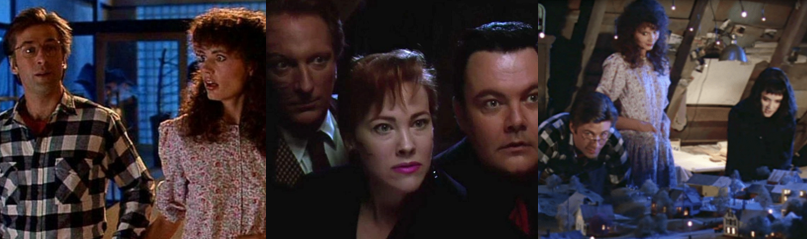
Beetlejuice is set in Winter River, Connecticut; a quiet little town where everyone knows everyone. It centres on married couple Barbara and Adam Maitland, who own and run a hardware store in town and live in a large, suitably gothic (despite its subdued colour scheme and interior) house atop a hill. This house is their pride and joy; they’ve worked hard to get it exactly the way they want it and are so happy there and proud of their work that they eagerly spend their vacation at home, decorating and indulging their hobbies, rather than away in the sun. A keen model-maker, Adam has built an elaborate miniature recreation of the town in the attic, including lights and various minute details that perfectly represent their sleepy town, while Barbara has painstakingly decorated every room to her standard. There are only two blights on their happiness: annoying nosey neighbour Jane Butterfield (Annie McEnroe), a local realtor constantly trying to convince them to sell their house, and their lack of children. Although the two are perfectly happy as they are, Barbara is visibly hurt by not being a mother, but more than happy to keep trying since she’s so lovey-dovey with Adam. They two have great chemistry, enjoying a dance and playfully presenting each other with gifts to aid their hobbies, and enjoy each other’s company so much that Barbara doesn’t think twice to accompany Adam to the store to pick up a few things for his model. Unfortunately, their whimsy is cut short by ridiculous happenstance; while swerving to avoid a dog, Barbara accidentally sends them plummeting into a river. The two return, rattled and disorientated, to a home now bathed in ominous shadow and far less cozy than they left it. Troubled by gaps in his memory, Adam attempts to retrace their steps only to find himself in a desolate, alien wasteland populated by monstrous sandworms. When Barbara yanks him to safety, that one brief instant is revealed to have lasted two hours and the two are forced to confront the fact that they died in the crash and are now ghosts tethered to their beloved home.

The recently deceased Maitlands are horrified by their home’s new owners, but bond with Lydia.

Confused and frustrated, their only source of information is the convenient Handbook for the Recently Deceased, a guidebook that’s needlessly obtuse but explains that they’re bound to that location and invisible to most living people, though they can freely interact with objects and don’t appear intangible. Just as they’re adjusting to their newfound unlife, the Maitlands are dismayed to find that Jane finally got her wish and sold their house to a family from New York, who immediately come storming in and criticise the décor. The two families couldn’t be more different; patriarch Charles, a real estate developer, has little authority next to his demanding and outspoken artist wife, Delia. Charles is the only one of the three to be excited by the move, revelling in the peace and quiet after what’s implied to be a nervous breakdown. The one time he puts his foot down is when he convinces Delia and her flamboyant interior designer, Otho Fenlock (Glenn Shadix), to leave Adam’s office as it is so he has a place to relax. However, Charles soon sets his sights on selling other properties to New York big-wigs like Maxie Dean (Robert Goulet). Already annoyed at having to uproot, Delia is immediately disgusted by the house and works with Otho to strip away everything the Maitlands worked so hard on, turning the house into a bizarre art-deco mishmash of styles that suit her surreal artistic vision. Desperate to express herself creatively, Delia focuses on little else other than impressing others with her art and hospitality, constantly berating Charles and ignoring her stepdaughter, Lydia. A sullen goth with an eye for photography, Lydia is overly dramatic at times but naturally inquisitive. Whereas Charles and Delia are happy to accept that the attic is locked, Lydia persists and soon discovers both the handbook and the ghosts in their house. Describing herself as “strange and unusual”, Lydia’s unique disposition means she can see and fully accepts the ghostly couple. She quickly bonds with them, gaining friendly, accepting parental figures who encourage her curious nature, and becomes enamoured by the allure of the afterlife.

Desperate to reclaim their home, the Maitlands turn to the conniving Beetlejuice.

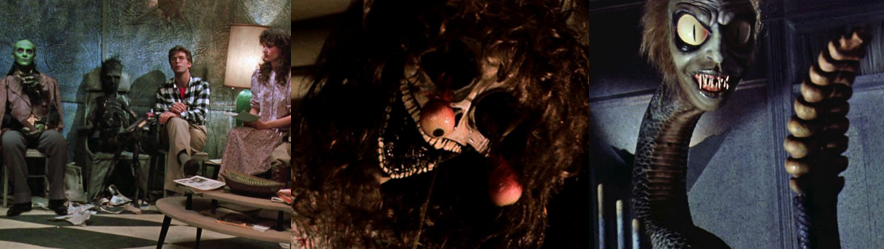
Though the Maitlands like Lydia and are excited to have someone else to talk to, they cannot abide her family and are desperate to scare them away. Unfortunately, their initial attempts fail miserably since no one but Lydia can see them, rendering their face-ripping and elaborate murder scenes pointless. Turning to the handbook, Adam discovers a way to journey to the amusingly bureaucratic spirit realm, where lost souls are forced to wait in line and fill out forms for assistance. This puts them in touch with Juno (Sylvia Sidney), their caseworker, who chastises their naivety and tells them they must spent 125 years at the house before they can move on, meaning it’s up to them to practice with their abilities and study the handbook to scare away the Deetzes. However, after failing to scare the Deetzes with simple sheets and struggling to remain hidden, Maitlands are drawn to the services of “bio-exorcist” Beetlejuice, a gruff, dishevelled spirit whom Juno warns them against employing due to his troublesome nature. In desperation, the two call his name three times and are transported to Adam’s model, where Beetlejuice has set up home. They dig him up and immediately regret their actions; loud, lewd, and foul, Beetlejuice disgusts them with his perverted nature and bloodthirsty methods. They leave, preferring to possess the Deetzes to dance to Harry Belafonte’s “Day-O (The Banana Boat Song)”, but fail to put Beetlejuice back. Enraged and insulted, Beetlejuice spitefully attacks the Deetzes as a giant, demonic state, taking a perverse interest in Lydia and mocking the Maitlands at every opportunity. Tired of being handcuffed to his spiritual lot, Beetlejuice tries to convince Lydia to say his name and unshackle him, though she’s warned off him by the Maitlands, who decide to let the Deetzes stay so they can be closer to Lydia, who they’ve come to see as a surrogate daughter. However, when the Deetzes see the potential of their haunted house for aggressive expansion, the Maitlands find their afterlife threatened and Lydia’s forced to turn to the unruly Beetlejuice to help them, even going so far as to agree to marry him to spare her friends from harm.

The Nitty-Gritty:
Beetlejuice is unhinged, gothic Tim Burton at its finest. As he often likes to do, Burton juxtaposes the quaint, suburban normality with the twisted and macabre, infusing the film with a black and occasionally metatextual humour to deliver a strangely compelling film. While the Maitlands are a perfectly normal suburban couple, the Deetz adults are obnoxious and selfish; even Charles indulges Delia’s ransacking of the house to get a bit of peace and quiet and his more subdued respect for the home turns to greed when he sees the financial value in the town. Lydia is the typical Burton outcast; sullen and introspective, she’s detached from her family’s drama and hobbies and struggles to connect with the real world. Befriending Barbara and Adam only fuels her fascination with the macabre and she even contemplates committing suicide to escape her boredom, something the Maitlands thankfully talk her out of by finally accepting her family. Naturally, the lewd humour is embodied by Beetlejuice, who swears at, molests, and mocks everyone around him. A conniving, self-serving conman, he twists every request to suit his own sadistic desires and has little interest in actually helping the Maitlands and more interest in indulging his mean streak and making moves on Lydia. Burton’s attention to detail in the humour is great; smoke escapes the slit in Juno’s throat, Adam reacts with confusion when the lighting grows more ominous when learning about Beetlejuice, and the bureaucratic nature of purgatory is just so bleakly fitting I can’t help but laugh.

Burton’s depiction of death and use of practical effects add to the film’s visual appeal.

Given it’s Tim Burton and 1988, Beetlejuice also boasts some impressive practical effects and model work. The rear projection is purposely janky whenever characters talk to the miniaturised Beetlejuice or encounter the sandworms, which all adds to the B-movie charm of the piece and the amazing make-up effects only broaden the appeal. The afterlife is full of poor souls forced to either wait their turn or deal with paperwork, whether they’re squashed flat, hanging from nooses, or literally cut in half. An entire football team appears as confused, zombie-like spirits, one poor soul as their head shrunken and mouth sewn shut, and Barbara and Adam are even shown the disturbing “lost souls” room, where exorcised spirits exist in an extra level of undead hell. Although Barbara and Adam’s attempts to scare the Deetzes fail time and again, they sure look great doing it. Barbara rips her face off in a wardrobe and stands holding Adam’s severed head, Adam’s disembodied body desperately rushes to the attic (briefly sensed by Otho, a self-proclaimed supernatural hobbyist), and the two malform their faces into monstrous forms using a combination of stop-motion and practical masks. Stop-motion is also employed during Beetlejuice’s snake attack scene, a surprisingly disturbing scene brought to life by practical, almost schlocky effects that would make Ed Wood proud. Beetlejuice’s powers seem almost unlimited, though he’s incapable of appearing unless summoned or directly telling people his name, causing him to employ flyers, advertisements and charades to spell it out. He can conjure spikes, a gruesome visage so ghastly only Barbara and Adam get to see it, call forth a brothel, and even manipulate reality to a degree, though he’s very much restricted unless his name is spoken. He does fear the sandworms, however, gigantic, multi-mouthed creatures that burrow through the sands of the desolate dimension outside a ghost’s boundaries and which seemingly feast on souls trapped there.

Despite his crude nature and vast powers, Beetlejuice gets his comeuppance in the end.

Beetlejuice’s full powers come to the forefront in the conclusion, when Lydia’s forced to summon him to save the Maitlands. Rather than being scared of their ghostly inhabitants, the Deetzes plan to market the Maitlands and use them to sell Winter River as a tourist attraction. Though a natural braggart, Otho does have an understanding of the handbook and, after swiping it, uses it and his rudimentary knowledge of the supernatural to perform a ritual that summons the Maitlands in a séance. However, the two begin to rapidly decay, so Lydia begs Beetlejuice to help. He readily agrees, delighting in attacking the yuppy guests as a living carnival attraction, on the condition that Lydia marries him so he’s no longer shackled by restrictions. Surprisingly, Beetlejuice keeps his word and restores the Maitlands (albeit aggressively), then possesses Delia’s awful sculptures to bind Lydia’s family and render them helpless to keep him from forcing her to go through with her promise. He summons matching wedding outfits and a squat demon priest (Tony Cox) and desperately demands that the ceremony be completed as quickly as possible. Although the Maitlands try to interfere by saying his name, they’re no match for his powers and end up with their teeth falling to the floor, or their mouths being clamped shut, and being teleported to the model and the sand world. However, a distraction from Adam leaves Beetlejuice poised to be consumed by a sandworm Barbara somehow tames and rides into the real world, disrupting the ceremony and reconciling with the Deetzes. In the aftermath, much of the house has been restored as the two families reach a peaceful co-existence, sharing parenting duties over the more confident and adjusted Lydia, while Beetlejuice is forced to wait in line and endure a voodoo curse in the afterlife’s waiting room.

The Summary:
Beetlejuice is a wonderfully gothic, quirky horror/comedy that I first watched as a kid, during a time when horror disturbed me greatly. I’m surprised I wasn’t more horrified by Beetlejuice as some of the visuals are really terrifying, especially the way Barbara and Adam malform their faces and the ghastly forms Beetlejuice takes. While not gory, it is visually disturbing at times, something only exacerbated by the film’s depiction of the afterlife. In Burton’s twisted mind, dying is as much a chore as living; red tape, bureaucracy, and convoluted rules are paramount, making death just as stressful as life. As if that wasn’t bad enough, the Maitlands must deal with a couple of yuppies messing up their beloved home. The Deetzes and Otho are perfectly cartoonish, selfish antagonists, caring little for the town’s peaceful nature and wanting only to make their mark on the untouched landscape. Lydia is portrayed as an outcast, someone as torn between normality and the macabre as she is the living and the supernatural, and she struggles to exist in that bubble, with her character arc coming to reconcile both halves of her personality. Naturally, the crude, lewd Beetlejuice is a standout; he barely has any screen time but Michael Keaton steals the show, yukking up his performance and delighting in unleashing his devilish side. The special effects are also a highlight, bolstering the horror and surreal nature of the film with a schlock, B-movie aesthetic and metatextual humour that makes it almost timeless. Beetlejuice is the perfect gateway into Tim Burton’s unique an macabre imagination, and is just as enjoyable now as when I first saw it. In fact, it might be even more enjoyable since I can better appreciate the little touches and attention to detail that make this such a strange but ghoulishly delightful experience.

My Rating:

Rating: 4 out of 5.

Great Stuff

Is Beetlejuice a favourite of yours? Where would you rank it against Tim Burton’s other films? What did you think to Michael Keaton’s scenery-chewing performance? Were you also freaked out by the ghastly visuals as a kid? What did you think to Burton’s depiction of the afterlife? Have you ever had an experience with ghosts or haunted houses? Either way, I’d love to see your thoughts and memories on Beetlejuice in the comments below.

Movie Night [Star Trek Day]: Star Trek IV: The Voyage Home


On this day, 8th September 1966, the first episode of Star Trek (1966 to 1969), “The Man Trap” (Daniels, 1966), first aired. Since then, Star Trek has become a massive cultural phenomenon that still endures to this day, spawning numerous continuations, spin-offs, and ancillary media to become, perhaps, the most influential science-fiction franchise of all time. Accordingly, the 8th of September has been deemed “Star Trek Day” and is thus the perfect excuse to dedicate some more time to, and celebrate, this massive sci-fi franchise.


Released: 26 November 1986
Director: Leonard Nimoy
Distributor: Paramount Pictures
Budget: $26 million
Stars: William Shatner, Leonard Nimoy, Catherine Hicks, DeForest Kelley, Walter Koenig, and James Doohan

The Plot:
After resurrecting their crewmate, Captain Spock (Nimoy), Admiral James T. Kirk (Shatner) and the USS Enterprise crew face a court martial for mutiny. However, when an alien probe threatens the Earth, Kirk seeks redemption by time travelling back to the 20th century to acquire the only thing capable of stopping it: long-extinct humpback whales.

The Background:
Although Star Trek: The Motion Picture (Wise, 1979) grossed almost $140 million, it was met with mixed to negative reviews that a disappointed Paramount blamed on Star Trek creator Gene Roddenberry. Luckily, the franchise bounced back with Star Trek II: The Wrath of Khan (Meyer, 1982), widely considered one of the best Star Trek movies, and Paramount was eager to capitalise with a third entry. Although Star Trek III: The Search for Spock (Nimoy, 1984) was the lowest-grossing Star Trek movie at the time,  positive reviews encouraged the development of a fourth film. Although Nimoy was granted additional creative input, star William Shatner was initially unwilling to return, leading to talks of a prequel movie. When Shatner signed on, Nimoy aimed to craft a fun, light-hearted time travel adventure and initially planned for Eddie Murphy to have a starring role before Shatner insisted on having a love interest. Industrial Light & Magic created the film’s models and optical effects, including the mysterious alien probe, though many sets and effects were allegedly reused from previous films. The Voyage Home was the first Star Trek movie to extensively film on location, specifically in and around San Francisco, though the whales were brought to life using cutting edge robotics courtesy of Walt Conti. With a box office of $133 million, The Voyage Home proved to be a financial success. Reviews were equally positive, with the film’s comedic tone, performances, and insightful message counting it amongst the best of the franchise.

The Review:
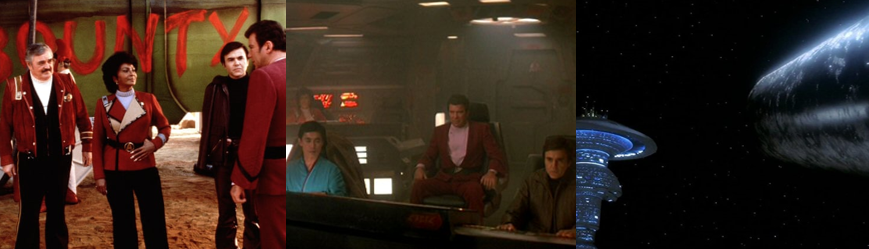
Following a touching dedication to the tragic fate of the Challenger and the title sequence (featuring a suitably bombastic and celebratory score by Leonard Rosenman), The Voyage Home opts to recap the events of the last two films by way of a Starfleet tribunal concerning Kirk and his crew’s actions. Thanks to footage from the previous movies somehow being presented as video evidence, the Klingon ambassador (John Schuck) reframes Kirk as a terrorist who murdered a Klingon crew and stole their ship and accuses him of developing the Genesis Device as a weapon of mass destruction against the Klingon people. Luckily for Kirk, Spock’s father, Ambassador Sarek (Mark Lenard), is on hand to defend Kirk’s actions and equally condemn the aggression of his Klingon enemies. Although Kirk is guilty of violating many Starfleet regulations, the Klingon is dissatisfied and disgusted and vows that there will never be peace between the Klingons and Starfleet “as long as Kirk lives!” We then return to the planet Vulcan, where Kirk and his crew have been exiled for the last three months. In that time, they’ve made some modifications to the Bird of Prey they commandeered in the last film, christened it the HMS Bounty, and have unanimously agreed to return home to face the consequences of their actions.                           

The crew’s voyage home is obstructed by a destructive alien probe.

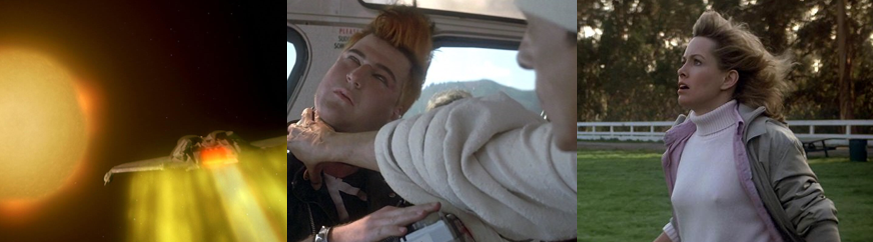
Seemingly no longer burdened by his midlife crisis, Kirk is more weighed down by the inevitable dishonourable end of his Starfleet career than even the death of his son. We get one scene where Lieutenant Saavik (Robin Curtis) tells Kirk about David Marcus’ (Merritt Butrick) bravery and Kirk looks a little forlorn and that’s pretty much it. He doesn’t seem traumatised or grieving and is instead focused on atoning for his actions and helping Spock to reacclimatise to the crew. Since his resurrection, Spock has been testing his intelligence and reasoning ability to retrain his mind and get himself back up to speed. Though seemingly the same logical half-human Vulcan as ever, he’s still a little out of sorts. He’s perplexed by the relevance of his feelings and the illogical nature of his humans, who sacrificed everything to save him only for him to have regressed slightly thanks to his rebirth. While Kirk is confident that Spock will regain his full memories and personality, cantankerous Doctor Leonard “Bones” McCoy (Kelley) isn’t so sure and is the first to point out how unnerving it is that the status quo has been restored like nothing happened. Feeling a sense of kinship with his Vulcan companion that he’s never had before and curious to discuss his experience with death, Bones is aghast to find Spock as stubborn as ever, a quality the Vulcan shares with Kirk as both are seemingly dead set on ignoring the doctor’s wry commentary on and objections to their situation. Interestingly, The Voyage Home is the first Star Trek movie since the dreadful first film to have an otherworldly threat that doesn’t that humanoid form. The alien probe (a pretty basic, cylindrical structure) floats through space continuously broadcasting an incomprehensible signal that is eventually identified as being whale song.

While back in 1986, Kirk enlists the help of a cetologist to acquire some whales.

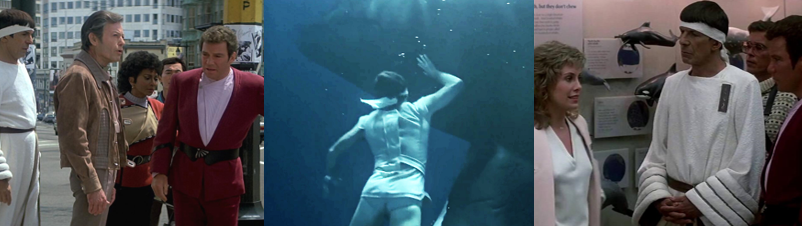
The mysterious probe defies all known sensor readings and explanations and disables the power systems of every ship that comes into contact with it, leaving them powerless and adrift and slowly succumbing the asphyxiation. After disabling both starships and spacedocks, the probe arrives at Earth and wreaks havoc with the atmosphere. This not only devastates all technology and power systems but also whips up destructive planetary storms and causes a thick cloud to block out the sun. With the Earth ravaged by the probe’s attack, Starfleet command have no choice but to warn all ships to stay away from the planet since they’re unable to communicate or engage with the probe. Though equally baffled by the probe’s signal, Spock theorises that it isn’t inherently hostile and that it’s actually trying to communicate with an aquatic lifeform. This allows Commander Nyota Uhura (Nichelle Nichols) to filter the signal and confirm Spock’s suspicions that only whales can respond to the probe. Since humans have hunted whales to extinction and an attack on the probe is deemed futile, the crew have no choice but to pull off a “time warp” by slingshotting the Bounty around the Sun at incredible speeds, a strangely simple concept that is almost laughable in its execution but, thanks to Spock’s “computations”, brings the crew to San Francisco, 1986. Determined to keep a low profile, Kirk and Spock head into the city to locate the source of the whales. Luckily, a bus billboard directs them to Cetacean Institute, a whale-themed facility where “George” and “Gracie” are under the care of cetologist Doctor Gillian Taylor (Hicks). Disgusted by man’s proclivity for hunting whales to the brink of extinction and the ineffectual means of preventing such heinous actions, Gillian greatly cares for George and Gracie, who have been kept in captivity since wandering into San Francisco Bay as calves. Gillian is heartbroken that the whales will soon be released into the wild due to budgetary concerns, which will put them at risk, and is astounded when Spock not only enters the whale enclosure but reveals that the whales are equally fond of her, and that Gracie is pregnant.

The other crew actually get something to do and get into all sorts of bother as a result.

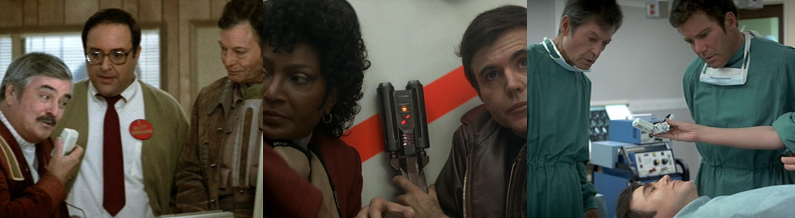
Spock’s mind meld allows him to explain the situation to the whales and gain their consent, and sparks Gillian’s curiosity to the point where she throws caution to the wind and relates her concerns about the whales’ safety. Despite Spock’s amusingly blunt honesty and his notable charisma, Kirk is forced to tell Gillian the truth to win her over and she’s surprisingly chill about his crazy story, primarily because it’s the only viable option she has to keep her beloved whales safe. One positive about The Voyage Home is that it actually gives the rest of the crew something to do for a change; the crew split into teams and sent across San Francisco with specific tasks relating to the success of their mission. Commander Montgomery “Scotty” Scott (Doohan) teams up with Bones and Lieutenant Commander Hikaru Sulu (George Takei) to reconfigure the Bounty’s cargo bay into a whale enclosure, while Commander Pavel Chekov (Koenig) and Uhura are tasked with locating Naval ships to recharge the crude Klingon Dilithium crystals that power the Bounty. Though confused by the era and time displacement, the crew eventually bungle their way to success despite the natives being confused by Chekov’s questions regarding “nuclear wessels”. Alongside Bones, Scotty poses as a professor and meets with Plexicorp manager Doctor Nichols (Alex Henteloff) and provides him the formula for “transparent aluminium” in exchange for using his facilities to build the whale tank in an assumed example of a predestination paradox (i.e. Scotty was fated to provide the formula). While Sulu is relegated only to acquiring and piloting a helicopter to transport this tank, Chekov ends up hospitalised while acquiring the nuclear photons, resulting in a brief bit of drama as the crew infiltrate the hospital so Bones can wake him from his coma.

The Nitty-Gritty:
The Voyage Home is clearly a far more light-hearted film than its predecessors. After battling to defend the Earth from certain death, facing down a deeply personal enemy, and sacrificing everything for their comrade, it’s nice to have a fun, whimsical adventure that offers wry commentary on the state of society in the obnoxiously excessive 1980s. Despite this more light-hearted tone, there’s a strong environmental message at work here. Humanity is doomed to destruction in the far future thanks to overhunting humpback whales and their arrogance to assume that extraterrestrial life would only be interested in communicating with humans, and there’s a clear commentary on the beauty and wonder of these magnificent creatures that that are still tragically low in number. However, despite the catastrophic threat posed by the alien robe, there’s a distinct lack of stakes here. Wonky time travel logic means that the crew don’t even face the danger of a ticking clock and can effectively take as long as they like to acquire the whales since they can just travel back to the future at any time. Thus, the drama comes from them bungling through 1986 culture to recharge and prepare the Bounty and Kirk’s attempts to woo Gillian into aiding them in bringing George and Gracie to the 23rd century before they’re let loose into the wild.

Unfortunately, most of the film takes place in 1986 and focuses on comedy rather than space action.

One aspect of The Voyage Home that has always irked me is how cheap the production is; almost everything is recycled from the last two films, including the crew’s wardrobe, the sets, and the models. I can’t totally begrudge this as it makes sense, in continuity, to carry these elements over but you’d think that Kirk and the others would’ve had some Vulcan clothing after spending three months there! This is most obviously felt in the fact that the film largely takes place in 1986 thanks to some janky time travel physics, meaning a lack of space action and battles. This is a bit of a shame as the model work and practical effects remain as charming as ever and the depiction of time warp, through the use of surreal imagery and conflicting sound bites, is very interesting. I also liked seeing the crew on the dingy Bounty and forced to adapt to its less refined Klingon specifications, and that the ship was almost shaken to pieces by travelling at such impossible speeds, but it spends most of the film parked and cloaked in Golden Gate Park since the focus is more on the comedic shenanigans of placing the crew in the primitive then-modern day. There’s a fair bit of comedy to be had in this setting, though; the crew are like fish out of water and are confused that whales are in the city (since I guess zoos aren’t a thing in the future), puzzled by the clothing and “colourful metaphors” of the less civilised inhabitants, and with little idea of the concept or value of money and the primitive technology of the time. This leads to some of my favourite scenes of the film, such as Kirk and Spock encountering a particularly abrasive bus passenger (Kirk Thatcher), Scotty trying to communicate to the PC through the mouse, Chekov’s madcap infiltration of a military submarine and subsequent interrogation, and Bones’ grumbling disregard for the primitive medicine of these “Dark Ages”. Still, it is a bit disappointing that so much of the film is set in 1986; it makes for some fun moments, but it hardly screams big-budget sci-fi adventure, and the focus is more on comedy and awkward interactions between the crew and the inhabitants of the time.

Kirk’s time travel shenanigans result in him being reinstated as Captain and back on the Enterprise.

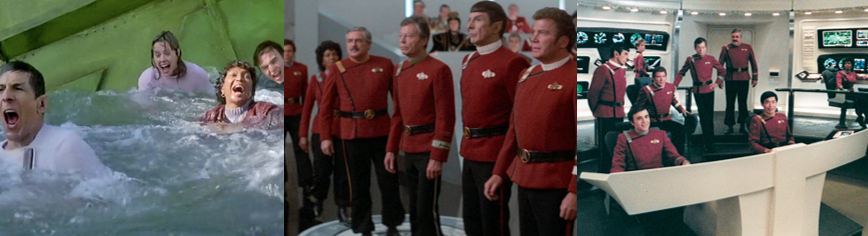
Although Kirk could head to the open sea to get the whales they need, he’s determined to take George and Gracie since it’s not only “better” for everyone but also much easier. Scotty makes the modifications to the Bounty, Sulu acquires a helicopter, and Uhura successfully recharges the Dilithium crystals, but Chekov is injured escaping military custody and the window for acquiring the whales becomes narrower when they’re unexpectedly released early. Gillian is finally convinced to trust Kirk when she learns of the whales’ early release; beamed aboard the Bounty, Gillian quickly overcomes her confusion and awe of the future technology to provide Kirk with the means to track the whales. However, he makes a detour to rescue Chekov from the hands of “butchers” (with even Spock voicing his approval of the effort since it is the “human thing to do”). Although Kirk insists that Gillian can’t come with them, she leaps into his transporter beam and accompanies the crew as they track George and Gracie to Alaska, where they arrive in time to defend the whales from pirates, transport them aboard, and successfully return to the future based on Spock’s “best guess”. Upon arrival, the Bounty is immediately crippled by the probe and crashes into San Francisco Bay where, after a dramatic pause, they answer the probe and cause it to leave Earth space, thus ending its threat and restoring power to the ships it crippled. In the aftermath, Kirk and his loyal crew face the court martial but, in light of their heroic activities, Starfleet shows leniency. Kirk is demoted to Captain and given command of a new ship, the USS Enterprise-A. After bidding farewell to Gillian as she disappears forever to join the crew of a science vessel, Kirk and his crew return to the bridge of their iconic ship and prepare for new adventures into the great beyond.

The Summary:
I’ve never really been much of a fan of Star Trek IV: The Voyage Home. Even as a kid, I felt like it was a bit of a step back since I mainly watch Star Trek for fun, space-based actin and adventure rather than comical jaunts to the past or dull political intrigue. Still, there’s a lot of heart and charm to this film; the cast are all clearly having a lot of fun wandering the city streets and interacting with everyday people, and this is reflected even in the normally stoic Spock, who can’t help but show his joy in the finale. The environmental message is very on the nose, but I think it works as a bit of a wakeup call regarding our place in the world, and the universe. The very animals we hunt to extinction could be all that’s saving us from destruction, which is a relevant message, but the film delivers it a little awkwardly. For instance, George and Gracie’s bloodline probably won’t last long enough to defend the world if the alien probe returns and it’s a bit impractical to keep time travelling for more whales. Luckily, I don’t think Star Trek ever returned to this plot point, or used Gillian again, but this sadly makes The Voyage Home even less relevant. I would’ve liked to see more emotion from Kirk, maybe explore his grief over his son’s death, and a bit more emphasis on Spock’s renewed life. The status quo was restored a little too fast, robbing the film and characters of some potential depth, and the reliance on comedy only exacerbates that. I like the feeling of light-hearted relief, but I’m hardly invested in the mission as there’s no sense of urgency or threat. Ultimately, The Voyage Home is like an extended epilogue to the last film that serves only to restore the crew to their rightful ship and ranks. The message is poignant, and the film is enjoyable at times; I liked that most of the crew actually got something to do and had some little side missions. However, I prefer the more intense space operas of the other entries so I can’t rank this one much higher.

My Rating:

Rating: 3 out of 5.

Pretty Good

Are you a fan of Star Trek IV: The Voyage Home? What did you think to the tonal shift towards comedy? Did you enjoy the time travel plot or did you also think it was a bit of a cheap follow-up? What did you think to the environmental message and the depiction of time travel? Would you have liked to see more focus on Kirk’s grief and Spock’s rebirth? Which Star Trek captain, crew, show, or movie is your favourite and why? How are you celebrating Star Trek Day today? No matter what you think, leave your thoughts down below or leave a comment on my social media and check out my other Star Trek content.

Movie Night: The Matrix Revolutions

Released: 5 November 2003
Director: The Wachowski Brothers
Distributor: Warner Brothers
Budget: $110 to 150 million
Stars: Keanu Reeves, Hugo Weaving, Carrie-Anne Moss, Laurence Fishburne, Jada Pinkett Smith, Harry Lennix, and Ian Bliss

The Plot:
Zion, the last bastion of humanity, faces imminent destruction from an all-out machine attack. While the city fortifies their defences, the fate of humanity is placed into the reluctant hands of Neo (Reeves) as he prepares for a final showdown with the rogue program Smith (Weaving) that will decide the fate of all lives, human and mechanical alike.

The Background:
In 1999, the aspiring writer/director duo of brothers Andy and Larry Wachowski (as they were then known) – inspired by manga and anime – combined a mixture of impressive martial arts, philosophy, and science-fiction to create an instant and lasting impression on action cinema, one that popularised “bullet time” and wire-assisted kung fu (or “wire-fu”) in movies. The Matrix was a massive critical and commercial hit and the Wachowskis made the brave decision to produce two sequels, back-to-back, alongside a varity of tie-in multimedia, including comics, videogames, and animated shorts. Although The Matrix Reloaded (Wachowski Brothers, 2003) made over $740 million worldwide, critics were torn: the film’s dense philosophy confused and divided many, though its intense action sequences were praised. Audiences only had to wait six months for the third, far more contentious entry, which the directors sought to resolve the emotional and spirutual journey of their characters while also delivering the same cutting-edge digital and practical effects and influential fight scenes. Perhaps it was the unrealistic expectations brought about by fan debate, the sheer influx of Matrix content, or the close release of the third film to the second, but The Matrix Revolutions was the lowest grossing of the original trilogy. Though its $427.3 million worldwide gross and persistent popularity later inspired a fourth film as much as greed, The Matrix Revolutions was largely dismissed by critics. Many felt that the film was anticlimactic, the performances wooden and strained, and that it focused too much on style over substance. Though it naturally has its fans, even star Keanu Reeves felt the movie disappointed as a finale but, since today is Keanu’s birthday, this seems like the perfect time to finish my ongoing retrospective of the franchise.

The Review:
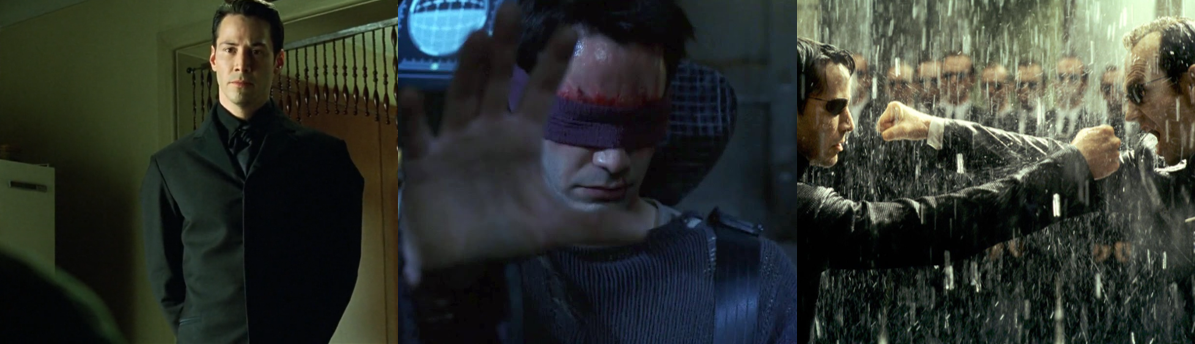
I think it’s fair to say that The Matrix changed action cinema. It’s not really hyperbole to claim that The Matrix paved the way for not only a new wave of all-action films but also the superhero genre as we know it today, to say nothing of revitalising Keanu Reeves’ career. As celebrated as the first movie is, however, the sequels and subsequent multimedia spin-offs have had a mixed reaction, to say the least. I’m definitely in the minority of people who actually quite enjoyed The Matrix Reloaded, and even I’ll admit that it falls short of the original movie thanks to needlessly bogging down this unique cyberpunk world with dense lore and confusingly overblown dialogue. In the aftermath of The Matrix Reloaded, I remember there being a great deal of speculation about where the third movie would go, with a prevailing belief being that the post-apocalyptic real world would also turn out to be a simulation. I think this, and the expectations that the magic of the first movie would ultimately pay off, means that The Matrix Revolutions was always going to struggle as even now I’m not sure what would’ve constituted as a suitable finale for the ground-breaking franchise. The Matrix Reloaded ended on one hell of a cliff-hanger, with Neo demonstrating electromagnetic abilities in the real world and collapsing from the exertion and his rival, Smith, having downloaded a version of himself into Bane (Bliss) so he can expand his reach outside of the Matrix.

Faced with forging the world’s new destiny, Neo must overcome his grief and fight like never before.

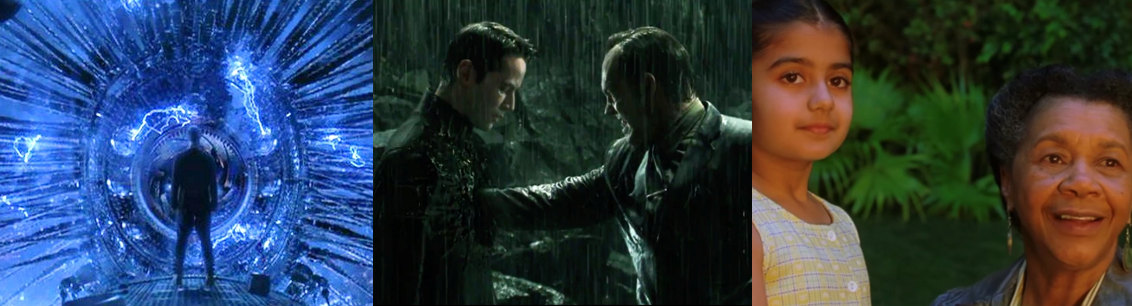
Thus, Neo begins the movie trapped in the subtly named “Mobile Ave”, a kind of backdoor environment through which the repulsive Trainman (Bruce Spence) ferries illegal programs with no purpose from the Matrix to the machine world. This in itself is a bizarre idea, that Neo could somehow “plug into” this cyberspace environment because he’s “not ready” to die, but it also directly ties into the film’s message regarding the Matrix and its programs. In Mobile Ave, Neo meets Rama Kandra (Bernard White) and Kamala (Tharini Mudaliar), two programs who have fallen in love and have made a deal with the Merovingian (Lambert Wilson) to get their daughter, Sati (Tanveer K. Atwal), to safety since she has no “purpose” within the confines of the machines’ digital realms. Neo’s interactions with Rama Kandra actually have lasting ramifications for his later decision to head to the machine city to broker a peace between humans and the machines and show that the programs are fully capable of adopting complex human behaviours such as love and faith. Although Neo is virtually unstoppable in the Matrix, he has no power in Mobile Ave and is thus reliant on his lover, Trinity (Moss), forcing the Merovingian to free him in order to return him to the fight. However, Neo returns as the barer of bad news: because of his decision to reject his predetermined destiny to continue the cycle of death and rebirth within Zion in favour of saving Trinity’s life, the last refuge of humanity is facing imminent destruction from an army of Sentinels. A final discussion with the Oracle (Mary Alice) reveals to Neo that his destiny is now to face Smith to the end, with the fate of both humans and machines in his hands, and he decides that the best way to approach this battle is to venture into the machine city to address their common enemy. Despite all his superhuman abilities and his messiah-like status within much of Zion, Neo remains as conflicted and troubled as ever. He knows that he’s betting the survival of the human race on his ability to best Smith and is reluctant to have Trinity accompany him since he knows it’s likely to be a one-way trip, and yet he fully commits to his mission even after he’s been permanently blinded in battle with Bane since he knows his sacrifice will bring an end to the conflict.

Unfortunately, Trinity and Morpheus take a backseat to the greater conflict.

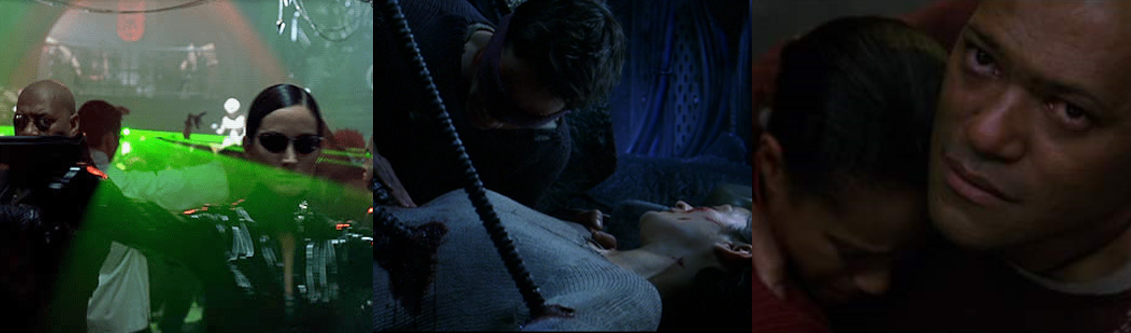
Once a prominent linchpin in Neo’s awakening as “The One”, Trinity has largely devolved into a desperate, lovesick sidekick. Her first priority over all else is to rescue Neo from Mobile Ave and, when the Merovingian attempts to blackmail her and the others into doing his bidding in return for Neo, she simply initiates a Mexican standoff and demands that Neo is returned or they will all die. This recklessness pays off and she’s apparently delighted to be reunited with her lover (it’s honestly hard to tell since there’s still very little chemistry between the characters and actors) and, from there, she resolves to stay by his side even as he embarks on a suicide mission. Trinity is horrified when a psychotic Bane attempts to sabotage their trip and Neo is blinded in the fight. From there, she acts as Neo’s pilot (even though he can still inexplicably see, only now in an ethereal golden glow) and pushes herself, and the Logos, to the limit to break through the Sentinel barricade protecting the city. Although this grants her a view of the untainted sky above the broiling dark clouds that have suffocated the world, this trip ends in tragedy as the Logos crashes into the city and she is fatally wounded. With her dying breath, she expresses her gratitude to Neo for changing her life and her love for him. However, while it’s a poignant moment and Neo’s heartache is readily apparent, it’s a sudden, anticlimactic, and underwhelming death scene thanks to how long it drags on and, again, the lack of chemistry between the two. It’s a shame that Trinity doesn’t get more to do here as she was quite the ass-kicking machine in the first movie, and even The Matrix Reloaded made her a pivotal component to the plot and Neo’s greater destiny, but she’s basically just his pilot and the object of his affections her. Seraph (Collin Chou) is similarly neutered; I remember there being so much speculation about him and even the Merovingian being former Ones and Seraph has such a reputation in the film as a “wingless” fighter who has “beaten” Smith before but, despite demonstrating his fighting prowess in the second film, he’s just here to make up numbers and fail to protect Sati from Smith and his duplicates and the film makes no attempts to delve into who or what he really is.

Although the stakes couldn’t be higher, I was underwhelmed by the conflict raging in Zion.

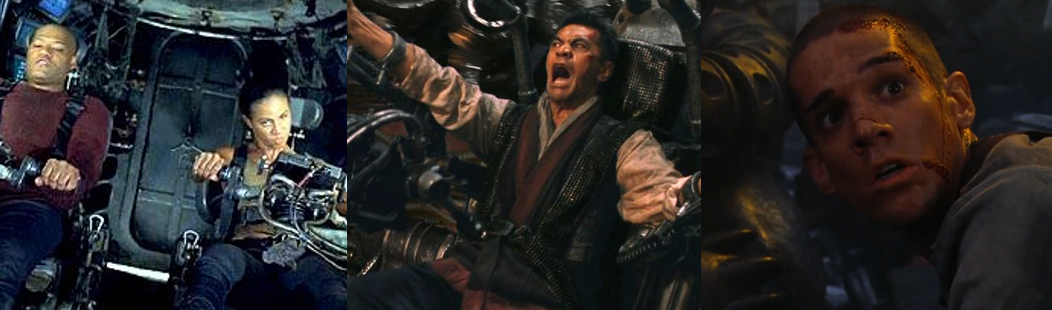
Morpheus (Fishburne) has also lost a lot of his allure; he went from this enigmatic figure who spoke in riddles and exposited information with a cool demeanour to an almost fanatical figure of controversy in the last film. Now, with the truth about the Matrix and the One revealed to him and having lost his beloved ship, Morpheus’s faith is shaken and he’s far from the charismatic leader he was once painted as. Largely a bit player, he’s forced to take a backseat to Niobe (Smith) as she expertly pilots the Hammer through “mechanical” lines towards Zion and further raises the ire of the cantankerous Commander Lock (Lennix) when he crashes through the city’s defences and sets of an electromagnetic pulse that disables a wave of Sentinels attacking the dock but also renders Zion temporarily vulnerable. Indeed, Morpheus is disappointingly ineffectual during the massive assault between the Sentinels and Zion, giving way to the strict Captain Mifune (Nathaniel Lees), who’s given the unenviable task of organising the inhabitants into a fighting force to repel the endless waves of Sentinels. Although the Zion forces are armed in durable mech suits, they’re vastly outnumbered, leading to Mifune reluctantly allowing the overly enthusiastic Kid (Clayton Watson) to join the fight despite being underage. While technically an impressive and visually elaborate battle, the clash between Zion and the Sentinel swarm is a bit of a mess. It’s more like an extended videogame cutscene than anything else and it drags on way too long, laying waste to Zion’s forces and leaving Mifune shredded to death and the Kid as their only hope of salvation. Through sheer determination and his unwavering belief in Neo, the Kid is able to lumber his mech to the gate and allow the Hammer into the dock, where it subsequently knocks out the Sentinels with its EMP blast but leaves the city on the bring of all-out destruction until the machines suddenly stand down and Morpheus realises that Neo is fighting on their behalf within the Matrix.

Having spread throughout the Matrix and beyond, Smith is on the brink of absolute victory.

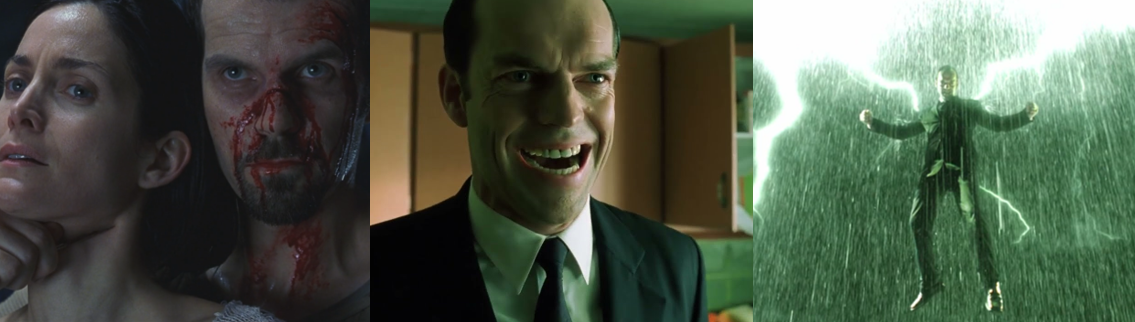
Once a loyal, if disgruntled, agent of the Matrix, Smith has since become his own man; thanks to his ability to endlessly duplicate himself by overriding other programs and inhabitants of the Matrix, his threat increases a thousandfold when he and his duplicates storm the Oracle’s apartment building and assimilate Seraph, Sati, and the Oracle herself! This gives Smith the “eyes of the Oracle” (the ability to see future events, to a certain degree) and allows him to spread like a literal virus throughout the simulation, and he’s even able to confront Neo in the real world by inhabiting Bane’s body. This initially catches Neo off-guard and ends up with him being horrifically scarred and blinded, but Smith is hampered by the fragility of his human body and ultimately defeated since a little thing like blindness is of no consequence to the One. Although we don’t really get to see Smith’s takeover of the Matrix happen since we’re too busy watching the never-ending battle in Zion, it’s effectively demonstrated when Neo confronts Smith in the finale, with the Matrix now a storm-ravaged hellscape populated only by Smith. After negotiating a peace treaty with a visual representation of the machine consciousness (subtly referred to as “Deus Ex Machina” (Henry Blasingame/Kevin Michael Richardson)), Neo is reinserted into the Matrix to fight on behalf of Zion and the machines against their common enemy and end the conflict between the two. Unlike in The Matrix Reloaded, Smith chooses to fight Neo one-on-one because he’s so confident of his victory. Indeed, his abilities have increased to the point where he can not only match Neo blow for blow but even emulate his superhuman abilities, allowing him to fly and pose a significant physical threat with just one of him. Still, it is a bit underwhelming after the madcap Burly Man Brawl of the last film, but I guess it allows for a more intense and personal battle between these two. Indeed, Smith’s power is now so great that, technically, Neo is unable to defeat him. Similar to his experiences in Mobile Ave, the Matrix is now so vastly corrupted and Smith’s power so vast that it’s all Neo can do to hold his own in the fight against the manic Smith, who desires nothing less than to assimilate all life, human and mechanical, and replace it with himself.

The Nitty-Gritty:
We’re far beyond deception, games, and subtlety in The Matrix Revolutions, and nowhere is this emphasised more than in Trinity, Morpheus, and Seraph’s infiltration of the Merovingian’s risqué club (literally descending into “Club Hel”, a place of sadomasochism, excess, and near-demonic denizens) to not bargain with the aristocratic Frenchman but to hold him to ransom. This emphasis on getting to the point continues in Neo’s discussion with the Oracle. Not only does she explicitly (and, in my view, unnecessarily) call attention to her different appearance, but she abandons all riddles and double talk and clearly spells out to Neo that he must defeat his dark opposite, Smith, to decide the fate of the world. In this respect, The Matrix Revolutions is perhaps the simplest of the films to understand: Zion is in danger and Neo must fight Smith to save them and the machines, and this simplicity is perhaps why I find the film so dramatically underwhelming. The protracted and frankly boring war in Zion doesn’t help. It really feels like the film has run out of steam and is thus extending its runtime with a lengthy and muddled war sequence, and it definitely feels like the balance between action and exposition is a little off in the two Matrix sequels. I did, however, enjoy seeing a bit of a role reversal in Niobe and Morpheus. Once a devout believer in Neo and the One, Morpheus’s faith is shaken by Neo’s revelations, but Niobe has become convinced that Neo is worth betting on after witnessing first-hand what he can do. To be fair, Morpheus’s trust in Neo does remain steadfast and is showcased both in their surprisingly emotional farewell and in his ability to intuit that Neo has chosen to fight for his friends and the world.

Sadly, the endless machine attack on Zion pales in comparison to the series’ iconic wire-fu.

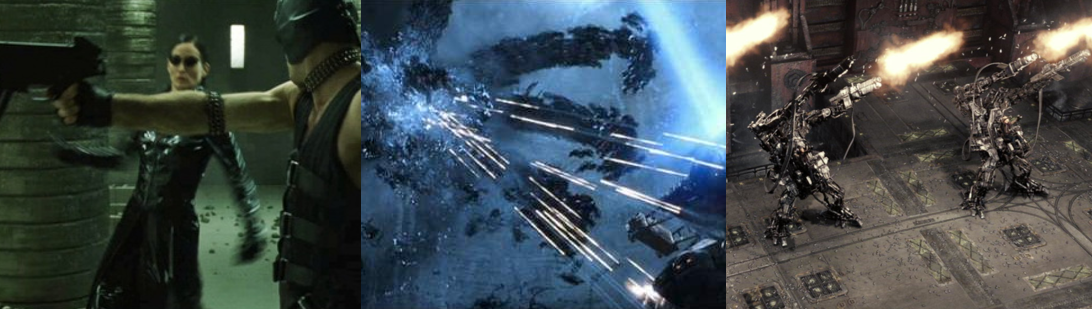
I think one thing that really brings The Matrix Revolutions down is the disappointing lack of wire-assisted, visually stunning kung-fu fight sequences. The Matrix Reloaded really impressed with some unique and fun fights, even if they were a little underdeveloped and a bit cartoony at times, but the third film meanders along for most of its runtime with only a brief ceiling-based scuffle between Trinity, Morpheus, Seraph and the Merovingian’s guards to tide us over until the action-packed finale. This, again, is another reason I find the battle for Zion so underwhelming and dull; there’s no fight choreography to marvel over, no physical skill to admire, and no fun CGI-assisted bullet time effects to spice things up. It’s just a boring mess of metal and screaming, a blur of indistinct characters jerking around in mech suits, bullets flying and shells clattering everywhere, and an uninspiring mess of Sentinels swarming the screen. Admittedly, it is impressive and imposing when they burst in as a cloud of writhing metallic limbs and tear through Zion’s forces, but there’s just way too much obvious greenscreen to really engage with it and it’s hard to really be invested since I know nothing about Captain Mifune (except that he doesn’t take any shit and never completed his training), don’t give two hoots about the Kid (who we’re never really given any reason to care about beyond him being a Neo fanboy), and couldn’t name any of their fellow soldiers who get decimated by the Sentinels. Perhaps if Morpheus had joined the fight, maybe even replacing Captain Mifune and dying in his place, this battle might have made a greater impression on me but, as is, it’s a slog that I just don’t find as interesting as the Hammer’s race to the city or Neo’s surprisingly brutal fight against Bane. Indeed, I simply find myself tuning about and pondering questions like how did Zion build all those mechs? Where is all that ammo coming from? How was Zion even built? We’re left to intuit that the machines helped build the city after the One resets the Matrix but it’s frustrating that questions like these (and how, exactly Neo’s abilities outside the Matrix work) aren’t answered. It’s almost as if the filmmakers couldn’t think of a suitable explanation and again makes it feel like it would’ve been far simpler to have the real world be another simulation, another “system of control”, to keep humans in line.

An unexpected truce and a heroic sacrifice sees Neo end the war between humans and machines.

As mentioned, Neo’s fight with Bane ends with him being blinded; however, he’s still able to “see” at least the machines and their proxies, which are rendered in an ethereal gold light. This, and his ill-explained ability to explode Sentinels with his mind, allows him to direct Trinity towards the machine city, destroy much of their defences, and converse with Deus Ex Machina. This stubborn representation of the machine hivemind initially scoffs at the idea of “needing” Neo’s help but is forced to relent since Smith’s existence poses a very real threat to the machines inside and outside of the Matrix. Thus, an offscreen deal is reached: Neo will enter the Matrix to stop Smith and, if successful, there will be peace between the two races. Reluctantly, Deus Ex Machina agrees and we finally get our big, explosive final showdown between Neo and Smith. This fight is pretty much the only thing worth watching The Matrix Revolutions for; against a relentless rainstorm and a nightmarish city landscape, Neo and Smith collide both on the ground and in the air, delivering a superpowered brawl that far surpassed Superman Returns (Singer, 2006) three years later. Although Neo previously bested Smith, he’s outmatched but the goal was never for him to actually defeat his rival, but to lure him into a false sense of security so that Smith could assimilate him. Thanks to the eyes of the Oracle, Smith knows that his victory is inevitable and, despite a moment of uncharacteristic fear when Neo appears resigned to his fate, he plunges his hand into Neo’s chest and overwrites his code, breathing a sigh of relief at having finally bested his foe. However, it really was just “a trick” as Deus Ex Machina uploads a destruct sequence into Neo’s lifeless body that summarily destroys all the Smiths and allows the Matrix to be restored, now without its grainy green hue. A conversation between the restored Oracle and the Architect (Helmut Bakaitis) reveals that Neo’s sacrifice has earned a fragile peace, one where those who wish to be freed (both human and machine) are allowed to go and all hostilities have ended. The Oracle is left assuring Sati that Neo may return some day and that she always believed that he would end the war that had ravaged and oppressed the world.

The Summary:
The downward spiral of the Matrix films is probably one of the greatest disappointments in cinema history. I firmly believe there was more than enough goodwill and lore to support two or three follow-ups to the first film as it just barely touched upon the unique cyberpunk world it presented, but none of the sequels were truly able to really deliver upon this. I can just about give The Matrix Reloaded a pass as I enjoy the action and fight sequences and even the ham-fisted philosophy, which served to unnecessarily overcomplicate things rather than simply giving us straight answers or naturally developing this post-apocalyptic world. Sadly, I can’t say the same about The Matrix Revolutions, which is generally a bleak and boring limp to the finish line for these otherwise captivating characters. Trinity’s death is really an allegory for this movie: it’s long, overly dramatic, and underwhelming, and nowhere is this more evident in the battle for Zion, which is so tedious that I still feel like I’m watching it even now! The stakes couldn’t be higher in this film and yet I feel almost nothing in this fight as it doesn’t directly involve any of the characters I care about, resulting in a grim slaughter that acts more as a showcase for some lacklustre digital effects than a tense battle. The fight between Neo and Smith is the only reason to watch this film again, and even that is a little disappointing since it boils down to a one-on-one brawl that can’t help but be underwhelming no matter how hard the two fly at each other since we saw Neo fending off an army of Smiths in the last film. Also, I love Keanu Reeves but even I can’t defend him in this film. He’s stoic to the point of boredom, is severely lacking in charisma, and has absolutely zero chemistry with the equally bland Carrie-Anne Moss, robbing her otherwise poignant death of any real impact and causing the film to end with a whimper rather than a bang as it’s not massively clear what happened. It’s a shame as The Matrix was such a unique and ground-breaking film and The Matrix Reloaded tried really hard to inject some new ideas into the concept. But The Matrix Revolutions failed to live up to expectations or deliver a satisfying conclusion to the original trilogy, opting not to deliver a largely mind-numbing finale rather than play into the rabid speculations offered by the fanbase.  

My Rating:

Rating: 2 out of 5.

Could Be Better

Are you a fan of The Matrix Revolutions? Were you disappointed that it didn’t really provide a decent explanation for Neo’s expanded powers? Did you also find the battle between Zion and the Sentinels to be long and boring? What did you think to the idea of Neo battling Smith to the death to decide the fate of the world? What were you expecting from the film at the time and were you disappointed by the end? How are you celebrating Keanu Reeves’ birthday today and what are some of your favourite roles of his? Whatever you think about The Matrix Revolutions, drop a comment below or let me know your thoughts on my social media and be sure to check out my other Matrix reviews.

Movie Night: The Crow (2024)

Released: 23 August 2024
Director: Rupert Sanders
Distributor: Lionsgate
Budget: $50 million
Stars: Bill Skarsgård, FKA Twigs, Danny Huston, Laura Birn, and Sami Bouajila

The Plot:
When troubled youth Eric (Skarsgård) and his girlfriend, Shelly (Twigs), are brutally murdered on the orders of demonic crime lord Vincent Roeg (Huston), a supernatural crow resurrects Eric to take his revenge.  

The Background:
Created by James O’Barr in 1989, The Crow was an underground success that reflected O’Barr’s anger and pain after a tragic loss to. Since dark comic book narratives were all the rage in Hollywood at the time, the comic soon transitioned into a critically and commercially successful film adaptation, one that achieved cult status and infamy after the accidentally on-set death of star Brandon Lee. Determined to capitalise on The Crow’s (Proyas, 1994) success, series producers Edward R. Pressman and Jeff Most signed off on a slew of sequels and even a short-lived television show that was notably better received than the three cinematic and direct-to-video follow-ups. Following the universally panned fourth movie, the franchise entered Development Hell for nearly twenty years as various writers, directors, and actors were attached to a potential reboot. Stephen Norrington was in talks to direct at one point, stars Bradley Cooper and Jason Momoa were tapped for the lead role, production was stalled by financial issues, and series creator James O’Barr stated repeatedly that the new film would be a “re-adaptation” of the source material rather than an outright remake just as Alex Proyas slammed its production. Finally, in 2020, the project was revived and gained traction; Bill Skarsgård won the lead, impressing director Rupert Sanders with his conditioning and enthusiasm, and harmless firearms were mandatory onset to avoid a repeat of Brandon Lee’s tragedy. Upon release, The Crow was met with largely negative reviews that reflected the reactions to the film’s trailers. The chemistry and performances of the leads was questioned, the pacing was slandered, and even more positive spins decried it as derivative of the original and ultimately unable to escape the shadow of its predecessor. Given the franchise’s persistence, it should be no surprise that the ending was reportedly tweaked (against Skarsgård’s objections) to leave the door open for a sequel, though the film’s dismal $24 million box office makes the prospect unlikely.

The Review:
I’ve been a fan of the Crow concept since I was a kid and we first taped the original movie off the television. From there, I discovered the original graphic novel (which, honestly, took me a little while to properly appreciate) and I delved into the movie sequels hoping to at least see more of the same. Unfortunately, it seems The Crow was lightning in a bottle and none of the follow-ups came close to matching the movie’s aura and appeal, which is weird to me as the concept is pretty simple and I maintain there’s a lot of material in the comic (and its follow-ups) that could make for a good film. Like, why not do it hyper-stylised and hyper-violent, like the Sin City movies (Rodriguez and Miller, 2005;2014)? Or take inspiration from The Crow: Dead Time (O’Barr, et al, 1996) or The Crow: Flesh and Blood (Vance, et al, 1996), maybe put a twist on the story and have Shelly be the one resurrected? I was cautiously optimistic for this long-gestating remake, hopeful that it would go for grim and gritty and try to get back to the roots of the concept, but immediately lost faith once I saw the first trailers and went into it hoping that it would at least be full of enjoyable, bloody action. My first wish (that it does something different with the concept) was kind of granted in that a huge portion of the film focuses on Eric (not Draven) and Shelly (no last name) and their budding attraction to each other. Unlike in the original, we spend a significant amount of time hanging with the two, seeing them flirt and play and fuck and apparently fall in love, and the entire time I was thinking to myself…I just don’t care. It’s so weird. Like, I felt more of an emotional connection to Shelly Webster (Sofia Shinas) in the original film and she only appeared in flashbacks or as an apparition. Her and Eric’s (Brandon Lee) love and relationship was conveyed through fragmented memories, both happy and agonisingly violent, and through Eric’s pained, righteous anger. Yet, here, we see the two coming together and finally finding some peace together and I just couldn’t buy into it was it seemed so shallow and hollow.

When he and Shelly are murdered, emo try-hard Eric returns to mope about and eventually get revenge.

It doesn’t really help that we really don’t learn much about them. The film opens with a dream sequence from Eric’s childhood where he was apparently traumatised by the death of his beloved horse and it’s implied that his alcoholic or addict mother (Unknown) was abusive, then jumps to him in rehab, covered in ludicrous tattoos, and moping about, barely speaking and being further abused by his fellow inmates and the strangely aggressive guards. We’re told he turned to drink and drugs but never learn what he went through in the interim or what drove him to cut his wrists, and instead are presented with this sullen, damaged young man who’s essentially sleepwalking through life. In contrast, we do eventually learn a bit more about Shelly, but it still feels like pieces are missing from her puzzle. She begins the film freaked out because her friend, Zadie (Isabella Wei), is killed for recording some mysterious video of them and their friends at some party, then randomly gets arrested for possession and is locked up with Eric, whom she becomes attracted to because the script says so. when her mother, Sophia (Josette Simon), shows up with the mysterious Marian (Birn), Shelly has a partial panic attack and Eric encourages the two to flee. After escaping with ridiculous ease, the two then hole up in Shelly’s apartment and her pursuers never think to check there while the two shack up, befriend a bunch of unnamed fellow lowlifes, and revel in their freedom, despite apparently having no jobs or income (beyond, I guess, drug dealing?) eventually, Shelly opens up about being her past as a piano prodigy and Eric later learns that she was targeted by the enigmatic Vincent Roeg, who preys upon innocent souls and corrupts them with a demonic whisper. Since Shelly had video evidence of Roeg’s supernatural abilities, he eventually has his men storm the couple’s digs and suffocate them to death with plastic bags, condemning Shelly’s soul to eternal damnation since she was manipulated into stabbing a girl to death by Roeg’s influence. While Eric returns from the grave, Shelly also pops up here and there as a phantom, in Eric’s memories, or as he uncovers more of her past and she’s honestly a more fleshed out character than he is, and she’s cute and serviceable enough, but I struggled to believe the strength of their love since I didn’t see a lot of chemistry between the two.

Despite constant exposition and the obvious, Eric remains largely clueless for most of the film.

Upon being killed, Eric immediately awakens in a mysterious, desolate landscape dominated by crows (what I would describe as purgatory). There, he meets a shadowy figure the credits call Kronos (Bouajila) who basically acts as an exposition dump for what’s happened, delivering the famous “People once believed…” line from the original film and describing Eric’s situation and abilities. It’s honestly a little insulting, especially as we didn’t need such ham-fisted exposition in the original film; probably due to Brandon’s untimely death, all of his supernatural powers were conveyed using a simple “show, don’t tell” method but here, Kronos lays it all out to the stunned Eric, who returns to the living world a short time later not by bursting from his grave but by waking up on the apartment floor. Confused and disoriented, he attacks and kills corrupt cop Detective Milch (Dukagjin Podrimaj) when he comes to search for Shelly’s phone and discovers that he can heal from any wound, though isn’t spared the agony of bullet wounds and broken bones. Guided by a supernatural crow, Eric wanders about the streets, largely in disbelief about what’s happened, desperately trying to put names to the faces of his murderers; although he ends up as clueless as we are until the credits, he does stumble upon one of Roeg’s men, only for him to commit suicide rather than talk. Even Sofia is largely tight-lipped about providing him with information, though “luckily” Roeg is aware of the crow’s nature and sends his goons out to find Eric so he can steal his powers, meaning Eric gets to take out some baddies and the guys that wronged him, but he’s hardly as proactive as his predecessors.

Probably the biggest sin of the film is it’s dull and forgettable villains.

Although he lacks any formal fighting training and is unfamiliar with guns, Eric attempts to outfit himself and largely holds his own in a fight by relying on his supernatural healing. He simply ploughs ahead, absorbing damage and enduring the pain of resetting broken bones or healing from wounds. This time around, he remains virtually indestructible as long as his love for Shelly remains pure. While I would’ve expected this to factor into the finale, rendering him mortal as in previous iterations, this becomes a throwaway moment in the second act, when his belief in Shelly falters after watching her video and he dies a second time, forcing him to barter his soul for hers to return once again, finally donning a version of the iconic face paint and committing himself to his mission. This turns him from a melancholy, reluctant avenger to a stoic, enraged crusader as he systematically slaughters a bunch of goons with a sword, cutting his way through a wave of nine-to-fivers to reach Marian, who finally points him in Roeg’s direction. It’s hard to watch The Crow without comparing it to The Crow, but one area where it really fumbles the ball is in the bad guys. Instead of an eclectic bunch of over the top, memorable, despicable glorified street punks, we have a handful of unnamed goons who get so little screen time that I found myself forgetting which ones were responsible for Eric and Shelly’s death. The only one who stands out is Marian and, again, I have no idea who she is or what her motivations are. Roeg’s power is said to manipulate, corrupt, and control, so I assume they all follow him out of a desire for power or because he has leverage over time, but we learn nothing about any of them. They’re just people for Eric to kill, and while he may gain some catharsis and satisfaction from their deaths, I was briefly entertained by the blood splatter and then immediately forgot them. The exception, of course, is Roeg, played with quiet menace by the ever-reliable Danny Huston. He’s said to be centuries old, to have made a deal with the Devil, and corrupts innocents to keep himself out of Hell but…we never learn how this deal came about or anything about him except his predication for young piano players. He desires Eric’s powers, of course, and seems to covet power in general over everything else, but he’s such a vacuous and forgettable character compared to Michael Wincott’s Top Dollar and none of his underlings were as memorable as the latter’s gang of sadists.

The Nitty-Gritty:
As is to be expected, a central theme of The Crow is love. Eric and Shelly are both damaged and lonely individuals, one seemingly tortured by an abusive childhood and the other forced into horrendous acts against her will. Shelly apparently sees a reflection of herself in Eric, or perhaps feels whole with his damaged parts literally and figuratively filling the void in her soul, and they’re portrayed as carefree youngsters who live outside the system. Yet, while they may make for passionate lovers, I never felt like their love was anything more than the fiery lust of the young and attractive. Draven and Webster were a proper couple, set to be married, when they were killed, having built a life together filled with passion, fashion, and music. Eric and Shelly get drunk and high and doss about with their mates. Considering the threat Shelly knows Roeg represents, it seems weird to me that they didn’t go on the run and stayed not only in town but in her apartment; almost as weird as Roeg not sending his men there right away. Eric is especially disappointing; even if he’d had a different name so as not to be associated with Brandon Lee’s character, he’s such a sulky little emo try-hard, with his “edgy” tattoos and lethargic attitude, that I found it hard to care about him. He has none of Draven’s charisma or concern for others; he’s purely motivated by his emotions, slaughtering anyone in his way and struggling to understand what’s going on. He’s a very ineffectual avenger, something Kronos chastises him for, until the finale, where he finally accepts the responsibility placed on him and comes close to giving a decent interpretation of the character. Similarly, the soundtrack is noticeably lacking; sure, I’m an old man who isn’t into the weird tunes featured in this movie, but the lack of emo-infused, gothic rock and traditional heavy metal really works against the aural identity of the film as much as the bland setting keeps it from standing out visually.

By the time Eric embraces his mission, it’s too little, too late for this snooze-fest.

So, okay, maybe The Crow makes up for all this with action and gore. Well…no. yes, there is a lot of blood splatter and some creative, gory kills (certainly more than in the original film) but they’re not seen until the final act. Eric and Shelly are killed in a terrifying, but toothless manner compared to their counterparts and many of Eric’s later kills boil down to headshots and quick swipes of his sword. The opera slaughter (easily the best sequence in the film) is thus a highlight, with Eric cutting through waves of henchmen, slicing off arms, cutting through jaws, and absorbing every shot like a juggernaut, revelling in his bloodlust. His earlier freeway fight was okay, but lacked the focus and physicality of this scene, though naturally none of the antagonists offer a physical challenge to him given his supernatural abilities. There was a brief moment where this seemed to be a point of contention: Marian mentions how Eric, covering in the blood of his victims, has “the same look” as Roeg and Roeg explicitly states that Eric’s lust for revenge has cost him his humanity. Then it’s just swept under the rug and forgotten. Similarly, it seems Roeg is set to follow in Judah Earl’s (Richard Brooks) footsteps and steal Eric’s power using a combination of his demonic voice and Eric’s “black blood”, but that doesn’t happen either. Instead, Eric transports them to the crow’s realm and beats the old man to a pulp until he’s spirited away by demons. As per his deal, Shelly is returned to him and to life, with time apparently rewinding slightly to see her resuscitated soon after being suffocated. Eric remains dead, but seemingly chooses to wander purgatory, halfway between life and death, sure that their souls will reunite someday. Honestly it’s a bit of a confusing ending; almost as confusing as Roeg’s powers and background. Personally, I’ve always disliked that the Crow franchise has included other supernatural elements as they’ve progressed; to me, the avatar should be the only supernatural thing, set against earthly beings who must find other ways to combat him. But then again I also think The Crow is worthy of being more than just a plodding, generic, confuddled mess of a film. A sentiment Hollywood seems not to share.

The Summary:
I wanted to bee excited for The Crow. I genuinely believe a new version or adaptation of the story or concept could work, especially if it took a hyper-stylised or gritty, gothic aesthetic. Instead, The Crow is as generic as I feared and, I suspect, spent way too much time overthinking the concept. We didn’t need everything explained to us by Kronos and, arguably, we gained very little from following Eric and Shelly up to and past their deaths. I didn’t feel an emotional connection to them and, trust me, I wanted to. I kept waiting, begging, for the film to kick into gear and get started only for it to keep dragging its feet, giving us mopey emo-dude looking clueless when the obvious happens around him or is explained to him. For me, he should’ve taken on the familiar guise after his second resurrection and been all-in from there. I also wonder if the film would’ve been fitted from being told out of sequence, with the relationship aspects scaled down and reduced to nightmares and flashbacks. Also, the villains just missed the mark completely. There’s only so much Danny Huston can do with such limited screen time and development, and none of his underlings were as remotely memorable as those seen before. Even the brutal action sequences and copious blood can’t save The Crow, which is so far away from the spirit of the original that I wouldn’t call this a remake or a reboot, more a re-imagining. It’s a real shame as we’ve endured so many terrible Crow sequels and the concept deserves so much better, but do yourself a favour and just watch the original again because this tripe is as dull as dishwater and, worst of all, completely and immediately forgettable.

My Rating:

Rating: 1 out of 5.

Terrible

Did you enjoy The Crow? Do you think the film added some interesting new wrinkles to the formula or did you find it generic and tasteless? What did you think to Bill Skarsgård’s performance and Eric’s characterisation? Did you like the addition focus on his relationship with Shelly? What did you think to Roeg and his largely forgettable henchmen? Which of The Crow’s sequels was your favourite, if any, and would you like the see the character return again? Whatever you think about The Crow, join the discussion below and go check out my other Crow reviews.

Movie Night [Judgment Day]: Terminator Salvation


“Three billion human lives ended on August 29th, 1997. The survivors of the nuclear fire called the war Judgment Day. They lived only to face a new nightmare: the war against the machines”.


Released: 21 May 2009
Director: McG
Distributor: Warner Bros. Pictures / Sony Pictures Releasing
Budget: $200 million
Stars: Christian Bale, Sam Worthington, Anton Yelchin, Moon Bloodgood, Bryce Dallas Howard, and Helena Bonham Carter

The Plot:
Years after humanity was decimated by Skynet’s nuclear attack, John Connor (Bale) is seen as a prophet by many in the human Resistance due to his future knowledge. However, when Skynet begins targeting Connor’s future father, Kyle Reese (Yelchin), he’s forced to put his faith in Marcus Wright (Worthington), an amnesiac murderer resurrected by the same technology destined to birth Skynet’s Terminators.

The Background:
The Terminator (Cameron, 1984) might have been an unexpected financial success, but Terminator 2: Judgment Day (ibid, 1991) was a blockbuster release that is often touted as one of the greatest movie sequels of all time. Despite T2 being the definitive end of the story, star Arnold Schwarzenegger returned to the franchise for Terminator 3: Rise of the Machines (Mostow 2003), which proved to be a near-universal critical failure. However, Terminator 3 did surprisingly well at the box office and was supposed to be the first of two films revolving around the early days of the Future War before a series of lawsuits saw the rights change hands and McG wind up in the director’s chair. A fan of the first two films, McG initially wanted Robert Patrick to return and even discussed the project with James Cameron. Terminator 3 stars Nick Stahl and Claire Danes were initially set to return but rising star Christian Bale won the lead role, which was expanded following his input to explore his destiny as a leader, though Bale came under media fire following an on-set outburst that he later apologised for. Although Schwarzenegger’s involvement was in doubt since he was serving as the Governor of California at the time, he eventually allowed his likeness to be digitally applied to bodybuilder Roland Kickinger for the finale. The lead cyborg role was assumed (on Cameron’s suggestion) by rugged Australian Sam Worthington, who insisted on performing his own stunts despite a serious on-set injury. McG insisted on there being as many in-camera effects as possible; the film would be one of the legendary Stan Winston’s last projects and boasted large-scale models, repurposed Ducati motorcycles, and complex animatronics alongside digital effects. Initially, the film was to have a far darker and less sensible ending in which Marcus assumes John’’s visage and murders the protagonists, though this (and the entire third act) was changed after an online leak. As it barely cleared $370 million, Terminator Salvation failed to surpass its predecessor at the box office and was (in my view) unfairly shunned by critics. Reviews targeted the mindlessness of the plot, Schwarzenegger’s absence, and the performances, with even the likes of Schwarzenegger, Cameron, and Linda Hamilton criticising the film’s shortcomings. However, others praised the film and, in time, it has developed a bit of a cult following. Although it was accompanied by a videogame and animated tie-in, bankruptcy and legal issues saw the Terminator rights once again shopped around and the new rights holders opt to retread the original films for their reboots.

The Review:
Let’s face it, trying to follow-up Terminator 2 was probably never going to end well, especially when all you’re offering is a toothless rehash of what’s come before. However, as poorly handled as Terminator 3 was, I definitely think there was a perfect opportunity to continue the franchise with some fresh faces by either having new Terminators (or the same T-800) sent to different points in the past to target other members of the future Resistance or by simply producing a prequel set during the Future War. Even now, as I’ve noted, one of the biggest missed opportunities in the entire franchise is not giving us a sweeping, cinematic shot of an army of Arnolds marching across a field of human skulls blasting at the resistance without mercy. So, I was intrigued and cautiously optimistic when the trailers for Terminator Salvation hit, and even more so because it had Christian Bale in the lead role. Bale was riding a wave of mainstream success following his unrivalled turn as Bruce Wayne/Batman and was a far, far better choice than Nick Stahl, so much so that it’s honestly a little difficult believing that Stahl’s version of John became the hardened, driven, semi-prophetic icon that is the John of this movie. However, this is before subsequent movies started needlessly screwing about with the timeline so everything that’s happened before is still canon. The most obvious indication of this is the presence of Katherine “Kate” Connor (Howard), now upgraded from veterinary nurse to actual nurse. Unfortunately, while she’s clearly seen to be pregnant and is depicted as John’s loyal right-hand (to say nothing of also being played by a stronger actor), there isn’t really all that much for Kate to do here since the film is more focused on its new cast of characters.

Hardened by conflict, John uses his future knowledge to inspire the Resistance and stay ahead of Skynet.

Terminator Salvation takes place quite early on in the war against the machines; though crippled and decimated by nuclear war, the world hasn’t yet become a nightmarish landscape of human bones and the battlefield isn’t yet filled with laser blasts and, most notably, John hasn’t become the iconic leader of the human Resistance. Instead, he’s a well-respected member of “TechCom” and a fully capable soldier in the seemingly unwinnable war against Skynet. Thanks to the teachings of his mother, Sarah (Linda Hamilton), and the tapes she left behind, John has enough information on Skynet to accurately predict their tactics, target their bases, and fend off attacks from their proto-Terminators, the T-600 model. Although he’s still subject to the will of his superiors, particularly the cantankerous General Ashdown (Michael Ironside), John is regarded by many as a messiah-like figure thanks to his uncanny knowledge and his regular rallying calls to the rag-tag survivors trying to avoid detection in the wastelands. However, even John is stunned to not only learn that Skynet’s construction of the far deadlier T-800 infiltrator model has been fast-tracked but also that the machines possess a “kill list” that names not only him and the Resistance leaders but also his father-to-be, Kyle Reese. With Skynet due to launch a massive offensive against its targets in just four days, John volunteers to test out an experimental signal that can disable the machines and is encouraged to prepare his squad, alongside trusted lieutenant Barnes (Common), in using the weapon to storm Skynet’s main headquarters in San Francisco and rescue Kyle and the other prisoners before the timeline is irrevocably altered for the worst. Brave, driven, and hardened from fully accepting his destiny as the leader of the human Resistance, John has developed an intense hatred of the machines and battles them without hesitation, though he doesn’t do this recklessly. Instead, he uses his mother’s teachings to set traps and target the machine’s weak spots to either disable or reprogram them efficiently, all of which contributes to his celebrated status amongst many within the Resistance and those struggling out in the wilds.

Amnesiac cyborg Marcus wins the trust of the rag-tag survivors trying to oppose the machines.

Of course, John’s story is only one part of Terminator Salvation’s narrative as it was around this time that Hollywood was trying to make Sam Worthington a thing. To be fair, I actually don’t mind him but he’s not exactly the most impressive or charismatic actor out there, especially when placed opposite the intense and captivating Christian Bale. Marcus is first introduced prior to Skynet’s attack as a death row inmate convinced by Doctor Serena Kogan (Bonham Carter) of Cyberdyne Systems to donate his body to her research. The result is his transformation into Skynet’s first cybernetic operative, which is treated as a big surprise when Marcus is injured by a magnetic landmine and taken to John’s base but was both telegraphed by the trailers and blindingly obvious by the fact that Marcus stumbles out of a destroyed Skynet laboratory in the midst of the Future War. Suffering from amnesia and confused by the state of the world, Marcus instinctively heads towards nearby civilisation and finds only the ruins of the old world, deadly (if clunky) robotic soldiers patrolling the wasteland, and young Kyle and mute Star (Jadagrace Berry) struggling to survive. Although he angers Kyle by wearing the colours of the Resistance without earning them and humbles the youngster’s moxie by easily disarming him, Marcus develops a reluctant kinship with the two due to his inherently good heart and he’s so determined to rescue them after they’re scooped up alongside a bunch of other survivors that he fails to heed the warnings of Resistance pilot Blair Williams (Bloodgood) regarding the machines. Injured and shot down while trying to intercept the prisoner transport, Blair grows close to Marcus while stranded in the wasteland and is the only one to defend him when the truth about him is dramatically revealed. Trusting her instincts, Blair decides to set Marcus free rather than leave him in John’s custody since Connor and the Resistance immediately peg Marcus as an advanced Skynet infiltration unit. Though he lacks the imposing nature of the T-800 and is far more vulnerable than the average Terminator thanks to his exposed heart, Marcus proves invaluable to John’s efforts in infiltrating the machine base since he’s essentially one of them, but it’s only when he’s inside the belly of the beast that Marcus learns just how deep Skynet’s influence runs within his body and circuitry.

As dangerous as Skynet’s forces are, they pale in comparison to the threat posed by the T-800!

Since we’re at the early stages of the war against the machines, Terminator Salvation offers the greatest variety in mechanical adversaries than any previous Terminator film, though at the cost of having a central antagonist machine for the Resistance to fight against. Primarily, the rag-tag humans must contend with clunky T-600s, bulky endoskeletons that make a scarecrow’s attempt to pass as human and open fire on their targets with miniguns. At one point, John sets a trap for a couple of Moto-Terminators, motorcycle-like robots that race along at high speeds but are easily reprogrammed by the Resistance. Similarly, tentacle-like Hydrobots attack the humans from the water and Hunter Killers (HKs) patrol the air, though all these machines are easily bested by regular weapons such as machine guns and rocket launchers. The gigantic Harvester proves a far more formidable and persistent threat; this hulking machine packs pulse cannons and a flamethrower and easily shrugs off an exploding petrol station, scoops up its targets, and spirits them away to Skynet Central on the back of a massive prisoner transport. When he awakens inside the facility, Marcus confronts the Skynet mainframe, which primarily assumes Dr. Kogan’s form to reveal that he was created to lure John into a trap and that Skynet has led the Resistance into a false sense of security with the fake kill signal, allowing them to easily wipe out the Resistance high command and threatening the survival of the human race by having all their primary targets in one place. The primary threat in Terminator Salvation is the impending development of the T-800 models, which has assumedly been accelerated since this is a slightly altered timeline to the one the elder Kyle Reese (Michael Biehn) came from. While desperately searching Skynet Central for Kyle, John comes face-to-face with the machine that has haunted his family for so long, setting the stage for a brutal and intense showdown with a T-800 (Roland Kickinger/Arnold Schwarzenegger) that echoes the relentless murder machine that targeted Sarah back in the first movie.

The Nitty-Gritty:
As ever, a primary theme in Terminator Salvation is that of fate. John includes the message “There is no fate but what we make” in his nightly addresses and his entire existence and ability to intercept Skynet is based on the idea that his fate has been largely predetermined. I say “largely” because, as mentioned, this isn’t the Future War Sarah learned of from Kyle, which crops up a couple of times as an obstacle for the usually well-informed John to overcome. He’s stunned by Marcus’s existence, which wasn’t expected, and his experiences in the past mean that he naturally believes Marcus is a sophisticated infiltration unit specifically programmed to feign humanity to kill him. This bias briefly makes Kyle forget his own humanity, but he refuses to admonish Blair for following her heart and releasing Marcus since he recognises that she’s simply being human. John also reluctantly decides to trust Marcus in infiltrating Skynet Central since it’s the only chance he has of rescuing Kyle and ensuring his fate. Although he’s now far more capable and experienced as a soldier and a man, John’s greatest strength is in his conviction. While General Ashdown and others in the Resistance high command question John’s prophetic abilities, others (especially those stuck in the wilderness, like Kyle and Star) see John as an inspirational hero who motivates them to fight back against the machines. It’s through John’s nightly addresses that the survivors learn of the machines’ weaknesses and habits and find the strength to dig in and hold on since “They are the Resistance”, something Kyle takes very seriously even though he hasn’t earned this stripes, so to speak, as a fully-fledged member of the Resistance.

The bleak visuals and focus on practical effects make this an under-rated entry in the series.

Terminator Salvation is often unfairly overlooked in the grand scheme of things. While it’s not as dark or visually evocative as the nightmarish Future War sequences from the previous films and it’s a shame that neither side favours laser rifles as their go-to weapon, it’s an effectively bleak sci-fi war film that shows the devastation caused by the nuclear war (even though there’s realistically no way anyone would have survived such an onslaught, including the natural environment). A great selling point of the film is the gritty way it’s shot and the focus on practical effects. The T-600s might be a poor predecessor to the more versatile T-800s but they look great since they’re actually there and recall the animatronics and puppet work of the first movie. The Harvester, especially, impresses as a combination of practical and CGI effects, making for one of the most exhilarating sequences in the film as the gigantic mech smashes into a human hideout in search of its targets and easily shrugs off any attempts to disable or destroy it. Rather than making a massive tank with laser cannons like in the first two films, the Harvester is a lumbering giant built to contain and destroy as part of Skynet’s plot to lure John into the midst. Skynet Central, and the finale in general, is where Terminator Salvation most directly resembles the Future War seen in the previous films. A futuristic prison camp where prisoners are herded like cattle, branded, and summarily executed or put to work building new machines, the machine headquarters is an oppressive mechanical hellhole that’s juxtaposed with the more clinical high-tech Skynet high command and laboratory and the dank industrial factory where the machine’s inexhaustible armies and weapons are produced in bulk. Previously, we could only imagine what the inner workings of Skynet were like (outside of a few toy sets and spin-off media), but Terminator Salvation provides the most in-depth look at their factories and facilities. Again, this is very grounded and clearly meant as a taster for bigger things to come in future films since there’s no mention or concern about the time displacement chamber and the primary threat of the T-800 is more than enough cause for concern for the already-outgunned Resistance fighters.

Marcus rejects his programming and willingly sacrifices himself to ensure the Resistance have their saviour.

With Kyle and Star prisoners of the machines alongside countless other human survivors, John has no choice but the trust Marcus to infiltrate Skynet Central on his behalf and clear the defences so he can follow and rescue those trapped there. Time is not on John’s side in this endeavour as General Ashdown plans to launch an all-out assault on Skynet Central and, even though John uses his influence to override Ashdown’s direct command, the machines are also planning their own counterattack and threaten the fragile time paradox that birthed John in the first place. Rejecting his programming and mechanical nature, Marcus disrupts Skynet, disables their defences, and releases all the prisoners but, in the chaos, Kyle gets distracting trying to keep Star safe and, when John finally tracks them down, they are ambushed by the T-800. Returned to the relentless assassin from the first film, the T-800 silently and ruthlessly pursues its targets, shrugging off John’s attempts to slow it down or destroy it, even those that would have downed the previous T-800s. It endures a blast to the face, a grenade shot, and even being drowned in molten metal to keep attacking John, who it easily manhandles and bludgeons with its superior strength, and even manages to dupe by mimicking Kyle’s voice. After receiving his trademark facial scars, John frantically scrambles to fend off the Terminator, desperately rigging some of the machine’s nuclear power cells to blow the facility but finds an unlikely saviour in Marcus. Marcus battles the Terminator in an all-out brawl but ends up on the losing end thanks to a fatal blown to his exposed heart. Although John revives his cybernetic ally, he’s stabbed right through the chest from behind and left in critical condition. After dispatching the Terminator with surprising ease and escaping Skynet Central with his allies, Marcus heroically offers his own super-powered heart to save John’s life, thus sacrificing himself for the greater good. Sadly, this is a bit of a flat ending for me; John’s injury was obviously too severe for him to ever survive and it’s pretty clear that the finale underwent a frantic reshoot. I think it would’ve worked better if John had been impaled through the shoulder rather than right through the chest. Still, the film ends with a weakened John resolving to continue the fight and turn the tide against the machines, just as he is destined to do, though we’d unfortunately never get any further films set in this particular timeline.

The Summary: 
While I admit that Terminator Salvation is far from a perfect film, it’s definitely nowhere near the worst film in the franchise. In fact, for me, it’s easily in the top three after the first two and is well worth a critical re-evaluation as it actually tries something new, something that respects what came before it, and actually works in the context of the continuity established so far, rather than needlessly retreading everything that came before it. While Sam Worthington and Moon Bloodgood are serviceable enough, the film is bolstered by Christian Bale’s gravelly, intense, admirable performance, but the late Anton Yelchin also impresses as a young Kyle Reese and the inclusion of notable character actors like Michael Ironside and even Common add some spice to the production. Where the film really shines, though, is in its bleak, war-themed aesthetic and impressive emphasis on practical effects. Sure, things are noticeably toned down (Marcus’s torn-up appearance is nowhere near as gory as in the first two movies) and we’re denied laser rifles and the nightmarish version of the Future War from the previous films, but the desolate, desperate nature of the Resistance’s fight against the machines is front and centre. I loved Bale’s intensity here; he stands head and shoulders above all other interpretations of the adult John Connor and gives a stellar, complex performance as a man hardened by war and determined to rally the survivors into a coherent unit. Honestly, I wouldn’t have minded if the T-800 hadn’t made an appearance at all but, while the Terminator only briefly wears Arnold’s visage, it’s absolutely the icing on the cake thanks to being at the centre of the brutal finale that captures the same desperate spirit as the elder Kyle’s fight for survival against the T-800 endoskeleton. Yes, the ending does let the film down a bit as I don’t believe for a second that John would ever survive his injuries and find it far too convenient that Marcus’s heart just happened to be compatible, but I can let that go as Terminator Salvation delivers an under-rated and highly entertaining Future War film that is absolutely where I wanted the franchise to go and it remains an absolute shame that we didn’t get at least one more movie set during this period.

My Rating:

Rating: 4 out of 5.

Great Stuff

Are you also a fan of Terminator Salvation? How do you think it compares to the other Terminator films? Were you a fan of Christian Bale’s performance and how would you rate Sam Worthington’s portrayal of Marcus Wright? What did you think to the practical effects used to bring Skynet’s forces to life? Did you enjoy seeing the T-800 show up for the finale or was it a little too tacked on for you? Would you have liked to see more films set during the Future War with this cast? How are you celebrating Judgement Day today? No matter what you think about Terminator Salvation, and the Terminator franchise, feel free to leave a reply down below and check out my other Terminator reviews.

Movie Night: Alien: Romulus

Released: 16 August 2024
Director: Fede Álvarez
Distributor:
20th Century Studios
Budget:
$80 million
Stars:
Cailee Spaeny, David Jonsson, Archie Renaux, Isabela Merced, Spike Fearn, Aileen Wu, and Trevor Newlin

The Plot:
Trapped on a backwater Weyland-Yutani world, young miner Rain Carradine (Spaeny) and her android “brother”, Andy (Jonsson), are roped into investigating the drifting Romulus/Remus space station, only to unwittingly awaken a crop of Facehuggers and begin the Xenomorph threat anew.

The Background:
In 1979, director Ridley Scott brought to life  Dan O’Bannon and Ronald Shusett’s long-gestating conceptJaws (Spielberg, 1975) in space” with Alien, a critically acclaimed sci-fi horror classic that unexpectedly spawned an entire franchise. While its sequel, Aliens (Cameron, 1986), was equally influential in its own right, its third and fourth follow-ups were divisive, to say the least, and the franchise was all-but dead in the water after the overall lacklustre reception of the two vs. Predator crossovers (Various, 2004;2007). After much deliberation, Ridley Scott returned to the franchise with two prequels; while Prometheus’ (Scott, 2012) $400+ million box office made it a financial success, both it and Alien: Covenant (ibid, 2017) divided critics and talks of a third film soon stalled. While the franchise was kept alive by the critical success of Alien: Isolation (Creative Assembly, 2014), a survival/horror game that returned to Ridley’s original movie for inspiration, the acquisition of 20th Century Fox by the Walt Disney Company saw talks of new Alien movies begin anew. Fede Álvarez came onboard to direct a standalone “midquel” that was originally scheduled to release on the Hulu streaming platform before being quickly upgraded to a cinema release. Inspired by Alien: Isolation and having consulted both Ridley Scott and James Cameron, Álvarez sought to bridge the gap between Ridley’s prequels. As of this writing, Alien: Romulus has been met with considerable success; its $121.8 million box office made it a financial success and reviews have been largely positive, praising Caliee Spaeny’s performance, and the return to the franchise’s horror roots. Despite criticisms the “resurrection” of Ian Holm in an antagonistic role, audiences were impressed by the film and Álvarez expressed his desire to collaborate with Prey (2022) director Dan Tratchenberg on reviving the Aliens vs. Predator franchise.

The Review:
Honestly, a proper throwback to the roots of the Alien franchise has been a long time coming. I appreciate the idea and sentiment behind producing prequels that laid the foundation for a larger world and added some additional context behind the Xenomorphs, but the execution of Ridley Scott’s preludes was strangely and uncharacteristically flawed. In their efforts to tell a deeper, philosophical story, Prometheus and Alien: Covenant ended up mudding the waters and taking a lot of mystique away from the Aliens, reducing their terror and aura in favour of convoluted, sci-fi clap-trap. Alien: Romulus immediately addresses these issues with is stunning set design, atmosphere, and attention to detail; unlike the previous movies, all the technology feels very grimy, dirty, “lived-in”, and reflects the sci-fi aesthetic of the late-70s and 1980s. One thing that really bugged me about the prequels was how clean and slick and sexy all the technology was; although it made sense that Peter Weyland (Guy Pearce) would have better technology than “space truckers” like the Nostromo crew, it just didn’t have that same gritty feel as the tech seen in Alien and Aliens. Here, everything feels lovingly recreated and faithful to the style of the original film, including those disturbing circular vent doors, the big, chunky buttons and CRT monitors, and the design of all the consoles, corridors, doors, and environments on the Romulus/Remus space station. Add to that the decidedly Blade Runner-esque (Scott, 1982) design of the desolate Jackson’s Star mining colony and you have a film that looks, feels, and fits much more organically into the decidedly bleak, corporate-controlled sci-fi future depicted in the first two movies.

Rain’s desire to escape her life lead to her joining an ill-fated space heist.

Jackson’s Star is a hellhole of a backwater world that’s constantly battered by storms and bathed in perpetual darkness. The colonists work themselves to death in dangerous mines, mining some kind of ore or precious metals for “The Company”, the malicious and profit-obsessed Weyland-Yutani, fiddling contracts to force their downtrodden workers to stay on-world until they die. This is the life young Rain has been resigned to; orphaned and left to care for her malfunctioning android “brother”. Rain dreams of accruing enough work hours to get off-world to the virtual paradise of Yvaga, a dream the Company destroy by constantly changing the terms of her contract. Despite her desire to escape her life, she’s hesitant to her ex-boyfriend Tyler’s (Renaux) plan to take the hauler Corbelan up to the drifting Romulus/Remus space station and steal the cryosleep chambers stored within to escape to Yvaga with their friends, Tyler’s pregnant sister Kay (Merced), Bjorn (Fearn), their android-hating cousin, and his girlfriend, Navarro (Wu). Since Andy is the only one who “speaks MU/TH/UR” and can thus get them access to the station, the crew need Rain and Andy to succeed. Considering how poorly Bjorn treats Andy, Andy’s awkward and child-like disposition, and the risk involved, Rain is reluctant to go along with the heist but ultimately agrees when Andy states his wish to help as part of his directive to “do what’s best for [her]” even though he knows he won’t be welcome on the anti-synth Yvaga colony. Though young and adding little to the crew, Rain is essential to the plan since Andy will do anything she says, and she comes to acquit herself well when their presence powers up the station and releases the Facehuggers stored within. She’s practical and adaptable while also being vulnerable, and extremely protective of Andy, standing up to Bjorn whenever he treats Andy badly (which he does constantly).

Andy’s personality is corrupted by Rook’s influence, leadingto some deaths.

Although Tyler’s initially dismayed to find the cryopods are low on fuel, he quickly leads Bjorn and Andy to a larger cryochamber to retrieve the fuel they need for their journey. However, powering up the ship reactivates the long-dormant systems and unleashes a slew of Facehuggers, which attack the crew, causing Rain and Navarro to rush to their aid, upgrading Andy to access the station’s systems. This results in Navarro being incapacitated by a Facehugger and a dramatic change in Andy’s personality. Where he was once docile, stuttering, and unsure of himself, compensating for his awkwardness with lame Dad jokes, he’s now confident, self-assured, and logical. Though his knowledge hasn’t increased, the chip alters his personality and his objectives to align with those of the Company and the station’s resident science officer, Rook (likeness of Ian Holm, voiced by Daniel Betts), a heavily damaged synthetic who delivers exposition regarding the station, the Xenomorph, and the Facehuggers. Rook’s influence changes Andy’s prime directive to serve the Company and sees him operate on cold logic, assisting the crew but only by proxy; he almost shuts Rain and Tyler out when they’re being chased by Facehuggers, acts suspicious and cagey about their odds and plans to avoid the creatures, and refuses to open a door for Kay, leading to her being abducted by the Xenomorph (Newlin). Andy thus becomes something of a secondary antagonist, seemingly willing to allow the survivors to escape to Yvaga only after they’ve completed Rook’s mission and gotten the mysterious, alien goo to safety. This gloop, referred to as the “Prometheus fire”, will be as instantly recognisable to long-term fans as Rook as it’s the same substance that caused all the aggro in Ridley Scott’s prequels. It turns out that the Company retrieved the Xenomorph from the first film from the Nostromo’s remains and managed to extract the goop, and a crop of Facehuggers, from its body before it came back to life and slaughtered the crew. Although it was taken out and the Facehuggers were kept in cryostorage, the station was left as damaged as Rook and adrift, set to crash into Jackson’s Star’s planetary rings, which isn’t in the best interest of the Company.

The Facehuggers are now as great a threat as the Xenomorph.

As surprising as it was to see the original Xenomorph’s corpse hanging in Romulus/Remus, it was equally surprising to see Alien: Romulus place so much focus on the Facehuggers. There are a lot of these skittery little things and they’re extremely aggressive, flying at people’s faces in a desperate attempt to impregnate them. Andy explains that the creatures, though blind, hunt by sensing body heat and sound, leading to a tense scene where Rain, Andy, and Tyler sneak past a room full of them by raising the ship’s temperature. Persistent and hostile, the Facehuggers are a constant threat not just in their number, but in one attaching itself to Navarro. Although the crew manage to safely remove it and get her back to the Corbelan, the egg it implants quickly (and I mean quickly) gestates into a Chestburster and breaks free, soon forming an extremely unnerving and sexually suggestive cocoon. When Bjorn attacks it, he’s summarily melted by the creature’s acid blood and an all-new Xenomorph emerges. Aesthetically similar to the original creature, this tall, humanoid hunter stalks the survivors throughout the ship, filmed very much like a horror monster and using vents, the shadows, and its bio-organic appearance to blend in wherever possible. One thing Alien: Romulus excels at is making the Xenomorph scary again by mirror its behaviour and depiction in Alien and Alien: Isolation. Largely defenceless save for a cattle prod, the crew are picked off one by one not to be killed (with the except of Tyler) but to be taken to a rudimentary nest deep in the station, where they’re impregnated and add to the growing hive of Aliens lurking down there. The creature’s acid blood means Rain and Tyler’s options to use their pulse rifles are limited, save for manipulating the station’s gravity controls to render them (and their blood) weightless and easy pickings. Still, the Xenomorph is effectively return to its horror roots here, shot in glimpses and framed as an unsettling sexual, aggressive creature that can strike at any time and hunts its prey relentlessly.

The Nitty-Gritty:
It really cannot be overstated how pleasant it is to watch Alien: Romulus and be transported back to the 1970s-era of sci-fi/horror filmmaking. The aesthetic of Alien has been so perfectly recreated that it legitimately feels like it was made around the same time, as a “lost sequel”, with the murky, lived-in nature of the technology contrasting nicely with the clinical, sleek tech seen in the space station’s science lab. Not only that, the film uses elements of the scores from AlienAliens, and Prometheus and recreates certain elements from the first two movies as fun callbacks. For example, there’s a scene where Tyler teaches Rain how to handle the pule rifle that’s similar to the one from Aliens, Andy utters Lieutenant Ellen Ripley’s (Sigourney Weaver) iconic “Get away from her, you bitch!” line, the space station’s AI is called MU/TH/UR (“9000”, no less), and the filmmakers saw fit to use Ian Holm’s likeness for Rook, as opposed to bringing back Lance Henriksen or even Michael Fassbender. And Rook has quite a substantial role; he offers exposition, manipulates Andy, and acts as a tertiary antagonist, deceiving the survivors and forcing them to act in the best interests of the Company to get to safety. Normally, I have a bit of a problem with resurrecting dead actors like this, but it was a real thrill to see Holm “back” in his role and expand upon his android’s programming, which is geared specifically towards protecting the alien goo (and the Xenomorph itself) to benefit Weyland-Yutani.

Practical effects and great attention to detail up the newfound horror elements.

Alien: Romulus really brings the tension and the horror back to the franchise; by explicitly returning to the series’ roots, the Alien is scary and formidable again and reasserts itself as one of cinema’s most grotesque and memorable monsters. The use of darkness, flashing lights, and smoke all build a great sense of foreboding atmosphere, one only compounded once Andy’s programming is skewed and he’s no longer trustworthy. The horror of Alien: Romulus isn’t just related to gore (though there’s a fair amount, with Bjorn being melt and Tyler taking a mouth to the face) and once again on the uncertainty and persistence of the Xenomorph, and the uncomfortable sexual connotations of its appearance and nature. A snarling, drooling beast, it slinks about offscreen or just out of sight, looming behind characters, skewering them with its tail, and cocooning them to forcibly breed more of its kin. The Alien nest is a disturbing, slimy environment where every shadow appears to be moving or hiding another Alien. Unexpectedly, the additional Aliens aren’t the ridge-headed drones like in Aliens but similar in appearance to the first Xenomorph, though they die just as easily once Rain deactivates the station’s gravity. This leads to an incredible scene where the Alien’s acidic blood is floating around in zero-g, keeping the station from decompressing but serving as a veritable minefield for her and Andy to navigate through. Furthermore, Aliens: Romulus impresses with its extensive use of practical effects; animatronics, suits, and potentially even model shots are all incorporated to provide a reality to the horrific events and make everything seem so much more tangible. The Facehuggers, especially, benefit from this, proving a surprisingly effective threat throughout the film, but the attention to detail in the sets and the Xenomorph design are beyond impressive and certainly crafted as a love letter to Ridley Scott and James Cameron.

After escaping the Aliens, Rain must contend with a grotesque new variant.

When the crew first dock at the space station, they have about 45 hours before it crashes into the planetary rings. However, Navarro’s condition and the birth of the Chestburster cause the Corbelan to careen off course, cause some damage to the station, and reduce the ticking clock to just under an hour. With the Alien stalking them and Andy only assisting them to complete Rook’s mission, Rain and Tyler desperately make their way across the station to their ship to escape, only to wind up in an Alien nest, Tyler being summarily executed by a Xenomorph. Although they rescue Kay, she’s left severely injured and, losing blood quickly, decides to take a chance with the alien goo, injecting it into herself to heal her wounds while Rain goes back for the discombobulated Andy, finally removing the Weyland-Yutani chip and restoring his original personality. Safely back on the Corbelan, the survivors watch as the space station, its Alien cargo, and Rook are destroyed and prepare to make their long-awaited trip to Yvaga but, surprise, the alien goo accelerates Kay’s pregnancy and gives birth to perhaps the most disturbing Alien creature ever. This “Offspring” (Robert Bobroczkyi) is a disgustingly horrific mixture of human and Alien DNA, something akin to the Engineers and the Newborn, a spindly, gangly, warped creature that feasts upon its “mother” and stalks Rain throughout the desperate last moments. Thanks to her adaptability, Rain lures the creature into the cargo hold and blasts it into space. Though it proves as persistent as its Alien forefathers, the Offspring (truly a sickening malformation of life) is eventually blasted out to a fiery end, leaving Rain to record one last log before heading to cryosleep with Andy, who was damaged during the creature’s attack.

The Summary:
as a long-time Alien fan, I’ve hoped for a throwback sequel for years, especially after being disappointed by Ridley Scott’s later efforts. There’s so much potential to tell stories between the existing films, with new characters and Alien offshoots, and Alien: Romulus is a fantastic step in the right direction in that regard. By returning to the franchise’s horror roots, recreating the aesthetic and feel of the first two movies, Alien: Romulus easily fits between the first two movies, expanding and paying homage to the accepted lore and bolstering its story with some fun and unexpected cameos and references. The cats, though largely unknown to me, could be said to be a negative of the film but everyone did their job well. Sure, Bjorn is needlessly antagonistic and Kay, Navarro, and Tyler might be a bit underdeveloped, but Rain and Andy more than make up for this. This is their story, a coming-of-age trial for Rain and an exploration of a damaged android’s divided loyalties with Andy, who’s motives appear conflicted throughout. It was a joy to see Ian Holm recreated and get another turn as a tertiary antagonist, and to see the Facehuggers featured as such a formidable and persistent threat. But the true highlight here is the titular Alien, once again returned to a monstrous, terrifying sexually-charged predator, the Xenomorph is aggressive and disturbing even when it’s not onscreen as its threat looms over every action the characters take. The Offspring was truly sickening to behold, offering a new variant in the Alien gene and bringing to life Rook’s dream of infusing the Alien DNA with humans. Ultimately, this was a fantastic viewing experience; it’s just such a thrill to watch and be transported back to the peak of this sci-fi/horror world and see the franchise done right, with the right level of fan service and innovation working hand-in-hand with traditional filmmaking and a true love for the source material to revitalise the long-dormant franchise.

My Rating:

Rating: 5 out of 5.

Fantastic

Did you enjoy Alien: Romulus? Were you also impressed by the aesthetic similarities to the first two movies? What did you think to the cast and the relationship between Rain and Andy? Were you surprised to see Ian Holm recreated and “back” as Rook? What did you think to the references to the greater series lore? Were you happy to see the Xenomorph made scary again, and equally disturbed by the Offspring? Where would you like to see the Alien series go next? Whatever your thoughts, please share them in the comments and be sure to check out my other Alien reviews.

Movie Night [Spidey Month]: Spider-Man 3


Easily Marvel Comics’ most recognisable and popular superhero, unsuspecting teenage nerd Peter Parker was first bitten by a radioactive spider and learned the true meaning of power and responsibility in Amazing Fantasy #15, which was first published in August 1962. Since then, the Amazing Spider-Man has featured in numerous cartoons, live-action movies, videogames, action figures, and countless comic book titles and, in celebration of his debut and his very own day of celebration, I’ve been dedicating every Tuesday of August to talk about everyone’s favourite web-head!


Released: 4 May 2007
Director: Sam Raimi
Distributor: Sony Pictures Releasing
Budget: $258 to 350 million
Stars: Tobey Maguire, Kirsten Dunst, James Franco, Thomas Haden Church, Topher Grace, and Bryce Dallas Howard

The Plot:
Having finally gotten the girl of his dreams, Peter Parker (Maguire) finds his life on the upswing, but an attack by vengeful Harry Osborn (Franco), and the discovery that recently-superpowered thief Flint Marko (Church) killed his beloved uncle see Peter giving in to the power and allure of a mysterious black suit from space.

The Background:
Following his debut issue becoming one of Marvel’s best selling titles at the time, Spider-Man’s popularity saw him become their flagship character. Soon, the wall-crawler fronted numerous team-up comics, videogames, cartoons, and even a live-action series. Although his cinematic debut was constantly delayed by script and legal issues, Sam Raimi and Sony Pictures Entertainment landed a critical and commercial success with Spider-Man (Raimi, 2002) and followed this two years later with Spider-Man 2 (ibid, 2004), which is widely regarded as one of the greatest superhero movies ever made. There was never any question that a third film would follow and Raimi initially planned to explore Peter’s morality, the humanity of his villains, and themes of forgiveness; However, his wish to cast Ben Kingsley as Adrian Toomes/The Vulture was blocked by producer Avi Arad, who insisted that the more popular Eddie Brock/Venom be included instead. Although Raimi was initially hesitant, he acquiesced after relating to the character as a dark mirror of Peter, but soon found his script so bloated that he initially toyed with filming two films back-to-back. Spider-Man 3 upped the ante for its special effects; painstaking hours went into crafting the scene in which the Sandman reconstitutes himself, an amputee stuntman was brought in to bolster Spidey’s fight with the Sandman, and Spidey’s iconic black suit was redesigned to emphasis it corrupting his morals. Although it was the most financially successful of Raimi’s Spider-Man films, Spider-Man 3 divided critics; while reviews praised the action and drama and the mixture of humour and visual spectacle, many felt the film was overstuffed with villains and failed to live up to the expectations set by its predecessors. Though accompanied by a comic book tie-in and videogame adaptation, Spider-Man 3 would mark the end of Raimi’s time with the web-slinger. Although plans for a fourth film got as far as casting and storyboarding, they were ultimately scrapped in favour of a complete reboot, though Tobey Maguire and Thomas Hayden Church would later reprise their roles nearly twenty years later for the multiversal epic Spider-Man: No Way Home (Watts, 2021).

The Review:
These days, with superhero films dominating the box office, many of them involving one or more heroes teaming up and a variety of villains, it’s easy to forget both the impact that Sami Raimi’s first two Spider-Man films had and state of the genre back in 2007. Superhero films were cropping up more and more and they didn’t always stick the landing; often, they struggled with too many villains, a lack of fidelity to the source material, or just being a bit of a tonal and narrative mess as studios tried to cash-in on the success of Raimi’s films and 20th Century Fox’s X-Men movies (Various, 2000 to 2020). Still, anticipation was high for Spider-Man 3; Spider-Man 2 was well-regarded as one of the best superhero movies ever made and it ended with a lot of plot threads to carry over into the third film, primarily the inevitable clash between Peter and Harry and the question of whether Mary-Jane Watson/M. J. (Dunst) was truly ready to accept the responsibility of being Spider-Man’s girlfriend. Unfortunately, little else from Spider-Man 2 directly carries over to Spider-Man 3 and this is made evident right from the opening titles, which barely feature Doctor Otto Octavius/Dr. Octopus (Alfred Molina) or any plot points from the second film beyond those that involve Peter, Harry, and M. J. Regardless, things get off to a decent start; the tension between Peter and Harry is emphasised in the reveal that Harry not only stalks Peter at every opportunity but refuses to listen to his explanations regarding the death of his father, Doctor Norman Osborn/The Green Goblin (Willem Dafoe). Although Peter doesn’t really make that much of effort to absolve himself of Norman’s murder, Harry’s mind is clouded by rage and stubbornness, which directly lead to him subjecting himself to a version of his father’s Goblin formula to give him the power to go toe-to-toe with his former friend.

Peter’s attempts to propose are interrupted by his inflated ego and the influence of his black suit.

For Peter, life is pretty good; he’s finally found a balance between his dual identities, or at least feels less conflicted now that he has M. J.’s full support. It’s not made clear how much time has passed between the two films (honestly, given how well the actors have aged and the way Peter and Harry treat each other, it feels like it could only be a few weeks) but Peter’s so at peace with himself and the world that he plans to propose to M. J., despite him still living in a crummy apartment and being stiffed on his wages by the cantankerous J. Jonah Jameson (J. K. Simmons). After receiving his Aunt May’s (Rosemary Harris) blessing, Peter heads out to seal the deal, only to be suddenly attacked by Harry, how sporting sleek, Goblin-inspired armour and weapons of his own. Peter battles this…*sigh*…“New Goblin” through the city skies but is both horrified and relieved when Harry takes a nasty bump to the head and recovers with no memory of Spider-Man’s true identity. This brings even more joy to Peter’s life as he rekindles his brotherly relationship with Harry and basks in the adulation of the city as Spider-Man. In fact, Peter’s so blinded by his own success and happiness that he fails to notice that he’s being a bit self-absorbed and that M. J. is having her own issues, faults that cause him to make the bone-headed mistake of kissing Gwen Stacy (Howard) in front of an adoring crowd and completely disregarding M. J.’s struggles to make it as a successful Broadway actress.

Peter’s relationships suffer because of his actions, leading to a brutal brawl with his former best friend.

Despite the fact that she made it into the cast, to the point where she received top billing, M. J.’s producers aren’t happy with the reviews about her performance and summarily drop her from the play, rattling her confidence and digging up bad memories of her childhood under her abusive father. Although she tries to confide in Peter and understand that his superhero commitments make him very busy, a rift forms between them when Peter fails to recognise how upset she is and keeps focusing on his own success. This scuppers Peter’s carefully-planned proposal dinner and drives M. J. to seek comfort from Harry, who’s only too happy to make time for her now that he’s rediscovered his carefree personality. They grow so close that they even share a brief kiss, though M. J. quickly comes to her senses and leaves before anything else can happen. This humiliation is enough for Harry’s mind to snap once more; visions of his dead father restore his memories and he resumes his vendetta against Spider-Man. He targets M. J. and blackmails her into breaking up with Peter, breaking his heart, and then twists the knife in further by insinuating that he and M. J. are having a love affair. Although Harry plays this conniving, manipulative role well, he can’t resist revelling in Peter’s anguish, meaning Peter immediately figures out that Harry has been using M. J. against him but, by that point, Peter is not only consumed by rage and ego but also fuelled by the negative impulses of his black suit. When Peter confronts Harry in the Osborn home, a brutal fight to the death breaks out between them; previously, Peter simply tried to avoid and quell Harry’s rage but, this time, he unleashes the full extent of his power and easily manhandles his former friend. Stubborn to the last, Harry attempts to blow Peter up with a pumpkin bomb, only to have the explosive tossed back in his face, permanently scarring him and leaving him an embittered recluse.

The Sandman might do bad things with good intentions but his mistakes raise Spidey’s ire.

Peter’s good mood is shattered when he and Aunt May are randomly called into the office of police captain George Stacy (James Cromwell) and told that they’ve been sitting on evidence for the last few years that proves thief Dennis Carradine (Michael Papajohn) didn’t killed Peter’s beloved Uncle Ben (Cliff Robertson). Instead, Carradine is retroactively revealed to have been working with a partner, Flint Marko, who recently (somehow…) escaped from jail. Peter had already had a run-in with Marko not long before this, but by that point the crook had already conveniently fallen into a random particle accelerator and been molecularly altered into a living man of sand. Now able to shift and alter his appearance at will, becoming almost intangible and rock-hard, the Sandman easily robs armoured cars to steal the cash he needs to help his critically ill daughter, Penny (Perla Haney-Jardine), as well as fend off Spider-Man when he inevitably arrives to stop him. Now armed with the knowledge that the Sandman killed his uncle, Peter seethes and obsesses over tracking down the thug and make him pay out of a combination of guilt over the death of both Uncle Ben and Dennis Carradine and the aggression encouraged by his mysterious black suit. Although generally a sympathetic and reluctant villain in the comics, the Sandman is reconfigured into a tragic figure here; he’s painted as a good man driven to crime and hampered by poor choices, and carrying a sense of guilt and responsibility over the evils he’s done and his love for his sick daughter. However, Peter has little time for the Sandman’s sob story and willingly succumbs to the black suit’s influence when they fight in the New York subway. Spider-Man angrily confronts the Sandman over his murderous actions and attacks without quarter, eventually dissolving him into a gloopy, muddy mess with a dismissive “Good riddance!” As if this battle didn’t hammer it home enough, Peter’s discussion with Aunt May reveals that he fully intended to kill the Sandman to make him pay for what he’d done. However, despite being heartbroken by Ben’s loss, May makes it clear that revenge is never the answer and lays the groundwork for Peter finding the courage to forgive the Sandman for his misguided actions.

Peter’s personality is corrupted by the symbiote, which finds a willing host in demented Eddie Brock.

That takes a bit of time, though, as Peter is under the poisonous influence of a mysterious alien goo that randomly (and conveniently) crashed to Earth right by his scooter. Latching on to him in the midst of a terrible nightmare, the viscous substance (later identified by Doctor Curt Connors (Dylan Baker) as a “symbiote”) turns Peter’s colourful costume a deep black and enhances his abilities considerably, granting him a strength and sense of exhilaration beyond his usual web-slinging. However, it also feeds and enhances his negative emotions; anger, fear, and aggression are all heightened by the creature, but Peter is so captivated by the allure of the black suit that he can’t deny himself its power when he gets a lead on the Sandman. Like an addict who doesn’t know when to quit, Peter wears the black suit under his clothes, caressing and stroking it, and even alters his appearance to match the sense of confidence and power the suit inspires in him. After his confrontations with Harry and the Sandman, Peter fully gives in to this rush, parading himself down the street like a dork and believing he’s God’s gift to the world. He all-but-demands a permanent position at the Daily Bugle, takes Gwen to a jazz bar and performs an elaborate dance number to make M. J. jealous, and angrily confronts rival photographer Edward “Eddie” Brock Jr. (Grace) over his doctored pictures of Spider-Man. However, after lashing out at M. J. in a rage, Peter finally sees that the suit is turning him into a literal and metaphorical monster. Fleeing to a church, he tries to remove the suit and is shocked to find that it truly is a living organism. Although the symbiote desperately tries to defend itself, it’s driven off Peter’s body by the ringing of the church bell, leaving him guilt-ridden and despondent over his recent actions, but the creature finds itself a new host when it latches onto Eddie. A snivelling little creep of a man, Eddie is driven to begging the All-Mighty to avenge his recent slights after failing to win Gwen’s heart or cheat his way into a full-time job. This bitterness and borderline psychopathy is all the symbiote needs to birth the film’s third villain, a “strange black-suited figure” (because he’s never referred to as “Venom” onscreen), and immediately set about making Peter pay for his actions.

The Nitty-Gritty:
There’s a lot happening in Spider-Man 3; so much so that it’s difficult to watch and not think about how easy it would’ve been to streamline things. I get that Sam Raimi was basically forced to include Venom in the film and I can see how that might’ve clashed with his ideas for the final entry, but just doing another couple of script rewrites really would’ve helped tighten things up because, as is, there’s just too much crammed in here. This is one of the few times where I would’ve been happy to see the film split into two parts to actually do Venom justice, but a far easier solution would’ve been to omit Eddie Brock entirely and just have the symbiote attach itself to Harry. Yes, it goes against the comic lore, but I think it would’ve tied in perfectly with the film’s themes of obsession, revenge, and forgiveness. Plus, it’s not like the Venom mantle hasn’t been assumed by others before. I also think the Sandman should’ve either stayed dead after his fight with Symbiote Spider-Man or been revealed to be alive in a post-credits scene (either using him emerging from the sewer as seen in the film or by repurposing a cut scene with his daughter), which not only would’ve made the final fight between Spider-Man and Venom/Harry less of a cluttered mess but also would’ve shown that the symbiote’s influence had real consequences for Peter as he would’ve had to live with the guilt of killing another man (or, at least, assuming he had).

Some odd decisions, cringe-worthy scenes, and pointless retcons bog down an already bloated film.

However, there is a decent film in here somewhere, it’s just buried beneath odd decisions, bizarre sequences, and a whole mess of characters. Did we really need Gwen Stacy in this when she barely has any relevance to the plot, for example? She’s nothing like her comic book counterpart and is literally there to emphasise what a creep Eddie is. She doesn’t even have a rivalry with M. J. or factor into the climax, so it feels like she was shoe-horned in as fan service more than anything. Peter’s cornball demeanour once he gives into the black suit is also extremely cringey; many have come to defend this decision, claiming that Peter is living out his idea of what it means to be “cool” and I totally get that he would have this dorky perception of what’s “hip” and such. But it’s surreal to see him strutting down the street and then doing this cartoonish dance number in the jazz club that’s immediately juxtaposed with him smacking M. J. and being so wracked by guilt that he goes and broods in the rain on a church! Spider-Man 3 also commits the cardinal sin of retconning the character’s origin to awkwardly wedge Flint Marko in as the man who killed Uncle Ben. Just…why? People moaned to high heaven when this happened in Batman (Burton, 1989) and it just confuses things here. Spider-Man 3 has the perfect means to tell its story of forgiveness in the Peter and Harry story. It didn’t need to complicate matters by forcing a link between him and the Sandman, especially as Marko already had a perfectly understandable and relatable tragic motivation that’s barely touched upon no matter how many times he stares at that damn locket. And then there’s the weird side plot of Harry’s amnesia. Again, I get it, they wanted to show how deep the bond between Harry and Peter is and explore their relationship as brothers, but it just leads to more goofball scenes and unnecessary drama between Peter and M. J. I feel like a similar outcome could’ve been achieved by just having Harry play mind games with Peter throughout the movie, especially if he adopted some of Eddie’s comic book antics and used his knowledge of Peter’s identity against him. And don’t even get me started on this “New Goblin” crap. Just make him the damn Hobgoblin! They even made a damn mask!

Unfortunately, all the impressive visuals and action sequences can’t counterbalance the muddled plot.

Luckily, amidst all of this negativity, Spider-Man 3 has some of the best action sequences and special effects of the entire trilogy. The mid-air fight between Peter and Harry may suffer from a little too much obvious green screen, but it’s far more versatile and fluid compared to the battles between Spidey and the Green Goblin, which were a bit clunky and grounded at times. While I have little love for the Sandman and could take or leave his inclusion, he does allow for some more visually interesting fight scenes. Seeing Spidey punch right through Marko, blast him into particles, and be smashed by his rock-hard appendages makes for some fun sequences. Unfortunately, all this goodwill is undone in the climax where any personality and nuance the Sandman has is completely washed away as he adopts a gigantic, mindless, rampaging sand monster form that, while intimidating and a suitable escalation of his threat, pales in comparison to the surprising emotional depth he shows beforehand, particularly in the admittedly beautiful and heart-breaking scene where Marko first pulls himself together after his accident. As ever, the Spidey suit looks great but it looks even better in black. While I prefer the classic white logo for the symbiote suit, saving it for Venom was a great idea to help him stand out more (even if it doesn’t make much sense for him to randomly have a big-ass symbol) and I loved the twisted, torn webbing and claws used on Venom. Indeed, the fact that Venom barely appears in the film and only for the finale is a massive disservice to both the character and his look in the film. Venom may lack the bulk and plural identifiers, but he looks fantastic when he’s got his claws out and is adopting his ironic, drooling, fang-filled visage. As much as I rag on the film, I do enjoy the visuals of the climax; seeing the construction site covered in Venom’s twisted webbing, the monstrous Sandman looming, and Venom screeching and attacking from the shadows makes for a very different and intense finale. It’s just a shame it’s intercut with cringe-inducing performances from tertiary characters.

Through the sacrifice of his friend and letting go of his hate, Peter earns a bittersweet ending.

After shedding the symbiote, Peter is left trying to pick up the pieces of his fractured life; M. J. has rejected him and is ready to leave town, he’s tried to kill his best friend, and his reputation has been sullied somewhat by his poor decisions. Thankfully, Eddie easily tracks down the Sandman and convinces him to forge a partnership, one primarily based on Eddie avenging himself on Peter by humiliating him and taking away his true love. Unlike Peter, who realised the damaging influence of the symbiote, Eddie is only too happy to give into it’s power (“I like being bad. It makes me happy!”) and refuses to listen to reason since he’s so consumed by hatred and a twisted sense of injustice. Ultimately, he’s unable to resist the power and temptation offered by the symbiote and perishes (quite violently) in a grenade blast, a disappointingly weak ending for a disappointingly weak version of Venom. However, Eddie does leave a lasting impression on Peter by delivering a fatal blow to Harry, who heroically sacrifices his life to save his best friend. Unfortunately, as cool as it is to see Peter and Harry team up for the finale (and it really is an awesome feel-good moment with some great team-up attacks from the two), it comes after Harry’s entire philosophy and vendetta is reversed thanks to a pep talk by his family butler, Bernard Houseman (John Paxton), who decided to wait until the last minute to be honest. Although the result is seeing Harry and Peter set aside their differences and finally make peace as Harry dies in his friends’ arms, this random revelation really detracts from it and takes all the agency out of Harry’s character. The Sandman is equally rattled by all the death; he regrets his actions and tries to justify them, and it’s clear that a massive weight lifts from his shoulders when Peter forgives him (why he let him get away is beyond me, though). Unlike the last two Spider-Man films, Spider-Man 3 ends on an emotional note with Peter having learned valuable lessons about forgiveness and him and M. J. sharing an emotional embrace, apparently ready to start over, rather than ending on a high with the traditional final swing.

The Summary: 
Spider-Man 3 just can’t help but be a disappointment. There’s just way too much happening in it, too many missteps and odd decisions, and too much of that goodwill tossed aside to rate it much higher. It’s such a shame, too, as it could’ve been an emotional and intense finale to Sam Raimi’s trilogy if only another attempt had been taken at the script to tidy things up. I just can’t help but think it would’ve been so much better to drop Eddie Brock and have Harry become Venom as a nice compromise between the filmmakers because the desperation to do everything and please everyone just results in a disappointing effort. It’s doubly disappointing for me as I’m a huge Venom fan and Venom did look really fantastic for the few minutes he was onscreen, but they really deserved their own dedicated movie or to be incorporated better to justify including them. Although I didn’t really like the forced drama between Peter and the Sandman, I did enjoy how human and relatable Flint Marko was. Ultimately, though, he feels like a bit of an afterthought and the only reason you remember him is because they made an unnecessary retcon to the first film. The drama between Harry and Peter was honestly strong enough to carry the entire film but it’s lost between all the other moving parts and has its legs completely cut out from under it by the amnesia side plot and that damn butler! Sadly, all the effects and impressive visuals in the world can’t salvage this film, which will forever go down as one of the genre’s biggest missed opportunities no matter how hard people try and defend it.

My Rating:

Rating: 2 out of 5.

Could Be Better

Are you a fan of Spider-Man 3? Where does it rank for you against the many other Spider-Man movies? What did you think to Peter’s struggles with the temptation of the black suit? Were you also disappointed by the execution and screen time of Venom? What did you think to Harry’s character arc and were you sad to see him die a hero in the end? What changes would you have made to the film to try and salvage it? Whatever your opinion on Spider-Man 3, leave a comment and be sure to check out my other Spider-Man content.

Movie Night [K-DAY]: Tremors


In the absolutely bonkers science-fiction film Pacific Rim (del Toro, 2013), the monstrous Kaiju first attacked humanity on 10th August 2013. The attack ended a few days later on August 15th but, in that time, San Francisco, Sacramento, and Oakland were completely devastated and the Kaiju War officially began. Accordingly, August 10th became known as “K-DAY” and is, for me, a fantastic excuse to talk about some giant monster movies!


Released: 19 January 1990
Director: Ron Underwood
Distributor: Universal Pictures
Budget: $10 million
Stars: Fred Ward, Kevin Bacon, Finn Carter, Bobby Jacoby, Tony Genaro, and Michael Gross

The Plot:
Tired of their dull lives, handymen Earl Bassett (Ward) and Valentine “Val” McKee (Bacon) plan to leave the small desert town of Perfection, Nevada. However, they happen upon a series of mysterious deaths and a concerned seismologist, Rhonda LeBeck (Carter), studying unnatural readings below the ground that are soon revealed to be giant, prehistoric, worm-like monsters!

The Background:
While making safety videos for the United States Navy in the mid-1980s, screenwriters Brent Maddock and S. S. Wilson came up with the random idea of “land sharks” keeping them trapped on a large boulder. Another of their friends, Ron Underwood, used his knowledge as a documentary director for National Geographic to help them develop a believable creature for what would become the script for Tremors but it wasn’t until their script for Short Circuit (Badham, 1986) proved to be a commercial success that the film became a viable concept. Although star Kevin Bacon initially belittled the project and only signed on because he was broke, he later spoke highly of his time on set, his experience with co-star Fred Ward, and his desire to revisit the franchise. The Graboids were designed by Amalgamated Dynamics, including a full-scale creature made from lightweight foam and buried in desert to give it a used look. Though originally shot as an R-rated film, the filmmakers decided to make some cuts and changes to appeal to a wider audience. Unfortunately, this didn’t actually translate to the film’s box office; Tremors barely cleared $16 million in profit, which Maddock blamed on the mediocre marketing. Critically, Tremors fared slightly better; the balance between horror and comedy was praised, as was the B-movie feel of the film, and the entertainment value of the special effects and performances. Ultimately, Tremors birthed a surprisingly long-running franchise, that was comprised of multiple direct-to-video sequels, with Michael Gross becoming the series lead, a short-lived television series, and even an aborted attempt to return Kevin Bacon to the franchise in 2017.

The Review:
Tremors immediately establishes a few very important things right from its opening scene: first, we’re following a couple of blue-collar working men who have a brotherly banter that lends the film a comedic edge, and second that we’re stuck in the middle of nowhere in a dead-end town. Perfection is a small town surrounded by mountains that’s almost entirely self-sufficient; old Walter Chang (Víctor Wong) runs the only shop in town, Doctor Jim Wallace (Conrad Bachmann) acts as the town’s medical aide, and upstart Melvin Plug (Jacoby) spends his days lazing around and winding people up. There’s only a handful of people in town and not all of their characteristics and relationships are as easily defined as mother/daughter duo Nancy and Mindy Sterngood (Charlotte Stewart and Ariana Richards). For example, it’s unclear what Nestor Cunningham (Richard Marcus) or Miguel (Genaro) do or where Melvin’s family is, but everyone there looks after each other and works to provide some kind of service, even if they’re not always immediately clear.

Begrudging handymen Val and Earl find their big escape interrupted by subterranean monsters. 

Of course, this issue doesn’t apply to Val and Earl, two disgruntled local handymen who fill up their days taking out people’s trash, putting up razor wire and fences, and doing house clearances. Although Earl is the elder of the two, more seasoned and wiser to the ways of the world (and women), he’s just as bad as his young partner; the two share a fun, relatable banter, regularly playing rock/paper/scissors to decide who gets the shit jobs and accepting beer and lunches alongside payment for their jobs. The main differences between the two are that Earl is the more grounded and pragmatic and despairs of Val’s head-in-the-clouds mentality, especially when it comes to forethought and his opinions on women. Val has a very specific set of criteria for his women, preferring picturesque bimbos with low intelligence and little personality, whereas Earl believes he needs to be more realistic in his expectations. The two make a major contribution to the town, essentially maintaining the entire upkeep, and are renowned for being “best on a horse”, but Val and Earl are deeply unsatisfied with their lot in Perfection. They’re in underpaid, mediocre jobs and believe that they can strike it big by packing up and starting over in the nearest town, Bixby. There’s a sense that they’ve been threatening to leave for some time but they’re ecstatic to finally be taking the plunge and heading to a new life, only to stumble upon the dehydrated corpse of Edgar Deems (Sunshine Parker) atop an electrical tower and find themselves forced to stay in town as more bodies are found and a serial killer is suspected. The two leap into their truck to get help from Bixby since Perfection has no way of contacting anyone outside the valley, only to find their truck briefly hung-up on an incline and dragging a strange, snake-like creature back to town!

Seismologist Rhonda helps the locals to fight off the previously unheard of prehistoric creatures.

While out in the desert, Val and Earl come across graduate student Rhonda, who’s spending a semester investigating seismographs in Perfection and the surrounding area. Initially, Val is unimpressed by Rhonda, who doesn’t meet any of the criteria on his checklist, but Earl is eager for the two to spend more time together as she’s just the sort of down-to-earth young woman Val needs in his life. Rhonda’s research proves instrumental in discovering the extent of the threat lurking beneath the soil of Perfection, but even she is horrified to stumble across the duo with the corpse of a massive, carnivorous worm-like creature (later dubbed a “Graboid” by Chang and Melvin). Although she has no idea where the creatures came from or how they’ve remained undetected until now, a cursory investigation of the corpse allows her to deduce that Graboids are blind, hunt by sound, burrow using dozens of spiked appendages, and snag their prey with their mouth tentacles. Rhonda’s seismology readings reveal that three more of the creatures are lurking in the valley and she’s both captivated and terrified when she, Val, and Earl are stranded on rocks for most of the day and an entire night after narrowing escaping a Graboid. It’s during this impromptu marooning that Val and Rhonda first start to get closer; he gives her his jacket to keep her warm, helps her pole vault to her truck so they can escape back to town, and even tends to her wounds after she’s caught up in barbed wire. Although she’s hardly an expert, she’s the closest thing the townsfolk have but they struggle to process her instructions to stay quiet and stay high up. They’re more concerned with the who, how, and why of the creatures and only take their threat seriously when Graboids start bursting up through the ground and devouring their residents.

Survivalists Burt and Heather provide the firepower needed to repel the cunning Graboids.

While their main way of surviving is to take refuge on high ground, Perfection isn’t entirely defenceless; Burt and Heather Gummer (Gross and Reba McEntire) have built a veritable impenetrable war room just outside of town, one full of firearms as small as a pistol and as large as an elephant gun, alongside their all-terrain vehicle and homemade explosives. Survivalists who believe in being prepared, they settled in Perfection due to its perfect “geographic isolation” and are armed to the teeth for any impending disaster…except for “underground, god-damn monsters” and even then, they are the town’s best shot at fending off the Graboids and helping the survivors escape town. At first, Burt and Heather are unaware of the true extent of the threat as they’re out of town for the big reveal and are too busy crafting ammo to make heads or tails of Val’s frantic warnings, unwittingly luring a Graboid to their house. Luckily, despite the creature’s size and near-impenetrable girth, it ”broke into the wrong god-damn rec room” and is eventually blasted to death by Burt and Heather’s considerable weaponry. Although they’re unable to rescue the others when the Graboids disable their vehicle, they dig in and prepare weapons and ammo to fend off the creatures when Val successfully commandeers a heavy track loader to carry the survivors to safety. While he brings all their gear with them, Burt is clearly irritated at being driven from his home and deferring to Val and Earl’s expertise regarding the Graboids. Believing they stood a better chance making a stand in town where they had all the resources they needed to survive, Burt almost comes to blows with Val when the survivors are stranded on rocks and left to face starvation and dehydration just like Edgar. Luckily, Heather and Earl are on hand to be the voice of reason in their conflict, but Burt is clearly rubbed up the wrong way; though, ultimately, it’s his armaments that allow the displaced inhabitants to finish off the Graboids.

The Nitty-Gritty:
Tremors is a fantastic mixture of comedy, drama, action, and horror; it never takes itself too seriously and is clearly happy to be nothing more than an enjoyable monster movie with a budget. Every time Val and Earl are bitching about their lot in life, competing to see who’s making breakfast or arguing about their priorities for each day, it’s juxtaposed with some horrific visuals like the remains of Old Fred (Michael Dan Wagner) being found under his hat in a field of bloody patches that used to be sheep and the duo uncovering the buried remains of the doctor’s car. Tremors does a great job of building tension throughout the film, first by employing a sweeping first-person perspective that would make Sam Raimi proud and showing the slightest bulge of dirt in place of revealing the creatures too early, and then in using noise and silence to great effect. Since the slightest sound is enough to attract the Graboids, it’s wince-inducing to see the characters creep around and whisper to each other, scramble to unplug appliances, and when Mindy innocently goes pogo-sticking through town. Even when the survivors reach high ground they’re not entirely out of danger; the Graboids are big, strong, and surprisingly intelligent and co-ordinated, testing the fragile buildings for weaknesses and easily sucking down most vehicles and toppling flimsier structures.

The Graboids are brilliantly brought to life using tension, mystery, and impressive practical effects.

Of course, as great as the character interactions and banter are in Tremors, the big selling point of the film are the creatures themselves. Initially believed to be snake-like creatures, Val and Earl are stunned to find that these appendages are simply tongue-like tentacles belonging to the beak-like mouth of a far larger, more monstrous creature that’s so far beyond their comprehension that the townsfolk believe that they’re aliens or some kind of government experiment gone wrong (a “big surprise for the Russians”). Ultimately, their true origin is of no consequence and the characters quickly focus on how to survive, fight, and escape the creatures. Massive and impossibly fast due to their spiked appendages, the Graboids easily detect and chase down their prey, sucking them through the dirt and digesting them in the blink of an eye or lashing at them with their tongues like voracious anacondas. Creative camera trickery enables the film to build a great deal of effective tension for the Graboid’s first big reveal, which perfectly sets up the ending of the movie and a fatal flaw in the Graboid’s nature: they mindlessly charge after their prey and flee from intense sounds, such as explosions, since they’re painful to them. Stinking, ravenous creatures, the Graboids are impressive practical effects brought to life by puppets, animatronics, and composite effects to make them appear large and almost alien in design. When underground, they’re all-but immune to damage and the same is true when they emerge; it takes everything Val and Earl have to wrench their truck free from one of the creature’s tongues and an incalculable number of bullets for Burt and Heather to put just one down. Although formidable and with a seemingly unsurpassed patience (they’ll wait for days for their prey to simply die if need be), the Graboids are not invulnerable; they can be killed with a great deal of effort, tracked using Rhonda’s equipment, struggle to lift heavier objects or break through solid rock, and can be briefly scared away by dynamite charges.

Stranded and faced a slow death, the survivors dispatch the final Graboid and find a new lease of life.

However, the Graboids are unnervingly intelligent; when the survivors take refuge on their rooftops, the creatures circle the structures and attempt to shake them loose, leading Val and Earl to enact a desperate plan to use the track loader to carry their friends to the safety of the surrounding mountains. At first, this seems to work and the townsfolk make slow and steady progress away from town, only for them to end up falling afoul of a Graboid trap when they dig a trench to up-end the vehicle and strand the survivors on a small crop of rocks. With tensions running high and resources running low, Burt makes an off-beat remark about preferring suicide over starvation and inspires Val to try one last trick to take out the prehistoric wildlife. By tossing rocks and stones far from their position, they attract a Graboid and trick it into swallowing on of Burt’s lit explosives, blowing it into a stinky mess of orange chunks. However, the last remaining Graboid, “Ol’ Stumpy”, proves far smarter than its kin and simply spits the dynamite back out, leaving Val, Earl, and Rhonda stuck on the desert floor and facing instant death the moment they move. Reckless to the end, Val takes a chance and makes a run for it, using himself as bait to cause the Graboid to go hurtling to its death after being inspired by Earl’s earlier tall tales of being in a stampede. In the aftermath, Val and Earl hope to gain a level of fame from their experience and Rhonda prepares to build an academic career out of the creatures and start a new life with Val, who finally gives into the mutual attraction they built over the course of the film, much to Earl’s approval.

The Summary:
Many times, you’ll hear people talk about movies being “guilty pleasures”. However, Tremors isn’t one of them; I never feel guilty about watching and enjoying this hugely entertaining horror/comedy. The film is stuffed with wit and charm, from the brotherly banter between Val and Earl to Burt and Heather’s trigger-happy abrasiveness, to even one-dimensional supporting characters finding ways to stand out with either an abundance of personality or some cheesy, quotable lines. The premise is delightfully low-budget but is delivered in a way that recalls blockbusters like Jaws (Spielberg, 1975) in the use of tension, first-person shots, and the eventual reveal of an impressive animatronic monster that devours the cast one by one. The Graboids themselves are one of the most unique creatures to grace cinema; massive, yet scarily quick, blind and yet surprisingly versatile, and with a cunning and ravenous nature that makes them both ridiculous and terrifying at the same time. The visual of characters scrambling to reach higher ground or desperately trying to stay quiet really works, as does the rumbling of the ground and structures and the mystery surrounding the creatures. I liked how the characters were always struggling to fight back; even when they have the weapons, the Graboids don’t go down easy and they’re constantly forced to think on their feet to come up with ingenious, and hilarious, ways to dispatch and outsmart the voracious sand-worms. While I have a soft spot for some of the sequels, Tremors remains the best of the franchise thanks to the dynamic between Val and Earl and the simplicity of the creatures; the idea of being trapped for days and slowly dying of dehydration or hunger only exacerbates the Graboid threat, meaning you’re damned if you stay still too long and doomed if you try to move. I definitely feel like Tremors is often unfairly forgotten about; it’s absolutely a hidden gem in the monster movie genre and deserves a lot more attention than it gets. It’s a rollicking good time with a fantastic blend of gore, action, comedy, and horror that never fails to impress me no matter how many times I watch it.   

My Rating:

Rating: 4 out of 5.

Great Stuff

Are you a fan of Tremors? Did you enjoy the dynamic between Val and Earl? What did you think to the idea of sand worms terrorising a small, isolated town? Which of the supporting cast was your favourite and did you expect Burt to take on such a key role across the franchise? Do you enjoy the Tremors films and, if so, which of the sequels is your favourite What’s your favourite kaiju movie, and how are you celebrating K-Day today? Whatever your thoughts on Tremors, kaiju, or monster movies in general, please do leave a comment below or respond to my social media and be sure to check back in for more giant monster content in the near future!

Movie Night: Deadpool & Wolverine

Released: 26 July 2024
Director: Shawn Levy
Distributor: Walt Disney Studios Motion Pictures
Budget: $200 million
Stars: Ryan Reynolds, Hugh Jackman, Emma Corrin, Matthew Macfadyen, and Aaron Stanford

The Plot:
Struggling with doubt, Wade Wilson/Deadpool (Reynolds) jumps at the chance to join the “Sacred Timeline” of the Marvel Cinematic Universe (MCU). However, when he learns the cost is his universe, he scours the multiverse to recruit a disillusioned version of James “Logan” Howlett/Wolverine (Jackman) to help save his loved ones.

The Background:
Created by Fabian Nicieza and Rob Liefeld in 1991, Deadpool as originally an X-Force antagonist before his self-aware humour and creative violence catapulted him to mainstream popularity. This eventually led to his live-action debut in the much-maligned X-Men Origins: Wolverine (Hood, 2009), with Ryan Reynolds finally assuming the role, with a spin-off teased. However, after X-Men Origins and the Reynolds-led Green Lantern (Campbell, 2011) flopped, 20th Century Fox got cold feet about producing an expensive, R-rated superhero movie. However, after director Tim Miller’s early test footage mysteriously leaked online, the positive reaction saw Fox backpedal, resulting in a critical and commercial success for the “Merc with a Mouth”. Deadpool’s (Miller, 2016) success naturally led to a sequel; Deadpool 2 (Leitch, 2018) upped the ante with an increased budget and bringing in Josh Brolin as fan favourite, time travelling cyborg Nathanial “Nate” Summers/Cable, and was met with similar success, and Disney higher ups were adamant about including Deadpool in the MCU after their acquisition of 20th Century Fox. During development, Reynolds was contacted by Hugh Jackman – who had famously retired from his iconic Wolverine role in Logan (Mangold, 2017) – and, despite concerns about undoing that film’s poignant ending, actively lobbied to portray an alternative version of the character for a long-awaited team-up. Finally garbed in a comic book-accurate suit courtesy of costume designers Graham Churchyard and Mayes C. Rubeo, Jackman joined Reynolds for what was to be a love letter to the X-Men films (Various, 2000 to 2020) and their legacy, as well as a slew of fan service cameos. After enduring the SAG-AFTRA strike, Deadpool and Wolverine released to largely positive reviews; critics praised Jackman’s return and the film’s buddy comedy/road trip vibes, and that it remained true to the raunchy humour of the previous films. Though some criticised its shallow plot, Reynolds’ performance was lauded and the film quickly became Disney’s highest-grossing R-rated release, bringing in over $1.300 billion and seemingly cementing the character’s place in the future of the MCU.

The Review:
It was genuinely shocking, and heartbreaking, when Logan finally met his end in Logan. After living and fighting and struggling for so long, after an unprecedented run from an actor in a role, the character was finally laid to rest. So, naturally, Deadpool & Wolverine opens with Deadpool digging up Logan’s corpse, convinced he’s still alive, and then massacring an army of soldiers from the Time Variance Authority (TVA) with the dead Mutant’s Adamantium skeleton, even donning Logan’s signature claws at one point, all to the tune of NSYNC’s “Bye Bye Bye”. It turns out that Wade’s life took a bit of a downturn after Deadpool 2; he struggled with his mercenary lifestyle and his place in the world, pushing his lover, Vanessa Carlysle (Morena Baccarin) away after everything he did to save her life and ending up selling used cars in a bad toupee alongside Peter Wisdom (Rob Delaney). While celebrating his birthday alongside his returning supporting cast, Wade is accosted by the TVA and brought to Mr. Paradox (Macfadyen) at their headquarters. Despite Wade’s flagrant misuse of Cable’s time machine in Deadpool 2 (and him using it to sidestep into the MCU and lobby for application with the Avengers), the TVA are seeking to recruit him rather than “prune” him. Wade’s told that Logan’s tragic death is causing his universe to collapse; since Logan was an “Anchor Being”, Earth-10005 literally cannot sustain itself without him and will die out in a few thousand years. Wade’s given the opportunity to avoid this fate and join the MCU (Earth-616), finally taking his rightful place alongside Earth’s Mightiest Heroes and proving that he matters not just to himself, but to Vanessa and the entire world.

Deadpool recruits a jaded version of Wolverine to save his world, and the two naturally clash..

However, Deadpool’s dreams of raking in the Disney cash are quickly dashed when Mr. Paradox immediately reveals that he doesn’t care for Earth-10005 and has aspirations to take over the TVA and take a more direct approach to such events. Realising that Mr. Paradox’s “Time Ripper” device will destroy his world and everyone he loves within 72 hours, Deadpool immediately defies the TVA, steals once of their time devices, and embarks on a short jaunt throughout the multiverse to find a “Variant” of Wolverine to replace his one. After some fun homages and being attacked at every turn, he finally finds a disillusioned Wolverine drowning his sorrows in a bar. However, when Mr. Paradox scoffs at the idea of this Variant (widely known as the “worst” version of Wolverine) could ever replace Logan, he zaps the two to the “Void”, a barren wasteland filled with discarded remnants from deleted or forgotten timelines. While Deadpool is determined to find a way back and safe his universe, Wolverine has no interest and lashes out at Wade at every turn for getting him involved. Surly, jaded, and wracked with guilt after failing to save his X-Men, this Wolverine may wear the most comic accurate suit of any live-action portrayal (not counting some of his other Variants seen in this film) but he’s not interested in playing the hero anymore. Deadpool and Wolverine’s relationship is antagonistic and strained from the start; Logan is constantly frustrated by Wade’s motormouth and is incensed to find Deadpool lied to him to get him to help. The banter and interactions between Jackman and Reynolds are the highlight of the film, as are their many bloody fights against and alongside each other. The two bounce off each other so well, with Deadpool being like an annoying, peppy, snarky younger brother to the older, cynical Wolverine. Wolverine’s attitude towards Deadpool is only further soured when his childishness and blatant lies cause newfound allies to be killed, yet he’s forced to help the Merc with a Mouth on the slim chance that Logan’s timeline can be corrected and his mistakes can be undone.

Nova sets her sights on the TVA’s tech and is protected by a misfit army of Variants.

Unfortunately for the two, they’re stuck with each other in a desolate world outside of time, one filled with cameos, Easter Eggs, and Variants who are both out to help and hider them. The first they encounter, Johnny Storm/The Human Torch (Chris Evans), tells them that the Void is not only constantly preyed upon by the monstrous Alioth but also ruled over by the psychotic Cassandra Nova (Corrin), the telepathic twin sister of Professor Charles Xavier/Professor X (Patrick Stewart/James McAvoy) who resides within the colossal skeletal remains of Scott Lang/Ant-Man (Paul Rudd). Nova, who was sent to the Void by the TVA as a child, has known nothing but hardship. Resentful towards her brother and craving only power, she has a tentative arrangement with Mr. Paradox to dispose of his trash, but is delighted to finally have a Wolverine in her midst. Unlike Xavier, Nova prefers to get (literally) hands-on when probing her victim’s minds, twisting their memories and reality to learn their secrets and showcasing incredible recuperative powers as well as telekinesis. Surrounding by an army of disgruntled cast-offs (including right-hand-man John Allerdyce/Pyro (Stanford), Cain Marko/Juggernaut (Aaron W. Reed), and cameos from other disposable Brotherhood characters), Nova makes a sport of torturing and executing both her enemies and allies. Although she shows a glimmer of humanity when she learns of her brother’s loving ways from Wolverine, her desire for conquest is sparked when she learns of Mr. Paradox’s Time Ripper and she doesn’t hesitate to leave the Void via a stolen Sling Ring to get her hands on it, determined to eradicate world after world until all that’s left is the Void’s blissful emptiness. Although Deadpool and Wolverine can take on Nova’s minions (with some help), they’re no mater for her in a one-on-one fight due to her incredible psychic powers. As if that wasn’t bad enough, there’s an entire legion of Deadpool Variants wandering the Void, all of them devoted to protecting Nova, and this army of wise-cracking psychos literally stands between our heroes and their target in the finale, leading to one of the best and bloodiest action sequences in the film, made all the more enjoyable not just by Logan’s happiness at slaughtering so many Deadpools but him finally donning his comic accurate mask!
The Nitty-Gritty:
Considering Deadpool & Wolverine is largely focused on delivering the much-needed spectacle of seeing the titular characters interact and cut each other to ribbons, the film has a surprising emotional depth. I guess this shouldn’t actually be that surprising as the previous films had an unexpected pathos to them as well, but it’s incredibly effective here. While still a loquacious, self-referential, crude dervish, Wade is struggling with his purpose in life. When Harold “Happy” Hogan (Jon Favreau) rejects his application to the Avengers, Wade enters a slump so deep that Vanessa leaves him, he gives up his mercenary ways, and he’s resigned to a boring, normal life. He’s elated at the idea of joining the MCU but cannot bring himself to sacrifice his loved ones to do so, and is so determined to stop Mr. Paradox that he defies the entire TVA. However, it’s through Wolverine that the film finds most of its emotion. While similar to the Wolverine we knew and loved, this one is notably different; he’s at the bottom of the barrel, regularly drinks away his pain, and is wracked by guilt after his selfish actions caused the death of the X-Men and persecution of Mutants on his world. He’s dismissive of his counterpart’s more heroic stature and openly scoffs at Wade’s aspirations to save his world, but his heart is still flickering beneath his pain. Its flame is once again fanned by Laura Kinney/X-23 (Dafne Keen), who’s heartfelt thanks to Logan convince him to oppose Nova, and by the finale he’s even prepared to make the ultimate sacrifice once again to save Wade’s world and gain some redemption. While Logan was a perfect swansong for the character and actor, Jackman continues to nail Logan and bring new nuance to the role. He’s in phenomenal shape for his age and better than ever here as an unhinged, broken version of the character, and it’s a delight not just to see him back but to see him donning the iconic costume and portraying other Wolverine Variants, such as Patch, Age of Apocalypse, a hilarious pint-sized Variant,  and even one in the middle of a fight against Doctor Bruce Banner/The Incredible Hulk (Mark Ruffalo). However, he does have some competition for the role when Deadpool briefly meets a gruff and buff variation played by Henry Cavill!

Violent, crude, and packed with cameos, Deadpool & Wolverine also features some surprising pathos.

Although some were sceptical that Disney could stay true to Deadpool’s R-rated roots, Deadpool & Wolverine is just as crude and bloody as its predecessors. Wade has lost none of his fourth-wall-breaking charm, regularly making digs at Disney, MCU head honcho Kevin Feige, 20th Century Fox, and even the mixed reception of the MCU’s fourth phase of movies. Both he and Wolverine cuss up a storm here, ripping into each other and their enemies (and allies) with quips, barbs, and even “fucks” to make a vicar blush. Not only that but the two regularly engage in bloody fights with each other; since both are functionally immortal and have rapid healing, they can carve seven kinds of shit out of each other all day and never get tired. While this could get boring, the film mixes up their fights and has them engage in a barroom scuffle, and all-out knife fight in the Void, and a brutal punch-up in a car! The action continues as their fights are momentarily derailed to focus on Nova’s underlings, including a short (but satisfying) rematch between Wolverine and Victor Creed/Sabretooth (Tyler Mane), and a massive brawl against Nova’s ragtag army. Although Johnny meets a rather gruesome end thanks to Wade’s motormouth, Deadpool and Wolverine are regularly aided by “Nicepool” (Reynolds) and his super-ugly pup, Mary Poppins/Dogpool (Peggy). X-23 also brings them to Elektra Natchios (Jennifer Garner), Eric Brooks/Blade (Wesley Snipes), and Remy LeBeau/Gambit (Channing Tatum), forgotten characters who are eager to have their chance in the limelight. These cameos were some of the best and most unexpected parts of the film; never in a million years would I have thought Snipes and Reynolds would work together again, but he’s still got it as Blade and (while I’m not fan of his) Tatum overdelivered in finally getting to play Gambit. It was also fun seeing Evans swear like a trooper as Johnny and to see X-23 all grown up, still as ferocious as ever. Although Deadpool’s other Variants remain masked, this army of psychos was quite the highlight as well; we had a Lady Deadpool (Unknown/Blake Lively), a “Cowboypool” (voiced by Matthew McConaughey), a disembodied floating head (voiced by Nathan Fillion), samurai Deadpool, Deadpool 2099, and so many others (though, strangely, no “Barakapool”).. The cost of all these amazing cameos and returning characters was the side-lining of Deadpool’s supporting cast, who mainly bookend the film, with the exception of Peter, who’s presence is enough to stop the Deadpools from fighting since all of them love him in every reality!

Deadpool and Wolverine must set aside their differences to stop Nova from destroying the multiverse.

Trapped in the Void, Deadpool and Wolverine’s only way home is through Cassandra Nova. Thus, wade convince Elektra, Blade, Gambit, and X-23 to help them storm Nova’s compound and get them home. While they’re able to appeal to her humanity to help them, she soon follows, eager to get her hands on the Time Ripper, and Deadpool and Wolverine have to lice and dice their way through the Deadpool army to get to her. Thanks, as mentioned, to Peter, they reach the TVA facility, where Nova has forcibly coerced Mr. Paradox into activating the machine. The only ay to stop it is for one of them to connect the matter/anti-matter coils, an act that would vaporise them instantly. Reinvigorated by this time with Deadpool, Wolverine offers (almost begs) to take the fall and redeem himself in death, but Deadpool swaps places with him at the last minute, determined to give Logan a second chance and prove that he’s worthy as a hero. With time running out and Deadpool struggling to connect the wires, Wolverine joins him and, together, they endure the strain of the connection, creating a feedback loop that destroys Nova and has the unexpected side effect of saving Earth-10005 from destruction. Although Mr. Paradox tries to talk himself out of a reprimand, he’s scuppered when the Mutants survive their ordeal and turn him in to Hunter B-15 (Wunmi Mosaku), who agrees to free Deadpool’s allis from the Void but refuses to change Logan’s world since those experiences made him into a hero. Victorious, Deadpool and Wolverine make amends, finding common ground from shawarma and their adventure, and Wade invites him to meet his friends, restoring Wolverine to Earth-10005. Although the post-credits scene is nothing to shout about and simply shows Johnny Strom cussing out Cassandra Nova, a beautiful tribute to the 20th Century Fox Marvel films plays during the credits that shows the love and heart that went into the X-Men films, in particular, and shows that Marvel Studios are more than willing to acknowledge their presence and contribution to the genre.

The Summary:
The promise of seeing Deadpool and Wolverine, Ryan Reynolds and Hugh Jackman, match wits and weapons in live-action has been an enticing one for fifteen years, ever since Reynolds took his first tentative steps into the role. Even after Deadpool got a second chance and became a solo success, a team-up between the two has been teased and it seemed we’d never get it after Logan’s poignant end. While I had no doubt we’d see Deadpool transition into the MCU, I never expected Jackman to return to his iconic role beyond a sly cameo here and there, so to se the two finally together, in uncompromising action and wearing glorious comic-accurate suits, was a joy. Deadpool & Wolverine might alienate some who haven’t been keeping up with the MCU’s multiverse shenanigans, but it goes out of its way to emphasis time and again that this Wolverine is a different version to what we’ve seen before and Jackman delivers probably his best performance as the character to date. His Wolverine is at his lowest end, bad-tempered and burdened by impossible guilt, and quick to animalistic violence. He’s the gruff “straight man” to Deadpool’s wacky, outrageous humour and the two have such chemistry that every interaction and punch thrown is a delight. Seeing Wade go to such lengths to save his loved ones and prove himself is as emotional as seeing Wolverine try one last time to do the right thing, with both having to overcome incredible emotional baggage to save the world despite neither being the right man for the job. Emma Corrin made for an unsettling villain; a twisted version of Professor X, she’s both unhinged and psychotic, perfectly matching Deadpool’s eccentricities and Wolverine’s ferocity, and I liked that she was powerful enough that they had to think of other ways to stop her. Of course, a huge highlight of the film is all the cameos, Easter Eggs, and returning characters, allowing Deadpool & Wolverine to not just be a homage to the X-Men movies but also an acknowledgement of the Marvel properties that paved the way for the MCU. It’s stuffed with crude humour, gratuitous violence and swearing, and fanboy pandering in all the right ways, making Deadpool & Wolverine a fantastic step in the right direction for the MCU and laying the foundation for further fan service later down the line.

My Rating:

Rating: 5 out of 5.

Fantastic

Did you enjoy Deadpool & Wolverine? Were you excited to see the two finally team up, and to see Hugh Jackman back as Wolverine? What did you think to Wolverine’s comic-accurate costume? Which cameo was your favourite and which did you least expect? What did you think to Cassandra Nova as a threat and which of the fight scenes was your favourite? Which of the X-Men films was your favourite and how do you think the X-Men will be introduced into the MCU? Whatever your thoughts on Deadpool, Wolverine, and the X-Men, drop a comment below.