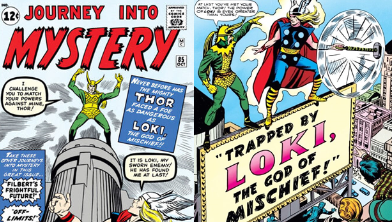
In August 1962, Stan Lee, Larry Lieber, and Jack Kirby introduced readers of Marvel Comics to the God of Thunder, Thor Odinson. Through associations with Marvel’s premier super team, the Avengers, and many cosmic, mythological adventures, Thor became another of Marvel’s most successful and versatile characters, with appearances in cartoons, videogames, and incredibly profitable live-action movies. Being as it’s the first Thursday (or “Thor’s Day”) of the month, this is the perfect time to celebrate the God of Thunder!
Story Titles: “Trapped by Loki, The God of Mischief” and “Part 2: The Vengeance of Loki” Published: 2 August 1962 (cover-dated October 1962) Writers: Stan Lee and Larry Lieber Artist: Jack Kirby
The Background: After creating Doctor Bruce Banner/The Incredible Hulk, legendary Marvel Comics writer, editor, and creator Stan Lee was inspired by Norse legends to dream up an even more powerful superhero and, alongside Larry Lieber and the renowned Jack Kirby, crafted a new version of the Norse God Thor Odinson who effectively took over Journey into Mystery until it became his own self-titled comic in 1970. Thor became a founding member of Marvel’s premier super team, the Avengers, and eventually took on more aspects of his inspiration, with one of the most notable of these being Thor’s adopted brother, Loki Laufeyson. Like Thor, a version of Loki appeared in Marvel’s predecessor, Timely Comics, years earlier in 1949, where he was depicted as a hatemongering member of the Olympian Gods, but it was Lee and Lieber who redesigned Loki as Thor’s most persistent nemesis in this issue of Journey into Mystery. Like his half-brother, Loki was instrumental in the first appearance of the Avengers and went on to dog many of Marvel’s superheroes as part of the Masters of Evil, to say nothing of waging war against Asgard and even having a turn as a more heroic character. Of course, Loki has seen immense popularity in recent years thanks to Tom Hiddleston’s portrayal of the character in the Marvel Cinematic Universe, where he was depicted as a tragic, flawed, misguided character who went from wanting to conquer the Earth to sacrificing his life to protect his brother and his adopted world.
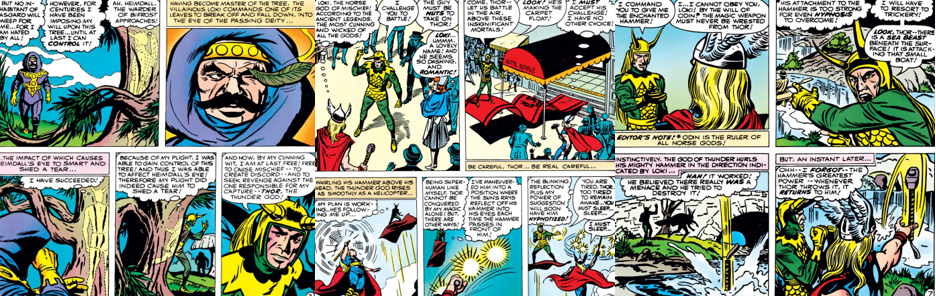
The Review: “Trapped by Loki, The God of Mischief” begins in the golden realm of Asgard, a citadel separated from time and space by the rainbow bridge, Bifrost. There, deep in a remote area of Asgard, stands a tree that acts as the prison for Loki, the devious God of Mischief, who was condemned to this prison ages ago, with his only hope of escape being if someone is driven to tears by his plight. Although he’s well aware that no Asgardian would ever weep for him since he’s hated by all, he’s able to exert some measure of control over the tree; enough to cause a stray leaf to drop into the eye of Heimdall as he passes by. Apparently, the single tera he sheds as a result is enough to break the curse and Loki slips free undetected, finally giving him license to cause mischief, spread discord, and seek revenge on the one responsible for this capture: Thor! Although Thor hasn’t been in Asgard for some time, Loki had the incredible foresight to forge a “mental link” with Mjölnir before his imprisonment. This allows him to locate the uru-made magical hammer and its thunder-commanding master, who’s currently entertaining children in a hospital, so Loki hops onto the Bifrost and heads to Earth “at the speed of thought”.
Loki escapes from his prison and comes to Earth to get revenge on Thor by hypnotising him.
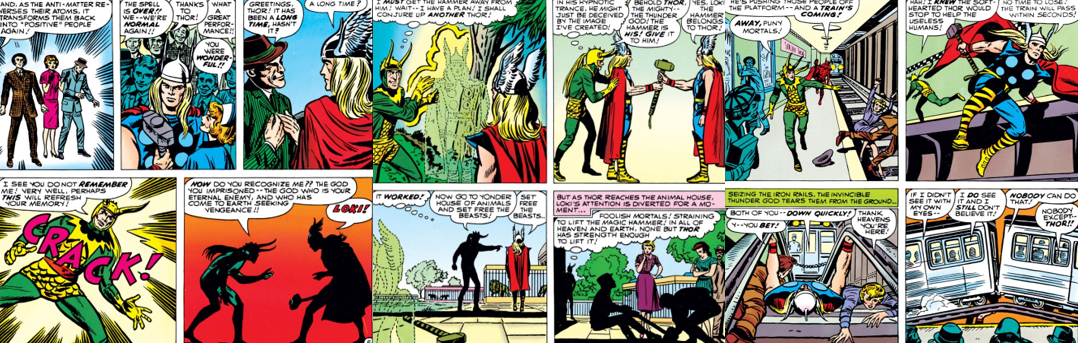
Once there, Loki magically assumes the guise of a normal, everyday man about town but finds that Thor has already left the hospital by the time he arrives. Rather than reveal his presence prematurely, Loki decides to use his incredible powers to cause a disturbance (namely transforming innocent bystanders into negatives) to lure Thor to him. Conveniently, Thor (in his alias as the lame Doctor Donald Blake), happens to be on his way to a nearby house call; upon seeing the phenomenon, Dr. Blake strikes his walking stick to the ground and is transformed into the Mighty Thor once more. Thor then spins Mjölnir at an incredible speed, fast enough to emit anti-matter particles that he then blows towards the victims using his magical hammer, restoring them to normal in a head-scratching piece of pseudo-science. Naturally, the people are awestruck by this feat and Thor is heralded as a hero. Amidst the gaggle of onlookers, Loki approaches Thor and reveals himself to the Thunder God (whose internal dialogue seems to indicate that he’s only aware of Loki from Norse mythology, again making me question whether Dr. Blake and Thor are two different people or if Don’s consciousness is simply within Thor’s body since Thor should know who Loki is considering he imprisoned him in that tree…) and challenges him to a battle. Loki uses his powers to turn a nearby carpet into a flying carpet and Thor follows him into the air but Loki, realising that it will take more than brute strength and magic to conquer Thor, uses this to his advantage by causing the sun’s rays to reflect off Mjölnir in a series of blinking lights that leaves Thor effectively hypnotised and under Loki’s command! Although this means Thor is compelled to obey Loki, he’s unable to hand over Mjölnir thanks to the will of his father, Odin Allfather, so Loki tries to trick him into hurling his hammer at an imaginary sea beast, only to be thwarted when the enchanted weapon returns to Thor’s hand like a magnet.
Loki’s tricks and deception are nothing compared to Thor’s great strength.
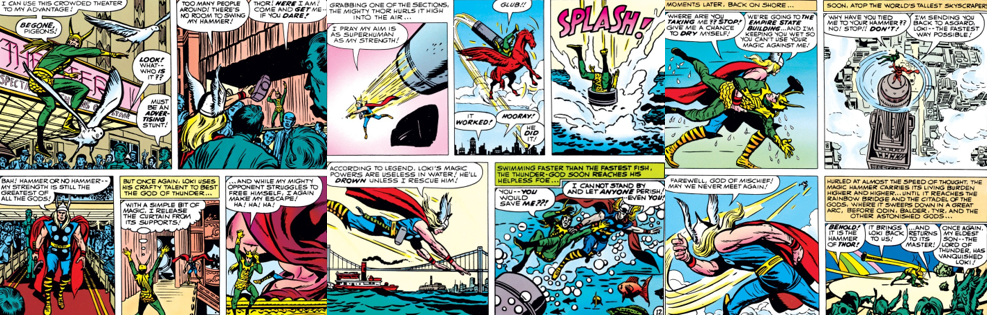
However, Loki comes up with the brilliant plan to conjure up a duplicate image of Thor; since only Thor can hold the hammer, Thor hands Mjölnir to the illusion and is finally relieved of his weapon. Loki then directs Thor to release the wild beasts from the city zoo but is distracted from witnessing this event by mocking a gaggle of civilians who try, unsuccessfully, to lift the enchanted hammer. Loki’s momentary distraction means he misses Thor reverting back to Dr. Blake, an automatic transformation that occurred whenever Thor was separated from Mjölnir for about a minute. This also has the added benefit of undoing Loki’s hypnosis, allowing Dr. Blake to reunite with Mjölnir and return at full power to Thor. Realising that he no longer has the advantage over his foe, Loki gathers a flock of nearby pigeons to fly him to safety so he can think up a new plot but is forced to land when he sees Thor pursuing him with a vengeance. Thanks to the dense crowd making it too dangerous for Thor to swing Mjölnir, Loki ducks into theatre and entangles the God of Thunder within the stage curtain. This is only a momentary setback for Thor, however, so Loki dashes into the subway and distracts his foe further by shoving civilians onto the train tracks. Rather than simply carry them to safety, Thor goes to the effort of showcasing his strength by hoisting up the tracks, allowing the train to pass safely overhead, and then watches on, helpless to pursue, as Loki flies off on horse statue he brought to life, smashing up Times Square as he goes. Although Loki plans to lure Thor to the Statue of Liberty for a final showdown, Thor simply tosses a massive section of a pipe at the God of Mischief that sends him plummeting to the water below. Since, according to legend, Loki’s magic powers are apparently “useless” in water, Thor rushes to save his foe, much to Loki’s shock and revulsion. Because Loki’s soaking wet, he’s powerless to keep Thor from taking him to the top of the Empire State Building, attaching him to Mjölnir, and hurling him back to Asgard through sheer brute force to the astonishment of his fellow Gods.
The Summary: Considering how pivotal Loki now is to Thor’s mythology and the popularity of the misguided God of Mischief, Journey into Mystery #85 is a pretty poor showing for Thor’s half-brother. Indeed, no mention is made of Loki’s familial ties to Thor, their sibling rivalry, or his status as a Frost Giant. There’s not even any real detail as to why Thor imprisoned him within a tree beyond Loki delighting in causing chaos and some cursory mentions of Norse mythology, something I very much doubt readers of Marvel Comics had much knowledge of back in the day (or even now, if I’m honest). Instead, we’re left with the paper-thin exposition that everyone in Asgard hates Loki and that he himself hates Thor because he bested him ages ago, and even this falls apart since Thor acts like this is the first time he’s ever encountered Loki. A couple of panels showing their previous encounter might’ve been a nice inclusion; that space could’ve been used in place of the brief and pointless fawning of nurse Jane Foster, who’s immediately enamoured by Loki for no real reason and is simply there to help paint Dr. Blake as a milksop compared to the mighty Thor. The story even contradicts its own lore within the first few panels: Loki specifically says that only someone taking pity on his plight can free him, yet a brief bit of eye water from a leaf is enough to break his curse, to say nothing of going to the effort of stating that Loki has some divine link to Mjölnir when it would’ve been enough to simply show him capable of magically seeing across the Realms.
Loki doesn’t impress in his debut, appearing weak and useless at every turn.
The artwork is bright and colourful and quite fun, but disappointingly basic at times, and strangely bizarre at others. We’re denied seeing Thor tussle with bears and lions at the zoo but have to see him bend rail tracks rather than just carry Loki’s victims to safety, and Loki’s powers are some of the lamest and most disappointing from this era of comics. We’ve got a God capable of bringing inanimate objects to life, but his plan is to simply hypnotise Thor? He creates an illusion of Thor but is incapable of conjuring an actual sea beast to accomplish the same means, instead resorting to basically shouting, “Look over there!”, and his powers are suppressed by water? I had no idea that was a thing, but it’s pretty bloody lame. Almost as lame as forcibly nerfing Thor by sticking him in dense crowds and thus incapable of swinging Mjölnir without hurting someone since Thor is quite clearly and obviously depicted as Loki’s physical superior even before he literally throws him across time and space back to Asgard. So, no, I really wasn’t very impressed by Loki; he barely did anything except briefly hypnotise Thor, his motivations were woefully pitiable, and his powers were far from visually interesting. Luckily, he looked very visually appealing with his bright green and gold outfit and trademark horned helmet but neither he nor this story lived up to its potential. Loki was defeated with laughable ease once Thor shrugged off his hypnotism and got his hands on him, and this ended up being a pretty disappointing first encounter between the two legendary rivals even by the standards of the 1960s.
My Rating:
⭐⭐
Rating: 2 out of 5.
Could Be Better
What are your thoughts on Loki’s debut appearance? Were you also disappointed by his ineptitude and depiction, or did he impress you with his colourful attire and mischievous nature? Did you enjoy seeing the two clash or would you have preferred to see something more visually interesting? What are some of your favourite Loki moments in and out of the comics? Do you have a favourite character, arc, or era in Thor’s long publication history? How are you celebrating Thor’s debut this month, if at all? I’d love to hear your thoughts on Thor in the comments below or on my social media, and it’d be great if you checked out my other Thor content across the site.
Easily Marvel Comic’s most recognisable and popular superhero, unsuspecting teenage nerd Peter Parker was first bitten by a radioactive spider and learned the true meaning of power and responsibility in Amazing Fantasy #15, which was first published in August 1962. Since then, the Amazing Spider-Man has featured in numerous cartoons, live-action movies, videogames, action figures, and countless comic book titles and, in celebration of his debut and his very own day of celebration, I’m dedicating every Tuesday of August to talk about everyone’s favourite web-head!
Story Title: “The Sinister Secret of Spider-Man’s New Costume!” Published: 31 July 1984 (cover-dated November 1984) Writer: Tom DeFalco Artist: Ron Frenz
Story Title: “’Til Death Do Us Part!” Published: April 1985 Writer: Louise Simonson Artist: Greg LaRocque
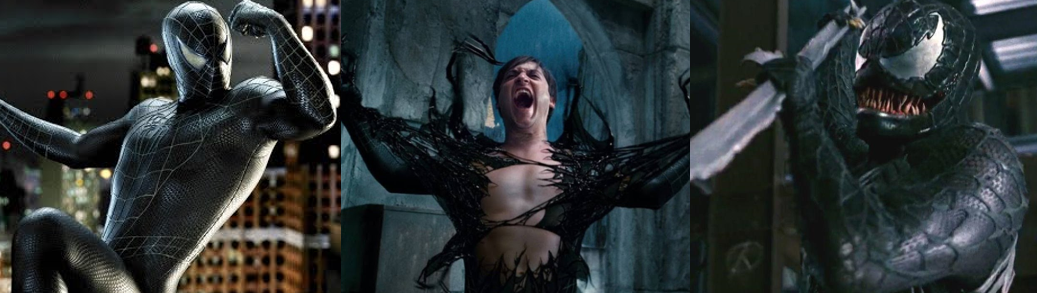
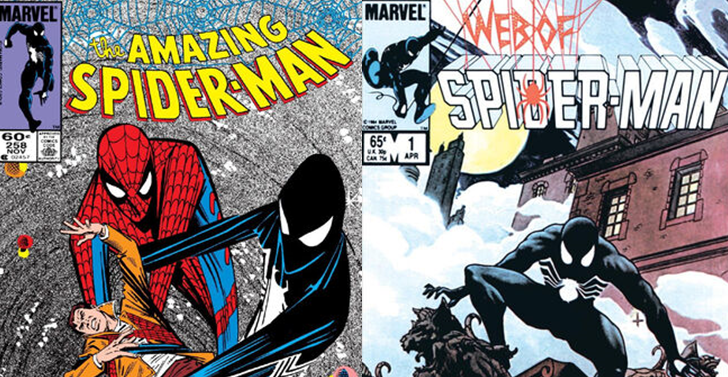
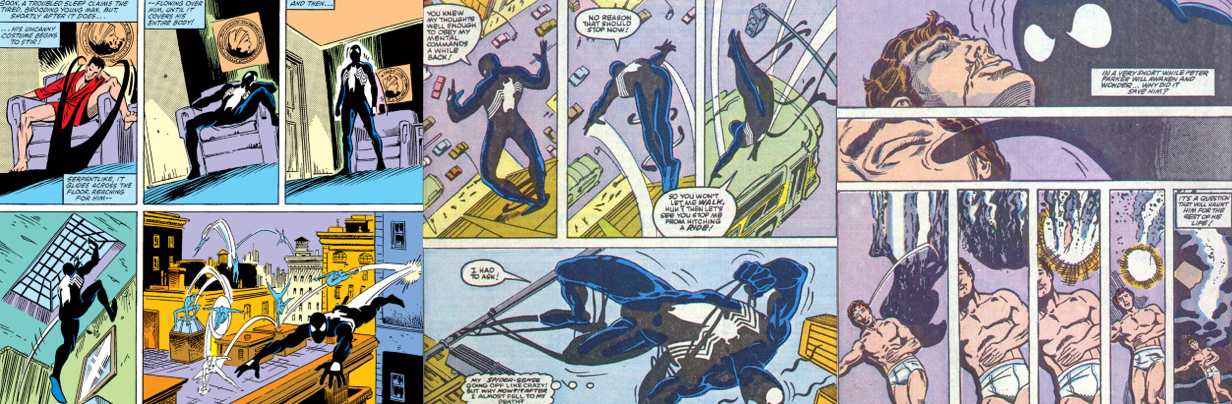
The Background: Considering Spider-Man’s debut almost didn’t happen, it’s pretty ironic that Stan Lee and Steve Ditko’s angst-ridden teenage superhero went on to become the flagship character of Marvel Comics. Over the years, Spider-Man has been at the forefront of some of Marvel’s most celebrated, and notorious, stories and the troubled wall-crawler is often depicted battling his own personal woes as often (if not more so) as his colourful rogues gallery. In 1982, an illustration from reader Randy Schueller that depicted Spider-Man in a smooth, black outfit with a large red spider motif across his chest caught the eye of Marvel Comics’ editor-in-chief Jim Shooter. After Marvel purchased the concept for a mere $200, writer Tom DeFalco and artist Ron Frenz conceived the costume being a living organism; Spidey’s new black suit debuted without explanation in The Amazing Spider-Man #252 before Marvel Super Heroes Secret Wars #8 revealed that the web-slinger acquired the suit during the “Secret Wars” event. Over the next year or so, Spidey revelled in the costume’s unique and helpful ability to form both clothing and organic webbing until these two issues revealed the costume’s true nature as a symbiote. Of course, this directly led to the debut one of Spidey’s most iconic enemies (and one of Marvel’s most popular anti-heroes), Eddie Brock/Venom, but Spidey’s issues with the black suit have been adapted into cartoons, movies, and videogames and it remains one of his most iconic alternative outfits.
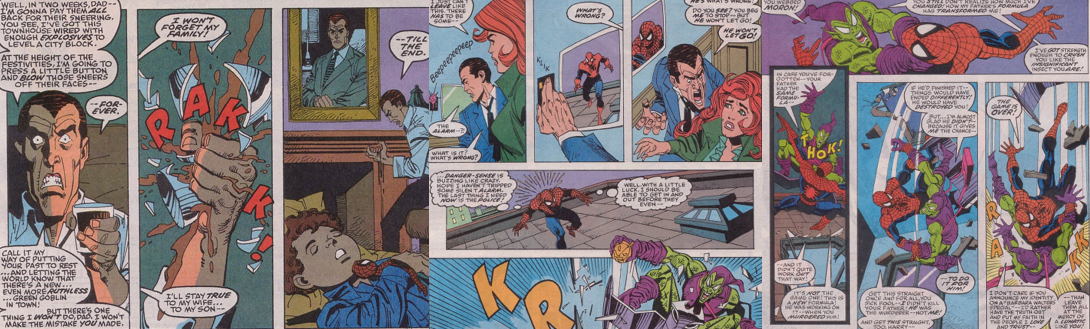
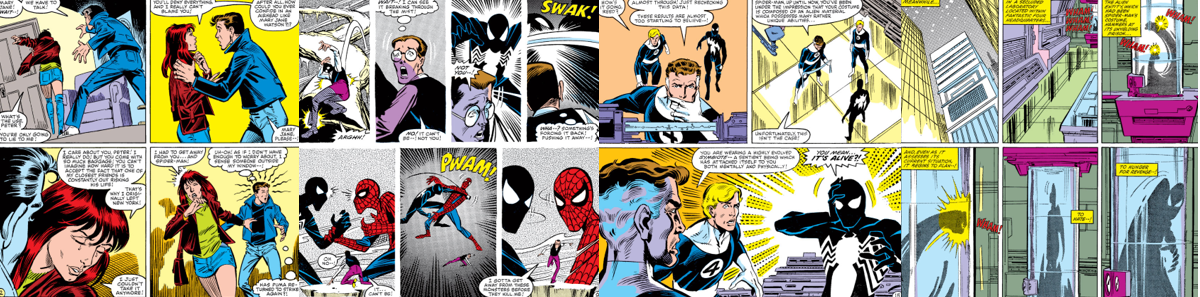
The Review: “The Sinister Secret of Spider-Man’s New Costume!” begins with Peter Parker, still reeling from defeat at the hands of crime boss Silvio Manfredi/Silvermane and the man-beast Thomas Fireheart/Puma, facing the shock of his life when he returns to his apartment and his former flame and close friend Mary Jane Watson/M. J. reveals that she knows he’s secretly Spider-Man! Peter’s naturally gobsmacked by this but M. J. doesn’t give him a chance to explain…or, as she puts it, to “lie to [her]”. Indeed, Peter’s shock is so total that he’s too distracted to hear that M. J. originally left New York City a while back because of this knowledge; not only did it hurt her that he didn’t trust an “airhead” like her with his greatest secret, but she couldn’t stand the thought of him constantly risking his life. Whatever chance Peter might’ve had of explaining things or perhaps retaining his secret identity then goes completely out of the window when Felicia Hardy/The Black Cat leaps in through his window looking for a fun night swinging through the city. M. J.’s heartache is only exacerbated by the Black Cat’s appearance, and she leaves in floods of tears, and Peter’s so distraught that he takes his anger out on the Black Cat, chastising her for bursting in unannounced. Naturally, the Black Cat’s none too pleased to be yelled at so she goes to leave, but they’re both startled when a strand of webbing instinctively and involuntarily shoots from Peter’s jacket to keep her from leaving. While the Black Cat takes this to mean that Peter truly loves her since he “didn’t even try to stop [M. J.]” when she left, Peter’s too surprised by the alien costume’s mysterious nature to deny her embrace. Later, after unsuccessfully trying to call M. J., the overwhelmed Peter succumbs to exhaustion. However, while he sleeps, the alien costume slinks across his apartment, attaches itself to him, and takes his slumbering body out on a joyride across the rooftops of the city.
Peter’s personal strife is compounded by the news that his alien suit is a living organism!
As he sleeps, Peter endures a horrific nightmare in which he finds himself (in his classic bookworm appearance) hounded by the ominous alien costume. Just as it closes in on him, his classic red and blue duds step in to battle the alien, with the screaming Peter literally caught in the middle! Peter awakens to find he’s missed an entire day and unnerved by his alien attire. To try and get some answers, he swings over to the Baxter Building to take up Doctor Reed Richards/Mister Fantastic on a previous offer to examine the suit. Following a series of intensive experiments on the gamut of the costume’s capabilities (producing organic webbing, assuming different appearances, and flowing on and off him at his mental command), Reed drops the bombshell that the costume isn’t just some amazing piece of advanced alien technology, but actually a living being that’s physically and mentally attached itself to the web-slinger! Spider-Man’s astonishment turns to horror when he tries to remove the suit at Reed’s suggestion, only to find it painfully attempting to permanently graft itself to him! With Spider-Man at risk of being crushed to death, Reed grabs his handy-dandy sonic cannon and blasts the alien, forcing it off of Spider-Man long enough for him to safely contain it. However, this does leave Spider-Man in just his underwear so, to preserve his secret identity and allow him to return home, Johnny Storm/The Human Torch provides him with a spare Fantastic Four uniform and a paper bag to cover his head, leading to him facing public humiliation when he steps in to help the police with a robbery. However, Peter’s pride and his shock at the revelation that his alien suit was a symbiote all along are pushed aside when a remorseful M. J. shows up to talk, though he’s unaware that the enraged symbiote lusts for revenge inside its cell…
Spidey’s so horrified by the symbiote suit that he barely notices the attacking Vulturions.
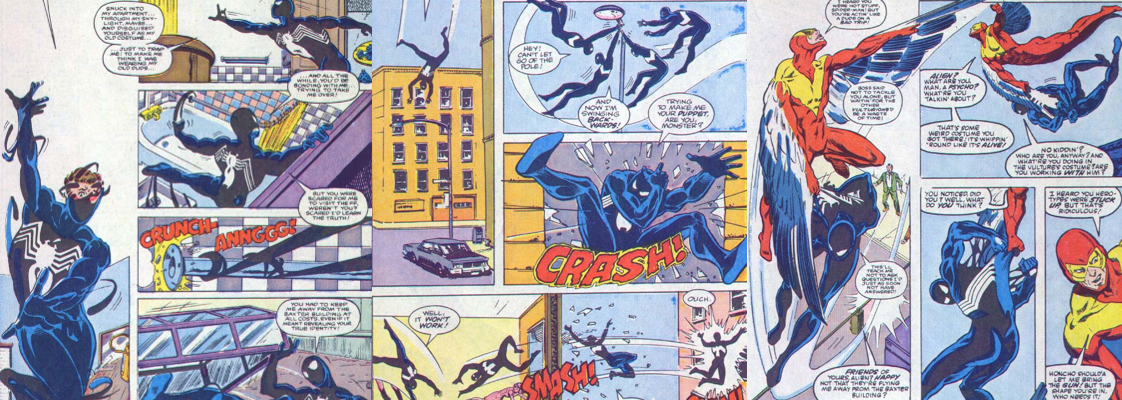
Peter returned to his traditional red and blue costume following this and incurred the anger and disappointment of his beloved Aunt May when he dropped out of his graduate studies in the time between The Amazing Spider-Man #258 and Web of Spider-Man #1. It was also during this time period that the symbiote managed to escape from its confinement and make its way back to Peter’s apartment, which is why “’Til Death Do Us Part!” begins with the alien costume lurking in Peter’s wardrobe. Peter’s so distracted by his recent breakup with the Black Cat and recapping how Reed revealed the costume’s true nature as a “symbiot” and helped rid him of it that he doesn’t even notice the parasitic alien attaching itself to his costume until it’s too late! Horrified, Spider-Man desperately flees his apartment and tries to get back to the Baxter Building, but the symbiote fights him the entire way; it sends out tendrils to ground him, throws off his webbing, detaches itself from walls, and forces him to do its bidding like a puppet. Refusing to obey his commands and sending him into a panic, the symbiote negates Peter’s spider sense and does everything it can to keep him grounded, and Spidey’s so caught up trying to fight off the alien and keep his cool that he doesn’t notice the Vulturions circling overhead. Comprised of hoodlums Gripes, Pigeon, Sugar Face, and Honcho, the Vulturions are a gang of low-level punks given a chance at stepping up their game when they repurpose Adrian Toomes/The Vulture’s technology and suits to their own ends. Their leader, Honcho, warned them about taking on Spider-Man alone and drawing undue attention to themselves, but Gripes can’t help but snag the writhing, babbling web-head when he spots him struggling with the symbiote during a scouting mission.
Spidey risks his life to rid himself of the symbiote, whose last act is to drag him to safety!
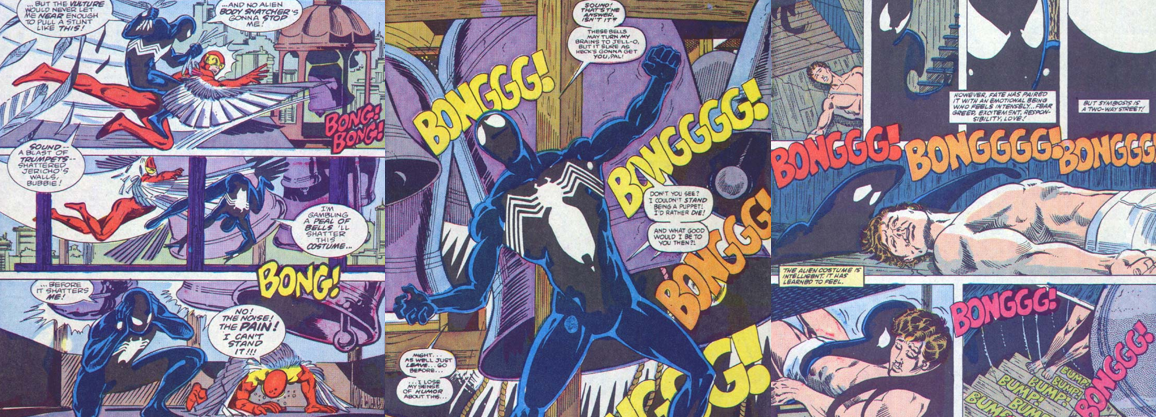
Spider-Man barely even acknowledges the presence of the Vulturions; even when he’s caught in Gripes’ talons, he rages and struggles against the symbiote. Gripes’ confusion at Spider-Man’s bizarre behaviour turns to horror when the symbiote’s tendrils lash out and attack him, and Spidey’s forced to use his own strength to fight off Gripes, Sugar Face, and Pigeon, sending the three plummeting into the sea and commandeering Honcho as a more reliable means of traversal. Realising that he might not make it to the Baxter Building in time to use Reed’s sonic blaster, Spider-Man redirects Honcho to a nearby bell tower. The loud ringing is already sending the symbiote into a frenzy but it’s in absolute agony when Spidey crashes into the tower and forces it to endure the ringing up close. The noise is apparently so loud that it threatens to kill Spider-Man as well; with his strength fading, Peter can’t help but think of his loved ones and all the people he’s leaving behind as he feels his life ebb away. The noise is so great that the symbiote is forced from Peter’s unconscious body; however, as the “emotionless being” slinks away, it can’t help but feel an obligation towards its former host. Chalked up to emotions inherited from its time joined with Peter, the symbiote pulls Peter to safety. It tentatively, lovingly, touches his face with a tendril one last time before promptly evaporating into dust, apparently destroyed from the cacophony of the bells and the exertion of saving Peter’s life.
The Summary: If you’re a fan of Venom and Peter’s time in the black costume, these two stories are essential reading to understanding the complex relationship between Spider-Man and the symbiote. Unlike in other media (at least as far as I can remember), the symbiote didn’t actually negatively affect Peter’s mood or mannerisms; he didn’t go all emo or become aggressive, and I don’t think it really enhanced his strength or natural abilities beyond acting as infinite webbing and responding to his mental commands. Consequently, I believe that The Amazing Spider-Man #258 is the first time that the symbiote shows any signs of aggression or independent thought. Of course, it can be argued that the symbiote is simply reacting due to the massive revelations and pressure that bombard Peter in this story. Just the idea that M. J. knows his secret identity would be shocking enough, but quickly follow that with the Black Cat’s arrival and a bit of a love spat between the two and it’s no wonder that Peter’s emotions are all over the place. M. J.’s revelation would, of course, lead to her opening up to Peter about her own traumatic past and helped to not only flesh her out as something more than a gorgeous party animal but also galvanise their relationship, but here it’s a real curveball since Peter’s secret identity was such a sacred element to the character and not too many people were aware of it. Thus, finding out that M. J. had always known of his dual identity really helped her to stand out against Peter’s other love interests, even the likes of the Black Cat.
Spidey’s costume woes lead to the debut of the Bombastic Bag-Man!
As ever with Spider-Man stories, we get some drama and interludes to break up the action; the first story is broken up with interludes that show the Puma, in his public identity as a successful businessman, brooding over in New Mexico, hungry for his next encounter with Spider-Man, and Roderick Kingsley/Hobgoblin being recruited into Richard Fisk/The Rose’s campaign against Spider-Man, as well as hints towards M. J. having secrets of her own. The second story is largely concerned with establishing the Vulturions, painting them as thugs who mug old ladies in public and who have a contentious relationship with their boss because of this, and Peter’s recent falling out with Aunt May over his studies. Naturally, there are also some fun cameos from Mr. Fantastic and the Human Torch since Spidey needs the Fantastic Four’s help in figuring out what’s happening with his suit. I liked that Reed already strongly suspected that the suit was a living organism but still conducted a series of tests to be both absolutely sure and to satisfy his scientific curiosity. It’s lucky that Spider-Man has such a healthy relationship with the Fantastic Four as they’re the only ones with the technology and capability to study and contain the symbiote, but it’s doubly lucky for us as The Amazing Spider-Man #258 fetaures the debut of the Bombastic Bag-Man! Stuck in Fantastic Four suit with a paper bag over his head and a “Kick Me!” sign taped to his back, Spidey is humiliated before the press and public as part of a prank by the Human Torch, which makes for one of the best aspects of these two issues. It’s a rare moment of levity, especially considering not just all the personal strife Peter goes through here but also the startling revelation that his once seemingly amazing alien costume is actual a living, breathing organism that’s attempting to permanently bond with the web-slinger!
Peter’s natural reaction is to assume the symbiote is malicious, despite having no evidence of this.
This aspect is treated as a horrifying prospect as the symbiote is described as a “parasite” and Reed’s first advice to Spider-Man is to rid himself of it before the bonding process becomes permanent. It’s only natural, then, that the symbiote reacts to defend itself, refusing to budge from Spider-Man’s body and even causing him physical harm. There’s actually no suggestion or evidence to suggest that the symbiote has malicious intentions; Spider-Man reacts out of sheer panic and horror and Reed doesn’t hesitate to contain the creature and it’s only then that it becomes malevolent since it doesn’t appreciate being spurned. When it returns in Web of Spider-Man #1, notice how it doesn’t do anything aggressive except try to bond with him again; it only lashes out and takes control of Peter when he reacts in horror and tries to force it off, and there’s even a suggestion that it takes control of his sleeping body not to cause him harm but because it delights in his superhuman abilities. Still, Peter’s first instinct is to get rid of it and he’s so determined to do this that he even states he’d be willing to die than be a slave, again without any real evidence that the symbiosis would be anything malicious. To that end, he uses the ringing of the bell tower to drive the creature from his body and presumably destroy it but is rendered unconscious by the effort and completely misses the tragic truth of the symbiote. While the dialogue boxes hint that it’s an amoral creature, the symbiote sacrifices itself to get Peter to safety not just because of the emotions it learned of while bonded to him, but out of what is very clearly shown to be true love for Peter and his welfare. This aspect is expanded upon when the symbiote later returns with a vengeance as Venom, but it’s portrayed really well here and actually paints Peter (and Reed) in a bit of a bad light since his knee-jerk assumption was that the symbiote meant him harm but there’s nothing to say that’s the case. Because of this, these two issues are a really great launching pad for those wishing to get into reading some Venom stories; they contain some of the most iconic symbiote imagery (such as Peter’s nightmare and the bell tower sequence) and go a long way to giving the symbiote some characterisation long before it talks.
My Rating:
⭐⭐⭐⭐
Rating: 4 out of 5.
Great Stuff
Have you ever read these two iconic Spider-Man stories? If so, what did you think to them and where would you rank the black costume era amongst Spider-Man’s many other stories and moments? What did you think to the black costume at the time and were you surprised to find that it was alive? Do you think Peter reacted poorly to this knowledge and that he should’ve tried to understand the symbiote’s true intentions? What did you think to the revelation that Mary Jane knew of Peter’s dual identity? How are you celebrating Spider-Man this month? Whatever your thoughts on Spider-Man and the symbiote, share them below and be sure to check out my other Spider-Man Month content!
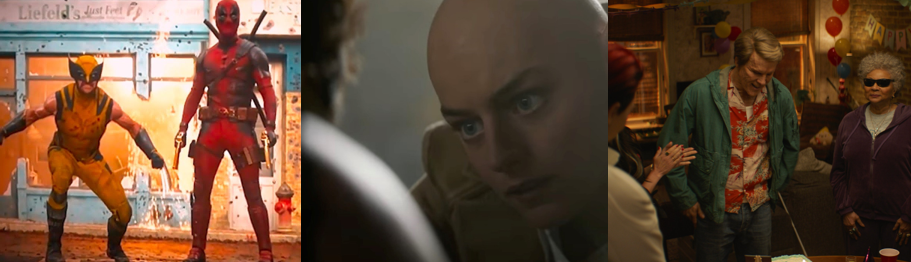
Released: 26 July 2024 Director: Shawn Levy Distributor: Walt Disney Studios Motion Pictures Budget: $200 million Stars: Ryan Reynolds, Hugh Jackman, Emma Corrin, Matthew Macfadyen, and Aaron Stanford
The Plot: Struggling with doubt, Wade Wilson/Deadpool (Reynolds) jumps at the chance to join the “Sacred Timeline” of the Marvel Cinematic Universe (MCU). However, when he learns the cost is his universe, he scours the multiverse to recruit a disillusioned version of James “Logan” Howlett/Wolverine (Jackman) to help save his loved ones.
The Background: Created by Fabian Nicieza and Rob Liefeld in 1991, Deadpool as originally an X-Force antagonist before his self-aware humour and creative violence catapulted him to mainstream popularity. This eventually led to his live-action debut in the much-malignedX-Men Origins: Wolverine(Hood, 2009), with Ryan Reynolds finally assuming the role, with a spin-off teased. However, after X-Men Origins and the Reynolds-led Green Lantern (Campbell, 2011) flopped, 20th Century Fox got cold feet about producing an expensive, R-rated superhero movie. However, after director Tim Miller’s early test footage mysteriously leaked online, the positive reaction saw Fox backpedal, resulting in a critical and commercial success for the “Merc with a Mouth”. Deadpool’s (Miller, 2016) success naturally led to a sequel; Deadpool 2 (Leitch, 2018) upped the ante with an increased budget and bringing in Josh Brolin as fan favourite, time travelling cyborg Nathanial “Nate” Summers/Cable, and was met with similar success, and Disney higher ups were adamant about including Deadpool in the MCU after their acquisition of 20th Century Fox. During development, Reynolds was contacted by Hugh Jackman – who had famously retired from his iconic Wolverine role in Logan(Mangold, 2017) – and, despite concerns about undoing that film’s poignant ending, actively lobbied to portray an alternative version of the character for a long-awaited team-up. Finally garbed in a comic book-accurate suit courtesy of costume designers Graham Churchyard and Mayes C. Rubeo, Jackman joined Reynolds for what was to be a love letter to the X-Men films (Various, 2000 to 2020) and their legacy, as well as a slew of fan service cameos. After enduring the SAG-AFTRA strike, Deadpool and Wolverine released to largely positive reviews; critics praised Jackman’s return and the film’s buddy comedy/road trip vibes, and that it remained true to the raunchy humour of the previous films. Though some criticised its shallow plot, Reynolds’ performance was lauded and the film quickly became Disney’s highest-grossing R-rated release, bringing in over $1.300 billion and seemingly cementing the character’s place in the future of the MCU.
The Review: It was genuinely shocking, and heartbreaking, when Logan finally met his end in Logan. After living and fighting and struggling for so long, after an unprecedented run from an actor in a role, the character was finally laid to rest. So, naturally, Deadpool & Wolverine opens with Deadpool digging up Logan’s corpse, convinced he’s still alive, and then massacring an army of soldiers from the Time Variance Authority (TVA) with the dead Mutant’s Adamantium skeleton, even donning Logan’s signature claws at one point, all to the tune of NSYNC’s “Bye Bye Bye”. It turns out that Wade’s life took a bit of a downturn after Deadpool 2; he struggled with his mercenary lifestyle and his place in the world, pushing his lover, Vanessa Carlysle (Morena Baccarin) away after everything he did to save her life and ending up selling used cars in a bad toupee alongside Peter Wisdom (Rob Delaney). While celebrating his birthday alongside his returning supporting cast, Wade is accosted by the TVA and brought to Mr. Paradox (Macfadyen) at their headquarters. Despite Wade’s flagrant misuse of Cable’s time machine in Deadpool 2 (and him using it to sidestep into the MCU and lobby for application with the Avengers), the TVA are seeking to recruit him rather than “prune” him. Wade’s told that Logan’s tragic death is causing his universe to collapse; since Logan was an “Anchor Being”, Earth-10005 literally cannot sustain itself without him and will die out in a few thousand years. Wade’s given the opportunity to avoid this fate and join the MCU (Earth-616), finally taking his rightful place alongside Earth’s Mightiest Heroes and proving that he matters not just to himself, but to Vanessa and the entire world.
Deadpool recruits a jaded version of Wolverine to save his world, and the two naturally clash..
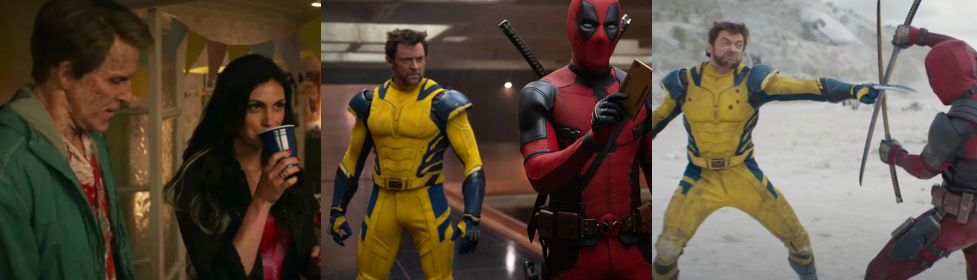
However, Deadpool’s dreams of raking in the Disney cash are quickly dashed when Mr. Paradox immediately reveals that he doesn’t care for Earth-10005 and has aspirations to take over the TVA and take a more direct approach to such events. Realising that Mr. Paradox’s “Time Ripper” device will destroy his world and everyone he loves within 72 hours, Deadpool immediately defies the TVA, steals once of their time devices, and embarks on a short jaunt throughout the multiverse to find a “Variant” of Wolverine to replace his one. After some fun homages and being attacked at every turn, he finally finds a disillusioned Wolverine drowning his sorrows in a bar. However, when Mr. Paradox scoffs at the idea of this Variant (widely known as the “worst” version of Wolverine) could ever replace Logan, he zaps the two to the “Void”, a barren wasteland filled with discarded remnants from deleted or forgotten timelines. While Deadpool is determined to find a way back and safe his universe, Wolverine has no interest and lashes out at Wade at every turn for getting him involved. Surly, jaded, and wracked with guilt after failing to save his X-Men, this Wolverine may wear the most comic accurate suit of any live-action portrayal (not counting some of his other Variants seen in this film) but he’s not interested in playing the hero anymore. Deadpool and Wolverine’s relationship is antagonistic and strained from the start; Logan is constantly frustrated by Wade’s motormouth and is incensed to find Deadpool lied to him to get him to help. The banter and interactions between Jackman and Reynolds are the highlight of the film, as are their many bloody fights against and alongside each other. The two bounce off each other so well, with Deadpool being like an annoying, peppy, snarky younger brother to the older, cynical Wolverine. Wolverine’s attitude towards Deadpool is only further soured when his childishness and blatant lies cause newfound allies to be killed, yet he’s forced to help the Merc with a Mouth on the slim chance that Logan’s timeline can be corrected and his mistakes can be undone.
Nova sets her sights on the TVA’s tech and is protected by a misfit army of Variants.
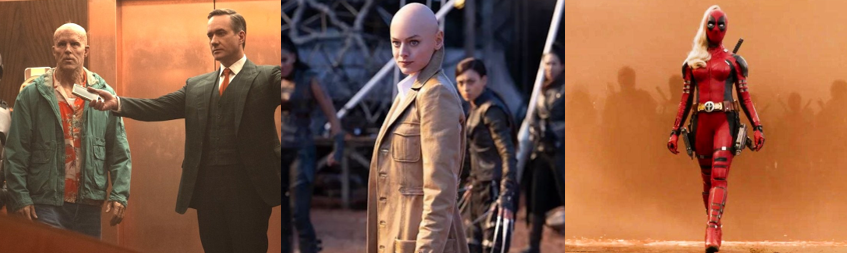
Unfortunately for the two, they’re stuck with each other in a desolate world outside of time, one filled with cameos, Easter Eggs, and Variants who are both out to help and hider them. The first they encounter, Johnny Storm/The Human Torch (Chris Evans), tells them that the Void is not only constantly preyed upon by the monstrous Alioth but also ruled over by the psychotic Cassandra Nova (Corrin), the telepathic twin sister of Professor Charles Xavier/Professor X (Patrick Stewart/James McAvoy) who resides within the colossal skeletal remains of Scott Lang/Ant-Man (Paul Rudd). Nova, who was sent to the Void by the TVA as a child, has known nothing but hardship. Resentful towards her brother and craving only power, she has a tentative arrangement with Mr. Paradox to dispose of his trash, but is delighted to finally have a Wolverine in her midst. Unlike Xavier, Nova prefers to get (literally) hands-on when probing her victim’s minds, twisting their memories and reality to learn their secrets and showcasing incredible recuperative powers as well as telekinesis. Surrounding by an army of disgruntled cast-offs (including right-hand-man John Allerdyce/Pyro (Stanford), Cain Marko/Juggernaut (Aaron W. Reed), and cameos from other disposable Brotherhood characters), Nova makes a sport of torturing and executing both her enemies and allies. Although she shows a glimmer of humanity when she learns of her brother’s loving ways from Wolverine, her desire for conquest is sparked when she learns of Mr. Paradox’s Time Ripper and she doesn’t hesitate to leave the Void via a stolen Sling Ring to get her hands on it, determined to eradicate world after world until all that’s left is the Void’s blissful emptiness. Although Deadpool and Wolverine can take on Nova’s minions (with some help), they’re no mater for her in a one-on-one fight due to her incredible psychic powers. As if that wasn’t bad enough, there’s an entire legion of Deadpool Variants wandering the Void, all of them devoted to protecting Nova, and this army of wise-cracking psychos literally stands between our heroes and their target in the finale, leading to one of the best and bloodiest action sequences in the film, made all the more enjoyable not just by Logan’s happiness at slaughtering so many Deadpools but him finally donning his comic accurate mask!
The Nitty-Gritty: Considering Deadpool & Wolverine is largely focused on delivering the much-needed spectacle of seeing the titular characters interact and cut each other to ribbons, the film has a surprising emotional depth. I guess this shouldn’t actually be that surprising as the previous films had an unexpected pathos to them as well, but it’s incredibly effective here. While still a loquacious, self-referential, crude dervish, Wade is struggling with his purpose in life. When Harold “Happy” Hogan (Jon Favreau) rejects his application to the Avengers, Wade enters a slump so deep that Vanessa leaves him, he gives up his mercenary ways, and he’s resigned to a boring, normal life. He’s elated at the idea of joining the MCU but cannot bring himself to sacrifice his loved ones to do so, and is so determined to stop Mr. Paradox that he defies the entire TVA. However, it’s through Wolverine that the film finds most of its emotion. While similar to the Wolverine we knew and loved, this one is notably different; he’s at the bottom of the barrel, regularly drinks away his pain, and is wracked by guilt after his selfish actions caused the death of the X-Men and persecution of Mutants on his world. He’s dismissive of his counterpart’s more heroic stature and openly scoffs at Wade’s aspirations to save his world, but his heart is still flickering beneath his pain. Its flame is once again fanned by Laura Kinney/X-23 (Dafne Keen), who’s heartfelt thanks to Logan convince him to oppose Nova, and by the finale he’s even prepared to make the ultimate sacrifice once again to save Wade’s world and gain some redemption. While Logan was a perfect swansong for the character and actor, Jackman continues to nail Logan and bring new nuance to the role. He’s in phenomenal shape for his age and better than ever here as an unhinged, broken version of the character, and it’s a delight not just to see him back but to see him donning the iconic costume and portraying other Wolverine Variants, such as Patch, Age of Apocalypse, a hilarious pint-sized Variant, and even one in the middle of a fight against Doctor Bruce Banner/The Incredible Hulk (Mark Ruffalo). However, he does have some competition for the role when Deadpool briefly meets a gruff and buff variation played by Henry Cavill!
Violent, crude, and packed with cameos, Deadpool & Wolverine also features some surprising pathos.
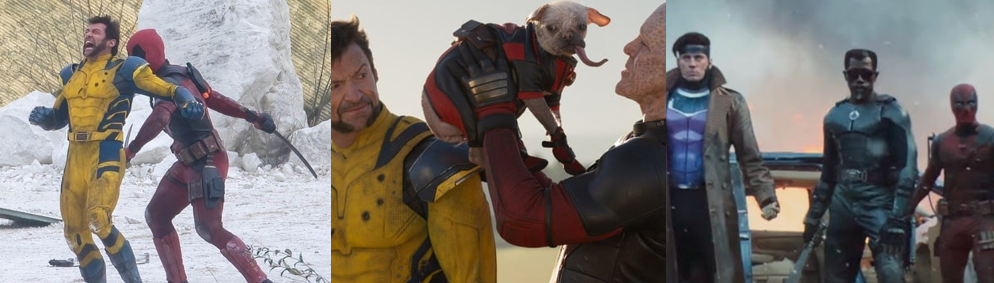
Although some were sceptical that Disney could stay true to Deadpool’s R-rated roots, Deadpool & Wolverine is just as crude and bloody as its predecessors. Wade has lost none of his fourth-wall-breaking charm, regularly making digs at Disney, MCU head honcho Kevin Feige, 20th Century Fox, and even the mixed reception of the MCU’s fourth phase of movies. Both he and Wolverine cuss up a storm here, ripping into each other and their enemies (and allies) with quips, barbs, and even “fucks” to make a vicar blush. Not only that but the two regularly engage in bloody fights with each other; since both are functionally immortal and have rapid healing, they can carve seven kinds of shit out of each other all day and never get tired. While this could get boring, the film mixes up their fights and has them engage in a barroom scuffle, and all-out knife fight in the Void, and a brutal punch-up in a car! The action continues as their fights are momentarily derailed to focus on Nova’s underlings, including a short (but satisfying) rematch between Wolverine and Victor Creed/Sabretooth (Tyler Mane), and a massive brawl against Nova’s ragtag army. Although Johnny meets a rather gruesome end thanks to Wade’s motormouth, Deadpool and Wolverine are regularly aided by “Nicepool” (Reynolds) and his super-ugly pup, Mary Poppins/Dogpool (Peggy). X-23 also brings them to Elektra Natchios (Jennifer Garner), Eric Brooks/Blade (Wesley Snipes), and Remy LeBeau/Gambit (Channing Tatum), forgotten characters who are eager to have their chance in the limelight. These cameos were some of the best and most unexpected parts of the film; never in a million years would I have thought Snipes and Reynolds would work together again, but he’s still got it as Blade and (while I’m not fan of his) Tatum overdelivered in finally getting to play Gambit. It was also fun seeing Evans swear like a trooper as Johnny and to see X-23 all grown up, still as ferocious as ever. Although Deadpool’s other Variants remain masked, this army of psychos was quite the highlight as well; we had a Lady Deadpool (Unknown/Blake Lively), a “Cowboypool” (voiced by Matthew McConaughey), a disembodied floating head (voiced by Nathan Fillion), samurai Deadpool, Deadpool 2099, and so many others (though, strangely, no “Barakapool”).. The cost of all these amazing cameos and returning characters was the side-lining of Deadpool’s supporting cast, who mainly bookend the film, with the exception of Peter, who’s presence is enough to stop the Deadpools from fighting since all of them love him in every reality!
Deadpool and Wolverine must set aside their differences to stop Nova from destroying the multiverse.
Trapped in the Void, Deadpool and Wolverine’s only way home is through Cassandra Nova. Thus, wade convince Elektra, Blade, Gambit, and X-23 to help them storm Nova’s compound and get them home. While they’re able to appeal to her humanity to help them, she soon follows, eager to get her hands on the Time Ripper, and Deadpool and Wolverine have to lice and dice their way through the Deadpool army to get to her. Thanks, as mentioned, to Peter, they reach the TVA facility, where Nova has forcibly coerced Mr. Paradox into activating the machine. The only ay to stop it is for one of them to connect the matter/anti-matter coils, an act that would vaporise them instantly. Reinvigorated by this time with Deadpool, Wolverine offers (almost begs) to take the fall and redeem himself in death, but Deadpool swaps places with him at the last minute, determined to give Logan a second chance and prove that he’s worthy as a hero. With time running out and Deadpool struggling to connect the wires, Wolverine joins him and, together, they endure the strain of the connection, creating a feedback loop that destroys Nova and has the unexpected side effect of saving Earth-10005 from destruction. Although Mr. Paradox tries to talk himself out of a reprimand, he’s scuppered when the Mutants survive their ordeal and turn him in to Hunter B-15 (Wunmi Mosaku), who agrees to free Deadpool’s allis from the Void but refuses to change Logan’s world since those experiences made him into a hero. Victorious, Deadpool and Wolverine make amends, finding common ground from shawarma and their adventure, and Wade invites him to meet his friends, restoring Wolverine to Earth-10005. Although the post-credits scene is nothing to shout about and simply shows Johnny Strom cussing out Cassandra Nova, a beautiful tribute to the 20th Century Fox Marvel films plays during the credits that shows the love and heart that went into the X-Men films, in particular, and shows that Marvel Studios are more than willing to acknowledge their presence and contribution to the genre.
The Summary: The promise of seeing Deadpool and Wolverine, Ryan Reynolds and Hugh Jackman, match wits and weapons in live-action has been an enticing one for fifteen years, ever since Reynolds took his first tentative steps into the role. Even after Deadpool got a second chance and became a solo success, a team-up between the two has been teased and it seemed we’d never get it after Logan’s poignant end. While I had no doubt we’d see Deadpool transition into the MCU, I never expected Jackman to return to his iconic role beyond a sly cameo here and there, so to se the two finally together, in uncompromising action and wearing glorious comic-accurate suits, was a joy. Deadpool & Wolverine might alienate some who haven’t been keeping up with the MCU’s multiverse shenanigans, but it goes out of its way to emphasis time and again that this Wolverine is a different version to what we’ve seen before and Jackman delivers probably his best performance as the character to date. His Wolverine is at his lowest end, bad-tempered and burdened by impossible guilt, and quick to animalistic violence. He’s the gruff “straight man” to Deadpool’s wacky, outrageous humour and the two have such chemistry that every interaction and punch thrown is a delight. Seeing Wade go to such lengths to save his loved ones and prove himself is as emotional as seeing Wolverine try one last time to do the right thing, with both having to overcome incredible emotional baggage to save the world despite neither being the right man for the job. Emma Corrin made for an unsettling villain; a twisted version of Professor X, she’s both unhinged and psychotic, perfectly matching Deadpool’s eccentricities and Wolverine’s ferocity, and I liked that she was powerful enough that they had to think of other ways to stop her. Of course, a huge highlight of the film is all the cameos, Easter Eggs, and returning characters, allowing Deadpool & Wolverine to not just be a homage to the X-Men movies but also an acknowledgement of the Marvel properties that paved the way for the MCU. It’s stuffed with crude humour, gratuitous violence and swearing, and fanboy pandering in all the right ways, making Deadpool & Wolverine a fantastic step in the right direction for the MCU and laying the foundation for further fan service later down the line.
My Rating:
⭐⭐⭐⭐⭐
Rating: 5 out of 5.
Fantastic
Did you enjoy Deadpool& Wolverine? Were you excited to see the two finally team up, and to see Hugh Jackman back as Wolverine? What did you think to Wolverine’s comic-accurate costume? Which cameo was your favourite and which did you least expect? What did you think to Cassandra Nova as a threat and which of the fight scenes was your favourite? Which of the X-Men films was your favourite and how do you think the X-Men will be introduced into the MCU? Whatever your thoughts on Deadpool, Wolverine, and the X-Men, drop a comment below.
Easily Marvel Comic’s most recognisable and popular superhero, unsuspecting teenage nerd Peter Parker was first bitten by a radioactive spider and learned the true meaning of power and responsibility in Amazing Fantasy #15, which was first published in August 1962. Since then, the Amazing Spider-Man has featured in numerous cartoons, live-action movies, videogames, action figures, and countless comic book titles and, following this celebration of his debut, I’ll be dedicating every Tuesday of August to talk about everyone’s favourite web-head!

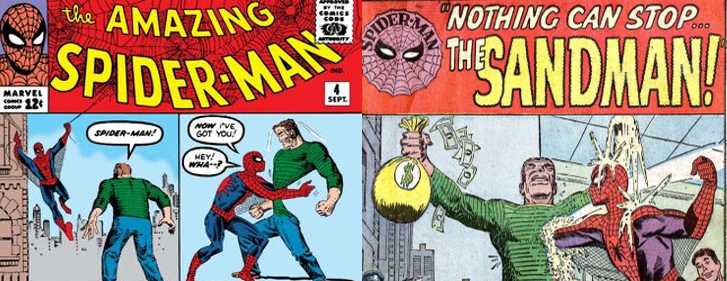
Story Title: “Nothing Can Stop… The Sandman!” Published: 11 June 1963 (cover-dated September 1963) Writers: Stan Lee and Steve Ditko Artist: Steve Ditko
The Background: After debuting the Fantastic Four, Marvel Comics editor and head writer Stan Lee immediately sought to follow this with a teenaged superhero specifically created to appeal to younger readers. Inspired by a fly climbing up the wall of his office, Lee turned to artist Steve Ditko to settle on the character’s final design and, despite Marvel publisher Martin Goodman’s dislike of the concept, Spidey’s debut in Amazing Fantasy #15 became one of Marvel’s best selling titles and his popularity led to his own solo title barely a year later. Since then, Spider-Man has faced some of the greatest and most memorable villains in all of comics, with many of his most iconic villains being co-created by Stan Lee. Four issues into The Amazing Spider-Man, Lee and Ditko pitted the wall-crawler against Flint Marko/The Sandman, a regular crook transformed by atomic power who later went on to not only be part of the Sinister Six but also have a surprising amount of character growth over the years, to the point where he became a hero and ally of Spider-Man’s at times. The Sandman has also been a recurring villain outside of the comics, generally acting as a recurring boss in numerous Spider-Man videogames and made his contentious live-action debut in Spider-Man 3(Raimi, 2007).
The Review: “Nothing Can Stop… The Sandman!” opens in very much the same way as a lot of Spider-Man stories from this era: our web-slinging hero starts the tale lamenting the hate campaign that the cantankerous J. Jonah Jameson continues to wage against him (which has escalated to an ongoing series, “The Spider-Man Menace!”, in the Daily Bugle) when he spots three shady looking goons eyeing up a jewellery store and leaps into action. Unfortunately for the troubled teenager, Spidey webs the would-be criminals up too soon; they rightly point out that there’s no law against walking the streets, brand him a menace, threaten to sue him for assault and battery, and yell for the cops to come and help them. Realising what a fool he’s made of himself, the web-slinger promptly gets out of there, consoling himself only with the knowledge that he did technically stop the goons from robbing the jewellers. Spidey decides to drop in on Jameson to give him a piece of his mind, only to find the grouchy editor isn’t in his office. As Spidey leaves, however, he spots a bunch of cop cars searching the streets and (apparently having learned nothing from his previous error) immediately confronts a thuggish looking brute climbing to a rooftop across the street. Luckily for him, though, the thug introduces himself as the Sandman, a criminal Spidey is only too well aware of as he’s wanted by the police “from Maine to Mexico”.
Spidey is stunned when he encounters the Sandman, a crook who can turn his body to...sand…!
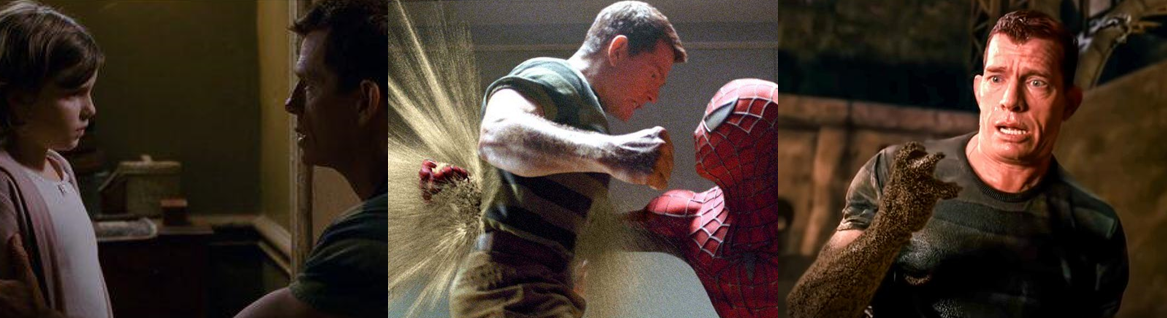
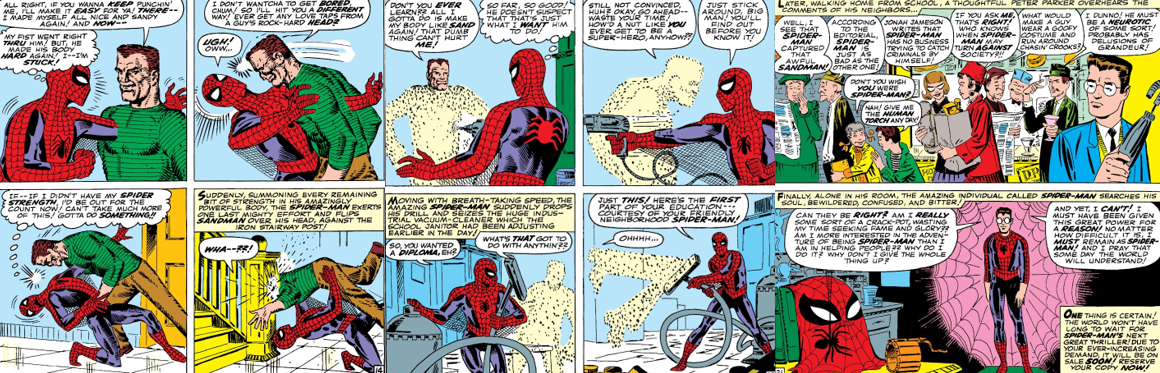
Offended when the abrasive Sandman tries to brush him off like he’s nothing, Spider-Man moves to subdue the crook and is astonished when the Sandman literally slips through his fingers by turning his body into soft sand! The Sandman mocks Spider-Man as the wall-crawler’s punches go right through his body and when Spidey damn-near breaks his hand when the Sandman hardens his body to the consistency of iron, and his fully malleable body sends him reeling across the rooftop! Frustrated by the Sandman’s taunting and shape-shifting shenanigans, Spider-Man prepares to try his webbing on the crook but is startled to find that his mask has (somehow…) ripped during the fight. This sends his anxiety and paranoia into overdrive; Spidey envisions that capturing the Sandman will expose his secret identity, leading to an increased manhunt spearheaded by Jameson and the destitution of be beloved Aunt May. Of course, there’s nothing to suggest this would actually happen; there’s no way that the Sandman knows who Peter Parker is, after all, and he could just cobble together a substitute mask, but Spider-Man decides that the risk is just too great and flees before the Sandman can get a good look at him. This leaves the Sandman free to easily deposit himself at ground level, break into the bank by forming the exact shape of the key with his finger, and slip into the vault by turning his entire body into sand. Back at home, Peter frets about his sewing skills while watching a news report that’s conveniently expositing the Sandman’s bizarre origin story: career criminal Flint Marko escaped from solitary confinement in a maximum security prison on an island, swam to shore, and hid from the ensuring manhunt at an atomic device testing centre. There, he was caught in an atomic explosion and, rather than being immolated or suffering from gruesome cancer, his molecules were radioactively merged with that of the sand at his feet, transforming him into a veritably indestructible man of sand.
Peter’s social woes are exacerbated when the Sandman hides out in his school!
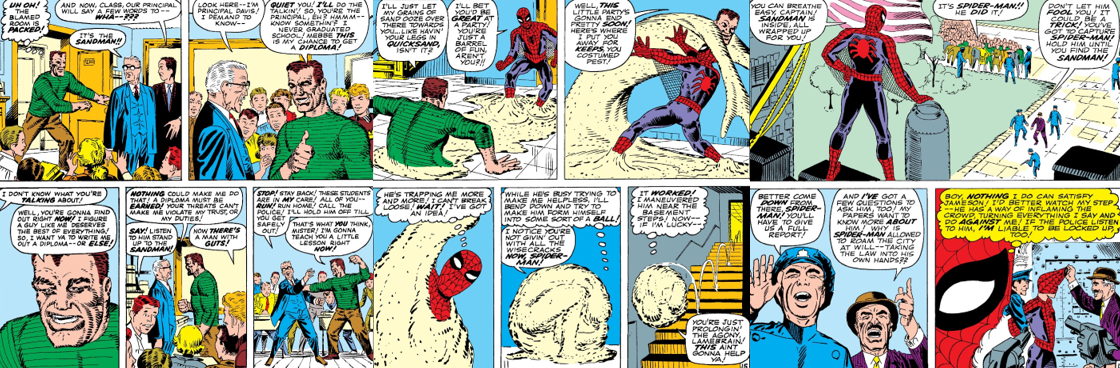
When his doting Aunt May comes knocking, Peter is forced to feign illness to cover up his costume and is unable to finish his work and get after the Sandman as she insists on mollycoddling him for the rest of the day and night. Consequently, the Sandman easily shrugs off the police’s gunfire, robs the bank, and eludes capture with his amazing abilities and Peter must wait until the morning (and being given a clean bill of health by his aunt) to finish up. Once he’s up and dressed (and armed with his umbrella and a promise not to exert himself), Peter heads over to the Daily Bugle, where Jameson’s mood has been soured by the little “gift” Spidey left for him the previous night (somehow, Spidey’s webbing managed to not dissolve after a few hours, but I don’t mind as it leads to Jameson standing around in his boxer shorts!) Unfortunately, Jameson is less than impressed by Peter’s lack of photos of Spider-Man and even more riled up when he dares to ask for an advance. Jameson berates Peter as an example of the entitled youth of the day and sends him packing, scuppering the webbing experiments Peter hoped to fund with the extra cash. Peter’s day just gets worse from there; distracted by the quandary of the Sandman, he’s forced to back out of a date with Liz Allen, earning him her ire and jeers from bully Eugene “Flash” Thompson, and he’s so disheartened by the drama of his dual life that even his teacher snaps at him for “daydreaming” in class. You wouldn’t believe it but the Sandman, annoyed at the constant attempts by the police to apprehend him, decides to duck into Peter’s high school until the heat dies down. He bumps into Principal Davis and, amazingly, demands that the teacher write him out a diploma so he can have an academic credit to his name! The kids are impressed when they see their principal standing up to the Sandman and even putting himself at risk to keep them safe but jump out of their chairs with excitement when Spider-Man leaps in to keep the Sandman from harming the elderly principal.
Though he triumphs over the Sandman, Spider-Man is slandered by Jameson’s hate campaign.
Realising that the kids are in danger and wary of the Sandman’s tricks, Spider-Man opts to hurl the brute out of the classroom when he hardens himself, but the Sandman quickly recovers and puts the pressure on Spidey by relentlessly trying to pummel him with his enlarged, hammer-like fists. Spider-Man lures the Sandman to the school gym, only for his webbing to fail him when the Sandman simply passes through it like…well…sand. The Sandman corners Spider-Man, who reacts on instinct and ends up with his arm trapped in Marko’s body. This allows the Sandman to repeatedly headbutt the web-slinger with his rock-hard head, forcing Spider-Man to desperately drive Marko into an iron stairway post to free himself and avoid being headbutted to death. The Sandman quickly reforms himself, ensnares Spidey’s ankles by turning his body into quicksand, and envelops the teenage hero with his entire body, encasing him within a ball of sand. Thinking fast, Spider-Man bounces his foe down to the school basement and slips free from his prison; he then plays to the Sandman’s arrogance by threatening him with an electric drill. Naturally, the Sandman simply turns his entire body into sand particles to render the tool harmless, but this is exactly what Spidey was hoping for; he quickly grabs a huge industrial vacuum cleaner and turns it on the Sandman, sucking him up and imprisoning him within a big metal capsule. Spidey then realises that he didn’t get a chance to snap any pictures of the fight for Jameson, so he fakes a few by snapping photos of himself tussling with some sand he tosses into the air! Jameson then inexplicably shows up at the school and starts barking orders at the cops with no care for the safety of the students inside. He angrily accuses Spider-Man of being in cahoots with the Sandman, so Spidey simply delivers Marko to the cops and changes back into Peter Parker. His joy at this victory is short-lived, however; not only does Jameson take the cost of developing his photos out of his pay, Liz and the others continue to berate him for being a coward and a bookworm, and Jameson uses Peter’s photos to further his vendetta against Spider-Man, leaving Peter despondent but nonetheless determined to continue using his powers for good.
The Summary: Wow, Stan Lee really didn’t pull any punches in piling the pressure on young Peter Parker back in the day, did he? Peter has got to be the unluckiest guy in the world; it seems no matter what he does, the world is out to get him. It’s almost laughable at times, and especially in this story; Spider-Man’s busted up would-be crooks before and it’s never been a problem, but this time they threaten him with legal action as he jumps in too soon. Although he beats himself up over this, this mistake doesn’t stop him confronting the Sandman, which I think was a missed opportunity. If Spider-Man had spotted the Sandman and not intervened based on what just happened, Peter could’ve wallowed in self-pity not unlike the guilt he feels over Uncle Ben’s death when he later learned that the Sandman robbed that bank. Instead, we get this really random interlude where Spidey’s forced to run off because his mask rips (I still don’t see how that happened…) and he’s taken out of action by the suffocating affections of Aunt May. Then, rather than get out there and look for the Sandman, he’s scolded by his peers, subjected to abuse by the likes of Flash and the fickle Liz, and all his efforts to subdue the Sandman ultimately amount to nothing as Jameson is so determined to paint him as a menace. It’s really weird, though, as the kids at his high school are cheering him on and even the cops seem willing to give Spider-Man the benefit of the doubt, but the general public are easily swayed by Jameson’s biased opinions all so that Peter can be weighed down by depression and self-doubt. This already weighs so heavily on him that he totally overreacts when his mask rips and is immediately and irrationally convinced that it’ll mean the end of his life, even though the Sandman surely won’t know him from any other kid!
The Sandman’s powers are a highlight of the story, which beats Peter down at every turn.
Still, this interpersonal drama, as absurd as it often is in these older Spider-Man stories, is part of what makes Spider-Man so appealing; he always does the right thing and continues to fight against injustice even when most of the city wants to see him behind bars. In the Sandman, Spider-Man meets a formidable physical match; I really liked Marko’s characterisation here as a regular (if accomplished and notorious) crook who just happened to be granted amazing powers. His goals don’t extend much further than robbing banks for cash, but I really enjoyed that he demanded Principal Davis write him a diploma to realise his lifelong dream of graduating high school! At one point, Spider-Man compares the Sandman’s malleability to that of Doctor Reed Richards/Mister Fantastic, an analogy that’s not entirely unwarranted but I’d argue that the Sandman’s powers are even greater! He can basically make himself incorporeal, harden his entire body, stretch his limbs, make himself sticky, and form massive crushing appendages to attack Spider-Man and it’s his unpredictability more than his fighting prowess that throws off even Spidey’s famed spider sense since Spidey never knows what the Sandman is going to do next. I wasn’t a big fan of Marko’s unbelievable backstory (I’d love to know how he escaped from that prison…) but it’s fun seeing atomic power depicted in such surreal ways in comics and I liked that he was such a simplistic, and yet incredibly dangerous, adversary even if he barely scratched his potential here. Ultimately, I had a good enough time with this; while far from my favourite Spider-Man villain, the Sandman at least makes for a visually interesting baddie and the drama, while a bit too full-on at times, tied into Peter’s ongoing struggles with his duality. There are better Spider-Man stories from this era and things are wrapped up or rushed through a little too quickly, but it’s fun seeing Spider-Man being thrown for a loop by the Sandman’s fantastic powers and being forced to think of new ways to outsmart and overcome his latest villain.
My Rating:
⭐⭐⭐
Rating: 3 out of 5.
Pretty Good
What are your thoughts on the Sandman’s first appearance? Were you a fan of the villain and his unique powers or did you find him to be a bit daft and unbelievable? What did you think to Peter’s social woes and his panic over his ripped mask? Were you a fan of the Sandman’s simplistic motivations and bizarre powers? What are some of your favourite Sandman stories and moments? How are you celebrating Spider-Man Day today? Whatever your thoughts on Spider-Man and the Sandman, leave them below or drop a comment on my social media and be sure to check out my other Spider-Man content across the site!
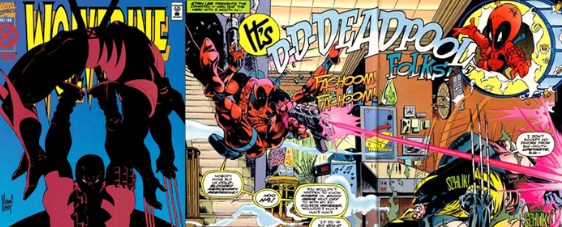
Story Title: “It’s D-D-Deadpool Folks!” Published: December 1994 Writer: Larry Hama Artists: Adam Kubert and Fabio Laguna
The Background: In 1974, Roy Thomas charged writer Len Wein to create the first Canadian superhero; a short, feisty character named “Wolverine”. After the legendary John Romita Sr sketched the original design for Wolverine and came up his now-iconic retractable claws, artist Herb Trimbe finalised the character’s design for his debut in the pages of The Incredible Hulk. Of course, nowadays, James Howlett (better known as “Logan”) is one of Marvel’s most well-known characters thanks to his association with the X-Men, but he’s not the only popular fast-healing Canadian Mutant anti-hero in Marvel Comics. In 1991, Fabian Nicieza and Rob Liefeld debuted Wade W. Wilson/Deadpool in the pages of The New Mutants. Heavily inspired by Wolverine, Peter Parker/Spider-Man, Slade Wilson/Deathstroke the Terminator, the self-styled “Merc With a Mouth” was initially introduced in an antagonistic role but eventually proved popular enough to graduate to his ongoing solo title. In time, Wolverine and Deadpool’s pasts would be intertwined to give them a shared history with the infamous Weapon X project and the two would cross paths as both rivals and team mates as members of the black ops X-Men team X-Force. Although both characters achieved greater mainstream success with their live-action movies, a properbig screen team up between the two seemed impossible after Hugh Jackman retired from the Wolverine role in 2017. However, in 2022, Ryan Reynolds shocked everyone by revealing that Jackman would return as Wolverine for Deadpool and Wolverine (Levy, 2024) and what better way to mark this momentous occasion than be revisiting the first-ever meeting of these two immensely popular characters?
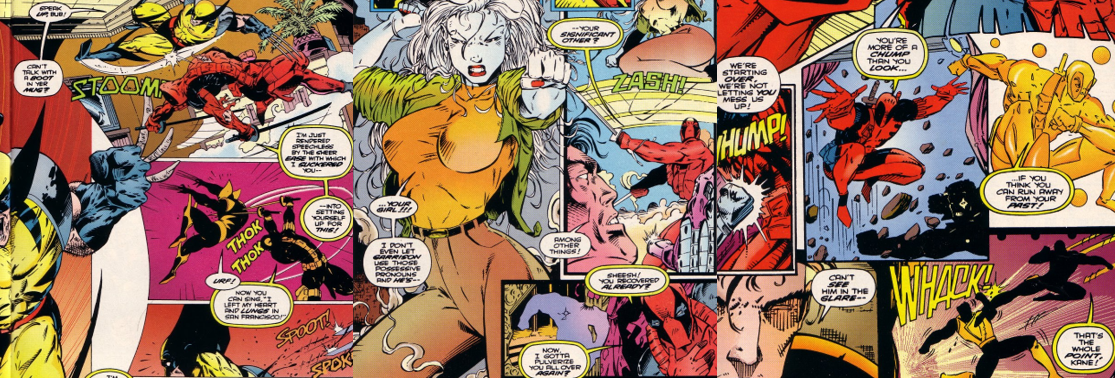
The Review: Our story opens with Wolverine back in the Great White North; he’s tracking down Garrison Kane/Weapon X as a favour to James Hudson/Guardian and (despite his heightened senses) is surprised to find the wacky mercenary Deadpool in Kane’s pimped out apartment. The hyperactive Deadpool immediately opens fire on Wolverine and promises to “put [him] out of [his] interminable suffering” if Logan can tell him where Kane took his “ex-squeeze”, Vanessa Carlysle/Copycat. Naturally, Wolverine refuses to rat out the two and fights back, slashing at Deadpool’s arm and trading insults as they clash. During their brutal combat, Deadpool boasts of his own healing factor, which gives him the edge over Wolverine since this story takes place during a time when Logan’s healing powers were on the fritz and he no longer had his Adamantium skeleton or claws thanks to Erik Lehnsherr/Magneto ripping it from his bones. While Wolverine still has the skills and ferocity to go toe-to-toe with Deadpool, his feral rage and curiosity about Deadpool’s vendetta against Kane cause him to leave himself wide open for the Merc with a Mouth to ram his swords through his back and into his lungs.
After incapacitating Wolverine, the deranged Deadpool attacks Kane and Vanessa.
Victorious, Deadpool spots a poster for the Grand Guigol theatre, realises that’s where his targets are, and skedaddles, leaving the critically injured Wolverine bleeding on the floor. At the Grand Guigol theatre, Kane and Vanessa are trying to establish normal lives for themselves as stage actors. Kane struggles with his lines and to find his motivation as an actor, but Vanessa encourages him to channel his infatuation with her and his desire to leave behind their tumultuous past into his acting. She’s ecstatic when this appears to result in a more convincing performance, only to find that he was startled by the sudden appearance of Deadpool. Delighted to find his targets and begging to know that Kane’s fighting skills have become as bad as his acting, Deadpool leaps at Weapon X, swords drawn, only to find his strike deflected by Kane’s mechanical arms. When Deadpool refuses to leave them be or forgive Kane for stealing his girl, he gets a beatdown from an enraged Vanessa and doesn’t hesitate to take a swipe at her, too. Kane gets in on the action, pummelling Deadpool and chastising him for interfering in their lives, but he loses the advantage when Deadpool temporarily blinds him with a flash of light from…somewhere… Back at Kane’s apartment, the wounded Wolverine struggles to his feet, his healing factor slowly taking care of his injuries, and cottons on to Deadpool’s lead. Wrapping the worst of himself up in a kimono, he stumbles out into the streets and into the back of a taxi that he demands take him to the theatre.
After healing, Wolverine makes a timely intervention that sees Deadpool make a desperate escape.
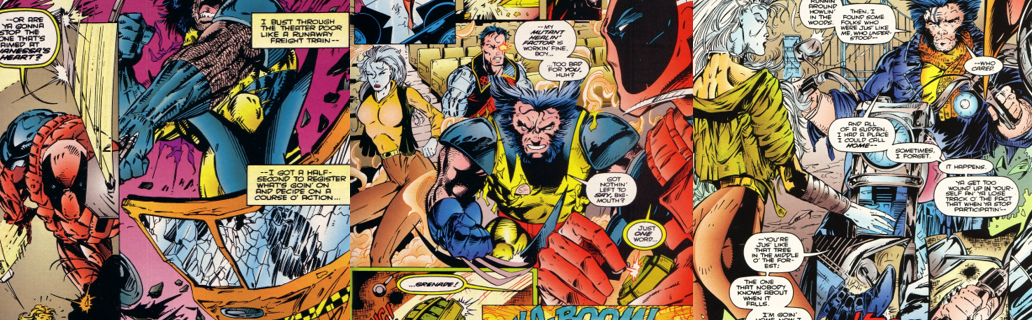
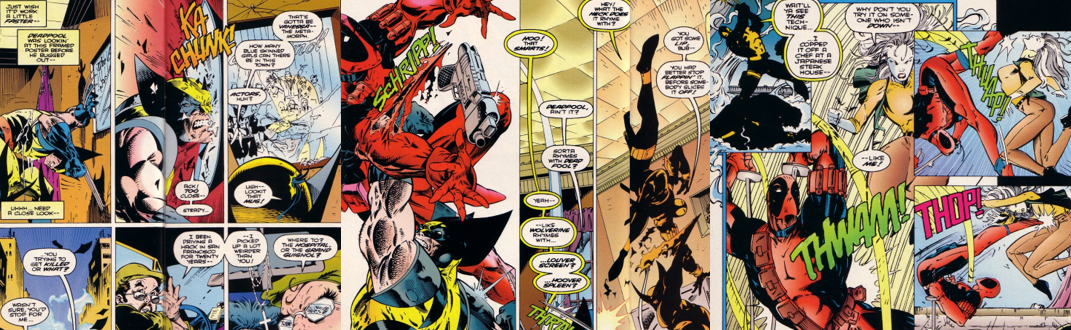
During the taxi ride, Wolverine endures a particularly chatty cab driver and is grateful to find his wounds have healed. However, when the cab’s brakes malfunction halfway to the theatre, Wolverine’s frustrations get the better of him and he slices off the cab door and opts to skate the rest of the way on the severed cab door! Although Vanessa intervenes before Deadpool can decapitate Kane, she ends up getting knocked on her ass by Wade’s unpredictable agility and Deadpool offers Kane a choice: defend himself from one sword or catch the other sword tossed right at Vanessa’s heart. Luckily, Wolverine shows up, bursting in “like a runaway freight train” and intercepts the blade, saving Vanessa. Deadpool’s stunned to see Wolverine alive and well and finds himself outnumbered by the three unlikely allies; as such, he chooses to toss a grenade into the group and beat a hasty retreat. In the aftermath, Wolverine helps tidy up Kane and Vanessa’s apartment and offers them advice about moving on from their violent and chaotic pasts. He also helps Vanessa to see that Kane chose to save himself so that he’d be able to help Vanessa rather than being selfish, and then rides off after noting that they were lucky he didn’t catch a cab with good brakes.
The Summary: I often find that the comics I review are a little light on action and fight scenes; characterisation, interpersonal drama, angst, and outdated sensibilities are often the order of the day, meaning fights and visual spectacle are few and far between. That’s not the case with Wolverine #88; if anything, the opposite is true, and the issue is more style over substance. It’s definitely a side chapter in Wolverine’s larger story; we’re seeing how Logan is coping being “the best there is at what he does” with a less reliable healing factor and his awful bone claws, which often puts him at a disadvantage and makes him more vulnerable. This is the case here; while he’s still a skilled fighter and his feral nature allows him to go all-out against the likes of Deadpool, he can’t just leap head-first into fights these days and that costs him. In fact, Wolverine even notes that if he’d been injured like he was at Deadpool’s hands just a few months ago, he’d probably have been killed, though Wolverine’s mortality was often emphasised even before he had the Adamantium ripped from his bones. I quite like seeing Wolverine going out and doing his own thing, though, and having loyalties and adventures beyond the X-Men. It would’ve helped to emphasise this if he’d been wearing his brown/tan uniform instead of his yellow/blue one, but it adds a lot to his character that he’d do a favour for James Hudson and go out of his way to protect Garrison Kane and Vanessa despite them not really being in his close circle and their ties to the Weapon X project. I quite enjoyed seeing Wolverine stumble about, bleeding out in a daze, and struggling to knit himself back together in the back of the taxi. He had some amusing moments here, such as accidentally smashing his face into a picture of the Grand Guigol theatre and “skateboarding” through the streets on a car door, while still being a formidable and honourable (and brutal) fighter.
Some humorous moments and brutal fights help this otherwise shallow issue to stand out.
As ever, Deadpool really makes an impression here; this is still before he started breaking the fourth wall and being depicted as a nigh-immortal, ultra-skilled character, but he’s still absolutely out of his mind. The unique depiction of his speech bubbles and his hyperactive, deranged nature match perfectly with his dynamic agility, which allows him to perform physics-defying moves that out-fight the legendary Wolverine and fend off attacks from both Kane and Vanessa. Deadpool’s despicable nature means he’s not above fighting dirty and he’s perfectly happy to attack and even attempt to kill Vanessa, which only goes to show how warped he is since his entire motivation here is to kill Kane for stealing his ex and presumably win her back from him. Deadpool’s fighting skill, marksmanship, and swordplay are only part of the story here; he now sports an advanced healing factor that lets him fight Wolverine up close and dirty and isn’t afraid to use the small arsenal he carries both as offensive and defensive weapons. I still don’t really get what that blinding flash was supposed to be since he’s not shown pulling out a flash grenade or anything. In fact, as fun and dynamic and vicious as the issue’s art is, some of the fight scenes and narrative pacing was a little confusing (such as Vanessa randomly querying Kane’s actions at the end completely unprovoked) but there’s a visceral “nineties” feel to the issue that helps make everything feel entertaining and chaotic. This suits both Wolverine’s volatile nature and Deadpool’s madcap demeanour and results in Wolverine #88 being a visually fun, if narratively light, first meeting between the two; they establish an instant animosity based on how similar there are as fighters and in their Mutant abilities and it was fun seeing them tangle. I would’ve liked to delve a little deeper into that dynamic and maybe focus a little more on Wolverine as a protector to Kane and Vanessa, but I liked the race against his own body and time to intercept Deadpool and how open-ended the story finished so I’m excited to check out future meetings between the two someday.
My Rating:
⭐⭐⭐
Rating: 3 out of 5.
Pretty Good
What did you think to the first meeting of Wolverine and Deadpool? Were you disappointed by the lack of plot or did the brutal fighting win you over? Were you a fan of Wolverine’s bone claws? What did you think to Deadpool’s characterisation as a deranged psychopath? What are some of your favourite moments between Wolverine and Deadpool? Whatever your thoughts on Wolverine and Deadpool, feel free to share them below or on my social media, and be sure to check out my other Wolverine and Deadpool content across the site.
First appearing in 1941, Marvel Comics’ star-spangled super soldier, Captain Steve Rogers/Captain America, has become one of Marvel’s most recognisable and celebrated characters not just for his super patriotism but also for being a prominent member and leader of Marvel’s premier super team, the Avengers. Having successfully made the jump to live-action, Cap is now a widely celebrated, mainstream superhero and, given that today is Independence Day, this seems like the perfect excuse to pay tribute to the star-spangled man with a plan himself!
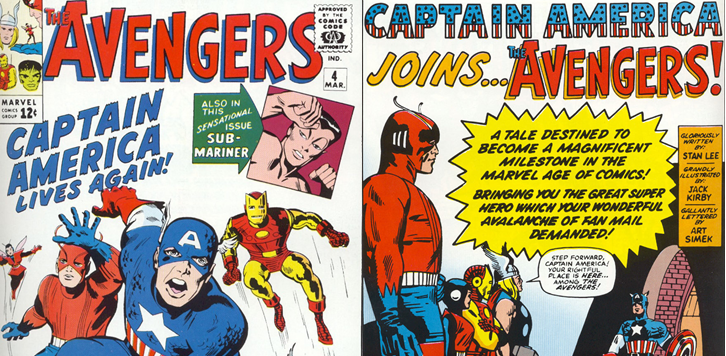
Story Title: “Captain America Joins…The Avengers!” Published: 1 March 1964 Writer: Stan Lee Artist: Jack Kirby
The Background: In 1941, the Second World War was well under way; Nazi Germany overtook Denmark and Norway in April 1940 and the United States finally entered the fray in 1941 to oppose the combined “Axis powers” of Germany, Japan, and Italy. Due to the ever-escalating conflict, patriotism and national pride ran rampant in America, leading to Joe Simon and the legendary Jack Kirby debuting Captain America and his kid sidekick, James Buchanan Barnes/Bucky, who took the fight directly to the enemies of America and encouraged readers to support the war effort by any means necessary. However, after the War ended, superheroes saw a decline in popularity and Captain America’s solo title was cancelled in 1954, but the character got a second chance when he was recast as a “man out of time” in this issue of The Avengers. The Avengers came about as a direct response to rival DC Comics’ Justice League of America; Martin Goodman tasked Stan Lee with bringing together Tony Stark/Iron Man, Doctor Bruce Banner/The Hulk, Doctor Donald Blake/Thor Odinson, Doctor Hank Pym/Ant-Man, and Janet van Dyne/The Wasp as Marvel’s premier superhero team. With their ever-changing roster and prominence in some of Marvel’s biggest events and stories, the Avengers became a consistent and influential presence in Marvel Comics, even more so after the Star-Spangled Avenger joined their ranks in this historic issue.
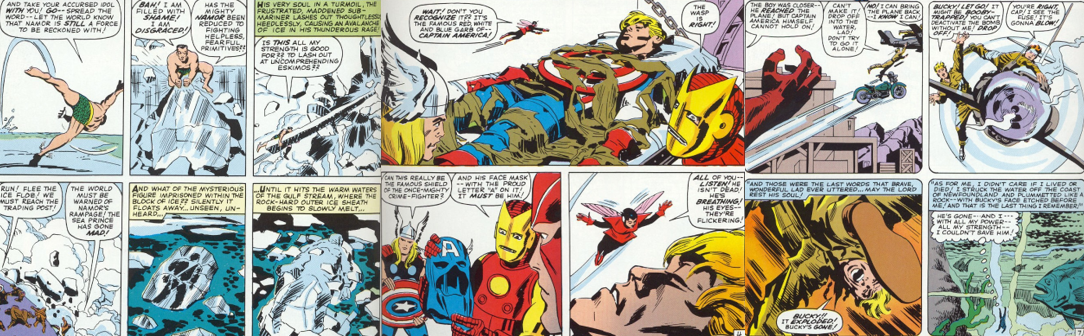
The Review: Marvel Comics always liked to hype up their stories and issues back during this time period; front covers would proclaim even the most bizarre-looking characters as being must-see events and issues generally always featured celebratory mentions of the creatives involved, and The Avengers #4 is no different. There are a couple of notable unique features in the full-page title splash for this story, though; first, a big explosive bubble of text directly attributes the return of Captain America to an “avalanche of fan mail” and a dialogue box at the bottom of the page makes sure to mention that “glorious” Stan Lee and “grand” Jack Kirby both collaborated on Captain America’s debut story, thereby lending further prestige to his return to the then-modern era of Marvel Comics. The story itself takes a little while to get started as the first page of panels is dedicated to recapping the Avengers’ battle against Prince Namor McKenzie/The Sub-Mariner and the Hulk in the previous issue; after the Hulk disappeared, Namor was forced to flee from the overwhelming odds and returned to the depths of the ocean. The sting of defeat is great for the proud Mutant but pales in comparison to the frustration he feels at being abandoned by his people after the inhabitants of Atlantis questioned his loyalty. Vowing to never stop searching for his lost people, Namor finds himself lost amidst the frozen wastes of the North Sea, where he comes across a tribe of Eskimos who worship a mysterious figure frozen in a block of ice. Interestingly, despite the Eskimos being isolated from the rest of the world, they instantly recognise “the dreaded Namor”, who wastes no time in mocking their idol and turning his anger upon them. In his rage, Namor decimates the frozen landscape, terrorises the simple folk, and hurls their frozen idol into the sea.
The Avengers are awestruck when they recover the perfectly-preserved body of the legendary Captain America!
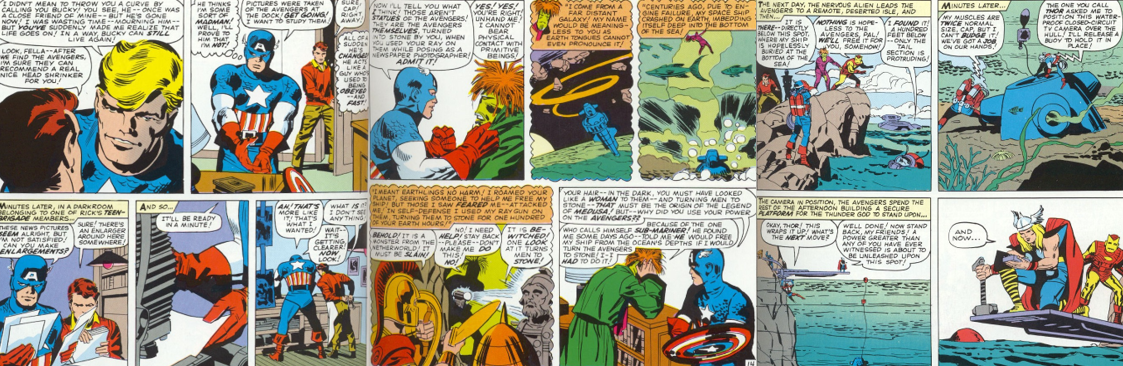
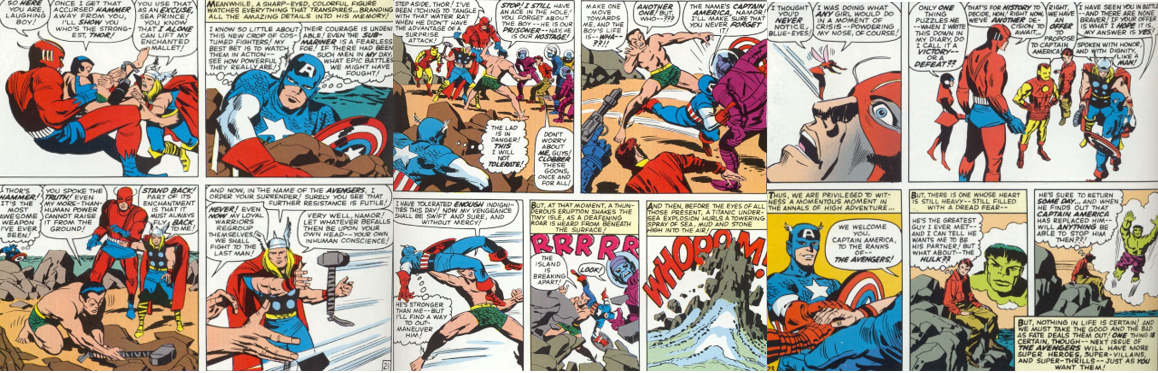
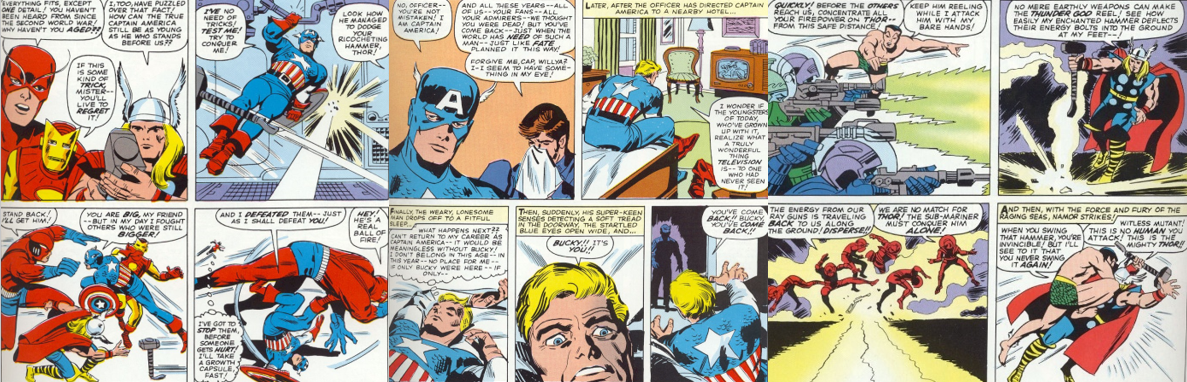
Free from the frigid temperatures of the northern climate, the ice block slowly melts and, by the time the Avengers come across it in their little submarine (I assume they were tracking Namor, that seems to make sense as to why they’d randomly be out there), the ice has completely melted, freeing the unconscious body trapped within. Giant-Man brings the body aboard and the team are stunned to find that it’s none other than the slumbering body of the legendary Captain America, a star-spangled crusader of justice so prolific that even Norse God Thor is aware of his accolades. The team’s shock at this discovery turns to panic when Cap suddenly awakens and lashes out in a confused daze, desperate to keep his kid sidekick, Bucky, from harm. Thor, Iron Man, and Giant-Man leap in to restrain the raging legend, but his madness quickly passes. Within the space of five panels, he resigns himself to the memory that Bucky is dead and reclaims his identity, shield, and mantle of Captain America. Though impressed, the Avengers are so puzzled by Cap’s youth and vigour that they suspect some kind of trick. Thus, Cap invites them to test him, easily dodging Thor’s magical hammer, overpowering even the hulking Giant-Man, and is only kept from embarrassing the group further when Wasp stops him in his tracks by challenging his chivalry. Suitably convinced that Cap is the real deal, tensions calm long enough for Cap to tell the tragic story of how he came to be encased within a block of ice. Back during the Second World War, Cap and Bucky were posing as security guards at an Army base when a mysterious Nazi figure launched an explosive-filled drone in a bid to either kill the two or rob the United States of a powerful weapon. Although Cap failed to reach the plane in time, Bucky leapt onboard and was seemingly vaporised when the plane exploded; the heartbroken Cap was hurtled into the ocean depths off the coast of Newfoundland, where he became encased in ice and effectively held in suspended animation. When the Avengers reach New York City, they’re greeted by the press, hungry for the big scoop on their battle against Namor and the Hulk, but the team are suddenly and inexplicably turned into stone statues by a flash of light! Cap missed the event since he was still inside the craft and, when he emerges topside to find everyone gone, he assumes that the statues are in honour of the colourful heroes and ventures out to explore the strange new world he’s found himself in without a second thought.
Cap tracks down the one responsible for petrifying the Avengers, an alien whom he vows to assist.
Cap is impressed by how much has changed, from clothing and fashion to the establishment of the United Nations and the upgrades to everyday vehicles, and stuns the public, who instantly recognise him as the legendary hero of World War II. Directed to a hotel by a helpful police officer, Cap briefly marvels at the wonders of television before dozing off in a troubled exhaustion. Already questioning his place in the modern age, Cap is startled to wake up and find Bucky alive and well in his hotel room…only to realise that it’s perennial sidekick and Avengers mascot Rick Jones. Concerned by the Avengers’ disappearance, Rick confronts Cap; since Cap was the last person to see them, Rick basically accuses him of being involved and threatens to set the Hulk on him if he doesn’t help find the team. This threat means little to Cap since he doesn’t know who the Hulk is and he’s still struggling with the uncanny resemblance between Rick and Bucky, but he promises to help find the team despite Rick’s rude demeanour. After reviewing the photos taken of the team by the press, Cap spies a suspicious man holding a camera-like gun and Rick wastes no time in contacting his “teen brigade” to try and find him amongst the teeming masses. Laughably, the teens come up with nothing but dead ends and false leads, but Cap finds the guy seemingly at random just by scouring the city’s rooftops. Once he spots the man he’s looking for, Cap wastes no time in springing into action and confronting him and his armed goons. Even these lowly mobsters recognise Cap and they’re easily overwhelmed by his indomitable shield, uncanny agility, and Herculean strength; while the goons quickly surrender, their leader desperately tries to turn Cap to stone with his ray gun, only to miss and be unmasked as a bizarre extraterrestrial lifeform! Unfazed by this, Cap threatens the alien (who goes unnamed in this issue but is eventually revealed to be named Vuk), who gladly tells his story to avoid being handled by “primitive beings”. Vuk crash-landed on Earth centuries ago and, encountering nothing but fear and hostility, would turn men to stone with his ray gun in self-defence, which Cap realises directly led to the myth of the hydra-haired, stone-eyed Medusa. Vuk relates that the Sub-Mariner promised to help Vuk return to the stars if he turned his weapon against the Avengers and, recognising the Sub-Mariner’s name from the past, Cap vows to help Vuk in return for undoing the damage he’s inflicted upon the Avengers.
As impressed by the team as much as they are with him, Cap helps fight Namor and joins the Avengers.
Namor witnesses these events from his deserted imperial castle using his “undersea scanner” and vows to avenge himself upon his enemies, a promise that suddenly becomes more viable when he conveniently stumbles upon a loyal troop of his elite guard. True to his word, Cap leads the Avengers in finding and freeing Vuk’s ship from the ocean depths, an act that earns them Vuk’s eternal gratitude and Cap’s admiration for the group’s unparalleled teamwork. Their victory is short-lived, however, as Namor and his elite guard suddenly attack the group; Iron Man goes toe-to-toe with Namor but his armour struggles to withstand the sledgehammer-like blows of the Sub-Mariner. In desperation, Iron Man blasts Namor with a “full [intensity] magnetic ray”, but this only grants him a temporary reprieve; with his armoured foe’s “greatest weapon” exhausted, Namor redoubles his attack, smashing a rock over Iron Man’s head and manhandling him to the ground. Momentarily powerless as he waits for his transistors to recharge, Iron Man is saved from certain death by the timely intervention of the Wasp, who Namor easily shrugs off before answering his lieutenant’s plea for help in subduing the rampaging Thor. Thanks to his mighty hammer, Thor easily holds back Namor’s forces by himself and repels the energy bolts fired at him by their ray guns, forcing Namor to leap at the Thunder God to tackle him directly. After slipping free of the Atlantean’s net and saving himself from drowning, Giant-Man returns to the fray to assist Iron Man, hurling the Atlanteans off-panel with his massive strength before rushing to aid Thor in tussling with Namor, who’s become obsessed with wrestling Mjölnir from Thor’s grasp. Watching from the side lines, Cap can’t help but be impressed by the power and courage of the Avengers and in awe of Mjölnir, a weapon so powerful that only the Mighty Thor can lift it. Although the Avengers clearly have Namor beat, the proud prince refuses to surrender and lowers himself to threatening Rick’s life. This irks Cap so much that he finally leaps into action, tackling Namor’s elite guard and briefly being overpowered by the Sub-Mariner before the tiny isle on which they’re all fighting suddenly (and conveniently) breaks apart from an undersea explosion caused by Vuk’s ship. Confident that his enemies will drown beneath the resulting waves, Namor commands his forces to retreat, unaware that the heroes easily survived by clinging to the remains of the island. Impressed by Cap’s prowess in battle, the Avengers ask him to join their little team and he gratefully accepts, but Rick is left pondering the fate of his friend and partner, the Hulk, whose rage at being “replaced” by Captain America is as sure as the inevitability that the Avengers will butt heads with the Sub-Mariner again before long.
The Summary: I quite enjoyed “Captain America Joins…The Avengers!” I sometimes struggle with Jack Kirby’s more bizarre artwork and designs but there was none of that here (save for the Avengers’ submarine and the brief depictions of Atlantean technology), which really helped these colourful characters to stand out all the more prominently. I especially liked Cap’s brief walk around New York City and him being impressed by the advances in technology and society since his day, and the panels that took place underwater, which evoked a murky, almost alien environment. Unfortunately, paralleling this was the pretty haphazard and confusing flashback to Bucky’s final mission, where it’s a bit difficult to make out where the characters are in relation to the plane, and the depiction of Vuk, who ends up looking more like Beaker than anything remotely impressive. I also really didn’t care for the reveal that an alien was behind the Avengers’ petrification; it was weird that Cap took it in stride and that the story didn’t treat it as a big deal, and it just came out of nowhere. I think it would’ve been far better to have it be an Atlantean in disguise, maybe switch the order of events to show Namor recruiting his elite guard before the Avengers reach New York, and then Cap could just threaten the Atlantean into helping him. It’s a minor thing to complain about but that’s kind of the problem; Vuk doesn’t even get a name and it just seems so random to just insert a Medusa-like alien into the story when the primary focus is the antagonism against Namor. Normally, I’d also complain about the depiction of women and youth during this time but, aside from being a bit too rude and confrontational, I didn’t have much of an issue with Rick Jones here and I was actually very impressed by the restraint show with the Wasp. She doesn’t fawn or coo over Cap upon seeing him and actually proves quite useful in the scuffle with him and Namor…but then all that goodwill gets thrown away on the very last page where it’s revealed that the Wasp disappeared from the battle to powder her nose!
Cap impresses with his abilities and characterisation, as does Namor’s unquenchable pride.
However, I enjoyed the angst of the Sub-Mariner as depicted here; Namor’s anger against he surface world has only exacerbated since his people abandoned him after questioning his loyalty due to his mixed heritage and he’s desperate not only to find his people, but to subjugate humanity to prove his superiority. There’s a tragedy to Namor that’s present even here; he lashes out at everyone and everything because he doesn’t want to be alone and craves power and adulation, but he’s tormented by being a child of both worlds and his status as a Mutant amongst even his bizarre people. Depicted as both an underhanded tactician and a formidable physical force, Namor’s threat is enough to require the attention of all the Avengers even without his elite guard and I liked how he easily overpowered Iron Man and matched even Thor’s God-like power (even if he was unable to lift Mjölnir). Of course, the true star of this story is Captain America; I really enjoyed how the issue went to great lengths to talk up Cap’s status as a legendary figure and that even randomers in the street recognised him as a hero from their youth. The Avengers are awestruck by his presence and seem delighted to not only have him amongst them, but also to test his abilities in battle, and Cap is equally impressed by the team, who he wishes could’ve been by his side during World War II. While it seems like Cap quickly regains his senses and returns to his confident and commanding persona, the story does touch upon the grief and anguish he feels at Bucky’s death and his feelings of belonging in the then-modern world. Though impressed by how far the world has come since his day, Cap briefly feels as though he doesn’t belong there, and it isn’t until he’s back in action, tracking down the Avengers’ mystery attacker and engaging with the Sub-Mariner, that he truly feels himself again. This was the perfect way to sell newcomers and sceptics on Cap’s return and make him relevant amongst his modern contemporaries and I really enjoyed how he meshed with the Avengers and their mutual respect for each other. Take out the Vuk stuff (or replace it with something better) and this would’ve gotten full marks from me, but it’s still a blast to read and one of the quintessential Avengers and Captain America stories.
My Rating:
⭐⭐⭐⭐
Rating: 4 out of 5.
Great Stuff
Have you ever read “Captain America Joins…The Avengers!”? If so, what did you think of it and did you enjoy seeing Captain America join the Avengers? Was this your first exposure to Captain America, and if not what was? Were you also disappointed by the inclusion of Vuk? What did you think to the depiction of Namor and Cap’s introduction to the then-modern world? Which of the Avengers is your favourite? How are you celebrating Independence Day today? Whatever your thoughts, drop a comment below or on my social media and be sure to check out my other Captain America content across the site!
Since his explosive debut in May 1962, Stan Lee and Jack Kirby’s gamma-irradiated Jade Giant has been one of their most recognisable and successful characters thanks, in large part, to the Incredible Hulk television show (1977 to 1982) catapulting the Hulk into a mainstream, pop culture icon. The Hulk has been no slouch in the comics either, being a founding member of the Avengers and undergoing numerous changes that have made him one of their most versatile and enduring characters.
Published: 22 December 1992 / 26 January 1993 Writer: Peter David Artists: George Pérez
The Background: The Incredible Hulk (and his human alter ego, Doctor Robert Bruce Banner) was another creation of Marvel legends Stan Lee and Jack Kirby. Inspired by the story of a hysterical mother showcasing superhuman strength to rescue her endangered child and classic movie monsters like Frankenstein’s Monster and Doctor Jekyll and Mister Hyde, the Hulk functioned as an allegory for the foils of war and was initially depicted as a stone-grey figure who emerged at night. Although his first series was cancelled after a year and a half in, the character returned to prominence following expansions of his lore and character and the popularity of the Incredible Hulk TV series. Nowadays, the Hulk is a staple of Marvel Comics, with an extensive gallery of villains who have tested him both physically and mentally, but one of his greatest tests came when writer Peter David and artist George Pérez had the Green Goliath encounter a possible future version of himself, the malevolent Maestro. Possessing the same insurmountable strength as the Hulk and bolstered by his calculating intellect, the Maestro is often regarded as one of the Hulk’s most dangerous and formidable villains. His debut story is so well regarded that the character has cropped up in additional tales to flesh out his backstory and regularly appears in the Hulk’s cartoon and videogame adaptations, so great is the threat of this devious alternative Hulk.
The Review: Our story begins in a dystopian wasteland about one hundred years into the future; the overgrown, dishevelled ruins of New York City house the remnants of society in overcrowded, war-torn streets. Tensions are high and a “Big Brother” monitoring system is in place, courtesy of the mysterious Maestro, who dwells within an emerald palace high above the ruins. Amidst the bustling, anxious crowd, we’re introduced to Janis Jones and her cohorts in the rebellion against the Maestro, one that’s vastly outnumbered and against the odds. This is immediately demonstrated not just in their paranoia about their plans being overheard by the Maestro’s “Gravity Police” but the violent introduction of his cybernetic law enforcers, who immediately execute one of their number and demand their immediate surrender. Although Janis begs them to fall back and get to safety, her fellow insurgents choose to fight, leaving the elderly Pizfiz with a bloody stump for a leg and Janis and Skooter desperately trying to escape their pursuers. Luckily for them, a building collapses and covers their escape and, from the rubble, emerges none other than the Incredible Hulk. Now, this is the so-called “Professor Hulk”, a stable merging of Banner and the Hulk’s psyches who operated during the nineties. This Hulk wears clothes and is capable of intelligent speech, while also still exhibiting his trademark superhuman strength and dexterity, though not quite to the same degree as his usual savage self. This means he waxes lyrical while thrashing the Gravity Police but briefly struggles against their massive, mechanical “Dog O’ War”. However, he’s still the Hulk so naturally he rips the robot dog’s head off and sends the cops packing as a message to the Maestro.
100 years hence, the world is a dystopian hellhole ruled by a malicious Hulk.
Naturally, the Hulk attracts a fair amount of attention as he walks the streets; the people view him with a mixture of fear and respect, which he finds strangely alluring. He’s soon accosted by Janis and taken to the literal underground, where the rebellion hides deep beneath the wreckage of the city streets. Janis gives her people a quick history lesson on the Hulk, going over his classic origin courtesy of “sliding”, a visual representation of actual eyewitnesses to the Hulk’s history. It seems Janis recruited him to help them out and the Hulk went along because his old friend, Rick Jones, vouched for her and out of curiosity regarding the Maestro’s true identity. Janis takes the Hulk to an aged and decrepit Rick, who sits in Professor Charles Xavier’s hoverchair amidst a trophy room of those who have fallen in the years since, hero and villain alike. Word of the Hulk’s appearance quickly reaches Thomas Raymond, minister to the Maestro, who interrupts his leader’s orgy to bring him news of this temporal impossibility, giving us our first look at the Maestro as an older, more grizzled version of the Hulk who sports a lion’s mane of grey hair and beard. Favouring a regal cape and an intimidating helmet, the Maestro callously interrogates Pizfiz. When Pizfiz tries to goad the Maestro into losing his temper and killing him, the dictator allows the influence of the Minister and his cooler temperament to keep him in check and forcibly extracts the information he requires. Pizfix got Doctor Victor Von Doom/Dr. Doom’s time machine up and running and sent himself and Janis to the past to recruit the young Rick and the Hulk in helping them out. When Pizfiz is left a broken, lifeless husk from the stress of the procedure, the Maestro splatters him for his insolence and prepares to lead a strike team to hunt down his younger counterpart.
The Hulk is overpowered by the far stronger, far more cunning Maestro and left his helpless captive.
The frail Rick reveals that, in the end, humanity was their own undoing; two massive nuclear wars ravaged the world, killing the world’s heroes and villains, not to mention countless innocents, with only their costumes and ashes left as a memorial in Rick’s collection. Not so for the Maestro, who only increased in power from the radioactive fallout, built a dystopian society for his own amusement, and was driven completely insane. Much like Darkseid, the destitute peons of the city cheer the Maestro’s name and try to win his favour, only to be brushed aside and kicked out of the way like flies. The Maestro also has no time or worry for any defences the resistance may have set up and simply burrows his way down to their hideout using sheer brute strength, caring little when his men are dissolved by acid and gas or sliced to ribbons by lasers. The Maestro simply walks through these traps to come face to face, and blow for blow, with his counterpart. Their fight quickly explodes to the streets above, where the Maestro tests the Hulk’s resolve by calling him ”Puny Banner” and threatens to tear an innocent girl to pieces if he doesn’t surrender. The Hulk calls his bluff, reasoning that the Maestro must truly fear him to resort to such a tactic, but is unable to keep himself from leaping to the woman’s aid, much to the Maestro’s delight and disgust. Though the two are somewhat evenly matched, the Maestro takes the upper hand throughout the fight; he also constantly goads the Hulk, reasoning that he (as in the Maestro) can out-think and out-match him at every turn through the gift of hindsight as well as his awesome power and devious intellect. The plan works; when the Hulk charges in, the Maestro easily dodges and counters him to prove his intellectual superiority. Although the Hulk briefly turns the tide by fighting dirty with a nut shot, a haymaker sends the Maestro into a nearby building crushing and threatening innocent lives. The Hulk’s desperate need to save those lives allows the Maestro to get the jump on him and subdue him by breaking his neck. While Janis and the other lament the damage done to the Hulk, the Green Goliath wakes in the Maestro’s throne room, strapped into a massive neck brace and attended to by one of the Maestro’s “favourites”, who identifies herself as “Betty” and, apparently, rapes or at least physically interferes with him against his will, much to the Maestro’s pleasure.
The Hulk feigns injuries and temptation to lure the Maestro into a false sense of security.
Powerless and paralysed, the Hulk is forced to endure the Maestro’s scathing rhetoric; the Maestro even offers the Hulk the opportunity to put himself out of his misery, confident that his existence is assured since he has no memory of these events. The two get into a metaphysical debate about time travel theory but, in the end, the Hulk can’t bring himself to end his life since the risk that the Maestro is telling the truth about branching timelines being true is too great and would simply result in the Maestro’s continued existence. Resigned to being held prisoner while his wounds heal, the Hulk is forced out to the wastelands, where the elderly Boz and other would-be farmers desperately try to cultivate the irradiated and war-torn soil. Due to the scarce resources in the city, and the physical imperfections of these outsiders, they’re dependent on the Maestro’s limited generosity. He allows them to live, even furnishes them with supplies and has been trying to introduce nutrients into the soil, and all he asks in return is to take their most beautiful and worthwhile women for his own sordid amusement. The Maestro tries to win the Hulk over to his way of thinking, dressing him in fine robes and expositing the benefits of the less spirited slave girls in his palace, but the Hulk remains unimpressed. The Maestro sees his indignation and rejects it; to him, humans are the true monsters, for they destroyed themselves before any supervillain could. He sees himself as benefitting from the strange fate placed upon him since he was fortunate to have avoided being at ground zero and therefore reaped the rewards of the nuclear fallout while the world died around him. He offers the Hulk the chance to stay and rule at his side, promising that the future that lies ahead of him is full of the same hatred ad betrayal he’s always known, and the Hulk feigns temptation, and the extent of his injuries, in order to lead Janis and her allies into the palace.
Overpowered by the Maestro, the Hulk’s only hope is to out-think his foe using the time machine.
Pointed in the right direction by the Minister, the Hulk attempts to confront the Maestro directly and is blasted full force by a cannon specially created by Forge to kill the Green Goliath. Congratulating himself for being one step ahead of his counterpart, and his enemies, once more, the Maestro sets his forces against the resistance and a big ol’ shootout ensues. Angered at his soldiers’ inability to wipe the resistance out, and the disappearance of the wounded Hulk, the Maestro callously snaps the Minister’s neck and storms off in search of his younger self as his palace becomes a chaotic warzone. The Maestro follows the Hulk’s blood trail, and the familiar sound of Rick’s harmonica, to the trophy room; there, he chastises himself for allowing sentiment to stay his hand and delivers a mighty blow to his old friend. Though the frail Rick attempts to shield himself with the iconic shield of Captain Steve Rogers/Captain America, the force of the punch sends him flying across the room, where he’s impaled on the Adamantium claws of James “Logan” Howlett/Wolverine’s skeleton, much to the Maestro’s sneering amusement. In anger, the Hulk launches a surprise attack and attempts to cut the Maestro in half with Cap’s shield. When the Maestro attempts to counterattack with Thor Odinson’s magic hammer, he’s incensed to find he still cannot enough to lift it and briefly takes a beating after being blinded by the ashes of his former lover, Doctor Betty Ross. Once again, though, the injured Hulk finds himself overpowered and pummelled by the insane dictator’s onslaught; however, in the end, the Hulk is able to outsmart his devious doppelganger by luring him into Dr. Doom’s time machine. The Hulk activates the device, sending the Maestro to the one place he can be destroyed, ground zero of the very Gamma explosion that birthed the Hulk in the first place! In the aftermath, Boz’s daughter is returned to him and the people begin to pick their lives up in the Maestro’s absence. In a poignant farewell to his old friend, the Hulk launches Rick’s ashes, attached to Cap’s shield, into the horizon for one last adventure.
The Summary: If you’ve ever read any story dealing with a dystopian future, particularly in Marvel Comics, then much of Future Imperfect will be visually familiar to you. The depiction of a war-ravaged, overgrown city full of strangely dressed survivors, cobbled together technology, and an oppressive, survival-of-the-fittest mentality is nothing new but this story does put a bit of a unique spin on things by focusing on the Hulk. As is often the case with stories that take place far in the future, the people of Future Imperfect use a lot of weird terminology in place of modern slang, curses, and even simple words like “see” to give it that bizarre edge, but this isn’t a future where advanced technology is readily commonplace. Thanks to humanity waging two devastating wars, these people are lucky to even be alive, much less spared the ravages of radiation poisoning and mutation, and it’s only through the paper thin grace of the tyrannical Maestro that they’re even able to eek out the harsh living they’re forced to endure. What’s left of the world’s heroes and Marvel’s iconic characters is stored in Rick’s trophy room; tattered costumes, forgotten weapons, and the ashes and memories of heroes and villains alike adorn the walls and are a stark reminder that, for all their battles, the superhuman community was unable to save humanity from itself in the end. This, as much as anything else, is a crucial aspect of the Maestro’s rise to power; as he so eloquently exposits to the Hulk, the people who hated, feared, and fought him were undone by their own monstrous nature and the “monster” they rallied against became a saviour and survivor in the aftermath.
The tyrannical Maestro is the Hulk’s physical and mental superior throughout the story.
At least, that’s how he sees himself. A combination of radiation, power, and presumably survivor’s guilt have driven the future Hulk completely mad. Selfish and tyrannical, he cares only for his own self gratification and sees himself as a tough but fair ruler to his people, who he demands sing his praises but cares little if they’re trampled underfoot. This is perfectly juxtaposed by the Hulk; younger, leaner, far less jaded (no pun intended), the Hulk retains his moral compass and respect for life, setting him at ideological odds with the Maestro in a way that wouldn’t be as possible or versatile with his more savage counterpart. It also helps that Professor Hulk is clearly much weaker than usual, especially against the Maestro; the added radiation and one hundred years of living give the Maestro the edge in terms of sheer power, ferocity, and cunning that even Professor Hulk struggles against. Rather than thinking with his fists or relying on his usual strategies, the Hulk is forced to endure being the Maestro’s captive to wait for an opening to strike more effectively, which allows us a deeper glimpse into the workings of the Maestro’s world and the depths of his insanity. I think it’s telling that the Maestro is so loquacious in his demeanour; he truly sees himself as the hero of his world, as the apex predator, and as deserving of everything his built and amassed after being hounded all his life and left the sole survivor following the devastating nuclear attacks.
The Hulk’s clash against the Maestro shows how dangerous an intelligent, evil Hulk can be.
Thus, the Maestro and the Hulk clash with morals as much as their fists, and both are intriguing. It’s not often that you see the Hulk, even Professor Hulk, manhandled and brutalised as badly as he is here; he’s constantly being swatted away, overpowered, and injured, bleeding in the finale and left half-paralysed after having his neck broken! In the rare instances when the Hulk is able to fight back, he’s always on the back foot within a few panels and, in the end, is forced to outwit the Maestro rather than out-fight him since he’s clearly outmatched. The supporting characters were okay; they fulfilled their purpose as resistance fighters who recruited the Hulk out of desperation, but it does make you wonder why Janis wouldn’t just stay in the past when she travelled back rather than risk her life saving a world that’s already gone to hell. The story even lampshades the suggestion that they go back and get more reinforcements; like, yeah, they could have tried to recruit more heroes while back in the past, and honestly the whole story of how the Hulk even got there is barely touched upon. Ultimately, they’re a means to an end; Janis needs to exist so the story can happen, but she’s not as interesting to me as the elderly Rick and his roomful of Easter Eggs, which served as a great backdrop for the finale. Ultimately, I can see why the story and the Maestro are so fondly regarded; it definitely could’ve benefited from being longer, perhaps five twenty page issues, to help things breathe a bit. Yet, the visual of the Maestro, his wild hair and his gruff, conniving demeanour, is certainly striking. The idea of the Hulk becoming intelligent and cruel enough to rule over the last vestiges of humanity is a powerful one since his rage at being ostracised is fully justified and he represents a nigh-unstoppable foe, and those elements were conveyed very well even in these two, all-too-brief issues.
My Rating:
⭐⭐⭐⭐
Rating: 4 out of 5.
Great Stuff
Are you a fan of Future Imperfect? What did you think to the Maestro and his depiction as a tyrannical, malicious future version of the Hulk? Were you a fan of Professor Hulk, and would you have liked to see the more savage Hulk take his place in this story? Which of the Easter Eggs in Rick’s trophy room was your favourite? Which dystopian future of Marvel Comics is your favourite and do you have a favourite alternative version of the Hulk? How are you celebrating the Hulk’s debut this month? Whatever your thoughts on Future Imperfect, go ahead and share them below or leave a comment on my social media and be sure to check out my other Hulk content.
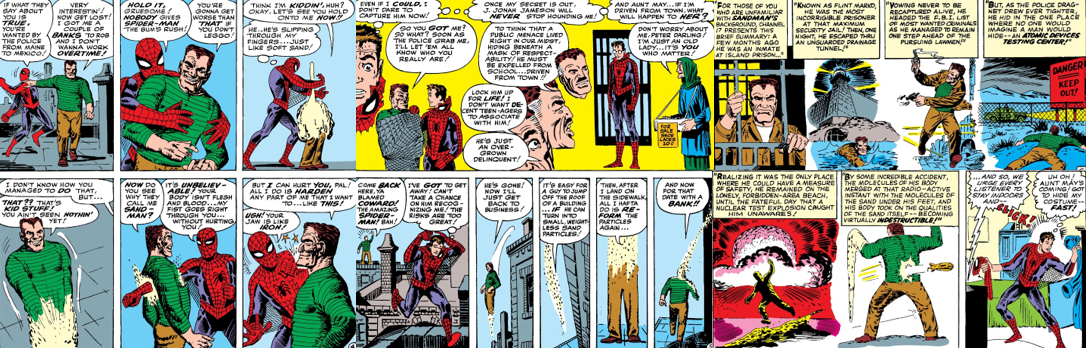
To commemorate, the culmination of their long-running and successful X-Men movies, 20th Century Fox declared May 13th as “X-Men Day”, a day to celebrate all things Mutant and X-Men and celebrate Marvel’s iconic collection of superpowered beings who fight to protect a world that hates and fears them.
Released: 14 December 2010 Originally Released: 31 January 1992 Developer: Backbone Entertainment Original Developer: Konami Also Available For: Arcade, Mobile, and Xbox 360
A Brief Background: After Stan Lee and long-time collaborator Jack Kirby introduced the X-Men in 1963, Mutants have featured prominently not only in Marvel Comics but also in videogames. The first X-Men videogame was essentially a vertical shooter on the Nintendo Entertainment System, but the characters saw their greatest early success in arcade ventures and team-based brawlers. Indeed, in 1992, the arcade scene was still a popular staple of the industry and beat-‘em-ups were at the forefront of that; the biggest names in this genre were Capcom and Konami, who pumped out licensed and first-party titles and defined a generation. X-Men was one of Konami’s most celebrated efforts; based on the vastly different pilot episode of the incredibly popularX-Men animated series (1992 to 1997), X-Men’s widespreadacclaim was matched only by its scarcity. The title never made it to home consoles and it would take about twenty years for it to finally be ported from the arcades. This digital-only version was praised for its nostalgia, though criticised for being far too easy, and was sadly delisted from digital store fronts in 2013 due to licensing issues and hasn’t been seen since.
The Plot: Erik Lehnsherr/Magneto leads an all-out war against humanity with an army of Sentinels and his human-hating loyalists, the Brotherhood of Evil Mutants, even kidnapping his old friend and rival, Professor Charles Xavier/Professor X, and the X-Man Kitty Pryde/Shadowcat. It’s up to the X-Men to use their unique Mutant powers to topple Magneto’s forces, rescue their allies, and put an end to his mad schemes!
The Review: X-Men is one of the quintessential arcade beat-‘em-ups from the heyday of the era, allowing up to six players to battle it out across eight stages beating the crap out of an unending series of robotic or animalistic enemies and vying to be top of the leaderboards. The controls are as simple as you could want from a game like this: you use Circle or Square to attack, landing a series of combos with each button press and attacks that are unique to each character, jump with X, and perform a jumping attack by pressing Circle or Square in mid-air. When enemies are on the ground, you can press Circle or Square to pound on them or press Square when close to most enemies to throw them across the screen or into other enemies for good crowd control. Unfortunately, there’s no dash attack here and few other attack options available beyond pressing Triangle to unleash your character’s Mutant power, which will drain a bit of your health or cost you a “Mutant Orb”. These attacks are unique to each character and will wipe out all enemies on screen, but have some limitations; James “Logan” Howlett/Wolverine and Scott Summers/Cyclops’s Mutant powers are great for clearing what’s right in front of you but you’ll want to pick Kurt Wagner/Nightcrawler of Piotr “Peter” Rasputin/Colossus if you want to target enemies all around you. Unlike other beat-‘em-ups, there are no weapons to get, no crates or barrels to smash, and no interactive objects to aid you (there are no explosive barrels here, for example); hell, there aren’t even any health pickups to find. Supposedly, the Japanese version of the game does have them, and other pick-ups that are dropped by defeated enemies, and I didn’t see one when I did a quick check after my first playthrough.
Plough through endless robotic enemies using the X-Men’s uncanny Mutant powers!
Indeed, despite its much-deserved reputation as one of the greatest arcade games of all time, there’s not much that makes X-Men particularly innovative. Its appeal comes down to the enjoyable mindlessness of its action, the colourful visuals, and the atrociously entertaining voice acting. The goal here is little more than to travel from the left side of the screen to the right, ploughing through disposable enemies until you reach the boss of each level. You’ll need to watch out for hidden turrets, cliff drops and lava pits, and a bunch of palette-swapped Sentinels who throw rocks, detach their hands, or fire projectiles. They’re joined by bulkier robots armed with cannons who fire missiles, low fireballs, or high laser shots, lizard men who attack with their tails or breathe fire, and even anthropomorphic mud and plant monsters and robotic arms, though these enemies are constantly recycled and become quite samey quite quickly, even when they’re riding in on trucks or these weird gun-toting cyborgs on treadmills. The environments are a bit hit and miss, too; the opening city is suitably wrecked, there’s a thunderstorm raging in the background of the cave stage, you’ll see the Giant Sentinel, X-Jet, and the captured Professor X and Kitty in other stages, but few levels were as visually interesting as the wild jungles of Island M and lava-filled dangers found in “The Trap”. You’ll be transported up and down lifts, as is expected in a beat-‘em-up, but won’t really be battling a host of enemies in these sections; there is one part where you’re confronted by a missile-spewing wall, but you don’t actually have to destroy it, and the only character with anything close to an idle animation is Wolverine, who sheathes and unsheathes his claws when left standing (but don’t linger too long or the game will punish you with an explosive death!)
Magneto’s monstrous Mutant minions are itching to welcome you to die!
Yet, the character and enemy sprites are big, colourful, and evoke both the comic books and the pilot of the animated series. The story, paper-thin as it is, is related through large, partially animated cartoon-esque sprite art and in-game graphics, with Raven Darkhölme/Mystique’s deceptive tricks and the Brotherhood’s explosive, boastful entrances being as notable a highlight as Professor X’s many words of wisdom. Of course, one reason X-Men is so fondly remembered is the awful dialogue, lovingly recreated here so as not to rob us of such meme-worthy statement as “X-Men! Welcome to die!”, “Magneto is in another place”, and “You’re dead, X-Chicken!” In terms of bosses, X-Men doesn’t offer much in the way of challenge or strategy and you can generally get by with a simple technique of jumping in for an attack, landing a quick combo, and jumping out of harm’s way, maybe landing a special attack if you have a spare orb or enough health. This is established from the first encounter with St. John Allerdyce/Pyro and is largely true of all bosses: they’ll burst into the scene, taunt you (leaving themselves vulnerable to an early attack), and use their various powers to whittle down your health. While Pyro is quite nimble and spams screeching flame projectiles and roasts you with a flame burst, Fred Dukes/The Blob is much slower, plodding about and landing big punches or swings with his spiked mace, causing the screen to shake when you knock him down for a few seconds, and tanking your hits. A version of the Wendigo is also fought, with it pouncing at you and performing a head grab/throw combo shared by subsequent bosses, such as Nimrod, another large, clunky, slow boss who’d rather waste time taunting you than attacking in an interesting way. Cain Marko/The Juggernaut is similarly large and cumbersome but makes up for it with a screen-crossing charge and a huge cannon that fires a large blast across the screen. There are also a couple of mini bosses to contend with, such as the mental bolt-throwing Emma Frost/White Queen, a battle against three Egyptian statues, several Pyro clones, and additional encounters with all previous bosses when battling through Asteroid M. You’ll fight Magneto twice; the first time, it’s Mystique in disguise and he/she’s limited to punches and kicks but defeating her sees you battle the true Magneto. This is the toughest fight yet thanks to his impenetrable shield, but his attacks are still limited to slightly faster and very powerful punches and kicks. He also likes to mock you, though, so you can get in a good combo in those moments, and you’ll be immediately trust into another playthrough after the ending and credits roll when playing the American version of the game.
Colourful visuals and fun bosses were offset by some repetitive backgrounds and enemies.
Yes, this version of X-Men allowed you to pick between the American and Japanese versions; the main difference between the two was that you get a free, non-health-sapping Mutant Orb after every boss in the American version, but you start each new life with one in the Japanese version, and there’s apparently more to pick up from defeated enemies in that version, too. X-Men also allowed for local and, at one time, online multiplayer, allowing up to six players to fight together like in the arcade days of old. You can head into the “Options” menu and turn smoothing on or off, set whether you want a wallpaper to fill in the gaps around the action, show or hide the in-game timer used for speed runs and such, change the screen size, and change where the player’s health and lives and score are displayed. Every time you clear a stage, it’s unlocked to select for next time, allowing you to pick up where you left off or freely jump to any level. While you strangely can’t change characters when you die (or, at least, I wasn’t able to; there was no way when the continue countdown appeared and the option was greyed out on the pause menu), you do get unlimited credits and you can test your skills on three difficulty stings: Normal, Hard, and Hardcore, with even more enemies swarming the screen on the harder settings. X-Men had twelve Trophies for players to earn, with Trophies popping when you used a Mutant power five times, earned at last 250 points in one game, completed it on Expert difficulty, and defeated Pyro without using your Mutant powers. Tougher challenges included beating Magneto with every playable character, finishing the game in 25 minutes or less, and being fooled by Mystique in a six-player game (which I achieved by mapping all six characters to one controller). Otherwise, that’s it; there are no skins, no new characters to unlock, and no additional game modes here; just the classic arcade machine in all its punchy, ridiculous, and colourful glory.
The Summary: It’s such a shame that X-Men got delisted and hasn’t been made widely available for download since 2013; almost as much of a shame that it never came to home consoles back in the day and we were stuck with all those mediocre X-Men platformers. It’s a really fun game that ends just as things are about to become too repetitive and mindless, with a surprising amount of variety to each character despite the lack of pickups and power-ups. Each character plays a little differently (Nightcrawler is fast and has lots of elaborate attack animations while Colossus is much slower and bulkier, for example) and has some fairly good special attacks, though the lack of team-based moves and temporary power-ups is a bit of a shame. Similarly, the environments are quite bland and uninspired, especially compared to other beat-‘em-ups and even the colourful sprites on offer here. Considering the vast library of X-Men characters and enemies, there’s very little enemy variety (potentially because it’s more appropriate to have players smash up robots than people) and, while the bosses make up for this, there’s not much strategy to defeating them. I liked that there was a lot of voice samples used here, and in the engaging tunes, and the quality of the cutscenes was very much like a cartoon, which was very fitting considering the source material. Although X-Men doesn’t offer anything new to the genre and is, in many ways, inferior to other titles that don’t have the luxury of such a big licensing name being attached to them, it’s a short burst of entertaining fun that’s best enjoyed with a couple of friends. I’m really hoping Konami work out some kind of deal to make this accessible to new players sometime soon so I can revisit it again, maybe as a collection of titles or something, and add in some additional materials like concept art, the option for HD graphics, and maybe a couple of extra characters and game modes. If you missed out on playing this version of the game, which is nevertheless the definitive version, there’s always the Arcade1Up cabinet or…you know…emulation, the latter of which I’d highly recommend as this is a great game that should be more easily available to play despite its lack of core features.
My Rating:
⭐⭐⭐⭐
Rating: 4 out of 5.
Great Stuff
Were you lucky enough to play X-Men when it came to PlayStation 3 and Xbox 360? Have you ever played it out in the wild? Which character was your favourite and were you surprised by Magneto’s polite welcome to die? Do you agree that the levels and features were a bit sparse, or do you think there was just enough here to compensate? Would you like to see X-Men more widely accessible for modern gamers? What’s the worst (or best) videogame tie-in you’ve ever played? Which X-Men videogame is your favourite and how are you celebrating X-Men Day today? Whatever you think about X-Men, and arcade games in general, feel free to share your thoughts below or leave a comment on my social media.
In 1995, Marvel Comics created “National Superhero Day” and, in the process, provided comics and superhero fans the world over with a great excuse to celebrate their favourite characters and publications.
Released: 15 September 2009 Developer: Vicarious Visions Also Available For: Nintendo DS, Nintendo Wii, PC, PlayStation 2, PlayStation 3, PlayStation 4, PlayStation Portable (PSP), Xbox One
The Background: Few videogame publishers are as closely associated with Marvel Comics than Activision, who have been spearheading adaptations of some of Marvel’s most popular characters since 2000. Of course, these weren’t all smash hits but some of their titles are counted as being among the best outings for the likes of Peter Parker/Spider-Man and the X-Men. In 2004, Activision teamed with Raven Software and achieved big success with X-Men Legends, a team-based brawler that mixed role-playing elements and co-op gameplay, and its sequel, so the two expanded to incorporate the larger Marvel universe with Marvel: Ultimate Alliance (Raven Software, 2006), a sadly delisted title that was met with generally favourable reviews. For the sequel, Activision turned to Vicarious Visions, who developed the game engine for the first game, and tweaked the gameplay to focus on team-based “Fusion” attacks to encourage players to experiment with different character combinations. Rather than tell an original story like the first game, or deliver on the many optional endings for Marvel: Ultimate Alliance, the sequel drew inspiration from the controversial “Civil War” story arc (Millar, et al, 2006 to 2007) that saw Marvel’s heroes divided over a governmental registration act, though the game was met with positive reviews. The action-packed gameplay and branching storyline were particularly praised, though some decried the stripped down roleplaying mechanics; the game was also delisted in 2020 and it would take just under ten years for another developer to produce a third entry.
The Plot: After a series of devastating attacks on the United States, the American government passes the Superhero Registration Act (SRA), forcing all super-powered individuals to act under official regulation, to reduce the chaos that results from their battles. The superhero community is left divided; Tony Stark/Iron Man and his followers champion the Act while Steve Rogers/Captain America and his oppose it, but the two warring factions soon find themselves battling a new enemy that threatens global peace.
Gameplay: Like its predecessor, Marvel: Ultimate Alliance 2 is a team-based brawler with limited roleplaying mechanics, exploration options, and puzzle elements. Players can (eventually) assemble a team of four from a roster of around twenty-five characters, many of which return from the last game alongside some newcomers, though your options are limited by story-mandated restrictions and the decision you make partway through to side with the Pro-Registration side or the Anti-Registration side. Regardless of which character you pick, your basic combat and control mechanics remain the same: tapping A executes a light attack while B throws a heavy attack; you can hold B to charge up a stronger strike and mix these together to form basic combos, such as a pop-up attack to break an opponent’s guard. X lets you activate doors and consoles, grab anything from crates to cars to toss at enemies, pull shields off foes and even grab enemies to pummel or throw them to their doom. Y lets you jump; press an attack button in mid-air and you’ll crash to the ground with a slam and press Y again for a double jump or to web-sling, fly, or dart along on a glider or ice bridge depending on who you’re playing as. The Left Bumper allows you to block incoming attacks or dodge out of the way by wiggling the left stick at the same time; there are also times when you’ll need to hit LB to deflect incoming projectiles. The Right Bumper allows you to heal yourself or your allies or revive a fallen comrade as long as you have a Heal Token in stock; these are found scattered across each location, usually spawning in during boss encounters or after defeating enemies, and you can hold up to two at a time.
Characters boast new superpowers and can combine abilities in devastating Fusion attacks.
Although up to four players can play Marvel: Ultimate Alliance 2 simultaneously; you can also play alone with some competent A.I. companions and freely switch to another character using the directional pad when playing solo. You can press in the right stick for a handy arrow to point you to your next objective or bring up the game map from the pause menu. Each character as a life and stamina bar; the former is filled when you collect red Health Orbs or level-up and the latter fills automatically, and each character also comes equipped with their own Super Powers, which you activate by holding the Right Trigger and pressing A, B, X, or Y. Many of these are shared across characters, but with a unique flare to each; Spider-Man can web enemies towards him, for example, while Matt Murdock/Daredevil homes in with his grapple cane, but both can lash at foes with their whip-like weapons. Most characters tend to have a ranged attack (Johnny Storm/The Human Torch’s flaming projectiles, Iron Man’s Repulsor blasts, Ororo Munroe/Storm’s lightning strikes, etc) and a clearing attack (Doctor Bruce Banner/The Hulk’s ground pound, Doctor Reed Richards/Mister Fantastic’s tornado spin, and Remy LeBeau/Gambit’s kinetically-charged card barrage, etc), but some also have abilities that buff either their attacks or their team (Doctor Jean Grey/Phoenix can automatically revive characters or add fire damage to her attacks, Danny Rand/Iron Fist’s “Healing Hand” technique heals him, and Captain America can temporarily reduce the damage he takes, for example). Not only can these be improved by earning experience points (XP) and levelling-up and spending “Ability Points” (AP) in the character menu, but you can now combine powers for powerful “Fusion” abilities. As you dish out damage, you’ll build up the Fusion Meter and you can store up to two Fusion Stars at once and combine powers by holding the Left Trigger and pressing either A, B, X, or Y to team up with one of your allies. This produces various effects depending on the combination but, again, many of them are very similar and only made unique by the way the characters team up. For example, you can perform the iconic “Fastball Special” by combining James “Logan” Howlett/Wolverine, Daredevil, Iron Fist, and Mr. Fantastic with bruisers like the Hulk, Ben Grimm/The Thing, or Mac Gargan/Venom. Venom, Hulk, and the Thing can also do a dual stomping attack and you’ll be able to suck enemies in with tornados from the likes of Storm and Thor Odinson while adding elemental attacks to these twisters with the Human Torch and Phoenix.
Puzzles and objectives are simpler than ever and dialogue trees give the illusion of dramatic discord.
No matter the combination of characters, you’ll be prompted to tap A to increase the radius, target specific enemies, or hit successive foes to score extra points and unlock additional abilities and buffs for your characters. Tapping or holding X is also the most common way you’ll be solving the game’s puzzles; generally, you’re tasked with clearing out all nearby enemies and then activating a console or door with X, but sometimes you’ll need to push or pull amplifiers and giant batteries to power up (or down) generators or pass through barriers, rip off control panels, or destroy projectors. Other objectives include destroying anti-aircraft guns, defeating certain enemies, activating consoles in the correct order, and moving stone columns around to unlock doorways and paths, and some missions also contain optional objectives (such as destroying weapon stockpiles or teleporter pads) that net you additional rewards. Additionally, while you’re often told over your comms that you need to act quickly, only certain objectives actually carry a time limit (you’re given less than six minutes to defeat certain bosses, dispose of bombs, or escape collapsing facilities, for example) and you’re often given options to pick from in dialogue trees that will earn you buffs for being “aggressive”, “diplomatic”, or “defensive”. However, as near as I can tell, this doesn’t really alter the story or your character relationships like picking between Pro- and Anti-Reg, which will restrict the characters available to you and alter both the bosses and mission objectives you’re given (protecting or destroying a Strategic Hazard Intervention Espionage Logistics Directorate (S.H.I.E.L.D.) convoy, for example, or raiding or defending a S.H.I.E.L.D. base). Other missions will see you joined by an additional fifth character (technically not a non-playable character as many, like Captain America and Nick Fury, are playable) who will provide support; however, you can’t select them during gameplay, and you’ll still be met with failure if all four of your team are knocked out.
Graphics and Sound: There’s been a decent graphical upgrade between Marvel: Ultimate Alliance and its sequel, namely in the sense that the game is far less dark than before and environments are a little more varied, though the same issues with things becoming repetitive and visually dull persist despite how many additional destructible elements have been added. The game starts in Latveria and sees you infiltrating both the castle town, with its many statues of dictator Doctor Victor Von Doom, and Dr. Doom’s main castle, a location that featured in the last game and is now far more linear and less confusing. This is true of all of Marvel: Ultimate Alliance 2’s locations; it’s very rare that’ll you’ll need to explore off the beaten track, mazes and repeating areas are pretty much non-existent, and everything is much more straightforward this time around, which is great in the sense that levels tended to drag on a bit and be frustrating in the first game but disappointing as you don’t have much to do in, say, Wakanda, except follow a straight path taking out enemies and gun placements and simply walking past the waterfalls, jungles, and tribal trappings in the background. Additionally, Marvel: Ultimate Alliance 2 is way less fantastical; there are no trips to Atlantis, Asgard, or Hell here and, instead, you have to make do with such inspiring locations as…downtown, the rooftops of Hell’s Kitchen, train tracks, and high-tech facilities. Some, like Phineas Mason/The Tinkerer’s lab, T’Challa/The Black Panther’s throne room, and the Negative Zone prison are actually visually very interesting but, for the most part, this is a far more grounded affair, and the game loses a lot of its madcap appeal as a result since the focus is on the more grounded struggles of the Civil War.
While the characters and cutscenes look good, the game is noticeably less visually interesting than its predecessor.
This disappointment is also felt in the game’s soundtrack, which once again opts for very generic, military-esque tunes and rock-inspired beats that serve only to make the mindless gameplay all the more tedious. The voice acting and cutscenes are a lot better this time around; there’s still an obvious graphical difference between pre-rendered cutscenes and in-game graphics, but there’s more focus on character interactions and debating the merits of the SRA. Characters will continue to offer commentary during gameplay, with Wade W. Wilson/Deadpool regularly breaking the fourth wall and characters alerting you when they’re on low health, plus you sometimes get bonuses and additional dialogue if you have certain characters speak to each other. Character models seem better this time around, though; the animations used to bring their powers to life feel more unique and tailored to each hero, though it is disappointing (though, at the same time, understandable) that the same Fusion animations are recycled for certain team-ups. Once again, you’ll be operating out of various hub worlds, like Stark Tower and the White Star base, where you can chat to other characters and find collectibles, and performing certain deeds during gameplay will net you extra costumes (though, sadly, each character only has one this time around). Unfortunately, though, you won’t be treated to as many bizarre and wacky Easter Eggs or endings as before; you only really get one game-changing choice to make here, meaning there are only two endings to see, which is a shame as I really enjoyed all the different consequences of your actions in the first game and how it led to more replay value, whereas here you’re limited to picking Pro- or Anti-Reg.
Enemies and Bosses: A slew of disposable goons will be set against you throughout Marvel: Ultimate Alliance 2, from Dr. Doom’s soldiers and robots to S.H.I.E.L.D. forces and the nanite-controlled minions of “The Fold”, a rogue A.I. that springs up in the game’s final act to reunite the warring superheroes. Regardless of who you’re fighting, you’ll come across the same recycled enemy tropes again and again: gun-toting soldiers, grunts with shields, ones who block your attack or inflict elemental statuses on you (such as burning, electrocution, and poisoning), and larger mechs. Helicopters will need to be taken out by tossing their grenades back at them, enemies will fire missiles and rockets at you; some have swords, some need to be stunned with your charged attack, some are shielded, and some toss explosive barrels your way. You’ll also have to watch for flame-spitting turrets, laser guns imbedded in walls, loose wires, and flaming hazards that’ll need a dose of coolant (or Bobby Drake/Iceman’s ice powers) to get past. It all gets very repetitive very quickly; the basic enemies aren’t much of a threat to you with your various powers and abilities but can quickly whittle your health down as they start mixing and matched and increasing in number, with more enemies onscreen than the last game and many of them being called in to boost or interrupt the many mini and main boss battles that you’ll have to contend with throughout the story. Like the last game, a who’s-who of Marvel’s most obscure and memorable villains are encountered throughout the game’s three acts, many of which crop up again, often in tandem with other villains.
The Tinkerer, Lucia von Bardas, and the damn Titanium Man represent a dramatic difficulty spike.
The first supervillain you’ll face is Max Dillon/Electro, who teleports around a church in a burst of electricity, performs an electrical blast attack, and can recharge his powers at the capacitors dotted throughout the area. After that, you’ll come up against Bentley Wittman/The Wizard and Steven Hudak/The Scorcher, with the former capable of erecting a shield and the latter roasting you with flame blasts, but your first real boss battle is against the Tinkerer. The Tinkerer stomps about in a large, spider-like tank mech that fires homing missiles, stamps the ground and sets it aflame, and sweeps that area with a laser blast. He’s also supported by an endless swarm of robotic minions, but you can use these to build up your Fusion Meter to target the Tinkerer’s legs and turn his mech into scrap metal. The Shocker/Herman Schultz’s stunning pulses must then be endured to rescue Carol Danvers/Ms. Marvel, then you’ll have your first of many encounters with the scythe-handed Eric Williams/Grim Reaper, one of the most recurring mini bosses who’s actually pretty tough thanks to his fast speed and quick, targeted slashes. Electro, the Scorcher, the Shocker, and the Wizard all reappear during the chaotic battle against cyborg Lucia von Bardas, which takes place on the deck of a ship. You’ll need to avoid her blasts and destroy the four cannons in each corner of the deck, which is easier said than done as Lucia defends three of them with flaming jets and you’ll have to contend with her supervillain bodyguards. Lucia also rains bombs from the sky, protects herself (and her minions) with energy shields, regularly hovers out of reach, and compounds the entire fight with a time limit. In the last part of the game’s first act, which takes part in Washington, D.C., you’ll have to do battle with Deadpool (who teleports about and riddles you with uzi bullets) and hit a bit of a brick wall when you go up against the mysterious Titanium Man. At first this isn’t so hard (he sends you flying, slows you with a pulse, and showers you with a laser spread) but things get much tougher in the second phase, where he turns invisible, is bolstered by minions and floating cannons, sends out loads of annoying vortexes, and there are no checkpoints during this battle, making it all the more frustrating.
While Bishop and Deathstrike can be aggravating, the Yellowjacket boss fight was actually pretty fun.
After this, you’ll be forced to pick a side and this alters the characters you pick and fight against; I went with Anti-Registration (because, frankly, the was the right choice all along) so I’ll primarily talk about those bosses. First up is a scuffle with Natalia Romanova/The Black Widow, who keeps you at bay with her pistols, cartwheel kicks, and grenades, and your first battle with Colonel James Rhodes/War Machine, who’s basically a mirror of Iron Man and attacks with a rocket-powered punch and missiles, though both are pretty easy fights here, especially compared to the one against Lucas Bishop. Your energy attacks will actually heal the grenade-toting Bishop, so try to focus on physical attacks, but you’ll deal the greatest damage against him if you attack and destroy the terminals he plugs himself into. This actually gets pretty tricky as you have to hit three power terminals to cause feedback, then hit four nodes on other terminals to stop him regaining health, and finally hit all six nodes when he draws energy from the middle of the terminals, all while avoiding his rushes and shockwave attacks. In comparison, Melissa Gold/Songbird is a bit of a joke since all you have to worry about are her pink sonic waves, but the difficulty ramps up again when you butt heads with Yuriko Oyama/Lady Deathstrike, who attacks with her Adamantium claws like a whirling dervish. Though the Thing saves your ass, you’ll have to contend with S.H.I.E.L.D.’s soldiers and robots in the second phase; Deathstrike will repair these mechs, so it pays to quickly take them out, but that’s not easy thanks to her speed and aggression. Thankfully, this is followed by a fun and visually interesting fight against Doctor Henry “Hank” Pym/Yellowjacket, who pounds and slaps at you in his gigantic form; you need to attack his massive fists to build up your Fusion Meter and stun him, only then can you unleash a Fusion attack to deal big damage to him, though you’ll have to watch for his double-fist slam and the minions who swarm the rooftops. When in the unstable chemical plant, you’ll have a quick run-ins with Bullseye (who I had no issues with despite his triple-shot projectile), Simon Williams/Wonder Man (who’s also not too hard despite teleporting about the place and sporting powerful melee attacks), and even an unexpected alliance between Jennifer Walters/She-Hulk and Mark Raxton/Molten Man that sees you avoiding the former’s jumping slams and the latter’s flame bursts.
You’ll face different bosses depending on which side you choose, which also impacts the game’s difficulty.
You’ll also contend with a more formidable version of War Machine and have a brief fight with Iron Man (who’s basically the same as War Machine but with fancier laser attacks) before he tags in Mr. Fantastic (who’s actually a bit of a pain thanks to his stretchy limbs bursting up from the floor and his tornado spin). Iron Man and Mr. Fantastic prove quite the double team when you battle them together; even with Captain America on hand to help and with victory coming by defeating Iron Man alone, this can be a tough fight as Mr. Fantastic sometimes glitches and perpetually spins in place and Iron Man flies around the arena sending energy projectiles your way. Finally, you’ll need to help Nick Fury dispose of some bombs while fending off a joint attack from Doctor Norman Osborn/The Green Goblin and Venom; the former flies around dropping grenades or tosses pumpkin bombs in your face while the latter attacks with their tendrils and even webs up the bomb disposal vent and commandeers the Goblin’s glider! On the Pro-Reg side, you’ll have to quell Eli Bradley/Patriot after your betrayal, fend off Jessica Drew/Spider-Woman rather than Black Widow and Hercules instead of Wonder Man, as well as tangle with Nathanial Summers/Cable, who proves highly resistant to damage, constantly teleports about the place, and forces you to rely on your standard attacks and super powers since there are no minions to help build up your Fusion Meter. Ritchie Gilmore/Prodigy, Angelica Jones/Firestar, Tandy Bowen/Dagger, Piotr Rasputin/Colossus, and Jamie Madrox/Multiple Man also crop up, with the latter being quite the obstacle if you don’t have the right teammates, while Tom Foster/Goliath takes Yellowjacket’s place. Instead of fighting War Machine, Mr. Fantastic, and Iron Man, you’ll take on Iron Fist, Luke Cage/Power Man, and Captain America, with this latter fight complicated by plumes of fire and the Cage and Cap being able to pull off Fusion attacks!
After battling numerous foes, you’ll need all your powers to defeat the nanite-infused Nick Fury.
Before you enter the Negative Zone prison, Commander Maria Hill hands over a key card without issue and Robbie Baldwin/Penance is subdued and recruited after a brief fight. Terrance Sorenson/Equinox proved much tougher thanks to the nearby turrets and his health-draining elemental attacks, and you’ll battle the nanite-infected Grim Reaper, Bullseye, and Molten Man to rescue Luke Cage and Firestar. To escape the prison with the nanite samples, you’ll take on the combined might of David Cannon/Whirlwind, Karla Sofen/Moonstone, and Rachel Leighton/Diamondback; though Captain America and Iron Man help out, this can be a frustrating fight as Whirlwind is constantly spinning about and minions are always spawning in but focusing on one mini boss can help mitigate the danger. While in Wakanda, you’ll fight off Alexander Summers/Havok (whose concussive powers are bolstered by nearby vibrational pillars), the combined threat of Hulk-clone Rick Jones/A-Bomb and Vance Astrovik/Justice (who shields his nanite ally), and once again deal with the duo of Green Goblin and Venom, this time in the Black Panther’s throne room and with a wider, more versatile space for them to avoid your attacks (though having a flame-orientated character or buffs will help against Venom). Wonder Man and Spider-Woman guard the entrance to the Fold’s Iceland base, with both proving tougher than before, while She-Hulk, Firestar, Colossus, and Whirlwind await inside guarding amplifiers. You’ll also battle the Tinkerer again here; this time, he’s almost constantly shielded by the Fold’s enhanced elites, who you’ll need to destroy in order to deal damage to the mad inventor, though the sheer influx of enemies can make this a gruelling prospect. Finally, after battling on a rising elevator and reaching the top of the Fold’s amplifier tower, you’ll fight the nanite-infected Nick Fury. Using a coloured holographic projection, Fury emulates the powers of other characters and bosses to constantly keep you on your toes; he strikes with lightning, sends out energy pulses, rapidly moves and teleports all over the place, creates duplicates, absorbs and projects energy, blasts out a stream of light, and causes the ground to erupt in flames. Although a frustrating and long-winded bout, this was actually easier than some other bosses; switch characters to whoever’s closest, unleash your rapidly-filling Fusion Meter, and remember to deflect his projectiles when prompted and you should emerge victorious without having to expend a single revive, which is more than I can say for the damn Titanium Man!
Power-Ups and Bonuses: As mentioned, combat yields XP that levels you and your team up; all characters level-up regardless of whether you use them or not, but levelling-up alone isn’t enough to power-up your team. You need to spend AP boosting their four superpowers and all four will only be unlocked by levelling-up; thankfully, AP is easily earned by beating enemies, rapidly tapping A during Fusion attacks, and smashing crates and other onscreen destructibles. Each character also has “Passive” abilities that can be upgraded in the character menu; many of these are locked to a specific side, so you’ll never have full access to all abilities in a single playthrough, and they provide buffs such as raising your chances of landing a critical hit, allowing more frequent use of your powers, regenerating health, reducing damage, and increasing the stamina you gain. Defeating mini bosses and bosses also rewards you with medals that provide additional “Boosts”; you can manually or automatically equip up to three of these at a time to increase your health, teamwork, resistance to or ability to inflict elemental attacks, and other similar bonuses. It also pays to utilise your comic book knowledge; if you make a team comprised entirely of X-Men or the Fantastic Four, for example, you’ll get an additional boost to aid you. Finally, extra rewards are on offer for performing three “Heroic Deeds” per character; these range from defeating fifty enemies, performing specific Fusion attacks, or using certain superpowers and will unlock a new costume or ability for each character, as well as being a fun aside.
Additional Features: There are fifty Achievements to snag in Marvel: Ultimate Alliance 2, with sixteen being tied to the story mode alone, though you’ll need to do two playthroughs and experience both the Pro- and Anti-Reg missions to earn them all. You’ll also earn Achievements for completing missions in co-op mode, clearing the game on “Legendary” difficulty, performing ten Fusions with a friend, earning high scores from Fusions, unlocking costumes, collecting boosts, and finding the various dossiers and audio logs scattered throughout the game. You’ll unlock additional characters not just through the story mode, but also by collecting Asgardian Ruins, pieces of the M’kraan Crystal, and Gamma Regulators; some characters’ alternate costumes also act as skins, such as General Thaddeus “Thunderbolt” Ross/Red Hulk and Eddie Brock/Venom. You’ll also find simulator discs scattered about that once again let you take on special simulator missions from the game’s hub worlds, can put your Marvel knowledge to the test in various trivia games for more XP, and will be given the option of starting a new game, with all your unlocks and stats, but at the cost of your existing save file. There is no option to replay previous missions as far as I can tell so you’ll need to start over if you missed anything. I’d also advise making use of the manual save function as often as possible, especially before you pick a side so you don’t have to start right from the beginning to see the other side of the story. If you were lucky enough to own this game before it got delisted, you can also expand the roster with some downloadable characters, like Cletus Kasady/Carnage and Erik Lehnsherr/Magneto, though this feature is obviously unavailable these days; additionally, other versions of Marvel: Ultimate Alliance 2 include console-specific characters, like Eric Brooks/Blade.
The Summary: I was always hesitant about getting into Marvel: Ultimate Alliance 2, simply because of my hatred for the diabolical Civil War storyline. Even with that bias to one side, I wasn’t impressed that the sequel stripped back the story and scope of the franchise so much; the first game arguably tried to do a bit too much and touch base with a bunch of different locations and characters in the Marvel universe, but at least it embraced the bonkers spirit of the source material and wasn’t as blinkered as the sequel. I really missed the unpredictability at the first game; here, the only replay value is in picking a different side, especially as all characters are available to you in the finale, so all you’re really left with is the new-fangled Fusion mechanic. Sadly, this isn’t as good as the game makes it out to be; once you’ve seen a handful of them, you’ve basically seen them all and they weren’t as impressive as I had hoped. I also wasn’t a big fan of some of the character choices and the lack of extra skins, though overall I think I preferred the gameplay and combat; it’s still mindless and tedious and gets old really quickly, but at least the different superpowers felt a little more dynamic this time. While I have no complaints about the game’s linearity since it made it faster to play, it is a shame that exploration has been cut way back this time around and that many of the level-up and customisation mechanics have been stripped down. Once again, the game’s biggest issue is cramming so much into it; it’s great for a Marvel fan but it does impact the enjoyment and memorability of the mini bosses since a lot of them are just the same thing over and over with the same tactics used to overcome them. Overall, I feel Marvel: Ultimate Alliance 2 is no better or worse than the first game: I miss the different gameplay mechanics and visual variety of the first game, but the sequel feels a bit more refined and focused; I don’t like how grounded and restricted it is, but the graphics and ability options are a step up. I think the best thing to do (if you can afford it) is have both and play them back to back for a complete experience but if I honestly had to pick which one was better, I’d go with the first one since I’m much more inclined to play it and see what wacky endings I can earn rather than seeing the SRA repealed or lessened by the end of this game.
My Rating:
⭐⭐⭐
Rating: 3 out of 5.
Pretty Good
Have you ever played Marvel: Ultimate Alliance2? If so, how do you think it compares to the first game? Which side did you pick and who made it into your team? What did you think to the new Fusion mechanic and the changes to the roster? Were you disappointed that the boss battles were still mostly tedious exercises and that the scope was scaled so far back? Did you ever complete all the Heroic Deeds and simulator missions? How are you celebrating National Superhero Day today? Whatever your thoughts, leave a comment below or on my social media, and be sure to check out my other superhero and comic book content across the site!
Blind lawyer Matt Murdock first made his debut in Daredevil #1 in April of 1964 and was co-created by writer/editor Stan Lee and artist Bill Everett, with input from the legendary Jack Kirby. While perhaps not as mainstream as characters like Peter Parker/Spider-Man, Daredevil has become one of Marvel Comics’ greatest creations and has featured in a number of ancillary media and merchandise, included a questionably-received big-screen adaptation in 2003 and a critically-successful Netflix series. Still, he’s one of my favourite Marvel characters so today is a great excuse to pay homage to the “Devil of Hell’s Kitchen”.
Writer: Frank Miller – Artists: Frank Miller and Klaus Janson
Story Title: “The Kingpin Must Die!” Published: 3 February 1981 (cover-dated May 1981)
Story Title: “In the Kingpin’s Clutches” Published: 3 March 1981 (cover-dated June 1981)
Story Title: “Gangwar!” Published: 24 March 1981 (cover-dated July 1981)
The Background: In the 1960s golden age for Marvel Comics, Stan Lee teamed with legendary names like Steve Ditko and Jack Kirby to create some of their most iconic superheroes. On 1 April 1964, Stan Lee and artist Bill Everett presented their most challenging hero yet in Matt Murdock/Daredevil, who would go on to become one of Marvel’s most popular and enduring characters thanks, in a big way, to the efforts of writer/artist Frank Miller. In 1970, the then up-and-coming Miller joined the book with issue 159 and soon took over writing and illustrating, spearheading some of Daredevil’s most influential stories. It was under Miller’s watch that Wilson Fisk, the mammoth Kingpin of Crime, became one of Daredevil’s most hated enemies; created by writer Stan Lee and artist John Romita Sr. and first debuting in the pages of The Amazing Spider-Man, the Kingpin was patterned after actor Robert Middleton and known as much for his conniving ways as his intimidating bulk. A complex character whose ruthlessness was matched only by his love for his wife, the Kingpin has become one of Marvel’s most iconic villains but is especially noted for his intense rivalry with street-level vigilantes like Daredevil, Spider-Man, and Frank Castle/The Punisher. The Kingpin has appeared prominently outside the comics, too, generally as a boss in various Marvel videogames, a notable antagonist in various animated ventures, and in live-action, delivered with charm, menace, and significant screen presence by the likes of the late Michael Clarke Duncan and Vincent D’Onofrio.
The Review: This three-issue arc begins with Daredevil sprinting through New York City, attracting the awe of the locals, to question noted streetwise bum Turk Barrett at Josie’s seedy bar. Although Turk makes a desperate escape attempt, Daredevil brings his getaway to a violent end and learns from him that the city’s top crime bosses have put out a hefty $5 million contract on the Kingpin, the mysterious and powerful mogul who once ran the underworld like a business but has since retired to Japan. There, Fisk is sequestered in a huge mansion with his own private guard and regularly showcases his physical abilities by besting the finest martial arts experts with precision and power, explodes with rage whenever anyone mentions his former life, and desperately keeps his questionable past and tendencies from his beloved wife, Vanessa. Since Fisk is due to sell out his former colleagues in return for clearing his name and $7 million, Vanessa heads to New York to enlist the legal aid of Matt Murdock and his partner and best friend, Franklin “Foggy” Nelson, offering them $200,000 to represent Fisk in court. Before Matt can agree, their office is attacked; in the confusion, Matt investigates as Daredevil and confronts the man responsible, Bruno, a seemingly semi-cybernetic former hitman with a firearm in place of his left hand. Daredevil easily bests Bruno but is stunned when his accidentally severs Daredevil’s grapple line and fatally plummets to the street below. Realising that mob are hiring any assassin they can to do their dirty work, Daredevil prepares to intercept his old foe, Lester/Bullseye, before he can be recruited but is delayed by cantankerous police lieutenant Nick Manolis, who reveals that Vanessa was kidnapped during the action. Released on a technicality (a brain tumour created just enough reasonable doubt about his previous murderous actions), Bullseye is furnished with a swanky new costume and demands $10 million to kill the Kingpin, but gleefully jumps at the chance to battle his hornheaded rival when Daredevil shows up to confront him.
As if Bullseye wasn’t bad enough, Daredevil must deal with the Kingpin’s return to town.
Having previously saved Bullseye’s life, Daredevil feels a responsibility to keep him from wasting it with his violent ways, but Bullseye simply attacks with throwing stars, his confidence and aim better than ever now he’s no longer sick. Despite landing a glancing blow with a pistol, Bullseye’s unable to land a kill shot thanks to Daredevil’s superhuman reflexes; however, Bullseye is so embittered towards his foe and so determined to best and kill him that he sends ol’ hornhead flying out of a window! Although Daredevil saves himself with his grapple hook, Bullseye severs the line, sending Daredevil plummeting to the ground; thankfully, he uses a passing flagpole and crumbling gargoyle to slow his descent just enough to land safely (if painfully) into a passing garbage truck. Rumours of the Kingpin’s return spread through the criminal underworld, leading the mob to kidnap and torture Louie the String for information. Before he succumbs to his injuries, Louie leads them to an explosive trap on Staten Island, where the Kingpin laments returning to his former violent ways but vows to turn New York City into an all-out warzone if it means seeing his enemies suffer and die and return his love to him. To that end, the Kingpin and his underling, Lynch, systematically target the mob’s goons and demand Vanessa’s safe return, with Fisk even stating he’s willing to negotiate to end further bloodshed. Although Bullseye is secretly unimpressed by the bickering mobsters, the city’s crime lords believe they have the upper hand as long as they have Vanessa and order Bullseye to send word that they’ll trade her for all the dirt Fisk has on them, further raising his ire at being reduced to a mere errand boy. Recovering from his fall and unable to find any leads, Daredevil assumes the guise of “Shades” and starts asking questions about Vanessa at Josie’s bar, causing him to get jumped by the local goons. However, after easily fending them all off, he impresses Turk and block-headed grunt Grotto enough to earn an audience with the big man himself and is led into a dingy sewer.
While the Kingpin proves a formidable threat in combat, he’s devastated by his wife’s death.
Matt is silently in awe of the Kingpin’s aura, finding that he more than lives up to his reputation as an intimidating presence; gathering himself, Matt claims to be a hitman from Ohio and offers his services, further impressing by jamming a goon’s gun with a pen without looking. Immediately afterwards, another of the Kingpin’s underlings arrives and, before dying from poisoning, delivers the mob’s demands for the exchange. Although Lynch is excited to see Fisk return to power and straighten out the disorganised underworld, Fisk has no interest in returning to his former life; he simply wants Vanessa back, leading Lynch to question if he’s lost his edge. However, Fisk demonstrates his vindictive cruelty when he finds “Shades” has broken into his vault; ready to kill him, the Kingpin is stunned when Daredevil attacks from the darkness. Although Daredevil makes jokes about Fisk’s weight, his swagger is shaken when he realises that the Kingpin is solid muscle; Daredevil’s speed and agility give him the edge in the fight, but every blow to the Kingpin’s rock-hard body wracks ol’ hornhead with agony and he soon tires himself out trying to damage the mammoth mogul. Thus, the Kingpin knocks Daredevil unconscious with a single blow and orders Turk and Grotto to tie him up and drop him into the city’s drainage system. Fisk then heads out to make the exchange, fully aware that the mob have set up a trap and turning the tables on them by incapacitating everyone in the vicinity – including Bullseye – with a high frequency sonic burst. However, as Fisk rushes to rescue his beloved wife, he’s stunned when someone triggers a mortar, causing the construction site to collapse. Though he survives being buried under all the girders and debris, Fisk is heartbroken when he can’t find Vanessa’s body and is suitably motivated to avenge her death by reassuming his former position and targeting his opposition without mercy. Thanks to his radar sense and sheer force of will, Daredevil avoids drowning and heads back to Josie’s bar to interrogate Turk again to catch up with the plot. Meanwhile, Fisk sets himself up in a subterranean stronghold and sends his few men out to disrupt the mob’s deliveries, turning the disparate crime lords against each other through a series of calculated attacks and stealing their cash and armaments. When Turk informs him of Daredevil’s survival, Fisk orders Lynch to move the files and set up an ambush, only for the goons to be attacked by Daredevil and lose the files; however, he’s humiliated to find he was duped by a briefcase full of newspapers!
Bullseye and Daredevil’s violent fight ends with the Kingpin manipulating himself back into power.
Bullseye takes advantage of the mob’s panic to demand a further $5 million to help them out, then hits up a bunch of small-time scumbags to learn the Kingpin’s location only to fall for another of the Kingpin’s traps. The Kingpin then confronts Bullseye and his mob employers, swaying Bullseye to his side and intimidating the mobsters into outing themselves to the cops. Afterwards, Fisk turns the full brunt of his rage on Lynch since it was he that set off the mortar and killed Vanessa to push him into returning as the Kingpin, so Fisk mercilessly breaks Lynch’s limbs and beats him to death as recompense. Fisk then gathers the city’s crime bosses to announce his takeover, only for them to be spooked when the skyscraper’s lights suddenly go out. Realising Daredevil is to blame, Fisk sends Bullseye to deal with him and the two fight once more, with Daredevil driven to make the assassin pay for all the lives he’s taken after Daredevil fought the urge to leave him to die before an incoming train. Relieving Bullseye of his weapons and discarding his billy club, Daredevil lunges for his foe, intent on making him feel the full force of his guilt and anger, but Bullseye fends off his furious assault by making use of his own weapon and smashing the vigilante in the face with a brick. Their brutal melee sees them land blow after blow, crash through a brick wall, and ends with them both choking the life out of each other, Bullseye determined to prove he’s better than his enemy and Daredevil seemingly willing to die alongside his foe. In the end, Bullseye passes out from the pressure, but Daredevil’s victory is short lived as the Kingpin and his goons arrive, armed and surrounding him. However, rather than gunning him down, Fisk gives Daredevil the files he has on the city’s crime lords and requests that he deliver them to the district attorney to have them arrested and allow Fisk to solidify his stranglehold over the criminal underworld once more. Although Daredevil considers making a desperate escape, the Kingpin advises against it; he even allows the Man Without Fear to take Bullseye as “a courtesy” and gives Daredevil no choice but to accept the offer as it will buy the city a brief period of peace while Kingpin works to reorganise and strengthen the fractured mob. Thus, Daredevil is forced to accept the offer and leaves, taking little solace in having brought Bullseye down and the story ends with a return to the city’s dank sewers, where a dishevelled and seemingly amnesiac Vanessa waders in search of money and food.
The Summary: Daredevil’s first encounter with the Kingpin is quite the thrilling and intricate tale; while it starts off innocently enough, with Daredevil trying to get to the bottom of a disturbing anxiety in the criminal underworld, it quickly escalates as the Kingpin is forced to resume his violent former ways. While I’m not a big fan of Frank Miller’s sketchy artwork, he did some great work when working on Daredevil; most panels and characters are seeped in an inky darkness, giving a dark, moody edge to the story that contrasts with both Daredevil’s bright outfit and generally flippant demeanour and with his other, more colourful peers. The story focuses on a grittier, more violent subsection of the Marvel universe, one where mobsters are gunned down, blown up, and poisoned on the regular and gang warfare is constantly at risk of breaking out due to the fractured state of the criminal underworld. I enjoyed seeing the crime bosses struggle to keep their shit together; it took seemingly everything they had just to be in one room long enough to hire their assassins and I liked how they squabbled like children and were depicted with an arrogant sense of entitlement that slowly deteriorated into abject denial as the Kingpin’s power grew. It was fun seeing Bullseye grow disgusted by their bickering and disorganised ways and watching them crack as they lost their money, power, and men to the Kingpin. While it didn’t lead to all-out gang war, there were some striking instances of violence on the streets and around the city that showed not just how sadistic Bullseye is but how ruthless the Kingpin can be when he’s out for blood.
Evenly matched and equally hatful of each other, Bullseye and Daredevil have an intense rivalry.
Daredevil is caught right in the middle of this; there’s little time for Matt Murdock or his private life here, with just a few panels hinting that Foggy is going through some personal troubles and showcasing Matt’s latest relationship. His focus is solely on confronting and stopping the Kingpin, and on settling the score with Bullseye. I liked the sense of guilt Daredevil carries here; previously, he had the opportunity to leave Bullseye to die but chose to save him, a decision he openly regrets since Bullseye refused to change his ways and just kept on killing, meaning Daredevil feels directly responsible for those deaths. His confrontations with Bullseye start with him trying to reason with the assassin and turn to a murderous rage as Bullseye kills and tortures his way throughout the arc, switching his allegiances to whoever has the most money and power and desiring only to prove himself superior to his hornheaded foe. Bullseye’s abilities are showcased greatly here; he never misses except when fighting Daredevil, fuelling his pride and anger, and he’s highly adaptable, able to make use of throwing stars, knives, guns, and even Daredevil’s billy club with an almost superhuman deftness. Though a sadist, Bullseye is highly intelligent; he knows when to shut up and listen, when to switch sides, and is very aware of Daredevil’s tricks and abilities, meaning he does a great job of holding his own against his hated enemy. Daredevil’s abilities are constantly demonstrated both in visual form and through the narration boxes; he swings, moves, and fights with a superhuman swiftness, appearing as a constantly-moving blur at times, and has a force of will beyond most normal men as he pushes himself to escape from drowning, easily fights off numerous larger and armed foes without breaking a sweat, and makes good use of his billy club and enhanced senses to save himself and track down his prey. At the same time, he’s not depicted as infallible; he runs into a few dead ends, forcing him to assume a new disguise, interrogate Turk, and even talk to hookers for leads, and he takes his fair share of punishment not just when fighting Bullseye but also when battling the Kingpin.
The Kingpin is a callous, passionate, and highly intelligent antagonist whose wrath knows no limits.
This is a great arc for introducing readers to the threat that the Kingpin poses. A calculating, vindictive, and extremely savvy businessman, Wilson Fisk is as devious as they come, regularly setting up traps and always thinking one step ahead of his enemies. Yet, despite his reputation as the Kingpin of Crime, Fisk is absolutely besotted by Vanessa, to the point where he swears off crime, moves across the globe, and forsakes his former life, even being willing to name and shame his former associates to clear his name and start a new life as a loving husband. He’s drawn back into the fray entirely against his will thanks to the machinations of his aid, Lynch, and, though he regularly laments having to welch on his promise to Vanessa, Fisk returns to his former ways with a looming menace and cold-hearted cruelty that’s matched only by his ferocious power and quick temper. Having only heard of the Kingpin as an urban legend, Daredevil is completely caught off-guard when he finds the Fisk’s bulbous form is pure, rock-hard muscle; the Kingpin is practically impervious to pain and injury, easily shrugging off bullet wounds and Daredevil’s best shots and breaking limbs and pummelling his enemies to death with ease. This arc does a masterful job of stablishing how intelligent and intimidating the Kingpin can be, forcing Daredevil to assist his eventual return to power to end with a tainted and grey-hued victory for the Man Without Fear, and I’d say these are essential issues to read for anyone who’s a fan of Daredevil, the Kingpin, and their complex and violent relationship.
My Rating:
⭐⭐⭐⭐
Rating: 4 out of 5.
Great Stuff
Have you ever read this three-issue arc? If so, did you like the way it depicted Daredevil’s first encounter with the Kingpin? What did you think to the Kingpin, his begrudging return to power, and the way his motivations were showcased? Did you enjoy the brutal fights between Daredevil and Bullseye? What did you think to the depiction of the mob and Daredevil’s helplessness against the Kingpin? What are some of your favourite Kingpin stories and how are you celebrating the Man Without Fear this month? I’d love to know your thoughts so feel free to share them in the comments below or on my social media, and be sure to check out my other Daredevil content.
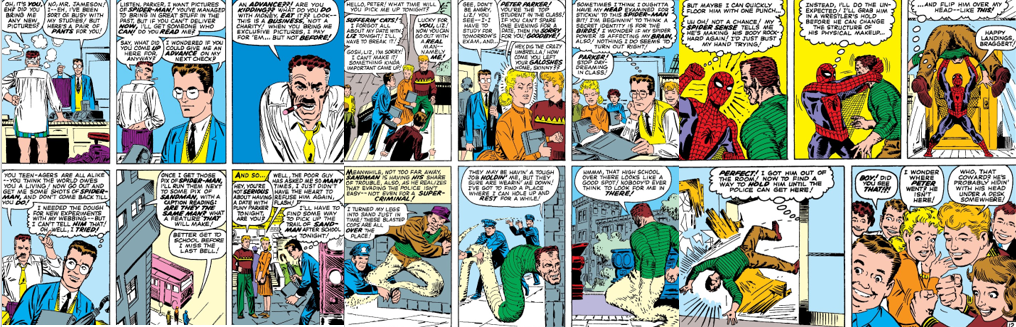
You must be logged in to post a comment.