Game Corner [Kirby Month]: Kirby and the Forgotten Land (Nintendo Switch)


Created by Masahiro Sakurai, the disgustingly cute, ever-ravenous Kirby is one of Nintendo’s most popular characters. Accordingly, I’m dedicating most of July to celebrating the pink puff-ball.


Released: 25 March 2022
Developer: HAL Laboratory

Metacritic Scores: 85% / 8.8
Also Available For: Nintendo Switch 2

Quick Facts:
Conceived as a new phase for the popular pink puffball, Kirby and the Forgotten Land sought to properly translate Kirby into 3D, dropping him into a user-friendly, semi-open world that expanded his scope and abilities. A best seller heralded as one of the best games in the series, Kirby and the Forgotten Land was later bolstered by an enhanced Nintendo Switch 2 remaster.

Gameplay and Power-Ups:
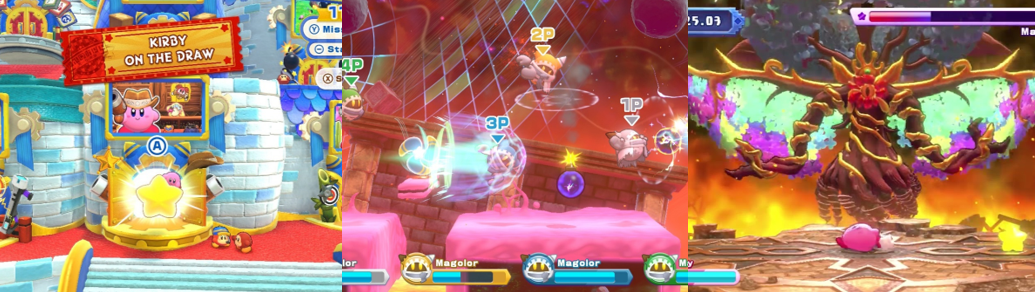
Kirby and the Forgotten Land is a fully 3D, quasi-open-world adventure in which the titular pink puffball and his friend, Bandana Waddle Dee, are sucked through a mysterious star-shaped vortex to the equally titular “Forgotten Land”. Players must guide Kirby (and Bandana Waddle Dee, if playing in co-op) across seven Levels, each with either five or six Stages, saving Waddle Dees, collecting Star Coins and Rare Stones, and battling the possessed Beast Pack. There are two control types to choose from, with minor differences between the two, and players can enable an auto-swallow function. For my playthrough, I jumped with A (tapping it to inflate and float around, though you eventually descend), inhaled by holding B, and performed a ground slide by pressing down on the left stick and A (though I had little use for this). You can either swallow enemies or spit them (and blocks) out as star projectiles with B and can reduce incoming damage by holding L or R to block. If you’ve swallowed an enemy and gained a copy ability, you can hold Y or press – to discard it and can utilise any restorative items you’ve bought by holding X. Kirby’s health is restored using various foods and drinks either found in Stages or bought from the Waddle Dee’s item shop in Waddle Dee Town, a semi-hub area accessed from the world map and Kirby also has a house here where you can rest to recover health. The Invincible Candy also returns to briefly make enemies and hazards a breeze, and you won’t have to worry about losing or gaining lives here. Still, failing costs you some Star Coins, so it’s not ideal (especially as you want to spend these upgrading Kirby’s copy abilities). As you rescue Waddle Dees, Waddle Dee Town expands, opening new establishments and areas that offer various mini games to earn additional Star Coins.

Kirby must use copy abilities old and new to rescue Waddle Dees in a strange, vibrant land.

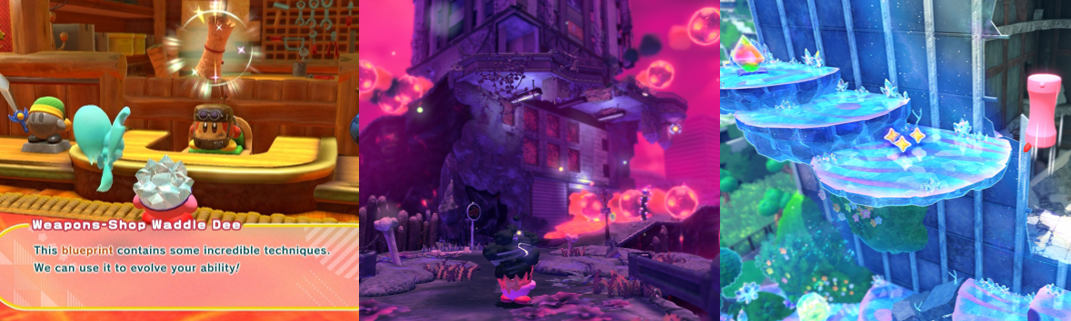
There are twelve copy abilities here. Though only Drill and Ranger are new, each has been tweaked compared to Kirby’s previous adventures and they can all be upgraded at the weapons shop (providing you have enough Star Coins, Rare Stones, and the right blueprints). Drill lets Kirby burrow underground and pop out to surprise enemies, while Ranger sees him fire a gun, holding down B to charge a shot that travels further and locks onto a target. Some of Kirby’s most recognisable copy abilities appear, such as Bomb (which sees you tossing bombs to blow up special blocks), Fire (which melts ice), Hammer (used to hit switches), and Ice (which thaws flaming blocks and allows Kirby to skate over lava). Cutter tosses a boomerang-like projectile and performs a melee combo, Needle sees you gather enemies and blocks and fling them as projectiles, Sword slices up those in your path, and Tornado blasts you across gaps and hazards for some extra height. Sleep is largely a hindrance, but all of these can be upgraded to make them more powerful. For example, “Dragon Fire” adds a flaming, dragon-like burst attack to your arsenal, “Masked Hammer” sees you dual-wield hammers that spew flaming tornados, “Meta Knight Sword” tosses an energy wave, and “Storm Tornado” fires lightning bolts. Each copy ability gets its own “Treasure Road” stage where you’re forced to use that copy ability to overcome a timed obstacle course, often involving tricky platforming and various combat scenarios, to earn a Rare Stone, with more unlocking as you clear Stages and upgrade copy abilities. While all of these are bestowed by certain enemies, Kirby sometimes comes across ability capsules (especially prior to a boss) and others are gained by defeating mid-bosses. As a general rule, if you see a certain enemy nearby, chances are you need their copy ability to rescue hidden Waddle Dees or access additional paths.

Kirby’s bizarre new Mouthful abilities and mini games earn him additional bonuses.

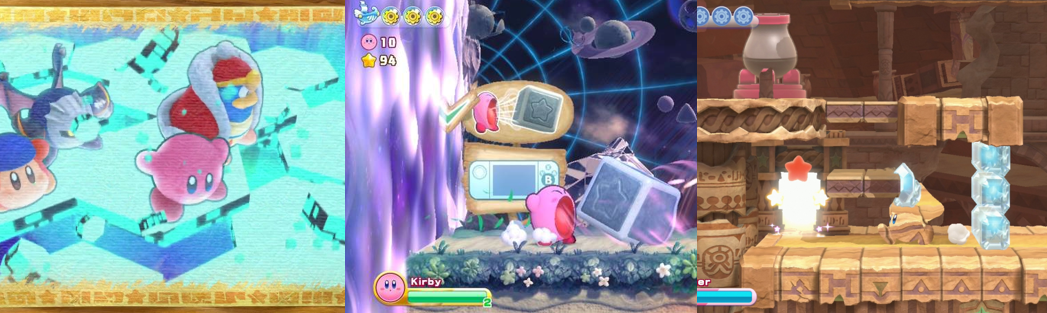
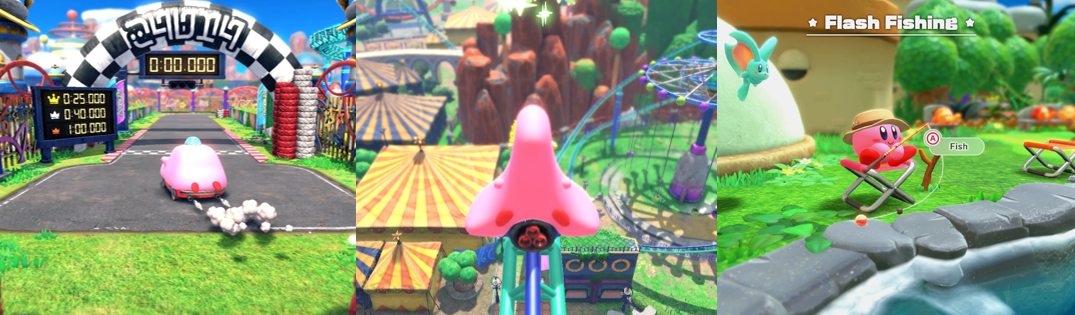
Kirby’s inherent swallowing ability is expanded upon here, allowing him to suck up certain objects and take on new “Mouthful” forms. These last for as long as you need, with the game prompting you to discard them when you’re done, and are used to solve simple puzzles. Car Mouth transforms you into a car, allowing you to dash with B and challenging you to race along narrow or crumbling roads and over ramps. Cone Mouth performs a drop attack to smash broken tiles and pipes or defeat Tortuildings, and Dome Mouth allows you to wriggle the left stick to pop off spheres and access goodies. The Light-Bulb Mouth lights up dark areas, powering consoles and attracting Ghost Gordos, Pipe Mouth sees you roll along and usually crash through cracked walls, and Scissor-Lift Mouth has you raise and avoid obstacles and reach higher areas. Storage Mouth has you wriggle the left stick to collapse walls, Vending Mouth has you blasting enemies and weak walls with a limited supply of canned drinks, and Water-Balloon Mouth transforms you into a massive, bulbous form that spits a limited supply of water to douse fires and clear toxic gunk. Arch Mouth sees you flying along a fixed path, dashing through rings and past falling obstacles to snag collectibles and hidden Waddle Dees, Coaster Mouth has you leaning left or right as you’re blasted along a high-speed rollercoaster track, and Ring Mouth lets you blast enemies and windmills with a puff of air and also propel boats. Mouthful abilities can’t be upgraded but you often switch between different ones to fill in shape holes in the environment, open new areas, or uncover hidden Waddle Dees. You can return to Waddle Town at any time from the world map to heal, play mini games (such as fishing and serving customers), or tackle various challenges at the colosseum. Here, you grab a copy ability and rematch the game’s mid-bosses and bosses, using a limited supply of healing items between rounds and earning goodies and even new copy abilities as you go. You can also replay any Stage or Treasure Round to find missing Waddle Dees or earn Rare Stones and extra Star Coins.

New abilities means new puzzles, which are a joy to tackle with the smooth controls and colourful graphics.

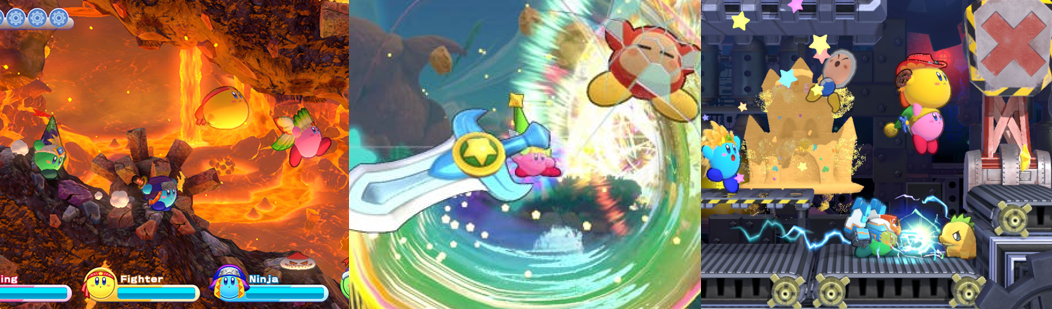
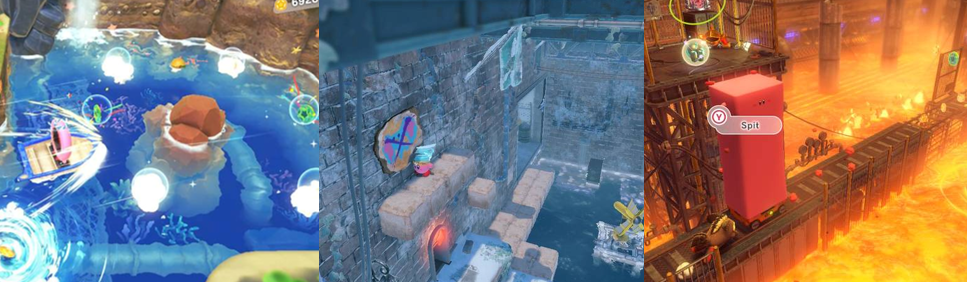
Thankfully (for me), Kirby and the Forgotten Land isn’t a sprawling, open-world adventure. Stages are larger than ever and allow for some exploration, generally by hitting bomb blocks or sparkling tiles or performing certain actions, but everything’s mostly nice and linear. You’ll hop to platforms, climb ladders, activate switches, travel to other areas of each Stage on Warp Stars, and enter doors to progress. Sometimes, you’re forced to battle waves of enemies or a mid-boss to progress; other times, you need a Mouthful ability. Your goal is to rescue every Waddle Dee in every Stage by clearing the Stage and completing missions, like eating certain foods, removing wanted posters, collecting five green gems, or bringing lost ducklings to their mother. You must race against a time limit with Car Mouth, take certain paths with Arch Mouth, activate all windmills with Ring Mouth, or shoot certain targets with Ranger. It pays to explore down alleyways or around the environment to locate hidden areas or Waddle Dees, especially as you can’t backtrack once you’ve progressed and you need a certain amount of Waddle Dees to challenge the Level boss. You can rescue additional Waddle Dees while fighting bosses, generally by beating them in time, using a certain copy ability, or avoiding damage. Other hazards include spike beds, bottomless pits, indestructible spiked Gorgos, massive cannons, falling meteors, lava pits, and rolling boulders. Temporary or moving platforms, the odd door maze, and conveyer belts also appear. Amusement park rides and animatronics must be avoided, slippery ice can cause you trouble, and powerful wind gusts and rapids will push you along. Interestingly, there are no underwater areas in Kirby and the Forgotten Land and no jaunts into the clouds, though you can uncover goodies by blasting away sand and light fuses to race into cannons and blast to new areas.

Presentation:
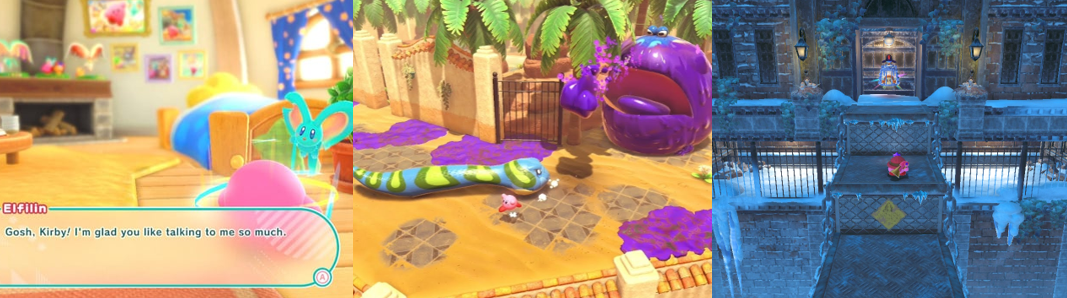
I feel like I say this every time, but Kirby has never looked better than in Kirby and the Forgotten Land. While his idle animations are limited to him simply swinging his arms and looking around, you can use the directional pad to perform additional taunts, which change when you have a Mouthful ability. Kirby changes form with each copy and Mouthful ability, gaining additional accessories and changing shape in often amusing ways, and will squeal in pain when hit. After taking enough damage (sometimes just one hit), Kirby loses his copy ability and must swallow it to regain it, and he performs his adorable victory dance upon completing Levels and defeating bosses. Although Kirby doesn’t talk, he conveys emotion through facial expressions and body language and the pixie-like Elfilin acts las his voice during cutscenes. It’s fun seeing Waddle Dee Town expand as you rescue its inhabitants, with them building new buildings and offering additional mini games and support, and there are many interactable areas on the world map to uncover new Treasure Roads or hidden Star Coins. You can chat with Waddle Dees here for hints and lore and defeated bosses like Clawroline and King Dedede also show up with extra quests or blueprints. The story is so simple that it requires basically no dialogue and is delivered through the best cutscenes the series has ever seen, which take full advantage of the Nintendo Switch to finally bring Kirby’s colourful whimsy to life in glorious 3D. The soundtrack is equally laudable, featuring remixes of many classic Kirby tunes and new songs (or ambient sound) that fit each area. The game follows a simple mission-like structure, presenting Stages each with a handful of areas and objectives and various hidden areas. It’s fun replaying Stages to track down missing Waddle Dees, sometimes using new or upgraded copy abilities, and the game makes it really easy to see which collectibles you’re missing and allowing you to quickly jump to incomplete Stages from the user friendly (if a tad bland) world map.

Probably the most impressive looking Kirby game to date, the visual variety and presentation is astounding.

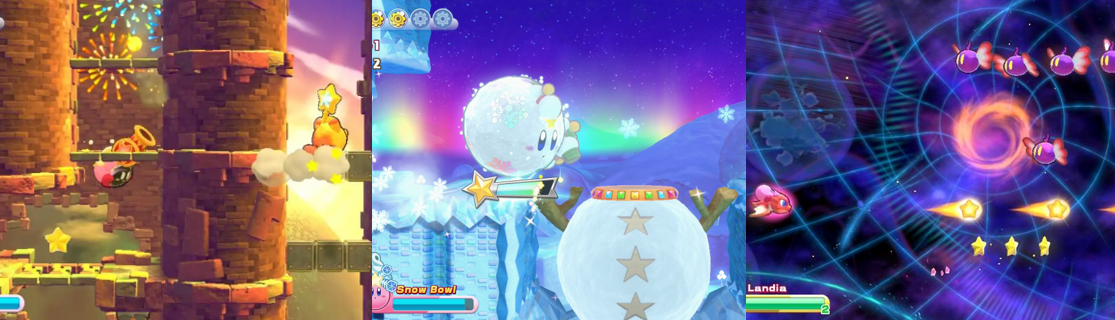
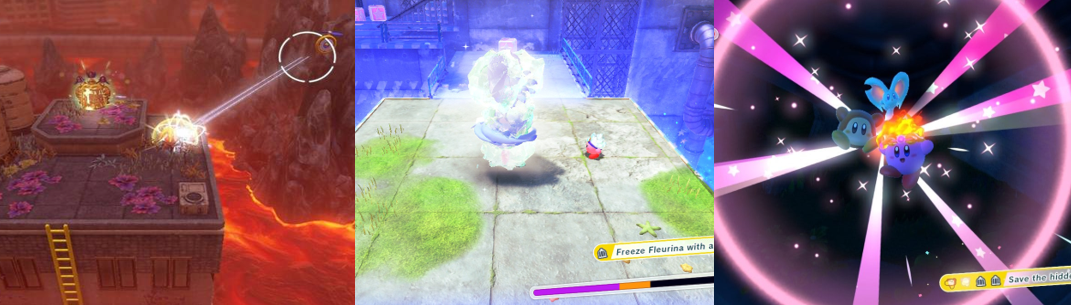
Surprisingly, Kirby and the Forgotten Land provides some new environments, ones that are familiar but unique enough to stand out from previous games. You start in “Natural Plains”, which is a once-bustling cityscape overrun by nature. You’ll encounter roads, buildings, and skyscrapers reclaimed by nature and venture into the abandoned, maze-like Alivel Mall, where restaurants and other businesses stand as forgotten as the once-impressing towering structures. “Everbay Coast” starts as a beautiful, tropical island with dazzling water and transitions to an oil rig-like area full of platforms suspended over water and ends in an abandoned waterworks full of fast-flowing water. “Wondaria Remains” was one of the most visually striking areas for me as it’s a neon-drenched fairground full of hazardous rides, space-theme animatronics, an overall circus aesthetic, and even a dark, jump scare-ladened haunted house. “Winter Horns” features a snowed-in city that’s reminiscent of Victorian London and sees you hopping across snowy rooftops and frigid winds blow you about, battling across an icy bridge, and hopping to floating ice platforms amidst a buried village and infrastructure. You even venture into a flash-frozen underground rail station, traversing ice-covered subway trains and jumping about on shipping containers. “Originull Wasteland” is a desert environment beset by a sandstorm, which has buried various mining equipment and ships. The sand dunes are awash with skeletons, debris, toxic gunk, and collapsing girders that you bypass to navigate through a rocky canyon and revisit the Alivel Mall from the opposite side, which is buried under sand. “Redgar Forbidden Lands” is easily the most hazardous Level as it’s essentially an active volcano, with lava and magma all around and meteors raining overhead that destroy the environment. This Level also leads to a churning, bustling power plant full of conveyer belts, crushing presses, and spiked walls and is a far greater threat that the final area, “Lab Discovera”, a futuristic complex that houses the final boss. Every area is remixed both visually and in terms of gameplay mechanics to provide a tougher challenge in the “Isolated Isles: Forgo Dreams” post-game, where darkness and danger permeate the gimmicks of each Level and are mashed together into truncated challenges.

Enemies and Bosses:
Long-time Kirby players will undoubtedly recognise many of the enemies here. Enemies are mostly incredibly basic, either standing still or hovering about, and are easily dispatched or swallowed for copy abilities. Some respawn if you need their copy ability for an upcoming section and you sometimes fight waves of them, but they’re very little threat. Blade Knight, Bronto Burt, Cappy, and Chilly all return, with the former and the latter bestowing two of the best copy abilities, alongside Bomber (which must be destroyed before it explodes), Glunk (which spits projectiles), and Poppy Bros. Jr. (whose bombs are great for clearing paths). Scarfy, Shotzo, Sir Kibble, and Totenga also pop up, with Sir Kibble bestowing the ever-useful Cutter ability and Scarfy aggressively chasing you. Some of the new enemies are noticeably larger than others, such as the sea lion-like Balloon-Meister (who tosses explosive beach balls and bestows the Bomb copy ability), ravenous Gnawcodiles (who swim about and try to devour you), and the Tortuilding and their Big Red variants (giant snapping turtles with buildings on their backs that require the Cone Mouth to smash). The Big Kabus (jumping stone heads), charging Buffahorns, and viper-like Sssnackers are also bigger almost act as mini-mid-bosses. Otherwise, Awoofys charge you, sharpshooting Bernards take shots from afar and hide behind cover, Corori roll snowballs at you, Digguh burrow into the ground to burst up beneath you, hedgehog-like Jabhogs become largely impervious with their spines out, and Rabiroos bound across the environment to try and squash you. It’s not long before combinations of these enemies crop up alongside giant cannons, spike beds, and other hazards, and they’re often called in to support mid-bosses and regular bosses too (which is good, as you can spit them as projectiles if you’ve lost your copy ability).

Imposing mid-bosses provide a suitable mid-level challenge for your fighting prowess.

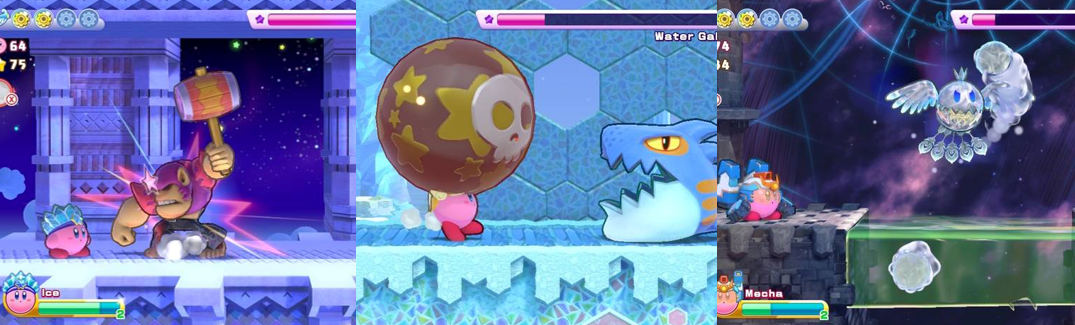
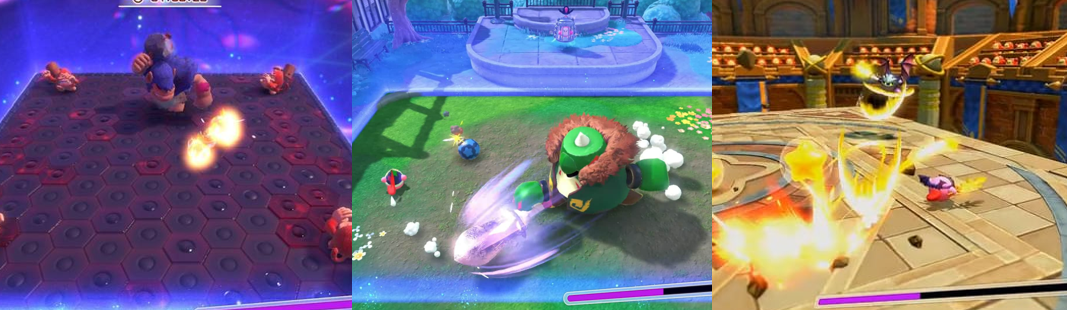
There are four mid-bosses you’ll encounter numerous times and in various combinations (sometimes one-on-one, sometimes two-on-one or more!) Each has a “pinch” mode, just like the bosses, and defeating them allows you to absorb their special ability (usually necessary for the next section of the Level). Fleurina is the only brand-new mid-boss here, being a large swan who spins around to conjure a damaging twister, chases you while spinning in mid-air, and sends three tornados spinning across the arena. The ape-like Bonkers returns as “Wild Bonkers”, still wielding his giant mallet, which he uses to try and squash you or spins like a dervish. He also uses it to smack giant, explosive rocks at you and performs a jumping, spinning slam to create shockwaves. “Wild Edge” is a variant of Gigant Edge, being a massive, armoured foe with a sword who often hides behind a giant shield, forcing you to attack from behind. Wild Edge attacks with a flurry of sword swipes, charges from across the arena, and gets stunned when you hit his behind. Mister Frosty also gets a “Wild” variant, one who throws massive snowballs, tackles you, and will grab you and chew on you if you’re not careful. Wild Frosty’s snowballs soon leave trials of icicles and he tries to belly flop onto you. All mid-bosses and regular bosses, also receive a “Phantom” variant that’s more aggressive and is fought again in the Waddle Dee Town colosseum. This is also where you battle Meta Knight, Kirby’s enigmatic rival who randomly flies around, quickly slashes with his sword, fires sword beams, and unleashes a powerful charged shot. It’s worth fighting and beating him to upgrade the Sword ability and as this is good practice for the post-game’s final boss.

Massive, multi-phase bosses provide a decent challenge and some fun visuals.

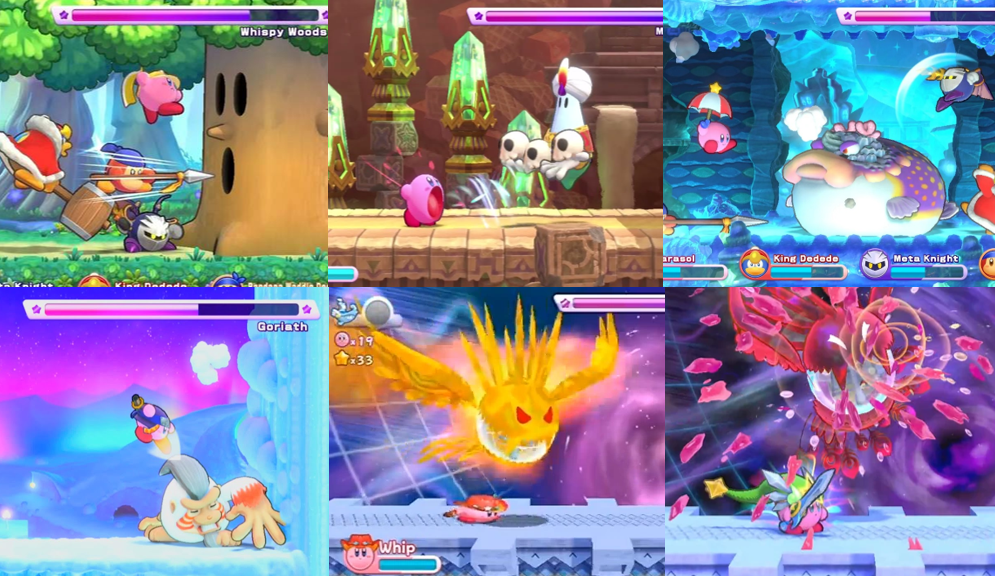
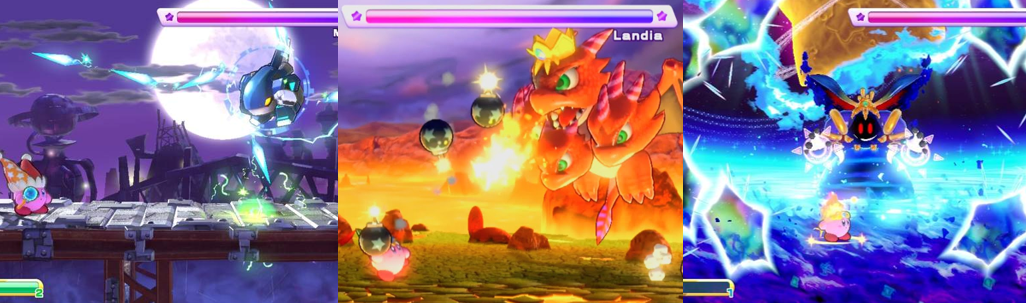
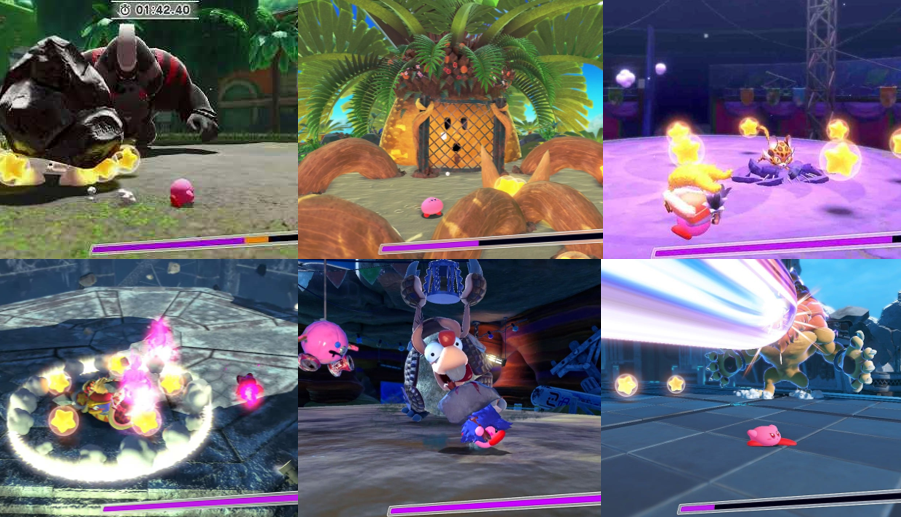
As mentioned, each boss can be beaten in different ways to rescue additional Waddle Dees, which can make them more difficult, much like challenging them with inferior copy abilities. Your first challenge is Gorimondo, a massive ape who squeezes the life out of you if he grabs you, swats you with his big ol’ paws, pulls rocks from the ground to toss, and spins around. Whispy Woods’ tropical cousin, Tropic Woods, is a large but stationary boss who spits puffs of air, drops exploding coconuts, and protects itself with barriers (which also form mazes). Its roots also twist all around the arena, it blows you back, and its “Phantom” variant produces a huge cloud that’s tricky to avoid. Clawroline posed a problem for me as she’s much quicker, dashes in with quick claw swipes, pounces on Kirby, and jumps to the nearby poles to fling her talons and dive bomb you. She also disappears and attacks at random places, and her “Phantom” variant flings an X-shaped energy wave. King Dedede is fought twice in the main game, becoming more aggressive each time. King Dedede swings his giant mallet, tries to butt stomp you (producing shockwaves), performs his running dive attack, spins about with his hammer, and eventually utilises a nearby pillar. In the “Redgar Forbidden Lands”, he has two mallets that produce flaming tornados and leave lava puddles, charges about like a boar, tries to inhale you, and leaps up to hurl fireballs. Sillydillo can be a pain without a ranged attack as it tries to lock you in a little cage, rolls at you with his massive hit box, and tries to pummel you with its little puppet-thing. Penultimate boss Leongar an also be challenging as he’s quite fast considering his size, and very aggressive. He swipes with his claws, drags them across the floor before performing a flaming uppercut, and creates shockwaves with an axehandle smash. When possessed by Fecto Forgo, Leongar gains armour, sends out X- or V-shaped energy waves, crawls across the floor trying to eat you, and blasts a massive laser from his mouth!

Some crazy, hyperaggressive interdimensional beings await in the endgame.

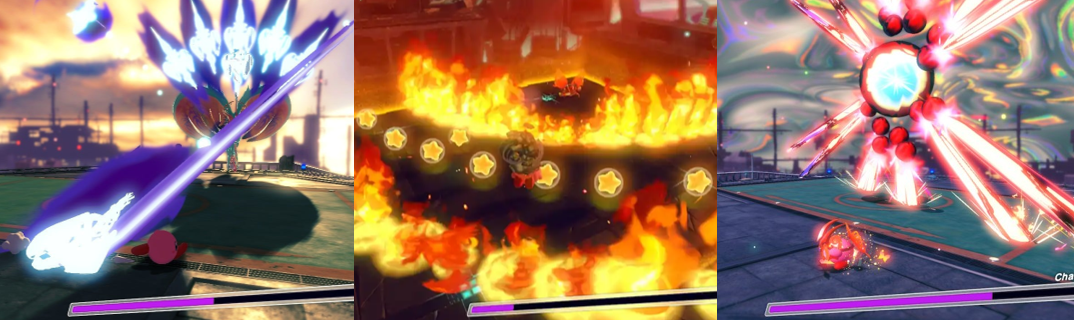
Once Leongar is defeated, you battle the parasite that possessed him, Fecto Forgo, in a tough multi-phase battle. First, Fecto Forgo chases you down a narrow corridor, forcing you to spit projectiles at it (or utilise copy ability projectiles), before absorbing Elfilin and becoming more formidable. In this form, it flies about out of reach tossing energy daggers, divebombing and swiping with its spear, charging across the floor with the weapon, raining energy daggers, and creating multiple shockwaves using portals. It also conjures a meteor shower with an explosive finale, duplicates itself to produce more shockwaves, regenerates its health (!), and increases in speed and aggression. Eventually, Kirby must use Dome Mouth to free Elfilin and then chase down Fecto Elfilis using the Big-Rig Mouthful, jumping between pathways with A, dashing through debris with B, and mashing buttons to finish it off. Tougher, more aggressive “Phantom” variants of all bosses are fought in the “Isolated Isles: Forgo Dreams” post-game, which ends with you battling Forgo Leon (who adds lightning and fire effects to his attacks) and Morpho Knight, a hyperaggressive variant of Meta Knight. The Masked Hammer ability and a Maxim Tomato are recommended for both as Morpho Knight teleports around, rapidly swipes with his sword, produces flaming waves that cover the entire arena, messes up the camera and your controls with a sound wave attack, and produces flaming lines with his sword. His swords get bigger as he takes damage, widening their effect, and he produces flaming columns that spin around and can be as tricky to avoid as he is to hit. Fighting through the colosseum’s “Ultimate Cup Z” sees you battle the super-powerful Chaos Elfilis, a bizarre, half-angelic dimensional being with various forms who duplicates itself, attacks with a spear and energy waves, utilises portals, fires a homing laser, regenerates health, and hurls asteroids and energy orbs.

Additional Features:
There are 300 Waddle Dees to rescue in the main game, which can be played on either “Spring Breeze” (“Easy”) or “Wild (“Normal”) mode, with “Wild” giving you less health and tougher enemies but offering more Star Coins. You can hold up to 999 Rare Stones, which are used alongside Star Coins and the twenty-four blueprints (generally hidden in Stages) to upgrade the copy abilities. You’ll also find Gotcha Capsules in every Stage, often as well hidden as Waddle Dees and blueprints, or obtain them using Gotha Capsule machines in Waddle Dee Town. These gift figurines of the game’s characters, enemies, bosses, and obstacles, and collecting them all adds to your total completion percentage. Rescuing Waddle Dees expands Waddle Dee Town, allowing you to rest at Kirby’s house, watch the game’s cutscenes at the cinema, listen to the soundtrack (as performed by the Deely Dees), and redeem Present Codes at the Waddle Dee-liveries post office. You can also tackle the colosseum and various mini games and extra Star Coins, battling all the game’s bosses (and some additional ones), matching customer orders, pressing buttons to fish for goodies, and playing “Tilt-and-Roll Kirby” using the Nintendo Switch’s motion controls. There are also fifty-six Treasure Road challenges to find and best for Rare Stones (though you’ll need all upgraded copy abilities to access them) and you can also utilise amiibos to unlock additional rewards, like food, items, and Star Coins.

Upgrade your copy abilities, challenge a bleak post-game, or tackle the Nintendo Switch 2’s exclusive story.

Clearing the main story unlocks the “Isolated Isles: Forgo Dreams” post-game, where Clawroline tasks you with tackling seven tougher, truncated versions of the main worlds, with visual changes, remixed hazards and enemies, and far more aggressive “Phantom” versions of bosses. Players must collect pieces of Leon’s soul, with around fifty found in each Stage and 250 of the 300 required to access the final area, “Forgo Land”, and battle Morpho Knight. I quite liked this extra challenge, which added a dark, bleak hue to previously colourful and vibrant environments, though it can be frustrating to miss pieces of Leon’s soul as you must replay the entire stage (including battling the “Phantom” boss) to regain it. If you’re playing the Nintendo Switch 2 version, you can also play through the “Star-Crossed World”, which sees a crystal-encrusted meteor shower create new, remixed versions of the existing Levels. Players collect Starry Coins, EX figures, and rescue Starrys rather than Waddle Dees. There’s also an extra cup added to the colosseum, the “Past Adventures” section has been expanded, alongside various visual changes and upgrades. Crystal variants of many enemies and the mid-bosses populate these worlds, which also offer three new Mouthful abilities: Gear Mouth (to cling to surfaces), Sign Mouth (to slide down slopes and spin attack), and Spring Mouth (to spring higher and ground pound). Kirby has numerous encounters with a new mid-boss in this mode too, Galactal, a crystalline entity that launches meteors, creates shockwaves that spawn crystal spikes, and bursts from the ground. Naturally, there’s a new, even tougher final boss, Genwel Meteonelfilis, who resembles the Fecto Elfilis fight but utilises crystals and is far more aggressive. It emerges from shadows, leaves crystal shards with every attack, emits waves of crystals and rains them down, create clones, and even slams part of a building into the arena!

Final Thoughts:
I was incredibly hesitant heading into Kirby and the Forgotten Land because I thought it was a sprawling open-world adventure, one with a daunting overworld, a laundry list of objectives, and a bunch of collectibles. I was therefore relieved beyond measure to find it’s a linear, level-based adventure very much akin to Kirby’s previous outings, with players tackling each area in sequential order. It was enough for me to have Waddle Dee Town be a central hub that could be expanded, to have fairly large Stages to play through, and to be able to upgrade Kirby’s copy abilities. Visually, Kirby and the Forgotten Land may very well be the best-looking Kirby game ever. Everything is so luscious and vibrant, and everything is so colourful and alive. Crucially, while many areas and gimmicks are recognisable to long-time franchise fans, this was the first time playing a Kirby sequel that I felt the developers were trying something new with the environments. The Mouthful abilities helped with this and added an additional layer of fun to the gameplay and puzzle solving, but the returning copy abilities were also utilised extremely well, and I felt a sense of becoming stronger with each upgrade. It’s very enjoyable dipping in and out of Stages to hunt down any Waddle Dees you’ve missed, as well as challenging the colosseum and post-game content, which felt like a fair difficulty spike after clearing the main game. I would’ve liked to see more from the mini games and the option to play as other characters (or at least transform into them with upgrades), but this was everything I’ve ever wanted from a 3D Kirby title. There’s enough here to keep you busy for a few hours and enough additional content and collectibles to come back for, making this perhaps the best Kirby game I’ve ever played.

My Rating:

Rating: 5 out of 5.

Fantastic

Do you agree that Kirby and the Forgotten Land is one of his best adventures? Were you disappointed or relieved that it wasn’t an open-world game? Which of the Mouthful abilities was your favourite and did you ever upgrade all the copy abilities? Did you ever find all he Waddle Dees and clear the post-game? If you played the Nintendo Switch 2 version, would you say that it’s superior? Which Kirby videogame is your favourite? Comment below to share your thoughts on Kirby and the Forgotten Land and donate to my Ko-Fi for more reviews like this.

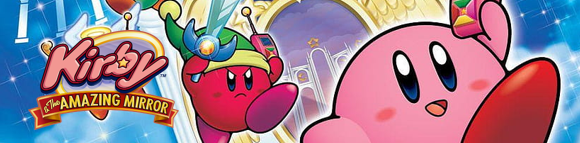
Game Corner [Kirby Month]: Kirby & The Amazing Mirror (Nintendo Switch)


Created by Masahiro Sakurai, the disgustingly cute, ever-ravenous Kirby is one of Nintendo’s most popular characters. Accordingly, I’m dedicating most of July to celebrating the pink puff-ball.


Released: 29 September 2023
Originally Released: 15 April 2004
Developer: HAL Laboratory / Flagship / Dimps
Metacritic Scores: 80% / 8.6

Also Available For: Game Boy Advance, Nintendo 3DS (Virtual Console), Nintendo Wii U (Virtual Console), Nintendo Switch 2 (Nintendo Classics)

Quick Facts:
By 2004, Kirby had more than made a name for himself as a Nintendo staple thanks to a string of fun, colourful platformers and spin-off adventures across multiple generations. Kirby & The Amazing Mirror saw him tackle the “Metroidvania” subgenre alongside co-operative multiplayer for what’s said to be one of the franchise’s more under-rated entries.

Gameplay and Power-Ups:
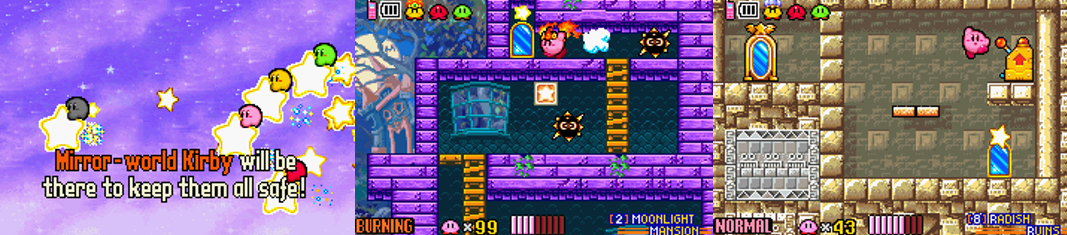
Kirby & The Amazing Mirror is a 2D action/platformer with a heavy emphasis on backtracking, alternative paths, and exploration in which up to four players control different coloured Kirbys and explore the “Mirror World”. When the malevolent Dark Mind invades the Mirror World and creates evil reflections, a dark doppelgänger of Meta Knight splits Kirby into four, dumping them in the Central Circle hub world and tasking them with exploring nine colourful worlds using mirrors. The game is meant to be played in co-op, with your friends exploring different paths and then alerting you to the correct path or notable goodies, such as the Area Map that turns exploration from a largely directionless guessing game to a more linear and more enjoyable experience. All of Kirby’s traditional moves and abilities return here, with players holding B or X to inhale blocks or enemies and spit them out, jumping with A (or tapping A to inflate and fly indefinitely), and performing a downward slide by pressing down and B. When in the air, you press B to expel an air puff or press B when underwater to attack with a water spurt (which replaces any copy abilities Kirby has until he exits the water). Once you’ve inhaled an enemy, you press down to swallow them and gain their powers until you either take damage or press – to ditch the copy ability in favour of another. Kirby replenishes his health with food scattered all around and gains extra lives from 1-ups, with players rushing about on a Warp Star upon reaching a goal to stock up on these goodies. Pressing + provides a quick explanation of whatever copy ability you have and allows you to view the map of the current area, if available, to plot out a route towards Warp Stars, goals, and the level boss.

Kirby’s new and returning abilities co-exist with a sadly underutilised co-op mode.

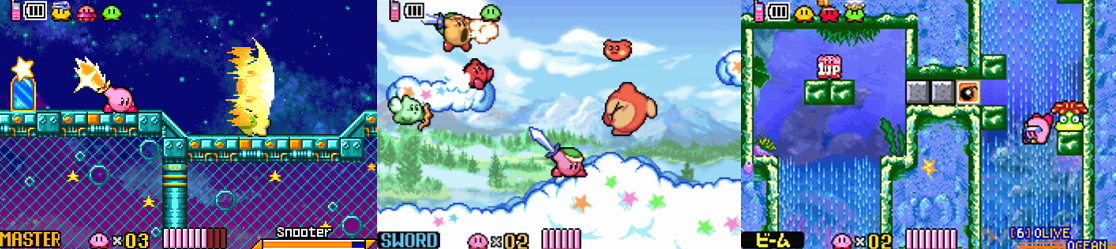
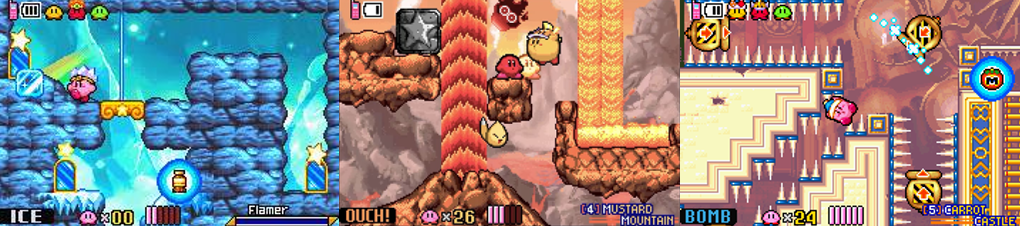
There are twenty-six copy abilities, six of which are new. Returning copy abilities include the ever-useful Sword and Cutter (allowing you to rapidly slash enemies and toss a boomerang-like projectile, respectively), Stone and Bomb (allowing you to crush and blow-up enemies and blocks), and Hammer and Ice (necessary to smash wooden blocks and access other paths or freeze enemies, respectively). You’ll need Burning or Fire to light fuses and blast off in certain cannons or break through special blocks, the new Mini ability to pass through tiny gaps (at the cost of having a stunted jump and no flight), and can cook any nearby enemies into food and 1-ups using the Cook ability or destroy them all with the one-use Crash. Cupid lets you fly faster and shoot (and charge) arrows, Magic bestows a random copy ability or power-up, and Missile transforms you into a heavy-duty missile to destroy metal blocks. By far the best copy ability is Smash, which gifts Kirby his moveset form Super Smash Bros. (HAL Laboratory, 1999) and combines multiple copy abilities into one so you can rapidly punch, perform the Final Cutter, turn to stone, swing your hammer, and perform a mid-air cartwheel. This was my go-to ability until the endgame, where you gain the Almighty Sword that has you charge a sword beam and perform thrusts and spinning charges. Kirby also becomes temporarily invincible with a special candy and can call his allies for aid using the Right Trigger (or exit the level by holding the Left trigger). You’ll need batteries for your cell phone to do this, but the other Kirbys also gain copy abilities from their adventure and can help with puzzles or to decimate mini- and main bosses alike. Thankfully, I never experienced a section of the game that required the other Kirbys; they can help with timed door switches, but you can also just move your ass faster to do the same thing. I assume the game’s quite fun in multiplayer with each player exploring different routes, but it’s not a requirement as you can either guess your warp to the Area Map or shortcut switch or boss or use online maps to find your way (which I’d highly recommend).

Players will explore and return to gimmicked areas in search of new paths and bosses.

All the usual Kirby gimmicks are still here. You’ll explore underwater caves, castles in the clouds, and slip about on icy platforms. Rapids rush you along through water, wind currents blast you upwards or along, and spikes are dotted all over some environments (often hiding beneath crumbling blocks!) Platforms get smaller and smaller as you progress and, though you can circumvent this with Kirby’s flight, you must still watch out for airborne enemies. Flame bursts spew from volcanos alongside painful lava, electrical currents threaten to fry you, and you’re tasked with hopping or flying up narrow shafts dodging enemies, falling down shafts and avoiding spikes or bottomless pits, and exploring corridors full of mirrored doors. These are designed to confuse you, especially if you don’t have the Area Map, something only exacerbated by the hidden doors and alternative paths that lead to near-useless end goals or Warp Stars to new areas. Sometimes, you must press switches to open doors; often, you’re destroying bomb blocks to open new paths; and you also time cannon shots to fly through walls or past corridors of spikes. Sometimes, you must activate levers to create shortcuts, and multiple other shortcuts can be spawned, which you’ll need when you inevitably return to find the boss or a route to a new level. Kirby & The Amazing Mirror is played all topsy-turvy, with each level containing multiple routes, exits, or Warp Stars to others so you never play through an entire level from beginning to end. You can (and should) make the game more linear by finding the Area Maps but, even then, you must backtrack through the same areas, defeating respawning enemies as you go, to access new paths (occasionally by using different copy abilities). You’ll be searching all around for these exits, which are sometimes hidden behind special obstacles, behind regular blocks, or even inside the skittish Mirra enemies.

Presentation:
Graphically, Kirby & The Amazing Mirror is a fantastic companion piece to Kirby Super Star (HAL Laboratory, 1996), with Kirby’s sprites and copy ability accessories all largely based on that title. The four Kirby concept is apparent from the start where they rush the company logos while being chased by a gaggle of enemies and their functionality is somewhat similar to the buddy mechanic in Kirby Super Star (Kirby even feeds them to replenish their health), though they’re far less prominent when you’re playing solo. It is fun coming across them as you explore and helping them out of jams, but it’s probably far more enjoyable playing with friends. Kirby doesn’t have much of an idle pose, but he dons special hats and gains extra weapons from his copy abilities, and you can find spray cans to customise his colour, and he still performs his adorable victory dance upon beating bosses. Kirby also yelps in pain like in Super Smash Bros., gets roasted and electrocuted, and automatically dons goggles and a snorkel in water. Oddly, I didn’t notice much of a story here beyond a brief, in-game cinematic of Meta Knight’s encounter with the Mirror World and some basic text at the end. That’s not unexpected from a Kirby title but there weren’t any large sprite portraits or static images to tell the story until the final screen. King Dedede and Kirby’s other allies are also missing, and the game limits you to one hub world, where multiple mirrored doorways lead to each level. Jaunty tunes and playful beats are the order of the day here, though I didn’t notice many remixed tracks or much memorable music. The game has a nice, clean heads-up display, though, which helpfully displays your copy ability and comically reacts when you take damage or die.

The colourful graphics and varied environments make up for the simplistic story.

The Central Circle hub world resembles a heavenly paradise in fluffy yellow clouds and leads to the nine main levels and the final area once you collect the Mirror Shards and repair the Dimension Mirror. While some recognisable tropes are present and level layouts don’t differ much from previous Kirby titles (beyond the multiple paths and mirrored doorways), Kirby & The Amazing Mirror largely offers new themed levels to play through for a change. Rainbow Route is a fairly traditional forest stage with some flooded caverns, tree-like platforms and routes, and a thick, beautiful thicket of trees in the background. Moonlight Mansion twists this aesthetic into a crooked, haunted forest with a dishevelled graveyard and the ominous, titular mansion in the background, the inside is overgrown and dilapidated, featuring stone corridors, stained glass windows, and furniture blocking your path. Cabbage Cavern is a purple and lilac cave of vines, underwater areas full of rushing water, and narrow passageways barred by explosive blocks. Mustard Mountain opts for a volcano aesthetic. There’s lava everywhere, the ground erupts in flames, and lava pours like waterfalls, making for a notably perilous landscape. Carrot Castle reminded me of Castle Lololo as it’s a sprawling, ornate palace against a gorgeous sunset and includes a dingy dungeon, exterior areas where Moonlight Mansion looms in the background, and large, opulent windows. Olive Ocean recalled Float Islands with its beach aesthetic, palm trees, and abundance of water and underwater coral caves alongside waterfalls and rapids that rush you through flooded tunnels. Peppermint Palace is the ice-themed stage full of glittering crystal and ice blocks, a glowing aurora borealis, slanted paths, and a frigid cliffside where one false move sees you slipping into the abyss. Radish Ruins opts for an Aztec pyramid aesthetic, an enlarged garden, and cold stone chambers sporting spikes. Candy Constellation is a large mechanical facility out in the sprawling galaxy, with stars and a planet looming in the background, Gordo-infested tunnels, and a fun gimmick where water is suspended in zero gravity. The finale transports you to the distorted Mirror World, where aspects of each level are smashed together between boss arenas fought against a swirling vortex.

Enemies and Bosses:
Many of Kirby’s most recognisable enemies naturally make a return in Kirby & The Amazing Mirror, with many bestowing you with Kirby’s signature copy abilities. Waddle Dees wander around largely harmlessly or float from above on parasols while Waddle Doos fire their eye beam in an arc, nigh-invincible Gorgos and Shotzos dog your progress in narrow corridors or open areas, Bronto Burts flitter in the air, and Sir Kibbles toss Cutter boomerangs from afar. Rockys threaten to roll or crush you, UFOs erratically fly around taking shots at you, Wheelies race across the ground to ram into you, and Twisters transform into tornadoes and fly around the screen. Bang-Bang is a missile-like newcomer who wander about before blasting into the sky, Battys are bizarre bat-like creatures that roots on ceilings before swooping at you, Blockins disguise themselves as regular star blocks for a surprise attack, and the mole-like Boxins rush you with their boxer jabs. Chips are strange, fox-like creatures who hop about and relentlessly chase you, Cupies flutter around firing arrows, Droopys and Leaps steal your copy ability or transform into a more aggressive form, and seedling-like Foleys hover overheard and drop bombs. The large, stoney Golem spring to life when you pass by, spherical mechanical laser-firing Metal Guardians and big, giant variants and Waddle Dees and Rockys lurk as tertiary bosses, much like the sword-swinging Heavy Knights, while frog-like Jacks hide in cannons and Pranks will humiliate you on contact. Soaraars fly about, Snooters try to eat you, and Shadow Kirby often pops up boasting similar copy abilities and dropping random power-ups upon defeat.

Levels are packed with large, occasionally challenging mini bosses who can yield new abilities.

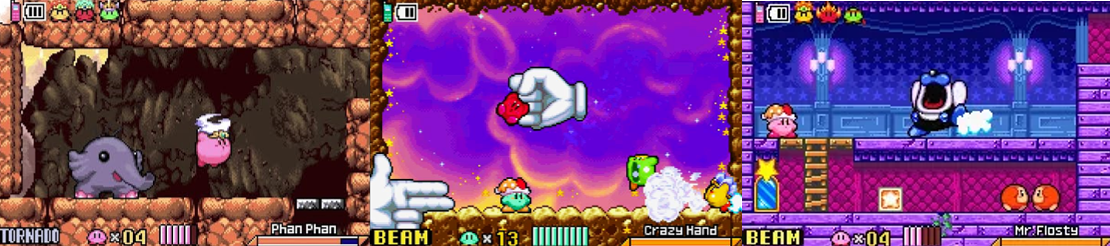
Similarly, eight mini bosses appear, each bestowing a particularly powerful copy ability upon defeat. Batafire is a large bat that resembles a fireball and flies back and forth, swoops from one side of the arena to another, or floats in the middle and spews fireballs. It’s quite a large sprite so it can be difficult to dodge, much like Bombar, an adorable anthropomorphic jet fighter who spirals across the screen and swoops at you while winds whip past. Bombar also fires homing missiles and drops a bombardment of warheads, which can be inhaled for the Missile and Bomb copy abilities. Box Boxer and Phan Phan were two of the more aggravating mini bosses for me. Both wander back and forth, rushing you with a charging punch or rolling tackle, and toss projectiles but are particularly frustrating as they tend to snatch you out of the air or off the ground and toss you. Boxy is a ravenous gift box who hops back and forth trying to bite you and spits out bombs, enemies, and the odd power-up, Bonkers returns to swing his trademark hammer and now tosses explosive coconuts, and the mischievous Mr. Frosty also returns to devour you or toss ice cubes. Master Hand also appears as a mini boss, granting the Smash copy ability when inhaled, and mirrors his Super Smash Bros. counterpart by pounding the ground with his fist, punching, squeezing you, and firing finger bullets. Master Hand teams with Crazy Hand in Candy Constellation for a two-on-one fight, with the two performing a clap and other tandem attacks to keep you on your toes. Long-time Kirby players my recognise King Golem, who’s basically a reskinned Whispy Woods and attacks in the same way, dropping rocks and Gordos rather than apples and spawning Golems from his mouth rather than air puffs. Kracko also returns in Mustard Mountain and still sprouts spikes, chases you with lightning, and douses you with a rainstorm.

Large, somewhat familiar bosses can be tough without the right copy abilities.

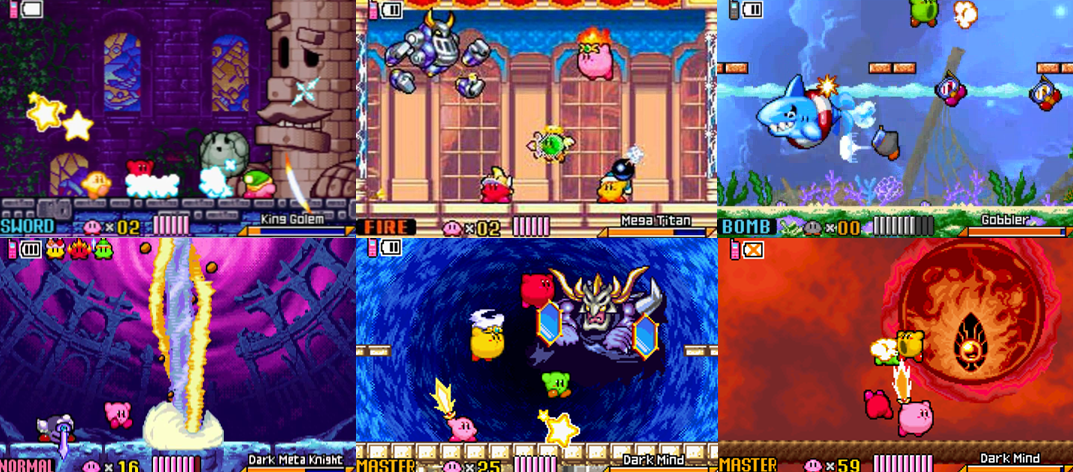
Moley randomly pops from the ground or ceiling and tosses rocks, bombs, burning oil drums, and more if you give him the chance and shunts you with his nose, forcing you to quickly anticipate where he’ll be and attacking when you can. The intimidating armoured robot Mega Titan is completely invulnerable and floats about firing its four fists at you. You must force for the Mega Titan into the electric traps located on either side of the arena, though it can be tricky without the right copy abilities and, even then, you must dodge its many rocket-powered fists. Gobbler was somewhat similar to Acro as it leaps from the water to bite you, spawns three shark-like Snappers to distract you, and charges at you to swallow you, though Smash or Stone can near-instantly defeat him. Wiz rushes about a slippery arena and tosses enemies and projectiles from its magician’s hat, being invulnerable when doing so but an open target otherwise. Dark Meta Knight is fought twice, though both battles are fundamentally the same and his attacks largely mirror the regular Meta Knight. Dark Meta Knight performs sword thrusts in many directions, a leaping sword slash, defends against your attacks with his blade, and performs a drill-like charge. He also unleashes a sword beam, often at rapid speeds, in the second fight. One you assemble the Dimension Mirror, you battle Dark Mind in six phases, three of which are largely the same but get progressively difficult. Dark Mind teleports about and fires a flurry of star-like projectiles while mirrors protect him, exploding with splash damage if destroyed. Dark Mind’s movements and attacks become increasingly erratic and the arena changes to sport water and slippery ice, but the Almighty Sword easily decimates him when you land a hit. After four rounds, Dark Mind transforms into a gigantic, glaring eye and fires ricocheting lasers between its mirrors, spawns some enemies to distract you, fires massive beams, attacks with its mirrors and is noticeably more durable. You then hop on a Warp Star for a top-down shooter to finish it, blasting its projectiles, avoiding its tackle, and pummelling it even as the credits roll.

Additional Features:
There are many different paths and goals to reach in each level in Kirby & The Amazing Mirror. While it’s not necessary to find them all (you really just need to find the Area Maps and defeat the bosses), doing so brings your save file closer to 100% completion. They also bring you to treasure chests containing helpful items that extend your life bar and unlock new tracks in the sound test or colours for Kirby, with these being tracked form the main menu. Alongside three save files and multiple languages, Kirby & The Amazing Mirror boasts three mini games that see you compete against your friends to crack the world like in Kirby Super Star, eat the most food, or ride waves in a surfing race. Reaching 100% completion unlocks the “Boss Endurance” mode where you randomly fight all the mini bosses and main bosses, including a powered-up Waddle Dee and the multiple Dark Mind fights (with no rest areas for this latter challenge). This version of the game also comes with the usual rewind and save state features to help lower the frustration of all the backtracking, and you can even play the European version where Kirby doesn’t look like he wants to kill you!

Final Thoughts:
I was quite excited to play Kirby & The Amazing Mirror, expecting it to be much of the same colourful fun of Kirby’s 16-bit heyday and was stunned to discover it’s a more sprawling, exploration-based adventure. I was a little lost and frustrated to start with as I randomly travelled from one level to the next with no end in sight, even when I reached the Warp Star goals and defeated bosses, and was confused when the other Kirbys buggered off on their own offscreen adventure and barely factored into the gameplay or puzzle-solving. Once I got my head out of my ass and realised there’s a map screen, the game became much more enjoyable as I sought out the Area Maps and then went right to the boss to force the game into a more linear adventure. There was still a fair bit of backtracking and exploring as you can’t just progress from one level to the next and must unlock the doors and shortcuts, but this made things more manageable. Once I acquired the Smash copy ability, I never looked back and mostly coasted through the game, which was a very vivid and adorable experience with some fun bosses and moments, but which didn’t do too much to mix up the Kirby formula. I almost wonder if the game should’ve forced a co-op mode, making it unplayable for solo gamers or encouraging you to summon or even control the other Kirbys to solve puzzles. Instead, we get a regular Kirby adventure that’s artificially extended and made more challenging by presenting the action in a non-linear fashion, which is more annoying than enjoyable. I would’ve liked to see more screen time for Shadow Kirby and Dark Meta Knight, more puzzles linked to the multiple Kirbys, and some new copy abilities to make things interesting. It was a decent and colourful, whimsical adventure that surprisingly made me think more than I expected, but I think it would’ve worked better as a straightforward amalgamation of Kirby’s previous 2D adventures.

My Rating:

Rating: 3 out of 5.

Pretty Good

Was Kirby & The Amazing Mirror in your Game Boy Advance collection? Did you ever play the game in co-op and, if so, how was it compared to playing solo? Were you also disappointed by the emphasis on backtracking and exploration or did you like the attempt at something new? Which of Kirby’s six new copy abilities was your favourite? Did you ever 100% the entire game and which Kirby videogame is your favourite? Use the comments to share your thoughts on Kirby & The Amazing Mirror and support me on Ko-Fi for more reviews like this.

Screen Time [Kirby Month]: Kirby: Right Back at Ya! (S1: E: 1-3)


Created by Masahiro Sakurai, the disgustingly cute, ever-ravenous Kirby is one of Nintendo’s most popular characters. Accordingly, I’m dedicating most of July to celebrating the pink puff-ball.


Season One, Episodes One to Three

Directors: Mitsuo Kusakabe (1/2), Hiroyuki Yokoyama (3)

Air Dates: 6 October 2001 (Japan)/14 September 2002 (USA) to 20 October 2001 (Japan)/21 September 2002

Networks: CBC TV (Japan), Fox Box (USA), Pop (UK)

Quick Facts:
After spearheading Kirby’s illustrious videogame career, Masahiro Sakurai supervised this anime adaptation of the franchise, which aimed to appeal to viewers of all ages. Supervising director Sōji Yoshikawa faced challenges dealing with a mute protagonist in a fantasy world but believed in the concept, which was purposely edited for Western audiences and has a mixed reputation amongst critics.

The Review:
While the amusing earworm that accompanies the colourful, action-packed open titles helps set the scene for Kirby: Right Back at Ya!, the basic standard of the anime is established in “Kirby Comes to Cappy Town” (Kusakabe, 2001), which depicts Kirby (Amy Birnbaum) as a young “Star Warrior” sleeping soundly in his (literal) starship before being awakened when his ship detects a giant monster on Planet Popstar. I’ve played many Kirby videogames, and they pretty much never have a deeper plot than “Dream Land/Planet Popstar threatened by evil”, so it’s interesting to see the additional lore is tacked onto Kirby here. For example, Kirby isn’t from Planet Popstar; he’s a fledgling Star Warrior who crash lands and is stranded there in the first episode. Dream Land (if not the entire planet) is ruled by the bombastic King Dedede (Ted Lewis), a greedy, selfish monarch who craves power. He’s not an anti-hero or even a reluctant ally of Kirby’s here; he’s a bumbling bad guy, no question. However, while King Dedede is aided by underlings, his right-hand snail, Escargoon (Ted Lewis), and enjoys the loyalty and protection of the mysterious Meta Knight (Eric Stuart), he orders monsters from the shady N.M.E. organisation. When King Dedede wants to cause a ruckus or spawn an enemy to destroy Kirby, he calls N.M.E.’s customer services representative (Dan Green) and orders a familiar mini boss or big boss from the games to be the “Monster of the Week”, racking up quite a debt that N.M.E’s head (Andrew Rannells) is sure to want to cash in later. This quickly becomes the formulaic premise for the show: King Dedede orders a monster, the monster challenges Kirby, Kirby learns how to beat it (usually with a new copy ability), and everyone laughs about it afterwards.

Angered at Kirby’s presence, King Dedede conspires to destroy him to secure his rule over Dream Land.

Although there appears to be no organised resistance against King Dedede, the residents of Cappy Town – including Mayor Len Blustergas (Mike Pollock) and siblings Tiff (Kerry Williams) and Tuff (Kayzie Rogers) – strongly dislike the king. For one thing, they’re forced to work in his palace and cater to him; for another, King Dedede and Escargoon are notorious liars and manipulators. King Dedede swears blind that he’s not sending monsters into the neighbourhood to devour sheep or kill Kirby, yet he’s constantly rolling around in his tank and observing and commenting upon these events, barely even pretending to not be the cause. Cappy Town’s prayers for a hero are seemingly answered when the wise old Kabu (Jim Napolitano) foretells the arrival of a mighty Star Warrior, only for Tiff and Tuff to be disappointed that Kirby is little more than a “baby” barely capable of speech. Young and naïve, Kirby is an inquisitive and enthusiastic little puffball, but the Cappies are unconvinced of his abilities, especially after witnessing his incredible “inhale” power, voracious appetite, and when King Dedede sabotages his efforts to assist Chef Kawasaki (Maddie Blaustein) in “A Blockbuster Battle” (Kusakabe, 2001). While he’s untested and still has much to learn, Kirby is extremely formidable. His rubbery body helps make him durable (though his powers wane when separated from his “Warp Star”), he can puff himself up to float, he exhibits incredible strength, and he can copy the abilities of his enemies to change form. This occurs after being humbled by King Dedede’s latest monster or minion and Kirby undergoing training, either from Tiff and Tuff or receiving cryptic instructions from Meta Knight. While Cappy Town applauds his efforts and rallies behind him, they prefer Kirby to stay out of town due to his appetite and clumsy nature, eventually building him a house (one promptly claimed by Tokkori (Kevin Kolack), who trades Kirby his nest).

Kirby masters various copy abilities to defeat King Dedede’s rented monsters and prove himself a Star Warrior.

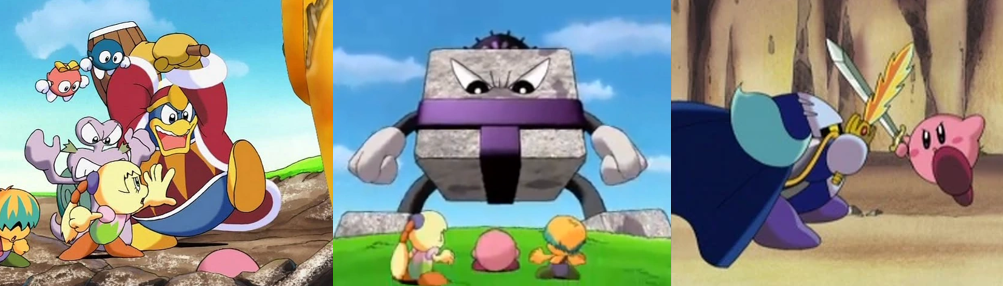
Although he’s also dismissive of Kirby, King Dedede immediately attacks and hates Kirby on sight, worried that even an immature Star Warrior threatens him. King Dedede initially sics Octagon on Kirby, surprised to find what was initially a small and unimpressive monster becomes a mindless kaiju that wrecks his castle. Thanks to Meta Knight, Tiff, and Tuff, Kirby recovers and becomes Fire Kirby, destroying the beast and causing King Dedede to total his starship and vow to destroy Kirby. He then ruins Kirby’s reputation in Cappy Town and orders a new monster from N.M.E. This turns out to be Blocky, a massive sumo wrestler-esque stone so dense that it’s immune to Kirby’s inhale ability. Blocky destroys Kirby’s treehouse home and seems unstoppable, until Meta Knight suggests using its weight and power against it. Thus, Kirby lures Blocky to an incline, turning into smaller duplicates that he promptly crushes with his Stone ability foiling King Dedede once more. In “Kirby’s Duel Role” (Yokoyama, 2001), King Dedede orders Meta Knight to challenge Kirby to a duel, something the mysterious conquistador is reluctant to pursue. However, he’s duty bound to follow the king’s orders and quickly proves Kirby’s superior. Meta Knight turns the duel into a training exercise, however, mentoring Kirby on finding his inner calm and strength and mastering the Sword ability, surreptitiously obeying his master while also aiding Kirby. This training comes in handy when King Dedede unleashes an expert swordsman, Bugzzy, to finish the job, only for it to be sliced in two by Kirby’s Sword Beam. Enraged, King Dedede tries to take matters into his own hands only to be toppled by Meta Knight, who refuses to elaborate on his true allegiance and seems destined to walk the line between enemy and ally.

This colourful, fun-packed show challenges Kirby to showcase the full extent of his potential.

I felt a little bad for Kirby, here. It’s interesting that the anime depicts him as immature when he’s always so forthright and proactive in the games. He still is here, to be fair, never backing down from a fight or a challenge, and he always triumphs thanks to encouragement, training, perseverance, and his copy abilities. It’s strange, then, that he’s depicted as a clumsy, disruptive child who Cappy Town finds annoying yet inspirational. I feel it might’ve been just the same, if not better, to depict him as childish and simple but still formidable and reliable, since he is all those things anyway. It’s a strange dichotomy as Kirby naturally rises to the occasion and isn’t really hampered by being awoken two-hundred years too early. It does create a bit of drama, though, as Kirby’s often on the backfoot or must use more than brute strength to win. “Kirby’s Duel Role” excellently shows that Kirby is outclassed against Meta Knight’s swordplay and it’s therefore more meaningful when he masters the Sword ability. Still, it was weird seeing people shun and doubt Kirby, especially as he’s always so friendly and so damn cute. While the episodes quickly adopt a recognisable formula, I never found myself bored, mainly because the animation is so good and it was fun seeing Kirby get into scrapes and learn new powers. N.M.E’s monsters are presented as intimidating obstacles for Kirby to overcome and I got a real sense that Dream Land has suffered under the whims of King Dedede, who seemed to previously unleash monsters just for a lark.

Final Thoughts:
The anime really captures the vibrant and surreal nature of the videogames, mixing traditional animation with CGI to bring Kirby and King Dedede to life. While it was a strange decision to have Kirby be an alien visitor and these episodes don’t pull any locations from the games except King Dedede’s castle and Planet Popstar, the visual appeal is undeniable as characters are very expressive. The CGI elements added a cinematic quality and emphasised how goofy Kirby and King Dedede are, which only made the cartoonish fun more enjoyable. I loved how the amine incorporates Kirby’s inhale and copy abilities, translating the former into his insatiable appetite and the latter into one-time power-ups that show his growth as a character. Kirby is adorable here, mimicking voices and taking pleasure in the simple things and always happy to help and stand against any enemy, no matter how big or skilled they are. I enjoyed the mystery surrounding him as a Star Warrior, which was only exacerbated by Meta Knight, who constantly talks in riddles, aura farms, and is presented as an elusive (and incredibly powerful) warrior. I loved Meta Knight’s Spanish accent and accompanying theme, elements I never imagined for him, but which really worked to give him some spice. Similarly, it was strange hearing King Dedede using a Southern accent, but it quickly grew on me and surprisingly suited his pompous character.

A couple of standout characters and vibrant, enjoyable visuals make this a fun time all around.

I loved how Kirby’s mere presence upset King Dedede, like he knows his rule is threatened by this seemingly harmless pink marshmallow and it’s driving him mad (and into debt) ordering monsters to get rid of him. I thought it was pretty funny how King Dedede is seen as a liar and a dick, yet people begrudgingly tolerated him because he’s their ruler. The Cappies seemed unable to do anything but complain about him before Kirby showed up and hardly rally behind him once he’s there due to his age. Tiff and Tuff were okay supporting characters but it’s Escargoon who stood out amongst the new characters. Unlike other animated underlings, he’s not an abused, spineless lackey. He offers his opinion, enforces King Dedede’s will, and even questions his king, being fiercely loyal while also recognising when things aren’t going there way. I’m biased but Meta Knight stole the show for me with his mysterious demeanour and undeniable screen presence, which are both backed up by his reputation as a master swordsman. I also enjoyed that the episodes used enemies from the videogames. That may sound obvious, but you’d be surprised how often adaptations don’t use characters and elements from the videogames. It was admittedly odd to have them teleported to King Dedede from N.M.E. but that aspect was a fun way to build that shadowy organisation up as a greater threat than King Dedede. Ultimately, I had a lot of fun with these episodes. They’ve bright, colourful, harmless fun that tweak the lore in interesting ways, depict Kirby’s abilities and enemies in entertaining ways, and the animation and visuals were top notch. I would definite be happy to watch more of this anime and would recommend it to fans of the character, or anyone needing a quirky anime to pass the time with.

My Rating:

Rating: 4 out of 5.

Great Stuff

Are you a fan of Kirby: Right Back at Ya!? What did you think to these first three episodes and the way the anime depicted Kirby? Did you like the formula of the anime or would you have preferred to see King Dedede be more proactive? Were you also a fan of Meta Knight’s portrayal? Which episodes were your favourite? Let me know your thoughts on Kirby: Right Back at Ya! in the comments and donate to my Ko-Fi if you want me to review more episodes of the anime.

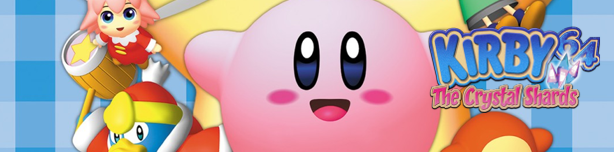
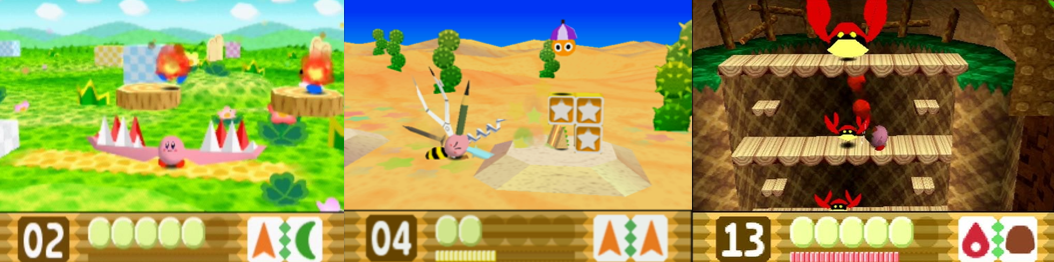
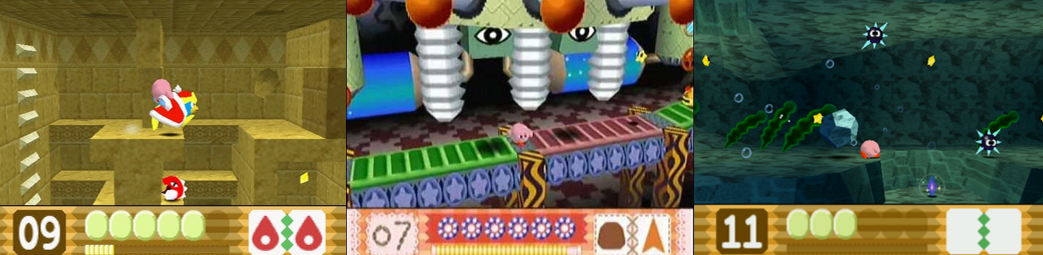
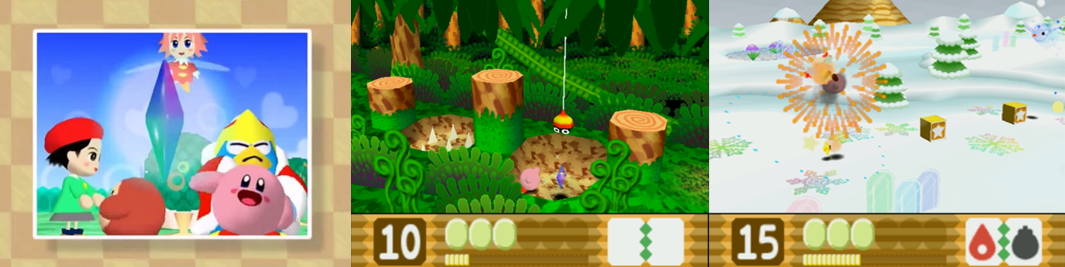
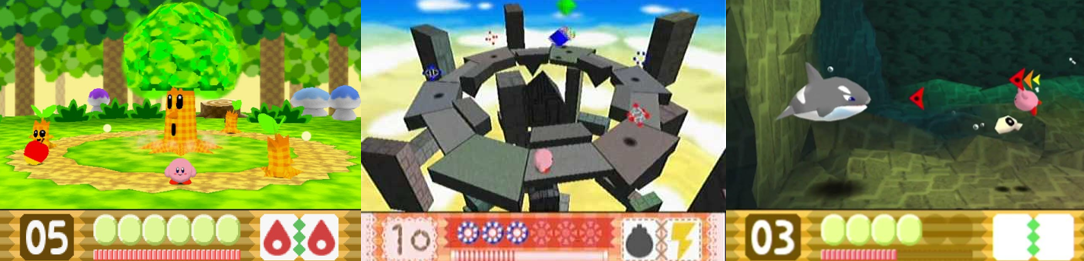
Game Corner [Kirby Month]: Kirby 64: The Crystal Shards (Nintendo Switch)


Created by Masahiro Sakurai, the disgustingly cute, ever-ravenous Kirby is one of Nintendo’s most popular characters. Accordingly, I’m dedicating most of July to celebrating the pink puff-ball.


Released: 20 May 2022
Originally Released: 24 March 2000
Developer: HAL Laboratory
Metacritic Scores: 77 / 8.2

Also Available For: Nintendo 64, Nintendo Switch 2 (Online), Nintendo Wii, Nintendo Wii U (Virtual Console)

Quick Facts:
Kirby’s first solo foray into 3D initially started as a title for the ill-fated 64DD before shifting to the standard Nintendo 64 with a promising prototype. After feedback from Space World 1999, the team reduced the playable characters, included fun four-player minigames, and encouraged player experimentation with the “Power Combo” system. Compared favourably to its contemporaries and seen as a natural evolution of the 2D titles, Kirby 64: The Crystal Shards impressed with its colourful and simple gameplay.

Gameplay and Power-Ups:
Kirby 64: The Crystal Shards is a 2.5D platformer that takes Kirby’s basic formula and translates it into a very linear and fairly restrictive quasi-3D space. Unlike his peers, whose 3D debuts were more open-world adventures (or 3D sandboxes), Kirby is mostly stuck on a straightforward path, with few exceptions, and although Kirby 64 does include the very basic elements of a “collectathon”, they’re the same way as his 2D games (i.e. you must collect 100% Crystal Shards to unlock the game’s final area). Kirby 64 offers three save files and an optional tutorial to go through the simplistic controls, which largely mirror Kirby’s 2D adventures. You make Kirby jump with A, tapping it to inflate and fly higher and over obstacles and enemies. However, Kirby tires after a time, so stay clear of any pits or spikes. Kirby dashes if you double tap the directional pad, slides beneath projectiles with down and A, and fires an air puff with B when inflated. Kirby still inhales blocks and enemies by holding B and you can then spit them as projectiles or press down to swallow them, transforming Kirby and gaining variations of enemy abilities. These stay until you either take enough damage or you ditch it with the right stick or Left or Right triggers. Pressing B lets you toss your ability at another enemy to combine them into a “Power Combo”, which you can devour to gain a stronger attack (the main gimmick of the game). Kirby replenishes his health by collecting food scattered around (mainly sweet treats, though the Maxim Tomato also reappears) and gains extra lives from either 1-Ups or collecting Point Stars as in previous games (though you need a lot more to get an extra try here). Occasionally, Kirby eats an Invincibility Candy to briefly turn invincible and each level ends with a cute little minigame where Kirby sits at a picnic blanket with all his friends and you must time presses of A to hop to 1-Ups, Maximum Tomatoes, and other coloured Point Stars for bonuses.

Although Kirby can mix and match his abilities, this doesn’t add all that much to the basic gameplay.

Although Kirby 64 doesn’t feature any new copy abilities, the seven included are some of Kirby’s most recognisable. You’ll toss bombs, become a fireball-like projectile, sprout spikes or fire a needle-like growth, freeze enemies, and zap them with electricity. While these are decent, you can combine them in various fun ways using the new Power Combo gimmick. Some simply power-up the regular abilities, turning Kirby into a flaming lance, or allowing him to stomp around in an invulnerable (but heavy) rock form, or toss a bigger boomerang projectile that travels further. Spark Spark surrounds Kirby with a protective electrical field that zaps nearby enemies, Bomb Bomb fires homing missiles, Ice Ice turns Kirby into a giant, explosive snowball, and Needle Needle sprouts multiple appendages like a Swiss Army knife. However, you can mix and match the seven copy abilities into twenty-eight fun combinations, like Ice Spark (which turns Kirby into a fridge that fires health-restoring food), Burning Cutter (which sees him heft around a giant flaming sword), and Stone Bomb (which sees Kirby don a hardhat and toss dynamite!) Spark Cutter sees Kirby deftly swing a double bladed, lightsaber-like weapon, Burning Ice encases him in an ice cube and damages enemies with steam, Needle Cutter transforms him into a bear trap, and Stone Spark has him fling a boulder about using an electrical tether. It’s fun experimenting with Kirby’s different forms, like bursting into fireworks or becoming a bow and firing flaming arrows or freezing enemies as a giant snowflake, though I generally stuck to Power Combos like Bomb Cutter that give you a projectile attack. I had little use for the various Stone abilities, Burning Burning often landed me in trouble once Kirby’s flaming dash wore off, and I generally found the Needle abilities too restrictive, especially against certain bosses where you must keep your distance. Unlike most Kirby titles, Kirby inhales enemies and can use all abilities underwater and many of them hinder rather than boost his flying ability.

Kirby’s buddies are sadly underutilised in this 3D recreation of the franchise’s 2D gimmicks.

Kirby gains allies after freeing them from Dark Matter’s influence. Adeleine’s pictures spawn 1-Ups and Maxim Tomatoes or help solve puzzles, Waddle Dee gives Kirby a ride in rafts, mine carts, and toboggans, and you often hop onto King Dedede’s back to smash through walls and enemies alike with his giant hammer. Sadly, these sections don’t appear very often and, inside, Kirby 64 stays very true to its roots. Thanks to Kirby’s limited airtime, there’s a greater emphasis and risk involved in platforming, especially over bottomless pits or hazards. Enemies constantly respawn to give you additional “ammo”, but health pick-ups get quite rare as the game progresses. You must also avoid spikes, Shotzo cannons, and enemies like Maws and Snippers who pop from holes to take a bite out of you. Green blobs fire you to new areas, you’ll venture through doors and narrow corridors and flooded caverns, hop to swinging tree log platforms, ride gondolas, jump to small, moving, or temporary platforms, and clamber up chains (occasionally avoiding electrical sparks). Each planet has a different theme mirroring many tropes from previous Kirby games, such as Aqua Star having underwater caverns and water currents that push you about and Shiver Star being frozen and snowy. Alongside watching for pits and crushing hazards, you also avoid or out run insta-death traps like the wave of lava that chases you in Neo Star and Shiver Star’s hazardous factory that features crushing hammers, a giant press that sees you frantically racing to safe areas, and Robot Toys that chase you through narrow corridors. You must avoid falling rocks and missiles, run past falling pillars and bookcases, hit explosive blocks to open new paths, fall down (or frantically fly up) shafts, light up dark areas with Bomb Spark, and avoid being roasted by magma when the ground shifts in Neo Star.  

Presentation:
Although Kirby 64 nicely translates Kirby’s colourful, whimsical style and his simplistic adventures into adorable 3D worlds and models, things do seem very safe. The story is told through simple pantomime-like sequences that get across the gist of what’s happening, with Kirby recruiting new friends and frenemies to combat Dark Matter and visit each world, though the narrative is even simpler than some of Kirby’s previous games. While the game’s tunes are fun and fitting, I didn’t find them very memorable and the locations largely stick to the pre-defined themes of previous games, such as Pop Star and Aqua Star essentially being 3D recreations of “Green Greens” and “Float Islands”. On the plus side, Kirby looks fantastic in 3D. He’s more expressive than ever, clamping his eyes shut when he’s running, expressing happiness and disappointment in cutscenes, and even showing fatigue when low on health. Rather than simply donning outfits that resemble his enemies, Kirby largely transforms his entire form when using copy abilities and especially Power Combos. He tosses his face when using Cutter, becomes an explosive snowman, a walking lightbulb, and a sentient fridge, and transforms his arm into a drill! Kirby becomes a miniature volcano, a curling stone, tosses flaming shuriken, and transforms into some recognisable friends with Stone Cutter, each with comparable abilities. Kirby also occasionally changes colour depending on what abilities he has and, best of all, final has idle poses! However, Kirby is a bit clunky to control. His hit box is a little janky at times and the odd, almost isometric angle can make it difficult to judge jumps. This is only compounded by Kirby’s limited airtime, which is difficult to adjust to if you’re coming off any of his previous games and significantly increases the game’s difficulty at times, though the game runs pretty smoothly otherwise.

Though colourful and fun, Kirby 64 plays things a bit too safe and unnecessarily restricts Kirby.

I do wonder, however, if Kirby 64 might’ve been better served by being a true 2.5D title, perhaps having only the character and enemy models being 3D and the backgrounds being traditional 2D environments (or vice versa) as Kirby does feel a bit shafted by being limited to a linear path. Similarly, you’re dropped into very familiar environments, which is disappointing (though it’s fun seeing recognisable locations brought to life in 3D). You start in the familiar green fields of Pop Star, dashing past butterflies and flower spores, crossing bridges, hopping to tree trunks in an autumnal forest, and venturing into King Dedede’s stronghold. Rock Star is more of an arid desert, with cacti plants, stone ruins, and fallen stars littered across the background, which leads to ancient ruins and long forgotten caves, where one of the few simple puzzles awaits. As mentioned, Aqua Star is essentially a 3D “Float islands”, featuring a tropical theme, coral caves, sandy beaches, and murky underwater areas. Neo Star begins in a thick, overgrown jungle with vines and plants obscuring obstacles, and ends with you traversing an active volcano, dodging flaming hazards and crashing through walls with King Dedede. Shiver Star is allegedly a post-apocalyptic Earth suffering from a new Ice Age or nuclear winter, and fittingly features lots of snow and ice. You must dip under frozen lakes, climb ladders up mountains, and dodge boulders all while snow falls around you. After a brief spell in the crystalline clouds, Kirby ends up in a hazardous mall and toy factory, hopping to conveyor belts or up escalators, fighting past abandoned displays, and venturing into the dangerous inner factory, where robots buzz in the background and giant hammers look to crush you. Riddle Star is essentially a surreal, dream like staging area for a series of enemy gauntlets, though these are fought in distinctly Arabian locations and the final areas are psychedelic voids.

Enemies and Bosses:
Since Waddle Dee acts as Kirby’s ally, the closest you get to fighting one is the returning Bronto Burts, who flitter about in the air. Sir Kibble still tosses boomerang-like projectiles, however, Poppy Bros. Jr. still throws bombs, and Scarfy still aggressive chases on sight. Rockys are often perched on star blocks, gel-like Sparkys hop along emitting electrical sparks, and Chillys blast you with their frosty breath. Blowfish explode when you approach underwater, bat-like Boneheads flutter, Ghost Knights block most weak projectiles and jab with a lance, and sentient hatchets try to hack at you. Spiked logs roll at you, Putts push boulders at you, invincible, ghost-like Noos toss fireballs, sentient stones hop up and down, maraca-shaking Chacas deflect most projectiles, and flaming or frozen birds pass overhead dropping rocks. You also encounter crabs, a cute little witch, spider-like enemies, and fire-breathing dino babies. Fifteen of the regular enemies also appear as enlarged “Room Guarders”, mini bosses who yield a Crystal Shard upon defeat (though you may need a specific copy ability for this) and are accompanied by small variants you can use as projectiles. These are generally fought in an enclosed arena to make things a bit trickier but can be made extremely easy if you have the right Power Combos. Often, these enlarged enemies barely move or simply go back and forth in predictable patterns, though Big Sawyer can be difficult to avoid as it buzzes across the floor, Big Kacti’s minions can cause troubles as they have erratic patterns, and Big Galbo breathes flames that cook you if you’re too close. Big Blowfish swims in a counterclockwise pattern, Big Mopoo pops out from the clouds, and Big Burnie is fought over a lava pit. Each takes around for to six hits to defeat and you’ll also face swarms of regular enemies in various rooms in Ripple Star, also battling two at a time, as a final gauntlet before the penultimate boss.

Even Kirby’s returning bosses get changed up by the new 3D aesthetic.

Before Waddle Dee, Adeleine, and King Dedede become Kirby’s allies, they must first be freed of Dark Matter’s influence. Waddle Dee runs at you, tripping every so often and producing stars you can spit back at him if need be; Adeleine’s paintings become 2D recreations of regular enemies, the Ice Dragon, and Dark Matter; and King Dedede features two phases. First, he attacks with his signature hammer and body slam; then, he recovers and flies about spitting black orbs you can fire back if necessary. Once these three are defeated, you battle Whispy Woods on a circular platform with him rooted in the middle. You must run around swallowing apples to take out his minions and damage his spiked roots, which is a nice change of pace from the usual fights with him. The circular platform format returns for the fight against Pix, three coloured octahedrons fought within a spaceship on Rock Star. At first, you must survive as the elevator rises and the octahedrons fire coloured lasers either directly at you, that rotate, or which go up and down. Once at the top, they transform into blades to attack and hover around dropping bombs that you must spit back at them, firing each coloured bomb at the corresponding octahedron to win. Acro reappears on Aqua Star and is fought in two stages. The first is an underwater autoscroller where you spit back the various objects he coughs up (anchors, skulls, etc) while avoiding spiked Gordos, his spinning slam, and his charge. After enough hits, you must frantically swim up a collapsing cavern. Acro pursues from below, charging up the shaft and firing missiles, and you must attack him as he passes, avoiding his large hit box and taking too much damage from the enemies lining the shaft.

Some of the later bosses can be surprisingly challenging thanks to the game’s limitations.

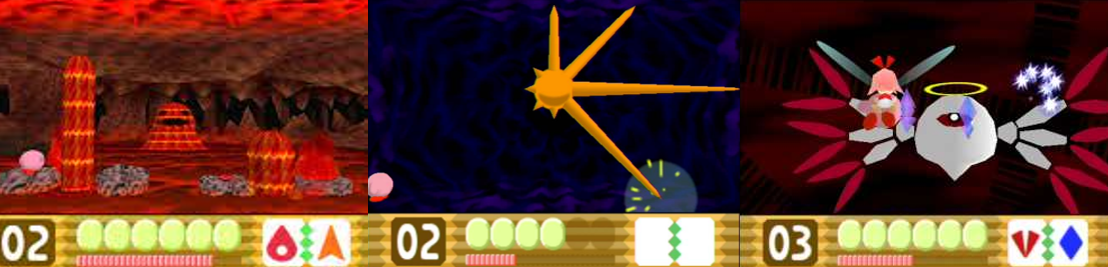
For Neo Star’s Magman, you’re initially limited to three precarious rock platforms floating on lava and must attack Magman’s tentacles and avoid being forced into the flaming ceiling and his fireballs. Once on solid ground, you fight Magman in an enclosed tunnel, dodging falling rocks, his flaming minions, his fire breath, and the large lava puddle he becomes. Shiver Star ends with you battling the giant, multi-form robot HR-H against a cityscape. HR-H attacks from the background to begin, raining missiles and sweeping your platform with a laser blast. You can only damage it when it tries to grab you or sweeps its claw-like arms, which can be difficult due to HR-H’s massive hit box. Next, HR-H transforms into a jet-like form and chases you across a crumbling platform, raining small missiles, firing a larger missile, and attacking with pincer-like claws. After besting Ripple Star’s gauntlet, you battle Miracle Matter, a bizarre sentient icosahedron whose different forms corresponds to a copy ability and yields a consumable you must either use as a projectile, though the window to attack is very small. In its Bomb form, Miracle Matter becomes a black blob and fills the screen with smaller blobs; when in Burning form, it spews columns of fire; Cutter turns it into a Fishbone-like form that travels around the screen and charges you; Ice sees it float around while ice shards spin around it; Needle fires spikes in all directions; Spark shoots ricocheting light blasts; and Stone tries to crush and roll into you. I found these final forms difficult as the Spark projectiles can be hard to avoid and your projectiles are often blocked by Stone’s smaller parts. Once you collect all 74 Crystal Shards, Kirby travels to Dark Star to battle the true final boss, the angelic 02, alongside Ribbon. 02 fires exploding energy balls and can only be stunned by attacking its central eye thirty times! When stunned, Kirby must target its halo and then its bandage to expose its true weak spot: a green, thorny tail. 02 emits harmful green gas, though players can destroy its wings to limit its mobility and press L or R to dodge its projectiles.

Additional Features:
As mentioned, there are 74 Crystal Shards to collect, with around three being found in each level. Sometimes they’re simply floating in the open, one is always awarded for defeating a Room Guardian and boss, and others require a bit more effort to collect. This may mean using a specific copy ability to free or reach the Crystal Shard or solve simple puzzles, like pushing down coloured pegs. You need all 74 to reach Dark Star, battle 02, and see the game’s true ending, and to also hit 100% completion. When playing the picnic jumping game at the end of each level, you can collect Info Cards to learn about each enemy and boss and what abilities, if any, they provide. As you play through the main game, you’ll also unlock cutscenes to view at your leisure and you can also alter the heads-up display in the game’s settings. Kirby 64 also offers three mini games where up to four players can compete in a 100-yard hop, catching fruit and jewels in their baskets, or changing checkerboard blocks into colours. Each game has different difficulty levels and is the only time you can play as other characters, with as Kirby, King Dedede, Waddle Dee, and Adeleine all being selectable. Naturally, playing Kirby 64 through Nintendo Switch Online also allows you to produce save states to mitigate some of the tricker sections.

Final Thoughts:
I’ve been wanting to play Kirby 64: The Crystal Shards for a long time. I bought it off the Wii Virtual Console years ago, played a bit of the first level, and never came back to it despite really meaning to. Sadly, however, I’m not sure it was really worth the wait.  It’s an underrated and rarely talked about entry in the franchise, sure, but it’s severely lacking compared to other 3D titles at the time. There’s definitely something to be said for simplicity but Kirby 64 plays things far too safe and is essentially a 3D remake of Kirby’s Dream Land 3 (HAL Laboratory, 1997) in many ways. Ironically, Kirby’s Dream Land 3 might’ve had more in it than Kirby 64 as Kirby’s allies are far less useful here, popping up for pre-scripted moments, leaving players relying on the Power Combo mechanic. This is fun enough but I quickly stuck to reliable Power Combos and rarely experimented with others, meaning it’s not as interesting as the buddy mechanic from Kirby Super Star (ibid, 1996). As adorable as Kirby is, especially when transformed, I struggled with his controls, especially with his limited flight and the odd camera angle. I definitely think sticking to a 2D plane would’ve benefitted the game, as would making the formula less derivative of the 2D titles. It’s a decent enough kid’s game, I guess, but surprisingly difficult at times as your health isn’t restored between levels and some of the bosses have massive hit boxes. Although I think Kirby 64 deserves a bit more time in the spotlight, it didn’t progress the franchise in any meaningful way and is simply a 3D retread of everything that’s been done before, bar a couple of semi-unique features that don’t help it stand out from Kirby’s superior 2D adventures, so you’re not missing much if you skip this one.

My Rating:

Rating: 3 out of 5.

Pretty Good

Was Kirby 64: The Crystal Shards a staple of your Nintendo 64 library back in the day? Were you also disappointed that it didn’t do more with the 3D graphics or did you like that it kept things simple? Which of the Power Combos was your favourite and did you enjoy riding King Dedede? Did you ever find all the Crystal Shards and battle 02? Did you manage to collect all the Info Cards? Which of Kirby’s 3D adventures is your favourite? Let me know what you thought of Kirby 64 in the comments and donate to my Ko-Fi to recommend other Kirby videogames for me to review.

Game Corner [Kirby Month]: Kirby’s Dream Land 3 (Nintendo Switch)


Created by Masahiro Sakurai, the disgustingly cute, ever-ravenous Kirby is one of Nintendo’s most popular characters. Accordingly, I’m dedicating most of July to celebrating the pink puff-ball.


Released: 5 September 2019
Originally Released: 27 November 1997
Developer: HAL Laboratory
MobyGames Score: 7.4

Also Available For: Nintendo 3DS (Virtual Console), Nintendo Switch 2 (Online), Nintendo Wii, Nintendo Wii U (Virtual Console), Super Nintendo Entertainment System (SNES)

Quick Facts:
Kirby’s Dream Land (HAL Laboratory, 1992) was HAL Laboratory’s most successful release at the time thanks to its simple gameplay. Kirby further cemented his name with the highly praised NES classic, Kirby’s Adventure (ibid, 1993), and Kirby’s Dream Land 2 (ibid, 1994) sold over a million units. Bolstered by the critical and commercial success of Kirby Super Star (ibid, 1996), HAL Laboratory continued the Dream Land series with this pastel-coloured adventure, which, despite a mixed reputation, seems to be widely regarded as a fun but disappointingly average title.

Gameplay and Power-Ups:
Kirby’s Dream Land 3 is a 2D, action-orientated sidescrolling adventure that essentially acts as 16-bit remake or expansion of Kirby’s handheld adventures, specifically Kirby’s Dream Land 2. Accordingly, it mirrors many of the Game Boy titles’ mechanics, features, locations, and enemies, though is noticeably expanded to include five levels, each with six stages and a dedicated boss battle, with a secret sixth level unlocked by collecting all thirty Heart Stars to assemble the Love-Love Stick. Though a SNES title, Kirby’s Dream Land 3 continues to keep the controls simple and simplifies them from the Game Boy titles as you no longer need to hold up on the directional pad (D-pad) to inflate and fly. Instead, you simply tap B to either jump or flap Kirby’s stubby arms and bypass most enemies and obstacles (though they are more airborne hazards than ever here, so watch out!) You hold Y to inhale nearby blocks or enemies, either spitting them out with Y (which also doubles as a water spurt when submerged) or pressing down and Y to swallow the enemy and potentially gain a new ability, ditching it with –. You can now defeat enemies by jumping on them, slide by pressing down and A (though this doesn’t seem to hurt enemies), run by double-tapping a direction on the D-pad, and swim with B. X spawns Gooey, who has his own health bar and also devours and spits out enemies to aid you, though you’ll lose a block of health if he’s defeated. On the SNES original, a second player could control Gooey for some co-operative two-player action, but I’m not sure if the Nintendo Switch Online version supports this. You again restore Kirby’s health with Energy Drinks and Maxim Tomatoes, gain temporary invincibility with rare candies, and collect 1-ups or collect Star Pieces for extra lives. Star Pieces are now hidden all over and you need thirty of the buggers for an extra life, so be sure to look everywhere.
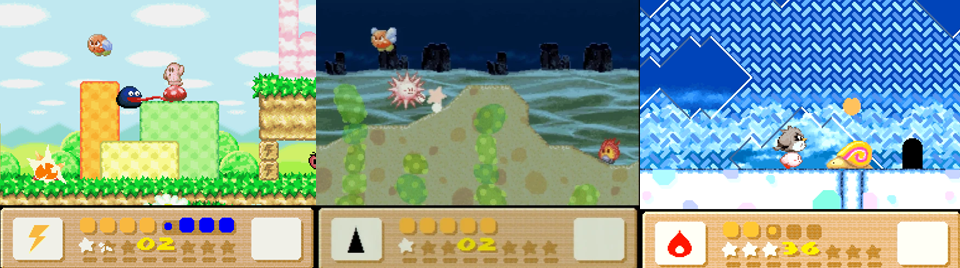
Joined by Gooey and some new friends, Kirby journeys through a colourful (if familiar) adventure.

While Gooey helps quite a lot and even acts as a projectile in a pinch, you obviously primarily rely on Kirby’s copy abilities, of which only two are new (and the Love-Love Stick is only in the secret final level). Burning sees you become a fireball for a short burst and melts ice blocks, Cleaning kicks up dust to attack enemies, Cutter launches a boomerang-like projectile, and Ice sees you freeze enemies into ice blocks you can hit into others. Needle sees spines burst from Kirby (great for breaking blocks beneath you), Parasol adds a short-range melee attack to your arsenal, Stone sees you crush enemies and blocks from above, and Spark emits electrical sparks that frazzle nearby enemies. You can only use one copy ability at a time and lose it if you take damage, but they can again be combined with Kirby’s animal buddies for additional attacks. You partner with a buddy when visiting special areas, pressing X to mount or dismount them, and each has different abilities. Coo the Owl, Kine the Sunfish, and Rick the Hamster all return from Kirby’s Dream Land 2, with Coo allowing you to fly indefinitely, Kine making swimming a breeze, and Rick still keeping you from slipping on ice. Newcomers ChuChu the Octopus, Nago the Cat, and Pitch the Bird see you stick to ceilings to bypass spikes and other obstacles, gain a triple jump (somewhat redundant since Kirby can fly), and offer constant flight (despite Kirby’s weight). When you have a copy ability, Nago breathes fire, Pitch attacks like a rocket, Kine gets covered in spikes, and Rick transforms into a rolling boulder. Rick also tosses Kirby, Coo fires three icicle projectiles, Kine spits fireballs and energy waves, Nago pogos around on a parasol, ChuChu flies on a broom, and Pitch darts ahead like a lance. There are a bunch of different combinations and you’re constantly given the chance to switch your buddy, with it often being necessary to have a specific buddy and/or copy ability to access hidden areas or earn Heart Stars.

While the gimmicks and platforming is very samey, the new matching mini games are fun.

Kirby’s Dream Land 3 retains the same gameplay mechanics as its predecessors, tasking players with exploring colourful, largely linear levels, using doors to switch to new areas, destroying star blocks to reach side paths, and occasionally racing against a scrolling screen that kills on contact. Sometimes these force you up or down narrow shafts, while other times you must swim through tight tunnels or outrun boulders (hopping to or dropping down to safety as required), but both are perilous as the screen’s quite fast. Green gelatinous blobs blast you through blocks, water jets speed you through underwater caverns, some blocks crumble beneath you, and you’re occasionally tasked with a looping door maze. Spikes occasionally jab you or fall from above, snow and sand shifts you towards bottomless pits, spiked Gordos float everywhere, and lava threatens to scorch your toes. Wind currents boost you up or push you along at speed, enemies sometimes spring to life from chalk drawings, and raging snowstorms push you back and screw up your platforming without the right friend on hand. Kirby’s Dream Land 3 offers one mini game per level where you can earn a Heart Star. These see you matching which Gordo was thrown, picking the right pot that hides an Elieel, correctly guessing how many coloured Gordos appeared, and matching the sounds they make. These mini games can be tricky as they speed up as you progress, though the rewind feature largely negates this. Each level ends with a jumping game where you press B at just the right moment to jump on goodies, and every level has a non-playable character (NPC) to help for a Heart Star. You must make sure not to crush certain flowers, collect pieces of Professor Hector’s Robotic Operating Buddy (R.O.B.), flash freeze and destroy Metroids, use Needle to burst a balloon and rescue Piyo, bring Kine to Mine, Rick to Pick, and Naga to Shiro, and rescue Goku (not that one) for Chao (not that one, either). There’s no in-game direction for what you need to do and which abilities or friends you need, so there’s a lot of trial and error and replaying without a guide and is can be frustrating as you must help every NPC to see the true ending.

Presentation:
Kirby’s Dream Land 3 takes advantage of the SNES’s superior processing power and colour palette (at least, compared to the Game Boy) to present a super vibrant, pastel-coloured adventure somewhat akin to Super Mario World 2: Yoshi’s Island (Nintendo EAD, 1995). While Kirby still lacks idle animations (beyond swaying his arms and blinking), he pops far better than on the Game Boy thanks to the pastel colour palette. He yelps when hit, comically squishes and inflates, still performs his adorable victory dance, and noticeably changes form depending on with copy ability or animal friend he’s using. These see him whip out a parasol, turn into a rock, sweep with a broom, jump into Kine’s mouth, and be rolled along by Nago. The game’s bookended by some partially animated comic book panels that show the gist of the super simple story, and each level is introduced with a short cutscene showing Kirby with his buddies. Unfortunately, the world map from Kirby’s Dream Land 2 has been replaced with a storybook-like image that charts your progress across. The in-game action is also needlessly obscured by the large heads-up display, which shows a lot of relevant information but eats into the screen space. The music is just as jaunty as ever, with the SNES continuing to offer chirpy remixes of Kirby’s 8-bit themes, though it was a bit disappointing to see every location from Kirby’s Dream Land 2 recycled. Sure, they look and often play very differently, but it didn’t help the game stand out and contributed heavily to me seeing this as more of a 16-bit remake than a true sequel. Little graphical touches do help, however, such as clouds rushing by, the water rippling, snow moving and even burying you, and flowers pulsating or rotating as you explore. Foreground elements occasionally obscure the screen and there are some instances of parallax scrolling, but Kirby’s Dream Land 3 largely keeps things very safe with its linear, often barren paths and simple level layouts. At least, until you’re search for NPCs to help for Heart Stars, then you must often seek out the right copy ability or animal buddy to find new paths or progress.

A colourful, pastel-coloured retreat of the portable adventures.

Since each level has six different areas to explore, there’s quite a bit of visual variety on offer, though the sheer number of stages can be daunting (four and a fifth boss stage would’ve been enough) and reducing the stage count might’ve meant including a penultimate castle stage. Like Kirby’s Dream Land 2, things start with “Grass Land”, a colourful grassy and woodland area that introduces the basic gameplay mechanics. At times, the area veers into bizarre visuals like Fantasy Zone (SEGA, 1986), especially once it mixes in mosaic patterns with the treetops and mountainous backgrounds. “Ripple Field” is, again, a tropical themed area largely full of beach-like areas with palm trees and underwater tunnels filled with jet streams and narrow caverns. Day turns to dusk as you progress, you venture into coral caves and an ancient palace and eventually reach stone grey cliffs. This segues nicely into “Sand Canyon”, an arid desert populated by dinosaurs and (strangely) snowmen and featuring a trippy pyramid-like temple, vast mountains, narrow tunnels where boulders chase you, and crumbling sand blocks. “Cloudy Park” is, naturally, a cloud-based location where you float on wind currents, paddle through water, battle both the autoscroll and obscuring foreground clouds, and venture into a palace of mesh and pillars. “Iceberg” sees you either struggling through deep snow, battling snowstorms, or slipping on ice. Snow falls around you, gleaming ice constructs obscure enemies, Kirby’s chased by avalanches, and you end up inside King Dedede’s fortified stronghold where a gauntlet of mini bosses awaits. The final area, “Hyper Zone”, is a surreal void where you indefinitely float to battle Dark Matter’s many forms and players see different endings depending on if they’ve beaten this final challenge or not. While there are some fun elements in each location, like chalk pictures coming to life, shifting ground, and enemies masquerading as background elements, it’s all a mishmash of gimmicks from previous Kirby games. This results in some ill-fitting choices, like volcanic areas in “Sand Canyon”, though I guess these allow every area to have some variety. Kirby’s Dream Land 3 may play a lot slower than its predecessors, but it performs extremely well, with no slowdown or sprite flicker no matter how many enemies fill the screen.

Enemies and Bosses:
Basically all of Kirby’s previous enemies return here, each performing exactly as before. All are defeated in one hit and will respawn if you venture offscreen, and many bestow copy abilities when swallowed. Devouring Broom Hatters or the witch-like Kekes gifts you Cleaning, for example, while Sir Kibble grants Cutter and Chilly grants Ice. You’ll eventually encounter many armour-clad Bukisets, each wielding different abilities depending on the situation, allowing you to quickly change abilities if required. Waddle Dees return, still wandering about and lacking their eye beam attack, and now paddling about in adorable life rafts or riding Nruffs. Babuts still drain your health with their bite, Poppy Bros. Jr.s still ride apples and bombs, and Mumbies float after you. Pterodactyl-like Pterans fill the skies, often while fire-spewing Galbos wait below, Scarfys and Propellers pursue you on sight, and ravenous, shark-like Acro Jr. wait in some waters. Cloud-like Louds float above dropping rain, caveman-like Dogon’s reflect your projectiles, mole-like Doka shovel dirt in your face, and hungry Pactos wait offscreen to cobble you whole. Similarly, Peloo may emerge from the background to grab you with its sticky tongue, Apolo often spin around platforms or pillars, and Yaban leap up and fire arrows at you. Sasuke float from above, Mopooe emerge from the snow and Oro from the ground or ceilings (often right near a door), and Nidoo disguise themselves as doors. Tick thrust a needle up as you pass over them, cannons (and larger cannonballs) fire potshots, skull-wearing Gabon toss bones, and spider-like Mariels emerge from the darkness and doorways to catch you off-guard.

Some familiar faces return from the previous games as slightly tweaked bosses and mini bosses.

Although you no longer need to battle mini bosses to rescue Kirby’s animal friends, you may have to battle them to acquire Heart Stars and you must endure a gauntlet of them in the final area of “Iceberg”. Three mini bosses return from Kirby’s Dream Land 2. Blocky hops about the small arena and charges at you, leaving behind rocks you must dodge and then spit at it if you don’t have a copy ability. Captain Stitch floats around and fires its spines at you, leaving its core vulnerable for a few seconds so you can attack. Jumper Shoot flies about, often spinning like a propeller, and again throws its sandal at you. Boboo is a large walking flame who charges across the arena, Haboki is a sentient broom who boasts a similar attack, and Yuki is a malicious pile of snow who slithers about, collides with the walls, and tosses its head (or multiple heads) as projectiles. When battling the mini bosses in the last stage of “Iceberg”, it’s advised that you inhale the defeated mini boss to acquire their ability to snag goodies in the area prior to the next battle. A few familiar bosses also return, though with additional phases. Wispy Woods uproots and chases you, for example, while the Ice Dragon, Sweet Stuff, Mister Shine and Mister Bright, and Kracko are all summoned by Ado’s drawings. The Ice Dragon throws an ice cube along the ground, whips with its tail, and has freezing breath; Sweet Stuff produces electrical sparks and tosses starfish; Mr. Shine and Mr. Bright drop fireballs and/or energy waves; and Kracko surrounds itself with minions and chases you with a lightning bolt. Ado’s drawings are a far cry from the real deals, however, and they’re notably much easier to defeat than in Kirby’s Dream Land 2.

Dark Matter’s influence ups King Dedede’s menace and delivers another crazy final boss.

The giant shark Acro initially slides across the ground and into the cavern walls to cause rocks to fall then, after enough hits, the battle moves underwater. You must dodge the Acro Jrs., anchors, and skulls it spits and the rocks that continue to fall and attack with your waterspout or copy ability, but don’t get too close as you’ll take damage from its large hit box. Raccoon and fox duo Pon and Con are fought in “Sand Canyon”, with them simply wandering or hopping back and forth across different platforms while flanked by their disposable minions. They’ll toss bombs and each have their own health bar, but this is a simple matter or switching to the right platform and attacking each as they approach. After besting his mini boss gauntlet, you’ll encounter King Dedede atop his castle in what starts as a repeat of Kirby’s Dream Land 2. As ever, King Dedede attacks with his giant mallet, a theatrical ground pound, and by sucking you up and spitting you out. After enough hits, Dark Matter emerges from King Dedede, restores his health, and puppets him about. In this phase, Dark Matter emits homing blobs of dark energy and, most disturbingly, transforms into a ravenous mouth that tries to eat you! Defeat the possessed King Dedede after collecting all thirty Heart Stars and you can tackle Dark Matter in the warped “Hyper Zone”. This time, you battle Dark Matter’s true form (a dark, disembodied eye) while constantly flying about. You must swing the Love-Love Stick to attack Dark Matter, chipping off its smaller pieces and avoiding its lancing black lightning. Upon defeat, Dark Matter gives way to Zero, a massive white eye that takes up a lot of screen space, fires a barrage of smaller Dark Matter eyes alongside red energy blasts, and attacks from the background with red explosions. Once this is defeated, the red inner core goes nuts, flying erratically about the scream but easily being finished in a few hits compared to its bulbous, spongy first form.

Additional Features:
You get three saves files in Kirby’s Dream Land 3, which each tracking your completion percentage. This is based on how many Heart Stars you’ve collected and how many levels you’ve cleared, so you’ll need to consult a guide and jump back in to replay any previous areas to find those missing Heart Stars. This means replaying every single level, often in specific ways, which is a hell of a chore compared to Kirby’s Dream Land 2, though it’s the only way to battle the true final bosses. Luckily, the Nintendo Switch Online also offers an “SP Version” with all Heart Stars collected, allowing you to quickly jump into the “Hyper Zone” if, like me, you haven’t got the time or patience to get the Heart Stars legitimately. Finishing the game this way unlocks a bunch of additional extras, including the ability to watch every cutscene and level introduction and listen to the game’s soundtrack. You can also play remixed versions of the goal-jumping mini game with whichever animal friend you desire, tackle every Heart Star mini game at will in the “Super NES M65” mode, and take on the “Boss Butch!” boss rush mode without the aid of any copy abilities, healing items, or even Gooey! These extra games also count towards your completion percentage so you must master each of them to hit 100% (or, again, just play the “SP Version”). Finally, of course, the Nintendo Switch Online version includes save states and a rewind feature to mitigate much of the game’s difficulty.

Final Thoughts:
I was strangely disappointed by Kirby’s Dream Land 3 in ways I honestly didn’t expect. While the game looks and sounds great, utilising cartoonish visuals brought to life by fun pastel colours and a colouring-book aesthetic, it feels very slow and sluggish at times. Not because of slowdown or hardware issues, either; this is purely down to the game engine and physics. This oddly makes the game feel slower than Kirby’s Dream Land 2, even with Kirby’s new dash ability. It doesn’t help that Kirby’s Dream Land 3 revisits the same locations as the last game and recycles the same copy abilities, adding basically nothing to Kirby’s repertoire beyond the additional attacks and abilities afforded by his animal friends. Even these were a disappointment, though, as they were just out in the open to partner with and sometimes felt like a handicap to Kirby’s momentum (except when using Kine in water). While, yes, each area is vastly different from Kirby’s Dream Land 2 and contains a lot of variety thanks to the six-stage structure, this approach makes for a laborious gameplay experience, one further compounded by you being forced to replay levels to acquire Heart Stars. I did enjoy the added variety and challenge offered by these, but a little direction about what to do would’ve been appreciated as I never felt excited about replaying a stage. I did like the mini game sections and the new bosses, but Kirby’s Dream Land 3 recycles so much from the last game that it’s difficult to get too excited about facing the returning bosses, even with their slight tweaks. Gooey was a fun addition, but probably more enjoyable with a friend to play alongside, and there are some fun extra modes on offer. However, at the end of the day, Kirby’s Dream Land 3 is just a 16-bit recycling of the portable games, which is technically great, and it’d probably be better to skip the previous 8-bit titles and jump straight to this one. However, there’s little about it to help it stand alone or outshine Kirby Super Star, so I couldn’t help but be let down by how Kirby’s Dream Land 3 turned out.

My Rating:

Rating: 3 out of 5.

Pretty Good

Did Kirby’s Dream Land 3 have a place in your SNES library back in the day? Which of the new animal friends was your favourite? Were you disappointed that so much of the game was repeated from Kirby’s Dream Land 2? Do you agree that this was a disappointment compared to what came before? Did you ever collect all the Heart Stars and clear the boss rush? Which Kirby videogame is your favourite? Whatever your thoughts on Kirby’s Dream Land 3, leave them in the comments and go support me on Ko-Fi if you liked this review.

Game Corner [Kirby Month]: Kirby Super Star (Nintendo Switch)


Created by Masahiro Sakurai, the disgustingly cute, ever-ravenous Kirby is one of Nintendo’s most popular characters. Accordingly, I’m dedicating most of July to celebrating the pink puff-ball.


Released: 12 December 2019
Originally Released: 21 March 1996
Developer: HAL Laboratory
MobyGames Score: 8.2

Also Available For: Nintendo DS (Remake), Nintendo Switch 2 (Online), Nintendo Wii, Nintendo Wii U (Virtual Console), Super Nintendo Entertainment System (SNES), SNES Classic Edition

Quick Facts:
Masahiro Sakurai helmed Kirby’s proper 16-bit debut on Nintendo’s industry-changing SNES. Beginning development on the NES, Kirby Super Star was created with three goals in mind: co-op play, expanded attacks, and an omnibus format. The legendary Shigeru Miyamoto requested the addition of two-player co-op and Sakurai was inspired by the ground-breaking graphics of Donkey Kong Country (Rare, 1994). Kirby Super Star was widely praised as one of the best in the franchise and was later remade for the Nintendo DS in 2008, to equally rave reviews.

Gameplay and Power-Ups:
Kirby Super Star is an eight-in-one collection of mini games and bite-sized adventures where players control perhaps gaming’s cutest videogame character and fly about devouring both enemies and food. Those who’ve never played a Kirby videogame before are in luck as each of Kirby Super Star’s game modes offers an optional tutorial, where players are either told their objective or follow onscreen prompts (against the backdrop of a stage play) to perform Kirby’s signature actions. While each game plays a little different, Kirby’s controls and abilities remain largely consistent, meaning you jump with B (tapping the button to inflate like a balloon and fly across stages), inhale enemies or blocks and spit them out with Y, swim by tapping B, and fire a water spurt when underwater with Y. You make Kirby dash by tapping left or right on the directional pad (D-pad), perform a sliding kick by pressing down and B, and block by holding either that Left or Right triggers. Kirby has way more options to restore his health as stages are littered with foods, from the recurring Maxim Tomatoes to puddings and sweets, alongside 1-ups, though these are sometimes hidden behind star blocks or uncovered by lighting fuses or destroy bomb blocks. Kirby still climbs ladders, uses doors, blasts to new areas on Warp Stars, and drops through certain platforms by pressing down on the D-pad. You must still avoid bottomless pits, spikes, and flaming or electrical hazards as you explore each colourful game mode. Players also still swallow enemies with Y and then press down to copy their abilities. By pausing with +, you can review the assortment of attacks afforded by each ability, with Kirby sporting various new moves and combos. Although Kirby’s animal friends don’t appear, you can press A to ditch your currently equipped copy ability and spawn a friendly enemy to help until their health depletes.

Kirby’s new copy abilities and Helpers help him tackles each game in this colourful collection.

Players can feed this “Helper” to boost their health and even transform them into other enemies by tossing them other copy abilities or having them touch another baddie; a second player can also control the Helper for some two-player co-op action. There are nineteen Helpers to choose from and twenty-four copy abilities, with twelve returning from previous games, a random selection appearing if you swallow two viable enemies at once, and two special, one-use copy abilities appearing in certain game modes. Returning copy abilities include the Beam, Cutter, and Hammer, with the limited use Mike still destroying all nearby enemies, Fire still lighting fuses, and Ice still turning enemies into ice cubes. New abilities see you tossing Poppy Bros. Jr.’s bombs, cooking nearby enemies to produce food, swinging a yo-yo, and blasting around on a jet pack. The developers wisely combined some copy abilities from Kirby’s Adventure (ibid, 1993) into one by incorporating different moves, meaning Backdrop and Throw are combined into Suplex, Fire and Fireball into Fire, and Freeze and Ice into Ice. Kirby can become a ninja and toss shuriken, throw vaguely familiar martial arts moves with Fighter, deal damage with flapping and thrown feathers, and activate special switches with Hammer. He can also hop onto a Wheelie Helper to chase down Meta Knight and blast enemies in a sidescrolling shooter with Starship, dish out rapid sword combos, and crush enemies with Stone. Helpers sport the same attacks as the enemies you fight and are super helpful against bosses, though they can be a bit mindless and can get hurt very quickly. You can always use A to turn them back into an item so you can spit them out, though, and many games feature the option to either select a new copy ability or change your Helper into something more useful.

Each game offers something different, from a remake to a scavenger quest to a race against time.

Initially, only four game modes are available (alongside two sub-games), with each carrying different difficulty ratings and retaining Kirby’s abilities across them all. Long-time Kirby players will immediately recognise “Spring Breeze” as a truncated remake of Kirby’s Dream Land (HAL Laboratory, 1992), reducing the Game Boy title to five levels and having you battle 16-bit redesigns of each boss. Consequently, there are no mini games in this mode and each level is noticeably shorter than on the handheld. You can still fly amongst the clouds, enter doors, swim through caverns, and must avoid spikes and pits but this is literally a breeze with Kirby’s expanded copy abilities and Helpers. “Dyna Blade” is similar, featuring only five levels, but utilises a world map (where mini bosses sometimes appear) and hidden areas to mix things up. These are mostly discovered by destroying star blocks or hitting switches and reach 1-ups, additional copy abilities, or rare candies that make you and your Helper briefly invincible. Each level ends with a goal mini game where you time a button press to be shot by a cannon, cannons blast you about in levels (with you either racing into the right ones or timing button presses to crash through walls), and you also encounter an autoscrolling section on your way to battle Dyna Bird. “The Great Cave Offensive” is a “Metroidvania” adventure where you explore caves and other areas for treasure, which is generally inside chests but is also found behind blocks and such. Sometimes they must be grabbed before they fall down pits or into lava, sometimes you need to dash through doors before they close, and sometimes they’re in hidden areas. You can view your collection with X and earn more points the more of the sixty treasures you find, saving your progress in special rooms and using mine carts to reach new areas. Completing “Dyna Blade” unlocks “Revenge of Meta Knight”, a seven-chapter race to bring down Meta Knight’s Halberd battleship. Each chapter has a time limit, with you restarting the chapter if you fail, and sees Kirby exploring remixed areas, fighting against or being pushed along by raging winds, dodging cannonballs, navigating claustrophobic air vents, and destroying the wings and defences of the Halberd, besting Meta Knight’s loquacious lieutenants as you go.

Mini games and additional gameplay mechanics bring a lot of variety to this title.

Finishing “Revenge of Meta Knight” and “The Great Cave Offensive” unlocks the longest and most taxing game, “Milky Way Wishes”, in which you can’t inhale enemies but can grab copy abilities from “deluxe pedestals” and freely switch between them using the D-pad. Players must visit each of the eight worlds, gaining copy abilities to bypass obstacles (frozen lakes, spike pits, an assortment of mini bosses, etc) and retrieve stars. This involves a lot of exploration and backtracking, mainly through door mazes and experimenting with copy abilities, and culminates in a sidescrolling shooter. You can also take on the “Gourmet Race” (either alone or with a friend), which sees Kirby racing against King Dedede in either a three-lap grand prix or individual races. There are no enemies so you’re better off tapping dash, taking shortcuts, and using boost pads to blast ahead since you must not only beat King Dedede to the checkpoints and finish but also eat more food than him along the way. There are also two sub-games, with “Samurai Kirby” essentially a reskin of Kirby’s Adventure’s “Draw” mini game and “Megaton Punch” mimicking Mortal Kombat’s (Midway, 1992) “Test Your Might” bonus round. In “Samurai Kirby”, you must press any button at the right time to get the drop on your foe across five rounds while “Megaton Punch” sees you pressing a button when the power gauge is at its peak, when the aiming reticules are aligned, and when the pendulum swings in the middle to deliver crushing blows to Planet Pop Star. These sub-games come with three different difficulty levels and are largely featured as distractions from the main game as they don’t count towards your 100% completion goal. As ever, enemies constantly respawn, though water and flaming hazards will damage them. There are some instances of vertical traversal or where you’re forced to go to the left, though I didn’t notice icy areas being slippery. Spikes occasionally cover walls, ceilings, and floors or spring up when you go for pick-ups and there are loads of bomb blocks scattered about, some of which hide flaming blocks or bottomless pits.

Presentation:
When I think of classic Kirby, Kirby Super Star is what comes to mind. This is peak Kirby, to me, thanks to its gorgeous, colourful visuals, stellar performance (there’s no slowdown or sprite flickering here), and jaunty soundtrack. All your favourite Kirby tunes are back and better than ever, adding pep and vigour to vibrant areas and casting an ominous cloud over the more serious “Revenge of Meta Knight”. Even the game’s tutorials are whimsical and amusing, and the game includes Mode 7 sprite rotating and enlarging to give bosses an extra edge. Many backgrounds and partially animated cutscenes feature what look like digitised, pre-rendered graphics, giving a greater sense of depth and colour, with some adopting a plasticine aesthetic and others almost a pop-up book look. Kirby has never looked better in 2D than here, being as squishy and adorable as ever but showcasing more emotion than in 8-bit. Not only does the heads-up display (HUD) still comically display any danger he’s in, but Kirby bursts into flames when scorched and changes colour and adopts attire and weapons to suit his copy abilities. This sees him strap on a jetpack, don a jester’s hat. Scream into different microphones, wield a paintbrush and yo-yo, and even wear goggles and use a snorkel when swimming! In recreating Kirby’s Dream Land, “Spring Breeze” offers 16-bit versions of each level’s introduction sequence and also revises the ending, even bolstering King Dedede’s arena with animated spectators (alongside cameos from the Super Mario (Various, 1985 to present) franchise). Each game mode includes a tutorial, introduction, and ending, with Kirby caring for Dyna Blade’s chicks, performing a victory dance with his Helper, flying over forests as your treasures are tallied up, and riding into the sunset after downing the Halberd. “Revenge of Meta Knight” sees Meta Knight’s allies scrambling to muster their forces and defences against Kirby, text boxes peppering the action as you destroy the battleship bit by bit, with the Halberd looming in the background of some levels and Dyna Bird even coming to assist you. It’s a nice touch considering the game’s just a collection of sub-games but really adds to the immersion as there’s a sense of reward each time you play.

This may very well be the peak of Kirby’s classic gameplay and visuals.

While many of the games share familiar thematic areas (forests, caverns, castle, and such), each presents them in different ways (even the HUD changes). “Gourmet Race” has you racing past various locations, for example, in a straight race, though the path often splits into upper and lower paths and is peppered by obstacles and pits. “Revenge of Meta Night” gives returning areas a gloomy aesthetic by presenting them at dusk and having you battle around the windswept exterior and bustling, steampunk-esque interior of the Halberd. “Samurai Kirby” may be set in a single area, but the blood-red sunset, anime visuals, and amusing outfits and weapons used by the competitors make it stand out, almost as much as the braying crowd in “Megaton Punch”. “Spring Breeze” recreates Kirby’s Dream Land with a far more detailed, cartoony 16-bit redesign. You still hop to tropical islands and explore palaces in the clouds, though elements of “Castle Lololo” have been merged with “Float Islands” and “Mount Dedede” is simply a showdown with King Dedede in a boxing ring. “The Great Cave Offensive” offers not just caves and caverns, but crystal mines, wooded areas under thick leaves, an ancient castle, and a beautiful palace garden, each with hidden doorways and areas to loot more treasure. “Dyna Blade” starts in the vibrant “Peanut Plains” and sees you explore the grounds and interior of the ornate “Mallow Castle” and eventually scale “Candy Mountain”, where massive mountains peek from the clouds in the background. By far the greatest visual variety is found in “Milky Way Wishes”, which includes seasonal gimmicks, flooded caves, volcanic areas full of mine carts, and a jaunt through the starship-like innards of the Galactic Nova.  

Enemies and Bosses:
Kirby Super Star sees the 16-bit debut of many of the pink puffball’s most recognisable enemies, though it’s mostly split on how many provide copy abilities and most of them are noticeably durable (largely to justify spawning a Helper or show off Kirby’s new attacks). Waddle Dee and Waddle Doo return, with the latter gifting Beam or Parasol, as are Blippers, the ever-annoying Gordos and Shotzos, and Bronto Burts, who fill the skies when you’re flying over platforming sections. While the sunflowers look cute, they’re actually carnivorous plants, the bear-like Grizzos ram into you on sight, Gator’s pounce with their sharp teeth, and Magical Sweepers float around firing a spread of projectiles. Blade Knights slash with their swords, ninja-like Bio Sparks can toss you even if you’re blocking, and Bombers walk around and explode to damage everything in sight. Poppy Bros. Jr.s return, sometimes balancing on apples and tossing either bombs or boomerang-like projectiles, as do the explosive Scarfys (who now adopt a more sinister visage when chasing you) and snowman-like Chillys, who freeze you with their icy aura. Plasma Wisps float about firing needle-like projectiles, Wheelies race across the ground, Knuckle Joes rush in to pummel you, and Birdons flap overhead shooting their feathers or dive-bombing you. Be sure to keep your distance or quickly attack whenever you see a Tac as these mischievous thieves will either steal your currently equipped copy ability or make off with your Helper, sentient microphones wander about spitting harmful musical notes, and you’ll be left completely vulnerable if you swallow a Noddy as they briefly put you to sleep. Enemies appear across most game modes, quickly being mixed and matched to add additional variety and copy abilities and even getting a palette swap in some games, though it can occasionally be difficult to make out who is an enemy and who is your Helper if you’re not paying full attention.

A slew of returning and brand-new mini bosses are fought multiple times across each game.

Many recognisable and recurring mini bosses plague Kirby’s Super Star, acting as mid-game obstacles and gifting special copy abilities upon defeat. The brutish Bonkers still swings his massive hammer and tosses explosive coconuts, though you one in “The Great Cave Offensive” places you in an arena with a bomb block that must be avoided or you’ll both perish! Bugzzy is as annoying as ever, charging with its pincer-like mouth and either repeatedly slamming you into the ground or swoop from above, Mister Frosty and Poppy Bros. Sr. both toss ice cubes and bombs, respectively, though I found Mr. Frosty a complete pushover with the right copy abilities and you sometimes fight two Poppy Bros. Sr.’s at once! Meta Knight’s goons plague you throughout “Revenge of Meta Knight” attacking in at least twos (though they share a health bar) and often fought in gauntlets. These guys teleport in and swing axes, toss tridents, wielding a mace, or spin a javelin like helicopter blades but, even with their numbers, they’re a joke compared to Kirby’s Adventure and easily decimated with copy abilities like Cutter. Kracko Jr. also returns in “Bubbly Clouds”, swooping around and dropping either bombs or Waddle Dees, though it’s barely a nuisance. Iron Mom and Jukid round out the new mini bosses, with the former being an armoured fighter who throws long-range punches or pounds the ground and the latter being a martial artist who launches fireballs or tries to grab you. You’ll also fight the Heavy Lobster a couple of times in “Revenge of Meta Knight”. Though the first fight is cut short by Kirby being blasted off the Halberd, the second sees you being chased through an autoscroller full of blocks and then battling it as it rockets across the ground, attacks with its pincers, and takes shots at you.

Helpers prove invaluable against the remixed and debuting bosses.

“Spring Breeze” presents 16-bit versions of every boss from Kirby’s Dream Land except Kabula. Whispy Woods looks better than ever, still attacking with puffs of air and by raining apples, and you even fight two at once in “Revenge of Meta Knight” for an added challenge.  Lololo and Lalala are easier than ever thanks to the increased screen size making it much easier to hop between each level and attack them from behind as they pass and even Kracko is somewhat easier thanks to Kirby’s copy abilities. Kracko’s still got a large hit box, though, and fires a spiralling eye beam and deals damage by raining on you. King Dedede is as predictable as ever, still diving, swinging his mallet, trying to splat you with his butt, and looking to inhale you, though he proves quite spritely in “Gourmet Race”. Likewise, your final showdown with Meta Knight echoes Kirby’s Adventure, with him offering you a sword for a fair fight and attacking with a flurry of stabs, a downward thrust, and a spinning attack. He also sports a tornado spin, an energy wave, drops plasma balls, and swoops at you as you race to escape the crashing Halberd. To reach him, you must destroy the Halberd’s massive twin cannon and central reactor, with the former attacking with cannonballs and an extendable hand and being attacked in stages and the latter only being damaged by tricking the nearby laser turret into blasting its shield. Upon scaling “Candy Mountain”, Kirby and his helper battle the mechanical bird Dyna Blade, who sports an extendable neck and squeezes you with its talons. Mode 7 also allows Dyna Blade to attack from the background, a feature mirrored by the monstrous Fatty Whale. This massive, pipe-sucking foe causes rocks to rain from above and kicks up a huge wave from the background, causing damage by sheer size alone (much like Dyna Bird).

The game’s bolstered by some creative and down-right ludicrous bosses.

“The Great Cave Offensive” may boast the quirkiest and most interesting bosses. The elusive Chameleo Arm, for example, camouflages itself, tries to eat you, and spits paintballs (which you can swallow to get the powerful, single-use Paint copy ability). Wham Bam Rock emerges from the shadows and attacks with his disembodied, rocky hands, looking to crush you, squeeze you, and flick you about. He also causes rocks to fall (which you can use as ammo) and tries to punch you, though his vulnerable face is a largely stationary target. However, it’s the Computer Virus who is the most amusing boss of “The Great Cave Offensive”, in my opinion. This battle is as a parody of turn-based role-playing games and sees dialogue boxes comment upon the attacks and strategies. The boss shifts between three forms (five in the unlockable “Arena”), beginning as the unassuming Slime, transitioning to a marionette, and ending with a witch who uses elemental attacks to burn or freeze you. In “The Arena”, it also becomes a knight and a daunting red dragon that causes blades to rain across the screen, powers up its attacks at the cost of a turn, and flaps its wings to send you flying. “Milky Way Wishes” concludes with you blasting through the Galactic Nova, destroying its defences and attacking the pillars protecting its nucleus. You must destroy these on your first pass or you’re forced back through the stage, which makes it harder to hit your target. Succeed and Kirby battles the bizarre, jester-like creature Marx against a cosmic backdrop. Marx teleports about dropping seeds that sprout into thorned vines, energy balls that freeze you, and eventually summoning a devastating black hole that you must frantically fly away from to avoid. However, as you can freely cycle through every copy ability, it’s not too troublesome to avoid Marx’s attacks and deal damage, especially in this version of the game.

Additional Features:
Indeed, the Nintendo Switch Online’s save states and rewinds are super useful in Kirby Super Star, allowing you to easily rewind to undo any mistakes, though it’s the “SP Version” that’s most helpful. This lets you play a 100% complete save file, skipping over the tedium of “Milky Way Wishes” to tackle Marx without issue. If you’re playing legitimately, however, you must complete the six main game modes (not including the sub-games). This means besting each level of “Spring Breeze” and “Revenge of Meta Knight” and outpace King Dedede in “Gourmet Race” each time, neither of which are too difficult. However, “Dyna Blade” hides two big switches needed for an additional 2% (1% per switch) and you must locate all sixty treasures in “The Great Cave Offensive” and clear every planet in “Milky Way Wishes”, obtaining each Copy Essence Deluxe and defeating the final bosses. Completing this unlocks “The Arena”, which is essentially a boss rush mode that sees you battle every boss in succession, replenishing your health and choosing new copy abilities after each, and unlocking the game’s sound test once you succeed. If you’re playing the Nintendo DS remake, there are a few changes, such as the sub-games needing to be unlocked, three new sub-games, and four new game modes (including one where you play as Meta Knight).

Final Thoughts:
I’ve played Kirby Super Star before, mainly on emulators and a little bit on the SNES Mini, but this is the first time I’ve sat down and played through the entire thing. Still, when I think of Kirby, this is the game I think of. Despite being a collection of disparate game modes with no singular narrative, this may very well be the best Kirby videogame of his classic era. Everything looks, sounds and plays incredibly well, with the visuals really popping and giving everything a vibrant, cartoony look that adds to Kirby’s adorable, whimsical charm. I loved seeing Kirby change colour and appearance with each copy ability, and spawning a Helper to fight alongside, with the system adding a fair bit of strategy as you don’t want to get cut short with a lesser copy ability against certain bosses. Each area oozes charm, with the game beautifully mixing pre-rendered graphics with cartoonish sprites and interesting colour palettes to deliver a visual treat. I especially enjoyed the little tutorials and introductions, and the bite-sized 16-bit do-over of Kirby’s Dream Land. I think “Revenge of Meta Knight” was my favourite game mode as I’m a big fan of the brooding anti-hero and I liked the sense of danger added in the aesthetics, the environment, and the ticking clock. “Spring Breeze” was a close second, beautifully recreating Kirby’s first outing but in truncated fashion, while “Dyna Blade” added a bit more in its world map and remixed aeras. “The Great Cave Offensive” was a fun chance to explore in new ways, though those who like searching high and low will probably get more out of it. The same is true for “Milky Way Wishes”, which I found largely tedious due to the backtracking and trial and error required. Luckily, the “SP Version” eases these issues, allowing you to experience everything the game has to offer…and there’s a fair bit here, especially if you have a friend to play with. I’d wager the Nintendo DS version is even better thanks to the superior hardware and additional game modes, but Kirby Super Star is still well worth your time for his masterfully it adapts and expands upon Kirby’s core mechanics and how beautifully it brings his quirky world to life.

My Rating:

Rating: 4 out of 5.

Great Stuff

Did you own Kirby Super Star on the SNES or did you first experience it on the Nintendo DS? Were you a fan of the colourful visuals and quirky sprites? What did you think to the new Helper gimmick and which game was your favourite? Did you ever find all the treasures and battle Max? Which of the many bosses was your favourite and did you ever best “The Arena”? Is this your favourite Kirby videogame? Share your memories of Kirby Super Star below and support me on Ko-Fi to recommend other Kirby videogames for me to review.

Game Corner [Kirby Month]: Kirby’s Dream Land 2 (Nintendo Switch)


Created by Masahiro Sakurai, the disgustingly cute, ever-ravenous Kirby is one of Nintendo’s most popular characters. Accordingly, I’m dedicating most of July to celebrating the pink puff-ball.


Released: 16 March 2023
Originally Released: 21 March 1995
Developer: HAL Laboratory

MobyGames Score: 7.7
Also Available For: Game Boy, Nintendo 3DS (Virtual Console), Nintendo Switch 2 (Online), and Nintendo Wii

Quick Facts:
HAL Laboratory made their name thanks to nineteen-year-old Masahiro Sakurai and his pink puffball, Kirby, with Kirby’s Dream Land (HAL Laboratory, 1992) being their most successful title at the time and Kirby’s Adventure (ibid, 1993) being a highly praised NES classic that forever changed Kirby’s gameplay by allowing him to copy enemy abilities. Following Kirby’s Adventure’s success, Kirby returned to the Game Boy for a much bigger portable adventure featuring three animal friends and noticeably expanded gameplay. Kirby’s Dream Land 2 sold over a million units and is largely praised as a fun portable adventure.

Gameplay and Power-Ups:
Although Kirby’s Dream Land 2 is essentially a bigger, better version of Kirby’s Dream Land, sharing the same controls, reusing many sprites, and featuring very similar gameplay, I was happy to see that it was bigger and better. Players guide Kirby across seven levels, represented by a rudimentary world map and containing anywhere from three to seven stage doors to challenge. Clearing each stage unlocks the next until you inevitably tackle a boss and Warp Star to the next level, with players able to replay previous stages to hunt down any Rainbow Drops they missed or tackle a “Bonus Chance” sub-game. Kirby plays and controls exactly as in Kirby’s Dream Land, jumping with A, inhaling and spitting out enemies with B or X, and inflating to fly indefinitely by tapping up on the directional pad (D-pad). Kirby can also crouch and drop through certain platforms by pressing down on the D-pad and attack enemies with a waterspout (much like his air gun projectile) by pressing B or X underwater. Kirby can suck up and spit out enemies and blocks, or spit whatever he’s got in his mouth to destroy these same blocks to progress or find shortcuts and goodies. Kirby’s pretty durable but still a big target, but luckily you can still find Pep Brew and Maxim Tomatoes to partially or fully restore health. 1-ups can also still be found, and special Stars are scattered throughout every level. Collect seven and you get an extra life, and you get a bunch when taking on the “Goal Game” at the end of every level. These are similar to the bonus stages in Kirby’s Adventure and see Kirby flinging himself up past cloud platforms, automatically destroying any enemies and snagging power-ups as he goes, and reaching greater heights if accompanied by one of his new animal friends.

Kirby’s previous abilities return and further power-up his new animal friends.

Before that, I must obviously mention that Kirby can absorb the abilities of certain enemies, just like he could in Kirby’s Adventure. After inhaling an enemy, press down on the D-pad to swallow it and see if it gifts a new ability, which you trigger with B or X. When using an ability, Kirby loses his inhale mechanic, but you can press – to dump your current ability (or animal friend) to try a new one. There are eight copy abilities in Kirby’s Dream Land 2, seven return from Kirby’s Adventure and one (the Rainbow Sword) only appears when you collect every Rainbow Drop. Burning sees Kirby attack with a flaming charge, both on the ground and in mid-air, to destroy enemies and melt ice blocks. Cutter tosses a boomerang-like projectile for a ranged attack, Ice freezes enemies into ice blocks you can then hit into other enemies, and Needle transforms Kirby’s lower half into spikes. Parasol allows him to float (somewhat redundant considering his natural flying abilities) and swipe enemies and blocks with a melee attack, Spark sees Kirby unleash an electrical discharge, and Stone transforms him into a heavy rock to crush anything beneath him (including certain blocks). While each are beneficial, I found Cutter the most useful (though it seemed to have weaker attack power). These abilities are expanded whenever Kirby’s joined by an animal friend, allowing Rick the Hamster to spit fireballs or fire an electrical whip, Coo the Owl to throw ringed boomerangs and perform a tornado attack, and Kine the Sunfish to effectively become invincible when you have Stone or surround himself with a snow storm (though this eventually freezes Kine). These animal friends are super cute and helpful; Kine makes swimming and passing through water streams a breeze but is effectively useless on land. Coo offers flying mechanics like the autoscrolling flying sections in Kirby’s Dream Land and Rick laughs at spikes and slippery ice. Sadly, there is no invincibility power-up or screen-clearing microphone here and the points you acquire for defeating enemies again seem for show, but Kirby’s expanded abilities from the NES and his new animal friends certainly spice up the gameplay.

Kirby’s animal friends help him navigate levels and bypass obstacles.

While many gameplay mechanics from Kirby’s Dream Land return, they’re spread across many more levels and presented in a way that feels more complete and challenging, making the first game more like a proof of concept. Things start simple in “Grass Land”, a very flat and easily traversed environment that introduces platforming, bottomless pits, and underwater areas. “Big Forest” puts more emphasis on vertical traversal, with you hopping to leaf platforms in the treetops as much as trunks and avoiding the many enemies patrolling the upper canopy. “Ripple Field” is essentially an expanded version of the tropical setting briefly seen in “Float Island”, though mostly underwater, with you pushed along or fighting against water streams from pipes. Kine is your best option for full control, though he flounders when platforming on dry land. Unsurprisingly, “Iceberg” features slippery platforms, falling icicles, and a raging snowstorm autoscroller (though Coo cuts through the wind with ease). Autoscrolling sections are much more common in Kirby’s Dream Land 2, with you being forced to make split second jumps to avoid a plummet or being crushed against walls. You’ll often need various copy abilities to bypass these sections faster as they’re littered with enemies, blocks, and the ever-annoying spikes. “Iceberg” is also where you see more doors on the world maps and these only increase from then on. “Red Canyon” features more maze-like rock tunnels, single-use doors to either goodies or a slew of enemies, bottomless pits (it is a canyon, after all), and introduces narrow, treacherous vertical scrolling sections. “Cloudy Park” sees you riding vertical wind currents, hopping to temporary cloud platforms, and being buffeted about by gusts of wind. Finally, “Dark Castle” recycles basically every previous gimmick, forcing you to pick between copy abilities and animal friends by taking certain doors or inhaling enemies hiding in cells, and challenging you to platform your way to the left (sometimes against the wind). You’ll also encounter crumbling platforms (sometimes hiding spikes), narrow shafts filled with spikes or enemies, and dark areas that you can light up with Spark.

Presentation:
At first glance, Kirby’s Dream Land 2 is virtually indistinguishable from his first Game Boy outing. Kirby is exactly the same sprite, with all the same basic animations and quirks, many environments are very similar, and all the regular enemies are recycled from Kirby’s Dream Land. Aside from some impressive sprite art showcasing the new animal friends, the title screen is virtually the same (though with only one dancing Kirby this time). Kirby still has no idle animations, though continues to bust out the dance moves upon completing levels, and has the same adorable falling and pained animations. He showcases additional personality in the new, expanded pre-level animations and by floating between areas on the world map, and through his returning copy abilities. These expand his animation frames and change his sprite, gifting him a rock-like form, enflaming his body, and seeing him carry a cute little parasol. Kirby’s three new animal friends are delightfully cute and take up a lot of screen space, but are carried between levels and give the gameplay a little spice. Best of all, these large sprites don’t slow the game down and neither do Kirby’s returning abilities. In fact, Kirby’s Dream Land 2 performs remarkably well compared to his first Game Boy outing, filling the screen with respawning enemies with little to no slowdown or sprite flicker, which was very impressive. The soundtrack is just as catchy as ever, with some themes returning or being slightly remixed and new themes adding to the fantastical whimsy of this dream-like world. Unfortunately, Kirby’s Dream Land 2 features less cutscenes than its predecessor, but it does boast different endings depending on if you collected all the Rainbow Drops.

The visuals and gameplay are vastly expanded upon and improved from the original.

Kirby’s Dream Land 2 also impresses with its expanded world. Sure, levels are short bursts of fun, but there are way more of them, a world map, and more mini bosses and reasons to explore thanks to the Rainbow Drops and Kirby’s returning copy abilities. “Grass Land” and “Big Forest” may be a little too similar to each other and “Green Greens”, but they’re perfect introductory levels. They also showcase how much better Kirby’s Dream Land 2 is at utilising the limitations of the Game Boy, showcasing the more detailed and varied backgrounds that help this game surpass the original. I especially liked the thick forest canopy, log platforms, and tree trunks in “Big Forest”. “Ripple Field” takes the tropical island aesthetic from “Float Island” (including falling coconuts and flailing fish enemies) and expands it with a vast underwater cavern full of jet streams and Gordos. “Iceberg” was one of the most visually impressive and varied areas thanks to its slippery platforms, snowstorm gimmick, meltable ice blocks, frigid caves, and tricky platforming sections. “Red Canyon” combines precarious jumping with claustrophobic tunnels and, while platforming is a breeze thanks to Kirby’s floating and Coo, it’s tough to outrun the screen when it’s pushing you along and giving you little time to react. I really enjoyed “Cloudy Park”, too, though it was a shame it didn’t do more with its volcano setting (like incorporating lava or fireball hazards). The wind currents were a fun gimmick, and the level significantly ups the difficulty by filling narrow, autoscrolling corridors with enemies. “Dark Castle” sadly doesn’t really utilise its medieval castle setting until the finale, preferring to recycle gimmicks and areas in an expanded version of the final stage obstacle courses seen in “Mt. Dedede”. These see you playing against type and heading left, picking different doors for different pros and cons, and battling every mini boss again (though at the end of each level, rather than in a gauntlet).

Enemies and Bosses:
Kirby’s Dream Land 2 features an assortment of recognisable enemies recycled from the previous games. Kirby’s most recognisable foe, Waddle Dee, is back, sadly reduced to just wandering around or floating on a parasol rather than attacking with an eye beam. Bronto Bird, Broom Hatter, the mushroom-like Cappy, all return on land while floundering Blippers, squid-like Squishiess, and bubble-firing Glunks patrol the seas. Cannons blast from destructible blocks or floating platforms, indestructible spiky Gordos are everywhere, mummy-like Mumbies pass through the foreground, and Kabu stone heads teleport about and try to crush you. Poppy Bros. Jr. still ride apples and bombs, and five enemies from Kirby’s Adventure bestow copy abilities. Blade Knights toss their boomerangs from afar, Flamers roll around platforms, Pengys freeze you into ice blocks, Rockys try to squish you, and Sparkys emit a shocking attack up close. There are also a few new enemies, like the spring-loaded Bouncy Ty, Crack Tweets (cute chicks who hatch from eggs), Elieels that pop from pipes, and anthropomorphic parasols. Spiteful Propeller Bombs home in on you if you approach with an animal friend and leave a lingering explosion when defeated, the toad-like Slippy (not that one) hops about, and hedgehog-like Spikeys skewer you with their spines or grant you the Needle ability. Lil’Krackos and Tincells appear during boss battles and you’ll also battle three knight-like robots who look tough and certainly stand out and are even positioned as pseudo-mini bosses but are just as weak as other enemies. Sadly, you can’t gain Blade’s sword (which he uses to defend against attacks and even your inhale), Butch’s axe (which he tosses when you get close), or Masher’s ball-and-chain weapon as these three cannot be inhaled.

You’ll constantly battle some fun mini bosses to rescue Kirby’s animal friends.

As you explore each level, you’ll inevitably wander into enclosed areas and battle a mini boss to rescue an animal friend. There are seven of these to contend with, with each recycled throughout and one (Mister Frosty) returning from Kirby’s Adventure. The first you’ll encounter is the strange, hedgehog-like Efreeti who hops about and charges at you with a flaming attack that burns on contact. If you don’t have a copy ability, you can trick him into colliding with the wall and spit the stars that fly out from him like in the final battle against King Dedede in Kirby’s Dream Land. You next fight the aggressive sentient umbrella Jumper Shoot, who spins around above and tosses its wooden sandal for you to inhale and spit back, if required. Its rapid spin can be difficult to avoid but abilities like Cutter make short work of it. The massive jellyfish Master Green was next, with him leaping about the arena and unleashing a Sparky-like electrical attack. Flamer isn’t bad for this fight, though you must time the attack just right or you’ll end up being hit by Master Green’s massive hit box. Blocky tries to crush you from above in “Iceberg”, his jumping stomp producing rocks on impact that either hurt you or can be inhaled. Captain Stitch is essentially an enlarged Gordo, being a black sphere that tries to skewer you with is blades or flings them at you, leaving its core briefly vulnerable for a Cutter attack. You’ll also battle Waiu, a ninja-like enemy who teleports, tosses kunai, runs up walls, performs a somersault kick, and executes a diving attack, making him perhaps the most versatile mini boss. Finally, Mr. Frosty returns from Kirby’s Adventure, charging at you and tossing blocks of ice from across the screen.

Kirby battles some familiar faces, some new foes, and faces a tough final challenge.

Each level ends with a boss bottle, with three returning from the previous games. Whispy Woods now sports a bandage from previous battles and summons spiked roots from the floor alongside raining apples. Mister Shine and Mister Bright also return from Kirby’s Adventure, again fought in tandem and with separate health bars. You must again avoid the stars they fire, shield against Mr. Bright’s explosive attack by hiding in Mr. Shine’s light cone, and dodge their fireballs and spin attacks. Kracko also returns, again starting as a floating eye before regenerating its health and reforming into a cloud to rain fire. Nruff and Nelly are fought in “Big Forest” and attack from tunnels like Lololo and Lalala from Kirby’s Dream Land, firing cannonballs and tossing minions for you to spit back. Sweet Stuff is an angler fish fought in an underwater tunnel. Flanked by Tincells and Squishies, this monster charges at you and fires arrow-like projectiles so it’s advised to use Kine to even the odds. The Ice Dragon freezes you with its breath, fires an icy projectile across the slippery floor, and performs a stomp to rain icicles so you might want Rick and Flamer for this one. The final battle against King Dedede is fought atop his ominous castle and closely mirrors the finale of Kirby’s Dream Land, with the penguin king sliding at you, swinging his mallet, inhaling you, and performing a ground pound. Oddly, King Dedede often falls asleep mid-battle, but he also flies into a rage and tosses explosive mallets as the fight progresses. If you defeat him with all seven Rainbow Drops, you’ll gain the Rainbow Sword ability and battle the true final boss, Dark Matter, in a challenging two-phase finale. In the first, you attack Dark Matter directly or deal big damage by reflecting its energy orbs. In the second, you must attack its flailing appendages while avoiding its charge, circling beams, and piercing laser beams. You must be quick, though, as you’re in freefall and will slowly take damage as Kirby re-enters the atmosphere.

Additional Features:
There are seven Rainbow Drops in Kirby’s Dream Land 2, one in each level, and you’ll need different copy abilities and animal friends to reach them. I managed to find three without much difficulty, but you might need a guide to track down the others as they can be hidden behind doors or blocks or tricky areas that you need specific abilities to reach. You get three save files that track your completion percentage, though there are no other difficulty settings or extra modes. You can return to any area and level to hunt down the Rainbow Drops, but you can’t battle the bosses again. Instead, the boss door takes you to the “Bonus Chance” mini game where you must collect fourteen Stars while dodging enemies and other hazards. You can bring copy abilities and animal friends to help, but you’ll instantly fail if you take a hit. Completing all of these unlocks the “Bonus” game from the main menu, where you’re challenged to collect more Stars across a marathon of levels. Achieving 100% overall completion also unlocks the “Boss Endurance” mode, which pits you against every boss with no breaks or recovery between each. Naturally, when playing the Nintendo Switch Online version, you can utilise save states and the rewind feature to make Kirby’s Dream Land 2 a breeze but, back in the day, you could play the game in vivid colour by plugging it into the Super Game Boy.

Final Thoughts:
Now this is much more like it! Just as Super Mario Land 2: Six Golden Coins (Nintendo R&D1, 1992) improved everything about its ridiculously basic original, better utilising the Game Boy’s limited hardware and incorporating elements from the home console videogames, so too does Kirby’s Dream Land 2 improve upon everything that held the first portable game back. Not only does the game look and sound just as good, if not better, it expands the world considerably, adding a fun little world map, multiple and ever-increasing levels, and presenting a much more well-rounded and complete game compared to the first. Kirby felt naked without his copy ability so it’s much appreciated to see that mechanic incorporated here to make him a more versatile character. Sure, it’s disappointing that his copy abilities are recycled from Kirby’s Adventure, but they’re incorporated very well, giving you new options to explore and hunt down those elusive Rainbow drops. I also really enjoyed how they powered-up Kirby’s new animal friends, adding new attacks to their arsenal, and the inclusion of these buddies helped the game stand out even more, even if they don’t live up to their full potential at times. I loved the constant challenge presented by the many mini bosses, how the main bosses could be made harder without a copy ability, and that the game offered an incentive to explore with its tough true final boss and unlockable modes. I was very impressed with Kirby’s Dream Land 2. It took everything that made the first game so adorable and refined it, incorporating elements from the NES title and offering a wealth of bite-sized levels, enemies, and abilities without any slowdown. I might even go as far as to say that newcomers to the franchise should skip straight to this title, but it’s hard to rate it higher than the 16-bit games and the previous titles are still enjoyable… this is just far superior.

My Rating:

Rating: 4 out of 5.

Great Stuff

Did you own Kirby’s Dream Land 2 back in the day? Were you happy to see his copy abilities carried over from the NES? Which of the three animal friends was your favourite and do you think they lived up to their potential? Do you agree that this is a vast improvement over the first Game Boy title? Did you ever collect all the Rainbow Drops and defeat Dark Matter? Which Kirby videogame is your favourite? Whatever you think about Kirby, drop a note in the comments and be sure to support me on Ko-Fi if you liked this review.

Game Corner [Kirby Month]: Kirby’s Adventure (Nintendo Switch)


Created by Masahiro Sakurai, the disgustingly cute, ever-ravenous Kirby is one of Nintendo’s most popular characters. Accordingly, I’m dedicating most of July to celebrating the pink puff-ball.


Released: 13 February 2019
Originally Released: 23 March 1993
Developer: HAL Laboratory
MobyGames Score: 8.3

Also Available For: Game Boy Advance (Remake), Nintendo 3DS (Virtual Console), Nintendo Entertainment System (NES), NES Classic Edition, Nintendo Switch 2 (Online), Nintendo Wii

Quick Facts:
After nineteen-year-old Masahiro Sakurai Kirby’s Dream Land (HAL Laboratory, 1992) put HAL Laboratory on the map, Sakurai spearheaded Kirby’s much-praised NES debut the following year alongside lead programmer Hiroaki Suga and producers Satoru Iwata, Shigeru Miyamoto, and Takao Shimizu. Kirby’s Adventure forever changed the franchise by allowing Kirby to copy enemy abilities and also debuted Meta Knight, Kirby’s oft-recurring rival. Now regarded as an NES classic, Kirby’s Adventure was widely praised as an improvement over the Game Boy title, though still noted to be on the short side.

Gameplay and Power-Ups:
Kirby’s Adventure is, essentially, a NES remake and expansion of Kirby’s Dream Land, recycling many of the same gameplay mechanics and locations (though with new names) and tasking players with guiding Kirby through seven main, dream-like levels battling many of the enemies and bosses from the handheld title. This time, players get three save files that track their completion percentage, encouraging you to both play in bursts and try out every game mode as opposed to finishing the game in one sitting. Additionally, Kirby’s Adventure features various hub worlds containing doors to levels, mini games, and bosses, with more of each hub world uncovered as you progress and the game allowing you to fast travel to previous areas as you wish. Kirby jumps with A and tapping up on the directional pad (D-pad) inflates him for indefinite flight, just as before, which does mean the platforming challenge is minimal but Kirby’s also a bigger target when inflated. Kirby dashes by double-tapping left or right on the D-pad, pressing down and A performs a slide attack to smash star blocks or fit through narrow gaps, while tapping A swims. If you press B when inflated or underwater, Kirby expels air or a spout of water to attack enemies and destroy star blocks, and Kirby can again enter doors and climb ladders by pressing up on the D-pad. Kirby also still replenishes health with Pep Drinks and Maxim Tomatoes, earns 1-Ups either by collecting them, increasing his score, or completing various mini games, uses Warp Stars to rocket across levels and occasionally becomes temporarily invincible after eating candy tossed to him by the mysterious anti-hero, Meta Knight. When falling from a great height, Kirby seems to defeat any enemies beneath him, but you’re just as likely to take damage as Kirby can’t typically defeat enemies this way, so it’s better to avoid hitting anything when in freefall.

Alongside his usual abilities, Kirby can now copy and utilise his enemy’s attacks for extra variety.

Kirby’s repertoire is significantly expanded by his new ability to inhale enemies with B or X and then copy their abilities by pressing down on the D-pad. Some enemies don’t offer new abilities, some have limited uses, and all can be discarded with – if you fancy trying a new one, or are lost if you take too much damage (though you can reacquire the ability if you’re quick). There are twenty-five copy abilities here (twenty-six if you count “Mix”, which appears when you swallow two viable enemies at once and initiates a roulette to randomly select an ability), with each explained on the pause menu. You can toss boomerang-like projectiles with Cutter, cut enemies to pieces with Sword, crush anything beneath you with Stone, add an umbrella melee attack to your arsenal and float through the sky with Parasol, and light up dark areas with Light. Mike destroys all onscreen enemies as in Kirby’s Dream Land, and Hammer crushes enemies and special wooden pegs. You can leap to higher ground to escape autoscrolling sections with Hi-Jump, fire ricocheting shots with Laser, and barrel across hills and straights with Wheel. Sleep is more of a hindrance, causing Kirby to take a nap and leaving him vulnerable, Crash is a one-use, screen clearing ability, and Ball adds a bouncing mechanic to the game. UFO is one of the most overpowered abilities, allowing Kirby to freely fly about in a spacecraft and fire various beams at enemies but disappearing when you finish the level. Some abilities are somewhat redundant; Freeze and Ice are largely indistinguishable, with both turning enemies into ice blocks. The same is true of Fire and Fireball; though Fireball unleashes a flaming charge, they both scorch enemies and light fuses to either destroy special blocks or fire Kirby from cannons. Similarly, both Backdrop and Throw let Kirby perform wrestling moves and I fail to see why Spark couldn’t have just had Light’s functionality. Still, these abilities are super fun and there are always different ones to try. It’s rare that you cannot pass obstacles or clear levels if you don’t have the right ability, but certain abilities access hidden switches that open more of the hub world and count towards 100% completion.

While the hub worlds and mini games add some spice, levels suffer from a lack of visual identity.

While the copy abilities add some much-needed depth to Kirby’s gameplay, the rest of the game is largely copy and pasted from Kirby’s Dream Land, though expanded considerably, with each level having four to six stages to explore, alongside various mini games. While most levels are very linear, others scatter platforms for you to jump to, bottomless pits to avoid, floor and ceiling spikes that can be tricky to bypass when inflated, and claustrophobic tunnels and caverns to explore. Many of these are underwater, some levels feature wind that pushes you back, much of “Orange Ocean” features slippery, icy platforms, and some areas are blocked by destructible star blocks. Autoscrolling sections or parts where you’re chased by enemies occasionally provide an additional hazard and anxiety as you scramble up through narrow, hazardous shafts, explosive coconuts often drop from trees, spiked Gordos and annoying cannons are strategically placed to mess up your progress, and “Butter Building” features a rotating stone tower. Sadly, you’ll see the same areas recycled over and over here, with the challenge increasing and gimmicks getting mixed up but often to the detriment of the level theme. “Ice Cream Island”, for example, is noticeably devoid of ice cream and spends more time in the clouds and you’ll return to the forest aesthetic of “Vegetable Valley” even when exploring the mountains of “Yoghurt Yard”. Every time you clear a level, you can press A to fling Kirby up to platforms for points and 1-ups and there are four mini games to tackle in the hub worlds to earn more 1-ups. These see you picking up Kirby dolls with a crane, catching eggs tossed by King Dedede while avoiding bombs, pressing A at just the right time to gun down enemies, and battling the various mini bosses in a coliseum-like arena.

Presentation:
Kirby’s Adventure is as cartoony and whimsical as its Game Boy predecessor but naturally far more colourful and much bigger, increasing the length of the adventure and offering numerous mini games and extra modes upon 100% completion. Although Kirby largely looks and animates exactly the same, he’s now his trademark pink and you can track his status on the heads-up display (HUD). This alerts you when you’ve taken damage or shows what ability you have equipped, though the HUD does take up a lot of real estate and somewhat limit the gameplay area. Kirby is as expressive as ever, showing pain when hit, dancing alongside his kin upon clearing levels, and even changing colour with certain abilities. These also come with additional animations and effects, such as surrounding Kirby with ice shards or flames, transforming him into a heavy stone, or gifting him a sword. There’s a lot more attention paid to narrative in this title, with each level being introduced by small cutscenes, Meta Knight popping up to challenge you, and fun little cutscenes in the finale. These see the self-righteous Kirby ignoring King Dedede’s pleas and accidentally unleashing Nightmare from the Fountain of Dreams, leading to Kirby and King Dedede setting aside their differences to safeguard their home. Kirby’s Adventure features some returning tunes from Kirby’s Dream Land, including the victory fanfare and even evoking the Game Boy visuals and memorable tunes in one area of “Rainbow Resort”. Sadly, while things start off enjoyable enough, Kirby’s Adventure is crippled by horrendous sprite flickering, screen tearing, and slowdown in the middle-to-late game, with the game chugging along as more enemies and obstacles fill the screen and even struggling to render the environment when Kirby’s using certain copy abilities. It doesn’t help that enemies constantly respawn, but it does make some sections unbearable difficult as the NES hardware is clearly struggling to put everything onscreen, which is a shame as there are some unexpected visual elements here, such as rippling water and rotating backgrounds.

Though colourful and enjoyable, this classic title suffers from performance issues.

Kirby’s Adventure essentially rips its levels from Kirby’s Dream Land but gives them new names to provide the illusion of being an all-new adventure. However, “Vegetable Valley” is just “Green Greens” under a different title, “Ice Cream Island” pulls is tropical setting and underwater caverns directly from “Float Islands”, and “Castle Lololo” and “Bubbly Clouds” crop up time and again, especially in “Butter Building” and “Grape Garden”. Essentially, Kirby’s Adventure has a handful of level themes (woods, castle, clouds, sky palace, etc) that it recycles across all levels. While this adds some visual variety, it means the levels have very little cohesion. I already mentioned how “Ice Cream Island” is devoid of ice cream, but “Grape Garden” spends more time amongst the clouds than the trees, for example, and all these areas return with new colour palettes and tougher gimmicks in “Resort Island”. The only level that really stood out to me was “Orange Ocean” as it features a colourful dusk-time aesthetic, takes you from a dock to the deck and interior of a pirate ship, and ends with you skidding about on precarious ice platforms as a sadly basic (almost ugly) aurora borealis shines above. I also liked when areas were plunged into a black and purple darkness, with only Kirby visible until you get the Light ability, and I guess I didn’t mind “Butter Building”, which mixes its castle setting with a sort of toy box aesthetic, gothic visuals, and an impressive rotating tower. I also liked how “Grape Garden” sees you hopping to blimps and battleships, but again this has nothing to do with the level theme (I saw no grapes and very few gardens). The eighth stage might just be a glorified background for the penultimate boss, but the Fountain of Dreas was very colourful and beautiful and I liked that you fought Nightmare against the rushing night sky, with stars twinkling around the Moon and such. Unfortunately, I think Kirby’s Adventure suffers from not giving each level a distinct visual identity. If it had stuck to a theme for each level, it would’ve been even more impactful when the aesthetics and gimmicks returned in “Rainbow Resort” rather than simply presenting the same caverns, sloping rounds, narrow shafts, and level layouts we’ve seen a dozen times or more already just with a different colour palette.

Enemies and Bosses:
Seventeen enemies return from Kirby’s Dream Land, with each posing the same threat level as before. Obviously, Waddle Dee is back to wander about and float down on parasols but Waddle Doo is also back, now gifting the Beam power. Poppy Bros. Jr. continues to roll around on apples and bombs, you can now utilise Sir Kibble’s Cutter attack, Kabu still teleport about and try to crush you, Scarfy still leave a lingering explosion when defeated, and Glunk still take pot shots when you’re underwater. Sadly, you can’t improve Kirby’s swimming abilities by devouring Blipper, but you can become a whirling tornado by eating Twister (once it stops spinning), gain a sword by eating a Blade Knight (providing you avoid their surprisingly effective slashes), and perform a Hi-Jump after swallowing a nimble Starman. You’re best off quickly destroying or fleeing whenever a Bomber appears as their self-destruct can damage you if you’re too close, Chilly’s will also freeze you solid if you don’t give them a wide berth, and Hot Head’s will similarly roast you alive. Wheelies blast along at high speed (but can easily be tricked to fall down pits), frog-like Slippys (no relation) can catch you off-guard while you’re happily platforming above water, Cool Spooks allow you to light up dark areas, and Rockys crush you from above if you’re not careful. Enemies respawn once you leave the area and often fill the screen, causing massive slowdown and making it difficult to pass certain sections without taking damage. Most enemies are defeated in one hit, however, or award a copy ability, with some waiting behind museum doors in the hub world or helpfully trapped within block walls to give you the edge before trickier sections.

Though he battles many mini bosses, Kirby’s constantly tested by Meta Knight’s minions.

You battle a bunch of mini bosses in Kirby’s Adventure, often after being transported to their territory via Warp Star or challenging the “Arena” mini game. Each is also fought as you progress up the “Rainbow Resort” tower and also awards a rare copy ability when their corpse is swallowed. Poppy Bros. Sr. returns to toss bombs that you must spit back at him (unless you have a copy ability on hand), though you sometimes fight two at once, which can cause performance issues. The ape-like Bonkers swings a massive hammer, sometimes multiple times, tosses explosive coconuts, and charges at you. The beetle-like Bugzzy was quite tough as it tries to skewer you with its needle-like nose and performs the Backdrop if it grabs you. Similarly, the Rolling Turtle hurls you with Throw if you’re not careful, closing the distance with his roll attack, and the Fire Lion can both unleash a flaming charge and ponce on you, scratching with its claws, meaning you must be on your toes when fighting these mini bosses. Mister Tick Tock and the Grand Wheelie were jokes by comparison, especially with the Cutter ability. You simply slide under the former and stay away when he unleashes his sonic blasts and hop over the latter as it charges back and forth, with even its smaller minions being easily avoided. Likewise, the walrus-like Mister Frosty was a complete pushover, especially if you have Fire, with him barely getting a chance to toss his ice blocks if you corner him. Meta Knight constantly forces you to endure a gauntlet against waves of his formidable Meta-Knights. These guys continuously respawn until you whittle down their combined health bar, often occupying different platforms and making it difficult to manoeuvre due to their weapons. You’ll face four of his formidable Meta-Knights in these gauntlets, with some hacking or tossing axes, others flittering about and flinging javelins, another swinging a nasty mace, and others tossing tridents.

Familiar faces are joined by some of Kirby’s most memorable foes.

Three bosses return from Kirby’s Dream Land, meaning you battle Whispy Woods again, with it still raining apples and spitting air puffs (though Freeze decimates it). Paint Roller was an interesting boss as he spawns various enemies you can either destroy or use as projectiles. While his movements are erratic, I found Cutter easily beat him. Mister Shine and Mister Bright have separate life bars and fling fireballs, summon shooting stars, charge at you, and spew pixelated rain. Kracko returns in “Grape Garden”, beginning as an invulnerable eye that chases you past destructible cloud platforms before it assumes a monstrous form and blasts the ground with lightning bolts. With the wrong copy ability, this fight can be tough as Kirby’s hit box is especially sensitive to Kracko’s attacks, Kracko also has a large hitbox, and the sprite flickering causes serious issues. Heavy Mole was also an interesting fight as you must chase it as it bashes away dirt, making sure to not get crushed by the screen or thumped by its boxing glove-like appendages or hit by its missiles. Tornado works well but also had me taking damage if the ability wore off in the wrong place. When you fight Meta Knight in “Orange Ocean”, he tosses you a sword for a fair fight and proves an adept swordsman, attacking from above, performing a spinning slash, and using quick swipes on the ground. King Dedede is largely the same as Kirby’s Dream Land, with him sucking you up and spitting you out, inflating to fly about, performing a ground pound from above, and swinging his mallet. Defeating him kicks off a two-phase final fight with Nightmare. In the first, you freely fly firing projectiles with the repaired Star Rod and must quickly whittle down the eye-like Nightmare’s health, avoiding his projectiles, before the ground crushes you, which is tricky as he’s a hard target to hit! Next, he assumes a wizard-like form and you must battle him with whatever health you have left (though you restart from this section if you die). In this fight, Nightmare teleports about, swoops by, and flings stars, with his only weak spot being his distorted torso, which is only exposed for a short time.

Additional Features:
Each level has anywhere from two to six hidden switches to find, which will open more of the hub world and contribute to your 100% completion score. Hitting them all also unlocks all the mini game doors and brings you closer to unlocking the “Extra Game” mode. “Extra Game” mode limits Kirby’s health to three hits and disables in-game saves, and beating it unlocks the game’s sound test. Clearing the main game also unlocks a boss rush mode and the Nintendo Switch Online version allows for save states and rewind functionality, making it easier than ever to clear levels, find hidden switches, or unlock these extra modes. If you want to jump right into a 100% clear saved game, however, you can load up the “SP Version” to explore all the unlockable features. If you play the Game Boy Advance remake, not only will you have the benefit of far better graphics and multiplayer modes, encounter different bosses, and altered copy abilities, but you can also play as Meta Knight in the unlockable “Meta Knightmare” mode.

Final Thoughts:
I’ve put off Kirby’s Adventure for some time. I first bought it from the Nintendo Wii’s Virtual Console, played about ten minutes, and never came back to it because of life and such. That was a shame as there’s a lot to like about this classic 8-bit title. It’s everything its Game Boy predecessor was and more, with the hub world, multiple levels, and extra unlockable modes all adding to the replay factor. Allowing Kirby to copy the powers of his enemies was an inspired way to expand his repertoire and make the gameplay more fun and interesting. While there aren’t many chances to explore levels further with each copy ability, they make combat much more enjoyable and its fun testing out different copy abilities and seeing how they can help or unlock hidden doors. I enjoyed the many mini bosses, even if fighting them gets a bit old after a time, and the colourful, interesting boss battles. Meta Knight’s always been a favourite of mine and I enjoyed seeing him pop up, but I got a bit fed up of repeatedly fighting his minions. While Kirby’s Adventure is very colourful and packs a lot into it, the NES is clearly struggling with the game; the screen tearing, slowdown, and sprite flickering was honestly awful at times. I was also disappointed that levels lacked recognisable theming, recycling many backgrounds and gimmicks and making everything feel very samey very quickly. While this is still is an enjoyable title, a must-play for any fans of the NES, and its many improvements mean it’s the superior choice to Kirby’s Dream Land, I’d wager you’re better off playing the Game Boy Advance remake.

My Rating:

Rating: 3 out of 5.

Pretty Good

Was Kirby’s Adventure in your childhood NES library? Do you agree that his new copy abilities vastly improved the gameplay? Were you disappointed that the levels didn’t have strong thematic identities? Did you enjoy seeing Meta Knight crop up or did you find his gauntlets tedious? Were you also bothered by how much the hardware struggled with the game? Did you ever unlock all the extra modes? Which Kirby videogame is your favourite? Whatever your thoughts on and memories of Kirby’s Adventure, leave them below and be sure to support me on Ko-Fi if you want me to cover the Game Boy Advance remake.

Mini Game Corner [Kirby Month]: Kirby’s Dream Land (Nintendo Switch)


Created by Masahiro Sakurai, the disgustingly cute, ever-ravenous Kirby is one of Nintendo’s most popular characters. Accordingly, I’m dedicating most of July to celebrating the pink puff-ball.


Released: 9 February 2023
Originally Released: 27 April 1992
Developer: HAL Laboratory

MobyGames Score: 7.6
Also Available For: Game Boy, Nintendo 3DS (Virtual Console), Nintendo Switch 2 (Online), Nintendo Wii

Quick Facts:
Founded in 1980, HAL Laboratory produced games for the Nintendo Entertainment System (NES) before nineteen-year-old Masahiro Sakurai put them on the map in 1989 with this title. Originally known as “Popopo” during the laborious development, the rotund character sprite was initially a placeholder before the developers decided to keep it (and there was some confusion about what colour he was meant to be). Kirby’s Dream Land became HAL Laboratory’s most successful title at the time and received mostly positive reviews despite its short length. Kirby’s Dream Land began a cute, colourful franchise that became a Nintendo staple and Kirby is largely regarded as one of the company’s principal mascots.

The Review:
Those who’ve noted the short length of Kirby’s Dream Land aren’t wrong. Even for a Game Boy title, the game is incredibly short, hence this more truncated review, with players visiting four full worlds (or “Stages”) before battling the mischievous King Dedede to restore peace to Dream Land after the penguin king steals their food and magical “Sparkling Stars”. Naturally, the controls are super simple: A jumps while B or X sees Kirby inhale most enemies and objects. Unlike his later games, Kirby cannot copy enemy powers here. Instead, you can only spit your load as a star projectile with B or X to destroy blocks, defeat enemies, and damage bosses. While Kirby’s jump is pretty good thanks to him being essentially a balloon with limbs, you can inflate him by tapping up on the directional pad. While this makes him a bigger target, you can fly indefinitely by tapping A to bypass most enemies and bottomless pits. Though Kirby’s somewhat limited here, especially as he can’t defeat enemies by jumping on them, you can occasionally find items to add some flair to his repertoire. The Invincibility Candy makes Kirby temporarily invincible, the microphone destroys all nearby enemies with a loud screech, and bombs are sucked up and spat out to defeat multiple enemies at once. You can also eat super spicy curry to temporarily spit fireballs, gain extra lives with 1-ups or partially or fully restore Kirby’s health with Pep Brew and Maxim Tomatoes, or grab a Mint Leaf to auto inflate and continuously spit projectiles for as long as the item lasts. Finally, when visiting Mount Dedede in the finale, you can rescue fellow Kirbys to clear away all onscreen enemies, and defeating enemies awards points (though these appear to have no benefit to the player).

Inhale and spit out your foes or inflate to simply float past them and other obstcales.

Kirby’s Dream Land is a very simple and whimsical title. While most Stages are quite basic, there’s a fittingly dream-like quality to them and they have different screens and sections, with many housing a mini boss and a Warp Star to transition between areas. While Kirby has no idle animation, he exudes a lot of character in his little trot and the way he falls and reacts to damage, and with his little victory dance after clearing each Stage. The music is also absolutely top tier; memorable tunes like “Green Greens”, the victory fanfare, and “Mt. Dedede” all make their debut and they’re very enjoyable to listen to. Each Stage is preceded by a cute little introductory animation and brief cutscenes serve as interludes, showing Kirby rocketing into King Dedede’s palace and such. The game also performs very well, wisely limiting how much action appears onscreen, though there is some slowdown when the screen gets clogged and enemies respawn once you shift the screen. The game starts in the now iconic “Green Greens”, with basic mountains looming in the background and a grassy flavour to the foreground, though it eventually transitions to a forest and you’re invited to enter some tree-trunk areas for a spot of platforming. Indeed, while most Stages are very horizontal, you’ll go all over when exploring “Castle Lololo”, which features a lot more vertical platforming and a bunch of doors to different areas. “Float Island” was easily the most interesting Stage as, while things start pretty simple with a tropical island aesthetic, you’re soon floating over water, exploring spike-filled caves, and rocketing up to the clouds. “Bubbly Clouds” also impressed with its heavenly aesthetic, cloud platforms and tunnels, and starry sky background as you progress higher into an ornate palace. Sadly, “Mt. Dedede” lets the game down a touch as it’s simply a staging area to revisit short obstacle courses of the previous Stages and battle the previous bosses before you take on King Dedede in a boxing ring.

There isn’t much challenge here but the bosses are at least cartoonish fun.

While Kirby’s enemies are little more than nuisances, they’re all very bizarre and cartoony. Even the harmless Waddle Dees can be troublesome when their Waddle Doo variants drift down on parasols or fire eye beams, however. Poppy Bros. Jr.s toss bombs you must spit back, floating Mumbies are immune to your inhale, Sir Kibbles toss boomerang-like projectiles, and cannons regularly mess up your floating. Wizzers echo the Waddle Doos, however, the sentient mask Two Face chases when you come close, and Scarfy explode when defeated! Three mini bosses appear here, with two being preludes to their Stage’s main boss. The imp-like Poppy Bros. Sr.’s bombs must be spat back at him, Lololo emerges from a different tunnel each time pushing a block you must spit at him, and Kracko Jr. floats about firing projectiles and only being damaged when you suck up Waddle Dees and spit them at it. “Green Greens” ends with a battle against the giant sentient tree Whispy Woods, who puffs projectiles and drops apples which you can use to damage him. Lololo and Lalala emerge from tunnels, forcing you to strategically think about which blocks to inhale and when to hop between platforms to strike each one. Kabula was easily the most unique main boss as this anthropomorphic dirigible is fought in an autoscroller, with you permanently inflated and flying and firing projectiles as you dodge its rocket charge and cannonballs. Kracko reforms in “Bubbly Clouds”, becoming a monstrous cloud that swoops down, fires a beam spread, and is again only vulnerable to the Waddle Doos you use for ammo. After battling all four of these bosses again in “Mt. Dedede”, you battle the penguin king himself, with him swinging a giant mallet, diving across the ring, performing a butt stomp, and even inhaling you spit you out! The only way to deal damage to King Dedede is to lure him in and inhale the stars that appear when he misses his mallet or butt stomp. Fire these back at him enough times and he’s toast, though he (and every other enemy and boss) becomes much more formidable if you hold up, A, and – on the title screen and challenge the much tougher “Extra Game”.

Final Thoughts:  
I try to keep my expectations low for Game Boy titles, though it can’t be denied that Kirby’s Dream Land is an extremely brief and simplistic experience, even for the handheld. And this excuse doesn’t hold much weight when you consider some of the titles produced for the system. On the plus side, it is a very cute and fun little platformer. Kirby is a very unique and quirky character and his trademark suck and blow gameplay is very fun, though obviously made far more interesting in subsequent games where he assumes new forms by copying enemy abilities. While he is noticeably limited here, I enjoyed inflating and flapping about and the power-ups you can consume, even if they were few and far between. The autoscrolling sections were also a nice change of pace and I liked how much visual variety was on show, even considering the Game Boy’s limitations. The music, especially, was a joy, as were the fun little interludes that served as cutscenes. I also had fun with the bosses, which required a surprising amount of strategy to best, and while it was disappointing to face them all again in the end, I appreciated the tougher, truncated versions of the previous Stages prior to them. King Dedede was a great final boss, too, forcing you to think outside the box a bit. I almost wish he’d popped up between one or two Stages as a recurring boss to test you, or in some kind of mini game to earn you extra points or something. Ultimately, as fun and visually appealing as it is, Kirby’s Dream Land isn’t good for much more than an hour of gameplay, at best. It’s a great introduction to the character and the franchise, but easily surpassed by subsequent games, any of which would make for a suitable first time experience with Kirby.

My Rating:

Rating: 2 out of 5.

Could Be Better

Was Kirby’s Dream Land a treasured entry in your Game Boy library back in the day? Did you enjoy his suck and float gameplay? Were you disappointed by how short the game was? Did you ever beat the harder “Extra Game” mode? Which of the Kirby videogames is your favourite? Whatever your thoughts on Kirby, leave a comment below, support me on Ko-Fi, and and check out my other Kirby reviews.