
Created by Masahiro Sakurai, the disgustingly cute, ever-ravenous Kirby is one of Nintendo’s most popular characters. Accordingly, I’m dedicating most of July to celebrating the pink puff-ball.

Released: 25 March 2022
Developer: HAL Laboratory
Metacritic Scores: 85% / 8.8
Also Available For: Nintendo Switch 2
Quick Facts:
Conceived as a new phase for the popular pink puffball, Kirby and the Forgotten Land sought to properly translate Kirby into 3D, dropping him into a user-friendly, semi-open world that expanded his scope and abilities. A best seller heralded as one of the best games in the series, Kirby and the Forgotten Land was later bolstered by an enhanced Nintendo Switch 2 remaster.
Gameplay and Power-Ups:
Kirby and the Forgotten Land is a fully 3D, quasi-open-world adventure in which the titular pink puffball and his friend, Bandana Waddle Dee, are sucked through a mysterious star-shaped vortex to the equally titular “Forgotten Land”. Players must guide Kirby (and Bandana Waddle Dee, if playing in co-op) across seven Levels, each with either five or six Stages, saving Waddle Dees, collecting Star Coins and Rare Stones, and battling the possessed Beast Pack. There are two control types to choose from, with minor differences between the two, and players can enable an auto-swallow function. For my playthrough, I jumped with A (tapping it to inflate and float around, though you eventually descend), inhaled by holding B, and performed a ground slide by pressing down on the left stick and A (though I had little use for this). You can either swallow enemies or spit them (and blocks) out as star projectiles with B and can reduce incoming damage by holding L or R to block. If you’ve swallowed an enemy and gained a copy ability, you can hold Y or press – to discard it and can utilise any restorative items you’ve bought by holding X. Kirby’s health is restored using various foods and drinks either found in Stages or bought from the Waddle Dee’s item shop in Waddle Dee Town, a semi-hub area accessed from the world map and Kirby also has a house here where you can rest to recover health. The Invincible Candy also returns to briefly make enemies and hazards a breeze, and you won’t have to worry about losing or gaining lives here. Still, failing costs you some Star Coins, so it’s not ideal (especially as you want to spend these upgrading Kirby’s copy abilities). As you rescue Waddle Dees, Waddle Dee Town expands, opening new establishments and areas that offer various mini games to earn additional Star Coins.
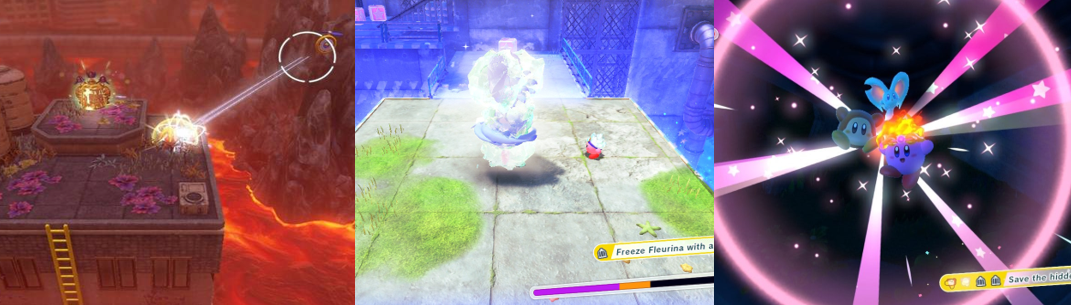
There are twelve copy abilities here. Though only Drill and Ranger are new, each has been tweaked compared to Kirby’s previous adventures and they can all be upgraded at the weapons shop (providing you have enough Star Coins, Rare Stones, and the right blueprints). Drill lets Kirby burrow underground and pop out to surprise enemies, while Ranger sees him fire a gun, holding down B to charge a shot that travels further and locks onto a target. Some of Kirby’s most recognisable copy abilities appear, such as Bomb (which sees you tossing bombs to blow up special blocks), Fire (which melts ice), Hammer (used to hit switches), and Ice (which thaws flaming blocks and allows Kirby to skate over lava). Cutter tosses a boomerang-like projectile and performs a melee combo, Needle sees you gather enemies and blocks and fling them as projectiles, Sword slices up those in your path, and Tornado blasts you across gaps and hazards for some extra height. Sleep is largely a hindrance, but all of these can be upgraded to make them more powerful. For example, “Dragon Fire” adds a flaming, dragon-like burst attack to your arsenal, “Masked Hammer” sees you dual-wield hammers that spew flaming tornados, “Meta Knight Sword” tosses an energy wave, and “Storm Tornado” fires lightning bolts. Each copy ability gets its own “Treasure Road” stage where you’re forced to use that copy ability to overcome a timed obstacle course, often involving tricky platforming and various combat scenarios, to earn a Rare Stone, with more unlocking as you clear Stages and upgrade copy abilities. While all of these are bestowed by certain enemies, Kirby sometimes comes across ability capsules (especially prior to a boss) and others are gained by defeating mid-bosses. As a general rule, if you see a certain enemy nearby, chances are you need their copy ability to rescue hidden Waddle Dees or access additional paths.
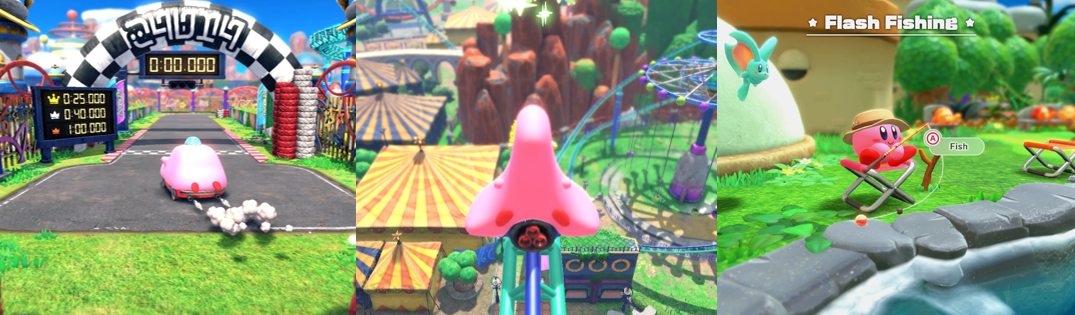
Kirby’s inherent swallowing ability is expanded upon here, allowing him to suck up certain objects and take on new “Mouthful” forms. These last for as long as you need, with the game prompting you to discard them when you’re done, and are used to solve simple puzzles. Car Mouth transforms you into a car, allowing you to dash with B and challenging you to race along narrow or crumbling roads and over ramps. Cone Mouth performs a drop attack to smash broken tiles and pipes or defeat Tortuildings, and Dome Mouth allows you to wriggle the left stick to pop off spheres and access goodies. The Light-Bulb Mouth lights up dark areas, powering consoles and attracting Ghost Gordos, Pipe Mouth sees you roll along and usually crash through cracked walls, and Scissor-Lift Mouth has you raise and avoid obstacles and reach higher areas. Storage Mouth has you wriggle the left stick to collapse walls, Vending Mouth has you blasting enemies and weak walls with a limited supply of canned drinks, and Water-Balloon Mouth transforms you into a massive, bulbous form that spits a limited supply of water to douse fires and clear toxic gunk. Arch Mouth sees you flying along a fixed path, dashing through rings and past falling obstacles to snag collectibles and hidden Waddle Dees, Coaster Mouth has you leaning left or right as you’re blasted along a high-speed rollercoaster track, and Ring Mouth lets you blast enemies and windmills with a puff of air and also propel boats. Mouthful abilities can’t be upgraded but you often switch between different ones to fill in shape holes in the environment, open new areas, or uncover hidden Waddle Dees. You can return to Waddle Town at any time from the world map to heal, play mini games (such as fishing and serving customers), or tackle various challenges at the colosseum. Here, you grab a copy ability and rematch the game’s mid-bosses and bosses, using a limited supply of healing items between rounds and earning goodies and even new copy abilities as you go. You can also replay any Stage or Treasure Round to find missing Waddle Dees or earn Rare Stones and extra Star Coins.
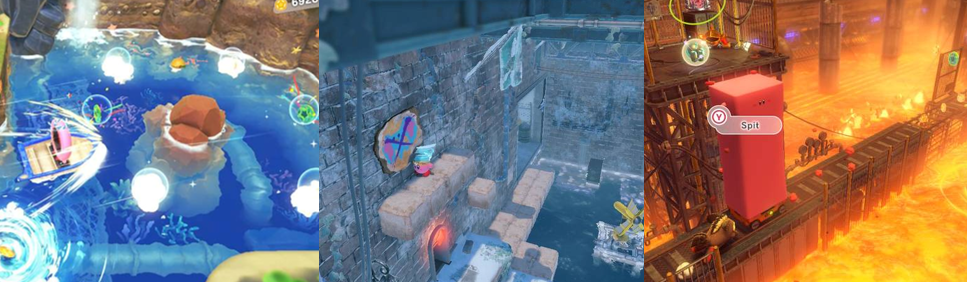
Thankfully (for me), Kirby and the Forgotten Land isn’t a sprawling, open-world adventure. Stages are larger than ever and allow for some exploration, generally by hitting bomb blocks or sparkling tiles or performing certain actions, but everything’s mostly nice and linear. You’ll hop to platforms, climb ladders, activate switches, travel to other areas of each Stage on Warp Stars, and enter doors to progress. Sometimes, you’re forced to battle waves of enemies or a mid-boss to progress; other times, you need a Mouthful ability. Your goal is to rescue every Waddle Dee in every Stage by clearing the Stage and completing missions, like eating certain foods, removing wanted posters, collecting five green gems, or bringing lost ducklings to their mother. You must race against a time limit with Car Mouth, take certain paths with Arch Mouth, activate all windmills with Ring Mouth, or shoot certain targets with Ranger. It pays to explore down alleyways or around the environment to locate hidden areas or Waddle Dees, especially as you can’t backtrack once you’ve progressed and you need a certain amount of Waddle Dees to challenge the Level boss. You can rescue additional Waddle Dees while fighting bosses, generally by beating them in time, using a certain copy ability, or avoiding damage. Other hazards include spike beds, bottomless pits, indestructible spiked Gorgos, massive cannons, falling meteors, lava pits, and rolling boulders. Temporary or moving platforms, the odd door maze, and conveyer belts also appear. Amusement park rides and animatronics must be avoided, slippery ice can cause you trouble, and powerful wind gusts and rapids will push you along. Interestingly, there are no underwater areas in Kirby and the Forgotten Land and no jaunts into the clouds, though you can uncover goodies by blasting away sand and light fuses to race into cannons and blast to new areas.
Presentation:
I feel like I say this every time, but Kirby has never looked better than in Kirby and the Forgotten Land. While his idle animations are limited to him simply swinging his arms and looking around, you can use the directional pad to perform additional taunts, which change when you have a Mouthful ability. Kirby changes form with each copy and Mouthful ability, gaining additional accessories and changing shape in often amusing ways, and will squeal in pain when hit. After taking enough damage (sometimes just one hit), Kirby loses his copy ability and must swallow it to regain it, and he performs his adorable victory dance upon completing Levels and defeating bosses. Although Kirby doesn’t talk, he conveys emotion through facial expressions and body language and the pixie-like Elfilin acts las his voice during cutscenes. It’s fun seeing Waddle Dee Town expand as you rescue its inhabitants, with them building new buildings and offering additional mini games and support, and there are many interactable areas on the world map to uncover new Treasure Roads or hidden Star Coins. You can chat with Waddle Dees here for hints and lore and defeated bosses like Clawroline and King Dedede also show up with extra quests or blueprints. The story is so simple that it requires basically no dialogue and is delivered through the best cutscenes the series has ever seen, which take full advantage of the Nintendo Switch to finally bring Kirby’s colourful whimsy to life in glorious 3D. The soundtrack is equally laudable, featuring remixes of many classic Kirby tunes and new songs (or ambient sound) that fit each area. The game follows a simple mission-like structure, presenting Stages each with a handful of areas and objectives and various hidden areas. It’s fun replaying Stages to track down missing Waddle Dees, sometimes using new or upgraded copy abilities, and the game makes it really easy to see which collectibles you’re missing and allowing you to quickly jump to incomplete Stages from the user friendly (if a tad bland) world map.
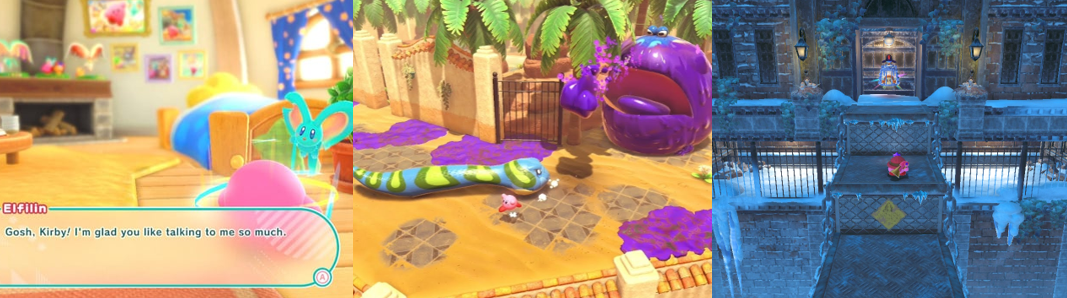
Surprisingly, Kirby and the Forgotten Land provides some new environments, ones that are familiar but unique enough to stand out from previous games. You start in “Natural Plains”, which is a once-bustling cityscape overrun by nature. You’ll encounter roads, buildings, and skyscrapers reclaimed by nature and venture into the abandoned, maze-like Alivel Mall, where restaurants and other businesses stand as forgotten as the once-impressing towering structures. “Everbay Coast” starts as a beautiful, tropical island with dazzling water and transitions to an oil rig-like area full of platforms suspended over water and ends in an abandoned waterworks full of fast-flowing water. “Wondaria Remains” was one of the most visually striking areas for me as it’s a neon-drenched fairground full of hazardous rides, space-theme animatronics, an overall circus aesthetic, and even a dark, jump scare-ladened haunted house. “Winter Horns” features a snowed-in city that’s reminiscent of Victorian London and sees you hopping across snowy rooftops and frigid winds blow you about, battling across an icy bridge, and hopping to floating ice platforms amidst a buried village and infrastructure. You even venture into a flash-frozen underground rail station, traversing ice-covered subway trains and jumping about on shipping containers. “Originull Wasteland” is a desert environment beset by a sandstorm, which has buried various mining equipment and ships. The sand dunes are awash with skeletons, debris, toxic gunk, and collapsing girders that you bypass to navigate through a rocky canyon and revisit the Alivel Mall from the opposite side, which is buried under sand. “Redgar Forbidden Lands” is easily the most hazardous Level as it’s essentially an active volcano, with lava and magma all around and meteors raining overhead that destroy the environment. This Level also leads to a churning, bustling power plant full of conveyer belts, crushing presses, and spiked walls and is a far greater threat that the final area, “Lab Discovera”, a futuristic complex that houses the final boss. Every area is remixed both visually and in terms of gameplay mechanics to provide a tougher challenge in the “Isolated Isles: Forgo Dreams” post-game, where darkness and danger permeate the gimmicks of each Level and are mashed together into truncated challenges.
Enemies and Bosses:
Long-time Kirby players will undoubtedly recognise many of the enemies here. Enemies are mostly incredibly basic, either standing still or hovering about, and are easily dispatched or swallowed for copy abilities. Some respawn if you need their copy ability for an upcoming section and you sometimes fight waves of them, but they’re very little threat. Blade Knight, Bronto Burt, Cappy, and Chilly all return, with the former and the latter bestowing two of the best copy abilities, alongside Bomber (which must be destroyed before it explodes), Glunk (which spits projectiles), and Poppy Bros. Jr. (whose bombs are great for clearing paths). Scarfy, Shotzo, Sir Kibble, and Totenga also pop up, with Sir Kibble bestowing the ever-useful Cutter ability and Scarfy aggressively chasing you. Some of the new enemies are noticeably larger than others, such as the sea lion-like Balloon-Meister (who tosses explosive beach balls and bestows the Bomb copy ability), ravenous Gnawcodiles (who swim about and try to devour you), and the Tortuilding and their Big Red variants (giant snapping turtles with buildings on their backs that require the Cone Mouth to smash). The Big Kabus (jumping stone heads), charging Buffahorns, and viper-like Sssnackers are also bigger almost act as mini-mid-bosses. Otherwise, Awoofys charge you, sharpshooting Bernards take shots from afar and hide behind cover, Corori roll snowballs at you, Digguh burrow into the ground to burst up beneath you, hedgehog-like Jabhogs become largely impervious with their spines out, and Rabiroos bound across the environment to try and squash you. It’s not long before combinations of these enemies crop up alongside giant cannons, spike beds, and other hazards, and they’re often called in to support mid-bosses and regular bosses too (which is good, as you can spit them as projectiles if you’ve lost your copy ability).
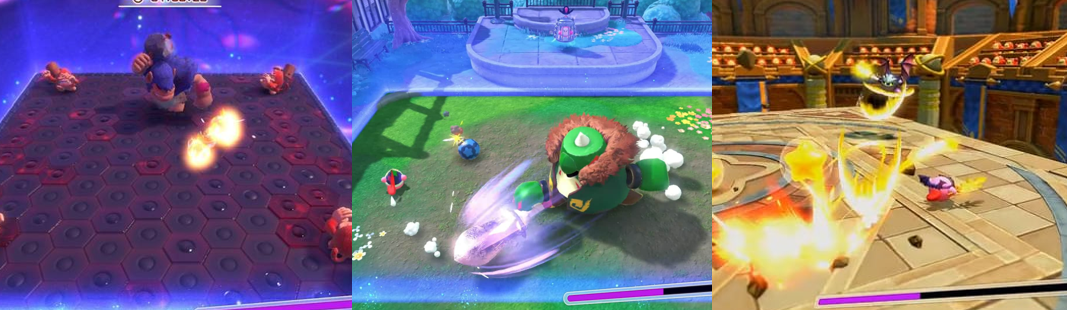
There are four mid-bosses you’ll encounter numerous times and in various combinations (sometimes one-on-one, sometimes two-on-one or more!) Each has a “pinch” mode, just like the bosses, and defeating them allows you to absorb their special ability (usually necessary for the next section of the Level). Fleurina is the only brand-new mid-boss here, being a large swan who spins around to conjure a damaging twister, chases you while spinning in mid-air, and sends three tornados spinning across the arena. The ape-like Bonkers returns as “Wild Bonkers”, still wielding his giant mallet, which he uses to try and squash you or spins like a dervish. He also uses it to smack giant, explosive rocks at you and performs a jumping, spinning slam to create shockwaves. “Wild Edge” is a variant of Gigant Edge, being a massive, armoured foe with a sword who often hides behind a giant shield, forcing you to attack from behind. Wild Edge attacks with a flurry of sword swipes, charges from across the arena, and gets stunned when you hit his behind. Mister Frosty also gets a “Wild” variant, one who throws massive snowballs, tackles you, and will grab you and chew on you if you’re not careful. Wild Frosty’s snowballs soon leave trials of icicles and he tries to belly flop onto you. All mid-bosses and regular bosses, also receive a “Phantom” variant that’s more aggressive and is fought again in the Waddle Dee Town colosseum. This is also where you battle Meta Knight, Kirby’s enigmatic rival who randomly flies around, quickly slashes with his sword, fires sword beams, and unleashes a powerful charged shot. It’s worth fighting and beating him to upgrade the Sword ability and as this is good practice for the post-game’s final boss.
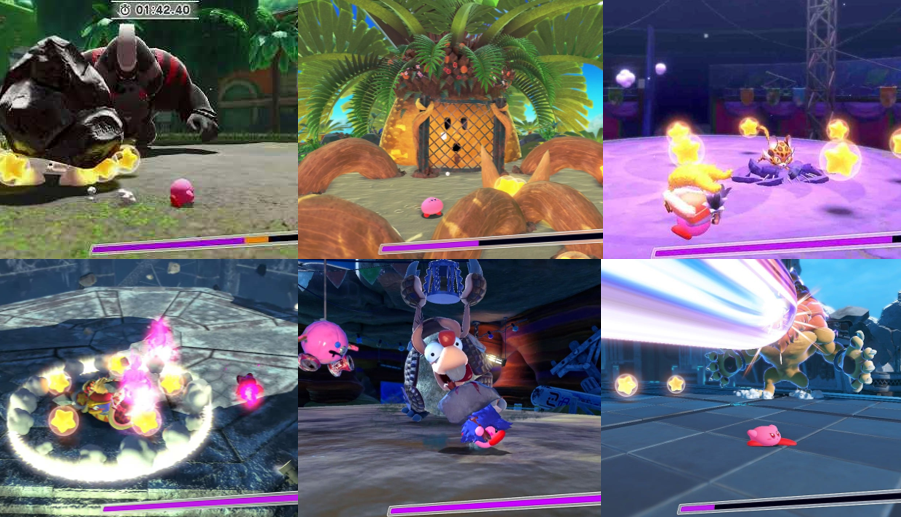
As mentioned, each boss can be beaten in different ways to rescue additional Waddle Dees, which can make them more difficult, much like challenging them with inferior copy abilities. Your first challenge is Gorimondo, a massive ape who squeezes the life out of you if he grabs you, swats you with his big ol’ paws, pulls rocks from the ground to toss, and spins around. Whispy Woods’ tropical cousin, Tropic Woods, is a large but stationary boss who spits puffs of air, drops exploding coconuts, and protects itself with barriers (which also form mazes). Its roots also twist all around the arena, it blows you back, and its “Phantom” variant produces a huge cloud that’s tricky to avoid. Clawroline posed a problem for me as she’s much quicker, dashes in with quick claw swipes, pounces on Kirby, and jumps to the nearby poles to fling her talons and dive bomb you. She also disappears and attacks at random places, and her “Phantom” variant flings an X-shaped energy wave. King Dedede is fought twice in the main game, becoming more aggressive each time. King Dedede swings his giant mallet, tries to butt stomp you (producing shockwaves), performs his running dive attack, spins about with his hammer, and eventually utilises a nearby pillar. In the “Redgar Forbidden Lands”, he has two mallets that produce flaming tornados and leave lava puddles, charges about like a boar, tries to inhale you, and leaps up to hurl fireballs. Sillydillo can be a pain without a ranged attack as it tries to lock you in a little cage, rolls at you with his massive hit box, and tries to pummel you with its little puppet-thing. Penultimate boss Leongar an also be challenging as he’s quite fast considering his size, and very aggressive. He swipes with his claws, drags them across the floor before performing a flaming uppercut, and creates shockwaves with an axehandle smash. When possessed by Fecto Forgo, Leongar gains armour, sends out X- or V-shaped energy waves, crawls across the floor trying to eat you, and blasts a massive laser from his mouth!
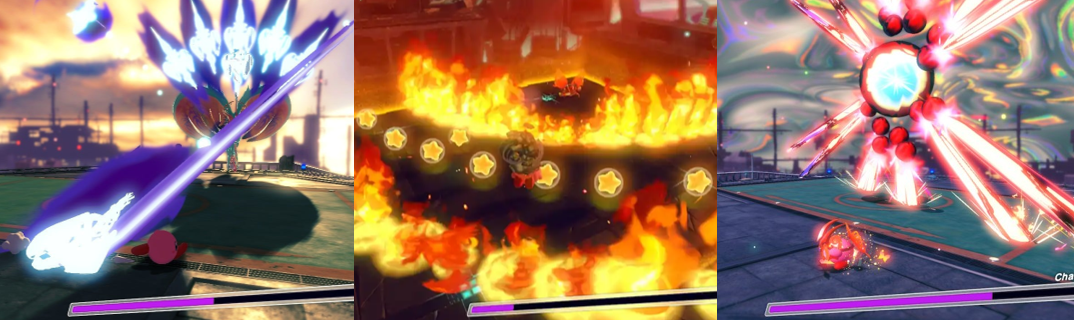
Once Leongar is defeated, you battle the parasite that possessed him, Fecto Forgo, in a tough multi-phase battle. First, Fecto Forgo chases you down a narrow corridor, forcing you to spit projectiles at it (or utilise copy ability projectiles), before absorbing Elfilin and becoming more formidable. In this form, it flies about out of reach tossing energy daggers, divebombing and swiping with its spear, charging across the floor with the weapon, raining energy daggers, and creating multiple shockwaves using portals. It also conjures a meteor shower with an explosive finale, duplicates itself to produce more shockwaves, regenerates its health (!), and increases in speed and aggression. Eventually, Kirby must use Dome Mouth to free Elfilin and then chase down Fecto Elfilis using the Big-Rig Mouthful, jumping between pathways with A, dashing through debris with B, and mashing buttons to finish it off. Tougher, more aggressive “Phantom” variants of all bosses are fought in the “Isolated Isles: Forgo Dreams” post-game, which ends with you battling Forgo Leon (who adds lightning and fire effects to his attacks) and Morpho Knight, a hyperaggressive variant of Meta Knight. The Masked Hammer ability and a Maxim Tomato are recommended for both as Morpho Knight teleports around, rapidly swipes with his sword, produces flaming waves that cover the entire arena, messes up the camera and your controls with a sound wave attack, and produces flaming lines with his sword. His swords get bigger as he takes damage, widening their effect, and he produces flaming columns that spin around and can be as tricky to avoid as he is to hit. Fighting through the colosseum’s “Ultimate Cup Z” sees you battle the super-powerful Chaos Elfilis, a bizarre, half-angelic dimensional being with various forms who duplicates itself, attacks with a spear and energy waves, utilises portals, fires a homing laser, regenerates health, and hurls asteroids and energy orbs.
Additional Features:
There are 300 Waddle Dees to rescue in the main game, which can be played on either “Spring Breeze” (“Easy”) or “Wild (“Normal”) mode, with “Wild” giving you less health and tougher enemies but offering more Star Coins. You can hold up to 999 Rare Stones, which are used alongside Star Coins and the twenty-four blueprints (generally hidden in Stages) to upgrade the copy abilities. You’ll also find Gotcha Capsules in every Stage, often as well hidden as Waddle Dees and blueprints, or obtain them using Gotha Capsule machines in Waddle Dee Town. These gift figurines of the game’s characters, enemies, bosses, and obstacles, and collecting them all adds to your total completion percentage. Rescuing Waddle Dees expands Waddle Dee Town, allowing you to rest at Kirby’s house, watch the game’s cutscenes at the cinema, listen to the soundtrack (as performed by the Deely Dees), and redeem Present Codes at the Waddle Dee-liveries post office. You can also tackle the colosseum and various mini games and extra Star Coins, battling all the game’s bosses (and some additional ones), matching customer orders, pressing buttons to fish for goodies, and playing “Tilt-and-Roll Kirby” using the Nintendo Switch’s motion controls. There are also fifty-six Treasure Road challenges to find and best for Rare Stones (though you’ll need all upgraded copy abilities to access them) and you can also utilise amiibos to unlock additional rewards, like food, items, and Star Coins.
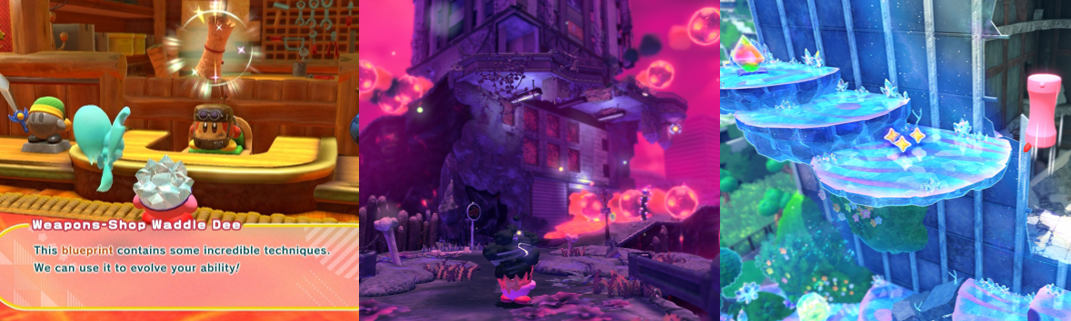
Clearing the main story unlocks the “Isolated Isles: Forgo Dreams” post-game, where Clawroline tasks you with tackling seven tougher, truncated versions of the main worlds, with visual changes, remixed hazards and enemies, and far more aggressive “Phantom” versions of bosses. Players must collect pieces of Leon’s soul, with around fifty found in each Stage and 250 of the 300 required to access the final area, “Forgo Land”, and battle Morpho Knight. I quite liked this extra challenge, which added a dark, bleak hue to previously colourful and vibrant environments, though it can be frustrating to miss pieces of Leon’s soul as you must replay the entire stage (including battling the “Phantom” boss) to regain it. If you’re playing the Nintendo Switch 2 version, you can also play through the “Star-Crossed World”, which sees a crystal-encrusted meteor shower create new, remixed versions of the existing Levels. Players collect Starry Coins, EX figures, and rescue Starrys rather than Waddle Dees. There’s also an extra cup added to the colosseum, the “Past Adventures” section has been expanded, alongside various visual changes and upgrades. Crystal variants of many enemies and the mid-bosses populate these worlds, which also offer three new Mouthful abilities: Gear Mouth (to cling to surfaces), Sign Mouth (to slide down slopes and spin attack), and Spring Mouth (to spring higher and ground pound). Kirby has numerous encounters with a new mid-boss in this mode too, Galactal, a crystalline entity that launches meteors, creates shockwaves that spawn crystal spikes, and bursts from the ground. Naturally, there’s a new, even tougher final boss, Genwel Meteonelfilis, who resembles the Fecto Elfilis fight but utilises crystals and is far more aggressive. It emerges from shadows, leaves crystal shards with every attack, emits waves of crystals and rains them down, create clones, and even slams part of a building into the arena!
Final Thoughts:
I was incredibly hesitant heading into Kirby and the Forgotten Land because I thought it was a sprawling open-world adventure, one with a daunting overworld, a laundry list of objectives, and a bunch of collectibles. I was therefore relieved beyond measure to find it’s a linear, level-based adventure very much akin to Kirby’s previous outings, with players tackling each area in sequential order. It was enough for me to have Waddle Dee Town be a central hub that could be expanded, to have fairly large Stages to play through, and to be able to upgrade Kirby’s copy abilities. Visually, Kirby and the Forgotten Land may very well be the best-looking Kirby game ever. Everything is so luscious and vibrant, and everything is so colourful and alive. Crucially, while many areas and gimmicks are recognisable to long-time franchise fans, this was the first time playing a Kirby sequel that I felt the developers were trying something new with the environments. The Mouthful abilities helped with this and added an additional layer of fun to the gameplay and puzzle solving, but the returning copy abilities were also utilised extremely well, and I felt a sense of becoming stronger with each upgrade. It’s very enjoyable dipping in and out of Stages to hunt down any Waddle Dees you’ve missed, as well as challenging the colosseum and post-game content, which felt like a fair difficulty spike after clearing the main game. I would’ve liked to see more from the mini games and the option to play as other characters (or at least transform into them with upgrades), but this was everything I’ve ever wanted from a 3D Kirby title. There’s enough here to keep you busy for a few hours and enough additional content and collectibles to come back for, making this perhaps the best Kirby game I’ve ever played.
My Rating:
Fantastic
Do you agree that Kirby and the Forgotten Land is one of his best adventures? Were you disappointed or relieved that it wasn’t an open-world game? Which of the Mouthful abilities was your favourite and did you ever upgrade all the copy abilities? Did you ever find all he Waddle Dees and clear the post-game? If you played the Nintendo Switch 2 version, would you say that it’s superior? Which Kirby videogame is your favourite? Comment below to share your thoughts on Kirby and the Forgotten Land and donate to my Ko-Fi for more reviews like this.


