
Created by Masahiro Sakurai, the disgustingly cute, ever-ravenous Kirby is one of Nintendo’s most popular characters. Accordingly, I’m dedicating most of July to celebrating the pink puff-ball.


Released: 29 September 2023
Originally Released: 15 April 2004
Developer: HAL Laboratory / Flagship / Dimps
Metacritic Scores: 80% / 8.6
Also Available For: Game Boy Advance, Nintendo 3DS (Virtual Console), Nintendo Wii U (Virtual Console), Nintendo Switch 2 (Nintendo Classics)
Quick Facts:
By 2004, Kirby had more than made a name for himself as a Nintendo staple thanks to a string of fun, colourful platformers and spin-off adventures across multiple generations. Kirby & The Amazing Mirror saw him tackle the “Metroidvania” subgenre alongside co-operative multiplayer for what’s said to be one of the franchise’s more under-rated entries.
Gameplay and Power-Ups:
Kirby & The Amazing Mirror is a 2D action/platformer with a heavy emphasis on backtracking, alternative paths, and exploration in which up to four players control different coloured Kirbys and explore the “Mirror World”. When the malevolent Dark Mind invades the Mirror World and creates evil reflections, a dark doppelgänger of Meta Knight splits Kirby into four, dumping them in the Central Circle hub world and tasking them with exploring nine colourful worlds using mirrors. The game is meant to be played in co-op, with your friends exploring different paths and then alerting you to the correct path or notable goodies, such as the Area Map that turns exploration from a largely directionless guessing game to a more linear and more enjoyable experience. All of Kirby’s traditional moves and abilities return here, with players holding B or X to inhale blocks or enemies and spit them out, jumping with A (or tapping A to inflate and fly indefinitely), and performing a downward slide by pressing down and B. When in the air, you press B to expel an air puff or press B when underwater to attack with a water spurt (which replaces any copy abilities Kirby has until he exits the water). Once you’ve inhaled an enemy, you press down to swallow them and gain their powers until you either take damage or press – to ditch the copy ability in favour of another. Kirby replenishes his health with food scattered all around and gains extra lives from 1-ups, with players rushing about on a Warp Star upon reaching a goal to stock up on these goodies. Pressing + provides a quick explanation of whatever copy ability you have and allows you to view the map of the current area, if available, to plot out a route towards Warp Stars, goals, and the level boss.
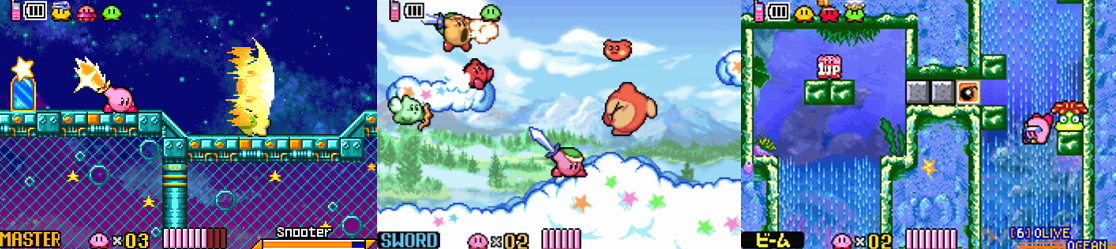
There are twenty-six copy abilities, six of which are new. Returning copy abilities include the ever-useful Sword and Cutter (allowing you to rapidly slash enemies and toss a boomerang-like projectile, respectively), Stone and Bomb (allowing you to crush and blow-up enemies and blocks), and Hammer and Ice (necessary to smash wooden blocks and access other paths or freeze enemies, respectively). You’ll need Burning or Fire to light fuses and blast off in certain cannons or break through special blocks, the new Mini ability to pass through tiny gaps (at the cost of having a stunted jump and no flight), and can cook any nearby enemies into food and 1-ups using the Cook ability or destroy them all with the one-use Crash. Cupid lets you fly faster and shoot (and charge) arrows, Magic bestows a random copy ability or power-up, and Missile transforms you into a heavy-duty missile to destroy metal blocks. By far the best copy ability is Smash, which gifts Kirby his moveset form Super Smash Bros. (HAL Laboratory, 1999) and combines multiple copy abilities into one so you can rapidly punch, perform the Final Cutter, turn to stone, swing your hammer, and perform a mid-air cartwheel. This was my go-to ability until the endgame, where you gain the Almighty Sword that has you charge a sword beam and perform thrusts and spinning charges. Kirby also becomes temporarily invincible with a special candy and can call his allies for aid using the Right Trigger (or exit the level by holding the Left trigger). You’ll need batteries for your cell phone to do this, but the other Kirbys also gain copy abilities from their adventure and can help with puzzles or to decimate mini- and main bosses alike. Thankfully, I never experienced a section of the game that required the other Kirbys; they can help with timed door switches, but you can also just move your ass faster to do the same thing. I assume the game’s quite fun in multiplayer with each player exploring different routes, but it’s not a requirement as you can either guess your warp to the Area Map or shortcut switch or boss or use online maps to find your way (which I’d highly recommend).
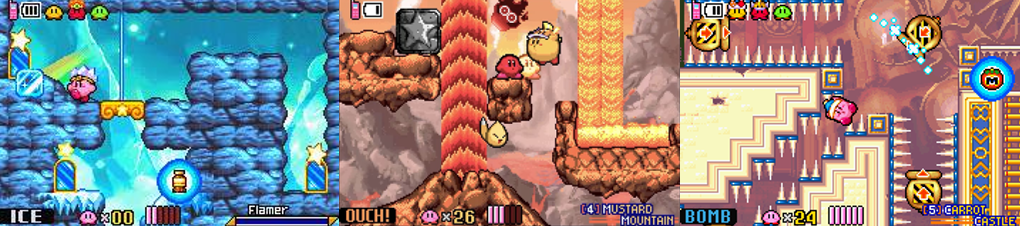
All the usual Kirby gimmicks are still here. You’ll explore underwater caves, castles in the clouds, and slip about on icy platforms. Rapids rush you along through water, wind currents blast you upwards or along, and spikes are dotted all over some environments (often hiding beneath crumbling blocks!) Platforms get smaller and smaller as you progress and, though you can circumvent this with Kirby’s flight, you must still watch out for airborne enemies. Flame bursts spew from volcanos alongside painful lava, electrical currents threaten to fry you, and you’re tasked with hopping or flying up narrow shafts dodging enemies, falling down shafts and avoiding spikes or bottomless pits, and exploring corridors full of mirrored doors. These are designed to confuse you, especially if you don’t have the Area Map, something only exacerbated by the hidden doors and alternative paths that lead to near-useless end goals or Warp Stars to new areas. Sometimes, you must press switches to open doors; often, you’re destroying bomb blocks to open new paths; and you also time cannon shots to fly through walls or past corridors of spikes. Sometimes, you must activate levers to create shortcuts, and multiple other shortcuts can be spawned, which you’ll need when you inevitably return to find the boss or a route to a new level. Kirby & The Amazing Mirror is played all topsy-turvy, with each level containing multiple routes, exits, or Warp Stars to others so you never play through an entire level from beginning to end. You can (and should) make the game more linear by finding the Area Maps but, even then, you must backtrack through the same areas, defeating respawning enemies as you go, to access new paths (occasionally by using different copy abilities). You’ll be searching all around for these exits, which are sometimes hidden behind special obstacles, behind regular blocks, or even inside the skittish Mirra enemies.
Presentation:
Graphically, Kirby & The Amazing Mirror is a fantastic companion piece to Kirby Super Star (HAL Laboratory, 1996), with Kirby’s sprites and copy ability accessories all largely based on that title. The four Kirby concept is apparent from the start where they rush the company logos while being chased by a gaggle of enemies and their functionality is somewhat similar to the buddy mechanic in Kirby Super Star (Kirby even feeds them to replenish their health), though they’re far less prominent when you’re playing solo. It is fun coming across them as you explore and helping them out of jams, but it’s probably far more enjoyable playing with friends. Kirby doesn’t have much of an idle pose, but he dons special hats and gains extra weapons from his copy abilities, and you can find spray cans to customise his colour, and he still performs his adorable victory dance upon beating bosses. Kirby also yelps in pain like in Super Smash Bros., gets roasted and electrocuted, and automatically dons goggles and a snorkel in water. Oddly, I didn’t notice much of a story here beyond a brief, in-game cinematic of Meta Knight’s encounter with the Mirror World and some basic text at the end. That’s not unexpected from a Kirby title but there weren’t any large sprite portraits or static images to tell the story until the final screen. King Dedede and Kirby’s other allies are also missing, and the game limits you to one hub world, where multiple mirrored doorways lead to each level. Jaunty tunes and playful beats are the order of the day here, though I didn’t notice many remixed tracks or much memorable music. The game has a nice, clean heads-up display, though, which helpfully displays your copy ability and comically reacts when you take damage or die.
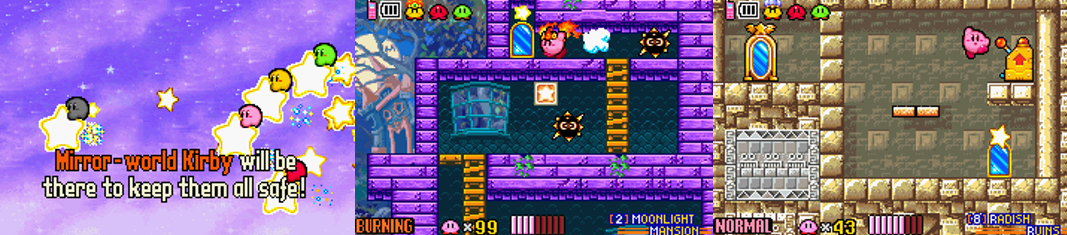
The Central Circle hub world resembles a heavenly paradise in fluffy yellow clouds and leads to the nine main levels and the final area once you collect the Mirror Shards and repair the Dimension Mirror. While some recognisable tropes are present and level layouts don’t differ much from previous Kirby titles (beyond the multiple paths and mirrored doorways), Kirby & The Amazing Mirror largely offers new themed levels to play through for a change. Rainbow Route is a fairly traditional forest stage with some flooded caverns, tree-like platforms and routes, and a thick, beautiful thicket of trees in the background. Moonlight Mansion twists this aesthetic into a crooked, haunted forest with a dishevelled graveyard and the ominous, titular mansion in the background, the inside is overgrown and dilapidated, featuring stone corridors, stained glass windows, and furniture blocking your path. Cabbage Cavern is a purple and lilac cave of vines, underwater areas full of rushing water, and narrow passageways barred by explosive blocks. Mustard Mountain opts for a volcano aesthetic. There’s lava everywhere, the ground erupts in flames, and lava pours like waterfalls, making for a notably perilous landscape. Carrot Castle reminded me of Castle Lololo as it’s a sprawling, ornate palace against a gorgeous sunset and includes a dingy dungeon, exterior areas where Moonlight Mansion looms in the background, and large, opulent windows. Olive Ocean recalled Float Islands with its beach aesthetic, palm trees, and abundance of water and underwater coral caves alongside waterfalls and rapids that rush you through flooded tunnels. Peppermint Palace is the ice-themed stage full of glittering crystal and ice blocks, a glowing aurora borealis, slanted paths, and a frigid cliffside where one false move sees you slipping into the abyss. Radish Ruins opts for an Aztec pyramid aesthetic, an enlarged garden, and cold stone chambers sporting spikes. Candy Constellation is a large mechanical facility out in the sprawling galaxy, with stars and a planet looming in the background, Gordo-infested tunnels, and a fun gimmick where water is suspended in zero gravity. The finale transports you to the distorted Mirror World, where aspects of each level are smashed together between boss arenas fought against a swirling vortex.
Enemies and Bosses:
Many of Kirby’s most recognisable enemies naturally make a return in Kirby & The Amazing Mirror, with many bestowing you with Kirby’s signature copy abilities. Waddle Dees wander around largely harmlessly or float from above on parasols while Waddle Doos fire their eye beam in an arc, nigh-invincible Gorgos and Shotzos dog your progress in narrow corridors or open areas, Bronto Burts flitter in the air, and Sir Kibbles toss Cutter boomerangs from afar. Rockys threaten to roll or crush you, UFOs erratically fly around taking shots at you, Wheelies race across the ground to ram into you, and Twisters transform into tornadoes and fly around the screen. Bang-Bang is a missile-like newcomer who wander about before blasting into the sky, Battys are bizarre bat-like creatures that roots on ceilings before swooping at you, Blockins disguise themselves as regular star blocks for a surprise attack, and the mole-like Boxins rush you with their boxer jabs. Chips are strange, fox-like creatures who hop about and relentlessly chase you, Cupies flutter around firing arrows, Droopys and Leaps steal your copy ability or transform into a more aggressive form, and seedling-like Foleys hover overheard and drop bombs. The large, stoney Golem spring to life when you pass by, spherical mechanical laser-firing Metal Guardians and big, giant variants and Waddle Dees and Rockys lurk as tertiary bosses, much like the sword-swinging Heavy Knights, while frog-like Jacks hide in cannons and Pranks will humiliate you on contact. Soaraars fly about, Snooters try to eat you, and Shadow Kirby often pops up boasting similar copy abilities and dropping random power-ups upon defeat.
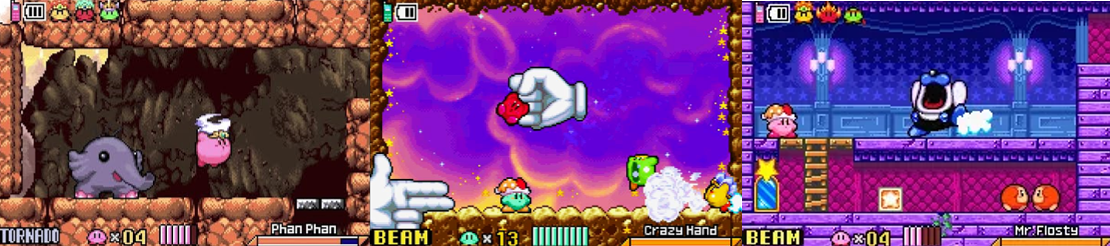
Similarly, eight mini bosses appear, each bestowing a particularly powerful copy ability upon defeat. Batafire is a large bat that resembles a fireball and flies back and forth, swoops from one side of the arena to another, or floats in the middle and spews fireballs. It’s quite a large sprite so it can be difficult to dodge, much like Bombar, an adorable anthropomorphic jet fighter who spirals across the screen and swoops at you while winds whip past. Bombar also fires homing missiles and drops a bombardment of warheads, which can be inhaled for the Missile and Bomb copy abilities. Box Boxer and Phan Phan were two of the more aggravating mini bosses for me. Both wander back and forth, rushing you with a charging punch or rolling tackle, and toss projectiles but are particularly frustrating as they tend to snatch you out of the air or off the ground and toss you. Boxy is a ravenous gift box who hops back and forth trying to bite you and spits out bombs, enemies, and the odd power-up, Bonkers returns to swing his trademark hammer and now tosses explosive coconuts, and the mischievous Mr. Frosty also returns to devour you or toss ice cubes. Master Hand also appears as a mini boss, granting the Smash copy ability when inhaled, and mirrors his Super Smash Bros. counterpart by pounding the ground with his fist, punching, squeezing you, and firing finger bullets. Master Hand teams with Crazy Hand in Candy Constellation for a two-on-one fight, with the two performing a clap and other tandem attacks to keep you on your toes. Long-time Kirby players my recognise King Golem, who’s basically a reskinned Whispy Woods and attacks in the same way, dropping rocks and Gordos rather than apples and spawning Golems from his mouth rather than air puffs. Kracko also returns in Mustard Mountain and still sprouts spikes, chases you with lightning, and douses you with a rainstorm.
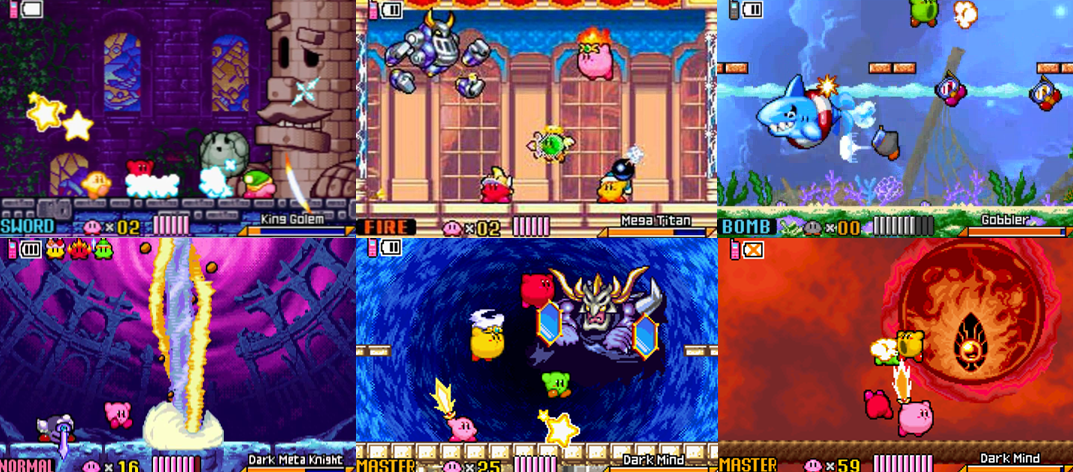
Moley randomly pops from the ground or ceiling and tosses rocks, bombs, burning oil drums, and more if you give him the chance and shunts you with his nose, forcing you to quickly anticipate where he’ll be and attacking when you can. The intimidating armoured robot Mega Titan is completely invulnerable and floats about firing its four fists at you. You must force for the Mega Titan into the electric traps located on either side of the arena, though it can be tricky without the right copy abilities and, even then, you must dodge its many rocket-powered fists. Gobbler was somewhat similar to Acro as it leaps from the water to bite you, spawns three shark-like Snappers to distract you, and charges at you to swallow you, though Smash or Stone can near-instantly defeat him. Wiz rushes about a slippery arena and tosses enemies and projectiles from its magician’s hat, being invulnerable when doing so but an open target otherwise. Dark Meta Knight is fought twice, though both battles are fundamentally the same and his attacks largely mirror the regular Meta Knight. Dark Meta Knight performs sword thrusts in many directions, a leaping sword slash, defends against your attacks with his blade, and performs a drill-like charge. He also unleashes a sword beam, often at rapid speeds, in the second fight. One you assemble the Dimension Mirror, you battle Dark Mind in six phases, three of which are largely the same but get progressively difficult. Dark Mind teleports about and fires a flurry of star-like projectiles while mirrors protect him, exploding with splash damage if destroyed. Dark Mind’s movements and attacks become increasingly erratic and the arena changes to sport water and slippery ice, but the Almighty Sword easily decimates him when you land a hit. After four rounds, Dark Mind transforms into a gigantic, glaring eye and fires ricocheting lasers between its mirrors, spawns some enemies to distract you, fires massive beams, attacks with its mirrors and is noticeably more durable. You then hop on a Warp Star for a top-down shooter to finish it, blasting its projectiles, avoiding its tackle, and pummelling it even as the credits roll.
Additional Features:
There are many different paths and goals to reach in each level in Kirby & The Amazing Mirror. While it’s not necessary to find them all (you really just need to find the Area Maps and defeat the bosses), doing so brings your save file closer to 100% completion. They also bring you to treasure chests containing helpful items that extend your life bar and unlock new tracks in the sound test or colours for Kirby, with these being tracked form the main menu. Alongside three save files and multiple languages, Kirby & The Amazing Mirror boasts three mini games that see you compete against your friends to crack the world like in Kirby Super Star, eat the most food, or ride waves in a surfing race. Reaching 100% completion unlocks the “Boss Endurance” mode where you randomly fight all the mini bosses and main bosses, including a powered-up Waddle Dee and the multiple Dark Mind fights (with no rest areas for this latter challenge). This version of the game also comes with the usual rewind and save state features to help lower the frustration of all the backtracking, and you can even play the European version where Kirby doesn’t look like he wants to kill you!
Final Thoughts:
I was quite excited to play Kirby & The Amazing Mirror, expecting it to be much of the same colourful fun of Kirby’s 16-bit heyday and was stunned to discover it’s a more sprawling, exploration-based adventure. I was a little lost and frustrated to start with as I randomly travelled from one level to the next with no end in sight, even when I reached the Warp Star goals and defeated bosses, and was confused when the other Kirbys buggered off on their own offscreen adventure and barely factored into the gameplay or puzzle-solving. Once I got my head out of my ass and realised there’s a map screen, the game became much more enjoyable as I sought out the Area Maps and then went right to the boss to force the game into a more linear adventure. There was still a fair bit of backtracking and exploring as you can’t just progress from one level to the next and must unlock the doors and shortcuts, but this made things more manageable. Once I acquired the Smash copy ability, I never looked back and mostly coasted through the game, which was a very vivid and adorable experience with some fun bosses and moments, but which didn’t do too much to mix up the Kirby formula. I almost wonder if the game should’ve forced a co-op mode, making it unplayable for solo gamers or encouraging you to summon or even control the other Kirbys to solve puzzles. Instead, we get a regular Kirby adventure that’s artificially extended and made more challenging by presenting the action in a non-linear fashion, which is more annoying than enjoyable. I would’ve liked to see more screen time for Shadow Kirby and Dark Meta Knight, more puzzles linked to the multiple Kirbys, and some new copy abilities to make things interesting. It was a decent and colourful, whimsical adventure that surprisingly made me think more than I expected, but I think it would’ve worked better as a straightforward amalgamation of Kirby’s previous 2D adventures.
My Rating:
Pretty Good
Was Kirby & The Amazing Mirror in your Game Boy Advance collection? Did you ever play the game in co-op and, if so, how was it compared to playing solo? Were you also disappointed by the emphasis on backtracking and exploration or did you like the attempt at something new? Which of Kirby’s six new copy abilities was your favourite? Did you ever 100% the entire game and which Kirby videogame is your favourite? Use the comments to share your thoughts on Kirby & The Amazing Mirror and support me on Ko-Fi for more reviews like this.


