Created by Masahiro Sakurai, the disgustingly cute, ever-ravenous Kirby is one of Nintendo’s most popular characters. Accordingly, I’m dedicating most of July to celebrating the pink puff-ball.


Released: 5 September 2019
Originally Released: 27 November 1997
Developer: HAL Laboratory
MobyGames Score: 7.4
Also Available For: Nintendo 3DS (Virtual Console), Nintendo Switch 2 (Online), Nintendo Wii, Nintendo Wii U (Virtual Console), Super Nintendo Entertainment System (SNES)
Quick Facts:
Kirby’s Dream Land (HAL Laboratory, 1992) was HAL Laboratory’s most successful release at the time thanks to its simple gameplay. Kirby further cemented his name with the highly praised NES classic, Kirby’s Adventure (ibid, 1993), and Kirby’s Dream Land 2 (ibid, 1994) sold over a million units. Bolstered by the critical and commercial success of Kirby Super Star (ibid, 1996), HAL Laboratory continued the Dream Land series with this pastel-coloured adventure, which, despite a mixed reputation, seems to be widely regarded as a fun but disappointingly average title.
Gameplay and Power-Ups:
Kirby’s Dream Land 3 is a 2D, action-orientated sidescrolling adventure that essentially acts as 16-bit remake or expansion of Kirby’s handheld adventures, specifically Kirby’s Dream Land 2. Accordingly, it mirrors many of the Game Boy titles’ mechanics, features, locations, and enemies, though is noticeably expanded to include five levels, each with six stages and a dedicated boss battle, with a secret sixth level unlocked by collecting all thirty Heart Stars to assemble the Love-Love Stick. Though a SNES title, Kirby’s Dream Land 3 continues to keep the controls simple and simplifies them from the Game Boy titles as you no longer need to hold up on the directional pad (D-pad) to inflate and fly. Instead, you simply tap B to either jump or flap Kirby’s stubby arms and bypass most enemies and obstacles (though they are more airborne hazards than ever here, so watch out!) You hold Y to inhale nearby blocks or enemies, either spitting them out with Y (which also doubles as a water spurt when submerged) or pressing down and Y to swallow the enemy and potentially gain a new ability, ditching it with –. You can now defeat enemies by jumping on them, slide by pressing down and A (though this doesn’t seem to hurt enemies), run by double-tapping a direction on the D-pad, and swim with B. X spawns Gooey, who has his own health bar and also devours and spits out enemies to aid you, though you’ll lose a block of health if he’s defeated. On the SNES original, a second player could control Gooey for some co-operative two-player action, but I’m not sure if the Nintendo Switch Online version supports this. You again restore Kirby’s health with Energy Drinks and Maxim Tomatoes, gain temporary invincibility with rare candies, and collect 1-ups or collect Star Pieces for extra lives. Star Pieces are now hidden all over and you need thirty of the buggers for an extra life, so be sure to look everywhere.
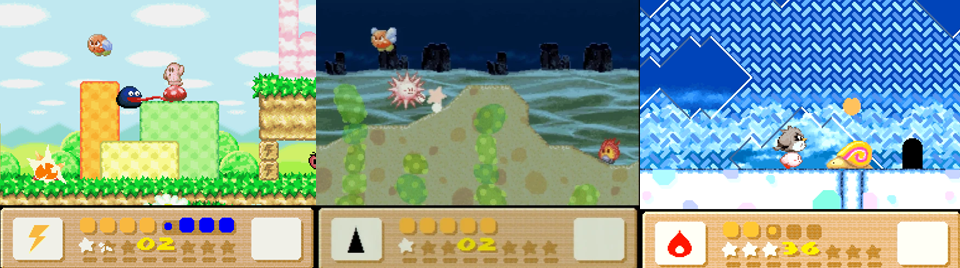
While Gooey helps quite a lot and even acts as a projectile in a pinch, you obviously primarily rely on Kirby’s copy abilities, of which only two are new (and the Love-Love Stick is only in the secret final level). Burning sees you become a fireball for a short burst and melts ice blocks, Cleaning kicks up dust to attack enemies, Cutter launches a boomerang-like projectile, and Ice sees you freeze enemies into ice blocks you can hit into others. Needle sees spines burst from Kirby (great for breaking blocks beneath you), Parasol adds a short-range melee attack to your arsenal, Stone sees you crush enemies and blocks from above, and Spark emits electrical sparks that frazzle nearby enemies. You can only use one copy ability at a time and lose it if you take damage, but they can again be combined with Kirby’s animal buddies for additional attacks. You partner with a buddy when visiting special areas, pressing X to mount or dismount them, and each has different abilities. Coo the Owl, Kine the Sunfish, and Rick the Hamster all return from Kirby’s Dream Land 2, with Coo allowing you to fly indefinitely, Kine making swimming a breeze, and Rick still keeping you from slipping on ice. Newcomers ChuChu the Octopus, Nago the Cat, and Pitch the Bird see you stick to ceilings to bypass spikes and other obstacles, gain a triple jump (somewhat redundant since Kirby can fly), and offer constant flight (despite Kirby’s weight). When you have a copy ability, Nago breathes fire, Pitch attacks like a rocket, Kine gets covered in spikes, and Rick transforms into a rolling boulder. Rick also tosses Kirby, Coo fires three icicle projectiles, Kine spits fireballs and energy waves, Nago pogos around on a parasol, ChuChu flies on a broom, and Pitch darts ahead like a lance. There are a bunch of different combinations and you’re constantly given the chance to switch your buddy, with it often being necessary to have a specific buddy and/or copy ability to access hidden areas or earn Heart Stars.

Kirby’s Dream Land 3 retains the same gameplay mechanics as its predecessors, tasking players with exploring colourful, largely linear levels, using doors to switch to new areas, destroying star blocks to reach side paths, and occasionally racing against a scrolling screen that kills on contact. Sometimes these force you up or down narrow shafts, while other times you must swim through tight tunnels or outrun boulders (hopping to or dropping down to safety as required), but both are perilous as the screen’s quite fast. Green gelatinous blobs blast you through blocks, water jets speed you through underwater caverns, some blocks crumble beneath you, and you’re occasionally tasked with a looping door maze. Spikes occasionally jab you or fall from above, snow and sand shifts you towards bottomless pits, spiked Gordos float everywhere, and lava threatens to scorch your toes. Wind currents boost you up or push you along at speed, enemies sometimes spring to life from chalk drawings, and raging snowstorms push you back and screw up your platforming without the right friend on hand. Kirby’s Dream Land 3 offers one mini game per level where you can earn a Heart Star. These see you matching which Gordo was thrown, picking the right pot that hides an Elieel, correctly guessing how many coloured Gordos appeared, and matching the sounds they make. These mini games can be tricky as they speed up as you progress, though the rewind feature largely negates this. Each level ends with a jumping game where you press B at just the right moment to jump on goodies, and every level has a non-playable character (NPC) to help for a Heart Star. You must make sure not to crush certain flowers, collect pieces of Professor Hector’s Robotic Operating Buddy (R.O.B.), flash freeze and destroy Metroids, use Needle to burst a balloon and rescue Piyo, bring Kine to Mine, Rick to Pick, and Naga to Shiro, and rescue Goku (not that one) for Chao (not that one, either). There’s no in-game direction for what you need to do and which abilities or friends you need, so there’s a lot of trial and error and replaying without a guide and is can be frustrating as you must help every NPC to see the true ending.
Presentation:
Kirby’s Dream Land 3 takes advantage of the SNES’s superior processing power and colour palette (at least, compared to the Game Boy) to present a super vibrant, pastel-coloured adventure somewhat akin to Super Mario World 2: Yoshi’s Island (Nintendo EAD, 1995). While Kirby still lacks idle animations (beyond swaying his arms and blinking), he pops far better than on the Game Boy thanks to the pastel colour palette. He yelps when hit, comically squishes and inflates, still performs his adorable victory dance, and noticeably changes form depending on with copy ability or animal friend he’s using. These see him whip out a parasol, turn into a rock, sweep with a broom, jump into Kine’s mouth, and be rolled along by Nago. The game’s bookended by some partially animated comic book panels that show the gist of the super simple story, and each level is introduced with a short cutscene showing Kirby with his buddies. Unfortunately, the world map from Kirby’s Dream Land 2 has been replaced with a storybook-like image that charts your progress across. The in-game action is also needlessly obscured by the large heads-up display, which shows a lot of relevant information but eats into the screen space. The music is just as jaunty as ever, with the SNES continuing to offer chirpy remixes of Kirby’s 8-bit themes, though it was a bit disappointing to see every location from Kirby’s Dream Land 2 recycled. Sure, they look and often play very differently, but it didn’t help the game stand out and contributed heavily to me seeing this as more of a 16-bit remake than a true sequel. Little graphical touches do help, however, such as clouds rushing by, the water rippling, snow moving and even burying you, and flowers pulsating or rotating as you explore. Foreground elements occasionally obscure the screen and there are some instances of parallax scrolling, but Kirby’s Dream Land 3 largely keeps things very safe with its linear, often barren paths and simple level layouts. At least, until you’re search for NPCs to help for Heart Stars, then you must often seek out the right copy ability or animal buddy to find new paths or progress.
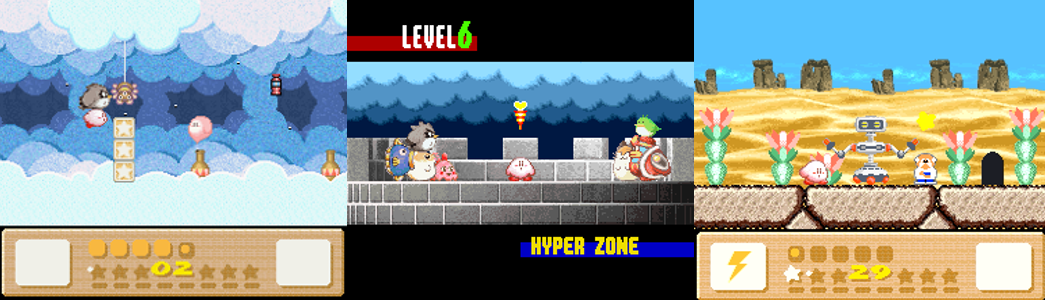
Since each level has six different areas to explore, there’s quite a bit of visual variety on offer, though the sheer number of stages can be daunting (four and a fifth boss stage would’ve been enough) and reducing the stage count might’ve meant including a penultimate castle stage. Like Kirby’s Dream Land 2, things start with “Grass Land”, a colourful grassy and woodland area that introduces the basic gameplay mechanics. At times, the area veers into bizarre visuals like Fantasy Zone (SEGA, 1986), especially once it mixes in mosaic patterns with the treetops and mountainous backgrounds. “Ripple Field” is, again, a tropical themed area largely full of beach-like areas with palm trees and underwater tunnels filled with jet streams and narrow caverns. Day turns to dusk as you progress, you venture into coral caves and an ancient palace and eventually reach stone grey cliffs. This segues nicely into “Sand Canyon”, an arid desert populated by dinosaurs and (strangely) snowmen and featuring a trippy pyramid-like temple, vast mountains, narrow tunnels where boulders chase you, and crumbling sand blocks. “Cloudy Park” is, naturally, a cloud-based location where you float on wind currents, paddle through water, battle both the autoscroll and obscuring foreground clouds, and venture into a palace of mesh and pillars. “Iceberg” sees you either struggling through deep snow, battling snowstorms, or slipping on ice. Snow falls around you, gleaming ice constructs obscure enemies, Kirby’s chased by avalanches, and you end up inside King Dedede’s fortified stronghold where a gauntlet of mini bosses awaits. The final area, “Hyper Zone”, is a surreal void where you indefinitely float to battle Dark Matter’s many forms and players see different endings depending on if they’ve beaten this final challenge or not. While there are some fun elements in each location, like chalk pictures coming to life, shifting ground, and enemies masquerading as background elements, it’s all a mishmash of gimmicks from previous Kirby games. This results in some ill-fitting choices, like volcanic areas in “Sand Canyon”, though I guess these allow every area to have some variety. Kirby’s Dream Land 3 may play a lot slower than its predecessors, but it performs extremely well, with no slowdown or sprite flicker no matter how many enemies fill the screen.
Enemies and Bosses:
Basically all of Kirby’s previous enemies return here, each performing exactly as before. All are defeated in one hit and will respawn if you venture offscreen, and many bestow copy abilities when swallowed. Devouring Broom Hatters or the witch-like Kekes gifts you Cleaning, for example, while Sir Kibble grants Cutter and Chilly grants Ice. You’ll eventually encounter many armour-clad Bukisets, each wielding different abilities depending on the situation, allowing you to quickly change abilities if required. Waddle Dees return, still wandering about and lacking their eye beam attack, and now paddling about in adorable life rafts or riding Nruffs. Babuts still drain your health with their bite, Poppy Bros. Jr.s still ride apples and bombs, and Mumbies float after you. Pterodactyl-like Pterans fill the skies, often while fire-spewing Galbos wait below, Scarfys and Propellers pursue you on sight, and ravenous, shark-like Acro Jr. wait in some waters. Cloud-like Louds float above dropping rain, caveman-like Dogon’s reflect your projectiles, mole-like Doka shovel dirt in your face, and hungry Pactos wait offscreen to cobble you whole. Similarly, Peloo may emerge from the background to grab you with its sticky tongue, Apolo often spin around platforms or pillars, and Yaban leap up and fire arrows at you. Sasuke float from above, Mopooe emerge from the snow and Oro from the ground or ceilings (often right near a door), and Nidoo disguise themselves as doors. Tick thrust a needle up as you pass over them, cannons (and larger cannonballs) fire potshots, skull-wearing Gabon toss bones, and spider-like Mariels emerge from the darkness and doorways to catch you off-guard.
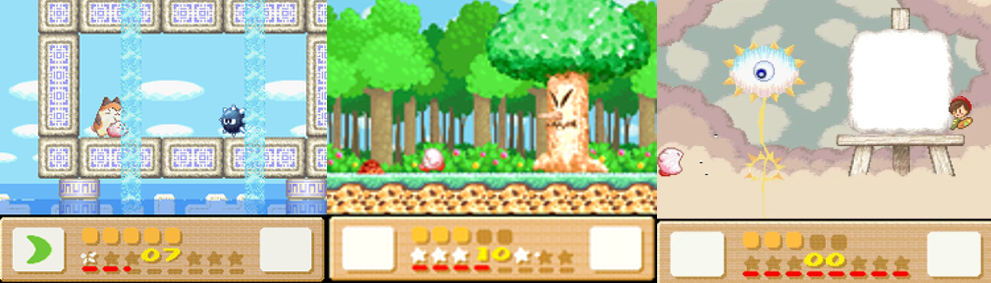
Although you no longer need to battle mini bosses to rescue Kirby’s animal friends, you may have to battle them to acquire Heart Stars and you must endure a gauntlet of them in the final area of “Iceberg”. Three mini bosses return from Kirby’s Dream Land 2. Blocky hops about the small arena and charges at you, leaving behind rocks you must dodge and then spit at it if you don’t have a copy ability. Captain Stitch floats around and fires its spines at you, leaving its core vulnerable for a few seconds so you can attack. Jumper Shoot flies about, often spinning like a propeller, and again throws its sandal at you. Boboo is a large walking flame who charges across the arena, Haboki is a sentient broom who boasts a similar attack, and Yuki is a malicious pile of snow who slithers about, collides with the walls, and tosses its head (or multiple heads) as projectiles. When battling the mini bosses in the last stage of “Iceberg”, it’s advised that you inhale the defeated mini boss to acquire their ability to snag goodies in the area prior to the next battle. A few familiar bosses also return, though with additional phases. Wispy Woods uproots and chases you, for example, while the Ice Dragon, Sweet Stuff, Mister Shine and Mister Bright, and Kracko are all summoned by Ado’s drawings. The Ice Dragon throws an ice cube along the ground, whips with its tail, and has freezing breath; Sweet Stuff produces electrical sparks and tosses starfish; Mr. Shine and Mr. Bright drop fireballs and/or energy waves; and Kracko surrounds itself with minions and chases you with a lightning bolt. Ado’s drawings are a far cry from the real deals, however, and they’re notably much easier to defeat than in Kirby’s Dream Land 2.

The giant shark Acro initially slides across the ground and into the cavern walls to cause rocks to fall then, after enough hits, the battle moves underwater. You must dodge the Acro Jrs., anchors, and skulls it spits and the rocks that continue to fall and attack with your waterspout or copy ability, but don’t get too close as you’ll take damage from its large hit box. Raccoon and fox duo Pon and Con are fought in “Sand Canyon”, with them simply wandering or hopping back and forth across different platforms while flanked by their disposable minions. They’ll toss bombs and each have their own health bar, but this is a simple matter or switching to the right platform and attacking each as they approach. After besting his mini boss gauntlet, you’ll encounter King Dedede atop his castle in what starts as a repeat of Kirby’s Dream Land 2. As ever, King Dedede attacks with his giant mallet, a theatrical ground pound, and by sucking you up and spitting you out. After enough hits, Dark Matter emerges from King Dedede, restores his health, and puppets him about. In this phase, Dark Matter emits homing blobs of dark energy and, most disturbingly, transforms into a ravenous mouth that tries to eat you! Defeat the possessed King Dedede after collecting all thirty Heart Stars and you can tackle Dark Matter in the warped “Hyper Zone”. This time, you battle Dark Matter’s true form (a dark, disembodied eye) while constantly flying about. You must swing the Love-Love Stick to attack Dark Matter, chipping off its smaller pieces and avoiding its lancing black lightning. Upon defeat, Dark Matter gives way to Zero, a massive white eye that takes up a lot of screen space, fires a barrage of smaller Dark Matter eyes alongside red energy blasts, and attacks from the background with red explosions. Once this is defeated, the red inner core goes nuts, flying erratically about the scream but easily being finished in a few hits compared to its bulbous, spongy first form.
Additional Features:
You get three saves files in Kirby’s Dream Land 3, which each tracking your completion percentage. This is based on how many Heart Stars you’ve collected and how many levels you’ve cleared, so you’ll need to consult a guide and jump back in to replay any previous areas to find those missing Heart Stars. This means replaying every single level, often in specific ways, which is a hell of a chore compared to Kirby’s Dream Land 2, though it’s the only way to battle the true final bosses. Luckily, the Nintendo Switch Online also offers an “SP Version” with all Heart Stars collected, allowing you to quickly jump into the “Hyper Zone” if, like me, you haven’t got the time or patience to get the Heart Stars legitimately. Finishing the game this way unlocks a bunch of additional extras, including the ability to watch every cutscene and level introduction and listen to the game’s soundtrack. You can also play remixed versions of the goal-jumping mini game with whichever animal friend you desire, tackle every Heart Star mini game at will in the “Super NES M65” mode, and take on the “Boss Butch!” boss rush mode without the aid of any copy abilities, healing items, or even Gooey! These extra games also count towards your completion percentage so you must master each of them to hit 100% (or, again, just play the “SP Version”). Finally, of course, the Nintendo Switch Online version includes save states and a rewind feature to mitigate much of the game’s difficulty.
Final Thoughts:
I was strangely disappointed by Kirby’s Dream Land 3 in ways I honestly didn’t expect. While the game looks and sounds great, utilising cartoonish visuals brought to life by fun pastel colours and a colouring-book aesthetic, it feels very slow and sluggish at times. Not because of slowdown or hardware issues, either; this is purely down to the game engine and physics. This oddly makes the game feel slower than Kirby’s Dream Land 2, even with Kirby’s new dash ability. It doesn’t help that Kirby’s Dream Land 3 revisits the same locations as the last game and recycles the same copy abilities, adding basically nothing to Kirby’s repertoire beyond the additional attacks and abilities afforded by his animal friends. Even these were a disappointment, though, as they were just out in the open to partner with and sometimes felt like a handicap to Kirby’s momentum (except when using Kine in water). While, yes, each area is vastly different from Kirby’s Dream Land 2 and contains a lot of variety thanks to the six-stage structure, this approach makes for a laborious gameplay experience, one further compounded by you being forced to replay levels to acquire Heart Stars. I did enjoy the added variety and challenge offered by these, but a little direction about what to do would’ve been appreciated as I never felt excited about replaying a stage. I did like the mini game sections and the new bosses, but Kirby’s Dream Land 3 recycles so much from the last game that it’s difficult to get too excited about facing the returning bosses, even with their slight tweaks. Gooey was a fun addition, but probably more enjoyable with a friend to play alongside, and there are some fun extra modes on offer. However, at the end of the day, Kirby’s Dream Land 3 is just a 16-bit recycling of the portable games, which is technically great, and it’d probably be better to skip the previous 8-bit titles and jump straight to this one. However, there’s little about it to help it stand alone or outshine Kirby Super Star, so I couldn’t help but be let down by how Kirby’s Dream Land 3 turned out.
My Rating:
Pretty Good
Did Kirby’s Dream Land 3 have a place in your SNES library back in the day? Which of the new animal friends was your favourite? Were you disappointed that so much of the game was repeated from Kirby’s Dream Land 2? Do you agree that this was a disappointment compared to what came before? Did you ever collect all the Heart Stars and clear the boss rush? Which Kirby videogame is your favourite? Whatever your thoughts on Kirby’s Dream Land 3, leave them in the comments and go support me on Ko-Fi if you liked this review.


One thought on “Game Corner [Kirby Month]: Kirby’s Dream Land 3 (Nintendo Switch)”