Game Corner: Marvel: Ultimate Alliance 3: The Black Order (Nintendo Switch)

Released: 19 July 2019
Developer: Team Ninja

The Background:
For decades, few videogame publishers were as synonymous with Marvel Comics as Activision, who produced adaptations Marvel’s most popular properties. While some were better than others, Activision’s efforts were largely praised, especially after they partnered with Raven Software on the X-Men Legends games (2004; 2005). Activision and Raven Software expanded their scope to the rest of the Marvel universe with Marvel: Ultimate Alliance (2006), a largely successful team-based brawer praised for improving upon its predecessors. Though now delisted, it was followed by a sequel three years later, courtesy of Vicarious Visions, which tweaked the gameplay with team-based attacks to encourage experimentation. Though Marvel: Ultimate Alliance 2 (2009) was praised for its branching storyline, the stripped down roleplaying mechanics were criticised. While it was also delisted in 2020, fans were clamouring for a follow-up and, just ten years later, Team Ninja stepped in to work alongside Marvel in reviving the franchise. Seeking to place additional emphasis on combat, the developers explored the cosmic scope of the Marvel universe by including the Infinity Stones and lesser-known characters and chose to make the title a Nintendo Switch exclusive after developing a close relationship with Nintendo. Although Marvel: Ultimate Alliance 3: The Black Order was the sixth best-selling game in its first week and was later bolstered by extensive downloadable content (DLC), it was met with mixed reviews that praised the colourful action but criticised its lack of innovation.

The Plot:
While battling Nebula and Ronan the Accuser, the Guardians of the Galaxy stumble upon a plot by the mad titan, Thanos, to collect the six Infinity Stones. Although they scatter the Stones, Thanos’s acolytes, the Black Order, pursue the gems, prompting an alliance of Earth’s mightiest heroes to retrieve them first.

Gameplay and Power-Ups:
Like its predecessors, Marvel: Ultimate Alliance 3: The Black Order is a team-based action role-playing game in which players assemble a squad of four heroes from across the Marvel universe to battle various nefarious baddies, primarily the titular Black Order, who are hunting the six all-powerful Infinity Stones on behalf of their master, Thanos. The game offers five save slots, two initial difficulty levels, and a base roster of thirty-six playable characters, with many being encountered as you play through the story and joining your alliance either after fighting alongside you or being freed from some kind of mind control. Marvel: Ultimate Alliance 3 offers three controller configurations, thankfully none of which involve motion controls, and allows you to toggle overlays, notifications, tips, and other onscreen elements from the “Settings” menu. These include altering the camera placement, which enables a lock-on feature by pressing in the right stick, though the camera generally remains more focused on whichever character you’re controlling rather than offering a bird’s eye view as in the last two games. Although you can fight alongside friends either locally or online, you switch between your teammates with the directional pad (D-pad) when playing alone and your computer-controlled partners are very useful in a fight, attacking, enabling team attacks, and reviving defeated characters without any input from you. Pressing A sees you interact with the environment to activate consoles, pick up or move certain objects, and talk to other characters. You jump with B, executing a double jump, swinging from webs, or flying depending on which character you’re playing as, and throw light attacks with X and heavy attacks with Y. These can be strung together to perform basic combos and you can also perform a mid-air attack and throw objects (like bombs and missiles) by pressing Y. You block incoming attacks by holding the Z trigger and tap it to dodge, and collect glowing red orbs from defeated enemies or smashed crates to restore health, blue orbs to refill your Energy Point (EP) gauge, and credits to spend on upgrades.
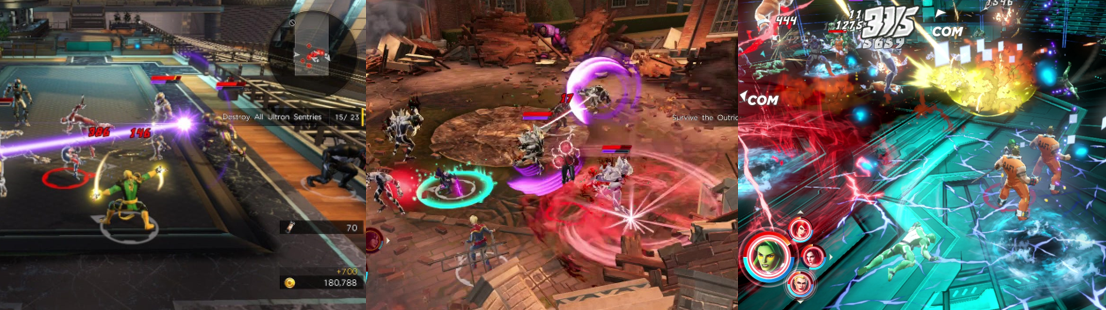
Combat is thick, fast, chaotic, and constant thanks to loads of enemies and character abilities.

As in the last two games, each character has specific abilities tied to their superpowers or superhero traits. You activate these by holding the Right trigger and selecting an icon using the D-pad; using Abilities drains your EP, however, and each Ability comes with a different cost. However, these attacks allow you to stun, stagger or deal elemental damage to enemies using Peter Parker/Spider-Man’s webs, Thor Odinson’s lightning, and Doctor Robert Bruce Banner/The Hulk’s incredible strength. Many characters have projectile attacks in their arsenal, such as Wade Wilson/Deadpool firing guns and Scott “Slim” Summers/Cyclops blasting his eye beams, while others cause splash damage or specific buffs, like Piotr Rasputin/Colossus being able to reflect projectiles and Wanda Maximoff/The Scarlet Witch healing her allies. Some, like James “Logan” Howlett/Wolverine, have passive abilities that allow them to automatically regenerate health as they walk around; others, like Johnny Blaze/Ghost Rider and Ororo Munroe/Storm, specifically deal in elemental damage. Character’s Abilities can also be mixed and matched by holding ZR and pressing one of the face buttons (or pressing A when prompted); this sees two characters attack in a combo for additional damage. As you dish out and take damage, you’ll also build the Extreme (EX) Gauge). Once full, you can press L and R up to three times to have two to four of your teammates perform a devastating combination attack that’s great against bosses. While the various cannon fodder you fight are easily dispatched, larger commanders and bosses need their “stun” meter drained before you can really put a beating on them and others (and certain treasure chests) require specific combination attacks to breach their shields. Defeating enemies sees your characters gain experience points (XP) to level-up, increasing their statistics (attack, defence, etc), though you can also use the various Orbs you find to manually level-up. Each character’s special Abilities can also be further enhanced using Ability Orbs and credits, reducing the EP cost and increasing their damage, among other benefits. You can also earn “Team Bonuses” depending on your team selection: pick a group of X-Men, for example, and your strength or resistance stat will increase, while picking characters of royalty ups your maximum energy stat.
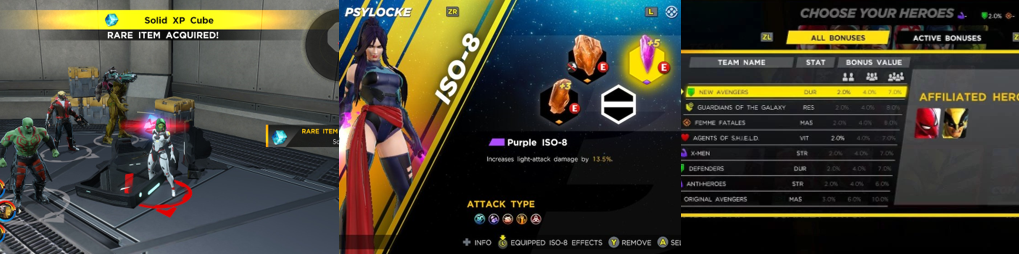
Search for chests to gain currency and other expendables to upgrade and buff your alliance.

Although you can’t equip gear to your characters, the boss battle against the Destroyer armour sees you temporarily empowered by Asgardian magic and you can eventually equip your team with “ISO-8” crystals, coloured stones that enhance their attack power, resistance to elements, or critical hit ratio, among others. You can further upgrade these with credits and ISO-8 capsules, though some of the rarer ones will also debuff you (for example, your attack my increase but your defence will decrease accordingly). You’ll also inevitably gain access to the Strategic Hazard Intervention Espionage Logistics Directorate (S.H.I.E.L.D.) Lab, which acts as the game’s skill tree. By spending credits and Enhancement Points (EP), you can further increase your team’s overall attack, defence, resistance, vitality, and such and even unlock additional ISO-8 slots (with more being earned by levelling-up). You can also enter the S.H.I.E.L.D. Depot from the main menu to purchase additional costumes and social icons by spending S.H.I.E.L.D. Tokens. Marvel: Ultimate Alliance 3 is pretty forgiving (on the “Friendly” difficulty, at least), with multiple checkpoints in each area. When you activate a S.H.I.E.L.D. checkpoint, your team is fully healed, and you can swap or enhance them if you wish. If a teammate is defeated, you can hold A to revive them, but I wouldn’t recommend it unless you absolutely have to. Not only are revives limited, but downed characters will eventually return to full health even before you reach a checkpoint so it’s not worth risking another character taking damage by healing a partner. Exploration generally leads you to treasure chests or special walls that require a special combination attack to open, or to a “Rift” challenge that takes you away from the main game to tackle a special challenge (usually a boss rematch or enemy gauntlet) for extra rewards. Your path is incredibly linear most of the time, hence why there’s no map, and the game’s primary focus is on chaotic combat and visually manic team-based attacks. Unlike in the last two games, you can no longer grapple or throw enemies (though you can still send them flying off certain platforms) and there are no character-specific team-up moves, meaning the action can quickly get quite tiresome.
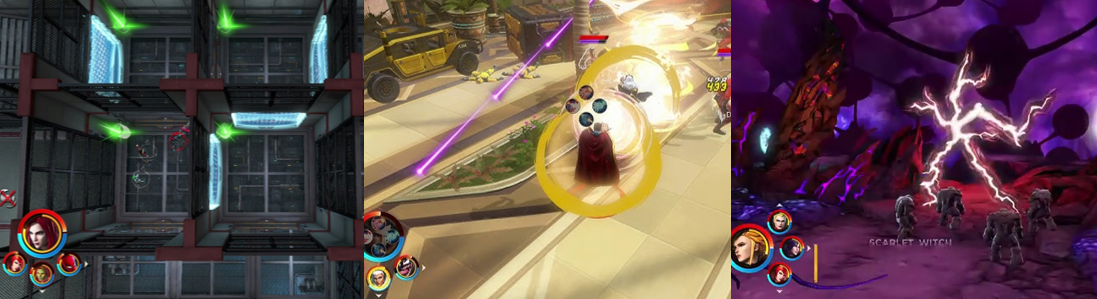
Sadly, puzzles are practically non-existent, with only Rifts offering additional challenges.

Because of its focus on hectic combat, there’s even less room for puzzles than there is for exploration in Marvel: Ultimate Alliance 3. Puzzles boil down to activating a console to open a door or making a platform move and that’s it. Sometimes, you’ll hold A to move a block and avoid lasers or cannons, but mostly you’ll be timing jumps between said lasers to progress and simply hurling missiles at those cannons. Sometimes, you’ll rotate statues or press switches to progress; others, you’ll be avoiding toxic ooze in Hel or solving door puzzles at the Raft or in Avengers Tower. After hopping across the rooftops of New York City, you’ll infiltrate the heavily fortified fortress of the Hand, dealing with ninjas that drop from the sky and hidden arrow hazards. When in Wakanda, Advanced Idea Mechanics (A.I.M.) corrupt T’Challa/The Black Panther’s defences, leading to an exasperating section where you must avoid snipers and being roasted by a giant panther statue’s energy blast. When transported to the Dark Dimension, you must use portals to reach new areas and defeat waves of demonic enemies to lower magical barriers and progress. Some attacks also screw up your controls or temporarily freeze you; some enemies are best defeated by tossing explosives at them; and many missions have an additional character fighting alongside you who’s often unlocked afterwards. However, a lot of the additional features of the previous games are missing; you can talk to other characters, but there are no dialogue options or character-specific interactions. There are no trivia quizzes, no optional side missions beyond the Rifts, and no character specific challenges to unlock extra stuff for each character. There aren’t even hub areas, in the traditional sense, with characters just appearing around S.H.I.E.L.D. checkpoints at times, though you can destroy a fair bit of the environment, and some encounters have you fleeing towards the camera as bosses chase you or present you with unwinnable battles.

Presentation:
Whereas the last two games primarily based their aesthetics on the comics books, especially the Ultimate comic line, Marvel: Ultimate Alliance 3 adheres very closely to the Marvel Cinematic Universe (MCU), especially in the visuals of its locations. I was hard pressed, for example, to tell the difference between Asgard here and the Asgard to the MCU, with both the golden city and the rainbow bridge, the Bifrost, appearing almost exactly as they’re depicted in the films. The same is true for Wakanda, the Dark Dimension, and Knowhere, all of which are virtually indistinguishable from how they appear in the MCU. There are some differences, of course: Taneleer Tivan/The Collector’s museum, for example, uses coloured cube cages and Wakanda leans much more into traditional architecture than the pseudo-futuristic science of the films (likely because Black Panther (Coogler, 2018) released a year before this game was made). Xavier’s School for the Gifted is lifted almost exactly from the 20th Century Fox X-Men movies (Various, 2000 to 2020), however, including a hedge maze, 1:1 Cerebro room, and basketball court that doubles as a landing pad for the Blackbird. While the Dark Dimension and the cosmic mind trip that is Sanctuary also heavily borrow from the bizarre cosmic imagery of the MCU, the Raft and Avengers Tower are much more akin to their comic book counterparts, though they’re comparatively bland locations, lacking fun areas like the Danger Room or Wakanda’s Necropolis (though you do pass through Anthony “Tony” Stark/Iron Man’s Hall of Armours in the tower). Although you only make a brief stop in Attilan to try and get help from the Inhumans, the architecture is far more visually interesting than that awful television show, seemingly being comprised of Celestial technology, and I enjoyed the ominous gothic presentation of Hel, with its restless Viking warriors and damaging sludge. Unfortunately, Marvel: Ultimate Alliance 3 continues the trend of having disappointingly bland and forgettable music, opting for generic themes for each location, event, and character that are lost amidst the constant fighting.
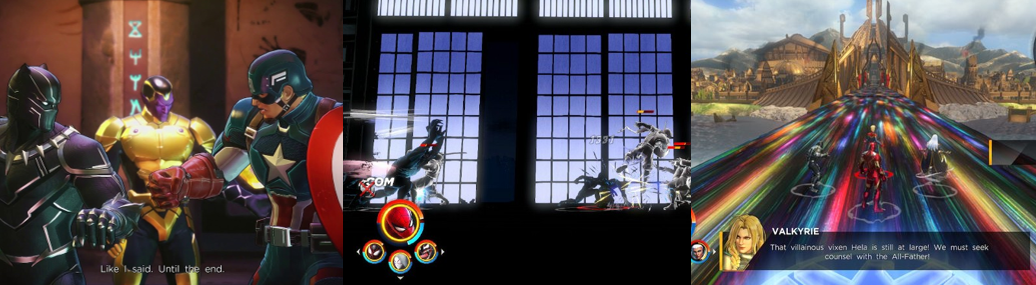
A visually impressive brawler that takes obvious inspiration from the MCU films.

The game also opts for an almost cel-shaded, action figure-like aesthetic for its colourful cast of characters. While many again both look and sound like their MCU counterparts, there are some exceptions: Peter Quill/Star-Lord, for example, looks nothing like Chris Pratt and the X-Men are far closer to the comic books than Fox’s films. Despite you assembling a custom team of heroes, cutscenes depict either everyone or characters specific to the location you’re in (the corrupted Doctor Stephen Strange in the Dark Dimension, for example) as they’re better suited to advance the plot against the local baddies. With the game shifting to a more third-person perspective, you’re closer than ever to the action and can see more of the environment than in the previous games. However, this comes with some drawbacks: mainly, there are far less opportunities or incentives to explore. Second, environments are painfully linear, with dead ends or locked doors barring your progress. Third, and most frustrating, is the camera, which easily loses track of your opponent/s and often lumbers you with wireframe representations when the foreground blocks the view. Thankfully, you won’t be falling down pits and rarely have to worry about onscreen hazards, but it can be aggravating trying to figure out which platforms and crates can be jumped on and which can’t. Marvel: Ultimate Alliance 3 offers a diverse cast of characters, each with their own idle poses and quips, though these do inevitably repeat. The game’s also surprisingly light on Easter Eggs: you’ll spot Deadpool singing away as he makes tacos in the X-Mansion, but not much else, and there are no optional missions or choices to encourage replaying missions. It’s a far cry from the first game, where there was always something to collect or an additional character to help out. Instead, it’s basically all combat, all the time in Marvel: Ultimate Alliance 3. Luckily, the game looks pretty good (everything’s very colourful and true to its inspirations) and performs really well, though there are some long load screens and it is annoying being forced to continue your game every time you challenge a Rift.

Enemies and Bosses:
All the usual suspects appear here as disposable cannon fodder for you to endlessly beat up, with many of the game’s goons sharing traits across the various locations. You’ll encounter Kree, Ultron Drones, agents of A.I.M., and Doombats who all pack various energy blasters. Ultron’s clones are the worst for this, relentlessly firing energy blasts and crashing through windows. The Raft’s unscrupulous prisoners attack in large groups, as do the restless Viking warriors who populate Hel, tossing axes from afar and luring you into toxic goop. Gargoyle-like Fire Demons also dwell here, offering a greater challenge with their swoop attack and fire breath, not unlike the monstrous Outriders and Mindless Ones who make up Thanos and the dread Dormammu’s forces, respectively. Alpha Primitives, Hydra goons, and towering Sentinels also appear, with the latter firing huge energy blasts from the palms and best attacked by throwing their explosive energy cores back at them. No matter where you are and what enemies you fight, more powerful commanders will also appear. Larger, tougher, and sporting a stun meter, these commanders should be your top priority as they’ll charge across the screen, cause shockwaves, and generally offer a far greater challenge even when you’re at a higher level. These minions often fight alongside their masters, generally so you can recover some health and EP to better damage the bosses, and will endlessly spawn in one of the additional modes unless you destroy their teleporters. Some of the game’s challenges or story-based missions charge you with defeating a certain number of enemies to progress. Other times, bosses appear in these waves, and you must occasionally flee or purposely lose some fights. This happens when Cain Marko/The Juggernaut comes tearing through the X-Mansion, for example, and in early encounters with the Black Order, who cannot be beaten or will chase you, raining lightning or other attacks from the sky and across the ground.
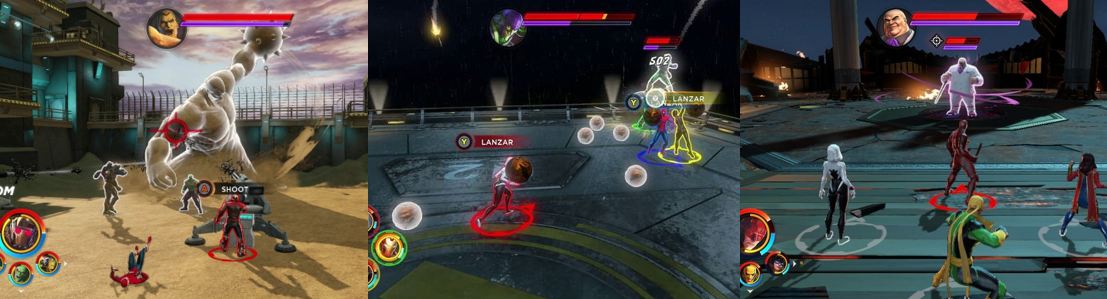
Few bosses require more than just hit-and-run tactics, even when augmented by an Infinity Stone.

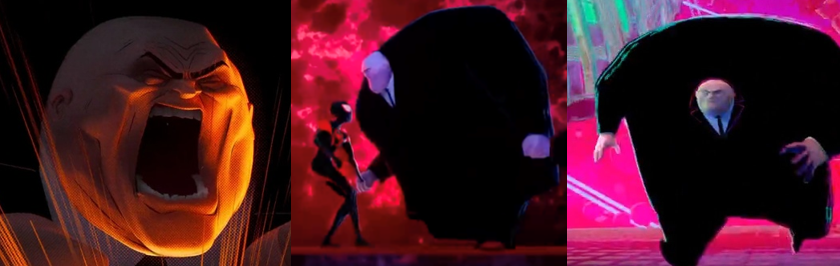
There are loads of bosses to fight in Marvel: Ultimate Alliance 3, with some returning from the previous games, some teaming up, some having a couple of phases, and all boiling down to whittling down their stun bar, unleashing an EX attack and/or your most powerful Abilities, and avoiding damage until you can repeat this. The first ones you’ll face are Nebula and Ronan the Accuser, who often appear as a duo in optional challenges. Nebula is faster and more nimble, wielding blades where Ronan uses a massive warhammer. Both set a standard all bosses follow, which is that they’ll use either a jumping slam or an explosion of energy (or both) to send you flying. While quelling the riot in the Raft, you’ll encounter a version of the Sinister Six, with some unique variations to each battle. Flint Marko/The Sandman, for example, flings waves of sand and erupts his big sand fist from the ground as a large sand creature. You must use A to mount the nearby cannons and unload on him to chip away at his stun meter. Maxwell “Max” Dillon fights alongside Eddie Brock/Venom, raining lighting and electrocuting you with bursts of electricity, before he’s eaten by Venom and starts busting out electrically-enhanced symbiote powers. Venom joins the team after this fight and is tested against Quentin Beck, who first brainwashes Mile Morales/Spider-Man, Gwen Stacy/Spider-Woman, and Kamala Khan/Ms. Marvel to fight you and then unleashes a poisonous mist, teleports about, and confuses you with duplicates, Doctor Otto Octavious/Dr. Octopus is fought in a two-stage fight where you must first avoid his tentacles and scurry charge and then attack each arm to stun him. Finally, you’ll battle Norman Osborn/The Green Goblin for the Time Stone. The Green Goblin swoops overhead and lingers slightly out of reach, peppering the arena with his pumpkin bombs, charging at you, and freezing time to bombard you. He’s noticeably weak to his pumpkin bombs, however, so try and toss them at him before they explode in your face! After battling into the Hand’s fortress, you must first free Elektra Natchios from the Hand’s influence and then face Lester/Bullseye and Wilson Fisk/The Kingpin in separate fights. You must take out the ninjas feeding Elektra power, avoid Bulleye’s spread of razor sharp and explosive cards, and dodge the furniture and massive energy beam thrown by the Power Stone-enhanced Kingpin. The Kingpin also charges like a rhino, leaps at you to cause shockwaves, and even rips up stone columns to use as melee weapons!
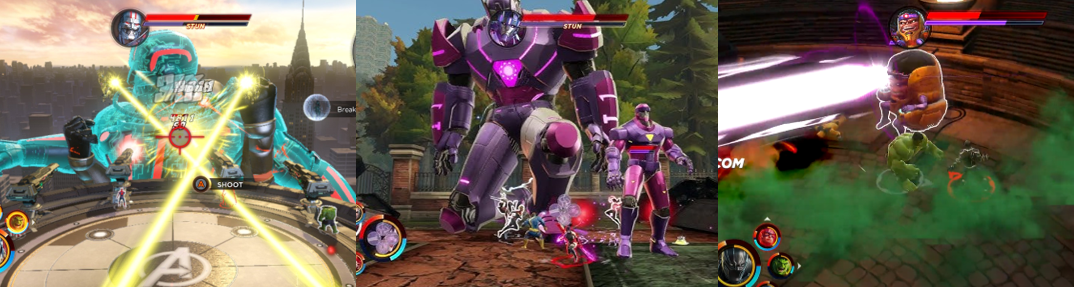
Gigantic bosses and the quirkier villains help mix-up the otherwise tedious combat.

Avengers Tower is then attacked by Ultron and his drones, who assist him in battle. Not that he needs it as the Mind Stone allows Ultron to mess up your controls, to say nothing of his signature face and palm beams. Ultron then grows to gigantic proportions, sweeping the area with his eyebeams before Clint Barton/Hawkeye intervenes and Ultron merges with Ultimo. This is the first giant boss battle in the game and sees you blasting Ultimo with cannons and avoiding his massive swipes. The Infinity Sentinel is comparatively smaller, but no less dangerous thanks to its own face beam and missiles. Though you can damage it with Sentinel cores, it’s finished in a cutscene by Erik “Magnus” Lehnsherr/Magneto, who then tosses debris and throws you off balance with magnetic pulses while Juggernaut pummels you and Raven Darkholme/Mystique tosses daggers. After surviving Mystique’s Danger Room trials, you face Magneto, now even tougher thanks to the Power Stone, before being chased away and banished to the Dark Dimension by the Black Order. There, you battle past Loki Laufeyson (who boasts elemental attacks and duplication tricks) to eventually face the dread Dormammu, who wields the Reality Stone and is the second giant boss. You must subdue his minions and avoid his flame bursts, whittling down his magical barrier either directly or be destroying three nearby orbs, all while dodging his giant fists and ground spikes. The brief fight with Maximus Boltagon is far easier, even though the mad Inhuman carries a massive energy cannon and you must take cover in Thane’s energy bubble to avoid Maximus’s barrage of lasers. Ulysses Klaue/Klaw awaits in Wakanda and his sound-based energy blasts and waves must be overcome to rescue and recruit James Buchanan “Bucky” Barnes/The Winter Soldier. You then fight past A.I.M. to confront their master, George Tarleton/Mental Organism Designed Only for Killing (MODOK), who uses the Soul Stone to turn the Dora Milaje against you and attacks with a slew of appendages, from buzzsaw arms, poison gas, failing tentacles, and his signature forehead blast.
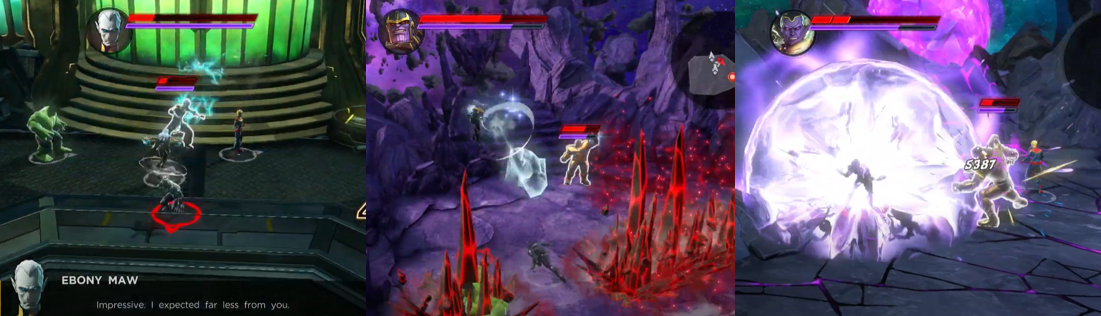
Battles with the empowered Black Order, Thanos, and Thane offer some of the most enjoyable challenges.

Though your goal in Hel is to confront Hela, you’ll actually battle the fire demon, Surtur, in another giant boss battle. This was a bit of a difficulty spike for me as Surtur’s flaming sword has a long reach and he causes the ground to erupt in flames, to say nothing of stun locking you with repeat sword strikes! Best him and Hela sets Johann Schmidt/The Red Skull on you, with the Nazi madman firing a powerful revolver and sapping your health with his “Dust of Death”. Hela gives the Red Skull a boost, protecting him with a shield and allowing him to fire a Bifrost-like laser, before placing his consciousness into the Destroyer armour. Though bolstered by Hydra forces and boasting a sweeping face beam, you can get a power-up from glowing crystals to overcome this destructive force. Finally, you venture to Knowhere and must run the Black Order gauntlet to retrieve the Infinity Stones, with checkpoints between each fight. Ebony Maw is first, firing a spread of projectiles and rocks and using the Soul Stone to create portals to trip you up. Supergiant tosses dark spheres and a golden homing shot that messes up your controls, though you can toss explosive cores from her minions to deal big damage. Cull Obsidian infuses his battleaxe with the Power Stone, sending out waves of purple energy and massive purple shockwaves, though he’s far slower and also susceptible to the nearby bombs. Corvus Glaive is much faster, landing multiple hits with his lance and using the Reality Stone to spring spikes form the ground and conjure duplicates who fill the arena with energy waves that can stun lock you. Finally, Proxima Midnight takes her fellow’s teleportation trick to the next level with the Space Stone and fills the arena with lightning bolts and strikes. All these powers are then recycled when you face Thanos, who gathers the six Infinity Stones into the Infinity Gauntlet to rain meteors, teleport, mess up your controls, freeze time, and fire his signature eyebeams. Thanos then joins you to battle Thane, who usurps him and boasts similar powers, though also upgraded by the Infinity Armour. Thane exhibits superhuman speed, traps you in a cube, fills the arena with portals and flames, and explodes in fury, though both battles were fun challenges rather than impossible tasks.

Additional Features:
Unlike in the previous two games, you won’t be finding data logs, action figures, or meeting certain requirements to unlock new attacks or costumes. You just fight over and over, earning whatever you need to unlock, buy, or upgrade whatever you wish and finding some concept art in treasure chests. A far harder (but more rewarding) “Superior” difficulty unlocks upon clearing the game alongside an additional “Nightmare” mode, accessible via the “Curse of the Vampire” campaign. You also unlock Thanos and can freely replay any mission on any difficulty (though you must start a new save to play on “Superior”) to grind and enhance your characters and ISO-8. Dimensional Rifts transport you to special challenges (not unlike the S.H.I.E.L.D. Simulator discs from the first game) that are often rematches with bosses or gauntlet challenges, though far tougher and gifting better rewards if you succeed. There are also three additional modes; however, though you can play a taster of each, you must purchase the expansion pass to fully unlock them. “Curse of the Vampire” adds vampiric enemies to the main story in “Nightmare” mode and offers a “Gauntlet” mode where you battle waves of enemies and bosses against both a time limit and a range of debuffs (including limited health restoration and draining EP). You can also tackle an “Endless” mode that’s pretty self-explanatory, and unlock additional characters like Frank Castle/The Punisher and Eric Brooks/Bladeif you buy the DLC. “Rise of the Phoenix” sees you form a four-person team and go head-to-head with a friend or the computer in three-round Danger Room scenarios. These see you tackling bosses again or wiping out hordes of enemies, awarding additional buffs and effects if you meet certain criteria (such as using any Ability or Synergy attack four times). You can only tackle the first challenge without the DLC, so I didn’t get very far, but this could be a fun distraction for those looking to test their skills against a friend. “Shadow of Doom” adds an epilogue story campaign that sees you return to Wakanda to oppose Doctor Victor Von Doom’s invasion. Dr. Doom’s Doombots endlessly spawn unless you destroy their teleporters, and you even battle the arrogant dictator in the recycled Necropolis, with him teleporting, firing lasers form his palms, and having his health restored by his Doombots. You’ll add Marvel’s First Family to your roster (alongside an alternative Thanos and other characters) by buying the expansion pass and battle Annihilus, a gigantic Celestial, and even “God Emperor” Doom!
The Summary:
I quite enjoyed the first two Ultimate Alliance games. They were mindless and largely repetitive, but I liked the large cast of characters and all the different references and locations from the comic books. Still, I put off Marvel: Ultimate Alliance 3: The Black Order for some time, mainly because I was annoyed by it being a Nintendo Switch exclusive; however it turned out to be a decent enough brawler. Despite the different development team, a few tweaks, and an apparent disconnection from the previous games, Marvel: Ultimate Alliance 3 offers a lot of the same gameplay and enjoyment as its predecessors, which is great for long-time fans of the franchise. Unfortunately, it doesn’t improve on these elements in a meaningful way and actually removes some content that I found enjoyable from the last two. There are no optional missions, for example, no alternative endings, no choices, and no character-specific challenges beyond fighting and levelling-up. I found this made the tedious combat even more aggravating after a while as I wasn’t being rewarded with gear or costumes or anything other than stat boosts. Even the skill tree was limited since you must grind to acquire enough credits and expendables to enhance your team, and I found the ISO-8 mode to be more confusing than engaging. The game also does little to improve the boss battles. Very few were very innovative or required more of you than to strike fast, avoid shockwaves and projectiles, and unleash your Extreme attack. The giant bosses were more of a challenge and I liked the final fight against Thanos and Thane, but I was hoping for a bit more complexity, especially given the possibilities offered by the Infinity Stones. There is a fun selection of characters, but they don’t offer much more than what we saw in the last two games and actually offer less as there are no character-specific team-up moves. While I enjoyed the visual influence from the MCU and the variety, I feel like Marvel: Ultimate Alliance 3 played things a little too safe by relying so heavily on combat and not mixing up the gameplay with a few other puzzles and challenges. Overall, it’s a good enough game and a worthy entry in the series, but it’s a shame that the developers didn’t try to be a bit more innovative and offer some more incentive to keep slogging away in endless fights.

My Rating:

Rating: 3 out of 5.

Pretty Good

Did you enjoy Marvel: Ultimate Alliance 3: The Black Order? How do you think it holds up against the previous two games? Which characters did you choose for your team? Were you disappointed that the combat was so similar to the last two games and the bosses so repetitive? Did you ever conquer all the Rift challenges? What did you think to the MCU influences and the final battle with Thanos and Thane? Did you ever play through the DLC? Would you like to see another Ultimate Alliance game? Whatever your thoughts, leave a comment below, support me on Ko-Fi, and go check out my other superhero content across the site.

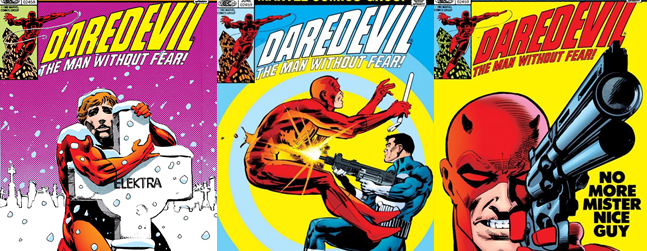
Back Issues [Dare-DAY-vil]: Daredevil #182-184


Blind lawyer Matt Murdock debuted in Daredevil #1 in April 1964 and was co-created by writer/editor Stan Lee and artist Bill Everett, with input from the legendary Jack Kirby. While perhaps not as mainstream as characters like Peter Parker/Spider-Man, Daredevil has become one of Marvel Comics’ greatest creations and has starred in a questionably-received 2003 big-screen adaptation and a critically-successful Netflix series.


Writers: Frank Miller and Roger McKenzie Artist: Frank Miller

Story Title: “She’s Alive”
Published: 26 January 1982 (cover-dated: May 1982)

Story Title: “Child’s Play”
Published: 23 February 1982 (cover-dated: June 1982)

Story Title: “Good Guys Wear Red!”
Published: 23 March 1982 (cover-dated: July 1982)

The Background:
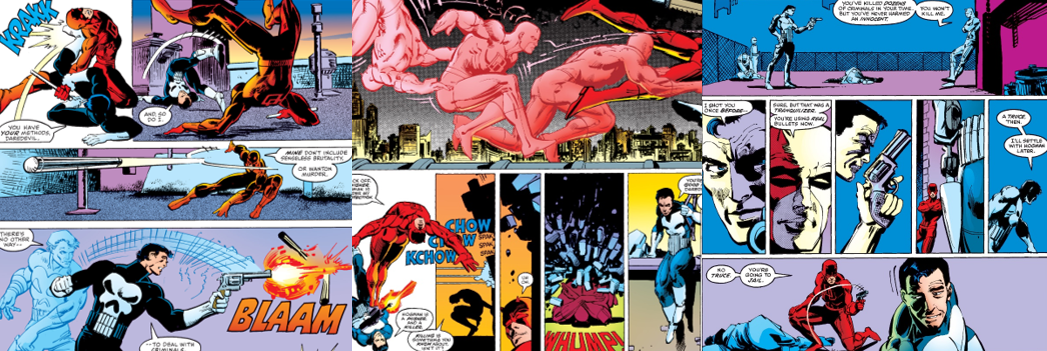
The 1960s were a golden age for Marvel Comics, when Stan Lee teamed with the likes of Steve Ditko and Jack Kirby to create some of their most recognisable superheroes. On 1 April 1964, Stan Lee and artist Bill Everett introduced their most challenging hero yet, Matt Murdock/Daredevil, who became a popular and enduring character thank to the efforts of writer/artist Frank Miller, who spearheaded some of Daredevil’s most memorable stories. It was during Miller’s run that Daredevil first crossed paths with Frank Castle/The Punisher, a Vietnam veteran-turned-mercenary vigilante who first appeared in Amazing Fantasy #15. Inspired by The Executioner (Pendleton, et al, 1969 to present), designed by Gerry Conway, and named by Stan Lee, the Punisher was a natural foil for the more righteous and law abiding Daredevil. The two have clashed, begrudgingly teamed up, and debated their different philosophies numerous times in the years since they first met. Their memorable rivalry even made it to the silver screen when the two clashed on the streets and in the courtroom during Daredevil’s second season (Various, 2016).

The Review:
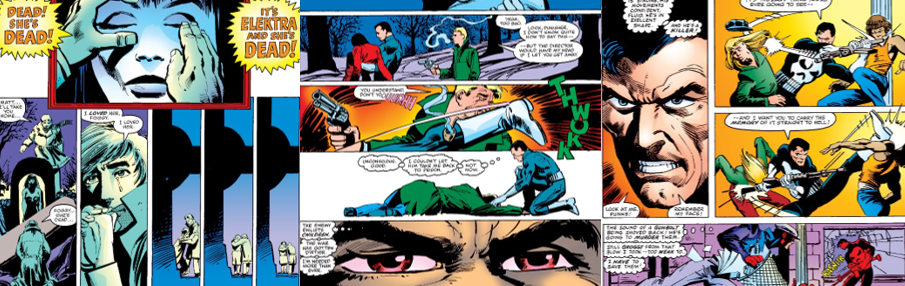
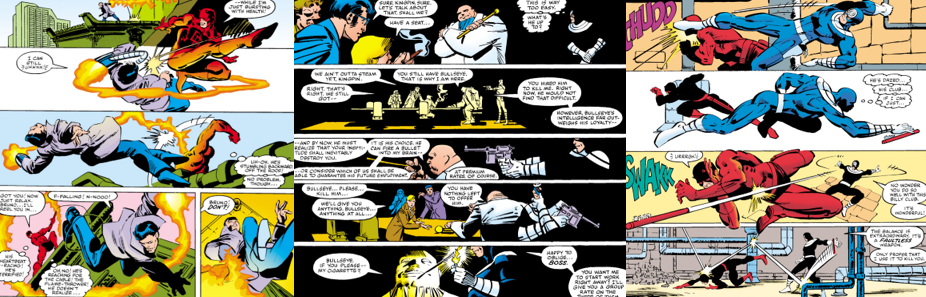
Our story begins with Matt Murdock still reeling from the recent murder of his lover, Elektra Natchios, at the hands of the sadistic mercenary, Lester/Bullseye. Despite having cradled Elektra in his arms, felt her last heartbeat, heard her death rattle, and attended her funeral, Matt awakens from a nightmare convinced that she’s somehow still alive. Overwhelmed by guilt at having not done more to steer Elektra away from the ninja organisation, the Hand, and the dark path that led to her becoming an assassin, and sure that those same ninjas taught her a way to fake her death, Matt pulls on his costume and heads out into the snow swept night to get some answers. This takes him to a “grimy underworld saloon”, where Daredevil kicks the shit out of the patrons, easily dodging their blows and bullets, and accosts one of them into revealing that Wilson Fisk/The Kingpin is holding a summit of the city’s top mobsters at midnight. Sure that the Kingpin must be trying to sell Elektra’s services, Daredevil returns to his civilian identity and has his secretary, Rebecca “Becky” Blake, go through the coroner’s report on Elektra’s body. Despite the evidence stating quite clearly that Elektra suffered mortal wounds, Matt’s convinced that the body could’ve been swapped and is so blinded by his obsession with proving that his former lover is still alive that he gives his current love interest, Heather Glenn, the cold shoulder. Indeed, it’s only when his best friend and law partner, Franklin “Foggy” Nelson, chews him out that Matt begins to question his state of mind. Across the city, in Ryker’s Island penitentiary, Frank Castle is locked up alongside the city’s scumbags. When the Punisher puts Joe Carson/Injun Joe in the infirmary, a few of his boys accost him in the showers and, despite being outnumbered by the armed assailants, the Punisher easily overpowers and kills the three. Though indifferent to his actions, the Punisher is intrigued when an emissary of the “agency” offers to get him out of prison so he can covertly intercept a shipment of narcotics, and promptly escapes via helicopter.

Matt’s obsession over Elektra’s death is compounded when the Punisher goes on a killing spree.

Thus, the Punisher heads to Long Island and lays in wait for the shipment. Thanks to his trip wires, tear gas, and skill with a shotgun and assault rifle, the Punisher wipes out the goons, even gunning one down after he surrenders since “war [doesn’t] take prisoners”. However, the Punisher is distraught to learn his victim was merely a child; laying out the G-man, the Punisher vows to continue his war on crime, especially if evil is corrupting children. Daredevil easily dispatches the Kingpin’s goons and confronts the rotund crime boss regarding Elektra, confusing Fisk with his accusations and eventually leaving after the Kingpin calls his bluff, confirming that Matt hasn’t completely gone off the deep end just yet. Foggy’s concerns are only exacerbated when he’s awoken in the middle of the night to learn that Matt coerced a city judge into signing an exhumation order for Elektra’s body! By the time Foggy gets to the cemetery, Matt has already frantically, feverishly dug up Elektra’s grave, only to confirm with his very hands that his lover is, in fact, dead and causing him to break down in tears in his friend’s arms. Still reeling from this moment, Matt is horrified when a young schoolgirl suddenly freaks out in the middle of a Civics class he’s attending and, convinced that snakes are crawling over her skin, throws herself out the window! Switching to Daredevil, Matt races the girl’s broken body to the hospital, only for her to succumb to her injuries thanks to the “Angel Dust” in her system. Daredevil learns from the doctor that the girl is the latest in a long line of child victims of drugs, with phencyclidine being the most common and most dangerous as it causes many horrible side effects, including psychosis, and lingers in the system for years. Donning a simple disguise (over his costume, no less), Daredevil hits the streets to try and get a lead on Peter Grunter/Hogman, one of the lead pushers of the drug, only to be attacked by drugged-up kids. Although Daredevil pulls his punches, sympathetic to their plight, he’s stunned when the Punisher appears, murders one of them with a knife, and prepares to execute the others in cold blood.

While working to prove a boy’s innocence, Daredevil clashes with the hard-nosed Punisher.

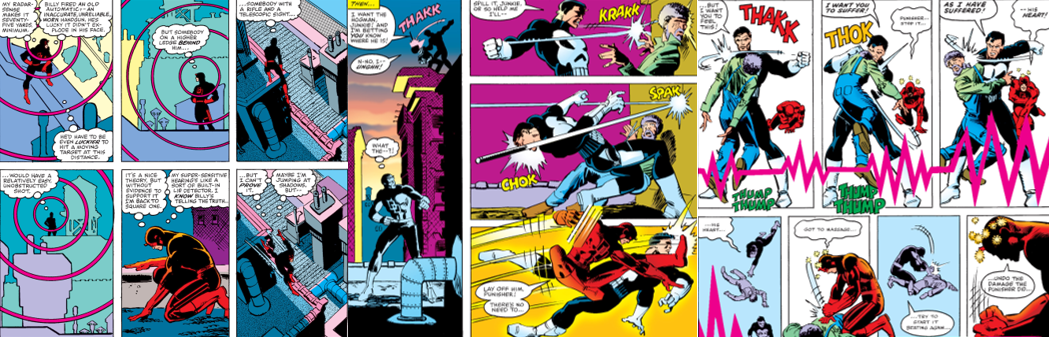
Although Daredevil keeps the Punisher from carrying out the kill, and the Punisher expresses respect for ol’ hornhead, the two are stunned when another shooter guns down one of Daredevil’s attackers. While the Punisher is indifferent, Daredevil is aghast to discover the shooter is William “Billy” O’Koren, the brother of the girl who was driven to suicide. Matt pledges to represent Billy in court, sure that he’s innocent, a hunch he all-but confirms when he returns to the crime scene. The Punisher also suspects that a more competent sniper made the shot, despite a lack of tangible evidence. Daredevil gets some intel on the Punisher from Ben Urich (who’s aware of Matt’s dual identity), who warns him against going toe-to-toe with the Punisher since he’s a well-trained, cold-blooded killer. As luck (or fate) would have it, the Punisher just so happens to be beating up a junkie on a nearby rooftop, so Daredevil intervenes, disgusted by Castle’s brutal methods, which the Punisher defends as the only way to permanently deal with criminals. While Daredevil’s quick to fight, the Punisher suggests they team up to eliminate their common enemy and, when Daredevil adamantly refuses, he spares his foe a quick death by shooting Daredevil with a tranquilizer dart. Severely weakened from the shot, Daredevil’s powerless to stop the Punisher beating his victim so badly that he suffers a heart attack. Luckily, Daredevil’s quick bout of CPR sees the junkie cling to life and point him towards a restaurant, where Daredevil finds the elusive Hogman. When Hogman’s cohorts refuse to back him up, the drug peddler is apprehended by Daredevil and the Punisher’s victim recovers to testify in court, absolving Billy of any wrongdoing, though Matt’s stunned when his super senses reveal that Hogman is also innocent of murdering his partner.

A mistake by Daredevil sees him and the Punisher battling for a boy’s soul.

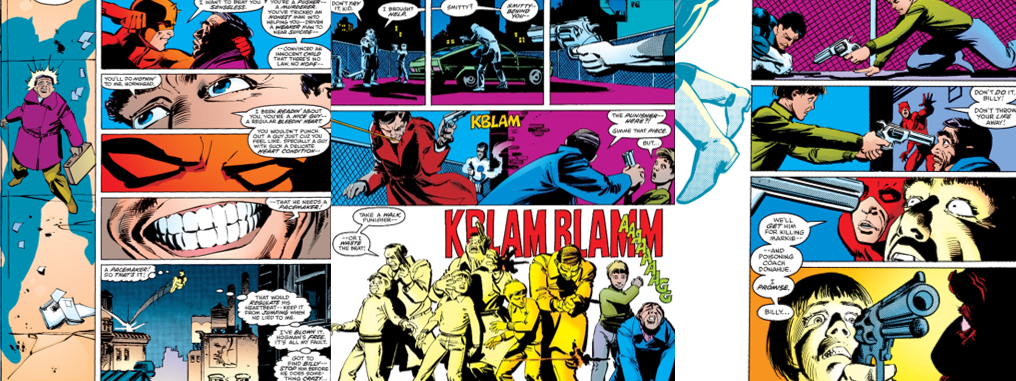
After winning Heather back with a marriage proposal, Matt volunteers to represent Hogman and prove his innocence. Sure that Matt can absolve him of the crime, the arrogant Hogman stuffs his face with pasta, unaware that the stoic Punisher has taken up a sniping position on a rooftop across the street. Luckily, Daredevil is on hand to keep his client safe but, when the Punisher’s shot buries him under a pile of bricks, Daredevil again fails to apprehend the murderous vigilante. Although Matt claims to have evidence to prove that Hogman is being used as a convenient patsy by the true culprit, Billy’s coach, Patrick Donahue, he doesn’t get solid confirmation until Donahue calls him to discuss the whole operation in private. The call costs Matt dearly as he ends up giving Heather the brush off and it leads to Matt being attacked by the rabid Donahue, who’s been driven to a crazed frenzy by his own drugs! Despite the coach’s augmented strength, Matt uses his agility to put him in a choke hold and subdue him, theorising that a third party juiced Donahue up. In court, Matt successfully absolves Hogman of his crime, only to learn afterwards that the scumbag is not only guilty, but gleefully causes his returning customers to overdose to amuse himself. When Daredevil confronts Hogman, threatening to beat him to a pulp, Matt realises he’s been played for a fool as Hogman’s pacemaker screwed up his radar sense. When Billy decides to take the law into his own hands, Daredevil races to intervene, only for the Punisher to show up and subdue Hogman with some well-placed shots. Daredevil stops him from delivering the killing shot and calls the Punisher’s bluff, fully aware that he’s purposely missing and would never knowing kill an innocent person. Although the Punisher again offers a truce, he’s stunned when Daredevil subdues him with a gunshot, leaving Matt free to appeal to Billy’s better nature. His pleas get through and Billy testifies against Hogman, leaving the drug baron facing serious jail time and Matt emphasising the importance of following the law to the impressionable pre-teen.

The Summary:
I’ve talked about this before, but I’m really not a big fan of Frank Miller’s art. He’s nowhere near as bad here as he is in his efforts for DC Comics and his independent publications, but he really does draw some of the ugliest faces I’ve ever seen. His use of shadows and lighting are extraordinary, however, and he draws a very dynamic and intimidating Daredevil, something bolstered by the start darkness of night. In Miller’s hands, New York City and Hell’s Kitchen are a dark, ominous place that feels very dangerous. Violence stalks the streets, but this is taken to the next level here as Hogman sells drugs to kids, using Coach Donahue as a gofer and selling to kids at a Catholic school. Happy to cause overdoses and kill anyone who tries to speak out against him, even if they’re his partners, Hogman thinks nothing of abusing the law system and little children to come out on top. He’s practically giddy when Matt clears him of murder, only to immediately reveal that he’s “guilty as sin”, and Matt’s left humiliated since he was convinced of the villain’s innocence thanks to Hogman’s pacemaker. Matt’s a bit all over the place in these issues, reeling from Elektra’s murder and as desperate to prove that she’s alive as he is to defend Billy and keep the neighbourhood kids free from drugs. Grief hits Matt like a brick wall, causing him to descend into denial and desperation, only to be mocked by the likes of the Kingpin, push away those closest to him, and ultimately go to extreme lengths to prove his theory…only to find that Elektra is well and truly dead. This revelation seemingly snaps Matt from his malady as he’s back to normal in the very next issue and doesn’t mention Elektra again, instead turning his focus towards Hogman, the kids he abuses, and the Punisher.

Sadly, Daredevil and the Punisher don’t clash enough, physically or ideologically, for my tastes.

The Punisher pretty much steals the show here. Still portrayed as a ruthless vigilante killer, he’s largely indifferent to the world around him, as though sleepwalking through life and unconcerned about the machinations of those who would seek to release him onto the streets. Castle couldn’t care less about the scumbags he kills and only shows a shred of remorse when he’s forced to gun down a kid. Even then, rather than dwell on how his actions have cost a misguided youth their life, the Punisher refocuses his energy on taking out those responsible for putting the boy in that position in the first place. Interestingly, the Punisher has no desire to fight Daredevil; indeed, he not only purposely misses his shots but shows a great deal of respect for ol’ hornhead. The Punisher repeatedly offers to form a partnership with Daredevil, believing they’re kindred spirits who fight for the same thing against a common enemy, only to be rebuffed each time. While the Punisher is respectful towards Daredevil, Matt attacks Castle without hesitation, disgusted by his disregard for the law and the lives of his victims. It’s an interesting dichotomy since Matt, as a vigilante, is breaking the laws he so diligently serves in his civilian guise so it’s a touch hypocritical for him to lecture the Punisher on his vigilante ways. Of course, the real difference between the two is that the Punisher kills his victims whereas daredevil just beats them up and has them arrested so they can stand trial, a system the Punisher openly mocks for being flawed and broken. While Daredevil valiantly fights to defend all lives and everyone’s rights, even those of scumbags like Hogman, the Punisher takes a more direct approach, putting the two at natural odds. Unfortunately, this isn’t explored that well here; their fights are very brief, their different ideologies barely touched upon, and much of the potential of their first meeting is secondary to the main plot concerning Hogman. Therefore, these issues are important for being the first meeting between these two characters but there are far better clashes between the two out there, such as Garth Ennis’s iconic story from the early 2000s.

My Rating:

Rating: 4 out of 5.

Great Stuff

What did you think to the first meeting of Daredevil and the Punisher? Do you agree that the story didn’t quite live up to its potential? What did you think to the differences between Daredevil and the Punisher, particularly in their methods? How impactful did you find the main plot concerning kids and drugs? What are some of your favourite Daredevil and Punisher moments and how are you celebrating the Man Without Fear this month? I’d love to know your thoughts so feel free to share them in the comments below, support me on Ko-Fi, and be sure to check out my other Daredevil and Punisher content.

Back Issues: Ghost Rider #1-3

Writer: Howard Mackie – Artist: Javier Saltares

Story Title: “Life’s Blood”
Published:
13 March 1990 (cover-date: July 1990)

Story Title: “Do Be Afraid of the Dark”
Published:
10 April 1990 (cover-date: June 1990)

Story Title: “Deathwatch”
Published:
8 May 1990 (cover-date: July 1990)

The Background: 
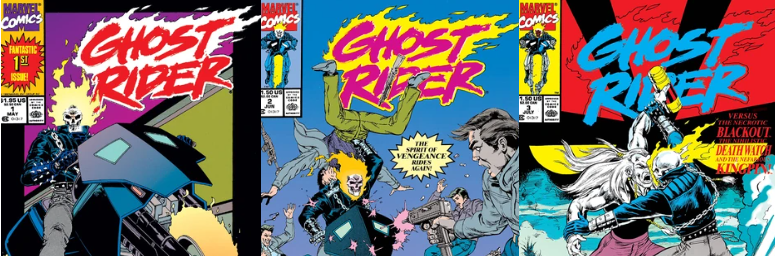
In 1967, Dick Ayers, Gary Friedrich, and Roy Thomas introduced Marvel Comics readers to Western gunslinger Carter Slade/Ghost Rider, who later became known as the Phantom Rider in the wake of his more popular successor, Johnny Blaze. Initially planned to be a villain, Friedrich lobbied to do more with the character, with artist Mike Ploog asserting that he provided Ghost Rider’s trademark look and the legendary Stan Lee dreaming up his civilian name. After ridding himself of the Ghost Rider curse and the demon who caused it, Zarathos, Blaze and his flame-headed alter ego vanished from Marvel Comics for the better part of seven years. However, the Spirit of Vengeance rose again in this story, which introduced a new host for the demon in teenager Danny Ketch, who would later be revealed to be Blaze’s half-brother. During his tenure as the Ghost Rider, Ketch teamed up with both his half-brother and other supernatural or bloodthirsty Marvel anti-heroes, being a prominent member of the Midnight Suns and even temporarily giving his life to stop Zarathos and vampire queen Lilith from conquering the world with their demonic army. While it’s Blaze who is generally depicted as the go-to Ghost Rider whenever the Spirit of Vengeance appears in other media, many of the character’s most recognisable traits come from his successor. Ketch had a sleeker, more streamlined Hellcycle, employed the Penance Stare, and sported a more fearsome, spiked attire, all of which would later be adopted by Blaze when he resumed the mantle. Still, Ketch has appeared in various Marvel cartoons throughout the nineties, though a planned videogame was cancelled and his sole live-action appearance as of this writing is as a child in the poorly received Ghost Rider: Spirit of Vengeance (Neveldine and Taylor, 2011). 

The Review:
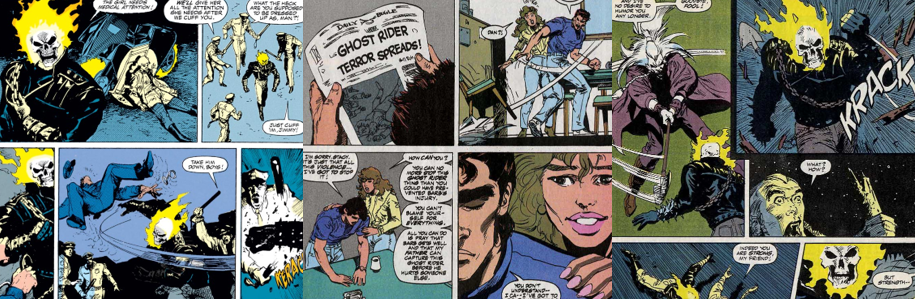
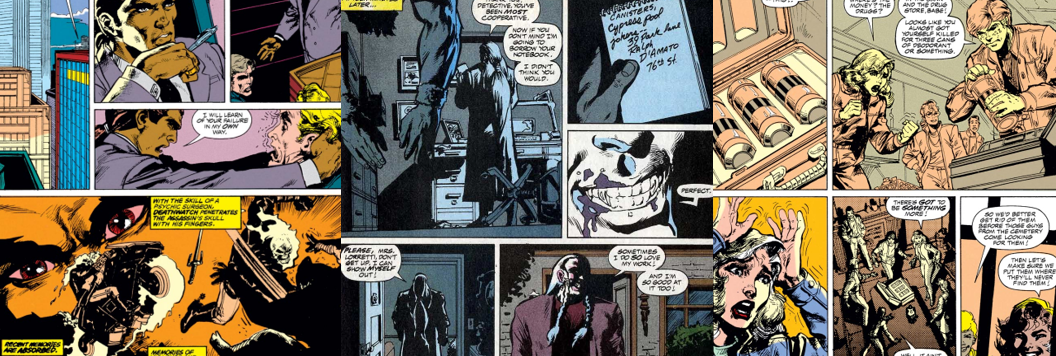
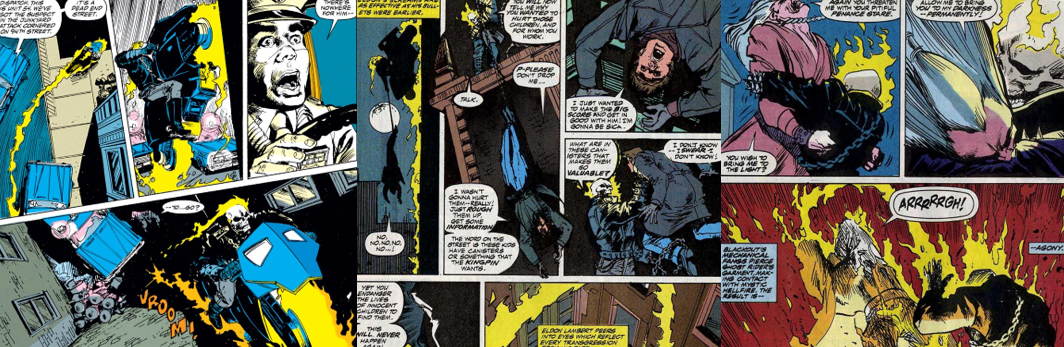
Our story begins in Cypress Hills Cemetery, where bickering siblings Danny and Barbara Ketch have come to scope out Harry Houdini’s gravesite…on Halloween Eve, no less…so Barb can take pictures of alleged psychics trying to commune with him. Anxious Danny, not so quick to dismiss the cemetery’s morbid reputation, is spooked when a bunch of kids (the so-called Cypress Hill Jokers) in Halloween masks give them a fright and try to steal Barb’s camera. She sends them packing with a swift kick and forces Danny to investigate sounds of a gunshot and a scream. Peering into Gallagher’s junkyard, they see some of Wilson Fisk/The Kingpin’s goons threatening the mysterious Deathwatch after the masked man shot dead one of their couriers. When the mobsters are executed by the killer’s crossbow-wielding hoodlums, Barb lets out a scream, landing her with an arrow through the chest. While one of the kids, Paulie Stratton, swipes the case Deathwatch killed for, Danny desperately props the bleeding Barb against an abandoned motorcycle; touching it with his bloodstained hands, he undergoes a sudden and dramatic transformation into the Ghost Rider! His body possessed by the Spirit of Vengeance, Danny’s personality gives way to that of the Ghost Rider’s, who takes out the hooded foes using his demonic chains and his signature Penance Stare, which forces his victim to “suffer the pain” they inflicted on others. Paulie slips away as the cops arrive; they fail to apprehend the Ghost Rider, humbled and manhandled when his bitchin’ new Hellcycle blasts him up a wall to safety. Under the light of dawn, Danny regains his senses and his self, eventually collapsing before his terrified mother and Police Captain Arthur Dolan. When he comes to, Danny learns that Barb is stable, but stuck in a coma, and is devastated at having let her down.

The new Ghost Rider on the block is quickly tormented by failure, bad press, and brutes.

Feeling responsible, Danny tests to see if his demonic experience was real or some fantastical dream and soon finds himself possessed by the Ghost Rider again when the resulting turf war between Deathwatch and the Kingpin leaves Paulie’s friend Raphie critically injured. Luckily, the Ghost Rider arrives in time to intervene, easily shrugging off bullets and even a bazooka, retaliating with lethal force and spiriting Ralphie to safety. However, Danny is stunned to find Captain Dolan has pinned everything on the Ghost Rider, a monstrous force that renders Danny a passenger and leaves him tormented at having failed his sister. Regardless, the Ghost Rider continues to defend innocent lives, specifically the Cypress Hill Jokers, who are constantly threatened by both sets of mobsters. Though still using lethal and violent force, the Ghost Rider is sure to interrogate one of the Kingpin’s goons, subjecting him to the Penance Stare but getting no closer to learning what’s in the briefcase the two crime lords are so willing to kill for. His newfound life already taking its toll on him physically and mentally, Danny is as horrified by Captain Dolan’s smear campaign as he is by the terrifying allure of the Ghost Rider. Elsewhere, the sadistic Blackout enters the fray, murdering a cop and his family to learn where the Cypress Hill Jokers hang out and offering to tie up loose ends for Deathwatch, who’s more than pleased by the brute’s cruel methods. Despite a sensitivity to light, Blackout can freely move through shadows, easily slipping into Ralphie’s home, killing his parents, and attempting to defenestrate him in search of the canisters. Once again, the Ghost Rider is on hand to save the boy, and a brief fight ensues between the two superpowers. While Blackout’s attacks are useless against the Ghost Rider’s power, he demonstrates an uncanny deftness and swiftly flees using the shadows, eager to match blows with the Spirit of Vengeance in another time and place.

Though he triumphs as the Ghost Rider, Danny remains conflicted about his violent alter ego.

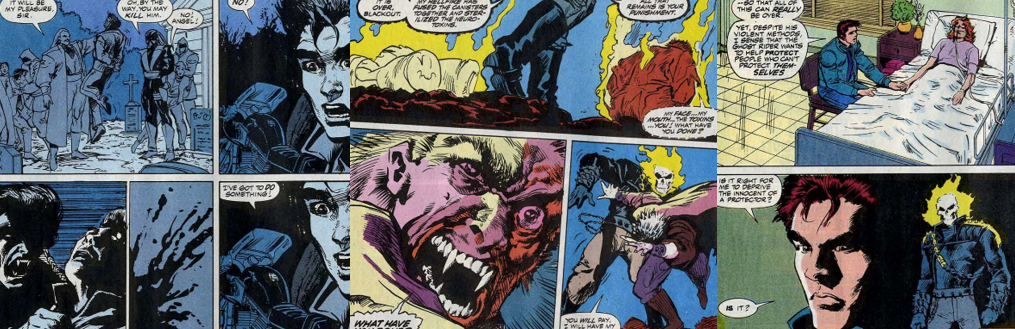
Strangely unable to recall exactly where she and the Cypress Hill Jokers stashed the briefcase, Paulie is of little help to the cops and even less help when Deathwatch, Blackout, and their goons storm the station, kill everyone, and kidnap her. In response, Captain Dolan steps up the guard around the comatose Barb, leading to Danny returning to the cemetery to try and help. There, he finds Deathwatch and Blackout in the process of murdering Paulie’s friends to try and find the final canister, which contains a mutated biotoxin Deathwatch plans to unleash upon the city. Angered by Deathwatch’s insolence and aptitude, the Kingpin orders his aide, Oswald Silkworth/The Arranger, to intervene and the bureaucrat successfully convinces Deathwatch to hand over the cannisters by surrounding the duo with dozens of armed men. Unfortunately, Blackout isn’t so willing to comply and violently lashes out, taking the cannisters for himself, ordering his men to attack everyone (even Deathwatch), and salivating at the prospect of blanketing the world in a cold, dark nuclear winter. However, the Ghost Rider enters the fray, taking out Blackout’s goons and tackling him before he can open a canister. Though still able to use the Ghost Rider’s strength against him and resist the Penance Stare, Blackout is burned by the demon’s flames, horrifically scarring him and twisting his already warped mind. The next day, the Kingpin muses over his heroic deeds and vows to watch Deathwatch closely. As for Danny, he returns to Barb’s side, still torn between giving up the cursed motorcycle and his dark alter ego and continuing his dual life as a violent (but effective) protector of the innocent.

The Summary:
Although my reading experience with the Ghost Rider is limited, Danny Ketch’s time in the role is the one I’m most drawn to. As a typical 1990s comic anti-hero, Danny ticks all the boxes: he’s a reluctant hero, tormented by his violent powers, rides a bad-ass motorcycle, and transforms into a cackling, flame-skulled demon who shreds baddies with chains! Just in terms of the art and the storytelling, Danny’s debut blows Johnny Blaze’s out of the water; but then, the 1990s was a different time. Interestingly, Danny’s debut issues aren’t as over the top and fantastical as you might first expect; the story is firmly grounded, save for the supernatural elements, quick to return time and again to Danny’s turmoil over his sister. In bringing Danny to life, the creators have drawn from multiple other heroes to set the tone: Danny’s as unsure of himself as Peter Parker/Spider-Man, as ruthless in his superheroics as Frank Castle/The Punisher, and is faced with violent gang wars headed by the Kingpin, much like Matt Murdock/Daredevil. Indeed, the story closely echoes the tone and atmosphere of Frank Miller’s time with the Man Without Fear and definitely veers more towards a grounded, gritty aesthetic than fantastical, supernatural adventures. The city police only reinforce this by adopting a “shoot first, ask questions later” mentality towards the Ghost Rider, one exacerbated by catching him in the middle of breaking a man’s neck. Captain Dolan’s J. Jonah Jameson levels of persecution against who he sees as a dangerous individual also see the entire force’s efforts focused on the Ghost Rider rather than the turf war between the two crime lords.

Deathwatch and Blackout make for an enigmatic and sadistic bad guy duo.

Deathwatch makes for an interesting, enigmatic, and mysterious individual. Unlike the Kingpin, he hides behind a literal mask and employs hooded assassins not unlike the ninjas of the Hand. He also exhibits supernatural abilities, forcefully reading his victim’s mind with a touch, and isn’t afraid to get his hands dirty. While the Kingpin prefers to operate from the shadows as an elusive puppet master, Deathwatch readily joins Blackout and his men in terrorising the Cypress Hill Jokers, though he slips away when the Ghost Rider shows up. How Deathwatch obtained his powers and what his true origin is remains as much of a mystery as Blackout’s backstory, but I assume these villains were further fleshed out in subsequent issues. Blackout makes quite the first impression, threatening a child and murdering his family with relish, and appears quite happy to kill others, even children, to get his hands on the bioweapon. No mere mindless brute, Blackout is eloquent, savvy, and well trained in martial arts, to the point he can use an opponent’s momentum and strength against them and therefore knock even the overpowered Ghost Rider off his feet. He also possesses seemingly supernatural powers, moving through shadows and showcasing a near-superhuman durability…until he tries to mess with the Ghost Rider’s flames. Deathwatch and the Kingpin’s underlings are no less lethal, happily shooting and stabbing kids to threaten their victims, and engaging in all-out firefights in the middle of the street. The Kingpin’s goons even break out heavy-duty ordinance like bazookas, while Deathwatch’s are happy to destroy an entire junkyard to ensure they take care of any witnesses. The Cypress Hill Jokers, in comparison, are less than small fry; they’re just kids trying to be tough who get in way over their heads when they steal Deathwatch’s briefcase. Paulie largely exists to repeat this plot and look dumb when she can’t remember where they stashed the third canister, resulting in her friends being badly hurt or killed. Still, protecting her and the other Jokers becomes the Ghost Rider’s short-term mission as, despite their assumed petty crimes and rebellious ways, they remain “innocent”.

The new Ghost Rider reinvigorates the character with a visual bang.

As for the Ghost Rider himself…well, he steals the show. Sporting what I would argue is his definitive look, the Ghost Rider bursts to life whenever Danny touches the cursed motorcycle (which, I assume, is Johnny Blaze’s) and immediately seeks to avenge the innocent with brutal and efficient force. Commanding sprawling chains and easily flipping police cars, the Ghost Rider is a physics-defying, unstoppable force of Hell-born justice; immune to bullets, blunt weapons, and most attacks, it takes a lot to even get him off his feet let alone injure him. In fact, his only weakness appears to be daylight and Danny’s troubled conscience since barricades, walls, and near-superhuman foes barely slow him down. These issues finally helped shed a little light on the nature of this transformation. Danny’s personality takes a back seat when the Ghost Rider takes over, leaving him in a dark place both alluring and terrifying. He appears to have little to no control over the Ghost Rider, even struggling to resist making the change at one point, while retaining full knowledge of his actions as the Spirit of Vengeance. Yet, for all the Ghost Rider’s power, he cannot help Barb and his abilities are used to punish, not heal. His demonic visage terrifies most people, making it difficult for him to earn the trust of the innocent and get the injured to safety, but he perseveres, even though his lethal methods see him branded a menace and a killer. The Ghost Rider’s primary personality is spouting his sacred mission and he will allow nothing, and no one, to keep him from defending the innocent and punishing the wicked, making him an extremely dangerous and driven anti-hero. The conflict within Danny is palpable; he can see the potential for good in the Ghost Rider but is worried about hurting others or losing himself to the darkness. This dichotomy makes me interested to read more, to learn what happens to him and Barb, and to find out more about Deathwatch and Blackout. Thus, I really enjoyed these three issues, especially as it injected a bit of the macabre and supernatural into the gritty, urban warzone Marvel calls New York.

My Rating:

Rating: 4 out of 5.

Great Stuff

What did you think to Danny Ketch’s debut as the Ghost Rider? Is this the look you most associate with the character? What did you think to Deathwatch and Blackout, especially their ruthless natures? Did you like the more grounded depiction of the fantastical elements? What are some of your favourite Danny Ketch stories or moments? Whatever your thoughts on Ghost Rider, share them below and be sure to check out my other Ghost Rider content.

Back Issues [Dare-DAY-vil]: Daredevil #170-172


Blind lawyer Matt Murdock first made his debut in Daredevil #1 in April of 1964 and was co-created by writer/editor Stan Lee and artist Bill Everett, with input from the legendary Jack Kirby. While perhaps not as mainstream as characters like Peter Parker/Spider-Man, Daredevil has become one of Marvel Comics’ greatest creations and has featured in a number of ancillary media and merchandise, included a questionably-received big-screen adaptation in 2003 and a critically-successful Netflix series. Still, he’s one of my favourite Marvel characters so today is a great excuse to pay homage to the “Devil of Hell’s Kitchen”.


Writer: Frank Miller – Artists: Frank Miller and Klaus Janson

Story Title: “The Kingpin Must Die!”
Published: 3 February 1981 (cover-dated May 1981)

Story Title: “In the Kingpin’s Clutches”
Published: 3 March 1981 (cover-dated June 1981)

Story Title: “Gangwar!”
Published: 24 March 1981 (cover-dated July 1981)

The Background:
In the 1960s golden age for Marvel Comics, Stan Lee teamed with legendary names like Steve Ditko and Jack Kirby to create some of their most iconic superheroes. On 1 April 1964, Stan Lee and artist Bill Everett presented their most challenging hero yet in Matt Murdock/Daredevil, who would go on to become one of Marvel’s most popular and enduring characters thanks, in a big way, to the efforts of writer/artist Frank Miller. In 1970, the then up-and-coming Miller joined the book with issue 159 and soon took over writing and illustrating, spearheading some of Daredevil’s most influential stories. It was under Miller’s watch that Wilson Fisk, the mammoth Kingpin of Crime, became one of Daredevil’s most hated enemies; created by writer Stan Lee and artist John Romita Sr. and first debuting in the pages of The Amazing Spider-Man, the Kingpin was patterned after actor Robert Middleton and known as much for his conniving ways as his intimidating bulk. A complex character whose ruthlessness was matched only by his love for his wife, the Kingpin has become one of Marvel’s most iconic villains but is especially noted for his intense rivalry with street-level vigilantes like Daredevil, Spider-Man, and Frank Castle/The Punisher. The Kingpin has appeared prominently outside the comics, too, generally as a boss in various Marvel videogames, a notable antagonist in various animated ventures, and in live-action, delivered with charm, menace, and significant screen presence by the likes of the late Michael Clarke Duncan and Vincent D’Onofrio.

The Review:
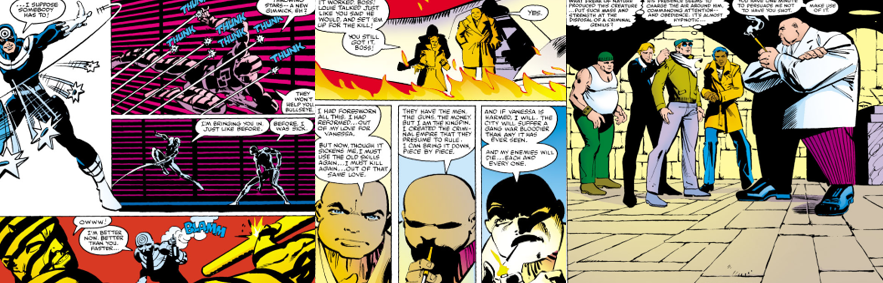
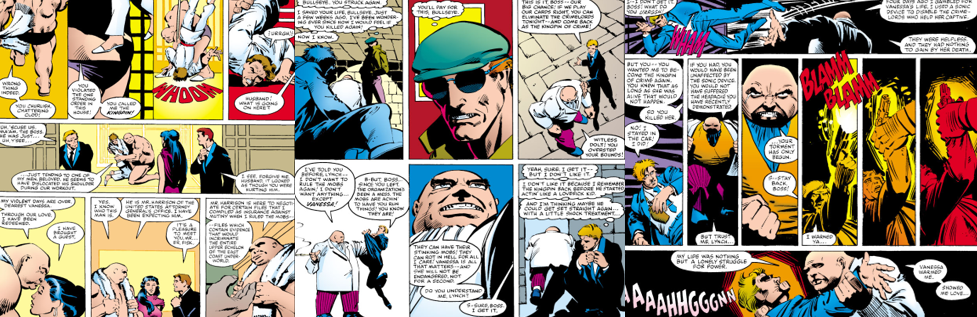
This three-issue arc begins with Daredevil sprinting through New York City, attracting the awe of the locals, to question noted streetwise bum Turk Barrett at Josie’s seedy bar. Although Turk makes a desperate escape attempt, Daredevil brings his getaway to a violent end and learns from him that the city’s top crime bosses have put out a hefty $5 million contract on the Kingpin, the mysterious and powerful mogul who once ran the underworld like a business but has since retired to Japan. There, Fisk is sequestered in a huge mansion with his own private guard and regularly showcases his physical abilities by besting the finest martial arts experts with precision and power, explodes with rage whenever anyone mentions his former life, and desperately keeps his questionable past and tendencies from his beloved wife, Vanessa. Since Fisk is due to sell out his former colleagues in return for clearing his name and $7 million, Vanessa heads to New York to enlist the legal aid of Matt Murdock and his partner and best friend, Franklin “Foggy” Nelson, offering them $200,000 to represent Fisk in court. Before Matt can agree, their office is attacked; in the confusion, Matt investigates as Daredevil and confronts the man responsible, Bruno, a seemingly semi-cybernetic former hitman with a firearm in place of his left hand. Daredevil easily bests Bruno but is stunned when his accidentally severs Daredevil’s grapple line and fatally plummets to the street below. Realising that mob are hiring any assassin they can to do their dirty work, Daredevil prepares to intercept his old foe, Lester/Bullseye, before he can be recruited but is delayed by cantankerous police lieutenant Nick Manolis, who reveals that Vanessa was kidnapped during the action. Released on a technicality (a brain tumour created just enough reasonable doubt about his previous murderous actions), Bullseye is furnished with a swanky new costume and demands $10 million to kill the Kingpin, but gleefully jumps at the chance to battle his hornheaded rival when Daredevil shows up to confront him.

As if Bullseye wasn’t bad enough, Daredevil must deal with the Kingpin’s return to town.

Having previously saved Bullseye’s life, Daredevil feels a responsibility to keep him from wasting it with his violent ways, but Bullseye simply attacks with throwing stars, his confidence and aim better than ever now he’s no longer sick. Despite landing a glancing blow with a pistol, Bullseye’s unable to land a kill shot thanks to Daredevil’s superhuman reflexes; however, Bullseye is so embittered towards his foe and so determined to best and kill him that he sends ol’ hornhead flying out of a window! Although Daredevil saves himself with his grapple hook, Bullseye severs the line, sending Daredevil plummeting to the ground; thankfully, he uses a passing flagpole and crumbling gargoyle to slow his descent just enough to land safely (if painfully) into a passing garbage truck. Rumours of the Kingpin’s return spread through the criminal underworld, leading the mob to kidnap and torture Louie the String for information. Before he succumbs to his injuries, Louie leads them to an explosive trap on Staten Island, where the Kingpin laments returning to his former violent ways but vows to turn New York City into an all-out warzone if it means seeing his enemies suffer and die and return his love to him. To that end, the Kingpin and his underling, Lynch, systematically target the mob’s goons and demand Vanessa’s safe return, with Fisk even stating he’s willing to negotiate to end further bloodshed. Although Bullseye is secretly unimpressed by the bickering mobsters, the city’s crime lords believe they have the upper hand as long as they have Vanessa and order Bullseye to send word that they’ll trade her for all the dirt Fisk has on them, further raising his ire at being reduced to a mere errand boy. Recovering from his fall and unable to find any leads, Daredevil assumes the guise of “Shades” and starts asking questions about Vanessa at Josie’s bar, causing him to get jumped by the local goons. However, after easily fending them all off, he impresses Turk and block-headed grunt Grotto enough to earn an audience with the big man himself and is led into a dingy sewer.

While the Kingpin proves a formidable threat in combat, he’s devastated by his wife’s death.

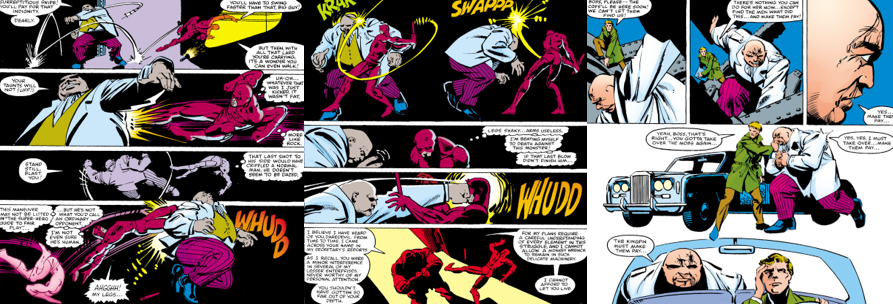
Matt is silently in awe of the Kingpin’s aura, finding that he more than lives up to his reputation as an intimidating presence; gathering himself, Matt claims to be a hitman from Ohio and offers his services, further impressing by jamming a goon’s gun with a pen without looking. Immediately afterwards, another of the Kingpin’s underlings arrives and, before dying from poisoning, delivers the mob’s demands for the exchange. Although Lynch is excited to see Fisk return to power and straighten out the disorganised underworld, Fisk has no interest in returning to his former life; he simply wants Vanessa back, leading Lynch to question if he’s lost his edge. However, Fisk demonstrates his vindictive cruelty when he finds “Shades” has broken into his vault; ready to kill him, the Kingpin is stunned when Daredevil attacks from the darkness. Although Daredevil makes jokes about Fisk’s weight, his swagger is shaken when he realises that the Kingpin is solid muscle; Daredevil’s speed and agility give him the edge in the fight, but every blow to the Kingpin’s rock-hard body wracks ol’ hornhead with agony and he soon tires himself out trying to damage the mammoth mogul. Thus, the Kingpin knocks Daredevil unconscious with a single blow and orders Turk and Grotto to tie him up and drop him into the city’s drainage system. Fisk then heads out to make the exchange, fully aware that the mob have set up a trap and turning the tables on them by incapacitating everyone in the vicinity – including Bullseye – with a high frequency sonic burst. However, as Fisk rushes to rescue his beloved wife, he’s stunned when someone triggers a mortar, causing the construction site to collapse. Though he survives being buried under all the girders and debris, Fisk is heartbroken when he can’t find Vanessa’s body and is suitably motivated to avenge her death by reassuming his former position and targeting his opposition without mercy. Thanks to his radar sense and sheer force of will, Daredevil avoids drowning and heads back to Josie’s bar to interrogate Turk again to catch up with the plot. Meanwhile, Fisk sets himself up in a subterranean stronghold and sends his few men out to disrupt the mob’s deliveries, turning the disparate crime lords against each other through a series of calculated attacks and stealing their cash and armaments. When Turk informs him of Daredevil’s survival, Fisk orders Lynch to move the files and set up an ambush, only for the goons to be attacked by Daredevil and lose the files; however, he’s humiliated to find he was duped by a briefcase full of newspapers!

Bullseye and Daredevil’s violent fight ends with the Kingpin manipulating himself back into power.

Bullseye takes advantage of the mob’s panic to demand a further $5 million to help them out, then hits up a bunch of small-time scumbags to learn the Kingpin’s location only to fall for another of the Kingpin’s traps. The Kingpin then confronts Bullseye and his mob employers, swaying Bullseye to his side and intimidating the mobsters into outing themselves to the cops. Afterwards, Fisk turns the full brunt of his rage on Lynch since it was he that set off the mortar and killed Vanessa to push him into returning as the Kingpin, so Fisk mercilessly breaks Lynch’s limbs and beats him to death as recompense. Fisk then gathers the city’s crime bosses to announce his takeover, only for them to be spooked when the skyscraper’s lights suddenly go out. Realising Daredevil is to blame, Fisk sends Bullseye to deal with him and the two fight once more, with Daredevil driven to make the assassin pay for all the lives he’s taken after Daredevil fought the urge to leave him to die before an incoming train. Relieving Bullseye of his weapons and discarding his billy club, Daredevil lunges for his foe, intent on making him feel the full force of his guilt and anger, but Bullseye fends off his furious assault by making use of his own weapon and smashing the vigilante in the face with a brick. Their brutal melee sees them land blow after blow, crash through a brick wall, and ends with them both choking the life out of each other, Bullseye determined to prove he’s better than his enemy and Daredevil seemingly willing to die alongside his foe. In the end, Bullseye passes out from the pressure, but Daredevil’s victory is short lived as the Kingpin and his goons arrive, armed and surrounding him. However, rather than gunning him down, Fisk gives Daredevil the files he has on the city’s crime lords and requests that he deliver them to the district attorney to have them arrested and allow Fisk to solidify his stranglehold over the criminal underworld once more. Although Daredevil considers making a desperate escape, the Kingpin advises against it; he even allows the Man Without Fear to take Bullseye as “a courtesy” and gives Daredevil no choice but to accept the offer as it will buy the city a brief period of peace while Kingpin works to reorganise and strengthen the fractured mob. Thus, Daredevil is forced to accept the offer and leaves, taking little solace in having brought Bullseye down and the story ends with a return to the city’s dank sewers, where a dishevelled and seemingly amnesiac Vanessa waders in search of money and food.

The Summary:
Daredevil’s first encounter with the Kingpin is quite the thrilling and intricate tale; while it starts off innocently enough, with Daredevil trying to get to the bottom of a disturbing anxiety in the criminal underworld, it quickly escalates as the Kingpin is forced to resume his violent former ways. While I’m not a big fan of Frank Miller’s sketchy artwork, he did some great work when working on Daredevil; most panels and characters are seeped in an inky darkness, giving a dark, moody edge to the story that contrasts with both Daredevil’s bright outfit and generally flippant demeanour and with his other, more colourful peers. The story focuses on a grittier, more violent subsection of the Marvel universe, one where mobsters are gunned down, blown up, and poisoned on the regular and gang warfare is constantly at risk of breaking out due to the fractured state of the criminal underworld. I enjoyed seeing the crime bosses struggle to keep their shit together; it took seemingly everything they had just to be in one room long enough to hire their assassins and I liked how they squabbled like children and were depicted with an arrogant sense of entitlement that slowly deteriorated into abject denial as the Kingpin’s power grew. It was fun seeing Bullseye grow disgusted by their bickering and disorganised ways and watching them crack as they lost their money, power, and men to the Kingpin. While it didn’t lead to all-out gang war, there were some striking instances of violence on the streets and around the city that showed not just how sadistic Bullseye is but how ruthless the Kingpin can be when he’s out for blood.

Evenly matched and equally hatful of each other, Bullseye and Daredevil have an intense rivalry.

Daredevil is caught right in the middle of this; there’s little time for Matt Murdock or his private life here, with just a few panels hinting that Foggy is going through some personal troubles and showcasing Matt’s latest relationship. His focus is solely on confronting and stopping the Kingpin, and on settling the score with Bullseye. I liked the sense of guilt Daredevil carries here; previously, he had the opportunity to leave Bullseye to die but chose to save him, a decision he openly regrets since Bullseye refused to change his ways and just kept on killing, meaning Daredevil feels directly responsible for those deaths. His confrontations with Bullseye start with him trying to reason with the assassin and turn to a murderous rage as Bullseye kills and tortures his way throughout the arc, switching his allegiances to whoever has the most money and power and desiring only to prove himself superior to his hornheaded foe. Bullseye’s abilities are showcased greatly here; he never misses except when fighting Daredevil, fuelling his pride and anger, and he’s highly adaptable, able to make use of throwing stars, knives, guns, and even Daredevil’s billy club with an almost superhuman deftness. Though a sadist, Bullseye is highly intelligent; he knows when to shut up and listen, when to switch sides, and is very aware of Daredevil’s tricks and abilities, meaning he does a great job of holding his own against his hated enemy. Daredevil’s abilities are constantly demonstrated both in visual form and through the narration boxes; he swings, moves, and fights with a superhuman swiftness, appearing as a constantly-moving blur at times, and has a force of will beyond most normal men as he pushes himself to escape from drowning, easily fights off numerous larger and armed foes without breaking a sweat, and makes good use of his billy club and enhanced senses to save himself and track down his prey. At the same time, he’s not depicted as infallible; he runs into a few dead ends, forcing him to assume a new disguise, interrogate Turk, and even talk to hookers for leads, and he takes his fair share of punishment not just when fighting Bullseye but also when battling the Kingpin.

The Kingpin is a callous, passionate, and highly intelligent antagonist whose wrath knows no limits.

This is a great arc for introducing readers to the threat that the Kingpin poses. A calculating, vindictive, and extremely savvy businessman, Wilson Fisk is as devious as they come, regularly setting up traps and always thinking one step ahead of his enemies. Yet, despite his reputation as the Kingpin of Crime, Fisk is absolutely besotted by Vanessa, to the point where he swears off crime, moves across the globe, and forsakes his former life, even being willing to name and shame his former associates to clear his name and start a new life as a loving husband. He’s drawn back into the fray entirely against his will thanks to the machinations of his aid, Lynch, and, though he regularly laments having to welch on his promise to Vanessa, Fisk returns to his former ways with a looming menace and cold-hearted cruelty that’s matched only by his ferocious power and quick temper. Having only heard of the Kingpin as an urban legend, Daredevil is completely caught off-guard when he finds the Fisk’s bulbous form is pure, rock-hard muscle; the Kingpin is practically impervious to pain and injury, easily shrugging off bullet wounds and Daredevil’s best shots and breaking limbs and pummelling his enemies to death with ease. This arc does a masterful job of stablishing how intelligent and intimidating the Kingpin can be, forcing Daredevil to assist his eventual return to power to end with a tainted and grey-hued victory for the Man Without Fear, and I’d say these are essential issues to read for anyone who’s a fan of Daredevil, the Kingpin, and their complex and violent relationship.

My Rating:

Rating: 4 out of 5.

Great Stuff

Have you ever read this three-issue arc? If so, did you like the way it depicted Daredevil’s first encounter with the Kingpin? What did you think to the Kingpin, his begrudging return to power, and the way his motivations were showcased? Did you enjoy the brutal fights between Daredevil and Bullseye? What did you think to the depiction of the mob and Daredevil’s helplessness against the Kingpin? What are some of your favourite Kingpin stories and how are you celebrating the Man Without Fear this month? I’d love to know your thoughts so feel free to share them in the comments below or on my social media, and be sure to check out my other Daredevil content.

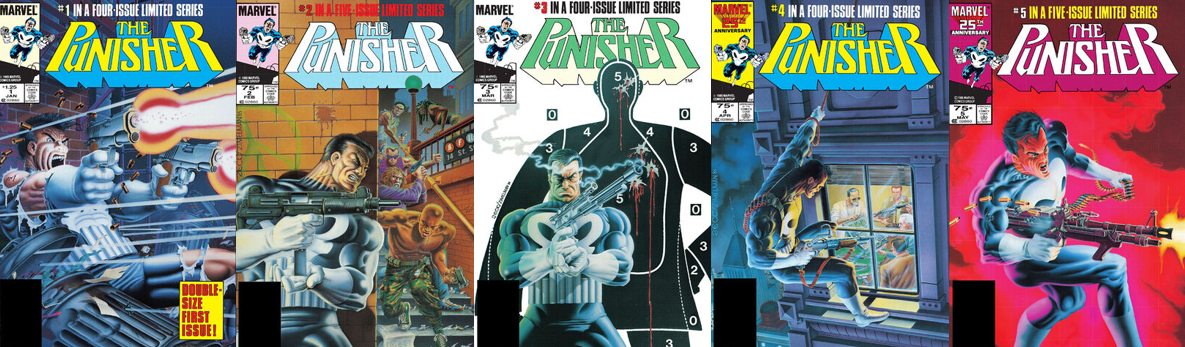
Back Issues: The Punisher #1-5

Writer: Steven Grant – Artist: Mike Zeck

Story Title: “Circle of Blood”
Published: 8 October 1985 (cover-dated January 1986)

Story Title: “Back to the War”
Published: 5 November 1985 (cover-dated February 1986)

Story Title: “Slaughterday”
Published: 10 December 1985 (cover-dated March 1986)

Story Title: “Final Solution: Part 1”
Published: 7 January 1986 (cover-dated April 1986)

Story Title: “Final Solution: Part 2”
Published: 11 February 1986 (cover-dated May 1986)

The Background:
By February 1974, Marvel Comic’s iconic teenage superhero, Peter Parker/Spider-Man, had become a mainstay of the publication following his 1962 debut in Amazing Fantasy #15. After earning his own ongoing book, The Amazing Spider-Man, the following year, he amassed quite the gallery of villains, such as Doctor Otto Octavius/Doctor Octopus, Flint Marko/The Sandman, and, of course, Norman Osborn/Green Goblin. In February 1974, Gerry Conway and Ross Andru introduced readers to the Jackal, a crazed scientist whose cloning technology eventually resulted in one of Spider-Man’s most infamous storylines, but who first employed the services of Vietnam veteran-turned-mercenary vigilante Frank Castle/The Punisher to target the web-slinger. Inspired by The Executioner (Pendleton, et al, 1969 to present), designed by Gerry Conway, and named by Marvel mastermind Stan Lee, the Punisher was such a hit that he graduated to this self-titled series. Naturally, given the Punisher’s propensity for killing his enemies, it was difficult for him to amass his own recurring antagonists but one of his most memorable foes is easily William “Billy” Russo/Jigsaw, a mutilated mobster created by Len Wein and Ross Andru who has returned time and again, defying death and fate, to torment the Punisher for nearly fifty years.

The Review:
As huge a fan of the Punisher I am I haven’t really read too much of his stuff. I like to pick up Marvel’s Platinum collections for their characters as they bring together a variety of iconic stories for their biggest names, and sadly the Punisher hasn’t yet received one of these so my experience with him is a little sporadic. Still, I love the simplicity and bleak grittiness of the hardened vigilante and find him to be an extremely compelling and layered character so I’m always glad to read his stories, especially his most influential ones. The Punisher’s first solo series begins with him locked up on Ryker’s Island, a gothic-style prison on a small isle adjacent to New York City. A conversation between warden Jerome Gerty and his aide, Tommy, gives the uninitiated a quick rundown on the Punisher’s backstory (you know the drill: Vietnam vet who turned to vigilantism after his family was killed in a mob attack) and reveals that he’s been locked up after a recent bout of drug-induced madness The warden appears to have big, potentially sinister, plans for the Punisher, whose reputation is so intimidating that all the inmates are scared stiff by his presence. All except for “The Mule”, Frank’s loud-mouthed, musclebound cellmate; unfortunately for the human ox, Frank isn’t impressed by his offer to protect him for a few favours and the Punisher quickly overpowers the Mule and forces him to do his bidding and feed him information. Considering his drug episode originated during a prior stay at Ryker’s, Frank puts the wind up Frisky Martin, one of the inmates who works in the prison cafeteria, and delights in the fear he’s causing amongst the populace. With Frisky suitably intimidated, Frank follows him to the source of the prison’s drug operation and is unsurprised to find Jigsaw peddling the wares from within the walls.

The Punisher infiltrates Ryker’s to get to the bottom of Jigsaw’s drug operation.

After making short work of Jigsaw’s goons, Frank walks into hostile territory, Block D, where the mutilated mobster living in luxury in his cell, only to find himself vastly outnumbered by the violent criminals awaiting there. Following a brutal beating, the Punisher is restrained and facing a broken glass bottle to the face as recompense for him destroying Jigsaw’s face, only for him to power his way out if it and crush Jigsaw’s hand, driving shards of glass into it. Although Jigsaw orders the guards to shoot Frank, the fracas is interrupted by Carlo Cervello, the prison’s resident mafia Don known as “The Brain” for always thinking one step ahead. Cervello reprimands Jigsaw and, to his surprise and outrage, welcomes Frank into his operation when the Punisher offers to join him in breaking out of Ryker’s. A few nights later, the plan begins and Cervello immediately double crosses the Punisher by sending his muscle, Gregario, to kill him using a homemade silencer. This cobbled together appliance is faulty, however, and the Punisher is able to outsmart “The Brain” using a simple mattress. As the escape turns into a full-blown riot, Frank lets the violence play out to whittle down the obstacles in his way before making a break for the control tower, wounding Gregario and scuppering the escape plan using the tower’s defensive measures. Cervello and Jigsaw make their way to the warden’s office where they take Gerty and Tommy hostage and demand the Punisher lays down his gun, only for it to literally backfire in Jigsaw’s face as he tried to shoot unsuitable bullets with it. When Cervello threatens to shoot Gerty, Frank calls his bluff with a cold-hearted stoicism that terrifies Cervello so much that he willingly returns to his cell.

With the Kingpin presumed dead, the Punisher incites a turf war that winds up the local mobsters.

Frank, however, tries to murder the mobster for the attempt on his life and then demands that Gerty escort him out of the prison. Although armed guards defuse the situation, Gerty vouches for the Punisher and reveals that he and Tommy work for a mysterious cartel known as “The Trust”, a well-oiled group who share Frank’s concerns regarding crime. Not only does Gerty offer to allow Frank to escape (though still a wanted man) and furnish him with his iconic skull outfit, he offers to bankroll his operation, asking only that the Punisher eradicate organised crime once he’s out. Despite his suspicions, Frank cannot say no to the opportunity to return to the war, unaware that would-be-doctor Tony Massera has been coerced by his mobster uncle, Charlie Siciliano, to take revenge on the Punisher for killing his father. Ignorant to this, the Punisher gets back to work with a bang, quite literally, by storming the office of the untouchable Kingpin of Crime himself, Wilson Fisk, only to find himself duped by a dummy and sent hurtling out of the seventy-storey building by an explosive trap. Although he slows his fall, the Punisher takes a bad landing and goes into shock, only to awaken in the lavish riverside home of the alluring Angela, who begs to assist the Punisher’s crusade, even offering her body, since organised crime left her family dead. In the aftermath, Frank ruminates on his age, the mistake that almost cost him his life, and his never-ending war; to help tip the odds in his favour, he calls Ben Urich of the Daily Bugle and reports that he assassinated the Kingpin in order to incite a mob war to fill the void, allowing him to easily take care of whoever’s left after the bloodshed. Accordingly, mobsters are offed all across the city and, desperate to avoid all-out war, Siciliano tries to broker peace amongst the disparate mobsters, completely unaware that the Punisher is listening to his every word from his kitted-out Battle Van.

Troubled by the collateral damage, the Punisher tries to stem the cycle of violence he started.

The heads of the city’s top crime families, and some of their lackeys, gather at Grand Central Station, of all places, that evening to hear Siciliano out, only to be set upon by Nolo Contendre, a hitman from Detroit. Although the Punisher is pleased by the ensuing anarchy, he wants to know who hired Contendre so he chases him down to the subway where a violent game of cat-and-mouse breaks out between the two. Frank takes a direct shot to the chest (though he’s saved by his heavy body armour) and is incensed when Contendre breaks the rules of his profession by opening fire upon civilians. Frank wounds Contendre with a knife, enraging him, and ends up decapitating the thug by kicking his head through a window, where it’s promptly taken off as the train pulls into Times Square Station. Seeing the fear in the eyes of the wounded passengers, Frank chastises his recklessness and vows to stop to the violence he has incited, only to be thrown off kilter when his van explodes before his eyes, which his Trust contact, Alaric, suggests is a sign that he needs to partner with the organisation on a more formal basis. Perhaps taking this to heart, the Punisher goes out of his way to protect mobster Tomas Santiago from an assassination attempt by rival gangster Simon Ejszaka all to set up another peace conference with Siciliano. In the interim, he opens up to Angela about the “circle of blood” that surrounds his life and she tries to convince him of the benefits of working with the Trust so he can have some support and back up, with the story revealing to the reader that the Trust not only blew up Frank’s van but also planted Angela to sway him to their cause. Ignorant to this, the Punisher spots Massera watching her building and confronts him, only for Massera to reveal he’s rooting for the Punisher since he can’t stand the violence surrounding his life, with the Punisher warning him to stay out of it or suffer the same fate as his father.

The Punisher is aghast to learn that Alaric has built an army of fake Punishers.

Frank pays a visit to Ejszaka and threatens him into going to Siciliano’s peace meeting and for information regarding Marcus Coriander; he then goes to visit Santiago, only for it to be revealed that Siciliano has been murdered by a fake Punisher! Although Frank puts down the faker, Santiago is killed and all the recent mob murders are revealed to have been perpetrated by Coriander and his gaggle of Punisher look-a-likes. Frank drops in on Coriander, who reveals that he formed this “Punishment Squad” to follow the Punisher’s example and disrupt the city’s criminal underworld before the Kingpin could return to power. After taking care of the fake Punishers (off-panel for maximum imagination), Frank is stunned when Coriander also opens fire on innocent civilians to cover his escape, gunning down a little girl in an experience that breaks the formally small-time crook. When the Punisher confronts him, Coriander exhibits signs of mental trauma but reveals that it was Aleric who was behind everything, right before Angela murders him and shoots the Punisher. He recovers pretty quickly, and without explanation, however (primarily because people refuse to shoot him in the head!) and returns to Ryker’s Island to talk with Gerty about the Trust, an organisation whose goals he can relate to but whose methods fly in the face of his strict moral code. There, he finds Tommy dead courtesy of another doppelgänger, whom he puts down a few blocks (and panels) later when he tracks down Gerty, threatening the warden with death unless he spills the beans on Alaric and the Trust. It turns out that Alaric has brainwashed criminals into his own personal death squad and the fear of Alaric’s reprisals, or being locked in his own prison, leads Gerty to shoot himself in the head before the Punisher’s grim-faced façade. The cops arrive at that exact moment; since the Punisher refuses to fight the police out of respect, he allows himself to be arrested, only for the Punishment Squad to arrive and try and kill them.

The Punisher callously makes short work of Jigsaw and Alaric and returns to his never-ending war.

One cop goes down but the Punisher convinces the other to uncuff him so he can kill his look-a-likes and coerce Siciliano into taking him to Alaric’s compound outside the city, where he forces his subjects to endure electroshock treatments and a special gas to condition them into thinking they’re the Punisher. Frank creates a distraction and makes his way into the compound, only to find that Jigsaw has also been brainwashed to be one of Alaric’s goons. A haymaker to the jaw is enough to undo Jigsaw’s conditioning and Frank easily hitches a ride to Alaric’s main building via a passing helicopter. Alaric begs his lover, Angela, to get to safety so he can hold off the Punisher without worrying about her and tries one last time to convince the Punisher to join his cause. When Frank stubbornly refuses, he falls into one of Alaric’s electroshock rooms and is subjected to the same brainwashing process so he can lead the Punishment Squad; thankfully, he’s able to withstand the pain of the electroshock floors, plug up his mouth, and make an explosive escape as he had all his equipment on him. His body wracked with pain and nursing several injuries, the Punisher is easy prey for Jigsaw, who delights in brutalising and taunting him, but spends too long gloating and Frank stabs him and beats him into submission. However, Frank inexplicably allows Jigsaw to live, but his actions scare off the Punishment Squad and clear the way for him to reach Alaric. Still, Alaric does a pretty good job of defending himself, surprising the Punisher and frantically beating him with the butt of his rifle, only to be sent into a desperate frenzy by the blood and violence. A stalemate of sorts occurs until Frank wounds Alaric and fends off his attack dog; again, rather than killing his enemy, the Punisher threatens him with death unless he blows the whistle on the Trust, which in itself will mean a death sentence for him when the mob come looking for revenge. Satisfied that Alaric will be punished one way or another, the Punisher leaves with his dog, only to be confronted by Siciliano; the Punisher’s able to talk him down, however, with a soliloquy about the cycle of violence and his part in it. As he leaves the compound, Angela tries to run him down and he callously leaves her to her fate after wrecking her car, heading off into the night to continue his never-ending war.

The Summary:
The first thing that strikes me about these five issues is the art work; fittingly, the Punisher’s solo series uses a far less exaggerated and comic book aesthetic (for the most part), depicting a much darker and grittier side to Marvel Comics that works perfectly with the Punisher’s more no-nonsense and violent attitude. Sure, Mike Zeck makes the Punisher a bit of a man mountain at times and Jigsaw’s face is a bubbling mess of scarred flesh but, for the most part, things are quite realistically done here. The Punisher suffers injuries, dislocating his shoulder, going into shock, and even fearing paralysis on a couple of occasions, which again speaks to his vulnerability as a character as opposed to his more virtuous and superhuman peers. He’s also far more introspective and stoic; his dialogue boxes are both “real time” narration and reflections from his war journal, which reinforces that he sees his mission as a war against all crime, and he’s not one for spouting quips or cliché puns at his victims. In fact, almost every word out of his mouth is a threat or some bleak meditation on the cycle of violence that is his life, and it goes a long way to added depth to his character and laying the foundation of what the Punisher is all about.

The Punisher is tormented by the cycle of death and violence that his life has become.

Indeed, there are many times when the Punisher laments the “circle of blood” that has surrounded his life. With nothing to lose, he’s fully committed to this cycle and he knows full well that it will end in his death and will even carry on after he died, meaning that his life’s mission is ultimately meaningless, and yet he is compelled, almost addicted, to killing criminals and saving as many lives as he can. His grim façade cracks only when there’s mention of his lost family or when he sees innocents being harmed; he’s enraged when Contendre and Alaric fire on civilians, suffering flashbacks to his family’s murder, and distraught by his part in the collateral damage, seeing himself as no different from those he’s sworn to punish. Since he’s just one man, the Punisher sets up a mob war to have the city’s mobsters to wipe each other out and make his job easier; a good plan that almost immediately goes sour. We see very little of this mob war beyond a few key gangsters being assassinated and a lot of dialogue talking about how things have escalated out of control with very little visual representation of this. Literally a few pages after he gets the ball rolling, the Punisher is beating himself up over the collateral damage as though he didn’t think anyone would get hurt in the crossfire, which is a bit ridiculous. I would’ve liked to see the gang war take place over an entire issue, with Frank coming to this realisation at the end or part-way through the next issue and then trying to stop what he started but, as presented, it’s quite rushed and nonsensical as he has to shut down his plan almost right away. Still, this was quite an intense story. I liked how each issue introduced a kind of rival for the Punisher, be it Contendre or one of the other head mobsters, and that his actions had consequences; Siciliano has a vendetta against him for killing his gangster father and, most prominently, Alaric brainwashed criminals into forming the Punishment Squad and perverted the Punisher’s skull logo specifically because he was inspired by Frank’s crusade.

Despite some weak villains, the story delves into the Punisher’s motivations and psychology.

Naturally, the Punisher guns down almost everyone who crosses his path without mercy or hesitation, meaning any kind of prolonged conflict between him and the likes of Contendre or his many look-a-likes is supplanted by a relatively quick kill from the Punisher. When his rivals put up more of a fight, the art really shines; it’s great seeing the Punisher walk into situations with no regard for his own safety and fight, beat, or gun down multiple armed assailants at once and I really enjoyed how many in the criminal underground fear him for his uncompromising mercilessness. Jigsaw is an exception to this rule; his hatred of the Punisher is so strong that it allows him to break free of Alaric’s brainwashing but his presence in the story is more of an extended cameo. It’s not entirely clear why the Punisher doesn’t kill him, either; he’s perfectly happy to kill everyone else but spares Jigsaw out of some half-assed sense of kinship given his own mental imbalance. This leaves Alaric as the story’s primary antagonist and he’s not really capable of matching Jigsaw’s visual or thematic appeal; I think the story might’ve benefitted from Jigsaw being behind the Punishment Squad and his motives being to further tarnish the Punisher’s reputation as Alaric is more of a pen pusher than a fighter. He’s reduced to a quivering wreck when he accidentally kills a little girl and before the Punisher’s fury and is only able to fight back because Frank is a bit weakened, making for a lacklustre villain. Overall, though, it’s an enjoyable Punisher story that explores his motivations and offers some introspection into his mission. There’s a sense of duty, obligation, and self-loathing to the Punisher, whose callous and grim demeanour make him stand out from other Marvel heroes and villains. He’s so committed to his cause that he’ll try and kill the Kingpin the first chance he gets and that disregard for his own wellbeing is wonderfully conveyed here. It’s not perfect but, for fledgling or casual Punisher fans, this miniseries is the perfect place to start reading.

My Rating:

Rating: 3 out of 5.

Pretty Good

Have you ever read the Punisher’s first solo series? What did you think to the deeper insight into Punisher’s character and motivation? Would you have liked to see more focus on the mob war? What did you think to the villains of the miniseries; would you have liked to see more from Jigsaw or Contendre? What are some of your favourite Punisher stories and villains? How are you celebrating the Punisher’s debut this year? Whatever you think about the Punisher, share your opinions down below.

Back Issues [Spidey Month]: The Amazing Spider-Man #50


Easily Marvel Comic’s most recognisable and popular superhero, unsuspecting teenage nerd Peter Parker was first bitten by a radioactive spider and learned the true meaning of power and responsibility in Amazing Fantasy #15, which was published in August 1962. Since then, the Amazing Spider-Man has featured in numerous cartoons, live-action movies, videogames, action figures, and countless comic book titles and, in celebration of his debut and his very own day of celebration, I’m dedicating every Saturday of August to talk about everyone’s favourite web-head!


Story Title: “Spider-Man No More!”
Published: 11 April 1967 (cover-dated July 1967)
Writer: Stan Lee
Artist: John Romita Sr.

The Background:
Considering Spider-Man’s debut almost didn’t happen, it’s pretty ironic that Stan Lee and Steve Ditko‘s angst-ridden teenage superhero would go on to become the flagship character of Marvel Comics. Over the years, Spider-Man has been involved in some of Marvel’s most celebrated, and notorious, story arcs, and the troubled wall-crawler is often depicted battling his own personal woes as often as one (or more) of his colourful rogues. In 1967, he faced one of his most trying challenges when, burdened by J. Jonah Jameson’s hate campaign, Peter walked away from his responsibilities as a superhero in one of the character’s most influential stories, which also introduced readers to one of the most notorious Marvel villains, Wilson Fisk/The Kingpin.

The Review:
“Spider-Man No More!” kicks off with a bang courtesy of a visually stunning full-page splash from one of comic’s greatest artistic talents, John Romita, who practically wrote the book on how dramatic and spectacular Spider-Man’s depiction should be. With absolutely no context at all, we’re thrown right into the action as Spider-Man tackles a group of armed thugs who are in the process of pulling off some kind of heist. As is commonplace in sequences like this, the crooks are stunned at Spidey’s superhuman agility, which allows him to easily dodge bullets, and completely powerless against his superhuman spider strength, which easily allows him to shrug off even their combined assault and render them all unconscious with a few hard-hitting blows. However, despite saving the day in magnificent fashion, Spider-Man is met with fear and suspicion by one of the employees he saved, and he swings away cursing the efforts of grouchy Daily Bugle editor J. Jonah Jameson at painting him as a crazed masked maniac. Thanks to Jameson’s editorials, half of New York City is either terrified of him and thinks he’s just as bad as the many colourful supervillains in town and the other half thinks he’s mental, which he can’t help but be bothered by considering the populace celebrates other costumed superheroes like the Fantastic Four and the Avengers. Peter’s woes that, no matter what he does or how hard he tries, the public hates him more and more are only added to when he returns to his apartment and learns from his friend and roommate, Harry Osborn, that his beloved Aunt May has fallen ill. We’re not told what, exactly, May has been stricken by, however; she’s simply had “another attack” and been left bedbound. Naturally, Peter blames himself for his aunt’s condition; after all, if he’d been at home rather than putting his life on the line for his own sense of self-gratification, he would’ve been able to get there faster and he’s burdened by his unreliable nature due to his superheroics.

Burdened by his woes and Jameson’s smear campaign, Peter gives up his costumed identity.

Beating himself up and already blaming himself for not being there for the only family he’s ever known and has left, Peter’s unable to concentrate on his studies, which directly translates into him struggling through a test the next day and receiving a kindly warning from his Physics teacher, Professor Miles Warren, about his steadily declining grades and that his once-impressive science record won’t allow him to coast along unless he puts in the work. To make matters worse, Peter’s so troubled by his aunt’s health and his failing grades that he’s forced to turn down a genuine offer from beautiful socialite Gwen Stacy, which only further adds to his woes as he kicks himself for not having the time or enthusiasm to find out if the likes of Gwen or seemingly scatter-brained Mary Jane Watson are really interested in him or have more depth to their personalities. Peter’s even had to turn down a fantastic job working for Harry’s dad, Norman Osborn, because he has to keep his evenings free in case Spider-Man is needed, and his troubles reach boiling point when he turns on the television and is faced with a malicious rant from Jameson painting Spider-Man as a neurotic trouble-maker who provokes villains for his own ego. Jameson’s so sure that Spider-Man is a menace to society that he offers a whopping $1000 reward for the capture and conviction of the web-slinger and Peter reaches his breaking point. Realising that his colourful alter ego has brought him and those around him nothing but pain, Peter begins to think that Jameson is right, that he’s been swinging all over town out of some childish, selfish desire for attention, and dramatically dumps his costume, and the identity of Spider-Man, in the trash once and for all.

As the Kingpin seizes power, Peter is reminded of his responsibilities and returns to action once more.

Of course, Jameson is overjoyed when a small boy delivers him Spider-Man’s costume and that his smear campaign has worked, publishing his victory on the front page to a largely incredulous New York City (it’s actually endearing how his readers see it as nothing more than a publicity stunt and actually show support for Spider-Man). Peter follows up his decision by quitting as Jameson’s lackey, much to his comical outrage, though the publisher delights in bragging about his triumph and proudly displays Spider-Man’s costume in a trophy cabinet in his office. Meanwhile, the city falls into anarchy as the Kingpin takes the opportunity to consolidate the city’s various mobsters and gangsters under his direct supervision, organising them in a way they’ve never been before and leading to a flurry of crimes, all of them in broad daylight, that threaten to tax the city’s police department to their limit. Peter, however, is having a whale of a time; no longer having to devote his time and energy to crimefighting, he’s finally able to socialise with Gwen, dote on his recovering aunt, and catch up on his studies. He’s even giving serious thought to taking up Norman’s job offer once Aunt May is fully recovered but, while he catches himself in the act of responding to the news of a robbery at the welfare office, he instinctively acts without hesitation when he sees a watchman being set upon by armed thugs. Chastising himself for going back on his promise so quickly, Peter is devastated when he realises that the kindly old watchman has the likeness of his beloved Uncle Ben. All at once, the pain and guilt of his irresponsibility catch up to the troubled teenager as he relives his childhood and his failure to us his great powers responsibly, which directly caused his uncle’s death, and he realises that it’s his burden, his duty, to set aside his personal woes and use his superpowers for the benefit of others to atone for that loss. Thus, he breaks into Jameson’s office, recovers his costume, and pranks the editor with the promise of flooding the city with more Spider-Men before swinging off into the city rejuvenated once more.

The Summary:
If you came into “Spider-Man No More!” expecting fast-paced, hard-hitting action and to see Spider-Man pummelling goons and supervillains galore, then you’re probably going to be disappointed. Instead, in keeping with the story being published in The Amazing Spider-Man’s fiftieth issue, what we have here is a deep dive into Peter’s troubles and a new spin on detailing exactly why he’s cursed to set aside friends and even family to save lives as Spider-Man. It’s not uncommon for comics, especially Spider-Man stories and tales from this era, to constantly rehash a character’s origin but I think it’s used to good effect here and almost makes The Amazing Spider-Man #50 a kind of starting off point for new readers. Thanks to being overwhelmed by his aunt’s failing health, his non-existent social life, his declining grades, and Jameson’s smear campaign, Peter has lost sight of his mission and fallen into a depression so deep and so dark that the only solution he can think of is to literally and figuratively ditch his costumed identity in one of comic’s most iconic panels. We see the effect this has on Peter right away; no longer does he have to shun Gwen or Mary Jane or his studies since he has the time and focus to think about things other than crimefighting or swinging off to help with the next emergency. He can be there for May, relax with his science books, and apply himself in far more productive ways, literally turning his frown into a smile as he happily goes about his daily business without the burden of Spider-Man weighing him down. Peter even takes a great deal of pleasure in quitting from the Daily Bugle, a job that has always underpaid and underappreciated him, and is perfectly happy to let the city police handle  the escalating crime way sweeping across the town.

Peter’s joy at rediscovering his life is short-lived since Spider-Man’s powers will always be needed.

While New Yorkers are troubled by Spider-Man’s absence, the Kingpin sees it as a fantastic opportunity and makes an impact with his plan to consolidate the disparate gangs and criminals into something more akin to a business, with him as the chairman of the board. Though he doesn’t physically get involved in the action, he showcases his threat when Farley Stillwell tries to get in on the action and quickly makes a name for himself in the criminal underworld through his organisational skills and lofty goals. Although Peter is quick to chastise himself for reverting to type so quickly, he reasons that he had no choice but to act when he saw the watchman’s life in danger, and this brings back a flood of memories that we’re all keenly aware of but which serve as a stark reminder to the troubled youth that he has an obligation to use his gifts responsibly, regardless of the cost to his social life or his own desires. Having been reminded of his life’s mission, and perhaps feeling a sense of closure at having saved his uncle’s doppelgänger, Peter immediately returns to action as Spider-Man; though the story doesn’t resolve how he’s going to juggle his friends, family, and studies, it can be assumed that he’s at least more at peace with his duel identity for the time being and more than ready to make up for lost time. Overall, there’s a reason “Spider-Man No More!” is one of Spider-Man’s most celebrated adventures; what it lacks in action, it makes up for in interpersonal drama and a character study of everyone’s favourite web-head and the story is perhaps the quintessential reminder of the heavy burden Peter must carry lest he fail to use his gifts responsibly and indirectly cause more death or heartache. It’s a tragic tale, to be sure, but also one that encapsulates everything Spider-Man is; he sets aside his personal desires for the greater good and, even when he does take the time to be selfish for a change, his inherent need to help others will always win out, which is a message we could all stand to learn from.

My Rating:

Rating: 4 out of 5.

Great Stuff

Are you a fan of “Spider-Man No More!”? Where would you rank it amongst Spider-Man’s many other stories and moments? What did you think to Peter’s troubles and his decision to quit being Spider-Man? Do you think Peter was maybe a little too angst-ridden and could’ve found a better way to balance his duel identities? What did you think to the Kingpin’s plot to unite the city’s criminals? Do you think the resolution to Peter’s anguish was a bit rushed or did you enjoy that he got to save his uncle’s proxy? Would you say that Spider-Man is an egomaniac and a menace or do you think he’s a benefit to the city? How are you celebrating Spider-Man this month? Whatever your thoughts on Spider-Man, and “Spider-Man No More!”, share them below or drop a comment on my social media and be sure to check out my other Spider-Man content!

Screen Time [Christmas Countdown]: Hawkeye

Air Date: 24 November 2021 to 22 December 2021
Network: Disney+
Stars: Jeremy Renner, Hailee Steinfeld, Tony Dalton, Alaqua Cox, Vera Farmiga, and Florence Pugh

The Background:
In one of their more blatant borrowings from their competitor, Stan Lee and Don Heck debuted Clint Barton/Hawkeye in the pages of Tales of Suspense all the way back in 1964. Originally introduced as a foil for Tony Stark/Iron Man, Hawkeye eventually became a member of the Avengers, was involved in some of Marvel’s most prominent storylines, and has even become a symbol of representation for the deaf community in recent years. Jeremy Renner helped the D-list archer become a household name after he was cast in the Marvel Cinematic Universe (MCU) but was very much restricted to a supporting role compared to his other, more compelling peers. Marvel Studios sought to change this with the launch of Disney+, and Hawkeye was one of the first characters slated to have his own show exclusive to the streaming platform, which executive producer Trinh Tran aimed to explore his backstory, his time as Ronin prior to Avengers: Endgame (Russo and Russo, 2019), and introduce his protégé, Kate Bishop (Steinfeld), to the MCU. Accordingly, the show was heavily influenced by Matt Fraction’s comic book run, in which these elements (and Hawkeye’s deafness) were prominent features. The show aimed to delve deeper into Barton’s mindset and how the Snap had affected him, while also formally incorporating elements from Marvel’s Netflix shows into the MCU proper, and further lay the groundwork for a potential Young Avengers project. Despite issues caused by COVID-19, the six-episode series was highly praised when it debuted on Disney+; critics enjoyed the banter between the two archers, the seasonal setting, and the chance to spend more time with Barton, while also praising the grounded action sequences. While there has been no talk of a second series, a spin-off for deaf antagonist-cum-anti-hero Maya Lopez (Cox) was put into production for a 2023 release.

The Plot:
Former Avenger Clint Barton just wants to get back to his family for Christmas but his life is thrown into disarray when he crosses paths with would-be superhero Kate Bishop and is thrust into the middle of a conspiracy from his past that threatens to derail far more than the festive spirit.

The Review:
I mentioned in my review of his debut appearance that I’m not overly familiar with the character of Hawkeye; I’ve definitely read more stories of his DC Comics counterpart and Hawkeye generally just pops up in any stories I read that feature the Avengers or other Marvel Comics characters. As a result, while I’m familiar with Matt Fraction’s work with the character, I’m by no means a die-hard Hawkeye fan. I’ve always been a bit dismissive of him; this isn’t because he doesn’t have any superpowers, I’ve just never really been motivated to seek out his stories. However, having said that, I am a fan of Jeremy Renner’s portrayal of the character in the MCU; Hawkeye got a bit shafted in first Avengers movie, but has since become the heart (or, at least, moral compass) of the team. He’s shown himself to be a devoted family man, something none of his peers can boast of, a surrogate father and mentor and to have real emotional depth to his character, going on a killing spree as the vigilante Ronin after Thanos (Josh Brolin) wiped out half the universe (including Clint’s wife and kids, who eventually returned, of course) and being visibly broken after his best friend and partner, Natasha Romanoff/Black Widow (Scarlett Johansson), sacrificed herself to help undo Thanos’s actions. I think it’s cool that Hawkeye got the chance to spread his wings in a series devoted to him, but I do think Marvel Studios missed the chance to do a sort of spy/thriller set in the past that showed how Clint and Natasha first met and joined the Strategic Homeland Intervention, Enforcement, and Logistics Division (S.H.I.E.L.D.), which would also have shed new light on S.H.I.E.L.D. director Nick Fury (Samuel L. Jackson), but I suppose that still isn’t completely off the table and this is a good compromise as I can’t say for sure if a Hawkeye solo movie would land too well.

Burdened by grief, Clint is forced to protect Kate from the ghosts of his violent past.

When we catch up with Clint, he’s still carrying the grief and guilt over Natasha’s death; he’s unimpressed, to say the least, and somewhat insulted by Rogers: The Musical’s glorification of the Avengers and their strife and haunted by Natasha’s sacrifice. He’s also now shown to be partially deaf and wearing a hearing aid (which he turns off to spare himself Rogers’ cheesy songs and later, to tune out Kate’s incessant babbling) and is irked that the musical includes superheroes who weren’t even in the battle. And that’s not even mentioning the “Thanos Was Right” graffiti he spots in the men’s room; here’s a guy who lost everything, put his life on the line countless times, and lost his best friend to bring back untold billions of lost souls and his reward is seeing his exploits turned into a cringe-worthy stage show (Marvel Universe Live! had better action, costumes, and production value) and anonymous accusations that all that pain and loss was not only for nothing, but unappreciated by a certain few. He’s also shown to be uncomfortable with the hero worship some show him, dismissive and annoyed by fans, and cares little for his “branding”; in “Hide and Seek” (Thomas, 2021), Kate voices her concerns that he’s too “low key” to sell and thus has been denied his proper share of the limelight and a big part of their emerging partnership is her emphasising that Clint needs to open himself up more so he can inspire people the same way he did her. “Partners, Am I Right?” (Bert and Bertie, 2021) shows his counterargument to this; Clint has always seen himself as a weapon, rather than a hero or a role model, and he’s too traumatised and too weary from his losses and years of fighting to want to be in the public eye. Indeed, he begins the show simply wishing to spend a happy, if cringe-filled, Christmas with his kids – supportive daughter Lila (Ava Russo) and his sons, veritable blank slate Cooper (Ben Sakamoto) and young Nathanial (Cade Woodward). He’s stunned when he sees a report of his former murderous vigilante persona, Ronin, on the news and immediately sends his kids back home to their mother, Laura (Linda Cardellini); haunted by the deaths he caused while in the guise, Clint makes it his mission to track down whoever’s in the getup to protect them from reprisals and is aghast to find Kate under the mask. Concerned for her welfare, Clint’s paternal instincts kick in and he takes her to safety; dismissive of her because of her age and claim to be “the world’s greatest archer”, despite her obvious talent with a bow, Clint wants only to dispose of the Ronin suit, tie up his loose ends with the Tracksuit Mafia, and get back to his family for Christmas; he has no interest in a partnership or teaching Kate anything at first, but they slowly bond throughout the events of the show despite his crotchety nature.

Kate is overjoyed to be joining forces with her idol and applying her skills to superheroics.

While the show bares the name of Clint’s alter ego and his strife and character are at the forefront of the narrative, Hawkeye is, primarily, the Kate Bishop show. The series begins with a flashback showing young Kate (Clara Stack), already a keen archer, being inspired by Hawkeye’s bravery and heroism during the Chitauri attack on New York City, which left Kate’s father, Derek (Brian d’Arcy James), dead and saw her and her mother, Eleanor (Farmiga), saved by one of Hawkeye’s arrows. Vowing to protect herself, her mother, and others in the same way as her hero, Kate grew up studying fencing, archery, and martial arts; the first episode’s opening credits are essentially an animated montage showcasing Kate’s tenacity and will to succeed but, while she’s certainly gifted with a bow and in a fight, she’s young, inexperienced in the field, and has no real idea of how to best use her skills. This comes up constantly throughout the show as she’s forced to think on her feet, react to dangers with either fast thinking or her martial arts skill, and use her surroundings to her advantage, all of which shows her to be highly adaptable, but in over her head. However, she has good intentions; she puts herself on the line to rescue a one-eyed stray dog, Lucky (Jolt), and manages to scramble through most fights through luck, perseverance, and the element of surprise. Kate briefly adopts the Ronin identity when she becomes suspicious of her mother’s new fiancé, the swashbuckling, charismatic Jack Duquesne (Dalton), and becomes caught up in a murder mystery after finding Jack’s uncle, Armand Duquesne III (Simon Callow), dead from a sword wound. Since the Tracksuit Mafia have a grudge against Ronin, and Kate’s not exactly a pro at covering her tracks, she quickly finds herself a target and is blown away when her hero, Hawkeye, rescues her. She’s disheartened to learn that he plans to part ways with her as soon as the suit is destroyed and when he shows reluctance to teach her anything, but she remains persistent; when Clint allows himself to be captured by the Tracksuits to try and warn them off her, she uses her mother’s security company to track him and literally comes crashing in to rescue him. Though aggravated by Kate’s recklessness, inexperience, and methods when it comes to dealing with criminal scumbags (she’s just as likely to offer them relationship advice as she is a beatdown), Clint genuinely wants to keep her safe and thus severs their fledgling partnership when Yelena Belova (Pugh) becomes involved. Though devastated at failing to live up to her promise and the example of her hero and his fellow Avengers, a candid discussion with Yelena only fuels Kate’s desire to be a part of that life and she openly defies him, her mother, and her naysayers to aid her hero and show that she’s more than capable of living up to the mantle of Hawkeye.

Family is at the heart of Hawkeye and drives much of the plot and its characters.

Family is a key component of Hawkeye; Clint is torn between cleaning up the mess from his blood-soaked past and spending Christmas with his family; having already lost so much time with them during his days as a S.H.I.E.L.D. agent (essentially a glorified assassin) and Avenger, to say nothing of the five years he spent indulging his violent whims as Ronin, Clint just wants to have a quiet, peaceful life with his wife and kids and is constantly heartbroken at the prospect of breaking his promise to be home for the holidays. Refreshingly, his relationship with his kids is as strong as his marriage; his kids are generally understanding, sympathetic, and supportive of him, as is Laura, who never gives him a hard time or yells at him for prioritising his mission over his family. It’s not like Clint needs the guilt trip, either, as he carries the burden of potentially letting his family down throughout the show and nowhere is this evidenced better than during his heart-breaking phone call with Nate where, thanks to having lost his hearing aid, he’s forced to rely on Kate to act as an interpreter. As a former S.H.I.E.L.D. agent herself, Laura understands Clint’s mission; his desperate desire to not only get rid of the Ronin suit but also recover a mysterious watch with ties to her past is only further fuelled by repeated references to the “big guy”, a dangerous individual who makes even the ridiculous Tracksuit Mafia more of a threat. Although he has no interest in taking on a partner after losing Natasha, Clint comes to see Kate as an equal and almost a surrogate daughter, and even builds his own network of allies after being forced to endure the theatricality of a group of live-action roleplaying gamers (LARPer) to retrieve the Ronin suit from firefighter Grills (Clayton English). Family is incredibly important to Kate, too; she’s more than a little perturbed to find Eleanor is engaged to someone else and, despite Jack’s efforts to be understanding and friendly, she is cold and aloof towards him. This turns to suspicion when she discovers a link between him and the Tracksuit Mafia; however, Eleanor refuses to listen to Kate’s claims and is horrified when she forces him into a fencing duel, accusing her of lashing out due to being at a crossroads in her life and still grieving over the loss of her father. Still, Kate is torn between being genuinely pleased with her mother’s newfound happiness and her vow to keep her safe; it brings her no pleasure to deliver evidence of Jack’s presumed misgivings, but she’s devastated to learn that he’s merely a patsy and that Eleanor has been orchestrating events to pay off a debt her husband owed to the “big guy”, none other than the kingpin of crime himself, Wilson Fisk (Vincent D’Onofrio).

Backed by her goons, and against Fisk’s wishes, Maya is determined to avenge herself on Ronin.

The show’s themes of family are also exemplified in Maya Lopez, the head of the Tracksuit Mafia, whom Fisk regards as a daughter and one of his greatest assets. Deaf since birth, Maya communicates only through sign language (with helpful subtitles often appearing for our benefit) and violence thanks to being raised by her doting father, William Lopez (Zahn McClarnon), to be a keen fighter, thinker, and to closely observe and anticipate the movements and intentions of others using her other senses. Maya is thus a brutal and highly skilled fighter despite her lack of hearing and artificial foot; she was devested when Ronin murdered her father, the original head of the Tracksuit Mafia, and vowed to hunt him down and kill him, a vendetta that causes her close friend and second-in-command, Kazimierz “Kazi” Kazimierczak (Fra Free), to grow concerned not just for her welfare but for attracting undue attention to their organisation and angering the Kingpin. Distrustful and filled with rage, Maya has her goons target Kate as she’s their only lead to Ronin and refuses to listen to Clint’s claims that the vigilante is dead or Kazi’s attempts to reason with her; Clint goes so far as to ask Kazi to convince Maya to veer from her path as it can only lead to her destruction. Although Clint has the edge in terms of experience and adaptability, Maya proves the more agile and skilled of the two with her kicks and flips; still, Clint is able to subdue her and threatens to kill her if she continues to target his friends and family. Using a mixture of words and sign language, he attempts to relate to her since they’re both essentially living weapons but she only relents when she’s faced with the irrefutable proof that it was Fisk who ordered her father to be killed. As if Maya wasn’t bad enough, she has a whole gaggle of tracksuit-wearing goons at her disposal; the Tracksuit Mafia are a quirky bunch who all wear matching clothes and repeatedly end their sentences with “Bro”. The Tracksuits exhibit an amusing and interesting amount of personality; while they all dress and somewhat sound, look, and act alike, they’re not just mindless minions. They mock Clint and Kate, subjecting them to nonstop Christmas tunes while tied to kiddie rides, enjoy RUN DMC’s “Christmas in Hollies”, are fond of their lairs and offended when people question them and their methods, and are seen as both ruthless and clumsy, which ties into the themes of vulnerability and flawed characters.

Yelena is determined to kill Clint, while Fisk seeks to consolidate his stranglehold on New York.

Family is also a driving motivation behind Yelena’s vendetta; a flashback shows that, after the end of Black Widow (Shortland, 2021), Yelena was snapped away while freeing her fellow “sisters” from their programming. From her perspective, she instantly returned, finding her surroundings changed and life having moved on five years in the literal blink of an eye. Disorientated, her first thought was to find Natasha and she was devastated to learn that she was not only dead, but that Clint was responsible. I get that she’s blinded by rage and grief, but she’s very quick to judge Clint based on his bloody past considering how shady her own past is. Still, despite wishing to kill Clint, Yelena goes out of her way to warn Kate off him using her own signature (and awkward) brand of persuasion and even respects Kate’s ability and tenacity (it’s clear that she’s holding back during their encounters), but cannot condone her admiration of the man she believes killed her sister. Her final confrontation with Clint sheds some light on her motivations; refusing to fight, Clint relates a version of what happened to Natasha and takes a massive beating as Yelena works her grief out on him, blaming him for not fighting or trying harder and he’s only able to get through to her by sharing the secret whistle and knowledge he has of her from Natasha. It seems she’s jealous of the time Clint got to have with her and for not being there to try and stop her, and she finally realises that they both loved her and that she’s been consumed by anguish and gives up her vendetta (though their relationship remains noticeably frosty). And then there’s Fisk, making his official debut in the MCU and, presumably, tying the events of the Marvel Netflix shows closer to this shared universe; forced into a business arrangement with Fisk to pay off Derek’s debt, Eleanor angers the Kingpin when she not only tries to back out of their arrangement to keep Kate from knowing the truth but also tries to blackmail him. Garbed in his trademark white suit, Fisk exudes the same menace and authority as he did in Daredevil (2015 to 2018) with even the subtlest movements and it’s honestly fantastic to see him brought in as such a threat. He’s dangerous enough to put the wind up Clint and is known for reacting to insults with ruthless aggression; his threat is so tangible that Clint finally recognises Kate as his partner and vows not to leave until he’s been dealt with. Having trained and raised her as his own, Fisk admires Maya and demonstrates a respect and love for her but remains a natural manipulator and has a rage seemingly boiling under his skin. The audacity of Eleanor and Maya’s actions, and the reappearance of Ronin, enrages and insults him, leading to him personally attacking Eleanor after his plot to have Kazi assassinate her backfires. Here, we see his incredibly physical strength; he easily rips off a car door, shrugs off and breaks Kate’s arrows, and even survives being hit by a car and caught in an explosion when Kate’s forced to rely on her trick arrows to counter Fisk’s near-superhuman strength. Although wounded, the Kingpin manages to flee, only to be confronted by Maya; his attempts to reason with her apparently fall on deaf ears (…no pun intended) and result in his death at her hands, though we don’t actually see the shot or him die so I’m confident he’ll resurface at some point.

The Summary:  
Hawkeye stands out from much of the MCU by taking place during the Christmas season, which is a prominent theme throughout the series and lights, decorations, snow, and Christmas songs are everywhere. Even the first episode’s opening credits, styled after the art of David Aja, are sprinkled with Christmassy bells and tunes, and Clint’s primary goal is to get home to his family for the holidays. Although Kate constantly digs at him for refusing to open up to others and share his feelings, he’s only like this about the superhero life and his past; he relishes Christmas with his family, watching movies and wearing terrible jumpers and such, and a lot of his closed off nature is as much from his resentment at missing out on family time as it is the ghosts of his past. These ghosts are prominent elements throughout the show; although Clint is one of the more low-key Avengers, he has his fans and a reputation as a hero, which makes him extremely uncomfortable as he doesn’t want or ask for any thanks or special treatment but it proves useful in getting them information and co-operation from the LARPers and even winning the trust of Eleanor and Jack. However, this comes with a price; when Kate comes over with pizza and Christmas decorations, he accidentally lets slip a story about Natasha and, struggling with his grief, is barely able to tell Kate a version of his decision not to assassinate her and gets emotional reminiscing about her and the loss of his family during the Blip. This particular ghost resurfaces when Kate is tossed over a rooftop by Yelena; this time, Clint chooses to lower his would-be-partner to safety, and he makes a special trip to a plaque in the Avengers’ honour to bare his soul to his fallen friend when he makes the difficult decision to briefly return to the Ronin persona. Clint’s past is a driving reason behind Yelena’s distrust and hatred towards him; she questions why everyone has forgiven him for his murderous actions and Kate’s loyalty to someone she barely knows, especially after she deduces that he was the violent Ronin.

Archery, brutal hand-to-hand combat, and fun trick arrows make for some intense action scenes.

While Hawkeye’s emphasis is very much more on being an intriguing thriller full of character moments, there’s a fair amount of action peppered throughout to keep things visually interesting and engaging. Though just a man, Clint is extremely adept in a fight; he and Kate are similar in that they’re both adaptable and have to fight tooth and nail since they lack superpowers, though their accuracy with a bow borders on the superhuman at times. Clint is easily able to break or slip free of his bonds (amusingly leaving Kate clueless as to how he managed this), makes a habit of taking in and assessing his surroundings and potential threats, and is able to make seemingly impossible shots often without even looking. Both he and Kate can engage with multiple opponents at any one time, though Clint has the edge in experience even though the loss of his hearing aid can leave him disorientated. Their fighting and archery skills are at the heart of many of the show’s action sequences; there’s a recurring subplot regarding the retrieval and creation of Clint’s trick arrows, which allow him to blow up, ensnare, electrocute, disable, and even enlarge and shrink targets. Probably one of the best action sequences is in “Echoes” (Bert and Bertie, 2021) where Clint and Kate struggle to communicate when he’s rendered functionally deaf and must fight off Maya, Kazi, and the Tracksuits in a high-speed pursuit in a sequence taken almost beat for beat from Matt Fraction’s comic run. Yelena also contributes to some intense and thematically interesting fight scenes; her clashes with Kate are more like amusing scuffles between sisters since she’s not actually trying to hurt or kill the young archer, but her fight with Clint is as brutal and emotionally charged as Maya’s battles with the former Avenger since both are hellbent on avenging themselves on their opponent.

The show goes to great lengths to show the wear and tear this life has on its all-too-human characters.

This ties into one of the most intriguing aspects of Hawkeye; the depiction of emotional and physical vulnerability. As stated, and demonstrated, Clint isn’t superhuman and nowhere is this more evident than in this show, which routinely shows him applying frozen foods and ice packs to his many aches, pains, and bruises. Indeed, Kate is disappointed when her first lesson from her hero isn’t how to do anything exciting but how to dress and treat her wounds, and Clint repeatedly relates how living the superhero life has caused him a great deal of losses. Not only has he seen friends and colleagues perish, but he’s lost out on time with his family, is dealing with the burden of age and wear and tear, and a lifetime of explosive, high-octane action and dangerous situations have cost him his hearing. Kate, however, remains undeterred; she’s determined to learn from his example of being a regular person standing up to impossible situations and continuously tries to change his image and make him see that he’s an admirable hero since, while he has made his fair share of mistakes, his bravery and refusal to abandon her to her fate prove that’s not just some cold-blooded killer. Although she’s been raised in luxury and Clint sees her as somewhat spoiled, Kate has fought and grafted her whole life; she threw herself into her training specifically to live up to Hawkeye’s example and starts the series cut off from her mother’s money after damaging the college bell tower, meaning she has to break into the family home and her mother’s files to dig up any dirt on Jack. Vulnerability also comes into play with Maya; like Clint, she’s essentially a living weapon but one not yet slowed by age and injury. Rather than be a victim of her handicaps, Maya has learned to embrace them and use them to her advantage, proving to be an aggressive and driven adversary, but she’s just as vulnerable as Clint and Kate. Kazi is on hand to tend to her wounds but takes no pleasure in seeing her hurt, or on such a self-destructive path. It’s clear there’s more to their relationship than just being colleagues; she’s devastated when Kazi chooses his loyalty to the Kingpin and their criminal lifestyle over her and, just as she refused to give up her vendetta against Robin so too does he refuse to walk away and be with her, leading to a fight between the two that leaves him dead at her hand, much to her heartbreak.

An intense and engaging series that bodes well for the MCU’s street-level projects.

Overall, I was very impressed with Hawkeye. In this day and age, with where the MCU is now with all these cosmic, multiversal adventures, I can understand why some people might be disappointed to see things coming back down to Earth, literally and figuratively, for a more grounded series but, personally, I really enjoy that we can be galivanting around at the edge of perceiving reality one minute and then tackling street-level crime the next. Hawkeye is definitely the kind of character you want for a series like this and I’m really glad that Marvel Studios haven’t neglected to put some serious focus on their street-level superheroes; there’s so many stories to tell with guys like Hawkeye and villains like the Kingpin and it really helps to show how this world is alive and breathing both out in the universe and at home. While I’ve never been a massive Hawkeye fan, it was fascinating seeing a very human (if still very skilled), flawed hero grumbling and snarking his way through another jaunt into that life. The relationship between Clint and Kate was fantastic, with her being more optimistic and unorthodox in her methods and a quick study once Clint chose to actually share his knowledge, making her a fun addition to the MCU and, presumably the Young Avengers. The icing on the cake was including the Kingpin and I really hope we see more from him in Maya’s spin-off and future shows, but Hawkeye really impressed me with its deconstruction of what it means to be a superhero in the MCU and the toll that life can take on someone who just wants to leave the violence behind. And I haven’t even mentioned the glorious slice of cheese that was Rogers: The Musical and have only touched upon some of the intense action and exchanges seen in the film, all of which carry so much more gravitas as we see these characters hurt, dealing with the fallout from their fights and physical trauma, and struggling to cope with the burden of their past or living up to their expectations, whether self-imposed or otherwise.

My Rating:

Rating: 4 out of 5.

Great Stuff

Did you enjoy Hawkeye? What did you think to the themes of grief, vulnerability, and family explored in the series? Did you enjoy the exploration of Clint, the insight into his background, and the relationship between him and Kate? What did you think to Kate and are you excited to see her return as Hawkeye going forward? Were you surprised to see the Kingpin make his return/debut and how would you like to see him used in the MCU in the future? What did you think to Maya and Yelena and their vendettas against Clint? Whatever you think about Hawkeye, drop your thoughts below or leave a comment on my social media.

Screen Time [Venom Day]: Spider-Man (1994): “The Alien Costume” (S1: E8-10)


To celebrate the release of Venom: Let There Be Carnage (Serkis, 2021), Sony Pictures declared September 27 “Venom Day”, a fitting date to shine the spotlight on one of my favourite anti-heroes, who made their first full debut in May 1988 and have gone on to become one of Marvel’s most iconic characters.


Season One, Episodes Eight to Ten:
The “Alien Costume” Saga

Air Date: 29 April 1995 to 13 May 1995
Network: Fox Kids Network
Stars:
Christopher Daniel Barnes, Hank Azaria, Roscoe Lee Browne, Don Stark, Jim Cummings, and Edward Asner

The Background:
Given that Marvel’s resident wall-crawling hero proved to be popular enough to receive his own self-titled comic book barely a year after his blockbuster debut, it’s perhaps no real surprise that Peter Parker/Spider-Man has featured in a number of cartoons over the years. Nowadays, it seems like Spidey gets a new cartoon every other day of the week but, when I was a kid, his 1994 to 1998 cartoon was a must-watch piece of weekly entertainment. Produced by Saban following their success with the X-Men animated series (1992 to 1997), Spider-Man (or Spider-Man: The Animated Series) was a fresh and fun adaptation of many of the web-head’s greatest adventures, even if it was a little hampered by some unnecessary censorship. Given that I was super into Venom at the time, it’s no surprise to me that the cartoon’s introduction and depiction of the character rank as some of its best episodes; so popular were Venom at the time that they were introduced in the first three-part saga of the series (and well before the creators adapted the “Secret Wars” comic) and even returned for a two-part follow-up a year later.

The Plot:
After rescuing astronaut Colonel John Jameson (Michael Horton) from a shuttle crash, Spider-Man (Barnes) finds his costume and abilities augmented by a mysterious black goo. When Wilson Fisk/The Kingpin (Browne) sends a number of super-powered goons to retrieve the “Promethium-X” Jameson brought back to Earth, Spidey finds his aggression and character altered by the suit, which is revealed to be a symbiotic organism! After ridding himself of it, Spidey is confronted with one of his worst foes imaginable with the symbiote bonds with disgruntled reporter Eddie Brock (Azaria) and transforms them into Venom!

The Review:
The “Alien Costume” arc begins with astronaut John Jameson digging up a mysterious black rock from the surface of the Moon; after narrowly escaping a Moonquake, he makes it back to the shuttle and his return to Earth with the newly-discovered isotope, Promethium-X, attracts the attention of the Kingpin since it promises to be more powerful and valuable than Plutonium. However, John’s return is hampered when the rock secretes a seemingly-sentiment, tar-like substance that attempts to consume the astronauts and leaves the shuttle on a collision course with New York City!

The shuttle crash and the acquisition of Promethium-X forms the central conflict of the arc.

Despite the imminent danger, Kingpin’s lead scientist, Alistair Smythe (Maxwell Caulfield), assures him that the shuttle will land without causing any damage to the city so he (as in the Kingpin) contacts Aleksei Sytsevich/The Rhino (Stark) to retrieve the Promethium-X once the shuttle makes its emergency landing on the George Washington Bridge. There, he comes into conflict with Spider-Man and, thanks to his superior size and strength and the shuttle’s precarious position, is able to best the wall-crawler and make off with the isotope. Although he saves John and his co-pilot, Peter is aghast when he is fingered as the one responsible for stealing the Promethium-X thanks to John’s incoherent rambling, his father J. Jonah Jameson’s (Asner) unrequited hatred for Spider-Man, and disgraced photographer Eddie Brock selling J. J. pictures that incriminate the web-head. Having been introduced in previous episodes as an embittered man desperate to regain his job at the Daily Bugle, Brock jumps at the chance to capitalise on Jameson’s hatred of Spider-Man with his photos.

The black suit overtakes Spider-Man and augments his strength and negative emotions.

This results in Jameson placing a $1 million bounty on Spider-Man’s head, forcing Peter to lay low. However, while he sleeps, the mysterious black substance from the shuttle is revealed to have attached itself to his costume and, following a harrowing nightmare, the goo overtakes Peter, who wakes to find himself garbed in a sleek black costume that dramatically augments his speed and strength. Overwhelmed at the suit’s capabilities, Spider-Man discovers he can now shoot organic webbing and change his appearance by simply thinking about it, but it quickly becomes apparent that the alien substance is also affecting his personality. Far more confident than ever before, even Spider-Man’s voice is slightly altered when he’s wearing the black suit, making him sound tougher and more aggressive than usual. Equally quick to anger, Peter threatens Eugene “Flash” Thompson (Patrick Labyorteaux), snaps at his doting Aunt May (Linda Gary), and comes close to killing destroying the Rhino after handily dominating their rematch. Although he manages to get a hold of himself, Peter’s demeanour continues to degrade into an enraged fury as he is hounded at every turn thanks to Jameson’s bounty; his overconfidence and anger causes him to become sloppy, however, and he learns the hard and painful way that the alien costume is vulnerable to high-intensity sonic waves. Spider-Man does himself few favours when he confronts Brock and Jameson, threatening them in the Daily Bugle and driving him to visit his friend, Doctor Curt Connors (Joseph Campanella), to find out more about the suit.

While Spidey disregards Connors’ advice about the symbiote, he uses to science to outwit the Kingpin.

As you might expect, Connors reveals that the suit is actually a living, alien symbiote that is seeking to permanently bond with Peter. Although he stresses the very real danger of the alien costume, Connors is unable to convince Spider-Man to remove to suit since he needs it to recover the Promethium-X. When John corroborates Spider-Man’s story of a guy in a rhino suit, Jameson angrily lays into Brock for lying to him, fires him, and is begrudgingly forced to withdraw his bounty on Spider-Man. Embittered by this development, Brock’s mood is further soured when he is also evicted from his apartment and when he is targeted by the Kingpin, who sends Herman Schultz/The Shocker (Cummings) after him to tie up the loose ends from the shuttle robbery. After saving Brock from being blasted into dust, Spider-Man tracks the Shocker to Smythe’s laboratory and finally recovers not only proof of his innocence from Brock’s apartment but the Promethium-X from Smythe. While the Kingpin was more concerned with selling the rock to the highest bidder, Spider-Man takes the time to properly investigate the Promethium-X and discovers that, while it is incredibly powerful and dangerous, its radioactive half-life is ridiculously small, which results in the Kingpin being left humiliated and with an inert rock in his possession.

After ridding himself of the symbiote, Spidey unknowingly births his greatest foe: Venom!

However, Spider-Man’s tumultuous emotions are driven to the edge when Smythe lures him to a bell tower by taking John hostage in order to recover the isotope; overcome with rage, Spider-Man destroys the Shocker’s gauntlets and is seconds away from doing the same to the mercenary before memories of his beloved Uncle Ben remind him that “with great power comes great responsibility”. Guilt-ridden and desperate to be rid of the alien suit, Spider-Man frantically tries to remove the symbiote but his efforts prove useless until he takes advantage of the church bell to cause the creature enough pain to separate itself from his body. However, Brock (who followed Spider-Man in a desperate attempt to extract a measure of revenge against the well-crawler), finds himself enveloped by the injured and enraged creature as he hangs helpless beneath the church bell. The result is a muscular, embittered, monstrous union of man and symbiote, Venom, who vows to destroy Spider-Man for ruining both of their lives. Venom makes their presence known as Spider-Man is settling the score with the Shocker and the Rhino on a rooftop; Venom actually saves Spider-Man just as he’s about to be destroyed simply to have the honour for themselves. In the process, Venom proves to be far stronger than Spider-Man, immune to his spider sense, privy to his secret identity, and possessing all of his physical and superhuman abilities but augmented thanks to Brock’s rage and workout routine.

Overwhelmed by Venom’s superior strength, Spidey is left relying on his wits to triumph.

Hopelessly outmatched, Spider-Man is left physically overpowered; his attempts to appeal to Brock’s better nature fall on deaf ears and Spidey finds himself at Venom’s mercy. Venom threatens to target, and reveal Spider-Man’s identity to, Peter’s loved ones and even leaves him dangling over a rooftop without his mask on at one point! Narrowly escaping with his identity intact, Peter is stalked by Brock at every turn and starts seeing Venom everywhere; with no choice but to take the fight to his foes, Spider-Man taunts Brock with newspaper clippings of his failures and baits Venom into following him across the city to the launch of another shuttle at a military base outside of New York. There, the two have a final confrontation up the support gantry that ultimately ends with the symbiote being driven from Brock’s body when the shuttle launches. Spider-Man then webs the writhing creature to the shuttle, sending it back into space, and leaves Brock in police custody, finally free of his alien nightmare… for the time being.

The Summary:
As much as I enjoyed, and still enjoy, the 1994 Spider-Man cartoon, there are some elements of it that obviously haven’t aged too well. The video transfer to DVD isn’t the best and the animation can be a little jerky at times. The editing is quite rushed here and there, meaning that episodes can quickly gloss over and bounce around certain scenes despite being fully capable of telling a well-paced story at other times, and there is a bit of dodgy CGI and the music gets very repetitive. Still, these concerns are largely minor and can be said of almost any cartoon produced in the nineties (or ever, for that matter) and, for the most part, the episodes are bright, action-packed, and well animated. Fittingly, the animation and presentation benefits Spider-Man the most of all the characters in the cartoon; vibrant and athletic, Spider-Man is a very dynamic character in the cartoon and capable of many superhuman feats despite not being allowed to throw a punch. Peter, despite closely resembling Nicholas Hammond, oddly looks bigger than his web-slinging counterpart but Spider-Man is expressive and vibrant throughout. The depiction of his black suit is equally top-notch; one of the arc’s stand-out scenes is Peter’s disturbing nightmare where Kaiju-sized versions of the black and classic costumes battle over Peter’s soul and he’s left hanging upside down in the middle of the city garbed in the sleek, sexy black suit. “The Alien Costume” may also be the first instance of the symbiote augmenting Spidey’s superhuman abilities and characteristics as this didn’t really happen in the original comics (at least not to the extent as it does in other media) and the three episodes definitely set the standard for Peter’s struggles with the symbiote going forward.

Spidey looks great, despite some dodgy animation, and Venom benefits from the multi-part arc.

Brock’s introduction is handled far better in the cartoon compared to the comic since he was actually introduced, and featured, in a handful of episodes prior to these three; angry and bitter, he’s been the victim of a string of bad luck and bad decisions that cause him to grow increasingly resentful of Spider-Man. Consequently, his transformation into Venom empowers him, driving him even more maniacal thanks to the symbiote’s power and abilities. Unlike in the comic books (at least at the time of these episodes), the symbiote is revealed to be incredibly old, well-travelled, and possessing knowledge of the wider universe and numerous worlds, indicating that it’s far more than just a near-insane parasitic lifeform. Venom looks fantastic in the cartoon, sporting their trademark fangs, talons, and long tongue as well as a hulking physique and a distorted, monstrous voice that, again, set the standard for how Venom are portrayed outside of comics. The episodes also do a pretty decent job of portraying C-grade villains like the Rhino and the Shocker as formidable threats; thanks to the influence of the black suit, Spider-Man’s anger and emotions are constantly in flux throughout the arc and are only exacerbated by the duo’s tenacity. Still, once Venom enters the picture, they make all other villains irrelevant; possessing knowledge and physical abilities that make them superior to Spider-Man in every way, Venom plays mind games with Peter, taunting and stalking him and overwhelming him both physically and emotionally. Just like in their first comic book encounter, Spider-Man is forced to use his initiative and wiles to outsmart his maniacal foes rather than trying to match them blow-for-blow. The end result is a far grander conclusion to their confrontation since Spidey utilises a shuttle launch rather than simply wielding a sonic blaster, which is a fittingly dramatic (if temporary) end to Venom’s threat as their story started in space and technically ends in space.

My Rating:

Rating: 4 out of 5.

Great Stuff

What did you think to the “Alien Costume” arc? Did you watch Spider-Man when it first aired or did you discover it later, perhaps on Disney+? What did you think to the depiction of Spider-Man’s black costume and how it influenced his powers and personality? What did you think to Venom’s depiction in the cartoon? What is your favourite Venom story or adaptation? How are you celebrating Venom’s dramatic debut today? Whatever your thoughts on Venom, feel free to sign up to leave them below or drop a reply on my social media.

Movie Night [Dare-DAY-vil]: The Trial of the Incredible Hulk


Blind lawyer Matt Murdock first made his debut in Daredevil #1 in April of 1964 and was co-created by writer/editor Stan Lee and artist Bill Everett, with input from the legendary Jack Kirby. While perhaps not as mainstream as characters like Peter Parker/Spider-Man, Daredevil has become one of Marvel Comics’ greatest creations and has featured in a number of ancillary media and merchandise, included a questionably-received big-screen adaptation in 2003 and a critically-successful Netflix series. Still, he’s one of my favourite Marvel superheroes so what better excuse to pay homage to the “Devil of Hell’s Kitchen” than by spending the day celebrating the character?


Released: 7 May 1989
Director: Bill Bixby
Distributor: New World International
Budget: Unknown
Stars: Bill Bixby, Lou Ferrigno, Rex Smith, Marta DuBois, Nicholas Hormann, and John Rhys-Davies

The Plot:
Back on the run and having lost all hope for a cure for his green-skinned alter-ego, Doctor David Banner (Bixby) wanders into a city under the control of crime boss Wilson Fisk (Rhys-Davis). After witnessing Fisk’s men accost Ellie Mendez (DuBois) on the subway, Banner transforms into the Hulk (Ferrigno), framed for the crime, and subsequently arrested. Refusing to stand trial lest the Hulk be unleashed, he offers no co-operation to his blind lawyer, Matt Murdock (Smith), but the two find themselves teaming up against Fisk when Murdock is revealed to be the masked crimefighter known as Daredevil.

The Background:
I’ve mentioned it at length before but, long before the Marvel Cinematic Universe (MCU) dominated cinema screens, Marvel Comics had a decent amount of success with live-action adaptations thanks to the iconic Incredible Hulk television series (1977 to 1982). The show, which coined the unforgettable line “Don’t make me angry. You wouldn’t like me when I’m angry”, ran for eighty episodes before finally coming to an end on 12 May 1982 and firmly entrenched the Green Goliath in the cultural consciousness thanks to standout performances by stars Bill Bixby and Lou Ferrigno, who would go on to voice the character for years to come. About six years after the end of the series, the first of three made-for-television movies was produced; although intended as a backdoor pilot for a Thor (Eric Kramer) spin-off, The Incredible Hulk Returns (Corea, 1988) was, apparently, a ratings success and a second feature-length film was produced to capitalise on the renewed interest. The Trial of the Incredible Hulk was one of my first exposures to the Incredible Hulk show; like The Incredible Hulk Returns, the feature debuted another Marvel superhero, Daredevil, in the hopes of producing a spin-off that never came to pass and also featured Stan Lee’s first ever onscreen cameo in a Marvel production. Overall, though, the film seems to have garnered mixed reviews, with the general consensus being that it didn’t quite deliver on its title or premise.

The Review:
Rather than open with a version of the traditional, iconic opening from the television show, The Trial of the Incredible Hulk begins with a morose narration from David Banner (now using the pseudonym “David Belson”), who catches any newcomers up to speed with his current predicament (literally just a case of, “Gamma Rays turned me into a monster” with a few shots from the pilot episode). We then join Banner, now sporting a thick head of hair and full beard, working a demeaning job digging a trench or a ditch or some such. When a co-worker attempts to rile him up and Banner is barely able to keep his anger in check, he once again regretfully hits the road and heads towards the city, despite warnings that he could “get lost there”.

Though Banner resigns himself to a life in prison, Murdock is determined to bring Fisk down.

Haunted by his many years on the road and inability to cure his unique condition, Banner remains a lost, tortured soul who drifts from place to place and job to job, refusing to put down any roots and to keep himself to himself and on the move. Despite this, however, he is unable to stand idly by when Ellie Mendez is hounded by a couple of goons on the subway; for his troubles, not only does he transform into the Hulk once more but he also winds up in jail and accused of attacking the woman. Although he knows he is innocent, he adamantly refuses to stand trial out of fear of the damage he might do lest the stress trigger another transformation, and feels that prison is a fitting place for him. The city (which, despite never being named, appears to be New York City) is a bustling metropolis and home to blind lawyer Matt Murdock, a seemingly unassuming man who regularly makes light of his condition with his co-workers. He also has a friendly banter with his staff, Christa Klein (Nancy Everhard) and Al Pettiman (Richard Cummings Jr.), whom he wows with his enhanced senses (which they put down to him making wild, if uncannily accurate, guesses). At the heart of the city is Fisk Tower, a large and ominous structure that dominates the city skyline, and Matt has made it his solemn vow to tear the building down, and Fisk with it, once they have concrete proof that he is involved in the city’s underworld.

Fisk plot to control of the criminal underworld is opposed by Daredevil and his newfound ally.

Matt’s suspicions about Fisk are entirely well-founded as the criminal mastermind directs, via radio and video, two of his henchmen in the systematic robbery of a jewellery store. An enigmatic and authoritative figure, Fisk conducts all of his business with precision and immaculate detail, directing every movement and having the entire operation planned to the smallest detail. Untouchable and in full control of the criminal underworld. Fisk’s operation is put at risk when his goons accost Ellie on the subway; when Banner gets involved in the matter, Fisk begins targeting them both in order to avoid linking him to the crime. When Matt is appointed as Banner’s lawyer, he sees this as the perfect opportunity to get a lead on Fisk and is confused and angered at Banner’s unwillingness to co-operate and refusal to divulge his true name and origins. When the stress of an impending trial, Ellie lying about the subway attack (due to Fisk threatening her with reprisals), and his position in general trigger a transformation, Banner is convinced to trust Murdock when the lawyer reveals his duel identity as the masked vigilante Daredevil. Although Banner has reached the end of his rope and lost all faith in the science that was once his life, he finds himself reinvigorated by Murdock’s plight since he was transformed by the better by radioactive substances and he leaves the film far more optimistic and content to have a “brother in the world”.

The Nitty-Gritty:
The Trial of the Incredible Hulk is a relatively inoffensive little extension of the television show but nothing massively spectacular, though I never really watched the show as a kid as it wasn’t really on TV over here in the United Kingdom, as far as I am aware. As a result, I remember being somewhat impressed with the film back then since it wasn’t as if live-action superhero productions were as accessible as they are today. Even now, it’s still pretty entertaining; sure, it doesn’t deliver on its premise at all (the “trial” only happens in a nightmare of Banner’s and seems to refer more to the emotional trial that Banner is going through) but it’s an interesting time capsule of a bygone era when live-action superhero adaptations were certainly ambitious, if nothing else.

The Hulk’s screen time is sadly limited but he sure makes an impression when he does appear.

As is the case with much of the Incredible Hulk TV show, the Hulk himself is unquestionably the star of the film. Sadly, he gets very little screen time; Banner doesn’t even transform into the Hulk for the finale but, when he does turn green, it’s treated as a pretty big deal. This is, however, par for the course for The Incredible Hulk; the episodes I have seen generally focus much more on the drama surrounding Banner, the people he meets, and his weekly attempts to find a cure for himself or help those in need and the Hulk appears very sporadically as a result. While the Hulk’s rampage in Banner’s nightmare is a standout moment in the film, and is a great showcase of the Hulk raging against a room full of people for a change, it’s still just a dream sequence. Luckily, there’s a particularly decent follow-up scene later on when, having witnessed Daredevil be pummelled by Fisk’s men, Banner transforms to save him and, in the process, forms a kinship with the blind crimefighter.

The film was intended as a backdoor pilot for Daredevil, who’s decent enough, if a little boring.

This, coincidentally, brings me on to the subject of Daredevil; Daredevil’s presence is hinted at early in the film as graffiti carrying his name adorns the walls of the city and the film spends a great deal of time setting up Murdock’s day-to-day life, introducing his enhanced senses (although the depiction of his radar sense is a bit questionable), and making him a prominent figure all before he first appears in an all-black ninja outfit to save Ellie’s life. Despite the fact that his outfit is disappointingly barebones, I appreciate that Daredevil is sporting a look straight out of “The Man Without Fear” (Miller, et al, 1993), one of the first Daredevil stories I ever read. Daredevil is something of an urban legend in the film but he is also unofficially sanctioned by police chief Albert G. Tendelli (Joseph Mascolo), who even has a direct line to contact Daredevil when he needs help outside of the normal confines of the law, and allies like Turk (Mark Acheson) to feed him leads. Rex Smith may not always be performing Daredevil’s few limited fight scenes or acrobatic feats (which are incredibly limited) but he does a decent enough job in the role; while the film alters his origin somewhat to have him begin his training as Daredevil as an adult and after being inspired by Tendelli, he undergoes a trial of his own when Fisk’s men put a severe beating on him and leave him feeling humiliated.

While it drops the ball on the title, the film entertains with some decent sequences and performances.

Undeniably, though, The Trial of the Incredible Hulk is elevated by the presence of the bombastic and alluring John Rhys-Davies; despite never using the name “Kingpin”, Rhys-Davies is perfectly cast as Fisk and brings just the right level of authority and scene-stealing charisma to the role to make him larger than life but also threatening. Even better, he’s not just some one-dimensional gangster, either; he’s incredibly lenient with his right-hand man, Edgar (Hormann), even when he has a change of heart and helps Ellie escape from Fisk’s captivity. At the same time, though, Fisk is absolutely ruthless; having grown weary of Daredevil’s interference and wishing to consolidate his power over the city’s underworld, he presents his rivals not just with a number of jewels but also video evidence of Daredevil’s beating. While he fully believes that this has resulted in Daredevil’s demise, his plans are ultimately ruined when Banner and Daredevil crash the party and force Fisk to flee to fight another day.

The Summary:
In many ways, it’s a bit of a shame that The Trial of the Incredible Hulk didn’t lead to a spin-off for Daredevil; even back then, a TV show about a black-suited vigilante had to have cost less to make than one about a scientist who turns into a musclebound strongman. However, I can kind of see why a Daredevil spin-off wasn’t produced; as much as I enjoy the character, his portrayal in the film, and the magnetic presence of John Rhys-Davies, Murdock and Daredevil are nowhere near as compelling or visually interesting as the Hulk. It’s equally a shame, then, that the Hulk has such limited screen time in the film but I can forgive a lot of that as, again, the main focus of the show was always the drama surrounding Banner and the film does a serviceable job of trying to introduce Daredevil and make us care about him. Ultimately, while it’s probably the most boring interpretation of Daredevil you’ll see, I can’t help but have a soft spot for The Trial of the Incredible Hulk; it was my introduction to the TV show and a vital part of my childhood so I have a lot of nostalgic affection for it and it’s worth watching for John Rhys-Davies’ performance alone, to say nothing of the dramatic allegorical and physical trial that Banner and Murdock, respectively, endure in the film.

My Rating:

Rating: 2 out of 5.

Could Be Better

Have you ever seen The Trial of the Incredible Hulk? If so, what did you think to it and its portrayal of Daredevil? Were you a fan of the Incredible Hulk TV show back in the day and what did you think to the feature-length films? Do you think including other Marvel Comics characters benefitted these films or do you think they took the focus away from the Banner/Hulk conflict that made the show so memorable? What do you think of Daredevil as a character and which storyline of his do you think is the best, or the worst? How are you celebrating Daredevil’s debut this year? Whatever you think about Daredevil, drop a comment below.

Movie Night [Spidey Month]: Spider-Man: Into the Spider-Verse


Easily Marvel Comics’ most recognisable and popular superhero, unsuspecting teenage nerd Peter Parker was first bitten by a radioactive spider and learned the true meaning of power and responsibility in Amazing Fantasy #15, which was first published in August 1962. Since then, the Amazing Spider-Man has featured in numerous cartoons, live-action movies, videogames, action figures, and countless comic book titles and, in celebration of his debut and his very own day of celebration, I’ve been dedicating every Wednesday to talk about everyone’s favourite web-head!


Released: 14 December 2018
Director:
Bob Persichetti, Peter Ramsey, and Rodney Rothman
Distributor:
Sony Pictures Releasing
Budget:
$90 million
Stars:
Shameik Moore, Jake Johnson, Hailee Steinfeld, Mahershala Ali, John Mulaney, Kimiko Glenn, Nicolas Cage, and Liev Schreiber

The Plot:
After being bitten by a radioactive spider and gaining the proportionate strength and agility of the arachnid, Miles Morales (Moore) finds himself caught up in an elaborate plot by Wilson Fisk/The Kingpin (Schreiber) to cross dimensions. In the process, Miles is mentored by, and joins forces with, other incarnations of Spider-Man from across the multiverse while stull struggling to carve out his own identity in the role.

The Background:
In 2011, writer Brian Michael Bendis decided to kill off Peter Parker/Spider-Man and replace him with a younger character in the pages of Ultimate Spider-Man (2000 to 2011), Miles Morales, an African American youth of Puerto Rican descent, a decision which created much controversy at the time. Miles, however, soon became a popular character and appeared not just in cartoons and other merchandise but also the mainstream Marvel continuity (“Earth-616”). After the poor reception of The Amazing Spider-Man 2 (Webb, 2014) led to Spider-Man finally being incorporated into the Marvel Cinematic Universe (MCU), Sony were determined to continue producing Spider-Man films and spin-offs separate from the MCU. Writers Phil Lord and Rodney Rothman chose to focus their efforts on Miles since he hadn’t yet featured in a film and, to further separate the project, it included not only Spider-People from across the multiverse but also a distinct and intricate animation style that was as vital to the story as the music and dialogue. Spider-Man: Into the Spider-Verse received unanimous praise upon release and made over $375 million at the box office, won numerous awards, and is highly regarded as one of the best and most unique Spider-Man movies ever made. Its massive success meant that both a sequel and a spin-off were soon announced and no doubt contributed heavily to Miles’ continued popularity.

The Review:
First and foremost, Spider-Man: Into the Spider-Verse is Miles Morales’ story, even amidst all the chaos and multiverse madness permeating the plot; unlike the traditional Peter Parker, Miles’ parents are still alive and, while he struggles to adjust to boarding school and to make new friends, he’s nowhere near the social outcast Peter is often portrayed as during his teenage years. A big fan of music (though he is amusingly poor at reciting lyrics) and with an artistic flair, Miles is a slightly rebellious and resentful youth who struggles to live up to the expectations of his father, Jefferson Davis (Brian Tyree Henry), a police officer who regards Spider-Man (Chris Pine) as a menace and delights in embarrassing his son at his new school with typical dad humour. A somewhat streetwise kid who was a popular figure at his old school, Miles is largely an outsider at his more officious and pretentious boarding school; he’s uncomfortable in the mandatory uniform, feels like he doesn’t really fit in, and is intentionally trying to sabotage his future there so he can go back to his old school and his old friends. Believing that his father doesn’t really understand him or his dreams, Miles has a far closer relationship with his uncle, Aaron Davis (Ali), who encourages his penchant for street art and actually takes the time to connect with him on a more peer-to-peer level. To Jefferson’s chagrin, Miles idolises his uncle, who indirectly leads to him gaining his spider powers.

Miles’ struggles with his spider powers are directly paralleled to the onset of puberty.

Already somewhat uncomfortable in his new environment, Miles’ newfound spider powers (which are explicitly compared to the onset of puberty) only increase his agitation; he struggles to adapt to and master his abilities, gaining a far louder and more noticeable internal monologue and accidentally attaching himself to Gwen Stacy’s (Steinfeld) hair in an awkward attempt to flirt with her. Interestingly, Miles’ exploration of his abilities is a source of as much entertainment and amusement as it is an integral part of Miles’ character development; throughout the film, Miles struggles to master his powers, which seem to trigger unconsciously or involuntarily, and a massive part of Into the Spider-Verse revolves around Miles living up to the lofty expectations now placed upon him by his amazing new abilities.

In Miles’ world, Peter is a competent, renowned, and experienced superhero.

Miles lives in an alternative world that isn’t quite Earth-616 or the Ultimate universe; it’s one that draws inspiration from all over Spider-Man’s various adaptations and interpretations but one where Spider-Man is a renowned and experienced superhero. Carrying himself with the confidence of a veteran of many battles, life lessons, successes, and failures, this Spider-Man is, honestly, uncharacteristically competent in a lot of ways (he’s still married to Mary Jane Watson (Zoë Kravitz), has the full support of his beloved Aunt May Parker (Lily Tomlin), and even has a Spider-Cave full of different Spider-Suits, for God’s sake). During an intense battle with the monstrous and demonic Norman Osborn/Green Goblin (Jorma Taccone) and the slick and efficient Prowler, Peter is shocked to meet Miles, someone who shares his abilities, and vows to train him and give him the opportunities he never had when he was first starting out, such is his commitment to using great power with great responsibility.

Kingpin may look ridiculous but he’s a formidable threat who killed Peter with his bare hands!

Sadly, and unexpectedly, Peter is killed right before Miles’ eyes by the Kingpin; Fisk, who blames Spider-Man for exposing his criminal deeds to the world and thus driving away his wife and son, has built a gigantic Super-Collider which he plans to use to rip a hole between dimensions and retrieve his family from another time and place. When Peter costs him this opportunity, Fisk beats him to death in a brutal and surprising scene and spends the remainder of the movie desperately trying to track down and reacquire the USB flash drive that allows the collider to work. Like Green Goblin, Fisk is a comically exaggerated version of himself, even compared to the creative flair of some comic book artists, but as preposterously absurd as Kingpin looks, his threat has, arguably, never been more tangible and brutal than in Into the Spider-Verse. Exuding unmatched power, wealth, and authority, he commands some of Spider-Man’s most notorious foes with a cold menace and is more than happy to get his hands dirty in his desperate attempt to be reunited with his family.

Peter B is an out of shape, world-weary version of Spider-Man who’s far from his prime.

Shaken by Peter’s death, and overwhelmed by the immense responsibility now in his hands, Miles is shocked to meet an alternative version of Peter, Peter B. Parker (Johnson), who arrived during the brief period that the Super-Collider was active. Unlike his counterpart from Miles’ world, Peter B is an out of shape, jaded, wreck of a man who has lost his way, and everything near to him, and yet, despite his crushing losses, obvious depression, and having grown weary of the power and responsibility that comes from being Spider-Man, Peter B still continues to be Spider-Man and does his best to tutor Miles in coming to grips with his powers. He’s obviously not as effective or competent a mentor than his counterpart promised to be but he does what he can regardless and is fully willing to put his life on the line to allow his fellow Spider-People to return home.

Thanks to her friendship with Miles, Gwen learns to open herself up to others once again.

Speaking of which, Miles is also joined by a whole host of unexpected Spider-People; the first one he meets is Spider-Woman, Gwen Stacy, although he is unaware of her true identity at the time. A vastly different version of the traditional Gwen, Spider-Woman gained her powers in Peter’s place in her world and is a tough, sarcastic character who, while having a soft spot for Miles, is reluctant to open herself up to him, or anyone else, for fear of losing them. In a film arguably crowded by Spider-People, Gwen stands out by being one of the more recognisable and fleshed out characters and is, basically, a tertiary protagonist as her growing friendship with Miles is a major part of her (and his) character development. Sadly, the same can’t really be said about the rest of the Spider-Crew; Peni Parker/SP//dr (Glenn) is perhaps the least developed and expendable of the group. While she is rendered in an outstanding anime aesthetic and has a heart-warming bond with her spider mech, she’s largely inconsequential to the story and could have been spliced out with any other version of Spider-Man. Spider-Noir (Cage) and Peter Porker/Spider-Ham (Mulaney) manage to stand out a little better thanks to being rendered in monochrome and talking like a thirties gangster or being a literal cartoon character, respectively, but we don’t really learn a great deal about them and they’re mainly there to emphasise that every universe has a Spider-Man and that Spidey’s legacy and ideals are carried by a variety of characters all throughout time and space, which all directly ties into Miles’ character arc of growing into, and finally accepting, his role as Spider-Man.

The Nitty-Gritty:
Spider-Man: Into the Spider-Verse immediately sets itself apart from other Spider-Man movies not just by focusing on Miles as its main character and its cross-dimensional subplot but also by virtue of being an animated movie. Truthfully, animation suits Spider-Man down to the ground as, often, some of the more exhilarating sequences in Spider-Man movies are the computer-generated fight scenes and web-slinging moments and Into the Spider-Verse definitely uses its medium to its full advantage, featuring a unique aesthetic, comic book-like sound effects for emphasis, and even varying the frame rate to emphasise the differences between the various Spider-People and Miles’ comparative inexperienced compared to them. Humour is an important element of the film; Into the Spider-Verse is full of amusing lines, sight gags, and comedic moments that come naturally and are incredibly amusing thanks to some effortless and believable line delivery from the likes of Moore, Pine, and Johnson (Spider-Man’s quips during tough situations and battles are a notable highlight). Characters have an easy banter and sass to them that allows even the least developed of them to appear far more nuanced in the short space of time they have to shine and humour is emphasised through Miles’ inexperience with his powers, wry commentary on his increasingly chaotic situation, and the frantic nature of the action scenes and character beats.

Action and fights are colourful and frantic, ensuring no two fights are the same.

Speaking of action, Into the Spider-Verse is crammed full of some of the most impressive, intense, and frenzied action scenes in any Spider-Man movie; the freedom offered by relying on animation allows for some of the most diverse and varied web-slinging as each Spider-Person swings, fights, and moves differently. The use of music and onomatopoeia emphasises the action, which is fast-paced, memorable, and impactful thanks to the film showcasing a wide variety of Spider-Man’s rogues gallery, which includes the likes of the Green Goblin, Lonnie Lincoln/Tombstone (Marvin “Krondon” Jones III), and Mac Gargan/The Scorpion (Joaquín Cosio).

Though a vicious mercenary, Aaron’s hesitation to kill Miles costs him his life.

Apart from Fisk, though, the most prominent villains of the film are Doctor Olivia Octavius/Doctor Octopus (Kathryn Hahn) and the Prowler; while Doc Ock is a sadistic and formidable, half-crazed scientist, it is the Prowler who has the most emotional significance to both the plot and to Miles. Constantly accompanied by an ominous, animalistic theme, the Prowler is portrayed as Fisk’s top mercenary; a brutal and vicious, cat-like fighter in a sophisticated suit of armour, Prowler stops at nothing to hunt down Fisk’s missing USB drive. Miles is absolutely devastated to find that the one person he thought he could rely on in the whole world, his Uncle Aaron, turns out to be the Prowler and even more crushed when, upon discovering Miles’ identity, Aaron chooses to spare his nephew and is executed by the Kingpin as a result and dies in Miles’ arms while urging him to continue on as a hero.

Miles finally embraces his role as Spider-Man, defeats Kingpin, and returns his new friends home.

In the end, against all the odds and his own doubts and inexperience, Miles customises one of Peter’s suits (crafting an absolutely bad-ass variant in the process) and fully embraces his role as Spider-Man to confront the Kingpin and put an end to his destructive scheme. It’s a real coming of age moment for Miles, who previously could only look up in awe at Spider-Man’s legacy, and allows him to not only finally live up to the lofty expectations placed upon him by his father and the various Spider-People but also repair his relationship with his father (and his father’s opinion of Spider-Man) through his actions. With the Spider-People returned home, Miles becomes the one true Spider-Man of his world, gaining lifelong friends and a renewed sense of responsibility, confidence, and identity in the process. It’s a strikingly effective story largely thanks to how relatable and complex Miles is portrayed throughout the film, being a rebellious and well-meaning kid who is simply struggling to find his place in an ever-changing world.

The Summary:
If I’m being completely honest, I’m not really a fan of how often a street-level superhero like Spider-Man gets caught up in multiversal misadventures and meets alternative versions of himself; just like how I’m often a bit perturbed by how often Bruce Wayne/Batman has to put up with the same events, I feel like Spider-Man works better as a more grounded hero who only occasionally dabbles in cosmic-level events. To that end, I feel like Into the Spider-Verse would have been just as appealing to me, if not more so, had the multiverse elements been dropped; Peter B could have just been the version of Spider-Man in Miles’ world, Gwen could have been the same or swapped out with Cindy Moon/Silk, and the other Spider-People could have been replaced by, say, Ben Reilly or Kaine Parker and the idea of a multiverse of Spider-Man could maybe have been saved for the next movie. However, having said that, that doesn’t mean I’m not a huge fan of Into the Spider-Verse as it is; make no mistakes about it, this is a fantastic movie from start to finish, with an extremely appealing aesthetic identity and some absolutely fantastic action. It also carries a very emotional heart to its story, which is one of identity, legacy, and expectation; a coming of age story that follows a young, emotional kid who is struggling to live up to the role his mentors expect of him, Into the Spider-Verse says a lot about not only the nature of Spider-Man but also the struggles of youth and puberty. I’m glad Into the Spider-Verse did so well and I’m genuinely looking forward to the sequel delivering more of the same high-octane action and heartfelt emotion, visual flair, as well as introducing more Spider-People and, hopefully, expanding upon the brief cameo from one of my favourite Spider-Man, Miguel O’Hara/Spider-Man 2099 (Oscar Isaac).

My Rating:

Rating: 5 out of 5.

Fantastic

What are your thoughts on Spider-Man: Into the Spider-Verse? Where does it rank among the various other Spider-Man movies for you and what did you think of the artistic style and focus on Miles Morales and the other Spider-People? Which of the alternative Spider-Man was your favourite? Would you have liked to see one, or more, get a bigger role and if so, which one? What other alterative version of Spider-Man would you like to see show up in the sequel? Are you a fan of Spider-Man always having adventures with alternate versions of himself or would you prefer to see him tackling more street-level threats? Are you a fan of Miles, and what did you think to Peter’s death both in Ultimate Spider-Man and in Into the Spider-Verse? Whatever your opinion on Into the Spider-Verse, go ahead and drop a reply down in the comments and be sure to check back in next Wednesday as Spider-Man Month continues!