Movie Night: Hellboy: Director’s Cut

Released: 19 October 2004
Originally Released: 2 April 2004
Director: Guillermo del Toro
Distributor: Columbia Pictures / Revolution Studios[
Budget: $60 to 66 million
Stars: Ron Perlman, Selma Blair, Doug Jones/David Hyde Pierce, Rupert Evans, Karel Roden, and John Hurt

The Plot:
Raised by the kindle Professor Trevor Bruttenholm/Broom (Hurt) to be a paranormal investigator, unruly half-man, half-demon Hellboy (Perlman) finds his dramatic life upended when immortal warlock Grigori Rasputin (Roden) conspires to bring about the apocalypse.

The Background:
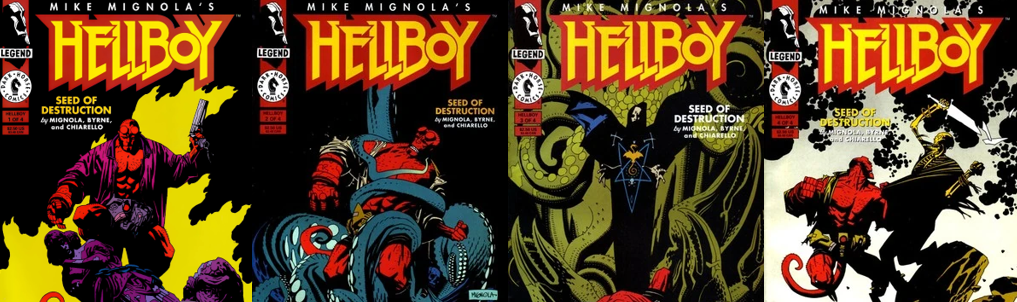
After years of bringing his trademark dark, moody art style to both independent and mainstream comics, monster-loving artist and comic creator Mike Mignola got his big break in 1993 with Hellboy, a character he evolved over time into distinctively Lovecraftian comics and spin-offs. Long-time fan and celebrated auteur Guillermo del Toro campaigned for years to bring the character to the big-screen with Ron Perlman in the role, forming a close relationship with Mignola when the artist consulted on Blade II (del Toro, 2002), with production finally starting after that film’s critical and commercial success. Largely inspired by Hellboy’s debut story, del Toro tweaked both his origin and characterisation to focus on Hellboy being torn between right and wrong and add a tragic romanticism to his character. Jake Garber brought Hellboy to life with some impressive make-up and prosthetics, which required Perlman to spend at least four hours getting kitted out, while Rick Baker designed his prosthetic stone hand and the CGI was handled by Tippett Studios. David Hyde Pierce provided the voice of Abe Sapien but refused to take credit or be associated with the marketing out of respect for Doug Jones’s physical work while Spectral Motion handled the many practical effects used to bring Mignola’s distinctive art to life. Though it attracted criticism for its controversial title its $99.8 million gross made it a box office bomb, Hellboy became an instant cult classic. Reviews praised the fun action, horror-adjacent visuals, and Perlman’s engaging performance, while criticising some of the characterisations. This Director’s Cut released to home media the same year, offering a little over ten minutes of additional footage, a critically and commercially successful sequel followed four years later, but plans for further entries stalled and, much to the dismay of many, led to some comparatively inferior reboots.

The Review:
Much like Hellboy’s first story, “Seed of Destruction” (Mignola, et al, 1993), Hellboy begins near the end of the Second World War. In fact, Hellboy quite faithfully recreates and expands upon the circumstances which led to Hellboy coming to our world, with a young Professor Broom (Kevin Trainor) joining an Army regiment to intercept a Nazi ritual off the coast of Scotland. While the Army is understandably sceptical of the “parabnormal”, Professor Broom’s fears are realised when they find zealot warlock Rasputin in the midst of merging arcane magic with the Third Reich’s advanced technology alongside his lover and devout right hand, Ilsa Haupstein (Bridget Hodson), and Adolf Hitler’s top assassin, the mute, semi-undead Karl Ruprecht Kroenen (Ladislav Beran). Although Rasputin successfully opens a portal to a nightmarish realm beyond our understanding, where the Lovecraftian terror known as the Ogdru Jahad slumber, the Allies interrupt them and successfully close the portal, seemingly killing Rasputin and Kroenen in the process. However, while the portal was open long enough to bring through a tiny demon child. Though startled by the demon’s unsettling appearance, the regiment stands down when Professor Broom proves he’s just a curious and frightened little boy and he’s soon adopted by both the troop and the “unready father”, nicknamed Hellboy and spending the next sixty years secretly working to stop supernatural threats as part of the Bureau for Paranormal Research and Defense (BPRD). While Professor Broom ages in that time, Hellboy is said to be barely out of his twenties and is presented as both an urban legend and unruly child who constantly yearns to be in the public eye, shaving his horns to “fit in” and being grounded whenever he breaks out of the BRPD’s super-secret facility.
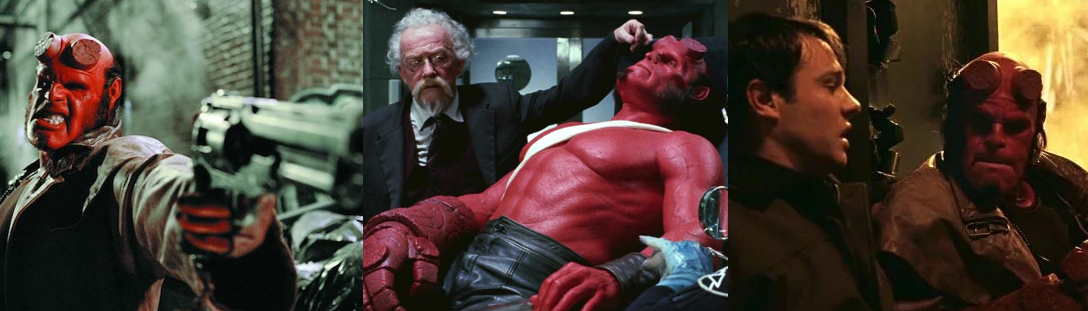
Professor Broom despairs of his reckless son, who he sees as the saviour of humankind.

While Professor Broom is exasperated by Hellboy’s irresponsible nature, Federal Bureau of Investigation (FBI) director and BRPD liaison Thomas “Tom” Manning (Jeffrey Tambor) is tired of doing damage control whenever Hellboy makes headlines and eager to shut the “freak show” down. Realising that his time is running short and concerned that Rasputin and his followers are making a return, Professor Broom recruits FBI agent John Myers (Evans) to take over as Hellboy’s caretaker, confidant, and mentor, casting Myers as our audience surrogate and earning him much distrust and resentment from the unimpressed Hellboy. Presented as a cat-loving, physically imposing and nigh-superhuman figure, Hellboy is fireproof, extremely durable, and well versed in the mystic arts. While he’s a lousy shot with his massive handgun, the “Samaritan”, he loads it with special rounds and carries numerous trinkets, charms, and reliquaries to ward off curses and such. Yet, Hellboy is restless and stubborn, eager to be amongst the public and refusing backup, even from long-time allies like merman-like Abraham “Abe” Sapien (Jones/Pierce) and Agent Clay (John William Johnson), the closest he has to friends. Though deeply ashamed whenever he disappoints his father, Hellboy is snarky and constantly gives Myers a hard time for being a glorified nanny while also being recklessly confident that he can overcome any foe. To be fair, he’s usually right but Hellboy’s arrogance sees him constantly run afoul of the bestial Sammael (Brian Steele), leading to him being beaten up a fair bit, having eggs laid in his forearm, and the deaths of a BRPD squad, much to Manning’s disgust. Having known no other life than the BRPD, Hellboy sees it as “[his] job” to protect the innocent and regards any risk worthwhile to stop monsters and demons from threatening others. While he’s crushed when Abe and Clay are seriously wounded because of his actions, Hellboy lashes out at Manning and Myers, seeing them as threats to both his livelihood and his ego.
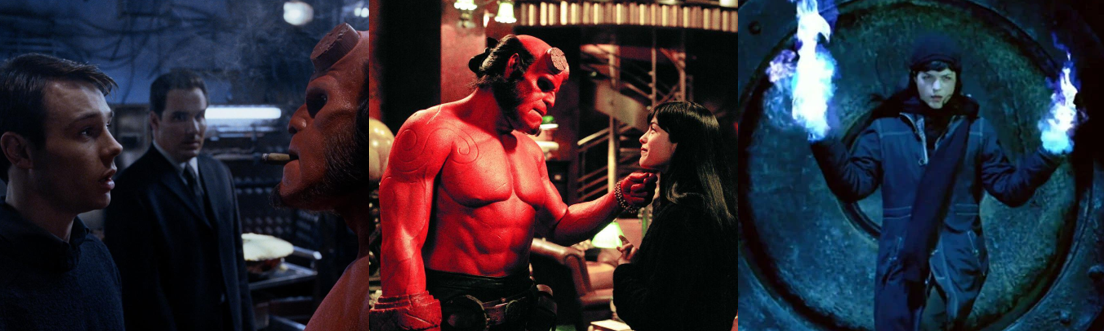
Myers makes for a dull surrogate and the chemistry between Hellboy and Liz is severely lacking.

As tough as Hellboy is, his emotions often get the better of him. Indeed, he often escapes from the BRPD to visit Elizabeth “Liz” Sherman (Blair), a troubled pyrokinetic and former BRPD agent who committing herself to an asylum. It’s obvious that Hellboy is madly in love with Liz, but he struggles to articulate these emotions and often makes a fool of himself, descending into a bitter jealousy when Myers gets close to Liz initially to convince her to return and then because he also develops feelings for her. Traumatised by her unpredictable pyrokinetic abilities, Liz chooses the discomfort and security of an asylum over the BRPD largely because it helps her control her abilities and because she wants to fit in, not be surrounded by monsters who remind her that she’s a freak. This draws her closer to the boyish, everyman Myers but she can’t help but be pulled towards Hellboy, who she largely sees as a sibling but clearly has an attraction to since he’s so devoted to her. Abe councils Hellboy, trying to help him move on and using his telepathic and empathic powers to give him advice, but Hellboy’s stubborn nature sees him desperately find the words to express his love for Liz. As awesome as Perlman’s performance is as Hellboy, Jones impresses as the unnerving Abe, who moves like liquid in water and uses his clairvoyance to offer valuable insight. Sadly, Selma Blair lets the trio down, appearing bored and delivering her lines with a distinct lack of emotion. While this does tie into her adopting a stoic guise to keep her powers under control, it makes for a distinct lack of chemistry between her and Hellboy that isn’t helped by some dodgy CGI flame effects.
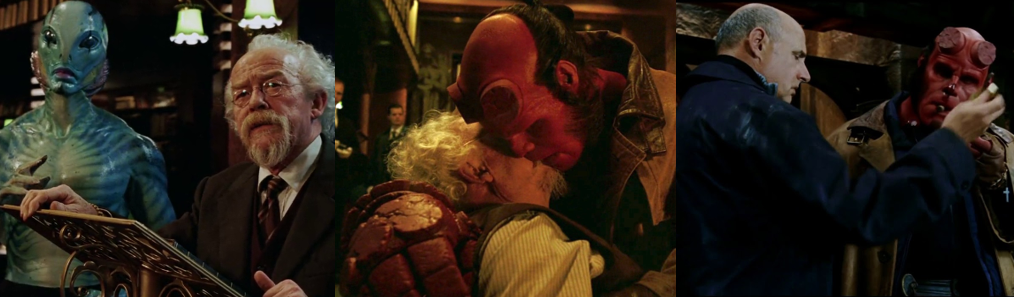
Though they have their disagreements, Hellboy’s pained by his father’s death and forced to rely on others.

As far as I can tell, Myers has no comic book counterpart and sticks out like a sore thumb. Clay has far more charisma and already has a rapport with Hellboy and the others, so it would’ve been much more interesting to follow a day in his life for the first twenty minutes or so than be stuck with the forgettable Myers, who only exists to give Professor Broom someone to exposit to. As you’d expect, the late, great John Hurt excels as Hellboy’s strict, but fair, father figure. Commanding a wealth of paranormal knowledge and experience, Professor Broom is committed to protecting the world from supernatural threats and sees Hellboy not only as the bridge between the two worlds, but also as the saviour of humankind. This is why he’s so disappointed whenever Hellboy goes off half-cocked. Knowing that he hasn’t got much time left, Professor Broom works to ensure that Hellboy will be both cared for and helped stay on the straight and narrow. His fears about Rasputin again turn out to be true when the BRPD investigates the museum break in that kickstarts the plot, leading to Hellboy’s many run-ins with Sammael, Agent Clay’s ill-fated confrontation with Kroenen, and Professor Broom’s discovery of a message leading them to Moscow. Professor Broom is the. confronted by the mad mage and his clockwork assassin, afforded a brief glimpse of the apocalyptic future Hellboy is destined to bring about, but fearlessly defies Rasputin, ready to face his death. Naturally, Hellboy is devastated by his father’s murder, falling into a brief depression, but willingly joins the BRPD strike team, stomaching Manning’s antagonistic demeanour to get a chance to settle the score and surprisingly finding himself in the hostile director’s debt after finishing off Kroenen, the two developing a mutual respect that again dwarfs Myers’ inclusion.
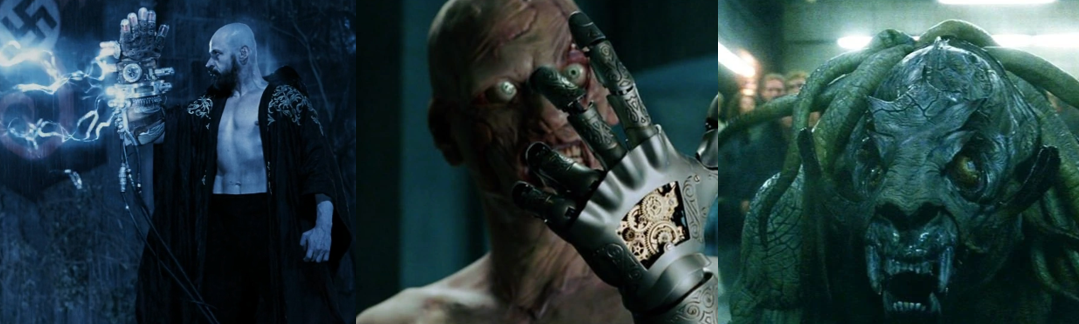
Rasputin and his monstrous, nigh-immortal followers are fixated of ushering in the apocalypse.

As in “Seed of Destruction”, Hellboy’s primary antagonist is the mad warlock Rasputin, a mysterious and functionally immortal wizard granted incredible dark magic by the Ogdru Jahad. Using an ancient tome and bizarre Nazi science, Rasputin almost achieves his goal of unleashing the “Seven Gods of Chaos” before he’s stopped by the Allies. Death is a mere inconvenience for Rasputin, however, thanks to his eternally youthful and equally immortal followers, who return their master to life with a blood sacrifice and willingly follow him in resurrecting Sammael, a ferocious beast whom Rasputin empowers to resurrect twofold each time it falls. Eager to capture Hellboy, knowing that his stone hand is the key to unleashing the Ogdru Jahad, Rasputin keeps Hellboy occupied and drive him towards his elaborate mausoleum in Moscow to complete his ritual. Returning from death more powerful, and with more of the Ogdru Jahad’s influence in him, Rasputin is a malicious, cold-hearted villain who nonetheless shows respect towards Professor Broom and permits him a merciful death. Though Ilsa doesn’t get much to do beyond lusting after her master and following his every whim, Kroenen makes a hell of an impression with his wind-up body, deft skill with blades, and intimidating masked visage. A heavily scarified, zombie-like figure, Kroenen easily cuts down groups of armed foes (though largely bloodlessly) and seems to delight in murdering anyone who gets in his way, easily fooling the BRPD by playing dead and killing those closest to Hellboy. Hellboy primarily tussles with Sammael and its kin throughout the film, finding the creature ruthless and as pig-headed as him thanks to its supernatural ability to rapidly heal and resurrect upon death. A slobbering, voracious beast who pounces upon its prey, Sammael tears through the BRPD, injures Abe, and constantly dogs Hellboy in some fun, action-packed fights.

The Nitty-Gritty:
My knowledge and experience of Hellboy may be lacking since I mainly know him from the films, but as far as I’m aware Hellboy sticks somewhat close to the source material while also diverging in numerous ways. For starters, Hellboy is presented as an urban legend, one Manning is keen to keep under wraps, rather than being the “World’s Greatest Paranormal Investigator”. This acts as the backbone for much of the plot and Hellboy’s arc, with him eager to get into the spotlight and relishing showing off before the public. Secondly, Hellboy changes Hellboy’s relationship with Liz, giving him a long-standing crush on the apathetic pyromaniac and presenting a largely humorous side plot of him sabotaging Myers when he gets close to Liz. Ironically, Hellboy asks Myers for help in articulating his feelings and Myers reluctantly offers him advice, despite his own feelings for Liz. Ultimately, Professor Broom’s death gives Hellboy the courage to admit his devotion to Liz, understanding that his demonic visage reminds her that she’s different and she’s looking for someone who makes her feel normal, seemingly stepping aside in favour of Myers while still vowing to always be there for her. Thirdly, Hellboy places far greater emphasis on Hellboy’s relationship with Professor Broom, who was offed pretty quickly into “Seed of Destruction.” Here, we see the dynamics of the unlikely father/son relationship, with Professor Broom despairing of Hellboy’s reckless antics and this brutish demon reduced to an ashamed child whenever his father gives him a disapproving look. It’s a great twist and makes Professor Broom’s death even more of a blow since we see how close they are, best showcased when Professor Broom refuses to learn Hellboy’s true name from Rasputin since he already knows what to call him: son.
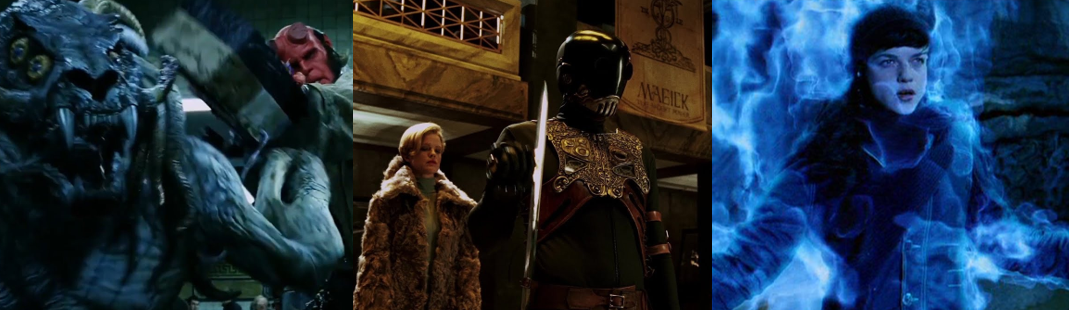
Despite some dodgy CGI, the practical effects and prosthetics are genuinely impressive throughout.

While Hellboy’s personality may be noticeably different from the source material, painting him as an arrogant and rowdy teenager who pointedly refuses help and must learn to grow up, Ron Perlman delivers a fantastic performance. He nails every nuance of Hellboy’s characterisation, which sees him be sarcastic, enraged, and lovelorn throughout the film. despite clearly being swamped by uncomfortable make-up and prosthetics, Perlman’s emotions still shine through, and I’ve always been a fan of his gravelly delivery. Hellboy looks incredible, sporting a sledgehammer-like stone fist and prehensile tail, crashing through walls and wrestling his foes into submission. While the CGI does the practical effects a disservice, making Hellboy and Sammael unfortunately cartoonish at times, the practical effects more than make up for it. Hellboy and Sammael demolish a subway station, crash through stone walls in a hidden cavern, and tear through the busy night-time streets, with Hellboy flipping a car to protect Myers and Sammael eventually being smushed by a subway train. Kroenen equally impressed in his appearances, slinging his blades around with superhuman dexterity and cutting foes down with a supernatural efficiency. When his true, gruesome form is revealed, it’s a hideous and wholly practical sight that makes me want to know more about this bizarre half-zombie. Practical effects also take centre stage when Hellboy resurrects the desiccated corpse of Ivan Kilimatovich (Unknown), a skeletal torso who guides them through Rasputin’s boobytrapped mausoleum. While many of the hazards contained within are equally practical, such as the heavy doors and crumbling bridge, much of the danger is lost when the obvious CGI rears its head, but it’s all good fun for the most part. The Director’s Cut largely splices deleted and slightly extended scenes back into the film, giving us a scene where Ilsa gifts Rasputin artificial eyes, showing Liz has a touch of OCD and adding a bit more depth to her time with Myers, but there’s nothing all that substantial added.
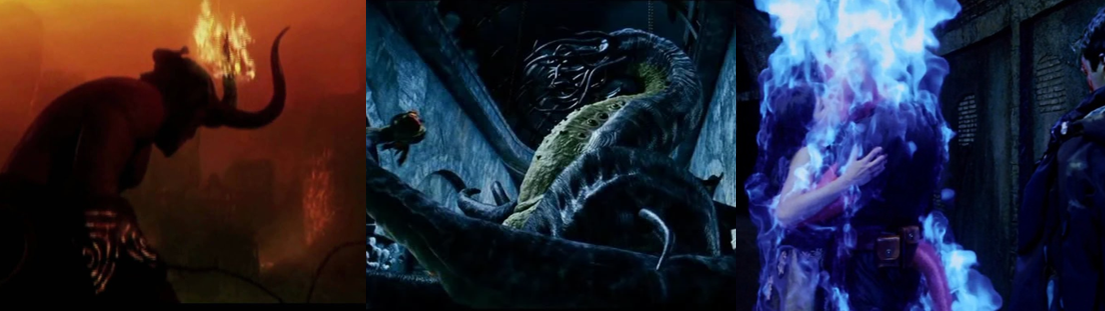
Hellboy ultimately rejects his demonic heritage to save the world and finally express his love for Liz.

Journeying to Moscow to avenge Professor Broom and stop Rasputin’s maniacal scheme, Hellboy buries the hatchet with Manning after they work together (somewhat) to finish off Kroenen, impaling him on spikes and trapping him under a giant gear. While all the BPRD agents who accompany them are lost to the mausoleum’s booby-traps, Liz destroys Sammael’s nest with a burst of unbridled fury. However, this leaves her and the others weakened, easily allowing Rasputin to capture them. Even Hellboy is rendered powerless by a heavy trap that can only be unlocked by saying his true name, which he’s compelled to do when Rasputin maliciously sucks out Liz’s soul. Defeated and disheartened, Hellboy reluctantly whispers his name (“Anung Un Rama”) and undergoes a horrific transformation, his horns growing out and a flaming crown appearing on his brow. He then willingly uses his stone hand to free the Ogdru Jahad from their crystalline prison and have them begin to manifest amidst a blood moon. However, just as he’s about to unlock the final seal, Hellboy’s brought to his senses by Myers, who begs him to remember his father’s teachings, leading him to break his horns and mortally wound Rasputin with them, having chosen to be a man rather than a demon. Though the Ogdru Jahad are prevented from invading, Rasputin’s death frees a spawn of theirs, the gigantic, tentacled Behemoth, that Hellboy tackles alone after make amends with Myers. Thankfully, Hellboy brought a grenade belt, which he uses to blow the beast to bloody chunks. Heartbroken by Liz’s death, Hellboy whispers a threat to those “on the other side” to let her go or face his wrath, prompting her swift resurrection and the two to finally embrace as lovers. Myers, having earned Hellboy’s trust, delivers the film’s closing narration about nature versus nurture, echoing Professor Broom’s opening narration, though Manning is left waiting impatiently to be rescued!

The Summary:
Although I had no idea who Hellboy was when I first saw this film, I was intrigued by the premise, its ludicrous main character, and the promise of a fun, action-packed supernatural adventure. Indeed, the only reason I am a fan of Hellboy is because of this movie, which is still a favourite of mine. Sure, I have some issues with Myers (he makes for a painfully bland audience surrogate), Linda Blair’s performance (if it’s meant to be this way, it really misses the mark), and some of the dodgy CGI, but the pros far outweigh the cons. Hellboy has a great tongue-in-cheek sense of humour that makes the title character a joy to watch since he’s such a smart ass doofus, while also delivering some decent action sequences that have stood the test of time thanks to top-notch practical effects. The make-up and prosthetics are fantastic, with Hellboy, Abe, and Sammael all having a very tangible and tactile quality to them. Little touches like Abe’s blinking, his malformed hands and gills, and Sammael’s bone-wrenching healing add so much life to these characters, to say nothing of how imposing and impressive Perlman appears under all that getup. Although Hellboy’s characterisation is noticeably different from the comics, it works really well in this context, giving him a meaningful and surprisingly emotional character arc as he learns to focus on the big picture and stop messing around while also accepting help from his allies. I loved his father/son relationship with Professor Broom, his dynamic with Manning, and even appreciated his devotion to Liz, despite their lack of chemistry. Mignola’s art and Lovecraftian inspirations were brought to life wonderfully here, with the Ogdru Jahad being horrifically bizarre, vivid colours popping when necessary and heavy, ominous shadows being used effectively where possible. It’s got some flaws, for sure, but Hellboy is still an extremely enjoyable romp that doesn’t really get talked about all that much these days, which is a shame as there’s a hell of a lot to like here.

My Rating:

Rating: 4 out of 5.

Great Stuff

Did you enjoy Hellboy’s big-screen debut? What did you think to Ron Perlman’s performance, his appearance, and the changes made to Hellboy’s character? Did you also find Myers a dull audience surrogate and the chemistry lacking between Hellboy and Liz? Were you happy with the way the film adapted elements from the comic books? Which Hellboy adaptation is your favourite? Share your thoughts on the first Hellboy movie in the comment and donate to my Ko-Fi to suggest more Hellboy content for the site.

Back Issues: Hellboy #1-4

Story Title: “Seed of Destruction” (Part One to Four)
Published: March 1994 to June 1994
Writers: Mike Mignola and John Byrne
Artist: Mike Mignola

The Background:
Born in Berkeley, California, artist and comic creator Mike Mignola grew up with a fascination of monsters and a love of gothic, Victorian fiction. Mignola started his career as a comic book artist working for The Comic Reader before bringing his trademark dark, moody art style to mainstream publications DC and Marvel Comics. After years of working for hire, Mignola teamed with legendary writer and artist John Byrne for his first creator-owned comic book, Hellboy. Hellboy’s visual appearance evolved over Mignola’s career, beginning as a drawing for the 1991 Great Salt Lake Comic Convention booklet before eventually becoming the “World’s Greatest” gruff and witty paranormal investigator. Hellboy’s adventures began with these four distinctively Lovecraftian, widely successful issues and expanded into a wealth of further comics, spin-offs, and crossovers thanks to Mignola’s unique blend of folklore, horror, and pulp adventure. Hellboy has also seen not inconsiderable success beyond the comic books, featured in a handful of largely mediocre videogames, some well-regarded animated ventures, and some amazingly detailed action figures. Hellboy also made a splash on the big screen, especially in Ron Perlman’s peerless portrayal of the character in Guillermo del Toro’s cult favourite films. While Hellboy’s subsequent silver screen ventures was somewhat divisive, he remains one of the most enduring and visually iconic cult comic characters whose adventures have seen him effortlessly jump between multiple genres.

The Review:
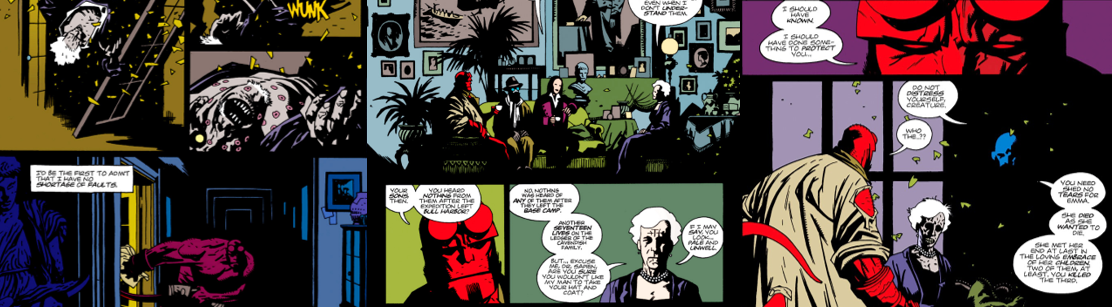
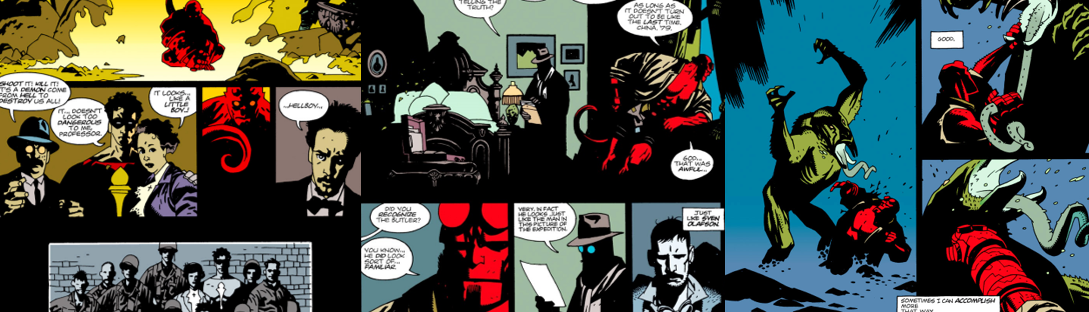
Hellboy’s story begins in 1944 at the tail end of World War Two where a special squad of Army commandos, representatives from the British Paranormal Society, and costumed adventurer Paul Gibney/The Torch of Liberty gather in a remote village in East Bromwich to tackle a lingering Nazi threat known as “Project Ragna Rok”. While First Sergeant George Whitman is sceptical, Professor Malcolm Frost, “paranormal Wiz Kid” Trevor Bruttenholm/Broom, and medium Lady Cynthia Eden-Jones believe that Adolf Hitler’s “spook squad” are experimenting with black magic to raise the dead. Thanks to Broom’s meticulous research and Cynthia’s clairvoyance, the squad learns that maniacal mage Grigori Rasputin is performing a dark ritual powered by a mystical incantation and bizarre equipment, including two hefty gauntlets worn by Rasputin. Although Klaus Werner von Krupt is unimpressed by Rasputin’s light show, Broom and the others are surprised by a sudden burst of supernatural fire and the appearance of a child-like demon. Despite Professor Frost wishing to kill the creature, Broom accidentally names it “Hellboy” and the demon is adopted by the regiment, spending the next thirty-five years being raised by Broom, whom he sees as a surrogate father. Thus, Hellboy is pained to see his mentor aged and struggling with his memory of the “Cavendish expedition”. Thanks to Hellboy’s encouragement, Broom recalls that he accompanied the renowned Cavendish explorers to the ruins of an ancient temple. There, flanked by a statue of the monstrous, cephalopod-like Sadu-Hem, Broom discovered Rasputin in deep hibernation. Barely escaping from or remembering the carnage that followed, Broom summoned Hellboy for aid, only for his adopted son to watch in horror as a plague of frogs herald the arrival of a vicious frog-like monster, which kills Broom and attacks the enraged Hellboy.

When his father is murdered, Hellboy investigates a cursed family and uncovers an apocalyptic threat.

At a disadvantage in the dark, Hellboy is disarmed and wounded by the creature’s caustic tongue, so Hellboy gives the frog-thing a taste of his mysterious, stone-like right hand and sends it crashing into a sarcophagus. When the creature tries to flee, Hellboy puts it down with a single shot from his pistol, stunned when the monster disintegrates. Concerned, Hellboy calls the Bureau of Paranormal Research and Defense (BPRD), receiving condolences from Doctor Thomas “Tom” Manning and ordered to assemble a team to investigate. Hellboy recruits pyrokinetic Elizabeth “Liz” Sherman and fish-man Doctor Abraham “Abe” Sapien to accompany him to the decrepit Cavendish Hall to question Lady Emma Cavendish about her sons. Welcoming their direct questions, Lady Cavendish relates that her family were keen explorers for nine generations and that their fortune was built by Elihu Cavendish, who cursed his bloodline seeking the temple Broom found in the mountains. While she offers them sanctuary, the trip seems to be a dead end and the group are unaware that Rasputin is manipulating Lady Cavendish from the shadows, promising to return her sons for her co-operation. While the group rests, Hellboy’s inner monologue provides some background on Liz and Abe, revealing that Liz accidentally killed her family and several others before mastering her pyrokinesis with the BRPD and Abe was discovered in an abandoned basement of Saint Trinian’s Hospital on the day President Abraham Lincoln died. After Abe and Hellboy ponder Lady Cavendish’s butler, who seems familiar to them, Abe takes to the water to scout around and is horrified when Liz mentions frogs being in her room. Rushing to her aid, Hellboy finds only a smouldering cigarette and the aforementioned butler, who turns out to be a frogman in disguise! While Hellboy fights and ultimately defeats the creature, Abe discovers only “old death” beneath the flooded mansion and Hellboy is distraught to find Lady Cavendish has been killed in the same manner as his father.

Overpowered, Hellboy’s forced to endure Rasputin’s many monologues and rabid boasts.

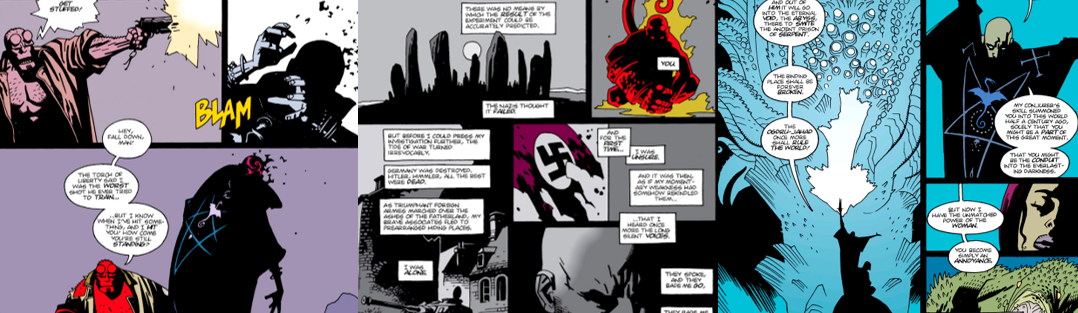
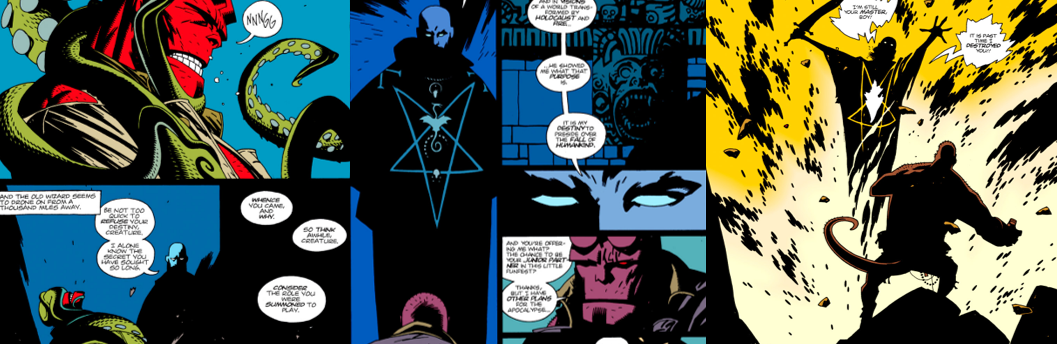
While mourning the old lady, Hellboy is approached by the enigmatic Rasputin, who takes credit for bringing him into the world and demands he kneel in his presence. When Hellboy naturally declines, he’s suddenly ensnared by a gigantic tentacle and dragged into the darkness to fulfil what Rasputin calls his “destiny”. Hellboy is deposited in a dark, cavernous pool beneath the house, which Rasputin declares is rich with the screams of those sacrificed to the “Serpent”. For eight centuries, mortal men sought to free the unknowable “Seven Beasts”, the Ogdru Jahad, who whispered to Rasputin (through his dreams) the means to release them. Though Rasputin claims to be able to command Hellboy, the demon blasts him in the head with his pistol, only to be sent reeling from an incantation by the seemingly immortal wizard. Stunned, realising the talismans he’s collected over the years have been neutralised, Hellboy opts to stall Rasputin until he can think of a solution. This leads to another long monologue about how Rasputin has constantly evaded death thanks to the Ogdru Jahad, who wish him to cause the apocalypse. Hellboy is then attacked by another, even bigger frogman, one of the Cavendish twins hideously transformed by black magic, and is hopelessly manhandled. While Abe follows the trail left by the other frogmen, the battered Hellboy learns of Rasputin’s travels to Europe, how he researched Ragna Rok and allied with the Nazis to gain the resources to enact the Ogdru Jahad’s plot. Though disheartened after Hitler’s death, Rasputin took solace in knowing he’d summoned Hellboy and was drawn to the temple where, while hibernating, he learned from the Sadu-Hem that the horrific Ogdru Jahad is actually seven creatures imprisoned beyond our understanding and longing to avenge themselves upon the Earth.

Though Hellboy triumphs with some help from his allies, he’s left shaken by Rasputin’s words…

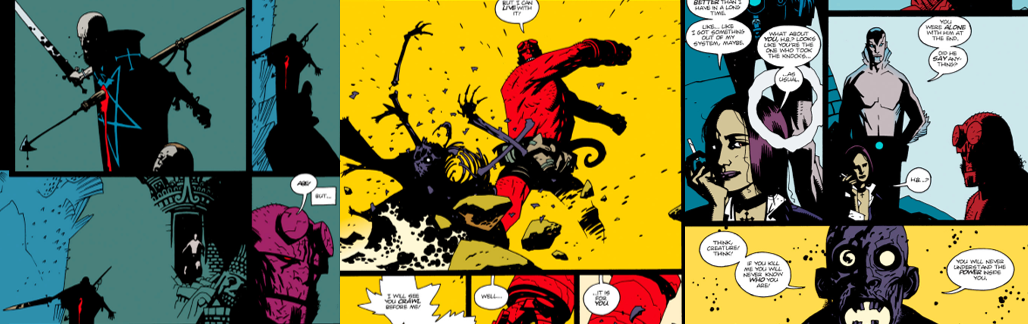
After untold years of planning and preparing, Rasputin prepares to fulfil his master’s wishes using Liz’s raw power, much to Hellboy’s dismay, alongside the restored (and enlarged) Sadu-Hem. While using the enchanted Liz as an unwilling a conduit, Rasputin offers Hellboy the chance to join them in death and destruction, which Hellboy naturally rejects despite being near-paralysed from the frogman’s saliva. As Rasputin begins his incantations, Hellboy forces himself to retrieve a concussion grenade from his belt and stuffs it down the frogman’s throat, obliterating it. Rasputin’s dark magics see the Ogdru Jahad slowly awaken and attack their prison, but his mad plot is suddenly interrupted by Abe, who’s possessed by Elihu’s vengeful spirit and first impales the wizard on a spear before releasing Liz from his grasp, sparking an inferno. As Sadu-Hem and the Cavendish estate erupt in flames, the restored Abe rushes Liz to safety, leaving Hellboy behind as he insists on finishing the wraith-like Rasputin. Despite Rasputin boasting incredible power, Hellboy easily trounces the wizard, rejecting him and his offer to know the truth of his origins and shattering Rasputin with his mighty stone fist. From the ruins of Cavendish Hall, Abe relates his confusion about his possession, which Hellboy believes was the old man’s way of putting things right and avenging the many years of losses suffered by his family. While Liz also doesn’t remember much from her time under Rasputin’s spell, she feels an inexplicable relief at having unleashed her full power for once. Though Abe and Liz show concern for Hellboy, he keeps quiet about Rasputin’s final words and his own doubts about himself, and the story ends with the awakening of Rasputin’s old allies, Ilsa Haupstein, Karl Kroene, and Leopold Kurtz, in an abandoned Nazi laboratory…

The Summary:
I’ll be the first to admit that my primary source of exposure to Hellboy comes from the movies and cartoons. In fact, “Seed of Destruction” is the only Hellboy story I’ve ever read as of this writing, which may or may not be blasphemy. It’s not that I don’t like the character and his world, which has a fun, gothic horror aesthetic that speaks to the Lovecraft fan in me. My hesitancy is largely because of my dislike of Mike Mignola’s art style which, again, is probably sacrilegious. I liken Mignola’s heavy use of shadows and simplistic forms to Frank Miller, who made a career out of exaggerated shadows and sketches. It’s a very eccentric and unique art style, for sure, and don’t get me wrong: it really works for Hellboy. However, it’s just not very visually appealing for me so I tend to veer away from Mignola’s works. That’s a “me” thing, obviously, as like I say the art really adds to this unique comic book world. Mignola clearly has a reverence for horror, gothic architecture, the arcane arts, steampunk-style technology, and Lovecraft, seeping every panel and page in dark, brooding inks, sparingly using bold colours and relying on silhouettes and murky darkness to create a constantly foreboding atmosphere. Mignola’s writing is also far better than a lot of Miller’s, if I’m comparing the two, with Hellboy being a somewhat snarky, eccentric character who’s respectful to Broom and treats his associates with respect but isn’t afraid to talk a bit of trash to his enemies. Hellboy’s inner monologue reveals a half-human creature fully aware of his flaws (his quick temper, rash decisions, and poor marksmanship chief among them), somewhat curious about his true origins, and with fifty-odd years of paranormal investigating under his belt.

While the unique Hellboy makes a visual impression, he’s a largely mysterious figure in his debut.

Unlike the films, where he’s portrayed as an unruly child at times, Hellboy is largely professional here, calling in situations for the BRPD to investigate and largely conducting himself well while at Cavendish Hall. While Liz admonishes his curt demeanour, Lady Cavendish welcomes the discourse and, most notably, shows no fear or panic when met by a literal demon. While it doesn’t play a big role in this story, it’s clear Hellboy and his allies are far more public figures in the comics and have been accepted by society. Interestingly, the only person who shows any fear or suspicion of Hellboy is Professor Frost; everyone else accepts, respects, and shows concern for him. While Hellboy and Liz have a purely platonic relationship here, unlike in the films, he seemingly admires her for overcoming her traumatic past and she asks if he’s okay in the finale, showing they’re more than just colleagues. Hellboy is seen to be closer to Abe, discussing their suspicions and the case, and these three have clearly worked together in the past. Interestingly, Broom is offed very early on and his relationship with Hellboy isn’t as deep as in the movies. Sure, Hellboy thinks of him as a father figure and is seen to be angered by his murder and driven to track down those responsible, but he’s noticeably more blasé about it, even in his inner monologue. Similarly, Hellboy seems to either be not bothered by his true origins or hiding it extremely well, sparing little thought of where he came from and what his true purpose is. Although Rasputin inspires him to think differently about this, the true extent of Hellboy’s origin and purpose is merely alluded to here, with him said to have a part in the end of the world but it’s not clear what that is. Hell, Rasputin doesn’t even use him in his summoning ritual, instead focusing his power through Liz, leaving me with a sense of intrigue regarding Hellboy’s true purpose in the comics.

The horror and Lovecraftian themes are an undeniable highlight in this intriguing introduction.

Indeed, we learn more about the maniacal Rasputin that we do Hellboy, which has its pros and cons. The pros come from maintaining a sense of mystery about Hellboy to be explored in subsequent issues, while the cons come from having to suffer through panels and panels of exposition and monologuing from the depraved mage as he rambles on about his past. It’s somewhat necessary as it shows just how long the Ogdru Jahad have been influencing him and longing for their release, and how many others have tried to free them through less refined rituals and means, but it does get a bit tedious after a while. I liked that the Ogdru Jahad are kept largely mysterious despite Rasputin’s many words, appearing to be interdimensional, alien, demonic, or even divine monsters trapped within a crystalline prison somewhere beyond our comprehension. They establish a foothold on Earth through the equally monstrous Sadu-Hem (a similarly Lovecraftian beast that barely factors into the plot as it just looms there, grabs Hellboy, and then bursts into flames) and Rasputin, who’s revealed to be unnaturally long-lived and partially undead. Wielding incredible arcane magic and having manipulated the Nazis into providing him the resources to summon Hellboy, Rasputin is obsessed with being the linchpin for the apocalypse, delighting in deceiving others into doing his bidding and giddy at the thought of his masters raining destruction upon the Earth (though, again, it’s unclear what role Hellboy would play in this apocalypse). I feel it might’ve been better to have Rasputin merge with Sadu-Hem rather than take Liz hostage, or as well as using her powers, to give a bit more punch to the ending. It was interesting seeing Elihu get his revenge through Abe, but it did mean Abe and Liz played diminished roles in the finale. Still, while this isn’t a perfect story, I enjoyed this introduction to Hellboy, the familiar elements I recognise from the films, and I am interested in reading more of his adventures…I’m just not sure where to go from here.

My Rating:

Rating: 3 out of 5.

Pretty Good

Were you a fan of Hellboy’s first four issues? Did you pick these up at the time or did you discover Hellboy later, as I did? Do you think I’ve committed blasphemy by criticising Mike Mignola’s art style? What did you think to Hellboy’s appearance and demeanour? Which Hellboy stories are your favourite? Whatever you think about Hellboy, feel free to leave your thoughts below, check out my other horror-related content on the site, and donate to my Ko-Fi to suggest other Hellboy stories for me to review.

10 FTW: Comic Book Crossovers We Need To See

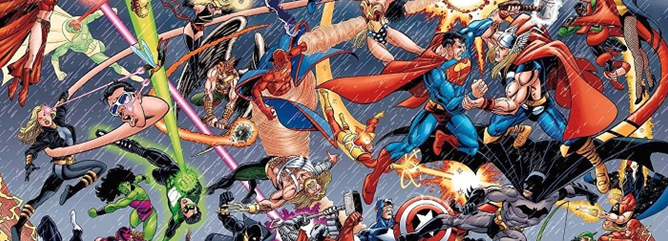
If there’s one thing comic books allow, it’s the grandiose crossover between characters. Ever since Barry Allen met Jay Garrick all the way back in 1961 and introduced the idea of multiple parallel universes, comic book characters have existed in both isolated shared universes and travelled across a near infinite multiverse. However, while it’s relatively common to see Bruce Wayne/Batman and Clark Kent/Superman interact with the Justice League or the Teen Titans, or to have Peter Parker/Spider-Man randomly join forces with the Fantastic Four or the X-Men, we’ve also seen the characters of DC and Marvel Comics interact with each other. We’ve seen Superman and Batman both cross paths with Spider-Man, the X-Men team with the New Teen Titans, and both publishers’ greatest heroes go head-to-head in the epic DC Versus Marvel Comics (Marz and David, et al, 1996) crossover.

10FTWCrossoversWeird
There have been some weird crossovers in comics.

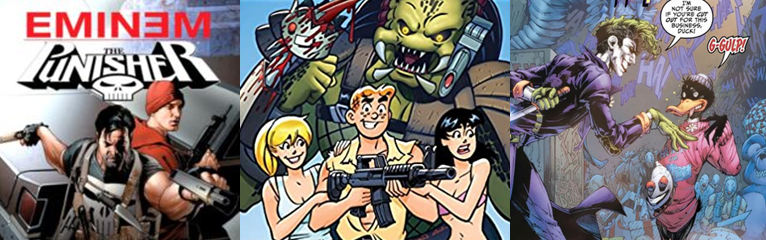
In addition, Dark Horse Comics snapped up multiple science-fiction and horror film franchises, giving us crossovers such as RoboCop Versus The Terminator (Miller, et al, 1992) and a whole slew of Aliens vs. Predator (Various, 1989 to present) comics. It doesn’t end there, either; we’ve seen Batman cross paths with Judge Dredd on multiple times and Frank Castle/The Punisher team up with not only Eminem but also pop up in Archie Comics, and it was thanks to such comic book crossovers that we finally got to see the three-way mash-up between Freddy Kruger, Jason Voorhees, and Ash Williams! Yet, as many and varied and seemingly limitless as these crossovers can be, it seems like we’ve missed out on a few seemingly-obvious crossovers. Maybe it’s because of licensing issues or the fact that DC and Marvel Comics don’t tend to do a lot of business together lately, but, either way, I figured I’d talk about ten crossovers I’d love to see in comic books.

10FTWCrossoversJSWM
10 Justice Society/Watchmen

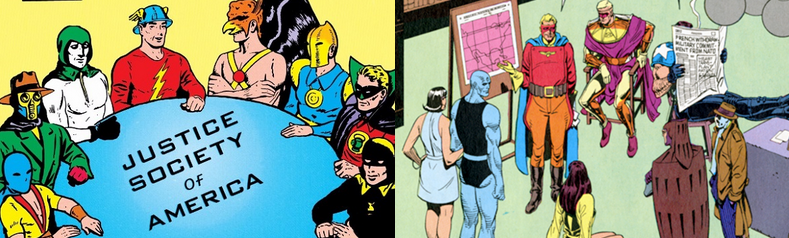
After DC Comics finally put an end to the largely-awful New 52 run, they teased Alan Moore’s seminal work, Watchmen (ibid, et al, 1986 to 1987), becoming part of DC canon when Edward Blake/The Comedian’s iconic smiley-face button turned up in the Batcave. Cue the extremely delayed publication schedule of Doomsday Clock (Johns, et al, 2017 to 2019), a storyline that revealed that Doctor Jon Osterman/Doctor Manhattan had been influencing DC canon for decades. While this, obviously, brought the characters of Watchmen (or, at least, versions of them) into conflict with Superman, Batman, and other versions of the Justice League, it’s the older, more seasoned members of the Justice Society of America (JSA) I’d like to see have extended interactions with the Crimebusters. The JSA were at their peak around the time of World War Two, meaning they are decidedly more optimistic and pragmatic about their approach to crimefighting. The Crimebusters, meanwhile, existed in a largely dystopian version of the 1980s that was pretty bleak and constantly on the verge of another World War, meaning this team up could produce an interesting clash of styles and philosophies that would probably be more in keeping with Moore’s more reflective text rather than an all-out brawl. Plus, who doesn’t want to see who would win a battle between Jim Corrigan/The Spectre and Doctor Manhattan?

10FTWCrossoversPulp
9 Pulp Heroes United

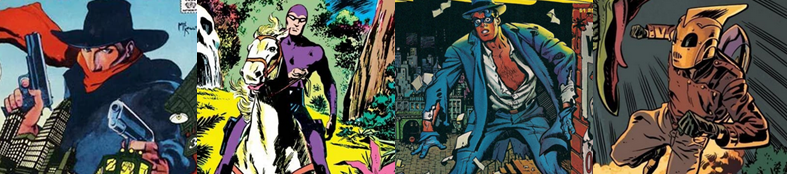
Before Batman and Superman, there were the pulp heroes of the 1930s to 1950s. Names like the Phantom, the Shadow, the Spirit, the Rocketeer, and Green Hornet may have faded from mainstream relevance in recent years, but they live on thanks to publications from Dynamite Comics and crossovers with DC Comics. Speaking of Dynamite Comics, they came very close to this crossover with their Masks (Various, 2014 to 2016) series, which saw the Shadow teaming up with the Green Hornet and Kato, a version of Zorro, and the Spider but this crossover has so much potential to really pay homage to the heroes of yesteryear. Ideally, such a comprehensive team up would be similar to The League of Extraordinary Gentlemen (Moore, et al, 1999 to 2019) in its scope and legacy; hell, I’d even have the Phantom, the Shadow, the Spirit, the Rocketeer, Green Hornet and Kato, Zorro, Doc Savage, the Lone Ranger and Tonto, and the rest of their ilk butting heads with the Martians from The War of the Worlds (Wells, 1897) at the turn of the century. A proper sepia-toned, steampunk-filled piece that sees these wildly different pulp heroes begrudgingly working together to save the world could be a great way to thrust these overlooked classic heroes back into the spotlight.

10FTWCrossoversRHWS
8 Red Hood/Winter Soldier

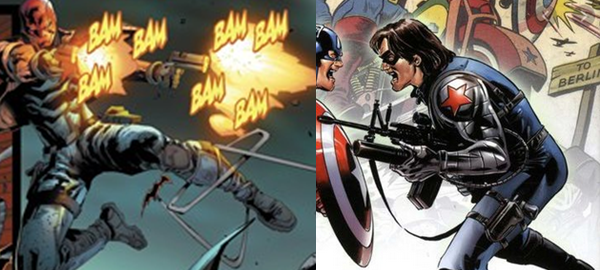
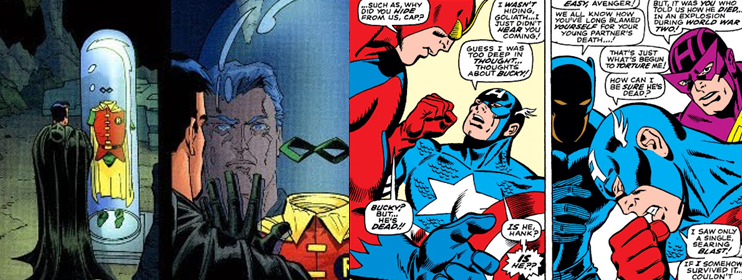
If the comic industry was like it was back in the mid-nineties, we would surely have already seen this crossover, which is as obvious and as fitting as the team up between the Punisher and Jean-Paul Valley/Azrael during his brief tenure as Batman. Speaking of which, a team up between Jason Todd/Red Hood and the Punisher is just as enticing but, in terms of thematically complimentary characters, you’re hard pressed to find two more fitting that Jason Todd and Bucky Barnes. Both characters were well-known sidekicks to greater heroes whose deaths shaped, influenced, and affected their mentors for years, and both even returned to life as violent, broken anti-heroes around the same time.

10FTWCrossoversJTBB
Jason and Bucky’s deaths weighed heavily on Bat and Cap for years.

Yet, while Bucky has gone on to not only redeem himself and assume the mantle of Captain America (and is largely far more mainstream thanks to his prominent inclusion in the Marvel Cinematic Universe), Jason Todd has floundered a little bit. It didn’t help that Jason’s resurrection was directly tied to DC’s latest reality-shattering Crisis for years (even though there have since been far less convoluted explanations, and he really should have been Hush all along) but, even ignoring that, Jason’s place is skewed as one minute he’s a sadistic killer, then he’s a violent anti-hero, then he’s wearing the Bat embalm and is an accepted (however begrudgingly) member of the Bat Family. However, both characters have carved a name out for themselves as being willing to go to any lengths to punish the guilty; each has blood on their hands, a butt load of emotional and personal issues, and a degree of augmented strength, speed, and skill thanks to their training or resurrection. While both are similar, Bucky is far more likely to be the bigger man and take the more moral ground, which would be more than enough to emphasise the differences between the two (provided Jason feels like being more antagonistic in this theoretical crossover).

10FTWCrossoversRCJD3
7 Judge Dredd/RoboCop

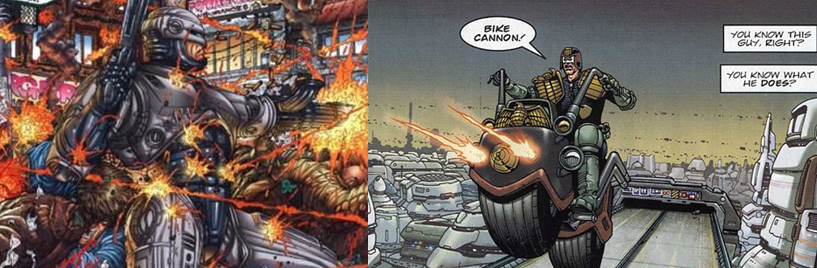
It’s no secret that RoboCop exists almost solely because of Judge Dredd; without 2000 A.D.’s no-nonsense lawman, we’d likely never have seen the excellently gore-and-satire-filled sci-fi action that is RoboCop (Verhoeven, 1987). While Batman has had more than a few run-ins with Judge Dredd, Detroit’s resident cyborg supercop has yet to meet his cinematic counterpart. The story is so simple is basically writes itself; you could have RoboCop awakened from suspended animation or reactivated after decades of being offline in the war-ravaged dystopia of Mega City One and briefly come into conflict with Dredd. I’d wager that RoboCop would be the more likely of the two to be more morally inclined; RoboCop generally operates based on very specific, law-abiding directives (or, depending on the version, his own conscience) that justify violence in service of protecting the innocent. Dredd, meanwhile, is just as likely to arrest victims of crimes as those who perpetrate them and is generally more an example of totalitarianism and uncompromising brutality in the name of the “law!” Yet, just as Dredd and Batman were able to work together despite coming to blows over their methods and philosophies, these two would make quite the formidable team once they’d ironed out their differences…though RoboCop may need an upgrade or two to survive in the future.

10FTWCrossoversDPTM
6 Deadpool/The Mask

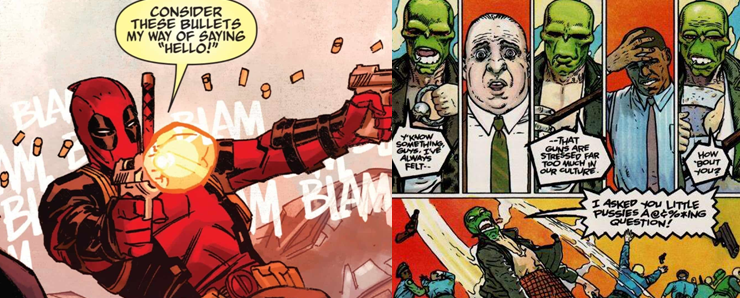
DC Comics have had many crossovers with Dark Horse over the years, resulting in numerous interactions between DC’s finest and the Xenomorphs, Predators, and Terminators. Similarly, both companies worked together on a number of crossovers revolving around the violent, big-headed cartoon anti-hero “the Mask”. It stands to reason, then, that if the Joker acquiring the magical mask and gaining its powers is a natural fit, a crossover between the near limitless power of the mask and everyone’s favourite fourth-wall breaking Mutant, Wade Wilson/Deadpool, would be just as fitting. Both characters are known for their over-the-top, cartoony violence, springing weapons out of thin air, directly addressing the reader, and busting heads with a maniacal glee. Hell, DC and Dark Horse had Lobo team up with “Big-Head” and even acquire the mask in another crossover and, given Lobo’s similarities to Deadpool, it wouldn’t bee too hard to imagine a crossover between these two being little more than a non-stop bloodbath as they tried in vain to damage each other, before Deadpool inevitably acquires the mask for himself and, in all likelihood, reduces all of conscious reality to a cheesy puff.

10FTWCrossoversRvTvAvP
5 RoboCop vs. Terminator vs. Aliens vs. Predator

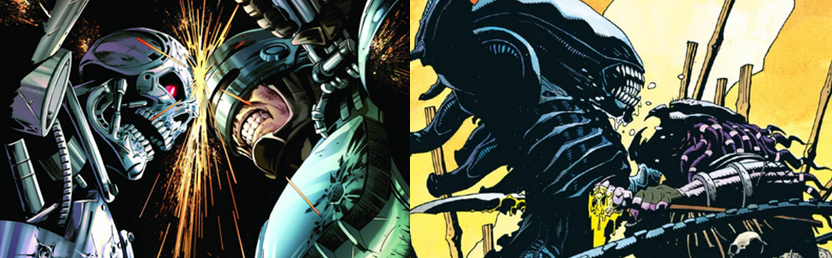
Speaking of Dark Horse Comics, they really have brought us some great crossovers over the years; RoboCop Versus The Terminator and Aliens vs. Predator were natural stories to present in comics, videogames, and toys that were (arguably) too big for movies. They also merged three of these franchises together in Aliens versus Predator versus The Terminator (Schultz, et al, 20000), though that story was more a sequel to Alien: Resurrection (Jeunet, 1997) and a continuation of the Aliens vs. Predator comics than anything to do with the Terminator (Various, 1984 to 2019) films. Instead, this four-way crossover would give Dark Horse a chance to take the time-hopping, action-packed story of RoboCop Versus The Terminator and merge it with their complex Aliens vs. Predator comics. RoboCop would probably be best served as the central character of the story; a member of the human resistance could travel back in time to try and eliminate RoboCop, only to run into a T-800 right as Predators come to clean up a Xenomorph outbreak in Detroit. A time dilation could transport them to the war-ravaged future, where RoboCop could team up with a reprogrammed T-800 (or John Connor) against the aliens, or perhaps the future war would be changed by the reverse-engineering or Predator technology. There’s a lot of potential in this crossover but, for me, it only really works if you include RoboCop. Without him, you end up with a poorly-executed concept like Aliens versus Predator versus The Terminator, which really didn’t utilise the Terminator franchise enough. But imagine a Terminator/Xenomorph (or Predator) hybrid exchanging plasma blasts with a Predator-tech-upgraded RoboCop and tell me that doesn’t sound cool!

10FTWCrossoversHBJC
4 Hellboy/Constantine

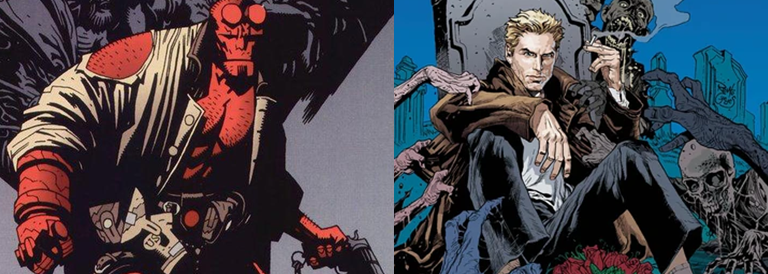
We’re scaling back a bit with this one. Honestly, I am very surprised we’ve never seen these two team up before, especially considering the amicable relationship DC and Dark Horse Comics have had over the years. Hell, we did get a brief team up between Hellboy and Batman but, arguably, this is the far more fitting choice. In this concept, I would go with the idea that John Constantine and Hellboy co-exist in the same world and have them cross paths when investigating the same supernatural threat or mystery. Obviously, they’d have to fight before teaming up (or, perhaps, they’d just rub each other the wrong way after being forced to team up), but can you imagine the quips and taunts and insults Constantine would have for Hellboy all throughout this crossover? Toss in guys like Swamp Thing and Etrigan, or even the Justice League Dark and the rest of Hellboy’s buddies (and absolutely have Mike Mignola provide his distinctive art style to the piece alongside co-authoring the story with either Grant Morrison or Neil Gaiman) and you could have a very dark, moody, and entertaining paranormal crossover.

10FTWCrossoversBGSG
3 Batgirl/Spider-Gwen

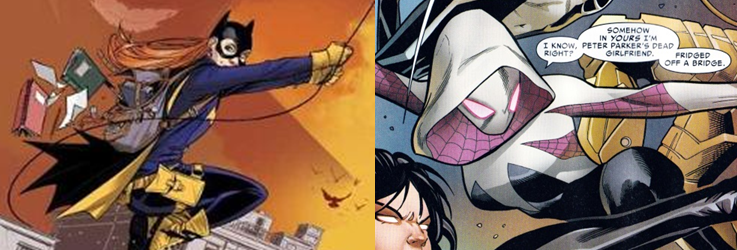
This one is more of a light-hearted pick but there’s nothing wrong with a bit of unapologetic fun amidst all the big action set pieces and violent action. After her debut in the “Spider-Verse” (Slott, et al, 2014 to 2015) storyline and prominent inclusion in Spider-Man: Into the Spider-Verse (Persichetti, Ramsey, and Rothman, 2018), this alternative version of Gwen Stacy has gained quite the fan following over the years and has become firmly entrenched in Marvel canon as Ghost-Spider. Meanwhile, since the New 52, DC have returned Barbara Gordon to the role of Batgirl; this wasn’t without some controversy as, for years, Barbara had operated just fine as a paraplegic and the Batgirl mantle had been assumed by other, far more suitable candidates. Yet, DC have continued unabated, largely changing Barbara from a smart and capable tech and information wizard, to a far more catty, athletic, and socially-conscious young lady. Despite this, this has the potential to be a really fun crossover between these two; while Babs should really be the older and more mature of the two, they’re both around the same age these days (somewhere between fifteen and twenty-one, depending on DC and Marvel’s sliding timelines), meaning there would be a lot of common ground between the two. No doubt they would have plenty to say about each other’s costumes, hair, and ex boyfriends (throw Nightwing in there and have that cause a bit of tension between the two) and I would even have them team up against C-list villains, like the Vulture, Chameleon, Shocker, Mad Hatter, or Killer Moth, just to keep the focus on fast-paced, witty action rather than getting all sour and bleak.

10FTWCrossoversSM2099BB
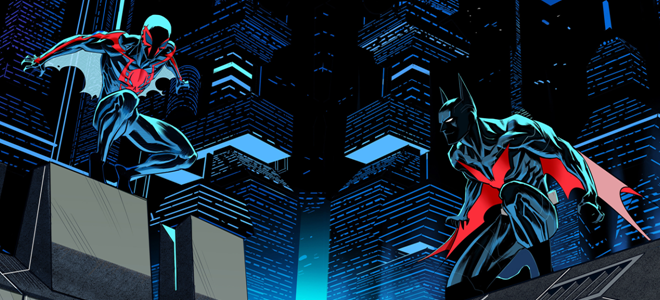
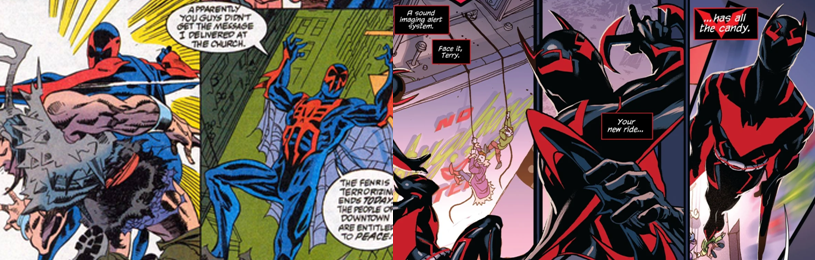
2 Spider-Man 2099/Batman Beyond

I know what you’re thinking: Shouldn’t this be a crossover between Batman Beyond (1999 to 2001) and Spider-Man Unlimited (1999 to 2001), considering both cartoons aired at the same time and both characters wore similar, futuristic costumes? Well, you might be right, but Spider-Man Unlimited really should have been based on the initial Spider-Man 2099 (Various, 1992 to 1996) comics as that cartoon is largely remembered for being a poor follow-up to the superior Spider-Man (1994 to 1998) animated series and for featuring a pretty neat new costume for Spidey. Instead, I’d go with Spidey’s futuristic counterpart, Miguel O’Hara, who is more famous for operating in an alternative future of Marvel Comics. Again, the easiest way for him to interact with Terry McGinnis would be to have them exist in the same world but there’s a bit of an issue with that: Batman Beyond was set in 2039 when Terry was sixteen. The Justice League Unlimited (2004 to 2006) episode “Epilogue” (Riba, 2005) jumps to fifteen years later and Terry is a thirty-one-year-old Batman but the story would probably need some kind of time travel plot to bring these characters together at their peak.

10FTWCrossoversSM2099BB2
Both characters come from similar futuristic worlds.

Luckily, neither character is no stranger to time-hopping adventures; perhaps the best way to do this would be to have two similar villains in each world experimenting with time/reality-bending technology and cause a dilation that threatens to merge both timelines unless Miguel and Terry can stop them. I’d even have them both swap places; have Miguel wake up one morning in Neo-Gotham, running into the aged, grouchy Bruce Wayne (Kevin Conroy) and battling some of Terry’s foes, while Terry randomly finds himself dumped in Nueva York and running afoul of Alchemax. After two issues of them exploring each other’s world, the third issue would be the obligatory fight between the two before they agree to team up for the fourth and final issue and sort out the problem. Both characters’ futuristic costumes have very similar traits and exist in visually interesting futuristic worlds, making a potential clash and eventual team up between them an exciting prospect for the art work and banter alone.

10FTWCrossoversDetective
1 Batman/The Crow

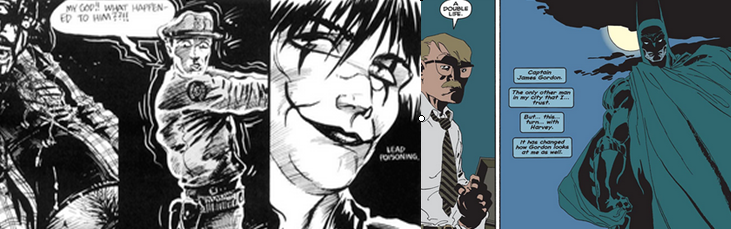
Easily the top choice for me, and the genesis of this list, I literally cannot shake how perfect a crossover between Batman and Eric Draven/The Crow would be. Neither are strangers to inter-company crossovers but, while the Crow has had to settle for teaming up with the likes of Razor, The X-Files (1993 to 2018), and Hack/Slash (Seeley/Various, et al, 2014 to 2018), Batman has met Al Simmons/Spawn, Spider-Man, Judge Dredd, and even Elmer Fudd and the Teenage Mutant Ninja Turtles. Yet, this crossover provides the opportunity to get Batman back to the gritty, noir-inspired style of stories like The Long Halloween (Loeb, et al, 1996 to 1997) utilising an art style that is part Dave McKean and part James O’Barr. As for the plot, I’d have Eric return to his undead life once again after it is revealed that there was another figure pulling the strings of Top Dollar’s gang. This would, of course, bring Eric to Gotham City, where he’d start killing members of this extended gang of thugs with his usual brand of violence and poetic justice. Naturally, this would lead him into conflict with Batman but, rather than the two descending into a poorly written, childish brawl as in Spawn/Batman (Miller and McFarlane, 1994), it would probably be better to focus on Batman’s detective skills as he investigates Eric’s murder, those behind the murder, and Eric’s violent actions on the streets of Gotham. In fact, I probably would only have the two interact right at the conclusion of the story, just as Eric is about to kill his final target; they could have a discussion on morality and the meaning of justice but, ultimately, Eric would fulfil his mission and return to the grave regardless of Batman’s protestations, leaving Batman to ponder the line between justice and vengeance.

10FTWCrossoversEnd

What comic book crossover would you like to see? Which comic book crossover has been your favourite, or most reviled? Whatever you think about comic book crossovers, leave a comment below.

Movie Night: Hellboy (2019)

HellboyLogo

Released: April 2019
Director: Neil Marshall
Distributor: Lionsgate
Budget: $50 million
Stars: David Harbour, Milla Jovovich, Ian McShane, Sasha Lane, and Daniel Dae Kim

The Plot:
Hellboy (Harbour), a demonic paranormal investigator for the Bureau for Paranormal Research and Defence (B.P.R.D.), is the only thing standing between the ancient sorceress, Nimue (Jovovich), being resurrected and leading the forces of darkness into all-out conquest over the human world.

The Background:
Created in 1993 by noted writer/artist Mike Mignola, Hellboy is quite a unique and intriguing comic book character; a demon entity with a giant stone hand, filed-down horns, and a big-ass hand cannon, he is noted as being the world’s greatest paranormal detective and investigates, and fights against, the forces of evil. Of course, we’ve seen the character adapted by Guillermo del Toro and portrayed to fantastic effect by Ron Perlman back in 2004. Although we got a sequel in 2008, talks on a third instalment stalled and, eventually, died out, leading to this grittier, bloodier reboot.

The Review:
Hellboy is a chaotic, frenetic movie that blasts along at a mile a minute, rarely taking any time to catch its breath or take a moment to think about what is going on. While this does make for a loud (very loud; at times, the music drowned out the dialogue), action-packed slug-fest, it does make the movie far more exhausting than its 2004 counterpart. However, this version separates itself by being full of gore, violent action, and foul language, which definitely ups the movie’s fun factor. The movie opens with some narration from Professor Trevor Bruttenholm (McShane), who quickly runs through the story of the Blood Queen Nimue while we see it happening onscreen; this is one of those cases where a a prologue exists simply to spell out the plot for the audience as, later in the film, Hellboy obviously has to be told the same story so he knows what’s going on and I end up just asking why we couldn’t skip the opening narrative and just splice that footage in to the later exposition.

HellboyCast
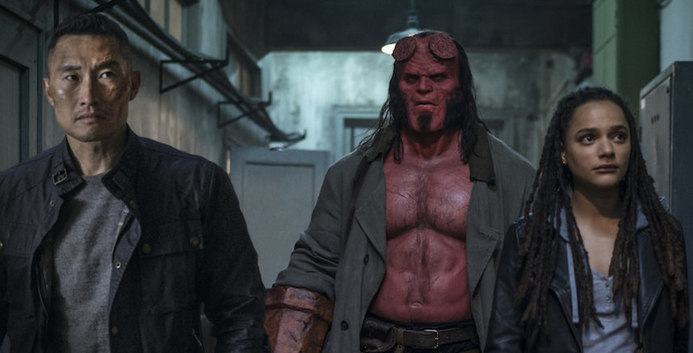
Hellboy wisely introduces some new character’s from the comic lore.

After that, we jump-cut to Tijuana, where Hellboy is unable to save a friend of his (a fellow B.P.R.D. agent) and, just as he’s trying to deal with the guilt of that, we jump-cut to Colorado, where Professor Bruttenholm sends Hellboy on an assignment to help out the Osiris Club with an outbreak of giants in England. So then we jump-cut to England for an exciting action scene where Hellboy fights giants; it’s around here that the actual plot starts to come together as, at every turn, Hellboy is told rumours of an approaching evil, his role in the apocalypse, twists, turns, betrayals, and so many sudden location shifts as Hellboy prepares for the resurrection of the Blood Queen. As perfect as Ron Perlman was as Hellboy, David Harbour is a fantastic replacement; gruff, sarcastic, and conveying a lot of conflicting emotions, he is less of a child-like goof but still portrays the character as enjoying his violent job and beating up bad guys. The make-up and effects on Hellboy are top notch, and clearly have had the most effort put into them; compared to Perlman, Harbour is bigger, more battle-hardened (scars pattern his face and body) but just as poor a shot and quick to enter a fight. I don’t really know the Hellboy comics very well at all but we still don’t see much evidence to support Hellboy’s status as the world’s greatest paranormal investigator; he’s more a hit-first-ask-questions-later kind of demon and, though there are some wrinkles in his portrayal, he’s pretty much the same character from del Toro’s films.

HellboyNimue
Once again, Milla Jovovich is little more than a plank of wood.

Supporting him are the always-great Ian McShane, who is a far more gruff and pragmatic version of Professor Broom, Alice Monaghan (Lane), a telepath of sorts who can talk to and summon spirits, and Ben Daimio (Kim), a UK-based B.P.R.D. agent who, despite hiding a big secret, hates all the world’s monsters and is prepared to eliminate Hellboy if he proves to be a threat. They’re okay; there’s far more friction between Broom and Hellboy given that Hellboy discovers his true origins for the first time in this movie; Alice is serviceable enough and helps to humanise Hellboy, while Daimio undergoes the most character development as he begrudgingly learns to tolerate Hellboy’s existence during the course of the movie. Nimue is quite the antagonistic force; in addition to being effectively immortal, she can command the forces of darkness and bring about plagues through sheer force of will. She’s a constant shadow hanging over the film and actual shows up quite a bit, too; she’s also willing to concede her throne to Hellboy, given his destiny to be the destroyer of worlds. However, a lot of her threat and menace is diluted by Jovovich’s trademark wooden acting; as always, she is an emotional void, despite moments of emotion, and she just seems like a puppet dancing around onscreen.

HellboyGruagach
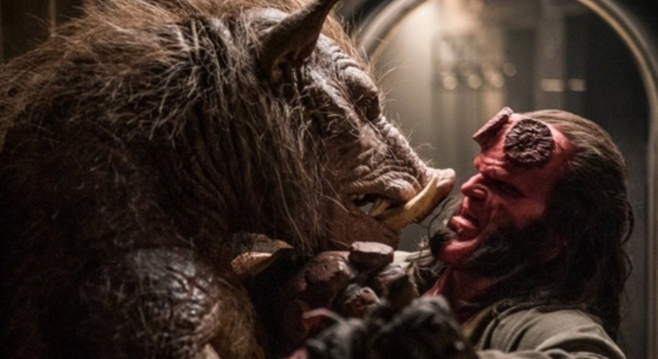
Gruagach is a fun antagonist who needed more screen time.

Nimue’s desires are facilitated mainly through her right-hand…man…Gruagach (Stephen Graham and Douglas Tait), a half-man, half-pig who pretty much steals the show whenever he shows up thanks, in large part, not only to his gruff voice (which is full of personality) and his sympathetic motivations, but also due to him mostly being portrayal through practical effects. When he is onscreen with Nimue, she suddenly seems a lot more interesting and my only regret is that there isn’t more interaction between him and Hellboy as the film constantly throws other threats and obstacles in Hellboy’s path. Hellboy also features a booming soundtrack, though it does drown a lot of the dialogue out, as I mentioned earlier; this is something to note as Hellboy is a gruff-spoken character, Harbour has a gruff voice, and the make-up is obviously difficult to act through so it can be he hard to hear Hellboy’s snappy dialogue when the soundtrack is in full force. The effects are good, for the most part; the creature effects are clearly inspired by del Toro and the practical effects all look great. Some of the CGI lets the film down though, particularly around Nimue, her powers, her minions, and when Daimio reveals his true nature. The shots of hell seen in the trailer are very well done, though, and Hellboy looks great, and it’s helped that the movie blasts along way too quickly for you to really take in how good, or bad, a lot of the effects can be.

The Nitty-Gritty:
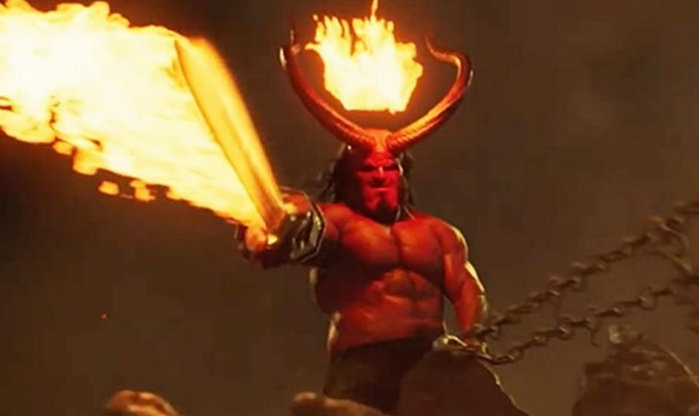
If you’ve seen the trailers, or Hellboy (del Toro, 2004) then you already know one of the film’s biggest spoilers, which is that Hellboy embraces his role as Anung Un Rama and, also, that he ultimately rejects his fate as the bringer of the apocalypse by breaking his horns. He is forced into doing this by the death of a loved one (this time it’s Broom) and talked out of it by being reminded of his humanity (also by Broom, as a spirit, in this film). It’s a bit too samey, unfortunately, as was the flashback to Hellboy’s origin, which differed only in that Broom was at Hellboy’s summoning in order to kill him and decided to raise him as a son and weapon against evil instead…which was somewhat implied in del Toro’s movie. The trailers did do a decent job of hiding Daimio’s true nature, however; it was heavily implied that he was a werewolf of some kind and it turns out that he can turn into a beast that resembles a sabretooth tiger. This doesn’t fully happen until the film’s climax, however; probably because the effects are not very good at all and he’s not onscreen in this form for very long.

HellboyApocalypse.PNG

Hellboy is betrayed and stabbed in the back, literally, at almost every turn, adding to the film’s chaotic nature. Yet, amidst all of this, Hellboy presents the idea that Hellboy is half-human, half-demon and that his human lineage stretches all the way back to King Arthur. This means that Hellboy is the true ruler of England, for one thing, and (conveniently) the only one capable of wielding the legendary Excalibur (the one blade that can kill Nimue). I don’t know if this is a thing in the comics but it felt a bit contrived and convoluted for me; the entire movie is this mish-mash of exposition and senseless action and then, suddenly, Hellboy is destined to be the descendant of King Arthur while also being destined to bring about the apocalypse. O much prefer Hellboy being a down-to-Earth kinda guy who rejects his demonic heritage to do good out of his own volition and not because “fate” says he will. Like any good comic book movie, Hellboy features a few post-credits scene; two set-up a potential sequel, especially with Baba Yaga (Emma Tate and Troy James) swearing revenge against Hellboy and Hellboy, Alice, and Daimio discovering Abe Sapien’s water tank; in another, Hellboy is randomly consoled by the ghost of the legendary Nazi killer Lobster Johnson (Thomas Haden Church).

The Summary:
Hellboy is a bombastic mess of a movie, to be honest. It’s loud, jumps all over the place, and never stops to let you catch up. The movie is full of foul-language and gratuitous violence, which really adds to its chaotic nature; unlike del Toro’s movies, this Hellboy doesn’t hold back and goes balls-deep with the violent nature of Hellboy’s work and life. While you can argue that the violence and gore is simply there just to be there, it really makes the film’s over-the-top premise and action far more enjoyable and allows this film to distance itself from its predecessors. I enjoy a mindless action movie as much as the next guy and am al for switching my brain off and watching some mindless violence, but Hellboy’s rapid editing and frantic pace soured me at the start. Similar to Suicide Squad (Ayer, 2016), Hellboy tries to cram way too much in at the start and then has multiple flashbacks to each character’s origin as they are introduced that interrupts the plot and makes things more convoluted than it needed to be; I think a cold-open and dialogue concerning Hellboy’s origin would have been enough. However, there is something to like about Hellboy; the effects are good, Harbour is great as the titular character, and the action and violence are loud and fun. Unfortunately, the film doesn’t seem to be tracking well and doesn’t look like it’ll turn much of a profit, if any, so we may never get to see a sequel iron out some of the film’s issues but, to its credit, Hellboy goes for the jugular right from the start and doesn’t let go even after the credits have rolled.

My Rating:

Rating: 3 out of 5.

Pretty Good