Game Corner: South Park: The Stick of Truth (Xbox One)

GameCorner

Released: 13 February 2018
Originally Released: 4 March 2014
Developer: Obsidian Entertainment
Also Available For: Nintendo Switch, PC, PlayStation 3, PlayStation 4, Xbox 360

The Background:
Back in 1992, Matt Stone and Trey Parker took some glue, construction paper, and an old 8 mm film camera and created The Spirit of Christmas, a short animated film in which four young boys accidentally bring to life a killer snowman. A Fox Broadcasting Company executive then commissioned the duo to create a follow-up short, Jesus vs. Santa, in 1995, which quickly became one of the first viral videos and led to the commission of a full series airing on Comedy Central. Originally entirely hand-animated, the duo (now joined by team of around seventy employees) soon switched to replicating their cardboard cut-out aesthetic using computers and managed to produce episodes within just a few days to stay right on the pulse of current events. Since then, South Park has expanded not just in its animation and cast but also into a whole host of other media, however South Park’s history with videogames has been…tumultuous, to say the least. Unlike previous games inspired by the show, The Stick of Truth was created with the direct involvement of Stone and Parker, who insisted that this new title actually mirrored the look of the show and would be a role-playing adventure game that utilised the duo’s script and ideas.
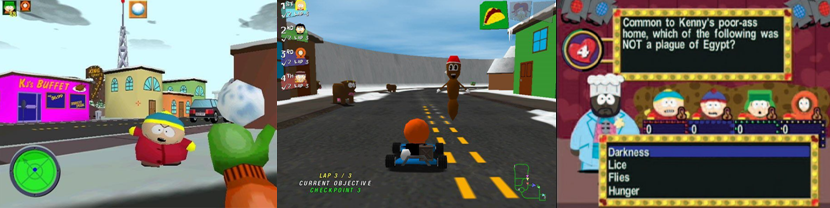
South Park had a number of videogame spin-offs, most of them ugly and pretty bad.

Unfortunately, however, the game ran into difficulties after THQ (who had agreed to help work on the game) filed for bankruptcy in 2012; the rights to the game were then bought by Ubisoft, who delayed the game’s release date to make significant changes to its direction. South Park: The Stick of Truth finally released in March 2014; although the game was heavily censored in Europe, it became the best-selling game available within its first week of release here in the United Kingdom and, by February 2016, had shipped over five million copies. Reviews were generally favourable, despite some criticism of the game’s mechanics, but the game performed well enough to earn a sequel in 2017. I, personally, first played through The Stick of Truth on the PlayStation 3 and loved its simple, yet surprisingly deep mechanics, its graphical fidelity to the source material, and its outrageous sense of humour so I jumped at the chance to cash-in a free download code for the Xbox One version to relive the original title in all its sardonic glory.

The Plot:
A new kid has moved to South Park and quickly finds himself drawn into a fantasy role-playing game the kids are playing involving control of the all-powerful “Stick of Truth”. However, after an alien spacecraft crash-lands in the small mountain town and toxic waste from the ship begins infecting citizens and wildlife, the new kid and his newfound friends suddenly find themselves embroiled in a very real fight for their very lives!

The Gameplay:
South Park: The Stick of Truth is a 2.5D, sidescrolling action/adventure game with heavy elements of role-playing mechanics and an emphasis on story, character interactions, side quests, and acquiring new weapons, armour, and buffs. When you first start the game, you’re tasked with creating your avatar, the otherwise-entirely-silent “New Kid”; here, you’re given a few options to customise the New Kid’s hair, skin tone, clothing, and other elements before you’re thrust into the game’s story and tasked with exploring the quiet little mountain town of South Park.
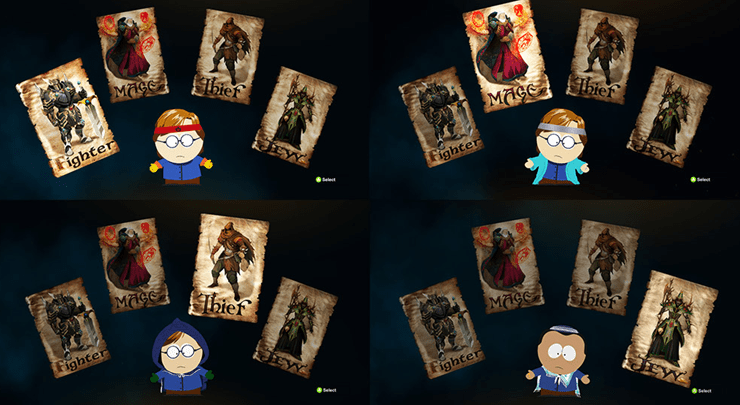
Customise your avatar and choose from four classes, each with their own unique abilities.

Luckily, you live next door to one of my favourite characters in the series, Butters Stotch, who introduces you to Eric Cartman and the game the kids are playing; a role-playing fantasy game very much inspired by the likes of Dungeons & Dragons. As a result, you’re quickly asked to pick from one of four classes: Fighter, Thief, Mage, and Jew. While each has its own specific abilities, positives, and negatives, weapons and armour and such aren’t limited to each class so you can pick a Fighter and still focus on Mana-based attacks like a Mage if that’s your bag. However, unlike in the sequel, you cannot switch or mix and match classes in this game so, once you pick a class, you’re locked into it for the rest of the game.
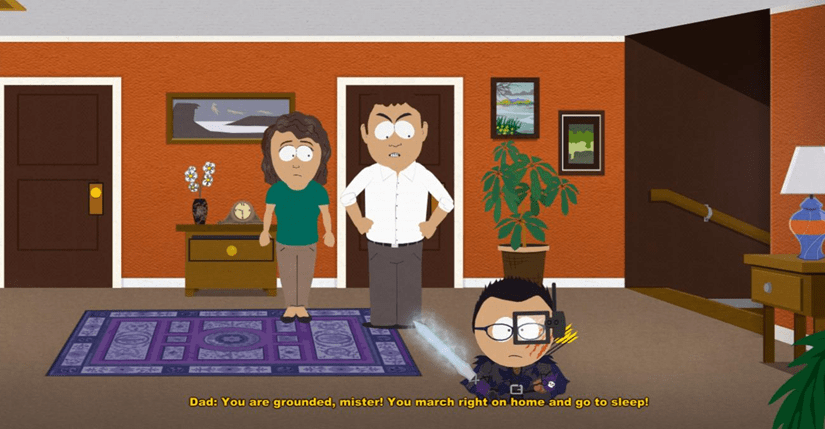
Be sure to explore thoroughly before a new day starts or else you might miss collectables.

Stick of Truth divides its story up into days, rather than chapters; you’re free to explore the town as much as you wish but certain areas and houses and such are either locked or barred off until you complete story quests, side quests, or learn new fart-based magic. As a result, it’s entirely possible to explore a good percentage of the town on the first day, meeting people and getting side quests going, uncovering loot and as much as you possibly can before night falls and you enter certain areas that can’t be revisited. This means it’s advisable to explore every inch of your environment in case you miss something because you might not be able to go back and grab it when the sun rises.

Combat is a simple, but surprisingly deep, affair.

The game has a difficulty slider for you to utilise but there are no Achievements associated with playing the game on a harder mode so the only reason you’d turn this is up is if you found the game’s combat too easy. And, to be fair, that’s entirely possible; as you explore, you’ll come up across fellow kids, rabid dogs, drunken vagrants, and Nazi zombies (you know, the usual) around town; you can easily bypass them but then you won’t earn experience points (EXP) or level-up. Luckily, though, you can strike them on the overworld to gain an advantage in combat. Battles take place on a traditional 2.5D battlefield and are entirely turn-based; you can wait as long as you like to take your turn without fear of being attacked, which is nice, and can select your character’s abilities or use an item as well as cast magic or attack, meaning you generally always have the advantage. Battles usually boil down to selecting an attack and pressing either A, X, Y, rotating the analogue stick, mashing buttons, or a combination of all of these elements to land attacks. Before you strike, your weapon will flash; pressing the right button at this time will unleash a stronger attack, or allow a combination of moves to be performed. It’s pretty simple to get the hang of and you can buff your attacks with equipment patches and farts to deal additional damage.

Each of your buddies has their own attacks and abilities to help you in and out of battle.

Generally speaking, though, combat comes down to how easily you adapt to the wheel-based menu (which can be a bit janky at times) and how accurate you are at pressing A; when an enemy attacks, you’ll have a small window to press A to defend yourself and reduce the damage done to you or keep yourself safe from status effects. This window can be very small at times so you’ll need to have your wits about you but, luckily, you are joined by a number of buddy characters in battle who have abilities and capabilities of their own (or act as a punching bag, if necessary). Butters, for example, can heal you without you having to waste an item, while Kenny McCormick continuously resurrects after death and Kyle Broflovski can increase your attack power. Additionally, you can switch your buddy at any time in battle at the cost of a turn, instantly allowing you to have a fresh buddy ready to lend a hand.

You can inflict multiple status effects on your enemies to aid you in battle.

Combat is simple to learn, easy to master, and fun to experience; with patches and perks, you can make your character incredibly overpowered in a very short period of time, dealing multiplier status effects to your enemies (such as bleeding, burning, and grossing them out), regenerating health (HP) or Power Points (PP), and dealing additional damage or upping your abilities or defences. It’s pretty easy to double up these effects with the natural abilities of your weapons to wipe out your enemies, even when they armour up or reflect and deflect your ranged or melee attacks.

Interact with your environment to take out enemies quickly and efficiently.

The New Kid has quite a few resources at his disposal to make things even easier as well; often, you can shoot or fart on objects in the overworld to either damage or defeat enemies and you can learn various types of fart-based magic to open up new areas or aid you in battle. These are sometimes cumbersome, however, as they require some tricky or imprecise movements of the right analogue stick to pull off and are made even more inconvenient by the fact that your Mana Meter doesn’t automatically refill after a battle like your HP and PP. This means that you have to buy and consume Mana-restoring food to keep it up (but not too high, lest you shit your pants in battle); luckily, though, as I said, HP and PP are restored and all status effects wiped away once a battle ends, allowing you to keep HP and PP restoring items for the more difficult boss battles.
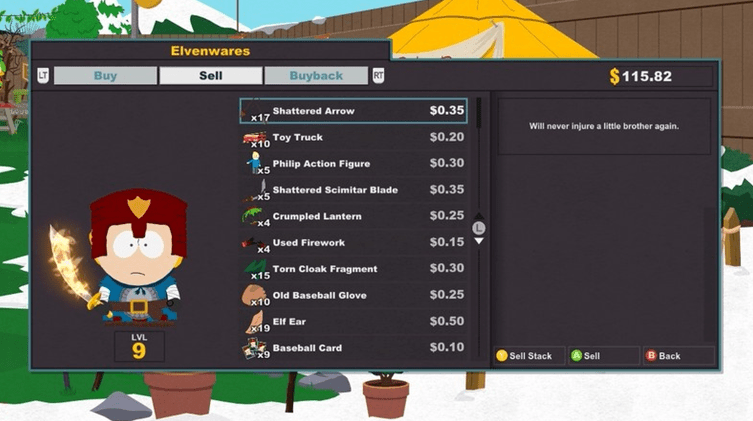
Use your hard-found cash to buy weapons, armour, and other wares.

As you explore South Park, it’s recommended that you attack and interact with everything you see to find new armour, patches, weapons, items, junk, and cash. Fittingly, the game’s money is measured in small amounts; you’ll generally find a few cents lying around and resources only cost a few dollars or so but you can sell your useless junk or unwanted items to make more money. When you venture to Canada, though, you’ll have to contend with their higher prices and exchange rate but I never found myself strapped for cash or wanting for resources; if your inventory is full, you can usually return to the item chest or location and pick up whatever you couldn’t carry later on if you really want to.

The New Kid gains numerous abilities to help him progress further and access new areas.

The New Kid also gains access to a few additional abilities to help him out; when you’re abducted by aliens, you’ll get an anal probe inserted into you that allows you to access alien tech to open doors or teleport around the map. Later, when you meet the Underpants Gnomes, you’ll also gain the ability to shrink to access new areas, in addition to using the New Kid’s fart abilities and various buddies. This latter aspect was significantly expanded upon in the sequel and it can sometimes be unclear exactly what you need to do and with which buddy. The entirety of the town in accessible and faithfully recreated, though (except for Mephisto’s laboratory and the Mall…), which really adds to the game’s level of detail and fidelity and you can use Timmy to fast travel across the map (though I found myself running about the place more often than not to find more loot and level-up through battling).

Talk to, and befriend, everyone in South Park.

You’ll also gain EXP by completing the many and varied side quests that The Stick of Truth has to offer; at any one time, you can have as many as ten quests on the go at once, including those that are story-based, and you can keep track of these at all times using the New Kid’s phone and Facebook feed. Much of the game’s plot revolves around rallying others to your cause or making Facebook friends with the townsfolk so you’ll need to talk to everyone you see to gain followers and be given side quests to complete to earn EXP, get more followers, and even acquire certain iconic South Park characters as Summons to help you out in battle.

The story is as wacky and crude as you would expect from South Park.

The game’s hilarious and multi-faceted story, which involves all the familiar faces of the show and even recycles or addresses jokes and loose ends from the episodes, is just as wacky and insane as the show has become over the years; what starts as a simple (yet surprisingly elaborate) war between Cartman’s human forces and those of Kyle’s elf-kind quickly escalates into a battle against Nazi zombies and gun-toting government agents looking to destroy the town. After both groups are betrayed by Clyde, the New Kid has to travel to Canada to translate a message; this is where the game’s presentation takes a sudden and hilarious left turn as Canada is rendered through traditional 8-bit graphics, complete with an 8-bit rendering of “Blame Canada” and the Canadian national anthem. It’s a hilarious and mental detour that, sadly, doesn’t last as long as it could do (though, thankfully, you can return to Canada to fight Dire Wolves whenever you want). Ultimately, all of the kids you’ve befriended lay siege to Clyde’s elaborate dark tower and you end up having to disarm a nuclear bomb inside of Mr. Slave’s ass, battle a zombified Chef, and finally defeat Kenny after he claims the Stick as his own and transforms into a Nazi zombie himself.

Graphics and Sound:
The Stick of Truth is beautiful in its simplicity; in every respect, it looks exactly like an episode of the popular cartoon show, with the entirety of the town and its many houses, areas, and districts rendered in the finest cardboard cut-out-style 2.5D available. It’s literally like you’re playing an extended episode of the show as you’re able to visit the school, the houses of all the show’s popular characters, and the many businesses and iconic locations South Park has to offer.

The entirety of South park is recreated in stunning detail.

I honestly cannot gush about this presentation enough; too often, videogames based on cartoons (especially the South Park titles) slap an ugly, polygonal 3D effect on the presentation that ruins the game’s look and feel. Here, though, everything is just as crude and charming as in the cartoon; weapons and armour all look distinctly child-like, as though cobbled together by kids, and the way the game incorporates its more elaborate elements into the show’s aesthetic is impressive. Add to that the fact that the game not only uses music from the show but the voices of the entire cast and you’ve got a really special package and the result is a game adaptation that is more than 100% faithful to its source material, utilising so many jokes, characters, and words of dialogue that it’s actually quite mind-boggling.

Enemies and Bosses:
As you explore the town, you’ll get into fights with other kids and wild dogs in the game’s early going; these battles generally take place in a two-on-two format but you’ll face groups of about six at some points as well. Each of your enemies has similar abilities to you, meaning they can cast magic to slow you down, cause you to bleed, set you on fire, or gross you out but enemies will also enter a “Riposte” stance to automatically counter a melee attack or a “Reflect” stance to automatically parry ranged attacks. Enemies can also armour up and erect shields, which must be broken through with regular attacks before you can deal real damage, or have healers on hand to replenish their HP or remove status effects.
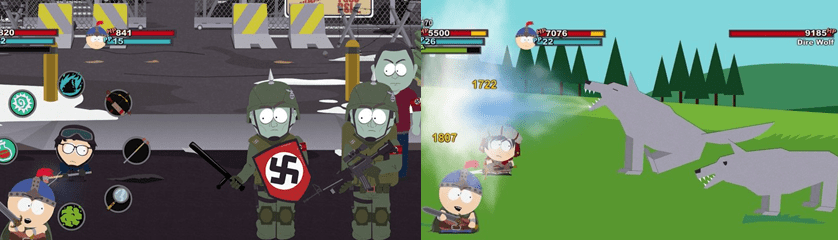
Enemies soon become hilariously ridiculous.

Later in the game, the townsfolk become infected with alien goo and become Nazi zombies; unlike other enemies, these guys will resurrect after a few turns, meaning you need to either end battles against them quickly our utilise attacks that hit multiple foes to clear their corpses from the field. When you reach Canada, you’ll have to contend with Dire Wolves, Bears, and Snakes, all of which are a bit more formidable than the town’s usual foes and can infect you with “Dire AIDs” if you’re not careful. Generally, though, battles against common enemies are pretty much a foregone conclusion; you’ll be so overpowered and have mastered the battle system so well that even groups of difficult enemies will be no match for you with the right setup.
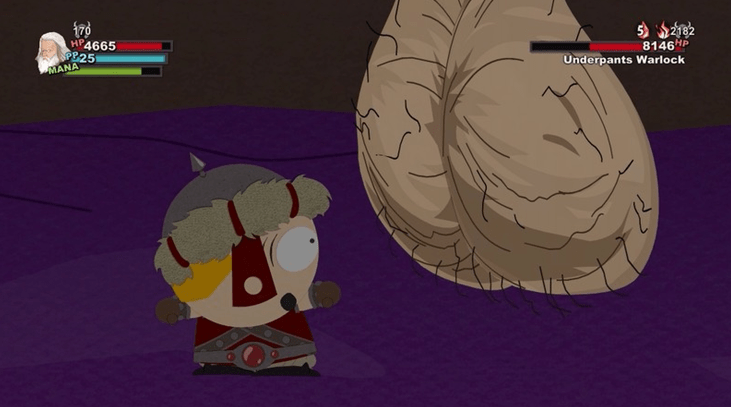
Watch out for your Dad’s swinging balls when you’re battling the Gnome Warlock!

Of course, you’ll also have to take part in a number of more challenging boss battles throughout the game’s story. Stick of Truth’s boss battles involve a lot of variety compared to regular battles and have you performing slightly more complex actions, such as resisting the sleeping effects of Jimmy Valmer’s stuttering limericks, keeping the Hallway Monitor from calling your parents, and dodging the swinging testicles of your father as you battle the Gnome Warlock.

Al Gore is a serious pain the ass as both a character and a boss.

One of the game’s more difficult and annoying bosses is former Vice President of the United States Al Gore; after a long side quest involving Gore’s vendetta against “ManBearPig”, you’ll enter a lengthy and difficult battle against Gore and his bodyguards where the former Vice President will try to put you to sleep with a presentation on global warming, up his attack and regenerate his health, and bombard you with rapid slaps all while his constantly-respawning bodyguards take shots at you. It’s a tough fight but one that can be completely avoided (though you’ll lose out on Achievements if you do skip it) and made easier by having Jimmy as a buddy. You’ll battle Al Gore again later on, this time when he is under the guise of ManBearPig, but this is a walk in the park compared to the first fight.

Despite the censoring, Stick of Truth goes above and beyond to shock and entertain.

Things continue pretty smoothly until a breakout of the Nazi zombie virus as the Unplanned Parenthood facility; here, you’ll have to battle a gigantic Nazi zombie foetus, which has a staggering amount of HP and comes alongside an umbilical cord that leeches your HP. Because of this, it is absolutely essential that you destroy the umbilical cord first and remove it from the battlefield, avoid trying to gross the foetus out (as zombies are resistant to that), and focus on chaining bleeding and burning multipliers while swapping out your buddy.

The Sparrow Prince can present a real challenge.

Later, when you venture inside of Mr. Slave, you’ll have to face another annoying boss: the Sparrow Prince. As a spirit, the Sparrow Prince is immune to the bleeding status effect and is accompanied by constantly-respawning globs of Nazi zombie bacteria. It’s not an impossible battle with the right class type and setup but it can be frustrating since the Sparrow Prince’s attacks deal high amounts of damage and hit quite quickly, making it difficult to defend yourself in time.
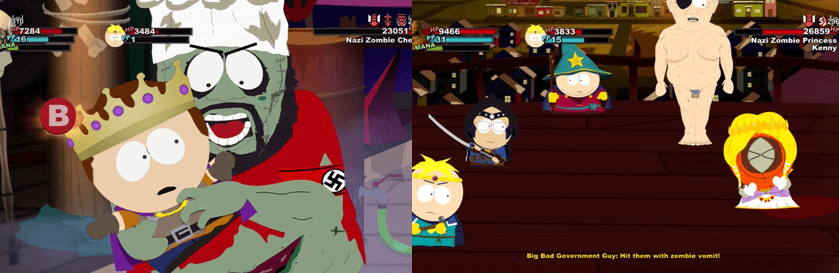
In the finale, you’ll run a gauntlet against Nazi zombie versions of your friends and allies.

The game’s finale sees you run a gauntlet, of sorts, of tough enemies in Clyde’s fortified tower and then a number of bosses, the first being against a reanimated, Nazi zombie Chef. This isn’t much of a hassle, though, and you’ll eventually face off with Kenny in quite a long-winded battle that sees your damage carry over between Kenny’s different phases and you automatically swap between buddies as the story dictates. It’s not especially difficult (especially compared to Al Gore or the Sparrow Prince) but it can get frustrating as you’re right at the end of the game but Kenny keeps getting back up and regenerating until you fart on his balls and bring the game to an end.

Power-Ups and Bonuses:
As an RPG, you obviously have access to a wide variety of weapons, armour, and power-ups to aid you in your journey. Levelling-up generally allows access to battle abilities rather than affecting your stats and the game caps your level at fifteen, though by the time you hit that you will be massively over-powered if you have equipped the right gear.

Attack up close or from afar, buffing your weapons with various patches and abilities.

You have access to two weapons: a melee weapon (swords, staffs, crutches, dildos, and the like) and a ranged weapon (dodge balls, darts, crossbows, and so forth). As you explore, you’ll find more powerful variations on these weapons, or you can buy them from various merchants about town. Each weapon comes with various buffs (such as causing an opponent to bleed, leeching HP, or powering up your abilities) can be assigned up to two equipment patches to increase your buffs further (this can add additional damage, leeching, or regenerative properties, among other options).

Weapons and armour can all be powered up to make battles a walk in the park.

Similarly, your helmet, armour, and gloves can be equally powered up by equipment patches to make your avatar quite the formidable fighter; thanks to patches and buffs, you can combine status effects and other buffs to ensure you always have the edge in battle and you can even customise the colour scheme of your equipment with various dyes.

Learning new fart magic can be a tricky task to master.

Completing side quests also nets you the ability to use Summons; while these can only be used once per game day and are useless in boss battles, they can turn the tide further in your favour if you’re struggling against certain enemies. As the story progresses, you’ll also unlock additional fart powers to use in and outside of battle; these can be awkward to learn and to use in the field, requiring vague movements of the analogue sticks to pull off, and frankly are nowhere near as user-friendly or as prominent as in the sequel.

Additional Features:
South Park: The Stick of Truth comes with fifty Achievements for you to earn, the majority of which are pretty standard fare (defeating certain numbers of enemies, completing story-based tasks, using certain attacks and so forth) but others can be easily missed or will require a bit of preparation on your part. There’s one that requires you to wear a bald cap and a goatee or ginger freckles to battle certain enemies, for example, another for completing the game without selling any items or wearing certain outfits, and even one for finishing the game without a single buddy being knocked out.
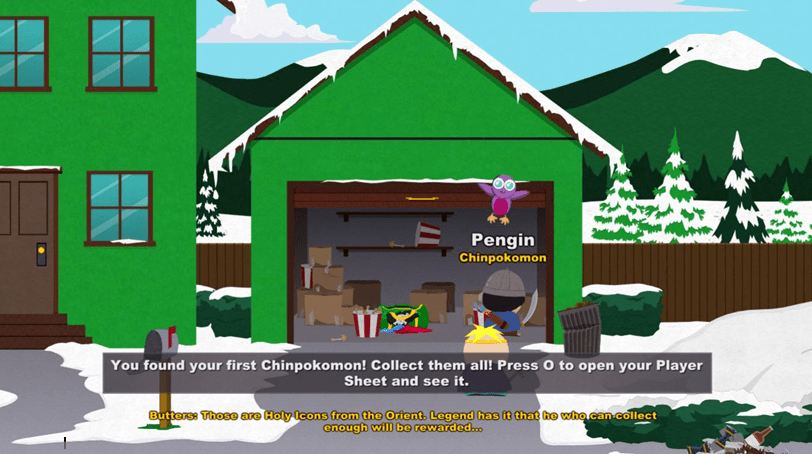
You’ll need to search high, low, and all around to find all thirty Chinpokomon.

The game is absolutely packed full of content but, unfortunately, most of this is confined to the main game rather than the post-game; as many areas become inaccessible after you complete them, you may find you have to restart from a previous save (or start a new game entirely) to find everything you need or befriend everyone in town. Scattered throughout the game are thirty Chinpokomon for you to find, for example, and 121 people to become friends with on Facebook. Talk to the wrong people at the wrong time or fail to explore your surroundings properly and you may find that you miss your one and only chance to tick these off your to-do list, meaning you’ll have to start all over again.
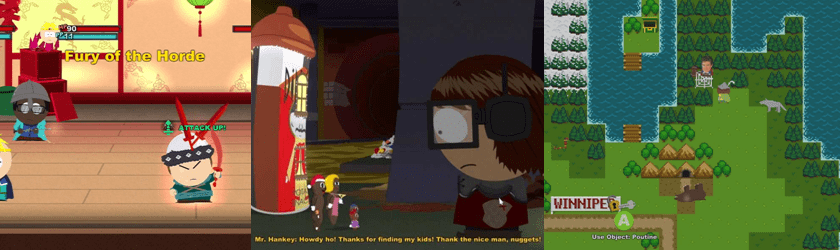
Side quests will take you all over town and even to the chilly mountains of Canada.

There’s so much to do around town thanks to the game’s side quests; you’ll be finding kindergarteners in a game of hide-and-seek, tracking down Mr. Hankey’s lost pooplings, ferrying messages between South Park characters, attacking Mongolian children on behalf or Mr. Kim, and you can even have surgery performed to look like David Hasselhoff! Jimbo and Ned send you on a side quest that sees you battling a number of option bosses as well, such as a rabid dog, the iconic mouse-penis, and the Canadian Barking Spider of the Queefing Caverns.

The Summary:
South Park: The Stick of Truth is a great little RPG; it’s not especially difficult, and this will probably turn off hardcore RPG players, but there’s a surprising amount of depth to its simple presentation and battle system. There’s a lot going on in the game but it never feels like you’re overwhelmed or can’t remember how to do stuff; it’s very intuitive and user-friendly, for the most part, and the story is hilariously crude and quite long.

The game won me over with its many quests, outrageous humour, and fidelity to the show.

The game’s length is padded by the sheer amount of side quests and things to do, see, and collect; it’s easy to waste a lot of your time veering away from the main story mission to beat up homeless people on behalf of the Mayor or transport messages across the length and breadth of Canada. Battles are quick and fun, requiring a bit of strategy at times but nothing that’s going to cause you game-breaking frustrations (with the possible exception of learning the “Sneaky Squeaker” from Randy Marsh), and I never found myself bored while playing. Quite the contrary, in fact, as I constantly found myself being immersed in the South Park world thanks to the game’s toptier presentation. For as long as it is, though, the game is quite short but, thankfully, the sequel offers more of the same, expanding and improving upon it where necessary and, between the two of them, both games really exemplify the right way to adapt cartoons into a videogame.

My Rating:

Rating: 5 out of 5.

Fantastic

What are your thoughts on South Park: The Stick of Truth? Did you enjoy the game or do you prefer a bit more challenge in your RPGs? Which character class did you choose, and did you side with Cartman or with Kyle when the story asked? Which parts of the game were your favourite, or least favourite, and which of the two did you prefer? Perhaps you prefer a different South Park videogame; if so, what is it, and which South Park character or episode is your favourite? How are you celebrating South Park’s anniversary this year? No matter what your thoughts on South Park: The Stick of Truth, or South Park in general, I’d love to hear from you so feel free to leave a comment below.

Game Corner: Mario & Sonic at the London 2012 Olympic Games (Nintendo 3DS)

Released: 9 February 2012
Developer: SEGA Sports R&D/Racjin
Also Available For: Nintendo Wii

The Background:
During the “Console Wars” of the nineties, there were no truer rivals than Nintendo’s Super Mario and SEGA’s Sonic the Hedgehog; both went head to head as their respective company’s mascots, spearheading the release of some of the greatest and most influential videogames of a generation, and both company’s went to great lengths over the years in a bid to prove that their consoles were the superior. In the end, though, thanks to a variety of expensive and poorly-conceived ideas and an ever-changing marketplace, SEGA were forced to withdraw from developing home consoles; now developing videogames for their competitors, SEGA’s supersonic mascot began appearing in games exclusive to Nintendo consoles and discussions of a long-awaited crossover began between Mario creator Shigeru Miyamoto and Sonic creator Yuji Naka. Rather than have their two iconic mascots meet in a merging of their worlds for a traditional platform title, however, the two were brought together in the spirit of friendly competition after SEGA was awarded the 2008 Beijing Olympic licence. Mario & Sonic at the Olympic Games (SEGA Sports R&D, 2007) followed as a result; though little more than a series of mini games featuring Mario and Sonic characters taking part in a number of Olympic events, the game was a commercial success and led to a series of annual titles being released in conjunction with a number of different Olympic events. After many years of putting it off, I finally got around to playing the 2012 edition of the game, which was set in London since we Brits won the right to host the games that year so, since the Tokyo Olympic Games are set to kick off today, I figured this was an ideal time to leech off of that event and share my thoughts about this title.

The Plot:
Sonic, Mario, and all their friends have arrived in London for the 2012 Olympic Games; however, annoyed that they weren’t invited to compete, King Bowser of the Koopas and Doctor Eggman join forces to cover London in the “Phantasmal Fog”, disrupting the games and forcing our heroes to battle against fog-based duplicates of themselves to dispel the fog and allow the Olympic Games to proceed as planned.

Gameplay:
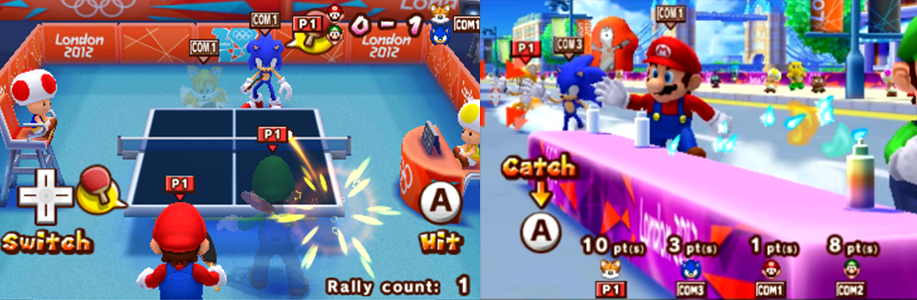
I’ve played games in the Mario & Sonic series before so I knew what to expect heading into Mario & Sonic at the London 2012 Olympic Games; while the games do generally have a story mode these days to make the gameplay a bit more involved than just a simple party game, it is still, nevertheless, a collection of Olympic-themed mini games. Because I’ve never been a fan of the Wii’s motion controls (or the Wii in general, if I’m honest), I always opt for the handheld versions of these sorts of games in the hopes that they will be less frustrating to play. Sadly, for the most part, that isn’t the case with Mario & Sonic at the London 2012 Olympic Games, a game which, seemingly, goes out of its way to use every single button, control, and aspect of the 3DS for its numerous events. The game features twenty playable characters, each of which falls into one of five different character classes (Heroes, Challengers, Girls, Wild Ones, and Tricksters) and, as a result, each character takes part in different events (Sonic, for example, can be used in the Marathon event, Yoshi in Shot Put, Blaze the Cat in Beach Volleyball, Bowser in Wrestling, and Metal Sonic in Hockey) and you cannot mix characters or classes.

The game’s events restrict which characters you can use according to their specific classes.

The moment you start a new game, Omochao rears his ugly little head to talk you through some of the game’s basic controls; you can then select from a few different customisation options, single or multiplayer events, or the game’s story mode. If you choose the single or multiplayer modes, you can select from all of the game’s many and varied events, each of which comes with an easy, normal, and hard criteria to get bronze, silver, and gold medals, respectively, with different goals, scores, or times to hit for each, as well as a brief overview of the event’s controls and objectives. I skipped this, however, and went straight to the story mode. The story allows you to take control of all of the game’s playable characters and the vast majority of the mini games and events the game has to offer, all while dialogue boxes and some limited voice clips and effects convey the game’s simple story. Generally, the story branches into two separate paths, one that follows primarily Mario characters and one that follows mainly Sonic characters, with the groups mixing up, overlapping, and interacting as they investigate the Phantasmal Fog, battle their shadowy doubles, and go head to head with Bower, Eggman, and their underlings.

Though you’re given a brief overview of each event’s controls, the actual gameplay can be tricky.

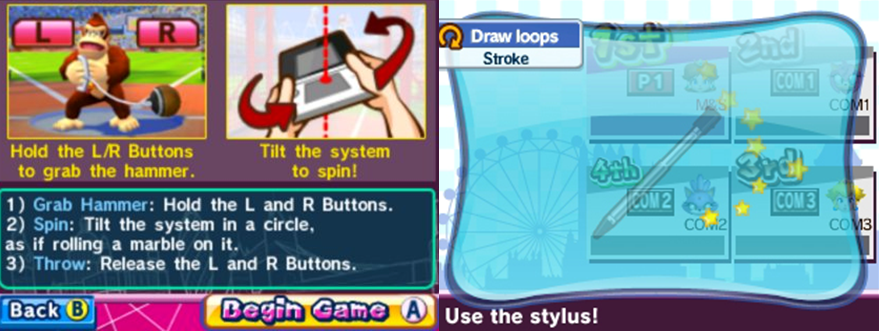
It’s a pretty simple story, one that is geared more towards teaching younger players a little about London and the Olympic Games more than anything, and it’s extremely linear. You can jump to a map screen to replay events (or just let the story take you from one episode to the next), skip cutscenes if you’re retrying an event, and are given a number of Challenges to complete to advance the plot. In the story’s early going, you’ll probably only be required to complete one or two Challenges but, as the story progresses, you’ll be asked to more, with each Challenge being comprised of harder or more complex events. Only first place will do here; if you don’t come first, you fail the Challenge and must either retry or choose a different Challenge if you want to see the story through to completion. As you play, you’ll be required to take part in a number of Olympic Games; it’s kind of weird that characters just spontaneously challenge their rivals to these games, and how the stadiums and arenas and locations and crowds and such just “appear” when you need to compete but…what do you expect? This is the best way, though, to experience a variety of the game’s events and get an idea of what is required of you. Sadly, however, many of the game’s events are an exercise in frustration; as I mentioned, you’ll be given a brief overview of what to do before an event but, sometimes, that doesn’t really help prepare you for the actual gameplay of that event. Generally, you’ll be rapidly tapping buttons, inputting specific button combinations, shouting or blowing into the microphone (which I can’t seem to find on my 3DS and which makes me a little lightheaded since I’m so unfit…), moving the 3DS about, or using the stylus to complete these events. Some, like the Pole Vault and 100M Backstroke, aren’t too difficult (you must angle the circle stick in a diagonal direction to charge your vault and release before the hidden meter overfills and your pole breaks or rapidly draw circles with the stylus to swim faster).

Be careful not to damage your touch screen trying to get to grips with the game’s controls…

Other events, like Archery (Solo) and BMX are maddeningly frustrating (you don’t just aim and shot in Archery, you need to account for wind currents which can screw up your shot, and BMX requires almost perfect hand co-ordination to tilt the 3DS in the right position to give you a much-needed boost). Almost all of the events have one thing in common and that is that they come down to split second timing as much as skill; if you do not time your inputs exactly right, you’re screwed but, often, the game’s button prompts and directions mislead you and cause you to fail. Take the Triple Jump, for example; it seems pretty easy (tap the touch screen left and right in an alternating pattern and then tap in time with the directions to leap) but if you tap for your first jump when the game/button prompt tells you then you will fail on a foul since you jumped too late! Similarly, Basketball only gives you an aiming reticule in the training mode, which makes landing a shot really difficult with the 3DS’s motion controls, and many games that have you draw on the bottom screen have the directions on the top, which is really confusing as you’d expect to tap targets on the touch screen when playing the Shooting events. Others seem incredibly random or unfair just for the sake of it; the 20km Racewalk event, for example, has you moving the stylus to a tempo at just the right speed. The game helpfully tells you when to speed up and penalises you if you need to slow down but it’s more annoying than anything to try and get the balance just right. The Canoe Slalom (Pair) event has you balancing with the circle pad and tapping A to pass through gates, which sounds easy but is super tricky as the control stick is overly sensitive, and you’ll be jerking your 3DS around like a moron trying to hit targets in the Double Trap event.

Other events are troublesome because of a dodgy camera angle and poor onscreen prompts.

Similarly, in a lot of events are handicapped by poor camera angles; it’s hard to see (or know) what you’re doing in the Sprint event as you’re stuck in a bad position and your opponent just rockets away too fast for you to catch, and it’s very difficult to judge your positioning in the ball-based games like Badminton and Football (to say nothing of the Goddamn Table Tennis (Doubles) event which requires you to switch between two characters but sometimes they swap independently and always right as you think you have the rhythm down). It’s equally difficult to make jumps in the 3000m Steeplechase event as the camera position means you don’t see which sort of button press is required of you until the very last second; the same goes for the Marathon event, where the angle is positioned just annoyingly enough to mean you need split-second accuracy to pick up the water bottle at the right time. It’s not all bad, though; some events (like 25m Rapid Fire Pistol, Trampoline, and Wrestling) can be fun but there’s very little room for error here; it may take some practice to understand exactly what is required of you but, generally, once you get the inputs down you can usually scrape by to advance the game’s story to the next episode. Other times, though, you’ll have to take on a number of quick-fire events in a row, with no way to restart if you fail one until you load into the next event (and then you have to restart the whole Challenge so be sure to retry before you fail), and by the end of it all you’ll be too burned out to really want to try out the other events in the game’s single player mode.

Graphics and Sound:
Being that it’s a 3DS game, the graphics are serviceable enough; Mario, Sonic, and all their friends and enemies look pretty good and coexist decently enough thanks to their cartoony aesthetic but it’s a bit weird how some characters (the girls, mostly) are dressed to compete and others are not and how characters like Sonic are suddenly only able to communicate in pantomime.

The game’s presentation is decent enough and mixes cartoony characters with real-world locations.

Otherwise, there’s not much to the in-game graphics; the story mode sees the characters visit a number of iconic British landmarks but they’re mostly lifeless voids or obscured by thick, colourful fog. When you enter the events themselves, there’s a decent amount of detail, with minor Mario and Sonic characters filling out the crowds and the arenas sharing the same bright, cartoony aesthetic of the characters. Musically, though, aside from a few recognisable sound clips and sound effects, there’s nothing really Mario or Sonic about this title as it opts for simple trumpets and fanfares.

Enemies and Bosses:
Outside of the game’s story mode, your choices for opponents are dictated by which character, class, and event you wish to play; you won’t be able to pit Sonic against Eggman in a Triathalon, for example, but you can pit Knuckles against Donkey Kong in a Boxing match. In the story mode, you’ll mostly compete against evil fog imposters of Mario and Sonic characters; Amy Rose and Princess Daisy, for example, get to take on the imposter versions of Blaze and Princess Peach in Beach Volleyball and Yoshi will have to compete against imposter versions of Shadow the Hedgehog and Silver the Hedgehog in the 1500m and 10km Marathon Swim events. As you progress, the amount of Challenges you have to clear increases, as does the difficulty of your opponents, and you’ll be allowed to choose between different characters to take on different events and imposters. In the course of the game’s story, you’ll also compete against a number of boss characters; it is only by clearing these challenges that you’ll bring that episode to an end and progress to the next part of the story. The first boss battle pits you (as Mario and Luigi) against the duo of Dry Bowser and Dry Bones and has you frantically blowing into the microphone and awkwardly steering your ship across boost panels in the 470 (Pair) event. This is a pretty ridiculous game as the controls are way too slippery and it’s ridiculously easy to just wander into the path of a whirlpool…yet it’s also stupidly easy to win even with minimum effort.

Time your stylus swipes perfectly to beat the Boos at Badminton.

Next, you’ll take on King Boo and Boo in Badminton (Doubles) as Sonic and Miles “Tails” Prower; this involves sliding the stylus (or your finger) down the touch screen as the shuttlecock comes towards you. Don’t do this too soon, though, or you’ll miss like an idiot; instead, you should aim to hit it when the shuttlecock flashes red but this gets tricky as the rallies get faster and faster and, one time, the ball went between Sonic and Tails and they just stood there like lemons! Mario & Sonic at the London 2012 Olympic Games sees the welcome return of Jet the Hawk as a boss character who challenges Shadow to a 3000m Steeplechase, and also has you competing against Rouge the Bat as Peach in the 100m Backstroke, neither of which are particularly challenging thanks to these events being two of the more user-friendly games. When you take on Bowser Jr, however, you must do so in a three-stage event that sees Yoshi having to fight with the poor game prompts in the Triple Jump, hold the 3DS like an idiot in the 10km Marathon Swim, and struggle through a 3000m Steeplechase, or Silver desperately try to aim for the centre and time button presses correctly in Trampoline, fumble through Basketball, and press and hold the stylus without messing up in Floor. Your best bet to beat Bowser Jr is to pick Shadow, whose events are much easier to get through. You’ll also come up against one of the most wasted characters ever introduced into the Sonic franchise, Eggman Nega, and have to compete against him in a 4 x 100 relay that simply asks you to slide the stylus to pass the baton between Luigi, Tails, Mario, and Sonic. Similarly easy-going is Donkey Kong’s encounter with E-123Ω “Omega”, which sees you timing presses of the A and B button and going for a super tackle in the Wrestling – Freestyle event. Unfortunately, when Sonic takes on Magikoopa, it’s in the God-awful BMX event which literally had me tearing my hair out as I just couldn’t figure out how the tilt the 3DS properly to land correctly!

Eggman and Bowser get a significant power up from their Phantasmal Fog for the story’s finale.

You’ll battle against both Bowser and Dr. Eggman a couple of times in the story mode; you’ll first face Dr. Eggman with Wario and then alongside Waluigi to take on Eggman and Metal Sonic, but he isn’t really a challenge (the Hockey game you must complete is really just a glorified version of Pong (Atari, 1972)). Similarly, Bowser isn’t too difficult to get past if you choose the right events (the Hammer Throw, in particular, isn’t too taxing as long as you can rotate the 3DS fast enough) but they both get a significant power boost for the game’s final chapter. Here, powered up by the Phantasmal Fog, Bowser and Eggman take on Mario and Sonic in Sprint, 20km Race Walk, Judo, and 100m events. Judo isn’t especially hard (it’s just a question of timing your button presses and being a bit aggressive in your attack) and 100m is fine as long as you charge and release A and can tap the button as fast as possible but both Sprint and 20km Race Walk can crawl into a hole and die. Eventually, after much trial and error, I got Sprint down (ignore the onscreen prompts and don’t move or press anything until you’re sure you can dash past Eggman) but the 20km Race Walk mainly came down to luck.

Power-Ups and Bonuses:
Being as this is a glorified collection of mini games, there’s not much on offer here; some events have you rapidly tapping A to recover stamina or splashing water on you for the same effect, or touching dash panels for a boost, and many reward a perfect finish with a fancy special flourish but there’s nothing tangible in-game to help increase your chances.

Additional Features:
There are a couple of extra incentives on offer here for repeat and expansive play; first, when you first start the game, you can customise your in-game name, flag, and Badge (which is a nice touch for when you’re playing online, I’m sure). You can also aim to break world records in each event, win bronze, silver, and gold medals, and complete each of the game’s events and story modes to earn tickets and Badges. You can then use these tickets in a ball machine to unlock yet more Badges, all of which can be viewed in the game’s Record Log along with (obviously) your best times and records. After you beat the main story campaign, you’ll unlock a series of additional bonus episodes that see you compete as Bowser Jr, Bowser, Metal Sonic, Dr. Eggman, Peach, Blaze, and Amy in some of the toughest challenges yet. Unlike in the Wii version, there are no “Dream Events” to compete in, though you can cobble together custom events to take on both on and offline if you can bring yourself to play a little longer.

The Summary:
When it comes to the Mario & Sonic series, you know what to expect: Olympic-themed mini games involving some of gaming’s most iconic characters. Yet, as inoffensive as these games often are, Mario & Sonic at the London 2012 Olympic Games takes things to the next level by needlessly overcomplicating so many of the events and controls. It’s as though the developers were forced to shoe-horn in everything the 3DS was capable of, which would be fine if there were the option to switch to more traditional controls but, nine times out of ten, there isn’t. Instead, you’re left to fumble about the place, shouting at your 3DS and trying to rotate it while alternating between hitting buttons or drawing on the touch screen and it’s just more frustrating than fun. Because I’m a big Sonic fan, I am kind of duty-bound to own these games wherever possible but I’ve never really been fond of them; I’m sure that for groups of players who like motion controls and unfairly-balanced party games, they’re a lot of fun but it can’t help but feel like Nintendo and SEGA left a lot of money on the table by not also producing a more traditional crossover for their iconic mascots.

My Rating:

Rating: 2 out of 5.

Could Be Better

How did you find the 3DS version of Mario & Sonic at the London 2012 Olympic Games? Perhaps you also owned the Nintendo Wii version; if so, which was better, in your opinion? How did you find the game’s motion controls, assortment of games, and story mode? How do you feel about the Mario & Sonic series overall? Do you agree that the concept is somewhat wasted on the Olympic Games or have you enjoyed the series so far? Which country are you pulling for in this year’s Olympic Games? Either way, feel free to leave a comment below.
Mini Game Corner [DK Day]: Donkey Kong (Nintendo Switch)


In 1981, Shigeru Miyamoto and his team at Nintendo R&D1 created Donkey Kong, an arcade title that was not only one of the earliest examples of the platform genre but also introduced gamers everywhere to two of Nintendo’s most recognisable characters: Mario and Donkey Kong. Mario, of course, shot to super stardom but today’s a day to celebrate everyone’s favourite King Kong knock-off and to say: Happy birthday, Donkey Kong!


Released: September 2018
Originally Released: 15 July 1983
Developer: Nintendo R&D2/Ikegami Tsushinki
Also Available For: Game & Watch, Game Boy Advance, GameCube (via Animal Crossing (Nintendo EAD, 2001)), Nintendo Entertainment System (NES), Nintendo Wii (Virtual Console)

A Brief Background:
Early into 1981, Nintendo had run into a bit of trouble; their plans to expand into North America with Radar Scope (Nintendo R&D2/Ikegami Tsushinki, 1980) had failed and then-president Hiroshi Yamauchi turned to young designer Shigeru Miyamoto to create a new arcade cabinet to turn their fortunes around. When plans to base this new machine on the popular comic strip character Popeye fell through, Miyamoto, inspired by Beauty and the Beast (Barbot de Villeneuve, 1740) and King Kong (Cooper and Schoedsack, 1933), retooled the concept into Donkey Kong, a classic tale of man versus ape that would see gamers guide the character of Jumpman across conveyer belts and up construction sites to rescue Lady from the clutches of a cranky, stubborn ape. Following some suggestions from Nintendo’s American distributors, “Jumpman” and “Lady” were renamed to “Mario” and “Pauline”, respectively, and Donkey Kong was released across the United States in July 1981 and became the financial and critical success Nintendo desperately needed to break into the U.S. Naturally, ports soon followed; versions of Donkey Kong showed up on the ColecoVision, Atari 2600, and Intellivision as well as other home systems like the ZX Spectrum and MSX. A modified, scaled-down version of the game was also released as one of the launch titles for the NES, the console which dragged the videogame industry out of its darkest hour, and it is this version of the game which was later released for the Nintendo Switch Online and which I’ll be discussing here.

The Review:
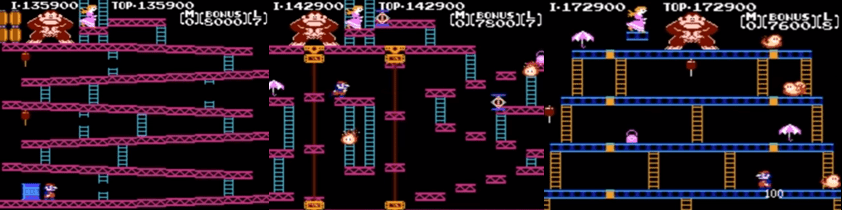
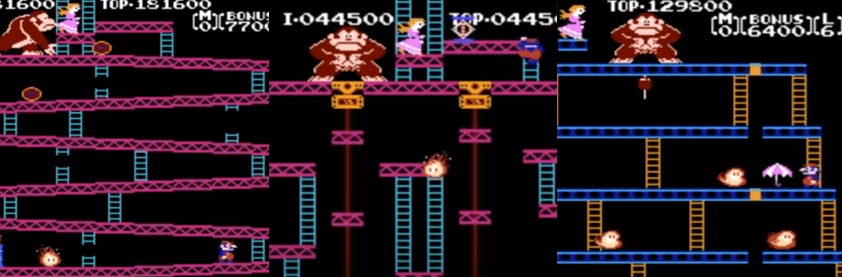
Donkey Kong is as 8-bit as 8-bit can be; stages consist of a stark, blank black background and are dominated by the iconic red girders and the large, looming, grinning features of the titular ape. While the arcade original was one of the first games to tell an onscreen story through the use of simple animations that we would, today, describe as cutscenes, the NES version omits these entirely but the game is charming enough to look at regardless. Donkey Kong’s genre is a bit difficult to define given that videogame genres hadn’t really been fully established back in the early eighties beyond space shooters and obscure puzzle games but it is, essentially, a vertical action/platformer in which an early iteration of Nintendo’s flagship character and mascot, Mario, must run and jump up and across a series of platforms while avoiding hazards in order to rescue Pauline from Donkey Kong’s clutches at the top of the screen. Generally, I find Mario to be quite a slippery and unwieldy character to play as but, in his debut appearance, he moves more like he has lead weights in his shoes; his default movement is a steady but weighty jog and his jumps constantly feel like he’s struggling against the pull of gravity. The game also employs little to no momentum-based physics, meaning it’s easy to clip hazards and lose a life as a result. Gravity continues to be the bane of your existence as Mario takes a ridiculous amount of fall damage in Donkey Kong; drop from any height, be it one platform above or from the top of the screen, and you’re going to die. Leaping from a moving conveyer to a small platform that’s slightly below you? Instant death. Accidentally fall down a hole when you remove the rivets from stage three? Dead. As a result, there’s little margin for error in Donkey Kong and, if you screw up, you’re gonna die; there are no second chances here.

The game’s three stages loop continuously, getting faster and harder with each playthrough.

As you play, you’ll notice a ‘Bonus’ score counter in the game’s limited heads-up display (HUD). This continuously counts down as you play, reducing the bonus score you’ll get upon completing a stage if you take too long. Also, if it reaches zero, guess what? Yep, you lose a life, making it a combination bonus score/time limit for additional pressure. Unlike the original arcade game, the NES version of Donkey Kong features only three stages: the first is a construction site, the second features conveyor belts, and the third and final stage has you removing rivets to bring Donkey Kong crashing to the ground. Each time you complete these three stages, the game continues on a loop, getting faster and harder with each subsequent playthrough, however there is no true end to the game; Mario simply keels over and dies once you reach stage twenty-two, meaning that your main incentive to play the game again and again is to beat your own personal high score. As you jump your way to rescue Pauline, you’ll be able to earn points by leaping over enemies (whatever you do, don’t jump on to them like you might expect Mario to do!) and collecting (what I assume are) Pauline’s parasol and purse from across the stages, Mario’s sole method of fighting back in this game is his trusty hammer; two hammers can be found in stage one and three (you’ll just have to fend for yourself in stage two) and collecting one will send Mario into barrel-and-fireball-bustin’ frenzy as a frenetic tune plays. The hammer will destroy anything it touches, allowing you to clear the way for your progress, but you cannot jump while holding it which, honestly, makes it kind of useless as hazards will have respawned by the time you’re ready to progress further.

Barrels, springs, and living fireballs are the game’s primary hazards and enemies.


Mario is an extremely simple and yet surprisingly expressive sprite; unlike other avatars like Pac-Man, he has clearly-defined features such as a prominent nose, moustache, and his signature overalls and cap meaning that he easily stands out against the game’s otherwise-limited colour palette. Pauline looks like a bit of a mess but, luckily, Donkey Kong makes up for it by being big and full of character despite his obviously-limited frames of animation. The game features some iconic and simple melodies, boasting such features as separate tunes for the title screen, each of the game’s three stages, and for completing a stage. It’s limited by the hardware of the time, clearly, but it’s enough to have you humming along as you play. Far from the Goombas and Koopas that would later plague Mario’s every waking hour, Donkey Kong mainly has you avoiding barrels tossed at you by the giant ape. These can roll along, drop off ledges, and fall down ladders seemingly at random, meaning you constantly have to be on your toes to make split-second decisions about when to jump or climb a ladder. These barrels can also bounce around the screen, drop down vertically, and take a dip into some oil to transform into anthropomorphic flames. In stage two, Donkey Kong will also toss bouncing springs at you; as the game speeds up, these can be extremely difficult to avoid as the window of opportunity is so small and the game’s hit boxes are deceptively big. In stage three, you’ll also have to watch out for more troublesome balls of fire that wander around the stage seemingly at random, going up ladders and suddenly changing direction to cost you a life. Of course, the game’s primary antagonist is Donkey Kong himself; should you brave his many hazards and attempt to tackle him directly, you’ll lose a life. As a result, the only way to defeat him is to get to the game’s third and final stage. Here, you’ll have to avoid the aforementioned fireballs while jumping over eight rivets. Once all eight are removed, the girders will vanish from beneath Donkey Kong and he will crash comically down onto his head so you can make love hearts with Pauline. Honestly, it’s probably the game’s easiest stage as the first two can get pretty hairy when the game speeds up, making the climax a little anticlimactic even for an 8-bit title.

The Summary:
I’ve played Donkey Kong before; I’m pretty sure I had it on the Amiga back in the day and I remember sucking at the version that was included as a mini game in Donkey Kong 64 (Rare, 1999) but this is the first time I’ve properly sat down and put some time into the game. It’s a simple bit of 8-bit fun and an enjoyable slice of nostalgia; gameplay is easy to get to grips with and the controls are responsive even if Mario does feel a bit weighty in his movements. The sprites and music and charming and indicative of their era and the game offers a fair amount of challenge thanks to it speeding up the more you play. Being an 8-bit title, the main motivation for playing is to achieve, or beat, a high score. The game does offer four gameplay modes: two for a solo player and two for two players but I don’t have anyone to play with so I was only able to play the one-player game. From what I can tell, though, the two-player mode is a case of each player taking it in turns to play rather than a simultaneous co-op mode. When playing Donkey Kong on the Nintendo Switch, you get a few extra options that dramatically reduce the game’s difficulty thanks to the Switch’s ‘suspend menu’ mode, which allows you can create a save point at any time and rewind the game back so you can correct any mistakes you might have made. It’s obviously limited in terms of its features and options, which does affect my rating of the game, but it’s a fun enough title that’ll keep you occupied for as long as you feel like playing (in my case…about half an hour or so).

My Rating:

Rating: 2 out of 5.

Could Be Better

Did you ever own Donkey Kong for the NES back in the day? Perhaps you played the arcade version out in the wild; if so, when and what was that like? Which port of Donkey Kong is your favourite? Which Donkey Kong videogame is your favourite and why? How are you celebrating Donkey Kong’s anniversary this year? Whatever your thoughts on Donkey Kong, feel free to leave a comment below.
Game Corner: Sunset Overdrive: Deluxe Edition (Xbox One)


Released: 28 October 2014
Developer: Insomniac Games
Also Available For: PC and Xbox Series S/X

The Background:
Sunset Overdrive was developed by Insomniac Games, who were best known at the time for their work on the Ratchet & Clank series (ibid/Various, 2002 to present); seeking to expand their portfolio, the developers drew inspiration from videogames like Jet Set Radio (Smilebit, 2000) to create an unusually vibrant title that would be the biggest game they had ever worked on at the time. Sunset Overdrive aimed to encourage players to be more aggressive in the way they played by emphasising momentum and featured a unique punk rock aesthetic to its post-apocalyptic world. Upon release, Sunset Overdrive’s tone and unique comedy was highly praised; reviews also praised the gameplay and the fun of exploring its zany world, and art style, though its multiplayer and more repetitive mechanics were criticised. Still, Sunset Overdrive was the second-best selling game in the United Kingdom upon release and the game was expanded upon with a range of downloadable content (DLC) that added new weapons, costumes, and story-based content to the game, all of which are included in this “Deluxe Edition” of the game.

The Plot:
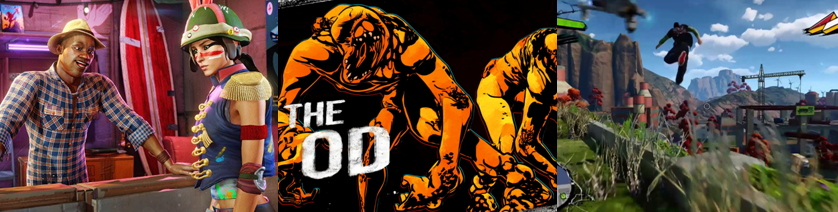
In the year 2027, megaconglomerate FizzCo hosts a massive pre-release party in Sunset City for its new energy drink, OverCharge Delirium XT; however, as they rushed through the testing phase, the drink transforms people into violent, boil-covered mutants known as “Overcharge Drinkers” (or “OD”) and it is up to the player character to join the remnants of society in fighting back against the OD and bring down FizzCo.

Gameplay:
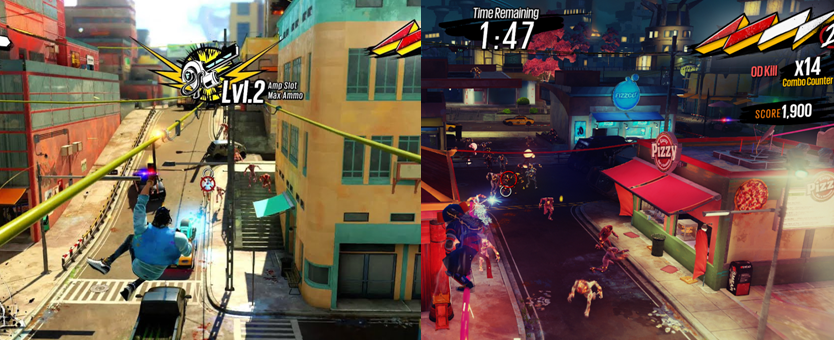
Sunset Overdrive is a third-person, open world action shooter with a heavy emphasise on parkour-style traversal; your avatar (named only as “Player” in the in-game subtitles) can grind, swing, bounce, and wall run all over Sunset City, easily chaining together different moves along with melee and projectile attacks to build up the “Style Meter” and amass greater kill combos.

Grind, bounce, and wall run your way across a bright and colourful city.

The Player’s skill set is relatively diverse and tailored towards these mechanics; X allows you to perform a dodge roll and grind on wires, rails, roof edges, and almost everything across the city following a jump. A, as always, jumps; pressing it right as you land on certain surfaces (such as cars, solar panels, and nets) will allow you to bounce higher and you can double tap A to vault over lower walls. You’ll also eventually learn to perform an air boost with the Right Bumper and, at certain times, you can press Y to interact with the environment to open doors, pick up mission items, or grab explosive barrels and you can also swing your crowbar with B to melee attack (which can also be performing while grinding).

Combat is fun but chaotic and seemingly never-ending at times.

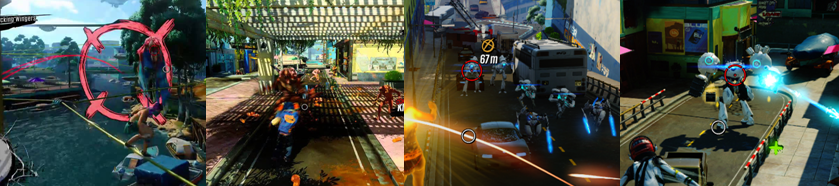
As essential as all of these traversal options are, though, a large chunk of the game is made up of weapons-based combat; you press (and/or hold) the Right Trigger to fire, use the Left Trigger to strafe, and can bring up your weapon wheel by holding down the Left Bumper. Similarly, you’ll be able to select from a series of traps using the directional pad but, while the game does slow down to a crawl when the weapon wheels are open, there is a risk of you being attacked when selecting weapons and, while you can hold multiple weapons at once, it can be a bit tricky to select the weapon you want as the selection wheel feels a bit slippery at times. Weapons come in all sorts of bizarre shapes and sizes, with some being more effective against certain enemies (those that shoot out fire are more effective against OD, for example, while shock-based weapons are better for dispatching FizzCo’s robots), but ammo can often be in short supply. While you never have to reload and you’ll find more ammo by smashing crates and killing enemies, I often found that I burned through a lot of my ammo very quickly even after upgrading their ammo capacity, which means it’s best to switch between weapons as often as possible.

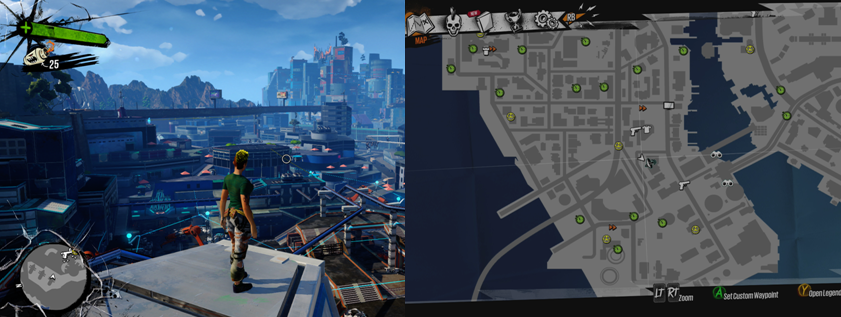
Sunset Overdrive‘s map system is cluttered but extremely detailed and helpful.

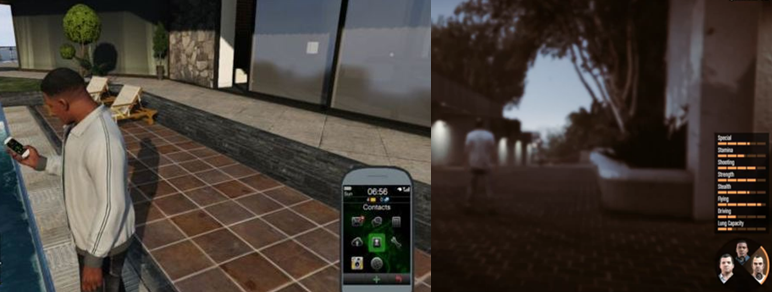
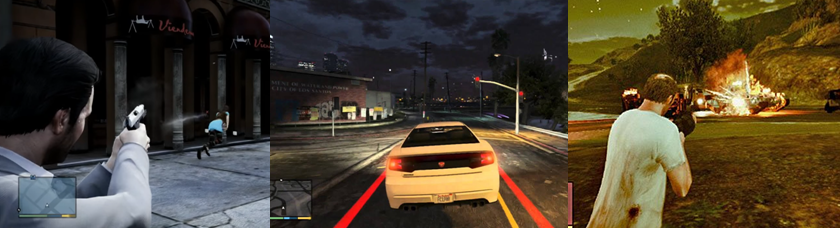
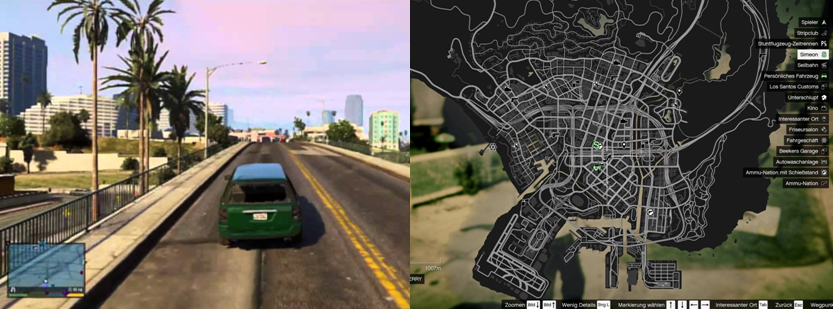
Sunset Overdrive is a pretty massive game; a mini map on the heads-up display always keeps you on track towards your objective and points out any enemies, friendlies, and pick-ups and secrets in the area. The game’s main map is accessed from the pause menu and, right from the beginning, is packed full of things to see, do, and pick-up. The game’s map system and large, diverse city reminds me of Grand Theft Auto V (Rockstar North, 2013) and has many of the same options; you can toggle between different objectives and views, set custom waypoints, and purchase special maps to highlight even more secrets. Despite how big the game world is and the sheer amount of stuff that you can find and collect in any given area, I never found myself getting lost or turned around as both the mini map and main map (and in-game dialogue) constantly keep you pointed in the right direction. You can also fast travel to certain points on the map, which is always appreciated especially in a game this big but I found it was actually better to travel manually as I could veer off to grab collectibles along the way.

It’s easy to get beaten down by your many enemies but the pop-culutre references make respawning fun.

What does get a bit manic, however, are the sheer amount of enemies you’ll have to contend with. OD are literally everywhere in Sunset City, crawling out of sewers, dumpsters, and clambering around rooftops and alleyways and their numbers only increase as the game progresses. The game barely ever lets up on the onslaught and, even after clearing the immediate area of enemies, more will soon spawn in if you linger too long. This means that you need to constantly be on the move; it’s not really recommended to battle enemies at ground level, where your movement options are more limited, meaning you’ll be grinding and hopping between different traversal points and constantly switching directions on the fly, which can make aiming and seeing where your shots are going a bit difficult. In this regard, the game reminds me of Infamous (Sucker Punch Productions, 2009) in its emphasis on movement-based combat, though the shooting mechanics are noticeably more refined and useful here; the more you move and mix up your attacks, the more your Style Meter will grow to activate any amplifiers (“Amps”) you have attached to your character. The Player, however, can be a bit fragile; you’ll need to pick up Green Crosses to replenish your health, which can be whittled away extremely quickly, and certain weapons and upgrades will increase your health and durability, but dying is pretty easy in Sunset Overdrive. Thankfully, after dying, you’ll simply respawn (through a number of amusing pop-culture references) near to where you fell and be able to carry on with what you were doing but, other times (generally when in the middle of a side quest) you’ll have to restart your current mission from the beginning, which can be a bit inconsistent and annoying.

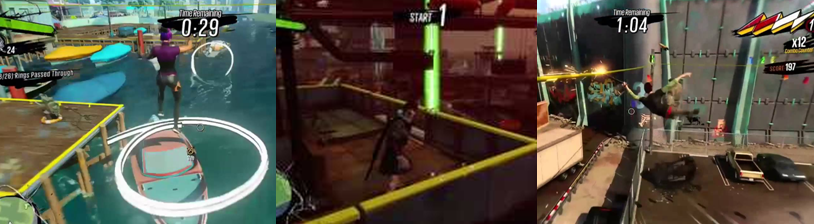
There are a number of challanges available to you to earn cash and bonuses.

Gameplay is given a bit of variety from a number of non-playable characters (NPCs), all of whom are part of different factions and have a bunch of side quests for you to complete. These generally involve “busy work” such as clearing out OD, human Scabs, and/or FizzCo ‘bots, smashing certain machines or objects, collecting things, or dashing across the city completing errands. You’ll also find a number of challenges across the city which task you with racing through rings using your grinding, bouncing, and wall running skills, collecting points, battling swarms of enemies, smashing stuff up, or planting bombs. All of these have a time limit attached to them and will net you additional rewards based on your ranking (Bronze, Silver, or Gold), which can range from cash, Overcharge, and additional clothing items and it’s pretty easy to get sidetracked during your many missions to complete these tasks as you go.

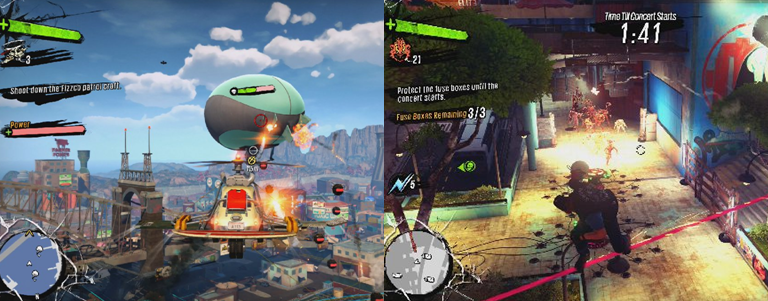
Take to the skies in glider challanges and defend Overcharge against swarms of OD.

All of these missions and side quests are highlighted on your map and can be replayed at any time from the main menu, allowing you to try for more points and rewards. You’ll also get to pilot a glider at various points both in the game’s story and in challenges; this is a pretty simple affair that sees you flying over air currents to keep your ship powered up, performing barrel rolls to avoid enemy fire, and blasting at enemies and targets with homing rockets. Sadly, while these sections are fun, there’s no way to call a glider to you at any time to help traverse the city and these sections are a bit limited in their scope. You can also perform a dash over bodies of water by pressing X and the Player is, thankfully, fully capable of swimming, which is always a plus. Easily the most prominent additional mechanic you’ll take part in, however, are the handful of times when you’re tasked with laying traps and holding out against waves of OD while cooking up additional Amps in Overcharge canisters. These sections can be tricky thanks to the sheer amount of enemies that you’ll face but placing a variety of traps at various points around the fort and staying on the move will increase your chances of survival and, even when you have to defend multiple targets across more complicated forts, these aren’t massively challenging and can be quite exhilarating. Barricades help keep enemies at bay and you’ll be awarded additional energy to lay more traps as the sections progress, which is helpful, and, while it can get very chaotic as more vicious and varied enemies spawn in, the rewards are worth the effort.

Graphics and Sound:
Sunset Overdrive utilises exaggerated, comic book style, semi-cel shaded graphics to bring its characters and world to life. While the city is mostly semi-realistic, characters are larger than life and this really helps to sell the game’s zany narrative. You avatar can be completely customised, allowing you to pick between two different male and female body types and buy and equip a range of clothing items to make them unique to you. Options for hair, faces, and body types may be a bit limited but there are a lot of wacky outfits to choose from and these are easily unlocked or purchased using in-game currency, meaning you can constantly switch up your appearance.

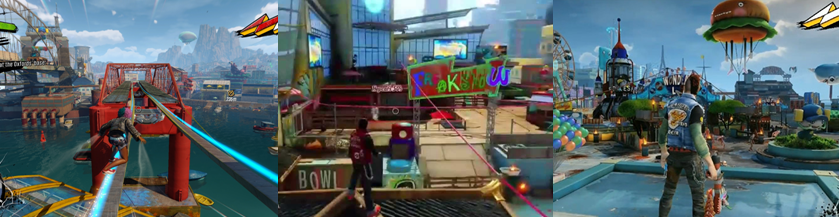
Sunset City is huge and vibrant and packed full of things to collect and enemies to slaughter.

Sunset City is absolutely gigantic; cordoned off from the rest of the world by a convenient (and literal) invisible wall, the city is custom-built to take advantage of your traversal mechanics, meaning there are a lot of wires, lampposts, and walls to grind, swing, and run across. The city is full of different areas (such as Little Tokyo, high-rise apartments, bridges, a water treatment plant, a fairground, and shopping districts), all of which are crawling with seemingly-endless waves of enemies and full of things to collect. The downside, though, is that the game isn’t really built for vertical traversal; this means that if you fall or are knocked to ground level, it can be frustrating and difficult to work your way back up and out of the way because the Player is geared more towards horizontal movement.

The game’s exaggerated aesthetic really adds to its appeal, despite the odd glitch here and there.

The game’s story is absolutely bonkers and full of pop-culture references to movies and fourth wall breaking moments. It’s honestly one of the more unique and entertaining stories I’ve ever played through and really helps ease the frustration at the game’s more annoying moments; characters are all over the top and the humour is crude and self-referential, which is always fun, though you’re not always able to skip through cutscenes or certain moments and, while the soundtrack is suitably rocking and enjoyable, I did notice the music and sound effects cutting out abruptly at certain points. This was most noticeable when I was playing through the “Dawn of the Rise of the Fallen Machine” DLC, however, where the subtitles suddenly turned off and all music and most sound effects suddenly cut out completely and didn’t return until I quit and reloaded the game.

Enemies and Bosses:
The primary enemy of Sunset Overdrive are the OD, disgusting mutant humans who swarm all over the city and attack in large groups. Though easily dispatched, their sheer numbers, ferocity, and tenacity can be overwhelming as they’ll attack in hordes and rush at you, clawing and swiping and easily whittling your health down unless you stay on the move. You’ll also have to contend with different OD variants, such as “Poppers” (who charge at you and explode in a kamikaze attack), “Herkers” (larger OD who throw rocks and objects at you), “Gunkers” (who hop about from above and shoot gunk at you), and “Spawners” (who will continuously spawn more OD unless you put them down).

Human Scabs and deadly robots will also take pot shots at you and cause you serious headaches.

You’ll also have to contend with human enemies, the Scabs, who shoot at you and use cover-based mechanics to pick you off. Thanks to the sheer number of their projectiles, these can be incredibly annoying enemies and are easily able to overwhelm you. Similarly, FizzCo’s many different robots and mechs will also attack you throughout the story, even setting up little fortifications and turrets to cause you extra headaches. As the story progresses, you’ll battle groups of all of these enemies at once and, while they also attack each other, it can get a bit manic trying to take them all out as you have to constantly stay on the move and switch to different weapons to be at your most effective.

Bigger and more aggressive enemies will soon become the norm as the story progresses.

Still, these chaotic battles and the steady increase of different enemy variants aren’t to be sniffed at as traditional boss battles are few and far between in Sunset Overdrive. Rather than take on bigger, nastier bosses progressively to finish up a mission, you’ll encounter larger, more powerful enemies or new enemy variants as you perform missions or defend your forts. These include the “Wingers” (large, bat-like OD who fly around shooting fireballs at you), “Muggers” (bestial OD who leap about the place and aggressively pounce on you to attack with their claws), Blade Bots (who rush at you with electric swords), and Tank Bots (a heavily-armoured mech that bombards you with lasers, mines, and leaps about using hover jets). As you progress, you’ll have to battle swarms of regular enemies bolstered by these bigger forces or even two or more of them at once, which can be a real challenge at times, especially if you’re low on (or out of) the most appropriate ammunition.

Fizzie is the game’s most persistent, and pretty much only, boss.

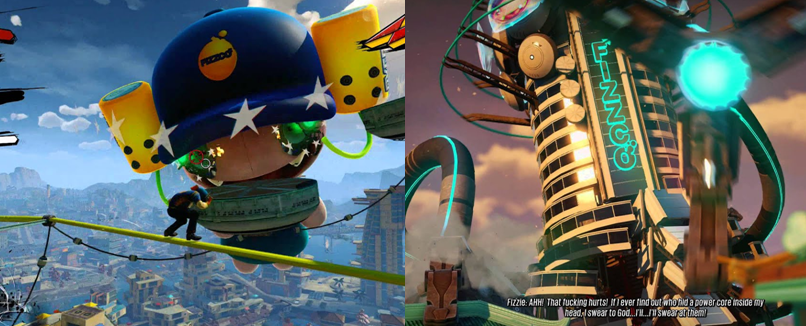
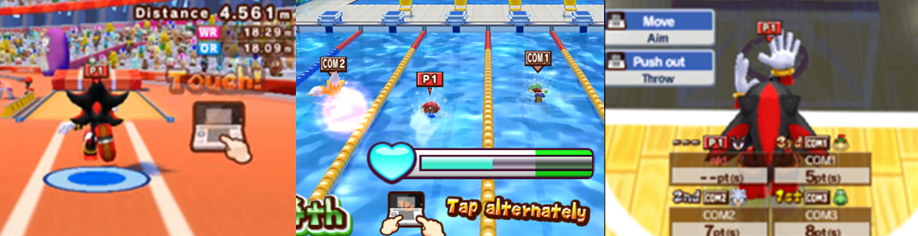
That’s not to say there are no boss battles at all, though; You’ll frantically blast at the King Scab on a rollercoaster before derailing him with a massive dinosaur mask at one point and also battle a gigantic version of Fizzie, FizzCo’s annoying and enthusiastic mascot, twice during the game’s story. The first time you battle him, he’s a massive blimp and floats around blasting at you with his eye lasers and spitting out annoying explosive balloons. You must grind around high up in the air and bounce on pads to stun him, and then unload at his exposed weak point, but the battle becomes tougher as it progresses, with Fizzie shooting rockets at you at directly targeting your rails as you frantically try to keep from falling (which, thankfully, doesn’t deplete your health or result in failure) to blast his weak spot. Fizzie’s artificial intelligence also takes control of the FizzCo building for the game’s finale; before you can even reach this point, though, you must eradicate the FizzCo ‘bots alongside all of your colourful allies and then, when the fight begins, you’re given three minutes and thirty seconds to race across the city, avoiding devastating sky beams, and grind up the building’s tentacles while avoiding electrified currents, bouncing from pads, and trying not to be knocked away as you frantically blast at the building’s power core. You have to do this three times and each time the timer resets but Fizzie is a bit further away, a bit more heavily defended, and more aggressive in his attacks and defence strategies.

Power-Ups and Bonuses:
There are a wide range of weapons on offer in Sunset Overdrive, each one unique and kind of crude in its design and often cobbled together by the most random of items. You can melee attack with a crowbar but will eventually be able to purchase a baseball bat with your cash and, as part of the story, will be tasked with forging a massive sword to chop enemies up but you can also toss or attack barrels to destroy groups of enemies and you’ll also purchase and acquire a number of different guns.

The game’s weapons are absolutely bonkers and fun to swap between (when you can manage the weapon wheel).

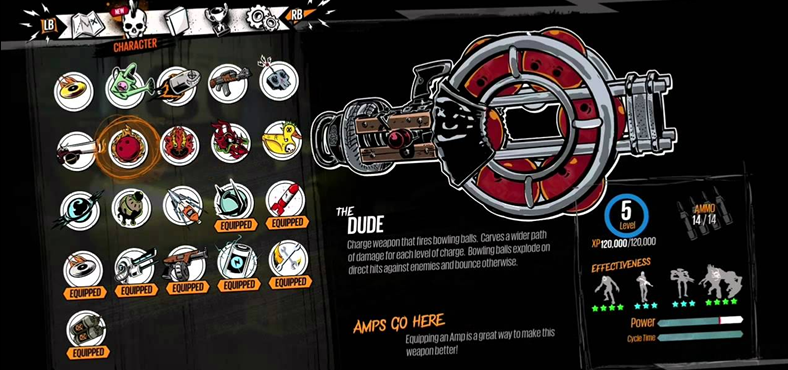
These range from amusing variants on standard weaponry from shooter games, such as pistols, shotguns, machine guns, and grenade launchers; one of the most reliable weapons is the first one you get, the Flaming Compensator, which is great for turning OD to ash. The High Fidelity and Nothin’ But the Hits weapons fire vinyl records at high speed and are great for crowd control, while the Shield Buddy is a must-have for blowing enemies away and protecting you in a temporary energy shield and the Dirty Harry is great for dealing heavy damage to bigger enemies. You can also grab explosive weapons like the One-Handed Dragon, TnTeddy, and Multi-Lock Rocket Launcher to dish out heavy damage, lure enemies into a frenzy with the Captain Ahab or Rager, freeze them in place, or slowly deal damage over time with some of FizzoCo’s own weapons.

Amps and Overdrives provide a range of benefits to your weapons and skills.

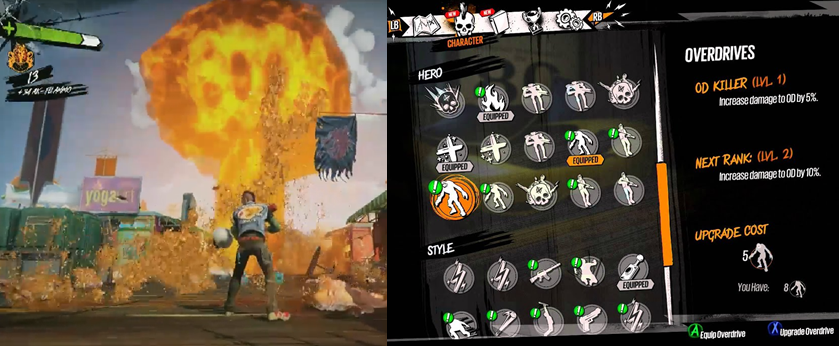
As you use each weapon, it’ll gain experience points (XP) and level up to a capped level of five. This not only increases its damage output and effectiveness but also allows you to equip Amps to the weapon for additional effects; Amps can be unlocked and bought at forts and have a range of benefits, from cosmetic stuff like having enemies explode in a burst of flowers, to perks for the Player (causing enemies to drop additional health, money, Overcharge, or increasing the XP rate), and (my personal favourite) additional attacks (rockets, a small nuclear bomb, shock or fire damage, and many others) that can really help level the playing field when faced with swarms of enemies. Performing different tricks, moves, and killing certain enemies will also earn you Badges; Badges can then be cashed in from the main menu to buy Overdrives to equip to the Player. These will increase your health, ammo capacity, and allow you to deal (and take) more damage from certain enemies. You can also increase the damage output of your weapons, the effectiveness of your traversal mechanics and melee attacks, and many other little buffs that all add up to assist you during gameplay. There are also a number of different traps you can buy to place when defending your forts; some of these automatically activate but others require you to jump onto them (which you’ll get some practice with in certain missions) and you can purchase new Amps, weapons, and traps using Overcharge and by collecting the multitude of different collectibles and junk scattered all over the city.

Additional Features:
There are sixty-four Achievements to earn in Sunset Overdrive, with the bulk of these popping when you complete various story-based missions. Many others are tied to combat and pop when you kill a certain number of OD, or when killing enemies in certain ways (grinding and bouncing, for example), spend a certain amount of money, upgrade your weapons, and equip Amps and Overdrives. By far the most time-consuming Achievements are those that involve completing certain side missions or collecting the game’s many different items and junk; scattered all throughout the city are Fizzie balloons, neon signs, toilet paper, and smelly sneakers for you to collect to purchase new Amps and you’ll need to find every single one of these (as well as deface FizzCo signs, smash their vending machines, eavesdrop on conversations, and view city landmarks) to nab every Achievement.

There are numerous collectibles and side missions and even an online multiplayer component.

Each faction you encounter in the game has a number of side quests for you to complete; these include scouring the city for comic books, roasting pigeons, finding parts, rescuing or finding their allies, clearing out enemies, operating cranes, or smashing cars to cause a ruckus and it’s worth your while taking the time to complete as many (or all) of these side quests as it’ll net you more money and items. There’s honestly so much to do at any one time that it can be a little overwhelming but it definitely keeps the game from getting boring and you can easily begin or replay any mission at any time. Once you finish the game, your objectives automatically switch to any remaining side quests, which is really handy, and the game even comes with an online component (“Chaos Squad”) which you can activate at any time from convenient booths scattered across the city. While I wasn’t able to experience this, it is apparently an eight player co-operative mode that involves defending forts and completing missions and has a number of Achievements tied to it.

The two DLC campaigns add a significant amount of content to the game.

The game’s Achievements are further bolstered up to eighty-eight thanks to the game’s two story-based DLC missions, which introduce slight enemy variants, feature forty UFOS to collect, and bestow you with new weapons and items. In “Mystery of the Mooil Rig”, you’ll venture out to an oil rig, where you’ll have to battle oil-based OD and Scab workers while igniting oil to call for help. You’ll also have to make use of the game’s harpoon mechanic to bring a boat in safely, destroy egg clusters infecting the rig, and contend with the massive Cthulhu-like DL Sea Monster; to battle this monstrous creature, you must destroy its tentacles and then have your ally launch you into its gaping jaw so you can mash B to hurt it from the inside. The second story-based DLC, “Dawn of the Rise of the Fallen Machine”, is much trickier and more frustrating; this has you venture beyond the invisible wall and into the FizzCo robot factory, where you must find diaries to assemble a new weapon, impersonate a robot to access kill codes, and frantically roll around in an energy ball destroying certain ‘bots within a strict time limit. This culminates in a boss battle against B-WIN, the host of Sunset TV, who blasts at you with lasers and energy beams from behind multiple screens that protect his core. For this fight, you’ll need to make stringent use of cover and stay on the move to manoeuvre behind him to deal greater damage to his core before luring him over a pit of molten metal to finally finish him off.

The Summary:
I wasn’t sure what to expect from Sunset Overdrive; I’d heard of the game and that it was this fun, chaotic, action romp and it certainly delivered in that regard. There is so much to see and do in the game and, unlike some open world experiences, it never feels dull or repetitive because of the constant swarms of enemies and things to detour off and collect and side missions to complete. The game’s traversal mechanics can take a bit of getting used to but, before long, it’s pretty simple to chain together grinds and jumps with your shooting and to become more efficient at dispatching massive hoards of enemies with your various weapons, Amps, and Overdrives. While there are some frustrating elements to the game, such as how manic the action can be (the game literally never gives you a moment to pause and catch your breath) and how inconsistent and vague some of the mission objectives can be (made all the more annoying since the game largely holds your hand otherwise), the humour and over-the-top presentation is a massive stand out for me; also the gore and crude nature of the game, as well as its self-referential and pop-culture moments, made it a fun and exhilarating experience overall.

My Rating:

Rating: 4 out of 5.

Great Stuff

Are you a fan of Sunset Overdrive; if so, what did you think to it? Did you like the game’s over-the-top presentation and zany mechanics? What did you think to the parkour-style traversal system and the game’s many diverse weapons? Were you also a little overwhelmed by how many enemies attack at any one time and the sheer amount to do and collect or did you enjoy the experience of tracking down every last collectible? What did you think to the game’s story and selection of missions and bosses? Which faction or side mission was your favourite? Did you purchase the DLC and, if so, were you satisfied with the additional content or did you want more from the game? Would you like to see a sequel some time? Whatever you think about Sunset Overdrive, leave a comment down below.

Game Corner: Grand Theft Auto V: Premium Edition (Xbox One)

Released: 18 November 2014
Originally Released: 17 September 2013
Developer: Rockstar North
Also Available For: PC, PlayStation 3, PlayStation 4, PlayStation 5, Xbox 360, Xbox Series X/S

The Background:
The Grand Theft Auto (GTA) franchise (ibid/Various, 1997 to present) is an incredibly successful and well-regarded series of open world videogames that have the player pulling off a series of heists, robberies, and other illicit activities generally by stealing or making liberal use of vehicles and guns. The series began life as a top-down title on the PC and PlayStation and set the standard for how successful and controversial the series would become over the years thanks to its violent content.

My experience with the GTA series is quite limited as I’m not much of a fan…

My experience with the Grand Theft Auto series is quite limited; I’ve played the original and dabbled with both Grand Theft Auto: Liberty City Stories (Rockstar Leeds/Rockstar North, 2006) and Grand Theft Auto IV (Rockstar North, 2008) but these experiences were either extremely brief or boiled down to simply messing about with the game’s many infamous cheat codes. However, I was recently gifted GTA V and was determined to see it through to completion despite not really being a fan of the series; GTA V was developed to be the most graphically impressive of the series so far that would give players control of three distinct characters rather than just one and improve upon many of the studio’s gameplay mechanics. GTA V was released to widespread critical acclaim and went on to ship over 140 million copies and is largely regarded as one of the best videogames ever released at the time.

The Plot:
Nine years after faking his death and entering witness protection following a botched robbery, former career criminal Michael Townley has become a shell of his former self and is living a tumultuous life as a family man in Los Santos under the alias Michael De Santa. After crossing paths with the foul-mouthed gangbanger Franklin Clinton, Michael finds himself brought back into his old ways as he helps Franklin pull off more profitable heists and runs afoul not only of the city’s seedy underworld and his handlers at the Federal Investigation Bureau (FIB) but also draws the unwelcome attention of his psychotic former associate, Trevor Philips.

Gameplay:
As you might expect, given it’s the norm for the series ever since it jumped to 3D, GTA V is a third-person action/adventure game with a heavy emphasis on story, character interactions, violence, gun fights, and vehicles. The lengthy story and large city of Los Santos and its surrounding area will see you exploring a variety of locations (both seedy and legitimate), encountering many different non-playable characters (NPCs), and taking part in numerous side quests and activities to keep you busy. As you play the story, you’ll eventually gain access to all three playable characters, each of whom controls exactly the same but has a different “Special Ability” and has their strengths rooted in either driving, melee combat, or shooting.

Fight, steal cars, and shoot the place up in true GTA fashion using three different playable characters.

The game’s controls are different depending on your current situation; when on foot, you can use the Left Trigger to aim and lock on to enemies, and fire your weapons or use melee attacks with the Right Trigger. Weapons are selected from a weapon wheel with the Left Bumper while the Right Bumper allows you to duck behind and move away from cover during gun fights. You can also press LT and the X button to dodge or roll out of the way or in conjunction with the left directional pad (D-pad) button to toss a grenade. Pressing in the left analogue stick will have you crouch down to sneak up on enemies, while pressing in the right stick allows you to zoom in and you can also switch between different perspectives (including a first-person view) with the Navigation button. Y is used to enter (illegally or otherwise) and exit vehicles; B reloads your weapon and is also used for melee attacks; X performs a jump and allows you to hop up small walls or ledges; and you can hold down the A button to jog along. If you tap A, you’ll break out into a sprint but be sure to keep an eye on your health and stamina in the heads-up display (HUD) as sprinting for too long will drain both of these.

Cars are slippery and unwieldy at the best of times let alone when you’re trying to shoot as well!

When in a vehicles, the controls alter somewhat: LT is now used to brake, reverse, or descend when flying while RT is used to accelerate or ascend; RB is the handbrake or (in conjunction with LB) controls the rudder and you can switch to a “cinematic” camera angle with B or duck down to avoid incoming fire with A. You can cycle through weapons with X and use them by pressing LB to aim and RB to fire, however the controls for shooting whilst driving are extremely slippery and imprecise. Not only are you travelling at high speeds and having to adapt to the fact that every vehicle handles differently depending on its size and capabilities, but it’s also extremely easy to lose control, spin out, or crash when driving at the best of times, let alone when trying to gun down enemies. Thankfully, some missions will place two characters in the car and will even give you the option of switching between driving and shooting but, in the instances where you have to do both, I found it to be very imprecise, slippery, and needlessly frustrating.

Your phone has many uses to keep you on track and you can (mostly) switch characters at any time.

The D-pad also allows for a number of different functions depending on whether or not you’re in a vehicle; pressing up will bring up your character’s phone, which can be customised with backgrounds and ringtones and is where you’ll make and receive calls, texts, and e-mails about missions and such; pressing left allows you to detonate bombs on foot or access the in-game radio when in a vehicle; pressing right toggles the car headlights or folds/unfolds a convertible’s roof when in a vehicle or allows characters to interact when on foot; and holding down accesses the character wheel so you can switch to a different character. Primarily, you’ll be using the D-pad for your phone, though; from here, you can perform a quick save, browse websites, buy stock to earn money, and review your income or additional information about the current plot or missions.

Each character has a Special Ability that slows down time and gives them an edge in different scenarios.

As mentioned, each character comes with a different degree of stats and a Special Ability, which can be activated at any time by pressing both analogue sticks in at the same time and will last as long as the yellow bar in the HUD is full. As you run, drive, shoot, fight, and play, you’ll raise each stat (Stamina, Driving, Stealth, etc) higher; the higher your stats, the better you’ll perform, and each character’s stats are set to different levels to give them different proficiencies that tie into their Special Abilities. Being an up-and-coming car thief, Franklin’s ability allows him to slow time when in a vehicle, which makes it easier for him to avoid oncoming traffic or obstacles, perform better drifts, and make tighter, more precise turns. Michael, meanwhile, is more focused on melee combat and his Special Ability slows time when fighting to give you more time to dodge and land blows. Finally, Trevor is focused on shooting; when his Special Ability is activated, he’ll enter a kind of rage mode and deal additional damage during the slow down, which is great for taking out vehicles or clearing rooms quickly.

The map, and mini map, is super useful for navigation (when you’re on the road, at least…)

The in-game map and a variety of other game settings can, of course, be accessed using the Xbox’s Menu button; the map is shrouded in fog and will be revealed the more you explore but will also highlight a number of key locations, such as your safe house (where you can store vehicles, change clothes and sleep to save the game, replenish health, and pass time in the game to day or night), weapons shops, and a variety of other points of interest (such as barbers, tennis courts, airports, and other properties, mini games, and areas). From here, you can set a custom waypoint and the onscreen mini map (which you can freely zoom in and out) will show you the most efficient route to take to get to your destination as long as you’re in a road-based vehicle (when in a boat, aircraft, or on foot, you’ll have to make do with a smaller indicator). The mini map also shows you helpful dots that will lead you to objectives, side quests, or identify enemies (represented as red dots). If that wasn’t enough, the game also comes complete with an actual physical map, which is quite useful for finding areas not easily spotted on the in-game map.

Fighting the police is a no-win situation and you’re better off finding a quiet place to hide out.

Playing GTA V in a way to not attract attention is incredibly difficult; the streets of Los Santos and the surrounding area are full of drivers and pedestrians who will crash and bump into you at the worst possible moments. As mentioned, driving can be very slippery and difficult so it’s easy to hit pedestrians or go careening off a bridge or collide head-first with an oncoming vehicle but, sometimes, pedestrians and cars will pick a fight with you and you’ll have to decide on the best way to deal with this. Cause too much carnage or enter restricted areas and the cops will start chasing you. This is represented by a star rating in the top-right of the screen and flashing red and blue lights on the mini map; you’ll also pick up chatter from the police band on your radio and see a helpful cone on the mini map that will aid you in giving the cops the slip. Continue to cause trouble, though, and the rating will increase up to five stars; the cops will bust out the helicopters, become much more aggressive, set up roadblocks, try to push you off the road, and shoot at you and it can be very difficult to get past them even on a one star Wanted rating because of how awkward some vehicles are to control.

Take cover to avoid damage and try to not get killed or you’ll lose a chunk of cash.

Occasionally, you’ll pick up first-aid kits to restore your health but, if your health drops below halfway, it will regenerate back up to halfway if you manage to avoid damage for a short period of time. If your car flips over, you can right it by holding on the left analogue stick; cars and bikes will incur damage as they get bashed and shot at but you can repair (and upgrade) them at one of the many Los Santos Customs dealerships across town for a fee. However, if you take too much damage, you’ll eventually be killed (or “Wasted”) and find yourself respawning at a hospital and suffering a hefty loss of funds. Thankfully, you can quick save at any time when not on a mission so you can choose to reload to your last save to keep your money but, sometimes, the game will load you clear across town or on the far opposite end of the map, which is often more frustrating than being killed. When on a mission, there are some generous checkpoints in place and, if you die, you’ll respawn at the last checkpoint, which is much less annoying.

Make the plan, execute the plan, expect the plan to go off the rails, throw away the plan.

Right off the bat, GTA V gives you full control of where you want to go and what you want to do once you get past a few tutorials that are masquerading as story missions. You’re free to drive anywhere you want and interact with characters to start side quests but, if you want to progress the story, you’ll have to travel either to your character’s safe house or to a predetermined area on the map. Sometimes, it’s not clear when you have to do this or which character you need to be to progress the story but, with a bit of trial and error, it’s not too difficult to pick up. The game’s story primarily involves the planning and execution of a number of heists using Michael, Franklin, Trevor, and other crew members; these heists generally involve some preparation on your part, such as staking out the target area, gauging the police response time, and planning an escape route, all of which is clearly marked for you to do. Once the target is properly researched, the group’s planner, Lester Crest, will talk you through your options and you’ll be given two choices to pull the mission off (one is generally easier and safer and the other is usually louder and more dangerous). You then have to select additional crew to pull the heists off; these NPCs have different abilities (hackers, drivers, gunmen, etc) and different stats that correlate to how much of a cut of the profits they’ll need; if you want the best driver or hacker, for example, you’ll have to give them a higher percentage of the cut. However, the more you use the same crew members, the better their abilities will be and their cut won’t increase.

The heist missions were one of the most enjoyable parts of the game for me.

Honestly, these heist missions were the most interesting and entertaining part of the game for me; it’s fun seeing how the job is going to be pulled off and adds a lot of variety to the game as you’ll be posing as a dock worker, stealing fire trucks, knocking off armoured vans, and racing through abandoned tunnels as part of it all. It also adds some replayability to the game; after you complete a mission, you can choose to replay it from the main menu and see how the other options play out, which may see you flying an aircraft or using a drill to break into a bank rather than using subterfuge. The best part of these heists, though, is that they are the best way to earn a chunk of cash; you can earn money by doing side missions or buying properties but you’ll get a good chunk from these bigger heists and they’re generally quite fair and engaging so I definitely enjoyed them the most.

Side missions are a bit hit and miss, ranging from batshit crazy to incredibly mundane.

Of course, there are numerous side missions to undertake as well, many of which are tangentially related to the story or specific to each character. Franklin, for example, has to help out his drug-addled friend by towing cars; Trevor runs across an old British couple with an unhealthy obsession with celebrities; and Michael crosses paths with a cult who keep fleecing him for money. Later, Lester will also give Franklin assassination missions, which are fun to pull off; Trevor can also deliver arms packages in an aircraft; and Michael is forced to repair his damaged relationship with his wife and kids by doing yoga, rescuing his son after he falls in with some dangerous people, and attacking a talent show host who is taking advantage of his daughter. With enough cash, you can also buy properties like an aircraft hanger, docks, restaurants, a taxi firm, and so forth, which will provide you with a weekly income and also ask you to perform tasks like stopping robbers, cleaning up toxic waste, or picking up fares.

Graphics and Sound:
In terms of presentation, it’s hard to really find any fault with GTA V; the game world is huge, massive even, and full of things to do and see. Cars get into crashes or are chased by the cops, street muggings and violence occurs around you, day turns to night turns to day, and there’s even different types of weather and numerous districts and regions to see and visit, all with very, very minimal graphical pop up or load times. This is probably because just loading into the story, or reloading a save, takes forever but that long load time is worth it for a fast in-game experience; I noticed very little slowdown during my playthrough and even less instances of textures failing to load properly. The physics are a bit janky, at times, with characters ragdolling all over the place and vehicles either being extremely heavy or slippery as ice but a lot of this is part of the game’s aesthetic style so I can just about forgive it…it just took me some time to adapt to the vehicle controls.

Los Santos is a vast, bustling cityscape with lots to see and do.

GTA V’s game world is probably the biggest I’ve ever seen; you’ll spend the majority of your playthrough in the bustling metropolitan city of Los Santos, which is basically an exaggerated version of Los Angeles. Here, you’ll find skyscrapers, office buildings, a beach front and fairground, a massive airport, banks, and rundown ghetto-like neighbourhoods like Franklin’s alongside the more luxurious condos like the one Michael lives in. It’s very impressive how varied and alive the city is but, it has to be said, this can be a bit inconsistent; you can’t go into every building, for example, and the lively nature of the streets can cause you to jump to a two star Wanted level without even meaning to just because you ploughed into a bus or police car at an intersection or cut a corner wrong or spun out into a gaggle of pedestrians.

Head on up to Blaine County for a decidedly more…rustic experience.

Later in the game, the story switches to the desert-like outskirts of Blaine County where Trevor lives in a rundown trailer park. Out here, things are much less grandiose and far more lawless and you’ll be able to travel across mountains and explore vast, arid dry lands between pockets of civilisation. This effectively doubles the game’s world but also means that travel time is a significant factor in GTA V. You can jump in a taxi to fast travel to a destination, but it’ll cost you money unless you own the taxi firm. Helicopters, boats, and other aircraft make travelling vast distances much faster but can be difficult to control and come by and you have to be careful not to crash into buildings or drift into restricted airspace. Thus, most of the time, you’ll be driving; normally, this isn’t too bad but, sometimes, you’re tasked with driving all the way from Los Santos out to the badlands, which can take a lot of actual, real-world time and if you accidentally attract police attention, crash, or slip off a cliff along the way, you may end up having to reload and do it all over again or be suck on foot desperately waiting for a vehicle to drive past.

Character models hold up really well and the many radio stations allow for a diverse soundtrack.

Character models are surprisingly good for such a big game; the main characters obviously stand out the most but even the random NPCs you come across are all distinct and varied. Voice acting is equally good, with the three main characters all offering constant commentary when driving along and conversing over the phone but I have to say that I was more than a little uncomfortable with the sheer amount of racial slurs spat out by Franklin and his “homies”. Still, you’ll hear a lot of voice work in the game (Kenny Loggins is even a radio DJ, which is great), all of which adds depth to the characters and brings the world to life, and every single cutscene or cinematic is rendered using the in-game graphics, which are impressive. There are also a number of radio shows to switch through when in vehicles that offer a variety of musical styles and genres; sadly, there’s no way to create a custom playlist or radio station and you’ll constantly have to reset the radio to your favourite station when you switch cars but it’s always one of the best parts of these types of games and offers such iconic tracks as Taylor Dayne’s “Tell It to My Heart”, Starship’s “We Built This City”, and the aforementioned Loggins’ “Danger Zone”.

Enemies and Bosses:
As mentioned, your primary enemies in the game will be the police; you can avoid attracting their attention by not driving like a maniac or going on a killing or attacking spree but, sometimes, you can’t avoid this. If you can’t find a place to land, for example, you can skydive out of your aircraft and parachute to the ground, which is great but it’ll cause your craft to crash and attract the cops; if you wander onto the runway or over restricted airspace, the cops will come after you in full force; and if you hit or shoot too many people (sometimes it’s one, sometimes it’s more than three), the cops will start coming after you. You can choose to fight them off but their numbers are infinite so it’s better to race away down side streets and find a quiet place to hide until the heat dies down.

Everyone from rival gangs, mercenaries, and even triad members will be gunning for your blood.

You’ll also attract the attention of some of Los Santos’ undesirables; Franklin and his dumbass friend, Lamar Davis, attract attention from rival gangs in the city; Trevor immediately makes enemies of a local biker gang; and Michael is repeatedly asked to perform “favours” for the FIB once he comes out of retirement. Gangsters, gangbangers, street punks, and even triads will crop up throughout the story as things begin to escalate but one of the more recurring enemy forces is that of Merryweather, a private security firm who you incur the wrath of during your heists and hijinx. Generally, the only things really separating these enemies from each other are the colours they wear and the munitions available to them; Merryweather are far better equipped than the street gangs and will attack in force, forcing you to take cover, use sniping positions, and shoot at them from helicopters but the street gangs usually just chase after you in cars or can be gunned down without anything more elaborate than a pistol or shotgun.

Missions and heists will have you face more challenging enemies and armaments.

There are no traditional bosses in GTA V since the heists form the primary challenge of the game but you will have to contend with some noticeable enemies at various points throughout the story. A guy who is campaigning to legalise cocaine drugs you up so badly that you start shooting aliens, for example; Trevor has numerous side missions that put him in a state of pure rage and have him gunning down various factions in the streets; you’ll need to chase down motorcyclists to acquire story-specific items; and helicopters and even tanks will need to be shot down with rocket and/or grenade launchers. Later in the game, Michael is left to fend off a hoard of triads in a graveyard in a gruelling gauntlet and one of the game’s final missions sees all of the various forces you have wronged being led into a massive confrontation that requires you to switch between all three characters and take them out.

Choose the right path at the end and you’ll take out all of your enemies.

Finally, you’ll hunt down the figureheads behind all of your ills and put them down for good. These assassination missions, however, are mostly pretty easy; one has you gun down an associate of Franklin’s in a public basketball court, which is simple enough, but another has you assassinate an FIB agent who is riding a Ferris wheel. Your final target is protected by Merryweather agents but it’s a simple matter to pick a few off with your sniper rifle and gun down the others to acquire him, certainly a lot easier than some of Franklin’s assassination missions which can have him racing to locations across town against a time limit.

Power-Ups and Bonuses:
While the only literal in-game pickup you will find are the aforementioned first-aid kits, there are a number of weapons made available to you from the Ammu-Nation stores scattered across the game world. From here, you can purchase bulletproof vests (which degrade as you take damage), melee weapons such as knives and knuckle dusters, and, of course, guns. Guns range from pistols to shotguns and machine guns but you’ll also use sniper rifles, grenade launchers, gatling guns, and rocket launchers; many of these can be purchased and upgraded in the shop to improve their capacity and efficiency but some are mainly used during missions.

Upgrade and modify your weapons and cars to customise and enhance them.

You can also acquire a number of vehicles throughout the game; each of the three characters has a default vehicle but you can steal another whenever you like. It’s generally better to steal a vehicle that people are already in as it won’t set off an alarm but sometimes the slighted drivers will attack or chase after you and either option risks attracting police attention, especially if you do it too often. You can hop on bikes and drive a range of cars (from sports cars to trucks and buses), each of which handles differently and can be modified and customised at Los Santos Customs. Here, you can tint the windows and add armour plating and bulletproof tyres, for a fee, and you can stash any vehicles you’ve acquired in garages you can buy across town.

Take to the skies in an aircraft or race along the water in a boat or jet ski.

You can also steal a range of aircraft, from crop dusters to helicopters and military choppers. These can be stored at airfields but can be tricky to control and land properly since a slight error can mean the difference between a safe landing and you crashing in a fiery death. You’ll also get behind the controls of a submarine and various boats (such as water skis and speedboats); these can be quite fun but, again, either heavy or slippery to control. Jumping ship at sea also isn’t advised as, while you can swim, you’ll be at risk of being attacked by sharks but there are definitely a lot of transportation options available to you.

Additional Features:
There are sixty Achievements on offer in GTA V and they are, honestly, some of the more laborious Achievements I’ve ever come across. While you’ll naturally get an Achievement for completing the main story and its heists, many of the others are tied to a lot of busy work, such as finding fifty hidden items or buying expensive properties and performing a number of side missions. You’ll get some for upgrading a gun or modifying a car to the fullest extent, but others are tied to the stock market and arduous tasks that take literally hours of real-world time (such as playing the game in first-person for fifteen hours or one side mission that makes you wait ten real-world days!)

Go head to head against other players online or dick about in the Director Mode.

A great deal of the Achievements are also tied to the game’s online mode, which I wasn’t able to experience. However, the game also includes a “Director’s Mode” that lets you play as basically any character in the game (including animals) and freely roam throughout the game’s locations with a number of ridiculous modifiers activated (such as explosive bullets and invincibility). This seems to be tied in to the game’s ability to let you record clips of your gameplay and customise them for others to see but, honestly, I didn’t really spend any time in this mode beyond getting a couple of Achievements tied to it but I’m sure it’s fun to just mess around in.

Visit a strip club, customise your outfit, or play tennis amongst other things.

I’m not really sure what about this version of the game makes it the “Premium Edition” but, regardless, there are also a number of cheat codes you can enter to spice up the gameplay (though these will disable Achievements) and the bulk of your replay time will probably come from mopping up side missions or just going mental with your weapons. There are a lot of distractions available in GTA V; you can sit and watch TV, get your hair cut and buy new clothes, visit a strip club, play darts, go to a shooting range, hunt deer, get tattoos, take part in street races, play tennis, and take random NPCs home (or to a cult out in the wilderness if you feel so inclined). Most of these distractions are pretty pointless; you don’t really get anything out of it beyond maybe an Achievement and increasing your stats a bit but it does help to add some variety and liven up the world.

There are lots of side missions to do but many are just a chore to complete.

The game’s final mission gives Franklin three choices between killing Michael or Trevor or joining forces with them against their enemies. I chose this latter option (but, again, you can replay missions whenever you like) and, upon finishing the game, returned to the overworld with all three characters and able to mop up any outstanding side missions and Achievements. Sadly, I don’t really feel inclined to return to any of these loose ends any time soon; many of the side missions are tedious, you need quite a lot of money to buy everything the game requires you to, and my overall experience was so mediocre that I’m not very motivated to clear the map and be left with a vast game world where all that’s left to do is randomly run people over or completely mundane tasks I wouldn’t do in real life. Gameplay is nicely broken up in some missions, such as when you must torture a guy for information as Trevor or molest another guy with a piercing gun as Michael, and it can be fun and thrilling to be in the heat of a race or fire fight but once I’d cleared the story I just felt like my obligation was fulfilled.

The Summary:
For my first real GTA experience, GTA V  was certainly impressive; I can’t deny that the game looks amazing and is one of the biggest open worlds I have ever explored. The game performs incredibly well (once it loads…) considering how much is crammed into it at any one time and I really enjoyed Michael’s character and how batshit crazy Trevor was and the general unfolding of the story. The game gets a bit confounding at times when you’re not on a mission and it both bombards you with text, hints, and notifications while simultaneously leaving it up to you to figure out where you need to go at times but, once you’re on a heist, things really pick up and become focused and enjoyable.

An impressive game but quite underwhelming in a lot of ways.

Sadly, as great as the game looks and how enjoyable it can be, it was lacking in a lot of key areas for me. Driving, for one thing, is mostly horrendous; even with a fully supped up car and a character’s Driving skill at the max cars can be slippery and unwieldy, spinning out or crashing seemingly at random and I spent a lot of time struggling with the driving and flying controls more than anything else. There’s definitely a lot to do in the game and just playing the main story will take a good few days but I can’t say many of the side missions and distractions are that compelling; most are tedious busy work and I didn’t feel like my playtime was being rewarded enough with Achievements or in-game rewards to really want to return to these any time soon. I imagine hardcore GTA fans will absolutely love this game but, for me, it just felt a bit of a chore and not all that engaging or interesting; it was more like work than fun, a lot of the time, which was a real shame.

My Rating:

Rating: 2 out of 5.

Could Be Better

What did you think to Grand Theft Auto V? Are you a fan of the series and, if so, how did you find this one compared to its predecessors? Which of the three playable characters was your favourite and why? What did you think to the game’s driving, controls, and side missions? Which of the many activities was your favourite to be distracted by? What choices did you make in the heist missions, and in the game’s final mission? Did you play the online portion and, if so, what was it like? Have you achieved 100% completion on this game and, if so, how long did it take? Whatever your thoughts on Grand Theft Auto V, drop a comment below.
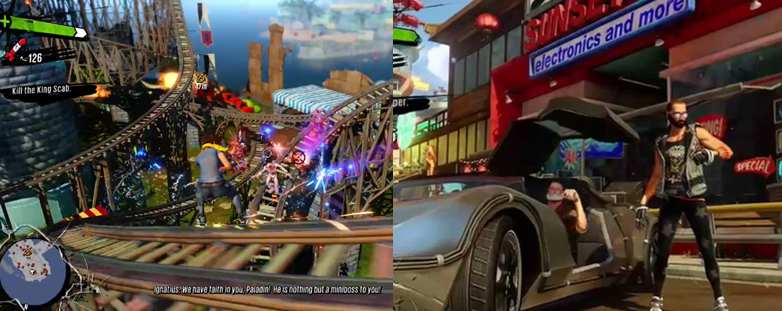
Game Corner [Sonic Month]: Sonic the Hedgehog (2007; Xbox One)


Sonic the Hedgehog was first introduced to gamers worldwide on 23 June 1991 and, since then, has become not only SEGA’s most enduring and popular character but also a beloved videogame icon. This year, the Blue Blur turns thirty and what better way to celebrate than by dedicating an entire month’s worth of content to SEGA’s supersonic mascot.


Check out my guest spot on The Reviews Brothers

GameCorner

Released: July 2007
Originally Released: June 1991
Developer: Sonic Team
Original Developer: Sonic Team
Also Available For: Arcade, Game Boy Advance, Gamecube, Game.com, iPod, Mega Drive, Mobile, Nintendo 3DS, Nintendo DS, Nintendo Switch, Nintendo Wii, PC, PlayStation 2, PlayStation 3, PlayStation 4, PlayStation Portable, SEGA Saturn, Xbox, Xbox 360, Xbox Series X

The Background:
You know the story by now: there was a time when videogames and home consoles ran rampant and, for a while, it was good. But, inevitably, the market became swamped with lacklustre releases and poorly conceived movie tie-ins; after the collapse of the videogame industry, Nintendo were there to pick up the pieces, dominating the market with the Nintendo Entertainment System (NES) and Super Mario Bros. (Nintendo EAD, 1985). Though they had successfully recaptured the flailing market and seemed unstoppable, one former slot machine developer dared to try and knock Nintendo from their perch. In 1990, SEGA ordered their developers to design a mascot and a title capable of leaving Mario in the dust and showcasing the power of their 16-Bit Mega Drive; after an internal contest produced numerous rejected designs (including a rabbit and an armadillo), SEGA soon settled on Naoto Ohshima’s design of a spiky hedgehog dubbed “Mr. Needlemouse”. With up-and-coming developer Yuji Naka, composer Masato Nakamura, and level designer Hirokazu Yasuhara also onboard, the character’s design was refined and defined, renamed to Sonic, and “Sonic Team” was born. Conceived to be as appealing as possibly, Naka wanted Sonic the Hedgehog to focus on speed and user-friendliness; unlike his rival, Mario, Sonic controlled with only the directional pad and one button and his gameplay was based on physics, momentum, and an emphasis on action and speed. Thanks largely to an aggressive marketing campaign and copies of the game being bundled in with SEGA’s brand new console, Sonic the Hedgehog was an immediate success, selling over 15 million copies in this format alone and kick-starting the “Console War” between SEGA and Nintendo that would dominate the nineties. Since then, Sonic has become an enduring icon; he’s had a slew of critical and commercial hits alongside a number of unfortunate and very disappointing hiccups and yet his character and brand remain strong and he is still an iconic character in both videogames and other media to this day.

The Plot:
South Island is under siege! The maniacal Doctor Eggman (widely known as “Robotnik” during the game’s original release) has been capturing the island’s animals and turning them into robotic Badniks! With Eggman’s machinery and pollution threatening the entire island, only one super-fast, super-cool hedgehog can stop him!

Gameplay:
Sonic the Hedgehog is a 2D, sidescrolling action/platformer in which you control the titular blue hedgehog. Sonic must journey across six stages (known as “Zones”), each split into three “Acts”; at the end of each Zone’s third Act, Sonic must battle Eggman in one of his contraptions and, upon clearing all six Zones, face the diabolical doctor in the game’s Final Zone. Sonic is a smooth and responsive character to play as; slightly weighty, his speed and agility are dependant upon you building momentum and using the game’s level layout and gimmicks to your advantage. When you move Sonic, he quickly breaks from a trot, to a jog, to a run that is so fast his legs appear as little more than a rubber band of red, white, and blue but, in order to reach Sonic’s top speeds, you’ll need to make use of slopes, curves, the game’s signature loop-de-loops, and Sonic’s rolling mechanics.

It’s not all high-speed Badnik bashing; Sonic will also have to pull off some slower platforming.

Any time you press a button, Sonic jumps into a blazing spinning ball of spikes known as the “Super Sonic Spin Attack”. You can use this to destroy Badniks and bounce off of them, springs, and monitors to increase your height, momentum, and speed. Additionally, pressing down whilst running will see Sonic roll along for a similar effect. In the original release of the game, Sonic couldn’t utilise his patented Spin Dash as this wasn’t introduced until the bigger, better sequel but subsequent re-releases and ports have seen this function added in, which can be extremely helpful in moving Sonic along (unfortunately, though, it’s not available in this version of the game). And that’s a noteworthy point as, unlike in the sequels, Sonic is painfully slow in his debut title; the game’s first stage, the iconic and massively over-used Green Hill Zone, is a perfect playground for getting to grips with Sonic’s speed and abilities. You’ll blast through this Zone in no time at all, feeling the rush of adrenaline and action-packed speed, only to literally run into a brick wall with the next stage, Marble Zone, which slows the game down to a crawl so Sonic can navigate precarious platforms, push blocks, activate switches, and simply wait for the game to allow him to continue.

The game’s slower sections betray its marketing as a non-stop action platformer.

That’s not to say that speed doesn’t become a recurring factor in Sonic’s gameplay; both Spring Yard Zone and Starlight Zone give you a chance to stretch your legs again but the pinball mechanics of the former and the obstacle-course-like layout of the latter were definitely refined in the sequel. As a result, most of your time is spent using more traditional platforming skills to progress forward rather than simply blazing through as the game’s marketing would have you believe. This means jumping from platform to platform, navigating maze-like areas, activating switches, and hopping to disappearing, crumbling, or spinning platforms. In Starlight Zone, you’ll also have to use some see-saws to bounce up to higher areas and navigate a bottomless void while Scrap Brain Zone includes teleportation tubes and speed-sapping conveyor belts to screw up your momentum and sense of direction. You’ll also have to watch the in-game timer as well; if you take too long to finish an Act, you’ll lose a life, so it pays to keep moving but, fortunately, none of the game’s Zones or Acts are that long or difficult to get through within the required time limit.

There are many ways to keep Sonic alive and kicking.

Luckily, Sonic is a relatively sturdy videogame character, especially compared to Mario; collecting the many Golden Rings scattered throughout the game’s Zones allows you to survive a single hit. You’ll lose all of your Rings but you won’t lose a life unless you get squashed, fall into one of the game’s many bottomless pits, get hit without a Ring or a shield, or drown. Sonic’s momentum becomes sluggish and awkward when underwater and, unlike his rival, he cannot survive for long in the murky depths of the Labyrinth Zone; linger too long and an ominous, heart-pounding countdown will begin and, if it reaches zero, you’ll drown and lose a life. Fortunately, just as you can collect dropped Rings, you can save yourself from this fate by finding air bubbles. Sonic can also earn an extra life if he collects one hundred Rings or earns a high enough score and you’ll also be given a chance to continue should you lose all of your lives. You can earn extra continues in the game’s Special Stages but you’ll also lose your current accumulated high score if you have to use a continue. Sonic gains points for destroying Badniks, defeating Eggman, and clearing Acts; once you reach the end of Act signpost or break open the prison capsule, you’ll be awarded bonus points for your current score, the time you took to clear the Act, and the amount of Rings you were holding when you did so. As a result, you are actively encouraged to blast through Acts as quickly as possible as this will net you a higher score and more lives and continues.

Labyrinth Zone more than lives up to its name thanks to being far more vertical and maze-like.

Sonic the Hedgehog’s Zones are thus laid out in such a way to allow you to experiment to find the fastest routes; typically, the higher path is the most dangerous but also the fastest compared to the middle and lower paths. This isn’t always the case, however, and this mechanic is not as refined as in later games; some Zones, such as the aforementioned Labyrinth and Spring Yard, are more vertically constructed, meaning that your completion speed will be directly tied to your level of skill and precision with controlling Sonic. For the most part, this isn’t a problem but, unfortunately, Sonic the Hedgehog does suffer from a few noticeable issues that can unfairly impede your progress; early copies of the game featured an infamous glitch whereby, upon landing on a bed of spikes, Sonic would lose his shield, Rings, and then a life all without the usual few seconds of invincibility frames to save him. Other times, especially in Spring Yard Zone, you may find yourself crushed by blocks even though you’re not actually beneath them; Sonic also has a curious animation glitch where he will jump while running in the air if you try to jump to close to obstacles or items, though these issues are, admittedly, rare and minor. Sonic the Hedgehog isn’t an especially difficult game; there are no difficulty settings to choose from so the game’s difficulty is supposed to gradually increase as you progress from Zone to Zone. As you race through Zones, you’ll automatically activate Lampposts as you run past them, which acts as a checkpoint should you die in the Zone, however your skill is tested by the way the game requires you to finish every Act that doesn’t feature a boss battle holding fifty Rings or more in order to try for the game’s six Chaos Emeralds.

Graphics and Sound:
Sonic the Hedgehog is still one of the most impressive and visually appealing games of its kind. Everything from the sprites to the background art pops out in gorgeous colours and the game’s Zones are full of life and character, despite being largely cliché in hindsight. You’ll race through verdant fields, explore lava-filled ruins, slog through the sunken remnants of an ancient civilisation, careen around a bonkers pinball-inspired obstacle course, and face a myriad of deadly hazards in Scrap Brain Zone, the heart of Eggman’s operation on South Island.

As much as I like Starlight Zone, it’s quite empty compared to other Zones in the game.

Just about the only Zone that isn’t interesting or fun is Starlight Zone and I say this with a heavy heart as it’s actually one of my favourite Zones in the game and a welcome return to the more speed-orientated gameplay after the annoyance of Labyrinth Zone. However, Starlight Zone is largely empty and lifeless; the wind-based mechanic is clunky, the bottomless pits are insufferable, and the Badniks are far harder to destroy than in other Zones.

Leave Sonic idle and he’ll grow impatient, something videogame avatars have aped ever since.

What saves Starlight Zone, however, is its music; in fact, Sonic the Hedgehog has some of the best and most memorable music in videogame history. From the catchy title theme to the iconic sounds of Green Hill Zone, every Zone has an excellent, jaunty, and fitting theme to go with it. This is also true of the game’s boss battles, which all feature the same ominous-yet-lively tune that let you know Eggman is inbound. The game doesn’t feature any cutscenes or story-telling elements; this isn’t entirely unexpected as a lot of games released around this time didn’t and, to be fair, the game’s story is pretty simple to pick up either through association (the Zones change from lush and vibrant to polluted and desolate and woodland critters bounce around the Zones after being freed from captivity) or from the game’s manual. One thing that the game does excel at, though, is giving Sonic a distinct personality; if you leave him idle, he’ll turn to the screen and impatiently tap his foot, a quirk that has been aped and emulated but almost every videogame avatar since.

Enemies and Bosses:
In each Zone of the game, Sonic will face opposition from Eggman’s Badniks; these mechanical monsters may look cute and quirky but they can be extremely deadly. Mostly themed after animals, Badniks will fly across the screen shooting fireballs at Sonic, slink along the floor and break into spiked balls upon defeat, toss bombs at his head, and even explode in his face, among other things. Generally, Badniks are exclusive to each Zone but there is some crossover in later stages. While most of these Badniks aren’t too much bother, their placement in the Zones can be frustrating; others, like Roller and Burrobot, can be a pain due to the speed and surprise of their attacks while Badniks like Spike and Orbinaut cause issues due to their spiked defences.

Eggman may have a lot of different attachments for his craft but he’s not much of a challenge.

At the end of each Zone’s third Act, you’ll battle Doctor Eggman in his Egg-O-Matic hovercraft; each time you face him, he has a new, deadly appendage attached to his craft but his attack pattern remains generally the same. He’ll come puttering in, flying from right to left, and trying to attack with his appendage all while remaining a large, open target for Sonic’s Spin Attack. Unfortunately, while Eggman’s wrecking ball is simple to get around, his later appendages become more dangerous thanks to the presence of other hazards; in Marble Zone, he’ll drop fireballs that briefly render the ground too dangerous to stand on but there’s also a pit of lava to watch out for, for example. Attack too fast in Spring Yard Zone and you might drop to your death as Eggman uses his spike to remove parts of the platform you’re standing on. Labyrinth Zone’s boss battle is more of a race than a fight as, no matter how often you hit Eggman, he won’t be defeated; instead, you need to jump up the flooded vertical shaft dodging spikes and fireballs and desperately hoping to reach the top before you drown.

The final boss battle is pretty disappointing and stupidly easy.

Once you’ve cleared all six Zones, you’ll reach the Final Zone; in this final showdown with Eggman, you’re stuck in a room with no escape and no Rings as Eggman tries to crush you with four weights and fry you alive with electrical balls. Fortunately, however, there is always a gap between these sparkling orbs for you to safely jump through and, by simply waiting at the far right of the screen, you can just take your time and ram Eggman whenever he pops up. Compared to the final boss battles of later Sonic games, this one is a bit of a joke, to be honest, and ends the game not with a bang but with a kind of shrug.

Power-Ups and Bonuses:
To help tip the odds in your favour, you’ll find a number of computer monitors scattered throughout the game’s Zones. Breaking these open will award you with such gifts as an instant hit of ten Rings, a shield that protects you from losing Rings or a life for one hit, or even an extra life. You can also find monitors containing Power Sneakers, which immediately increase Sonic’s running speed for a short time, or an invincibility, which coats Sonic in a sparkling protective aura. Combine these two together and you’re basically unstoppable unless you run head-first into a bottomless pit.

Additional Features:
Playing Sonic the Hedgehog on the Xbox One allows you to earn some pretty simple and easy Achievements; if you’ve played Sonic before, it should be no challenge at all to reach the game’s later Zones, collect one hundred Rings, or complete the game. As I mentioned above, finishing every Act except Act 3 with fifty Rings or more allows you to enter a Special Stage (why they’re not called “Special Zones” I don’t know…); these are accessed by Giant Rings that appear when you pass the end of Act signpost, so jump in quickly before you miss your chance!

Collect all six Chaos Emeralds to earn the game’s best ending.

The Special Stages are a psychedelic maze-like area filled with bright colours and weird effects; here, you’ll have to bounce and roll Sonic (who is in a constant spin) around the arena trying to avoid the flashing “Goal” lights. Touch these and you’re instantly ejected from the Special Stage with nothing to show for it but, if you manage to avoid them, you’ll find a Chaos Emerald hidden within each Special Stage. Collect all six of these and you’ll be awarded with the game’s true ending; without them, Eggman will mock you for failing to collect them all but, aside from seeing flowers blooming in Green Hill Zone and an Achievement, there’s little incentive to collect all six as you don’t unlock anything else. Sadly, thanks to the way Sonic the Hedgehog works on the Xbox One, there’s no way to enter the iconic cheat codes from the original game and, while a save state system is included, it only allows you to save to three separate slots. You can, however, access online leaderboards to compare your score, time, and progress with other players, if that’s your thing.

The Summary:
Sonic the Hedgehog will forever be an iconic, classic platformer; its place in the echelon of videogame history was cemented upon its bombastic release and, even to this day, it remains as a solid action/platformer. Unfortunately, years of enjoying the bigger, better, much improved sequels somewhat dampens the appeal of Sonic the Hedgehog. Playing the game in hindsight, you can see how the developers took the very best aspects and elements of this game and improved upon them in the sequel, removing the slower, clunkier elements and focusing more on action and speed. The game’s marketing made Sonic out to be this superfast character with a radical attitude but the actual game is quite slow, for the most part, and elevated above its peers thanks to its eye-catching graphics, distinct personality, and catchy music. It’s still a great game and obviously laid the foundations for even better things to come but is far less impressive than its sequels.

My Rating:

Rating: 3 out of 5.

Pretty Good

What did you think about Sonic the Hedgehog? Where do you rate it against the other games in the franchise? Did you purchase a Mega Drive simply to play Sonic? Which port or re-release of the game is your favourite? Are you as annoyed as I am that the excellent mobile version of the game isn’t available to play on the Xbox One? How are you celebrating Sonic’s thirtieth anniversary? Whatever you think, feel free to share your thoughts and memories regarding Sonic below.

Game Corner [Donald Duck Day]: QuackShot Starring Donald Duck (Mega Drive)


DonaldDuckDay

It’s June 9th, which means that it’s National Donald Duck Day! Disney’s foul-tempered fowl first debuted in The Wise Little Hen (Jackson, 1934) way, way back on 9 June 1934 and has since become one of the multimedia conglomerate’s most enduring and popular characters, featuring in a variety of cartoons, videogames, and other merchandise.


GameCorner
QuackShotLogo

Released: December 1991
Developer: SEGA
Also Available For: SEGA Saturn

The Background:
As I’ve said once or twice before, Disney had quite the reputation back in the nineties for licensing their popular characters and film franchises and producing some of the best 8- and 16-bit action/platformers on SEGA’s home consoles. Of all their enduring characters, Mickey Mouse, as the brand’s mascot, obviously featured in the majority of these titles but Donald Duck had his fair share of pixelated adventures over the years as well. Generally, Donald’s adventures were very similar to Mickey’s in that he would explore a fantasy world, generally trying to rescue his nephews Huey, Dewey, and Louie, and featured an abundance of jumping and platforming. QuackShot Starring Donald Duck was unique in that respect as, rather than bouncing on enemies and following a linear path from right to left, Donald becomes an Indiana Jones-type figure who travels the world in search of a lost treasure and the game featured a lot more backtracking and puzzle solving than most titles featuring Disney’s characters.

The Plot:
When flicking though a book in his Uncle Scrooge McDuck’s library, Donald stumbles across a map that leads to the lost treasure of King Garuzia, former ruler of the Great Duck Kingdom in ancient times. Alongside his three nephews, Donald hops in his biplane and heads out across the world to track down the lost treasure all while Big Bad Pete and his goons try to stop him at every turn and beat Donald to the treasure.

Gameplay:
QuackShot Starring Donald Duck is a 2D, sidescrolling action/platformer with a heavy emphasis on backtracking, exploration, and puzzle solving. Players take on the role of Donald Duck, decked out in an Indiana Jones-inspired getup, as he travels from Duckburg to Transylvania, to the South Pole and the ancient tomb of King Garuzia in pursuit of a lost treasure.

QuackShotControls
Run or slide to move a little faster and avoid a chargrilled butt.

Unlike other Disney titles, especially those starring either Donald or Mickey Mouse, QuackShot is a much slower, more methodical affair; Donald’s standard walking speed is painfully slow but, by holding down the A button, Donald will break out into what can best be described as a “spirited trot” for a few seconds, which really doesn’t speed things up all that much. When ducking, you can press the C button and Donald will slide forwards on his front, which is super handy for passing through small passageways and underneath spiked ceilings and can be a faster way of getting from start to finish.

QuackShotAttacks
Stun enemies with plungers or knock them out with popcorn.

Donald can also jump, as you might expect, but it’s more of a hop than anything else; Donald’s jumping height and distance is dependant on his momentum, angle, and the length at which you press the C button. Sadly, Donald cannot defeat enemies by jumping on them and is therefore entirely reliant on his special pop-gun to take out enemies. Donald’s gun can shoot out plungers to stun enemies so he can safely pass by or popcorn to permanently dispose of them; though he has unlimited plungers, Donald’s popcorn shots are limited and run out quite quickly as they fire in a spread. Plus, you know…enemies respawn after you leave the screen anyway so it’s better to just use the plungers.

QuackShotMap
Travel across the world using the map, checkpoints, and Donald’s handy-dandy biplane.

When you start QuackShot, you are presented with a map and can choose to travel to one of three destinations: Duckburg, Mexico, or Transylvania. Where you choose to go determines how far you can progress in the game; for example, if you visit Duckburg first, you’ll be soon stopped as you don’t have the ability to scale walls yet; if you visit Mexico, you’ll be told that you need a key to progress further; and, if you visit Transylvania first, you’ll need special ammo for your gun to progress further. In each case, a non-playable character (NPC) directs you to one of the other locations so you can get what you need to progress. Donald thus plants a flag (essentially a checkpoint) and you are able to call your nephews in your biplane to return to the map and travel elsewhere. Once you’ve cleared these first three areas, the map will expand and you’ll be able to travel to four new locations where the cycle repeats itself again; you can’t enter the temple in Egypt without retrieving the Sphinx Tear from the palace of the Maharajah and you can’t clear the Viking Ship of its ghost infestation without a special key from the South Pole, and so on. This partial progression and backtracking format makes the game much slower and requires a little more brain power than the average platformer; while NPCs always tell you where you need to go to progress in a particular level, if you miss that message and travel somewhere else instead, the only way to remind yourself of where you need to go is to hope that you remember where you just came from.

QuackShotTemper
Collect enough peppers and you’ll fly into a berserker rage.

Donald’s health is indicated by a small power meter in the game’s heads-up display (HUD); when attacked or otherwise hurt, Donald loses some of his power but can replenish his health by stunning or attacking enemies and picking up ice cream cones or a roast chicken (there’s something very disconcerting about a duck eating chicken to replenish its health…). Attacking enemies adds to your score, which is also displayed in the HUD, and you’ll be awarded with an extra life when you reach a high enough score; extra lives can also be found in levels as well and, if you die, you can grab these again to effectively have infinite lives but, should you exhaust all of your lives, the game has infinite continues so you can simply choose to restart from your last checkpoint. The HUD also shows Donald’s current temper; when he picks up enough red-hot chilli peppers, he flies into a berserker rage that renders him invincible for a few seconds and allows you to attack any particularly annoying enemies. These peppers are few and far between, however, so I didn’t find myself entering this state too often. Some levels feature bottomless pits and instant death traps (falling ceilings, water, or lava) as well so you’ll have to factor this in as you explore the game’s environments. As you explore each area and speak to NPCs, you can access an in-game menu with the Start button. This is how you can call your aircraft (which can only be done when near to a checkpoint flag), use certain items (though these will only work when you’re right next to where they need to be used), and read things such as your map or other items to help you solve puzzles. The game’s puzzles are generally simple enough, requiring you to hop over moving platforms, stun moving blocks so you can progress, or hitch a ride on passing enemies. Probably the game’s more troublesome puzzle comes when Donald is about to be crushed by a falling ceiling and you have to hop on certain blocks in the right order in order to halt it and keep you from being flattened.

Graphics and Sound:
As a Disney title on the SEGA Mega Drive, QuackShot looks just as gorgeous and appealing as the rest of their titles released around this time. Disney’s games are always bright, vibrant, and eye-catching and QuackShot is no different, with Donald, Pete, and the game’s various enemies and environments popping out and full of charm. When you leave Donald idle for some time, he’ll tap his foot impatiently like a certain blue hedgehog and he is full of life as he waddles and hops along. Levels aren’t quite as varied and unique as in some of Donald’s other outings, or those that feature Mickey; instead, you’ll visit more real-world locations than fantasy environments, which will see you walking through the streets and jumping across the rooftops of Duckburg, exploring the haunted lower depths of a Viking Ship, and traversing dangerous jungles.

QuackShotGraphics
QuackShot is colourful and lively, if a bit by the numbers.

They’re all pretty standard locations for your average action/platformer and they’re not especially teeming with life or background elements but they’re serviceable enough and generally quite short; you’ll play half a level and then have to jet off to another location before you can proceed any further, making playing both short and sweet but also quite long and complex. The game’s music is equally fun and lively and catchy enough but nothing especially ground-breaking or memorable. The game’s plot is told through a combination of stationary cutscenes and in-game dialogue boxes between Donald and recognisable characters like Goofy and Gyro Gearloose; they’re large and cartoony, though, and perfectly in keeping with the cartoon aesthetic of the videogame and certainly a lot more in-depth than those of other platformers from the same time period.

Enemies and Bosses:
While Mickey generally had to deal with some fantastical and outlandish enemies, Donald is faced with more lacklustre and generic enemies sucu as vampire bats (that travel along a straight line and are easily avoided), incorporeal ghosts that cannot be harmed, and birds that drop wasp nests or bombs on you. Donald will also butt heads with a number of Pete’s goons who shoot at you or toss bombs at your head, Vikings who hide in barrels and try to shoot you full of arrows, kangaroos (complete with boxing gloves), evil cactus plants that break apart for added annoyance, and even skeletons who try to throw their heads at you.

QuackShotBosses
Bosses are big and lively but pretty simple to put down.

While exploring Dracula’s Castle, you’ll also encounter a giant ghost who floats just out of reach and cannot be harmed; every so often, he breaks up into smaller ghosts before reforming and, rather than try to damage him, you actually have to find a certain platform that will take you to the castle’s upper levels and out of harm’s way. You’ll also come up against a few bosses on your travels, none of which really pose that much of a threat as long as you have enough health, ammo (if necessary), and can avoid their simple attack patterns. Donald has to fight against Count Dracula (easily dispatched by standing beneath him when he opens his cape and shooting plungers upwards), a ferocious fire-breathing tiger (dispatched by firing bubblegum shots when it’s jumping), and a possessed suit of Viking armour that constantly shields against your attacks and can only be harmed by hitting its head.

QuackShotPete
Pete finds his position as the game’s final boss usurped at the last second…

Eventually, you’ll face off against Pete himself in a bid to retrieve the map; this battle sees Pete circling the area in a massive press machine and attempting to squash Donald into a fine paste. Pete’s goons are also stationed around the arena to make hitting Pete in the face that much harder as you climb higher and higher up the arena but, like all the bosses, this is simply a test of patience rather than being an exercise in frustration.

QuackShotFinalBoss
The game’s true final boss isn’t much of a threat…

Once Pete is taken out, Donald heads over to the Great Duck Treasure Island, where the tomb of King Garuzia lies, to do battle with the knight guarding Garuzia’s treasure. As final battles go, this is a bit of a disappointment; the knight basically stays in the centre of the screen, twirling his sword and trying to fling it at you, and causing blocks to fall from the ceiling. He leaves himself wide open for your attacks, meaning it’s pretty simple to dodge the falling debris and blast him with your plungers or other weapons until he finally gives up King Garuzia’s treasure.

Power-Ups and Bonuses:
The only real power-up you can get through regular gameplay is the aforementioned red-hot chilli peppers; you can also collect bags of cash to increase your score, though, and find some cheeky shortcuts peppered through stages that lead either to stockpiles of items and ammo, extra lives and health, or hidden doors to progress further.

QuackShotWeapons
Donald’s plunger gets a few upgrades along the way.

As you explore, you’ll receive two upgrades for your pop-gun; the first changes your yellow plunger to a red one, which allows you to scale vertical walls with temporary platforms, and the second changes it to green and allows you to hitch a ride on flying enemies. Gyro also supplies you with bubblegum ammo, which allows you to break open walls and certain blocks so you can explore a bit more of the map and the game’s locations. These bubbles are quite slow and linger around the screen for some time, which can limit your firing speed (which is already quite slow to begin with).

Additional Features:
There’s not much replayability in QuackShot beyond playing through a perfectly acceptable action/platformer over and over. There’s no difficulty settings to choose from, no additional characters to unlock or play as, and there aren’t even any cheats or passwords to input. While this does mean you have to rely on old school gaming and memorisation to play through the game’s relatively short length, it also means that you can’t save your progress or jump to a later stage in the game if you have a power cut.

QuackShotBanner

The Summary:
Generally speaking, QuackShot Starring Donald Duck isn’t especially challenging but its pacing really ruins the many positive aspects of the game. Donald is so slow and clunky and the gameplay is so plodding and sluggish that there’s no real sense of urgency or agency to the game’s plot or action. QuackShot looks great and isn’t especially punishing or unfair but it’s nowhere near as action-packed or appealing as other Disney titles, even ones that also feature Donald Duck. Instead, you’re left with a perfectly average little title that looks and sounds great but doesn’t exactly leave you clamouring for more or especially excited.

My Rating:

Rating: 2 out of 5.

Could Be Better

What did you think of QuackShot Starring Donald Duck? Where do you rate the game compared to other Disney titles of that era? Do you agree that it’s not as appealing as other Disney videogames on the Mega Drive or did you find it to be just as enjoyable? Which was your favourite, or least favourite, and who is your favourite Disney character? How are you celebrating National Donald Duck Day? Whatever you think about QuackShot, Donald Duck, or Disney in general, drop a comment below and have a great Donald Duck Day!

Game Corner [RoboCop Day]: RoboCop (Arcade)


To celebrate the release of the dismal RoboCop (Padilha, 2014) on home media, June 3rd was declared “RoboCop Day” in the city of Detroit. While that movie wasn’t too impressive and had nothing on the original RoboCop (Verhoeven, 1987), this does give us the perfect excuse to talk, and celebrate, all things RoboCop on a specific day each year.


GameCorner

Released: 1988
Developer: Data East
Also Available For: Amiga, Amstrad CPC, Apple II, Atari ST, Commodore 64, Game Boy, MSX, Nintendo Entertainment System (NES), PC, Tandy Color Computer 3, ZX Spectrum

The Background:
In 1987, director Paul Verhoeven brought us RoboCop, a delightfully over-the-top science-fiction action film punctuated by copious amounts of gore, strong performances by all involved, a kick-ass score that alternated between synthesised and orchestral music, a unique perspective on themes of masculinity and humanity, and a tongue-in-cheek analysis of corporations and the power of deceptive media. Produced on a budget of a mere $13 million, the film grossed over $50 million of that in the United States alone, making it the fourteenth-highest grossing movie of that year, and eventually made over $50 million worldwide. This success, obviously, led to a number of sequels and spin-offs in other media and a slew of merchandising including comic books, action figures, and videogames. Ocean Software, a British software development company famous for purchasing the rights to make videogame adaptations of numerous film and television franchises, secured the RoboCop license and sub-licensed it to Data East, a Japanese developer known for creating arcade games, for the creation of a coin-op arcade adaptation of the sci-fi hit. Generally quite well-regarded amongst stiff arcade competition, the game’s various home console ports (also released by Ocean) received similarly-favourable reviews, with the game’s title theme later being licensed for use in a number of advertisements.

The Plot:
After police officer Alex Murphy is brutally gunned down, he is rebuilt by Omni-Consumer Products (OCP) as an unstoppable cybernetic cop and charged with bringing law and order to the streets of Detroit.

Gameplay:
RoboCop is a 2D, sidescrolling action shoot-‘em-up in which players are cast in the role of Alex Murphy, now reborn as a cybernetic police officer and tasked with cleaning up the streets of Detroit and the corruption within OCP. If you’ve ever played a game with RoboCop as a playable character before, you probably won’t be too surprised to find that Robo is a sluggish, clunky character to play as. Don’t get me wrong, I love me some RoboCop but the guy doesn’t really make for the most dynamic playable character and games often struggle as a result of his inherent weight and awkwardness. As a result, RoboCop plods along at a steady, but cumbersome pace, walloping thugs in the face and blasting at them with his iconic Auto 9, all while hopping around with one of the most unwieldy jumps in videogame history. Your choices for movement and attacking are extremely limited; RoboCop can go left or right, duck (though a lot of enemies shoot at you from above or from an angle, rendering this largely ineffectual), or awkwardly jump  around the place and that’s about it. RoboCop is one of those videogame characters who also suffers a bit from the inherent need for him to have a health bar; realistically, RoboCop should be able to shrug off the small arms fire and melee attacks he has to endure in this game but, in an effort to keep kids dropping their change into the arcade cabinet, RoboCop’s health will whittle down pretty quickly thanks to an abundance of enemies, most of which run face-first into him or swarm the screen.

Replenish RoboCop’s health with baby food or scoring well at the shooting range.

To further drain your pocket of change, each of the game’s nine stages comes with a time limit; thankfully, the stages are quite short so this doesn’t really become an issue until the game’s later levels where the screen is filled with so many enemies and onscreen hazards that the frame rate slows to a crawl and you’ll find yourself dying every few steps. Luckily, when you choose to continue, the game restarts you right where you fell, though this can lead to you quickly dying again soon after restarting as you can respawn right in the middle of a crossfire or at the feet of a boss. RoboCop can also replenish his health by finding jars of baby food sporadically throughout the game; these are few and far between, however, and you’ll generally take more damage (or die) trying to collect one and replenish your health. The damage you’ve taken carries over to the next stage, as well, for added cheapness but you can also replenish it by getting a decent high score in the handful of shooting range segments that mix up the gameplay.

RoboCop mixes things up with a few stage hazards and hostage situations.

As for the gameplay, it’s as basic as you could want; you simply guide RoboCop from the left to the right, or from the bottom to the top, taking out enemies, smashing crates, and battling a number of bosses as you go. There are also a couple of occasions where you’ll be dodging hazards, using elevators, or when enemies will take a hostage, similar to that iconic scene from the movie, and you must shoot quickly to rescue the victim. Generally speaking, you’ll be taking out enemies with RoboCop’s piston-like punches but, about halfway through most stages (and, later, right from the start of some), RoboCop will pull out his Auto 9 and the game becomes decidedly more like Contra (Konami, 1987). Now, you can blast enemies from afar with infinite ammo or pick up other, limited ammunition to make short work of Detroit’s loathsome scum. Oddly, RoboCop can’t shoot through the numerous crates that block his way and it can be a little tricky to get the right angled shot but it’s a fantastic moment when RoboCop finally pulls out that gun and you can start blasting away! The game isn’t especially difficult in the early going; as long as you’re quick to hit the attack button, you can take out most enemies before they drain your health away but, as you progress, more and more enemies and hazards begin to fill the screen, pretty much guaranteeing that you’re going to go down and have to put in another coin to continue. It’s a fun, action-packed game but there is a definite challenge there because of this; these days, thanks to emulators and ROMs, this isn’t really an issue and you can just continue as often as you like but the sheer number of enemies, hazards, and bullets can get frustrating and I can imagine kids wasting a lot of their money on this one back in the day.

Graphics and Sound:
RoboCop is a very attractive game with lots of big, expressive sprites and backgrounds. Oddly, unlike other RoboCop titles, Robo doesn’t have an idle animation, which is a bit of a shame, but he does dramatically pull out and holster his Auto 9 at various points; unfortunately, though, while RoboCop is a big and well-detailed sprite, he doesn’t really have too many frames of animation going on. This is the same for most of the game’s enemies, too, who are quite generic and exist mainly to tick a box; while many are modelled after the thugs seen in the film, they’re largely indistinguishable from each other. However, the game’s environments are quite large, considering how short most of them are, and detailed, ranging from the streets of Detroit to a steel mill and construction yard to the futuristic offices of OCP itself.

A few cutscenes do a good job of retelling the film’s plot.

A few static images are used to convey the game’s story, with a bit of text for good measure; it’s not much but it does the job and, as an added bonus, there’s even a couple of in-game cutscenes to advance the game’s plot and express the game’s ending. As you play, a fantastically catchy remix of Basil Poledouris’ iconic RoboCop theme plays pretty much non-stop; it is, thankfully, mixed up with a few other remixes of the film’s memorable tunes and never outstays its welcome. Even better, the game features numerous voice clips from the film to punctuate RoboCop’s war against crime and corruption and help to immerse yourself in the game’s simple, but entertaining, action.

Enemies and Bosses:
The streets of Detroit are filled with generic thugs and criminals, most of the them modelled after the gang seen in the movie; many of these will run face-first into you, causing you damage and killing themselves at the same time, or take shots at you from a distance or from windows above you. You’ll also come up against a few more formidable enemies who toss grenades at you, wield chainsaws, drive at you on motorcycles, or buzz around in jetpacks. Some are armed with flamethrowers or the Cobra Assault Cannon and you’ll also have to contend with sentry guns and spider-like robots which fill the screen with bullets in the OCP building.

Thugs will try to smash and crush you to pieces in heavy machinery.

These thugs will pose a greater threat when they double up as end of stage bosses; you’ll battle them in an armoured van and in construction vehicles that swing a wrecking ball or pincer-like clamps to cause massive damage. Sadly, there’s no real showdown with Clarence Boddicker; you do grab one particular boss (which I assume is meant to be Clarence) and force him to take you to Dick Jones but you never get that chance to enact vengeance on Clarence in the same way as Robo does in the film.

ED-209 gets bigger, badder, and tougher each time you face it!

By far the game’s most persistent boss is the unforgettable ED-209; this massive, tank-like machine greets you at the end of the first stage where it poses the first real challenge of the game but pales in comparison to the different-coloured variants you’ll encounter as you progress further. You’ll have to battle ED-209 five times in total (with one particular boss battle pitting you against two at the same time!) but, while ED-209’s attacks and aggression increases each time, the strategy remains the same: try your best to duck, jump, or stay away from ED-209’s shots and hit box and blast at its head until it is destroyed.

The game ends with you anti-climatically rescuing the President from Dick Jones.

When you finally reach the top floor of the OCP building, you’ll have to contend with the final ED-209 and, afterwards, recreate the ending of the movie by shooting Dick Jones and rescuing “the President”. The context of the videogame changes this scene slightly, making it seem as though you’re rescuing a helpless authority figure from a corrupt businessman (or possibly even the President of the United States) and it offers very little challenge (especially compared to fighting ED-209) but its fidelity to the source material is admirable, regardless.

Power-Ups and Bonuses:
Unlike many arcade titles at the time, RoboCop is surprisingly lacking in its power-ups; they’re pretty much limited to a handful of health-restoring items and a few different types of ammo for your Auto 9. You’ll pick up a double shot and a spread shot to help you clear the screen of enemies and do additional damage to bosses; even better is the ability to pick up the Cobra Assault Cannon for maximum damage. Be wary, though, as all of this ammunition is limited (with the Cobra, especially, being severely limited), so you can’t just mindlessly blast away like you can with the regular ammo and you’ll also lose these power-ups if you die.

Additional Features:
As an arcade game, the main aim of RoboCop (beyond completing the game) is to get your initials entered into the high score table, preferably at the top. Beyond this, there isn’t much else on offer here besides a turn-based two-player mode if you fancy playing alongside a friend.

The Summary:
RoboCop is a pretty simple, action-packing coin muncher of an arcade game. RoboCop is surprisingly fragile, dropping to his knees in the blink of an eye when faced with the game’s massive bosses or swarms of enemies, hazards, and bullets and, as always, he is a clunky and awkward character to play as. Yet, thanks to some large, detailed graphics, a catchy theme, and tight controls, there’s a lot to like about RoboCop. Taking inspiration from Contra was the right way to go as RoboCop excels when it is adapted into a run-and-gun shoot-‘em-up and, while these genres have been done better in other games and the movie might have benefitted from being an auto-scrolling first-person shooter rather than a sidescroller, that doesn’t change the fact that it’s a fun way to spend an hour or so of your life.

My Rating:

Rating: 3 out of 5.

Pretty Good

Did you ever play RoboCop in an arcade? Which RoboCop videogame is your favourite? Would you like to see a new RoboCop game; if so, what genre do you think would best fit the source material? Which RoboCop movie is your favourite? How are you celebrating RoboCop Day today? Whatever you think about RoboCop, feel free to leave your thoughts in the comments below.
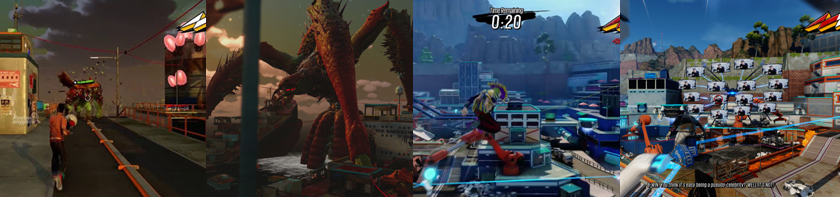
Game Corner: The Simpsons (PlayStation 3)

Released: 8 February 2012
Originally Released: 4 March 1991
Developer: Backbone Entertainment
Original Developer: Konami
Also Available For: Arcade, Commodore 64, MS-DOS, Xbox 360

The Background:
The Simpsons began life as a series of short cartoons created by Matt Groening for The Tracey Ullman Show, with Groening hastily naming each of the family members after himself and his own family and the characters coloured yellow by colourist Georgie Peluse simply because it was deemed amusing. In 1989, Groening was approached by a team of production companies to produce a series of half-hour episodes focusing on his dysfunctional family for the Fox Broadcasting Company. Groening jumped at the chance to produce an alternative to the “mainstream trash” that was currently airing and The Simpsons eventually premiered in late 1989. The show became a multimedia juggernaut after “Bartmania” gripped the nation; in addition to the long-running series, The Simpsons featured in every piece of merchandise imaginable, from action figures and comics to videogames. While the majority of these early videogames are notoriously poor, one stood out for its high quality graphics and addictive beat-‘em-up gameplay and that was the arcade game produced by Konami. It was surprising how well the developers adapted the Simpsons concept to a sidescrolling beat-‘em-up however, while the game was somewhat restricted by the relatively short run of the show at the time, what really gave the game its prestige was its obscurity. I’ve been lucky enough to play this out in the wild over the years so, naturally, I jumped at the chance to get it when it was finally re-released on the PlayStation Network in 2012; sadly, the game has since been delisted, meaning there is no easily accessible way to play this classic beat-‘em-up title, but Whacking Day seems like a great excuse to revisit it nonetheless.

The Plot:
Whilst out shopping, the Simpsons accidentally bump into Waylon Smithers as he is stealing a giant diamond for his employer, the greedy and malicious Charles Montgomery Burns. When the diamond lands in Maggie’s mouth, Smithers kidnaps her and the Simpsons are forced to pursue him to rescue her.

Gameplay:
The Simpsons is a 2D, sidescrolling beat-‘em-up in which up to four players travel from the left side of the screen to the right through a variety of familiar Simpsons locations while pummelling wave-upon-wave of goons and other assorted enemies. Unlike some four-player beat-‘em-ups, any player can select any character and you’ll even be able to pull off unique double team moves with each member of the Simpsons family. There are four characters to choose from (Bart, Homer, Marge, and Lisa) and, though each one controls exactly the same, it does seem as though each one has slightly different pros and cons and each one attacks in a slightly different way.

Gameplay is incredibly simple, utlising only two buttons and a variety of attack animations.

For example, Bart and Lisa are smaller and faster, making it easier to manoeuvre around the screen and to avoid enemy attacks, while Homer and Marge are much taller and slower. Bart glides along on his skateboard, which he also uses to attack enemies; Lisa skips around using a skipping rope (which she also uses to attack); Homer attacks with his fists (and seems to have the shortest range as a result); and Marge whacks enemies with her vacuum cleaner, giving her the longest reach but a slightly slower attack than, say, Bart or Lisa. Gameplay couldn’t be simpler: you just move to the right and attack enemies until you reach the end of the stage where you’ll battle a boss. There are no special moves or complicated button presses and combos to worry about here; X jumps and Square attacks and that’s pretty much it. You can perform jumping attacks and each character has a unique combo attack (Bart whirls around like a spinning top and Homer flails his fists in a frenzy, for example) that is performed by simply mashing X but you can’t grab or throw enemies and there’s no dash function but you can pick up and throw items and objects at enemies.

Gameplay is briefly broken up by some good, old-fashioned button mashing.

While 99% of the game is a mindless, monotonous beat-‘em-up, The Simpsons livens things up not just with its bright, cartoony graphics, quirky features, and sound bites but also through its level variety and a couple of Bonus Stages. The first of these has you mashing buttons to pump up a balloon and the second has you doing the same thing to slap your character back to consciousness. It’s not much, and the computer-controlled opponents are ridiculously hard to beat, but it helps to break things up a little bit. The quirkiness of the game helps with that, too. Since the game was made so early in The Simpsons’ lifespan, much of the show’s characterisations and format had yet to be properly established. As a result, Smithers is a maniacal villain and many of the obscure and fleeting inclusions from the show (such as the bear, Homer’s dreamland, Princess Kashmir, and Professor Werner von Brawn) are much more prominent over characters like Abe Simpson, Milhouse Van Houton, and Otto Mann (who all show up in brief cameos to drop off weapons or health items) and some (like Kent Brockman) are missing entirely in favour of numerous cameos by Groening’s rabbit, Binky. Still, similar to Teenage Mutant Ninja Turtles (Konami, 1989), cartoony slapstick and a vibrant aesthetic keep the game enjoyable to look at and play: characters will fly at the screen when smacked by doors, use speech bubbles to shout at you to wriggle the joystick when enemies grab them, and the game does a decent job of recreating certain locations from the show even if some are a little more obscure than others (such as Krustyland and Springfield Butte).

Graphics and Sound:
The Simpsons is a bright, vivid, and lively beat-‘em-up full of big, colourful sprites, cartoony effects, and a decent amount of detail packed into every animation and location. Each character has several frames of animation, even when standing idle; they’ll quickly grow impatient with you if you leave them too long and often speak using both sound bites and word balloons. Additionally, when attacking or being attacked, each character has many frames of animation that allows them to attack in a flurry, be sent tumbling backwards, or return to life in the guise of a superhero.

The game’s selection of Simpsons locations is a little questionable at times.

Considering, as I mentioned before, how early into the show’s run the game was produced, stage variety is commendable…if a bit wacky, at times. Stage one is, naturally, the streets of Springfield but, while you’ll pass by the Noiseland Arcade and the Rusty Barnacle, other prominent locations from the iconic Simpsons introduction and various episodes are missing. Similarly, Krustyland is quite different to how it appears in the show and appears to be more like an amusement part, Moe’s Tavern is greatly expanded into something more like a casino and a strip club, and Springfield Butte appears to only be included because a handful of early Simpsons episodes occasionally ventured into the wilderness outside of the town. Things get really surreal when you visit Dreamland on stage six, which features all kinds of weird background elements and brief inclusions of what I would consider to be more prominent Simpsons landmarks (like the school and the Simpsons’ home).

Motion comic-like cutscenes and in-game graphics recreate the look and feel of the show.

While many of the stages are quite short and relatively barren, the game packs in a bunch of cameos and little details here and there: Howie walks out of the arcade (and will smash you into the screen if you get too close); frogs hop around in the cemetery; and various supporting characters (from Sherri and Terri to the original design for Sideshow Bob and even obscure characters like Doctor Marvin Monroe) show up to drop off health or power-ups. The Simpsons does a great job of recreating the look and feel of the early episodes of the show and this is helped all the more with the game’s commendable recreation of the iconic Simpsons introduction (which includes a brief rundown on each playable character) and theme tune. The game’s plot, such as it is, is told through the use of both motion comic-like cutscenes and in-game graphics, with a few sound bites thrown in here and there. This allows for a surprising amount of non-playable characters (NPCs) to briefly appear onscreen at once and a few amusing little animated sequences to play out, such as your characters getting swept over a waterfall, Smithers blowing himself up, and Maggie placing her dummy into the unconscious mouth of Mr. Burns.

Enemies and Bosses:
As you embark on your journey, you’ll battle against a seemingly endless wave of men in suits whose sole mission in life is to pummel you to death. Some of these also throw their hats at you or wield brooms or other weapons; they’re also capable of grabbing you to drain your health and get progressively aggressive as the game goes on. You’ll also battle fatter enemies, who can attack in teacups or throw boulders at you, and enemies will drop from trees dressed as ghosts and toss bombs at you in the cemetery. There are also a handful of unique and quirky enemies to contend with, some of which act as mini bosses of sorts: in stage one, for example, you’ll have to fight past a fireman, Binky and fake Krusty the Clown’s regularly crop up in Krustyland, zombies burst out from the cemetery grounds, you’ll encounter Bigfoot a number of times at Springfield Butte, and Channel 6 even has you fighting ninjas and a laser-spewing robot!

The first two bosses ask little more from you that a bit of dodging and relentless attacking.

Easily the most surreal enemies are found in Dreamland; here, you’ll encounter anthropomorphic donuts and saxophones, Marge heads made of clouds, and nuclear technicians who continue to attack you even after you knock their heads off! As mentioned, most of the game’s stages end with a battle against a gigantic boss; these are generally pretty easy and all come down to a simple case of dodging and piling on the attacks. The first boss, Professor Werner von Brawn, fills most of the screen and attacks with punches and belly flops (but his trunks have a nasty tendency to fall down, leaving him vulnerable to your attacks) while the second boss is a gigantic Krusty balloon that tries to slap at you and rains bombs down onto the arena.  In each case, though, victory comes from simply utilising any weapons dropped off before the fight, using your jumping attacks, and relentlessly pounding away until they are defeated.

Later bosses mix up their attacks and get a bit of back-up to make things a little more challenging.

Stage three doesn’t actually have a proper boss battle but, at the end of Moe’s Tavern, you’ll have to fight a cracked-up DJ who punches at you and breathes fire! However, his tendency to stop and taunt makes him an easy fight, as is the giant fake bear that awaits you at the end of Springfield Butte. The hardest thing about this boss is that it surprises you by bursting out of a cave, which can cause you to get hit by logs, and boulders rain down into the area, which can be annoying. Similarly, the large Kabuki Warrior who awaits you at the end of the Channel 6 stage is made more cumbersome by his long reach (thanks to his spear) and the fact that he conjures a ninja or two to distract you during the fight. Dreamland, however, ends with a particularly annoying and tough boss battle against a huge anthropomorphic bowling bowl that attacks in four different phases: in the first, it simple rolls and bounces around; in the second, it grows arms to bounce higher; the third sees it grow legs and shoot bowling pin missiles; and the fourth and final phase sees it grow one large, stretchy arm to swipe at you. It’s quite a laborious boss battle, especially considering that every boss before this was relatively short and simple, but is just a taste of things to come.

A tough battle against Smithers and Mr. Burns awaits you at the finale of the game.

When you reach the Springfield Nuclear Power Plant, you’ll simply walk right through the stage and into Mr. Burns’ office for the final battle, which is preceded by a fight against Smithers. Smithers attacks with his cape and maniacally dashes around the office tossing bombs at you. Thankfully, you can throw some of these back at him and he goes down relatively quickly as long as you can get near him and avoid being chargrilled by his bombs and death animation. Defeat him, though, and Mr. Burns bursts through the wall in his mech suit for another four-phase boss fight. At first, Burns attacks with retractable pincer-like arms and spits out the odd nuclear bomb, then he rises up onto treadmill-like feet and starts shooting missiles at you. In his third phase, he switches to a hovercraft-like base and adds a spiked rod attack and, in the fourth phase, having had his exosuit smashed off throughout the fight, Burns simply resorts to bouncing around the screen and scattering bombs everywhere. This is definitely a fight made easier with another player or in Free Play mode as Burns is a damage sponge and can easily smack the life out of you in just a few hits.

Power-Ups and Bonuses:
As in any self-respecting beat-‘em-up, the Simpsons have a variety of options when it comes to restoring their health; NPCs will drop off burgers, hot dogs, donuts, pie, and roast chickens and you can also shake apples from trees, each of which will allow you to keep fighting a little longer. Some of these can also be found right before boss areas so, if you’re low on health, it’s worth picking them up. Similarly, you’ll find and be gifted a variety of weapons throughout each stage; one of the most prominent is the slingshot, which allows you to fire a limited number of projectiles at your enemies, but you can also grab bowling balls, a hammer, bar stools, brooms, bottles, drink cups, and even Snowball II, Santa’s Little Helper, and the original design of the Space Mutants to launch at enemies.

Additional Features:
The Simpsons has twelve Trophies for you to earn, each of them actually requiring a bit of skill and effort on your part as they task you with reaching certain stages, acquiring a certain number of points in specific game modes, or teaming up with other plays on- or offline. The difficulty of these varies quite a bit; it’s not much to ask you to finish the game four times, once with each character, but finishing the game in thirty minutes or less or on the “Expert” difficulty with limited continues is a bit of a tall order. When playing this version of the game, you are presented with a variety of gameplay options. You can choose to play in “Free Play” mode (which gives you unlimited continues), “Survival” mode (which gives you one life an no continues), “Team Quarters” (where you share forty continues), and “Quarters” mode (which gives you ten continues).

The Japanese version of the game adds a couple of extra features here and there to spice things up.

You can then select between Easy, Normal, Hard, and Expert difficulty modes (with enemies increasing in number and difficulty the higher the setting), select any stage you like (though, as I finished this game a long time ago, this may need to be unlocked so I forget if it’s available right from the start), view characters and artwork in the gallery, apply different borders and screen settings, and have access to a sound test. You can also choose to play the Japanese version of the game, which differs somewhat from the worldwide release. For one thing, it adds the nuclear bomb item to certain stages, which allows you to clear the screen of enemies. It also allows you to use weapons in mid-air, ups the power of the slingshot, adds a “Vital Bonus” score at the end of every stage, allows you to increase your health beyond its limit, and adds a number of different enemy, item, and NPC placements within every stage which can help mix up subsequent playthroughs.

The Summary:
The Simpsons is not an especially deep or feature-laden arcade title; the lack of special moves, relative emptiness of the stages, the enemy variety, and the short length of the game all, arguably, make it somewhat inferior to other arcade beat-‘em-ups released around the same time. Yet, thanks to its colourful graphics, quirky animations, and simple pick-up-and-play formula, it’s a classic of its genre through and through and easily one of the most enjoyable beat-‘em-ups out there. Of course, much of its appeal comes from nostalgia and its rarity but none of that detracts from the fact that it’s a blast to play and never outstays its welcome. A sidescrolling beat-‘em-up may not necessarily be the first genre that springs to mind when you think of The Simpsons but it works really well here; even though the show was still in its early days, the game does a great job of capturing the spirit of The Simpsons and including a number of cameos and call-backs to the show. It’s a shame that The Simpsons wasn’t more commercial available through ports to home consoles and that this particular version has been delisted from online stores as it’s a great way to waste an hour or so and the additional features and options help to spice the experience up. It was a great little package for a long-forgotten game and I can only hope that, one day, it’ll reappear on the Xbox so I can experience it all over again.
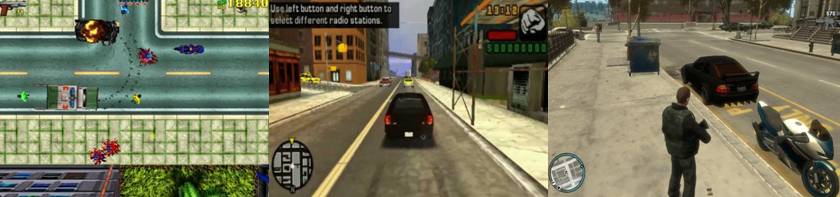
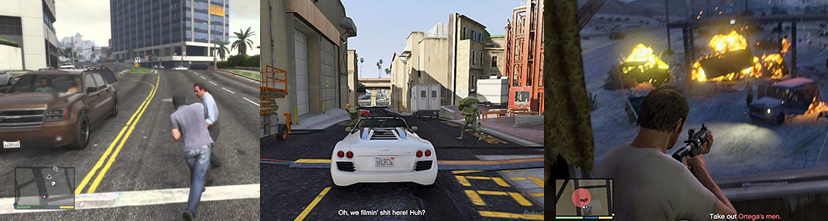

My Rating:

Rating: 3 out of 5.

Pretty Good

Are you a fan of The Simpsons? Have you have played this game out in the wild or did you first experience it through emulation or the PlayStation and Xbox ports? Which of the playable characters was your favourite? How do you feel the game holds up today, especially compared to other beat-‘em-ups? Would you like the see the game re-released again or do you think it’s better left in obscurity? What is your favourite Simpsons game? Do you have a favourite character, episode, or moment from the show? How are you celebrating Whacking Day today? Whatever your thoughts on the world’s most famous yellow family, feel free to leave a comment below and be sure to check back in for more Simpsons content!

Game Corner: Resident Evil: Operation Raccoon City (Xbox 360)

Released: 20 March 2002
Developer: Slant Six Games/Capcom
Also Available For: PC and PlayStation 3

The Background:
By 2012, the Resident Evil series (Capcom/Various, 1996 to present) had undergone many changes since debuting as a cheesy survival/horror title hampered by “tank controls”; Resident Evil 4 (Capcom Production Studio 4, 2005) famously switched the game to a more action-orientated, over-the-shoulder third-person perspective, which had been expanded upon greatly in Resident Evil 5 (Capcom, 2005) and would basically transform the series into an action-heavy shooter by Resident Evil 6 (ibid, 2012). In the midst of this transition into a more action-orientated franchise, developers Slant Six Games worked alongside Capcom on a spin-off, a squad-based shooter that reinterpreted events from the franchise’s early days. Despite selling over two million copies and being considered by Capcom to be a success, the game was met with mixed reviews perhaps in a reflection of the backlash against Resident Evil’s new direction; some praised the gameplay and mechanics while others criticised it as being inferior to other, similar videogames.

The Plot:
In a retelling of the events before and during the zombie outbreak in Raccoon City, an Umbrella Security Service (USS) strike team, under the command of HUNK, attempts to secure the G-Virus sample from Doctor William Birkin. However, they are soon forced to battle against Umbrella Biohazard Countermeasure Service (UBCS) mercenaries, flesh-eating reanimated corpses,  and the malevolent Umbrella Corporation’s many Bio-Organic Weapons (B.O.W.s), and faced with death and betrayal that cause them to question their orders.

Gameplay:
Resident Evil: Operation Raccoon City is a third-person, squad-based shooter in which players can pick from six members of the Umbrella Security Service (U.S.S.) Delta team (known as “Wolfpack”): Vector, Lupo, Beltway, Spectre, Bertha, and Four Eyes. Once you’ve selected your character, you must then select three others to assist you in the game’s missions to be controlled either by other human players using the game’s online function or assigned to the relatively competent A.I. No matter which character you select, the controls remain the same and will be instantly recognisable to players of similar third-person shooters: press in the left stick to run and then press A to dive ahead, press the Right Trigger to fire and the Left Trigger to aim, B executes a melee attack, you can switch weapons with the Left Bumper, toss grenades and other explosives with the Right Bumper, and press X to reload. The directional pad (D-Pad) also factors into gameplay; you can select from the different grenades available by pressing right, use a First Aid Spray by pressing left, use an Antiviral Spray by pressing down, and toggle through various vision modes by pressing up.

Each character has different abilities that can be used to give you an edge in combat.

Each character does, however, have access to several different abilities, which you can activate with Y for a variety of temporary effects. Vector specialises in reconnaissance and moves much faster, can become undetectable to enemy radar, mimic other characters, and become completely invisible; Lupo focus more on combat and is able to wear stronger body armour, reload faster, and utilise more versatile ammunition; Beltway is the explosive expert and is able to better resist explosions, disarm mines and traps, and utilise a wider variety of explosives; Spectre is all about detection and mapping and is able to expand upon the mini map and detect nearby items and enemies using different vision modes; Bertha is the team’s medic and can carry more healing items, use them more effectively, and reduce the amount of damage taken; and Four Eyes, being more of a virologist, can carry more Antiviral Sprays, detect infected individuals, and both infect and command infected targets. Similar to the more action-orientated Resident Evil titles, much of the game is focused more on combat rather than exploration and puzzle solving; as a result, you will automatically snap to cover when you’re near walls, barriers, or other objects and must often clear a room of enemies in order to progress. The game is surprisingly dark, however, so I recommend increasing the “Gamma” settings in the options to bring a bit of illumination to the darker areas, though the use of darkness is used to create a sense of ambience and dread to the proceedings.

The better you play, the more XP you’ll get and the faster you can upgrade weapons and abilities.

As you defeat enemies, find Raccoon City Mascots and data, destroy well-hidden security cameras, pick up Intel and send it using laptops, and complete missions, you’ll gain experience points (XP); XP is then used to purchase new weapons and unlock and upgrade each character’s Passive and Active abilities. While any character can use any of the weapons you unlock, once again you can only carry two weapons at a time, so you’ll most likely be dropping weapons and liberating new ones from your defeated foes, and you’ll need a great deal of XP to unlock and upgrade everything the game has to offer for its six characters. As is the standard for Resident Evil titles, you can pick up First Aid Sprays to fully refill your health and use green herbs to restore a little bit of health; if you come across a green herb, though, it cannot be stored in your inventory. Unlike most other Resident Evil videogames, though, you can actually become infected with the Tyrant Virus (T-Virus) and, unless you use an Antiviral Spray, will become a zombie and attack your team mates after a short period of time. Additionally, you can be afflicted with a “bleeding” status that will attract (and spawn in) all nearby enemies (though you can also inflict this status on human enemies to zombies attack them as well). Note, however, that while you can pick up First Aid Sprays, Antiviral Sprays, and additional weapons and explosives, you’ll lose all your new held items if you die during a mission.

Take advantage of the stashes of ammo to help stave off the swarms of zombies.

The A.I. is relatively competent in a firefight; if they get downed during combat, you can press A to revive them but you may find that they often wander around aimlessly and tend to shoot through doors and walls before enemies even spawn in. Your mission objectives generally involve holding out against wave upon wave of enemies, reaching a specific destination, and clearing out all enemies but you’ll also be tasked with destroying or locating certain items and objects. Other times, generally during boss battles, you’ll have to hold out until doors are opened, or open them yourself, and the battle becomes much more about survival as you desperately try to stay alive while a seemingly endless wave of enemies attack you. Despite the fact that the environments are littered with an abundance of ammo creates and plenty of ammo and weapons, it’s easy to be overwhelmed, which can lead to some frustrating moments that are probably made a lot easier when playing with another human.

Graphics and Sound:
Resident Evil: Operation Racoon City mostly holds up pretty well; thanks to many of the characters having their faces obscured by helmets and masks, the character models largely avoid resembling action figures and, when popular and recognisable Resident Evil characters do appear, they shine all the better for it. However, I did notice quite a few instances of slowdown and jitteriness when there were a lot of enemies and characters onscreen at any one time and more than a few clipping errors where characters would walk through parts of the environment.

Gore and creepy, recognisable locations are plentiful, if a bit dark at times.

The game’s environments are decent enough; they’re dark and creepy and fully of the usual Resident Evil ambiance, featuring flickering lights, blood trails, and an abundance of gore to punctuate the game’s action-orientated approach. There are a lot of little details here and there (though the dark lightning can make a lot of them difficult to make out) and, once you finally escape from the drab, grey corridors, you’ll get to fight through the ravaged streets of Raccoon City (which was a notable highlight). Other environments include the dark, maze-like offices of City Hall, a creepy cemetery, as well as recognisable locations from Resident Evil 2 (ibid, 1998) and Resident Evil 3: Nemesis (ibid, 1999) such as the police station (including Chief Irons’ office) and the prerequisite Umbrella laboratories and facilities. Despite the presence of a number of high-quality cinematics, the game’s cutscenes largely utilise the in-game graphics, primarily to ensure that your chosen character and team mates are properly loaded into each scene. This adds a degree of variety and replayability to the game as different characters have different dialogue in cutscenes, though it does seem as though the game recycles a lot of sounds from Resident Evil 5.

Enemies and Bosses:
As you might expect, one of the most common enemies you’ll encounter in Resident Evil: Operation Raccoon City are zombies; zombies are slow, shambling corpses who go down quite easily but generally attack in large groups and will lunge and grab at you to try and take a bite out of you. In these situations, you can frantically wiggle the left stick to try and shake them off and you better make sure you do this as they can infect you or cause you to bleed otherwise. Dead bodies in the nearby area will often pop up as surprise zombies, who can also power-up and return to life as the much faster, tougher, and more aggressive Crimson Heads so make sure you take them out with a good old head shot before they get the chance to do this. Similarly, you’ll also encounter the odd Cerberus; these infected dogs like to pounce at you out of nowhere to give you a good scare and you’ll also have to shake off their bite and have a good aim to take them out because of how fast they can be. You’ll also come up against spider-like Parasites that quickly scuttle across the environment and can also be difficult to hit. These become doubly annoying when they join with a zombie as not only will Parasite Zombies be faster and more dangerous thanks to the Parasite’s extra limbs but you’ll also have to kill the Parasite after taking out the zombie host.

Lickers and Hunters are as formidable a threat as ever thanks to their superior strength.

You’ll also come up against some of Resident Evil’s most notorious B.O.W.s, such as the Lickers and the Hunters; Lickers scramble all over the walls and ceilings, popping out from vents and grabbing at you with their long tongues. Fast and difficult to hit, it’s best to target their exposed brains but they can easily overwhelm with their sheer numbers and ferocity. Similarly, Hunters will often drop from the sky in torpedo-like capsules and attack with an unmatched viciousness; leaping and charging across the place, they attack with large, deadly claws and take a great deal of punishment before going down so you’ll definitely need your more powerful weapons to make short work of them. Apparently because B.O.W.s aren’t interesting and dangerous enough, you’ll have toe exchange gunfire with a variety of living, human enemies; soldiers from the Umbrella Biohazard Countermeasure Service (U.B.C.S.) will fire at you from behind cover and other barricades, often to provide support for series staples such as Leon S. Kennedy and Claire Redfield, and are surprisingly durable and difficult to spot. You’re encouraged to inflict them with the bleeding status to send nearby zombies into a frenzy and tear them apart but this can just as easily be bad news for you, too, as the U.B.C.S.’ bullets can cause you to bleed and the final mission of the game is notably frustrating because you end up caught in a crossfire between the well-equipped U.B.C.S. and an endless swarm of zombies.

Keep your distance from the invincible “G” to avoid his swings and hold him at bay.

If you’ve played Resident Evil 2 and 3, you’ll instantly recognise the bosses and larger B.O.W.s included in the game; given that your first mission is to retrieve the Golgotha Virus (G-Virus) samples from Birkin’s laboratory, the first boss you’ll encounter is Birkin in his monstrous “G” form. “G” can’t be killed, however, making this a tense chase down a very narrow corridor as you desperately avoid “G”’s wild swings and slow him down by shooting nearby explosive barrels and pipes. If you linger around too long or get too close to him, it’s stupidly easy to get caught up and glitched on his hit box and the nearby environment so just turn around and run and save your ammo and efforts for when the game tells you to hold him at bay.

Mr. X is bad enough by itself but is accompanied by other enemies and another Tyrant!

Another recognisable B.O.W. you’ll encounter more than once is the T-103 Tyrant known as Mr. X; this massive, hulking figure has a tendency to attack and damage other B.O.W.s in its path and can be briefly controlled by Four Eyes but, for the most part, is indestructible when you first encounter it, leaving you to desperately run around taking out zombies and Parasites as you retrieve key cards to escape the area. In a later mission, two of the damn things attack you at once and you must take them out in order to progress. They’re incredibly strong, leaping and charging at you, pounding you into the ground and squeezing the life out of you with each so it’s best to keep your distance, focus on one at a time, and always aim for the head. One of the most troublesome and frustrating missions of the game sees you staving off wave after wave of zombies and U.B.C.S. soldiers while trying to bring down the Nemesis-T Type, an intimidating creature by itself without all the additional enemies swarming the area. After numerous deaths and failures, I found it was much easy to quickly take out any nearby zombies, grab some restorative sprays, and camp out by the ammo crate and take pot shots at Nemesis until it finally dropped to the ground, taking advantage of the explosive barrels wherever possible. Even then, it can rear up and keep ticking along, all while you’re getting shot to shit and desperately trying to bring it down so you can inject it with the NE-α parasite.

Concentrate your fire on the Super Tyrant’s exposed heart to take it out quickly.

As in Resident Evil 2, you’ll have to do battle with Mr. X’s final form onboard an elevator; again, like Nemesis, the Super Tyrant is powerful and formidable enough without the battle being made more strenuous by the presence of Lickers, flame jets, and being a gauntlet that you must complete without any checkpoints mid-way through. To take out the Super Tyrant, it’s best to camp out by the ammo crate, stay away from it, and shoot at its exposed heart with everything you’ve got. If it’s close enough to the elevator edge, you can knock it off pretty quickly in the first phase of the battle and, as long as you can pick off the Lickers and avoid being roasted alive, you can repeat this strategy for the second phase of the fight where the B.O.W. is much faster and more aggressive.

Claire, Leon, and swarms of soldiers and zombies await you in the final mission of the game.

In a change of pace, however, the final challenges of the game have you taking on Claire and Leon in separate missions; Claire awaits you in an infested train yard and likes to take pot shots at you with a grenade launcher but tags out before you get to make her pay for her insolence. When you get to the end of the train yard, Leon camps out up top and snipes at you while being protected by U.B.C.S. soldiers behind a fortified barricade and zombies roam the immediate area. This, without a doubt, was the toughest and most frustrating part of the game at that point and, in the end, I was reduced to simply tanking damage and running the barricade to reach the ladder and trigger the cutscene that led to the game’s final mission. Here, you’re given two options: one sees you spare Leon and the other sees you kill him as per your orders. If you kill him, you’ll have to take out a couple of your team mates before you can get to Leon, who blasts at you from behind cover and can cut you down with ease unless you bring along or get your hands on the sniper rifle. If you spare him, it’s the same thing but, this time, you’re defending him from your team mates and it’s a far easier fight but, if you want to get all of the game’s Achievements, you’ll need to slog through this final mission at least twice.

Power-Ups and Bonuses:
As mentioned above, you have a variety of restorative items available to you in the game; green herbs offer a quick, one use pick-me-up, First Aid Sprays can be stocked and refill more of your health, and Antiviral Sprays will cure you from infection if needed. Unlike a lot of third-person shooters, your health won’t replenish over time so it’s best to keep a First Aid Spray in your inventory and to keep your team mates nearby so they can revive you as checkpoints are often lacking mid-way through the more frustrating missions.

Use XP to purchase new weapons and be sure to shoot open weapon crates whenever you see them.

Each character has a variety of unique Passive and Active abilities; Active abilities also come with a cooldown period so you can’t spam their use over and over and some are, honestly, more useful than others; the mechanics are definitely geared towards human players working together and using each character’s abilities to the best of their advantage and you’ll be grinding and replaying missions quite a bit to unlock everything and make life easier for yourself. Of course, the main power-ups you’ll pick up are the wide variety of weapons; pistols, shotguns, assault rifles, sniper rifles, and heavier weapons like grenade and rocket launchers are all available if you have enough XP but you’ll also be able to liberate them from dead U.B.C.S. soldiers and grab better weapons from weapon creates scattered throughout the environments (you’ll need to shoot the locks off these first, though). You’ll also be able to use familiar weapons from the franchise, such as the Samurai Edge and Barry Burton’s magnum, and three different types of grenades (frag, flashbang, and incendiary). Thankfully, you don’t need to use XP to upgrade the proficiency of the weapons and, once you unlock them, any character can use them but you’ll still need a lot of XP to unlock everything.

Additional Features:
Resident Evil: Operation Raccoon City has fifty Achievements for you to earn; many of these are tied to simply clearing the single player missions but you’ll also get Achievements for purchasing weapons and upgrades, healing a certain amount of times, and killing a certain amount of enemies. Some are much trickier to get and require you to finish he game on harder difficulty modes, purchase and upgrade every ability, and kill enemies in specific ways.

There’s a fair amount of multiplayer and DLC options available if you want more content.

Many of the rest are tied towards the game’s many multiplayer modes; the game’s single player campaign can be played in co-op and it also features a variety of competitive modes, from traditional deathmatches to a survival mode and one that has you searching out G-Virus samples, and the Xbox 360 version also has an exclusive “Nemesis Mode” that allows one player to take control of the Nemesis and hunt down and kill the other players. Unfortunately, I never got to experience any of Operation Racoon City’s multiplayer options as they game cannot be played locally, which is always frustrating and mind-boggling for me, meaning I couldn’t even 100% all of the Achievements even if I wanted to. Operation Raccoon City isn’t an especially long game (I finished it on “Normal” mode in around eight hours), even in its most frustrating moments, but you can extend the game’s playtime by purchasing the “Spec Ops” downloadable content (DLC), which adds six more playable characters, a number of additional campaigns and Achievements, and more recognisable characters from the series to expand upon the game’s unique retelling of the second and third games.

The Summary:
Resident Evil: Operation Raccoon City is a decent enough title for a spin-off of the main series; it takes many familiar characters and concepts from the franchise and reimagines them, fully embracing its more action-orientated mechanics and being a relatively inoffensive third-person shooter. It’s not much compared to the Gears of War franchise (Various, 2006 to present) and lacks a lot of the appeal of main series titles like Resident Evil 4 but, had Capcom kept the more action-orientated, third-person mechanics confined to a side series such as this, Resident Evil 6 might have turned out a little less disappointing. However as great as it is to battle the franchise’s gruesome B.O.W.s with more freedom and more detailed graphics compared to the original PlayStation releases, Operation Raccoon City has a lot of flaws and bugs and frustrating parts that really drag it down; the clipping and frame rate issues were noticeable, the lack of checkpoints and losing all of your inventory after dying can make bosses and the survival missions needlessly exasperating, and the sudden, anti-climactic end of the game really derails what little story is on offer. Overall, it’s a decent enough experience that should satisfy fans of the series, especially the more action-heavy titles like Resident Evil 5, but fans of third-person shooters can definitely find better options on the market.

My Rating:

Rating: 2 out of 5.

Could Be Better

What did you think to Resident Evil: Operation Raccoon City and how do you think it holds up as a third-person shooter and spin-off of the main series? Which of the playable characters was your preferred choice? What did you think to the game’s minor retelling of the main story and the encounters with recognisable Resident Evil characters and monsters? Did you choose to kill or defend Leon at the conclusion of the game? Did you ever play the game’s multiplayer and, if so, what was it like? Which Resident Evil videogame, character, monster, or spin-off is your favourite, and would you like to see a return to the more action-orientated style the games adopted during this time? Whatever you think, feel free to leave your thoughts down below.