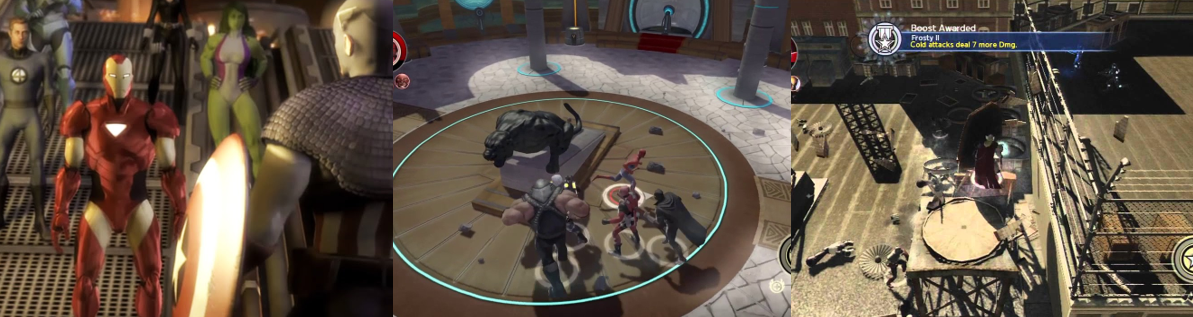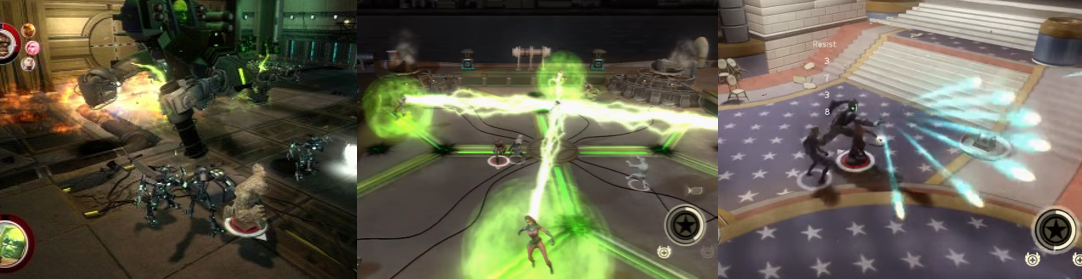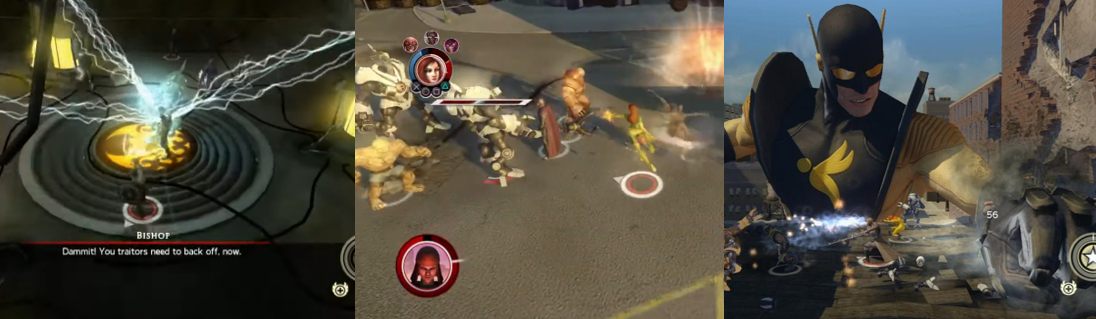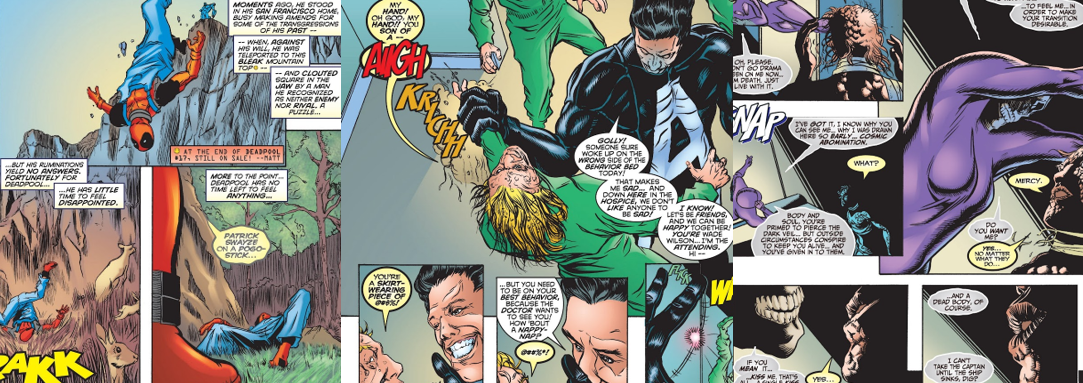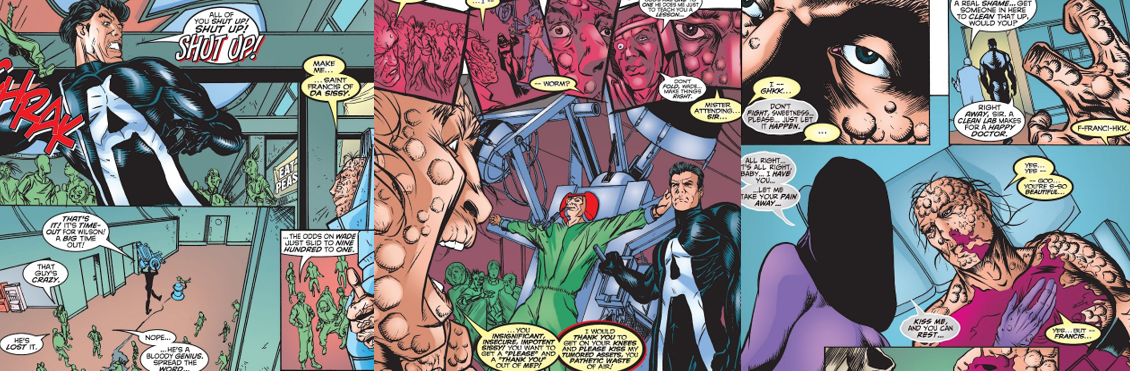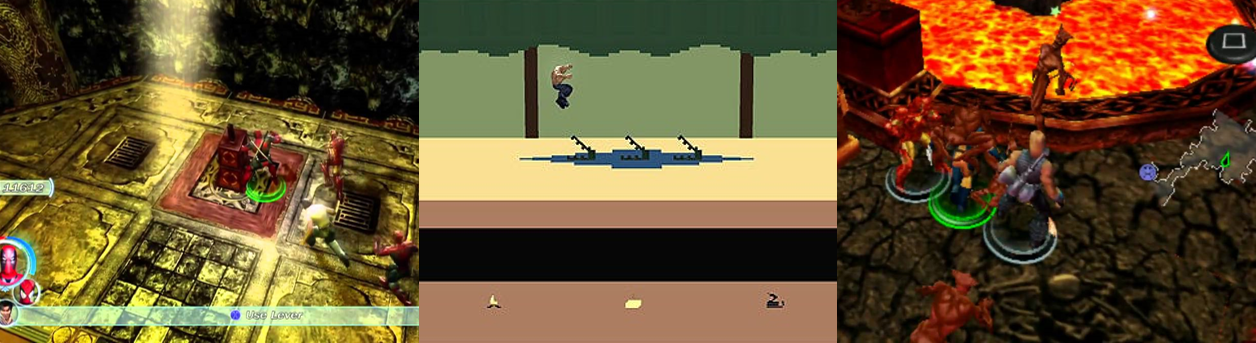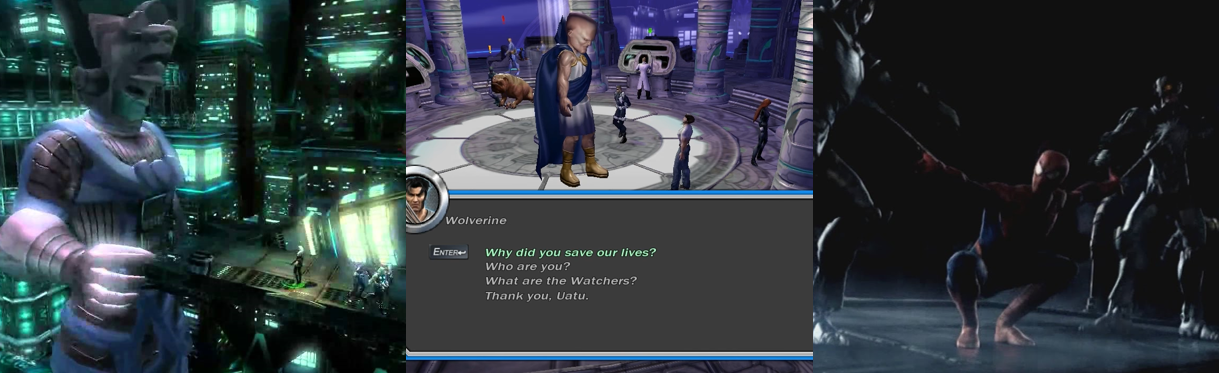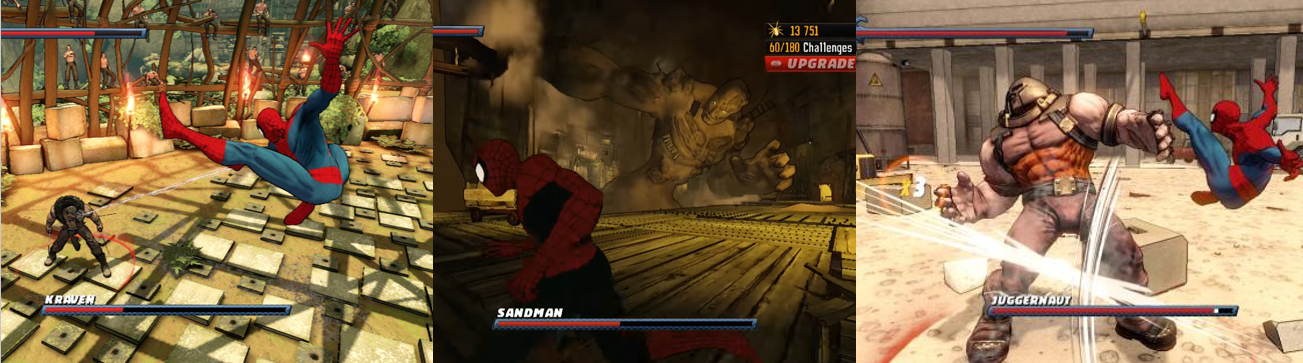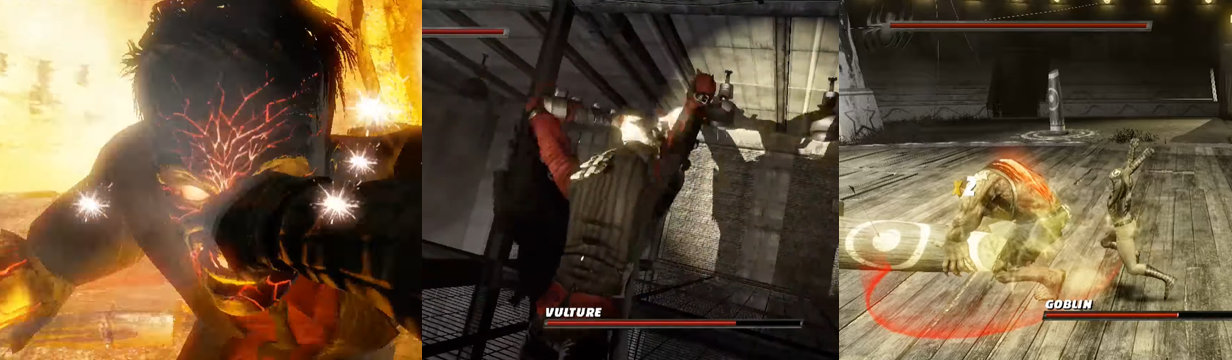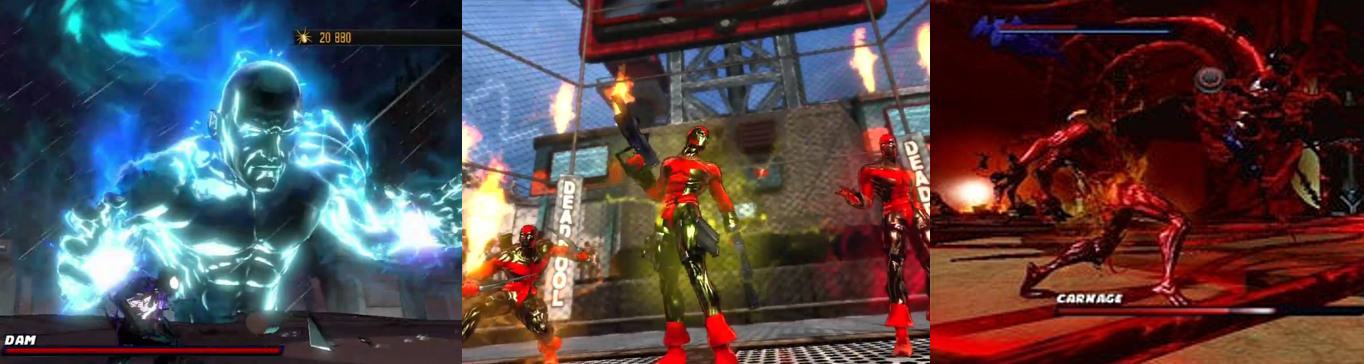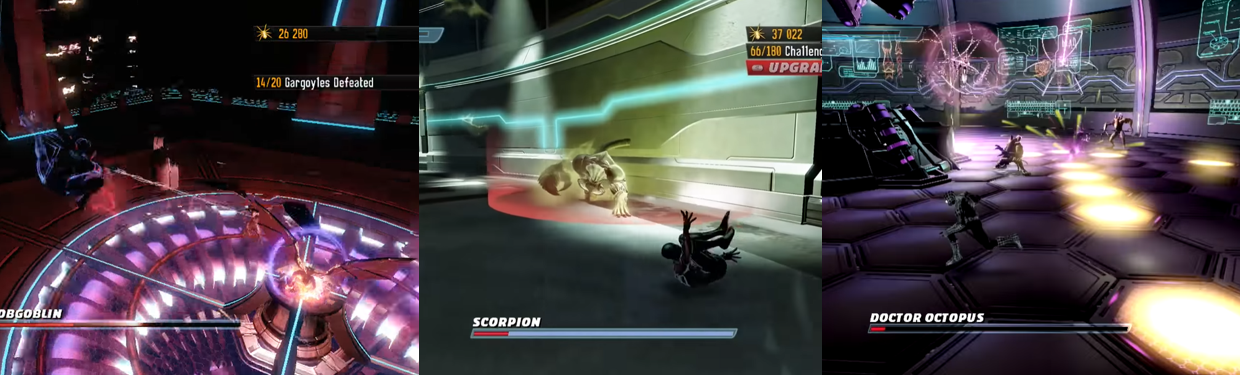
Game Corner: Marvel: Ultimate Alliance 3: The Black Order (Nintendo Switch)

Released: 19 July 2019
Developer: Team Ninja

The Background:
For decades, few videogame publishers were as synonymous with Marvel Comics as Activision, who produced adaptations Marvel’s most popular properties. While some were better than others, Activision’s efforts were largely praised, especially after they partnered with Raven Software on the X-Men Legends games (2004; 2005). Activision and Raven Software expanded their scope to the rest of the Marvel universe with Marvel: Ultimate Alliance (2006), a largely successful team-based brawer praised for improving upon its predecessors. Though now delisted, it was followed by a sequel three years later, courtesy of Vicarious Visions, which tweaked the gameplay with team-based attacks to encourage experimentation. Though Marvel: Ultimate Alliance 2 (2009) was praised for its branching storyline, the stripped down roleplaying mechanics were criticised. While it was also delisted in 2020, fans were clamouring for a follow-up and, just ten years later, Team Ninja stepped in to work alongside Marvel in reviving the franchise. Seeking to place additional emphasis on combat, the developers explored the cosmic scope of the Marvel universe by including the Infinity Stones and lesser-known characters and chose to make the title a Nintendo Switch exclusive after developing a close relationship with Nintendo. Although Marvel: Ultimate Alliance 3: The Black Order was the sixth best-selling game in its first week and was later bolstered by extensive downloadable content (DLC), it was met with mixed reviews that praised the colourful action but criticised its lack of innovation.

The Plot:
While battling Nebula and Ronan the Accuser, the Guardians of the Galaxy stumble upon a plot by the mad titan, Thanos, to collect the six Infinity Stones. Although they scatter the Stones, Thanos’s acolytes, the Black Order, pursue the gems, prompting an alliance of Earth’s mightiest heroes to retrieve them first.

Gameplay and Power-Ups:
Like its predecessors, Marvel: Ultimate Alliance 3: The Black Order is a team-based action role-playing game in which players assemble a squad of four heroes from across the Marvel universe to battle various nefarious baddies, primarily the titular Black Order, who are hunting the six all-powerful Infinity Stones on behalf of their master, Thanos. The game offers five save slots, two initial difficulty levels, and a base roster of thirty-six playable characters, with many being encountered as you play through the story and joining your alliance either after fighting alongside you or being freed from some kind of mind control. Marvel: Ultimate Alliance 3 offers three controller configurations, thankfully none of which involve motion controls, and allows you to toggle overlays, notifications, tips, and other onscreen elements from the “Settings” menu. These include altering the camera placement, which enables a lock-on feature by pressing in the right stick, though the camera generally remains more focused on whichever character you’re controlling rather than offering a bird’s eye view as in the last two games. Although you can fight alongside friends either locally or online, you switch between your teammates with the directional pad (D-pad) when playing alone and your computer-controlled partners are very useful in a fight, attacking, enabling team attacks, and reviving defeated characters without any input from you. Pressing A sees you interact with the environment to activate consoles, pick up or move certain objects, and talk to other characters. You jump with B, executing a double jump, swinging from webs, or flying depending on which character you’re playing as, and throw light attacks with X and heavy attacks with Y. These can be strung together to perform basic combos and you can also perform a mid-air attack and throw objects (like bombs and missiles) by pressing Y. You block incoming attacks by holding the Z trigger and tap it to dodge, and collect glowing red orbs from defeated enemies or smashed crates to restore health, blue orbs to refill your Energy Point (EP) gauge, and credits to spend on upgrades.
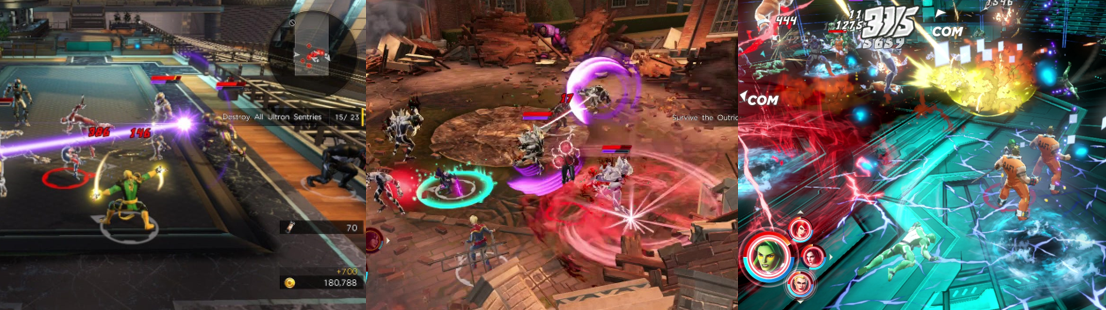
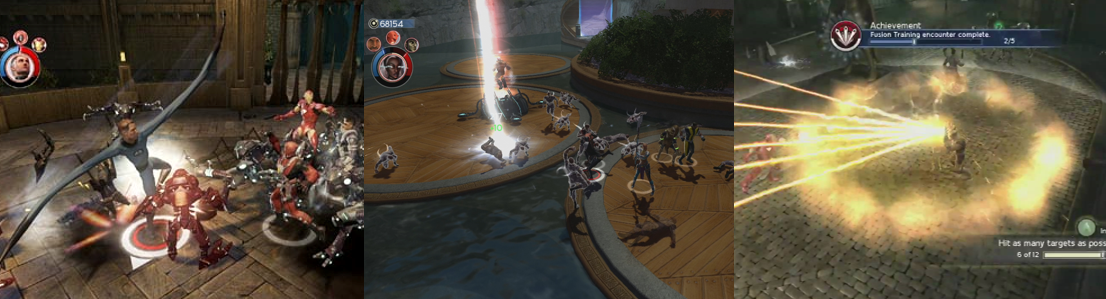
Combat is thick, fast, chaotic, and constant thanks to loads of enemies and character abilities.

As in the last two games, each character has specific abilities tied to their superpowers or superhero traits. You activate these by holding the Right trigger and selecting an icon using the D-pad; using Abilities drains your EP, however, and each Ability comes with a different cost. However, these attacks allow you to stun, stagger or deal elemental damage to enemies using Peter Parker/Spider-Man’s webs, Thor Odinson’s lightning, and Doctor Robert Bruce Banner/The Hulk’s incredible strength. Many characters have projectile attacks in their arsenal, such as Wade Wilson/Deadpool firing guns and Scott “Slim” Summers/Cyclops blasting his eye beams, while others cause splash damage or specific buffs, like Piotr Rasputin/Colossus being able to reflect projectiles and Wanda Maximoff/The Scarlet Witch healing her allies. Some, like James “Logan” Howlett/Wolverine, have passive abilities that allow them to automatically regenerate health as they walk around; others, like Johnny Blaze/Ghost Rider and Ororo Munroe/Storm, specifically deal in elemental damage. Character’s Abilities can also be mixed and matched by holding ZR and pressing one of the face buttons (or pressing A when prompted); this sees two characters attack in a combo for additional damage. As you dish out and take damage, you’ll also build the Extreme (EX) Gauge). Once full, you can press L and R up to three times to have two to four of your teammates perform a devastating combination attack that’s great against bosses. While the various cannon fodder you fight are easily dispatched, larger commanders and bosses need their “stun” meter drained before you can really put a beating on them and others (and certain treasure chests) require specific combination attacks to breach their shields. Defeating enemies sees your characters gain experience points (XP) to level-up, increasing their statistics (attack, defence, etc), though you can also use the various Orbs you find to manually level-up. Each character’s special Abilities can also be further enhanced using Ability Orbs and credits, reducing the EP cost and increasing their damage, among other benefits. You can also earn “Team Bonuses” depending on your team selection: pick a group of X-Men, for example, and your strength or resistance stat will increase, while picking characters of royalty ups your maximum energy stat.
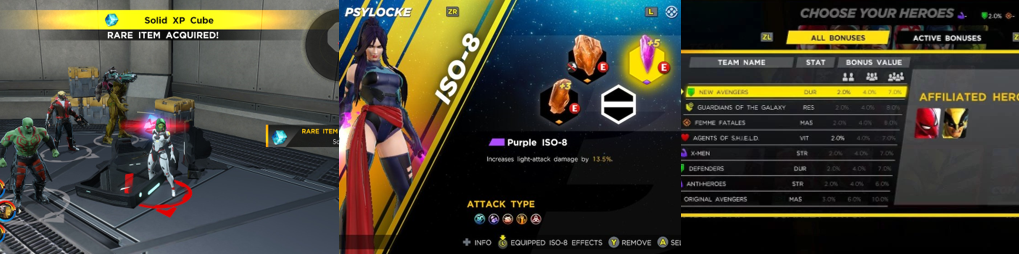
Search for chests to gain currency and other expendables to upgrade and buff your alliance.

Although you can’t equip gear to your characters, the boss battle against the Destroyer armour sees you temporarily empowered by Asgardian magic and you can eventually equip your team with “ISO-8” crystals, coloured stones that enhance their attack power, resistance to elements, or critical hit ratio, among others. You can further upgrade these with credits and ISO-8 capsules, though some of the rarer ones will also debuff you (for example, your attack my increase but your defence will decrease accordingly). You’ll also inevitably gain access to the Strategic Hazard Intervention Espionage Logistics Directorate (S.H.I.E.L.D.) Lab, which acts as the game’s skill tree. By spending credits and Enhancement Points (EP), you can further increase your team’s overall attack, defence, resistance, vitality, and such and even unlock additional ISO-8 slots (with more being earned by levelling-up). You can also enter the S.H.I.E.L.D. Depot from the main menu to purchase additional costumes and social icons by spending S.H.I.E.L.D. Tokens. Marvel: Ultimate Alliance 3 is pretty forgiving (on the “Friendly” difficulty, at least), with multiple checkpoints in each area. When you activate a S.H.I.E.L.D. checkpoint, your team is fully healed, and you can swap or enhance them if you wish. If a teammate is defeated, you can hold A to revive them, but I wouldn’t recommend it unless you absolutely have to. Not only are revives limited, but downed characters will eventually return to full health even before you reach a checkpoint so it’s not worth risking another character taking damage by healing a partner. Exploration generally leads you to treasure chests or special walls that require a special combination attack to open, or to a “Rift” challenge that takes you away from the main game to tackle a special challenge (usually a boss rematch or enemy gauntlet) for extra rewards. Your path is incredibly linear most of the time, hence why there’s no map, and the game’s primary focus is on chaotic combat and visually manic team-based attacks. Unlike in the last two games, you can no longer grapple or throw enemies (though you can still send them flying off certain platforms) and there are no character-specific team-up moves, meaning the action can quickly get quite tiresome.
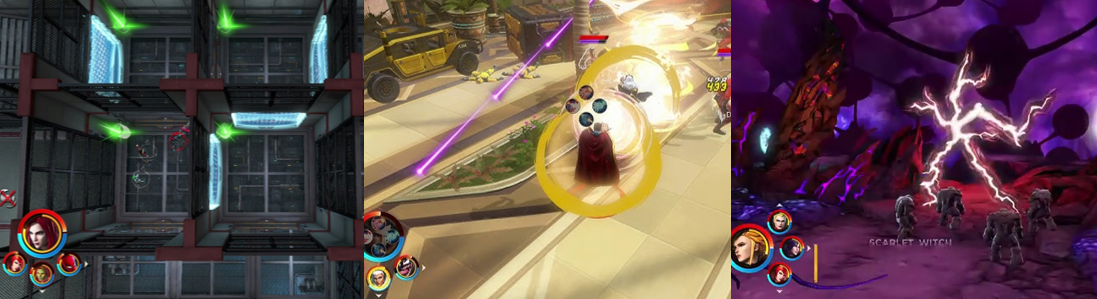
Sadly, puzzles are practically non-existent, with only Rifts offering additional challenges.

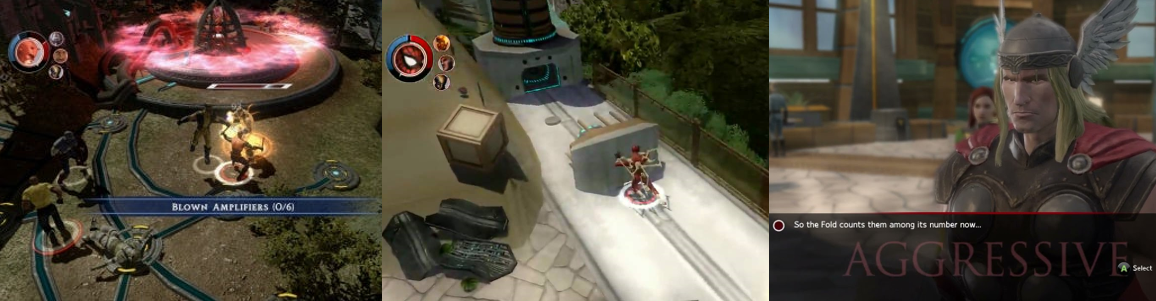
Because of its focus on hectic combat, there’s even less room for puzzles than there is for exploration in Marvel: Ultimate Alliance 3. Puzzles boil down to activating a console to open a door or making a platform move and that’s it. Sometimes, you’ll hold A to move a block and avoid lasers or cannons, but mostly you’ll be timing jumps between said lasers to progress and simply hurling missiles at those cannons. Sometimes, you’ll rotate statues or press switches to progress; others, you’ll be avoiding toxic ooze in Hel or solving door puzzles at the Raft or in Avengers Tower. After hopping across the rooftops of New York City, you’ll infiltrate the heavily fortified fortress of the Hand, dealing with ninjas that drop from the sky and hidden arrow hazards. When in Wakanda, Advanced Idea Mechanics (A.I.M.) corrupt T’Challa/The Black Panther’s defences, leading to an exasperating section where you must avoid snipers and being roasted by a giant panther statue’s energy blast. When transported to the Dark Dimension, you must use portals to reach new areas and defeat waves of demonic enemies to lower magical barriers and progress. Some attacks also screw up your controls or temporarily freeze you; some enemies are best defeated by tossing explosives at them; and many missions have an additional character fighting alongside you who’s often unlocked afterwards. However, a lot of the additional features of the previous games are missing; you can talk to other characters, but there are no dialogue options or character-specific interactions. There are no trivia quizzes, no optional side missions beyond the Rifts, and no character specific challenges to unlock extra stuff for each character. There aren’t even hub areas, in the traditional sense, with characters just appearing around S.H.I.E.L.D. checkpoints at times, though you can destroy a fair bit of the environment, and some encounters have you fleeing towards the camera as bosses chase you or present you with unwinnable battles.

Presentation:
Whereas the last two games primarily based their aesthetics on the comics books, especially the Ultimate comic line, Marvel: Ultimate Alliance 3 adheres very closely to the Marvel Cinematic Universe (MCU), especially in the visuals of its locations. I was hard pressed, for example, to tell the difference between Asgard here and the Asgard to the MCU, with both the golden city and the rainbow bridge, the Bifrost, appearing almost exactly as they’re depicted in the films. The same is true for Wakanda, the Dark Dimension, and Knowhere, all of which are virtually indistinguishable from how they appear in the MCU. There are some differences, of course: Taneleer Tivan/The Collector’s museum, for example, uses coloured cube cages and Wakanda leans much more into traditional architecture than the pseudo-futuristic science of the films (likely because Black Panther (Coogler, 2018) released a year before this game was made). Xavier’s School for the Gifted is lifted almost exactly from the 20th Century Fox X-Men movies (Various, 2000 to 2020), however, including a hedge maze, 1:1 Cerebro room, and basketball court that doubles as a landing pad for the Blackbird. While the Dark Dimension and the cosmic mind trip that is Sanctuary also heavily borrow from the bizarre cosmic imagery of the MCU, the Raft and Avengers Tower are much more akin to their comic book counterparts, though they’re comparatively bland locations, lacking fun areas like the Danger Room or Wakanda’s Necropolis (though you do pass through Anthony “Tony” Stark/Iron Man’s Hall of Armours in the tower). Although you only make a brief stop in Attilan to try and get help from the Inhumans, the architecture is far more visually interesting than that awful television show, seemingly being comprised of Celestial technology, and I enjoyed the ominous gothic presentation of Hel, with its restless Viking warriors and damaging sludge. Unfortunately, Marvel: Ultimate Alliance 3 continues the trend of having disappointingly bland and forgettable music, opting for generic themes for each location, event, and character that are lost amidst the constant fighting.
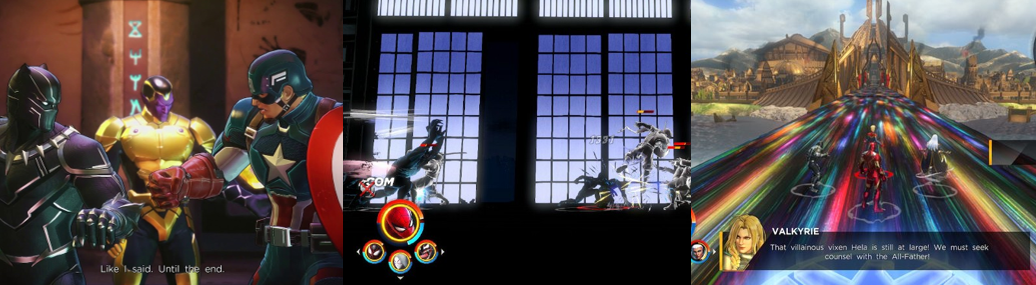
A visually impressive brawler that takes obvious inspiration from the MCU films.

The game also opts for an almost cel-shaded, action figure-like aesthetic for its colourful cast of characters. While many again both look and sound like their MCU counterparts, there are some exceptions: Peter Quill/Star-Lord, for example, looks nothing like Chris Pratt and the X-Men are far closer to the comic books than Fox’s films. Despite you assembling a custom team of heroes, cutscenes depict either everyone or characters specific to the location you’re in (the corrupted Doctor Stephen Strange in the Dark Dimension, for example) as they’re better suited to advance the plot against the local baddies. With the game shifting to a more third-person perspective, you’re closer than ever to the action and can see more of the environment than in the previous games. However, this comes with some drawbacks: mainly, there are far less opportunities or incentives to explore. Second, environments are painfully linear, with dead ends or locked doors barring your progress. Third, and most frustrating, is the camera, which easily loses track of your opponent/s and often lumbers you with wireframe representations when the foreground blocks the view. Thankfully, you won’t be falling down pits and rarely have to worry about onscreen hazards, but it can be aggravating trying to figure out which platforms and crates can be jumped on and which can’t. Marvel: Ultimate Alliance 3 offers a diverse cast of characters, each with their own idle poses and quips, though these do inevitably repeat. The game’s also surprisingly light on Easter Eggs: you’ll spot Deadpool singing away as he makes tacos in the X-Mansion, but not much else, and there are no optional missions or choices to encourage replaying missions. It’s a far cry from the first game, where there was always something to collect or an additional character to help out. Instead, it’s basically all combat, all the time in Marvel: Ultimate Alliance 3. Luckily, the game looks pretty good (everything’s very colourful and true to its inspirations) and performs really well, though there are some long load screens and it is annoying being forced to continue your game every time you challenge a Rift.

Enemies and Bosses:
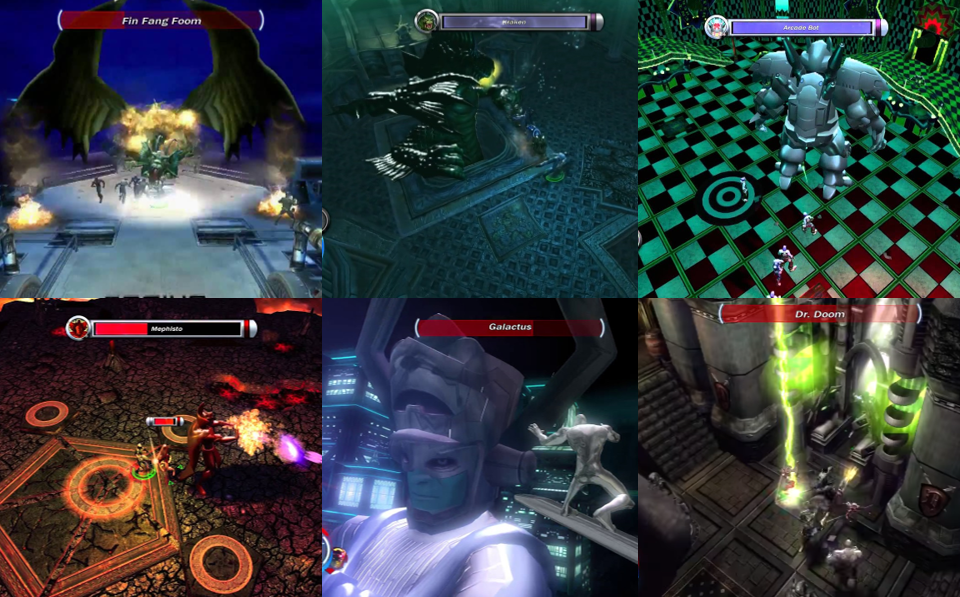
All the usual suspects appear here as disposable cannon fodder for you to endlessly beat up, with many of the game’s goons sharing traits across the various locations. You’ll encounter Kree, Ultron Drones, agents of A.I.M., and Doombats who all pack various energy blasters. Ultron’s clones are the worst for this, relentlessly firing energy blasts and crashing through windows. The Raft’s unscrupulous prisoners attack in large groups, as do the restless Viking warriors who populate Hel, tossing axes from afar and luring you into toxic goop. Gargoyle-like Fire Demons also dwell here, offering a greater challenge with their swoop attack and fire breath, not unlike the monstrous Outriders and Mindless Ones who make up Thanos and the dread Dormammu’s forces, respectively. Alpha Primitives, Hydra goons, and towering Sentinels also appear, with the latter firing huge energy blasts from the palms and best attacked by throwing their explosive energy cores back at them. No matter where you are and what enemies you fight, more powerful commanders will also appear. Larger, tougher, and sporting a stun meter, these commanders should be your top priority as they’ll charge across the screen, cause shockwaves, and generally offer a far greater challenge even when you’re at a higher level. These minions often fight alongside their masters, generally so you can recover some health and EP to better damage the bosses, and will endlessly spawn in one of the additional modes unless you destroy their teleporters. Some of the game’s challenges or story-based missions charge you with defeating a certain number of enemies to progress. Other times, bosses appear in these waves, and you must occasionally flee or purposely lose some fights. This happens when Cain Marko/The Juggernaut comes tearing through the X-Mansion, for example, and in early encounters with the Black Order, who cannot be beaten or will chase you, raining lightning or other attacks from the sky and across the ground.
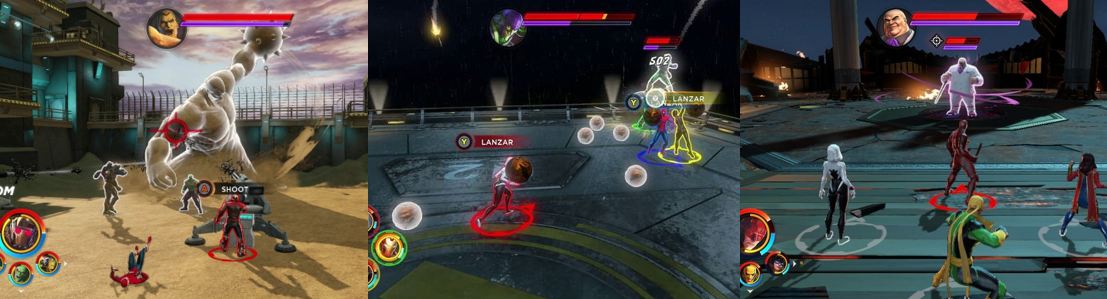
Few bosses require more than just hit-and-run tactics, even when augmented by an Infinity Stone.

There are loads of bosses to fight in Marvel: Ultimate Alliance 3, with some returning from the previous games, some teaming up, some having a couple of phases, and all boiling down to whittling down their stun bar, unleashing an EX attack and/or your most powerful Abilities, and avoiding damage until you can repeat this. The first ones you’ll face are Nebula and Ronan the Accuser, who often appear as a duo in optional challenges. Nebula is faster and more nimble, wielding blades where Ronan uses a massive warhammer. Both set a standard all bosses follow, which is that they’ll use either a jumping slam or an explosion of energy (or both) to send you flying. While quelling the riot in the Raft, you’ll encounter a version of the Sinister Six, with some unique variations to each battle. Flint Marko/The Sandman, for example, flings waves of sand and erupts his big sand fist from the ground as a large sand creature. You must use A to mount the nearby cannons and unload on him to chip away at his stun meter. Maxwell “Max” Dillon fights alongside Eddie Brock/Venom, raining lighting and electrocuting you with bursts of electricity, before he’s eaten by Venom and starts busting out electrically-enhanced symbiote powers. Venom joins the team after this fight and is tested against Quentin Beck, who first brainwashes Mile Morales/Spider-Man, Gwen Stacy/Spider-Woman, and Kamala Khan/Ms. Marvel to fight you and then unleashes a poisonous mist, teleports about, and confuses you with duplicates, Doctor Otto Octavious/Dr. Octopus is fought in a two-stage fight where you must first avoid his tentacles and scurry charge and then attack each arm to stun him. Finally, you’ll battle Norman Osborn/The Green Goblin for the Time Stone. The Green Goblin swoops overhead and lingers slightly out of reach, peppering the arena with his pumpkin bombs, charging at you, and freezing time to bombard you. He’s noticeably weak to his pumpkin bombs, however, so try and toss them at him before they explode in your face! After battling into the Hand’s fortress, you must first free Elektra Natchios from the Hand’s influence and then face Lester/Bullseye and Wilson Fisk/The Kingpin in separate fights. You must take out the ninjas feeding Elektra power, avoid Bulleye’s spread of razor sharp and explosive cards, and dodge the furniture and massive energy beam thrown by the Power Stone-enhanced Kingpin. The Kingpin also charges like a rhino, leaps at you to cause shockwaves, and even rips up stone columns to use as melee weapons!
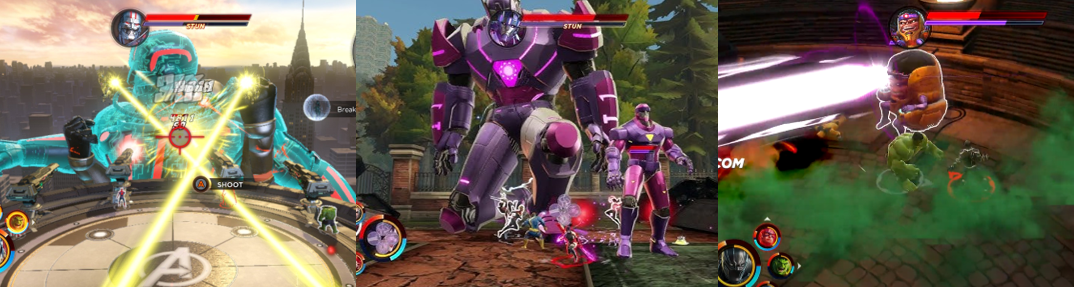
Gigantic bosses and the quirkier villains help mix-up the otherwise tedious combat.

Avengers Tower is then attacked by Ultron and his drones, who assist him in battle. Not that he needs it as the Mind Stone allows Ultron to mess up your controls, to say nothing of his signature face and palm beams. Ultron then grows to gigantic proportions, sweeping the area with his eyebeams before Clint Barton/Hawkeye intervenes and Ultron merges with Ultimo. This is the first giant boss battle in the game and sees you blasting Ultimo with cannons and avoiding his massive swipes. The Infinity Sentinel is comparatively smaller, but no less dangerous thanks to its own face beam and missiles. Though you can damage it with Sentinel cores, it’s finished in a cutscene by Erik “Magnus” Lehnsherr/Magneto, who then tosses debris and throws you off balance with magnetic pulses while Juggernaut pummels you and Raven Darkholme/Mystique tosses daggers. After surviving Mystique’s Danger Room trials, you face Magneto, now even tougher thanks to the Power Stone, before being chased away and banished to the Dark Dimension by the Black Order. There, you battle past Loki Laufeyson (who boasts elemental attacks and duplication tricks) to eventually face the dread Dormammu, who wields the Reality Stone and is the second giant boss. You must subdue his minions and avoid his flame bursts, whittling down his magical barrier either directly or be destroying three nearby orbs, all while dodging his giant fists and ground spikes. The brief fight with Maximus Boltagon is far easier, even though the mad Inhuman carries a massive energy cannon and you must take cover in Thane’s energy bubble to avoid Maximus’s barrage of lasers. Ulysses Klaue/Klaw awaits in Wakanda and his sound-based energy blasts and waves must be overcome to rescue and recruit James Buchanan “Bucky” Barnes/The Winter Soldier. You then fight past A.I.M. to confront their master, George Tarleton/Mental Organism Designed Only for Killing (MODOK), who uses the Soul Stone to turn the Dora Milaje against you and attacks with a slew of appendages, from buzzsaw arms, poison gas, failing tentacles, and his signature forehead blast.
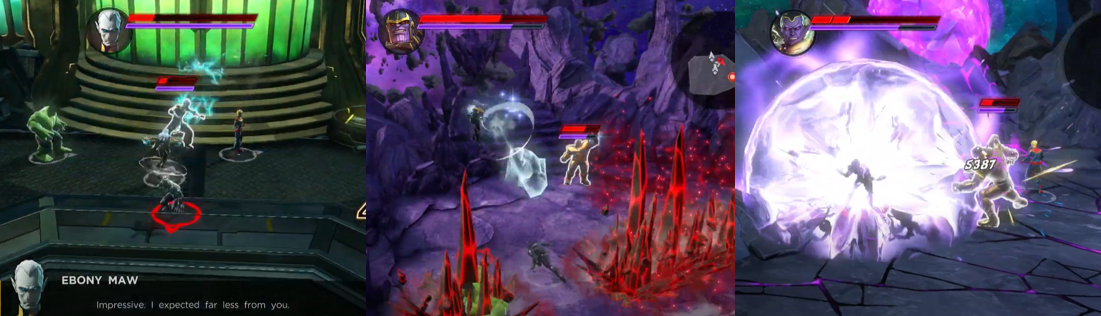
Battles with the empowered Black Order, Thanos, and Thane offer some of the most enjoyable challenges.

Though your goal in Hel is to confront Hela, you’ll actually battle the fire demon, Surtur, in another giant boss battle. This was a bit of a difficulty spike for me as Surtur’s flaming sword has a long reach and he causes the ground to erupt in flames, to say nothing of stun locking you with repeat sword strikes! Best him and Hela sets Johann Schmidt/The Red Skull on you, with the Nazi madman firing a powerful revolver and sapping your health with his “Dust of Death”. Hela gives the Red Skull a boost, protecting him with a shield and allowing him to fire a Bifrost-like laser, before placing his consciousness into the Destroyer armour. Though bolstered by Hydra forces and boasting a sweeping face beam, you can get a power-up from glowing crystals to overcome this destructive force. Finally, you venture to Knowhere and must run the Black Order gauntlet to retrieve the Infinity Stones, with checkpoints between each fight. Ebony Maw is first, firing a spread of projectiles and rocks and using the Soul Stone to create portals to trip you up. Supergiant tosses dark spheres and a golden homing shot that messes up your controls, though you can toss explosive cores from her minions to deal big damage. Cull Obsidian infuses his battleaxe with the Power Stone, sending out waves of purple energy and massive purple shockwaves, though he’s far slower and also susceptible to the nearby bombs. Corvus Glaive is much faster, landing multiple hits with his lance and using the Reality Stone to spring spikes form the ground and conjure duplicates who fill the arena with energy waves that can stun lock you. Finally, Proxima Midnight takes her fellow’s teleportation trick to the next level with the Space Stone and fills the arena with lightning bolts and strikes. All these powers are then recycled when you face Thanos, who gathers the six Infinity Stones into the Infinity Gauntlet to rain meteors, teleport, mess up your controls, freeze time, and fire his signature eyebeams. Thanos then joins you to battle Thane, who usurps him and boasts similar powers, though also upgraded by the Infinity Armour. Thane exhibits superhuman speed, traps you in a cube, fills the arena with portals and flames, and explodes in fury, though both battles were fun challenges rather than impossible tasks.

Additional Features:
Unlike in the previous two games, you won’t be finding data logs, action figures, or meeting certain requirements to unlock new attacks or costumes. You just fight over and over, earning whatever you need to unlock, buy, or upgrade whatever you wish and finding some concept art in treasure chests. A far harder (but more rewarding) “Superior” difficulty unlocks upon clearing the game alongside an additional “Nightmare” mode, accessible via the “Curse of the Vampire” campaign. You also unlock Thanos and can freely replay any mission on any difficulty (though you must start a new save to play on “Superior”) to grind and enhance your characters and ISO-8. Dimensional Rifts transport you to special challenges (not unlike the S.H.I.E.L.D. Simulator discs from the first game) that are often rematches with bosses or gauntlet challenges, though far tougher and gifting better rewards if you succeed. There are also three additional modes; however, though you can play a taster of each, you must purchase the expansion pass to fully unlock them. “Curse of the Vampire” adds vampiric enemies to the main story in “Nightmare” mode and offers a “Gauntlet” mode where you battle waves of enemies and bosses against both a time limit and a range of debuffs (including limited health restoration and draining EP). You can also tackle an “Endless” mode that’s pretty self-explanatory, and unlock additional characters like Frank Castle/The Punisher and Eric Brooks/Bladeif you buy the DLC. “Rise of the Phoenix” sees you form a four-person team and go head-to-head with a friend or the computer in three-round Danger Room scenarios. These see you tackling bosses again or wiping out hordes of enemies, awarding additional buffs and effects if you meet certain criteria (such as using any Ability or Synergy attack four times). You can only tackle the first challenge without the DLC, so I didn’t get very far, but this could be a fun distraction for those looking to test their skills against a friend. “Shadow of Doom” adds an epilogue story campaign that sees you return to Wakanda to oppose Doctor Victor Von Doom’s invasion. Dr. Doom’s Doombots endlessly spawn unless you destroy their teleporters, and you even battle the arrogant dictator in the recycled Necropolis, with him teleporting, firing lasers form his palms, and having his health restored by his Doombots. You’ll add Marvel’s First Family to your roster (alongside an alternative Thanos and other characters) by buying the expansion pass and battle Annihilus, a gigantic Celestial, and even “God Emperor” Doom!
The Summary:
I quite enjoyed the first two Ultimate Alliance games. They were mindless and largely repetitive, but I liked the large cast of characters and all the different references and locations from the comic books. Still, I put off Marvel: Ultimate Alliance 3: The Black Order for some time, mainly because I was annoyed by it being a Nintendo Switch exclusive; however it turned out to be a decent enough brawler. Despite the different development team, a few tweaks, and an apparent disconnection from the previous games, Marvel: Ultimate Alliance 3 offers a lot of the same gameplay and enjoyment as its predecessors, which is great for long-time fans of the franchise. Unfortunately, it doesn’t improve on these elements in a meaningful way and actually removes some content that I found enjoyable from the last two. There are no optional missions, for example, no alternative endings, no choices, and no character-specific challenges beyond fighting and levelling-up. I found this made the tedious combat even more aggravating after a while as I wasn’t being rewarded with gear or costumes or anything other than stat boosts. Even the skill tree was limited since you must grind to acquire enough credits and expendables to enhance your team, and I found the ISO-8 mode to be more confusing than engaging. The game also does little to improve the boss battles. Very few were very innovative or required more of you than to strike fast, avoid shockwaves and projectiles, and unleash your Extreme attack. The giant bosses were more of a challenge and I liked the final fight against Thanos and Thane, but I was hoping for a bit more complexity, especially given the possibilities offered by the Infinity Stones. There is a fun selection of characters, but they don’t offer much more than what we saw in the last two games and actually offer less as there are no character-specific team-up moves. While I enjoyed the visual influence from the MCU and the variety, I feel like Marvel: Ultimate Alliance 3 played things a little too safe by relying so heavily on combat and not mixing up the gameplay with a few other puzzles and challenges. Overall, it’s a good enough game and a worthy entry in the series, but it’s a shame that the developers didn’t try to be a bit more innovative and offer some more incentive to keep slogging away in endless fights.

My Rating:

Rating: 3 out of 5.

Pretty Good

Did you enjoy Marvel: Ultimate Alliance 3: The Black Order? How do you think it holds up against the previous two games? Which characters did you choose for your team? Were you disappointed that the combat was so similar to the last two games and the bosses so repetitive? Did you ever conquer all the Rift challenges? What did you think to the MCU influences and the final battle with Thanos and Thane? Did you ever play through the DLC? Would you like to see another Ultimate Alliance game? Whatever your thoughts, leave a comment below, support me on Ko-Fi, and go check out my other superhero content across the site.

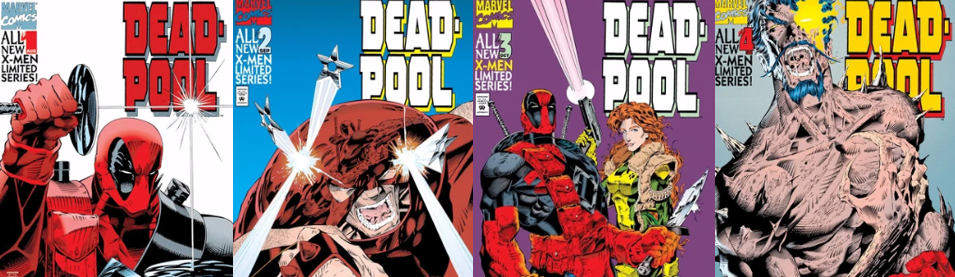
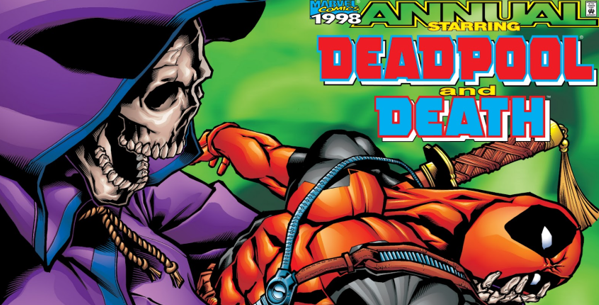
Back Issues [Deadpool Day]: Deadpool #1-4


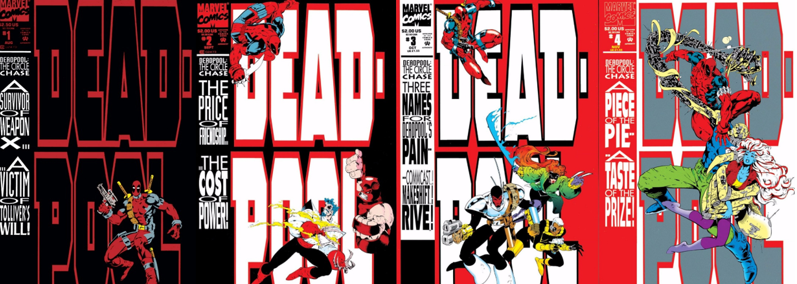
In February 1991, readers of The New Mutants were introduced to Wade W. Wilson, the wise-cracking, fourth-wall-breaking Merc With a Mouth, Deadpool. Rob Liefeld and Fabian Nicieza’s sword-swinging immortal went on to become one of Marvel’s most popular anti-heroes thanks to his metatextual humour, violent nature, and massively successful live-action films. It’s perhaps no surprise that Sideshow rechristened April 1st as “Deadpool Day” to give fans of the chimichanga-chomping mercenary an excuse to celebrate all things Deadpool.


Writer: Mark Waid – Artists: Ian Churchill and Ken Lashley

Story Title: “If Looks Could Kill”
Published: 14 June 1994 (cover-dated: August 1994)

Story Title: “Luck of the Irish”
Published: 12 July 1994 (cover-dated: September 1994)

Story Title: “Deadpool Sandwich”
Published: 9 August 1994 (cover-dated: October 1994)

Story Title: “Mano @ Mano”
Published: 6 September 1994 (cover-dated: November 1994)

The Background:
By the 1980s, the X-Men had been established as one of Marvel Comics’ most successful publications and then-chief editor Jim Shooter was encouraged enough by their success to commission a few spin-off titles, birthing Chris Claremont and Bob McLeod’s New Mutants. These Mutant youngsters soon fell under the tutelage of the time travelling Mutant Nathan Summers/Cable, formed X-Force, and famously clashed with Fabian Nicieza and Rob Liefeld’s Deadpool in The New Mutants #98 (ibid, 1991). Heavily inspired by James Howlett/Logan/Wolverine, Peter Parker/Spider-Man, and (most infamously) to DC Comics’ Slade Wilson/Deathstroke the Terminator, the self-styled “Merc With a Mouth” proved popular enough to receive this own four-issue miniseries in 1993. The series was a relative success, prompting Marvel to sign off on a second miniseries the following year, though writer Mark Waid later distanced himself from the character’s more violent nature. This was all a prelude to Deadpool graduating to an ongoing solo title and his greater popularity as a self-aware anti-hero, and his eventual appearances in Marvel/X-Men-related videogames, a cameo appearance in the beloved X-Men animated series (1992 to 1997), and the incredible success of his live-action feature films decades later.

The Review:
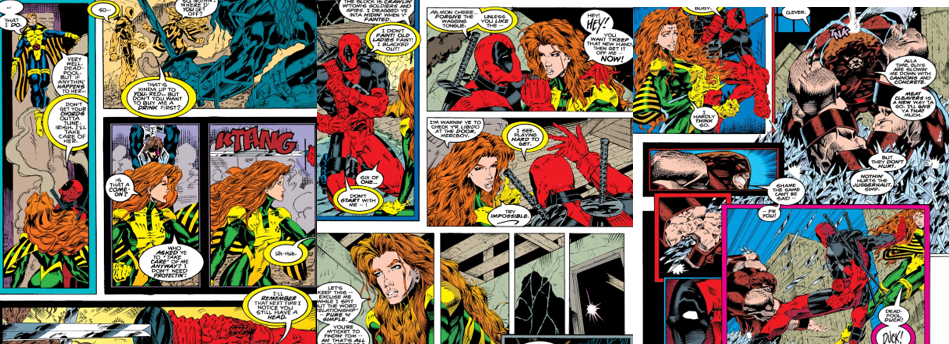
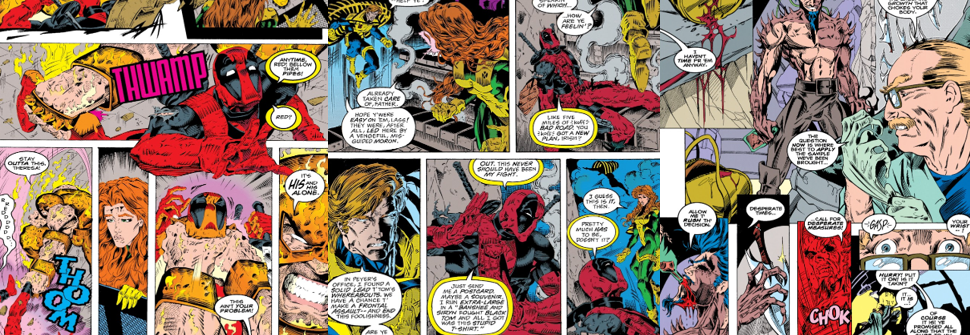
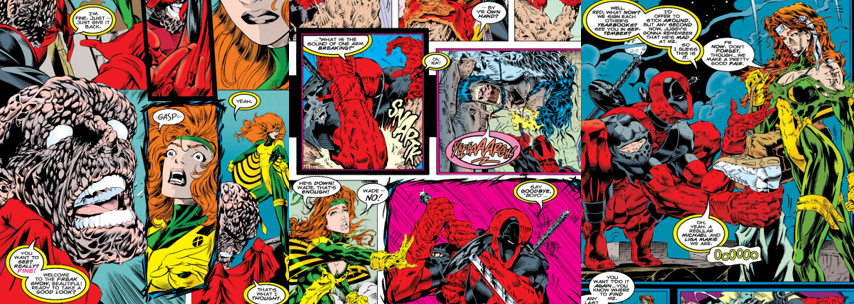
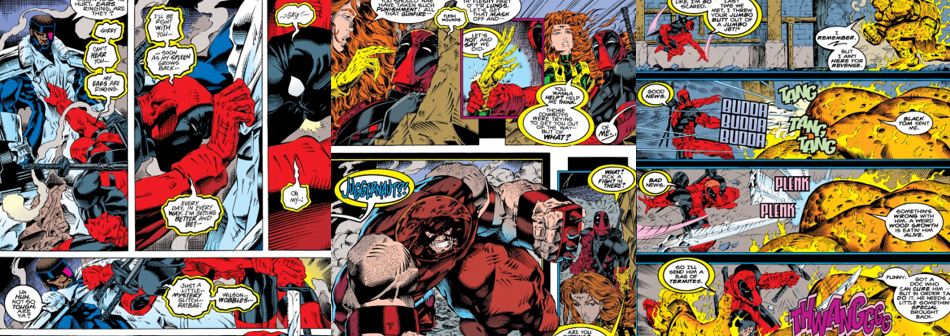
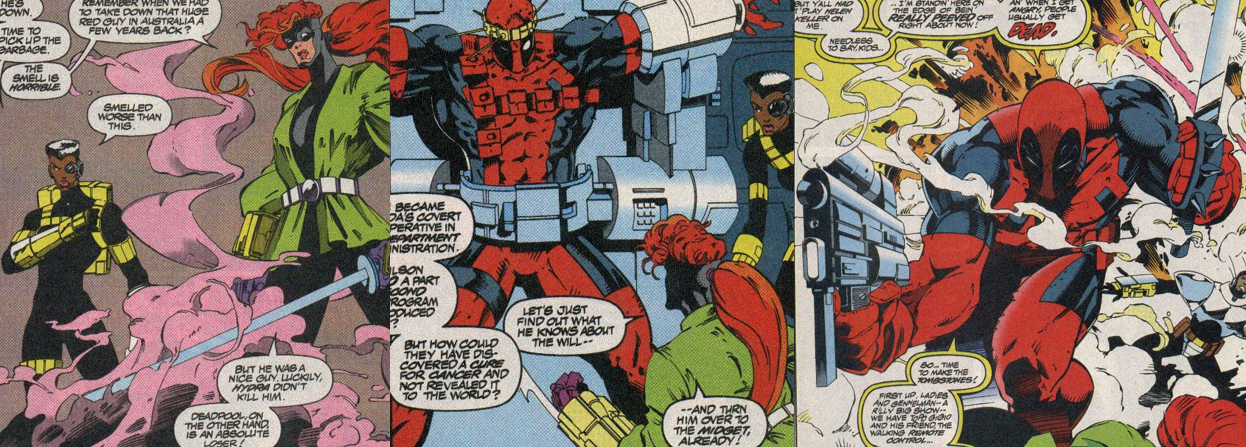
Deadpool’s second miniseries begins in a secret, heavily guarded facility where two thousand imprisoned inmates are forced to endure the agonised screaming of Thomas Cassidy/Black Tom as he sustains horrendous torture at the hands of Doctor Emrys Killebrew. Dr. Killebrew’s there to cure Black Tom of the “viral wooden growth” currently infecting his cellular structure, a procedure quickly interrupted by the explosive arrival of Cain Marko/The Juggernaut, Black Tom’s loyal (if thick-headed), brutish best friend. Though weak and in pain, Black Tom ensures the Juggernaut also grabs Dr. Killebrew and his files on cellular regeneration cases, namely one belonging to Wade Wilson. Weeks later, everyone’s favourite Merc with a Mouth is regaling patrons in a bar with stories of his recent tangle with Wolverine, removing his bandages and scarring off a girl with his tumour-riddled, scarified visage. As he downs beers, Wade shares a truncated version of his origin with the bartender, too busy dwelling on his situation and running his mouth to notice when a group of heavily armoured and well-armed mercenaries enter the bar. Though blasted by a bazooka, Wade easily recovers thanks to his advanced healing factor and opens fire, antagonising the mercs with his inane banter, though briefly slowed by a particularly gruesome close range shot to the gut. Too stubborn to go down, Deadpool continues to fight back; even being literally frozen doesn’t keep him down thanks to the unexpected arrival of Sean Cassidy/Banshee and his daughter, Theresa/Siryn, who catches Deadpool’s eye as much as their mention of Black Tom catches his attention. Since Black Tom is Banshee’s cousin, he has a vested interest in tracking him down and has been on his trail since his escape, though neither of the Irish Mutants know why their cousin targeted Deadpool. For Wade, it’s as simple as revenge since he’s tangled with Black Tom before, though all three are confused as to why Black Tom would order for Deadpool to be captured alive rather than simply ordering his assassination. On Siryn’s suggestion, Banshee reluctantly leaves to get some answers from Interpol and she chooses to stick close to Deadpool, sure that Black Tom’s goons will strike again, and immediately shuts down his lewd attempts to woo her.

Deadpool’s busted powers don’t stop him from making uncomfortable advances towards Siryn.

Still, as capable as Siryn is, it’s only thanks to Deadpool’s timely intervention and quick reflexes that she’s spared a sword in the back. Although Deadpool proves a master swordsman and eventually runs Black Tom’s merc through with his katana, it costs him a hand and he’s surprised to find the limb failing to instantly regenerate and himself blacking out from the pain. Siryn drags his unconscious ass to a safe spot and, when he comes to, Deadpool finally regenerates the hand but only after concentrating with all his might and enduring incredible pain. Deadpool’s concern about his slow healing factor is swept aside for further uncomfortable advances towards Siryn, who bluntly tells him that they’re partnership is simply one of convenience, and temporary. While waiting to meet with his old partner, Daniel “Danny” Peyer, Banshee recalls his time working for Interpol when Deadpool saved his ass at the cost of his career. Banshee asks Danny to help track down Black Tom and unwittingly gives Peyer the information he needs to settle his own score with Deadpool. Meanwhile, the severely suffering Black Tom is angered to see Theresa wrapped up in his business and orders his men not to engage without safely removing her from the line of fire first, causing himself incredible pain from getting so worked up. Black Tom’s affliction spreads further the more his adrenaline spikes, but Dr. Killebrew is sure that he can cure him if they capture Deadpool, a task the Juggernaut gladly takes up even though he hates to leave his sick friend undefended. Though Deadpool and Siryn take out another group of Black Tom’s men, Wade ends up being riddled with bullets when shielding Siryn and taking a nasty fall from a window. When the Juggernaut shows up, Siryn insists they make a stand in a knife factory and, though hesitant to tangle with Cain even if his healing factor was working, Deadpool showers the Juggernaut with blades in an unsuccessful attempt to stop him.

Complex relations see Deadpool reluctantly rally against Black Tom, who increases his powers!

Naturally, these simply bounce off the Juggernaut’s impenetrable hide and Deadpool ends up skewered by several blades before being saved by Siryn’s high-pitched sonic blast. Unfortunately, even molten metal doesn’t slow the Juggernaut and Deadpool’s issues are only compounded when he runs into Peyer and his men. Thinking fast, Deadpool lures the flaming-hot Juggernaut to the Interpol agents and causes them to flee, solving one problem but leaving Wade powerless to stop Cain. Though Deadpool shows no fear and keeps fighting and throwing barbs at his foe, he’s helpless against the Juggernaut’s strength. Thankfully, after a brief hesitation, Siryn saves Deadpool by bombarding the Juggernaut with her scream. Although they flee to safety, Deadpool chastises Siryn for hesitating and she reluctantly reveals that part of her still cares for Black Tom despite all the bad he’s done and that she considered letting the Juggernaut take Wade so Black Tom could be cured. This leads to a tender moment between the two where Siryn asks his real name and tries to see under his mask, only for Deadpool to scold her and Peyer to interrupt with a hail of gunfire. Although Wade gets Peyer bang to rights, he’s stopped from killing him by a convenient lack of ammo, getting himself shot a bunch of times as Peyer extracts a measure of revenge. Too stubborn to go down, Deadpool simply tanks each shot and sends Peyer plummeting off a rooftop with a punch, only for Banshee to swoop in and make the save. After chastising his former partner for acting so recklessly, Banshee offers Deadpool the chance to join him and Siryn in heading to Black Tom’s location (which he learned from Peyer’s files). Although Wade initially refuses to join them, he begrudgingly changes his mind seemingly to impress Siryn. Though enraged at the slow progress of his men, Black Tom is ecstatic when one of them returns with Deadpool’s severed hand, which Black Toom maniacally attaches to his own wrist after lopping off his hand!

Deadpool shows a surprising vulnerability and ultimately spares Black Tom for Siryn’s sake.

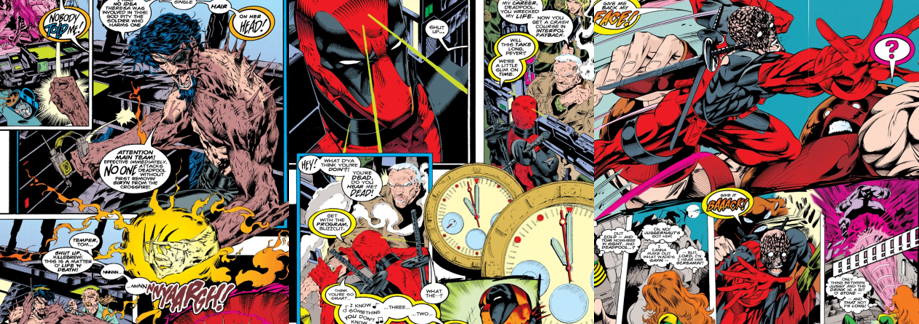
Deadpool, Banshee, and Siryn head to Bannerman Castle on the Hudson River and blast their way inside. Against Siryn’s advice, the three split up. While Banshee advises her to not get too attached to a ruthless mercenary like Deadpool, Wade stumbles upon Dr. Killebrew, the same man who turned Deadpool into an unkillable monster. Realising that Dr. Killebrew can fix his dodgy healing powers, Deadpool ignores the sounds of his friends battling Black Tom and the doctor’s snivelling begging and threatens Dr. Killebrew, only to be drawn back into the fight when Siryn crashes through the wall. Deadpool leaps into action and finds Banshee unconscious and Black Tom’s powers raging out of control. Incensed to see his hand grafted to the villain’s wrist, Deadpool desperately dodges Black Tom’s flaming energy blasts and the villain is driven mad from the pain caused from Deadpool’s cells regenerating his own. While taking cover, Deadpool is again accosted by Peyer but fools the vindictive agent into taking a blast to the face by tricking him into earning a promotion by apprehending Black Tom. Deadpool’s elation is cut short when he’s blindsided by the Juggernaut, whose massive fists accidentally tear off Wade’s mask, driving Deadpool into an insane frenzy as he desperately tries to recover his “face”. Siryn blasts the Juggernaut from the castle and retrieves the mask, finally getting a good look at Wade’s gruesome visage, though he’s stunned when she shows him kindness rather than fear. With Black Tom’s life equally threatened by the hand’s infestation, Deadpool renews his attack, breaking Tom’s arm and ready to end his foe… only to relent at the last minute and spare Black Tom for Siryn’s benefit. Deadpool then finally subdues the Juggernaut by holding Dr. Killebrew hostage and the doctor stabilises Black Tom’s condition, though Cain vows to break his friend out of whatever cell he ends up in. Wade parts ways with Siryn, with her inviting him to team up again some time, and then flees into the night with the terrified Dr. Killebrew, unaware that Peyer is still lurking in the background with a thirst for vengeance.

The Summary:
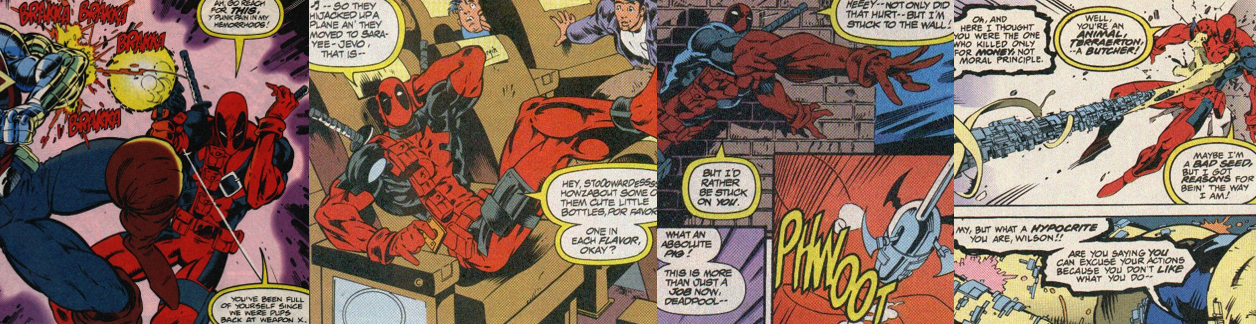
Eh… this was a bit of a slog. Let’s talk positives first, though. I enjoyed the artwork. Ian Churchill and Ken Lashley seem to be of the same school as the likes of Mark Bagley, Rob Liefeld, Todd McFarlane, emphasizing big, bold, ridiculously proportioned characters who are twisted into various physics-defying poses. It’s all very dramatic and bombastic, making for some very kinetic action sequences and memorable “hero shots” of Deadpool leaping, slashing his swords, or whipping out his pistols. Siryn is, of course, heavily sexualized; her costume is suggestively torn by the end to expose her bra and breasts and she’s no doubt suffering a great deal of back ache from her unnatural poses. Luckily, she’s written really well and isn’t some airhead or an emotional wreck. I never knew Banshee even had a daughter until reading this, though, and the two are depicted very strangely. They come across more like siblings or even lovers than father and daughter, something not helped by the fact that they look around the same age. They could’ve avoided this by making Banshee appear older, with more lines on his face or greys in his hair, or depicted Siryn as more of a teenager, smaller and slender rather than fully developed woman. This would’ve had the knock-on effect of sparing her (and the reader) from Deadpool’s lewd advances. He’s not too full on, to be fair, but it’s enough to make her uncomfortable and shut his shit down. Though she’s supposedly a fairly stoic character, Siryn does grow to respect Wade. He risks his life (literally, considering his janky healing factor) to protect her and she admires both his fighting spirit and is sympathetic towards his gruesome appearance. By the end, she’s more than happy to team up with him again and a potential romance is even hinted at, showing that Deadpool should rely more on his actions than his words to impress those around him.

Deadpool’s weaker than usual, but no less tenacious, lewd, and dangerous.

This ties into a recurring theme in this miniseries concerning Deadpool’s self confidence and his monstrous lifestyle. When we first see him, he scares off patrons with his scarified visage and he reacts with hostility whenever Siryn tries to remove his mask, before descending into Walter Kovacs/Rorschach levels of madness when it’s finally removed. He expects Siryn to react with fear and disgust, but is amazed when she shows him pity. In recounting his origin, Deadpool talks bitterly about how his terminal cancer was cured at the cost of his humanity, and he turns that bitterness and anger towards the world (or, at least, his enemies), masking his pain with a mile-a-minute banter that regularly antagonizes friend and foe alike. I’m not sure why, but Deadpool’s healing factor is on the fritz in this miniseries. It leads to some dramatic tension as Deadpool’s strategy is to throw himself head-first into a fight, shrugging off mortal wounds and coming out on top, something that costs him his hand and leaves him struggling to heal from wounds. As far as I can tell, it’s not said why this is happening to him and it is a bit inconsistent: Deadpool’s momentarily stunned from a gunshot wound but shrugs off a plummet from a window. His reflexes and skills are also unaffected by this handicap, though it does place him in a more vulnerable position and allow him to open up to Siryn and, perhaps, rediscover aspects of his humanity. Deadpool’s reputation precedes him, to the point where Banshee is reluctant to team up with him and warns Siryn against getting too attached to him since Wade is known as a cold-blooded mercenary who’s just as likely to stab them in the back as help them. However, Deadpool is clearly taken by Siryn, either legitimately or from simple lust, and not only accompanies them to Bannerman Castle despite being wounded but even temporarily forgets his own selfish desire to be cured to help Siryn when she’s manhandled by Black Tom. Deadpool’s really off his rocker here, ranting about nonsense during pitched battles and mocking his foes to throw them off-balance, overwhelming even groups of armed soldiers with his katana and guns. Though he’s no match for the Juggernaut, that doesn’t stop him trying and standing up to the brute, though this miniseries emphasises quite explicitly that much of his inane banter is to mask the pain and anger he feels at being turned into a ghastly, inhuman freak.

Juggernaut may be powerful but the story’s main antagonists aren’t believable threats.

I think what lets this miniseries down is the main villain. I’m vaguely aware of Black Tom but he’s a bit of a nobody, with weak-ass powers that can’t compare to Deadpool’s skills. Luckily for him, he’s got the Juggernaut in his pocket but, even then, Cain is just a rampaging brute and fights against him aren’t that interesting. Nothing Deadpool and Siryn throw at the Juggernaut can stop him and they’d been ridiculously outmatched even if Deadpool’s healing factor was working. Without it, we’re denied even the simple pleasure of seeing the Juggernaut tear Deadpool limb from limb and instead rely on a cat-and-mouse game. This is fun enough and shows Wade’s adaptability and certainly paints Siryn as formidable since she holds her own against the Juggernaut, but I feel more could’ve been done with these bouts. Instead, the story spends more time focusing on Danny Peyer and his childish vendetta against Deadpool for costing him his career some years ago. Peyer is just a regular guy with a gun and some soldiers; he’s way out of his league and just grinds the story to a halt. I would’ve rather seen Banshee simply pulling Interpol’s file on Black Tom and then devoted the panels wasted on Peyer to showcasing more of the Deadpool/Juggernaut fight and exploring Wade’s condition, especially as a mirror of Black Tom’s. Like Deadpool, Black Tom suffers from an affliction that’s slowly and painfully killing him (or transforming him into a tree-man? I’m not sure). His agony and desperation see him lash out and devolve into near madness after grafting Wade’s severed hand to his own, increasing his powers and finally making him a true threat but, in the end, he’s subdued with ridiculous ease because, as I said, Black Tom is a nobody. In the end, this was an okay miniseries for the Merc with a Mouth; it showcased a few more layers to his character and developed him further into the near parody of a character we know today, but it’s really just nonsensical fights. Every conversation is interrupted by some goon or another, it’s not always clear what’s happening or why, and the threat is just so low level that it feels like Deadpool could’ve ended things in one or two issues if his healing factor wasn’t mysteriously broken.

My Rating:

Rating: 3 out of 5.

Pretty Good

Have you ever read Deadpool’s second solo foray? Did you enjoy the exaggerated artwork and the violent action? What did you think to Deadpool’s characterisation, the vulnerability he displayed and his busted healing factor? Were you a fan of Black Tom or do you agree that he’s a weak villain? What are some of your favourite Deadpool stories and moments and how are you celebrating Deadpool Day today? Whatever your thoughts on Deadpool, feel free to share them below and go check out my other Deadpool content.

Movie Night: Deadpool & Wolverine

Released: 26 July 2024
Director: Shawn Levy
Distributor: Walt Disney Studios Motion Pictures
Budget: $200 million
Stars: Ryan Reynolds, Hugh Jackman, Emma Corrin, Matthew Macfadyen, and Aaron Stanford

The Plot:
Struggling with doubt, Wade Wilson/Deadpool (Reynolds) jumps at the chance to join the “Sacred Timeline” of the Marvel Cinematic Universe (MCU). However, when he learns the cost is his universe, he scours the multiverse to recruit a disillusioned version of James “Logan” Howlett/Wolverine (Jackman) to help save his loved ones.

The Background:
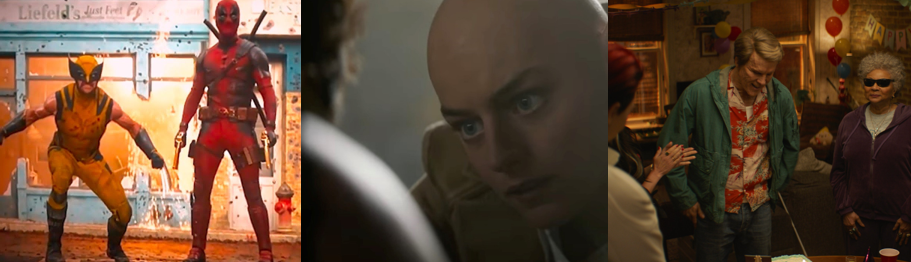
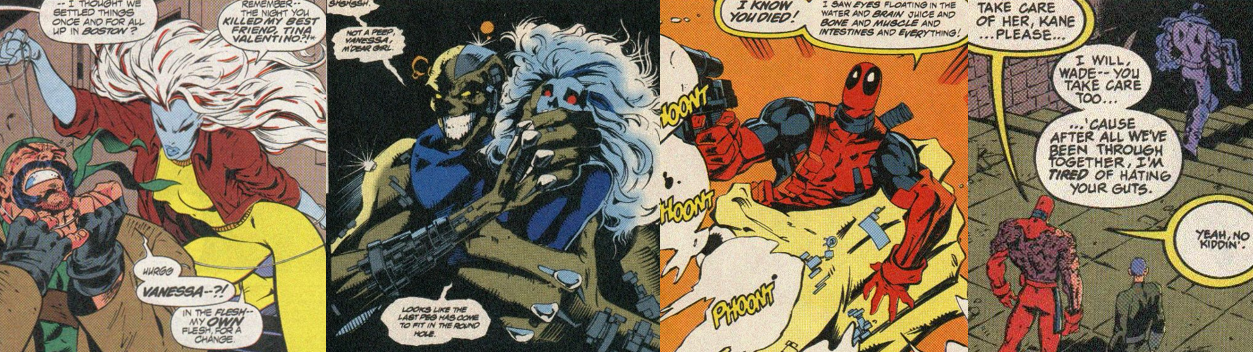
Created by Fabian Nicieza and Rob Liefeld in 1991, Deadpool as originally an X-Force antagonist before his self-aware humour and creative violence catapulted him to mainstream popularity. This eventually led to his live-action debut in the much-maligned X-Men Origins: Wolverine (Hood, 2009), with Ryan Reynolds finally assuming the role, with a spin-off teased. However, after X-Men Origins and the Reynolds-led Green Lantern (Campbell, 2011) flopped, 20th Century Fox got cold feet about producing an expensive, R-rated superhero movie. However, after director Tim Miller’s early test footage mysteriously leaked online, the positive reaction saw Fox backpedal, resulting in a critical and commercial success for the “Merc with a Mouth”. Deadpool’s (Miller, 2016) success naturally led to a sequel; Deadpool 2 (Leitch, 2018) upped the ante with an increased budget and bringing in Josh Brolin as fan favourite, time travelling cyborg Nathanial “Nate” Summers/Cable, and was met with similar success, and Disney higher ups were adamant about including Deadpool in the MCU after their acquisition of 20th Century Fox. During development, Reynolds was contacted by Hugh Jackman – who had famously retired from his iconic Wolverine role in Logan (Mangold, 2017) – and, despite concerns about undoing that film’s poignant ending, actively lobbied to portray an alternative version of the character for a long-awaited team-up. Finally garbed in a comic book-accurate suit courtesy of costume designers Graham Churchyard and Mayes C. Rubeo, Jackman joined Reynolds for what was to be a love letter to the X-Men films (Various, 2000 to 2020) and their legacy, as well as a slew of fan service cameos. After enduring the SAG-AFTRA strike, Deadpool and Wolverine released to largely positive reviews; critics praised Jackman’s return and the film’s buddy comedy/road trip vibes, and that it remained true to the raunchy humour of the previous films. Though some criticised its shallow plot, Reynolds’ performance was lauded and the film quickly became Disney’s highest-grossing R-rated release, bringing in over $1.300 billion and seemingly cementing the character’s place in the future of the MCU.

The Review:
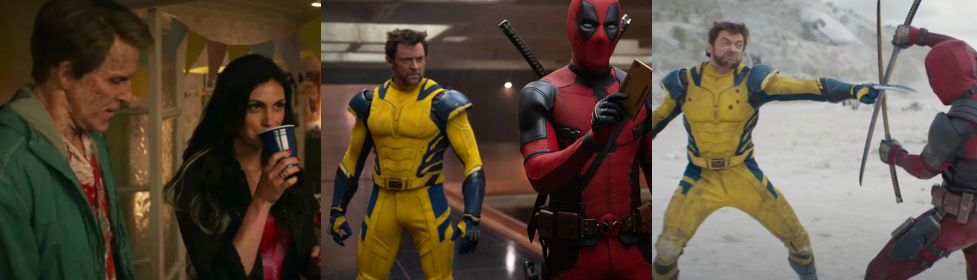
It was genuinely shocking, and heartbreaking, when Logan finally met his end in Logan. After living and fighting and struggling for so long, after an unprecedented run from an actor in a role, the character was finally laid to rest. So, naturally, Deadpool & Wolverine opens with Deadpool digging up Logan’s corpse, convinced he’s still alive, and then massacring an army of soldiers from the Time Variance Authority (TVA) with the dead Mutant’s Adamantium skeleton, even donning Logan’s signature claws at one point, all to the tune of NSYNC’s “Bye Bye Bye”. It turns out that Wade’s life took a bit of a downturn after Deadpool 2; he struggled with his mercenary lifestyle and his place in the world, pushing his lover, Vanessa Carlysle (Morena Baccarin) away after everything he did to save her life and ending up selling used cars in a bad toupee alongside Peter Wisdom (Rob Delaney). While celebrating his birthday alongside his returning supporting cast, Wade is accosted by the TVA and brought to Mr. Paradox (Macfadyen) at their headquarters. Despite Wade’s flagrant misuse of Cable’s time machine in Deadpool 2 (and him using it to sidestep into the MCU and lobby for application with the Avengers), the TVA are seeking to recruit him rather than “prune” him. Wade’s told that Logan’s tragic death is causing his universe to collapse; since Logan was an “Anchor Being”, Earth-10005 literally cannot sustain itself without him and will die out in a few thousand years. Wade’s given the opportunity to avoid this fate and join the MCU (Earth-616), finally taking his rightful place alongside Earth’s Mightiest Heroes and proving that he matters not just to himself, but to Vanessa and the entire world.

Deadpool recruits a jaded version of Wolverine to save his world, and the two naturally clash..

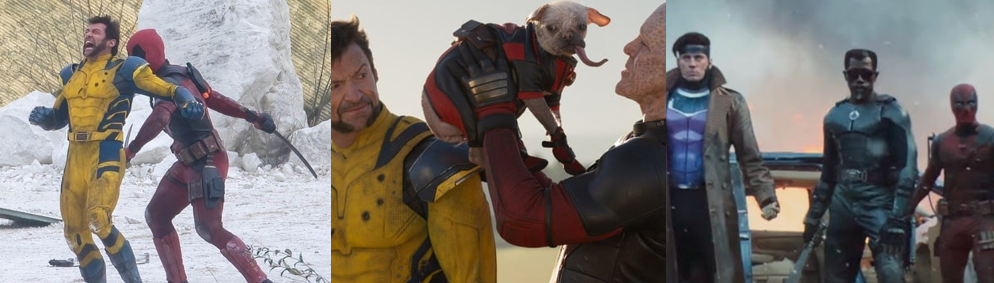
However, Deadpool’s dreams of raking in the Disney cash are quickly dashed when Mr. Paradox immediately reveals that he doesn’t care for Earth-10005 and has aspirations to take over the TVA and take a more direct approach to such events. Realising that Mr. Paradox’s “Time Ripper” device will destroy his world and everyone he loves within 72 hours, Deadpool immediately defies the TVA, steals once of their time devices, and embarks on a short jaunt throughout the multiverse to find a “Variant” of Wolverine to replace his one. After some fun homages and being attacked at every turn, he finally finds a disillusioned Wolverine drowning his sorrows in a bar. However, when Mr. Paradox scoffs at the idea of this Variant (widely known as the “worst” version of Wolverine) could ever replace Logan, he zaps the two to the “Void”, a barren wasteland filled with discarded remnants from deleted or forgotten timelines. While Deadpool is determined to find a way back and safe his universe, Wolverine has no interest and lashes out at Wade at every turn for getting him involved. Surly, jaded, and wracked with guilt after failing to save his X-Men, this Wolverine may wear the most comic accurate suit of any live-action portrayal (not counting some of his other Variants seen in this film) but he’s not interested in playing the hero anymore. Deadpool and Wolverine’s relationship is antagonistic and strained from the start; Logan is constantly frustrated by Wade’s motormouth and is incensed to find Deadpool lied to him to get him to help. The banter and interactions between Jackman and Reynolds are the highlight of the film, as are their many bloody fights against and alongside each other. The two bounce off each other so well, with Deadpool being like an annoying, peppy, snarky younger brother to the older, cynical Wolverine. Wolverine’s attitude towards Deadpool is only further soured when his childishness and blatant lies cause newfound allies to be killed, yet he’s forced to help the Merc with a Mouth on the slim chance that Logan’s timeline can be corrected and his mistakes can be undone.

Nova sets her sights on the TVA’s tech and is protected by a misfit army of Variants.

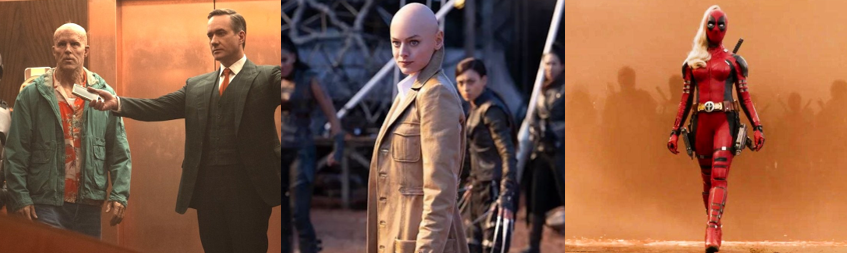
Unfortunately for the two, they’re stuck with each other in a desolate world outside of time, one filled with cameos, Easter Eggs, and Variants who are both out to help and hider them. The first they encounter, Johnny Storm/The Human Torch (Chris Evans), tells them that the Void is not only constantly preyed upon by the monstrous Alioth but also ruled over by the psychotic Cassandra Nova (Corrin), the telepathic twin sister of Professor Charles Xavier/Professor X (Patrick Stewart/James McAvoy) who resides within the colossal skeletal remains of Scott Lang/Ant-Man (Paul Rudd). Nova, who was sent to the Void by the TVA as a child, has known nothing but hardship. Resentful towards her brother and craving only power, she has a tentative arrangement with Mr. Paradox to dispose of his trash, but is delighted to finally have a Wolverine in her midst. Unlike Xavier, Nova prefers to get (literally) hands-on when probing her victim’s minds, twisting their memories and reality to learn their secrets and showcasing incredible recuperative powers as well as telekinesis. Surrounding by an army of disgruntled cast-offs (including right-hand-man John Allerdyce/Pyro (Stanford), Cain Marko/Juggernaut (Aaron W. Reed), and cameos from other disposable Brotherhood characters), Nova makes a sport of torturing and executing both her enemies and allies. Although she shows a glimmer of humanity when she learns of her brother’s loving ways from Wolverine, her desire for conquest is sparked when she learns of Mr. Paradox’s Time Ripper and she doesn’t hesitate to leave the Void via a stolen Sling Ring to get her hands on it, determined to eradicate world after world until all that’s left is the Void’s blissful emptiness. Although Deadpool and Wolverine can take on Nova’s minions (with some help), they’re no mater for her in a one-on-one fight due to her incredible psychic powers. As if that wasn’t bad enough, there’s an entire legion of Deadpool Variants wandering the Void, all of them devoted to protecting Nova, and this army of wise-cracking psychos literally stands between our heroes and their target in the finale, leading to one of the best and bloodiest action sequences in the film, made all the more enjoyable not just by Logan’s happiness at slaughtering so many Deadpools but him finally donning his comic accurate mask!

The Nitty-Gritty:
Considering Deadpool & Wolverine is largely focused on delivering the much-needed spectacle of seeing the titular characters interact and cut each other to ribbons, the film has a surprising emotional depth. I guess this shouldn’t actually be that surprising as the previous films had an unexpected pathos to them as well, but it’s incredibly effective here. While still a loquacious, self-referential, crude dervish, Wade is struggling with his purpose in life. When Harold “Happy” Hogan (Jon Favreau) rejects his application to the Avengers, Wade enters a slump so deep that Vanessa leaves him, he gives up his mercenary ways, and he’s resigned to a boring, normal life. He’s elated at the idea of joining the MCU but cannot bring himself to sacrifice his loved ones to do so, and is so determined to stop Mr. Paradox that he defies the entire TVA. However, it’s through Wolverine that the film finds most of its emotion. While similar to the Wolverine we knew and loved, this one is notably different; he’s at the bottom of the barrel, regularly drinks away his pain, and is wracked by guilt after his selfish actions caused the death of the X-Men and persecution of Mutants on his world. He’s dismissive of his counterpart’s more heroic stature and openly scoffs at Wade’s aspirations to save his world, but his heart is still flickering beneath his pain. Its flame is once again fanned by Laura Kinney/X-23 (Dafne Keen), who’s heartfelt thanks to Logan convince him to oppose Nova, and by the finale he’s even prepared to make the ultimate sacrifice once again to save Wade’s world and gain some redemption. While Logan was a perfect swansong for the character and actor, Jackman continues to nail Logan and bring new nuance to the role. He’s in phenomenal shape for his age and better than ever here as an unhinged, broken version of the character, and it’s a delight not just to see him back but to see him donning the iconic costume and portraying other Wolverine Variants, such as Patch, Age of Apocalypse, a hilarious pint-sized Variant,  and even one in the middle of a fight against Doctor Bruce Banner/The Incredible Hulk (Mark Ruffalo). However, he does have some competition for the role when Deadpool briefly meets a gruff and buff variation played by Henry Cavill!

Violent, crude, and packed with cameos, Deadpool & Wolverine also features some surprising pathos.

Although some were sceptical that Disney could stay true to Deadpool’s R-rated roots, Deadpool & Wolverine is just as crude and bloody as its predecessors. Wade has lost none of his fourth-wall-breaking charm, regularly making digs at Disney, MCU head honcho Kevin Feige, 20th Century Fox, and even the mixed reception of the MCU’s fourth phase of movies. Both he and Wolverine cuss up a storm here, ripping into each other and their enemies (and allies) with quips, barbs, and even “fucks” to make a vicar blush. Not only that but the two regularly engage in bloody fights with each other; since both are functionally immortal and have rapid healing, they can carve seven kinds of shit out of each other all day and never get tired. While this could get boring, the film mixes up their fights and has them engage in a barroom scuffle, and all-out knife fight in the Void, and a brutal punch-up in a car! The action continues as their fights are momentarily derailed to focus on Nova’s underlings, including a short (but satisfying) rematch between Wolverine and Victor Creed/Sabretooth (Tyler Mane), and a massive brawl against Nova’s ragtag army. Although Johnny meets a rather gruesome end thanks to Wade’s motormouth, Deadpool and Wolverine are regularly aided by “Nicepool” (Reynolds) and his super-ugly pup, Mary Poppins/Dogpool (Peggy). X-23 also brings them to Elektra Natchios (Jennifer Garner), Eric Brooks/Blade (Wesley Snipes), and Remy LeBeau/Gambit (Channing Tatum), forgotten characters who are eager to have their chance in the limelight. These cameos were some of the best and most unexpected parts of the film; never in a million years would I have thought Snipes and Reynolds would work together again, but he’s still got it as Blade and (while I’m not fan of his) Tatum overdelivered in finally getting to play Gambit. It was also fun seeing Evans swear like a trooper as Johnny and to see X-23 all grown up, still as ferocious as ever. Although Deadpool’s other Variants remain masked, this army of psychos was quite the highlight as well; we had a Lady Deadpool (Unknown/Blake Lively), a “Cowboypool” (voiced by Matthew McConaughey), a disembodied floating head (voiced by Nathan Fillion), samurai Deadpool, Deadpool 2099, and so many others (though, strangely, no “Barakapool”).. The cost of all these amazing cameos and returning characters was the side-lining of Deadpool’s supporting cast, who mainly bookend the film, with the exception of Peter, who’s presence is enough to stop the Deadpools from fighting since all of them love him in every reality!

Deadpool and Wolverine must set aside their differences to stop Nova from destroying the multiverse.

Trapped in the Void, Deadpool and Wolverine’s only way home is through Cassandra Nova. Thus, wade convince Elektra, Blade, Gambit, and X-23 to help them storm Nova’s compound and get them home. While they’re able to appeal to her humanity to help them, she soon follows, eager to get her hands on the Time Ripper, and Deadpool and Wolverine have to lice and dice their way through the Deadpool army to get to her. Thanks, as mentioned, to Peter, they reach the TVA facility, where Nova has forcibly coerced Mr. Paradox into activating the machine. The only ay to stop it is for one of them to connect the matter/anti-matter coils, an act that would vaporise them instantly. Reinvigorated by this time with Deadpool, Wolverine offers (almost begs) to take the fall and redeem himself in death, but Deadpool swaps places with him at the last minute, determined to give Logan a second chance and prove that he’s worthy as a hero. With time running out and Deadpool struggling to connect the wires, Wolverine joins him and, together, they endure the strain of the connection, creating a feedback loop that destroys Nova and has the unexpected side effect of saving Earth-10005 from destruction. Although Mr. Paradox tries to talk himself out of a reprimand, he’s scuppered when the Mutants survive their ordeal and turn him in to Hunter B-15 (Wunmi Mosaku), who agrees to free Deadpool’s allis from the Void but refuses to change Logan’s world since those experiences made him into a hero. Victorious, Deadpool and Wolverine make amends, finding common ground from shawarma and their adventure, and Wade invites him to meet his friends, restoring Wolverine to Earth-10005. Although the post-credits scene is nothing to shout about and simply shows Johnny Strom cussing out Cassandra Nova, a beautiful tribute to the 20th Century Fox Marvel films plays during the credits that shows the love and heart that went into the X-Men films, in particular, and shows that Marvel Studios are more than willing to acknowledge their presence and contribution to the genre.

The Summary:
The promise of seeing Deadpool and Wolverine, Ryan Reynolds and Hugh Jackman, match wits and weapons in live-action has been an enticing one for fifteen years, ever since Reynolds took his first tentative steps into the role. Even after Deadpool got a second chance and became a solo success, a team-up between the two has been teased and it seemed we’d never get it after Logan’s poignant end. While I had no doubt we’d see Deadpool transition into the MCU, I never expected Jackman to return to his iconic role beyond a sly cameo here and there, so to se the two finally together, in uncompromising action and wearing glorious comic-accurate suits, was a joy. Deadpool & Wolverine might alienate some who haven’t been keeping up with the MCU’s multiverse shenanigans, but it goes out of its way to emphasis time and again that this Wolverine is a different version to what we’ve seen before and Jackman delivers probably his best performance as the character to date. His Wolverine is at his lowest end, bad-tempered and burdened by impossible guilt, and quick to animalistic violence. He’s the gruff “straight man” to Deadpool’s wacky, outrageous humour and the two have such chemistry that every interaction and punch thrown is a delight. Seeing Wade go to such lengths to save his loved ones and prove himself is as emotional as seeing Wolverine try one last time to do the right thing, with both having to overcome incredible emotional baggage to save the world despite neither being the right man for the job. Emma Corrin made for an unsettling villain; a twisted version of Professor X, she’s both unhinged and psychotic, perfectly matching Deadpool’s eccentricities and Wolverine’s ferocity, and I liked that she was powerful enough that they had to think of other ways to stop her. Of course, a huge highlight of the film is all the cameos, Easter Eggs, and returning characters, allowing Deadpool & Wolverine to not just be a homage to the X-Men movies but also an acknowledgement of the Marvel properties that paved the way for the MCU. It’s stuffed with crude humour, gratuitous violence and swearing, and fanboy pandering in all the right ways, making Deadpool & Wolverine a fantastic step in the right direction for the MCU and laying the foundation for further fan service later down the line.

My Rating:

Rating: 5 out of 5.

Fantastic

Did you enjoy Deadpool & Wolverine? Were you excited to see the two finally team up, and to see Hugh Jackman back as Wolverine? What did you think to Wolverine’s comic-accurate costume? Which cameo was your favourite and which did you least expect? What did you think to Cassandra Nova as a threat and which of the fight scenes was your favourite? Which of the X-Men films was your favourite and how do you think the X-Men will be introduced into the MCU? Whatever your thoughts on Deadpool, Wolverine, and the X-Men, drop a comment below.

Back Issues: Wolverine #88

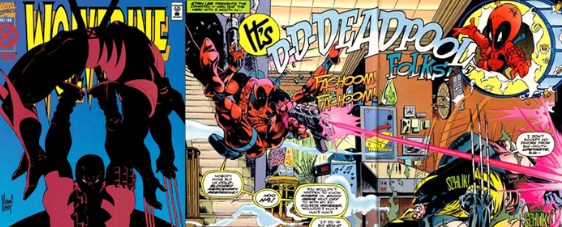
Story Title: “It’s D-D-Deadpool Folks!”
Published: December 1994
Writer: Larry Hama
Artists: Adam Kubert and Fabio Laguna

The Background:
In 1974, Roy Thomas charged writer Len Wein to create the first Canadian superhero; a short, feisty character named “Wolverine”. After the legendary John Romita Sr sketched the original design for Wolverine and came up his now-iconic retractable claws, artist Herb Trimbe finalised the character’s design for his debut in the pages of The Incredible Hulk. Of course, nowadays, James Howlett (better known as “Logan”) is one of Marvel’s most well-known characters thanks to his association with the X-Men, but he’s not the only popular fast-healing Canadian Mutant anti-hero in Marvel Comics. In 1991, Fabian Nicieza and Rob Liefeld debuted Wade W. Wilson/Deadpool in the pages of The New Mutants. Heavily inspired by Wolverine, Peter Parker/Spider-Man, Slade Wilson/Deathstroke the Terminator, the self-styled “Merc With a Mouth” was initially introduced in an antagonistic role but eventually proved popular enough to graduate to his ongoing solo title. In time, Wolverine and Deadpool’s pasts would be intertwined to give them a shared history with the infamous Weapon X project and the two would cross paths as both rivals and team mates as members of the black ops X-Men team X-Force. Although both characters achieved greater mainstream success with their live-action movies, a proper big screen team up between the two seemed impossible after Hugh Jackman retired from the Wolverine role in 2017. However, in 2022, Ryan Reynolds shocked everyone by revealing that Jackman would return as Wolverine for Deadpool and Wolverine (Levy, 2024) and what better way to mark this momentous occasion than be revisiting the first-ever meeting of these two immensely popular characters?

The Review:
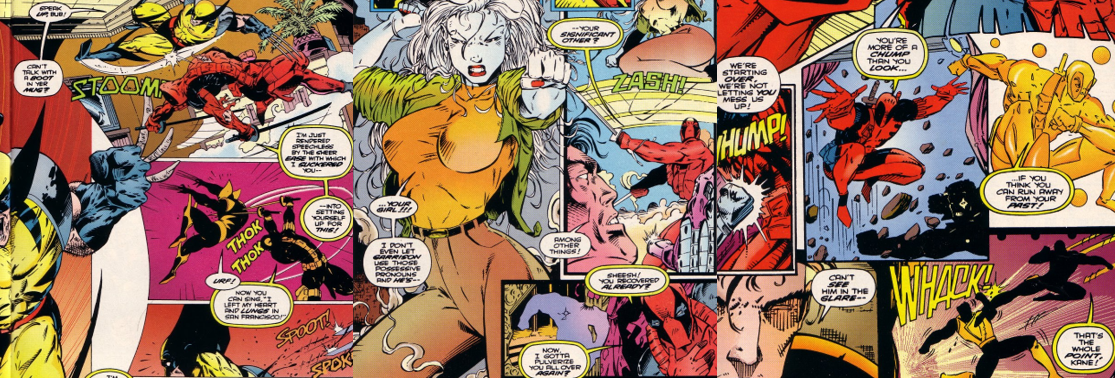
Our story opens with Wolverine back in the Great White North; he’s tracking down Garrison Kane/Weapon X as a favour to James Hudson/Guardian and (despite his heightened senses) is surprised to find the wacky mercenary Deadpool in Kane’s pimped out apartment. The hyperactive Deadpool immediately opens fire on Wolverine and promises to “put [him] out of [his] interminable suffering” if Logan can tell him where Kane took his “ex-squeeze”, Vanessa Carlysle/Copycat. Naturally, Wolverine refuses to rat out the two and fights back, slashing at Deadpool’s arm and trading insults as they clash. During their brutal combat, Deadpool boasts of his own healing factor, which gives him the edge over Wolverine since this story takes place during a time when Logan’s healing powers were on the fritz and he no longer had his Adamantium skeleton or claws thanks to Erik Lehnsherr/Magneto ripping it from his bones. While Wolverine still has the skills and ferocity to go toe-to-toe with Deadpool, his feral rage and curiosity about Deadpool’s vendetta against Kane cause him to leave himself wide open for the Merc with a Mouth to ram his swords through his back and into his lungs.

After incapacitating Wolverine, the deranged Deadpool attacks Kane and Vanessa.

Victorious, Deadpool spots a poster for the Grand Guigol theatre, realises that’s where his targets are, and skedaddles, leaving the critically injured Wolverine bleeding on the floor. At the Grand Guigol theatre, Kane and Vanessa are trying to establish normal lives for themselves as stage actors. Kane struggles with his lines and to find his motivation as an actor, but Vanessa encourages him to channel his infatuation with her and his desire to leave behind their tumultuous past into his acting. She’s ecstatic when this appears to result in a more convincing performance, only to find that he was startled by the sudden appearance of Deadpool. Delighted to find his targets and begging to know that Kane’s fighting skills have become as bad as his acting, Deadpool leaps at Weapon X, swords drawn, only to find his strike deflected by Kane’s mechanical arms. When Deadpool refuses to leave them be or forgive Kane for stealing his girl, he gets a beatdown from an enraged Vanessa and doesn’t hesitate to take a swipe at her, too. Kane gets in on the action, pummelling Deadpool and chastising him for interfering in their lives, but he loses the advantage when Deadpool temporarily blinds him with a flash of light from…somewhere… Back at Kane’s apartment, the wounded Wolverine struggles to his feet, his healing factor slowly taking care of his injuries, and cottons on to Deadpool’s lead. Wrapping the worst of himself up in a kimono, he stumbles out into the streets and into the back of a taxi that he demands take him to the theatre.

After healing, Wolverine makes a timely intervention that sees Deadpool make a desperate escape.

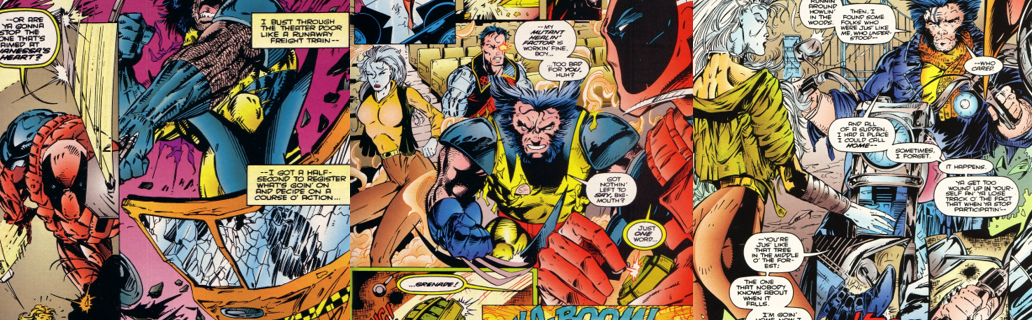
During the taxi ride, Wolverine endures a particularly chatty cab driver and is grateful to find his wounds have healed. However, when the cab’s brakes malfunction halfway to the theatre, Wolverine’s frustrations get the better of him and he slices off the cab door and opts to skate the rest of the way on the severed cab door! Although Vanessa intervenes before Deadpool can decapitate Kane, she ends up getting knocked on her ass by Wade’s unpredictable agility and Deadpool offers Kane a choice: defend himself from one sword or catch the other sword tossed right at Vanessa’s heart. Luckily, Wolverine shows up, bursting in “like a runaway freight train” and intercepts the blade, saving Vanessa. Deadpool’s stunned to see Wolverine alive and well and finds himself outnumbered by the three unlikely allies; as such, he chooses to toss a grenade into the group and beat a hasty retreat. In the aftermath, Wolverine helps tidy up Kane and Vanessa’s apartment and offers them advice about moving on from their violent and chaotic pasts. He also helps Vanessa to see that Kane chose to save himself so that he’d be able to help Vanessa rather than being selfish, and then rides off after noting that they were lucky he didn’t catch a cab with good brakes.

The Summary:
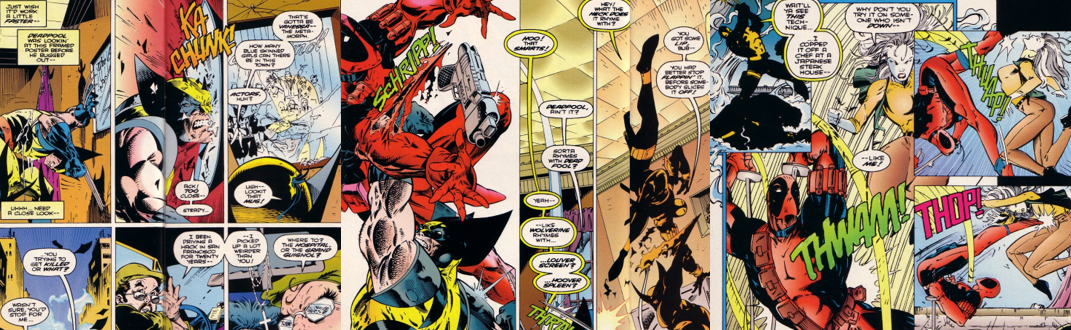
I often find that the comics I review are a little light on action and fight scenes; characterisation, interpersonal drama, angst, and outdated sensibilities are often the order of the day, meaning fights and visual spectacle are few and far between. That’s not the case with Wolverine #88; if anything, the opposite is true, and the issue is more style over substance. It’s definitely a side chapter in Wolverine’s larger story; we’re seeing how Logan is coping being “the best there is at what he does” with a less reliable healing factor and his awful bone claws, which often puts him at a disadvantage and makes him more vulnerable. This is the case here; while he’s still a skilled fighter and his feral nature allows him to go all-out against the likes of Deadpool, he can’t just leap head-first into fights these days and that costs him. In fact, Wolverine even notes that if he’d been injured like he was at Deadpool’s hands just a few months ago, he’d probably have been killed, though Wolverine’s mortality was often emphasised even before he had the Adamantium ripped from his bones. I quite like seeing Wolverine going out and doing his own thing, though, and having loyalties and adventures beyond the X-Men. It would’ve helped to emphasise this if he’d been wearing his brown/tan uniform instead of his yellow/blue one, but it adds a lot to his character that he’d do a favour for James Hudson and go out of his way to protect Garrison Kane and Vanessa despite them not really being in his close circle and their ties to the Weapon X project. I quite enjoyed seeing Wolverine stumble about, bleeding out in a daze, and struggling to knit himself back together in the back of the taxi. He had some amusing moments here, such as accidentally smashing his face into a picture of the Grand Guigol theatre and “skateboarding” through the streets on a car door, while still being a formidable and honourable (and brutal) fighter.

Some humorous moments and brutal fights help this otherwise shallow issue to stand out.

As ever, Deadpool really makes an impression here; this is still before he started breaking the fourth wall and being depicted as a nigh-immortal, ultra-skilled character, but he’s still absolutely out of his mind. The unique depiction of his speech bubbles and his hyperactive, deranged nature match perfectly with his dynamic agility, which allows him to perform physics-defying moves that out-fight the legendary Wolverine and fend off attacks from both Kane and Vanessa. Deadpool’s despicable nature means he’s not above fighting dirty and he’s perfectly happy to attack and even attempt to kill Vanessa, which only goes to show how warped he is since his entire motivation here is to kill Kane for stealing his ex and presumably win her back from him. Deadpool’s fighting skill, marksmanship, and swordplay are only part of the story here; he now sports an advanced healing factor that lets him fight Wolverine up close and dirty and isn’t afraid to use the small arsenal he carries both as offensive and defensive weapons. I still don’t really get what that blinding flash was supposed to be since he’s not shown pulling out a flash grenade or anything. In fact, as fun and dynamic and vicious as the issue’s art is, some of the fight scenes and narrative pacing was a little confusing (such as Vanessa randomly querying Kane’s actions at the end completely unprovoked) but there’s a visceral “nineties” feel to the issue that helps make everything feel entertaining and chaotic. This suits both Wolverine’s volatile nature and Deadpool’s madcap demeanour and results in Wolverine #88 being a visually fun, if narratively light, first meeting between the two; they establish an instant animosity based on how similar there are as fighters and in their Mutant abilities and it was fun seeing them tangle. I would’ve liked to delve a little deeper into that dynamic and maybe focus a little more on Wolverine as a protector to Kane and Vanessa, but I liked the race against his own body and time to intercept Deadpool and how open-ended the story finished so I’m excited to check out future meetings between the two someday.

My Rating:

Rating: 3 out of 5.

Pretty Good

What did you think to the first meeting of Wolverine and Deadpool? Were you disappointed by the lack of plot or did the brutal fighting win you over? Were you a fan of Wolverine’s bone claws? What did you think to Deadpool’s characterisation as a deranged psychopath? What are some of your favourite moments between Wolverine and Deadpool? Whatever your thoughts on Wolverine and Deadpool, feel free to share them below or on my social media, and be sure to check out my other Wolverine and Deadpool content across the site.
Game Corner [National Superhero Day]: Marvel: Ultimate Alliance 2 (Xbox 360)


In 1995, Marvel Comics created “National Superhero Day” and, in the process, provided comics and superhero fans the world over with a great excuse to celebrate their favourite characters and publications.


Released: 15 September 2009
Developer: Vicarious Visions
Also Available For: Nintendo DS, Nintendo Wii, PC, PlayStation 2, PlayStation 3, PlayStation 4, PlayStation Portable (PSP), Xbox One

The Background:
Few videogame publishers are as closely associated with Marvel Comics than Activision, who have been spearheading adaptations of some of Marvel’s most popular characters since 2000. Of course, these weren’t all smash hits but some of their titles are counted as being among the best outings for the likes of Peter Parker/Spider-Man and the X-Men. In 2004, Activision teamed with Raven Software and achieved big success with X-Men Legends, a team-based brawler that mixed role-playing elements and co-op gameplay, and its sequel, so the two expanded to incorporate the larger Marvel universe with Marvel: Ultimate Alliance (Raven Software, 2006), a sadly delisted title that was met with generally favourable reviews. For the sequel, Activision turned to Vicarious Visions, who developed the game engine for the first game, and tweaked the gameplay to focus on team-based “Fusion” attacks to encourage players to experiment with different character combinations. Rather than tell an original story like the first game, or deliver on the many optional endings for Marvel: Ultimate Alliance, the sequel drew inspiration from the controversial “Civil War” story arc (Millar, et al, 2006 to 2007) that saw Marvel’s heroes divided over a governmental registration act, though the game was met with positive reviews. The action-packed gameplay and branching storyline were particularly praised, though some decried the stripped down roleplaying mechanics; the game was also delisted in 2020 and it would take just under ten years for another developer to produce a third entry.

The Plot:
After a series of devastating attacks on the United States, the American government passes the Superhero Registration Act (SRA), forcing all super-powered individuals to act under official regulation, to reduce the chaos that results from their battles. The superhero community is left divided; Tony Stark/Iron Man and his followers champion the Act while Steve Rogers/Captain America and his oppose it, but the two warring factions soon find themselves battling a new enemy that threatens global peace. 
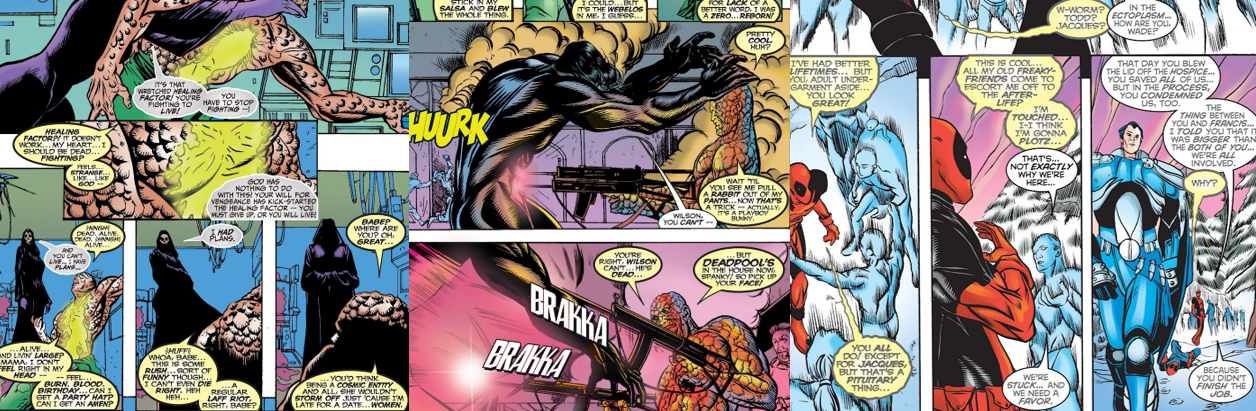
Gameplay:
Like its predecessor, Marvel: Ultimate Alliance 2 is a team-based brawler with limited roleplaying mechanics, exploration options, and puzzle elements. Players can (eventually) assemble a team of four from a roster of around twenty-five characters, many of which return from the last game alongside some newcomers, though your options are limited by story-mandated restrictions and the decision you make partway through to side with the Pro-Registration side or the Anti-Registration side. Regardless of which character you pick, your basic combat and control mechanics remain the same: tapping A executes a light attack while B throws a heavy attack; you can hold B to charge up a stronger strike and mix these together to form basic combos, such as a pop-up attack to break an opponent’s guard. X lets you activate doors and consoles, grab anything from crates to cars to toss at enemies, pull shields off foes and even grab enemies to pummel or throw them to their doom. Y lets you jump; press an attack button in mid-air and you’ll crash to the ground with a slam and press Y again for a double jump or to web-sling, fly, or dart along on a glider or ice bridge depending on who you’re playing as. The Left Bumper allows you to block incoming attacks or dodge out of the way by wiggling the left stick at the same time; there are also times when you’ll need to hit LB to deflect incoming projectiles. The Right Bumper allows you to heal yourself or your allies or revive a fallen comrade as long as you have a Heal Token in stock; these are found scattered across each location, usually spawning in during boss encounters or after defeating enemies, and you can hold up to two at a time.
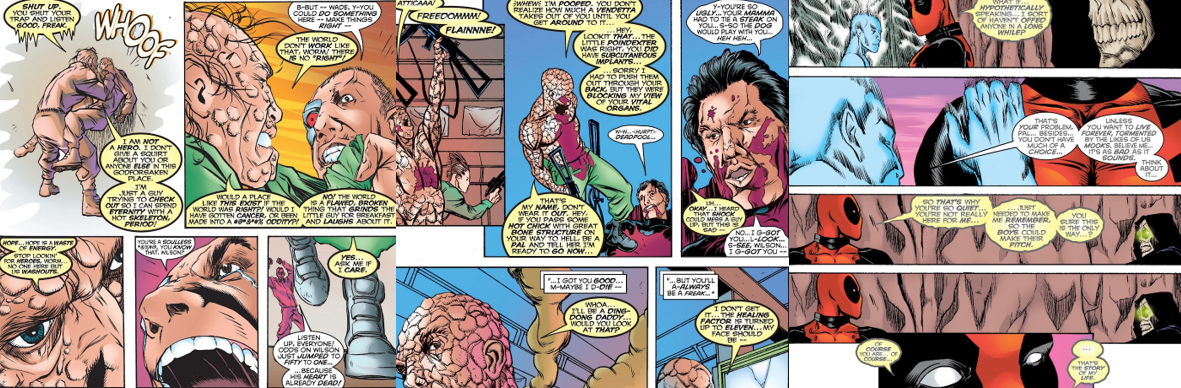
Characters boast new superpowers and can combine abilities in devastating Fusion attacks.

Although up to four players can play Marvel: Ultimate Alliance 2 simultaneously; you can also play alone with some competent A.I. companions and freely switch to another character using the directional pad when playing solo. You can press in the right stick for a handy arrow to point you to your next objective or bring up the game map from the pause menu. Each character as a life and stamina bar; the former is filled when you collect red Health Orbs or level-up and the latter fills automatically, and each character also comes equipped with their own Super Powers, which you activate by holding the Right Trigger and pressing A, B, X, or Y. Many of these are shared across characters, but with a unique flare to each; Spider-Man can web enemies towards him, for example, while Matt Murdock/Daredevil homes in with his grapple cane, but both can lash at foes with their whip-like weapons. Most characters tend to have a ranged attack (Johnny Storm/The Human Torch’s flaming projectiles, Iron Man’s Repulsor blasts, Ororo Munroe/Storm’s lightning strikes, etc) and a clearing attack (Doctor Bruce Banner/The Hulk’s ground pound, Doctor Reed Richards/Mister Fantastic’s tornado spin, and Remy LeBeau/Gambit’s kinetically-charged card barrage, etc), but some also have abilities that buff either their attacks or their team (Doctor Jean Grey/Phoenix can automatically revive characters or add fire damage to her attacks, Danny Rand/Iron Fist’s “Healing Hand” technique heals him, and Captain America can temporarily reduce the damage he takes, for example). Not only can these be improved by earning experience points (XP) and levelling-up and spending “Ability Points” (AP) in the character menu, but you can now combine powers for powerful “Fusion” abilities. As you dish out damage, you’ll build up the Fusion Meter and you can store up to two Fusion Stars at once and combine powers by holding the Left Trigger and pressing either A, B, X, or Y to team up with one of your allies. This produces various effects depending on the combination but, again, many of them are very similar and only made unique by the way the characters team up. For example, you can perform the iconic “Fastball Special” by combining James “Logan” Howlett/Wolverine, Daredevil, Iron Fist, and Mr. Fantastic with bruisers like the Hulk, Ben Grimm/The Thing, or Mac Gargan/Venom. Venom, Hulk, and the Thing can also do a dual stomping attack and you’ll be able to suck enemies in with tornados from the likes of Storm and Thor Odinson while adding elemental attacks to these twisters with the Human Torch and Phoenix.

Puzzles and objectives are simpler than ever and dialogue trees give the illusion of dramatic discord.

No matter the combination of characters, you’ll be prompted to tap A to increase the radius, target specific enemies, or hit successive foes to score extra points and unlock additional abilities and buffs for your characters. Tapping or holding X is also the most common way you’ll be solving the game’s puzzles; generally, you’re tasked with clearing out all nearby enemies and then activating a console or door with X, but sometimes you’ll need to push or pull amplifiers and giant batteries to power up (or down) generators or pass through barriers, rip off control panels, or destroy projectors. Other objectives include destroying anti-aircraft guns, defeating certain enemies, activating consoles in the correct order, and moving stone columns around to unlock doorways and paths, and some missions also contain optional objectives (such as destroying weapon stockpiles or teleporter pads) that net you additional rewards. Additionally, while you’re often told over your comms that you need to act quickly, only certain objectives actually carry a time limit (you’re given less than six minutes to defeat certain bosses, dispose of bombs, or escape collapsing facilities, for example) and you’re often given options to pick from in dialogue trees that will earn you buffs for being “aggressive”, “diplomatic”, or “defensive”. However, as near as I can tell, this doesn’t really alter the story or your character relationships like picking between Pro- and Anti-Reg, which will restrict the characters available to you and alter both the bosses and mission objectives you’re given (protecting or destroying a Strategic Hazard Intervention Espionage Logistics Directorate (S.H.I.E.L.D.) convoy, for example, or raiding or defending a S.H.I.E.L.D. base). Other missions will see you joined by an additional fifth character (technically not a non-playable character as many, like Captain America and Nick Fury, are playable) who will provide support; however, you can’t select them during gameplay, and you’ll still be met with failure if all four of your team are knocked out.

Graphics and Sound:  
There’s been a decent graphical upgrade between Marvel: Ultimate Alliance and its sequel, namely in the sense that the game is far less dark than before and environments are a little more varied, though the same issues with things becoming repetitive and visually dull persist despite how many additional destructible elements have been added. The game starts in Latveria and sees you infiltrating both the castle town, with its many statues of dictator Doctor Victor Von Doom, and Dr. Doom’s main castle, a location that featured in the last game and is now far more linear and less confusing. This is true of all of Marvel: Ultimate Alliance 2’s locations; it’s very rare that’ll you’ll need to explore off the beaten track, mazes and repeating areas are pretty much non-existent, and everything is much more straightforward this time around, which is great in the sense that levels tended to drag on a bit and be frustrating in the first game but disappointing as you don’t have much to do in, say, Wakanda, except follow a straight path taking out enemies and gun placements and simply walking past the waterfalls, jungles, and tribal trappings in the background. Additionally, Marvel: Ultimate Alliance 2 is way less fantastical; there are no trips to Atlantis, Asgard, or Hell here and, instead, you have to make do with such inspiring locations as…downtown, the rooftops of Hell’s Kitchen, train tracks, and high-tech facilities. Some, like Phineas Mason/The Tinkerer’s lab, T’Challa/The Black Panther’s throne room, and the Negative Zone prison are actually visually very interesting but, for the most part, this is a far more grounded affair, and the game loses a lot of its madcap appeal as a result since the focus is on the more grounded struggles of the Civil War.

While the characters and cutscenes look good, the game is noticeably less visually interesting than its predecessor.

This disappointment is also felt in the game’s soundtrack, which once again opts for very generic, military-esque tunes and rock-inspired beats that serve only to make the mindless gameplay all the more tedious. The voice acting and cutscenes are a lot better this time around; there’s still an obvious graphical difference between pre-rendered cutscenes and in-game graphics, but there’s more focus on character interactions and debating the merits of the SRA. Characters will continue to offer commentary during gameplay, with Wade W. Wilson/Deadpool regularly breaking the fourth wall and characters alerting you when they’re on low health, plus you sometimes get bonuses and additional dialogue if you have certain characters speak to each other. Character models seem better this time around, though; the animations used to bring their powers to life feel more unique and tailored to each hero, though it is disappointing (though, at the same time, understandable) that the same Fusion animations are recycled for certain team-ups. Once again, you’ll be operating out of various hub worlds, like Stark Tower and the White Star base, where you can chat to other characters and find collectibles, and performing certain deeds during gameplay will net you extra costumes (though, sadly, each character only has one this time around). Unfortunately, though, you won’t be treated to as many bizarre and wacky Easter Eggs or endings as before; you only really get one game-changing choice to make here, meaning there are only two endings to see, which is a shame as I really enjoyed all the different consequences of your actions in the first game and how it led to more replay value, whereas here you’re limited to picking Pro- or Anti-Reg.

Enemies and Bosses:
A slew of disposable goons will be set against you throughout Marvel: Ultimate Alliance 2, from Dr. Doom’s soldiers and robots to S.H.I.E.L.D. forces and the nanite-controlled minions of “The Fold”, a rogue A.I. that springs up in the game’s final act to reunite the warring superheroes. Regardless of who you’re fighting, you’ll come across the same recycled enemy tropes again and again: gun-toting soldiers, grunts with shields, ones who block your attack or inflict elemental statuses on you (such as burning, electrocution, and poisoning), and larger mechs. Helicopters will need to be taken out by tossing their grenades back at them, enemies will fire missiles and rockets at you; some have swords, some need to be stunned with your charged attack, some are shielded, and some toss explosive barrels your way. You’ll also have to watch for flame-spitting turrets, laser guns imbedded in walls, loose wires, and flaming hazards that’ll need a dose of coolant (or Bobby Drake/Iceman’s ice powers) to get past. It all gets very repetitive very quickly; the basic enemies aren’t much of a threat to you with your various powers and abilities but can quickly whittle your health down as they start mixing and matched and increasing in number, with more enemies onscreen than the last game and many of them being called in to boost or interrupt the many mini and main boss battles that you’ll have to contend with throughout the story. Like the last game, a who’s-who of Marvel’s most obscure and memorable villains are encountered throughout the game’s three acts, many of which crop up again, often in tandem with other villains.

The Tinkerer, Lucia von Bardas, and the damn Titanium Man represent a dramatic difficulty spike.

The first supervillain you’ll face is Max Dillon/Electro, who teleports around a church in a burst of electricity, performs an electrical blast attack, and can recharge his powers at the capacitors dotted throughout the area. After that, you’ll come up against Bentley Wittman/The Wizard and Steven Hudak/The Scorcher, with the former capable of erecting a shield and the latter roasting you with flame blasts, but your first real boss battle is against the Tinkerer. The Tinkerer stomps about in a large, spider-like tank mech that fires homing missiles, stamps the ground and sets it aflame, and sweeps that area with a laser blast. He’s also supported by an endless swarm of robotic minions, but you can use these to build up your Fusion Meter to target the Tinkerer’s legs and turn his mech into scrap metal. The Shocker/Herman Schultz’s stunning pulses must then be endured to rescue Carol Danvers/Ms. Marvel, then you’ll have your first of many encounters with the scythe-handed Eric Williams/Grim Reaper, one of the most recurring mini bosses who’s actually pretty tough thanks to his fast speed and quick, targeted slashes. Electro, the Scorcher, the Shocker, and the Wizard all reappear during the chaotic battle against cyborg Lucia von Bardas, which takes place on the deck of a ship. You’ll need to avoid her blasts and destroy the four cannons in each corner of the deck, which is easier said than done as Lucia defends three of them with flaming jets and you’ll have to contend with her supervillain bodyguards. Lucia also rains bombs from the sky, protects herself (and her minions) with energy shields, regularly hovers out of reach, and compounds the entire fight with a time limit. In the last part of the game’s first act, which takes part in Washington, D.C., you’ll have to do battle with Deadpool (who teleports about and riddles you with uzi bullets) and hit a bit of a brick wall when you go up against the mysterious Titanium Man. At first this isn’t so hard (he sends you flying, slows you with a pulse, and showers you with a laser spread) but things get much tougher in the second phase, where he turns invisible, is bolstered by minions and floating cannons, sends out loads of annoying vortexes, and there are no checkpoints during this battle, making it all the more frustrating.

While Bishop and Deathstrike can be aggravating, the Yellowjacket boss fight was actually pretty fun.

After this, you’ll be forced to pick a side and this alters the characters you pick and fight against; I went with Anti-Registration (because, frankly, the was the right choice all along) so I’ll primarily talk about those bosses. First up is a scuffle with Natalia Romanova/The Black Widow, who keeps you at bay with her pistols, cartwheel kicks, and grenades, and your first battle with Colonel James Rhodes/War Machine, who’s basically a mirror of Iron Man and attacks with a rocket-powered punch and missiles, though both are pretty easy fights here, especially compared to the one against Lucas Bishop. Your energy attacks will actually heal the grenade-toting Bishop, so try to focus on physical attacks, but you’ll deal the greatest damage against him if you attack and destroy the terminals he plugs himself into. This actually gets pretty tricky as you have to hit three power terminals to cause feedback, then hit four nodes on other terminals to stop him regaining health, and finally hit all six nodes when he draws energy from the middle of the terminals, all while avoiding his rushes and shockwave attacks. In comparison, Melissa Gold/Songbird is a bit of a joke since all you have to worry about are her pink sonic waves, but the difficulty ramps up again when you butt heads with Yuriko Oyama/Lady Deathstrike, who attacks with her Adamantium claws like a whirling dervish. Though the Thing saves your ass, you’ll have to contend with S.H.I.E.L.D.’s soldiers and robots in the second phase; Deathstrike will repair these mechs, so it pays to quickly take them out, but that’s not easy thanks to her speed and aggression. Thankfully, this is followed by a fun and visually interesting fight against Doctor Henry “Hank” Pym/Yellowjacket, who pounds and slaps at you in his gigantic form; you need to attack his massive fists to build up your Fusion Meter and stun him, only then can you unleash a Fusion attack to deal big damage to him, though you’ll have to watch for his double-fist slam and the minions who swarm the rooftops. When in the unstable chemical plant, you’ll have a quick run-ins with Bullseye (who I had no issues with despite his triple-shot projectile), Simon Williams/Wonder Man (who’s also not too hard despite teleporting about the place and sporting powerful melee attacks), and even an unexpected alliance between Jennifer Walters/She-Hulk and Mark Raxton/Molten Man that sees you avoiding the former’s jumping slams and the latter’s flame bursts.

You’ll face different bosses depending on which side you choose, which also impacts the game’s difficulty.

You’ll also contend with a more formidable version of War Machine and have a brief fight with Iron Man (who’s basically the same as War Machine but with fancier laser attacks) before he tags in Mr. Fantastic (who’s actually a bit of a pain thanks to his stretchy limbs bursting up from the floor and his tornado spin). Iron Man and Mr. Fantastic prove quite the double team when you battle them together; even with Captain America on hand to help and with victory coming by defeating Iron Man alone, this can be a tough fight as Mr. Fantastic sometimes glitches and perpetually spins in place and Iron Man flies around the arena sending energy projectiles your way. Finally, you’ll need to help Nick Fury dispose of some bombs while fending off a joint attack from Doctor Norman Osborn/The Green Goblin and Venom; the former flies around dropping grenades or tosses pumpkin bombs in your face while the latter attacks with their tendrils and even webs up the bomb disposal vent and commandeers the Goblin’s glider! On the Pro-Reg side, you’ll have to quell Eli Bradley/Patriot after your betrayal, fend off Jessica Drew/Spider-Woman rather than Black Widow and Hercules instead of Wonder Man, as well as tangle with Nathanial Summers/Cable, who proves highly resistant to damage, constantly teleports about the place, and forces you to rely on your standard attacks and super powers since there are no minions to help build up your Fusion Meter. Ritchie Gilmore/Prodigy, Angelica Jones/Firestar, Tandy Bowen/Dagger, Piotr Rasputin/Colossus, and Jamie Madrox/Multiple Man also crop up, with the latter being quite the obstacle if you don’t have the right teammates, while Tom Foster/Goliath takes Yellowjacket’s place. Instead of fighting War Machine, Mr. Fantastic, and Iron Man, you’ll take on Iron Fist, Luke Cage/Power Man, and Captain America, with this latter fight complicated by plumes of fire and the Cage and Cap being able to pull off Fusion attacks!

After battling numerous foes, you’ll need all your powers to defeat the nanite-infused Nick Fury.

Before you enter the Negative Zone prison,  Commander Maria Hill hands over a key card without issue and Robbie Baldwin/Penance is subdued and recruited after a brief fight. Terrance Sorenson/Equinox proved much tougher thanks to the nearby turrets and his health-draining elemental attacks, and you’ll battle the nanite-infected Grim Reaper, Bullseye, and Molten Man to rescue Luke Cage and Firestar. To escape the prison with the nanite samples, you’ll take on the combined might of David Cannon/Whirlwind, Karla Sofen/Moonstone, and Rachel Leighton/Diamondback; though Captain America and Iron Man help out, this can be a frustrating fight as Whirlwind is constantly spinning about and minions are always spawning in but focusing on one mini boss can help mitigate the danger. While in Wakanda, you’ll fight off Alexander Summers/Havok (whose concussive powers are bolstered by nearby vibrational pillars), the combined threat of Hulk-clone Rick Jones/A-Bomb and Vance Astrovik/Justice (who shields his nanite ally), and once again deal with the duo of Green Goblin and Venom, this time in the Black Panther’s throne room and with a wider, more versatile space for them to avoid your attacks (though having a flame-orientated character or buffs will help against Venom). Wonder Man and Spider-Woman guard the entrance to the Fold’s Iceland base, with both proving tougher than before, while She-Hulk, Firestar, Colossus, and Whirlwind await inside guarding amplifiers. You’ll also battle the Tinkerer again here; this time, he’s almost constantly shielded by the Fold’s enhanced elites, who you’ll need to destroy in order to deal damage to the mad inventor, though the sheer influx of enemies can make this a gruelling prospect. Finally, after battling on a rising elevator and reaching the top of the Fold’s amplifier tower, you’ll fight the nanite-infected Nick Fury. Using a coloured holographic projection, Fury emulates the powers of other characters and bosses to constantly keep you on your toes; he strikes with lightning, sends out energy pulses, rapidly moves and teleports all over the place, creates duplicates, absorbs and projects energy, blasts out a stream of light, and causes the ground to erupt in flames. Although a frustrating and long-winded bout, this was actually easier than some other bosses; switch characters to whoever’s closest, unleash your rapidly-filling Fusion Meter, and remember to deflect his projectiles when prompted and you should emerge victorious without having to expend a single revive, which is more than I can say for the damn Titanium Man!

Power-Ups and Bonuses:
As mentioned, combat yields XP that levels you and your team up; all characters level-up regardless of whether you use them or not, but levelling-up alone isn’t enough to power-up your team. You need to spend AP boosting their four superpowers and all four will only be unlocked by levelling-up; thankfully, AP is easily earned by beating enemies, rapidly tapping A during Fusion attacks, and smashing crates and other onscreen destructibles. Each character also has “Passive” abilities that can be upgraded in the character menu; many of these are locked to a specific side, so you’ll never have full access to all abilities in a single playthrough, and they provide buffs such as raising your chances of landing a critical hit, allowing more frequent use of your powers, regenerating health, reducing damage, and increasing the stamina you gain. Defeating mini bosses and bosses also rewards you with medals that provide additional “Boosts”; you can manually or automatically equip up to three of these at a time to increase your health, teamwork, resistance to or ability to inflict elemental attacks, and other similar bonuses. It also pays to utilise your comic book knowledge; if you make a team comprised entirely of X-Men or the Fantastic Four, for example, you’ll get an additional boost to aid you. Finally, extra rewards are on offer for performing three “Heroic Deeds” per character; these range from defeating fifty enemies, performing specific Fusion attacks, or using certain superpowers and will unlock a new costume or ability for each character, as well as being a fun aside.

Additional Features:
There are fifty Achievements to snag in Marvel: Ultimate Alliance 2, with sixteen being tied to the story mode alone, though you’ll need to do two playthroughs and experience both the Pro- and Anti-Reg missions to earn them all. You’ll also earn Achievements for completing missions in co-op mode, clearing the game on “Legendary” difficulty, performing ten Fusions with a friend, earning high scores from Fusions, unlocking costumes, collecting boosts, and finding the various dossiers and audio logs scattered throughout the game. You’ll unlock additional characters not just through the story mode, but also by collecting Asgardian Ruins, pieces of the M’kraan Crystal, and Gamma Regulators; some characters’ alternate costumes also act as skins, such as General Thaddeus “Thunderbolt” Ross/Red Hulk and Eddie Brock/Venom. You’ll also find simulator discs scattered about that once again let you take on special simulator missions from the game’s hub worlds, can put your Marvel knowledge to the test in various trivia games for more XP, and will be given the option of starting a new game, with all your unlocks and stats, but at the cost of your existing save file. There is no option to replay previous missions as far as I can tell so you’ll need to start over if you missed anything. I’d also advise making use of the manual save function as often as possible, especially before you pick a side so you don’t have to start right from the beginning to see the other side of the story. If you were lucky enough to own this game before it got delisted, you can also expand the roster with some downloadable characters, like Cletus Kasady/Carnage and Erik Lehnsherr/Magneto, though this feature is obviously unavailable these days; additionally, other versions of Marvel: Ultimate Alliance 2 include console-specific characters, like Eric Brooks/Blade.

The Summary:
I was always hesitant about getting into Marvel: Ultimate Alliance 2, simply because of my hatred for the diabolical Civil War storyline. Even with that bias to one side, I wasn’t impressed that the sequel stripped back the story and scope of the franchise so much; the first game arguably tried to do a bit too much and touch base with a bunch of different locations and characters in the Marvel universe, but at least it embraced the bonkers spirit of the source material and wasn’t as blinkered as the sequel. I really missed the unpredictability at the first game; here, the only replay value is in picking a different side, especially as all characters are available to you in the finale, so all you’re really left with is the new-fangled Fusion mechanic. Sadly, this isn’t as good as the game makes it out to be; once you’ve seen a handful of them, you’ve basically seen them all and they weren’t as impressive as I had hoped. I also wasn’t a big fan of some of the character choices and the lack of extra skins, though overall I think I preferred the gameplay and combat; it’s still mindless and tedious and gets old really quickly, but at least the different superpowers felt a little more dynamic this time. While I have no complaints about the game’s linearity since it made it faster to play, it is a shame that exploration has been cut way back this time around and that many of the level-up and customisation mechanics have been stripped down. Once again, the game’s biggest issue is cramming so much into it; it’s great for a Marvel fan but it does impact the enjoyment and memorability of the mini bosses since a lot of them are just the same thing over and over with the same tactics used to overcome them. Overall, I feel Marvel: Ultimate Alliance 2 is no better or worse than the first game: I miss the different gameplay mechanics and visual variety of the first game, but the sequel feels a bit more refined and focused; I don’t like how grounded and restricted it is, but the graphics and ability options are a step up. I think the best thing to do (if you can afford it) is have both and play them back to back for a complete experience but if I honestly had to pick which one was better, I’d go with the first one since I’m much more inclined to play it and see what wacky endings I can earn rather than seeing the SRA repealed or lessened by the end of this game.

My Rating:

Rating: 3 out of 5.

Pretty Good

Have you ever played Marvel: Ultimate Alliance 2? If so, how do you think it compares to the first game? Which side did you pick and who made it into your team? What did you think to the new Fusion mechanic and the changes to the roster? Were you disappointed that the boss battles were still mostly tedious exercises and that the scope was scaled so far back? Did you ever complete all the Heroic Deeds and simulator missions? How are you celebrating National Superhero Day today? Whatever your thoughts, leave a comment below or on my social media, and be sure to check out my other superhero and comic book content across the site!

Back Issues [Deadpool Day]: Deadpool and Death Annual ’98


In February 1991, readers of The New Mutants were introduced to Wade W. Wilson, AKA the wise-cracking, fourth-wall-breaking Merc With a Mouth himself, Deadpool. Rob Liefeld and Fabian Nicieza’s sword-swinging immortal went on to become one of Marvel’s most popular anti-heroes thanks to his metatextual humour, violent nature, and massively successful live-action films. It’s perhaps no surprise that Sideshow rechristened April 1st as “Deadpool Day” to give fans of the chimichanga-chomping mercenary an excuse to celebrate all things Deadpool.


Story Title: “A Kiss, A Curse, A Cure”
Published: 13 May 1998 (cover-dated July 1998)
Writer: Joe Kelly
Artist: Steve Harris

The Background:
By the 1980s, the X-Men were established as a successful cornerstone of Marvel Comics; they were so popular that then-chief editor Jim Shooter ordered a number of X-Men spin-off books, one of which was Chris Claremont and Bob McLeod’s The New Mutants. These Mutant youngsters were eventually tutored by the time travelling Mutant Nathan Summers/Cable and rechristened as X-Force, and famously went up against Fabian Nicieza and Rob Liefeld’s Deadpool in The New Mutants #98 (ibid, 1991). Heavily inspired by James Howlett/Logan/Wolverine and Peter Parker/Spider-Man (and with numerous similarities to DC Comics’ Slade Wilson/Deathstroke the Terminator), the self-styled “Merc With a Mouth” was initially introduced as an antagonist for the Mutant team. However, Deadpool proved popular and soon made guest appearances in other Marvel Comics before receiving his own four-issue miniseries, a precursor to his ongoing solo title and his own influx of popularity once he began breaking the fourth wall. One of the character’s other defining traits is his relationship with Lady (or Mistress) Death, a cosmic, reaper-like entity whom Wade is desperately in love with. Created by Mike Friedrich and Jim Starlin, Death is most prominently known for also being the object of Thanos’s affections; his motivation for gathering the Infinity Gems and eradicating half the life in the universe was to win her love. Thanos and Deadpool clashed over their love for death more than once; in fact, it was the Mad Titan who cursed Deadpool with immortality when Lady Death chose Wade over him.

The Review:
This bumper annual opens with the super chatty Deadpool unexpectedly teleporting right into the path of a closed fist; the punch sends him careening over a cliff edge where, despite this best efforts, he plummets to the ground with a sickening impact. Just moments before, Deadpool had been working to make amends for his past deeds in San Francisco, and now he finds himself literally dead of a broken neck thanks to his mysterious assailant. Deadpool’s spirit initially balks at the idea of the fall killing him, or the sudden attack being real, but is forced to confront the truth when Lady Death greets him with a passionate kiss. Despite Deadpool asking to skip the flashbacks and cosy up to Death, she silently insists on forcing him to relive his traumatic origins and the story regularly shifts between the present and the past, where mercenary for hire Wade Wilson is given a tour of the Weapon X facility, a special weapons development branch of Department K, the superhuman arm of the Canadian government. At this point, Wade is a strapping young man with a head full of blonde hair and the potential to be a valuable asset to his government, but also riddled with terminal cancer. Since Weapon X has already made a veritable Captain Canada out of James Hudson/Vindicator, the general is confident that even trash like Wade can be moulded into a superhero with their program. Wade readily agrees, awestruck by the Vindicator and with little to lose from his prognosis. However, he fails to pass the grade and, with his conditioning worsening, he’s locked up in a hospice where his fellow outcasts have such a low life expectancy that they regularly take bets on how long they will survive from their horrific and invasive experiments.

After being killed, Deadpool relives his traumatic origins and first encounter with Lady Death.

This “deadpool” carries high stakes and is championed by the semi-cybernetic Worm Cunningham; however, when Worm tries to pull that shit on Wade, the heavily scarred and slowly dying mercenary pulls a gun on him and demands to be left alone before turning the gun on himself. Before he can pull the trigger, though, the gun (and Wade’s wrist) is crushed by the sadistic, super strong Francis Fanny/A-Man, who mocks Wade and the knocks him out to deliver him to the resident doctor, Emrys Killebrew, for further experimentation. Dr. Killebrew and the A-Man are amused by Wade’s torture, especially when he begs for death, and both delight in subjecting him to unspeakable torment to make the most of his raw materials. The experience is so traumatic for Wade that his mind breaks and he grows cynical, scorns his misfortunes, and finds his body further ravaged by cancerous tumours. His mind becomes so warped that he perceives Lady Death, who lingers in his cell, intrigued by his unique imagination, and is stunned to find that he can see her. After invasively confirming that he’s not suffering from some kind of aneurysm, Death postulates that Wade is a unique being who longs to die but is being artificially kept alive against his will. Frankly, she finds the entire thing quite the turn on, as does he since Death assumes an alluring form given the amount of times he’s begged for it; thus, she promises they can be together if he finds a way to die but, despite his best efforts, he’s thwarted at every turn. He’s constantly stopped from killing himself and subjected to nightmarish experiments that bring him to the brink of death and cause him agony, yet he remains alive thanks to Dr. Killebrew’s machinations. He’s become so unkillable that his odds in the Deadpool have risen to three thousand to one, and such a risk to himself that he’s confined to a high-tech wheelchair. However, he remains determined to reunite with Death and to get the A-Man out of his way; Worm, however, doesn’t fancy his odds since the A-Man boasts enhanced strength, instincts, speed, and durability.

Wade’s defiance causes the A-Man to kill his friend just for the chance to murder the mouthy mercenary.

Worm lets slip that the A-Man hates his real name and is psychotically triggered by the merest mention of it, which is all Wade needs to rile up the brutal guard. Wade’s taunting works, sending Francis into a violent frenzy and condemning him to endure electroshock therapy. The experience is so intense and extreme that it briefly allows Wade to speak with Death once more. While he’s not truly dead, he crosses over long enough to share a dance with her, and Wade’s mockery of the A-Man not only improves his standing in the Deadpool but also offers a glimmer of hope to the other inmates. There’s a defiant fire there that wasn’t there before, but Wade angrily denies that he’s a hero; he sees the world as cruel and unfair and hope as a waste of energy, much to Worm’s disappointment. Even Death wonders if he was a little hard on the semi-cyborg but Wade insists that the only thing he cares about is being with her; others can play the role of hero, after all. Still, Wade’s attitude and the rising insubordination sees the A-Man voice his grievances to Dr. Killebrew; despite the A-Man protesting that he’s less effective if the patients don’t fear him, Dr. Killebrew is unwilling to simply dispose of Wade since his body contains information vital to his research. To get around this, and teach Wade some respect, the A-Man threatens to subject Worm to violent torture unless Wade falls in line. While Wade is torn between saving his friend and standing up to the A-Man, he ultimately chooses the latter, berating the A-Man with a tirade of insults after Worm begs him to stay defiant. This results in Worm being viciously lobotomised, giving Wade no choice to end his suffering and consequently forcing Dr. Killebrew to order Wade’s execution for killing one of his test subjects.

Wade’s desire for revenge sees him live on as Deadpool and drives him to confront his tormentor.

As the A-Man gleefully takes the controls of Dr. Killebrew’s elaborate murder machine, Wade vows to make them pay for what they’ve done to him, the other patients, and to Worm even as the A-Man rips his heart from his chest. Death comes to him, eager to consummate their love and begging him to let go and be with him; however, while he wishes to finally be with her, his stubborn nature and desperate need for vengeance kick-start his Mutant healing factor and force his body to repair the damage. The experience further damages his psyche but also shuts Death off from him as he drives himself forward to get revenge on his tormentors. Wade relieves some guards of their weapons and goes on a killing spree, much to the A-Man’s surprise and anger. The A-Man crushes Wade’s spine (his entire abdomen, in fact) in a rage and is left stunned when Wade painfully and sickeningly heals from the damage right before his eyes. Wade then christens himself “Deadpool” and unloads two assault rifles into his abuser but, even as he lies dying on the floor amidst the chaos of a full-blown riot, the A-Man can’t help but mock Deadpool’s heavily scarred visage, which somehow remains despite his advanced healing factor. With the A-Man dead, Deadpool calls to Death to take him but she doesn’t answer, leaving him distraught and heartbroken, which in the present he assumes is her way of causing him pain for choosing revenge over her. A silent point from Death reveals that Deadpool’s killer was none other than the A-Man, now calling himself “Ajax”, resurrected and sent to hunt down all the escapees from the hospice, The ghosts of his victims implore Deadpool to finish the job so they can move on to the afterlife and, with one last regretful kiss to Death, Deadpool spontaneously returns to life and heads out to make Ajax pay once and for all.

The Summary:
This was quite the surreal story. I believe this was the first real extended dive into Deadpool’s origins, and I recognise a lot of the elements from his first live-action movie, so that was kind of cool. While we don’t learn much about Wade’s life before Weapon X, and nothing about his time with the program since he dropped out of “hero school”, he has a reputation as being a mercenary and has a bit of sympathy to him because of his terminal disease. The main thrust of the story is to showcase just how horrific and traumatic Wade’s time at the hospice was. Wade’s unique speech patterns and manic thought boxes can be traced back to his time there, where the experiments and abuse fractured his mind and drove him to the point where he exists in this kind of limbo between life and death. That alone is alluring to Lady Death, but Wade’s crazed perspective on life also draws her attention, as does her desire to tease him with her affections. Naturally, since he longs for death, Wade finds her impossibly alluring and is desperate to be with her but he’s forever denied that thanks to a throwaway line from Dr. Killebrew about transplanting a healing factor into his ravaged body. When he finally is on the brink of death, Wade’s normally cold-hearted resolve has been replaced by a burning desire for revenge, spurning Death and close that door to him seemingly forever.

The story goes to great pains to examine the tragedy and torture that made Deadpool the man he is.

I do find this concept a little convoluted, similar to the idea that Wolverine has to literally fight off death every time he suffers a mortal injury. I think it clouds things a little and it’s simpler to just say he has a super-superhuman healing factor, but it only muddies the water if you think about it too much. While the concept of Death as a cosmic entity is proven to be real in Marvel Comics, it’s just as likely that Wade’s fracted mind is imagining her as this alluring skeleton woman and that he’s too stubborn, too powerful, and too stupid to die, despite wanting to deep down. Still, the story does a great job of humanising Deadpool and peeling back the layers behind his demented bravado; his experiences left him hating the world, cursing fate and the Gods alike, and wanting nothing more than to die, but the kindness of others and the brutality of his captors shifted him towards a different path. Dr. Killebrew and the A-Man are understandably one-dimensional characters; one’s a cackling mad scientist with no regard for his patients’ welfare and the other’s a superhuman sadist who delights in throwing his weight around and the suffering of others. I liked how Wade riled the A-Man up with insults and repeatedly calling him Francis, and that Wade became this revolutionary figure amongst the populace as a result, so the conflict was more about physical embodiments of oppression and freedom rather than an actual fist fight, which is fitting considering this extends to the physical and metaphysical aspect of Death. Ultimately, this was a decent and surprisingly tragic story designed to explain how awful Deadpool’s life has been and why he is the way he is. In that respect it worked well, and the art was serviceable enough most of the time, so it’s a good choice for anyone who’s just getting into Deadpool and wants to learn a bit more about his background and character.

My Rating:

Rating: 3 out of 5.

Pretty Good

Have you ever read Deadpool and Death Annual ’98? If so, what did you think about Deadpool’s trip down memory lane? Do you like the idea of him falling for Lady Death or do you find that aspect a bit convoluted? What did you think to the agonising torture Deadpool had to suffer and the characterisation of Dr. Killeshaw and the A-Man? Do you enjoy Deadpool’s manic sense of humour or do you find it a bit grating? What are some of your favourite Deadpool stories and moments and how are you celebrating Deadpool Day today? Whatever your thoughts on Deadpool, feel free to share them below or drop a comment on my social media.

Game Corner [National Superhero Day]: Marvel: Ultimate Alliance (Xbox 360)


In 1995, Marvel Comics created “National Superhero Day” and, in the process, provided comics and superhero fans the world over with a great excuse to celebrate their favourite characters and publications.


Released: 24 October 2006
Developer: Raven Software
Also Available For: Game Boy Advance, Nintendo Wii, PC, PlayStation 2, PlayStation 3, PlayStation 4, PlayStation Portable (PSP), Xbox 360, Xbox One

The Background:
Perhaps few videogame publishers are as synonymous with Marvel Comics than Activision; the publisher has been spearheading adaptations of some of Marvel’s most popular properties since the year 2000. They weren’t all smash hits, of course, but some of their titles have been praised as among the best for characters like Peter Parker/Spider-Man and Marvel’s resident Mutant team, the X-Men. In 2004, the publisher teamed with developers Raven Software and saw big success with X-Men Legends, a team-based brawler that incorporated role-playing elements and simultaneous co-op gameplay. Following similar success with the sequel, Activision’s partnership with Raven Software expanded to incorporate much of the rest of Marvel’s line-up with this title, which was built on Vicarious Visions’ Alchemy engine. The game also greatly benefitted from utilising the Havok physics engine; in addition to including many of Marvel’s most popular characters alongside those added as downloadable content (DLC), Nintendo staples Link and Samus Aran were initially planned to be Wii-exclusive characters before being nixed. Marvel: Ultimate Alliance received generally favourable reviews; critics praised the game’s presentation and for improving and expanding upon its predecessors, and the game was successful enough to warrant an equally-successful sequel three years later and (eventually) a Nintendo Switch-exclusive third entry that received mixed reviews. Sadly, despite a remastered version being developed for PC, PlayStation 4, and Xbox One in 2016, Marvel: Ultimate Alliance is currently delisted from digital storefronts and quite difficult to come back for an affordable price as a result.

The Plot:
When Doctor Victor Von Doom and his Masters of Evil launch an attack against the Strategic Hazard Intervention Espionage Logistics Directorate (S.H.I.E.L.D.), Colonel Nick Fury sends out a distress call to all available superheroes for assistance. Steve Rogers/Captain America, Spider-Man, Thor Odinson, and Logan/Wolverine respond to the call and must soon join forces with a myriad of other Marvel heroes in order to put a stop to Dr. Doom after he attains incredible cosmic powers from Odin Allfather.

Gameplay:
Marvel: Ultimate Alliance is a top-down, team-based brawer peppered with some very light puzzle solving, opportunities for exploration, and role-playing mechanics. Players can (eventually) assemble a team of four from around thirty available superheroes and journey across a number of recognisable Marvel locations battling against the nigh-on endless minions of the Masters of Evil. Up to four players can play at once, though a single player is able to battle on alone, using the Left Trigger and directional pad (D-pad) to direct their computer-controlled team mates or switching to another superhero by pressing a corresponding direction on the D-pad. Players are given two primary attack options: A for a quick attack and B for a stronger attack, which can be charged up, and alternating between these commands will allow you to string together a few simple combos that will stun, trip, or blast your foe into the air, which can be essential to breaking through some enemy’s guards. X is the “action” button, allowing you to open doors, activate consoles, turn levers, or grab enemies to pummel, throw, or relieve them of their weapons, and Y allows you to swim and jump (you can also double jump, web-sling, or fly by double pressing and holding the button, respectively). Players can block incoming attacks by holding the Left Bumper or tap it to dodge out of the way entirely and each character has their own special abilities, which are accessed by holding the Right Trigger and selecting either A, B, X, or Y. Special powers can only be used if you have another energy, which is represented by glowing blue orbs dropped by enemies or uncovered from smashing crates or opening chests, and allow you to fire energy beams, toss projectiles, entrap enemies (by freezing or webbing them up, among other options), boost you (and your team mate’s) defense, attack, and other attributes, and cause status effects to your enemies like stunning, burning, or electrocuting them. While many of the effects are largely shared amongst the roster, each character pulls them off in their own unique way; Tony Stark/Iron Man’s Repulsor blasts are different from Mark Spector/Moon Knight’s projectiles, even though both can ricochet around the environment, and each character has a variety of special powers that you can power-up and assign to the face buttons from the “Hero Management” menu.

Assemble a team of four superheroes and battle the endless forces of the Masters of Evil.

Each character also has a big, character-specific attack that can be performed when your energy gauge is completely full and you press Y while holding RT this will see them unleash a huge, screen-clearing attack specific to them and each character will perform these in succession if their energy gauge is full. You’ll also earn additional bonuses if certain characters pull off their special moves at the same time, and this also happens if your team is formed of characters who have a history together, like the X-Men or the Fantastic Four. The game’s story mode is comprised of five “Acts”, which drop your team in a variety of locations that should be familiar to Marvel Comics fans. After clearing the first mission, which has you retaking a S.H.I.E.L.D. Helicarrier from Dr. Doom’s forces, you’ll be dropped into one of five hub areas where you can interact with Nick Fury, Natasha Romanoff/Black Widow, and other non-playable characters (NPCs) to learn more about your current or next mission, gain insight into the heroes and villains, and be given side quests to perform. In the hub area, and scattered throughout each location, are S.H.I.E.L.D. Access Points where you can save or load your game, change up and upgrade your team, or revive fallen teammates. Just as blue energy orbs can be acquired during gameplay, so too can red health orbs, but some environmental hazards or bottomless pits will see you or your teammates taken out of action. It can take about three minutes for your fallen ally to be ready for revival, but they can only be brought back into the fight from one of these save points. As you defeat enemies, you’ll earn experience points (XP) and level-up once you’ve gained enough XP, which will improve both your individual and team stats and unlock additional special moves for you to utilise. From the Hero Management screen, you can switch your character entirely, change their costume (which affords different abilities), equip gear to boost their stats, and name and improve the competence of your team to increase your odds when in a fight.

The tedious combat is broken up by some simple puzzles, QTEs, or short bites of variety.

Gameplay in Marvel: Ultimate Alliance quickly grows quite repetitive; you can charge through most missions by repeating the same combos and special moves over and over, and opportunities for exploration are quite limited as areas generally only give the illusion of being large and multi-pathed. Combat doesn’t get much deeper than tripping, stunning, or blasting enemies, or avoiding using physical or energy-based attacks, and it’s surprisingly easy to get turned around in areas even with the presence of a mini map as one dark, grey corridor looks the same as the last. Puzzles aren’t much of a head-scratcher here; you’ll generally fight your way to a console or power generator that needs to be activated or destroyed, though sometimes you’ll need to activate two switches at once with the either of a partner, and you’ll sometimes have to perform these tasks against a time limit. You’ll need to push or pull heavy objects onto pressure pads, redirect sunlight to free Balder Odinson, defend Dum Dum Dugen in a glorified escort mission, perform character-specific motions to activate statues, or complete quick-time events (QTEs) to open doors or take out larger, otherwise-invulnerable bosses. You’ll jump behind the controls of an anti-aircraft cannon, be joined by NPCs like Major Christopher Summers/Corsair, and have to rescue characters like Doctor Bruce Banner and Prince Namor McKenzie/The Sub-Mariner, though some of these are optional side quests. These optional missions appear during the main campaign and often having you searching for items for a specific character, or destroying certain targets along the way, and sometimes you’re faced with an impossible choice between two options which will fundamentally alter the multiple endings. Gameplay really gets interesting, though, when you end up in Murderworld, a twisted funfair featuring bumper cars, a giant pinball set, a hedge maze, and even an old-school Atari-style mini game that sees you awkwardly swinging from ropes and collecting Golden Tickets to rescue Doctor Jean Grey/Phoenix from Arcade’s clutches.

Graphics and Sound:
Marvel: Ultimate Alliance is largely an impressive looking title, despite how old it is now, thanks to the zoomed out, almost isometric camera perspective. This means that the in-game character models, while hardly the most detailed, pop out nicely against the various backgrounds and I liked how they all had their own unique flourishes, like Spider-Man being able to web enemies up when he grabs them and Norrin Radd/The Silver Surfer floating around on his cosmic surfboard. Unlike some similar team-based brawlers, this really helps it to feel as though each character plays a little differently since they don’t just share the same animations and have a little individuality to them; you’ll need a stronger character to move certain objects, for example, and it’s much easier to explore the environment with a character who can fly. While your customised team won’t appear in the pre-rendered cutscenes, they do all have a lot of unique dialogue during the game, and when talking to or fighting against other characters; dialogue trees exist so you can ask a number of questions to NPCs or pick different options, which either helps you answer trivia questions, kicks off a side mission, or has you picking to team up with or save a different character, and villains like “Lester”/Bullseye or Quinten Beck/Mysterio. Unfortunately, the music isn’t really on par with the voice acting; it’s all very generic superhero-y or militaristic themes, and the in-game tracks often awkwardly loop, which is very jarring; the music’s also very loud, so you might want to adjust the sound settings in the options.

While the cutscenes aren’t great, the in-game graphics are decent enough and there’s a lot of dialogue variety.

The pre-rendered cutscenes also often let the game down a bit; they haven’t aged too well, and have a very rubbery and surreal quality to them (though they are pretty epic, especially when the Masters of Evil are discussion their evil lot and when Galactus and Uatu/The Watcher enter the story) that I’d criticise more if I could actually see them but the cutscenes are very dark and the only way to brighten them is by changing your television’s settings. The game’s environments often don’t fare much better, either; while it’s fun visiting places like the Sanctum Sanctorum and Valhalla in the hub worlds, the actual mission locations quickly become confusing and boring. While there’s a lot to destroy and see in each area, and even some hidden paths to uncover, rooms, corridors, and sections all start to blend together and the levels themselves can outstay their welcome at times, which only makes the monotonous combat more glaring. That’s not to say that there aren’t some visually interesting locations, though; you’ll swim through the depths of Atlantis, travel to Hell itself, battle across the length of the Bifrost Bridge and through the frozen wastes of Niffleheim, and infiltrate the gothic, regal stone walls of Castle Doom. Easily the most impressive area you’ll visit, though, is the Skrull home world, which is currently under attack by Galactus. The World-Devourer is seen lumbering around in the background between the futuristic skyscrapers and even pursues your across the walkways in an exciting (if frustrating) sequence, though the gameplay and visual variety offered by Valhalla is equally fun as you can visit the Warrior’s Hall (where NPCs are enjoying revels) and hop across Viking ships amidst a cosmic backdrop.

Enemies and Bosses:
Since a gaggle of Marvel’s most notorious villains has joined forces in Marvel: Ultimate Alliance, you can expect to come up against a bevy of disposable goons during your adventure. It doesn’t take long for you to basically have seen everything the game has to offer in this regard, but each location does at least change up the appearance, dialogue, and some of the attacks of the enemies you face; you’ll battle Ultron’s minions, Loki Laufeyson’s trolls, and soldiers from the Shi’ar Empire and the depths of Atlantis, all of whom can be defeated using your standard combos or special powers. You can set your team mates to follow, attack, or defend formations, but I always like to choose an aggressive approach to overwhelm the hoards of enemies that can flood each area. Some of these carry weapons, either melee armaments like axes, spears, and swords which you can appropriate, or laser rifles for long-range attacks; others shield themselves and need to be attacked from behind or stunned. Some, like the imp-like demons from Mephisto’s Realm, leap onto you and drain your health, while others fly above taking pot-shots at you, and some are resistant to physical or energy attacks or need to be tripping, stunning, or blasted into the air. Some are larger, dealing and taking more damage, while others regenerate their health (or their allies), sap your health or energy, or boost the attack of other foes, so it’s best to take those guys out first.

A whole host of Marvel villains stand in your way, though most can just be beaten into submission.

The Masters of Evil have assembled quite the smorgasbord of allies; you’ll do battle with almost every single villain from Marvel Comics throughout the course of the game, sometimes more than once, as various underlings dog your progress throughout each mission. Often, you’ll battle at least two of these sub-bosses at a time; sometimes they flee after an initial encounter and need to be fought again, other times they’re powered up to be more formidable, and in other cases they’re able to heal or shield each other from your attacks by working together. However, defeating the likes of Mac Gargan/The Scorpion, Bullseye, James Buchanan “Bucky” Barnes/The Winter Soldier, Chen Lu/Radioactive Man, Valentin Shatalov/Crimson Dynamo, Aleksei Sytsevich/The Rhino, Herman Schultz/The Shocker, Doctor Curt Connors/The Lizard, Hussar and Neutron, Paibok, and even the corrupted superheroes you eventually fight really don’t require much more than you constantly attacking them with combos and special powers. Indeed, while it’s impressive that so many villains appear in the game, very few actually offer much in the way of a challenge beyond being a little tougher than the regular enemies you encounter, with even the likes of notorious villains like Ultron and Titannus proving quite disappointing encounters as, while they keep you at bay with laser blasts or destroy everything in a rampage, respectively, both can be similarly put down without any complicated strategies. Many of these villains are fought in teams, however, and they can also reappear in the simulator missions you unlock by finding discs, allowing you to battle them with different characters and in different situations, but as long as you string together your usual combos and unleash your best special attacks they go down pretty easily, even when bolstered by disposable minions.

Some of the best sub-bosses require a bit more strategy and forethought to put them down.

Other villains, however, do bring a little bit more to the table: Mysterio uses illusions to throw you off and, while Paul Pierre Duval/Grey Gargoyle can disable you by turning you to stone, Baron Carl Mordo, Kl’rt/Super Skrull, and the Mandarin disable you with elemental attacks to encase you in ice or send you flying with a blast of wind. The Mandarin also ends up being a particularly annoying boss as you need to lure his spider-like robots into teleporting to his safe spot to destroy his endless supply of Ultimos and actually bring him down for good. Mental/Mobile/Mechanized Organism Designed Only for Killing/M.O.D.O.K. challenges you to a trivia quiz to get closer to him, then brings in waves of Advanced Idea Mechanics (A.I.M.) minions to annoy you in addition to firing lasers and shockwaves at you. When battling Byrrah Thakorr-So and Krang, you also need to destroy sonic emitters to progress the mission, while Attuma and Todd Arliss/Tiger Shark can be difficult to hit as they’re swimming all over the place, making for a more aggravating encounter. Dragon Man randomly drops in as a tough obstacle to bypass since he’s capable of dishing out some formidable damage, while Blackheart employs multiple versions of himself to attack you and you’ll need to take on all three members of the Wrecking Crew at once (though they fall pretty easily if you’re wielding an axe or other weapon). Amora the Enchantress can allure you and your teammates into not attacking her, and will heal her brutish ally, Skurge the Executioner, Ulik and Kurse can only be defeated by attacking one with melee attacks and the other with energy attacks, and you’ll need to lower the shields protecting the likes of Kallark/Gladiator, B’nee and C’cil/Warstar, and Cal’syee Neramani-Summers/Deathbird (who flies around the arena tantalisingly out of reach and swooping down to grab you otherwise).

The bigger, more formidable bosses offer a bit more variety and spectacle.

Luckily, the game claws back a bit of challenge and intrigue by its large and engaging end of Act boss battles. After fending off Dr. Doom’s attack on the Helicarrier, you’ll battle Fing Fang Foom on the main deck; this gigantic alien dragon blasts fireballs at you from the air, covers the ground with shockwaves when it lands, and can only be brought down by firing anti-aircraft cannons at it and making good use of your ranged attacks. After making it past his robots and death traps, you’ll battle Arcade’s massive mech in a circus tent, which you need to fire yourself at using cannons and succeed at QTEs in order to have it damage itself in frustration. The eldritch Kracken is one of the ore frustating bosses as you can’t damage it directly and must lure it into attacking the nearby columns so you can complete a QTE sequence, but it seems completely random when it’ll actually smash into these columns, meaning the fight drags a bit. Fittingly, Mephisto awaits you in the depths of Hell; this demonic villain spews hellfire at you, protects himself from attacks with a shield, and can even screw up your controls with his powers, though you can disarm him and use his Hellsword to damage him. You’ll have to take extra care when Mephisto compels Kurt Wagner/Nightcrawler or Jean Grey to attack you, however, and will lose that character forever when they sacrifice themselves to stop Mephisto. At first, Loki isn’t really too much of a threat; sure, he’s got lightning attacks that stun you and is assisted by his Frost Giant minions, but he goes down pretty easily. However, it’s all a ruse as he then poses s Nick Fury to have you activate the indestructible Destroyer, which you must flee from while desperately searching for the ice-shielded Loki; once you find him, simply attack him until his shield breaks and the fight is ended. Galactus, however, is a threat far too big for you to tackle head-on; instead, you must desperately flee from him (destroying his drills if you have time) and then avoid his massive fists to activate three consoles and blast at him as the Silver Surfer in a QTE sequence. Finally, you must take on Dr. Doom himself; however, despite stealing Odin’s power to become a literal God, the mad doctor really isn’t too difficult to defeat even with the corrupted Fantastic Four acting as his personal guard. Simply destroy the four generators powering his shield, chase him down as he dashes and teleports across his throne room, mashing buttons when he grabs you, and pummel him as you would any other enemy or boss and, eventually, he’ll be defeated without too much problem regardless of his electrical attacks or shockwaves.

Power-Ups and Bonuses:
As mentioned, you can refill your energy and health by collecting blue and red orbs, which are dropped by enemies or found by destroying crates or opening chests. While some hazards can whittle your health down pretty quickly, or kill you immediately, health is pretty easy to come back, and you can also grab weapons to dish out greater damage to enemies (in fact, this is highly recommended as weapon attacks easily cut down even the most intimidating Super Soldiers and Doombots). You will also acquire S.H.I.E.L.D. Credits from enemies and the environment, which can be spent on upgrades to your character’s powers, costume-specific abilities, and upgrading your team’s stats; you cans et these to auto-upgrade, but they increase in cost each time you boost them so you can burn through Credits pretty quickly. Defeating the game’s many sub-bosses and bosses will also yield special gear that you can assign to each character; this will boost your attack, XP, or gauges, resist or inflict elemental damage, and offer numerous other perks but you can only equip one item to each character and your inventory has limits, meaning you’ll need to sell some to make way for new pick-ups as you come across them. Finally, as mentioned, you’ll get boosts to your stats and performance for forming teams of related characters, and performing special moves with certain characters, so it can be beneficial to experiment with different combinations and search around the environments for chests for more loot.

Additional Features:
There are forty-six Achievements on offer in Marvel: Ultimate Alliance, with the majority of them popping after clearing each Act and defeating bosses. Other Achievements include tossing enemies to their deaths, performing a certain number of finishing moves, defeating a certain number of enemies, unlocking every character and costume, and finishing the game on Hard mode, among others. Since the only difficulty-based Achievement you get is finishing on Hard, you may as well play through on Easy unless you’re going for that Achievement, and you’ll also get Achievements for finishing missions with another human-controlled character and upgrade every character’s special moves. Throughout each level, you’ll find a number of collectibles scattered about; art books unlock artwork to view, action figures allow you to unlock T’Challa/Black Panther and Matt Murdock/Daredevil as playable characters (and you can play a claw mini game in Murderworld to unlock Eric Brooks/Blade as well), and you can unlock Nick Fury by finishing the game once and the Silver Surfer by earning at least a Bronze medal in the game’s bonus simulator missions. These are unlocked by finding S.H.I.E.L.D. Simulator discs and recreate key moments and battles from each character’s history in a series of tough challenges. You can also take on five sets of trivia questions in each hub world for additional XP and Achievements, replay and revisit any Act, hub, and mission once you’ve finished the game, view movies and other unlocks in the gallery, and go head-to-head with your friends batting for points in an “Arcade” mode. By defeating numerous enemies with each character, you’ll eventually unlock up to four different costumes for each one, with these offering slightly different abilities that you can upgrade. Unfortunately, you can no longer purchase the two additional DLC packs, which added eight new characters to the roster in addition to twelve extra Achievements, none of which can be accessed on home consoles any more, which is a shame as I wanted to have Eddie Brock/Venom on my team and had to settle for symbiote Spider-Man.

The Summary:
I’d played Marvel: Ultimate Alliance before on the PlayStation 3 and, while I’d enjoyed it, I remember being put off by the lack of Trophies to earn and the fact that the DLC was only available on the Xbox 360 version. When I finally bought an Xbox 360, this game was on my buy list and, coincidentally, was a bit more expensive than I’d like and the DLC was still unobtainable, unless I wanted to shell out ridiculous amounts for an imported version. When I finally got it again, I enjoyed getting back into it; the game is very action-packed and chock full of playable characters, cameos, and villains to fight, but there’s really not a great deal to the combat, graphics, or the story. It’s fine and enjoyable enough, but things get repetitive very quickly and you’ve basically seen everything the game has to offer (apart from a few bells and whistles) after the first Act. You’ll beat on the same generic goons with the same tedious combos over and over, solving simplistic puzzles and spending your Coins on upgrades, but very rarely will you actually find much t set this apart from other, similar brawlers. The character selection and variety is great, and I like how they feel distinctive despite basically all being the same, and I enjoyed how some stages were more visually interesting than others, allowing you to swim or venture onto the hull of a space craft. While the sub-bosses weren’t up to much, the bigger bosses offered a bit more challenge and entertainment, but it feels a bit like the developers maybe crammed a little too much into the game without trying to make each villain a unique encounter. Overall, it’s a decent enough team-based brawler that’s probably more fun with a couple of friends to play with; there’s some decent replay value on offer with the different endings you can get based on your decisions and the extra missions and unlocks to find, but it does feel a little lacking in presentation and overall content to really score much higher.

My Rating:

Rating: 3 out of 5.

Pretty Good

Have you ever played Marvel: Ultimate Alliance? If so, what did you think to it and who made it into your team? What did you think to the combat, character selection, and the overall gameplay? Were you disappointed that the boss battles were mostly just a tedious slog? Which of the characters, villains, and locations was your favourite? What endings did you get and did you ever unlock all of the costumes and characters? Did you ever play as the DLC characters? Where would you rate this game against its sequels and other similar games? How are you celebrating National Superhero Day today? Whatever your thoughts, sign up to leave a comment below or leave a comment on my social media, and be sure to stick around for more superhero and comic book content throughout the year.

Back Issues [Deadpool Day]: The Circle Chase


In February 1991, readers of The New Mutants were introduced to Wade W. Wilson, AKA the wise-cracking, fourth-wall-breaking Merc With a Mouth himself, Deadpool. Rob Liefeld and Fabian Nicieza’s sword-swinging immortal went on to become one of Marvel’s most popular anti-heroes thanks to his metatextual humour, violent nature, and massively successful live-action films. It’s perhaps no surprise that Sideshow rechristened April 1st as “Deadpool Day” to give fans of the chimichanga-chomping mercenary an excuse to celebrate all things Deadpool.


Writer: Fabian Nicieza – Artist: Joe Madureira

Story Title: “Ducks in a Row!”
Published: 15 June 1993 (cover-dated August 1993)

Story Title: “Rabbit Season, Duck Season”
Published: 20 July 1993 (cover-dated September 1993)

Story Title: “…And Quacks Like a Duck…”
Published: 17 August 1993 (cover-dated October 1993)

Story Title: “Duck Soup”
Published: 21 September 1993 (cover-dated November 1993)

The Background:
By the 1980s, the X-Men had established themselves as one of Marvel Comics’ most successful features, prompting then-chief editor Jim Shooter to commission a series of X-Men spin-off titles, resulting in Chris Claremont and Bob McLeod’s New Mutants. The Mutant youngsters eventually fell under the command of the time travelling Mutant Nathan Summers/Cable, who reformed them into X-Force, and famously came up against Fabian Nicieza and Rob Liefeld’s Deadpool in The New Mutants #98 (ibid, 1991). The self-styled “Merc With a Mouth” was heavily inspired by the likes of James Howlett/Logan/Wolverine and Peter Parker/Spider-Man with more than a few similarities to DC Comics’ Slade Wilson/Deathstroke the Terminator and was initially introduced in an antagonistic role with ties to time-travelling villain Mister Tolliver. Deadpool proved popular enough to make guest appearances in other Marvel Comics before receiving this four-issue miniseries that was a precursor to his ongoing solo title and the greater popularity he achieved once he became self-aware and began breaking the fourth wall. Naturally, this eventually evolved into appearances in Marvel/X-Men-related videogames, a cameo appearance in the beloved X-Men animated series (1992 to 1997), and his live-action debut in the much-maligned X-Men Origins: Wolverine (Hood, 2009), though it was his self-titled spin-off films that truly catapulted him to mainstream success.

The Review:
Deadpool’s first solo series begins in Sarajevo, Yugoslavia two years into an ongoing conflict that has made it a breeding ground for international black marketeers and mercenaries, including a heavily-armed group who have been given the unenviable task of searching out and eliminating Deadpool. Unfortunately for them, the Merc With a Mouth catches them completely off-guard, easily dispatching them while mocking them for being less effectual than G. I. Joe’s or Ken dolls. Despairing of the quality of mercs he’s encountered ever since Tolliver died, Deadpool is offended when his friend and contact, Jack Hammer/Weasel, pulls a gun on him. still, Deadpool is so scatter-brained that he quickly moves on from the misunderstanding to first complain that his suit’s teleportation function is “on the fritz” and the fact that he (and anyone who ever worked for Tolliver) now has a target on their back. Weasel tries to suggest that they (or, at least, Deadpool) should try and get their hands on Tolliver’s estate and weapons, but Deadpool’s more focused on getting intel on Vanessa Carlysle/Copycat, a shape-shifting Mutant and former flame of his who he’s looking to kill off, when they’re suddenly interrupted by one of the most nineties-looking characters I’ve ever seen (which is saying something considering Deadpool’s attire), Garrison Kane/Weapon X, a cybernetic mercenary who was both part of the same Weapon X program as Deadpool and a member of Cable’s Six Pack when he was working for Tolliver.

Deadpool is hounded by mercenaries and former allies who all want him dead.

Kane also wants to know where Vanessa is and attacks, easily shielding himself from Deadpool’s blade and bullets with his versatile cybernetic enhancements. Shrugging off Wade’s jokes and insults, Kane mocks him for betraying his mercenary code and allowing so any of his former enemies and allies to live, but it’s only when Weasel points out that neither of the two beefed-up idiots knows where Vanessa is and they’ve simply being fighting over nothing and as a result of their stupidity and machismo. Admitting to acting without thinking, Kane tries to leave, determined to make an offer to Vanessa before she’s killed (since she’s one of the prime targets in the whole will fiasco), and drops the bombshell that another of Wade’s former adversaries, Gregory Terraerton/Slayback, is not only still alive but is actively gunning for Deadpool, the man who left him for dead way back when. As if on cue, the cybernetic killer breaks into the headquarters of Department X (the government agency behind the Weapon X program) to steal Wade and Kane’s files in order to settle the score and, as if that wasn’t bad enough, the story also jumps over to New Delhi, India, where Wolverine knock-off Nyko Halfghanaghan guns down mercenaries looking for Tolliver’s will (his dead brother, Pico, was Tolliver’s right-hand man so they assume he must know something about it) before delivering a work order to Jacob Gavin Jr./Courier calling for Deadpool’s execution for his part in Pico’s death. Finally, there’s a third plot thread at work here as Cain Marko/The Juggernaut bursts into a genetic research facility outside of Angoulême, France in search of his friend, Thomas Cassidy/Black Tom Cassidy (a common occurrence during this time as the two had formed a strong friendship). Louis Banque, the director of the facility, manages to calm Juggernaut down enough to take him to Black Tom, who’s been enhanced through further mutations that allow him to form weapons, reshape his body into an organic wood substance, and focus and intensify his bioblasts through that same “wood gunk”. This storyline converges with Deadpool’s when issue two drops Wade into Cairo, Egypt where he executes another group of mercs to acquire a briefcase containing a disc that holds information on Tolliver’s will (if that sounds like some kind of mental scavenger hunt, it actually is as per Tolliver’s design, with the ultimate prize being “the most powerful weapon on the face of the planet!”) Anyway, just as Deadpool gets the case, Juggernaut and Black Tom show up, wreck the building he’s standing on, and then blast Deadpool in the back of the head to steal the case from him.

Deadpool is outraged when Commcast “violates” his mind while searching for Tolliver’s will.

Meanwhile, another former member of Weapon X, Bernard Hoyster/Sluggo, drops in on Vanessa’s mother in search for her and ends up garrotted around the neck by the blue-toned shape-shifter, who’s looking to avenge the death of her friend, Tina Valentino, at Sluggo’s hands. Vanessa settles for stealing Sluggo’s car and leaving him to be arrested after learning that she’s become a target in the search for the will and vows to head to Sarajevo to acquire it, and Tolliver’s fortune, for herself. However, when Courier procures the services of Garabed Bashur/Commcast and the Executive Elite, he offers not money, but Tolliver’s disc and thus a head start in the scavenger hunt. Unaware of this, Deadpool heads to Cairo International Airport using Weasel’s intel and a fight ensures between him and Juggernaut and Black Tom (in civilian guises) that sees Marko hand over the briefcase to save Tom from being sucked out of the plane, only for Wade to trick him and send both plummeting to the ground below while he returns to Sarajevo for issue three. There, he gets into it with Amie Zamborano/Makeshift and Anastasia Summit/Rive of the Executive Elite; disgusted by Deadpool’s sexist jeers, the two pin him to a wall and fry him into unconsciousness with a massive burst of electricity. This makes him easy pickings for Commcast to haul back to the Edsel and subject him to the torture of his “synaptic neural scanner”, a fancy high-tech headband that allows Commcast to scan the thoughts and memories of his victims. Though Deadpool attempts to resist, this sheds some light on his past with Vanessa, depicting them as lovers back before he was mutilated by the Weapon X program, and shows how Kane tried to emphasise the benefits of cybernetic prosthetics when Wade was diagnosed with terminal cancer. After revealing that there are actually two discs that act as a guide towards Tolliver’s will, Commcast rips off Deadpool’s mask, revealing his gruesome visage to everyone but the reader, distracting them enough for Weasel to make a dramatic entrance and break Deadpool free. Incensed at Commcast poking around in his head (which he unironically sees as a “violation” despite his mercenary ways), Deadpool goes on a rampage, destroying his facility and killing Makeshift and Rive (but it’s Weasel who delivers the fatal headshot to Commcast). Weasel then examines the two discs and learns of a monastery in Nepal, which he theorises is the location of Tolliver’s will, and of an “ambient-energy dampening” genetic monstrosity known as “Unit: Zero” that he assumes is guarding it.

After Slayback is atomised, Deadpool proves he’s more than just a killer…and makes out with Tolliver’s treasure!

Thanks to her shape-changing and mild mind control abilities, Vanessa is also able to learn of this monastery through alternative means but, when she makes the climb to the building, she’s surprised by Slayback and effectively taken hostage. Although Deadpool insists on heading in alone, Weasel makes the four-storey rope climb to offer his assistance in the arc’s final issue, and Kane also manages to make his way there so that all the loose ends can be nicely tied up. Thanks to Weasel, Deadpool discovers a locked vault packed full of weapons, gadgets, and other gizmos set aside by Tolliver, which leads to another scuffle with Kane when he comes looking to claim Tolliver’s secret, all-powerful weapon for himself. Although Deadpool is all mouth when it comes to Kane, he’s thrown into a panic when Slyback makes it a three-way dance since he didn’t just see Slayback die, he saw him reduced to little more than a bloody goop! Thanks to his cybernetic enhancements and burning desire to avenge himself, Slayback easily overwhelms Deadpool but, as he moves to deliver a fatal blow (despite this being impossible against Wade thanks to his superhuman healing factor…), Vanessa sacrifices herself to save her former love. During all of this kerfuffle, weasel realises that a seemingly innocuous mannequin is actually the Zero unit (or “Adam Unit-Zero”, to be precise) and Tolliver’s ultimate weapon, an energy-absorbing synthezoid built to eliminate all weapons of war. Consequently, it identifies Slayback as such and reduces him to cinders, atomising him in a blinding flash of light. While it settles for similarly destroying Weasel’s armaments and evaluates that Kane has a “strong inclination towards socially beneficial behaviour” [sic] despite his capability for lethal force, it classifies Deadpool as a weapon of war and moves to nullify him accordingly. However, in keeping with his reputation as the “Merc With a Mouth”, Deadpool is able to stall the machine by rationalising that he’s not just capable of killing but healing too. He then demonstrates this by having Vanessa touch his horrifically scarred body to absorb his healing factor and thus heal her mortal wounds, confusing Adam and causing it to teleport away to conduce further analysis. Although she’s grateful, and touched that he still loves her, Vanessa turns him down since she loves another and tearfully begs him to move past his cancer, his past, Tolliver, and even himself so he can find something worth fighting for again. Though heartbroken, Wade consoles himself with the knowledge (as amusingly expositing by Weasel) that he showed he can be more than just a brutal killing machine, and by swiping some of Tolliver’s gold for himself so the mission wasn’t a complete loss.

The Summary: 
In many ways, The Circle Chase suffers from a lot of the problems I often have with X-Men stories, particularly those from the team’s heyday in the nineties; stories were often crammed full of characters, lore, and interweaving plot threads that made single issues and even ongoing story arcs difficult for me to pick up and read since it was hard to keep track of everything going on. We’ve got Deadpool, Vanessa, the Juggernaut and Black Tom, Weasel, Garrison Kane, Slayback, Commcast, the Executive Elite, the complex search for Tolliver’s will and numerous references to him and his minions…it’s quite a bit to take in all at once. Thankfully, the art is pretty good; while much of the action takes place at night or in darkened interiors, all of the characters are very colourful and stand out thanks to that nineties excess of bulging muscles, ridiculously excessive guns and technology, and hyper sexualisation of female characters and bodies that was so rampant during this time.

Deadpool’s chatter mouth and questionable past are a highlight of the miniseries.

The writing is also really good, particularly in terms of dialogue and in characterisation Deadpool. Wade more than lives up to his loquacious reputation here and is constantly spouting nonsense, pop culture references, and getting distracted with tangents in the heat of battle. He taunts his opponents to the point of frustration, which is always amusing, and offers relentless amusing commentary throughout the miniseries. Deadpool’s skills are at their peak here and he’s easily able to take out the many run of the mill mercenaries he comes up against; the more prominent mercs from the Executive Elite manage to subdue him (mainly to advance the story, put some spotlight on Commcast, and subject Deadpool to his mind reading device so we can learn a little more about him) but even this is just a temporary setback and he immediately enacts a bloody revenge upon being freed by Weasel. Interestingly, the final issue delves a little into Wade’s complex mindset; while he hides behind his near-psychotic persona and smart mouth, he’s actually a very tortured individual, one suffering from hideous scars as a result of his healing factor constantly staving off the cancer that threatened his life. Wade is also rattled into an uncharacteristic panic by Slayback’s survival and appearance and a prominent plot point being Wade’s rejection of the notion that he actually enjoys killing and is a mindless sadist like Slayback. This is ultimately proven to be true in the finale, where he uses his healing factor to restore Vanessa and reject the notion that he’s nothing more than a weapon of wear, which allows him to neuter Adam-Zero’s threat which along with his heartbreak over having lost Vanessa’s love, goes a long way to injecting some humanity into this otherwise volatile and unstable mercenary. While The Circle Chase may be bulging with colourful characters, Mutants, and cybernetic antagonists, the core villains are actually surprisingly interesting. It seems as though everyone in the story has a connection to Deadpool, mostly through either Weapon X or the Six Pack (or both), and almost everyone has an axe to grind against him (even Weasel, the closest thing he has to an ally, is constantly exasperated by Wade’s instability and childish nature).

There’s quite a bit going on, but the characterisations and art work make it an entertaining read.

Having said that, the Executive Elite are basically a throwaway distraction that exist mostly to pad the story out with a bit more action, intrigue, and exposition, but Commcast almost makes an impression as a kind of dark mirror of Professor Charles Xavier by using his technology to violate Deadpool’s memories and he even has an “X-Men” team of his own in Makeshift and Rive. Garrison Kane is even more of a wild card than Deadpool himself; he’s something of a reluctant ally but doesn’t hesitate to throw down against his former teammate simply because he acts “like an idiot” when it comes to Wade due to their history together. With his glowing eye and bionic arms and armaments, he’s kind of like a poor man’s Cable, which is fitting given their history together, and ends the story on slightly better terms with Wade than they began due to their shared concern for Vanessa. Vanessa is also a significant factor in the miniseries, primarily as one of the main targets for Tolliver’s will and as Deadpool’s lost love, though she doesn’t get a huge amount of agency; she is able to string up Sluggo and find her way to the monastery without the discs but, once there, she’s held hostage by Slayback and then nonsensically throws herself in front of Deadpool despite him being able to heal from any wound. As for Slayback…I’ve never heard of this guy, but I actually really enjoyed him! His zombie-like appearance and malleable cybernetics (which give him an extensive reach and even a drill appendage) make him a fearsome foe and he’s written with this biting, British wit that adds a lot of character to him. the parallels between him and Deadpool kind of come out of nowhere in the last chapter but I liked that his appearance rattled wade so much that it put him on the back foot, and it was interesting seeing wade think (well, “talk”, really) his way out of being atomised by Adam-Zero like Slayback was. Overall, I really enjoyed this miniseries; it was a little bloated at times but bat-shit-crazy in all the ways I enjoy about a character like Deadpool. While Wade isn’t being as self-referential or meta as he is now known for, all the foundation for the characterisation is here and the miniseries went a long way to justifying his later mainstream success.

My Rating:

Rating: 5 out of 5.

Fantastic

Have you ever read The Circle Chase? If so, what did you think of the story and the Deadpool’s first solo foray? Did you enjoy the bloated cast of colourful characters and their ties to Deadpool’s past or was it all a bit too crowded for you? What did you think to Deadpool’s characterisation here, the glimpses into his past and motivations, and his snarky with? Were you a fan of Slayback, Vanessa, and the likes of Garrison Kane or is there another of Deadpool’s villains you prefer? What are some of your favourite Deadpool stories and moments and how are you celebrating Deadpool Day today? Whatever your thoughts on Deadpool, feel free to sign up and share them below or drop a comment on my social media.

Game Corner [Wolvie Wednesday]: X-Men Origins: Wolverine: Uncaged Editon (Xbox 360)


When readers were first introduced to the character of James Howlett, better known by the names “Logan” and “Wolverine”, it was in the pages of The Incredible Hulk. From his first full debut in issue 181 all the way back in November 1974 to him officially joining the X-Men in 1975, the character has become one of Marvel Comics’ most recognisable and enduring superheroes, regularly featuring in solo and team comics, cartoons, movies, videogames, and countless other merchandise.


Uncaged Edition

Released:  May 2009
Developer: Raven Software
Also Available For: Mobile, Nintendo DS, Nintendo Wii, PC, PlayStation 2 PlayStation 3 PlayStation Portable

The Background:
20th Century Fox profited greatly after acquiring the X-Men movie rights from Marvel Comics. Under their banner, the first three X-Men movies (Various, 2000 to 2006) made over $600 million and, eager to capitalise on that financial success and the popularity of their star, Hugh Jackman, they quickly began production of a spin-off film focusing solely on breakout star Wolverine. While X-Men: Origins Wolverine (Hood, 2009) proved a financial success, reviews ranged from mixed to scathing (unfairly, in my opinion) but the same couldn’t be said about the obligatory tie-in videogame. Developed by Raven Software, the game was a violent hack-and-slash adventure that expanded upon the film’s storyline using elements from the comic books and emphasised frenetic, gory violence very much like the God of War videogames (Santa Monica Studio/Various, 2005 to present). X-Men Origins: Wolverine: Uncaged Edition was highly regarded by critics and fans alike as one of the most enjoyable and entertaining videogame adaptations ever made.

The Plot:
Decades before he joined the X-Men, Logan (a Mutant with retractable bone claws, a superhuman healing factor, and heightened senses) was a part of William Stryker’s Team X and operated under the codename Wolverine. After many years working alongside his half-brother, Victor Creed, Logan walked away from his violent life only to be forced back into the fight (and to undergo a radical procedure to bond indestructible Adamantium to his skeleton) when Victor killed his lover.

Gameplay:
X-Men Origins: Wolverine is a hack-and-slash action brawler with very light platforming and puzzle elements that sees you cast into the role of the titular Mutant, who has the voice and likeness of X-Men star Huge Jacked-Man Hugh Jackman. The story can largely be summarised as taking “inspiration” from the movie, as the narrative constantly switches back to Africa to follow Wolverine’s final mission with Team X, and to the present day of the mid-1980s in a truncated and decidedly different, if similar, version of the events from the film. The gameplay is primarily geared towards slicing and dicing enemies with Wolverine’s bone or Adamantium claws in a variety of gruesome ways: Wolverine can attack with quick, light strikes with X, heavier attacks with Y (which can also be charged by holding the button), and string together successive presses of X and Y to pull off devastating combos (which you can review at any time from the pause menu) that turn Wolverine into a whirling dervish.

Lunge at enemies, unleash your Fury Attacks, and use Feral Senses spot environmental kill spots.

Wolverine can also jump with A, cling to ledges and climb certain walls, block, reflect, or counter incoming attacks with the Left Trigger, and grab enemies with B. Once grabbed, you can mash X to pummel them or toss them at other enemies (or into instant death environmental traps), or charge Y to perform a “Quick Kill”. Wolverine can also dash ahead with the Left Bumper but I found that this was a bit clunky and awkward as there is a delay between Wolverine stopping at the end of the dash and returning to a run, so it’s far better to press the Right Bumper and LB to perform a rolling dodge instead. One of Wolverine’s most useful skills, though, is his lunge attack. By holding RB to target enemies, you can then press LB to leap towards your target and attack them with X, B, or Y to quickly pounce across gaps and from target to target, which is endlessly satisfying when overrun by enemies. As you progress through the game, you’ll also unlock four Fury Attacks that can be unleashed when your Rage Meter is full and by pressing the Right Trigger and either A, B, X, or Y. Each of these can also be upgraded further and will see Wolverine fly into a berserker rage and becoming a spinning whirlwind of claws and death as you mash buttons to extend the duration of his onslaught. Wolverine also has the benefit of his heightened senses; by pressing up on the directional pad (D-pad), you’ll see the body heat of nearby enemies, climbable ledges and surfaces, footprints when tracking targets, and an ethereal blue light that points you in the right direction in a mechanic very similar to the Detective Vision from the Batman: Arkham games (Rocksteady Studios/Various, 2009 to 2015), though much more basic.

Puzzles are pretty simple and amount to little more than button mashing or powering up consoles.

While the environments you find yourself in are quite linear, they are also made up of a lot of dark, grey corridors, so Wolverine’s Feral Senses are helpful for keeping you on track and spotting opportunities to instantly kill your opponents. I’m not sure why but the developers also allowed you to sheath and unsheathe your claws by pressing down on the D-pad; this doesn’t really seem to do anything but I guess it adds to the immersion of being Wolverine and, very rarely, you’ll be able to instantly kill enemies by sneaking up behind him and pressing either B or X. A good 90% of the game is made up of mindless hack-and-slash combat, usually restricting you to a set area and fending off waves of enemies who can seem never-ending at times. Other times, though, you’ll need to pull off some tricky jumps and awkward platforming; mostly, this isn’t a problem, but that are times when you have to jump from platforms and ledges or ropes and it can be very difficult to make even simple jumps thanks to the dodgy camera and invisible barriers nudging you to your death. Wolverine will also have to zip down wires to cross gaps, precariously walk across balance beams and girders, and occasionally pull or push large objects (usually crates or jeeps) by holding B. Other times, you’ll need to mash A to turn a wheel to open a door or find a crank or power source and carry it to a power node by picking it up with B. It’s all very simple and puzzles generally don’t become more taxing than that, standing on pressure pads, or scaling towers. Given his Mutant abilities, Wolverine is extremely durable, able to sustain prolonged gunfire and attacks and continue fighting. Your health bar will automatically regenerate if you avoid attacks for a few seconds but you can still be “captured” if your bar is completely drained and your vital organs are damaged so, while you can largely leap head-first into situations and groups of enemies, it’s best to keep an eye out from spiked traps and avoid being set on fire or pummelled by larger enemies.

Gameplay is mixed up by a few different sections and mechanics, some more welcome than others.

Wolverine’s biggest danger in this regard is falling while trying to jump or navigating across bottomless pits or large chasms; if you fall, you’ll have to restart from your last checkpoint but, thankfully, checkpoints are quite numerous and generally always come right before a tricky situation. Gameplay is further mixed up by a few quick-time events (QTEs), mainly when opening doors, and slightly different camera angles and chase sequences, such as when Wolverine has to race down the spill well of the Alkali Lake facility and leap from jeep to jeep, dispatching enemies as a wall of water comes inexorably after him. Other times, helicopters will fire at you relentlessly and you’ll have to dart between platforms and cover to avoid fire or frantically run and jump across surfaces that crumble beneath your feet. In another mission, you have to lunge at enemies on speedboats down a racing river; if you fall in the water, you’ll have to restart but you eventually commandeer a machine gun turret and can fire wildly at your pursuers by holding RT. One particularly annoying mission has you dodging between metal shields as automatic turrets fire at you; you’ll need to activate a console to put the shields in place to stave off the heavy ordinance and use similar consoles to position teleporters around the sentinel facility.

Graphics and Sound:
Generally speaking, X-Men Origins: Wolverine looks pretty good; environments can be a bit bland and drab at times but you’re constantly hopping back to the jungles of Africa, which helps add a bit of visual variety to the game even if the environments remain quite linear and have very few opportunities for you to explore in a meaningful way. Character models are decent enough but the developers clearly put the most time and effort into the titular character; no other character from the movie save Victor Creed bares the voice or likeness of their actor, which is disappointing, and most of the enemies you encounter are largely generic soldiers with little to really make them stand out. As mentioned, Wolverine spends a lot of his time flashing back to Africa; here; you’ll run through the ruin-strewn jungle and encounter a number of machete-wielding natives and ancient booby traps and such. It’s a stark contrast to the boring, grey corridors of Alkali Lake (a location I could live with never having to see again) but the game claws back (no pun intended) some visual variety in the Sentinel facility and the casino where you pursue and battle Remy Lebeau/Gambit. These locations are much more interesting to look at, being a vast technological complex full of intricate machinery and Sentinel parts and a neon-drenched skyscraper that sees you climbing horizontally and vertically, respectively.

Environments can be dark, drab, and bland but some manage to stand out regardless.

It’s a shame, then, that the game doesn’t change the location of its finale, which sees you back in dull, concrete surroundings on Three Mile Island, but I did enjoy the visual of battling Wade Wilson/Weapon XI/Deadpool atop the cooling tower like in the movie. The game’s story is largely told during gameplay using the in-game graphics, often with Wolverine conversing with his superiors or allies via an earpiece (again, very similar to the Batman: Arkham games). There are some CG cutscenes here, though, which are quite blurry and muddy as you might expect from an Xbox 360 title. Similarly, the music isn’t really anything to shout about; it’s not exactly memorable or catchy and the only thing really salvaging the audio presentation is Jackman’s unparalleled work as the titular character. There was, however, quite a bit of slowdown whenever there was a lot happening onscreen and the game doesn’t do a very good job of masking its loading times; often, the game stops completely and you’re left with a “Streaming…” message while it loads the next area, which interrupted the flow of the game considerably at times. You’ll find some interesting audio logs and references to (and cameos from) some recognisable X-Men characters, though, and the final cutscene even places Wolverine in the “Days of Future Past” (Claremont, et al, 1981) timeline.

The game’s biggest appeal is in its graphic violence and gore in depicting Wolverine’s brutal nature.

Where the game excels, though, is in its unrelenting gore and violence; ironically, X-Men Origins: Wolverine is more violent and uncompromising than the film it’s based on, meaning that kids who enjoyed the film probably weren’t old enough to play the game at the time! As Wolverine takes damage, his skin and clothing is torn and shredded, revealing his Adamantium skeleton, which is both gruesome and fantastic to see. The wounds heal up over time but you’ll often be running around with a fully metallic arm or half a metal skull, which is something we really haven’t seen in the films yet. When attacking enemies, Wolverine can slice off limbs, impale them on the environment, and set them alight or electrocute them with environmental hazards and you’ll often see dismembered bodies writhing on the floor in agony and heads flying from their shoulders. One of the most brutal kills in the game comes when Wolverine rips a helicopter pilot out of his cockpit and forces him head-first into the blades! There’s no nonsensical censoring in this game; it’s bloody, violent action all the way through and this really helps to make the repetitive hack-and-slash gameplay more interesting and entertaining.

Enemies and Bosses:
As mentioned previously, the majority of the enemies you’ll encounter in the game are machine gun-toting soldiers; when in Africa, you’ll fight wild natives who wield machetes but you’ll also battle some rather generic-looking robots when breaching the Sentinel facility. It doesn’t take long for you to encounter more formidable variants of these enemies, such as the Machete Champion (who can set you ablaze), shield carrying soldiers (whose guard you must break with a charged heavy attack), soldiers packing grenade launchers (whose projectiles you must reflect back), and even invisible enemies (“Ghosts”) who carry shotguns and are be dispatched by grabbing them and tapping Y to blow their heads off. You’ll also come up against more monstrous enemies such as the lava-and-rock-covered Leviathan and the Weaponized Experiment Neurodindritic Incident Gamma Zero (W.E.N.D.I.G.O.) prototypes; these are best attacked with your Fury Attacks as they charge at you, deliver big damage with their swings, and can catch you in mid-air as you lunge if you don’t get around behind them. As you damage the Leviathan, it’ll protect itself with tougher rock and start tossing and smashing boulders at you so you’ll have to lunge at it whenever possible and you’ll soon be faced with two to four of these enemies at a time so it’s best to get a rhythm on.

You’ll be leaping at a lot of helicopters but especially to bring down the sharp-shooting Agent Zero.

You’ll also have to fight “Jungle Mutants” like Shifter, a blue energy being who teleports about the place, traps you in electrical prisms of light, and can duplicate itself (but is, thankfully, easily dispatched with environmental kills). The first time you encounter these enemies, they act as sub-bosses but quickly become regular enemies and you’ll often be faced with a variety of different opponents and forced to adapt to each on the fly. A recurring element in the game are the helicopters that are sent to bring you down; at least three times you’ll have to outrun these pursuers and then lunge at them, moving the left analogue stick to avoid being shot at and smashing your way into the cockpit with X or Y to bring them down. There’s a particularly gruelling battle that has you dodging helicopter fire as four W.E.N.D.I.G.O.s attack you at once but, thankfully, enemies can damage each other so you can position the beasts into each other’s attacks and the bullets from the helicopter. Prior to this battle, you’ll also have to contend with a pretty unique switch in perspective as David Nord/Agent Zero takes shots at you with his sniper rifle and you control Wolverine from the perspective of Nord’s sniper scope.

Creed is a far less pivotal or threatening figure in the game despite being fought twice.

The first real boss you’ll battle is Victor, Logan’s stepbrother (though this plot point, like a lot of plot points from the film, is nowhere near as relevant or emphasised as in the movie). You’ll fight Victor twice throughout the game, with the first bout taking place in and outside of a bar and the second inside of Stryker’s island base, just like in the film. Victor mirrors many of your own abilities and can lunge, swipe, and claw at you; he can also grab you to deliver combos and you’re in just as much danger of being impaled on the environment throughout the game as he and your other enemies are. Still, Victor isn’t much of a threat; although he boasts the same healing factor as Wolverine, I never actually noticed his health regenerating in either fight and it’s pretty simple to lunge at him, block and counter his attacks, and either use the environment or your Fury Attacks to whittle his health down and defeat him in both battles.

The Sentinel poses a formidable threat and must be attacked both on the ground and in mid-air!

As you might expect given that you end up in a Sentinel facility, you’ll have to battle with a Sentinel prototype as well. The first time you encounter the Sentinel, it’s in pieces and you have to solve a bit of a track puzzle to position its hand in place to attack its head but, despite your efforts, Bolivar Trask activates the prototype and you have to fight it outside the facility. The Sentinel is suitably massive and stomps around the place, leaps at you to cause shockwaves, fires laser blasts from its hand, and grabs you to blast you with its eyebeams in a homage to that iconic “Days of Future Past” cover art. To battle the Sentinel, you need to attack its feet and hands; this is best done by luring it towards the electrified panels on the floor, which will stun it for longer (though it’s difficult to tell that you’re actually dealing damage to it because of its high health bar). Once you damage it enough, it’ll take off and you’ll have to freefall down to it, dodging or ploughing through debris and guiding Wolverine to its thrusters. Eventually, you’ll do enough damage that Wolverine targets its main power source, which requires you to mash B to rip open its chest plate before it can blast you.

While the Blob is simple, Gambit leads you on an elaborate chase and is the most frustrating boss.

Immediately after felling the Sentinel, you’ll fight with Fred Dukes/The Blob; unlike in the movie, this fight takes place in a supermarket full of destructible elements. The Blob is very similar to the Leviathan and W.E.N.D.I.G.O. enemies and will charge at you and repel your lunges with his drum-like belly. Once you damage him enough, though, he’ll try to squash you with a belly flop, which stuns him long enough for you to lunge or mount him and claw at him and force him into walls to bring him down. Immediately after that fight, you’ll have to battle what was, for me, the most annoying, frustrating, and long-winded boss of the entire game: Gambit. Gambit attacks with his staff and kinetically-charged playing cards, which must be countered and reflected back, respectively, to stun him. What makes this boss so annoying, though, is that you fight him a whole bunch of times and are forced to chase through up and through a skyscraper. Eventually, you battle him on giant neon letters, lunging at him when he charges and destroys them and mashing A when he tosses you over the edge. This was, honestly, the most exasperating part of the entire game as each fight with Gambit just went on and on and it seemed never-ending; of all the characters and Mutants in the game, I never would have expected Gambit to be so versatile, resilient, and challenging!

Deadpool will push your button mashing skills to breaking point!

After the finale battle with Victor, you are forced to battle Deadpool at Three Mile Island. If you haven’t seen the film, you might be a bit confused about who Deadpool is since he barely appears at all in the game’s story but he’s a pretty formidable boss in his own right. Fighting him is, essentially, the same as fighting Victor except that you’ll damn near break your wrist trying to mash A following a counter of his blades and it’s a two-stage boss fight. In the first, you fight him in an ordinary area of the island, avoiding his spinning blades and jumping attacks and whittling his health down with your Fury Attacks but, in the second, you battle him atop a cooling tower. Here, he demonstrates his ability to teleport and will blast at you with optic blasts that can destroy parts of the environment. Still, he’s pretty easy to defeat; you simply block his attacks, unleash your Fury Attacks, and lunge at him after he fires his eye beams. When you’ve dealt enough damage, the QTE becomes easier to pull off and is a great way to deal additional damage; while Deadpool’s health doesn’t regenerate during the fight, it will fill up at least once, which can make this rather long-winded and frustrating but it’s nothing compared to fighting Gambit!

Power-Ups and Bonuses:
As you battle enemies and destroy crates, you’ll earn red Rage Orbs to fill up your Rage Meter and experience points (XP) that will see you level-up in time. Levelling up increases your health meter and earns you Skill Points, which you can spend in the “Character” sub-menu. Here, you can increase your maximum health, Rage Meter, and the damage and duration and effectiveness of your Fury Attacks. Each one will cost you more Skill Points as you upgrade them, though, so it’s best to either stock up or focus on one attribute to upgrade at a time. You can also boost your health and earn additional Skill Points by finding power-ups hidden in each environment, generally just off to one side or the opposite way from where you’re being directed to go. Every time you fight and defeat enemies, you’ll also fill up a “Reflex” meter in the Character sub-menu; when each of these is mastered, you’ll find that you deal more damage to, and have a greater defence against, the game’s enemies, which adds an extra incentive to combat. Finally, you’ll also find “Mutagens” hidden throughout the game; up to three of these can eventually be equipped and each one can also by upgraded further to increase you damage, Fury Attacks, or regenerative capabilities as well as boosting the speed which you build up your Reflexes.

Additional Features:
There are fifty Achievements for you to earn throughout the game, the majority of which you’ll get just by playing through the story mode. You get Achievements for killing up to 2000 enemies, performing lunges and Quick Kills, tossing enemies from high ledges, and clearing each chapter of the main story. As you explore your environment, you’ll also find dead bodies and acquire Dog Tags for XP and which count towards Achievements and you’ll need to venture off the beaten path a little bit or attack enemies and bosses in specific ways to get some of the more obscure Achievements but you can track your progress towards them at any time from the “Statistics” menu. When you first start the game, you can select to play on “Easy” or “Normal” difficulty; you may as well pick “Easy” as the only difficulty-based Achievement comes after you clear the game and unlock “Hard” mode. Once you beat the game, though, you can replay any mission you like and pick a costume to wear beforehand but you’ll lose all of your saved progress and upgrades if you want to get the “Walking Death” Achievement so I’d recommend clearing the game and mopping up any Achievements you’ve missed tied to kills and Dog Tags and such before playing on Hard.

Unlock some cool classic costumes and beat the game to access a harder difficulty mode.

Also hidden throughout the game are a number of different Wolverine action figures; finding enough of these will unlock a special challenge from the main menu. Here, you’re pitted against three different Wolverines and, when you defeat them, you’ll unlock a new costume to wear including Wolverine’s classic brown-and-tan outfit, his yellow-and-blue spandex, and his awesome black-and-grey X-Force outfit. There are actually more action figures than you need but collecting them only awards you an XP boost rather than the likes of Wolverine’s Weapon-X outfit or movie costume, and there is a fourth challenge available but it seems that this was a Gamestop exclusive unlockable that would give you access to the X-Men’s Danger Room and it doesn’t appear to be accessible now. Sadly, that’s about it as far as bonus content goes; you can enter some codes to make the game easier but you won’t be able to get Achievements with these activated and it’s a shame that there aren’t more costumes to unlock.

The Summary:
I was very much looking forward to playing X-Men Origins: Wolverine; I’d heard time and time again that it was one of the best licensed videogames out there and actually better than the movie (which I have always considered to be pretty enjoyable and under-rated). However, I was surprised to find that all of the praise I had heard about the game didn’t relate to it doing a very good job of recreating the events of the movie. To be fair, a lot of licensed videogames falter a bit in this regard but X-Men Origins: Wolverine does a pretty lacklustre job of rushing through the film’s story, glossing over Team X and Wolverine’s relationship with the team and his brother, and simultaneously paying lip service to the film’s narrative while also awkwardly staying beholden to it in other ways. The game excels when it veers from the film’s plot, to be honest, and I can’t help but think it would have been better for it to act as a prequel and sequel to the movie rather than actually including events from the film. The sections in Africa are much more visually interesting than those in Alkali Lake (even though the developers tried to mix things up a bit by stripping you of your powers here) and I’d rather infiltrate a Sentinel production plant than visit Stryker’s bland island. This would also have given the developers the opportunity to include more characters, enemies, and elements from the comic books; they hint at this with the final cutscene but fall back on disposable grunts and characters from the movie rather than the likes of Mister Sinister or Omega Red. Thanks to its gore, violence, and frenetic gameplay, X-Men Origins: Wolverine is definitely a fun, if monotonous, experience; it’s probably the best and most accurate videogame portrayal of Wolverine ever made and is worth a play if only to see him hack up enemies and be stripped to his metal skeleton but there’s not a lot in terms of replayability and will probably be a mediocre distraction for fans of the hack-and-slash genre.

My Rating:

Rating: 3 out of 5.

Pretty Good

Are you a fan of the videogame adaptation of X-Men Origins: Wolverine? Did you prefer it to the movie? How do you feel it compares to other hack-and-slash videogames? Were you a fan of the gratuitous violence and gore? What did you think to the game’s interpretation of the film’s plot; were you also a bit perturbed by the truncated narrative or did you prefer the alterations presented in the game? Which of the bosses was your favourite or most frustrating? Which of Wolverine’s costumes was your default? Which X-Men or Wolverine videogame is your favourite and why? How are you celebrating Wolverine’s debut this month? Whatever your thoughts on X-Men Origins: Wolverine, or Wolverine and the X-Men in general, drop a comment down below.

Game Corner [Spidey Month]: Spider-Man: Shattered Dimensions (Xbox 360)


Easily Marvel Comic’s most recognisable and popular superhero, unsuspecting teenage nerd Peter Parker was first bitten by a radioactive spider and learned the true meaning of power and responsibility in Amazing Fantasy #15, which was first published in August 1962. Since then, the Amazing Spider-Man has featured in numerous cartoons, live-action movies, videogames, action figures, and countless comic book titles and, in celebration of his debut and his very own day of celebration, I’ll be dedicating every Friday of August to talk about everyone’s favourite web-head!


Released: 7 September 2010
Developer: Beenox
Also Available For: Nintendo DS, Nintendo Wii, PC, and PlayStation 3

The Background:
Eager to capitalise on his success with the Fantastic Four, Marvel Comics editor and head writer Stan Lee conceived of Peter Parker/Spider-Man alongside Steve Ditko and the troubled teenage superhero first appeared in the pages of Amazing Fantasy #15. A near-instant hit, Spider-Man quickly made the leap to cartoons, films, action figures, and a number of videogames as well as seeing numerous other incarnations in the pages of Marvel Comics. In 2010, developers Beenox brought together four distinct versions of Spider-Man, each with their own aesthetic design and playstyle, for Activision’s next Spider-Man game. The developers sought to have the bosses of the game be just as distinct, as well as including some first-person sequences to break up the action and employing the talents of many notable Spider-Man voice actors to pay homage to the character’s long history. Although the game received mostly positive reviews, in addition to some downloadable content (DLC), it was eventually de-listed after Activision lost the Spider-Man license.

The Plot:
During a fight between Spider-Man and Quentin Beck/Mysterio, the mythical Tablet of Order and Chaos is shattered into fragments, causing chaos throughout the multiverse and falling into the hands of some of Spidey’s most notorious foes. To retrieve the pieces of the Tablet, Cassandra Webb/Madame Web unites four versions of Spider-Man from across the multiverse: the classic “Amazing” Spider-Man, the grim and stoic Spider-Man Noir, Miguel O’Hara of the futuristic 2099, and the black-suited teenaged “Ultimate” Spider-Man.

Gameplay:
Spider-Man: Shattered Dimensions is a linear, mission-based third-person action title that has players battle a number of Spider-Man’s most iconic foes as four distinctively different versions of Spider-Man, each with their own unique appearance, levels, and personality. While some Spider-Men have slightly different abilities, combat styles, and gameplay, there are many fundamental gameplay mechanics which the four Spider-Men share: they all jump with A (and tapping A again in mid-air will perform a double jump), can land a fast strike with X and a strong attack with Y (and holding down either button performs a charge attack and an air launcher, respectively), and web or grab objects and enemies with B and you can mix and match these attack commands to string together a few basic combos. Naturally, you can web-sling by holding the Right Trigger; release the trigger and hold it again to perform successive web-slings or tap RT to perform a super handy web-zip to quickly dash to perches and platforms. Tapping the Right Bumper sees you fire off a quick web shot (which I found to be largely useless), you can press up on the directional pad to enable the spider-sense (which acts almost exactly like the “Detective Mode” from the Batman: Arkham videogames (Rocksteady Studios/Various, 2009 to 2015) and allows you to see through walls and obstacles to highlight enemies and collectibles), and you can also hold the Left Trigger to enter an “Evasive Stance” that lets you dodge and roll away from enemy attacks.

While the Amazing Spider-Man takes the direct approach, his Noir counterpart sticks to the shadows.

Each Spider-Man has a few different options available to them that make their gameplay a little different; the Amazing variant is a pretty standard Spider-Man with no additional abilities whose gameplay consists of a mixture of combat, web-slinging, and wall-crawling with some very light puzzle-solving thrown in for good measure. His Noir counterpart may not have any additional abilities but he plays considerably different from his mulitversal allies; for one thing, Spider-Man Noir’s world is rendered entirely in the moody black-and-white of the 1930s and, for another, he’s far more reliant on stealth. Again, like the Batman: Arkham games, Spider-Man Noir has to stick to the shadows and avoid spotlights and being spotted by gangsters, who will fill him full of lead if they spot him and briefly hunt him down unless you flee to the shadows. This means you have to stay up high, out of the way, and in the darkness, sneaking up on enemies or taking them down from a variety of positions with the B button. Spider-Man Noir does also get to engage enemies in direct combat but only in specifically designed sections; most of your time will be spent webbing up gangsters from the shadows, which is pretty fun but nowhere near as challenging or varied as in the Batman: Arkham games as Spider-Man Noir doesn’t have any gadgets or options to distract or toy with his prey.

Ultimate Spider-Man and Spider-Man 2099 have special abilities that are unique to them.

Both Spider-Man 2099 and Ultimate Spider-Man make use of the Left Bumper; since he’s wearing the bestial black suit, Ultimate Spider-Man can build up a “Rage” meter by attacking enemies and, when it’s full, pressing LB sees him fly into a rage and attack enemies faster and with more powerful tendril attacks. In this regard, Ultimate Spider-Man seems to be more geared towards combat but, in practise, I found his gameplay mostly the same to his Amazing counterpart but with the added bonus of a useful attack buff. Spider-Man 2099 can utilise LB to activate his “Accelerated Vision”, which briefly slows down time and allows him to better dodge and react to incoming attacks and obstacles, and this meter will automatically refills over time. Spider-Man 2099 also has to endure a number of freefall sections that see you holding A to dive faster towards a target and use B to grab them and X to punch them all while avoiding debris and other obstacles.

Annoying first-person segments and rescue missions mix up the gameplay.

Other than that, the four Spider-Men share the remaining gameplay mechanics: this means you’ll be mashing B on certain walls and objects to rip them down or toss them at enemies and bosses, rescuing and protecting civilians and scientists by fending off enemies, swinging over to them, picking them up with B, and carrying them to a safety point; and taking part in some awkward first-person punching sequences. These appear during the majority of the game’s boss battles and see you using the two analogue sticks to punch or dodge, which is an interesting mechanic to add in but ultimately seems like something that could have been restricted to just the Amazing Spider-Man to help him stand out from the others. Other challenges include web-slinging away from danger (sometimes towards the camera, which can be very disorientating), web-zipping to enemies perched above, destroying certain objects, or activating or deactivating generators. Each level generally repeats these sections at least three times; if you have to rescue three civilians in the early part of a level, you can bet that you’ll be rescuing five a little later on, for example.

The game’s not especially difficult but can be long and tedious at times.

When not in combat or an action situation, each Spider-Man’s health will slowly regenerate, though you can also replenish it with Gold Spider Emblems scattered throughout each level. Occasionally, you’ll find water, acid, or electrified pits that will cause an instant respawn; other times, if you fall or fail a web-sling, you can recover with RT to save yourself. Spider-Man: Shattered Dimensions has three difficulty settings (Easy, Normal, and Hard), though the game isn’t massively difficult on Normal. Hard mode obviously results in more durable and aggressive enemies, and mixes up their placement and how many hits will defeat a boss, but there are many checkpoints and respawn points sprinkled through the game’s levels, which can get quite long and tedious as you progress. Additionally, like many Spider-Man videogames, mechanics such as wall-crawling and web-slinging can get a bit janky in Spider-Man: Shattered Dimensions thanks to the controls bugging out when on walls and ceilings and the camera proving unreliable and jerky at times.

Graphics and Sound:
Spider-Man: Shattered Dimension’s levels are entirely linear; there’s no free roaming or overworld to be found here, which is fine as that can be a little daunting, and instead you’ll explore a variety of levels that can be both large and intimidating and narrow and claustrophobic. When in wider, more open areas, your options for exploration are largely limited by walls (both visible and invisible) and gameplay objectives that constantly push you forwards. Still, there are at least a wide variety of locations on offer; you’ll scale Osborn Tower in the city, a disused desert mine, a ruin-filled jungle, and a hydroelectric dam amongst others. Primarily, the game leans towards a vibrant, quasi-cel-shaded style, especially for the Amazing and Ultimate Spider-Men, though not to the extent where it looks like ugly 2D characters monstrously rendered in 3D as in other games.

The game is full of visual variety in its levels, graphics, and characters.

Where the game really shines, though, are in the Noir and 2099 levels; the Noir levels are rendered entirely in monochrome, with sporadic use of colour only appearing when using the spider-sense. The heavy shadows and stark contrast of white on black immediately makes these sections stand out not just from the rest of the game but also its closest competitors, the Batman: Arkham titles, and reminds more of MadWorld (PlatinumGames, 2009) and Frank Miller’s Sin City comics and films (ibid, 1991 to 2002; ibid and Rodriguez, 2005; 2014). Similarly, the 2099 levels are an explosion of futuristic neon and technology; indeed, I found the 2009 levels to be a bit of a sensory overload and a bit difficult to digest, making it tricky to know where I was supposed to go since every level was so bustling with lights, metal, and colours. Still, it’s a great way to make each Spider-Man’s locations even more visually distinct from each other, though there was maybe a missed opportunity to mix things up a bit later in the game to have, say, Spider-Man Noir in the 2099 world.

The graphics hold up really well but it’s the voice work that really makes the game shine.

While the game’s music isn’t much more than the standard superhero fare of rousing horns and tunes, the voice acting is absolutely top notch! Each Spider-Man is voiced by a notable and popular Spidey voice actor from his many cartoons, which saw not only Dan Gilvezan’s return to the character after a twenty-five year absence but also the return of Christopher Daniel Bares, who voiced the Spider-Man I grew up with in the nineties cartoon. Neil Patrick Harris is easily the best of the four, though; he always makes for a fun and fitting Spider-Man and his delivery really sells the character’s many quips and witticisms. Stan Lee narrates the start and end of each chapter and Nolan North even reprises his role as Wade W. Wilson/Deadpool, who steals the show in his oil rig-turned-reality show by constantly berating and taunting Ultimate Spider-Man and breaking the fourth wall at every opportunity. The in-game graphics are brilliant; levels and enemies are as visually distinct as the four Spider-Man and the game runs very fast and smooth (when the camera isn’t freaking out on you). The cutscenes are equally impressive, if a bit inconsistent as they’re comprised of the in-game graphics, higher quality cinematics, and partially animated sequences, but they tell the story well enough and are always fun to watch.

Enemies and Bosses:
There are a number of goons to pit your spider-powers against in Spider-Man: Shattered Dimensions but, for the most part, once you’ve faced the first wave of enemies in the first level, you’ll encounter the same troupes again and again but in new skins. You’ll find regular enemies who come at you with their fists and melee weapons (baseball bats and swords and such), gun-toting enemies who either chip away at your health or blast you full of holes when playing as Spider-Man Noir, shield-carrying enemies who you must zip towards and hop over with A to attack from behind, and larger enemies who will put up a block that you need to break with your air launcher attack. Other enemies include smaller versions or duplicates of the level’s main foe that can generally be taken out in one or two hits but swarm all over you, larger enemies that toss out grenades or seeking rockets, and all manner of zombies and genetically-engineered monstrosities. One aspect I really enjoyed was that enemies can actually attack and harm each other, which is incredibly helpful when swarmed by foes, and you can also throw objects such as barrels and flaming debris at enemies to help whittle them (or, at least, their health) down.

The Amazing Spider-Man battles Kraven, the Sandman, and the Juggernaut for the Tablet pieces.

Each level is structured around locating, pursuing, and/or confronting one of Spider-Man’s villains and retrieving a piece of the Tablet from them; thus, each level concludes in a boss battle but you’ll actually battle each boss a number of times throughout each level. The first boss the Amazing Spider-Man comes up against is Sergei Kravinoff/Kraven the Hunter, who leads you on a merry jaunt through the jungle, shoots at you through his sniper rifle, and initially battles you inside of a caged arena. Here, you’ll need to dodge and evade his jumping strikes and counterattack in response, web-zip to the convenient columns to avoid the floor spikes, and finish him off with some first-person punching. In the second battle, he’s much stronger and faster thanks to the Tablet fragment but the strategy remains the same; take advantage of the spawning columns to avoid his attacks and strike as and when you can but don’t linger in one area for too long or he’ll knock your ass down. Later, you’ll have to pursue Flint Marko/The Sandman through an abandoned mine, using your web pull to drench his raging sand tornado and battle his gigantic form within the mine itself. Here, you must trick him into slamming his fists into water carts to muddy them up and make them vulnerable, then toss barrels at his face to defeat him. Afterwards, he draws you within his chaotic sandstorm and his personality begins to unravel; you must web-zip around the floating debris avoiding his giant fists and tossing water barrels at his face so you can deal some real damage and put him down once and for all. Finally, you’ll battle and purse Cain Marko/The Juggernaut in a construction site, through the city, and in the wreckage of Osborn Tower; initially, you simply have to avoid his charge attack to cause him to ram into specific towers and beat on him when he’s lodged in the ground, but his later empowered form sees him add a whole bunch of annoying ground pounds and smashes to his repertoire. Still, as long as you dodge away and stay away from his powerful grapple moves, it’s not too difficult to avoid his attacks and projectiles and put a big beating on him when prompted.  

Spider-Man Noir’s bosses can be a bit tricky, confusing, and mundane, respectively.

In the train yard, Spider-Man Noir follows Joseph Lorenzini/Hammerhead and it’s in the first fight against him that you might hit a considerable difficulty wall; Hammerhead uses a huge Gatling gun to keep you at bay whenever his lights (or the spotlights in the arena) spot even the slightest part of you. After taking cover behind walls, you must wait for Hammerhead to rotate away and run around behind him, staying wide and in the shadows, and press B when prompted to put a beating on him but the game doesn’t make this very clear and Hammerhead spots you way too easily. In the second fight, you have to avoid his machine gun fire and toss barrels at him to force him to blow up a piece of machinery with his rocket launcher, then zip up to the higher platform as he fires wildly into the fog to do big damage with a takedown, and then avoid his head-on charge to finish him off. Later, Spider-Man Noir pursues Adrian Toomes/The Vulture through the grimy streets and confronts him in a large warehouse; the Vulture is another annoying and confusing boss as he darts around slicing at you and tossing knives and you’re encouraged to use the spotlights to blind him and deal big damage but it’s unnecessarily random and difficult to get him into position to actually utilise this mechanic. When powered by the Tablet fragment, the Vulture’s claws and bite need to be avoided in first-person and then you go through the previous battle again but this time he also tosses Molotov cocktails at you (which you can cause him to drop to damage him instead). Finally, Spider-Man Noir tracks Norman Osborn/The Goblin to a warped fairground and has a number of first-person encounters with him before finally facing him inside the circus tent. The Goblin isn’t really all that, though; simply web towards him and jump over him to attack the glowing weak spot on his back, then zip up to higher ground when the lights go out to hit a takedown, before fending off his goons (or causing the Goblin to attack them himself) and avoiding the swipes from his column and pummel him when he’s stuck in the ground.

Ultimate Spider-Man’s bosses were probably the most fun and varied for me.

Ultimate Spider-Man’s first foe is Max Dillon/Electro, who he battles and pursues through a hydroelectric power plant to a huge dam; the first fight is quite annoying as Electro blasts at you with a huge laser and protects himself with an electrical field but the second bout is initially quite confusing as Electro teleports across generators and shields himself from your attacks. Soon, he drops to the floor and sends electrical blasts your way, but these leave him exhausted and vulnerable to your attacks. After fending off his electrical minions and draining his health, he’ll use the Tablet fragment to grow to gigantic properties and become invulnerable, similar to the Sandman fight. To defeat this giant Electro, you need to use your webbing on his hands to cause him to damage the dam behind him while avoiding his laser beams. When the fight switches to the other side of the dam, you’ll need to survive against the enemies he spawns and avoid his fists on an increasingly-small platform until prompted to web his head so the breached dam can finish him. While on the oil rig, Spider-Man is forced to take part in Deadpool’s warped reality show; this inevitably leads to a showdown between them that sees Deadpool teleporting around, slicing at you with his swords, and shooting at you all while his devoted fanboys rush in to join the fight. When he’s standing with a B prompt above his head, don’t web-zip over to him or else he’ll just teleport away; instead, rush over and approach from the ground to best him. After outrunning a tidal wave, you’ll battle him inside a caged arena, where he uses the Tablet to duplicate himself and rains explosive punching bags between rounds. However, simply evade these, and his attacks, and target each of his duplicates in turn and he’ll soon go down, but the final battle against Carnage is particularly striking since the creature has ransacked the Triskelion and corrupted its inhabitants into bloodthirsty monsters! In the first fight against Carnage, it leaps about the remains and wreckage of Quinjets and Helicarriers swiping and skewering you with spikes, but is perfectly susceptible to your attacks and can be dealt big damage by web-zipping it into the conveniently-placed furnaces nearby. In the second phase, Carnage encases itself in a bulbous, tentacled shield that some mechs will destroy with flamethrowers; this leads to a first-person sequence and Carnage blasting spikes, maniacally hopping around the place, and it draining your health to replenish its own if it gets hold of you!

Spider-Man 2099’s bosses tend to be very samey, tedious, and chaotic.

Spider-Man 2099 first butts heads with the Hobgoblin during a freefall sequence that sees you pummelling him and smashing him through obstacles. When you hit the ground, Hobgoblin hovers out of reach and tosses pumpkin bombs at you that you must grab with your webs and throw back at him to down him for a beating. After being empowered by the Tablet, the Hobgoblin conjures gargoyles to distract you and adds a bombardment of bombs to his arsenal, but the strategy remains the same; he’s just faster and more aggressive and you have to finish him off with a mid-air, first-person pummelling. O’Hara’s second boss is Kron Stone/The Scorpion, who leaves explosive, acidic eggs and spawns smaller versions of himself; the Scorpion initially charges at you and tries to smash you with his tail, but if you evade these attacks he’s left vulnerable to a beating and you can easily toss his eggs at him when he takes the high ground to spit acid at you and use B to beat him down. When powered by the Tablet, things are mostly the same but there’s also a large pit in middle of the room that Scorpion pounces at you in and fills with acid; however, throwing eggs at him will cause him to take a dip and be left wide open for a beating. Finally, O’Hara has to fight through Doctor Serena Patel/Doctor Octopus’ elaborate facility, avoiding her mechanical arms in freefall and trashing her gigantic Mecharms before confronting her at the heart of the complex. Here, you need to web pull three generators to lower her shield while avoiding her lasers, then jump over her energy shockwaves to do damage on her. When she powers up, she scuttles around fully shielded and firing lasers across the ground, but you can easily trick her into offing her own minions and defeat her by tossing their explosive cores at her.

All four Spider-Man take it in turns to whittle down and defeat Mysterio in the finale.

Once all of the bosses are beaten, the levels cleared, and the Tablets recovered, all four Spider-Man are thrown into a dimension of pure chaos as Mysterio uses the completed Tablet to become a gigantic, all-powerful God. First, you have to web-zip across floating, fragment platforms as Spider-Man Noir; there are no enemies to fight but you must make sure to avoid the light or else Mysterio will fire projectiles your way, and then simply press B when prompted to web pull his head into a rock. Ultimate Spider-Man then has to fend off a whole bunch of illusionary goons and then destroy the floating orbs after they’ve conjured an illusionary version of a boss, which hurts Mysterio, before quickly web-zipping across the wreckage when Mysterio destroys your platform and then hitting another web pull. Spider-Man 2099 has the easiest time in this fight as you simply have to freefall past Mysterio’s projectiles and magic obstacles to grab and pummel him, but the Amazing Spider-Man has to endure a gruelling gauntlet against a whole bunch of monsters while avoiding Mysterio’s projectiles. Once the enemies are cleared away, you can use the web pull to send a rock flying at Mysterio and must then web-zip to another, smaller platform and repeat the process until he’s downed for one last smash of his helmet to defeat his aspirations for good.

Power-Ups and Bonuses:
As you explore the various levels in Spider-Man: Shattered Dimensions, you may be disappointed to find that there aren’t any power-ups to find beyond the odd health-restoring Gold Spider Emblem. However, every level contains a number of challenges that make up the “Web of Destiny”; while most of these are unavoidable and story-based, many others are optional an easily missed unless you check the Web in each level. You may have to complete certain sections under a time limit, defeat certain enemies in certain ways, or perform certain moves a number of times in order to clear the challenges but the reward is some extra “Spider Essence”.

Collecting Spider Essence allows you to upgrade your abilities and unlock new costumes.

As you clear defeat enemies and bosses, clear levels, and complete these challenges, you’ll be awarded with Spider Essence, which essentially acts as a combination of currency and experience points and can be spent upgrading your health and regenerative capabilities, and unlocking new costumes and attacks, all of which make the game even easier and more chaotic as you plough through enemies with a longer health bar and additional strikes. You can also acquire additional Spider Essence by finding Silver Spider Tokens and Hidden Spiders in every level, which also count towards completing the Web of Destiny, so it pays to give each area a quick scan with your spider-sense for any collectibles.

Additional Features:
Spider-Man: Shattered Dimensions has forty-two Achievements on offer, with the vast majority of them popping as you play through the story and take down the game’s villains. There are also Achievements for completing the Web of Destiny, unlocking all the upgrades, and finding every Spider Token and Hidden Spider, which adds some replayability to the game. Other Achievements pop when you defeat up to five-hundred enemies, complete the game on each difficulty (which are stackable), maintain Ultimate Spider-Man’s Rage mode for a full minute, and perform a combo of up to two-hundred hits but there aren’t too many fun or quirky ones that ask you to go off the beaten track. Otherwise, that’s about it; you receive either a Bronze, Silver, or Gold Medal and unlock character models and concept art after clearing levels and there were some additional costumes for those who pre-ordered the game back in the day but there’s not really anything else to come back to besides any Achievements you missed. It might have been nice to include a boss rush or a survival mode, or as mentioned earlier mix and match the Spider-Man in a free play mode, but the Web of Destiny will keep you pretty busy for a few hours, I’m sure.

The Summary:
I’ve wanted to play Spider-Man: Shattered Dimensions for years; sadly, I missed out on it when it first released, and the game has become very expensive and hard to come by since then. Thankfully, I was able to snap it up and finally get to grips with it and it was actually a pretty good way to spend a few hours. It’s not especially long or difficult, at least not on Normal mode, and can probably be finished in a day if you play non-stop from morning the late evening but there’s a fair amount to come back to once you’re done. Fittingly, the four Spider-Men are the main highlight of the game; each one looks, sounds, and plays a little differently from the other and it’s fun to go nuts with Ultimate Spider-Man’s rage and then stealthily stalk gangster as Spider-Man Noir. Splitting the game into individual levels helps to keep things interesting and fun, but levels do tend to drag on and enemy and boss variety doesn’t really hold up under close scrutiny. Most of the bosses boil down to winning one of those annoying first-person sequences, pursuing them through the level, battling their first form (usually with hit-and-run tactics, using their own attacks against them, or taking advantage of them getting stuck) and then fighting their Tablet form, which is either a giant version of the boss or a faster, more powerful version. A janky camera and awkward wall-crawling and web-slinging can make the game frustrating but these are recurring concerns in Spider-Man videogames and, overall, I found the game to be pretty fun and entertaining for the voice acting and visual variety alone.

My Rating:

Rating: 3 out of 5.

Pretty Good

Have you played Spider-Man: Shattered Dimensions? If so, what did you think to it? Which of the four Spider-Men was your favourite? What did you think to the way the game handled the four Spider-Men and the different playstyles? Which level and boss battle was your favourite (or most frustrating)? Are you a fan of Spider-Man teaming up with his multiversal incarnations?? Which Spider-Man videogame is your favourite? Whatever you think, sign up and leave a comment or let me know on my social media and check in next Friday for more from Spider-Man Month.