Game Corner [Bat-Month]: Batman: Arkham City (Xbox 360)


In the decades since his first dramatic appearance in the pages of Detective Comics, Bruce Wayne/Batman has become a mainstream, worldwide, pop culture icon. The brainchild of writer Bob Kane, Batman was brought to life by artist Bill Finger and has been a popular staple of DC Comics and countless movies, videogames, and cartoons over the years. Accordingly, September celebrates “Batman Day” and is just another perfect excuse to celebrate comic’s grim and broody vigilante and, this year, I’m dedicating every Wednesday of September to Gotham’s Dark Knight Detective.

Released: 18 October 2011
Developer: Rocksteady Studios
Also Available For: PC, PlayStation 3, PlayStation 4, Wii U, Xbox One, Xbox Series S/X

The Background:
Batman quickly became a successful and dynamic character after his 1939 debut in DC Comics; over the years, the character’s world and mythos has grown considerably to include numerous spin-off comics and adaptations into not just cartoons and movies but also videogames. While Batman has fared rather well in that department, it can’t be denied that there were a few stinkers as well before Eidos Interactive acquired the rights to make a Batman game and brought in both Rocksteady Studios and celebrated Batman scribe writer Paul Dini to create the critically and commercially successful Batman: Arkham Asylum (ibid, 2009) at a time when the character was hot off a resurgence thanks to the recent success of The Dark Knight (Nolan, 2008). Development of a sequel began work before Arkham Asylum had even been completed; despite apprehensions about system limitations, Rocksteady had big ideas for the sequel, which would move away from the claustrophobic trappings of Arkham Island and into more open world territory. Having learned from their mistakes and feedback from the first game, the developers greatly expanded Batman’s arsenal, animations, and gadgets to make him a more capable character and significantly expanded the range of exploration and side missions available to players in the much-larger game world. All of that hard work paid off as Arkham City became one of the fastest selling videogames in history. Critically, the response was universally positive; critics lauded the voice acting and additional features and the high quality of the game’s mechanics and content. The game was so successful that it was released in multiple editions with access to different downloadable content (DLC) and won numerous awards for the sheer expansiveness of its included, and additional, content.

The Plot:
After the events of Arkham Asylum, the city’s criminals have been locked up inside a walled off section of Gotham City known as Arkham City, where supervillains and TYGER mercenaries under the command of Doctor Hugo Strange enforce martial law. Infiltrating the prison to investigate Strange’s unlawful incarceration of those who spoke out against him, the odds against Batman increase when the Joker shows up, apparently dying from TITAN poisoning, and infects Batman with his blood, forcing him to delve into the city’s underworld to find a cure.

Gameplay:
Like its predecessor, Batman: Arkham City is a third-person, action/adventure game but, this time, you’re prowling the streets and rooftops of “Old Gotham”, a dilapidated and rundown area of Gotham that has been encased in high perimeter walls sporting gun turrets to house the city’s undesirables. Arkham City’s game world is five times the size of the one seen in Arkham Asylum and features even more recognisable landmarks from Batman’s famous city and areas to explore, as well as an endless supply of inmates and lowlifes to get your fists on. One of the best things about Arkham City is how the control scheme and core mechanics remain exactly as in the first game, just expanded considerably. Once again, Batman’s main method of traversal is his operatic cape and grapnel gun, which can now be used in conjunction and upgraded to allow him to effortlessly zip across the city. You can also dive bomb while gliding to take out enemies or pull up and gain additional height and length on your glide, allowing you to traverse the city prison in no time at all.
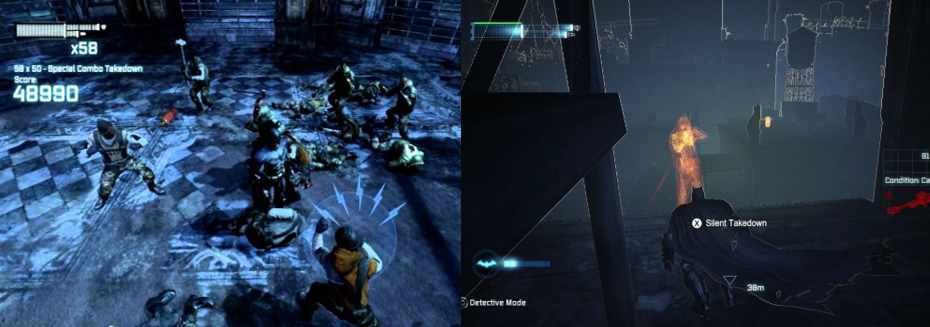
Combat and stealth are more fluid and satisfying than ever thanks to additional animations and options.

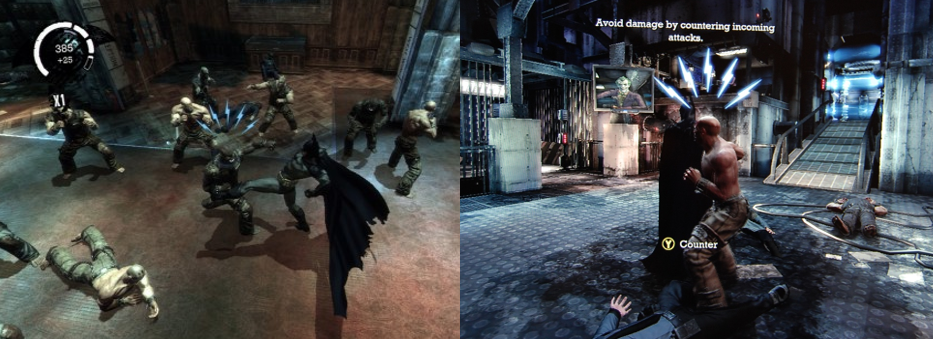
This more than makes up for Batman’s continued inability to jump and allows him to easily dart out of danger when spotted; Batman can still crouch with the Right Trigger and toss a quick Batarang with the Left Trigger, but now he can also quick-fire other gadgets, which is incredibly useful in combat and for solving the myriad of brain-teasing puzzles scattered around the city by Edward Nashton/Edward Nygma/The Riddler. The “freeflow combat” mechanic of the previous game returns intact but greatly expanded thanks to the addition of more attack animations and combos; X allows you to strike in quick succession while a well-timed press of Y (indicated when the “counter” indicator appears) will allow you to block and counter incoming attacks and rack up a bigger and more fluid combo. The higher your combo, the more damage you’ll deal and the more dynamic the perfectly-placed fight camera will move to allow you to lunge at other enemies before they can land a blow. Since the streets are crawling with a seemingly inexhaustible supply of thugs this time around, there are far more opportunities to sneak up on them and perform a “Silent Takedown”, but this time you can perform a “Knockout Smash” (though this will attract nearby enemies) and you can even perform takedowns from floor grates, double or even triple counters and takedowns when in combat, attack parts of the environment (like fire extinguishers and electrical boxes) to disorientate or disarm opponents, and even slam inmates into walls or dangle them over ledges during combat or interrogations.
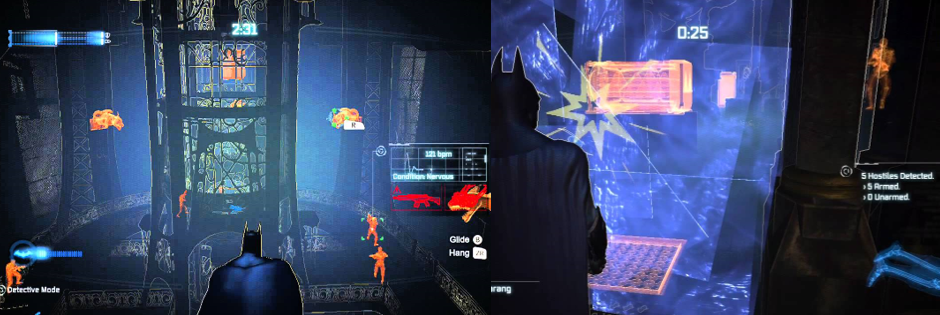
New additions to the Predator sections increase the threat to Batman and his takedown options.

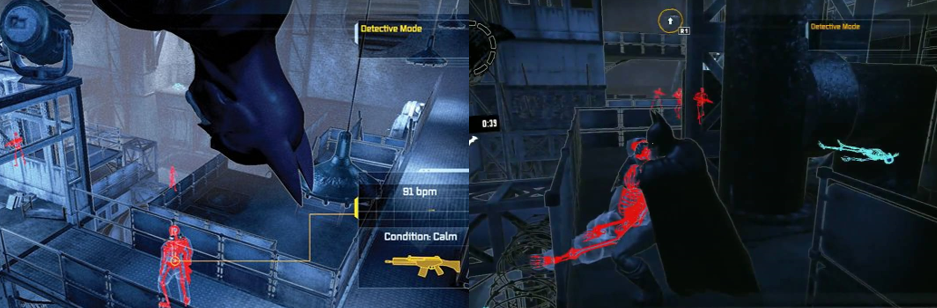
Also returning is the stealth-based “Predator” mechanic; in addition to sneaking up on enemies, Batman can grapple up to stone gargoyles and other high ledges to review rooms of armed thugs using the x-ray and thermal vision offered by his “Detective Mode”. A simple press of the Left Bumper and you’ll be able to see enemies by their body heat, their current condition, and any interactable parts of the environment. Batman’s new array of gadgets (easily accessed using the directional pad) can also be used in new ways to lure enemies into traps or take them down and, while traversing the city, you’ll need to make liberal use of these (and Batman’s new smoke pellets) to dart away from gunfire and dispatch gun-toting enemies. Again, Batman is tough but can’t take sustained gunfire or explosions; however, his health will replenish after you clear out all nearby enemies, solve riddles, or find the many Riddler Trophies. These same criteria will earn you experience points (XP) to improve Batman’s armour, abilities, and weaponry once more but the game definitely mixes things up by having enemies be able to jam your Detective Vision and electronics and lay traps of their own.
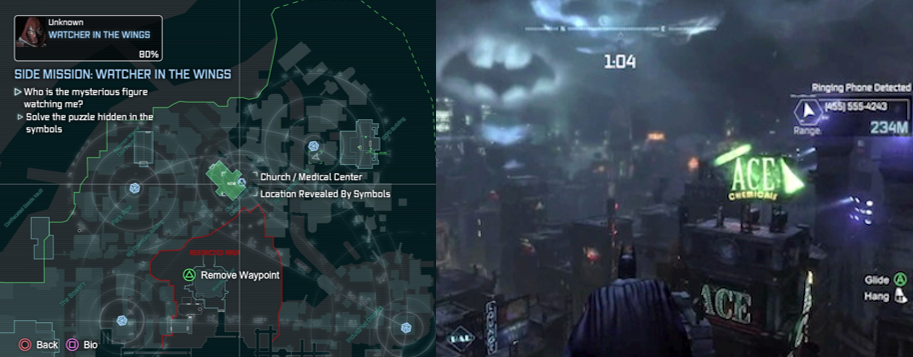
Navigation is easier than ever thanks to a comprehensive map, waypoint, and compass system.

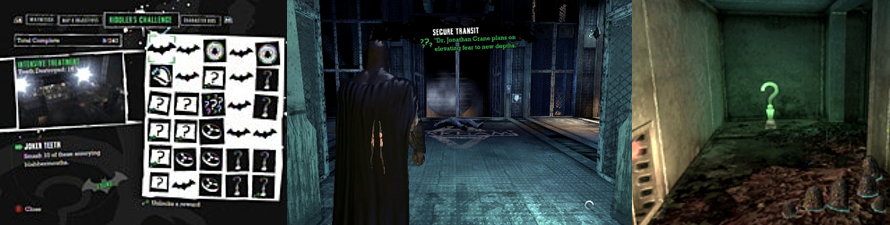
If you thought Arkham Asylum had a lot of riddles and Riddler Trophies, then Arkham City will blow your mind! The Riddler has placed his trophies not just out in the open but hidden behind walls, in cages, and a myriad of pressure pads and context-sensitive puzzles that will require all of Batman’s skills and gadgets to acquire. Similarly, there are riddles to find across the city and you can solve them by tapped LB to scan the environment when you spot glowing green question marks or the answer to the riddle. This time, there are also far more destructible elements to snag you some XP; the chattering Joker teeth return but you’ll also be destroying TYGER security cameras, balloons, and massive bobbleheads of Doctor Harleen Quinzel/Harley Quinn, which all adds to the fun, as well as more opportunities to use your gadgets to open vents or shut off steam from pipes. The map screen returns, far more expansive and user friendly (as are all of the menus) than before; you can now set waypoints to your next mission or any other location on the map and a very useful onscreen compass and Bat-Signal will direct you towards your location with a minimum of fuss. Take note, though, that these features are suppressed when you have Detective Mode activated but, again, there are some opportunities to track targets using this vision mode.

The streets are crawling with more baddies than ever and they’ll repopulate areas as you progress.

Like the first game, Batman: Arkham City gets progressively difficult as you play but this is expanded upon greatly. You might come across a gang of Harvey Dent/Two-Face’s minions and engage them in combat, only for more and more nearby inmates to hear the fight and join in, for one thing. These enemies will, eventually, repopulate areas after you’ve cleared them out so you constantly have to be aware of enemies on the streets and rooftops and, like in the last game, enemies will increase in their aggressiveness and capabilities as you progress through the story. Also, like before, you can select different difficulty levels to play the game on from the start, with “Hard” mode including counter indicators this time but increasing the damage enemies will put out, but there are no Achievements tied to playing on Hard mode so you may as well play on “Easy” or “Normal” since “New Game Plus” offers an even tougher challenge than the game’s Hard mode. Where Arkham City excels, though, is in its sheer size; Arkham City is full of buildings to enter, Easter Eggs and references, riddles to solve, and side quests to keep you busy. For a returning player like me, it’s really easy to get distracted with side quests on your way to the main story objective and you can keep track of all outstanding missions from the main menu. From here, you can also view stories and character biographies, review Batman’s moves and abilities (and even view a tutorial if you need a refresher), and check up on any outstanding riddles and such. In fact, the only real downside to Arkham City is, again, the inability to quickly exit an area, which can be particularly bothersome when deep in the bowels of the city subway or the forgotten steampunk city, Wonder City, as it can still be a tad laborious to find your way back out sometimes.

Graphics and Sound:
Batman: Arkham Asylum managed to hold up impressively well over time and Arkham City holds up even better; it was already a big step up in terms of graphical quality and visual presentation so it’s only natural that it’s aged even better. As before, it’s a very dark game and takes place in one night so you might be relying on your Detective Vision or brightness settings to navigate in some areas but, thanks to many of the game’s locations taking place in indoor, more suburban (if equally dilapidated) areas, there are far more opportunities to bask in the impressive art direction of the game. Arkham City is split into different regions, with each one being primarily controlled by gangs of thugs affiliated with a different supervillain (Oswald Cobblepott/The Penguin, Two-Face, and the Joker) and having a distinctive feel to them.
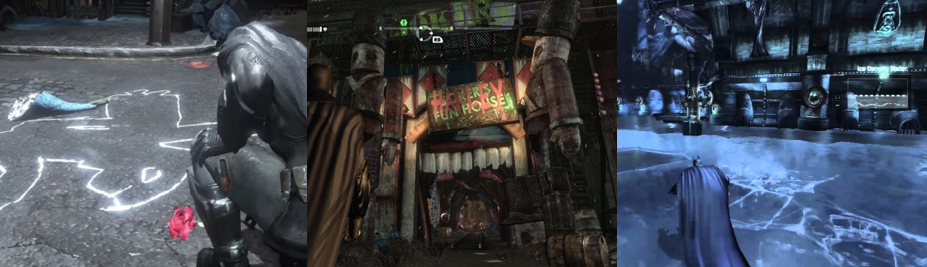
Each region of Arkham City is controlled by a different villain and has a different look to it.

Because the game takes place within a walled off cityscape, it must be said that it’s not immediately as visually distinctive compared to its predecessor as you’re surrounded by skyscrapers but I can forgive this as there are far more opportunities to see and explore the wider mythos of Batman’s world. You’ll stumble across Crime Alley, explore the remains of the old Gotham City Police Department (complete with Bat-Signal on the roof), fight through the museum and into the Penguin’s Iceberg Lounge, and take on the Joker’s gang at the dilapidated remains of the Sionis steel mill over on Amusement Mile. Similar to Arkham Island (which you can still see lingering in the misty distance), the city prison is a rundown, desolate place full of graffiti, burned out cars, litter, and chaos and there’s a real sense that the dogs have been literally let loose within its high walls and have turned the city into a veritable war zone. As you might expect, there are some more intricate and elaborate areas of the city, too. You can venture down into the abandoned subway and, of course, navigate through some stony catacombs and sewers beneath the city but, luckily, the game is far bigger and makes much better use of these environments when it comes to utilising Batman’s abilities so there’s far less awkward jumping and climbing and much more emphasis on the Line Launcher and grapnel boost, though you will need to get used to the new dive bomb mechanic in order to swoop in through some tight areas and get 100% completion.

Some nightmarish sequences, jump scares, and chilling encounters add to the world’s mythos.

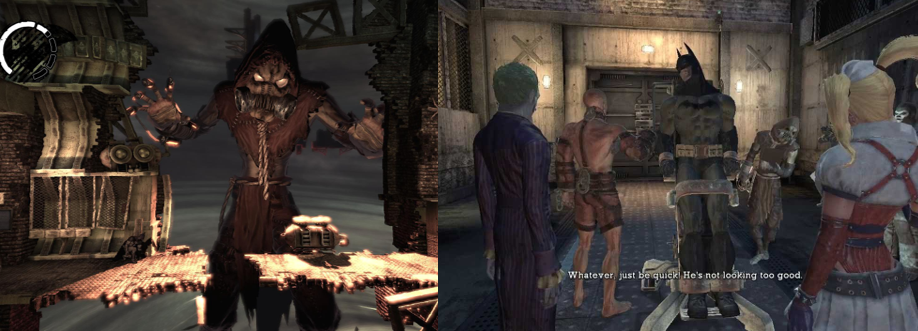
Things definitely start to take a more visually interesting turn once you venture into the abandoned Wonder City, a town populated by deactivated robots and lost to the midst of times, and scale Wonder Tower to confront Hugo Strange. Sadly, there aren’t the same dynamic sections as those involving Doctor Jonathan Crane/Scarecrow from the last game but Arkham City does go to some lengths to recreate these sections when the plot demands that Batman suffer the effects of his poisoning. Later, during a side quest involving Jervis Tetch/The Mad Hatter, you’ll experience a much more similar, twisted nightmare world but the game does include far more elaborate and layered areas to explore that change as the story progresses. The GCPD will freeze over because of Doctor Victor Fries/Mister Freeze, the steel mill needs to be cooled down and then you have to enter through a different entrance that involves navigating past giant machinery and drills, Julian Day/Calendar Man is imprisoned beneath the courthouse, and the museum contains a gigantic frozen pool with a very large and unfriendly denizen awaiting you.
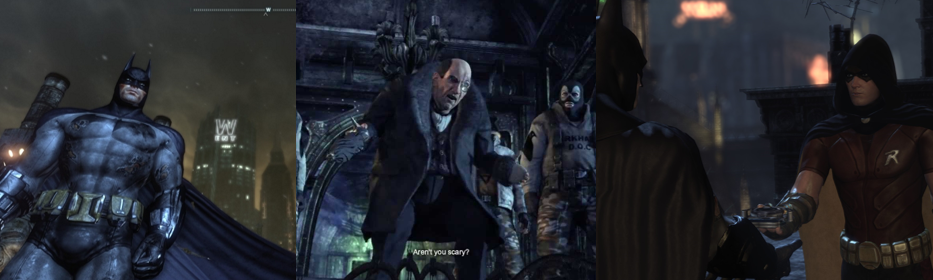
The attention to detail, new villains, and cameos are even better than ever this time around.

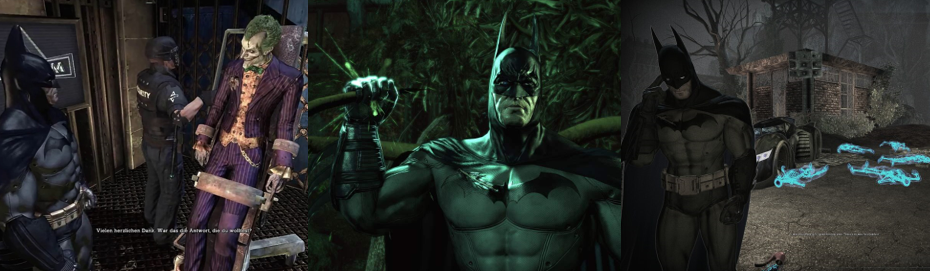
Thanks to the diversity in the game’s inmates, enemies have a lot more visual variety this time around as they wear different colourings and outfits. There is also a lot more chatter as Batman picks up on his enemy’s radio signals and broadcasts, with both Joker and villains like Penguin taunting you and issuing commands to their underlings. Batman’s suit, while visually very similar to the last one, still takes on battle damage as the story progresses and, as you’d expect, both Kevin Conroy and Mark Hamill knock it out of the park with their stellar work as Batman and Joker, respectively. Like before, Batman stops to converse with Barbara Gordon/Oracle but he also talks with his faithful butler and father-figure, Alfred Pennyworth, who sends additional equipment and offers council. The game also features far more references to Batman’s cast of characters and the wider DC universe and there’s even a much-appreciated cameo from a really well-designed version of Tim Drake/Robin for good measure. Cutscenes still make liberal use of the in-game graphics, which are even closer to the higher quality cinematics, and you’ll now see a helpful little recap of the story and your current outstanding missions when reloading a save.

Enemies and Bosses:
With Arkham Asylum gone, its inmates and the rest of Gotham’s criminals have been tossed into Arkham City instead; for the most part, the bulk of the game’s enemies are the same scumbags you fought in the last game but in different clothing and with more jeers to throw your way. Inmates will throw punches, grab weapons, toss items at you, and attack with both knives, guns, grenades (in a new twist), electrical batons, and will even pick up car doors to use as shields and ram you. Eventually, you’ll also have to contend with snipers, enemies wearing collars that will attract their allies when they’re downed, enemies that can jam your technology, ones that take hostages, and thugs will even use thermal vision to spot you and start destroying the ledges you’re hiding on if you linger too long or fail to stay hidden. While the crazed lunatics from the last game are gone, the TITAN monsters make a return and some inmates with be decked out in protective armour. A simple Batarang to the face is no longer enough to dispatch these goons; this time, you must use three cape swipes to stun them and mash X to beat them into submission while also countering incoming attacks. You’ll also have to contend with the one-armed Abramovici twins a number of times; these big bastards swing huge sledgehammers or scythes and must be blasted with a bolt from Batman’s Remote Electrical Charge gun to inflict damage on nearby enemies and pummelled with your attacks as they can’t be stunned so you have to strike, hop over to avoid their swings, and strike again to defeat them.
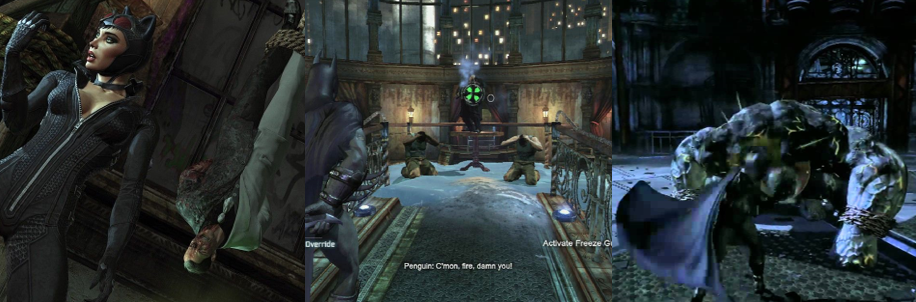
Solomon Grundy more than makes up for Two-Face and Penguin’s lack of physical challenge.

Arkham City is populated by a number of Batman’s most notorious rogues, basically all of them being new additions to the roster of bosses. The first you’ll encounter is Two-Face, who has taken over the courthouse and held Selina Kyle/Catwoman hostage. This is more of a tutorial for the basics of combat and Dent is dispatched by Catwoman in a cutscene rather than in an actual boss fight, and the following encounter with the Penguin is quite similar. This is basically the culmination of a side mission that sees you rescuing frozen police officers, freeing Mr. Freeze, and acquiring tech from his suit to deactivate his freezing gun (which the Penguin is using to keep you at bay). In fact, the first real physical challenge you have (aside from gladiatorial bouts against swarms of inmates or fights against one of the Abramovici twins) follows this encounter with the Penguin, which sees you facing off against the hulking zombie Solomon Grundy. You fight Grundy in a kind of gothic laboratory and must use your quick-fire explosive gel to close up three holes on the floor that regenerate Grundy’s health with lightning (while dodging said lightning) and allow you to put a beating on Grundy. This continues into the next phase, where Grundy tries to crush you with leaping attacks and two giant wrecking balls and sends weird little mice-things scuttling towards you. The third phase is more of the same but Grundy has one arm trapped in a machine; this time, the floor holes open sporadically for even shorter bursts and you need to avoid the shockwaves Grundy produces. Once he’s finally defeated, you have to dodge out of the way of the Penguin’s missile to punch him out once and for all, all of which is more interesting and engaging than the final boss of the last game.
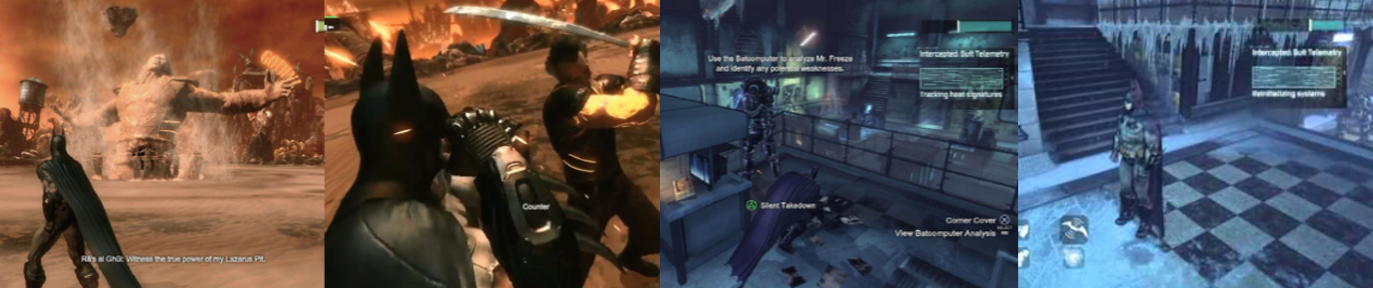
While Rā’s tests your reflexes, you’ll need to use all of Batman’s skills and gadgets to bring down Mr. Freeze.

The next main story boss you’ll battle is Rā’s al Ghūl but, before this, you must first track down one of his ninja assassins by her blood trail, get past more of them in Wonder City (they can dodge your strikes and teleport in puffs of smoke before attacking with sword swipes), and endure the “Demon Trials” (gliding sections through a twisted hellscape where you can’t touch anything but the highlighted areas). You’ll face Rā’s in a desert that is part delusion, part reality, and have to take out hoards of sand men while he dashes at you from out of nowhere. Once you get past them, you must dodge the shurikens and blades he sends your way while blasting at him through his human shield with your Disruptor, and then mash Y to counter his attacks. The speed and aggressiveness of his attacks increases as the fight goes on but the final blow comes down to a well-timed toss of the reverse Batarang and Rā’ later meets a very gruesome end for his part in the game’s events. Next, you’ll have to take on easily the most intricate and complex boss of the game (or most games, for that matter) as Mr. Freeze betrays you and forces you into a confrontation. Depending on the difficulty you’re playing on, you may be forced to use every single one of Batman’s gadgets and abilities to deal damage and leave him vulnerable for a beatdown as Mr. Freeze learns and adapts his strategy as the fight progresses. Mr. Freeze will plod around the laboratory searching for you and sending heat-seeking globes to seek you out; you can use Batman’s glide attack, takedowns, and gadgets (like the explosive gel and Remote Electrical Charge gun) to deal damage but he’ll take action to ensure that you can’t do this twice (he freezes the ledges, grapple points, and vents, destroys parts of the environment, erects a shield, among other defensive measures), which forces you to think on your feet and explore options you might not normally use.
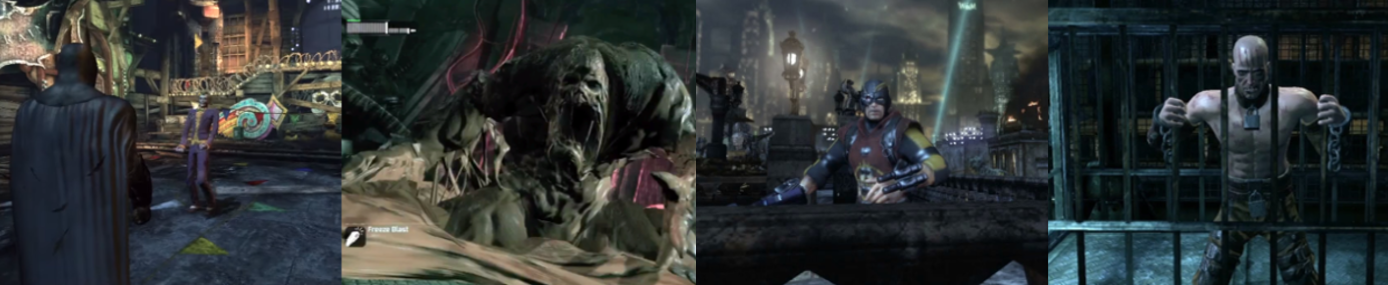
After stopping Strange and defeating Clayface, you’ll find some other villains to take down.

In the game’s finale, Strange activates the mysterious “Protocol 10” and commences a strategic bombardment of Arkham City; this briefly forces you to hack into circling helicopters in order to get inside of Wonder Tower and shut Strange down but, after you do, you’re forced into a confrontation with the Joker, who seems revitalised and has taken Talia al Ghūl hostage. Earlier in the game, you actually fight the Joker in his base form while his goons and out of control dodgem cars fill the arena but, when you confront him at the end, it’s revealed to have been Basil Karlo/Clayface in disguise; thus, the finale is, again, a battle against a hulking enemy. This time, you have to dodge Clayface’s cannonball attack and swinging arms while repeatedly spamming Freeze Blasts to whittle his health down. In the second phase, you grab a sword and slice up the mud men he spawns while repeating these tactics and avoiding his big sledgehammer shot in order to take him down. In between each of these main mission boss fights, you’ll come across a number of side missions that will draw you into confrontations with more of Batman’s rogues gallery: Floyd Lawton/Deadshot has been killing targets all over the city but Batman eventually tracks him down and must sneak past his one-shot rifle-arm to take him down; Victor Zsasz/Mister Zsasz has been killing people by luring them to ringing phones so Batman has to listen to his macabre life story to triangulate his location and then sneak around him in a partially flooded area to rescue his hostages; the Mad Hatter abducts you and forces you to battle waves of demonic rabbits; and the Riddler has also taken five hostages and placed them in Saw (Wan, 2004)-like traps. These hostages can only be saved by finding the Riddler’s Trophies, solving riddles, and interrogating his informants (highlighted in green) to gain access to his “Enigma Device” and locate each one in turn using the Cryptographic Sequencer.

Power-Ups and Bonuses:
As before, Arkham City features a level-up progression system; every time you defeat enemies, solve riddles, or pick up Riddler Trophies and destroy cameras and such, you’ll gain XP. Upon levelling-up, you can again upgrade Batman’s armour (now separated into one that improves damage from melee attacks and one from gunfire) to gain additional health, add more elaborate takedowns to his repertoire (including a swarm of disorientating bats, bone-breaking takedowns, and weapon disarmaments), and upgrade his various gadgets to improve their range and efficiency. Again, it’s pretty easy to fully upgrade all of Batman’s abilities if you engage with enemies and search out riddles on a regular basis, and it’s best to mix and match your upgrades for a balanced playthrough but you can choose to focus on making Batman more durable if you so wish.
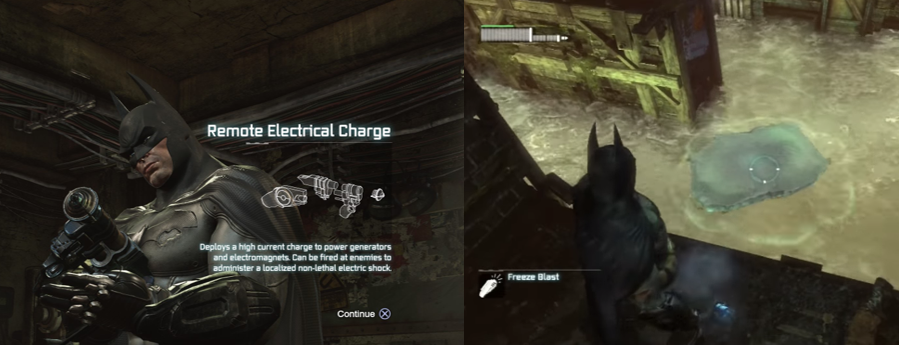
Batman’s new toys let him charge power points and create temporary platforms, among other things.

Batman begins the game with many of the gadgets he had at the end of the last one, making him far more equipped for the rigours of Arkham City; many of his weapons, such as the grapnel gun and explosive gel, can now be used as quick-fire attacks to mix up your combos to allow for more diverse combat. Although Batman can no longer rip down walls with his grapnel gun, the Line Launcher can be upgraded to fire a second line and allow Batman to walk along it like a tightrope and he also has access to some new toys. The smoke pellets allow him to disorientate enemies and make an escape if needed, the Remote Electrical Charge gun allows him to power up electrical appliances, the Disruptor deactivates mines and renders up to two enemy guns useless, and the Freeze Blast (and upgraded Freeze Cluster) can plug up steam pipes and form ice floats on bodies or water to allow Batman to float around by grappling onto conveniently-placed hooks around the environment.

Additional Features:
Batman: Arkham City has fifty Achievements to earn, with the bulk of these popping simply by playing through the story, meeting certain objectives, and defeating bosses. One has you fiddling with the Xbox’s internal date and time in order to hear Calendar Man ’s chilling acts while most of the others are tied specifically towards starting or completing the game’s many side missions rather than solving or finding riddles (although this is a factor since you need to do this to rescue the Riddler’s hostages). No matter what difficulty you complete the game on, you’ll unlock a New Game Plus mode that offers and additional difficult challenge, mixes up the enemy placements, allows you to play the story with any additional DLC costumes, and carries over all of your gadgets and upgrades to a new game file. You’ll also be able to return to your original save file in a post-game world where the inmates will comment on the dramatic conclusion of the game and be freely able to switch to Catwoman at certain points on the map.
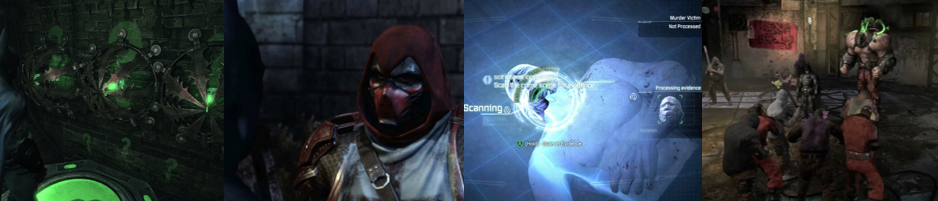
Alongside the Riddler challenges, there are a number of additional side quests to occupy your time.

This is super useful if you have any outstanding side missions to complete; not only are there some diving simulations to complete and a bunch of Riddler challenges tied to performing combat and gameplay manoeuvres, there are many other mysteries and villains out there to confront, such as tracking down Thomas Elliot/Hush (who has been mutilating victims to impersonate Bruce Wayne), figuring out the motives of the mysterious Michael Lane/Azrael, saving a number of political prisoners from random acts of violence, locating and reunited Nora Fries’ cryogenically frozen body with Mr. Freeze, and destroying TITAN containers in a fragile alliance with Bane. Additionally, there are way more Riddler Trophies hidden throughout Arkham City, many of which require precision gliding, pressing pressure pads, and using a variety of Batman’s gadgets to pick them up. Catwoman also has her own Riddler Trophies to pick up and, while there are no audio tapes to find this time, you can still unlock biographies, news stories, and audio clips by solving and finding riddles. As before, the game features a Challenge Mode, now rebranded as “Riddler’s Revenge”, which allows you to take on self-contained combat and predator challenges based on encounters in the game. You’ll battle a few waves of increasingly difficult enemies and rack up points by sustaining and varying your combos and pick off goons from the shadows while handicapped by a number of modifiers (such as disabling your Detective Mode, shielding enemies from damage, or having reduced health).
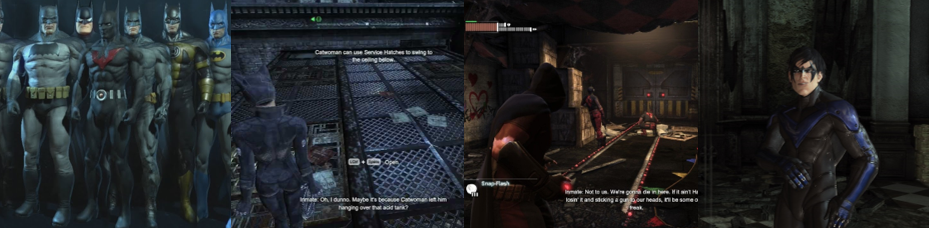
Arkham City makes up for the last game with a whole bunch DLC skins, characters, and challenge maps.

There is also a new series of “Campaign” maps that mix up the two challenges to present a sort of adjacent side story to the main game and you can compare your high scores against friends and other using the online leaderboards. These challenge maps, and the main game itself, can be expanded by purchasing the many different DLC packs for the game. As mentioned, Catwoman was a big selling point of the game and those who pre-ordered Arkham City or purchased her DLC can switch to playing as Catwoman during the story to follow a side mission involving Poison Ivy and stealing from Hugo Strange. The DLC for Arkham City is such a massive step up compared to the last game, adding twenty Achievements to collect and numerous costumes for Batman to use in New Game Plus and on challenge maps, and, best of all, the ability to play as Robin and Dick Grayson/Nightwing in the challenge maps. Each of the four playable characters plays a little differently (Catwoman is faster but weaker, slashes with her claws and tosses bolas; Robin uses his bo staff, riot shield, and faster (but shorter) version of the Batclaw; and Nightwing batters thugs with batons and utilises his acrobatic skill to take out enemies) and has their own gadgets but, sadly, only Catwoman is available to play as in the main game. Robin does take centre stage in a post-game DLC story, “Harley Quinn’s Revenge”, that sees him infiltrating the steel mill to rescue Batman; I had all of this DLC on the PlayStation 3 and greatly enjoyed the variety offered by the skins and each character but I do wish that the studio had allowed these additional characters to be used in the actual main game.
The Summary:
I was massively impressed with Batman: Arkham City when I first played it on the PlayStation 3; the game was just so much bigger and better than the original thanks to expanding the scope of the game world and the range of Batman’s abilities and gadgets. Everything that worked in the original game is back and improved upon, making combat even more fluid and diverse and truly defining the essence of Batman to set the standard for the remainder of the series. Rather than being confined to a claustrophobic, gothic prison, Batman is freely able to roam and fight around a dilapidated, walled off section of the city full of Easter Eggs, references, inmates to fight, secrets to find, and side missions to keep you busy for far longer than the first game. Best of all, the game is packed full of post-game and additional content thanks to these side missions, the New Game Plus mode, the expanded Challenge Mode, and the impressive abundance of DLC. Including additional skins, a short post-game story, and two of my favourite Batman characters in Robin and Nightwing really helps to expand the lore of this interpretation of Batman’s world and offers far more replay value. For me, Arkham City is still the gold standard for the Batman: Arkham series (Various, 2009 to 2015) and, while Arkham Asylum finally offered all of Batman’s abilities in a fun and engaging way, Arkham City expanded on them to the nth degree and truly defined what it means to play as Batman in an open world environment and it definitely deserves all of the praise it earned upon release and even to this day.

My Rating:

Rating: 5 out of 5.

Fantastic

What did you think about Batman: Arkham City? How do you feel it holds up compared to the original games and its sequels? Did you enjoy that the game world was expanded into a city-sized open world or did you prefer to more claustrophobic aesthetic of the first game? Which of Batman’s new gadgets and rogues were your favourite to use or fight against and why? Did you ever track down all of the Riddler’s trophies and secrets? Which of the side missions was your favourite to complete? What did you think to the game’s DLC and would you have liked to see Robin and Nightwing playable in the main game? How are you planning on celebrating Batman Day this year and what is your favourite Batman videogame? Whatever you think about Batman: Arkham City, or Batman in general, please leave a comment below and check back in next Wednesday for my review of the next Arkham videogame!


Game Corner [Bat-Month]: Batman: Arkham Asylum (Xbox 360)


In the decades since his first dramatic appearance in the pages of Detective Comics, Bruce Wayne/Batman has become a mainstream, worldwide, pop culture icon. The brainchild of writer Bob Kane, Batman was brought to life by artist Bill Finger and has been a popular staple of DC Comics and countless movies, videogames, and cartoons over the years. Accordingly, September celebrates “Batman Day” and is just another perfect excuse to celebrate comic’s grim and broody vigilante and, this year, I’ll be dedicating every Wednesday to Gotham’s Dark Knight Detective.


Released: 25 August 2009
Developer: Rocksteady Studios
Also Available For: PC, PlayStation 3, PlayStation 4, Xbox One, Xbox Series S/X

The Background:
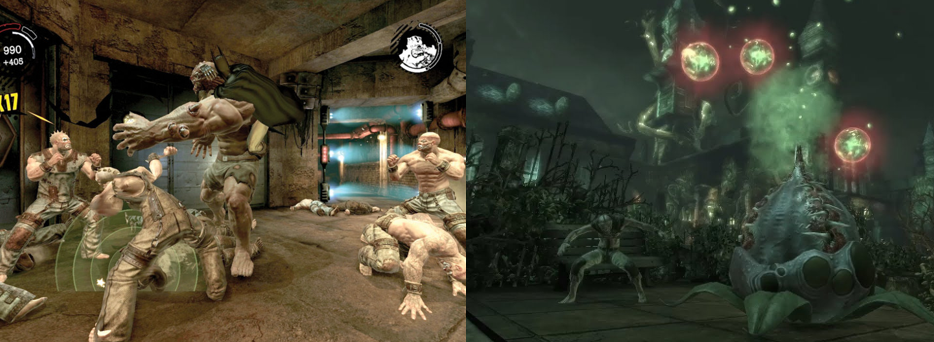
Ever since his debut in the pages of Detective Comics back in 1939, the Batman has been a popular staple of DC Comics and has appeared in numerous comic books, cartoons, live-action films and, of course, videogames. The first videogame adaptation of Batman was an isometric adventure game released in 1986 and, over the years, Batman has been placed into numerous different videogame genres, from beat-‘em-ups, sidescrolling brawlers, and adventure games, but it’s safe to say that there have been more than a few duds during that time. By 2009, Batman’s videogames had been very hit and miss but the character’s popularity had received a resurgence thanks to the recent success of The Dark Knight (Nolan, 2008). After Eidos Interactive bought the rights to make a Batman game, they turned to developers Rocksteady Studios after being impressed with their prototype for the title. Noted writer Paul Dini, who had spearheaded the popular DC Animated Universe (DCAU), was brought on to develop the game’s story and characterisations, which drew inspiration from some of Batman’s grittier and more grounded tales and included the vocal talents of Kevin Conroy and Mark Hamill to capitalise on their success in the DCAU. Rocksteady spent their time not only meticulously crafting a unique world that drew from Batman’s vast comic history to create a dark, claustrophobic game world, but also building an intuitive combat system and perfecting the depiction of Batman’s cape and gadgets to really encapsulate the feeling of being the Batman for the first time. The result was a game released to widespread critical acclaim; critics praised the game’s story and mechanics, and intricate marriage of combat and stealth and the game was later bolstered by some downloadable content (DLC), various re-releases and remasters, and kicked off one of the most celebrated and successful superhero videogame franchises ever seen.

The Plot:
After apprehending the Joker and bringing him to Arkham Asylum, Batman finds himself trapped on Arkham Island when the Clown Prince of Crime causes a mass breakout. With guards, doctors, and other innocents at risk, and hoards of his rogues and other rabid criminal thugs freely roaming the asylum, Batman has no choice but to use his skills and gadgets to fight back and uncover the true nature of the Joker’s plot.

Gameplay:
Batman: Arkham Asylum is a third-person, action/adventure game that takes place in a quasi-open world; though not as large as other open world videogames, such as those seen in the subsequent sequels, Arkham Asylum still presents Batman with a number of different locations and areas to explore on the grim, gothic island that houses Gotham City’s most depraved and dangerous criminal maniacs. While other Batman videogames often focused purely on mindless combat or poorly implemented his gadgets and skills, Arkham Asylum featured the most diverse and intuitive range of movement for the Caped Crusader that players had ever seen at that point. Although players cannot make Batman jump, they can hold down the A button to sprint and vault up/over walls and Batman will automatically hop across gaps and spread his elaborate cap to glide through the night air. Pressing the Right Bumper will see Batman grapple to nearby ledges and higher areas (usually stone gargoyles) to avoid enemies or reach new sections of the asylum. Holding the Right Trigger sees Batman drop into a crouch to stay hidden and sneak up on thugs while tapping the Left Trigger will see him tossing a quick Batarang to stun foes or activate switches (holding LT will allow you to better aim and direct this projectile) and you can select any of Batman’s gadgets using the directional pad (D-pad) to access his gadget wheel.

Combat is fast and fluid, allowing Batman to strike and counter with a deft swiftness.

Of course, one of the most prominent aspects of Arkham Asylum is the game’s unique combat system.; rather than simply mashing buttons, combat is a fluid and slick affair somewhat akin to a rhythm game. Pressing X will see Batman strike the enemy nearest to him; repeated presses begin a combo and you can stun enemies with Batman’s cape by pressing B or hop over them by tapping A. During combat, the camera automatically pans to show you the best view of your immediate area and any enemies around you and, when enemies try to strike at you, a “Counter” indicator will appear. When it does, tap Y and Batman will automatically counter the oncoming attack and, by successfully stringing together strikes and counters, you can build up bigger and more elaborate combos and fluidly take down multiple enemies at once. Once an enemy has been knocked down, or when sneaking up on them, you can press RT and Y to perform a takedown that will knock them out cold and, as you defeat enemies and uncover secrets, you’ll earn experience points (XP) which can be spent purchasing new takedowns and combat options when you level up.

Batman’s Detective Mode is perfect for striking fear into armed thugs and taking them out silently.

Another important aspect of the game is stealth; utilising the “Predator” mechanic, Batman can sneak up on enemies and make use of high ledges to stalk rooms full of armed thugs and pick them off one at a time by utilising the infrared filter offered by his “Detective Mode”. This is activated by pressing the Left Bumper and will wash the environment in a grainy, black and white filter that highlights enemies by their body heat and shows their current condition. Using the shadows and your gadgets, you can drop down on enemies from above, sneak through grates, and set up traps to take them down and pick them off and their cohorts will react accordingly, becoming increasingly agitated and trigger happy as the section progresses. Batman is extremely vulnerable to sustained gunfire so it’s better to be patient and take down each enemy one at a time but you can grapple away to safety if you’re spotted and are even able to take down enemies while hanging from ledges or from afar with Batman’s many toys. Detective Mode also allows you to scan your environment; for the most part, this will be to solve riddles placed all over Arkham Asylum by Edward Nashton/Edward Nygma/The Riddler but, at various times during the game’s story, you’ll have to set up a crime scene to scan evidence and filter out aromas and other elements that will lead you to your next objective as long as you have Detective Mode activated. Although there is no onscreen map, you can view a comprehensive blueprint of Arkham Island by pressing the “Back” button. From here, you’ll see all of the unsolved riddles in the game and where your next objective is, as well as being able to enter any of the game’s environments to review the layout and any remaining secrets to be discovered.

The game world is constantly changing and you always need to find new ways to progress.

You can’t set up a waypoint and there’s only a few sections where you’re literally shown the way but, thankfully, Arkham Asylum isn’t too difficult to explore or navigate for the most part (though there some areas that are quite frustrating or mired in overly dark lighting). Batman: Arkham Asylum features not only a level-up system but also a progressively increasing difficulty curve; while the game’s “Hard” mode will obviously offer the most challenging experience (enemies are more aggressive and counter indicators are omitted entirely), the game world will constantly change as you progress through the story. New areas become accessible as you acquire and upgrade Batman’s many gadgets and areas that you’ve previously visited will become populated by snipers, maniacs, or over-run by Pamela Isley/Poison Ivy’s monstrous plants to keep the game feeling fresh and allowing your actions to actually have an impact on the environment. Backtracking is a prominent feature of the game as some areas will be locked off until you get a new gadget; other areas are locked off entirely, forcing you to use vents, grapples, or explode walls in order to progress and you’ll definitely need to explore every nook and cranny to solve all of the game’s riddles and collect all of the pickups. Although there is no manual save option, the game is extremely generous with checkpoints (which, thankfully, also appear mid-way through certain boss battles) and Batman’s health bar is replenished after successfully defeating enemies in combat, solves riddles, or finds secrets.

Graphics and Sound:
Even now, some fifteen years after its original release, Batman: Arkham Asylum is a visually impressive game. The entire game takes places in a single night, meaning the gothic, decrepit asylum is constantly bathed in an ominous, murky darkness that goes a long way to adding to the game’s claustrophobic and oppressive atmosphere. At times, the game is a little too dark and you’ll either be relying too much on Detective Mode or adjusting the brightness settings to get around but I can forgive this as the dark, moody aesthetic really encapsulates the nature of what it means to be Batman. Arkham Asylum is quite an elaborate environment for what amounts to a glorified sandbox; the prison/facility has been depicted in many different ways over the years but, here, it’s a gloomy, gothic prison confined to an island separated from the greater city. The island itself adds as the hub world, of sorts, and you can travel to different areas by passing through large, automated doors (that are clearly masking loading zones) or using Batman’s various gadgets and skills, and at each compass point you’ll find a different area to explore.

Environments are seeped in a dark, ominous aesthetic that adds to the claustrophobic atmosphere.

The island is home to a high-tech penitentiary, a dilapidated mansion, a dock, a hospital/morgue, a cemetery, and even has a large botanical garden to visit. Each area is suitable foreboding and shows signs of wear and tear (to say nothing of death and anarchy from the breakout of the inmates) and, despite the overwhelming use of blacks, greys, and darkness, stands out from each other through their unique layouts and gameplay mechanics. The island is also home to a vast network of sewers and caves; Batman has even set up a small Batcave on the island, where you’ll travel a few times to acquire upgrades, but these stone catacombs are by far the worst areas to explore in the game. The sewer system that Waylon Jones/Killer Croc has taken as his home isn’t too bad but the caves are dark and crumbling, meaning that your grapnel gun is all but useless and you’re forced to rely on Batman’s jumping skills. For the most part, these are serviceable, but the game’s focus is not on precision platforming so it can sometimes be a pain to get Batman (and the camera) pointed in the direction you need to go. When you later revisit these areas to mop up any unsolved riddles, it’s easy to get lost and confused and it’s a shame that the game doesn’t give you the option to fast exit an area or building from the map screen as there’s nothing worse than venturing deep into the catacombs and then struggling to find your way out.

Your encounters with the Scarecrow will have you questioning the stability of the game!

While the game is tight as a drum in terms of its stability, there are noticeable times where you’ll have to sit and wait as the next section loads and it can sometimes be a little too easy to get caught on the environment or botch a ledge grab but these moments are few and far between. By far the game’s most impressive sections, though, are the nightmarish illusions and hallucinations brought about by exposure to Doctor Jonathan Crane/Scarecrow’s fear gas and toxins; these cause the game to warp, restricting your moment, perception, and controls, and transform the environment into a chilling recreation of Crime Alley or show Batman visions of his dead parents and allies. This leads to a series of really unique, 2.5D sections where you must navigate a disparate hellscape, avoiding the Scarecrow’s gaze and trying not to get too freaked out by his Freddy Krueger-like appearance or Batman’s character model briefly flashing to that of Scarecrow’s. Easily the most memorable moment of all of these sequences is the moment the game abruptly appears to crash and resets on you, only to restart with a recreation of the game’s opening cutscene with the Joker delivering a manic Batman to Arkham while his villains taunt and jeer at him.

In-game graphics are top notch, with Batman’s suit progressively taking damage over time.

In terms of character models, Arkham Asylum also still holds up really well. While generic thugs and goons quickly get a bit repetitive, the game’s interpretations of Batman’s different rogues is very unique and compelling and the influence of the legendary artist Jim Lee is readily apparent in the appearance of Killer Croc, Doctor Harleen Quinzel/Harley Quinn, and Batman himself. Fittingly, Batman benefits the most from the game’s graphics; not only does Kevin Conroy deliver sterling work as always as the character but Batman’s suit will accrue damage as the story progresses, with rips, tears, bullet holes, and other bits of wear and tear showing up as you progress through the story. So strong are Arkham Asylum’s in-game graphics that they are generally the default for the game’s cutscenes; many times throughout the story, Batman will stop to converse with Barbara Gordon/Oracle to comment on and progress the plot and his current investigation but there are instances of higher quality cutscenes as well, which aren’t too far off from what is seen during gameplay. The game’s music is suitably brooding and gothic, picking up when enemies spot you or you’re in combat and being used very effectively to establish a foreboding mood to the game’s events. Finally, not only do the thugs and inmates constantly chat, banter, and taunt you but the game is frequently punctuated by announcements from the Joker. Like Conroy, Hamill excels in the role and adds a glorious entertaining dark humour to the events, stealing the show every time his voice is heard and, overall, music, sound effects, and visuals are all married perfectly to encapsulate the dark, moody atmosphere of the game and really add to the experience of being the Batman.

Enemies and Bosses:
Being that it’s home to the criminally insane, Arkham Asylum is populated by all kinds of maniacal inmates; however, as part of his elaborate plan, the Joker also struck when a number of Blackgate Penitentiary’s prisoners were on the island, and these are the thugs you’ll encounter the most. Generally, goons are spread across the hub world or waiting in corridors or large, open rooms and can either be engaged head-on or from the shadows if they have firearms. Enemies will attack as a group, meaning you’ll have to be constantly aware of incoming attacks, and will even grab items and objects to throw at you or use as makeshift weapons.

Eventually, more dangerous and monstrous enemies spread across the asylum.

As the story progresses, you’ll encounter more formidable enemies: snipers will take up positions above and must be taken out before they can put a bullet in you; inmates with knives must be stunned with your cape before you can attack them; those with electrical batons must by jumped over and attacked from behind; and crazed lunatics will leap at you and must be countered at the right time to stop them from pinning you down. You’ll also have to contend with those exposed to the Joker’s “TITAN” serum, which transforms them into monstrous, hulking beasts; these guys will charge at you, necessitating a quick toss of a Batarang and a dive out of the way to stun them so you can land a few shots and, eventually, hop on their back to whittle their health down and batter about any nearby enemies. Sometimes you’ll have to fight two of these at once, alongside a variety of other thugs, and you’ll also have to dispatch Ivy’s TITAN-infused plants, which spit out homing spores and must be slowly approached in order to destroy them.

Battles with Mr. Zsasz and Bane will teach you fundamental, life-saving tactics for later in the game.

The Joker’s plan also requires him to unleash a very specific number of Batman’s most notorious rogues, who you must take down in a series of encounters as boss battles. The first of these you’ll go up against is Victor Zsasz/Mister Zsasz in what is, essentially, a glorified tutorial to teach you about grappling from cover to cover to sneak up on an enemy. You’ll also encounter him later in the game in a similar situation designed to teach you how to use the reverse Batarang feature and, in both cases, you can easily take him down with no trouble at all as long as you’re not spotted. Similarly, though she’s a constant thorn in your side throughout the game, you can easily apprehend Harley Quinn after battling a short gauntlet of goons, which is only fitting considering that neither villain is much of a physical match for Batman. Bane, however, is. Like the TITAN goons, he must be stunned with a Batarang when he charges at you and battered with a quick combo to yank out the Venom pipes supplying his superhuman strength. However, as the fight progresses, goons will drop into the arena to distract you; again, like the TITANs, Bane can grab downed enemies and launch them at you as projectiles but he’ll also toss parts of the environment your way as well so it have to constantly be thinking on your feet and ready to dodge out of the way. As long as you can deal with the annoying goons, avoid Bane’s wild strikes and ground pound, and dodge out of his charges, he’s not especially difficult and battling him (and the TITANs) serves as great practise for the game’s final boss.

You’ll need patience, skill, and gadgets to conquer Killer Croc and the Scarecrow.

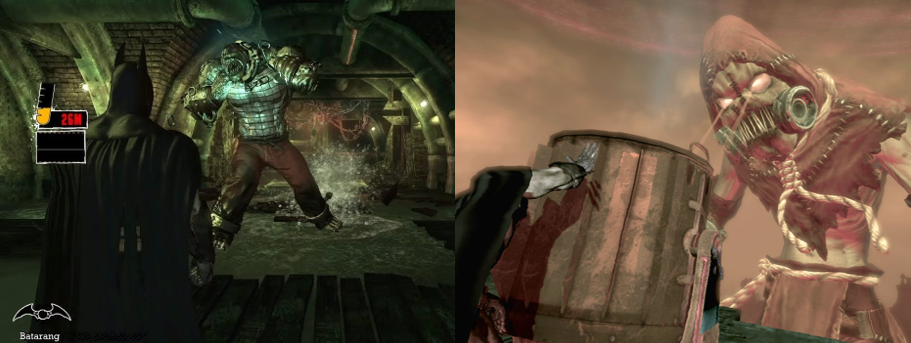
Before that, though, you’ll have to contend with Killer Croc in the sewers. Down here, you must slowly walk across wooden platforms to avoid attracting Croc’s attention; when he lunges out of the water, you must quickly toss a Batarang to subdue him and make a run for it when he starts smashing up the platforms. Eventually, you’ll avoid him and collect the samples Batman needs to synthesise an anti-virus for the TITAN formula and Croc will chase you down. This forces you to run towards the camera as quickly as possible and then detonate explosive charges before Croc can reach you to send him plummeting down a deep chasm. As mentioned before, you’ll also have to contend with the Scarecrow on no less than three occasions. Each time, you must navigate his hellscape using your stealth, gadgets, and jumping/shimmying skills to avoid being spotted but, as the encounters progress, you’ll also have to fend off waves of skeletons. In the final encounter, Scarecrow summons more of these enemies, including a TITAN variant, in three waves; after defeating each one, Batman activates a Bat-Signal and will eventually dispel and break free of the Scarecrow’s harrowing nightmares once and for all.

Sadly (or thankfully), the final boss isn’t anywhere near as interesting as the one with Poison Ivy.

By far the most frustrating boss battle of the game, though, is the one against Poison Ivy; encased in a monstrous man-eating plant, she sends out a bunch of tentacles that will choke the life out of you in seconds, commands besotted thugs and guards to attack you, and fires super-fast and painful bolts your way. To defeat her, you must avoid her attacks, defeat her goons, and toss a quick Batarang at her when she exposes herself while firing at you. When she collapses, you can use your explosive gel to damage the pod but this battle can get very harrowing on the game’s Hard difficulty. When you finally confront the Joker for the final showdown, he arranges a gaggle of thugs to greet you at the door, tries to kill you with an exploding television, forces you to fight a whole bunch of enemies and two TITANs at once, and then transforms himself into a TITAN monster for the finale. In this fight, you must avoid his claw swipes and then dispatch the goons that come into the arena, destroying exploding teeth and avoiding the electrified walls until it’s safe to pull the Joker down from his ledge and put a beating on him. Sadly, it’s not a very compelling final boss battle as it’s fundamentally the same as battling the TITANs and Bane, and it’s a bit of a missed opportunity to not have Batman undergo a similar transformation, but it’s decent enough for what it is and not too surprising that you wouldn’t fight the Joker one-on-one.

Power-Ups and Bonuses:
Batman: Arkham Asylum features a level-up progression system; every time you defeat enemies, solve riddles, or pick up Riddler Trophies and other items (like audio tapes and so forth), you’ll gain XP. When you level-up, you can spend the Skill Points you earn on improving Batman’s armour to give him more health, adding additional takedowns and combat moves to his repertoire, or upgrading his various gadgets to improve their range and efficiency. I recommend pacing these upgrades out (armour once, then a new takedown, armour again, maybe upgrade a gadget, and so forth) and fighting every enemy you see in order to upgrade Batman as fast as possibly. It’s very easy to fully upgrade Batman on even a casual playthrough on Hard mode, though, so it shouldn’t be too hard to get there. Along the way, Batman will acquire or construct new gadgets to help him progress. Explosive gel will allow him to knock enemies off balance or break through certain walls, the Line Launcher will allow him to cross chasms and gaps too wide to jump or glide across as long as there’s a solid wall behind and in front of him, the Sonic Batarang can be used to lure enemies away from each other or into a trap, the Ultra Batclaw allows Batman to tear down certain walls by tapping A after firing, and the Cryptographic Sequencer allows him to hack security panels by matching radiowaves with the analogue sticks to access Riddler Trophies, secret rooms, or open previously-inaccessible areas. The Batmobile and Batwing also make an appearance but you cannot utilise these in the game, unfortunately, but you can upgrade the Batarang to throw up to three at separate targets or be remote controlled (though this is also quite limited in its application).

Additional Features:
Batman: Arkham Asylum has forty-seven Achievements for you to earn, the majority of which are acquired simply by progressing through the story and clearing certain missions or defeating bosses. Some require you to defeat enemies in certain ways or rack up a certain combo score, others are tied to gliding consecutively or completing the game on each difficulty setting, but the majority are tied towards finding the Riddler Trophies, solving his riddles, and completing combat and predator challenges in the game’s “Challenge Mode”. To elaborate, the Riddler has hidden numerous glowing green trophies all across Arkham Island; some are hidden in plain view, others require your gadgets or a bit of exploration to find. Pretty much every single room or area of the island also has a number of riddles associated with it that you must solve by scanning parts of the environment; these are generally linked to Batman’s history or rogues and will unlock character biographies of guys like Harvey Dent/Two-Face and Arnold Wesker/The Ventriloquist. Every time you solve or find these, you’ll gain XP and get one step closer to 100% collection so it’s worth taking time to look for a small tea set or a plague dedicated to Martha and Tomas Wayne.

Riddles and secrets are scattered all over the damn place.

Additionally, there are stone monuments to Amadeus Arkham, the founder of the island and its facility, to be found and scanned to learn more about Arkham’s morbid history as well as audio tapes and maps to further flesh out the characters’ backstories and reveal the Riddler’s secrets. From the main menu, you’ll also see the option to take on Challenge Mode. These are specific, self-contained combat and predator sections based on encounters in the game and pit you against waves of increasingly difficult enemies and rooms full of thugs, respectively, and are unlocked by finding Riddler Trophies and solving riddles. When you take on a Challenge, you’ll either have to face a number of rounds against different enemies in different environments or pick off thugs from the shadows according to a number of requirements (such as using explosive gel or a vertical takedown). Each time you successfully meet these criteria, or rack up enough points, you’ll earn up to three medals, and eventually some Achievements, and can compete against friends and others using the online leaderboards. Sadly, though, unlike subsequent games in the series, there is no “New Game+” option, you only unlock one alternative outfit for completing the game and it’s restricted to the Challenge Mode, and the only DLC available is for additional Challenge maps. Those who have the PlayStation 3 or Return to Arkham (Rocksteady Studios/Virtuos Studios, 2016) versions (which I also do), though, can choose to play as the Joker in the Challenge Mode, which is pretty entertaining as he comes with his own unique and madcap fighting style and gadgets that separate him from the Batman.

The Summary:
I remember the first time I played Batman: Arkham Asylum when I first got it for the PlayStation 3 and being just blown away by how intricate, smooth, and impressive its controls, mechanics, and presentation were. Never before had a videogame offered such a range of versatility for Batman; rather than simply focusing on combat or one aspect of the character, Arkham Asylum really delved into what it means to be Batman and gave players the chance to experience each of those elements in a new, dynamic, and incredibly entertaining way. Combat is fluid and easy to master, stealth sections are exhilarating even when it can take a while to pick enemies off, and even the game’s more frustrating enemies or bosses are fun to encounter thanks to the overall aesthetic and top-notch presentation given to the game. It truly feels like a legitimate, authentic, heartfelt attempt to capture the “spirit” of being Batman and some of his most notorious villains. Restricting the action to Arkham Island may make the game much smaller and quaint compared to its successors but it adds to the claustrophobic tension that permeates the narrative and the desperate situation Batman finds himself in as he’s trapped on an island with no means of escape and duty-bound to hunt these criminals down. While the sequels may have expanded and improved upon literally aspect featured in this first game, as well as adding much more fan service and additional features, Batman: Arkham Asylum is still a really enjoyable experience and I had a blast playing through it again for this long-overdue review.

My Rating:

Rating: 4 out of 5.

Great Stuff

What did you think to Batman: Arkham Asylum? How do you feel it holds up compared to its sequels and other, similar videogames? Did you enjoy being restricted to the titular asylum or do you prefer the bigger, more open worlds of the later games? Which of Batman’s gadgets and rogues were your favourite to use or fight against and why? Did you ever find all of the Riddler’s trophies and secrets? Were you a fan of the game’s freeflowing combat system and the various gameplay options available to you? How are you planning on celebrating Batman Day this year and what is your favourite Batman videogame? Whatever your thoughts on Batman: Arkham Asylum, or Batman in general, please leave a comment below and check back in next Wednesday for my review of the sequel!

Game Corner [Robin Month]: Young Justice: Legacy (Xbox 360)


In April of 1940, about a year after the debut of arguably their most popular character, Bruce Wayne/Batman, DC Comics debuted “the sensational find of [that year]”, Dick Grayson/Robin. Since then, Batman’s pixie-boots-wearing partner has changed outfits and a number of different characters have assumed the mantle as the Dynamic Duo of Batman and Robin have become an iconic staple of DC Comics. Considering my fondness for the character and those who assumed the mantle over the years, what better way to celebrate this dynamic debut than to dedicate every Monday of April to celebrating the character?


Released: 19 November 2013
Developer: Freedom Factory Studios
Also Available For: Nintendo 3DS, PC, and PlayStation 3

The Background:
After debuting in the pages of The Brave and the Bold #54 in 1964, the Teen Titans had a relatively consistent presence throughout the 1960s and 1970s and acted as a way for DC Comics to appeal to younger audiences. The team arguably achieved their greatest mainstream success when writer Marv Wolfman and George Pérez breathed new life into the concept by introducing many characters who are now synonymous with the team but I actually became a fan of the group after reading the adventures of their later contemporaries, Young Justice. Although functionally similar to the Teen Titans, Young Justice brought together the then-modern incarnations of their predecessors, who had long since grown up and assumed other identities. Created by Todd Dezago, Todd Nauck, and Lary Stucker the team operated between 1998 and 2003 before disbanding (most likely so that DC Comics could captalise on the success of the Teen Titans cartoon (2003 to 2006)) before reuniting in 2019. Some four years after Teen Titans ended, the Young Justice concept was evoked for a new DC animated series that ran from 2010 to 2013 before finally receiving a long-awaited revival in 2020. Young Justice’s critical acclaim and popularity also led to the development of this videogame adaptation; unfortunately, the game suffered delays, ports to other consoles were cancelled, and it released to mainly negative reviews.

The Plot:
Taking place in the five-year gap between season one and season two of the cartoon, Young Justice sees the titular team joining forces against the combined might of “The Light”, a cabal of supervillains with intentions to take over (or destroy) the world.

Gameplay:
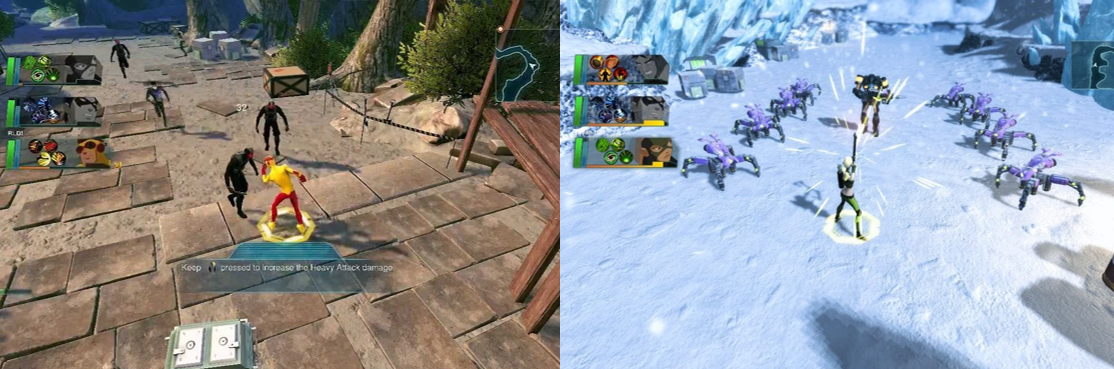
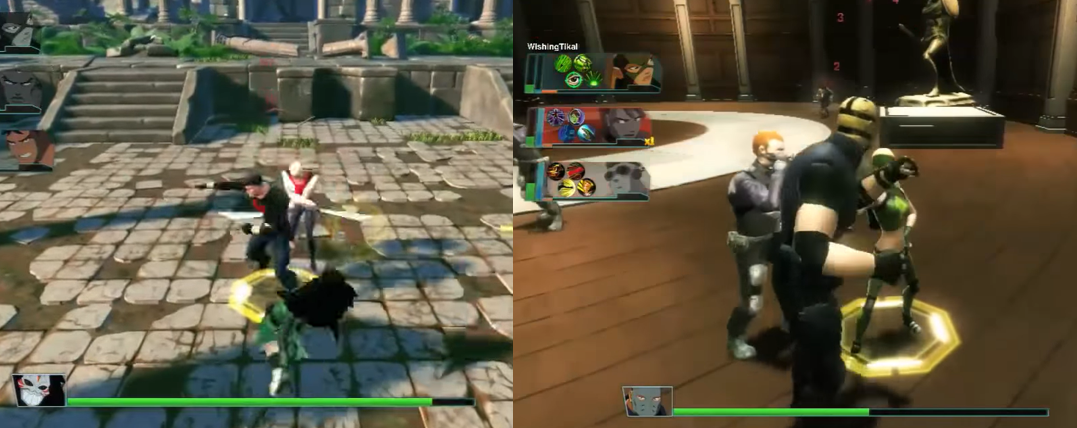
Young Justice: Legacy is a team-based beat-‘em-up with very light puzzle elements that sees players form a team of three (why it isn’t four is beyond me…) characters from a roster of twelve and fight their way through fifteen missions. If you don’t have one or two friends to play alongside, you can switch between the three characters with a press of left or right on the directional pad and, when you’re not playing as them, the computer will take over and batter any nearby enemies with a reasonable amount of competence. When selecting a team for the game’s main campaign, you’re unable to alter the story-based team leader, which can mean that you’re stuck with a character you don’t really like and limits the customisation options available to you, but that doesn’t really matter as, essentially, every single character plays the same way. Tapping X performs a light attack while pressing Y performs a heavy attack (you can also hold Y to charge this up) and you can mix up these button presses to perform a few clunky combos (although it has to be said that you can easily just run past the vast majority of the game’s enemies and not get bogged down in the monotonous combat). You can jump with A and certain characters can fly (more of a hover) with a subsequent press of A, perform an awkward dash with B that can help you move a little faster or dodge incoming attacks, hold the Left Trigger to block, and pick up and throw objects with B and X, respectively.

Combat is laborious and characters don’t really feel that different from each other.

Each character has four superpowers available to use; these are performed by holding the Right Trigger and pressing either X, Y, A , or B and can be performed as long as the blue bar on the heads-up display is full. This bar fills up over time and you’re able to pull off such ranged attacks as tossing Batarangs, shooting arrows, throwing fireballs, and blasting enemies with water, area blast attacks that may stun or knock back enemies, cast a healing spell or boost your attack, defence, and energy consumption, or freeze enemies, compel them to attack their allies, or turn your character briefly invisible. As you defeat enemies, you’ll build up your character’s “Hero Boost” meter; once it’s full, you can pull off a Hero Boost than defeats or heavily damages all onscreen enemies by holding RT and pressing the Right Bumper or build up all three characters’ bars and unleash a massive “Squad Boost” attack by holding RT and pressing the Left Bumper. Sadly, every character has the same Hero Boost attack and animation, which really limits the distinctiveness of each character beyond their individual superpowers. Combat in Young Justice: Legacy is mind-numbingly simple; as you run through painfully linear environments, you’ll be set upon by a near-endless supply of goons, all of whom might look a bit different area to area but basically attack in the same ways and can be put down with a bit of mindless button-mashing (or, as I said, avoided completely in some instances).

Combat is broken up by simple puzzles and a few tedious tasks.

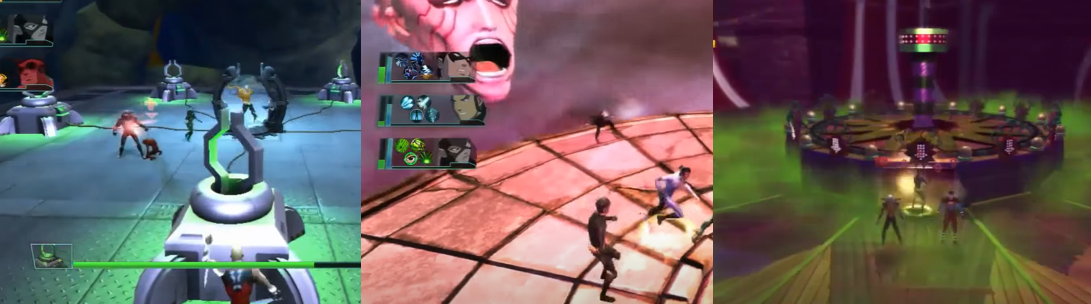
Opportunities for exploration are limited; sometimes you can (and have to) smash through rock walls to access secret areas that lead to some collectibles or control panels and such but you won’t really find multiple paths through stages or areas that can only be accessed by certain characters and/or team combinations. The game also tries to mix things up with some extremely simple puzzles; these generally involve smashing something, usually a generator, activating a console to open a door, or pushing something big to activate bridges, open doors, or reach new areas. Stages are super linear but there’s a helpful mini map on screen at all times to point you in the right direction and you can look up your current objectives with a press of the ‘Back’ button but, while missions are split into three sub-missions at a time, the game’s monotony is made all the more frustrating by a serious lack of checkpoints. While you can’t pick anything up to refill your health, it will automatically refill once all onscreen enemies have been defeated and, if an ally is knocked out, you can revive them by pressing B. You can select from two difficulty settings (Normal and Hard) which, obviously make the game’s enemies a bit tougher and what-not but it can be extremely aggravating to get knee-deep into a mission only to have your health drained to nothing by instant-kill laser traps. Some stages are full of environmental hazards like this, such as flames and spikes from the floor and large statues that come to life as you progress through rooms. Other missions also prove unnecessarily frustrating, such as forcing you to clear out all onscreen enemies in a time limit (bizarrely without an onscreen timer to gauge your progress), rescue hostages, defend John Stewart/Green Lantern while health-sapping debris and waves of enemies attack you, avoid enemy-spawning search lights, smash engines or generators while avoiding missile-shooting turrets, or push forklift trucks to avoid being taken out by snipers.

Graphics and Sound:
I should stress here that I haven’t ever seen the cartoon that Young Justice: Legacy is based on but the game opts to use a variation of cel-shaded graphics to recreate the look of its source material and, for the most part, this works…unless you’re watching the game’s cutscenes. When playing the game, thanks to the skewed, top-down perspective, the lack of detail and rigidity of the character models isn’t as noticeable since you’re so focused on combat and the perspective is quite zoomed out but, when the game tells its story, characters are all very flat and kind of resemble lifeless puppets more often than not. While the main characters look fine for what they need to be, the enemies aren’t so great; you’ll fight the same goons and robots over and over, which all gets very monotonous very quickly.

Character models are okay but environments and cutscenes are a bit bland and stilted.

Environments are surprisingly big considering how linear and empty they are; there’s usually a lot of open room to manoeuvre and you’re rarely forced to fight down boring, narrow grey corridors. You’ll visit places like Siberia, Santa Prisca, Gotham City, and battle on LexCorp hovercrafts, all of which provide a decent amount of visual variety to the game. It’s just a shame, then, that there’s very little opportunity to explore; you can go off the beaten path but will often find only a dead end or useless boxes to smash, and there’s no opportunities to platform or utilise specific character powers outside of combat. At one point, Edward Nygma/The Riddler challenges you to solve a light-based puzzle in a neon-drenched sewer system-made-funhouse, which is quite a unique area, but there’s really not that much on display here to keep you that engaged, which only adds to the game’s repetitiveness. The music and sound effects are equally bland but, while the game appears to utilise the same voice cast from the cartoon, this is actually to its detriment; characters will spout the same quips and lines over and over again and I was about ready to snap the disc in half after hearing Dick Grayson/Nightwing moan about being “whelmed” all the damn time!
Enemies and Bosses:
A slew of generic goons will dog your progress in every mission. After playing through the first stage, you’ll basically have encountered every enemy the game has to offer as they simply get swapped out with different character models in each mission. You’ll battle teleporting, sword-wielding members of the League of Shadows, a variety of robots (Spider Bots and larger, more humanoid robots being the most common), Bane and David Hyde/Black Manta’s mercenaries, and the Riddler’s baton and shotgun-wielding goons throughout the game’s story. Things get interesting in the game’s final missions, where you’ll battle a larger mech, fight against mummies, and come up against gigantic statues that deal massive damage and get jumped by an assortment of enemies in enclosed areas.

Cheshire and Sportsmaster require a hit-and-run strategy to whittle down.

Each mission culminates in a boss fight against at least one member of the supervillain cabal known as The Light; the first mission ends with you battling Jade Nguyen/Cheshire, who teleports around the arena in a puff of smoke and throws projectiles your way but, while she’s the toughest enemy you’ll have faced at that point, she leaves herself wide open for an attack when she pauses to setup an explosive device and isn’t too difficult to whittle down as long as you keep moving, attacking, and reviving as necessary. This strategy basically applies to every boss but will become abundantly clear when you battle the second boss, Lawrence “Crusher” Crock/Sportsmaster. Sportsmaster is accompanied by a seemingly endless supply of goons, all of whom cause a massive headache when you’re trying to dodge Sprotsmaster’s health-sapping spinning and charge attacks. Thankfully, though, these enemies are finite and, if you quickly take them all out, you can focus on battling Sportsmaster using hit-and-run and ranged attacks.

Many of the bosses cannot be attacked directly and must be stunned first.

In Siberia, you’ll fight Crystal Frost/Killer Frost as Spider Bots attack you; Frost can’t be attacked head-on as she hides atop an ice column and blasts ice attacks at you, so you need to destroy her platform to knock her down and then beat on her before she can build a new one. Cameron Mahkent/Icicle Jr. takes over the ice-based duties for the next boss battle, where he teams up with Sportsmaster. You can utilise the same tactics to take out Sportsmaster and it’s best to focus on one enemy at a time; Icicle Jr. is different from Killer Frost in that he can freeze you and encases himself in an ice sphere that refills his health. After defeating them, you’re faced with a harrowing mission where you must battle through rooms of annoying enemies with no checkpoints and no refillable health as Clark Kent/Superman holds back an incoming avalanche, which was one of the most aggravating parts of the game on my first playthrough. Afterwards, in Santa Prisca, you’ll battle against Bane who, again, requires a little more strategy; when pumped full of Venom, Bane is invincible and you need to lure him into charging the nearby columns to stun him. He also busts out a big ground pound attack and can bash your brains in if you get too close for too long, so again it’s best to hit and run and use ranged attacks to whittle him down.

While you can bypass Black Manta, Psimon and Riddler require a more hands-on approach.

Next up, you’ll have a tough battle where you must disable Black Manta’s submarine; the game doesn’t make it massively clear how you do this but basically you have to fight off Black Manta’s goons and push these red bars near the large generators to overload his sub, all while avoiding his instant-kill lasers by taking advantage of the big metal shields that rotate around the arena. After that, you’ll fight Black Manta himself; make sure you avoid his massive eye beams but don’t worry about fighting him or his goons as you can simply attack and destroy the shield generators to end the fight that way. While at Haly’s Circus, you’ll have to fight through waves of enemies in a mini gauntlet before battling with Doctor Simon Jones/Psimon, who spawns in mirror versions of your team (who seem to randomly stun and defeat you without really landing any attacks) and then rains massive red energy lasers into the arena but if you simply mash the attack button, he’ll go down pretty easily. Finally, you’ll have to do battle with the Riddler, who randomly spawns bombs, poison gas, goons, and other hazards into the arena. To defeat the Riddler, simply ignore everything and attack and destroy the panels on his big circus-wheel-thing in perhaps the game’s easiest (if tedious) boss battle.

The final boss battle just goes on and on and even contains a game-breaking glitch!

The game ends with a gruelling and aggravating multi-stage fight against Klarion Bleak/Klarion the Witch Boy, Mark Desmond/Blockbuster, and the eldritch beast known as Tiamat. While Klarion and Blockbuster aren’t too difficult to best (simply lure Blockbuster into Klarion’s meteor attack to stun him and then beat on him until he goes down), the fight against Tiamat feels like it’s never-ending! In the first phase, he blasts the arena with water attacks that will basically kill you in one or two hits and he can only be damaged when he dips down into the water. In the second phase, he shoots a massive mouth laser at you and tries to swipe and squash you with his claws and fists; after avoiding his attacks, pummel the limb with everything you have until his health is drained. In Tiamat’s final phase, he flies about above you and comes crashing to the ground, unleashing a devastating series of attacks that will leave you “whelmed” in seconds. The only way to damage him is to attack the minions that spawn into the arena; after defeating two, you’ll build up your Hero Boost and you must unleash your Squad Boost to damage Tiamat, and then attack him immediately afterwards to whittle him down even more. This is easily the most frustrating boss battle in the entire game because of how tough Tiamat is; make sure to bring a healer like Zantanna Zatara or M’Gann M’orzz/Miss Martian or else you’re gonna have a bad time but be warned as there’s an almost-game-breaking glitch in this fight that can see the enemies stop spawning in, leaving you unable to finish the fight and forcing you to quit the game and try again but, thankfully, there are save points between each phase of this finale.

Power-Ups and Bonuses:
As you defeat enemies, you’ll gain experience points (XP) that will cause you to level-up; each character has different statistics that affect how much health, power, and energy that have and levelling-up allows you to increase the power and range of each character’s superpowers. You can also find crates in stages and earn “Hero Points”, which can be spent on Wayne Industries upgrades, two of which can be equipped to each character after being purchased and will increase your melee or weapon attacks, energy consumption, and a host of other stats. Thankfully, these Hero Points seem to be shared amongst every character; so, if you have ten Hero Points, you can spend them upgrading Tim Drake/Robin’s superpowers and then switch out to Kaldur’ahm/Aqualad and spend the same ten Hero Points upgrading him, too. Sadly, though, there are no pick-ups on offer; yes, you can pick up and throw boxes and barrels and such, but you can’t pick up weapons or power-ups during gameplay, making smashing all those boxes pretty pointless.

Additional Features:
Young Justice: Legacy comes with forty-eight Achievements for you to earn; many of these pop simply by playing the main campaign and defeating a certain number of enemies, the game’s bosses, and finishing the game on Normal or Hard. You can also snag some G by destroying crates, finding collectibles, or playing the game in co-up but there are also some stage-specific Achievements, such as avoiding searchlights in the Gotham City docks and solving a puzzle in a certain way. Every stage in the game has a few collectibles to find; these include dioramas, additional costumes for the game’s characters, and journals left behind by Roy Harper/Red Arrow. Playing through the campaign on Normal and Hard will see you unlocking additional characters, which is always nice, and there are four additional characters available to purchase as downloadable content if you like the sort of thing. Also on offer are an array of challenges; while these can only be played in single-player, these will pit you against ten waves of enemies that progress in difficulty, or have you battling against a time limit and you’ll unlock additional challenges and stages by playing the story mode. You can also view character biographies, concept art, and take part in a quiz that will test your knowledge of the cartoon to earn points.

The Summary:
I wasn’t expecting much from Young Justice: Legacy except some mindless, arcade-style beat-‘em-up action; I’ve played team-based, top-down fighters like this before and been perfectly satisfied with them but I have to say that this game is just a repetitive, tedious, aggravating experience from start to finish. There’s a decent amount of characters on offer and some of them have more appeal than others, but they all essentially play exactly the same way. Since they lack character-specific super moves, you may as well just pick anyone and it’s ridiculous how you can just run past enemies to progress or simply look away from the screen and mash the X button to win. There’s very little actual skill or intelligence needed for this game, which would be fine if it was actually fun but it really isn’t; it’s dull and down-right infuriating at times, with some bland bosses, linear and empty stages, and very little incentive to replay the game beyond mopping up any missed Achievements.

My Rating:

Rating: 1 out of 5.

Terrible

Have you ever played Young Justice: Legacy? If so, what did you think to it? What character and team combination was your favourite? What did you think to the combat and gameplay and which of the game’s missions and bosses was your favourite? Were you a fan of the cartoon and, if so, do you think the game did a good job of recreating the action and energy of the show? Would you like to see more videogames based on Young Justice and/or the Teen Titans? Feel free to share your thoughts on Young Justice: Legacy, and Young Justice, down in the comments.

Back Issues [Crossover Crisis]: Batman vs. The Incredible Hulk


In April 1985, the first issue of the ground-breaking Crisis on Infinite Earths (Wolfman, et al, 1986) released and saw the temporary destruction of the “Multiverse”. To celebrate this momentous event, I’m discussing multiversal crossovers all throughout April in an event I dubbed “Crossover Crisis”.


Story Title: “The Monster and the Madman”
Published: September 1981
Writer: Len Wein
Artist: José Luis García-López

The Background:
Although the two companies both publish stories of colourful, superpowered heroes in a cut-throat industry, the relationship between DC Comics and Marvel Comics has been surprisingly collaborative and amicable over the years (especially compared to many of the toxic fans” who argue on social media every day…) Sure, there’s been lawsuits and underhanded tactics from both companies, but not only were the legendary Stan Lee and the disreputable sham Bob Kane actually good friends but both companies borrowed from and inspired each other and they’ve even collaborated on many joint publications in the past. Having already pitted Clark Kent/Superman against Peter Parker/Spider-Man in Superman vs. The Amazing Spider-Man: The Battle of the Century (Conway, et al, 1976), DC and Marvel brought these two characters together again in 1981. That same year, the two companies also produced a sixty-four-page “Treasury Edition” comic book that pitted Bruce Wayne/Batman against Doctor Bruce Banner/The Hulk. At the time, graphic novels were nowhere near as commonplace as they are today and both characters were experienced a way of renewed mainstream interest off the back of a popular television series and moving away from the camp aesthetic of the 1960s, respectively. Like many of these early DC/Marvel crossovers, Batman vs. The Incredible Hulk can fetch a pretty high price these days, and it also wouldn’t be the last time that their paths crossed in one form or another.

The Review:
One of the most reliable constants of many comic books, especially back in the 1960s through to the mid-1990s, was that many stories derail or pad out their narrative with a recap of their character’s origins and background. This seems to mostly happen to Spider-Man, who often interrupts whatever problem he’s having in the issue to recap his iconic origin and, don’t get me wrong, I get why this happens (you can’t expect every reader to be familiar with your characters, after all) but I much prefer it when comics simply have a bit of text before the story to catch readers up. Batman vs. The Incredible Hulk opts for this latter option and is all the better for it; before the story starts, we get a one page, two-column spread the recaps how Bruce Wayne saw his parents shot and trained his body and mind to become Batman and how Dr. Banner was bombarded with Gamma radiation and subsequently transforms into the rampaging Hulk whenever stressed or angry. Like Superman vs. Spider-Man, Batman vs. The Incredible Hulk begins with a prologue that establishes the villains of the story; the first is more of an abstract introduction as people all over Gotham City suffer from horrific and disturbing nightmares while the second is far more tangible as is shows that the Joker is back in town and has joined forces with a disembodied voice for nefarious reasons. The story then shifts to find Banner, under the pseudonym of “David Banks”, working a menial job for Wayne Research in order to get close to their “experimental Gamma-Gun”, and who is the only person to act fast enough to slip into a radiation suit and avoid the Joker’s debilitating laughing gas when the Harlequin of Hate and his goons show up to steal that same device!
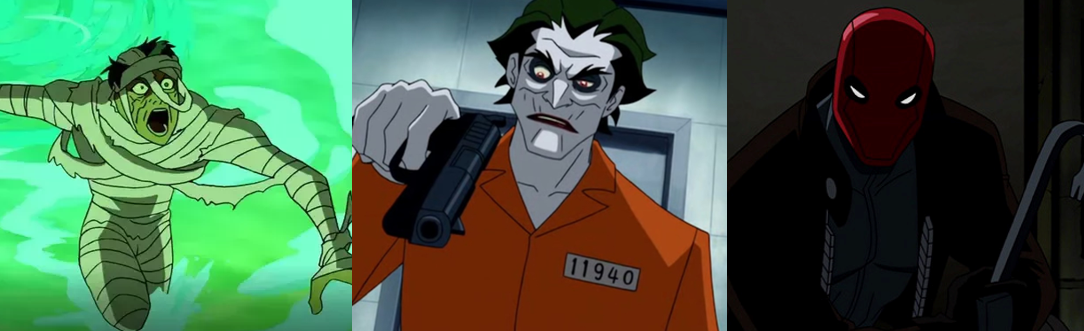
Outmatched against the Hulk’s sheer power, Batman out-thinks the brute to take him down.

When Banner moves to raise the alarm, he is tackled and beaten by Joker’s thugs which, of course, causes him to transform into the Hulk! Quickly realising that their firepower is absolutely useless against the creature, the Joker orders his men to grab the Gamma-Gun and flee but their escape is impeded by the sudden arrival of the Batman! Unfortunately for Batman, the Joker immediately takes advantage of the Hulk’s child-like demeanour to convince the Green Goliath that Batman is his enemy and thus the two engage in fist fight! Batman initially holds back from confusing and potentially further antagonising the Hulk but finds his attempts to paralyse his foe by striking his nerve centres fruitless. Unable to harm the Hulk, Batman tries to keep his distance and out-think the creature and almost gets his spine snapped as a result! Batman is finally able to subdue the Hulk, however, by forcing him to breathe in a big lungful of his special Bat-gas but, though the Hulk is finally toppled, the Joker escapes with the Gamma-Gun. Batman returns to the facility as Bruce Wayne and immediately enlists the services of the grief-stricken Banner in the construction of a replacement Gamma-Gun.

The Joker and the Shaper conspire to capture the help using fake soldiers.

Back at the docks, the Joker activates the Gamma-Gun and allows his newfound friend, the Shaper of Worlds, to partially manifest in the real world and give us all a run-down on his origin as a parasite who feeds upon the dreams of others and bring them to life. He’s struck a bargain with the Joker (whose insane mind makes him “unique in all the universe”) to help restore the Shaper’s failing abilities, though exactly what the Joker is getting out of this deal is left unclear (and it is heavily implied that the Shaper scares even the Joker!) While Batman hits up Gotham’s underworld in search of the Joker, Banner finds the stress of his assignment putting him on edge. Although he’s briefly calmed down by a cup of Alfred Pennyworth’s tea, he continues to push himself without food or proper rest. Thus, when the Joker’s men arrive disguised as military officials charged with arresting Banner, it isn’t long before he turns green once again. When a specially-designed taser-rifle fails to have the desired effect on the Hulk, a massive blob-like creature enters the fray. Despite the Hulk’s increasing rage and best attempts, the creature is effectively able to absorb and contain the Hulk and spirit him away and Batman arrives in time only to hear Commissioner Jim Gordon receiving confirmation from General Thaddeus “Thunderbolt” Ross that the soldiers were fakes. Back at the Joker’s warehouse, the Hulk goes on a rampage when he hears the Clown Prince of Crime’s plan to revert him to Banner in order to make adjustments to the Gamma-Gun; despite the Shaper’s best efforts to quell the beast’s rage, both he and the Hulk are tormented by disturbing nightmares that leave the two physically and emotionally drained. Bored by the conflict, the Hulk flees but the Shaper comes to the conclusion that the crippling pain and madness his condition brings him can be cured not by the Gamma-Gun…but by the Hulk himself thanks to his unique Gamma properties and orders the Joker to recapture the beast. To facilitate this, the Joker explains the bind he’s in to Batman and enlists his aid, which soon leads to a second confrontation between the two characters. Bored of Batman and being constantly hounded by “puny humans”, the Hulk chooses to flee but a fight soon inevitably breaks out.

Despite his vast cosmic powers, Batman is able to trick the Joker into leaving himself vulnerable.

Once again, Batman chooses to fight smarter rather than harder, rolling with and doing everything he can to avoid or survive the Hulk’s attacks while trying to talk sense into the increasingly-enraged Hulk. Batman’s tricks result in the Hulk demolishing the building the two were fighting in and once again fleeing in order to be left in peace. Batman is finally able to get through to the Hulk by posing as a harmless old blind man and offering the creature his friendship, which calms the Hulk enough to the point where he willingly goes along with the Joker to confront the Shaper. However, angered that the Joker is willing to let the Hulk face this foe alone, Batman slaps his archenemy down and finally joins forces with the Jade Giant to battle a legion of their enemies brought to life by the Shaper’s powers. Finally on the same page, the two are easily able to overcome the living nightmares and fight their way to the Shaper, who holds them at bay with an impenetrable barrier. Angered at the idea of anything being stronger than he is, the Hulk charges ahead at full speed and exhausts his Gamma energy, reverting to Banner and curing the Shaper. Despite Batman’s pleas, the Shaper honours the bargain he made with the Joker and, having been cured, bestows the Joker with “limitless, infinite power”. Effectively acting as a genie for the Joker, the Shaper makes all of the Joker’s wishes come true, transforming him into a God-like jester who unleashes chaos and madness throughout Gotham City and uses his reality-warping powers to shape the city, its people, and even Batman however he sees fit. When the Shaper refuses to renege on his word, Banner transforms back into the Hulk and finds himself transported to the Joker’s increasingly mental world. Batman goads the Joker into pushing his powers to the limit by criticising his creativity and lack of imagination; although this results in things becoming even more warped and abstract, it also has the intended side effect of overwhelming the Joker, leaving him wide open for a knockout punch. In the aftermath, the Shaper takes his leave, the Joker is confined to Arkham Asylum once again, and Batman allows Banner to slip away in order to find the peace he so desperately desires.

The Summary:
Given that I grew up mainly reading DC and Marvel Comics and annuals published in the seventies and eighties, Batman vs. The Incredible Hulk’s presentation is immediately recognisable to me and these are the quintessential representations of these characters at that time, in my opinion. Batman is much more of a stoic tactician and a fair-minded vigilante than a grim, overly paranoid avenger of the night and the Hulk speaks with a child-like demeanour and, while he just wants to be left alone, is more than ready to throw hands when provoked. Thanks to the Hulk’s unpredictable and explosive demeanour, Batman vs. The Incredible Hulk features a couple of fights between the two characters that are instantly believable. It’s not the first time that someone/a villain has manipulated the Hulk into trusting them or going nuts on a specific target and Batman is smart enough to not try and match the Hulk blow for blow. Instead, their fights are more about Batman trying to outmanoeuvre his foe, trying to reason with him, and using his physical skills and gadgets to stay out of the Hulk’s reach and to subdue him. It’s definitely a battle of brains versus brawn, which isn’t unusual when characters fight the Hulk but it’s definitely a spectacle seeing Batman trying to take on such an overwhelming foe. Superman versus the Hulk obviously makes more sense on paper but I don’t think it would have resulted in as interesting a story and probably would have descended into a slugfest instead.

Batman and Hulk tangle more than once in a brain vs. brawn bouts.

I’m not familiar with the Shaper of Worlds but the story does a pretty good job of establishing his powers and what he wants; desperate to cure the crippling pain and madness caused by his fading abilities, he enters into a partnership with the Joker to use Gamma radiation to stabilise him. It’s unusual to see the Joker acting out of fear or subordinate to another but his characterisation remains completely on point and he never seems to be a diminished threat. Instead, he remains in control and a tangible menace throughout; he’s smart enough to manipulate the Hulk and even convince Batman to help him, and then obtains God-like power and goes berserk bending and twisting reality, forcing Batman to think of ways to outsmart him, which is always fun to see. Overall, it was quite a decent crossover between the two. The Hulk typically doesn’t have one set location so setting the entire story in Gotham City was a good idea; seeing Banner and Wayne (and Alfred) interact was a nice little inclusion and something missing from Superman vs. The Amazing Spider-Man. While neither character’s supporting cast have very much to do, it was nice to see Gordon show up (and to have him communicate with Ross) and having the Shaper conjure up nightmarish visions of both character’s foes was pretty awesome, especially when the Hulk reacted to Batman’s enemies with disinterested rage. There could have been more interactions between Batman and the Hulk; entire pages and chapters go past without the two interacting at all, either in or out of costume/form, which is in contrast to Superman vs. The Amazing Spider-Man but I think this was done to keep the story from descending into a series of one-sided fights. After all, there’s only so many ways you can show Batman avoiding being pummelled by the Hulk before it gets repetitive, and we do get to see interesting character combinations and interactions (and a pretty decent Batman story featuring the Hulk) as a result.

My Rating:

Rating: 3 out of 5.

Pretty Good

Have you ever read Batman vs. The Incredible Hulk? If so, what did you think to it? Do you own a copy of the original comic or do you remember reading it when it was first published? Were you surprised that Batman was pitted against the Hulk? Do you think he should have met a different Marvel character instead? What did you think to the team-up between the Joker and the Shaper and the Joker’s acquisition of phenomenal cosmic powers? Would you like to see DC and Marvel collaborate again in the future and, if so, what stories would you like to see? Whatever your thoughts on Batman vs. The Incredible Hulk, and comic book crossovers of this kind, drop a comment down below and check out my other Crossover Crisis reviews!

Movie Night [Robin Month]: Batman: Under the Red Hood


In April of 1940, about a year after the debut of arguably their most popular character, Bruce Wayne/Batman, DC Comics debuted “the sensational find of [that year]”, Dick Grayson/Robin. Since then, Batman’s pixie-boots-wearing partner has changed outfits and a number of different characters have assumed the mantle as the Dynamic Duo of Batman and Robin have become an iconic staple of DC Comics. Considering my fondness for the character and those who assumed the mantle over the years, what better way to celebrate this dynamic debut than to dedicate every Sunday of April to celebrating the character?


Released: 27 July 2010
Director: Brandon Vietti
Distributor: Warner Home Video
Budget: Unknown
Stars: Bruce Greenwood, Jensen Ackles, John DiMaggio, Wade Williams, and Jason Isaacs

The Plot:
Gotham City’s underworld is terrorised by a murderous vigilante known only as “The Red Hood” (Ackles). In investigating this new threat, Batman (Greenwood) is forced to face the greatest failure of his career as old wounds reopen and old, once buried memories come into the light.

The Background:
As I detailed in my review of A Death in the Family (Starlin, et al, 1988), readers were first introduced to Jason Todd in March 1963. With the original Robin, Dick Grayson, having grown up and gone away to college, Jason was initially almost indistinguishable from his predecessor until he was given an “edge” by writer Jim Starlin following the Crisis on Infinite Earths (Wolfman, et al, 1985 to 1986). Readers didn’t take kindly to the new Robin and, in a moment that went on to define Batman for years to come, DC Comics made the decision to kill the character off in the aforementioned Death in the Family storyline. For over fifteen years, Jason Todd stayed dead and his death haunted Batman; his monument in the Batcave served as a constant reminder of Batman’s greatest failure and he was long considered one of only a handful of comic cook characters who would stay dead. The character made a surprise return during the “Hush” storyline (Loeb, et al, 2002 to 2003) before being officially brought back to life (through cosmic, reality-bending shenanigans, of course) in the “Under the Hood” arc (Winick, et al, 2004 to 2005; 2005 to 2006). Jason’s resurrection was generally positively received and he has gone on to become a popular anti-hero as the Red Hood and, 2010, Winick came onboard to write the animated adaptation of his influential storyline. Batman: Under the Red Hood was the eighth animated feature of the DC Universe Animated Original Movies line-up, which aimed to be more mature than the DC Animated Universe popularised by Bruce Tim and Paul Dini. Batman: Under the Red Hood was one of the most successful of DC’s animated ventures, making over $12 million in sales and being critically applauded; a follow-up even surprisingly landed in 2020 in the form of an interactive animated feature that was also quite well received.

The Review:
I never really had any strong feelings for or against Jason Todd as I read comic books so sporadically as a kid that, by the time I even read A Death in the Family, Dick Grayson had already become Nightwing and Tim Drake was already the third Robin so, if I didn’t like what happened to him, it was too late to be mad about it. I do feel, though, like the idea of bringing him back was great…on paper….but that DC Comics screwed it up in execution. Personally, I think Jason should have been Hush all along as his outfit in Hush was way better than the Red Hood look and, considering DC kind of retconned that Jason was present during Hush anyway, I think this would have made a lot more sense. Plus, it took DC a long time to find a way to mention Jason’s dramatic return without having to reference the reality-breaking shenanigans of Infinite Crisis (Johns et al, 2005 to 2006) and, in that regard, if feels like Under the Red Hood tells a far simpler and much more coherent version of events surrounding Jason’s resurrection thanks to the benefit of hindsight.

Still haunted by Jason’s death, Batman hears of a new player muscling into Gotham’s underworld.

Under the Red Hood opens with its interpretation of the events of A Death in the Family; in this adaptation, Ra’s al Ghul (Isaacs) allied with the Joker (DiMaggio) in his latest bid to disrupt Europe’s economy. He realises the error in his judgement all-too-late as the Joker captured Jason Todd/Robin (Vincent Martella) and was busy amusing himself by taunting Robin and mercilessly beating him with a crowbar. Although Jason remained defiant, even with a collapsed lung and having been beaten half to death, he was helpless against the Harlequin of Hate. Despite Jason struggles with all his failing might to hold out for Batman, who raced to aid his young partner, he was killed when the warehouse that he was trapped in explodes (again, take note: Jason is killed by the explosion and not by the crowbar!) The film then jumps ahead five years to find Gotham’s criminal figureheads lured into a meeting and confronted by the mysterious Red Hood. Red Hood delights in taunting the criminals and muscles his way into the operation, promising to protect them from both Batman and Roman Sionis/Black Mask (Williams) on the proviso that they don’t peddle their wares on young kids and proves himself a credible threat by presenting a bag full of the severed heads of their lieutenants. Meanwhile, Batman continues to operate within the city; however, his experiences with Jason have left him more of a loner than ever, to the point where he even out-right refuses Nightwing’s (Harris) help in taking down Amazo (Fred Tatasciore), a superpowered android with all of the powers of the Justice League. Nightwing, of course, completely disregards this and helps anyway and, in the process, the two learn of the Red Hood’s bid to muscle the Black Mask out of power and control Gotham’s underworld.

The Red Hood makes an enemy of both Batman and Black Mask through his violent actions.

When the Red Hood kills the thugs transporting Amazo, Batman gives chase in the Batwing but loses him in the Axis Chemical Plant (though not before having a flashback to his first encounter with the Joker, who, at that time, was hidden under the guise of the original Red Hood). Back at the Batcave, Batman and Nightwing analyse the footage of the biker-gear-clad vigilante and note that, since he arrived in town, crime has fallen significantly. Suspecting that the Joker may be behind the new Red Hood, they head to Arkham Asylum to interrogate the Clown Prince of Crime, who denies any involvement in his activities but takes the opportunity to rile Batman up over failing to save the former Robin. Meanwhile, the Red Hood’s activities have angered Black Mask, the ruling mob boss of Gotham City. In this incarnation, Black Mask is similar to Johann Schmidt/The Red Skull in that, rather than wearing a mask or a helmet, his head is literally a charred black skull. Apart from that, he’s a bombastic, maniacal gangster who viciously beats anyone who dares to stare at his gruesome appearance. His efforts to kill the Red Hood meet in failure as he is closely monitoring Black Mask’s meetings and movements so that he can steal his weapons and merchandise. Thankfully, Batman has also been monitoring Black Mask, correctly guessing that the Red Hood would hijack his latest shipment, and as a result comes face-to-face with Gotham’s newest vigilante once more after an exhilarating chase through a construction site, across the city rooftops, and even across the city’s famously impractical blimps.

Revived by the Lazarus Pit, Jason enacts a plan of revenge against the Joker.

Thanks to the Red Hood’s impressive skills, physical aptitude, and apparent knowledge of Batman’s weapons and tactics (all of which Nightwing, and even Batman, admit to being amazed by), this proves to be a trap as Batman and Nightwing are lured into an explosion that leaves Dick’s leg injured. Both of them marvel at the Red Hood’s physical abilities and skills and knowledge of Batman’s tactics but Batman is stunned when he reviews the playback of their encounter and hears the Red Hood calling him “Bruce”. Black Mask steps up his campaign against the Red Hood, beating, threatening, and killing all of those who have sold out to him and hiring mech-wearing mercenaries to hunt him down, but Batman interrupts the fracas and takes the mercs out alongside Red Hood. Although Batman is disgusted when the Red Hood uses lethal force to kill one of the mercenaries, he nevertheless attempts to offer Red Hood help but the helmet-clad vigilante angrily refuses, believing that his willingness to kill is making an actual difference as opposed to Batman’s more merciful ways. By analysing the Red Hood’s blood, Batman confirms, without a doubt, that he is Jason Todd resurrected. Realising that only one man could possibly have been responsible for Jason’s return to life, Bruce angrily confronts Ra’s and learns about what happened all those years ago: remorseful for allowing the Joker to kill Bruce’s young partner, Ra’s recovered Jason’s body (leaving a dummy in his grave) and revived him by submerging him in the restorative Lazarus Pit.

The Nitty-Gritty:
Aesthetically, Under the Red Hood greatly resembles many of DC’s other animated efforts; characters aren’t quite as exaggerated or cartoony as they are in the DCAU but are still quite stiff and rigid. Luckily, this allows the film’s many chase and fight sequences to shine even more, but it does make prolonged scenes of dialogue and exposition to appear a bit inflexible. The voice cast, however, is pretty stellar; Bruce Greenwood makes for a gravelly and intimidating Batman, even if he is imitating the iconic Kevin Conway somewhat, and the film does a pretty good job of showcasing the impact Jason’s death had on him and his rage at allowing himself to be so easily duped by Ra’s’ deception. John DiMaggio makes for a serious and menacing Joker who appears to be evoking both Mark Hamill and Heath Ledger’s take on the character, and Neil Patrick Harris makes for a great Nightwing as well and makes an impression despite being taken out of the film before long (although it’s a bit odd that common thugs know about his past as Robin) but it’s Jensen Ackles’ wit and biting tongue as the Red Hood and Wade William’s explosive portrayal of Black Mask that are the highlights of the feature for me.

Jason goes from carefree youth to violent and unhinged vigilante as he grows and changes.

The film is peppered with flashbacks to Batman’s time working alongside Jason; during the boy’s (Alexander Martella) first year as Robin, he was an excitable, carefree Boy Wonder who Batman first met as he was in the process of stealing the tyres off the Batmobile and delighted in being Batman’s brightly-coloured, hyper-chatty crimefighting partner. As he grew into a teen, however, he became and angry and bitter young man who constantly defied Batman’s orders and brutalised criminals without mercy. His dip in the Lazarus Pit saw him awaken from death half-crazed and unstable and set him on the path towards becoming a murderous vigilante and making both Batman, and the Joker, pay for their actions. Driven to the edge by the Red Hood’s disruptive actions, and the vigilante’s direct assault on his offices with a rocket launcher, Black Mask arranges for the Joker to be smuggled out of Arkham and sets him loose to kill the Red Hood on his behalf. This, however, was exactly what the Red Hood wanted as it allows him to get his hands on the man who murdered him and deliver a measure of payback with a crowbar.

Batman refuses to compromise his moral integrity and remains haunted by his failures.

Luring Batman to Crime Alley, the Red Hood finally reveals his face to his former mentor and demands to know why the Joker is still alive after everything he’s done but especially for taking Jason away from Bruce. He makes a damn good point, one that has been endlessly debated, and states that he can forgive everything Bruce has done and that he’s not talking about mass murder of every two-bit thug or supervillain, but he cannot forgive (or understand why) the fact that Batman hasn’t killed the Joker in recompense for his years of slaughter and for killing him (as in Jason). After a brutal fist fight between the two, Batman apologises but states that he could never kill anyone, not even the Joker, because it would be “too easy” and lead to him becoming just as bad as the criminals he hunts on a nightly basis. Enraged and distraught, Jason demands that Batman shoot him before he executes the Joker; when Batman adamantly refuses to betray his morals, Jason triggers an explosion and disappears once again. In the aftermath, Bruce refuses to have Jason’s monument removed from the Batcave as he never wants to forget how badly he failed young Jason and turned him from a cheery youth and into a damaged, violent killer.  

The Summary:
Batman: Under the Red Hood is an incredibly bleak and sombre examination of Batman’s greatest failure; one thing I always liked about Jason being dead was how this incident weighed heavily on Batman’s mind and that a constant reminder sat in the Batcave for years so that he (and the reader) would never forget those dramatic events. When Jason returns to life as a violent and unhinged vigilante and twists Batman’s teachings and moral codes into a spiteful vendetta, Batman is forced to confront his failure, and his past, head-on and the film does an excellent job of not only adapting the source material it is based on but also adding to it and, in many ways, improving it. Having Ra’s be the one responsible for Jason’s resurrection as opposed to an alternative version of Superman punching reality just makes so much more sense and seeing Jason snark, shoot, and muscle his way into Black Mask’s dealings was really great thanks to Ackles’ portrayal of the character. I also enjoyed the flashbacks to Jason’s youth and even the Joker’s origin, which helped add some additional context to those who may be unfamiliar with these elements, and overall the film is a great example of the unwavering commitment Batman has to his “no-kill” rule and the impact that has on his never-ending war against crime.

My Rating:

Rating: 4 out of 5.

Great Stuff

Are you a fan of Batman: Under the Red Hood? How do you feel it works as an adaptation of A Death in the Family and Under the Hood and did you enjoy the changes that the film made to the story and Jason’s resurrection? What did you think to the voice cast, particularly Greenwood, DiMaggio, and Ackles? Were you a fan of Jason Todd when he was Robin, or do you prefer his anti-hero persona? Would you like to see elements of this story make their way into a live-action Batman movie someday? Who is your favourite Robin and how are you celebrating the Boy Wonder’s debut this month?  Whatever your thoughts on this film, Jason Todd, and Robin, leave a comment below and check back next Monday as Robin Month continues!

Game Corner [Crossover Crisis]: Injustice: Gods Among Us (Xbox 360)


In April 1985, the first issue of the ground-breaking Crisis on Infinite Earths (Wolfman, et al, 1986) released and saw the temporary destruction of the “Multiverse”. To celebrate this momentous event, I’m discussing multiversal crossovers all throughout April in an event I dubbed “Crossover Crisis”.


Released: 16 April 2013
Developer: NetherRealm Studios
Also Available For: Arcade, Mobile, PC, PlayStation 3, PlayStation 4, PlayStation 5, PlayStation Vita, Xbox One and Xbox Series One X/S (Backwards Compatible), Wii U

The Background:
When it was first released, Mortal Kombat (Midway, 1992) was a phenomenal success for Midway because of its focus on gore and violence, and it offered some real competition for Street Fighter II: The World Warrior (Capcom, 1991) in arcades and on home consoles. For a time, the series seemed unstoppable during the 2D era of gaming but struggled to find a footing in the emerging 3D fighter arena and Mortal Kombat seemed to be in jeopardy after Midway went bankrupt in 2010. The main reason for this was the poor reception of Mortal Kombat vs. DC Universe (Midway Games, 2008), the first collaboration between Midway’s Mortal Kombat and the DC Comics characters owned by Warner Bros. Interactive, which was hampered by age-related restrictions. Luckily, Warner Bros. Interactive stepped in and the team, now rebranded to NetherRealm Studios, immediately set about getting their violent franchise back on track; Mortal Kombat (NetherRealm Studios, 2011) was subsequently very well-received for its “back to basics” approach and, bolstered by the reboot’s success and eager to take advantage of the vast library of characters of their parent company, NetherRealm Studios sought to expand upon the game’s mechanics with a new, all-DC brawler. Although the game wasn’t as bloody and violent as its sister series, Injustice: Gods Among Us was a massive critical and commercial success that was followed up by not only a bunch of additional fighters and skins added as downloadable content (DLC) but also a sequel in 2017 and a critically-acclaimed comic book series.

The Plot:
In an alternate reality, Clark Kent/Superman has become a tyrant and established a new world order after the Joker tricked him into killing Lois Lane before destroying Metropolis with a nuclear bomb. In an effort to stop him, Bruce Wayne/Batman summons counterparts of the Justice League’s members from another universe to join his insurgency and end the totalitarian regime that threatens to subjugate the entire world.

Gameplay:
Just like Mortal Kombat, Injustice: Gods Among Us is a 2.5D fighting game; however, this time you’re able to select one of twenty-four characters from the DC Universe and battle it out in the game’s single-player story mode, one-on-one against another player or computer-controlled opponent (both on- and offline), tackle numerous arcade-style ladders, or take on character-specific missions in Scientific and Technological Advanced Research Laboratories (S.T.A.R. Labs) training scenarios. Just as you’d expect from a Mortal Kombat videogame, Injustice’s fights take place in a best-of-three format (although there are no longer announcements or screen text between each round) and against a time limit, though you can alter these settings (and many others, such as the game’s difficulty) to your heart’s desire in the game’s options to suit your playstyle. If you’ve played the Mortal Kombat reboot then you’ll be immediately familiar with this game’s fighting mechanics and controls, although there are subtle differences: X, Y, and A are assigned to light, medium, and heavy strikes, for example, and may be either punches, kicks, or weapon-based melee attacks depending on which character you’re playing as. You can still grapple and throw your opponent with the Left Bumper (or X and Y and a directional input), dash towards or away from the opponent with a double tap of the directional pad (D-Pad), but now you must hold back on the D-Pad while standing or crouching to block, which can make blocking a bit trickier as sometimes you’ll simply walk or dash backwards when trying to block. If your opponent is crouch-blocking, you can land an attack by pressing towards and A for an Overhead Attack, and string together light, medium, and heavy attacks with directional inputs and your various special moves to pull off quick and easy combos.

Attack with strikes, grapples, and combos to pummel a number of DC’s most recognisable characters.

As is the standard for NetherRealm Studios’ releases these days, you can practise the game’s controls and mechanics as often as you like and take part in a very user-friendly tutorial to learn the basics of the game’s simple, but increasingly complex, fighting mechanics. You can also view your character’s moves, combos, special attacks, and “Character Power” from the pause menu at any time, allowing you to also see a range of information (such as where and how to pull of certain moves, the damage they inflict, and frame data). Each character has a range of special attacks that are unique to them; these mostly consist of certain projectiles or grapples and strikes but can also include various buffs for your character or to slow down your opponent. Each character also has a specific Character Power that is performed by pressing B; this sees Batman summon and attack with a swarm of bats, Oliver Queen/Green Arrow fire different trick arrows at his opponent, Doctor Harleen Quinzel/Harley Quinn gain various random buffs, and allows characters like Diana Prince/Wonder Woman and Rachel Roth/Raven to switch between different fighting styles and thus access different special attacks. While some Character Powers have a cool-down period, others don’t, but they can also be detrimental to you; for example, Slade Wilson/Deathstroke can briefly give his shots perfect aim but, once the Character Power is expended, he’ll miss every shot until it refills. Another new addition to the game is the annoying “Wager” system; when the Super Meter is filled up by two bars, you can press towards and RT when blocking an attack to play a quick mini game where you and your opponent select how much of your Super Meter to gamble. If you win, you’ll regain some health; if you lose, the opponent regains health; and if you tie then you both lose. Personally, if find these “Clash Breakers” even more annoying than the usual “Breakers” seen in the modern Mortal Kombat games as I never win them and they generally just unnecessarily prolong a fight (and, even worse, there’s no option to turn them off).

Different characters attack and interact in different ways according to their strengths.

In a bridge between the differing character movesets of Mortal Kombat and the “Variation” mechanic seen in Mortal Kombat X (NetherRealm Studios, 2013), Injustice features a limited “Class” system whereby characters are split into two camps: Gadget- or Power-class characters. Gadget characters are generally smaller, faster, and rely on various tricks and weapons in fights while Power-class characters are typically bigger, often slower, and rely more on brute strength. One of the main ways you’ll notice the difference between playing as, say, Barry Allen/The Flash and Cyrus Gold/Solomon Grundy is that they interact with the game’s fighting stages in different ways. As in Mortal Kombat X, you can press the Right Bumper when indicated to use (or attack your opponent with) various environmental hazards, such as firing missiles at them or knocking them into the background. But, whereas Superman will wrench a car out of the air and slam it on his opponent, someone like Dick Grayson/Nightwing will rig the same car to explode or somersault off the environment to get behind their foe rather than try to crush them with a wall. As you might naturally expect, there are no Fatalities or gruesome finishing moves in Injustice (not even “Heroic Brutalities”). However, when your Super Meter is full, you can still press LT and RT together to pull off a devastating Super Move; while you won’t see bones breaking and organs shattering like in Mortal Kombat’s X-Ray Moves, it’s still pretty fun to see Hal Jordan/Green Lantern transport his opponent to Oa to pummel them with his constructs, Ares shower his foe with arrows and stamp on them while grown to gigantic proportions, Arthur Curry/Aquaman force his enemy into the jaws of a ferocious shark, and Bane demolish his opposition with a series of throws and grapples, culminating in his iconic backbreaker.

In addition to powerful Super moves, you can bash your foe into new areas using stage transitions.

Another way the game separates itself from Mortal Kombat is stage transitions; when near the far edge of certain stages, you can hold back and A to wallop your opponent through the wall or off into the background where they’ll be smashed up, down, or across to an entirely new area of the stage which often allows more stage interactions and new stage transitions available for your use. You might wonder exactly how someone like Louise Lincoln/Killer Frost can survive being blasting through the brick walls of Wayne Manor or go toe-to-toe with the likes of Doomsday but the game’s entertaining story mode explains that, on this alternative world, the tyrant-like Superman has developed special pills that bestow superhuman strength and dexterity to his generals. As is also the standard in NetherRealm’s titles, the story mode is broken down into twelve character-specific chapters, which is again a great way to experience a wide variety of the game’s roster (though Batman does feature as a playable character in two chapters, which seems a bit lazy). You can replay any chapter and fight you’ve cleared at any time, which is great, and skip through the cutscenes after they’ve loaded a bit, and the story mode isn’t all constant fighting either as you’re asked to pull off a handful of quick-time events (QTEs) at various points, such as blasting cars with Superman’s heat vision. The story is a fairly standard multiverse tale of the main canon heroes fighting against their corrupted or misled counterparts but it’s pretty fun and easy to blast through in no time at all.

Fight to earn XP and level-up, unlock additional perks and modes, and take on a series of challenges.

Every time you win a fight, you’ll earn experience points (XP) that will eventually level-up your character profile. This, and performing a certain number of specific attacks, playing through the story mode, and tackling the game’s other modes and mechanics, unlocks icons and backgrounds for your profile card as well as additional skins in certain circumstances. You’ll also be awarded “Armour Keys” and “Access Cards” to spend in the “Archives”, which allows you to unlock concept art, music, more skins, and certain boosts that will increase how much XP you earn, to name just one example. Like in Mortal Kombat, you can also take on ten opponents in arcade ladders in the “Battle” mode; these range from the basic tournament-style ladder to specific challenges against heroes, villains, or battling while poisoned, injured, or with certain buffs (such as a constantly full Super Meter or health falling from the sky). We’d see a similar system be incorporated into the “Towers” modes in later Mortal Kombat games and similar scenarios exist here, such as a survival mode, battling two opponents, or being forced to fight against the computer set to the hardest difficulty.

Graphics and Sound:
Like its violent sister-series, Injustice looks fantastic; there’s almost no difference between the high-quality story mode cutscenes and the in-fight graphics (which, again, makes it all the more frustrating that NetherRealm Studios insist on having character’s endings represented by partially-animated artwork and voiceovers), though it has to be said that the graphics are much more palatable when in a violent fight. I say this purely because I am not a big fan of some of Injustice’s character designs: The Flash looks a bit too “busy”, for example, and Batman’s suit (and cowl, especially) look really janky to me, though I love the representation of Green Lantern and Thaal Sinestro.

In addition to various intros, outros, and Wager dialogue, characters also take on battle damage.

Each character gets a nice little fitting intro and outro for each fight and, between rounds, will perform and quip a variety of taunts to the opponent. In a nice little touch, different character skins get different intros and outros; when playing as the evil Superman, for example, he enters and exits the fight differently to his more heroic counterpart. When playing as different skins, like John Stewart or Hank Henshaw/Cyborg Superman, you’ll also be treated to slightly different dialogue and animations, which is a much-appreciated touch on the developer’s part. Although there aren’t any character-specific interactions in the intros, there are during the Wager cutscenes and, even better, both characters and the arenas will accrue battle damage as the fight progresses! This means that you’ll not only see Selina Kyle/Catwoman’s cat suit rip and her skin be blemished by bruises and blood but arenas will degenerate or change around you the more damage you dish out, which can also allow different intractable options to become available to you.

Stages include a range of recognisable DC locations and take damage as you fight.

Speaking of the stages, Injustice really goes above and beyond to make the best use of the DC license; while it’s a little disappointing to see Arkham Asylum and Wayne Manor feature twice in the game, they are made distinctive by having Joker-ised and night-time variants, respectively (and also being clearly modelled after, and featuring cameos by, the Batman: Arkham (Rocksteady Studios/Various, 2009 to 2015) videogames and villains). Additionally, the use of stage transitions really helps to add a whole new dimension to combat, with some stages featuring more than others (or even none at all), to help ensure that every fight can be a little different. Stages also feature a bevy of other little cameos and DC references, such as the Fortress of Solitude being clearly modelled after Superman (Donner, 1978) while also featuring a portal to the Phantom Zone and a cameo from Starro the Conqueror. Similarly, J’onn J’onnz/Martian Manhunter floats in the background of the Watchtower space station, Floyd Lawton/Deadshot is just hanging out at Stryker’s prison, and Amazons are preparing a boat to launch on Themyscira. Every single stage has a number of intractable elements and changes as you fight, cause damage, or smash foes around, with Gotham City being my favourite as you can battle on the roof with the Bat-Signal and then down to the grimy streets below and then blast your foe back up to the roof using a nearby truck!

Enemies and Bosses:
Injustice helpfully separates its character-selection screen into heroes (on the left) and villains (on the right) but, despite their different alignments (and that their loyalties change due to the multiverse shenanigans of the story), every single one of them will be an enemy of yours at some point as you play through the story, Battles, S.T.A.R. Labs missions, and on- or offline. Consequently, it’s worth keeping track of which character suits your playstyle as some have easier combos and special moves to pull off compared to others, or more useful Super Moves and Character Powers.

Play as, and against, the game’s characters to learn their strengths, weaknesses, and skills.

Additionally, the Class system should also be factored in; Lex Luthor, Doomsday, and Solomon Gundy may be powerful and capable of gaining armour to tank through attacks but they’re also a lot slower on their feet and with their jumps. Superman and Shiera Hall/Hawkgirl are much faster Power-class characters but can also have their own drawbacks at times depending on your playstyle (Superman’s Character Power, for example, simply powers up his attacks rather than being a more offensive move like, say, Areas being able to conjure massive magical weapons). Personally, I tend to lean more towards Gadget-based characters, like Nightwing (who can switch between using quick batons or a longer bo staff to attack) or Green Arrow (whose arrows and bow allow for both ranged attacks and blindingly fast melee attacks).

Take on the corrupted Superman and banish him to the Phantom Zone for his crimes!

Unlike Mortal Kombat, Injustice doesn’t really feature any secret or hidden fights or unplayable sub-bosses or boss characters; the story mode and basic arcade ladder culminates in a battle against the corrupted Superman that is a far fairer and more competitive fight compared to the finales of NetherRealm’s recent Mortal Kombat games. While Superman is definitely a bit more of an aggressive foe, even on the game’s easiest difficulty, he doesn’t gain inexplicable armour, can be stunned, and doesn’t deal ungodly amounts of damage or spam his attacks like a cheap bitch. Additionally, he doesn’t transform into some monstrous final form and, instead, the final battle is a far better use of the skills you’ve built up through regular gameplay rather than forcing you to resort to cheap tactics and tricks.

Power-Ups and Bonuses:
Because it lacks a “Test Your Luck” mode and “Kombat Kodes” for multiplayer fights, there aren’t really any in-game power-ups available to you outside of the various status effects seen in the Battle mode. As before, though, some characters can gain in-game buffs with their special attacks and Character Powers: Lex Luthor, for example, can erect a shield, Doomsday can cover himself in impenetrable armour for a brief period, and Solomon Grundy slows time down and drains his opponent’s health with his swamp gas. However, you’ll earn yourself additional XP if you mix up your fighting style and take advantage of stage interactions and transitions, which will allow you to unlock further customisation options for your profile card, and you can also earn additional skins and rewards by playing and linking up to the mobile version of the game.

Additional Features:
There are fifty Achievements up for grabs in Injustice, with three of which being directly tied to the story mode (50- and 100% completion and succeeding at all of the QTE mini games). Others are tied to the game’s online modes, levelling-up to specific levels, customising your profile card, and finishing Classic Battle with one (and every) character. There are also some character-specific Achievements on offer, including performing every character’s Super Move or a ten-hit combat and winning a fight using only arrows as Green Arrow, or landing at least twelve shots without missing as Deathstroke. Batman is the only character to have two specific Achievements tied to him, though, as you’ll get some G for winning a match using all of his special moves and his Super Moves and for defeating every villain as him. Another standard of NetherRealm Studios is their addition of further skins and characters through DLC; you can get skins to play as John Stewart, Cyborg Superman, and the Flashpoint (Johns, et al, 2011) Batman, among others, and they’re all easily applicable when selecting a character (no need for extraneous “Gear” here).

Injustice included some surprising DLC fighters; even Scorpion showed up!

While the game’s DLC characters have no additional Achievements tied to them, Injustice included some fun and interesting extra fighters; Lobo, General Dru-Zod (who also sports his Man of Steel (Snyder, 2013) look as a skin), Barbara Gordon/Batgirl, Zatanna Zatara, and the Martian Manhunter were all great choices to add to the roster and it was nice to see NetherRealm Studios exercise a little restraint and not overload the DLC with additional Batman characters. By far the most exciting DLC fighter was the inclusion of Scorpion, who sports a Jim Lee redesign and began a trend of DC and Mortal Kombat characters appearing in each other’s games. When you’ve had enough of the story mode and regular battle options, you can take the fight online in a series of matches; here; you can participate in ranked and unranked fights and “King of the Hill” tournaments where you watch other players fight until it’s your turn and bet on who’s going to win. The S.T.A.R. Labs missions will also keep us offline, solo players occupied for some time; these are expanded upon when you download the DLC fighters, which is much appreciated and, similar to Mortal Kombat’s “Challenge Tower” mode, basically serve as extended tutorials for each of the game’s characters. You’ll take on ten character-specific missions, with each one getting a little bit of text and maybe a picture to set the context of the mission, and these range from performing certain combos or attacks, winning fights, or completing tricky challenges (such as guiding Catwoman’s cat through laser trip wires, avoiding damage or debris, or racing against Superman).

The Summary:
Injustice: Gods Among Us is a far better marriage of Mortal Kombat and DC Comics than Mortal Kombat vs. DC Universe and a fantastic expansion of the gameplay mechanics and features NetherRealm Studios revitalised their violent fighting game series with in Mortal Kombat (2009). While Injustice is obviously not as gory or violent as its sister-series, that doesn’t make it any less fun and it’s still a very brutal fighter; the Super Moves, especially, and certain character’s outros (such as the Joker’s) are definitely in the Mortal Kombat mould. With gorgeous in-game graphics, a fantastic amount of variety thanks to all of the character’s different special attacks and gameplay mechanics and the stage transitions, and a simple to learn, easy to master fighting system, Injustice is an extremely enjoyable game for anyone who’s a fan of either franchise or fighting games in general. The story is a breeze to get through (thought it is essentially every basic multiverse story ever told in comics) and nicely varied with some QTE sequences; the S.T.A.R. Labs missions and different arcade ladders are much more enjoyable and challenging than in its sister-series and there are plenty of character options, variety, and unlockables to keep you busy. Best of all, the game isn’t bogged down by endless grinding to unlock Gear, skins, or other perks and is a much more user-friendly and accessible fighting game, and overall experience, than its sequel.

My Rating:

Rating: 4 out of 5.

Great Stuff

Were you a fan of Injustice: Gods Among Us? What did you think to it as a blend of Mortal Kombat and DC Comics? What were your thoughts on the game’s story and its depiction of a parallel world terrorised by a corrupted Superman? Which of the game’s fighters was your favourite and why? Did you buy the base game and all the DLC packs separately or did you pick up the Ultimate Edition when it released later? What did you think to the additional DLC characters and skins? Were there any characters or features missing from the game for you? Which DC Comics videogame, movie, comic, or other piece of media is your favourite? Are you a fan of multiverse stories and crossovers? Whatever you think about Injustice, leave a comment down below and be sure to check back in next Wednesday for more Crossover Crisis content!

Back Issues [Robin Month]: Batman #426-429


In April 1940, about a year after the debut of Bruce Wayne/Batman, DC Comics introduced “the sensational find of [that year]”, Dick Grayson/Robin. Since then, many have assumed the mantle and the Dynamic Duo have become an iconic staple of DC Comics.


Story Title: “A Death in the Family”
Published: September 1988 to November 1988
Writer: Jim Starlin
Artist: Jim Aparo

The Background:
Having been a regular part of Batman’s adventures since his debut, Dick Grayson eventually grew from a “Boy Wonder” and into a “Teen Wonder” as part of the Teen Titans; to continue the Batman and Robin dynamic, writer Gerry Conway and artist Bob Newton created Jason Todd to, quite literally, fill Grayson’s boots as the new Robin. Originally having a background and personality that was almost an exact copy of Grayson’s, Jason’s backstory and demeanour were dramatically altered by writer Jim Starlin following the Crisis on Infinite Earths (Wolfman, et al, 1985 to 1986). Now a rebellious, impulsive brat from the streets with a volatile temper, readers came to dislike the new Robin and it was writer Jim Starlin who first proposed the idea of killing the character off. Dennis O’Neil decided to run a telephone campaign where the fans themselves would decide whether Jason lived or died following a brutal encounter with the Joker. Starlin and artist Jim Aparo crafted the story and produced two potential outcomes, one where Jason lived and one where he died but, despite some controversy, the results were heavily in favour of the young Robin’s demise. Jason’s death was a pivotal moment in Batman’s career; he kept a monument in the Batcave as a constant reminder of his greatest failure, mentally and physically struggled with the boy’s death even after Tim Drake took on the Robin mantle, and for fifteen years Jason was one of only a handful of comic cook characters whose death actually stuck.

The Review:
A Death in the Family begins by immediately emphasising that the dynamic between Batman and Robin has gotten a bit out of whack lately thanks to Jason’s reckless and impulsive attitude. After spending three weeks tracking down a kiddie-porn ring and cutting Commissioner Jim Gordon and the Gotham City police department in on the bust, Jason decides to go off script and attack the thugs head-on. Once they have subduing the pornographers, Batman chews Jason out since not only did his actions mean that Gordon missed out on the bust but they also lead to him (as in Jason) almost being shot in the back.

Jaosn’s reckless ways lead to him being grounded right when the Joker escapes from Arkham!

Although enraged at the time, Batman is left stunned at Jason’s cavalier attitude towards their job and, once back at Wayne Manor, confides in his butler and long-time confidante, Alfred Pennyworth, about Jason’s recent chaotic actions. Alfred suggests that Jason is still struggling to come to terms with the deaths of his parents and that being Robin is probably not the most productive way to work through his grief, a suggestion that Bruce begrudgingly agrees with. Jason, however, is angered at them talking about him behind his back and even more outraged when Bruce grounds him from being Robin and tries to get him to talk about his parents. As if that wasn’t bad enough, Batman is called out to Arkham Asylum (during the day, no less), where Gordon informs him that the Joker was able to get into the janitor’s storage room, mix up a version of his lethal laughing gas, kill a bunch of guards, and escape. Both Batman and Gordon are determined to use every resource available to track Joker down after he crippled Gordon’s niece, Barbara, in Batman: The Killing Joke (Moore, et al, 1988). Joker, however, is fully aware of the heat hanging over him and has a big plan to dismantle a cruise missile he has stored away in a warehouse and sell it off to terrorists and buy his way into politics.

Jason’s solo venture to find his real mother coincides with Batman’s search for the Joker.

Still fuming, Jason wanders around Gotham City and ends up at his old home near Crime Alley. This provides the story with the perfect opportunity to recap how Jason’s mother, Catherine, died of a “disease” when he was young and his father, two-bit criminal Willis Todd, ended up being murdered by his boss, Harvey Dent/Two-Face, leaving Jason in the care of an orphanage. Quite coincidentally, Mrs. Walker, a friend of Catherine’s, recognises Jason and provides him with a box of his personal effects, much to his stunned amazement. However, when looking through these documents, he discovers that Catherine wasn’t his real mother; thanks to the Batcave, Jason narrows down his mother’s true identity to one of three people and, believing that neither Bruce or Alfred would approve or support his endeavour, steals Bruce’s credit cards and heads out to track his true mother down. Although obviously wishing to chase after Jason, Batman is forced to continue tracking down the Joker after discovering the madman’s plot; this leads him to Lebanon, but he is constantly one step behind the Harlequin of Hate. Thankfully, though, Batman’s investigation and Jason’s search for his mother align when they come across each other in Beirut. Despite being angered at the boy’s impulsive actions, Batman is pleased to be working alongside his young partner once more and, together, the two are able to disrupt the Joker’s sale of his missile, something made all the easier when the missile explodes on its launcher and takes the Joker’s money with it. On the downside, the Joker escapes and Sharmin Rosen, an Israeli agent who helps the Dynamic Duo, turns out to not have ever sired a child, though Batman vows to help Jason track down the other two names on his list.

Shiva turns out to be a dead end and Sheila, Jason’s true mother, is in league with the Joker!

However, when they track down Shiva Woosan, they find that she has been kidnapped by Shite terrorists. Thankfully, Batman and Robin are able to infiltrate the Shite camp, where Shiva is revealed to be the deadly assassin and martial artist Lady Shiva and responsible for training the terrorists. A brutal fist-fight ensues between the Dark Knight and Shiva but Batman get the upper hand thanks to Jason choosing to help his mentor in subduing her. After destroying the camp, though, Jason is once again left disheartened when (after being subjected to sodium pentothal), Shiva reveals that has also never had a baby. This leaves Sheila Haywood, the last name on Jason’s list, who turns out to actually be Jason’s birth mother. While Jason is overjoyed to be reunited with his mother, he’s horrified when it turns out that she’s being blackmailed into helping the Joker get his hands on some medical supplies to help with his financial woes. This time, Jason does go to Bruce for help and Batman explicitly orders Jason to stay behind while he intercepts the supply trucks tainted by the Joker’s laughing gas. True to form, Jason doesn’t listen; he reveals his duel identity to his mother and she immediately sells him out to the Joker.

Superman is sent to keep Batman from avenging his partner’s death at the Joker’s hands.

While Batman disrupts the Joker’s plot, he’s left relying on one of the supply trucks to get him back to Jason since he loses his little Bat-mini-copter. As a result, Jason is left entirely at the Joker’s mercy and subjected to a brutal beating; he smacks Jason with his pistol, kicks him in the face, has henchmen put a beating on him, and then beats him to a bloody pulp with a crowbar! Note that the Joker does not beat Jason to death with the crowbar; he “merely” bludgeons him into a broken, bloody mess. Indeed, Jason is still cognizant enough to free his mother when the Joker betrays her but the two are caught in a massive explosion when the bomb the Joker left in the warehouse with them explodes. Batman arrives just in time to witness the explosion and, despite hoping against hope and knowing better, is devastated to find that not only has Sheila perished in the blast but so has Jason. Again, while it is a bit unbelievable that Jason’s body isn’t strewn over the wreckage in bloody chunks, it is the bomb that killed Jason; not the crowbar! Anyway, Bruce immediately sets about coming up with a suitable cover story for how and why Sheila and Jason were there and laying him to rest. However, Bruce refuses Alfred’s offer to contact Dick Grayson to help track down the Joker but Batman’s desire to bring the Joker to justice for his actions are complicated by the arrival of Clark Kent/Superman. Although sympathetic to Bruce’s plight, Superman reveals that he has been explicitly asked by the State Department to stop Batman’s vendetta since the Joker has been made he new Iranian ambassador and has thus been granted diplomatic immunity from all prior crimes!

Batman goes out looking for blood and remains unsatisfied with the Joker’s apparent end.

Unimpressed, Bruce ignores Superman’s warnings, and those of the United States government, and prepares for a final showdown. He (as Batman) makes one final attempt to appeal to the Joker’s decency and sanity but that obviously fails, and he spends a great deal of his inner monologue postulating on the mysterious connection between him and his enemy. Here, we learn that Bruce regrets not killing the Joker years ago, lamenting that he let Joker’s clear insanity stay his hand, but he can no longer justify allowing him to live any longer. Equal parts driven by rage and a moral obligation to spare the world (and other children) the Joker’s wrath, Bruce sets aside his usually strict moral code and commits himself to killing the Joker…or dying in the attempt. When Batman’s suspicions about the Joker’s true intentions at being a United Nations ambassador come to fruition, Superman is luckily on hand to put a stop to his attempt to gas everyone but, thanks to panic caused by his explosive back-up plan, the Clown Prince of Crime is able to escape to his helicopter on the roof. Batman, fuelled by a desire for revenge, pursues his enemy and, in the fracas, both are shot by one of the Joker’s henchman. Though Batman is only wounded, the Joker takes a slug in the chest and, with the helicopter in a death spiral, Batman bids his archenemy adieu and dives to safety. However, he remains unsatisfied when the helicopter crashes since he knows that no-one, not even Superman, will be able to recover a body to confirm the kill.

The Summary:
A Death in the Family is the quintessential Batman for me. Never mind your Frank Miller’s and Scott Snyder’s; I grew up with the likes of Jim Starlin and the simple, agile elegance of Jim Aparo. Although I’ve never been a fan of Batman’s blue-and-grey suit with yellow oval, it is still an iconic and timeless look for the character and Starlin’s characterisation of the Dark Knight is pretty much spot-on. Under his pen, he’s not just some grim, stoic avenger of the night; he’s a trusted ally of Jim Gordon’s, a respectable partner of the G.C.P.D., a stern (yet, crucially, fair) mentor, and a master detective. Indeed, as adept and skilled as Batman’s physical prowess was during this time (and in this story), it’s his intellect that is often given just as much time to shine, which really help to redefine the character as a more intellectual superhero. Still, that’s not to say that Batman doesn’t get his fair share of action in this story. Both he and Robin get more than enough chances to shine; Starlin is sure to characterise the two as being a well-oiled unit even when Jason’s explosive temperament causes him to go off the rails. Batman is depicted as being cool, calm, and collected even when facing multiple armed foes and having to account for Jason’s volatile nature. While the everyday, run of the mill goons Batman fights don’t pose that much of a challenge to him, the story still goes to lengths to emphasise the physical skill, co-ordination, and special awareness Batman has to do what he does and it thus makes even more of an impact when Lady Shiva is able to match him blow-for-blow and deal some decent damage to Batman. Indeed, while Batman is characterised as being a master at what he does, he is by no means infallible; not only does his rage drive him into a wholly justified murderous vendetta by the story’s end but he also suffers a few significant physical injuries, including a bullet wound to his arm.

Jason’s reckless nature eventually leads to his brutal death.

Of course, a focal point to this story is Jason. While far from the insolent little prick he’s often characterised as being in flashbacks these days, Jason is still an emotionally-charged liability. He’s an angst-ridden teenager, one struggling to deal with the worst tragedy of his life and given free reign to unload his anger and resentment on Gotham’s underworld. While Dick was a daredevil and a risk-taker due to his background in the circus, Jason is just reckless and leaps into battle without a plan or a care for his own safety or the intricacies of Batman’s operation. Enraged at being shut out from his responsibilities as Robin, Jason finds renewed purpose in his search for his true mother; this helps mend the fences between him and Bruce, who of course sympathises with his young partner’s plight and genuinely wishes to help him in any way he can. Bruce agonises over having to pursue the Joker instead of Jason and this only adds to the grief and guilt he feels weighing upon him when he arrives all too late to save his headstrong partner from a gruesome fate. This is an interesting story for the Joker; like Batman, Joker went through a period of time where he was either absent from DC Comics or significantly altered but his threat really ramped up after Dennis O’Neil came onto the main Batman book. Now a calculating, vindictive, and incredibly intelligent villain, the Joker’s usual madcap nature is supplanted by a desperate need to quickly build up his finances and assume a position of real power through a political career. This backfires on him when he is arrogant enough to think he can assemble and reassemble a cruise missile, costing him his cash in the process, but also drives him to spiking medical supplies and trying to gas the United Nations while being protected from reprisals by diplomatic immunity.

Jason is beaten to a pulp with a crowbar and dies in a desperate attempt to save his mother.

This is a story very much driven by the Joker’s psychopathic and callous ways but not necessarily overwhelmed by him; it remains a dramatic tale of Batman struggling to help his unpredictable partner that culminates in a showdown with the Joker rather than him becoming the sole focus of the story like in a lot of later Batman/Joker stories. Of course, you can’t really talk about A Death in the Family without mentioning the brutal and sadistic torture and death of Jason Todd. One of the things I like about the story is that, as much of a little ass as Jason is, you can totally see where he’s coming from; he’s young, hurting, and lashing out in blind anger. His demeanour shifts from being reckless with his safety to trying to find his birth mother once he finds out that she’s still alive and there’s a definite sense that he just wants to have that gaping hole in his heart filled, which is again obviously something Batman can very much relate to. This is emphasised to the fullest when Jason, beaten and clearly dying, uses the last of his strength to try and save his mother from the blast that kills them despite the fact that she betrayed him to the Joker. In the end, he died every bit the hero Batman raised him to be and is fully deserving of Bruce’s adulation in death. Indeed, while Jason was talented and gifted, he wasn’t quite the all-rounder that Dick was and nowhere near the suitable protégé Tim Drake would prove to be and yet, in making the ultimate sacrifice, he gave himself to Bruce’s cause in a way beyond his other partners and it was fascinating seeing Bruce slowly self-destruct in subsequent stories because of his guilt over Jason’s death, and seeing the incident being brought up every so often to remind him of his greatest failure.

My Rating:

Rating: 4 out of 5.

Great Stuff

Have you ever read A Death in the Family? What did you think to DC’s decision to kill Jason off? Were you a fan of the character back then or did you think he was an annoying little brat who deserved what he got? What did you think to the characterisation of Batman during this time? Were you a fan of the Joker’s inclusion in this story, and did you like the wrinkle of Superman being brought in to keep Batman in check? Did you realise that Jason died by a bomb and not the crowbar? Whatever your thoughts on A Death in the Family, and Jason Todd, leave a comment below and stick around for more Robin content this month.

Movie Night: The Batman

Released: 4 March 2022
Director: Matt Reeves
Distributor:
Warner Bros. Pictures
Budget: $100 million
Stars:
Robert Pattinson, Zoë Kravitz, Paul Dano, Jeffrey Wright, Colin Farrell, and Andy Serkis

The Plot:
During his second year of fighting crime, traumatised billionaire Bruce Wayne (Pattinson) struggles to balance rage with righteousness as he investigates a disturbing mystery that has terrorised Gotham City. During his pursuit of the sadistic Edward Nashton/The Riddler (Dano), the Batman is forced to make new, unlikely allies to bring the corrupt to justice.

The Background:
Ever since his debut in Detective Comics, the Batman has been a popular staple of DC Comics and no stranger to adaptation. The Caped Crusader and his faithful sidekick, Dick Grayson/Robin, first appeared in live-action in a black-and-white serial back in 1943, but it was his outrageously vibrant adventures in the sixties that arguably catapulted the grim vigilante into a cultural icon. Writers such as Frank Miller helped to return Batman to his darker roots, and his mainstream perception was changed forever thanks to the grim and gritty Batman (Burton, 1989); though the character would revisit his campier roots in the latenineties, auteur Christopher Nolan and method actor Christian Bale brought the Dark Knight back on track with an extremely successful and influential trilogy of Batman films that grounded the theatrical vigilante in a hyperreality. However, following the outrageous success of the Marvel Cinematic Universe, Warner Bros. were eager to establish their own interconnected cinematic universe; Man of Steel (Snyder, 2013) was to be their first step in this process; however, a series of missteps and underhanded decisions saw the studio backpedal and re-evaluate their strategy to make the bizarre decision to tell standalone stories alongside interconnected films. Initially, The Batman was to be solo project for Ben Affleck; however, the actor left the project after becoming disinterested in the character, production, and Warner’s treatment of director Zack Snyder. Director and lifelong Batman fan Matt Reeves replaced Affleck as director and reworked the script to focus on Batman’s second year of crimefighting and crafting a neo-noir story the focused on the character’s rage and detective skills. Former teen heartthrob-turned-method actor Robert Pattinson replaced Affleck and immediately tackled the role with a grim enthusiasm to undergo a physical and mental transformation and was encouraged by Bale to ignore criticism regarding his casting. Colin Farrell underwent an even more extreme transformation to play a new version of crime boss Oswald Cobblepott/The Penquin, and the film was clearly established as being separate from the existing DC live-action continuity. Reeves strived to incorporate horror elements and a stylistic noir tone to his film, and costume designer Jacqueline Durran drew inspiration from multiple Batman stories and interpretations to create a homemade look for the Batsuit. After being delayed due to the COVID-19  pandemic, The Batman made over $772 million at the box office and was met with near-unanimous praise. Critics lauded the film’s ambiance and gritty noir feel, Pattinson’s grim performance was celebrated, and it was largely heralded as being one of the most gripping and compelling superhero films to date. Even before the film was released, the cast and crew revealed that The Batman was intended to be the first of a new trilogy of films and it was followed by a spin-off television show focusing on the Penguin.

The Review:
Like many, I was somewhat sceptical going into The Batman, but probably for very different reasons; as much as I disagree with many of the choices made in the DCEU, and the direction Snyder took the films, at least we were finally getting DC movies where these wonderful characters actually co-existing and interacted. Now, though, Warner Bros. seem to think that it’s perfectly acceptable and understandable to have different variations of Batman onscreen at the same time, which is a far cry from the infamous “Bat Embargo” they usually place on their property. While I can just about get my head around this, I wonder how many in the casual audience will get that this Batman and this new world isn’t part of the DCEU as we know it, and is unrelated to the Ben Affleck and Michael Keaton Batmen that are in that universe. Personally, I feel things would’ve been much simpler if Warner Bros. had pushed for a new Batman solo film after Man of Steel, or simply recast Affleck with another grizzled veteran and retooled their script. However, I had no doubts about Robert Pattinson; he’s successfully reinvented himself as a high calibre actor and, at this point, I’m resigned to just hoping that these DC movies will be enjoyable in their bubbles and trying to ignore the absolute mess of the DC multiverse.

The film explores little of Bruce’s backstory and instead picks up with him in a dark mental state.

Similar to Batman and Batman v Superman: Dawn of Justice (Snyder, 2016), The Batman begins with Bruce having been active as Gotham City’s bat-themed vigilante for some time. Specifically, he’s in his second year of crimefighting and is already relatively well established as a vigilante; many in the Gotham City Police Department (GCPD) and positions of authority are aware of him and do not approve of his methods, but the city’s such a corrupt and rotting cesspool that there’s really not much of an effort being made to bring him in. Unlike pretty much every single interpretation of the Batman, however, we are spared a recreation of the night Bruce’s parents are killed; their deaths are still mentioned, and are a pivotal part of the plot, Bruce’s motivation, and the city, but the film very much takes inspiration from Spider-Man: Homecoming (Watts, 2017) and assumes that the audience will have a working knowledge of who Batman is and how he came to be. Obviously, for myself and a lot of us, this is the case, but if you’re new to the Batman than you might struggle a little bit with understanding exactly why Bruce was driven to such extremes. The film, in many ways, is framed as though you’ve picked up a random issue of DC Comics; it drops you right into this hellhole of a city and forces you along this intense investigation with a haunted young man who stalks the streets night after night. one thing I really enjoyed was the use of Bruce’s voiceover and the depiction of him keeping track of his nightly activities in a journal, two things which are common staples of the character in the comics and really help to reinforce the film’s seventies-inspired crime noir feel, though Pattinson’s narration dies down for the majority of the film, so that one explicit window into his mindset is shut off from us and the film instead becomes a masterful exercise in subtlety and body language. This is a very different Batman from the ones that have come before, one that is both new and familiar in a lot of ways; like Michael Keaton, he rarely speaks and, when he does, it’s in a hushed whisper. Like Christian Bale, he clearly put his Batsuit together and is still finding his way as Gotham’s protector, and he has a physical intensity not unlike Ben Affleck but fuelled by a rage so intense that it’s almost surprising to find he has such a strong moral code against guns and killing. This Batman is also firmly grounded in the real world, perhaps even more so than Bale’s; it’s suggested that, rather than travelling the world to learn crimefighting and solving methods, he was trained to fight by his faithful butler, Alfred Pennyworth (Serkis), but he also demonstrates an extremely keen mind.

Apart from Gordon, Batman’s relationship with the GCPD is as strained as Bruce’s with Alfred.

More than any other Batman, this Batman is a detective; he works closely with Lieutenant Jim Gordon (Wright), who vouches for him, allows him access to crime scenes, and even calls for him using a makeshift signal atop a seemingly abandoned skyscraper. Batman’s relationship with Gordon is easily the closest ever seen on film; the two have a clear trust and respect for each other, and feel that the system is so broken that they have no choice but to turn to the other (one an extreme vigilante, the other one of the city’s few honest cops). Despite the disapproval of his peers and superiors, Gordon constantly stresses that the Batman is their ally and he even colludes with the brooding vigilante to help him escape police custody. Gordon is depicted as a jaded and bleak individual who’s clearly seen too much death and corruption in Gotham and is near the end of his tether, yet he continues to fight on for justice. We don’t explicitly learn much about his personal life outside of work, but it was pretty great to see the two literally teaming up to investigate clues and having a relationship that’s much more equal than in other interpretations. On the flip side, we really don’t get many interactions between Bruce and Alfred. Clearly inspired by Batman: Earth One (Johns, et al, 2012 to 2021) and more than a little reminiscent of Sean Pertwee’s take on the character, Alfred clearly fully supports Bruce’s endeavours as Batman but, like other versions of the character, is dismayed to find that Bruce’s nightly jaunts have all but consumed his life. Indeed, this is truer here than of any other Batman; Bruce Wayne is merely a brooding shell of a man, one who is rarely seen in public and has made no efforts to put his wealth towards improving the city, and Alfred is dismayed that the young billionaire is letting his family’s legacy go to waste in favour of pummelling thugs as Batman. Having said that, though, Alfred assists in looking into the Riddler’s ciphers and helps Bruce to figure out clues to the madman’s next victims, and Bruce is delivered an unexpected blow when his last remaining member, whom he has long shunned, is critically injured after the Riddler targets Bruce Wayne. Bruce’s anger at this turns to feelings of betrayal, and finally appreciation for his elderly butler, after he learns that his father, Thomas Wayne (Luke Roberts), got caught up in Gotham’s underworld during his mayoral campaign.

Batman’s investigation leads to him crossing paths with numerous shady characters and tentative allies.

Similar to some modern Batman storylines, and Joker (Phillips, 2019), Thomas Wayne’s normally morally upstanding reputation is called into question after he is duty-bound to save mob boss Carmine Falcone’s (John Turturro) life and then to turn to the gangster to help keep a scandal under wraps. Though Bruce initially believes that Alfred has lied to him about this and that his father was as corrupt as the city’s system, he’s grief-stricken to learn that Falcone took extreme measures simply to have leverage over Thomas and that his parents were killed as a result. A prominent discussion point in the media, this Batman has taken the concept of inspiring fear into criminals and dialled it up to eleven; brutal and intimidating, he stalks his prey from the shadows and then engages with them, unarmed, with little regard for his own safety. He’ll take on gangs of thugs in the subway as readily as barging into the Iceberg Lounge to get answers from Oz Cobb/The Penguin (an absolutely unrecognisable Colin Farrell), and utilises minimal gadgets beyond his tough and durable Batsuit, grapnel gun, and somewhat unrealistic contact lenses (which record everything he sees and hears). It’s in the Iceberg Lounge that he first crosses paths with Selina Kyle (Kravitz) who, in just one of many homages to Batman: Year One (Miller, et al, 1985), is a working girl, barmaid, and frequent arm candy for some of Gotham’s seedier individuals. Selina is drawn to donning a figure-hugging catsuit in order to retrieve the passport of her friend and lover, Annika Koslov (Hana Hrzic), which one of the Riddler’s victims had taken to keep her quiet about her knowledge of Falcone’s illicit activities, and she ends up forming a rocky alliance with the Batman in order to track Annika down when she goes missing. Similar to Anne Hathaway’s take on the character, Kravitz never actually uses the pseudonym Catwoman, but she is depicted as a slick, cat-loving opportunist who is more than capable of fending for herself in a fight. Her vendetta against Falcone is deeply personal; she feels he owes her a shit-load of money after what he did to her mother and is so driven to making him pay for his actions that she’s willing to kill. This causes tension between her and Batman, who cannot abide the senseless taking of lives.

This version of the Riddler is a twisted psycho looking to expose Gotham’s corrupt system.

Speaking of which, Gotham City, already a powder keg of anarchy and crime, is gripped with fear when the absolutely terrifying and psychotic Riddler begins targeting prominent members of the city government and posting viral messages and threats in a bid to expose how corrupt the city’s system is. Garbed in a hunting jacket and masking his face behind a gruesome visage, the Riddler takes more than a little inspiration from the real-life Zodiac Killer to create a version of the character that is far beyond anything I’ve ever seen before. The closest analogy I could draw was with the Riddler seen in the Batman: Arkham videogames (Various, 2009 to present) and a mixture of “John Doe” (Kevin Spacey) from Seven (Fincher, 1995) and John Kramer/Jigsaw from the Saw franchise (Various, 2004 to 2021), which honestly was exactly what I was hoping for for this film considering how heavily inspired the city and the presentation is by Seven. The Riddler is an unhinged psychopath who stalks his victims from afar and either bludgeons them to death or rigs them up to ghastly death traps to be eaten alive by rats or serve as a veritable suicide bomber. His televised threats are an incoherent and frightening example of a mind twisted and snapped, and his tendency towards leaving riddles and ciphers bamboozles the GCPD and hints at a deeper corruption within Gotham. The Riddler specifically addresses these puzzles to the Batman and comes to see the Dark Knight as his intellectual equal; in actual fact, the Riddler is so warped that he believes the Batman is his partner, an accomplice who can perform the physical tasks he (as in the Riddler) is incapable of. His plot to expose Gotham even goes as far as to not only target Bruce Wayne but to flooding the city and recruiting a number of likeminded lookalikes to assassinate mayoral candidate Bella Reál (Jayme Lawson).

The Nitty-Gritty:
Although it starts in a very subdued manner, The Batman quickly escalates into an intense and gritty noir-style thriller that showcases a side to the Batman that we’ve really never seen before. Accompanied by a dark, haunting orchestral score from Michael Giacchino, this Batman is drawn into the Riddler’s twisted plot and spends the majority of the film attempting to figure out what the madman is doing and who his next target is. Perhaps more than any other Batman before him, Bruce has become obsessed, utterly lost, in his vigilante persona. He can no longer differentiate between day and night, sleepwalks through life as Bruce Wayne, and even pushes Alfred away all in service of his fixation on trying to salvage what’s left of Gotham City from the criminals and the corrupt. Consequently, this really isn’t a movie where you learn much, if anything, about Bruce Wayne. The differentiation between his private, personal, and vigilante life is practically non-existent and Pattinson spends almost the entire movie in the cape and cowl of the Batman. Furthermore, although he’s referred to as “The Batman” by the Riddler and the media, Batman actually believes himself to be vengeance personified, to the point where the Penguin and Selina both frequently refer to him as “Vengeance”, which is all part of the character’s larger story arc where he realises that he is actually making an impact in the city not just as an instrument of fear and revenge but also as a symbol of hope. The Batman may very well be the most visually interesting and stylistically aesthetic Batman movie ever made. Every shot is like a work of art, with the camera frequently utilising odd angles and long, lingering shots to really sell the atmosphere of Gotham City and the character of the Batman.

This is a very back-to-basics approach to the character, and his suit and gadgets reflect that.

Gotham is shot almost entirely at night and in the rain; it is a moody, gritty, and dangerous city that feels like it’s on the brink of total collapse at all times. It feels very much like the cesspit seen in Joker and the grimy streets of Batman Begins’ (Nolan, 2005) Narrows but, again, dialled up to eleven. There are some shots of the city at sunrise and sunset, but there’s hardly any scenes that take place in the daytime, all of which really helps to make Gotham feel like an absolute hellhole and really helps sell the idea that Batman is facing an uphill battle. Previously, Batman Begins delivered easily the most grounded and realistic take on the title character ever seen, but The Batman takes that even further. Many aspects recall director Darren Aronfosky’s God-awful pitch from back in the day, but these elements have thankfully been tweaked with clear inspirations from Year One, Earth One, and Batman: Zero Year (Snyder, 2013 to 2014) that show Bruce operating out of a subway beneath Wayne Tower rather than a more conventional Batcave or Wayne Manor and largely bereft of his usual gadgets and unparalleled efficiency. Even two years into his career, this Batman remains a flawed character. Though extremely intelligent, driven, and observant, his body is riddled with bruises and scars and he takes quite a beating during the film’s vicious fight scenes. Although we don’t get a step-by-step insight into Bruce’s trauma and transformation into the Batman, much of this is wonderfully conveyed through Pattinson’s body language and demeanour; he is clearly a haunted, broken man filled with rage and desperate to protect others from the pain that has all-but crippled him. More than any other Batman, he says an awful lot just with a glare of his eyes and his mere presence is enough to leave roomfuls of people, even those already familiar with him, speechless. This is only aided by his absolutely fantastic Batsuit; clearly cobbled together by himself, presumably using some of the resources afforded by his wealth, his Batsuit is as realistically believable as the rest of the film. Comprised of an armoured outer shell and a variety of practical gadgets such as his trusty grapple line (hidden in his wrist) and a gliding suit built into his cape. Batman’s use of gadgets is refreshingly limited. He uses the vague bat-shaped symbol on his chest as a cutting tool and has a taser function built into his gauntlets, but he isn’t busting out high-tech equipment at every opportunity and is largely reliant upon a torch and his grapple line. Taking inspiration from the likes of Gotham by Gaslight (Augustyn, et al, 1989) and Batman: Arkham Origins (WB Games Montréal, 2013), this Batsuit is surprisingly flexible and durable; Batman regularly tanks gunshots but can flip and swing about with ease, making him an agile and dangerous enemy to Gotham’s criminals. The only part of it I didn’t really like was the cowl, which seemed a bit too leathery and like it wouldn’t really protect him from headshots, but the suit is constantly shot in a way that makes it fearsome and impressive to behold.

Batman’s monstrous car and grim determination lead him towards a suitably dramatic finale.

Though Batman utilises a motorcycle for much of the film, he does bust out an absolutely mental rendition of the Batmobile. Essentially a supped-up muscle car with a jet engine on the back, the Batmobile is like a roaring beast that tears through the rain-slick streets in a thrilling chase to run down the Penguin and a far cry from the overly tech-laden Batmobiles of the past. Also impressive are the make-up effects used to literally transform Colin Farrell into the bulbous, grotesque Penguin. Portrayed as an underling of Falcone and proprietor of the Iceberg Lounge, the Penguin is a gruesome gangster who aspires to usurp Falcone’s position as Gotham’s top crime boss. As much as I would’ve liked to see someone like Ray Winstone take on the iconic role, Farrell absolutely steals the show in every scene he’s in, portraying the Penguin as a sleazy and manic mobster who seems to relish Gotham’s descent into freakish anarchy. Although not seen without his mask until quite late into the film, Paul Dano makes for a terrifying take on the Riddler. This isn’t Frank Gorshin’s madcap camp or Jim Carrey’s zany buffoonery, this is a Riddler who is dangerous and sadistic and empowered by his anonymity. Like Bruce, he has completely lost himself to his masked persona and addicted to the rush of breaking and taunting others, and is so far gone that he wants to literally wash away Gotham’s sins by flooding the city. This results in a finale where Batman is effectively powerless to stop the Riddler’s mad scheme and, instead, transforms into a symbol of hope for the terrified and endangered citizens. Although he gets plenty of opportunities to smash up the Riddler’s lookalikes, it’s his heroic actions in leading trapped civilians to safety that marks the turning point for Batman’s character, and potentially will result in him further refining his approach and mindset in a sequel. Although sequel bait is kept largely to a minimum and the focus is clearly on making an intense standalone film, The Batman definitely leaves the door open for continuations. The plot only scratches the surface of the corruption and degradation that threatens Gotha, there’s little hints and references towards the Court of Owls and even Doctor Thomas Elliot/Hush. The filmmakers also couldn’t help but include a brief, somewhat obscured cameo by Barry Keoghan as a maniacal Arkham inmate who proposed a team-up with the incarcerated Riddler.

The Summary:
As I said, there were doubts heading into The Batman simply because I’m tired of seeing Batman and other DC superheroes existing in self-contained worlds and am eager to see them interacting with each other. However, from the moment the first trailer dropped, I could tell that this was going to be a very different Batman movie from anything we’d seen before, and it certainly was that! “Intense” is the best word I can use to describe this film, which is so dark and gritty and so full of rage and brooding bleakness that you’d bee forgiven you’d walked into a crime thriller like Seven. This, however, is exactly what I’ve been waiting to see from Batman; a back-to-basics detective story. The Batman is met with suspicion, isn’t surrounded by high-tech gadgets, and is simply a broken man trying to fight an uphill battle against crime and corruption. Robert Pattinson brought an intensity to the role that rivals that of Christian Bale, clocking up so much time in the suit and maintaining a ferocity in and out of the cowl that paints Bruce Wayne in a very different light. While newcomers to Batman may be left wanting to know more about Bruce (it’s not even stated why he chooses the iconography of a bat here), a lifelong Bat-fan such as myself really appreciated that we just jumped head-first into the story and largely stuck with the Dark Knight throughout the story. The greater screen time afforded to Jim Gordon was very much appreciated, and more than maybe up for Alfred’s comparatively smaller role, and I loved how grimy and desolate the city was. The portrayal of the Penguin and, especially, the Riddler was fantastic; both actors really threw themselves into the roles. They challenged the assumed perception of the characters, transforming the Riddler into a calculating, sadistic psychopath and really bringing an intellectual challenge to the Batman. With so much room left to explore, I can’t wait to return to this gloomy new Bat-world and see what else can be done with this version of the character, which easily makes it to the number two spot for me (I still have to give the number one spot to Christian Bale for delivering an overall unmatched performance as Bruce/Batman).

My Rating:

Rating: 5 out of 5.

Fantastic

What did you think to The Batman:? How do you feel it compared to other live-action versions of the character? Were you impressed with Robert Pattinson’s performance or are you too short-sighted to give up on your precious Ben Affleck? What did you think to the Batsuit, his car, gadgets, and setup? Did you enjoy the reinterpretation of the Riddler and Colin Farrell’s transformation into the Penguin? What did you think to the mystery, the noir-style presentation, and the inclusion of Catwoman? Which villains or story arcs would you like to see utilised in potential sequels? Whatever your thoughts on The Batman, or Batman in general, please sign up to leave a comment below and be sure to check out my other Batman content.

Back Issues: Batman: Year One

Story Titles: “Chapter One: Who I Am – How I Come to Be”, “Chapter Two: War Is Declared”, “Chapter Three: Black Dawn”, and “Chapter Four: Friend in Need”
Published: February 1987 to May 1987
Writer: Frank Miller
Artist: David Mazzucchelli

The Background:
Capitalising on the success of Clark Kent/Superman’s debut, artist Bob Kane drew up a design for a new masked crimefighter, the “Bat-Man”. Thanks to the tireless and long-suppressed work of artist Bill Finger, the Bat-Man was transformed into the figure who would become a mainstream cultural icon. Over the many years since his debut, however, Batman underwent significant changes and alterations to his character and supporting cast; he gained a kid sidekick to appear more appealing to younger readers and was transformed into a much softer, more fantastical character. Indeed, although writers like Dennis O’Neil helped to rectify this in the 1970s, it’s safe to say that Batman’s image had been tainted somewhat by the glorious camp (and incredibly popular) 1960s television show. After wiping their continuity mostly clean in the Crisis on Infinite Earths (Wolfman, et al, 1985 to 1986), DC Comics sought to retell the origins of many of their most popular characters, with Batman being chief among them. Following his mainstream success with his work on Daredevil, writer and artist Frank Miller signed a contract with DC Comics that led not only to his seminal Batman: The Dark Knight Returns (Miller, et al, 1986) but also a revamped origin for the Dark Knight. Assured he would be given full creative control, Miller expanded upon Batman’s original story to craft one of the most lauded and well-regarded Batman stories that would go on to influence numerous Batman films, stories, and interpretations for years to come.

The Review:
Batman: Year One is as much a story about James “Jim” Gordon as it is about Bruce Wayne’s first appearance as the Batman. The story is split between the two men and their separate narratives, with each having their own distinct text boxes, perspectives, and experiences within Gotham City. This helps to show the parallels between the two and how they are both driven to extremes due to the city’s bleak, depressing, and corrupt nature and we see their differing perspectives right off the bat (no pun intended) with their respective arrivals in the city in January. Lieutenant Gordon, who has just transferred to Gotham and whose wife Barbara (not that Barbara) is currently pregnant with their first child, laments the state of the city, which he experiences first-hand by mistakenly arriving by train. Twenty-five-year-old Bruce, however, thinks the exact opposite; he wishes that he’d arrived by train to “see the enemy” rather than by air, where the city almost looks civilised. While Bruce is mobbed by reporters desperate for the story of his twelve year absence from Gotham, Gordon is met at the train station by the hulking Detective Arnold Flass, who assures him that “cops got it made in Gotham”.

Both Bruce and Gordon struggle with the harsh nature of Gotham City.

While Gordon grits his teeth through his first meeting with the detestable Commissioner Gillian Loeb, Bruce returns to his familial home, Wayne Manor, and his faithful butler, Alfred Pennyworth. Bruce spends the next month or so mentally preparing himself for the task ahead of him; physically, he’s well-trained and highly capable, able to smash through bricks and topple a tree with a single kick, but he feels something is missing for his plans for Gotham. Gordon, however, is immediately introduced to the ugly side of Gotham’s police force as Flass randomly assaults a group of youths for no good reason at all. Gordon keeps his opinions to himself but takes care to study Flass’ movements and physical capabilities for later, but soon finds himself under suspicion as Flass disagrees with his morals. Having brought this to Loeb’s attention, Flass is given permission to put a beating on Gordon in an effort to teach him how important it is to “fit in” in Gotham. Although Gordon has a military background, it has, in his words, “been a while” and, while he puts up a good fight, he takes a bit of a beating from a few masked assailants wielding baseball bats. Riled up, Gordon heads over to Flass’ favourite bar and runs his drunk-ass off the road. Tossing his gun aside, Gordon offers Flass a baseball bat as a “handicap” and sets about taking the big man to school. Beaten and left naked and cuffed in the snow, Gordon feels confident that he has taught Flass not to mess with him again.

Bruce’s first night goes pretty bad, leading to him assuming a frightening persona.

Coincidentally enough, this occurs on the very first night that Bruce attempts to strike back at the city’s criminal underworld; disguising his identity with some make-up and a fake scar, he goes out looking for trouble in the Red Light District and ends up taking a beating of his own. Stabbed in the leg, mauled by a cat-like prostitute, and shot by some of Gotham’s finest, Bruce manages to escape police custody and, with his last ounce of strength, stumble back to Wayne Manor. Bleeding out, he contemplates his failures and begs his deceased father, Doctor Thomas Wayne, for guidance on how to do better and to strike fear into the hearts of criminals. Tormented at having witnessed the brutal and random deaths of his parents as a small boy, he resolves to let himself die unless he can find the answer and, at that moment, a gigantic bat crashes through the window of his study. Just like that, Bruce has his answer and vows to “become a bat”. By April, Gordon has built up something of a reputation as a soft touch, which brings him into direct opposition with Sergeant Branden of Special Weapons and Tactics (S.W.A.T.) and the support of the press (which makes reprimanding him extremely difficult for Loeb). Gordon’s mounting aggravation and depression at bringing his wife and pregnant child to such a cesspit is interrupted by reports of a “giant bat” in the city as, across town, the Batman makes his dramatic first appearance. Thanks to his fearsome appearance and an animalistic growl, Batman is able to frighten a group of thieves a little too well as one of them topples over the edge of the balcony they’re on. So determined is Batman to keep the perp from falling to his death that he puts himself at risk to save the guy’s life and only manages to come out of it relatively unscathed due to his adaptability, strength, sheer for of will, and (as he chastises himself) a great deal of luck.

Batman threatens the city’s mobsters but runs afoul of the trigger-happy police.

To ensure that the criminals and corrupt know that they are living on borrowed time, Batman makes a dramatic show of himself at a dinner function hosted by noted mob boss Carmine “The Roman” Falcone and attended by corrupt commission Loeb. News of the Batman, of course, reaches the Gotham police department; Flass is just one of the officers to have encountered the vigilante, who is widely regarded as a horrific, winged demon. Ordered by Loeb to bring Batman in, Gordon’s efforts are met with failure; staged muggings go without incident and Falcone is left humiliated in his own chambers, and not just because of Batman’s wily prowess as Assistant District Attorney Harvey Dent has entered into a secret alliance with the Dark Knight. Batman and Gordon’s paths finally cross when the two both risk their lives to save a homeless woman from being run down by a truck. Despite Batman’s heroic actions, Gordon orders his men to take the vigilante alive; however, Batman receives a bullet to the leg and is quickly left trapped and wounded thanks to Branden laying waste to the building he’s hiding in. The spreading fires destroy Batman’s utility belt and leave him with only his wits and ninja training to survive, which are more than enough to pick off the S.W.A.T. team one by one despite his leg wound. Cornered and running out of tricks, however, Batman is barely able to avoid another round of gunfire but manages to elude capture by attracting a flock of bats all the way from Wayne Manor that cover his escape, leave many of the cops and bystanders in hospital, and go a long way to adding to the Batman’s dramatic mystique.

Gordon’s efforts to uncover Batman’s identity lead him into a passionate affair.

Humiliated by this incident, Gordon increases his efforts in trying to decipher the Batman’s true identity. Initially suspicious of Dent, it is Detective Sarah Essen who nudges his attentions towards Bruce Wayne because of his wealth and traumatic childhood. Over the course of the last few months and pages, the two have grown extremely close since Gordon is spending more and more time at work and trying to shield Barbara from the atrocities in Gotham. This leads to a passionate affair between the two that Gordon immediately hates himself for; his guilt is matched only by his confusion regarding Batman, who is clearly taking the law into his own hands and yet may very well be the most righteous and incorruptible person in the city. Bruce, however, is able to throw Gordon’s suspicions off by playing up the role of a wealthy, bored socialite but, after Batman’s efforts see Flass incarcerated for taking part in a massive drug operation, Loeb threatens to expose the Lieutenant’s affair to his wife.

Bruce saves Gordon’s son and gains a valuable ally in the process.

Although he already ended the affair, Gordon decides to admit to his wrongdoings to his wife in order to begin repairing his marriage (something also aided by the birth of their son, James Junior) and to dispel any leverage the corrupt have over him. Batman’s world, however, becomes a little more complicated when the prostitute he countered on his first night, Selina Kyle, decides to craft a costumed identity of her own and begins targeting Falcone’s operation as Catwoman. After Catwoman scars his face, Falcone (who believes that the two are in cahoots) orders his men to kidnap James Jnr. Gordon arrives too late to save his son but is able to keep Barbara from harm; however, he also shoots and wounds Bruce (who is disguised in a motorcycle jacket and helmet) in the process. The two of them chase after Falcone’s goon and a fight breaks out on the bridge; overpowered by the thug, Gordon is helpless to keep his baby boy from falling to the cold, shallow water below. Luckily, Bruce dives after the boy and saves him, earning Gordon’s respect and gratitude. In the aftermath, Loeb is forced to resign after Flass spills the beans on all his dirty dealings and Sarah moves away to New York. As for Gordon, he and Barbara agree to attend marriage counselling, he is in line for a promotion to Captain, and he has found himself a friend to help tackle a manic named “The Joker” who has poisoned the city’s reservoir.

The Summary:
Of all the Batman stories crafted by Frank Miller, Batman: Year One is still my favourite. It’s a gritty, bleak, grounded reinterpretation of Batman’s origin and first year in Gotham City and paints him as a regular man (albeit one well trained and with more wealth than you or I) who isn’t yet the hyper-prepared, experienced vigilante with a network of allies and resources. The artwork is simple but gorgeous, with everything taking on a wash of waterpaint-like noir that emphasises deep shadows and harsh lights and has the majority of the story taking place in the dank, depressing darkness of night. One of the main reasons I dislike The Dark Knight Returns (and other Batman stories by Miller) is the dialogue (and the artwork). Miller has a very…shall we say “distinctive” way of having characters talk and likes to kind of just spit words and odd statements at the reader. For the most part, Year One is relatively light on these “Miller-isms” but they do still show up here and there (mostly when Batman is eluding or attacking people). Thankfully, Alfred’s trademark dry wit makes up for this and seeing Bruce act like an complete cad to throw off Gordon’s suspicions was absolutely fantastic.

Year One is focused much more on Gordon’s perspective of the city and its vigilante.

It’s interesting that Batman: Year One is such an effective Batman story considering it’s much more of a Jim Gordon story. We learn very little about Bruce, his background, or his training and, instead, focus more on Gordon and his struggles to adjust to and cope with life in the city. Everything we learn about Gotham and the state of its police force comes from Gordon, a flawed man who has made mistakes and is trying to hold onto his morals but struggles in the face of near-endless corruption and his own temptations towards Sarah. Bruce’s tragic origin is recounted very briefly and much of his training and motivation is delivered through exposition or his thought boxes, which take on a cursive slant that can be difficult to make out at times. Still, it provides a fascinating glimpse into Bruce’s early struggles to find the means by which to fight crime in the city and the preparation that goes into his various traps and assuming the guise of the Batman. At its core, Batman: Year One is a story of struggle and trust; both Gordon and Bruce struggle to find their place in Gotham and figure out how to conduct themselves and their mission in a city that is constantly fighting back against them and both of them feel alone in this endeavour. It isn’t until their paths cross and they see how selfless the other is that they both begin to consider changing their position; while guys like Branden just want to shoot Batman dead no questions asked, Gordon would prefer to see him brought in alive to get to the root of his mystery and Bruce realises that he needs the good-natured  lieutenant onside if he is ever to be effective as Batman and avoid getting shot on a nightly basis.

As it’s Batman’s first year, he’s a far more inexperienced and flawed character than usual.

This comes to a head in the finale where, rather than Batman saving Gordon’s son, it is Bruce in a questionable disguise. Indeed, the artwork and dialogue makes it intentionally vague as to whether or not Gordon truly recognises his boy’s saviour or not and, in the end, he decides it doesn’t matter who the Batman is as he has learned to think of him as a friend in a lawless city. As a tale of Batman’s earliest days in action, it’s hard to get much better than Year One. Personally, I love Batman stories that show him to be vulnerable and flawed and we definitely see a lot of that here as he’s constantly being stabbed and shot and hurt and forced into tight corners. This is a Batman who is lacking many of the bells and whistles of his later career; there’s not really a Batcave, no Bat-Signal or Batmobile, and a limited array of Bat-themed gadgets, all of which means that Batman has to use his wits and adaptability a lot more than his fancy high-tech toys which, again, I also find incredibly appealing. The portrayal of Batman’s influence is equally great; most treat the idea of a giant bat-garbed vigilante as ridiculous until they come face-to-face with him and then they are scared witless and this goes a long way to painting the Batman as this urban myth amongst the just and unjust alike.

My Rating:

Rating: 5 out of 5.

Fantastic

Have you ever read Batman: Year One? What did you think of Frank Miller’s reinvention of Batman? Are you a fan of Miller’s work, especially on Batman? What did you think to Year One’s focus on Jim Gordon and the depiction of a Batman without all his bells and whistles? What was your first experience of Batman and how are you celebrating his debut this month? Whatever your thoughts, sign up to drop them below and be sure to check in next Saturday for my review of Batman’s newest big-screen outing!

Back Issues: Detective Comics #140

Story Title: “The Riddler”
Published: 23 August 1948 (cover-dated October 1948)
Writer: Bill Finger
Artist: Dick Sprang

The Background:
After Clark Kent/Superman proved to be a massive success in their Action Comics title, National Comics Publications wanted more superheroes under their banner and charged Bob Kane with creating a new masked crimefighter. Thanks to the long-suppressed influence of artist Bill Finger, Bob Kane’s concept of a “Bat-Man” not only became one of DC Comics’ most popular characters but also a mainstream cultural icon. Over the years, the Batman has matched wits against many colourful supervillains, with some of his most memorable challenging his reputation as the world’s greatest detective, and perhaps none have tested his intelligence more than Edward Nashton, a.k.a. Edward Nygma, a.k.a. The Riddler. Another creation of Bill Finger (alongside artist Dick Sprang), the Riddler has confounded Batman for over eighty years and has earned a reputation as one of the Dark Knight’s most devious and intelligent enemies. Brought to life with delicious relish by the late, great Frank Gorshin, the Riddler has played an integral role in Batman adaptations for years, overwhelming players with riddles and collectibles, seeking to suck the brain waves out of Gotham City, provoking anarchy as a twisted serial killer, and being at the forefront of some of Batman’s greatest stories.

The Review:
Our story begins by giving us some backstory on Bruce Wayne/Batman and Dick Grayson/Robin’s newest confounding criminal as we flash back to the youth of the Riddler, known here as Edward Nygma and shown to be a conniving little creep even as a schoolboy. When his teacher sets the class an assignment to complete a jigsaw puzzle to win a prize, Nygma cheats by taking a picture of the completed puzzle using his “flash camera” and continuously humiliates his class mates by challenging them to solve puzzles and using slight of hand and other underhanded tricks to showcase his supposed skill. As he grows into adulthood, Nygma becomes an accomplished con man, fooling and cheating the general public out of their money as “E. Nygma – The Puzzle King”, but grows bored of the lack of challenge his cheating ways bring him. He becomes so sure of his genius and talent with puzzles that he decides to test his abilities against not just the police, but the Batman himself, donning a garish question mark-themed costume and taking the name of the Riddler for the first time.

The Riddler bamboozles Batman and Robin with his deceitful riddles.

The Riddler’s first heinous act is to commandeer a massive advertising billboard that features a crossword theme and challenge Batman and Robin to learn a clue regarding his planned crime. Within two panels, Batman and Robin decipher the solution to the Riddler’s crossword and accordingly head to the Basin Street Banquet. However, when they blunder in hoping to apprehend the crook, they find the city’s upper class safe and sound and are stunned to learn that the Riddler tricked them with word play and actually flooded a nearby bank (“bank-wet”). The Riddler floods the bank’s underground vaults using a water main and robs the bank after easily figuring out the combination to the vault, and is safely washed away to safety using the sewers. Bamboozled by the Riddler, Batman is doubly determined to nail his newest adversary, who delivers a massive jigsaw puzzle to Police Commissioner Jim Gordon at police headquarters. Batman has the police transport the giant jigsaw to the football stadium and directs them, via loudspeaker and microphone, in solving it to determine that the Riddler plans to target the Eyrie nightclub atop a skyscraper. The Dynamic Duo head to the Eyrie later that night, and Batman sends Robin in alone, where the Boy Wonder is left to see Gotham’s socialites party away with no sign of the Riddler.

Batman comes up with an inspired solution to escape the Riddler’s death trap.

It turns out that the Riddler actually meant that he was planning to rob the home of Harrison Eagle, a millionaire collector, but this time Batman is smart enough to figure this out and interrupt the Riddler…though he is momentarily stunned by the Riddler’s gas bomb and the puzzle master is able to slip away as Batman is forced to break apart an elaborate steel rod trap before Harrison Eagle suffocates to death. Riding high on his momentum, the Riddler’s next conundrum is a little more direct and dangerous to the general public as he sends a truck careening through the streets carrying a massive corncob and a devious riddle: “Why is corn hard to escape from?” Luckily, Batman and Robin are on hand to halt the out of control vehicle with the Batmobile, and Batman deduces that the solution is “maize”; or, more specifically, the big glass “maze” at the Pleasure Pier amusement park. Despite arriving in time to spot the Riddler fleeing into the glass maze, having robbed the park, the Dynamic Duo find themselves trapped in the translucent labyrinth and left at the mercy of the Riddler, who has planted a bomb in the maze that is set to go off in half an hour! Although the glass is shatter-proof, Batman marks their route using the “diamonds on [his] badge” but, when they reach the exit, they find it closed up and the Riddler watching them as time ticks down. Batman comes up with the unlikely ingenious plan to pile up rolls of carpet against the glass panel and set it alight; the heat expands the glass just enough for Batman to force the pane open, but the Dynamic Duo are left with no time to apprehend the villain as they have to dive for cover to avoid perishing in the Riddler’s explosion. Trapped on the edge of the pier, the Riddler is flown into the sea, cursing his failure, and leaves behind only a question mark where he landed and the lingering riddle of whether he drowned or escaped to bewilder the Dark Knight another day.

The Summary:   
I was pleased to find that the Riddler’s conundrums weren’t as simple as they first appeared; Batman and even Robin easily decipher the Riddler’s clues, only to be fooled by the master of puzzles thanks to wordplay and deceit, as is his speciality. Thanks to his devious ways, the Riddler is able to make fools out of the Dynamic Duo and get away with bags full of loot, and his victories only spiral his superiority complex into overdrive. Crucially, however, it’s important to note that the Riddler eludes capture, and Batman, at every turn; even when Batman is upon him, Nygma slips away using a smoke bomb and endangering an innocent man’s life. The Riddler constantly stays one step ahead, and traps the Dynamic Duo within the glass maze, and is only undone because his hubris demands that he lord it over his adversaries. However, even in defeat, he remains ultimately victorious as he eludes capture, imprisonment, and consequences for his crimes, and is even afforded the luxury of being assumed dead so he can carry out more elaborate crimes at a later date.

A colourful tale, and villain, that is as ridiculous in its execution as you’d expect from the time.

“The Riddler” is certainly a colourful and whimsical debut for one of Batman’s most notorious and clever adversaries; Edward Nygma is presented as an arrogant and deceptive little creep who cheats and uses underhanded tactics to bamboozle others with his supposed genius when, in actuality, he’s just a liar and a con man. Having cheated his way to victory countless times over the years, his narcissism is exacerbated by an inflated sense of accomplishment to the point where he’s no longer satisfied with duping the general masses and wishes to pit his “skills” against the Gotham police and the ultimate challenge: The Batman. Ultimately, “The Riddler” is a wholly ridiculous but fun little tale from Batman’s Golden Era, one that is more about presenting a quick, colourful tale that taxes Batman in a new way with a bombastic new villain, but I can’t say it’s the most memorable or influential story of Batman’s early years. It’s fun seeing the absurd means that the Riddler delivers his puzzles, and to see him outwit Batman on technicalities and semantics, and the bizarre ways that Batman gets out of his predicaments during this time is always amusing, but there are definitely better Batman stories from this era – and Riddler tales – to find.

My Rating:

Rating: 2 out of 5.

Could Be Better

Have you ever read “The Riddler”? What did you think of the Riddler’s debut and the puzzles he threw Batman’s way? Did you correctly solve the Riddler’s conundrums or were you also outwitted by his deceptive ways? What are some of your favourite Riddler stories? Which interpretation of the Riddler, whether animated, pixelated, or live-action, is your favourite? Whatever you think about the Riddler, sign up to share your thoughts below or leave comment on my social media, and be sure to check back in next Saturday for more Batman content!