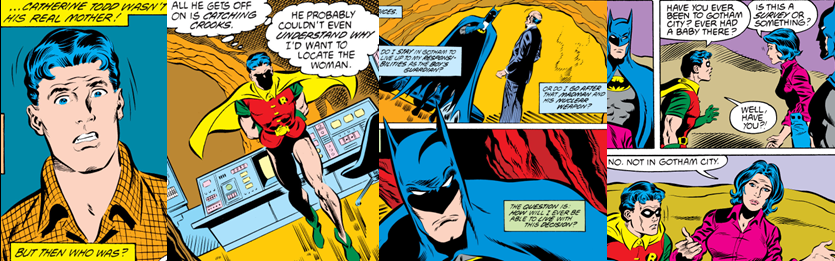
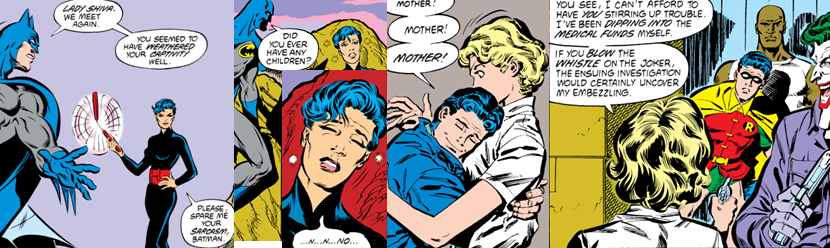
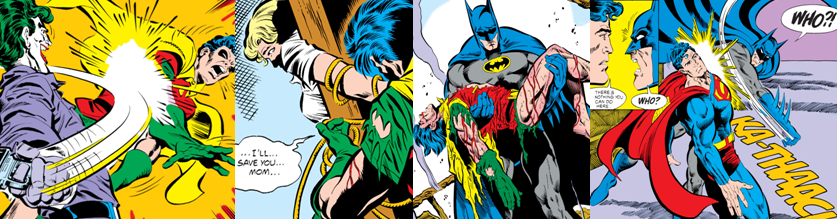
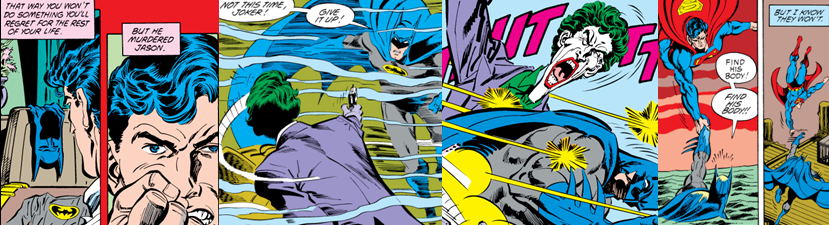
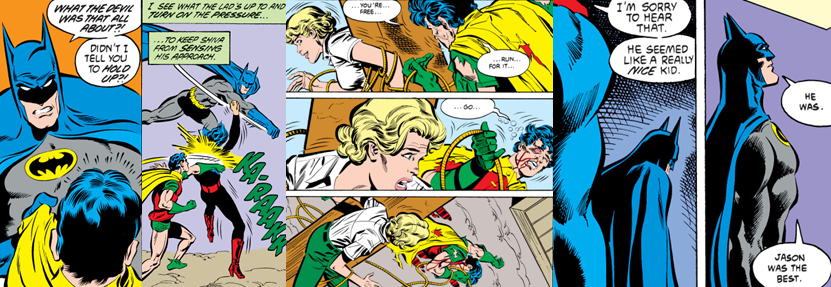
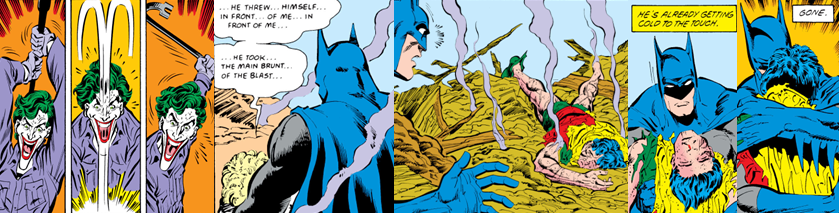
Back Issues: Batman: Year One

Story Titles: “Chapter One: Who I Am – How I Come to Be”, “Chapter Two: War Is Declared”, “Chapter Three: Black Dawn”, and “Chapter Four: Friend in Need”
Published: February 1987 to May 1987
Writer: Frank Miller
Artist: David Mazzucchelli

The Background:
Capitalising on the success of Clark Kent/Superman’s debut, artist Bob Kane drew up a design for a new masked crimefighter, the “Bat-Man”. Thanks to the tireless and long-suppressed work of artist Bill Finger, the Bat-Man was transformed into the figure who would become a mainstream cultural icon. Over the many years since his debut, however, Batman underwent significant changes and alterations to his character and supporting cast; he gained a kid sidekick to appear more appealing to younger readers and was transformed into a much softer, more fantastical character. Indeed, although writers like Dennis O’Neil helped to rectify this in the 1970s, it’s safe to say that Batman’s image had been tainted somewhat by the glorious camp (and incredibly popular) 1960s television show. After wiping their continuity mostly clean in the Crisis on Infinite Earths (Wolfman, et al, 1985 to 1986), DC Comics sought to retell the origins of many of their most popular characters, with Batman being chief among them. Following his mainstream success with his work on Daredevil, writer and artist Frank Miller signed a contract with DC Comics that led not only to his seminal Batman: The Dark Knight Returns (Miller, et al, 1986) but also a revamped origin for the Dark Knight. Assured he would be given full creative control, Miller expanded upon Batman’s original story to craft one of the most lauded and well-regarded Batman stories that would go on to influence numerous Batman films, stories, and interpretations for years to come.

The Review:
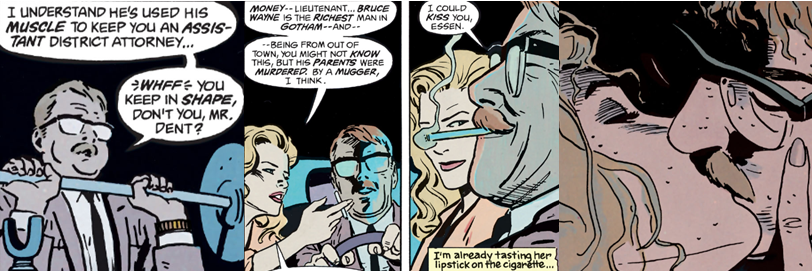
Batman: Year One is as much a story about James “Jim” Gordon as it is about Bruce Wayne’s first appearance as the Batman. The story is split between the two men and their separate narratives, with each having their own distinct text boxes, perspectives, and experiences within Gotham City. This helps to show the parallels between the two and how they are both driven to extremes due to the city’s bleak, depressing, and corrupt nature and we see their differing perspectives right off the bat (no pun intended) with their respective arrivals in the city in January. Lieutenant Gordon, who has just transferred to Gotham and whose wife Barbara (not that Barbara) is currently pregnant with their first child, laments the state of the city, which he experiences first-hand by mistakenly arriving by train. Twenty-five-year-old Bruce, however, thinks the exact opposite; he wishes that he’d arrived by train to “see the enemy” rather than by air, where the city almost looks civilised. While Bruce is mobbed by reporters desperate for the story of his twelve year absence from Gotham, Gordon is met at the train station by the hulking Detective Arnold Flass, who assures him that “cops got it made in Gotham”.

Both Bruce and Gordon struggle with the harsh nature of Gotham City.

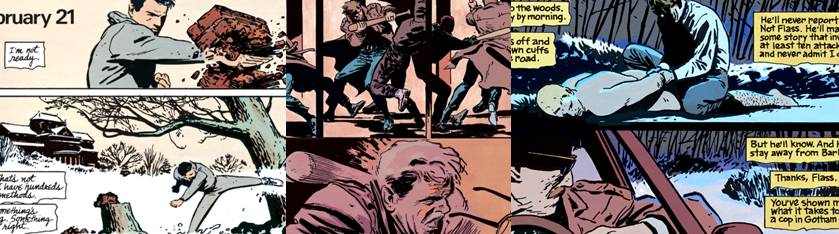
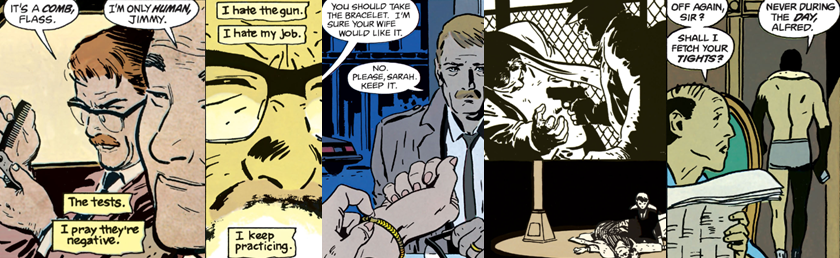
While Gordon grits his teeth through his first meeting with the detestable Commissioner Gillian Loeb, Bruce returns to his familial home, Wayne Manor, and his faithful butler, Alfred Pennyworth. Bruce spends the next month or so mentally preparing himself for the task ahead of him; physically, he’s well-trained and highly capable, able to smash through bricks and topple a tree with a single kick, but he feels something is missing for his plans for Gotham. Gordon, however, is immediately introduced to the ugly side of Gotham’s police force as Flass randomly assaults a group of youths for no good reason at all. Gordon keeps his opinions to himself but takes care to study Flass’ movements and physical capabilities for later, but soon finds himself under suspicion as Flass disagrees with his morals. Having brought this to Loeb’s attention, Flass is given permission to put a beating on Gordon in an effort to teach him how important it is to “fit in” in Gotham. Although Gordon has a military background, it has, in his words, “been a while” and, while he puts up a good fight, he takes a bit of a beating from a few masked assailants wielding baseball bats. Riled up, Gordon heads over to Flass’ favourite bar and runs his drunk-ass off the road. Tossing his gun aside, Gordon offers Flass a baseball bat as a “handicap” and sets about taking the big man to school. Beaten and left naked and cuffed in the snow, Gordon feels confident that he has taught Flass not to mess with him again.

Bruce’s first night goes pretty bad, leading to him assuming a frightening persona.

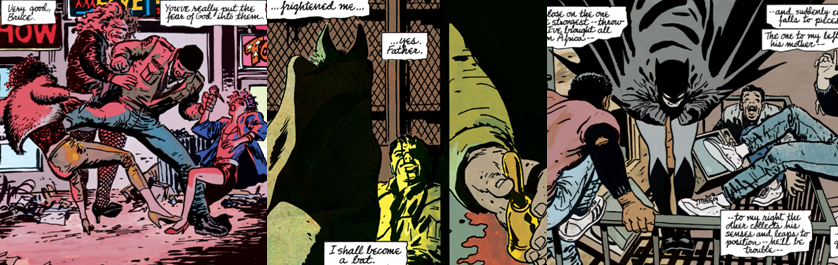
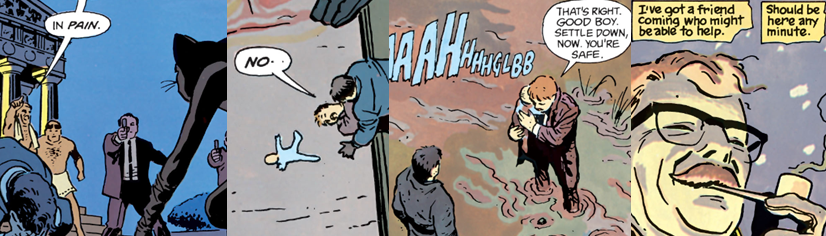
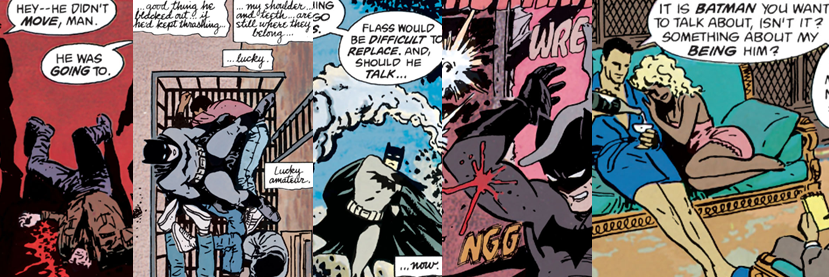
Coincidentally enough, this occurs on the very first night that Bruce attempts to strike back at the city’s criminal underworld; disguising his identity with some make-up and a fake scar, he goes out looking for trouble in the Red Light District and ends up taking a beating of his own. Stabbed in the leg, mauled by a cat-like prostitute, and shot by some of Gotham’s finest, Bruce manages to escape police custody and, with his last ounce of strength, stumble back to Wayne Manor. Bleeding out, he contemplates his failures and begs his deceased father, Doctor Thomas Wayne, for guidance on how to do better and to strike fear into the hearts of criminals. Tormented at having witnessed the brutal and random deaths of his parents as a small boy, he resolves to let himself die unless he can find the answer and, at that moment, a gigantic bat crashes through the window of his study. Just like that, Bruce has his answer and vows to “become a bat”. By April, Gordon has built up something of a reputation as a soft touch, which brings him into direct opposition with Sergeant Branden of Special Weapons and Tactics (S.W.A.T.) and the support of the press (which makes reprimanding him extremely difficult for Loeb). Gordon’s mounting aggravation and depression at bringing his wife and pregnant child to such a cesspit is interrupted by reports of a “giant bat” in the city as, across town, the Batman makes his dramatic first appearance. Thanks to his fearsome appearance and an animalistic growl, Batman is able to frighten a group of thieves a little too well as one of them topples over the edge of the balcony they’re on. So determined is Batman to keep the perp from falling to his death that he puts himself at risk to save the guy’s life and only manages to come out of it relatively unscathed due to his adaptability, strength, sheer for of will, and (as he chastises himself) a great deal of luck.

Batman threatens the city’s mobsters but runs afoul of the trigger-happy police.

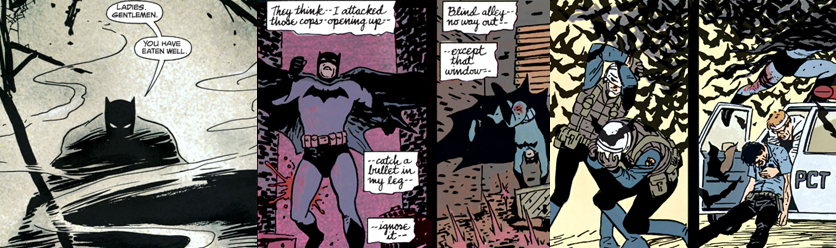
To ensure that the criminals and corrupt know that they are living on borrowed time, Batman makes a dramatic show of himself at a dinner function hosted by noted mob boss Carmine “The Roman” Falcone and attended by corrupt commission Loeb. News of the Batman, of course, reaches the Gotham police department; Flass is just one of the officers to have encountered the vigilante, who is widely regarded as a horrific, winged demon. Ordered by Loeb to bring Batman in, Gordon’s efforts are met with failure; staged muggings go without incident and Falcone is left humiliated in his own chambers, and not just because of Batman’s wily prowess as Assistant District Attorney Harvey Dent has entered into a secret alliance with the Dark Knight. Batman and Gordon’s paths finally cross when the two both risk their lives to save a homeless woman from being run down by a truck. Despite Batman’s heroic actions, Gordon orders his men to take the vigilante alive; however, Batman receives a bullet to the leg and is quickly left trapped and wounded thanks to Branden laying waste to the building he’s hiding in. The spreading fires destroy Batman’s utility belt and leave him with only his wits and ninja training to survive, which are more than enough to pick off the S.W.A.T. team one by one despite his leg wound. Cornered and running out of tricks, however, Batman is barely able to avoid another round of gunfire but manages to elude capture by attracting a flock of bats all the way from Wayne Manor that cover his escape, leave many of the cops and bystanders in hospital, and go a long way to adding to the Batman’s dramatic mystique.

Gordon’s efforts to uncover Batman’s identity lead him into a passionate affair.

Humiliated by this incident, Gordon increases his efforts in trying to decipher the Batman’s true identity. Initially suspicious of Dent, it is Detective Sarah Essen who nudges his attentions towards Bruce Wayne because of his wealth and traumatic childhood. Over the course of the last few months and pages, the two have grown extremely close since Gordon is spending more and more time at work and trying to shield Barbara from the atrocities in Gotham. This leads to a passionate affair between the two that Gordon immediately hates himself for; his guilt is matched only by his confusion regarding Batman, who is clearly taking the law into his own hands and yet may very well be the most righteous and incorruptible person in the city. Bruce, however, is able to throw Gordon’s suspicions off by playing up the role of a wealthy, bored socialite but, after Batman’s efforts see Flass incarcerated for taking part in a massive drug operation, Loeb threatens to expose the Lieutenant’s affair to his wife.

Bruce saves Gordon’s son and gains a valuable ally in the process.

Although he already ended the affair, Gordon decides to admit to his wrongdoings to his wife in order to begin repairing his marriage (something also aided by the birth of their son, James Junior) and to dispel any leverage the corrupt have over him. Batman’s world, however, becomes a little more complicated when the prostitute he countered on his first night, Selina Kyle, decides to craft a costumed identity of her own and begins targeting Falcone’s operation as Catwoman. After Catwoman scars his face, Falcone (who believes that the two are in cahoots) orders his men to kidnap James Jnr. Gordon arrives too late to save his son but is able to keep Barbara from harm; however, he also shoots and wounds Bruce (who is disguised in a motorcycle jacket and helmet) in the process. The two of them chase after Falcone’s goon and a fight breaks out on the bridge; overpowered by the thug, Gordon is helpless to keep his baby boy from falling to the cold, shallow water below. Luckily, Bruce dives after the boy and saves him, earning Gordon’s respect and gratitude. In the aftermath, Loeb is forced to resign after Flass spills the beans on all his dirty dealings and Sarah moves away to New York. As for Gordon, he and Barbara agree to attend marriage counselling, he is in line for a promotion to Captain, and he has found himself a friend to help tackle a manic named “The Joker” who has poisoned the city’s reservoir.

The Summary:
Of all the Batman stories crafted by Frank Miller, Batman: Year One is still my favourite. It’s a gritty, bleak, grounded reinterpretation of Batman’s origin and first year in Gotham City and paints him as a regular man (albeit one well trained and with more wealth than you or I) who isn’t yet the hyper-prepared, experienced vigilante with a network of allies and resources. The artwork is simple but gorgeous, with everything taking on a wash of waterpaint-like noir that emphasises deep shadows and harsh lights and has the majority of the story taking place in the dank, depressing darkness of night. One of the main reasons I dislike The Dark Knight Returns (and other Batman stories by Miller) is the dialogue (and the artwork). Miller has a very…shall we say “distinctive” way of having characters talk and likes to kind of just spit words and odd statements at the reader. For the most part, Year One is relatively light on these “Miller-isms” but they do still show up here and there (mostly when Batman is eluding or attacking people). Thankfully, Alfred’s trademark dry wit makes up for this and seeing Bruce act like an complete cad to throw off Gordon’s suspicions was absolutely fantastic.

Year One is focused much more on Gordon’s perspective of the city and its vigilante.

It’s interesting that Batman: Year One is such an effective Batman story considering it’s much more of a Jim Gordon story. We learn very little about Bruce, his background, or his training and, instead, focus more on Gordon and his struggles to adjust to and cope with life in the city. Everything we learn about Gotham and the state of its police force comes from Gordon, a flawed man who has made mistakes and is trying to hold onto his morals but struggles in the face of near-endless corruption and his own temptations towards Sarah. Bruce’s tragic origin is recounted very briefly and much of his training and motivation is delivered through exposition or his thought boxes, which take on a cursive slant that can be difficult to make out at times. Still, it provides a fascinating glimpse into Bruce’s early struggles to find the means by which to fight crime in the city and the preparation that goes into his various traps and assuming the guise of the Batman. At its core, Batman: Year One is a story of struggle and trust; both Gordon and Bruce struggle to find their place in Gotham and figure out how to conduct themselves and their mission in a city that is constantly fighting back against them and both of them feel alone in this endeavour. It isn’t until their paths cross and they see how selfless the other is that they both begin to consider changing their position; while guys like Branden just want to shoot Batman dead no questions asked, Gordon would prefer to see him brought in alive to get to the root of his mystery and Bruce realises that he needs the good-natured  lieutenant onside if he is ever to be effective as Batman and avoid getting shot on a nightly basis.

As it’s Batman’s first year, he’s a far more inexperienced and flawed character than usual.

This comes to a head in the finale where, rather than Batman saving Gordon’s son, it is Bruce in a questionable disguise. Indeed, the artwork and dialogue makes it intentionally vague as to whether or not Gordon truly recognises his boy’s saviour or not and, in the end, he decides it doesn’t matter who the Batman is as he has learned to think of him as a friend in a lawless city. As a tale of Batman’s earliest days in action, it’s hard to get much better than Year One. Personally, I love Batman stories that show him to be vulnerable and flawed and we definitely see a lot of that here as he’s constantly being stabbed and shot and hurt and forced into tight corners. This is a Batman who is lacking many of the bells and whistles of his later career; there’s not really a Batcave, no Bat-Signal or Batmobile, and a limited array of Bat-themed gadgets, all of which means that Batman has to use his wits and adaptability a lot more than his fancy high-tech toys which, again, I also find incredibly appealing. The portrayal of Batman’s influence is equally great; most treat the idea of a giant bat-garbed vigilante as ridiculous until they come face-to-face with him and then they are scared witless and this goes a long way to painting the Batman as this urban myth amongst the just and unjust alike.

My Rating:

Rating: 5 out of 5.

Fantastic

Have you ever read Batman: Year One? What did you think of Frank Miller’s reinvention of Batman? Are you a fan of Miller’s work, especially on Batman? What did you think to Year One’s focus on Jim Gordon and the depiction of a Batman without all his bells and whistles? What was your first experience of Batman and how are you celebrating his debut this month? Whatever your thoughts, sign up to drop them below and be sure to check in next Saturday for my review of Batman’s newest big-screen outing!

Back Issues: Detective Comics #140

Story Title: “The Riddler”
Published: 23 August 1948 (cover-dated October 1948)
Writer: Bill Finger
Artist: Dick Sprang

The Background:
After Clark Kent/Superman proved to be a massive success in their Action Comics title, National Comics Publications wanted more superheroes under their banner and charged Bob Kane with creating a new masked crimefighter. Thanks to the long-suppressed influence of artist Bill Finger, Bob Kane’s concept of a “Bat-Man” not only became one of DC Comics’ most popular characters but also a mainstream cultural icon. Over the years, the Batman has matched wits against many colourful supervillains, with some of his most memorable challenging his reputation as the world’s greatest detective, and perhaps none have tested his intelligence more than Edward Nashton, a.k.a. Edward Nygma, a.k.a. The Riddler. Another creation of Bill Finger (alongside artist Dick Sprang), the Riddler has confounded Batman for over eighty years and has earned a reputation as one of the Dark Knight’s most devious and intelligent enemies. Brought to life with delicious relish by the late, great Frank Gorshin, the Riddler has played an integral role in Batman adaptations for years, overwhelming players with riddles and collectibles, seeking to suck the brain waves out of Gotham City, provoking anarchy as a twisted serial killer, and being at the forefront of some of Batman’s greatest stories.

The Review:
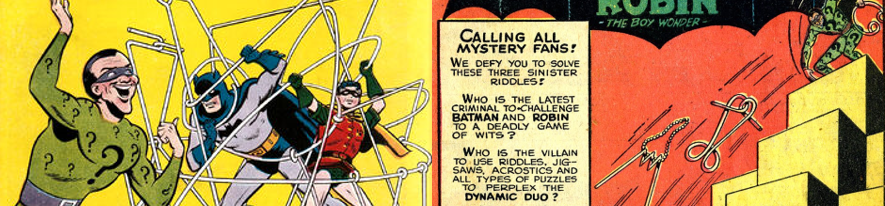
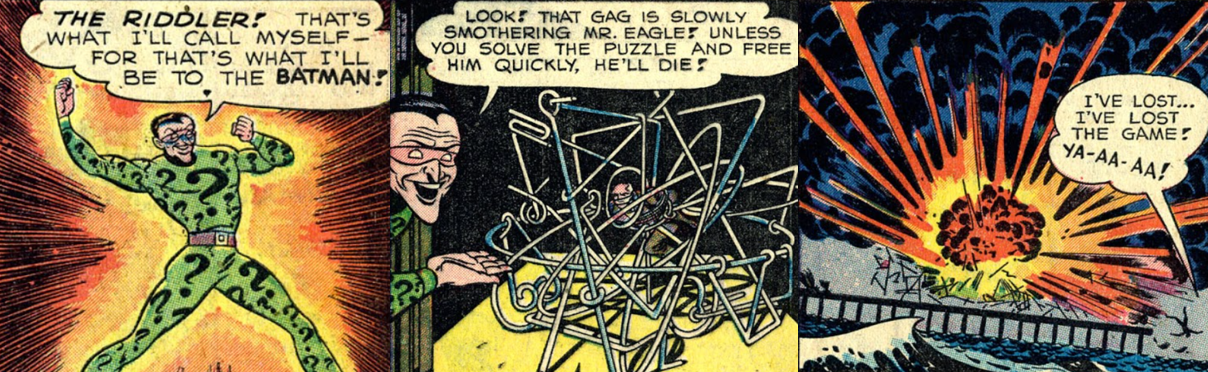
Our story begins by giving us some backstory on Bruce Wayne/Batman and Dick Grayson/Robin’s newest confounding criminal as we flash back to the youth of the Riddler, known here as Edward Nygma and shown to be a conniving little creep even as a schoolboy. When his teacher sets the class an assignment to complete a jigsaw puzzle to win a prize, Nygma cheats by taking a picture of the completed puzzle using his “flash camera” and continuously humiliates his class mates by challenging them to solve puzzles and using slight of hand and other underhanded tricks to showcase his supposed skill. As he grows into adulthood, Nygma becomes an accomplished con man, fooling and cheating the general public out of their money as “E. Nygma – The Puzzle King”, but grows bored of the lack of challenge his cheating ways bring him. He becomes so sure of his genius and talent with puzzles that he decides to test his abilities against not just the police, but the Batman himself, donning a garish question mark-themed costume and taking the name of the Riddler for the first time.

The Riddler bamboozles Batman and Robin with his deceitful riddles.

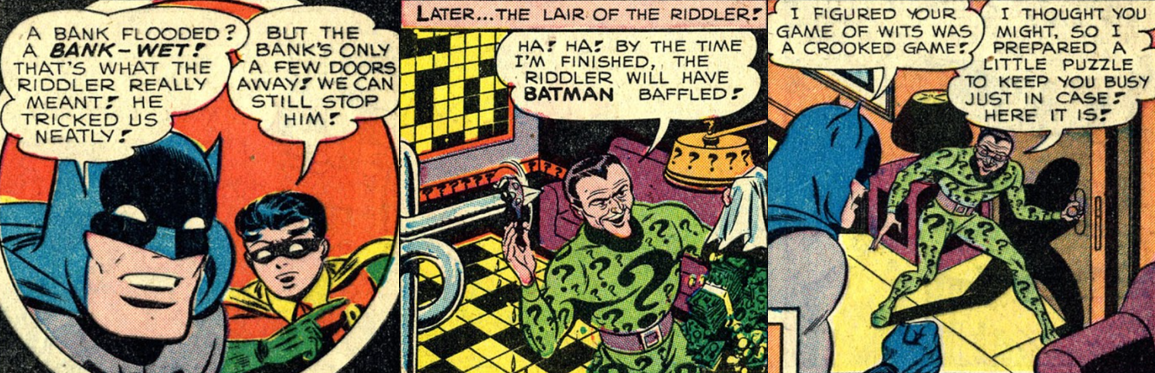
The Riddler’s first heinous act is to commandeer a massive advertising billboard that features a crossword theme and challenge Batman and Robin to learn a clue regarding his planned crime. Within two panels, Batman and Robin decipher the solution to the Riddler’s crossword and accordingly head to the Basin Street Banquet. However, when they blunder in hoping to apprehend the crook, they find the city’s upper class safe and sound and are stunned to learn that the Riddler tricked them with word play and actually flooded a nearby bank (“bank-wet”). The Riddler floods the bank’s underground vaults using a water main and robs the bank after easily figuring out the combination to the vault, and is safely washed away to safety using the sewers. Bamboozled by the Riddler, Batman is doubly determined to nail his newest adversary, who delivers a massive jigsaw puzzle to Police Commissioner Jim Gordon at police headquarters. Batman has the police transport the giant jigsaw to the football stadium and directs them, via loudspeaker and microphone, in solving it to determine that the Riddler plans to target the Eyrie nightclub atop a skyscraper. The Dynamic Duo head to the Eyrie later that night, and Batman sends Robin in alone, where the Boy Wonder is left to see Gotham’s socialites party away with no sign of the Riddler.

Batman comes up with an inspired solution to escape the Riddler’s death trap.

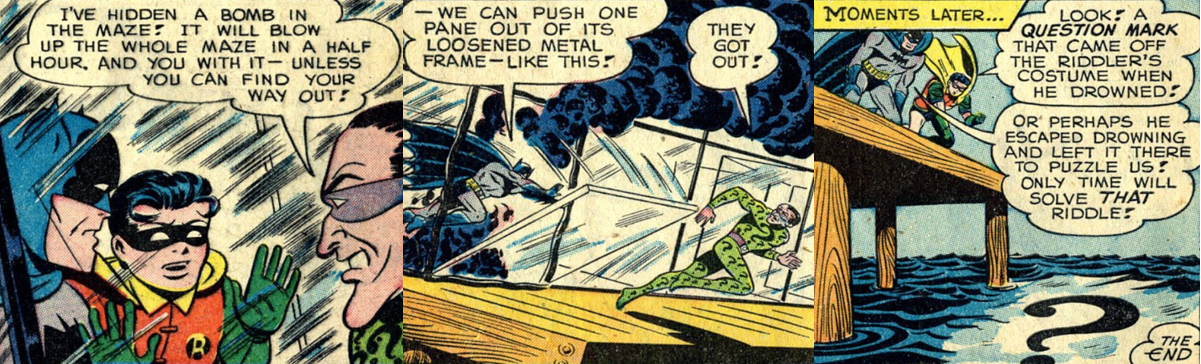
It turns out that the Riddler actually meant that he was planning to rob the home of Harrison Eagle, a millionaire collector, but this time Batman is smart enough to figure this out and interrupt the Riddler…though he is momentarily stunned by the Riddler’s gas bomb and the puzzle master is able to slip away as Batman is forced to break apart an elaborate steel rod trap before Harrison Eagle suffocates to death. Riding high on his momentum, the Riddler’s next conundrum is a little more direct and dangerous to the general public as he sends a truck careening through the streets carrying a massive corncob and a devious riddle: “Why is corn hard to escape from?” Luckily, Batman and Robin are on hand to halt the out of control vehicle with the Batmobile, and Batman deduces that the solution is “maize”; or, more specifically, the big glass “maze” at the Pleasure Pier amusement park. Despite arriving in time to spot the Riddler fleeing into the glass maze, having robbed the park, the Dynamic Duo find themselves trapped in the translucent labyrinth and left at the mercy of the Riddler, who has planted a bomb in the maze that is set to go off in half an hour! Although the glass is shatter-proof, Batman marks their route using the “diamonds on [his] badge” but, when they reach the exit, they find it closed up and the Riddler watching them as time ticks down. Batman comes up with the unlikely ingenious plan to pile up rolls of carpet against the glass panel and set it alight; the heat expands the glass just enough for Batman to force the pane open, but the Dynamic Duo are left with no time to apprehend the villain as they have to dive for cover to avoid perishing in the Riddler’s explosion. Trapped on the edge of the pier, the Riddler is flown into the sea, cursing his failure, and leaves behind only a question mark where he landed and the lingering riddle of whether he drowned or escaped to bewilder the Dark Knight another day.

The Summary:   
I was pleased to find that the Riddler’s conundrums weren’t as simple as they first appeared; Batman and even Robin easily decipher the Riddler’s clues, only to be fooled by the master of puzzles thanks to wordplay and deceit, as is his speciality. Thanks to his devious ways, the Riddler is able to make fools out of the Dynamic Duo and get away with bags full of loot, and his victories only spiral his superiority complex into overdrive. Crucially, however, it’s important to note that the Riddler eludes capture, and Batman, at every turn; even when Batman is upon him, Nygma slips away using a smoke bomb and endangering an innocent man’s life. The Riddler constantly stays one step ahead, and traps the Dynamic Duo within the glass maze, and is only undone because his hubris demands that he lord it over his adversaries. However, even in defeat, he remains ultimately victorious as he eludes capture, imprisonment, and consequences for his crimes, and is even afforded the luxury of being assumed dead so he can carry out more elaborate crimes at a later date.

A colourful tale, and villain, that is as ridiculous in its execution as you’d expect from the time.

“The Riddler” is certainly a colourful and whimsical debut for one of Batman’s most notorious and clever adversaries; Edward Nygma is presented as an arrogant and deceptive little creep who cheats and uses underhanded tactics to bamboozle others with his supposed genius when, in actuality, he’s just a liar and a con man. Having cheated his way to victory countless times over the years, his narcissism is exacerbated by an inflated sense of accomplishment to the point where he’s no longer satisfied with duping the general masses and wishes to pit his “skills” against the Gotham police and the ultimate challenge: The Batman. Ultimately, “The Riddler” is a wholly ridiculous but fun little tale from Batman’s Golden Era, one that is more about presenting a quick, colourful tale that taxes Batman in a new way with a bombastic new villain, but I can’t say it’s the most memorable or influential story of Batman’s early years. It’s fun seeing the absurd means that the Riddler delivers his puzzles, and to see him outwit Batman on technicalities and semantics, and the bizarre ways that Batman gets out of his predicaments during this time is always amusing, but there are definitely better Batman stories from this era – and Riddler tales – to find.

My Rating:

Rating: 2 out of 5.

Could Be Better

Have you ever read “The Riddler”? What did you think of the Riddler’s debut and the puzzles he threw Batman’s way? Did you correctly solve the Riddler’s conundrums or were you also outwitted by his deceptive ways? What are some of your favourite Riddler stories? Which interpretation of the Riddler, whether animated, pixelated, or live-action, is your favourite? Whatever you think about the Riddler, sign up to share your thoughts below or leave comment on my social media, and be sure to check back in next Saturday for more Batman content!

Back Issues: “The Cat” (Batman #1)

Story Title: Technically untitled, but commonly known as “The Cat”
Published: March 1940
Writer: Bill Finger
Artist: Bob Kane

The Background:
Following the huge success of Clark Kent/Superman, National Comics Publications set Bob Kane to work creating another masked crimefighter to add to their repertoire. Thanks to the long-suppressed influence of artist Bill Finger, the “Bat-Man” soon became not only one of DC Comics’ most popular characters but also a mainstream cultural icon. In the years that followed, the Batman matched wits against numerous costumed supervillains, but none more alluring or enticing that Selina Kyle/Catwoman. Debuting in Batman’s first solo comic book, Kane and Finger collaborated on the creation of a femme fatale who would add some sex appeal for their readers; originally calling herself “The Cat”, Catwoman began life as a beguiling and wily burglar and jewel thief whose inspirations were actresses like Jean Harlow and Hedy Lemarr. Following this inauspicious debut, Catwoman would go on to be a constant thorn in Batman’s side; their on-again-off-again relationship has been explored in both mainstream and non-canon stories and the character is often cited as one of his greatest adversaries and a powerful feminist icon in her own right. Naturally, Catwoman has featured in many of the Dark Knight’s forays into videogames, cartoons, and live-action, and even starred in her own dreadful standalone feature film before being brought to life in a far more comic-accurate portrayal in The Batman (Reeves, 2022).

The Review:
Our story opens to find a luxurious yacht, the Dolphin, out on stormy seas, where Dick Grayson/Robin is currently working undercover. We learn that, some days prior, wealthy philanthropist Bruce Wayne spotted in the newspaper that Martha Travers arranged for a select group of guests to join her on a yacht party and get a glimpse of her ludicrously expensive emerald necklace. Bruce has a hunch that this will attract every crook in town; however, since he has a prior engagement, he requests that his ward take point on this investigation, something Dick is only too eager to sign up for.

Dick discovers plenty of suspects willing to steal from wealthy Martha Travers.

Thanks to Bruce’s connections, Dick is easily placed onboard the Dolphin as an unassuming young steward and sets to work eavesdropping on Martha’s conversations for any hint of any potential threat to her. However, he overhears nothing more suspicious than the affluent lady’s “favourite nephew”, Denny, introducing her to the wizened and hobbled Mrs. Pegg, but one of the other stewards shares a titbit that Denny is little more than a shameless moocher who’s no better than all the other guests and constantly leeching off Martha’s vast fortune and generosity.  Later, Dick overhears a heated argument between Martha and her brother, Roger, where she vehemently refuses to lend him the money he desperately needs to pay off his stock losses and he makes a thinly veiled threat against her as a result. Dick’s suspicions are raised even further when he spots a letter from the mysterious “Cat” in which the villain is colluding to steal the necklace and, sure enough, the Cat makes good on their threat and Martha is devastated to find that her necklace has been stolen from her room!

The Batman has Robin teach the thugs, and younger readers, a lesson about relying on guns.

While Denny and the other guests console her, the cost guard quite conveniently come aboard to help, but are quickly revealed to be heavily armed gangsters looking to hijack the boat and steal the necklace for themselves. Although Martha convinces the captain to offer no resistance, she is driven to laughter at the demands and the crooks are stunned to find that the Cat has beaten them to their prize! Believing that the necklace must have been swiped by one of the guests, the gangsters begin accosting the passengers and Dick finally leaps into action, tackling and fighting the goons before diving into the water and shedding his guise to switch to his Robin persona. The crooks speed away from the Dolphin with their loot but are quickly apprehend by the Batman, who has finally showed up after the trail on his other case ran cold. Oddly, Batman decides to teach the thugs a lesson in humility by disarming them and having Robin pummel all four of them at once in a fourth-wall-breaking moment designed, I guess, to teach any young readers that armed criminals are all cowards deep down.

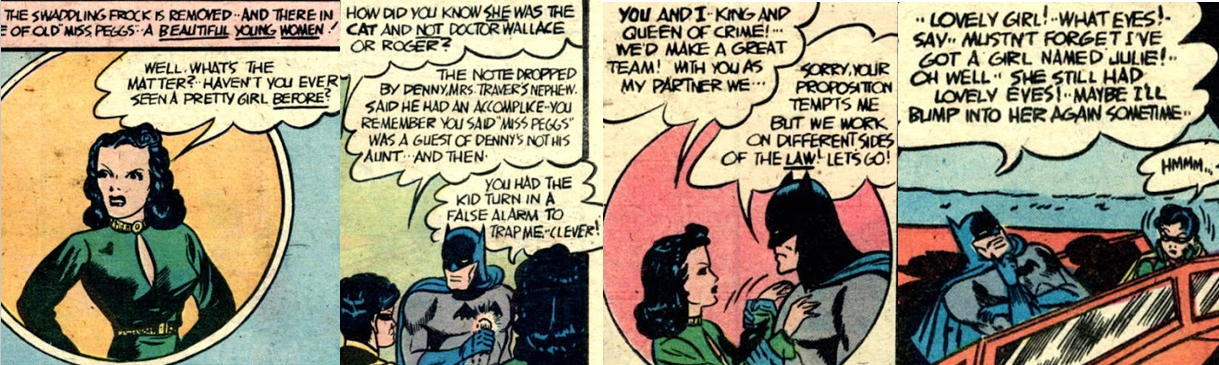
Batman unmasks the Cat, but is so captivated by her beauty that he allows her to slip away!

Anyway, Robin catches Batman up to speed and the Dark Knight immediately suspects that Denny is in league with the Cat, but has his own suspicions about who amongst the guests is the enigmatic Cat. He exposes the true culprit by making a splash at Martha’s costume party, handing over the stolen jewels and spotting that the elderly Mrs. Pegg is quite spritely (and shapely) for an old woman when she races off at the sound of a fire alarm. Mrs. Pegg tries to make a run for it but is collared by Robin and dramatically revealed to be a beautiful young woman in disguise. Batman then wallops Denny when he tries to take the necklace at gunpoint, but turns down the Cat’s proposal that the two of them join forces as partners in crime. However, when the Cat leaps overboard while being transported back to dry land, Batman makes no attempt to stop her and even gets in Robin’s way when the Boy Wonder tries to pursue her. Robin is less than impressed by how smitten Batman was with the Cat, and the issue ends with the Dark Knight musing over the beautiful thief’s captivating eyes.

The Summary:
Well, this was certainly a short and whimsical tale full of the same ridiculous conveniences and elements you’d expect from a Golden Age Batman tale. I’ll never not be amused by the sight of Bruce Wayne sucking on a pipe, or the odd, corny inclusions in tales from this era. Just the fact that the story wastes so many panels on having Robin beat up unarmed thugs is incredible in so many ways; I get that the idea is to show that, deep down, bullies and criminals are cowards who hide behind guns but the message also seems to be “Hey kids, don’t be afraid to get into a dust up with adults as long as they’re not packing heat!” The Robin fan in me enjoyed how big a role the Boy Wonder played in this story, going undercover and building a healthy list of suspects and even being very hands-on with the crime busting and apprehension of the Cat. Unfortunately, his efforts are completely overshadowed by the Batman; after hearing all of Robin’s evidence, he immediately pegs the culprit as “Mrs. Pegg” despite the fact that other passengers actually seemed much more viable, and his explanation for figuring our Mrs. Pegg’s true identity is paper thin, to say the least.

While an alluring femme fatale, the Cat lacks everything that makes her later incarnations so iconic.

If you’re a big Catwoman fan, this probably isn’t the best issue for showcasing her character; we never learn anything about the Cat beyond the fact that she takes a perverse thrill in conning the wealthy out of their prized jewels, and we don’t even learn her real name. Additionally, she’s not technically Catwoman here either; she has no cat-themed accessories and is far from the sultry femme fatale she would come to be known as. Instead, this is a Catwoman at the very beginning of her career, one who relies on disguises and subterfuge rather than claws and agility. One thing that is very familiar about her, though, is the mutual attraction between her and Batman; she practically throws herself at him, impressed but his strength and charisma, and he is so captivated by her that he actively breaks his own code to let her go free. It’s pretty clear that the Cat would be inspired by Batman’s iconography to take on her more theatrical appearance in later stories, but in her debut she’s just another wily, self-serving swindler who presents a mystery for Batman to solve with his uncanny deductive abilities. The Cat is able to stand out from Batman’s other rogues by being an alluring, beautiful woman but I’d argue that seeing Batman so lovesick by her beauty actually makes him seem like a bit of a fool by the end, and I much prefer the more playful, physical back-and-forth the two would build up in subsequent meetings.

My Rating:

Rating: 2 out of 5.

Could Be Better

Have you ever read “The Cat”? What did you think to Catwoman’s debut story and the mystery of her true identity? Did you guess who was behind the theft or were you surprised when Batman fingered Mrs. Pegg? What are some of your favourite Catwoman stories? Which interpretation of Catwoman, whether animated, pixelated, or live-action, is your favourite? Whatever you think about the Catwoman, sign up to share your thoughts below or leave comment on my social media, and be sure to check back in next Saturday for more Batman content!

Movie Night [Christmas Countdown]: Batman Returns

Released: 16 June 1992
Director: Tim Burton
Distributor: Warner Bros. Pictures
Budget: $65 to 80 million
Stars: Michael Keaton, Danny DeVito, Michelle Pfeiffer, Christopher Walken, and Michael Gough

The Plot:
Gotham City’s Christmas is interrupted by the deformed Oswald Cobblepot/The Penguin (DeVito), who is manipulated into running for Mayor by Machiavellian businessman Max Shreck (Walken). While Bruce Wayne/Batman (Keaton) investigates the Penguin’s truth motivations, he faces a secondary threat when Shreck’s disgruntled employee, Selina Kyle (Pfeiffer), wages a vendetta against him and Batman as Catwoman.

The Background:
In the eighties, DC Comics readers saw the culmination of a long period of alteration for Batman who, for the majority of the sixties, had been transformed from a ruthless vigilante and into a colourful, camp, family friendly figure. One of the principal examples of this change was Batman (ibid, 1989), a dramatically different take on the DC Comics staple that saw noted auteur Tim Burton bring his signature gothic flair to the character, transforming both Batman from a spandex-wearing goof and into a stoic, armour-clad urban legend and “Mr. Mom” Michael Keaton into a brooding, tortured vigilante, and resulting in a surge of popularity for the character as audiences flocked to see the movie. Despite some criticism regarding the film’s tone and pacing, Batman was an incredible success, making nearly $412 million against a $35 million budget. Although Warner Bros. wished for a sequel to begin as early as 1990, Burton held back on returning to the franchise until he was ready, and, when he did return, he was successful and proven enough to be granted far more creative control over the film’s production. Originally known as Batman II, Batman Returns underwent numerous rewrites, with both Harvey Dent/Two-Face and a version of Robin originally being included and the original character of Max Shreck originally intended to be the Penguin’s brother. The majority of the filming took place on sound stages that included full-size sets of downtown Gotham City and the sewers, the many real-life penguins featured in the film were given special treatment, and Keaton received not only top billing this time around but also a significant salary increase. Upon release, Batman Returns received largely positive reviews from critics and made over $280 million at the box office. However, there was a prevailing sense that the film was too “dark”; parents, especially, were horrified at the film’s macabre content and McDonald’s weren’t too thrilled at being associated with such a controversial picture, this backlash, of course, led to Burton being replaced by Joel Schumacher and a dramatic reinvention of the franchise for the two subsequent films but, for me, Batman Returns remains one of the quintessential formative movies of my childhood and an often overlooked entry in the series.

The Review:
Right off the bat (no pun intended), Batman Returns separates itself from its predecessor in a number of ways: first, it’s set at Christmas so Gotham City is blanketed by flurries of snow and full of Christmas trappings (if not yuletide cheer); second, it’s far darker and much more brooding in its atmosphere and tone. Burton’s vision for Batman and Gotham is of a nightmarish, gothic landscape full of ominous, intimidating structures, gargoyles, and an overall sense of foreboding hanging in the air. All of this is expertly punctuated not just in Burton’s distinct aesthetic style but also Danny Elfman’s peerless Batman theme, which is now mixed with a haunting chorus of chanting and a tragic ambiance amidst its bombastic and heroic overture.

Bruce is more brooding and violent than ever despite the catharsis he achieved in the last film.

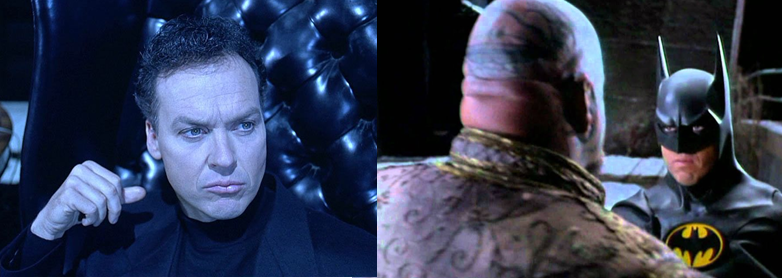
Some time has passed since the events of Batman; it’s not clear or made explicit exactly how much time but Gotham has adjusted to the presence of Batman, with Police Commissioner James Gordon (Pat Hingle) calling for the Caped Crusader’s assistance at the first sign of the Red Triangle Circus Gang. Though Batman’s relationship with the police, particularly Gordon, is much improved, he’s still a stoic and mysterious individual, talking very little and in a blunt, gravelly whisper. It seems avenging the death of his parents has done little to assuage his grief at their deaths or bring him any semblance of peace; instead, he’s more brooding than ever, literally sitting alone in the dark at Wayne Manor until being called into action by the Bat-Signal and more than willing to kill even regular thugs like the Penguin’s colourful goons.

In a city full of monsters, the twisted and manipulative Shreck fits right in.

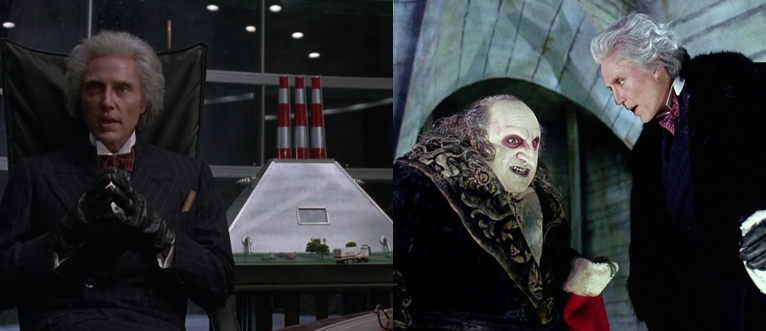
Max Shreck is introduced as “Gotham’s own Santa Claus”, a beloved and well-respected businessman who has captured the hearts of the city between films. Shreck is, however, a devious and snake-like individual; he plots to construct a massive power plant to monopolise Gotham’s energy supply on the pretence of having a legacy to hand over to his cherished son, Chip (Andrew Bryniarski), but truly desires simple accolades such as power and control. In a world seemingly populated by freaks and monsters, Shreck fits right in as he is twisted on the inside, more than willing to threaten the Mayor (Michael Murphy) with a recall and to kill to get what he wants (he pushes his absent-minded assistant, Selina, out of a window with the intention of killing her and it’s heavily implied that he killed his wife).

Selina undergoes the most dramatic change from a meek victim to an aggressive vigilante.

Speaking of Selina, of all the characters in the film, she is the one who undergoes the most dramatic development throughout the story. She begins as a meek, helpless woman; she stutters and struggles to speak her mind to her boss, is little more than a witless hostage for one of the Penguin’s goons, and lives alone with nothing but her cat and her nagging mother’s voicemail for company. After her brush with death and subsequent…resurrection (seriously, Selina’s rebirth is one of the stranger aspects of an already-batshit (also no pun intended) film), she becomes an enraged, vindictive, aggressively confidant and capable woman. As Catwoman, she begins a short-lived campaign against Shreck but comes to violently oppose all men, especially those in positions of authority, and even women who allow such men to walk all over them.

Despite his eloquent persona, the Penguin is constantly at odds with his more animalistic nature.

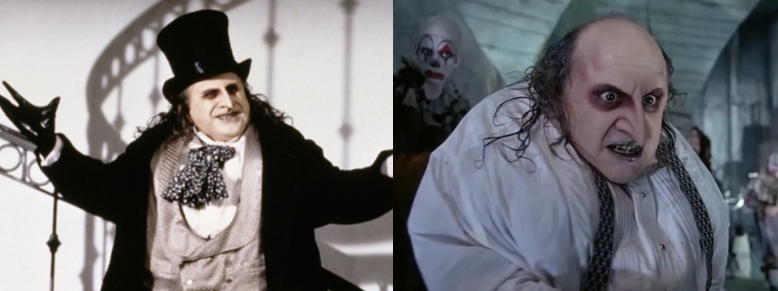
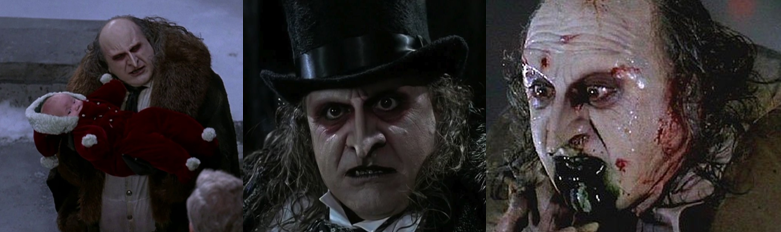
Catwoman’s outward transformation into a monster pales in comparison to the Penguin’s position as an actual monster; far from an upstanding crime boss or distinguished member of high (and low) society, Burton reimagines the Penguin as a horrific circus freak who eats raw fish, spits black goop, and is completely maladjusted to humanity and society. And yet, the Penquin is an eloquent, intelligent, and ruthless villain; while Shreck believes that he is the one  manipulating Oswald, the Penguin is actually the master manipulator as he uses Shreck to glorify his ascension to the outside world in order to enact his twisted plot to kidnap and kill the first-born sons of Gotham. Like Shreck, the Penguin is fully capable of blackmail, murder, and violence but he takes this to the next level, eventually launching a desperate campaign against all of Gotham City once Batman scuppers his scheme.

Batman is noticeably more mobile and far better equipped this time around.

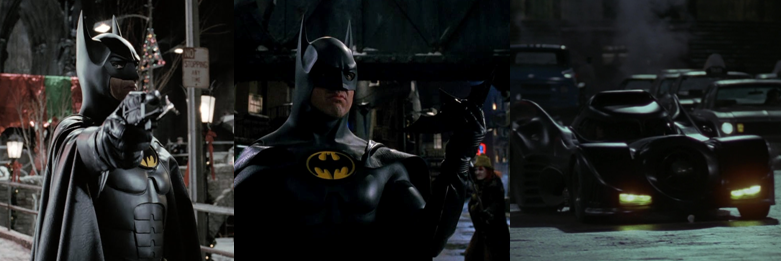
While Keaton’s range of motion is still restricted by his absolutely bad-ass Batsuit, Batman’s action scenes are much improved over the previous film; Batman fights with a simple, blunt efficiency, making full use of his many bat-themed toys and even busting out some new ones, like his inexplicably rigid gliding ability. Batman’s suit is far less anatomically correct this time around, resembling armour more than anything; as a kid, I disliked these changes but, now, I’ve come to regard the Returns Batsuit as one of the top live-action costumes for its impressive appearance, being both practical and frightening. Burton’s awesome Batmobile also makes a return, now sporting all kinds of new gadgets and even being featured in one of the most entertaining sequences of the film when the Penguin is bizarrely able to take control of the Batmobile, with Batman in it, and take it on a destructive joyride through the snow-strewn streets of Gotham.

Practical effects and miniatures are used to great effect throughout the film.

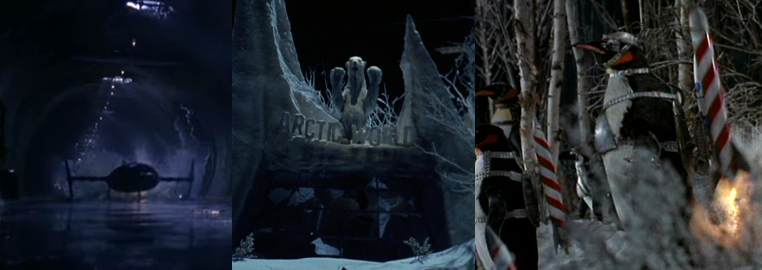
One of the most appealing aspects of Batman Returns is its fantastic use of practical effects, camera tricks, miniatures, and elaborate sets; Gotham feels noticeably more claustrophobic this time around but that actually adds to the ominous nature of the film and positions the city as an gloomy presence in its own right. Not every effect is a winner, of course; Batman’s glide through the bat-swept skies of Gotham hasn’t aged too well but the digital effects of the Penguin’s rocket-firing troops is still impressive, Penguin’s prosthetic make-up makes for an unsettlingly horrific villain, and Batman’s Batskiboat chase through the sewers and the destruction of the Penguin’s frozen zoo hideout are all impressively realised through the use of models and miniatures. The film also goes to some effort to tie up some loose ends and complaints about Batman; Vicky Vale (Kim Basinger) is mentioned a couple of times, with Bruce explaining that their relationship “didn’t work out” because he couldn’t give up being Batman and he and his father-figure and loyal confidant, Alfred Pennyworth (Gough), debating his much-contested decision to reveal Bruce’s identity to Vicki. As I’ve explained, I never had a problem with this scene but I’m sure it did a lot to quell the complaints.

The Nitty-Gritty:
Batman Returns contains some of my favourite moments of any Batman film, from Batman and Penguin’s intimidating first meeting outside of Shreck’s shop to the heart-breaking death of Oswald at the conclusion (I remember, as a kid, being somewhat distraught at Penguin’s emperor penguins being left without their master and wondering who would look after them with him dead). It also stands out as being one of the first big-budget superhero films of its time to not only feature multiple villains and masked characters but also to balance them extremely well. Sure, Batman still doesn’t have as much screen time as you would expect considering his name’s in the title but it’s easy to infer much of his motivation and development from Keaton’s characteristically stoic and haunted portrayal of the character and through the parallels between Batman’s dual nature and those of his villains.

Bruce continues to be more comfortable as Batman and struggles with his dark nature.

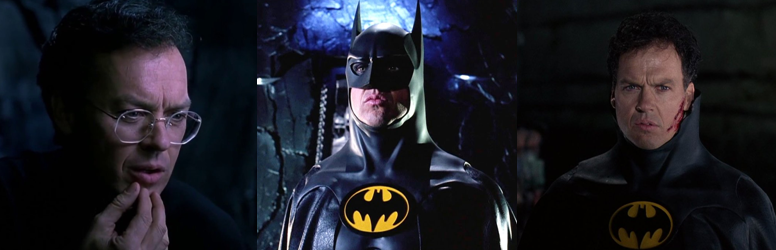
I can understand why parents and audiences were more than a little perturbed by Batman Returns when it was released as it’s not only full of dark, gothic imagery but also some puzzlingly ghoulish choices on Burton’s part. However, I watched this film as a kid both alone and with my parents and it never did me any harm; plus, I feel like Batman is a character and concept that can never be “too dark” and grisly as he works best when depicted as a dark and terrifying force in an increasingly insane world. Furthermore, Batman Returns is rife with subtle (and explicit) themes duality, humanity, and deception. All four of the main characters wear a mask of some kind, whether explicit or metaphorical (or both) and is hiding their true, darker nature. Bruce is, of course, one of the most obvious since he literally garbs himself in a heavily armoured suit and becomes an entirely different person when acting as Batman. There’s again a sense that he’s not entirely comfortable being in public or out of the suit as he is only truly able to confide in Alfred before becoming attracted to Selina and, though he openly opposes Shreck’s plans as Bruce, he’s seemingly only able to make a real impact on the city when operating as Batman.

Catwoman’s appearance degrades alongside her mental state as the film progresses.

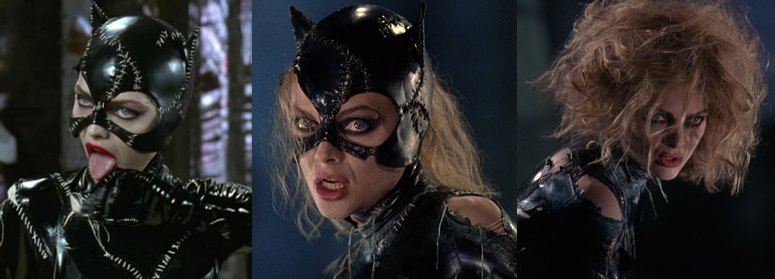
Selina, too, hides behind a physical mask; after her rebirth, Selina becomes more and more disassociated with her former life and revels in the freedom and power of being Catwoman. Previously, she was timid and powerless but, once she has power, she exercises it without restraint or mercy; when she first encounters Batman, she attacks with a combination of sexuality and violence, seeing him as the ultimate symbol of patriarchy. He fractured state of mind only degenerates further as the film progresses and this is reflected in the explicit destruction of her alluringly skin-tight outfit; by the film’s conclusion, she’s hardly recognisable, resembling little more than a besmirched wild animal who feels she has to reject Bruce’s advances and offer of a “normal” life because of her altered nature that drives her to obsessive pursue Shreck’s death even at the potential cost of her own life.

Though a tragic villain, the Penguin is still a monstrous individual willing to slaughter all of Gotham.

The Penquin doesn’t hide being a mask in the way as his adversaries; indeed, because of his monstrous appearance, he is forced to literally hide from society first in the circus and then, for many years, in the sewers and when he does emerge into the limelight, it’s under the guise of being a misunderstood outcast. Ironically, this isn’t actually too far from the truth as the Penguin is a truly tragic figure within the film but, even as a baby, his violent tendencies are made explicit so, in many ways, he’s the opposite of Catwoman: his true nature is to be a wild animal and he masks it with the shroud of respectability. It’s an ill-fitting persona for Oswald, though, as his animalistic urges and lack of social graces make him undignified; indeed, as eloquent and charismatic as the Penguin is capable of being, he descends into a monstrous individual that salivates over the merciless death and destruction of everyone in Gotham.

Shreck’s true, twisted nature is revealed when he meets his gruesome end.

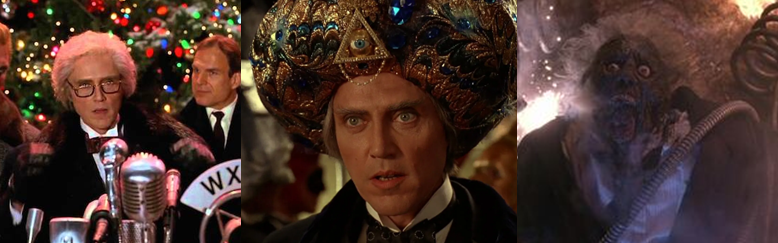
And then there’s Max Shreck; yes, I would have preferred Harvey Dent (Billy Dee Williams) to have returned and supplanted this character but Christopher Walken sure as hell does steal the show, every time he walks into a room, the scene becomes about him, with the camera seemingly naturally focusing on him even when he’s standing next to vivid characters such as the Penguin and Batman. As fantastically alluring as DeVito is at portraying this nightmarish version of the Penguin, Walken’s natural charisma and bombastic acting method makes him an undeniable highlight of the film. Like the Penguin, Max doesn’t where an actual mask but his is a mask that is far more subtle and all the more dangerous in its application; having won the hearts and minds of the city, and being a wealthy businessman in a position of great power, Shreck represents the horror of aggressively ambitious capitalism and the power of the social elite. Confidant to the point of arrogance, Shreck exudes authority and ensures that he is always the most powerful man in any given situation; he barely flinches when he first meets the Penguin, immediately attempts to bargain with Catwoman, and defiantly stands up to both her and Batman but his true, twisted nature is revealed for all to see after he meet his gruesome, explosive end in the finale.

The Summary:
When I was a kid, I always preferred Batman to Batman Returns; I think this was mainly because of the iconography of the Joker as a character and it being a little less heavy-handed with its themes and imagery. As I grew older, though, I came to really appreciate all the positives of Batman Returns; in many ways, it’s a far superior film, which a much more unique visual identity, far superior costume design, and even improving on Elfman’s already flawless score. While it’s far more of a standalone sequel than a direct continuation, Batman Returns drops us into a twisted, nightmarish version of Gotham City that seems to have been physically changed because of the city’s adoption of Batman as its protector. My appreciation for the film’s themes of duality and humanity came to a head during my studies at university when, asked to produce a presentation on a film, I spearheaded Batman Returns as my group’s project and, in the process, delved deep into the way it deals with its complex themes. Getting an A in that presentation encouraged me to further pursue writing about the things I loved from my childhood and influenced my eventual PhD and I owe most of that success to Batman Returns, a film that, while probably not too suitable for young kids and despite not being massively accurate to the source material, remains one of the darkest, most visually engaging, and thought-provoking Batman movies ever made and, to this day, is a must-watch film during the Christmas season.

My Rating:

Rating: 5 out of 5.

Fantastic

What are your thoughts on Batman Returns? How does it compare to the first film, and the other films in Batman’s long cinematic history? Did you see this as a kid; if so, did you enjoy it or were you traumatised by its dark, macabre tone? Perhaps you were one of those parents who kicked off about the film; if so, what was it that set you off and how do you feel about it now? What did you think to Burton’s twisted interpretations of the Penguin and Catwoman? Did you enjoy Christopher Walken’s performance? Were you a fan of Michael Keaton’s performance this time around? Which Batman film, and actor, is your favourite and why? Do you consider Batman Returns a Christmas movie and, if not, why not and what the hell is wrong with you? It’s set at Christmas! Whatever you think about Batman Returns, go ahead and drop a comment down below and be sure to check in next Saturday for more Christmas content!
Back Issues [JLA Day]: The Brave and the Bold #28


To celebrate the release of Justice League (Snyder/Whedon, 2017), DC Comics named November 18 “Justice League Day”. Sadly, this clashes with another pop culture holiday but, setting aside all the drama surrounding that movie, this still provides a perfect excuse to dedication some time to talking about DC’s premier superhero team, which set the standard for super teams in comics by bringing together DC’s most powerful heroes.


Story Title: “Starro the Conqueror!”
Published: 29 December 1959 (cover-dated March 1960)
Writer: Gardner Fox
Artist: Mike Sekowsky

The Background:
All Star Comics (1940/1941), brought together eight superheroes from a number of different publishers for the first time as the Justice Society of America (JSA). This not only heralded the birth of the first ever superhero team in comics but also allowed readers to see their favourite characters interacting all for the same price as reading any one comic. The JSA’s roster expanded and changed over the years but the team underwent their most significant change when, in the late 1950s, then-editor Julius Schwartz asked writer Gardner Fox to reintroduce and rebrand the team as the Justice League of America (JLA) to capitalise on the popularity of the American Football League and Major League Baseball’s National League. Though the team debuted in The Brave and the Bold #28, a title famous for featuring team-ups between various fictional and superheroic characters, the team’s actual origin wasn’t revealed until the ninth issue of their self-titled series, which became one of DC Comic’s best-selling titles. As with the JSA and other super teams, the JLA’s roster has changed over the years and many splinter groups and spin-offs have been introduced but perhaps there is no more iconic line-up than the JLA’s original roster that was comprised of DC’s heavy-hitters: Clark Kent/Superman, Bruce Wayne/Batman, Diana Prince/Wonder Woman, Hal Jordan/Green Lantern, Arthur Curry/Aquaman, Barry Allan/The Flash, and J’onn J’onzz (referred to here as “John Jones”)/Martian Manhunter.

The Review:
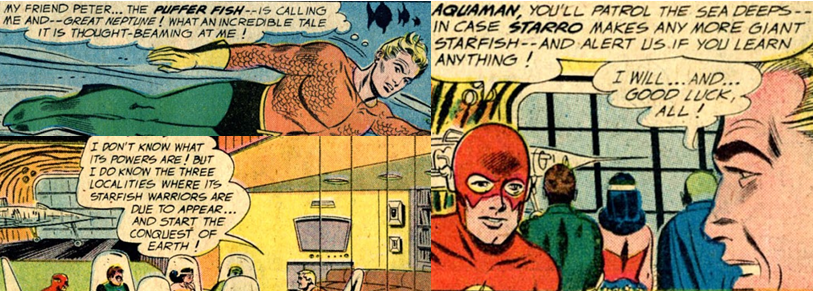
“Starro the Conqueror!” begins with the odd choice to not detail the first time these superheroes joined forces and, instead, starts off with the seven heroes already having agreed to come together in times of crisis (they each have a signalling device to summon the others). I kind of like this on the one hand as it suggests that DC’s top superheroes already set aside their differences for the greater good without any real fuss and it helps speed things up but, on the other hand, it feels a bit out of place to not detail the first meeting of these heroes. Anyway, the first member of the team to become aware of an impending threat is Aquaman who, thanks to information provided to him by a puffer fish, is learns of the arrival of the gigantic extraterrestrial starfish known as Starro.

Aquaman’s summons is answered by some of DC’s greatest superheroes.

This monstrous being has travelled across the depths of space to Earth with one goal in mind: conquest. To that end, Starro…somehow…transforms three of Earth’s starfish into replicas of itself and spreads them across the world to begin its mad scheme. Aquaman’s summons are immediately picked up and answered by Wonder Woman (who is in the middle of an awkward conversation with her beau, Steve Trevor, regarding marriage), Green Lantern (who, as Hal Jordan, was in the middle of a test flight), the Flash (who quickly disperses of a potentially life-threatening tornado), and the Martian Manhunter (who was simply about to start his vacation…). Each of these introductory panels immediately gives the reader and idea of what each character is capable of: Aquaman can breath underwater and talk to fish, Wonder Woman has an invisible jet, Green Lantern’s ring allows him to perform virtually any task, the Flash is super fast, and the Martian Manhunter can shape-shift. Aquaman’s signal also reaches Superman and Batman but the two are unable to respond right away since Superman is busy taking care of a potentially dangerous meteor shower and Batman is in the middle of stopping a crime spree. You might think that Superman would have spotted Starro’s arrival from space but he was dealing with a great deal of meteors (it’s also entirely possible that Starro caused the meteor shower specifically to distract Superman) and I guess it’s in character for Batman to prioritise Gotham City’s safety over a JLA summons (though a JLA-level peril is surely more threatening for Gotham than a crime spree…)

Green Lantern is able to defeat the Starro duplicate with relative ease.

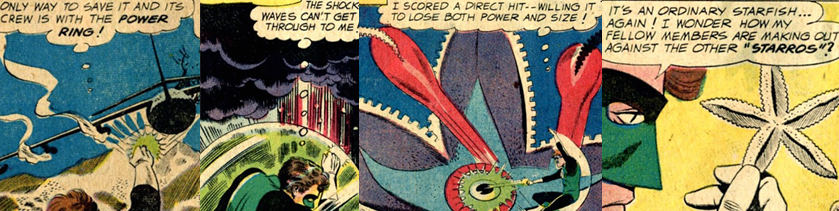
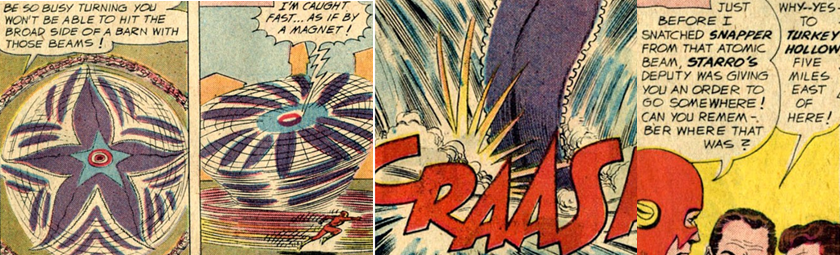
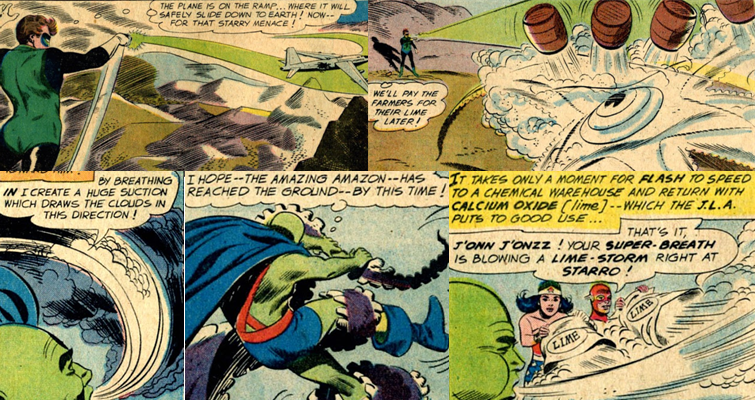
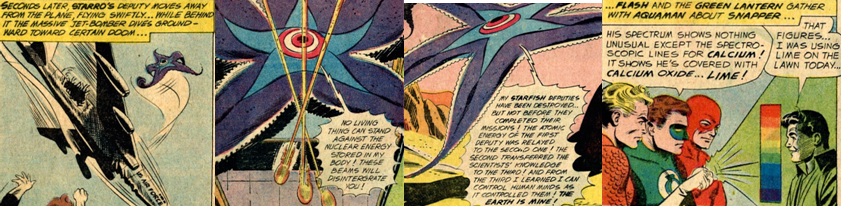
Regardless, the five heroes meet at the “modernistically outfitted cavern” that serves as the JLA’s headquarters. Having been informed of Starro’s threat and where it intends to strike, the Flash, as the JLA’s chairman, orders the team to split up and it is at this point that the story diverges from the team-based format and instead switches to cover each individual mission. The first sees Green Lantern battling one of Starro’s deputies in the skies above Rocky Mountain National Park; Hal arrives in time to see the gigantic creature but is too late to stop it from attacking a passing air force jet-bomber and relieving it of its payload: nothing less than an atom bomb! Green Lantern is able to save the aircraft when it goes into a deadly freefall but is unable to keep the Starro duplicate from detonating the atom bomb! Thankfully, Hal’s energy shield protects him from the blast and he watches in horror as the creature absorbs the energy released from the bomb. Hal pursues and is nearly blasted from the sky by a scorching beam fired from the creature’s tentacle. However, Green Lantern is easily able to avoid the creature’s thrashing limbs and attacks and reduce it down to a regular starfish by scoring a direct hit on its massive eye.

Starro’s duplicate falls before the might of Wonder Woman and the Martian Manhunter.

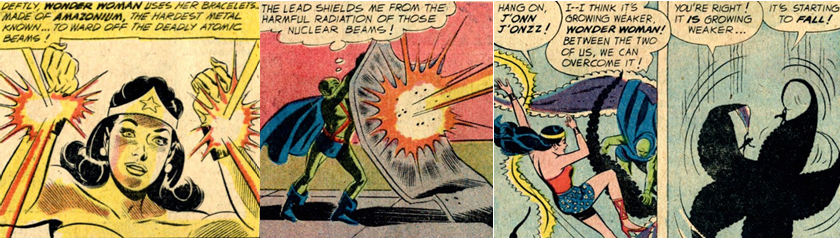
Next, the story switches to “Science City” where Wonder Woman and Martian Manhunter (why Diana has to team up with another hero is beyond me…) find another of Starro’s deputies abducting the “Hall of Science”, where the greatest scientific minds of the United States are gathered. The creature intends to bring the scientists into the upper atmosphere so it can absorb their brainpower and knowledge; Wonder Woman attempts to use her magical lasso to prise the creature’s tentacles from the building but ends up being yanked off of her invisible jet and onto the Hall of Science thanks to the giant starfish’s incredible strength. Meanwhile, J’onn uses his super-breath to bombard the creature with fragments of the meteors Superman is destroying and uses the same technique to cause a torrential rainfall when flames from the building threaten his life. Starro’s deputy then attempts to destroy them both by firing bolts of nuclear energy their way but Wonder Woman is, of course, able to deflect them with her magical bracelets and J’onn shields himself using the building’s conveniently lead-lined roof. Diana then whips her lasso around her jet and uses the momentum to forcibly drag the building out of the sky. The effort of battling both heroes at once soon takes its toll on the creature, which plummets from the sky and begins to revert back into a regular starfish.

The Flash makes short work of the final Starro duplicate.

When then join the Flash as he confronts another of Starro’s deputies at Happy Harbour; this part of the story is easily the worst simply because it introduces one of the most annoying and aggravating characters ever conceived: the JLA’s “mascot”, Snapper Carr. Snapper is a hip, super cool teenager with the annoying habit of constantly snapping his fingers all the God-damn time who is shocking to find his family, and the entire town, enthralled by Starro’s trance. For whatever reason (possibly due to being high, judging by the way he speaks!), Snapper is immune to Starro’s influence so he needs to be saved from certain death by the Flash. Despite Starro’s best efforts to vaporise the Scarlet Speedster, the Flash (literally) runs rings around the creature and ultimately defeats it when it tries to hide in the sea. In the process, the townsfolk are freed from their trance and Snapper’s family are able to tell Flash where they were ordered by the creature to head to: Turkey Hollow.

The JLA defeat Starro with ridiculous ease and make Snapper an honorary member!

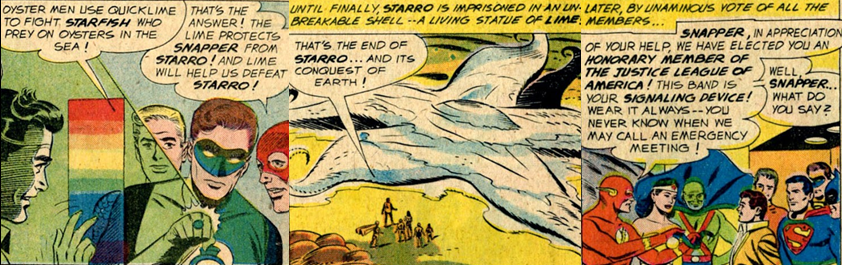
The final part of the story sees the team reunite to take on the real Starro at Turkey Hollow; despite the defeat of its deputies, Starro remains confident since it was still able to absorb the power of that atomic bomb, the knowledge of Earth’s scientists, and…whatever it is the townsfolk of Happy Harbour contributed to its mind (local Earth knowledge, I guess?) Starro plans to use all that it has learned to force humanity into destroying the world with nuclear weapons and then use the influx of nuclear energy would then allow it to conquer other worlds across the universe. When the JLA arrive, Starro immediately puts its abilities to good use by reading Hal’s mind and turning itself yellow to render itself immune to his power ring but the Flash notices that Starro’s awesome energy ray has absolutely no effect on Snapper (who he, of course, brought along for the ride!) Flash orders Wonder Woman and the Martian Manhunter to distract Starro while Hal uses his power ring as a spectroscope to discover that Snapper is covered in lime from when he was mowing the lawn earlier. Apparently, lime is deadly to starfish so Hal dumps a whole bunch of it onto Starro to weaken it. Martian Manhunter then uses his super-breath to blow a load of calcium oxide (which is, apparently, also lime) onto the creature and thus imprison it within an unbreakable shell of lime. With Starro’s threat ended, Superman and Batman return just in time to see the Flash making Snapper an honorary member of the JLA and…boy, do they look thrilled to be there!

The Summary:
I don’t mind telling you that I am a bit disappointed by “Starro the Conqueror!”; the story started pretty strong but fell off a cliff pretty quickly at the end, becoming little more than a science class rather than a big old fight between Earth’s greatest heroes and an alien menace. I suppose it speaks to the intelligence of the JLA (specifically Barry) to come up with a way to outwit, rather than outfight, the creature and the sudden introduction of lime as the might Starro’s one weakness is arguably no less lame than fire being J’onn’s weakness and yellow being Hal’s and there is a lot of action prior to the finale but still…the entire point of the comic is to see these heroes joining forces and we don’t really get that.

Aquaman is unfairly side-lined and does nothing except alert the JLA to Starro’s presence.

You might be wondering where the hell Aquaman was during this story; despite appearing to be a pivotal member of the team in the early panels, Arthur is little more than an early warning system to alert the team to Starro’s threat. Hell, when Barry is divvying out the JLA’s individual missions, Aquaman doesn’t even get to fight one of the creatures as he’s sent back to the ocean to watch out for any more of the duplicates and, when he does return to the story for the finale, he does absolutely nothing. It’s pretty sad considering the JLA were light on power with Superman out of the equation and when you consider that Arthur might have actually been really useful at Happy Harbour so could have easily teamed up with the Flash for that mission…but then we might never have gotten Snapper-fuckin’-Carr now, would we!?

Hal and J’onn are severely underutilised, with their powers reduced to the bare minimum.

Honestly, Snapper could have been dropped entirely from the story; he’s only there so the teenager readers can act like they’re fighting alongside their favourite heroes, after all, and it’s legitimately sad that he’s more important to the story than Aquaman! Seriously, drop Snapper, have Aquaman and the Flash go to Happy Harbour, and have Arthur get covered in lime while battling the creature in the water and reveal the key to Starro’s defeat. Seems like a pretty simple solution to me. Similarly, it’s pretty disappointing that Superman and Batman don’t play any part in the story at all. I can understand why as Superman’s power alone would probably be able to end Starro’s threat but it’s a bit of a let down that they don’t even join the team for the big climactic battle. Instead, we’re left with the likes of the Martian Manhunter, who is probably just as powerful as Superman if not more so and yet is reduced to simply puffing away with his super-breath. Similarly, Hal’s potential and power is also significantly reduced; his ring allows him to do virtually anything but, in the end, all he really uses it for is to fly about, rescue a falling plane, and zap at Starro with energy blasts.

Starro seems like a threatening villain but end sup being a massive disappointment.

Still, at least Wonder Woman gets a lot to do; she basically does all the work in her team-up with J’onn which, again, makes me question why she has to have a partner and no one else does. The implication may be that it’s because she’s a woman but she’s easily the most dependable and capable superheroine I’ve seen all year; she doesn’t even get bound or anything, which is refreshing. The Flash also gets far more chances to show off his abilities and competence; beyond his super speed allowing him to easily best one of Starro’s duplicates, Barry is portrayed as a decisive team leader and his intelligence is what ultimately wins the day over brute strength. Overall, Starro is just another in a long line of potentially dangerous foes that really don’t amount to a whole hell of a lot. It openly admits that its plot to conquer Earth is the first time it’s ever tried anything like that, exposing its naivety and inexperience in world conquest and battle. Its scheme seems pretty good to start with as it creates duplicates of itself and absorbs power and knowledge but it fails to really do anything with this beyond making itself yellow; it could have spewed flames at J’onn, bound Wonder Woman’s wrists, subjected Aquaman to intense heat, or slowed the Flash down with quicksand but it never does any of that. For all the power and knowledge it has, Starro ends up just being a giant alien punching bag that, arguably, the Flash alone could have defeated and, because of that, it’s simply a piss-poor excuse to see all these heroes band together and even then they spend the majority of the story working separately!

My Rating:

Rating: 2 out of 5.

Could Be Better

What did you think to the JLA’s debut appearance? Were you happy to see five out of the seven joining forces for the first time or would you have liked to see all seven of them getting in on the action? What did you think of Starro as the principal villain and the introduction of Snapper Carr? Which era or incarnation of the JLA is your favourite and what are some of your favourite JLA stories? Who would you like to see in the JLA some day? How are you celebrating Justice League Day this year? Whatever your thoughts on the JLA, feel free to leave a comment below.

Movie Night [Batman Day]: Batman (1989)


In the decades since his first dramatic appearance in the pages of Detective Comics, Bruce Wayne/Batman has become a mainstream, worldwide, pop culture icon. The brainchild of writer Bob Kane, Batman was brought to life by artist Bill Finger and has been a popular staple of DC Comics and countless movies, videogames, and cartoons over the years. Although “Batman Day” was a few days ago, any day is a perfect excuse to celebrate comic’s grim and broody vigilante.


Released: 23 June 1989
Director: Tim Burton
Distributor: Warner Bros. Pictures
Budget: $34 million
Stars: Michael Keaton, Jack Nicholson, Kim Basinger, Robert Wuhl, and Michael Gough

The Plot:
Criminals of Gotham City are terrified by the armour-clad vigilante, the “Batman” (Keaton), secretly wealthy loner Bruce Wayne. Wayne’s vendetta against crime is confused when he falls for intrepid reporter Vicki Vale (Basinger) and mobster Jack Napier (Nicholson) transformers into the hideous Joker and begins terrorising Gotham with tainted beauty products.

The Background:
By the end of the eighties, Batman had undergone a long period of reinvention to transform him from a colourful, camp, family friendly figure and into a more serious, darker character. A lot of this can, of course, be attributed to the works of Frank Miller, which fully embraced the darker aspects of the character and it was this version of the character that producers Benjamin Melniker and Michael E. Uslan wanted to bring to life after they purchased the film rights to the character from DC Comics. The script underwent numerous drafts before Sam Hamm was brought in by director Tim Burton to produce the final screenplay. Burton, despite not being much of a comic book aficionado, related to the duality of the Bruce/Batman dynamic and the dark, gothic undertones of the character and was hired off the back of the financial success of Pee-wee’s Big Adventure (Burton, 1985) and Beetlejuice (ibid, 1988). While Jack Nicholson was the top choice for the Joker, Burton ultimately cast Keaton in the title role (despite many of Hollywood’s leading men being considered) after directing him in the aforementioned Beetlejuice and considering him perfect for his (as in Burton’s)  subdued, haunted, “Everyman” interpretation. The casting of “Mr. Mom” caused much controversy at the time, as did chaotic script rewrites during filming. Despite all this, Batman was a tremendous critical and commercial success; “Batmania” swept the nation, resulting in a mammoth gross of over $411 million and, despite some criticisms concerning its dark tone and Batman’s lack of screen time, Batman was met with largely favourable reviews, kick-starting a slew of sequels and forever setting the bar for live-action adaptations of the character going forward.

The Review:
Batman begins by immediately establishing its tone as a far darker take on the character thanks, largely, to Danny Elfman’s fantastic and unparalleled Batman theme; bombastic, operatic, and tinged with a gothic undertone, Elfman’s Batman theme was as much a part of Batman as the suit or the cinematography. There’s no messing about with Batman having to “earn” his theme or building towards some kind of heroic crescendo; it simply blasts at you alongside the film’s title to literally scream “Batman”. Following this, we’re introduced to Gotham City, a dark, dreary, and grimy city that has a timeless quality thanks to its mixed of thirties, fifties, and eighties clothing and architecture. The city is almost a character unto itself with its gothic trappings, dingy back alleyways, and looming, ominous presence that is only made more threatening by the abundance of street crime.

Batman has a reputation as an urban myth amongst the street thugs of Gotham City.

Thankfully, we’re quickly introduced to the titular vigilante but, while Batman makes an impression by slowly dropping into frame and then dispatching two thugs with ease and efficiency, what really adds to his mystique is horror stories of his presence that literally has criminals in fear of “The Bat”. Batman then adds to his mystique by taking two shots directly to the chest and rising again and threatening one of the thugs to spread the word about his presence. It’s a powerful, incredibly effectively introduction to the character, who speaks with a low, threatening whisper and is seen to actually strike fear into the hearts of the city’s criminals rather than simply targeting organised crime. This is something I feel is key to Batman’s character; he was, after all, born out of a random act of violence so it bothers me when it gets unduly distracted by corruption or supervillains. Indeed, Gotham’s biggest crime boss, Carl Grissom (Jack Palance), and his “number one guy” Jack Napier are more concerned with district attorney Harvey Dent (Billy Dee Williams) than they are with the Batman. Having operated for six months and earned a reputation as an urban vigilante, Batman is, instead, the dread of criminals everywhere, the ire of policemen like Lieutenant Max Eckhardt (William Hootkins) and Police Commissioner Jim Gordon (Pat Hingle), and the obsession of Gotham Globe reporter Alexander Knox (Wuhl). That’s not to say that corruption isn’t rife in Gotham, however, as Eckhardt is on Grissom’s take, and the city is slowly crumbling under Grissom’s influence and the state of their economy.

Vicki becomes besotted with Bruce but ends up little more than a damsel in distress.

Batman is also a fascination of news photographer Vicki Vale, who specifically comes to Gotham after reading Knox’s stories and “likes bats” (which is a…little weird, to be honest). Intrigued by Bruce upon first meeting him, she agrees to meet with him on a date (which is amusing in its awkwardness, with Bruce’s confusion at the dining room a particular highlight) and ends up in bed with him. She is then greatly perturbed when Bruce fails to show any interest in her or return her calls, slowly becoming as interested obsessed with Bruce as Knox is with Batman; she senses that the opulence of luxury doesn’t seem to fit with Bruce’s demeanour and is shocked to discover the trauma he experienced as a child. While an emotional catalyst and an interesting enough character in her own right, Vicki very quickly becomes little more than a screaming damsel-in-distress; the Joker becomes infatuated with her, turning his rivalry with Batman into more of a love triangle than a violent battle of wills and ideals, and Batman’s final confrontation with the Joker is as much about rescuing her as it is about revenge. It’s telling that Bruce Wayne doesn’t actually appear in the film until after Batman and Napier have been introduced; Bruce, a wealthy bachelor, is not as prominent a figure as you may expect. While he hosts a fundraiser at Wayne Manor, he’s like a ghost in his own home and is known more for his affluent wealth than his physical appearance (while I can understand Vicki not knowing who he is since she’s new in town, Knox doesn’t recognise him either). An awkward, distracted individual, he seems uncomfortable in his own skin but this may be because he’s (shock-of-shocks!) secretly the Batman! With cameras secretly hidden all over his mansion, Bruce monitors his guests from the cavernous Batcave and seems far more comfortable hiding behind the grim visage of the Batman. Haunted by his parents’ deaths and driven by an obsession to use his pain for good, Bruce has crafted a ferocious persona to dispense justice but is losing his grip on his humanity in the process.

Sadistic mobster Jack Napier is a turned into a maniacal lunatic by an acid bath.

Napier, who has a reputation for being a “nutball” even before he takes an acid bath, is Grissom’s right-hand man; egotistical and self-absorbed, Napier is so arrogant that he’s even sleeping with Grissom’s moll, Alicia (Jerry Hall), on the side and considers himself untouchable. Unfortunately for him, this isn’t the case as he is set up by Grissom and supposed to be killed by the police while cleaning out Axis Chemicals; while he gets a measure of payback by shooting Eckhardt in cold blood, he ends up taking a bullet to the face thanks to his shot ricocheting off Batman’s gauntlet and then plunging into an acid pit despite Batman’s best efforts. Although he survives the dip, he is horrifically scarred and mutilated by the injury, and the acid, which breaks his already fractured psyche and gives birth to a colourful, maniacal supervillain: The Joker! Sporting a wicked permanent smile and clearly off his rocker, the Joker is a flamboyant, sadistic villain who quickly executes his former boss and assumes control of his operation. Though initially a glorified gangster with a flair for the comedic, the Joker quickly becomes a charismatic and dangerous threat to the city when he plots to taint beauty supplies with the same concoction that transformed him. Obsessed with art, he believes himself to be a living work of art and wishes to turn all of Gotham into a pale-faced, permanently-smiling pile of bodies but quickly becomes jealous of Batman for stealing all of the headlines and “[getting] all of [his] press”. As random and weird as all this seems, it’s very similar to a lot of the Joker’s madcap plots from the comics and eventually culminates in him riding an elaborate parade through the city while his “Smilex” gas covers those in attendance.

Batman and his gear all look bad-ass, if incredibly impractical.

You might have noticed that I haven’t spoken about Batman all that much and there’s a reason for that; Nicholson’s energetic charisma and scene-stealing performance dominates the majority of the film, with scenes such as when he fries a mob boss with his lethal joy buzzer and executes another with a poison pen being notable highlights. Still, when Batman does appear, he immediately takes control of the screen; dressed head to toe in black armour, Batman cuts an intimidating (if restrictive) figure. However, while it is noticeable that Keaton cannot turn his head, the film does a commendable job of hiding the limitations of the suit and it is always perfectly shot, seeped in darkness and shadow and always shown in the most dynamic way possible. While Batman’s fight scenes are a bit clunky and awkward, he has a bevvy of gadgets at his disposal, the most impressive of which is his sleek, powerful Batmobile. Rather than a sports car or a tank, this is an aerodynamic and intimidating vehicle which bursts through the city streets with a burst of flame and sports such optional extras as machine guns and an impenetrable shield. However, if the Batmobile is, somehow, too blasé for you, Batman also pilots the Batwing for the finale! This, as you might expect, results in some very impressive and detailed model shots and miniatures as Batman glides gracefully through the dark night skies…only to be promptly shot down by the Joker’s comically oversized pistol!

The Nitty-Gritty:
While Batman remains a very impressive and engaging take on the character, it does over emphasise his “Everyman” qualities a little too much. There’s no suggestion that Bruce spent any time travelling the world or training to be the peak of human mental and physical perfection; instead, it seems like Bruce spent all his time, effort, and money in building his suit, cave, and many Bat-gadgets. Still, while the lack of any real physical presence on Bruce’s part is a little disappointing, he makes up for it with his intelligence; a common part of the character that is often downplayed is his status as the world’s greatest detective and, while this isn’t massively emphasised in Batman, it does get some exposure in Bruce’s ability to figure out how the Joker is poisoning the city. It’s easy to forget that Batman features some fantastic actors; Jack Palance was a big name in the eighties and, while his role is small, he’s perfectly cast as a cantankerous mob boss and it’s great to see Billy Dee Williams but he hardly factors into the film at all and it’s a real shame that he got shafted in the sequels as he’s a charismatic and magnetic presence even in his brief screen time. Similarly, Commissioner Gordon is barely in the film but Pat Hingle plays the character with a gruff weariness that helps him to stand out in his few scenes. The upside to this, though, is the exploration of Bruce’s psyche through Vicki’s investigation; while Batman doesn’t go into massive amounts of detail in exploring why Bruce does what he does, there’s enough here to give a sense of the character’s obsession and trauma and the film is more concerned with portraying Batman as an urban myth (which I absolutely love as I feel this is how the character should be portrayed most of the time) and his eventual acceptance as an ally of the city and its police department.

Batman’s suit might be restrictive but it looks absolutely amazing and cuts an imposing silhouette.

Bruce also makes up for his unimpressive physique and stature with a focused intensity; it’s all about the eyes with Keaton and he exudes a tortured demeanour, especially in private, where he lapses into a brooding countenance and pushes away all other distractions in favour of focusing purely on his investigation into the Joker. This is a version of Bruce Wayne who categorically needs the suit to become Batman; even now, the Batsuit is impressive and remains one of my favourites for the way it manages to balance being anatomically correct, somewhat impractical, and intimidating all at the same time. Yes, Keaton is a bit clumsy and awkward at times but, as I said, the film makes every effort to hide the suit’s limitations and it works fantastically; Keaton looks threatening and absolutely bad-ass in the suit and it played a large part in throwing off Batman’s reputation as a camp and colourful superhero.

Alfred’s concern for Bruce’s well-being sees him subtlety attempt to deter Bruce’s crusade.

Perhaps the most interesting aspect of this portrayal of Batman, though, is how unhinged the character appears to be; Vicki even tells Batman that many believe him to be as dangerous and psychotic as the Joker and Bruce definitely seems to be on the razor’s edge of sanity throughout the film. This is best seen in one of my favourite scenes in the film, which is the confrontation between Bruce and the Joker in Vicki’s apartment; here, Bruce’s façade slips noticeably, outrageously, and he flies into a maniac rage as he threatens the Joker. It’s intense and massively over the top and punctuated by the Joker’s ridiculous admonition: “Never rub another man’s rhubarb!” Bruce’s mental stability is of particular concern to his long-serving butler and father figure, Alfred Pennyworth (Gough), who dotes on Bruce like a grandfather and supports his endeavours but is continuously seen to be concerned for Bruce’s welfare and encourages him to leave his double life behind and settle down with Vicki, whom he sees as a positive influence on Bruce’s life and demeanour. This is explicitly stated at least twice in the film (once when Bruce is laboriously going over Napier’s criminal file and later when Alfred voices his wish to not have to grieve for Bruce as he does for his parents) and is precisely the reason why Alfred later allows Vicki into the Batcave. Unlike so many people, I never had a problem with this plot point as it makes perfect sense; Alfred wants Bruce to settle down, live a normal life, and to abandon his crusade and, when Bruce flounders in admitting his double life to Vicki, Alfred intercedes and forces him to reconcile his two lives.

The decision to tie the Joker to Batman’s origin has somewhat tarnished the film.

Of course, the real star of the show here is Jack Nicholson as the Joker; clearly revelling in the role, Nicholson looks to be having the time of his life and his Joker, despite being middle-aged and lacking the slim figure of his comic book counterpart. As colourful and iconic as his portrayal may be, however, it’s forever tarnished by the decision to have Napier be the man responsible for killing Bruce’s parents. As a kid, I didn’t really mind this all that much as this event hadn’t really been a major part of any of the Batman stories I’d read at the time and, even now, it doesn’t really enrage me that much and I can see why the change was made. It’s a quick and easy way to add a little more animosity to the Joker and Batman’s relationship and, without it, the love triangle aspect of the film would have been far more noticeable but I can’t say I’m a massive fan of the change, or the decision to give the Joker a name. Sadly, subsequent films learned very little from Batman’s few mistakes, with Spider-Man 3 (Raimi, 2007) making a similar bizarre retcon and Joker (Phillips, 2019) crafting an entire new alter ego for the character.

The Summary:
Batman remains an iconic and enduring film, for me at least; nostalgia plays a big part in this, of course, but I still maintain that this is one of the best adaptations of the character ever made. Keaton was fantastic in the title role and I had absolutely no problem with his Batman killing; he’s hardly a serial killer and subdues criminals far more often than killing them and, considering the Joker’s role in the death of his parents, it makes sense that he’d go out of his way to kill the Joker. It’s harder to explain the death of that random Joker thug in the bell tower but, as I’ve stressed on numerous occasions, Batman’s line of work is violent and dangerous and collateral damage is to be expected. With a fantastic and memorable soundtrack and absolutely spectacular sense of visual style, Batman is definitely more style over substance but there is a lot of nuance to the film; as a deconstruction of this version of the character, it works really well and Burton definitely explores the dark, tortured, lonely aspects of Bruce’s character in his own unique way. His interpretation of the character may be a little skewed but the spirit of Batman’s character is masterfully evoked and Batman definitely set the standard not just for subsequent adaptations of the character but for all superhero films by proving that superhero movies could be dark, serious adaptations while still being over the top, comedic, and entertaining.

My Rating:

Rating: 5 out of 5.

Fantastic

What are your thoughts on Batman? How does it hold up for you today and where would you rank it against other Batman movies? What did you think to Michael Keaton’s portrayal of the character? Do you think he managed to embody Batman’s brooding nature or were you put off by his unimpressive physique? Were you a fan of Jack Nicholson’s turn as the Joker? What did you think to the reveal that he was responsible for the Wayne’s deaths and Alfred’s decision to let Vicki into the Batcave? Were you a fan of the Batsuit, the Batmobile, and the film’s visual style or do you think Burton maybe missed the point of Batman? How did you celebrate Batman Day and what are some of your favourite stories, characters, moments, and adaptations of the character’s long history? Whatever you think, share your comments down below.

Movie Night: Batman Beyond: Return of the Joker: The Original, Uncut Version

Released: 23 April 2002
Originally Released: 31 October 2000
Director: Curt Geda
Distributor: Warner Home Video
Budget: Unknown
Stars: Will Friedle, Mark Hamill, Kevin Conroy, Angie Harmon, and Dean Stockwell

The Plot:
When the Joker (Hamill) suddenly returns from his apparent death and begins terrorising Neo-Gotham, Terry McGinnis/Batman (Friedle) is forced to go against the advice of his mentor, Bruce Wayne (Conroy), and begin an investigation into the darkest chapter of the former Batman’s career.

The Background:
Although a Batman animated series had been in the works during 1990, the release, and relative success, of Batman (Burton, 1989) and Batman Returns (ibid, 1992) caused a wave of “Batmania” and renewed interest in the character. Consequently, quite by chance, the idea of a new animated series influenced by both films and the 1940s Superman cartoons by Fleisher Studios, was thought up Bruce Timm, Paul Dini, and Eric Radomski, who spearheaded one of the most beloved and influential animated shows ever. Batman: The Animated Series aired eighty-five episodes between September 1992 and 1995 before being succeeded by twenty-four episodes of The New Batman Adventures (also known as The Adventures of Batman & Robin here in the United Kingdom) between 1997 and 1999. Once the show wrapped up, Warner Bros. brought many of the show’s creators back to continue the story in the then-futuristic world of 2019 with Batman Beyond (known as Batman of the Future in the U.K.) Batman Beyond introduced a younger Batman under the tutelage of an aged and long-retired Bruce Wayne and taking on all-new villains in a cyberpunk-style future. Though not quite as well-received and lauded as its predecessors or sister series, Batman Beyond was popular enough to warrant a direct-to-video feature film over other potential Batman concepts. Because the film’s production occurred in the wake of the 1999 Columbine High School shooting, numerous cuts and edits were made to the film upon its release, with an “uncut” version being released once the controversy had died down. Regardless, Batman Beyond: Return of the Joker released to critical acclaim, winning (or being nominated for) a number of awards, and is frequently regarded as one of the finest pieces of Batman media to ever be produced.

The Review:
My exposure to Batman Beyond is, admittedly, very limited; I watched Batman: The Animated Series on and off back in the day, never seeming to be able to get into a proper routine with it, but saw very little of its futuristic follow-up. When I did catch the odd episode, I can’t say that it really bowled me over; it was too different, too far removed from what I expected from Batman, with virtually none of the recognisable cast or characters. Hell, even Gotham City looked and felt different, and the show had very bleak and depressing connotations for fans of Batman: The Animated Series in its portrayal of Bruce as a grouchy, lonely, recluse. Still, the idea of an older, infirm Bruce mentoring a young successor had a lot of appeal to me and is definitely something I would have liked to see the comics do (particularly during the character’s “death” between 2008 and 2010). Despite that, Batman Beyond: Return of the Joker is well deserving of all the praise it gets; while I wouldn’t go as far as to say that it’s better than, or even on par with, the excellent Batman: Mask of the Phantasm (Radomski and Timm, 1993), very few of Batman’s animated features are able to reach that pinnacle and I’d say Return of the Joker does a decent job of coming pretty damn close.

Terry is a very different kind of Batman, sporting more futuristic tech and a more agile physique.

While I’m lacking a lot of context for many of the film’s newer rogues, it’s not much of an issue since the “Jokerz” are generally just minions and cannon fodder to do the Joker’s bidding and to oppose Batman, though I did appreciate how their designs harkened back to Batman foes of old (with Stewart Carter Winthrop III/Ghoul (Michael Rosenbaum) resembling Doctor Jonathan Crane/Scarecrow and Delia and Deidre Dennis/Dee Dee (Melissa Joan Hart) aping Doctor Harleen Quinzel/Harley Quinn). The feature opens with an exciting action sequence featuring lots of laser blasts, explosions, mid-air chases, and action as Batman tries, and fails, to stop the Jokerz from stealing some high-tech computer parts. Despite all the advantages of Terry’s advanced Batsuit (including rocket boots, invisibility, and augmentations to his speed and strength), and the fact that he’s been Batman for a while now, Terry is still in training in many ways; he’s more experienced and capable but he’s still fallible and capable of messing up or being hurt. At times, though, I find him to be very reliant on the suit and the strength and other benefits it provides; it often feels like he was playing into the cliché of the role rather than being his own man at times but he manages to stand out by being a far more agile and witty Batman and approaching situations slightly differently than Bruce would/advises.

Terry has a complex relationship with Bruce and pulls no punches when fighting with the Joker.

Despite Bruce commending his work and commitment to the role, Terry is insulted when his mentor requests that he return the Batsuit in the wake of the Joker’s return. Terry initially refuses to acquiesce, seeing the role as a chance to make up for his past sins and troubled youth and confirming his commitment to helping others as Batman, and pushes both Bruce and Commissioner Barbara Gordon (Angie Harmon) for the truth about the Joker. This becomes a recurring element in the film, with Terry disliking the comparisons to Bruce’s old partners and striving to prove his worth as Batman rather than a pale imitation or a failed apprentice. This comes to a head in his inevitable confrontation with the Joker, in which Terry fights dirty with a crotch shot and constantly taunts the Joker, laughing at him, criticising his methods, and mocking him to drive the Joker into an angered frenzy.

Bruce is visible stunned by the Joker’s sudden and dramatic return to Gotham.

Bruce, of course, is now a grouchy, crotchety, tough mentor figure who has an interesting relationship with Terry, one that he clearly prefers to keep professional and mutual but you can tell that he values Terry as a replacement/apprentice. Though he’s clearly carrying a lot of ghosts and pain from his past, Bruce is as committed to both Batman and reclaiming his business and has absorbed a lot of wisdom from the long-dead Alfred Pennyworth, showing concern for Terry’s health and well-being and advising against going out on the town after a rough night as Batman, but lacks Alfred’s tact or bedside manner. Bruce’s stoic resolve is shaken upon the Joker’s return; he is visibly horrified by the Clown Prince of Crime’s reappearance and lapses first into moody silence and then into overprotectiveness after verifying the Joker’s identity. Bruce is disgusted at Terry’s sentiment, believing he is as misguided as his other teen partners who never knew what they were getting into, and a rift briefly forms between them because of Bruce’s refusal to explain his troubled past with the Joker. They make amends, however, when Terry saves Bruce from a dose of the Joker’s laughing gas, which is a horrifying sight since Bruce is accosted in his most private abode and the Joker explicitly reveals that he knows Bruce was Batman. Disturbed by being attacked in his civilian identity, Terry races to Wayne Manor and discovers the ‘cave in disarray and Bruce a cackling, grinning corpse-like figure. Succumbing to the Joker’s deadly toxin, Bruce just about manages to direct Terry to the anti-venom, and he is saved from certain death.

The Joker plans to unleash an orbital laser on Gotham to commemorate his return.

The Joker is, perhaps obviously, the star of the show here; as always, Mark Hamill delivers a sinister, maniacal performance that perfectly encapsulates Batman’s most persistent of foes. The Joker immediately establishes himself as a menacing and cold-hearted villain by callously shooting Benjamin Knox/Bonk (Henry Rollins) through the heart with the old “fake gun” trick and brazenly attacks the gala welcoming Bruce back to Wayne Enterprises. Though the Joker is critical, but admiring, of the new Batman, he dismisses him at every turn (referring to him as “Bat-Fake”) in favour of Bruce and wastes little time in setting in motion his plot to take control of an orbiting satellite and use its laser-firing capabilities to deliver massive damage to Gotham and commemorate his return.

Terry’s deductive skills aren’t quite on par with Bruce’s but he brings a unique approach to the role.

Due to the unexpected and impossible nature of the Joker’s return, much of the film revolves around Terry trying to uncover the details of his last appearance and how and why the Joker has resurfaced, apparently from the grave. With Bruce and Barbara being tight-lipped on the matter, Terry pays a visit to the aged Tim Drake (Stockwell), formally Robin, believing him to be involved somehow. Though now happy, healthy, married, and long retied from the role, Drake is still able to detect Batman even with his fancy cloaking technology, but denies any involvement in the matter, expressing only regret and bitterness at the entire debacle and his gratitude at having left the life behind. When Terry’s next suspect, Jordan Pryce (Hamill), also turns out to be little more than a middle man, he briefly despairs at his inability to duplicate Bruce’s deductive skills and reasoning only to finally solve the mystery by observing the deliberate nature of the Joker’s attack on the Batcave and the common thread that links all the materials he’s stolen, proving again that Terry might not be quite on the same level as his predecessor but is still capable of solving mysteries in his own, unique way.

The Nitty-Gritty:
Of course, the true extent of the Joker’s villainy and viciousness isn’t exposed until Barbara reveals the tragic details of their last encounter with the Joker through a flashback to some thirty years ago when Batman, Barbara-as-Batgirl (Tara Strong), and Robin were acting as a crimefighting trio; one night, while out solo, Robin was kidnapped by Harley Quinn and held captive by the Joker for three weeks. After aggressively hounding the underworld, the duo was finally lured to the rundown, partially demolished Arkham Asylum by the Joker. There, they are horrified to find that Joker and Harley (Arleen Sorkin) have brainwashed and tortured Robin into being their surrogate son, Joker Jr/J.J. and that, despite Tim’s willpower and strength, he eventually cracked and told them everything about Batman and his operation, revealing his true identity (much to the Joker’s disappointment) and transforming Tim into a disfigured, cackling little Joker-boy

The Joker subjects Tim to endless torture and unwittingly seals his fate.

During the highly emotionally-charged fight that consequently breaks out, Harley appears to fall to her death (despite Batgirl’s attempt to save her) and Batman, overwhelmed by his anger, is baited by the Joker, who gleeful shows video footage of Tim’s torture, taunting Batman and his crusade/motivation and receiving a vicious beating as a result (Batman even threatens to “break [him] in two!” in a chilling moment). However, after being incapacitated by the Joker, Batman can only watch helplessly as Tim shockingly chooses to shoot the Joker through the heart rather than kill his mentor, breaking down into a cackling flood of tears afterwards. It’s a truly horrific and terrifying fate for poor little Tim Drake and which, clearly, has fundamentally soured Batman’s character ever since and led to him alienating all of his closest allies in his twilight years. Though Drake recovered from this horrendous experience, it turns out that the Joker has been “possessing” Tim’s body using a special chip he implanted during Robin’s capture and torture; Tim is completely unaware of the Joker’s influence and the Joker has been able to take over more and more often to the point where he can make the change at will and is on the verge of possessing Tim forever. When Batman confronts Drake about his involvement with the Joker, the former Robin grows confused and disorientated before becoming more and more agitated and crazed, incapacitating Batman’s suit and descending into maniacal laughter, literally transforming into the Joker before our eyes in a spine-chilling moment.

The Joker is destroyed and Bruce finally begins to reconcile with his former allies.

With the Joker’s destructive laser damaged and now heading directly towards their location, Batman and Joker engage in a surprisingly evenly-matched fist fight; it seems possessing Drake’s body as afforded Joker the means to go toe-to-toe with the much younger and more formidable Terry but, just as the Joker is about to throttle the life out of him, Batman uses the Joker’s own electrified joy buzzer to short out and destroy the chip on Tim’s neck, defeating the Joker once and for all and returning Tim to his body, sanity, and consciousness. In the end, Batman gets Tim to safety, allowing the former Robin to finally reconcile with Bruce, Harley is revealed to be alive (though a grouchy old woman), Tim (and, more importantly, Bruce) commends Terry’s abilities as Batman, and Terry flies off into the night to continue the never-ending fight as the Batman of the future.

The Summary:
Batman Beyond: Return of the Joker is an action-packed adventure, to be sure, but also easily the darkest of Batman’s animated features; Batman Beyond was already quite a bitter and cynical end for Batman and his allies, with Bruce ending up a grouchy old man with none of his friends or family left, but Return of the Joker really hammers home how bleak Batman’s later years became. Using elements of the “Death in the Family” storyline (Starlin, et al, 1988), Return of the Joker really sticks it to any fans of Robin by having Tim relentlessly tortured and abused and even hinting that Dick Grayson is just as bitter and full of regret as Tim and Bruce. Thankfully, amidst all this bleakness, there is new hope in the form of Terry, a young and very capable but also very different Batman who helps to bring some of the fire and meaning back to an otherwise jaded Bruce. Return of the Joker is framed as Terry’s ultimate test, one that no one else believes he is ready for thanks to the danger and near-mythical threat of the Joker. Throughout it all, though, Terry remains resolute and confident and is able to defeat the Joker in a way that Bruce never could.

My Rating:

Rating: 4 out of 5.

Great Stuff

What did you think of Batman Beyond: Return of the Joker and where would you rank it against other animated Batman films? Which version of the film do you prefer? Were you a fan of Batman Beyond? Whatever your thoughts, leave a comment down below and check back in next Tuesday for Batman Day!

Back Issues: Doomsday Clock

Published: 22 November 2017 to 18 December 2019
Writer: Geoff Johns
Artist: Gary Frank

The Background:
Ever since Watchmen (Moore, et al, 1986 to 1987) proved to be a critical and commercial hit, DC Comics have attempted to milk the property to capitalise on its popularity. A film adaptation had been in the works for decades and, when it was finally produced, spawned a videogame tie-in; finally, after years of trying to convince Moore and Gibbons to return to the franchise, DC drafted in a crop of the industry’s most talented creators (against Moore’s wishes, of course) to produce a prequel series. After years of subjecting readers to the largely-awful “New 52” era, DC finally decided to relaunch and reboot their continuity with another of their trademark Crises; “DC Rebirth” not only returned a lot of characters and concepts to their pre-New 52 portrayals but also concluded with Bruce Wayne/Batman discovering Edward Blake/The Comedian’s iconic, bloodstained button in the Batcave and the first hints that Doctor Jon Osterman/Doctor Manhattan was observing the DC Universe. Doomsday Clock finally saw the worlds of Watchman and the DC Universe come together and, despite a questionable release schedule and wonky canonicity (the story took years to be told and its placement in the timeline is confusing, at best), was met with critical acclaim and even led to a solo book for the series’ popular vigilante, Rorschach.

The Plot:
So, like Watchmen, Doomsday Clock is quite a dense text with a lot of things happening all at once and a lot of lore to dissect so I’m going to expand upon my breakdown of the story as I did with that graphic novel. The story’s plot is split between different characters and complex concepts like the multiverse, perceptions of time, and public’s opinion of superheroes in the DC Universe. One of the central concerns of Doomsday Clock is the state of Watchmen’s alternate world, now firmly established as one of the many parallel worlds in the DC multiverse. Seven years after Adrian Veidt/Ozymandias dropped his genetically-engineered squid into Times Square and killed millions of people, his dreams of world peace have been dashed after Walter Kovacs/Rorschach’s journal exposing his actions was published. As a result, the United States is once again on the brink of nuclear war with Russia and, desperate to save the world once more, Veidt allies with the new Rorschach, Reggie Long (son of Malcolm Long, Kovacs’ psychiatrist from Watchmen), and two of Dr. Manhattan’s former enemies, Erika Manson/Marionette and her husband, Marcos Maez/Mime.

Tensions between the public, the government, and superheroes are fragile on Earth-0.

The group uses a refitted version of Daniel Dreiberg/Nite Owl’s (sadly, once again, entirely absent from the tale) Owlship to then follow Dr. Manhattan’s unique energy signature to the mainstream DC Universe just as their world is destroyed by nuclear war. However, life on Earth-0 isn’t exactly much better; riots and violent protests against Batman’s presence run rampant in Gotham City and the public’s perception of superheroes has soured thanks to the publication of the “Supermen Theory”, which uncomfortably pointed out that the vast majority of the world’s superheroes are white American men and suggested quite explicitly that the American government (clearly led by President Donald Trump) have manufactured their superheroes through a series of clandestine experiments and operations. The only superhero that the public and the world’s governments has any faith in is Clark Kent/Superman, who is still regarded as a worldwide icon and allowed to freely cross borders. The linchpin of the animosity towards superheroes is the outspoken and volatile Ronnie Raymond/Professor Martin Stein/Firestorm and, to compound matters, the Russian government (led by Vladimir Putin) forms their own team of metahumans to protect their borders, while Teth-Adam/Black Adam offers sanctuary to all metahumans, good and bad, in the sovereign nation of Kahndaq.

Dr. Manhattan has been manipulating and altering the DC Universe for some time.

Amidst all of this is the mystery of Dr. Manhattan himself; at the end of Watchmen, Dr. Manhattan left to create some life of his own but, instead, was drawn to the DC Universe and discovers what is referred to as the “Metaverse”. The tumultuous nature of the DC Universe, which is not only populated by a wide variety of metahumans and magic but also subject to near-annual cosmic events and reality-shifting Crises, intrigues Dr. Manhattan, who begins to experiment with altering Earth-0’s history by subtly changing events in the past. This leads to the creation of multiple, widely different timelines and realities but, no matter what Dr. Manhattan does, Superman continues to emerge as the premier superhero of this world. Haunted by a vision of Superman flying at him in a rage and once again curious at his inability to see beyond this point, Dr. Manhattan observes the turbulent events unfolding around him with a morbid interest as he awaits to see if he destroys all reality or is himself destroyed by Superman.

The Review:
In the unfortunate absence of Nite Owl and Laurie Juspeczyk/Silk Spectre, and with Kovacs dead, there’s not a lot of opportunities for the iconic characters of Watchmen to interact with the mainstream DC Universe. Indeed, Doomsday Clock is less “DC Universe Meets Watchmen” and more “Some of the Watchmen characters pop over to Earth-0 alongside characters you’ve never heard of and a new Rorschach”, which is honestly a little disappointing. Like the television show, Doomsday Clock is a sequel to Watchmen but, because of its very nature as a comic book and its integration into the larger DC canon, is actually considered to be the true follow-up to the original graphic novel. Similar to the show, though, the future is depressingly bleak for Alan Moore’s characters; Veidt’s attempt at world peace was almost immediately undone and that world is quickly destroyed early into the story, making you question what the point of all that death and drama even was.

In a bid to save his world, Veidt once again lies and manipulates others to satisfy his ego.

Veidt, however, is largely undeterred by the state of his world; though he sees a macabre irony in his elaborate plan falling apart and despairs at the world’s insistence on destroying itself, he immediately concocts another desperate plot to save the world by tracking Dr. Manhattan down and convincing him to intervene. As is his way, Veidt’s scheme involves deceit, lies, subterfuge, and his unmatched intelligence; smug as ever, Veidt easily manipulates Reggie Long into assisting him by faking that he (as in Veidt) has a tumour on his brain (and feigning remorse for his actions, which led to the death of Reggie’s parents) and has him recruit Marionette and Mime to their cause specifically because he knows that Dr. Manhattan once spared Marionette’s life in a past encounter. Upon arriving on Earth-0, Veidt attempts to recruit Lex Luthor and is met only with scorn and a surprise attack by the Comedian, whom Dr. Manhattan transported to Earth-0 moments before his death. Having read Kovacs’ journal, Batman is also less than impressed with Veidt’s actions and megalomania; Veidt, however, maintains that he did what he did in an attempt to save and unite a world on the brink of destruction and attacks his new scheme with just as much blind obsession. Thanks to a cute little clone of his lynx, Bubastis, the green lantern of Alan Scott, and the presence of another temporal anomaly, Imra Ardeen/Saturn Girl, Veidt is able to forcibly summon Dr. Manhattan, who not only refuses to help but also exposes Veidt’s lies. Veidt orchestrates a massive conflict between Superman and other metahumans in order to inspire Jon to finally intervene and, though this does result in the restoration of Earth-0, the Watchmen world, and the entire multi/metaverse, he ends up imprisoned at the conclusion of the story.

Traumatised by Veidt’s squid, Reggie comes to assume the mask and identity of Rorschach.

One of the things that disappointed me about the television show was the absence of Rorschach; I know we’re not supposed to like Rorschach but I don’t give a shit, he’s still the most interesting and compelling character in Watchmen. Although Kovacs is dead, his spirit and influence lives on in Doomsday Clock; not only was his tell-all journal instrumental in revealing Veidt’s deception, his crusade is taken up by Reggie Long, a confused and volatile young man traumatised by the effects of Veidt’s destructive squid. Like many exposed to the squid’s nightmarish psychic field, Reggie was driven to near insanity and spent a great deal of time confined to a mental hospital. There, he befriended former Minuteman Byron Lewis/Mothman, who becomes a friend and mentor to Reggie but ultimate contributes to Reggie assuming Rorschach’s mantle by purposely hiding the truth of Kovacs’ relationship with Reggie’s father.

Reggie’s crusade briefly falters, sadly removing him from the story until the finale.

Believing that Rorschach and his father were friends and that Malcolm was able to reach and help Kovacs, Reggie is initially focused on killing Veidt for his actions but is convinced to aid him when Veidt claims to be dying and remorseful for his actions. Having read truncated versions of his father’s notes and Kovacs’ journal, Reggie assumes Rorschach’s costume and mannerisms and initially goes to Batman for help and finds himself imprisoned in Arkham Asylum for his trouble. Like in Watchmen, an entire issue is dedicated into delving into Reggie’s past and psychosis but he quickly gets lost in the shuffle as more and more characters and conflicts bog down the tale, even abandoning the mask and his crusade after Veidt’s lies are exposed. Ultimately, Alfred Pennyworth and Batman are able to convince Reggie to mask up and join the fight and Reggie even chooses to spare Veidt to see him brought to justice, claiming “Rorschach is me” but, while I appreciate the presence of a Rorschach, Reggie fails to be as compelling and instrumental as the real Rorschach and I think I would have preferred it if Dr. Manhattan had undone his actions or brought Kovacs forward in time as he did with the Comedian.

Dr. Manhattan screws with the DC timeline, creating different realities and outcomes as a result.

Speaking of Dr. Manhattan, he, too, gets another entire issue dedicated to him and his journey throughout the DC Universe. It’s basically exactly the same as issue four of Watchmen, with Jon spending a lot of time on Mars, ruminating about his origins and past with Janey Slater, and recapping the events of Watchmen. Although Jon appeared to have somewhat rediscovered his humanity at the end of Watchmen, to the point where he willingly went along with Veidt’s plan and even killed Rorschach to protect it, and his desire to reconnect with humanity was a big aspect of the TV show, in Doomsday Clock he’s basically exactly the same disconnected and emotionless demigod he was in the original graphic novel. He is despondent to discover that he feels just as out of place in a world of metahumans and magic as he did amongst mortals and takes to exploring and experimenting with the DC Universe’s fragile reality to keep himself from growing bored. Dr. Manhattan’s perception of time is both the same as in Watchmen (he can see the past, present, and future simultaneously but cannot see anything past his vision of Superman rushing at him) but different. I always assumed from Watchmen that Jon could only perceive time from his lifetime since he never visits the past beyond his lifetime in Watchmen but, in Doomsday Clock, he can freely walk between the past, present, and future of the entire DC canon, including a multitude of parallel worlds. Fascinated by the metaverse and the role Superman plays in this world, he purposely messes with time, killing Clark’s parents before their time and causing Alan Scott/Green Lantern to die, thus removing the Justice Society of America (JSA) from continuity, intervening in Flashpoint (Johns, et al, 2011), and basically creating the New 52 and Rebirth continuities through his actions.

Even with the world falling into anarchy, Superman is able to inspire Dr. Manhattan to intervene.

Accordingly, Superman is a central figure in Doomsday Clock; Dr. Manhattan is curious to see whether the Man of Steel kills him for his actions or whether he (as in Jon) destroys all reality and, still vehemently refusing to even try and go against the inevitability of fate, he refuses to intervene or to help Superman when he ends up battling against a horde of metahumans. As the only superhero who maintains the trust and respect of the public and world’s governments, Superman desperately tries to keep the peace, repair relations, and to help Firestorm after he accidentally turns a bunch of people to glass. However, he ends up making things worse and escalates the tensions between the world’s governments and metahumans, leading to an all-out war. Though disgusted at Dr. Manhattan’s refusal to get involved, and his part in causing not only the events of Doomsday Clock but also the tragedies of his life, Superman is ultimately able to inspire Jon into restoring the worlds and multi/metaverse to normal through his selfless nature.

Doomsday Clock is stuffed full of characters and and cameos, more of whom derail the plot.

I mentioned before that Doomsday Clock is swamped with characters and it really is; a handful of the Watchmen characters obviously feature, including a brief appearance by the Comedian, who mainly features to try and kill Veidt for his attack on him at the beginning of Watchmen and to be a pain in the ass. Marionette and Mime, two completely original characters, feature extensively as Dr. Manhattan imbues their child with his powers in the finale to, presumably, become the Watchmen version of Superman. Additionally, a whole host of DC characters play a role in the story: Batman finally solves the puzzle of the mysterious bloodstained button but uncharacteristically chooses not to believe Reggie’s claims and has him locked up in Arkham, leaving him underequipped to intercede in the events of the story; Firestorm, here a volatile and immature character, escalates much of the tension regarding the perception of metahumans and the Supermen Theory when he is unable to control his powers; and, of course, the Joker makes an appearance but does little more than derail the main plot with an ultimately pointless side story.

Allegorical and metaphysical ruminations and canon fixes largely supplant big fight scenes.

Like Watchmen, Doomsday Clock contains an allegorical story-within-a-story, in this case the films of Carver Coleman, with whom Jon forms a strange kind of bond and how becomes his “anchor” in this new world. Carver’s hit film, The Adjournment, parallels the mystery that permeates Doomsday Clock and Jon’s own struggle against his true identity. Doomsday Clock also goes out of its way to closely emulate the art style and presentation of Watchmen but greatly overdoes its commitment to this by slavishly sticking to a rigid 3×3 panel structure. Like Watchmen, Doomsday Clock is also rather light on action and packs a whole bunch of symbolism, imagery, and references into each panel, mainly to Watchmen but also to the long and convoluted history of the DC Universe. The conclusion of the book sees the JSA returned to continuity, Clark’s parents and Alan Scott returned to life, and the restoration of the multi/metaverse but also leaves the story open ended for further continuations down the line exploring the restored Watchmen universe.

The Summary:
It seems that DC’s attempts at recapturing and revisiting Alan Moore’s seminal work are doomed to fail; just as I was unimpressed by the TV show, I can’t help but feel let down by Doomsday Clock, which is a quagmire of convoluted plot threads, self-indulgent allusions to Watchmen, and is a largely confusing and uninteresting mess. I feel like the book focuses too much on being sequel to Watchmen but it doesn’t really work since seven years have passed since the end of that book and we only spend about an issue and a half really reconnecting to Moore’s world before it’s destroyed. After that, it’s just another elaborate “Crisis” event as the few surviving Watchmen characters mingle about in the DC Universe and spend far too much time interacting with obscure characters like Johnny Thunder and Saturn Girl rather than the big guns like Batman and Diana Prince/Wonder Woman.

Dr. Manhattan’s God-like powers make him largely immune to conventional attack.

The story is framed around this epic, potentially cataclysmic battle between Superman and Dr. Manhattan, a concept that feels like a betrayal of Jon’s character as he’s largely a pacifist because of his stubborn refusal and disinterest in getting involved in the affairs of mortals. Yes, he fought crime and waged war against the Vietnamese but that was a long time ago by the present day events of Watchmen, where he was simply content to just let life play out as is preordained so, while the idea of these two titans clashing sounds good on paper, it seems like the sort of thing a child would think up while bashing action figures together. To me, Dr. Manhattan has always seemed more like Jim Corrigan/The Spectre, a being of incredible power who shapes events but only really gets involved in them when the cosmic shit is about the hit the fan, which is kind of how he ends up being in the end since we don’t really get to see him fight with Superman because the entire promise of their conflict was a big fake out. There is, however, a pretty good scene where a whole gaggle of DC’s superheroes and Green Lanterns confront Dr. Manhattan on Mars only to be easily subdued by his near-limitless powers

Sadly, there just aren’t enough interactions between the DC and Watchmen characters.

Similarly, the idea of Rorschach meeting Batman and Ozymandias meeting Lex Luthor sounds great…on paper but this isn’t the same Rorschach and, no matter how hard Reggie tries, he will never be that same character so it wouldn’t really work even if Batman didn’t just disregard him and lock him up in Arkham. Luthor is scornful towards Ozymandias and a potential team up between these two is also immediately cast aside, with Luthor mocking Veidt’s intelligence and plan as though Johns is poking fun at the very work he is so blatantly trying to homage and leech off of. The absence of Nite Owl and Silk Spectre equally hurts not just the story’s plot but also Doomsday Clock’s legitimacy as a Watchmen sequel; again, it feels less like the characters of Watchmen meeting the DC Universe and more like a handful of them dropped into the unexplainably chaotic DC Universe and struggling to make sense of it.

The attempts to recapture Watchmen‘s bleak political undertones largely fall flat.

Basically, Doomsday Clock tries and fails to emulate the unique narrative and approach that Watchmen took; Watchmen’s bleak, uncompromising and, dare I say it, adult themes don’t mesh well at all with the mainstream DC Universe and I can’t help but feel like it would have been better to supplant the Watchmen characters mid-way through the events of Moore’s book so that we could see all their recognisable and flawed heroes actually butting heads with DC’s big guns in a clash of both ideals and fists. Dr. Manhattan could have been responsible for this, manipulating events from behind the scenes to cause the two worlds to emerge, and we could have seen interesting team ups and interactions between these characters (Batman and Nite Owl and Wonder Woman and Silk Spectre spring instantly to mind) but, instead, we get this weird mess of a story that’s more concerned with turning superheroes into hated figures, destroying or leeching off of DC’s Golden Age and Watchmen’s legacy, and desperately attempting to address some of the issues with the Rebirth universe.

In the end, Doomsday Clock was just another convoluted “Crisis” event.

Ultimately, I feel like I have to recommend Doomsday Clock, though, if only to see the botch job DC makes of officially canonising Watchmen into the DC Universe. As a love letter to Watchmen, it’s not so bad; the way it evokes the imagery and atmosphere of Moore’s work is pretty astounding and the artwork is quite appealing but the problem is that, while reading it, I just felt like I’d rather be reading Watchmen or any other “Crisis” event. It’s better than the TV show, I’ll give it that, if only because it actually includes a number of recognisable Watchmen characters but it similarly fails to properly recapture the magic of Moore’s story because the characters haven’t really changed and they don’t really fit in the mainstream DC Universe. This is brought up a few times but not often enough as the story has to make way for the escalating conflict between Superman and other metahumans and its confusing ending, and I can’t help but feel like Johns dropped the ball and that Doomsday Clock failed to really live up to all the hype and potential it had.

My Rating:

Rating: 2 out of 5.

Could Be Better

Did you enjoy Doomsday Clock? Did you suffer through the comic’s long publication or did you pick up the collected edition, like I did? Were you excited to see the Watchmen characters interact and be integrated into the DC Universe and were you disappointed with how the story turned out? What did you think to the new Rorschach and Dr. Manhattan’s role in the DC Universe? Were you a fan of the interactions, characterisations, and references included in the story or do you agree that it failed to live up to its potential as a concept? Would you like to see the Watchmen characters interact with the DC Universe again in the future or do you think it’s best that it stays separate from mainstream canon? Whatever your thoughts on Doomsday Clock and Watchmen in general, drop a comment below and thanks for joining me for Watchmen Wednesday.

Movie Night: Zack Snyder’s Justice League

Released: 18 March 2021
Director: Zack Snyder
Distributor: HBO Max/Warner Bros. Home Entertainment
Budget: $70 million (on top of the original $300 million production costs)
Stars: Ben Affleck, Gal Gadot, Ray Fisher, Jason Momoa, Ezra Miller, Ciarán Hinds, Amy Adams, and Henry Cavill

The Plot:
Following the death of Clark Kent/Superman (Cavill), Bruce Wayne/Batman (Affleck) scrambles to bring together a team of super-powered heroes when the disgraced New God Steppenwolf (Hinds) arrives on Earth and begins violently searching for the mysterious “Mother Boxes”.

The Background:
Oh God, where to start with this? Okay, so, after the Marvel Cinematic Universe (MCU) became this super successful juggernaut, Warner Bros. scrambled to try and catch up and craft their own cinematic universe. The first step was Man of Steel (ibid, 2013); Zack Snyder was picked to helm the project and steer the direction of the DC Extended Universe (DCEU) and, initially, the results were promising. Despite some mixed reviews, Man of Steel was a financial success but the cracks in Snyder’s vision started to form with Batman v Superman: Dawn of Justice (ibid, 2016). Despite the presence of acclaimed superstar Ben Affleck and reaping a hefty box office, the film divided many due to its pace and bleak tone and Warner Bros. started to get cold feet regarding Snyder’s vision for the DCEU. As a result, they brought in Joss Whedon to lighten the follow-up’s tone and ultimately replace Snyder after the tragic death of his daughter. Despite a similar box office gross to its predecessors, Justice League (Whedon/Snyder, 2017) released to scathing criticism and the film was disowned by even DCEU collaborators. The DCEU chugged along regardless but, very quickly, reports of Whedon’s reprehensible behaviour surfaced alongside rumours that a “Snyder Cut” was all but completed in Warner’s vaults and fans all over the world began campaigning hard for the release Snyder’s original version. While this did lead to a toxic community that I cannot condone, the movement gained serious traction when members of the cast voiced their support and Snyder finally returned to complete the film and was even afforded additional money and resources to film new scenes for his four-hour epic for the HBO Max streaming service. To the delight of Snyder’s fans, Zack Snyder’s Justice League finally released and drew a lot of attention to HBO Max. The general critical consensus, however, was mixed; though reviews praised the film as a coherent story and the culmination of Snyder’s vision, its length and excess were criticised. After the film’s release, Warner Bros. made the decision not to capitalise on its success and fans immediately campaigned to complete Snyder’s vision for the DCEU, despite his lack of interest in returning to the property, proving that some fans are just never satisfied.

The Review:
When I reviewed the original, theatrical cut of Justice League (no, I will not call it “Josstice League”), I gave it a ten out of ten. This was primarily because I am a massive DC Comics fan and, after years (literally decades) of DC’s live-action characters always existing in their own self-contained bubbles, I was just happy to see them all onscreen together and co-existing and felt that this was the most positive thing to take away from Snyder’s rushed attempt to build DC’s cinematic universe. Time, however, has changed this perspective; Justice League is by no means perfect but it was honestly never going to be. Warner Bros. scrambled about trying to play catch up to the MCU and, in focusing on cramming everyone together as quickly as possible and sucking the fun out of many of their most popular characters, they lost me a little along the way. So to say I was excited for the Snyder Cut is to lie, honestly. As much as I enjoyed Man of Steel, Snyder really dropped the ball with Batman v Superman, which was more a collection of ideas and themes than a coherent movie, and I took massive issue with his grandiose vision of the DCEU which jumped from Superman’s origin all the way to Multiversal shenanigans in, like, two films. Still, as a rule, I generally do enjoy a longer director’s cut as you get more bang for your buck and, in that regard, Snyder certainly goes above and beyond to present the closest version of his vision for Justice League as possible, even going so far as to present the film in a 4:3 aspect ratio.

Superman’s death cry activates the Mother Boxes and calls Steppenwolf to Earth.

Zack Snyder’s Justice League begins with an egregiously slow-motion recap of Superman’s dramatic (and, in my view, unnecessary) death in battle against Doomsday. His death rattle (which seriously goes on for about six minutes), echoes all around the world, activating the Mother Boxes stored in Atlantis and Themyscira and sending a beacon out into the void of space with a simple message: Earth is vulnerable. Steppenwolf (now dramatically redesigned into a hulking creature wearing razor-sharp armour that honestly looks just as ugly as his original design but for different reasons) once again arrives to reclaim the Boxes; this time, however, his slaughter of the Amazons is much more brutal, featuring far more Parademons and presenting Steppenwolf as a formidable and imposing force. Indeed, compared to his theatrical counterpart, Steppenwolf is a much more well-rounded and interesting character; in the original cut, he was little more than a means to an end, an obscure and generic bad guy for the titular heroes to unite against in order to save the world but, here, he’s a driven, focused, and aggressive foe who is motivated not just by loyalty to his master and devotion to bringing about “the great darkness” but also desperate to regain his place among the New Gods after losing favour centuries before. Owing Darkseid (Ray Porter) a debt of fifty thousand worlds for his failures, Steppenwolf has been ostracised and forced to toil in endless conquest to regain his place at his master’s side; this desperation and motivation transforms Steppenwolf from a mere disposable hulk and into a surprisingly complex villain who seeks redemption and validation in the eyes of his master and will do anything to appease the will of Darkseid.

Superman’s loss affects each of the characters in different ways.

While the Man of Steel’s loss was felt in the theatrical cut, Superman’s death is a much bigger aspect of the Snyder Cut; carrying the guilt of Superman’s death on his shoulders, Bruce Wayne sets out to build an alliance of metahumans to combat this threat. While Diana Prince/Wonder Woman (Gadot) is reluctantly onboard with the plan and Barry Allen/The Flash (Miller) signs up immediately and enthusiastically, Arthur Curry/Aquaman (Momoa) basically laughs in his face and Victor Stone/Cyborg (Fisher) is busy struggling to reconcile his humanity after a horrific accident leaves him part machine. Furthermore, Superman’s loss is embodied here not just in Bruce’s guilt and desire to honour Superman’s legacy with a team of superheroes but in both Lois Lane (Adams) and Martha Kent (Diane Lane), both of whom struggle to adjust to life without Clark. Since Bruce has already been told that “Lois [is] the key” to reaching Superman, it makes sense to give Lois and Martha a little more prominence in the film, especially as her death is what causes Superman’s corruption in the dark future that looms over Snyder’s films.

Batman is now absolutely focused on bringing together a team to honour Superman’s memory.

Bruce Wayne is, of course, extremely different compared to his characterisation in Batman v Superman. Now driven by an obsessive desire to make good on his promise to unite Earth’s heroes in Superman’s name, he works himself tirelessly to track down the metahumans from Lex Luthor’s (Jesse Eisenberg) file, much to the continued chagrin of his faithful butler and father-figure, Alfred Pennyworth (Jeremy Irons). Since he works closely with Diana to find and appeal to these metahumans, there’s even a little (microscopic, even) bit of romantic chemistry between the two and there’s now a nice little scene of Alfred making tea with Diana and showing her Batman’s new Parademon-absorbent gauntlet (which replaces the original cut’s side plot regarding Batman luring the Parademons out with “fear”). Mostly, though, Bruce remains the same character as in the theatrical cut; he’s still blinkered in his focus on bringing the team together, resurrecting Superman, and preparing the world to face escalating threats but all of his weird little attempts at humour are thankfully gone (sadly, that God-awful “I’m rich” line remains but, thankfully, we get the return of his “I’m real when it’s useful” line).

Wonder Woman now warns the team of Darkseid’s intentions for Earth.

Wonder Woman, however, is noticeably different this time around; more time is spent showing her as a willing ally of Bruce’s and she is also part of a pivotal extended scene that explores Steppenwolf’s previous campaign against the Earth. This sequence, which expands upon the prologue seen in the theatrical cut, shows the forces of man, Gods, Atlantis, Themyscira, and beyond uniting not just against Steppenwolf and his Parademons but also their exalted and imposing leader, Darkseid. Darkseid received only a passing mention in the original cut but, here, Diana’s obvious fear of the New God helps to establish early on that an even greater threat looms behind Steppenwolf’s actions. Furthermore, when out in the field with the team, Wonder Woman directs the fledging Justice League in the best way to attack Steppenwolf and his Parademons, which places greater emphasis on her capabilities as a warrior and leader.

The Snyder Cut retains Aquaman’s characterisation but explores a little more of his world.

Aquaman is largely the same as in the theatrical cut except, unsurprisingly, more haggard and bleak rather than being an obnoxious jock. Though he claims to have no interest in Bruce’s crusade or working with others and has turned his back on Atlantis, he continues to do good and help those in need in his own way to get his hands on more whiskey. Bruce’s warning, though, compels him to return to the ocean and converse with Nuidis Vulko (Willem Dafoe), his former mentor, and ultimately to arrive all too late to help Mera (Amber Heard) defend the Mother Box from Steppenwolf. A couple of odd continuity issues are raised with all this, however, that fly in the face of DC’s directors wanting to align their movies with the Snyder Cut; first there’s Mera’s accent, which jumps from British to American to whatever the hell she likes, and second is the Atlantean’s ability to communicate using dolphin squeaks rather than just talking underwater as they do in Aquaman (Wan, 2018). Regardless, this version of Justice League does a far better job of setting up Aquaman’s solo film by showing more hints towards his world and Aquaman remains the film’s breakout character for me for me thanks to Momoa’s charismatic portrayal of the character.

Though still very neurotic, Barry plays a pivotal role in the film’s events and finale.

Barry Allen also gets a bit more time to shine this time around; this includes the restoration of his encounter with Iris West (Kiersey Clemons) and just more time to explore his awkward, energetic, and socially inept character traits. Barry was very much the comic relief of the theatrical cut and those who disliked many of his annoying character traits will be disappointed to find most of them intact and given more prominence in his increased screen time but I can’t fault Snyder’s attention to detail in showcasing Barry’s superspeed: his shoes and clothes disintegrate, the street is wrecked by his footfalls, and he experiences time in extreme slow motion when utilising the Speed Force. While the Flash loses one of my favourite scenes from the original cut (the “Just save one” moment), he plays a far greater role in not just the rescue of scientists from Steppenwolf’s clutches but also the film’s finale where, faced with defeat at the hands of Steppenwolf’s forces, he summons all of his super speed to travel back in time using the Speed Force and ensure that the invasion is halted.

Cyborg’s role is greatly expanded, making him the heart of the film and fleshing out his character.

Of course, the character who benefits the most from the Snyder Cut is Cyborg; in the theatrical cut, Cyborg is a stoic, confused young man who resents his father, Doctor Silas Stone (Joe Morton), for transforming him into a machine-monster in order to save his life. While this remains at the start of Cyborg’s character arc in the Snyder Cut, Snyder restores not just Cyborg’s importance to the film as the “heart” of the Justice League but also his eventual reconciliation with his father and showcases excised scenes of his promising career as a college football player, his natural aptitude for hacking (which he used to help those in need), and the horrific accident which left him near death. While I’m personally not a fan of Cyborg being on the Justice League, it was clear that there was originally more to his inclusion and importance to the film’s plot; since he’s literally comprised on a Mother Box and Apokoliptian technology, he is afforded numerous abilities and insights into the invading New Box forces and, here, Silas actually guides and mentors him in exploring these abilities (which includes his ability to access every technological device and network and essentially makes him the most powerful man on Earth).

Superman returns, now in a black suit, and galvanises the team.

Finally, there’s Superman; as you might expect, Superman is absent for a massive amount of the film on a small account of being dead. Like Darkseid, Superman looms over the film but as a hero lost and much needed as a symbol for the world’s heroes to properly rally behind. Bruce’s plan to resurrect Superman with the Mother Box is discussed (and edited) far more competently this time around; although there’s doubt about the moral and ethical implications of the plan (mainly from Alfred this time around), Bruce and Diana don’t come to blows like in the original film but the outcome remains the same. Like before, Superman is disorientated upon returning to life and attacks the fledgling Justice League in his confusion; his confrontation with Batman is a little different (and not as good as in the original cut, in my opinion) and there’s more to his return to the Kent farm but, upon regaining his senses, he returns to action as the team’s ace in the hole for the finale. Cavill is an absolutely fantastic Superman and Justice League finally got the character to a place where he is the charming symbol of hope and strength that the world needs and, despite his new black suit, Zack Snyder’s Justice League only expands upon that (of course, Cavill’s natural charisma and the absence of a horrible CGI face play a huge part in that).

The Nitty-Gritty:
One word to describe Zack Snyder’s Justice League (apart from “long”) would certainly be “epic”; Snyder pads the film’s runtime out with not only an abundance of never-before-seen footage, alternate takes, and new content but also an overuse of slow-motion and long establishing shots. To help make the film more accessible to viewers, the film is also split into six chapters, which was probably a great way to view it on HBO Max, and the DVD version of the film is split across two discs but, either way you slice it, this is a slog to get through and I have to believe that Snyder simply milked the extra time and money he was afforded just to capitalise on all the hype surrounding his version of the film. The closest comparison I can make is with his director’s cut of Watchmen (Snyder, 2009), which was similarly epic and ambitious in its scope, presentation, use of music, and its presentation of its costumed adventurers.

Some shots effects, and inconsistencies negatively affect the Snyder Cut.

It has to be said, though, that Zack Snyder’s Justice League has quite a few faults; some of the new special effects shots understandably look worse than others (and Cyborg still looks like dog shit), it’s pretty crazy that Darkseid and his forces just forgot where Earth was for hundreds of years (especially considering how badly he wants the secret of the Anti-Life Equation), the score has been completely reworked to remove Danny Elfman’s contributions (though, thankfully, Wonder Woman’s kick-ass musical theme remains), and many of the new scenes shot exclusively for the film suffer from poor lighting, inconsistent editing, and stand out like a sore thumb to the point where I’d much rather Snyder hadn’t bothered including the likes of the Joker (Jared Leto) when it makes little sense narratively (you’re telling me that in a grim, apocalyptic future where Superman has gone bad the Joker is alive but Aquaman isn’t?) Personally, I have never been a fan of Snyder’s “Knightmare” timeline; it made no sense in Batman v Superman and, thanks to Warner Bros. having no interest in allowing Snyder to fully explore this alternate timeline in Justice League sequels, it makes even less sense to me that he chose to continue pushing this dark vision of a future ruled by Darkseid and a corrupted version of Superman in the Snyder Cut (but, at least, it’s mainly confined to the film’s final moments rather than being awkwardly wedged in the middle of the film like in Batman v Superman).

Snyder’s cut expands and recontextualises many of the film’s existing scenes and characters.

Although many scenes and sequences may be familiar to anyone who has seen the theatrical cut of the film, the Snyder Cut expands upon every single one of these and, in many cases, recontextualises them into this larger narrative. This includes a longer scene of Bruce Wayne meeting and attempting to recruit Aquaman (accompanied by a lengthy song of reverence for the Atlantean), an expanded version of Wonder Woman’s introduction (including the first of a handful of pointless f-bombs), a longer version of Steppenwolf’s attack on Themyscira and the recap of Darkseid’s defeat centuries ago, more scenes of Steppenwolf and his Parademons’ search for the Mother Boxes (including torturing Atlanteans for information and a far better sequence where he acquires the final Box), and even recontextualising the interactions between Lois and Martha with the reveal that General Calvin Swanwick (Harry Lennix) has been J’onn J’onnz/Martian Manhunter all along.

The Snyder Cut restores and dramatically changes excised characters.

One of the main selling points of Zack Snyder’s Justice League, however, is the restoration of scenes and plot threads excised from the theatrical version. This includes characters removed from the original film, like Doctor Ryan Choi (Ryan Zheng), Vulko, Iris, DeSaad (Peter Guinness), Cybrog’s mother, Elinor Stone (Karen Bryson), and more time devoted to side characters like Silas (who now gives his life to mark the final Mother Box) and the origins of the Mother Boxes. One of the benefits of this is that we actually get to see an in-depth look into Cyborg’s expansive abilities (which includes a deep dive into the way he now perceives reality). Much of the Snyder Cut’s hype was also built around the inclusion of Darkseid but, in truth, the character is little more than a cameo; he simply takes Steppenwolf’s place in the flashback of the war between the allied forces of Earth and Apokolips and looms over the film like an ominous shadow as the ultimate threat for the united Justice League. Sadly, despite Snyder choosing to push his Knightmare future throughout the film and concluding it with a tease of Darkseid’s impending retaliation against the Justice League, it seems like we won’t be seeing Darkseid (or any of the New Gods for that matter) in the DCEU again any time soon.

Thanks to the team, and time travel shenanigans, Darkseid is left humiliated.

Snyder’s vision of the DCEU remains extremely bleak in its presentation; for all the characters’ talk of “hope” and the better nature of men, Snyder continues to suck all the life and colour out of these vivid characters. One thing I liked about Justice League was that it did a fantastic job of bringing some life and colour to this world, allowing the costumes to pop out on screen but, here, everything retains the same muted look and sombre tones of Batman v Superman. This is best exampled in Snyder’s instance on garbing the resurrected Superman in his black suit; Superman wore this in the comics after returning to life for about three issues and it was later stated to have helped aid his recovery but, here, no real reason is given for his choice of attire and it honestly would have made more sense for the evil Knightmare Superman to have worn the suit instead. Additionally, Snyder removes the red tint and tumultuous skies from the finale of the film, which admittedly does make the climatic battle against Steppenwolf’s forces easier to see but I feel the original colouring worked a lot better as a reference to the red skies that were are of DC’s various Crises. Speaking of the finale, Zack Snyder’s Justice League slightly recontextualises the ending. Although there’s still an implication that Batman is heading into battle with the intention of dying, it’s not as explicit as in the theatrical cut; what is much more explicit, though, is the feeling of team work between the Justice League as they each play their part in breeching Steppenwolf’s defences (Flash, again, gets way more to do in using his Speed Force charge to help Cyborg interact with the Mother Boxes) before Superman dramatically shows up to again completely lay waste to Steppenwolf. I’m glad that this beatdown is maintained as it was always a glorious showcase of Superman’s return and of the team coming together against a common enemy but, here, things go slightly differently as the heroes fail to stop the unity between the Mother Boxes and prevent Darkseid’s arrival. With no other choice, the Flash enters the Speed Force and reverses time in a beautifully surreal sequence, allowing Cyborg to reject the Apokolips’ influence and Wonder Woman to decapitate Steppenwolf right before Darkseid’s eyes.

The Summary:
I went into Zack Snyder’s Justice League with low expectations. Toxic fans and a rabid, almost cult-like online community had beaten any sort of excitement and wonder out of me. I quite enjoyed the theatrical cut; it wasn’t perfect but, news flash: none of the DCEU has been perfect and few films really are. Knowing that Snyder got so screwed over by Warner Bros. stung and it definitely frustrated me that we didn’t get a concise and more accurate version of Justice League years ago so that maybe the DCEU would be in a slightly better place but it was hard for me to feel invested in the film when it was so self-indulgent and so clouded by negativity and entitlement. In this case, though, I am glad to be wrong; there are many benefits to Zack Snyder’s Justice League. For one thing, it actually feels like a coherent story (even more so than Batman v Superman) and each member of the team is given so much more time to shine and showcase their powers and personality. Thus, when the Justice League unite for the finale, it means that much more as we actually get to know them all a little better and see them grow as a team through their interactions; it’s still a rush job as so much had to be crammed into so few films but, as a big fan I am of DC Comics and these characters, it remains a real thrill to actually get to see Batman, Superman, Wonder Woman, the Flash, Aquaman, and Cyborg all in a big budget, live-action film rather than constantly existing in self-contained bubbles (which seems where the DCEU will be heading again going forward). I’m not a massive fan of Snyder’s vision for the DCEU or many of the decisions he made but it’s better than nothing and not seeing an interconnected series of DC films so, while I was initially hesitant to enjoy Zack Snyder’s Justice League, I have to say that I was pleasantly surprised in the end. Had Warner Bros. not interfered and screwed things up, we probably would’ve gotten a two-and-a-half-hour long film that would have satisfied everyone enough to justify at least one more team effort but it is what it as and at least we got to see the closest approximation of Zack Snyder’s true vision of the film in the end and that’s something to be celebrated rather than simply, selfishly, demanding more.

My Rating:

Rating: 5 out of 5.

Fantastic

What did you think to Zack Snyder’s Justice League? Do you think it lived up to all the hype or was it all style and no substance? What did you think to the additional, extended and recontextualised scenes from Justice League and how do you feel the Snyder Cut compares to the theatrical version? Which of the characters was your favourite and what did you think to their extended screen time? How did you watch the film; in sections or as one long movie? Would you like to see more from Snyder’s DCEU or are you happy with the direction Warner Bros. is taking? What did you think to the whole Knightmare timeline Snyder tried to push and were you a fan of Superman donning the black suit? Whatever you thought about Zack Snyder’s Justice League, good or bad feel free to leave a comment below (even if it is super toxic).

Movie Night: Joker

Released: 4 October 2017 (Hey, that’s my birthday!)
Director: Todd Phillips
Distributor:
Warner Bros. Pictures
Budget:
$55 to 70 million
Stars:
Joaquin Phoenix, Frances Conroy, Zazie Beetz, Brett Cullen, and Robert De Niro

The Plot:
In 1981, party clown Arthur Fleck (Phoenix) suffers from a medical disorder that causes him to laugh at inappropriate times and lives with his mother, Penny (Conroy), in Gotham City. With Gotham overwhelmed by crime and unemployment, Arthur’s dreams of being a stand-up comedian and meeting his idol, talk show host Murray Franklin (De Niro), soon give way to a nihilistic insanity that inspires a violent counter-cultural revolution against the wealthy.

The Background:
The Joker has long been a staple of DC Comics and is widely regarded as Bruce Wayne/Batman’s arch-nemesis. First appearing all the way back in 1940, the self-styled “Clown Prince of Crime” was created by Bill Finger and Bob Kane and has been responsible for a great many tragedies in the Dark Knight’s life, from the death of Jason Todd/Robin to the crippling of Barbara Gordon/Batgirl, and has gone through a number of iterations over the years, from madcap extortionist, to demented serial killer, to self-mutilating madman. The Joker has also been adapted to film on numerous occasions; Cesar Romero famously refused to shave his moustache for the role in the sixties Batman show, Jack Nicholson brought the character to life in Batman (Burton, 1989), Heath Ledger was posthumously honoured for his incredible performance as the Joker in The Dark Knight (Nolan, 2008), and Jared Leto had his time in the role significantly cut from the theatrical release of Suicide Squad (Ayer, 2016). Development of a standalone Joker movie was initially planned as a spin-off of Suicide Squad and would have featured Leto returning to the role; however, after a series of blunders caused Warner Bros. to rethink their strategy regarding the DC Extended Universe (DCEU), production shifted towards an unrelated interpretation of the character. Phoenix, who had previously turned down superhero roles, shared director Todd Phillips’ desire to produce a gritty character study that delved into the psychosis of the character, which is traditionally left ambiguous in the source material.  Afforded a far smaller budget than other DC movies and also the first DCEU film to earn an “R” rating, Joker was a phenomenal commercial success and made over $1 billion at the box office. The critical reception was generally very positive as well; many praised the film’s uncompromisingly bleak narrative and for subverting the norms of comic book movies. Although others were disturbed by the film, which controversially inspired both protesters and deplorable violence, Joker spawned an unlikely musical sequel a few years later.

The Review:
When Joker was first announced, I have to admit that I was sceptical; I wasn’t a massive fan of Leto’s performance in Suicide Squad but, if it’s one thing I desire in my comic book movies these days, it’s continuity. The idea of producing a standalone Joker film didn’t sit right with me in general, much less that it wouldn’t be a part of the DCEU. Instead, Warner Bros. made the decision to lean into the idea of the multiverse, a concept that has been used for decades in comic books to present wildly different, alternative takes on characters and which, essentially, allows everything to be canon even when it’s not. Even as a die-hard, life-long comic book fan, this concept is confusing and I was surprised when the general audience, and many comic book fans, reacted positively to the idea of two Joker’s being active in cinema at the same time. I found it difficult to consolidate these feelings, though, and still firmly believe that the DCEU would be in a much better shape now if the producers had taken the Joker and Birds of Prey (and the Fantabulous Emancipation of One Harley Quinn) (Yan, 2020) and combined the two into something that could actually fit in with the janky continuity of the mainstream DCEU. Thus, I was hesitant to even give Joker the time of day; no matter how much praise I heard or how many awards it won or how much money it made, I just found the idea of having another version of the character active that is separate from the DCEU was a bit daft, to say nothing of favouring a dive into the motivations of one of comic’s most notoriously ambiguous characters over a sequel to Man of Steel (Snyder, 2013).

Arthur is just barely able to function in society by putting on a false face.

When we first meet Arthur Fleck, he’s a pathetic excuse for a man; reduced to dressing up in clown make-up and forcing himself to be a smiley, jolly clown for hire, he’s beaten down (literally) by both life and society. Right away, it’s pretty clear that something’s very wrong in his head and with his demeanour; his social skills are questionable, his self-confidence almost non-existent, and his ironic pathological need to laugh uncontrollably at the most inappropriate times make him an inherently damaged individual. In a city drowning in chaos and unemployment, with life at its bleakest, Arthur may be one of the lowliest and most despondent citizens of Gotham. Although he attends regular therapy sessions and is encouraged to write his thoughts and feelings in a journal, these outlets are of little help to his mental state. Awkward, insecure, full of nervous ticks and tricks, he’s kept in a fragile stability only by numerous ambiguous medications and his desire to be a stand-up comedian. Ironically, just as he tends to descend into maniacal laughter in uncomfortable and awkward situations, his comedy routines and sense of humour are openly ridiculed and his medication seems to be holding him back from unleashing all of the pent up aggression and emotion bubbling just beneath his surface.

Arthur searches for surrogate father figures to fill a void in his life.

Arthur’s reality is one of pain and suffering and oppression; when not eking out a mediocre living during the day, he’s looking after his bed-ridden and increasingly confused mother, Penny (Conroy). Arthur’s main source of escapism is in watching Live! With Murray Franklin and imaging forming a bond with its host, and his idol, Murray Franklin. Lacking a true father figure, Arthur imagines himself connecting with Murray to fill that void in his life and this sense of abandonment and desperate need for acceptance, love, and understanding only fuels his despondency and anger. However, already on the razor’s edge of sanity at the best of times, Arthur snaps after first losing his beloved job as a clown and then taking a beating on the subway from three Wayne Enterprises employees, whom he shoots in cold blood. In this version of Gotham City, Thomas Wayne (Cullen) is a Mayoral candidate and both directly and indirectly responsible for Arthur’s state of mind and living conditions, and eventual turn into an anarchistic figure. Condemning the shootings as the work of “clowns”, Thomas champions the social elite and the top one percent over fixing the problems of the destitute and unemployed and, as a result, inspires a great deal of the social unrest and crime that plagues the city. It’s a very different and disturbing take on the character, who is normally a moral and socially just individual; he reacts with anger when Arthur confronts him and seems to care very little for actually improving the lives of the city’s destitute populace.

Arthur finds a freedom in embracing his violent urges, which transforms his demeanour.

The discovery that Thomas may in fact be his biological father fractures Arthur’s already damaged psyche almost as much as Murray’s subsequent mocking of his awkward and embarrassing stand-up act and he is driven further to the edge by the discovery that he was actually adopted. No longer able to rely on his medicine to hold him at bay and finding a freedom in his murderous actions, when Arthur finally does give in to his base urges, his entire demeanour changes; in the beginning of the film, he slouches and slumps around the place like little more than a zombie. A gaunt, lowly speck of a man, it’s all he can do to get through each day much less trudge up the now iconic flight of stairs but, after killing for the first time, he finds himself liberated. No longer bogged down by his inhibitions and embracing his newfound freedom, he stands upright, moves with a grace and flamboyance and breaking into disturbing dances, and his descent into madness and violence only escalates from that moment on.

The Nitty-Gritty:
Joker goes to extreme lengths to evoke the spirit of the eighties; not only is the old school Warner Bros. Pictures logo featured at the beginning of the film, but the whole movie is full of a dirty, grimy appearance indicative of movies such as Taxi Driver (Scorsese, 1976) and The King of Comedy (ibid, 1982), both of which play as big an influence in the film’s plot and Phoenix’s portrayal as classic Joker-centric stories like Batman: The Killing Joke (Moore, et al, 1988). Additionally, Gotham City itself becomes as central as a character to the film as any of the living actors. A desolate, crime-ridden, bleak place overrun with violence, this is probably the best look at the seedy, street-level crime that plagues Gotham. I find this very appealing as, normally, Batman stories tend to focus more on organised crime, supervillains, and corrupt officials rather than the very random acts of violence that caused his creation in the first place.

As many have noted, Phoenix steals the show with his captivating performance.

Of course, the real star of the show here is Phoenix’s performance; thanks to a dramatic weight loss, he appears almost emaciated and constantly on edge, as though his very skin is crawling with repressed emotion. He runs through a gamut of emotions throughout the film, from despondency and oppression to passion and anger, to a cold disgust and an unhinged mania. Phoenix perfectly encapsulates the random, volatile chaos that is the Joker, humanising this traditionally ambiguous and unpredictable madman in an unsettling way. Pathological laughter aside, Arthur is exactly the kind of unassuming, downtrodden man you’d walk past in the street on any given day without a second’s thought; until he finds solace in killing and carnage, Arthur’s only comfort comes from living in a dream world of his own creation where he’s beloved and successful and accepted, but, when that shatters before his eyes, he replaces it with the euphoria of inciting anarchy through his actions as the Joker.

Arthur is tipped over the edge when he realises this relationship is a figment of his deranged imagination.

Nowhere is Arthur’s fragile and demented mindset more apparent than in his relationship with Sophie Dumond (Beetz); as you might imagine, considering he still lives with (and has a worryingly close dependency on) his increasingly frail mother, Arthur’s attempts to woo Sophie are clumsy and disturbing. He follows her (stalks, you might say) across the city but apparently seems to win her over with his sense of humour; feeling the rush of killing, he goes to her and she attends his stand-up routine, which is a hit, and supports his endeavours. After finding out the truth about his parentage, Arthur goes to Sophie for comfort…only to discover that their entire relationship was another aspect of his dream world. Frightened and disturbed by his presence, she begs him to leave and, already driven to the edge by his mother’s lies and the knowledge that his stand-up act was actually a complete screw up that his idol mocked on live television, Arthur reacts to the loss of his last tenuous grip on sanity by brutally killing his mother.

Freed from his inhibitions, the Joker inspires chaos and revels in the adulation of the oppressed.

Thomas’s derogatory comments about the “clowns” of Gotham incite the downtrodden and the desperate, like Arthur, into a rampant mob who don clown masks and believe that the Joker is sticking it to the wealthy and the oppressive elite. Seeing this, and his unintentional influence on people, excites Arthur, who finds himself in a position of power for the first time in his life. Betrayed by everything and everyone he’s ever known, Arthur is apathetic when he’s invited to fulfil his life’s dream and appear on Live! With Murray Franklin and instead sees it as an opportunity to spread his unique message and brand of chaos by shooting Murray in the head on live television while a city-wide riot breaks out. Although immediately arrested for the crime, the chaos that grips the city allows Arthur, now fully embracing his role as the Joker, to escape and stand amidst the adulation of his admirers having finally found his place in the world.

The Summary:
Joker is definitely an intense psychological thriller; as an exploration of the mind of a psychopath, it’s right up there with films like American Psycho (Harron, 2000) for the surreal and disturbing way it presents Arthur’s world and perception of reality. A traditional comic book movie it is not and that is immediately clear from the grounded, dirty aesthetic and twisted nature of the narrative, which focuses on an already disturbed and fractured man’s descent into complete anarchy. Joaquin Phoenix, of course, delivers a spellbinding performance and seems completely lost in the role; his commitment to the physicality and mentality of the character is commendable and he deserves all the praise in the world for delivering one of the most nuance and unsettling interpretations of the Joker ever seen. Sadly, my initial misgivings about the film continue to hold true; the fact that the film ends with the suggestion that all of the events we witness may have been as much a figment of Arthur’s imagination as Sophie or anything else we see really doesn’t help with that, either. It’s perfectly in keeping with the Joker’s status as an unreliable narrator but it just adds to the pointlessness of the film in many ways. Sure, Phoenix is great and the film does a fantastic job of telling a self-contained Joker story without Batman but what is the point of really getting under the Joker’s skin if we’re never going to see him clash with his long-time nemesis? If Arthur isn’t the true Joker, as is also suggested, then again what’s the point as it adds nothing to the actual Joker’s story, which continues to run contrary to Joker in both comics, movies, and television. As a result, while Joker is an impressive and disturbing psychological thriller, it’s not really a very good Joker story and I can’t help but feel that it’s handicapped by being associated with DC Comics as a result. I get why it did so well and got so much praise but it just seems like a waste of time, money, and talent when it’s going to mean nothing in the big picture of the DCEU.

My Rating:

Rating: 2 out of 5.

Could Be Better

Do you agree with my assessment of Joker or do you think I’m just talking bollocks? If you’re a fan of the film, what was it about it that you enjoyed? Do you agree that it’s disappointing that we won’t see this version of the character play a role in the DCEU or do you think such concerns aren’t as important as telling a good story? What did you think to Joaquin Phoenix’s portrayal of the character and how does it hold up for you compared to other Jokers? Are you a fan of the DC movies exploring the multiverse and producing disconnected films or, like me, do you prefer them to be part of a larger shared universe? What are some of your favourite Joker-centric stories over the years? Whatever you think, good or bad, about Joker, drop a comment down below and let me know your thoughts.