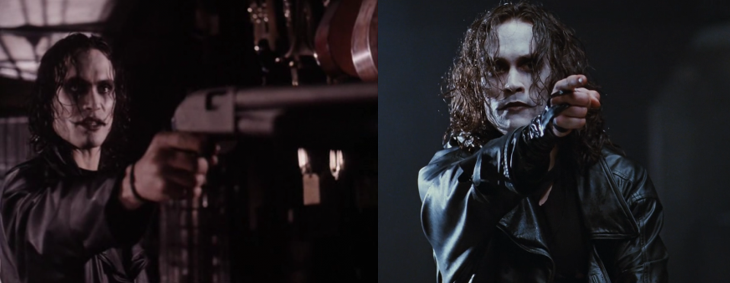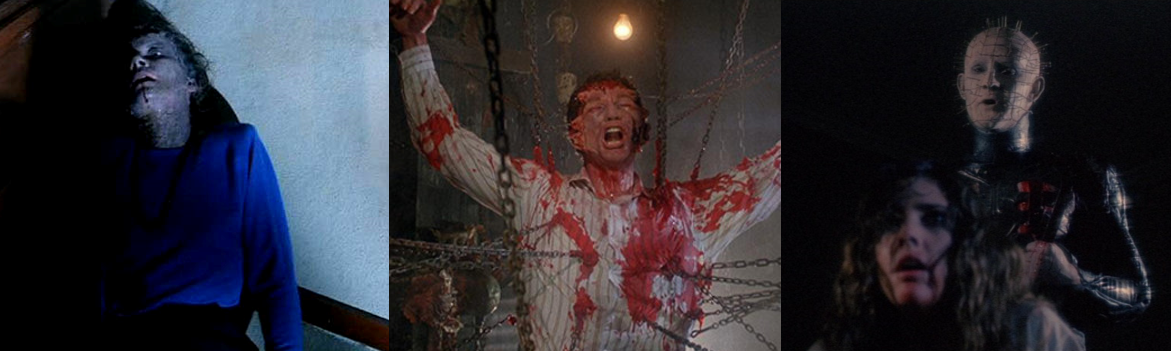
Released: 13 May 1994 Director: Alex Proyas Distributor: Miramax Films Budget: $23 million Stars: Brandon Lee, David Patrick Kelly, Rochelle Davis, Ernie Hudson, and Michael Wincott
The Plot: Musician Eric Draven (Lee) and his fiancée, Shelly Webster (Sofia Shinas), are brutally murdered by “T-Bird” (Kelly) and his gang of thugs. One year later, a mysterious and supernatural crow brings Eric back to life; painting himself up as a tragic masquerade and bestowed with invincibility, Eric sets out to avenge their deaths using his newfound abilities.
The Background: The Crow began life as a comic book published by Caliber Comics in 1989 and created, written, and illustrated by James O’Barr. The character, named simply “Eric” in the comic, was a tragic figure modelled after prominent rock musicians, prone to quoting a variety of scripture, and who engaged in the brutal slaying of those who killed him and his fiancée as a reaction to the pain and loss O’Barr felt after losing his own fiancée to a drunk driver. Thanks to its bleak tone, striking black and white artistic style, and emotional narrative, The Crow became an underground success and, with dark comic book narratives quickly gaining popularity in Hollywood, was adapted into a feature film in 1994. Of course, you can’t talk about The Crow without mentioning star Brandon Lee’s tragic and untimely death after accidentally being shot with a real bullet. The film, which was already mostly complete, was finished through a combination of stunt doubles, stand-ins, and some digital trickery and released to both unanimous critical acclaim and was a surprise box office hit, grossing over $50 million in total. While the subsequentsequelsfailed to capture the magic of this first film, The Crow inspired not only a darker look for legendary wrestler Sting but also became a cult hit and is one of my favourite movies period so, with tonight being “Devil’s Night”, what better way to celebrate than by revisiting this classic film?
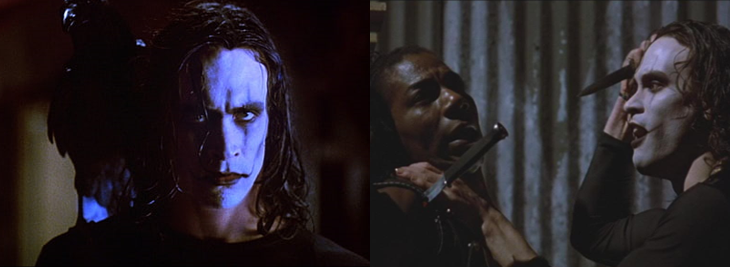
The Review: The bleakness and darkness of The Crow’s world is dropped in our laps as soon as the film begins as it opens with Eric already dead and Shelly in critical condition. Considering that Eric spends the entire film as a reborn revenant, it’s oddly fitting that, when we first meet him, Eric is little more than a lifeless corpse on the cold, rainswept pavement. Eric’s return from the grave is a harrowing, disturbing process not just for him but for the audience as well as he literally claws and crawls his way out of his grave and, disorientated and in shock, stumbles his way back to his apartment only to be immediately bombarded with memories of his former life. These brief flashes to happier times with Shelly are juxtaposed with the violent and disturbing memories of the brutal attack the two of them endured at the hands of T-Bird and his motley crew; Eric’s agony at reliving events both good and bad send him into an anguished fury and, very quickly, in the space of just a few minutes, we learn not only that Eric is now able to immediately heal from all physical wounds but are instantly committed to seeing through his burning desire for revenge alongside him, so tangible is Lee’s performance at showcasing Eric’s torment during this deeply affecting and unpleasant sequence.
Guided by the crow, Eric enacts brutal and fitting revenge against his targets.
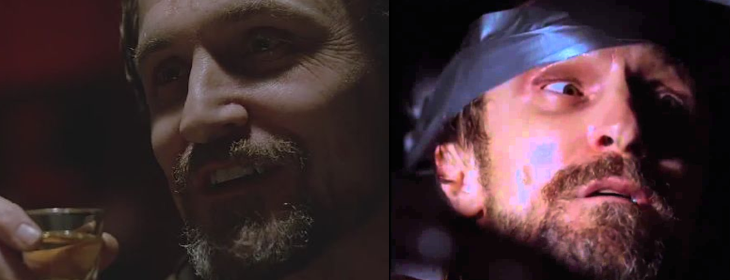
In the comic, Eric and Shelly were attacked at the side of the road and it was a very random, brutal affair but, in the film, they’re specifically targeted after angering the gang and Eric’s suffering is magnified significantly as he is stabbed, beaten, shot, and unceremoniously throw to his death. After his return, Eric is guided on his journey by a mysterious and supernatural crow (ironically, no crows actually appear in the film and the filmmakers used ravens instead) but, unlike in the comics, Eric never actually refers to himself as the Crow in the film. Instead, Eric explicitly uses his real name so that his victims know exactly who it is who is coming for them. His vengeance comes in systematic fashion as he targets each of those responsible for his suffering one at a time, hunting them down thanks to his ability to see through the crow’s eyes and forcing each of them to not only remember him and Shelly but also making them pay in fitting fashion; “Tin-Tin” (Laurence Mason), for example, favours knives as his weapon of choice so Eric stabs him, off screen, through “all his major organs in alphabetical order” and, similarly, he kills “Funboy” (Michael Massee) by subjecting him to a lethal overdose of heroin.
Eric’s mission means he can’t fully indulge in reconnecting with allies and loved ones.
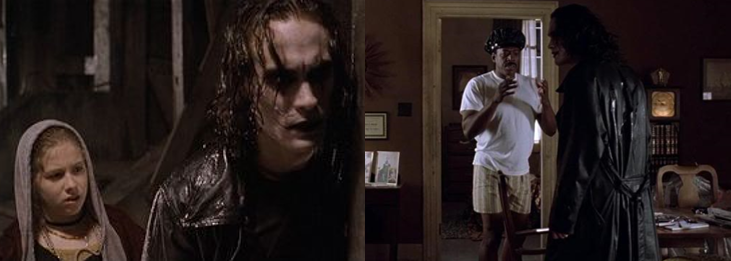
Although he is an extremely tormented individual and has chosen to commit himself fully to his mission rather than attempt to reconnect to his previous life, Eric isn’t alone in his quest for revenge. While alive, he and Shelly befriended and often took care of Sarah (Davis), a streetwise young girl whose mother, Darla (Anna Levine), is unfit to care for her since she’s dependent on substances and used as a plaything by Funboy. Left alone and devastated by her friends’ deaths, Sarah was comforted by Sergeant Albrecht (Hudson), a jaded cop who was first on the scene at Eric’s apartment and whose tendency to stick his nose where it doesn’t belong causes friction between him and Detective Torres (Marco Rodríguez). Both characters eventually, inevitably, cross paths with Eric during his crusade and offer an emotional link to a life that is now haunting the reborn rock star like a bad dream; Albrecht provides Eric with the memories of Shelly’s prolonged death and sympathises with his plight and Sarah represents Eric’s one remaining link to the happier times in his life. Eric is forced to keep Sarah away since his return was predicated on seeking vengeance rather than reuniting with her but, in the end, their fates converge for the finale and allow Eric to bring closure to his life and death, with even the crow favouring Sarah throughout the film.
Top Dollar retains his sadistic edge despite appearing disgruntled with the routine of his life.
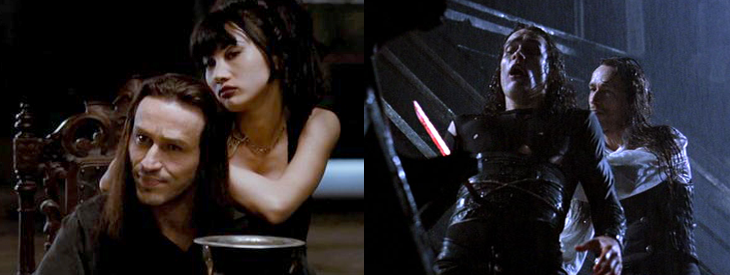
The town’s violent criminal element have taken to ritualistically committing arson attacks throughout the city on October 30th, which has become known as “Devil’s Night” as a result. The head honcho of these attacks is “Top Dollar” (Wincott), a charismatic and mystifying gang leader with delusions of grandeur and an unhealthy and disturbingly close relationship with his stepsister, Myca (Bai Ling). A sadistic and perverse individual, there’s a lingering sense of dissatisfaction and humanity to Top Dollar’s character as, while he happily kills and orders annual destruction and anarchy, he seems disgruntled with the routine and predictability of his life and even expresses genuine regret at the pain and suffering Eric and Shelly had to endure. Ultimately, though, he is a slave to the life he lives and, while he may be discontented and bored with how mundane things have become and is largely dispassionate and stoic even when Eric actively disrupts his operation, he remains resolute in keeping his position of power and influence in the city. As a result, Top Dollar is more than happy to kill anyone who gets in his way and even kidnaps Sarah in a bid to lure Eric into a confrontation whereby his powers can be stripped away, starting an annoying trend in the Crow movies. The film greatly expands his role compared to his comic counterpart, who was more of a throwaway goon, but Wincott shines as the gravely-voiced kingpin and the restructured hierarchy of the gang really helps to escalate the action and emotion behind Eric’s crusade.
There’s a certain catharsis to be gained from Eric’s stoic execution of the sleazy T-Bird.
One of the things I love about The Crow is that there are no corporate, suit-wearing bad guys as the antagonists are generally street-level thugs; Top Dollar and his aid, Grange (Tony Todd in a disappointingly small role), are the sole exceptions to this rule and I can forgive it as they’re not businessmen by any means and it’s implied that they were just street punks at one time and are now simply at the top of the criminal food chain thanks to their power and influence. Indeed, unlike in the comic, Eric has no interest in actively pursuing or killing Top Dollar since he wasn’t present during his and Shelly’s deaths and he only targets the gang leader when he kidnaps Sarah in a bid to steal the crow’s powers. As a result, for much of the film’s runtime, the principal antagonist and the primary target of Eric’s vengeance is Top Dollar’s main street thug, T-Bird, just as it was in the comic. A sleazy, arrogant punk, T-Bird takes a perverse pleasure in unquestionably executing Top Dollar’s every order but prefers to be the more hands-off compared his little gang of thugs. He directs his crew with a simple high-pitched whistle, often while quoting Satanic scripture, and his power and authority out on the streets are never in question. Though he often intimidates and bosses around “Skank” (Angel David), the comic relief of the film and the most cowardly and immature of the gang, T-Bird is reduced to a blubbering wreck when enduring Eric’s wrath and seeing his calm, controlled demeanour break is almost as fitting an end for the character as his explosive death. This scene, which was one of a handful shot using a body double for Brandon Lee, actually benefits from Eric’s silence; rather than explain himself as he did with his other victims, Eric simply allows T-Bird to come to the horrifying realisation that his actions have come back to haunt him, making or an emotionally charged scene that really hammers home how unheroic Eric’s vendetta is.
The Nitty-Gritty: The city itself is also a prominent character in the film; constantly blanketed in rainfall and violence, it is a bleak, desolate, and ominous place and, to add to its foreboding atmosphere, there are very few scenes that take place during the day or in locations that aren’t squalid or ransacked. The Crow’s soundtrack also plays a vital role in setting the tone and atmosphere of the film; alongside a gloomy, emotional score by Graeme Revell, The Crow includes some fantastic heavy metal tracks from the likes of The Cure and Nine Inch Nails, all of which tie into Eric’s career as a musician and the film’s character. Indeed, if there’s a downside to the film, it’s that some of its effects haven’t aged too well; the scene where Eric holds his hand up so that Funboy can see his bullet wound heal is a noticeably poor effect by today’s standards but, for the most part, the employment of more practical effects and camera trickery hold up well enough.
An enigmatic and unpredictable character, Eric is driven by great loss and a lust for revenge.
Eric is an enigmatic and unpredictable character, made even more captivating by Lee’s enthralling performance. In the comic, Eric was a sombre, stoic character who was fond of quoting literature, poetry, and speaking in riddles and, while that is still true of his live-action counterpart, Lee’s Eric is imbued with a justifiable anger and, at times, a sarcastic snark. Sporting an alluring smile (that’s more of a sneer) and an effortless confidence, Eric fully believes in the righteousness of his mission (as he tells Albrecht: “They’re all dead. They just don’t know it yet”) and is brutally efficient at carrying it out, though he still takes the time to taunt and toy with his victims as they did to him. His quotation of Edgar Allen Poe’s The Raven when violently confronting Gideon (Jon Polito) is a notable highlight, as is his rant to Funboy about Jesus Christ, both of which capture the melancholy personality of his comic book counterpart, and is contrasted by his apathetic, silent execution of T-Bird. Eric often revels in his powers, willingly goading his targets into trying to stab or shoot him and then laughing at their terrified reaction to his superhuman healing. Similarly, he often gets so caught up in the fury and pain of his death that he takes a perverse pleasure in toying and murdering his killers, particularly Tin-Tin and Skank, often punctuating their deaths with a crow motif either in blood or fire. Still, his many flashbacks show that he was a carefree and fun-loving bloke while he was a live so he’s also notably appalled at himself and what he has become; this is best seen when, after killing T-Bird and believing that his mission is completed, he removes Tin-Tin’s jacket and tosses it away in disgust.
Despite being stripped of his powers, Eric triumphs and reunites with Shelly in the afterlife.
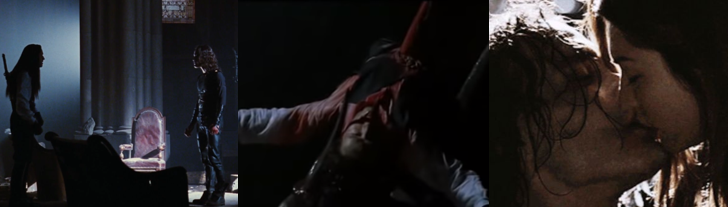
After his painfully and harrowing rebirth, Eric’s life became consumed with revenge and the desire to return to the grave and be reunited with Shelly after avenging their deaths; however, along the way, he not only indulges in a series of escalating violent acts (culminating in an action-packed shoot out between himself and Top Dollar’s fellow gang members and a sword fight against Top Dollar himself on the roof of a church) but also impacts and improves the lives of his allies. For example, while dispensing justice to Funboy, he conveys to Darla the seriousness of her responsibilities as a mother, thus helping to repair her relationship with Sarah. However, this is also seen in the film’s finale, where Albrecht provides Eric with back-up for his showdown with Top Dollar, Myca, and Grange. Despite the fact that he keeps getting into trouble for acting outside of his pay grade, Albrecht feels he owes it to Eric to help him out and ends up being instrumental in assisting Eric in saving Sarah after Grange shoots the crow and robs Eric of his invincibility. This was a new element that wasn’t in the original comic book and it carried over into the subsequent sequels but it works in service of the film’s larger narrative because, in the end, Eric must confront Top Dollar as a mere mortal man with nothing left but his rage and uncompromising determination. Thanks to the rain, even Eric’s face paint is washed away during this final confrontation and, after enduring a mortal wound, he subjects Top Dollar to the many hours of suffering and pain Shelly was forced to endure because of his orders and dispatches him in brutal fashion by impaling him on one of the church’s stone gargoyles.
The Summary: Even now, nearly thirty years after I first saw the film, The Crow remains one of my favourite movies of all time. Honestly, I actually prefer it to the comic book thanks to the alterations to the source material improving upon the hierarchy of the villains and making Eric an even more relatable and tragic character. The desolate, violent, and bleak presentation of the film, the city, and the plot were a profound influence on me and, despite a few dodgy effects here and there, The Crow has a real timeless quality. I am continuously astounded at how badly Hollywood managed to screw up the sequels as it seems like such a simple formula to recreate, but The Crow really was lightning in a bottle as it not only captured the spirit of the source material but enhanced it with some fantastic and memorable performances. It’s absolutely tragic that this film saw the untimely death of Brandon Lee; his performance is captivating and full of life, action, and a multitude of complex emotions (from stoic conviction, to subdued melancholy, to unhinged anger) and it’s a real shame that he never got the chance to show the full extent of his range and ability over a long and illustrious career. Yet, his legacy lives on in the enduring strength and appeal of The Crow, which greatly contributed to comic book movies being seen as a serious and worthwhile sub-genre of cinema and whose iconography has left a lasting impression.
My Rating:
⭐⭐⭐⭐⭐
Rating: 5 out of 5.
Fantastic
What are your thoughts on The Crow? What did you think to Brandon Lee’s portrayal and do you think he would have had a promising career had his tragic death not occurred? How did you feel it compared to the comic book? Were you a fan of the changes the filmmakers made to the source material (such as the removal of Eric’s powers for the finale) or would you like to see a remake that was closer to the original comic book? Were you a fan of the soundtrack; if so, which track was your favourite? Which of The Crow’s sequels was your favourite, if any, and would you like the see the character return in some form or another in the future? How are you celebrating Devil’s Night tonight? Whatever you think about The Crow, go ahead and leave a comment down below or start the discussion on my social media.
Asterix the Gaul (and his best friend Obelix) first debuted on 29 October 1959 as a serial in the French/Belgium magazine Pilote. Since then, the plucky Gauls have gone on to have many adventures in comic books, videogames, and feature-length productions and Asterix himself has become apopular and enduring character in his native France and around the world as Asterix’s stories have been translated into over a hundred languages across the world. I may be a day early in celebrating this anniversary as it coincides with the release of the SEGA Mega Drive but I’ll take any excuse to talk about Asterix’s amusing escapades.
Released: 1992 Developer: Konami
A Brief Background: It wasn’t long before the French comic book series Asterix made the jump off the panels and into other media; the first Asterix book was adapted into a feature-length animation in 1967 and Asterix cartoons and live-action films have been pretty consistent over the years. Similarly, there have been numerous Asterix videogames; the first was released for the Atari 2600 in 1983 and I had a lot of fun growing up playing Astérix (SEGA, 1991) on the Master System. One of my absolute favourites to play whenever I spotted it in seaside arcades was this cracking, colourful arcade title from Konami, one of the most prominent developers in the industry at the time. Sadly, Astérix was never ported to home console ports, but the game is fondly regarded as one of the most fun-filled, action-packed arcade titles, and it received something of a spiritual sequelin 2021.
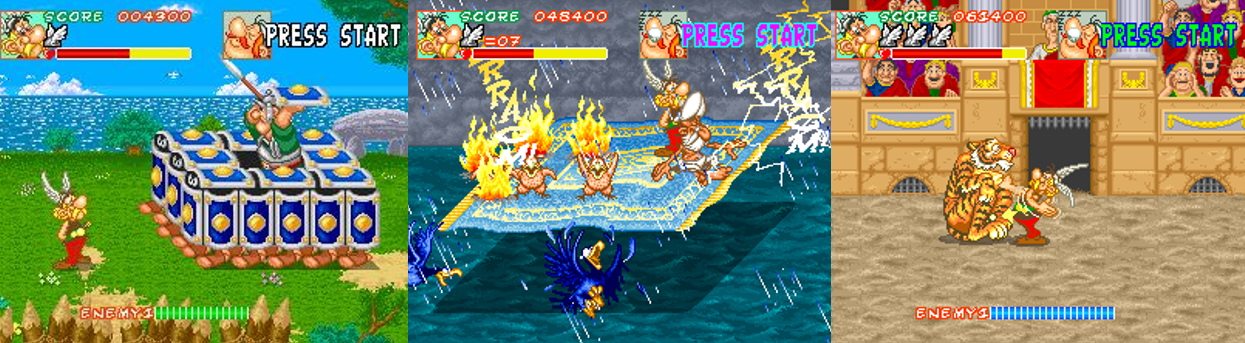
First Impressions: Astérix is a super colourful, super vibrant sidescrolling beat-‘em-up in which players can freely choose to play as either Asterix or Obelix (or team up as both) and journey across seven stages, each one lovingly recreated from some of the tenacious Gaul’s most memorable adventures, ploughing through Romans and collecting their helmets to score points. Controls couldn’t be simpler; you move with the joystick, attack with one button, and jump with another. Both Asterix and Obelix can dash, perform a running and jumping attack, and will slap Roman’s silly, or kick or toss them away, when they get up close and personal.
Journey through some memorable locations bashing Romans all over the ancient world.
The differences between the two characters are largely negligible; Asterix is smaller and slightly more agile, but Obelix doesn’t exactly seem slowed down by his girth. One difference between the two you’ll immediately notice is that Obelix begins with a menhir in hand, as is his trade, which appears to be the one instance in the game where you can wield a weapon (albeit temporarily). Both characters will also receive a brief power-up when loyal puppy Dogmatix wanders onto the screen with either a gourd of magic potion for Asterix or a crispy roast boar for Obelix; collecting either will send them into a brief frenzy that sees them immune to all attacks and taking out every onscreen enemy in short fashion, though this is only for a very short time. Players can restore their health by eating fruit or stealing a kiss from Panacea, who wanders to and fro in each stage, and swing from vines to take out enemies. You get two lives per credit and, while there’s no time limit, Cacophonix’s musical notes will damage you if you linger too long. Perhaps the oddest thing about Astérix, though, is that you do not have unlimited continues; even if you input ninety-nine credits, you’ll eventually run out of chances to spawn back in and be left with nothing else but your high score and beginning the game all over again.
The game is absolutely gorgeous and perfectly captures the look and humour of the comics.
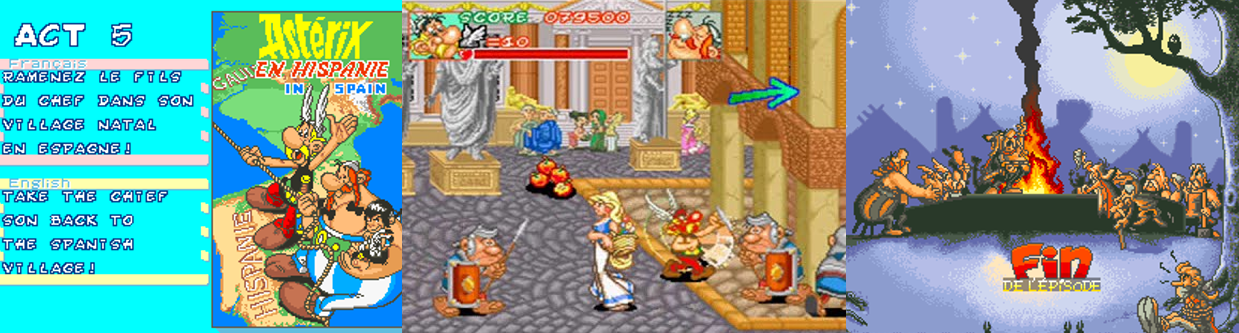
As fulfilling and entertaining as the beat-‘em-up gameplay is in Astérix, however, the game excels in its visual presentation; more so than any other 2D Astérix videogame, this sadly forgotten arcade title pops with bright, cartoony graphics that are ripped straight from the original comic books. Sprites are large, fantastically detailed, and full of fun little animations; Romans can be rapidly slapped across the face, slammed by their ankles, and twirled around in the air just like in the comics, a bunch of cartoony sound effects punctuate the action, and there’s even a little bit of voice acting and onscreen text (in both English and French) to help tell the story. Stages are proceeded by both sprite-based cutscenes and comic book panels to track the pair’s journey to Rome, and you’ll be able to play a chariot race as a bonus stage for extra points. While enemy variety quickly begins to suffer (you’ll see the same Roman infantry and generals in every stage), they’re all exactly as they appear in the comics and can even be seen hiding in tree stumps and riding horses. Each stage also includes additional hazards and enemies, such as rolling rocks, mischievous Egyptians, and disreputable pirates; you’ll also battle a boss at the end of each stage, with a group of Roman’s gathered into the tortoise formation awaiting you at the end of the first stage and the mind-controlling Iris opposing you in Egypt,
My Progression: I’ve played Astérix before, both in the wild as a child and thanks to the gift of emulation, and have always been thoroughly impressed with its graphics, gameplay, and fidelity to the quirky humour and adventures of the source material. The attention to detail here is astounding, even compared to other licensed videogames from the time, and it pleases me no end to see these fun-filled and colourful characters brought to life so well. While I’ve always enjoyed the platforming and puzzle-based mechanics of many Astérix videogames, the concept lends itself incredibly well to the simplicity of a sidescrolling beat-‘em-up and the game’s stages are packed full of gorgeous sprite work, things to see and interact with, and short enough to play through in action-packed bursts.
While there’s loads of locations, I wasn’t able to actually finish the game due to thecredit system.
Having said that, though, Astérix is stunted somewhat by the fact that you cannot simply feed coins into it until you plough through to the ending. I can’t recall ever playing an arcade title that restricts you in such a way, meaning that even when you emulate the game you can’t just blindly charge ahead and just press a button to jump back into the action. Instead, your continues are strangely limited, which unfortunately limits your progress in a way that I have never encountered in an arcade title before, and that means that I rarely manage to get past (or even to) the pirate ship stage. On this particularly playthrough, I struggled to make it through Egypt before losing all my chances, which was a shame as I was hoping that the different ROM files I had available would allow me to just carry on like normal. However, if you are able to best the ever-increasing waves of cartoony and bombastic enemies thrown your way, you’ll eventually battle across the high seas in boats, zip through the air on a magic carpet, race along in a mine cart, and finally find yourself battling the game’s toughest enemies in Julius Caesar’s Colosseum.
Astérix is a quality sidescrolling beat-‘em-up that you may never have played, or even heard of. Sadly, this is one of a number of arcade-exclusive titles that never saw the jump to home consoles, and that’s a crying shame as this would’ve been a blast to play in the 16-bit era. While the game doesn’t really offer anything beyond the stand two-button combat you’d expect from an arcade title and is seemingly lacking in a few areas (a life-draining special attack and weapons amongst them), it excels in its absolutely gorgeous visual presentation to perfectly capture the look, feel, and humour of the source material. It’s just a shame that I can’t just keep pumping in credits to charge on through to the ending, but I always enjoy loading this one up when I have some time to kill. Have you ever played Astérix’s arcade adventure? If so, how do you think it compares to other Asterix videogames and beat-‘em-ups of the time? How far have you been able to make it in the game, and which of the stages was your favourite to play through? Which character, book, or movie is your favourite? How are you celebrating Asterix and Obelix’s birthday this year? Whatever your memories or opinions of Asterix, feel free to sign up and drop them below or leave a comment on my social media.
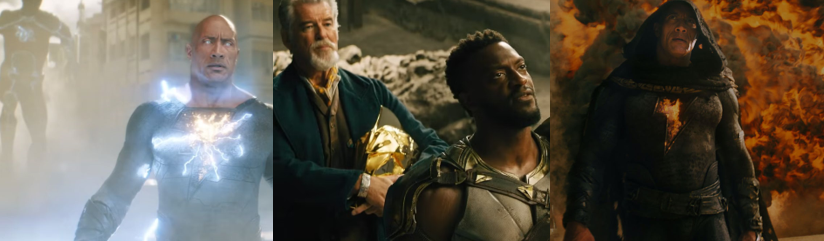
Released: 21 October 2022 Director: Jaume Collet-Serra Distributor: Warner Bros. Pictures Budget: $195 to 200 million Stars: Dwayne Johnson, Marwan Kenzari, Sarah Shahi, Bodhi Sabongui, Aldis Hodge, Noah Centineo, Quintessa Swindell, and Pierce Brosnan
The Plot: After nearly five thousand years of imprisonment, Teth-Adam (Johnson), an ancient magical champion said to have liberated Kahndaq, is unleashed into modern times. His brutal form of justice attracts the attention of the Justice Society of America (JSA), who try to stop his rampage and bring him into custody whilee investigating a centuries-old evil force whose power matches that of Teth-Adam.
The Background: Following the incredible success of Clark Kent/Superman and Bruce Wayne/Batman, Fawcett Publications looked to get in on the superhero craze. While the initial plan was for a team of heroes, Ralph Daigh combined them into one superpowered entity to directly oppose Superman. Originally dubbed “Captain Thunder”, trademark issues led to artist Pete Costanza suggesting the name “Captain Marvelous”, soon shortened to Captain Marvel, and the character proved a big success. Captain Marvel soon became a franchise all unto himself after sharing his powers with a colourful extended family and, about six years after his debut, he and his Marvel Family met their dark opposite in the form of Black Adam, a corrupted version of the Big Red Cheese. Although Black Adam only appeared once in Fawcett’s original run, he saw a new lease of life after the publisher was absorbed into DC Comics, becoming a complex anti-hero often as reprehensible as the villains he opposed. Ranked as one of comics most interesting anti-heroes, Black Adam has featured in animated ventures but this live-action adaptation has spent nearly twenty years in Development Hell. Dwayne “The Rock” Johnson has been attached to the role since the project first stumbled to life in 2006 and, given Johnson’s prominence in Hollywood, the decision was made early on to keep Black Adam separated from Shazam!(Sandberg, 2019) in order to best capitalise on his star power before an inevitable confrontation with Billy Batson/Shazam (Asher Angel/Zachary Levi). Initial plans to feature Black Adam in The Suicide Squad(Gunn, 2021) were scrapped in favour of pitting him against the JSA. Johnson was keen to play up the character’s no-nonsense nature and went all-in with marketing Black Adam as a game-changer in the DC Extended Universe. After numerous delays due to the COVID-19 pandemic, Black Adam finally released to mixed reviews; the film did pretty well with a $393.5 million box office but, while many praised The Rock’s performance and the implicationsBlack Adam has on the future of the DC Extended Universe (DCEU), others took issue with the film’s conflated plot and pacing, though all involved (and especially Johnson) were adamant that Black Adam represented a new phase of the DCEU.
The Review: What a strange, long, and winding road this film has been on; it’s been in production for so long that I was starting to wonder if it would ever come out, especially after the character failed to appear in Shazam! I kinda get why he didn’t; it’s possible that the Rock’s star power would’ve dwarfed that movie’s heart-warming, handholding introduction to this side of the DCEU and people always complain that superhero films rely on the dark doppelgänger trope too much, which I get, but I think the contrast between Black Adam and Captain Marvel helps to elevate the latter into a more wholesome hero. Black Adam also would’ve been a great fit for either of the Suicide Squad films, especially the God-awful first one, but I do understand the idea of capitalising on the Rock’s star power to give him his own feature film, even if I don’t fully agree with it or his insistence on hyping up a clash between him and Superman (Henry Cavill) rather than him and Shazam, which would be my first choice, but maybe all three could meet up in a future movie, that would be a happy compromise. I am pretty familiar with Black Adam, though; I’ve read a bunch of his stories, especially during his time on the JSA, and really dig his no-nonsense attitude and the complex relationship he has with Captain Marvel, which is aways one clash of ideals away from degenerating into all-out war. I also really hope that the Rock is committed enough to the role that he sticks around for a bit; obviously, Dwayne Johnson is a massive Hollywood star and is in high demand so I do wonder about his longevity in the DCEU, especially considering how quickly Ben Affleck burned out (and I was worried that he would when he was cast), but he’s pursued the role for a good ten years and really threw himself into the marketing so I’m hoping he gets to reappear a few more times, though I do somewhat disagree with the idea of rebuilding the DCEU entirely around a character like Black Adam instead of, say, Superman. Black Adam gets off to a shaky start, with a ten-to-fifteen-minute opening and narration that rushes through the titular anti-hero’s origins in ancient Kahndaq and sets up the McGuffin that much of the film’s plot revolves around. Centuries ago, a tyrant named Ahk-Ton (Kenzari) enslaved Kahndaq and forced its people to dig for a rare and incredibly powerful mineral known as “Eternium”, the only material powerful enough to force the Crown of Sabbac, an item powerful by six demonic entities from what can only be described as Hell.
Awakened in modern times, Teth-Adam’s violent ways earn him the adulation of the oppressed Kahndaq.
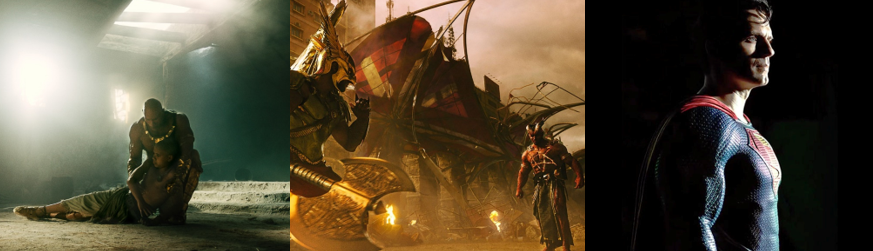
Kahndaq’s spirit was well and truly broken but one boy, Hurut (Jalon Christian), dared to try and inspire an uprising. For this, he was sentenced to public execution but, at the last second, was spirited away to the Rock of Eternity and infused with the stamina of Shu, the speed of Horus, the strength of Amon, the wisdom of Zehuti, the power of Aten, and the courage of Mehen by the Council of Wizards. The legend becomes sketchy after the defeat of Ahk-Ton, but Kahndaq has revered their Champion ever since, with great statues erected celebrating their saviour; in modern day Kahndaq, their symbolism has all but faded thanks to the oppression of Intergang, a mercenary military force that has imposed martial law throughout the city and is seeking to strip it of all its natural resources. With Kahndaq virtually a police state, young Amon Tomaz (Sabongui) echoes the rebellious spirit of Hurut in his desire to fight back against their oppressors, but his mother, Adrianna (Shahi), is more concerned with keeping him safe from reprisals and tracking down the legendary and forgotten Crown of Sabbac to keep it out of Intergang’s hands. Here efforts lead her, her bumbling technician brother Karim (Mo Amer), and Ishmael Gregor (Kenzari) to a mountain where they successfully recover the crown but, after being accosted by Intergang’s forces, Adrianna speaks the magical word of Shazam to awaken the Champion from his long slumber. Thus, Teth-Adam arrives, garbed in a form-fitting black suit and sporting both the Wizard’s (Djimon Hounsou) lightning symbol and a hooded cape and immediately dispatches the Intergang thugs without mercy or quarter. His superhuman speed, strength, and command over lightning make him virtually indestructible to all man-made weapons; his skin is only pierced by Eternium, and his powers even allow him to cauterise and recover from wounds in moments. Bulletproof and capable of reducing a man to a chargrilled skeleton or a pile of ashes with a single bolt of lightning, Teth-Adam lays wastes to the armed thugs but, in the chaos, notably makes the effort to save Adrianna from being crushed by a falling boulder. A stoic, grim-faced man, Teth-Adam tears through Intergang with ease, mocking their “weak magic”, catching bullets, and swatting aside missiles like they were nothing. When he’s injured by an Eternium blast, Adrianna and Karim take him back to their flat to recuperate; there, he quickly learns English (how is never explained but I’ll assume it was through the wisdom of Zehuti) and is accosted by Amon, who very much fills a similar role to Frederick “Freddy” Freeman (Jack Dylan Grazer) in Shazam; he’s an absolute superhero nut, with posters and comics and action figures of all of DC’s heroes plastered around his bedroom, and enthusiastically runs down the gamut of Teth-Adam’s powers and tries to teach him to embrace his role as a superhero, somewhat similar to young John Connor’s (Eddie Furlong) relationship with the Terminator (Arnold Schwarzenegger). However, Teth-Adam has about as much interest in being a hero as he does using doors or being polite; he simply floats and flies around, barging through walls, spouting his dogma regarding lethal force to Amon, and rejecting claims that he’s Kahndaq’s fabled Champion. Despite this, he does have something of a moral code; when Intergang arrive looking for the crown and put Amon in danger, Teth-Adam continues his merciless slaughter, amusingly struggling to deliver the-ass one-liner Amon taught him as he kills people too quickly for such traditions and attracting the attention of Amanda Waller (Viola Davis).
Black Adam’s rampage brings him into conflict with the morally-righteous Justice Society.
Oddly, Waller’s first port of call isn’t the Suicide Squad or the Justice League, but Carter Hall/Hawkman (Hodge) of the JSA; it seems Waller has been reconfigured into a character more akin to Nick Fury (Samuel L. Jackson), someone who recruits and directs a variety of metahumans, which I find is an ill-fitting role for her and I would’ve preferred to see her interaction with Hawkman tweaked or removed entirely and saved her appearance for when they bring the depowered Teth-Adam into custody later in the film. Regardless, Hawkman recruits his old friend and team mate Hector Hall/Doctor Fate (Brosnan) and two rookie metahumans, Albert “Al” Rothstein/Atom Smasher (Centineo) and Maxine Hunkel/Cyclone (Swindell), to intercept and subdue Teth-Adam in Kahndaq. I really like the inclusion of the JSA here; it’s fitting, given that Black Adam spent some time with the team in the comics, and helps to open up the DC Universe to new heroes and stories, while also not overshadowing Teth-Adam with more recognisable heroes. Unfortunately, we don’t learn a great deal about them; Atom Smasher and Cyclone are relatively one-dimensional, despite a budding attraction, Al’s need to consume food to maintain his size-changing abilities and desire to live up to his uncle’s (Henry Winkler) legacy and a brief mention of Cyclone’s traumatic background. Similarly, there’s a history and a strong bond between Hawkman and the mysterious Dr. Fate that is only briefly touched upon; we learn nothing about their origins, the nature of their powers, or even their limits. Dr. Fate is able to see visions of the future through his magical, alien helmet and conjures doubles of himself, mystical barriers, and crystalline weapons and Hawkman clearly has some form of superhuman durability since he can go toe-to-toe with Teth-Adam, as well as sporting his trademark wings and mace, but Black Adam doesn’t waste any time digging into the depths of the JSA’s background. Instead, they’re there as a peacekeeping force, one who strive to set an example to the world and their peers by upholding justice and sparing lives, rather than taking them. This not only contrasts with Teth-Adam’s more totalitarian methods and leads to many a conflict, both physical and philosophical, with the team (especially the proud and hot-headed Hawkman) but also raises the ire of Adrianna and Kahndaq. After decades of oppression and being left to fend for themselves, she and her fellow countrymen reject the JSA’s involvement and holier-than-thou attitude, especially as Hawkman’s temper and Atom Smasher’s inexperience leads to more damage to their country. Indeed, Kahndaq openly cheers for Teth-Adam, revering him as their Champion and approving of his more direct, lethal measures, a feeling Adrianna also shares despite her wishes to spare Amon from inflicting violence upon others. Teth-Adam is doing what needs to be done and actually fighting back against the likes of Intergang, whereas the JSA and the wider world simply ignored Kahndaq’s problems, thus casting the JSA in an interestingly villainous role as they go to great lengths to try and end Teth-Adam’s rampage before his rage gets out of control.
Despite their technology, and being possessed by a demonic force, Intergang is little threat to Teth-Adam.
Their justification comes from having access to ancient texts that detail that Teth-Adam isn’t as righteous as Kahndaq believes; it turns out that, while Hurut was celebrated as Kahndaq’s Champion (Uli Latukefu), Teth-Adam and his wife, Shiruta (Odelya Halevi), paid the price with their lives. When Hurut shared his powers with his father to spare his life, he left himself vulnerable and was killed by Ahk-Ton’s assassins, driving Teth-Adam into a murderous rage so severe that the Wizard was forced to imprison him to contain his power and anger. Now unleashed into the world, the JSA bsaelieves that it’s only a matter of time before history repeats itself and, when Hawkman’s attempts to instil qualities of mercy into Teth-Adam fail (despite almost all of DC’s superheroes having a notable body count), the JSA attempt to force him into submission or to speak his magic word so he can be delivered into Waller’s custody. Ultimately, it’s Teth-Adam’s rage that sees him willing return to his mortal form (Benjamin Patterson) and be taken into custody after he accidentally injures Amon with his powers. With Teth-Adam left in suspended animation and unable to speak his magic word, the JSA believe they’ve accomplished their mission but a greater threat emerges from their conflict with Intergang. While Intergang aren’t really much to shout about, being simply a military force to intimidates Kahndaq’s citizenship, they do inexplicably wield Eternium weapons and hoverbikes, though none of this really matter sin the face of Teth-Adam’s awesome power. They’re the very definition of nameless, faceless, disposable goons for Teth-Adam to tear through; I quickly lost count of how many he turns to ash and bones and the film makes his toying with their lives into a bit of a gag. Intergang also disappear for the film’s final act, their threat and control over Kahndaq forgotten in favour of the power of the Crown of Sabbac, a power that Ishmael craves so badly that he not only aligned with Intergang, but betrayed Adrianna, shot Karim (though, thankfully, he doesn’t kill him as Karim is one of the film’s comedic highlights), and purposely put Amon in danger all to claim the crown for himself and to make Teth-Adam so bad that he would kill him. Sadly, for all the gravitas Pierce Brosnan brings to the film and the awesome, charismatic presence of The Rock, Ishmael ends up being a pretty weak villain; I literally forgot he was even in it for big chunks of the movie, and you can see his heel turn coming a mile away. His transformation into a literal devil for the finale isn’t exactly inspiring either, and his final confrontation with Teth-Adam is very similar to the ending of Shazam!, though the primary focus of Black Adam is on exploring Teth-Adam’s morality and methods and this is a very interesting and entertaining aspect of the film so I can ignore the lame villain, though I do think the film would’ve benefitted from someone like Arnold Vosloo in the role instead.
The Nitty-Gritty: It’s these themes of morality that form the heart of Black Adam; having witnessed the enslavement and subjugation of his people, the death of his beloved wife and child, and the hypocrisy of the Wizard and the Gods, Teth-Adam has been left a cold, emotionless, rage-filled force of nature. This is a very different role for The Rock, one that downplays his usual affable nature in favour of a more stoic demeanour, one that showcases a different side of his charisma. He still has a presence and a biting wit, but it’s one seeped in rage and tragedy; initially, Teth-Adam was a mere powerless slave, one who tried to keep his son from speaking of rebellion, but he was driven into a fury after losing everything and has no qualms about lashing out at those who seek to harm or oppress others. His no-nonsense morality most notably conflicts with Hawkman, who believes heroes shouldn’t kill and tries to emphasise the benefits of sparing lives as it allows one to learn information about their enemy or objective. Teth-Adam is much more direct; even when he begrudgingly teams up with the JSA to rescue Amon, he just flies off and storms Ahk-Ton’s ruins, completely ignoring Hawkman’s plan of attack, an approach that works perfectly well for him as he’s functionally invulnerable. There are some interesting dichotomies at work in Black Adam; Hawkman coms across as a bit of a hypocrite because, while he’s all about saving lives, he does put people in danger with his insistence on beating Teth-Adam into submission and there’s a grey question mark hovering over the JSA’s moral high ground since they only came to Kahndaq’s aid once a superhuman presence emerged there. Similarly, Teth-Adam never harms or kills innocent people; he might claim to have no interest or care for the lives of mortals, but he repeatedly goes out of his way to help Adrianna and Amon and only kills Intergang’s mercenaries, something that the people of Kahndaq naturally cheer for as they just want to be free of their oppressors.
The film looks amazing and is full of fun action scenes, despite some dodgy CGI shots.
Visually, Black Adam is quite the spectacle; the whole movie is shot beautifully, and the costume design is absolutely on-point. The Rock looks like a walking mountain of ashen black in his comic-accurate costume and even the always-ridiculous Hawkman ends up being realised very well onscreen, though I could’ve done without the nanotechnology that allows his helmet to magically form over his head and his wings to fold away. Dr. Fate looks magnificent, if a little rubbery at times since he’s a mostly CGI creation, but the effects fall apart a little when bringing the gigantic Atom Smasher and the wind-bending Cyclone to life; I applaud the filmmakers for choosing such effects-heavy characters but I do think the film might’ve benefitted from picking less visually demanding characters since Atom Smasher doesn’t really get a lot of play (and is portrayed as a bit of a buffoon) and Cyclone just dances around in slow motion whipping up projectiles and dirt. There’s a surprising amount of slow motion here, almost Zack Snyder levels of the effect, as Black Adam goes out of its way to emphasise Teth-Adam’s incredible superhuman speed; for the most part, it works, though some parts that are clearly supposed to be dramatic can come off as a little hokey thanks to The Rock’s grimacing or screaming face lunging at the camera in su-u-per sl-lo-ow mo-tion. Mostly, though, the effects are pretty good; the sequence where the JSA’s futuristic place takes off is a bit over the top and the final form of Sabbac is disappointingly underwhelming, but Teth-Adam’s many fight scenes against Intergang and the JSA work really well. Similar to some surprisingly violent scenes in Shazam!, there’s a level of violence in Black Adam that nicely skirts the limits of what’s acceptable for a 12A film; while there’s no gore or blood splattering everywhere, Teth-Adam rams grenades in people’s mouths, causes aircraft to collide in mid-air, and indiscriminately blasts at his enemies with his lightning and comically sends them flying into the sea or across the screen. Charbroiled skeletons, ashes, and even severed limbs are all over the film as Teth-Adam tears through his opponents without remorse, culminating in a pretty gruesome end for Sabbac when Teth-Adam rips him in two, spilling not blood but molten lava.
While Teth-Adam ultimately chooses to defend the world, the question of his morality is left up in the air…
All throughout the movie, Dr. Fate is haunted by a vision of the future in which the world is reduced to a burning cinder, presumably because of Teth-Adam’s rage, and his good friend Hawkman is killed in conflict. When Teth-Adam finally surrenders and his threat is naturalised, Dr. Fate is disturbed to find his vision remains unchanged; this is because they were too slow to realise that Ishmael’s plan all along was to die at Teth-Adam’s hands so he could meet the six demons of Sabbac in Hell and become their demonic champion. Imbued with their demonic power, Ishmael returns to life as Sabbac, a literal horned demon with a pentagram carved into his chest and with designs of claiming his birth right as Kahndaq’s true ruler (since he’s the last living descendant of Ahk-Ton). Thanks to the demons’ powers, Sabbac sports all the same abilities as Teth-Adam but wielding fire instead of lightning; Ishmael’s humanity is completely consumed by this underwhelming CGI form, which has little motivation other than death and destruction. Although they’re able to battle Teth-Adam and even Sabbac on equal ground thanks to their superhuman powers, the JSA are no match for either of them; in a bid to change the future and save his friend’s life, Dr. Fate willingly meets Sabbac head on and sacrifices himself to free Teth-Adam from his confinement and convince him to live up to Hurut’s example by becoming the world’s saviour. What follows is a pretty intense brawl between Sabbac and Teth-Adam; since both are capable of hurting the other, and yet are also equally matched, there’s a degree of uncertainty about the battle but, thanks to Dr. Fate’s words, Teth-Adam learns to co-operate with the JSA, setting aside his differences with Hawkman long enough for the latter to use Dr. Fate’s helmet to distract Sabbac and allow Teth-Adam to deliver not only his one-liner but a killing blow to the raging demon. In the aftermath, a begrudging respect between Teth-Adam and the JSA is acknowledged, though Hawkman warns him not to step out of line, and Teth-Adam adamantly rejects Kahndaq’s throne and vows to instead be the country’s protector. A mid-credits scene then sees Amanda Waller also warning Teth-Adam, now rechristened as “Black Adam”, against stepping out of Kahndaq; she even calls in a favour and sends Superman to have a chat with him, returning not only Henry Cavill to the DC Universe but also John Williams’ iconic theme, and setting the stage for a showdown between the two that would never happen.
The Summary: Truthfully, I was unsure about Black Adam; I still maintain that it’s a little self-indulgent to give him his own solo movie simply because of The Rock’s star power and he’s a strange character to rebuild the mess that is the DCEU around since there’s only so much you can do with him. However, I am a big fan of the character, and The Rock, and was excited by the trailers and the hype surrounding the film, and to see the JSA and Pierce Brosnan in a superhero film. Despite a troublesome start, which rushes through what seems like a whole movie’s worth of story, Black Adam soon found its groove and settled into an enjoyable action romp designed to showcase a meaner side of The Rock, who is clearly enjoying himself in revelling in Teth-Adam’s power. I enjoyed the complexity of Teth-Adam’s character; he’s burdened by loss and rage and not only feels like he has no place in the world but also that he’s unworthy of his powers since his first instinct is the hurt and kill others. The entire film is geared around showing him that he can just as easily b the saviour of humanity, but there’s still a question about his motivations by the finale; he seems content to remain in Kahndaq as its defender, but there’s literally nothing stopping him going out and enforcing his will in the wider world. The JSA came off really well; while we don’t learn much about them and I think I would’ve preferred Atom Smasher and Cyclone to be a little more experienced, they added some visual variety to the fight sequences and nicely opened up the DCEU to new superpowered characters, as well as helping to set an example for the violent anti-hero. While the villains weren’t much of a threat, or very interesting even when turned into a literal demon, but I can overlook that (and some of the wonkier CGI) because of The Rock’s undeniable charisma. The jury’s out on what’s next for Black Adam and how his presence will really affect the hierarchy of the DC Universe, but this was an entertaining spectacle that I enjoyed far more than I expected to.
My Rating:
⭐⭐⭐
Rating: 3 out of 5.
Pretty Good
Did you enjoy Black Adam? Do you think the character deserved his own solo movie, one that skipped over his relationship with Shazam? What did you think to The Rock’s portrayal of the character, his violent tendencies, and the realisation of his powers and costume? Were you also disappointed by the villains? What did you think to the JSA? Would you have liked to learn more about them, and which member of the team was your favourite? What did you think to Henry Cavill’s long-awaited return to the DCEU and where do you think Black Adam will go next? Whatever your opinions on Black Adam, feel free to share your thoughts down below or leave a comment on my social media.
Released: 21 February 2014 Developer: Teyon Also Available For: Arcade, PC, and PlayStation 3
The Background: In 1972, David Morrell’s First Blood was published; a harrowing tale of the horrors of the Vietnam War, the book was well-received upon release eventually led to a live-action adaptation directed by Ted Kotcheff and starring Sylvester Stallone. A commercial success, First Blood(Kotcheff, 1982) is widely regarded as one of the most enduring and influential movies of its genre and was followed by a series of successful and popular action films that helped make Stallone a household name. John Rambo had featured in a number of videogames, most of which were based on the more action-orientated sequels rather than the more introspective First Blood, before Reef Entertainment acquired the rights to the franchise in 2011. Hoping to capitalise on the recent success of Rambo (Stallone, 2008) and the upcoming The Expendables 2 (West, 2012), Reef opted to use voice clips and dialogue ripped straight from the movies for their rail-shooter rather than record new dialogue with existing actors or soundalikes. This was one of many criticisms levelled against the game upon release; critics were equally unimpressed with the game’s over-reliance upon quick-time events (QTEs), the lacklustre enemy intelligence, and the game’s short length and Rambo: The Video Game was generally regarded as being a disappointing and mediocre use of the license. However, since today marks the anniversary of First Blood’s release, this seems like the perfect time to take a look at this poorly-received shooter and see if it truly deserves its overwhelmingly negative reputation.
The Plot: Rambo: The Video Game sees players take control of John J. Rambo (and one of his allies, if you have a friend to play alongside) and reenact key events from the first three movies. This sees Rambo enduring horrendous torture in Vietnam, battling bigotry in Hope, Washington, infiltrate the Vietnam jungle to rescue a number of captured soldiers, and finally stand against a Soviet invasion of Afghanistan.
Gameplay: Rambo: The Video Game is a first-person rail shooter that places you into the role of Rambo (or the likes of Colonel Sam Trautman and Co Bao) and has you playing through a number of missions that are either based on key moments from the first three films or directly recreate some of the most iconic moments of Rambo’s film career. Since it’s a rail shooter, your control and movements options are a little limited; Rambo moves as the story dictates and you’re left controlling the aiming reticule with the right stick and holding the left stick to take cover from fire. The Right Trigger will see you fire one of your two main weapons, which can be switched with either Y or the directional pad (D-pad), and you can occasionally use an alternate fire mode with the Left Bumper.
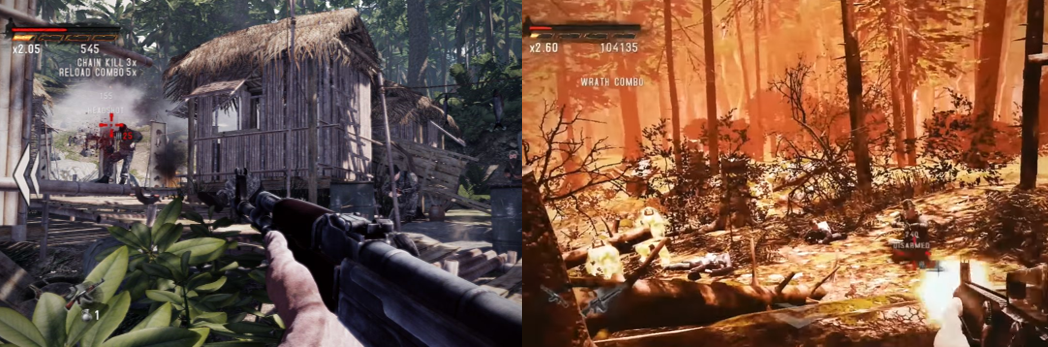
Shoot down your enemies to enter a Wrath state and unleash the full force of Rambo’s rage.
Rambo can reload his weapon with either X or the Right Bumper; this will bring up a small reloading wheel and you’ll need to press the button again to reload faster to grant yourself additional ammo (though your overall supply is unlimited). Press it too soon or too late and your gun will jam, giving you less ammo and slowing down your reload time, thus leaving you vulnerable. LB and the B button also allow you to throw one of your limited supply of grenades, while the Left Trigger provides you with an aiming lock to target specific enemies, and you can also use the D-pad to cycle through different types of arrowheads once they’ve been unlocked. As Rambo kills enemies, scoring headshots or disarming them or blowing them to pieces by shooting explosive barrels, he’ll not only earn points but also fill up his “Wrath” bar. When a segment of this is filled, players can press X to enter “Wrath” mode, which slows down time, highlights enemies using their body heat, and refills Rambo’s health for every kill he performs during this limited burst of rage. Rambo: The Video Game allows you to play missions in three different difficulty settings: Private, Sergeant, and Green Beret; each one tweaks the aggressiveness and competence of the enemies, provides a different number of checkpoints, and makes quick-time events (QTEs) either easier or harder. If you’re playing on the easiest setting, you’ll be blessed with an unlimited number of checkpoints but won’t earn as many points for your playthrough; Sergeant or higher will limited your checkpoints to five and three, respectively, and end your game if you run out, though you can lower the difficulty setting from the death screen if you’re having a hard time. As you gun down enemies, you’ll rack up a score multiplier, which is key to increasing your final ranking at the end of each mission; you’ll also gain extra points for your accuracy, headshots, the difficulty setting, and how many deaths you suffered during the mission, promoting more efficient and calculated playthroughs on higher difficulty levels in order to level Rambo up, gain Skill Points, and upgrade his stats and unlock Perks and increase his combat proficiency.
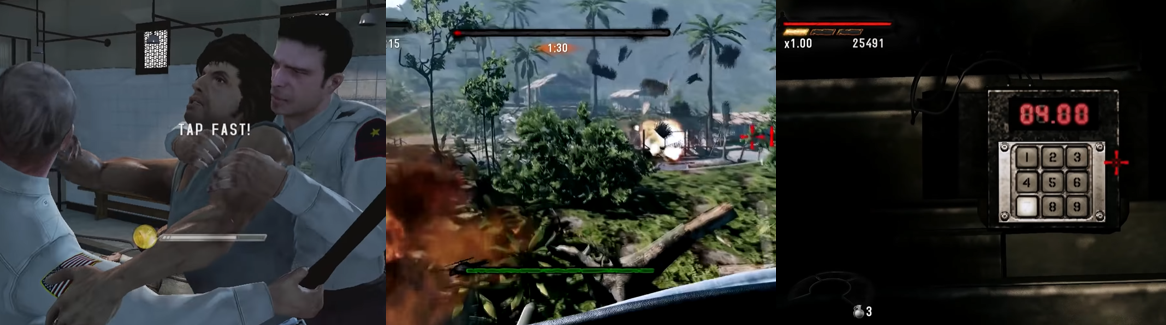
QTEs, stealth sections, and explosive vehicle gameplay help add some much needed variety.
However, it’s not just about going in all guns blazing; Rambo will also need to take up his bow and arrow or his iconic knife and sneak through the woods, jungle, or under cover of darkness to take out enemies undetected. This means completing a number of QTEs, which award additional points for pressing the onscreen prompt at the last minute or tapping the button as fast as possible; while QTE time is severely reduced on higher difficulties, the onscreen prompts are always the same so you can simply memorise their order and concentrate on your timing. Sometimes these will crop up mid-mission to have you avoid incoming bullets or mortars, and one particular mission offers you the choice between a stealthy route or a more action-orientated path. You’ll also come across “Cautious Enemies”, indicated by a ! prompt, who will one-shot you if they spot you; enemies can also lean over or shoot through your cover and be bolstered by “Commanders”. Gameplay is given a little variety by the few times you take control of a mounted gun or a helicopter to wreak havoc on the immediate area. These sections are timed and involve blasting at the Hope police station, assaulting a Vietnam base from above, destroying mines and boats while sailing down a river, or blasting away at Soviet forces and their vehicles. These moments of intense action are where the game really excels, though the controls are a little slippery and it can be difficult to aim at your targets with the crosshair slipping all over the screen. This crops up again as Rambo is tasked with disarming and wounding Hope’s police officers for extra points; you can kill them as normal, but you get more points for disarming the cops, which is difficult to do without taking a lot of damage so it’s probably best to turn off the aiming assist option for this mission to make things easier. While sneaking through the Soviet base in Afghanistan, you’ll also have to follow onscreen prompts to arm explosives and can shoot at glowing sections of the cavernous environment to crush your enemies under boulders. If you’re playing alone, you can share your ammo with Co Bao in Vietnam by pressing Y at the right time and she’ll help you out with cover fire, and you’ll even have to take out snipers from afar in Afghanistan. Although the game starts of pretty simply, with you blasting at Viet Cong and diving to cover to reload and catch your breath, things quickly ramp up and get very frustrating and unfair as combinations of the game’s most formidable and annoying enemies ambush you, leaving you on the back foot if you’re out of grenades; things are made all the more maddening by some wonky hit detection than can see your point-blank shots miss or enemies hitting you through normally impenetrable cover.
Graphics and Sound: I’ve played Rambo: The Video Game in the arcades before; there, on a big screen with a real (albeit plastic) gun in your hand, the game looks and plays pretty well for a standard light gun shooter. However, on home consoles, the game is pretty much an embarrassment from top to bottom; while the missions do a decent enough job of bringing to life the dark, dank jungles of Vietnam and recreating the town of Hope and the Soviet cave from the films, there’s a lot of graphical pop up and corners cut here as it’s simply a rail shooter and you’re not really meant to be stopping and taking in the details around you. Similarly, enemy models are decent enough, but ragdoll all over the place at times and you’ll see the same enemy types again and again with very little variation.
While locations are okay, the character models, music, and audio dialogue are all absolutely dreadful.
The actual character models are pretty laughable; Rambo himself looks more like an off-model action figure than the surly Stallone thanks to his ridiculous mane of a haircut. Trautman doesn’t look too bad, but hardly any of the corrupt cops from Hope resemble their onscreen actors. The game’s story is framed as a series of flashbacks at Rambo’s “funeral” as some nameless, unknown military man gives those in attendance a rundown on Rambo’s career and reputation in order to afford him some anonymity for his excursion into Afghanistan. This allows the game to recreate the most memorable moments of the films with the absolute bare minimum of effort; the music is dreadful, repeating in embarrassing loops mid-mission, but it’s the voice acting where the game really falls flat. Stallone and Richard McKenna’s audio are ripped right from the films, making their words distorted and wildly inconsistent and hilariously out of context at times, and only emphasising the cheapness of the title.
Enemies and Bosses: Rambo will gun down a whole host of nameless, faceless, interchangeable groups of enemies themed after each of the game’s missions: Viet Cong, Hope’s police department, and Soviet forces all try to fill Rambo with holes, popping up from the background, the sides of the screen, and rolling in to take shots at you. Enemies make use of cover to avoid your shots, can have their hats shot off, and some can even be disarmed to render them harmless to you but, for the most part, they are easily offed with just a few shots. Soon enough, you’ll encounter more formidable and annoying enemies, such as grenadiers (who take cover and toss grenades you can shoot out of the air), “Heavy” enemies covered in armour and vulnerable only in their face masks, and “Flamers” who wield flamethrowers and force you to shoot at their flame tank. Commanders will bolster the morale and efficiency of all onscreen enemies, so you should prioritise taking them out, though you must duck behind cover when turrets are rolled out into the field as they’ll shred you pretty quickly. Snipers, armoured enemies, and groups of these foes can whittle your health down in no time at all so it’s best to make use over cover, shoot any nearby explosives, and try to get off some one-shot headshots to off your enemies as quickly as possible.
Some familiar faces and final encounters close out each of Rambo’s explosive adventures.
Each of the game’s missions includes a timed sequence where Rambo must destroy parts of the environment, usually by making use of a large cannon or a helicopter but, in Afghanistan, you’ll also be hounded by helicopters and tanks that you cannot destroy and must either avoid by taking cover or run past by eliminating all onscreen enemies (and objective the game makes frustratingly vague) and completing some QTEs. Each mission culminates in something that can be generously described as a boss battle; after laying waste to the Hope police station, you’ll need to avoid Sheriff Teasle’s gunfire by pressing the onscreen prompts when it’s safe to move around, then desperately shoot at him when he peeks out at you from his elevated position. After laying waste to his base with your explosive arrows, you’ll find Lieutenant Tay far less of a challenge as you simply have to fire an arrow at him to blow him up, but you’ll need to take the controls of a helicopter and frantically fire your bullets and rockets at an enemy chopper to finish Rambo’s redemption in Vietnam. Finally, after a harrowing rescue mission in Afghanistan that sees you struggling past formidable and frustrating groups of various enemies, you’ll take the controls of a tank and get into a ground-to-air firefight with Colonel Alexei Zaysen. Jeeps and soldiers run around distracting you, but your primary concerns are Zaysen’s missiles and the tanks, which can severely reduce your vehicle’s health and destroy it in one shot, respectively. You’re thus forced to frantically fire your main gun and your cannon like a madman, desperately hoping to shoot down the missiles and destroy your targets before they can do too much damage, before finally ending Zaysen’s threat in this surprisingly aggravating final showdown.
Power-Ups and Bonuses: Aside from your Wrath state, there aren’t any in-game power-ups to make use of beyond being tossed a grenade or making use of explosive barrels or other environmental hazards. You don’t need to worry about picking up ammo and health is restored in Wrath mode, so your primary focus should be on staying alive, killing as many enemies as possible, and keeping your multiplier chain and accuracy high. This will net you the Skill Points you need to level-up and improve your efficiency; these can be spent upgrading your resistance to damage, your grenade inventory, the power of both light and heavy weapons, and extending the duration of your Wrath bar. When you level-up high enough, and complete certain requirements (known as “Trautman Challenges”), you’ll unlock additional weapons to take with you into each mission, which can definitely turn the tide in your favour in the game’s tougher stages. You’ll also unlock up to three Perk points and a variety of Perks that allow you to perform perfect QTEs or gain increased health and ammo while reloading or killing enemies in Wrath, for example.
Additional Features: There are twenty-seven Achievements on offer in Rambo: The Video Game; the vast majority of these are tied to you getting at least a two-star rank on every mission, which will require you to beat the game in at least Sergeant mode, while others include maintaining a high chain multiplier, using every weapon in the game, completing it on Green Beret mode, and killing a total of 3000 enemies. Sadly, none of this is easily accomplished and meeting these criteria quickly becomes a very laborious and needlessly frustrating process as achieving even a two-star rank can be more trouble than it’s worth at times. The game can also be played in two-player co-op, which is very much appreciated and probably makes some of the tougher sections a bit easier, but there’s no head-to-head multiplayer mode and Trautman’s “challenges” amount to fulfilling certain objectives (which you can’t review in-mission) to unlock new weapons. If you simply must have more Rambo, there was some downloadable content released for the game that included some additional missions and Achievements, but I can safely say that I won’t be checking this out any time soon given how infuriating this game can be at times.
The Summary: I’d heard nothing but bad things about Rambo: The Video Game; however, even after my last few attempts to play the arcade version resulted in my coins being eaten by the machine, I maintained that it would be an inoffensive enough rail gun shooter to blast through and rack up some easy Achievements. Instead, what I got was an absolute slog of a gaming experience; bland environments which, while somewhat faithful to the movies, are way too dark, unimpressive and frustrating enemies, and a lack of variety really bring down the otherwise enjoyable enough gameplay. The stealth and QTE sections are okay, if painfully simple, and the parts where you’re in control of heavy ordinance and vehicles can be a lot of fun, but the presentation is just so cheap and rushed. The muted dialogue ripped right from the movies is the most glaring offense, of course, but the lack of gameplay options, the stringent criteria for unlocking stuff, and the odd little glitches and annoyances peppered through the game definitely don’t make it worth investing your time and money in when there are far better first-person shooters out there. It’s a shame as there’s definitely a lot of potential here, but the execution screams “cheap cash grab” and you really won’t be missing out on all that much if you skip this title, which I’d argue even die-hard Rambo fans would struggle to find enjoyable.
My Rating:
⭐
Rating: 1 out of 5.
Terrible
Have you ever played Rambo: The Video Game? If so, did you enjoy it or were you as disappointed by it as I and many others were? What did you think to the Wrath system and the recreation of the film’s moments? Were you also disturbed by the poor quality character models and audio clips? Which Rambo videogame, or videogame appearance, is your favourite? Which of the Rambo films is your favourite? Whatever your thoughts on Rambo, drop them below or leave a comment on my social media.
Air Date: 7 October 2022 Director: Michael Giacchino Network: Disney+ Stars: Gael García Bernal, Laura Donnelly, Harriet Sansom Harris, Kirk R. Thatcher, and Carey Jones/Jeffery Ford
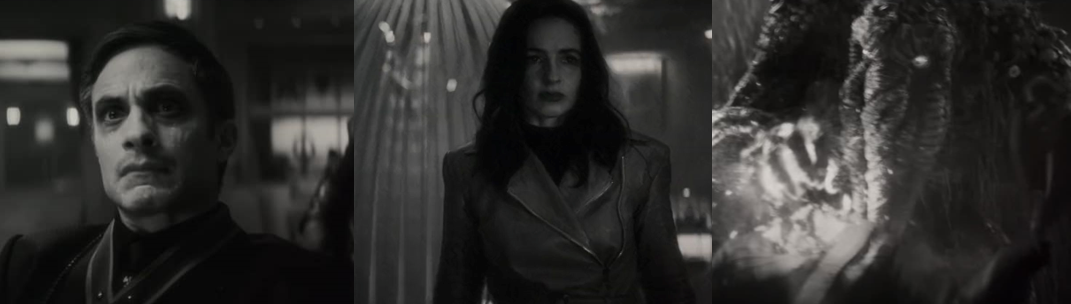
The Background: Back in February 1972, Roy Thomas, Jeanie Thomas, Gerry Conway, and Mike Ploog (under the direction of the legendary Stan Lee) introduced readers to Jack Russell/Werewolf by Night in the pages of Marvel Spotlight. After a ridiculous ban kept Marvel from publishing stories about werewolves and other supernatural creatures, the writers were finally free to explore these elements, and Werewolf by Night, soon graduated to his own self-titled series later that same year. Coming from a long line of lycanthropes and sharing a complex history with Count Dracula and the cursed Darkhold, Jack Russell became a feral beast under the light of a full moon and was repeatedly targeted by a nefarious cabal known as the Committee, who also introduced the emotionally damaged vigilante Marc Spector/Moon Knight to Marvel’s readers. Despite being one of Marvel’s more obscure characters, Werewolf by Night was pegged for a big-screen adaptation back in 2001; after numerous drafts and delays, Crystal Sky Pictures seemed ready to begin shooting when the project simply vanished from their slate. Hopes for the Werewolf lived again, however, when Kevin Smith was denied use of the character for a 2019 project, and the character was officially announced to be a part of the Marvel Cinematic Universe’s fourth phase in a one-hour, horror-themed special for Disney+. Director Michael Giacchino drew specific inspiration from the classic monster movies of the 1930s and 1940s and promised that the special would include some of Marvel’s most famous monster characters, such as Doctor Ted Sallis/Man-Thing. Upon its release, Werewolf by Night was met with largely positive reviews; critics praised the aesthetic and brisk pace, and the homage to classic Hammer Horror films, while also noting that the characters and certain visuals were somewhat disappointing.
The Plot: A group of monster hunters gather at Bloodstone Manor following the death of their leader and engage in a mysterious and deadly competition for a powerful relic, which will bring them face to face with a dangerous monster.
The Review: I might not know much, if anything, about Werewolf by Night but I’m more than familiar with the Hammer Horrors of yesteryear, classic black-and-white terrors that laid the foundation for popular depictions of screen monsters such as Count Dracula, Frankenstein’s Monster, and Larry Talbot/The Wolf Man. I’m actually more a fan of the 1930 Hammer Horrors than the later renaissance spearheaded by the likes of Christopher Lee; there’s just something about the gothic aesthetic surrounding the likes of Bela Lugosi and Lon Chaney Jr. that I find endearing and appealing in its simplicity. Plus, those classic horrors are super brisk; you could probably watch all of them, or a good three or four, in just a few hours and that’s perfect for when you just want a short, sharp fix of horror rather than sitting through a two-hour feature film. Similarly, as someone who struggles to binge-watch even six-episode shows for these reviews, I couldn’t be happier that Werewolf by Night opts to simply be a short special presentation, clocking in at a little under an hour. I miss when Marvel used to produce one-shots to fill in gaps between movies and definitely think they would benefit from producing more one- or two-hour specials to flesh out some of their more obscure characters. Similar to how the old Hammer Horrors would open with some text or a voice over, so too does Werewolf by Night begin with an opening narration touching upon the malevolent monsters lurking in the darkness and those who hunt and kill them, with none being more prominent than the legendary Bloodstone family, whose patriarch has slaughtered monsters across the generations with the supernatural relic known as…well…the Bloodstone.
Jack and Elsa reach an agreement to allow him to free the Man-Thing and her to claim the Bloodstone.
Following the death of Ulysses Bloodstone (Richard Dixon), the Bloodstone is in need of a new master, a process determined by inviting monster hunters from all over the world to take part in a ritualistic hunt to establish who is worthy of this powerful relic. Ulysses is survived by his widow, Verusa Bloodstone (Harris) and his estranged daughter, Elsa (Donnelly); Verusa is Elsa’s stepmother and is greatly disappointed by Elsa’s lack of interest in continuing the family tradition. Once thought to be capable of surpassing Ulysses’s abilities, Elsa instead abandoned her duties and her training but is nonetheless determined to take the Bloodstone for herself. Verusa acts as the hostess for the gathering of hunters, with over two-hundred confirmed kills shared between the death-dealers. Jovan (Thatcher) is easily the most bombastic of the group, making an impression through his impressive beard and facial scars, though only Jack Russell (Bernal) can claim over a hundred kills just for himself. With the exception of Elsa, all present see their crusade as a righteous one, a mission of mercy for the cursed and their victims, though there’s a definite flavour of cult-like sensibilities to their hunt. The hunt itself takes place on the grounds of Bloodstone Manor, a dark forest that leads to an Maurits Cornelis Escher-like labyrinth guarded by members of the Time Variance Authority (TVA), which probably explains why the layout and logic of the labyrinth makes little sense. Sporting tribalistic make-up to honour his ancestors, Jack is randomly selected to head out into the woods ahead of the others and his life is deemed to be as fair game as the monster, and any of the other hunters. Despite his impressive reputation as a monster killer, it turns out that Jack isn’t there to hunt their quarry, the swamp creature we know as the Man-Thing (Jones/Ford), but is actually there to rescue him and even refers to him by his real name, Ted. Thus, Jack wants no part of the hunt and even suggests to Elsa that they forget they saw each other, Jovan is driven into a frenzy by his desire to earn the Bloodstone, attacking Elsa with his axe and being surprised and unarmed by her martial arts skill. She then uses Jovan’s axe to more literally disarm Liorn (Leonardo Nam) and kill him with his own wrist-mounted crossbow, proving that she hasn’t been neglecting her training in her time away from Bloodstone Manor.
Verusatriggers Jack’s transformation into the titular Werewolf and seals her fate.
Although the Man-Thing is incapable of communicating beyond a few grunts and creaks, Jack is fully capable of understanding him and promises to relieve him of the Bloodstone, which hurts and weakens him, and blast their way out of there and to freedom. Although Azarel (Eugenie Bondurant) isn’t quite so altruistic, her attack does lead to Jack and Elsa finding some common ground and agreeing to help each other in return for her getting the Bloodstone and him getting the Man-Thing to safety. Although sceptical about Jack’s motives and his relationship to Man-Thing, Elsa is duly convinced that the creature is only a threat when provoked or senses a threat when he calms down after she reluctantly refers to him by his real name and takes Jack’s advice to treat him like an old friend rather than a monster. After some pratfalling with the explosives, Jack succeeds in freeing his friend but, when he tries to pick up the Bloodstone, it rejects him because he’s also hiding a monster within himself. Naturally, Verusa is disgusted by Jack’s charade and has him locked up with Elsa for her part in freeing the Man-Thing; although embittered that Jack kept his secret from her, Jack assures Elsa that he has “systems” in place to manage his monstrous side and that he works hard to keep that part of himself from hurting others. Unfortunately for him, Verusa doesn’t need to wait for the next full moon to witness Jack’s transformation as she possesses the Bloodstone; fearing what he’s capable of, he desperately tries to remember Elsa’s scent and begs for a merciful death, but Verusa forces him to undergo a startling transformation into a ravenous werewolf with her family relic. Naturally, the Werewolf goes on an animalistic rampage, savaging and tearing his way through anyone he deems a threat, but even his supernaturally-enhanced strength is nothing compared to the debilitating power of the Bloodstone, necessitating Elsa’s intervention to keep him from being killed. Retrieving the Bloodstone, Elsa is spared an evisceration after showing compassion for the Werewolf and Verusa meets a gruesome end when the Man-Thing gets his hands on her.
The Summary: Werewolf by Night establishes itself as a very different kind of Marvel production right from the start; not only is the entire feature in black-and-white like the old Hammer Horror films, but the Marvel Studios logo and main theme have been altered to evoke the gothic horror aesthetic of those classic horror films, all the way down to flashes of lightning over the logo, a suitably Hammer-esque orchestral score, and even film grain to give it that weathered, 1930s feel. Everything about the special screams Hammer Horror, right down to the gothic Bloodstone Manor and its hieroglyphics depicting the generations of monster hunting to the stuffed monster heads adorning the walls and the presence of the Bloodstone family crypt. In fact, the only time colour is even used in the special is when the Bloodstone itself is on screen, with the gem shining with a piercing blood-red light and breathing colour into the film after Elsa claims it in the finale. Sadly, the visual presentation doesn’t extend to the cast of characters; it takes about thirty minutes to learn Jack’s name and none of the characters introduce themselves so it was pretty difficult to tell who was who. None of the hunters except Jovan really stood out and we never really get a sense of who they are or their backgrounds; even Elsa and Jack’s origins are left frustratingly vague and Verusa came across as a cackling pantomime villainess that, while suitable for the Hammer vibe of the special, didn’t exactly make her any more nuanced than wanting to destroy all monsters simply because they are monsters.
Both Man-Thing and the Werewolf end up being startlingly brought to life.
On the flip side, I have to say that it’s great to see a character as obscure and visually interesting as the Man-Thing finally make it into the MCU after years of subtle allusions and references. Although an entirely CGI creature rather than being a marriage of digital and practical effects like in the 2005 film, the Man-Thing certainly impresses when onscreen. While the Man-Thing is supernaturally powerful and capable of melting a man’s head with one giant claw-like hand, he also showcases a childish demeanour; the creature is in pain and frightened by his current situation and desperate to get to safety, there’s a definite sense of victory when Jack and Elsa are able to work together to free the lumbering swamp monster from his pain and bondage. Even better, we get to see the Man-Thing in full colour and even handing Jack a cup of coffee after he recovers from his transformation, showing that the creature isn’t just some mindless beast and has not just a measure of intelligence but also a sense of humour. Interestingly, Werewolf by Night bucks a trend of many werewolf tales by not drawing upon the classic An American Werewolf in London (Landis, 1981) for its transformation sequence; instead, Jack’s transformation is largely relegated to a CGI light show and silhouette, which adds an air of mystery to the Werewolf, for sure, but half the fun of a werewolf feature is the gruesome body horror of the transformation. The Werewolf’s look, in the few instances where he is shown, is a nice throwback to The Wolf Man (Waggner, 1941); a furry, voracious humanoid wolf, the Werewolf makes short work of Verusa’s TVA guards, mangling, mauling, and manhandling them as Elsa takes out the last two hunts, all while framed by flashing lights and with a generous helping of gore splattering across the screen.
While I enjoyed the Hammer Horror homage, I don’t feel the special lived up to its potential.
Ultimately, I’m somewhat torn; I enjoyed the visual presentation of the special, which is unlike anything else we’ve seen in the MCU and a fantastic throwback to the classic 1930s Hammer Horror films, but the characterisations are severely lacking. Obviously, it’s only an hour-long special so there’s only so much you can cram in there, and there’s something to be said for keeping an air of mystery around Jack and the Bloodstone family. However, it’s hard to care about the other hunters when none of them are ever named onscreen and they’re simply there to be cannon fodder for Elsa and the Man-Thing; even the appearance of TVA agents is a real head-scratcher and is never explained, nor do we learn anything about the Man-Thing’s backstory even as a throwaway line. The effects are pretty decent, but we don’t get to see the titular Werewolf until the last twenty minutes or so and even then he’s kept in shadow and framed in a way that keeps him monstrous to enhance his threat. I enjoyed seeing the Man-Thing in action, but I guess I was just expecting more monster action from this monster-centric special. I can understand wanting to showcase Jack as a human being trying to suppress his monstrous alter ego and I enjoyed that he goes out of his way to help monsters rather than hunt and kill them, but I didn’t find him a particularly compelling character. Similarly, there was some nuance to Elsa and potential in her conflict with her stepmother and her father’s legacy, but it just wasn’t expanded upon sufficiently enough for me. She’s just another bad-ass female fighter who distances herself from her family’s actions, but it’s not really explained why and all we’re really told is that Verusa and Ulysses recently Elsa for not living up to her potential (yet we see she’s the most capable fighter of all the hunters). In the end, I applaud the attempt at something new, visually and stylistically, and the introduction of monsters to the MCU, but, as presented, Werewolf by Night could easily be skipped or ignored at this point and I’d be surprised to see it directly referenced in later MCU projects.
My Rating:
⭐⭐
Rating: 2 out of 5.
Could Be Better
What did you think to Werewolf by Night? Were you disappointed by the lack of insight and characterisation in the hunters? What did you think to Man-Thing, his visuals and his portrayal? Would you have liked to see more monsters featured in the special? What did you think to the Werewolf, his transformation and his bloody rampage? Did you enjoy the references to classic Hammer Horror films? Would you like to see more from these characters, and are there any specific Werewolf by Night and Man-Thing stories you’d like to see adapted into the MCU? Whatever your thoughts Werewolf by Night, leave them below or drop a comment on my social media.
Released: 10 September 1987 Director: Clive Barker Distributor: Entertainment Film Distributors Budget: $1 million Stars: Clare Higgins, Ashley Laurence, Sean Chapman, Andrew Robinson, and Doug Bradley
The Plot: Newlyweds Larry (Robinson) and Julia Cotton (Higgins) try to start a new life in Larry’s family home. However, when Frank’s depraved brother, Frank (Chapman), returns to gruesome life following a drop of blood, Julia is compelled by lust to help him reconstitute himself and escape the wrath of the extra-dimensional Cenobites, whom he summoned with a mysterious puzzle box.
The Background: In 1986, British novelist, playwright, and filmmaker Clive Barker published the third of his Night Visions anthology series; contained within this was a novella titled The Hellbound Heart, a horror tale heavily influenced by Barker’s time as a hustler and experiences in S&M clubs. The story of a hedonist trying to escape the pull of extra-dimensional beings from a dimension that blurs the line between pleasure and pain, The Hellbound Heart caught the attention of Hollywood right at a time where Barker was being heralded by iconic horror author Stephen King as “the future of horror” and when Barker was feeling dismayed at the reception of previous adaptations of his writings. Determined to helm the film himself, despite having no experience in movie directing, Barker nonetheless enjoyed the experience even though the studio demanded that the setting and accents by altered to be more American and he was forced to make cuts to secure an “R” rating. Barker’s disturbing vision for the twisted, sadomasochistic Cenobites was brought to life in gruesome detail on film, especially for actor Doug Bradley, who was blinded by his pitch-black contact lenses and endured roughly six hours in make-up to be transformed into the Lead Cenobite. Although largely praised for its disturbing atmosphere and visualsHellraiser attracted its fair share of detractors and controversy. However, its $14.6 million box office made it successful enough to justify a sequel, which soon ballooned into a long-running horror franchise of largely diminishing returns, with both Barker and Bradley distancing themselves from later entries. Still, despite the franchise being mired in direct-to-video affairs, Barker persisted in his attempts to regain the rights in order to produce a reboot to revitalise his original concept.
The Review: When I was a little kid, I couldn’t stand horror movies; I would hide behind comic books whenever my family put one on and had more than my fair share of nightmares from watching a handful of slashers and haunted house classics. One of my earliest memories of being disturbed by horror was when I crept downstairs one night for some reason (probably food) and found my parents watching Hellraiser, specifically the scene where Kirsty Cotton (Laurence) unwittingly summons the Cenobites while in hospital, and it scared me for so long that the film, and its sequels, took on an almost mythic quality in the back of my imagination. Now, decades later and having become largely desensitised to all horror, I’ve had the unenviable pleasure of watching all but two (as of this writing) entries in the franchise and have witnessed it decline from a truly unsettling meditation on the limits of human depravity to a run-of-the-mill slasher series with an iconic villain, all subtle and nuance having been stripped away as easily as the Cenobites strip flesh. Furthermore, I’m also of the belief that Clive Barker’s original movie really hasn’t aged too well; some of the special effects falter here in ways they don’t in later movies, and I’ve always hoped for a dark, gritty, atmospheric remake that can do the movie, and its franchise, justice. Still, there’s little doubt in my mind that the original is clearly the best in the series; it told a horror story that had a lot of nuances to it beyond simply being a mindless slasher or a cliché bout of “good” versus “evil” and really emphasised atmosphere and desperation over cheap scares.
Larry just wants to start his new marriage but is unaware of Julia’s sordid past with his brother.
The film is commendable in its simplicity, revolving as it does around four central characters, the Cotton family, and their dealings with a mysterious puzzle box we now know as the Lament Configuration (or, occasionally, the Lemarchand Configuration). Larry is moving his new wife, Julia, into his dilapidated childhood home in hopes of building a new life together, presumably away from the bustle and bustle of big city life though it’s not really made explicit (nor is it explicitly stated what either of them do for a living; Julia seems to be a kept woman and Larry is just “generic eighties businessman” by the looks of it). What is explicit, however, is the gulf that exists between them; Larry is very optimistic about the move, and about setting down roots in the old homestead. He gets stuck in with the moving men, loves to host social get togethers with their mutual friends, and has a playful, if naïve, approach to life. Julia, in contrast, seems largely lethargic to the whole situation; she agrees to go along with it simply to keep him quiet and happy and doesn’t once lift a finger to help make the house into a home throughout the drama of the move. A major point of contention between the two is Larry’s daughter, Kirsty; clearly, Kirsty had a strong bond with her deceased birth mother and views Julia more like the wicked stepmother, so she’s quite abrupt and dismissive towards Julia despite the latter’s best (if half-hearted) attempts to build bridges between them. Kirsty is a typical Daddy’s Girl; she visits and plays nice only to see her beloved father and she’s primarily interested in his safety and happiness above Julia’s, who she could happily live without.
Kirsty is determined to protect her beloved father from all threats, no matter what shape they take.
As Larry is painted as this foolish, if lovable, patriarch, a man who can’t stand the sight of blood and who really enjoys his boxing despite being the furthest thing from a fighter, Kirsty is able to shine all the more as the film’s protagonist. Indeed, as Julia sinks into murderous depravity, the film actively shifts its focus away from following Larry’s naïvety concerning his wife’s twisted nature and more towards Kirsty as she first works to stand on her own two feet with her own place and job, dabbles in romantic trysts with veritable blank canvas Steve O’Donnell (Robert Hines), and then uncovers the truth behind Julia’s shady antics. Were it not for his dislike of her stepmother, Kirsty would’ve been in the Cotton house from the beginning and potentially would’ve fallen victim to the horrors that laid within but her pride and desire to make it as an independent young woman see her firmly on the outside and able to see the warning signs of infidelity that fly completely over Larry’s head. And why wouldn’t they? Larry has no reason to suspect that his hedonistic brother, Frank, didn’t just use their old home as a base camp but literally and figuratively left a part of himself there after solving the Lament Configuration. A seeker of carnal desire, Frank purchased the puzzle box after learning that it opened a doorway to wonders and experiences beyond human imagination, but even he didn’t expect to be confronted by the four scarified, mutilated, androgynous Cenobites or their hellish dimension of chains, pain, and pleasure. It’s only because of his depraved nature that Frank was even able to reconstitute after Larry’s blood spills on the floor where he was torn asunder by the Cenobites’ hooked chain and, having assumed a desiccated appearance (Oliver Smith), Frank is eager to return to his former self and elude the Cenobites out of fear of suffering further untold torments in their nightmarish dimension.
Julia’s lust-filled tryst with Frank is enough to convince her to kill in order to restore him.
To do this, he manipulates Julia, with whom he had forced into a rough and list-filled affair shortly before her wedding to Larry. Julia is both haunted by the experience, which follows her all around the house, and exhilarated by the memory; in the flashbacks, she seems to be a very different person, loving and devoted, before encountering the rugged and forceful Frank and becoming immediately obsessed with desire for more of his particular brand of affection. Although Julia’s absolutely horrified to find Frank’s skinless, desperate form trapped in the attic, her need to be with him, to experience that sensation once more, and to feel truly alive and wanted and not just lethargic overtakes her logic and she readily agrees to lure unsuspecting men back to the house for him to “feed” upon. At first, Frank is far too weak to kill these poor fools but, after literally sucking the flesh off a few of them, he could easily handle the deed himself but, instead, he allows Julia to bash their heads in with hammers. Initially, she’s mortified by her actions, and the sight and sound of Frank’s absorption of the corpses, but she soon not only becomes numb to it but actually starts to enjoy it. By the time Frank begins to feel sensation and has reconstituted himself into something more closely resembling a man, she’s more than happy to touch him and ultimately willing to sacrifice even Larry and Kirsty to get Frank back to normal so she can get laid again. Without a doubt, Julia is the true villain of this piece; a vile, wicked, selfish woman who’s only interested in satisfying her urges, she’s every bit as depraved as Frank, but her downfall comes from trusting that he’s just as devoted to her as she is to him when, in reality, all he cares about is indulging his sick fantasies and staying away from the Cenobites.
The horrific Cenobites are alluring in their morbid eloquence and regal stature.
Speaking of whom, the Order of the Gash actually get very little screen time here compared to later films and other slasher villains, but they certainly steal the show when they do appear and their presence looms over everything. Just listening to the mixture of fear and awe as Frank describes their realm, their utter commitment to extreme sadomasochism to the point where they can no longer distinguish between pain and pleasure, is enough to evoke a feeling of dread, to say nothing of their horrific appearances. Mutilated and twisted into demonic figures, the Cenobites may appear vaguely human but are anything but; lead by an enigmatic priest with pins driven into his head (popularly referred to as “Pinhead”; Bradley), the Cenobites come from an unseen realm that thrives on the indulgence of flesh, the exploration of suffering, and the most excessive forms of pleasure. One of the most alluring aspects of the Cenobites is that they’re not mindless, mute killers; Pinhead is chillingly eloquent, speaking with booming, monotone menace and seeking to impose his twisted design upon whomever solves the box. However, while the Cenobites are clearly beyond pity and have lost all touch with humanity, they’re not beyond reason; Pinhead and the Female Cenobite (Grace Kirby) are enraged at the idea that Frank has escaped their clutches and agree to Kirsty’s plea to reclaim him in exchange for her if she can get him to confess. Although their abilities and origins are kept rather vague here, the Cenobites are beings of considerable extradimensional powers; once the puzzle box is solved, they bleed into reality through schism and openings in the real world and their dimension of chaos and torture comes along with them, meaning hooked chains and pillars of torture spontaneously appear in our world. To travel to their dimension is not to die in the strictest sense of the word but merely to be shunted from this realm to one where you suffer the endless agony of their whims without the reprieve of death. As Pinhead so expressively puts it, the Cenobites are “Demons to some…Angels to others” but, while “Hell” is reference in the title and Kirsty explicitly tells them to “Go to Hel!”, they’re not actually from the Judo-Christian version of Hell and damned souls do not spend eternity in their dimension, it’s simply that their realm is so depraved and gruesome that it is seen to be Hell.
The Nitty-Gritty: This is what sets Hellraiser apart from its sequels, and almost all extended canon, and what has constantly bugged me ever since the second and third movie. I get the idea of characters in the films seeing the Cenobites as demonic beings and believing their dimension to be Hell, but I think the franchise lost the message Clive Barker was shooting for in his original, far vaguer, and more disturbing notions of Hell in this movie. Frank actively seeks out the puzzle box to experience new heights of pleasure so, for him, it was a gateway to pleasure and “Heaven” until he was confronted with the horrifying reality of the Cenobites, who’s lusts far exceeded his small-minded fantasies. When they appear to Kirsty, they are framed as fiendish creatures; “Chatterer” (Nicholas Vince) holds her in place, initially with his fingers down her throat, while Pinhead and the Female bark threats at her for her naïvety so, to her, they’re demonic entities. However, while there’s definitely an ambiguity surrounding the Cenobites in this first film, it’s undeniable that they’re far from righteous or moral individuals; they show leniency to Kirsty only to retrieve that which has escaped them and turn on her at the first chance they get. The aura exuded by the Cenobites is bolstered by a terrifically haunting and atmospheric score courtesy of Christopher Young; ominous and daunting with its gongs and almost religious undertones, the orchestral soundtrack really creates a tense and uncomfortable ambiance that goes hand-in-hand with the film’s dark and moody presentation.
While the Cenobites impress, other Hellspawn and special effects don’t fare quite as well.
When the Cenobites appear, all Hell literally lets loose; at their, their appearance is subtle and mostly takes place offscreen and all we see are the hanging chains, the twirling pillar, and the bloody chunks of flesh that were once Frank being carefully (and lovingly) assembled by Pinhead. When Kirsty accidentally summons them, the walls of her hospital room steam, blood fills her IV drip and splatters across the room, and the Cenobites appear in a burst of questionable lightning, all while bright lights and a suffocating smoke fill the room. The Cenobites themselves are absolutely horrific to look at; malformed into walking testaments to sin and excess, their flesh has been stripped back, mutilated, and left them largely devoid of anything resembling humanity. While Pinhead obviously makes an impression with his long leather robes, torn open pectorals, and the grid of pins nailed into his head, the Female is easily the least impressive of the four since she “only” has her throat perpetually ripped open by a strange wire trap. The Chatterer and Butterball (Simon Bamford) more than make up for this, however, by being the most monstrous of them all; while Butterball is the embodiment of perverted gluttony, the Chatterer is cursed with unending blindness and his exposed, raw teeth constantly chattering away as he prepares victims for their pleasure. Two more monstrous beings join the film in the thrilling and horrifying climax, wherein the Cenobites try to forcibly bring Kirsty with them to their realm after reclaiming Frank; one is a strange, hideous puppet known as “The Engineer” (John Cormican). Apparently, this is supposed to be the leader of the Cenobites, at least according to the source material, but it just comes across as a laughable animatronic that flies in the face of the disturbing beauty offered by the main Cenobites. Similarly, the janky skeletal dragon that the weird homeless man (Frank Banker) transforms into was a bit of a misstep considering how intriguing the film’s horror is until the end, and these two creatures are a big part of the reason I feel a remake would benefit Hellraiser is it seems obvious that Barker’s imagination was far exceeding his grasp…and his budget.
The effects use to bring Frank to life are matched only by his repulsive depravity.
However, as striking as the Cenobites are in their gruesome allure, the real star of the show here are the myriad of make-up effects and filmmaking techniques used to bring Frank back to ghastly life. after Larry’s blood is spilt, a disgusting sequence takes place in which the finest stop motion, animatronics, and reversed film footage of the eighties are used to show his dripping, gory skeleton bubbling up from the floor tiles, his spinal column thrusting into his oozing brain, his gnarled bones reconstructing, and him screaming in pain and triumph as he returns to consciousness in the real world. It’s truly an impressive sequence in its design and execution and it’s gut-wrenching seeing Frank’s ribs close up around his guts and entrails as they spill up from the floor and back into his body. Following that, we see Frank in various stages of desiccation; skinless, his veins and muscles and parts of his skeleton on show, he’s a pathetic shell of his former, vigorous self until he sucks enough living flesh up to start feeling and looking a little more like himself. Frank even starts smoking and wearing suits, undeterred by the gore he’s leaving behind on either or on Julia’s hands and lips, and he never seems to be in physical pain throughout any of this (though this is addressed, somewhat, as he states that taking lives is slowly returning his sensation, so I can only imagine the agony he would’ve felt when his nerves fully returned to life before his reconstitution was complete). It’s fitting that Frank spends the majority of the film in a monstrous state as he’s an abolsutely reprehensible and repulsive man; not content with screwing his brother’s fiancée right before their wedding, he makes lewd remarks towards Kirsty and there’s definitely a suggestion that he’s engaged in his fair share of child molestation in his selfish pursuit of pleasures and excess.
When the Cenobites come to collect their souls, Kirsty’s left relying on her wits to survive.
So determined is Frank to return to his human self that he’s willing to manipulate Julia into killing men for him to strip of their flesh in grisly fashion. Although he assures Julia that they’ll run away together and have all the rampant sex they want together once he’s whole again, it’s pretty obvious that he has less intention of living up to this promise than the Cenobites do of honouring their agreement with Kirsty. When Kirsty stumbles upon the skinless Frank while trying to find evidence of Julia’s infidelity, she makes off with the Lament Configuration; terrified at the Cenobites’ reprisals, Frank accelerates his schedule and come sup with an ingenious plan to further avoid detection. Earlier, Julia had begged Frank not to harm Larry and seemed content to simply leave him with Frank but, at this point, she’s perfectly happy for him to kill Larry and slap his skinned face over his own so she can finally get laid. Despite the fact her father clearly has a weeping, open wound around his face, Kirsty is initially horrified to learn that Larry has killed Frank and this unwittingly doomed her to an eternity of torture at the hands of the Cenobites, and she angrily tries to escape the creatures when Pinhead, furious at Frank’s apparent death, demands Larry as recompense. However, Frank’s deception is quickly revealed as he can’t keep up the façade for long; in the ensuring struggle, he accidentally stabs Julia and the betrays her without remorse by sucking out her flesh as she dies. Having revealed his true identity, Frank is dismayed when the Cenobites come to collect him, stretching his flesh to the limit with their chains before exploding him in a shower of blood and guts. Afterwards, the Cenobites try to claim Kirsty as well but she’s able to banish them one by one by fiddling with the puzzle box as the house collapses around her. A surprise and completely useless appearance from Steve gets Kirsty out of harm’s way and, shellshocked by the entire events, she tosses the Lament Configuration into the smouldering fire…only for the homeless man to retrieve it, transform into a roaring skeletal dragon, and spirit the box away to another potential victim of the Cenobites.
The Summary: There’s no denying that Hellraiser is a true horror classic; it’s dark and gritty and wonderfully visceral in its presentation, with a foreboding score and some truly disturbing sexual undertones that really help it to stand out against other slashers and horror of the time. The Cenobites are some of the most imaginative and horrific entities every brought to life; clearly, the bulk of the film’s budget went into bringing them and Frank’s desiccated corpse to life and the movie is all the better for it as you really can’t cheap out when it comes to creating horror icons such as these. With his stately, almost regal demeanour and abrasive, sinister eloquence, Pinhead stands far and apart from the mute, masked killers and psychotic brutes that ran rampant in horror cinema at this time; there’s a troubling allure to him and his fellow Cenobites, one that makes you wonder what they went through to become what they are, what their Hellish dimension is like, and just how depraved their imaginations go. Hellraiser benefits from keeping all this vague and looming like a shadow and focusing its plot on the manipulations of Frank and Julia’s descent into sadistic murder in a selfish attempt to get her end away with a genuinely repulsive masochist. Although she’s not the strongest female protagonist or “Final Girl” in horror cinema, there’s an innocence and simplicity to Kirsty; she just wants to protect her father, whether it’s from wicked stepmothers or demonic explorers of the furthest regions of experience and I liked that she was both vulnerable but cunning enough to try and cut a deal with the Cenobites. While some of the visual and practical effects haven’t aged too well, and it’s true that only three of the Cenobites are interesting to behold, there’s a lot of ambition and passion crammed into Hellraiser, certainly more than you see in many horror films. Clive Barker’s depraved imagination is on show in all its twisted glory here and it makes for a fundamentally unique horror experience, one that opts for a horror both subtle and explicit at the same time and which presents a concept that’s terrifying in its implications and sadly robbed of all nuance in subsequent sequels.
My Rating:
⭐⭐⭐⭐
Rating: 4 out of 5.
Great Stuff
Are you a Hellraiser fan? If you read The Hellbound Heart, what did you think to the film as an adaptation? What did you think to the Cenobites and the gruesome practical effects used to bring them, and Frank, to life? Were you intrigued by the disturbing mixture of sex and torture offered by the Cenobites? What did you think to Pinhead compared to other horror villains? Which of the Hellraiser sequels was your favourite, if any, and what did you think to their degradation of the original’s nuance? Whatever your thoughts on Hellraiser feel free to share them below or start the discussion on my social media.
Air Date: 30 March 2022 to 4 May 2022 Network: Disney+ Stars: Oscar Isaac, Ethan Hawke, May Calamawy, Gaspard Ulliel, and Karim El-Hakim and F. Murray Abraham
The Background: In May 1975, Doug Moench, Don Perlin, and Al Milgrom’s silver-clad mercenary, Mark Spector/Moon Knight, debuted in the pages of Werewolf by Night. The character, who was inspired by 1930s pulp heroes like Lamont Cranston/The Shadow, evolved into one of Marvel’s more complex and bizarre characters thanks to his Dissociative Identity Disorder (DID), which went a long way to quash unfair comparisons between him and Bruce Wayne/Batman. Although easily one of Marvel’s more obscure superheroes, Moon Knight featured in a number of Marvel videogames and cartoons; a live-action appearance was also hinted at in Blade: The Series (2006) and development of a Moon Knight television series has done the rounds at Marvel Studios since 2008. Things finally got underway in 2019, when the series was greenlit for streaming on Disney+, with Marvel bringing in writers and directors to develop the series with a focus on the character’s Egyptian history and mythology. Marvel Studios head honcho Kevin Feige specifically saw Moon Knight as a means to push the boundaries of the Marvel Cinematic Universe (MCU) by offering a darker product than their usual output and through exploring the character’s DID. Oscar Isaac landed the title role and emphasised that the show would explore aspects of the Jewish faith alongside delving into the character’s complex multiple personalities, while Marvel scored another coup by getting Ethan Hawke onboard as the main antagonist (and without showing him a script). Meghan Kasperlik designed the eponymous vigilante’s costume, incorporating a functionality and an otherworldliness that would be in keeping with the show’s supernatural slant, alongside the more formal “Mr. Knight” suit. After some delays due to COVID-19, Moon Knight released in weekly instalments on Disney+ and was met with extremely positive reviews; critics praised the visuals and subversion of expectations offered by the series, and the bizarre nature of the show was particularly lauded, though some did question the execution and Moon Knight’s lack of screen time. Although Oscar Isaac didn’t initially sign on for future appearances, Kevin Feige stated that Moon Knight would eventually cross over into other MCU properties, and he and many of those involved were open to returning in the future.
The Plot: Mild-mannered gift-shop employee Steven Grant (Isaacs) is plagued with blackouts and memories of another life thanks to suffering from DID. When one of his personalities, mercenary Marc Spector, bubbles to the surface, he learns that he’s actually Moon Knight, the cloaked avatar of the Egyptian moon god Khonshu (El-Hakim and Abraham), and Steven is drawn into zealot Arthur Harrow’s (Hawke) plot to “heal the world” through the malicious power of the Egyptian goddess Ammit.
The Review: Moon Knight is a character I know next to nothing about beyond some sporadic appearances in Marvel videogames, and a general understanding of him, so his appeal, for me, has always been a very visual one. There’s something about his silver, hooded outfit and crescent moon gadgets that really speaks to me and I’ve always wanted to read more his stories but haven’t yet found an appropriate place to start. I’m a big fan of Oscar Isaac, Egyptian mythology, and the psychology and visual spectacle exploring a character like Moon Knight offers, however. I was hoping that Moon Knight would help to establish a contingent of street-level vigilantes in the MCU, ones whose concerns weren’t with sky beams and alien invasions, and delivering something a little more gritty and violent compared to the generally family-friendly MCU formula. When we’re first introduced to Steven Grant, he’s a simple gift shop clerk at the British Museum and having a great deal of trouble with his sleeping habits; suffering from insomnia and blackouts, he chains himself to his bed and rigs precautionary measures throughout his flat to track when he’s gone walkabout and stays up late playing with a Rubik’s Cube and reading up on the Ennead, a group of nine Egyptian Gods due to have a special exhibition at the museum. Steven’s tardiness and constant attempts to put his knowledge of and respect for Egyptian lore to better use as a tour guide earns him the ire of his boss, Donna (Lucy Thackeray), and he comes across as a bit awkward and frustrated with his lot in life. He wants more from life, and aspires to be more and put his knowledge to good use, but people frequently get his name wrong and he’s constantly shot down by Donna and held back by that quirky British politeness that keeps us from complaining. Steven’s only confidantes are his one-finned fish, Gus, and a mute, motionless living statue, Crawley (Shaun Scott), to whom he can freely vent about his issues and anxieties; however, he does leave regular messages for his beloved mother and has a crush on his co-worker (and actual tour guide), Dylan (Saffron Hocking). Although he has no memory of arranging a date with her, he’s excited at the prospect and consequently left absolutely devastated when his frequent blackouts cause him to miss entire days, thus ruining his chances with her.
Steven’s mundane life is thrown into chaos when he finds his bodyhouses another, more violent personality.
It’s said that Steven’s blackouts have caused him to find himself in odd situations with no memory of how he got there, and he often treats many of the things he witnesses as nightmares, but his perception of reality is shattered when he finds himself being chased by armed men in the Austrian Alps! There, he not only discovers a strange golden scarab and encounters the measured and fanatical Arthur Harrow for the first time, but the mysterious, disembodied voice of Khonshu chastises him, calling him an “idiot” and a “parasite” and demanding that he “surrender the body to Marc”. Steven’s nightmare literally comes to life, however, when Harrow proves to be real and shows up at the museum looking to retrieve the scarab, which is actually a compass that can lead him to the tomb of Ammit, an Egyptian Goddess whom he serves and whose power he uses to judge whether souls are (or will ever be) capable of good or evil deeds. Recognising Steven as a “mercenary” who stole the scarab from his sect, Harrow is a former servant of Khonshu’s who became disillusioned with the moon god’s reactionary methods and has pledged himself to Ammit, who sees and knows all and judges people fairly according to their character, which he believes could’ve prevented some of the world’s most disastrous tragedies and wicked tyrants from rising to power if she hadn’t been betrayed and imprisoned by the Ennead. Like Steven, Harrow also hears a “maddening, relentless” voice in his head but he’s a far more emotionally composed and subdued individual, speaking with confidence and conviction and fully at ease with himself and his life’s mission. When he tries to judge Steven, the scales remain out of balance due to there being “chaos in [him]”; this chaos is Marc Spector, an alternate personality who inhabits Steven’s body and takes control of it whenever he’s in danger. This leads to a number of jarring and amusing jump cuts that show Steven having an episode and then waking up to find himself in the middle of a high-speed car chase or surrounded by dead bodies, but it’s not until Harrow’s jackal-like minion comes after him that Steven is forced to acknowledge that the voice in his head and his independent reflection are actually real and allow Marc to take control.
While Steven struggles to use the suit, Marc utilises it to be a brutal and efficient agent for Khonshu.
While Steven is somewhat awkward, a little sarcastic, very honest, and polite and speaks with the facsimile of a British accent, Mark speaks with an American accent and is a far more confident and self-assured individual. A disgraced and dishonoured soldier who turned to working as a mercenary, Marc is a dangerous and formidable fighter who carries a great deal of guilt on his shoulders; the avatar of Khonshu, Marc is charged with protecting the vulnerable and delivering Khonshu’s “justice” to the wicked, but this is contingent on Steven not interfering and Khonshu regularly admonishes Marc for not being able to keep Steven under wraps. Believing that he’s suffering from paranoid delusions and fully prepared to seek medical advice about his condition, Steven is confused and intrigued when Marc’s wife, archaeologist and adventurer Layla El-Faouly (Calamawy), tracks him down to finalise their divorce. After months of trying to get a hold of him and believing him to be dead, Layla initially believes that Marc is indulging in a deep cover story and is frustrated by his odd accent and behaviour, so she is understandably distraught to find that he not only doesn’t remember their life or adventures together, but also that Marc never confided in her about his condition. For his part, Marc has desperately been trying to keep both Steven and Layla safe; he’s distanced himself from his wife to keep her out of Khonshu’s grasp, since he’s always on the lookout for a new avatar, and the moon god effectively manipulates Marc into prolonging his service by threatening to take Layla if he doesn’t prevent Harrow from awakening Ammit. Marc is given the power to accomplish this through Khonshu’s “armour”, a wrapping of magical bandages that he can summon at will to become the titular Moon Knight. Armed with crescent moon weapons and capable of gliding on his matching cape, Moon Knight exhibits superhuman strength, agility, and durability, easily beating Harrow’s jackal to death and overwhelming a number of armed foes. The suit grants him accelerated healing and effectively makes him unkillable, allowing him to survive being shot at and impaled, but he’s not resistant to pain and loses his power when Khonshu is imprisoned in a small stone ushabti by the Ennead. Marc is well versed in the suit’s capabilities and has amassed quite the body count carrying out Khonshu’s will, but Steven is far more awkward; when he’s attacked by another jackal, Steven summons a literal three-piece suit and matching mask, much to Marc’s disappointment, and uses two far less lethal batons as Mr. Knight. However, just being granted superhuman abilities doesn’t make Steven a competent fighter and, when innocent bystanders are put at risk or the situation gets out of hand, Steven allows Marc to take control as Moon Knight so he can glide through sky, flinging himself across rooftops, and impale such monstrous creatures in suitably dramatic fashion.
Egyptian folklore plays a huge role in the series, with its Gods and myths playing an important part.
Steven greatly disapproves of the bloodshed, however, and constantly interferes whenever Marc or Moon Knight are close to killing; when chasing down leads in Cairo, Marc is frustrated by these constant blackouts, which see Steven trying to get them out of the country before Marc can hurt or kill anyone, but both of them are confused when the bodies continue to pile up without their knowledge and they’re left without a lead when Harrow’s men demonstrate their commitment through suicide. Thus, they’re forced to turn to the Ennead for help and Khonshu summons a meeting of their avatars within the Pyramid of Giza by manipulating the sky; this is a problem, however, as the Gods disapprove of Khonshu’s theatrical and volatile nature as it threatens to expose them to the world. While Khonshu claims to be “real justice” since he punishes those who’ve done “real harm”, Harrow believes that Khonshu is a fickle and unstable liar who preys on those with a strong moral conscious, and it’s true that none of the Gods have much respect for him. In attempting to warn of Harrow’s intentions, Khonshu condemns himself to the Gods’ avatars – their leader, Selim (Khalid Abdalla), avatar of Osiris; Yatzil (Díana Bermudez), avatar of Hathor; and the avatars of Horus (Declan Hannigan), Tefnut (Hayley Konadu), and Isis (Nagisa Morimoto) – by accusing them of abandoning humanity. This enraged outburst is all the ammunition Harrow needs to manipulate the Gods into imprisoning Khonshu, thereby stripping Marc and Steven of their superhuman abilities, by branding the moon god a paranoid, jealous, unhinged outcast who’s so off the deep end that he acts through a psychologically unstable avatar. Although she’s powerless to prevent Khonshu’s imprisonment, Yatzil gives Marc a lead on Ammit’s tomb out of respect for her previous relationship with Khonshu and, thanks to Layla’s connection, they’re able to locate a sarcophagus in the possession of conceited, condescending self-styled philanthropist Anton Mogart (Ulliel). While Harrow pursues them and ultimately destroys the sarcophagus in a demonstration of power, Steven uses his knowledge of Egyptian scripture and hieroglyphics to help piece together the location of Ammit’s tomb, proving his usefulness despite not being as physically useful as his alter or Layla in a fight. Along the way, Steven becomes excited at the prospect of an adventure and exploring an actual Egyptian tomb and a strange love triangle eventually develops between Steven, Layla, and Marc as Layla warms to Steven because of his honesty and morals and they share both a kiss and a tender moment when she reminisces about the adventures of her father, Abdallah El-Faouly (Usama Soliman).
Harrow’s machinations see Steven questioning reality and discovering uncomfortable truths about his past.
In contrast to Steven, who’s ungainly and full of self-doubt, and the mercenary Marc, Harrow is a well-spoken, composed, and enigmatic religious zealot and cult leader who willingly subjects himself to daily pain by filling his shoes with glass. His cane not only carries the likeness of Ammit but also contains a fraction of her power; with it, he’s able to determine whether a person is or ever will be good or evil, with the impure instantly dropping dead on the spot. Such is his allure and silver tongue that he’s easily able to manipulate regular mortals and Gods alike with just a few words and has swayed many to his cause; enough, in fact, to have established an idyllic society free from fear, crime, and selfishness where he is heralded as a savour, father figure, and leader. There, food is free, information and experience are openly shared, and everyone strives to better themselves…and all he asks is utter servitude to Ammit’s unbiased judgement. Having also spent time as Khonshu’s “Fist of Vengeance”, Harrow sympathises with Steven’s plight and encourages him to resist the moon god’s demands, but Steven finds the idea of pre-judgement disturbing and is disgusted when Harrow likens Ammit’s genocidal methods, which includes the murder of innocent children, to the severing of a diseased limb. Harrow’s cane grants him unique insight into Steven’s mind and this eventually impacts his relationship with Layla; although he tries to avoid discussing his bloody past and downplay Harrow’s poisonous words, he’s ultimately forced to admit that he was there when her father died. However, Marc was trying to save him and, for his insubordination, was also left fatally wounded by his former commanding officer, Bushman, and forced to accept Khonshu’s bargain in order to survive. This, however, is merely scratching the surface of Marc’s emotional damage; after being shot and killed by Harrow, Marc finds himself in his interpretation of the Duat (the Egyptian afterlife and just one of many “intersectional panes” that await us after death; since the Duat is impossible to comprehend, Marc interprets it as a psychiatric hospital in a reflection of his fractured mind. There, Marc and Steven exist as separate beings under the care of their therapist, Doctor Harrow, who tries to convince them that they’ve simply created an elaborate fantasy for themselves based on their love of adventure film Tomb Buster and to cope with a childhood trauma. Initially, Marc is more inclined to believe that he’s crazy and simply imagining everything rather than accept that an anthropomorphic hippo, Taweret (Antonia Salib), is guiding them to the afterlife, but is forced to face the truth when he sees the vast sands of the Duat for himself. Marc’s relief that he’s dead rather than insane quickly turns to desperation when the adorable Taweret urges the two to reconcile their unbalanced heart before they read Aaru, the Field of Reeds, as they won’t be able to find eternal paradise otherwise. Despite Marc’s best efforts to convince Steven not to dig into his fractured memories and to simply take control of Taweret’s boat for themselves, Steven is distraught to learn that he’s simply an alternate personality Marc constructed as a child to shield himself from the emotional and physical abuse of his mother, Wendy (Fernanda Andrade).
After reconciling his fractured psyche, Moon Knight and Khonshu take the fight to Harrow and Ammit.
Wendy was left devastated when Marc’s younger brother, Randall (Claudio Fabian Contreras), accidentally drowned to death while play-acting Tomb Buster alongside young Marc (Carlos Sanchez). She not only spitefully blamed Marc for it, punishing and condemning him, but constantly shunned him and took every opportunity to make him suffer despite the best efforts of his father, Elias (Rey Lucas). Terrified of Wendy’s reprehensible outbursts, Marc created the alternate identity of Steven Grant (Tomb Buster’s Indiana Jones-type hero) to give himself a normal, happy life to retreat to rather than suffer his mother’s abuse. Initially, Steven is overwhelmed by the truth (and the revelation that his mother has been both dead for some time and wasn’t the doting woman he believed she was) but his anger turns to sympathy after witnessing first-hand the immense guilt and abuse Marc had to suffer. He’s even more disturbed when he witnesses Khonshu’s manipulation of Marc; appearing before him when he was on the brink of suicide, Khonshu offered to make him into an instrument of vengeance and encouraged his self-deprecating view of himself as nothing more than a killer, an event that Steven interprets as the moon god simply taking advantage of Marc when he was at his most vulnerable. Finally having found common ground, Marc is so devastated when Steven is dragged from the boat by hostile spirits and turned to sand that he rejects the peace and tranquillity of the Field of Reeds to reunite with his “brother” in the Duat and return to life through the Gates of Osiris(and the intervention of Tawerert). Thanks to Layla freeing Khonshu from his prison, Moon Knight is restored to full health and power, with Marc and Steven sharing the body equally, rapidly switching personalities and between Moon Knight and Mr. Knight as a united force, allowing them to broker a new deal with the moon god. After Harrow kills the Ennead, frees Ammit, and has his followers conduct mass judgement, Khonshu battles his fellow God in a kaiju-like brawl across Cairo while Moon Knight tackles Harrow. He’s not alone in this endeavour, however; since it takes multiple avatars to seal Ammit, Layla reluctantly agree to temporarily become Taweret’s avatar, the Scarlet Scarab, gaining her own armour and wing-like blades to help fight Harrow. In the end, though, Harrow is summarily defeated following another of Steven’s blackouts and Moon Knight ultimately rejects Khonshu’s urging to kill Harrow and Ammit. However, while it seems as though Marc and Steven have finally found a peaceful co-existence and been freed from their service to the moon god, a mid-credits sequence shows that there was a third, far more violent personality all along when Khonshu has this psychopathic alter, Jake Lockley, execute the Ammit-possessed-Harrow.
The Summary: Moon Knight is definitely a different flavour for the MCU; while there’s many of the traditional elements we’ve come to expect, especially in the high-stakes, CGI-infused finale and Harrow’s abilities basically boiling down to shooting electrical bolts, the depiction of duality and conflict and suffering in its main character really helps it to stand out. These days, we’re used to the MCU dipping its toe into Norse mythology and cosmic deities so exploring the Egyptian side of things really added a unique slant to the show. Steven treats Egyptian culture with a great deal of respect and is dismayed that the once grandiose society has been reduced to trinkets, toys, and sweets; he showcases an intricate knowledge of Egyptian folklore and traditions, particularly when it comes to their burial techniques and beliefs of the afterlife, and Cairo and its pyramids and society take the spotlight from the third episode, lending themselves to some stunning visuals and parkour chases. I really enjoyed how the show went balls-in with the depiction of Egyptian Gods and lore as well; Khonshu is this terrifying, robed figure with a bird’s skull for a head, we’ve got anthropomorphic alligators and hippos, and eight of their most prominent holy figures were represented in the Ennead. The depiction of the Duat was incredibly striking as well; Black Panther(Coogler, 2018) delved into the afterlife through the Celestial Pane and Moon Knight runs with this concept, postulating that all religions and afterlifes not only exist but that they are also connected and that there is some kind of serenity (and judgement) awaiting us in death. This set the stage for the show’s biggest revelations but also delivered its most harrowing scene; seeing Steven find his inner strength and then turn to sand was absolutely heart-breaking and it was very rewarding (if incredibly easy) when Marc decided to go back for him rather than be at peace.
Oscar Isaac shines throughout Moon Knight, effortlessly switching between his personas on the fly.
Make no mistake about it, Moon Knight is the Oscar Isaac show. Just as Split (Shyamalan, 2016) showcased James McAvoy’s incredible range and versatility as an actor, so too does Moon Knight allow Isaac to show exactly what he’s capable of. Everything from his accents, his body language, and his little physical quirks helps to differentiate his personalities, to the point where Steven is horrified when he sees himself on security camera footage and can tell, simply through the way he’s carrying himself and the look on his face, that it’s not “him”. Mirrors play an important role throughout the film; reflective surfaces are plentiful, especially when Stephen is suffering from hallucinations, and he and Marc communicate through them. It’s absolutely captivating watching Steven have an emotional breakdown while Marc is pleading for control of the body, and Marc also exhibits his own unhinged side when he’s in control. Since he’s more composed and aware of their condition and what’s going on, his priority is always to shield Steven (and Layla) to protect them, even if it means pushing them away, lashing out, or fighting for control. The banter and interplay between Steven and Marc is a real highlight and an absolute testament to Isaac’s acting ability; the two bicker and squabble like brothers over the body, tactics, and even girls, with Marc threatening to throw them off a cliff and then forcing Steven to punch himself right in the nose for kissing Layla! This kind of physical comedy was also showcased in the first episode, where Steven was physically unable to hand the scarab over to Harrow and was jerked around like a puppet before blacking out so Marc could take control of the situation. As fantastic as Isaac as at switching between his personalities, you really get a sense of camaraderie and affection for the two when they’re split into separate beings in the Duat. Watching them endure Dr. Harrow’s manipulations while going on a painful and emotional journey of self-discovery was a harrowing experience and learning just how vindictive and abusing Marc’s mother was really drove home how damaged he was by the whole experience. It’s thus extremely cathartic when they come together for the finale, effortlessly sharing the body and their knowledge and experience to be a more effective whole, even though the hints to their more destructive third personality were peppered throughout the show and hint towards a greater conflict in the future.
Both Layla and Harrow prove extremely competent and the kaiju-like finale really stands out.
Moon Knight was also a visual highlight as well and I really liked how his costume was interpreted as a magical construct of bandages and that it granted him superhuman abilities; while different from the comics, Mr. Knight persona also looked brilliant and Isaac’s quirky movements and snarky behaviour in this guise helped to make it a real treat when it showed up. Unfortunately, both incarnations of Moon Knight are used quite sparingly; thanks to Steven and Marc’s blackouts, we rarely get to see much onscreen violence and are generally left with the chaotic aftermath, which I actually found to be quite an amusing and unique narrative device. It really helped to build the mystique around Moon Knight and this was reflected in the few fight scenes of his we did get where the character is so ruthless and nigh-unstoppable that it’s difficult to believe he’s at risk so limiting his appearances helped make him more special, like he was Steven’s “big gun” to bust out and solve a situation. Plus, there’s a decent amount of action on offer; we’ve got car chases, parkour, and some pretty violent scenes as bad guys are squashed and sliced up or people simply drop dead from Harrow’s power. Layla proves herself extremely competent in a combat situation, gunning down and taking out Harrow’s men and undead Egyptian priests and even trying to assassinate Harrow before she agrees to become the Scarlet Scarab. These abilities make her an even more effective combatant and she and Moon Knight are clearly positioned as equals for the finale, where Harrows proves incredibly formidable, though he’s presumably overwhelmed by the brutality of Jake Lockely. Furthermore, we get a big kaiju fight between Khonshu and Ammit; it can be presumed that the general public doesn’t actually see this since Khonshu and Harrow’s jackals were invisible to those not “touched” by the Gods, but if you told me back when Robert Downey Jr was bombing about in a suit of armour that we’d eventually see two Egyptian deities fighting in Cairo then I would’ve called you a liar! Still, as great as these bursts of action, suspense, and the occasional bit of horror are (particularly whenever Khonshu is on screen), the interpersonal drama is the heart of this story; Steven is a deeply troubled man, one who’s been allowed to live a normal, mundane life thanks to Marc shouldering all the pain and regret, and seeing his unsatisfied but still chirpy demeanour falter when he discovers the truth was pretty tragic. Yet, his moral resolve holds true; while he lashes out at Marc for lying to him, he quickly comforts his “brother” and is always pushing for them to do the right thing, whether it’s apologising for his violent actions with that trademark British politeness, begging Mark/Moon Knight not to kill, or out-right trying to remove them from violent situations when he’s in control.
The harrowing series ends with the suggestion that Khonshu is still in control of Marc through his third alter.
While it was a bit disappointing that we didn’t get to see more of Moon Knight or his fight scenes and it was admittedly a little cliché reveal that Steven wasn’t the true personality, there was an awful lot to like here. I found Marc’s justification for sparing Harrow to be a little odd considering the body count he’s amassed in Khonshu’s name (the souls of whom literally return to haunt and attack him in the Duat); I have to agree with the moon god that Harrow and Ammit’s threat was too great to let him live while other, less dangerous criminals were killed but I understand the sentiment. Not only did it tie into Marc’s now far more productive outlook on life and refusal to blindly obey all of Khonshu’s commands, it also led nicely into showing just how deep the moon god’s deceptions and machinations grow with Jake’s reveal at the end. All throughout, I was captivated by Isaac’s deeply emotional and incredibly impressive performance; watching him jump from an awkward, confused milksop to a focused and grim mercenary was fascinated and he was perfectly supported by a beautiful and adventurous co-star and juxtaposed by a disturbing and intense villain. Harrow is the best type of bad guy, one who truly believes that he’s doing the right thing in his intention to end suffering and selfishness by weeding out impurities and evil, and he’s so committed to Ammit that he’s more than ready to accept her judgement when she decrees that his soul is also unbalanced and tainted from his actions. Having formally been pledged to Khonshu, he knows full well what the moon god is capable of but, while he condemns Khonshu’s temperament and deceptive nature, he is grateful for being set on his path towards what he perceives as the greater good and often regretful of the lives that have been sacrificed to achieve that. Composed, measured, and a true manipulator, Harrow doesn’t necessarily need to pose a physical threat to be dangerous since he has Ammit’s power, a slew of disciples, and his principles behind him and yet he’s still able to fend off Moon Knight and the Scarlet Scarab in the finale. Supporting characters like Khonshu and Taweret also help to make Moon Knight incredibly enjoyable; I loved how Khonshu was this disgraced outcast, how dead set he was on his particular brand of justice no matter the cost to his reputation or the psyches of his avatars, and he was perfectly paralleled by the delightful Taweret and the scathing condemnation of the Ennead. For telling an incredibly moving and complex story of duality and guilt, delivering one of the MCU’s most visually impressive and brutally efficient superheroes, and delving into Egypt’s colourful folklore, Moon Knight definitely made an impression on me and I really hope that we see Marc, Steven, Jake, Layla, and Khonshu show up again for another round to see what other dark secrets and surprises are lurking in Steven’s fractured mind.
My Rating:
⭐⭐⭐⭐⭐
Rating: 5 out of 5.
Fantastic
Did you enjoy Moon Knight? What did you think to Oscar Isaac’s performance and the depiction of his multiple personalities? Which of the two personalities was your favourite and did you guess early on that Jake Lockley would be involved? What did you think to the Ennead, Khonshu, and the other aspects of Egyptian folklore? Were you impressed by Harrow’s threat or did you find him to be a bit underwhelming? What did you think to Moon Knight and Mr. Knight, their suits and abilities, and Layla’s transformation into the Scarlet Scarab? Would you like to see more from these characters, and are there any specific Moon Knight stories and villains you’d like to see in the future? Whatever your thoughts on Moon Knight, leave them below and donate to my Ko-Fi.
To celebrate the release of Dr. No (Young, 1962), the first film in the long-running series of James Bond movies (Various, 1962 to present), October 5th is officially recognised as “Global James Bond Day”. Today, this franchise stands as the longest-running franchise ever and the character is one of the most recognised and popular movie icons of all time.
Released: 13 June 1967 Director: Lewis Gilbert Distributor: United Artists Budget: $9.5 million Stars: Sean Connery, Tetsurō Tamba, Akiko Wakabayashi, Karin Dor, Teru Shimada, Mie Hama/Nikki van der Zyl, and Donald Pleasence
The Plot: A disaster in space threatens all-out war between American and the Soviet Union. When renowned super spy James Bond/007 (Connery) is dispatched to Japan to investigate, he uncovers a plot that finally brings him face-to-face with Ernst Stavro Blofeld (Pleasence), the head of the terrorist organisation known as the Special Executive for Counter-intelligence, Terrorism, Revenge and Extortion (SPECTRE).
The Background: James Bond, Agent 007 of MI6, was created by writer Ian Fleming in 1953 and was heavily based upon his time and experiences as a navy intelligence officer. Following a very strange, comedic adaptation of his first book, James Bond was brought to life through Sean Connery’s immortal and iconic portrayal of the character, which kick-started an unparalleled cinematic franchise with the box office success of Dr. No. This led to Eon Productions producing annual James Bond films, each of which out-performed the last at the box office and was based, however loosely, on Fleming’s books. While Thunderball’s (Young, 1965) $141.2 million box office made it the most successful Bond film at the time, the production was fraught by legal disputes and, initially, the filmmakers planned to produce an adaptation of On Her Majesty’s Secret Service(Fleming, 1963) but switched to adapting Fleming’s eleventh Bond novel and drafted Fleming’s war-buddy and noted children’s writer Roald Dahl to pen the script. Though Dahl ended up making numerous changes to the original story, You Only Live Twice retained the Japanese setting of the book, which led to some uncomfortable issues of cultural representation. The film included one of the most expensive and elaborate sets in the series’ history, a massive volcano lair designed by the legendary Ken Adam, but star Sean Connery was beginning to become jaded with the super spy and, while an increased salary returned him to the role, he would bow out after this film. You Only Live Twice’s $11.6 million worldwide gross meant it underperformed compared to Thunderball and critics bemoaned the preposterous gadgets and plot and the oversaturation of the franchise. These days, the film’s reputation is slightly more positive and Pleasence’s turn as the villainous Blofeld is regarded as an iconic aspect of the franchise. While Connery left the series after this film, he would eventually return after On Her Majesty’s Secret Service (Hunt, 1969) was a critical and financial disappointment and the franchise soon bounced back into prominence with the fresh-faced Roger Moore taking the role, and the series, into further success.
The Review: You Only Live Twice begins in one of the most surprisingly oft-used locations for a Bond film, in orbit around the Earth. The Jupiter 16 spacecraft is minding its own business circling the globe as its astronauts test a new probe when an unidentified, missile-like spacecraft comes along and hijacks the ship, swallowing it up and sending astronaut Chris (Norman Jones) floating off into the infinite void. As you might expect, given that tensions between the United States and Soviet Russia were somewhat frosty at the time, accusations are thrown around at the United Nations, though the United Kingdom’s government offers a more level-headed point of view after tracking the craft’s crash-landing off the coast of Japan. This is where we catch up with James Bond…and where he’s suddenly and brutally gunned to death while sharing a bed with Ling (Tsai Chin).
After faking his death, Bond’s investigation into a crashed spacecraft takes him to Japan.
Given his status as a navy commander, Bond is buried at sea; however, upon drifting to the sea floor, his body is recovered by scuba divers and brought onboard a naval submarine. Of course, Bond isn’t really dead; the entire sequence, as explained by M (Bernard Lee), was an elaborate ruse to fake his death in order to shake off some of his old enemies (presumably SPECTRE, but it’s never really made explicit; still, it’s understandable that Bond would have made many enemies out in the field, especially with his tendency to forgo false identities and cause a ruckus). With the Americans and Soviets both planning missions into orbit and ready to launch a full-scale war unless the true culprits behind the hijacking are discovered, M stresses that time is not on Bond’s side, and 007 immediately begins his investigation. Ever the overconfident and suave ladies’ man, Bond has no need for Miss Moneypenny’s (Lois Maxwell) “instant Japanese” dictionary and walks the bustling streets of Tokyo with an assertive and polite demeanour. Because Bond films are all about spectacle, 007 of course meets with local liaison and fellow secret agent Aki (Wakabayashi) at a sumo wrestling match, where as much of the film’s focus is on depicting the pre-match rituals and the clash between the competitors as it is Bond’s suspicions at going through a middle man (or, in this case, woman) to get to his true contact, MI6 operative Dikko Henderson (Charles Gray). Aki is one of those sultry Bond Girls who appears distrustful and playful to begin with but soon reveals herself to be a capable and assertive agent in her own right; indeed, she is pivotal in getting Bond out of numerous scrapes throughout the film, and even unknowingly gives her life to save his.
Bond makes new allies and enemies along the way, some of whom are just as won over by his charms.
Though a loquacious and accommodating host, Henderson does amusingly mix up Bond’s iconic vodka Martini (“That’s stirred, not shaken. That was right, wasn’t it?”) and is abruptly killed in mid-sentence by a knife in the back; fortunately, he was able to point Bond in the direction of Tiger Tanaka (Tamba) before his untimely death. Bond chases down and dispatches the killer and, thinking on his feet, steals his coat, hat, and mask in order to infiltrate Osato Chemicals. After obtaining documents from Mr. Osato’s (Teru Shimada) safe, Bond is rescued by the coy Aki and finds himself blundering into what appears to be a trap but turns out to be an elaborate meeting with Tanaka, a wealthy and influential figure who travels exclusively by use of his own personal subway train and discovers that Osato has been buying large quantities of rocket fuel. Furthermore, Osato appears to have ordered the death of an innocent tourist for taking pictures of a ship, the Ning-Po, which is enough to convince Bond to masquerade as a potential buyer (“Mister Fisher”) to meet with Osako. This leads to one of those traditional games of subterfuge between Bond and one of his villains where both are aware of each other’s identity or unscrupulous nature but play along with the ruse simply to keep up appearances. Realising that Bond knows too much (or, at least, is close to stumbling upon the truth), Osato orders his secretary, Helga Brandt (Dor), to have him killed. Of course, both are agents of SPECTRE, the true organisation behind the mysterious spacecraft, but their half-hearted attempts to gun Bond down in a simple drive-by naturally end in failure. When they’re attacked by a bunch of trigger-happy henchman at the docks, Bond has Aki flee in order to contact Tanaka and is left helpless and at the mercy of Brandt (or “Agent 11”) on the Ning-Po; interrogated by Brandt, Bond maintains his cover and answers with only glib remarks even when she threatens him with a number of sharp blades. With very little effort, Bond is able to seduce her but, rather than simply killing him while she has him tied to a chair, she decides to parachute out of a small aircraft and leave him to die in suitably dramatic fashion. Of course, Bond is able to pull the plane out of its nosedive, land it, and escape before it explodes with barely a wrinkle on his suit. For her failure, Brandt meets a most gruesome fate at the hands of her superior after Osato places the blame squarely on her shoulders and she ends up being dropped into a piranha pool!
Bond finally comes face-to-face with the warped director of SPECTRE, perhaps his greatest nemesis.
Having determined that the true culprit behind the mysterious spacecraft is hiding somewhere on one of Japan’s islands, Bond concocts an outrageous plan to pose as a simple fisherman and investigate further; he manages to infiltrate the elaborate volcano lair of SPECTRE’s elusive head-honcho, Ernst Stavro Blofeld, an enigmatic and ruthless villain whose appearance had been obscured up until this point. Constantly stroking a beautiful, long-haired white cat, Blofeld is a merciless and callous man whose sole aim is to incite and profit from global discord. It was common for Bond villains to have some kind of physical deformity or tell, be it mechanical hands or an eye patch, but few have been iconic as Pleasance’s bald-headed, squinty-eyed Blofeld. Sporting a vicious scar down his right eye and dressed in a plain, grey suit, the character is the antithesis of not only Bond but also his literary counterpart (who was known for his ever-changing appearance but was also a far bigger and more imposing foe). However, Blofeld doesn’t need to be a physical challenge for Bond and is the definition of the quintessential puppet master; a genius criminal mastermind, Blofeld is both incredibly perceptive (he’s easily able to see through Bond’s disguise by recognising that he isn’t following proper astronaut procedure) and stoically ruthless in his actions as he doesn’t hesitate to punish those who fail him with death. However, like basically every Bond villain, Blofeld’s weakness is his need to boast of his superior intellect and plot to an audience, in this case Bond, which leads to him keeping 007 alive to witness his plot unfold and thus allows Bond the opportunity to defeat his plans.
The Nitty-Gritty: One of the most entertaining aspects of any James Bond film is the elaborate title sequence and song choice; Nancy Sinatra’s rendition of John Barry and Leslie Bricusse’s title track may not be one of my favourites, but its soft-spoken melodies certainly make it a memorable and haunting theme that recurs throughout the entire film. The sequence itself seems geared around establishing that the vast majority of the film will have an oriental flavour as well, which is perfectly in keeping with the themes and locations of the film, but I have to say that few of these early Bond title sequences managed to impress me and this is probably one of the weaker ones.
The film showcases Japanese society and then uncomfortably “transforms” Bond so he can “blend in”.
It’s unusual for a Bond film to be largely based in just one country and location, but Japan certainly makes for a visually interesting meshing of styles; Tokyo is a huge, bustling city full of neon lights and cloud-tickling skyscrapers and the interiors are a quaint mixture of then-modern aesthetics and traditional Japanese trappings, such as low tables, sliding doors, and an abundance of wood. I can’t really comment much on the depiction of Japanese society as I’ve never been there but it seems maybe a little uncomfortable now to see Tanaka relate his patriarchal Japanese society is; men are the undisputed authority in Japan and women are little more than their obedient servants, who not only clean their men with hot, soapy sponges and willingly massage them without question, but are also driven to distraction by Bond’s body hair and his natural allure. Additionally, Tanaka trains and employs an army of ninjas years before the kung fu craze of the early-to-late seventies, and naturally Bond is quickly able to learn their ways. Of course, it’s difficult to talk about this and You Only Live Twice without mentioning the frankly ridiculous “procedure” that Bond goes through in order to make himself Japanese; this involves dying his body, slapping a terrible wig on him, sticking ridiculous eyebrows to his face, and dressing him in a kimono. Honestly, he looks more like a second-rate Mister Spock (Leonard Nimoy) than a Japanese man and all the make-up and prosthetics of the time would never be enough to convince anyone with half a brain that a six-foot-two man with broad shoulders, covered in body hair, and oh yes sporting a thick Scottish accent could ever be mistaken for a Japanese man. Thankfully, we’re not forced to endure this absurd attempt at subterfuge for long, and it does result in the visual oddity of Bond marrying an unassuming Japanese girl, Kissy Suzuki (Hama/van der Zy) as part of his cover.
The fights and rear projection might be a bit iffy but Little Nelly stole the show in her brief appearance.
While the film suffers from terrible, absolutely dreadful rear projection in the driving scenes, it was ahead of its time with the depiction of some of Bond’s gadgets; Aki has a video screen in her car that allows Bond to communicate with Tanaka using a transmitter but it’s nothing compared to “Little Nelly”, a speedy one-man portable aircraft that has a variety of weaponry built into it. As always, you can tell that Q (Desmond Llewelyn) is very proud of the machine by the way he talks about it and runs Bond and Tanaka through its many capabilities and, while the rear projection is still pretty terrible for Connery’s close-ups, Little Nelly is definitely a fun highlight of the film that allows for some dynamic and beautiful sweeping shots of Japan’s islands and volcanic regions. Of course, we also get to see Little Nelly’s many armaments in action when Bond is set upon by attack helicopters; the spritely ‘copter is capable of firing flame jets from its rear exhaust, boasts a machine gun and rocket launchers, and is easily nimble enough to run rings around Bond’s attackers and blast them out of the sky. Sean Connery always was a bit of a clunky, awkward brawler; he’s much better at conveying Bond’s unshakable charisma and confidence than he is at handling himself in a fist fight, but there’s something very entertaining about how his Bond can be so commanding and assertive at everything and then be forced to think on his feet and adapt to his surroundings when fighting off assailants. The result is a series of brutal, if clunky, brawls between opponents who are clearly Bond’s better yet the script demands that Bond find a way to overcome them, and he does so through a variety of means. This actually adds a layer of vulnerability to the stereotypically indestructible super spy as he’s left visibly shaken and sweaty following these brawls, but there’s no doubt that he’s far better in a shootout or in bursts of sudden, aggressive energy. One thing that’s definitely true about Connery’s Bond is that he set the standard for the character’s overwhelming arrogance; Bond is a connoisseur of foods and drink and can identify brands, makes, and even the vintage of his sustenance by taste and smell and he uses this ability to both lord his expertise and refinement above others and to impress hosts such as Tanaka with his cultivated tastes.
After destroying Blofeld’s impressive volcano lair, Bond wins the day but fails to catch the SPECTRE head.
While the film’s model shots and miniatures are quaint and much-appreciated, they haven’t aged too well; however, thanks to some impressive and dynamic camera work, they work fantastically well when incorporated into the film’s expansive and heavily-detailed volcano lair set piece. Honestly, I feel that You Only Live Twice set the standard for elaborate villain lairs and that every single Bond film since has tried to emulate or out-do this simply overwhelming technical achievement; built into a hollowed out volcano, Blofeld’s lair has a fully functional monorail, a piranha pool, a slick, futuristic sheen, gantries, stairs, and walkways for days, and is fully capable of capturing and launching rocket ships from its launch pad. The sheer size and scope of this lair alone is worth the price of admission and it’s only bolstered by Pleasance’s chilling portrayal of Bond’s most persistent and sadistic villain and the massive firefight at the film’s conclusion that sees Japanese agents rappelling into the lair, explosions rocking the environment, and bedlam running wild across every square inch of what remains one of the most impressive sets in all of cinema. The film culminates with Bond being captured by Blofeld and meeting SPECTRE’s main man face-to-face for the first time; while the United States prepares to go to war against Soviet Russia, Bond seems helpless to stop Blofeld’s plot. However, because Blofeld doesn’t just kill Bond while he has the chance, 007 is able to see the entire workings of the madman’s control room and thus knows exactly which buttons and switches to activate to let Tanaka’s ninjas in once he gets the opportunity after using his trick cigarettes to cause a small explosion in the control room. This is all the chance Bond needs to fend off Blofeld’s men and cause a massive firefight to break out across the lair; with his base falling apart around him, Blofeld activates a self-destruct sequence and decides to shoot Tanaka dead rather than Bond. By the time Blofeld finally decides to shoot Bond, Tanaka stops him with a well-placed shuriken but, while the base is eventually destroyed and his plan foiled, Blofeld manages to elude capture. Still, a nuclear conflict between the world’s superpowers is averted (with five seconds left to go). Bond, Kissy, Tanaka, and a number of his ninjas emerge from the erupting volcano victorious and are soon picked up by a submarine, and Bond’s mission would subsequently switch to tracking down and eliminating Blofeld.
The Summary: When I was a kid and first getting into the James Bond franchise, You Only Live Twice was an elusive film for me; all of the Bond movies were shown on television as part of a huge marathon and, somehow, I missed this one and had to pick it up on VHS later down the line. I always felt like it must be one of the best Bond films because of how often the volcano lair and Blofeld’s design and mannerisms have been parodied, and it does stand out as one of the more visually impressive and iconic of Connery’s time as the character. As much as I respect the standard he set, I’ve never been a massive fan of his films, which tend to be a bit slower and suffer from not aging too well, but You Only Live Twice is one of his that I do rate quite highly. Obviously, it’s probably the most culturally insensitive of all the Bond films; even arguing that it’s a product of its time doesn’t quite excuse Bond’s awful “transformation” into a humble Japanese fisherman, but the film has plenty of highlights that make up for this. First, there’s Little Nelly, then Blofeld’s incredible volcano lair, and finally the reveal and long-awaited confrontation between Blofeld and Bond. Their meeting is one more of tension and mutual respect and hatred rather than a massive fist fight but it’s not hard to see why the villain and his lair have become so iconic and synonymous with the franchise. Sadly, subsequent Bond films kind of made a mess on capitalising on the rivalry between the two and legal issues meant that Blofeld and SPECTRE were all but erased for nearly fifty years but that doesn’t take away from how impactful both were at the time and they really help to add an extra level of spice to an otherwise mundane Bond adventure.
My Rating:
⭐⭐⭐⭐
Rating: 4 out of 5.
Great Stuff
Are you a fan of You Only Live Twice? Where does it rank against the other James Bond films for you? What did you think to the long-awaited reveal of Blofeld? Do you find the cultural insensitivities of the film awkward and what did you think to Bond’s transformation into a Japanese man? Are you as awestruck by the volcano lair as I and many others or did you find that making bigger and more elaborate sets dragged the series down a rabbit hole of ridiculousness? Which Bond actor, film, story, villain, or moment is your favourite? How are you celebrating Global James Bond Day today? Whatever you think about You Only Live Twice, or James Bond in general, feel free to leave a comment on my social media and sign up and drop your thoughts down below.
Season One, Episodes Eight to Ten: The “Alien Costume”Saga
Air Date: 29 April 1995 to 13 May 1995 Network:Fox Kids Network Stars:Christopher Daniel Barnes, Hank Azaria, Roscoe Lee Browne, Don Stark, Jim Cummings, and Edward Asner
The Background: Given that Marvel’s resident wall-crawling hero proved to be popular enough to receive his own self-titled comic book barely a year after his blockbusterdebut, it’s perhaps no real surprise that Peter Parker/Spider-Man has featured in a number of cartoons over the years. Nowadays, it seems like Spidey gets a new cartoon every other day of the week but, when I was a kid, his 1994 to 1998 cartoon was a must-watch piece of weekly entertainment. Produced by Saban following their success with the X-Men animated series (1992 to 1997), Spider-Man (or Spider-Man: The Animated Series) was a fresh and fun adaptation of many of the web-head’s greatest adventures, even if it was a little hampered by some unnecessary censorship. Given that I was super into Venom at the time, it’s no surprise to me that the cartoon’s introduction and depiction of the character rank as some of its best episodes; so popular were Venom at the time that they were introduced in the first three-part saga of the series (and well before the creators adapted the “Secret Wars” comic) and even returned for a two-part follow-up a year later.
The Plot: After rescuing astronaut Colonel John Jameson (Michael Horton) from a shuttle crash, Spider-Man (Barnes) finds his costume and abilities augmented by a mysterious black goo. When Wilson Fisk/The Kingpin (Browne) sends a number of super-powered goons to retrieve the “Promethium-X” Jameson brought back to Earth, Spidey finds his aggression and character altered by the suit, which is revealed to be a symbiotic organism! After ridding himself of it, Spidey is confronted with one of his worst foes imaginable with the symbiote bonds with disgruntled reporter Eddie Brock (Azaria) and transforms them into Venom!
The Review: The “Alien Costume” arc begins with astronaut John Jameson digging up a mysterious black rock from the surface of the Moon; after narrowly escaping a Moonquake, he makes it back to the shuttle and his return to Earth with the newly-discovered isotope, Promethium-X, attracts the attention of the Kingpin since it promises to be more powerful and valuable than Plutonium. However, John’s return is hampered when the rock secretes a seemingly-sentiment, tar-like substance that attempts to consume the astronauts and leaves the shuttle on a collision course with New York City!
The shuttle crash and the acquisition of Promethium-X forms the central conflict of the arc.
Despite the imminent danger, Kingpin’s lead scientist, Alistair Smythe (Maxwell Caulfield), assures him that the shuttle will land without causing any damage to the city so he (as in the Kingpin) contacts Aleksei Sytsevich/The Rhino (Stark) to retrieve the Promethium-X once the shuttle makes its emergency landing on the George Washington Bridge. There, he comes into conflict with Spider-Man and, thanks to his superior size and strength and the shuttle’s precarious position, is able to best the wall-crawler and make off with the isotope. Although he saves John and his co-pilot, Peter is aghast when he is fingered as the one responsible for stealing the Promethium-X thanks to John’s incoherent rambling, his father J. Jonah Jameson’s (Asner) unrequited hatred for Spider-Man, and disgraced photographer Eddie Brock selling J. J. pictures that incriminate the web-head. Having been introduced in previous episodes as an embittered man desperate to regain his job at the Daily Bugle, Brock jumps at the chance to capitalise on Jameson’s hatred of Spider-Man with his photos.
The black suit overtakes Spider-Man and augments his strength and negative emotions.
This results in Jameson placing a $1 million bounty on Spider-Man’s head, forcing Peter to lay low. However, while he sleeps, the mysterious black substance from the shuttle is revealed to have attached itself to his costume and, following a harrowing nightmare, the goo overtakes Peter, who wakes to find himself garbed in a sleek black costume that dramatically augments his speed and strength. Overwhelmed at the suit’s capabilities, Spider-Man discovers he can now shoot organic webbing and change his appearance by simply thinking about it, but it quickly becomes apparent that the alien substance is also affecting his personality. Far more confident than ever before, even Spider-Man’s voice is slightly altered when he’s wearing the black suit, making him sound tougher and more aggressive than usual. Equally quick to anger, Peter threatens Eugene “Flash” Thompson (Patrick Labyorteaux), snaps at his doting Aunt May (Linda Gary), and comes close to killing destroying the Rhino after handily dominating their rematch. Although he manages to get a hold of himself, Peter’s demeanour continues to degrade into an enraged fury as he is hounded at every turn thanks to Jameson’s bounty; his overconfidence and anger causes him to become sloppy, however, and he learns the hard and painful way that the alien costume is vulnerable to high-intensity sonic waves. Spider-Man does himself few favours when he confronts Brock and Jameson, threatening them in the Daily Bugle and driving him to visit his friend, Doctor Curt Connors (Joseph Campanella), to find out more about the suit.
While Spidey disregards Connors’ advice about the symbiote, he uses to science to outwit the Kingpin.
As you might expect, Connors reveals that the suit is actually a living, alien symbiote that is seeking to permanently bond with Peter. Although he stresses the very real danger of the alien costume, Connors is unable to convince Spider-Man to remove to suit since he needs it to recover the Promethium-X. When John corroborates Spider-Man’s story of a guy in a rhino suit, Jameson angrily lays into Brock for lying to him, fires him, and is begrudgingly forced to withdraw his bounty on Spider-Man. Embittered by this development, Brock’s mood is further soured when he is also evicted from his apartment and when he is targeted by the Kingpin, who sends Herman Schultz/The Shocker (Cummings) after him to tie up the loose ends from the shuttle robbery. After saving Brock from being blasted into dust, Spider-Man tracks the Shocker to Smythe’s laboratory and finally recovers not only proof of his innocence from Brock’s apartment but the Promethium-X from Smythe. While the Kingpin was more concerned with selling the rock to the highest bidder, Spider-Man takes the time to properly investigate the Promethium-X and discovers that, while it is incredibly powerful and dangerous, its radioactive half-life is ridiculously small, which results in the Kingpin being left humiliated and with an inert rock in his possession.
After ridding himself of the symbiote, Spidey unknowingly births his greatest foe: Venom!
However, Spider-Man’s tumultuous emotions are driven to the edge when Smythe lures him to a bell tower by taking John hostage in order to recover the isotope; overcome with rage, Spider-Man destroys the Shocker’s gauntlets and is seconds away from doing the same to the mercenary before memories of his beloved Uncle Ben remind him that “with great power comes great responsibility”. Guilt-ridden and desperate to be rid of the alien suit, Spider-Man frantically tries to remove the symbiote but his efforts prove useless until he takes advantage of the church bell to cause the creature enough pain to separate itself from his body. However, Brock (who followed Spider-Man in a desperate attempt to extract a measure of revenge against the well-crawler), finds himself enveloped by the injured and enraged creature as he hangs helpless beneath the church bell. The result is a muscular, embittered, monstrous union of man and symbiote, Venom, who vows to destroy Spider-Man for ruining both of their lives. Venom makes their presence known as Spider-Man is settling the score with the Shocker and the Rhino on a rooftop; Venom actually saves Spider-Man just as he’s about to be destroyed simply to have the honour for themselves. In the process, Venom proves to be far stronger than Spider-Man, immune to his spider sense, privy to his secret identity, and possessing all of his physical and superhuman abilities but augmented thanks to Brock’s rage and workout routine.
Overwhelmed by Venom’s superior strength, Spidey is left relying on his wits to triumph.
Hopelessly outmatched, Spider-Man is left physically overpowered; his attempts to appeal to Brock’s better nature fall on deaf ears and Spidey finds himself at Venom’s mercy. Venom threatens to target, and reveal Spider-Man’s identity to, Peter’s loved ones and even leaves him dangling over a rooftop without his mask on at one point! Narrowly escaping with his identity intact, Peter is stalked by Brock at every turn and starts seeing Venom everywhere; with no choice but to take the fight to his foes, Spider-Man taunts Brock with newspaper clippings of his failures and baits Venom into following him across the city to the launch of another shuttle at a military base outside of New York. There, the two have a final confrontation up the support gantry that ultimately ends with the symbiote being driven from Brock’s body when the shuttle launches. Spider-Man then webs the writhing creature to the shuttle, sending it back into space, and leaves Brock in police custody, finally free of his alien nightmare… for the time being.
The Summary: As much as I enjoyed, and still enjoy, the 1994 Spider-Man cartoon, there are some elements of it that obviously haven’t aged too well. The video transfer to DVD isn’t the best and the animation can be a little jerky at times. The editing is quite rushed here and there, meaning that episodes can quickly gloss over and bounce around certain scenes despite being fully capable of telling a well-paced story at other times, and there is a bit of dodgy CGI and the music gets very repetitive. Still, these concerns are largely minor and can be said of almost any cartoon produced in the nineties (or ever, for that matter) and, for the most part, the episodes are bright, action-packed, and well animated. Fittingly, the animation and presentation benefits Spider-Man the most of all the characters in the cartoon; vibrant and athletic, Spider-Man is a very dynamic character in the cartoon and capable of many superhuman feats despite not being allowed to throw a punch. Peter, despite closely resembling Nicholas Hammond, oddly looks bigger than his web-slinging counterpart but Spider-Man is expressive and vibrant throughout. The depiction of his black suit is equally top-notch; one of the arc’s stand-out scenes is Peter’s disturbing nightmare where Kaiju-sized versions of the black and classic costumes battle over Peter’s soul and he’s left hanging upside down in the middle of the city garbed in the sleek, sexy black suit. “The Alien Costume” may also be the first instance of the symbiote augmenting Spidey’s superhuman abilities and characteristics as this didn’t really happen in the original comics (at least not to the extent as it does in other media) and the three episodes definitely set the standard for Peter’s struggles with the symbiote going forward.
Spidey looks great, despite some dodgy animation, and Venom benefits from the multi-part arc.
Brock’s introduction is handled far better in the cartoon compared to the comic since he was actually introduced, and featured, in a handful of episodes prior to these three; angry and bitter, he’s been the victim of a string of bad luck and bad decisions that cause him to grow increasingly resentful of Spider-Man. Consequently, his transformation into Venom empowers him, driving him even more maniacal thanks to the symbiote’s power and abilities. Unlike in the comic books (at least at the time of these episodes), the symbiote is revealed to be incredibly old, well-travelled, and possessing knowledge of the wider universe and numerous worlds, indicating that it’s far more than just a near-insane parasitic lifeform. Venom looks fantastic in the cartoon, sporting their trademark fangs, talons, and long tongue as well as a hulking physique and a distorted, monstrous voice that, again, set the standard for how Venom are portrayed outside of comics. The episodes also do a pretty decent job of portraying C-grade villains like the Rhino and the Shocker as formidable threats; thanks to the influence of the black suit, Spider-Man’s anger and emotions are constantly in flux throughout the arc and are only exacerbated by the duo’s tenacity. Still, once Venom enters the picture, they make all other villains irrelevant; possessing knowledge and physical abilities that make them superior to Spider-Man in every way, Venom plays mind games with Peter, taunting and stalking him and overwhelming him both physically and emotionally. Just like in their first comic book encounter, Spider-Man is forced to use his initiative and wiles to outsmart his maniacal foes rather than trying to match them blow-for-blow. The end result is a far grander conclusion to their confrontation since Spidey utilises a shuttle launch rather than simply wielding a sonic blaster, which is a fittingly dramatic (if temporary) end to Venom’s threat as their story started in space and technically ends in space.
My Rating:
⭐⭐⭐⭐
Rating: 4 out of 5.
Great Stuff
What did you think to the “Alien Costume” arc? Did you watch Spider-Man when it first aired or did you discover it later, perhaps on Disney+? What did you think to the depiction of Spider-Man’s black costume and how it influenced his powers and personality? What did you think to Venom’s depiction in the cartoon? What is your favourite Venom story or adaptation? How are you celebrating Venom’s dramatic debut today? Whatever your thoughts on Venom, feel free to sign up to leave them below or drop a reply on my social media.
To celebrate the simultaneous worldwide release of Mortal Kombat(Midway, 1992) on home consoles, 13 September 1993 was dubbed “Mortal Monday”. Mortal Kombat’s move to home consoles impacted not only the ongoing “Console War” between SEGA and Nintendo but also videogames forever thanks to its controversial violence and I think that it’s only fitting that we continue celebrating this influential fighting series every September 13th.
Released: 18 August 1995 Director: Paul W. S. Anderson Distributor: New Line Cinema Budget: $18 million Stars: Robin Shou, Linden Ashby, Bridgette Wilson, Cary-Hiroyuki Tagawa, Trevor Goddard, Talisa Soto, and Christopher Lambert
The Plot: To decide the fate of Earthrealm, warriors fight in a generational life-or-death tournament called “Mortal Kombat”, hosted by Outworld sorcerer Shang Tsung (Tagawa). Lord Rayden (Lambert), God of Thunder and protector of Earthrealm, gathers his forces but his chosen champions, disillusioned former monk Liu Kang (Shou), egotistical movie star Johnny Cage (Ashby), and stubborn soldier Lieutenant Sonya Blade (Wilson) must first overcome their own demons before they can hope to save their world.
The Background: I’ve already detailed how, during the nineties, competitive fighting games were all the rage thanks to the many iterations of Street Fighter II: The World Warrior(Capcom, 1991). To compete with this title, developers Ed Boon and John Tobias took inspiration from movies like Enter the Dragon (Clouse, 1973), Bloodsport (Arnold, 1988) and Big Trouble in Little China (Carpenter, 1986) to create an ultra-violent tournament fighter thatchanged the genre with its simple fighting mechanics and controversial violence. Development of a live-action adaptation began with producer Lawrence Kasanoff, who saw the potential of the videogame not just as a live-action movie but as an entire multimedia franchise. Spearheaded by Kasanoff, the project took shape with the hiring of director Paul W. S. Anderson, who substituted the videogame’s brutal violence for a focus on the game’s more fantastical elements and martial arts. Although the filmmakers failed to secure Jean-Claude Van Damme for the film, they incorporated both ambitious animatronics and early CGI effects alongside Shou’s martial arts background to make the fights as engaging as possible to help bolster the special effects. Mortal Kombat was a smash hit, making over $122 million at the box office. While videogame adaptations are often criticised for being universally bad, Mortal Kombat was notably praised at the time and has gone on to break free of its cult following to be largely regarded as one of the best videogame adaptations. The film and its depictions of these characters came to be incredibly influential on the videogames and, while the sequel was a monumental flop, the original film has always been one of my favourites, so much so that I dedicated an entire year of my life to researching and studying it as part of my PhD thesis.
The Review: I mentioned up top that Ed Boon and John Tobias were influenced by martial arts films like Enter the Dragon and action films like Big Trouble in Little China when developing Mortal Kombat, but this is honestly just scratching the surface of the influence of kung fu and martial arts movies on not just Mortal Kombat but the entire fighting game genre as we know it today. Martial arts (or wu xia pian) films been produced overseas since 1905, with kung fu movies being around since 1949, but became incredibly popular between the early-sixties through to the 1970s once Bruce Lee was introduced to the world in Five Fingers of Death/King Boxer (Chung, 1972). Bruce Lee’s skill, charisma, and heavily kinetic energy was the perfect platform for this new style of cinematic combat that emphasised realistic action and application of martial arts. Lee famously multiple martial arts styles into his trans-cultural Jeet Kune Do style that showcased the best of Chinese martial arts, and Enter the Dragon not only reinvented him as an introspective Shaolin monk who could instantly become a lethal whirlwind but it was also engineered as a showcase of Lee’s unparalleled charisma and unique choreography. Lee became a national (and international) sensation after the film’s success, but tragically died six days before Enter the Dragon’s U.S. premiere, and has “haunted” martial arts films for decades as producers and filmmakers both perverted his legacy by awkwardly using limited footage of him and presenting it as new and attempting to substitute him with lookalikes and replacements.
Enter the Dragon had a profound influence on the Mortal Kombat games and movie.
The most obvious link between the fighting videogames and martial arts films is their inclination towards tournament structures, which allows fights to be staged onscreen not merely for our viewing pleasure but as necessary narrative components. These battles become a literal “game of death” based around increasingly-difficult fights between diverse characters, and related the two mediums in their ability to instill an intense excitement in the viewer (and/or player) through the gratification (or humiliation) of the fight. The film’s influence on the fighting game genre couldn’t be more explicit in the first two Street Fighter games; the plots are essentially the same (evil mastermind hosts a fighting tournament) and characters (such as Ryu, Ken, Geki, and Balrog/Vega) owe their design and personalities to those seen in the film. However, it’s in the Mortal Kombat movie that we see the most direct influences of the film, and fittingly so; there’s something poetic about Enter the Dragon influencing the Mortal Kombat videogame and the Mortal Kombat adaptation turning to Lee’s popular martial arts classic for inspiration. Indeed, I’ve long argued that Mortal Kombat is essentially a remake of Enter the Dragon: a host of martial artists (including three distinct main characters) are drawn to a mysterious island to fight in a tournament and battle an aging madman. Despite their different levels of knowledge and skill, and their conflicting personalities, they bond and are faced with tougher and tougher opponents until the righteous monk ends the antagonist’s threat in one-on-one combat skewed in the bad guy’s favour. The structure of the narrative and fight scenes are all very reminiscent of Enter the Dragon, but made all the more unique through the steady introduction of Mortal Kombat’s more fantastical elements; these are introduced to us slowly throughout the film, and explained in a way that both we and our sceptical main characters can understand them. While this means that we don’t get to see many of the superhuman and mystical special moves of the videogames, it does help to keep the focus on the characters and the film’s impressive fight scenes.
Tormented by guilt and self-doubt, Liu Kang’s greatest enemy is himself.
Although Mortal Kombat has three main protagonists, it’s fundamentally Liu Kang’s story; the pure-hearted hero of the franchise since game one, Liu Kang is presented as a disenchanted and doubt-ridden former Shaolin monk who rejected his upbringing at the Temple of Light in favour of the bright lights and excitement of the United States. Having been raised with full knowledge of the Mortal Kombat tournament, Liu Kang believes that the legends of Outworld are little more than nonsense fairytales designed to indoctrinate and brainwash the Order’s pupils. Indeed, while his grandfather (Lloyd Kino) fully believes in the tournament and pays reverence to Lord Rayden, Liu Kang angrily rejects the stories and questions Rayden’s legitimacy out of anger since he believes that the Order’s teachings were directly responsible for the death of his younger brother, Chan (Steven Ho). Crucially, Liu Kang enters the tournament not to defend Earthrealm but to avenge his brother’s death and is stunned to learn that not only is Rayden truly the God of Thunder but all of the legends he grew up with about Outworld are true; he quickly turns from a sceptic to a source of exposition for his new allies, but remains haunted by his doubts regarding his destiny. Rayden claims that Liu Kang fled the temple because he couldn’t handle the responsibility that comes from being the “Chosen One” and Liu Kang struggles with his heritage as he’s the descendant of the Great Kung Lao, a martial artist who secured Earthrealm’s fate generations ago. As a result, Liu Kang’s greatest enemy is not the array of fantastical and monstrous fighters placed in his path by Shang Tsung, it is himself and his character arc involves learning to overcome his doubts and embrace his destiny as the saviour of Earthrealm.
The egotistical Johnny Cage sees to prove himself and provides much of the comic relief.
As charismatic and likeable as Liu Kang is, however, it’s the egotistical showboat Johnny Cage who steals the show at every opportunity. Played to perfection by Linden Ashby, Cage is an arrogant braggart and something of a diva when on set, but his failings as a character come from a deep-seated frustration at being labelled a fake by the press and media. In actual fact, Cage is one of the greatest martial artists in the world and the tournament gives him the opportunity to prove that on the grandest and greatest stage possible; desperate to be taken seriously as a fighter, he willingly makes the journey and remains oblivious to the tournament’s true purpose. Cage acts as the film’s comic relief and every line and character beat of his lands perfectly (his assumption that Liu Kang is a porter is hilarious, as is his struggles with his luggage upon arriving on the island, and he’s never a moment away from a witty retort); while Ashby is far from the accomplished martial artist like Shou, he holds his own in fight scenes and is presented in a way that plays into his strengths, which helps make Cage a very grounded and realistic character. Instantly taking a shine to Sonya, Cage tries and fails to win her over with his boastful character but soon forms a real bond with her, and Liu Kang, based on their shared sense of awe at the scale of the tournament. While Cage goes out of his way to protect Sonya out of a mixture of chivalry and confidence, his character arc is specifically geared towards accepting his limitations and his abilities; rather than rushing head-first into battle to prove himself a legitimate fighter, Cage must learn to use his head and plan ahead, something that he accomplishes when he’s able to outwit and outmatch the lumbering man-mountain that is Goro (Tom Woodruff Jr./Kevin Michael Richardson/Frank Welker).
Sonya is obsessed with her vendetta against Kano and is forced to learn to rely on others for help.
Finally, there’s Sonya Blade; a strict and focused soldier, Sonya is a grim and stoic young woman whose military drive has been superseded by a bloodthirsty vendetta against Kano (Goddard), the unscrupulous criminal who murdered her partner. Sonya has become so razor-focused on pursing Kano, that she ignores the warnings of her partner, “Jaxx” (Gregory McKinney), and boards Shang Tsung’s boat to apprehend her target. Accordingly, Sonya has no clue about what’s really going on and is incredulous to the advances of Shang Tsung and the supernatural events happening around her; of the three, she’s the most cynical and dismissive of the tournament’s true purpose and she remains obsessed with bringing Kano to justice even after learning of Mortal Kombat’s true nature and the legitimacy of its mystical elements. Initially, Sonya pursues Shang Tsung to get closer to Kano and is reluctant to join forces with Liu Kang and Johnny Cage; her character arc revolves around her being afraid to trust others, which goes a long way to explain her prickly demeanour as she makes a conscious effort to push others way to avoid losing someone she cares about, like her partner. This pays off in the finale, where she’s reduced to a mere hostage and is forced to rely on her newfound friends to come for her since she’s no match for Shang Tsung.
The enigmatic Shang Tsung has some formidable and sadistic minions at his disposal.
Speaking of whom, Cary-Hiroyuki Tagawa makes for a truly fearsome and enigmatic villain; Shang Tsung commands the screen whenever he appears with his presentation, charisma, line delivery, and tangible magnetism. Shang Tsung is presented as a cold, sadistic threat; despite appearing to be a middle-aged man, he’s described as being “far more dangerous” than even the fearsome Goro since he can literally steal souls at will. An alluring and cruel villain, Shang Tsung delights in witnessing his forces triumph over Rayden’s chosen warriors and exudes authority and menace simply by being present in a scene or with a few ominous words. His unsettlingly sexual perversion towards Sonya and vehement hatred of Liu Kang only add to his disturbing aura and, while he bends and manipulates events to avoid fighting Liu Kang, he proves himself to be every bit the formidable opponent in the finale thanks to his centuries of experience and the power and knowledge of the souls he has absorbed. Similarly, Trevor Goddard clearly threw everything he had into making Kano an absolutely reprehensible villain who makes a distinctive impression thanks to his guttural grunts, faux Australian accent, and sadistic mean streak that forever changed Kano’s portrayal in the videogames. Both villains convey so much personality and menace whenever they’re onscreen and through their sheer demeanour and a few lines of dialogue; we get a glimpse into Kano’s background but his callous mean streak and attitude help make him a surprisingly well-rounded character and elevate Kano beyond a mere one-dimensional henchman. Both Shang Tsung and his chief champion, Goro, are seeped in mystery and menace; each one are pawns of the ominous Emperor (voiced by Frank Welker) but are significant physical threats in their own right and there’s a real sense of desperation behind them as they’ve never been so close to absolute victory before and are determined to please their Emperor by besting Rayden’s warriors.
Our heroes meet a number of cryptic, ill-fated, and beautiful allies in their quest to save their world.
Like Tagawa, Lambert perfectly embodies Rayden and his portrayal of Rayden forever changed the Thunder God from a destructive deity who is blasé about destroying life into a wise and benevolent mentor figure; Lambert’s distinctive, rasping voice makes for a strangely ominous character who exudes an absolute confidence thanks to his status as a God. Rayden offers both cryptic council to the protagonists and exposits information about the tournament and the plot that is necessary for them (and us, the audience) to hear but it’s never laborious to sit through thanks to Rayden having a cackling, mocking sense of humour that makes for some truly amusing moments. Johnny Cage meets a fan and makes a fast friend in bit-player Art Lean (Kenneth Edwards), an original character who mainly exists simply to fuel Cage’s animosity towards Goro, and Liu Kang becomes enamoured by the alluring and mysterious Princess Kitana (Soto). Though not really asked to do more than be beautiful and captivating, Kitana plays a pivotal role in delivering another layer of exposition to the protagonists about Outworld and helping facilitate Liu Kang’s larger character arc, and the character is an interesting shade of grey in a film of extreme black and white since she’s technically allied with Outworld but is secretly plotting to aid Earthrealm since the Emperor destroyed her realm.
Despite some dodgy CGI and being reduced to minions, the three ninjas remain a highlight of the film.
The deck is definitely stacked against our heroes, though, as they are also faced with a couple of menacing ninjas, Sub-Zero (François Petit) and Scorpion (Chris Casamassa/Ed Boon), two largely mute henchmen whom Shang Tsung has made into mindless slaves with his power. As a big fan of both characters, I am understandably disappointed that their famous rivalry is entirely absent from the film and Mortal Kombat definitely set an annoying precedent for Scorpion being portrayed as a purely evil character (when, in actuality, he’s either neutral or the more virtuous of the two), but as a kid I had absolutely no complaints at all about how the two were portrayed because they stole every scene they were in. Both characters represent how dire the stakes are for our more recognisably human characters; Sub-Zero is able to summon ice and freeze opponents in an instant and Scorpion can send out a deadly, serpent-like tentacle at will and, while these effects haven’t aged too well (and it’s still really weird that Scorpion’s roped kunai was interpreted as a living extension of himself), they clearly define these characters as being otherworldly and a danger that is far beyond a simple martial arts contest. Compounding matters further is the presence of Reptile (Keith Cooke/Frank Welker), an absolutely ugly CGI monster that stalks Kitana (and our heroes) at every turn from the shadows; Reptile is constantly seen following the protagonists while cloaked but proves to be every bit as daunting an opponent as his videogame counterpart when he’s tossed into a corpse and takes physical form. Again, this is a very strange interpretation of the character, but my God does it make for an awesome fight scene between him and Liu Kang! Bolstered by Traci Lords’ incredible techno beat, “Control”, this fight represents Liu Kang’s final hurdle on the road to Shang Tsung and, when placed alongside the battles and scene-stealing, ominous presence of his similarly-attire cohorts, goes a long way to making the masked ninjas an undeniable highlight of the film even if it’s true that they were the most changed by the adaptation process.
The Nitty-Gritty: One of the many ways Mortal Kombat has earned its reputation as one of the best videogame adaptations is in the fantastic and pulse-pounding techno-inspired soundtrack; the Immortals’ iconic title theme remains one of the best and most memorable theme songs of all time and I’m honestly disappointed that it hasn’t been evoked in the videogames more often. Many of the film’s characterisations and environments would eventually make their way into the videogames and other Mortal Kombat adaptations, with Cary-Hiroyuki Tagawa, especially, reprising his unforgettable role more than once, though again I can’t help but be disappointed that the film’s cast weren’t brought back to voice their polygonal counterparts sooner in the modern videogames, so iconic are their performances. I think what makes Mortal Kombat such a good videogame adaptation, though, is how perfectly it encapsulates the spirit of the source material; one of the difficulties of videogame adaptations is the fact that you’re taking an interactive medium and making it a purely passive piece of media, so the audience’s engagement with the media is very different. Players relish the opportunity to pummel their opponents and the thrill of making a comeback from a beating or executing one of the franchise’s patented Fatalities, so if you’re going to remove that element you need to replace it with an enjoyable film full of engaging characters and exciting action, and Mortal Kombat definitely delivers in that regard. This is why I continually argue that you can’t go into a videogame adaptation expecting it to be the same as the source material because, by its very nature as a different medium, it can’t be the same; instead, you have to see if it works as an enjoyable film first and foremost and then hope that it’s as faithful to the source material as the new medium allows.
Although the movie’s tamer than the videogames, it’s still pretty violent and captures the game’s spirit.
I can understand why fans of the videogame may have been disappointed that characters aren’t all tossing out fireballs and energy waves, however; such abilities are specifically limited to the forces of Outworld or magical beings like Rayden, which is a conscious decision that frames the foreign “other” and otherworldly aspects of the film as being strange, different, and (most importantly) a force to be feared. Sub-Zero and Scorpion are given basically no backstory in the film, and it’s heavily implied that they’re aligned with (or even part of) the mysterious Outworld, so when we see that they wield these incredible and deadly powers, we know that the odds are heavily stacked against our more traditionally-armed protagonists far beyond more explicit threats like the monstrous Goro. Of course, one of the disappointments about Mortal Kombat is the lack of gore and the tame nature of its Fatalities compared to the source material. This can be directly attributed to producer Lawrence Kasanoff, who specifically sold and marketing the Mortal Kombat property not on the violence, but on the story: Kasanoff saw the story as “the centre of the wheel and the videogame [as] the extension of one of the spokes” (Russell, quoting Kasanoff, 2012: 148), and as being “rich in mythology, character, adventure, excitement and positive messages” regarding the sanctity of life (Derek, 1996). Kasanoff believed in Mortal Kombat so much that he sold it as a multimedia franchise rather than simply one violent movie that would appeal to a small segment of the audience, and his focus on the story permeated every aspect of Mortal Kombat’s production: both writer Kevin Droney and director Paul W. S. Anderson emphasised the diversity and realism of the characters and worked to present intense and impactful martial arts fights that would live up to Lee’s high standards.
Focusing on the characters keeps the film entertaining and grounded, even when things get crazy.
Accordingly, much of the film’s appeal and popularity can be traced to the personalities of the three main characters and their supporting cast; each actor underwent unique and intense fight training so that they’d be able to pull off a lot of the moves seen onscreen and the rapport between Johnny Cage, Liu Kang, and Sonya Blade is one of the film’s many highlights. Ashby shines as the arrogant and snarky Cage, offering glib quips and conceited remarks about seemingly everything around him but still being brave-hearted and loyal. Robin Shou is so much more than a Bruce Lee standee, exhibiting a likeability and vulnerability as Liu Kang that makes him a compelling and enjoyable character to watch; he’s filled with doubts about his “destiny” and has been trying to hide from his true calling. He is unique among the three because he has been raised on the Mortal Kombat legend but is just as awestruck to find that it’s real and not just a myth; additionally, he has a further emotional stake in the tournament thanks to his personal animosity towards Shang Tsung, all of which tells a fantastic tale of a man learning to fulfil his true potential and safeguard the world in the process. If there’s a weak link of the three, it’s definitely Bridgette Wilson but, even then, it actually works in the context of the film: Sonya is a stoic, no-nonsense military brat who is obsessed with the mission and her vendetta against Kano. She has no time for Cage’s posturing, is highly sceptical of the supernatural and mystical events happening around her, and is focused solely on getting her hands on Kano. However, like the others, she has a lesson to learn (to trust) that comes to fruition as she bonds with her newfound allies and is forced to rely on them when she’s taken hostage in the finale.
The three ninjas deliver the film’s most intense and exciting fight scenes.
One element I’ve always enjoyed about Mortal Kombat is how well it juggles its pacing and cast; rather than cramming every single character from the first two games into the film, Mortal Kombat primarily focuses on the nine characters featured in the first game, with Kitana included as a further source of exposition and a potential love interest for Liu Kang. Sadly, for many fans (including myself), Sub-Zero, Scorpion, and Reptile suffer a bit from the film’s construction; while it makes sense for Reptile to be depicted as a minion of Shang Tsung, the brutal and complex rivalry between Sub-Zero and Scorpion is completely swept under the carpet to make them largely mute henchmen for the enigmatic sorcerer. Still, all three more than make up for this with their impressively faithful outfits and absolutely incredible fight scenes; the battles between Cage and Scorpion, Liu Kang and Sub-Zero, and Liu Kang and Reptile are three of the best (if not arguably the best) fights in the entire film, with each one doing a wonderful job of being both an intense and exciting martial arts showcase while capturing the spirit of the source material brilliantly. Cage/Scorpion is bolstered by being visually distinct from other fights in the film, beginning in a forest of dense, thin tree trucks and ending in what appears to be the Hell-like Netherrealm; not only that, but it features Scorpion’s iconic “Toasty!” Fatality and even a fun little nod to Cage’s Friendship. Liu Kang’s fights against the masked ninjas are far more intense, however, thanks largely to Shou’s involvement in the fight choreography and the undeniable skill of his onscreen opponents; Shou flips and kicks and strikes at his foes with an incredible intensity, and both Sub-Zero and Reptile prove themselves to be formidable and incredibly aggressive opponents. Reptile especially, pushes Liu Kang to the limit (it’s fitting that this is Liu Kang’s most difficult fight considering how cheap and challenging Reptile was in the original Mortal Kombat) and sparks a killer instinct in the former monk that serves him will in his climatic battle with Shang Tsung, while Sub-Zero’s ice powers force Liu Kang to act on Kitana’s cryptic advice to turn his opponent’s deadly magical abilities against him.
Goro, like Kano, is intimidating and menacing but ultimately defeated by his own hubris.
We see similar tactics in other fights in the film, too; while the battle between Kano and Sonya may be one of the weaker bouts (succeeded only by the half-hearted, semi-flirtatious “fight” between Liu Kang and Kitana), it’s quite brutal in its own way as Kano has no compunction about striking a woman or kicking her when she’s down. Kano’s arrogance in his greater strength and knowledge of Sonya’s abilities proves to be his downfall, however, as he’s easily caught off-guard by Sonya’s impressive (and incredibly sexy) head scissors and finally put out of his misery with a quick (if somewhat anti-climatic) neck snap. Fittingly, there’s a great deal of effort put into building up the reveal and threat of the monstrous Goro; this titanic creature may look a little too tall and janky nowadays but that doesn’t stop Goro from being a triumph of practical effects and complex animatronics that cost Amalgamated Dynamics $1 million to bring to life. The massive suit and puppet creature makes a lasting impression thanks to being an actual, tangible, in-camera effect and easily sits alongside Jim Henson’s best work; although his fight scenes are often, understandably, a little clunky (or avoided entirely in favour of a quick montage), Goro is presented as the ultimate, unconquerable force who can easily beat an opponent to death and shrug off attacks. Enraged at having witnessed the death of his friend, Art Lean, at the creature’s hands, Cage finally puts aside his ego (…mostly) to challenge Goro in order to take him off the board. What follows is an amusing and innovative glorified chase sequence rather than a traditional fight as Cage delivers his patented split/nut punch and then lures Goro to the top of a nearby mountain, where he’s able to catch the prideful champion by surprise and send him plummeting to his death.
Liu defeats Shang Tsung and frees Chan’s soul, but his victory is short lived when the Emperor shows up!
Of course, it all culminates with a showdown between Liu Kang and Shang Tsung; Shang Tsung does everything he can to avoid battling the descendant of his hated enemy but, when backed into a corner, accepts the challenge and relishes the opportunity to taunt and overwhelm the Shaolin monk with his impressive fighting skill. However, Liu Kang doesn’t just face one foe when fighting Shang Tsung, he faces three, both literally and figuratively; by calling upon the thousands of souls he has absorbed over his centuries of life, Shang Tsung is able to conjure a number of minions that Liu Kang must fight through and Liu Kang also has to face “himself” (as in, accept the destiny he has long avoided) and his worst fear. For Liu Kang, this is personified by his younger brother, Chan, whose form Shang Tsung assumes to lure Liu Kang into lowering his guard. However, thanks to Rayden’s teachings and the lessons he has learned throughout the film, Liu Kang finally accepts that he was powerless to help Chan, and all Shang Tsung’s deception does is give Liu Kang the motivation to pummel his foe into submission and deliver a blast (that somewhat resembles his trademark fireball) that sends the sorcerer careening down onto a bed of spikes below. Defeated, Shang Tsung instantly decays into a corpse and all of the souls he has taken are finally freed, allowing Liu Kang to have one final, emotional farewell with his brother and return to Earthrealm victorious. However, while he and his friends celebrate their victory, the Temple of Light suddenly bursts apart as the hulking, monstrous Emperor bursts onto the scene and ends the film on a massive cliffhanger that had me so excited for a follow-up…only to end up being massively disappointed (though that’s a story for another time).
The Summary: It might be difficult for younger people to understand just how big of a deal Mortal Kombat was back in the day; videogame adaptations were still quite rare at the time and all me and my friends cared about was seeing our favourite videogame characters in a movie. It was exciting and mind-blowing, especially as we were big videogame fans and Street Fighter II and Mortal Kombat were so big and popular at the time; I remember going out of my way to rent Mortal Kombat on video to watch with my friends on my birthday, convincing my mum to let me buy a copy from a market stall, and waiting for what felt like an eternity for the sequel to come out, all while absorbing every piece of related media available that I could. It’s crazy how good this film is; yes, the plot is pretty basic, the concept is outlandish, and some of the performances and effects don’t land quite well, but the film is full of humour, character, and spectacular fight scenes that more than make up for these failings. By focusing on Mortal Kombat’s rich lore and marrying the series’ more fantastical elements with some grounded, relatable, and humorous characters, the film excels at being an entertaining fantasy/action piece. Bolstered by an iconic soundtrack and some fantastic performances from the main cast, Mortal Kombat more than makes an impression with its intense martial arts scenes and wonderfully transplants the themes and spirit of the source material into the familiar trappings of classic kung fu movies like Enter the Dragon. It’s astounding that more videogame adaptations (including those by this film’s director) weren’t able to learn from the standards set by Mortal Kombat; it’s difficult to adapt videogames into movies but I maintain that it’s not impossible, and one must strive to make an entertaining film first and foremost and then find ways for the source material to work in its new medium. Mortal Kombat does this expertly at a time when no one was expecting it and remains so much more than a cult classic; it’s honestly one of the most entertaining films I’ve ever seen and a must watch for fans of the series even with its tame depiction of the franchise’s more violent aspects.
My Rating:
⭐⭐⭐⭐⭐
Rating: 5 out of 5.
Fantastic
What are your thoughts on Mortal Kombat? How do you feel it holds up today and when compared to the sequels, remake, and other adaptations of the source material (and other videogames) that have come since? Which of the three protagonists your favourite? Were you a fan of the villains in the film and what did you think to the depiction of Goro and Reptile? Were you disappointed to see Scorpion and Sub-Zero neutured into mere henchmen? Do you have any fond memories of this film or the franchise from your childhood? Whatever you think about Mortal Kombat, either leave a comment on my social media or sign up and write your thoughts below.
If you’re interested in learning more about the history of Hong Kong cinema, the impact and legacy of Bruce Lee, and how Mortal Kombat was adapted into a feature film, check out my PhD thesis or some of these resouces:
Hunt, L. (2002) ‘‘I Know Kung Fu!’: The Martial Arts in the Age of Digital Reproduction’ in King, G. and Krzywinska, T. (eds.) ScreenPlay: videogames/interfaces. London: Wallflower Press: pages 196 to 201. ________ (2003) Kung Fu Cult Masters: From Bruce Lee to Crouching Tiger. London: Wallflower Press.
Logan, B. (1995) Hong Kong Action Cinema. London: Titan Books.
Russell, J. (2012) Generation Xbox: How Video Games Invaded Hollywood. East Sussex: Yellow Ant.
West, D. (2006) Chasing Dragons: An Introduction to the Martial Arts Film. London: I.B. Tauris & Co Limited.
You must be logged in to post a comment.