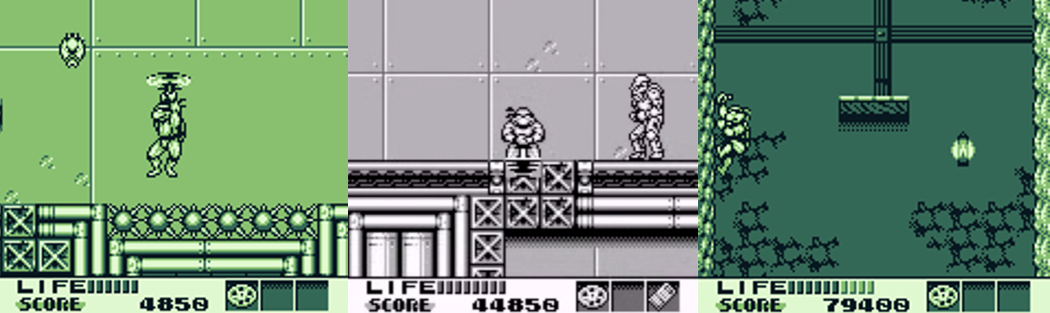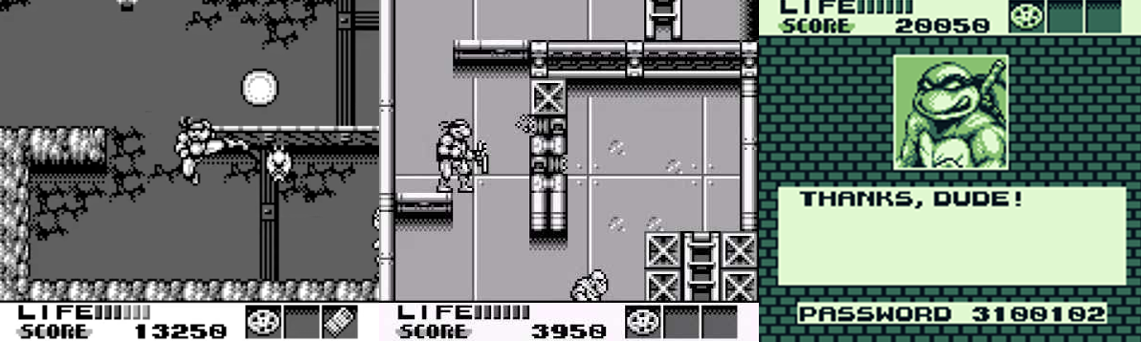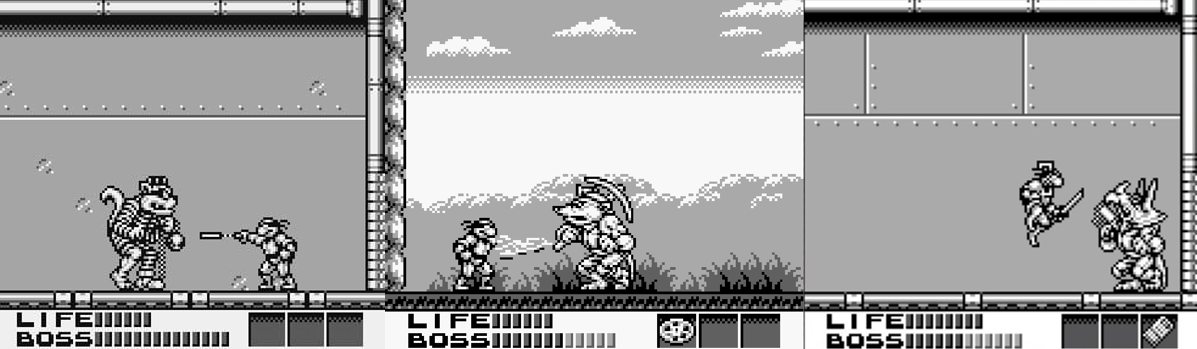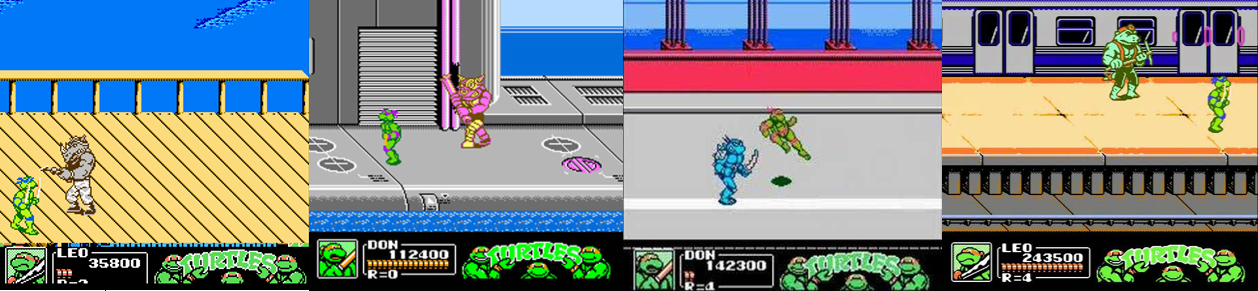
Game Corner [Turtle Tuesday]: TMNT: The Hyperstone Heist (Xbox Series X)


The first issue of Kevin Eastman and Peter Laird’s Teenage Mutant Ninja Turtles (TMNT) was published in May of 1984. Since then, the TMNT have gone on to achieve worldwide mainstream success thanks not only to their original comics run but also a number of influential cartoons, videogames, and wave-upon-wave of action figures. This year, I’m emphasising third entries and time travel shenanigans in the popular franchise every Tuesday in May!


GameCorner

Released: 30 August 2022
Originally Released: 11 December 1992
Developer: Digital Eclipse
Original Developer: Konami
Also Available For: Mega Drive, Nintendo Switch, PC, PlayStation 4, PlayStation 5, Xbox One, and Xbox Series S

The Background:
Kids in the late-eighties and early-nineties were enamoured by the Teenage Mutant Ninja Turtles (known as Teenage Mutant Hero Turtles here in the UK), with the game-changing cartoon dominated the airwaves years before Mighty Morphin’ Power Rangers (1993 to 1996) and Pokémon (1997 to present). Though the cartoon was far tamer than the original Mirage Comics, the TMNT’s popularity not only spawned a series of live-action movies (of varying quality), comic books, a whole slew of action figures, and numerous videogames. Konami’s laid the foundation for some of the franchise’s most memorable videogames with their original TMNT arcade game and the developers only expanded upon those efforts with the much-beloved sequel, Teenage Mutant Ninja Turtles: Turtles in Time (Konami, 1991). Not only was Turtles in Time bigger and better, while still retaining the simple pick-and-and-play mechanics of an arcade beat-‘em-up, it also gained further popularity thanks to a surprisingly faithful home console port. In addition to an unfairly criticised 2.5D remake in 2009, Turtles in Time served as the basis for this Mega Drive title, though there were some notable differences between the two versions, particularly regarding their length. Indeed, while The Hyperstone Heist was praised for its graphics and gameplay, its difficulty was criticised at the time. For decades, gamers were forced to pay through the nose for ridiculously expensive physical copies of the game, or resort to emulating the title, but that all changed when The Hyperstone Heist was included in this Cowabunga Collection alongside a host of other games and quality of life features.

The Plot:
The Turtles leap into action when their archnemesis, Oroku Saki/The Shredder, uses the power of the mysterious Hyperstone to shrink and capture half of Manhattan Island, battling through waves of Foot Soldiers to put an end to the Shredder’s bid for world domination.

Gameplay:
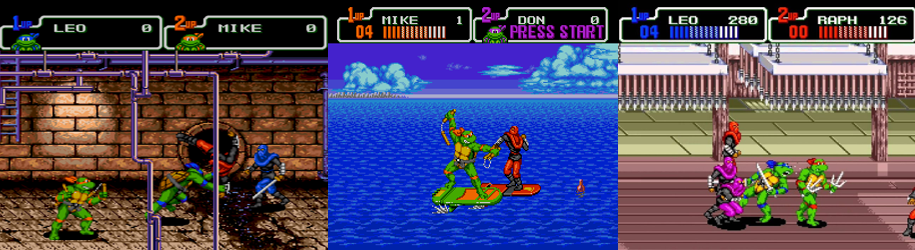
If you’ve played Turtles in Time then The Hyperstone Heist will be immediately familiar to you; the game is, essentially, a stripped down and patchwork reordering of the classic arcade time travel jaunt. Just like the two arcade titles that preceded it, The Hyperstone Heist is a 2D sidescrolling beat-‘em-up that allows up to two players to battle side by side across five stages, with each comprised of a number of different areas unlike Turtles in Time and even including some entirely new stages and bosses. Since I’m playing this version on the Xbox Series X, it should be no surprise that this game can now be played both on- and offline co-operative play, and you can even opt to turn friendly fire on or off to make things a little harder, or easier, on yourself when playing with a friend. Players can once again select from one of the four Ninja Turtles; each one controls exactly the same and are defined primarily by the reach of their weapons (putting characters like Leonardo and Donatello at an advantage). Gameplay couldn’t be simpler; you go from the left side of the screen to the right using X to pummel baddies with some simple combos, B to jump, and X in mid-air to pull off a couple of jumping attacks depending on how high you are when you press it. If you press B and X together, you’ll pull off a power attack at the cost of some health, and you can press Y to dash ahead. While you can pull off dash attacks in this way, it can be a bit clunky as I find the dash works better as a double tap of the directional pad and, while you can no longer toss enemies at the screen, you can still slam them by attacking up close and fend off enemies attacking from behind with a back attack.

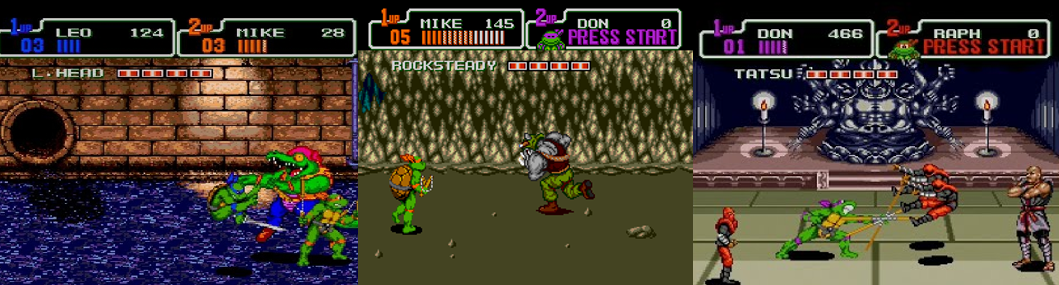
Gameplay is ripped from Turtles in Time but includes some new stages and mechanics.

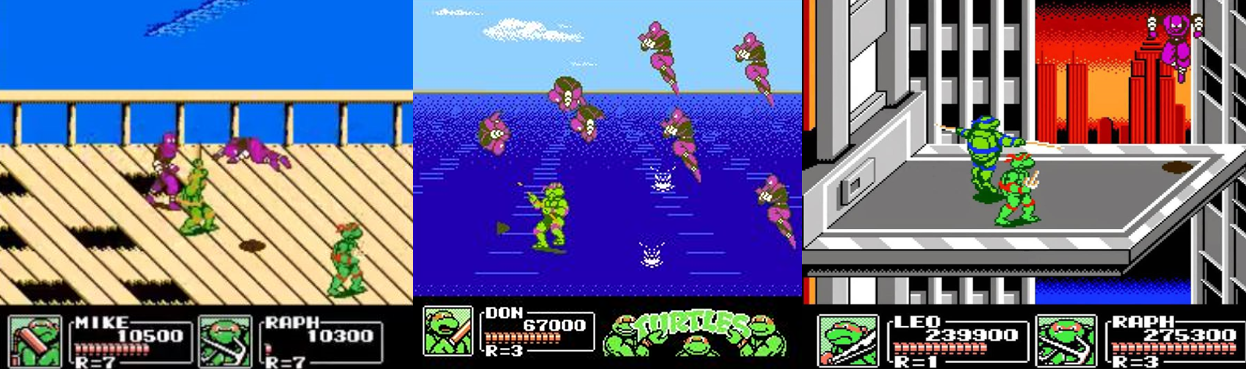
Although The Hyperstone Heist has less stages than Turtles in Time, they’re much longer and even include transitions between different screens/areas; so, while you start in the sewers in this game, you hop up to the streets and play through a section of Alleycat Blues before dropping down into an alternative version of the Sewer Surfin’ stage. As ever with these TMNT arcade titles, there are a few opportunities to interact with the environment; traffic cones, candlesticks, barrels, explosive drums and boxes of fireworks and fire hydrants can all be used to take enemies out. While the game is lacking some of the more memorable stage hazards like Krang’s giant android body and the wrecking balls, many of these still crop up throughout certain stages; you can fall down holes, without fear of damage, to avoid attacks, step on loose planks, and injury your toes on spiked hazards. Turrets will pop up to freeze you solid, enemies can still grab and hold you for a beating, and electrical bolts and lasers will also still fry you to your skeleton. While you’ll still hop onto a rocket-powered board to fend off enemies across the ocean, these autoscrolling sections are limited to just the one instance here; things are mixed up a little with a high abundance of health-restoring pizza, flying Mousers, and lots of wreckage from the ghost shop to dodge and interact with, however. The Hyperstone Heist also includes the Technodrome stage that featured in the home console port of Turtles in Time, complete with the traditional elevator gauntlet section (only now the elevator goes down instead of up), but also shows its limitations and laziness by dedicating an entire stage to a boss rush (without any pizza to heal yourself up).

Graphics and Sound:
On a base level, The Hyperstone Heist is functionally very similar to the home console port of Turtles in Time, sporting the same heads-up display, similar sprite work, and the same environments and enemies, but it can’t be denied that the whole game has suffered a visual downgrade. This is evident right from the title screen, despite a unique new introductory sequence, and the far less impressive voice clips and limited animation frames. The TMNT even seem to be slightly out of proportion compared to their enemies, something I never noticed in the two versions of Turtles in Time, and the game is far more reliant on text, with dialogue featuring before and after each boss encounter. Still, everything looks and feels very true to the game’s arcade roots and continues to capture the quirky, slapstick nature of the animated series with its cartoony presentation and sound effects. The gameplay is noticeably slower, however, thanks to the lack of a turbo mode and it feels like a longer, far more tedious experience thanks to the levels dragging on a bit and the sheer number and aggression of enemies at any one time.

Some new areas, a new ending, and reshuffling of stages help the game stand out.

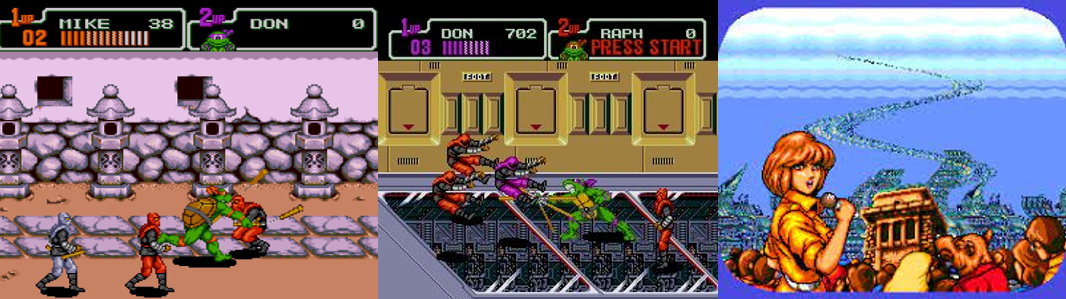
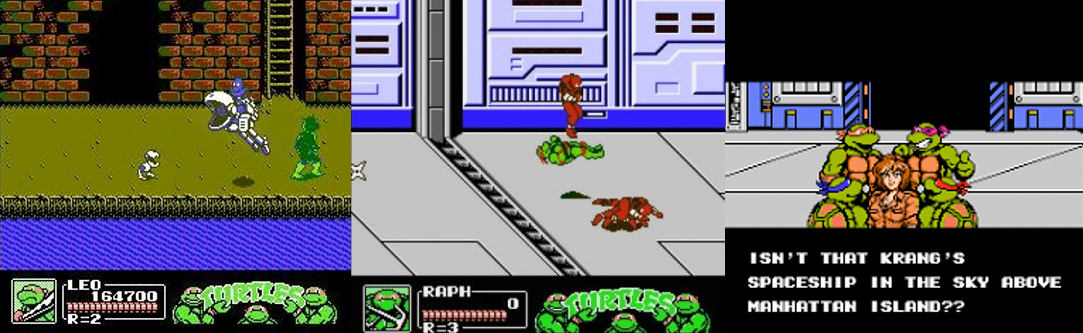
For the most part, the game’s levels are ripped right out of Turtles in Time, specifically the home console port; Sewer Surfin’ has been reduced to an on-foot stage (though the Pizza Monster still somehow jump out of the water), Alleycat Blues is a transition between the two sewer stages, and the pirate ship has been redesigned into a ghost ship, with the cave from Prehistoric Turtlesaurus now a transition to the Shredder’s secret lair thanks to the lack of a time travel plot. The game has supplanted the time travel stages of Turtles in Time with entirely new environments, with this most apparent in Scene 3 where you battle across a cliff top into a Japanese temple and a dojo where Shredder trains his disciples. Turtles in Time’s more visually interesting stages, like Prehistoric Turtlesaurus and Neon Night Riders, are replaced by a simple damp cave and a less thrilling water chase sequence, though the Technodrome remains largely unchanged. The final stage is also largely the same, though the Statue of Liberty has been replaced by this weird eldritch abomination of a machine in the background. Some of Turtles in Time’s cutscenes are also included, though altered to fit the slightly changed plot, and an entirely new ending sequence and defeat animation for the Shredder has been included that features some decent sprite work and partially animated sequences.Finally, the game’s soundtrack is largely the same as Turtles in Time’s but noticeably sped up and lacking in the oomph heard in the arcade release.

Enemies and Bosses:
As far as I could tell, every enemy you face in The Hyperstone Heist is ripped right out of the home console version of Turtles in Time. This means you’ll be fending off an endless swarm of robotic Foot Soldiers, each sporting different coloured pyjamas and different weapons, including throwing stars, swords, nunchaku, daggers, and tonfa. There is one new variant, however; a magenta-coloured ninja who breaths fire at you! Also returning are the Mousers (which scurry about and bite your hand), Roadkill Rodneys (which electrocute you with whips and fire lasers at you), these little laser firing spider-bots, and the Xenomorph-like Pizza Monsters. The Rock Soldiers also make an unwelcome appearance, generally in groups of at least three, to charge at you and fire heavy-duty ordinance right in your face. While many of the stage hazards return from Turtles in Time, you’ll spot a couple of new ones in Scene 3 thanks to this being an entirely new stage; these include a spiked ceiling, spiked bamboo canes that pop up from the floor, and ceremonial armour that fires electrical lasers at you.

After two copy/paste boss battles, Tatsu is a welcome, if easy, addition.

Every stage ends in a boss battle, with all of the bosses but one being repurposed from the two previous TMNT arcade games, though each sport a helpful life bar like in Turtles in Time’s home console port. After battling through the sewers and the city streets, you’ll face off against the monstrous Leatherhead. While the arena might be different, Leatherhead’s strategy is exactly the same as in Turtles in Time; he hops and scurriesabout, punching you or swiping with his tail up close and tossing daggers from across the screen, and basically sets the template that’ll work for every boss in the game which is get in there, land a quick combo, and jump away before you take a hit. After fighting through the decidedly unhaunted ghost ship, you’ll fight Rocksteady; sadly, there’s no Bebop in this game and this is basically just a copy/paste of his solo fight from the original arcade game as he charges at you, fires a machine gun in a spread, and tosses a few grenades into the arena, leaving himself wide open for your attacks in the process. Thankfully, the game does include a new boss battle at the end of Scene 3; here, you’ll face Tatsu from the first two live-action movies. Although he threatens that you’ll have to defeat his minions first, the Foot Soldiers actually fight alongside him, but it’s pretty simply to focus on him, avoiding the darts he fires across and rains down the screen, and pummelling him when he stands still.

Although the final bosses can be challening, the boss rush was a lazy addition to the game.

As mentioned, The Hyperstone Heist drops the ball somewhat with Scene 4, which takes place entirely in a dank cave and forces you to battle all three bosses again, one after the other, in what is fittingly called “The Gauntlet”. To be fair, the Pizza Monsters do show up again and all of the enemy sprites now have a new colour palette, and there’s no health here or in the final stage to help you through, but it’s pretty damn lazy to just shoehorn in a boss rush like this. On the plus side, it does culminate in a battle against Baxter Stockman that’s again ripped from the first arcade game; Baxter hovers about in this craft dropping Mousers on you and generally being a hard target, but I would’ve preferred to see an original stage ending in this boss fight. Similarly, you’ll again face Krang in the Technodrome but its in an adapted version of the Neon Night Riders battle rather than him being in his UFO; Krang’s android body dashes at you with a kick, smacks you with a clap attack, fires missiles from his chest, and rains bombs into the arena, but he still likes to gloat and leave himself an open target. Finally, you’ll take on the formidable Super Shredder in the game’s last stage just like in the home console version of Turtles in Time. While Super Shredder’s attacks and strategy remain the same, he’s been tweaked slightly; his projectiles and aura are now coloured coded, with blue bolts freezing you, green fireballs instantly killing you by reverting you to a normal turtle, and red flames hurting your toes.Additionally, I was only able to land a hit on Super Shredder when he was firing his freezing shot and he still hovers and dashes about to make himself an annoying target.

Power-Ups and Bonuses:
The Hyperstone Heist features exactly the same power-ups as those seen in Turtles in Time, namely the odd pizza to restore your health and one single, solitary Pizza Power item that sends you into a short-lived frenzy. You will also be awarded an extra life at every 100, 300, 500, 700, etc points, which is useful if you find yourself struggling.

Additional Features:
Similar to the home console version of Turtles in Time, The Hyperstone Heist features a few options you won’t see in the arcade releases; you can play on three different difficulty levels (Easy, Normal, and Hard), with different endings assigned to each one, set your lives and continues to anywhere from one to five, enable or disable back attacks, and make use of a sound test. The game may have taken a further graphical hit during the conversion, and there’s no versus or time trial mode, but you can still pick between two colour schemes, “Comic” and “Anime”, which gives the TMNT new colour palettes in a nice touch. As you’d expect, the Cowabunga Collection adds some extra features to the game; you’ll earn a 70G Achievement for completing each game on any difficult level, rewind the gameplay with the Left Bumper, and use the Right Bumper to access save states and display options. You can also choose your starting level and enable some additional lives using the collection’s enhancements, flick through a strategy guide, choose between the American and Japanese versions (with minimal differences that I could see), view the game’s box art and manuals, or simply watch the game play itself.

The Summary:
Naturally, there’s a lot to like about Teenage Mutant Ninja Turtles: The Hyperstone Heist, specifically because it’s built on and is essentially a rejigged version of one of the most beloved TMNT arcade games ever made. However, while the gameplay and presentation owes pretty much everything to Turtles in Time, there’s just enough here to allow The Hyperstone Heist to stand on its own two feet. The new stages, environments, and the way it shuffles Turtles in Time’s stages around to fit its slightly changed narrative makes for a fun and action-packed gameplay experience that’s both similar and altogether very different. Most noticeably is the face that Turtles in Time was a short, sharp arcade style experience that never outstayed its welcome, but The Hyperstone Heist certainly drags on thanks to its long stages. While this is great for longevity, it equals not just unnecessary padding but also highlights just how repetitive the beat-‘em-up gameplay is and draws undue attention to the graphical hit the game has taken in the conversion to the Mega Drive. The same trappings that restricted its two arcade predecessors remain but are more glaring as there’s only one Pizza Power power-up and the inclusion of a lazy boss rush and lack of additional gameplay options and mechanics certainly makes it inferior to its arcade and Super Nintendo counterparts. However, it’s easily the best and most entertaining TMNT videogame on the Mega Drive; it’s not quite as good as Turtles in Time but it’s good enough to be a decent brawler for the system and, while the additional features in this version are somewhat lacking compared to other games in the Cowabunga Collection, it’s great to see this rare and expensive gem of a fighter readily available for a new generation of gamers.

My Rating:

Rating: 4 out of 5.

Great Stuff

Did you ever own Teenage Mutant Ninja Turtles: The Hyperstone Heist on the Mega Drive? How do you think it compares to both versions of Turtles in Time? What did you think to the redesigned and additional stages? Were you disappointed by the artificially enhanced length of the game and the lack of new boss battles? Which of the characters was your go-to and what did you think to the additional features added to the Cowabunga Collection? Whatever you think, feel free to share your memories of The Hyperstone Heist down in the comments or on my social media.

Movie Night [HulkaMAYnia]: The Death of the Incredible Hulk


Since his explosive debut in May 1962, Stan Lee and Jack Kirby’s gamma-irradiated Jade Giant has been one of their most recognisable and successful characters thanks, in large part, to the Incredible Hulk television show (1977 to 1982) catapulting the Hulk into a mainstream, pop culture icon. The Hulk has been no slouch in the comics either, being a founding member of the Avengers and undergoing numerous changes that have made him one of their most versatile and enduring characters, so what better way to celebrate all things Big Green than by dedicating every Sunday in May to the Green Goliath?


Released: 18 February 1990
Director: Bill Bixby
Distributor:
New World International
Budget:
Unknown
Stars:
Bill Bixby, Lou Ferrigno, Elizabeth Gracen, Andreas Katsulas, and Philip Sterling

The Plot:
Desperate to rid himself of his destructive alter-ego, the Hulk (Ferrigno), Doctor David Banner (Bixby) poses as a janitor to gain access to a research facility he believes may be the key to finding a cure. However, when the kindly scientists assisting him are kidnapped, he must join forces with an unlikely ally and once again rely on his monstrous persona to rescue them.  

The Background:
The brainchild of Marvel Comics legends Stan Lee and Jack Kirby after learning of a hysterical mother exhibiting superhuman strength, the Hulk initially struggled to find an audience with Marvel readers but shot to fame thanks to his popular television show, The Incredible Hulk (1977 to 1982). The show ran for eighty episodes and firmly established the Green Goliath in the cultural consciousness thanks to coining the unforgettable “Don’t make me angry. You wouldn’t like me when I’m angry” line and standout performances by star Bill Bixby and Lou Ferrigno, who would forever be associated with the character. About six years after the series finale, the first of three made-for-television movies was produced; apparently intended as a backdoor pilot for Thor (Eric Kramer), The Incredible Hulk Returns (Corea, 1988) was successful enough to warrant a follow-up that was also hoped to be a pilot for a potential Daredevil spin-off. The Trial of the Incredible Hulk (Bixby, 1989) was met with mixed reviews, but a third film followed regardless; initially believed to have featured the debut of Jennifer Walters/She-Hulk, The Death of the Incredible Hulk ultimately spelt the end for the long-running series following Bixby’s untimely death and plans for a fourth film that would’ve merged Banner’s intelligence with the Hulk’s strength were shelved.

The Review:
Growing up as a kid in the nineties, it was kind of tough for comic book fans such as myself; DC Comics characters received the most representation in live-action media at the time, so we mostly had to console ourselves with the awesome Marvel cartoons that aired during this period. If we wanted to see live-action interpretations of Marvel’s colourful heroes, we had no choice but to turn to the made-for-television efforts of the seventies and eighties but, honestly, I remember being awestruck seeing the likes of Peter Parker/Spider-Man, Steve Rogers/Captain America, and the Incredible Hulk brought to life in live action. Expectations were much lower then, and I was just a naïve youth who had no idea that these characters would come to dominate cinema screens so successfully; plus, The Incredible Hulk wasn’t airing on any channel I could watch at the time, so having access to these TV movies was seen as blessing. I say all this to provide a little historical context for the nostalgia I feel towards Bill Bixby and Lou Ferrigno’s efforts on The Incredible Hulk; while I actually have come to find many of the episodes I have watched to be quite laborious, I have a great appreciation for the TV movies giving me the briefest glimpse of the potential these characters had in live-action.

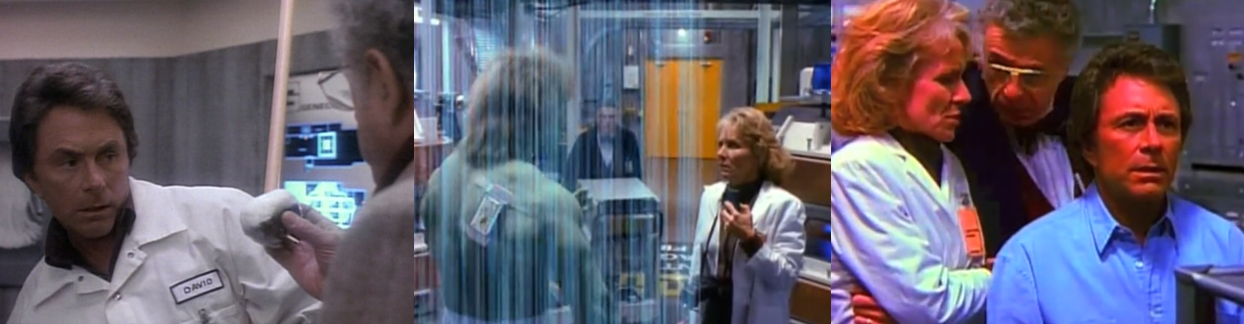
Banner finds himself with a surrogate family who enthusiastically try to help rid him of his curse.

The movie opens to find Banner now posing as “David Bellamy” and disguising his genius behind the persona of a well-meaning, but a mentally-challenged, janitor in order to secretly access to Doctor Ronald Pratt’s (Sterling) research on human healing. This masquerade allows Banner to win the hearts and sympathies of his co-workers, the security guards, and Dr. Pratt, who all see him as a harmless, if forgetful and easily confused, middle-aged man. Interestingly, Banner maintains this masquerade outside of work, and this, as much as the pocketful of cash, makes him an easy target for a group of street punks. Naturally, this triggers a transformation into the Hulk, which only accelerates his search for a cure; it turns out that Banner has been watching the routines of the guards, meaning he’s able to trick them with a tape recorder into thinking he’s left for the night, and has access to Dr. Pratt’s lab thanks to knowing his keycode. Luckily for Banner, the facility doesn’t have any security cameras, so he’s free to work throughout the night using Dr. Pratt’s resources, making corrections to his formulas in the hopes of finally discovering a cure to his monstrous affliction. Banner’s alterations to Dr. Pratt’s formulas do not go unnoticed, however; he’s stumped to find his notes changed for the better and incredulous when his wife, Amy (Barbara Tarbuck) suggests that his invisible partner is a ghost. Determined to find out who has been able to slip past the facility’s “high security”, Dr. Pratt hides out in his lab late one night and is shocked to find David is his mysterious helper; however, he’s even more shocked when David reveals his true identity, and is eager to hear about Banner’s research and what’s driven him to such desperate measures. Sympathetic to Banner’s plight, and believing that he can cure him while also potentially benefiting others by studying the Hulk’s incredible healing abilities, Dr. Pratt convinces Banner to work with him and, over the course of a heart-warming montage, Banner is taken in by the Pratt’s and becomes something of a surrogate son to them. After so many years alone and on the run, Banner is clearly grateful to have friends around him for the first time in forever; he forms a fast friendship with Dr. Pratt and Amy, who welcome him into their home and work with him to construct a machine capable of containing the Hulk and turning his strength against him. Dr. Pratt is infuriated when his superiors threaten to shut his experiments down unless he turns his research towards military applications, and they’re thus given one chance to rid Banner of the Hulk forever, and Banner is fully accepting that the procedure could cost him his life.

Jasmine, mistress of disguise, faces stern reprisals when she fails to steal Dr. Pratt’s research.

Unfortunately, Dr. Pratt’s Gamma research attracts the attention of Kasha (Katsulas),a powerful underworld figurehead who wishes to obtain the doctor’s secrets and sell them to the highest bidder. To fulfil this objective, he blackmails Eastern European spy Jasmine (Gracen) into taking on the assignment; having “served” Kasha since she was fourteen, Jasmine believes that she has completed her duty to her employers, who seem to be a kind of vaguely defined religious organisation. Somewhat akin to Natasha Romanoff/The Black Widow, Jasmine is a much-accomplished spy whose favoured tactic is to adopt a series of disguises and false identities to get close to her targets, usually luring them in with her sexuality, and take information from under the noses. Although she has no wish to further serve Kasha, she is easily overpowered by his sadistic henchman, Zed (Joh Novak), and compelled to obey when Kasha reveals that their sect’s mysterious new leader, Ashenko, threatens the life of Jasmine’s beloved sister, Bella (Anna Katarina). Jasmine throws on her best wig and fake accent to seduce one of the facility’s security guards and take his fingerprints, then disappears amidst the crowd with a simple costume change in order to pose as Betty (Chilton Crane), another of the lab’s security guards. Unfortunately for Banner, Jasmine chooses to carry out her mission at the exact moment that he’s strapped in to Dr. Pratt’s machinery, forcing Dr. Pratt to shut down the experiment and costing Banner his last, best chance at a cure. Naturally, this causes Banner to Hulk-out and his monstrous alter ego to be blamed for the resulting destruction and Dr. Pratt’s injury, despite the fact that he carried the comatose scientist to safety, and Jasmine is reprimanded for having failed in securing the data Ashenko required.

Banner and Jasmine’s romance is cut short when he’s compelled to save his loved ones.

Amy is as devastated by Dr. Pratt’s condition, which sees him lost to the slumber of a deep coma, as she is concerned for Banner’s safety; she covers for him when federal agents finger him as one of three terrorist infiltrators (with Jasmine and the Hulk being the other two) and creates a distraction so he can slip away. However, with Dr. Pratt incapacitated, Jasmine’s only lead is also Banner, which leads to him being pursued by Kasha’s minions; having seen her efforts to try and pull Dr. Pratt to safety in the lab, and unable to simply allow Kasha’s men to kill her in cold blood, Banner lashes out when she’s ordered to be killed and she’s left both distraught and shocked when her friend and minder, Pauley (Mina E. Mina), tells her with his dying breath that Ashenko is Bella and has taken control of their cause. Banner aids Jasmine after she she’s injured by a gunshot; despite her horror at Banner’s affliction, Jasmine helps Banner to get to Dr. Pratt in gratitude for his assistance and, thanks to his knowledge of Dr. Pratt’s work and life, Banner’s able to help wake him from his coma with an emotional plea. After Banner Hulks-out and Jasmine sees the tortured horror of the Green Goliath, the two enter into an unexpected romance in her secluded cabin; both are being hunted, both have spent years alone and being used or forced into being a weapon, and both are eager to escape from the world. However, their hopes of starting a new life together are dashed when Jasmine’s past comes back to haunt her; Bella has Dr. Pratt and Amy apprehended in the hopes of discovering his formula, and Banner is compelled to intervene, a decision that not only causes great dismay to Jasmine, who simply wants them to run away together and be free, but also ultimately spells the end of Banner’s long nightmare.

The Nitty-Gritty:
It’s a bit of a shame that The Death of the Incredible Hulk is lumbered with this uninterested spy-story subplot; maybe if Jasmine had been the Black Widow, that might have made it a bit more compelling (and also would have tied into the TV movies guest starring other Marvel heroes), but Jasmine’s not an especially interesting character and it’s difficult to really care to much about the cause she once served. The mid-movie reveal that Bella is the mastermind behind this malicious organisation doesn’t really carry too much weight for me as Banner was constantly running afoul of the criminal underworld and they took many different names and forms. It also doesn’t help that Bella, despite her steely demeanour and cold-hearted vindictiveness, isn’t as charismatic as Kasha or alluring as Zed, so she doesn’t make for a very interesting villain since all we really know about her is that she wants Dr. Pratt’s formula and will do anything to get it, including ordering her sister’s death.

The Hulk remains a highlight, and performs a number of heroic feats despite his reputation.

As ever, it’s the Hulk himself who proves to be the main highlight of the film for me; Lou Ferrigno absolutely dominates the screen with his stature, physicality, and animal fury and there’s some fun scenes of him tossing around street punks, crashing through walls, bending steel, and holding back two diggers to help sell the Hulk’s rage and strength. More than ever, the Hulk is treated as a devastating affliction that Banner is desperate to be rid of; obviously, by this point, Banner has lived with the Hulk or many years, and been on the run so long and lost so much that he’s literally at the end of his tether and just wants to be rid of the beast. In recounting his arrogance and impatience to harness humanity’s capacity for superhuman strength, Banner muses that the Hulk is a mutation, something inhuman, and perhaps a missing link in mankind’s evolutionary process, which firmly paints the beast as a disease that could one day cause serious harm to others. Thanks to Dr. Pratt’s experimentations, Banner is able to see the Hulk for the very first time and is utterly horrified by the beast’s rage and monstrous appearance, and yet there is still the capacity for good within the Green Goliath; not only is the creature generally depicted as either reacting ins elf-defence or coming to the aid of others (such as Jasmine), but it’s superhuman ability to heal wounds potentially spells a medical breakthrough for Dr. Pratt’s research. Indeed, both Banner and Dr. Pratt are not just in awe but almost terrified at the Hulk’s healing ability, which has left Banner without a physical scar but also haunted by his uncontrollable alter ego, which is functionally immortal. Banner theorises that catastrophic damage to the creature could kill it, but he’s more focused on ridding himself of the beast so that he can be fully human again, which leads to a series of tests being conducting by the two scientists to better understand the nature of the Hulk. Thanks to Dr. Pratt’s resources, the beast is effectively caged behind an energy field, and the movie goes a little further than its predecessors in examining the complex relationship between Banner and the Hulk since he sees it as a threat to others that has stolen his life, Dr. Pratt sees it as a once in a lifetime chance to potentially cure all diseases, and Amy believes that the creature is more human than either of them will admit.

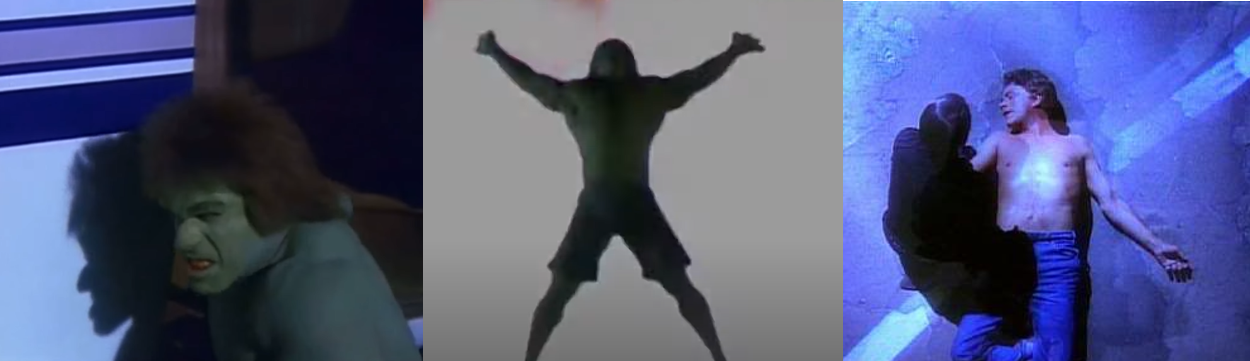
Ultimately, the fall is too devastating for even the Hulk and Banner finally finds his freedom.

At first glance, it seems as though the movie’s title is referring to the fact that Banner will finally be rid of his monstrous alter ego, however it quickly becomes apparent that Dr. Pratt’s research is yet another dead end for the ill-fated Banner thanks to the machinations of Kasha and Bella. When Dr. Pratt and Amy are kidnapped, Banner’s last chance to escape the world with his newfound love is dashed as he cannot simply walk away from his surrogate family, and Jasmine begrudgingly leads him to an airfield, where Bella uses every means at her disposal to try and forcibly extract the information she requires from Dr. Pratt. Although Jasmine is unable to reach her sister, who has fully bought in to the brainwashing of her righteous cause, the two lead the Feds to the airfield, providing them with the backup and firepower they need to stave off Bella’s men; in the fracas, Bella guns down Kasha, the Pratts are rescued, but Bella and Zedd manage to escape in a small aircraft. The horror of seeing the two trying to run down jasmine is enough to trigger one last Hulk-out in Banner, who sprints across the landing strip and confronts the two aboard the plane. Naturally, Bella tries to fire on the Hulk but succeeds only in destroying the craft in mid-air, causing the Hulk to dramatically and tragically plummet to the cold concrete below. Having suffered a catastrophic fall, the Hulk is barely clinging to life and even his incredibly healing powers aren’t enough to save Banner this time; as Dr. Pratt and Amy look on, heartbroken, Jasmine begs Banner to stay with her and he bids her an emotional farewell, seemingly grateful to finally be free of his nightmare in death. Sadly, as poignant as this moment is, it is somewhat undermined by the ridiculousness of the Hulk’s plummet; filmed in slow motion and accompanied by a melancholy song, it’s hard not to focus on Ferrigno’s eye-popping face expressions. Thankfully, Banner’s final words (“Jasmine…I am free…”) and Joe Harnell’’s “Lonely Man” theme kick in just in time to allow Banner’s death to have the required emotional impact (there’s a definite sense of relief that he’s finally found the freedom he’s long searched for), but I can’t help but feel a slower, more tragic rendition of “The Lonely Man” would have been soundtrack enough for the character’s unexpected swansong.

The Summary:
Well, this was a sadly anticlimactic, disappointing, and forgettable end for the Jade Giant. It’s a shame that so many compromise shave to be made to appreciate The Death of the Incredible Hulk; obviously, there was no budget or the technological ability to have the Green Goliath go out in a blaze of glory like we’d see in the comics, making for an inconspicuous death that’s really selling the Hulk short. Long-term fans of the TV show, however, or those with little knowledge of the character outside of the show, would potentially have more to gain from this final outing. The story being told is decent enough; Banner has clearly reached a point that’s beyond desperation where he’s willing to accept the freedom offered by death if it means being rid of his curse. The exploration into the Banner/Hulk dynamic was interesting, and one not really explored in the same way in the previous two films, but isn’t capitalised on as well as it could have been. I think I would have preferred to see a less literal death and maybe more of an understanding between the two where Banner accepted that the Hulk was part of him and thereby, maybe, overcame his rage and hinted towards a merger of the two characters. Instead, that’s kind of swept aside in favour of reinforcing what we already know about the Hulk; he’s once again a rage-filled monster who’s ruined Banner’s life but it’s pretty clear that he just wants to be left alone, only lashes out at those who seek to harm him (or were harming Banner), and goes out of his way to protect others. Ultimately, the Hulk chooses to pursue those who’ve hurt his friends and loved ones and it costs him his life, but I think it might’ve been equally interesting if the Hulk had sacrificed himself to allow Banner to survive the fall, thereby proving Amy’s theory that he’s more human than anyone would care to admit. Sadly, we never got to see Bixby reprise his iconic role or to see the surely bat-shit crazy way that the producers would have undone this ending, which remains a relatively tragic finale for the character that really belongs in a far better movie.

My Rating:

Rating: 2 out of 5.

Could Be Better

Have you ever seen The Death of the Incredible Hulk? What did you think to the relationship between Banner and the Pratts? Were you hoping to see Banner finally cured of his affliction? Did you enjoy the spy subplot and what did you think to Jasmine? Did you believe her romance with Banner? What was your reaction when the Hulk plummeted to his death? What’s your favourite Hulk story, character, or piece of media? How are you celebrating the Hulk’s debut this month? Whatever your thoughts on the Hulk, feel free to leave them below after signing up or drop a comment on my social media.

Movie Night: Guardians of the Galaxy Vol. 3

Released: 5 May 2023
Director: James Gunn
Distributor: Walt Disney Studios Motion Pictures
Budget: $250 million
Stars: Chris Pratt, Bradley Cooper/Sean Gunn, Chukwudi Iwuji, Zoe Saldaña, Karen Gillan, Vin Diesel, Dave Bautista, and Will Poulter

The Plot:
Still reeling from the death of Gamora (Saldaña) and the subsequent return of a past version of her, the Guardians of the Galaxy are attacked by superpowered bounty hunter Adam Warlock (Poulter). With Rocket (Cooper/Gunn) critically injured, Peter Quill/Star-Lord (Pratt) leads the Guardians in discovering their friend’s horrifying origins, which brings them into direct conflict with the deranged High Evolutionary (Iwuji).

The Background:
Although they’re one of Marvel’s more obscure properties and have undergone numerous changes over the years, the Guardians of the Galaxy turned out to be a massive financial success when they made their live-action debut in the Marvel Cinematic Universe (MCU) with Guardians of the Galaxy (Gunn, 2014). To capitalise on this, and to promote the team as being as integral to the MCU as the Avengers, the cast and crew returned for Guardians of the Galaxy Vol. 2 (ibid, 2017), which proved to be an even bigger financial success than the first film despite being met with mixed reviews. Despite having had plans for a trilogy right from the start, director James Gunn seemed to flip-flop on whether he’d return for a third movie; however, after completing a script and entering pre-production, his involvement was placed in serious jeopardy when he was fired after a series of offensive tweets made the headlines. Gunn publicly apologised for the tweets and fans and cast members rushed to his defense, and he was eventually brought back to helm the project later that year. However, much had changed in those few months; stars Dave Bautista and Zoe Saldaña expressed a desire to retire from their roles and Gunn was later named as the creative force behind a reboot of the rival DC Comics cinematic universe, not to mention Gunn’s displeasure at Gamora’s unexpected death in Avengers: Infinity War (Russo and Russo, 2018). Still, he worked around these issues and was even allowed to film a short, holiday-themed passion project surrounding these characters and craft an emotional finale for the franchise. While visual effects naturally played a large part in the third film, Gunn also strived to include more practical effects to bring the surreal locations and creatures to life; though he was largely kept in the dark about the character until shooting began, Will Poulter was cast as Adam Warlock to kick-start further explorations of the character in later MCU films, while Chukwudi Iwuji was cast as the High Evolutionary, beating out fellow cosmic villain Annihulus to create the MCU’s cruellest villain to date. Guardians of the Galaxy Vol. 3 eventually made nearly $850 million at the box office and was met with positive reviews; critics lauded the film as the best MCU movie in recent memory for its emotional and visually imaginative presentation, though it was also criticised for its depiction of animal cruelty and for its surprisingly brutal tone.

The Review:
As much as I enjoyed Guardians of the Galaxy (and I really did; it’s surprising how well it works as this bizarre, sci-fi/action romp, especially as it introduces a whole team of characters and explores a side of the MCU that’s so divorced from some of its more grounded action), it took me a few views to appreciate Guardians of the Galaxy Vol. 2. I was expecting bigger and better, only to find it was a more character-driven film that explored the dysfunctional family dynamic of the titular team; once I realised this, subsequent viewings allowed me to appreciate it more, especially the growth of the complex love/hate relationship between Gamora and her semi-psychotic, cyborg sister, Nebula (Gillan). Fate saw the Guardians of the Galaxy play a pivotal role in Avengers: Infinity War, one that actually ended up dooming half the life in all the universe for five years or so, but Avengers: Endgame (Russo and Russo, 2018) ended with the suggestion that the team would find new life searching the galaxy for a time-displaced Gamora alongside Thor Odinson (Chris Hemsworth). Unfortunately, this “Asgardians of the Galaxy” team didn’t really come to pass beyond a brief inclusion in Thor: Love & Thunder (Waititi, 2022); I do feel like there’s a bigger story to tell there with those characters, however, and hope that we get some kind of animated short or interlude that explored the adventures they got up to between films. Instead, Guardians of the Galaxy Vol. 3 picks up not long after the end of their Christmas special; the team operates out of Knowhere, the severed head of a Celestial that houses an entire community under their protection, and they’re still trying to wrap their heads around the fact that the Gamora they knew is dead, yet another version of her is still out there in the galaxy. This is particularly difficult for Quill, who has turned to alcohol and depression not just because he’s lost the love of his life, but because of a deep-rooted feeling of abandonment and pain as everyone he’s ever known and cared about has died. His surrogate family, the Guardians of the Galaxy, are on hand to care for him and support him, but they’re individually too maladjusted to properly communicate their feelings too him.

When Rocket’s life is endangered, the team embarks on a quest that sees Quill confronting his fears.

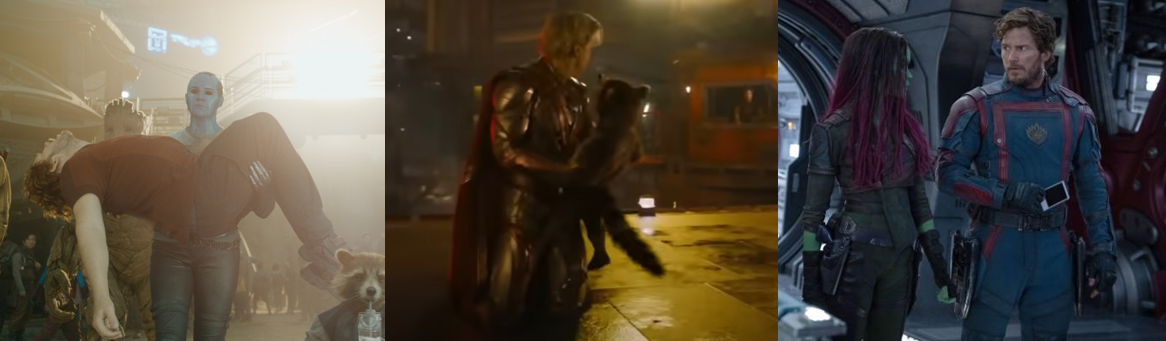
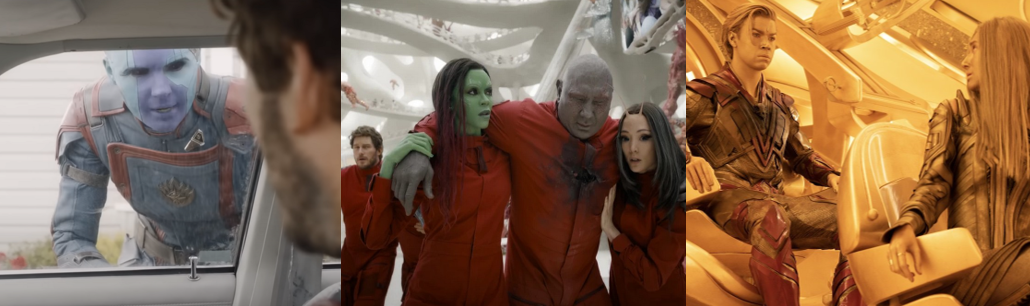
Drax the Destroyer (Bautista) is far too literally a thick-headed, living tree Groot (Diesel) is far too simplistic, and abrasive Rocket much too aggressive. Nebula, however, offers a surprising amount of support, caring for him in a way we’ve never seen before since she’s now come to regard the Guardians as her family and truly cares about them, even if her traumatic past makes it difficult for her to express emotions beyond violence. Quill takes some solace in his empathetic half-sister Mantis (Pom Klementieff), but her naïve optimism and observation that Quill has family waiting for him on Earth also do little to ease his pain. Luckily for Quill, the team is attacked by Adam Warlock, the child-like superhuman champion of the golden-skinned Sovereign; I say “luckily” as this brings the team together to fend off Warlock’s attack and defend Knowhere, a task they struggle to accomplish given his power, resulting in Rocket being critically injured. Faced with the stark reality that his self-professed best friend may die, an enraged Quill refuses to accept this and resolves to seek out Orgocorp, a highly advanced scientific research centre, in order to deactivate the kill switch attached to Rocket’s heart and keeping them from helping him. This sees them crossing paths with Gamora since Nebula arranges for Gamora and her Ravager allies to help the team infiltrate Orgocorp. This again forces Quill to be faced with the harsh truth that this Gamora isn’t the one he knew and loved; even Drax points out that she’s “dead to them” since this Gamora never hooked up with the team and has none of the memories or attachments to them. While this is a pretty simple prospect, even for the otherwise simple-minded Star-Lord, the film spends a lot of time reinforcing that he and the others don’t really understand what’s going on with Gamora; often, they talk about how she “doesn’t remember” them and Quill futilely tries to jog memories that just aren’t there and takes every opportunity to tell anyone within earshot about their complicated history, needlessly hammering home that this isn’t the same Gamora from the previous Guardians films. I understand it in a way; a big part of the film is Quill having to come to terms with death and loss, but it starts to get a little grating when he constantly harps on about it to everyone in earshot. This Gamora is much more cold-hearted and harsh compared to her counterpart; she has more in common with how Nebula used to be and there’s an interesting reframing of their narrative here as Nebula states that Gamora was “always like this” and Gamora is shown to have this dark, violent side to her that casts as more of an anti-hero. She begrudgingly helps the Guardians at Orgocorp but despairs of their ineptitude, constant bickering, and Quill’s insistence that he knows anything about her. She softens towards them over the course of the film after seeing how hard they fight to help Rocket and protect others, but nevertheless remains her own distinct character, separate from them, and it’s a testament to the film that it doesn’t just repeat the same will they/won’t they character between her and Quill from the first film.

Though aggravated by each other, the Guardians strive to help even their misguided enemies.

As for the rest of the team, Drax is mostly relegated to being the comic relief and mindless muscle of the group; his stoic demeanour allows him to process Gamora’s loss in a more productive way than Quill, but it’s clear that he misses her in his own way, too. He continues to have an attachment to Mantis and the film does explore how, despite her objections to the contrary, she uses her empathic abilities to manipulate him in ways that he’s not aware of. For example, she defends Drax’s infantile nature to Nebula, who lashes out at both of them for their incompetence, and he seems genuinely upset to learn that Mantis thinks he’s stupid (even though she loves him regardless) so she simply has him forget hearing that. despite Nebula’s anger at the two for endangering the group on countless occasions, Mantis and Drax prove their quality in the final act of the film where Mantis is able to tame the ravenous Abilisks and Drax is able to calm and communicate to the children held in the High Evolutionary’s ship since he not only unexpectedly speaks their language but also is a natural father. This theme of underestimating those around you is a prominent one in the film; even Kraglin (Sean Gunn) embodies this since he continues to struggle with mastering Yondu Udonta’s (Michael Rooker) arrow and proves invaluable in aiding the rescue effort at the end of the film, but it’s most prominently seen in Adam Warlock’s character arc. Having been born prematurely, Warlock is little more than a child in a man’s body; he’s been created as a perfect being, a living weapon to enact the will of his mother, the Sovereign High Priestess Ayesha (Elizabeth Debicki). While my knowledge of Warlock is somewhat limited, I was surprised to see him characterised as a childlike fool, but he undergoes a surprising journey in the film; he feels regret after incinerating space creature Blurp’s owner after a misunderstanding and adopts the cute little critter, then briefly abandons his crusade against the Guardians in an unsuccessful attempt to save his mother when the High Evolutionary callously obliterates her along with his “Counter-Earth”, and becomes an unexpected ally of the team by the film’s conclusion since his former enemies make efforts to save his life rather than leaving him to perish.

For his callous and cruel experiments, the High Evolutionary is easily the MCU’s most detestable villain.

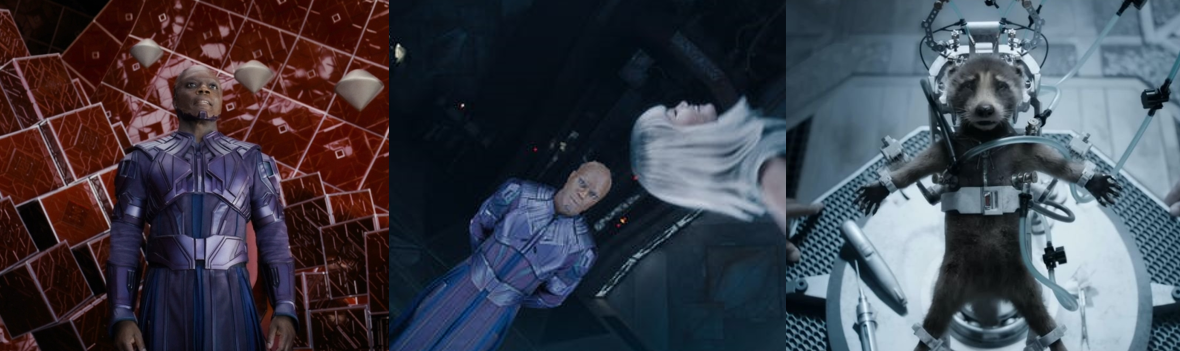
For me, the High Evolutionary ends up being easily the most reprehensible villain in all of the MCU so far. While he still doesn’t get a huge amount of screen time or backstory and the exact nature of his gravity-based powers is a little vague, this is a villain who has absolutely no redeeming qualities; we’re given no reason to sympathise with him or to understand his perception of the galaxy, and this is perfectly acceptable given his heinous actions! The High Evolutionary is a maniacal despot obsessed with “perfection”; he sees the flaws in life and God’s plan and uses his superior intellect and scientific acumen to step in to correct these flaws. His ultimate goal isn’t conquest or destruction, it’s to create the “perfect” society, which has led to him being regarded as a God by many of his creations, like the Sovereign. However, while the Sovereign are basically the embodiment of beauty and perfection, the High Evolutionary is never satisfied and the majority of his experiments are geared towards creating anthropomorphic beings and semi-cybernetic monstrosities! These live out normal lives on an exact replica of Earth, yet while he was able to suppress their natural animalistic urges and craft a society that’s a mirror of ours, he wasn’t able to create a utopia, so he habitually exterminates his creations like a child bored of a toy. While this ritualistic genocide and the High Evolutionary’s unstable, erratic God complex are bad enough, what makes him so irredeemable and reprehensible compared to other MCU villains are his callous experiments on animals. Animal cruelty is at the forefront of Guardians of the Galaxy Vol. 3 as Rocket, near death, experiences a series of flashbacks to his time as one of High Evolutionary’s test subjects. A strangely curious raccoon, he was subjected to horrific procedures that grafted mechanical parts to his body and increased his intelligence and awareness, all under the pretence that he and his fellow prototype anthropomorphs would have a place in the “new world”. However, when Rocket’s intelligence exceeded the High Evolutionary’s for a split second, the madman ordered Rocket dissected and the execution of his friends, leading to the terrified and heartbroken creature to enact a daring escape that left him traumatised and the High Evolutionary gruesomely disfigured.

The Nitty-Gritty:
Like the last two Guardians of the Galaxy movies, music plays an important role in this film, both diegetically and non- diegetically; Quill is almost irrationally protective of the Zune gifted to him by his father-figure, Yondu, which Rocket borrows without asking to find solace in the songs contained within it. Almost all of the film’s action and fight scenes are accompanied by music tracks, as is James Gunn’s signature at the point, but they weren’t as memorable for me and seemed to be a little more random rather than sticking to one era or genre of music. However, the film is very much a culmination of the character arcs began in the first one; there’s always been a question hanging over Quill about why he never returned to Earth when he clearly has the means to do so, and it’s always come down to fear disguised as lust for adventure in space. Earth is where his mother died and he has no desire to return there, especially as his memory of that day is skewed to paint his grandfather, Jason (Gregg Henry), as having pushed him away, when the reality was they were all grieving their loss. Drax, whose life was upended when his family was killed, quickly found a new purpose with his surrogate family and struggles with the idea that the team parts ways by the finale, only to rediscover his true calling not as a destroyer, but a father. Even Mantis unexpectedly decides to forge her own path after years of just doing what she’s told, Nebula grows from this unyielding, murderous assassin into a caring (if blunt) matriarch whose priorities now extend to all of Knowhere, and the film’s events eventually lead Quill to realise that this Gamora is forging her own path with the Ravagers.

The film explores Rocket’s tragic and horrific backstory in gruesome detail.

However, while Rocket spends most of this film at death’s door on an operating table, this is Rocket’s film through and through. The team is united in going to any lengths, even infiltrating the notoriously heavily guarded headquarters of Orgocorp, challenging the might of the immensely powerful High Evolutionary, and killing anyone who gets in their way, to help their friend even if it costs them their own lives. We’re treated to some incredibly emotional flashbacks that show Rocket’s time as a simple test subject, one of many of the High Evolutionary’s efforts to increase the intelligence of animals and anthropomorphise them into the “perfect” society. Rocket shares his cage with three other sentiment animals, each one horrifically mutilated by cybernetic enhancements: otter Lylla (Linda Cardellini), who Rocket becomes particularly attached to, simple minded walrus Teefs (Asim Chaudhry), and hyperactive rabbit Floor (Mikaela Hoover). Despite their gruesome appearances and the traumatic experiments they’ve been subjected to, the four are generally in good spirits; they genuinely believe that the High Evolutionary is improving them and that they’ll have a place in his new world, and Rocket impresses of them all with his unprecedented ingenuity and aptitude for mechanics that allows the High Evolutionary to perfect his technology. In their dank, cramped cage, the four dream of having a home under the sky, of flying away together and being free, and it’s absolutely devastating when the High Evolutionary violently chastises Rocket for having the gall to outthink him…even though his goal is for his creations to have independent thoughts! Insulted and enraged, he cruelly rejects Rocket and his friends and orders them to be killed, forcing Rocket to affect a daring escape using a cobbled-together key card. Sadly, the High Evolutionary anticipated this and personally shoots Lylla in cold blood right before Rocket’s eyes, driving him into an animalistic rage that leaves the High Evolutionary’s face gruesomely mangled, his friends dead in the chaos, and Rocket a deeply traumatised and embittered abomination of science. It really is an abolsutely harrowing backstory, one that was hinted at in the first film but really paints the High Evolutionary as a despicable villain, an egotistical hypocrite who simply toys with animals for his own sense of gratification and it’s extremely satisfying to see the Guardians come together to beat the piss out of him in the finale.

The Guardians unite with allies old and new to end the High Evolutionary’s heinous plot.

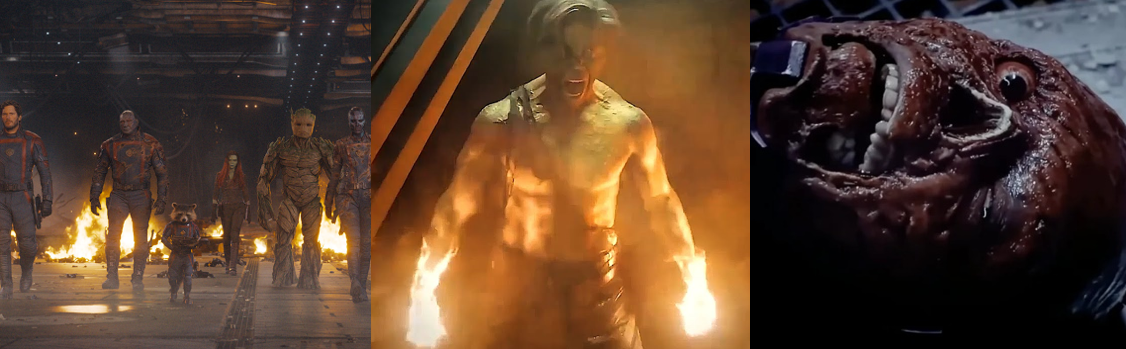
Indeed, there are some stunning cosmic scenes in Guardians of the Galaxy Vol. 3; some really fun practical and special effects help to bring an even more bizarre flavour to the MCU (though I did feel like the scene at Orgocorp dragged on a bit too long), especially when they visit Counter-Earth and encounter all these weird anthropomorphic creatures. At first, I thought that safeguarding this world against the High Evolutionary’s reprisals would be the focus of the finale and the driving force behind galvanising the team but, no…the High Evolutionary just destroys the planet on a whim, murdered its countless misshapen inhabitants, and prepares to populate a new world with his latest creations. However, despite having rejected Rocket in the past, he’s come to see that Rocket is the only one of his creations that showed true, independent ingenuity rather than following pre-programmed patterns, so he becomes obsessed with reacquiring the specimen, to the point where even his loyal followers turn against him and he’s forced to kill them without a second thought to get what he wants. To counter the High Evolutionary’s cybernetic army and immense ship, the Guardians call in Kraglin to bring Knowhere to them for a massive final showdown, once that sees all of the Guardians lay waste to an entire corridor of the High Evolutionary’s soldiers before attacking the main man himself. As mentioned, it was deeply satisfying to see him take a beating and be left for dead, literally unmasked and a quivering, deposed wreck on the floor, though it did somewhat diminish his threat since he was previously seen as nigh-untouchable. With the High Evolutionary’s ship going down in flames, Rocket begs his friends to help save not just the children but the innocent animals held captive in his cages, a campaign that appears to leave Quill dead in the frozen vacuum of space! Luckily for him, Warlock comes to his aid, but I feel this should’ve happened before Quill’s body froze solid and was disturbingly bloated as he’s clearly dead or would be left severely injured from exposure. Instead, he survives…in fact, everyone does, which I was really surprised by; there’s a moment where it seems like Nebula might die piloting the High Evolutionary’s ship, Drax is almost killed in the Orgocorp battle, Groot is left a severed head by Warlock, and obviously Rocket’s life hangs in the balance throughout the entire film but, surprisingly, they all survive by the film’s end. However, they’re not left unchanged; Quill finally returns to Earth, Drax and Nebula pledge themselves to safeguarding Knowhere, Mantis goes off on a journey of self-discovery, and Rocket, Groot, Kraglin, Warlock, and one of the children they rescue form a new Guardians of the Galaxy team after bidding a heartfelt farewell to each other to bring their story to a definitive (if open-ended) close.

The Summary:
There was definitely a sense of foreboding heading into Guardians of the Galaxy Vol. 3; knowing that many of the actors and even the director were openly stating that they were done with the MCU and seeing the way the trailers were purposely produced to suggest that one of more of the titular characters would meet their end in the film, I was extremely taken aback to find that they all survived to the end, and were better for it after their adventures together. As disturbing as it is to endure the horrendous treatment Rocket and his fellow animals suffer at the hands of the High Evolutionary, it gave the film an emotional weight that’s often missing from MCU movies and really presented the High Evolutionary as an absolutely despicable person with no redeeming qualities. He was a maniacal character, obsessed with perfection but ruled by a cruel, vindictive childishness that saw him callously disregard everything, even his own creations, if they don’t immediately meet his expectations. This was a fantastic counter for the dysfunctional Guardians to throw themselves up against and unite to oppose; they’re all flawed, both collectively and individually, but still strive to do the right thing and protect people, even their enemies or horrifying abominations of science and torture. As is always the case with these films, the core conceit revolved around the family dynamic of the team; they’re really struggling with the whole Gamora situation and willingly risk their lives to help Rocket, who’s tragic backstory perfectly juxtaposes with the present-day action. While I would’ve liked to see a bit more involvement from Adam warlock beyond yelling and being a strange, overpowered man-child, it’s clear that he’s being setup for bigger things going forward and I think there’s a definite sense that we’ll see these characters again in some way, shape, or form later down the line. Phase Four of the MCU was a little hit and miss but Guardians of the Galaxy Vol. 3 is a terrific return to form; funny, action-paced, and filled with emotion that’ll have even the most soulless detractor teary-eyed, this was a fantastic swansong for the team and tied up their stories in a very fulfilling and moving way.  

My Rating:

Rating: 4 out of 5.

Great Stuff

Did you enjoy Guardians of the Galaxy Vol. 3? Were you surprised that it included the debut of the MCU’s first f-bomb? What did you think to Adam Warlock’s portrayal, and would you have liked to see more of him? Did you enjoy the focus on Rocket’s backstory and were you moved by his traumatic origins? Were you surprised that the team made it out alive? What did you think to the new depiction of Gamora? Where do you see the team going from here? I’d love to know your opinion on Guardians of the Galaxy Vol. 3, so go ahead and leave your thoughts below or on my social media, and be sure to check out my other Guardians of the Galaxy content.

Movie Night [Turtle Tuesday]: Teenage Mutant Ninja Turtles III


The first issue of Kevin Eastman and Peter Laird’s Teenage Mutant Ninja Turtles (TMNT) was published in May of 1984. Since then, the TMNT have gone on to achieve worldwide mainstream success thanks not only to their original comics run but also a number of influential cartoons, videogames, and wave-upon-wave of action figures. This year, I’m emphasising third entries and time travel shenanigans in the popular franchise every Tuesday in May!


Released: 19 March 1993
Director: Stuart Gillard
Distributor: New Line Cinema
Budget: $21 million
Stars: Brian Tochi/Mark Caso, Corey Feldman/Jim Raposa, Tim Kelleher/Matt Hill, Robbie Rist/David Fraser, Vivian Wu, Sab Shimono, Stuart Wilson, Paige Turco, and Elias Koteas

The Plot:
When reporter April O’Neil (Turco) purchases an ancient Japanese sceptre that allows those simultaneously holding it in different centuries to switch places in time, the Teenage Mutant Ninja Turtles travel to feudal Japan to rescue her from the clutches of the villainous Lord Norinaga (Shimono), teaming up with rebel leader Misu (Wu) and, in the process, opposing Norinaga’s oppressive campaign against her people.

The Background:
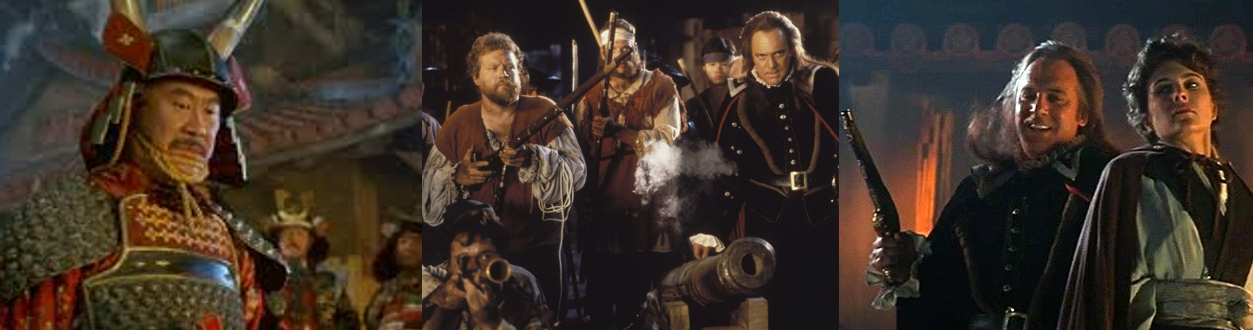
As I’ve detailed previously, the TMNT were originally created by Kevin Eastman and Peter Laird to be a violent pastiche of comic book troupes before being catapulted to mainstream success by the unbelievably popular 1987 cartoon. It was probably inevitable that this would lead to a live-action feature film, and Teenage Mutant Ninja Turtles (Barron, 1990) proved to be both a technically impressive financial success and a cult favourite. Although Teenage Mutant Ninja Turtles II: The Secret of the Ooze (Pressman, 1991) received comparatively mixed reviews, it still did well at the box office and I, for one, regard it as an under-rated entry in the franchise. The TMNT’s brand remained popular and successful, however, but there were a number of noticeable changes made for the third live-action film; first of all, Jim Henson’s studio was no longer involved in the production, and the animatronics created by All Effects Company were far less impressive. Secondly, their most iconic enemy, Oroku Saki/The Shredder, was entirely absent due to a slight case of death; and, finally, the film featured a time travel plot that took the narrative out of the sewers and often has it erroneously referred to as Turtles in Time. Although some of the original cast members returned after skipping the second film, and despite debuting at number one at the U.S. box office, TMNT III’s $54.4 million worldwide gross made it the least successful of the films so far, and the film was universally panned. Thanks to its dumbed down plot and characterisations, nonsensical narrative, and childish humour, TMNT III is widely regarded as one of the lowest points in the franchise; plans for a fourth film were scrapped and it would be nearly ten years before the TMNT made it back to cinema screens.

The Review:
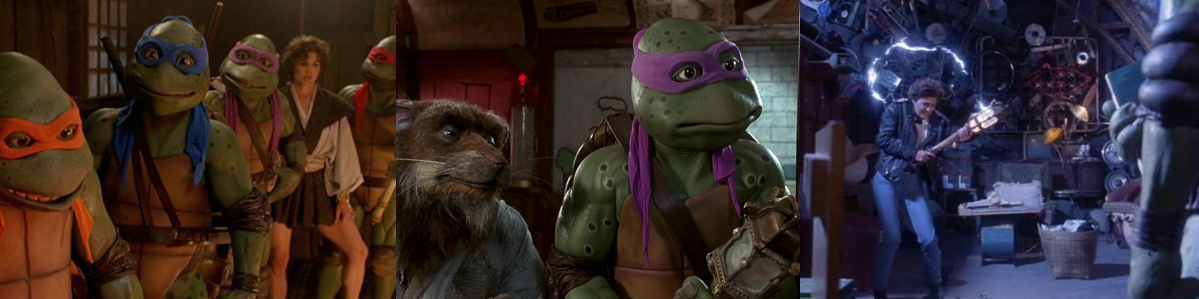
Rather than opening up on the streets of New York City, a location more than prominent to the TMNT and the previous films, Teenage Mutant Ninja Turtles III begins in 1603 Japan and finds Prince Kenshin (Henry Hayashi) being captured by samurai warriors as Mitsu watches on helplessly. We’re then reintroduced to the TMNT, still in their awesome abandoned subway lair, not through a fun or gritty action scene but, instead, through a musical montage that has the four show off their dance moves alongside their ninja skills. Sadly, this is one of the few times that the TMNT will actually use their weapons in the film, and an early warning sign that the film is going to be focused much more on slapstick buffoonery than its predecessors. Things haven’t changed too much for the TMNT since the last film; they’re still pushed to hone their ninja skills by their master and father figure, Splinter (James Murray), still obsessed with pizza, and Raphael (Kelleher/Hill) is still the gruff hot-head of the group who’s constantly frustrated that all of their efforts to keep people safe go unrecognised by the general public since they’re forced to hide underground. Because of this tantrum, he storms off in a huff and misses the gift that their ace reporter human friend April O’Neil shows off to them: an ancient Japanese sceptre she bought from a flea market.

The TMNT travel to feudal Japan to rescue April and end up winning over a group of rebels.

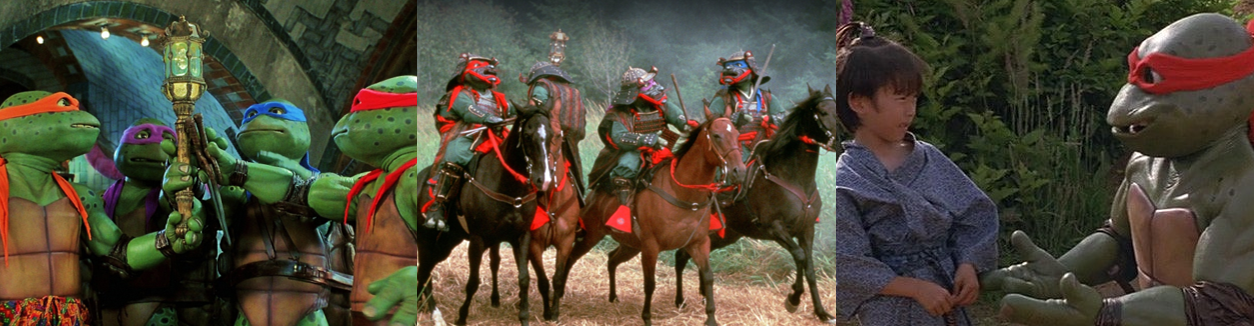
Back in the past, Kenshin, the son of powerful warlord Lord Norinaga, also stumbles upon the same sceptre alongside a scroll depicting the TMNT (or “kappa”, as he calls them) and reads aloud the inscription on the sceptre. This activates the sceptre in the present time and causes April and Kenshin to switch places (and, inexplicably, clothing thanks to the sceptre’s magic); since Donatello (Feldman/Raposa) “does machines”, he’s somehow able to use his computer to study the sceptre and work out that it operates by switching individuals of equal mass and weight in time. Oh, and there’s also an arbitrary time limit on how long the TMNT have to rescue April, meaning they only have sixty hours to complete the mission before the space/time continuum goes “out of sync”. Swapping places with four of Lord Norinaga’s Honour Guard, the TMNT find themselves garbed in ceremonial armour and in the middle of a raid upon a nearby village and, in the confusion, Michelangelo (Rist/Fraser) is captured by Mitsu and her fledgling rebellion. Luckily, he and the others soon earn the respect and admiration of the rebels after they save the life of young Yoshi (Travis A. Moon), one of the few things that Leonardo (Tochi/Caso) gets to do beyond showcasing his bizarre lack of brainpower. This, as much as the purity of the unpolluted landscape, brings Raphael a serenity he never knew existed; he also forms a bond with Yoshi, surprising himself by imparting advice about the boy’s temper and desire to fight rather than have fun and enjoy his childhood. While Donatello and Leonardo are determined to construct a replica sceptre to return them home, Mikey and Raph are actually tempted to remain in the past, where they’re accepted and revered.

While Lord Norinaga uses the old ways and Walker opts for artillery, neither are intimidating villains.

There’s no question that Lord Norinaga is a poor substitute for the far more intimidating Shredder; I think one of the most undeniable failings of Teenage Mutant Ninja Turtles III is that it lacks a strong, iconic villain like the Shredder for the TMNT to go up against. A proud man who believes in maintaining his position and family name through power, Lord Norinaga is a power-hungry warlord shamed by his son’s rebellious ways and with a staunch belief in the might of his army. Lord Norinaga is aided by Walker (Wilson), an unscrupulous English trader who gleefully supplies him with gunpowder and other armaments and resources for his war. Walker scoffs at the Japanese clan’s ancient superstitions and their out-dated ways and is more of a futurist, believing in the unrivalled power of guns and artillery rather than ancient relics and fantasies. Surrounded by a gaggle of underappreciated buffoons, Walker is nevertheless intrigued by April’s spontaneous arrival in feudal Japan and goes to great lengths to track down the missing sceptre, including sacking a nearby village using his superior weapons and manipulating Lord Norinaga into purchasing his cannons and ammunitions in order to fend off the “demons” who now threaten his empire. A sneering, manipulative, and calculating opportunist, Walker delights in the fortune and power recent events bring him but is more of a pantomime villain than a truly intimidating foe; Michelangelo likens him to Clint Eastwood, but he’s more like the late, great Rik Mayall in his appearance and mannerisms.

Despite the bigger cast with new and old faces, most of them really don’t get much to do.

Although she played a prominent supporting role in the previous two films as an audience surrogate and a valued ally to the TMNT, April gets quite a bit more screen time in this third entry; when transported to the past, she’s branded a witch by Lord Norinaga and locked in a dungeon and the TMNT’s entire motivation this time around is going back in time to rescue her. Although April spends much of the film either locked in a cell or in need of rescue, April proves herself to be rather feisty and capable; she tries to play upon the superstitions of her captors to in an attempt to intimidate them and frequently hurls abuse their way. Since the TMNT need to swap places with those from the past, Michelangelo brings in their old ally, Casey Jones (Koteas), to watch over Splinter, their lair, and the time-displaced Japanese warriors. Sadly, this means that there really isn’t anything substantial for Casey to do in the film except babysit and be used for questionable comic relief, but Koteas does play a dual role in the film as April finds herself locked up alongside Whit after he unsuccessfully tried to lead a mutiny against Walker. The film is also populated by a number of new characters; Kenshin is the rebellious son of the warmongering Lord Norinaga, who openly opposes his father’s dreams of conquest and is anxious to get back to the past and reunite with Mistu. Though the headstrong leader of a vastly outnumbered rebellion, Mitsu also ends up becoming little more than a damsel in distress when Whit betrays them and takes her, and the real sceptre, to Lord Norinaga in a misguided attempt to broker a deal with Walker.

The Nitty-Gritty:
On the surface, Teenage Mutant Ninja Turtles III tries to coast off of the success and reputation of its predecessors and the mammoth franchise as a whole; it recreates the subway set from the second film, returns many of the same voice actors from the last two movies, and even reuses the soundtrack from the first film, none of which really help to improve its presentation. While the first movie was (and, in my opinion, still is) the perfect blend between the violent source material and the more family-friendly cartoon series, the second leaned a bit more into humour and cartoony shenanigans; however, Teenage Mutant Ninja Turtles III takes all of these latter elements and brings them right to the forefront. No longer are the TMNT shrouded by the darkness of night (which really doesn’t help hide how inferior their suits are) and they’ve been distilled down to the most basic of characterisations. Even Leonardo, typically the level-headed and intelligent leader of the group, is portrayed as a complete idiot here, and the focus of their dialogue is now firmly on cringey pop culture references, catchphrases, and idiotic statements that will probably make little kids laugh but will leave older viewers rolling their eyes. It is, essentially, a live-action cartoon and, while there’s nothing inherently wrong with that, it is a noticeable downgrade considering the first movie was also a live-action cartoon but it didn’t treat its audience like they were juvenile idiots or pander to the lowest common denominator. Here, all nuance is completely cast aside; the TMNT are generally too busy making fools of themselves and messing about, so when heartfelt moments like Raph’s bond with Yoshi do occur they fall flat because of all the tomfoolery that proceeds them.

The suits are bad, the dialogue corny, and the film’s stuck with an out of place time travel gimmick.

It’s undeniable that the TMNT suits, while still impressive practical and animatronic effects, have taken a noticeable downgrade. The actors seem to be able to move more freely in these suits, to be fair, but they look far less believable and much more like plastic, rubbery outfits than in the last two films. The heads are easily the worst aspect; the eyes are far less expressive, the mouths don’t sync up as well, and everything just feels much more cheap and low quality. By far the worst offender, though, his Splinter; not only does the wise old rat sensei look far worse than his previous incarnations, but he’s rarely ever shown in full body in a clear attempt by the filmmakers to hide his limitations and mostly just peeps out through window frames or sits in his chair. The action sequences are equally underwhelming this time around; while the TMNT are far more spritely in this film, and fights are filmed in full daylight, the TMNT continue to use their weapons either defensively or for comedic effect and everything seems far more choreographed and dumbed down, which is a shame considering how many more armed opponents the TMNT have to contend with in this jaunt. Additionally, the film is lumbered with an inexplicable time travel plot that really doesn’t seem to gel all that well with the atmosphere of the previous films; obviously, the TMNT have endured similar fantastical plots in the cartoons and comics but, for me, the natural next step is either interdimensional travel or facing an otherworldly, sci-fi threat like Krang and Dimension-X. Clearly, the decision to set the film in feudal Japan was a budgetary one, and that’s a shame as there was no way that Teenage Mutant Ninja Turtles III could hope to out-do the mutated opponents the TMNT faced in the last film when they’re stuck in the 17th century for the majority of the runtime.

Ultimately the TMNT are victorious and opt to return home for another cringey dance number.

With time fast running out, the TMNT have no choice but to join forces with the rebels in an all-out assault on Castle Norinaga in order to rescue Mitsu and reclaim the sceptre. This leads to them discovering that Lord Norinaga’s ancestor was previously defeated by four legendary kappa, and the odd insinuation that they’re somehow descended from these mythological creatures. It also involves a number of fight scenes pitting the TMNT and Mitsu against Lord Norinaga’s guards, and the rebels against his forces, though any kind of tension or danger is largely mitigated by an overuse of comical sound effects and embarrassing one-liners. Leo finally gets something significant to do, however, when he gets into an intense sword fight with Lord Norinaga that sees the warlord trapped in a giant bell after being bested. All the fighting bizarrely stops when Walker and his men hold everyone at gunpoint, such is the fear of his weapons, but he flees in terror after Leo ducks into his shell to avoid being killed by his cannon. Although Walker distracts them by throwing the sceptre at them to cover his escape, Whit ultimately finishes him off by blasting him with a flaming projectile and sending Walker plunging to his poorly-realised demise in the sea below.  Afterwards, the TMNT briefly debate whether they should return to the present; while Donnie is eager to return home and Leo considers staying, Mikey and Raph are strongly tempted to stay since Raph feels appreciated there and Mikey has, apparently, fallen for Mitsu. Ultimately, after a brief fake-out, all four return home, with April, and the status quo is restored, with Kenshin and Mistu being reunited and the TMNT enjoying one last embarrassing dance number to bring this mess to an end.

The Summary:
Teenage Mutant Ninja Turtles III was one of the first movies I remember seeing at the cinema; like almost everyone back then, I was a big TMNT fan and excited to see them on the big screen, but I honestly don’t remember what I thought to it back in the day and barely even remember going to see it. In the years since, I’ve rarely returned to the film since there are far better TMNT options out there, so it seems redundant to waste my time watching one of the more inferior productions. It doesn’t help that everyone and their mother has talked at length about how bad this film is compared to its predecessors, which really doesn’t make me excited to drop the disc in when I could just watch the first, and infinitely superior, movie instead. I guess there’s enough here for little kids to find some enjoyment; it’s very cartoony and full of one-liners and slapstick and daft fight scenes, but it’s just depressing to see how the property got some dumbed down so quickly. The whole production looks and feels so much cheaper, from the suits to the voice acting and the plot, and I’ll always find it odd how the comics and animated stories were able to do a better job appealing to their core demographic than a big-budget live-action production. Even die-hard TMNT fans will struggle with this one, and it’s best left to gather dust on the shelf.

My Rating:

Rating: 2 out of 5.

Could Be Better

Did you enjoy Teenage Mutant Ninja Turtles III? How do you think the film holds up against the other TMNT films? Which of the TMNT is your favourite and why? What did you think to the time travel plot and the increased emphasis on comedic slapstick? Would you like to see another live-action TMNT film using modern technology to create more practical versions of the TMNT? How are you celebrating the TMNT’s debut this month? Whatever your thoughts on the TMNT, leave a comment down below.

Game Corner [Turtle Tuesday]: TMNT: Turtles in Time (Xbox Series X)


The first issue of Kevin Eastman and Peter Laird’s Teenage Mutant Ninja Turtles (TMNT) was published in May of 1984. Since then, the TMNT have gone on to achieve worldwide mainstream success thanks not only to their original comics run but also a number of influential cartoons, videogames, and wave-upon-wave of action figures. This year, I’m emphasising third entries and time travel shenanigans in the popular franchise every Tuesday in May!


GameCorner

Released: 30 August 2022
Originally Released: March 1991 (Arcade) / 24 July 1992 (SNES)
Developer: Digital Eclipse
Original Developer: Konami
Also Available For: Arcade, GameCube, Nintendo Switch, PC, PlayStation 2, PlayStation 4, PlayStation 5, Super Nintendo Entertainment System (SNES), Xbox, Xbox 360, Xbox One, and Xbox Series S

The Background:
Back in the late-eighties and early-nineties, the Teenage Mutant Ninja Turtles (or Teenage Mutant Hero Turtles for us Brits) took the lives of children everywhere by storm. Before Mighty Morphin’ Power Rangers (1993 to 1996) and Pokémon (1997 to present) dominated playgrounds, Christmases, and birthdays alike, kids were transfixed by the Teenage Mutant Ninja Turtles (1987 to 1996) animated series. A toned down version of the original, far darker Mirage Comics publications, the “Heroes in a Half-Shell” were so popular that they spawned not just a series of live-action movies (of varying quality), but also additional comic book spin-offs, a beloved line of action figures, and a whole host of videogames. It was Konami’s efforts with the original TMNT arcade game that laid the foundation for some of the franchise’s most influential gaming ventures and the developers sought to expand upon those efforts with this equally beloved sequel. Bigger, better, and longer than its predecessor, much of Turtles in Time’s impact can be attributed to the surprisingly faithful home console port that wowed SNES gamers back in the day, and the game was so memorable that it received an unfairly lambasted 2.5D remake in 2009. Though ports of Turtles in Time have been sporadically available, its remake was de-listed from digital stores for the better part of eleven years, meaning Turtles in Time was (ironically) lost to time until it was included in this Cowabunga Collection for modern consoles alongside a host of other games and quality of life features. As both the arcade and SNES versions are included in this collection, and the differences between the two don’t really warrant two separate reviews, I’ll be including both versions in this review.

The Plot:
The Turtles leap into action when Krang steals the Statue of Liberty, only to be sent hurtling through time courtesy of a time warp activated by their archnemesis, Oroku Saki/The Shredder, forcing them to fight Shredder’s army in both the past and the future in order to get home.

Gameplay:
Like its predecessor, Teenage Mutant Ninja Turtles: Turtles in Time is a sidescrolling beat-‘em-up that supports up to four players; supposedly, two-player arcade cabinets were released and the arcade version never made it over to Japan, but this version of the game allows both on- and offline co-operative play, though the SNES version of the game is limited to two player simultaneous co-op. As ever, players can select from one of the four Ninja Turtles who all control exactly the same but play slightly differently depending on the reach of their weapons (putting Raphael at a disadvantage). Gameplay is limited to two primary buttons, with X allowing you to attack and string together basic combos and B letting you jump; you can press X in mid-air for a flying attack and press X and B together to perform a power attack that doesn’t seem to drain your health meter. Once again, you have no dash options or dashing attack, but you can now slam and hurl enemies about by hitting X when up close to them and you can pull off a “back attack” to fend off enemies attacking from behind.

Despite a dip in graphics, the SNES version holds up surprisingly well to its arcade counterpart.

Turtles in Time is much bigger and longer than the last game, sporting nine levels to play through, each of which being far livelier and with more opportunities to interact with the environment. You can hit traffic cones, hydrants, explosive barrels, and boxes of fireworks to take out enemies but, even better, onscreen hazards like wrecking balls can also damage enemies. Hazards like these are far more plentiful this time around, including loose floorboards, mines, and electrical bolts from turrets and Krang’s massive exosuit so it pays to keep your wits about you and not just charge blindly ahead. Gameplay is mixed up a bit with two levels dedicated to fast-paced, autoscrolling action, first on a hoverboard in Sewer Surfin’ and then on a floating disk in Neon Night Riders; your combat options remain the same here, but some enemies are a little harder to hit as they’re floating above you and you’ll need quick reflexes to dodge hazards like the spiked gates and mines. The SNES version offers not only an additional score bonus for these stages but even includes an extra level, complete with a traditional elevator gauntlet.

Graphics and Sound:
Visually, the game is very similar to its predecessor; I’m pretty sure the sprites are all exactly the same, bar maybe a few additional animations and enemy variants, but they’re just as colourful and full of life as before. Every character pops against the background, has some limited idle animation, and the likes of Splinter and April O’Neil (depending on which version you’re playing) will appear to hurry you along if you dawdle. Voice clips are used to great effect, especially in the arcade release, with the Turtles shrieking, “My toes! My noes!” when hurt by spikes and ending every stage with a triumphant cry of “Cowabunga!” alongside a victory animation. Voice samples are far sparser and more dulled in the SNES version, naturally, which relies more on subtitles and its own sound effects, but both games still perfectly capture the quirky and slapstick nature of the cartoon. The SNES version also presents a different version of the Neon Night Riders stage, with the action taking place from behind the characters and the stage tweaked to make use of the console’s “Mode 7” features.

The game is noticeably bigger than before, with the SNES version even boasting new features.

Environments are far more varied this time around; thanks to the time travel plot, the TMNT don’t just fight through the streets and sewers of New York City but are also transported back to a prehistoric jungle (complete with shimmering heat effects from the lava and a cave full of falling stalactites), a pirate ship full of loose planks, a speeding train in the Old West, and the neon streets of the far-flung future! Levels are noticeably longer and with more enemies, with no visible slowdown, though the SNES version is automatically slower since you can’t activate a “Turbo Mode” to speed things up. The SNES version of the game does add a whole new Technodrome level, however, and swaps some bosses around, even replacing one entirely with one of my favourite villains from the series. Both versions of the game use big, colourful art to tell their story, with the SNES version offering different endings depending on the difficulty setting you played on. Finally, while the SNES version features some popping tunes and a decent rendition of the TMNT theme song, the arcade version impresses with its funky, adrenaline-pumping soundtrack and even boasts a rendition of “Pizza Power” for its introduction sequence.

Enemies and Bosses:
As is tradition for a TMNT videogame, you’ll primarily be fighting your way through hordes of robotic Foot Soldiers; these come in all different colours and variants, from the regular, easily dispatched purple ones to weapon-wielding goons garbed in red, silver, or yellow. These guys will toss shuriken at you, stab at you with spears and swords, toss giant bombs, or swing axes; they also come flying in on dinosaurs, charge at you on fire-breathing Velociraptors, and pilot flying machines. Robots also return as notable enemies, with one wildly swinging its boxing gloves at you, though you’ll only encounter Mousers in the SNES version of the game. There are some new enemies in Turtles in Time, too, including the Xenomorph-like Pizza Monsters and the Rock Soldiers, who charge at you and wield high-powered weapons of their own.

Bosses are more visually varied, especially in the SNES version.

Also, as is to be expected, some of the TMNT’s most recognisable foes return to dog you as end of level bosses. The first you’ll encounter is Baxter Stockman, now mutated into his human fly form; Baxter hovers overhead firing at you with a machine gun, only to switch to sending out plasma fists after you’ve damaged him enough. At the end of Alleycat Blues, you’ll battle Metalhead, who attacks from a distance with his extendable arms and legs and flies at you courtesy of a rocket-powered kick, though he has a tendency to stop and gloat and leave himself open to a counterattack. Sewer Surfin’ doesn’t feature a boss in the arcade version, instead forcing you to fend of a swarm of Pizza Monsters, but you’ll take on the Rat King in the SNES version, which is much more interesting and exciting as he’s in his little hovercraft and fires missiles and mines at you. Similarly, you face the underwhelming Cement Man in the arcade version of the Prehistoric Turtlesaurus level, with the mud-like goon sliming about the place and trapping you in mud, but the SNES version replaces him with Slash! This deranged doppelgänger is far more formidable, slashing at you with his jagged blade and spinning about the place as a whirling shell of bladed fury, making him a far worthier adversary.

Boss battles feature different phases and more formidable attack patterns this time.

After battling across the deck of a pirate ship, you’ll face both Tokka and Rahzar; while they simple charge, swipe, and hop about in the arcade version, they’re much more formidable in the SNES version, where they appear in the new Technodrome stage and sport flame and freezing breath and act as sub-bosses. In the SNES version of the pirate ship level, Bepop and Rocksteady take Tokka and Rahzar’s place; garbed in theme-appropriate attire, they attack you with a whip and sword, respectively. The hulking Leatherhead awaits at the end of the train stage, scurrying about the place, lashing at you with his tail, and tossing daggers your way, while you’ll go one-on-one with Krang while racing through the futuristic streets of 2020 A.D. Krang’s a lot less of a threat compared to the last game, dashing at you with a kick, smacking you with a clap attack, and firing missiles from his chest, but he resurfaces in the Technodrome stage. Now flying a UFO, he drops Mousers into the arena and teleports about to avoid your attacks, but the SNES version also adds a bubble-like projectile to his arsenal and has him more erratically which, in conjunction with his height, can make him a difficult target.

The Shredder is far more persistent and dangerous in the SNES version of the game.

Naturally, you’ll also do battle with the TMNT’s mortal enemy, the Shredder. However, in the SNES version of the game, you actually battle him twice and the final battle is noticeably different in both versions. The first time you face him is at the end of the new Technodrome level, where he hops behind the controls of some unseen giant mech and blasts at you with bullets while swiping with a retractable claw arm in perhaps one of the game’s most memorable boss battles. To defeat the Shredder, you need to avoid his targeting reticule and hurl Foot Soldiers at him in a fun bit of innovation, though this can be tricky to do due to poor visibility and the sheer number of enemies and projectiles. The Shredder awaits in the final stage of the game, too, where the Statue of Liberty looms in the background; in the arcade version, he attacks with his sword and martial arts skills while also sending out plasma hands similar to Baxter and once again sporting an instant death regression blast that turns you back into a regular turtle. In the SNES version, Shredder immediately transforms into his far more formidable Super Shredder form; protected by a flaming aura, Super Shredder sends fireballs flying your way, shoots flames along the ground, and fires bolts into the air while dashing about the screen at breakneck speed.

Power-Ups and Bonuses:
Unfortunately, for all the additions Turtles in Time sports, power-ups are not one of them. You can still replenish your health with the odd pizza box but the only other power-up available to pick up is a bomb pizza item that sends you into a frenzy for a few seconds.

Additional Features:
As is to be expected, the arcade release is limited in its options; you can play with up to four other players both on- and offline and try to out-do your last high score, but there’s not much else on offer beyond playing through this awesome game as a different character. The SNES version might have taken a graphical hit but actually boasts a few interesting additional features: you can go head-to-head against a friend in versus mode, take on three courses in a time trial mode, pick from three difficulty settings (with different continues and endings assigned to each), set your maximum number of lives, and enjoy the benefits of a sound test. You can also pick between two colour schemes, “Comic” and “Animation”, which gives the TMNT new colour palettes, which is a nice touch. Naturally, the Cowabunga Collection adds a number slew of extra features to the list, however; first, you’ll gain a 70G Achievement for finishing each game, you can use the Left Bumper to rewind, and use the Right Bumper to access save states and display options. The arcade version can be further enhanced with a level select, God Mode (which makes you invincible and allows one-hit kills on most enemies and bosses), the removal of the penalty bombs that kill you if you linger about, and the ability to activate the far harder “Nightmare Mode” and speed things up with Turbo Mode. The SNES version isn’t lacking in similar options, boasting a level select and additional lives, while also providing every boss with a helpful life meter. Even better, you’ll still get your Achievements even with these enhancements activated and you can again peruse a strategy guide, switch between the American and Japanese versions (with minimal differences that I could see), view the game’s box art and manuals, and even choose to simply watch the game play itself.

The Summary:
There’s a reason Teenage Mutant Ninja Turtles: Turtles in Time is remembered so fondly; it really was the quintessential TMNT videogame at the time, taking everything that was so good about the original arcade release and expanding on it with larger, more varied stages and far more interesting boss battles. While the gameplay remains very much the same and there’s a distinct and disappointing lack of power-ups, the game is much more enjoyable than its predecessor, offering more enemies and more visually interesting environments to battle through. The SNES release, while noticeably lacking in visual and audio quality, is a surprisingly faithful recreation of its arcade counterpart; sporting some nifty additional features and new levels and bosses, it’s easy to see why it was a must-have game for the system back in the day. The Cowabunga Collection only adds to the appeal of both games, offering numerous quality of life options to make gameplay a breeze and preserving these two classic arcade beat-‘em-ups for a whole new generation. There may be better beat-‘em-up titles out there, with more gameplay variety, more power-ups, and more options available, but Teenage Mutant Ninja Turtles videogames didn’t get much better than Turtles in Time when it was released and it’s a joy to see it more readily available so others can experience the fast-paced, action-packed pick-up-and-play thrill of these simplistic brawlers.

My Rating:

Rating: 4 out of 5.

Great Stuff

Did you ever play Teenage Mutant Ninja Turtles: Turtles in Time out in the wild? How do you think it compares to other TMNT videogames and similar arcade fighters? Did you own the SNES version? If so, what did you think to the new levels and bosses and were you impressed with the conversion from the arcade original? Which of the characters was your go-to and which of the game’s bosses was your favourite? What did you think to the additional features added to the Cowabunga Collection? Which of the four Turtles is your favourite (and why is it Raphael?) Whatever your thoughts, I’d love to hear your memories of Turtles in Time down in the comments!

Game Corner [X-Men Day]: X-Men: The Official Game (Xbox 360)


To commemorate, the culmination of their long-running and successful X-Men movies, 20th Century Fox declared May 13th as “X-Men Day”, a day to celebrate all things Mutant and X-Men and celebrate Marvel’s iconic collection of superpowered beings who fight to protect a world that hates and fears them.


Released: 16 May 2006
Developer: Z-Axis
Also Available For: Game Boy Advance, GameCube, Nintendo DS, PC, PlayStation 2, Xbox

The Background:
Ever since Stan Lee and long-time collaborator Jack Kirby created the X-Men in 1963, Mutants have featured prominently in Marvel Comics and grew to greater mainstream prominence thanks to the influential animated series from the nineties, the success of which led to 20th Century Fox purchasing the film rights and producing a successful long-running live-action franchise. The X-Men have also have a storied history in pixels and polygons; the Mutant team first came to life on the Nintendo Entertainment System in what was essentially a vertical shooter, but the characters arguably saw the most success in their numerous arcade ventures and team-based brawlers. To coincide with the release of X-Men: The Last Stand (Ratner, 2006), publisher Activision was tasked with creating a tie-in videogame to be released across all available platforms and bridge the gap between X2: X-Men 2 (Singer, 2003) and the third entry. However, just as X-Men: The Last Stand was critically panned, X-Men: The Official Game failed to impress with its poor enemy A.I., repetitive gameplay, and for being little more than a shameless cash-in.

The Plot:
Still reeling from the death of Doctor Jean Grey, James “Logan” Howlett/Wolverine, Bobby Drake/Iceman, and Kurt Wagner/Nightcrawler battle radical terrorist group known as Hydra and their gigantic, Mutant-hunting Sentinels, encountering some of their worst enemies in the process.

Gameplay:
X-Men: The Official Game is a third-person action game with three distinct gameplay styles split across its three playable characters, Wolverine, Iceman, and Nightcrawler, who embark on an adventure that takes place soon after the events of X-Men 2 and fills the gap between that film and X-Men: The Last Stand to explain why Nightcrawler is missing from the team in the third movie. While the levels in X-Men: The Official Game are pretty linear, the developers furnished players with a helpful mini map which indicates friendly non-playable characters (NPCs), enemies, and points you in the direction of your next objective/s. There are a few branching paths you can sometimes take, either by smashing through walls and windows as Wolverine or teleporting to higher areas as Nightcrawler, but these generally just lead to a collectible and it is actually pretty easy to get turned around as everything looks very similar. Although each character has a distinct way of playing, there are some similarities between all three: both Wolverine and Nightcrawler can jump with A and dish out attacks and combos with X and Y, Nightcrawler and Iceman can both target foes with the Left Trigger, and all three will automatically heal from minor wounds (though Wolverine and Nightcrawler and able to dramatically speed this up by holding the Left Bumper or pressing the Right Bumper, respectively, whenever it’s safe to do so, though any movement at all will cancel out this healing boost).

Slice through enemies as Wolverine, teleport about as Nightcrawler, and slide around as Iceman.

Wolverine’s gameplay is very much that of a hack-and-slash brawler; however, fans of genre-defining titles like the God of War series (Various, 2005 to present) will be left disappointed as Wolverine is quite a clunky and limited character thanks to the presentation and camera angles offered by this game. With a tap of LB, Wolverine can sheath and unsheathe his claws (which is more of an Easter Egg than anything), which he can use to slash at the multitude of minions who come charging at him in any given level. Using combinations of X, Y, and B (which pushes enemies away), Wolverine can string together some basic combos; he can also block incoming attacks by holding the Left or Right Trigger (and you can flick the analogue stick while blocking to pull off an awkward dodge roll to try and get away from sticky situations), and successfully landing attacks will build up his “Fury Meter” which, when full, powers up your attacks and healing for a short time with a press of the Right Bumper. Nightcrawler has similar capabilities in combat, but his levels are much more focused on platforming with his signature teleport and a bit of semi-stealth. Nightcrawler can also string together punches and kicks for combos, but you’re best served using his relocation attack; pressing B sees him automatically teleport behind the nearest enemy to pummel them with X or smash them with Y, which is great for taking out groups of enemies quickly. RT allows Nightcrawler to teleport to a variety of surfaces, from pipes to bridges and walkways, and is great for quickly traversing areas and getting to consoles or control panels which need rewiring with X. Of the three, Iceman is the most unique as he’s constantly moving forwards on an ice slide and his levels play much more like chasers or dogfight simulators. Holding A lets Iceman boost ahead, while RT brakes and RB allows him to flip around quickly to retarget enemies. X unleashes an ice beam, which is great for freezing up pipes or putting out fires, while B tosses out his Hailstorm attack and Y puts up a temporary frost shield. You’ll need to constantly tap LT and B when faced with multiple targets, but Iceman’s levels are much more geared towards preventing catastrophes or reaching a goal and are often accompanied by an anxiety-inducing time limit.

Whether you’re fighting a gauntlet, repairing consoles, or facing a time limit, things get very tedious.

The game’s story mode is laid out in a linear mission-based structure; at various points, the narrative branches off to follow each of the three characters and, prior to starting a mission, you can pick from three difficulty settings: “Novice”, “Hero”, and “Superhero”. These will dictate how tough the enemies are, with enemies on “Superhero” able to whittle your health to nothing in just a few hits or under sustained gunfire, but there are perks to completing the mission on higher difficulties as you earn more “Mutation Evolutions” on these settings. These power-up each character’s stats, raising such attributes as their overall health, the damage their attacks deal, and their health and energy recovery, and the only way you’ll only be able to max out your abilities is by beating every mission on “Superhero” mode. This, however, is easier said than done; the game is very stingy with its checkpoints, meaning that failure to complete some of the game’s more monotonous tasks requires you to start the mission over right from the beginning. Following glorified training missions for each character, you’ll be thrust into the game’s story mode and, very quickly, will see everything X-Men: The Official Game has to offer. Wolverine will pretty much always be tasked with clearing away all enemies, with wave upon wave teleporting in or rushing in through doors, though he sometimes has to dodge hazards such as flaming vents and cages or destroy something in order to progress. Nightcrawler almost always has to teleport about the claustrophobic environments, activating panels or rewiring stuff, and occasionally luring exploding probes to power nodes or Sentinels to open doors. Iceman is either racing towards something or fending off attacks, often against a time limit; this means you’ll be dousing fires and cooling down nuclear reactors with your ice beam or chasing down an enemy or towards a goal before time runs out. Occasionally, another X-Men appears to help out; Ororo Munroe/Storm accompanies Wolverine and Nightcrawler you can have her instantly kill all enemies with her lightning by pressing in the left stick, while Nightcrawler also has to deactivate shields so that Piotr “Peter” Rasputin/Colossus can destroy some power generators, but Iceman has no such help when desperately trying to stop Giant Sentinels from marching on the downed X-Jet. Sometimes Iceman will have to slide through “nav points” (essentially glorified rings) and avoid laser hazards and mines, sometimes Wolverine’s locked in a room and forced to fight a gauntlet of enemies, and sometimes Nightcrawler has to destroy glowing crystals to keep enemies from spawning, but it’s all very repetitive and your objectives tend to be to do something once and then repeat it three or four times until the mission abruptly ends.

Graphics and Sound:  
In all honesty, X-Men: The Official Game doesn’t look all that bad; the in-game graphics are pretty decent, with stylistic versions of the film characters well represented for the most part, though the range of animation offered by the three is somewhat lacklustre. Of them all, Nightcrawler looks the best; I love his little coat and how he spins around on poles with a flourish and sometimes gallops on all fours, and it’s a stark contrast to Iceman, who is either relatively static due to his gameplay or ragdolling all over the place when knocked from his slide. Wolverine looks good, but his gameplay is tedious and clunky and severely hampered by the lack of a lunge attack, though he does gain some extra animation frames when in Fury Mode or trying to pounce on larger enemies. The game’s music is pretty decent; it’s mostly all ripped from X-Men: The Last Stand, and many of the film’s cast return to voice their respective characters. In fact, the vocal work may be one of the best things about this game; it’s great hearing Hugh Jackman and Patrick Stewart not only reprise their roles but do it without the lifelessness and boredom that so often accompanies videogame tie-ins.

While the game’s later locations become more visually interesting, the cutscenes are a cheap let down.

Sadly, the same praise can’t be levelled at the game’s environments and cutscenes. Cutscenes are accomplished using a motion comic aesthetic not unlike those employed at various points in games by NetherRealm Studios; these painted pictures have a very limited range of movement, no lip synching, and the cutscenes come off as cheap and rushed and quite unsightly as a result. The in-game environments are okay, but disappointingly bland; the whole game makes a clear effort to evoke the grey, grounded, semi-sci-fi aesthetic of Singer’s films but there’s generally not really much to see since areas are so linear and empty. You’ll get to fight on the Statue of Liberty in a call-back to the first film and revisit the surprisingly unflooded Alkali Lake facility from the second film and the Weapon X laboratory, all of which are very well realised interpretations of the film locations but are so grey and drab that even cheeky references to Wade W. Wilson/Deadpool can’t save them. Thankfully, once the game gets away from recreating areas from X-Men 2, locations become a bit more visually interesting; the Sentinel factory is great, with a massive Sentinel head looming in the background, as are the colourful levels that take Wolverine to an elaborate Japanese palace and garden grounds, but the game really shines once you get into the Master Mold’s control centre, a gigantic airship full of electrified wires and ominous dread that evokes the Borg Cube. Iceman’s chase through the streets of Hong Kong is similarly a visual spectacle thanks to the neon signs, bridges, and skyscrapers, all of which helps to really elevate the game’s presentation after the first few drab missions and despite the tedious gameplay.

Enemies and Bosses:
With such varied and colourful characters as the X-Men and the Brotherhood to work with, it’s no surprise that the developers chose to mainly have you wade through an endless supply of generic and boring Hydra thugs. These guys come packing machine guns, electrified axes and lances, and claws and can mostly be taken out with some quick combos but some will block your attacks. For Wolverine, things get a little more interesting as he gets to battle the Hydra “Wind Unit” (who are basically ninjas with two katana), while Iceman is often blasting at smaller Sentinels or fire dragons conjured by John Allerdyce/Pyro. Nightcrawler will also have to deal with Sentinels but he can only take them out by teleporting to them and luring explosive drones to them before the robots can blast him off with a shockwave. Later, Nightcrawler is placed in a nightmarish illusion by Jason Stryker and forced to battle off teleporting demonic entities, and you’ll also encounter Hydra goons packing bazookas and heavy cannons in some levels. For the most part, the enemy AI is pretty dumb; they’ll easily lose track of you and won’t think to go around certain obstacles, but in wider, more open areas they can be incredibly annoying and persistent, catching you in a crossfire or swarming around you to deplete your health in seconds while you desperately try to escape to safety.

No matter who Wolverine faces, the same hit-and-run tactics will always serve you well.

Each character also has to deal with a number of bosses, with some fought multiple times in different forms. During Wolverine’s first training mission, you’ll battle against Victor Creed/Sabretooth to learn the basics of combat; Sabretooth makes a return as the final boss of the game, too, where he’s fought within the decaying remains of the Master Mold facility and significantly more powerful even against your upgraded stats. Sabretooth charges at you with a shoulder barge, can hit slow but powerful combos, grabs and lunges at you, and even has his own Fury Mode that speeds him up and makes him more aggressive. Still, the best thing to do is to avoid his attacks, hit a quick combo, and then stay out of his reach to build up your Fury Meter before unleashing it (avoiding pressing Y as this lunge isn’t effective against him) to whittle down his health bar. Halfway through the fight, Sabretooth flees to a lower level, where debris is a concern for both you and him, and you’ll also have to worry about his health slowly replenishing if you take too long, but he’s not especially difficult to put down. Yuriko Oyama/Lady Deathstrike makes a return in this game and you’ll battle her a couple of times, too; the first time you fight her, it’s within the eye of a hurricane and you have to be careful of being blasted about by the winds while also pushing her into the hazard, and the second time is within a Japanese temple and forces you to fend off waves of enemies between rounds. Still, Lady Deathstrike may be faster and nimbler than Sabretooth, but the same hit-and-run tactics work well against her and it’s much easier to get her trapped in a corner and just go at her full pelt until she goes down. Wolverine’s toughest foe is easily the Silver Samurai; this hulking armoured bastard can teleport about, has great reach with his broadsword, doesn’t get stunned by your attacks, and can send out both energy blades and electrified shockwaves and forces you to fight his minions between bouts. Once again, simply run or dodge about to avoid the brunt of his attacks and build up your Fury Meter and then just tank him as he’s a bit of a damage sponge and can easily cut you down with just a few swipes of his sword.

Nightcrawler and Iceman generally have to fulfill other objectives while fighting their bosses.

Nightcrawler only gets one boss to fight against, but it’s one of the more frustrating ones in the game; while on the rainswept Brooklyn Bridge, he and Storm must fend off clones of James Madrox/Multiple Man while teleporting about the place and defusing his many bombs against a time limit. Afterwards, Nightcrawler has to battle him alone and more directly; the “prime” Multiple Man will occasionally set an explosive charge and, if enough of them go off, the bridge will be destroyed and you’ll lose the mission but try and disarm them and you’ll be beaten to death in seconds by his ceaseless doubles. Your best bet is to stay on the move, dashing to safety and healing when you can, and hoping that he doesn’t set any of these charges (or quickly interrupt him before he can). The hardest thing about this battle, though, is actually dealing damage to Multiple Man; he seems either impervious to your attacks or only hurt after you take out his clones, which can be hard to do as they swarm around you, making for a boss battle more about luck than anything. Iceman primarily battles against Pyro; first, Pyro tries to burn down and destroy a fission plant, then he tries to overload a nuclear reactor, and then he conjures  a gigantic fire serpent to target the toxic waste canisters. If enough of these are destroyed, the mission ends so make sure you’re rapidly switching target locks and throwing out your Hailstorms to take out the fire dragons. The serpent itself is also quite a damage sponge, and can set you ablaze if you get too close, but if you power-up Iceman’s Hailstorm attack that makes things a lot easier. Definitely his hardest challenge is stopping a seemingly endless army of Giant Sentinels from destroying the X-Jet in Hong Kong; these huge armoured hulks can only be destroyed by targeting six yellow power nodes, but the ones on the front are super hard to hit not just because of aiming difficulties but also because of their high-powered lasers. Destroy one, and another drops soon after, and another, and this was the first mission where I actively had to drop the difficulty down to “Novice” to get past it and even then it was a pain in the ass!

Power-Ups and Bonuses:
Unfortunately, there are no collectible power-us available here. Wolverine and Nightcrawler can built meters (either by landing attacks or waiting for it to charge, respectively) to speed up their healing but the closest Iceman gets is destroying Sentinels to gain extra time until fifteen are taken out. As mentioned, Storm and Colossus will accompany you for some missions; Storm can unleash her lightning, but you’ll need to wait for her meter to fill up too, and you’ll also need to get back to help Colossus fend off the Hydra goons before they deal too much damage to him.

Additional Features:
There are sixteen Achievements up for grabs here, with three insulting 0G Achievements awarded after clearing each character’s training mission, three more being rewarded for completing the story mode’s three vaguely defined acts, and three more earned after fully upgrading each characters Mutations. You’ll no doubt notice a few collectibles in each level of the game; every mission hides five Sentinel Tech files and one Weapon X file, and collecting all of these for each character will award another three Achievements and also unlock a bonus costume for each character and a “Danger Room Challenge” for each. Unfortunately, while these collectibles aren’t too difficult to find even without a guide, the rewards you get are pretty pathetic; the costumes are little more than street clothes variants and just having one each is more than a disappointment, it’s a travesty. The Danger Room Challenges amount to timed obstacle courses and challenges used to test your character’s gameplay and abilities, but you earn nothing for completing them so there’s no point in them even being there. Aside from all that, your only other option is to try and beat every mission on “Superhero” to fully upgrade every character, something you won’t really be motivated to do since the gameplay is so uninspiring that even the promise of cutting down goons dressed in Wolverine’s signature wife-beater won’t be incentive enough to ever play this game again.

The Summary:
I tend to go into movie tie-in videogames with pretty low expectations; while I’ve played a fair amount that are pretty good, there’s no denying that they’re generally very rushed, lacking in content, and don’t have a lot going for them. On the plus side, they can sometimes be quite cheap and have some easy-to-snag Achievements, and that’s basically what you’re getting here with X-Men: The Official Game. There’s some decent stuff on offer here; Nightcrawler, especially, is pretty fun to play as and I enjoyed teleporting about the place and pummelling enemies with his attacks, and even Iceman was quite fun in the few missions where you weren’t forced to battle against an arbitrary time limit. Sadly, and most confusingly, it’s Wolverine’s gameplay that really drags this one down; he’s very restricted in his offense and the lack of checkpoints really makes getting through some missions, but especially his tedious gauntlets, a frustrating chore. Awful cutscenes aside, the presentation is pretty good; the game makes a decent attempt at recreating iconic locations from the first two films while infusing a more comic book aesthetic and storyline into the movie timeline, but locations are far too bland and repetitive to really be all that interesting, even in the latter parts of the game. Bosses battles are equally uninspiring; thanks to Wolverine getting the bulk of them, they’re hardly a selling point of the game’s few strengths and, overall, there are far better superhero and action videogames out there for you to put your time into. A serious lack of options, unlockables, and replayability hamper this title; while it’s not too difficult to blast through it in about four to six hours, it’s unlikely you’ll be motivated to try and get everything you miss the first time around and, despite a few entertaining aspects, it remains a cheap cash grab designed solely to leech off the popularity of Fox’s X-Men films rather than actually trying to be an entertaining videogame experience in and of itself.

My Rating:

Rating: 2 out of 5.

Could Be Better

Did you enjoy X-Men: The Official Game? Which of the three characters was your favourite? Did you enjoy the game’s effort to bridge the gap between X-Men 2 and X-Men: The Last Stand? Which of the game’s missions and bosses was your favourite and do you feel like Sentinels are a little overdone in Marvel games? Did you ever fully upgrade the characters and find all the collectibles? Were you disappointed by the lack of options and unlockable extras? What’s the worst (or best) videogame tie-in you’ve ever played? Which X-Men videogame is your favourite and how are you celebrating X-Men Day today? Whatever you think about X-Men: The Official Game, and X-Men in general, feel free to share your thoughts below.

Game Corner [Turtle Tuesday]: TMNT III: Radical Rescue (Xbox Series X)


The first issue of Kevin Eastman and Peter Laird’s Teenage Mutant Ninja Turtles (TMNT) was published in May of 1984. Since then, the TMNT have gone on to achieve worldwide mainstream success thanks not only to their original comics run but also a number of influential cartoons, videogames, and wave-upon-wave of action figures. This year, I’m emphasising third entries and time travel shenanigans in the popular franchise every Tuesday in May!


GameCorner

Released: 30 August 2022
Originally Released: 25 November 1993
Developer: Digital Eclipse
Original Developer: Konami
Also Available For: Game Boy, Nintendo Switch, PC, PlayStation 4, PlayStation 5, Xbox One, Xbox Series S

The Background:
The Teenage Mutant Ninja Turtles were almost unrivalled in popularity back in the late-eighties and early-nineties; known as Teenage Mutant Hero Turtles here in the UK, the “Heroes in a Half-Shell” dominated an entire generation with their comics, cartoon, extensive toy line, and videogames. Konami’s efforts not only proved a hit at arcades but also took 16-bit gamers by storm and helped to make Nintendo a household name in the UK. Additionally, Konami produced three handheld TMNT titles for Nintendo’s ground-breaking portable console, the Game Boy; though restricted by the Game Boy hardware, the first two games impressed in their ambition and even tried to incorporate elements from the arcade releases. However, for this third game, Konami chose to completely overhaul not just the graphics and gameplay, but the genre too; unlike the previous two handheld efforts, Radical Rescue was a “Metroidvania” title with a heavy emphasis on exploration rather than mindless brawling. This resulted in mixed reviews, with some criticising the decision due to the Game Boy’s hardware being insufficient for such a genre and others praising the genre shift as a means to improve upon its predecessors. Either way, Radical Rescue remained a Game Boy exclusive title for nearly thirty years before it was finally re-released in the 2022 Cowabunga Collection alongside a host of other TMNT games and quality of life features.

The Plot:
When their arch-nemesis, Oroku Saki/The Shredder, strikes again by kidnapping their master and father-figure, Splinter, the TMNT leap into action one turtle short. Now Michelangelo must venture into the Shredder’s hazardous mine to rescue his brothers, and their master, and put a stop to their enemy’s latest scheme.

Gameplay:
As mentioned, Radical Rescue is a 2D adventure game with a heavy emphasis on exploration as much as combat; it thus falls under the “Metroidvania” banner and will have you constantly consulting a barely useful grid-like map to discover new paths and areas to explore in your quest to locate the other TMNT. This means that, unlike every other TMNT game I’ve ever played up to this point, you can’t select a character from the start; instead, you’re stuck with Michelangelo and must defeat bosses to acquire keys to free his brothers and then hunt down key cards to access new areas, using each turtle’s unique skills to get past enemies and obstacles. Each turtle controls the same; you use X to attack and A to jump and press X while jumping to do a flying kick. Unlike in the TMNT’s last two Game Boy outings, you can neither throw shurikens or perform a slide kick with down and X, though you can toss shuriken when climbing ladders and you’re able to switch to one of the other turtles at any time from the pause menu and each one not only has their signature weapons but comes with different abilities to get past hazards and access new areas of Shredder’s diabolical mine. Mikey actually ends up being one of the most useful characters; I found myself defaulting back to him a lot as he can perform a helicopter-like glide with his nunchakus when you press and hold A while jumping, which is great for drifting past spike pits or reaching out of the way platforms.

Each turtle has their own unique abilities to aid with exploration as well as combat.

While I can’t be certain, I’m fairly sure that the game forces you to rescue each of Mikey’s brothers in a specific order; I definitely found myself following a particularly path but then my logic was based simply on going for whichever boss and key card was closest to where I was. Thus, the first turtle I rescued was Leonardo, who’s given the bizarre ability to burrow through certain blocks by pressing down and A, effectively turning him into a living drill. Next, I rescued Raphael who can pop into his shell with down and A to pass harmlessly over spikes (until you inevitably have to jump up to a platform) and through small gaps and tunnels; this also makes him immune to certain attacks, which is helpful. Finally, I rescued Donatello, who can cling to and scale walls by jumping at them, which is basically required to access the final areas of the mines. Naturally, each turtle has their own strengths and weaknesses in combat, with Raph and Mike limited in their reach compared to their brothers, but I found myself favouring Mike since there’s more emphasis on jumping than any of the turtle’s other abilities. Every time you defeat a boss, your health will be fully restored, which is useful; rescuing a turtle (and, later, Splinter) grants you a password that you can jot down from the pause screen to continue if you fail in your quest, but your main enemy here will be trying to find your way around the mine and surviving its mechanical trap rooms.

Exploration and backtracking are greatly emphasised to find secrets and rescue your allies.

Radical Rescue all takes part in one large interconnected map; you start on the outside of the main area and venture out here a couple of times to reach other otherwise inaccessible parts of the mine, and will go through doors (either using a key card or passing through from a certain direction) to enter mechanical areas where a boss lurks. These areas, and the mine itself, and crawling with respawning enemies and numerous hazards; we’ve got falling boulders, spike pits, wall lasers, bursts of flame, ceiling spikes, Foot Soldiers trying to run you down in giant mine carts, and extremely annoying bubble-like projectiles that clog up the screen and follow you incessantly. The Cowbunga Collection allows you to activate “helpful map icons” and I’d definitely recommend doing this; it doesn’t help the basic nature of the map but it’s useful to know that you’re heading to a boss, key card, or captive in need of rescue. This will serve you well when it comes to exploration; naturally, you’re somewhat limited in how far you can go in the mines when you only have one or two turtles on hand but, when you have them all, it’s very easy to get turned around because the map is so simplistic and many of the game’s environments all look the same. Because of this, it’s not uncommon to locate a captive turtle but not have a key or to run into a door that requires a key card you haven’t gotten yet, or to have to backtrack halfway across the map to get an item you require. Once you get used to the map and have all four turtles rescued, exploration gets a little easier; you can take shortcuts by climbing or digging down certain areas, for example, but a quick travel system to the four compass points of the map would’ve been much appreciated.

Graphics and Sound:  
To be fair, Radical Rescue is a step up from the TMNT’s last two Game Boy titles. Sprites are smaller now, but actually benefit from it; you get more screen space to work with and the game runs much smoother by default. As a trade-off, though, the game’s taken a step back in some areas; Leo and Raph only hold one of their weapons again, there are no idle animations, and the common Foot Soldiers simply wander about the place. However, the TMNT are far more versatile this time around; their new abilities help them to be more unique and offer up some new ways to play and some new animations and the boss sprites are far bigger and more visually interesting. Additionally, the story cutscenes are the best yet for a TMNT Game Boy title; text and large sprite art are used to convey the general plot and whenever you rescue an ally and, while these barely contain any frames of animation, they’re much more detailed than in the previous games.

The visuals are far better but environments are too similar to impress all that much.

The game’s music isn’t bad, either; while sound bites are at a minimum this time around, Radical Rescue still features a pretty good version of the classic TMNT theme and each area of the game has different music associated with it. However, where the game falters, for me, is in the variety of its presentation; while it’s nice to not be ploughing through the sewers, streets, and Technodrome again, I question the logic of setting the entire game in a drab, repetitive mine. Sure, there are ladders, lanterns, and some different rocky formations here and there but the Game Boy simply isn’t powerful enough to make this large and boring environment visually interesting. When you’re outside, it’s a different story; the background is still quite plain and generally just shows clouds or mountains, but it’s a nice change of pace from rocks and shit. The mechanical areas do help to break things up as well, but these all look and feel the same as well; it’s way too easy to get lost because most of these areas are largely indistinguishable from each other. I think it would’ve helped to theme them after the elements; have one take place under water or covered in snow, one have more lava pits and fire hazards, maybe implement a wind theme…anything but the same screens over and over. In this way, while Radical Rescue is easily the biggest and most involved of the TMNT’s Game Boy adventures, it also paradoxically feels the least innovative because it’s just not very engaging to plod from one dark cave to one mechanical hellscape and back again.

Enemies and Bosses:
As is to be expected, the Shredder’s Foot Soldiers are all over the place. Unlike in the TMNT’s last two Game Boy games, they’re a little bit more competent here; they mostly just wander around but the greater emphasis on horizontal and vertical exploration means they’re often in awkward places and the fact that they constantly respawn can make traversal a bit difficult at times. The Foot Soldiers will toss grenades at you (which you can destroy), wield pickaxes, and fly overhead with jetpacks to drop bombs on you, as well as try to run you down in large mine carts. You’ll also encounter little laser firing spider-like robots, these weird rock-like humanoids, and mechanical frog-like enemies that hop about and fire at you. Traditional TMNT enemies like Mousers and Roadkill Rodneys are absent here, replaced by swooping bats and an abundance of environmental hazards, such as homing missiles and spikes. Another area where Radical Rescue is a step back from its predecessors is its bosses; the game boasts only five boss battles, with all but one being some of the TMNT’s more obscure enemies (at least for me). Each one sports a health meter and each boss fight takes place in an enclosed arena that’s ripped right out of the Mega Man series (Capcom, 1987 to present).

Bosses are fought in enclosed arenas and will test your patience at times.

The first boss I thought was Scratch, who jumps about, swipes at you up close, and hurls a ball and chain at you from a distance. Scratch very much sets the standard for Radical Rescue’s bosses in that they have quite large hit boxes, deal quick, heavy, and nigh-unavoidable damage up close, and you need to get into a bit of a rhythm to land an attack; rather then simply tank through their hits and whittle their health down, it’s better to keep your distance and play things smart, something that serves you well in the fight against Dirtbag. This mining mole dashes at you with a super annoying uppercut and swipes with his pickaxe, but will also leap into the air and stun you if you’re touching the ground when he is. It’s pretty hard to avoid him as he always aims to land on top of you, so you need to jump away and then quickly double back to hit him and then jump away again to avoid taking damage. I was probably getting the hang of the game by the time I fought the Triceraton as he actually seemed a bit easier; for this fight, stay out of his crosshairs and avoid the lighting bolt he fires out while being mindful of his charge attack, but otherwise he’s not too dissimilar from the Rocksteady and Bebop bosses of previous TMNT games.

As if battling these tricky bosses wasn’t bad enough, you’re forced into a boss rush before the finale.

Lastly, you’ll battle with Scale Tail, probably the most difficult of the four main bosses; Scale Tail lashes at you with his tail when you’re up close and spits a projectile at you that becomes a plume of fire. If you manage to avoid this, the snake will try to blow you into the hazard, though this is actually your best chance to attack him providing you can fight against the rush of air and avoid taking damage from his large hit box. After battling through the hazardous final section of the game, you’ll have to fight all four bosses again, one after the other, with no health items or reprieve between each bout! While this is easily one of the laziest gameplay mechanics of any game, I actually found the bosses a little easier the second time through, probably because I was more aware of their attack patterns and had a tried-and-tested strategy in mind for beating them. After defeating them all again, you’ll get to take on “Cyber Shredder” in a two-phase boss battle where he gets a whole new health bar after the first round while you get nothing, making for easily the toughest segment of the game. Shredder flies across the screen with a knee attack, levitates overhead and spams a diving kick, throws kicks at you up close, and launches an orb-like projectile that becomes a plume of fire. In the second phase of the fight, these flames are bigger, the Shredder gains an aerial projectile, and his attacks become faster and more aggressive.

Power-Ups and Bonuses:
Unfortunately, despite being a Metroidvania adventure, Radical Rescue doesn’t offer anything that new in terms of pick-ups and power-ups. Each turtle acts as a power-up in a way, offering new traversal options, but the best you’ll hope for in any tangible way is the odd slice of pizza dropped by defeated enemies to refill your health. Two new aspects though, are the ability to pick up and store a whole pizza, which will replenish your health bar when it’s drained (a literal lifesaver in boss rooms) and the ability to permanently extend your health bar by picking up hearts hidden throughout the game.

Additional Features:
Another way Radical Rescue is a bit of a step back is the lack of any in-game options; there are no difficulty settings here, no bonus games, and the only real option available to players is to continue their progress with the password system. When playing the Cowabunga Collection, you’ll net a sweet 70G Achievement for completing the game; you can also check out the game’s box art and manuals, switch between the Japanese and American version, apply various borders and display options (including an LCD display to recreate the feeling of playing on the Game Boy’s eye-watering screen) and make use of a strategy guide for some helpful tips. While the only enhancement on offer is to activate helpful map icons, you can still rewind the game with the Left Bumper and access save states using Right Bumper, both of which are incredibly helpful during the game’s trickier platforming and boss sections.

The Summary:
I was completely caught off-guard by Teenage Mutant Ninja Turtles III: Radical Rescue; I was not expecting it to be this sprawling Metroidvania-style game and it took me some time to come to terms with the dramatic genre shift compared to the more action-oriented TMNT games I’ve played. That’s not to say there’s a lack of combat here; you’ll still be busting plenty of heads, but the emphasis is much more on exploration, back-tracking, and thinking about how to get past obstacles and progress to new areas. In some ways, this is much appreciated; the game is surprisingly big, definitely offers something different from the TMNT’s usual games, and I liked that the TMNT each had their own abilities to help differentiate them. While I appreciate that it’s offering something different, it’s pretty tough to find your way around the repetitive environments and I’m unimpressed by the mine setting, as large as it is. There was also little incentive for me to switch between turtles, the bosses were unnecessarily troublesome at times, the inclusion of a boss rush was beyond lazy, and I don’t think the enemies, environments, or bosses really captured the depth of the TMNT license. Still, the gameplay wasn’t bad and it’s clear that Konami had finally come to grips with the Game Boy’s capabilities by this point so it’s probably worth another go-around as long as you play this version of the game, with all the handy features to get around its more frustrating aspects.

My Rating:

Rating: 2 out of 5.

Could Be Better

Did you have Teenage Mutant Ninja Turtles III: Radical Rescue in your Game Boy library back in the day? What did you think to genre shift towards exploration and Metroidvania mechanics? Which character’s ability was your favourite and which one did you play as the most? What did you think the the game’s presentation and the boss battles? What’s your favourite Metroidvania title? Whatever you think about Teenage Mutant Ninja Turtles III: Radical Rescue, feel free to share them in the comments below or leave your thoughts on my social media.

Movie Night: Dragonball Evolution

Released: 10 April 2009
Director: James Wong
Distributor: 20th Century Fox
Budget: $30 million
Stars: Justin Chatwin, Emmy Rossum, Chow Yun-fat, Jamie Chung, Joon Park, and James Marsters

The Plot:
After breaking free from two-thousand years of imprisonment, Lord Piccolo (Marsters) begins scouring the world for the seven legendary Dragonballs, which he intends to gather to summon a magical dragon and gain immortality. After his beloved grandfather is killed protecting the four-star Dragonball, young outcast and martial arts prodigy Son Goku (Chatwin) teams up with a head-strong inventor Doctor Bulma Briefs (Rossum) and eccentric martial arts master Muten Roshi (Yung-fat) to track down the Dragonballs and avert word-wide disaster!

The Background:
I might be a day early for “Piccolo Day” (or “Goku Day” if you prefer) but I’m never one to pass up a good excuse to celebrate all things Dragon Ball, which debuted in the pages of Weekly Shōnen Jump back in 1984. The creation of writer and artist Akira Toriyama, Dragon Ball originally borrowing many elements from Journey to the West (Cheng’en, 1592) before delving into a far more science-fiction-orientated approach with is successor series, Dragonball Z, which would come to define the entire franchise in popular, mainstream media. Dragonball Z was first licensed by Funimation in 1996; despite the omission of its often graphic and violent content, Dragonball Z was a massively popular anime and even led to several feature-length animated films, though these were generally produced without Toriyama’s direct involvement and often failed to align with established canon as a result. Development of a live-action Dragon Ball movie can be traced back to 1995, when noted Hong Kong action star Jackie Chan expressed an interest in taking on the iconic role of Son Goku; Toriyama himself would late state that Chan would have been his choice for the role if the actor was younger, but development of a live-action adaptation wouldn’t properly get underway until 2002, when 20th Century Fox acquired the rights and set to work developing a script and finding a director. In the end, it was youngster Justin Chatwin who won the lead role, and the production was forever condemned for “white-washing” as a result. James Marsters took on the role of the film’s antagonist, Lord Piccolo, and was particularly enthusiastic about the project given his love for the anime, though both he and co-star Cow Yun-fat were unimpressed to find they’d been duped into thinking the project had a higher budget and that director Stephen Chow would be in charge of the film. Dragonball Evolution’s $58.2 million worldwide gross meant it was a box office bomb, and the reviews were scathing across the board as critics bemoaned the lacklustre story and characterisations, its lack of fidelity to the source material, and it was slammed as being a surreal mess full of poor special effects and overacting; even Toriyama was disappointed by the adaptation, and plans for a number of sequels were subsequently cancelled.

The Review:
I was a bit late to the Dragonball Z party as a kid since it took me a while to be able to watch it (satellite television isn’t cheap when you’re income is low), but I’ve been a long-time fan since I was a teenager and the idea of a live-action adaptation was quite exciting. However, right off the bat, I (and the wider audiences) were having to temper our expectations; many of us in the West grew up watching Dragonball Z and, arguably, that’s still the most popular iteration of Toriyama’s long-running franchise, but it wouldn’t make a huge amount of sense to do a big screen movie that skips of Goku’s time as a youth and establishing the fantasy world he lives in, so right away the idea was that we’d have to get through an “origin” story before we started to see Super Saiyans and alien, technological, and God-like beings challenging our heroes. I get the idea in principal but there is a counter argument to that thinking: start with Goku as a young twenty-something and do a truncated version of the Saiyan Saga since that’s what many people wanted to see and, if it’s successful, you can maybe do a prequel later down the line. Instead, though, Dragonball Evolution opted to focus more on reconfiguring the lesser-known Dragon Ball anime for its story, specifically elements of the Emperor Pilaf, Tournament, and Piccolo Sagas…which is pretty convenient for me since I’m much more familiar than the start and end of Goku’s childhood journey than the middle parts. Like all great movies, Dragonball Evolution opens with an opening narration that tells the legend of a maniacal tyrant known as Lord Piccolo, who terrorised the world alongside his monstrous minion, Ōzaru, before finally being sealed away using the mysterious “Mafuba” enchantment. Thankfully, Goku is only too aware of the Piccolo/Ōzaru legend thanks to the wise and benevolent teachings of his beloved grandfather, Gohan (Randall Duk Kim).

Despite his grandfather’s best efforts, Goku just wants to fit in and be able to talk to girls.

Unlike in the manga and anime, Goku has lived only a semi-sheltered life; he essentially lives out in the countryside, not far from the main city, and has been taught martial arts, legendary scripture, and the basics of ki by his elderly grandfather, a playful and mischievous old man who delights in sparring with his grandson in frankly ludicrous displays of green screen and “wire-fu”. Although Goku is a formidable opponent, Gohan emphasises that he relies far too much on his senses rather  than the strength within him; Goku’s difficulty at mastering his ki to perform air-bending techniques is a recurring element in the film and part of his larger character arc of realising the true potential that dwells within him and turning it towards good. Sadly, however, Justin Chatwin isn’t really that great of a fit for Goku; he’s got the youthful charm, for sure, but lacks the physical stature and believability to really fill out the role. Not only that but he’s really not that great an actor; some of his line deliveries are embarrassingly cheesy and not in a good way. It’s strange as he does a decent job of conveying Goku’s frustrations and social awkwardness, but whenever he has to be “serious” he stumbles quite noticeably, making for an inconsistent and disappointing depiction of the goofy Saiyan fighter. Still, Goku is depicted as overtly superhuman, easily able to dodge and subdue even multiple opponents at once without even throwing a punch. However, he’s also as an outcast and, while grateful for his grandfather’s teachings, he longs to be accepted by his peers and to get the girl; in this case, the cute and attractive Chi-Chi (Chung). Although Chi-Chi has apparently been claimed by Goku’s long-time tormentor, Carey Fuller (Texas Battle), Goku is besotted by her but even more stunned to learn that she knows about ki. Clearing interested in him, she’s sympathetic to the abuse he suffers in school and invites him to her house party, which means he isn’t there when Piccolo comes calling for the Dragon Ball and kills Gohan. Chi-Chi continues to be full of surprises when Goku and his allies travel to the Stone Temple, only to find it a training ground for the fights of the World Martial Arts Tournament; there, Goku learns that Chi-Chi is actually an admirable fighter in her own right, with designs on taking part in the tournament, and the two grow close when she helps him to focus his ki. As the battle to recover the Dragon Balls escalates, Chi-Chi gets to show off some of her fighting prowess, but ultimately end sup the victim of Piccolo’s machinations when his shapeshifting ninja-like henchwoman, Mai (Eriko Tamura), assumes her form in order to get closer to Goku and steal his Dragon Balls.

Bulma and Yamcha are two of the film’s few high points but even they can’t save it from mediocrity.

Although Gohan told Goku that gathering all seven Dragon Balls will summon the mighty dragon Shenron and grant “one perfect wish”, it seems he didn’t fully believe this story, or the threat of the Nameks, until Piccolo kills his grandfather. Although devastated by this loss, Goku vows to protect his grandfather’s Four-Star Dragon Ball from falling into the wrong hands, which causes him to form an unlikely alliance with the headstrong Bulma, who attacks Goku after thinking he stole her Five-Star “Promethium Orb”. Although she has her Dragon Radar, Bulma is smart enough to agree that she needs backup and agrees to help Goku find Gohan’s old friend and master, Roshi, but holds Goku to his promise to help her locate her missing Dragon Ball. Bulma’s technology is essential to their group’s quest; not only can she locate Dragon Balls with her radar, but she has the vehicles to transport them vast distances and can even hold her own thanks to her pistol. While she is unimpressed with Roshi’s lewd attempts to get close to her, she attempts to charm Yamcha (Park) into helping them out when they crash into a whole, only to be spurned since the desert bandit set the trap specifically to try and rob them. A selfish, arrogant thief, Yamcha is initially dismissive of Roshi’s (literal) campfire tales about the coming danger but is convinced to help them out first by being impressed with Roshi’s incredible physical prowess and then by the promise of payment. I can’t explain why, but Yamcha is one of my favourite non-Saiyan characters from the anime and, while Joon park certainly doesn’t look anything like the character, he brings a certain appealing energy to the role that, while bordering on the ludicrous, makes him a far more charismatic character than Goku. Bulma and Yamcha remain the standout characters for me, and not just because I have an unapologetic crush on Emmy Rossum or a bias towards Yamcha; they have a decent amount on onscreen chemistry (certainly more then Chatwin and Chung, despite the latter’s best efforts), capture the spirit of the characters pretty well, and I even appreciate the little blue streak in Bulma’s hair as a nod to the source material.

Roshi endeavors to teach Goku to harness his ki, a technique markedly different in this adaptation.

Another relatively faithful highlight is Master Roshi; although he lacks the character’s trademark bald head, sunglasses, and beard, he at least wears the same loud Hawaiian shirts and exhibits a lewd, playful personality. An aloof and unusual master of the martial arts, Roshi is only too familiar with the threat posed by Piccolo and Ōzaru, which heralds the coming of the apocalypse. Distraught to learn of Gohan’s death and Piccolo’s return, Roshi insists on coming along and teaching Goku how to refine his ki: this involves forcing him to run through the desert carrying all of their supplies, performing one-handed headstands, and learning to master two things at once. While he’s definitely an oddball character, Roshi is dead serious about the threat posed by Piccolo and Ōzaru and can effortlessly hold his own in most fights; however, his primary purpose is delivering exposition regarding the Mafuba (which claims the lives of those who use it) and training Goku to harness his ki and learn the most powerful of all air-bending techniques, the Kamehameha Wave. It’s interesting that the depiction of ki is quite different here than in the source material; it’s more akin to what is seen in Avatar: The Last Airbender (2005 to 2008) in that characters are manipulating elements using their inner energy rather than literally channelling that energy into destructive attacks, and I’m not entirely sure why the change was made beyond a cursory implication that Piccolo favours for fire-based energy attacks since his attacks are often depicted in red. While Roshi pushed Goku’s strength and skills to the limits through rigorous and unorthodox training methods in the source material, it’s only through the encouragement (and the incentive of a kiss) from Chi-Chi that Goku is able to pull off the Kamehameha for the first time here. Fully aware that Goku won’t be ready to face Piccolo in time, Roshi turns to Sifu Norris (Ernie Hudson) to prepare the Mafuba once more, fully prepared to sacrifice himself to save the world from destruction.

It’s pretty sad to see one of Goku’s fiercest rivals and foes reduced to a one-dimensional villain.

Another commendable aspect of Dragonball Evolution has to be James Marsters as Lord Piccolo; released from his confinement offscreen by Mai, Piccolo is a grim and ruthless individual who has no compunction about raising entire villages to smouldering ruins in his search for the Dragon Balls. Regal and menacing in his posture, Piccolo is a villain of few words and even few wasted movements; he sees all life as beneath him and wants nothing more than to enact a merciless revenge upon the world that imprisoned him for so long, and personally crushes Goku’s home using his immense power, killing Gohan in the process and thus making their antagonism very personal. Piccolo is a fearsome opponent; not only can he lay waste to entire areas and dry up bodies of water in a single blast, but his blood can also spawn monstrous minions to cause minor inconveniences to the protagonists. Indeed, Piccolo spends the majority of his time just posturing and floating around seemingly in no hurry to find the seven Dragon Balls despite literally being on a deadline. Although he’s not afraid to get his hands dirty in the search, he continuously leaves Mai to screw around impersonating Chi-Chi to steal the heroes’ Dragon Balls rather than simply take them by force like he did the others and wastes his time delivering villainous monologues rather than just bringing forth the dragon when he has the chance. He literally jumps at the chance to lord himself over Goku, especially after he’s transformed into Ōzaru, and  prioritises fighting with the boy rather than locating the scattered Dragon Balls. Ultimately, Piccolo lacks any of the menace or subtle nuance of either his father or his more well-known son/reincarnation; he’s ridiculously one-dimensional, being “bad” for the sake of it, and is defeated with depressing ease when all’s said and done. While Marsters may have hoped to return and do the character justice in future sequels, and Piccolo is shown to have survived, it’s difficult to envision this version of the character ever being more than a one-note kids’ villain in a regrettably poor adaptation.

The Nitty-Gritty:
Although Dragonball Evolution appears to take place in our world, or at least the near future, it’s actually surprisingly faithful to the source material in a lot of ways. Sure, there’s no anthropomorphic characters and a lot of the more fantastical elements are excised or subdued, but there’s a decent attempt to including such concepts as the Capsule Corporation’s wearable technology, Piccolo travels the world in a futuristic and elaborate airship, and Bulma not only carries her trusty Dragon Radar but also rides a bike not a million miles away from her manga counterpart. Characterisations are far more on point than some people give credit for, too; sure, this “teen” version of Goku has a bit more in common with his teenaged son, who also struggled a bit to fit in at high school, but Goku has the same voracious appetite and aptitude for martial arts in the source material and is just as wide-eyed and naïve in a lot of ways (although here that’s reconfigured as a shy awkwardness around Chi-Chi rather than a general naivety towards life outside of his sheltered upbringing. Bulma is pretty on point as well; she’s as stubborn and forthright as in the source material, but also far more independent and capable. She’s searching for the Dragon Balls to use them as an unlimited energy source for the world rather than to wish for a boyfriend, is nowhere near as objectified or insufferable, and actually proves to be a valuable asset to the quest.

Despite some half-hearted attempts, the film fails to capture the fun and action of the source material.

There are a few other notable allusions to the source material as well: Goku can sense ki, which alerts him to his grandfather’s death; he also takes up Gohan’s bō staff (a far more grounded interpretation of the extendable Power Pole Goku wielded as a child in the source material), and eventually dons a keikogi that’s admirably faithful to his traditional attire. While Master Roshi doesn’t live on a small island in the middle of nowhere, his house is on an isolated “island” of sorts in Paozu City and he’s just as excitable and inappropriate as his admittedly more iconic counterpart. While Piccolo is freely identified as a Namek rather than a demonic entity as was originally implied in his first appearances, there’s a definite sense of otherworldliness to him that hints at threats from beyond the stars; however, one of the most interesting alterations to the established Dragon Ball lore is the depiction of the Great Ape, Ōzaru. Here, Goku is able to look at a full moon without fear (potentially because of his lack of a Saiyan tail), but the impending solar eclipse triggers his transformation into a much smaller version of the iconic monster, one far closer to the Wolfman than King Kong. While the film presents Ōzaru as being a destructive monster sent to destroy the world, it also positions the creature as another of Piccolo’s henchmen in a bit of a bizarre and confusing alteration; the film’s rushed and ugly finale attempts to present a version of the usual story surrounding the Great Ape (that the Saiyan loses control of their senses and must be subdued or calmed down to stop their rampage) by indicating that Goku’s memories of his grandfather and friends allows him to master Ōzaru’s power, and thus gain mastery of his ki, but it’s a bit of a messy execution and I honestly think the film (and the effects budget) would have been better off just omitting Ōzaru entirely.

Despite some fun references to the source material, the film’s fights and CGI really let it down.

These references are tenuous at best, however, and amount to little more than Easter Eggs; Dragonball Evolution thus ends up being an adaptation that tries far too hard todumb down or omit the more fantastical elements of its source material and simply drop in a few sly winks and nods for the knowing audience. This probably wouldn’t be so bad if the film made up for it with some thrilling and visually interesting fight sequences but, sadly, there’s a disappointing lack of actual martial arts in the film. The opening sparring match between Goku and Gohan, while fun, is hardly what you’d call ground-breaking fight choreography; Dragonball Evolution takes its cue very much from films like Bulletproof Monk (Hunter, 2003) for the depiction of its martial arts, emphasising unnatural camera angles, quick cuts, and a light-hearted bending of the laws of physics. There’s a very “floaty” feeling to all the moves that means characters bend and twist and flip in ways that go against everything you’d expect in the natural world and, while this is a sour point for fans of more traditional or visually interesting martial arts films, it does fit rather well with Dragon Ball’s whimsical and over the top nature. The franchise has never really been one for realism; characters routinely float, fly, teleport, and perform superhuman feats that have no basis in reality, and Dragonball Evolution is clearly made for a younger audience who aren’t expecting long, continuous, brutal sequences like those of Ong-Bak: Muay Thai Warrior (Pinkaew, 2003), so I don’t begrudge the film for utilising such a farfetched visual direction for its fight scenes. Still, having said that, the film really falls off a cliff around hallway through when the characters inexplicably tunnel through the dirt in the arid wastelands and find themselves at a raging volcano! While I applaud the use of practical effects to render Piccolo’s rock-like henchmen, they’re dispatched with ridiculous ease and the editing is almost as bad as the green screen.

Embarrassingly bad special effects bring this laughable effort to a merciful end.

Things only get uglier and when the film reaches what is supposed to be a dramatic conclusion and instead becomes a disappointingly underwhelming light show where the actors are clearly flailing around on a green screen and throwing poorly rendered blasts of light at each other. It gets even worse when Goku transforms into Ōzaru; thanks to fan backlash regarding the creature’s initial design, which seemed far more practical despite looking nothing like an ape, Ōzaru is rendered as a monstrously ugly CGI creature that stands out like a sore thumb even amidst the shoddy computer-generated landscape. To the film’s credit, it at least attempts to recreate the kinetic battles from the anime, some of the camera shots even evoke those from the source material and Piccolo and Goku certain throw their fair share of energy blasts at each other, but by this point it all just looks like a bad videogame. It’s amazing to me how, in a post-Matrix (Wachowski Brothers, 1999) world, Dragonball Evolution fails to even remotely capture the tangible thrill of two hated rivals exchanging blows in mid-air and crashing through rocks. Obviously, The Matrix Revolutions (ibid, 2003) had a much higher budget than this dreck of a film but it also came out six years previously and you’d think that even a throwaway kids’ movie like this would be able to learn something from its approach. While I appreciate the attempt to try and recreate Lord Piccolo’s death from the source material, the scene of Goku channelling the Kamehameha and Ōzaru’s energy into himself to launch his final attack at his foe is laughably awful and looks more like a bad fan film than a big-budget release. Even more incredible is that Goku wastes his one wish on resurrecting Roshi (why not wish for all lives lost at Piccolo’s hands to be restored, thus returning Gohan and all those senseless killed by Piccolo to life?) and that the film ends with sequel bait!

The Summary:
I was actually quite sympathetic towards Dragonball Evolution when I first saw it at the cinema. I enjoyed Bulletproof Monk for what it was and the similarities between the two films, and the references to the source material, were enough for me to consider it a decent enough kids’ movie that tries its best to capture some of the spirit of Dragon Ball. But, over time, those positives have dulled and this has become nothing less than a painful chore to sit through. It’s pretty amazing how awful this film is when you consider that Casshern (Kiriya, 2004) released about five years before this and did a far better job of crafting a live-action anime on a far smaller budget. It’s not as if Dragonball Evolution is elevated by the quality of its cast; Emmy Rossum and Joon Park aside, the film is full of inconsistent, lacklustre, and over the top performances that only serve to give it a mixed tone. If it had fully committed to being an action/comedy or a fantastical martial arts tale, maybe it would have landed better but it’s just all over the place and it’s difficult to really care about the stakes as a result. Dragon Ball often has its whimsical and comedic elements but, when the battle for the world starts, things usually always get pretty serious but, here, they just become an unimpressive and ugly CGI light show that makes everyone look like a complete fool as they scream against a green screen and are awkwardly jerked around in the air in a poor attempt at recreating the intensity of the anime. I definitely feel like there’s potential for a live-action Dragon Ball, but this reeks of corporate mandates and just comes across as a cheap cash grab that tries to pay homage to the source material but ultimately fails to appeal to fans of the franchise by dumbing everything down to the point of insult.

My Rating:

Rating: 1 out of 5.

Terrible

What did you think to Dragonball Evolution? Were you a fan of Justin Chatwin’s portrayal of Goku? Which of the characters was your favourite? What did you think to the changes made to the source material? Were you also put off by the muddled tone and poor special effects? Would you like to see another live-action Dragon Ball some time? How are you celebrating Dragon Ball day today? Whatever your thoughts on Dragonball Evolution, or Dragon Ball in general, sign up to leave them below or feel free to leave a comment on my social media.

Game Corner [Turtle Tuesday]: TMNT III: The Manhattan Project (Xbox Series X)


The first issue of Kevin Eastman and Peter Laird’s Teenage Mutant Ninja Turtles (TMNT) was published in May of 1984. Since then, the TMNT have gone on to achieve worldwide mainstream success thanks not only to their original comics run but also a number of influential cartoons, videogames, and wave-upon-wave of action figures. This year, I’m emphasising third entries and time travel shenanigans in the popular franchise every Tuesday in May!


GameCorner

Released: 30 August 2022
Originally Released: 12 December 1991
Developer: Digital Eclipse
Original Developer: Konami
Also Available For: Nintendo Entertainment System (NES), Nintendo Switch, PC, PlayStation 4, PlayStation 5, Xbox One, Xbox Series S

The Background:
The Teenage Mutant Ninja Turtles (or Teenage Mutant Hero Turtles here in the UK) were the in thing for kids like me back in the eighties or nineties thanks, largely, to the popularity of its influential cartoon and extensive toy line. After helping to define the term “NES Hard” with their original, incredibly successful TMNT title for the NES, developers Konami turned to the equally popular arcade game for the sequel, which proved to be a hit thanks to its ambitious recreation of its far superior arcade counterpart. By the end of 1991, Konami had mastered the art of bringing the TMNT to the arcades with the smash title Teenage Mutant Ninja Turtles: Turtles in Time (Konami, 1991), which also took 16-bit gamers by storm with its home console port. NES players weren’t forgotten in this time, however, with this 8-bit expansion of the previous NES title being critically lauded despite it never actually being released in the United Kingdom. Although TMNT III: The Manhattan Project was never ported or re-released to other consoles or digital services, the 2022 Cowabunga Collection remedied that for modern gamers by including it alongside many other TMNT games and quality of life features

The Plot:
While vacationing at the beach, the TMNT leap into action when their archnemesis, Oroku Saki/The Shredder, kidnaps April O’Neil and hijacks the entire borough of Manhattan, turning it into a floating island and daring them to challenge him.

Gameplay:
If you’ve played any of the TMNT’s arcade efforts, especially Teenage Mutant Ninja Turtles II: The Arcade Game (ibid, 1990), you’ll be immediately familiar with the controls, features, and gameplay of The Manhattan Project. As in those titles, the game allows up to two plays to pick from one of the four titular turtles and battle their way through waves of enemies in a variety of locations, many of them drawing from tried and tested environments such as the sewers and the Technodrome. The Manhattan Project offers two options for two players, one that allows friendly fire to be activated for an extra level of difficulty and one that disables it so you can play like a normal person. The controls couldn’t be simpler; you press X to attack and A to jump, with your chosen turtle pulling off a mid-air kick when you press X when jumping. Each turtle control exactly the same and is defined primarily by their colour scheme and the range of their weapon, with Raphael at an obvious disadvantage and Donatello having a longer reach. You can toss enemies overhead by pressing down and X, which seems to do greater damage, or pull off a power attack at the cost of some health by pressing X and A together. Each turtle has their own power move, with Michelangelo performing a handspring kick, Donatello barrelling across the screen in a cannonball, Leonardo flying into a sword cyclone, and Raphael performing an M. Bison-like torpedo attack, but I found actually getting them to execute these power modes to be surprisingly unreliable since all you have to do is press two buttons together.

The TMNT have more attack options and the game is decidedly more akin to its arcade brethren.

Overall, gameplay and combat is basically exactly the same as in the previous NES title and naturally lacks some of the additional animations and options seen in the superior 16-bit titles, with no dashing, elaborate combos, or throwing options available to you, but as a simple pick up and play arcade brawler it does the job pretty well for those who were stuck with the NES. Additionally, gameplay is once again mixed up slightly with a sidescrolling chase sequence in Scene 2 that sees you slashing across the ocean on a surfboard; there are also times when you’re asked to travel diagonally and where you can jump up to a higher level to avoid certain hazards. As ever, the TMNT need to watch out for holes and barrels, which will squash them flat, and new hazards like explosive pipes in the sewer and conveyor belts on the floor of the Technodrome, though you can switch to a different character when you run out of health. The Manhattan Project also includes an elevator section, as is the staple [https://www.digitiser2000.com/main-page/10-weird-rules-for-every-scrolling-beat-em-up] of any good beat-‘em-up, with this one taking you up the outside of a skyscraper like it’s Street of Rage (SEGA, 1991), but also includes some unique fighting stages that in themselves act as hazards. You’ll be fighting on top of a submarine, on a bridge strewn with holes, and on the aforementioned lift; in these areas, you need to be careful not to jump or be hit into the water or down the gaps as it’ll cost you some health. However, you can awkwardly manipulate your enemies into falling to their deaths in your place and, if you simply walk near the edge, you’ll hang on rather than simply slipping off as in most 2D games from this era.

Graphics and Sound:  
On the surface, The Manhattan Project really isn’t all that much different from the TMNT’s last NES title; however, the environments and overall presentation is far better. For starters, the game ambitiously recreates the cartoon’s iconic opening sequence and the game even includes a few sound bites here and there to evoke its technically superior arcade and 16-bit counterparts. While TMNT’s sprites don’t seem to be all that different, they have been tweaked a bit: Leonardo now holds two katana, for example, and there’s some animation on Donatello’s bo staff as he walks; even their idle animations have been expanded a little bit to include foot tapping and such. Although you can again remove the slowdown and sprite flickering, these elements are still somewhat present, with the same minor screen tearing and the screen still struggling to scroll properly; you’ll find yourself walking right at the edge of the screen and needing to hop back to get things moving less jerkily. The enemies are a little more diverse this time around; not only do they pop up from manholes, out of the water and sand, and from behind parts of the environment, but Foot Soldiers will scurry down poles, burst out of vehicles, and your turtle can get blinded by gas and sand this time around.

The Manhattan Project is undeniably graphically superior to its predecessor.

Environments are much improved over the TMNT’s last NES game; though still a far cry from the arcade and 16-bit titles, there’s much more detail, colour, and even a bit of animation here and there (such as the tide coming in on Scene 1). This is best seen in the Technodrome stage, which is far more visually interesting than before, and in the sewer, where you now cross through waist-high water rather than just being in a simple brick environment. There are some new stage types on offer here, such as the beach that opens the game and includes a pier, the aforementioned submarine, and even generic stages like the bridge are spruced up with large holes to avoid. Perhaps the most impressive environments are the subway, where enemies will jump out of subway trains, and those set on the rooftops of the floating city as you can see skyscrapers and other buildings in the background. Cutscenes and music are much improved this time around as well, with the TMNT transitioning between stages on their blimp more sprite art, voice samples, and speech bubbles being included, and even the heads-up display has been changed up to give it a more distinct visual identity.

Enemies and Bosses:
As ever, your most persistent enemies will be the robotic Foot Clan and their many variants; these guys will toss large shuriken at you (though you can deflect these with you weapons), burst up from the ground, blast at you from hovercrafts, hover about on floating discs, wield whips, and ride around on large rolling balls. The Foot also toss balls and weights at you to squash you, attack with swords, toss daggers in a spread, throw lances and boomerangs at you, and you’ll find two working in tandem to fry you to your shell with an electrical beam. The Rock Warriors are also back, though thankfully without their annoying charge attack; now, they still fire machine guns and heavy ordinance but can also temporarily stun you with gas grenades and send you flying across the screen with a swing of a girder! Robots also dog your progress, with flying bugs diving at you in a kamikaze run, humanoid robots firing projectiles at you, spider ‘bots dropping from the ceiling as rocks, and Mousers clamp down on your hands.

Familiar villains and accompanied by some newcomers as bosses and mini bosses.

As The Manhattan Project is a much bigger and longer game than the TMNT’s last outing on the NES, you’ll have to contend not only with a few more bosses but also a mini boss or two, all of whom come complete with a helpful life bar and will be immediately familiar both to fans of the franchise and anyone who’s played any of the TMNT’s arcade outings. As is often the case in these types of TMNT games, the first boss you’ll fight is Rocksteady and he’s not really changed his attack pattern up all that much; in addition to kicking and punching you when you’re up close and charge at you from a distance, he comes armed with a harpoon gun to launch projectiles your way. The second boss, Groundchuck, represents not just a rare venture into different villains but also an increase in difficulty as he charges around the screen erratically and swings a pipe at you after you deliver enough damage to him. Halfway across the bridge, you’ll get attacked by my favourite TMNT villain, Slash; this dark turtle jumps about the place, spins around on his spiky shell, and (appropriately) slashes at you with his jagged sword. He’s merely an appetiser for Bebop, who now comes equipped with a spiked mace that he twirls over his head and whips at you in a horizontal line. Down in the subway, you’ll fittingly do battle with Dirtbag, who comes rolling in on a mine cart and fires rings from his miner’s helmet; although he also wields his trademark pickaxe, he leaves himself wide open for an attack when it gets stuck in the ground.

Since the game’s bigger, it only makes sense that there’s more bosses and that they’re a bit tougher.

When you reach the end of the sewers, you’ll have to fend off the Mouther Mouser mini boss (a Foot Soldier on a larger Mouser who spits out fireballs and smaller Mousers) before finding yourself on a narrow path surrounded by rising water and once again doing battle with Leatherhead, who not only whacks at you with his tail but also fires a shot gun spread your way. Rahzar and his ridiculously disproportionate head is the mini boss of the Technodrome and again charges at you, swipes with his claws, and can freeze you into a block of ice with his spit. Defeating him sees you facing off with the Shredder, with April held hostage nearby; a cheap spam artist who can kick you clear across the screen, the Shredder slashes with his sword and has a devastating throw, but is thankfully lacking in his de-evolution powers this time around. Tokka attacks you on the rooftop; carrying a shield to block your flying attacks and able to uppercut you into the electrifying neon sign in the background, Tokka also likes to take a bite out of your face and punch at you. The Mother Mouser reappears on Krang’s ship, which is also where you’ll naturally battle Krang; again, his sprite leaves a lot to be desired but he’s a bit tougher this time around thanks to the electrical hazard in the arena, his rocket punch, missile barrage, and tendency to electrify his body while taunting. Krang can also split his android body into two, with his torso floating about firing eye beams at you as his legs stomp about trying to kick you. You’ll immediately face Super Shredder after this fight; Super Shredder can teleport and dash about, send you flying with a swipe, summon a lightning strike and even turn you into an ordinary turtle with a fireball…although this is now a temporary ailment rather than an instant death move.

Power-Ups and Bonuses:
Unfortunately, The Manhattan Project doesn’t expand on the available pick-ups in any way; the only power-up you’ll find here are the all-too-rare instance of some health-restoring pizza, which is a bit of a shame considering Turtles in Time had added a new power-up item.

Additional Features:
There aren’t any in-game options available to you in The Manhattan Project beyond picking between the two different two-player options unless you enter the legendary “Konami Code”. This means that your only options for replay here are to pick a different turtle or play with friendly fire on and off rather than setting different difficulty levels. The Cowabunga Collection does offer some additional features, however; first, you’ll earn yourself a respectable 70G Achievement for completing the game and you can the game’s box art and manuals, switch between the Japanese and American version, apply various borders and display options, and listen to the game’s soundtrack. The enhancements also allow you to remove slowdown and sprite flicker, allow for “easy menu navigation” (which I found no use for), and offer a super useful infinite lives and an easy mode if you’re struggling. Finally, you’re still about to rewind the game with the Left Bumper, access save states using Right Bumper, and watch the game play itself if you fancy it.

The Summary:
Teenage Mutant Ninja Turtles III: The Manhattan Project isn’t much compared to its arcade and 16-bit counterparts, for sure; it’s undeniably graphically inferior, the sound and music isn’t anywhere near as clear, and the gameplay and combat remains restrictive and clunky thanks to the limitations of the NES. However, it’s quite obviously a step up from the TMNT’s previous outing on the NES; not only are the sprites a little more alive, the environments are far more detailed and the game is almost double the length of its predecessor, meaning that it’s a pretty decent 8-bit alternative to the likes of Turtles in Time. It’s unfair to be too harsh on it considering the power of the NES simply can’t compete with its bigger brothers, but it’s a far more impressive effort that its predecessor and felt much more like a complete, concentrated effort rather than a downgraded port. The addition of mini bosses was a nice touch and I liked how the bosses had second phases or upped their attack strategies after you dealt enough damage. The cutscenes and story are far more impressive this time around, though the lack of additional options, power-ups, and gameplay mechanics keeps it from really being all it could be. Giving each turtle their own power move was a nice touch and I liked the additional animations and stage variety on offer here; in some ways, it’s like a remix and expansion of its predecessor, but it’s clearly the superior of the two so I had a pretty good time playing through this one.

My Rating:

Rating: 3 out of 5.

Pretty Good

Did Teenage Mutant Ninja Turtles III: The Manhattan Project make it into your NES library back in the day? What did you think to the gameplay and presentation of the game, especially compared to its predecessor and arcade counterparts? Which character’s power move was your favourite and what did you think to the new bosses and mini bosses? What did you think to the new, longer stages and the additional tweaks made to the visuals? Did you play with the additional features added to the Cowabunga Collection? What’s your favourite NES game? Feel free to drop your opinions on the TMNT’s third outing on the NES in the comments section down below or share them on my social media.
Game Corner [National Superhero Day]: Marvel: Ultimate Alliance (Xbox 360)


In 1995, Marvel Comics created “National Superhero Day” and, in the process, provided comics and superhero fans the world over with a great excuse to celebrate their favourite characters and publications.


Released: 24 October 2006
Developer: Raven Software
Also Available For: Game Boy Advance, Nintendo Wii, PC, PlayStation 2, PlayStation 3, PlayStation 4, PlayStation Portable (PSP), Xbox 360, Xbox One

The Background:
Perhaps few videogame publishers are as synonymous with Marvel Comics than Activision; the publisher has been spearheading adaptations of some of Marvel’s most popular properties since the year 2000. They weren’t all smash hits, of course, but some of their titles have been praised as among the best for characters like Peter Parker/Spider-Man and Marvel’s resident Mutant team, the X-Men. In 2004, the publisher teamed with developers Raven Software and saw big success with X-Men Legends, a team-based brawler that incorporated role-playing elements and simultaneous co-op gameplay. Following similar success with the sequel, Activision’s partnership with Raven Software expanded to incorporate much of the rest of Marvel’s line-up with this title, which was built on Vicarious Visions’ Alchemy engine. The game also greatly benefitted from utilising the Havok physics engine; in addition to including many of Marvel’s most popular characters alongside those added as downloadable content (DLC), Nintendo staples Link and Samus Aran were initially planned to be Wii-exclusive characters before being nixed. Marvel: Ultimate Alliance received generally favourable reviews; critics praised the game’s presentation and for improving and expanding upon its predecessors, and the game was successful enough to warrant an equally-successful sequel three years later and (eventually) a Nintendo Switch-exclusive third entry that received mixed reviews. Sadly, despite a remastered version being developed for PC, PlayStation 4, and Xbox One in 2016, Marvel: Ultimate Alliance is currently delisted from digital storefronts and quite difficult to come back for an affordable price as a result.

The Plot:
When Doctor Victor Von Doom and his Masters of Evil launch an attack against the Strategic Hazard Intervention Espionage Logistics Directorate (S.H.I.E.L.D.), Colonel Nick Fury sends out a distress call to all available superheroes for assistance. Steve Rogers/Captain America, Spider-Man, Thor Odinson, and Logan/Wolverine respond to the call and must soon join forces with a myriad of other Marvel heroes in order to put a stop to Dr. Doom after he attains incredible cosmic powers from Odin Allfather.

Gameplay:
Marvel: Ultimate Alliance is a top-down, team-based brawer peppered with some very light puzzle solving, opportunities for exploration, and role-playing mechanics. Players can (eventually) assemble a team of four from around thirty available superheroes and journey across a number of recognisable Marvel locations battling against the nigh-on endless minions of the Masters of Evil. Up to four players can play at once, though a single player is able to battle on alone, using the Left Trigger and directional pad (D-pad) to direct their computer-controlled team mates or switching to another superhero by pressing a corresponding direction on the D-pad. Players are given two primary attack options: A for a quick attack and B for a stronger attack, which can be charged up, and alternating between these commands will allow you to string together a few simple combos that will stun, trip, or blast your foe into the air, which can be essential to breaking through some enemy’s guards. X is the “action” button, allowing you to open doors, activate consoles, turn levers, or grab enemies to pummel, throw, or relieve them of their weapons, and Y allows you to swim and jump (you can also double jump, web-sling, or fly by double pressing and holding the button, respectively). Players can block incoming attacks by holding the Left Bumper or tap it to dodge out of the way entirely and each character has their own special abilities, which are accessed by holding the Right Trigger and selecting either A, B, X, or Y. Special powers can only be used if you have another energy, which is represented by glowing blue orbs dropped by enemies or uncovered from smashing crates or opening chests, and allow you to fire energy beams, toss projectiles, entrap enemies (by freezing or webbing them up, among other options), boost you (and your team mate’s) defense, attack, and other attributes, and cause status effects to your enemies like stunning, burning, or electrocuting them. While many of the effects are largely shared amongst the roster, each character pulls them off in their own unique way; Tony Stark/Iron Man’s Repulsor blasts are different from Mark Spector/Moon Knight’s projectiles, even though both can ricochet around the environment, and each character has a variety of special powers that you can power-up and assign to the face buttons from the “Hero Management” menu.

Assemble a team of four superheroes and battle the endless forces of the Masters of Evil.

Each character also has a big, character-specific attack that can be performed when your energy gauge is completely full and you press Y while holding RT this will see them unleash a huge, screen-clearing attack specific to them and each character will perform these in succession if their energy gauge is full. You’ll also earn additional bonuses if certain characters pull off their special moves at the same time, and this also happens if your team is formed of characters who have a history together, like the X-Men or the Fantastic Four. The game’s story mode is comprised of five “Acts”, which drop your team in a variety of locations that should be familiar to Marvel Comics fans. After clearing the first mission, which has you retaking a S.H.I.E.L.D. Helicarrier from Dr. Doom’s forces, you’ll be dropped into one of five hub areas where you can interact with Nick Fury, Natasha Romanoff/Black Widow, and other non-playable characters (NPCs) to learn more about your current or next mission, gain insight into the heroes and villains, and be given side quests to perform. In the hub area, and scattered throughout each location, are S.H.I.E.L.D. Access Points where you can save or load your game, change up and upgrade your team, or revive fallen teammates. Just as blue energy orbs can be acquired during gameplay, so too can red health orbs, but some environmental hazards or bottomless pits will see you or your teammates taken out of action. It can take about three minutes for your fallen ally to be ready for revival, but they can only be brought back into the fight from one of these save points. As you defeat enemies, you’ll earn experience points (XP) and level-up once you’ve gained enough XP, which will improve both your individual and team stats and unlock additional special moves for you to utilise. From the Hero Management screen, you can switch your character entirely, change their costume (which affords different abilities), equip gear to boost their stats, and name and improve the competence of your team to increase your odds when in a fight.

The tedious combat is broken up by some simple puzzles, QTEs, or short bites of variety.

Gameplay in Marvel: Ultimate Alliance quickly grows quite repetitive; you can charge through most missions by repeating the same combos and special moves over and over, and opportunities for exploration are quite limited as areas generally only give the illusion of being large and multi-pathed. Combat doesn’t get much deeper than tripping, stunning, or blasting enemies, or avoiding using physical or energy-based attacks, and it’s surprisingly easy to get turned around in areas even with the presence of a mini map as one dark, grey corridor looks the same as the last. Puzzles aren’t much of a head-scratcher here; you’ll generally fight your way to a console or power generator that needs to be activated or destroyed, though sometimes you’ll need to activate two switches at once with the either of a partner, and you’ll sometimes have to perform these tasks against a time limit. You’ll need to push or pull heavy objects onto pressure pads, redirect sunlight to free Balder Odinson, defend Dum Dum Dugen in a glorified escort mission, perform character-specific motions to activate statues, or complete quick-time events (QTEs) to open doors or take out larger, otherwise-invulnerable bosses. You’ll jump behind the controls of an anti-aircraft cannon, be joined by NPCs like Major Christopher Summers/Corsair, and have to rescue characters like Doctor Bruce Banner and Prince Namor McKenzie/The Sub-Mariner, though some of these are optional side quests. These optional missions appear during the main campaign and often having you searching for items for a specific character, or destroying certain targets along the way, and sometimes you’re faced with an impossible choice between two options which will fundamentally alter the multiple endings. Gameplay really gets interesting, though, when you end up in Murderworld, a twisted funfair featuring bumper cars, a giant pinball set, a hedge maze, and even an old-school Atari-style mini game that sees you awkwardly swinging from ropes and collecting Golden Tickets to rescue Doctor Jean Grey/Phoenix from Arcade’s clutches.

Graphics and Sound:
Marvel: Ultimate Alliance is largely an impressive looking title, despite how old it is now, thanks to the zoomed out, almost isometric camera perspective. This means that the in-game character models, while hardly the most detailed, pop out nicely against the various backgrounds and I liked how they all had their own unique flourishes, like Spider-Man being able to web enemies up when he grabs them and Norrin Radd/The Silver Surfer floating around on his cosmic surfboard. Unlike some similar team-based brawlers, this really helps it to feel as though each character plays a little differently since they don’t just share the same animations and have a little individuality to them; you’ll need a stronger character to move certain objects, for example, and it’s much easier to explore the environment with a character who can fly. While your customised team won’t appear in the pre-rendered cutscenes, they do all have a lot of unique dialogue during the game, and when talking to or fighting against other characters; dialogue trees exist so you can ask a number of questions to NPCs or pick different options, which either helps you answer trivia questions, kicks off a side mission, or has you picking to team up with or save a different character, and villains like “Lester”/Bullseye or Quinten Beck/Mysterio. Unfortunately, the music isn’t really on par with the voice acting; it’s all very generic superhero-y or militaristic themes, and the in-game tracks often awkwardly loop, which is very jarring; the music’s also very loud, so you might want to adjust the sound settings in the options.

While the cutscenes aren’t great, the in-game graphics are decent enough and there’s a lot of dialogue variety.

The pre-rendered cutscenes also often let the game down a bit; they haven’t aged too well, and have a very rubbery and surreal quality to them (though they are pretty epic, especially when the Masters of Evil are discussion their evil lot and when Galactus and Uatu/The Watcher enter the story) that I’d criticise more if I could actually see them but the cutscenes are very dark and the only way to brighten them is by changing your television’s settings. The game’s environments often don’t fare much better, either; while it’s fun visiting places like the Sanctum Sanctorum and Valhalla in the hub worlds, the actual mission locations quickly become confusing and boring. While there’s a lot to destroy and see in each area, and even some hidden paths to uncover, rooms, corridors, and sections all start to blend together and the levels themselves can outstay their welcome at times, which only makes the monotonous combat more glaring. That’s not to say that there aren’t some visually interesting locations, though; you’ll swim through the depths of Atlantis, travel to Hell itself, battle across the length of the Bifrost Bridge and through the frozen wastes of Niffleheim, and infiltrate the gothic, regal stone walls of Castle Doom. Easily the most impressive area you’ll visit, though, is the Skrull home world, which is currently under attack by Galactus. The World-Devourer is seen lumbering around in the background between the futuristic skyscrapers and even pursues your across the walkways in an exciting (if frustrating) sequence, though the gameplay and visual variety offered by Valhalla is equally fun as you can visit the Warrior’s Hall (where NPCs are enjoying revels) and hop across Viking ships amidst a cosmic backdrop.

Enemies and Bosses:
Since a gaggle of Marvel’s most notorious villains has joined forces in Marvel: Ultimate Alliance, you can expect to come up against a bevy of disposable goons during your adventure. It doesn’t take long for you to basically have seen everything the game has to offer in this regard, but each location does at least change up the appearance, dialogue, and some of the attacks of the enemies you face; you’ll battle Ultron’s minions, Loki Laufeyson’s trolls, and soldiers from the Shi’ar Empire and the depths of Atlantis, all of whom can be defeated using your standard combos or special powers. You can set your team mates to follow, attack, or defend formations, but I always like to choose an aggressive approach to overwhelm the hoards of enemies that can flood each area. Some of these carry weapons, either melee armaments like axes, spears, and swords which you can appropriate, or laser rifles for long-range attacks; others shield themselves and need to be attacked from behind or stunned. Some, like the imp-like demons from Mephisto’s Realm, leap onto you and drain your health, while others fly above taking pot-shots at you, and some are resistant to physical or energy attacks or need to be tripping, stunning, or blasted into the air. Some are larger, dealing and taking more damage, while others regenerate their health (or their allies), sap your health or energy, or boost the attack of other foes, so it’s best to take those guys out first.

A whole host of Marvel villains stand in your way, though most can just be beaten into submission.

The Masters of Evil have assembled quite the smorgasbord of allies; you’ll do battle with almost every single villain from Marvel Comics throughout the course of the game, sometimes more than once, as various underlings dog your progress throughout each mission. Often, you’ll battle at least two of these sub-bosses at a time; sometimes they flee after an initial encounter and need to be fought again, other times they’re powered up to be more formidable, and in other cases they’re able to heal or shield each other from your attacks by working together. However, defeating the likes of Mac Gargan/The Scorpion, Bullseye, James Buchanan “Bucky” Barnes/The Winter Soldier, Chen Lu/Radioactive Man, Valentin Shatalov/Crimson Dynamo, Aleksei Sytsevich/The Rhino, Herman Schultz/The Shocker, Doctor Curt Connors/The Lizard, Hussar and Neutron, Paibok, and even the corrupted superheroes you eventually fight really don’t require much more than you constantly attacking them with combos and special powers. Indeed, while it’s impressive that so many villains appear in the game, very few actually offer much in the way of a challenge beyond being a little tougher than the regular enemies you encounter, with even the likes of notorious villains like Ultron and Titannus proving quite disappointing encounters as, while they keep you at bay with laser blasts or destroy everything in a rampage, respectively, both can be similarly put down without any complicated strategies. Many of these villains are fought in teams, however, and they can also reappear in the simulator missions you unlock by finding discs, allowing you to battle them with different characters and in different situations, but as long as you string together your usual combos and unleash your best special attacks they go down pretty easily, even when bolstered by disposable minions.

Some of the best sub-bosses require a bit more strategy and forethought to put them down.

Other villains, however, do bring a little bit more to the table: Mysterio uses illusions to throw you off and, while Paul Pierre Duval/Grey Gargoyle can disable you by turning you to stone, Baron Carl Mordo, Kl’rt/Super Skrull, and the Mandarin disable you with elemental attacks to encase you in ice or send you flying with a blast of wind. The Mandarin also ends up being a particularly annoying boss as you need to lure his spider-like robots into teleporting to his safe spot to destroy his endless supply of Ultimos and actually bring him down for good. Mental/Mobile/Mechanized Organism Designed Only for Killing/M.O.D.O.K. challenges you to a trivia quiz to get closer to him, then brings in waves of Advanced Idea Mechanics (A.I.M.) minions to annoy you in addition to firing lasers and shockwaves at you. When battling Byrrah Thakorr-So and Krang, you also need to destroy sonic emitters to progress the mission, while Attuma and Todd Arliss/Tiger Shark can be difficult to hit as they’re swimming all over the place, making for a more aggravating encounter. Dragon Man randomly drops in as a tough obstacle to bypass since he’s capable of dishing out some formidable damage, while Blackheart employs multiple versions of himself to attack you and you’ll need to take on all three members of the Wrecking Crew at once (though they fall pretty easily if you’re wielding an axe or other weapon). Amora the Enchantress can allure you and your teammates into not attacking her, and will heal her brutish ally, Skurge the Executioner, Ulik and Kurse can only be defeated by attacking one with melee attacks and the other with energy attacks, and you’ll need to lower the shields protecting the likes of Kallark/Gladiator, B’nee and C’cil/Warstar, and Cal’syee Neramani-Summers/Deathbird (who flies around the arena tantalisingly out of reach and swooping down to grab you otherwise).

The bigger, more formidable bosses offer a bit more variety and spectacle.

Luckily, the game claws back a bit of challenge and intrigue by its large and engaging end of Act boss battles. After fending off Dr. Doom’s attack on the Helicarrier, you’ll battle Fing Fang Foom on the main deck; this gigantic alien dragon blasts fireballs at you from the air, covers the ground with shockwaves when it lands, and can only be brought down by firing anti-aircraft cannons at it and making good use of your ranged attacks. After making it past his robots and death traps, you’ll battle Arcade’s massive mech in a circus tent, which you need to fire yourself at using cannons and succeed at QTEs in order to have it damage itself in frustration. The eldritch Kracken is one of the ore frustating bosses as you can’t damage it directly and must lure it into attacking the nearby columns so you can complete a QTE sequence, but it seems completely random when it’ll actually smash into these columns, meaning the fight drags a bit. Fittingly, Mephisto awaits you in the depths of Hell; this demonic villain spews hellfire at you, protects himself from attacks with a shield, and can even screw up your controls with his powers, though you can disarm him and use his Hellsword to damage him. You’ll have to take extra care when Mephisto compels Kurt Wagner/Nightcrawler or Jean Grey to attack you, however, and will lose that character forever when they sacrifice themselves to stop Mephisto. At first, Loki isn’t really too much of a threat; sure, he’s got lightning attacks that stun you and is assisted by his Frost Giant minions, but he goes down pretty easily. However, it’s all a ruse as he then poses s Nick Fury to have you activate the indestructible Destroyer, which you must flee from while desperately searching for the ice-shielded Loki; once you find him, simply attack him until his shield breaks and the fight is ended. Galactus, however, is a threat far too big for you to tackle head-on; instead, you must desperately flee from him (destroying his drills if you have time) and then avoid his massive fists to activate three consoles and blast at him as the Silver Surfer in a QTE sequence. Finally, you must take on Dr. Doom himself; however, despite stealing Odin’s power to become a literal God, the mad doctor really isn’t too difficult to defeat even with the corrupted Fantastic Four acting as his personal guard. Simply destroy the four generators powering his shield, chase him down as he dashes and teleports across his throne room, mashing buttons when he grabs you, and pummel him as you would any other enemy or boss and, eventually, he’ll be defeated without too much problem regardless of his electrical attacks or shockwaves.

Power-Ups and Bonuses:
As mentioned, you can refill your energy and health by collecting blue and red orbs, which are dropped by enemies or found by destroying crates or opening chests. While some hazards can whittle your health down pretty quickly, or kill you immediately, health is pretty easy to come back, and you can also grab weapons to dish out greater damage to enemies (in fact, this is highly recommended as weapon attacks easily cut down even the most intimidating Super Soldiers and Doombots). You will also acquire S.H.I.E.L.D. Credits from enemies and the environment, which can be spent on upgrades to your character’s powers, costume-specific abilities, and upgrading your team’s stats; you cans et these to auto-upgrade, but they increase in cost each time you boost them so you can burn through Credits pretty quickly. Defeating the game’s many sub-bosses and bosses will also yield special gear that you can assign to each character; this will boost your attack, XP, or gauges, resist or inflict elemental damage, and offer numerous other perks but you can only equip one item to each character and your inventory has limits, meaning you’ll need to sell some to make way for new pick-ups as you come across them. Finally, as mentioned, you’ll get boosts to your stats and performance for forming teams of related characters, and performing special moves with certain characters, so it can be beneficial to experiment with different combinations and search around the environments for chests for more loot.

Additional Features:
There are forty-six Achievements on offer in Marvel: Ultimate Alliance, with the majority of them popping after clearing each Act and defeating bosses. Other Achievements include tossing enemies to their deaths, performing a certain number of finishing moves, defeating a certain number of enemies, unlocking every character and costume, and finishing the game on Hard mode, among others. Since the only difficulty-based Achievement you get is finishing on Hard, you may as well play through on Easy unless you’re going for that Achievement, and you’ll also get Achievements for finishing missions with another human-controlled character and upgrade every character’s special moves. Throughout each level, you’ll find a number of collectibles scattered about; art books unlock artwork to view, action figures allow you to unlock T’Challa/Black Panther and Matt Murdock/Daredevil as playable characters (and you can play a claw mini game in Murderworld to unlock Eric Brooks/Blade as well), and you can unlock Nick Fury by finishing the game once and the Silver Surfer by earning at least a Bronze medal in the game’s bonus simulator missions. These are unlocked by finding S.H.I.E.L.D. Simulator discs and recreate key moments and battles from each character’s history in a series of tough challenges. You can also take on five sets of trivia questions in each hub world for additional XP and Achievements, replay and revisit any Act, hub, and mission once you’ve finished the game, view movies and other unlocks in the gallery, and go head-to-head with your friends batting for points in an “Arcade” mode. By defeating numerous enemies with each character, you’ll eventually unlock up to four different costumes for each one, with these offering slightly different abilities that you can upgrade. Unfortunately, you can no longer purchase the two additional DLC packs, which added eight new characters to the roster in addition to twelve extra Achievements, none of which can be accessed on home consoles any more, which is a shame as I wanted to have Eddie Brock/Venom on my team and had to settle for symbiote Spider-Man.

The Summary:
I’d played Marvel: Ultimate Alliance before on the PlayStation 3 and, while I’d enjoyed it, I remember being put off by the lack of Trophies to earn and the fact that the DLC was only available on the Xbox 360 version. When I finally bought an Xbox 360, this game was on my buy list and, coincidentally, was a bit more expensive than I’d like and the DLC was still unobtainable, unless I wanted to shell out ridiculous amounts for an imported version. When I finally got it again, I enjoyed getting back into it; the game is very action-packed and chock full of playable characters, cameos, and villains to fight, but there’s really not a great deal to the combat, graphics, or the story. It’s fine and enjoyable enough, but things get repetitive very quickly and you’ve basically seen everything the game has to offer (apart from a few bells and whistles) after the first Act. You’ll beat on the same generic goons with the same tedious combos over and over, solving simplistic puzzles and spending your Coins on upgrades, but very rarely will you actually find much t set this apart from other, similar brawlers. The character selection and variety is great, and I like how they feel distinctive despite basically all being the same, and I enjoyed how some stages were more visually interesting than others, allowing you to swim or venture onto the hull of a space craft. While the sub-bosses weren’t up to much, the bigger bosses offered a bit more challenge and entertainment, but it feels a bit like the developers maybe crammed a little too much into the game without trying to make each villain a unique encounter. Overall, it’s a decent enough team-based brawler that’s probably more fun with a couple of friends to play with; there’s some decent replay value on offer with the different endings you can get based on your decisions and the extra missions and unlocks to find, but it does feel a little lacking in presentation and overall content to really score much higher.

My Rating:

Rating: 3 out of 5.

Pretty Good

Have you ever played Marvel: Ultimate Alliance? If so, what did you think to it and who made it into your team? What did you think to the combat, character selection, and the overall gameplay? Were you disappointed that the boss battles were mostly just a tedious slog? Which of the characters, villains, and locations was your favourite? What endings did you get and did you ever unlock all of the costumes and characters? Did you ever play as the DLC characters? Where would you rate this game against its sequels and other similar games? How are you celebrating National Superhero Day today? Whatever your thoughts, sign up to leave a comment below or leave a comment on my social media, and be sure to stick around for more superhero and comic book content throughout the year.