Back Issues [Sonic2sDay]: Sonic the Hedgehog’s Buddy: Tails


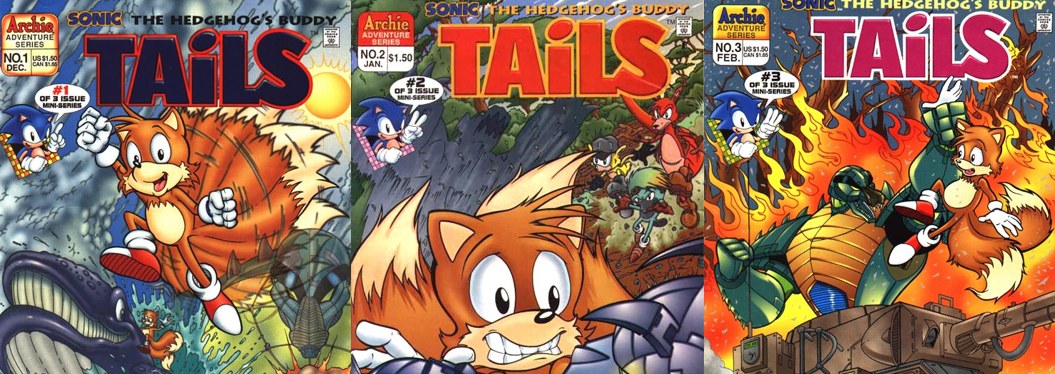
In anticipation of Sonic the Hedgehog 2 (SEGA Technical Institute, 1992), SEGA dubbed November 24, 1992 “Sonic 2sday”. Accordingly, this is a great excuse to celebrate Sonic’s faithful sidekick, Miles “Tails” Prower, who debuted in that title.


Writer: Michael Gallagher – Artists: Mike Gallagher and Dave Manak

Story Title: “Southern Crossover” (Part One to Three)
Published: October 1995 (cover-dated: December 1995) to December 1995 (cover-dated: February 1996)

The Background:
Thanks to an aggressive marketing campaign and being bundled with the all-powerful 16-bit Mega Drive, Sonic the Hedgehog was the blockbuster success SEGA needed to usurp Nintendo from the top of the videogame industry. Despite a tumultuous developmentSonic 2 surpassed this success, selling 400,000 copies in its first week, 6 million units during the Mega Drive’s lifespan, and increasing SEGA’s slice of the home console market by 40%Widely praised and highly regardedSonic 2 also debuted Tails, Sonic’s kid sidekick, who was created by Yasushi Yamaguchi. Resembling the mythical kitsune and devoted to his super-fast hero, Tails became a well regarded staple of the Sonic franchise, becoming one of the few of Sonic’s supporting cast to get his own divisive solo outings. He was also the second to receive a solo mini series published by Archie Comics, who produced the popular Sonic the Hedgehog comics in the United States, which were heavily based upon Sonic’s cartoon adventures. Though spinning off from Archie’s loose adaptation of Sonic the Hedgehog: Triple Trouble (Aspect, 1994), Tails’ three-issue miniseries set the groundwork for his greater role in Archie’s comics, which reimagined him as a character of great destiny.

The Review:
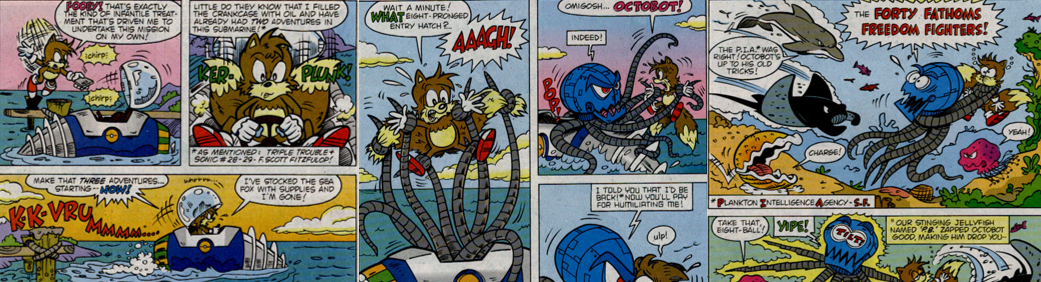
Tails’s one and only Archie-published miniseries begins with the young, two-tailed fox drawing by the docks. It seems Tails likes to write and draw his own comic books that paint him as a mild-mannered (and “handsome”) youngster who secretly operates as “Captain Super Fox-Man”, a superpowered “Avenger of Evil” who’s just as capable (if not more so) as his older Freedom Fighter cohorts. While filing his art, Tails thumbs past a list of supplies he acquired during a previous battle against the tyrannical Doctor Ivo Robotnik and his agent, Fiona, a “false fox” who betrayed him. His’ paperwork proves that Dr. Robotnik is building a satellite operation somewhere on Mobius and the fox cub is determined to find it by himself and prove how capable he is. Thus, Tails quickly hides the document from Princess Sally Acorn, leader of the Freedom Fighters and essentially his substitute mother. The two admire the Sea Fox, a nifty little one-man submarine built for Tails by Rotor the Walrus after Archie’s Triple Trouble adaptation. Although Sally forbids Tails from piloting the Sea Fox, he’s seemingly happy tinkering with it and playing make-believe but secretly fumes at being treated like an infant. Consequently, when Sally leaves for an important meeting, Tails takes the Sea Fox out to sea, having secretly filled the tank and embarked on solo ventures before, adamant to show that he’s not a helpless child. Elsewhere, the maniacal Dr. Robotnik oversees the final preparations on his gigantic blimp, trashing one of his SWATbots with his bare hands when the machine asks to check the ship’s inventory against the supply list stolen by Tails. Dr. Robotnik plans to fly supplies to his regional robo-underboss in the Southern Hemisphere (specifically, the nation of Downunda), as part of his grand plan for global domination, cloaking the dirigible to make it undetectable unless one is directly beneath it.

Determined to prove himself as a hero, Tails is overwhelmed  by the vengeful Octobot while at sea.

This odd flaw means Tails easily spots the blimp while searching the high seas for signs of the rotund dictator. While investigating a dark patch on the water’s surface, Tails is stunned to find his quarry is in the sky and flies up to investigate. After glimpsing the blimp’s destination, Tails is attacked by SWATbots, just barely recovering in time to trap them in a water vortex with his propeller-like twin tails. However, when Tails returns to the Sea Fox, he’s ambushed by Octobot, a mechanical octopus in charge of Dr. Robotnik’s underwater robotization factory and out for revenge after Tails humiliated him in the Triple Trouble special. After scuttling the Sea Fox, Octobot drags Tails into the dark depths, causing Tails to black out. Outraged that his blimp was so easily spotted, Dr. Robotnik chastises his forces and calls his robo-underboss, a mechanical crocodile named Crocbot, for an update. Thrilled that he’ll soon receive enough supplies to pollute the landscape, Crocbot orders his robotic winged dingoes to patrol in anticipation of the blimp, then loudly boasts of his plans to reprogram Dr. Robotnik’s SWATbots to aid him in overthrowing his master and conquering the world for himself! Luckily for Tails, he wakes up on the back of a massive blue whale named Fluke. His confusion is short-lived as a friendly manta ray named…well, Ray…fills him in on what happened. As Tails was being dragged underwater and nearly drowned, Octobot was suddenly attacked by the “Forty Fathoms Freedom Fighters” (Ray, P.B. the Jellyfish, Bottlenose the Dolphin, and Bivalve Clam). Despite Octobot fighting back by spraying ink, he was shocked by P.B., tackled by Bottlenose, and ultimately flattened by Fluke (though the Sea Fox was totalled). Grateful, Tails immediately enlists the Forty Fathoms Freedom Fighters in expediting his trip to Downunda, with Fluke and Ray only too happy to help and allow Tails to embellish the details in his comic books.

Rescued in Downunda, the injured Tails learns he’s been chosen for a higher, as-yet-unknown purpose.

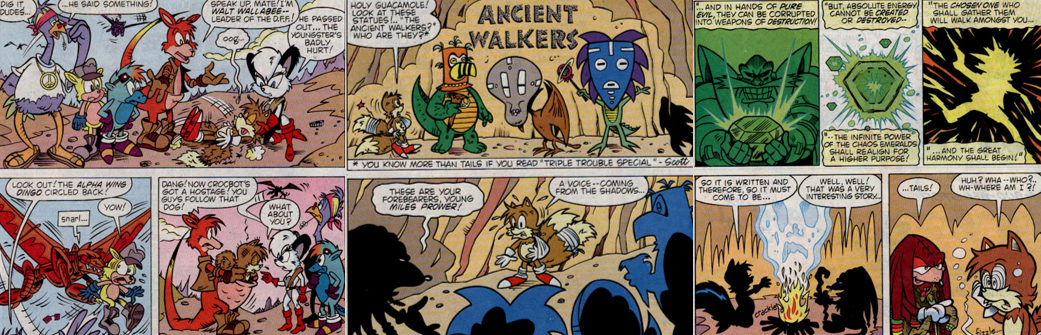
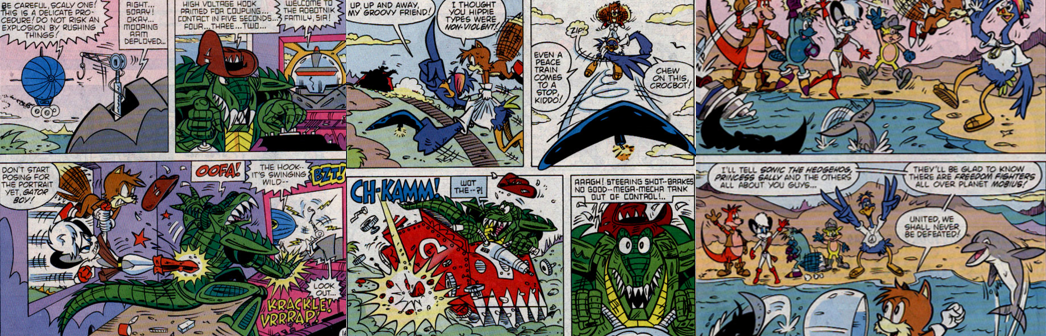
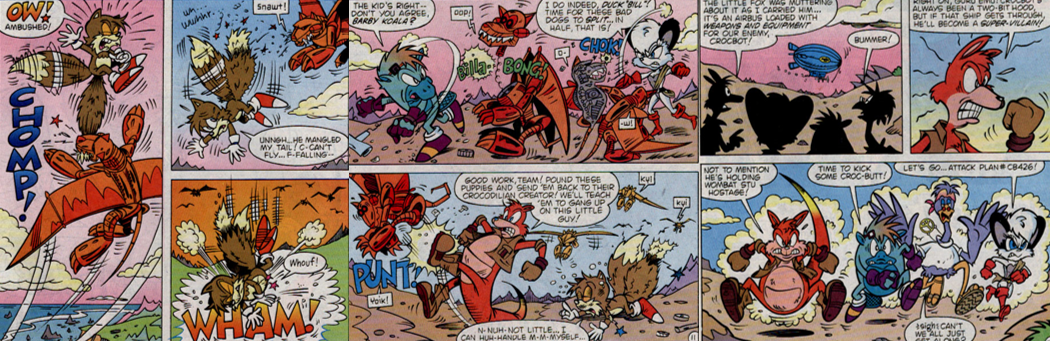
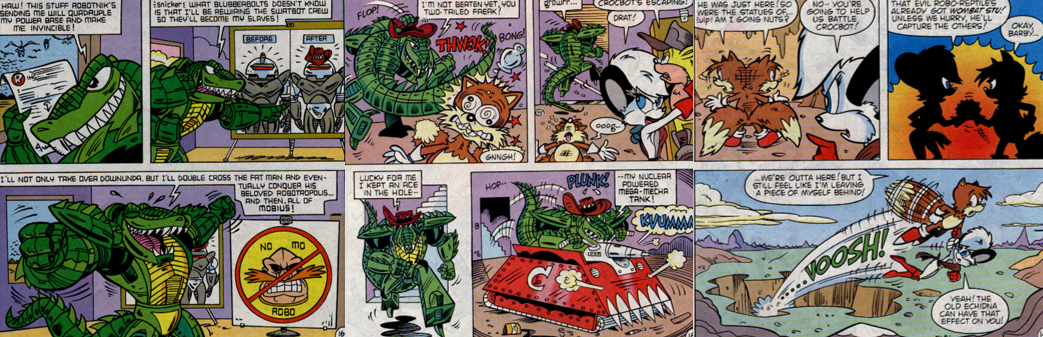
Upon arriving, Tails is immediately detected by Crocbot’s security systems, who dispatches his robotic Wing Dingoes to intercept him. Although Tails puts up a good fight and even takes a few of the robots out, he takes a bite to a tail and crashes to the ground, too injured to fly and barely staying conscious. Tails is thus rescued again, this time by the Downunda Freedom Fighters led by Walt Wallabee and Barby Koala, Wombat Stu, the peace-loving hippy Guru Emu, and Duck “Bill” Platypus. While they’re busy tending to the unconscious Tails, the group is ambushed by the Alpha Wing Dingo, who swoops in and kidnaps Wombat Stu! Walt quickly orders the others to pursue their teammate while he hops away with Tails in his pouch to get the young fox help. After halting communications with Dr. Robotnik to keep his master from seeing the state of his damaged Wing Dingoes, Crocbot initially lashes out in frustration and then gleefully clamps Wombat Stu to a torture rack. Crocbot then assures Dr. Robotnik that all is ready and ends the call, watching with relish as Wombat Stu’s allies approach his base (amusingly modelled after the Sydney Opera House) just as the blimp arrives. Walt rejoins his teammates and gives an update from Tails that catches them up with the plot and they race towards Crocbot’s base to keep him from being bolstered by Dr. Robotnik’s weapons. Tails wakes up at the Downunda Freedom Fighters’ base at the bottom of a giant crater, his tail bandaged and his arm in a sling, and discovers statues of the Ancient Walkers, mystical beings from Mobius’s past who Tails learned of in the Triple Trouble special. He’s then approached by Athair, the wizened and cantankerous great-grandfather of Knuckles the Echidna, who gives the injured fox cub a lecture on ancient history.

Tails and his new friends successfully thwart Crocbot’s ambitions and vow to defy Dr. Robotnik.

Generations ago, Athair’s echidna ancestors were so busy building elaborate, highly advanced cities across Mobius that they failed to spot a comet heading for their capital city, Echidnapolis, until it was too late. Though the echidnas levitated Echidnapolis and a chunk of their land to safety, creating what was then known as the Floating Island, the comet devastated Mobius. Though Tails tries to leave, frustrated with Athair’s riddles and eager to help his newfound friends, the Ancient Walkers come to life and insist he learn more. Thus, Tails learns of how life evolved on Mobius, how dinosaurs once ruled, and how the planet was struck by the Chaos Emeralds in prehistoric times. Many worshipped or tried to harness their powers over the millennia, often being corrupted by their desires. However, it’s said that a “Chosen One” would one day unite the many Chaos Emeralds to bring about the “great harmony”, a destiny Athair believes the Ancient Walkers have bestowed upon Tails! After coming out of a trance to find his wounds healed, Athair gone, and Barby crashing in after Crocbot’s gigantic C.D. Rom Ram attacks the Downunda Freedom Fighters, Tails reluctantly shrugs off his strange experience and goes to help. Although the massive robotic ram beats on the Downunda Freedom Fighters, it’s easily destroyed by one of Walt’s “bomberangs”, frustrating Crocbot and distracting him from helping the blimp to dock. When Tails and Barby attack him, Crocbot mangles the controls and the blimp dramatically goes down in flames along with his plans to usurp Dr. Robotnik. With Barby distracted rescuing Wombat Stu, Crocbot hits Tails with his mechanical tail and leaps into his “nuclear powered Mega-Techa Tank” to escape. Determined to end Crocbot’s threat, the normally pacifistic Guru Emu borrows a bomberang and, assisted by Tails, sends Crocbot careening down a canyon to an explosive end. After tearfully turning down an offer to join the Downunda Freedom Fighters, Tails is overjoyed when the Forty Fathoms Freedom Fighters return with his repaired Sea Fox. Though he’s sad to say goodbye to his new friends, Tails heads home emboldened by the knowledge that Freedom Fighters exist all over Mobius.

The Summary:
I’ve read every single Sonic and Sonic-adjacent comic published by Archie Comics and I’m starting to think that Michael Gallagher may be my least favourite artist, especially from these early days. His work, while capturing the same cartoonish vibe as the cartoons that influenced these comics, can’t compare to the likes of Patrick “Spaz” Spaziante, who had a hand in the miniseries’ covers, which promise a tale of excitement and adventure that sadly isn’t reflected in the pages. We’re still in that weird time when Archie’s comics were more slapstick and cartoonish, meaning we get painful puns, borderline plagiarism presented as homage (particularly in Tails’ comic book fantasises), and childish villains who spend more time shouting than being a threat. It’s a gripe of mine that Archie’s Sonic comics took so long to establish their identity and move away from simplistic stuff, like the Ancient Walkers being cartoonish statues in a bland cave, and nonsense original characters who, while visually interesting, can’t compete with SEGA’s iconic creations. Indeed, the two sets of Freedom Fighters Tails encounters in Downunda leave a lot to be desired and don’t live up to their potential. I feel the writers should’ve focused on the Downunda Freedom Fighters and fleshed them out more if they were going to have such a large role. Perhaps they could’ve been forced from Downunda by Crocbot and operated out of a seaside cave, biding their time to counterattack when they spotted Tails in danger and rescued him alongside Fluke. Then we could’ve seen these new guys in action sooner and learned more about them, something greatly needed since they totally steal Tails’ spotlight!

Sadly, Tails’ solo venture is usurped by forgettable (if visually interesting) original characters.

Not yet the young genius and tech-savvy inventor we know today, Tails is frustrated at being thought of as a helpless kid and regularly defies Princess Sally by taking the Sea Fox out on adventures. Sadly, we don’t get to see the Sea Fox in action as it’s scuttled by Octobot and Tails’ hopes of downing Dr. Robotnik’s blimp solo are quickly dashed when he’s constantly overwhelmed and is either close to drowning or unable to fly because he’s outnumbered, outpowered, and outmatched. Therefore, Tails must be rescued by two sets of largely forgettable Freedom Fighters, I like the visual variety of both groups and it’s always fun when the comics anthropomorphise unique creatures like jellyfish or wallabies, but I don’t know who any of these guys are. What’s their backstory? How did they get into the Freedom Fighter game? What are their personalities beyond wanting to protect the world and hating the dictator and his robotic minions? Honestly, this would’ve been a great opportunity to team Tails up with Ray the Flying Squirrel and even Mighty the Armadillo but, as I mentioned, the story would’ve greatly benefitted from trimming down these original characters. I would’ve had Walt, Barby, Stu, and Fluke, with Atahir as their wise mentor. Make Walt the pacifist who’s forced into violence, Barby the tactician, Stu the hot-head, and Fluke the laidback muscle who carries them across the ocean. Then, use these extra panels to contrast them with the Knothole Freedom Fighters, showing how they accept Tails and don’t mollycoddle him. Indeed, perhaps they’d be compelled to help Tails based on Athair’s foreknowledge of his apparent destiny as the “Chosen One”, perhaps even leading them to revere him as a messiah figure, thus making his decision to return home more of a struggle since Tails would’ve found acceptance and the chance at a greater destiny amongst them.

Strangely, the story’s more concerned with toppling Crocbot than exploring Tails’ destiny…

Instead, Tails is hurt, the Downunda Freedom Fighters take over, and we’re left with a dull history less about things that barely seem connected to Tails. Rather than waste time recapping the echidna downfall, why not focus on the Chaos Emeralds, their influence on others, and the “Chosen One” prophecy? Tails barely seems interested in Athair’s story and doesn’t dwell upon the Ancient Walkers’ words after leaving with Barby, making me question what the point of dedicating all that time to it was beyond sowing the seeds for future plot threads. I quite liked Crocbot, however; he’s got a fun, unique design and I liked how he spoke with an Australian accent and sought to usurp Dr. Robotnik. However, he barely does anything and leaves all the heavy lifting to his Wing Dingoes and flees at the first sign of trouble. Crocbot later returned to plague our heroes again, but he doesn’t get a good showing here as he wastes time monologuing to Wombat Stu rather than torturing him and breaks down in tears when he accidentally destroys Dr. Robotnik’s blimp, making for a particularly weak villain. Honestly, I think Sonic the Hedgehog’s Buddy: Tails missed a trick by not turning to his Game Gear games for inspiration. Tails Adventure (Aspect, 1995) released around the same time this miniseries so it might’ve been unrealistic to expect an adaptation, and Tails’ Skypatrol (Japan System House/SIMS, 1995) may have released earlier in 1995 but it was exclusive to Japan at the time. Still, Archie could’ve gotten design documents and some information on both from SEGA, certainly enough to cobble together an adventure that pitted Tails against Witchcart and/or the Battle Kukku Empire to at least use more game-accurate villains in his solo adventure. Still, this was decent enough and showed that Tails was definitely ambitious for his age, but I think it says a lot that young Miles never got another solo series from Archie Comics…

My Rating:

Rating: 3 out of 5.

Pretty Good

What did you think of Tails’s first and only solo miniseries from Archie Comics? Were you disappointed that so much of the story was dominated by original characters? Which of the two sets of new Freedom Fighters was your favourite? Would you have liked to see elements from Tails’s Game Gear titles incorporated instead? What did you think of Crocbot and the idea of Tails having a greater destiny? What are some of your favourite Tails moments from the Archie Comics? How are you celebrating Tails and “Sonic 2sday” this year? Whatever your opinion on Tails, or Sonic 2 in general, drop a comment below and go check out my other Sonic content.

Screen Time [Doctor Who Day]: Terror of the Autons


On this day in 1963, the longest-running and most successful science-fiction television series ever, Doctor Who, first aired. Since then, the rogue Time Lord has gone through numerous incarnations, travelled throughout the entirety of time, and is widely celebrated as one of the most iconic and recognisable mainstream cultural icons.


Season Eight, Serial One: “Terror of the Autons”


Director: Barry Letts
Air Date: 2 January 1971 to 23 January 1971
UK Network: BBC One
Stars: Jon Pertwee, Katy Manning, Roger Delgado, Nicholas Courtney, Richard Franklin, and Michael Wisher

The Background:
Back in 1963, BBC Head of Drama Sydney Newman commissioned a show to appeal to both children and adults to fill a gap in the BBC’s schedule. Thanks to writer Cecil Webber and a successful debut episode, Doctor Who wowed audiences with its historical, scientific, and fantastical stories. While the titular Time Lord changed faces over the years and was eventually banished to Earth as a cost-saving measure, he still opposed numerous evil forces, with perhaps the Doctor’s most personal, persistent, and most devious enemy yet making his debut during this time. Created by producer Barry Letts and script editor Terrance Dicks, the Master (Various) was intended to be the “Professor James Moriarty” to the Doctor’s “Sherlock Holmes”, a dark opposite to the benevolent Time Lord who was as wicked as the Doctor was righteous. “Terror of the Autons” was wellregarded and the Master continued to plague the Doctor during this era and beyond. Constantly escaping death, scheming, and seeking to destroy his foe, the Master would return time and again (even when it made little logical sense) and has cemented his place as the Doctor’s archenemy, second only to the Daleks.

The Plot:
While trapped on Earth and assisting the United Nations Intelligence Taskforce (UNIT), the Third Doctor (Pertwee) opposes an alien invasion instigated by his fellow renegade Time Lord, the Master (Delgado).

The Review:
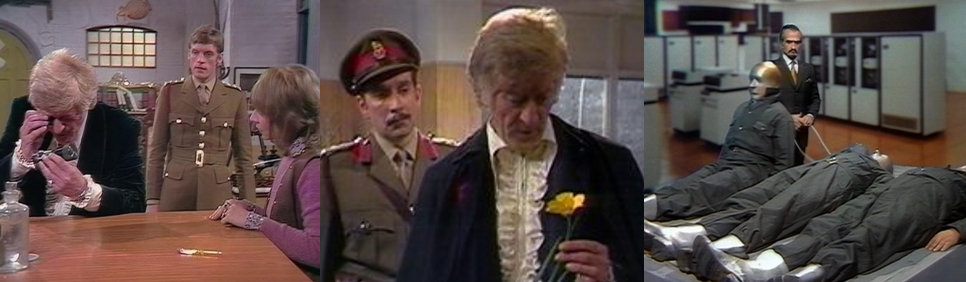
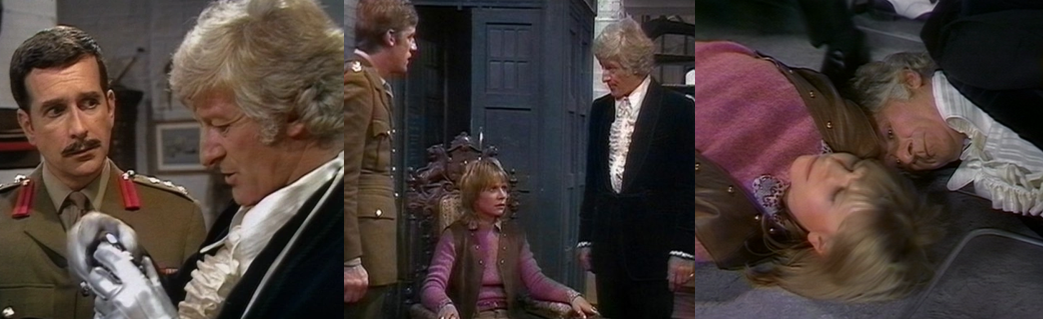
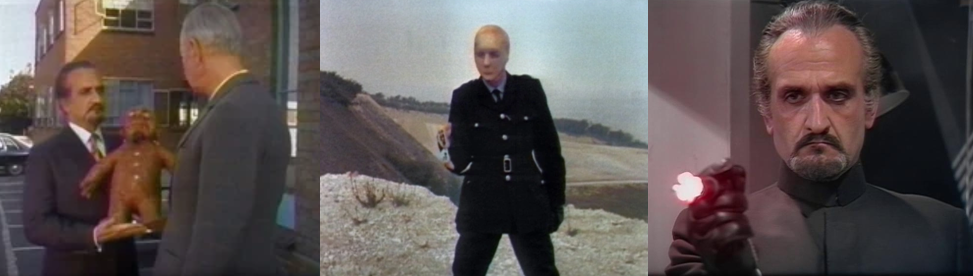
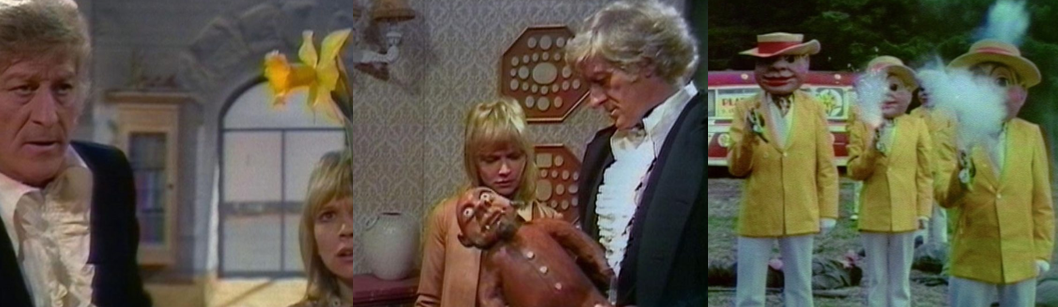
“Terror of the Autons” takes place when the Doctor was exiled to Earth as punishment by his race, the enigmatic and officious Time Lords, for disregarding their rules about interfering in time and space. While he still has access to and operates out of this TARDIS, the machine no longer functions and his knowledge of how to make it work has been forcibly removed by the Time Lords. The Doctor busied himself as a scientific advisor for UNIT, assisting the uptight and exasperated Brigadier Lethbridge-Stewart (Courtney) with the many bizarre threats conveniently faced by humanity during this time. In between these adventures, the Doctor worked tirelessly on the TARDIS, only to repeatedly fall short, contributing to his rather cantankerous mood in this serial. Indeed, when we first catch up with the Doctor, he’s briefly infuriated when UNIT trainee Josephine “Jo” Grant (Manning) interrupts him, mistakenly extinguishing what she sees as a fire and ruining his work. Although the Doctor’s attitude toward Jo cools as he both composes himself and is softened by her innocent and kindly demeanour, he’s initially unimpressed by her presumptuousness and lack of qualifications and experience. Still, Jo’s eager to  impress on the Doctor as his new assistant and the Brigadier insists that the Doctor must take her on (especially as he’d been complaining about needing an assistant) or dismiss her himself. Like many of the Doctor’s companions, Jo’s main role is to ask questions and get into trouble, and be a pretty face for him to rattle off his thoughts. She’s even attacked by one of the Auton’s living dolls and threatened by the Master in the finale when he tries to retrieve his own TARDIS’s dematerialisation circuit from the Doctor.

Joined by a new assistant, the exiled Third Doctor investigates the bizarre Auton threat.

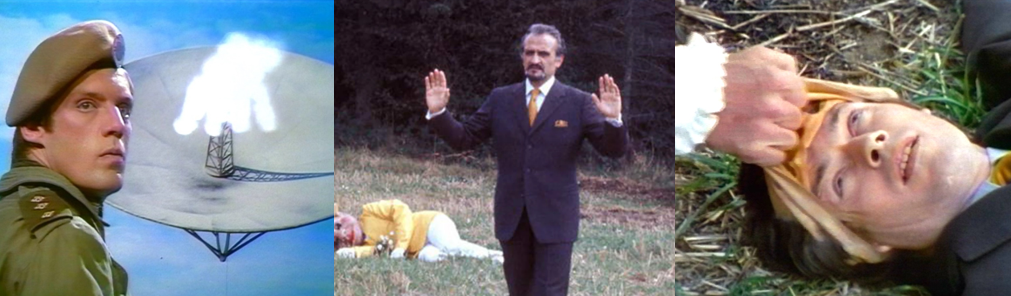
Begrudgingly pulled from his work and saddled with Jo and Captain Mike Yates (Richard Franklin) constantly badgering him, the Doctor investigates the theft of an energy unit and discovers technician Albert Goodge (Andrew Staines) mysteriously (and comically) shrunken down and stuffed into his lunchbox. The Doctor’s curiosity is further piqued when Adelphi (David Garth), a fellow Time Lord, warns him of the Master’s presence on Earth. The Doctor quickly realises that the Master is in league with the Nestene Consciousness (a cephalopod-like energy being) and is creating Autons (plastic robots and automations) to prepare for their invasion. While investigating a local plastics factory to find the Master, Jo is unwittingly hypnotised by the Master and almost sets off a bomb in UNIT headquarters, though she cannot offer the Doctor any insight due to suffering amnesia once freed from the Master’s spell. Despite him being furious at her for disobeying him, the Doctor is reluctantly grateful when Jo rescues him when he’s captured by the brainwashed Luigi Rossini (John Baskcomb) while searching the Master’s TARDIS. Despite narrowly evading a rabid mob, a gaggle of Autons, and his frustration at discovering the Master’s dematerialisation circuit is incompatible with his TARDIS, the Doctor consoles himself with the knowledge that he has effectively stranded his old foe by stealing the component. The Doctor then investigates the strange dolls and plastics recovered by UNIT, piecing together through his keen mind and the Master’s remote attacks that the Master’s using short-wave radio transmitters and heat to activate inconspicuous everyday objects to target 450,000 people and sending the country into disarray ahead of the Nestene Consciousness’s arrival. It’s clear that the Doctor is relishing the battle of wills with his murderous counterpart, even when baffled by certain events or outraged by the senseless violence, as it gives him the opportunity to test his mettle against a foe every bit as inventive as he is, yet one with a distinct lack of morals.

While the Brigadier’s used to the Doctor’s ways, it takes Jo some time to impress the Time Lord.

While the Doctor is somewhat dismissive of Jo, Mike treats her very well, happy to have another witness to the Doctor’s wild state and impulsive behaviour. Mike seems to have a crush on Jo as he hangs around her a lot and even saves her from one of the Master’s killer dolls. As ever, the Brigadier continues to be both awe-struck and irritated by the Doctor, who rarely treats him, his men, or their technology with any respect, regularly criticises their militaristic attitudes (and mankind’s tendency towards conflict), and compulsively disregards UNIT procedure. Indeed, the Brigadier insists on accompanying the Doctor to the plastics factory, organising his troops to corner the Master, co-ordinates an airstrike with the Royal Air Force, and even joins the Doctor in confronting the Master in the radio telescope control room. Despite having encountered the Autons and other strange alien threats before, and his familiarity with the Doctor and his ways, the Brigadier remains a somewhat sceptical, by-the-book military commander frequently baffled by the Doctor’s eccentric nature. Still, the Brigadier trusts the Doctor enough to ask his opinion (and for his help) and to act when the Doctor advises, even if the threat is something inconspicuous like ugly toy dolls. The Brigadier also saves the Doctor from being throttled by the Master’s living phone cord and even calls off the airstrike when he spots the Doctor and Jo being taken hostage. Although she doesn’t make a great first impression, Jo eventually impresses the Doctor with her affable personality, her fearless nature, and her unexpected skills of escapology. She almost dies when inspecting one of the Auton daffodils, however, to say nothing of how easily the Master enthrals her. However, she largely follows the Doctor’s lead and helps in her own way, eventually causing him to accept her as his new assistant.

While the Auton threat is laughable, the Master shines as a delightfully devilish villain.

Honestly, the Auton threat is pretty laughable, even by classic Doctor Who standards. The faceless, plastic robot men look cheap and ungainly despite their surprisingly violent concealed hand cannons. The Master’s bizarre toy dolls and laughable inflating chair are almost as comical as his plot to kill thousands with plastic daffodils and the strange and obvious green screen to show scale when he’s bringing Autons to life in the plastics factory (as if there wasn’t a warehouse they could shoot in!) The Autons are largely lifeless, yet still know when they’re beaten, something the Master refuses to accept. They’re also the pawns of the Nestene Consciousness, which is built up as a fearsome entity but ends up being a vague distortion effect. Luckily for me, the main threat is the devious Master, a scheming, charismatic Time Lord who hypnotises the weak-willing with a glare and shrinks foes to death with his Tissue Compression Eliminator. The Master is the anthesis of the Doctor, gleefully killing where the Doctor protects, manipulating where he collaborates, and desiring power where the Doctor champions peace. The Master easily coerces Rex Farrel (Wisher), taking over his plastics factory to create Autons while posing as “General Masters”. If his silver tongue fails, the Master simply hypnotises or kills to get what he wants, sure that the Nestene Consciousness will reward him. Every bit as intelligent and charismatic as the Doctor, the Master relishes pitting his intellect against his foe, desiring first to kill the Doctor and then watch him suffer, before realising that the Nestene Consciousness will view him as expendable once it arrives. Still, though stranded and defeated, the Master flees after using Farrel as a patsy, ensuring future encounters between him and the Doctor.

The Summary:
The Third Doctor has always been a favourite of mine, largely thanks to the novelisations of his adventures I read as a kid and because his stories were the first to get re-runs back in the day. He’s a very energetic and intelligent incarnation who doesn’t suffer fools gladly and who is clearly frustrated at being stranded on Earth. This gives the Third Doctor a unique disposition as he clearly loves Earth and enjoys working with UNIT and the Brigadier, but he misses his freedom and is clearly tetchy at being stranded. This causes him to lash out irritably at times, labelling the Brigadier a “fool” and admonishing him for saddling him with Jo while also unable to turn down the chance to investigate strange occurrences. While it was undeniably disappointing to limit the Doctor Earth, I really enjoy the relationship between him and the Brigadier, with them getting on each other’s nerves and having very different moral and ethical perspectives and yet still defending the greater good. I enjoy seeing the Doctor in a lofty position at UNIT and his banter with Mike and Jo, who are amazed by his abilities and compelled to help. This was Jo’s debut episode, so she’s not especially fleshed out and is little more than a naïve, pretty face, but she did okay. While she tried to impress with her credentials and almost got killed a couple of times, her kind personality, bravery, and adaptability eventually won the Doctor over. Still, it might’ve been nice to give her more to do, something more relevant to the plot, like being a plastics or materials expert or maybe a coroner? I’m not sure, exactly, but just a little something extra to help her stand out beyond her doe-like eyes and naive enthusiasm.

Sadly, the main plot is quite scatter-brained and the Autons are more comical than menacing.

There’s a distinct charm to these classic Doctor Who episodes, which cobble together aliens and technology on a shoe-string budget and always earn points for creativity, even if the execution is handicapped by the time period. “Terror of the Autons” is especially unimpressive in this regard, however, simply because the Autons are so basic and boring. They’re basically lame Cybermen, plodding about and exhibiting superhuman strength and dangerous weaponry, but failing to inspire the same fear as the Daleks or the Cybermen. There’s some potential in their life-like skin masks, but this aspect is poorly implemented (which is a shame as it could’ve led to them impersonating the Brigadier or Mike or even the Doctor!) The Master’s plot to create dolls, daffodils, and killer chairs is especially bonkers and seems like a waste of time. Why not create Auton duplicates of key personnel to spread discord or even access the antenna array or those weapons the Doctor’s so against? Instead, the Master offs people with ravenous inflatable chairs and toy dolls, an oddly elaborate plot considering he can simply brainwash most people or shrink them to death with his little gizmo. It doesn’t help that the Nestene Consciousness is barely seen but is talked about with such fear and reverence that it can’t help but be disappointing when it appears as a static mess. I’m not expecting anything too elaborate, of course, but some kind of masked face superimposed on the sky would’ve been better, I think. I was impressed by the body count in “Terror of the Autons” and the Master’s plan for mass murders, but the execution was so bizarre that it felt like the writers were just making stuff up as they went along according to whatever props they had lying around backstage at the BBC.

Thankfully, the Master lives to fight another day and hopefully appear in better stories.

Thankfully, “Terror of the Autons” limps along through Jon Pertwee and Roger Delgado’s enigmatic performances. I wonder if making the Doctor a bit tetchy was a conscious decision to show that he has a mean streak like the Master, who fully embraces his dark side and matches the Doctor’s charm and sophistication with a murderous impulse. While he enjoys killing and seeks the destruction of the Earth, the Master’s not above subterfuge and generally tries to win over his victims before resorting to his hypnotic glare or shrink ray. This is probably because his hypnotism isn’t reliable, with the elder Farrel (Stephen Jack) resisting and the Master’s other victims shaking off his influence with enough time and distance. The Master’s plot may be extremely convoluted but this appears to be a purposeful decision as he enjoys manipulating those around him like chess pawns and pitting his intellect against the Doctor’s controlling others just to exert power and threatening the Doctor from afar just to get one up on him. Their showdown at UNIT headquarters is a great meeting of the minds as the two perfectly balance each other, the Master savouring having his foe on the back foot and not above threatening the Doctor’s friends to get what he wants. Ultimately, however, the Master’s most concerned with saving himself and sets aside his hatred of the Doctor to do so, slipping away like a coward. Roger Delgado shines as the quintessential standard barer for the Master, being every bit the Moriarty to the Doctor’s Holmes, something clearly evoked in their dialogue with each other. This aspect carries “Terror of the Autons” to a three-star rating and even that’s being generous as it’s somewhat of a disservice that such a fantastic villain is saddled with such a ridiculous plot.

My Rating:

Rating: 3 out of 5.

Pretty Good

Did you enjoy the Master’s debut in “Terror of the Autons”? Was the Third Doctor your favourite incarnation? What did you think to the dichotomy of pitting the Doctor against an intellectual rival? Do you agree that Jo needed a little more to do here? What are your opinions on the Autons and the larger plot of their invasion? Which incarnation of the Master is your favourite? How are you celebrating Doctor Who Day today? Let me know your thoughts on Doctor Who and the Master’s debut in the comments, check out my other Doctor Who reviews, and donate to my Ko-Fi to suggest future episodes for me to cover.

Movie Night: Creepshow

Click here to listen to my guest spot on the Anthological podcast discussing this film

Released: 10 November 1982
Director: George A. Romero
Distributor: Warner Bros. Pictures
Budget: $8 million
Stars: Carrie Nye, Jon Lormer, Stephen King, Leslie Nielsen, Ted Danson, Hal Holbrook, Fritz Weaver, E. G. Marshall, and Joe King

The Plot:
Abused Billy Hopkins (Joe King) takes solace in Creepshow, a horror anthology comic with tales of a cursed family’s Father’s Day, a simple-minded yokel’s encounter with a meteorite, a heartless millionaire’s spiteful vengeance, a mysterious crate, and a germaphobe’s battle against cockroaches.

The Background:
Horror has a long and successful association with anthologies for many decades. Books, comics, and television shows have benefitted from telling episodic or short-hand horror tales over the years, with celebrated horror author Stephen King using the medium to deliver some of his finest works. In 1982, King collaborated with the grandfather of the zombie genre, George A. Romero, on this cult classic horror anthology movie. While two of King’s existing short stories were adapted for the film, the remaining shorts were written specifically for the movie, with King and his young son appearing as actors. Star Ted Danson endured a gruelling experience shooting in a specially prepared pit to simulate being drowned while co-star Leslie Nielsen (then known as a dramatic actor) kept things light on set with a hidden fart machine. Additionally, although 20,000 live cockroaches were utilised for the “They’re Creeping Up on You” segment, horror legend Tom Savini bolstered their numbers with nuts and raisins. With a box office gross of over $21 million, Creepshow was a surprise success that proved popular with critics for its quirky blend of comedy and horror and became a horror classic. However, while Creepshow led to a comic book and two sequels of varying quality, distribution issues led to a planned television spin-off being reworked into the thematically similar Tales from the Darkside (1983 to 1988), though a well-regarded TV series revival did eventually emerge in 2019.

The Reviews:
As Creepshow is an anthology film comprised of five short stories and a framing narrative to tangentially link them together, it’s just logical that I go over each one individually and then discuss the overall film. The prologue and epilogue reveal that Creepshow is a horror anthology comic with pulp horror stories and advertisements for prank toys like x-ray glasses and voodoo dolls. Billy Hopkins (an avid horror fan judging by his bedroom) loves the comic but is berated by his cruel and strict father, Stan (Tom Atkins), for wasting his time on such trash. When Billy dares to speak back to his father, he gets a smack for his troubles, much to the chagrin of his loving but ultimately helpless mother (Iva Jean Saraceni). When Billy tries to appease his father and apologise, Tom sees through the trick and demands that he give up his comics and horror, forcing him to go to bed and tossing Creepshow in the trash. Unbeknownst to him, there is inexplicable supernatural power in those pages as the comic’s skeletal host, the Creep, lingers outside Billy’s window as he wishes death upon his father. The segments that follow are then presented as adaptations of the comic stories, complete with the occasional comic book panelling and colour effects to tie everything together. Once they’re all finished, two garbagemen (Marty Schiff and Tom Savini) retrieve the comic from the Hopkins’ trash and find the voucher for an “authentic” voodoo doll removed. Inside the Hopkins residence, the still grouchy and aggressive Tom complains of neck pain before experiencing stabbing pains all over. As Tom collapses in agony, Billy cackles gleefully in his bedroom as he repeatedly stabs at the voodoo doll, the image turning into the cover art for the next issue of Creepshow.

The wealthy Granthams are horrified when their patriarch reanimates and avenges himself upon them.

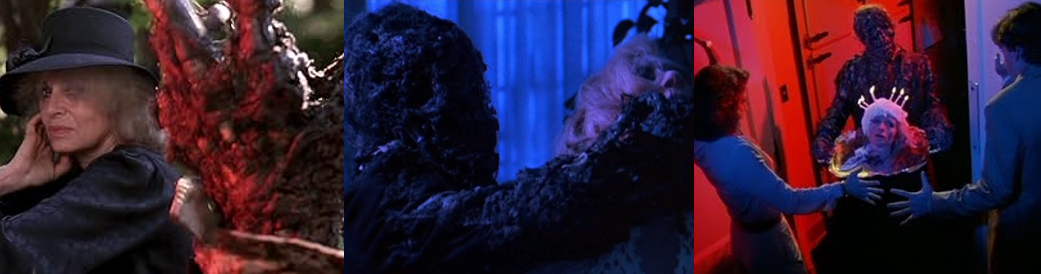
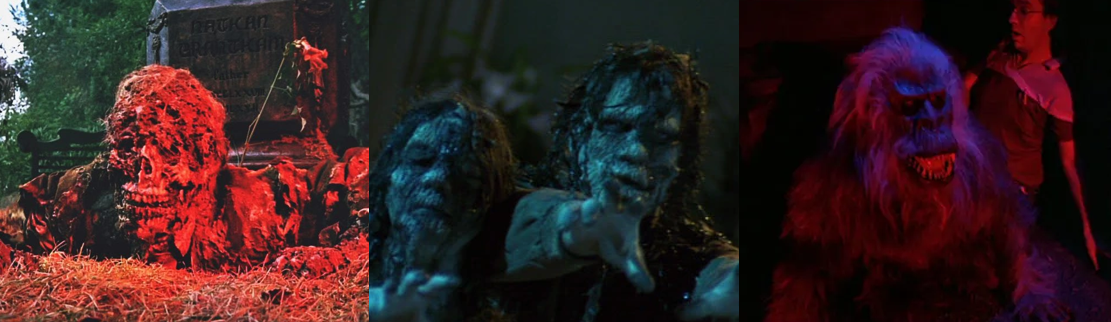
The first full-length story to spring to life is “Father’s Day”, which revolves around the filthy rich Grantham family. Every year, Sylvia (Carrie Nye), gathers the family for a special dinner. This year, her niece, Cass Blaine (Elizabeth Regan), brings her husband, Hank (Ed Harris), to meet her condescending aunt, her self-absorbed cousin, Richard (Warner Shook), and her great aunt, Bedelia (Viveca Lindfors). Between criticising Cass’s healthy appetite, Sylvia nonchalantly tells Hank that Bedelia, the family matriarch, once murdered the disgustingly wealthy and miserly Nathan Grantham (Lormer). Having accumulated vast wealth through unscrupulous and criminal means, the aged patriarch became aggressive, demanding, and paranoid, believing everyone was using him for his fortune and making constant, abusive demands of Bedelia, who was forced to care for him and endure his belittlement. Bedelia finally snapped after her father orchestrated the death of her fiancé, the only man who’d shown her any kindness, to keep her in check. Unable to take her father’s barrage of insults and childish demands for his Father’s Day cake, Bedelia cracked him in the head with an ash tray. Though free of Nathan’s abuse, Bedelia remained scarred and traumatised, placing a flower at his gravesite every Father’s Day. While drunkenly reminiscing about the murder, (which Sylvia helped cover up to profit from her inheritance), Bedelia is horrified when her father’s gaunt, gruesome corpse suddenly bursts from his grave and throttles her to death, still slurring demands for his cake. While having a smoke, Hank wanders into the family cemetery and ends up crushed when the zombified Nathan telekinetically drops a gravestone on him. When Cass expresses concern for her husband, Sylvia begrudgingly volunteers to look for him (hinting at her desire to seduce him), only to end up with her head twisted backwards by Nathan. Impatient and frustrated, Cass demands the lackadaisical and half-cut Richard help search for their missing party, only to be appalled when Nathan’s ghastly, maggot-ridden corpse bursts from the kitchen and proudly presents his cake: Sylvia’s severed head on a silver platter, covered with frosting and candles!

Unlucky halfwit Jordy is transformed by alien vegetation due to his stupidity.

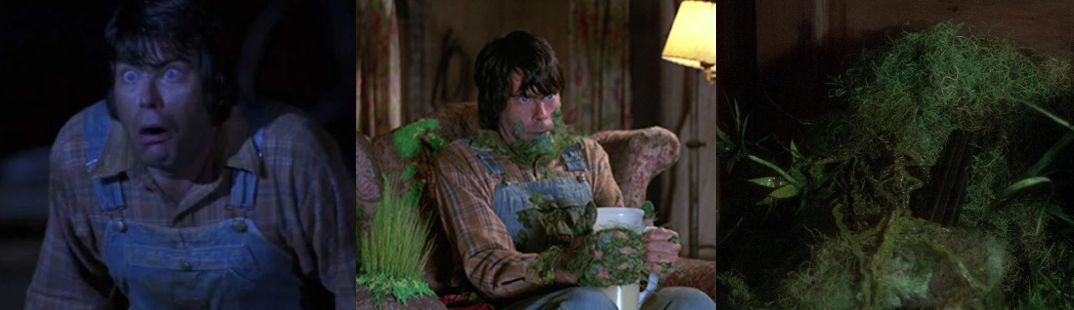
Stephen King takes centre stage in “The Lonesome Death of Jordy Verrill” as the titular, dim-witted, hillbilly farmer. After being amazed by a falling meteorite, Jordy investigates and, dreaming of collecting a cool $200 from the “Department of Meteors” at the local college, touches the red-hot rock without thinking. Jordy’s dismayed at his characteristic bad luck and thinks he’s cost himself a payday when he tries to cool the meteorite and it cracks and is so preoccupied by his overactive imagination that he misses the strange goo that spills from the rock and touches his skin. Retreating home, hoping to repair the meteorite in the morning, Jordy enjoys a beer and some wrestling, sucking his fingers out of habit, but is perplexed and horrified to find a strange, green vegetation growing there. Though he immediately thinks to call a doctor, he stops himself when he imagines it leading to a painful amputation and resolves to simply ignore the problem. As the night continues, the vegetation rapidly spreads across his land, his house, and his body, causing him dreadful itching and to drink himself into a stupor after seeing the vegetation consume his face. Unable to take the itching, Jordy tries to relieve his discomfort with a bath, only to be inexplicably warned against it by his deceased father (Bingo O’Malley), who warns that water will only feed his condition. Realising that he’s beyond help anyway, Jordy gratefully plunges into the bath for some momentary relief but, by the morning, his entire farm, house, and body are consumed by the alien vegetation. Despite the short opting for bizarre, dumbfounded comedy, the finale is unexpectedly grim and emotional as the transformed Jordy cocks his gun, prays for some good luck for once in his life, and blows off what used to be his head. While this ends his torment, the alien vegetation continues to spread beyond Jordy’s land, potentially spelling doom for humanity.

Psychotic spurned husband Richards finds his revenge revisiting him in the form of drowned ghouls!

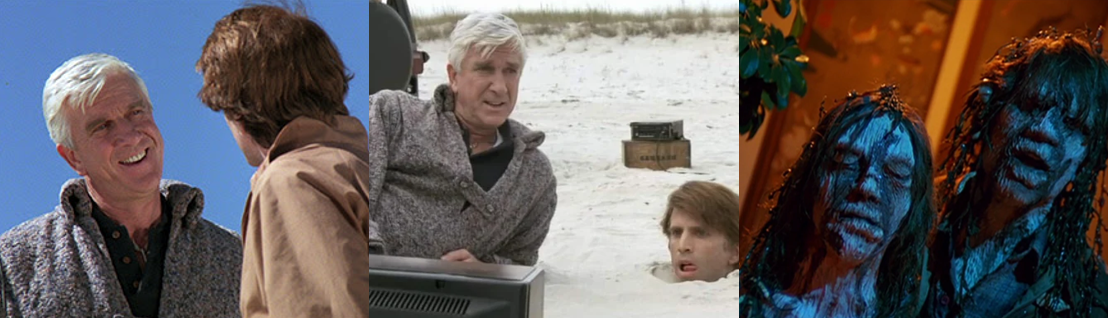
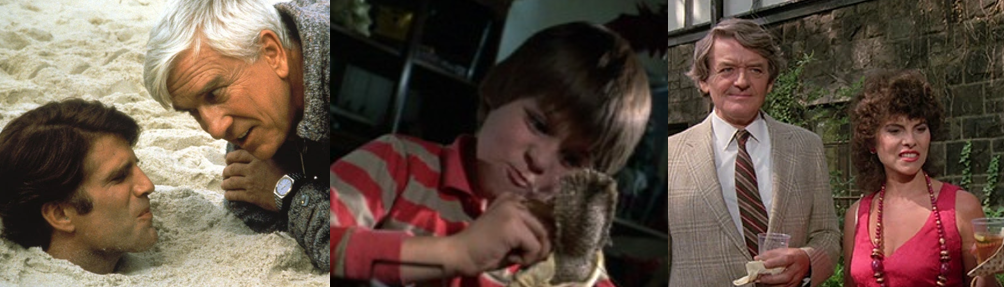
If you’re anything like me, you’ll be surprised to see the late, great comedy actor Leslie Nielsen delivering a seemingly uncharacteristic performance as maniacal, spurned millionaire Richard Vickers in “Something to Tide You Over”. In actuality, Nielsen started his career in more dramatic roles, though his comedic flair seeps through here as Richard is disturbingly jovial and avuncular in his vengeance. After learning that his wife, Becky (Gaylen Ross), is having an affair with square-jawed Harry Wentworth (Danson), Richard visits Harry, coldly dismissing his feelings and simply looking to assert his right over his property. Unimpressed by Harry’s threats, Richard lures his rival to Comfort Point, a private beach he owns, where he implies Becky is in danger. Since he has no choice, Harry makes the trip, only to find a shallow grave in the sand, which he’s forced into at gunpoint by the menacingly aloof millionaire. Harry’s forced to bury himself neck-deep in sand and to watch a live feed of Becky in the same position, slowly succumbing to the tide as it washes over her. Dismissing Harry’s pleas and bribes, Richard simply drives off, watching with glee from his high-tech home as the two struggle to hold their breath. While a glimmer of sanity seems to suggest Richard has some remorse for his actions, a stiff cocktail quickly alleviates such emotions and he dispassionately returns to tidy up the crime scene hours later, sure that his victims were washed out to sea. However, Richard is stunned when Becky and Harry return as drenched, shuffling revenants bent on revenge. Though initially nonplussed and confident his pistol can hold off the ghouls, Richard’s reduced to a cackling, terrified wretch as the two shrug off his assault and use their supernatural powers to grab him, subjecting him to the same fate they suffered and leaving the raving lunatic to see just how long he can hold his breath.

The crate’s ravenous inhabitant represents the perfect chance for Henry to off his abusive wife.

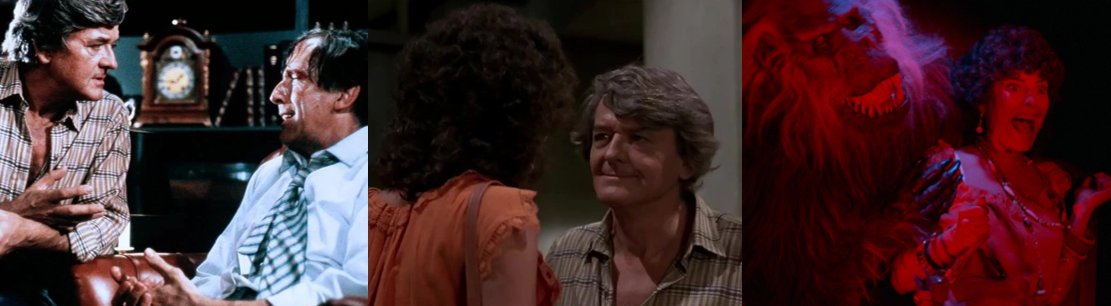
“The Crate” is easily the longest segment and centres on good friends Dexter Stanley (Weaver) and Henry Northrup (Holbrook), professors at Horlicks University. Meek and mild-mannered, Henry daydreams of murdering his emotionally abusive, borderline alcoholic wife, Wilma/Billy (Adrienne Barbeau), who frequently belittles and embarrasses him in front of his friends. Though Dexter feels for his timid friend’s predicament, he’s powerless to intervene, but this drama is superseded when university janitor Mike Latimer (Don Keefer) discovers a mysterious crate hidden under a basement staircase. Though apparently originating from an Arctic expedition, the crate is a mystery to Dexter, who forces it open and is horrified when the bizarre, voracious ape-like “Fluffy” (Darryl Ferrucci) bursts out and devours Mike’s hand (and then the rest of him!) Fleeing, the shellshocked Dexter babbles of the horror to a passing graduate student (Robert Harper) who, first sceptical and then curious of the creature, is promptly mauled and dragged off by Fluffy, which returns to its crate after each kill. The half-mad Dexter shares the gory story with Henry, begging him to help dispose of the creature in a nearby quarry. Though loyal to his clearly traumatised friend, Henry sees this as the ideal way to dispose of his abusive wife and promptly drugs Dexter, clears up the crime scene, and lures Billy to the university on the pretence of helping a young girl who’s been assaulted by Dexter. Eager to both mock the girl’s ordeal and further demean Henry, the tanked-up Billy races over and, suspecting nothing from her meek husband, willingly enters the creature’s hovel without fear. Seizing his opportunity, Henry finally enacts his fantasies and desperately calls for the monster to awaken and kill his wife, only to be met with silence and a barrage of insults from Billy. Just as she’s done criticising his manhood, Fluffy pops out to feed. Though disgusted, Henry finds the courage to reseal the crate and dump it (and the bodies) in the quarry as Dexter suggested. Despite some apprehension, both men agree to stay quiet, though henry’s insistence that the ravenous creature has drowned turns out to be false when we see Fluffy tearing through the submerged crate.

Cruel germaphobe Pratt gets his comeuppance when he’s set upon by a swarm of cockroaches.

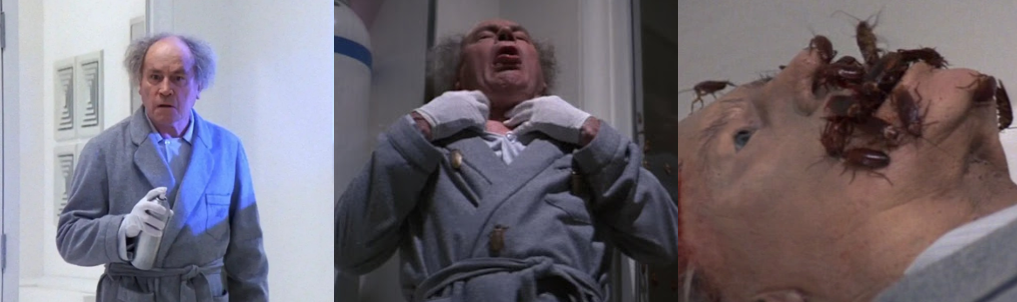
The final story, “They’re Creeping Up on You!”, forces us to share about twenty minutes with uncompromising, belligerent, and extremely wealthy businessman Upson Pratt (Marshall), a germaphobe who lives in a sparse, air-tight penthouse apartment and conducts all his business via telephone and computers. Pratt begins the story battling a cockroach infestation, spraying and stamping the bugs, demanding an exterminator, and threatening to rob people of their livelihoods if his demands are not met. Pratt is delighted to learn that his company’s recent successful corporate takeover resulted in the suicide of his business rival, Norman Castonmeyer, and dismissive towards Norman’s grieving widow, Lenora (Ann Muffly). When Lenora blames him for her husband’s death and wishes all kinds of pain upon the cruel entrepreneur, Pratt simply laughs, having fended off such insults all his life just as effectively as he’s stamped out bugs. Still, Pratt is increasingly disgusted and troubled by the cockroaches, which appear in his food, his equipment, and soon swarm throughout his apartment during a blackout. Having insulted an alienated anyone who could help him, Pratt never wavers in his desire to avenge himself on those who have subjected him to the infestation but is soon overrun by persistent bugs. In his panic, Pratt flees to a more secure panic room only to be mocked by another call from Lenora, who wishes death upon him, and promptly suffers a fatal heart attack upon seeing cockroaches scuttling around his bed. When the blackout lifts, the aggrieved, unsympathetic building handyman (David Early) stops by to check on the unresponsive Pratt. While the cockroaches seem to have disappeared, perhaps vanished now Norman’s death has been avenged or being manifestations of Pratt’s isolation and paranoia, they soon burst from his corpse, tearing through his skin and enveloping his shredded remains.

The Nitty-Gritty:
Although Creepshow offers a unique premise, with its segments being stories in a comic book, the comic book hook isn’t used much. Sure, some shots are framed by comic book panels, actors are rendered against colourful backdrops, and each story fades into an artist’s depiction of the ending, but it’s a tangential link, at best. While the Creep is a questionable animatronic creation, he has a fun, creepy design and it would’ve been nice to see him (and/or Billy) thumbing through the pages of Creepshow and reacting to the stories between segments. The film is an interesting, if occasionally awkward, blend of horror and comedy, with “The Lonesome Death of Jordy Verrill” being the worst offender. I’d like to say King is doing his best but Jordy is such a cartoonish buffoon that it’s hard to take his plight seriously, what with his bizarre fantasises about college professors and doctors. This seems to be a bait and switch, however, as the segment has an unexpected and emotional conclusion where Jordy blows what can loosely be described as his head off, but it doesn’t land quite as well since he’s such a bizarre moron prior. Creepshow really has an issue with pacing, to be honest, as the film is way too long at just over two hours and some stories drag on needlessly. I can’t help but think “The Crate” could’ve easily skipped right to Mike and Dexter examining the titular crate and cut out much of the dull build up. Sure, it effectively paints Billy as an abusive bitch and Henry as a timid, put upon husband, but we clearly see that in every interaction they have and dwelling upon how awful Billy is takes too much focus away from the monstrous Fluffy. While it’s likely it was intentional to paint Fluffy as an afterthought as the true horror was Billy’s belittling and vindictive ways, this segment outstayed its welcome by tacking on an odd final exchange between Henry and Dexter.

Though occasionally questionable, the practical effects are mostly gruesome highlights.

Even my favourite segment, “Something to Tide You Over”, suffers from uneven pacing. Richard’s threat and Harry’s awful predicament are well conveyed but things linger a little too long rather than focusing on Harry’s desperation and slow, painful death. It’s fun seeing Leslie Nielsen be such a despicable, crazed lunatic and there’s a fair bit of nuance to Richard as he shows glimmers of regret and madness throughout. The same can’t be said for Sylvia or any of the Grantham family, who were all obnoxious and thoroughly unlikable characters, or Pratt, who we delight in seeing tortured by the relentless cockroaches. While there’s not much gore in Creepshow and many of the scares are played for laughs, the practical effects are impressive. The squelching, zombified Nathan Grantham sets an early standard, rendering him as a grinning, rotting corpse who strangely exhibits telekinetic powers alongside superhuman strength, all while demanding his special cake. Harry and Becky’s waterlogged corpses are equally impressive, sporting sunken eyes, shrivelled features, and gushing bloody seawater when shot. Equally, the alien vegetation was really good in “The Lonesome Death of Jordy Verrill”, with grass, moss, and vines rapidly overtaking the simple-minded goon’s land, house and, most terrifyingly, his body. This is a slow process more akin to an infection than body horror, though the depiction of the fungus gradually consuming him and eventually transforming him into a vaguely humanoid grass man nicely tied into his desperation for relief from his suffering. Fluffy may be one of the most obvious hand puppets but it’s certainly a unique creature, being some kind of rabid monkey. It’s a little weird and incredibly convenient that it always returns to its crate and only attacks when it’s most dramatic, but Fluffy delivers the most gruesome gore of the movie as it claws, gouges, and bites at its victims.

Despite some intriguing performances, the wraparound is bland and the pacing drags the film down.

“They’re Creeping Up on You!” was probably my second favourite of the segments (“The Crate” is just too long for me to rate it at number two), but it still felt lacking at times. Pratt is a suitably deplorable excuse for a human being and I enjoyed seeing him squirm and get increasingly agitated as cockroaches swarm his germ-proof apartment. There definitely seems to be a suggestion of the supernatural here, even knowing how quickly cockroaches can infest buildings, as they increase the more he belittles others and delights in the death and grief he’s caused. Lenora’s calls, especially her ominous final message, suggest she is putting a death curse upon him, or that her husband is enacting a gruesome and fitting revenge for all the pain Pratt’s caused. Although Pratt’s corpse is also quite obviously a highly detailed dummy, it was quite unnerving to see the cockroaches burst through his skin and envelop him, with this final segment certainly bringing more of a creepy vibe to the proceedings as opposed to the black comedy and unsettling atmosphere of its predecessors. There’s something deeply disturbing about the usually jovial Leslie Nielsen coldly describing what he plans to do to Sam Malone, forcing Harry to bury himself in sand at gunpoint and watch his lover struggle against the tide. Richard has a madcap nature to him that makes him extremely unpredictable, with him coolly commanding every situation with a few curt words and threats rather than physical violence. It’s tough to pick whether Nathan Grantham was more cruel and vindictive than Billy as both are aggressive, patronising, and demanding individuals who push their victims to breaking point, meeting fitting ends as a result (though Nathan’s so stubborn and malicious that he literally returns from the dead to get his Father’s Day cake!)

The Summary:
Although I’m a big fan of horror, horror comedies, comedies, and comic books, Creepshow missed the mark for me in many ways. It’s always to be expected that some segments in an anthology film will be stronger than others. Creepshow certainly offers a variety of stories, but the film is just too long and some segments really outstay their welcome rather than telling fun, gory horror tales. I liked that each one had a different flavour, from bickering families faced with a spiteful zombie patriarch to a spurned husband enacting a chilling revenge and a bizarre monster living in a box and ready to eat an abusive wife. The practical effects were an obvious highlight, with the rare instances of gore being quite shocking, the undead appearing very tactile and disturbing, and even the unconvincing Fluffy making an impression since it’s so weird and wild. I enjoyed seeing some famous faces pop up here, especially Ted Danson and Leslie Nielsen, though it might’ve been a mistake to give Stephen King such a prominent role. Jordy is so dim-witted he makes Tom Cullen seem like a genius (M-O-O-N, that spells “genius”!) and I felt the comedic buffoonery of the character really lessened the emotional impact of his transformation and suicide. Similarly, while it helps to build sympathy to see just how put upon Henry is, “The Crate” is crippled by its overly long run time, which is doubly disappointing considering most of the other stories deliver on their premise in an acceptable length of time. I enjoyed seeing the likes of Pratt and Richard get their comeuppance, and how different each story was, but the wraparound segments felt lacking to me as they didn’t capitalise on the unique aspect of the Creepshow comic book. Ultimately, I can’t help but feel a little dissatisfied with Creepshow, which maybe crams too much into its runtime to be as effective as other horror anthologies and definitely has a format that’s more suited to an anthology television show than the big screen.

My Rating:

Rating: 3 out of 5.

Pretty Good

How offended are you by my disappointment with Creepshow? Which of its short stories was your favourite? Do you agree that the pacing is off and it runs too long or were you satisfying by the length? What did you think to the special effects and sparing use of gore? Were you surprised to learn that Leslie Nielsen used to be a dramatic actor? Which of Creepshow’s sequels and counterparts is your favourite? Whatever you think about Creepshow, leave a comment, go check out my other horror anthology reviews and my guest spot on the Anthological podcast, and donate to my Ko-Fi to fund more reviews like this.
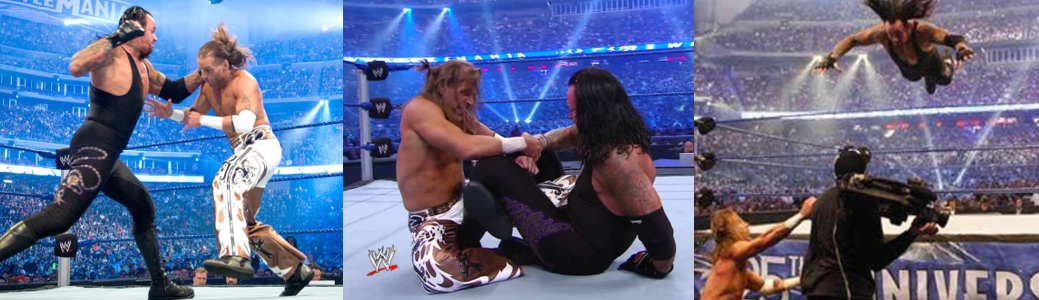
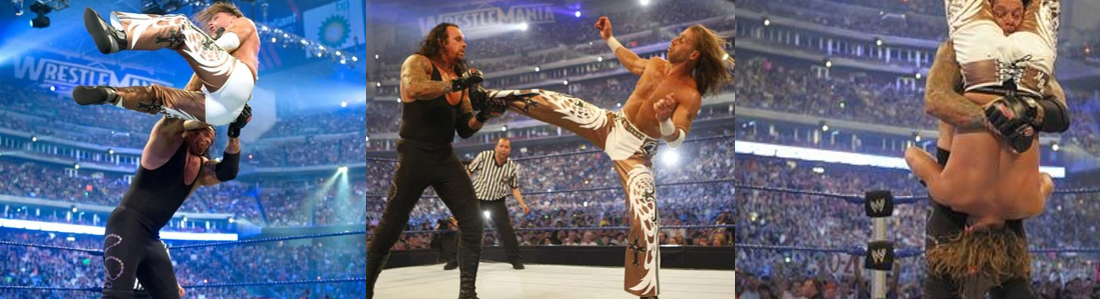
Wrestling Recap [Undervember]: Undertaker vs. Triple H (WrestleMania XXVII)


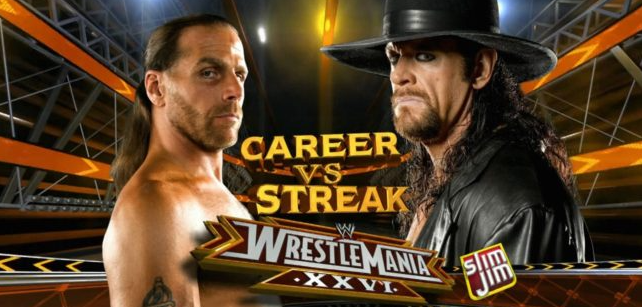
To celebrate the Undertaker’s illustrious career, I’m looking back at his WrestleMania matches against “The Heartbreak Kid” Shawn Michaels and Triple H.


The Date: 3 April 2011
The Venue: Georgia Dome; Atlanta, Georgia
The Commentary: Jim “J.R.” Ross and Jerry “The King” Lawler
The Referee: Scott Armstrong
The Stakes: No Holds Barred match

The Build-Up:
Over his legendary career, the Undertaker amassed an impressive list of rivalries with some of wrestling’s most talented and notorious names and earned the greatest winning streak in wrestling history with 21 WrestleMania wins between 1991 and 2013. After two highly celebrated back-to-back WrestleMania bouts with “The Heartbreak Kid” Shawn Michaels ended with HBK retiring, the Undertaker found himself tangling with Shawn’s D-Generation X running buddy, Triple H. Previously, the two were randomly thrown together for a decent match at WrestleMania X-Seven; this time, they issued a silent challenge after returning to the ring around the same time. Interestingly, Shawn Michaels questioned whether “The Game” could succeed where he had failed and, though he paid the price for trying to attack the Undertaker, HBK expressed doubts in his friend’s ability. A decorated veteran who had both dominated the main event scene and transitioned to a position of backstage power, Triple H firmly believed he was the best person to break the Undertaker’s celebrated winning streak. However, the two had little interaction prior to the match as it was sold on the spectacle of pitting them against each other more than anything.

The Match:
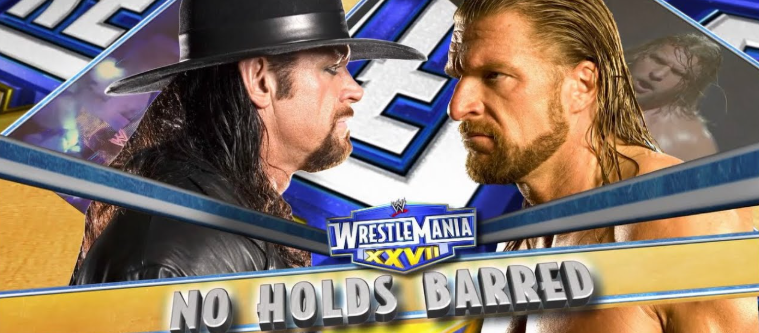
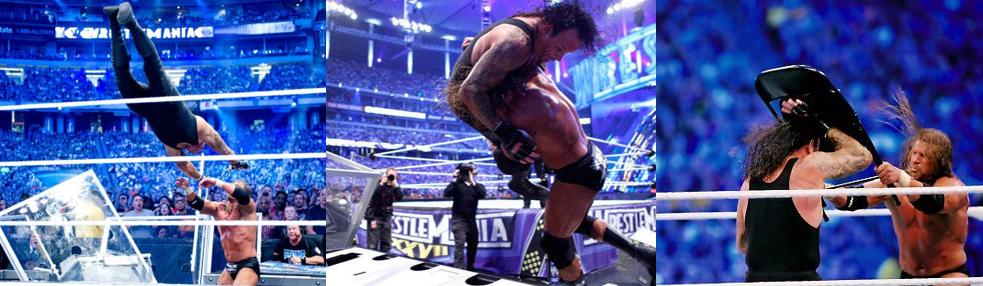
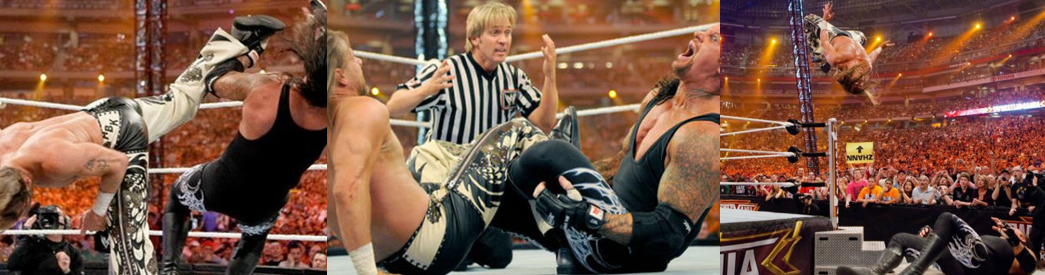
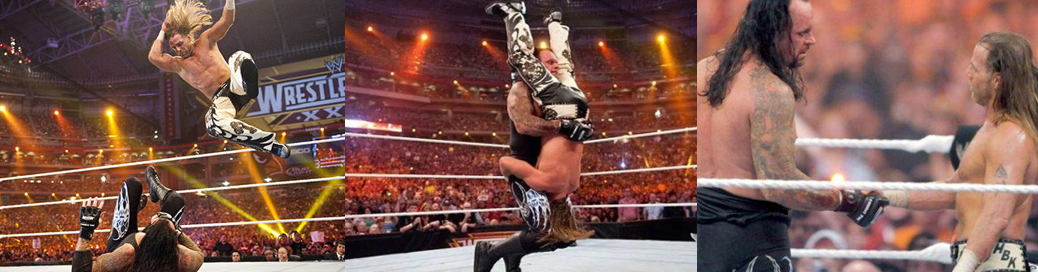
While the Undertaker is known for his overly long and dramatic WrestleMania entrances, Triple H is equally notorious for eating a lot of airtime with an elaborate entrance, though WrestleMania XXVII’s was a bit of an odd one. The Game was initially flanked by shield-bearers, draped in a regal cloak, garbed in his skull mask and helmet, and accompanied by Metallica’s “For Whom the Bell Tolls”. This was only an interlude, however, as Triple H switched to his ring gear after a brief blackout and stormed to the ring as normal, strangely ditching his “King of Kings” persona and any mind games the Metallica track might’ve played. Similarly, the Undertaker opted to simply rise from billowing smoke as simulated rain peppered the LED screens, though he was sporting a particularly fetching trenchcoat. The two went nose-to-nose prior to the bell and wasted no time getting into a slugfest once the bell rang, with Triple H briefly pummelling the Undertaker in the corner before being tossed over the top rope. Triple H continued to hammer the Undertaker on the outside until being sent into the ring steps, though the Game saved himself from being driven through the announce table by tackling the Deadman through Michael Cole’s special plexiglass cube. Having asserted his dominance, Triple H challenged the Undertaker to continue their fist fight, with the Undertaker knocking the Game down with a flying clothesline. After briefly softening Triple H’s arm, the Undertaker went for his signature rope walk only to be jerked off the top rope by his opponent. Triple H followed up by clotheslining the Undertaker back to the outside but got dumped to the floor when he tried to Pedigree the Phenom through the other announce table and then crushed when the Undertaker launched himself over the top rope and crashed into him from the ring!

Triple H relentlessly attacked the Undertaker, even bashing him in the head with a steel chair!

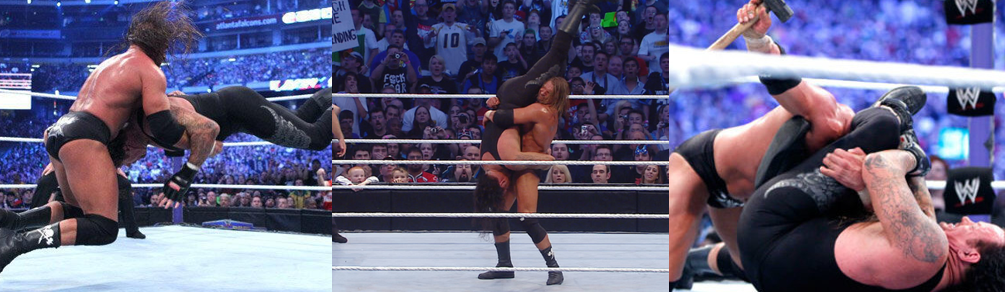
Though both men were exhausted from this, Triple H frantically escaped a Tombstone Piledriver onto the steel steps. However, when the Undertaker charged at the Game, the Deadman was driven through the announce table courtesy of Triple H’s trademark spinebuster. Although he struggled to stay upright in the ring, the Undertaker scored the first near fall off a Chokeslam. After mounting a comeback with some corner punches, Triple H slipped out of a Last Ride attempt, ate the Snake Eyes, but countered the Undertaker’s follow-up big boot with another spinebuster to get his first near fall. To even the odds, the Undertaker repeatedly smashed a steel chair over Triple H’s back, earning him a Pedigree out of nowhere! When the Deadman kicked out right before the three count, Triple H tried for a superplex and got nailed with the Last Ride, desperately getting his shoulder up at the last second. Angered and frustrated, the Undertaker drilled Triple H with the Tombstone Piledriver…only to be incensed when the Game still kicked out! The Undertaker was so enraged that he teased hitting a Tombstone Piledriver onto the steel chair, only for Triple H to squirm free and plant the Deadman with a DDT to that same chair! Though they both struggled up, Triple H nailed another Pedigree, but his lackadaisical cover all-but ensured that the Undertaker kicked out at two. Triple H then exploded when the Undertaker kicked out of another Pedigree immediately after! Thus, the Game demolished the Deadman with the steel chair, repeatedly smashing it over his spine until the chair was a mangled mess. Enraged when the Undertaker continued to stir and ignored his orders to “Stay down!!”, Triple H floored the Phenom with a shot to the head but was consumed by a mixture of awe, despair, and anger when the Undertaker struggled up, seemingly torn between his desire to win and his respect for his opponent.

Despite repeated finishers and collapsing after the match, the Phenom was victorious.

Refusing to die, the Undertaker tried for a Chokeslam, only to be too weak to follow through. Punch drunk, barely standing, the Undertaker demanded the fight continue, only for Triple H to drill him with his own Tombstone Piledriver. However, Triple H recoiled in stunned disbelief when the Undertaker kicked out at the last second. In desperation, Triple H retrieved his trusty sledgehammer from under the ring, only to get caught in the “Hell’s Gate” submission. Trapped in the middle of the ring, with the useless ropes far out of reach, Triple H frantically reached for his sledgehammer, only to fade from the pain and reluctantly submit right as he passed out. Although the Undertaker was treated to a massive fireworks display for continuing his unprecedented winning streak, the Deadman lay prone and exhausted on the canvas in the aftermath as a limping, distraught Triple H looked on. Even J.R. and the King were in silence as the referee and medics checked on the Undertaker, who collapsed on the outside and needed to be carried out on a stretcher. This was a bit of a stretch (no pun intended) for me as I’ve seen the Undertaker endure worse beatings before, so the idea that a few Pedigrees and chair shots would be enough to leave him in such a state is a bit difficult to believe. The entire match was built around the idea that Triple H was a ruthless opponent the likes of which the Deadman had never fought, though even this was undercut by the Game’s reluctance to hurt him. I liked that they utilised the No Holds Barred rule to incorporate the steel chair and some hardcore brawling, but I still think there could’ve been more of this and that Triple H should’ve been utterly remorseless. This would’ve forced the Undertaker to fight defensively and out of desperation and sold Triple H as a relentless foe, one who only realised how far he’d gone when the Undertaker collapsed at the end. Overall, it was a decent match more about Triple H’s ego than anything and therefore failed to match HBK’s similar efforts from previous years.

The Aftermath:
Regarded as a brutal, show-stealer of a match at an otherwise lacklustre WrestleMania, this match saw both competitors fined for violating company policy with an unprotected chair shot. As was tradition at the time, the Undertaker took a long hiatus following his win, both to prepare for his next bout and to sell the idea that Triple H had taken him to (and past) his limit. While the Undertaker was gone, Triple H took over as Chief Operating Office (COO) and ended up fighting his old friend Kevin Nash in a bizarre storyline that derailed CM Punk’s championship run. After recovering from a fractured vertebrae and settling his issues with Kevin Nash in a ladder match, of all things, Triple H was confronted by the returning Undertaker, who demanded a WrestleMania rematch after he failed to leave the match under his own power. After Triple H refused as he didn’t want to tarnish the Undertaker’s legacy and HBK advised him to avoid another match with the Deadman, the Undertaker mocked Triple H, accusing him of being a coward who lives in Shawn’s shadow. This angered Triple H enough to not just accept the rematch but also demand they fight in a Hell in a Cell match. Shawn Michaels was then drafted as the special guest referee and the two fought in what Triple H claimed was one of his favourite matches, the theatrically named and highly regardedEnd of an Era” match, at WrestleMania XXVIII.

My Rating:

Rating: 3 out of 5.

Pretty Good

Did you enjoy the Undertaker’s second WrestleMania match with Triple H? How do you think it compares to their previous WrestleMania match? Were you surprised to see a chair shot to the head included? Did you think that Triple H was going to win at the time? Do you agree that it was a bit of a stretch to pretend like the Undertaker was taken to his limit? How are you celebrating the Undertaker’s debut this year, what are some of your favourite matches of his? Whatever your thoughts, drop a comment below, go check out my reviews of other Undertaker matches, and donate to my Ko-Fi to suggest others!

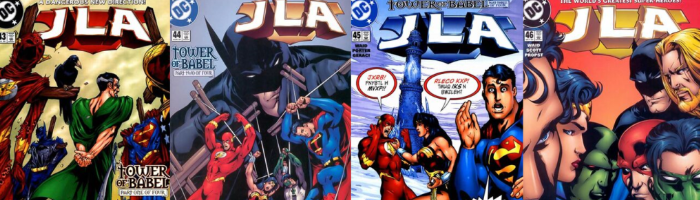
Back Issues [JLA Day]: JLA #43-46


To celebrate the release of Justice League (Snyder/Whedon, 2017), DC Comics named November 18 “Justice League Day”. Setting aside all the drama surrounding that movie, this provides a perfect excuse to spotlight DC’s top superhero team, which set the standard for super teams.


Writer: Mark Waid Artist: Howard Porter

Story Title: “Tower of Babel, Part 1: Survival of the Fittest”
Published: July 2000

Story Title: “Tower of Babel, Part 2: Seven Little Indians”
Published: August 2000

Story Title: “Tower of Babel, Part 3: Protected by the Cold”
Published: September 2000

Story Title: “Tower of Babel, Part 4: Harsh Words”
Published: October 2000

The Background:
In the 1940s, All Star Comics brought together eight superheroes from different publishers for the first time, birthing not just the Justice Society of America (JSA) but also the first ever superhero team in comics, allowing readers to see their favourite characters interacting for the same price in a single issue. The JSA’s ever-changing roster underwent their most significant change at the late-1950s, when then-editor Julius Schwartz had writer Gardner Fox with reintroduce and rebrand the team as the Justice League of America (JLA) to capitalise on the popularity of the American Football League and Major League Baseball’s National League. Clark Kent/Superman, Bruce Wayne/Batman, Diana Prince/Wonder Woman, Hal Jordan/Green Lantern, Arthur Curry/Aquaman, Barry Allan/The Flash, and J’onn J’onzz (or “John Jones”)/Martian Manhunter debuted as the JLA in The Brave and the Bold #28. Their origin story became a best-seller and the initial line-up of DC’s heavy-hitters is arguably the most iconic, which is exactly why they were at the forefront of the team’s revamp in the 1990s. Spearheaded by Grant Morrison, the new JLA title also became a best-seller and greatly inspired their celebrated animated adventures. This new team battled the likes of White Martians and the adaptable supervillain Prometheus, whose unexpected victory over the JLA laid the foundation for this widely regarded story. Marking the beginning of Mark Waid’s memorable run on the book, “Tower of Babel” had long-term repercussions, was critically acclaimed, and was even loosely adapted into a pretty decent animated feature.

The Review:
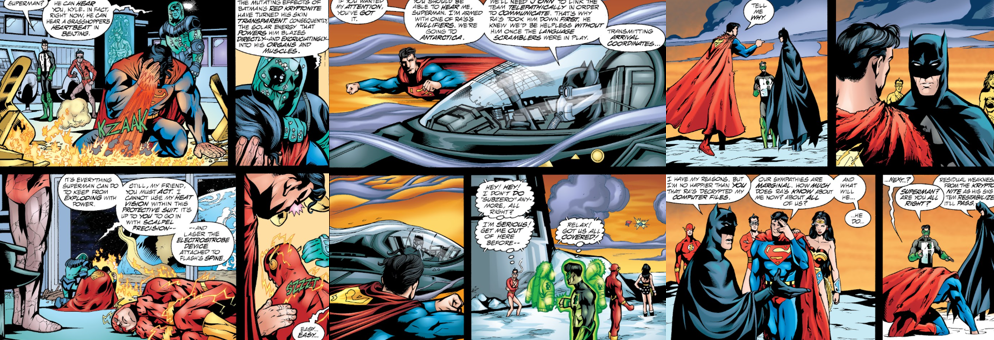
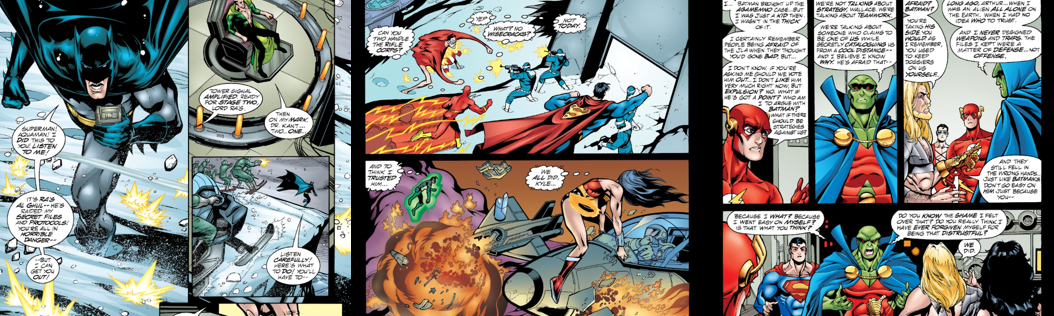
Although I grew up reading odd issues and random annuals from the 1970s and 1980s, this is the Justice League I mostly closely associate with. Superman (fresh off his brief stint as an energy being), Batman, Wonder Woman, Wally West/The Flash, Kyle Rayner/Green Lantern, Aquaman (in his best, most intimidating look), and even Patrick O’Brian/Plastic Man being included for some visual variety and laughs made for an impressive and powerful incarnation of the team. “Tower of Babel” pits this team against Rā’s al Ghūl, the “Demon’s Head” who fronts the League of Assassins and believes humanity is a danger. His anger at an aide accidentally dooming the Javan tiger to extinction only precipitates his latest plan to wipe out humankind, which begins with him playing spiteful mind games with his respected adversary, the Batman (whom he reverentially refers to as “The Detective”), by exhuming his parents. Rā’s then dispatches his daughter, Talia, to strike the Martian Manhunter with an explosive shell of strange nanites. Nearby, the Flash and Wonder Woman desperately fight a mysterious and aggressive forest fire, only to be amazed and horrified when the source turns of to be J’onn, his body engulfed in perpetual flames that the Flash extinguishes with his fantastic speed. Aquaman and Plastic Man are then attacked within the United Nations, Aquaman being gassed by a substance that makes him deathly afraid of water and Plastic Man frozen and shattered into a dozen pieces!

Batman’s horrified when Rā’s targets the JLA using his secret contingency plans!

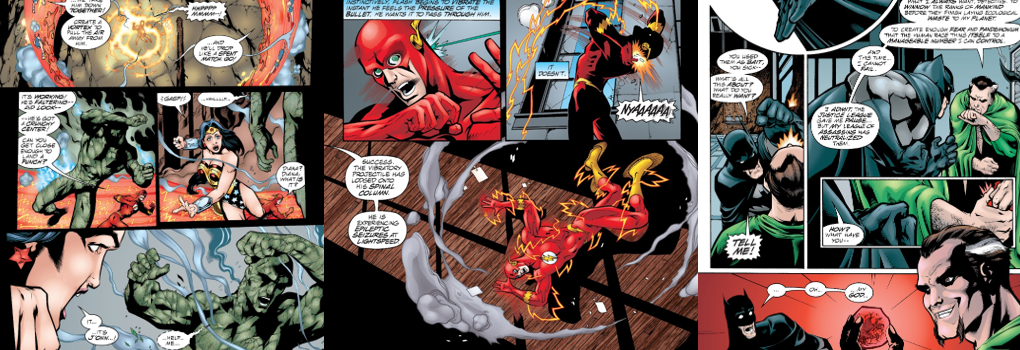
The injured or affected JLA members are brought to their Watchtower space satellite by their teammates. Superman analyses the nanites infecting the Martian Manhunter and discovers they’ve forced his body to combust in air. Crippled by fear toxin, Aquaman’s condition deteriorates as he rapidly dehydrates and, though the Flash pieces Plastic Man back together, they’re unable to restore him. Realising that the JLA is being targeted, Superman coordinates with John Henry Irons/Steel and Barbara Gordon/Oracle to keep their reserve members are safe but Batman abruptly refuses to help. After switching to Clark Kent to use his sources at the Daily Planet for a possible lead, Superman and the staff are astonished to find that all text has become incomprehensible! Superman races to curb the ensuring madness, learning from Oracle that the aphasia’s caused by ultrasound waves, which he successfully disrupts by retrofitting some Brainiac tech. Finally, Wally and Diana find Kyle woke up suddenly blind, which understandably causes the artist great distress. Although Aquaman figures out that the League of Assassins are tracking their signal devices, his warnings come too late and Diana is trapped within a never-ending battle simulation courtesy of a virtual reality chip. The Flash is also shot with a “vibrational projectile” that induces epileptic seizures at lightspeed and Kyle, directionless and berserk without his eyes, is easily subdued by a begrudging Talia. The world is plunged into chaos as the stock exchange collapses, gang wars break out, planes narrowly avoid collision, military services grind to a halt, and hospitals are rendered useless. The Batman angrily confronts Rā’s in his modern-day Tower of Babel, where Rā’s relishes the chaos and threatens offers to resurrect the Waynes using his rejuvenating Lazarus Pits.

The JLA is left aghast and traumatised by Batman’s betrayal.

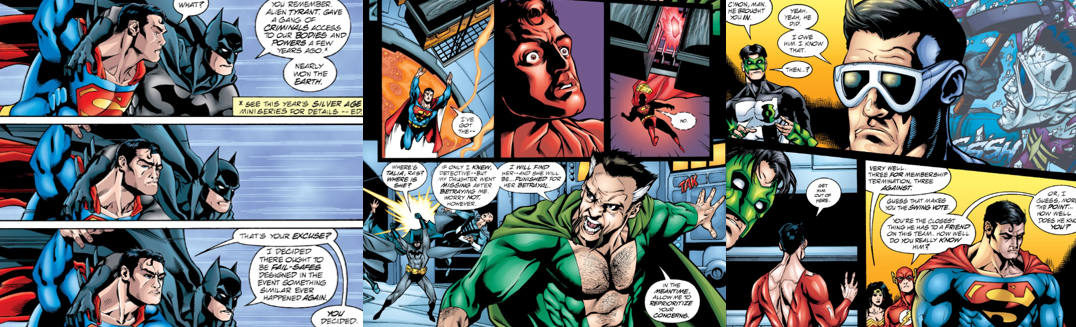
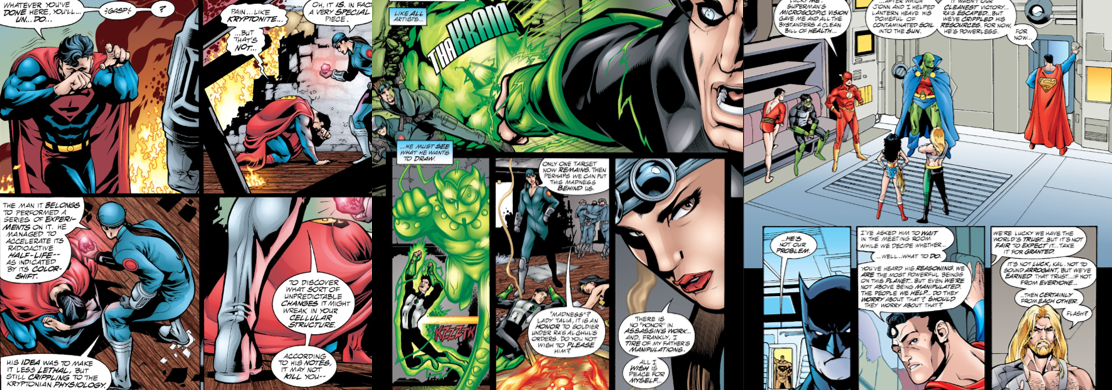
Despite clearly being tempted and overwhelmed by the proposition of being reunited with his parents, the Batman attacks in a rage but is horrified when Rā’s brandishes synthetic red kryptonite. Subdued by Rā’s’s troops, Batman fails to warn Superman who is caught completely off-guard when he arrives to help Wally, Diana, and Kyle with Martian Manhunter (wearing a special Atlantean water suit). Although Batman escapes Rā’s and Talia seems displeased at being her father’s lapdog, Superman’s crippled with agony when the rock turns his skin transparent and overloads him with solar energy. Alarmed that Rā’s has stolen his secret contingency files and turned them on his allies, Batman desperately tries to contact Aquaman with a solution, only for Rā’s to further disrupt communications. Luckily, Batman fools his pursuers with a fake death and Plastic Man finally pulls himself back together to teleport the JLA back to the Watchtower. There, Arthur is sustained by a telepathic illusion courtesy of J’onn, Plastic Man removes the chip lodged in Diana’s brain, and Superman focuses long enough to destroy the device tormenting the Flash. Finally, Diana and J’onn work with Kyle to deduce that his ring was slipped on him during sleep and that his blindness was caused by a post-hypnotic suggestion; by focusing, Kyle’s sight returns. The shellshocked JLA discuss Batman’s actions, their faith in their teammate shattered, with Superman feeling especially betrayed. Despite knowing the JLA distrust him, the Batman gathers them in Antarctica to infiltrate Rā’s’s tower, demanding the team work together to end the worldwide disruption. The battle is incredibly brief as Superman simply explodes in a burst of power, bringing the tower down and demanding an explanation from his comrade, only to be stonewalled by Batman’s stubborn nature.

Although Rā’s is stopped, the JLA are fractured by Batman’s questionable actions.

Despite the tower’s destruction, a disgruntled Talia informs the JLA that Rā’s is still a threat, leading Batman to split the fractured team up to handle each crisis. While Green Lantern, Plastic Man, the Flash, and Wonder Woman stop a chemical attack in Rhapastan, Batman explains to Superman that he created fail-safes after the alien tyrant Agameno swapped their consciousnesses with a gang of criminals. Finding little comfort in that explanation, Superman echoes Plastic Man’s uncharacteristically stoic and enraged demeanour by leading Batman through Rā’s’s stronghold. Though Rā’s prepares to retreat in frustration and Superman’s held off by the red Kryptonite, he covers his escape by dropping the Waynes’ coffins! Luckily, the restored Aquaman and Martian Manhunter pull both Superman and Batman’s parents from danger, leaving Batman free to pursue his adversary. While Rā’s escapes, his assistant, Doctor Kant, isn’t so lucky and takes the brunt of Batman and Aquaman’s retaliation, while Wonder Woman convinces Rā’s’s agent out of unleashing his chemical agent. With the danger over and the JLA back to full strength, the team debate what to do about Batman. While the Dark Knight awaits their decision, Superman questions whether they should have safeguards against their powers being manipulated. Aquaman believes the team should be based on trust, the Flash reluctantly thinks Batman has a point, and J’onn somewhat echoes this sentiment. When Arthur challenges J’onn’s loyalty to the Batman, pointing out that he once had similar dossiers, a fight almost breaks out between them, though J’onn ultimately votes in favour of Batman. While Kyle’s also not happy about what happened, he recognises that their powers are potentially dangerous and also votes to keep Batman on the team. However, while Wonder Woman agrees in principle, she refuses to fight alongside someone she can’t trust and Plastic Man coldly agrees. Although the deciding vote comes down to Superman, Batman makes the decision for them and quits the team without a word while they’re debating.
The Summary:
Like I said, this was a great time to be a JLA fan. The artwork was always really good in these comics and the team gelled really well together visually and with their contrasting personalities. It’s a very nineties period for the JLA, of course, with guys like Aquaman and newcomer Kyle Rayner offering very different interpretations of classic characters. I’ve always loved this version of Aquaman, though, with the harpoon hand and dishevelled appearance. Kyle is and will always by my favourite Green Lantern and I enjoyed the dichotomy he brought to the team as he obviously felt a little out of his depth and often deferred to his superiors as a result. These are characteristics reminiscent of Wally’s early days as the Flash, which led them to eventually form a tight friendship, but much of Kyle’s characterisation at this time was proving (or at least realising) that he’s worthy to hang with the big boys. Plastic Man was something of a wild card, for sure, especially due to his goofy nature and bizarre abilities. “Tower of Babel” showed that there was more to him than just being a wise-ass, though, as he’s so traumatised by being frozen and shattered (and by the Batman’s actions) that he drops the jokes and dismissively votes against Batman. Indeed, this story shakes the foundations of the JLA as, up until this point, they’ve all fought together on the understanding that they can trust each other. I’m pretty certain they all know each other’s strengths, weaknesses, and secret identities, for example, and feel they’re more than just colleagues. Thus, when they discover that Rā’s al Ghūl’s plot is due to Batman’s secret contingency plans, the team rightfully feels betrayed and angry, with Superman noticeably upset since he knows Batman the best and has worked with him the longest.

The JLA is divided and rattled by Batman’s betrayal and questions his trustworthiness.

Thus, the main enemy in “Tower of Babel” is essentially Batman, while technically also being the group’s insecurities, and more accurately being the devious Rā’s, who disrupts them to facilitate his latest scheme. The JLA is caught completely off-guard when Talia and her troops ambush them, wielding weapons designed specifically to neutralise their powers or otherwise subdue them. While I believe Batman’s plan was always to non-fatally pacify his teammates if they go rogue or were manipulated, some of his contingencies are very questionable. J’onn, for example, bursts into flame when exposed to air, something that would be both physically and emotionally traumatic for him considering his fear and weakness to fire. Aquaman is almost killed by dehydration when fear toxin variant made him deathly afraid of water, forcing J’onn to put him at ease with a telepathic vision so he could be safely placed in water. The Flash had it pretty bad, too, forced to endure what felt like days of torturous seizures in less than half an hour, while Superman’s powers raged thanks to red kryptonite. Similarly, it seems Wonder Woman would’ve eventually been so lost in her endless combat that she would’ve perished and Kyle was extremely distressed when he was duped into making himself blind. Seems to me that Batman could’ve just as easily used virtual reality environments for all his allies for a similar end, so it’s likely Rā’s al Ghūl perverted his countermeasures. Either way, the JLA are outraged at both the experience and the betrayal, believing Batman misled them and cannot be trusted. Even if he was right, since the JLA are mind controlled every other week and have extremely dangerous powers, the characters are angry at the deception. I doubt their reaction would’ve been much better had they known about Batman’s fail-safes, but it certainly would’ve lessened the sting since they put a lot of trust in him as their strategist and smartest mind.

A classic story that deconstructs the JLA and had far-reaching consequences.

This ethical quandary hangs over “Tower of Babel”, creating tension and animosity within the group for the finale, where they can barely function as a cohesive unit and are extremely reluctant to listen to Batman. Though he’s horrified by what Rā’s al Ghūl has done, Batman offers no apology and little explanation. He believes he was right to create contingencies and won’t be swayed from the belief, kick-starting a long-tunning theme of Batman being a stubborn, paranoid, and somewhat unethical character whose efforts to prepare for every scenario alienated his nearest and dearest. Interestingly, “Tower of Babel” doesn’t suggest what Batman’s back-up plan was if he went rogue (though it’s implied to be the remaining JLA) and barely gives him a chance to counteract Rā’s al Ghūl’s actions since the Demon’s Head keeps messing with their communications. I would’ve liked to see more of the world being plunged into chaos but I think “Tower of Babel” wisely focuses on the JLA and how they’re affected by Batman’s actions. The entire point is to fracture DC’s greatest superhero team, which literally happens by the end when the Batman walks away without hearing a verdict, but has knock-on ramifications as tensions are high amongst the others. I enjoyed seeing the team struggle to decide Batman’s future since they were personally disgusted and angered by the betrayal but recognised the need for fail-safes, and also how black-and-white the decision was for Aquaman and Wonder Woman, who felt the betrayal outweighed the risk. “Tower of Babel” easily ranks as one of the top JLA stories for a reason and it’s a great deconstruction of the team and exploration of their powers, weaknesses, and the fragile ethics that hold them together. It had far-reaching consequences for all involved and is well worth a read, especially for fans of this era of DC Comics.

My Rating:

Rating: 3 out of 5.

Pretty Good

What did you think of “Tower of Babel”? Do you consider it a classic JLA story or do you think it’s over-rated? Which of Batman’s contingencies do you think was the worst to suffer through? Did you enjoy this incarnation of the JLA or do you prefer a different line-up? Do you think Batman was right to have contingency plans or do you agree that he crossed a line? How are you celebrating Justice League Day this year? Whatever your thoughts on the JLA, feel free to share them below, check out my other Justice League reviews, and go donate to my Ko-Fi to suggest other JLA stories for me to cover.

Wrestling Recap [Undervember]: Undertaker vs. HBK (WrestleMania XXVI)


To celebrate the Undertaker’s illustrious career, I’m looking back at his WrestleMania matches against “The Heartbreak Kid” Shawn Michaels and Triple H.


The Date: 28 March 2010
The Venue: University of Phoenix Stadium; Glendale, Arizona
The Commentary: Michael Cole, Jerry “The King” Lawler, and Matt Striker
The Referee: Charles Robinson
The Stakes: No Disqualification Streak vs. Career grudge match

The Build-Up:
The Undertaker earned his status as a bona fide wrestling legend by the amassing an unprecedented WrestleMania winning streak (21 wins between 1991 and 2013) and sharing the ring with a smorgasbord of wrestling’s biggest names. One of the Undertaker’s most notable foes was “The Heartbreak Kid” Shawn Michaels, formally a prima donna who (in cahoots with his “Kliq” buddies) greatly influenced World Wrestling Entertainment (WWE) Chairman Vince McMahon back in the day. In the past, the Undertaker and HBK made history with the first-ever Hell in a Cell match and ’Taker was ready to beat Shawn if he didn’t do business. However, the two stole the show with their iconic WrestleMania 25 clash, which came some time after Shawn’s unexpected comeback and personal growth and was regarded by the Undertaker as his best match. However, when HBK challenged the Undertaker to a rematch at the 2009 Slammy Awards, the Deadman (then the World Heavyweight Champion) refused as he believed he had nothing to prove to either himself or Shawn Michaels. HBK became obsessed with getting another shot at the Streak and, after he failed to legitimately earn a shot at the Undertaker’s championship by winning the 2010 Royal Rumble match, the desperate HBK cost the Undertaker the World title at Elimination Chamber. Enraged, the Undertaker was goaded into accepting a rematch, however he demanded not only that it be a no disqualification bout but that HBK’s legendary career would also be at stake, which HBK happily agreed to out of sheer pride.

The Match:
Although Shawn Michaels was still rocking white-hued gear for this match, he ditched the angelic attire and entrance for his more traditional, rambunctious jaunt to the ring, presenting himself as a man so determined to defeat the Undertaker that he’ll retire if he fails. Similarly, while the Undertaker again rose from the stage and was bathed in darkness and strobe lights, the Deadman’s entrance was noticeably lowkey for a WrestleMania, with him simply stalking to the ring and glaring at HBK, who again showed no fear and not only stared right back but even mocked his signature throat cut taunt. Like last time, the match started with a slugfest, with HBK using his speed and knife edge chops to lay into the Undertaker. This time, the Undertaker shrugged off the attack and landed his Snake Eyes/Big Boot combo early, crashing into HBK with a corner splash and nailing his signature rope. However, not only did HBK slip out of a Chokeslam, but the Undertaker seemed to tweak his knee on the landing, giving HBK a target. The Phenom lashed out like a wounded animal and tried to end things early with a Tombstone Piledriver, only for the rabid HBK to desperately go for the Crippler Crossface and kick at the Undertaker’s damaged knee. Shawn worked the knee with stomps in the corner, constantly shutting down the Undertaker’s enraged punches by going low and ending up dumped to the outside as a result. When the Undertaker geared up for his suicide dive, HBK took him down with a shoulder tackle to the knee but again got sent outside when he tried for the Figure Four Leglock. The Undertaker followed, noticeably limping, ramming HBK spine-first into a ring post and dropping his patented leg drop across the ring apron.

The desperate HBK pulled out all the stops to cut the Deadman down and soften him up for the pin.

However, once back in the ring, the Undertaker got caught in a Figure Four, forced to endure the pain and avoid a pinning predicament, before eventually reversing the hold. After the two traded strikes again, HBK reeling from the Undertaker’s massive shots, Shawn landed his flying forearm but got planted with a massive Chokeslam after he kipped up for a near fall. HBK squirmed out of a Tombstone Piledriver and caught the Undertaker in the Ankle Lock before transitioning to a grapevine variant for a two count, the Undertaker frantically kicking HBK’s face to get free. Shawn then clotheslined the Undertaker over the ropes but got caught in mid-air off a moonsault and planted with a Tombstone Piledriver on the outside! However, the Undertaker got distracted attacking a concerned medic and was too slow tossing HBK in the ring for a cover, so he tried for the Last Ride…only for HBK to counter into a facebuster for a two count. Eager to capitalise, Shawn’s ribs got messed up when the Undertaker countered his signature diving elbow drop, though HBK impressively flipped through the “Hell’s Gate” to try for a pinfall. Shawn then followed up by hitting a surprise Sweet Chin Music for a near fall, leading a frustrated HBK to tune up a second shot from the corner. The Undertaker clumsily countered the superkick with the Last Ride for another super close two count, much to the Deadman’s frustration and awe. After being unceremoniously tossed to the outside, Shawn was helpless as the Undertaker stripped the announce table. However, he scurried out of a Last Ride attempt and left the Phenom prone across the table with Sweet Chin Music. HBK then clambered to the top rope and smashed the Undertaker through the table with moonsault that barely hit its target and left both men winded amidst the debris.

Despite his best efforts, HBK’s career ended at the hands of the hobbled Undertaker.

Frantic, determined to win, HBK desperately forced the hobbled Undertaker into the ring and scored with Sweet Chin Music once more…for a two count! When HBK went for it again, the Undertaker answered with a huge Chokeslam and a Tombstone Piledriver, only for Shawn to kick out right before the three count, much to the amazement of the crowd and the anger of the Undertaker. Barely standing, the Undertaker dropped his straps but, at the last second, pleaded with his opponent to stay down. Too stubborn or prideful to quit, Shawn clawed his way up using the Undertaker’s tights, mocked him with a taunt, and defiantly slapped him in the face. Incensed, the Undertaker abandoned his brief moment of pity and drilled HBK with a jumping Tombstone Piledriver to score the victory, bringing Shawn Michaels’ historic career to a close and the Undertaker to 18-0 at WrestleMania. After celebrating his win, the limping Undertaker helped Shawn to his feet to voice his respect. They shook hands and hugged and the Undertaker left the ring so an emotional HBK could bask in the overwhelming response from the raucous crowd. This match addressed a few issues I had with the last one, namely that the Undertaker’s weakened leg played a greater role in the narrative, with him limping, stumbling, and falling about from HBK’s attack. A lot of the match beats were the same but sped up, and the two didn’t take advantage of the no disqualification rule to implement weapons, which was strange. The emotional hook of the match was palpable and there was a sense that HBK was desperate to win, but I would’ve liked to see him doing more to achieve victory, such as attacking the Undertaker with chairs or whatever. People always like to compare this to their WrestleMania 25 bout, and I do think that one has a slight edge, though there’s not much in it to alter my rating. Still, a fitting send-off for HBK, even if it didn’t live up to its full potential.

The Aftermath:
To celebrate the end of his illustrious career, Shawn Michaels came out to the ring the next night on Raw to deliver an impassioned speech. In it, he talked about his career and thanked those who had supported him throughout it, specifically the fans, Vince McMahon, Triple, and long-time rival Bret “The Hitman” Hart. The whole episode was a tribute to Shawn and the Undertaker even made an appearance at the end, silently tipping his hat to HBK as a sign of respect. Following this, HBK was inducted into the WWE Hall of Fame and mostly stuck to his retirement, making the odd appearance on Raw, before finally returning to the ring as the special guest referee for the “End of an Era” match between Triple H and the Undertaker. Immediately following WrestleMania XXVII, the Undertaker took a hiatus. When he returned, he suffered a horrific injury and was said to be left in a “vegetative state” by an unknown attacker, soon revealed to be his twisted brother, Kane. After suffering decisive losses to his brother, the Undertaker made a dramatic return, silently agreeing to a WrestleMania rematch with Triple H, who made it his business to pick up where HBK left off. Though HBK tried to give Triple H the edge in the aforementioned “End of an Era” match, all three men embraced as equals by the finale and infamously shared the ring in a disastrous tag team match at the 2018 Crown Jewel. Following this universally mocked travesty, HBK settled into a backstage role as a trainer and producer for the NXT developmental brand, ironically placing the so-called “degenerate” as one of the WWE’s principal corporate figureheads.

My Rating:

Rating: 5 out of 5.

Fantastic

What did you think to the Undertaker’s rematch with Shawn Michaels at WrestleMania XXVI? How do you think it compares against their previous WrestleMania match? Did you like the focus on the Undertaker’s injured leg? Were you also disappointment by the lack of weapons and ringside brawling? Do you think this was a fitting final match for HBK? How are you celebrating the Undertaker this month, what are some of your favourite matches and moments of his? Whatever you thought about this match, leave a comment below, check out my other Undertaker content, and donate to my Ko-Fi to suggest an Undertaker match for me to review in the future.

Back Issues [Wolvie Wednesday]: The Uncanny X-Men #212-213


Since his first full debut in November 1974 and joining the X-Men in 1975, James “Logan” Howlett/Wolverine has become one of Marvel Comics’ most recognisable and enduring superheroes.


Story Title: “The Last Run”
Published: 9 September 1986 (cover-dated: December 1986)
Writer: Chris Claremont
Artist: Rick Leonardi

Story Title: “Psylocke”
Published: 7 October 1986 (cover-dated: January 1987)
Writer: Chris Claremont
Artist: Alan Davis

The Background:
Back 1974, Marvel Comics editor-in-chief Roy Thomas tasked writer Len Wein with creating the first-ever Canadian superhero, resulting in the short, feisty “Wolverine”. John Romita Sr sketched the original concept art for the character (including his now-iconic retractable claws) and Herb Trimbe put the finishing touches to Wolverine’s design. Although Wolverine’s past and true identity was initially kept a mystery, readers got a glimpse into his background through his ongoing and violent rivalry with fellow Mutant, Victor Creed/Sabretooth. Created by Chris Claremont and John Byrne, Sabretooth initially debuted as an enemy of Danny Rand/Iron Fist in 1977 before transitioning to a minor X-Men foe during the “Mutant Massacre” event (Claremont, et al, 1986). Originally intended to be Wolverine’s father and sometimes hinted to be his brother, the exact nature of their history is shrouded in mystery, with the only recurring element being their intense hatred of each other. Sabretooth famously makes a point of causing Wolverine anguish every year on his birthday and cemented himself as Logan’s archenemy by targeting his loved ones and being his toughest, most persistent foe. Accordingly, Sabretooth often accompanies Wolverine in other media and is naturally regarded as his worst enemy.

The Review:
Wolverine’s first clash against Sabretooth came when Creed was running with the Marauders, ruthless Mutant assassins working for Doctor Nathaniel Essex/Mister Sinister. As part of his plot to wipe out or otherwise experiment on Mutants, Mr. Sinister sent the Marauders to massacre the Morlocks, outcast sewer-dwelling Mutants beneath New York City. While reviewing the slaughter, Wolverine is telepathically contacted by newcomer Betsy Braddock/Psylocke, who passes along a request from the grieving Ororo Munroe/Storm for Logan to apprehend a Marauder to learn more about their plot. The effort of contacting Wolverine drains Psylocke, but her suffering is little compared to Storm’s as she ran with the Morlocks for a time and finds herself surrounded by dead or grievously injured allies. Storm’s so traumatised that she flees from Charles Xavier/Professor X’s school in anguish, desperate to return to nature and outrun her guilt. Concerned about Storm and his girlfriend, Kitty Pryde/Shadowcat (who’s been left in a permanently out of phase), Piotr “Peter” Rasputin/Colossus tries to ask Psylocke for help, only to suddenly collapse from his own injuries. Luckily, Erik Lehnsherr/Magneto is allied with the X-Men at this time and he uses his amazing powers to try and help Colossus, only to leave him conscious but paralysed. Meanwhile, Anna Marie/Rogue asks Storm’s Morlock friend, Callisto, to find the weather witch, with the one-eyed Morlock opting to treat Storm to some tough love and literally beat some sense into her.

With the X-Men reeling from the Marauders’ attack, Wolverine renews an old rivalry.

Down in the sewers, Wolverine shrugs off Psylocke’s sudden silence and struggles to pick up the Marauders’ scent only to be jumped by Sabretooth, a hulking, animalistic sadist who has the Morlock Healer in his grasp. Confirming that he’s part of the Marauders and happy to assist Mr. Sinister’s scheme to take out the Morlocks and the X-Men, Sabretooth goads Wolverine into a fight (not that he needs much encouragement) by mocking him and backs up his arrogant claims by proving Logan’s physical better, wrestling with Wolverine and deftly avoiding his patented Adamantium claws. Rather than fighting harder, Wolverine opts to fight smarter, collapsing the already weakening tunnel on his foe, bringing their brief scuffle to an anti-climactic end as Wolverine’s more focused on getting Healer to safety than wasting time fighting Sabretooth. Just as he reconvenes with Rogue, the tunnel is immolated by a mysterious plasma wave that potentially threatened the New Mutants, a young Mutant team Wolverine sensed had gone against orders and ventured into. Despite Wolverine’s best efforts, the blasts apparently obliterate the Morlocks and Storm suspects that her unstable powers may have been the cause. Unwilling to give into despair, Magneto suggests he ally with the Hellfire Club to bolster their numbers, a suggestion Storm naturally balks at considering how dangerous the group has been in the past. As Doctor Moira McTaggart works tirelessly to save the lives threatened by the Marauders, Psylocke struggles with her sense of belonging with the X-Men, eager to prove her worth and lamenting their losses. In an effort to help, Psylocke suggests (well, “insists”) that she bolster her powers with Cerebro to search for the New Mutants and the Marauders, though Storm orders her not to take the risk as they need her to monitor for threats against the school.

Psylocke gambles on Wolverine’s durability to outlast Sabretooth’s assault.

Disheartened, Psylocke suddenly detects an intruder and receives agonising psychic feedback when she tries to probe them. As Rogue wanders the grounds, pondering her past, she’s suddenly attacked by Sabretooth, who easily overpowers her before trashing Cerebro and injuring Psylocke’s arm with his razor-sharp claws. Shrugging off her psycho-blast, Sabretooth pursues her with a sadistic, murderous rage, easily crushing a dumbbell and driving Psylocke to the roof. Though injured and outmatched, Psylocke grabs Storm’s knife after plummeting into her attic apartment, much to Sabretooth’s glee as he seemingly gets off on her feisty attempts to fight back. Just as Sabretooth gets his claws on Psylocke, he’s interrupted by Wolverine and Storm, who attacks Creed with her staff to save Psylocke. Sabretooth draws first blood in his rematch with Wolverine, somersaulting over him and clawing his back, even sampling Logan’s blood before they charge each other. Wolverine buries his claws into Sabretooth’s thigh, causing him to hurl Logan through the skylight in a rage. Sabretooth quickly follows and is tackled to the pool below. Though Magneto wishes to restrain Sabretooth to probe his mind, Psylocke argues that Creed’s psychic defences are too strong and that their best chance is to invade his mind while he’s busy fighting, trusting that Wolverine can take the punishment. Thus, as the two trade blows and cut each other to ribbons, Psylocke discovers that they have fought before and finally extracts knowledge of Creed’s mysterious master. Angered that he’s been so obviously duped, Sabretooth dives off a nearby cliff and into the sea, disappearing from Psylocke’s probes, much to Wolverine’s anger. In the aftermath, Psylocke is formally welcomed to the team and Storm prepares to move their wounded to Dr. McTaggart’s research facility on Muir Island to protect them from further Marauder attacks.

The Summary:
“Psylocke” is one of the first X-Men stories I ever read as it was included in a Marvel Comics annual I owned back in the day. Consequently, I have some fondness for this era in the X-Men’s history and this art style, which depicts one of the quintessential incarnations of the team. Wolverine, for example, dons his brown and tan suit, Storm has her wild punk-rock look, Rogue sports short hair, and Magneto wears a more heroic outfit to reflect his position as the X-Men’s headmaster. While the art is often simplistic at times, appearing washed out and lacking detail (specifically the faces), this is more noticeable in group panels and doesn’t apply to Wolverine’s brutal fights with Sabretooth. These issues also take place in the middle (or early days) of the “Mutant Massacre” story arc, so there’s a much bigger narrative of the X-Men and their allies being targeted by Mr. Sinister and the Marauders. Therefore, your enjoyment may hinge on your familiarity with the Morlocks as their slaughter takes centre stage. Storm, especially, is distraught by the deaths of her colleagues and questions her leadership skills, while Psylocke is equally filled with doubt about her place on the team and usefulness beyond simply monitoring for threats. Ultimately, Psylocke proves herself by betting on Wolverine’s tenacity and durability, believing he can take whatever Sabretooth dishes out and thus provide them crucial information regarding the Marauders. Similarly, Callisto’s unique brand of tough love and the pressing nature of their situation forces Storm to snap out of her despair and help save Psylocke, and their injured teammates.

Wolverine’s history with Sabretooth takes a backseat to the wider narrative.

I really like this era for Wolverine, where he was a bit of a gruff loner but still loyal to his team. Wolverine’s happy to tackle the dirty jobs alone since he’s “the best there is at what he does” and his animalistic side relishes the chance to get his claws dirty extracting a measure of revenge on the Marauders. While stunned to find Sabretooth running with the group, Wolverine doesn’t hesitate to fight Creed despite being physically outmatched. Sabretooth is presented as a sadistic psychopath who relishes torturing and slaughtering his prey. He happily targets the defenceless or fights dirty and is presented as a dark mirror to Wolverine, being a killer whereas Wolverine is “a man–who sometimes kills”. Interestingly, while Sabretooth embraces his animalistic side in a way that Wolverine constantly fights against, he’s not some mindless killer and is, instead, loquacious enough to goad his victims and taunt Wolverine relentlessly. Although their dialogue and Psylocke’s probing hints at their past, very little time is spent exploring how Wolverine and Sabretooth know each other. Instead, they simply clash as old rivals, eager to see who is the better between them. Unfortunately, their fights aren’t that impressive. The first was an interesting character study for Wolverine as he chooses the higher path rather than giving into his rage. The second fight is better and longer and is great for showing how tough Wolverine is, but it takes a backseat to Psylocke’s psychic probing. It might’ve been nice to spend a bit more time with the two, to have a few more breadcrumbs dropped regarding their past, and to let them go at it a bit more, but this is still a decent first round bout between the fierce rivals and a notable moment in Wolverine’s long history.

My Rating:

Rating: 3 out of 5.

Pretty Good

What are your thoughts on Wolverine’s first battle with Sabretooth? Were you a fan of the “Mutant Massacre” story arc? What did you think to the hints towards Wolverine’s history with Sabretooth? Were you a fan of Psylocke and this incarnation of the X-Men? Were you a fan of Claremont’s work with the team, and Wolverine? How are you celebrating Wolverine’s debut this month? Whatever you think about these issue, or Wolverine in general, leave a comment below and donate to my Ko-Fi to suggest more Wolverine stories for me to cover.

Back Issues [F4 Friday]: The Fantastic Four #5


In November 1961, four intrepid explorers were changed by mysterious cosmic rays. Marvel’s “First Family” of Marvel heroes and featured in cartoons, videogames, and live-action movies.


Story Titles: “Prisoners of Doctor Doom!”, “Back to the Past!”, “On the Trail of Blackbeard”, “Battle!”, and “The Vengeance of Doctor Doom!”
Published: 10 April 1962 (cover-dated: July 1962)
Writer: Stan Lee
Artist: Jack Kirby

The Background:
Back in 1961, Stan Lee and Jack Kirby debuted the dysfunctional Fantastic Four as a counterpart the Justice League of America. Despite some debate over the team’s creation, the issue popularised the “Marvel Method” of writer/artist collaboration and subsequent issues introduced pivotal Marvel characters as enemies and allies of the relatable team. Without question, one of their most important villains was the egomaniacal Doctor Victor Von Doom/Doctor Doom, the ruling monarch of Latveria who was driven to destroy the team and prove his intellectual superiority over Doctor Reed Richards/Mister Fantastic. Lee and Kirby sought to create a truly engaging villain in Dr. Doom, inspired by classic depictions of Death and bolstering his characterisation with an inflated ego and thirst for power. While Dr. Doom’s primary adversaries are the Fantastic Four, he menaced the wider Marvel universe, gaining God-like power more than once, in addition to brief spells as a morally ambiguous anti-hero and journeys beyond the stars and reality. Naturally, as the Fantastic Four’s most recognisable villain, Dr. Doom has heavily featured in the team’s ventures outside of comics, being a principal villain in cartoons and videogames, though his depiction in live-action has ranged from disappointing to down-right insulting.

The Review:
Our first glimpse of one of Marvel’s most enigmatic and menacing villains comes with the masked, hooded Dr. Doom literally playing with his toys amidst tomes on demons, science, and sorcery and boasting to himself of his superiority compared to our colourful heroes. Half a world away, New York City is struck by an unexpected power cut that affects every building save the towering Baxter Building. With no threat to focus their energies on, Johnny Storm/The Human Torch and Benjamin Grimm/The Thing gripe with each other, forcing Mr. Fantastic and his lover, Susan Storm/The Invisible Girl, to intervene and scold the two like they are children. Their bickering is suddenly interrupted when Dr. Doom ensnares the Baxter Building in a gigantic net dropped from his helicopter! Coated with asbestos so durable that even the Human Torch cannot burn through it, the four are left at the mercy of Dr. Doom, whose voice chills Reed as he remembers the tragic story of his old college roommate, Victor Von Doom. Fascinated by the occult, the unseen Doom mixed science with the dark arts and constructed a machine to contact the netherworld, only to be horrifically scarred and expelled from the school when the machine exploded. Humiliated, Doom fled to the frigid wastelands of Tibet to seek deeper, darker secrets and Reed assumed he was dead and is therefore shocked to find Doom alive and demanding Sue as a hostage!

Dr. Doom kidnaps the Fantastic Four and, bizarrely, sends them to run errands in the distant past!

Naturally, the Thing reacts in anger and receives a few thousand volts for his outburst. Realising she has no choice but to acquiesce to Dr. Doom’s demands, Sue bravely volunteers herself to buy her family time to plan. Now holding the ace, Dr. Doom demands the remaining three board his ship and they’re forced to obey, ending up tapped in a mechanical prison and transported to Dr. Doom’s impressive, medieval stronghold in Latveria. In Dr. Doom’s throne room, he holds them off with his pet tiger and reveals that he wants them to take his time machine into the past to steal the legendary treasure of Edward Teach, the notorious pirate known as Blackbeard, since Dr. Doom cannot use his magnificent creation because someone must operate the controls. Dr. Doom promises to return them (he needs the treasure, after all) and to release Sue even if they fail, and the three promptly travel through time and space via a simple glowing square. The three waste no time acquiring period-appropriate attire and head to a local bar, where they’re immediately drugged and shanghaied onto a rival pirate ship. Once they awaken, a good old-fashioned donnybrook breaks out and the crew are in awe of the three’s incredible powers. Their standoff is soon interrupted by a rival ship, which they assume is Blackbeard. The battle goes swiftly thanks to their awesome superpowers and, before long, the ship and its treasure is captured, with the crew praising their mighty commander, the Thing, whom they dub “Blackbeard” in a fun predestination paradox. Though victorious, Reed shares the booty amongst their crew and trick Dr. Doom with an empty treasure chest, but things go awry when the Thing suddenly decides to stay in the past where he can be more than a reviled freak and orders his men to restrain Johnny and Reed!

Despite all his contingencies, Dr. Doom is driven to flee by the Fantastic Four’s awesome powers.

Thankfully, a twister strikes the ship, ransacking it and scattering the crew. Mr. Fantastic rescues the Human Torch before he drowns and they wash up on land to reunite with a remorseful Thing, who regains his senses and apologises for his momentary madness right as Dr. Doom decides to retrieve his foes. Dr. Doom praises them and reveals that the gems are mystical artifacts that once belonged to the ancient wizard Merlin, which he plans to use to conquer the world. However, Dr. Doom is stunned to find the chest filled with useless chains and, with the egotistical villain distracted, the Thing strikes. Unfortunately, Dr. Doom anticipated this and the Things shatters a sophisticated robot decoy and the three are left trapped in a death chamber. While Dr. Doom gloats, the Invisible Girl takes the chance to short circuit his equipment, freeing her family before they can suffocate. Realising Dr. Doom’s entire fortress is full of booby-traps, Reed leads his family in bypassing death traps such as voracious crocodiles and Johnny creates a circle of flames to try and smoke Dr. Doom out. Unimpressed, and perfectly fine with his fortress burning his secrets, Dr. Doom flees with his “rocket-powered flying harness” no less determined to plan a new world-conquering plot. The Human Torch is massively outclassed by Dr. Doom’s technology and barely saves himself from a fatal fall. Angered that Dr. Doom escaped, the Thing vows to handle the masked maniac next time and Reed reassures a despondent Johnny that they’ll dedicate their lives to tracking the villain, and others like him, down.

The Summary:
Dr. Doom is one of my favourite Marvel villains. He’s a scheming, egotistical, self-absorbed madman with delusions of grandeur whose ambition often exceeds his grasp. He’s revered as a monarch in his home country and influential enough to topple governments and menace anyone from the Fantastic Four to the mighty Avengers! So, imagine my disappointment to find he’s merely a run-of-the-mill villain of the week here. Sure, Dr. Doom gets a bit more backstory than most villains of this era, but it’s painfully rushed and has little impact on the story. There’s no in-depth portrayal of Dr. Doom’s hatred of Reed or his vendetta against the Fantastic Four. Indeed, Dr. Doom targets them primarily to prove his superiority and coerce them into stealing treasure for him, which his robot duplicate could’ve done! Rather than stewing in his fortress for years, fostering a hatred for Reed and planning how to counter the Fantastic Four’s powers, Dr. Doom has barely any emotional connection to Reed since Mr. Fantastic hardly factored in his accident. There are no fist curling cries of “Richards!” here, no attempts to torture and humiliate his old roommate, and no desire to humble the Fantastic Four or destroy their reputation. Instead, Dr. Doom simply kidnaps them (a feat easily accomplished by a simple net!) and forces them to do his bidding by, of course, taking Sue hostage. While Sue isn’t written as an air-headed bimbo in this issue, for a change, and gets a chance to show her maternal side in chastising Ben and Johnny, she’s reduced to a mere damsel in distress to force the others to obey Dr. Doom. Still, she does take advantage of his distraction to mess up his equipment and free the others, showing she’s a fully capable superhero when she’s not distracted by Reed’s opinion of her.

Despite Dr. Doom’s visual appeal and maniacal genius, he’s just another run-of-the-mill villain.

Unfortunately, rather than focus on Dr. Doom and develop a villain with a deep-rooted rivalry with Reed, The Fantastic Four #5 mostly focuses on a bizarre time travel adventure! As if this idea wasn’t ludicrous enough, the jaunt is further padded out by unnecessary drama when the Thing randomly decides he likes the adulation he receives in the past and betrays Reed and Johnny to stay there! It’s a fleeting moment barely worth the panels devoted to it, and I can’t help but think this time would’ve been better served with Dr. Doom lording his superiority over Sue or using his mixture of science and magic (something barely touched upon here) to best the Fantastic Four’s powers. Latveria isn’t even named here; we get no sense of her people or Dr. Doom’s reputation and his abilities are painfully limited to “mad scientist”. Dr. Doom’s fortress is said to be a fortified castle filled with death traps, but we barely see these and they’re easily circumvented by the Human Torch and Mr. Fantastic. Dr. Doom still comes across as a conniving, scheming villain smart enough to install robot duplicates and whose backup plans have backup plans, but it’s disappointing to see his first plot to simple be stealing jewels. We learn all-too late that they’re Merlin’s property, but again the magical nature of Dr. Doom’s abilities is hardly a factor, so he just comes across as a common thief who happens to own a time machine. He doesn’t provide his enemies with a return module and instead simply gets lucky that the three have succeeded when he randomly decides enough time has past, he resorts to taking a woman hostage, and he doesn’t even seem to care that his castle is at risk of being destroyed. Ultimately, The Fantastic Four #5 is an important story since it marks the start of Dr. Doom’s epic saga but it’s by no means the best or most engaging Dr. Doom story.

My Rating:

Rating: 2 out of 5.

Could Be Better

What did you think to the first appearance of Doctor Doom? Were you impressed by his menacing appearance and advanced technology? What did you think to the bizarre time travel plot and the Thing’s brief moment of madness? Were you surprised that the connection between Reed and Dr. Doom was downplayed? What are some of your favourite Dr. Doom stories and moments? Whatever you think about Dr. Doom and the Fantastic Four, leave a comment below and check out my other Fantastic Four content.

Wrestling Recap [Undervember]: Undertaker vs. HBK (WrestleMania 25)


To celebrate the Undertaker’s illustrious career, I’m looking back at his WrestleMania matches against “The Heartbreak Kid” Shawn Michaels and Triple H.


The Date: 5 April 2009
The Venue: Reliant Stadium; Houston, Texas
The Commentary: Michael Cole, Jerry “The King” Lawler, and Jim “J.R.” Ross
The Referee: Marty Elias
The Stakes: Singles match with the Undertaker’s WrestleMania winning streak on the line

The Build-Up:
Over his decorated career in World Wrestling Entertainment (WWE), the Undertaker amassed the greatest winning streak in wrestling history – 21 WrestleMania wins between 1991 and 2013 – and battled a who’s-who of the biggest names in wrestling. One of his most notable adversaries was “The Heartbreak Kid” Shawn Michaels, once one of the biggest prima donnas in the industry who (alongside his “Kliq” buddies) held a great deal of sway over WWE Chairman Vince McMahon. The Undertaker and HBK battled on and off throughout the 1990s, making history in the first-ever Hell in a Cell match. Some time after his dramatic comeback and notable character change, HBK was embroiled in a bizarre feud with John “Bradshaw” Layfield/JBL after finding himself low on cash, which was the background to Shawn challenging the Undertaker’s WrestleMania winning streak. After defeating both JBL and Vladimir Kozlov, Shawn earned the right to battle the Undertaker at what was billed as WrestleMania’s 25th anniversary, with HBK attacking the Deadman after they teamed up on Raw. The two engaged in a war of words, with HBK expressing his respect but lack of fear towards the Undertaker and backing this up by never flinching when the Undertaker employed his signature spooky gimmicks. HBK even donned white attire that mirrored the Undertaker’s and cast himself, as a born again Christian, as the natural contrast to the Phenom’s darkness, establishing both men as uncompromising forces of nature heading into the match.

The Match:
This contrast of light and dark continued at WrestleMania 25, with Shawn Michaels descending from the heavens in his white attire while the Undertaker ascended from the stage, surrounded by lightning and flames. The visual of the two legends in the ring was enough to elicit a near-deafening buzz from the crowd, who watched with anticipation as the two danced around each other and exchanged strikes in the early going, with HBK using his speed to dodge the Undertaker’s reach and landing chops and forearm shots. The Undertaker quickly asserted himself, catching HBK’s fist and launching him into (and over) the corner, only for Shawn to pounce upon the Deadman after feigning a knee injury. Annoyed, the Undertaker overpowered Shawn and unleashed a flurry in the corner, finally dropping HBK and taking control of the match. Shawn weathered the assault and continued to fire back with knife-edge chops, only to be turned upside down off an Irish whip into the far corner and a back body drop. The Undertaker showcased his incredible strength with a military press slam and scored a one count off a running elbow before focusing on Shawn’s left arm, wearing him down for his signature rope walk. Wily as ever, HBK dodged at the last second when the Undertaker went for a running big boot, leaving the Deadman hung up in the corner, then targeted the Phenom’s left knee to chop the big man down. The crowd erupted as HBK applied the Figure Four Leglock to further punish the Undertaker’s leg, scoring a quick one count but eventually releasing the hold when the Undertaker punched him in the face.

The back-and-forth action almost ended in disaster when the Undertaker went for a suicide dive!

While HBK continued to target the knee, the Undertaker fell back on pure power, muscling Shawn into the corner for another beat down but noticeably hobbling as he landed a couple of body splashes and his signature Snake Eyes/Big Boot combination. The follow-up leg drop scored the first two count of the match and, frustrated, the Deadman called for a Chokeslam. Shawn surprisingly countered with a Crippler Crossface, maintaining the hold even as the Undertaker desperately rolled into a pinning predicament and powered up. The Deadman bought a reprieve and earned a near fall off a side slam and the two went back to exchanging blows, with the Undertaker getting madder with each strike. HBK exploded off the ring ropes for his trademark forearm shot and leapt to his feet, landing two inverted atomic drops and dropping the Phenom with a running clothesline. Even when the Undertaker snatched him out of mid-air as he went for his patented top rope elbow drop, HBK countered with a low kick and tried for the Figure Four again, only to end up the Undertaker’s “Hell’s Gate” hold! After HBK scrambled to the ropes to break the hold, the competitors tumbled outside, where the Undertaker bashed HBK’s face off the ring steps, only to miss his apron leg drop, further damaging his leg. Shawn followed up with a baseball slide but crashed and burned off a moonsault to the outside, giving the Undertaker time to catch his breath. As Shawn struggled to his feet and refused to quit, the Undertaker flew over the ropes with a suicide dive and damn-near killed himself when the “cameraman” failed to catch him! Desperate to buy the Undertaker time to recover and win by any means necessary, HBK dragged the referee into the ring to begin a ten count, only for the Deadman to (eventually) roll back into the ring, much to Shawn’s utter dismay.

The two traded finishers near the end, but it was the Deadman who came out on top.

Enraged, HBK tried for Sweet Chin Music, only to get hit with a Chokeslam and barely kick out at two! However, after slipping out of a Tombstone Piledriver and shrugging off another Chokeslam attempt, Shawn finally hit his signature super kick, only to take too long making the cover and for the Undertaker to kick out. After a defiant kip up, Shawn almost got nailed with the Last Ride, only to squirm out of it and attempt a cover, which the Undertaker reversed to finally drill HBK with his massive powerbomb…for a two count! Incensed and amazed, the noticeably groggy Undertaker uncharacteristically climbed the top rope, only to eat the canvas when HBK dodged his diving elbow drop. After both struggled up, Shawn got dropped with a Tombstone Piledriver after attempting a headscissor from the ring ropes. Unbelievably, HBK kicked out just before three, much to the distraught Deadman’s chagrin. The Undertaker dropped the straps and did his signature throat cut taunt to signal a second Tombstone Piledriver, only for HBK to desperately counter with a DDT. Shawn followed up with his diving elbow drop and summoned all his strength for another Sweet Chin Music…and another heart-stopping two count! Both men clutched at each other and returned to throwing strikes, barely able to stand and being equally matched and stubborn. Though HBK fought out of another Tombstone attempt and countered a running corner splash, his luck ran out when he went for a Moonsault and got caught in mid-air and drilled with a Tombstone Piledriver, giving the Undertaker his seventeenth WrestleMania win. I really enjoyed the story being told here of the tenacity and pig-headedness of both men, who refused to quit or stay down and kept finding the will to continue. I also liked that it wasn’t just a finisher- or spot-fest and that they sold their biggest shots as potential match enders and grew increasingly frustrated and desperate when their opponent somehow kicked out. However, it’s a shame all that focus on wearing down the arm and leg didn’t factor into the end that much.

The Aftermath:
Widely regarded by many, including the Undertaker, as one of the best matches of either man, this bout was listed as WWE’s greatest WrestleMania match of all time, and it’s easy to see why (even with that botched dive). Following their gruelling contest, both men took four months off to recuperate. When Shawn Michaels returned later that year, he re-formed D-Generation X with his long-time friend Triple H and got into it with the upstart Legacy faction while the Undertaker distracted himself capturing CM Punk’s World Heavyweight Championship in a Hell in a Cell match. At the 2009 Slammy Awards, the WrestleMania 25 match won “Best Match of the Year”, prompting HBK to challenge the Undertaker to a rematch. When the Deadman turned down the challenge, believing he had proved himself the superior, HBK became obsessed with getting another shot at the Streak. After he failed to win the 2010 Royal Rumble match and legitimately earn a shot at the Undertaker’s championship, HBK cost the Deadman the World title at Elimination Chamber, finally goading the Undertaker into a rematch but with one caveat: HBK’s star-studded career would also be on the line!

My Rating:

Rating: 5 out of 5.

Fantastic

Did you enjoy the Undertaker’s captivating match with Shawn Michaels from WrestleMania 25? How would you rate it against the Undertaker’s other WrestleMania matches? Do you think the botched dive ruined the match? Did you think that HBK would break the Streak at the time? Which match between the two is your favourite and how do you think this compares to the follow-up bout? How are you celebrating the Undertaker’s debut this year, what are some of your favourite matches and moments of his? Whatever your thoughts, drop a comment below, go check out my other Undertaker match reviews, and donate to my Ko-Fi to suggest an Undertaker match you’d like me to cover.

Movie Night [Godzilla Day]: Godzilla vs. Mechagodzilla


Toho’s famous atomic beast first emerged to wreck Tokyo on this day in Godzilla (Honda, 1954), and, in 2016, the day was subsequently declared “Godzilla Day”.


Released: 21 March 1974
Director: Jun Fukuda
Distributor: Toho
Budget: $1.2 million
Stars: Keisuke Shimizu, Isao Zushi, Saeko Kanagusuku, Kazunari Mori, Akihiko Hirata, and Kin’ichi Kusumi

The Plot:
Following the discovery of a doomsday prophecy regarding Godzilla (Zushi), the King of the Monsters seemingly goes on a rampage, only for the true culprit to be a mechanised doppelgänger (Mori) sent by aliens to destroy humanity!

The Background:
On 6 August 1946, and the height of the Second World War, the United States dropped two nuclear weapons on Hiroshima and Nagaski, killing tens of thousands of people and forcing the surrender of the Japanese Imperial Army. The radioactive fallout killed thousands more and left post-war Japan gripped with nuclear fear, a terror that took physical form with Gojira, the living embodiment of nuclear destruction. Although initially framed as Japan’s destructor, the King of the Monsters soon became the country’s reluctant saviour. Following the critical and commercial mauling of Godzilla vs. Megalon (Fukuda, 1973), Toho sought to reverse their fortunes by pitting Godzilla against a mechanical doppelgänger, Mechagodzilla, now one of Godzilla’s most persistent and popular enemies. Apparently the brainchild of producer Tomoyuki Tanaka and inspired by robot-themed anime and a similar metal duplicate of King Kong, Mechagodzilla was designed by Akihiko Iguchi and said to be made from a polyethylene material and fibre-reinforced plastic. While Godzilla vs. Mechagodzilla performed slightly better at the box office compared to its predecessor, the film was ridiculed for its laughable plot, goofy presentation, and continuing the downward spiral of the franchise into childish nonsense. Still, the special effects were praised and Mechagodzilla returned in many forms to hound its organic counterpart, lending some credibility to this film being considered one of the better Godzilla movies of the 1970s.

The Review:
While visiting Okinawa, brothers Keisuke (Daimon) and Masahiko Shimizu (Kazuya Aoyama) witness Princess Nami (Beru-Bera Lin) suddenly collapse from apocalyptic visions of a monster (suspiciously echoing King Ghidorah). While the brothers rush to her side, they largely brush it off as Masahiko is more focused on excavating the Gyokusen Cave. Fortuitously, Masahiko discovers a strange piece of metal just as government archaeologist Saeko Kanagusuku (Reiko Tajima) arrives to document the ominous cave drawings depicting the Azumi’s guardian deity, King Caesar, and artifacts also foretelling a catastrophic monster event. While flying to Tokyo to consult renowned Professor Wakura (Hiroshi Koizumi), who’s also Keisuke’s uncle, Saeko bumps into Keisuke and is accosted by a shady man in dark glasses (Shin Kishida) who claims to be a reporter. Saeko also spots an ominous black cloud that eerily mirrors the prophecy’s “black mountain” that heralds the arrival of a destroyer. While Masahiko brings his discovery to Professor Hideto Miyajima (Hirata) at Mount Fuji (which has been beset by earthquakes), who identifies it as the ridiculously named “Space Titanium”, Wakura’s research is suddenly interrupted by an armed man, Yanagawa (Daigo Kusano), though he’s fended off by Keisuke after a comical scuffle. Mt. Fuji later erupts and what appears to be Godzilla emerges, apparently ready to enact the prophecy. “Luckily” for the locals, one of the lamest kaiju ever, Anguirus (Kusumi), opposes Godzilla, ending up badly beaten, having his jaw broken, and forced to retreat. Still, Anguirus chips Godzilla’s skin and reveals metal underneath, lending credibility to Keisuke’s suspicions that something isn’t right with the King of the Monsters.

While studying space metal and prophecies, our characters are shocked when two Godzillas appear!

Keisuke retrieves a sample from the fight that Professor Miyajima also identifies as Space Titanium, leading the brothers to join the professor and his daughter, Ikuko (Hiromi Matsushita), investigating “Godzilla” as it’s obliterating the local port and confronted by a second, more recognisable Godzilla! The group watches, stunned, as the two fight and the battle is overseen by mysterious, silver clad onlookers in a hockey sci-fi set resembling Star Trek (1966 to 1969). The titular Mechagodzilla initially appears to be the Big G himself, its metallic appearance concealed by flesh so convincing that the nation believes Godzilla has gone mad, just as the prophecy foretold, despite him having a distinctly different roar, very different atomic breath, and even walking different. Their first battle destroys Mechagodzilla’s façade, revealing it as a cyborg controlled by the sneering, malevolent Simeon Supreme Commander Kuronuma (Goro Mutsumi) of “Black Hole Planet 3”. When Mechagodzilla requires extensive repairs, the Simeons force Miyajima to assist in return for Ikuko’s safety. Kuronuma also orders Yanagawa to steal the King Ceasar statue (to keep the deity from threatening their plans), only for Keisuke to again intervene, revealing the Simeons’ grotesque ape-like appearance, and leaving Yanagawa dead when the shady reporter reveals himself to be Interpol agent Nanbara. Revealing that Interpol knows of the bizarre alien plot, Nanbara aids Keisuke in infiltrating the Simeon base to save Professor Miyajima and Ikuko from a laughable death chamber that threatens to boil them alive. While aliens are commonplace in Godzilla movies, the Simeons are some of the most unimpressive, descending into animalistic grunts and snarls when their human façade is lost and memorable only because of their ultimate weapon (and even that’s a rip-off!)

Mechagodzilla impresses by brutalising Anguirus and cutting an intimidating (if clunky) figure.

By this point, Godzilla’s firmly been established as Japan’s protector, so our heroes are stunned when he appears to go on a mindless rampage. Like Anguirus, Godzilla seems enraged by his doppelgänger as much as he is fiercely territorial over his people, leading Godzilla to attack Mechagodzilla with all his might and bathe in a lightning storm to boost his power. Sadly, Godzilla plays second fiddle to a handful of forgettable and interchangeable characters. I’m not sure what the benefit of having two professors was, for example, or why the female characters were so overlooked…or honestly what the point of having the brothers was since Keisuke and Nanbara would’ve made for a more entertaining duo. Most of the runtime focuses on a mad scramble to understand and then protect King Caesar’s artifacts, though I remain underwhelmed by the bizarre beast (Kusumi) and question why this screen time couldn’t have been allotted to Godzilla so he could battle his doppelgänger more. The film seems to depict King Caesar as the new kaiju on the block, but he looks so foolish and lacks the screen presence of Godzilla. Plus, thematically, it makes far more sense of Godzilla to be at the forefront considering Mechagodzilla is modelled after him, even if I’m not sure why the Simeons bothered. They barely managed to frame Godzilla, the prophecy seems to refer to another kaiju, and their motivations for conquest are so ill defined that I still don’t really know what they’re after. Indeed, they only seem to be included because someone behind the scenes was a fan of the then-recent Planet of the Apes films (Various, 1968 to 1973), with their true appearance being cheap, knockoffs of those movies.

The Nitty-Gritty:
So much of Godzilla vs. Mechagodzilla hinges on this bizarre Azumi prophecy, which warns that a monster will appear after a series of warnings and destroy the world. Princess Nami specifically has visions of this, and the characters initially believe the prophecy refers to Godzilla when he goes nuts, but it all leads to a mystical energy beam that reveals King Caesar’s hiding place. King Caesar is a benevolent deity worshipped by the Azumi and, upon being awakened, immediately battles Mechagodzilla alongside Godzilla. So… who is this prophecy referring to? As I said, it paints King Ghidorah as the true threat, though could also refer to Titanosaurus (Tatsumi Fuyamoto), who appears in the next film as another Simeon minion (alongside a repaired Mechagodzilla). However, in the context of this film, the prophecy makes no sense and takes up screen time that could’ve been spent fleshing out the Simeons or giving us more Godzilla vs. Mechagodzilla action. Interpol is depicted as a key organisation in combatting alien and kaiju threats, with Nanbara being a fun and mysterious ally to Keisuke, but very little about Godzilla vs. Mechagodzilla makes sense, even by Godzilla’s standards. All the Simeons want to do is use their ultimate weapon to terrorise the landscape and kill the local kaiju, feats that Mechagodzilla becomes incapable of performing. Sure, it bests Anguirus but he’s like the weakest monster. Once it meets Godzilla, Mechagodzilla is critically damaged, and the aliens are forced to kidnap a human scientist to accelerate its repairs…when you’d think the Simeons would be the best people to fix Mechagodzilla considering they created the damn thing!

Mechagodzilla’s powerful arsenal briefly keeps Godzilla and his derpy ally at bay.

Godzilla’s looking pretty derpy here. His design has been softened and diluted to make him much kinder and more anthropomorphic, with him assuming a boxing stance and showing frustration when his atomic breath misses. Although Mechagodzilla is quite clunky and cumbersome and clearly limits Kazunari Mori’s movements, it’s an extremely striking and ambitious design. Sporting a version of Godzilla’s atomic breath, rainbow eye lasers, missile-like fingers, jet-like feet rockets, and a nigh-indestructible hide made of Space Titanium, Mechagodzilla sports quite the formidable design. However, it’s both directly controlled by the Simeons and prone to mechanical failures, requiring constant repairs and upgrades to enact the aliens’ diabolical plan. Mechagodzilla gets a serious power boost thanks to Professor Miyajima, gaining a cartoonish lightning bolt emitter from its chest and a fun jet form, and even spinning its head around to blast King Caesar and Godzilla at the same time! As ever, however, Anguirus looks absolutely awful. I’ve always hated this creature, with its weird squat legs, goofy face, and rubbery spiked back and tail, and he’s never struck me as a threat to anyone, so seeing him fighting the far superior Mechagodzilla was a joke. Anguirus tries his best, but I’d be lying if I didn’t take a perverse pleasure in seeing him tossed around and left a bloody, broken mess. King Caesar, a bizarre, lion…bear…thing that (a bit like Mothra) is woken from hibernation by a passionate (and super cheesy) song from Princess Nami. King Caesar’s meant to be a feared, all-powered protector but he looks like a raggedy puppet with his floppy, bat-like ears and his frayed hide flapping like a cheap costume. On the plus side, King Caesar is far more mobile than Godzilla and his metal double, moving much faster and hitting rugby tackles, but he just looks ridiculous and pathetic next to Godzilla and especially the impressive (if bulky) Mechagodzilla.

In the end, team work makes the dream work and sees Mechagodzilla reduce to scrap metal.

After Professor Miyajima repairs Mechagodzilla and their agents fail to acquire King Caesar’s statue, Kuronuma sends the supped-up Mechagodzilla against the Azumi deity. Unfortunately, Mechagodzilla’s trademark eye lasers prove ineffectual against King Caesar, who simply reflects them, and it’s so cumbersome that the spritelier King Caesar easily tackles it and tosses it with judo-like throws. Mechagodzilla’s finger missiles and chest bolt bring King Caesar close to suffering the same fate as Anguirus before Godzilla enters the fight. Mechagodzilla proves more formidable in their rematch, erecting an energy shield and fending off both kaiju with laser blasts, lightning bolts, and missiles. Mechagodzilla’s upgraded eye lasers and bolts even cause Godzilla to bleed, with arterial spray bursting from Godzilla’s wounds! However, Godzilla’s inexplicable new lightning powers grant him absurd magnetic abilities that attract his metallic foe and leave Mechagodzilla vulnerable to King Caesar’s tackles, and finally sees Godzilla wrench his metallic doppelgänger’s head off in an explosion of sparks. Aghast that his ultimate creation was defeated, things go from bad to worse for Kuronuma when Nanbara uses Professor Miyajima’s special magnetic pipe to disrupt the Simeon’s computer array, with Nanbara killing Kuronuma and his cohorts with ridiculous ease and he, Keisuke, and Miyajima fleeing from the alien’s base as it conveniently self-destructs. Oddly, the film and Masahiko’s dialogue imply Miyajima didn’t make it out of the base before it exploded, despite us clearly seeing that he did. Regardless, Princess Nami returns King Caesar’s statue and the Azumi deity returns to his slumber, while Godzilla heads back into the ocean for a rest, shards of Space Titanium raining all over for some other fool (benevolent or otherwise) to doubtless utilise in future movies.

The Summary:
It’s hard to expect much from many Godzilla movies. They have a formula and they stick to it, and I commend them for that but it’s clear to see that the formula was becoming very stale by this point. Godzilla lacks all the raw edge and menace he once had, being little more than a cartoon character come to life to fight on our behalf, which is potentially why he’s absent for so much of this movie as you can’t have your hero smashing cities! Indeed, it’s telling that this is exactly what Mechagodzilla does and that’s how we know “Godzilla” isn’t himself, beyond the obviously different roar and atomic breath. There was a lot of potential behind the Simeons using Mechagodzilla to turn the public and the military against Godzilla, but it is quickly squandered when Mechagodzilla’s obvious ruse is discovered and the mech goes in for repairs and Godzilla inexplicably vanishes. We’re then left following a bunch of idiots whose names I barely remember as they scrat about protecting King Caesar from Planet of the Apes and worrying about a prophecy that gets no payoff! The Simeons are some of the most ridiculous aliens I’ve ever seen, even for a Godzilla movie, and King Caesar is easily the worst kaiju design of them all, looking like a demented Muppet or a dog’s used chew toy! The only saving grace is Mechagodzilla, and even that’s a clunky, awkward, obviously plastic suit that looks extremely uncomfortable and cumbersome. Mechagodzilla has a fun array of weapons and could’ve been the catalyst from some really fun, bombastic fights, but again this all plays second fiddle to the Simeons and Godzilla ends up pulling some random lightning powers out of his ass to win (ironic, considering King Caesar could’ve been used as a substitute to tip the balance, but he sucks, so it’s no surprise). I was bitterly disappointed by Godzilla vs. Mechagodzilla, which promised so much and delivered so little, and I would honestly recommend simply watching clips of the titular fight that wasting your time on this mess of a film.

My Rating:

Rating: 2 out of 5.

Could Be Better

Am I being too harsh on Godzilla vs. Mechagodzilla? Maybe you think it’s one of the best Godzilla movies of its era. Perhaps you can explain the Simeon plot and why I should care about an overblown prophecy with no payoff. Maybe you have no taste and you like King Caesar and Anguirus and think Godzilla’s magnetic powers make perfect sense. Perhaps you prefer a different incarnation of Mechagodzilla, or have another favourite Godzilla you want to share? Whatever the case, celebrate Godzilla leaving a comment below, check out my other Godzilla and kaiju reviews, and donate to my Ko-Fi to suggest other Godzilla movies for me to cover!