Game Corner [Sci-Fanuary]: Ristar (Nintendo Switch)


January celebrates two notable dates in science-fiction history: “National Science Fiction Day” on January 2 to coincide with the birth of world renowned sci-fi writer Isaac Asimov, and 12 January being when Arthur C. Clarke’s HAL 9000 was created. Accordingly, I dedicate January to celebrating sci-fi in all its forms.

Released: 26 October 2021
Originally Released: January 1995
Developer: SEGA
MobyGames Score: 8.2

Also Available For: GameCube, Game Gear, Mega Drive, Mobile, Nintendo Switch, Nintendo Wii, PC, PlayStation 2, PlayStation 3, PlayStation 4, PlayStation 5, PlayStation Portable (PSP), SEGA Mega Drive Mini 2, Xbox, Xbox 360, Xbox One, Xbox Series S/X

Quick Facts:
Back in the 16-bit era, mascot platformers were king thanks, largely, to the phenomenal success of Sonic the Hedgehog (Sonic Team, 1991). During Sonic’s long and complicated development, a character who could grab objects was pitched but discarded for being too complex. Years later, SEGA revisited the concept, producing a prototype titled Feel, which went through many redesigns and focused more on platforming than Sonic’s fast-paced action. Though the upcoming SEGA Saturn hurt Ristar’s sales, it was praised for its colourful visuals and unique gameplay mechanics and criticised for its lack of innovation and unfair comparisons to Sonic. Despite plans for a sequel and being included in multiple SEGA collections, Ristar has been all-but forgotten, though he did get an unofficial comic strip in Sonic the Comic Online and there have been calls for a revival over the years.

Gameplay and Power-Ups:
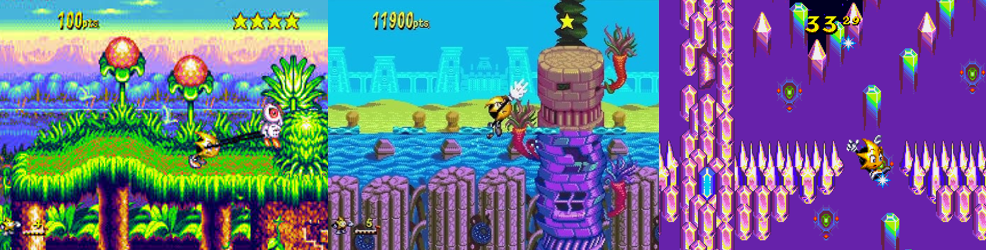
Rister is a surreal and vibrant 2D, sidescrolling platformer that, despite some visual similarities to Sonic, emphasises slow, deliberate platforming. Players control the titular Ristar, a cock-sure shooting star who travels across six worlds (called “Rounds”) to rescue his father from evil space pirate Kaiser Greedy. Each Round has three levels (two platforming challenges and a boss battle) and hidden Bonus Rounds. There’s no timer, no high score table (despite players earning points for defeating enemies and collecting gems), and players can only skip to later Rounds with special trophies that reveal passwords. There are two control schemes available so I mapped jump to the A and Y buttons and grab to the B button. Unlike some mascot platformers, Rister doesn’t defeat enemies by jumping on them or using weapons. Instead, he grabs them with his stretchy arms (extending his reach further the longer you hold the button) and rams into them with a headbutt. While this is effective, it can be quite slow and clunky. Players can grab in different directions, and even diagonally, but you may find you miss your target and take a hit. Ristar’s health is measured, fittingly enough, by stars. You can partially replenish it by smashing treasure chests and collecting either a gold or a blue star, which also gift 1-ups. Other treasure chests contain gems for points and Ristar occasionally grabs items, such as a miniature statue of himself or a gemstone, to bypass traps or activate teleporters. Sadly, the combat isn’t very deep; you just grab and smash everything. Sure, you can cling onto enemies to avoid being sucked into a black hole or to resist the flow of water, but you can slam or throw enemies, which severely hampers Ristar’s abilities. He can also swim and, though he’s a bit slippery underwater, he’ll never have to worry about drowning, so that’s a tick in the plus column.

Use Ristar’s awkward grab to bash enemies, explore environments, and tackle troublesome challenges.

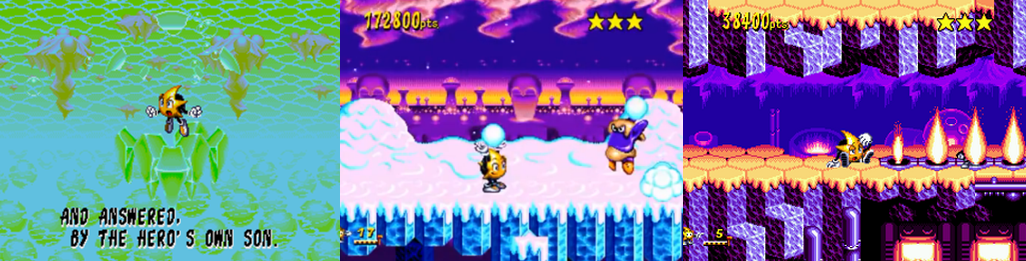
Ristar’s grab can also snag ladders, poles, overhead rails, and various other handholds to allow you to climb, clamber across gaps, and even wall climb…to a degree. This mechanic is very finicky and seems contrary to what the game wants you to do, so it’s good that it isn’t mandatory until Round 6. This Round also sees Ristar use anti-gravity sneakers to clunkily swim/fly about, though this is so limited that it’s more of a handicap. Round 5 sees him slide and ski down a snowy mountain, though this is a glorified cutscene, and ends with him tossing snowballs he builds with his idle pose at the boss, while Round 3 sees him pulling levers to activate or turn off furnaces. Each Round features a special Star Handle that spins Ristar around at high speeds. This ricochets him about to bounce up even spike shafts and clear vast distances, though you must angle him just right to get a “height bonus” and clear the level. Other Star Handles transport you to Bonus Rounds, where you have a strict time limit to navigate a brutal obstacle course and retrieve special treasure. You won’t lose health or lives in these stages, but it can be difficult finding and clearing them. Ristar can also smash certain walls or objects to either break them or topple them, create new paths and bridges, and must bash heavy moving platforms in Round 6 that’ll crush him with their massive hit boxes if he’s not careful. This Round also features multiple teleporters that transport Ristar to hazardous corridors where he either battles a mini boss, tosses missiles at cannons, or rips open the background to uncover gems. Very rarely, players red star power-ups make you temporarily invincible. Ristar also smashes enemy-spawning targets in Round 2, which largely takes place underwater and sees players grabbing bubbles to get higher, dealing with rising and falling tides, and fighting to avoid being blasted into a spike wall by the water current. Sadly, there are no autoscrolling sections where Ristar blasts through space to take out enemies like in its visual counterpart, Rocket Knight Adventures (Konami, 1993) and, while you get score bonuses and congratulatory text after each Round, you don’t appear to earn extra lives or continues and, with no high score table, the points are essentially meaningless.

Sadly, Ristar‘s few unique mechanics and vast potential go underutilised.

Ristar is a very slow game. Ristar plods about very lazily and only gets his ass moving when flying at enemies or bouncing around off a Star Handle. The bulk of the game involves jumping across gaps, spike pits, lava, or other hazards, hopping to platforms and using Ristar’s grab to scramble about. Some jumps can be very tricky since Ristar’s reach will just miss, forcing you to take longer or more dangerous paths or to struggle with his wall climb. In Round 1, you grab floating fluff or passing birds to get higher, reach into tree holes for goodies, and smash trees to light up the woods, though spores stick to you and, like the starfish in Round 2, slow you and then explode if you don’t shake them off. Round 3 sees you tossing Ristar statues into glowing spots to avoid being hurt and trapped by cages, and outrunning rising flames to test your platforming and grabbing skills, and you’ll also hold B to raise a pulley and reach higher ground in the factory section. Round 4 has an odd carry mechanic where you grab metronomes and deliver them to singing birds to open new paths, utilising fans and pincers and conveyer belts and defeating enemies before the can steal your item. This Round features a musical theme, with you being bounced about by drums and timing your grabs just right to navigate narrow spiked chasms, as well as flying along on zip wires and hopping past dancing guitars. Round 5 introduces a slipping gimmick where you must time your jumps off icy platforms to keep from looping around, destroy rocks in the underwater cavern, and again deal with Round 2’s rushing water gimmick. Round 6 is, fittingly, the most dangerous, featuring spiked mincers, the slipping gimmick, poles and handholds that switch positions every time you grab them, and an overhead ray that zaps you to the background and forces you to defeat enemies and grab handholds while obscured. Things get quite challenging quite quickly; Ristar has a big hit box and spikes and other hazards are everywhere, meaning things can get frustrating in later Rounds.

Presentation:
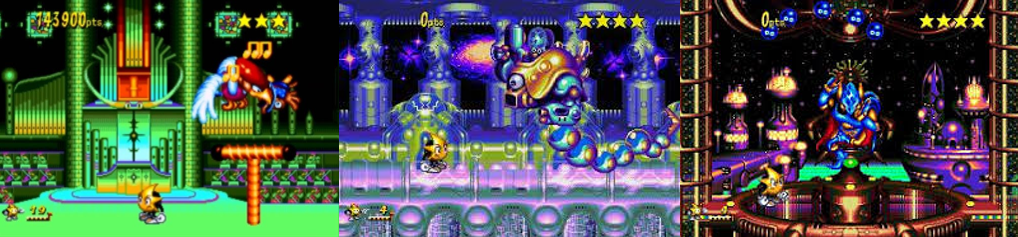
Visually, Ristar is one of the most impressive Mega Drive games. The colourful graphics, deep and detailed backgrounds, and vibrant presentation remind me of Knuckles’ Chaotix (SEGA, 1995), as do the wacky Round intro cards, story text, and sprites. Though one of gaming’s oddest characters, Ristar is full of life, sporting a determined frown, gleefully smashing enemies, yelping when hit, and blasting about when launched. Ristar sports a few idle poses that change in Round 4 and Round 5 to show him bopping along to the beat and struggling with the heat, respectively. The game’s story is very simple (and changes depending on your region) but is beautifully brought to life by both text and large, partially animated sprite art. Despite the title screen drawing immediate comparisons to Sonic the Hedgehog, Ristar is like a mish-mash of Sonic, Rocket Knight, Gunstar Heroes (Treasure, 1993), and Disney’s various 16-bit titles with both its gameplay and visuals, though oddly promoting precision platforming rather than fast-paced combat, perhaps to better showcase the stunning, cartoonish visuals and bizarre environments. While there’s no ending cutscene, stills showcase the ending and key moments during the credits and Ristar busts out a fitting victory pose upon defeating each boss and clearing the game. It’s a shame that his enemies aren’t as interesting, with players mostly smashing boring coloured Orblets, Unfortunately, Ristar can’t duck or look up, has no other combat options, forms, or power-ups, and his hit box is quite large. This is compounded by the odd decision the delay between grabbing health-restoring stars and Ristar’s health being restored, meaning you can grab a star and die before it’s added to your tally! As visually impressive as the game is, though, I was disappointed by the less than memorable soundtrack that cheaply recycles sound effects from Sonic 3 & Knuckles (SEGA Technical Institute, 1993/1994) during the final boss battle.

Ristar excels in its colourful, cartoonish visuals, though not in its gameplay.

Though Ristar plays things safe regarding its level themes, each Round is a kaleidoscope of colours and visuals and often depicted as obstacle courses that test your jumping and grabbing, so combat is often secondary. Planet Flora is your typical, grass-themed intro stage, featuring a sprawling valley in the background, bushes you can pass through (and which enemies pop out of), vine-themed handholds, birds flocking by, and Venus fly trap platforms that snap your heels! You venture into the roots of the forest and through a dark wood, with some impressive lighting effects in the boss arena, before heading to the decidedly Atlantis-themed Planet Undertow. You explore (and destroy) ancient ruins and swim through a coral cave (with no fear of falling debris), trashing machines to stop the current. Planet Scorch features a flashing hexagonal floor, an active volcano in the background that rains explosives, and furnaces that you (and enemies) can toggle on. After bypassing the rising flames and outrunning the screen-filling fire wall, you venture into the sweltering furnace and hop across lava pits formed when Orblets activate special bombs. Planet Sonata starts with a fantastic retro sci-fi aesthetic, with Jetsons (1962 to 1963;1985 to 1987)-style futuristic buildings and flying cars, before transforming into a musical-themed stage, featuring flutes, drums, musical sheets, and even a theatre stage for the boss battle. Planet Freon opts for a snow theme, sporting a glowing aurora borealis in the background, sliding Ristar about, and dropping you into a crystal cavern full of waterfalls and frozen frog statues, Planet Automaton is a hazardous robot factory full of spikes, grinders, and teleporters, with robotic nasties being built or guarding each corridor. Finally, Castle Greedy is a surreal alien landscape full of bonkers alien tech where a little spy camera follows you about at the start and you confront the suitable theatrical Kaiser Greedy in his fantastical throne room. There’s a lot to look at in Ristar’s worlds and the colours certainly pop, but I felt a strange absence of gimmicks for each area as the developers relied more on traditional platforming rather than innovative mechanics, best seen when Ristar’s skiing section is relegated to a cutscene rather than being playable.

Enemies and Bosses:
There are a handful of oddball enemies to smash your starry head against in Ristar, with the most common being the various coloured Orblets. While many of these are harmless unless you bump into them, floating about and generally acting as a nuisance or a handhold, others hang from branches in cocoons, endlessly spawn from metallic pots, briefly electrify themselves, or are surrounded by spikes or flames. Each Round also features unique enemies; though most simply hop or jump about, like Planet Flora’s weird rabbits and lizards, the chunky birds swoop at you and perform a torpedo attack. Planet Undertow is patrolled by fish, frogs, electric eels, and seahorse that’ll endlessly attack until you destroy the spawn point. Large, squid-like crustaceans also appear, taking a few hits to put down, and the first projectile-firing enemies appear in the form of that large enemy and the aggressive lobsters that pop up. Planet Scorch features a nasty vulture who grabs you and a slug-like enemy that emits flame bursts, while Planet Sonata is populated by robotic enemies themed around birds and musical instruments. There are purple pipes that must be destroyed to stop them spitting projectiles, dancing robot birds that toss minions, and large robotic woodpeckers that peck you with their beaks. Planet Freon sees spiked fish in the waters, strange, bulbous aliens floating about in water rings, and mechanical baddies that drop icicles. Planet Automaton sees these weird, Slinky-like robots on the walls that spit projectiles and duplicate when hit, UFO-like robots that float by and fire a laser spread, and weird robot poles with two large, spiked fists, alongside missile-firing cannons and the biggest assortment of coloured Orblets yet! Sometimes, you’ll battle a mini boss or a wave of enemies to finish the first level of a Round, such as Planet Flora’s giant snake that popes from holes in the background and the literal waves of Orblets that rain down in Round 2. Planet Sonata sees you battling three robot woodpeckers controlled by a bird maestro, Planet Freon pits you in a snowball fight against a strange, rotund little alien, and Planet Automaton forces you to run a gauntlet of robotic bosses, smashing a bouncy trashcan-like mech and forcing a large battle robot back against the wall with precision hits.

Though innovative and challenging, the bosses aren’t enough to salvage the game.

Naturally, each Round ends in a boss battle, with bosses changing colour as you deal damage and often spawning Orblets as projectiles or distractions. The mischievous imp Rhio possesses Planet Flora’s elder and compels him to float around conjuring snowflake-like projectiles. You must dodge these and smack him to knock Rhio loose and attack, watching for the miniature tornados he conjures. The aggressive hammerhead shark Ohsat darts in from either side of the screen in Round 2, causing rocks to fall and eventually left floundering when each hit you land drains the arena’s water. The mole-like Adahan attacks in Planet Scorch’s volcanic depths, popping from the ground claws first and kicking up dirt. After a few hits, the fight switches to a freefall section where you must hit him as he bounces off the walls, which can be tricky due to Ristar’s janky grab mechanics. Awaueck rains musical notes that are hard to dodge and is only vulnerable when you knock him from his perch. The strange ice monster Itamor tosses bouncing balls and emits a freezing breath, but the mini boss appears to help you by providing hot soup to toss into Itamor’s maw and melt him from the inside out. The battle robot Uranim tosses junk from offscreen before battling you in an enclosed arena. You must smack him a few times to knock him over and then lure the pincer-like tentacle to hit him to cause damage, watching for his jump and ricocheting projectiles. Kaiser Greedy’s right-hand, Ionis, pilots Eyebar -555, a mechanical snake in Round 6 that boasts a boomerang projectile, machine gun and blaster arm, and ricochet bolts. Dodge all this and hit his shield a few times to dislodge Ionis and deal some real damage. Kaiser Greedy then trumps this by floating and teleporting around his throne room, tossing Orblets, firing a lightning bolt, and conjuring an insta-kill black hole! You must anticipate where he’ll be to grab and attack in a very small window, and hold onto any Orblets to avoid a sudden end, in this ridiculously tough finale.

Additional Features:
Ristar offers two difficulty settings, “Normal” and “Hard”, with “Hard” mode reducing your total health to just two stars and “Normal” gifting you four. Beyond that, there isn’t much else on offer here unless you’re playing the Japanese version, which features a different story and some passwords that enable a stage select, time attack, invincibility, and other effects. If you play the Game Gear version, you’ll have a slightly different experience, both graphically and in terms of the bosses and mechanics, while this version allows you to rewind the action and create save states. If you’re playing the version included in the SEGA Mega Drive Ultimate Collection (Backbone Entertainment, 2009), you’ll get an Achievement if you collect five yellow stars, though there are oddly no Achievement specific to Ristar in the SEGA Mega Drive Classics (SEGA/D3T, 2018) collection.

Final Thoughts:
I’ve been enamoured by Ristar for years. As a kid, I was always intrigued by screenshots in gaming magazines and I always wanted to own it based on my love of 2D mascot platformers but never saw a copy in the wild and a decent copy can be quite pricey. Thanks to modern re-releases, Ristar is more accessible than ever…but, sadly, that doesn’t mean it’s really worth your time. The game looks absolutely gorgeous and goes a long way to show what the Mega Drive was capable of with cartoonish, vibrant 2D sprites. Ristar looks fantastic and his worlds are unique and colourful, though sadly lacks memorable gimmicks as the developers prioritised platforming and Ristar’s unique grab mechanic. This is an interesting gimmick, but one that doesn’t live up to its potential. I just wanted Ristar to do more, perhaps throw or slam enemies or something a bit more dynamic than just grabbing handholds and bashing enemies. The gimmick is sadly underutilised and Ristar lacks the speed and action to complete with, much less usurp, Sonic, with Ristar being slow, far too big a target, and far more limited compared to his peers. Ristar is also incredibly challenging, with numerous spikes and hazards sapping your health and continues and so much trial and error that I’ve no idea how people beat it without rewinds and save states. It’s only a short game, but later Rounds are almost unforgiving with their obstacles and tough mini bosses, and it’s not like the ending is worth your time. The bosses were a highlight, for sure, being big and well animated and making you use Ristar’s grab in different ways. It’s just a shame this innovation didn’t translate to the core gameplay to let Ristar chain together grabs, swings, and attacks, which we’d see SEGA arguably do better in Sonic Unleashed (Sonic Team, 2008). In the end, while Ristar impresses with its visuals and beautiful stages, there’s just not enough meat on the bones for it to stand alongside other mascot platformers. I’m glad I finally saw it through, but I’d much rather playthrough Rocket Knight Adventures or Sonic 3 & Knuckles than this one, which is a shame as it had so much potential.

My Rating:

Rating: 3 out of 5.

Pretty Good

Do you think I’m being too hard on Ristar? How do you think it compares to other action platformers? What did you think to the grab mechanic and Ristar’s visuals? Did you also struggle with the late game difficulty curve? Which of the bosses was your favourite and would you like to see Ristar make a comeback? What are some of your favourite sci-fi-orientated videogames? Feel free to share any memories you have of Ristar in the comments, support me on Ko-Fi, and then check out my other sci-fi content.

Screen Time [Sci-Fanuary]: The Vanishing Man (Pilot)


January celebrates two notable dates in science-fiction history: “National Science Fiction Day” on January 2 to coincide with the birth of world renowned sci-fi writer Isaac Asimov, and 12 January being when Arthur C. Clarke’s HAL 9000 was created. Accordingly, I dedicate January to celebrating sci-fi in all its forms.


TV Movie Pilot

Director: Roger Bamford

Air Date: 2 April 1997

Original Network: ITV

Quick Facts:
Potentially inspired by W. S. Gilbert’s “The Perils of Invisibility” and adapted into an iconic sci-fi classic in 1933, Herbert George Wells’s 1897 literary classic The Invisible Man spawned numerous quasi-sequels and spin-offs, sci-fi dramas, and big-budget remakes and reimaginings. Fresh off his success with loutish British comedy Men Behaving Badly (1992; 1994 to 1998), Neil Morrissey starred in a short-lived, strangely forgotten Invisible Man-inspired sci-fi drama series that began with this largely praised television pilot movie.

The Review:
The Vanishing Man isn’t quite a then-modern-day update of The Invisible Man in the sense that the plot and characters are very different, except for the presence of an invisible man and an enigmatic, masked figure. Rather than following an ambitious, egotistical scientist who subjects himself to a chemical procedure, this made-for-television movie follows womaniser Nick Cameron (Neil Morrissey), who works as a pilot alongside his brother, Joe (Mark Womack), who arranges the deliveries and acts as his radio man. After a particularly embarrassing morning where he forgets the name of his latest conquest (Elizabeth Jasicki), Nick hurries to Schiphol to collect a high value package that has Joe uncharacteristically on edge. Although the trip is expected to be extremely simple, Nick hits some bad weather and experiences technical issues brought about by a dodgy radio and his golf clubs interfering with his compass, sending him way off-course and causing him to land hours later. When he does touch down, however, Nick’s day goes from bad to worse as the cops arrest him for smuggling in plutonium! Although Joe flees, desperate to save his own hide, Nick refuses to name his brother and suffers the full wrath of the law when his explanations are dismissed as coincidences and contrivances. Branded a terrorist, Nick’s sentenced to twenty-five years in prison despite his protestations that he had no idea what he was carrying or what was going on. Nick’s thrown a lifeline when overworked and undervalued solicitor Alice Grant (Lucy Akhurst) is assigned to work on his appeal by her stuffy, condescending boss, Gordon Wells (William Chubb).

After unwitting smuggler Nick is turned invisible, he turns to his sceptical solicitor for help.

This leaves Alice frustrated as the appeal distracts her from her law firm’s biggest case, investigating an environmental disaster linked to bureaucrat Edward Lawrence (David Hemmings) and caused by harnium nitrate, a destructive chemical manufactured by Lawrence’s company, Solex. Still, Alice meets Nick and, though initially aggravated by his wild claims, she finds his defence has some legs, much to the bizarre objections of Gordon, who suddenly chastises her working on Nick’s appeal in favour of the Lawrence case! Nick’s also given something of a break when the prison warden, Forstater (Peter Eyre), selects him for a clinical trial into “sunburns” run by the Gyges (as in the “Ring of Gyges”) organisation. Though sceptical, Nick agrees, believing his compliance will help his case, and is driven to a far away manor, where he meets the amiable Ms. Jeffries (Barbara Flynn) and learns that Gyges hopes to reverse the harmful effects of UV radiation for the betterment of humankind. However, Nick’s resolve falters when he sees their bizarre medical equipment and is forcibly strapped to a machine and bathed in painful laser beams. Still, Nick returns to prison none the wiser and certainly unaware that the mysterious head of Gyges (Roger Brierley) has become antsy upon learning of Nick’s appeal. Thus, Ms. Jefferies orders Forstater to eliminate Nick, only for the warden and his bullish main guard (Stuart Clark) to be amazed when Nick suddenly disappears while taking a shower and subsequently escapes from prison. Alice is equally stunned when Nick appears, buck naked, in the back of her car, pleading for her help, fearing for his life, and babbling a crazy story about how the Gyges process turned him invisible! Although dubious, Alice reluctantly shelters Nick as he anxiously worries about fading away again and recounts as much of his experience as he can remember, sparking her curiosity when he mentions a canister stamped with “Hanoi” and leading her to discover he was subjected to Ha No.1, or harnium nitrate.

When Alice is kidnapped, Nick and Joe hatch a daring plan to rescue her.

Realising he’s endangering Alice, Nick tries to fly to safety using his brother’s plane, only to suddenly turn invisible and flee to his flat. When Gordon unexpectedly shows up at Alice’s apartment and talks down to her, she’s amazed when he suffers a couple of pratfalls and is sent packing, before realising Gordon was upset by the invisible Nick. Now fully onboard, Alice shares her discovery of a link between Gyges and Solex and helps track down Nick’s worthless brother for help. Joe’s also incredulous about Nick’s story but agrees to help them break into Lawrence’s office out of guilt for setting up and abandoning his brother, placing a threatening call that gives Nick access to Lawrence’s computer and allows him to e-mail evidence of Solex’s wrongdoings to Alice. However, when Alice confronts Lawrence about this, she’s suddenly met by Ms. Jefferies, who kills Lawrence with an invisible gun and takes Alice hostage, threatening her life if Nick doesn’t hand himself over. Believing Nick has been made permanently invisible thanks to the unique radiation he was exposed to from the plutonium, Gyges are desperate to experiment on him to unlock the secret of invisibility as every experiment they’ve run on living tissue has resulted in failure. While stressing over how to rescue Alice and resolve the situation, Nick and Joe realise that water causes Nick’s invisibility and hatch a brave, if bonkers, plan to have Joe masquerade as Nick under layers of clothing and threaten Ms. Jefferies with a fake grenade, all while the invisible Nick hitches a ride to the Gyges facility. Amazingly, Nick stays invisible for the whole drive and therefore rescues Alice, only to fade back in at a crucial moment. Thankfully, Gyges were so caught off-guard by the plan that Nick, Alice, and Joe escape, with Nick acquiring a special suit and even stealing a motorcycle which also turn invisible when exposed to water.

Final Thoughts:
Neil Morrissey was pretty popular around this time, having found fame as bungling no-hoper Tony Smart in Men Behaving Badly. Some of that role seeps into his performance here as, while Nick has at least two women on the go at the start and constantly tries to charm women, Nick is somewhat incompetent and easily distracted. Though a capable pilot, Nick’s more focused on his golfing (though we never see him playing…) and chatting up women, and therefore pleads ignorance when he’s arrested for smuggling plutonium. Sticking to his story, Nick’s let down by the system as his only defence is ignorance and tall tales about magnets and misdialled numbers. Still, there’s enough extra meat to this role for Morrissey to play with as Nick is genuinely horrified when he suddenly melts into nothingness in the shower and when he realises that Gyges wants him dead because he knows too much. Returning to visibility brings Nick little comfort as he’s left paranoia about those hunting him and when he’ll next turn invisible, not realising until the final act that water triggers the transformation and thus left anxious about suddenly fading away. Although Alice is naturally sceptical, she’s clearly intrigued by Nick, a man beset by bad luck whose claims end up having some validity. Though enraged at Nick endangering her life and her career, Alice jumps in with him to bring down Lawrence, a slippery devil whose chemicals pollute the environment, and is shown to be a very capable and forthright individual even when men are constantly condescending to her. Joe is primarily here as comic relief and to show the extreme other side to Nick as Joe is a coward and a swindler who constantly runs from responsibility, only to become crucial to Nick’s rescue operation in the end and even put his life at risk to save his brother, despite the two constantly bickering like children.

Some impressive visual effects help this ambitious, if sadly forgotten, show stand out.

The Vanishing Man was quite an ambitious production back in the day and I can’t imagine it was cheap to produce, which makes the subsequent series even more impressive. While traditional techniques like first-person shots, the absence of actors, and wires are employed for many scenes, there’s a fair bit of CGI employed to depict Nick’s invisibility. We see his flesh erased by nothingness, his aghast expression as his hands fade away, and see him semi-translucent when the transformation’s in its infancy, which is all very impressive and arguably up there with some feature film effects. It helps that these effects are used sparingly, and many appear to be simple green screen and shot replacement techniques, and this allows for a fun final shot in which Nick and his motorcycle vanish and leave Alice screaming her head off as she blasts through the countryside! While Nick would eventually succumb to madness from his condition (spoilers…), he’s a far cry from the traditional maniacal Invisible Man. Nick’s initially terrified of his condition but soon embraces it and uses it for good, grappling with armed goons and overcoming the odds with his unique abilities. These make him a clear target for Gyges, who are desperate to figure out what makes Nick so different that he can maintain the invisibility. The head is especially driven to discover this as he’s been left horrifically scarred and injured from the process, seemingly rendered a semi-transparent skeleton beneath his decidedly Claude Rains-esque mask and outfit. The ending with Chief Inspector Moreau (James Laurenson) hinting at further adventures for Nick clearly sets up the following series, which sadly remains as widely unavailable as this TV pilot, which I still remember fondly and regard as one of the better Invisible Man stories that’s made even better by making the most of its surely modest television budget.

My Rating:

Rating: 3 out of 5.

Pretty Good

Did you ever watch The Vanishing Man back in the day? Were you impressed by the special effects? What did you think of Neil Morrissey’s performance and did you like Nick’s characterisation? Would you like to see the full series get a re-release? What are some of your favourite Invisible Man stories and media? Feel free to share any memories of The Vanishing Man in the comments and donate to my Ko-Fi to suggest other sci-fi shows for me to cover.

Game Corner: AEW: Fight Forever (Xbox Series X)

Released: 29 June 2023
Developer: Yuke’s
Also Available For: Nintendo Switch, PC, PlayStation 4, PlayStation 5, Xbox One, Xbox Series S

The Background:
Once Scott Hall showed up on WCW Monday Nitro on 27 May 1996, the then-World Wrestling Federation (WWF) and World Championship Wrestling (WCW) engaged in a “Monday Night War” that defined a generation of wrestling fans. Things changed forever, however, when WCW went bankrupt and was absorbed by what’s now called World Wrestling Entertainment (WWE) and, despite some admirable efforts, the WWE has been the top dog of the American wrestling industry ever since. A true competitor arose in 2019, however, when Cody Rhodes, Kenny Omega, and Matt and Nick Jackson (with financial backing from Tony Khan) launched All Elite Wrestling (AEW). Not only was AEW an indie wrestling fan’s wet dream, but they also signed both undervalued wrestling stars and bona fide legends like “The Icon” Sting, who infamously defeated “Hollywood” Hulk Hogan for the WCW Championship on this day in 1997. AEW quickly established themselves as a true alternative to the WWE with action figures and merchandise, but it was the Jacksons who pushed for an AEW videogame, which immediately turned heads when Yuke’s (the developer behind some of the greatest wrestling games of all time) was brought in to develop the title. With the game engine being directly inspired by the celebrated WWF No Mercy (Asmik Ace Entertainment/AKI Corporation, 2000) and featuring a rare appearance by the late Owen Hart, the game promised to bolster its content with additional materials but quickly came under fire for its long development time. Despite downloadable content (DLC) trying to keep the game relevant, AEW: Fight Forever released with a strangely out of date roster and was met with mixed reviews. While the arcade-style, throwback gameplay was praised and innovative match types were praised, the main story and wrestler customisation options were criticised for being undercooked. However, the game sold well in the United Kingdom and Tony Khan promised to produce more AEW videogames in the future, leaving fans hopeful for an improved experience next time around.

The Plot:
When not competing in a series of customisable wrestling bouts, players take either a created wrestler or a member of the AEW roster on a year-long journey through the company’s biggest names and matches.

Gameplay and Power-Ups:
AEW: Fight Forever is an arcade-style wrestling title that plays very similar to the classic wrestling games produced by AKI, THQ, and Yuke’s back in the day, utilising a modified game engine and similar features of games such as the immortal WWF No Mercy. After customising their game card with icons, badges, and weapon decals, players are presenting with a laundry list of options befitting a wrestling videogame. You’ll probably want to explore the game’s options and settings first, where you can view various in-game statistics (wins and losses and such) and records, check out the current leaderboards, and toggle various options, such as the blood, entrance effects, casual play, and tutorials. As should be expected, the game offers a training mode where you can test out the initial fifty-strong roster, setting the computer-controlled opponent to different behaviours and positions to test different moves. Unless you disable in-game tutorials and hints, wrestling legends like William Regal, Jim “J.R.” Ross, and Taz chip in with insights into specific game mechanics or match types. Although the game’s controls are fully customisable, I managed fairly well with the default layout, which maps your high strike and kicks to X and Y, your grapples to A, and run to B. By holding A, X, or Y, you execute a strong attack or grapple to deal additional damage, while tapping the strike buttons executes a quick combo. You can also hit A, X, or Y while running for a running strike or takedown, attack enemies when they’re down in the same way, and swing the game’s various colourful weapons with X or Y. The right stick is used for taunting, which builds your momentum bar, allowing you to maintain stamina and execute signature and finisher moves (using the D-pad or the right stick, as prompted). If you’re covered or locked in a submission hold, mash the face buttons to try and kick or wriggle free, and mash them when locking in a submission to wear down your opponent’s body part or score a tap out victory.

The glory days of fast-paced, arcade-style action are nicely evoked in Fight Forever‘s gameplay.

Each wrestler has at least one signature and finisher move, though some have more if they have a certain “Skill” equipped. You must pull off a successful taunt to activate your “Special” status, which allows you to hit as many finishers as you like until the status fades. These are performed from different positions (from a lock up, or the top rope, or when the opponent is down, etc), so be sure to review your wrestler’s moves from the pause menu. Once your opponent is down, press the Left Trigger to pin or the Right Trigger to pick them up. Grappling and pressing RT whips your opponent into the ropes, corner, or ringside equipment, and the Left and Right Bumpers are used for countering. This can be tricky as there’s no onscreen indicator for when to counter. Simply mashing the triggers doesn’t work either, so it’s all about timing. Skills also afford you temporary buffs, such as landing the first strike or doing a taunt, while others increase your versitality, such as adding springboard attacks and a quick kip up to your repertoire. You can increase the amount and strength of your finishers, buff your finisher countering ability, increase your resistance to submissions, power out of pins, and even steal your opponent’s finisher. When tagging with a partner, you can bring them in with LT and perform double-team moves to wear down your opponents. You can also exit the ring and throw your opponent into the steel steps, ring apron, ring posts, and barricade to deal additional damage. When you hit your signature moves or finishers, you’re treated to a replay, and a helpful picture-in-picture feature shows who’s coming out to interfere for or against you. You can assign a manager to even the odds, bust opponents open, and even utilise weapons in some matches. When playing “Road to Elite”, you must watch your health as you’ll be injured if it drops too low or you overexert your workouts, requiring you to visit the hospital. In matches, your wrestler holds damaged body parts and becomes disorientated from eye rakes and eye pokes, screwing up your controls for a short time.

Though light on gimmick matches, Fight Forever has some unique and bloody match types.

There are a decent variety of match types here, from standard one-on-one matches to tag team bouts and multi-man matches. AEW: Fight Forever offers intergender matches, allows you to challenge for or defend AEW Championships, and manually change the champions if you wish. While you can’t alter the settings for every match, you can select additional options from each category, such as the “Lights Out” match (which adds weapons to the ring) and “Falls Count Anywhere” match (where you can pin outside the ring). Weapons are picked up, snatched from the crowd, or retrieved from under the ring with RT and break after a few uses but there are a lot of them here. You can set up and smash opponents through tables, swing baseball bats, steel chairs, and barbed wire implements alongside throwing football helmets, rideable skateboards, and covering the canvas with thumbtacks. Tag team matches can be a bit of a pain, especially if you’re not controlling your partner, as the CPU gets very aggressive when going for a tag and their partner often interrupts pins or hits double team moves. Your best bet is to down your opponent and then knock their partner off the apron or strategically pin your foe near your corner. Similarly, multi-man matches can get extremely chaotic as the game’s targeting is atrocious, either automatically switching to whoever it feels like or messing up your manual aim. “Road to Elite” features gauntlet matches where you battle three opponents in succession, handicap matches, and singles matches where your opponent’s allies will interfere to beat you down, all without a disqualification. Surprisingly, there’s no steel cage match, but you can play a ladder match, setting up a ladder with RT, holding B or LT to climb, and mashing buttons to whittle down a wheel and claim victory. Be careful, though, as the CPU may steal your victory if you get the wheel down to the last section and they make a successful climb.

“Road to Elite” strangely simulates day-to-day activities in a botched attempt at immersion.

AEW: Fight Forever is notable for a couple of fun and unique gimmick matches, with the “Exploding Barbed Wire Death Match” being a particular highlight. In this match, the ring ropes are replaced by barbed wire, barbed wire tables are in each corner, and you have 120 seconds before the ring explodes, causing major damage to anyone near the ropes. You can toss and hit your opponent into the barbed wire to literally flood the canvas with blood, and set off explosions, which was a lot of fun. The “Casino Battle Royale” was less enjoyable for me and far less unique, essentially being a traditional Royal Rumble with a wacky name and having you pick a playing card to determine your position in the match. The goal is to wear down your opponents (up to twenty-one) so you can toss them over the ropes to win, gaining a title shot in “Road to Elite”. This is the game’s story mode, where you take any AEW star (or a custom wrestler) on a year-long story, making friends and enemies and winning championships as you go. Win or lose (and it’s fine to lose matches here), you’ll earn AEW Cash to spend in the in-game shop and Skill Points to spruce up your custom wrestler. AEW Cash can also be spent on better hospital treatment or buying items to boost your health, momentum, or Skill Points. Between matches, you’re given four “turns” to either workout, see the sights, eat, or do other bizarre tasks like press conferences and talk shows. If you work out, you’ll lose energy but gain momentum, but also risk getting injured. Eating restores your health, as do some other tasks, and seeing the sights increases your chances or meeting other wrestlers. There are multiple story paths to experience, all triggered at random, with you forming tag teams, being betrayed, joining or battling against one of AEW’s many factions, and vying for the company’s top prize. It’s a decent mode, but quite short to invite replays and can get repetitive as you have little control over what you’re doing outside of a match (save for a few dialogue choices). You can take selfies with AEW stars for your collection, sometimes endure horrendous gauntlets or fight while injured, and play a bunch of weird mini games for additional points.

Presentation:
AEW: Fight Forever generally impresses with its visuals, particularly the wrestler models. Unlike the WWE videogames, AEW: Fight Forever opts for a slightly exaggerated, action figure-like aesthetic not unlike WWE All-Stars (Subdued Software/THQ San Diego, 2011). Each AEW star closely resembles their real-life counterpart, even down to their in-game grunts and taunts (with Sting howling and “The Machine” Brian Cage shouting at the crowd), though the game was noticeably outdated at launch and is even more behind the times now. The women, especially, come off really well, which is nice to see as they often look monstrous in the WWE titles, and each has their accurate entrance music, including “Le Champion” Chris Jericho coming out to “Judas” and CM Punk using “Cult of Personality”. Unfortunately, AEW: Fight Forever opts to use truncated entrances like WWF No Mercy. While you can press buttons to activate pyro and other effects, this may be disappointing to some (not me, though, as I always skip entrances anyway). However, I was disappointed by the lack of commentary, even for signatures and finishers, opting for a customisable soundtrack instead, which was a shame. In fact, voice acting is very sparse, with the odd sound bite or insight cropping up now and then but the game primarily relying on text and dialogue boxes. While it obviously helps make the random story paths more manageable, it does come off as a little cheap, similar to when you visit various landmarks in “Road to Elite” and are met with laughably low quality still images. I occasionally saw some texture warping during these cutscenes as well, and some graphical glitches (such as entrance weapons disappearing). Similarly, there aren’t many options for wrestler customisation and skins, with only a handful of AEW stars having true alternate looks. However, I would say AEW: Fight Forever looks and performs far better than a lot of recent WWE games, likely because it’s a far simpler and stripped back title.

A flawed focus on bizarre gimmicks result in a solid, if barebones, experience.

If the trimmed entrances and lack of commentary didn’t give this away, the barebones arenas sure do. On the one hand, I’m not all that fussed as the arenas are largely superfluous and their presentation does recall the likes of WWF No Mercy. On the other hand, this game came out in 2023, so I’d expect the crowd to look less basic. The audience is seeped in darkness and indistinguishable most of the time, though the fans are very loud and add a lot of ambiance to matches. There are only a handful of arenas here, though, so things can get visually repetitive very quickly. You can build your own custom arenas, but I find these always look stupid and this isn’t helped by the weird fixtures, decals, and colour schemes the game offers. Strangely, AEW: Fight Forever doesn’t allow for backstage brawling, with no backstage areas included, or brawling in the crowd, which is just bizarre. The Exploding Barbed Wire Death Match adds some visual variety, and the “Stadium Stampede” DLC shows what the game could be capable of, but the developers apparently thought it more important to waste resources on weird-ass mini games. These see you playing baseball, participating in quizzes, collecting tokens, shoving opponents from the ring and onto coloured balls, matching Penta El Zero M’s movements, smashing coloured boxes, and running across football fields avoiding hidden holes. These certainly add some visual variety, but they’re so out of place that it’s like the developer’s notes got mixed up. Similarly, you’ll see cutscenes of your wrestler working out, chatting, visiting the hospital, getting beaten up, or meeting fans when playing “Road to Elite”, all things that are certainly different and fitting for a wrestler’s lifestyle but seem out of place. Finally, live-action footage, clips, and voice overs interspersed through “Road to Elite” show key moments in AEW history, which was nice, though you oddly don’t recreate many of these moments as you play.

Enemies and Bosses:
Naturally, every wrestler on the roster is your enemy, even your allies. While every wrestler controls and fights the same, with a set number of moves and abilities, your strategies may alter depending on who you fight. As each wrestler has multiple Skills, it’s worth becoming familiar with them as it does impact your play style. Custom wrestlers will set and refine these in the “Road to Elite” story mode, AEW stars have theirs set and cannot change them, and some even have unique Skills, such as “Freshly Squeezed” Orange Cassidy’s “Sloth Style” where he fights with his hands in his pockets. “Mr. Mayhem” Wardlow snatches guys out of mid-air, Powerhouse Hobbs briefly becomes immune to strikes, Maxwell Jacob Friedman/MJF bails out of the ring, and “The Bastard” Pac evades strikes and grapples with cartwheels and rolls. Similarly, you must adapt to superheavyweights like “No More B.S.” Paul Wight as undersized wrestlers will struggle to perform their usual moves due to the weight difference. Highfliers like Rey Fenix are smaller and more agile, often striking fast, quickly countering, and flying from the top rope. Jon Moxley lives up to his reputation as an insane brawler by focusing on strikes and excelling in hardcore environments, guys like “The American Dragon” Bryan Danielson are more technical, sporting a repertoire of submission holds and take downs, and career tag teams like Matt and Nick Jackson (The Young Bucks) have flashier double team moves to keep you off balance. In many cases, you can simply wait out or fight through your opponent’s unique skills, such as spamming combos on Wardlow until he starts feeling them and avoiding the top rope when facing opponents with the anti-air Skill.

Different matches and wrestler abilities can change the difficulty and complexion of a contest.

Some competitors (particularly custom wrestlers) may surprise you, however, as even smaller wrestlers can counter mid-air attacks or finishers. Generally, your opponents are only as difficult as you set the game and the match type dictates. For example, a 4-Way match pitting Darby Allin against Luchasarus, “The Redeemer” Miro, and John Silver will be an uphill battle for the colourful daredevil. Similarly, tag team matches can be a chore as the opponent’s partner constantly rushes the ring, just like in the old AKI games, and the Casino Battle Royale can end in an instant if you’re jumped from behind. Sometimes, your opponent’s attacks land faster and with more accuracy than yours but, other times, they simply stand there like a goober. The more you beat your opponent, the weaker they become, but the momentum bar charges ridiculously fast, and the match can change on a dime if your opponent gets a few good hits in or activates a buff. Generally, opponents rush you once the bell rings, so be ready to counter their attack…if you can get the timing of the blocking down. When playing “Road to Elite” on “Easy”, I found matches fluctuated. While I easily dominated most opponents, winning with a single finisher or even regular moves, others proved surprisingly aggressive, such as MJF with his dirty tactics and Pac, with his odd combination of speed and strength, yet I absolutely crushed Paul Wight, destroyed Chris Jericho, and easily toppled champions. This is true even in multi-man matches as you can get into a rhythm of wearing down a specific opponent (or keeping an eye on who’s taking a beating) and time your pins to happen as the other opponents are distracted for an easy win. “Road to Elite” got annoying for me simply because many paths push you into tag matches or gauntlets, and due to its random nature. You can access different paths and matches with different wrestlers, even competing in a Exploding Barbed Wire Death Match and battling a shadowy reflection of your wrestler in certain paths, and your opponents seem to be randomised each time to mix things up, though your general strategy of wearing them down to score a win remains the same.

Additional Features:
There are thirty-eight Achievements up for grabs here, which sounds like a lot but they’re surprising simplistic. Thankfully (but oddly), none of them are tied to online play. You’ll get an achievement for clearing “Road to Elite” once and then ten times, others for creating a custom wrestlers or competing in a custom arena, and another for winning a championship in an exhibition match. There’s an Achievement for buying an item, another for hitting a signature and finisher and scoring a victory, and another for hitting an opponent with a barbed wire bat in a “Lights Out” match. If you successfully perform certain tasks in “Road to Elite” (such as eating and working out), you’ll get more Achievements, and there are Achievements for utilising certain Skills in matches. Nothing too taxing, which is nice, but the Achievements also lack a lot of creativity and encourage repetition rather than replayability, which are two different things. There are additional “Challenges” too, daily, weekly, and untimed normal challenges. These award AEW Cash for defeating opponents, challenging harder difficulties, and performing a bunch of moves over time (such as 100 running attacks). It’s something to do, I guess, but hardly that innovative compared to other games. As you’d expect, you can go online to play in ranked, casual, and private matches. Sadly, you cannot download custom wrestlers or arenas, which is very surprising but hardly a big loss considering how lacklustre the game’s create-a-wrestler is.

Some expected and bonkers inclusions can’t ease the sting of the barebones creation suite.

The create-a-wrestler mode is so lacking that it’s inferior to even WWF No Mercy, reminding me more of the laughable options seen in WWF WrestleMania X-8 (Yuke’s, 2002). You’re limited to picking set expressions and altering the basics of your wrestler’s appearance rather than changing every aspect, are given a paltry selection of clothes and accessories focused more on patriotic attire than AEW gear, and have so few options that it’s basically impossible to create current AEW stars. While there are a lot of names and moves to pick from and entrance options, it’s all disappointingly barebones, with even the shop offering little extra content. Team entrances are especially limited, it bugged me that I couldn’t even put a vest on my wrestler without picking a body suit, and it’s almost insulting how few options there are for masks and face paint. You can modify the AEW roster, but the options are again incredibly limited, meaning you can’t rejig “The Natural” Dustin Rhodes to look like Goldust. The create an arena is just as pointless, I couldn’t care less about the unlockable badges and such, and there’s little incentive on spending real-world money for the DLC wrestlers unless you simply must have Adam Copeland on your roster. They do add additional skins and moves, to be fair, and the “Stadium Stampede” mode (which is free to download but you need a subscription to play). This is a bizarre free-for-all arena battler where you compete against thirty other players on a football field, utilising horses, golf carts, and abilities, attacking enemies for poker chips to level-up your character. Lastly, you can use AEW Cash to purchase “The American Nightmare” Cody Rhodes and referee Aubrey Edwards, and unlock Paul Wight, “The Exalted One” Mr. Brodie Lee, and even the legendary Owen Hart by playing specific paths in “Road to Elite” for the former or winning 100 exhibition matches for the latter.

The Summary:
While I generally enjoy the WWE videogames put out by Visual Concepts and 2K, it has to be said that the formula has become very stagnant over the years. The games are great simulations of the televised product, but I miss the fast-paced, action-orientated arcade style of the good old days, when WWF No Mercy captured my attention for hours on end. I’m also a fan of AEW and seeing them try something new, so I was excited to get AEW: Fight Forever despite all the negativity surrounding it. On the surface, it delivers what I wanted: simple, pick-up-and-play arcade action that recalls the AKI/THQ wrestling games of old, updating those mechanics for modern gamers. Playing matches is a lot of fun, with moves being simple to pull off, the game performing really well, and a great deal of satisfaction coming from every victory. I liked that “Road to Elite” was quite varied and encouraged replays with its different, random paths, and that it tried something new by mimicking a wrestler’s lifestyle. Unfortunately, the game is handicapped by barebones options, with perhaps the worst create-a-wrestler I’ve seen for some years and nothing worth unlocking apart from a couple of extra wrestlers. The focus on ridiculous mini games was a bizarre choice that adds confusion and tedium rather than variety, and it was disappointing to have so little control over “Road to Elite”. While the game mirrors WWF No Mercy in many ways, content is not one of them, with key elements omitted from popular game modes for absolutely no reason. The Exploding Barbed Wire Death Match was a great inclusion and this was probably the first time I’ve enjoyed a ladder match in years, but there are surprisingly few match types to pick from, the roster is severely outdated (with basically no way to update it through the creation suite), and some matches and CPU behaviours can be needlessly frustrating. It’s a shame as there’s a lot of potential, but it seems the lengthy development time got strangely side-tracked with unwanted features (those damn mini games) rather than offering a truly memorable alternative to the WWE’s videogames.

My Rating:

Rating: 2 out of 5.

Could Be Better

Did you enjoy AEW: Fight Forever? What did you think to the throwback gameplay and arcade-style action? Were you disappointed by the barebones creation suite and strangely limited presentation? Did you enjoy the Exploding Barbed Wire Death Match? What did you think to “Road to Elite” and its bizarre mini games? Would you like to see a sequel improve upon the game’s mechanics and potential? Who was your go-to wrestler to play as an why was it Sting? Which of Sting’s eras, personas, and matches are your favourite? Whatever your thoughts on AEW: Fight Forever, and Sting in particular, feel free to voice them below, check out my other wrestling reviews, and donate to my Ko-Fi if you want to see more wrestling content.

Movie Night [Christmas Day]: Violent Night

Released: 2 December 2022
Director: Tommy Wirkola
Distributor: Universal Pictures
Budget: $20 million
Stars: David Harbour, John Leguizamo, Leah Brady, Alex Hassell, Mike Dopud, and Beverly D’Angelo

The Plot:
When the malicious “Mister Scrooge” (Leguizamo) and his mercenaries raid the mansion of disgustingly rich Gertrude Lightstone (D’Angelo) and take her family hostage, it’s up to the embittered, drunken, Santa Claus (Harbour) to save them by rediscovering his warrior roots.

The Background
Despite attracting mixed reviews, Die Hard (McTiernan, 1988) was a financial success that revitalised 20th Century Fox, redefined the action hero stereotype, and inspired not just a bunch of sequels…but a slew of knock-offs! Soon, all the action stars of the eighties and nineties were aping burned out cop John McClane to give us “Die Hard…but on a boat!”, “Die Hard…but in a hockey stadium!”, and “Die Hard…but on a train!”, among others, and this “elevator pitch” for action movies continued into the 2000s and beyond. In 2022, this concept reached its logical conclusion with Violent Night, which began as an original screenplay by Pat Casey and Josh Miller. Tommy Wirkola signed on to direct after impressing the producers with his 2021 action/comedy, The Trip, and David Harbour joined as the disgruntled Santa after being won over by the script. With a box office of just over $76 million, Violent Night was a surprise success met with largely positive reviews that praised the over-the-top violence and Harbour’s nuanced performance. Wirkola’s tentative plans for a sequel soon came to fruition as a follow-up is scheduled for December 2026.

The Review:
When Violent Night begins, Jolly Ol’ Saint Nick is downing pints in a British pub and questioning his relevance in a world increasingly swamped by greed and selfishness. Santa Claus has lost sight of why he even started delivering presents to those on his “Good” list and coal to those who have been naughty, especially as kids have become extremely ungrateful over the years. Despite being way over the legal limit, Santa continues on, flying along on a sleigh pulled by eight magical reindeer, while contemplating quitting. While Santa may have lost the spirit of Christmas, young Gertrude “Trudy” Lightstone (Brady) still firmly believes in Santa Claus and the hope for reconciliation between her parents, Jason (Hassell) and Linda (Alexis Louder), who’ve been estranged for some time. This is primarily due to Jason constantly being at the beck and call of his demanding mother, Gertrude, who runs the family business with an iron fist and favours Jason over her daughter, borderline alcoholic sycophant Alva (Edi Patterson). It’s not clear what business the Lightstone family dabbles in beyond a mention of her essentially laundering money for the United States government, but it’s certainly profitable, earning Gertrude an opulent, private mansion and even her own kill squad. Linda watched for years as Jason bowed to his mother’s every whim before she finally had enough and, realising this, Jason secretly raids her vault for a cool £300 million, hoping to entice Linda away with promises of a clean break. First, Jason and his family must endure the obligatory Christmas with Alva’s self-absorbed influencer son, Bertrude/Bert (Alexander Elliot), and her clueless prima donna lover, actor Morgan Steel (Cam Gigandet). While Alva, Bert, and Morgan constantly suck up to Gertrude, desperate for her approval and recognition, Jason hangs back, safe in the knowledge that a new life awaits him by the night’s end.

Mr. Scrooge’s plot to rob the wealthy Lightstones turns to venting his anger on Santa Claus.

However, Jason’s scheme is interrupted by the unexpected arrival of Mr. Scrooge and his festively named cohorts, who infiltrated the usually air-tight Lightstone manor by posing as caterers and quickly off Gertrude’s private security, taking the family hostage to gain access to her vault. Gertrude defiantly stands up to Mr. Scrooge at every opportunity, taking a punch and a verbal berating for her arrogance, confident that her family’s reputation and her feared kill squad – led by Commander Thorp (Mike Dopud) – will scare off the intruders. However, thanks to months of planning and having Commander Thorp in his pocket, Mr. Scrooge is well informed of Gertrude’s security measures and has meticulously planned the operation to perfection. While Mr. Scrooge laments that such operations aren’t as simple as the old days, Commander Thorp’s knowledge of the security codes means his team easily break into the vault once the kill team arrives, only to find it empty as Jason already cleaned it out. Before that, Mr. Scrooge relishes tormenting the Lightstones, employing the sadistic “Krampus” (Brendan Fletcher) to intimidate the family and use a large nutcracker on Jason when he learns of an unexpected “gopher” screwing up his plan. Mr. Scrooge is unimpressed by rumours of a Santa Claus offing his team, and even less impressed when he communicates to Santa directly via Trudy’s walkie-talkie and meets the big man face-to-face. While the towering “Gingerbread” (André Eriksen) and, especially, the alluring but vicious “Candy Cane” (Mitra Suri) are awestruck by Santa’s magical presence, Mr. Scrooge remains angrily sceptical about the entire situation until coming across Santa’s “Naughty” list and seeing his name and all his misdeeds listed. From there, Mr. Scrooge’s operation takes a decidedly personal turn and he relishes taking a lifetime of anger and resentment out on the battered and bloody Santa, blaming the festive icon for his troubled childhood as much as disrupting his operation.

Disgruntled Santa’s forced to rediscover his Viking roots to save the Lightstones.

Santa is shown to be at the end of his tether in Violent Night. Old, worn out, and disheartened, he’s ready to call the whole thing quits as more kids ask for cash or videogames and care little for the Christmas spirit. Depicted as an ancient Viking warrior once called “Nicomund the Red”, Santa was once a violent, bloodthirsty barbarian before adopting the hat and suit, though the film actively avoids delving too deeply into Santa’s past or the specifics of his magic, which often fails him and even he doesn’t understand. When gunfire scares off his reindeer, Santa prepares to leave after killing “Tinsel” (Phong Giang) in self-defence but reluctantly opts to return to the mansion to help the Lightstones. Like John McClane, Santa wages a surreptitious hit-and-run battle, using the Naughty list to keep track of his targets and communicating with his sole ally (Trudy) via walkie-talkie. Emboldened by Santa’s presence, Trudy cobbles together boobytraps like in Home Alone (Columbus, 1990) and encourages him to rekindle his old warrior spirit, with him using a nearby sledgehammer as a substitute for his warhammer, “Skullcrusher”. Santa’s a very mysterious figure, utilising a magic sack that always contains the next present and sewing up his wounds like he’s John Rambo (Sylvester Stallone) thanks to his warrior background. Having somehow lived for centuries and operating out of the North Pole alongside his unseen wife and elves, Santa unsettles Mr. Scrooge’s minions with his knowledge of their pasts as much as he fucks up their shit with his brutal attacks. Though as vulnerable as any man, ending up a bloodied mess by the finale, Santa’s very adaptable, utilising tinsel and candy canes as much as his sledgehammer to off his targets, relishing the violence and the chance to feel needed once more.

The Nitty-Gritty:
Violent Night isn’t the first film to depict Santa Claus as disillusioned and cranky, but it sure is one of the more unique. The Die Hard influences are immediate and much appreciated, with Santa’s cat-and-mouse game with Mr. Scrooge echoing McClane’s campaign against the odds in his film/s, but obviously with a more fantastical slant as this is a world where Santa Claus and Christmas magic are very real. It’s therefore fair to call this “The Santa Clause (Pasquin, 1994) meets Die Hard” as Santa can (sporadically) transform into pixie dust to go in and out of chimneys, carries magical scrolls telling him who’s been good or bad, and has lived for centuries thanks to his magic. However, he’s also alone in a massive structure against a superior, well-armed force and takes a hell of a beating along the way, only succeeding through stubbornness and fortitude. As harrowing as the whole escapade is, it couldn’t have come at a better time for Santa, who’s ready to pack the gig in after this Christmas. Judging by the likes of Bert, it’s easy to see why, but Trudy pulls him back from the brink with her unwavering belief, even after Jason’s forced to reveal that Santa Claus isn’t real. Ironically, Santa finds the strength to persevere not through doubling down on good deeds, but by rediscovering his warrior roots to knock off Mr. Scrooge’s men, reinvigorating his fighting spirit and his commitment to the children of the world in the process. It’s doubly ironic considering Gertrude and Alva are deplorable people who arguably don’t deserve to be saved, Morgan and Bert are selfish in different ways, and even Jason is hinted to have been as ruthless as his mother in the past. Thankfully, their family drama leads to some enjoyable moments as they bicker while being held at gunpoint and find a common threat in the likes of Krampus to vent their frustrations onto.

Some fun, brutal, gory action works alongside the humour to make the film standout from its peers.

This mixture of comedy and brutal action helps Violent Night stand out from other Die Hard clones. The film doesn’t take itself too seriously, and yet also doesn’t skimp on the gore, delivering some enjoyable kills and action sequences, mainly involving the half-drunk and cynical Santa. At first, Santa’s desperate to avoid the situation and only fights Tinsel because his magic fails him. Originally trying (poorly) to hide or talk his way out of the situation, Santa ends up falling through a window with Tinsel in tow, accidentally impaling the mercenary on an icicle that’s part of Gertrude’s many elaborate Christmas displays. Such icicle-based gore is rife in Violent Night, with Santa and Linda using icicles to stab their assailants, usually in the eye. Santa’s fight with “Frosty” (Can Aydin) in the den is a decidedly more gruelling affair, one that ends with Frosty taking a star-shaped Christmas tree topper to the eye and being summarily electrocuted, his face briefly catching fire in the aftermath. Santa takes his fair share of punishment in each fight, which is to be expected given how well armed and capable the mercenaries are, enduring the agony of stitching up a gut wound and getting cut up pretty badly in the finale. Although dismayed when the kill squad shows up to make things worse, Santa grabs a sledgehammer and puts a beating on Commander Throp’s squad after some encouragement from Trudy, breaking bones and skulls with brutal grace. Santa also employs ice skates to cut, stab, and behead his foes and even feeds a couple into a woodchipper and drops a grenade into another’s clothing, stopping for a moment to enjoy the explosion, though he’s clueless about guns. Trudy proves equally sadistic, setting up obvious boobytraps to mask others, leading to Gingerbread being impaled through the mouth, ass, and forehead by nails and Candy Cane to be battered by bowling balls. She also gets partially scalped by sticky glue and ends up having her head smashed in by Santa while Trudy happily distracts herself singing “Jingle Bells”.

Though the brutal fight takes a lot out of Santa, his faith is renewed and he rediscovers himself.

Despite Mr. Scrooge’s well-laid plans, he comes up short thanks to Jason and Santa’s interference. Driven to frustration, he threatens to kill Linda, forcing Jason to come clean and lead him to the cash, which is stored in another of Gertrude’s Christmas displays. After she, Bert, and Alva beat and stab Krampus to death and Santa arms her, Linda provides enough cover fire to scare Mr. Scrooge and Commander Thorp into the woods, leaving Linda and Jason to finally reconcile after working together to kill off Peppermint (Rawleigh Clements-Willis). Santa finally catches up to Mr. Scrooge at a nearby cabin, where the psychotic burglar is first amazed and then enraged to discover that Santa is the real deal. Armed with a baton and an ice axe and maintaining his balance using spiked shoes, Mr. Scrooge vents his anger upon Santa, easily dodging most of his wild wings and enduring his relentless counterattack to stab and beat Santa. Their brawl brings them towards the remains of a chimney, where Mr. Scrooge impales Santa through the hand and prepares to end to Christmas once and for all. However, Santa rips himself free and finally gets his Christmas magic to work, flying them up the chimney and turning Mr. Scrooge into little more than a bloody spray and a mangled torso. Santa’s victory is short-lived as a confused Commander Thorp guns him down, though Thorp gets a bullet to the head courtesy of a slighted Gertrude. Grateful to their mysterious, colourful saviour, Jason and Linda desperately try to keep Santa warm as Trudy weeps by his side and Alva sickeningly begs them to stop burning money to keep Santa alive. Regardless, Santa succumbs to his wounds but makes a miraculous return when Trudy’s steadfast belief in him is echoed by his family, restoring him to life thanks to mysterious Christmas magic. His faith renewed, a grateful Santa says his goodbyes to Trudy and Jason but rages at his reindeer when they return too late to help. However, his anger subsides when he sees they brought him his spare sack and his beloved Skullcrusher and he heads back into the night to continue his deliveries, leaving Bert to livestream a warning to all the kids out there to be stay off the Naughty list.

The Summary:
I’m a huge fan of Die Hard and its knockoffs. The formula is very simple and easily translates into many different scenarios, though it can be tough to find many films of this kind with the writing and actors/performances good enough to make them work. Thankfully, Violent Night is one of them thanks to its fantastical hook and surreal premise of pitting an embittered, over the hill Santa Claus against a bunch of well-armed mercenaries. There’s just the right balance of craziness, gore, humour, and action to make Violent Night one of the better Die Hard knockoffs and an enjoyable Christmas romp where a very different version of Santa behaves in ways most kids would never imagine. Although I would’ve loved to find out more about this Santa, his past and his operation, I liked that the film kept these things vague. Even he isn’t sure how his magic works and he can’t rely on it, meaning he’s as vulnerable as any other man and must channel his former warrior spirit to win the day. I enjoyed the resentful Santa’s ramblings about how ungrateful kids are these days and seeing him so broken that he’s ready to quit, especially as it made scenes of him wielding his sledgehammer even more empowering. The family drama between the Lightstones and the bickering and banter between them and Mr. Scrooge and his minions was surprisingly enjoyable, as were the festively named mercenaries, who are completely taken aback when Santa comes at them with a sledgehammer. The action was nice and brutal, with a very meaty, gory feel to every fight and kill, and David Harbour embodied the cantankerous ole with gusto. It’s not perfect and it drags a little in the middle, but Violent Night as a fun film to throw on in the background over the Christmas season with a nice sentimental message about the true meaning of Christmas co-existing with some wonderfully ridiculous action and amusing character beats.

My Rating:

Rating: 3 out of 5.

Pretty Good

Are you a fan of Violent Night? Did you enjoy the twist on the Die Hard formula? What did you think to Santa Claus and his sorry state? Would you have liked to learn more about Santa’s past and how he came to be or did you like that it was kept vague? Which kill was your favourite and is Violent Night a Christmas tradition for you? What are your plans for Christmas Day today? Whatever your thoughts, leave a comment below and have a great Christmas!

Movie Night [Doomsday]: The Day After Tomorrow


Over the years, there have been many theories about when the world will end but one of the more prevalent was the mistaken belief that doomsday would hit on December 21st 2012 based on the Mayan calendar ending on this day.


Released: 28 May 2004
Director: Roland Emmerich
Distributor: 20th Century Fox
Budget: $125 million
Stars: Dennis Quaid, Jake Gyllenhaal, Emmy Rossum, Dash Mihok, Kenneth Welsh, Sela Ward, and Ian Holm

The Plot:
After paleoclimatologist Jack Hall’s (Quaid) warnings about a pending modern-day Ice Age caused by climate change are ignored, the world is besieged by catastrophic weather that traps Jack’s son, Sam (Gyllenhaal), in the New York Public Library and millions displaced or dead from horrendous cold.

The Background:
Although doomsday and end of the world movies had existed long before the likes of Armageddon (Bay, 1998), the much criticised film’s blockbuster box office meant the genre was revitalised in the new millennium. Indeed, German-American filmmaker Roland Emmerich made a career out of being the “Master of Disaster” for his effects-heavy tales of worldwide disasters. After taking a break from the genre following the massive success of Independence Day(Emmerich, 1996) and the critical mauling launched at Godzilla (ibid, 1998), Emmerich was inspired by Art Bell and Whitley Strieber’s The Coming Global Superstorm (1999), which warned of the catastrophic consequences of climate change. After Emmerich and Fox Studios successfully secured the script, the filmmakers set out to make a politically- and culturally relevant (if severely dramatised) disaster film. It took over 1,000 artists over a year to create the film’s 416 visual effects shots, which included a fully 3D recreation of New York City to be flash-frozen and massive sound stages laced with fake snow and ice alongside traditional miniatures and filmmaking techniques. Bringing in over $552 million at the box office, The Day After Tomorrow was another financial success for the genre, though reviews were mixed. Critics largely questioned the silly premise, questionable science, and inconsistent performances, though the visual effects were mostly praised and the film raised awareness of climate change, if nothing else.

The Review:
The Day After Tomorrow bookends itself by starting in Antarctica (specifically the Larsen Ice Shelf) and ending with the entire northern hemisphere of America covered in ice and snow. These events are directly linked by the sudden shifting of an ice shelf and workaholic palaeoclimatologist Jack Hall, who starts the film digging for ice-core samples alongside long-time friend Frank Harris (Jay O. Sanders) and somewhat bungling newbie Jason Evans (Mihok). Jack has a strained relationship with his paediatrician wife, Lucy (Ward), and his stroppy but incredibly intelligent son, Sam. Accordingly, Lucy admonishes Jack for being away from his family and his attempt to make good by driving Sam to the airport for an academic decathlon in New York City largely fall flat as he’s late for the pick-up. Even Jack’s long-suffering colleague, National Oceanic and Atmospheric Administration (NOAA) administrator Tom Gomez (Nestor Serrano), comments on Jack’s inherent ability to rub people the wrong way. However, I doubt sceptical Vice President Raymond Becker (Welsh) would’ve taken Jack’s “sensationalist” claims about an impending global catastrophe any more serious if Jack was more amiable. Jack’s discovery sees him discuss global warming before a United Nations summit, only to be met with disbelief and outrage at the suggestion that the world’s governments sink money into sparing future generations. Refusing to heed the warning, and the science, Becker dismisses Jack even when his predictions unexpectedly and disastrously come true. Indeed, even when the US is ravaged by freak tornados and flash floods, Becker pigheadedly refuses to listen to reason simply to be a dissenting voice amidst a room full of scared and confused politicians.

When his warnings of a global catastrophe are ignored, Jack braves deadly weather to reach his son.

Jack bumps into noted oceanographer Terry Rapson (Holm) at the conference, who finds his Ice Age research models fascinating, and eventually gains additional support from National Aeronautics and Space Administration (NASA) meteorologist Janet Tokada (Tamlyn Tomita). Using data from the International Space Station and evidence from Rapson’s buoys, Jack uses magic pseudo-science to produce an impossible forecast model that shows a global warming calamity coming in days! Although Rapson and his colleagues are beyond help, conveniently (and, admittedly, tragically) trapped at the epicentre of a superstorm, their phones helpfully last long enough for them, and Jack, to emphasise the gravity of what’s coming. Despite this magic forecast model, Jack is repeatedly met with mockery and scorn even as Los Angeles is obliterated by massive twisters and gigantic hail decimates Tokyo. While Lucy refuses to leave Peter (Luke Letourneau), a sick boy who needs constant medical care, and with New York about to be flash-frozen by a sudden temperature drop, Jack warns his loved ones to stay inside and warm (with Lucy and Peter eventually rescued before the worst hits) and braves the sheer cold alongside the sadly doomed Frank and the terrified Jason to rescue Sam and his friends. Before this, Jack delivers one last warning directly to President Richard Blake (Perry King) and his surviving cabinet. Despite previously being strangely absent, President Blake is all ears when Jack strongly advises a mass evacuation, declaring that the northern hemisphere a write-off and that the survivors must head south. While President Blake reluctantly agrees, he’s a little late abandoning the White House and is killed (offscreen), leaving Becker to assume his role and eat some humble pie down in Mexico.

Sadly, the young, sexy cast have little to no chemistry and sleepwalk through the film.

While Jack laments the rift between him and Sam, it’s clear he cares for the boy and encourages his smart mouth and intelligence. While they start with a frosty relationship, Sam defers to his dad’s warnings once things go south, desperately warning Officer Campbell (Phillip Jarrett) and the other survivors in the New York Public Library not to venture into the storm. While I like Gyllenhaal, this is a nothing role for him and he appears bored most of the time, sleepwalking through even intense scenes where he’s fending off awful CGI wolves. He does have decent banter with Arjay Smith, who plays Sam’s self-confessed “geek” friend Brian Parks, but doesn’t have much chemistry with the always gorgeous Emmy Rossum. Indeed, while Laura Chapman clearly likes Sam and is just as smart as him, warming him with her body heat after he nearly drowns in the basement, she largely follows his lead or is laid up with sepsis. At first, it seems Sam has a rival for Laura in rich kid J.D. (Austin Nichols), but this drama is thankfully set aside in favour of survival. While librarian Judith (Sheila McCarthy) is aghast when Sam burns books, Jeremy (Tom Rooney) saves a 15th century Gutenberg Bible in a desperate attempt to cling onto civilisation and Sam’s quick thinking sees his troop survive largely unharmed. As if being as smart as his dad wasn’t enough, Sam’s also a bit of an action hero as he braves the entombed city streets in search of penicillin for Laura. While he luckily (and conveniently) finds some on a stranded Russian freighter, he, Brian, and J.D. must contend with voracious wolves and literally outrun the cold to get the medicine safely to Laura.

Mother Nature’s about as much of a bitch as the awful CGI and human arrogance.

There are essentially two “villains” in The Day After Tomorrow: human arrogance and Mother Nature. The film bashes you over the head warning about global warming and climate change, which paradoxically sees the raping of the world’s natural resources heat up the globe, disrupt the North Atlantic Ocean current, and trigger freak weather and a modern-day Ice Age. Though Jack’s initial projections were a warning for future generations, this event is spontaneously triggered for maximum dramatic effect as massive tornados crash through Los Angeles, combine together, and the devastating weather literally roars as it sweeps away people and landmarks alike. Naturally, sceptics like Becker are hopelessly lost in denial, delaying mass evacuations and costing millions of lives. Unlike many doomsday scenarios, there is no “stopping” The Day After Tomorrow: there’s simply surviving and adapting. Jack seems oddly hopeful that humankind will bounce back since it survived a previous Ice Age and Sam equally tries to encourage the briefly despondent Laura that there’s still hope (namely, them being together). Because of the threat, there’s basically nothing anyone can do but gather data, shout warnings, and survive. When Officer Campbell spots survivors in the snow-swept streets, he encourages others to follow in hopes of reaching better shelter or rescue. Ignoring Sam’s half-hearted pleas, they freeze to death, just as Jack predicted. Despite this, I’d say Jack’s a questionable expert, at best. While his data models are impressive and his predictions are so true that it’s like he read the script, he repeatedly braves cold so bad that it literally freezes helicopters, buildings, and people in an instant, often shunning gloves and exposing his face just to get some screen time. There are more tangible threats here (Becker, the wolves, the threat of sepsis) but, oddly, little dissension between the survivors. There are no instances of Sam’s group turning on each other, for example, or depictions of humanity’s worst nature once the storm hits. Instead, sceptics are forced to admit their mistakes, and everyone earns a new level of respect for the wrathful spite of Mother Nature.

The Nitty-Gritty:
Interestingly, despite the devastation that hits the world the US in The Day After Tomorrow, the destruction and death seem toned down in some ways. Sure, Los Angeles and the Hollywood sign are torn apart, cars are flipped and crushed, and buildings are ravaged, but it’s rare for the deaths to be glorified or depicted onscreen. The Day After Tomorrow opts for a kind of bizarre, beautiful “clean sweep” of humanity, blanketing cities in ice and snow and leaving corpses strewn about as though sleeping. It’s tragic, for sure, but not as gratuitous as other disaster films. Even Frank, who dramatically sacrifices himself, dies offscreen like Rapson and his colleagues. Also, the finale shows many survivors in New York City alone, playing into the themes of survival and adaptability the film so desperately tries to emphasise between all the dull performances and ridiculous weather effects. Naturally, The Day After Tomorrow is an extremely exaggerated example of global warming and climate change. It’s undeniable that humans have damaged the world, from puncturing the ozone layer, mining natural resources, and causing the ice caps to melt. While there’s no way things would ever go this bad this quickly, even I can attest to the changes in weather patterns in my lifetime (some forty years) so it’s not much of a stretch to see how pertinent the warnings are. They’re just delivered in the most extravagant ways to wrap real-world concerns in the colours of a mindless popcorn flick (at least, whenever Jack isn’t delivering a not-so-subtle lecture to other characters/the audience).

Despite a strong visual identity, the film is dull and handicapped by dodgy characters and science.

Although The Day After Tomorrow is handicapped by some cartoonish, one-dimensional characters and many of the leads lack chemistry or seem embarrassed by the script, it claws some credibility back in its disaster sequences. These are the best parts of the film (despite some surprisingly sombre moments) and they’ve aged surprisingly well considering the abundance of CGI (not counting those awful wolves). While rain and large chunks of hail in Tokyo are an ominous sign of things to come, things escalate when Los Angeles is ravaged by multiple tornadoes and twisters that combine to devastate the city. Jack’s forecast model predicts three superstorms across the globe that become a giant storm, though we only see this impact the US. The tumultuous weather sees a massive tsunami sweep through New York City, forcing Sam and the others into the library and leaving the flooded city ripe for a dramatic flash-freeze. While it makes some sense for characters to run away from the literal wall of water crashing through the city, it’s sheer ridiculousness that they can outrun cold itself, even keeping it at bay by shutting doors! This cold instantly kills those exposed to it, drops helicopters and planes from the sky, and ushers in a new Ice Age, blanketing New York in snow and ice. While this means it’s physically possible to walk around outside, Jack and Sam repeatedly advise against this due to the super low temperatures, though they and their friends survive the cold with only one death and minor injuries between them. The visual of New York being enveloped by snow is a powerful one and it’s fun seeing the Statue of Liberty flash frozen and upturned ships stranded in the snow. However, it’s also a visual that loses power the more you think about it and the more the film progresses. The library ends up almost completely buried by snow, yet Sam and the others stave off hypothermia and freezing by tossing books on a fire. Jack and Jason also struggle through the storm, sure, but they make it through, often without wearing gloves, despite the cold being said (and seen) to be deadly.

By the time the brief Ice Age passes, the world has apparently been healed of its ills…

While Becker’s aggravating scepticism costs millions of lives, the doomed President Blake ensures many are saved by a mass evacuation to the south. We never get to see this, so I have no idea how they outran the Ice Age, but all the principal characters make it to Mexico to review additional data from the space station and reflect on the enormity of what’s happened. Stubborn to the end, Jack braves the snow to reunite with Sam, losing Frank along the way but otherwise reaching New York with little issue, despite the storm being at its peak. Thanks to a desperate gamble, Sam, Brian, and J.D. (who…somehow…suffers no ill effects from his wolf bite) successfully bring penicillin to Laura, allowing her to be lucid enough to give the disappointingly wooden Gyllenhaal a snog and ensuring she’s as alive as the others when Jack and Jason dig them out. Jack’s good fortune stretches even further as he sends word of survivors to Tom, who relates the message to the now humbled President Becker. Becker then delivers a suitably dramatic address where, incredibly, he apologises for his stupidity and expresses gratitude to formally Third World countries for sheltering them. Encouraged by Jack’s message, President Becker sends helicopters to New York (and, presumably, other cities) to rescue survivors, with Jack and Sam sharing goofy smiles while airlifted from the frozen remnants of New York. Incredibly, Jack’s forecast model proves right again and the world-changing superstorm subsides after about a week, bringing the new Ice Age to a close and leaving much of the northern hemisphere encased in ice. It’s even suggested that the devastating storm has somehow purified the air, rendering it leaner than ever, and all it cost was billions of lives, the devastation of cities and crops, and the sure-fire extinction of many animals. But hey, “all’s well that ends well”, I guess.

The Summary:
Although I’m a big fan of disaster films, I’ve never liked The Day After Tomorrow for many reasons. First, the performances are lacking throughout. Ian Holm does his best to offer some gravitas, but Dennis Quaid is a grim-faced brute blundering through scenes, shouting wild claims that ridiculously come true and surviving things that immediately kill others. Jake Gyllenhaal and Emmy Rossum are the worst offenders here, sleepwalking through every scene and constantly looking like they’d rather be anywhere else than mucking about with fake snow. Next, the film’s “science” is laughable, at best. Obviously, I’m no scientist or anything but even I struggle with the technobabble and exaggerated events forced onto us here. The film repeatedly shuts down solar flares as a cause for the sudden catastrophe, but I almost wish this had contributed to it as it might explain why the weather’s suddenly acting up. The Day After Tomorrow limps along with its scenes of destruction but even these aren’t as powerful as other disaster movies as it banks everything on the visual of a flash-frozen New York City. While this is a striking visual and it certainly separates the film from other disaster movies, it’s not as powerful or as meaningful as seeing the city in ruins, mainly because the “science” used to stitch together a new Ice Age is so unbelievable. Obviously, you’re supposed to ignore these aspects with movies like this and focus on the visuals, the destruction, and the very real warnings of global warming, but it’s hard to do that when anyone with even a cursory understanding of the subject knows that this scenario is ridiculously unlikely. Add to that scenes of characters running from cold air, warning of the deadly cold and then exposing their bare flesh to it, and the over the top depiction of the weather events and you’re left with a movie whose very apt message is lost beneath a muddy haze of disaster sequences that make it largely inferior to many other films in the genre.

My Rating:

Rating: 2 out of 5.

Could Be Better

Did you enjoy The Day After Tomorrow? How do you feel it compares to other disaster films? Did you also struggle with the exaggerated depiction of global warming? Were you also surprised by the performances and how bored everyone seemed? What did you think to the visual of New York being covered in snow? How important is scientific accuracy and realism to you in disaster films like this? How are you celebrating the end of the world today? Whatever you think about The Day After Tomorrow, disaster films, and overblown predictions of the end of the world, drop a comment down below and donate to my Ko-Fi to suggest other films in the genre for me to review.

Movie Night [Christmas Countdown]: Dr. Seuss’ The Grinch

Released: 9 November 2018
Director: Scott Mosier and Yarrow Cheney
Distributor: Universal Pictures
Budget: $75 million
Stars: Benedict Cumberbatch, Cameron Seely, Rashida Jones, Kenan Thompson, and Pharrell Williams

The Plot:
Since the ill-tempered Grinch (Carrey) despises Christmas so much, he tricks impressionable Cindy Lou Who (Seely) into kidnapping Santa Claus and then plots to literally steal Christmas from Whoville! 

The Background: 
Poet and children’s author Theodor Seuss Geisel (more widely known as “Dr. Seuss”) produced “The Hoobub and the Grinch” in 1955, the prototype for How the Grinch Stole Christmas!, which was inspired by the rampant commercialisation of Christmas. The character became an instant and surprisingly complex festive icon. Dr. Seuss once again teamed with the legendary Chuck Jones to adapt the story into a universally loved, animated feature that became a Christmas classic. Though Dr. Seuss refused to sell the film rights to his works, his widow, Audrey Geisel, negotiated a lucrative merchandising deal that eventually led to Ron Howard and Jim Carrey collaborating on a live-action project in 2000. Though a box office success, with Carrey’s performance being widely praised, Dr. Seuss’ How the Grinch Stole Christmas was met with mixed reviews. After their adaptation of The Lorax (Seuss, 1971) proved a commercial, if divisive, success, Illumination produced a new, CGI animated adaptation of How the Grinch Stole Christmas! Benedict Cumberbatch was cast in the title role and insisted on employing an American accent to vibe with his fellow actors and a 3D CGI model of Whoville was crafted using software applications like Maya. With a worldwide box office gross of $540 million, Dr. Seuss’ The Grinch was a commercial success met with mostly positive reviews. Critics praised the heart-warming story and colourful visuals, though it was also criticised for being noticeably lifeless and predictable compared to its predecessors.

The Review:
This adorable, all-CGI animated retelling of The Grinch puts its own spin on the original story, and the live-action version, by presenting a familiar but somewhat different incarnation of the titular, miserable creature. As ever, the Grinch lives atop Mount Crumpit with his loyal canine companion, Max (Unknown), who brings him coffee and goes along with his schemes with a boundless enthusiasm. This time, the Grinch is not a feared figure in nearby, Christmas-loving Whoville or a miserly bogeyman they actively avoid, or a figure of hatred and ridicule. In fact, the locals barely acknowledge him! The Grinch isolates in his cosy cave and only begrudgingly ventures into Whoville for groceries, where few bat an eyelid at his noticeably different appearance and nobody reacts with anything but kindness and friendliness. This is most embodied by the energetic Bricklebaum (Thompson), a decidedly Santa Claus-like Who whose Christmas spirit is infectious and who regards the Grinch as his best friend, much to the Grinch’s loathing. Even when he actively shuns and bullies Whos, pushing over snowmen and refusing to help them, the Grinch is simply frowned upon as being a “mean one”. Nobody wonders who he is or where he came from, or why he hates Christmas so much. Indeed, our omniscient narrator (Williams) asks us not to question these things and simply states that the Grinch’s heart is “two sizes too small”. However, while wandering through the bustling seasonal town, the Grinch suffers a small panic attack and is reminded of his childhood, where he was left alone in an orphanage while the Whos celebrated Christmas, coming to despise the season as he was ignored and forgotten.

As Cindy hopes to appeal to Santa Claus, the moody Grinch plots to steal Christmas from Whoville.

While stocking up for his annual self-imposed Christmas isolation, the Grinch literally bumps into lively, kind-hearted Cindy Lou Who as she’s frantically trying to deliver her letter to Santa Claus. Disgusted by the Whos’ greedy attitude and demanding ways, the Grinch mocks Cindy Lou and sarcastically tells her to visit Santa if her wishes are so important. Inspired, but overly ambitious, Cindy Lou is only stopped by her overworked mother, Donna Who (Jones), who points out that it’d take Cindy Lou at least a month to reach the North Pole. However, as her Christmas wish is incredibly important to her, Cindy Lou resolves to think of an alternative plan with her best friend, Groopert (Tristan O’Hare), a friendly (if dozy) Who boy whom Cindy Lou shares that her wish is for her mother to have some help and happiness as she’s always working to provide for her three children. Thus, Cindy Lou drafts a plot to stay awake on Christmas Eve to trap Santa Claus and beg for his help, sure that he can work his Christmas magic. This side-plot is completely unrelated to the Grinch until the last act as the titular, furry creature is more distracted trying to scupper the town’s tree lighting ceremony. When this goes awry, the Grinch vows to end Christmas once and for all, sickened by Whoville’s insatiable Christmas spirit and wishing them to pay for being so happy and materialistic all the time. After some half-assed research, the Grinch tries to recruit some reindeer, only to attract a particularly loud mountain goat and be lumbered with “Fred”, and cute, curious, oafish reindeer who nonchalantly becomes part of the Grinch’s plot before he’s revealed to have a family. Begrudgingly, the Grinch substitutes Santa Claus’s traditional eight reindeer for Max, who eagerly pulls the sleigh they stole from Bricklebaum despite how large and heavy it is and even helps the Grinch steal Whoville’s Christmas using his gadgets.

Embittered by a lifetime of loneliness, the Grinch has grown to despite the festive season.

The Grinch is as emotionally complex, and conflicted, as always. Thanks to his troubled childhood, he developed an intense dislike for Christmas and forced himself into exile with Max since loneliness is all he’s ever known. This motivates him to steal Christmas so everyone feels as bad as he does. However, it’s clear that the Grinch desires more deep down in his small heart as he sadly watches as Whoville prepares and celebrates Christmas and allows Fred to return to his family despite needing him for his plot, showing that the Grinch isn’t entirely heartless. Indeed, he enjoys spending time with Max in montages, playing/cheating at chess and going on rides, and greatly appreciates Max’s kindness and companionship, especially as he puts Max through a lot, like rigging him up to a helicopter harness to get intel on Whoville. Thankfully, this film ignores the backstory and Grinch/Who nonsense from Jim Carrey’s film, though I do think it suffers a bit from there being such a disconnect between the Grinch and Cindy Lou. As the Grinch barely interacts with Whoville, there are less scenes of him harassing the Whos or their reactions to him, and the focus is more on how they’re happily obsessed with Christmas rather than fearing the cantankerous Grinch, who has almost no impact in their daily lives. Cindy Lou isn’t mesmerised by him, instead, focusing on Santa Claus and her exhausted mother; the Mayor (Angela Lansbury) is merely a cameo rather than a rival; and the Grinch spends more time conducting tests with his sleigh than causing chaos in Whoville. Still, Benedict Cumberbatch was super enjoyable in the role, putting on a sarcastic voice that gave way to some emotional scenes as the Grinch relives his past and steps up his campaign against Christmas.

The Nitty-Gritty:
As is to be expected from Illumination, The Grinch looks fantastic. There’s an adorable aesthetic to the entire film that makes it very appealing and the animation is much more suitable to Dr. Seuss’ unique art style, which frankly looks horrific in live action. Cindy Lou was especially adorable, easily melting the Grinch’s heart with her big, expressive eyes and pure-hearted plea, but I also enjoyed how colourful and lively Whoville looked. Although the Grinch isn’t said to have superhuman strength like in the live-action version, cartoon logic and physics make him incredibly durable and allow him to perform bizarre feats like lugging around a massive, overloaded sleigh and muscle his haul to safety after his change of heart. Surprisingly, The Grinch omits the traditional “You’re a Mean One, Mr. Grinch” during his malicious scheme (which also sadly lacks him gobbling up Christmas presents). Whoville still sing their usual Christmas melody, “Welcome Christmas” around their gigantic tree, but the film’s more likely to use traditional Christmas carols than original songs, though I did like the use of “Zat You Santa Claus?” by Buster Poindexter and His Banshees of Blue. The Grinch is depicted as more of an inventor, though sadly this is mostly offscreen and comes quite late into the film. He cobbles together extending shoes and grappling hooks for himself and little mech suits for Max, which help him to steal Christmas in record time. I would’ve liked to see the Grinch tinkering away with some of these inventions throughout the film or using some tech to try and wrangle reindeer rather than a simple horn and a lasso.

Cindy Lou melts the Grinch’s heart and shows him the true meaning of the season.

Thanks to Groopert and their other friends, Cindy Lou hatches a foolproof scheme to trap Santa Claus. Realising that she could never hope to stay awake all night, she booby-traps an enticing cookie to trap Santa with a snare. Unbeknownst to her, the Grinch and Max are methodically stripping Christmas from Whoville. While raiding Cindy Lou’s house, the Grinch falls into her trap and is stunned when the Who-girl asks not for presents, but for “Santa” to help her mother. Though he tries to forget the whole thing and dump his haul, the Grinch is haunted by Cindy Lou’s plea and outraged to find that Whoville’s Christmas spirit hasn’t been dampened in the slightest. Still, touched by Cindy Lou’s words and realising that the spirit of Christmas means more than gifts, the Grinch finds his spirits lifted and his heart triples in size, bringing him a sense of joy and happiness. Immediately remorseful, the Grinch decides to return everything he’s stolen, only for his overloaded sleigh to plummet off Mount Crumpit! Luckily, Fred and his family and Max help the Grinch save the sleigh, and the Grinch slides down the mountain the apologise to Whoville, and to Cindy Lou specifically. Even then, Whoville barely acknowledges the Grinch except for a general sense of awe and Bricklebaum’s enthusiastic shouting. They simply look on, stunned, to see their stolen Christmas return and make no comment. The Grinch slinks home, awkwardly gifting Max a squeaky toy, before Cindy Lou invites the Grinch to Christmas dinner. Though anxious and unsure, the Grinch tags along, awkwardly interacting with the guests and reluctantly enjoying the Christmas cheer. Finally part of the festivities and accepted for the first time, the Grinch realises that he didn’t really hate Christmas; just the feeling of loneliness he associated with the season. With that, the Grinch accepts the Whos’ friendship and honours them with a toast, fully embracing the spirit of the season.

The Summary:
I was surprised by how much I liked Dr. Seuss’ The Grinch. Although the live-action version is a Christmas tradition of mine and I love Jim Carrey, I’ve always found it to be a bit of a slog and just bizarre to look at. This beautifully animated film addresses at least this latter criticism, bringing Dr. Seuss’ surreal characters and story to life with adorable grace and crafting a colourful, visually enjoyable world for them to inhabit. Dr. Seuss’ The Grinch does drag a bit in the middle, however, as filmmakers continue to dream up ways to pad the short story out, providing an alternative backstory for the Grinch and following his quest to rid Whoville of Christmas. I enjoyed some of these aspects, such as his simple but tragic childhood and the continuing emphasis on him being a sad, lonely figure, but I wasn’t a fan of how little he interacted with Whoville. Benedict Cumberbatch did a delightful job in the role so it’s disappointing not to see his Grinch interacting with the Whos, especially Cindy Lou, all that much. It ironically ties into the Grinch’s feelings of abandonment and exile to have the town basically ignore him rather than living in fear of his antics, but it created an odd disconnect for me that I struggled to reconcile. It’s also bizarre that there aren’t more musical numbers in the film (though others may disagree) and that more focus isn’t placed on the Grinch as an inventor since he comes up with some fun gadgets. Ultimately, Dr. Seuss’ The Grinch is a relatively harmless Christmas cartoon for kids that has a few gags and moments that may make adults chuckle. It carries the same heart-warming message about the true meaning of Christmas as ever and has some fun moments kiddies will probably get a kick out of, but it feels like it’s lacking an extra spark to make it a true Christmas classic.

My Rating:

Rating: 3 out of 5.

Pretty Good

Did you enjoy the all-CGI Dr. Seuss’ The Grinch? How do you think it compares to the book and other adaptations? Did you enjoy the additional lore added to the Grinch or did you also find it unnecessary? What did you think to Benedict Cumberbatch’s performance? Can you be a Grinch around Christmas? Which Christmas movies and specials are you watching this year? Whatever your thoughts on Dr. Seuss’ The Grinch, leave them in the comments and donate to my Ko-Fi to suggest other festive films for the site.

Movie Night [Christmas Countdown]: Terrifier 3

Released: 11 October 2024
Director: Damien Leone
Distributor: Cineverse / Iconic Events Releasing
Budget: $2 million
Stars: David Howard Thornton, Lauren LaVera, Antonella Rose, Samantha Scaffidi, and Elliott Fullam

The Plot:
Supernaturally reborn Art the Clown (Thornton) and his demonic cohort, Victoria Heyes (Scaffidi), torment traumatised Sienna Shaw (LaVera) and her family at Christmas.

The Background:
The fear of clowns (or “Coulrophobia”) crops up a lot in horror and reality, largely thanks to fictional “Evil Clowns” like Stephen King’s Pennywise and twisted psychos like John Wayne Gacy. Though I’ve never found clowns particularly scary, writer and director Damien Leone touched upon Coulrophobia with The 9th Circle (2008), a short film that featured a prototype of Art the Clown (Mike Giannelli). Though merely a supporting character, Art was popular enough for Leone to bring him back in Terrifier (2011) and All Hallows’ Eve (2013), and to expand the character into a modern-day slasher icon in Terrifier (2016). Though a modest success met with largely positive reviews (especially for David Howard Thornton’s performance and the sickening gore), Leone was dissatisfied with some his characterisations of the protagonists and sought to address this in the 2022 sequel. Weathering criticisms about its brutal content, Terrifier 2 was a critical and commercial success and Leone was excited to add additional nuance to Samantha Scaffidi’s returning character. Leone also gave wrestler Chris Jericho additional screen time, reaped the benefit of a vastly increased budget, and sought to emulate John Carpenter by shooting the film with Panavision anamorphic lenses. With a $90 million box office, Terrifier 3 was the most successful of the franchise at the time, and the reviews mirrored this. While the narrative and extreme content continued to be criticised, critics praised the ever-expanding lore and characters, with many reviews lauding the various complex and captivating performances, and this success all-but ensured the continuation of the controversial slasher franchise.

The Review:
Terrifier 3 opens with pure, unadulterated shock value: a home invasion around the festive season where Art’s dressed as Santa Claus and which establishes the slightly different direction of the film. Namely, Leone relies far more on long, lingering shots and a tense build-up to the brutal gore. Thus, we follow cute youngster Juliet Thomas (Luciana VanDette), who’s awakened by the sounds of commotion on the roof she adorably believes is Santa. While her mother, Jennifer (Krsy Fox), encourages her imagination to get her back to sleep, neither her father or brother (Mark (Alex Ross) and Timmy (Kellen Raffaelo), respectively) have any time for her wild claims. Juliet’s ecstatic when she creeps downstairs and sees Santa lingering near the family tree, but enters a state of awestruck shock when Jolly Ol’ Saint Nick pulls out a fire axe and tip-toes upstairs to hack Timmy to death (off camera, but still rather shocking) and brutalise Mark. Yes, it’s Art the Clown in his newest festive guise, as spiteful as ever. He relishes Jennifer’s screams as he bludgeons Mark and gleefully chases her downstairs before caving in the distraught mother’s head. Art then helps himself to milk and cookies and even does the dishes. Art spies Juliet hiding in a kitchen cupboard, though her fate’s ultimately left ambiguous and I wouldn’t be against seeing her return in a future film. This opening is extremely unsettling, mainly because it’s easy to imagine it happening. Mark tends to leave the front door unlocked and ajar and he and his son are slaughtered before they even knew what hit them. To say nothing of Jennifer’s horrified reaction to her son’s body parts strewn around his bloodstained room and the trauma Juliet suffered as she tries to comprehend the horror happening before her eyes. It’s extremely effective, mainly because of the time Leone takes to build anticipation and the way he teases us with bits and pieces of the kills. I am surprised that Terrifier 3 didn’t go the whole hog and show Art hacking a child to death, considering the franchise isn’t exactly known for pulling its punches.
Traumatised by her encounter with Art, Sienna struggles to realise her seemingly divine destiny.

A security guard (Chris Jericho) at the mental hospital where the horrifically disfigured Victoria Heyes has been incarcerated since the first movie then stumbles open the scarified wretch consuming a nurse, Art’s disembodied head joining in and connected to Victoria by a ghastly umbilical cord! Victoria lets out a plea for help that appears to be her last gasp of sanity and humanity before the demonic force (the “Little Pale Girl” (Amelie McLain) from the last film) possesses her. The demonic Victoria then cheerfully joins Art in tearing the guard’s head to pieces, Art’s headless body having sprung to life and travelled across town after ripping off a cop’s (Stephen Cofield Jr.) head. This reanimation and possession seems to exhaust them as they travel to an abandoned house and enter a strange hibernation, Art reclining in a rocking chair and Victoria slitting her wrists in a bathtub, where they wait for five years. It’s not entirely clear why: potentially exhaustion, as I said (Art seems visibly annoyed with Victoria’s antics, as though cranky and needing a nap) or possibly because the dark power of the Halloween season is leaving them. Regardless, they lie dormant and the “Miles County Clown” becomes a modern-day myth discussed on true crime podcasts like Mia’s (Alexa Blair Robertson), a fangirl who’s hooking up with Jonathan’s (Fullam) roommate, Cole (Mason Mecartea). We catch up with Sienna as she’s being discharged from five years in therapy following her bizarre and brutal encounter with Art. Jonathan, however, is in college and seemingly happy to survive on a diet of denial, pills, and isolation, despite initially being so obsessed with demonology and possession that he wrote Sienna letters about his wild theories regarding Art, the demonic forces behind him, and the strange, seemingly angelic destiny bestowed upon Sienna by their father, artist Michael Shaw (Jason Patric). With her mother dead, Sienna stays with her aunt and uncle, Jess (Margaret Anne Florence) and Greg Shaw (Bryce Johnson), though their compassion wanes as Sienna becomes agitated and aggressive after first sensing Art’s presence and then receiving conformation that her tormentor is still alive.

Though Sienna tries to find peace with her extended family, Jonathan remains in denial.

Sienna is very different from the last movie but is initially determined to get back on track and rediscover herself by rekindling her sisterly relationship with her cousin, Gabbie (Rose). Gabbie is in awe of Sienna and looks up to her as an idol and older sister, admiring Sienna’s scars and reading her journal, a private musing of the nightmares that still haunt our traumatised heroine. Sienna tries to rebuild bridges with Jonathan using the festive season and is dismayed to find her little brother deep in denial and refusing to believe that Art is still alive. Despite her years of therapy, Sienna is still very fragile; she relies on medication to sleep and is shaunted by screams and visions from her experiences. She’s either hearing the dreaded “Clown Café” jingle or seeing delusions of her brutalised best friend, Brooke (Kailey Hyman), feeding her survivor’s guilt and leaving her a neurotic mess. However, as good as LaVera continues to be, I would’ve liked to see more emphasis placed on Sienna’s fractured mental state. Brooke could’ve shown up more, for example, and Sienna’s scars could’ve been more prominent. Her relationship with Gabbie was adorable, though, and there’s a sense that Sienna relies on this normalcy to move on from her past, but Sienna is quick to anger when Mia badgers her and erratically lashes out at Jonathan when he seemingly turns his back on her, unaware that he’s hiding his panic attacks. Terrifier 3 delves a little more into Sienna’s past where, as a child (Luciana Elisa Quiñonez), she was doted on by her father, who depicted her as an angelic warrior. Jonathan also claims Sienna was “chosen”, presumably by angelic forces seeking to counterbalance the demon that possessed Art and Victoria, and the film teasing with a bizarre nightmare depicting the statuesque Virgin Mary (Juliana Lamia) forcing a bound demon (Michel Vidal) to forge Sienna’s magical sword.
Joined by the demonic Victoria, Art’s more supernatural and malicious than ever.

Though he may have started as a theatrical, but still mortal, serial killer, Art has become something far worse. He was essentially supernatural in Terrifier 2, but it’s taken up a notch here, with his headless body lumbering about and killing and his disembodied head being reborn through Victoria. Yet, though Art can reattach his head, shrug off bullets, and hibernate for years, he still feels pain when attacked by Sienna and her sword, and his abilities remain rooted in his bag of tricks (now given a festive makeover). Art cobbles together a liquid nitrogen spray device and later boobytraps gifts with a homemade bomb, and cosplays as Santa seemingly on a whim. He spots Charles Johnson (Daniel Roebuck) drinking in a bar and excitedly accosts him, believing he’s the real Santa, only to steal his outfit and leave Johnson a frigid, bloody mess. Art delights in luring victims with his festive guise, enjoying the same degree of anonymity his clown outfit gave him at Halloween, making his horror even more visceral since he targets children. Art’s joined by Victoria, a demonic presence who literally (and gruesomely) gets off on Art’s antics. Although Victoria’s very loquacious, she’s very aloof about who and what they are. Jonathan’s theory that the demonic force possessed the worst person imaginable (a serial killer) and is seeking to inhabit another, stronger body seems as true as his belief that Sienna’s been “chosen” to oppose these forces. Victoria first mocks Sienna’s status as a saviour then compliments her strength, and then literally tries to break Sienna by murdering what little family she has left so she (as in Victoria) can forcibly possess her. Unfortunately, this finale kind of relegates Art to Victoria’s henchman as she dictates the torture and is presented as something of a puppet master. It’s only a fleeting suggestion and the two are depicted more as equals when they do appear onscreen, but I would prefer Leone steer away from diminishing Art like that in future instalments.

The Nitty-Gritty:
I’m not going to get into a debate about whether or not Terrifier 3 is a Christmas movie. It’s set during the festive season, there are Christmas trees, mall Santas, presents, and trappings everywhere, and Art’s going around dressed as Santa, which is enough for me! I will, however, debate the evolving lore. While it seems like Leone is simply making up the story as he goes, suggesting things that may or may not be relevant in the future, there’s a strong suggestion of biblical forces at work. Jonathan believed the Little Pale Girl was the key to it all the film suggests that Art was once a serial killer who, upon his death (either in Terrifier or before), was possessed by a demonic force like the demon in Victoria. Someone, presumably angels or another divine presence, then seemingly chose Sienna to counter these forces and worked through her father to prepare her for this destiny, bestowing her with a magical sword forged by a captive demon. However, while this is said to be the only weapon capable of stopping Art and Victoria, Art still recovered after being beheaded by it and he survives another stabbing from the blade here, though the sword does heal Sienna’s wounds. Sienna previously fell down some kind of Hell hole in Terrifier 2 and another pops up here to swallow Gabbie and the sword, and Sienna’s haunted by memories of the Clown Café, an unsettling upbeat corner of whatever Hell these demons are from that seemingly relishes the suffering of others. It’s intriguing and there are some interesting visuals and suggestions here, though Terrifier 3 stubbornly refuses to provide any explicit details, perhaps to maintain a sense of mystery or perhaps because Leone hasn’t figured out how it all fits together yet. Instead, the film uses it as a backdrop to Sienna’s fractured mental state, which leaves her on edge and tormented by nightmares, though I would’ve liked to see more of these so we could get a better sense of how much she’s struggling with her guilt.

The film certainly delivers the brutal kills you’d expect, though with more suspense than before.

Terrifier 3 had an uphill battle trying to top the last film’s gruesome kills and, perhaps in recognition of this, puts more effort into building tension before Art strikes. Naturally, there are exceptions: Art’s headless body pounces upon the cop that discovers it, for example, Victoria viciously stabs an unassuming exterminator (Michael Genet) through the neck with a shard of glass, and Art opts to simply gun down the bar patrons before torturing Charles. Interestingly, some kills are kept off-screen: we never see what Art and Victoria do to the Art cosplayer (Peter Mitchell), for instance, and both Greg and even Jonathan die off camera. This was an odd choice for me, and it felt like some scenes were cut from the movie, so jarring was their end, to the point where I’m assuming Jonathan is either still alive or we’ll get a flashback in Terrifier 4. Of course, there’s plenty of onscreen brutality and it’s just as macabrely fascinating and disturbing. While Art starts rather pedestrian with a fire axe, he and Victoria are soon ripping Chris Jericho’s jaw off and it’s not long before demented clown is slicing through another exterminator’s (Jon Abrahams) head with a Stanley knife and ripping his skin down his skull! Art’s particularly proud of his liquid nitrogen contraption, which he uses to flash-freeze Charles’ leg, hand, and face before bashing the limbs with a hammer and ripping his beard off. The film’s standout kill sequence sees Art attack Cole and Mia in the college showers with a chainsaw, cutting through bone and muscle and leaving Mia a gibbering mess of sliced meat as he grants her wish to be face-to-face with pure evil. Cole gets the worst of it, having half a hand chopped off, then his leg severed in sickening fashion, before being sliced up the rear and then from the groin to his belly, leaving him little more than steaming meat on the tiles. While it’s truly bizarre that Jonathan’s supposed death happens offscreen, it leads to a particularly ghastly end for Jess as she gets a plastic tube hammered down her throat and is forced to swallow rats before having her throat cut. It’s a scene eerily similar to a sequence form American Psycho (Ellis, 1991) and one that, again, I feel could’ve been even more extreme, like the rats could’ve come clawing out her nether regions or something!

Although Sienna dispatches Victoria, Gabbie falls to Hell and Art escapes into the night…

Perhaps the most distressing kills, however, are those that befall the unsuspecting children fooled by Art’s disguise. After posing as Santa at the mall, Art leaves a bunch of kids and their parents splattered across the festive scenery with a bomb, which deeply unsettles Sienna to the point where she starts screaming for Jonathan to be brought to them so they can get to safety. Although Greg begrudgingly goes to get him, Sienna wakes from a disturbing dream to find her uncle beheaded and nailed to the lounge wall and Art and Victoria in her home. Bound and gagged and beaten with a mallet, Sienna’s forced to watch her aunt’s horrific death. Her relief at finding Gabbie alive is short-lived since the girl’s held at knife point by Art and Victoria triumphantly presents Jonathan’s gory skull to her captive. When her first attempt to possess Sienna fails, Victoria prepares to kill Gabbie to finally break Sienna’s spirit but decides it’d be amusing to watch Sienna open Gabbie’s Christmas present first. After Art bashes Sienna’s hands to a pulp, Victoria demands she open the gift but she and her mute cohort are horrified when it turns out to be the magic sword (which Sienna recovered from the Terrifier funhouse, though I’ve no idea why she left it there or why we never see her get it…) Empowered by the sword, Sienna stabs and beheads Victoria and then jousts with Art, who attacks with his chainsaw. Although Sienna pins Art to the wall, she’s forced to abandon him when Victoria’s remains rot away and open a portal to Hell right under Gabbie! Despite Sienna’s best efforts, she fails to save her cousin, who’s sucked into the void alongside the sword. Although Sienna’s wounds heal and she’s determined to save her surrogate sister, Art escapes into the night to continue unsettling the populace, ending the festive slasher on a cliff-hanger…

The Summary:
I had high hopes heading into Terrifier 3. The first one might’ve been a bit rough around the edges, but the sequel was such a vast improvement, with memorable gore and a relatable and adorable main character to root for. Terrifier 3 seems to struggle with its momentum right from the start, substituting gruesome kills for suspense, which would be fine if this wasn’t a series known for its in-your-face splatter gore. While there are some standout kills and many of the dismemberments and torture sequences are as brutal as you’d expect, it’s jarring when the camera cuts away or significant characters like Jonathan are seemingly killed onscreen. If Leone is going for pure shock value by killing kids, the least he can do is follow through and present some nightmarishly unsettling deaths rather than merely showing us the bloody aftermath. It doesn’t help that Terrifier 3 feels like it’s making the story up as it goes along, clumsily suggesting a coherent narrative through exposition and teases but potentially setting up for an underwhelming payoff. Art’s still very mysterious but the supernatural, demonic context takes some of the allure off him, as does relegating him to Victoria’s henchman in the finale. It’s a fleeting moment and one that’s inconsequential compared to the carnage Art unleashes throughout the film, but I wonder if it might’ve been just as good, if not better, if Victoria had accompanied him throughout and joined in with the kills, if only to cement them as equals. Similarly, while I enjoyed Sienna’s struggles with her trauma and her desperate attempts to continue on after everything she went through, I don’t think the film focused on her delusions and nightmares enough. It could’ve been so much more harrowing if she was having visions of her loved ones so that she (and we) question her sanity. Instead, it’s kind of swept under the rug near the end. It feels like some of this (like other sequences and deaths) were cut to save time, resulting in an uneven narrative that left me unsatisfied at times. David Howard Thornton and Lauren LaVera still give excellent performances, newcomer Antonella Rose is everything Elliott Fullam isn’t, and I did like seeing Victoria depicted as a cackling witch and the hints towards some greater biblical endgame…I just hope the payoff is satisfying and it all fits together in the end.

My Rating:

Rating: 3 out of 5.

Pretty Good

Did you enjoy Terrifier 3? What did you think to Victoria joining Art as a demonic partner? Do you agree that more focus should’ve been placed on Sienna’s fractured mental state? Which of the kills was your favourite and what did you think to the greater emphasis on tension? Did you also feel like key moments were cut from the film? What’s your favourite Christmas-themed scary movie and which Terrifier film is your favourite? Let me know your thoughts about Terrifier 3 in the comments, support me on Ko-Fi, and check out my other horror and Christmas content!

Movie Night [Christmas Countdown]: Black Christmas (1974)

Released: 11 October 1974
Director: Bob Clark
Distributor: Ambassador Film Distributors
Budget: $686,000
Stars: Olivia Hussey, Keir Dullea, Margot Kidder, James Edmond, John Saxon, and Nick Mancuso/Bob Clark/Albert J. Dunk

The Plot:
Jess Bradford (Hussey) and her Sorority Sisters are tormented by obscene phone calls from “The Moaner” (Mancuso/Clark) that soon turn violent when the bodies pile up over Christmas.

The Background:
While John Carpenter’s Halloween (Carpenter, 1978) can be said to have popularised the “slasher” sub-genre, and copycats like the equally iconic Friday the 13th franchise (Various, 1980 to present) established its enduring tropes, slasher films can more accurately be traced back to this seminal, Christmas-themed horror. Initially developed by Canadian screenwriter Roy Moore and inspired by both urban legends and a gruesome string of murders, Black Christmas aimed to present realistic protagonists and challenge perceived notions of female leads with a socially relevant character arc. The late Olivia Hussey took the lead on the advice of a psychic, while Margot Kidder was allegedly attracted to how wild her character was and director Bob Clark was said to have meticulously storyboarded the entire film. Clark employed first-person shots to portray the mysterious killer and his techniques genuinely shocked both cast and crew. Briefly retitled Silent Night, Deadly Night upon release, Black Christmas was an unexpected box office hit that initially garnered mixed reviews. Over time, the film was heralded as a classic of the genre that was especially celebrated for its feminist subtext and subverting expectations of the festive holiday. While it massively influenced subsequent slashers, Black Christmas never spawned a sequel, though it was eventually remade over the years and fan film continuations later emerged,

The Review:
Black Christmas is set almost entirely within a sorority house around the Christmas season. This provides a good sense of space and the rooms in the house, but it does get a touch repetitive being stuck in the same location 90% of the film. Interestingly, despite there only being a handful of residents cared for by alcoholic and incorrigible housemother Barbara MacHenry/Mrs. Mac (Marian Waldman), the house seems to shrink as the film goes on, becoming more claustrophobic and ominous, especially as many scenes are shot from the perspective of the killer hiding in their attic. This largely unseen, mysterious figure approaches the house in the dead of night at the start of the film and easily clambers to the attic, watching the sorority sisters muddle about with their various dramas. Chief among them is the repeated obscene phone calls they receive from a raspy, vulgar voice they’ve dubbed the Moaner. At least once a day, the Moaner calls and growls aggressively sexual threats and comments to the girls, who are disgusted and amazed by this. While Jess is appalled and quiet newcomer Clare Harrison (Lynne Griffin) is disturbed, headstrong, domineering Barbara “Barb” Coard (Kidder) fearlessly challenges the voice and barks equally obscene insults. Barb’s efforts only exacerbate the deranged Moaner, leading to the voice screaming, arguing with itself, and threatening to kill her. Already upset by the calls and Barb’s snide comments, Clare prepares to spend Christmas with her father (Edmond) only to be surprised and suffocated by their unwanted house guest. Her corpse is toyed with by the killer (let’s call him “Billy”) and undiscovered for the entire film but driving much of what follows.

As if obscene phone calls aren’t bad enough, Jess is dealing with an unwanted pregnancy.

A big and very unusual sub-plot of Black Christmas revolves around beautiful and determined Jess, who ironically usurps many of the tropes of a “Final Girl” as she’s in a sexual relationship with Peter Symthe (Dullea) and it can be inferred she enjoys drinking with her sisters. Jess discovers she’s pregnant early on, leading to disagreements between her and her piano playing “artist” boyfriend about what to do. Jess decides it would be unfair to have an abortion without telling Peter first, but he’s stunned by her decision and comes across as very condescending and neurotic when she tells him. Any time Peter questions her, Jess stands her ground, determined to decide what to do with her body and only informing him as a courtesy. It’s telling that Jess only replies with “I know you do” when Peter says he loves her, especially as she later shoots down his marriage proposal and insists that she doesn’t want to give up her dreams (whatever they are) just because he’s decided to drop out. Although they initially seem to have a very loving relationship, the baby revelation rocks Peter to the point where he messes up his piano playing and takes a very draconian view on the matter. While I agree that Peter is allowed to be upset and deserves to know that she’s pregnant, Jess makes very valid points about not being ready or willing to be a mother or throwing her youth away on a marriage that likely won’t last. It’s a very mature and pragmatic attitude and it’s clear she’s thought it all through, just as it’s clear she’s disappointed not to have his support but not very bothered since she knows she’s better off without him. When the Moaner’s calls emulate a baby’s screams and seemingly mock her, Jess finally reports the calls and concerned Lieutenant Kenneth Fuller (Saxon) immediately suspects Peter after seeing and hearing of his attitude about the abortion.

The sorority sisters have no idea that they’re being stalked by a deranged killer.

This relationship drama is as much a focal point of Black Christmas as the mystery of the calls and the stranger in the sorority house, though it’s married with Mr. Harrison’s concerns for his daughter. When she no-shows their rendezvous, he visits the sorority house to look for her, dismayed at the idea of his daughter picking up boys and partying rather than studying. While Mrs. Mac tries to alleviate his concerns, he remains unimpressed by Barb’s outspoken demeanour and taste for the booze. Regularly swigging back shots and even encouraging minors to drink, Barb drowns her sorrows, clearly upset that her mother would rather go off with her new fancy man than spend Christmas with her. Though her sisters rally around her, Barb is a prickly and difficult person to love and her drinking only makes her worse as she humiliates herself before the worried Mr. Harrison and alienates the others with her selfish and confrontational attitude. This is only worsened by growing concerns about Clare and a local teenager being killed in the park, with most of our main characters helping to search for the girl. Lieutenant Fuller leads this effort, immediately taking Mrs. Quaife’s (Martha Gibson) concerns for her daughter to heart and organising a search party. Lieutenant Fuller equally takes the report of Clare’s disappearance very seriously, and the obscene calls reported by Jess, chastising inept Sergeant Nash (Douglas McGrath) for dismissing them and withholding what he sees as irrelevant information. Determined to help, Lieutenant Fuller taps the sorority house phone and encourages Jess to keep the Moaner on the line to trace the source, only to grow increasingly suspicious of Peter when he overhears them arguing about the abortion.

The Nitty-Gritty:
This was my first time watching Black Christmas, which I can immediately tell inspired John Carpenter. The shots from Billy’s perspective, the disconcerting breathing, the sense of dread surrounding the sorority sisters as we know there’s someone in the house but they don’t is all mirrored in Halloween. In some ways, however, it might’ve been better to not show Billy entering the house or any shots from his perspective except when he’s killing as it makes the iconic reveal that “The calls are coming from inside the house” less impactful since we know Billy is behind the calls. Still, it is disturbing knowing Billy is rattling around upstairs and could strike at any moment, and seeing the characters be so oblivious to this. And, honestly, why wouldn’t they be? Jess is notably very distracted by her unwanted pregnancy and her issues with Peter, delivering an extremely progressive (and no doubt controversial, then and now) sub-plot regarding a woman’s decision to do what she wants with her body and how insensitive and entitled men can be about that. Personally, I think she’s right to have an abortion if she’s not ready. She never says she wouldn’t want children some day; she just wants a chance to live her life first rather than being trapped with an asshole and his baby, resenting both. The search for Mrs. Quaife’s daughter was an odd sub-plot, however. It might’ve been better if Lieutenant Fuller and the others were searching for Clare instead, though it was odd that the police never thought to search the sorority house or Clare’s room, where her lifeless corpse is left rocking in a chair for Billy’s amusement. While Barb is clearly the loudest and most obnoxious, she’s clearly upset about her mother and people judging her. Phyllis “Phyl” Carlson (Andrea Martin) is easily the weakest of the sisters in terms of screen time and characterisation, portrayed as the voice of reason when Barb gets drunk, but Mrs. Mac was a delight every time she was on the screen sneaking booze, searching for her cat, or coyly apologising for the sisters’ behaviour.

Thanks to Peter’s bad attitude, Billy goes as undiscovered as some of his victims.

Although Black Christmas is more of a suspenseful thriller than a stab-happy slasher and the body count is very low, the deaths are pretty decent and harrowing. Clare is asphyxiated with cling film and her corpse is left rocking in a chair, eyes bulging and mouth silently screaming, for Billy to toy with. Although Mrs. Mac gets a roped hook to the neck offscreen, we do hear her strangled cries and see her hanging there, blood dripping down her body, as undiscovered as Clare. Mrs. Quaife’s little girl is killed offscreen and we never see her body or how Phyl and Officer Jennings (Julian Reed) die (though we do see their bodies and that Jennings has had his throat slit). Barb’s death is thus the showcase of the film. Sent to bed by Phyl after making a fool of herself, Barb is brutally stabbed by Billy with a glass unicorn, giving a rare glimpse of the killer (his bulging eye against his darkened silhouette), though the kill is mostly from his perspective. Billy is a demented and disturbing figure who seems to have multiple personalities, mood swings, and to despise women, hinting at an abusive childhood and a deranged psyche. Delighting in tormenting the sisters, he strikes from the shadows and goes largely unnoticed as they’re more concerned with his phone calls. After Sergeant Nash urges Jess to leave the house immediately as the killer’s in there, she naturally disregards his warnings and investigates, discovering her dead friends and being forced into the basement by the crazed stranger. When Peter breaks into the basement to help her, the panicked Jess reacts without thinking (or possibly assuming Lieutenant Fuller’s suspicions were correct) and beats Peter to death with a fire poker. In the aftermath, Lieutenant Fuller wraps the case up, believing Peter went nuts after being spurned by Jess, completely oblivious that Billy is still hiding in the attic.

The Summary:
As I said, this was my first time seeing Black Christmas, much to my shame. I was well aware of its place in horror history, and its twist ending, and somewhat familiar with the plot since I’ve seen the 2006 remake a few times but never found time to watch the original. Consequently, much of my opinion comes from love of Halloween, which clearly borrowed many elements from this film, especially regarding the mysterious and stalkerish nature of its disturbed killer. It was interesting seeing how much focus was placed on the sorority sisters and how relatable they were, Jess especially. She’s making difficult decisions at a difficult time of her life and dealing with a difficult boyfriend, all while being increasingly unnerved by the Moaner’s ghastly phone calls. Barb might’ve been an obnoxious and rowdy character, but I appreciated her subtle layers and the insecurities she was dealing with. Mrs. Mac was a fantastic addition and John Saxon brought a lot of authority to his role, especially in how he chastised dismissive Sergeant Nash, whose ineptitude cost lives and time. Billy’s obscene language and deranged behaviour becomes increasingly harrowing and malicious as he specifically targets each girl, and I loved the mystery surrounding him as we never learn anything about him or even see what he looks like. My only complaint is that we’re fully aware that Billy is in the sorority house and that Peter is innocent, meaning there’s little suspense around who’s behind it all, but it was still thrilling knowing Billy was always lurking and watching and could strike at any moment. Ultimately, I feel this is a fair rating as Black Christmas laid the foundation for the slasher sub-genre but many of its most distinguishable features were done far better in subsequent films, though I did enjoy the character drama and the sense of dread that built throughout the film.

My Rating:

Rating: 3 out of 5.

Pretty Good

Is Black Christmas a Christmas tradition for you? Which of the sorority sisters was your favourite? Were you shocked to see the film tackling abortions? Do you think it detracted from the horror to know that Billy was in the house? Which of the kills was your favourite? What’s your favourite Christmas-themed scary movie? Use the comments below to discuss Black Christmas, check out my other horror content, and donate to my Ko-Fi if you’d like to see me review the other Black Christmas movies.

Wrestling Recap: Team Raw vs. Team SmackDown! (Survivor Series ’05)

The Date: 27 November 2005
The Venue:  Joe Louis Arena; Detroit, Michigan
The Commentary: Jerry “The King” Lawler, Joey Styles, and Jonathan Coachman (Raw); Michael Cole and Tazz (SmackDown!)
The Referees: Mike Chioda (Raw) and Nick Patrick (SmackDown!)
The Stakes: Traditional five-on-five Survivor Series match for brand supremacy
The Competitors: Team Raw (The Big Show, Carlito, “The Masterpiece” Chris Masters, Kane, and “The Heartbreak Kid” Shawn Michaels), Team SmackDown! (World Heavyweight Champion “The Animal” Batista, John “Bradshaw” Layfield/JBL, “The Legend Killer” Randy Orton, and Rey Mysterio)

The Build-Up:
After what was then known as the World Wrestling Federation (WWF) purchased World Championship Wrestling (WCW) following a steady decline, WWF Chairman Vince McMahon essentially made his company the only game in town. Seeking to keep the spirit of competition alive in what became World Wrestling Entertainment (WWE), McMahon spearheaded the “Brand Split” and separated the WWE’s flagship show, Raw, and secondary broadcast SmackDown! into two distinct brands, with their own belts and pay-per-view events. While Raw and SmackDown! Superstars would interact at the “Big Four” events and have the occasional interpromotional matches, the idea of the two shows battling to decide which was the superior brand didn’t arise until this match. Unsurprisingly, Raw General Manager Eric Bischoff fired the first shot, leading his SmackDown! counterpart, Theodore Long, to invade Raw. Following an interpromotional tag team bout at Taboo Tuesday, both General Managers signed off on this match, leading to many brawls between the brands. World Heavyweight Champion Batista even suffered an injury after a Raw attack, while Randy Orton replaced Eddie Guerrero after the latter’s tragic and untimely passing.

The Match:
I was really into WWE at this time, primarily because my family had finally gotten Sky so I could watch SmackDown! Thus, I was pretty biased towards the Blue Brand and rightfully so as they had the better competitors and in-ring action, but Raw was always treated as the bigger show. This sentiment is reflected in the boneheaded decision to have the entire commentary team working this match, leading to distracting arguments between the embittered SmackDown! commentators (who also dominated the commentary as they were the superior duo) and their Raw counterparts, who were outclassed by their impassioned colleagues. Although Batista was eager to start and lead by his example, his concerned teammates convinced him to wait on the apron due to his injured shoulder, leaving upstart Randy Orton to start against Shawn Michaels, who had both upset each other in the build. They shoved each other into opposite corners before the arrogant Orton slapped HBK, prompting Shawn to slap him right back and humble the youngster with a flurry of take downs. As Tazz laid into Styles and the Raw commentary team, Orton worked over HBK for a near fall but missed a knee drop, allowing HBK to tag in Chris Masters. Masters dominated Orton with his bulk, forcing JBL to break up a pin fall and leading Orton to tag in Bobby Lashley. The two big boys charged each other and proved equally unmovable and, though Lashley crashed into the corner off a splash, he fought off the Master Lock and planted Masters with a belly-to-belly suplex. Carlito begged off when Masters forcibly tagged him in, leading Lashley to drill him with a powerslam and send him scrambling to HBK for a tag.

Big men dominated the early portion of this heated clash between the WWE’s two brands.

Shawn showed fearlessly clambered to the top rope and got tossed off and around the ring, and Lashley even planting Carlito with a Dominator when he launched a sneak attack. However, Kane Chokeslammed Lashley as he tried to hit the Dominator on Shawn, allowing HBK to easily pin the big man. Rey Mysterio took over, targeting Shawn’s leg and utilising his speed, only for Kane to again interject himself and allow Masters to take over with a military press. Kane officially tagged in as Cole and Tazz continued to spit venom at their colleagues, finally shutting down Rey’s lightning fast moves with a big boot and a back breaker. When Mysterio kicked out of a cover, Kane applied a bearhug, forced Rey to slip free and tag in the injured Batista. Batista quickly took control with some shoulders to Kane’s ribs and a Spear, blasting the entire Raw team when they rushed the ring, allowing Mysterio to hit Kane with the 619 and get him eliminated off Batista’s patented spinebuster. Though the Big Show immediately retaliated with his massive Chokeslam, Batista kicked out so Kane and the Big Show landed a Double Chokeslam to eliminate the wounded champion. JBL frantically attacked the Big Show, only to be manhandled by the giant’s pure power. Orton and Mysterio distracted the Big Show long enough to leave him prone for the Clothesline from Hell, kicking off a finisher-fest as Rey hit the 619, Orton landed the RKO, JBL hit another Clothesline from Hell, and Rey finally put the big man away with a springboard senton. The match descended into a brawl in and outside the ring, JBL tossing HBK with a Fallaway Slam on the outside and Masters failing to pin Mysterio in the ring. Carlito took over, stomping and choking Rey and slapping on a chinlock when he kicked out of a pin attempt.

Orton captured the win but was confronted by a vengeful Undertaker in the aftermath…

JBL made short work of Carlito after being tagged in, giving SmackDown! the edge. Thanks to another assist from JBL, Mysterio eliminated Masters, leaving the rattled HBK as the last man standing for Raw. Once tossed into the ring, HBK also ate the 619 but spectacularly blasted Mysterio with Sweet Chin Music off a springboard jump and then immediately bested JBL after ducking the Clothesline from Hell and hitting another superkick to even the odds. Orton stalked the exhausted HBK, who dodged an RKO and dived on Orton on the outside. A diving forearm and Shawn’s signature kip up saw HBK go on a flurry that ended with his trademark diving elbow drop. Shawn was too fatigued to make the cover, however, so he tuned up for Sweet Chin Music. Shawn was forced to waste his kill shot on JBL, though, when the spiteful Bradshaw rushed in with a steel chair, allowing Orton to hit the RKO and take the win for SmackDown! and continue his Survivor Series winning streak. As the SmackDown! commentary celebrated and the Raw team ate crow, the SmackDown! Superstars rushed the ring, to congratulate Orton. This was an okay match with some fun spots, but nothing that hasn’t been seen numerous times in similar matches. Even when guys like Lashley and Mysterio got time to shine, the focus was more on the bickering commentary, which really took away from the in-ring action. The match was further overshadowed when an ominous gong echoed, the lights went out, mist filled the aisleway, and chanting druids walked out with a casket, which flew open following a burst of lightning to reveal the returning Undertaker! Looking for revenge after Orton and his father, “Cowboy” Bob Orton, sealed him in a casket and lit it on fire the previous month, the Undertaker attacked the SmackDown! roster and glared at Orton as he watched, terrified, after fleeing up the rampway.

The Aftermath:
Naturally, this dramatic ending led to another match between Randy Orton and the Undertaker, with the two fighting in a Hell in a Cell match that saw the Undertaker emerge victorious. Orton and Mysterio went on to battle for the World Heavyweight Championship at WrestleMania 22, with Mysterio winning a sadly short triple threat match to start his first, somewhat disastrous run with the big belt. The Big Show and Kane became the World Tag Team Champions and successfully defended the belts against Carlito and Chris Masters at that same event, which also saw JBL capture the United States Championship from Chris Benoit. Bobby Lashley did little of note in the months following this match, though he was in the Money in the Bank ladder match at WrestleMania 22, while Shawn Michaels became embroiled in a deeply personal feud with Vince McMahon that ended at that event. Although Raw and SmackDown! continued to compete and trade competitors, they wouldn’t meet in a traditional Survivor Series match again until 2008. The following year, the first Bragging Rights pay-per-view focused on interpromotional matches, though this only lasted two years before it was folded back into the Survivor Series and other cross-promotional pay-per-views.

My Rating:

Rating: 3 out of 5.

Pretty Good

Did you enjoy this first-ever Survivor Series clash between Raw and SmackDown!? Which show was your favourite at the time? Were you also distracted by the bickering commentary? Did you like that Orton was so successful in Survivor Series matches? Which traditional Survivor Series match is your favourite? Leave a like and tell me what you think in the comments and donate to my Ko-Fi to suggest more Survivor Series matches for me to review.

Wrestling Recap [Undervember]: Undertaker vs. Triple H (WrestleMania XXVIII)


To celebrate the Undertaker’s illustrious career, I’m looking back at his WrestleMania matches against “The Heartbreak Kid” Shawn Michaels and Triple H.


The Date: 1 April 2012
The Venue: Sun Life Stadium; Miami Gardens, Florida
The Commentary: Michael Cole, Jerry “The King” Lawler, and Jim “J.R.” Ross
The Referee: Shawn Michaels (guest referee)
The Stakes: “End of an Era” Hell in a Cell match

The Build-Up:
Alongside his legendary WrestleMania streak, the Undertaker amassed an impressive list of rivalries with some of wrestling’s most talented, and notorious, names. Over the years, the Undertaker crossed paths with “The Game” Triple H many times, clashing during the Ministry of Darkness days, opposing his attempt to dominate the main event scene, and supporting him as his backstage influence grew over time. After defeating Triple H in a hastily thrown together match at WrestleMania X-Seven, the Undertaker impressed with back-to-back WrestleMania bangers with Triple’s D-Generation X buddy, “The Heartbreak Kid” Shawn Michaels. Indeed, HBK’s doubts that his friend could succeed where he failed turned out to be true when Triple H lost a brutal, show-stealing match against the Undertaker at the otherwise lacklustre WrestleMania XVII that saw both competitors fined for an unprotected chair shot. When the Undertaker returned from a hiatus to demand a WrestleMania rematch, angered that he couldn’t leave the ring under his own power, Triple H initially disregarded HBK’s encouragement to take the match and refused, not wishing to tarnish the Undertaker’s legacy. However, when the Undertaker called Triple H a coward and accused him of living in Shawn’s shadow, the insulted Triple H was goaded into accepting, demanding to face the Undertaker in a Hell in a Cell match. Shawn Michaels. whom the Undertaker had sensationally retired, was later revealed to be the special guest referee for this dramatically billed “End of an Era” match.

The Build-Up:
Living up to his nickname as “Mister WrestleMania,” Shawn Michaels sauntered to the ring first, sadly not rocking his special guest referee ring shorts. Compared to the previous year, Triple H’s entrance was far more lowkey, with him simply passing through a giant, skull-themed archway, while the Undertaker opted to emerge from behind the LED screens surrounded by the usual fog and darkness (though he was rocking an uncharacteristic, shaved head). Like before, the Undertaker and Triple H stood eye-to-eye, extended their staredown to watching the infamous Hell in a Cell lower (to Metallica’s “The Memory Remains”, no less). Once the cell was in place, the two started with a slugfest again; this time, the Undertaker dominated, though Triple H soon fought back after avoiding a corner splash. The Undertaker shut down Triple H’s flurry and tossed him outside, bashing him off the steel steps and tossing him into the mesh cage. A few hard-hitting headbutts and more tosses into the cell kept the Undertaker in control, though a bit of simply choking and whips into the ring steps didn’t hurt either. Although Triple H tried to fight back in the ring, the Undertaker shrugged off his signature knee smash and landed his trademark rope walk strike this time around. Back outside, the Undertaker bashed Triple H “right between the eyes” with the hefty ring steps, shoving them into the ring and continuing the assault as the Game lay prone across the ring apron. A desperation DDT bought Triple H time to regroup and he bashed the Deadman’s face off the steel steps, a trickle of blood on both men’s foreheads, though the Undertaker tossed Triple H off as he tried for a Pedigree on the ring steps.

A far more brutal match than last year, full of emotion and explosive near falls!

After Triple H planted the Undertaker across the steps with a massive spinebuster, he got caught in the “Hell’s Gate” and, in desperation, muscled the Phenom into a powerbomb-like slam for the first near fall. Triple H then grabbed two steel chairs and immediately attacked, stunning the Deadman long enough to drive him into the ring steps set up in the corner. Triple H followed up with more chair strikes to the Undertaker’s spine and gut, attacking so relentlessly that HBK tried to intervene. Refusing to cover the Undertaker, Triple H demanded Shawn force a submission from the battered Undertaker, who refused to stop the match, enraging the Game. After another vile chair shot, Triple H grabbed his trusty sledgehammer, this time refusing to show compassion, and dropped the Phenom with a shot. When the Undertaker kicked out, Shawn took the sledgehammer from his friend to spare the Undertaker further harm but hesitated to “end it” by calling for the bell. To keep the match going, the Undertaker slapped the Hell’s Gate onto him, earning him another shot from the sledgehammer. When Triple H went for another shot, the Undertaker kicked him in the balls and applied Hell’s Gate again, repeating the end of their last match and causing Triple H to pass out. However, with Shawn still down and referee Charles Robinson struggling to enter the cell, the match continued, but the Game unexpectedly kicked out after being hit with a Chokeslam. Furious, the Undertaker took Robinson out with a Chokeslam and tried for the Tombstone Piledriver, only to be hit by HBK’s Sweet Chin Music, drilled with the Pedigree…and to kick out at two!! Like J.R, the King, and Michael Cole, the audience were at aghast and amazed at that, perhaps the greatest false finish in wrestling history, and Triple H tossed HBK from the ring in frustration.

The Undertaker’s brutal assault ended the match but all three left as peers.

Empowered by a sudden burst of energy, the Undertaker hit his patented Snake Eyes/Big Boot/Leg Drop combination and dropped Triple H with the Tombstone Piledriver. The crowd erupted once more when Triple H kicked out and even Shawn was an emotional wreck from the scintillating action. The Undertaker and Triple H exchanged blows as they struggled up, much to the delight of the captivated fans, though Triple H emerged victorious with a Pedigree…which the Undertaker again kicked out of! Exhausted, the Undertaker stumbled towards a steel chair as Triple H reclaimed his sledgehammer, smacking the chair into Triple H’s face and gut and across his spine. Ignoring HBK’s pleas, the Undertaker continued his assault, frustrated that Triple H continued to kick out, echoing Triple H last year by yelling at him to “Stay down!” Refusing to quit, Triple H taunted the Undertaker with a crotch chop and earned himself a shot to the face with his sledgehammer. Like HBK before him, the stubborn Triple H pulled himself up using the Undertaker’s tights only to be dropped and ultimately defeated with a horrendous Tombstone Pildedriver. Relieved to see the match end, Shawn Michaels helped the Undertaker up so he could celebrate his twentieth WrestleMania win. Out of respect for his tenacious foe, the Undertaker helped HBK get Triple H to his feet and the three embraced, basking in the adulation and respect of the crowd, as the “era” finally came to an end. Although the competitors didn’t use the Hell in a Cell as much as I’d like, this was a far better match than last year’s thanks to the added emotion offered by Shawn Michaels. I liked that many spots from their previous match were repeated with a twist, and Triple H’s increased ruthlessness really sold how desperate he was to win. That Sweet Chin Music/Pedigree combo may be one of wrestling’s greatest moments and, in hindsight, this might’ve been better served as the final match for both competitors. While it’s maybe a touch too long, I liked how much more action-packed and emotionally charged the narrative was and would definitely recommend this one over the WrestleMania VII match.

The Aftermath:
Largely seen as one of the greatest WrestleMania matches of all time, this match really was the “End of an Era” in many ways as both men went their separate ways after this. Triple H got into a heated and ultimately controversial feud with the returning Brock Lesnar while the Undertaker eventually returned to the ring for an emotionally charged WrestleMania showdown with the disrespectful CM Punk. Of course, this wouldn’t be the last time that the Undertaker shared the ring with Triple H as they tangled for the “Last Time Ever” at the 2018 Super Show-Down in a very poorly received match that saw the Game emerge victorious. As bad as that was, however, things got even worse when the Undertaker teamed with his psychotic brother, Kane, to fight Triple H and Shawn Michaels in a tag team match so infamous that even the Undertaker was embarrassed about it.

My Rating:

Rating: 4 out of 5.

Great Stuff

Do you think the third time was the charm for the Undertaker and Triple H? Were you also disappointed by how little the Hell in a Cell was used? Did you think the Streak was over after that Sweet Chin Music/Pedigree combination? In hindsight, do you think this should’ve been the end of all three men’s in-ring careers? How are you celebrating the Undertaker’s debut this month? What dream match would you have liked to see him compete in? Share your thoughts below, check out my other reviews Undertaker matches, and donate to my Ko-Fi to suggest others for me to cover.