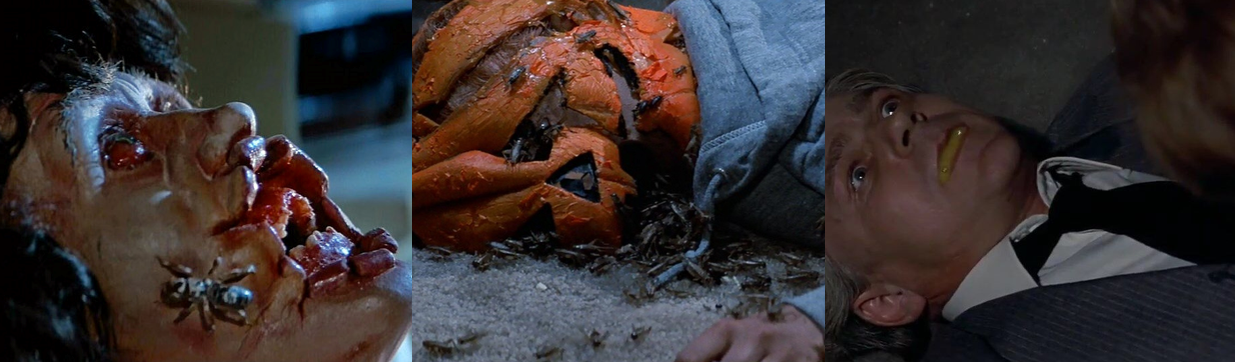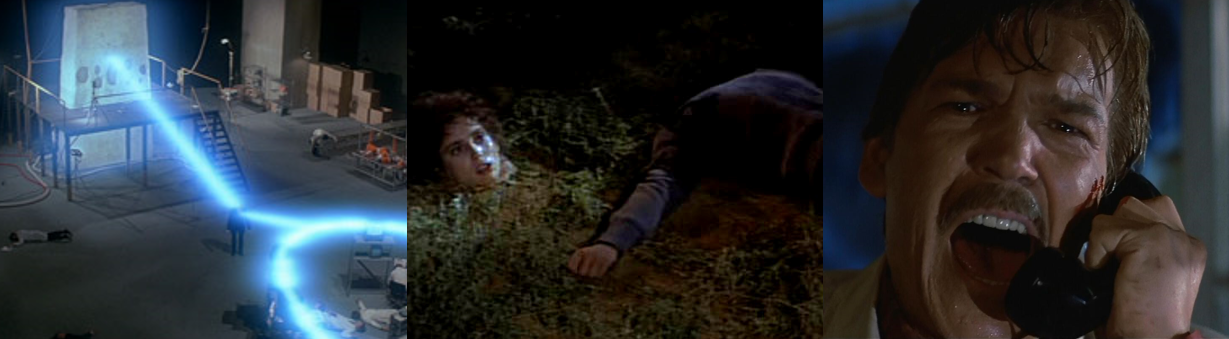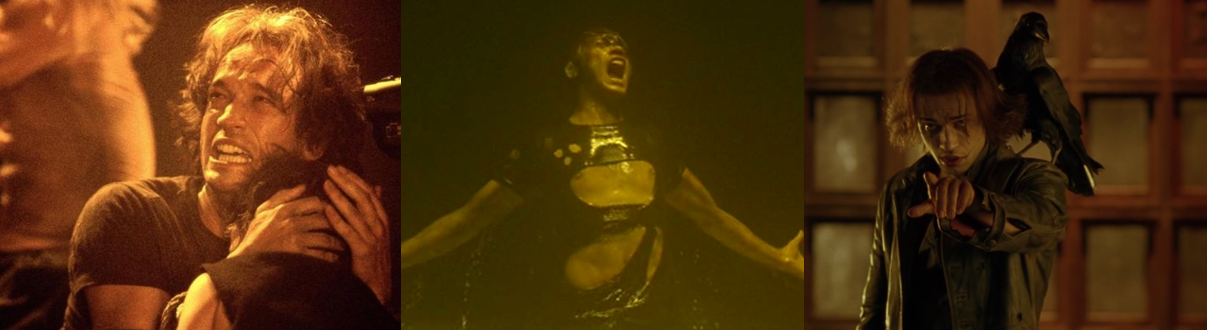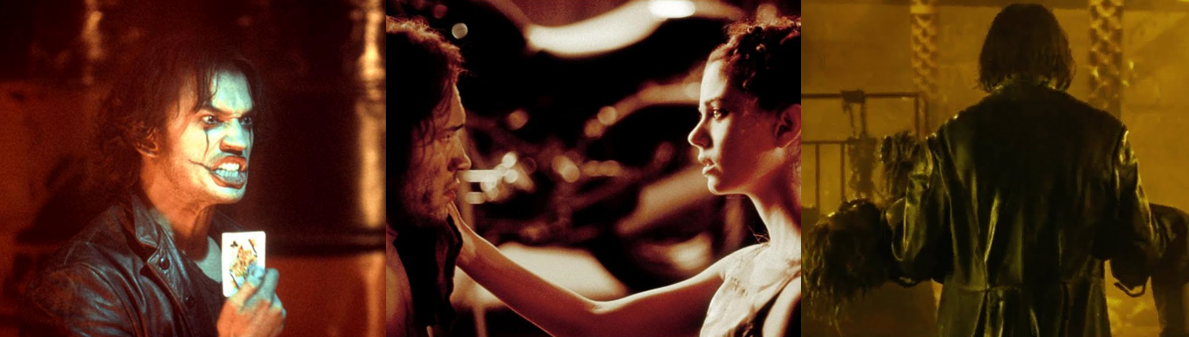
Movie Night: The Crow: City of Angels

Released: 30 August 1996
Director: Tim Pope
Distributor: Miramax Films
Budget: $13 million (estimated)
Stars: Vincent Pérez, Mia Kirshner, Richard Brooks, Thuy Trang, Iggy Pop, Thomas Jane, and Eric Acosta

The Plot:
Mechanic Ashe Corven (Pérez) and his young son, Danny (Acosta), are brutally murdered by zealot Judah Earl (Brooks) and his thugs. After being resurrected by a mysterious and supernatural crow, Ashe is guided by the aloof Sarah Mohr (Kirshner) and assumes the guise of a tragic clown to avenge his loss using his newfound superhuman abilities.

The Background:
Beginning as a comic book published by Caliber Comics in 1989, The Crow was the brainchild of James O’Barr. The main character, named simply “Eric”, was modelled after prominent rock musicians and brutally slayed those who killed him and his fiancée as a reaction to the pain and loss O’Barr felt after losing his own fiancée. The Crow became an underground success and, since dark comic book narratives were becoming popular in Hollywood, transitioned into a critically and commercially successful film adaptation despite the accidentally on-set death of star Brandon Lee. While The Crow (Proyas, 1994) is regarded by many as a cult hit, the same accolades can’t be said about its sequel, which came as a direct response to the financial success of the first film. Initially, director Tim Pope and writer David S. Goyer planned to take the sequel in a different direction to avoid copying or emulating the original movie. They pitched having Sarah become a female Crow (a concept later explored in the comic books) or setting the story in the 19th century before ultimately settling on another tale of urban vengeance. It was the producers, however, who most directly engineered the film to be more of a carbon copy of the first, dramatically cutting down Pope’s original 160-minute cut into a jumbled mess of muddy visuals and confusing plot points. Despite the popularity of the first film, The Crow: City of Angels failed to recapture the magic of its predecessor; it barely grossed over $25 million at the box office and has been met with scathing criticism for its awful execution, lacklustre lead actor, and woeful narrative and pacing. Despite this, Miramax continued producing Crow movies and spin-offs, and some have even argued that The Crow: City of Angels is an under-rated entry in the franchise. Spoiler alert: I am not one of them but, as The Crow is one of my favourite movies and tonight is “Devil’s Night”, I figured this would be a good opportunity to look back on this shambles of a film and see how it holds up.

The Review:
I’ve been a huge fan of The Crow ever since I was a kid and randomly stumbled upon it on one of our many VHS tapes; it took me a little while to be equally impressed with the bleak and harrowing comic book, but the film had a huge impact on me at a time when I was really getting into dark and gritty comic book comics, stories, and anti-heroes. While the story didn’t really lend itself to a sequel since everything was wrapped up nicely in the film and it seemed very self-contained, the concept leaves plenty of wriggle room for other avatars to be resurrected and seek justice (or revenge, depending on your perspective) for the wrongs they suffered in death. It’s not as if it should really be all that difficult, either; there was plenty of material in James O’Barr’s comic that hadn’t been used in the first film, or was left on the cutting room floor, that could’ve been worked into a new movie, or a reboot. In this regard, I’m okay with new actors taking on the iconic role as the Crow’s very nature allows legacy characters, and I can understand the studio wanting to try and emulate the look, feel, and narrative of the first film, and there’s even some interesting new wrinkles in the lore and concept of The Crow: City of Angels, but the final product and overall execution is lacking in almost every regard beyond the soundtrack and the general moodiness of the film. The first and biggest problem is the lead himself; while I had the faintest idea of who Brandon Lee was prior to The Crow thanks to a vague familiarity (at the time) with the legendary Bruce Lee, I have no idea who Vincent Pérez is and, frankly, still don’t. I have no idea why he, of all people, was cast in such an iconic role; it’d be hard for any actor to fill Lee’s shoes, especially after the tragedy he suffered during filming, but Pérez is incapable of matching Lee’s tortured, charismatic performance and comes across as a pale imitation in his attempts to channel the same mixture of grief, anger, and morose conviction of his predecessor.

Reborn from a violent death, Ashe embarks on a mission of vengeance with a manic theatricality.

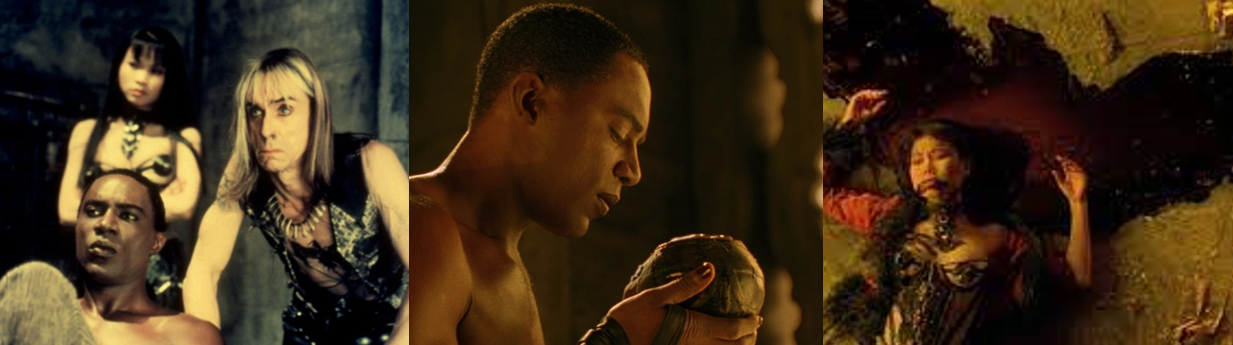
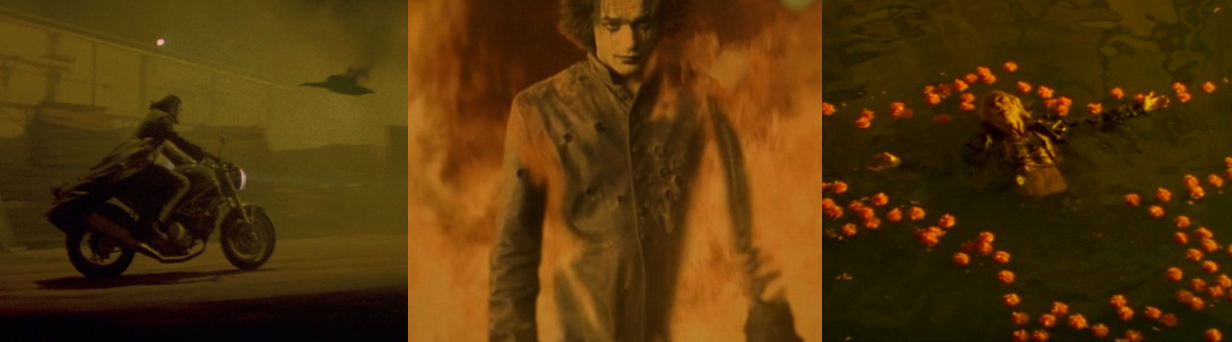
Ashe is quite a different character to Eric Draven; rather than being a loved-up rockstar, he’s a mechanic and a single father living in Los Angeles, here rendered as a bleak, gritty, crime-infested hellhole swamped with drugs and rampant violence thanks to the fanatical Judah Earl. Though there are few places free from Judah’s influence; Ashe lived a simple, quiet life near the pier with his beloved son, Danny, but the two were brutally tortured and executed by Judah’s maniacal followers, primarily Kali (Trang) and “Curve” (Pop), after accidentally witnessing them murdering another drug dealer. Some time later (in the first film it was a year; here, we don’t really know, but it can’t be that long as Ashe’s garage/home is largely untouched since his death), the mysterious and semi-supernatural crow brings Ashe back from his watery grave to seek vengeance but, whereas the crow guided Eric and assisted in his similar quest, Ashe is primarily aided by Sarah Mohr (Kirshner), who is all grown up from the last film and working as a melancholic tattoo artist. While Eric rose in a state of confusion, he became committed to his cause after the crow helped him relive his traumatic death; Ashe similarly reawakens confused and disorientated, but is overwhelmed by his situation, as related by Sarah, and reacts with denial and hostility before reluctantly accepting that he’s now an undead spirit of vengeance after being bombarded with memories. Sarah uses Danny’s paints to make Ashe into an imitation of her former friend (even his make-up is a poor facsimile of Eric’s, however, with the white barely visible in the film’s poor lighting and the black only going around his lips rather than covering them) and he throws on a bad-ass trench coat, hops on an equally bad-ass motorcycle, and heads into the misty and filth-ridden streets to track down his killers. Thanks to the crow, Ashe is led to “Spider Monkey” (Vincent Castellanos), where he showcases his dramatic flair, performing sleight of hand and card tricks while toying with his prey, while also exhibiting just how corny and bad Pérez’s acting and line delivery is. This becomes a common theme, with his weird screaming, cackling countenance, odd appropriation of the “One for sorrow” nursery rhyme to now include crows, and desperate attempts to appear menacing only serving to make him appear unhinged. Whereas Eric somewhat revelled in the virtual invincibility and superhuman abilities afforded to him, Ashe wallows in the constant cycle of pain and healing his body goes through when he’s hurt (which, to be fair, is somewhat similar to the comic book Eric) and fluctuates between being violently, maniacally unbalanced when facing his killers, and miserable and brooding when with Sarah or contemplating his newfound afterlife.

Though seeking revenge for his son’s death, this new Crow is tempted to stay behind with Sarah.

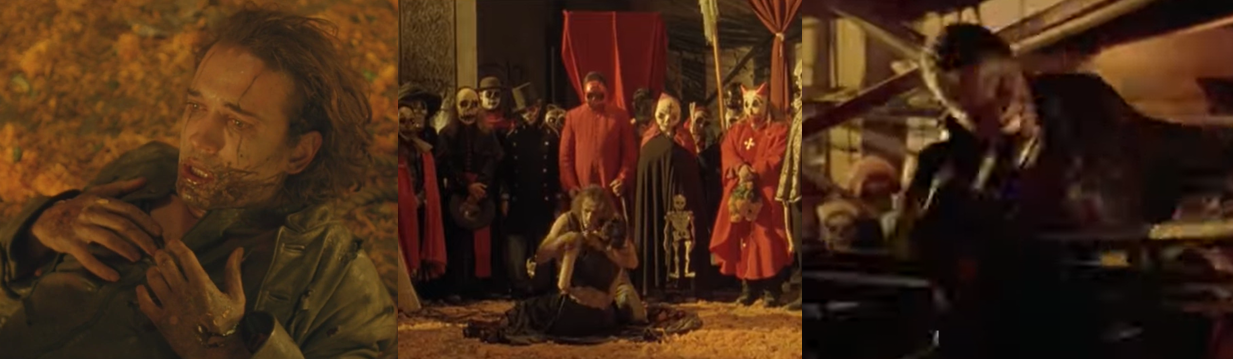
While this is reminiscent of his predecessor, Ashe comes off as far gloomier and sullener than Eric, and it’s not like he makes up for it with any decent fight scenes. The few he does have are brief, poorly shot, and completely one-sided in his favour until the end, and we’re even denied decent shoot outs this time around as Ashe largely forgoes firearms (except for when hunting Curve), though he does evoke the crow imagery by stuffing a paper crow into “Nemo’s” (Thomas Jane) mouth, forming Kali’s blood into a crow upon her death, and leaving Curve surrounded by a crow outline of petals. Naturally, Ashe isn’t just out to avenge his death, but is primarily driven to avenge the brutal murder of his son; this causes him the most pain, as Danny was just an innocent, wide-eyed kid (a stupid one, but an innocent one nonetheless) and reliving his murder causes grief and rage to wrack Ashe’s body and, in many ways, makes his plight far worse than Eric’s but this tragedy really belongs in a better movie (or in the hands of a better actor). He goes out of his way to retrieve Danny’s corpse and give him a proper burial and is even visited by Danny’s spirt when he starts to lose his way. This wrinkle is added because, for whatever reason, Ashe develops a strong attraction to Sarah; surprising, as the two have very little chemistry and, while she seems fascinated to see another reborn by the crow and is sympathetic to him, I never got any romantic feelings from her. A snappy, somewhat feisty goth girl who partially narrates the film and has a familial bond with her boss, Noah (Ian Dury), Sarah’s influence over Ashe becomes so strong that he considers staying behind with her. This is juxtaposed by the Day of the Dead festival that’s being celebrated in the city, and through a conversation with a priest (Reynaldo Duran), who tells Ashe that wandering souls can get lost, believing themselves to be alive, and need guidance to achieve eternal rest. Honestly, the idea of a Crow wandering the Earth with no memory of how or why they got there is a fascinating one, and one I believe was strongly emphasised in the original cut of the film, where Ashe decides to stay behind rather than join his son, and Sarah, in death.

Some terrible performances stunt whatever menace Judah and his followers are meant to have.

Of course, this plot is barely notable in the finished film and is used more as motivation to keep Ashe fighting and help him overcome the loss of his powers, courtesy of Judah Earl. I hate to keep making comparisons, but Judah Earl is no Top Dollar (Michael Wincott); he exudes a decent menace and is a reprehensible and zealous figure in his own right, but Richard Brooks’ performance is all over the place as well, ranging from stoic and gravelly to over the top theatre as he proudly proclaims: “I’m your shadow, Ashe! […] I’ve tasted the blood of the crow and taken your power!” Like Top Dollar, Judah Earl is surrounded by a gaggle of cackling, shit-kicking underlings, none of which have any of the personality (however one-note and despicable) of Top Dollar’s and most of whom are constantly out of their minds on Judah’s tainted crack to be little ore than a knock-off combination of Skank (Angel David) and Funboy (Michael Massee). The most notable exceptions, beyond Nemo’s eccentricities, are Kali and Curve. Kali is a sadistic bitch who takes great pleasure in mocking and killing Danny; she also exhibits some martial arts prowess, giving Ashe his first real physical competition, and is one of three characters who I actually enjoyed seeing offed due to her aggravating nature. The other was Curve, played with manic abandon by rock icon Iggy Pop; I’m no fan of Iggy Pop’s music, or his acting, however, and Curve comes across as completely off his rocker, constantly raging about a tattoo Sarah gave him and assaulting the senses with his weird line delivery and atrocious acting (his “Do you think I’m afrai-i-id?” spiel is probably the worst performance I’ve ever seen). While Top Dollar seemed to have his hands in everything and was more about anarchy, Judah’s deal is drugs; he swamps the city with the stuff and has little concern over how badly his merchandise affects people. Once a product of the streets, Judah has taken to spending his time in his penthouse surrounded by the macabre and supernatural, and conveniently has a blind seer on hand Sybil (Tracey Ellis) to fill him (and us) in on the nature of the crow and how harming or killing it can hurt Ashe and render him mortal. Judah Earl takes this one step further, however, and drinks the crow’s blood to become “The Shadow”, a dark version of Ashe who gains all of his supernatural abilities for their final climatic showdown in the streets.

The Nitty-Gritty:
It’s so interesting and weird to think about the Crow franchise; the premise is incredibly simple and shouldn’t really be that hard to make a gritty, gothic, somewhat low budget film that’s a mixture of action, horror, and romance. It turns out, however, that The Crow was lightning in a bottle; not only did everything about its presentation work exceptionally well, but its reputation was bolstered by Brandon Lee’s tragic death, which has elevated the film above whatever shortcomings it might have to make it a monument to a young actor cut down in his prime. In that regard, you could argue that it didn’t make sense to follow it up, especially so soon after, but to do so with this knock-off, poor quality effort is a real insult to both Lee and O’Barr and comes across as a poor man’s attempt to recapture the magic. While the soundtrack is still pretty strong thanks to Graeme Revell’s haunting score (even if it is basically the same as last time) and some notable names, like White Zombie and Deftones, contributing to the film, the quality of acting takes a dramatic nosedive. Rather than a strong assortment of character actors and charismatic performers, The Crow: City of Angels features a bunch of one-dimensional, underdeveloped scumbags or aggravating performances from people who never should’ve been cast in the first place or actors who had yet to really hit their stride in their art.

Whatever visual appeal this film may have is lost beneath a muddy filter and poor special effects.

Easily the worst aspect of The Crow: City of Angels, though, is the presentation; this was legitimately the first film I’ve ever watched where I’ve criticised the direction and cinematography, and the look and feel of this film is a far cry from the harsh, rugged streets seen in the first film, which was almost a noir thriller in its aesthetic. The sequel swamps every scene in this grimy, mustard-yellow glare; mist and smoke covers everything, making the city appear to be either a poorly-constructed miniature or obscuring sets and real-world locations, and everything looks cheap and rushed, as though the filmmakers were trying to cover their inadequacies with this ugly, choking fog. Honestly, it looks like a homemade movie filmed on a soundstage or in a back garden, it’s that bad and, while the city occasionally seems like one of the worst places you can ever imagine, with its seedy underworld, sex clubs, and bars and such, everything just seems more fake and staged compared to the first movie, and this carries through to the action scenes. Sure, Ashe looks awesome cutting through the fog on his motorcycle, but he gets none of the rooftop-running action of Eric and doesn’t really acquit himself well in fight scenes. More often than not, Ashe simply slaps around and scuffles with his victim rather than threatening them with Poe or mutilating his body to intimidate his opponents, and the only physical challenge he’s presented with comes from Kali, whom he easily dashes out a window thanks to his invulnerability. Otherwise, Ashe’s mission of vengeance is an absolute mess of murky visuals, jerky camera moments, and awful acting; Pérez desperately tries to come off as intimidating when confronting Spider-Monkey but it’s a poor effort made worse by some dodgy CGI effects, and seeing him mock Nemo with a pouting countenance is more disturbing than menacing. Even Ashe’s big fight scene with Kali is ultimately disappointing, being a plodding affair with slow, awkward movements, erratic editing, and some weird contorted body language from Pérez, and his rundown of Curve ends up being a pitiable chase and confrontation thanks to such memorable lines as “Fuck you, bird dick!” and the down-right ugly visual presentation of the film.

Although rendered powerless and unable to save Sarah, Ashe is…somehow…able to destroy Judah Earl.

Fittingly, Ashe’s greatest physical challenge comes in the film’s conclusion; desiring to take the Crow’s power for his own, Judah Earl takes Sarah hostage and, after capturing the crow with a ridiculous amount of ease, has her witness a bizarre ritual where he kills the bird, inflicting Ashe with stigmata for a very on the nose Christ allusion and causing him to plummet from Judah’s high-rise dwelling and be rendered vulnerable. This fulfils Judah’s life-long fascination with death; his stoic demeanour and callous nature isn’t just to try and paint him as a malicious threat, but is because he’s completely numb to the concept of death since he has already experienced, and survived it, before. Having “liked what he saw” in his brief time in Hell, the only pleasure Judah has been able to take since is in the suffering of others, and the power of the crow allows him to indulge this to the fullest extent…however, while much of this is inferred and implied throughout the film, it really only becomes explicit when you know that, apparently, the original script went into greater detail about Judah’s near-death experience as a child. Regardless, thus empowered, Judah (or “The Shadow”, or whatever-the-fuck he’s supposed to be) easily manhandles Ashe, who’s completely helpless against Judah’s superior strength. The cruel zealot takes a sadistic pleasure in stringing Ashe up and lashing him before a raucous crowd but, when he goes to finish him off, Sarah intervenes and takes a knife to the stomach (without him even trying), dying in Ashe’s arms. Spurred on by Danny, who eagerly awaits his return, and enraged at Sarah’s death, Ashe skewers Judah on a piece of scaffold and…somehow…calls up a murder of (presumably) supernatural crows to tear the cruel kingpin into a mess of dodgy CGI. Again, quite how Ashe does this considering he has no powers at this point isn’t explained, nor is it really made clear exactly what the hell’s happening; it’s just another of the many drawbacks to huge chunks of the story being excised from the film, and this is only further reinforced in the rushed and vague ending, which suggests Ashe actually did stay behind rather than what the film is actually going for (which is that he rode off into the fog to be with Danny and, most likely, Sarah).

The Summary:
What happened to Brandon Lee on the set of The Crow was a tragedy. What happened to James O’Barr as a hopeful teenager was a tragedy. The Crow: City of Angels is a tragedy. The whole film is just an ugly, distorted, incoherent mess from start to finish; oh sure, there’s flashes of a somewhat decent sequel here, but everything that’s good about it is based on what worked in the first film and is a mere copy (a shadow, if you will) of it. Rather than taking the formula of its predecessor and expanding upon it, offering more action and bloodshed and more visually interesting fights and kills, The Crow: City of Angels ends up looking like a direct-to-video rush job that completely squanders not only its own premise, but everything that the first movie did so well. The idea of a father returning to enact revenge on those that killed his son is palpable, as is the concept of a crow avatar falling in love with a living female and resisting returning to the grave; hell, even the idea of a sadistic thug stealing the powers of the crow has some merit, but the execution of all of these ideas is ruined by muddy visuals, piss-poor performances, and an absolutely butchered narrative pacing. There’s some cool visuals of the Crow on his motorcycle and dramatically stalking and toying his prey or brooding in the dark, but Vincent Pérez is absolutely terrible here; he does the more melancholic aspects quite well, but his madcap buffoonery, grating accent, and stilted line delivery leave him a charisma-less void, especially compared to his predecessor. Iggy Pop desperately tries to hog every scene but he’s in way over his head here, and I doubt a better script or direction could’ve helped his tone-deaf performance, and Richard Brooks fails to exude any type of menace, even when he’s trying his hardest, thanks to his random descents into mania. Overall, it’s baffling to me that the studio managed to butcher a sequel to The Crow so badly; when its aping the first film, there’s some appeal here, but no one in their right mind would ever choose to watch this over the first movie and it does nothing but leech off of The Crow’s cult appeal in the laziest and most insulting ways possible, leaving us with a patchwork imitation of its predecessor that deserves nothing but scorn and derision.

My Rating:

Rating: 1 out of 5.

Terrible

Am I being too harsh on The Crow: City of Angels? Do you think the film had any chance of living up to the popularity and reputation of its predecessor? What did you think to Vincent Pérez’s performance and Ashe as the new Crow? Did you buy his romance with Sarah, or enjoy his flair for the theatrical? What did you think to Judah Earl and his crew? Did you enjoy the murky, foggy presentation of the film or was it also a struggle to endure? Which of The Crow’s sequels was your favourite, if any, and would you like to see the character return in some form or another in the future? How are you celebrating Devil’s Night tonight? Whatever you think about The Crow: City of Angels, join the discussion below or leave a comment on my social media.

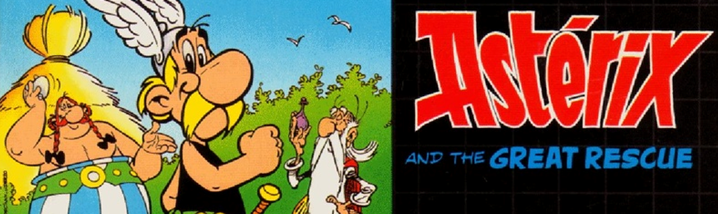
Game Corner [Asterix Anniversary]: Asterix and the Great Rescue (Mega Drive)


Asterix the Gaul (and his best friend Obelix) first debuted on 29 October 1959 as a serial in the French/Belgium magazine Pilote. Since then, the plucky Gauls have gone on to have many adventures in comic books, videogames, and feature-length productions and Asterix himself has become a popular and enduring character in his native France and beyond as his stories have been translated into over a hundred languages across the world.


Released: November 1993
Developer: Core Design
Also Available For: Game Gear and Master System

The Background:
It didn’t take very long at all for the French comic book series Asterix to make the jump from the comics and into other media; the first Asterix book was adapted into a feature-length animation in 1967 and both animated and live-action Asterix films have been pretty consistent over the years. Similarly, there have been a number of Asterix videogames; the first of these was released for the Atari 2600 in 1983 and one of my absolute favourites was Konami’s arcade game from 1992. Growing up, I had a lot of fun playing Astérix (SEGA, 1991) on the Master System, a colourful and entertaining little platformer that I’ve yet to finish ever thirty years later, and figured that the Mega Drive title would be a good investment. Asterix and the Great Rescue was developed by Core Design, the team behind the classic SEGA title Chuck Rock (Core Design, 1991), and was met with mixed reviews upon release. With today also being the birthday of the SEGA Mega Drive, I figured it was the perfect time to put this game in and see how it holds up compared to its 8-bit counterpart.

The Plot:
The year is 50 BC. Gaul is entirely occupied by the Romans. Well, not entirely… One small village of indomitable Gauls still holds out against the invaders and life is not easy for the Roman legionnaires thanks to the Gauls’ magic potion, which gives them superhuman strength. Like in many Asterix videogames, the Romans kidnap the village druid, Getafix, to stunt the village’s supply of magic potion so their bravest warriors, Asterix and Obelix, set out to rescue Getafix and teach those crazy Romans a lesson.

Gameplay:
Asterix and the Great Rescue is a 2D, sidescrolling action platformer in which one player gets to pick between Asterix and Obelix before each journey across six Levels to rescue the druid Getafix from the Romans. Disappointingly, unlike in the majority of Asterix videogames, there’s very little actual difference between Asterix and Obelix; both characters move at the same plodding speed, have the same amount of health, jump at the same height, and have exactly the same special abilities. Indeed, the only discernable difference I could identify is that Obelix’s hit box is larger (due to his characteristic girth) but it’s not like Asterix’s is that much smaller. You can customise the game’s controls from the main “Options” menu but the default setup is functional as is. Players can jump with A, attack with a punch with B, and use a “Special Weapon” with C. Pressing up on the directional pad (D-pad) in conjunction with C allows you to pick from four different Special Weapons while pressing down on the D-pad allows you to crouch and crawl to avoid incoming projectiles.

Rooms can be short but also painfully frustrating at times.

Sadly, considering the characters’ and comics’ focus on madcap fighting, combat is extremely disappointing and limited here; there are no jumping attacks, your punches have a pathetically short range, and the only additional combat option available to you is that you can hold down B to perform a series of rapid punches while moving to take out groups of enemies faster. Asterix and the Great Rescue is constructed in a strangely confusing way; there are six Levels, each split into four “Huts” and each Hut has up to three “Rooms”. The wording is very confusing as you’re not necessarily inside of a hut or a room as you might think but what it actually boils down to is six levels, four worlds, and up to four zones in each world and I guess the developers thought it would be “fun” to supplant this usual videogame terminology with terms from the comic book. While six Levels might not seem a lot, the game is actually surprisingly long; the Rooms are generally short sprints asking little more from you than to travel to the right, bashing enemies, and reaching the goal (“magic elixir” for Asterix and a roast boar for Obelix) but you’ll also be tasked with finding keys, performing some tricky jumps, or navigating some confusing areas.

Your biggest obstacles are the time limit, hit boxes, and obtuse nature of the gameplay.

Your greatest enemy in each Room will be the time limit; every Room has a time limit that is anywhere from less than a minute to two minutes of game time and, if you fail to reach the goal before the time runs out, you’ll lose a life and have to restart from the beginning of the Room. There’s very little room for error in some of these Rooms and, if you mess up or take too long, then that’s just too damn bad as there are no checkpoints. Thankfully, you can acquire extra lives by earning enough points or stumbling upon a beating heart pickup. You start each game with three lives and three credits and, when you lose all of your lives, you’ll be given the option to cash in a credit and continue from the start of the last Room you played but, if you use up your credits, it’s game over. After clearing each Level, you get a password to jump to later in the game, which is helpful, but the damage you sustain throughout the game carries over to each Room, which is extremely frustrating, and you’ll find an abundance of bottomless pits as you progress, which mean instant death.

Gameplay is very inconsistent, being ridiculously easy one minute and frustratingly difficult the next.

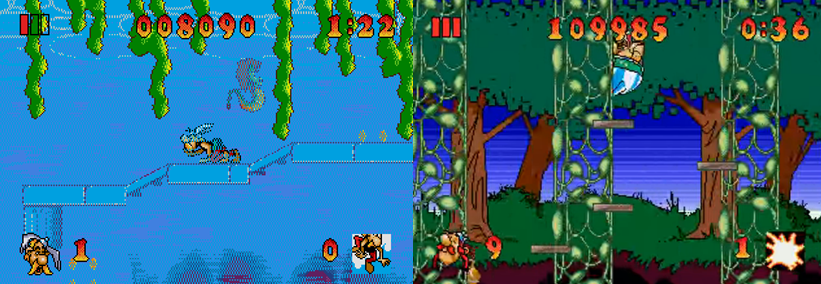
Gameplay in Asterix and the Great Rescue is extremely inconsistent and frustrating; generally you just have to fight your way to the goal but other times you have to dodge bursts of fire, press switches to progress further, dodge falling blocks or incoming boulders, or hop around moving or temporary platforms to get through the Room. This can be extremely frustrating as some enemies are too small to hit, others take multiple hits to defeat, and it’s not always clear what you have to do in order to progress; all too often, platforms will suddenly drop underneath you, animals or bridges will collapse after carrying you across gaps, and you’ll need pixel-perfect timing to reach far away platforms. You’ll also need to hop across lava pits, make a number of blind jumps, contend with murky water that slows you down, teleport across Rooms using special statues, or use a series of bubbles, springs, and catapults to travel higher and further. Spikes, thorns, spiked balls, flames, and rotating platforms all compound matters, making avoiding damage extremely difficult even when playing on “Easy” mode, where enemies are less frequent and aggressive. Thankfully, there’s no knockback from taking damage but my experience was that my character would simply keel over and die more often than not since their hit box is so big that it’s extremely difficult to avoid being hit (especially when you get dropped literally right into the path of oncoming enemies in some Rooms).

Graphics and Sound:
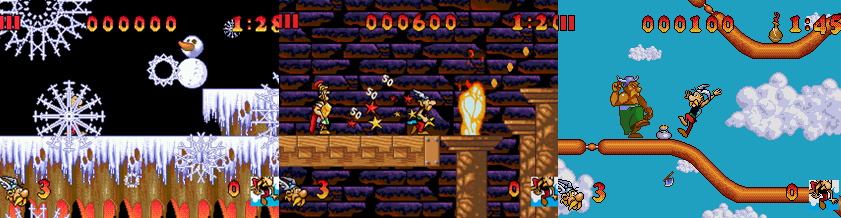
Asterix and the Great Rescue has a lot of promise but doesn’t quite manage to deliver in terms of its graphics. Sprites are colourful and faithful to the comics, for example, but not especially big or full of animation frames; there are no idle animations, for instance, and neither Asterix, Obelix, or their enemies exude the same charming humour as they do in the comics or even the Master System game. Environments can similarly be very hit and miss; the Gaulish village is beautiful to behold but little more than a tutorial to learn the basic controls. Occasionally, you’ll see familiar Asterix characters like Unhygienix in the background but he’s wildly out of proportion compared to the avatar’s sprites. Other times, the background will be quite sparse (a simple night sky) or somewhat detailed but then it’ll also look really crude (especially in the Forest and Rome levels). There are a lot of different environments to explore, however. You’ll travel from the Gauls’ village, cross the dock, enter a Roman camp, explore a dense forest and jump through the treetops and past gigantic spider’s webs, battle through dungeons in Germany, hop across clouds and birds and wander around stages made out of Frankfurters, pass through an ice Room (with some impressive snowflake effects falling over the screen) on the way to a Roman galley, and finally jump and fight through water ruins, an ornate garden, a lavish banquet hall, and the coliseum in Rome.

Levels are quite varied and can be quite bit but they’re hampered by the constant ticking clock.

All of these are locations that will be familiar to any Asterix fan but, for most videogame players, will seem very by-the-numbers for the average platformer and full of clichés such as weighted switches, temporary platforms, and rising or moving platforms. A lot of the time it can be difficult to tell where you need to go as you can sometimes pass through certain walls but not others, despite them both looking the same, and you’ll need to experiment with your Special Weapons in order to progress (if you have enough time left to figure that out, of course). I did experience a bit of slow down at times, which is quite ludicrous as there’s rarely a lot happening on screen, and some graphical hiccups here and there. The music is quite jazzy, however; it’s not especially varied but it’s decent enough, and certainly far better than the game’s sound effects. The game’s story is told through text and a recreation of the map of the invaded Gaul, all of which will be more than familiar to any Asterix reader. Though the game’s title screen leaves a lot to be desire, each Level is proceeded by a pretty nice still picture of the famous duo but you’ll have to wait for the final screen on the game for anything resembling any kind of impressive sprite art and even then it’s basically just a partially animated still.

Enemies and Bosses:
As any self-respecting Asterix fan might expect, your primary enemies in this game will be the Romans. Roman soldiers charge at you with spears, march along in groups wielding swords, toss spears at you from above, and gold-armoured Centurions will also show up to try and skewer you as you progress. These are all pulled straight from the comics and even include Roman’s hiding in tree disguises; most of them will go down in just one hit but the more rotund and golden Romans will take two to three hits. You’ll also have to content with woodland critters scurrying and flying your way, axe-throwing Germans, German maidens who explode when you get too near, mermaids and sea creatures, archers whose arrows stay on screen way too long, Romans trying to jab you from beneath with their swords, spiders and other bugs, dogs, and even hatchlings trying to take a bit out of your ass. By far the worst obstacle is the mule-kicking horses who will send you flying clear across the screen; I swear you need as much luck as you do skill to time your jumps past those assholes!

It makes sense to be fighting Romans but Cacofonix is a strange choice for a boss

Each Level culminates in a boss battle, the first of which is, oddly, against the village bard Cacofonix (I know he’s an annoyance in the comics but to make him a boss seems a bit extreme). Cacofonix stands in one spot atop his tree hut and spits musical notes at you from his lyre and can only be damaged by hopping on top of one of village chief Vitalstatistix’s shield bearers and tossing rotten fish at him. It takes a lot of hits to finally put the bard down so, again, your biggest enemy here is the time limit as it’s pretty easy to avoid his musical notes by standing in the right spots. The second boss fight sees a Roman encampment firing rocks at you; these must be hit back over and over again until the camp finally surrenders to your might. After this, a Roman soldier awaits you on a log and will instantly force you to your death unless you mash A, B, and right as fast as possible to knock him off instead but, of course, the game never tells you any of this so it is easy to simply fail time and time again.

After besting many enemies, the last two Levels culminate in battles against large, voracious animals!

The final Room of Germany has you desperately outracing a rising sea of red and taking out enemies as you make your way up to a goal which, again, is more a test of your skill and patience with the game’s controls than any sort of actual combat. On the Roman Galley, you’ll be attacked by a gigantic alligator (or is it a crocodile?); simply hop up onto the platforms to avoid the creature’s snapping jaws and then jump down to smack him in the head but watch out for his massive hit box clipping your avatar. The finale sees Julius Caesar set two vicious tigers against you in the Coliseum; these will randomly pop in and out of archways under Caesar’s view box and must be smacked whenever they appear and hopped over to avoid damage. Like all of the game’s bosses, though, this is simply a test of patience and landing hits before you get a time out and the bosses are, by far, the least challenging aspect of the game.

Power-Ups and Bonuses:
There are numerous items to pick up and collect in Asterix and the Great Rescue; you’ll find gold coins, bags of coins, and Roman helmets, all of which will add to your score and bring you one step closer to an extra life. You can also replenish your health either partially or fully by collecting pieces of roast chicken or a chalice, respectively, and you can grab a sickle for a brief period of invincibility or a bomb to enter “Mega Attitude Mode”, which increases your speed and strength so you can blast through enemies and obstacles.

Special Weapons are useful but limited and you won’t always have to to backtrack for more ammo.

The main thing to keep an eye out for, though, are the gourds that you’ll find scattered throughout each Room. These will give you ammo for your Special Weapons and will respawn when you move the screen a little bit. Your Special Weapons are essential to your progress but it’s not always abundantly clear where or when you have to use them (such as the first screen of Rome where you’re seemingly trapped but actually have to blast a wall that doesn’t appear to be destructible). The Fireball adds a ranged attack to your arsenal and can be used to destroy certain blocks, hit targets, or deactivate certain traps; the Ice Block (which is actually a cloud) creates a temporary platform to allow you to reach higher areas or cross spike or lava pits safely (if you can get the angle of the throw right…); the Disguise covers you in a series of vines and flowers so that enemies will walk right past you; and Levitation allows you to (chunkily) float about using the D-pad to avoid spikes and reach higher or further areas. 

Additional Features:
There’s not really much else on offer in Asterix and the Great Rescue beyond the single-player experience; there’s no two-player simultaneous play, meaning that the only way for two players to play is to take it in turns, and no real benefit to playing as either of the two main characters. You can tackle the game on a harder difficulty setting and try to get your name at the top of the high score table but the game is so tough anyway that I wouldn’t recommend it. There aren’t even any decent cheats for the game as the password system is simply for jumping to the game’s levels so you’ll probably be done with this game after one playthrough or session.

The Summary:
Boy, was I disappointed with Asterix and the Great Rescue. Once again, I as met with a 16-bit iteration of a videogame that pales in comparison to its bright, humourous, and fun 8-bit counterpart; you know it’s bad when even the Master System’s game gives Asterix and Obelix different abilities and playstyles and has more gameplay variety. Honestly, I can’t even say that this game looks good as, compared to other games of a similar genre that came out at the same time, Asterix and the Great Rescue looks and sounds like 1989 Mega Drive title rather than a 1993 release. Clunky, awkward controls, a rubbish combat system, confusing and frustrating gameplay, and just a complete lack of entertainment and engagement make Asterix and the Great Rescue an extremely disappointing title that saves itself from a one-star review simply because I am a big fan of the comics and characters but, honestly, I wouldn’t recommend anyone actually bother playing this letdown of a game.

My Rating:

Rating: 2 out of 5.

Could Be Better

What did you think to Asterix and the Great Rescue? How do you think it compares to other Asterix videogames and games of its genre? Did you enjoy the title and feel I’m being too harsh on it or do you agree that it was a frustrating and disappointing mess of a game? Which character, book, or movie is your favourite? How are you celebrating Asterix and Obelix’s anniversary, and the release of the Mega Drive, this year? Whatever your thoughts on Asterix, feel free to leave a comment below or on my social media.

Wrestling Recap: Goldberg vs. DDP (Halloween Havoc ’98)

The Date: 25 October 1998
The Venue: MGM Grand Garden Arena; Paradise, Nevada
The Commentary: Tony Schiavone, Bobby “The Brain” Heenan, and Mike Tenay
The Referee: Mickie Jay
The Stakes: Singles match for the WCW World Heavyweight Championship

The Build-Up:
World Championship Wrestling (WCW) gets a lot of flack for not building more original, home-grown stars; one of the principal reasons they took a commanding lead in the “Monday Night Wars” against the then-World Wrestling Federation (WWF) was because they lured over big-name stars like Hulk Hogan and “Macho Man” Randy Savage with lucrative contracts to cash-in on their mainstream popularity. However, there are actually many home-grown WCW stars: “The Icon” Sting was unquestionably the heart and soul of the company, “The Nature Boy” Ric Flair their most prolific link to the glory days of the National Wrestling Alliance (NWA), Diamond Dallas Page/DDP their most inspirational story of a journeyman wrestler becoming a beloved figurehead, and Bill Goldberg easily their most successful home-made talent. After an injury saw his American football career come to an end, Goldberg transition first to powerlifting and mixed martial arts before being persuaded by Sting and Lex Luger to train at the WCW Power Plant. Impressed by the big man’s physique and intensity, WCW head honcho Eric Bischoff rushed Goldberg to television and booked him on an unprecedented winning streak that saw him amass an alleged win 173 consecutive wins (though the number was actually closer to 156) using a very simple formula of hitting a couple of big moves, including performing his finisher, the Jackhammer, on the seven-foot Giant! In contrast, DDP was a late bloomer, having started as a manager before transitioning to an in-ring career at the relatively late age of thirty-five. Page hit his stride when he famously rejected joining the New World Order (nWo) super stable and cemented himself as WCW’s top babyface, scoring WCW Tag Team Championship and United States Championship victories with his signature Diamond Cutter, which he boasted he could hit on anyone, anywhere, at anytime. Goldberg’s impressive (if inflated) winning streak eventually saw him dethrone “Hollywood” Hulk Hogan for the WCW World Heavyweight Championship on one of the most successful (if controversial) episodes of WCW Monday Nitro in 1998. After DDP earned the right to challenge for the championship at Halloween Havoc by winning a War Games match the previous month, the stage was set for these two icons to collide but it wasn’t all plain sailing. Goldberg disagreed with DDP’s ideas for the match and WCW came under fire when the pay-per-view overran its allotted timeslot, meaning paying viewers didn’t get to see the main event bout and had to settle for a re-run on the following episode of Monday Nitro.

The Match:
As I’ve detailed before, I wasn’t lucky enough to grow up watching WCW or WWF; I wasn’t able to get into wrestling until early-2000, and by then all I could really watch were WWF pay-per-views, so my knowledge of WCW was limited to magazines and videogames. Still, competitors like Goldberg and DDP definitely stuck out for me, primarily because they had a lot of media attention and featured in one of my first real experiences of WCW, the ill-fated Ready to Rumble (Robbins, 2000). I didn’t really get to see DDP in action until he was inexplicably cast as the Undertaker’s sadistic stalker during the botched “Invasion” angle, a decision which meant DDP’s WWF and World Wrestling Entertainment (WWE) career never reached the heights of his WCW fame. Similarly, I wouldn’t get to see Goldberg in action until he arrived in WWE in 2003 for a lacklustre run that saw him put on one of the worst performances in wrestling history, and later further tarnish his reputation with a series of questionable performances following his Hall of Fame induction. Still, I’m always excited to watch WCW biggest stars perform at the height of their career and popularity and to see them booked correctly, especially as this is considered one of the best matches in either man’s career. There was a moment of trepidation as the bell rang; at this point, Goldberg has amassed a winning streak of 154 and his matches were short, sharp affairs that played to his strengths as a powerhouse. DDP, meanwhile, was more of a technician and a wily competitor, though neither man backed down or showed any fear; this was undoubtedly a match with high stakes for both since it meant a championship reign for DDP and another feather in the cap of WCW’s brutish superstar. After a spot of jaw-jacking, the two men locked up, with DDP being easily overpowered in the early going; Goldberg repeatedly tossed him into the far corner with little effort and DDP, realising that tenacity alone wouldn’t win the day, changed tactics, stalling for time and then took the big man down with an arm drag before goading him into charging the two of them through the ropes and to the outside.

It took some time for Goldberg to play to his strengths and he ended up injuring himself as a result.

The crowd grew a little restless as the two men stalled some more and clambered back into the ring; DDP went back to basics, slapping on a headlock, only for Goldberg to surprisingly wrestle his way out of it with a wrist-lock takedown and then counter DDP’s attempts at a trip with an impressive standing back flip! DDP’s efforts to rile Goldberg up resulted in the big man losing his cool and pummelling the challenger with some stiff shots, slamming him to the mat with an overhead throw, and then locking in a cross armbreaker on the canvas. DDP easily reached the ropes and stunned Goldberg with a jawbreaker before laying in some forearms and working over Goldberg’s arm and shoulder; however, he found himself tumbling outside when Goldberg easily threw off an attempted Diamond Cutter. Once DDP hopped back into the ring, Goldberg went back to the wrist lock and, this time, DDP countered with a drop-toehold before being bashed to the outside again with a shoulder block. A jawbreaker over the ropes and a spinning neckbreaker saw allowed DDP to press the attack, tossing Goldberg into the corner and scoring a two count off a Russian leg sweep. DDP put the pressure on with a front facelock to give both men a chance to rest, but Goldberg soon fought back with some stiff knee strikes to DDP’s ribs and that weird spinning takedown thing he liked to do. Goldberg followed up with a modified suplex and a nice sidewalk slam, but a lackadaisical cover saw DDP easily kick out. Goldberg then punished DDP with another cross armbreaker but, clearly having run out of moves, paid the price when he tried for another sidewalk slam as DDP countered with an awkward, but effective, headscissor takedown! Goldberg popped right back up, however, and delivered a sidekick (thankfully not to DDP’s head…) but crashed and burned on a Spear attempt when DDP wisely flipped out of the way and caused the champion to charge shoulder-first into the ring post and spill to the outside.

Both men hit their signature moves but it was the undefeated Goldberg who eventually came out on top.

The two milked the moment to take a breather before DDP took Goldberg down with a big top-rope clothesline for a two-count; despite favouring his right arm, Goldberg planted DDP with a uranage-like slam (that honestly looked like DDP countered into a DDT). Although DDP got to his feet first and called for the Diamond Cutter, he got absolutely blasted with Goldberg’s trademark Spear, much to the delight of the crowd, but Goldberg couldn’t capitalise thanks to his shoulder injury from the ring post. This also meant he struggled to lift DDP for the Jackhammer and, when he finally did, the challenger slipped out of it and planted him with the Diamond Cutter. However, exhaustion also meant that DDP couldn’t immediately follow-up so Goldberg easily kicked out. It was at this point that the crowd really came alive, just in time for Goldberg to counter DDP’s suplex into a Jackhammer and score the three count in the blink of an eye! Having been taken to his limit, Goldberg helped DDP to his feet and showed him respect before celebrating his win to a chorus of cheers. However, I have to say that I wasn’t massively won over by this; Goldberg was always at his best when he played to his strengths, which meant power, power, and more power. There were times here where he looked lost and his limitations showed, such as him struggling to respond to DDP’s attempts to get him up and him going for the same moves. It wasn’t massively glaring but it makes DDP’s efforts to carry Goldberg to a more competitive match even more obvious; Goldberg, didn’t exactly press his attack, or overpower DDP enough for me to believe that Page was too beat up to make a cover, especially as DDP did a lot of stalling throughout the match. I appreciated the attempt to showcase Goldberg’s more technical abilities, but his physicality could’ve been played up more, maybe with a few more hard shoves and that military press slam he liked to do. In the end, it was a decent match, potentially the best of Goldberg’s career at that point, but I could feel the crowd getting restless throughout and I echoed those sentiments and was just waiting for a little more action from both men.

The Aftermath:
Although this wouldn’t be the last time Goldberg and DDP faced off against each other, it did mark the end of their feud; by the next month’s pay-per-view, DDP was once again the WCW United States Champion and was busy feuding with Bret “Hitman” Hart. Although Goldberg wasn’t on the show, he did headline Starrcade the following month, where he lost the WCW Championship and had his winning streak snapped in controversial fashion by “Big Sexy” Kevin Nash following interference from Scott Hall and a taser. Goldberg and DDP wouldn’t face each other again until April 1999, where they battled for the WCW Championship on an episode of WCW Monday Nitro, this time with DDP as the champion. They battled each other sporadically throughout 1999, with their final match being a singles bout at Fall Brawl 1999, which Goldberg again won. As far as I can tell, they never crossed paths when in WWE and, with DDP officially retired and committed to helping wrestlers and others improve their lives through his DDP Yoga, I can’t imagine that we’ll ever see these two locking up in a match ever again.

My Rating:

Rating: 3 out of 5.

Pretty Good

Are you a fan of Goldberg’s match against Diamond Dallas Page at Halloween Havoc? Do you agree that it’s one of their best matches or do you think it’s over-rated and prefer a different bout of theirs? Were you a fan of either man during their WCW days? Which of their matches and moments was your favourite and what did you think to their career outside of WCW? What’s your favourite Halloween Havoc match or event? Whatever your thoughts on Goldberg, DDP, WCW, and Halloween Havoc, I’d love to see them in the comments.

Movie Night: The Cabin in the Woods

Released: 13 April 2012
Director: Drew Goddard
Distributor: Lionsgate
Budget: $30 million
Stars: Kristen Connolly, Chris Hemsworth, Anna Hutchison, Fran Kranz, Jesse Williams, Richard Jenkins, and Bradley Whitford

The Plot:
Five college students retreat to a remote forest cabin for a well-deserved break and find themselves stalked by a family of backwoods zombies. However, all is not as it seems as the group find themselves manipulated by technicians in an underground facility who are attempting to appease ancient, slumber deities with human sacrifices.

The Background:
The Cabin in the Woods was the result of an intense two-day writing session between noted filmmaker Joss Whedon and Drew Goddard, who had previously worked together on Whedon’s television projects. The film came from Whedon’s desire to revitalise the horror genre with a love letter to all of horror’s most enduring clichés. While much of the movie was shot in Vancouver, the film necessitated a great deal of designs and hands to bring to life the many and varied monsters and special effects for the film’s finale; these were handled by AFX Studios, who had nearly a thousand people turning in hundreds of creature designs for the film’s climax. When the initial studio suffered financial difficulties, the film was delayed until Lionsgate stepped in to save it, and it eventually released to positive reviews and came to be regarded as an instant cult classic despite barely clearing $66 million at the box office.

The Review:
If there’s one overused cliché in horror, it’s got to be the “cabin in the woods” formula of a bunch of twenty-somethings teenagers heading out into some desolate woods in the middle of nowhere to stay in a rotting cabin and be terrorised by zombies or ghosts. Don’t get me wrong, I’m a big fan of the Evil Dead franchise (Various, 1981 to present) and the concept has birthed some great horror films, but I always found the cliché to be really odd. Maybe it’s a “me” thing; I grew up in a village here in the UK and prefer my holidays or breaks to be somewhere hot, like the beach, or to at least be near to a city or civilisation. Buggering off to a shitty cabin with no real mod-cons seems like one of the worst getaways I can imagine, so I always find it odd how characters in these films are so gung-ho about going there. It must be a “thing” when you live in a massive city like those in the US; you just wanna reconnect with nature and get drunk without the cops kicking your door in. All this is to say that, on paper, The Cabin in the Woods sets itself up as being little more than a continuation of this tried-and-tested cliché; indeed, that ends up being the entire point and our main characters are even forced to assume traditional stock horror roles like “The Virgin” and “The Athlete” thanks to the machinations of those controlling the horrors in and around the cabin.

The Facility staff are desensitised to the violence and moral implications of their job.

Of course, this is all part of a carefully constructed scenario orchestrated by the mysterious “Facility” located on the grounds near the cabin. All throughout the film, the story cuts to technicians Gary Sitterson (Jenkins) and Steve Hadley (Whitford), two long-term employees of the Facility who have been manipulating youngsters and sacrificing them to appease the slumbering, malevolent  “Ancient Ones” so often that they’ve become completely desensitised to the lives that are frequently lost in their bizarre ritual. This is true of all employees of the Facility, save for newcomer Daniel Truman (Brian J. White), a security officer who is not only stunned by how routinely the technicians go about manipulating and killing their victims but disgusted to find they place bets on the monsters the kids unwittingly conjure to pursue them and who dies first, though technician Wendy Lin (Amy Acker) explains it’s their way of “letting off steam” to cope with the horror of their everyday lives. Presumably a government-sanctioned operation, the Facility is just one of many all over the world; the US branch has the second-best track record of success, while the Japanese is the most efficient at appeasing the Ancient Ones, though it’s suggested on numerous occasions that the rituals often fail and come down the US and Japanese branches, hinting that this isn’t exactly a fool proof or even competent system. This is only further reinforced by numerous barely noticed and easily ignored missteps throughout the film; the likes of Sitterson and Hadley have become so complacent and numbed to the routine of it all that they don’t treat serious flags like a failure to communicate changes or electrical glitches or the ineffectiveness of their drugs as an issue until its too late. Indeed, the Facility noticeably shakes numerous times to indicate the Ancient Ones’ displeasure but this is mistaken as them being satisfied by the kills, with Sitterson and Hadley and the others often prematurely celebrating the sacrifice of their victims without confirming an actual kill since they’re more concerned with perving on the girls, making fun of their “Harbinger”, Mordecai (Tim de Zarn), and hastily celebrating their victory with tequila.

Our heroes are forced into roles that don’t fit them thanks to the Facility’s influence.

Our group of unsuspecting victims are four college friends, with Dana Polk (Connolly) being our main protagonist and ultimate “Final Girl”. Although she’s pigeon-holed by the Facility as “The Virgin”, Dana’s actually more suited to the “Whore” role that they force upon her friend, Jules Louden (Hutchison), since Dana just got out of an illicit affair with a college professor, walks around in her undies, and is more than willing to partake of alcohol and pot. Jules, a pre-medical student who has recently unwittingly dyed her hair blonde using the Facility’s products to make her more promiscuous, is the girlfriend of sociology major Curt Vaughan (Hemsworth), a well-read and responsible young man who also happens to be on the college football team, so he’s designed “The Athlete” by the Facility despite his friend, Holden McCrea (Williams), being more suitable since he’s much more about the game. A newcomer to the group, Holden is manipulated into taking on more scholarly attributes to fit the Facility’s tropes but is there in the hopes that he and Dana will connect so she can move on. While there’s an obvious attraction (both can’t resist the temptation to make use of the two-way mirror between their rooms) and they become closer as the film (and the horrors) progress, Dana is still dealing with the abrupt end of her affair and there’s a third wheel in their would-be romance. Namely, Marty Mikalski (Kranz), a pot-head and conspiracy theorist who spouts observational philosophy that sounds ridiculous but actually makes him the first to notice that something isn’t quite right at the cabin. He’s probably the most amusing and memorable of the group since he’s not just baked out of his mind; he stands up for Jules when gas attendant Mordecai insults her and questions Facility-influenced decisions that split the group up or having them poking around with things they should leave well alone.

Of all the monsters, the victims unwittingly summon a family of undead rednecks.

Thanks to the Facility’s influence, our protagonists are easily re-routed from their intended destination by the organisation’s agents, such as Mordecai (who takes his job as the local doomsayer a little too seriously), and unable to escape thanks to both a rockfall sealing the only exit and a massive, semi-translucent electrical barrier trapping them in the area. The cabin (and, indeed, the entire grounds) is full of surveillance devices that allow the Facility to monitor their every move and manipulate them more effectively; pheromones, drugs, and other intoxicating influences subtly alter their personalities into their intended roles, increase their libido, and hinder their rational thinking (with Marty proving somewhat immune to this thanks to his special batch of pot). This pushes them to investigate the cabin basement, which is a treasure trove of bizarre objects and cursed memorabilia, each of which is tied to a specific monster held in an elaborate series of holding cells within the Facility. Where these monsters came from or how they were ensnared by the Facility is left intentionally vague (they’re said to be remnants of the “Old World” and the things that inspired our nightmares), but they’re evoked through such staples as medallions, musical boxes, obscure puzzles, and mirrors. However, it’s the diary of Anna Patience Buckner (Jodelle Ferland) that wins out; when Dana reads the diary aloud (encouraged by all except Marty), the zombified Patience and her family (Mathew (Dan Payne) and Father Buckner (Dan Shea)) rise from the grounds and attack the protagonists with trowels and hatchets. With a 100% clearance rate, the Buckners also represent the Facility’s last hope at appeasing the Ancient Ones when all their sister facilities meet with failure, even the much-lauded Japanese site.

The Nitty-Gritty:
The Cabin in the Woods is an extremely clever and interesting spin on the horror genre; laced with metatextual context and humour, the film is as much a commentary on the genre as it is a subversion and love letter to the tropes associated with it. Sitterson and Hadley stress that, while they may rig the “game”, the victims ultimately choose their own destiny: they could ignore Mordecai’s warnings, but they continue on; they don’t have to go down to the cellar, but are compelled to do so; and they have no idea that they’ll be conjuring a monster until it’s too late because free will is all part of the “system”. Similarly, the Ancient Ones are cleverly positioned as an allegory for film audiences and horror fans, who constantly want more of the same and expect clichés like drunken, horny teens swimming in the lake or getting it on in misty woods in the dead of night. Thanks to the Facility, Curt starts acting like a jock alpha male, Holden starts wearing nerdy glasses, and Jules becomes a promiscuous slut; Marty’s warnings go unheeded since he’s off his nut and they all end up to out of it to properly defend themselves, much to the delight of the Facility staff, who watch with gaping mouths as the group first becomes hornier and then suffers at the hands of the Buckners, though this redneck zombie torture family proves to be far less effectual than they would like.

The Facility’s monsters go on a blood-soaked rampage after being let loose!

As undead killers, the Buckners are unrelenting, zombie-like monsters; armed when jagged, rusty saws and hatchets, they attack Curt and Jules, beheading the latter and offering the first humble blood sacrifice to the Ancient Ones. The true intentions of the cabin and the Facility are hinted throughout from the early going; not only is imagery of ritualistic killings prevalent in the opening credits, but the cabin itself is filled with macabre pictures and stuffed animals representing hunting and sacrifice. There’s a lot to spot on the monitors in the Facility as other subjects are met with failure around the world, with the most prominent being the Japanese school girls imprison an onryō (Naomi Dane) in a frog, but the true extent of the monsters on show is delivered in spectacularly bloody fashion during the finale after Dana hits a convenient big red button that unleashes all the monsters so they can run rampant throughout the Facility. There’s so much to see here that you’ll probably spot something new on each watch: there’s giant snakes and bats and other insects, reptiles and animals; a killer clown (Terry Notary), a stoic hell monster with buzz saws imbedded in its face (Greg Zach), a family of masked psychopaths, rabid dogs, vampires, witches, werewolves, mutants, eldritch abominations, and even a unicorn! Many of these are based on popular horror movie monsters and all of them are extremely aggressive and tear the Facility’s staff apart without mercy. While all the staff bet on which monsters they want to see appear, Hadley is obsessed with having a merman (Richard Cetrone) take the win, only to suffer an extremely ironic and violent death when a merman waddles over and devours him, spewing his blood from the blow-hole like vent on its back!

With the rituals having all failed, the Ancient Ones rise to destroy the world.

This mass purging of the monsters comes after Dana and Marty avoid the Buckners, despite appearing to die on more than one occasion, thus unintentionally convincing the Facility that they’ve succeeded. After repeated failed escape attempts result in the spectacularly abrupt and explosive death of Curt (who arrogantly tries to jump a ravine on his motorcycle and collides with the forcefield as a result) and Holden is skewered through the throat, Dana and Morty stumble upon the Facility and realise they’ve been manipulate the entire time. Although they take their revenge by unleashing the monsters, they’re ultimately confronted by the Director (Sigourney Weaver), who explains the whole purpose behind the ritual sacrifice and demands that Dana kill Marty to spare the world the apocalypse the Ancient Ones’ awakening would bring. It’s easily one of the best gags in the film that the victory over the monsters is actually a bad thing as it brings humanity one step closer to oblivion so, while you’re rooting for these characters to survive (as per the “system”), it’s actually better if they fail so that the Ancient Ones will be appeased. Ultimately, while Dana seems to contemplate compliance, she is injured by a werewolf (Richard Cetrone) before she can go through with it; after the Director is killed by Patience, the two friends reconcile and decide that humanity isn’t worth saving after all. At the start of the film, Marty haphazardly shares his belief that society deserves to crumble in order to escape the control, pressure, and influence of outside sources; this is revisited in the end, when he and Dana are the last ones left alive and have no way of stopping the inevitable apocalypse, so they simply share a joint and watch as it happens.

The Summary:
At first glance, The Cabin in the Woods is every cursed cabin, zombie horror film you’ve ever seen; the characters fall into their intended roles simply enough and it’s not long before the drinks are flowing, tongue spit is being exchanged, and blood is splattering everywhere as the kids are whittled down and attacked in classic slasher fashion. However, it’s actually one of the cleverest subversions and deconstructions of the genre I’ve ever seen; similar to parody movies and self-aware, meta-heavy horror films like the Scream franchise (Various, 1996 to present), the film offers wry commentary on the clichés of horror, the expectations of those watching, and suggests that all horror is purposely manufactured to appease the masses (which, of course, it is). Featuring some fun performances and some really impressive practical effects, The Cabin in the Woods is bolstered by the sharp dialogue and gags and the absolute bloodbath that features in the darkly bleak ending. It’s easily one of the most unique and entertaining twists on the genre I’ve ever seen; I love the idea that our darkest imaginations and fictional nightmares are born from these eldritch horrors and how it expands upon the concept of rooting for the killer so prevalent slasher films so there’s a mixture of relief and resentment towards Dana and Marty for surviving. Above all else, the film is worth a watch for the blood-soaked finale and the absolutely pitch-black final shot, which offers the briefest glimpse of the Ancient Ones and the end of all humanity. Fans of horror will be well placated with all the allusions, references, and gore on offer here but I think this one’s worth a watch from even casual horror fans, and especially sceptics, for the way it analyses and subverts the genre.  

My Rating:

Rating: 4 out of 5.

Great Stuff

Are you a fan of The Cabin in the Woods? Which of the main characters was your favourite and what did you think to the staff at the Facility? Which of the monsters would you have put your money on? Did you enjoy seeing the monsters let loose at the end? Which was your favourite and what did you think to the Buckners? Did you enjoy the self-aware horror and commentary in the film? Would you like to see some kind of follow-up exploring what happened after the Ancient Ones rose? You can leave your thoughts on The Cabin in the Woods in the comments below or comment on my social media, and be sure to check back for more horror content!

Movie Night: Man-Thing

Released: 30 April 2005
Director: Brett Leonard
Distributor: Sci-Fi Pictures
Budget: $5 million
Stars: Matthew Le Nevez, Rachael Taylor, Jack Thompson, Steve Bastoni, and Conan Stevens

The Plot:
New Sheriff Kyle Williams (Le Nevez) arrives in the sleepy town of Bywater, only to find the area subjected to a series of gruesome murders. As he investigates, Kyle uncovers a plot to pollute and desecrate the sacred swamp waters, and the presence of a horrific swamp creature (Stevens) looking to enact revenge!

The Background:
Due to the implementation of the Comics Code Authority (CCA) in 1954 following widespread public concern, comic book publishers like Marvel had to dance around nonsensical rules to avoid corrupting vulnerable child readers from such horrors as violence, supernatural threat, and sexual content. Consequently, publisher Martin Goodman cancelled the none-CCA-approved Savage Tales after just one issue, though it released long enough to introduce Doctor Theodore “Ted” Sallis/Man-Thing. A creation of writers Stan Lee, Roy Thomas, Gerry Conway, and artist Gray Morrow (and entirely different from DC Comics’ Alec Holland/Swamp Thing), Man-Thing has had a not insignificant impact in Marvel since his debut but, it’s fair to say, is one of their more obscure monstrous characters so it was a little surprising to see him included in Marvel’s deal with Artisan Entertainment to produce at least fifteen adaptations of Marvel properties. Development of a Man-Thing movie can thus be traced back to 2000, where the project flip-flopped between a straight-to-video and a cinematic release before the then-recent success of superhero movies like Blade (Norrington, 1998), X-Men (Singer, 2000), and Spider-Man (Raimi, 2002) made a theatrical release more financially viable. Filming took place entirely in Sydney, Australia, which producer Avi Arad later blamed for the film’s failures as Marvel Studios were unable to properly micromanage and supervise the production to ensure a higher standard of quality. A low-budget production meant that the titular creature’s screen time was often rushed, causing the impressive practical effects and suit to become mired in sub-par CGI and, while the film had a very limited theatrical release, it eventually saw the light of day on the Sci-Fi Channel and home video. Consequently, Man-Thing made a paltry $1.1 million gross and was torn apart by scathing reviews that attacked everything but the special effects. Largely forgotten these days, the Man-Thing rights eventually reverted back to Marvel Studios and, after a few subtle allusions to the character, the Man-Thing officially joined the MCU in the Werewolf by Night special (Giacchino, 2022).

The Review:
If I’m being completely honest, I barely had any knowledge of the Man-Thing prior to this movie; I think he cropped up in an issue of Howard the Duck or a Hulk comic I once read as a kid, but it could’ve just as easily been someone like Taboo or Joseph Timms/The Glob. I was slightly more familiar with his DC Comics counterpart, Swamp Thing, thanks to watching (and being unimpressed by) Wes Craven’s 1982 movie and hazy memories of his short-lived cartoon from the nineties but, suffice it to say, I was not some die-hard Man-Thing fan, and in the years since I first picked up this movie the most I’ve really experienced of the character is this movie and his debut story. Still, back when this film came out, I was intrigued by the footage I’d seen; being a big fan of monster and horror films and gory practical effects, I was well on board for experiencing a different kind of comic book movie at a time when the genre was properly moving into a “safe zone” of family-friendly action spectacle. All of this means that I had relatively low expectations, couldn’t really get worked up about any changes made to the source material, and was mildly satisfied upon my first viewing and, even now, I often chuck Man-Thing on if I’m in the mood for a gore-fest that’s not something more mainstream.

Kyle Williams is new in town and beset by local issues and a string of grisly murders.

That’s not to say that Man-Thing is very impressive, by any means; it has a definite made-for-television presentation in the camera work and the quality of the actors, with the cast made up of mostly Australian television and bit-part players, which is fine for this kind of B-movie but keeps it from living up to the standards (however low they may be) for similar films released around this time, like Doom (Bartkowiak, 2005) and Hatchet (Green, 2006), which were both B-movie horrors that were bolstered by a bigger budget, bigger stars, or from being throwbacks to the slasher genre of old. Nowhere is this more evident than in our lead character; a kind of Ben Browder knock-off, Matthew Le Nevez does what he can, but his fish-out-of-water character is nothing we haven’t seen a million times. Looking for a fresh start and a chance to prove himself in a position of authority, the new sheriff is flustered to find his hideously departed predecessor has left him only one deputy, Eric Fraser (Alex O’Loughlin), and that the town is torn between preserving the sacred swamplands of Dark Water and welcoming the profits brought in by industrialist Frederick Schist (Thompson). Still, while Fraser is amicable enough towards Kyle, there’s a degree of distrust and scepticism levelled towards him not just because he’s new in town but also because of his youth and perceived lack of experience, especially considering the many missing people and gruesome deaths in the small town. Though he’s very much a by-the-book sheriff, Kyle’s also quite fair and humble; he doesn’t want to ruffle any feathers and is eager to ensure total co-operation with his department, but is equally sympathetic towards schoolteacher Teri Elizabeth Richards’ (Taylor) attempts to oppose the desecration and pollution brought by Schist’s operation. The feisty and moralistic Teri immediately clashes with Kyle, kicking him to the dirt and winning herself a stay in the cells for her disruptive actions; however, Kyle admires her fighting spirit and soon turns to her for assistance with the swamp and the legends that permeate it. Naturally, as the two most attractive characters in the film, a mutual attraction sparks up between the two as they’re both captivated by their shared sense of moral justice and desire to do what’s right, and they find a common cause to rally against once the extent of Schist’s violent nature becomes apparent.

Local industrialist Schist has no problem killing or rolling over those who threaten his operation.

Kyle’s most pressing concern, however, isn’t local politics or superstition, but the number of violent deaths that have recently occurred in Bywater and around the Dark Water swamp. Initially, the most obvious suspect (at least, according to Schist) is Mestizo extremist Rene LaRoque (Bastoni), who has been sabotaging Schist’s facilities. Schist resents the backlash from locals and the Seminole community of Bywater since he legally appropriated all of his land from Ted Sallis, the Seminole shaman and chieftain, who then disappeared after stealing the money for himself. However, in truth, LaRoque helped broker the deal to improve things for the tribe, while Sallis was vehemently opposed to it and, in an effort to make up for his greed, LaRoque has been disrupting Schist’s operations ever since. Schist is a force to be reckoned with, however; firmly seeing himself as nothing more than an industrialist, Schist is protected by his wealth and influence and the fact that all the paperwork says he hasn’t broken any American laws. With no time for mysticism or mumbo-jumbo, Schist is concerned only with profit and expanding his empire but, while Kyle is smart enough to initially be respectful and amicable to Schist, it’s pretty clear that he’s a shady character not just through his boisterous and somewhat condescending nature but also in the startling similarity between his company logo and the Nazi swastika. Since he’s a prominent entrepreneur and wealthy businessman, Schist holds a lot of sway in Bywater; he can influence the hiring and firing of sheriffs, encourages Kyle to play the game and pursue LaRoque, and even orders people to be arrested for disturbing his building and oil digging. Naturally, he’s also an extremely ruthless and shady character; bolstered by his son, Jake (Pat Thompson), and local thugs Wayne (John Batchelor) and Rodney Thibadeaux (Ian Bliss), Schist has no problem ordering LaRoque’s death, aggressively leaning on those who get in his way, or getting his own hands dirty since he killed Sallis and photographer Mike Ploog (Robert Mammone) when they threatened his empire.

Ted Sallis is transforming into a monstrous creature that slaughters anyone who threatens its swamp.

At first, all evidence points to LaRoque being behind the sabotage and even the strange events in town, no matter how bizarre they may be; despite Teri’s insistence that LaRoque is innocent of murder, Kyle has no choice but the venture into the swamp to find him to get to the bottom of what’s going on. Of course, Schist’s operation has a far bigger threat, one that’s caused the murky swamps of Bywater to become a hazardous land and violently takes lives, such as Fraser’s, with an inhuman brutality. The region, which is seeped in mysticism and dark supernatural power, is regarded by Native Americans like Peter Horn (Rawiri Paratene) to be the “Nexus of All Realities”, a place where a malevolent spirit dwells that brutally attacks any trespassers, especially those who taint its lands. This is the force that transforms Sallis after his murder at Schist’s hands; while the locals have long believed in a swamp guardian, it’s only after Sallis’s corpse is buried in the Dark Water that this actually comes to life in the form of a hulking swamp creature the obsessive and eccentric Ploog haphazardly dubs the “Man-Thing, man!” While many scoff at such local superstitions, they still actively avoid the swamp because of how dangerous it can be, but Horn knows full well the extent of the dark magic that dwells within it. Horn explains that the angered creature seeks blood to atone for the blood spilled on its sacred land, and has determined that everyone will die, though this is a bit misleading as the creature seems satisfied once Schist’s pump is destroyed in the finale (raising the question why the Man-Thing didn’t just destroy the pump itself, especially considering it was formed right in front of it!) Although the creature shows no real signs of intelligence or humanity, appearing more a force of nature (or supernatural wrath) than anything, it’s driven to slaughter those who venture into its waters, especially any that try to desecrate its swamp. It does this through increasingly brutal means, such as tearing its victims apart, causing roots and foliage to burst from their bodies, or pumping him full of Schist’s polluting oil. Those who know fear have no chance of burning at this Man-Thing’s touch as its whipping tentacles and huge, claw-like hands are far more likely to leave its prey little more than bloody, swamp-covered remains. Even people like Plooq and LaRoque, who routinely visit and live in the swamp, and Sallis’s friends and fellow Seminole aren’t safe from the Man-Thing’s rage; the monstrous being rids its swamp of all interlopers and violatiors, friend or foe and, to make matters worse, is functionally immortal and impervious to harm, even to ancient rituals and sacrifices designed to appease its wrath.

The Nitty-Gritty:
While Man-Thing might be a decidedly low-budget (and low-brow) affair, I have to give it props for going all-in with its genre and its premise. It’s fascinating re-watching these licensed properties from before the Marvel Cinematic Universe found a winning formula in family-friendly productions that only touch upon horror or violent elements, and Man-Thing is far more a throwback to the violent, carefree slashers and monster movies of the eighties than anything else. This is evident right from the beginning thanks to a raucous sex scene out on a canoe in the wilds of the swamp that leaves busty Sarah (Imogen Bailey) a screaming, bloody mess and the frequent, barking use of curse words and dark, sticky blood effects. As you might expect, the swamp is very much a big part of Man-Thing; a dark, murky, overgrown mess of withered trees, vines, gloopy muck, and full of alligators and bugs, the swamp is unsightly and hazardous place. While Teri regards it with a great deal of affection, Horn is filled with a respect for its dark power, and Schist just wants to plunder its natural resources, Kyle is completely out of his depth when he ventures into those dark and muddy waters and the film does a decent job of presenting it as a very ominous and mysterious place. Personally, however, I have no love for swamp settings; they’re invariably murky and suffer from low lighting and green filters, all of which is true here, but you can’t really make Man-Thing without a swamp and, considering the time the film takes in building up to the Man-Thing’s first full appearance, the swamp makes for a visually unsettling compromise.

The impressive Man-Thing monster takes its brutal revenge.

Still, if there’s one thing Man-Thing has going for it, it’s the impressive and ambitious special effects. The Man-Thing itself is introduced slowly, building tension and anticipation towards its big reveal, which comes about an hour into the film’s runtime when it stalks and slaughters the Thibadeaux’s before ripping Fraser apart like an insect. Before that, we get an idea of how the creature came into being in flashbacks that resemble the grisly horror of Hellraiser (Barker, 1987) and we see the gruesome aftermath of its unique methods of killing, with Fraser left sickened by the awesome brutality (though both Kyle and coroner Val Mayerick (Brett Leonard) are surprisingly nonplussed by the mangled corpses, which have long been chalked up the alligator attacks). The creature itself is an incredibly impressive combination of a practical suit enhanced by CGI, which is the perfect blend when creating a movie monster, and it’s pretty clear that a big chunk of the budget (if not all of it) went to bringing Marvel’s monstrous swamp-man to life. A hulking beast dripping with vile vines and oozing menace, the Man-Thing easily manhandles and rips apart even the likes of Pete Horn after he tries to sacrifice himself to quell its rage, glaring at its prey with burning eyes and pursuing Kyle and Teri relentlessly for trespassing in its swamp. Determined to track down and kill LaRoque, who seeks to destroy his drilling tower in the Dark Water, Schist ventures into the swamp only to find Kyle and Teri being chased by the Man-Thing in their own attempts to get to LaRoque. Although Schist confesses to killing Sallis and wounds both LaRoque and Kyle, he ultimately meets his grisly end when the Man-Thing impales him with vine-like tentacles and pumps Schist’s own oil back into his body for a fitting and gory demise. Devoid of all humanity and fixated only on eliminating intruders, the Man-Thing turns on Kyle and Teri, forcing LaRoque to sacrifice himself by blowing up the drilling tower, taking himself and the Man-Thing with it. The blast doesn’t actually destroy the beast, however; it simply absorbs the flames and then, after seeing that Schist’s destructive influence has been driven from the Dark Water, it is reclaimed by the swampland to slumber once more until needed, allowing the injured and stunned Kyle and Teri to gingerly make their way back to what passes for civilisation in those parts.

The Summary:
For many, Man-Thing will be little more than a low-budget, made-for-television B-level monster movie that pales in comparison to other films in its genre, especially those it owes much of its horror and imagery to. For fans of the titular character, many may also be put off by how different the film is from the source material, which casts the Man-Thing as an uncompromising force of vengeful nature rather than a more sentient and complex character like I assume it is in the comics. For me, though, as a fan of gory monster movies of this type, there’s a lot to like about Man-Thing; the atmosphere, the sense of dread and horror building throughout the film thanks to the near constant darkness and the disgusting murkiness of the swamp really give the film a foreboding ambiance. Of course, the main selling point is the Man-Thing itself; kept in shadow and blending in with the trees and vines of the gloomy swamp, the creature is an extraordinary and terrifying mixture of CGI and practical effects and impresses every time its on screen, which isn’t often, and always makes an impact. Unfortunately, the acting and overall presentation is very cheap and befitting of its made-for-television status; you don’t really watch a film like this for the performances or any kind of nuance beyond one-dimensional villains, gratuitous sex and violence, and somewhat capable lead characters, and Man-Thing definitely doesn’t try to deliver anything beyond these clichés. Overall, I do feel it’s an under-rated and often forgotten Marvel film that can be fun at times, but I can see why this didn’t really make much of an impact, though I am interested in seeing how the MCU utilises the Man-Thing going forward.

My Rating:

Rating: 2 out of 5.

Could Be Better

Have you ever seen Man-Thing? Were you a fan of the film or did it leave you disappointed? What did you think to Schist and his plot to besmirch the sacred land, and the lead characters and their performances? Were you impressed by the Man-Thing’s special effects and brutal kills? If you’re a fan of the source material, what did you think to this adaptation? Whatever your thoughts on Man-Thing, leave them below and go check out my other horror content!

Back Issues: Savage Tales #1

Story Title: “…Man-Thing!”
Published: May 1971
Writer: Roy Thomas and Gerry Conway
Artist: Gray Morrow

The Background:
Following widespread public concern over gory and horrific comic-book content, New York magistrate Charles F. Murphy established the Comics Code Authority (CCA) in 1954 to protect vulnerable child readers from such horrors as violence, supernatural threats, and sexual content. This posed a problem for comic book publishers like Marvel, who had to dance around these nonsensical rules, and any comics not baring the CCA seal of approval were often seen as taboo. This, as much as anything, led to publisher Martin Goodman cancelling Savage Tales after just one issue; the series wouldn’t return to publication until Goodman left Marvel some three years later and the CCA was eventually (thankfully) phased out over time. Still, while Savage Tales was burdened by this tumultuous edict, readers were introduced to Doctor Theodore “Ted” Sallis/Man-Thing in this issue; created by writers Stan Lee, Roy Thomas, Gerry Conway, and artist Gray Morrow, Man-Thing attracted some controversy due to resembling a similar swamp-based monster hero, Alec Holland/Swamp Thing, over in DC Comics. After guest starring in other comic books, Man-Thing eventually graduated to a solo title, with writer Steve Gerber having the most significant impact with his distinctive second-person text boxes, establishing much of the character’s early lore and coining the tagline, “Whatever knows fear burns at the Man-Thing’s touch!” Despite being one of Marvel’s more obscure monster characters, the Man-Thing has had a not insignificant impact since his debut and has even been a part of superhero teams, despite his monstrous appearance. The character also popped up in small roles in Marvel cartoons and videogames over the years, and even got his own poorly received live-action adaptation in the years prior to the birth of the Marvel Cinematic Universe (MCU) before finally debuting in the MCU, after many sly allusions, in the Werewolf by Night special (Giacchino, 2022).

The Review:
Man-Thing is another obscure Marvel character who, in all my years of reading comics, I have basically never encountered in any story except for a Howard the Duck special I had as a kid. This isn’t that difficult to believe, however; over here in the United Kingdom, we were lucky to get yearly annuals and a few black and white pocketbooks and reprint comics and even those tended to focus on Marvel’s biggest names rather than obscure swamp creatures. Still, I was somewhat aware of the character prior to seeing his live-action debut, mainly because of the many obvious and hilarious jokes that can be made from his most memorable title, Giant-Size Man-Thing, but, similar to with the Swamp Thing, I remain largely unfamiliar with the character and continue to mix up their lore even now so I was somewhat intrigued to reas Man-Thing’s debut story. Our tale begins, fittingly enough, in a dark, fetid swamp were alligators (…or crocodiles, I don’t know the difference) exist as the apex predator…or they would, were it not for the monstrous, tortured soul that is the Man-Thing. Struggling to even remember its time as a man, the Man-Thing easily bests the ravenous lizards with its enormous strength, acting more on a predatory instinct than anything else, before venturing through the swamp with only the vaguest desire for food and drink.

The Man-Thing struggles to recall its past life as a human scientist changed by the swamp.

Although these concepts are quickly growing alien to the swamp monster, its feral mind is haunted by dim memories of a man, Ted Sallis, and his scantily-clad beauty, Ellen Brandt. Ellen is frustrated at being cooped up in Ted’s swamp-based laboratory, but Ted is a desperate man who’s been forced to flee to the ass-end of the world out of guilt. His research into some vaguely-defined chemical was perverted into weapons of mass destruction and he’s burdened by the many deaths these caused, which is enough to stop Ellen’s whining and for her to show her emotional (and physical) support to her man. It’s all very vague but basically Ted is waiting for a government agent, Hamilton, to meet him at his lab and take the last vial of whatever this dangerous chemical solution is. Although Ted doesn’t have the guts to destroy it (why this is I’m not quite sure), he burns the written formula and heads out into the swamp with Ellen and is startled to find Hamilton dead in his house. His horror quickly turns to dismay as Ellen betrays him, siding with the two gun-toting brutes who killed Hamilton and demanding that Ted hand over his mysterious vial so she can continue living the life of luxury she’s grown accustomed to. Enraged, Ted fights off gunmen by playing possum and speeds into the spawn overgrowth; however, with nowhere left to run and no hope left, Ted chooses to drive his car right the swamp and expose himself to his chemical solution.

The Man-Thing attacks out of pure, primal instinct.

As Ted flails around in the swamp water, the narrative finally touches upon what this chemical is; apparently, he was developing some kind of solution to turn ordinary soldiers into indestructible warriors. However, the swamp waters cause an unforeseen side effect, turning the chemical into a high unstable and volatile compound that horrifically twists and mutates Ted’s body into the lumbering, feral monstrosity that is the Man-Thing! His grotesque body unwieldy, his senses dulled, and his rational mind rapidly degrading, the Man-Thing acts only on instinct and vague memory. It attacks the gunmen ferociously, apparently choking one to death and then snapping the other’s spine across its hulking knee. Upon seeing Ellen’s screaming, terrified, trembling form, the Man-Thing hesitates; unable to explain why it chose not to simply kill her, or the feelings it felt at seeing her, the Man-Thing is equally baffled when the slightest touch of its swamp-like hands causes Ellen’s face to burn and a blistering scar to be left as a permanent reminder of her betrayal. Confused and seeking refuge in the murky depths of the swamp, the Man-Thing shuffles away, its former life as a guilt-ridden scientist fading, and with little realisation (or interest) in the fact that Ted Sallis’ dream of creating the ultimate, indestructible super solider has come true in most grotesque way imaginable.

The Summary:
“…Man-Thing!” is quite the harrowing monster story. Told entirely in black and white and featuring an omniscient narrator who conveys the hopeless tragedy of the titular swamp beast, the story is an exploration of the feral instincts and primal rage of nature unleashed on one forsaken scientist. The Man-Thing itself is largely devoid of any real character; capable only of a few strained groans, its thoughts are primarily on survival and sustenance. It haunts the swamps that provided its ghastly appearance and incredible strength and is similarly haunted by fading memories of its time as a human being. Interestingly, the narration makes a point to explain that the creature’s vision and hearing are dulled and that it senses approaching threats and reacts purely on savage impulse rather than out of a real malicious intent. Its memories of being hurt and betrayed drive it to attack, kill, and wound its would-be murderers but it’s left perplexed by these feelings, and by its burning touch, and is more akin to a child or wild animal than a rational human being.

A story of sex, greed, murder, and with a visually horrific monster on top of it all!

I find the time spent with the Man-Thing to be the most compelling, despite its lack of characterisation and personality, simply because it’s very visually appealing and a tragic, lumbering monster. In comparison, Ted Sallis is a bit of a shady bloke; we don’t really get any real insight into what he’s been up to, but his research has definitely been used to cause a great deal of death and destruction and seems to be linked to the neutron bomb. He carries a great deal of guilt and shame regarding this, but it’s not entirely clear if he was developing his super soldier formula as a means to atone for that or if he was simply trying to keep that from falling into the wrong hands as well. His emotional fragility means he’s easily manipulated by Ellen, who seduces and betrays him to try and steal his mysterious vial for herself, her motivation purely being for selfish, financial gain rather than being an outright villain or a Russian spy or something. Her betrayal was shocking, even though she’s designed to look every bit like an alluring femme fatale, and I’m glad the story avoided the cliché of her being murdered and Sallis left for dead by those seeking to pervert his vague vial of chemicals. Sallis’ transformation into the Man-Thing is as sudden and violent as it is unexpected; it’s not clear why Sallis didn’t just drink or inject the vial into himself, but the result is a terrifying swamp creature that snaps men like twigs and burns with a touch. In the end, “…Man-Thing!” isn’t really changing the formula too much; it’s a tragic tale of betrayal and science gone wrong and of a repentant scientist becoming a grotesque monstrosity, but there’s a visual and awful appeal to the Man-Thing and its plight that does inspire my curiosity to see what else it’s capable of in further stories.

My Rating:

Rating: 3 out of 5.

Pretty Good

What did you think to the Man-Thing’s debut appearance? Did you ever read Savage Tales back in the day or did you discover Man-Thing in a different way? What did you think Ted Sallis was developing and did you see Ellen’s betrayal coming? Are you a fan on Man-Thing’s monstrous appearance and characterisation? What are some of your favourite Man-Thing stories and moments? I’d love to hear your thoughts on the Man-Thing so drop them below or leave a comment on my social media.

Movie Night [Back to the Future Day]: Back to the Future Part II


In this sci-fi classic, Marty McFly (Michael J. Fox) travels to October 21, 2015, which is known asBack to the Future Day” to celebrate the franchise and science.


Released: 22 November 1989
Director: Robert Zemeckis
Distributor:
Universal Pictures
Budget: $40 million
Stars:
Michael J. Fox, Christopher Lloyd, Thomas F. Wilson, Lea Thompson, and Elisabeth Shue

The Plot:
Moments after undoing a mistake he made in the past, high school student Marty McFly is whisked away to the futuristic 2015 in a time-travelling DeLorean built by his eccentric scientist friend Doctor Emmett “Doc” Brown (Lloyd). However, while in the future, Marty inadvertently creates an alternate, dystopian version on 1985 and must return to 1955 to set the timeline straight.

The Background:
Back to the Future began life as a passion project for long-time collaborators Bob Gale and Robert Zemeckis, who were looking to bounce back after a few critical and commercial failures. And bounce back they did! After refining their script and securing their first choice for the lead, the duo not only made the sleek and futuristic DeLorean one of the most iconic vehicles in film history but also produced a massive commercial and critical success that is now recognised as one of the greatest science-fiction films ever made. Although Zemeckis never planned to make a sequel, a follow-up was all-but-inevitable given the first film’s success, which initially led to scripting problems as the director felt hampered by his decision to have Marty’s girlfriend, Jennifer Parker (now played by Elizabeth Shue), in the DeLorean with him and Doc. After settling on the basic plot, Zemeckis and Gale were then flabbergasted when star Crispin Glover demanded a pay rise to participate in the sequel, which directly led to his role being recast and greatly reduced. To save money on production costs and take full advantage of Fox’s extended break from Family Ties (1982 to 1989), the filmmakers made the then-usual decision to film Part II and Part III (Zemeckis, 1990) back-to-back, which put Zemeckis under a great deal of strain.

Though a box office success, Back to the Future wasn’t made with a sequel in mind.

In designing the look and technology of the then-far-off future of 2015, the duo chose to have some fun with the concept rather than produce another dystopian future, and many of their technological and sociological predictions for the future eerily came to be true. Industrial Light & Magic were behind the film’s groundbreaking practical and visual effects, which included digital compositing and motion control cameras to splice characters into events from the first film and even into the same scene, a purposely-bad holographic shark, all the slick futuristic conveniences, and refining the time travel effects. Although it fell a little short of its predecessor’s $388.8 million box office, Back to the Future Part II made just over $332 million and was widely praised for its humourous take on the future, time travel mechanics, and for its entertaining escapism. The film’s darker aspects, sidelining of Jennifer, and some make-up effects were criticised but, in the years since, Back to the Future Part II has rightly taken its place as both a cult hit and one of the best sequels ever made. Naturally, the third entry followed six months later and became the sixth-highest-grossing film of 1990, but Back to the Future Part II also lived on in the short-lived cartoon series, comic books, and videogames that followed and reused much of the technology and elements pioneered in this movie.

The Review:
I’ve long held the belief that Back to the Future Part II is not only superior to its predecessor, but also the best film in the entire trilogy; as much as I enjoyed Back to the Future, and as pivotal as it was to my childhood, Back to the Future Part II held so much more appeal to me as a kid. It had flying cars! Hoverboards! All kinds of nifty, visually interesting futuristic gadgets and technology, and that immediately made it far more appealing that the first, which was stuck replicating the 1950s and thus not as imaginative for a wide-eyed sci-fi fan such as myself. Not only that, but the film explored alternative timelines, offering an easily accessible explanation of this concept and delving into a darker version of the town and characters we’ve followed over the course of the films. Finally, it revisited the events of the first film from a new perspective, splicing current-day Marty into scenes from the past in a way that was mind-blowing at the time, and featured one hell of a cliff-hanger ending that had me salivating for more back when we first taped the movie off the TV. It’s one of those rare sequels that’s everything appealing about its predecessor, but more; everything that worked is expanded upon, the stakes are higher, the characters given more nuance, and all the visuals and action are improved by the noticeably bigger budget, resulting in what is legitimately one of my favourite science-fiction films of all time.

Marty’s a little more seasoned now, but a flash of selfishness creates a dystopian alternate timeline.

The movie begins with a complete recreation of Back to the Future’s finale; Marty has returned to 1985 from his hijinks in 1955 to find his life and family changed for the better and is just about to take his big, shiny new truck for a spin with his girlfriend, Jennifer Parker (Shue), when Doc literally bursts into the scene and whisks them away to 2015 to solve some drama with their future kids. Having already experienced time travel in the first film, Marty is no stranger to the DeLorean’s capabilities but even he is shocked to find that the plutonium reactor that powers the Flux Capacitor has been replaced by “Mister Fusion”, a waste processing system, and that the car can fly thanks to the future tech enhancements. Marty’s first priority, however, is Jennifer’s safety; giddy at the prospect of seeing their future life together, which she fully believes will be perfect and happy, Jennifer naturally has many questions and Doc is forced to render her unconscious to avoid her learning too much about the future. Though trusting in his eccentric friend, Marty struggles to wrap his head around their mission since Doc is reluctant to reveal too much information to him, but takes the place of his future son, Marty Junior (Fox), to keep him being arrested after being set-up by the bullish Griff Tannen (Wilson). Despite a few hiccups along the way, Marty is successful, and therefore has the time to explore the futuristic Hill Valley; he purchases a copy of the Gray’s Sports Almanac with the intention of profiting from the sports statistics contained within and is admonished by Doc for his behaviour. Remorseful for betraying Doc’s quest for scientific curiosity and knowledge, Marty is left devastated when the almanac falls into the hands of the elderly Biff Tannen (Wilson) and, after his own trip though time, results in a nightmarish alternate timeline (1985b) where his beloved father, George (Jeffrey Weissman), is dead, his mother, Lorraine (Thompson), is married to Biff, and Doc has been labelled clinically insane.

Though aware of how fragile the timeline is, Doc can’t help but interfere to sort out Marty’s future life.

Thanks to us following the present version of Doc throughout the film rather than his younger 1955 counterpart, Doc is also somewhat expanded upon; still an enthusiastic and energetic mad scientist with a passion for discovery and scientific curiosity, Doc is nevertheless driven to intervene in his young friend’s future after seeing how Marty Jnr’s mistake destroys their already fractured family. Intimately aware of the dangers of messing with causality, Doc plans to intervene in the least destructive way possible and to both keep the future vague and stress how interfering with the timeline can lead to temporal paradoxes that could unravel the very fabric of reality. While Doc built the time machine with the express purpose of exploring the depths of human knowledge and evolution and as a means to answer the universal question of “Why?”, Future-Biff’s perversion of the DeLorean (and the timeline) leads Doc to conclude that time travel is far too dangerous and resolves to dismantle the time machine to never again risk the safety of reality. Unfortunately this revelation comes when the timeline has already been horribly altered; aghast to find that his 1985b counterpart has been committed and his laboratory has been ransacked, Doc fervently tries to convince Marty that the only way to fix 1985 is to travel to the past when the timeline was skewed, since travelling to the future would only show them the inevitable conclusion of 1985b. While back in 1955, Doc provides advice and support to Marty via a walkie-talkie but is unable to directly assist since Marty’s forced to infiltrate the Enchantment Under the Sea dance at the high school, but he proves a dab hand and swooping in with the DeLorean for a last-minute save and excels at emphasising, overemphasising, and reemphasising the importance of their mission to retrieve the almanac from Biff.

Thanks to perverting the timeline, Biff manages to make himself a wealthy, tyrannical kingpin.

Although Marty’s adventures in the past left Biff a meek and humble car cleaner, Hill Valley’s most notorious bully remains a thorn in his side throughout his film. Future-Biff might be half-crippled by arthritis, but he remains a lecherous, cantankerous antagonist who routinely mocks Future-Marty’s failings and weasels out of anything resembling hard work. Having witnessed the DeLorean flying away at the start of the film, Future-Biff is intrigued when he overhears Marty and Doc’s conversation about the almanac and follows them to steal the time machine while they’re dealing with Jennifer. Travelling back to 1955, Future-Biff takes Marty’s plan to profit from sports events and perverts it, handing the almanac to his sceptical younger self and thereby altering the future, transforming Hill Valley into a dangerous, crime-infested hell hole where Biff reigns supreme as a tyrannical tycoon. Having amassed a fortune and a reputation as the “Luckiest Man of Earth” thanks to the almanac, the Donald Trump-like Biff sets up a toxic waste reclamation business, polluting the town, and builds a luxurious casino/hotel, corrupting politicians and the police department so he can do anything, even murder George McFly, without repercussions. Having forced Lorraine to marry him, Biff traps her in an abusive relationship where he makes her augment her body, slaps her about, and threatens to cut off and condemn her children to jail if she doesn’t do as he says. Narrowly escaping Biff’s wrath, Marty does everything he can to get the almanac out of 1955-Biff’s hands but the bigger, far stronger, and far more vicious bully is easily able to overpower the spritely McFly at every turn, and is even wily enough to take his future self’s warnings to heart and keep the almanac on him and at all times, and violently fights to keep Marty from getting it, even going so far as to attempt to kill the teenager during the film’s. climatic car case.

The Nitty-Gritty:
Back to the Future’s creators have mentioned more than once that they regretted having Jennifer along for the ride, and it’s pretty clear that they didn’t really know what to do with her, which is a bit of a shame. She could have acted as an audience surrogate for those who haven’t seen the first film but, while she spends big chunks of the film unconscious so Marty and Doc can have their futuristic adventure, she’s still quite important to the plot. After being discovered by some cops, they mistake her for her future self and take her to the McFly family home in 2015, where she’s stunned to see her future kids and dismayed to learn of Marty’s future troubles. This, however, is mainly for our benefit; Doc is aware of Marty’s future, but Marty doesn’t learn anything about it until mid-way through the next movie, meaning that Jennifer is mainly there to provide us a glimpse of just how depressing Marty’s current future is. Lorraine is similarly side-lined in the film; a central aspect of the first move, she’s turned from a rebellious teen and jaded mother to the victim of a cruel and controlling husband. Once again finding comfort in booze, Lorraine’s alternative self only has brief flashes of defiance; Biff’s physical and financial intimidation constantly keep her submissive, to the point where she defends him since he provides security for her children, and Marty cannot condone seeing her so mistreated and subservient. While I can fully understand the argument that the women get the short end of the stick, Lorraine did have a huge role in the first movie and the plot here is more concerned with following Marty and Doc’s desperate attempts to set the timeline right, which by its very definition means that we don’t need to spend extended periods of time with 1955-Lorraine and we’re told not to worry about Jennifer’s fate since their actions should ensure her safety, though I feel they both still serve an important role in motivating Marty to undo the damage he caused to the timeline.

Marty’s short temper costs him dearly, both in his current quest and in his possible future.

Marty’s character is greatly expanded upon here; before, he was a good-natured kid who was desperate to be a rock star and, while the same is true here, he’s also given a trigger point: whenever anyone accuses him of being “chicken”, he sees red and instantly rises to the challenge to prove he’s not a coward. This causes him to go off-script when impersonating his son, leading to a fist fight and a hoverboard chase across Hill Valley, and Jennifer is later distraught to learn that his future self ended up breaking his hand trying to prove himself to Douglas J. Needles (Flea) and consequently ended in a dead-end job and up a shell of his former self. Although he has two kids and is married to the love of his life, Future-Marty is a haggard man who’s lost his youthful zest; their house is a shambles and full of malfunctioning future tech and his kids aren’t particularly ambitious, and all because rising to the bait cost him his greatest passion (music) and caused a “chain reaction” that fundamentally altered his character. This trigger is also what screws up his elaborate and desperate attempts to retrieve the almanac from Biff in 1955; no matter how many times he tries to walk away, Marty is constantly compelled to confront anyone who accuses him of cowardice, no matter what’s at stake. This stems from his complicated relationship with George; as established in the last film, George was a career milksop who never stood up for himself and Marty was adamant to be the exact opposite, and that continues through to his character here, which makes sense since he hasn’t had a chance to acclimatise to the new life he made for himself after the last movie. Marty is thus understandably devastated to learn that his father was murdered in 1985b and his heartbreak is only exacerbated at seeing his mother reduced to a submissive tramp under the abusive thumb of the tyrannical Biff. Fiercely protective of his mother, Marty doesn’t hesitate to launch himself at Biff or to confront him directly over how he acquired the almanac in the first place, which gives him the hope and the lead he needs to undo the nightmarish alternate timeline he unwittingly created.

While 2015 isn’t quite the utopia it seems, it’s nothing compared to the hellscape of 1985b.

Although it probably seems quaint now, Back to the Future Part II offers a refreshing perspective on future society; rather than depicting 2015 Hill Valley as a dystopia, it’s actually pretty close to a utopia. The streets are clean, the air is clear, and people are serviced by many creature comforts and futuristic conveniences: there’s the flying cars, obviously, the automatons and holographic servers at fuel stations and diners, special glasses that easily allow one to view multiple television channels at once, pizzas that expand in the microwave to feed a family of six, video calls, and financial transactions and home entry is easily handled by a thumbprint. Of course, we see much of this in everyday life now, making Back to the Future Part II’s version of the future both startling similar and disappointingly separate from the modern world, but it’s not all sunshine and rainbows in the future. While the weather can be predicted down to the second, the skyways are hazardous and overpopulated with flying traffic and the once-affluent Hilldale is now a rundown place of squalor for “tramps, hobos, and zip-heads”. For those who enjoy a good dystopian tale, Back to the Future Part II has you covered; 1985b is a nightmarish town where crime, murder, and fear run rampant thanks to Biff’s reign of terror. Sirens wail, the chalk outlines of the dead line the filthy streets, the few decent people in town are forced to bolt their doors and defend themselves against Biff’s cronies and other undesirables, and the town is so overrun by bikers and punks that it’s barely recognisable. It’s thus a relief to return to the pristine world of 1955; in following Biff throughout the day, Marty sees new sides to his tormentor, indicating that his abhorrent behaviour is a result of his grandmother’s overbearing and abusive influence, while also getting to witness his father’s dramatic character moment (which he missed as he was locked in a car boot at the time). Though tempted to stand back and observe his big performance from the first film and witness his young parents express their love from his new perspective, Marty remains focused on retrieving the almanac; however, this is easier said than done as he has to go to elaborate means to avoid being spotted, but he proves to be nothing but adaptable in fulfilling this objective.

In addition to some brilliant visual effects, Back to the Part II ends with one of cinema’s best cliff-hangers.

This is accomplished through a fantastic use of cinematic techniques; Back to the Future Part II definitely upped the ante in terms of visual and practical effects, with the DeLorean regularly flying, hovering, and landing and the depiction of future technology like the holographic shark, the various hoverboards, and Marty’s snazzy future clothes but where it really impresses is the complex camera techniques to allow multiple characters, all played by the same actor, to seamlessly appear in the same scene. While some of these shots are more obvious than others, such as Future-Biff meeting 1955-Biff and Doc running across his 1955 counterpart thanks to a convenient obstruction separating the two composited shots, it’s still amazing to see Michael J. Fox portray his older self, his son, and his daughter around the dinner table in one unbroken shot. Similar methods are used to splice Present-Marty into footage old and new from 1955; he clambers on a gantry over the stage where his younger self is playing “Johnny B. Goode”, observes the dance (and, later, the final goodbye between Marty, George (Crispin Glover), and Lorraine), and takes out Biff’s cronies just as young Marty finishes his set. The film is certainly ambitious with its special effects and goes all-in with the hoverboard and flying car concept, first in the big chase across 2015 Hill Valley and in the finale, where Marty desperately tries to snag the almanac from Biff. Although he receives a few good punches to the face and is almost left a bloody smear on a tunnel wall, Marty ultimately succeeds and once again sends Biff ploughing into a manure truck. As Doc circles overhead, unable to land due to the lightning storm, Marty is elated to find that burning the almanac has changed the future for the better, but his joy is short-lived as the DeLorean is suddenly struck by lightning, apparently vaporising Doc. Thankfully, a letter immediately arrives from a mysterious Western Union employee (Joe Flaherty) that assure Marty (and the audience) that Doc is alive and well in the Old West, having been transported back to 1885 thanks to the screwy time circuits and the lightning bolt. Marty thus races to recruit the 1955 Doc in helping him rescue his friend and return to 1985, but the shock of seeing his young friend suddenly return after just sending him back to the future causes the younger Doc to faint, ending the film with one of cinema’s greatest cliff-hangers.

The Summary:
As I mentioned, I absolutely love Back to the Future Part II; for me, it’s better than the original in every way, and it remains my favourite entry in the trilogy for its fun depiction of future society and the bleakness of its dystopian second half. The original is a classic in its own right, and hugely influential, and definitely laid the groundwork for bigger and better things, but I can’t help but find it far more pedestrian compared to its far grander sequel. And it’s not even just that Back to the Future Part II throws all these impressive practical effects and complex camera techniques at you; it expands upon Marty’s character, giving him an edge and a quick temper that make him more than just a wide-eyed kid trying to undo a fantastical mistake. The exploration of Marty’s future is a fascinating look at how young dreams can be crushed by bad decisions and the inevitability of time and the toll it takes on even the most enthusiastic and determined individuals, to say nothing of the horrendous hellscape that Hill Valley becomes due to Marty’s brief flirtation with selfishness. 1985b showcases how dangerous and disruptive time travel can be and it’s only by revisiting the last film that the protagonists can get things back on track. These moments make for some of the most entertaining and visually engaging scenes not just in this film, but the entire trilogy; as much as I love exploring the conveniences and advances of the future, watching a slightly older, slightly more experienced Marty desperately trying to retrieve the almanac while avoiding being spotted and overcoming every obstacle makes for some tense and exciting scenes that outdo anything seen in the first movie. In the end, Back to the Future Part II takes everything that worked in the first film and expands on it wonderfully; the themes, messages, and even the events of that movie are both elaborated on and tackled from a unique new perspective. The sheer visual spectacle alone makes it the clear favourite for me, but throw in a desperate race to undo a disastrous alternative timeline, some of the trilogy’s most impressive and ambitious effects sequences, and a tense climax and you’re left with one of the most enjoyable sci-fi romps ever put to screen.   

My Rating:

Rating: 5 out of 5.

Fantastic

Are you a fan of Back to the Future Part II? How do you rate it compared to the other two films and which of the trilogy is your favourite? What did you think to the film’s depiction of the future and the advances made to the DeLorean? Did you enjoy the plot regarding the alternative 1985 and the way the movie revisited the events of the first film? If you had a time machine, what year would you travel to and why, and would you use it for financial gain? How are you celebrating Back to the Future Day today? Whatever you think about Back to the Future Part II, feel free to share your thoughts below.

Game Corner: Dead Space 2 (Xbox 360)

Released: 25 January 2011
Developer: Visceral Games
Also Available For: PC, PlayStation 3, Xbox One, Xbox Series S/X (Backwards Compatible)

The Plot:
Three years after his nightmarish encounter on the USG Ishimura, former engineer Isaac Clarke arrives on the Sprawl, a civilian space station built on the remains of Saturn’s moon, Titan, only to find that a new Necromorph outbreak has been unleashed.

The Background:
Inspired by survivor/horror franchises like Silent Hill (Konami/Various, 1999 to 2012) and Resident Evil (Capcom/Various, 1996 to present), Dead Space (EA Redwood Shores, 2008) was the brainchild of Glen Schofield and a small but committed team of developers determined to shake up the genre’s gameplay mechanics. Highly praised and having sold over one million copies, development of a sequel began immediately following the first game’s release. In that time, Electronic Arts’ Redwood Shores rebranded to Visceral Games, who gave the game makers a great deal of autonomy over the project after all the good will they’d built up on the first game. Pushing themselves to improve and refine Dead Space’s unique presentation, concept, and mechanics, the developers sought to expand Isaac’s movement and combat options, incorporate destructible environments to be used as weapons, and tone down the difficulty of the game’s puzzles to fit this new action-orientated approach. His personality was also greatly expanded, with him evolving from a silent character to a speaking one, and the grotesque Necromorphs were greatly expanded upon to better fit the game’s bigger and more varied environments. Like its predecessor, Dead Space 2 was very well received; critics praised its foreboding atmosphere, the deeper dive into Isaac’s fractured mind, and the focus on gory, fast-paced action shooting. There were some concerns about repetitive sections, the abundance of dialogue sections, and the downloadable content (DLC) but, overall, Dead Space 2 is regarded as one of the best entries in the franchise and a top title in the survival/horror genre.

Gameplay:
Dead Space 2 is a science-fiction survival/horror title in which players once again assume the role of engineer Isaac Clarke, a psychologically damaged individual who must cut through swarms of monstrous undead in a bid to prevent the Necromorph outbreak spreading further. If you’ve played the first Dead Space or other third-person action shooters then the control scheme will be very familiar to you: A lets you interact with the environment, open doors and crates and pick up resources and such, B and Y lets you quickly use any Med Packs or Stasis Packs stored in your inventory, and X lets you manually reload your weapon. To aim and fire your weapon, hold down the Left Trigger and press the Right Trigger; when not aiming, RT allows you to deliver a close-range melee attack. Holding down the Left Bumper sees you run without fear of a stamina meter, while the Right Bumper triggers your weapon’s alternative fire mode when aiming or sees you stomping on crates or crawling enemies outside of aiming. You can quickly switch weapons on the fly using the directional pad and bring up your inventory screen with the ‘Back’ button; here, you can use or drop items in your inventory and review your mission objectives but be careful as enemies can still attack you in this state. Finally, you can press in the right stick to briefly be shown the way with a glowing waypoint marker and trigger a zero gravity jump by pressing in the left stick.

In between chopping up Necromorphs and floating around in zero g, you’ll be hacking a lot of panels…

As before, Dead Space 2 kind of goes against usual conventions; normally, you’d expect to aim for the head or torso to take out zombies and demonic monsters but, instead, you’ll stand a much better chance if you target the limbs of your Necromorph enemies. Luckily, Isaac is well equipped to handle this; even his default Plasma Cutter is extremely effective but, just like before, he has a couple of extra abilities on hand to help. When aiming, you can press Y to unleash a “Stasis” blast; this will temporarily freeze any enemies it touches, allowing you to target their weak spots to sever their limbs, but is also necessary to freeze obstacles in your path. You’ll need to use it to slow down fan blades, crushing pistons, and similar hazards in order to progress and solve puzzles. If you press B while aiming, you’ll grab nearby objects, ammo and collectibles, and even limbs and bodies with your “Kinesis” ability. These can then be flung at enemies or other objects with RT and this ability is how you’ll be solving most puzzles as you’ll need to move power cells, explosive canisters, and even dead bodies in order to restore power, move heavy doors and obstacles, or get past biometric security doors. Kinesis is also used to move platforms, slot gears and batteries in place, and to remove panels from walls to allow you to hack them. This hacking mini game crops up quite a bit and sees you rotating a cone of light on a display scene and pressing A whenever it goes blue; press A when it’s red or take too long and you’ll receive a shock of electricity, though you don’t have to worry about any gun turret sections this time around.

Isaac’s abilities and your steady hand and button mashing are needed to solve the game’s puzzles.

As mentioned, there are once again many times when you’re forced to float around in zero gravity, usually to get from one section of the space station to another but sometimes you will be out in the void of space, battling giant Necromorph tentacles and solving puzzles with Kinesis. Zero gravity doesn’t seem to show up as much as before and isn’t as frustrating as I remember from the last game; you press the left stick in to take off or land, floating around is easy enough and you can orientate yourself at the press of a bumper, and you don’t encounter that many enemies in these sections this time, either. Instead, you’ll mostly be floating to platforms, moving large objects by attacking explosive cannisters to them, or inserting or removing power cells, perhaps dodging the odd flame burst or instant death hazard as you go. Again, you’ll also find yourself in a vacuum, often in these zero gravity sections; here, you need to keep an eye on your rapidly depleting oxygen meter, topping it up at refuelling stations as you complete puzzles and boost past hazards with LB, but it’s nowhere near as aggravating as some of the sections from the first game were. You do have to be careful when fighting Necromorphs, though; a stray shot or explosion will shatter the protective glass and see you sucked out to your death, so be sure to quickly shoot the switch to save yourself from a grisly demise. There seems to be a greater emphasis on button mashing, too; you’ll need to tap A whenever Necromorphs pounce or swarm over you or when Isaac’s hallucinations get out of control, which can be tricky as you really have to mash the button to shake them off. Occasionally, you’ll need to fire at laser traps, dodge incoming fire from gunships, and fend off hordes of Necromorphs as your allies work to restore power but easily the most memorable section of the game comes near the end when you need to hold down A when the reticule is blue to successfully pierce Isaac right through this pupil! Finally, while you’ll no longer be travelling between train stations in obvious segmented sections, the game’s story is still split into chapters and you’ll be making use of vents and elevators to progress from one area to the next, often with minimal chances to backtrack past a certain point.

Graphics and Sound:  
Dead Space 2 certainly ups the ante with its visuals. Like the first game, every environment has a decidedly “lived-in” feel to it, with much of the sci-fi aesthetic drawing upon films like Alien (Scott, 1979) and especially Event Horizon (Anderson, 1997). The Sprawl has been absolutely desecrated by the Necromorphs; blood, bodies, and debris are everywhere, turning bright and cheery elementary schools and once-bustling social areas into ominous hellscapes. Messages are scrawled on the walls in blood, power and lights are out all over the facility, dead bodies drop from above and non-playable characters (NPCs) are offed (or kill themselves) with gory malice, all while the endless dark void looms outside of every window. In zero gravity environments, debris floats around aimlessly; water becomes as bubbles and even fire billows around with impressive effect. If you breach a window, you must fight against the pull of gravity, which sucks everything in the vicinity outside, and there are all kinds of different locations found throughout the Sprawl. You’ll visit an ornate and elaborate church, a cyro lab, and the fuel processing facility, all while passing through areas done up more like something out of Doom (id Software, 1993) with their foreboding candles and flickering lights. Dead Space 2 is so much bigger than the first that it’s spread over two discs; during the second part, you’ll return to the Ishimura from the first game and revisit several key areas, now stripped back to the insulation and under repair as part of a salvage operation, which was both really cool to see and where Isaac’s mental instability really escalates.

The game explores Isaac’s fractured mind as much as it does its new and old locations.

All throughout the game, Isaac’s bombarded by nightmarish visions of Nicole and his experiences from Dead Space, which cause the environment to burst to life or enemies to suddenly attack you, only for it to be revealed to all be in Isaac’s head. As he ventures deeper into the mines and closer to the Marker, these visions only escalate, to the point where he’s forced to literally confront his ghosts head on. It’s because of this greater narrative focus on Isaac and his mental state that he now has a voice; he’s constantly talking with his hallucinations or relaying information back to one of his many allies, allowing for a deeper insight into the previously mute character but also interrupting the atmosphere with these blatant loading times. While the character models skew towards being marionettes at times, the gory deaths and the twisted, unsettling appearance of the Necromorphs more than makes up for it. Isaac’s intimidating suit is also a highlight, and still displays his health and other stats build into it to keep you immersed in the dread of your surroundings, and there were some interesting set pieces to engage with. It was fun floating around outside, realigning the solar panels; I also enjoyed fending off waves of Necromorphs on the back of a giant drilling machine, and every area has some kind of horrific visual to throw at you and keep you on edge. This tension is aided by the fact that the Necromorphs can literally spring from anywhere; they clamber over walls, up from below, drop through grates, and even burst to life from dead bodies, meaning you constantly have to be on your toes and wary of even the slightest sound as it could indicate oncoming danger.

Enemies and Bosses:
As before, the primary enemy you’ll be facing here are the Necromorphs; these disgusting, unsettling alien lifeforms have overtaken human hosts both alive and dead and attack through a variety of means. Capable of scuttling about using vents and walls alike, they primarily attack with bladed, scythe-like appendages and can pin you down if you’re not careful. Some will spit acid-like vomit at you from afar which dramatically slows you down; others are smaller, firing projectiles from a distance or crawling at you like babies to explode on contact. A flying variant will latch onto dead bodies to spawn new enemies and tries to suck your face off if it gets too close; gangly ones burst into tiny Facehugger-like variants; and the more obese ones simply explode in a shower of gets. There are Necromorphs with a huge, explosive club-like arm, ones growing out of walls who’ll rip your head off if you get too close, and really annoying, fleet-footed ones that dash about behind cargo containers to distract you so another member of the pack can catch you off-guard. In most instances, your best bet is to keep your distance and sever their limbs but be warned as Necromorphs are more than capable of scurrying along the floor with half a torso and attack in swarms this time around, turning even simple sections into a bit of a gauntlet at times.

Larger, tougher enemies often take on a boss role, with the Marker itself being your final trial.

This appears to be the game’s way of making up for the fact that there really aren’t too many boss battles, in the traditional sense. Some of the larger Necromorphs substitute for bosses, and then will reoccur as larger obstacles you need to bypass. Large, plant-like Necromorph growths spit explosive projectiles at you when you’re in space, for example, and you’ll again have to battle large, ape-like brutes who charge at you wildly and need a taste of your Static to slow them down so you can target the weak points in their armour. A recurring larger Necromorph is the tripod variant; at one point, a whole bunch of these attack you as you’re riding an elevator, requiring you to blast at their joints to fend them off. You’ll also venture into their nest, where a gigantic, Lovecraftian mess of muscle needs to be blown apart using nearby fuel cannisters as the beasts attack you in an arena of sorts. One of the most memorable boss encounters is against the gigantic, spider-like Tormentor; you’ll need to blast its joints to free yourself from its grip before frantically running from it down a narrow corridor. When you get blasted out into space, quickly target the fuel cannisters surrounding it to finish it off before it pops you like a balloon! In the final section of the game, one of Dead Space’s most annoying enemies, the Regenerator Necromorph, reappears to pursue you; although you can slow and freeze it, this thing constantly regenerates anew to be a pain in the ass and there’s no way to destroy it permanently this time, so you’re better off dismembering it, freezing it, and running away. In the finale, you incur the wrath of Director Hans Tiedemann as the massive Marker goes haywire around you; simply mash A to wrench the arrows he shoots out of your body and then fire his gun back at him to finish him off. The final boss itself is more of a metaphysical battle between Isaac and his memories of Nicole; when she warps you to a grainy hellscape, she’ll one-shot you if you get too close and send glitchy Necromorphs to swarm you. However, concentrate your fire on her and she’ll vanish, exposing the Marker’s core for you to shoot; repeat this a couple of times and the game will be won in somewhat anti-climactic fashion, especially as you appear to have infinite ammo for this final challenge.

Power-Ups and Bonuses:
Although all Isaac’s abilities from the first game return here, you’ll need to pick them up as you explore and fight through Dead Space 2’s morbid environments. You begin the game unarmed, strapped into a straightjacket, and must acquire a flashlight, your trusty Plasma Cutter, and the ability to use Kinesis and Static once again all in the opening moments of the game. From there, you’ll find ammo, credits, Med Packs, and more in crates and dropped by defeated Necromorphs. Credits, ammo, weapons, and coloured items can be sold at the various shops scattered throughout the game, often near save points. Here, you can shuffle your inventory, moving items out of your active inventory and unlock new suits and weapons to use by exchanging the schematics you find on your adventure. Each suit increases your armour, offers a discount, or reduces the cost of your abilities, but you can also upgrade these elements at the benches you’ll also come across. Here, you can spend Power Nodes on upgrading the capacity, reload speed, and damage output of your weapons, adding a special element to them (such as shots setting enemies on fire), and on increasing your health, air, and the duration of your abilities. Power Nodes can also be used to open special doors to areas filled with rare loot, and you can buy them at the shop as well if necessary. Isaac has an array of weapons available to him, each with an alternative fire mode, such as the arrow-firing javelin gun, the flamethrower, the detonator (which fires out proximity mines), the ripper (which spits out a spinning buzzsaw for gory up-close dismemberment), and the intense power of the contact beam.

Additional Features:
There are fifty Achievements up for grabs in Dead Space 2, with about sixteen being easily acquired simply by playing through the story. You’ll get Achievements for buying suits, scoring a kill with every weapon in the game, upgrading one and then all the available weapons, severing 2,500 limbs, and killing fifty Necromorphs while they’re frozen. There are some oddly specific ones, such as impaling a Necromorph to a wall, cutting up a statue, and making use of the decompression mechanic to suck enemies into space, and other more predictable ones, such as beating the game on harder difficulty settings. At the start, there are four difficulty modes available, with even the easiest setting being a bit of a challenge at times; a fifth is unlocked after completing the game, as are a couple of new suits and a “New Game+” mode that carries over your progress to a new save. There are a bunch of audio logs to be found that flesh out the story, a specific piece of treasure to nab for an Achievement, and the game can be expanded through DLC packs that add eight extra Achievements in addition to a multiplayer component to the game. Finally, if you have a save file from Dead Space on your profile, you’ll gain access to a more powerful Plasma Cutter, for free, at the first shop you go to.

The Summary:
I put off Dead Space 2 for way longer than I wanted to; I really enjoyed the first one thanks to its dark, gory, and oppressive atmosphere but life and my backlog meant it took some time to get to the sequel. However, I easily slipped back into this gritty and macabre world and was still able to appreciate the return to familiar, but changed environments from the first game. Conceptually, Dead Space 2 is definitely bigger; there are more locations available to you, ones that are more visually diverse than the first game and which continue to impress with their fantastic use of lighting and blood to make every area akin to a slaughterhouse. I wasn’t massively impressed by Isaac’s chatterbox demeanour but I do think it was necessary for the progression of his character and the story. Seeing him struggle with his mind, memories, and the influence of the Marker made for some effective jump scares and really helped to keep the atmosphere oppressive and dangerous at all times. The combat and Necromorphs continue to be a highlight; you get just enough resources to survive each encounter but it doesn’t take much to leave you relying on those survival/horror instincts as you regroup and reload what little ammo you have left. It seems as though a lot of the more frustrating elements from the first game have been removed or refined; the zero gravity and vacuum sections are far less aggravating, though the hacking mini games and abundance of vents got old pretty quickly. I was also a bit disappointed by the apparent lack of new enemy variants or big, gross boss battles but the abundance of enemies and the variety offered by most encountered meant that the difficult stayed at a fair but challenging level even on the easiest setting. In the end, Dead Space 2 offered more of the same, expanding on the first game visually and in the refinement of mechanics and combat, while delivering the same level of scares and mounting dread as you explore, solve puzzles, and slice up those screwed up zombie monsters.

My Rating:

Rating: 4 out of 5.

Great Stuff

What did you think to Dead Space 2? How do you think it compares to the first game and do you think it still holds up today? What did you think to the focus on Isaac’s mental instability and the use of jump scares? Were you also a bit disappointed by the weapon and enemy variety on offer? What did you think to the visuals of the game and the increased focus on gore? Which Dead Space game is your favourite, and would you like to see more from the franchise? What horror-theme videogames are you playing this October in anticipation of Halloween? Whatever your thoughts on Dead Space 2, drop them below or comment on my social media.

Movie Night: Ghost Rider: Extended Cut

Released: 12 June 2007
Originally Released: 16 February 2007
Director: Mark Steven Johnson
Distributor: New Line Cinema
Budget: $110 million
Stars: Nicolas Cage, Eva Mendes, Wes Bentley, Donal Logue, Sam Elliott, and Peter Fonda

The Plot:
Motorcycle stunt rider Johnny Blaze (Cage) finds his past literally haunting him when the fiendish Mephistopheles (Fonda) calls upon a blood debt from Blaze’s youth. Transformed into the demonic Ghost Rider in the presence of evil, Blaze must hunt down Blackheart (Bentley), a rogue demon who seeks to acquire power to rival that of Mephistopheles!

The Background:
Created by Gary Friedrich, Roy Thomas, and Mike Ploog, Johnny Blaze/Ghost Rider made his Marvel Comics debut in the pages of Marvel Spotlight #5 in 1972. He graduated to his own self-titled comic about a year later and was at the forefront of many supernatural adventures in one form or another. In addition to cameo appearances in various Marvel videogames, Ghost Rider has popped up in other avenues outside of the comics; he cameod in Marvel’s nineties cartoons and an incarnation of the character later featured in a semi-prominent role in the fourth season of Marvel’s Agents of S.H.I.E.L.D. (2016 to 2017). However, development of a live-action adaptation of the Spirit of Vengeance can be traced back to 1992, when Marvel tried to shop the idea around Hollywood. In 1997, Gale Anne Hurd and Jonathan Hensleigh were attached to the project but things really took off in late-2000, when writer David S. Goyer, director Steven Norrington, and stars Jon Voigt and Johnny Depp were all associated or involved with the film in some capacity. By May 2002, Columbia Pictures had purchased the rights; all previous associates dropped out of the project and Shane Salerno was brought in to rewrite Goyer’s script, but eventual director Mark Steven Johnson did his own script soon after being hired to helm the film. Life-time superhero fan and nineties action star Nicolas Cage won the title role and chose to portray the character not as a hard-drinking bad-ass but more as someone desperately trying to come to terms with the curse hanging over his soul. The character’s visual effects were the work of Kevin Mack and Sony Pictures Imageworks, who painstakingly animated Ghost Rider’s flames on a shot-by-shot basis, with one of their most difficult and time-consuming sequences being the first horrific transformation and the digital transformation of the iconic “Hell Cycle”. With its final worldwide gross falling just shy of $230 million, Ghost Rider didn’t exactly set the world on fire (pun intended) and this was reflected in the reviews; critics were left disappointed by the film’s focus on humour rather than horror, with the dialogue and Cage’s performance drawing the most criticism, though the special effects were praised and some have since re-evaluated it as an under-rated comic book film. Despite being labelled as one of the worst films of the decade, Ghost Rider not only received this extended edition on home media but was actually followed by a sequelof sortsin 2011, that was a critical and commercial failure which, coupled with Cage’s disappointment with the role and franchise and the rights being reacquired by Marvel in 2013, dashed any plans for a third entry.

The Review:
Ghost Rider is another of those Marvel superheroes I’m not all that familiar with; unlike others like this, I can’t even say that I’ve been able to get a sense of the character and his incarnations and adventures as Marvel haven’t yet released one of their Marvel Platinum definitive collections for him and a lot of his classic collections are a bit overpriced for my tastes. I’ve always been drawn to the character, though, since he’s visually very striking and his powers and background really speak to me as a long-time fan of Al Simmons/Spawn, but the most I’ve experienced of him are his debut story and the Spirits of Vengeance: Rise of the Midnight Sons trade paperback (Cooper, et al, 2016), his appearances in Marvel cartoons and TV shows, and a few sporadic appearances in videogames. I’d love to read more of him, but I definitely wasn’t as clued up on the character as I usually am when I first went to see Ghost Rider. Hell, I wasn’t even (and still am not, really) a big fan of Nicolas Cage; I’d seen him in The Rock (Bay, 1996), Con Air (West, 1997), and Face/Off (Woo, 1997) but he never really clicked for me as an actor or personality because he always came across as being more than a little nuts. Thus, I originally went into Ghost Rider with quite low expectations; I was expecting an action-packed romp full of special effects and bonkers visuals and fights and that’s basically what the film delivers, though even I was hoping it’d lean a bit closer towards the dark connotations of the character and Ghost Rider’s more horror-themed elements.

Johnny’s deal with the Devil costs him his soul and his happiness that no amount of fame can assuage.

The film is immediately handicapped by an opening narration. I’ve talked about this a few times but this really is a cliché that’s hard to get right in cinema; it makes sense to want to clue the audience in early on to what’s going on and give some lore and context to the world being presented, but it ends up becoming redundant as Carter Slade/The Caretaker (Elliot) repeats it to Johnny later in the film so it’s just another example of narration for narration’s sake. Anyway, when we first meet Johnny Blaze, he’s just a kid (Matt Long) working as a carny stunt cyclist alongside his father, Barton (Brett Cullen). Although he enjoys the thrill of entertaining the masses with increasingly dangerous and ludicrous jumps (to the chagrin of his father, who chastises him for being a show off), Johnny is frustrated with the lifestyle and playing second fiddle to his father and is determined to leave it all behind and run away with his girlfriend, Roxanne Simpson (Raquel Alessi). When he spots a convenient letter detailing the seriousness of Barton’s cancer, however, Johnny hesitates; his concern and desperation for his father’s welfare are all the leverage Mephistopheles needs to convince Johnny into signing away his immortal soul to keep Barton from succumbing to his illness. Johnny’s elation at seeing his father rejuvenated is soon dashed when the slightest twitch from Mephistopheles causes Barton to die in a motorcycle stunt, leaving young Johnny wracked with guilt, devastated at losing the only family he has, and burdened by the debt he now owes to the conniving Devil, who promises to one day collect on his contract. Having lost everything and fearing for Roxanne’s safety, Johnny opts to abandon her and hit the road, eventually growing up into Nicolas Cage. The now-adult Johnny Blaze has become a media sensation; famous for his privacy and death-defying stunts, we catch up with him in the middle of a cross-country tour with his entourage, which includes best friend and impresario Mack (Logue). However, despite his best attempts to overcome his fear, Johnny is haunted by his past, which is annoyingly drummed home to us through constant flashbacks to events we just witnessed, as though we’d forget what happen less than a minute ago. Constantly questioning whether he’s actually as good as everyone says or whether it’s Mephistopheles’ influence keeping him successful and healthy, Johnny just about gives Mack an ulcer due to his insistence on pushing his stunts to the absolute limit to maintain his reputation as “Mister Invincible”

Johnny is cursed to transform into a flaming skeletal demon at night and in the presence of evil.

Though he forgoes alcohol and drugs, preferring to swig down cocktail glasses of jelly beans and sooth his anxiety with the Carpenters (amongst other weird traits), Johnny is a tortured soul who is forever trying to outrun the literal Devil. When he happens to cross paths with the grown-up Roxanne, he sees it as a sign that his days of living in fear are over; reinvigorated with a newfound zest for life, he regresses to a child in his attempts to impress and woo her and, despite being burned by him in the past and her better nature, the budding reporter agrees to give him a chance. However, right as he’s about to begin his new life, Johnny is approached by Mephistopheles once more; rather than claiming Johnny’s soul, Mephistopheles orders him to track down and kill his son, Blackheart, and imbues him with the power of the Ghost Rider to fulfil this mission with the promise of releasing him from his vow once the deed is done. Although Johnny has no interest in doing the Devil’s bidding, he’s horrifically transformed into a monstrous being, a leather-clad demon with a flaming skull for a head and a semi-sentient blazing motorcycle for transport. In a change of pace from most superhero movies, Johnny actually confesses to his curse and newfound duality to Roxanne but, naturally, she doesn’t believe him and he just comes across as a madman thanks to his awkward personality quirks and madcap nature. Ghost Rider is a tricky character, in many ways; a supernatural creature with near-unlimited power, it’s hard to put him in situations where he would be vulnerable, so the film lumbers him with the caveat that he can only appear at night and in “the presence of evil”. Even then, and when faced with other supernatural foes, the Ghost Rider is a formidable creature; practically impervious to pain and injury, his wounds heal abnormally fast, he exhibits superhuman strength and dexterity, and he can supernaturally ignite and extended his chain and conjure hellfire at will. His most powerful weapon is his “Penance Stare”, which forces a victim to relive all the pain and evil they’ve done and, presumably, be consumed by it. What’s not made immediately clear in the film, however, is whether or not the Ghost Rider is a separate entity from Johnny or if Johnny retains his personality when transformed. It seems like he does, and Johnny can fully recall everything he did while transformed, but other times the Ghost Rider talks and acts very differently, but there’s no mention of Zarathos in the film and the Ghost Rider doesn’t say much, so it’s a bit unclear as to what’s going on there. Even more ludicrous, however, is the part when Johnny just takes control of the “possessing spirit” after reading a single passage in one of his occult books and stating he wants control, which both skips over any kind of hardship he might have to face and undermines even the slightest but of duality between him and the Ghost Rider.

Neither Blackheart or his minions ever come across as a serious, monstrous threat.

Johnny (and the audience) are given some context through the Caretaker, a wizened and gruff old man whom Johnny stumbles upon after his first transformation. It’s the Caretaker who narrates the film and delivers the bulk of its exposition regarding Mephistopheles, Blackheart, the Ghost Rider, and the Contract of San Venganza, a binding note of a thousand damned souls which Mephistopheles covets and Blackheart seeks to acquire in order to gain the power necessary to overthrow his father. Mephistopheles is a bit of a contradiction as well; he can assume a human guise, affects the weather and environment around him simply by walking, can bargain for people’s souls, and grant unimaginable power to a human host…but is somehow rendered “powerless” to actively oppose Blackheart. Conversely, Blackheart has no such limitations; he can come and go as he pleases, lower the temperature through his sheer presence alone, drain the life and flesh from humans with a touch, and even enter hallowed ground without any consequences, to say nothing of being immune to his father’s influence while on Earth. Blackheart enlists the help of the Hidden, three Fallen Angels with elemental powers: Abigor (Mathew Wilkinson), Gressil (Laurence Breuls), and Wallow (Daniel Frederiksen), however we learn very little about them (or even Blackheart, for that matter, beyond his childish resentment towards his father and lust for power and conquest) and they mainly exist to give Ghost Rider someone to fight against. Indeed, despite Abigor being able to become practically intangible, Gressil transforming to earth and stone, and even Wallow having the advantage during an underwater skirmish with the titular Spirit of Vengeance, all three are dispatched by the Ghost Rider with relative ease (Johnny even offs Gressil mere moments after his first transformation, showing no hesitation or trouble with his newfound powers). Despite being fully aware of his father’s favouritism to the Ghost Rider, and showing a flicker of fear at the demon’s power, Blackheart is so arrogant that he expresses suprise when the Ghost Rider survives his futile attempts to kill him and bests his minions…even though he knows what the Ghost Rider is capable of so he should’ve known better. Blackheart puts up a bit more of a fight, but this is mainly because their final showdown happens at the onset of sunrise, thus dispelling the Ghost Rider curse, and because Blackheart “[has] no soul to burn”. Those who are familiar with the comic book versions of Blackheart and Mephistopheles will be left disappointed by their decidedly undemonic appearances; though both show signs of their true, monstrous nature and Blackheart eventually transforms into a dark-skinned demon referring to itself as “Legion”, neither appear as demonic forces, which is great for maintaining the actors’ likenesses and performances but not so good for matching the visually impressive Ghost Rider against similarly interesting enemies and leaves Blackheart resembling more of a try-hard emo than a menacing threat.

The Nitty-Gritty:
This extended version of the film adds a paltry nine minutes to the runtime, which mostly translates into further fleshing out Johnny’s youth and his relationship with his father but is most notable in an altered meeting between Mephistopheles and Blackheart, which changes the location and placement of the scene but basically serves the same purpose as in the theatrical cut. Even with these extra scenes, Ghost Rider doesn’t really seem to know what it wants to be; in its drive to avoid being too dark and scary, it veers way too much towards awkward comedy and bizarre inclusions. While many of these are exemplified by Cage’s weird take on the character, they’re not exclusive to him: Roxanne bizarrely takes a Magic 8 Ball to her date, but Eve Mendes fails to really impress as an interesting or forthright character and is mainly here to look hot, chew Johnny out, and be a hostage for him to rescue. To make things worse, the always-aggravating Rebel Wilson hams up her cameo like she’s the film’s comic relief (a role Mack fills wonderfully), and Blackheart’s minions are robbed of any sense of menace by their over the top performances and line delivery. Wes Bentley is equally guilty of this, with every line being delivered with a spitting, deliberate campness that completely destroys any allure and threat his character might (and should) have. However, it’s Nicolas Cage who absolutely tips Ghost Rider over the edge with his truly bonkers ideas and performance: I’ll admit, it’s refreshing to not see another alcohol-dependent, tortured character but Johnny’s reliance on sweets, pop music, and daft clips just make him seem like an absolute goofball…and he doesn’t need any help in that department! From his drawly Southern twang, his childish antics with Roxanne and the way he greets the paparazzi, to his over the top screams of anguish and joy when first transforming into the Ghost Ruder, it’s hard to really get a sense of who Johnny is since he just seems like a cartoon character on acid or hyped up on sugar, bouncing from mood to mood, dramatically pointing at people and growling “You!”, and chastising Mack for “steppin’ on Karen” or trying to talk him out of jumping over a field of helicopters. All I can say is thank God for Peter Fonda, Sam Elliot, and the underutilised David Roberts (whose Captain Jack Dolan is more of a nuisance than anything and the film arguably would’ve benefitted from replacing the police pursuit of the Ghost Rider with more development of Blackheart and his cronies); these three carry the film, playing the straight men in a glorified comedy and adding a gravitas to even the most ridiculous lines and concepts.

While the film struggles with its identity, at least the Ghost Rider’s special effects look great.

Thankfully, the film is also bolstered by its impressive special effects; although many of these suffer from a lack of polish (Blackheart’s arrival, for example, where he appears out of flaming rain and randomly screams at the camera for no reason, his minions, and the finale haven’t benefitted from age), it’s clear that all of the time, money, and energy was spent on making the Ghost Rider himself look absolutely top notch and bad-ass. Although there’s been some debate over whether Cage’s abs were real or not, Ghost Rider is easily one of the most visually impressive comic book characters on the page and on the screen; garbed in a spiked leather jacket, wielding a flaming chain, and having a flaming skull for a head, seeing him rocket down roads, leaving a trail of fire and devastation in his wake, is quite the spectacle and the flame effects still hold up pretty well. Probably as a consequence of how difficult the character was to conceive and animate, the Ghost Rider doesn’t talk much, and his action sequences tend to be very blunt; it’s all about ending things quickly, with as much visual and dramatic impact as possible, rather than having overly choreographed fight scenes or dragging things out. This works in context as the Ghost Rider certainly has the power to shrug off knives, blows, and even a truck to the face, to say nothing of leaving Gressil a charred mess of stones with a single lash of his whip. Easily one of the best parts of the film comes when Johnny is locked in a cell full of criminals, where he manhandles the lowlifes and reclaims his bike to race through the city streets in a blazing inferno while Dolan frantically tries to chase him down. This results in cool shots like Ghost Rider idling on top of the Southbank Pedestrian Footbridge, emerging from water completely ablaze, and racing up the side of a building to reel in a police chopper using his chain. This is also where he fights with Abigor; despite the fact that the Wind Elemental can become nigh-on intangible, even this creature is no match for the Ghost Rider, who easily immolates the Fallen Angel by whipping up a flaming tornado. The movie then makes a big show of revealing that the Caretaker was Carter Slade, the Ghost Rider who kept the Contract of San Venganza, and then completely squanders it by simply having him wander off to his death after accompanying Johnny to the ghost town rather than heroically die in battle with Blackheart, which kind of makes the entire reveal pointless beyond a cool shot of the two riding through the desert to a cover of “(Ghost) Riders in the Sky: A Cowboy Legend”.

Johnny bests Blackheart and then keeps the Ghost Rider power since that’s something he can do, apparently…

For all his immense power and his lofty dreams of domination, Blackheart ends up being little more than a petulant child; he’s dangerous, for sure, and even Mephistopheles fears his ambition, but he’s really only seen as a threat to humans. Although he increases Johnny’s personal stake in the plot (as if saving the world from untold eons of darkness wasn’t motivation enough) by killing Mack, Blackheart loses a lot of credibility by taking Roxanne hostage to bargain for the contract. This is especially egregious considering Carter hid the contract in the handle of his spade, so Blackheart had the means to acquire it all along and just…didn’t…because he wanted to toy with his prey rather than be a little more thorough. The movie tries to escalate things in the finale by forcing Johnny to retreat to the shadows to summon his powers, but it just ends up seeming like the filmmakers ran out of money and couldn’t render Ghost Rider in his full glory for the final showdown. Blackheart doesn’t fare much better, either; after absorbing San Venganza’s damned souls, he gains a moderately more monstrous appearance but is actually less of a threat as he’s now filled up with a thousand souls for the Penance Stare to run through, leaving him a useless, catatonic lump of wasted potential for Mephistopheles to take back to Hell and punish for being a naughty boy. Despite the fact that all Mephistopheles has done is lie, it’s surprising when the Devil actually makes good on his promise of releasing Johnny from his curse but, rather than finally be free and live the life he’s always wanted with Roxanne, Johnny inexplicably vows to wield the Devil’s power as the Spirit of Vengeance. While this is treated like some big dramatic character moment and Johnny finally embracing his destiny, it’s another of the film’s many head-scratching moments: Mephistopheles can bestow the Ghost Rider power against a person’s will but can’t remove it against their will? It’s almost as if the film’s implying that the Ghost Rider is more powerful than the Devil himself (and, in actual fact, he is since Mephistopheles couldn’t touch Blackheart on Earth!) Of course, the real reason for this nonsensical ending is to set-up a sequel, but I’d argue we could’ve still gotten that while also offering something a little bleaker. Like, have Mephistopheles betray Johnny and say he’s still bound by his contract, but Johnny could still vow to put his powers to good use and to oppose Mephistopheles wherever possible. Instead, it just seems like Mephistopheles is all bark and no bite as he just throws a temper tantrum (clearly where Blackheart gets it from…) and promptly disappears to allow his greatest and most powerful creation to wander the Earth outside of his control.

The Summary:
I think the biggest issue with Ghost Rider, even for someone like me who barely knows anything about the character, is that it’s just a bit of a disappointment from start to finish. It seems like the filmmakers thought the concept alone and Nicolas Cage’s star appeal would be enough for the film to compete against other blockbuster superhero franchises and didn’t really believe in the source material or the essence of the character’s horror roots. While I’m an advocate that 12/15-rated movies are more than suitable for most superhero properties, Ghost Rider definitely feels like it would’ve benefitted from being a smaller, more gritty horror vehicle rather than this bog-standard, over the top production. Considering the film is clearly pulling from classic horror movies like American Werewolf in London (Landis, 1981) and the Universal Horror movies, it’s a shame that it veers so far into the comedic and the absurd; everything from the acting, the soundtrack, and the overall corny nature of much of the movie constantly holds Ghost Rider back from being a more memorable picture, regardless of how good the titular character looks in the film. And he does look good, but the issue is the confusion regarding whether there’s any duality between him and Johnny, how ridiculously overpowered he is, and the vaguely defined powers of Mephistopheles and Blackheart. I can’t help but feel a smaller production, one more focused on Johnny Blaze struggling to cope with his monstrous curse, demonic alter ego, and his past mistakes while the Devil pulls his strings would’ve made for a darker, more unique horror piece but, instead, the film doubles down on its star power and visual effects rather than trying to give the Ghost Rider a tangible threat or tighten up the script. It’s definitely not the worst film I’ve ever seen, and has some fun and amusing and cool moments, but it’s far more akin to the disaster that was Spawn (Dippé, 1997) rather than a cross between The Crow (Proyas, 1994) and Constantine (Lawrence, 2005) or even something along the lines of Hellboy (del Toro, 2004), all far better movies that came out prior to this and which I feel are far more suitable to the tone of the Ghost Rider comics.

My Rating:

Rating: 2 out of 5.

Could Be Better

Did you enjoy Ghost Rider? If you’re a fan of the comics, how do you think it worked as an adaptation and what would you have changed? What did you think to Nicolas Cage’s performance in the film and the changes made to Johnny Blaze’s character? Were you a fan of the special effects, and what did you think to the villains and their minions? Can you explain why Mephistopheles has such inconsistent powers when on Earth? What are some of your favourite Ghost Rider stories and moments? Whatever your thoughts on Ghost Rider, share them below and be sure to check out my other horror-themed Marvel content!

Movie Night: Saw X

Released: 29 September 2023
Director: Kevin Greutert
Distributor: Lionsgate
Budget: $13 million 
Cast: Tobin Bell, Synnøve Macody Lund, Shawnee Smith, Renata Vaca, Octavio Hinojosa, Paulette Hernández, and Steven Brand 

The Plot: 
With only two months left to live thanks to a malignant brain tumour, John Kramer (Bell) desperately searches for a cure to prolong his work as the infamous Jigsaw. When Cecilia Pederson (Lund) offers an unsanctioned operation that claims to save his life, John puts his unique brand of justice into motion after learning he’s been scammed by an elaborate hoax. 

The Background:
In 2004, Australian writer/director duo Leigh Whannell and James Wan brought us Saw, a low-budget horror affair inspired by the unexpected success of The Blair Witch Project (Myrick and Sánchez, 1999). The film’s iconic death traps helped popularise the “torture porn” sub-genre and stir up some controversy but its $103.9 million box office made it the most profitable horror film since Scream (Craven, 1996). This success naturally led to sequels, and soon a dense and popular horror franchise was born; however, while the box office of the Saw series remained strong, critical reaction soon became mixed as the concept was dragged out over numerous sequels and tie-in merchandise. Although Saw 3D: The Final Chapter (Greutert, 2010) was intended to be the final film in the series, Lionsgate twice tried to revive the franchise over the next decade or so, with mixed results. After Spiral: From the Book of Saw (Bousman, 2021) became the lowest-grossing film in the series and was blasted by negative reviews, Lionsgate decided to revive previous ideas for this tenth instalment. The film’s placement in the convoluted Saw timeline allowed star Tobin Bell to return and he was excited to be more heavily involved in the plot and production this time around, and he was joined by some returning cast and crew. Director Kevin Greutert was adamant about returning to Saw’s roots, including employing practical effects for the traps and death scenes, and ultimately decided against digitally de-aging the returning actors to retain their performances. As of this writing, Saw X has grossed over $60 million worldwide, making it the second-least-profitable of the franchise, though the critical reaction was largely positive; while the traps and gore were noticeablypraised, it was Bell’s performance that won the most acclaim amidst criticisms of the film’s plot and other characterisations.

The Review: 
I’ve always been a big fan of the Saw franchise; it’s a big claim to fame of mine to say that I saw every film in the series at the cinema (with the exception of Spiral; thanks, Covid!) and I’ve always taken a perverse pleasure in the unique blend of horror used in the series. There’s a dirty, gritty, frantic appeal to Saw, one that relies heavily on explicit and elaborate traps, but the franchise is just as appealing thanks to its alluring and contradictory main antagonist, John Kramer. Saw has never been a linear franchise; all the films have played with the timeline to come up with ways to flesh out John’s character even after his untimely death, but Saw X may be the most unique in that it takes place in a grey area between Saw, Saw II (Bousman, 2005), and Saw III (ibid 2006).  This means that John is still alive, though gaunt and noticeably wizened from his inoperable brain tumour, which has numbered his days dramatically. John’s despair at his impending demise isn’t just because he’s not ready to die yet; it’s also because he has established himself as “Jigsaw”, a sadistic (and yet unnervingly fair) punisher of those who do not appreciate their lives. John is distraught at the idea of dying before he’s had a chance to “help” others with his work and finds little comfort in the pragmatic advice of his doctor (David Alfano) or the cancer support group he begrudgingly attends. 

Desperate to prolong his life and his work, John turns to a groundbreaking miracle cure.

However, when a member of this group, Henry Kessler (Michael Beach), makes a miraculous recovery, John learns about Cecilia Pederson, daughter of world-renowned surgeon Doctor Finn Pederson (Donagh Gordon), and her off-the-grid clinic that claims to have developed a radical new procedure and drug concoction which has a 90% success rate in cancer patients. Despite being portrayed as one of the most intelligent and Machiavellian horror villains of all time, desperation sees John cling to this unbelievable hope, and he makes the trip out to Mexico to meet with Cecilia. He’s abducted and brought to an isolated villa where he’s introduced to Cecilia and her team: brain surgeon Doctor Cortez (Joshua Okamoto), anaesthesiologist Mateo (Hinojosa), nurse Valentina (Hernández), and two of Cecilla’s former patients, the kindly Gabriela (Vaca) and grateful Parker Sears (Brand). John is welcomed into the villa, which is also home to a former chemical plant that has been adapted into a makeshift operating theatre. In keeping with his intellectual superiority, John asks many questions and is both reassured and overwhelmed by Cecilia’s kindness, knowledge, and success rate. Since being diagnosed with brain cancer, John has made it his life’s work to teach others to appreciate their lives, putting them through horrendous physical and mental tests as Jigsaw to give them a chance at redemption and to show them the value of their comparative health and happiness. It’s all he’s lived for and has consumed him, costing him both friends and family, but Cecilia offers him a true opportunity to regain his life and to set aside this crusade, and John is completely taken in by her words and soon undergoing brain surgery to remove the tumour from his head. 

Betrayed by his would-be-saviours, John enacts a gruesome revenge.

When he awakens, John is elated to learn that the operation was a success. He’s grateful beyond words to Cecilia and feels immediately reinvigorated by a new appreciation for life. Although he was transported to the villa in secret and Cecilia’s entire operation was performed under the radar to avoid reprisals from “big pharma”, John uses his astute intelligence to find the villa in a bid to express his gratitude and say goodbye to the friends he made there. Unfortunately, he finds the villa deserted and that the entire operation was a scam; they simply lured him in with false promises, drugged him, and pretended to perform surgery using an educational video to help sell the illusion. Previously depicted as a polite, learned, and grateful man who was desperate to regain his life, John’s demeanour immediately snaps upon learning he was scammed; he allows himself one brief emotional outburst before placing a called to his apprentice, Detective Mark Hoffman (Costas Mandylor), to help him track down those responsible for duping him was false hope, making a fool of him, and stealing $250,000 of his money. Given his frail disposition, he’s aided by his other apprentice, former drug addict Amanda Young (Smith), who delights in playing an integral role in abducting and tormenting Cecilia and her team. Although Amanda clearly looks fifteen years older than she should, it’s mostly covered by some make-up effects and the film spends a surprising amount of time fleshing out her relationship with John; she’s distraught by his impending death and angered at the scam, wishing to simply kill those responsible and begrudgingly allowing John to subject them to his tests due to his twisted moral code. She also shows an unexpected glimmer of humanity and hesitation since she feels a kinship to Gabriela, who was simply duped into Cecilia’s plot due to her addiction to drugs. However, John keeps Amanda focused on the task at hand and uses the entire situation as a learning opportunity for all involved; Amanda needs to learn to be dispassionate about the job she’s been primed to take on after his death and Cecilia and her team need to learn that their actions have consequences. 

The Nitty-Gritty: 
One of the things I love about the Saw franchise is the complexity and hypocrisy of John Kramer. Jigsaw has always claimed (as he does in this film) that he’s not a murder; that he presents his subjects with a choice (“live or die”) and they are the ones who mutilate themselves or lose their lives by failing to follow his rules or lacking he will to live. For the longest time, Jigsaw’s campaign seemed methodical but ultimately impartial; his victims were people he observed and deemed unworthy of their fortune, so he put them to the test. Over time, though, this motivation has been skewed; Jigsaw has targeted doctors, lawyers, and police officers who have wronged or pushed too hard into investigating him and many of his victims have been those responsible for his greatest tragedies, be it the loss of his unborn son, not covering his medical bills, or diagnosing his condition in the first place. Saw X continues this hypocritical vendetta; John projects an emotional detachment to the “game” he subjects Cecilia and the others to, but has brief flares of emotion because of his personal attachment to the game and it’s obvious that the only reason they’re being targeted is because they wronged him. Saw X shows that John is always on the lookout for new subjects; he suspects everyone and not only sketches ideas for new traps but also envisions how those traps will work, showing a hyper awareness of his surroundings. It’s no wonder, then, that he’s so enraged by Cecilia’s deception and shows no mercy to her or any of her team, no matter how much they beg, and simply coldly advises them to “play [the] game” to show how much they’re willing to sacrifice to atone for their sins and continue living. 

While a couple of traps are suitably horrific, many are disappointing or overly complex.

This is a major aspect of Saw X; after ten films in the franchise, it’s important for a new Saw movie to give us something new, and Saw X decides to do that by firmly casting John as the aggrieved protagonist. Previously, there was always a twisted logic behind Jigsaw; you could usually understand where he was coming from and even sympathise with him, no matter how twisted his games were, but Saw X explicitly asks you to root for him by casting him as a victim and presenting a character (Cecilia) who’s even more obnoxious and malicious since she lacks even his skewed moral code. This means that the traps presented have a different level of catharsis; usually, we’re supposed to root for his victims to survive, but this time you want to see them suffer and fail for taking advantage of so many desperate people. Unfortunately, I wasn’t too blown away by Saw X’s traps; I was hoping for the film to return to the more grounded traps for the first two films, but these are again pretty elaborate and complex considering how close to death John is. Things start off well with John subjecting a thieving orderly (Isan Beomhyun Lee) to a vacuum trap that sucks out his eyes if he doesn’t break his fingers, but this turns out to simply be a fantasy of John’s. When he tracks down Dr. Cortez (actually Diego, his taxi driver), he forces him to slice chunks out of his arm to remove two explosives, a gruesome task that Diego surprisingly survives. Valentina is forced to severe her leg and drain bone marrow to keep her head from being sliced off, which is extremely gory and harrowing and results in failure, while Gabriela is suspended by chains and must smash her wrist and ankle to avoid being roasted by radiation. Mateo is subjected to the most elaborate and bonkers scenario; he’s strapped to a chair and forced to cut into his brain to avoid being roasted by a heated mask, something he obviously struggles to do as he’s just a vet rather than a trained doctor. 

The film primarily focuses on reframing John as a sympathetic and even heroic character,

I think what bugged me the most about these traps isn’t just how lacklustre a lot of them were, but also that John’s vengeance was flawed, as Amanda points out. Cecilia was the mastermind behind the whole operation and the others waste no time in selling her out, but to John they’re all as culpable as each other. However, I do think the traps would’ve worked better if Cecilia had been forced to take part in them. Perhaps she could’ve been strung up by chains like a puppet and forced to slice off Valentia’s leg; she also would’ve been better suited to perform Mateo’s makeshift brain surgery, and Gabriela’s trap could’ve been reworked so Cecilia could’ve taken part in it. Think Jeff Denlon (Angus Macfadyen) in Saw III; his test was to save others from a gruesome fate, and I definitely think this would’ve been a better fit here. Instead, there’s a lot of unnecessary waiting around; I like that John is front and centre for this game, directly interacting with his subjects and overseeing it from a control room, but there’s a huge gap between Valentina’s death and Mateo’s trap. This is, of course, all part of John’s plan but I think his larger plot would’ve succeeded without there being so much waiting around. At first, it seems there’s the hope of salvation for John’s victims and the possibility of a new recruit for John when Parker comes by angrily looking to confront Cecilia for scamming him. Subdued by Amanda, Parker briefly acts as a witness to John’s sadistic game and seems conflicted; like John, he wants to see Cecilia and the others punished for their misdeeds, but his vengeance extended simply to getting his money back and yelling at the con artists, not witnessing their brutal dismemberment. His presence is particularly unnerving to Amanda, to whom the entire ordeal is an additional test of her will; unfortunately, a lot of this tension is exhausted since we know Amanda’s fate, but it’s interesting seeing her as a flawed but devoted follower of John’s. 

Despire seemingly being outsmarted, John finds a way to triumph through sheer force of will.

Parker is so horrified by what he’s witnessing that he disobeys John’s rules, retrieves his gun, and interrupts the game; nonplussed by Parker’s threats, John calmly agrees to free Cecilia and barely flinches when Parker is revealed to have been in on it all (largely because Diego spilled the beans on the whole operation earlier). It’s here where Saw X takes a weird turn; freed from her shackles, Cecilia forces John and Amanda to lock themselves in and delights in lording her superiority over the legendary “Jig-fucking-saw”. Rather that force John and Amanda to endure her test, Cecilia takes young Carlos (Jorge Briseño) hostage when he wanders past and forces him to join John in a particularly dreadful trap. John and Carlos are held down on a seesaw like platform by chains and waterboarded with blood; the only way to survive is for one of them to pull on a lever, subjecting the other to the torture. Although John begs Carlos not to pull the lever and is prepared to endure the torture himself, Carlos shows incredible resolve and takes his fair share of the punishment. This whole trap casts John in an extremely different light; earlier, he showed kindness to Carlos and he’s clearly conflicted and disturbed at an innocent child (and “unexpected” victim) being caught up in his plot. Indeed, the film paints John in a heroic light as he’s willing to sacrifice himself to spare the boy, though both are ultimately spared when Cecilia and Parker retrieve their cash and set off another trap. This disables the waterboard trap, allowing John, Amanda, and Carlos to escape, and sets off a corrosive gas in the control room. Cecilia and Parker are forced to fight for the death to reach a ventilation hole only big enough for one of them, a fight the cruel Cecilia wins by stabbing Parker, though her fate is left ambiguous as John, Amanda, and Carlos simply leave her there.   

The Summary: 
Even I, as a big Saw fan, must admit that the franchise quickly became quite derivative; even now, I struggle to remember which film is which and I can see how a lot of the entries are very similar and stretched the premise way too far. In hindsight, I think the producers made a mistake killing Jigsaw in Saw III; they could’ve left him alive for a couple more films and done a bit more with him, since he’s one of the most compelling aspects of the franchise. In Saw X, John is front and centre, but this lands in such a weird way; here’s a morally reprehensible guy, a villain for all intents and purposes, and we’re asked to sympathise and root for him. In this context, he’s justified in seeking retribution (even if he denies this is his obvious motive), but it’s an interesting way to present him. In many ways, I would’ve liked to see this format used for previous Saw movies; take John and have him use his skills in interesting ways against people who wrong him, kinda like when arrogant mobsters unknowingly incite the wrath of the likes of John Wick (Keanu Reeves). As a character study of John, Saw X sheds a little more light and humanity on him, but again it’s not really anything we didn’t learn from the myriad of flashbacks across the other films. Normally, a Saw movie compensates for its paper-thin plot with gore and traps; however, while Saw X has plenty of gore, the traps are just as ludicrous as ever, which is a shame as I would’ve liked to see a grittier, more realistic bent to the traps given John’s more personal vendetta here. Ultimately, Saw X is like a love letter to the series; it puts the focus squarely on Jigsaw, giving him one last swansong, and contains some fun cameos and fan service here and there, but it was lacking something for me to really rate it much higher. It’s interesting seeing John be scammed like this, but I really don’t think he would’ve been; even at his most desperate, he was always ten steps ahead of everyone, so the premise was flawed for me from the start and the execution of the game failed to impress, despite how interesting John’s characterisation is throughout. 

My Rating:

Rating: 2 out of 5.

Could Be Better

What did you think to Saw X? Did you buy the John would be so easily fooled by Cecilia’s scam? What did you think to the traps and the execution of John’s game? Were you surprised that Amanda has such a big role in the film? Did you see the twists coming in the finale? Where would you rank Saw X against the other films in the franchise and do you think you would survive one of Jigsaw’s games? Whatever you think about Saw X, and Saw in general, leave a comment below.