Game Corner [Sonic Month]: Sonic Advance 2 (Game Boy Advance)


Sonic the Hedgehog was first introduced to gamers worldwide on June 23 1991 and, since then, has become not only SEGA’s most enduring and popular character but also a beloved videogame icon. Thus, in keeping with tradition, I’m dedicating some time to celebrate SEGA’s supersonic mascot.


Released: 19 December 2002
Developer: Dimps / Sonic Team
Also Available For: Nintendo Wii U (Virtual Console, Japan only)

The Background:
After a lengthy development process and a conscious effort to create a mascot iconic enough to challenge Super Mario, SEGA’s initial success with Sonic the Hedgehog exploded into mainstream popularity with Sonic the Hedgehog 2 (SEGA Technical Institute, 1992). This was followed by the spectacular Sonic 3 & Knuckles (ibid, 1994) a game too big for one cartridge, but, oddly, one of the best Sonic games led only to many disappointing spin-offs. Following Sonic’s well received jump to 3D, numerous delays, blunders, and costly decisions saw SEGA withdraw from the “Console War”. Alongside ports of their games for other manufacturers, SEGA teamed with Dimps for Sonic Advance (2001), 2D throwback to the classic games that became a best-seller for the Game Boy Advance renowned for its visuals and gameplay. Having solidified SEGA ’s new relationship with Nintendo, development of a sequel was said to have started immediately following the first game. Sonic Advance 2 built upon the existing engine and sought to make a more action-orientated, faster title. The game saw the debut of a brand new character, Cream the Rabbit, who was specifically designed for younger players, and it also went a long way to popularising the “Boost” mechanics of later games. A commercial success, Sonic Advance 2 was praised for its cartoonish sprites, catchy soundtrack, and replay value. While its difficulty deterred some players, Sonic Advance 2 is largely regarded as one of the best Sonic titles and it was followed by a third game just two years later.

The Plot:
When Doctor Eggman vies for the legendary Chaos Emeralds and tricks Knuckles the Echidna into helping him, Sonic the Hedgehog and his friends – Miles “Tails” Prower, Amy Rose, and newcomer Cream the Rabbit – race to end his latest scheme for world domination.

Gameplay and Power-Ups:
Sonic Advance 2 takes the basic engine and core mechanics of the first game, which was already an interesting mash-up of the 2D and 3D gameplay, and expands upon them to create a high-octane, action-packed 2D sidescroller that puts a great deal of emphasis on blasting along at high speeds while holding right on the directional pad. The controls, already heavily borrowed from the 2D games, thus remain relatively unchanged: you can still jump with A, performing a Spin Attack in the process to bust Badniks and power-up pods, perform your character’s signature moves with B, and execute various mid-air “tricks” by pressing B or the Right trigger in mid-air off springs and ramps. Pressing up or down scrolls the screen vertically and pressing down and A charges a Spin Dash, allowing you to blast ahead (even as Amy this time). Although there are five playable characters to pick, each with their own special moves to slightly alter their gameplay, only Sonic is available at the start. The others are unlocked by playing the story mode and, in Amy’s case, by collecting all seven Chaos Emeralds with the four main characters. You play through seven main levels (referred to as “Zones”), each with two stages (or “Acts”) and a dedicated “Boss Attack” stage, with two additional Zones unlocked when certain criteria are met. As ever, Golden Rings are your lifeline; as long as you have at least one, you’ll survive enemy attacks. Every Act is played against a ten-minute time limit, with you losing a life once this expires, though you can disable this from the “Options” menu. You can also switch between “Easy” or “Normal” mode from this menu, though this simply reduces the hits that bosses take to defeat, and select different language options, something far more relevant this time since there are more cutscenes and text dialogue than before. As you might expect, you can also grab various power-ups as you play: you’ll get a 1-up (also from collecting 100 Rings), 5, 10, or a random number of Rings, a shield (and a magnetic variant to attract Rings), a temporary invincibility, and a new power-up that instantly puts you at maximum speed (though is, essentially, a variation on the classic speed up power-up).
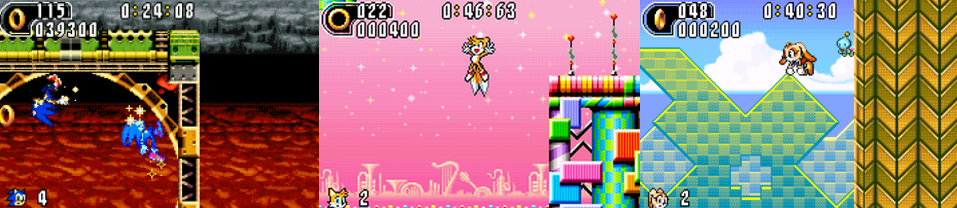
Cream lends her game-breaking cuteness to the increased emphasis on speed and tricks.

Much of this is carried over from Sonic Advance and the same is true of your character’s abilities. Each one plays a little differently, which can alter how difficult the game is. Tails and Cream, for example, can fly, easily avoiding the many pits that spell Sonic’s doom. Every returning character sports the same special moves as in Sonic Advance, with Sonic performing his Insta-Shield by pressing A twice, sliding ahead with B, and executing a fairly useless mid-air dash and Homing Attack when in mid-air. Sonic can also now bounce to the ground by pressing B in mid-air, similar to his bounce ability from Sonic Adventure 2 (Sonic Team USA, 2001) and almost as a precursor to the Drop Dash. Tails flies, as normal, and takes out enemies with a tail swipe with B, Knuckles glides and climbs walls and executes a three-punch combo with B and also now drills downwards when you press B in mid-air. Previously the most unique and difficult character to use, Amy now has a Spin Attack and Spin Dash just like her friends, meaning she’s a far more viable character this time (if you can unlock her!) She still swings her Piko-Piko Hammer with B, dives ahead, and uses it to attack aerial enemies. Every character can also grind on various rails, grab overhead poles, swing from vines and such, and blast ahead at break-neck speeds after building momentum. Flying off ramps sees you pull off mid-air tricks, which are essential to clear bottomless pits and reach higher areas and can spell your doom if you fail them. Since every character essentially adopts Sonic’s super-fast gameplay, there are far less opportunities to use their unique special moves beyond flying and gliding and each one loses a lot of their appeal as a result. There is a mild saving grace in newcomer Cream, however. Essentially the “Easy” mode character, Cream can fly like Tails (though seemingly for less time) and, crucially, fire her Chao companion, Cheese, like a homing shot with B. This absolutely decimates bosses and even surrounds her with a protective barrier when used on the ground, making Cheese the go-to choice for the game’s tougher Zones and bosses.
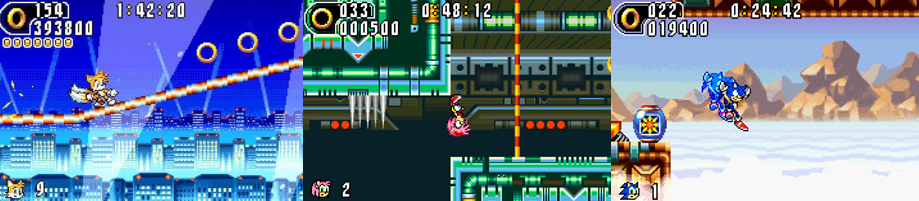
The fast-paced, action-orientated gameplay means bottomless pits and cheap deaths and commonplace.

Sonic Advance 2 structures its Zones like high-speed races and obstacle courses; the “rollercoaster” aesthetic has never been truer than in this game as rails, ramps, loops, springs, and boost pads litter every environment. There is still the occasional instance of water, putting you at risk of drowning, though you’re far more likely to run across the water than sink into it. Moving and temporary platforms also still appear, often placed at the end of solid ground to screw up your jumps, as do slopes, poles, destructible elements, and bouncy surfaces. This latter gimmick is most prevalent in Music Plant, which has you bouncing around on keyboards and cymbals, while Hot Crater is more about overhead rails and annoying spikes. While things start familiar enough in Leaf Forest (functionally an amalgamation of the classic Green Hill Zone and Green Forest) and Ice Paradise is like a fancy do-over of the previous game’s Ice Mountain, things take a turn for the worst in Sky Canyon. Bottomless pits, poor hazard placement, and tricky jumps appear before this point, but Sky Canyon really ramps them up, hiding ramps and springs and platforms behind clouds and forcing you to make split-second decisions at high-speeds that will quickly drain your pathetic stock of lives. It’s very easy to miss jumps or overshoot your landing, or to plummet to your death since you often drop through rails rather than landing on them. This continues in Techno Base and Egg Utopia, which borrows gimmicks like the light-based bridges and topsy-turvy gravity from Sonic 3 & Knuckles’ Death Egg Zone and marries them with rails and pits, pits, pits! Sonic Advance 2 quickly conditions you to “hold right to win” with its emphasis on speed; Badniks are few and far between and everything is geared towards propelling you ahead at incredible speeds. It’s thus incredibly frustrating to settle into this mindless gameplay loop and fall down an endless chasm, get skewered by spikes, or miss a ramp or a rail and drop to your death.

Presentation:
If there’s one area where Sonic Advance 2 truly excels, it’s the visuals. Again, there’s a reason I used these sprites and backgrounds when made sprite comics; they’re so vivid and detailed and really bring the characters to life like never before in 2D. While Sonic Advance 2 features some recycled animations from the last game, every character has loads more frames of animation either in their poses, tricks, or when performing basic functions. Every main Act starts with your character taking their marks and getting ready to race ahead as a countdown ticks place, they’re followed by shadowy afterimages when at top speed, and their run cycles are vastly improved as the game ditches the classic “rubber band legs” animation to more closely emulate the 3D games of the time. This racing aesthetic continues when you finish an Act as you’re no longer passing a signpost or reaching a Goal Ring; instead, you run through a finish line and your character poses while running and your score is tallied. While the introductory cutscene is nothing special (and is actually worse than in Sonic Advance since it just focuses on the island, Sonic Advance 2 utilises a map screen for its stage select that’s almost an exact copy of Sonic Adventure 2’s, and includes bigger, more detailed and cartoonish sprite art for its cutscenes. As you clear Zones, Sonic rescues his friends, chatting with them and unlocking them to be played, though these cutscenes only appear when playing as Sonic and only once. Once you’ve cleared the game, you can’t view them again and the game is irrevocably changed. Cream is no longer held hostage when you fight the EggHammerTankII and Dr. Eggman pilots the Egg Saucer on subsequent playthroughs, as opposed to Knuckles. While the Game Boy Advance sound system is still grating, Sonic Advance 2 features far catchier tunes and more musical variety than its predecessor. Bosses and Acts have differing tracks and game’s more frustrating moments are somewhat alleviated by the jaunty music, with Ice Paradise being a particular highlight.
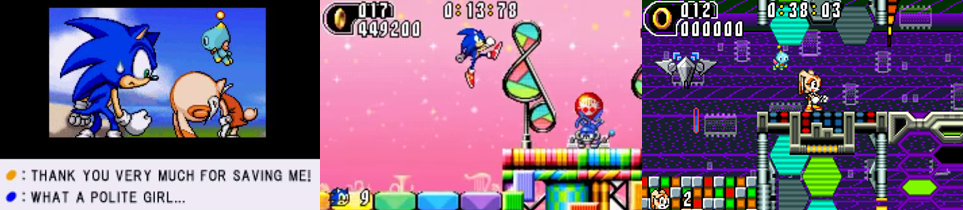
More story and detailed animations contrast with some garish environments.

Although Sonic Advance 2 doesn’t exactly break the mould with its Zone aesthetics, the presentation is far better than its predecessor. Sonic Advance had a rather blurry, pixelated, bland look that’s been completely overhauled into a smooth, sleek, almost plasticine-like aesthetic. Admittedly, this can make some of the foregrounds more generic and the Zones do suffer from being far more linear, with ramps and long raceways being predominant, but there’s no denying the graphical upgrade. Sonic Advance 2 also borrows more from Sonic Adventure 2 for its overall presentation, especially in Zones like Leaf Forest and Sky Canyon, with the latter basically being a 2D version of Rail Canyon. Given the game’s emphasis on speed, ramps, springs, loops, and boost pads are common gimmicks in each Zone, somewhat robbing them of their individuality, though unique gimmicks can still be found (however sporadically) amidst the cheap-ass pits and hazards. Hot Crater, a mechanical base built into a volcano, features overhead rails, a heat effect to the background, and hooks to fling yourself upwards. Music Plant is a garish slice of ridiculousness that looks like it’d fit right in in Zool: Ninja of the Nth Dimension (Gremlin Graphics, 1992) and begins an annoying trend in Sonic games of this era of featuring an overly kiddified level. Ice Paradise has a Christmas theme to its soundtrack, features a bustling city in the background, flurries of snow, and big neon signs, giving the impression of a ski slope. Sky Canyon is a mess of pits and vertical columns, featuring windmills, those fans from Starlight Zone, and balloons to carry you up. Techno Base is a mess of hexagons, lights, lines, and vulgar colours; it’s essentially a new version of Cosmic Angel Zone from Sonic Advance, though with digitized spikes and some pinball mechanics. Egg Utopia is essentially a 2D version of Final Rush/Final Chase mixed with the Death Egg Zone, featuring rails between different areas of the space station set against the background of space, a gravity gimmick that has you running on the ceiling, cannons, and spiked balls. This aesthetic is carried over to XX, which is simply an autorunner (like all the game’s bosses) gauntlet before the final showdown, while True Area 53 takes place in the void of space with the Earth in the background.

Enemies and Bosses:
No doubt due to the game’s focus on fast-paced action, Badniks are few and far between in Sonic Advance 2. The game would rather surprise you with spikes or bottomless pits than have you free critters from robotic shells, something further emphasised by the lack of capsules at the end of each Act. When Badniks do appear, they’re generally awfully placed to screw up your jumps or tricks and send you plummeting to your death, and they’re largely recycled throughout each Zone. Some of their designs may be familiar to long-time Sonic fans, though: the Geji-Geji aren’t too dissimilar from Caterkillers, the Circues are reminiscent of the monkey-like Kikis, Flickey is literally a robotic version of Flicky, and the Buzzers return wholesale from Sonic Advance. Kikis hide in trees and toss coconuts like in the 3D games and like their predecessor, Coconuts; Spinners return from the 3D games and can be bounced on to cross gaps; and little robot mice scurry about on the ground. Mechanical penguins launch themselves across the snow like Penguinators, clown-like robots swing their own Piko-Piko hammers, and large robotic hammerheads await in the waters at times. Each one releases a woodland critter and adds to your score tally, but they’re mainly there to get in your way and are such a non-factor that it’s easy to be blindsided by them. The E-100 “ZERO”-like Robot Guard also appears, relentlessly pursuing you in Special Stages, sapping your Rings and kicking you out of the stage if it touches you. Having somehow been tricked by Dr. Eggman, Knuckles is battles you in your first playthrough, piloting the Egg Saucer at the end of Sky Canyon, though his presence doesn’t change anything except the cockpit sprite.
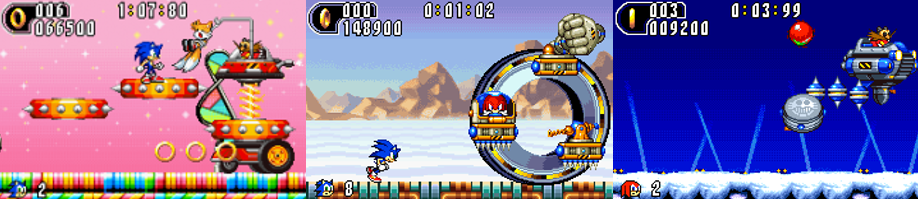
The autorunning mechanic used in boss battles makes them needlessly annoying at times.

Therefore, you’ll be battling Dr. Eggman’s newest machines at the end of each Zone. Unlike in Sonic Advance, every single boss battle is an autoscroller that sees you constantly running on an endless loop, snagging Rings and timing attacks and compensating for the knockback and the tougher “pinch” mode, which can get so aggravating that it’s often easier just to cheese the bosses with Cream. Things start off familiar enough with the EggHammerTankII, an upgrade from Sonic Advance that also attacks with a giant hammer but this time it can extend its reach. While the hammer is a large hazard to avoid, this isn’t too tricky. The Egg Bomber Tank is a bit trickier as you can only attack its cannon in the first phase; the main body can only be attacked in the second phase, and both see you avoiding bouncing, explosive cannonballs. Though functionally simple, the autoscrolling gimmick makes the Egg Totem a bit difficult since it’s hard to get up to speed and hop to its spiked platforms to hit the cockpit. Each platform sprouts turrets that must be destroyed to clear the field of projectiles and they also move quiet erratically to screw up your jumps. The Aero Egg also causes problems as its bombs have wide splash damage and you can only attack it by bouncing off its tail platform (unless you just aggressively fire Cheese). Things can get very frustrating against the Egg Saucer as the laser cannon has a wide range and the robotic hand can instantly kill you with its slap attack! Your best bet is to take out the cannon and hang back, way back, running in whenever the cockpit spins into view.
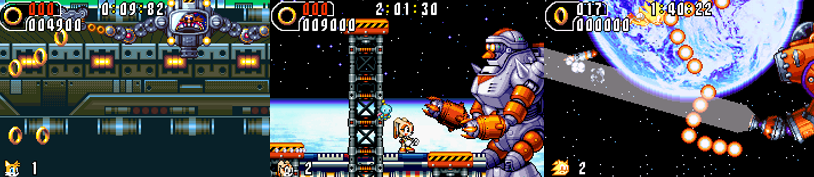
You’ll need to overcome all the bosses again and get the Chaos Emeralds to fight the true final boss.

The Egg-Go-Round was much easier in comparison. This machine flies along on a rail and is protected by four platforms, two that sprout spikes and two that fire projectiles. It can be tricky avoiding these but it’s a hell of a lot easier to ram the cockpit than the Egg Saucer. The Egg Frog is a different matter entirely, though. This boss incorporates the Egg Utopia’s gravity gimmick, hopping to the floor and ceiling and dropping carpet bombs that are very difficult to avoid. While you can switch to the floor and ceiling by holding up and down, the Egg Frog’s hit box is so large and the window of opportunity so small to hit it that it’s better to just give up and use Cheese to decimate it. Similar to the last game, XX features a boss rush…but this time its against all the bosses you previously fought! Though they take less hits to defeat, the only checkpoint occurs after defeating the EggHammerTankII and this gruelling prospect means you’ll likely be low on lives and/or Rings by the time you reach the Super Eggrobo Z, a modified version of Sonic Advance’s true final boss. This giant mech takes up the entire right-side of the screen and fires its claw arms (which can be destroyed) and a sweeping laser from its eyes. Platforms will raise, allowing you to attack its main weak spot (the head) but also putting you at risk of being skewered or crushed against the ceiling spikes. After a few hits, the mech’s attacks increase but, again, you can make a joke of it by using Cream, destroying Dr. Eggman’s newest space station and treating you to a character-specific ending. However, this isn’t the true final boss. Collect all seven Chaos Emeralds with the four main characters and you’ll be taken to true Area 53 where, as Super Sonic, you battle perhaps Dr. Eggman’s most visually disappointing final mech ever, an unnamed, worm-like cannon. I’ve never battled this boss, but you’re limited, as ever, by your Ring count and must bash its missiles back at it, watching for the mech’s freeze ray and suck attack while also avoiding projectiles and dealing with its invisibility gimmick.

Additional Features:
Just like in the classic games, you can challenge Special Stages to collect the seven legendary Chaos Emeralds, which unlocks the game’s true final boss and ending. Unfortunately, if you thought Sonic Advance’s hidden springs were a pain in the ass, let me introduce you to the “Special Rings”. Seven of these are hidden in each of the main Acts and all seven must be collected to enter the Special Stage. If you lose a life in the Act, you’ll lose all the Special Rings you collected and you probably won’t be able to backtrack to get them, especially as Sonic, since many are hidden in hard-to-reach areas. If you somehow find them all, you’re taken to a large, pseudo-3D checkerboard arena and must race around collecting Rings, gaining multipliers and utilising boost pads, all while the Robot Guard chases after you. Because of how difficult the Special Rings are, I’ve never entered a single Special Stage and have therefore never collected even one Chaos Emerald, which is extremely frustrating as a life-long Sonic player. To make matters worse, you must beat every Special Stage with the four main characters to unlock Amy Rose, a needlessly obtuse criteria for a character who was available by default in the last game. Sonic Advance 2 also includes a time attack mode and a Tiny Chao Garden, where you raise and play with Chao and even transfer them to and from the 3D games, though you’ll only unlock this after collecting the seven Chaos Emeralds with a single character. Similarly, you can unlock a boss rush by beating the game with three characters and all seven Chaos Emeralds, which you’d think would invite replayability but instead makes me want to tear my hair out since entering the Special Stages is so ridiculously difficult. You can also play a single- or multi-pack multiplayer mode, racing to the finish or collecting Rings against other players and utilising the additional Attack, Brake, Confusion, and Warp power-ups to gain an advantage.

The Summary:
The visual upgrade between Sonic Advance and Sonic Advance 2 is as startling as the differences between the first two Sonic games. Where one was colourful and fun but handicapped by a slow, meandering pace, the sequel is both brighter, slicker, and much faster and more action-packed in its design. Sonic Advance 2 brings its characters to life like never before with some truly incredible, amusing, and charming sprite work. The animations are great, making the game resemble its 3D counterparts and a cartoon, and the upgrade to the environments makes everything pop so much more. Things are a little tame at times and the Zones can be annoyingly linear, but this ties into the focus on high-speed gameplay. Unfortunately, this approach does hamper the gameplay somewhat since everyone blasts ahead at full speed like Sonic, meaning their individual playstyles fall further to the wayside. This wouldn’t be so bad if the game didn’t throw bottomless pits, annoyingly placed enemies and hazards, and cheap deaths at you in a paper-thin attempt at increasing the game’s challenge. Pits definitely should appear in Sky Canyon and difficult sections should definitely appear by the end, but scattering them throughout every Zone really stunts my enjoyment as you must either memorise the Act layouts or have split-second reactions to make unfair jumps. While I enjoyed the bosses, the autoscrolling mechanic got old fast and I didn’t appreciate the boss gantlet in XX. I think the autoscrollers would’ve worked better if it had only be used, say, three times. I did like the emphasis on story and how the bosses changed because of it, but not that these changes were undone upon beating the game. It’s also maddening that the Special Stages, Amy Rose, and true final boss are all-but inaccessible thanks to the irritating Special Ring mechanic and the fact you need to get the Chaos Emeralds with every character. I liked Cream, she was cute and fun and made the bosses a joke, and the visuals still blow me away, but the difficulty curve is a nightmare. Because of all this, I can’t rate Sonic Advance 2 higher than the original, even if it is technically and visually a better game since my enjoyment is constantly soured by my inability to experience everything it has to offer.

My Rating:

Rating: 3 out of 5.

Pretty Good

Are you a fan of Sonic Advance 2? How do think it compares to the original and the third game? What did you think to Cream and her boss-breaking powers? Were you a fan of the increased emphasis on speed? What did you think to the reliance on bottomless pits and boost pads? Did you ever collect the Chaos Emeralds and unlock Amy…and, if so, how? Which of Sonic’s Game Boy Advance titles is your favourite and how are you celebrating Sonic’s anniversary this year? Whatever your thoughts on Sonic Advance 2, leave a comment below and go check out my other Sonic content!

Mini Game Corner [Sonic Month]: Sonic the Hedgehog Spinball (Mega Drive)


Sonic the Hedgehog was first introduced to gamers worldwide on June 23 1991 and, since then, has become not only SEGA’s most enduring and popular character but also a beloved videogame icon. Thus, in keeping with tradition, I’m dedicating some time to celebrate SEGA’s supersonic mascot.


Released: 23 November 1993
Developer: SEGA Technical Institute
Also Available For: Game Boy Advance, GameCube, Game Gear, Master System, Nintendo Switch Online, PC, Nintendo Wii (Virtual Console), PlayStation 2, PlayStation 3, PlayStation 4, PlayStation 5, Xbox, Xbox 360, Xbox One, Xbox Series S/X

A Brief Background:
At the beginning of the 1990s, SEGA sought to create a videogame mascot iconic enough to knock Super Mario from his perch at the top of the videogame industry, kicking off the “Console Wars” of the era when Sonic the Hedgehog proved a big success. This evolved into mainstream popularity with Sonic the Hedgehog 2 (SEGA Technical Institute, 1992); soon, Sonic was everywhere (including comics and cartoons) and SEGA was quick to capitalise with a slew of spin-off titles. SEGA put everything into crafting a massive third outing for their super-fast mascot, a game so large that it ended up being split into two parts. Realising the highly anticipated title wouldn’t be ready for the 1993 holiday season, SEGA commissioned another Sonic title to fill the void, one developed entirely in the United States. Loosely tying into the popular Sonic the Hedgehog (1993 to 1994) cartoon, Sonic Spinball expanded upon the celebrated pinball-based mechanics seen in the first two games and was hastily put together within a tight deadline. Sonic Spinball was largely well received, with reviews praising the visuals and soundtrack, though many criticised the slowdown and clunky gameplay. Still, Sonic Spinball lived on not just through multiple ports over the years but also a slew of adaptations, with the game providing the basis for not just the cartoons and comics but also a real-world theme park.

The Review:
Sonic Spinball, unlike the mainline games, is a 2D pinball-based action title in which players control Sonic the Hedgehog and bounce around inside Doctor Ivo Robotnik’s ominous Veg-O-Fortress, a volcano-based robot factory. Players can customise the game’s controls to operate different flippers with either A, B, or C or do the smart thing, like me, and map both the left and right bumpers to the A button for convenience. If you’ve played Spring Yard Zone and/or Casino Night Zone from the first two games, or any of those old pinball-based videogames, Sonic Spinball will be mildly familiar to you as you control flippers to send Sonic flying across a vaguely pinball-themed environment, bouncing off bumpers and hitting targets to score points. The difference comes from the awkward incorporation of some Sonic’s more traditional moves. In the rare moments where you’re not bouncing about like a madhog, you can run about and use Sonic’s Spin Dash to blast ahead. Unfortunately, Sonic’s controls are very clunky when he’s on the ground. He feels very heavy, shambling about with none of the grace or speed that you’d expect, the Spin Dash is weak and stunted, and Sonic’s jump is very short and awkward. When you do have to jump over walls, the jump tends to glitch and cause Sonic to fail or judder about on the environment, though thankfully these moments are few and far between. Sonic is also missing all his power-ups – there are no monitors to smash here – and Golden Rings are collected merely for points and to score yourself an “extra ball”. Sonic Spinball is also the only Sonic title that directly ties into SatAM; Sonic’s design heavily evokes the cartoon (though, oddly, Dr. Robotnik’s doesn’t) and his Freedom Fighter pals make cameos in the game’s bonus stages. The link is tenuous at best, however, with the game primarily serving as a pinball-based spin-off whose canonicity can be debated. Finally, unfortunately, Sonic is the only playable character here. Up to four plays can play at any one time, but in a classic turn-based format, which is pretty lame.

Bounce around a pinball nightmare to snag the many Chaos Emeralds.

On paper, Sonic Spinball is a very short game without much happening in it (hence this shorter review). There are only five stages to play through, though each stage is quite large and has multiple paths accessed via teleporters, narrow tubes, or by clearing the way of obstacles. This might mean smashing a door a few times, or pulling switches, or powering up generators. Either way, you’ll be repeating these actions a few times to open new paths or collect one of the many Chaos Emeralds powering the Veg-O-Fortress. Each stage has either three or five Chaos Emeralds to collect and finding them can be a bit of a headache. Not only do you have to factor in alternative paths and these tricky puzzle elements but directing Sonic’s momentum is crucial to obtaining the gems. This is easier said than done as Sonic seems to fly off like he has a mind of his own most of the time, though you can direct his momentum in mid-air. Every stage features instant death hazards at the bottom, though you’re given some leeway in Toxic Caves, and you’ll occasionally be spared by a burst of steam to stay in the fight. Badniks modelled after those seen in SatAM patrol every stage but are mainly used to score points or bounce to higher areas. You’ll be pushed along on jets of steam, ride mine carts, pinball about on balloons and cages, and ride flippers up vertical shafts, often dropping to the first screen and fighting your way back up to reach the boss. Targets, lights, and plugs can all be bounced into or past to score points. The neon billboard overhead constantly updates you on what’s happening, though it’s not always clear if it’s relevant to you getting a Chaos Emerald or not. Lava Powerhouse is easily the most maze-like stage, forcing you to time your steam-boosted attacks on Cluckbirds to enter pressure dial tubes and be blasted further up. The Machine is probably the most dangerous stage, with its grinding gears, collapsible gantries, and being the heart of Dr. Robotnik’s Badnik processing plant. Showdown, meanwhile, is the most open and vertical stage, with you hitting balloons, pulling hooks, blasting about using windsocks, and hopping to bombs to reach Dr. Robotnik’s ship. Once there, there’s a greater risk of plummeting all the way down thanks to the holes and destructible windows, something you want to avoid given how aggravating it is to get Sonic’s lead-filled ass moving in this game.

Rack up a high score and battle Dr. Robotnik’s gigantic mechanical monsters.

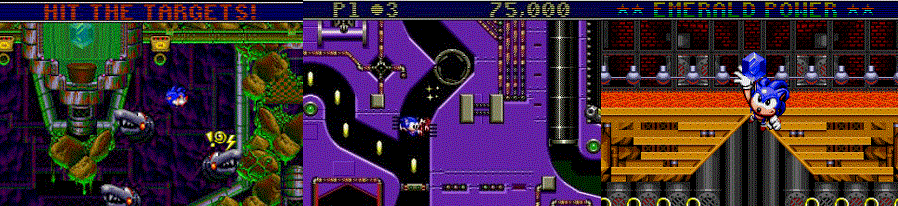
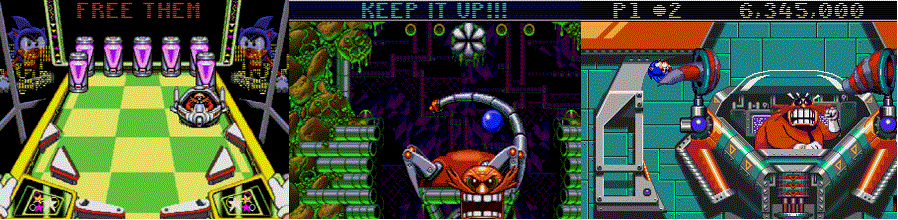
Graphically, Sonic Spinball is a mixed bag. The environments look good; every stage is large and detailed and pops with 16-bit goodness. The SatAM-style sprites are serviceable enough but Sonic looks really weird; he’s very squat and out of proportion when not curled into a ball. Things get pretty impressive in the bonus stages, where you see Sonic’s reflection as he controls a real pinball across a giant table, smashing Scratch’s and the Badnik processors to free his furry friends. The game mostly impresses with its music, with memorable tunes punctuating the frustrating and chaotic action. It may lack all the traditional Sonic tunes, but that Toxic Caves theme is an earworm, for sure. Every stage culminates in a boss battle at the very top where your biggest threat is screwing up your momentum and dropping out of the arena. Sonic can’t be hurt or killed by the bosses, but you must aim your shots to deal damage, which gets trickier with each boss. Things start [pretty simple with Scorpius; simply avoid the sewer warp tube and the acidic gloop it spits and flip Sonic into the sweet spot between its tail and its back to clobber it. The Robo-Boiler is a little trickier as you must flip up to a temporary platform on either side and time your jump to avoid the steam vents and smash the Robotnik faces floating inside, though it’s very easy just to fly all over the place. The Veg-O-Machine was another tricky one since it constantly spews Badniks and you must target the tubes on either side to halt their production before finishing it off from the inside. You finally confront Dr. Robontik aboard his ship as he flees the crumbling Veg-O-Fortress. This is the most aggravating fight of the game as Dr. Robotnik is shielded by claw arms and windsocks, which must be deactivated by hitting the button beneath his cockpit. Fail and you could be dropped to the beginning of the stage! However, even when you do deactivate the obstacles, you have only a short window to land hits, making this a tedious final fight. Despite all those Chaos Emeralds, beating the game only earns you a high score for the table and there’s nothing else to come back for. You can use cheat codes to skip ahead or the rewind and save state functions of other ports to make the game easier, however.

The Summary:
There’s always been something about Sonic Spinball. I remember getting my copy as a kid and I have a strange amount of nostalgia for it, despite barely clearing the first stage in my youth. Even now, I’m only able to finish the game through persistence or more modern means and I can’t say I’ve ever enjoyed my time when playing it. It is fun at times, don’t get me wrong. Visually, it’s quite striking and I like little quirks like the alarm and Sonic’s shocked face when he falls, him landing in a little bucket in the Toxic Caves, and the radical nineties slang displayed in the neon bar. It can be fun bouncing around searching for Chaos Emeralds and it’s quite rewarding figuring out how to obtain them and flipping Sonic just right to snag them, and the tie-in to the cartoons is a nice touch (if half-assed) but it’s a very barebones and frustrating experience. There are a lot of bonus stages and a lot of variety in the main stages, but it quickly becomes repetitive as you repeat the same tasks (or variations of them) multiple times to progress. It doesn’t help that Sonic looks and controls like ass; you basically need to be bouncing around all the time or else you’re controlling this sluggish, ungainly hedgehog meandering to the next spring. Sonic’s controls when bouncing aren’t much better; I found it very difficult to properly aim him and his momentum seems to have a mind of its own. It’s also not immediately clear where you need to go and what you need to do to get the Chaos Emeralds, leading to constant falls, warps, and deaths if you’re not careful. The bosses were large and enjoyable, if paradoxically both irritating and simple, and I really dig the music, but there’s just so little to come back to here. I think it might’ve been better to have smaller stages and divide some of the gimmicks between, say, eight distinct areas, with a boss battle after every second one. The pinball mechanics wear out their welcome very quickly thanks to the awful controls and madcap nature of the game, which ruins a lot of the fun and makes Sonic Spinball little more than a visually interesting, quirky little cash grab that fails to engage as powerfully as its mainline cousins.

My Rating:

Rating: 2 out of 5.

Could Be Better

Did you enjoy Sonic Spinball? Were you a fan of the pinball mechanics or did they aggravate you after a while? What did you think to the visual style and the inclusion of elements from the cartoons? Which of the stages and bosses was your favourite? Do you agree that the controls and replay value are lacklustre? Which Sonic spin-off is your favourite and how are you celebrating SEGA’s mascot this month? Let me know your thoughts on Sonic Spinball in the comments and go check out my other Sonic content.

Back Issues [Sonic Month]: Sonic the Comic: Origins


Sonic the Hedgehog was first introduced to gamers worldwide on June 23 1991 and, since then, has become not only SEGA’s most enduring and popular character but also a beloved videogame icon. Thus, in keeping with tradition, I’m dedicating some time to celebrate SEGA’s supersonic mascot.


Story Title: “Enter: Sonic”
Published: 29 May 1993
Writer: Alan McKenzie
Artist: Anthony Williams

Story Title: “Robofox”
Published: 12 June 1993
Writer: Mark Millar
Artist: Woodrow Phoenix

Story Title: “The Origin of Sonic”
Published: 4 September 1993
Writer: Nigel Kitching
Artist: Richard Elson

Story Title: “Prologue: Once Upon a Planet…”
Published: 30 April 1994 (cover-dated: 13 May 1994)
Writer: Nigel Kitching
Artists: Mike Hadley and John M. Burns

Story Title: “Kintobor Spelled Backwards Is…”
Published: 14 May 1994 (cover-dated: 27 May 1994)
Writer: Nigel Kitching
Artists: Mike Hadley and John M. Burns

Story Title: “A Tale of Tails”
Published: 28 May 1994 (cover-dated: 10 June 1994)
Writer: Nigel Kitching
Artists: Mike Hadley and John M. Burns

The Background:
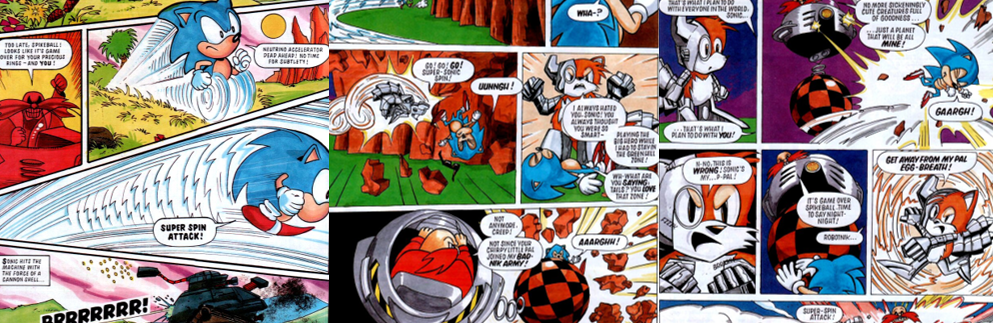
Sonic the Hedgehog was a huge success for SEGA. Thanks to an aggressive marketing campaign and being bundled with the all-powerful 16-bit Mega Drive, over 15 million copies were sold and SEGA briefly usurped Nintendo as the big dog of the videogame industry. Eager to capitalise on Sonic’s mainstream popularity, SEGA shamelessly licensed their mascot anywhere they could, leading to two concurrent cartoons and multiple comics books published across the world, with each taking vastly different approaches to the source material. While the Japanese manga was far more faithful to the videogames, Archie Comics awkwardly mashed together the contrasting tones of Sonic’s cartoons into what would become the longest-running comic series based on a videogame, and the United Kingdom was treated to Sonic the Comic (StC). Published fortnightly, StC took much of its lore from the now defunct Mobius storyline created specifically for Western audiences and made the bold decision to portray Sonic as an egotistical narcissist who treated his friends poorly while fighting for freedom and justice. Eventually folding more elements and characters from the videogames into its narrative, StC was a highlight of my youth for many years. Although it soon devolved into reprints before being cancelled, its spirit lived on through an online continuation.

The  Review:
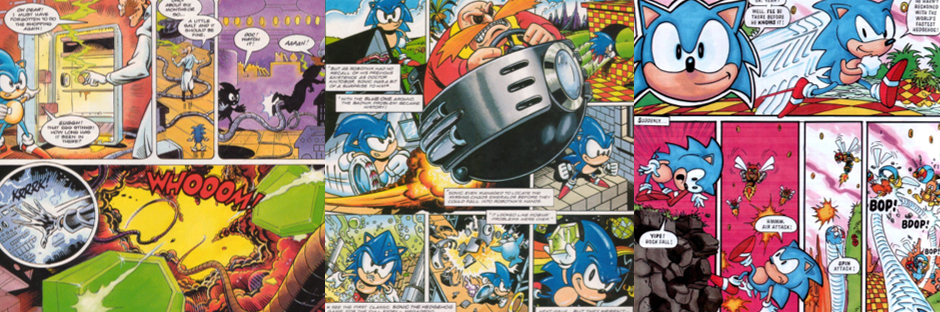
I’m doing things a little different for this review. StC’s early days were a bit sporadic, which isn’t surprising considering each issue featured a handful of stories based on different SEGA properties alongside letters, artwork, reviews, and cheats for SEGA titles. While Sonic the Hedgehog stories were always at the forefront, the lore was anything but sequential. Issue one, for example, drops us right in the middle of the action and appears to take place shortly before the events of the first videogame. By issue six, it’s clear that StC takes place sometime after Sonic the Hedgehog 2 (SEGA Technical Institute, 1992) and StC rarely produced direct adaptations of the source material, especially the first two games. It also didn’t waste much time in bogging down its stories with exposition; the comics were aimed at a pre-made audience of SEGA gaming fans so this wasn’t necessary. Thus, it took some time for later issues and backup stories to flesh out Sonic’s characters and world. Fittingly, this was initially related through supplementary stories titled Sonic’s World, in which key events from Mobius’s history, the videogames, and StC’s unique canon were revealed to the reader. Thus, rather than going through each issue in turn for this review, I’ll instead be tackling them in as close to chronological order as possible to give a taste of the world StC crafted and the way it reinterpreted the source material. Accordingly, we must start not with issue one but with issue twenty-five, which included the first appearance of the Sonic’s World stories and gave us our first real overview of how Fleetway were interpreting the videogames. Like all Sonic media outside of Japan in the 1990s, Fleetway takes place not on Earth, but on Mobius, a planet said to be both 117,63222 light years from Earth and in “a parallel dimension” and divided into areas known as “Zones”. “Prologue: Once Upon a Planet…” gives a brief overview of how Sonic the Hedgehog fought the evil Doctor Ivo Robotnik, forcing him to retreat to a secret based in the “Special Zone”, and how Dr. Robotnik has both biological and mechanical minions station around the planet and rules with an iron fist. This story, like the others in these Sonic’s World features, is narrated by the Kintobor Computer, an artificial intelligence that assists Sonic and his friends from their underground base and is the digital backup of Sonic’s old friend, the kindly Doctor Ovi Kintobor.

Sonic shares his superhero origins with his friends and reveals how Dr. Robotnik came to be.

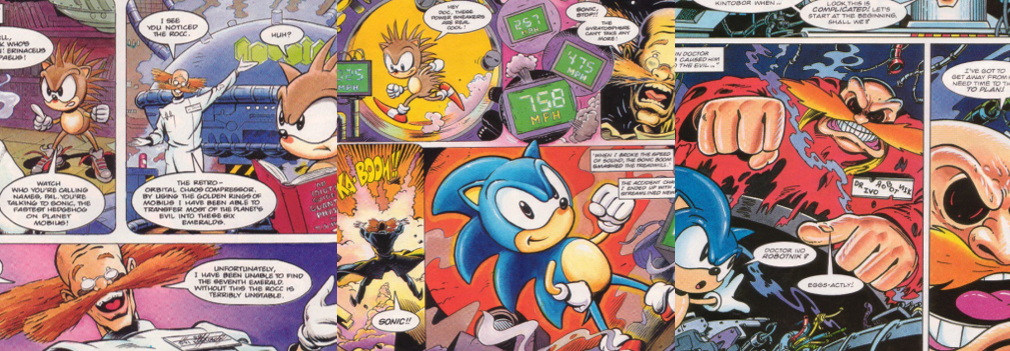
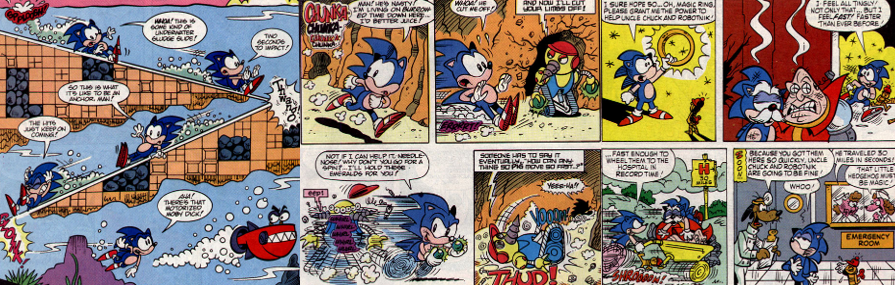
Who is Dr. Kintobor, you ask? Well, to answer that we need to jump to issue eight’s “The Origin of Sonic”. This story (set before Dr. Robotnik conquered Mobius) saw Sonic charge up a Star Post with his superfast speed and transport his friends (long-suffered sidekick Miles “Tails” Prower, brave Johnny Lightfoot, and cowardly Porker Lewis) to the Special Zone. Modelled after the iconic half-pipe Special Stages seen in Sonic 2, StC’s Special Zone the a chaotic and dangerous home of Sonic’s friend, the Omni-Viewer, a gigantic sentient television screen. Capable of transporting and transmitting people and events across time and space, the Omni-Viewer shows Sonic’s friends the origin of both Sonic and Dr. Robotnik through his view screen. Some time ago, Sonic was just a normal, brown hedgehog (albeit one with incredible speed). While exploring Mobius, Sonic stumbled upon Dr. Kintobor’s secret laboratory and met the kindly Doctor, one of the few humans living on Mobius. Enamoured by the beauty of the world, Dr. Kintobor created the Retro-Orbital Chaos Compressor (ROCC), a massive machine designed to transfer the planet’s “evil” into six gems using special Golden Rings. Unfortunately, without the legendary seventh emerald, the process is incomplete and the ROCC is unstable. Sonic agrees to search the planet for the elusive seventh emerald and, in return, Dr. Kintobor develops his natural speed. Thanks to a snazzy pair of “friction reducing […] power sneakers” and a “kinetic gyratoscope”, Sonic breaks the sound barrier, streamlining his body to his iconic blue look. One day, Dr. Kintobor took a lunch break and, while carrying a rotten egg, tripped and collided with the ROCC. The explosion scattering the Golden Rings across Mobius and warped the six Chaos Emeralds to the Special Zone and, like Sonic’s accident, forever changing the friendly Doctor. Where he was once tall, slender, and pleasant, he was now squat, bulbous, malicious, and rotten. Even his name was reversed (hence “Doctor Ivo Robotnik”) and he became obsessed with recovering the Chaos Emeralds to conquer the world. “The Origin of Sonic” concludes with the Omni-Viewer returning Sonic and his friends to Mobius, forced to drop them six months into the future and thus allowing Dr. Robotnik to take over the planet.

These stories depict Sonic’s first meeting with Tails and initial battles with Dr. Robotnik.

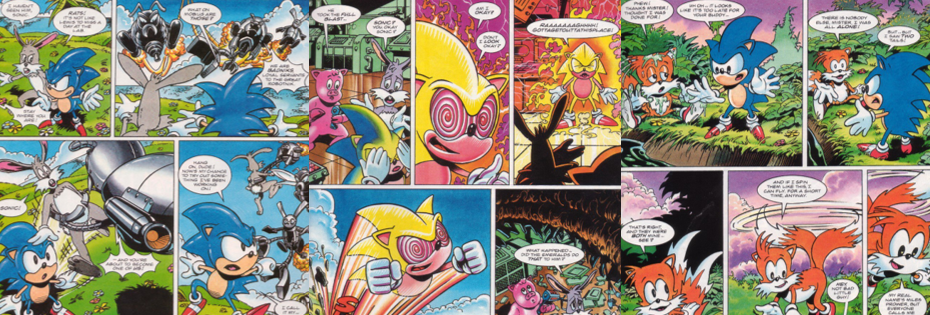
“Kintobor Spelled Backwards Is…” reveals that Sonic and Porker discovered one of the Golden Rings could talk after Dr. Kintobor’s brain patterns somehow transferred to it during the explosion. Using comic book logic, the tech-savvy Porker downloads Dr. Kintobor’s consciousness onto a computer, birthing the Kintobor Computer and allowing the kindly Doctor to live on. Following Dr. Robotnik’s transformation, Sonic and his friends scoured the world for the Golden Rings and the Chaos Emeralds to try and reverse the process until, one day, they were attacked by the first generation of Dr. Robotnik’s Badniks. Using his Sonic Spin Attack, Sonic trashed the Badniks and discovered, to his horror, that Dr. Robotnik was capturing his friends and using them to power his machines. There’s some crossover between these panels and issue one’s “Enter: Sonic” and even America’s promotional comic book, namely that Sonic trashed Badniks in Green Hill Zone and rescued Porker Lewis. A montage briefly recaps the first Sonic videogame,  how Sonic travelled and successfully recovered the six Chaos Emeralds before Dr. Robotnik. However, when Sonic and his friends tried  to analyse them, the Chaos Emeralds disappeared in a burst of radiation since, without the seventh to balance them, they couldn’t be safely kept together. Absorbing the full brunt of the blast, Sonic was transformed into a maniacal, golden-hued form that blasted from the base in a desperate desire for freedom. Crashlanding in the Swampland Zone, Sonic returned to normal with no memory of his transformation; his confusion gave way to concern when he heard cries for help. Rushing to assist, Sonic pulled a fox boy from the swamp and was amazed to find the cub, named Miles, not only had two tails but could fly by spinning them like a propeller, earning him the nickname “Tails”. Tails joined Sonic for another montage, this time recapping Sonic 2, which sees Sonic take down Dr. Robotnik’s greatest creation, the Death Egg, and safely hide the six Chaos Emeralds in the frozen North Cave.

Though Sonic easily destroys Dr. Robotnik’s machine, he’s almost killed by his best friend!

This brings us to “Enter: Sonic”, where Dr. Robotnik unleashes a fresh hoard of Badniks throughout Green Hill Zone to keep Sonic from meddling in the evil genius’s newest creation, the Engine of Destruction. Fuelled by the Golden Rings and literally sucking them out of the air, the machine promises to “crush Sonic into a million bitty hedgehog nuggets” and “pollute the atmosphere […] for a thousand years”! After rescuing his friends from their Badnik prisons, Sonic learns of the Engine of Destruction and races off to stop it, encountering some of the same hazards players must overcome in the first game (loops, crumbling platforms, and spike pits). Despite its vast size and ominous appearance, the Engine of Destruction is easily destroyed by Sonic, who simply rams into it at full speed. Sonic’s victory is soured by the realisation that he hasn’t heard from Tails for some time. Between issue one and two, Sonic goes on an unrelated adventure and returns to find Green Hill Zone deserted after Dr. Robotnik raided it overnight. Donning his new “power-grip trainers” and a pair of shades, Sonic liberates his friends, only to find Dr. Robotnik has transformed the foxboy into the semi-cybernetic “Robofox”. His personality warped by Dr. Robotnik’s programming, Robofox both physically and mentally attacks Sonic. However, when he witnesses his friend and hero being pummelled to death by Dr. Robotnik’s wrecking ball, Tails regains his senses and charges the villain, destroying both his exoskeleton and trashing the Egg-O-Matic. Relieved to have his friend back, Sonic teases Tails for his actions and sadly takes him back home, though his fancy new sneakers were wrecked from the adventure and Dr. Robotnik lived to fight another day.

The Summary:
It’s interesting reading these stories in this order, which can loosely bee described as sequential, rather than in publication order. There were a few other stories that flesh out some other elements of these events, such as a glimpse into Tails’ past before he came to Green Hill Zone and a time travel story that showed Sonic was responsible for the accident that birthed Dr. Robotnik. This Mobius/Dr. Kintobor canon was very popular outside of Japan at the time and all the books and comics published in the United Kingdom used a variation of it, while the United States made up their own backstories. It’s certainly an interesting and “comic book” take on the premise but it amuses me that the localisation team went to so much effort to expand the lore when the original story is so simple: anthropomorphic characters battle an evil despot to defend the world from pollution. It’s certainly interesting to see Sonic’s origin depicted this way and, now, many decades later, rather quaint. For a generation of readers, this was Sonic’s canon origin. People really thought he lived on Mobius and was once a regular brown hedgehog, transformed by breaking the sound barrier. It’s a very “superhero” origin, fitting considering Sonic was often billed as such in publications at that time. I think my biggest issue with the Dr. Kintobor thing is how little emotional connection I have to that character. We don’t spend much time with him and his personality is erased by Dr. Robotnik. Even the Kintobor Computer became superfluous once Porker became even more of a tech genius, and it just raised more questions than it was worth sometimes. The whole ROCC thing is an interesting way of explaining why Golden Rings are scattered everywhere in the games and another early story even explained the item monitors, but Rings rarely appeared in StC after this or in the same way as the games so it’s a bit convoluted. I did like that the writers were laying the groundwork for a seventh “Control Emerald” even this early on. This would turn out to be the legendary Grey Emerald rather than the Master Emerald, but it’s a fun way to explain why the Chaos Emeralds constantly need to be collected in each game.

This fantastical origin mixes with loose adaptations of the games to give StC a unique interpretation.

StC also had a unique spin on Super Sonic, making him Sonic’s demonic alter ego and creating deeper parallels between him and Dr. Robotnik, elements sadly never really expanded upon in future stories. The artwork of these stories is decent, if a bit inconsistent. Richard Elson was busy on the main Sonic stories in issues twenty-five to twenty-seven, though we get a taste of his work in issue eight. It’s not quite as refined as later but a lot better than issue one and two, where Sonic’s poses (especially in “Enter: Sonic”) are lazily ripped from official SEGA artwork. I did enjoy how these stories adapted elements from the videogames; we honestly didn’t see this that much in StC, potentially because multiple stories of Sonic simply running around, bashing Badniks, and avoiding traps isn’t very interesting or dramatic. It’s fun seeing Green Hill Zone come to life in “Enter: Sonic” and seeing Sonic’s friends be jostled about by the Special Zone’s bombs in “The Origin of Sonic”. Both locations would be expanded into more grounded, bustling locations within just a few issues as StC settled into a more relatable adaptation of the game’s fantastical elements, but I liked the simplicity and fidelity of everything here. There’s just enough to make it unique, like the Engine of Destruction and the Omni-Viewer. A major plus in these issues is that Dr. Robotnik sports his videogame appearance; he’d later transform into his cartoon counterpart, but I find this rendition far more menacing, especially during his first appearance following his accident. These Sonic’s World stories also deliver the first direct adaptation of the videogames, albeit in an extremely truncated form. We’d see elements included in other stories, sure, but these montages recreate and canonise the videogames, making it clear that issue one occurs after Sonic 2 and that Sonic’s had multiple adventures even before StC began. The stories are also laced with some quirky humour; everything feels very “British”, from the dialogue and the characterisations. Sonic isn’t quite the obnoxious asshole we’d see in other stories, but he lives up to his reputation as a “Hedgehog with Attitude”, giving off an arrogant and cocksure bravado that perfectly contrasts with Dr. Robotnik’s spiteful and egg-centric personality.

My Rating:

Rating: 3 out of 5.

Pretty Good

Did you read Sonic the Comic as a kid? If so, what did you think to its unique interpretation on Sonic, his friends, and his lore? Were you a fan of the Mobius/Dr. Kintobor origin or are you glad that it’s been forgotten in modern times? What did you think to Sonic’s original look and his first meeting with Tails? What are some of your favourite StC stories and characters? How are you celebrating Sonic the Hedgehog this year? Whatever your thoughts on Sonic the Comic, or Sonic in general, drop a comment below.

Back Issues [Sonic Month]: Sonic the Hedgehog #0-3


Sonic the Hedgehog was first introduced to gamers worldwide on June 23 1991 and, since then, has become not only SEGA’s most enduring and popular character but also a beloved videogame icon. Thus, in keeping with tradition, I’m dedicating some time to celebrate SEGA’s supersonic mascot.


Writer: Michael Gallagher – Artist: Scott Shawl

Story Titles: “Don’t Cry for Me, Mobius!” and “Oh No–Robo! No-Mo’ Mobo!”
Published: 24 November 1992

Story Titles: “Run, Sally, Run!” and “Something Fishy”
Published: March 1993

Story Title: “A Crowning Achievement”
Published: April 1993

Story Titles: “Sonic Flashback!” and “Why Ask Spy?”
Published: May 1993

The Background:
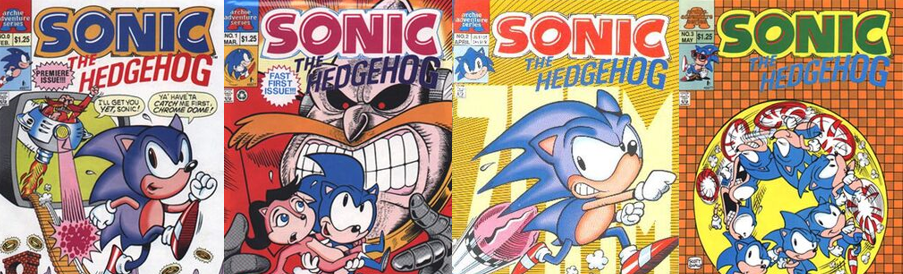
SEGA wasted little time capitalising on Sonic’s massive popularity once he became a mainstream success and single-handedly caused them to usurp Nintendo’s position at the top of the videogame industry. Following in the footsteps of Nintendo’s success with DiC, SEGA’s mascot soon debuted on the small screen with two concurrent cartoons, the most popular of which was the simply-titled Sonic the Hedgehog (1993 to 1994), also known as “SatAM”. SatAM recast Sonic as the point man for the Knothole Freedom Fighters, a team based on his Animal Friends from the source material, and Doctor Robotnik as a terrifying, semi-cybernetic dictator. SatAM’s darker tone clashed with the slapstick approach of its sister-series, but Archie Comics awkwardly mashed both together for this four-part miniseries, the genesis of what would become the longest-running comic series based on a videogame. In the years since, Archie Comics would expand on their convoluted lore, shoe-horning in more and more videogame characters, until a ridiculous lawsuit spelled the beginning of the end for the comics, with the license then taken up by IDW and an all-new, game-adjacent continuity.

The Review:
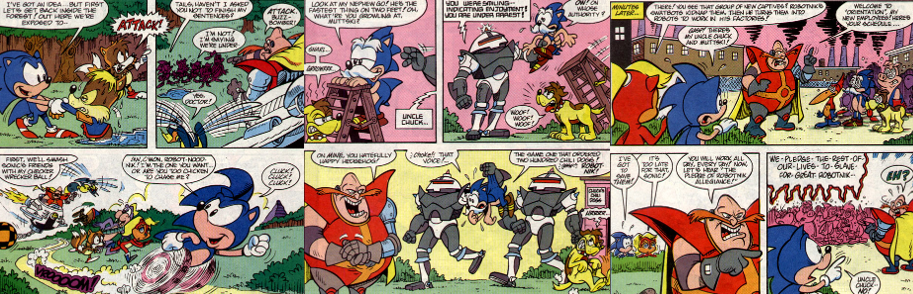
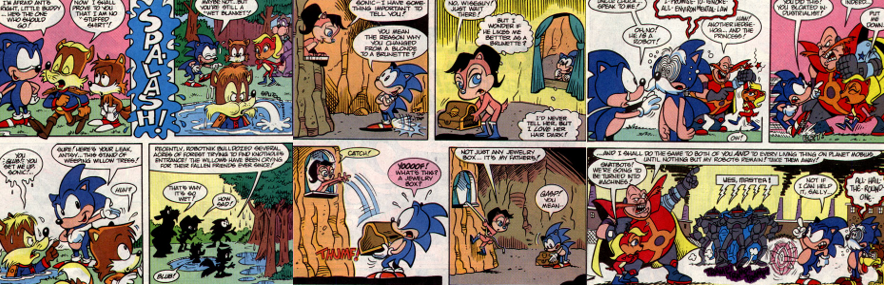
When I was a kid growing up in the UK, Archie’s Sonic the Hedgehog comics were a complete oddity. I never even heard of them until I picked up a trade paperback collection of this original miniseries. Though they offered little in the way of a resolution to SatAM’s unresolved cliff-hanger, they were the closest thing to an official follow-up. While they had many flaws and became ridiculously convoluted, things started relatively simply with this oddball miniseries, which has the overall look and cast of SatAM but strangely incorporates some elements (particularly the cartoonish slapstick) of Adventures of Sonic the Hedgehog (1993). Sonic, Miles “Tails” Prower, Princess Sally Acorn, and their colourful friends and enemies live on Mobius, a world whose natural beauty has been tainted and corrupted by the maniacal Dr. Robotnik. “Don’t Cry for Me, Mobius!” begins with the mad doctor chasing Sonic throughout the countryside and trying to splatter him with his super sticky “mega-muck”. While Sonic easily outruns Dr. Robotnik’s Egg-O-Matic, he appears to be trapped by, of all things, a simple Caterkiller. This is a ruse to lure Dr. Robotnik closer as Sonic avoids a splatter of mega-muck, destroying the Caterkiller and leaving Dr. Robotnik covered in his own goop. Sonic then breaks the fourth wall and invites the reader to follow him to Knothole Village, the hidden refuge of the Freedom Fighters, where he meets with Tails (Sonic’s biggest fan and budding sidekick), Boomer the Walrus (the mechanic and tech support who wasn’t quite yet known as Rotor), and Princess Sally (the team’s leader who sports a decidedly different colour scheme and is exasperated by Sonic’s brazen attitude). Sonic and Sally’s awkward mutual attraction is interrupted by fusspot Antoine D’Coolette, who alerts them to a leak that could potentially reveal their location.

Sonic and his friends gleefully fight to free Mobius from Dr. Robotnik’s mad tyranny.

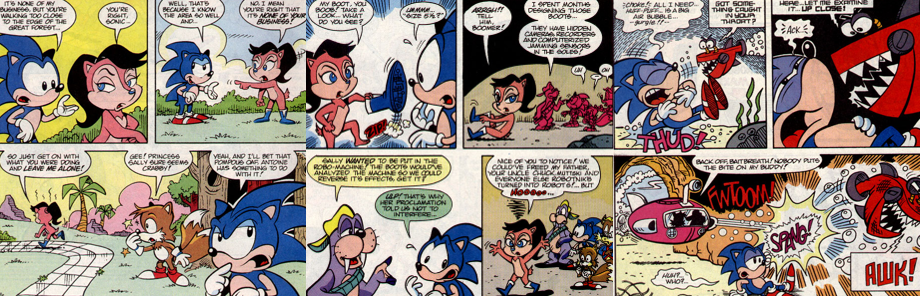
The Freedom Fighters head topside to investigate, exposing themselves to Dr. Robotnik’s spy satellites, and discover the cause is a growth of literal weeping willows driven to tears by Dr. Robotnik’s destructive actions. Eager to crush his hated enemy, Dr. Robotnik leaps into his wrecking ball machine and attacks alongside his Buzzbomber. Sonic leads them to a nearby well but briefly panics when he can’t immediately grab a power boost from the Power Rings within. Once he grabs one, he uses its strange magical powers to flip Dr. Robotnik’s wrecking ball, smashing his ship and forcing him to flee back to Robotropolis, his heavily industrial cityscape. We then get our first taste of how things got to be this way in “Oh No–Robo! No-Mo’ Mobo!”, a flashback story which shows that Sonic was once the delivery boy for his Uncle Chuck’s chili dog stand. The two literally jump for joy when a call comes in for two hundred chili dogs and Sonic gleefully speeds away to deliver the order, leaving Chuck and their beloved pet, Muttski, to be apprehended by Dr. Robotnik and his SWATbots, who’ve covertly conquered the land without the hedgehogs realising it. Sonic’s delivery brings him to Robotropolis and sees him almost crushed by a wrecking ball courtesy of Cluck, Dr. Robotnik’s robotic bird. Realising he’s been duped, Sonic races back to his family and finds SWATbots destroying the chili dog stand. After trashing the robots, Sonic heads back to Robotropolis to save his family and bumps into Princess Sally, an idealistic squirrel girl who’s also trying to rescue her family. Thanks to Sally’s insight, Sonic soon finds Uncle Chuck and Muttski but is dismayed to see they’ve been turned into robots (strangely drawn as though they’re merely hypnotised) and forced to work as Dr. Robotnik’s slaves. When Sonic angrily confronts Dr. Robotnik and futily tries to reason with his uncle, he’s attacked by more SWATbots and forced to flee with Sally to the “Great Forrest” and readily accepts her offer to join her band of rebels.

Sally’s secretive nature and Sonic’s reckless attitude lead our heroes into some slapstick peril.

“Run, Sally, Run!” sees Sonic perturbed when he passes by Princess Sally as she’s wandering dangerously close to the edge of the forest and is angrily told to stay out of her business. Believing Antoine is behind her foul mood, Sonic races to Knothole and discovers that Sally has arranged to meet with Dr. Robotnik to negotiate the return of her father, King Maximillian Acorn, and that no one is to interfere. Naturally, Sonic (joined by Antoine and Tails) races to intervene but Sally chastises them and demands that they not follow her. Though they again plan to disregard this, the three are suddenly trapped within a cage and, while Sally is confident that the meeting is legitimate, she’s aghast when Buzzbomber drops her right in Dr. Robotnik’s lap and she’s hauled away to the “Robo-Machine”. Naturally, Sonic burrows out and into Dr. Robotnik’s lair, rescuing her, smashing the Robo-Machine, and dashing Sally back to Knothole. Unfortunately, Sally’s unimpressed by the “mucho-macho-squad”, whose reckless actions meant she couldn’t use Boomer’s special boots to analyse and reverse the Robo-Machine’s effects, leaving Sally enraged and Sonic embarrassed all because she couldn’t just explain the situation to them. Whilst relaxing with a spot of fishing in “Something Fishy”, Sonic accidentally hooks a Jaws Badnik and narrowly avoids being chomped to pieces like the dock he’s standing on. Diving into the lake (with no fear of the water), Sonic discovers not just Dr. Robotnik’s polluting pipes but also his waterproof robot maker. Though Sonic avoids being fed into the machine, he almost drowns and is only saved by the timely intervention of Boomer and Tails, who arrive in Boomer’s bathysphere craft. While the damaged Jaws limps off to report to its master, Sonic smashes the robot maker and returns to dry land with his friends, his appetite for seafood now lost.

Sonic journeys across land, air, and sea to recover the magical Freedom Emeralds.

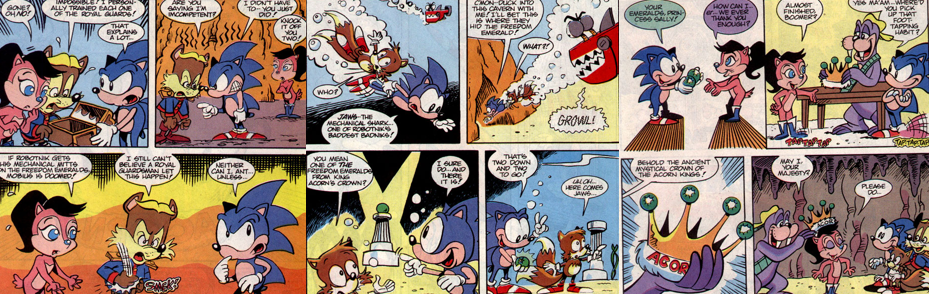
By “A Crowning Achievement”, Sally has switched to a brunette (a look Sonic secretly likes and which Sally secretly hopes he likes) and presents Sonic with her father’s jewellery box, which contains the legendary “Freedom Emeralds”. Despite their name, the jewels are actually pearl-like spheres set onto an elaborate crown, King Acorn’s family heirloom that Sally hopes will bestow her with magical powers. In preparation for her coronation, Sally has Antoine and his Royal Guard guard the box, but they’re all stunned to find it empty and the crown missing. After almost coming to blows over the incident, Sonic and Antoine suspect one of the guardsmen to be a robot spy. Using his super speed, Sonic sets off the sprinkler system and exposes the spy, who reveals he delivered the crown (and Knothole’s location) to his master before promptly self-destructing. Thanks to Sonic’s “Warp Sonic Speed”, Knothole (and our heroic hedgehog) are spared a gruesome fate, and Sally orders him and Antoine to retrieve the crown. Begrudgingly, the two pursue Dr. Robotnik’s blimp using a hot air balloon. Though Antoine’s forced to bail when they’re attacked by Bat Brains, Sonic bounces across the Badniks and pops the blimp with his patented Sonic Spin Attack, retrieving a Freedom Emerald in the process. Learning from a busted SWATbot that Dr. Robotnik plans to hide the Freedom Emeralds across Mobius, Sonic races underwater (with Tails accidentally in tow) and finds another Freedom Emerald at the same cavern from “Something Fishy”, easily defeating Jaws once more. While Sonic easily snags a third gem from a passing SWATbot, he’s dropped into a confrontation with Burrobot. Despite the robot’s terrifying burrowing power, it’s still no match for Sonic’s speed and is relieved of its Freedom Emeralds. Trapped in an underground maze, Sonic runs himself to exhaustion searching for the exit before having the genius idea to burrow upwards. Naturally, he conveniently pops out in Boomer’s workshop, finally restoring the crown and bolstering the Freedom Fighters’ morale, though Dr. Robotnik, angered at being absent for the story, vows to have his revenge.

After a weird dream, Sonic infiltrates Dr. Robotnik’s lair with a flimsy robot disguise.

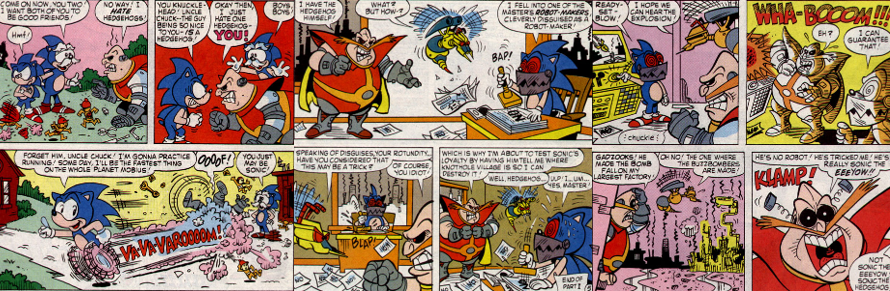
“Sonic Flashback!” sees Sonic forced off a cliff by a two-pronged attack of Crabmeats and the tried-and-tested wrecking ball. Knocked loopy, Sonic has a weird dream where he and Dr. Robotnik grew up together, revealing that Uncle Chuck created the magical rings to boost Sonic’s speed. Chuck despairs of his nephew’s disdain for “Little Robotnik”, an orphan boy who tinkers with mechanical toys and aspires to take over Chuck’s farm. Unwilling to entertain “Robbie’s” attitude, Sonic speeds off and Chuck ends up crashing his tractor into the barnyard (and Robbie) thanks to Robbie sabotaging the vehicle to make his toys. Boosted by the magical ring, Sonic gets them to a hospital in record time but Robbie, incensed at Chuck’s reckless driving, builds an even bigger robot out of Chuck’s appliances and attacks the hedgehogs. Luckily, Sonic easily rescues his uncle and reduces the robot to scrap with a hose pipe, then he wakes up and gets back to fighting Dr. Robotnik for real. In “Why Ask Spy?”, Princess Sally has Sonic slap on a mechanical jaw and some scary contact lenses to masquerade as a robot. After convincing Tails that Sonic is a threat, Sonic successfully infiltrates Dr. Robotnik’s lair, convincing the dictator that he stumbled into one of his devious traps and was transformed into a mindless slave. Disregarding Buzzbomber’s concerns, the gleeful doctor orders Sonic to lead him to Knothole and is thankfully saved from betraying his friends when he instead volunteers to investigate a disturbance at the Crab Factory. There, Sonic reconvenes with Sally and Antoine and also discovers Uncle Chuck diligently assembling Crabmeats. After a run-in with the robotic Muttski fires Sonic up, he gets a measure of payback by tricking Dr. Robotnik with his disguise once more and dropping a bomb on the Buzzbomber factory to deliver a significant blow to the dictator’s operation. Interestingly, Sonic justifies this by saying he doesn’t want to bomb his uncle’s factory and possibly kill him but seems to have no consideration for the slaves working in the other factory.

The Summary:
Issues 0 to 3 of this miniseries also devote a few pages to some shorter stories, pin-ups, and gags to bolster the narrative. Issue 0 sees Princess Sally lament to loss of her literal family tree, gives a rundown of Sonic’s different levels of speed (categorising three as “Ultra-Sonic”, “Super-Sonic”, and “Hyper-Sonic”, with no relation to Sonic’s similarly named forms), introduces readers to Dr. Robotnik’s other Badnik minions, and gives a quick explanation of Sonic’s iconic sneakers (which were created for him by Uncle Chuck in this continuity). Issue 1 showcases Sonic’s speed by having him blow Boomer’s mind with a game of baseball, play tennis with himself, and go through his family album (with him being too fast for the camera each time), offers a two-page pin-up of the heroes and villains, and sees Boomer give examples of slower creatures to have a pop at politicians. Issue 2 sees the writers poke fun at other comics by offering ten reasons why readers should pick Sonic the Hedgehog over the likes of DC and Marvel (ironically, guest stars, fancy covers, a motion picture, and character deaths would all come to pass). It also includes two one-page stories, one detailing the versatility of his spines and one demonstrating that Sonic’s faster than the speed of sound (something amusingly noted in issue 0 where the editor points out that the “Zoom” sound effect will arrive “later this week”). Gags and skits such as these tie into the miniseries’ slapstick nature; signs, sight gags, and puns are plentiful in these four issues, placing Sonic the Hedgehog firmly as a book for little kids. There are some more mature themes behind all the cartoonish action, such as a strong anti-pollution message, negative portrayals of bullying and xenophobia, and a strong sense of justice, but it’s all very light-hearted and carefree, with the characters rarely in peril since Sonic can just magically solve every issue with his Spin Attack, magic ring, or by easily fooling his enemies.

Although the miniseries echoes SatAM, its characterisations are all over the place.

Fans of SatAM will probably be disappointed to find that the miniseries merely takes visual cues from that series. We have the same cast of characters in similar situations, but it’s far goofier than in SatAM. The tone is far closer to Adventures of Sonic the Hedgehog, with Dr. Robotnik more a bumbling blowhard than a menacing tyrant, his minions being snarky and foolish robots easily fooled by drawings, and Sonic performing nonsensical feats like magically turning Dr. Robotnik’s machine against him or setting off sprinklers by literally burning rubber. Sonic’s characterisation is a weird mish-mash of Adventures and SatAM, showcasing his arrogance and smart mouth but also seeing him be awkward around Sally, whom he has an obvious crush on. Sally is far more annoying here than in SatAM, barking orders and deliberately misleading her allies only to berate them for acting in her best interests. She’s a strong-willed leader who isn’t afraid to join the fight and is far from a damsel in distress, but her polarising personality make her more of a hinderance than an asset. Boomer and Antoine aren’t featured much, but we do see that Sonic respects Boomer and detests Antoine, seeing him as a “sap” who lacks the fortitude and ability to fight Dr. Robotnik. Tails is very much like his Adventures counterpart, depicted as Sonic’s biggest fan and excitedly following him into danger, but, like in SatAM, Sonic isn’t handcuffed to him and Tails is depicted more like the team’s mascot than a capable Freedom Fighter. Characters like Snively and Bunnie Rabbot are strangely absent, meaning Dr. Robotnik is more reliant upon his blundering SWATbots and Badniks. Like in Adventures, the game-accurate Badniks are given bizarre personalities and depicted as fiercely loyal, but ultimately stupid minions who may briefly get the upper hand against Sonic but are always sent packing by the story’s end.

What few recognisable elements there are are lost beneath a strange interpretation of the concept.

Interestingly, the miniseries attempts to delve into the backstory of Mobius and what life was like before Dr. Robotnik took over. It’s obviously very different from what SatAM and later comics would depict and is thus very rushed and disappointing. It’s fun seeing Sonic interact with Uncle Chuck and Muttski, but Dr. Robotnik’s takeover is completely glossed over and Sonic’s past with Sally is reduced to simply bumping into each other while searching for their families. Most egregiously, the miniseries takes a literal, outdated definition of the term “robot” and depicts Dr. Robotnik’s slaves more like hypnotised slaves than mechanical automatons. Despite being bolstered by clearly robotic SWATbots and Badniks, the Mobians Dr. Robotnik enslaves have no robotic appendages (except, bizarrely, for Muttski) and the roboticization process is as far removed from SatAM as everything else beyond a surface level similarity. The miniseries also ham-fistedly includes game-accurate elements, such as Dr. Robotnik’s wrecking machine and his Badniks, though the writers seem to have no idea how the Golden Rings (or SatAM’s Power Rings) work. It’s as though the writers were shown the pilot episodes of Adventures and SatAM and given a brief description and some visual cues of the games, then told to just do whatever they like. Consequently, while the miniseries is fun at times and probably very appealing to younger readers, it doesn’t exactly capture the spirit of either cartoon or the source material. Instead, it’s a weird amalgamation of different elements and half-baked interpretations of already drastically different adaptations. While the artwork is serviceable, mirroring early episodes of SatAM, it’s not enough to bolster the appeal of this miniseries. It’s amazing to me how complicated and dramatic Archie’s Sonic comics became in the years following this publication; compare these issues with ones from just a few years later and it’s like night and day! Ultimately, it’s fun to revisit these early days but I think Archie’s Sonic comics benefitted by abandoning their ties to the 90’s cartoons and creating their own narrative, making these a fun, if childish, curio more than anything.

My Rating:

Rating: 2 out of 5.

Could Be Better

Have you ever read the original Archie Sonic the Hedgehog miniseries? What did you think the way it mashed together elements from the cartoons and videogames? Were you disappointed that it took a more slapstick approach or did you enjoy these early issues as a kid? Which of Archie’s original characters was your favourite and what did you think to their award-winning run? How are you celebrating Sonic the Hedgehog this year? Whatever your thoughts on Archie’s Sonic comics, or Sonic in general, feel free to leave a comment below.

Game Corner: Jurassic Park 2: The Chaos Continues (Xbox Series X)

Released: 22 November 2023
Originally Released: November 1994 (SNES), February 1995 (Game Boy)
Developer: Carbon Engine
Original Developers Ocean Software
Also Available For: Game Boy, Nintendo Switch, PlayStation 4, PlayStation 5, Super Nintendo Entertainment System (SNES), Xbox One, Xbox Series S

The Plot:
When BioSyn (or a power outage) cause trouble on Isla Nubar, the island site of Jurassic Park, palaeontologist Doctor Alan Grant either goes it alone or teams up with tactical sergeant Michael Wolfskin to subdue the genetically engineered dinosaurs and escape alive.

The Background:
Michael Crichton’s bestselling 1993 cautionary tale about a chaotic dinosaur theme became a blockbuster critical and commercial hit that spearheaded many now-standard CGI techniques. Alongside an aggressive merchandising campaign, Jurassic Park (Spielberg, 1993) was accompanied by toys, comics, and multiple videogame adaptations released on different consoles. While BlueSky Software developed the Mega Drive adaptations, Ocean Software handled Nintendo’s efforts after securing the license for an undisclosed six-figure sum. Their three releases received widespread praise and, while readers and audiences had to wait two years for Crichton and Spielberg to produce a sequel, gamers got a far faster turnaround when Ocean produced a standalone sequel just one year later. The Game Boy and SNES titles had slightly different stories and mechanics, and both received mixed reviews. While the SNES obviously had better graphics and sound, the simplicity of the Game Boy version was praised, especially compared to the high difficulty and awkward controls of the SNES version. Both games were basically lost media for decades until they were included in a modern re-release to celebrate the movie’s 30th anniversary, alongside modern quality of life features, to largely thankful and positive reviews.

Gameplay and Power-Ups:
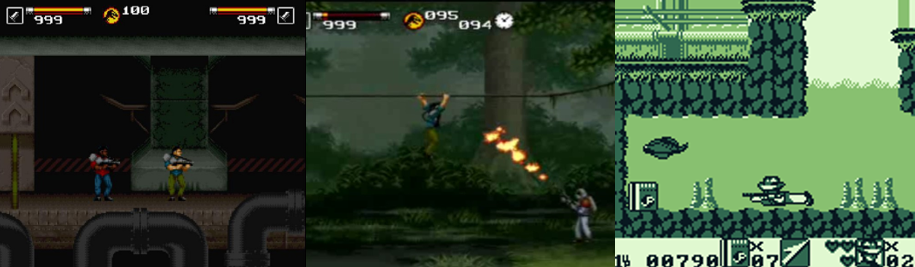
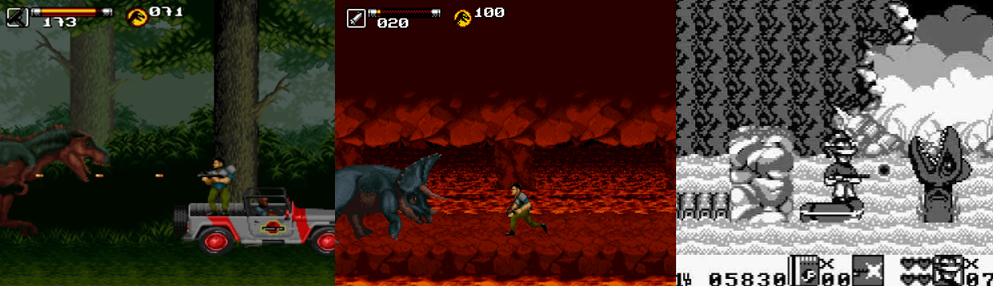
Jurassic Park 2: The Chaos Continues is a sidescrolling shoot-‘em-up that acts as a non-canon continuation of the original movie and its videogame adaptations. While the SNES version is more obviously framed as a return to Isla Nubar thanks to the presence of Biosyn, both can be seen as re-dos of the movie and its videogames since they don’t stray too far from the gameplay mechanics previously seen. While only the SNES version offers different difficulty modes, both see you jumping with A (defying gravity with a higher jump the longer you press the button in the Game Boy version) and shooting with X. Y and B also shoot in the Game Boy version and both versions allow you to rapid fire by holding the button, though this will charge your cattle prod in the SNES version and deplete most of your ammo here, too, save for your weakest lethal weapon and cattle prod. In the Game Boy version, you can switch to grenades by pressing the ‘View’ button; you can’t move and throw them but you have an unlimited supply. You switch weapons with the Left and Right Bumpers in the SNES version, LB cycles through lethal ammo types (such as a machine gun and shotgun spread) while RB cycles through non-lethal options, like tranquilizer darts. All enemies disappear regardless of which ammo you use but there’s a counter that ticks down when you kill any dinosaur that’s not a Velociraptor or what could loosely be described as a boss. Kill too many dinosaurs and your game ends, so be sure to cycle back and forth between lethal and non-lethal options. This crutch isn’t present in the Game Boy version; it’s an all-out platform shooter as Dr. Grant blasts dinosaurs with his unlimited shotgun! Both games also allow you to crouch and shoot, shoot while jumping, and shoot upwards and diagonally, though you must collect ammo in the SNES version by pressing down on the ammo item. This is also how you’ll collect the rare first-aid kits lying about Isla Nublar. These, and the odd 1-up, are automatically collected in the Game Boy version, which also incorporates a scoring system, though only the SNES version allows for a two-player co-op mode.

Blast your way past dinosaurs, grabbing vines, racing a timer, and collecting key cards to progress.

While the Game Boy version uses a lives system, you only get one shot to beat the SNES version. If you’re killed, you restart the mission from the beginning, with no checkpoints or continues or passwords to help. Although the Game Boy version follows a linear narrative, tasking players with guiding Dr. Grant through four stages (called “Zones”) with two levels and a boss battle each, the SNES version lets you freely pick a mission. Each mission has two screens of action and ends in an “Emergency” mission, where you must run around the maze-like environment disarming bombs, tracking down a spy, powering up a generator, and similar tasks against a very tight time limit. The labyrinthine nature of the levels doesn’t help with this. You’ll climb up ladders and jump between them, desperately pressing up and down (when you can even see the arrows!) to enter doors or change screens, with no idea of where you’re going or where you’ve been. These timed missions were some of the worst parts of the SNES version as the enemies respawn when you switch screens and the human enemies can be particularly aggravating, meaning it’s very easy to get lost and then be pummelled to death by grenades. While some of the Game Boy version’s Zones have multiple paths, reached by either hopping up branches or platforms or taking moving platforms, the levels are understandably much smaller and far more linear. Sometimes, you’ll venture underwater, tapping A to swim and attacking prehistoric fish with your harpoon; others, you’ll jump between conveyor belts or over spiked pits. Thankfully, these and other pits aren’t typically insta-death hazards in either version, though your character takes fall damage in 16-bit and must deal with a rather large hit box in monochrome. While you use overhead vines and poles to cross gaps in the SNES version, you can’t move and shoot when up there. Conversely, the Game Boy version requires you to search for a set number of JP Magnetic Cards. The exit will only open when you find them all, as indicated on the heads-up display, so you may need to backtrack to find them. Most of them are just out in the open; others fall from the sky. Zone 3-2 has you searching for 54 cards, but they’re helpfully collected in groups so it’s not as intimidating as it first seems.

Don’t be fooled by the decent visuals: both games are tough and aggravating in different ways.

Stage hazards are also a concern in both versions. Flame bursts, loose electrical wires, steam vents, miniature exploding volcanoes, and falling boulders can sap your health if you’re not careful. Platforming is more of a priority in the Game Boy version and much simpler thanks to the chunky sprites and Dr. Grant’s floaty jump. On the SNES, it’s easy to fall through the environment, miss ladders, and drop into lava thanks to the annoying enemy hoards. You must navigate a volcanic maze to place a bomb then out-run the explosion, locate a wounded ally, shoot switches, and defend Gallimimus in the SNES version. When faced with a time limit, you’re better off eschewing non-lethal ammo and avoiding enemies wherever possible, especially if you’re not consulting a guide to navigate the looping mazes. The Game Boy version offers two bonus areas where you’re pursued by a Tyrannosaurs rex. It’s instant death if the T. rex touches you, so you must waddle away from her, hopping to platforms and structures and collecting the JP Magnetic Cards for an extra life. You’ll also be back on the rapids in the Game Boy version, where the water instantly kills you if you fall while jumping to wooden bridges but is no concern when you’re on a raft and blasting prehistoric fish. While you do race away from a T. rex at one point in the SNES version and the game also culminates in a vehicle section, this latter mechanic only appears if you’re playing on “Medium” or higher. This means that you’re stuck in a continuous loop of run-and-gun action and frantic races against the clock, desperately hoping the poisonous gas doesn’t sap your remaining health or you don’t miss any power supplies. At one point, you’re destroying giant fans to avoid being skewered; in another mission, you’re scaling a cliffside to repair an antenna. Other times, the ground crumbles beneath your feet, mines explode when you least expect it, or you must destroy boulders to progress, all while frantically hoping you haven’t doubled-back on yourself!

Presentation:
It’ll be no secret that the SNES version wins in this regard. However, the Game Boy version is pretty impressive considering the hardware, especially compared to the previous Jurassic Park game on the system. It begins with a nice pixel-art recreation of the big gates, the first Zone features Dr. Grant’s vehicle in the background, and there’s some decent sprite art introducing each Zone. Dr. Grant is a big, surprisingly animated sprite. While this means he has a large hit box, I enjoyed seeing him pump his shotgun with every shot and look around warily when left idle. Sadly, only the bosses match Dr. Grant’s quality in the Game Boy version, with regular enemies appearing disappointingly gaunt and basic. While the Game Boy version’s backgrounds and environments are obviously much more basic, they do a decent job of recreating the visuals from the film. I recognised the electrical fences, towers, and dinosaur paddocks and it was at least easy to see where I was and what I was doing. The SNES version nicely trumps the Mega Drive’s two sidescrolling run-and-gun efforts, featuring dense jungles, a touch of parallax scrolling in the valley, and more appealing sprite work. While the art direction does make Dr. Grant completely unrecognisable and I’m not sure what the purpose of mapping a dramatic pose to the Y button was, he has a lot of fun animations, particularly when climbing ladders or crossing vines. The dinosaurs also fare a lot better, making it even more of a shame that there isn’t a large variety of them and we simply get palette swaps of ‘raptors for the most part. While neither game uses the iconic Jurassic Park score, the Game Boy version includes some awesome arcade-style music and the SNES incorporates the dinosaur’s roars and noises from the movie. The bigger ones, like the T. rex and Triceratops, are also beautifully detailed (if off colour). The Game Boy version does okay when bringing to life larger dinosaurs for its boss battles, but its T. rex is incredibly ugly and its ‘raptors are strangely stretched.

While the SNES’s visuals are impressive, the Game Boy does pretty well despite its limitations.

While larger dinosaurs simply blink out of existence or explode in the SNES version, they feature defeated poses in the Game Boy version, which is a fun touch, alongside a health bar so you can actually tell that you’re hitting them, which is a real issue on the SNES. Unfortunately, both games suffer when it comes to their environments. Sticking very close to the same ideas as the previous 8- and 16-bit games, both versions see you exploring the jungle (with various parts of the park, such as the gigantic electric fences, in the background), caves, a valley, and various InGen facilities. These are painfully generic in both games but even more so in the Game Boy version, where the hardware can’t do much beyond render some giant trees. There are some unique aspects to this game, such as algae-infested waters and the aforementioned rapids, but even this latter inclusion is similar to what we saw in the previous games (including hungry Brachiosaurs). While the SNES obviously benefits from greater processing power, sporting none of the admittedly rare sprite flickering seen in its handheld counterpart, it does force you to venture through the same jungle environment again and again. The interior locations are also recycled far too often, becoming indistinguishable from each other no matter how many pipes and vats and generators the developers sneak in. I like the incubators and Jurassic Park signage seen in the backgrounds, and that we get to revisit the Gallimimus valley. However, this is a strictly on-foot section and lacks the fast-paced action of the same area in Jurassic Park: Rampage Edition (BlueSky Software, 1994). I’m not sure why every Jurassic Park game has to feature a volcano, but this might be the worse one yet. The lava seems very disconnected, and it lacks the detail of the misty jungle. The cliffsides were okay, especially when they sported snow and you could see into the horizon, but they were very samey, just like the interiors, with little indication of where you need to go. The SNES version is bolstered by an animated introduction that also features voice acting, though this detail is strangely missing from the ending.

Enemies and Bosses:
As I mentioned above, neither version of Jurassic Park 2 impresses with its dinosaur selection. Dilophosaurus returns as a common enemy, standing stationary and spitting in all directions, while giant wasps, Pterodactylus, Dimorphodon, and Pteranodon fill the skies across each game. The Pteranodons are particularly aggravating on the SNES, endlessly spawning around the cliffsides, while their larger mothers simply flap around near their nests posing little threat. While you can take out the Gallimimus on the SNES, you’re meant to avoid them and off BioSyn’s soldiers to save the creatures. While Compsognathus are a constant headache on the SNES, you’ll find weird-looking Archaeopteryx, Hypsilophodon, and Parasaurolophus on the Game Boy, with the former jumping at you for extra annoyance. The underwater sections see you blasting prehistoric fish, trilobites, and anemone while baby Triceratops occasionally appear on land. On the SNES, you’re primarily faced with Velociraptors and Oviraptors, which leap at you and often attack in groups. Coming in different colours and proving quite durable, the ‘raptors fiercely defend their nest, but I found it best to jump over them and keep the fire button held down. The SNES version features exclusive human enemies to contend with. Not only will workers toss wrenches at you, scientists whip out pistols, and suited BioSyn executives dog your progress, their soldiers will be a greater threat than the dinosaurs most times. While the basic grunts just run about or stand in place, others can shoot in all directions or toss grenades, which are a bitch to avoid! Their bazooka soldiers are easily dispatched by crouching and shooting, a tactic that will serve you well against their flamethrower units. However, these bastards have a long reach and can roast you when you’re on ladders or hanging from pipes, meaning it’s always a pain in the ass when humans show up.

Sadly, the SNES version favours human boss battles over dinosaur threats.

While BioSyn’s armoured troops only pack a pistol, they can move, fire in all directions, and crouch and shoot, which can be annoying. You’ll also have to battle a larger enemy commander twice; this muscle-bound boss packs a flamethrower/machine gun combo and tanks even your best shots. Your best bet is to lure him in, blast him with your strongest shots, and back away, chasing him when he retreats. BioSyn’s attack chopper carpet bombs the Gallimimus valley, eventually swinging a dinosaur cage at you and peppering the screen with bullets and bombs. If you’re playing on “Medium” or higher, you’ll attack BioSyn’s bomber from an Ingen helicopter, firing in different directions with the face buttons and targeting the plane’s mini gun and launchers. True to its name, the bomber drops bombs but also fires homing shots, two projectiles that are extremely hard to avoid since your chopper is such a large, unwieldy target. The SNES version mainly throws bigger or more aggressive regular dinosaurs at you as pseudo-bosses, such as the Triceratops that guards the final explosive and must be lured in to charge and fend off, preferably with your shotgun. The T. rex chases you at one point, with you only able to force her back with your shots and jump to safety at the end. If you play on at least “Medium”, you’ll battle the T. rex in a fight to the death. Though big and slow and limited to a simple bite, it takes a shit load of your strongest shots to put her down. She chases you to a precipice, which will sap your health if you drop, and you’re also battling a tight timer. You must switch to your strongest shot and target her head, either by jumping or shooting diagonally, forcing her back to create space and jumping away to avoid being eaten. Since the T. rex doesn’t register damage, you’ll only know you’ve won when she explodes (naturally), which took me a fair few tries.

The Game Boy version’s bosses may be simple, but they’re big and at least they’re there!

The Game Boy version features far more traditional boss battles, with you battling a larger dinosaur at the end of each Zone. The first boss you face is a mummy Triceratops that stomps back and forth across the screen. You must dive into one of the nearby holes, duck down, and toss grenades at her. When the platform in the hole rises, you must dash to the other one to continue the assault, easily avoiding damage for the most part if you keep your head down. The Pteranodon is a bit more of a threat. This giant, bat-like dinosaur swoops down from either side of the top of the screen, dropping a boulder that’s a pain to avoid unless you race to the opposite side of the screen. Her smaller minions will attack after, though they’re easily taken out as you’ve been blasting them since Zone 1-1. The Game Boy version does offer one unique boss battle, one that takes place underwater and sees you attacked by a “Cephalosaure”. This giant, spike-headed squid darts in like an arrow from each corner of the screen, proving a large target that can be difficult to avoid because of the awkward swimming controls. Smaller, snail-like enemies will swim down after each pass but this is quite easy to hit, especially if you stay away from the centre of the screen. Oddly, the Velociraptor is fought between Zone 4-1 and 4-2, charging, hopping, or prancing in from either side of the screen. You can use the small block platforms to jump over them and they’ll try and bite you up close, but they’re not too difficult to avoid. On two occasions, you’ll be pursued by the T. rex, which cannot be killed and will instantly kill you if you so much as graze her. You must run from her, hopping between wooden scaffolding and taking out Compys, but you get to face her one-on-one in a painfully bland final battle. The T. rex stomps back and forth, occasionally charging, and takes a bite out of you up close. Dimorphodon come in to distract you, but this is actually your opening to pummel away at the T. rex’s head until she collapses in defeat.

Additional Features:
While the Game Boy version is the only one with a score system and final score, there is no high score table and the SNES version is the only one with a two-player mode and different difficulty options. Both games end with lacklustre congratulatory text, but you’ll only battle the T. rex and BioSyn’s bomber by playing the SNES version of at least “Medium”. The Jurassic Park: Classic Game Collection includes fun extras like each game’s soundtrack, different filters and borders, and the life-saving rewind and save state feature that greatly eases the pain of the SNES version’s difficulty. This version of the collection also has fourteen Achievements for you to earn, with two earned for these games, specifically. You’ll get an Achievement for beating the SNES version on any difficulty, and another for being it on “Hard”, so I advise just playing on “Hard” to snag them both. You got one Achievement on the Game Boy version for defeating the Velociraptors and another for clearing the game, which is a touch disappointing as there’s no incentive to shoot every enemy or play with a friend.

The Summary:
I was optimistic about Jurassic Park 2: The Chaos Continues, especially the SNES version, as it was developed after five other videogame adaptations of the movie so surely the developers would’ve learned a few things about what works and what doesn’t. Technically, that is true as the game focuses much more on run-and-gun action, allowing you to blast dinosaurs and humans to your heart’s content while also encouraging you to merely stun most dinosaurs to maintain some semblance of preservation for the resurrected creatures. Visually, the game may be the best looking of the 16-bit Jurassic Park titles, but for some of the lacklustre backgrounds and the lack of originality in the locations. The gameplay loop does get frustrating very quickly, however. Even before mentioning the aggravating timed sections, including looping doors and paths without a map or any clear indication of where you need to go was a baffling and frustrating decision. Combined with the timed sections and you only getting one chance to beat the mission, this makes for a shameless handicap to force kids obsessed with the blockbuster movie to rent the game again and again. While the Game Boy version is more basic, smaller, and very less visually impressive, the music is fantastic and the simpler shoot-’em-up gameplay was far more appealing. I quite enjoyed searching for the JP Magnetic Cards and blasting the butt-ugly dinosaurs, though the hit boxes and mediocre levels did let it down, especially as the sprite work on the boss was pretty impressive. While there is a lot to like in each game, and some technical improvements that make them better than their predecessors, I think Jurassic Park 2 still misses the mark no matter which version you play. Neither offer anything new, especially compared to their predecessors or other similar games, and again just make me wish we’d had one ultimate 16-bit Jurassic Park release that had combined all the best elements from each game instead of leaving us with average tie-in games where we have to cherry pick the best parts.

Game Boy Rating:

Rating: 2 out of 5.

Could Be Better

SNES Rating:

Rating: 3 out of 5.

Pretty Good

What did you think to the Nintendo-exclusive Jurassic Park sequels? How do you think they compare to each other, and the previous Jurassic Park titles? Which of the two was your favourite and were you glad that they were ported to modern consoles? Were you also annoyed by the SNES version’s maze-like environments and the large hit boxes in the Game Boy version? What did you think to the Game Boy version’s bosses and the timed missions of the SNES version? Which Jurassic-inspired videogame is your favourite? How are you celebrating Dinosaur Day this year? Whatever your thoughts on these Jurassic Park videogame sequels, or dinosaurs in general, leave them below, support me on Ko-Fi, and check out my other dinosaur content!

Game Corner: Jurassic Park / Jurassic Park: Rampage Edition (Xbox Series X)

Released: 22 November 2023
Originally Released: 10 August 1993 (Jurassic Park), 28 September 1994 (Rampage Edition)
Developer: Carbon Engine
Original Developers BlueSky Software
Also Available For: Mega Drive, Nintendo Switch, PlayStation 4, PlayStation 5, Xbox One, Xbox Series S

The Plot:
After sabotage releases the genetically engineered dinosaurs of the Jurassic Park theme park, palaeontologist Doctor Alan Grant and an opportunistic Velociraptor battle to escape the island.

The Background:
In 1993, Michael Crichton’s bestselling cautionary tale about a dinosaur theme park turned into a hazardous environment was adapted into a critical and commercial blockbuster that spearheaded many CGI techniques we still see in Hollywood. Bolstered by an aggressive merchandising campaign, Jurassic Park (Spielberg, 1993) was accompanied by numerous toys, comics, and multiple videogame adaptations released on different consoles. While Ocean Software developed games for Nintendo’s consoles, SEGA partnered with BlueSky Software for their Mega Drive adaptation, consulting palaeontologist Robert Bakker and museums to bring the dinosaurs to life. The developers used Silicon Graphics computers, stop-motion techniques, and materials used to make the film to create the sprites and environments, as well as pulling elements from Crichton’s novel for additional levels. Jurassic Park sold 250,000 copies in its first week and impressed with its visuals and gameplay. Bolstered by this success, and the strength of the film’s merchandising, SEGA commissioned a revamped version for the following year, one that received mixed reviews for, while it improved many elements, it was also seen as a bit of a rehash. Both games were essentially lost media for decades until they (and five others) were finally re-released on modern consoles to celebrate the movie’s 30th anniversary, alongside modern quality of life features, to largely thankful and positive reviews.

Gameplay and Power-Ups:
Unlike the games of the same name released for Nintendo’s hardware, the two Jurassic Park adaptations released for the Mega Drive are sidescrolling platformers almost akin to a run-and-gun. Although the Rampage Edition is technically a very different game, to me it’s more of a do-over than a sequel so I’m lumping these two together as many of the features and gameplay are the same in both. Both titles see players picking between three difficulty settings (“Easy”, “Normal”, and “Hard”) and selecting a playable character. Yes, while Nintendo’s games stuck you with Dr. Grant and his surprising arsenal of weapons, SEGA let you play as the unexpectedly athletic palaeologist or a Velociraptor. Both characters explore the same locations, though the ‘raptor has less stages in Jurassic Park and must also contend with park security trying to stop her in both games. The controls for both are the same between versions: Dr. Grant fires his current weapon with A (able to fire upwards and diagonally in both), jumps with B, and switches weapons with X. Unlike in Nintendo’s games, Dr. Grant’s weapons all consume ammunition in Jurassic Park, even his taser shot (which increases in power the longer you hold X). In the Rampage Edition, Dr. Grant has an infinite supply of weak tranquilizer darts, though these permanently put down every regular enemy. Dr. Grant can also sprint to clear gaps, clamber up ledges, climb ladders, ropes, vines, and chains, and monkey his way across overheard wires and handholds (when you can spot them). The ‘raptor is geared more towards melee and fast-paced running and controls a little differently between versions. In both, she bites with X, kicks with her taloned foot with A, leaps high with B, and dashes ahead if you hold up on the directional pad. Pressing down an X in Jurassic Park lets her eat Procompsognathus to regain health (a necessary mechanic as she’ll constantly lose health as you play), down and A launches a flying kick, and up and B sees her leap even higher! In the Rampage Edition, you still eat Compys but this doesn’t seem to restore health, holding X sees the ‘raptor continuously bite, a tail swipe had been added to her melee attack, and she performs a ludicrous spin jump by double pressing B.

Run, jump (and gun) as the strangely athletic Dr. Grant or consume everything in sight as the ‘raptor.

Both games see you start with three lives and incorporate a password system and rudimentary island map before stages to show you where you are on Isla Nubar. While you thankfully don’t need dinosaur eggs in either game, Jurassic Park closely mirrors the Nintendo titles and the movie in its locations and players collect eggs, test tubes, and other items for points in the Rampage Edition. Dr. Grant acquires similar weapons to the Nintendo titles in both games: in Jurassic Park, you mainly fire different coloured tranquilizer darts, but you can also grab gas grenades, flashbangs, concussion grenades, and rockets. It’s worth noting, however, that none of these weapons, even the rockets, kill the dinosaurs; instead, they’re rendered unconscious for a short time. This isn’t the case in the Rampage Edition, where Dr. Grant cuts down dinosaurs with a shotgun, submachine gun, grenades, a flamethrower, and a rocket launcher! Dr. Grant can also ride certain dinosaurs, such as the stampeding Gallimimus to rush through the savannah and the hulking Triceratops, normally a docile creature unless provoked, to crash through walls. The ‘raptor kicks these walls down and also opens doors, just like Dr. Grant, though she gains a special power-up in the Rampage Edition. Consume three lysine crates and the ‘raptor enters a brief “Raptor Rage”, becoming invincible and killing enemies with a touch. Like some of the Nintendo titles, Dr. Grant also uses a motorboat, a mechanic far more enjoyable in the Rampage Edition. In Jurassic Park, you collect fuel cannisters to keep the boat moving (though there’s no gauge showing your fuel level) and must either speed up or slow down to avoid being killed when going over the waterfalls. In the Rampage Edition, there’s no need for fuel and no fear of falling to your death. Similarly, the hypersensitive fall damage handicap has been removed from Dr. Grant in this game and your health is restored with each new stage.

Dr. Grant must fight dinos and gravity to survive, while the ‘raptor can go on an unstoppable tear.

While Jurassic Park is a fairly standard platformer, requiring little more of Dr. Grant than to hop to platforms, subdue dinosaurs, and avoid falling to his death or getting skewered on spikes, things get very troublesome very quickly. You’ll be moving crates to reach higher areas, climbing electrified cables, crawling through vents, and dodging falling boulders. By far the hardest thing about this game is the fall damage, which chips away at Dr. Grant’s health from small drops and even slides, and that Dr. Grant instantly dies if he falls into even shallow water. This is rectified in the Rampage Edition, though you must still avoid electrified water (hopping to crates to avoid being fried) and quickly clamber up ladders to avoid drowning when the cargo ship floods. When in Jurassic Park’s pumping station, players must press up to activate switches and open or close passages and turn valves to shut off steam, while the ‘raptor pounces between tunnels to avoid drowning. Dr. Grant must also attack swimming Brachiosaurus’ to cross gaps in Jurassic Park and watch for crumbling and temporary ground in both games, as well as contend with aggressive Pteranodon’s carrying him to their nest in the Rampage Edition. Stages like this and the Raptor Rapids are technically easier for the Velociraptor but are deceptively difficult in different ways. It’s frustratingly easy to get lost in both stages, which are a maze of foliage and rushing water, respectively. While the checkpoint signs point you in the right direction, it’s not always clear which way you need to go, especially as Dr. Grant doesn’t act as your end goal like in Jurassic Park. Similarly, the Velociraptor has less stages in Jurassic Park and traverses environments a little differently. When in the visitor’s centre, for example, the ‘raptor doesn’t need to enter the ceiling vents until later in the stage. The Rampage Edition allows players to pick which stage they wish to challenge and allows Dr. Grant to fly about on zip wires, while both characters hop to weighted and moving platforms in this version and engage in far faster, more arcade-style gameplay.

Presentation:
Both games have very similar presentation and a few things in common. Like the Nintendo games, neither uses the classic Jurassic Park theme and each stage is accompanied by generic-ass music, with the Rampage Edition leaning more towards rock and Jurassic Park featuring more recognisable dinosaur sounds. Both feature more detailed title screens, with the Rampage Edition adding more animation and background effects, and the Jurassic Park font is used for the menus and pause text. No other characters from the movie appear in either game, not even Lex and Tim Murphy, and both games utilise a combination of text and still or partially animated sprite art to advance the story between stages and relate the ending. Dr. Grant is a relatively detailed and lively sprite in both; he has an idle animation where he looks around anxiously and whips out his gun and he hops and climbs about with more vigour than Sam Neill showed in the film. Like in Nintendo’s games, all that’s left of him is his hat when he’s eaten and you see his skeleton when he’s zapped, which is a nice touch. The Velociraptor is a larger sprite, meaning she’s a much bigger target, and is suitably unwieldy despite how fast she is and the strange amount of platforming she does. She snaps and grooms herself and echoes her rivals in the way she eats her prey. I did like spotting enemy ‘raptor eating carcasses, Compys popping from eggs, and the odd blood splatter throughout the Jurassic Park facilities. Jurassic Park closely replicates locations from the films and follows a similar stage pattern to the Nintendo games, taking players through the park, a river, a volcanic region, and ending up at the visitor’s centre. Unfortunately, Jurassic Park’s graphics are really unsightly a lot of the time and the game performs poorly when there’s a lot onscreen, leading to annoying slowdown and garish visuals as the oddly prerendered backgrounds glare at you.

While Jurassic Park has more recognisable locations, the Rampage Edition looks and plays better.

The Rampage Edition corrects this, featuring far more detailed and lively backgrounds. Sure, we see a volcano erupting in Jurassic Park and some rudimentary smoke effects, but the Rampage Edition has far more depth and detail to its backgrounds. The sprites, which have been slightly redesigned, also stand out a lot better thanks to a black outline, though this effect also made them appear more amateurish to me. Stages are much longer in the Rampage Edition and often feature a maze-like structure, especially for the Velociraptor, and destructible elements, such as walls, pipes, and floors. You don’t get to revisit the visitor’s centre or any of the bunkers in the Rampage Edition, but there is a long stage dedicated to the cargo ship, which features a rudimentary rain and lightning effect on deck and far better water effects than in Jurassic Park. While I preferred the waterfalls and rapids in Jurassic Park, the Rampage Edition impressed with its Aztec-inspired ruins, which see players hopping up blocks and sliding down pyramids, and dense aviary, with its Pteranodon nest and obscuring foliage. While the volcano and odd colour palette applied to Jurassic Park’s rapids were off-putting, the visitor’s centre made up for it. Like in the film, it’s partially under construction and you must head up into the vents to bypass dinosaurs, pass through the incubator room, and end up in the main foyer, with giant banners and dinosaur skeletons on display. Similar bones appear in other stages, such as Triceratops skeletons and even human remains, which was a surprise, and there was an interesting curve effect applied to the pumping station stage. While Jurassic Park features a large Tyrannosaurus rex sprite, it recycles the same animations over and over and, though the T. rex is only seen once in the Rampage Edition, this game performs far better than its predecessor. There’s no slowdown, no sprite flicker, and more enemies and obstacles onscreen at any one time. While this can be chaotic and hazardous for the Velociraptor and cause some of Dr. Grant’s stages to feel endless, the performance upgrade, better visuals, and more action-orientated focus makes it an easier title to pick up and play.

Enemies and Bosses:
Like their Nintendo cousins, these SEGA titles include only a handful of dinosaurs but the majority of them are ripped directly from the movie. This means you’ll be fending off tiny, voracious Compys (gobbling them as the ‘raptor to keep her health up in Jurassic Park), blasting spitting Dilophosaurus’, and tangling with aggressive Velociraptors, who pounce, clamber up ledges, and often attack in packs (in Jurassic Park’s canyon stage, I even saw one “play dead”!) Triceratops also appear, though they’re docile unless provoked; Dr. Grant can even climb over and ride them. These beasts can trample the ‘raptor and whittle her health down in streams but can be killed just like anything else she encounters. While human opposition is unique to the ‘raptor in Jurassic Park (and they wield similar weapons as Dr. Grant, including a taser and grenades), both characters contend with them in the Rampage Edition. Poachers, mercenaries, and park staff dog your progress, tossing grenades, blasting along in their own motorboats, camping out up high, and easily overwhelming even the ravenous Velociraptor when she’s caught between numerous enemies and projectiles. Pteranodons also appear in both games, swooping from the skies and annoyingly carrying Dr. Grant away in the Rampage Edition, and Triceratops will wander about at times, but that’s about it for enemies, unfortunately. There are, of course, other hazards to worry about. The explosive boxes and crates from the 8-bit Nintendo games return to mess up your day and you must be quick to avoid sliding into spikes, drowning in water, or being immolated by boiling lava. While the Velociraptor must worry about bottomless pits, Dr. Grant must be careful not to drop from almost any height as he’ll take damage or die, something made more aggravating by platforms having unreliable hit detection and the graphics not making it clear which platforms are solid or not.

Sadly, both games continue the trend of having only a couple of mediocre bosses.

Like the Nintendo games, both titles are sadly light on bosses. There are technically only four boss battles between the two games, and one of those is pushing it. When playing Jurassic Park as Dr. Grant, the T. rex will crash through or appear as a hazard in a couple of stages. When she does, she’ll bite a chunk off your health or eat you whole if you get too close, so you must carefully navigate around her or stun her with your more powerful shots to slip past, which can be tricky when the environment gets in the way. Sadly, that’s it for the T. rex in the first game as she doesn’t appear in the final stage or as a big boss battle. Instead, Dr. Grant is faced with two invincible Velociraptor at the finale. Instead of wasting your time and ammo trying to kill them, target the pins holding up the dinosaur skeletons to make them collapse on the two dinosaurs, like at the end of the movie. Similarly, the Velociraptor only has one boss in Jurassic Park (though one aggravating guard in the visitor’s centre ceiling vent was a close second) as she faces Dr. Grant in the same area. Players must avoid Dr. Grant’s smoke grenades and taser and attack the boulder on the right, which again causes the dinosaur bones to collapse, scaring Dr. Grant off and allowing the ‘raptor to escape to the mainland. In the Rampage Edition, Dr. Grant doesn’t encounter the T. rex until the final stage; this time, you’re in a motorboat, racing through a flooded cavern. The T. rex chases from the mid-background, snapping her jaws and trying to eat you, so fend her off with your shotgun or other weapons until the stage abruptly ends and Dr. Grant escapes. The Velociraptor battles a lazy red hued palette swap in the cargo hold of the docked ship. This ‘raptor has all the same abilities as you but primarily attacks with its spin jump. While it’s difficult to gauge if you’re doing any damage, just stay back and strike whenever you see an opening, eventually putting the red ‘raptor down and again allowing your ravenous dinosaur to escape to civilisation.

Additional Features:
Though you collect items for points in the Rampage Edition, there is no high score table and nothing to gain from finding all the items in each stage. Both games allow you to alter the difficulty for an added or lesser challenge and toggle the music (and sound effects in the Rampage Edition) but, sadly, there are no two-player options here. This is disappointing as it would’ve been cool to at least feature a one-on-one duel mode to pit Dr. Grant against the Velociraptor. You also don’t get anything for beating the games on their hardest difficulty and there are still no options to play as other characters, something that could’ve at least been addressed in the Rampage Edition since it improved so many other aspects. As you’d expect, the Jurassic Park: Classic Game Collection includes each game’s soundtrack, various borders and filters, and the life-saving rewind and save state features that make both games a breeze. It also includes fourteen total Achievements, with two earned for each of these games. Sadly, the criteria are the same for both: simply beat each game twice, once as Dr. Grant and once as the Velociraptor, and you’ve done it.

The Summary:
I was hesitant about playing these two games. I picked up Jurassic Park: Rampage Edition for my Mega Drive library some time ago but never sat down with it beyond a quick mess about in the aviary, a confusing and cluttered stage that told me I’d need to put more time and effort into the game. Thankfully, playing them is far less intimidating with the quality-of-life features included in the Jurassic Park: Classic Game Collection, easily allowing me to rewind past mistakes and power through tricky sections. Still, the difficulty curve is readily apparent in both games. These are obviously games designed to cash-in on the movie’s popularity and encourage repeated rentals. Unlike the Nintendo games, however, these two are much more user friendly and adopt a far simpler gameplay style. This is further refined in the Rampage Edition, which is a full-on run-and-gun at times and focuses almost entirely on fast-paced, action-orientated, arcade action. I much preferred this pace and found the Rampage Edition the better experience overall, but I think a mash-up of the two would be the perfect compromise as Jurassic Park features far more recognisable locations from the movie. Adding the Velociraptor as a playable character was a fun and interesting way for SEGA’s games to stand out, but I did find her to be clunky and awkward at times. It’s weird how much focus is placed on platforming as the ‘raptor, even in the Rampage Edition, where you’re also blasting through as an untouchable predator. I’m glad I didn’t have to search all around for eggs, but a little more depth would’ve been nice; many stages just seem to randomly end and the lack of boss battles was very disappointing. Still, I liked a lot of the visuals (even if Jurassic Park’s were painfully garish and unsightly at times) and the light puzzle elements. Ultimately, I’d say the Rampage Edition is the better of the two but, really, we needed one game that combined all the best elements of both (and the Nintendo titles) to create the definitive old-school Jurassic Park adaptation.

Jurassic Park Rating:

Rating: 2 out of 5.

Could Be Better

Rampage Edition Rating:

Rating: 3 out of 5.

Pretty Good

What did you think to the Jurassic Park videogames released on the Mega Drive? How do you think they compare to each other, and Nintendo’s releases? Which of the two was your favourite and were you glad that they were ported to modern consoles? Did you enjoy playing as the Velociraptor? Were you a fan of the Rampage Edition’s faster pace? What is your favourite Jurassic-inspired videogame? How are you celebrating Dinosaur Day this year? Whatever your thoughts on SEGA’s Jurassic Park videogames, and dinosaurs in general, leave them below, support me on Ko-Fi, and check out my other dinosaur content!
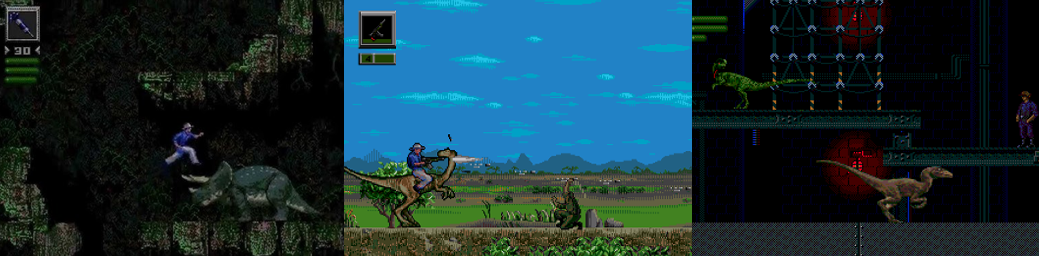
Game Corner: Jurassic Park (Xbox Series X)

Released: 22 November 2023
Originally Released: June 1993 (NES), August 1993 (Game Boy), October 1993 (SNES)
Developer: Carbon Engine
Original Developers: Ocean Software (Game Boy / NES); Ocean of America (SNES)
Also Available For: Game Boy, Nintendo Entertainment System (NES), Nintendo Switch, PlayStation 4, PlayStation 5, Super Nintendo Entertainment System (SNES), Xbox One, Xbox Series S

The Plot:
When an act of sabotage releases the genetically engineered dinosaurs of theme park Jurassic Park, palaeontologist Doctor Alan Grant must fight to curb the outbreak and escape the island.

The Background:
In 1993, director Steven Spielberg took Michael Crichton’s bestselling cautionary tale about a dinosaur theme park thrown into chaos and gave us Jurassic Park, a critical and commercial blockbuster that pioneered many of the CGI techniques we still see in Hollywood. Bolstered by an aggressive merchandising campaign, Jurassic Park inspired a wave of toys, comics, and numerous videogames, with multiple adaptations releasing alongside the film. Although games were also published for SEGA’s consoles, having made a name for themselves with their arcade tie-ins to other film releases, Ocean Software made the Jurassic Park games for Nintendo’s consoles after securing the license for an undisclosed six-figure sum. The developers were provided with numerous resources from Universal Pictures to recreate the visuals and likenesses of the film, utilising the Super Nintendo’s “Super FX” chip and ambitious texture mapping techniques to create first-person sequences on the 16-bit console. All three versions received widespread praise for their graphics, with the SNES version impressing with its large scope, though its first-person sections were criticised and the Game Boy’s more simplistic nature was noted. After decades of being essentially lost media, these three games (and four others) finally came to modern gamers in celebration of the movie’s 30th anniversary, courtesy of Limited Run Games, alongside modern quality of life features, to largely thankful and positive reviews.

Gameplay and Power-Ups:
These three Jurassic Park adaptations have a lot in common. They’re all top-down adventures set on Isla Nublar during the events of the film; they all have you control Dr. Grant; and they all centre around a mad search for numerous Velociraptor eggs. The only thing that really separates them, on paper, is the hardware they’re on, hence why I’m lumping all three into one review. Unlike in the movie, where Dr. Grant can only run and use his dinosaur expertise to outthink the reborn creatures, players are armed in these games. Dr. Grant carries a firearm that fires an electrical taser shot to stun smaller dinosaurs in the Game Boy and NES titles but is largely ineffective against bigger dinosaurs. In the SNES version, this weapon pushes back and eventually subdues the Dilophosaurus but it’s far too weak against the hyper-aggressive Velociraptors. However, you must also use it to power-up gears to create bridges and open the park’s electrified fences. Dr. Grant can also jump but he’s hardly an athlete. He can barely hop over Compsognathus’, brambles, and electrified flooring but you won’t be jumping to platforms or anything. The controls change between games, but all three see you switching your shot with the Xbox’s ‘View’ button. Dr. Grant can pick up more formidable, but limited, ammunition strewn around the park, including a bola shot, near useless smoke grenades, a shotgun, and a grenade launcher. In the SNES version, you can carry two of these shots at once alongside your taser shot, and the ammo respawns when you enter the park’s  buildings. Search hard enough and you’ll also find health kits and extra lives and, exclusive to the NES version, a temporary invincibility. Be cautious when collecting items in the Game Boy and NES versions, however, as many of them are boobytrapped to blow up in your face. Players get points for every dinosaur they dispatch and earn extra lives with enough points, and you’re also given a handful of continues should you lose all your lives, though each game must be beaten in one sitting.

Remember when Dr. Grant collected eggs and shot grenades at dinosaurs? It’s all recreated here!

Dr. Grant’s goal is to search the island for numerous ‘raptor eggs. These are essential in the Game Boy and NES versions, to the point where you can’t access buildings or progress until you’ve found all in each area. Collecting them all in these versions spawns a key card, though it’s not always clear which door you need to take so you’ll need to experiment a bit, which is tricky as the enemies respawn in these versions. Enemies don’t respawn in the SNES version, but the map is far bigger and you’ll be backtracking more. The only consolation is that you don’t need the eggs to access buildings, but you will be hunting high and low for identification cards to access computer terminals and locked doors. These terminals appear in each version but they’re far more detailed and prominent on the SNES, where you need the correct access to reboot the park’s security systems, unlock specific gates, radio the boat and the mainland, and access the ‘raptor pen and infested nest. Each game tasks you with destroying this nest using a nerve gas bomb; there are three bombs and three nests in the Game Boy and NES version and one aggravating labyrinth and one bomb on the SNES, found on the lowest level of the docked ship. When playing on the Game Boy and NES, players also control a life raft, dodging Dilophosaurus spit and swimming Brachiosaurus, while SNES players must dodge stampeding Gallimimus and dash into alcoves to avoid being trampled by a gigantic Triceratops. The Game Boy and NES versions also task you with rescuing Lex and Tim Murphy from a herd of Triceratops and a voracious Tyrannosaurus rex, with the Lizard King popping up on the main map on the SNES and the kids reduced to mere cameos as just two of many annoying pop-ups that completely obscure the screen. If you lose a life, you thankfully respawn right where you fell with all your ammo and inventory intact, which is useful, though the lack of passwords makes me wonder how anyone beat the SNES version without save states.

Each version has mildly unique sections, but the FPS parts are the worst of them all.

While the Game Boy and NES versions are essentially mission-based games that task you with collecting eggs and key cards and surviving each location, they also include some maze-like elements. The buildings and caves loop and turn you about, throwing miniature volcanoes and electrical pylons in your way and timing your escape from the ‘raptor nests before your bomb takes you out. Though the SNES version encourages you to exit the nest as quickly as possible, you appear to have unlimited time to escape, which is good as the nest is easily the most confusing area in the game. And that’s saying a lot considering all the interior locations are frustrating mazes that, surprisingly, switch the game to a first-person shooter (FPS). Clearly designed to showcase the SNES’s Mode 7 feature, these sections are slow, tedious slogs around repetitive locations with no clear indication where you need to go. You’ll be hunting for batteries to power your night vision goggles, grabbing ID cards to open doors and access terminals, powering up a generator and fiddling with the park’s systems, and taking elevators to sub-levels to explore further. Eventually, you’ll activate the park’s motion sensors, finally giving that obnoxious circular sprite on the heads-up display a purpose, and gain additional security clearance. This means you go back and forth between utility sheds, the visitor’s centre, the ship, and the ‘raptor pen desperately trying to remember where you couldn’t access the first time around. One mission sees you either wiping out the Velociraptors or blocking their entry with a wooden box, while another tasks you with destroying all the dinosaurs that’ve infested the ship. You must clear each mission in the SNES version to proceed; even if you have the right ID card, the game blocks you if you haven’t finished a mission. Of course, there’s no way to track your progress; the computer terminals help to a degree, but it’s limited to listing your ID card inventory and security clearance level.

Presentation:
Obviously, we’re working on a sliding scale between these three games. The SNES version is going to look the best, the NES version is passable, and the Game Boy version is…let’s say “quaint”. The NES version doesn’t make the best first impression; you can argue that the large T. rex sprite art is ambitious, but it just looks ugly. Ironically, it fares better on the Game Boy, where my expectations are much lower, though only the SNES version includes a detailed title screen of the film’s logo. In the Game Boy and NES versions, Mr. D.N.A. gives you an overview of your objectives. This is absent in the SNES version, but large, annoying text boxes regularly pop up to give you hints and the game’s bookended by Mode 7 effects applied to the island. The Game Boy and NES versions have extremely jaunty and fun chip tune soundtracks that remind me of Ocean’s arcade efforts. The SNES version opts for more subdued, ambient tunes, the ominous sounds of dinosaurs, and a handful of sound bites, though none of the games use the film’s iconic soundtrack or dinosaur roars. The SNES also performs far better; unlike its inferior cousins, I saw no instances of screen tearing, sprite flickering, or slowdown. These issues were rife on the NES version and also cropped up on the Game Boy version when too much was happening at once, though all three have a problem with the sprites having large hit boxes.

Each game faithfully recreates the movie, but the SNES version is the obvious standout.

Isla Nubar is represented on a reduced scale in all three games but is still surprisingly recognisable in the Game Boy and NES versions. You’ll start outside the iconic park gates in all three and explore the lush grasslands and forests surrounding the visitor’s centre, venture into the ‘raptor pen, and explore the nearby caves. Unlike its cousins, the SNES version portrays Isla Nubar as one big world map, with forests, streams, buildings, and recognisable locations all on one big, interconnected map rather being separated by missions as in the other two games. On the NES, the landscape changes colour and layout with each mission, introducing different buildings, forests you can pass through, containment fences, and rugged, hazardous mountain peaks. On the SNES, you venture up a cliffside many times as you revisit the docked ship again and again, will drown if you fall in the water, and must power up gears to progress. The helipad is your goal in all three games, though it’s only a separate region on the SNES and this version is the only game to accurately recreate the visuals of the film. Without a doubt, the overworld graphics are the best part of this version, featuring lush vegetation and detailed and colourful sprites, though the Game Boy version does boast surprisingly detailed sprite art recreating events from the movie. The SNES banks heavily on its FPS sections which, in my opinion, was a mistake as the game slows to a crawl and the visuals look pixelated, ugly, and repetitive. While the game recreates recognisable interiors from the film, every corridor looks the same. Some are ugly and grey, some are bronze and have nautical trappings, some are a light blue, and others are pitch-black, but everything looks the same so it’s easy to get lost. The sub-levels of the ‘raptor pen were the best parts, though, as you can see foliage through the windows, but these sections were a chore to play through. I really wish the developers had limited themselves to two or three FPS sections and used a traditional sidescrolling platformer perspective, like the Mega Drive titles, for the others, just for some variety.

Enemies and Bosses:
Jurassic Park is as disappointingly light on dinosaurs, though most of the creatures showcased in the movie make an appearance in all three games and you can even view an encyclopaedia of the creatures on the Game Boy. As you collect eggs, you’ll be relentlessly attacked by tiny Compsognathus. These aren’t much of a threat, but they do get annoying, so it was satisfying turning them into puffs of smoke with the cattle prod in the SNES version. Meganeura, prehistoric dragonflies, also appear in the SNES version alongside the easily spooked Gallimimus, who stampede and whittle your health to nothing if you’re not careful. Pachycephalosaurus also appear exclusively in the SNES version, attacking with an annoying headbutt if you get too close, though you’ll only see the gigantic, swimming Brachiosaurus, wandering Dimetrodon, and leaping Ichthyosaurus in the Game Boy and NES versions. One of the most common enemies you’ll face across all three games is the Dilophosaurus, rancid creatures who spit from afar and lurk in the game’s butt-ugly FPS sections (where they, like the ‘raptors, explode when shot, no matter what ammo you use). Equally, you’ll battle more than a few Velociraptors in all three games. Incredibly aggressive and often striking in twos, these creatures burst from trees and bushes and stalk the corridors of the SNES’s FPS sections. While enemies respawn seemingly endlessly in the Game Boy and NES versions, they’ll be down for the count on the SNES, especially in the FPS sections, except for the Velociraptors. You must also be wary of brambles, rushing streams, electrical bolts, falling boulders, and erupting volcanos. Those annoying explosive boxes will be your biggest enemy in the Game Boy and NES versions, though, and really got to be a pain in the ass after the first few caught me off-guard.

The Game Boy and NES versions may have dull bosses, but at least they have boss battles.

Oddly, considering the Super Nintendo’s greater processing power and the impressive nature of its sprite work, bosses only appear in the Game Boy and NES versions and, even then, they’re not that impressive. You must rescue Tim from the stampeding Triceratops in both versions, weaving between the gigantic beasts and trying to avoid their huge hit boxes in sections that I have no idea how anyone beat back in the day. You must endure this section twice in both versions, with Tim’s lagging speed often costing you and the creatures appearing in specific, much more manageable sections on the SNES. When the T. rex appears here, your only option is to run or momentarily stun her with tranquilizer darts, though you’re more likely to be left squirming in her jaws if you try and fight her. In the NES version, you battle the T. rex directly twice. The first time, you must rescue Lex from her, and the second time you must rescue Lex and Tim, with both being rooted to the spot by fear and easily chomped by the Lizard King if you don’t catch her attention. The T. rex is impervious to damage unless her head is lowered, but you must be quick as she’ll stomp over and eat you (or one of the kids) whole otherwise, and her hit box is predicably large, so you’ll have a hard to avoiding being hit. In the Game Boy version, this fight is turned into a desperate dash to the left-side of the screen, though thankfully there’s no risk of being trampled and her bite is easy to avoid. You must push the T. rex back with some shots and then usher Lex towards the exit, desperately trying to not get caught on the boulders scattered across the path. There is no final battle against the T. rex in the Game Boy version, making the finale disappointingly anti-climactic compared to the NES version, and no bosses at all in the SNES version. The closest you get are the many encounters with the Velociraptors, who pounce from the bushes and prowl around the corridors of the game’s interiors, which is a shame as I would’ve loved to see a proper rendition of the T. rex fight.

Additional Features:
The NES version is the only one of the three to offer a two-player option (presumably with players taking it in turns between lives), though all three offer a high score table for you to try and get your name on. Each game ends in the most lacklustre way possible, with simple text congratulating you, though you get to wander around the credits in the lesser versions. The Jurassic Park: Classic Game Collection offers a few fun extras, such as each game’s soundtrack, various filters and borders, and a rewind and save state feature that makes each game, but especially the SNES game, much easier. Each game also comes with a map, which is super helpful until you play the SNES version, where the developers didn’t include maps for the FPS sections! The collection naturally has some Achievements for you to earn; fourteen in total, with two earned for each game included. While you obviously get an Achievement for beating each game, an additional Achievement is assigned to each and tied to different objectives. You get an Achievement for starting the generator in the Game Boy version, saving Lex from the T. Rex in the NES version, and finding all eighteen ‘raptor eggs in the SNES version.

The Summary:
I’ve long admired the SNES version of Jurassic Park. I believe I played a port of it on the Amiga as a kid and I’ve always been captivated by the overworld graphics. Truly, the game is gorgeous to behold, and the 16-bit recreation of the film’s visuals is incredibly impressive. The foliage, the buildings, and the dinosaur sprites, especially, are all visually appealing, let down only by the lack of John Williams’ iconic score. Well, that and the awful FPS sequences. Believe me, I get the appeal of showcasing the Super Nintendo’s processing power, but these sections are slow, ugly, and a chore to play. It might not’ve been so bad if you didn’t have to keep backtracking to these areas again and again, each time getting more confused about where you’ve been and where you’re going. The Game Boy and NES titles are much simpler in this regard, being simple mission-based games rather than an odd mixture of action and adventure like their SNES counterpart. Yet, while the NES version tries, the Game Boy struggles to replicate its cousins. Sprite flickering and screen tearing are real problems in both, but this genre didn’t translate well to the Game Boy. Perhaps switching to a sidescroller would’ve been better, though I did like the subtle differences in the T. rex boss fight and the sprite art between missions. The tedious collecting wore out its welcome very quickly in both versions and is only marginally better on the SNES, where you still need to find them all but have a bigger map to explore. The SNES version is let down by those annoying pop-up boxes, a lack of boss battles, and no password feature, meaning the sprawling adventure must be beaten in one sitting. This is a laborious task even with the Classic Game Collection’s save state feature, so I have no idea how players managed it back in the day. In the end, I’d say the only one worth playing is the SNES version based on the overworld’s eye-catching visuals but, realistically, the NES version is probably the easiest for repeat playthroughs. What we really needed was one version that incorporated the best of all three games but, as is, there’s some fun and frustration to be had regardless son which game you play.

Game Boy Rating:

Rating: 1 out of 5.

Terrible

NES Rating:

Rating: 2 out of 5.

Could Be Better

SNES Rating:

Rating: 3 out of 5.

Pretty Good

What did you think to the Jurassic Park videogames released for Nintendo’s consoles? How do you think they compare to SEGA’s releases, and to each other? Which of the three was your favourite to play and were you pleased to see them made available for modern consoles? What did you think to the FPS sections and the tedious egg hunting? Did you ever beat the SNES version back in the day and, if so, how? Which Jurassic-adjacent videogame is your favourite? How are you celebrating Dinosaur Day this year? Whatever your thoughts on Nintendo’s Jurassic Park videogames, and dinosaurs in general, leave them below, support me on Ko-Fi, and check out my other dinosaur content!
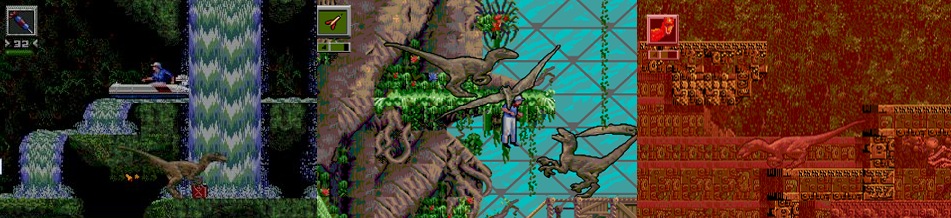
Screen Time [Captain Picard Day]: Star Trek: Picard (Season Two)


As seen in the Star Trek: The Next Generation (1987 to 1994) episode “The Pegasus” (Burton, 1994), the crew and children of the U.S.S. Enterprise-D celebrates “Captain Picard Day” on Stardate 47457.1, which roughly translates to June 16th. While they bewilder Captain Jean-Luc Picard (Patrick Stewart) with drawings, I see it as a good excuse for some more Picard and Next Generation content.


Season Two

Air Date: 3 March 2022 to 5 May 2022
Network: Paramount+
Stars: Patrick Stewart, Alison Pill, Jeri Ryan, Michelle Hurd, Santiago Cabrera, Brent Spiner, and John de Lancie

The Background:
After the disappointing critical reception of Star Trek: Nemesis (Baird, 2002) cancelled plans for further films focused on the popular Next Generation cast, the Star Trek franchise (1966 to present) shifted to other shows and a lauded reboot series. After the franchise saw a resurgence, showrunner Alex Kurtzman pushed to revisit Captain Jean-Luc Picard. Alongside writer/director Akiva Goldsman, Kurtzman convinced Stewart to return to his famous role for Star Trek: Picard (Various, 2020), a highly successful venture that proved popular enough to warrant a second season, as was always intended. Afforded an unprecedented $20.4 million in tax credits by the California Film Commission, season two was developed back-to-back with season three, though filming briefly stalled due to the COVID-19 pandemic. Aiming to continue exploring Picard’s character and mortality, the writers chose not only to revisit the mysterious Q (de Lacie) but also drew inspiration from Star Trek IV: The Voyage Home (Nimoy, 1986) for its time travel plot. Once it started streaming, season two of Star Trek: Picard proved quite popular and the overall critical reception was very positive. Reviews praised the exploration of Picard’s character and the performances and the execution of the introspective narrative. Though some found season two to be derivative of previous Star Trek stories, it proved successful enough to build anticipation for the third and final season one year later.

The Plot:
After returning to inspire a new age of prosperity in the United Federation of Planets, Admiral Jean-Luc Picard and his allies are unexpectedly deposited in a dystopian timeline by the malevolent Q and must travel to the 21st century to not only restore reality, but also face their personal demons.

The Review:
As a lifelong fan of the Next Generation show and movies, I was excited when Star Trek: Picard was  announced. As much as I enjoyed the rebooted movies, I’ve not really been that interested in the Star Trek shows that have come out since as they all explore a pre-Next Generation timeline, something I think has been done to death. Star Trek: Picard represented a unique opportunity to return to the main timeline and see how the universe had changed since Star Trek: Nemesis, but I was surprised to find Picard bitter and alone, familiar characters changed and somewhat jaded, the once tolerant and righteous Starfleet a stubborn and destructive xenophobic regime, and an overall unsettling bleakness to the franchise. Many characters (including Picard) dropped curses with surprising regularity and harboured a resentment towards Picard that needed to be mended over the course of the season. Season one primarily focused on Picard’s age, his failing health and sense of mortality, and his efforts to assist Soji Asha (Isa Briones), the “daughter” of his old friend, Lieutenant-Commander Data (Spiner), cobbling together a new rag-tag crew and ending up in a new synthetic body, seemingly ready for new adventures in the cosmos. Season two begins with Picard back on his family vineyard but still very much involved with Starfleet, having regained his passion now they’ve stopped ostracising synthetics like Soji. This vigour is only further reinvigorated since his crewmates Cristóbal “Chris” Rios (Cabrera), Doctor Agnes Jurati (Pill), Raffaela “Raffi” Musiker (Hurd), and surrogate son Elnor (Evan Evagora) have all joined (or rejoined, in some cases) Starfleet. Rios is now Captain of Picard’s first commission, the USS Stargazer, and Elnor celebrated as the first-ever fully Romulan Starfleet graduate.

Thanks to Q’s machinations, Picard is forced to confront his past traumas while fighting for reality.

Despite being cured of his fatal illness and gaining a synthetic body, Picard enjoys all the ailments that come with his advanced age. This includes doubts and a resistance towards forming long-term romantic engagements despite the advances of his Romulan housekeeper, Laris (Orla Brady). As long-lived as Picard is, his old Enterprise confidante Guinan (Whoopi Goldberg) remains on hand to offer sage advice, and much of the show is focused on Picard learning to let go of his past and embrace his humanity and the happiness offered by love. Indeed, this is later revealed to be Q’s primary motivation. Although he initially appears as a malevolent figure, a sanctimonious, pompous, malicious demigod seeking to further “test” Picard (and the human race) by forcing him to witness a dystopian timeline where he’s a genocidal madman, Q’s newfound mortality drives him to help Picard face some haunting demons from his past in his own unique way. This season reveals that, as a boy, Picard (Dylan Von Halle) witnessed his abusive father, Maurice (James Callis), drive his loving mother, Yvette (Madeline Wise), to suicide. Q’s manipulation – and Picard’s jaunt to 2024 – force him to see his mother suffered from an unspecified mental illness that made her paranoid and unstable, ultimately driving her to suicide. This event shaped Picard’s entire life, driving him to protect others, stand against injustice, and seek out the truth. However, it weighs heavily on Picard’s conscience and his journey of self-discovery – and forgiveness – is as important as his quest to undo Q’s damage and restore the timeline.

The time travel jaunt sees Picard’s crewmates discovering new aspects to their personalities.

Although they scattered across the galaxy after the first series, Picard’s new crew is reunited by his long-standing nemesis, the Borg. When a gigantic and mysterious Borg craft calls for a parlay, Picard is asked to negotiate, an unusual situation which former Borg Seven of Nine (Ryan) lends her own understandably biased opinion on. Captain Rios is unable to resolve this unexpected situation, however, thanks to Q’s intervention, which sees Picard’s crew deposited in a dystopian alternate timeline where only they retain memories of the way things should be. In this dark world, non-human life is conquered, enslaved, eradicated, and publicly executed by the Confederation of Earth, with Seven (as Annika) as the President and Picard as her military commander. We don’t spend too long in this timeline but it’s enough to establish how awful it is compared to the real world and give Seven a strange euphoria as she finds herself truly human for the first time in decades. When the crew travel to 2024 to undo Q’s interference, Seven explores her newfound humanity. She’s far more cautious, especially compared to hot-headed Raffi, and showcases genuine motion for a change. Seven and Raffi’s partnership leads to some of the show’s most interesting and engaging action sequences and banter as they bicker over the best course of action and balance each other’s different methods towards saving and securing the timeline. This results in them growing so close that they share a kiss by the end, which felt a little out of left field for me. Similarly, the trip to the past has radical implications for Rios, who finds himself separated from his friends and defending Doctor Teresa Ramirez (Sol Rodríguez), her son Ricardo (Steve Gutierrez), and her clinic from overly aggressive immigration officers, falling for her in the process and finding a true home and family for himself at the same time.

The Borg Queen manipulates Agnes, but soon develops a genuine connection with her.

I was happy to see that Picard is treated much better in this season. Not only does Starfleet treat him with the respect he deserves, but his crew now defer to his wisdom and admire his tenacity. However, there are some wrinkles to this: since the incapacitated Borg Queen (Annie Wersching) is their only hope of saving the future, the crew risk their lives to save one of their most dangerous enemies and coerce her into helping them. This results in Elnor’s death as Picard is forced to prioritise saving the Queen over his former ward. This briefly earns him Raffi’s resentment and, though she soon focuses on the mission, much of her aggression stems from this loss and she’s as haunted by Elnor’s death as Picard is by his own past. Concurrently, Agnes is haunted by her past actions. Although she, like Rios, takes solace in her surrogate family, she can’t help but feel alone and somewhat lost, no matter how hard she tries to help. While the others search 2024 for the elusive “Watcher”, Agnes is left on their damaged craft with the weakened Borg Queen, with whom she’s forced to partially assimilate herself with to direct her team. This leads to the Borg Queen emotionally manipulating Agnes, tempting her with full assimilation to give her the sense of belonging she so desires before infiltrating her mind and her personality. This turns Agnes into a secondary antagonist for the last few episodes as the Borg Queen hijacks her body and creates an imperfect Borg army for herself in a bid to take advantage of her unique position and usher in a new age of Borg dominance. This is prevented not just by the intervention of Agnes’ friends but also Agnes asserting her personality over the Borg Queen, ultimately resulting in them merging into a new entity that heads out into the galaxy to create a new sub-species of Borg, one defined by individuality and co-operation rather than emotionless dominance.

Picard needs the reluctant help of a young Guinan to stop Soong and escape Agent Wells.

Considering how much time season one spent focused on Soji and established her importance to Star Trek lore, she’s basically a non-factor in season two, appearing only very briefly and not even joining the crew for their time travel adventure. Isa Briones appears more prominently in 2024 as Kore Soong, the human (if genetically created) daughter of Doctor Adam Soong (Spiner), the ancestor of the man who would one day create Data. Soong acts as the primary antagonist after his genetic research is lambasted, his funding revoked, and his attempts to cure Kore of her debilitating and fatal genetic illness fail. This drives him to desperation and near madness, allowing Q to offer him the chance to build a legacy in the future by preventing the Europa expedition, thereby creating the dystopian timeline briefly visited at the start of the series. When Kore rejects him after she discovers her true origins, Soong’s perfectly happy to indulge his latent psychotic urges by aligning with the Borg Queen and targeting not just Picard and his allies but also Picard’s ancestor, troubled astronaut Renée Picard (Penelope Mitchell), whose death will usher in Soong’s oppressive legacy. Although Picard galvanises Renée’s spirit and counters Q’s psychological abuse m, his mission is jeopardised by xenophobic Federal agent Martin Wells (Jay Karnes), a man convinced that the Earth is threatened by aliens. Luckily, just as Picard is guided through his own personal traumas by Talinn, Laris’ ancestor who has spent years observing and protecting Renée, so too is he assisted – and ultimately coerce Wells into assisting him – by the young Guinan (Ito Aghayere), a jaded and outspoken younger woman ready to give up on humanity before meeting Picard. This melting pot of motions is only exacerbated by Q. Disgusted by humanity and believing they need to be constantly tested, his sights are firmly set on Picard as the bastion of human determination, Q takes every opportunity to try and break Picard’s spirit and spitefully set time itself against him. This is his misguided way of teaching Picard to embrace the past and move forward stronger for everything he’s suffered through, a test that Picard comes to appreciate, even embracing the dying Q as an old friend before they’re returned to their original timeline, changed but, presumably, stronger despite their losses.

The Summary:
Considering the focus of season one, I was surprised that season two is largely set in 2024 and is, essentially, a remake of Star Trek IV: The Voyage Home spliced with the main plot of Star Trek: First Contact (Frakes, 1996). I didn’t expect this, and I’m not entirely sure how much I enjoyed it. I liked the callbacks to The Voyage Home: the abrasive bus punk (Kirk Thatcher) returns, some of the dialogue (especially Rios’s) is revisited, as is his relationship with Teresa, and many of the plot points are repeated, such as the cloaked ship and Picard and Guinan’s capture. However, I think it might’ve been better to spend half the season in the dystopian future, exploring that world and giving the cast more time to play dual roles (Stewart, especially, revels in masquerading as his militant counterpart). Spending so much time in 2024 makes season two feel decidedly less visually impressive, though does allow for some introspective character development for all involved, especially Picard, who’s forced to relive, confront, and ultimately come to terms with his traumatic past. Equally, as mentioned, Seven explores her humanity in ways we’ve never seen before. I also liked the twist given to Agnes, where she becomes a semi-willing vessel for the Borg Queen, but there’s ultimately not much in season two that we haven’t seen in those aforementioned movies or previous time travel and character-centric episodes of Star Trek.

Some character arcs didn’t land for me or felt undercooked due to lack of focus.

The major themes of season two are confronting the past, finding a place in the present, and embracing the potential of the future. While Rios has found himself as a Starfleet captain and sees Picard as a father figure, he only truly feels a sense of belonging once he settles in 2024 and bonds with Teresa and Ricardo. Although this is his primary (and, arguably, only) character arc in the season, it doesn’t get much of the spotlight. Rios feels a kinship to them out of gratitude, respect, and a sense of injustice after seeing how aggressively they are targeted by immigration officers, but I still felt like his decision to stay in the past was a bit rushed and that the three didn’t connect much despite their obvious chemistry. I felt the same way about the apparent romantic relationship between Seven and Raffi. I must have missed the bisexuality of these characters in the last season and I was more focused on the fun contrast of personalities they exhibited here, so their sudden kiss surprised me as I thought the point of their partnership was to see their personalities grow. Seven conveys much more emotion and her arc is focused on her hatred of the Borg and euphoria at finally being human, culminating in her accepting her renewed Borg implants when Agnes uses the Borg Queen’s technology to save her life and considering a career in Starfleet upon returning to the main timeline. Raffi’s arc is primarily one of revenge: she’s incensed and haunted by Elnor’s death, meaning Seven acts as a counterbalance to keep her emotions in check, but Raffi’s conflicted by the finale as she can’t kill the Borg Queen without losing Agnes. Although I found it surprising that Agnes fell under the Borg Queen’s sway considering all Picard’s advice and her own experiences in the Queen’s consciousness, it makes sense given her personal insecurities and the Queen’s machinations. Their relationship becomes surprisingly mutually beneficial, however, as Agnes enjoys the power and sense of belonging offered by the Borg Queen and the Queen comes to see friendship, co-operation, and emotion as a strength rather than a weakness. This ultimately sees them become a new gestalt entity that hints at a Borg partnership with Starfleet to protect the universe from an unspecified threat.

Though an intriguing dive into Picard’s character, season two fell a little flat for me.

Unlike season one and season three, season two is less a Next Generation reunion and more a character study of its titular protagonist and his crewmates. Yet, there’s time for a quick cameo by former ensign Wesley Crusher (Wil Wheaton), who offers Kore a place with the Travellers, Guinan, and even a new role for Brent Spiner, who’s given another chance to showcase his range as he portrays another maniacal and dangerous Soong variant. As expected, this is Picard’s show, through and through. Freed from his bitterness, but no less burdened by guilt and past trauma, Picard is determined to restore the timeline and thwart Q’s diabolical plot but is surprised to learn new discoveries about himself through Q’s final test. Although vehemently opposed to the demigod throughout the show, Picard ultimately expresses gratitude to his old frenemy and ensures he doesn’t meet his end alone since Q’s actions, though questionable, allowed Picard to accept that his past and opens his eyes to a future with Laris and an alliance with Agnes’s Borg contingent. Ultimately, however, I can’t say that season two is any better or worse than the first. The potential of these new characters and the direction of this season is somewhat squandered by the plot, which is simply a rehash of The Voyage Home, and the season seems to have been engineered to write out many of Picard’s newfound crew rather than bring them closer together. It was a fascinating exploration of Picard, and an interesting twist on the Borg dynamic, but fundamentally lacking in terms of visuals and offering something more explicitly new for long-time Star Trek fans.

My Rating:

Rating: 3 out of 5.

Pretty Good

What did you think to the second season of Star Trek: Picard? Were you disappointed that the plot rehashed The Voyage Home or did you enjoy the time travel jaunt? Did you like that Rios stayed in the past, that Agnes became the Borg Queen, and the evolution of Seven’s character? Were you happy to see Q return and by the revelations into Picard’s childhood? What threat do you think is posed by the transwarp conduit? How are you celebrating Captain Picard Day this year? Whatever your thoughts on Star Trek: Picard, let me know in the comments down below.

Movie Night [Friday the 13th]: Friday the 13th Part VII: The New Blood


Long considered an unlucky day due to superstitions involving the number thirteen and religious connotations, Friday the 13th is equally well-known as a long-running series of slasher movies. As a result, this is clearly the best opportunity to take a look at the Friday the 13th (Various, 1980 to 2009) horror series and to commemorate this unlucky and dreaded date.


Released: 13 May 1988
Director: John Carl Buechler
Distributor: Paramount Pictures
Budget: $2.8 million
Stars: Lar Park Lincoln, Kane Hodder, Kevin Blair, Susan Jennifer Sullivan, Susan Blu, and Terry Kiser

The Plot:
Unwittingly resurrected by traumatised, psychically-endowed Tina Shepard, decomposing serial killer Jason Voorhees (Hodder) renews his killing spree, only to match his brute strength against Tina’s psychic powers.

The Background:
Following the success of John Carpenter’s Halloween (Carpenter, 1978), which popularised the “slasher” sub-genre, Friday the 13th (Cunningham, 1980) proved a surprising box office success. Despite producer/director Sean S. Cunningham distancing himself from the resulting franchise, which has been beset by negative reviews, Friday the 13th Part 2 (Miner, 1981) and Friday the 13th Part 3 (ibid, 1982) were financial successes. Still, embarrassed by the franchise, Paramount tried to bring it to an end with Friday the 13th: The Final Chapter (Zito, 1984). However, its financial success led to Friday the 13th: A New Beginning (Steinmann, 1985), a disastrous experiment that saw Jason’s resurrection the following year. Despite a modest box office and mixed reviews, Friday the 13th Part VI: Jason Lives (McLoughlin, 1986) is now considered one of the best entries. Initial ideas for the seventh film included a potential crossover with Freddy Krueger (Robert Englund), though Paramount and New Line Cinema couldn’t agree on how to best execute this and it would be some fifteen years before audiences saw this come to fruition. Instead, associate producer Barbara Sachs leaned towards the idea of granting the “Final Girl” telekinetic powers not unlike those of Carrie White (Sissie Spacek). Friday the 13th Part VII: The New Blood marked the first appearance of fan favourite Kane Hodder as Jason Voorhees, setting a record for the longest uninterrupted onscreen controlled burn in Hollywood history and debuting one of Jason’s most horrific and iconic looks. With many explicitly gory scenes cut during post-production, The New Blood performed about the same at the box office as its predecessor and received largely negative reviews. Fans of the franchise, however, treat the film more fondly, regarding it as one of the better entries, and its poor reception didn’t stop Paramount producing an eighth instalment the following year.

The Review:
Seven movies into the slasher franchise and Jason Voorhees has become more than a rumour; he’s a legend. The long-dead “Crazy” Ralph (Walt Gorney) returns as an unseen narrator to give a quick rundown of Jason’s previous hits and misses, which have seen the “death curse” of Crystal Lake translate into “Jason Voorhees’ Curse”, with no mention of his mother or the tragedy that befell him as a child. It’s interesting that Crystal Lake is even called that here since such a big part of the previous movie revolved around the locals renaming the area “Forest Green” to disassociate themselves from Jason and his memory. Now, it’s just back to Crystal Lake with no explanation, which is odd. Even stranger is that no one stops our new crop of victims from hanging around the cursed lake and no one, save the pushy and manipulative Doctor Chris Crews (Kiser), is even aware of Jason. To be fair, it’s not stated how much time has passed since the ending of Jason Lives and the present day of The New Blood. It could’ve been years, so maybe the residents felt comfortable believing Jason was long gone. The New Blood takes a similar approach to The Final Chapter with the landscape of Crystal Lake and its forest, showing residential cabins placed around the lake, such as Tina’s childhood getaway and the cabin Nick Rogers (Blair) and his friends rent to surprise his cousin, Michael (William Butler). I would’ve liked to see The New Blood double down on this and have these be the same buildings from The Final Chapter, renovated and available to rent to bring some tourism to the local community. This doesn’t appear to be the case and nothing is mentioned about the town or what’s happened between Part VI and Part VII, meaning the New Blood title doesn’t just refer to Jason’s newest crop of victims but also the narrative, as the film’s almost like a soft reboot of the series in some ways.

Traumatised Tina finds her unique gifts being manipulated by the shifty Dr. Crews.

The New Blood adds some additional lore to Crystal Lake with its opening flashback, which shows young Tina (Jennifer Banko) fleeing to the lake to escape her parents’ constant arguing. Having witnessed her alcoholic father, John (John Otrin), strike her mother, Amanda (Blu), little Tina took a boat onto the lake and wailed her anguish and hatred to her father. Unfortunately for Tina (and John), her heightened emotional state triggered her unpredictable psychokinetic powers, causing John to fall into the lake and drown/be crushed be debris. The trauma of witnessing this and the guilt from having caused her father’s death scarred Tina, leading to her spending most of her life in therapy and in a psychiatric hospital under the care of Dr. Crews. Although Tina’s visibly uncomfortable at returning to Crystal Lake and Amanda is desperate to hide her concerns behind blind optimism, the Shepards return to their family cabin in what’s stated to be a last-ditch attempt to help Tina overcome her trauma. However, Dr. Crews is far more concerned with exploring and documenting Tina’s psychic abilities, badgering her into working herself into a state so she’ll perform parlour tricks for his camera. While he justifies this by saying that her powers and vivid delusions are manifestations of her guilt and thus intrinsically linked, it definitely seems like he’s less concerned with her wellbeing and more concerned with attained some kind of accolade for discovering her psychic powers. Annoyed when Tina gets distracted by Nick and his friends and frustrated by Tina’s reluctance to adhere to his demands, Dr. Crews constantly belittles Tina and waves away her panic when she starts seeing visions of dead bodies and accidentally reanimates Jason while remembering her father’s death. At her wit’s end and desperate to bring her daughter some peace, Amanda puts all her faith in Dr. Crews and is thus enraged to find that he’s been using and manipulating Tina, even more so when Dr. Crews decides Tina’s a lost cause and threatens to have her committed. While she struggles with her guilt and is noticeably uneasy around other people, Tina can’t help but be attracted to nice-guy Nick, who encourages her to socialise with his friends, takes an interest in her past and her feelings, and reacts with shocked amazement rather than horror and ridicule when her powers caused chaos and disruption.

Nice guy Nick is surrounded by largely forgettable or overly exaggerated victims.

Disturbed by her visions of death and Jason, Tina constantly tries to warn those around her and is repeatedly shot down. Dr. Crews refuses to entertain her wild claims as anything other than delusions and the catty Melissa Paur (Sullivan) openly mocks her, to the amusement of her otherwise disinterested friends, in a desperate attempt to discredit Tina so she (as in Melissa) can have Nick to herself (despite him quite bluntly stating that he doesn’t even like her!) Nick’s a bit of a bland do-gooder on the surface; he’s tall and ruggedly handsome but there isn’t much to him. He says he ran with a bad crowd and is trying to turn his life around, but he’s mainly there to offer Tina some affection outside of her family and to try (and fail) to shield her from Jason. His friends, however, are as painfully one-note as all the Friday the 13th victims, focused mainly on sex, skinning dipping in the freezing cold lake, drinking, and getting high. There are a few standouts from this largely cliché group, as ever: Eddie McCarlo (Jeff Bennett) fancies himself a science-fiction writer and regularly bores and freaks out his friends with his bizarre imagination, Robin Peterson (Elizabeth Kaitan) is a perky little stoner in contrast to shy Maddy Paulson (Diana Barrows) but doesn’t hesitate to put her friend down so she can claim clumsy stoner David Peabody (Jon Renfield) for herself, and Ben MacNeal (Craig Thomas) is having undisclosed issues with his girlfriend, Kate Pataki (Diane Almeida). The film tries to give Maddy an empowering moment when, in an effort to defy Robin’s claim that she needs “little touch-up work”, Maddy defiantly…goes and touches herself up with make-up. She then wanders outside calling for David as though expecting him to be in the dark forest and is unceremoniously killed. I quite liked Eddie, who is seduced by Melissa to try and make Nick jealous and storms out after she rejects him in an amusing scene, though the others are mostly forgettable and simply there to be eye candy and add to the kill count.

Jason looks more horrifying than ever and utilises some bizarre weapons.

The New Blood sees the debut of Kane Hodder as Jason Voorhees, and boy does he embody the role in an instant! Sporting one of Jason’s most disturbing and iconic looks, the hulking Hodder stalks the forests and darkness of Crystal Lake with an enraged determination, as though Jason is royally pissed off at being disturbed by Tina. Now degenerated into a rotting, skeletal form and sporting a cracked mask and heavy chain around his neck, Jason appears more inhuman than ever and seemingly savours the hunt, never breaking from a brisk stride and as happy to stalk, taunt, and slowly off his victims as he is to crash through windows or catch them unawares. Jason sports an uncanny ability to sneak up on people, even when they’re barely looking the other way, and to get ahead of his fleeing victims, to say nothing of shrugging off nails, bullets, and blunt trauma thanks to functionally being a zombie. Exhibiting superhuman strength powerful enough to plunge his hand through chests and crush heads, Jason is surprisingly gentle with Nick in the finale, preferring to simply toss and throw him aside rather than crush his rib cage. Jason sports various weapons in The New Blood, from spiked implements, large kitchen knives, and even a party horn that he rams into Kate’s eye. This is taken to almost comical levels when Jason pursues Dr. Crews and Amanda through the forest and he attacks with a bizarre bladed implement, prompting Dr. Crews to use Amanda as a human shield! This respite is short-lived, however, as Jason soon comes after him with a motorised bench saw like he’s Leatherface (Various) or something! I have no idea where Jason got these weapons from or why he discards them, and we’re denied a decent look at the damage since the film’s butchered by cuts. Jason slices throats, hacks off heads, and leaves victims strewn around the forest to scare Tina but is visibly puzzled by the girl’s inexplicable psychic powers. Jason thus becomes fixated on Tina, not just because she’s the “Final Girl” but also because he sees there’s something different about her. Tina gives Jason a run for his money, tangling him up with nearby roots, electrocuting him, and causing his hockey mask to shatter so we get a good look at his gruesome, rotting visage.
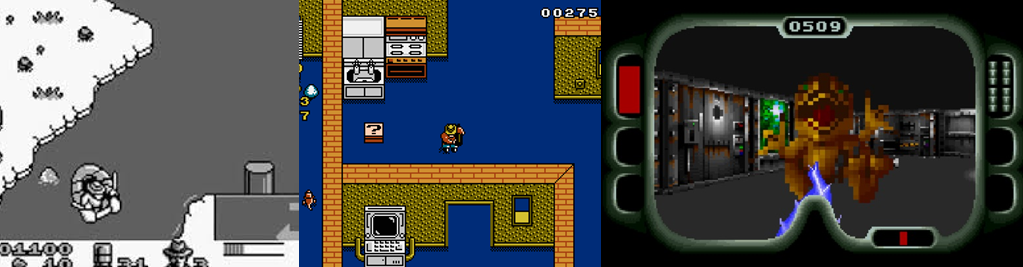
The Nitty-Gritty:
Jason Lives marked a turning point for the Friday the 13th franchise. From the moment Jason was brought back as an undead killer, all bets were off and the series leaned more heavily into the supernatural for the following sequels. This wasn’t necessarily a bad thing; the formula was getting stale, after all. However, it’s still a bit weird to suddenly see psychic powers in this world. Tina is obviously a stand-in for Stephen King’s Carrie, a disturbed and emotionally distraught young woman who cannot control her powers, much less understand them. Tina’s ability to move objects with her mind is directly tied to her emotions, something Dr. Crews regularly manipulates just to see them in action. Tina’s also cursed with a degree of clairvoyance; she has visions of people’s deaths but is always too late to save them and is haunted by delusions of Jason that have her questioning her sanity. This makes Tina wary to be around others since her powers can be chaotic and they earn her scorn, fear and hatred even when characters have no reason to think it was Tina who caused Melissa’s necklace to break. Tina’s powers are seemingly limitless; she can combust matches, smash open floorboards, move roots and electrical wires, and even resurrect the dead if she concentrates hard enough. Sadly, her powers also appear really feeble. The only reason Jason doesn’t just snap her in two is because the script says he must stand there gawping at her while Tina flings nails at him, douses him in gasoline, and hangs him from the ceiling. Indeed, when Jason gets his grubby mitts on her, Tina’s largely helpless and dependant on Nick to save her cute ass. The technology just wasn’t there to make Tina’s powers look threatening enough to Jason, who was made to look like a chump during their “fight”, and it makes for a very poor substitute for a throwdown between Freddy and Jason. Perhaps if Tina’s powers had been more pyrokinetic things might’ve been different but, as is, her abilities seem more bizarre than formidable and make The New Blood one of the stranger entries in the franchise.

While some of the kills are good or even iconic, Tina’s psychic powers are pretty lamely realised.

It’s also one of the most butchered. Sure, we get some great shots of Jason’s spine, skull, and bones sticking out from his ragged clothes and the effects used on his ghastly face are top-notch (it may very well be the best Jason look ever!) but this doesn’t excuse the disappointingly bloodless kills. This is doubly disappointing as there are some creative weapons and methods at play in The New Blood, with Jason resorting to simple stabbing and tossing people to their deaths alongside more elaborate means of killing, such as launching an axe into Russell Bowen’s (Larry Cox) face and stabbing Maddy with a scythe. The movie’s not entirely bloodless, of course: we see severed heads and blood splatters and a lot of time is spent lingering on the mangled corpses of Jason’s victims. In a way, this is a bit more horrific than if we’d seen the deaths in detail since your imagination can fill in the blanks…but Dr. Crews was such a dick, I wanted to see him get shredded by that weed-wacker! I liked that Jason didn’t simply go around swinging a machete and tried a few different things here, even if some of his kills largely amounted to the same thing (David may as well have been stabbed by a machete, for example, same with Amanda, especially as Jason discards that unique weapon). Of course, the most memorable kill in The New Blood is Judy Williams’ (Debora Kessler). Her and her boyfriend, Dan Carter (Michael Schroeder), are a couple of randoms Jason attacks while camping (an odd choice given these roles could’ve been filled by some of Nick’s friends). He plunges a fist though Dan’s back and snaps his neck and then drags Judy from their tent while she’s still in her sleeping bag. Hauling her across the brambles, Jason slams her against a tree, snapping her spine and leaving her a horrified, bloody mess. It’s a simple, exceedingly brutal kill that stands as one of the best in the franchise. Naturally, we also get a bit of sex and nudity here, far more than in Jason Lives but still less than I’d like. Despite being a horny little she-devil, Melissa never gets any action and has to settle for an axe to the head, though Robin, Kate, and Sandra Casey (Heidi Kozak) all get a chance to get naked and have some sexy times before being butchered.

When Jason proves to be unstoppable, Tina summons her dead father to take care of business.

Unable to convince anyone that her visions are real and desperate to help her mother, Tina drags a confused Nick all through the forest and the cabin trying to find Amanda before it’s too late. She discovers newspaper clippings about Jason in Dr. Crews’ drawer and realises he knew she was telling the truth about “the man in the lake” and has been trying to gaslight her into thinking she’s crazy. Unfortunately, Tina’s unable to save her mother and Nick finds the cabin empty, save for Eddie’s slaughtered corpse and a disbelieving Melissa. His friends are just hanging around in the forest, though, their bodies on display to lure Tina back into the cabin, where Jason attacks. Although Nick tries to fight the monster off, he’s tossed aside like nothing and, grief-stricken and enraged, Tina finally unleashes her full power. Using her destructive psychic powers, Tina shatters Jason’s mask, hanging him by a cord, and drops him into the basement. When he drags her down with him, Tina douses him in gasoline and sets him on fire, with her and Nick barely escaping the house before it inexplicably explodes. They’re relief is short-lived, however, as Jason reappears on the docks, sporting no evidence of being set on fire or caught in an explosion. Though Nick tries to fend him off with a gun, Jason is unfazed and closes in for the kill. Hurt and desperate, Tina summons all her power and, unbelievably, causes her father (who’s looking remarkably well for a guy trapped underwater for years) to burst up from the lake. John’s clearly agonised spirit wraps a chain around Jason’s neck and drags him back into the cold depths, ending the film on a bit of an anti-climax as Tina and Nick are rescued by emergency services. Quite why John’s body was still in the lake is beyond me. Tina “felt” him earlier, but it turned out to be Jason and I don’t see why her father’s body couldn’t have been recovered after he fell in when she was a child. I guess it’s supposed to be a call-back to the first and third parts, but it felt quite lame and cartoonish in execution, much like Tina’s powers.

The Summary:
Friday the 13th Part VII: The New Blood is a bit of a disappointment for me. A lot of this has to do with my fondness for the previous film, which is still one of my favourites; nostalgia gives Jason Livs an edge that The New Blood lacks. I tried to cut it some slack on this viewing, but there are a lot of elements that don’t work for me. As much as I liked the score from Jason Lives being recycled, it felt quite repetitive and the weird, jingly, fairy tale music used when Tina used her powers got old fast. I quite liked Tina, even though she was a bit bland and pure. I liked the struggle she faced with her guilt and her powers and she had some cute chemistry with Nick, despite him being a white-meat good guy. It was nice that he just accepted Tina and gave her unconditional encouragement and affection. Dr. Crews and Melissa made for interesting secondary antagonists. While Melissa was ridiculously one-note, she was such a conniving bitch, making her comeuppance well deserved. I would’ve liked to see Dr. Crews’ motivations explored a bit more: maybe he could’ve been trying to profit from Tina, or purposely using her to resurrect Jason for some reason. Nick’s friends were alright, but largely forgettable and full of dumb decisions. The group offered nothing we hadn’t seen in every Friday the 13th movie prior to this one and we were even denied the satisfaction of some gory kills since The New Blood has been hacked to death worse than Jason’s victims! I fully believe The New Blood is highly rated purely because of Kane Hodder’s performance and unique appearance as Jason, the bizarre weapons he uses, and that sleeping bag kill. These elements are far more memorable than the lame-ass psychic powers and the weak-ass showdown between Jason and Tina, where the formally menacing Jason just stands around and lets her make him look like a fool. Jason’s look is incredible here, almost unmatched, and seems to be where all the time and budget went. It’s such a shame as the concept had a lot of potential and I liked the suggestion that Tina was descending into madness because of her abilities and visions. The execution was lacking and hampered by the technology of the time, however, and the gory effects are completely wasted as the film cuts away before we can see them in all their glory. I appreciate the effort to try and do something new, but I think The New Blood needed another go-around at the scriptwriting stage. Jason looks great, better than ever, but it’s not enough to keep this one from being pretty dull at the end of the day.

My Rating:

Rating: 3 out of 5.

Pretty Good

Is Friday the 13th VII: The New Blood one of your favourites of the franchise? What did you think to Tina, her trauma, and her bizarre psychic powers? Which of Nick’s friends was your favourite and which death scene were you most disappointed by? Do you agree that the sleeping bag kill is one of the franchise’s most iconic? What did you think to Jason’s look and his showdown with Tina? Is Kane Hodder your favourite Jason actor Are you watching a Friday the 13th movie today? Whatever your thoughts on Friday the 13th (the movie, franchise, and day), leave them down below, support me on Ko-Fi, and check out my other horror content.

Movie Night: Predator: Killer of Killers

Released: 6 June 2026
Director: Dan Trachtenberg
Distributor: Hulu / Disney+
Budget: Unknown
Stars: Lindsay LaVanchy, Damien Haas, Louis Ozawa, Rick Gonzalez, Michael Biehn, and Britton Watkins

The Plot:
In this interconnected series of shorts, a bloodthirsty Viking warrior (LaVanchy), a battle-weary ninja (Ozawa), and a hot-shot pilot (Gonzalez) are forced to fight to the death after besting three separate Predators (Watkins) throughout history.

The Background:
What started as a high-budget B-movie that had Jean-Claude Van Damme running around a jungle in a bug suit eventually became a box office success when Predator (McTiernan, 1987) released on this day in 1987. Though praised as one of the best of its genre, Predator was followed by a troubled and financially stunted sequel in Predator 2 (Hopkins, 1990). Despite positive reviews, it took twenty years before Predators (Antal, 2010) revived the series with a back-to-basics approach. Though a minor hit, hopes for a direct sequel were quashed in favour of a soft reboot, though The Predator’s (ibid, 2018) divisive response saw the franchise take a hiatus despite its respectable box office. After 20th Century Fox was purchased by the Walt Disney Company in 2017, director Dan Trachtenberg and screenwriter Patrick Aison returned the franchise to its roots with Prey (Trachtenberg, 2022), a surprise hit that promised big things for the franchise. Indeed, while Trachtenberg was busying himself with a Predator-centric follow-up, he also spearheaded this separate project, an anthology film inspired by hyper-violent and stylised anime. Released exclusively on Disney+ and Hulu, Predator: Killer of Killers was met with overwhelmingly positive reviews that praised its visual design, varied stories, and intriguing expansion of the lore.

The Review:
Predator: Killer of Killers came somewhat hot off the heels of the surprise success of Prey, which successfully rejuvenated the Predator franchise after years of ups and downs. It seems my desperate call for new Predator stories set in unique time periods and locations has finally been answered as Predator: Killer of Killers takes place in the frigid wastelands of Scandinavia, the beautiful landscape of ancient Japan, in the midst of the Second World War, and finally on an alien world that could very well be the Yautja home world. Yes, after years of me fighting against it, the term “Yautja” is now undeniably canon thanks to the film’s opening quote from their codex. While I’m sure long-time fans of the extended Predator media are glad to see this, I can’t say I’ve ever been a fan of this name and would prefer the species went unnamed or were referred to as “Hunters” or “Predators” and the like. Still, I’m really glad we’re finally seeing the Predators being used in new settings and time periods as there’s so much potential for that to see how different people combat the Yautja threat depending on their technology or understanding of the alien foe. Indeed, to two of our main characters, the Yautja are seen as devils or demons rather than an extraterrestrial force, which is understandable given when they encounter them. Predator: Killer of Killers adopts a framing device where each of the main characters are trapped on a Yautja transport ship taking them to a gladiatorial arena for the finale, though this is primarily used as interludes between each story and to show who’s the main character of each segment. Finally, Predator: Killer of Killers uses subtitles when appropriate, particularly throughout “The Sword” and the final segment, where the characters talk exclusively in their native tongue even if we’ve heard them speak English before. I liked this aspect as it added some authenticity to the film, and each character, and I liked that their words weren’t translated for us beyond subtitles despite the characters wearing explosive translation collars.

Ursa’s quest for revenge sees her turning her rage against a vicious, hulking Predator.

The first segment, “The Sheild”, is set in Scandinavia, 841 and follows Viking warrioress Ursa as she leads her son, Anders (Hass), and their battle hungry clan into battle against the Krivichs to avenge the death of Ursa’s father, Einar (Doug Cockle), at the hands of the Krivich chieftain, Zoran (Andrew Morgado). While Anders is keen to make his mother proud, this is his first expedition so he’s understandably a little rattled at the sheer wanton destruction and violence his clan, and his vengeful mother, heap upon the Krivichs. Thus, he freezes when presented with his first kill, both out of fear and concerns for his place in Valhalla should he kill an unarmed man, though Ursa has no hesitation in cutting their prisoner in half after learning Zoran’s location. Unaware that a Yautja ship has dropped off a Predator to hunt the ruthless Vikings, Ursula shares the story of Einar’s death with Anders, which saw young Ursa (Cherami Leigh) consumed by anger and vengeance from a young age and determined to avenge her father, wearing his bloody handprint with pride despite initially being too overwhelmed by grief to function. So righteous is Ursa’s quest that she storms Zoran’s heavily fortified fortress alone, cutting through and bludgeoning many of his men single-handedly before her warriors (and Anders) join the fray. Using her sharpened, splintered dual shields, Ursa severs limbs and slaughters Zoran’s troops to confront the chief in his throne room. Despite Ursa’s rage, Zoran openly mocks her, disrespecting her in front of her men and leading to Anders beheading him for his insolence. Before Ursa can comment, the hulking Warlord Predator decloaks before them, naturally startling the Vikings and easily brutalising them with its superior speed, strength, and bionic hand appendage. Anders successfully wounds the Warlord with a spear, leading Ursa to leap to this defence, only for the Predator to bring the whole fortress down with a single concussive blow. Its helmet damaged by Ursa’s attack, the Predator stalks her on the brittle, frozen water, though she eventually traps and seemingly kills it by improvising with an anchor and turning its own weapon against it. Despite her victory, the exhausted and wounded Ursa is distraught when Anders succumbs to his wounds and dies in her arms.

Brothers Kenji and Kiyoshi must set aside their differences to battle a common foe.

“The Sword” is set in Japan, 1609 and follows twin brothers Kenji and Kiyoshi Kamakami, bright and optimistic youngsters who are forced to duel to determine which of them is strong enough to succeed their father, a stoic and demanding samurai warlord. Though Kiyoshi shares Kenji’s reluctance, he ultimately attacks with a sudden viciousness, forcing the hurt and heartbroken Kenji to flee. Upon his father’s demise twenty years later, Kiyoshi adopts his grim persona and succeeds to the throne, ceremonially burning his father’s corpse and ringing the bells to indicate the succession. This attracts Kenji’s attention, with him gearing up to confront his brother for his betrayal using the ninja skills he cultivated while living in exile. As a Predator watches with curiosity, Kenji stealthily subdues Kiyoshi’s guards and infiltrates his old homestead, utilising shuriken and a chained weapon to overwhelm his foes. When the alarm is raised, Kenji’s forced to take a more direct and violent route, cutting his brother’s personal guard down with his katana using a smoke bomb for cover. With a mere glance and a glare, they match swords once more as the Predator observes, with Kiyoshi’s straightforward samurai skills being somewhat outmatched by Kenji’s shinobi deviousness as Kenji utilises various weapons to press his attack. Still, the brothers are largely evenly matched, especially as Kiyoshi dons his father’s samurai outfit throughout the fight. Still, Kenji gets the upper hand and symbolically scars his cheek, just as Kiyoshi did when they were younger, then sheathes his sword rather than deliver a killing blow. Stunned when Kiyoshi apparently plummets to his death, Kenji’s ambushed by the Predator, who cuts down a bunch of Kiyoshi’s guards with its spear, katana-like blade, and fancy spring-loaded chains. Forced from the pagoda, Kenji utilises his ninja skill to hide, flee, and even launch surprise attacks on the cloaked Yautja, who relentlessly pursues him across the rooftops. Driven to the moat, Kenji’s amazed to find his brother alive and, though skewered by the Predator’s wrist blades, Kiyoshi joins his brother against their mutual foe. Despite the Predator’s great strength and explosive gadgets, Kiyoshi stabs it through the neck and the brothers injure and then dramatically cut the Predator in two with dual sword strikes, though Kiyoshi dies after making peace with his brother.

World War Two pilot Torres finds his aviator skills tested by a Predator with a taste for war.

The third segment, “The Bullet”, starts in Florida, 1941 and finds free-spirited John J. Torres dreaming of being a pilot, much to the chagrin of his down-to-earth mechanic father (Felix Solis). Though Torres gets his wish, it comes from being drafted into the United States Navy and, one year later, Torres puts both his dreams and his practical skills to use when he impresses with his dad’s mechanics knowledge. Frustrated at being grounded by Captain Vandenberg/Vandy (Biehn), Torres is bewildered when one of their squadrons is decimated by a mysterious aircraft. While Captain Vandenberg leads a squadron to investigate, Torres inspects the alien, harpoon-like device stuck into one of the plane’s engines and is stunned when it suddenly activates and flies off, dragging an engine behind it on a chain. Despite Torres’ best efforts, he’s unable to warn the squadron of the greater threat in the skies around the Atlantic, so he commandeers a battered old fighter plane (the titular “bullet”) and goes to warn them. Though they take out the opposing squadron, Vandy’s planes are suddenly attacked by a decloaking Yautja craft, whose one-eyed pilot easily rips apart Vandy’s planes. With his wing burning, Torres makes a desperate climb to fix the damage while the remaining planes provide cover fire. Despite their bravery and aerial skill, the pilots are no match for the Predator’s technology, with one shredded by an energy net. After sorting out his plane, Torres regroups with Vandy and correctly theorises that the Predator can only see heat, so they make a desperate gamble and lure the ship as high as they can. With the alien ship closing in, Vandy bravely sacrifices himself to buy Torres the time to swing behind the blinded ship and take out one of its engines. Enraged, the alien pilot pursues Torres through the city streets, struggling to get a lock on and being drawn into a Naval skirmish. After the cannon fire heavily damages the alien ship, Torres tricks the Predator into firing, blowing his parachute and turning its massive harpoon against it to finally bring the craft down, though Torres is abducted after the war while working in his father’s garage.  

The Nitty-Gritty:
Predator: Killer of Killers is a fitting homage to everything that makes the Predator franchise so good, with Benjamin Wallfisch offering a fresh take on Alan Silvestri’s classic “Predator” theme, infusing it with a darker edge befitting of his horror roots, and the Yautja technology is very similar to previous films. Each segment follows radically different main characters, with Ursa being a venge-seeing Viking warrior, Kenji wishing to get a little payback against his brother, and Torres dreaming of being a heroic wartime pilot. While they’re all from very different backgrounds and have very different skills, with Ursa attacking first and asking questions later, Kenji largely laying down his sword, and Torres desperately trying to keep the peace and escape, they share a unique bond in their shared experiences with different Yautja. These Predators were as different as the protagonists are from each other, of course, with the Warlord being a bulky fighter, Kenji’s adversary favouring stealth, and the pilot attacking from a space craft. All three were ultimately outwitted by their foes turning their technology against them, however, with even the pilot’s systems and numerous armaments proving useless without a clear target. Ursa’s story is one of violence and vengeance, with her soul being consumed by both for years, while Kenji has no desire to fight any more and Torres just wants them to join forces against a common foe. Ursa is driven to a suicidal madness by the end, wishing only to die in glorious combat to reunite with her son in Valhalla, and even Kenji is completely at peace with meeting his end to be reunited with Kiyoshi. Torres’ infectious demeanour ultimately wins both over and they learn to take up arms once more against their shared enemy, with the ultimate message being that human tenacity, adaptability, and co-ordination is what makes us such a compelling target for this warrior species.

We finally get to see some visually distinct Predators in unique environments and time periods.

Predator: Killer of Killers employs a stylised, jerky, comic book-esque animation style that’s very similar to the Spider-Verse movies (Various, 2023 to present) and Teenage Mutant Ninja Turtles: Mutant Mayhem (Rowe, 2023). If this animation style isn’t for you, you may struggle with the film but I think it worked really well. It’s not as frenetic and overstylised those movies, but it accentuates the violence and action with a comic book-style aesthetic that I find really appealing. The character models also reminded me of the exaggerated models used in TMNT (Munroe, 2007), though they’re far more varied, nuanced, and detailed here. For the most part, human characters are rendered in a stylish but ultimately realistic way, being proportionate to their size, with only Kenji and Kiyoshi seeming to defy gravity in their agile nature. The Yautja, however, are the extreme opposite, presented as towering, monstrous beasts who defy explanation and live up to their description as “devils”. The Warlord Predator, for example, is a massive brute far beyond any hunter we’ve seen before and the pilot is a grizzled, battle-scarred veteran who reminded me of Commander Kruge (Christopher Lloyd). The stealthier Predator who attacks the Kamakamis is probably the closest to a regular Yautja in the film and even he boasts chain-like weapons and a more samurai-styled appearance. The Grendel King, however, takes the award for most elaborate and intimidating Predator design, sporting full-on tusks, elongated dreadlocks that appear to be Xenonorph tails, and showcasing a ferocity far beyond his peers. There’s some fun new Yautja technology on show here, including miniature explosive devices, the Warlord’s concussive arm device, and the pilot’s energy net. Predator: Killer of Killers gives us a taste of the Predator ship’s combat skills, which is very refreshing, with the pilot utilising a devastating harpoon weapon that essentially frames the dog fights as old school Naval battles. There’s also some gruesome gore on display here, with characters being sliced in half, heads and limbs being lopped off, and blood splattering everywhere, which was glorious to see to sell how vicious both the Predators and their prey are.

Rather than fight to the death, the three survivors team to fight and escape the Grendel King.

“Final Battle” reveals that Ursa, Kenji, and Torres were placed into suspended animation after being abducted. Thanks to the language barrier and his cell mates being largely anti-social, Torres struggles to communicate with the two, though they’re soon brought to a gladiatorial arena on a scorching hot alien world. There, they encounter another elder Predator that Ursa dubs the “Grendel King” who, thanks to the translation collars fitting around their necks, commands them to fight to the death for the honour of facing him in tribal combat. The three are furnished with fitting weapons, with Torres gifted Captain Raphael Adolini’s (Bennett Taylor) pistol, and are threatened with having their heads exploded by their collars if they refuse to fight. Naturally, Ursa attacks first, determined to prove herself the “killer of killers”, but Kenji defends Torres and refuses to fight, urging the others to join forces against their captors. While Torres struggles to load Adolini’s pistol and Kenji desperately defends himself against Ursa’s savage attack, the Grendel King unleashes a massive alien beast that promptly swallows Torres whole! Enraged after seeing Anders’ likeness in Torres, Ursa attacks the creature alongside Kenji on the outside while Torres desperately stabs it with a Predator’s severed gauntlet arm from the inside. Together, they successfully kill the creature, much to the Grendel King’s amusement, but the suicidal Ursa only agrees to join forces with them upon seeing Torres alive. Having disabled their collars and commandeered a Yautja hoverbike, Torres flies his new allies to the Grendel King, who overpowers them with little effort, suffering only superficial wounds as Torres tries to figure out the Yautja ship’s controls. Just as the Grendel King is preparing to finish off his foes, Torres activates the ship, sending the brutish Predator flying. However, as they limp to safety, Kenji’s right arm is severed by the vengeful alien’s spear and the ship is anchored by a harpoon cable. Thus, Ursa slides down the chain to destroy the launcher, allowing herself to be recaptured so they can escape but eschewing her father’s ways by demanding they not avenge her. Though she mocks the Grendel King’s efforts, he orders his forces to pursue the escapees and has Ursa returned to suspended animation, where she’s stored alongside thousands of others…including Naru (Amber Midthunder).

The Summary:
Predator: Killer of Killers was another pleasant surprise after the fun return to form the franchise enjoyed with Prey. I’ll admit that I was a bit dubious at first by the idea of an animated anthology movie, but I enjoyed the framing device of these three characters triumphing over separate Predators and being brought together to earn the right to fight the Grendel King. This was a new wrinkle in the Predator lore that adds new layers to Predators, which already revealed that the Yautja abduct the best of the best (or worst of the worst) to hunt for sport. The animation style might not be for everyone, but I think it did a great job of presenting these visually arresting Yautja as incredible, monstrous beings that are so far beyond our understanding. Put simply, Predator: Killer of Killers makes the Yautja scary again as we see them absolutely decimate anyone who gets in their way, ripping them to pieces and deftly wielding incredible alien technology repurposed into practical weaponry. It thus takes a very special individual to overcome them, and our three main characters certainly fit that bill as they use their individual strengths to endure and overcome the alien threat, largely by turning their strengths and technology against them. I really enjoyed that we got three different time periods for the Predators to play around in, showing how the distinctly different hunters approach their unique environments and prey, and the ways the main characters react to and tackle them. Framing each segment as a character driven piece that happens to feature an alien hunter was a great choice as it allows you to connect with each character and for them to stand out against each other, with the finale showing how their vastly different personalities clash but ultimately result in victory once they come together. Even if you don’t like the animation and can’t connect with the characters, there’s some fantastic Predator action here. Each one is distinct and uses different tactics and weaponry and we get a glimpse into a different aspect of their society and overall lore. Honestly, I wouldn’t be against seeing a couple more films like this to explore this aspect of Yautja society and tie up a few loose ends in the franchise, and Predator: Killer or Killers just reinforced how much potential there is for more stories in this world.

My Rating:

Rating: 4 out of 5.

Great Stuff

Did you enjoy Predator: Killer of Killers? Which of the characters and segments was your favourite? What did you think to the animation style and the visual design of the new Predators? Are you a fan of the Yautja name or do you prefer the species to go unnamed? What did you think to the gore and how each character overcame their alien foe? Would you like to see more anthology films like this for the franchise? Which of the Predator films is your favourite and how did you celebrate Predator Day this year? Whatever your thoughts on Predator: Killer of Killers, feel free to leave a comment below, check out my other Predator reviews, and donate to my Ko-Fi to suggest future Predator content.