
Sonic the Hedgehog was first introduced to gamers worldwide on June 23 1991 and, since then, has become not only SEGA’s most enduring and popular character but also a beloved videogame icon. Thus, in keeping with tradition, I’m dedicating some time to celebrate SEGA’s supersonic mascot.


Released: 7 June 2004
Developer: Dimps / Sonic Team
Metacritic Scores: 79 / 7.9
Also Available For: Nintendo Wii U (Virtual Console, Japan only)
Quick Facts:
When SEGA lost their stake in the home console market, they produced software for their rivals, Nintendo, teaming with Dimps for Sonic Advance (2001), 2D throwback to Sonic’s glory days and a Game Boy Advance best-seller. Following the equally lauded (if difficult) Sonic Advance 2 (2002), Yuji Naka conceived of the third game’s team-up mechanic. Sprite scaling created psuedo-3D rotation effects and the game surprisingly tied in to the under-rated Sonic Battle (Sonic Team, 2003) with its new robot antagonist, “Gemerl”. Like is predecessors, Sonic Advance 3 was met rather warmly, with the new team-up mechanics being widely praised but the level layouts criticised.
Gameplay and Power-Ups:
Unsurprisingly, considering the history of 2D Sonic titles and the previous Sonic Advance series, Sonic Advance 3 is a 2D, sidescrolling platformer in which players race across seven stages (or “Zones”), each with three levels (or “Acts”), collecting Golden Rings to avoid losing a life (and to gain a life once you collect 100) and bashing Badniks to add to your score tally. Like its predecessors, Sonic Advance 3 gives you the option to toggle off the timer, which I’d recommend as the series continues to be stingy with its lives and Sonic Advance 3 substitutes the breakneck speed into bottomless pits from the last game with frustrating surprise hazards, awful enemy placement, and bizarre level geometry that makes Sonic the Hedgehog CD (SEGA, 1993) look well designed! Sonic Advance 3 can also be played on “Easy” or “Normal” difficulties to make bosses easier or harder and players can reconfigure the buttons, though I wouldn’t say there’s a need for this. While each character controls a little differently, being faster or slower and having different jumping heights, they all share some common abilities. Therefore, A always jumps and attacks, B always performs a “Special Attack”, holding the Right trigger always calls your partner to you and allows you to charge and perform a “Tag Action”, and you can pretty much always perform a Spin Dash by holding down on the directional pad and pressing B. All the same power-ups appear in Sonic Advance 3, too, with players getting a speed boost, temporary invincibility, either five, ten, or a random number of Rings, an extra life, being thrust to their maximum speed, being shielded from a single attack, or attracting nearby Rings. This time around, Omochao also appears to give you tips, remind you of the controls, and tell you what stuff does on the hub world. Since there are ten Chao hidden in each Zone, you may need Omachao’s help to find them if you want to enter the Special Stages. Finally, all the usual gimmicks return, such as air bubbles to stave off drowning, springs, boost pads, loop-de-loops, spikes, bottomless pits, and ramps to fly off and perform tricks with R (depending on your team).
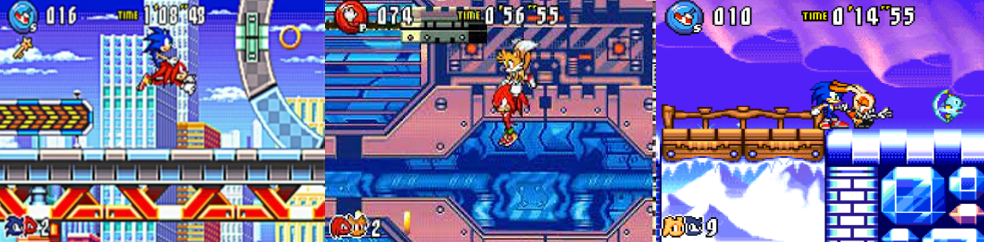
Yes, like Knuckles’ Chaotix (SEGA, 1995) and Sonic the Hedgehog 4: Episode II (Dimps/Sonic Team, 2012), and in keeping with the theme of the “real superpower of teamwork!” emphasised in Sonic Heroes (Sonic Team USA, 2003), Sonic Advance 3 features a partner system. Players must make a two-person team, with Sonic and Miles “Tails” Prower being the default team and others being unlocked through the story mode. A second player can even jump in for some co-op action and some combinations have special team names, like Sonic and Amy Rose being “Lovely Couple”. While your partner often disappears from the screen due to the game’s fast-paced action and much of it can be played alone, there are times when it’s beneficial to use Tag Actions to bypass obstacles or reach hidden areas. Also, each team fundamentally alters the gameplay, adding or removing abilities from your characters. For example, Tails can still fly by twirling his tails, Knuckles the Echidna can glide and climb walls, Amy whacks Badniks with her Piko-Piko hammer, and Cream the Rabbit flies and commands her Chao, Cheese, to attack enemies, but these abilities change depending on their partner. Consequently, if you partner Tails with Knuckles, Tails cannot fly and instead performs a Knuckles-like glide; Knuckles’ glide gains a homing attack when partnered with Cream; Amy gains a jumping dash when teamed with Sonic; and Cream can spin Cheese in an attack when teamed with Knuckles. There are pros and cons to this; teaming Sonic with Cream, for example, lets him breathe underwater, but having Amy as a partner often leaves you defenceless when jumping. Holding R to summon them performs a Tag Action, such as blasting you ahead at breakneck speed, flinging you high into the air, having Tails carry you around, launching Knuckles as a projectile or gliding on his back, using Cheese as Cream would, and giving you better jumping options with Amy. It’s an interesting system, with some combinations working better than others (Sonic gains and loses his Insta-Shield, Tails his tail swipe, Knuckles his drill claw, and characters gain or lose their ability to perform tricks depending on their partner) but it’s not required to have specific combinations just to beat the game, so just find what works for you and experiment later when you’re hunting for Chao.
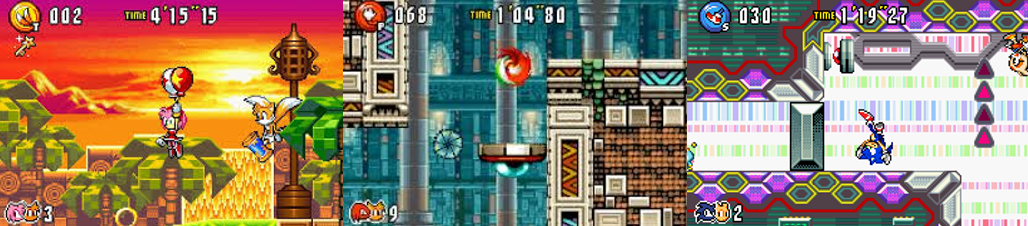
While the partner system is somewhat lacklustre, it’s a joy compared to Sonic Advance 3’s awful level layouts. The game’s faster than Sonic Advance but slower than Sonic Advance 2, blasting you along at high speeds but rarely to unfair deaths. This would be great if it didn’t still throw bottomless spits in the worst places, place Badniks and surprise spikes right in your path, and ask you to make leaps of faith into the void. You can swing on poles, dash up slopes, and run across gaps on moving platforms to falling stones (providing your partner doesn’t screw you over!) You hop in cannons, race across twisting paths, slide down (and jump up) waterfalls, fling into the air off bungees, and spring to higher ground using aggravating jack-in-the-boxes that randomly produce spikes! Often, Acts loop around unless you take the correct path, either using a spring, ramp, platform, or if you fall from a higher path, which gets very old very fast. Almost every time you build up speed, a hazard suddenly appears in your path or you run head-first into an insta-death trap, forcing you to slow down and get around them, Sonic Advance 3 features huge stages and, while the checkpoints help, your limited lives are whittled away by the game’s frustrating trial-and-error approach to gameplay. Sometimes, you bounce off balloons, grab rockets, or get fired from a freezing cannon to reach higher areas; often, you’ll be grinding on rails as shortcuts; and you run around spinning wheels or roll into pipes to reach new areas. Some Zones include platforms that carry you across a track, with you either having to duck or jump over hazards or even hop down to a lower platform to progress, and many include switches that temporarily spawn springs or moving platforms. Many Zones feature specific gimmicks, like Ocean Base largely being underwater, Cyber Track having a gravity gimmick that has you running on ceilings, while other mechanics (see-saw platforms and spinning handholds) are commonplace. Sonic Advance 3 forcibly breaks up the action with its annoyingly large hub worlds, which force you to manually enter each Zone and Act, though they also house minigames to break up the tedium. One sees you racing around an enclosed arena to defeat every Badnik, while the other has you hitting switches on a giant capsule to earn points, with players earning a handful of extra lives if they succeed.
Presentation:
Sonic Advance 3 is the visual peak of this spin-off series. The sprite sheets and assets provided loads of content for my old sprite comics and remain the most expressive and visually engaging renditions of these characters, at least in 2D, in my opinion. The team up gimmick adds a bunch of additional animations for the five characters, such as Tails sporting boxing gloves, Cream getting a life ring or an umbrella, Cheese changing sprite depending on who’s using him, and Amy’s hammer changing size and colour. Each has a very cartoony and fun idle pose, new victory poses where they’re running along (with a pseudo-3D effect applied after beating bosses), and the game includes more voice samples, with Doctor Eggman’s “You’re going to pay for this!!” never getting old. The game’s soundtrack isn’t much to shout about, though we do get yet another remix of Green Hill Zone in Sunset Hill. The Chao Garden theme also returns, despite the minigame being sadly absent, and the game utilises more cutscenes. This time, the game doesn’t just use partially animated sprite art and large mug shots of the characters over their speech bubbles but also includes more interactions between the player sprites as they encounter meet during the main story and are unlocked. Despite Dr. Eggman’s newest creation being a copy of Emerl, and players encountering Gemerl several times, no dialogue or cutscenes delve into their shock at seeing him. In fact, the characters don’t refer to Dr. Eggman splitting the world apart either, and no effects of this are seen, which is a bit of a shame as there was a lot of potential in both plots, but especially in the game acting as a quasi-sequel to Sonic Battle.
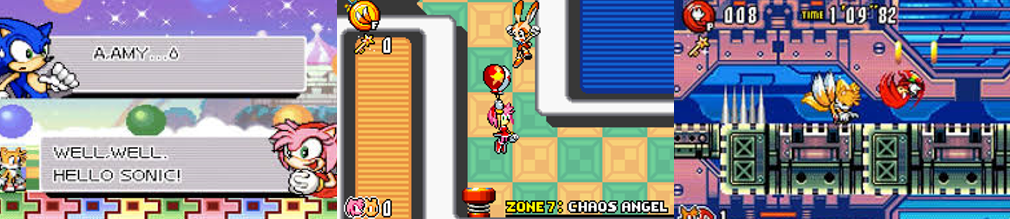
Sonic Advance 3 continues the aesthetic of the last game, which switched from a somewhat blurry and basic 2D recreation of Sonic’s 3D adventures to a more plasticine world. This gives some depth and colour to the environments, though things can get very cluttered and chaotic. Foreground elements are plentiful, backgrounds are deep and busy, and the play area can be so indistinct that it adds to the frustration of surprise hazards. Badniks are ridiculously small, which doesn’t help, and they don’t even release animals when destroyed, just Rings! While I didn’t care for the hub worlds, most Zones are pretty colourful and lively, if a bit barren and overly designed. In a change of pace, players start in a busy highway in Route 99, racing up and down walls and around loops as an egg-shell blue cityscape looms in the background. Sunset Hill actually has more in common with Turquoise Hill Zone and the later Splash Hill Zone than Green Hill, except for some familiar gimmicks, making me wish the developers had worked a little harder rather than relying on nostalgia. Ocean Base somewhat makes up for that, with its nautical theme, wavy water backgrounds, and steampunk/industrial theming. Toy Kingdom is an upgraded Music Plant, featuring big toy construction blocks, fireworks, an ornate background palace, and circus gimmicks like spinning panda cars, balloons, and rockets. It’s all very colourful, but I don’t think this aesthetic suits the franchise. Twinkle Snow veers back to nostalgia, being very reminiscent of Ice Cap Zone and even Ice Mountain Zone, with its aurora borealis and snowy mountain peak aesthetic. I liked the frozen grind rails and icicle spikes, the mine carts, and that the snow slowed you down. Cyber Track echoes Cosmic Angel Zone and Techno Base, apparently taking place in cyberspace, but the Zone is so messy and busy that it ends up looking ugly and being a chore. Finally, Chaos Angel is a riff on Sky Sanctuary Zone and Sonic Advance’s Angel Island Zone, being ruins up in the sky, and is perhaps the most derivative and aggravating area as a result thanks to all the bottomless pits. However, I liked the lightning storm brewing in the clouds, the rolling boulders, and the forgotten ruin aesthetic. This all culminates in a battle before the Master Emerald and, naturally, a final battle in space (albeit set against a cosmic cloud of sorts rather than in orbit).
Enemies and Bosses:
While Buzzer and Spinner appear as returning Badniks, Sonic Advance 3 features an all-new selection of robots to smash. We’ve got little ladybug-like Badniks who wander about like Motobugs, jet-powered sharks who torpedo you at the worst possible moments, exploding penguins, crab-like robots who launch their shells, robot monkeys who toss bombs from trees, eel-like robots who burst from walls, and even a praying mantis Badnik who flings its scythe-like blades! Robot octopi hover overhead on propellers and spit projectiles, snowmen toss snowballs, little toy soldiers march along, robot frogs hop about and shoot their tongues at you, robot moles pop from the ground, and there are even robotic piggy banks and hanging spiders. Unfortunately, all these Badniks are way too small and often blend into the background or are placed in the worst places, making them extremely irritating since they’ll either damage you or send you careening down a bottomless pit! Players will battle Gemerl five times throughout the game, sometimes at the end of an Act 3 and sometimes prior to facing Dr. Eggman. In the first encounter, Gemerl is much like Silver Sonic and simply blasts across the screen; then, he gains a jump and homing attack to recall the Hidden Palace Zone battle with Knuckles. Then, he adds a slow-moving missile that gets upgraded into a full-blown airstrike, before protecting himself with a shield, learning to teleport, and taking a few more hits to defeat. However, what works in the first fight will work every time and he’s more a nuisance than a real threat, at least until the finale. Gemerl pulls double duty here and also gets plugged into Dr. Robotnik’s latest contraptions, occasionally popping out during boss fights but otherwise being a non-factor. Thankfully, the auto-runner bosses of the last game are gone, replaced with standard battles against Dr. Eggman, though they can still be a bit irritating.
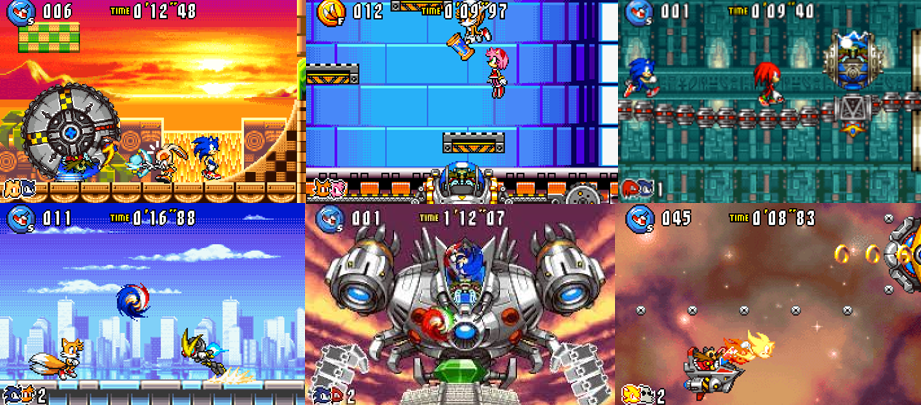
Dr. Eggman tries to crush you in the spring-loaded Egg Hammer 3 (which is quite large and difficult to avoid), tries to run you down in the Egg Ball No.2, with players hopping to a temporary platform to time attacks on his cockpit, before hopping about in his frog-like Egg Foot that you can easily scoot under. The Egg Cube was a touch more threatening thanks to the gaps either side of the platform and its large homing missile, chained mace, and annoying toy soldiers. However, you must hit the cockpit enough times to force it over the edge and you can just to stay up close for an easy win. Things really ramped up with the Egg Chaser, where you desperately hop to falling platforms as Dr. Eggman clambers up an igloo tower. As if the bottomless pit wasn’t bad enough, it’s really easy to slip and you can only damage his craft by having the platforms drop on him, so it’s best to use someone who can fly. The Egg Pinball was also kinda annoying there are disappearing platforms either side of the arena and you must ricochet Dr. Eggman’s balls back at him. The best idea is to avoid Amy since she often removes your spin jump and just spam jump until you randomly hit him enough times. The Egg Gravity was a pain in the ass, too. You’re on this chain-like, spindly platform, and Dr. Eggman’s protected by an electric current and causes the platform hit into the spikes. You must run into the tubes on either side to quickly hit Gemerl’s head, which rams Dr. Eggman into the spikes, but this gets tricker as the battle progresses and things speed up. You then battle the gigantic, looming Hyper Eggrobo, who tries to crush you with his massive hands and temporarily removes platforms from the arena. However, you can hop onto those hands to attack the cockpit, but you’ll have to be quick as the Hyper Eggrobo produces spheres that can be tricky to avoid (but also act as platforms). Finally, Dr. Eggman tries to clap you between the mech’s hands and hit you with a wind-up punch! Grab all the Chaos Emeralds and you’ll battle the true final boss, Ultimate Gemerl, which unexpectedly sees Super Sonic team up with Dr. Eggman! In this fight, you must hold R to charge an attack that sees Dr. Eggman hurled at Ultimate Gemerl, though you’ll have to contend with your Rings constantly ticking down, Ultimate General’s long and spindly arms, his stunning laser, and his missile barrage.
Additional Features:
There are ten Chao hidden in every Zone. Unlike the last game’s Special Rings, these are much easier to find and you only have to find them once, and you can find them with any character. However, tracking them down can be a ball ache and, once you do, you have to replay an Act to find a Special Key, which you must then bring to a Special Spring hidden in the hub world and then you can challenge the Special Stage! Again, you can carry a stock of Special keys but I’ll never understand why the Sonic Advance games overcomplicated the Special Stages so much! Although I never got all seven Chaos Emeralds, I did get five of them, which is more than the last two games. The Special Stages are a vast improvement over their predecessors, but still quite finnicky. You must move the Tornado about a surreal landscape, collecting Ring clusters and hitting speed boosts for multipliers, while avoiding bombs and missiles. Collect all seven Chaos Emeralds and you unlock a special cutscene where Gemerl turns on Dr. Eggman and forces him to team up with Super Sonic to battle Ultimate Gemerl in the true final Zone, “Nonaggression”, which earns the game’s real ending that sees Tails reprogram Gemerl to live with Cream. Beyond that, Sonic Advance 3 offers different languages, a harder difficulty mode, a time attack feature, and a multiplayer mode. I’ve never experienced this but apparently you can play the main game in co-op or take on up to four players in a race to the goal or to find and hold on to a Chao. Clearing Altar Emerald unlocks the game’s sound test, and you’ll also unlock a boss time attack if you get bronze, silver, and gold medals for every Act and boss fight. These medals are awarded for how quickly you beat each Act, which I’m sure is an incentive for speed runners but I wasn’t all that bothered.
Final Thoughts:
As slow, dull, and uncreative as Sonic Advance was, I think Sonic Advance 3 is probably the worst of the series. There’s just enough here to keep it enjoyable and somewhat on par for the franchise, but my God did this game annoy me! I like the idea of the team up mechanic, and I enjoyed that different partners changed how characters played and what abilities they had, but all it really boiled down to was an extra layer of challenge if you pick a shite combination. There are rarely any instances where you need a specific duo, no significant alternative paths afforded to certain combinations, and your partner isn’t even on the screen half the time! It’s just so barebones and lacklustre that it makes me wonder why they bothered since even the Tag Actions rarely add much, especially if you use Tails or Cream to simply fly to where you need to go. The level layouts are also a mess this time around. Zones are a visual cacophony at times, which doesn’t help, with teeny-tiny Badniks and way too many surprise hazards, but the geometry had me running into walls or looping around in frustration. I honestly preferred the high-speed mechanic of the last game to this, which might’ve worked better here given Sonic Advance 3 is a bit fairer with its pits. They still appear and they’re still annoying, but I felt they were less prevalent, likely because the game’s focused more on platforming than racing. The lack of emotional significance given to Gemerl was also disappointing, though I did like the large role he played in boss battles (even if the two-on-one fights against him were quite tame). The lack of a Chao Garden was a shame, and I didn’t like that the game still massively overcomplicates accessing Special Stages (even if I was able to actually play and beat some this time). Ultimately, I feel Sonic Advance 3 failed to (dare I say it) advance the series to a satisfying conclusion as it replaced fast-paced action with muddling platforming and annoying mechanics, ending things of a bit of a downer for what was supposed to be a throwback to Sonic’s 2D glory days.
My Rating:
Pretty Good
What did you think to Sonic Advance 3? Did you enjoy the team-up mechanic and, if so, which combination was your favourite? What did you think to Gemerl, the battles against him, and the game’s ties to Sonic Battle? Did you also struggle with the level layout and focus on platforming? Were you also annoyed by the annoying requirements to enter the Special Stages? Did you ever collect the Chaos Emeralds and defeat Ultimate Gemerl? Which of Sonic’s Game Boy Advance titles is your favourite and how are you celebrating Sonic’s anniversary this year? Whatever your thoughts on Sonic Advance 3, leave a comment below, support me on Ko-Fi, and go check out my other Sonic content!


4 thoughts on “Game Corner [Sonic Month]: Sonic Advance 3 (Game Boy Advance)”