
Sonic the Hedgehog was first introduced to gamers worldwide on June 23 1991 and, since then, has become not only SEGA’s most enduring and popular character but also a beloved videogame icon. Thus, in keeping with tradition, I’m dedicating some time to celebrate SEGA’s supersonic mascot.


Quick Facts:
Forces to abandon console manufacturing, SEGA developed games for Nintendo’s GameCube and Game Boy Advance alongside Dimps. Following a highly praised trilogy and two very successful dual screen adventures, SEGA partnered with noted roleplaying game (RPG) developer BioWare for Sonic’s first RPG and BioWare’s first handheld title. Developed with a darker theme focused on characterisation and accessible combat mechanics, Sonic Chronicles was heavily criticised for its low quality MIDI soundtrack and forever changed Sonic’s comic book adventures when hack artist/writer Ken Penders sued SEGA for copyright infringement.
Gameplay and Power-Ups:
Sonic Chronicles: The Dark Brotherhood is an RPG in which players form a team of up to four characters from a roster of ten familiar faces from the franchise (two being optional and one being newcomer Shade the Echidna) and battle against the mysterious Nocturnus Clan across ten chapters. While Sonic is always on your team unless you’re asked to form two teams to handle separate objectives, you can switch the onscreen character by tapping the lower screen and the story progresses regardless of who’s in your team, with only some optional additional dialogue and exploration options being available for each. Sonic Chronicles goes all-in with the Nintendo DS touch screen, meaning every action is conducted via the stylus and touch screen, including controlling your characters, progressing dialogue, solving puzzles, and battling enemies. This is a touch jarring, and disappointing, as it can be difficult comfortably holding the Nintendo DS and I found tapping the screen inconsistent at times (though this could’ve been due to my touch screen). You start as Sonic but quickly hook up with Miles “Tails” Prower and Amy Rose to rescue Knuckles the Echidna, with each giving a sense of what the game has to offer. Characters come in three classes: “Power” (who focus on attacking), “Shifter” (who shift between attacking, supporting, and afflicting status ailments), and “Support” (who focus purely on supporting your team and have low attack power). Personally, I focused more on powering through battles, which will serve you well for the most part as the game doesn’t get too taxing until the final chapter, though you can heal and inflict status ailments on enemies, such as stunning them or putting them to sleep. Naturally, you earn Character Experience (XP) from battles that allows you to level-up and become stronger, adding special “Power/POW Moves” to your arsenal, though the highest level you can achieve is thirty and I found you don’t gain much XP compared to other RPGs.
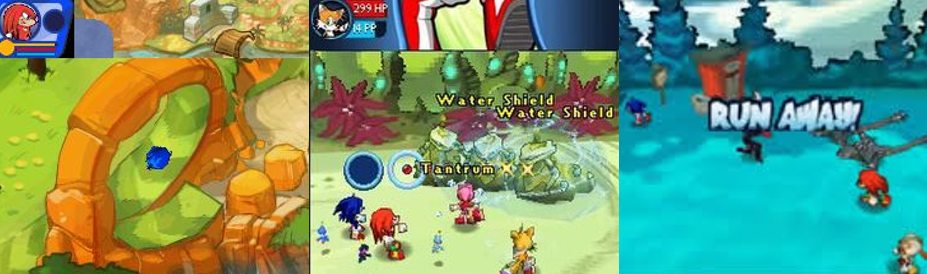
As you awkwardly explore, uncovering more of the map and interacting with various non-playable characters (NPCs), you’ll see context-sensitive actions pop-up to help you navigate. This means tapping the screen to make Sonic or Shadow the Hedgehog run through loops, flying across gaps as Tails or Cream the Rabbit, and smashing crates with Amy or Knuckles. Knuckles is a bit of a jack-of-all-trades as he can glide over short gaps, smash crates, and climb walls, but you’ll need Tails to fly further and Amy to smash metal crates. Enemies appear on the overworld, meaning you can avoid most battles if you wish, and you can flee most battles or fight for XP, items, and Golden Rings (used to purchase items or retry if you’re defeated). When in battle, you must deplete the enemy’s hit points (HP) before yours are drained, regaining HP from certain POW Moves, restorative items (like Health Roots and Health Seeds), or when meeting at safe houses like Tails’ lab. While your regular attacks deal decent damage, especially with the right setup, and require only that you tap the “Attack” command, POW Moves cost POW Move Points (PP) to execute and see you completing various touch screen actions. You must also complete these when enemies use their own POW Moves, reducing or even avoiding damage if you tap every icon, mash in a circle, or drag the stylus as directed. These can be finnicky and become tougher when executing or defending against stronger attacks, but they can deal greater damage, damage all enemies, and inflict status effects. You can also defend against incoming attacks, use items to heal HP or PP or revive fallen allies (with you still being able to attack after selecting an item), and flee. Enemies may also flee, triggering a chase sequence where you must grab Rings, tap the screen to jump over obstacles, and use dash pads to catch your foes or escape, with your success largely dictated by how accurately you tap the screen and how high your “Speed” stat is.
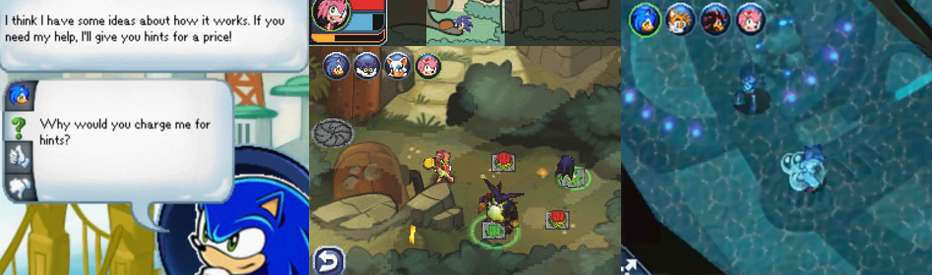
The “Speed” stat also allows you to attack first, or multiple times per “Round”, while the “Luck” stat dictates how often you “ambush” enemies, avoid attacks, or deal critical hits. You can boost stats by equipping gloves, shoes, accessories, and a Chao to each character. These are either purchased, found in crates, earned from battles, or (in the case of Chao) found on the overworld and take time to hatch. These all boost your stats and maximum HP, allowing you to land one-hit KOs or inflict elemental damage (with some enemies being weak to lightning or ice attacks), and increase your rewards, among many other benefits. With the right setup, your team can be virtually unstoppable, especially in “New Game+” where you decimate enemies without taking a single hit. While your primary objective is investigating the Nocturnus Clan, initially determining whether Doctor Eggman is still a threat and then briefly teaming with him against a common foe, NPCs offer side missions to tie into the main plot or offer secondary rewards (usually item crates or Chao eggs). Objectives often involve exploring, battling or clearing out all enemies, recovering key items, and activating consoles to power or deactivate barriers, doors, and even flooded corridors. These appear in the final chapter and see you using air bubbles to avoid draining your PP. While these gimmicks can be tedious, especially as enemies respawn and it can be annoying navigating environments without the right characters (you need Big the Cat to pass through toxic clouds, for example), they’re relatively simple. There are also more aggravating switch-based puzzles that see you placing each character on a specific switch, either in the correct order or to activate various machinery (like a crane or a lift). Some of these, such as the puzzle leading to Dr. Eggman’s secret tunnel, are unnecessarily aggravating, while others are just trial and error. Optional objectives can further bolster your team with additional characters and rewards and the final chapters see you earning the trust of the various aliens in the “Twilight Cage” and splitting into two teams to lead an all-out assault against Nocturnus leader, Imperator Ix.
Presentation:
Sonic Chronicles opts for a cel-shaded, quasi-isometric aesthetic for the most part, with 3D modelled characters navigating what appear to be hand-drawn environments with some polygonal elements. Character models vary between the overworld and the battle screens, mostly appearing as chibi-style renditions somewhat reminiscent of Sonic Shuffle (SEGA, 2000), and are quite limited at times. Sure, they have some fun animations when idle, using their abilities, POW Moves, or succeeding in battle, but they also look a bit ugly, deformed, and low resolution. These co-exist alongside comic book-style animated sequences that badly echo the Sonic X (2003 to 2005) art style, resulting in some disturbingly off-model cutscenes. There are a fair few characters to pick from, however, with each offering different challenges in their POW Moves and most having decent story arcs. Knuckles largely takes centre stage as he’s reunited with his lost people, but there are some fun moments to mess with Sonic’s characterisation as the dialogue options see him mock, encourage, or dismiss his allies and enemies depending. I liked seeing outcasts like Shadow and newcomer Shade begrudgingly join forces with Sonic and the others, and seeing Sonic and Dr. Eggman team up (only for him to betray them in a sadly unresolved cliff-hanger), and that the story is peppered with references to the wider Sonic franchise. There’s talk of “Robotization”, for example, and you battle a few “Swat Bots”, and Imperator Ix delivers additional lore for the echidnas and the Gizoid fighting robots. While many complained about the game’s soundtrack, I never had an issue with it. It’s not the most memorable, save for a chip tune rendition of the “Doomsday Zone” theme in the final chapter that I always found fun, but it matches the action and events. There are also some recognisable sound effects from the games and a handful of sound bites peppered in, though even I have to admit that much of the presentation is very basic and lacking, with environments being clunky to navigate and largely empty.
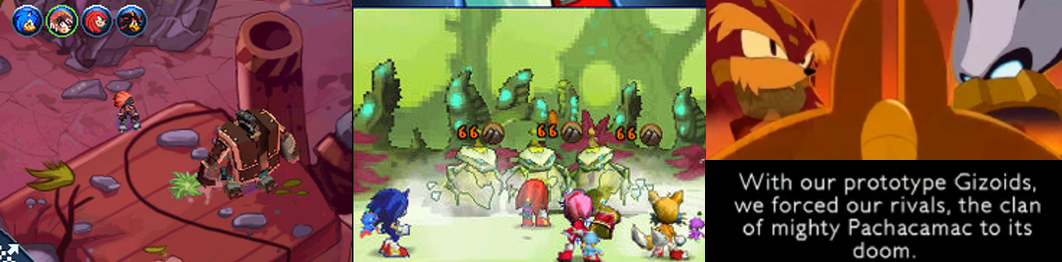
Sonic Chronicles sees you visiting and exploring some familiar, if drastically altered, locations from the videogames. Naturally, you start in Green Hill Zone, which acts as a tutorial, before venturing to Central City, where the Guardian Unit of Nations (G.U.N.) and Tails’ lab are. These areas also hide hidden bases used by Dr. Eggman and the Nocturnus Clan and see you using the Tornado to fast travel around. They also lead directly to the toxic Mystic Ruins and, after teaming with Dr. Eggman, players venture to his decimated main base, Metropolis, which gets further damaged after Imperator Ix steals the Master Emerald and causes Angel Island (a sadly limited play field) to crash into it. There are also some original areas to explore, like Blue Ridge Zone (an Old West style town that includes the remnants of Station Square and Dr. Eggman’s secret tunnel to Metropolis), and fun Easter Eggs (such as Eggrobos and a Mega Drive being strewn about Metropolis). Things really turn bizarre when Dr. Eggman helps Sonic and his friends travel to the Twilight Cage, a surreal, alternative dimension housing various wacky aliens. You’ll encounter the Kron, proud rock-monster miners, the gelatinous, slug-like N’rrgal, the Voxai (psychic manta ray-like aliens), and the warlike Zoah, who must be united against the Nocturnus Clan. The various areas in the Twilight Cage may be noticeably smaller than their predecessors, but they’re more visually interesting, including volcanic mines, bizarre alien fauna, and luminescent, high-tech cities. Imperator Ix’s citadel is a complex maze of paths and doors, one swarming with Gizoids and other powerful enemies, and desperately fending off the allied aliens’ assault. When in combat, things switch to a simple battle arena that reflects whatever area you’re in and, when exploring, you’ll constantly see the map on the top screen to keep track of alternative routes, your objective, and any Chao eggs you’ve missed.
Enemies and Bosses:
Unlike most Sonic videogames, you won’t be freeing cute woodland critters from Badniks here. As the game starts with Dr. Eggman defeated and presumed dead, you mostly fight enraged armadillos, wild boar, and wasp swarms and their queens. Giant scorpions, raptor hawks, and giant millipedes also appear, with them parrying your attacks, poisoning with their quills, regenerating HP, or blasting you with their tails. The Nocturnus Clan’s Marauders and Dr. Eggman’s Swat Bots toss grenades to stun you and self-repair, respectively. Dr. Eggman’s various sentry bots and drones use buzzsaws, bombs, and self-destruct, while rocket-firing or shield-carrying Pawns up their defence. When in the Twilight Cage, you must initially battle the locals, with the Kron Warriors being noticeably durable (unless you equip wind, water, or ice elements), the brainwashed Voxai firing psychic waves and hiding behind shields, and N’rrgal drones draining your HP. The Twilight Cage is also swarming with higher-level Nocturnus soldiers and various Gizoids that are both far more durable and deal greater damage, especially as their POW Moves are trickier to avoid. Nocturnus Praetorians, for example, target one character with a Hellfire blast, Nocturnus Triarius leech HP with their blades, and these enemies are more likely to parry or avoid your attacks, too. The Gizoids can utilise every playable character’s and Nocturnus’ POW Moves and regenerate their HP, making them formidable and unpredictable to the unprepared player. Some enemies appear as mini bosses, too, like the Swat Bots that guard Dr. Eggman’s bases, the three powerful “Overmind” Voxai, and the Gizoid “Prefects” Charyb and Scylla, who are initially unbeatable before your two teams solve some puzzles to make them vulnerable.
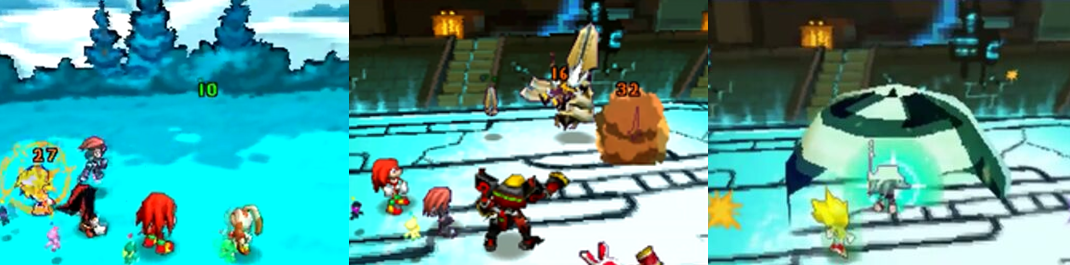
Shadow is also fought as a mini boss in the Mystic Ruins and Blue Ridge Zone, where Sonic must fight him alone after chasing him down. Although Shadow is fast and can hurl his Chaos Spear, he’s not especially difficult. Shade is initially fought as a mysterious Nocturnus “Procurator” who can activate a cloak and attack with her Leech Blade. You must also battle one of Dr. Eggman’s malfunctioning Egg Bots to reach the Twilight Cage and endure a gauntlet on the Zoah Colony that sees you battling General Raxos’ minions and Commander Syrax, with no chance to heal or save between bouts. This culminates in a one-on-one fight between Sonic and General Raxos that can be troublesome as the Zorah regenerate HP, target your allies, and use shields. Charyb and Scylla can also be formidable as their Mighty Slash inflicts sleep, though your greatest test comes from Imperator Ix. You first fight him on Angel Island, which isn’t much to shout about, but he’s far more formidable in the final chapter, where he’s fought in a multi-stage battle. First, Knuckles and his team battle Imperator Ix and his Power Pylons. These regenerate Imperator Ix’s HP so it’s worth taking them out (though he can also resurrect them), but you must also watch out for Imperator Ix’s Doom Orb (which will put you to sleep and/or stun you), his aggravating counter attacks, and his sceptre blast that can easily KO you or your allies. When you fight him with Sonic’s team, he’s much easier as the Power Pylons can be ignored. You then form another team to chase him down (hopping over his energy balls) and battle him alongside a couple of Gizoid Guardians, which is also a lot easier than the first fight (though you must defeat the Gizoids as well as Imperator Ix). Imperator Ix then transforms into Super Ix using the Master Emerald for a final bout with Super Sonic. This is fought entirely using automatically executed POW Moves, meaning you must tap and drag the stylus to avoid taking damage. Since you cannot use your items and Super Ix regenerates a load of HP, you must perfectly execute your POW Moves and taps to avoid taking too much damage and finish Imperator Ix off for good.
Additional Features:
There are forty Chao to hatch in Sonic Chronicles, with numerous eggs scattered across every environment. There are also a bunch of treasure chests to find, each containing regular items and additional accessories to further boost your stats. Further rewards are earned by helping various NPCs and you’ll often need specific characters for this as you need different abilities to explore, but it’s not always mandatory unless you want a fully stocked inventory. I would advise helping E-123 Ω “Omega” in Metropolis, however, as he’s an absolute powerhouse who can really make a difference in a fight. I didn’t have as much use for Cream but, if you’re a fan, you can recruit her in Green Hill Zone. You can also review your Chao in the Chao Garden and even trade them with friends using multi-card play. Completing the game unlocks “New Game+”, which starts a new save file with all your skills, equipment, Chao, and XP carrying over. You must auto-level-up and set each character up, but this makes replaying the game a breeze as you’re so overpowered that nothing poses a threat until you reach the Twilight Cage.
Final Thoughts:
I’ve always been a fan of Sonic Chronicles: The Dark Brotherhood. It’s ridiculously easy at times, especially on “New Game+”, and incredibly basic for an RPG, but I’ve always found it a fun, hassle-free game for the most part. I enjoyed the story and how it expanded upon echidna lore in interesting ways, finally bringing in some new echidna characters and giving Sonic and his friends a chance to showcase more of their personalities through the dialogue options. I’m still annoyed we never got a resolution to the cliff-hanger and that Shade has vanished into obscurity, and have always defended the game as a decent enough adventure. Yet, Sonic Chronicles is far from perfect. The emphasis on the touch screen was a big mistake, in my opinion, and I would’ve much preferred being able to control my character and make selections with the left stick or directional pad rather than using the stylus. This control scheme makes it clunky and awkward to navigate the sadly barren worlds, whose puzzles are repetitive and often frustrating and amount to little more than accessing a new area or reaching another chest or Chao egg. I quite enjoyed the combat, as limited as it can be. Your enjoyment of the POW Moves may vary depending on how good your touch screen is, but they were a visually fun twist on the usual magic system of most RPGs and I quite liked the chase mechanic, as finnicky as it was. I do think more could’ve been done with this, the character-specific actions, and the character classes, however. It seems the only thing the developers did to make Sonic Chronicles unique was force you to complete touchscreen quick-time events, which is disappointing given the potential of the characters and this world. Graphically, the game’s okay and I never had an issue with the music, but I can see why these aspects are a turn off. Perhaps sticking to traditional 2D for everything but the combat would’ve been a better solution? Either way, I still think Sonic Chronicles is under-rated and over-hated. It’s not going to appeal much to die-hard RPG players but it’s a fun enough introduction to the genre that I’d love to see referenced again in the mainstream games.
My Rating:
Pretty Good
Did you also enjoy Sonic Chronicles: The Dark Brotherhood or did you find it disappointing? Were you a fan of the touchscreen controls and mechanics? Did you find the graphics and music ugly and grating? Which characters made it into your final team? What did you think to Nocturnus Clan and Shade? Would you like to see these original characters return and get some resolution? Which of Sonic’s spin-off titles is your favourite and how are you celebrating Sonic’s anniversary this year? Let me know your thoughts on Sonic Chronicles: The Dark Brotherhood in the comments and go support me on Ko-Fi to fund more Sonic content!


