
Sonic the Hedgehog was first introduced to gamers worldwide on June 23 1991 and, since then, has become not only SEGA’s most enduring and popular character but also a beloved videogame icon. Thus, in keeping with tradition, I’m dedicating some time to celebrate SEGA’s supersonic mascot.


Released: 18 October 2018
Developer: Dimps
Metacritic Score: 59
Also Available For: Nintendo Wii U and PC
Quick Facts:
Shortly after the release of Sonic Colours (Sonic Team, 2010), Sonic Team teamed with Dimps once more for a more streamlined and diverse Sonic title that emphasised “parkour” mechanics. Sonic Lost World was developed for the Wii U and 3DS due to SEGA’s previous success on Nintendo’s consoles and saw the debut of the “Deadly Six”. The Wii U version got special editions and downloadable content (DLC) and both received mostly mixed reviews.
Gameplay and Power-Ups:
Sonic Lost World is a 3D and 2.5D hybrid action platformer that continues the high-speed “Boost” formula that popularised Sonic’s 3D titles. As was the style at the time, this is a single-player experience, with Miles “Tails” Power only appearing in cutscenes, though Sonic gains temporary power-ups by collecting benevolent alien “Wisps” scattered around the “Lost Hex”. The standard Sonic formula returns, with players collecting Golden Rings to survive most hazards, encouraged to finish stages (or “Zones”) quickly to earn letter grades, and bashing Badniks to free woodland critters. As ever for 3D Sonic titles, players lock-on to nearby targets (Badniks, springs, rails, etc) after jumping with either A or B. While jumping destroys Badniks and certain obstacles with Sonic’s patented Spin Attack, tapping A or B again performs a double jump or launches Sonic at his target. You can chain multiple Homing Attacks together and must often quickly tap the button to hop between rails, clear gaps, or cling to rockets. A new feature in Sonic’s arsenal is a mid-air somersault attack, performed by pressing X or Y after jumping. This sends a blast of wind-like energy towards your target, stunning it for a few seconds so you can bypass their defences or hit their weak spot, and this is essential when confronted with giant Badniks that must be destroyed to reveal springs or teleporters and such. Pressing X or Y in mid-air when not locked onto an enemy performs a bounce to give you extra height, Sonic clambers over some ledges, air bubbles keep him from drowning, and you earn extra lives by grabbing Sonic Icons, collecting five Number Rings, or for every 100 Rings. Hitting capsules also gifts you some returning power-ups, like the returning temporary invincibility, ten additional Rings, and three elemental shields. The aqua shield allows you to breathe underwater, the lightning shield attracts nearby Rings and keeps you from being hurt by electrical hazards, and the flame shield resists all fire hazards.

Unlike other 3D Sonic games from this era, there is no Boost option in Sonic Lost World. Instead, you hold down the Right trigger to run, which is essentially the same but lacks the fast-paced, action-packed feeling of ploughing through hordes of Badniks and instead highlights the game’s slower pace. The big new gimmick is “parkour”; hold R or hit boost pads to run up walls, tapping X or Y for a boost and to keep from falling and hitting A or B to hop between walls. You can quick step around corners and to avoid enemies and use the Left trigger to better position the camera, but I found this mechanic very finnicky and that I was more likely to simply plummet to my death or be forced to repeat a wall run due to poor hazard placement. As mentioned, some Wisps return, with you tapping the lower screen to activate them and collecting Wisp capsules to top up the energy bar, though you’ll lose your shield if you use a Wisp. You can Drill!! through certain dirt or cut through water with the Yellow Wisp, attract items and enemies to float with the Indigo Wisp, and ricochet off walls and ceilings with the Cyan Wisp. You can also zap to nearby coils and targets with the Ivory Wisp, blast about as the explosive, fiery Red Wisp, or wrestle with the Nintendo 3DS’s god-awful gyroscopic controls with the Gray Wisp. Wisps are relatively sporadic, though some Zones require them to be cleared, with you desperately topping up your meter to avoid a fatal fall or being devoured by gigantic enemies. The Yellow Drill dispels whirlpools, the Gray Quake destroys certain blocks and activates big switches, and Indigo Asteroid lets you float to faraway platforms. Players also earn “Materials” by completing Zones, earning more for “S” or “A” ranks. These upgrade Tails’ Lab and allow him to create remote controlled (RC) vehicles, which can be transferred to the Wii U version so a second player can drop bombs, turn Sonic invisible, or slow him down. If you lose too many lives here, a golden RC Vehicle flies over the environment or become invisible and invincible, allowing you to bypass trickier sections. Finally, one item per life can be stored on the touchscreen, which is handy in a pinch.

These are quite prevalent in Sonic Lost World since basically every Zone takes place over a bottomless void. When Sonic speeds off uncontrollably or is met by gaps, temporary platforms, or tricky jumps, you’re likely to fly to your doom, which is very frustrating. Spikes regularly appear to screw up your parkour, you must often defeat Badniks to progress, or you’ll be hitting or rolling objects onto switches to activate or move platforms. There are often branching paths, with some having hard jumps or chasms dotted by rails and Spinners, loops, springs, and bouncy bumpers regularly appear, and you’ll be floating or being pushed along by fans. The screen often tilts and rotates in 2.5D sections, which can be very disorientating; you’ll use motion controls to steer high-speed rockets; the environment often pops up as you race along; and some platforms swing ominously. Quicksand and marsh water slow you, teleports loop you around, and you’re often asked to explore in different directions, tackling different puzzles to activate switches or teleporters. Pistons crush you, gravity sometimes fights against you, and you’re often pushing objects about. There’s one part where you must roll giant apples into holes and then into a giant blender, freezing gusts must be blocked by large snowballs, and you occasionally go sky diving, holding X, Y, or R to dive faster. Sometimes, you run around spheres in a mad rush trying to defeat all enemies or find switches, occasionally forced to barrel about with the aggravating Gray Wisp. Bouncy clouds and tubes are commonplace, as are moving platforms that you must ride to progress and giant springs that launch you to other parts of the Zone. Zones go on for ages, with multiple checkpoints and escalating platforming and puzzle challenges, which can be irritating. You’ll frantically hop to rails (often dodging enemies and hazards), ricochet about Casino Night Zone-style pinball tables trying to score a bingo, dodge lava pits and flame pillars spawned by Zavok’s Mech Dragon, and trick enemies into activating switches.
Presentation:
At first glance, Sonic Lost World is quite impressive. The game features prerendered cutscenes with full voice acting, though they’re obviously compressed compared to its Wii U counterpart, with no in-game models being used to convey the game’s story. This involves Sonic reluctantly teaming with Doctor Eggman against the Deadly Six, driving a wedge between him and Tails, Dr. Eggman faking his death, and the Deadly Six briefly brainwashing Tails to fight his buddy. There’s a pseudo map screen where players freely choose which Zone to play or visit Tails’ Lab, and the music is very jaunty and catchy. There are even remixes of “Sonic Heroes” and “Reach for the Stars” tossed in, which was nice, and I loved how the game brought the Flickies and bonkers, surreal aesthetic of the original games to life after years of fusing real-world elements into the franchise. Sonic gets impatient when you leave him, runs with a lovely 3D recreation of his classic spinning legs, sprouts catchphrases and voice lines, and your goal is to hit the classic animal capsule at the end of each Zone. However, there’s a distinct blurriness to the visuals, one only exacerbated when you inch on the 3D slider. While the depth is impressive, the colours pop, and giant Badniks fly at you in 3D, this option remains headache inducing and is best left off. There is also lots of pop up, with spiralling paths literally appearing as you run and environments loading as you’re pinballed about. This means some Badniks and hazards appear out of nowhere, it’s not always clear where you’re heading, causing you to miss rails or landings, and the Homing Attack has a noticeable lag that causes many unnecessary and aggravating deaths. Sonic Lost World generally has two playfields: cylindrical and spherical 3D worlds or 2.5D obstacle courses that recreate some classic Sonic environments, like Green Hill Zone and Casino Night Zone. The 3D sections take a lot of inspiration from the Super Mario Galaxy games (Nintendo EAD Tokyo, 2007 to 2010), being spherical, cylindrical, and/or blocky worlds offering a mixture of high-speed action and tricky platforming. Unfortunately, Sonic Lost World’s 3D Zones all take place in a void, so you can rocket to your death with ridiculous ease.
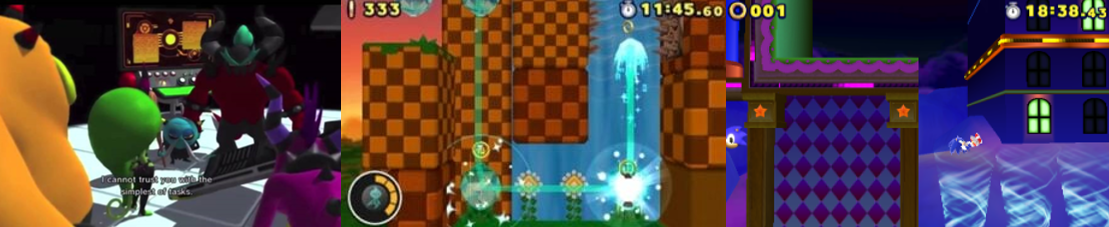
This is made more irritating by the clunky parkour mechanics and the split-second timing required to switch rails or hop to platforms in later Zones, though it’s the motion controls that really screw you up since they make your movements so erratic and loose. There are seven areas with three Zones and a boss, and each Zone is broken down into multiple sections separated by giant springs or teleporters. Things start familiar enough in Windy Hill Zone, a decidedly Green Hill Zone environment featuring boulders, totem poles, caves, waterfalls, and you running from a giant Caterkiller. Loops, bridges, and spiralling paths are introduced here, while Desert Ruins Zone sees more obstacles coming your way. You must jump to move over quicksand, explore a darkened tomb, and hop to platforms as Zomom’s Ganmen blows you back and blasts you with its eye beams. Tropical Coast is like the love child of Angel Island Zone and Emerald Coast, featuring calypso music and underwater sections alongside palm trees and islands. The Yellow Drill is super useful for navigating the underwater mazes, which easily turn you around thanks to that annoying screen tilt, and this is also where you’ll find that giant blender. Frozen Factory Zone starts you snowboarding down a snowy mountain, pulling off tricks and griding across rails, before having you creep along narrow platforms, plug up freezing hazards, and desperately avoiding giant snowman heads to hit switches. Silent Forest Zone is a dense jungle full of sticky marsh water, spring-loaded flowers, and a grind through night-time ruins as Zor’s Owl Mech searches for you and alters the environment, confusing the already troublesome platforming sections. Sky Road Zone starts very basic, with just an open sky background, and heavily focuses on bottomless pits, but also transitions to a neon city and pinball aesthetic. It’s capped off by far more treacherous, Windy Hill Zone sections that burst into flame, requiring you to pop water balloons or grab a fire shield. There’s a lot of variety in each Zone, for sure, but perhaps a bit too much at times as they quickly outstay their welcome, especially when the game blasts you down pits and calls it a challenge.
Enemies and Bosses:
Many of Dr. Eggman’s most recognisable Badniks return here; in fact, there’s surprisingly few new enemies and some returning Badniks even sport new mechanics. Motobugs race about, Newtrons crawl along walls to screw up your wall running, Buzz Bombers hover about taking shots at you, Jaws patrol the waters, and Orbinauts catch you off-guard when you’re stringing together homing chains. Spinners and Batbrains act as “bridges” over gaps, though some Spinners zap you and cause you to fall to your death. Caterkillers and Sandworms are noticeably prevalent, coming in gigantic sizes and requiring you to stun them to hit their weak spot, while Crawl now sports a projectile attack. Those bloody Metropolis Zone Slicers return to fling your blades mid-jump, Cluckers (both small and giant) pop up to blast cannonballs at you, and even Egg Pawns prove troublesome as they run about flailing their arms. Balkirys swarm, Grabbers and Antlions lurk from above, and Penguinators endlessly respawn to slide across ice. Clucker variants hop into mine carts to chase you across rails, giant robotic turtles sport shell cannons, and huge mechanical blowfish often guard switches and teleporters. These bigger enemies are best stunned to halt their attacks or lower their defences, which you’ll also use to stun Zeena’s Snowman Mech as it relentlessly pursues you. this allows you to rapidly attack it, causing it to temporarily press switches. Often, switches and teleporters and such cannot be accessed until you’ve defeated a certain number of Badniks, usually a giant one, and even bigger variants often chase you and instantly kill you if they touch you. Some of the Deadly Six appear in the Zones, such as Zazz appearing in the background of Windy Hill Zone and tossing his Moon Mech at you. The Deadly Six act challenge you at the end of each area and are battled again in Lava Mountain Zone, where they’re tougher, have altered attacks, and you have less time to hit them.

Zazz rolls around on his Moon Mech, trying to crush you, so race away and knock him off to pummel him on the ground, avoiding his shockwaves and star projectiles. Zomom attacks atop the block-headed Ganmen, raining fireballs and vulnerable in the rear (and to Indigo Asteroid), and running around in a rage at the end. Master Zik was a pain as he’s protected by a ring of fruits. When he rolls one, jump and hit it from behind to pierce his barrier and attack him, and use the Yellow Drill to deal big damage. Zeena can also be a headache, especially in Lava Mountain Zone, as her giant snowman constantly pushes you back. You must push towards her and attack her mech’s belly for an Ivory Wisp, and then latch onto the enemies to zap her, which gets very annoying. This is nothing compared to Zor, though, who charges up a devastating eye beam from afar on his Owl Mech. You must quickly hop in the cannon and whirl around like an idiot with the gyroscopic controls to locate his mech, with more fakes and less time to attack him in Lava Mountain Zone. Zavok is comparatively easier but still troublesome as you’re in freefall, have little idea of where he is, and he blocks your Homing Attack. You must avoid his dragon’s fireballs and lasers (with the circling laser attack being especially frustrating) to hit him from behind, or grab the Cyan Wisp to decimate his health bar. After battling all six again in teams, you finally fight Dr. Eggman in a repurposed Death Egg Robo, racing towards him on a never-ending path like in Sonic Colours. You must avoid the Eggrobo’s increasingly troublesome Wisp-like attacks, which include lasers and electrical bolts, numerous fireballs, rocks kicked up by his drills, boulders, and an insta-kill black hole that’ll have you rage-quitting! After avoiding his attacks, you must hop about to select the mech’s limbs and unleash a counterattack, barrelling into the cockpit and eventually mashing B to deal the final blow.
Additional Features:
Each Zone that isn’t a boss battle or Lava Mountain Zone contains five Red Star Rings, with their collection being helpfully displayed prior to starting a Zone and during it. Collecting all fifteen Red Star Rings unlocks an “Extra level” for Zone for an additional challenge and beating those unlocks an even tougher final boss! Beating the game also unlocks “Hard Mode”, applicable by pressing Y prior to starting a Zone, if you want to make this finnicky game even more challenging. If you want Tails to build every RC Vehicle, you’ll need to grind away at each Zone to get those “S” and “A” ranks and earn better Materials, though this only really seems to benefit those with the Wii U version. There’s a time attack and a “VS. Mode” for players to go head-to-head with a friend in virtual reality races. You can also visit Tails’ Lab to listen to the soundtrack or view the game’s blurry cutscenes, or use the 3DS’ “StreetPass” feature, apparently to unlock additional missions but I’ve never actually used this. This version includes seven Special Stages, which can be replayed from the main map after you’ve beaten them, and the seven Chaos Emeralds. These Special Stages are similar to the classic Blue Sphere ones and have you flying through a cosmic void collecting Orbs and avoiding walls, electrified hazards, and navigating mazes. You have a strict time limit that decreases with each Chaos Emerald, so you must snag those time bonuses, and your reward is being able to tap the screen when you have 50 Rings to become the all-powerful Super Sonic. Unfortunately, while the Special Stages are doable and welcome, you’ll end up spinning around like a moron and giving yourself a headache as you’re forced to use motion controls to direct Sonic’s movements, making these more of a chore than they need to be.
Final Thoughts:
This is only the second time I’ve played Sonic Lost World, which says a lot about how memorable it was. While the game is undoubtedly the best-looking Sonic game on the Nintendo 3DS, the execution of its new mechanics was troublesome, at best. I’ve never really cared for the Deadly Six and find them extremely one-dimensional and generic, though I admit that they did make for somewhat unique boss battles that subverted the usual Sonic formula. I’m also not a big fan of the Wisps, especially as their powers mean Sonic’s friends take a back seat, and their inclusion seems like more of an afterthought. While some Zones looks really good and the music is very catchy, others are painfully uninspired and they all drag on for far too long. There’s maybe too much crammed into each area (and this title), with all sorts of weird gimmicks being thrown at the player as though SEGA were desperate to copy Super Mario Galaxy and then make it unique by slapping unnecessary bells and whistles onto it. The constant bottomless pits were a headache, the parkour mechanics were clunky, and the forced gyroscopic controls were frustrating. It might’ve been okay if these were limited to the Zor fight and the Special Stages but tying them to the rockets and Gray Wisp was a kick in the teeth. The RC vehicles could’ve been really fun but they’re not really implemented here, the tilting and rotating effects were aggravating, and the weird not-quite-boost run mechanic just made the game feel slow. It’s nice that the developers tried to break up the action with some puzzles, but these are a drag and Sonic Lost World is much more fun when you’re blasting off at high speed, quickly hopping to rails and platforms and bopping Badniks. The stun mechanic was weird, too, Sonic takes forever to recover when hit, and it’s just far too easy to lose a bunch of lives on what should be simple sections made difficult by the half-baked mechanics. It’s a shame as it does have a certain visual appeal, even with all the pop-up, but Sonic Lost World fumbles more than it succeeds, making it a disappointing swansong for Sonic’s days on the 3DS.
My Rating:
Pretty Good
Did you enjoy Sonic Lost World? What did you think to the parkour mechanics and gyroscopic controls? Were you annoyed or happy to see the Wisps return? Do you agree that Zones stretched on for too long and had too many gimmicks? What did you think to the Deadly Six? Did you ever collect the Chaos Emeralds and defeat the Eggrobo? Which of Sonic’s Nintendo 3DS titles is your favourite and how are you celebrating Sonic’s anniversary this year? Whatever your thoughts on Sonic Lost World, share them below, support me on Ko-Fi, and check out my other Sonic content!


