
Sonic the Hedgehog was first introduced to gamers worldwide on June 23 1991 and, since then, has become not only SEGA’s most enduring and popular character but also a beloved videogame icon. Thus, in keeping with tradition, I’m dedicating some time to celebrate SEGA’s supersonic mascot.


Released: 8 November 1996
Developer: Traveller’s Tales / Sonic Team
MobyGames Score: 6.9
Also Available For: GameCube, PC, Nintendo Wii (Virtual Console), PlayStation 2, PlayStation 3, PlayStation 4, PlayStation 5, SEGA Saturn, Xbox, Xbox 360, Xbox One, Xbox Series S/X
Quick Facts:
After Sonic became a pop culture icon, SEGA quickly capitalised with spin-off titles. However, costly add-ons for the Mega Drive meant there were in a tough spot when their expensive, cult classic SEGA Saturn, launched in 1994/1995. SEGA struggled to translate Sonic to 3D, leading to the cancellation of the ambitious Sonic X-treme. To fill the void, SEGA ported Sonic 3D, a game intended to be Sonic’s 16-bit swansong, resulting in some much-needed improvements to the title. Impressed by their work with Disney videogames, SEGA approached Traveller’s Tales to develop the game, which was created in just eight months. Inspired by Donkey Kong Country (Rare, 1994), the developers used the tried-and-tested isometric perspective to simulate a 3D environment. Sonic 3D was surprisingly praised for its gameplay mechanics and ambitious visuals, though many criticised the game’s easy difficulty and clunky gameplay.
Gameplay and Power-Ups:
Sonic 3D: Flickies’ Island (as I’ve always known it) advertises itself as Sonic’s first 3D romp but is actually an isometric action game that’s basically a remake of the classic SEGA arcade game Flicky (SEGA, 1984). While many of the traditional Sonic mechanics and tropes remain, the new perspective and focus on rescuing Flickies significantly changes the usual gameplay, slowing the action and putting more emphasis on exploration. As ever, players collect Golden Rings to stay alive; 100 grant an extra life and players get a score bonus at the end of each level (or “Act”). There are no underwater sections in Sonic 3D so there’s no danger of drowning, and (thankfully!) no bottomless pits. Even insta-kill crushing hazards are few and far between, though players must avoid spikes, lava, and slippery ice. There are seven worlds (or “Zones”) to play through, each with three Acts (the third being a boss battle against Dr. Eggman), and no time limit (though, again, players get a time bonus upon competing an Act). From the main menu, players can tinker with the controls but they’re ridiculously simple: two buttons see you perform Sonic’s iconic spin jump to bop Badniks and hop to springs and platforms, while one sees you rev up and blast away with his Spin Dash. Both are quite irksome as Sonic 3D isn’t built for speed and Sonic slips and slides about even on stable ground, and the isometric perspective makes it tricky to judge the angle of your attack. Players can smash monitors to gain additional Rings, a near useless speed boost, an extra life, or a limited invincibility. There are also three shields to find that protect you from one hit: a regular blue shield, an extremely useful red shield that also makes you fireproof, and a gold shield that adds a super helpful homing attack to your jump to easily smash nearby Badniks. Players start with three lives and no continues, but can earn continues by collecting Sonic icons floating above springs; get ten and you get a continue.
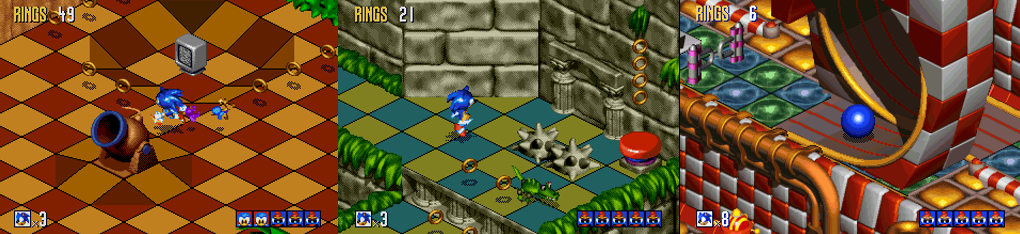
Sonic uses boost pads, loops, springs, and special fans to twirl around like a tornado and smash pillars in Rusty Ruin Zone to reach other areas. You must also keep an eye out for cracked walls as these can be Spin Dashed into to access hidden areas. Sometimes, cannons blast you across stages; other times, pipes and teleports blast you across the surprisingly large maps. You’ll need all these gimmicks, and more, to hunt down the Badniks roaming the first and second Acts of each Zone. Unlike in other Sonic games, where bashing Badniks is somewhat optional, it’s mandatory in Sonic 3D as you must collect the Flickies each robot releases. Each Act has up to three areas in it, each with five Badniks (and therefore five Flickies) to find and bring to a Dimension Ring. Flickies trail behind you, giving you extra reach to snag Sonic icons, and are protected by your shields and invincibility, but you lose them if your trail is hit. You must then recollect the Flickies you’ve lost, which can be tricky as each has a different personality. The traditional blue Flickies actively fly towards Sonic or circle around; the pink ones are the same but fly in bigger circles; red Flickies don’t try to find Sonic and are hard to snag due to their large jumps; and green Flickies wander around at random, sometimes avoiding Sonic! Acts can be quite large and have many branching paths or sections, meaning you must often do multiple laps to find all the Badniks and Flickies, though the heads-up display helpfully keeps track of how many you’ve found. When you reach Panic Puppet Zone, the Badniks are empty so you must liberate Flickies from capsules, and every time you bring them to a Dimension Ring, you get a point bonus and activate a transport or path to another section. This mechanic is quite fun, on paper, and adds extra incentive to smash Badniks, but it can get frustrating running in circles looking for Badniks or if your Flickies get separated near dangerous sections. Sonic’s so slippery and sluggish that it makes precise movements difficult, to say nothing of jumps, attacks, and retrieving Flickies being compounded by the isometric angle.
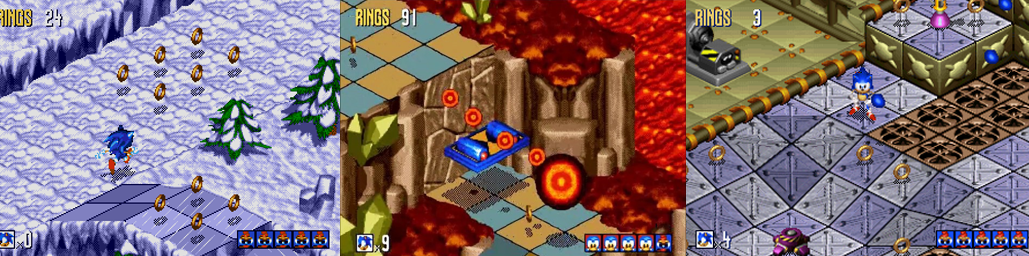
This is even more annoying in the many sections where players must jump, spring, or float to shifting or temporary platforms on angled slopes. It’s extremely difficult to angle Sonic correctly, causing you to constantly slip and have to retry, something even more aggravating when you must take a long route back around. Spikes jut from the floor or buzz along the walls, destructible stones reveal lava tiles surrounding shortcut tubes, the floor is often electrified or defending by land mines, and flames burst from the walls or up from lava. Sonic can hop to ballons (if you can angle him right) to avoid many hazards, or float about using floor fans, and high-speed tubes and teleports or hidden passageways will provide shortcuts. Often, areas are defended by turrets that fire laser bolts or rapid-fire projectiles. Some springs are buried beneath destructible snow drifts in Diamond Dust Zone, and you’ll bounce around like a pinball by Spring Stadium Zone’s bumpers and spring tiles. Diamond Dust Zone also features rushing water you must frantically jump across to avoid being pushed into icicles. Spear-like spikes jut from the floor, you’ll sometimes use wall springs or awkward jumps to cross gaps or hop to moving or temporary platforms (thankfully not that often, given the janky perspective), and you’ll be frantically seeking out a red shield in Volcano Valley Zone to safely cross lava and survive the many flaming hazards. Even when floor tiles open, you won’t fall to your death, at least, and the game is mostly pretty easy. It can be aggravating running around looking for Badniks and Flickies, especially in the more confusing Zones like Gene Gadget Zone, and hazards increase as you reach the endgame, but there are no cheap deaths in Sonic 3D. Still, the pacing can be very draining since the areas are so big, and the Badniks only pose a significant threat in Panic Puppet Zone, where you can largely ignore them.
Presentation:
I remember getting Sonic 3D for Christmas as a kid. Back then, I was super excited for it and really enjoyed the new graphical approach, especially as the game ambitiously sticks pre-rendered videos and imaging onto a Mega Drive cart. Unfortunately, Sonic 3D hasn’t aged very gracefully and Donkey Kong Country was never at risk of being surpassed by it. The game makes a bad impression right away, replacing the iconic “SE-GAA!” fanfare with a desperate scream, before treating players to one of the blurriest and most pixelated pre-rendered openings of the era. The pre-rendered stills used in cutscenes are much more effective, and Sonic 3D is one of the few classic Sonic titles to use story text and even dialogue for Sonic in its cutscenes. Players are then dropped into an isometric landscape that is a real mixed bag. On one hand, the environments are somewhat impressive and fun to look at, particularly the outer edges, but the checkerboard floor tiles are ridiculously basic and really distract from the pre-rendered environments. In this regard, the Saturn fares much better, bringing environments to life with much more detail. Sonic looks pretty good and still taps his foot impatiently when left idle, but his sprite is very blurred and indistinct, and he hobbles about like he’s on rollerskates most of the time. Miles “Tails” Prower and Knuckles the Echidna appear as cameos, performing their own idles, which is a nice touch (though Knuckles’s socks are the wrong colour…) and I liked that Dr. Eggman’s crafts show battle damage as you land hits and that the Flickies had distinct personalities. While Sonic 3D recycles some sound effects from Sonic & Knuckles (SEGA Technical Institute, 1994), which is a bit cheap, they’re some of the best, bombastic sound effects in the classic games and the excellent soundtrack, courtesy of Jun Senoue, more than makes up for it. The boss themes and the likes of Green Grove Zone and Panic Puppet Zone, especially, really stood out for me and I’m glad some of the game’s music was repurposed for Sonic Adventure (Sonic Team, 1998) as Sonic 3D has some of the best tunes in the classic games.
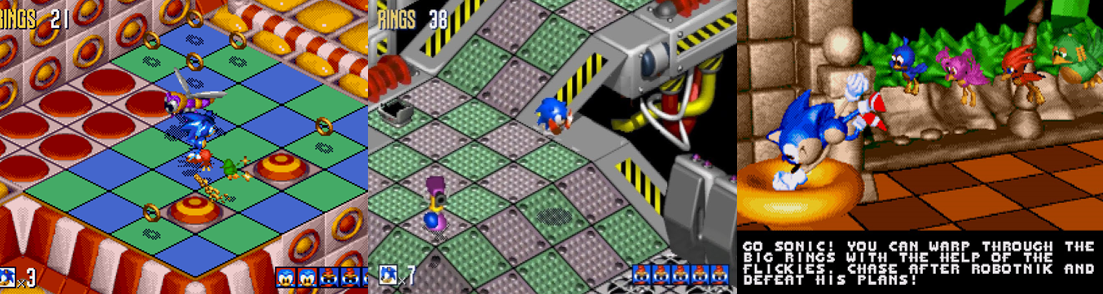
It’s thus a shame that the Zones are so painfully lacklustre. The action begins in Green Grove Zone, which is essentially just Green Hill Zone in a pseudo-3D style. There are loops, ponds, grassy verges, and hills and dips all around this simplistic sandbox that allows players to get to grips with Sonic 3D’s clunky controls and gameplay mechanics. Things improve with Rusty Ruins Zone, where you explore the ruins of an ancient civilisation, smashing pillars and spotting vases and suits of armour in the moss-encrusted brickwork. This Zone uses a unique mechanic where players must carefully manoeuvre Sonic as he spins like a top, trying not to bounce off walls and into the spinning maces, to break open new areas. Spring Stadium Zone is an isometric rendition of the classic pinball trope, with players being bounced around by bumpers and spring tiles. Balloons help get you to higher ground, spiral tubes blast you around, and there’s far more emphasis on vertical traversal. Diamond Dust Zone is a frozen landscape of snow, freezing cannons, slippery slopes, and rushing water. Sonic can be frozen into an ice cube, must avoid exploding snowmen, and will skid along uncontrollably on ice. Volcano Valley Zone is kind of an isometric interpretation of Lava Reef Zone, featuring painful lava all over, flame bursts, hidden tubes, and elevators you must activate with your Spin Dash. Gene Gadget Zone is one of Dr. Eggman’s mechanical facilities, featuring a mess of tubes and wires, propellers to float you across gaps, energy barriers to dispel with Flickies, and teleporters to disorientate you. Panic Puppet Zone is the heart of Dr. Eggman’s operation, as indicated by his gigantic statue which you must work your way into. Flickies are held in capsules here, conveyor belts must be reversed so you can progress, and there are many annoying slopes with moving platforms on them. Things end up very basic in the finale, which is largely a black void filled with sparkling tiles, and even the Special Stages are disappointingly simple as you just run along a blurring path, the Rings vanishing with no special effect, compared to the Saturn version’s polygon halfpipe challenges.
Enemies and Bosses:
Naturally, Dr. Eggman’s encased the local Flickies into robotic Badniks, the most useless and ineffectual to date! Their primary threat comes from the game’s isometric angle, which makes targeting enemies difficult unless you have the gold shield, as Badniks don’t even fire projectiles until late in the game! Anyway, we’ve got a pretty mediocre affair here, with some recognisable faces tossed in for good measure. The Snake, for example, resembles a Caterkiller; the Bug is not unlike a Motobug; and the Octopus turret is a bit like an Octus. While the likes of Hunter, Shell, and Scorpy have spiked appendages, these are little threat unless you’re at the wrong angle. Mouses are quite fast and tend to wander near hazardous floor tiles, Spiders spit projectiles (but also don’t contain Flickies), and the robotic puffer fish inflate themselves to skewer you, forcing you to properly time your spin attack. Some are less than useless, however, like a Charmy Bee lookalike, defenceless robotic penguins, crocodiles, and dragonflies, and pogo-riding rabbits. Honestly, it’s the various turrets, floor tiles, spikes, and wall defences that give you the hardest time as these cannot be defeated. Most Badniks just wander in a circle or stand still, making them easy targets, but it can be tricky retrieving their Flickies. Naturally, every third Act features a battle against Dr. Eggman. These take place in an enclosed arena with a handful of Rings, but can also contain environmental hazards, like spikes and lava, and the final fights also have multiple phases. Again, the biggest challenge here is getting the angle of your attack right as you can often only attack when Dr. Eggman descends in his craft. Jump too soon and you’re liable to take a hit; jump too late and you might just bounce off without dealing damage.
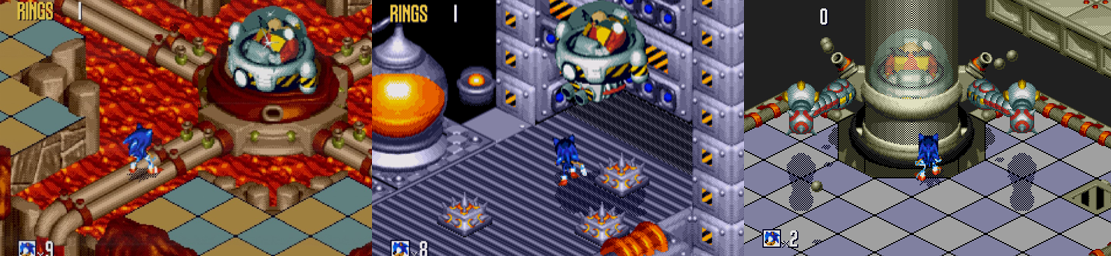
In the first fight, Dr. Eggman circles the arena and drops a spiked ball that bounces around; you can ram him when he descends to retrieve it. In the second, he hides inside an armoured suit and tries to crush you with stone paws. You must hop to these to ram his cockpit while avoiding pellets from his belly cannon. Spring Stadium Zone sees Dr. Eggman frantically slap his craft’s spiked arms to the floor, making him very difficult to hit due to the deceptive angle. Although he drops exploding snowmen and his craft is protected by freezing appendages in Diamond Dust Zone, this boss is far easier as you’ll destroy his defences with each hit. Volcano Valley Zone’s boss is a bit trickier, despite Dr. Eggman being stationary, due to the travelling flames, the flames bursting from the pipes, and the lava. However, you can stand in one spot and spam your spin attack as long as you keep collecting a Ring. Gene Gadget Zone’s boss is a bit like Quartz Quadrant’s as you’re on a treadmill and must keep running to avoid the wall spikes, while also dodging projectiles, though you still ram his craft to win. Panic Puppet Zone concludes in a three-stage battle, with Dr. Eggman fleeing to lower levels and utilising different attacks each time. You must lure his arms to slam the floor in the first phase, dodge his flames in the second, and frantically avoid the ricocheting bullets in the third, targeting the shoulders of his craft each time and disabling each appendage in turn. If you collect all seven Chaos Emeralds, you’re taken to “The Final Fight”, where Dr. Eggman’s battlecraft uses five different attacks across a looping stage and can only be hit once per section, when it briefly moves forwards. First, you must avoid the lasers shot by his fingers; then, you must dodge dancing flames; then, avoid his slamming spiked hands; he rains missiles in the fourth section, and fires ricocheting projectiles in the fifth. As long as a you hit him each time, you can beat this in two loops, but don’t linger when moving to each section as you’ll lose a life!
Additional Features:
There are loads of Sonic icons to find in Sonic 3D, with many requiring all five Flickies to reach. Ten grant a continue, which aren’t really necessary, but it gives you something else to do as you’re playing. Many areas sport hidden paths, tunnels, islands, or sections containing goodies like extra lives or shields, and you’ll encounter Tails and Knuckles in almost every Act. If you give them 50 Rings, you’ll warp to a Special Stage to challenge for one of the seven Chaos Emeralds, and Sonic 3D offers perhaps the easiest Special Stage in the entire series! You must run across a winding bridge, avoiding mines and collect 50, 100, then 150 Rings to get a Chaos Emerald, which is ridiculously easy to do (though finding Tails and Knuckles can be difficult). Though you won’t unlock Super Sonic, the seven Chaos Emeralds allow you to play “The Final Fight” and see the game’s true ending. If you fiddle with the Mega Drive cartridge, you can legitimately to unlock a level select feature (though a traditional push button code also exists on both this and the Saturn version). When playing on the SEGA Mega Drive Classics (SEGA/D3T, 2018), you can use the Right and Left triggers to rewind and fast forward the game, create and load save states, apply filters and borders, and earn a couple of Achievements.
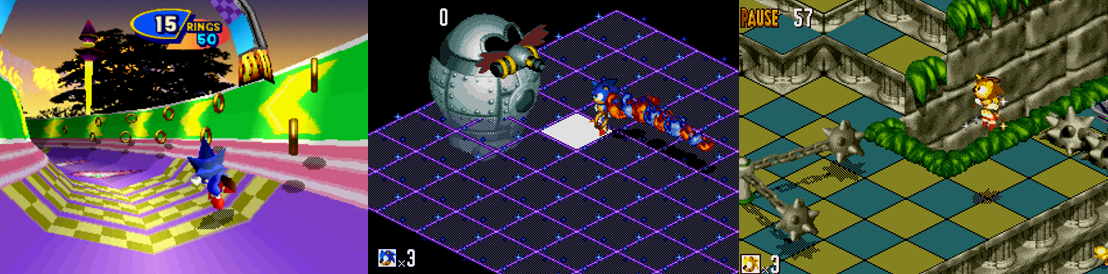
If you’re lucky enough to own a SEGA Saturn, Sonic 3D has some additional features. Obviously, this version benefits from improved visuals, particularly in the appearance of the Zones, including textured floors and weather effects. The Special Stages are also completely different, featuring new cutscenes and a polygonal recreation of the iconic halfpipe stages. This version also features an improved and remixed soundtrack, clearer and longer pre-rendered cutscenes, and limits you to collecting one Chaos Emerald per act. However, the most definitive way to play Sonic 3D must be the Director’s Cut ROM hack by Jon Burton. This unofficially official re-release adds a world map so you can replay any Zone or Act, a time attack mode, a level editor, and a password feature to save your progress. Collecting the seven Chaos Emeralds also unlocks Super Sonic when you collect 50 Rings, giving you the benefits of all the game’s power-ups, as well as a score attack mode after attaining 100% completion. Sonic is made faster, the camera is vastly improved, and Sonic only loses one Flicky at a time when hit. As in the Saturn version, you can only get one Chaos Emerald per Zone, Sonic icons are now simply collectibles rather than gifting continues, scrapped Badniks have been programmed back in, and the HUD now flashes to alert you when you’ve lost Flickies. While the game still has its flaws, this is easily the best and most enjoyable way to play Sonic 3D due to the many gameplay and graphical improvements and it really goes to show the potential the game had, and how little effort SEGA often puts into its ports and remasters of the classic titles.
Final Thoughts:
I have a lot of nostalgia for Sonic 3D: Flickies’ Island. My Sonic fandom was at its peak when I first got it and I was consuming Sonic any way I could, so naturally I had to enjoy his newest and most ambitious release yet. And, yet, I remember being disappointed by it even back then. Sure, it uses “3D graphics”, but it limits you to playing as Sonic, the usual fast-paced, action-packed gameplay is gone, and the new mechanics can be laborious at times. The visuals are a mixed bag for me, with some aspects of the Zones being quite impressive and others being very bland. The size of the areas is impressive, until you realise how much backtracking and exploring you have to do, which just drags the game out as you’re shunted about the different areas. Sonic looks okay as a pre-rendered sprite but is so slippery and ungainly that he loses his trademark speed and it’s far too easy to take damage or miss your target due to the annoying angle. I’ve always disliked isometric games for this very reason and, while Sonic 3D isn’t too aggravating with this perspective, some platforming challenges are infuriating because you can’t properly see what you’re doing or where you’re going. I didn’t mind the scavenger hunt for the Flickies, and it was a fun, unique way to reinterpret Flicky (SEGA, 1984) and change up the gameplay, but it gets quite tedious after a while and Sonic 3D doesn’t offer anything to break up the monotony. I like that the game, and its Special Stages, are easy, but you can’t save your progress, so you have to do it all over every time, and it’s barely worth it to get 100% completion. Just about the only think worth mentioning about this disappointing title is the amazingly catchy soundtrack and the incredible work Jon Burton did improving its many flaws years after its release. It’s not a Sonic title I often revisit, and I wish SEGA would port the Saturn version, but Sonic 3D is okay if you haven’t played it before or in a while, just perhaps trying a little too hard to do something different and therefore losing what makes Sonic special in the process.
My Rating:
Pretty Good
Are you a fan of Sonic 3D: Flickies’ Island? Which version did you grew up with, which do you think is superior, and have you ever played the Director’s Cut ROM hack? What did you think to the Flicky rescuing gimmick and isometric perspective? Were you also a fan of the soundtrack? Did you ever collect the seven Chaos Emeralds and see the true ending? Which Sonic spin-off is your favourite and how are you celebrating SEGA’s mascot this month? Let me know your thoughts on Sonic 3D in the comments, support me on Ko-Fi, and go check out my other Sonic content.


2 thoughts on “Game Corner [Sonic Month]: Sonic 3D Blast / Flickies’ Island (Mega Drive)”