Back Issues: DC’s Crisis Conundrum

BackIssues

Ever since the 1938 introduction of Clark Kent/Superman, DC Comics has been known for its vast array of costumed crimefighters and interconnected, densely populated fictional narratives. For decades, continuity was played fast and loose; Superman evolved from being a moderately powerful superhuman who could leap over tall buildings into a God-like figure who could turn back time, possessed a super-human intellect, and could tow entire worlds through space with ease. Similarly, Bruce Wayne/Batman was depicted as being as youthful as ever despite having been active since 1939 and having taken part in World War Two. Some of these issues were resolved when, in the 123rd issue of The Flash, DC Comics introduced the concept of the multiverse. The issue postulated that there were an infinite number of parallel worlds co-existing in the same space and time but slightly out of synch with our own world due to being on a different vibrational frequency. The fallout from “Flash of Two Worlds” (Fox, et al) was the revelation that DC’s Golden Age superheroes, such as the Justice Society of America and older versions of Superman and Batman, existed on the parallel world known as Earth-Two while their Silver Age contemporaries (Hal Jordan, Barry Allen, and the like) in the Justice League of America existed on Earth-One.
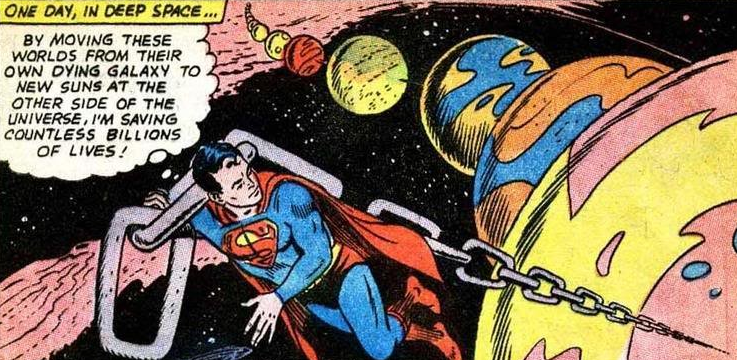
CrisisStupidlySuperman
Superman was originally more like a God than a man.

This concept allowed DC Comics to portray multiple iterations of their most popular characters as existing side-by-side, as well as numerous alternative worlds; Earth-Three, for example, was home to the Crime Syndicate, made up of villainous versions of the Justice League, while Earth-S was home to Freddy Freeman/Captain Marvel and other characters DC acquired from their purchase of Fawcett Comics. Unfortunately, decades of over-reliance of the multiverse concept meant that, by the 1980s, DC continuity was extremely difficult to keep track of and DC Comics were virtually inaccessible to new readers who had no idea what the multiverse was, much less how it worked. As a result, DC embarked on their most ambitious inter-company crossover yet. Crisis on Infinite Earths (Wolfman, et al, 1985) saw the entirety of the DC multiverse under threat from the malevolent Anti-Monitor. Seeking to rule in the desolation of nothingness, the Anti-Monitor begins destroying entire parallel worlds with an anti-matter wave, reducing their number from infinite to a mere five and causing the deaths of Barry Allen/The Flash and Kara Zor-El/Supergirl. In the end, Kal-L/Superman of Earth-Two, Alexander Luthor of Earth-Three, and Superboy of Earth-Prime end the Anti-Monitor’s threat and retreat to a “pocket dimension”, alongside the Lois Lane of Earth-Two, where they are protected from the merging of the remaining worlds.
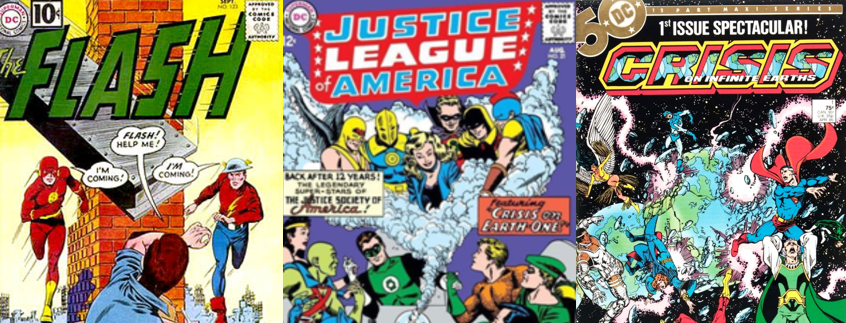
Crises were commonplace in the Silver Age before DC tried to streamline their complex continuity.

It seemed like DC had come up with the perfect way to consolidate their continuity; the concept of parallel worlds was done away with and one singular reality was established. Stories like Superman: The Man of Steel (Byrne, et al, 1986) and Batman: Year One (Miller, et al, 1987) re-established the origins of DC’s flagship characters and, over the next few years, DC established that, while the events prior to the Crisis had occurred, very few of the characters who survived remembered much beyond vagaries (Wally West, for example, was now the Flash and knew, like everyone else, that Barry had died saving the world but not the exact specifics of how and why). Additionally, DC Comics began emphasising the idea of legacy superheroes; the Justice Society of America was established as having been active during World War Two and, while some of their members were active in present day continuity, they were noticeable aged and took on more of a mentorship role. Unfortunately, DC dropped the ball with Crisis. Rather than simply end every existing comic they published and reboot with brand new issue one’s and origin stories, some characters (such as Diana Prince/Wonder Woman) were not reintroduced into the new canon until much later. Others, like the Legion of Superheroes, had their entire origins altered forever by the removal of Superboy from the new canon (something that could have easily been remedied had DC simply rebooted the Legion and had them be inspired by Superman; instead, writers hastily incorporated an alternative Superboy from a pocket dimension or substituted him with Mon-El).
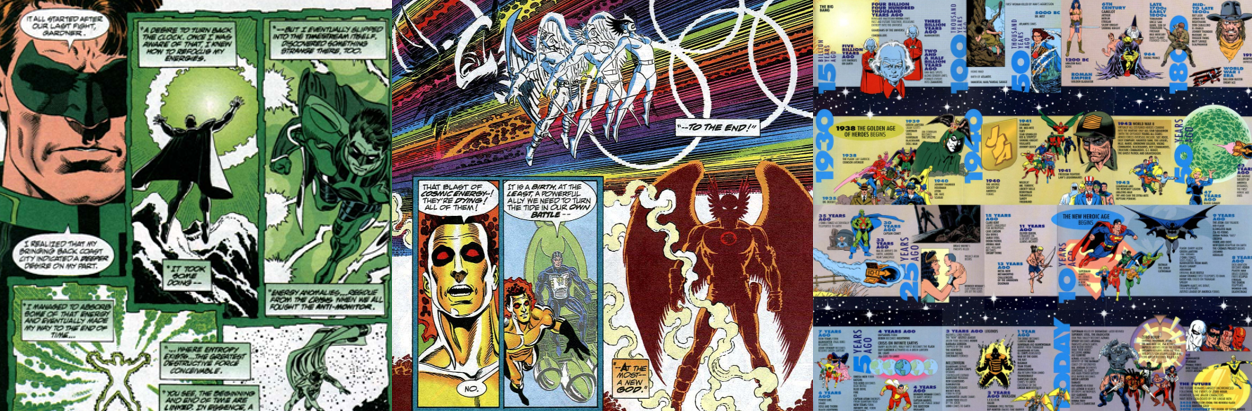
Zero Hour tried to fix DC’s post-Crisis lore but actually did more harm than good.

In an effort to address some of these lingering issues, and further incorporate some of the popular Pre-Crisis characters and ideas into modern continuity, DC capitalised on Green Lantern Hal Jordan’s recent descent into madness, genocide, and villainy with another massive inter-company event. Zero Hour: Crisis in Time (Jurgens, et al, 1994) saw Jordan, as Parallax, absorbing vast amounts of cosmic and chronal energy with which he planned to remake reality and undo all the wrongs that had happened since the death of Superman. Due to Parallax messing about with time, many continuity changes were forced into DC canon; Superman was explicitly described as having debuted “ten years ago”, the Legion of Superheroes were (finally) completely rebooted, Batman’s killer became anonymous and at large, and all conflicting versions of Carter Hall/Hawkman were consolidated into one singular character since DC never really bothered to reboot his origin story following the original Crisis. With the bulk of Zero Hour’s five-issue run being made up primarily of exposition from Richard Rider/Waverider or Parallax, many of the consequences of Parallax’s actions were told in DC’s individual comics. In the end, despite the insanity of time literally being ripped apart around them, the heroes were able to thwart Parallax’s efforts and allow time and reality to unfold naturally, albeit with many changes. Zero Hour resulted in many changes to popular DC characters; Guy Gardner suddenly became a shape-changing Vuldarian, many of the Justice Society were rapidly aged or killed off, Connor Hawke was introduced as the new Green Arrow, and Arthur Curry/Aquaman now sported an unkempt look and a harpoon for a hand.
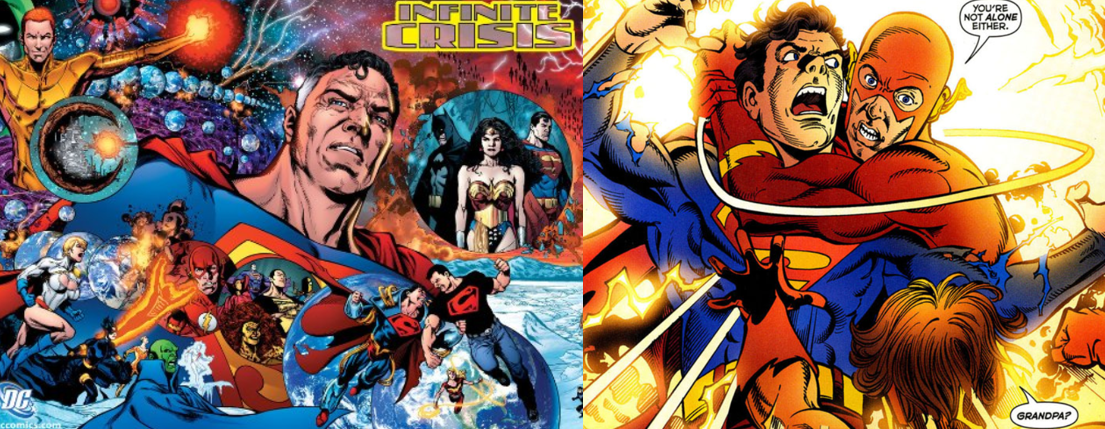
Infinite Crisis returned the multiverse to the DC universe.

However, Zero Hour actually created more problems than it solved; Hawkman’s origins were no more clearer now than they had been before. Eventually, The Return of Hawkman (Goyer, et al, 2002) returned the character to mainstream continuity, explaining that the character was locked in a constant cycle of death and rebirth. Additionally, DC sought to address their ongoing continuity issues (and tell out of continuity stories) through the concept of Hypertime, which, much like the previous infinite Earths concept, allowed for alternative versions of events to be played out. Eventually, and with the twentieth anniversary of the original Crisis looming, DC decided to commission their biggest inter-company crossover yet. Consisting of multiple ongoing stories all building up to its central narrative, Infinite Crisis (John, et al, 2006) aimed to not only re-establish the multiverse concept and finally tie-up all of the lingering continuity issues left in the wake of Crisis on Infinite Earths and Zero Hour, but also move the company away from the dark stories that had dominated during the mid-nineties. After numerous event-scale storylines, the DC trinity (Batman, Superman, and Wonder Woman) were divided and the DC universe was in turmoil. Frustrated with how bad Earth heroes have let things get and perceiving that they have squandered their new world, Kal-L, Alexander Luthor, and Superboy-Prime break free from their pocket dimension and set about cannibalising the Anti-Monitor’s corpse to re-establish the multiverse and return peace and order to the universe. However, it turns out that seeing his world destroyed and having his youth ripped away from him, coupled with living in isolation and the machinations of Alexander Luthor, have driven Superboy-Prime mad. While Alexander straps various heroes and villains to an inter-dimensional tuning fork, Superboy-Prime goes on an accidental murder spree before Bart Allen/Kid Flash forces him into the Speed Force itself, at the cost of Wally West and his family.
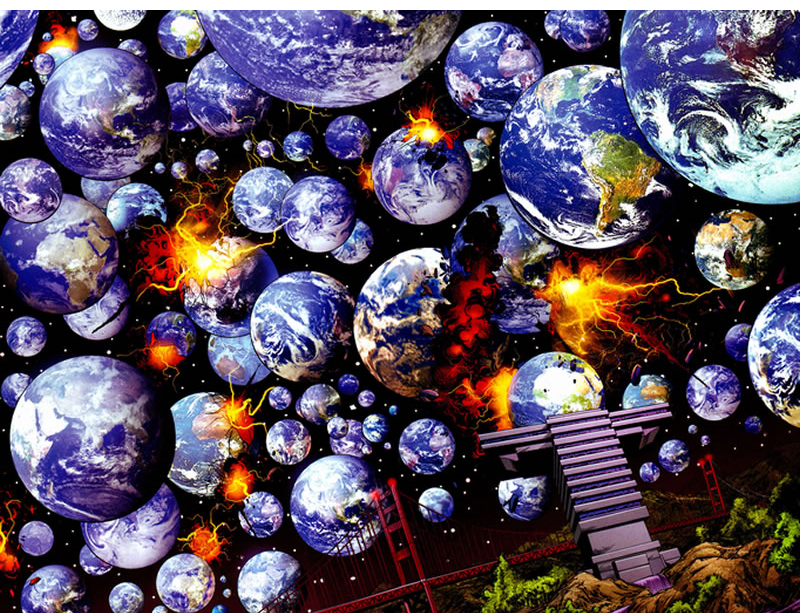
CrisisEarths
Infinite Crisis smashed together parallel worlds created 52 alternate Earths.

However, Superboy-Prime escapes, sporting a modified version of the Anti-Monitor’s armour and driven completely insane. With no regard for himself or others, he goes on a rampage; although Conner Kent/Kon-El/Superboy destroys Alexander’s inter-dimensional tower, it costs him his life and, finally convinced that Alexander’s plan would mean the genocide of countless lives, Kal-L joins forces with Superman to end Superboy-Prime’s threat. Infinite Crisis ends with the multiverse restored; though instead of there being an infinite number of parallel worlds, there were now a much more easy to wield fifty-two alternate Earths. In the aftermath, DC’s titles all jumped forward one year later, while the weekly 52 series explored the fallout of the events from the main crossover. This New Earth restored Superboy to Superman’s origin, depicted multiple non-canon stories as existing on the alternative Earths, introduced a new all-powerful villain in the form of Superboy-Prime, and resulted in Batman becoming far more trusting and open with his allies and family. For me, this was a great time to be reading DC comics. Unlike previous Crisis-level events, Infinite Crisis felt like a soft reboot that would be accessible to new readers; the multiverse existed but rarely impacted mainstream DC continuity and it felt like DC had finally closed the door of the events of the original Crisis and had finally moved on.

And then Grant Morrison happened.
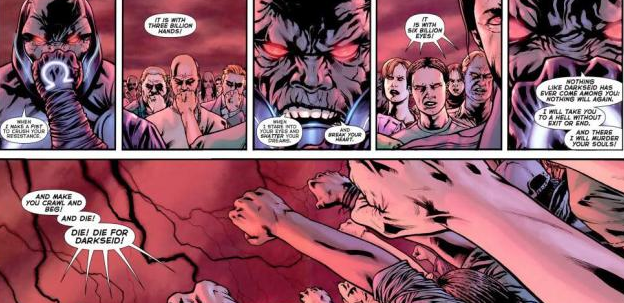
CrisisFinal
somethingsomethingsomething Darkseid somethingsomething…

Morrison spearheaded an inter-company crossover that would change the DC universe forever. Unfortunately, DC decided to spend an entire year building up to this event with the weekly Countdown (later Countdown to Final Crisis) series, in addition to numerous tie-in and spin-off titles. As Countdown was of far less writing and artistic quality compared to 52, and due to the fact that many of its events contradicted what was happening in the associated titles, the build up towards Final Crisis (Morrison, et al, 2009) was lacklustre and confusing, to say the least. The basic premise, as far as I can understand it (Morrison’s writing is confusing and disjointed at the best of times) is that the New Gods have all died and been reincarnated on New Earth, causing a tear in space, time, and reality. Reborn, Darkseid finally solves the Anti-Life Equation and enslaves the planet; however, using a radion bullet, Batman mortally wounds Darkseid, before being erased from existence. As his essence dies, Darkseid attempts to obliterate all of reality until he is finally thwarted by Superman; Superman, and an army of his counterparts from across the multiverse then restore Earth and reality before it can be destroyed by Darkseid and Mandrakk, the Dark Monitor. Once you got past the mess of Morrison’s writing and the mess of a build-up to the main event, the fallout from Final Crisis made for very accessible stories. DC also focused on using the Green Lantern titles to expand their universe through sprawling, inter-connected stories.
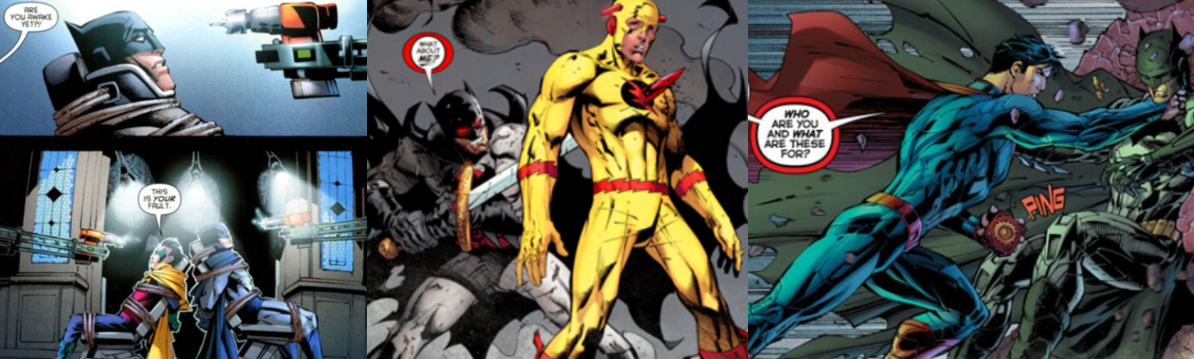
Dick Grayson took over as Batman before Flashpoint gave us an angst-ridden jerk version of Superman.

However, rather than fully capitalise on this (by, say, returning Bruce Wayne to life as an aged man, killing off Alfred, and having an elderly Wayne take his place as mentor to the new Batman and Robin), DC instead decided to undo all of their recent efforts a mere two years after the end of Final Crisis. The best thing about Final Crisis was the fallout; Batman, thought dead, actually embarked on a trip through time and space that threatened all reality until he was safely returned home by the Justice League. However, in the meantime, his duties were performed by Dick Grayson and Damian Wayne as an all-new, fresh take on the Batman and Robin duo. Additionally, both Kon-El and Bart Allen were resurrected and, for fans of the Silver Age, Barry Allen finally returned to the land of the living to become the Flash once more (though, personally, I am more of a fan of Wally West). In Flashpoint (Johns, et al, 2011), Barry Allen’s grief apparently got the better of him, causing him to go back in time and save his mother’s life. This results in a vastly altered timeline, which threatens to solidify itself as the true reality unless Barry can set things right. Teaming up with Thomas Wayne, here a violent version of Batman, and amidst an ongoing war between Atlantis and the Amazons, the Reverse-Flash reveals the key to restoring reality to Barry, allowing him to undo his actions. However, instead, we got what DC marketed as the “New 52” reality for the better part of five years. In this radically altered version of events, the DC universe has only existed for five years (meaning that Batman burned through one Robin every year-and-a-half or so), Barbara Gordon controversially recovered from the Joker’s attack and continued to fight crime as Batgirl, and many characters got entirely new origin stories (Superboy, Supergirl, and, in particular, Superman was changed so drastically that I swear he was a completely different character).
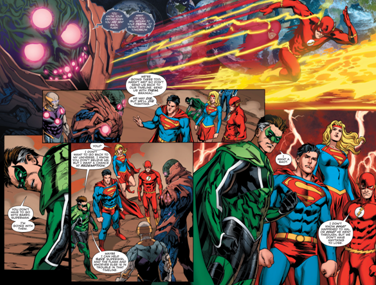
CrisisConvergence
Convergence slightly altered the original Crisis.

Additionally, Wildstorm and Vertigo publications were officially absorbed into the DC universe, while many recent events, particularly in Batman and Green Lantern titles, continued with very little alteration, truly begging the question as to why DC even bothered to reboot their continuity so severely just as their titles had become engaging and accessible for new and long-term readers. The biggest problem with the New 52, however, was that while DC still incorporated a version of the multiverse (complete with slightly different versions of Earth-Two and Earth-Three), it took DC almost a year to properly establish their new continuity; many characters went without detailed revised origins until this time, causing a great deal of confusion as to what events and characters were still canon, and largely alienating me in the process. Eventually, though, DC decided to bring the New 52 to a close and restart everything…again…using the Convergence (King, et al, 2015) storyline to kick-start their Rebirth titles. In Convergence, Brainiac has collected numerous cities and their inhabitants from across the multiverse (even some from prior to the original Crisis) and deposited them on Telos, a sentient planet that forces them to fight each other to see which is superior. Amidst the chaos and the fighting, the sorcerer Deimos usurps Telos and declares himself ruler and protector of this imprisoned on there. Eventually, Deimos is defeated by Parallax (drawn straight out of Zero Hour), which causes a chain reaction that threatens to annihilate the entire multiverse (…again). Brainiac, seeking to atone for his misdeeds, intervenes and sends pre-Flashpoint Superman and Zero Hour-Parallax back to the original Crisis to change its outcome and save the multiverse from collapsing.
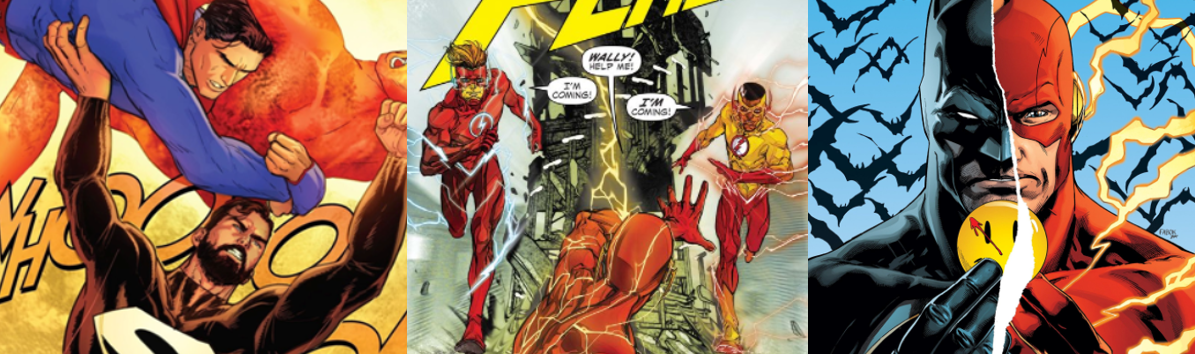
Rebirth returned pre-Flashpoint characters and brought the Watchmen to the DC Universe.

Convergence concluded with the return of the multiverse proper, with a potentially infinite number of worlds once again present in DC comics, while absorbing yet more commonly displaced titles into DC continuity; an ongoing theme throughout the resultant Rebirth-branded comics has been the introduction of characters from Watchmen (Moore, et al, 1987) into the larger DC universe for the first time. Perhaps the best thing to come out of Convergence and the resultant Rebirth titles was not only the death of the New 52-Superman but the return of the pre-Flashpoint Superman and the true Wally West. The pre-Flashpoint Superman is revealed to have been living a quiet family life with his version of Lois Lane and their young son and, despite starting as a separate character, has recently been amalgamated with and replaced the new 52-Superman entirely. Additionally, Wally now exists alongside his biracial counterpart, retconned as being his cousin, and even explains that Flashpoint was actually caused by Doctor Jon Osterman/Doctor Manhattan rather than Barry Allen. So, once again, DC Comics have been softly rebooted to attract new readers while reintroducing numerous popular concepts and characters into mainstream continuity. The return of the pre-Flashpoint Superman, a confidant married man with a superpowered child, is enough to bring me back to DC after the debacle of the New 52 yet their ongoing titles (particularly, again, Batman and Green Lantern, and even The Flash) continue the stories from the New 52 and with little consequence from the events of Convergence save for Batman and the Flash’s investigation of the Comedian’s button.
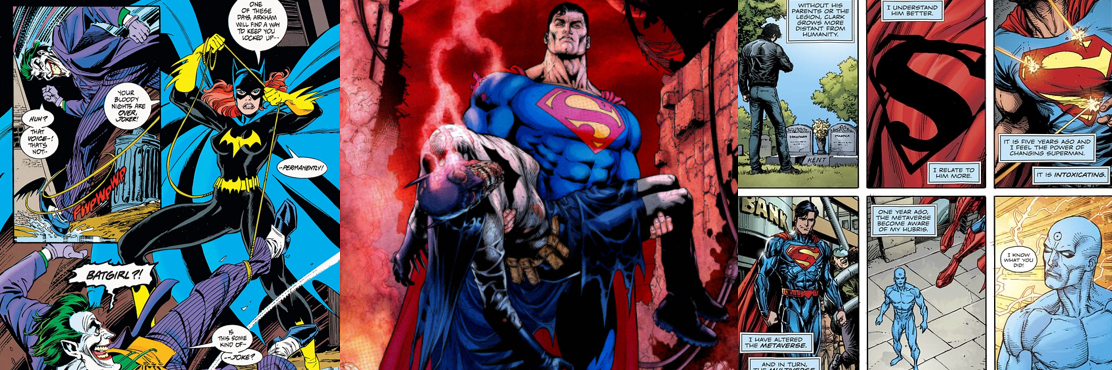
While Crises can be fun, they often cause more problems than they solve.

One of the things I love about DC Comics is that they’ll cook up a massive story whenever they want to make major continuity changes (as opposed to Marvel, who usually just quietly retcon stuff away, ignore it completely, or constantly update their sliding timescale to keep everything within an approximate five year timeline). While this means that everything can be canon at any one time, DC have notoriously dropped the ball with every Crisis-level event they produce. After Crisis, every title should have reset to zero and all continuity should have been rewritten and reset to accommodate the major changes they had made; to only have a few titles do this is ludicrous and created a knock-on effect that led to the disastrous Zero Hour event. It wasn’t until Infinite Crisis and Final Crisis that DC finally resolved the fallout from the original Crisis, and then they went and threw it all away with Flashpoint in an obvious attempt to bring in new readers unfamiliar with the events that had already transpired. Ironically, as a long-time comics fan, even I sometimes struggle with these massive Crisis events because they require a lot of background reading. As I mentioned, the New 52 publications alienated me completely and it’s only recently, now that DC has moved on to the Rebirth branding, that I have bothered to collect some key New 52 graphic novels. The worst part is that DC and Warner Bros. apparently would rather reference and incorporate elements from the multiverse concept in their movies and television shows. For example, the Flash seen in The Flash television show is not the Flash we see in Batman v Superman: Dawn of Justice (Snyder, 2016). This goes even further though as the Superman seen in Supergirl is not the Henry Cavill version of the character and Supergirl is not only separate the DC movies but also from The Flash, Arrow, and DC’s Legends of Tomorrow television shows (The Flash even goes to great lengths to introduce and explore the concept of the multiverse, again represented as 52 parallel worlds).
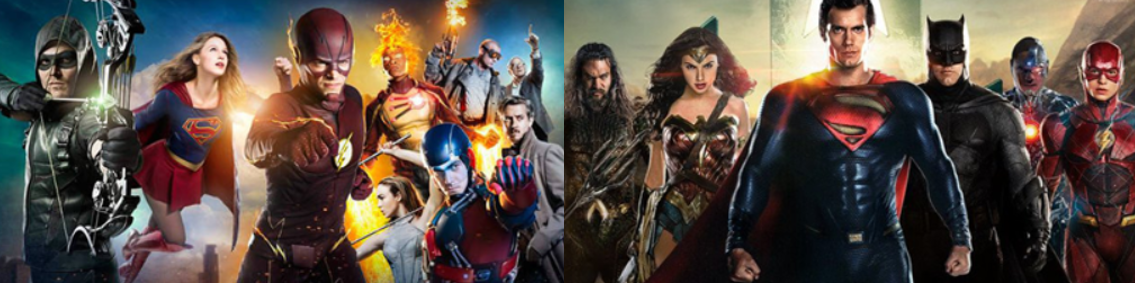
The DCEU is quite divided, to say the least.

This basically means that we will never see Stephen Amell appear as Green Arrow alongside Ben Affleck’s Batman and has resulted in two versions of the Flash, two wildly different versions of Batman’s origin between Batman v Superman and Gotham, two iterations of the Suicide Squad, and many more all existing simultaneously on television and in movies. DC and Warner Bros. then compound things even further by constantly talking about the multiverse and hinting that their movies are not all connected all with the intention of presenting themselves as doing things differently from Marvel Studios. However, the multiverse concept is incredibly complex and something only die-hard fanboys really understand. The general audience might not quite be ready for it and, besides that, it seems really stupid to want to have three different versions of Superman on screen at any one time, especially as DC have previously placed an embargo on Batman crossing over into other television properties. The multiverse has worked in comics because it has existed for so long and been explored to death; The Flash has done a great job of introducing the concept but that had three entire seasons to explore and discuss it at length. For a movie to do it would surely be far more trouble than it’s worth beyond simplifying it to a great degree, perhaps by introducing the Crime Syndicate or stating that a villain such as Darkseid has devoured parallel worlds or something.

Hopefully, however, DC has learned to better manage their Crisis-level events from now on, and also to limit them to one every ten or fifteen years or so; having massive inter-connected plots where the fate of the multiverse is at stake (and sticking guys like Batman at the centre of them!) occur every two to five years is just overkill, in my opinion, especially if DC screw the pooch as badly as the did with the New 52.


Talking Movies: The Dark Tower

Talking Movies
DarkTower

Between 1982 and 2012, notable horror writer Stephen King produced a series of seven novels (and one spin-off) that made up what he referred to as his magnum opus. Over the years, numerous writers and directors have attempted to launch a film series base don King’s Dark Tower books, only to run into various issues at every turn. Finally, after nearly ten years in development hell, 2017 sees the release of Nikolaj Arcel’s adaptation of King’s work. The Dark Tower tells the story of a young boy named Jake Chambers (Tom Taylor), who suffers from regular nightmares and visions of a mysterious Dark Tower, a malevolent Man in Black (Matthew McConaughey), and a grizzled Gunslinger named Roland Deschain (Idris Elba). Jake’s dreams also involves the Man in Black and his henchmen, who wear false faces, strapping children to a device that draws their life-force out to attack the Dark Tower

Given that Jake is clearly struggling to cope with the loss of his father, his mother, Katheryn (Laurie Chambers), tries to help Jake by sending him to a psychiatrist (José Zúñiga), to no avail. However, when he suspects that two representatives of a mental institute are emissaries of the Man in Black, he runs away from home and tracks down a dilapidated house he saw in his dreams. Inside, he finds a control console that opens a doorway to another dimension, Mid-World, and, after being attacked by the house itself, he enters to find himself stranded in the vast alien desert from his nightmares. Eventually, he runs into Roland, who is on his own quest for revenge against the Man in Black after the sorcerer killed not only his entire people but also his father (Dennis Haysbert). After learning that Jake’s dreams can lead him to the Man in Black, Roland reluctantly allows Jake to tag along with him through the desolate remains of times and worlds long gone in order to get his revenge.

The first thing you really need to know about this film, if you’ve read the Dark Tower books, is that this is not a page-for-page adaptation of the series. It’s not even a direct adaptation of the first book; instead, the film draws influences from many of the different books and, if Arcel is to be believed, is actually a canonical sequel to the final book in the series. Therefore, if you were hoping to come into this to see the events of The Gunslinger (King, 1982) play out, you’ll be disappointed. To be fair, The Gunslinger is probably too short to be its own film, much less the first part in a seven film series. Additionally, Roland’s famous Ka-tet do not feature at all, although many events from the books in which they appear are represented: Roland is injured and poisoned after an attack and must get treatment on Jake’s world (“Keystone Earth”). There, he visits a gun shop and stocks up on bullets; he also briefly teaches Jake how to shoot like a Gunslinger and takes part in a shoot-out at the Dixie Pig, similar to The Song of Susannah (King, 2004).

Apparently, The Dark Tower is supposed to launch an ongoing television series, with the main characters all reprising their roles, and even a sequel that will involve more content from The Drawing of the Three (King, 1987). However, the film feels more like a stand-alone, condensed version of the books and it does not conclude on an obvious cliffhanger or with explicit sequel-bait. To veer into spoiler territory, Jake is apprehended by the Man in Black due to his incredibly powerful psychic powers and strapped into the chair from his nightmares. However, having had his true calling to protect the Dark Tower awoken by Jake’s influence, Roland blasts his way through the Dixie Pig and confronts the Man in Black, putting a bullet through his head. Roland then destroys the machine, and the base in which it was housed, and ends the Man in Black’s assault against the Dark Tower. After, he and Jake return to Mid-World together and the film ends with basically everything wrapped up: Jake has realised that he’s not crazy and achieved closure over the loss of his father and Roland has realised his revenge and rediscovered his calling. Although the theme throughout is that darkness will continually attempt to destroy the Dark Tower (I guess I should say at some point that this would result in horrific monsters entering the multiverse and destroying all life) and there are some hints towards a larger, looming evil (the Crimson King), watching the film you get the real sense that everyone was aiming to make only one movie.

Having read all of the books and only found maybe a third of them to be enjoyable, I actually really liked The Dark Tower. It drew the most interesting aspects from the books and paid homage to the larger world that King created (in addition to numerous references to his other stories) without being bogged down by some of the more convoluted and cringe-worthy moments from the books (such as King including himself as a character, the pointlessness of The Waste Lands (King, 1991), or the weirdness of Blaine the psychopathic train). The Dark Tower is Jake’s story; you follow him as the main character and Roland, while being the more enigmatic, bad-ass, and mysterious of the two, is really more of a side character until Jake ends up on Mid-World. Because of this, we only really learn about Roland’s past and the mechanics of King’s multiverse through Jake’s conversations with Roland, in which we are told just enough to know the stakes but not be overwhelmed by the complexities of King’s multi-layered worlds.

The downside to this is that we don’t get much exposition into the Man in Black. McConaughey plays the role with a nuanced relish, clearly revelling in being the personification of evil, and while kills without remorse and clearly desires the destruction of the Dark Tower and the prospect of ruling the darkness that would follow, we never find out what is exact motivations are except that he is pure evil. There is no mention of him serving the higher power of the Crimson King, no explanation regarding his henchmen, and no real tangible motivation behind any of the antagonists except that they’re clearly evil because they want to destroy the multiverse. The only reason this works in the film is due to the fact that The Dark Tower is disappointingly short; at a mere 95 minutes, the film moves at a brisk pace, emphasising action and fast-paced shoot-outs when it can. While it never feels rushed or suffers from jump cuts or even massive plot holes, it is disappointing that the film was not afforded a longer run time; I honestly feel that, if this is the only Dark Tower film to be made, they could have done the books (and the unique narrative of the film) more justice by affording it a two-and-a-half-hour runtime instead.

Fans of the books will probably be disappointed with The Dark Tower; unlike another films based on a long-running book series, The Dark Tower is not a straight-up adaptation of its source material. If it is to be the first in a film series or launch a multi-media franchise, it doesn’t appear to have done a great job of doing so. I feel as though, if there are more films made, this film will be looked at as being like The Matrix (Wachowski Brothers, 1999) in that it feels more like a stand-alone film that wasn’t meant to have a sequel. However, there is plenty of material to still draw from and plenty of potential in the ideas raised in the film to warrant at least two more movies; the disappointment comes from The Dark Tower’s inefficiency at setting these up (but, at the same time, the fact that it is not massively concerned with setting up future films makes it much easier to watch than, say, The Mummy (Kurtzman, 2017), which was criticised for being more concerned with setting up future films in the “Dark Universe” tan telling a good stand-alone story). In the end, though, I enjoyed The Dark Tower for what it was: a fantasy/action film with a compelling protagonist (Elba plays the grizzled, war-weary Roland to perfection, proving that race can have no baring on an actor’s ability to effectively portray a role), engaging set-pieces (Roland’s efficiency at dispatching his foes is unmatched; every shot is an instant kill, even when he’s poisoned to the point where he can barely stand), a charismatic antagonist (McConaughey lives his role, exuding a barely-contained hate and malice beneath an ice-cold exterior), and some extremely enjoyable allusions to other King works buried within the expansive war-torn dimension of Mid-World. It was very enjoyable while it lasted; my only real gripe is that it should’ve easily been a longer film. However, if you go into it expecting slavish fidelity to King’s magnum opus you will be disappointed, so I’d recommend putting your expectations for that aside and enjoying it as a stand-alone fantasy/action piece instead.

My Rating:

Rating: 3 out of 5.

Pretty Good

Recommended: Sure, I would say give it a watch. If you’re a die-hard Dark Tower fan though, expect to be a little disappointed.
Best moment: Roland’s battle against the Taheen that come to kidnap Jake is pretty great, with his proficiency and aim being top-notch despite his weakened condition,
Worst moment: The run-time; for a film with such potential and the expansive nature of King’s work, 95 minutes just doesn’t cut it.

Game Corner: Sonic Mania

GameCorner
SonicManiaLogo

Announced at the commemoration of Sonic’s 25th anniversary, Sonic Mania (Headcannon/PagodaWest Games, 2017) is a side-scrolling, two-dimensional platformer in the spirit and style of Sonic’s original 1990s outings. Headed up by Christian “Taxman” Whitehead, in collaboration with notable members of the Sonic fangaming community, Sonic Mania sets out to be the true sequel to Sonic the Hedgehog 3 & Knuckles (Sonic Team, 1994) that Sonic fans have been clamouring for for over a decade. Sonic Mania opens almost exactly the same way as Sonic the Hedgehog 3 (ibid), with Sonic and Tails flying in the Tornado towards Angel Island. Sonic’s bad luck with the floating haven continues as he immediately runs into a group of Eggrobos who unearth a mysterious gemstone (the Phantom Ruby), which blasts them all through space (and, possibly, time) back to the Green Hill Zone, where the Eggrobos have been transformed into more powerful variants, the Hard-Boiled Heavies.

SonicManiaRubyHeavies
The Phantom Ruby empowers the Hard-Boiled Heavies.

From there, Sonic, Tails, and Knuckles (whose encounter with the Eggrobos takes place as they flee with the Phantom Ruby) must travel through twelve zones in pursuit of Doctor Eggman, battling his Hard-Boiled Heavies, in their quest to obtain the seven Chaos Emeralds and put a stop to them wreaking havoc with the Phantom Ruby. Players can choose to play as Sonic, Tails, or Knuckles in a solo adventure or team-up as Sonic and Tails in two-player simultaneous mode. Each character plays differently but exactly as they did in Sonic 3 & Knuckles; Sonic is the fastest and can perform a Drop-Dash, where he instantly drops into a Spin Dash attack, Tails can fly and swim for a limited time (in a welcome twist, solo players using Sonic and Tails can command Tails to fly and then have him carry Sonic around), while Knuckles has the shortest jump, can glide, and can bash through certain breakable walls that the other two characters can’t. As in Sonic 3 & Knuckles, playing as Knuckles will take players on slightly different paths and even involve battling slightly different bosses. As always, players must collect Golden Rings to survive enemy attacks and hazards, break open monitors to acquire shields (the Water, Fire, and Electricity variants also afford Sonic the ability to bounce, blast, and double-jump, respectively), enter Bonus Stages stylised like Sonic 3 & Knuckles’s Blue Sphere stages by passing checkpoints with over twenty-five Rings, and leap into hidden Giant Rings to enter Sonic the Hedgehog CD (Sonic Team, 1993) style Special Stages.

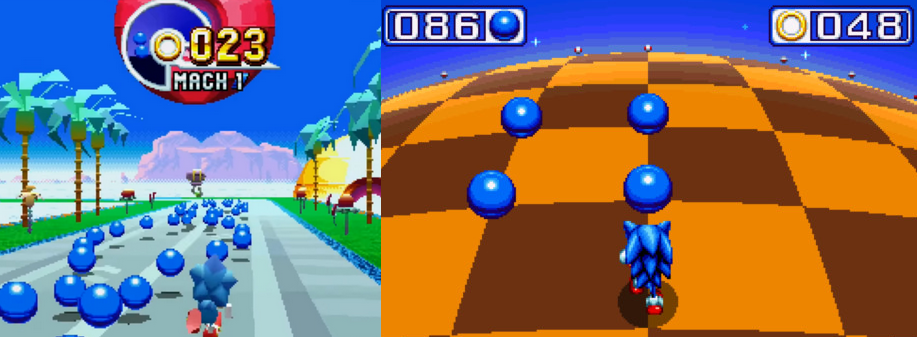
SonicManiaSpecialBonusStages
Make no mistake, the Special Stages are no push-over!

In these Special Stages, players must collect Blue Spheres to increase their speed but also collect Golden Rings to add to the strict time limit in order to chase down a UFO holding a Chaos Emerald. Mastering these stages is the game’s hardest challenge as turns are tight, time is extremely limited, hazards are plentiful, and the UFOs do not give up their prize easily. If you try to get cute and run in the opposite direction, you’ll find yourself out of luck as the programmers thought of that and it’s basically impossible. The first thing you’ll notice when playing Sonic Mania is that it is simply gorgeous to look at; the attention to detail is staggering. Backgrounds and environments are vibrant and colourful, full of life and little details that long-time fans will delight in spotting. The game features eight zones lovingly recreated from classic Sonic titles but expanded and given additional gameplay twists and mechanics, many derived from other Sonic gameplay mechanics (for example, Stardust Speedway features the pulleys from Marble Garden Zone, Flying Battery Zone is amalgamated with Wing Fortress Zone, and Mirage Saloon Zone features the Tornado as in Sky Chase Zone). In the case of the Mirage Saloon Zone, the programmers derived the aesthetics from cancelled desert levels from Sonic the Hedgehog 2 (Sonic Team/SEGA Technical Institute, 1992) and Sonic CD.

SonicManiaDustDesertMirage
Dust Hill and Desert Dazzle are finally realised.

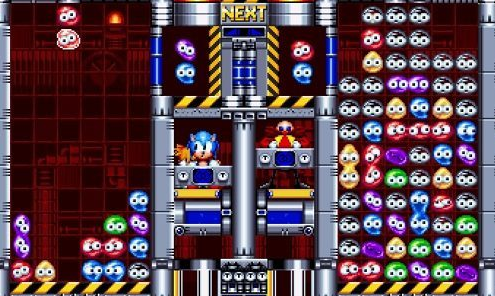
The fan service doesn’t stop there, though. Chemical Plant Zone features a boss battle ripped straight from Dr. Robotnik’s Mean Bean Machine (Compile/SEGA, 1993). Also, Sonic not only races against Metal Sonic in the Stardust Speedway Zone once more, but also has to battle an endless army of Silver Sonic’s from the Master System/Game Gear version of Sonic the Hedgehog 2 (SEGA/Aspect, 1992).

SonicManiaMeanBean
I certainly didn’t expect this inclusion!

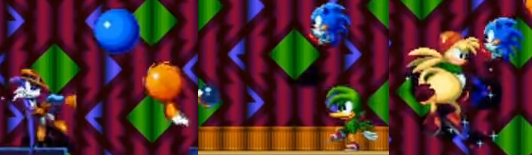
Finally, in perhaps the greatest piece of fan service I have ever witnessed, players will encounter and battle against Fang the Sniper/Nack the Weasel, Bean the Dynamite, and Bark the Polar Bear, three characters long missing from the franchise since 1996. Fans have been literally begging to see these three characters return to the franchise though, up until now, the best we got were some brief homages in Sonic Generations (Sonic Team, 2011). To be fair, their depiction in Sonic Mania looks to be more of an illusion created by the Heavy Magician Hard-Boiled Heavy but the joy I felt upon seeing these three finally return, in glorious sprite form, cannot be understated; the fat little ten-year-old in me was literally geeking out right there.

SonicManiaFangBeanBark
Fang/Nack, Bean, and Bark make their welcome return at last!

Sonic Mania features numerous endings, with the best ending obviously coming once players have collected all seven Chaos Emeralds. Blue Sphere bonus stages award players with either a silver or a gold medal which unlock additional bonus features (Sonic 3 & Knuckles’s Insta-Shield, Sonic CD’s Super Peel-Out, “& Knuckles Mode” to allow players to play as Sonic and Knuckles, Tails and Knuckles, or even Knuckles and Knuckles(!), a Debug Mode, and a Sound Test). Unfortunately, you are not allowed to save your progress when using these bonus features, which is one of the game’s biggest flaws.

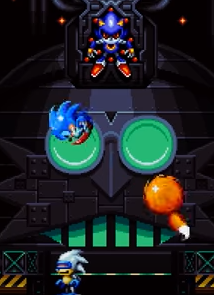
SonicManiaSilverMetalSonic
A love letter to the past.

Another is the plot. Honestly, there isn’t much more plot here than there was in Sonic 3 & Knuckles, with the gist of it being expertly told through in-game animations. However, given that this game takes place a short time after Sonic 3 & Knuckles, it makes no sense for Angel Island to be floating on the ocean again. It was also a bit of a contrivance to see the Phantom Ruby being unearthed on Angel Island, a place already known for being home to the Master Emerald; I would’ve preferred to see it be discovered in one of the new in-game locations.

SonicMania&Knuckles
Play as Knuckles and Knuckles…and be rescued by Knuckles!

Furthermore, not every zone ends with an in-game transition to the next, making for a jarringly inconsistent experience at times as the Hard-Boiled Heavies disappear from the plot mid-way through the game. Finally, I can’t be the only one a bit annoyed to see Green Hill Zone and Chemical Plant Zone so soon after their recreations in Sonic Generations; I would’ve liked to have seen more emphasis on Emerald Hill Zone and maybe Mystic Cave Zone (possible with some Underground Zone and mechanical influences) and, while I loved seeing Lava Reef Zone return, the programmers maybe missed a trick by not incorporating some elements from Marble Zone and Sonic 2’s Hidden Palace Zone here. These really are very minor issues, though, as the game plays flawlessly; the controls are just as tight and reliable as they were in classic Sonic titles. There are no cheap deaths or bottomless pits here (well, very few…I only ever fell down maybe two, actually) and the game is exhilaratingly fast and extremely fun to play, while also being very challenging. The ways in which classic zones are remixed add a new layer to the game as even seasoned veterans like myself cannot be sure of what they’re going to encounter. Every boss battle involves a bit of strategy; there is far more to each encounter that just bouncing on Eggman’s head. Honestly, Sonic Mania is a must-buy not just for long-time Sonic fans but for anyone who enjoys beautiful graphics, crisp controls, and a fun, challenging gameplay. From the Sonic CD-inspired animated introduction to the eye-wateringly exquisite graphics and attention to detail in every single element of the sprites and backgrounds, to the remixed levels and soundtrack, Sonic Mania delivers on every single level. Finally, after over a decade of waiting and enduring lacklustre attempts at recapturing Sonic’s classic gameplay, SEGA have done the smartest thing they ever could and handed the keys to a group of developers with a real love and passion for the franchise and Sonic Mania exudes that from every aspect of its presentation.

My Rating:

Rating: 5 out of 5.

Fantastic

Talking Movies: Masters of the Universe

Talking Movies
MOTULogo

In 1987, one of the most criminally underrated and visually entertaining science-fiction/fantasy films was released. Now, thirty years later, it’s time to take a look back at the gloriously over-the-top Masters of the Universe and give it some much-overdue time in the sun. Directed by Gary Goddard, whose experience was mostly rooted in theme park attractions, on a budget of $22 million and released by Cannon Films, Masters of the Universe is the live-action adaptation of the popular line of toys and animated series of the same name. Following the success of Star Wars (Lucas, 1977) and originally designed as a toy line based on Conan the Barbarian (Milius, 1982), Mattel’s Masters of the Universe franchise depicted an ongoing battle between the heroic forces of Eternia, led by the superhuman He-Man, and the dark aspirations of the evil Skeletor. He-Man’s barbaric appearance, untamed shoulder-length hair and penchant for medieval weaponry obviously showcased his connection to Conan but Mattel made the character, and the franchise, unique by introducing a strong science-fiction element that would run parallel to the sword-and-sorcery influences of Conan.

MOTUToys
I used to pick these little beauties up from car boot sales for £1 a shot!

Furthermore, He-Man became a Superman-like figure in that he was able to transform from the meek, unassuming Prince Adam and into the “mightiest man in the universe” by unsheathing his sword and uttering the now-iconic phrase, “by the power of Eternia; I have the power!” Similar to the Clark Kent/Superman dynamic, very few characters were actual aware of this transformation, despite the incredible similarity between the two characters (something the 2002 relaunch of the series managed to circumvent by having the physical differences between the two characters far more obvious). Anyway, the He-Man and Masters of the Universe toys were successful enough to produce an animated series of…let’s just say questionable quality. Despite this, though, the toys and the series were popular enough to warrant a live-action adaptation. Despite the film’s budget being twice that of Star Wars, and with a proven media franchise behind it, the production Masters of the Universe suffered from two very distinct problems: being produced by Cannon Films (who were infamous for producing B-level science-fiction and action movies, had released the infamously terrible Superman IV: The Quest for Peace (Furie, 1987) only a month of two before Masters of the Universe, and were clearly no 20th Century Fox when it came to film or franchise production and management) and having aspirations way beyond the budget and the limitations of the studio.

MOTUHeManvsSkeletor
“I told you this was always between us”.

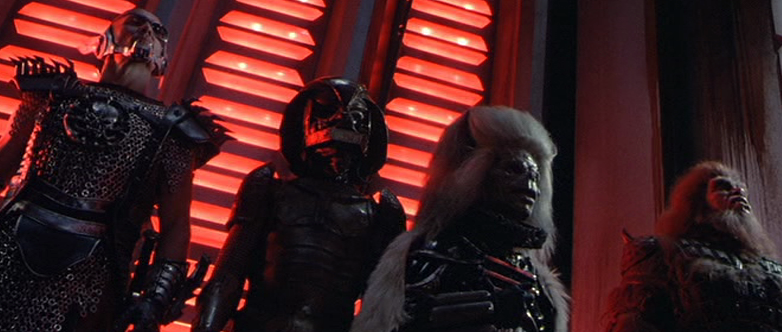
The plot, which sees He-Man (Dolph Lundgren) and his allies transported from Eternia to then-modern-day Earth by a trans-dimensional device known as the Cosmic Key, originally spent more time on Eternia and in Castle Grayskull. Instead, the film opens with Castle Grayskull, the home of the all-powerful Sorceress (Christina Pickles), being suddenly ambushed by the entirety of Skeletor’s (played gloriously by Frank Langella) forces. After rescuing Gwildor (Billy Barty), He-Man and his allies – Man-At-Arms (John Cypher) and Teela (Chelsea Field) – discover that Gwildor’s Cosmic Key was stolen from him by Skeletor’s lieutenant, Evil-Lyn (Meg Foster), and that Skeletor used the device’s ability to transport people across time and space to ambush the Sorceress. He-Man and his allies attempt to use the Cosmic Key to rescue to Sorceress, only to be repelled by Skeletor’s vast numbers and forced to flee, crash-landing on Earth. In the chaos, they lose the Key and it is picked up by a very young Tom Paris….er, I mean, Robert Duncan McNeill (who plays high school DJ Kevin Corrigan) and his girlfriend, Julie Winston (played by an also-scarily young Courteney Cox). Enraged by the existence of another Cosmic Key and desperate to have He-Man kneel before him as he absorbs the powers of the universe, Skeletor sends a team of his finest – Blade (Wesley Snipes…er, I mean, Anthony De Longis), Saurod (Pons Maars), the Beast Man (Tony Carroll), and Karg (Robert Towers) – to retrieve the Key, kill all who stand in their way, and bring He-Man to him so he can break him physically, mentally, and emotionally.

MOTUSkeletorsMercenaries
Stop and appreciate the amazing practical effects used in this film.

However, despite Blade wielding two swords eerily similar to that of He-Man’s, the ferocity of the Beast Man, the Predator-like appearance of Saurod, and the cunning of Karg, these bozos are completely outmatched by He-Man and his allies. Less than impressed with this news, Skeletor vaporises Saurod and forces Evil-Lyn to go with them and atone for this failure. In the meantime, He-Man and his allies have met up with Kevin and Julie and, despite interference from Detective Lubic (played with relish by James Tolkan), have been attempting to figure out how the Cosmic Key actually works. However, their efforts are thwarted when Evil-Lyn leads a massive shoot out in a music shop and then uses her powers of illusion to pose as Julie’s recently-deceased mother and reclaim the Key. Although He-Man valiantly fights back against Skeletor’s forces, Skeletor arrives in person to collect the Cosmic Key and forces He-Man to surrender to him or else watch the execution of his friends and allies. A man of his word, and victorious, Skeletor departs after injuring Julie and rendering the Cosmic Key inert.

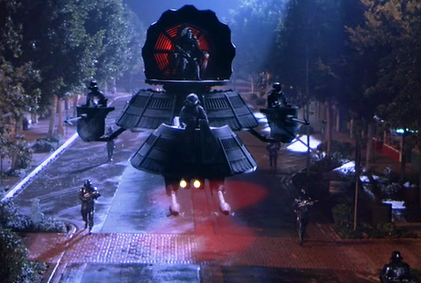
MOTUSkeletorsEntrance
Skeletor’s grandiose entrance ate up a good chunk of the budget but boy, was it worth it!

However, while He-Man is being tortured at Castle Grayskull, Kevin is coerced into using his knowledge of music to play the melody necessary to transport everyone back to Eternia. Although they manage to rescue He-Man, they are ultimately too late to stop Skeletor from absorbing the powers of the universe through the Great Eye. Transformed in a living God, Skeletor unleashes the full extent of his wrath towards his hated adversary, furious at He-Man’s refusal to kneel before his power. However, through sheer force of will and physical durability, He-Man reclaims his sword and engages Skeletor in combat, ultimately shattering his mystical staff and causing Skeletor’s powers to leave him. Although blindsided by Skeletor’s final attack, He-Man successfully tosses his nemesis down a seemingly-bottomless shaft and wins the day. In the end, the Sorceress is freed, Lubic retires to Eternia, and Kevin and Julie are returned to Earth just before the plane crash that killed Julie’s parents, resulting in a happy ending for all. Masters of the Universe is an impressive piece of cinematography; the set pieces, special effects, and scope of the tale are incredible. Castle Grayskull alone looks like it ate up a sizeable amount of the film’s budget, not that you’d ever know as the scenery is constantly chewed at and dominated by the enigmatic performance of Frank Langella as Skeletor.

MOTUSkeletor
Langella is practically unrecognisable under the Skeletor make-up, save for his booming voice.

Langella absolutely looks to be having the time of his life, hissing with pure venom and spouting lines, with just the right inflection, that remain chilling and quotable to this day (“I must possess all or I possess nothing”, “in death I make him a martyr, a saint! No, I want him broken!”, and let’s not forget when he actual obtains the powers of the universe!). Lundgren is perfectly serviceable as He-Man; he obviously has the build and the exact look for the character. To the chagrin of many Masters of the Universe fans, the film does not mention Prince Adam at all or depict He-Man turning back and forth. You can easily explain this by saying that, most likely, Adam became He-Man right before the film started, though I prefer to believe that Prince Adam just isn’t a part of this canon. Lundgren has always been a bit like a poor man’s Arnold Schwarzenegger and it’s a shame that Masters of the Universe didn’t fare better critically and financially (making a dismal $17 million worldwide) because a successfully franchise might have helped Lundgren to step outside of Schwarzenegger’s shadow a bit more. The supporting cast is pretty great, too. In place of Orko (again to the chagrin of Masters of the Universe fans but, seriously, Orko was the most annoying cartoon character since Scrappy Doo!), we get the warlock Gwildor who, though easily the most annoying character in the film, is still charming in his own right and never outstays his welcome. Man-At-Arms is played to perfection by John Cypher, who depicts him as a loving father, the veteran of many wars, He-Man’s trusted confidant, and also with a dash of well-placed humour (nonchalantly stating that he “[feels] a little hungry” right on the eve of the big shoot out).

MOTUHeMansAllies
Who needs a stupid, annoying floating wizard-thing anyway?

Teela is probably the blandest of the supporting cast but she gets plenty of opportunities to shine in battle and to voice her opinion; she chastises Gwildor for creating the Cosmic Key and thereby unwillingly causing the invasion of Castle Grayskull and vehemently begs He-Man not to surrender to Skeletor despite his heroic sacrifice sparing the lives of innocent people. Similarly, Skeletor’s lieutenants are a big positive of the film. Even guys like Saurod and the Beast Man, who don’t get a lot to say or do, really, are visually engaging and show some layers to their characters. Blade even mentions that he’s “waited a long time” to face He-Man in combat, hinting at a past history between those two. While Karg is ultimately pushed aside once Evil-Lyn takes charge, he nonetheless is a nightmarish little creature. As for Evil-Lyn, Meg Foster seems to be savouring the role almost as much as Langella, playing it with a seductive relish that makes her both detestable and fascinating. Even the human protagonists have some layers to them; sure, both actors are noticeably green here and would go on to refine their craft but Kevin’s struggle to define himself outside of high school is very relatable and Julie’s grief over her parents’ death makes her a sympathetic character. She never becomes a damsel in distress either and, when she is tricked by Evil-Lyn, you totally buy it because she has been largely unsuccessful at coping with her loss throughout the film. Of all the human characters, though, it is Lubic who shines the brightest; I’ve yet to see a role that Tolkan does not fully throw himself into and this is no exception, playing the hard-nosed unbeliever to perfection and ultimately becoming a valuable ally by the film’s conclusion. For a film that is, ultimately, a massive toy commercial,

MOTUPower
“I HAVE THE POWERRRRRRRR!!!”

Master of the Universe has some stellar performances by some great, and underrated, actors, proving that quality casting can elevate any film. This is aided not just by the special effects and set pieces, but also by Bill Conti’s score; a epic, regal theme accompanies the action, rising to a crescendo when Skeletor makes his dramatic (and, no doubt, extremely costly) appearance on Earth. Many fans are understandably annoyed at the lack of swordplay there is in this film; He-Man primarily draws his sword to deflect laser fire and only engages in sword-on-sword combat a handful of times throughout the movie. While Lundgren looks great holding the sword, he only really shows some competence with the weapon in the final battle and prefers to use a laser blaster for the majority of the film. Similarly, Skeletor’s faceless black stormtroopers all wield laser rifles, although they are nowhere near as bad with their aim as their obvious Star Wars counterparts. Personally, I’ve never minded the preference on blasters over swords; it makes the times when He-Man does use his sword mean much more, plus the toys did come with blasters at various times. Ultimately, the poor reception of Masters of the Universe is, to me, unjust. The film even has a final scene after the credits, pre-dating Marvel by decades, where it is revealed that Skeletor survived his fall. This was planned to be followed up on in a sequel but, after the film performed so badly, all of the sets, costumes, and props were retooled for Cyborg (Pyun, 1989). A reboot has been in the works for seemingly forever; although McG was attached to be the director, a tentative release date of 18 December 2019 has been announced so, perhaps, we’ll see He-Man onscreen once more. I have no doubt that Masters of the Universe can be done better and be a massive hit, if done right, but just because the original film isn’t 100% accurate to the toys or to the animated series, or largely set on Earth, doesn’t make it a failure or justify overlooking its place as a masterfully crafted, enjoyable science-fiction/fantasy romp. For me, Masters of the Universe is far more engaging and action-packed than Star Wars (it’s not a popular opinion, but I find the original film to be quite dull and to not have aged as well as its later sequels), far less of a chore to watch than Conan the Barbarian (again, as much as I like that film, its pacing can make repeated viewings a slog to get through), and I fully believe that it should be celebrated not just as a cult film or as a piece of nostalgia but for being a gorgeous, charming, action-packed slice of cinematic gold.

My Rating:

Rating: 5 out of 5.

Fantastic

Recommended: Definitely; Frank Langella alone makes this worth the price of admission!
Best moment: The entire finale of the film, right from the moment He-Man’s allies burst into Castle Grayskull up until Skeletor’s ultimate defeat.
Worst moment: Probably our introducing to Kevin and Julie and their last scene together (barring the magical snow globe they get) as their acting is a bit janky in these scenes.

10 FTW: Spider-Man Costumes

With the reveal at San Diego Comic-Con that Tom Holland’s Spider-Man will be donning the Marvel Cinematic Universe equivalent of the Iron Spider costume in Avengers: Infinity War (Russo and Russo, 2018), there’s no better time for everyone and their mother to weigh in on their favourite Spider-Man costumes. So, with that in mind, here are my top ten Spider-Man costumes (I would have asked my mother for her choices too but I’m not sure she even knows Spider-Man had more than one costume).

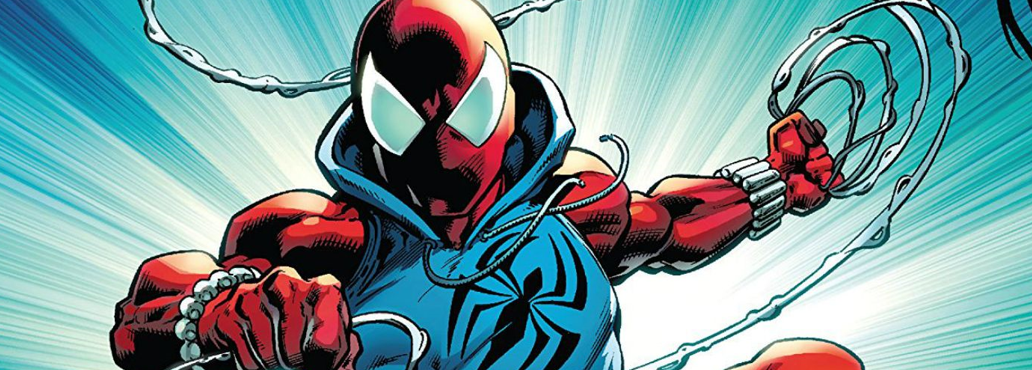
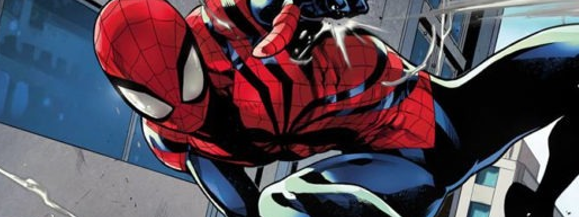
10 Scarlet Spider (Web of Spider-Man #118)

Kicking things off with a bit of a cheat as Peter Parker isn’t really famous for sporting these simple duds. Instead, his clone, Ben Reilly, took up the webs after five years as a wandering hermit and fought crime as the Scarlet Spider, favouring a torn hooded top and skin-tight red spandex that has become the go-to look for whenever cinematic or animated incarnations of Spider-Man need a prototype or homemade version of the classic costume.

9 The Amazing Bag Man (The Amazing Spider-Man #258)

Next up is a short lived gag outfit that Peter was forced to adopt after the Fantastic Four revealed that his nifty black costume was actually a living alien symbiote. Slipping into one of Johnny “Human Torch” Storm’s old costumes and placing a simple paper bag over his head, this outfit was only supposed to get Peter from the Baxter Building and back home without giving away his secret identity and yet nearly garnered more public appreciation than his red-and-blue outfit ever did.

8 The Superior Spider-Man (The Superior Spider-Man #14)

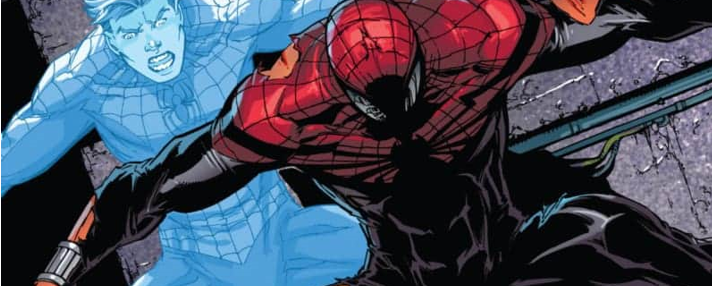
We’re veering deep into comics territory here. Okay, so, Doctor Otto Octavius/Doctor Octopus managed to switch his mind with Peter’s and took over his life and identity, vowing to be a “superior” version of Spider-Man. Soon, he took on a ruthless attitude towards crime and switched to a far more aggressive and deadly version of Spidey’s classic duds. Ironically, Otto actually won over not only the city but also long-time Spider-Man hater J. Jonah Jameson during his tenure as a more ruthless incarnation of the web-slinger.

SpidermanUniverse
7 Captain Universe (Spectacular Spider-Man #158)

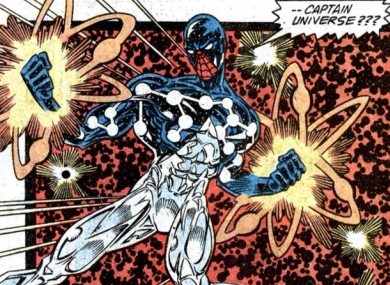
What’s better than a superior version of Spider-Man? A Spider-Man imbued with the cosmic powers of Captain Universe, of course! Gifted with the extra-dimensional Uni-Power, Spider-Man became a cosmic-level superhero, capable of emitting energy blasts and defending the entire universe….however, he lost all his abilities to destroy the Tri-Sentinel, which seems a bit of a waste to me (it’s not like he was facing Onslaught or anything!)

6 Spider-Man Noir (Spider-Man Noir #1)

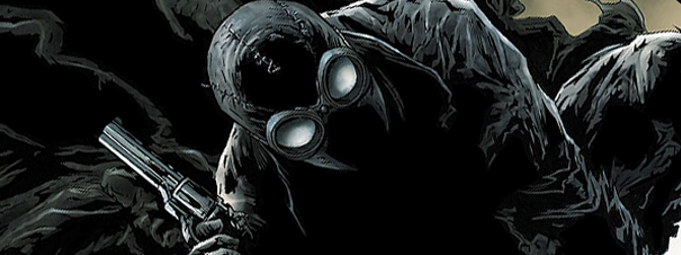
Scaling things down for a second is the Spider-Man from the alternate reality known as Earth-90214, the “Noir-verse”. This Spider-Man, operating during the Great Depression of the 1920s and 1930s, takes on a classic noir detective appearance, sporting aviator goggles, a black trenchcoat, and wielding firearms.

5 Future Foundation (FF #1)

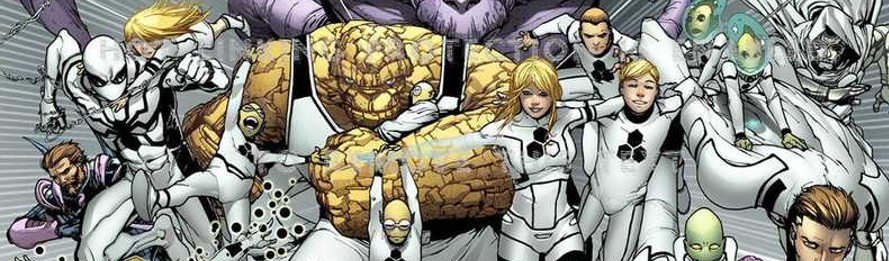
Following the death of Johnny Storm/The Human Torch (well, it turned out that he didn’t really die but he appeared to be dead at the time and for a while), the Fantastic Four re-organised themselves as the Future Foundation and, as per Johnny’s request, Spider-Man finally joined the team. Though he initially rocked up sporting the classic Fantastic Four costume, he was later outfitted with this nifty white-and-black number that, despite closely resembling the appearance of Anti-Venom, was made up of unstable molecules which allowed it to stay nice and clean and also switch between a number of other appearances, including a black-and-white “stealth mode”.

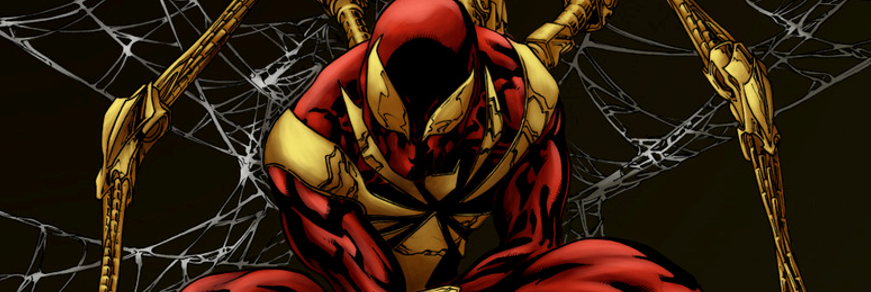
4 The Iron Spider (The Amazing Spider-Man #529)

In the build up to Civil War (Millar, McNiven, et al, 2006-2007), Tony Stark/Iron Man became something of a mentor to Peter. As part of that, Stark built Peter a customised version of his Iron Man armour; this red-and-gold exoskeleton greatly amplified and added to Spider-Man’s already-impressive abilities: three mechanical spider-like arms could instantly sprout from his back, he could glide with ease throughout the city, and his lenses offered numerous sight-enhanced options, amongst others.

3 The Sensational Spider-Man (The Sensational Spider-Man #0)

Dipping back into one of Spider-Man’s more controversial periods, the seemingly never-ending Clone Saga, this is the awesome costume that Ben Reilly wore during his tenure as Spider-Man. Bold and striking, this version separates itself from the original by sporting a large spider motif in the middle and Reilly’s bulkier, more powerful web-shooters around the wrists. In the alternate reality known as Earth-982, Peter’s daughter May “Mayday” Parker also wore this outfit to fight crime as Spider-Girl.

2 Spider-Man 2099 (The Amazing Spider-Man #365)

In the possible future reality known as Earth-928, geneticist Miguel O’Hara alters his own DNA to bestow himself with spider-like abilities. Garbing himself in a mask and bodysuit he wore for the Day of the Dead festival, Miguel becomes an all-new version of Spider-Man. Miguel’s costume is comprised of Unstable Molecule fabric, which allows him some resistance to energy-based weapons and attacks and renders it practically indestructible, and anti-gravity technology allows Miguel to fly at will (just like a real spider!)

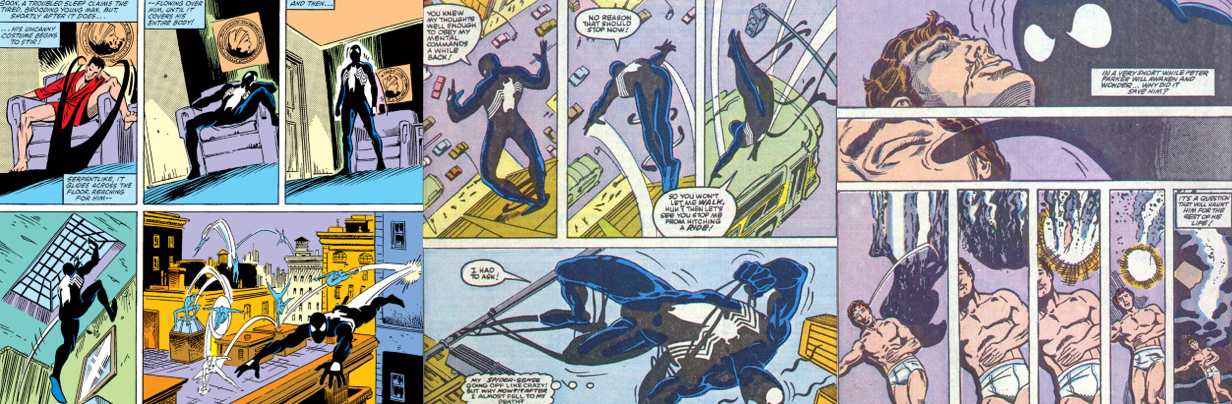
1 Symbiote Spider-Man (The Amazing Spider #252)

Finally, the inevitable and obvious choice for number one. We started simple with the Scarlet Spider costume and it’s only fitting to end just as simply; the black suit was a visually and striking departure from Spider-Man’s usual costume, which had changed very little since its debut up to this point. Closely resembling the costume of Julia “Spider-Woman” Carpenter, this costume was all-black and sported a brilliant white spider logo and piercing white eyes. However, as would later be revealed, the costume was anything but simple as it turned out to be an alien symbiote looking to permanently bond with Peter. After he rid himself of it, he would later be tormented and haunted by the suit for years to come when it bonded with Eddie Brock to become and maniacal Venom, proving that some of the most iconic villains can have the most obscure and unassuming of origins.

Talking Movies: Spider-Man: Homecoming

Talking Movies
Spiderman

Following the unfortunate critical and commercial failure of the underrated Amazing Spider-Man 2 (Webb, 2014), Sony and Columbia Pictures decided to cancel their plans for a third film and numerous related spin-offs that would form their own shared cinematic universe. The plus side to this was that negotiations and talks opened up between Disney/Marvel Studios and Sony Pictures which saw Spider-Man be recast and incorporated into the massive, unstoppable media juggernaut that is the Marvel Cinematic Universe in Captain America: Civil War (Russo and Russo, 2016). To capitalise on the success of Civil War and the popular reaction of Tom Holland’s youthful, wise-cracking portrayal of the character, Marvel Studios rearranged their scheduled list of films to allow for a solo movie to truly integrate the character into their shared universe.

Spider-Man: Homecoming (Watts, 2017) opens moments after the conclusion of The Avengers/Avengers Assemble (Whedon, 2012) where salvage expert Adrian Toomes (Michael Keaton…I’ll say that again, Michael Keaton!) and his crew are screwed out of their contract to salvage the remains of the battle between the Avengers and the Chitauri by Tony Stark’s (Robert Downey Junior) newly-formed clean-up team, Damage Control. Out of pocket and against the wall, Toomes and his crew reverse-engineer Chitauri tech to construct an elaborate flying harness and wing rig and create weaponry they can sell on the black market. Eight years later, Peter Parker (Tom Holland) is taken to Berlin by Happy Hogan (Jon Favreau) after being recruited by Tony Stark; once there, he is given his spiffy new Spider-Man costume and participates in the new-iconic airport battle seen in Civil War. Being dropped off at home by Stark, Parker is promised that the team will be in touch with him soon with a new mission. However, eight months later, he has heard no word from Stark or Hogan, despite leaving them numerous messages, and is getting frustrated with being nothing more than a “friendly neighbourhood Spider-Man”.

A chance encounter with Toomes’ gang, who wield advanced, retrofitted Chitauri weaponry, brings Toomes’ activities to the attention of Spider-Man. Angered that his eight-year operation, which has remained under the radar of the Avengers and the police, Toomes kills Jackson Brice (Logan Marshall-Green) and passes his signature weapon, and self-appointed alias of “the Shocker”, on to Herman Schultz (Bokeem Woodbine) and vows to kill Spider-Man for interfering in his work. When Peter’s attempts to bring Toomes’ nefarious activities to Stark’s attention apparently fall on deaf ears, he and his incredibly enthusiastic friend friend, Ned (Jacob Batalon) unlock the full potential of Peter’s spider-suit and he takes matters into his own hands. However, when his over-eagerness causes catastrophe, Stark takes the suit back and reprimands his reckless actions. Humbled and disheartened, Peter attempts to focus on the school’s annual homecoming dance and his date, long-time love interest Liz Allen (Laura Harrier) only to once again forced into a deadly confrontation with Toomes in his Vulture persona.

Spider-Man: Homecoming, much like Ant-Man (Reed, 2015) is a welcome breath of fresh air in the Marvel Cinematic Universe primarily because of its dramatic shift in focus from worldwide, earth-shattering, universe-spanning events to simple, yet still dramatic, issues at a more grounded level. The film cleverly showcases that the actions of the Avengers have far-reaching consequences; every time they battle an advanced enemy, they leave behind chaos and remnants that, in this case, birth an entire gang of criminals in possession of advanced weapons. With the Avengers focused on bigger threats and fighting each other, it’s up to street-level superheroes like Spider-Man to stand up for the everyman in the street. Unlike other depictions of Spider-Man, Holland is young and fresh; he rarely takes the mask off, never shuts up once the suit is on, and embodies the youth and enthusiasm of the character’s Ultimate incarnation in spectacular fashion. Additionally, he is young enough to still be in high school and realistically dealing with the problems that come with this situation: constant berating from the loud-mouth Eugene “Flash” Thomson (Tony Revolori), trying to fit in with the more popular kids, and living up to his responsibilities to the academic decathlon team he is a part of. Add to this the fact that he is hiding his duel identity from his Aunt May (Marisa Tomei) and desperately trying to prove that he has what it takes to be an Avenger and you have a very nuanced performance full of heart and humour.

Spidey goes up against one of his traditionally lamer villains; the Vulture has always just been an old guy with wings who robs banks and does very little else. The same goes for the Shocker, who was turned into a walking recurring joke in the Ultimate Spider-Man comics. Here, though, teamed up, they present a formidable threat to the fledgling Spider-Man; within the first ten minutes of the film, Toomes is made relatable and his motivations are completely understandable. He may well be one of the most layered and ruthless villains not only that a live-action Spider-Man has faced but also in the Marvel Cinematic Universe. The best part is that the film not only features Phineas “The Tinkerer” Mason (Michael Chernus) but, more interestingly, introduces an associate of Toomes, Mac “The Scorpion” Gargan (Michael Mando), who alludes to a team-up of the villains in the future. This promises that Spider-Man will, hopefully, face new onscreen enemies in future films rather than rehashing the same villains we’ve seen before. The film does have some negative points, though; I get that Marvel don’t want to go through Peter’s whole origin again as it’s been done to death by now but I would’ve liked to have seen a quick recap of it over the opening titles just so we can see how this version of Peter dealt with that time of his life. An unfortunate by-product of this is that there’s only subtle allusions of Uncle Ben and the great mentor figure in Peter’s life is Tony Stark (however, Stark and Iron Man feature sparingly throughout the film and in no way take the spotlight away from Spider-Man).

Also, I’m not sure why they chose to have Toomes figure out Spider-Man’s secret identity as it didn’t really factor into the film in a meaningful way. Finally, Spidey’s super high-tech suit stretches believability quite a bit as his suit is skin-tight and form-fitting, so it’s hard to believe that it’s packed full of Iron Man-esque tech (I would’ve liked to have seen the Iron Spider-Man suit used as an alternative to this). However, these are extremely small, minor nitpicks; the film is incredibly funny, packed full of action, and never falls into unnecessary drama. As a coming-of-age story that teaches Peter his place in the wider scope of the Marvel Cinematic Universe, Spider-Man: Homecoming succeeded spectacularly and I fully expect any minor issues to addressed in his future appearances.

My Rating:

Rating: 5 out of 5.

Fantastic

Recommended: Highly, it’s Spider-Man in the Marvel Cinematic Universe!
Best moment: A fantastic recreation of a sequence from The Amazing Spider-Man issue thirty-three, in which Peter is trapped beneath some wreckage and must will his way out through sheer brute strength.
Worst moment: The lack of exposition into the origins and motivations of this new interpretation of Spider-Man.

Game Corner: Happy Birthday, Sonic the Hedgehog!

GameCorner

Sonic the Hedgehog turned 26 this week so I figured it was only appropriate for a very special edition of Game Corner to celebrate the legacy of everyone’s favourite supersonic blue hedgehog. I know that Sonic isn’t exactly as relevant or anywhere near as popular as he used to be but, there was a time back in the nineties, when Sonic the Hedgehog was the videogame icon and the character, and his franchise, have significantly impacted my life over the years. Growing up, I went through many phases where I had franchises and characters I gravitated towards; first it was Thomas the Tank Engine, then Teenage Mutant Ninja Turtles, and so on, alongside superheroes from DC Comics (mainly Batman, Superman, and Green Lantern) and Marvel Comics (primarily Spider-Man, the Incredible Hulk, and the Fantastic Four). However, my first real memories of truly latching on to a franchise and taking it as my own were with my first experiences with Sonic the Hedgehog.

Sonic_Games

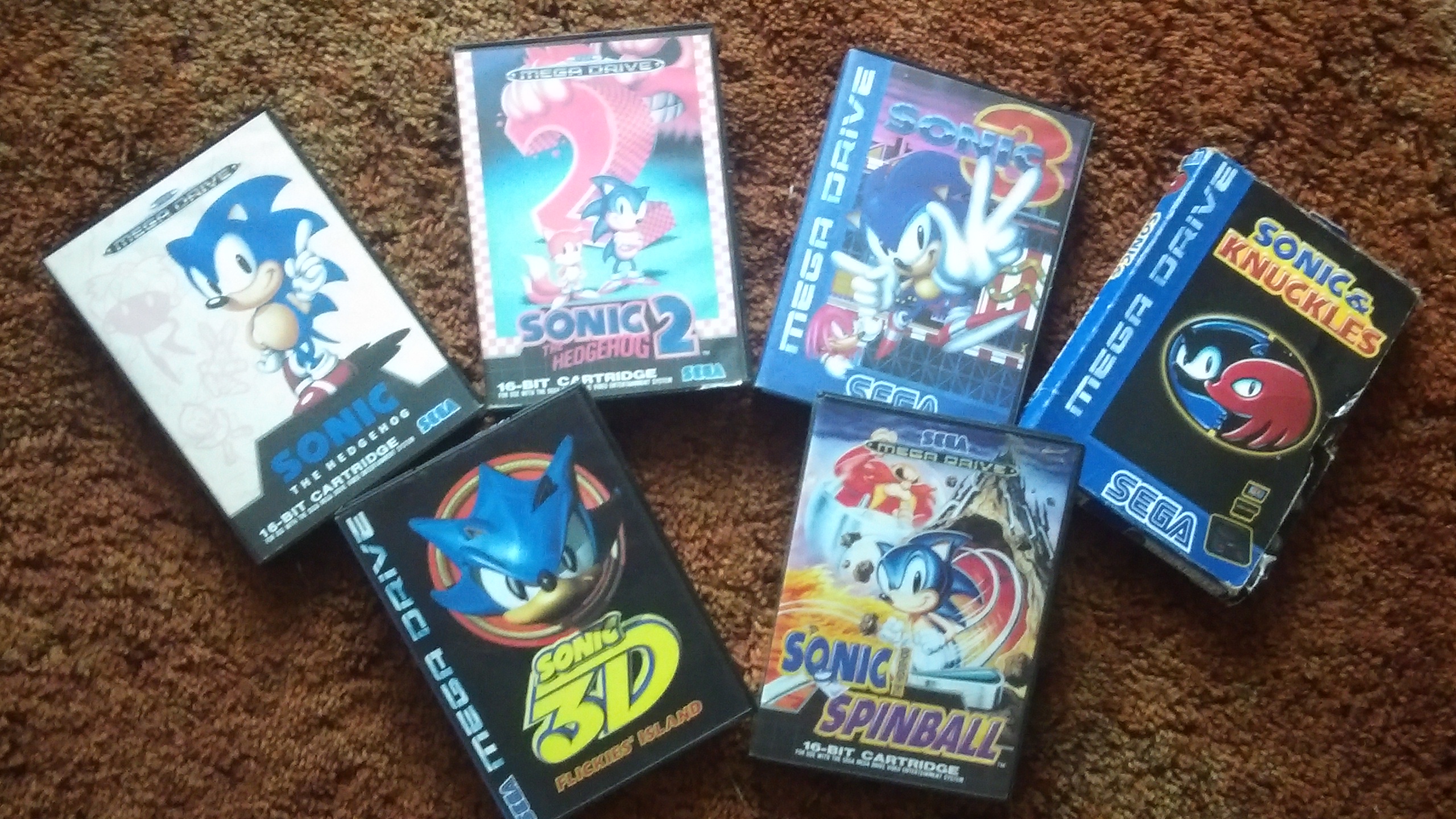
The first Sonic videogame I ever played, and owned, was Sonic the Hedgehog (SEGA/Ancient, 1991) for the SEGA Master System. I remember playing the game for the first time and being struck by the colourful imagery, the addictive tunes, and the simplicity of the gameplay. I used to play that game all the time; one time, my friend came over and struggled to get past the first boss, so I offered to beat it for him and ended up getting further than I ever had before at that point, all the way to the final boss of the game. Sonic on the Master System had many features that were markedly different from its more graphically-impressive counterpart on the Mega Drive; Chaos Emeralds were cleverly hidden throughout the games Zones, for example, and the game also featured three Zones not seen in the Mega Drive version and, with the exception of the first boss, it also had completely different boss battles as well. I didn’t have quite the same experience, or have quite the same love, for Sonic the Hedgehog 2 (SEGA/Aspect, 1992) on the Master System. Sonic 2 was much harder than its predecessor, with Chaos Emeralds hidden in stupidly-difficult places and a gameplay mechanic whereby you had to collect all five before facing the robotic Silver Sonic or else you’d never get to see the good ending. Unlike the first game, though, Sonic 2 had a rather complex cheat code involved the second player’s controller, which I’m not ashamed to say I would utilise to overcome this issue.

Sonic_Fleetway

It was around about this time that I acquired a sample of Fleetway’s Sonic the Comic series, which had one-page teasers of the full issue’s stories. The first issue I got was issue two, which I still have, and I got issues here and there throughout the first year of its run before subscribing to it on a fortnightly basis. A few years ago I was able to fill in the gaps in my collection and have managed to collect every single issue bar the last two, which is good for me as the comic was unfortunately cancelled after a long series of reprints. However, the series is being continued at Sonic the Comic – Online. I don’t remember the exact year (it must have been 1992 or 1993) but, after some cajoling, I was able to convince my parents to upgrade me to the SEGA Mega Drive purely based on pictures and reviews of Sonic the Hedgehog 2 (Sonic Team/SEGA Technical Institute, 1992). I got the game, and the console, as a Christmas present and it tided me over for quite some time; I remember getting into trouble because I’d finally defeated Doctor Robotnik’s Death Egg Robot and wanted to watch the final cutscene and credits of the game rather than go eat dinner.

Sonic_Games2

After picking up Sonic the Hedgehog (Sonic Team, 1991) I was set; from that moment on, I bought every Sonic game I could for the consoles I had. I never got a Mega-CD, so I didn’t play Sonic the Hedgehog CD (Sonic Team, 1993) until many years later on PC and, now, PlayStation 3 so, for many years, my absolutely favourite Sonic game was Sonic the Hedgehog 3 & Knuckles (Sonic Team, 1994). We all know the story; Sonic 3 was too big, too complex to be one game so, to save time and make more money, SEGA split it into two, releasing Sonic & Knuckles six months later. The Sonic & Knuckles cartridge would “lock-on” to Sonic 3 (and Sonic 2, or any other Mega Drive cartridge) to unlock the full, complete version of the game. For me, Sonic 3 & Knuckles was a game-changer; it introduced me to my favourite character of the franchise, Knuckles the Echidna, and topped everything its predecessors had done. You could play as Sonic, Miles “Tails” Prower, Knuckles, or Sonic and Tails simultaneously. Each had different paths to take, fought bosses differently, and had a unique ending. The game was bigger, brighter, faster, and more action-packed than its predecessors and had way more options, enemies, power-ups, and replay value. I was absolutely hooked! Then dark times came for SEGA; the failure of the Mega-CD, 32X, and Saturn spelled the beginning of the end of the company. As videogame developers began entering the 32-bit era, I switched to the Nintendo 64 rather than the Dreamcast or Sony’s PlayStation. This was still at a time when parents couldn’t afford to get you every console going; just like back when I used to have to go around to my friend’s house to play the Super Nintendo (SNES) and he would have to come to mine to play the Mega Drive, so to did I opt for the N64 over the Dreamcast or PlayStation. The PlayStation was nothing to me then. It had no iconic characters, no games I was familiar with, and no-one I knew had a Dreamcast so I went with the popular option.

Sonic_Games4

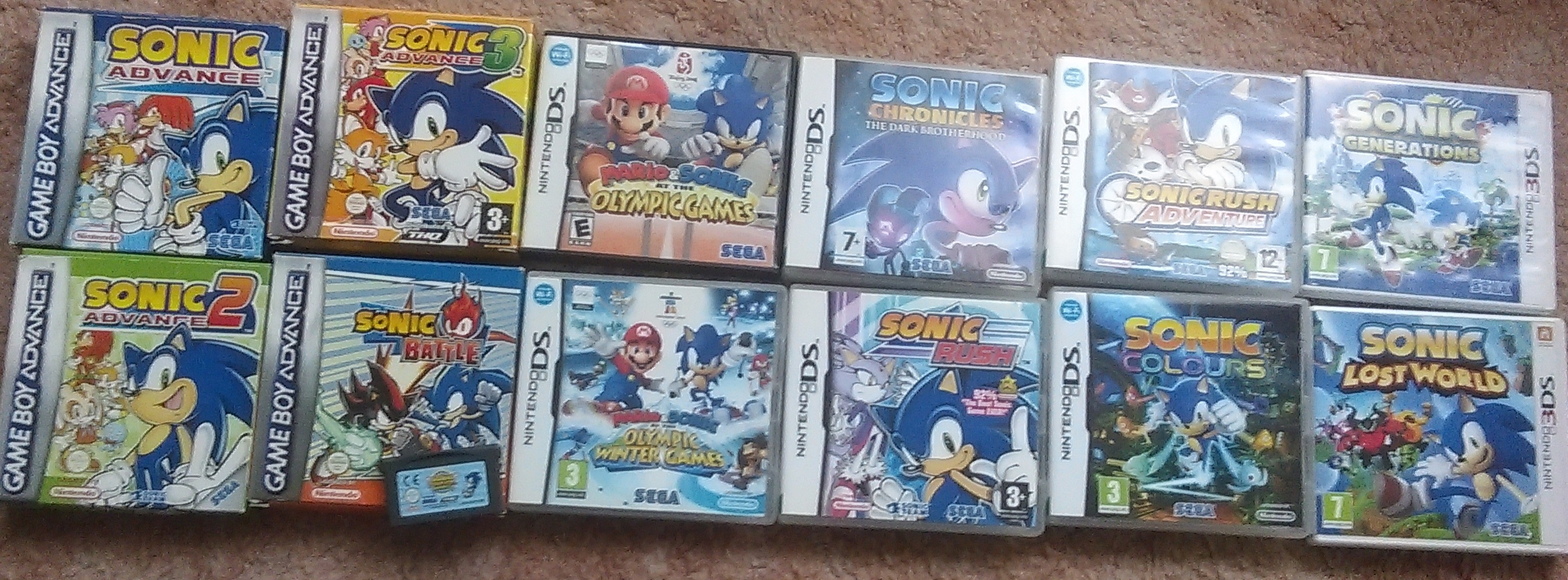
This meant that I didn’t play Sonic Adventure (Sonic Team, 1999) or Sonic Adventure 2 (Sonic Team USA, 2001) until they were re-released on the Nintendo GameCube. Sonic Adventure 2: Battle (ibid) became my new favourite Sonic title, with its crisp 3D graphics, over-lapping narrative, and exciting, fast gameplay variety. Sonic Adventure 2 allowed me to play as Eggman for the first time (by this time I had begrudgingly accepted SEGA’s global acknowledgement or Robotnik’s original Japanese name) and introduced the angst-ridden Shadow the Hedgehog who also became a favourite of mine (he’s like Sonic….but dark!) Sonic Adventure DX: Director’s Cut (Sonic Team, 2003) actually proved even better (it feels like a bigger, more exciting game despite being a bit less pretty to look at and a bit buggier than its sequel) and came with unlockable ports of the Game Gear Sonic titles, allowing me to fill some gaps in my collection. From there, I’d have to say that I actually preferred Shadow the Hedgehog (SEGA Studio USA, 2003) over Sonic Heroes (Sonic Team USA, 2003) simply because it’s a better, more polished videogame. Shadow gets a lot of hatred because Shadow uses guns and vehicles when, to be fair, he doesn’t really need to and the title was, arguably, dark for the sake of being dark. However, I really enjoyed the shooting mechanics; the weapons were varied and ran out of ammo pretty fast (and were also entirely optional) so you can just used the patented Homing Attack instead. The storyline, while a bit convoluted (aliens? Really?) was fun to play through and to see all the many (and many) different endings to the game. The soundtrack and final boss were fantastic, as well, and the game just controls a lot better than Sonic Heroes, which always feels like you’re running on ice!

Sonic_Games3

Of course I also played the various Sonic titles on the Nintendo Gameboy Advance. A personal favourite of mine was Sonic Battle (Sonic Team/THQ, 2004), which featured a really long and decent story with multiple characters and options and a simple, yet addictive, fighting, level-up, and gear system. However, things took a sharp turn for the worst with Sonic the Hedgehog (Sonic Team, 2006). By this point, I had switched over to the PlayStation 3 after everyone raved about how great the PlayStation 2 was (ironically, everyone was now raving about how great the Xbox 360 was…). I bought Sonic ’06 knowing it had gotten bad reviews, having heard all the negative press, but steadfast in my commitment to the franchise. Despite some stumbles along the way (Sonic 3D: Flickie’s Island (Traveller’s Tales/Sonic Team, 1996), for example), Sonic had never steered me wrong and I’d always found something to enjoy in every Sonic title I played.

Sonic_Games6

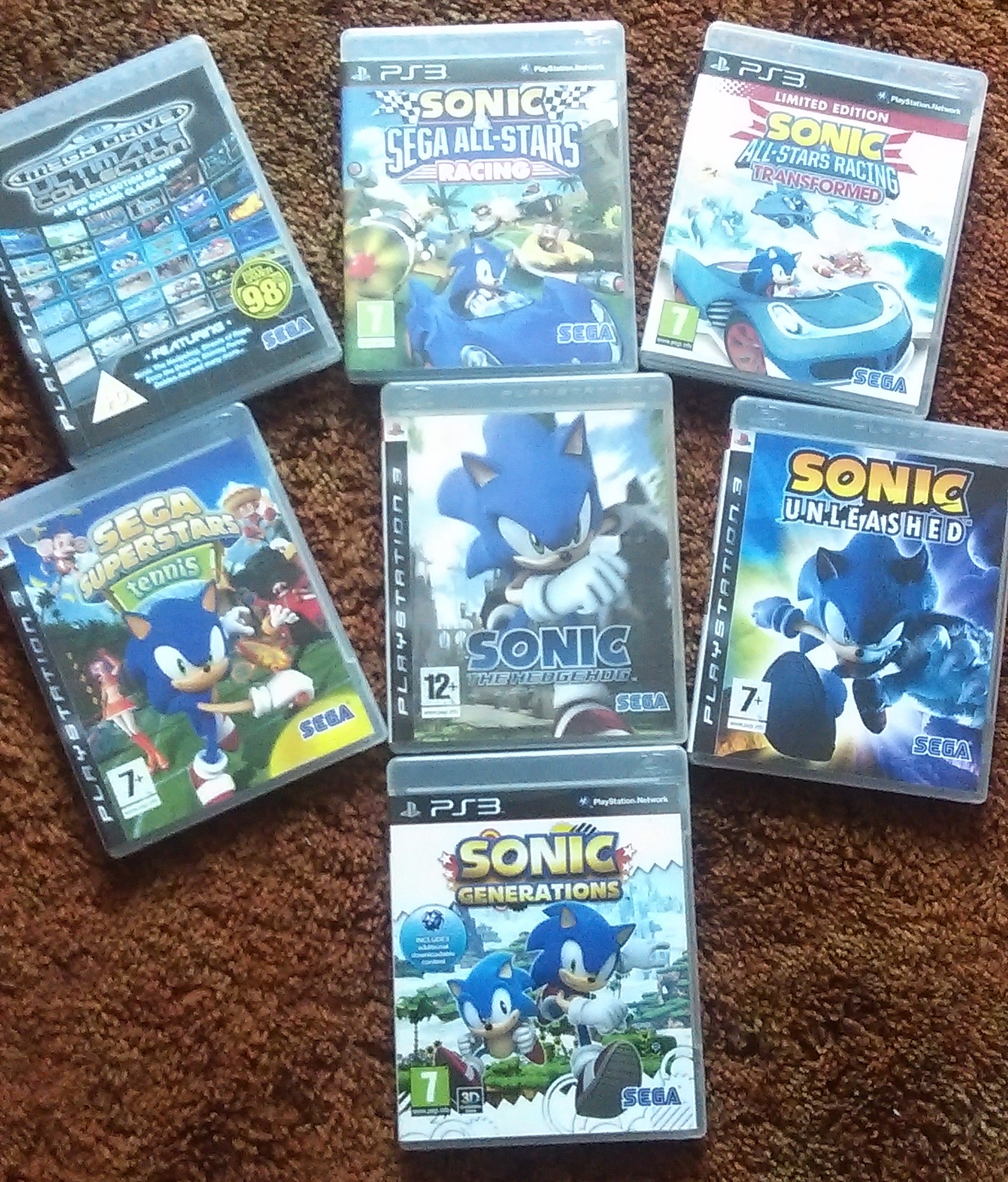
Unfortunately, Sonic ’06 was a pretty dire title; while I don’t hate it as much as some segments of the fandom, the loading times were stupidly long, the sudden, jarring shift to a real-world aesthetic was a strange choice and the camera and controls could hinder you at some really awkward and frustrating moments but there were some good things about the game. It looked amazing, for starters, had a great soundtrack, lots of variety in characters and gameplay, and told a unique and surprisingly deep story for a Sonic title. Probably the worst thing for me were the Mach Speed sections, where Sonic would speed off at a stupidly fast pace and become impossible to control; these were the sections that gave me the most grief and sucked away my lives. The rest was…okay, I guess. I really hate seeing people online bash this game with images and videos of Sonic casually just walking around a loop; when you actually play the game, you’re moving too fast to do stuff like that so you have to be intentionally looking for it. A similar thing irks me when people criticise Sonic the Hedgehog 4: Episode I (Dimps/Sonic Team, 2010); when I played the game, I did so at a fast pace and threw myself into the action. I didn’t just stop and walk to test and bitch about the physics; normal gamers don’t do that (or, at least, they shouldn’t because videogames are made to be played, not bug-tested!)

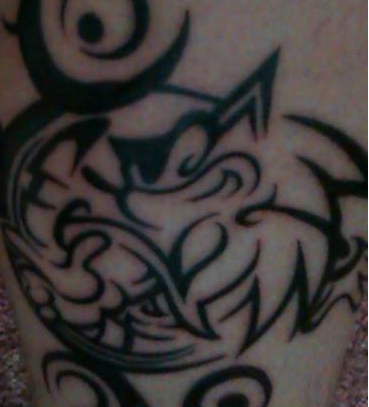
Sonic_Tattoo

Anyway, unfortunately for me, Sonic ’06 made such a negative impact that SEGA decided to strip everything back. While this resulted in some incredible titles, like Sonic Unleashed (Sonic Team, 2008), Sonic Colours (ibid, 2010), and Sonic Generations (ibid, 2011) it came at a price. Sonic videogames were now about Sonic and Sonic alone; you couldn’t play as Tails, Knuckles, Amy Rose, or any of his other cast of characters. We went from Sonic alone, to adding Tails, then adding Knuckles in the first three/four titles, to six playable characters, right back to just one. Even in polished, sleek, incredibly fun titles like Sonic Unleashed and Sonic Generations, you’re limited to playing as Sonic or another version of Sonic (the Werehog, who could’ve just as easily been Knuckles, or Classic Sonic, respectively). Another by-product of this was that abilities and gameplay mechanics afforded to Sonic’s friends now became a part of his move-set. Although this had been happening since Sonic Adventure 2, Sonic Colours (and, later, Sonic: Lost World (ibid, 2015)) made it abundantly clear that you don’t need to play as Tails to fly or swim or as Knuckles to glide, climb, or bash through walls because Sonic now has either default moves or power-ups that let him do all of those things.

Sonic_Games5

The plus side to this is that it seemed like SEGA were finally getting their act together; after being forced to pull out of console manufacturing and focus on software, and the massive screw up that was Sonic ’06 , SEGA, and Sonic Team seemed to have rediscovered the formula that made Sonic such a popular and exciting franchise. Then they shot themselves in the foot with Sonic Boom, which was initially presented itself as a complete rebranding of the Sonic franchise, with all-new character designs and a streamlined, refreshed continuity. Then, SEGA backpedalled and said it wasn’t a reboot but a spin-off series. So instead of having one worldwide brand, they now had Modern Sonic (the taller, older-looking one who used Boost gameplay), Classic Sonic (the chubbier, 2.5D version of the character), and Boom Sonic (with sports tape!) all co-existing at the same time. This was also alongside the Archie Comic series which, until recently, had been publishing consistently for over twenty-five years. Although it began as a strange amalgamation of the Adventures of Sonic the Hedgehog and Sonic the Hedgehog (SatAM) cartoons made by DiC in the nineties, Archie’s Sonic comics had since incorporated aspects of the videogames and become a huge, unwieldy lore all unto their own. Recent lawsuits and shenanigans had seen the comics undergo a dramatic reboot which simplified the continuity and brought the comics closer to the videogames, only for SEGA to suddenly undergo an identity crisis with Sonic Boom.

Sonic_Archie

After Sonic Boom: Rise of Lyric (Big Red Button, 2014) was a critical and commercial flop, rivalling only SONIC for its bugs and issues, the Boom franchise seems too be dead in the water except for the criminally underrated and highly amusing all-CGI cartoon series that accompanied the videogames. throughout the nineties, I used to watch Adventures of Sonic the Hedgehog on Channel 4 on Sunday mornings religiously. It was bright and colourful and fun, even if it was hardly anything like the videogames. Then, one day, I tuned in and it was suddenly all different; the cartoon was darker, populated by all-new characters, and nothing like what I’d been watching before. Initially I was upset and confused, but I quickly grew to love SatAM even more than Adventures. It was darker and more serious, had a truly horrific Doctor Robotnik, and was also smarter and sleeker. Then it ended on a massive cliffhanger and shifted tone once again to Sonic Underground in 1999. By this time, I was a bit older and wasn’t watching cartoon as much and, although I liked the action and animation, Sonic Underground was just way too different for me. So, growing up, I was used to all these different interpretations of Sonic; these days, though, it seems a lot of kids can’t seem to grasp the concept of multiple versions of popular characters. Yet, Sonic Adventure did a great job consolidating Sonic’s conflicting interpretations into one unified brand image only to somehow drop the ball with it.

Sonic_DVDs

To me, Sonic Boom should have been a complete rebranding of the character. People moaned about the redesigns but they actually aren’t that bad; I didn’t mind Knuckles’s redesign at all (though I’d rather he was smarter) and all the characters are exactly the same despite looking different. Plus, the Sonic Boom cartoon is amazing; it’s smart and actually laugh-out-loud funny with its self-referential humour. Plus, the episodes are really short s it’s easy to watch over and over. As for the future, it appears as though SEGA and Sonic Team are getting back on track. While Sonic Boom continues to air, future videogames in the franchise appear to be dead; this has actually negatively affected the upcoming Sonic Forces (Sonic Team, 2017), at least for me. Forces is apparently set in a time when Eggman has finally conquered the world, causing Modern and Classic Sonic to team up once again to stop him. There’s also the option to create your own character which, while exciting, seems to have pushed Boom Sonic out of the title (the custom avatar uses an energy beam similar to the one seen in Sonic Boom, lending credibility to custom character feature having replaced Boom Sonic). However, we’re also finally getting a brand new 2D Sonic title that will hopefully be the true Sonic 4 I’ve been wanting since Sonic 3 & Knuckles. As I said, I enjoyed Sonic 4 (Episode II was the much better experience of the two parts, though) but, for me, a true Sonic sequel should offer more than one playable character. The upcoming Sonic Mania (Headcannon, PagodaWest Games, 2017) finally returns Tails and Knuckles as playable characters and appears to be a lovingly-crafted piece of nostalgia for fans of Sonic 3 & Knuckles with its massive, tiered Zones, huge bosses, and gameplay variety. At the same time, there’s apparently going to be a live-action/CGI hybrid Sonic movie coming out in 2019; I’m a big fan of Sonic the hedgehog: The Movie (Ikegami, 1996) and feel its past time for a new Sonic film (although I’d rather it was all CGI).

Sonic_Summer
Summer of Sonic, 2010

Sonic the Hedgehog has been a part of my life since I was about six years old; that’s nearly twenty-five years now. I went to SEGA World in London when I was a kid and got to play Sonic the Fighters (SEGA AM2, 1996) and SEGASonic the Hedgehog (SEGA AM3, 1993), which ended up being really special as those titles became extremely rare. I went to Summer of Sonic in London in 2010, where I got to play Sonic 4, see Crush 40 perform live, and mingle with many other Sonic fans. Not only did I put together my own series of sprite comics, not only do I even have Sonic tattoos I also wrote over 20,000 words about the development, rise, and fall of both SEGA and Sonic and all about how the cartoons have changed and shaped the videogame canon as part of my PhD. For me, there is no greater videogame icon than Sonic the Hedgehog. He was faster, more expressive, more action-packed than his counterparts; his videogames had more variety and depth, a larger cast of characters, and far more appeal and replay value. He inspired not only a slew of 2D platformers starring attitude-ladened anthropomorphic protagonists, not only one of the fiercest and most competitive marketing wars in the videogame industry, but also me to be more creative and to write and draw about the things I love. So bust out the Mega Drive, blow the dust out of your cartridges, and stick Sonic 3 into Sonic & Knuckles and celebrate the legacy and impact of what I consider to be the greatest videogame icon of all time.

Game Corner: Conker’s Bad Fur Day (Xbox One)

GameCorner
ConkerTitle

Similar to Banjo-Tooie (Rare, 2000), Conker’s Bad Fur Day (Rare, 2001) is an action-platformer originally released near the end of the Nintendo 64’s lifespan that I had planned on picking up back when it first came out but, due to a combination of having no money and other priorities at the time, I was never able to. I remember borrowing a copy and briefly playing it but nothing concrete; since then, I had trawled Amazon and eBay to try and find a copy, only to find it reaching extortionate prices as one of the rarest and most expensive Nintendo 64 titles even in an unboxed state. In 2005, Microsoft released a prettied-up remake for the Xbox 360 which I planned to get once I bought the Xbox One. Luckily for me, however, the title was including in the Rare Replay (Microsoft Studios/Rare, 2015) collection and, after sixteen years of waiting and anticipation, I was finally able to play this elusive title with high hopes of an experience comparable to that of its predecessors, Banjo-Kazooie (Rare, 1998) and Banjo-Tooie.

Boy, was I disappointed.

In Conker’s Bad Fur Day, you assume control of an anthropomorphic, beer-drinking red squirrel named Conker who, after a particularly bad night of drinking and debauchery, attempts to stumble home to his girlfriend, Berri. However, the Panther King’s side table is missing a leg and his lackey, Professor Von Kriplesac, suggests using a red squirrel as a substitute; thus, Conker is not only beset by the Panther King’s minions but also a series of increasingly daft missions and side quests, and the search for wads of cash that are dotted about the land. Although the overworld and scope of the game feels smaller than Banjo-Tooie, the concept is similar; Conker traverses a large overworld, which provides access to a number of sub-worlds, in which he must complete a number of side quests and missions to be awarded with cash. Once Conker has accumulated enough cash, he can access other worlds and the game expands further. Each world allows Conker to perform new actions and afford him different abilities, but he cannot carry these over into another world (for instance, in one world, Conker wields a shotgun to dispatch zombies, but he cannot use this weapon in the overworld or in other areas). There are also numerous times throughout the game when Conker can utilise a context-sensitive pad to open up new areas or reach the ever-elusive cash.

Conker’s Bad Fur Day utilises a life system, which is a bit of a step back from Banjo-Tooie, which gave the player unlimited lives. Conker has to grab squirrel tails in order to gain extra tries at beating the game but, once they run out, it’s game over and you have to start again from the last save point. Conker’s health is measured in segments of chocolate, which can be found dotted around every level of the game. However, this is where the game’s most glaring issue lies; Conker is probably the weakest videogame protagonist ever. Conker takes damage when he falls from anything higher than a couple of steps (meaning that a fall from a great height will result in instant death more often than not), chocolate segments are few and far between, and there’s no way to expand or enhance his life bar. There are numerous times when Conker either takes double damage or dies instantly from one shot, making the game feel very cheap and frustrating as it’s not so much a question of player skill and more the fact that Conker is so incredibly weak, especially compared to Banjo and Kazooie.

Conker’s basic controls are fluid and smooth; Conker runs, jumps, swims, and can hover in the air by spinning his tail like a helicopter all with the same grace and poise you expect from a Rare title. Conker’s main enemies whenever he is performing these basic platforming actions are the camera, which swings around wildly and is oddly intrusive, and the fact that Conker can easily slip from paths and walkways; without the ability to grab ledges, it’s far too easy to fall to your doom. However, it’s when you gain access to his additional abilities where the game’s flaws begin to really rear their head. When Conker receives the aforementioned shotgun, you have a choice between using it from a third-person perspective (which makes it difficult to aim) or from a first-person viewpoint (where the controls are reversed, slow, and clunky). Similar to the forced first-person shooting segments from Banjo-Tooie, any time Conker has to use guns really brings the game down and makes for some of the most frustrating parts of the game; Conker reloads too slowly, has terrible aim, and the shooting is annoyingly bad from a company that perfected first-person shooting in GoldenEye 007 (Rare, 1997) and utilised a far better third-person shooting mechanic in Jet Force Gemini (Rare, 1999). Honestly, I expected much better from Rare after they proved they can do first- and third-person shooting and action platforming a lot better in their previous titles. The fact that all these elements are so poorly implemented in this game really makes it difficult to play through and to enjoy.

However, Conker’s Bad Fur Day has many elements that are enjoyable; the game looks and sounds amazing, with some of the wackiest and strangest anthropomorphic characters you’ll ever encounter (Conker encounters a talking pot of paint, an opera-singing giant turd, mafia weasels, and battles a Xenomorph, amongst other things). Heading into this game, I was fully aware of its mature content; blood bursts from enemies as they are blown apart, characters swear every other word, and the game definitely isn’t taking itself seriously at all. To my surprise, Conker isn’t actually the foul-mouthed character I expected heading into the game. He’s a drunkard (the opening moments have you controlling him as he stumbles about and pees everywhere) and a greedy little git (he attacks wads of cash with a frying pain and stuffs them down his shorts with reckless abandon) but it’s actually the other characters he meets that swear and provide most of the mature content.

Conker’s Bad Fur Day is also, to its detriment, an oxymoron; the game has a lot of variety but also way too much repetition. So, one minute you might be gunning down wasps, rolling balls of poo into a giant turd mountain, or retrieving objects to fulfil your missions but you can guarantee that if you have to do these things once you’ll have to do them again, anywhere from three to five times. It gets extremely frustrating to have to repeat these actions so many times, especially while fighting the controls; for example, in the first level, Conker has to find some cheese for a mouse. You have to find three pieces of cheese and each one has to be collected separately and also find five bees to pollinate a sunflower (which you later have to use to bounce to a wad of cash but good luck getting the timing of the bouncing right and, when you do get the timing right, the controls fight you so you miss the ledge and fall from a height high enough to cause you significant damage!)

1.png
Seriously, this damn sunflower took me the better part of forty minutes to get past!

Similarly, there’s a part where you have to scare some cows into pooping to access a new area. To do this, you have to trick a bull into hitting a target, jump on the bull, and scare the cow. Once it’s pooped, you kill the cow and another waddles out, and you have to repeat this again twice more. There’s an even worse task in the Rock Solid disco. Conker has to get drunk, stagger around, and pee on a rock monster so it turns into a ball, then roll it into an opening. You then have to roll it along a narrow path, hope you don’t fall off, and onto a switch to rescue Berri. You then have to do this twice more and, if you don’t get enough pee on the rock monsters, they pop up and attack you. Things like this are so incredibly tedious and laborious tasks that get old and frustrating very quickly. Later on, Conker gets transformed into a vampire bat and must poop on some villages to stun them and then carry them to a meat grinder. The controls make all this extremely difficult and annoying to pull off, especially considering how often you have to repeat the task. Things only get worse in the It’s War! Chapter; in a parody of Saving Private Ryan (Spielberg, 1998), Conker joins the war against the Nazi-like Tediz. While this makes for some of the game’s most amusing and controversial moments, it is also host to easily the absolute worst part of not only this game, but maybe any game I’ve ever played.

After defeating the boss, Conker has a limited time to navigate through tight corridors full of laser trip wires; if you touch the wires, explosives go off and cost Conker at least two pieces of health. At various points, Tediz will also attack Conker with bayonets, forcing you to switch to the awkward first- or third-person shooting perspectives to attack them. Once you make it through these obstacles, though, you get locked in a room full of Tediz who start shooting at you; you get about two seconds to whip out a bazooka before you’re blown to pieces. The only way to succeed is to try and try and try again and again to master the trip wires and the Tediz in the corridor so you get through flawlessly and have all of your health for this final shoot-out to give you a gnat’s wing of a chance to positioning yourself properly to shoot all the Tediz. There’s no health in this areas, no chance for error, oh, and, also, if you shoot your bazooka too haphazardly then you’ll blow yourself up!

2.png
Good luck getting through this crap without the fifty-lives code!

However, for every bad part of the game, there are positives; the boss battles are amusing and interesting, the worlds are full of life an activity (although there’s far less to collect than in the Banjo games), and the storyline is very funny and tongue-in-cheek. Ironically, though, the final area and final boss is perhaps the easiest part of the game. In a shocking twist, Berri is killed before Conker’s eyes and a Xenomorph bursts out of the Panther King. Conker has to (clunkily) beat the Xenomorph down and then throw it into an airlock (three times, naturally…). As the Xenomorphs moves in for the kill, the game locks up; Conker breaks the forth wall to get the programmers to help him out and wins the day, but forgets to get Berri brought back to life. Conker ends up being crowned the new king and sits, disenchanted and annoyed, surrounded by the characters he has helped out throughout his little quest (all of whom he hates). Conker’s Bad Fur Day is a beautiful and challenging game…but it’s so damn frustrating and annoying! I don’t mind a challenge but this game takes it to another level! There is absolutely no hand-holding and no quarter given; this would be fine if the controls and camera didn’t work against you all the time and if Conker wasn’t so weak. I wouldn’t mind repeating some of the tasks you have to do if they were actually fun by the third time; once, maybe, but having to repeat some many laborious tasks really gets annoying very quickly. The boss battles are all multi-layered and challenging, though a lot easier than the platforming and puzzle-solving aspects of the game. The humour is crude, rude, and hilarious at certain points; it’s obvious that Rare were having a lot of fun just pushing the envelope and doing whatever they wanted in this title.

However, it also feels like they’re openly mocking the player and purposely implanting terrible gameplay mechanics; that must be the case as I know they can do better action platformers, better first person shooters, and better third person shooters. The game also has a tacked on multi-player component which involves these shooting aspects, however I’ve not played it and have no urge to given how bad the controls are for these parts of the game. And that’s the summary of it all, really. I have no urge or desire to ever play this game again, and that’s really disappointing to me. I loved the Banjo games and everything they did; I love a good, bright, fun action platformer and I’m all for variety and trying now things…but this game just has far too many negative points for me to ever hold it in as high regard as I do Banjo-Kazooie or even Banjo-Tooie, which is a massive personal disappointment for me.

My Rating:

Rating: 2 out of 5.

Could Be Better

10 FTW: Horror Movies Where Evil Triumphs in the End

These days, it’s probably one of the most clichéd elements of the horror movie genre to have the antagonistic force terrorising the protagonists rise again by the end of the last act. Yet, this staple of the genre can have a dramatic impact on the viewer, sometimes altering entire events that preceded it, salvaging a mediocre film at the last second, or (more often than not) setting up a sequel or even an entire franchise.

With that in mind, here are ten of the most memorable moments in horror movies where evil ultimately proved triumphant:

10.png
10 Final Destination (Wong, 2000)

The definition of a mediocre horror picture, Final Destination follows a group of teens who evacuate a plane moments before it explodes in mid-flight, only to find themselves falling victim as death stalks them to rebalance the scales. Hardly a classic in terms of horror, the sequels eventually descended into near-slapstick parody in their efforts to set up increasing complex and contrived ways of killing the unfortunate protagonists. After deciphering “death’s plan” and escaping to Paris, Alex Browning (Devon Sawa) is saved from a gruesome fate by former bully-turned-friend Carter Horton (Kerr Smith). Just as the audience breathes a sigh of relief at seeing the protagonist pushed to safety, a massive neon sign comes hurtling towards Carter before the film changes to black and the credits run. While this ending became a hallmark of the franchise, in the first movie, the predictability that would befall the series had yet to be established and the ending was new, fresh, and somewhat unpredictable.

9
9 The Last Exorcism: Part II (Gass-Donnelly, 2013)

Unlike its predecessor, which adopted the “found footage” approach, this sequel utilised more straight-forward techniques. Though these failed to make it any better than the film that preceded it, The Last Exorcism: Part II turned the events of the first film on its head by having its antagonistic demon be in love with the main character, Nell Sweetzer (Ashley Bell). In a surprising turn of events, at the brink of death, Nell opts to take the hand of the malevolent force that has been stalking her and allow it to possess her. She then kills a bunch of people, burns a house down, and drives off into the night as trees and vehicles combust around her, signalling the beginning of the apocalypse on Earth.

8
8 Saw: The Final Chapter (Greutert, 2010)

Saw is a horror/thriller franchise where evil triumphant at the end of every movie since the first instalment; John “Jigsaw” Kramer’s (Tobin Bell) meticulous planning and attention to detail dictated that, even when his victims escaped alive from his death traps, they often did so only as part of his grander plan or fell victim to his successors. By the end of the seventh movie, Jigsaw’s goal to teach people to value their lives has been perverted and his successor, Detective Mark Hoffman (Costas Mandylor) as devolved into a serial killer looking to tie up the last of his loose ends and flee before he can be exposed. However, just as it looks as though he is about to get away with his murder spree, he is attacked and locked up in the disused bathroom from the first movie by none other than Doctor Lawrence Gordon (Cary Elwes). Flashbacks reveal that, after severing his foot and crawling to safety, Gordon also became one of Jigsaw’s helpers and that Jigsaw tasked him with protecting his estranged wife. With her dead at Hoffman’s hands, Gordon enacts Jigsaw’s final revenge and ensures that his legacy lives on.

7 Friday the 13th (Cunningham, 1980)

Although the first film, and many of its sequels, has not exactly aged too well, the original Friday the 13th inspired countless slasher knock-offs looking to capitalise on its success. In the first movie, Camp Crystal Lake is terrorised by an unknown killer who systematically kills off the counsellors looking to re-open the camp; it’s the uncanny practical effects and atmosphere that steal the show here more so than anything else, and its effective use of the unknown killer became a common motif in horror for years to come. After the killer, revealed to be Pamela Voorhees (Betsy Palmer) seeking revenge after her son drowned due to the negligence of the former counsellors, is finally dispatched by lone survivor Alice (Adrienne King), all seems calm and well. Alice collapses into a raft and drifts out onto Crystal Lake, only to suddenly be attacked by a rotting, disfigured boy (Ari Lehman) who emerges from the water and drags her under. Although the subsequent sequels made better use of Jason as an unstoppable, unkillable supernatural killer, without the original shot of Jason’s mangled form leaping from the lake we may never have had the opportunity to classify this as a cliché much less have had the multitude of sequels that followed.

6
6 Drag Me to Hell (Raimi, 2009)

Sam Raimi returned to horror with a bang in 2009 with this surprisingly fun and gruesome tale of Christine Brown (Alison Lohman), a young, aspiring bank worker who finds herself placed under a gypsy curse whereby the demon Lamia will torment her for three days before taking her to Hell. What follows is a montage of terrifying imagery and events as Christine races against time and Raimi’s trademark semi-slapstick horror to salvage what’s left of her soul. After surviving these trials, Christine learns that she can pass her curse on to another and successfully passes it back onto the gypsy who placed it upon her. However, just as she is ready to celebrate her newfound life with her boyfriend, Professor Clayton Dalton (Justin Long), she realises that she made a mistake and that she is still carrying the curse upon her. Dalton can do nothing but watch in horror as Christine is set upon by demonic hands, which grasp at her from beneath the ground and pull her down into the hellish fiery pits.

Still, an eternity in Hell has got to be preferable than spending the rest of your life with Justin Long!

5
5 The Grudge (Shimizu, 2004)

Now I’m sure this won’t win me any fans but I haven’t actually seen the original Japanese version of this film. Considering that the Americanised version is set in Japan, directed by the man behind the original Ju-on series, and includes numerous elements that are shot exactly as in their Japanese counterparts, though, I don’t really regret that. Plus, it’s a damn creepy, horrifying film in its own right. Although featuring a non-linear narrative, The Grudge primarily follows exchange student Karen Davis (Sarah Michelle Gellar), who finds herself haunted and tormented by a vengeful spirit that seeks to kill anyone who enters a cursed house. After her boyfriend goes to the house to look for her, Karen goes to rescue him, only to find him dead. Witnessing the violent events that led to the houses carrying its curse, Karen sets the houses ablaze but is prevented from escaping by Kayako Saeki (Takako Fuji), who contorts herself towards her, looking to claim her life too. However, Karen is rescued from the house and taken to a hospital where it appears as though she has miraculously survived the never-ending curse. There she learns not only that the fire was subdued and that the house is still intact but also that Kayako is right behind her, bringing the film to a dramatic close and proving that Japanese spirits just don’t know when to quit.

4 The Cabin in the Woods (Goddard, 2012)

I’m not going to lie: I consider this movie to be an absolute masterpiece. Not only does it subvert all expectations for a horror film, it’s also an extremely clever, incredibly enjoyable movie that pokes fun at the tropes of the genre and tells an incredibly original story. After a zombie family terrorises their friends and leaves them the sole survivors, Dana Polk (Kristen Connolly) and Marty Mikalski (Fran Kranz) stumble into a large underground facility where they discover that a covert organisation ritualistically sacrifices victims such as themselves to appease the malevolent Lovecraftian Ancient Ones. After defying the Director’s (Sigourney Weaver) urging that they complete the ritual through self-sacrifice and save humanity, they share one last joint as the facility is ripped apart by the awakening Ancient Ones as they emerge from beneath the Earth to doom humanity forever.

3 A Nightmare on Elm Street (Craven, 1984)

Wes Craven’s seminal horror film ensured that no ne was ever going to go to bed easily ever again as a group of teenagers are stalking in their dreams by a hideously burned killer sporting a glove adorned with razor blades. The idea that a vengeful spirit could cause you harm or even kill you simply through your dreams was a poignant, original, and terrifying idea and Craven created one of horrors most enduring, popular, and horrifying horror icons in Freddy Krueger (Robert Englund). As her friends are killed one by one, sole survivor Nancy Thompson (Heather Langenkamp) learns that she can pull things out of her dreams. Fortifying her house with booby traps, she manages to bring Freddy into the real world in an attempt to kill him. However, after Freddy kills her mother, Nancy realises that she is still asleep and, understanding that her fear has been making Freddy more powerful, she denounces him and her fear of him, apparently dissipating his spirit. Nancy awakens to a new day that is overly bright and cheerful where all of her friends are alive and her mother is no longer a chronic alcoholic. However, just as she begins to drive away into a literal happy ending, Nancy realises that the car sports Freddy’s trademark red-and-green colours and that she is trapped inside. She then watches on as Freddy bursts through the little window in her front door, grabs her mother, and violently pulls her through the opening. Although a somewhat confusing and odd ending, this shocker set up the idea that Freddy’s threat can never truly end no matter what tactics his victims use, something that the later sequels would drive into the ground.

2 John Carpenter’s Halloween (Carpenter, 1978)

Before Friday the 13th there was Halloween, without a doubt the grandfather of the slasher genre. John Carpenter’s atmospheric, tension-filled masterpiece brings horror to the suburban homestead as the cold-hearted Michael Myers (Nick Castle and Tony Moran) returns fifteen years after killing his sister to stalk and kill a group of babysitters. Having worked his way through the neighbourhood, Myers closes in on the last girl standing, Laurie Strode (Jamie Lee Curtis) with his psychiatrist, Doctor Sam Loomis (Donald Pleasence) in hot pursuit. After shrugging off a coat-hanger to the eye and a knife attack, Myers looks ready to claim his final victim only to be shot by Loomis. Stumbling backwards, he falls from the balcony to the ground below, lifeless and prone. However, when Loomis looks again, Michael has vanished into the night and he stares into the darkness with a look of horror on his face as he knows not only that Michael is still out there but also that a number of mediocre sequels and remakes are still to come.

1
1 The Omen (Donner, 1976)

Could it really have been any other film? Richard Donner’s horror classic takes the top spot simple because it depicted the birth and rise of the ultimate evil and then concluded with the threat that a little boy would grow up to bring humanity to its end. After his son dies during childbirth, US diplomat Robert Thorn (Gregory Peck) agrees to adopt another without telling his wife, only for the child – Damien (Harvey Spencer Stephens) – to actually be the son of the devil. Having uncovered the truth behind Damien’s blasphemous conception and his true destiny as the destructor of humanity, Thorn witnesses enough death and evidence to spirit Damien away to a church. Just as Thorn is about to drive seven sacred daggers into Damien before the alter of Christ, he is gunned down by policemen. At his father’s funeral, Damien smiles to the camera as he holds the hand of his newly adopted father – the President of the United States – leaving the audience with the knowledge that the Anti-Christ is perfectly positioned to usher in the end of humanity.

Talking Movies: Batman v. Superman: Dawn of Justice

Talking Movies
BatmanVSuperman.png

In 2013, director Zack Snyder released his gritty, modern interpretation of Clark Kent/Superman after a long hiatus and after Superman Returns (Singer, 2006) almost killed the franchise with ridiculous plotlines and nonsensical decisions. Man of Steel (Snyder, 2013) caused quite a deal of controversy for its darker, more grounded approach and the massive amounts of destruction caused by the battles between Clark Kent/Superman (Henry Cavill) and General Zod (Michael Shannon). Personally, I enjoyed the movie for making Superman awesome again and showcasing the impact of super-powered beings doing battle in highly-populated areas. Batman v Superman: Dawn of Justice follows-up on Man of Steel’s themes and narrative by introducing the first-ever live-action meeting between the two iconic superheroes. It should be noted that this post is going to be full of spoilers and talk about the film’s narrative, so if you haven’t seen the film then it’s probably best not to read on further. With the conclusion of Christopher Nolan’s Dark Knight trilogy (2004 to 2012), the role of Bruce Wayne/Batman was taken up by Ben Affleck in a casting decision that also caused a stir of controversy, mainly due to Affleck’s previous work on Daredevil (Johnson, 2003). Personally, this decision riled me the wrong way. While I actually enjoyed Daredevil (especially The Director’s Cut), I cannot say that I am much of a Ben Affleck fan; also, I felt that his casting took the role away from other actors who could have shined in that sort of role. Basically, this casting felt like the producers were trying to leech of Affleck’s star power.

1
The loss of Robin has affected Bruce’s attitude, just as it did in the comics.

However, Affleck’s portrayal of Wayne/Batman is a true gem of a surprise; Affleck plays an older, grizzled, veteran Batman who is constantly haunted by nightmares, fatigue, and inner turmoil. In the film, Wayne has been Batman for about twenty years; Gotham has gone to hell despite his presence (Wayne Manor is dilapidated, for reasons unknown, and the Gotham Police Department is similarly run-down and seemingly abandoned) and his approach towards his vigilantism has become cruel and violent. This is not just due to his age but also to the dramatic shift in Wayne’s entire persona and attitude after the loss of his partner, Robin, at some point in the past. As a result, Batman (refreshingly commonly referred to as “The Bat” on numerous occasions) tortures and brands criminals in his night-by-night activities and, at a number of points in the film, brandishes firearms and racks up quite the body count. If people were pissed that Michael Keaton’s Batman killed people back in the day, then I wouldn’t be surprised to see Affleck’s Batman attract some debate given that he clearly guns down, blows up, and drives through quite a few goons. Personally, again, I have no problem with that because of the movie’s context. Batman is older, admittedly slower; he’s worn down by age, weariness, and his new mission in life: mainly, the destruction of Superman. It transpires that Wayne was present during the events of Man of Steel and witnessed Superman and Zod’s fight devastating Metropolis, causing the deaths of numerous Wayne employees.

2
Affected by the events of Man of Steel, Batman makes it his mission to end Superman.

As a result, despite the protestations of his ever-loyal butler Alfred (Jeremy Irons), Batman has decided to view Superman as a potential threat that doesn’t need stopping…he needs killing. It doesn’t help Wayne’s mindset that he is constantly haunted by nightmares of not only the deaths of his parents (as standard) but also visions of a dystopian future where Superman rules as a tyrant. These visions are given further credence not only by a surprise visit by Barry Allen/The Flash (Ezra Miller) in a scene straight out of Crisis on Infinite Earths (Wolfman, et al, 1986) where he warns Wayne of this apocalyptic future and urges him to “find us”, but also through the machinations of Lex Luthor (Jesse Eisenberg). Given the controversy caused by Man of Steel, the world is suitably divided by Superman’s presence. A big side plot in the film is the world’s views on Superman; while many view him as a hero, saviour, and messianic figure, others are also fearful of his presence and uncomfortable with his status as an all-powerful alien who answers to no one. While Batman comes to represent the extremes of the latter, Superman’s extended family – the ever-pretty Amy Adams and Lois Lane and his mother, Martha (Diane Lane) – represent the former, urging Clark to be a symbol of hope and/or remove himself from the equation entirely and leave the world to its own issues. Luthor capitalises on the divide that Superman causes and works it to his advantages; through his devious machinations, Luthor gains access to the remains of Zod’s Kryptonian ship, the body of Zod himself, and frames Superman as a destructive force through a series of terrorist actions. This is aided by the general consensus that, because Superman acts as an independent force, his actions have consequences for the rest of the world that led to a number of deaths, a fact that weighs heavily on Superman’s conscience and his belief in himself and what he’s doing.

4
Separated at birth?

For me, the casting of Eisenberg is the exact opposite of Affleck’s: while I generally believed that he could bring something unusual to the role, he is less of a gem and more of a scenery-chewing, ham-fisted version of the character. In his defence, I was glad to see that he wasn’t the corporate, suit-wearing version; Eisenberg brings a manic, hyperactive energy to the role that masks his true, devious intentions; however, while it kind of portrays the character as a quirky, eccentric tycoon, it lends itself more to Jim Carrey’s over-the-top acting from Batman Forever (Schumacher, 1995) people continue to lament to this day. Luthor, implied to be from observing how often Superman saves Lois Lane from danger, pieces together Superman’s secret identity and kidnaps his mother and places Lois in peril in order to bend Superman to his will. He has also been fuelling Wayne’s thirst for blood by manipulating him over time, effectively setting the two against each other in order to publically discredit and shame Superman. However, Luthor’s ultimate plot involves not only the discovery of Kryptonite (which Wayne manages to intercept and use to his own advantage) but also the genetic tampering of Zod’s remains. Accessing forbidden Kryptonian technology, Luthor creates a hulking genetic monstrosity whose sole purpose is to kill Superman: he creates Doomsday.

5
Doomsday serves as the penultimate threat of the film.

Doomsday, whom many online have criticised as being shoe-horned in to unite the central characters, also surprised me. When I first saw the footage of Doomsday from an earlier trailer, I lamenting his presence as it causes so many issues. People have been asking me over the last few years how Batman and Superman can fight and I have explained, over and over, that the two have not only fought numerous times in the comics but also that Batman has often come out on top more than once. Superman, for all his powers, is fallible and has numerous weaknesses; Doomsday, however, traditionally has no such weaknesses and, in a fight against him, the most useless ally you would want would be Batman. However, the film’s version of Doomsday is markedly different; it’s somewhat weaker, physically, and vulnerable to Kryptonite but remains as immensely powerful as ever, if not more so. Doomsday emits concussive blasts of heat energy, seems to float or straight-up fly a few times, and expels shockwaves of energy every time it evolves to repair from damage and attacks. In Superman’s favour, he learns from Man of Steel and attempts to take Doomsday into space and away from the planet; however, this plan is foiled by the governmental decision to nuke them once their out in orbit, which brings Doomsday back more powerful than ever. Joining Superman and Batman to oppose Doomsday is Diana Prince/Wonder Woman (Gal Gadot), who appears at numerous points in a sub-plot concerning her attempts to retrieve vital data of metahumans from Luthor.

6
Miller’s influence on Snyder is painfully obvious.

It turns out that Luthor has kept tabs on Barry Allen/the Flash, sightings of Aquaman (Jason Momoa), and the augmentation of Victor Stone into Cyborg (Ray Fisher) and is eager to keep Luthor from eliminating these metahumans. In service of this, she runs into Wayne at numerous points, who discovers that Diana has been around for about a hundred years and is more than she seems. Diana opts to interject herself into the conclusion and assist Batman and Superman, relishing the battle against Doomsday. For the first-ever live-action portrayal of Wonder Woman, Gadot bring both beauty and strength; while her casting also attracted controversy, she was actually portrayed very well and as integral to not only this film but also the formation of the upcoming Justice League. However, the primary title of this movie involves the fight between Batman and Superman. These two clash immediately due to their ideals and approaches and because of Wayne’s vendetta against Superman, but don’t actually come to blows until the third act. For this battle, Snyder draws implicitly from The Dark Knight Returns (Miller, 1986); Batman dons a cybernetic suit exactly as in the comic, blasts Superman with Kryptonite gas as in the comic, and beats him into submission just like in the comic. I guess, in execution, the fight between the two comes across as very similar to the showdown in Freddy vs. Jason (Yu, 2003) in that the entirely film builds the tension towards the confrontation, and builds it some more, and, when the tension finally snaps, it is a very satisfying event.

Superman famously died in battle against Doomsday in 1992.

Batman, as mentioned before, is violent and aggressive in his fighting style; his combat prowess is ripped straight from the Arkham series of videogames (Rocksteady Studios/Warner Bros. Interactive Entertainment, 2009 to 2015) and there is no question that, once Superman is suitably weakened, Batman is the superior fighter. Superman, in a change of pace, shakes off the effects of Kryptonite over time and it merely weakens him, rather than kills him. However, that’s alright because Batman is more than willing to stab a Kryptonite spear through Superman’s head! Batman bests Superman, beating him into submission, and is poised for the kill before Superman begs him to save his mother after the fact and Lois rushes in to help clear the air. It is at this moment that Batman comes to his senses and realises that Superman is a selfless man trying to do good; however, this revelation comes off quite rushed. Indeed, once the revelation that Wayne and Clark’s mothers share the same first name (a point I had never actually considered or thought of before) is brought up, Wayne does a complete turn around. Not only is he now willing to assist Superman’s causes, he also pledges to unite the other metahumans in honour of Superman’s penultimate sacrifice.

Oh, didn’t I mention that Superman dies?

Well, honestly, I was pleasantly surprised that Snyder saw this through as totally as he did. As I said on numerous occasions before the movie came out, you cannot involve Doomsday and not do The Death of Superman (Jurgens, et al, 1992) from the comics. Doomsday’s entire purpose is to kill Superman; leaving that out would be like using bane and not having him break Batman’s back. In fact, one of the major issues I had with Smallville (2001 to 2011) using a version of Doomsday was that it obviously wouldn’t be killing Clark (Tom Welling) and would be portrayed as another “villain-of-the-season”. Here, Doomsday and Superman kill each other through mutual impalement; this heroic act brings Batman entirely over to Superman’s cause. It also (through the effective use of a military/state funeral, the more emotional funeral in Smallville, and the montage of reaction shots to the news of Superman’s death) turns Superman into a matriarchal symbol of hope and heroism, effectively ending the divisive conflict he caused in life.

8
Smallville‘s Doomsday was an abomination.

Of course, a two-part Justice League movie is scheduled to begin filming soon and Superman is already confirmed as being part of the line-up. As a result, the film’s final shot is of Superman’s grave trembling slightly, signalling his inevitable return (and without the four bogus clones as in the original story, one would assume). However, the fact that Snyder actually had the balls to do The Death of Superman, in my mind, completely justifies and exonerates the inclusion of Doomsday. It wasn’t just some half-assed inclusion there to be brought down by the trinity of superheroes; it was there to unite them, the Justice League, and the world by killing Superman, so kudos for that. Visually, the film is actually quite magnificent; say what you will about Snyder as a storyteller, the man knows how to be cinematic. Batman shines the most throughout because of this, being shot in pitch black and having his action scenes be energetic and clear to see. Snyder’s visual symbolism extends to Superman as well; while the God and Christ metaphors have been done to death with Superman, here they actually have relevance in the plot so they don’t come off as cheap or superficial. The visual dichotomy of the film is wonderfully done; the contrast between Metropolis and Gotham City is apparent, the costumes all pop out and appear functional, and Batman’s weapons and gadgets are showcased to the fullest.

It really feels as though the film-makers held nothing back (except for the half-hour of cut footage rumoured to be on the home release) and that has, in the eyes of many, caused more controversy. I have heard of critics attacking the film for being “choppy” at the start, shoe-horning in the Justice League elements and Doomsday, and having nonsensical decisions woven into the dialogue, script, and plot. To them, I say, these are valid points in some cases. However, I never experienced any issues with the pacing or the editing; sure, it’s a long film, but films are these days and, when you’re enjoying a movie, that’s not a bad film. I found myself engaged with the plot; I wanted to know more about Wayne Manor, Gotham, and Batman (which is a perfect way to re-introduce this version of the character and will be expanded upon in future DC films), I followed along easily enough with Luthor’s plot and the side-plots involving the Justice League, and never felt that anything else done an injustice or there for the sake of it. The fact is that DC and Warner Bros. are very late to the shared universe party; Marvel Studios have gained the upper hand after building their individual heroes separately and now having them cross over regularly. While DC’s television efforts are popular and are beginning to cross over, their television shows will not be a part of this forthcoming DC film universe and the studio, which has largely been happy to produce mainly Batman and Superman movies after the lacklustre reception of Green Lantern (Campbell, 2011), doesn’t have the time or the release schedule to introduce the Flash, Aquaman, Wonder Woman, Cyborg or the other Justice Leaguers. Instead, what will set DC movies apart from Marvel’s from now on is their cross-connectivity and their immediate focus of having their films and character converge right off the bat, which could make for some exciting future releases.

Overall, yes, this film has some flaws but nowhere near as many as I was expecting and it certainly doesn’t deserve the critical backlash it is currently facing. It re-introduces Batman, presenting a grizzled, more violent version of the character who seems just as mental as the villains he faces, and brings more humanity and empathy to Superman. The visual presentation is top-notch, more than making up for any narrative deficiencies, and the thematic portrayal of both characters is largely in keeping with their portrayals in several prominent comic books, even the vaunted Dark Knight Returns. Snyder had the balls to do new thins with this movie: he incorporates Robin (no one knows which one but, most likely it was Jason Todd, meaning Nightwing could be active in this universe), a character no one has used in film for nearly ten years (and that’s just criminal); he utilised Doomsday to its fullest extent; he addressed and upped the scale of destruction from Man of Steel; and the apocalyptic future witnessed by Wayne, which is implied to be the result of Superman’s actions (somehow), and Luthor’s manic rant at the end (I half-expected him to announce that “a Crisis is coming”) lend credence to the rumours that the Justice League will come together to battle Darkseid. Make no mistake, the DC movies are a violent one where actions have consequences and the heroes amongst us may cause more trouble than the villains but it is one soon to be united by heroes and villains alike and, for the first true attempt and making headway towards a Justice League movie, I would say that Snyder has delivered on all fronts.

My Rating:

Rating: 3 out of 5.

Pretty Good

Recommended: Sure, why not? The film is beautifully shot, exciting, and engaging. It’s maybe not the best-paced film and has it’s issues, but it’s Batman…versus Superman!
Best moment: Easily the entire final act of the film from the titular clash between the two heroes, into Batman’s vicious rescue mission, through to the Trinity joining forces against Doomsday.
Worst moment: Jesse Eisenberg’s performance as Lex Luthor totally ruins what should have been a far more cerebral, menacing characterisation.