Game Corner: Teenage Mutant Ninja Turtles / TMNT II: The Arcade Game (Xbox Series X)

GameCorner

Released: 30 August 2022
Originally Released: 11 October 1989 (Arcade) / 7 December 1990 (NES)
Developer: Digital Eclipse
Original Developer: Konami
Also Available For: Amiga, Amstrad, Arcade, Atari, Commodore 64, GameCube, Nintendo Entertainment System (NES), Nintendo Switch, PC, PlayStation 2, PlayStation 4, PlayStation 5, Xbox 360, Xbox One, Xbox Series S, and ZX Spectrum

The Background:
If you were a kid in the eighties or nineties, you were probably really into the Teenage Mutant Ninja Turtles (TMNT). If, like me, you lived in the United Kingdom, you were probably just as enthusiastic as the Teenage Mutant Hero Turtles but, either way, before Mighty Morphin’ Power Rangers (1993 to 1996) and Pokémon (1997 to present) dominated playgrounds, Christmases, and birthdays alike, kids were transfixed by the Teenage Mutant Ninja Turtles (1987 to 1996) animated series. A toned down version of the original Mirage Comics characters, Ninja Turtles was incredibly popular, spawning not just three live-action movies (of varying quality), comic books, and a fantastic line of action figures but also a whole host of videogames, without perhaps none being more popular than the original Ninja Turtles arcade game. Developed by Konami at a time when arcades were full of amazing side-scrolling beat-‘em-ups, Ninja Turtles may not have been the first videogame based on the franchise but it definitely defined the genre that would prove most popular for subsequent videogame releases, particularly in the arcade. After Konami helped to define what it meant to be “NES Hard” with their original NES TMNT title, which proved to be a huge success at the time, they turned to the incredibly successful arcade game for the sequel, which proved equally popular thanks to its presentation and ambitious recreation of its technically superior arcade brother. In later years, the arcade version of the game was further ported and emulated to numerous consoles over the years but was de-listed from digital stores for the better part of eleven years until both versions were included in this Cowabunga Collection for modern consoles alongside a host of other games and quality of life features.

The Plot:
The Turtles’ arch-nemesis, Oroku Saki/The Shredder, has kidnapped their friend April O’Neil and their mentor and father figure, Splinter, and swamped the streets with his Foot Soldiers and other minions. Understandably unimpressed, Leonardo, Donatello, Raphael, and Michelangelo waste no time in grabbing their weapons and giving chase in a rescue mission.

Gameplay:
Teenage Mutant Ninja Turtles is a sidescrolling beat-‘em-up that supports up to four players; some arcade cabinets were apparently set up to accommodate just two, and to allow any player to select any character but, generally, cabinets were set up specifically for four players to play simultaneously. Each of the four Ninja Turtles is selectable and has specific strengths and weaknesses: Leonardo is the most well-rounded, Donatello is slower but has a longer reach, and both Raphael and Michelangelo have fast attacks but are limited in their range. Each character can perform a flying kick and a super attack by pressing the jump and attack buttons at the same time which, unlike other sidescrolling beat-‘em-ups of the time, doesn’t appear to drain your health. In addition, they can hurl their enemies around for extra damage but there’s no forward dash and very little in the way of intricate combos on offer here; it’s a simple, pure “go right and mash the attack button” beat-‘em-up, with the exception of one level, where the TMNT race around the streets on rocket-powered skateboards.
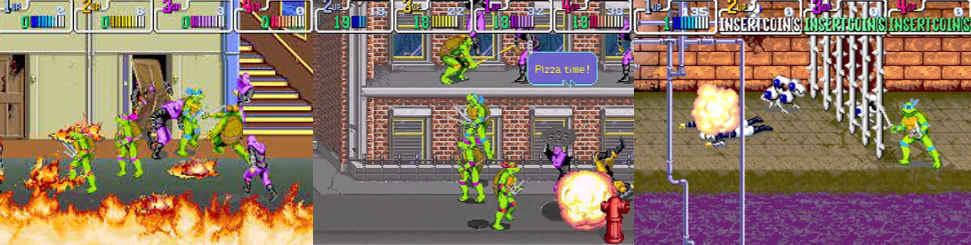
Fight with the TMNT’s signature weapons, and the environment, but watch out for hazards!

While levels and environments are noticeably sparse, there are a few intractable elements that both benefit and hinder your gameplay; traffic cones and street signs can be hit to damage enemies, you can smash fire hydrants to push enemies away, or blow up groups of them by attacking explosive barrels. At the same time, though, enemies can drop on you from behind signs or pop up from sewer holes and throw manhole covers at you; there’s also some spiked walls, laser turrets, freezing blasts, and electrical hazards that can be difficult to dodge without a dash or roll manoeuvre. The search for their friends and family takes the TMNT from the streets and sewers of New York City to the Technodrome itself; along the way, they battle various versions of Shredder’s Foot Clan and some other familiar faces, such as Bebop and Rocksteady. If you’re really, really lucky, you can pick up a pizza box to restore your turtle’s health, but these are few and far between, so you’ll either need a lot of money to replay after losing a life or, better yet, make use of the infinite credits made available in this version of the game.
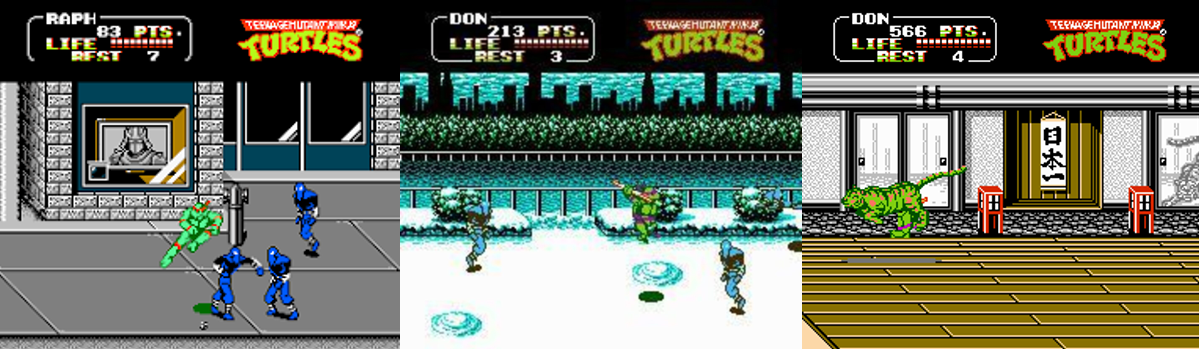
The NES version is surprisingly faithful and even includes new additions!

For the NES version of the game, much of the gameplay and combat remains intact and surprisingly faithful, especially considering the NES’s limited hardware. Naturally, you’re limited to two players at any one time, but you can still attack with X and jump with A, pulling of flying kicks and smacking the odd fire hydrant, parking meter, traffic cone, and explosive barrel to help thin out the enemies coming at you. The Foot Clan will still burst out from window sand jump out from the sewer, and you can still fall down the holes they leave behind, but the amount of onscreen enemies is severely limited compared to the arcade game; on the plus side, this makes crowd control a little easier and you’re rarely swamped with too many enemies at any one time. While a bit sluggish compared to the arcade title, the NES version performs far better than other similar 8-bit ports, like Double Dragon (Technōs Japan, 1988), though it helps that the Cowabunga Collection gives you the option to disable slowdown and sprite flickering. You’re still able to go diagonally down or fight on higher panes, too, as well as blast along on your rocket-powered skateboard; the NES version even includes two new stages, a snow-swept New York City and a Japanese dojo, each including new enemies, hazards (falling ice blocks and bamboo spikes), and bosses alongside additional cutscenes, which was a nice and unexpected touch.

Graphics and Sound:
Teenage Mutant Ninja Turtles is presented in the finest 2D graphics of the time; the four turtles and their enemies are large, bright, and well-animated; though they have limited idle animations, each wields their signature weapons and looks ripped right out of the animated series. Environments aren’t incredibly inspiring, however; the streets of New York are surprisingly bland and there’s not much going on in most of the levels. Rats will run by in the sewers, enemies will jump out from behind buildings or burst out from walls, and there are some layers to some levels that allow you to fight on higher ground but, mostly, the environments are lacking much of the character and interaction of later TMNT games (with the exception of April’s apartment, which features some impressive fire effects, and the final Technodrome level).
TMNTAFeatures
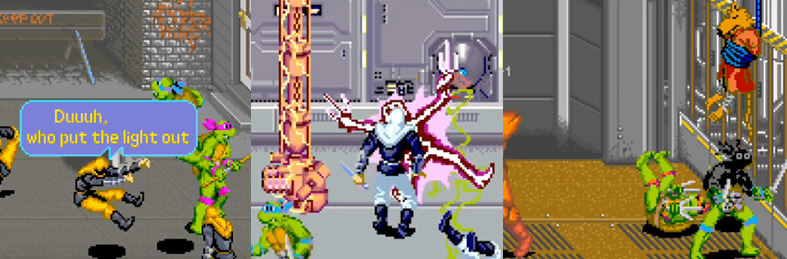
Speech bubbles, and funky soundtrack, and cartoony effects add to the game’s charm.

There are some fun elements to be found here, though; the TMNT can fall down open manholes and hide from enemy attacks while peeping at the player; when electrocuted you can see their skeleton, and when caught in Granitor’s flame burst, they’ll appear charred and damaged. When grabbed by enemies or battling certain bosses, little speech bubbles will also pop up, which is quite a fun inclusion, as they implore you to mash buttons to escape. Accompanying these are sound bites, with the TMNT exchanging quips and taunts with certain bosses or rallying each other with a cry of “Cowabunga!” You’ll always know when you’ve picked up health thanks to their triumphant shout of “Pizza time!” and, alongside these, levels are generally filled with some up-beat, catchy tunes that work well with the constant combat and the game also includes an impressive rendition of the cartoon’s iconic theme song.
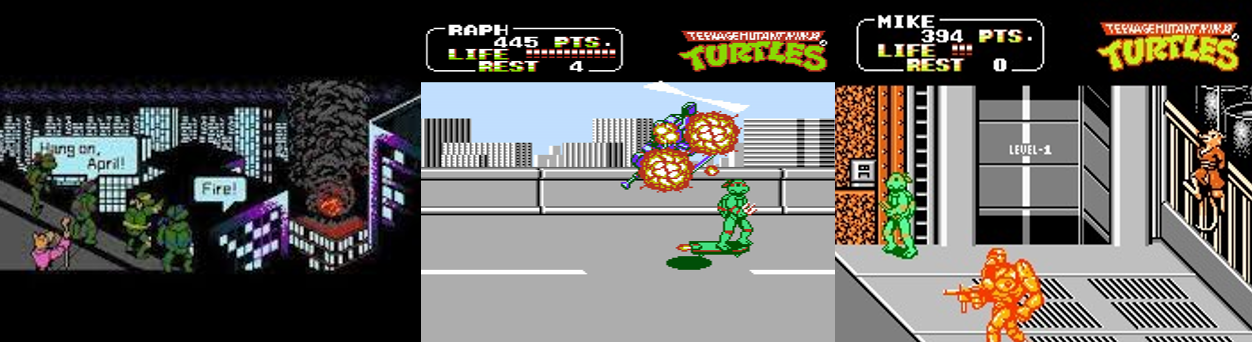
Although its obviously much more basic, the NES version recreates much of its arcade counterpart.

Of course, the NES version has taken a hit (well, more of a pummelling!) in terms of graphics and audio; the sprites are incredibly basic, featuring little in the way of animation and detailed, and the backgrounds and environments are incredibly empty. However, it’s still a decent conversion of the arcade title; flames still flicker in April’s apartment, the Foot still drives cars and motorcycles at you and burst out from behind billboards, and the game does a pretty good job of translating the arcade’s cutscenes into NES-capable sprite art, even using the in-game sprites at various points to progress the story. The music is equally ambitious; while there are no sound bites included in this version, there’s a nice chip tune version of the TMNT theme and everything sounds very appropriate for the hardware. Although there’s a greater emphasis on text in this version, there is no boss dialogue and bosses don’t sport life bars; the heads-up display is also changed to one that’s far more simplistic and certain graphics, like the pizza, have been redesigned to fit the engine. Yet you can still splash in and out of water in the sewer, still race along on your skateboard, and the developers even included new stages and enemies. Although you can disable sprite flickering and slowdown, however, the game is still quite sluggish, which isn’t helped by the way the characters just shuffle or hop along, and I noticed some odd screen tearing as I was playing. Also, the screen scrolls a little out of synch to your movement, meaning you’re often right at the edge of the screen, which causes it to lag a bit and forces you to hop back more to the middle to keep things moving smoothly.

Enemies and Bosses:
For the most part, the TMNT will be butting heads with various members of the Foot Clan; these come in all different colours and variants, with the regular, easily dispatched foes wearing the common purple and the tougher, weapon-wielding goons coming in red, silver, or yellow colourings. These foes will toss shuriken at the turtles, stab at them with spears, or try to flatten them with comically large mallets, among other weapons. They can also throw manhole covers, dynamite, or massive tyres at the turtles and, later in the game, zap them with laser blasters, charge at them in sports cars and on motorbikes, and chase after them on skateboards and in annoying helicopter-like crafts. You’ll also battle robotic enemies, such as the Mousers (who will clamp onto your arm and drain your health) and Roadkill Rodneys, which race around the screen, whipping at you, and trapping you in an electrically charged tentacle.
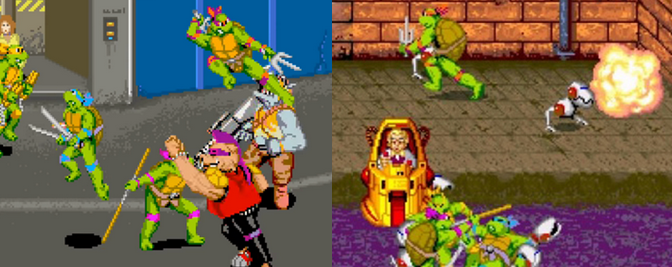
TMNTABosses
You’ll battle some of the TMNT’s most recognisable foes.

As for bosses, the TMNT will contend with classic enemies such as Bebop, Rocksteady, and Baxter Stockman. You’ll first battle Bebop and Rocksteady individually, but they later come together to try and crush the turtles; each wields a projectile weapon (Bebop a machine gun, Rocksteady a laser pistol) and can attack with powerful physical attacks, like charging or punching. Baxter, however, will attack from the air, dropping Mousers on you from his craft, while Granitor and General Traag are much tougher thanks to their rock-like hides and roasting you with their flamethrower and rocket launcher, respectively. These two are not only notorious spam-artists, repeating the same attacks over and over again, but at also immune to “God Mode” available in this version of the game. While this normally allows you to defeat enemies and bosses in one hit, Granitor and General Traag will need to be whittled down like in the original arcade release so it’s helpful to be a bit quicker on your toes and use a character with longer reach, like Donatello.
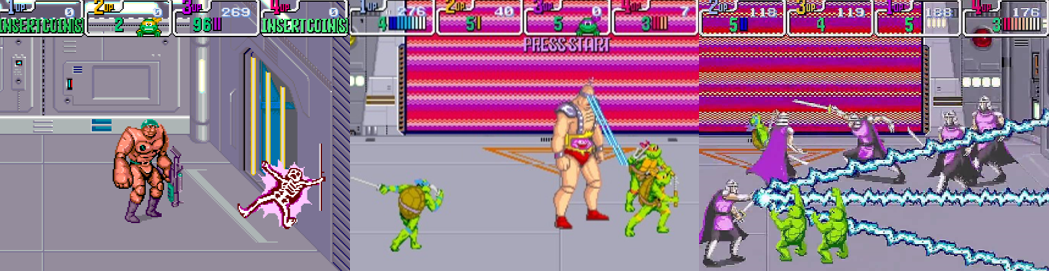
The Technodrome boasts the game’s toughest bosses, even with God Mode activated!

After fighting through the Technodrome, you’ll be attacked by Krang inside his robot body; Krang’s also a bit of a classic arcade spam-artist as he’ll kick you, and zap you with lasers while you’re down to drain your health in no time. Although Krang is also immune to the benefits of God Mode, he is quite the showboat and will pause to gloat about being invincible long enough for you to land a few decent hits. After defeating Krang, you’ll immediately battle the Shredder. Oddly, Shredder attacks alongside shadow duplicates, effectively increasing his attack power and his threat; Shredder swipes at you with his katana but also unleashes a powerful energy blast that regresses your hero back to a regular turtle and is, essentially, a one-hit kill move. As you battle Shredder, he’ll lose his helmet, which is a nice touch, but there’s not a lot of real strategy to any of the boss battles beyond simply avoiding attacks and striking as fast and as often as possible. Amusingly, the Shredder can be defeated in one hit using the game’s God Mode, which significantly downplays his threat compared to the game’s later bosses. One downside to this game is that the bosses don’t have an energy meter, so the only way you know you’re doing any damage or getting anywhere is by noticing when the boss sprites start flashing.
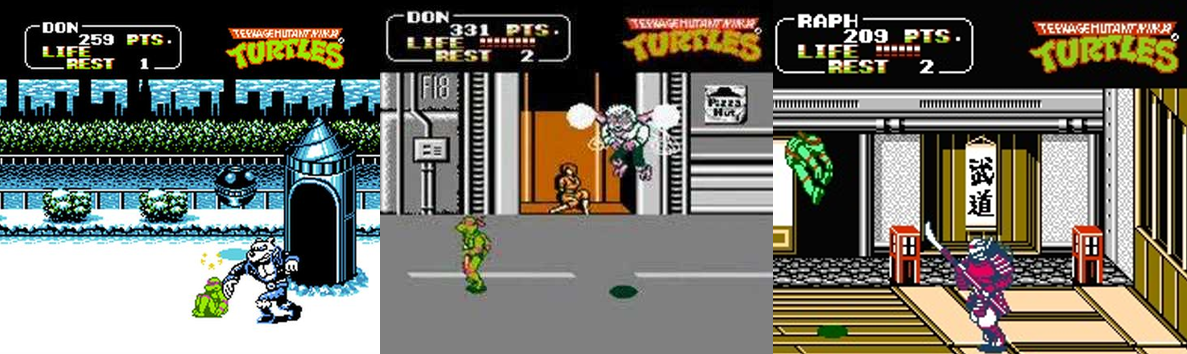
Three new bosses have been included in the NES version of the game.

Many of the enemies and hazards featured in the arcade version reappear in the NES version, with some alterations and limitations; the Foot can still grab you from behind and Mousers will still bite your hand, but shaking them off is clunkier than before and Roadkill Rodneys now simply fire lasers. There is a new variant of the Foot that tosses dynamite at you, however, and the portraits of tigers randomly spring to life in the dojo stage; you’ll also encounter antagonistic snowmen that fire homing missiles at you in the snow-themed stage. All of the arcade game bosses return as well, but again with less dialogue and being far simpler; Rocksteady and Bebop simply blast at you and kick or punch you up close, for example, but you’ll still get (partially) roasted and blasted by Grindor and General Traag’s heavy ordinance. Two new stages means two new bosses, but there’s actually three new bosses in total as Baxter’s fly form replaces the duo of Bebop and Rocksteady at the end of the parking lot stage, hovering about and firing duel lasers from his antennae (or his wings, it’s hard to tell…) Anyway, Tora the polar bear awaits in the frozen New York City, though I never saw him do anything but wander around and punch at me, and the robotic bounty hunter/samurai, Shogun, battles you at the end of the dojo, swiping with his katana while his disembodied head flies about the place. The fight with Krang and the Shredder remain largely unchanged, except Krang’s sprite isn’t very intimidating and the Shredder can’t seem to one-hit kill you this time around; all enemies and bosses can also be defeated in one hit with God Mode activated as well.

Power-Ups and Bonuses:
Oddly, for a sidescrolling beat-‘em-up, there’s very few power-ups on offer here. The only item you can pick up is the health-restoring pizza and you can’t grab other weapons or gain any temporary buffs or bonuses, though it does seem as though this was originally planned for the game before the option was removed during development. The NES version stays true to the arcade in terms of power-ups and such, however I did notice an annoying lack of pizza, which no doubt would make the game more difficult for anyone not playing with the Cowabunga Collection’s enhancements activated.

Additional Features:
In terms of in-game extra features, you’re obviously somewhat limited here as this was a simple arcade release; you can play through again with a different character and try to beat your high score, or play alongside up to four players, but there’s no additional gameplay modes to be found in the game. The Cowabunga Collection adds a whole slew of additional features, however; first, you’ll gain a sweet 70G Achievement for finishing each game, you can use the Left Bumper to rewind the game if you mess up, and press the Right Bumper to bring up a new options menu that allows save states and display options. Even better, you can opt to activate a number of enhancements, such as the aforementioned God Mode that makes you invincible and allows one-hit kills on most enemies and bosses, alongside a level select, the removal of penalty bombs (which instantly kill you if you linger too long), and the ability to play in “Nightmare Mode”, which vastly increases the number of enemies. For the NES version, you can also remove slowdown and sprite flickering, give yourself extra lives, enable “Easy Menu Navigation” (which I found no use for…), and “Fancy Jump Kicks” for increasing aerial attack effectiveness. The best part is that you’ll still get your Achievements even with these activated; you can also play online, make use of a strategy guide, switch between the American and Japanese versions (though there appears to be little difference between the two), view the game’s box art and manuals, and even choose to watch the game play itself if you wish.

The Summary:
Compared to other games of its era and genre, Teenage Mutant Ninja Turtles is surprisingly light on features and content; there’s the most basic levels of combat and content on offer here, which probably puts it below other games of this type, which offer additional power-ups or combat mechanics. Yet, it’s the original Teenage Mutant Ninja Turtles arcade game! Other TMNT games may have perfected the formula but there’s a charming appeal to the original. The classic 2D graphics, the simple beat-‘em-up gameplay, and the catchy, iconic music all make it feel as though you’re playing an episode of the animated series and really evoke the spirit of the influential cartoon. It might be a case of nostalgia goggles forgiving some of the game’s shortcomings but, for a straightforward TMNT adventure, it’s hard to deny that the arcade game is simple, evocative fun through and through. The NES title was legitimately impressive in its ambition; though obviously hampered by the limitations of the NES hardware, this version carries over all of the features of the arcade title (albeit far simpler in their presentation) as well as including new stages and bosses. For those who didn’t have access to Nintendo’s 16-bit console, the NES version of the arcade title is a decent substitute and a surprisingly faithful conversion considering the graphical downgrade, despite the lack of in-game options generally associated with similar sidescrolling brawlers. The additional features offered by the Cowabunga Collection only sweeten the deal; after years of being denied access to these classic titles outside of ROMS or unlockable bonuses, it’s great to be able to jump into them again at my convenience; both are short, snappy, fun-filled adventures that never outstays their welcome and the arcade title is especially important since it laid the foundation for future TMNT arcade titles so it’s a fun way to waste about half an hour of your life (or less if you plough through on God Mode!)

Arcade Rating:

NES Rating:

Rating: 4 out of 5.

Rating: 3 out of 5.

Great Stuff

Pretty Good

Did you ever get to play Teenage Mutant Ninja Turtles out in the wild or own it on the NES? How do you think it compares to other TMNT videogames and similar arcade fighters? What did you think to the NES version of the game, the new stages it added, and the allowances that had to be made? Which of the characters was your go-to and which of the game’s bosses was your favourite? What did you think to the additional features added to the Cowabunga Collection? Which of the four Turtles is your favourite (and why is it Raphael?) Whatever your thoughts on the Ninja Turtles, be sure to share them down below.

Game Corner: Castle of Illusion Starring Mickey Mouse (Mega Drive)

GameCorner
CastleOfIllusionMDLogo

Released: November 1990
Developer: SEGA AM7
Also Available For: Game Gear and Master System

The Background:
As I’ve mentioned before, Disney had quite the reputation for licensing their characters for top quality videogames back in the nineties. These days, licensed videogames are often frowned upon but, back then, Disney’s movies and characters made for some of the most enjoyable action/adventure platformers on the SEGA Mega Drive and Super Nintendo. Mickey Mouse, Disney’s beloved mascot, received quite a few videogames for the Mega Drive, each one an enjoyable 2D romp capturing the whimsy and aesthetic charm of Mickey’s character and animated adventures. Castle of Illusion Starring Mickey Mouse paved the way for Mickey’s subsequent adventures, both solo and alongside Donald Duck, who also had his fair share of adventures on 8- and 16-bit hardware back in the day. So influential is Castle of Illusion’s reputation that a remake was released in 2013 for PlayStation 3, Xbox 360, PC, and various mobile platforms. Until now, this was the only version of Castle of Illusion I had played; while that was quite a while ago, I remember it being a fun little 2.5D romp so, when I started planning on expanding my Mega Drive library, I knew that Castle of Illusion would have to be on the list to see how the title holds up.

The Plot:
Mickey and Minnie Mouse live peacefully in Vera City but when Minnie is suddenly abducted by the evil witch Mizrabel, Mickey must journey into the witch’s Castle of Illusion to recover the seven Gems necessary to defeating Mizrabel and stopping her from switching bodies with Minnie.

Gameplay:
Castle of Illusion is a 2D, sidescrolling action/platformer in which players must guide Mickey through six Levels, each hidden behind doors within the titular Castle of Illusion. Rather than using a traditional map screen or a hub world, or simply transitioning from one level to the next, Mickey travels to each of the game’s Levels by passing through enchanted doorways in Mizrabel’s castle, which is a nice change of pace from simply navigating a basic map or automatically dropping into a Level.

CastleOfIllusionMDAttacks
Bounce off enemies with Mickey’s butt or toss items at them.

Mickey has two main forms of attack to defend himself against Mizrabel’s many and varied minions; he can either grab an apple or a marble and throw them at his enemies or bounce on their heads with his rump. Throw projectiles can be useful but, as a lot of enemies are shorter than the projectiles travel, you’ll most likely be making use of Mickey’s butt to defeat your enemies. However, if you don’t hold down the jump button, Mickey will take damage, which is annoying, so it’s worth holding it down every time you make a jump in case an enemy swoops beneath you. When you land on an enemy’s head, you can bounce from one to another to make short work of multiple enemies, clear larger gaps, or reach higher platforms. While Mickey’s arsenal of moves isn’t exactly the deepest, he makes up for it by controlling extremely well for the most part. There are times, however, when either he feels a little slippery or the surfaces he is standing on are oddly slippery and you’ll find yourself sliding off an edge and to your death or accidentally slipping into an enemy or down a bottomless pit. While instant death traps and obstacles aren’t too obtrusive, they are present in some of the worst areas, such as a section where Mickey must jump from small platforms while waterfalls threaten to drag him down a bottomless pit and to his death.

CastleOfIllusionMDSwing
Swinging from ropes can be a tricky mechanic.

As standard, Mickey has a fairly decent, semi-floaty jump that takes him quite far and far the longer you hold the jump button down and depending on how much momentum you have. His walk is quite sluggish, though, and he doesn’t really speed up beyond much of a gentle stride so the game’s emphasis is more on platforming and mild exploration and puzzles rather than fast-paced, high-speed action. Mickey can duck to avoid projectiles and enemies as they jump but, while he can swim without fear of drowning, he can’t actually attack any enemies whilst underwater, leaving him vulnerable. Certain Levels task Mickey with grabbing on to ropes, vines, and other hanging apparel; I found grabbing these to be troublesome, at best, as more often than not Mickey simply leap through the rope but, once you grab on, you can swing from rope to rope with the added bonus of automatically dispatching any airborne enemies as you swing along.

CastleOfIllusionMDExplore
Explore Levels to find items and bonus areas.

Mickey’s health is represented by a five-point power bar; Mickey loses a point every time he takes damage and loses a life every time his health is fully depleted by can replenish a health point by grabbing a Star item. He can earn an extra try by either grabbing some Mouse Ears or collecting first 40,000 points and then 50,000, awarded by defeating enemies, grabbing gems, and tallied up after you complete each Level. Some Levels require Mickey to do a bit of exploration; in Toyland, for example, you need to find a key in order to progress while in the Storm, you have to contend with a maze-like cycle of water jets and find the right path to the Level’s exit. While exploring the Library, you can jump into tea cups and swim through a few small bonus areas to grab extra projectiles or gems, and you’ll sometimes have to run away from a large rolling obstacle or try to not be swept away by rushing water.

Graphics and Sound:
Though later surpassed by its later 16-bit successors, Castle of Illusion is still a gorgeous little title; all the sprites and backgrounds pop with bright, colourful art and feature some interesting animations and elements. When left idle, Mickey has a charming little animation where he sways his hips to the game’s various whimsical tunes and he always looks full of life and vigour as he strolls, hops, and bounces along. His enemies aren’t quite as dynamically rendered but they’re interesting and wacky enough to fit the themes of the game’s various Levels.

CastleOfIllusionMDGraphics
Levels are varied and full of life and obstacles to overcome.

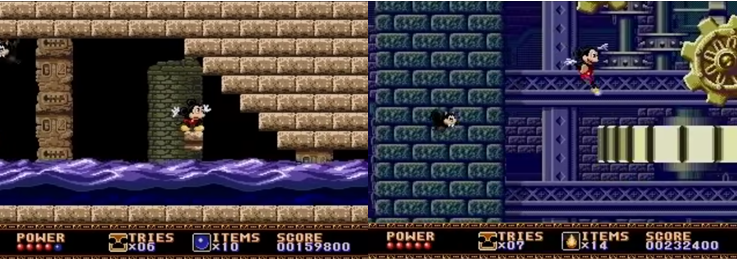
As you travel through the castle’s enchanted worlds, you’ll journey through a forest, a toy box, a giant library, and the castle itself. Each Level has various other layers to it, meaning you’ll hop across leaves and through spider’s webs, leap through a sweet and chocolate world, get stuck in sticky jelly, and even traverse a pyramid-like structure where damaging water threatens to wash you away. Once you reach Mizrabel’s castle proper, you’ll have to contend with far more obstacles and face your greatest challenge as giant boulders try to crush you, bridges crumble beneath you, and Mickey must leap from cogs and gears and swinging pendulum’s in the castle’s clock tower.

Enemies and Bosses:
Being that the game is, essentially, a jaunt through a magical, fairytale-like setting, Mickey comes up against a whole host of enemies in his journey that vary from the painfully generic to the bizarre. You’ll go from butt-bouncing on sentient mushrooms, spiders, toy soldiers, bats, and chubby little bookworms to contending with juggling clowns on unicycles (which race at you once they’re riders are defeated), skeletal fish, and extremely annoying, bouncing letters of the alphabet.

CastleOfIllusionMDBosses
The game’s bosses aren’t much of a threat.

At the end of each Level, Mickey has to face a large boss, known as a Master of Illusion. These range from an angry tree that tries to drop acorns on your head, a jack-in-the-box that tries to punch you with boxing glove, a totem pole that can only be knocked down by butt-bouncing on the enemies it spews out, and a giant sweet dragon.

CastleOfIllusionMDWitch
Stay away from Mizrabel’s attacks and you’ll soon have Minnie back safe and sound.

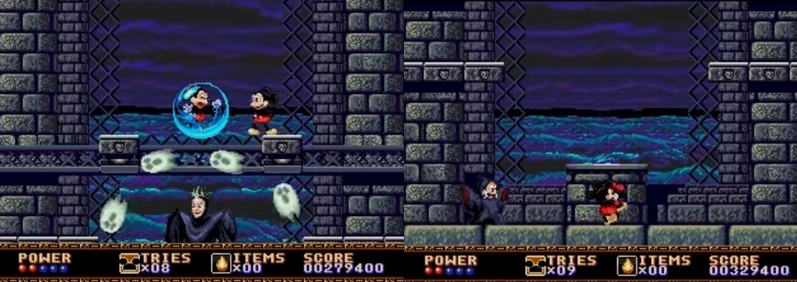
After defeating the Masters of Illusion and getting through Mizrabel’s castle, Mickey has to face off with the witch herself at the top of her castle, with Minnie held captive in a magical balloon. Fittingly, Mizrabel assumes the form of a youthful sorceress for the battle, which sees Mickey having to keep to the high ground to avoid the witch’s swirling spirits and butt-bounce on her head in the small window of vulnerability she has. While none of these boss battles are particularly difficult, as they all stick to a very predictable attack pattern, there’s not a lot of call for Mickey’s projectiles during these fights and even Mizrabel is bested with relative ease simply by staying on the upper platforms.

Power-Ups and Bonuses:
There’s not a lot on offer here apart from the standard trope of being awarded an extra life when you collect enough points. You can, however, pick up bags that will gift you with a whole bunch of projectiles to throw and use your butt-bounce to reach higher and out of reach areas to find additional health, gems, and ammo but, apart from that, there’s no much else available to expand your health or arsenal.

Additional Features:
The game has three difficulty modes: Practice, Normal, and Hard. In Practice mode, you start with full health and won’t have to face any bosses and only need to collect three Gems and can continue four times after you exhaust all your tries but you won’t get the game’s true ending; in Normal and Hard, you start with three or two health points, respectively, and have to find all seven Gems and can continue two times in Normal but have no opportunity to continue in Hard mode; you also lose all items you’re carrying after losing a try, adding a level of difficulty to the game and requiring you to exhibit more skill than in its 8-bit successor.

CastleOfIllusionMDConclusion2

The Summary:
It’s easy to see why Castle of Illusion is so beloved; it’s a fun, charming little adventure that looks and feels just like you’re playing a cartoon. Mickey has always been dropped into this bright, colourful fairytale adventures, even when he made the transition to 3D titles, and these worlds are surprisingly fitting for Disney’s cheeky little mascot. Offering just the right level of challenge to keep you coming back for more, Castle of Illusion set the standard for Mickey’s subsequent 8- and 16-bit adventures, most of which deviated very little from this game’s core gameplay and mechanics. It might not be the best action/adventure platformer on the Mega Drive, or the fastest or most action-packed title, but it’s still a charming, whimsical romp that looks, plays, and sounds fantastic and is well worth your time.

My Rating:

Rating: 4 out of 5.

Great Stuff

What did you think about Castle of Illusion? Where does it sit in your hierarchy of 16-bit Disney games? Did you ever play the remake from a few years ago? How do you think it compares to the original? Whatever your thoughts on Castle of Illusion, and Disney and Mickey games in general, drop a comment below and share your thoughts.

Game Corner: Sonic Adventure 2 (Xbox 360)

GameCorner
SA2Logo

Released: October 2012
Originally Released: June 2001
Developer: Sonic Team USA
Also Available For: Dreamcast, GameCube, PC, PlayStation 3

The Background:
After Sonic Adventure (Sonic Team, 1998) finally brought Sonic into the third dimension and proved to be a rousing success, despite a few flaws, Sonic Team passed development of the sequel over to their US branch. Drawing inspiration from their surroundings, the team infused the sequel with a much greater focus on action, speed, and realism than before, making the game feel decidedly more “Western” than its predecessor. Ironically, Sonic Adventure 2 actually dialled down on the “adventure” aspects of its predecessor but featured, perhaps, the darkest and most science-fiction-orientated story in the series thus far, a decision that would impact the franchise, for better or for worse, for years to come. I’ve talked about Sonic Adventure more than once in the past but, despite it being one of my favourites in the Sonic the Hedgehog (1991 to present) franchise, I actually played its sequel first. I never owned a Dreamcast as a kid as I hedged my bets on the Nintendo 64 so, when I decided to get a GameCube, one of the first two games I got was Sonic Adventure 2: Battle (Sonic Team USA, 2002) and it actually took me a while to acclimatise to Sonic Adventure’s radically different gameplay and presentation when I bought Sonic Adventure DX: Director’s Cut (Sonic Team, 2003). However, while Sonic fans (notoriously one of the worst fanbases in all of fandom) have recently turned on this game in favour of, of all things, SONIC THE HEDGEHOG (ibid, 2006), it’s always been a favourite of mine, to the point where I’ve bought it on GameCube, PlayStation 3, and, now, the Xbox 360 version for Xbox One.

The Plot:
Sonic the Hedgehog finds himself a fugitive on the run from the Guardian Units of Nations (G.U.N.) after security footage appears to show him stealing a Chaos Emerald from a G.U.N. facility. In actuality, the culprit is the mysterious Shadow the Hedgehog, the self-proclaimed “ultimate lifeform” who has been released by Sonic’s long-term nemesis, Doctor Eggman, to help the mad scientist harness the power of the long-defunct Space Colony ARK and hold the world the ransom.

Gameplay:
Sonic Adventure 2 is a 3D action platformer first and foremost that, like its predecessor, divides its core gameplay into a series of distinct gameplay mechanics. Unfortunately, while Sonic Adventure offered six unique playable characters, each with their own distinct style of play, Sonic Adventure 2 features six playable characters who share gameplay styles with their counterparts. As soon as you begin the game, you’re given the option not to select a character but to select a story; if you pick the “Hero” story, you’ll play through the game’s story from the perspective of Sonic, Miles “Tails” Prower, Knuckles the Echidna, and Amy Rose but, when you pick the “Dark” story, you’ll witness the events from the perspective of newcomers Shadow and Rouge the Bat and, for the first time in the series, Dr. Eggman! Whichever story you pick, you’ll play through the narrative, switching back and forth between the hero- and dark-side characters as the narrative directs.

SA2Variety
The game’s three playstyles are spread between the six characters.

If you’ve played Sonic Adventure, you’ll be immediately familiar with the three playstyles of this sequel: Sonic and Shadow play at high speeds, racing through stages that are designed like fast-paced rollercoasters, Knuckles and Rouge glide, climb, and dig as they explore for shards of the Master Emerald, and Tails and Eggman stomp around in massive mechs, blasting robots with their weaponry. The developers lost the slower pace of Amy and Big’s gameplay and the races that Tails had to complete in the original and focused on these three distinct playstyles, which was good for those who disliked the slower, less exciting gameplay of the last game, but not so good when it comes to character variety.

SA2Gameplay
The Hero and Dark characters are functionally identical to control.

Essentially, there’s very little difference between Sonic and Shadow, Knuckles and Rouge, or Tails and Eggman; they get to explore different stages (or, at least, different versions of stages) and obviously look and sound different, with different objectives, but they share the same basic move set. Both Sonic and Shadow can fly along rows of Golden Rings using the Light Speed Dash (which, thankfully, no longer needs to be charged) and use the Homing Attack to smash robots, Knuckles and Rouge explore their stages in the same way and attack enemies with either punches or kicks, and Tails and Eggman can both hover and lock on to multiple enemies at once. It’s fun experiencing the story from the bad guys’ perspective for a change but it’s a bit of a shame that the characters don’t have more to distinguish them from their counterparts.

SA2ShadowEggman
Shadow was a dark, edgy character in a dark, edgy story.

The game’s narrative is perhaps the most elaborate yet; after releasing Shadow, Eggman teams up with him and Rouge to gather the Chaos Emeralds and power up the long-abandoned Space Colony ARK. Eggman’s grandfather, Professor Gerald Robotnik, created the ARK fifty years ago and designed Shadow to be the ultimate lifeform; using a Chaos Emerald, Shadow can instantly teleport great distances at high speeds, making him more than a match for Sonic, and Eggman uses his abilities to threaten the entire world with the ARK’s Eclipse Cannon. Shadow, in his debut appearance, would go on to become one of the series’ most recognisable characters, for better or for worse, and has, arguably, never been characterised better than he was here: haunted by fractured memories of his time on the ARK, Shadow has his own agenda for revenge against the world but ultimately his story becomes one of redemption. At the same time, the story is as ridiculous as ever; to stop Eggman from stealing the Master Emerald, Knuckles willingly smashes it into pieces, which is probably the most arbitrary reason to recreate his gameplay from the last game that I could think of. I would have much preferred Knuckles and Rouge’s stages to involve searching for different items or treasures each time rather than search for the pieces of the Master Emerald yet again. Similarly, for some reason I’ll never understand, everyone in the game mistakes Shadow for Sonic and vice versa; even characters like Amy Rose and Eggman think Shadow is Sonic despite the fact that they couldn’t look more different if they tried.

SA2ShadowGrinding
Sonic Adventure 2 introducing grinding to the series and it’s stuck around ever since.

For the first time in Sonic’s long history, SEGA actually incorporated some prominent product placement into Sonic Adventure 2; billboards for Soap shoes were everywhere in the original and Sonic’s iconic shoes were redesigned in conjunction with this brand to allow him to grind on rails. Shadow can also grind and, while this mechanic is more prevalent in some stages than others, it’s not as obtrusive as you might think. It’s pretty simple to pull off, to; you leap onto a rail, ideally with some momentum behind you, and hold down B to crouch and gain speed; in later stages, you’ll have to pull off jumps to other rails but it’s a very fun, fast-paced experience. Rather than expanding and refining the hub world concept of Sonic Adventure, Sonic Adventure 2’s story plays out one scene and stage after another. If you lose all your lives or choose to quit, you can access a stage from a simple map screen; from here, you can replay stages under different criteria in an extension of Sonic Adventure’s “Mission” mode. Completing each mission and successfully obtaining an A-rank on each nets you both an Achievements and a pretty cool unlockable stage…but considering how hard it is to even get an A-rank in the game, it’s going to take a lot of your skill and patience to achieve this goal. Unlike other Sonic videogames, rankings in Sonic Adventure 2 aren’t just based on how fast you clear a stage; you also need to be holding a certain number of Golden Rings and have accumulated a high enough score to earn the best rank. You can build your score by destroying enemies, jumping through hoops, racking up combination bonuses in the shooter stages, not using hints in the treasure hunting stages, and pulling off tricks in the running stages using the game’s new grinding mechanic.

SA2Stages
Stage gimmicks can be frustrating at times.

Each stage is filled with multiple paths, some of them only accessible using some of the game’s hidden power-ups. If you want to get the best time, score, and rank when playing, you’ll have to take advantage of these alternate routes, which can be difficult. While the game’s controls are decent and improved for the better over its predecessor, the camera can still be jerky at the worst of times, characters have a tendency to slip off platforms and ledges to their deaths down the game’s many (many!) bottomless pits, annoying stage hazards (floors that fall or crumble beneath you, weights that squash you, and even airlocks that flush you out into space!) crop up in every stage, and enemies just love leaping out in your face at a moment’s notice. While Knuckles and Rouge are limited to finding one Emerald shard at a time (unless you’ve played enough to take an educated guess about where to look) and their later space stages can be frustrating, Eggman and Tails don’t have to worry about racing against a time limit like E-102γ “Gamma” did (though it is odd to see Tails stuck inside a mech). Also, when playing as Sonic and Shadow, you’ll often perform a somersault, usually to your death, when you mean to perform the Light Dash since they’re both mapped to the same button, which can be frustrating at times.

Graphics and Sound:
While it looks, feels, and sounds very similar to Sonic Adventure, Sonic Adventure 2 is quite a step up in terms of graphics. While Sonic and Shadow’s stages aren’t as large or as varied as before, they’re tight, focused, and full of impressive set pieces. In City Escape, for example, you end up being chased by a huge truck that is determined to run you down which is a thrill later surpassed by the excitement of grinding at high speeds through space as you make your way down and through the Space Colony ARK.

SA2Graphics
Each stage has its own gimmicks and is packed with little details and cameos.

You’ll also swing, race, and grind through high-speed jungles, explored flooded mines, haunted mountain tops, and even traverse what is basically a 3D recreation of the Death Egg Zone when racing through Crazy Gadget. Each stage is like a short burst of action-orientated fun, featuring different gameplay gimmicks and little details that make them fun to playthrough regardless of which story you’re playing. While Sonic and Shadow’s stages are all about high-octane speed, Knuckles and Rouge’s emphasise exploration and Tails and Eggman’s are also far slower , allowing you to really take in the little details of your surroundings and encouraging exploration.

SA2Music
The game’s soundtrack is top notch.

Sonic Adventure 2 also has one of the best soundtracks in the entire franchise; while Sonic Adventure remixed, borrowed, or leaned heavily into traditional Sonic themes alongside incorporating punk rock, rap, and other genres for character’s themes, Sonic Adventure 2 doubles down on the rocking tunes and is all the better for it. Featuring three of Crush 40’s best tracks (“Live and Learn”, “Escape from the City”, and a remix of Sonic’s theme song, “It Doesn’t Matter”), each character’s stages is accompanied by a theme befitting that character (Sonic is mostly rock, Rouge is jazz-inspired, Knuckles is rap, Shadow’s is techno-inspired, for example) and helps infuse the stages and the otherwise-similar-playing characters with a real life, energy, and distinctive personality.

SA2Dialogue
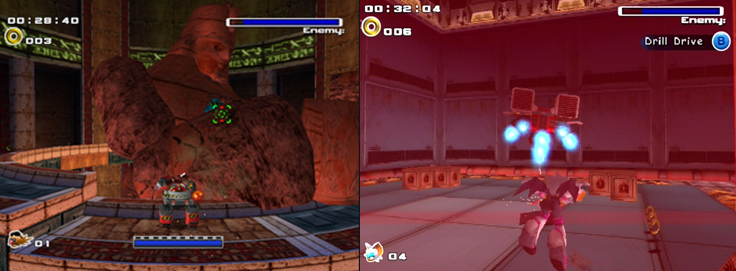
Lip synching has been vastly improved, though the script and delivery is still a bit janky at times.

Once again, the game features an abundance of voice acting; luckily, the lip synching is vastly improved here, meaning that the cutscenes are far less ridiculous to sit through. Unfortunately, the script and delivery still flounders somewhat and the game’s music tends to drown out the character’s words or the characters often talk over each other due to the translated dialogue taking longer to say than the original Japanese. Despite that, though, many of the voice actors from the last game return here and put in some of their best performances; Ryan Drummond will always be my favourite voice for Sonic and both the late, great Deem Bristow and David Humphrey set the standard for Dr. Eggman and Shadow, respectively, that have continued to be emulated to this day.

Enemies and Bosses:
Sonic Adventure featured some of the most unique designs, and redesigns, of the entire series. Eggman’s Badniks were recreated in all their 3D glory and full of character and quirky personality and Chaos was a breath of fresh air in a series that mostly relied on robotic creatures. Sonic Adventure 2, however, drops the ball quite significantly in this arena; every character battles the same, generic G.U.N. robots throughout every stage. Some stages do feature a few of Eggman’s Badniks but they don’t crop up often enough. Instead, you’re faced with these dull, lifeless cookie-cutter robots that aren’t really much to write home about. That is, of course, until you make it into outer space and on to the Space Colony ARK. Here, you’ll encounter the most annoying enemies in the game: the Artificial Chaos. These watery monstrosities resemble Chaos and have robotic enhancements and, while they’re easily dispatched with a solid shot to their metallic “head”, they can deal serious damage with their elongated limbs and laser blasts, making them extremely irritating enemies to come up against regardless of which character you’re playing as.

SA2Boss1
Bosses that aren’t generic G.U.N. mechs are few and far between.

For the most part, Sonic Adventure 2’s boss battles are as lacklustre as the enemies you’ll fight thanks, largely, to them being comprised of G.U.N. mechs. Yet, while none of G.U.N.s creations can match up to the quirkiness of Eggman’s mechs from he previous games or the likes of the gigantic golem that defends his pyramid base, they’re just different enough to show that G.U.N. is capable of putting some effort into their creations.

SA2Boss2
You’ll have to face your rival in a couple of battles as well.

The rest of the time, you’ll be battling against your rival in fights somewhat similar to the battle between Sonic, Tails, and Knuckles in the last game; the mechanics have been expanded upon somewhat here, though, in that your enemy puts up a bit more of a fight, taking (and dishing out) decidedly more damage as you battle but the real threat in most of these battles will come from the size of the stage you battle on (or in) and how easy it is for you to fall to your death.

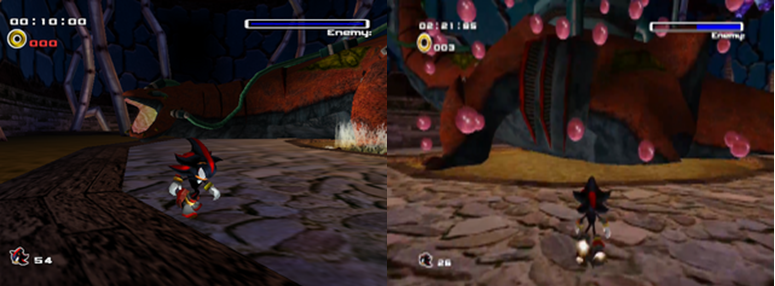
SA2Biolizard
The Biolizard is easily the game’s most frustrating boss.

Once you defeat Sonic and Shadow for good at the end of both stories, you’ll play through the “Last Story” and battle the game’s most frustrating and annoying boss, the Biolizard. This Shadow-exclusive battle pits you against a massive lizard-like creature that chases you with its gaping mouth or tries to smack you with its tail. When it stops its attack, you can grind up a rail to attack its sole weak point (the life support system on its back) and, as you deal damage, it starts to spit energy blasts at you that you must either try to jump over or somersault under to avoid losing Rings. To make matters worse, you can instantly be sucked to your death if you land in the water between the stage platform and it spawns these really infuriating homing orbs that you must try to avoiding while using the Homing Attack to hit the life support system. Its final attack is easily the worst; this sees you flung helplessly into the air and all you can do is encircle the creature, hope and try to avoid the projectiles, and slowly edge your way closer to deliver the final blow.

SA2Boss3
You’ll battle the final boss as both Super Sonic and Super Shadow.

Once defeated, the creature uses Chaos Control to attach itself to the ARK and force it towards the Earth, becoming the game’s final boss, the “Finalhazard”. Sonic and Shadow power-up to their Super forms and battle the creature in space in a fight that, fundamentally, resembles that finale against Perfect Chaos. Super Sonic and Super Shadow have to dash into the pulsating boils that act as the creature’s sole weak point but are constantly swatted away by projectiles and erratic laser blasts. Also, like Perfect Chaos, this final boss is more annoying than challenging as you not only have to try and weave through its defences and hope your attack does damage, you’ll also be fighting against two time limits: linger too long and the Finalhazard will successfully drag the ARK to Earth and you also have to land your attack before you run out of Rings. Your allies often shout at you to “switch characters” when your Rings are running low but, even after all these years, the only way I could switch characters was to hit the creature’s weak spot so that advice is basically useless. As before, you don’t get to play as the Super forms in the main game but this finale does culminate in Shadow giving his life to save the planet, completing his character arc of redemption. Of course, Shadow was too popular to stay dead and SEGA brought him back in the very next game and have bungled fleshing out his character and backstory ever since. But, in this one defining moment, this angst-ridden, haunted little black hedgehog won over a significant portion of the fanbase and still remains a popular character to this day.

Power-Ups and Bonuses:
While Sonic Adventure 2 doesn’t feature as many “adventure” elements as its predecessor, you can still acquire power-ups and additional bonuses in each stage: Sonic and Shadow can grab shoes that allow them to Light Speed Dash, rings that let them perform a flaming somersault, bounce, and/or turn enemies into toys that you can throw at other enemies. Knuckles and Rouge grab upgrades that let them dig to find goodies or breathe underwater without fear of drowning, and Tails and Eggman can upgrade their mechs to dish out more damage to enemies and hover across gaps and hazards. As is standard for Sonic titles, you can also acquire additional Golden Rings, health packs (for Tails and Eggman), extra lives, invincibility, and two types of shields (a regular shield and a Ring-attracting electric variant) by breaking or running into item capsules or passing checkpoints in a fast enough time. Additionally, like in Sonic Adventure, every time you beat a stage, boss, or mini game earns you a Sonic Emblem and collecting all of these and will earn you an Achievement and unlock a bonus stage.

Additional Features:
From the game’s “Options” menu, you can choose different character-based themes and backgrounds for the game’s menu screens and even change the spoken dialogue to Japanese if you’re one “those” fans that simply must have the original Japanese dialogue playing during a game. As you might expect, you can also earn a few Achievements when playing the game; unfortunately, there’s not very many on offer here and they’re disappointingly simple to get…for the most part. As you destroy robots and explore the stages, you’ll find “Chaos Drives” and small animals; when you find a Chao box and smash it open, you’ll obtain a key and, after clearing the stage, will be warped to the Chao World where you can use the Chaos Drives and animals to raise and breed Chao to use in other mini games. The Chao Garden has been expanded somewhat; when you visit from the stage select screen, you can take your Chao to the Chao Kindergarten to purchase new items from the Black Market, leave them in the school to learn songs and tricks, rename them, or get review stats and health. Feeding them Chaos Drives, animals, and different fruits will raise their stats and, eventually, allow them to evolve into a stronger, more adult form. If you primarily used Hero characters when caring for your Chao, you’ll get an Angel Chao, while Dark characters birth a Devil Chao; both unlock an additional Chao Garden themed after Heaven or Hell, respectively.

SA2SChao2
Cheer your Chao on as they race or battle each other!

As your Chao’s stats increase, you can have them take part in the Chao Games, a series of races, fights, and mini games to earn you more Sonic Emblems and Achievements. However, as these mini games can be largely luck-based and involve you putting a lot of time and energy into grinding and search for more Chaos Drives, animals, and collecting Golden Rings to buy new items, it can be a very time-consuming process but it’s a nice break from the game’s fast-paced action. Just don’t expect a lot of depth from this mode. Unlike Sonic Adventure, which featured numerous mini games to break up each character’s story and provide a distraction from the main game, Sonic Adventure 2 only features two other playstyles: a boss rush and a janky little kart racer. In the Hero story, you (as Tails) have to race towards the President’s limo to track Eggman’s broadcast and, in the Dark story, you (as Rouge) chase after Tails to intercept him instead. Once you beat one of these stages, you’ll unlock the Kart Race mini game, where you can play as any of the six main characters in short races made incredibly difficult by the game’s stiff, unresponsive controls.

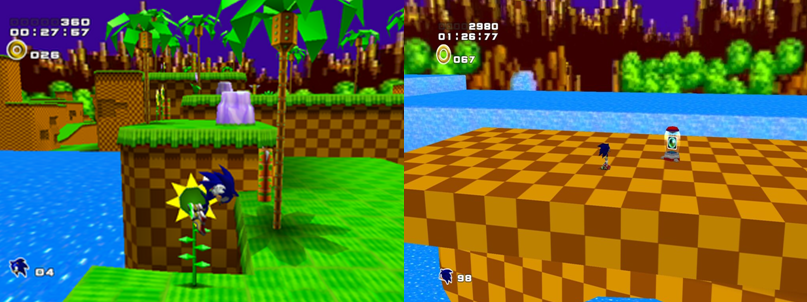
SA2GreenHill
Collect every Emblem to unlock Green Hill Zone!

After clearing both stories, you’ll unlock the “Last Story” mode when you play as each of the six playable characters and race to stop the ARK from destroying the world. This culminates in a space battle where you switch between Super Sonic and Super Shadow and take it in turns to ram head-first into the gigantic lizard-like creature known as the Biohazard. Defeating it earns you the game’s true earning, and an Achievement, but not much else; however, if you manage to complete each of the game’s stages with an A-rank, you’ll unlock one of the coolest rewards in the series: a fully 3D recreation of Green Hill Zone! Unfortunately, you can only play this stage as Sonic and I’ve never actually experienced this as it is way too hard to earn those A-ranks and I just couldn’t do it no matter how hard I tried. Also new to the game is the multiplayer mode where you and one friend can pick between the game’s playable characters and race or battle against them in a series of stages from the main story. If you purchase the game’s downloadable content, you’ll unlock extra stages and characters for use in this mode; these were all available by default in the GameCube port but it’s still fun to play as Metal Sonic, Tikal, and Chaos in the game’s multiplayer. It’s just a shame that, like in the Sonic Adventure ports, Sonic Team decided to leave out certain playable characters and features from the original Dreamcast version (meaning Big the Cat is relegated to mere blink-and-you’ll-miss-it cameos in each stage and certain cutscenes, which is a real shame and a massive downgrade from his last appearance).

SA2Banner

The Summary:
Sonic Adventure 2 takes everything that worked in Sonic Adventure and improves upon it; it trims out a lot of the fat and extraneous elements and focuses on the three, distinct, most enjoyable playstyles of the last game, expanding upon them and improving them to make for a much tighter, more responsive and action-orientated experience. While I do miss some of the things this game dropped (the hub worlds and the diverse characters), I do enjoy the many improvements and innovations that debuted in this game. Making the Light Speed Dash a one-button action was a must, expanding Sonic’s world and lore to include more sci-fi elements helped take the series in a different direction and allowed SEGA to actually tell pretty complex and mature stories in their videogames. While I like the simplicity of the early Sonic titles, I expect a bit more bang for my buck with Sonic’s 3D adventures and Sonic Adventure 2 definitely delivers in that regard, introducing one of the more multifaceted and edgy characters to the series and allowing us to experience events from the bad guys’ perspective for the first time. For many years, Sonic Adventure 2 was the gold standard for the series for many; as SEGA experimenting with different genres and tossed more and more characters and roadblocks into their most popular franchise, fans were clamouring for a return to the Adventure-style formula and the type of gameplay and story of Sonic Adventure 2. While Sonic fans may have lost their mind and turned against this game in recent years, it still holds a special place in my heart; it’s not perfect, obviously, but it’s still fast-paced, high-octane fun and I never fail to have a good time every time I fire it up.

My Rating:

Rating: 4 out of 5.

Great Stuff

What did you think about Sonic Adventure 2? Which of the two Adventure games is your favourite? Which console did you first play Sonic Adventure 2 on? What did you think about the game’s Light and Dark story options, and playing as the villains for the first time? What are your thoughts on Shadow the Hedgehog, his debut, characterisation, and legacy? Does Sonic Adventure 2 still hold up in your view or do you prefer a different Sonic title? Whatever your thoughts on Sonic Adventure 2, and the Sonic series and characters in general, drop your thoughts below and share them with me.

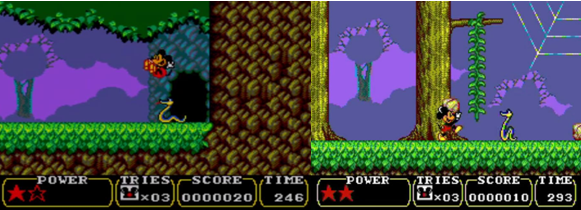
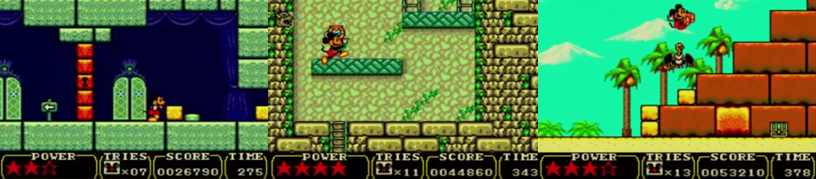
Mini Game Corner: Land of Illusion Starring Mickey Mouse (Master System)

LandOfIllusionLogo

Released: June 1993
Developer: SEGA
Also Available For: Game Gear

A Brief Background:
Back in the nineties, licensed videogames hadn’t quite earned the reputation that they have these days. Anyone who had played one of the many videogame adaptations of Disney movies and properties, particularly on SEGA’s Mega Drive or the Super Nintendo, would generally be in for a good time and treated to big, colourful, well-animated graphics and tight, fun gameplay. One of the most prolific of Disney’s characters to be licensed out to videogames was their enduring mascot, Mickey Mouse. A couple of years after Castle of Illusion Starring Mickey Mouse (SEGA AM7, 1990) and World of Illusion Starring Mickey Mouse and Donald Duck (ibid, 1992) released for Mega Drive, a similar (though, apparently, unrelated) title was released for SEGA’s 8-bit consoles, the Master System and the Game Gear handheld.

The Review:
Land of Illusion is a pretty standard 2D, sidescrolling action/platformer in very much the same vein as previous Disney titles released around that time. Players take control of the affable Mickey Mouse and journey through fourteen stages, dispatching enemies using Mickey’s rump, sliding down slopes, or by throwing objects at them. Mickey controls at a steady, grounded pace; he doesn’t slip and slide around, making precision platforming a much easier task than other platformers of the time. He begins the game with two stars in his Power Gauge, meaning he can take two hits before he must try again from either the beginning of the stage or from the last checkpoint he passed. Players can refill Mickey’s health by smashing blocks and other objects to uncover cake; if you search hard enough, you’ll also find a bonus star in each stage, which will add another star to Mickey’s Power Gauge and thus allow him to take more hits. Mickey can also collect coins, which will add to his score tally; defeating enemies and bosses also adds to this tally and he’ll earn an extra try for every 10,000 points. Mickey must sometimes take to water to navigate through a stage; in these areas, players will have to watch Mickey’s air meter, as he’ll lose a life if it runs out. There’s a few simple push-and-pull-based puzzles that Mickey must also solve by opening blocked areas or turning environments upside down and, occasionally, he’ll need to find a key in order to progress.

LandOfIllusionAttacks
Stomp on enemies with Mickey’s butt or chuck a rock at them.

Players must also complete each stage within a time limit (as was the style at the time) but, as Mickey progresses through the game’s story and stages, he frees some familiar-looking faces and is gifted various items that aid his quest; the Magic Flute allows players to replay any stage they’ve previously completed (which can be essential for tracking down other items and extra energy you’ve missed), a Shrinking Potion (which allows Mickey to fit through small tunnels, doors, and spaces), a Rope to climb certain walls, Cloud Shoes to walk on clouds, and a Magic Bean to grow a beanstalk and reach the Phantom’s castle. As mentioned, you can increase Mickey’s health with cake and collect stars to increase Mickey’s Power Gauge but that’s about it. There’s no invincibility, speed ups, or special abilities here. Instead, you can grab Mickey Ears or hit 10,000 points for an extra try and will use the game’s mandatory times to progress further. However, while you can shrink through gaps with the Shrinking Potion, your attacks are useless and being able to jump on clouds doesn’t really help at all except when climbing the magic beanstalk. Otherwise, there’s nothing extra here; the game has one ending, no unlockable or extra characters, and the only incentive to play it again is to beat your last high score.

LandOfIllusionStages
Though simple, stages are bright and colourful.

While nowhere near its 16-bit counterparts in terms of graphics or sound quality, Land of Illusion is still quite a charming little 8-bit title. The Master System was never known for having particularly exciting backgrounds or environments, so all of the artistic effort seems to have gone into making the sprites (particularly Mickey) as bright, colourful, and animated as possible. You’ll travel to some pretty standard areas in Land of Illusion (a forest, a desert, a couple of castles…) but each one is distinct in its design and features slightly different gameplay mechanics. You might have to let a tornado of leaves carry Mickey over spikes to safety, for example, or have to outrun a wall of spikes or cross poisonous water or lava. The Master System renders these environments simply enough but it’s surprising how vivid and engaging they are for such an under-powered console. Similarly, the game obviously doesn’t match the bright, poppy tunes or sound quality of its bigger brother but the soundtrack nevertheless does a serviceable job; there’s some catchy little tunes, all of which are perfectly in keeping with Mickey’s cute-and-cuddly aesthetic. Enemies here are as generic as they come; you’ll butt-bounce off the likes of spiders, wasps, snakes, and floating skulls. Some present more of a challenge than others, however, shielding themselves from harm, reforming after being hit, or being invulnerable to Mickey’s butt-bounce.

LandOfIllusionPhantom
Wait for an opening and then hit him with your butt!

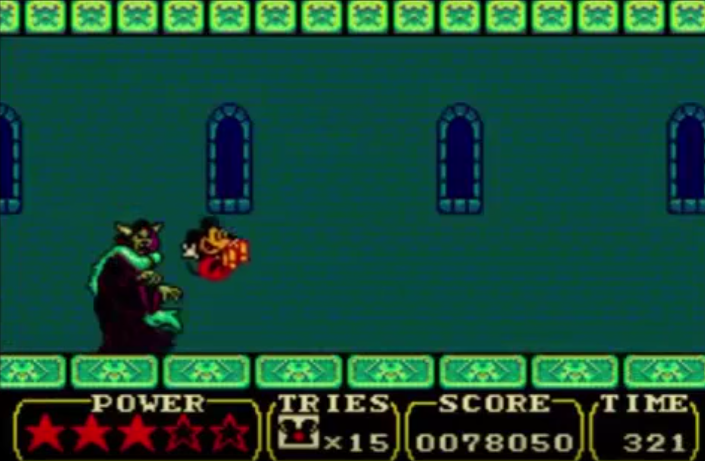
You’ll battle some big bosses while playing Land of Illusion but none will really pose much of a challenge (…I really struggled with the giant crab, though, thanks to how slow Mickey moves underwater). You’ll dodge their attacks, maybe toss one of a limited number of blocks at their head, or wait for an opportunity to bounce off their heads with Mickey’s butt. The final boss, the Phantom, is slightly more complex as you must first traverse his booby-trapped castle and then dodge his energy balls (just crouch right in front of him) and jump over his whirlwind attack before he’ll pause long enough for you to smack him. He’ll mix it up by jumping to the ceiling, forcing you to throw blocks at him, but it’s over within seconds, especially if you’ve completely powered up Mickey’s Power Gauge.

LandOfIllusionConclusion

The Summary:
While a mere shadow if its 16-bit counterparts, Land of Illusion does a decent job at entertaining; there’s no bottomless pits or cheap deaths, plenty of opportunities to explore, and some charming graphics and tunes on offer. Gameplay is about as simple as it gets, which is to be expected given the Master System’s simple two button setup; as mentioned, you might have to backtrack to previous levels to get items to progress further if you missed them, and you will find a challenge in the game’s final level but, with infinite continues as standard and a leisurely pace to its gameplay, Land of Illusion is a fun enough little jaunt to keep you distracted for a couple of hours.

My Rating:

Rating: 3 out of 5.

Pretty Good

Did you ever play Land of Illusion? What were your favourite, or most frustrating, Disney videogames from back in the day? Would you like to see a HD compilation of Mickey’s 16- and 8-bit titles? Go ahead and take to the comments to share your thoughts and memories.

10 FTW: Comic Book Crossovers We Need To See

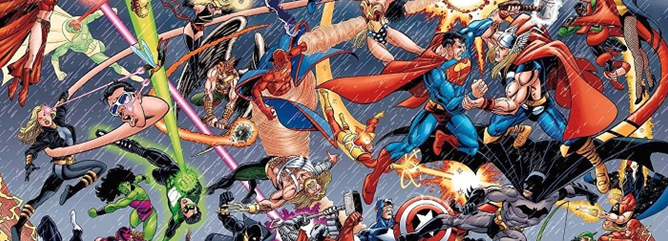
If there’s one thing comic books allow, it’s the grandiose crossover between characters. Ever since Barry Allen met Jay Garrick all the way back in 1961 and introduced the idea of multiple parallel universes, comic book characters have existed in both isolated shared universes and travelled across a near infinite multiverse. However, while it’s relatively common to see Bruce Wayne/Batman and Clark Kent/Superman interact with the Justice League or the Teen Titans, or to have Peter Parker/Spider-Man randomly join forces with the Fantastic Four or the X-Men, we’ve also seen the characters of DC and Marvel Comics interact with each other. We’ve seen Superman and Batman both cross paths with Spider-Man, the X-Men team with the New Teen Titans, and both publishers’ greatest heroes go head-to-head in the epic DC Versus Marvel Comics (Marz and David, et al, 1996) crossover.

10FTWCrossoversWeird
There have been some weird crossovers in comics.

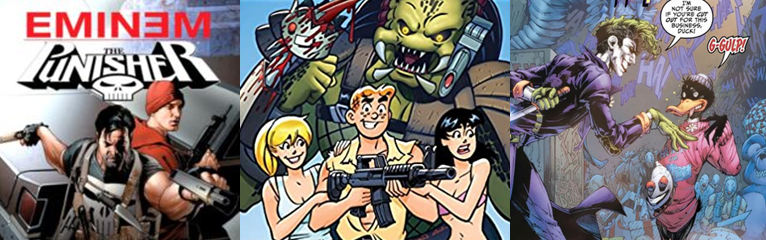
In addition, Dark Horse Comics snapped up multiple science-fiction and horror film franchises, giving us crossovers such as RoboCop Versus The Terminator (Miller, et al, 1992) and a whole slew of Aliens vs. Predator (Various, 1989 to present) comics. It doesn’t end there, either; we’ve seen Batman cross paths with Judge Dredd on multiple times and Frank Castle/The Punisher team up with not only Eminem but also pop up in Archie Comics, and it was thanks to such comic book crossovers that we finally got to see the three-way mash-up between Freddy Kruger, Jason Voorhees, and Ash Williams! Yet, as many and varied and seemingly limitless as these crossovers can be, it seems like we’ve missed out on a few seemingly-obvious crossovers. Maybe it’s because of licensing issues or the fact that DC and Marvel Comics don’t tend to do a lot of business together lately, but, either way, I figured I’d talk about ten crossovers I’d love to see in comic books.

10FTWCrossoversJSWM
10 Justice Society/Watchmen

After DC Comics finally put an end to the largely-awful New 52 run, they teased Alan Moore’s seminal work, Watchmen (ibid, et al, 1986 to 1987), becoming part of DC canon when Edward Blake/The Comedian’s iconic smiley-face button turned up in the Batcave. Cue the extremely delayed publication schedule of Doomsday Clock (Johns, et al, 2017 to 2019), a storyline that revealed that Doctor Jon Osterman/Doctor Manhattan had been influencing DC canon for decades. While this, obviously, brought the characters of Watchmen (or, at least, versions of them) into conflict with Superman, Batman, and other versions of the Justice League, it’s the older, more seasoned members of the Justice Society of America (JSA) I’d like to see have extended interactions with the Crimebusters. The JSA were at their peak around the time of World War Two, meaning they are decidedly more optimistic and pragmatic about their approach to crimefighting. The Crimebusters, meanwhile, existed in a largely dystopian version of the 1980s that was pretty bleak and constantly on the verge of another World War, meaning this team up could produce an interesting clash of styles and philosophies that would probably be more in keeping with Moore’s more reflective text rather than an all-out brawl. Plus, who doesn’t want to see who would win a battle between Jim Corrigan/The Spectre and Doctor Manhattan?

10FTWCrossoversPulp
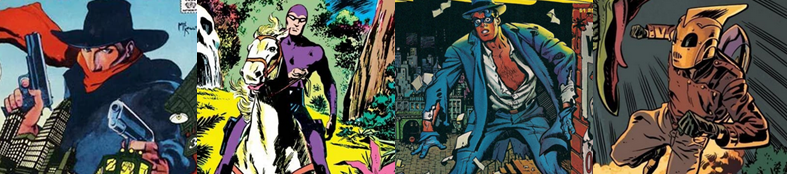
9 Pulp Heroes United

Before Batman and Superman, there were the pulp heroes of the 1930s to 1950s. Names like the Phantom, the Shadow, the Spirit, the Rocketeer, and Green Hornet may have faded from mainstream relevance in recent years, but they live on thanks to publications from Dynamite Comics and crossovers with DC Comics. Speaking of Dynamite Comics, they came very close to this crossover with their Masks (Various, 2014 to 2016) series, which saw the Shadow teaming up with the Green Hornet and Kato, a version of Zorro, and the Spider but this crossover has so much potential to really pay homage to the heroes of yesteryear. Ideally, such a comprehensive team up would be similar to The League of Extraordinary Gentlemen (Moore, et al, 1999 to 2019) in its scope and legacy; hell, I’d even have the Phantom, the Shadow, the Spirit, the Rocketeer, Green Hornet and Kato, Zorro, Doc Savage, the Lone Ranger and Tonto, and the rest of their ilk butting heads with the Martians from The War of the Worlds (Wells, 1897) at the turn of the century. A proper sepia-toned, steampunk-filled piece that sees these wildly different pulp heroes begrudgingly working together to save the world could be a great way to thrust these overlooked classic heroes back into the spotlight.

10FTWCrossoversRHWS
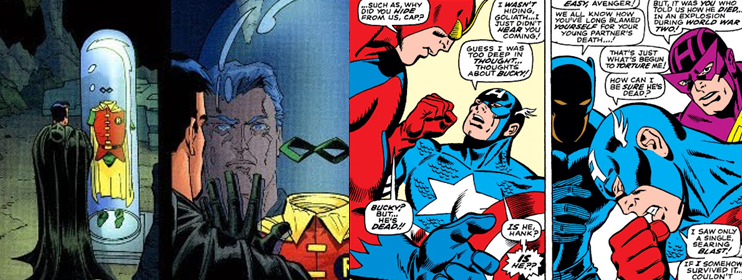
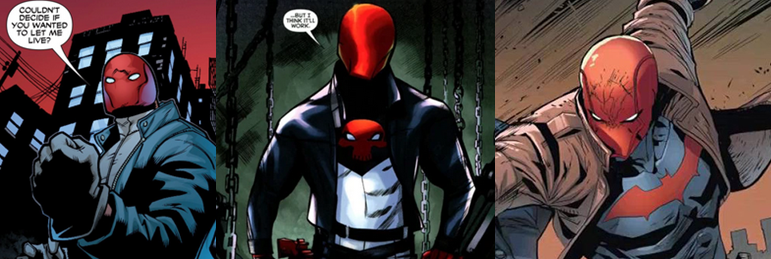
8 Red Hood/Winter Soldier

If the comic industry was like it was back in the mid-nineties, we would surely have already seen this crossover, which is as obvious and as fitting as the team up between the Punisher and Jean-Paul Valley/Azrael during his brief tenure as Batman. Speaking of which, a team up between Jason Todd/Red Hood and the Punisher is just as enticing but, in terms of thematically complimentary characters, you’re hard pressed to find two more fitting that Jason Todd and Bucky Barnes. Both characters were well-known sidekicks to greater heroes whose deaths shaped, influenced, and affected their mentors for years, and both even returned to life as violent, broken anti-heroes around the same time.

10FTWCrossoversJTBB
Jason and Bucky’s deaths weighed heavily on Bat and Cap for years.

Yet, while Bucky has gone on to not only redeem himself and assume the mantle of Captain America (and is largely far more mainstream thanks to his prominent inclusion in the Marvel Cinematic Universe), Jason Todd has floundered a little bit. It didn’t help that Jason’s resurrection was directly tied to DC’s latest reality-shattering Crisis for years (even though there have since been far less convoluted explanations, and he really should have been Hush all along) but, even ignoring that, Jason’s place is skewed as one minute he’s a sadistic killer, then he’s a violent anti-hero, then he’s wearing the Bat embalm and is an accepted (however begrudgingly) member of the Bat Family. However, both characters have carved a name out for themselves as being willing to go to any lengths to punish the guilty; each has blood on their hands, a butt load of emotional and personal issues, and a degree of augmented strength, speed, and skill thanks to their training or resurrection. While both are similar, Bucky is far more likely to be the bigger man and take the more moral ground, which would be more than enough to emphasise the differences between the two (provided Jason feels like being more antagonistic in this theoretical crossover).

10FTWCrossoversRCJD3
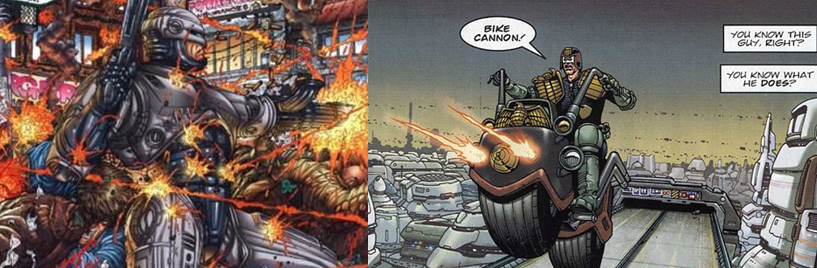
7 Judge Dredd/RoboCop

It’s no secret that RoboCop exists almost solely because of Judge Dredd; without 2000 A.D.’s no-nonsense lawman, we’d likely never have seen the excellently gore-and-satire-filled sci-fi action that is RoboCop (Verhoeven, 1987). While Batman has had more than a few run-ins with Judge Dredd, Detroit’s resident cyborg supercop has yet to meet his cinematic counterpart. The story is so simple is basically writes itself; you could have RoboCop awakened from suspended animation or reactivated after decades of being offline in the war-ravaged dystopia of Mega City One and briefly come into conflict with Dredd. I’d wager that RoboCop would be the more likely of the two to be more morally inclined; RoboCop generally operates based on very specific, law-abiding directives (or, depending on the version, his own conscience) that justify violence in service of protecting the innocent. Dredd, meanwhile, is just as likely to arrest victims of crimes as those who perpetrate them and is generally more an example of totalitarianism and uncompromising brutality in the name of the “law!” Yet, just as Dredd and Batman were able to work together despite coming to blows over their methods and philosophies, these two would make quite the formidable team once they’d ironed out their differences…though RoboCop may need an upgrade or two to survive in the future.

10FTWCrossoversDPTM
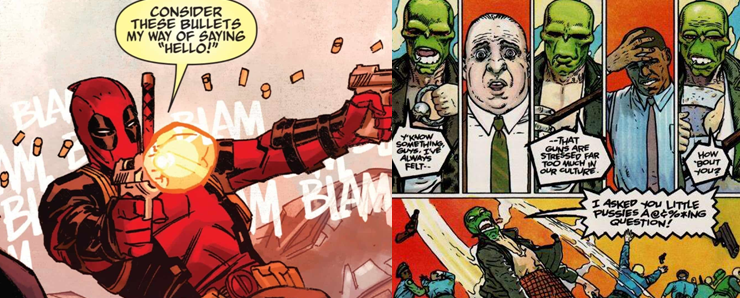
6 Deadpool/The Mask

DC Comics have had many crossovers with Dark Horse over the years, resulting in numerous interactions between DC’s finest and the Xenomorphs, Predators, and Terminators. Similarly, both companies worked together on a number of crossovers revolving around the violent, big-headed cartoon anti-hero “the Mask”. It stands to reason, then, that if the Joker acquiring the magical mask and gaining its powers is a natural fit, a crossover between the near limitless power of the mask and everyone’s favourite fourth-wall breaking Mutant, Wade Wilson/Deadpool, would be just as fitting. Both characters are known for their over-the-top, cartoony violence, springing weapons out of thin air, directly addressing the reader, and busting heads with a maniacal glee. Hell, DC and Dark Horse had Lobo team up with “Big-Head” and even acquire the mask in another crossover and, given Lobo’s similarities to Deadpool, it wouldn’t bee too hard to imagine a crossover between these two being little more than a non-stop bloodbath as they tried in vain to damage each other, before Deadpool inevitably acquires the mask for himself and, in all likelihood, reduces all of conscious reality to a cheesy puff.

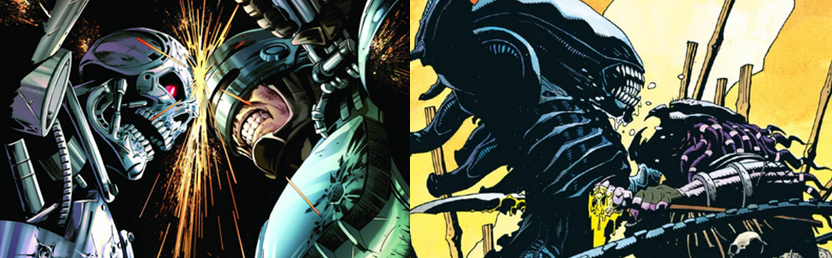
10FTWCrossoversRvTvAvP
5 RoboCop vs. Terminator vs. Aliens vs. Predator

Speaking of Dark Horse Comics, they really have brought us some great crossovers over the years; RoboCop Versus The Terminator and Aliens vs. Predator were natural stories to present in comics, videogames, and toys that were (arguably) too big for movies. They also merged three of these franchises together in Aliens versus Predator versus The Terminator (Schultz, et al, 20000), though that story was more a sequel to Alien: Resurrection (Jeunet, 1997) and a continuation of the Aliens vs. Predator comics than anything to do with the Terminator (Various, 1984 to 2019) films. Instead, this four-way crossover would give Dark Horse a chance to take the time-hopping, action-packed story of RoboCop Versus The Terminator and merge it with their complex Aliens vs. Predator comics. RoboCop would probably be best served as the central character of the story; a member of the human resistance could travel back in time to try and eliminate RoboCop, only to run into a T-800 right as Predators come to clean up a Xenomorph outbreak in Detroit. A time dilation could transport them to the war-ravaged future, where RoboCop could team up with a reprogrammed T-800 (or John Connor) against the aliens, or perhaps the future war would be changed by the reverse-engineering or Predator technology. There’s a lot of potential in this crossover but, for me, it only really works if you include RoboCop. Without him, you end up with a poorly-executed concept like Aliens versus Predator versus The Terminator, which really didn’t utilise the Terminator franchise enough. But imagine a Terminator/Xenomorph (or Predator) hybrid exchanging plasma blasts with a Predator-tech-upgraded RoboCop and tell me that doesn’t sound cool!

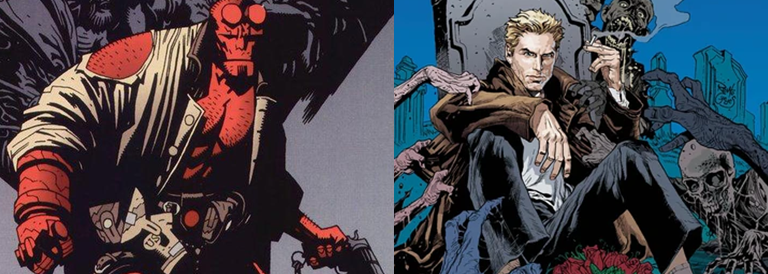
10FTWCrossoversHBJC
4 Hellboy/Constantine

We’re scaling back a bit with this one. Honestly, I am very surprised we’ve never seen these two team up before, especially considering the amicable relationship DC and Dark Horse Comics have had over the years. Hell, we did get a brief team up between Hellboy and Batman but, arguably, this is the far more fitting choice. In this concept, I would go with the idea that John Constantine and Hellboy co-exist in the same world and have them cross paths when investigating the same supernatural threat or mystery. Obviously, they’d have to fight before teaming up (or, perhaps, they’d just rub each other the wrong way after being forced to team up), but can you imagine the quips and taunts and insults Constantine would have for Hellboy all throughout this crossover? Toss in guys like Swamp Thing and Etrigan, or even the Justice League Dark and the rest of Hellboy’s buddies (and absolutely have Mike Mignola provide his distinctive art style to the piece alongside co-authoring the story with either Grant Morrison or Neil Gaiman) and you could have a very dark, moody, and entertaining paranormal crossover.

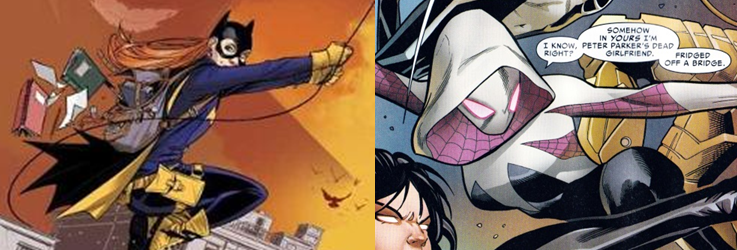
10FTWCrossoversBGSG
3 Batgirl/Spider-Gwen

This one is more of a light-hearted pick but there’s nothing wrong with a bit of unapologetic fun amidst all the big action set pieces and violent action. After her debut in the “Spider-Verse” (Slott, et al, 2014 to 2015) storyline and prominent inclusion in Spider-Man: Into the Spider-Verse (Persichetti, Ramsey, and Rothman, 2018), this alternative version of Gwen Stacy has gained quite the fan following over the years and has become firmly entrenched in Marvel canon as Ghost-Spider. Meanwhile, since the New 52, DC have returned Barbara Gordon to the role of Batgirl; this wasn’t without some controversy as, for years, Barbara had operated just fine as a paraplegic and the Batgirl mantle had been assumed by other, far more suitable candidates. Yet, DC have continued unabated, largely changing Barbara from a smart and capable tech and information wizard, to a far more catty, athletic, and socially-conscious young lady. Despite this, this has the potential to be a really fun crossover between these two; while Babs should really be the older and more mature of the two, they’re both around the same age these days (somewhere between fifteen and twenty-one, depending on DC and Marvel’s sliding timelines), meaning there would be a lot of common ground between the two. No doubt they would have plenty to say about each other’s costumes, hair, and ex boyfriends (throw Nightwing in there and have that cause a bit of tension between the two) and I would even have them team up against C-list villains, like the Vulture, Chameleon, Shocker, Mad Hatter, or Killer Moth, just to keep the focus on fast-paced, witty action rather than getting all sour and bleak.

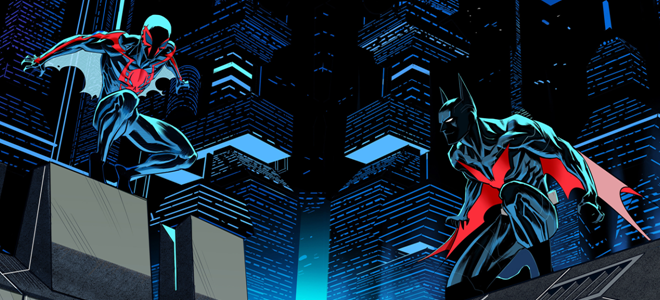
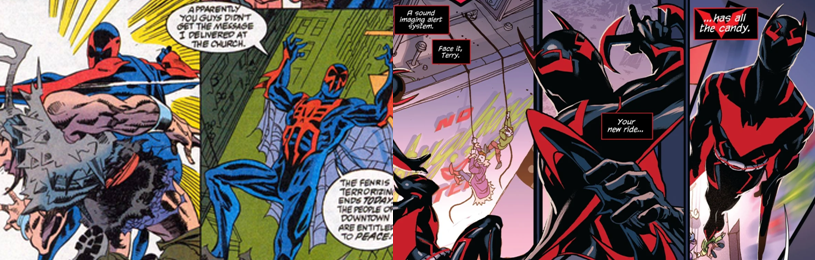
10FTWCrossoversSM2099BB
2 Spider-Man 2099/Batman Beyond

I know what you’re thinking: Shouldn’t this be a crossover between Batman Beyond (1999 to 2001) and Spider-Man Unlimited (1999 to 2001), considering both cartoons aired at the same time and both characters wore similar, futuristic costumes? Well, you might be right, but Spider-Man Unlimited really should have been based on the initial Spider-Man 2099 (Various, 1992 to 1996) comics as that cartoon is largely remembered for being a poor follow-up to the superior Spider-Man (1994 to 1998) animated series and for featuring a pretty neat new costume for Spidey. Instead, I’d go with Spidey’s futuristic counterpart, Miguel O’Hara, who is more famous for operating in an alternative future of Marvel Comics. Again, the easiest way for him to interact with Terry McGinnis would be to have them exist in the same world but there’s a bit of an issue with that: Batman Beyond was set in 2039 when Terry was sixteen. The Justice League Unlimited (2004 to 2006) episode “Epilogue” (Riba, 2005) jumps to fifteen years later and Terry is a thirty-one-year-old Batman but the story would probably need some kind of time travel plot to bring these characters together at their peak.

10FTWCrossoversSM2099BB2
Both characters come from similar futuristic worlds.

Luckily, neither character is no stranger to time-hopping adventures; perhaps the best way to do this would be to have two similar villains in each world experimenting with time/reality-bending technology and cause a dilation that threatens to merge both timelines unless Miguel and Terry can stop them. I’d even have them both swap places; have Miguel wake up one morning in Neo-Gotham, running into the aged, grouchy Bruce Wayne (Kevin Conroy) and battling some of Terry’s foes, while Terry randomly finds himself dumped in Nueva York and running afoul of Alchemax. After two issues of them exploring each other’s world, the third issue would be the obligatory fight between the two before they agree to team up for the fourth and final issue and sort out the problem. Both characters’ futuristic costumes have very similar traits and exist in visually interesting futuristic worlds, making a potential clash and eventual team up between them an exciting prospect for the art work and banter alone.

10FTWCrossoversDetective
1 Batman/The Crow

Easily the top choice for me, and the genesis of this list, I literally cannot shake how perfect a crossover between Batman and Eric Draven/The Crow would be. Neither are strangers to inter-company crossovers but, while the Crow has had to settle for teaming up with the likes of Razor, The X-Files (1993 to 2018), and Hack/Slash (Seeley/Various, et al, 2014 to 2018), Batman has met Al Simmons/Spawn, Spider-Man, Judge Dredd, and even Elmer Fudd and the Teenage Mutant Ninja Turtles. Yet, this crossover provides the opportunity to get Batman back to the gritty, noir-inspired style of stories like The Long Halloween (Loeb, et al, 1996 to 1997) utilising an art style that is part Dave McKean and part James O’Barr. As for the plot, I’d have Eric return to his undead life once again after it is revealed that there was another figure pulling the strings of Top Dollar’s gang. This would, of course, bring Eric to Gotham City, where he’d start killing members of this extended gang of thugs with his usual brand of violence and poetic justice. Naturally, this would lead him into conflict with Batman but, rather than the two descending into a poorly written, childish brawl as in Spawn/Batman (Miller and McFarlane, 1994), it would probably be better to focus on Batman’s detective skills as he investigates Eric’s murder, those behind the murder, and Eric’s violent actions on the streets of Gotham. In fact, I probably would only have the two interact right at the conclusion of the story, just as Eric is about to kill his final target; they could have a discussion on morality and the meaning of justice but, ultimately, Eric would fulfil his mission and return to the grave regardless of Batman’s protestations, leaving Batman to ponder the line between justice and vengeance.

10FTWCrossoversEnd

What comic book crossover would you like to see? Which comic book crossover has been your favourite, or most reviled? Whatever you think about comic book crossovers, leave a comment below.
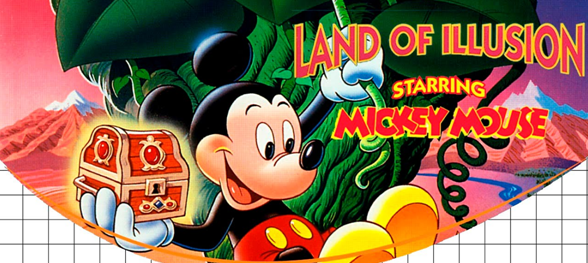
Game Corner: Yooka-Laylee and the Impossible Lair (Xbox One)

GameCorner
YookaImpLogo

Released: October 2019
Developer: Playtonic Games
Also Available For: Nintendo Switch, PC, and PlayStation 4

The Background:
After Rare was purchased by Microsoft in 2002, anticipation was high for the company to continue their track record of releasing extremely polished, high-quality titles as they had during their tenure with Nintendo. Chief amongst the Rare properties most fans were looking forward to revisiting was the Banjo-Kazooie (1998 to 2008) series, which was an extremely well-made 3D action/platformer collectathon for the Nintendo 64 with a quirky sense of humour and memorable, likeable characters. Unfortunately, Rare were disappointingly underused by Microsoft and, while their famous bird-and-bear duo did return, it was in a highly altered form that let down most gamers. Eventually, key members of Rare left the company and formed Playtonic Games, an independent games studio that would allow them to make the types of games they wanted to which, coincidentally enough, meant going back to the Banjo-Kazooie formula with a spiritual successor to that series, Yooka-Laylee (ibid, 2017).

YookaImpDKC
Impossible Lair is inspired more by Donkey Kong Country than Banjo-Kazooie.

While the first game received mostly mixed reviews, I really enjoyed this welcome return to the quirky 3D action/platformers of old and revisiting the Banjo-Kazooie gameplay style of large, interconnected worlds with many peculiar characters and things to collect and discover. The game did well enough, however, and Playtonic’s new characters were popular enough to warrant the production of sequel, in which Playtonic Games decided to veer away from the Banjo-Kazooie style of gameplay and instead draw inspiration from the 2.5D sidescrolling platformers of their 16-Bit days, specifically the Donkey Kong Country (1994 to 2005) series. This was surprising to me, considering the series was meant to be a throwback to the Banjo-Kazooie formula, but I was happy enough with the first game and charmed enough by its oddball world and characters to give this slightly-revised sequel a fair shake of the stick.

The Plot:
After being defeated by Yooka and Laylee in the previous game, Capital B has returned to cause havoc; this time, he has enslaved the Royal Stingdom using the Hive Mind, captured Queen Phoebee’s Royal Beettalion, and locked himself inside the titular Impossible Lair. In order to overcome the Lair’s enemies and obstacles and defeat Capital B, Yooka and Laylee must travel to numerous new worlds and free the Royal Battalion, all while restoring peace and order to the Royal Stingdom.

Gameplay:
Yooka-Laylee and the Impossible Lair is, primarily, a 2.5D action/platformer in the style of the Donkey Kong Country series; players control Yooka, a laid-back chameleon, and Laylee, a wise-cracking bat, simultaneously to explore the large overworld, traverse the game’s numerous stages, and battle the assortment of quirky enemies found within.

YookaImpAbilities
Many of the duo’s abilities return from the first game.

Many of Yooka and Laylee’s abilities from the previous game return here; the duo can run, jump, and roll along in a ball like a certain blue hedgehog. Yooka can use his tongue to grab at certain objects to spit fruit or bombs at enemies or switches or open new pathways and secret areas and the duo can flutter and twirl in the air to extend the reach of their jumps or perform a powerful downward stomp to defeat enemies or drop down to lower levels. Unfortunately, the duo are missing some of their more useful abilities from the last game; you can only spit out projectiles when you find one in a level, and you can no longer turn invisible, walk while in water, or form a protective shield. While the game does provide alternative means to do some of these moves, there is no way to use Laylee to glide, fly, or have Yooka use his tail for a high jump. Instead, you’re tasked with chaining together high-speed rushes with well-timed jumps to gain extra height and cover large distances, which is fine but I can’t help but feel it’s a missed opportunity to not have the duo flying at some point in some way.

YookaImpHit
Get hit and you’ll lose Laylee, leaving you vulnerable until you find a bell to call her back.

Also missing from the first game is a health and power bar; you no longer need to consume butterflies to restore your health or wait for a meter to fill up before you can perform one of the duo’s special moves. Instead, when you get hit by an enemy or obstacle, Laylee will fly erratically around the screen for several seconds like Baby Mario in Super Mario World 2: Yoshi’s Island (Nintendo EAD, 1995). If you can’t retrieve her in time, she will fly away and you’ll be left with just Yooka and missing the few moves the game provided you with; take another hit and you’ll die and be returned to your last checkpoint, with Laylee restored to you. You can, however, find special bells you can ring that will return Laylee to your side and use certain Tonics to extend the length of time you have to retrieve Laylee but, honestly, of all the things to be inspired by! Luckily, Laylee doesn’t whine and cry in an annoying screech like Baby Mario but it can be extremely harrowing and dangerous to retrieve Laylee but, if you don’t you might miss certain collectables and secret areas.

YookaImpCoinsWalls
Collect the T.W.I.T. coins to lower Trowzer’s Paywalls.

To explore the game’s forty stages, you’ll have to navigate an expansive overworld; while nothing compared to the one from the first game, it’s still surprisingly expansive, with many areas connected to others through secret pathways or blocked off by one of Trowzer’s Paywalls. As you explore the game’s stages, you can find five T.W.I.T. coins in each; it is highly recommended that you go out of your way to obtain as many of these as you can as you’ll need to use them to lower Trowzer’s Paywalls and reach new areas and to obtain an Achievement. Each stage is accessed through a magical book, as in the last game, but rather than expanding upon a stage with the Quills you find in the game’s stages, you use these Quills to purchase Tonics and gain new abilities or game-changing buffs (or de-buffs) or to pay for a hint to locate hidden Tonics on the overworld. You can manipulate and alter the overworld, however, by completing a mini game set by a Pagie found in each area; doing this allows you to find new areas (and more hidden Tonics) and open up new paths to link the overworld together.

YookaImpChanges
Completing side quests adds an alternative mode to each stage.

Some of Yooka-Laylee’s other recognisable characters also make a return but in severely reduced roles; they generally hang around the overworld, offering hints or asking you to complete a series of small tasks that will access a stage’s alternative mode. These tasks this many involve freezing Nimbo the Cloud, pushing a shopping trolley off a lighthouse, causing a boiler to cough up ash, or activating a fan. Each task is slightly different and changes the stages in different ways; the stage may be flipped upside down or on its side, for example, or underwater, frozen, or filled with acid or lava. This means each stage has two sections to it for a total of ten T.W.I.T. coins per chapter and altering a stage can turn even the game’s easiest levels into challenging test of your patience and endurance.

YookaImpGhostQuills
Track down the Ghost Quills for extra Quills, coins, and items.

Each stage also sees the return of the five Ghost Writer Quills; each one flies around the immediate area in a different way, leaving regular Quills in their wake, and generally explode in a shower of Quills once you collect all their Quills or chase them down. Others, however, leave behind a T.W.I.T. coin, a piece of fruit or a bomb to aid your progress, or a key that can access a new area of the stage and lead you to another T.W.I.T. coin. You never know what the Ghost Quills are going to yield as a prize so it’s worth trying to hunt them down and collect their Quills whenever you find them. Every time you clear a stage, you rescue a member of the Beettalion, which is crucial to increasing your chances at completing the Impossible Lair. Unlike the last game (and most games, for that matter), you can challenge the game’s final stage, the titular Impossible Lair, whenever you like but, if you have few or even no Beettalions to aid you, you won’t last very long as the Lair isn’t called “Impossible” for fun. Some stages also contain hidden exits that deposit you in different areas of the overworld and lead you to one of the six secret members of the Beettalion and it is highly recommended that you don’t attempt the Impossible Lair without all forty-eight members of the Beettalion to form a protective shield around you.

Graphics and Sound:
Yooka-Laylee and the Impossible Lair is just as gorgeous as its predecessor, perhaps even more so thanks to its extra polish and shine. The world and the characters that inhabit it are bright, colourful, and cheery; playing the game is like playing a cartoon and all the characters are full of life and charm. Thanks to the game’s shifted perspective to 2.5D, the character animations rely far more on pantomime than fully-animated 3D models, meaning the game’s simple animations are far less egregious. Thankfully, the game still uses the charming gibberish of the Banjo-Kazooie series; whenever characters talk, they babble and jabber away like loons and I absolutely love it. Just a few sounds is all it takes to infuse these characters with personality and you always know who is talking and when thanks to these simple, but effectively, sound effects.

YookaImpGraphics
The game looks and sounds fantastic, at least.

The music is just as delightful and affective as ever as well; thanks to the likes of the great Grant Kirkhope, the game’s overworld, stages, and areas are infused with a fairytale-like quality and, no matter how frustrating and difficult some sections might be, you’ll always have a catchy, appealing little tune to hum along to and settle your nerves.

Enemies and Bosses:
Yooka and Laylee’s world is mostly populated by mean-spirited little goblins called Meanyions; you’ll come up against blue versions that simple wander back and forth, red ones that you can only defeat by jumping on them, yellow ones that jump when you jump, and green ones that hover around in a jetpack or with propellers on their heads (which protect them from your jump attack). There are also fatter, blob-like Boundalong Meanyions who bounce you backwards (usually to your death), the spider-like Webwhacks that can only be avoided thanks to their spiked behinds, cannons that blast projectiles or homing missiles at you, and laser-spewing spheres. Generally, though, you’ll find most the most danger and frustration coming from the many death traps in the game’s stages; giant instant-death boulders, laser beams, and saw blades chase you, spikes, icicles, saw blades, and other spiked surfaces can either cause you to take damage or instantly die, acid and lava pits are abundant and, of course, there are the numerous bottomless pits scattered across the stages. A lot of the game’s challenge comes from using the duo’s skills and carefully bouncing from one enemy to another to clear these gaps; make a mistake and you’ll pay, usually with your life.

YookaImpLair
Getting through the Impossible Lair is easier said than done…!

The game only features one boss battle and it’s against Capital B within the Impossible Lair. You might think that this means the game is lacking in challenge but you’d be wrong; not only do you have to first get through the game’s stages to unlock enough (or all) of the Beettalions to allow you to get through the Lair’s many enemies and death traps, you then have to face Capital B in four separate, increasingly difficult encounters. This wouldn’t be so bad but, to reach each of these battles, you first have to survive the Impossible Lair…which more than lives up to its name. Every type of enemy, trap, obstacle, and gameplay mechanic you’ve encountered and bested in each of the game’s stages is incorporated into the Lair; every time you take a hit or fall to your death, you lose one of the Beettalion and there’s no way to get them back. You can return to the Lair from the start of each battle with Capital B but this only really helps if you reached that fight with a decent amount of bees left and can defeat that phase of the boss battle without incurring much damage so you have the best chance of getting through the next stage of the Lair.

YookaImpFinalBoss
Capital B can be tough but getting to him is even tougher!

Thankfully, actually fighting Capital B is much easier than in the last game; he has very clear and predictable attack patterns but it’s very easy to mess up and take a hit in these fights thanks to the lack of a high jump and the surprisingly large hit box of both the titular duo and the boss itself. Add to that the fact that he Impossible Lair is more frustrating than challenging and you have a significant portion of the game that is more of a chore to get through than being fun and charming like the rest of the game. If you really want to torture yourself, you can take on the Lair’s alternative mode, where you must try and make it through without any of the Beettalion to protect and save you…and if you can do that then good luck to you; you’re a better person than me.

Power-Ups and Bonuses:
Like the Banjo-Kazooie games of old, and its predecessor, Yooka-Laylee and the Impossible Lair is a bit of a collectathon; each stage is filled with Quills to collect, T.W.I.T. coins to find, and hidden areas that generally contain one, or both, of these items. Clear a stage and you rescue a member of the Beettalion and can use the Quills and coins you’ve earned to unlock new skills and areas of the game. The Tonics from the last game return here; Tonics are scattered across the overworld and, while some are in plain sight, others are hidden and you’ll have to pay sign posts for hints on how to find them. Either way, simply finding a Tonic isn’t enough to use it; you have to pay for it with the Quills you’ve collected, meaning you’ll have to revisit some of the game’s easier stages again and again to farm for Quills to unlock every Tonic.

YookaImpTonics2
Different Tonics have different effects, buffs, and de-buffs.

At first, you can only use three Tonics at a time but, eventually, you earn the ability to have a fourth Tonic slot (either temporarily or permanently, if you find every single T.W.I.T. coin in the game. You have to be careful, though, as some of the more useful Tonics (like increasing the amount of checkpoints, letting you hold on to your T.W.I.T. coins after you die, or having special attacks that destroy all onscreen enemies) reduces your Quill count at the end of a stage. So, to get more Quills, you have to use the more obtrusive Tonics (which turn the stage upside down or mess up the controls, for example) but, no matter how you play the game and which Tonics you use, they’re completely redundant in the Impossible Lair as you can’t use any of them…which really makes you question why you put all that effort into finding and unlocking all of them in the first place.

Additional Features:
Yooka-Laylee and the Impossible Lair is full of Achievements to earn; you get one for saving certain amount of bees and finding certain secrets but also for finding all the T.W.I.T. coins and, of course, there’s one for beating the Impossible Lair without any bees…so I won’t be getting that one any time soon.The Tonics can help to spice up the game and add some replayability to the stages; you can alter the art style and colour scheme to resemble the Nintendo 64 or the Game Boy, slow down time, and alter other elements to increase (or decrease) your chances to somewhat customise the difficulty of the stages. There is also some downloadable content on offer for the game but it mostly boils down to more Tonics at this point rather than adding new game modes or levels to extend the game’s story and playtime.

YookaImpSummary

The Summary:
I really like the Yooka-Laylee series; I feel it’s a great spiritual successor to the Banjo-Kazooie and Donkey Kong Country series at a time when Microsoft seems perfectly happy to let the bear-and-bird disappear into obscurity. Both games have their flaws, of course; being independently created, largely crowdfunded videogames will do that so some compromises are expected but none of that changes the fact that this series is keeping alive a gameplay style that seems to be dying out these days. Unfortunately, for everything that is good about this game, it is let down by the titular Impossible Lair. I have no problem with testing my skills and being faced with a challenge but the Impossible Lair is such a kick in the ass that it sucks all the fun and enjoyment out of the game’s biggest selling point. This almost makes all of the previous stages and achievements you’ve accomplished redundant; you can’t use any of the Tonics, you can’t collect or replenish the bees once you take a hit, and it’s so easy to slip up and drain all of your bees that, generally, it’s easier to simply quit out and try again than reach Capital B without enough of the Beettalion to make it worth pushing forward. It’s not that the game isn’t fun and there aren’t things to like about it; the graphics and music and controls are, generally, top notch and the game is full of the quirky charm the Banjo-Kazooie series was famous for. But the Impossible Lair lives up to its name maybe too much; I feel the developers were maybe being a bit too clever in piling on the difficulty and precision platforming for this stage and it makes the game more of a chore to get through in its final stages rather than being a fun experience from start to finish.

My Rating:

Rating: 3 out of 5.

Pretty Good

What did you think of Yooka-Laylee and the Impossible Lair? Are you a fan of these characters and their games? Did you have any problems with the Impossible Lair or were you able to beat it without too much difficulty? Which of Rare’s platformers was your favourite back in the day? Would you like to see Banjo and Kazooie get another shot, perhaps even alongside Yooka and Laylee? Whatever you think about the Yooka-Laylee games, feel free to leave a comment below.

Game Corner: Global Gladiators (Mega Drive)

GameCorner
GlobalGladiatorsLogo

Released: 1992
Developer: Virgin Games USA
Also Available For: Amiga, Game Gear, and Master System

The Background:
You…you’ve heard of McDonald’s, right? The highly commercialised fast food chain founded in 1940 that, despite having the best milkshakes around, is (in my opinion) subpar to Burger King. Oh, sure, the Happy Meals are fun (especially back in my day, when they had far better toys and treats) but Burger King does this fantastic cheese and bacon burger that has the crispiest bacon, the gooiest cheese, and their meat actually tastes like it’s real meat and not some mass produced, watered down piece of off cuts. Anyway, McDonald’s was such a powerhouse back in the day that they ended up being behind a handful of videogames, including the unsubtly titled M.C. Kids (Various, 1992), a shameless rip-off of Super Mario Bros. 3 (Nintendo EAD, 1990), introduced gamers to the titular “M.C. Kids” themselves, Mick and Mack, who had to travel around a magical McDonaldland collecting the restaurant’s iconic Golden Arches and helping out their now long-retired mascot, Ronald McDonald. Although released in the same year, the M.C. Kids saw a dramatic redesign in Global Gladiators, a pseudo-sequel that I actually first played on the Amiga and which carried a heavy emphasis on recycling and environmental responsibility. Both characters slimmed down, stuffed chewing gum into their mouths, armed themselves with Super Soakers goo-shooters, and, since “attitude” and being “cool” was all the range for platformers after the release of Sonic the Hedgehog (Sonic Team, 1991), were reinterpreted as hip pre-teens who cared for nothing more than comic books, McDonald’s, and…protecting the environment. Because, yeah, sure, me and my friends were all about environmental awareness…especially when we ate at McDonald’s…

The Plot:
One day, while reading a Global Gladiators comic book in McDonald’s, Mick and Mack are magically transported into the comic’s pages by Ronald McDonald. Armed with goo-shooters, they journey across four worlds fighting against pollution and to protect the environment, all while collecting McDonald’s arches.

Gameplay:
Global Gladiators is a 2D, sidescrolling action/platformer with strong run-and-gun elements. From the “Options” menu, you can select one of three difficulties and also choose to play as either Mick or Mack. Functionally, they are exactly the same, but palette swapped (Mack is the Caucasian kid…), so it really doesn’t matter which one you pick; the game is only made for one player as well, which is really weird considering even Michael Jackson’s Moonwalker (SEGA, 1990) had a turn-based two player mode…and that only had one playable character!

GlobalGladiatorsControls
Global Gladiators has two speeds: clunky and slow and uncontrollably fast!

Anyway, despite being young kids in the prime of their lives (and probably hyped up on McDonald’s food), Mick and Mack seem to have some difficulty in deciding whether they want to be fast, loose, and slippery or slow, heavy, and clunky. They start off at a painfully slow walk that soon turns to a trot and, eventually, a full-on sprint the longer you hold the direction; the faster you go, the more momentum you carry when you jump and the more likely it is that you’re going to crash head-on into an enemy. Luckily, the game’s jump is very useful; your character leaps quite high and you can control their direction in mid-air, but the game’s fast-paced, shoot-‘em-up action is mired in the fact that the titular Gladiators either plod clumsily forward and slip off of platforms or go rocketing away straight into a bottomless pit or a bed of spikes.

GlobalGladiatorsAttack
Blast enemies with goo but watch out for that recoil…

Each character wields a goo-shooter, which sprays some unidentified substance that generally eliminates enemies in one hit. The goo travels in a slight arc and you can only shoot in the direction you’re facing, meaning you’ll have to jump and shoot to hit higher enemies and duck and shoot to hit lower enemies. Considering the screen immediately scrolls down when you duck, this can make it difficult to properly aim at your target but, for the most part, the goo is quite a useful tool in your limited arsenal…provided you’re not standing too close to an edge. When you fire the goo-shooter, your character is knocked ever so slightly backwards thanks to the weapon’s…recoil, I guess?…which can be enough to nudge you into a pool of water or toxic waste, and to your death. If you shoot whilst running, this same recoil will stunt your momentum, which can be useful for avoiding damage but, more often than not, simply killed my momentum when I actually wanted to sprint ahead.

GlobalGladiatorsPoints
The more Golden Arches you collect, the more bonus points you can score at the stage’s end.

As you battle your way through the game’s handful of levels, you’ll collect different coloured Golden Arches; if you’re thinking that you need to collect a certain number of these to beat the game’s worlds, well, you’re in luck because you don’t. You are free to jump, sprint, and blast your way to each world’s goal (literally Ronald waving a flag) without collecting any Golden Arches, but you’ll miss out on the points they provide and the bonuses you get from collecting them at the end of the stage. If you collect seventy-five Golden Arches, you get to take on a Bonus Stage (which you can also practise from the game’s “Options”), which sees you avoiding anvils and recycling materials for bonus points.

GlobalGladiatorsItems
Grab a Continue Arrow or a Heart to increase your odds.

Global Gladiators only has four worlds but, like Sonic, each world has three stages, each of which is surprisingly big. There are many paths to take in each world; the higher path is usually fraught with more enemies while the lower path has pits and other instant-death traps (spikes, water, toxic waste, and bottomless pits). Continue Arrows are dotted around each world’s map, allowing you to respawn further into the stage when you die and, even better, you won’t lose the Golden Arches and points you’ve collected and the enemies you’ve destroyed stay dead; no respawning enemies here! Mick and Mack have a health meter at the bottom of the screen, which is represented as an arrow (conveniently, this arrow is also pointing right, which is the direction the goal is located). If you run into an enemy, they’ll be destroyed (which is good) but you’ll take damage (which is bad); most enemies spit or throw projectiles at you, meaning you’ll have to work around the game’s clunky controls to avoid being hit, and some stage hazards can result in instant death. Luckily, though, you can pick up a Heart to replenish your health and, like the Continue Arrows, these aren’t exactly plentiful but also aren’t exactly rare, either.

GlobalGladiatorsItems2
You’ll need those 1-Ups thanks to the abundance of instant-death hazards.

As with seemingly every single videogame of the time, you’re also working against a clock; when the timer reaches zero, you lose a life, but you can extend your time by picking up a Clock and, if you’re really lucky, you can grab a 1-Up or  earn an extra life by accumilating a high enough score. You can also find Continue Coins that will allow you to continue playing after all of your lives are exhausted, which is easily done considering the amount of enemies and hazards packed into the game’s worlds. Mick and Mack travel to three worlds in Global Gladiators: Slime World, Mystical Forest, Toxi-Town, and Arctic World. Each is themed around some kind of environmental message; the first, obviously, deals with pollution and the cleaning up of toxic waste, the second is deforestation, the third is centred around industrialisation and industrial pollution (kind of ironic given that McDonald’s restaurants wouldn’t be the powerhouse they are without industry…), and the fourth is, I guess, commenting on global warming? Honestly, it kind of falls apart the further you get away from Slime World, where you’ll battle slimy monsters and even destroy polluting machines; you might think these machines are crucial to clearing the world’s stages but they’re not and similar mechanisms don’t seem to appear in other worlds and, by the end, it just seems like you’re blasting generic enemies with your goo while hankering for a second-rate cheeseburger.

Graphics and Sound:
Global Gladiators is a visual treat; the game immediately blasts you right in the face with bright, colourful, well-animated graphics and sprites when you teleport into Slime World. While the game’s other stages aren’t quite as visually appealing in their presentation, Slime World does a great job setting the tone for this game; stages are dense, packed with colours, and different layers that can make other worlds, like Toxi-Town, a bit difficult to navigate as, not only can you take multiple paths, your way is often obstructed by foreground elements. Stages do change it up by changing season or colour palette as you progress, and there are often hidden paths or invisible blocks to jump across to reach more Golden Arches, Clocks, Hearts, or 1-Ups, which encourages exploration and experimentation.

GlobalGladiatorsGraphics
The game is bright and colourful, if a bit cluttered at times.

Sprites are large and full of life; Mick and Mack both incessantly chew on gum when left idle and sprint and hop around with a fluidity that makes it feel as though you’re playing a cartoon or comic book. The game’s enemies are equally large and well-animated but often blend in with their surrounding; Slime World, for example, is largely covered in green slime that is the same colour as the stage’s enemies and many of Mystical Forest’s stationary creatures tend to merge with their backgrounds.

GlobalGladiatorsCool
When a character describes themselves as “Awesome”, you know they’re awesome!

As soon as you shove in the cartridge, Global Gladiators blasts your ears with a loud, rap-inspired main theme that also doubles as a stage theme by the time you reach Arctic World. Luckily, the other worlds have themes that fit their aesthetic rather than being a distorted mess of synthesised sound bites and “hip” music. As you collect points and bonuses, your character will also spew out exclamations such as “Awesome!” and “Cool!” just to remind you that these environmentalists are radical and have attitude. Remember how Sonic just was cool and hip without having to literally shout about it (in the videogames, at least)? That is how you know a character is cool, not yelling it out while sporting a knock-off Super Soaker and saving the environment on behalf of McDonald’s.

Enemies and Bosses:
Each of Global Gladiators’ worlds is filled with enemies unique to their theme; there’s no recurring enemies here, which is nice, and each world has slightly different obstacles to overcome. In Slime World, for example, most of the enemies are globs of toxic waste that spit projectiles at you but, in Arctic World, you’ll contend with more aerial enemies and be navigating more platforms rather than dodging projectiles. However, Global Gladiators loses some of the distinctiveness of its enemy design once you get to Mystical Forest. From then on, you’re battling the likes of sentient axes, man-eating plants, living fireballs, and (of course) bats. Luckily, these appear alongside such weird creatures as garbage-throwing anthropomorphic trashcans, log-throwing beavers, and sliding polar bears.

GlobalGladiatorsBoss
Global Gladiators features a grand total of…one boss…

What isn’t so great, however, is the fact that Global Gladiators features a grand total of one boss. Yep, four worlds, with three stages each, and you’ll only battle a boss at the end of Arctic World…and it’s two angry faces set into blocks of ice, one on the left-side of the screen and one on the right. Each only attacks you when it’s on screen, and even then all they do is spit bats at you or cause icicles to fall from the ceiling. The most difficult part of this boss is not falling into the instant-death spikes and actually hitting their weak spot, which is their just in-reach eyes; you also have to defeat each face in turn and you’ll know when you’ve done it because the game abruptly ends and wraps up its paper-thin story.

Power-Ups and Bonuses:
Disappointingly, Global Gladiators doesn’t feature any power-ups at all. There’s no speed up, no invincibility, no way to improve your goo-shooter, and no smart bomb to clear out all onscreen enemies. Honestly, I find this very surprising considering when it was released but, when you’re playing Global Gladiators, the best you’ll get are extra lives, extra points, extra time, and the chance to play the Bonus Stage if you collect enough Golden Arches…where you can earn more points and extra lives.

Additional Features:
There aren’t any. Oh, sure, you could play through the game as Mack instead of Mick, or take on one of the other difficulty settings but there’s very little incentive to do this beyond attaining a better high score and, I guess, bragging rights. You can input a few button combinations from the pause menu to gain one extra life or skip the stage you’re on, but I wasn’t able to access the supposed cheat menu so I can’t say if there’s more to be gained from blasting through Global Gladiators with cheats enabled.

GlobalGladiatorsConclusion

The Summary:
Global Gladiators is quite a cumbersome little title; the controls are very stiff and awkward but, once you get used to them and the way the game handles its momentum and physics, it’s a lot of fun. The game is gorgeous to look at, well animated, full of life and vigour, and has a very catchy and upbeat soundtrack but it can’t be denied that there are better colourful run-and-gun platformers from that time available. It’s easily the best of the McDonald’s-branded videogames, though, thanks to its more action-orientated approach; perhaps if it were longer, had more bosses, and allowed (at least) a turn-based two-player mode it would have been better but, as it is, it’s a decent enough way to waste an hour or two and nothing more.

My Rating:

Rating: 2 out of 5.

Could Be Better

Did you ever play Global Gladiators? Which of the two titular characters was your favourite? Where do you rate it in the surprisingly long history of McDonald’s videogames? When you visit McDonald’s, what do you tend to order? Do you also prefer Burger King? What is your favourite Mega Drive title? No matter what, drop a comment below.

Back Issues: Ranking Robins

BackIssues

Call me crazy, but I have a real fondness for the character of Robin. It really irks me when people (especially movie directors) rag on Batman’s colourful sidekick; debuting in 1940, about a year after Batman’s momentous first appearance, Robin has been an essential staple of Batman’s world for over eighty years so to suggest that he’s somehow “unsuitable” is, in my opinion, laughable. Over the years, numerous individuals have taken up the red tunic and green tights, some with more success than others. Yet, the iconic imagery evoked by the term “Batman and Robin” cannot be denied and, when talking about Robin, one of the first questions anyone will ask is: Who was the best Robin? So, with that in mind, I figured I’d do my own ranking and shine a bit of spotlight on this under-rated and criminally under-represented (in movies, at least) character.

RobinsElseworlds
8 Elseworlds Robins

Over the years, there have been many different interpretations of Batman’s kid sidekick in DC’s Elseworlds titles and in out of continuity stories that have since been rendered non-canon. Perhaps two of the most famous are the Dick Grayson of Earth-Two, who never grew out of the role and instead continued to fight crime in a garish Robin outfit into adulthood, and the “Toy Wonder”, a little robotic Robin who assisted the mysterious Batman of the DC One Million (Morrison, et al, 1998) crossover. Yet, we’ve also seen Batman’s faithful butler, Alfred Pennyworth, take on the Robin codename in Batman: Dark Allegiances (Chaykin, et al, 1996), Bruce Wayne’s son assume the role in the Superman & Batman: Generations (Byrne, et al, 1989 to 2004) series, an ape equivalent in Batman: Dark Knight Dynasty (Barr, et al, 1997), and even a story in 1955 that had a young Bruce Wayne take on the mantle during his early days of trying to learn the skills that he would eventually hone as Batman. I’m obviously lumping all of these kinds of interpretations together as, while DC may revisit and bungle the Multiverse concept more often than they have hot dinners, none of these versions of Robin have ever managed to get a footing in true DC canon and are generally regarded as being outside of mainstream continuity.

RobinsCarrie
7 Carrie Kelley

While you could make an argument that Carrie doesn’t deserve her own entry considering her introduction and most famous appearances have been in Frank Miller’s (thankfully) out of continuity Dark Knight (1986 to 2017) stories, I’d say she deserves to get her own entry on any Robin ranking simply for being the first, full-time female iteration of the character. Yet, I can’t rank Carrie much higher than this because of a few reasons: one is my obvious dislike for Miller’s Dark Knight works but, that aside, Carrie’s tenure as Robin is extremely brief. After being saved by Batman, Carrie is inspired to buy a Robin costume and fight petty thugs with a slingshot and firecrackers. Yet, despite earning Batman’s seal of approval and joining him in the resurrection of his never-ending war on crime, Carrie progressed to Catgirl and, eventually, Batwoman. She might have been a trend-setter by being the first true female Robin but it didn’t take her long to switch to a different identity and was easily one of the least prepared to assume the long-standing mantle of Batman’s partner.

RobinsWeAre
6 We Are Robin

After Batman was believed to be dead at the conclusion of the “Endgame” (Snyder, et al, 2014 to 2015) storyline, a whole bunch of Gotham City’s youthful decided to take on the mantle of Robin to keep the streets safe in the Dark Knight’s absence. I actually really like the concept of teenagers of all shapes, sizes, backgrounds, and abilities taking to the streets as a vigilante force and feel this concept could have real legs in a live-action interpretation of Robin. Yet, this group is most notable for introducing Duke Thomas to the DC Universe, a character who would go on to break away from the Robin moniker and become the Signal. Unfortunately, neither Duke nor his gang of Robins can rank much higher as DC seems to have forgotten about them all in recent years; Duke eventually developed metahuman abilities and seems to have fallen out of prominence as Batman’s partner and his fellow Robins have fallen by the wayside as DC prefers to focus on the Bat Family of characters rather than this sub-team.

RobinsSteph
5 Stephanie Brown

Daughter of a Z-list villain and Riddler knock-off, the Cluemaster, Stephanie Brown originally fought crime as the Spoiler to foil her father’s plots. Eventually, she became associated with the Bat Family when she started dating Tim Drake, though Batman (famous for opposing vigilantes not approved by him) openly disproved of her vigilante career. Yet, Batman turned to Steph and offered her the mantle of Robin after Tim was forced to retire from the role by his father. Lacking the experience and ability of previous Robins, Steph struggled in the role and, eventually, unwittingly initiated a gang war in an attempt to earn Batman’s respect, an action that led to her being tortured by Black Mask and eventually dying from her wounds.

RobinsStephBatgirl
Steph is fine as Spoiler but she was a great Batgirl.

It later transpired that her death was faked and Steph returned to active duty as Batgirl, for a time, a role that reflected her growth and maturity as a character…until DC made the inexplicable decision to reset continuity, force Barbara Gordon back into the Bat tights, and relegate Steph back to being Spoiler. Steph’s time as Robin may have been brief but, man, did she look good in the suit and her exuberance and enthusiasm could have made for a return to the 1960’s depiction of Robin as this hyperactive, fast-talking bundle of energy. Unfortunately, Steph became Robin during one of the darkest, grittiest, and grimmest times in DC Comics and, for the longest time, her death tainted many a Bat character.

RobinsJason
4 Jason Todd

Initially portrayed as a near-identical copy of Dick Grayson, Jason Todd was eventually retconned as being a wise-talking kid from the streets who stole the tyres off the Batmobile and was a disobedient, arrogant, angry little kid who was constantly at odds with Batman during his tenure as Robin. This isn’t necessarily the case but it is the story DC likes to tell these days; flashbacks will generally always show Jason being disobedient, violent, and moody rather than being as accomplished a Robin as Dick was. Nevertheless, Jason can’t take a top three spot as he’s most famous for being beaten with a crowbar and then blown up by the Joker.

RobinsRedHood
Red Hood eventually became a full-fledged Bat buddy.

Indeed, Jason was far more popular in death, a memorial in the Batcave, and a reminder of Bruce’s greatest failure in his career as Batman, and after his return to life under the guise of the gun-toting vigilante, Red Hood. Red Hood has been everything from a sadistic antagonist to a begrudging anti-hero but is, generally, now regarded as the black sheep of the Bat Family but one who is nevertheless an essential ally of Batman’s; he even wears the Bat logo on his chest these days though, if you ask me, he should have been Hush all along.

RobinsGrayson
3 Dick Grayson

For many, Dick is the quintessential Robin; he was the first to take on the mantle, after all, and whenever you talk about Robin or see him in other media (cartoon, television shows, movies, and the like), Robin is pretty much always shown as being the alias of Dick Grayson. Yet, while Dick pioneered the role and excelled in it in every way, unlike other characters who have taken on the Robin identity, Dick successfully managed to grow out of the role and assume the identity of Nightwing. As Nightwing, Dick led the Teen Titans and defended the nearby city of Blüdhaven and, while he’s dabbled with other roles since then (including Agent 37 of Spyral and becoming Batman for an all-too-brief period), he’s far more associated with the role of Nightwing than Robin these days.

RobinsNightwing2
Nightwing forms the basis of Grayson’s growth as a character.

Even Dick himself has gone on to praise subsequent Robins for being more suitable to the role than he is and, having been Nightwing pretty consistently for over thirty years now, Dick has largely separated himself from being Batman’s “sidekick”. The fantastic Titans (2018 to present) show went in-depth into Dick Grayson’s (Brenton Thwaites) journey from Robin to Nightwing and even the diabolical Batman & Robin (Schumacher, 1997), has Dick Grayson/Robin (Chris O’Donnell) don an outfit that is visually very similar to Nightwing’s as part of his desire to establish his crimefighting career out of Batman’s (George Clooney) shadow.
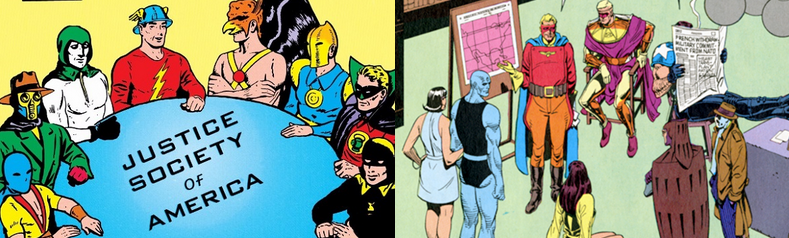
RobinsDamian
2 Damian Wayne

The illegitimate son of Bruce Wayne and Talia al Ghul, daughter of the functionally immortal Ra’s al Ghul, Damian Wayne was initially considered to be a character that existed outside of mainstream DC continuity until he was officially made a part of DC canon in Batman and Son (Morrison, et al, 2006).
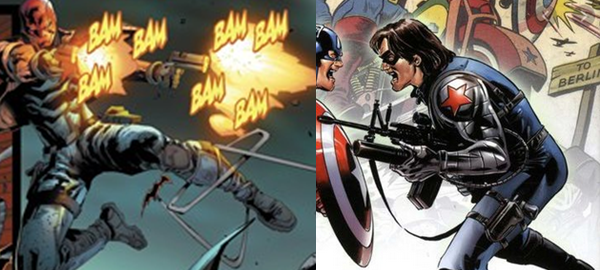
RobinsDamian2
Damian was a massive jerk for quite a while.

Trained from birth by the League of Assassins, Damian was initially portrayed as a bratty, violent young boy who was arrogant, rude, disrespectful, and had no compunction about killing his opponents. He believed that, as Batman’s true son, the role of Robin was rightfully his and nearly killed Tim Drake just to prove it. Eventually, though, Damian softened and earned his place in the Bat Family; after Bruce Wayne appeared to die in the awful Batman R.I.P. (ibid, 2008), Dick Grayson briefly operated as Batman and took Damian as his Robin. While this initially created an interesting reversal of the Batman and Robin dynamic (with Dick being a more light-hearted Batman and Damian as a grim and stoic Robin), Damian has since excelled in the role, having joined the Teen Titans, returned from the dead, and forged friendships with both John Kent/Superboy and others in the Bat Family.

RobinsTim
1 Tim Drake

Damian may very well be on the path to being the most accomplished of all the Robins but he’s still relatively new to the role. His fighting proficiency and augmented knowledge and intelligence make him a formidable opponent but it seems as though Damian’s destiny is to one day break away from Batman’s shadow and either become Batman himself or forge a new identity. Therefore, while he has since gone on to assume the role of Red Robin and…Drake…Tim Drake is still the definitive Robin for me. Introduced some time after Jason’s death, when Batman was in a violent downward spiral, Tim wanted nothing more than to reunite Dick and Bruce as Batman and Robin and wound up assuming the mantle for himself. A keen detective and computer whiz, Tim brought something new to the role; for one thing, he was the first to ditch the short-shorts and pixie boots and wear a functional, respectable Robin costume and, for another, he was far more grounded and relatable than other Robins.

RobinsRedRobin
Tim had a lengthy career as Red Robin.

Although he never aspired to be anything other than Robin, Tim did briefly assume the mantle of Batman after Batman R.I.P. and has been shown, on multiple occasions, to eventually become a violent Batman in the future. However, Tim is probably most well-known for having taken up the identity of Red Robin; while I find the “Red” portion of this identity redundant and wish he had, like Dick, forged an entirely separate code-name, it showed that Tim still very much considered himself Robin first and foremost (except for that weird period when he inexplicably took the identity of “Drake”). Tim was also the first Robin to get his own ongoing comic book series and that he is, for all intents and purposes, probably the most successful of the full-time Robins at really making the identity his own as Batman’s sidekick, a solo hero, or as part of the Teen Titans and Young Justice.

RobinsBanner

What are your thoughts on Robin? Do you feel he’s too bright and cheerful for the normally grim and gritty Batman or is he an essential part of the Batman mythos? Who was your favourite Robin? Let me know your thoughts in the comments.

Game Corner: Die Hard Trilogy (PlayStation)

GameCorner
DieHardTrilogyLogo

Released: August 1996
Developer: Probe Entertainment
Also Available For: PC and SEGA Saturn

The Background:
In 1996, we would be some eleven years or so away from a fourth entry in the action-packed Die Hard (Various, 1988 to 2013) film series. The third movie, Die Hard with a Vengeance (McTiernan, 1995) had just dropped the previous year so the only way fans of John McClane (Bruce Willis) were going to get more Die Hard action was to turn to videogames. Developed by Probe Entertainment, Die Hard Trilogy utilised three distinct, different gameplay styles to recreate a slightly altered version of the first three (and, at the time, only) movies in the increasingly over-the-top franchise.

The Plot:
Terrorists take over the Nakatomi Plaza and McClane must work his way up the tower, freeing hostages along the way; another group of terrorists then take control of Dulles Airport and McClane must once again save the day; finally, McClane must race through New York City defusing bombs placed at key points by, you guessed it, a terrorist.

Gameplay:
Die Hard Trilogy plays differently depending on which of the game’s scenarios you tackle; each of the three movies has a different gameplay style and, thus, a different perspective and different gameplay mechanics, camera perspectives, and controls. When playing through the events of Die Hard (ibid, 1988), players guide McClane through the Nakatomi Plaza from a third-person perspective in an arcade-style action shooter. Being a third-person shooter, the player can run, jump, dodge, and shoot at terrorists all while using the directional pad (D-pad) and a version of the “tank controls” made (in)famous by the PlayStation and such titles as Resident Evil (Capcom, 1996).

DieHardTrilogyDHHostages
Try not to shoot the hostages as you play…

This means that you can’t use the analogue sticks to control McClane, making for a clunky, awkward gameplay style where McClane will walk straight backwards when reversing and, due to the game’s more restrictive gameplay style, doesn’t really have to do much in the way of aiming: you simply point McClane in the general direction of your target, shoot, and will probably blow them away. McClane starts Die Hard with no shoes (as in the movie, though this doesn’t factor into the game) and his trusty Beretta, though he can acquire other weapons (such as a shotgun and machine gun) from weapons crates or downed terrorists. His health is measured by a police badge; when taking damage, the badge will deplete and, if completely depleted, McClane will die and the game will be over.

DieHardTrilogyDHBomb
Race to the exit before the bomb goes off!

McClane journeys through nineteen maze-like levels of the Nakatomi Plaza (though it feels never-ending), shooting terrorists and rescuing hostages on each floor. Once a set number of terrorists have been shot, some more will spawn in from the elevators but, once they’re all cleared out, McClane is given about thirty seconds to reach an exit before the Plaza is destroyed.

DieHardTrilogyDHBonus
Speed the hostages away to safety.

You’ll also travel up to the rooftop for a bonus level where a whole slew of hostages will try to escape via helicopter; you’ll have to take out the terrorists scattered around here and, again, race for the exit before the bomb goes off to score some bonus points. This last minute time limit is probably the most frustrating part of the Die Hard section of the game; well, that and trying to navigate through the labyrinthine floors of the Plaza using the game’s rubbish mini map. Sure, you can zoom in and out but, when you’re trying to race to the exit, it’s almost useless at pinpointing exactly where you’re supposed to go.

DieHardTrilogyAirport
Terrorists have overtaken Dulles Airport and only McClane can stop them!

The game shifts to a first-person, on-rails shooter to retell the events of Die Hard 2: Die Harder (Harlin, 1990), similar to the likes of Time Crisis (Namco, 1995). Using the D-pad, you’ll manoeuvre a crosshair around a variety of maps, ranging from the car park and foyer of Dulles Airport, to the maze-like underground passage beneath the airport, to the runway and even into the skies above the airport to blast away at terrorists with reckless abandon. McClane must, again, blast the seemingly endless supply of terrorists away while avoiding and rescuing numerous hostages. You can also blast crates and other parts of the environment to pick up health and other temporary weapons and toss grenades at the bad guys again but will only find reprieve from injury when the camera decides to place him slightly behind some scenery.

DieHardTrilogy2Locations
You’ll blast through all the film’s locations.

You also get to storm the church and race through the snowy landscapes on a jet-ski, as in the movie, and the on-rails gameplay mechanic is actually a lot better in its execution that the third-person style of Die Hard. Sure, it’s never easy moving a crosshair with a D-pad but the polygonal graphics are a lot less obtrusive and, even better, there’s no sudden or enforced time limit rushing you to an exit. You simply blast away at terrorists before they hit you, reload, and continue until they’re all dead.

DieHardTrilogy3Levels
There’s not much variety in Die Hard with a Vengeance.

For Die Hard with a Vengeance, the game switches to a race against the clock throughout the streets and subways of New York City as McClane and Zeus Carver (sadly not voiced by Samuel L. Jackson) race to reach a series of bombs placed in various locations by Simon Gruber (Jeremy Irons). There’s no shooting to do here; you simply accelerate as fast as possible, making hard turns with the L or R triggers, and using limited boosts and jumps to increase your speed. The mini map returns but, this time, it’s more like a compass and is actually useful here; even if, for some reason, you can’t follow the compass points, Zeus will yell instructions to tell you when to make turns or that time is running out. Yes, the time limit returns but, this time, it’s a constantly ticking down clock on the lower left of the screen; you can pick up time bonuses as you race through the streets but the time you have to reach each bomb is tight, to say the least.

DieHardTrilogy3Controls
The controls could use some polish.

As you plough your way through the streets, you’ll have to dodge other cars and traffic and civilians; as you’re racing across Central Park (in an amusing interpretation of a similar scene in the movie), you’ll also have to worry about the massive body of water in the middle of the map, which will sink your car. After every stage, you’ll race against a truck in the subway tunnels to reach a bomb; if you fail to reach the bomb in any of the stages, it will explode and obliterate the entire city (so…I guess they’re all nuclear bombs, then?) It took me a little while to get to grips with the controls of Die Hard with a Vengeance; the PlayStation seems pushed to its limits here as it’s easy to bash against the sides of buildings or get caught in between the environment, where you’ll jitter away in a glitchy mess until you finally break free. Yet, once you get the timing of your hard turns right, this was fun, frenetic action even without any gunplay.

Graphics and Sound:
Die Hard is rendered in full janky-ass 3D polygons, the trademark style of 3D games around this time. As you explore the Nakatomi Plaza, objects will “pop up” out of thin air or turn see-through if you get to close to them and, rather than use a thick, obscuring fog to mask this effect, the game opts for pitch blackness, especially on the rooftop stages.

DieHardTrilogyDHGraphics
McClane is, at least, recognisable in Die Hard.

As a polygonal recreation of Willis’ character, however, McClane doesn’t look half bad; he looks exactly like Willis does in the film (though, obviously, a bit blocky), which is more than can be said for the game’s non-playable characters, who are just generic blocky figures to be shot or rescued.

DieHardTrilogyOpenWorld
The more open levels work a lot better.

Taking McClane out of the narrow hallways of the Nakatomi Plaza actually seems to improve the game’s presentation and stability; in both Die Hard 2 and Die Hard with a Vengeance, the more open environments reduce the annoying pop-up of obstacles and walls. I find this odd, as it seems like bigger environments would only exacerbate this issue but, apparently, it’s the opposite.

DieHardTrilogyJerkyOpen
The environments and graphics can still be a bit janky.

It’s not all good news, though; when Die Hard 2 switches to night-time levels or the underground passageways, the distorted, jerky effects come back in full force. Similarly, while you can switch between different camera perspectives so you can drive from the inside of McClane’s car, and the game’s version of New York City is rendered in surprising stability in Die Hard with a Vengeance, the buildings jerk and move as you race through the streets and it’s easier than it should be to get clipped into the environment. Unfortunately, my copy of the game kept skipping or bugging out when playing music but, from what I heard, there’s a pretty decent, techno/rocking beat to every level. There’s also some fairly decent and amusing voice acting, particularly from the Willis sound-alike who provides McClane’s constant quips. Sure, these (like all the game’s dialogue) are limited and repetitive (and there’s “Yippee ki-yay” but no expletives) but the game does a decent job of recreating McClane’s snarky wisecracks.

Enemies and Bosses:
In Die Hard, McClane guns down countless numbers of terrorists; if these are the same guys from the movie then Hans Gruber (Alan Rickman) really got to recruiting for the videogame because there are a lot of henchmen to wade through here. One thing I did like was how, sometimes, hostages will turn out to be enemies in disguise and pull a gun out on McClane, similar to Gruber.

DieHardTrilogyDHHans
This as close as Hans gets to appearing in Die Hard

Speaking of Hans…well, he doesn’t really appear. Occasionally, in some levels, you’ll encounter a “Boss” who is slightly different coloured enemy, maybe with more health and a better weapon, who’ll grant an extra life upon being killed. There is one in the game’s last level, but it doesn’t look like Gruber and there’s nothing to say it actually is so that’s a bit of a downer.

DieHardTrilogy2Bosses
Bosses aren’t really a thing in Die Hard 2.

This trend continues in Die Hard 2, where you’ll get to blast “Head Honchos” but won’t actually tackle Colonel Stuart (William Sadler) head-on. Instead, you’ll have to settle for McClane inexplicably circling Stuart’s aircraft in the game’s finale, which you’ll blast away at until it’s nothing more than a flaming mass of wreckage. Die Hard with a Vengeance, however, bucks this trend; in most levels, you’ll end up chasing after a “Bomb Car”, which will explode and destroy everything if you don’t destroy it first. These are the equivalent of the game’s boss battles until you reach the final stage of the game but, unlike the other two games, Simon Gruber will taunt McClane as he completes (or fails) each of his missions, making him a near-constant presence.

DieHardTrilogy3Boss
Finally, a familiar face!

Gruber also makes an appearance in the game’s final stage, in which McClane must chase after Gruber’s helicopter and use launch points to literally use his car as a weapon to take Gruber down. There’s something incredibly amusing about McClane solving every problem, from city-destroying bombs to helicopters, by simply ploughing into it head-first with a car!

Power-Ups and Bonuses:
In Die Hard, you’ll rack up a score as you shoot terrorists and rescue hostage; this, along with killing a Boss, will grant McClane an extra life. You can also replenish McClane’s health with medical packs and acquire new weapons as you play, but these all have limited ammo so you’ll eventually revert back to McClane’s basic Beretta.

DieHardTrilogyDHWeapons
Grab a grenade and blow those buggers away!

Also, I dunno if it’s just me, but I couldn’t figure out how to switch between McClane’s different weapons; grabbing a new one automatically switches to it and you switch back to the Beretta once it’s spent. You can, however, also acquire secondary weapons (like grenades and smoke bombs), which you can switch between and which are vital to dispatching large groups of enemies.

DieHardTrilogy23PowerUps
The third game is lacking in power-ups compared to the first two.

In Die Hard 2, enemies and destroyed crates will yield additional weapons; as in Die Hard, these have limited ammunition but you can still pick up a machine gun, shotgun, explosive shotgun, and even a rocket launcher to blow terrorists away. In Die Hard with a Vengeance, however, the only power-up you can pick up are the boosts. These will blow your car into the air and give you a short burst of speed but aren’t as effective as I would expect from a boost. You can also pick up additional points and time and hit launch points to fly dramatically through the air at certain key points.

Additional Features:
Well, I hate to say it, but there’s nothing. When you play Die Hard Trilogy, you play for a high score; it’s a very arcade experience in that way, right down to how you enter your name on the high score screen.

DieHardTrilogyCheats
There’s some weird-ass cheats available in this game…

There are, however, a whole slew of cheats you can enter to each of the three games that will affect or spice up your gaming experience; these range from the usual stuff like infinite ammo and invincibility to odd stuff, like plants that scream when they’re shot and a fat mode.

DieHardTrilogyConclusion

The Summary:
Your enjoyment of Die Hard Trilogy is somewhat dependent upon how well you get on with each of the games, and gameplay mechanics, available within it; Die Hard is a pretty uninspiring third-person action shooter but Die Hard 2 is a surprisingly well-realised on-rails shooter and Die Hard with a Vengeance is an enjoyable racer. However, while each game as positives and negatives, there have definitely been better games of each type, even on the PlayStation, but I appreciate that, back then, developers were very restricted by the limitations of the technology of the time. In the end, there’s quite a bit on offer in Die Hard Trilogy as an arcade-like experience; going into it, I expected each of the movies to be a short, maybe five to ten level game, but they just kept going on and on. This would be good but there’s not much to come back to beyond getting to gun down hundreds of terrorists whilst spewing the snarky witticisms of John McClane but there are far better options if you want to do things like that…like just watching Die Hard.

My Rating:

Rating: 2 out of 5.

Could Be Better

Did you play Die Hard Trilogy back in the day, or still play it now? What do you think of it? Has it held up over time or is it just a bad example of the limitations of early-PlayStation titles? What’s your favourite Die Hard movie? Drop a comment below and share your thoughts on Die Hard.

Game Corner: Final Fantasy VIII Remastered (Xbox One)

GameCorner
FF8RLogo

Released: September 2019
Originally Released: February 1999
Developer: Square Enix
Original Developer: Square
Also Available For: Nintendo Switch, PC, PlayStation, PlayStation 3, PlayStation 4. PlayStation Portable, and PlayStation Vita

The Background:
So, everyone knows about Final Fantasy VII (Square, 1997); it’s one of the definitive role-playing games (RPGs) and one of, if not the, most popular titles in he Final Fantasy series, selling over twelve million copies worldwide and making its way onto many “top ten” lists over the years. But what about the inevitable sequel? Where does Final Fantasy VIII land in the grand scheme of things? Developed during the localisation of its predecessor, Final Fantasy VIII marked the first time that the Japanese and American teams collaborated on a Final Fantasy title. Like pretty much every single numbered Final Fantasy title, Final Fantasy VIII wasn’t a sequel to Final Fantasy VII but, rather, an entirely new title, set in a new world, with new characters and events taking place, which may have been jarring for those whose only experience with the franchise was Final Fantasy VII. I first played Final Fantasy VIII on the PlayStation 3, immediately after finishing Final Fantasy VII on the same system, and found it to be a dramatic step up in terms of graphics, gameplay mechanics, and features. Where Final Fantasy VII felt like Square where just dipping their toes into the world of 3D and polygonal graphics, Final Fantasy VIII featured far more detailed character models, environments, and graphics overall, resembling titles like Resident Evil 2 (Capcom, 19998) and Parasite Eve (Square, 1999). It also helps that I really like the design and characterisation of the game’s protagonist, the stoic loner Squall Leonhart, and enjoy the game’s more science-fiction-inspired aesthetic. Yet, Final Fantasy VIII is often the subject of criticism, whether due to the dramatic visual and gameplay alterations I takes or simply because of how influential Final Fantasy VII was, but is this a fair assessment of the game or is there more on offer in this under-rated classic?

The Plot:
When the time-travelling sorceress Ultimecia plots to possess the gorgeous Rinoa Heartilly in a quest to “compress time, Squall Leonhart must team up with his fellow SeeD graduates and reconcile his fractured memories and feelings for Rinoa, all while butting heads with his rival, Seifer Almasy.

Gameplay:
Essentially, Final Fantasy VIII plays very similar to its predecessor and other Final Fantasy titles from this time, being a turn-based RPG with a large overworld populated by innumerable non-playable characters (NPCs) and littered with a varied of monsters to battle to gain experience points (EXP). Players take on the role of Squall, who one of only two party members you can rename this time around, and journey across the world map battling enemies, recruiting Guardian Forces (GFs) to his cause, and engaging in a number of side quests and mini games as he goes. When you’re not in one of the game’s towns, many of which incorporate a lot of futuristic technology, you’re travelling across the world map and every other step puts you at risk of being sucked into a random battle encounter. Like Final Fantasy VII, Final Fantasy VIII uses an Active-Time Battle (ATB) system that, unless switched off in the menu, means you’ll take damage from your foes while you select your move. If you choose to attack, you’ll run forwards and deliver a blow, whittling your opponents health points (HP) down until they are defeated and earning you some EXP, items, and Gil (the in-game currency).

FF8RDraw
Draw magic from enemies and either stock it for later or cast it right away.

One of the most controversial aspects of Final Fantasy VIII is the way it complex way it handles magic and Summons; the only way to learn new magic and to restore your magic points (MP) outside of resting at an inn or with items is to use the games “Draw” system. Selecting “Draw” (or visiting a “Draw” point) will have your character literally draw magic and MP from their foe and you’ll be given the choice to either cast that magic or stock it for later use. This effectively means that you can never run out of MP as you can keep sucking it out of your enemies, meaning that you’re never running around looking for an inn or shop to buy Ethers and Elixirs to restore your MP. Personally, I love this system because it eliminates this stress; you can have different characters “Draw” and specialise in different magic, effectively allowing you to customise your party as you see fit. Final Fantasy VIII calls its Summons “Guardian Forces” (or “GFs”); you can use “Draw” to acquire new GFs but, for the most part, you’ll have to battle and defeat GFs in order to recruit them and Squall’s first mission is to do just that with Final Fantasy mainstay, Ifrit. Once you have a GF, you have to “Junction” it to a character; this allows you to summon the GF in battle to deal powerful attacks, buff your character’s stats, and gives you access to other magic and benefits.

FF8RJunction
Use the “Junction” mechanic to increase your stats and abilities in battle.

Effectively, this system is very similar to the Materia system used in Final Fantasy VII; each GF allows you to increase your character’s stats and inflict or resist certain status effects and they even level-up, unlocking new attacks, attributes, and increasing in power, just like Materia. This is pretty much a mandatory mechanic in Final Fantasy VIII since can’t even use your magic or even items without Junctioning a GF as these are commands you can only assign once a GF has been Junctioned to a character. Furthermore, if you want to gain buffs to your stats (like increased HP, strength, speed, or whatever), you need to win battles to earn AP so that your GFs can learn these techniques; similarly, if you want to gain HP whilst walking, reduce (or eliminate) random battles, or even haggle with the game’s various shops to receive a discount, you’ll need that AP. Some of these techniques take less AP than others but, to access the best abilities, you’ll need to earn a lot of AP and, once you have them, you’ll be switching on the fly between different commands depending on what you’re doing. Now, don’t get me wrong, all these gameplay mechanics are very confusing; it doesn’t help that, for the first hour or so of the game, you’re constantly lectured about each new mechanic, how to use it, what it means, and the best way to get the most out of the “Junction” system. In comparison, it seemed like information abut Materia and levelling up and Summons was spread out much more effectively in Final Fantasy VII but, despite that, it’s not that difficult to wrap your head around the “Junction” system…as long as you think of it as being an altered form of Materia and the “Draw” mechanic means you never have to worry about running out of MP, so don’t stress over nothing.

FF8RLimitBreak
Unleash your Limit Break to deal massive damage.

The “Limit Break” system returns, albeit in a slightly altered form; rather than triggering as your party takes damage and a meter builds up, you potentially gain access to your Limit Break when your character’s health drops low enough, making it more of a last-ditch desperation attack. Whereas the Limit Breaks in Final Fantasy VII were largely automatic, here you can choose to interact with the Limit Breaks if you wish; for example, pressing R1 at the right time as Squall attacks with his “Renzokuken” Limit Break delivers additional damage and you’ll be required to press different button combinations to perform different attacks when performing Zell Dincht’s “Duel” Limit Break. You can perform additional, more powerful blows and flourishes when performing a Limit Break by equipping different weapons, reading documents, or acquiring certain items. Interestingly, Final Fantasy VIII features a unique twist on the random battle formula in that the enemies you encounter dynamically increase in strength and difficulty as your party levels-up. in addition, you’ll also level-up every time you time you acquire 1000 EXP points, meaning that you can, effectively become massively overpowered in the early portions of the game with very little effort at all. I prefer to play the game as I play every Final Fantasy and RPG, however, progressing the plot and grinding levels in-between towns and around new areas, meaning I never experienced any advantages or issues with this system.

FF8RMiniGames
A few awkward, button-mashing mini games appear during the course of the game’s story.

You can use magic or items to heal your characters or remove status effects; you also have to heal your GFs as they can also take damage from enemies. Once again, you can only save on the overworld or at specific save points; if you die, you get a game over and have to reload your last save file, so it’s recommended that you save often and heal up at inns whenever you can. You’ll also be tasked with completing a series of awkward mini games; I don’t know what it is about the 3D Final Fantasy titles and having these odd button-mashing sequences shoe-horned in but they can be pretty annoying simply because of how vague the game is about how you’re actually supposed to complete these mini games. Rather than purchasing new weapons, Final Fantasy VIII features a crafting system, of sorts; as you explore the world, you’ll find copies of Weapons Monthly magazine, which contains blueprints that detail the items and gear you’ll need to craft stronger weapons for each character. In order to obtain each character’s most powerful weapon, you’ll need to travel all over the world battling specific monsters and enemies to acquire these items; you can use your GFs abilities to steal these items or increase the odds of them appearing and, once you have them, you can visit a weapon shop to get your upgrade. It’s worth noting, however, that you don’t actually need to read the Weapons Monthly magazines to acquire these upgrades and, with the right amount of patience and a lot of grinding, you can actually acquire Squall’s ultimate weapon, the Lion Heart, on the game’s first disc.

FF8RSquallRinoa
Squall and Rinoa’s relationship forms the core of the game’s story.

As in every Final Fantasy game, narrative and characterisation are the driving force of the game’s complex story. While every main character has an arc of some kind and their own unique characteristics, at its core, Final Fantasy VIII is a love story first and foremost and a battle against a malignant time-travelling sorceress second and it is therefore Squall who undergoes to most dramatic changes as the plot unfolds. Beginning as a stoic loner, he learns to not only emote and open himself up more, but the bulk of the game’s main theme is centred around his growing affection for Rinoa and his acceptance of his love for her and the friendships he has formed. Unfortunately, though, the other playable characters don’t get quite the same focus; none of them have sub-plots or explicit character arcs and, thanks to the game’s emphasis on more realistic character models, the six main playable characters lack a lot of the same aesthetic appeal as those seen in Final Fantasy VII; Squall has a bad-ass look and Zell resembles an anime character but, even though characters like Quistis Trepe have recognisable traits (she struggles with her failure as a teacher), they don’t make an impact in the same way as the likes of Barret Wallace or Vincent Valentine and I struggled to settle on my preferred team. I ended up going with Squall, Irvine, and Rinoa but there were aspects about this line-up that continued to irk me; Irvine’s Limit Break, for example, requires you to buy or craft ammo and Rinoa’s “Angel Wing” Limit Break is useful but only if your swap around her magic and can deal with losing control of her once you select it. Final Fantasy VIII expands upon its world, characters, and narrative by including an entire sub-plot with three additional, playable characters. At various points throughout the game, your party will mysteriously fall asleep and assume to roles of Laguna Loire, Kiros Seagill, and Ward Zabac. These older, more seasoned characters are a battle-tested team and contrast with Squall and his relatively young and untested group. Through their side story, which takes place about seventeen years in the past, we learn about a lot of the events that factor into Squall’s characterisation and the way this world works.

FF8RLaguna
Laguna’s side story fleshes out the game’s world and lore.

The SeeDs are mercenaries trained to perform a wide variety of jobs but, first and foremost, their goal is to assassinate sorceresses before they can become too powerful; this is directly related to the main plot of the game, as the dark sorceress Ultimecia projects her consciousness and manipulates events….completely unaware that she is actually creating her own undoing. Laguna’s side plot serves to further drive the game’s main themes of love and loss; though initially dismissive of Laguna for his foibles and the concept of friendship and relying on others, Squall comes to realise that he is part of a team and a family and progresses from only expressing himself trough his inner monologue to actually opening up to his friends and team mates. Unlike Final Fantasy VII, which gave each of its characters a clear arc and developed them as the story progressed, Final Fantasy VIII pretty much hedges all of its bets on you relating to, and growing to love, Squall, Rinoa, and their relationship and, if you don’t really connect with these characters or their love story, you might struggle to connect with Final Fantasy VIII. Additionally, Final Fantasy VIII is a very complex experience, even for a Final Fantasy title; it’s a slow, atmospheric experience; you can’t skip the cutscenes but, thankfully, you can fast travel in the towns and around the map this time. Luckily, though, the game’s map is a dramatic improvement on Final Fantasy VII’s; areas are actually named and highlighted, making it much easier to know where you have to go…assuming that you paid attention to the dialogue boxes and cutscenes. If you didn’t, you’ll probably have to consult a guide or risk wandering around in circles desperately trying to figure out who to talk to or where to go. As always, I recommend consulting a guide if you need to, over-levelling your party, saving as often as possible, and doing everything you can to simplify the game’s complex mechanics as best you can. It seems daunting but it is possible and, once you have your party set up as you like, all you have to worry about it surviving battles and bosses rather than trying to wrap your head around the intricacies of the “Junction” system.

Graphics and Sound:
There’s no denying that Final Fantasy VIII is a massive step up on it predecessor both in terms of its in-game graphics and cutscenes; rather than replicating Final Fantasy VII’s chibi, anime-style aesthetic, Final Fantasy VIII renders its characters as realistically as possible and the character models remain on model instead of there being several wildly different character models across the overworld, battle screens, and cutscenes.

FF8RGraphics
In-game cutscenes, models, and backgrounds are vastly improved.

This means that Final Fantasy VIII more closely resembles other 3D, polygonal videogames of the time, like the two Resident Evil (Capcom, 1996) sequels rather than a mish-mash of pre-redendered backgrounds and chubby 3D polygons. While I actually really liked Final Fantasy VII’s artistic style and blend of anime cute and bio-organic sci-fi, and it is annoying that Squall pulls his gunblade out of thin air in cutscenes, Final Fantasy VIII is a clear graphical improvement over its predecessor in every way. You’ll travel to many diverse environments, from caves to towns to ornately-decorated castles and sprawling towns, all of which are an impressive blend of natural landscape, a marriage of steampunk and 1950s technology and aesthetics, and elaborate, futuristic sci-fit. Even the battle screen is cleaner, forgoing the traditional battle dialogue box and incorporating more dynamic camera angles and detailed backgrounds and the Xbox One remaster only emphasises this further by applying a crisp, fresh coat of paint to the original.

FF8RGraphics2
CG cutscenes have dramatically increased in number and quality.

Final Fantasy VIII also features a lot more CG cutscenes and, honestly, every one of these is leaps and bounds beyond its predecessor; the action and camera and character movements is slick and fluid and, while they’re still obviously not on par with today’s graphics and cutscenes, they’re far beyond the limited and stilted cutscenes seen in Final Fantasy VII. Final Fantasy VIII also improves on the placement and use of dialogue boxes for in-game cutscenes; dialogue boxes are now much smaller and clearer and appear in various places around the screen like speech bubbles rather and being a large box that obstructs a sizeable portion of the screen. Final Fantasy VII also includes more of long-time Final Fantasy composer Nobuo Uematsu’s greatest work; while none of the game’s tracks are as iconic as “One-Wing Angel”, Final Fantasy VIII still features some fantastic tracks such as “The Man with the Machine Gun”, “The Extreme”, and the awesome “Maybe I’m A Lion”. The game forgoes traditional character themes in favour of its influential main theme ballad, “Eyes On Me”, a pop song performed by Chinese singer Faye Wong that perfectly encapsulates the game’s main themes of love and loss; “Eyes On Me” was so influential that it not only sold over 400,000 copies but it was also the first piece of videogame music to ever win “Song of the Year” at the Japan Gold Disc Awards.

Enemies and Bosses:
As you explore the world of Final Fantasy VIII and resolve Squall’s complex social issues, you’ll take part in a whole bunch of random battles against enemies of all shapes and sizes. Your party will often butt heads with the military force of Galbadia, who are under the influence of Ultimecia’s magic; these battles are generally pretty easy, even when the Galbadian’s attack with magic or in larger groups, and only really become a challenge once you come up against their mechs and robots. Final Fantasy VIII is, of course, absolutely infested with monsters. These range from the dinosaur-like T-Rexaur (one of the most difficult enemies you’ll battle against in the game’s early moments), gigantic dragons, demonic shadows, poison-spewing, man-eating plants, monstrous turtles, weird-ass, floaty face…things, and even these horrific alien creatures who have overrun the game’s Airship and will continually regenerate if you don’t destroy them in coloured pairs. The majority of these monsters fall to the planet in a constant cycle based on the correct alignment of the Moon and even originate from the surface of the Moon; later in the game, you get to see this in motion which, as far as I know, is the first time a Final Fantasy game directly explained where all these weird and wacky monsters actually come from.

FF8RGFBosses
GFs act as the majority of the game’s boss encounters.

It took me a little while to realise that Final Fantasy VIII seems to be lacking in boss battles; most of the time, you’ll fight against a GF as a boss (or mini boss), which doesn’t really feel like a boss battle as it’s more like proving you’re worthy enough to use the GFs power. By that logic, Ifrit acts as the game’s first boss and, as you progress, you’ll come across other GFs in various areas; most of the time, like with Cerberus, you can choose not to engage with these GFs but, if you do, you’ll have to go out of your way to “Draw” the GF from a later, more challenging boss in Ultimecia’s Castle.

FF8RSFRBosses
You’ll battle Seifer, Fujin, and Rajin a few times during the game’s story.

When you’re not fighting GFs, you’ll battle against Galbadia’s finest giant robots; the first one you face, the spider-like X-ATM092, can’t actually be defeated and, instead, must be damaged enough so you can make your escape and then either avoided or disabled long enough for you to run. Other times, you’ll butt heads with the main character’s rivals, Seifer and his buddies, Fujin and Raijin. Although Seifer eventually upgrades to becoming a penultimate mini boss as he is manipulated to act as Ultimecia’s “Knight”, you never battle all three at once, which is a bit of a missed opportunity but, essentially, they’re very similar to the battles against the Turks from Final Fantasy VII.

FF8RCastleBosses
Ultimecia’s Castle is full of powerful superbosses.

Once you reach Ultimecia’s Castle, you’ll be stripped of your abilities and forced to take on the enemies within without your GFs and magic…that is until you defeat one of her eight superbosses. Fittingly, these creatures represent the game’s toughest challenge yet (although the Ruby Dragon can be a pain in the ass thanks to its high HP and “Breath” attack) but, by this point, you should be well levelled-up and full at ease with the game’s various mechanics and controls. Nevertheless, each of these superbosses has a unique design, character traits, and requires specific strategies; Sphinxaur takes on a second form after enough damage is done, the Red Giant can absorb a huge amount of punishment (and spouts a crazed response every time he’s attacked), and Trauma can only be spawned after solving a puzzle and is protected by smaller machines, for example.

FF8RCastleSuperbosses
Tiamat and Omega Weapon offer perhaps the game’s greatest challenge.

Easily the most challenging bosses in Ultimecia’s castle are Tiamat and Omega Weapon, both of which are optional battles (though Omega Weapon involves splitting into two teams, ringing a bell, and running to a specific point to trigger the battle). Like many of the superbosses in Ultimecia’s Castle, you can “Draw” GFs from these bosses if you missed them earlier in the game but you’ll be more concerned with setting up your party to endue their powerful attacks. Both of which can deal massive damage, absorb elemental attacks, and have huge amounts of HP but it is Omega Weapon that offers the greatest challenge. With HP in the millions and capable of casting both “Death” and ending your party with “Light Pillar” (which deals 9999 damage and thus results in a one-hit KO), Omega Weapon offers such a tough challenge that, upon defeat, you’ll earn a special “Proof of Omega” award so you can prove to your friends that you got past this absolute tank of a superboss.

FF8RSorceresses
As a SeeD, it’s your duty to destroy sorceresses.

In addition, you’ll have to face-off with a few sorceresses during a playthrough of Final Fantasy VIII; being as she prefers to possess and manipulate sorceresses from the far future, Ultimecia doesn’t actually physically appear until right at the final parts of the game meaning that, before you confront her in her ominous castle, you’ll mostly be battling the current-day sorceress, Edea, who has been possessed by Ultimecia. As her chosen “knight”, you’ll usually have to dispose of Seifer before you can properly get your hands on Edea, which can make these battles a bit tougher. Later, when the malevolent sorceress Adel literally falls from the sky, she/he/it is leeching off of Rinoa so you have to be sure to target only Adel and not use attacks that hit more than one target or else you’ll risk injuring or killing Rinoa and losing the battle.

FF8RGriever
Griever’s ability to blast away your magic and GFs is a serious threat.

Once you finally fight your way through Ultimecia’s Castle and unlock all of your abilities, your party falls victim to Ultimecia’s “Time Compression” ability and ends up stranded in the far future, where Ultimecia rules unopposed. This final battle has multiple stages, each with their own concerns; initially, you battle Ultimecia one-on-one but she randomly decides which of your three party members she wants to battle against and, during the battle, will erratically KO or remove one of your party from the battle screen. This means that, if you don’t revive your strongest party members, you could be stuck facing Ultimecia with characters you’ve chosen to ignore up until this point. Once she is defeated, Ultimecia summons the most powerful GF in the Final Fantasy VIII world, Griever, a monstrous lion-like creature inspired by Squall’s lion iconography. Griever’s threat mainly comes from its ability to completely drain your MP, blast away entire stocks of your magic, and one-shot your GFs with “Lethal Strike”. However, once defeated, Ultimecia “Junctions” herself to Griever and the two form a monstrous combined form that can do everything both previous bosses could, meaning the longer the battle lasts, the more likely it is you’re going to lose your magic stocks, GFs, or party members and also deal massive damage through your defences with “Great Attractor”.

FF8RUltimeciaFinal
Ultimecia’s final form shows her on the cusp of immortality!

Once you manage to defeat this monstrosity, Ultimecia will ascend to her God-like final form; rather than the resplendent grandeur of Safer∙Sephiroth. Ultimecia’s final form is a grotesque eyesore that is halfway between human, monster, and eldritch horror. In this form, she can again destroy your magic stocks, remove any positive buffs you cast on your party, one-shot your GFs, reduce your HP to one point, and cast “Apocalypse” on the party for up to 8000 points of damage. Destroying different halves of Ultimecia’s body results in her using different spells and attacks but, once she starts narrating, it means she’s all out of HP and all you have to do is keep attacking her until the battle ends and Ultimecia is finally defeated. When I first fought Ultimecia when playing Final Fantasy VIII on the PlayStation 3, I found this battle to be particularly difficult; unlike Sephiroth’s final forms, which increase in difficulty depending on your level, characters, and tactics, Ultimecia can completely ruin any strategy you have by wiping away your most powerful party members or dispelling your magic. It’s hard to revive characters if Griever wipes out your stock of “Life” and your GFs won’t be much use if Ultimecia kills them in one move, meaning you’re constantly having to think on your feet and adapt to the battle; add to that the multiple forms that you must face one after the other and you’re left with a far more challenging final boss than in the previous game.

Power-Ups and Bonuses:
Just like in the Xbox One port of Final Fantasy VII, the remastered version of Final Fantasy VIII allows you to alter the game’s mechanics and difficult by pressing in the analogue sticks: press them both in and you’ll turn off the random battles, press in the left stick and you’ll increase the game’s speed by three times, while the right stick powers up your party, giving them constant access to their Limit Breaks and effectively granting them infinite HP and MP. As I only found out about these latter two options right at the end of Final Fantasy VII, I decided to activate them right from the start for the sequel, dramatically speeding up my playtime. It’s worth noting that, even with these activated, your party is still susceptible to status effects (confusion, poison, etc) and can still be killed by the likes of Omega and Ultima Weapon but, still, activating these boosters basically means you never have to worry about wasting Gil in inns or expending MP healing during battle and makes reaching level 100 an absolute breeze. Not only that, if you switch the battle style to “Wait”, you can end up completely obliterating every enemy and superboss you face by spamming your character’s Limit Breaks and ensuring that they never even get the chance to land a single hit!

FF8RRoaming GFs
A few roaming GFs may randomly appear to aid you in battle.

While you’ll gain access to most of the game’s GFs by Drawing them from certain bosses or battling them head-on in specific areas, some are only accessible by using certain items. Additionally, you can complete a side quest (made difficult thanks to the presence of the deadly Tonberry enemies) to battle Odin; upon defeat, Odin will randomly appear during any of your battles and deliver a one-shot KO to your opposition, which can be an extremely useful feature. That is until Odin tries this against Seifer and is cut cleanly in two; luckily, Gilgamesh fills very much the same role but his attacks cause a random amount of damage to your enemies, meaning he’s often more of a hindrance. Similarly, you can acquire the Phoenix Pinion after a side quest which, upon use, calls forth the Phoenix GF, which will randomly arrive to resurrect your entire party if you’re lucky.

FF8RTransport
There’s a few means of transportation on offer in Final Fantasy VIII.

As usual, you are afforded a few vehicles and means to explore Final Fantasy VIII’s expansive world; if you manage to call forth a Chocobo in one of the game’s many Chocobo forests, you can ride one of the birds across the land but you’ll lose it as soon as you dismount. In a change of pace, you can hire out a car to traverse the map but this costs you Gil and the car’s can run out of fuel. You even get to control the Balamb Garden itself for a while as it conveniently has a mobile form that allows it to float across the sea and land when you’re able to come ashore at a beach front. Eventually, you’ll gain control of the Airship, the Ragnarok, which allows you to travel pretty much anywhere but, as good and diverse as all these options are, the game’s camera when on the overworld is needlessly obtrusive and I struggled to find an angle that actually allowed me to properly see where I was going and enough of my surroundings.

Additional Features:
Whereas a great deal of your time and energy was devoted to the capturing, breeding, and racing of Chocobos in Final Fantasy VII, Final Fantasy VIII instead features the card game Triple Triad as its primary mini game. While you can acquire and ride Chocobos to reach new areas and speed up your traversal across the world map, Triple Triad is a feature in pretty much every town of the game and involves most of the game’s NPCs. The game takes place on a 3x3x3 grid, with each player having at least five cards; ten cards are played, each with a different number and element associated with it, and the goal is to capture all of the opponent’s cards. At least, that’s how I understand it; I’m not very good at card games at the best of times and rushing through the dense, seemingly never-ending tutorial, so I never really had much interest in Triple Triad.

FF8RTripleTriad
Triple Triad is everywhere but I couldn’t really get on with it.

You can acquire new cards after defeating enemies or using the GF Quezacotl’s “Card” ability to turn certain enemies into cards but, outside of acquiring every card and a few Achievements, I never saw any real need to get too involved in Triple Triad and played through Final Fantasy VIII perfectly fine without playing more than one game (though, if you want to earn every Achievement, you’ll have to play at least one game and complete a whole side quest involving challenging NPCs to a game of cards so…good luck with that). While it’s not a requirement to play Triple Triad to access the best weapons and items, it is one of two time-consuming options available to you; the other is to battle specific enemies in the hopes that they drop the item you require or use Quezacotl’s “Card” ability to transform the monster into a card and then use the “Card Mod” ability to transform the card into that item. This can be a bit of a hassle as these enemies are rare, meaning you’ll have to wade through a great deal of random battles to track them down and, to use the “Card” ability, you need to deal enough damage to the monster first, which can be difficult when you’re at a higher level. Once you acquire the Ragnarok, travel across the overworld is much easier than before, allowing you to better access some difficult-to-reach areas of the map and acquire more GFs. The Airship is also the only way to access the unmarked Island Closest to Heaven and Island Closest to Hell, which are teeming with tough enemies and hidden “Draw” points to help you level-up and gain more AP, and the Deep Sea Research Center. Here, you’ll have to walk slowly towards a pulsating piece of machinery to avoid being thrown into random battles and then you’ll be forced to battle two Ruby Dragons back-to-back before you can take on Bahamut.

FF8RDeepSea
Explore the Deep Sea Research Center and you’ll eventually battle another superboss!

After defeating Bahamut (which is easier said than done), you’ll be acquire it as a GF and, when you leave and return, you can access a new area of the Deep Sea Research Center. After diverting power to open a series of doors, you can then travel down several floors filled with the game’s most powerful enemies on your way to confronting the game’s option superboss, Ultima Weapon. You can “Draw” the GF Eden from Ultima Weapon, as well as the powerful “Ultima” magic, but you’ll have to endure the same problems as when fighting Omega Weapon (meaning your party can be decimated in one hit it you aren’t properly prepared for the battle). As you travel around, winning battles, completing quests, and taking steps, you’ll be awarded with a SeeD salary. To increase your SeeD rank and, thus, your salary, you can enter the “Tutorial” menu and take a written test. There are thirty tests, each with ten questions and, every time you complete a test, you’ll gain a rank and earn more Gil to spend on items and upgrades. Luckily, you don’t need to worry about actually knowing the answers as you can just consult an online guide and cheese it, ensuring that you earn the associated Achievement and the maximum amount of Gil. Speaking of Achievements, there’s quite a few on offer here and they’re pretty easy to achieve. You get an Achievement every time to acquire a new GF, ensuring you’ll get the majority of the Achievements even without a guide, one for finishing the game, and one for completing certain side quests. These can be trickier to unlock considering how complex and time-consuming the side quests can be (such as the PuPu side quest that sees you tracking down UFOs and aliens) but they’re generally far easier than the ones seen in Final Fantasy VII. Like in Final Fantasy VII, though, I did encounter some issues in getting the Achievements to pop or my Xbox One to acknowledge that I had completed the Achievement; the only advice I can really give if this happens to make sure you save beforehand and try it again, perhaps after logging out or performing a hard restart on your machine.

FF8RBanner

The Summary:
For me, trying to pick between Final Fantasy VII and Final Fantasy VIII is like trying to pick between The Legend of Zelda: Ocarina of Time (Nintendo EAD, 1998) and The Legend of Zelda: Majora’s Mask (ibid, 2000); in fact, this analogy is strikingly fitting as one is generally universally revered and the other is usually divisive, at the very least. However, I really don’t feel like the game deserves the hate or disdain it often unfairly attracts; the “Junction” system is functionally no different to the Materia system, the “Draw” mechanic means you never have to worry about running out of MP and are free to customise your party as you see fit, and the game as a really slick presentation. Seriously, it blows my mind how much of an improvement Final Fantasy VIII is compared to Final Fantasy VII in terms of graphics and you have to believe that, if Final Fantasy VII had been rendered in the same style as its sequel, no one would have anything bad to say about Final Fantasy VII ever again.

FF8RRemaster
The Remaster only highlights Final Fantasy VIII‘s aesthetic quality.

It’s not just the aesthetics that make Final Fantasy VIII an enjoyable experience in and of itself; the game’s pacing is far better than its predecessor meaning that, while you miss out on truly fleshing out and exploring each party member like in Final Fantasy VII, it’s far easier to stay on track and focused on the game’s core narrative. Plus, Final Fantasy VIII doubles down on Squall’s characterisation and development to have him evolve from a stoic, closed-off loner to a confident, inspiring leader. Not only that, the game puts full focus on his love story with Rinoa, making their relationship the central focus of the game and crucial to squall’s development as a character. Is it perfect? Well…no, but (and here’s a controversial statement) no game is; even Final Fantasy VII had some issues! Newcomers may struggle to come to grips with the game’s new mechanics thanks to the influx of obtrusive tutorials and the unintuitive menus and gameplay mechanics, the overworld camera is disappointingly janky, and game goes way overboard with its random encounters (seriously, these happen almost every other step!) but there’s still a lot to like about this game. Once you simplify the “Junction” system and get your party setup how you want, it’s simple to concentrate on “Drawing” magic, winning battles, and levelling-up your party and their GFs; the map is easy to navigate thanks to the much-appreciated fast travel system and areas being clearly marked; the game’s system of increasing enemy levels as your own level increases means you’re always able to earn the EXP and AP you need to grow stronger; and the game’s story is very engaging. Beyond the exploration and development of Squall and Rinoa’s relationship, we’ve got a story that not only transcends time and space and leads you to battling a truly mental multi-form final boss but also questioning concepts such as life, death, love, and loss, making for a truly enjoyable and unique experience.

My Rating:

Rating: 5 out of 5.

Fantastic

And breathe! So, what did you think about Final Fantasy VIII? Did you struggle with the Junction, Draw, and GF system or, like me, do you find it to not bad as bad as people make it out to be? Where does Final Fantasy VIII rank in your hierarchy or Final Fantasy titles? Who was in your party in Final Fantasy VIII and how did you set up your GFs? Did you like the more science-fiction-orientated approach that the game took or do think that the series strayed too far from the traditional fantasy-inspired aesthetics of the franchise? Do you subscribe to the theory that Squall died at the end of disc one? Did you use the boosters implemented into this Remaster or did you go it old school? Whatever your thoughts on Final Fantasy VIII, and the Final Fantasy series, drop a comment below.