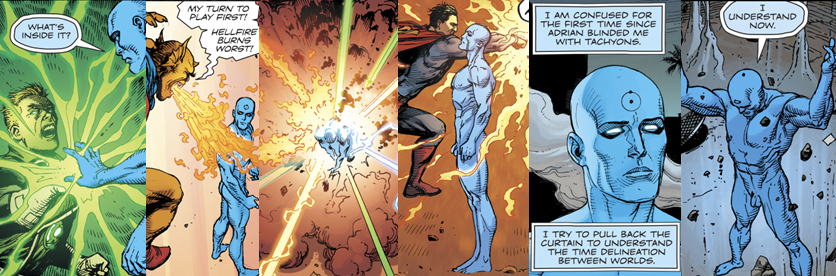
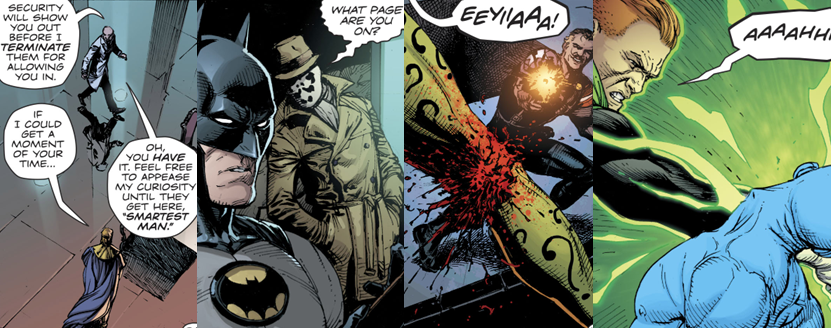
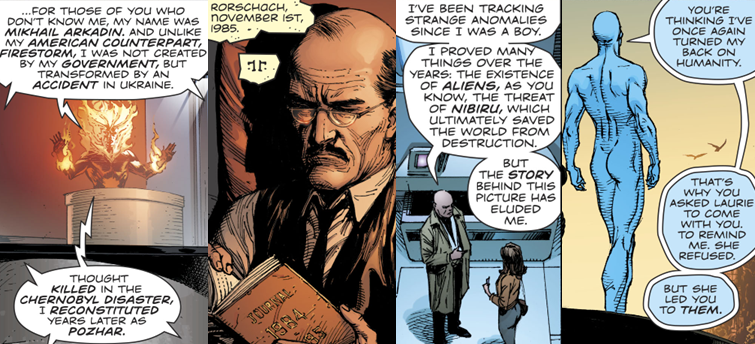
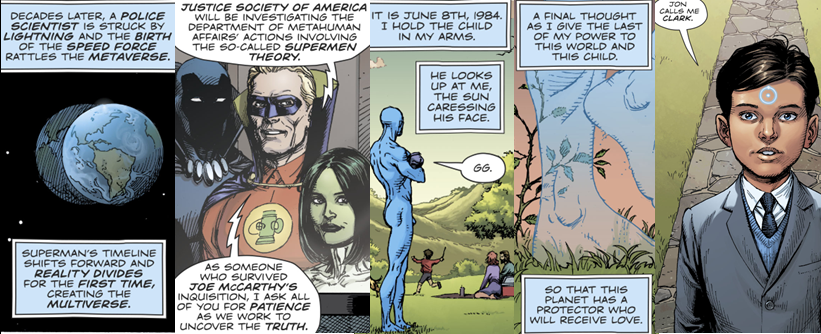
Movie Night: Watchmen: The Ultimate Cut

Released: 3 November 2009
Originally Released: 6 March 2009
Director: Zack Snyder
Distributor: Warner Bros. Pictures/Paramount Pictures
Budget: $130 to 138 million
Stars: Jackie Earle Haley, Patrick Wilson, Malin Åkerman, Billy Crudup, Matthew Goode, and Jeffrey Dean Morgan

The Plot:
In an alternative version of the 1980s, the world is constantly on the brink of nuclear war between the United States and Soviet Russia and masked vigilantes, once popular in the 1960s, have been outlawed for some time. However, when Edward Blake/The Comedian (Morgan) is found dead, Walter Kovacs/Rorschach (Haley) uncovers what appears to be a plot to kill off former masked crimefighters and, in his efforts to warn his fellow Watchmen, becomes embroiled in a diabolical plot to force the world into unity and peace.

The Background:
Published between September 1986 and October 1987, Watchmen (Moore, et al) was the brainchild of noted comic book writer Alan Moore and artist Dave Gibbons, who revised their initial concept of a murder mystery involving Charlton Comics characters using entirely new, unique characters. Watchmen’s sophisticated adult narrative subverted the usual expectations of comic book heroes, grounding them in something resembling reality and tackling the genre with a serious, contemplative direction. Filled with dense imagery and complex themes, Watchmen was an influential mainstream success. For the longest time, the text was largely considered to be unfilmable, though a live-action adaptation was in the works as far back as the late-eighties. In 2005, though, the project finally entered production with Zack Snyder at the helm. Featuring a number of alterations to the source material, and Moore’s characteristic disinterest, Watchmen didn’t exactly set the box office on fire, earning just over $185 million worldwide against a $130 to 138 million budget. Though the film also received mixed-to-average reviews, I actually prefer the movie to the graphic novel, if I’m being honest. An extended director’s cut and this “Ultimate Cut” of the film were also later released, restoring many excised aspects from the source material and providing, perhaps, the most complete live-action version of Watchmen we’re ever likely to get.

The Review:
Though not the first scene of the film, Watchmen features perhaps one of the most striking and effective introductions to its fictional world in all of cinema; set to the tune of Bob Dylan’s “The Times They Are a-Changin’”, Snyder masterfully condenses some of the denser, more subtle, arguably inconsequential, complex, and intricate side plots and world-building moments of the comic book into one impressive montage which takes us through the early days of the colourful Minutemen and through to the intricacies of this decidedly alternative version of the world, where wars and monumental moments in human history were noticeably different thanks to the presence and influences of costumed heroes, all the way up to the debut of the Watchmen and the later outlawing of costumed adventurers following President Richard Nixon’s (Robert Wisden) unprecedented third term. Of course, the catalyst for the entire film’s events is the murder of Edward Blake, the Comedian. When we first meet Blake, he’s an aged shell of his former self; living alone in an apartment filled with mementos of a life-time of war and conflict, he is both taken off-guard and bitterly unsurprised when he is suddenly and violently attacked in his own home.

Rorschach is a brutal, uncompromising, and inherently flawed protagonist.

Unlike in the comic, where this was a decidedly simple and one-sided affair, this first action scene best showcases the dramatic license Snyder takes with the source material by delivering a bloody, violent, elaborately stylised beatdown in which the combatants are almost superhuman and capable of delivering (and taking) incredible punishment and smashing through objects (and even human bones) with their bare hands. “Stylistic” is a great word to describe Snyder’s Watchmen, which dials up the subdued presentation of the comic book to eleven, both paying homage to Gibbons’ artwork and updating the static panels into incredibly elaborate and visceral. As the sole remaining unlicensed costumed vigilante, Rorschach investigates out of a sense of duty and obligation; while many characters are aesthetically or motivationally altered in some way, big or small, for better and for worse, Rorschach remains extremely faithful to his depiction in the comic. His gravely, monotone voice accompanies many of his scenes, and others, and forms a loose, distorted narration of events and he is, essentially, the closest thing we have to a main character and is our main source of exposition into this vastly different world. Gritty, uncompromising, and paranoid, Rorschach is as crazy as he is dedicated to staying active, even though no one, even former allies of his, really like him all that much.

Dreiberg is a far more assertive, but no less regretful, character.

Speaking of which, the first person Rorschach goes to when he discovers the Comedian has been killed is his former partner and the closest thing he has to a friend, Daniel Dreiberg/Nite Owl II (Wilson); in the comics, Dreiberg was an awkward, unassertive, meek fellow who, for all his former glory, pretty much allowed anyone and everyone to walk over him and take advantage of him. Here, he’s still a shell of his former self and full of both regrets and doubt, but he’s far more assertive; while sympathetic to Rorschach’s condition and respectful of their former crimefighting days to give him the time of day where others wouldn’t, he’s far less patient of Rorschach’s accusations and attitude and far more willing to stand up for himself. In the end, his humility comes from his pining for Laurie Jupiter/Silk Spectre II (Åkerman) and a deep-rooted longing for the thrill of his days as a costumed adventurer.

Laurie’s aggression stems from her troubled childhood and relationships.

Rorschach remarks that Dreiberg is “hiding in plain sight” and this is a recurring theme throughout Watchmen; every character wears a mask, whether literal (like Rorschach’s beautifully realised, ever shifting covering) or metaphorical and they’re all hiding something, whether it be their true intentions or their true feelings. Laurie is one of the most complex characters in that regard; aggressive, repressed, and out-spoken, Laurie has no time for Rorschach’s accusations and hostile nature and is emotionally and mentally strained thanks to her tumultuous relationship with her mother, Sally Jupiter/Silk Spectre (Carla Gugino), and Doctor Jon Osterman/Doctor Manhattan (Crudup). Most of her issues stem from unresolved and half-remembered memories of her childhood; forced into super heroics by her mother, Laurie was obligated to live a life she didn’t necessarily want and constantly struggled with both her mother’s expectations and the reprehensible actions of Blake, who attempted to rape her mother back in the day.

Despite his God-like powers, Dr. Manhattan has grown increasingly distant from humanity.

Of course, another character who is hiding in plain sight (and behind a multitude of metaphorical masks) is Adrian Veidt/Ozymandias (Goode), a man whom Rorschach both respects for his intellect and physical ability but is also somewhat disgusted by since Veidt was one of the first to not only quit his adventuring ways but also shamelessly profit from it. Goode, despite perhaps looking maybe too young for the role, portrays Veidt as a smooth, confident, and wealthy businessman and aristocrat who openly speaks of both his past and his desire to steer the world towards a greater purpose other than warfare and conflict. Veidt plays this public role perfectly, appearing to be just as much of a victim as any of the other Watchmen, and concerned only with the welfare of humanity through his business and critical work with Dr. Manhattan. Speaking of Dr. Manhattan, Osterman is primarily regarded as the sole thing keeping the United States and Russia from engaging in all-out nuclear conflict; an ethereal, God-like character, Dr. Manhattan is the only character in the film to exhibit actual, tangible superpowers and, as if to compensate for this, has been gifted with a vast and seemingly limitless array of abilities, from teleportation, to nigh-immortality, to the ability to manipulate atoms in any way he desires, and a skewed perspective of time. Dr. Manhattan’s unique ability to perceive past, present, and future simultaneously and his extensive abilities have made him more and more detached from humanity, specifically Laurie; despite him assisting Veidt in conceiving of a clean, renewable energy source to unite the world, Dr. Manhattan has little care for the intricacies of mortals and his increasing detachment is a pivotal plot point of the film. Dr. Manhattan is superbly realised in the film thanks to CGI emphasising his otherworldly magnetism; in a film where costume design and aesthetics are impressive from start to finish, Dr. Manhattan naturally stands out and not just because his wang is out half the time; he’s literally a God among men and is portrayed as such throughout.

Watchmen‘s unique visual storytelling emphasises its complex themes of humanity and identity.

Watchmen is, at its core, a murder mystery story that is as much about commenting on society, humanity, and our various failings as it is about exploring the nature of superheroes; as in the comic, every character in the film is flawed, broken even, and is detached from reality in some way. Veidt sees himself as above it all on an intellectual level; Blake believed he was above it since he chose to cynically mock the state of society; Dreiberg chooses to hide from the conflict, and his true self; Laurie is in constant denial about her past and feels suffocated by it; Rorschach has completely abandoned all pretense of his life outside of his mask; and Dr. Manhattan has become completely disinterested and disillusioned in the petty squabbles of humanity. Though Snyder expands upon this narrative with an abundance of gore, expletives, and dramatic visual excess, it still forms the central backbone of the narrative and is just as interesting to follow, if not more so thanks to Snyder’s flair for style.

The Nitty-Gritty:
I mentioned earlier that there are numerous alterations to the source material; when I first saw the movie, I applauded this as I found the comic to be quite dense and slow and not the most visually interesting tale. Though I have grown to appreciate the influence and nuance of the comic book, I still prefer the film as Snyder’s attention to detail, stylistic choices, and the epic quality of the film make it far more interesting and engaging for me. Of course, one of the major changes Snyder made was to dramatically elaborate upon the few fight scenes of the comic book; fights are now heavily choreographed, greatly stylised sequences featuring an abundance of slow motion, blood, and violence. Characters exhibit near-superhuman levels of strength and durability, which goes against the purposely grounded nature of the source material, but I can forgive this as it lends a level of spectacle and gratuity to the film that not only appeals to me and my baser instincts but also, I would argue, makes the film and the story more accessible to a wider audience.

Watchmen‘s costume design and aesthetic choices are absolutely top-notch.

Plus, it’s not as if the base themes of Moore’s original story aren’t still present; if anything, they’re more explicit than ever thanks to Snyder’s decidedly unsubtle style of filmmaking and, yet, the film still replicates many of the slower, more subtle and nuanced character moments from the source material. Snyder’s attention to detail is absolutely flawless; every scene is crammed full of faithful recreations of the comic book and the lengths he went to replicate the costumes and aesthetics of Gibbons’ artwork is impressive. At the same time, Snyder uses the film as an opportunity to comment on and reference the many years of superhero cinema just as Moore paid homage to a bygone era of comics books; as a result, Nite Owl’s costume is a heavily armoured homage to the various Batsuits, Silk Spectre is literally poured into a super sexy leather number (as was the style of the early 2000s), and Ozymandias is purposely decked out in rubber armour reminiscent of Joel Schumacher’s Batsuits (it even has the much-maligned nipples). While I can understand people getting a bit upset about some of these changes as they seem superfluous in some ways, I honestly thought it really worked and helped emphasise the film’s extravagant aesthetic style.

Snyder’s attention to detail and fidelity is astounding, especially in the Ultimate Cut.

Continuing on the theme of attention to detail, Snyder includes, or straight-up adapts, entire sub-plots and story beats from the source material that, one could argue, others might have cut for time; as a result, we get a startlingly brutal recreation of Rorschach’s time in prison, therapy sessions, and character-defining moments as well as a great deal of time spent exploring Dr. Manhattan’s time on Mars, his origin, and his subsequent heart-to-heart with Laurie. This means that, rather than only paying lip service to what makes these characters tick or briefly touching upon it (or removing it entirely), Snyder is able to properly delve into the psychology of his versions of these characters through his distinct visual style. Even in the Ultimate Cut, which is unquestioningly the most definitive version of the film you’ll ever watch, some concessions had to be made, though; the most obvious of these is that Snyder is completely focused on the current story of the Watchmen rather than exploring the intricacies of their predecessors, the Minutemen, but, even then, this extended version goes to the trouble of including the tragic fate of Hollis Mason/Nite Owl (Stephen McHattie).

The allegorical Black Freighter story is interspersed throughout the Ultimate Cut.

Watching the Ultimate Cut of the film also means that the main story is interlaced with an allegorical side story, Tales of the Black Freighter (DelPurgatorio, 2009), at key moments; originally excised from the main film and released as a separate feature on home media, Tales of the Black Freighter has been largely restored to serve much the same purpose as in the comic book. The side story, which is told in startling gory animated sequences, follows a shipwrecked sea captain (Gerard Butler) who is driven to madness and obsession following a disastrous encounter with the demonic Black Freighter. Desperate to get back home to his wife and children and to warn his hometown of the freighter’s threat, he ultimately becomes the very monster he is trying to fight against when he unwittingly bludgeons his family in a fit of madness. As in the original comic book, Tales of the Black Freighter acts as an allegory for Veidt’s despicable actions and the story of Watchmen in general, with its themes of obsession and performing unspeakable acts in the name of good though, while I enjoy the animated version far more than its comic book counterpart, I can see why it was omitted from the original film as these themes are, by the very nature of Watchmen’s narrative, largely explicit regardless.

I was honestly okay with the changes to the story and ending, especially as they made contextual sense.

Of course, the big twist is that Veidt is actually behind everything, literally “hiding in plain sight”; though the execution of his plan to save humanity significantly differs from the source material, his motivations remain largely the same (having predicted the downfall of society, the inevitability of war, and the limitations of fossil fuels, Veidt engineers an elaborate and complex plan to fool the world into unifying against a common enemy). A big source of contention was Snyder’s decision to omit the iconic giant squid that Veidt genetically engineered to fool humanity into believing in an impending and ominous alien threat. While I really admired how the Watchmen television series (2019) managed to pull this grotesque creation off, I never really minded all that much that the squid was missing from the film. Not only is there a cheeky reference to it (Veidt’s machine is called a “Sub Quantum Unified Intrinsic field Device”) but the idea of Veidt replicating Dr. Manhattan’s powers and then attacking multiple cities across the world, rather than just New York City, and pinning it all on Jon actually makes far more sense and keeps the film from wasting time in explaining and setting up the squid. Could they have done that? Sure, and probably pretty easily, but, while it’s disappointing to not have the image of the squid’s bloodied and gruesome corpse draped throughout Times Square, I can live without it if it makes sense in the context of the narrative and, thanks to how prevalent Jon’s fragile grip on humanity is to Watchmen’s story, I would argue that it does.

The Summary:
It’s probably sacrilegious to say it but I still prefer the movie version of Watchmen over the comic book; while my appreciation for the source material has grown, especially after re-reading it recently, it was only after watching the movie that I actually became interested in the concept. Sure, it might be very different from the source material in a lot of ways but I’m okay with that because everything looks so slick and stylish and has a real cinematic grandeur to it. While Snyder’s unique cinematic style may not be for everyone, and it’s probably still seen as somewhat blasphemous that he stripped most of the subtlety and nuance from Watchmen, it really works for me and results in a bold, striking, and aesthetically pleasing superhero film that is truly unique among the genre. I feel what really makes Watchmen work is how accessible Snyder makes the source material; I can definitely say that it’s probably best to watch the film first and then explore the graphic novel and see if it’s just as appealing to you. Die-hard fans of the comic may have been annoyed and insulted by Snyder’s creative license but I wanted to see a gory, thought-provoking, and visually entertaining film and that’s exactly what Watchmen delivers. Watchmen delves into a completely different side of the superhero genre while paying homage to it through fantastic costume design, brutal action sequences, and an engaging narrative and the Ultimate Cut goes one step even further to deliver extended scenes that further expand this unique world and incorporating an allegorical tale to the main plot to provide the definitive Watchmen experience.

My Rating:

Rating: 5 out of 5.

Fantastic

So, what do you think about Watchmen? Were you a fan of the graphic novel before seeing the film or did you, like me, gain a deeper appreciation for the source material after watching the film? Which version of the film do you prefer, the theatrical, director, or ultimate cut and why? How do you feel about Snyder’s visual and filmic style and the alterations he made to the text? Which of the titular Watchmen is your favourite and why and how do you feel about their costumes and characterisations in the film? Did you enjoy the animated Black Freighter segments, or do you feel they distracted from the already bloated narrative? Would you like to see a new adaptation of Watchmen, one perhaps even closer to the source material, and, if so, who would you cast in the various roles? No matter what you think about Zack Snyder’s Watchmen, feel free to leave a comment below and check back in next Wednesday for more Watchmen content!

Movie Night: Zack Snyder’s Justice League

Released: 18 March 2021
Director: Zack Snyder
Distributor: HBO Max/Warner Bros. Home Entertainment
Budget: $70 million (on top of the original $300 million production costs)
Stars: Ben Affleck, Gal Gadot, Ray Fisher, Jason Momoa, Ezra Miller, Ciarán Hinds, Amy Adams, and Henry Cavill

The Plot:
Following the death of Clark Kent/Superman (Cavill), Bruce Wayne/Batman (Affleck) scrambles to bring together a team of super-powered heroes when the disgraced New God Steppenwolf (Hinds) arrives on Earth and begins violently searching for the mysterious “Mother Boxes”.

The Background:
Oh God, where to start with this? Okay, so, after the Marvel Cinematic Universe (MCU) became this super successful juggernaut, Warner Bros. scrambled to try and catch up and craft their own cinematic universe. The first step was Man of Steel (ibid, 2013); Zack Snyder was picked to helm the project and steer the direction of the DC Extended Universe (DCEU) and, initially, the results were promising. Despite some mixed reviews, Man of Steel was a financial success but the cracks in Snyder’s vision started to form with Batman v Superman: Dawn of Justice (ibid, 2016). Despite the presence of acclaimed superstar Ben Affleck and reaping a hefty box office, the film divided many due to its pace and bleak tone and Warner Bros. started to get cold feet regarding Snyder’s vision for the DCEU. As a result, they brought in Joss Whedon to lighten the follow-up’s tone and ultimately replace Snyder after the tragic death of his daughter. Despite a similar box office gross to its predecessors, Justice League (Whedon/Snyder, 2017) released to scathing criticism and the film was disowned by even DCEU collaborators. The DCEU chugged along regardless but, very quickly, reports of Whedon’s reprehensible behaviour surfaced alongside rumours that a “Snyder Cut” was all but completed in Warner’s vaults and fans all over the world began campaigning hard for the release Snyder’s original version. While this did lead to a toxic community that I cannot condone, the movement gained serious traction when members of the cast voiced their support and Snyder finally returned to complete the film and was even afforded additional money and resources to film new scenes for his four-hour epic for the HBO Max streaming service. To the delight of Snyder’s fans, Zack Snyder’s Justice League finally released and drew a lot of attention to HBO Max. The general critical consensus, however, was mixed; though reviews praised the film as a coherent story and the culmination of Snyder’s vision, its length and excess were criticised. After the film’s release, Warner Bros. made the decision not to capitalise on its success and fans immediately campaigned to complete Snyder’s vision for the DCEU, despite his lack of interest in returning to the property, proving that some fans are just never satisfied.

The Review:
When I reviewed the original, theatrical cut of Justice League (no, I will not call it “Josstice League”), I gave it a ten out of ten. This was primarily because I am a massive DC Comics fan and, after years (literally decades) of DC’s live-action characters always existing in their own self-contained bubbles, I was just happy to see them all onscreen together and co-existing and felt that this was the most positive thing to take away from Snyder’s rushed attempt to build DC’s cinematic universe. Time, however, has changed this perspective; Justice League is by no means perfect but it was honestly never going to be. Warner Bros. scrambled about trying to play catch up to the MCU and, in focusing on cramming everyone together as quickly as possible and sucking the fun out of many of their most popular characters, they lost me a little along the way. So to say I was excited for the Snyder Cut is to lie, honestly. As much as I enjoyed Man of Steel, Snyder really dropped the ball with Batman v Superman, which was more a collection of ideas and themes than a coherent movie, and I took massive issue with his grandiose vision of the DCEU which jumped from Superman’s origin all the way to Multiversal shenanigans in, like, two films. Still, as a rule, I generally do enjoy a longer director’s cut as you get more bang for your buck and, in that regard, Snyder certainly goes above and beyond to present the closest version of his vision for Justice League as possible, even going so far as to present the film in a 4:3 aspect ratio.

Superman’s death cry activates the Mother Boxes and calls Steppenwolf to Earth.

Zack Snyder’s Justice League begins with an egregiously slow-motion recap of Superman’s dramatic (and, in my view, unnecessary) death in battle against Doomsday. His death rattle (which seriously goes on for about six minutes), echoes all around the world, activating the Mother Boxes stored in Atlantis and Themyscira and sending a beacon out into the void of space with a simple message: Earth is vulnerable. Steppenwolf (now dramatically redesigned into a hulking creature wearing razor-sharp armour that honestly looks just as ugly as his original design but for different reasons) once again arrives to reclaim the Boxes; this time, however, his slaughter of the Amazons is much more brutal, featuring far more Parademons and presenting Steppenwolf as a formidable and imposing force. Indeed, compared to his theatrical counterpart, Steppenwolf is a much more well-rounded and interesting character; in the original cut, he was little more than a means to an end, an obscure and generic bad guy for the titular heroes to unite against in order to save the world but, here, he’s a driven, focused, and aggressive foe who is motivated not just by loyalty to his master and devotion to bringing about “the great darkness” but also desperate to regain his place among the New Gods after losing favour centuries before. Owing Darkseid (Ray Porter) a debt of fifty thousand worlds for his failures, Steppenwolf has been ostracised and forced to toil in endless conquest to regain his place at his master’s side; this desperation and motivation transforms Steppenwolf from a mere disposable hulk and into a surprisingly complex villain who seeks redemption and validation in the eyes of his master and will do anything to appease the will of Darkseid.

Superman’s loss affects each of the characters in different ways.

While the Man of Steel’s loss was felt in the theatrical cut, Superman’s death is a much bigger aspect of the Snyder Cut; carrying the guilt of Superman’s death on his shoulders, Bruce Wayne sets out to build an alliance of metahumans to combat this threat. While Diana Prince/Wonder Woman (Gadot) is reluctantly onboard with the plan and Barry Allen/The Flash (Miller) signs up immediately and enthusiastically, Arthur Curry/Aquaman (Momoa) basically laughs in his face and Victor Stone/Cyborg (Fisher) is busy struggling to reconcile his humanity after a horrific accident leaves him part machine. Furthermore, Superman’s loss is embodied here not just in Bruce’s guilt and desire to honour Superman’s legacy with a team of superheroes but in both Lois Lane (Adams) and Martha Kent (Diane Lane), both of whom struggle to adjust to life without Clark. Since Bruce has already been told that “Lois [is] the key” to reaching Superman, it makes sense to give Lois and Martha a little more prominence in the film, especially as her death is what causes Superman’s corruption in the dark future that looms over Snyder’s films.

Batman is now absolutely focused on bringing together a team to honour Superman’s memory.

Bruce Wayne is, of course, extremely different compared to his characterisation in Batman v Superman. Now driven by an obsessive desire to make good on his promise to unite Earth’s heroes in Superman’s name, he works himself tirelessly to track down the metahumans from Lex Luthor’s (Jesse Eisenberg) file, much to the continued chagrin of his faithful butler and father-figure, Alfred Pennyworth (Jeremy Irons). Since he works closely with Diana to find and appeal to these metahumans, there’s even a little (microscopic, even) bit of romantic chemistry between the two and there’s now a nice little scene of Alfred making tea with Diana and showing her Batman’s new Parademon-absorbent gauntlet (which replaces the original cut’s side plot regarding Batman luring the Parademons out with “fear”). Mostly, though, Bruce remains the same character as in the theatrical cut; he’s still blinkered in his focus on bringing the team together, resurrecting Superman, and preparing the world to face escalating threats but all of his weird little attempts at humour are thankfully gone (sadly, that God-awful “I’m rich” line remains but, thankfully, we get the return of his “I’m real when it’s useful” line).

Wonder Woman now warns the team of Darkseid’s intentions for Earth.

Wonder Woman, however, is noticeably different this time around; more time is spent showing her as a willing ally of Bruce’s and she is also part of a pivotal extended scene that explores Steppenwolf’s previous campaign against the Earth. This sequence, which expands upon the prologue seen in the theatrical cut, shows the forces of man, Gods, Atlantis, Themyscira, and beyond uniting not just against Steppenwolf and his Parademons but also their exalted and imposing leader, Darkseid. Darkseid received only a passing mention in the original cut but, here, Diana’s obvious fear of the New God helps to establish early on that an even greater threat looms behind Steppenwolf’s actions. Furthermore, when out in the field with the team, Wonder Woman directs the fledging Justice League in the best way to attack Steppenwolf and his Parademons, which places greater emphasis on her capabilities as a warrior and leader.

The Snyder Cut retains Aquaman’s characterisation but explores a little more of his world.

Aquaman is largely the same as in the theatrical cut except, unsurprisingly, more haggard and bleak rather than being an obnoxious jock. Though he claims to have no interest in Bruce’s crusade or working with others and has turned his back on Atlantis, he continues to do good and help those in need in his own way to get his hands on more whiskey. Bruce’s warning, though, compels him to return to the ocean and converse with Nuidis Vulko (Willem Dafoe), his former mentor, and ultimately to arrive all too late to help Mera (Amber Heard) defend the Mother Box from Steppenwolf. A couple of odd continuity issues are raised with all this, however, that fly in the face of DC’s directors wanting to align their movies with the Snyder Cut; first there’s Mera’s accent, which jumps from British to American to whatever the hell she likes, and second is the Atlantean’s ability to communicate using dolphin squeaks rather than just talking underwater as they do in Aquaman (Wan, 2018). Regardless, this version of Justice League does a far better job of setting up Aquaman’s solo film by showing more hints towards his world and Aquaman remains the film’s breakout character for me for me thanks to Momoa’s charismatic portrayal of the character.

Though still very neurotic, Barry plays a pivotal role in the film’s events and finale.

Barry Allen also gets a bit more time to shine this time around; this includes the restoration of his encounter with Iris West (Kiersey Clemons) and just more time to explore his awkward, energetic, and socially inept character traits. Barry was very much the comic relief of the theatrical cut and those who disliked many of his annoying character traits will be disappointed to find most of them intact and given more prominence in his increased screen time but I can’t fault Snyder’s attention to detail in showcasing Barry’s superspeed: his shoes and clothes disintegrate, the street is wrecked by his footfalls, and he experiences time in extreme slow motion when utilising the Speed Force. While the Flash loses one of my favourite scenes from the original cut (the “Just save one” moment), he plays a far greater role in not just the rescue of scientists from Steppenwolf’s clutches but also the film’s finale where, faced with defeat at the hands of Steppenwolf’s forces, he summons all of his super speed to travel back in time using the Speed Force and ensure that the invasion is halted.

Cyborg’s role is greatly expanded, making him the heart of the film and fleshing out his character.

Of course, the character who benefits the most from the Snyder Cut is Cyborg; in the theatrical cut, Cyborg is a stoic, confused young man who resents his father, Doctor Silas Stone (Joe Morton), for transforming him into a machine-monster in order to save his life. While this remains at the start of Cyborg’s character arc in the Snyder Cut, Snyder restores not just Cyborg’s importance to the film as the “heart” of the Justice League but also his eventual reconciliation with his father and showcases excised scenes of his promising career as a college football player, his natural aptitude for hacking (which he used to help those in need), and the horrific accident which left him near death. While I’m personally not a fan of Cyborg being on the Justice League, it was clear that there was originally more to his inclusion and importance to the film’s plot; since he’s literally comprised on a Mother Box and Apokoliptian technology, he is afforded numerous abilities and insights into the invading New Box forces and, here, Silas actually guides and mentors him in exploring these abilities (which includes his ability to access every technological device and network and essentially makes him the most powerful man on Earth).

Superman returns, now in a black suit, and galvanises the team.

Finally, there’s Superman; as you might expect, Superman is absent for a massive amount of the film on a small account of being dead. Like Darkseid, Superman looms over the film but as a hero lost and much needed as a symbol for the world’s heroes to properly rally behind. Bruce’s plan to resurrect Superman with the Mother Box is discussed (and edited) far more competently this time around; although there’s doubt about the moral and ethical implications of the plan (mainly from Alfred this time around), Bruce and Diana don’t come to blows like in the original film but the outcome remains the same. Like before, Superman is disorientated upon returning to life and attacks the fledgling Justice League in his confusion; his confrontation with Batman is a little different (and not as good as in the original cut, in my opinion) and there’s more to his return to the Kent farm but, upon regaining his senses, he returns to action as the team’s ace in the hole for the finale. Cavill is an absolutely fantastic Superman and Justice League finally got the character to a place where he is the charming symbol of hope and strength that the world needs and, despite his new black suit, Zack Snyder’s Justice League only expands upon that (of course, Cavill’s natural charisma and the absence of a horrible CGI face play a huge part in that).

The Nitty-Gritty:
One word to describe Zack Snyder’s Justice League (apart from “long”) would certainly be “epic”; Snyder pads the film’s runtime out with not only an abundance of never-before-seen footage, alternate takes, and new content but also an overuse of slow-motion and long establishing shots. To help make the film more accessible to viewers, the film is also split into six chapters, which was probably a great way to view it on HBO Max, and the DVD version of the film is split across two discs but, either way you slice it, this is a slog to get through and I have to believe that Snyder simply milked the extra time and money he was afforded just to capitalise on all the hype surrounding his version of the film. The closest comparison I can make is with his director’s cut of Watchmen (Snyder, 2009), which was similarly epic and ambitious in its scope, presentation, use of music, and its presentation of its costumed adventurers.

Some shots effects, and inconsistencies negatively affect the Snyder Cut.

It has to be said, though, that Zack Snyder’s Justice League has quite a few faults; some of the new special effects shots understandably look worse than others (and Cyborg still looks like dog shit), it’s pretty crazy that Darkseid and his forces just forgot where Earth was for hundreds of years (especially considering how badly he wants the secret of the Anti-Life Equation), the score has been completely reworked to remove Danny Elfman’s contributions (though, thankfully, Wonder Woman’s kick-ass musical theme remains), and many of the new scenes shot exclusively for the film suffer from poor lighting, inconsistent editing, and stand out like a sore thumb to the point where I’d much rather Snyder hadn’t bothered including the likes of the Joker (Jared Leto) when it makes little sense narratively (you’re telling me that in a grim, apocalyptic future where Superman has gone bad the Joker is alive but Aquaman isn’t?) Personally, I have never been a fan of Snyder’s “Knightmare” timeline; it made no sense in Batman v Superman and, thanks to Warner Bros. having no interest in allowing Snyder to fully explore this alternate timeline in Justice League sequels, it makes even less sense to me that he chose to continue pushing this dark vision of a future ruled by Darkseid and a corrupted version of Superman in the Snyder Cut (but, at least, it’s mainly confined to the film’s final moments rather than being awkwardly wedged in the middle of the film like in Batman v Superman).

Snyder’s cut expands and recontextualises many of the film’s existing scenes and characters.

Although many scenes and sequences may be familiar to anyone who has seen the theatrical cut of the film, the Snyder Cut expands upon every single one of these and, in many cases, recontextualises them into this larger narrative. This includes a longer scene of Bruce Wayne meeting and attempting to recruit Aquaman (accompanied by a lengthy song of reverence for the Atlantean), an expanded version of Wonder Woman’s introduction (including the first of a handful of pointless f-bombs), a longer version of Steppenwolf’s attack on Themyscira and the recap of Darkseid’s defeat centuries ago, more scenes of Steppenwolf and his Parademons’ search for the Mother Boxes (including torturing Atlanteans for information and a far better sequence where he acquires the final Box), and even recontextualising the interactions between Lois and Martha with the reveal that General Calvin Swanwick (Harry Lennix) has been J’onn J’onnz/Martian Manhunter all along.

The Snyder Cut restores and dramatically changes excised characters.

One of the main selling points of Zack Snyder’s Justice League, however, is the restoration of scenes and plot threads excised from the theatrical version. This includes characters removed from the original film, like Doctor Ryan Choi (Ryan Zheng), Vulko, Iris, DeSaad (Peter Guinness), Cybrog’s mother, Elinor Stone (Karen Bryson), and more time devoted to side characters like Silas (who now gives his life to mark the final Mother Box) and the origins of the Mother Boxes. One of the benefits of this is that we actually get to see an in-depth look into Cyborg’s expansive abilities (which includes a deep dive into the way he now perceives reality). Much of the Snyder Cut’s hype was also built around the inclusion of Darkseid but, in truth, the character is little more than a cameo; he simply takes Steppenwolf’s place in the flashback of the war between the allied forces of Earth and Apokolips and looms over the film like an ominous shadow as the ultimate threat for the united Justice League. Sadly, despite Snyder choosing to push his Knightmare future throughout the film and concluding it with a tease of Darkseid’s impending retaliation against the Justice League, it seems like we won’t be seeing Darkseid (or any of the New Gods for that matter) in the DCEU again any time soon.

Thanks to the team, and time travel shenanigans, Darkseid is left humiliated.

Snyder’s vision of the DCEU remains extremely bleak in its presentation; for all the characters’ talk of “hope” and the better nature of men, Snyder continues to suck all the life and colour out of these vivid characters. One thing I liked about Justice League was that it did a fantastic job of bringing some life and colour to this world, allowing the costumes to pop out on screen but, here, everything retains the same muted look and sombre tones of Batman v Superman. This is best exampled in Snyder’s instance on garbing the resurrected Superman in his black suit; Superman wore this in the comics after returning to life for about three issues and it was later stated to have helped aid his recovery but, here, no real reason is given for his choice of attire and it honestly would have made more sense for the evil Knightmare Superman to have worn the suit instead. Additionally, Snyder removes the red tint and tumultuous skies from the finale of the film, which admittedly does make the climatic battle against Steppenwolf’s forces easier to see but I feel the original colouring worked a lot better as a reference to the red skies that were are of DC’s various Crises. Speaking of the finale, Zack Snyder’s Justice League slightly recontextualises the ending. Although there’s still an implication that Batman is heading into battle with the intention of dying, it’s not as explicit as in the theatrical cut; what is much more explicit, though, is the feeling of team work between the Justice League as they each play their part in breeching Steppenwolf’s defences (Flash, again, gets way more to do in using his Speed Force charge to help Cyborg interact with the Mother Boxes) before Superman dramatically shows up to again completely lay waste to Steppenwolf. I’m glad that this beatdown is maintained as it was always a glorious showcase of Superman’s return and of the team coming together against a common enemy but, here, things go slightly differently as the heroes fail to stop the unity between the Mother Boxes and prevent Darkseid’s arrival. With no other choice, the Flash enters the Speed Force and reverses time in a beautifully surreal sequence, allowing Cyborg to reject the Apokolips’ influence and Wonder Woman to decapitate Steppenwolf right before Darkseid’s eyes.

The Summary:
I went into Zack Snyder’s Justice League with low expectations. Toxic fans and a rabid, almost cult-like online community had beaten any sort of excitement and wonder out of me. I quite enjoyed the theatrical cut; it wasn’t perfect but, news flash: none of the DCEU has been perfect and few films really are. Knowing that Snyder got so screwed over by Warner Bros. stung and it definitely frustrated me that we didn’t get a concise and more accurate version of Justice League years ago so that maybe the DCEU would be in a slightly better place but it was hard for me to feel invested in the film when it was so self-indulgent and so clouded by negativity and entitlement. In this case, though, I am glad to be wrong; there are many benefits to Zack Snyder’s Justice League. For one thing, it actually feels like a coherent story (even more so than Batman v Superman) and each member of the team is given so much more time to shine and showcase their powers and personality. Thus, when the Justice League unite for the finale, it means that much more as we actually get to know them all a little better and see them grow as a team through their interactions; it’s still a rush job as so much had to be crammed into so few films but, as a big fan I am of DC Comics and these characters, it remains a real thrill to actually get to see Batman, Superman, Wonder Woman, the Flash, Aquaman, and Cyborg all in a big budget, live-action film rather than constantly existing in self-contained bubbles (which seems where the DCEU will be heading again going forward). I’m not a massive fan of Snyder’s vision for the DCEU or many of the decisions he made but it’s better than nothing and not seeing an interconnected series of DC films so, while I was initially hesitant to enjoy Zack Snyder’s Justice League, I have to say that I was pleasantly surprised in the end. Had Warner Bros. not interfered and screwed things up, we probably would’ve gotten a two-and-a-half-hour long film that would have satisfied everyone enough to justify at least one more team effort but it is what it as and at least we got to see the closest approximation of Zack Snyder’s true vision of the film in the end and that’s something to be celebrated rather than simply, selfishly, demanding more.

My Rating:

Rating: 5 out of 5.

Fantastic

What did you think to Zack Snyder’s Justice League? Do you think it lived up to all the hype or was it all style and no substance? What did you think to the additional, extended and recontextualised scenes from Justice League and how do you feel the Snyder Cut compares to the theatrical version? Which of the characters was your favourite and what did you think to their extended screen time? How did you watch the film; in sections or as one long movie? Would you like to see more from Snyder’s DCEU or are you happy with the direction Warner Bros. is taking? What did you think to the whole Knightmare timeline Snyder tried to push and were you a fan of Superman donning the black suit? Whatever you thought about Zack Snyder’s Justice League, good or bad feel free to leave a comment below (even if it is super toxic).

Mini Game Corner [DK Day]: Donkey Kong (Nintendo Switch)


In 1981, Shigeru Miyamoto and his team at Nintendo R&D1 created Donkey Kong, an arcade title that was not only one of the earliest examples of the platform genre but also introduced gamers everywhere to two of Nintendo’s most recognisable characters: Mario and Donkey Kong. Mario, of course, shot to super stardom but today’s a day to celebrate everyone’s favourite King Kong knock-off and to say: Happy birthday, Donkey Kong!

Released: September 2018
Originally Released: 15 July 1983
Developer: Nintendo R&D2/Ikegami Tsushinki
Also Available For: Game & Watch, Game Boy Advance, GameCube (via Animal Crossing (Nintendo EAD, 2001)), Nintendo Entertainment System (NES), Nintendo Wii (Virtual Console)

A Brief Background:
Early into 1981, Nintendo had run into a bit of trouble; their plans to expand into North America with Radar Scope (Nintendo R&D2/Ikegami Tsushinki, 1980) had failed and then-president Hiroshi Yamauchi turned to young designer Shigeru Miyamoto to create a new arcade cabinet to turn their fortunes around. When plans to base this new machine on the popular comic strip character Popeye fell through, Miyamoto, inspired by Beauty and the Beast (Barbot de Villeneuve, 1740) and King Kong (Cooper and Schoedsack, 1933), retooled the concept into Donkey Kong, a classic tale of man versus ape that would see gamers guide the character of Jumpman across conveyer belts and up construction sites to rescue Lady from the clutches of a cranky, stubborn ape. Following some suggestions from Nintendo’s American distributors, “Jumpman” and “Lady” were renamed to “Mario” and “Pauline”, respectively, and Donkey Kong was released across the United States in July 1981 and became the financial and critical success Nintendo desperately needed to break into the U.S. Naturally, ports soon followed; versions of Donkey Kong showed up on the ColecoVision, Atari 2600, and Intellivision as well as other home systems like the ZX Spectrum and MSX. A modified, scaled-down version of the game was also released as one of the launch titles for the NES, the console which dragged the videogame industry out of its darkest hour, and it is this version of the game which was later released for the Nintendo Switch Online and which I’ll be discussing here.

The Review:
Donkey Kong is as 8-bit as 8-bit can be; stages consist of a stark, blank black background and are dominated by the iconic red girders and the large, looming, grinning features of the titular ape. While the arcade original was one of the first games to tell an onscreen story through the use of simple animations that we would, today, describe as cutscenes, the NES version omits these entirely but the game is charming enough to look at regardless. Donkey Kong’s genre is a bit difficult to define given that videogame genres hadn’t really been fully established back in the early eighties beyond space shooters and obscure puzzle games but it is, essentially, a vertical action/platformer in which an early iteration of Nintendo’s flagship character and mascot, Mario, must run and jump up and across a series of platforms while avoiding hazards in order to rescue Pauline from Donkey Kong’s clutches at the top of the screen. Generally, I find Mario to be quite a slippery and unwieldy character to play as but, in his debut appearance, he moves more like he has lead weights in his shoes; his default movement is a steady but weighty jog and his jumps constantly feel like he’s struggling against the pull of gravity. The game also employs little to no momentum-based physics, meaning it’s easy to clip hazards and lose a life as a result. Gravity continues to be the bane of your existence as Mario takes a ridiculous amount of fall damage in Donkey Kong; drop from any height, be it one platform above or from the top of the screen, and you’re going to die. Leaping from a moving conveyer to a small platform that’s slightly below you? Instant death. Accidentally fall down a hole when you remove the rivets from stage three? Dead. As a result, there’s little margin for error in Donkey Kong and, if you screw up, you’re gonna die; there are no second chances here.

The game’s three stages loop continuously, getting faster and harder with each playthrough.

As you play, you’ll notice a ‘Bonus’ score counter in the game’s limited heads-up display (HUD). This continuously counts down as you play, reducing the bonus score you’ll get upon completing a stage if you take too long. Also, if it reaches zero, guess what? Yep, you lose a life, making it a combination bonus score/time limit for additional pressure. Unlike the original arcade game, the NES version of Donkey Kong features only three stages: the first is a construction site, the second features conveyor belts, and the third and final stage has you removing rivets to bring Donkey Kong crashing to the ground. Each time you complete these three stages, the game continues on a loop, getting faster and harder with each subsequent playthrough, however there is no true end to the game; Mario simply keels over and dies once you reach stage twenty-two, meaning that your main incentive to play the game again and again is to beat your own personal high score. As you jump your way to rescue Pauline, you’ll be able to earn points by leaping over enemies (whatever you do, don’t jump on to them like you might expect Mario to do!) and collecting (what I assume are) Pauline’s parasol and purse from across the stages, Mario’s sole method of fighting back in this game is his trusty hammer; two hammers can be found in stage one and three (you’ll just have to fend for yourself in stage two) and collecting one will send Mario into barrel-and-fireball-bustin’ frenzy as a frenetic tune plays. The hammer will destroy anything it touches, allowing you to clear the way for your progress, but you cannot jump while holding it which, honestly, makes it kind of useless as hazards will have respawned by the time you’re ready to progress further.

Barrels, springs, and living fireballs are the game’s primary hazards and enemies.


Mario is an extremely simple and yet surprisingly expressive sprite; unlike other avatars like Pac-Man, he has clearly-defined features such as a prominent nose, moustache, and his signature overalls and cap meaning that he easily stands out against the game’s otherwise-limited colour palette. Pauline looks like a bit of a mess but, luckily, Donkey Kong makes up for it by being big and full of character despite his obviously-limited frames of animation. The game features some iconic and simple melodies, boasting such features as separate tunes for the title screen, each of the game’s three stages, and for completing a stage. It’s limited by the hardware of the time, clearly, but it’s enough to have you humming along as you play. Far from the Goombas and Koopas that would later plague Mario’s every waking hour, Donkey Kong mainly has you avoiding barrels tossed at you by the giant ape. These can roll along, drop off ledges, and fall down ladders seemingly at random, meaning you constantly have to be on your toes to make split-second decisions about when to jump or climb a ladder. These barrels can also bounce around the screen, drop down vertically, and take a dip into some oil to transform into anthropomorphic flames. In stage two, Donkey Kong will also toss bouncing springs at you; as the game speeds up, these can be extremely difficult to avoid as the window of opportunity is so small and the game’s hit boxes are deceptively big. In stage three, you’ll also have to watch out for more troublesome balls of fire that wander around the stage seemingly at random, going up ladders and suddenly changing direction to cost you a life. Of course, the game’s primary antagonist is Donkey Kong himself; should you brave his many hazards and attempt to tackle him directly, you’ll lose a life. As a result, the only way to defeat him is to get to the game’s third and final stage. Here, you’ll have to avoid the aforementioned fireballs while jumping over eight rivets. Once all eight are removed, the girders will vanish from beneath Donkey Kong and he will crash comically down onto his head so you can make love hearts with Pauline. Honestly, it’s probably the game’s easiest stage as the first two can get pretty hairy when the game speeds up, making the climax a little anticlimactic even for an 8-bit title.

The Summary:
I’ve played Donkey Kong before; I’m pretty sure I had it on the Amiga back in the day and I remember sucking at the version that was included as a mini game in Donkey Kong 64 (Rare, 1999) but this is the first time I’ve properly sat down and put some time into the game. It’s a simple bit of 8-bit fun and an enjoyable slice of nostalgia; gameplay is easy to get to grips with and the controls are responsive even if Mario does feel a bit weighty in his movements. The sprites and music and charming and indicative of their era and the game offers a fair amount of challenge thanks to it speeding up the more you play. Being an 8-bit title, the main motivation for playing is to achieve, or beat, a high score. The game does offer four gameplay modes: two for a solo player and two for two players but I don’t have anyone to play with so I was only able to play the one-player game. From what I can tell, though, the two-player mode is a case of each player taking it in turns to play rather than a simultaneous co-op mode. When playing Donkey Kong on the Nintendo Switch, you get a few extra options that dramatically reduce the game’s difficulty thanks to the Switch’s ‘suspend menu’ mode, which allows you can create a save point at any time and rewind the game back so you can correct any mistakes you might have made. It’s obviously limited in terms of its features and options, which does affect my rating of the game, but it’s a fun enough title that’ll keep you occupied for as long as you feel like playing (in my case…about half an hour or so).

My Rating:

Rating: 2 out of 5.

Could Be Better

Did you ever own Donkey Kong for the NES back in the day? Perhaps you played the arcade version out in the wild; if so, when and what was that like? Which port of Donkey Kong is your favourite? Which Donkey Kong videogame is your favourite and why? How are you celebrating Donkey Kong’s anniversary this year? Whatever your thoughts on Donkey Kong, feel free to leave a comment below.

Back Issues: Watchmen

The Introduction:
Usually, my Back Issues articles are a little more relaxed and sort of like informal mini-essays and musings about single issues or limited runs but Watchmen is going to need a little bit more than that, I fear. I’ve written about Watchmen before, specifically as part of my Master’s dissertation, and it’s no small feat; the maxiseries has been picked apart, scrutinised, and analysed perhaps more than any other comic book or graphic novel thanks to it inspiring “the evolution of comics into ‘graphic novels’. [Ironically,] the creators hoped literally to deconstruct the superhero genre and break its stranglehold on the American industry, but in fact tightened the grip” (Newman, 2009). Watchmen is typically the first, and finest, example of the literary worth of comic books, looming “over the [genre] like the Colossus over Rhodes” (Douthat, 2009: 50), and was not only “chosen as one of the Greatest One Hundred Novels in English from 1923 to 2005” (Shephard, 2009: 213) but also long regarded as unsuitable for other mediums.

So, because of all that, and more, this is easily the most complex edition of Back Issues I’ve had to put together so I think it’s only fair to expand upon my usual format in order to best delve into the intricacies and layers of Watchmen.

Published: September 1986 to October 1987
Writer: Alan Moore
Artist: Dave Gibbons

The Background:
Published between September 1986 and October 1987, Watchmen was the brainchild of noted comic book writer Alan Moore; Moore, who was born just down the road from me in Northampton, had achieved much success in his home country with V for Vendetta (Moore, et al, 1982 to 1989) and at DC Comics thanks to his groundbreaking work on The Saga of Swamp Thing and, after DC acquired the rights to Charlton Comics characters, devised a murder mystery scenario that would star such Silver Age characters as Vic Sage/The Question and Ted Kord/Blue Beetle. Although DC managing director Dick Giordano was receptive to Moore’s premise, he denied the use of the Charlton characters so as not to damage their reception when they were folded into the main DC Comics lore so Moore collaborated with artist Dave Gibbons to reimagine the concept with an entirely new cast of characters.

With the Charlton characters off limits, Moore and Gibbons created their own.

Lacking the usual advertisements and attractive cover designs (Reynolds, 1992: 108-109), Watchmen incorporated a sophisticated adult narrative in which Moore explored new avenues of the superhero genre; Moore sought to subvert the usual expectations of comic book heroes, grounding them in reality (for the most part), and tackling the genre with a serious, contemplative direction. Filled with dense imagery and complex themes, and despite several delays, Watchmen was a critical and commercial success; it’s still the only graphic novel to make Time magazine’s 2005 list of “All-Time 100 Greatest Novels” and DC have long pursued Moore to produce prequels, sequels, and other spin-offs of his seminal work. Despite Watchmen’s success, though, and DC going ahead with these aforementioned continuations and licensing numerous adaptations of Watchmen, even officially folding it into mainstream DC continuity in 2017, Moore has publically distanced himself from DC’s ventures and even refused to have his name associated with Zack Snyder’s live-action adaptation and the HBO limited series.

The Plot:
Rather than portray super-powered heroes, Watchmen focuses on middle-aged, mostly retired, ordinary people and, with one exception, poses the question: “What if superheroes were real?” and its influence on the genre resonated for decades thanks to its stringent focus on dark realism and increasingly complex, adult themes. Watchmen takes place in an alternative version of 1985 where, because of the presence of superheroes in the 1940s and 1960s, the United States won the Vietnam War, Richard Nixon remains as the President of the United States, and the world stands on the brink of all-out nuclear war thanks to rising tensions between the U.S. and the Soviet Union. Amidst this bleak alternate reality, Watchmen retains the murder mystery plot Moore originally conceived; the story begins with Edward Blake/The Comedian, one of the few government-sponsored vigilantes still active after vigilantism was outlawed, being hurled to his death. Walter Kovacs/Rorschach, who stubbornly refuses to retire or compromise to any authority, investigates the murder and uncovers what he believes to be a plot to kill off former “masks” but, in attempting to get to the bottom of the mystery and warn his fellow former costumed heroes, stumbles into a plot to cause near-genocide.

The vigilantes of the 1960s were eventually forced to retire from action.

Throughout its twelve issue run, Watchmen alternates between this plot, weaving in numerous side plots and supplementary materials, and exploring the origins of our main characters and the legacy they continue. As a result, the narrative constantly shifts between the present day and the Golden Age of superheroics in America, when ordinary civilians, former wrestlers, and cops took to wearing garish costumes and fighting crime as the Minutemen of the 1940s. Age, however, inevitably caught up with the Minutemen and they either died, quietly (or publically) retired, or disappeared from the spotlight as a new generation of costumed adventurers, the Crimebusters, came to prominence in the 1960s. Unlike their predecessors, however, the Crimebusters were forced to retire by the 1977 Keene Act, with only Rorschach defying this law and government-sponsored operatives like the Comedian and the God-like Jon Osterman/Doctor Manhattan remaining active. Because of the abundance of real-life costumed heroes, and the general disdain of vigilante activities, the world and society is a very different place; comic books retain pulp stories such as horror and pirate tales and there is a bleak feeling of desolation and despair in the general public despite all of the technological advances brought to the world by Dr. Manhattan’s awesome power and the ingenuity of the self-proclaimed “World’s Smartest Man” Adrian Veidt/Ozymandias thanks to Manhattan’s mere presence stunting the aspirations of mankind (to say nothing of the looming threat of nuclear war).

The Characters:
Watchmen’s characters, though inspired by numerous classic Charlton Comics superheroes, contain a deep inter- and metatextual insight into the world around us as it is and could be, subverting comic book expectations by portraying flawed heroes who are confused, struggling to define their identities, and quite capable of failing, being seriously injured, or dying, and is a story unbound from mainstream DC continuity. Moore does not have to be concerned about ostracising an iconic character like Clark Kent/Superman from the rest of humanity, for instance, meaning Doctor Manhattan is free to have a complete character arc in one standalone text. In addition, “the superheroes of Watchmen also lack any supervillains to measure themselves against. They are forced to confront more intangible moral and social concerns” (Reynolds, 1992: 115); Watchmen also forgoes the need to trawl through back issues researching each character because exposition is incorporated within each chapter and made readily available throughout. This affords Watchmen many advantages not readily available to other comic books (or their adaptations), with the most obvious being that it brings the constantly malleable comic book medium closer to the static preservation of the literary novel: “With its array of carefully crafted oddballs and interconnected plot lines, [Watchmen] reads like a superhero story filtered through Dickens […] aimed at flaws in the era’s comic books: unchallenging narratives, flat characters, simplistic morality” (Suderman, 2009). Conversely, Watchmen also carries limitations; essentially, Moore had to secure an emotional attachment with the reader without being able to rely on a character’s proven popularity as one could with Superman, for example.  

Rorschach is the closest thing Watchmen has to a main character.

For the most part, despite its large ensemble cast, Watchmen is told through the eyes and narration of Rorschach, a brutal and uncompromising vigilante who was heavily influenced by the Question, Rex Garine/Mr. A, and Bruce Wayne/Batman’s more aggressive style of vigilante justice. Indeed, Rorschach has largely been regarded as Watchmen’s most iconic and popular character but Moore rejected the idea that a character as extreme, uncompromising, and right-wing as Rorschach should be idolised: “You’re not going to have any friends because you’re going to be crazy and obsessive and dangerous and frightening” (Reynolds, quoting Moore, 2005: 117). Watchmen contains numerous other characters commenting on Rorschach’s questionable methods, mentality, and sanity; he’s given a distinctive, gravely, monotone voice (one of only two characters to have their own unique speech bubbles), is generally regarded as being rather pungent, to say the least, and doesn’t hesitate to torture or kill in order to advance his never-ending crusade. Aesthetically, Rorschach takes on the suit-and-fedora combination of a cynical noir detective (circa-1950), appearing a lot closer to his closest Charlton counterpart, the Question, than Moore’s other characters. Even their masks are similar, with both the Question and Mr. A hiding behind blank, expressionless visages and Rorschach’s entire individuality expressed through a mimetically shifting inkblot mask (a face-obscuring impediment that uniquely portrays his shifting emotions through a variety of constantly shifting patterns). However, Rorschach’s aesthetic similarity with the Question clouds the definition of Rorschach’s character considerably.

Rorschach is a borderline psychopath but…he gets results!
Certainly, his semi-psychotic personality and unnerving grasp of his duel identities make him a character unique in his own right (while the Question could be more ruthless than other heroes of the Silver Age, Rorschach’s willingness to bludgeon criminals places him more in the vein of the darker anti-hero birthed around the time of Watchmen’s publication). Additionally, Rorschach’s psychosis stems so far that he considers his masked persona to be his “true face”, while his counterparts easily slipped in and out of their duel identities. It could be argued that Rorschach’s aesthetic is a question of homage, perhaps sincere respect for a peer’s work, and a simple case of cultural influence (rather than plagiarism justified by some extreme characterisation and the bleakness of Watchmen’s context) but Rorschach also adopts filmic conventions of the hardboiled noir detective, comic book conventions of the mysterious masked vigilante, and realistic issues concerning identity and purpose, inviting (if not forcing) the reader to look at themselves and the world around them differently. Since “[Watchmen] originated […] as a way of ‘using up’ third-tier characters — Blue Beetle, Captain Atom etc — that [DC] had picked up along with the defunct Charlton company” (Newman, 2009), Moore incorporated those familiar designs into these relatively obscure characters and reinterpreted them into his fictional world in order to depict just how psychologically broken a vigilante would be in real life: “You’re probably going to be too obsessed with your vendetta to bother about things like eating or washing or tidying your room because what have they got to do with the War Against Crime?” (Reynolds, quoting Moore, 2005: 117). Rorschach believes that beating, maiming, and killing criminals will bring about change within society and, as Moore’s template for a real-world vigilante, tells us that society is tainted, corrupted, and poisoned, and that to fight against such vices one must be as uncompromising as possible in the service of justice.

Dreiberg is a shell of his former self and is reinvigorated by donning his outfit once more.

Honestly, I could focus my entire analysis of Watchmen on Rorschach alone but he’s not the only character in the series; in the past, when he was slightly less unhinged, Rorschach worked side-by-side with Daniel Dreiberg/Nite Owl, a character based heavily on Blue Beetle and who also has more than a little influence from Batman in him. Having inherited a modest amount of wealth, Dan put his resources towards continuing the legacy of Hollis Mason, the first Nite Owl and costumed adventurer, buying up numerous properties, designing useful gadgets like night vision goggles and Rorschach’s grapple hook, and even building himself his own Batcave (the “Owl’s Nest”) and a military-grade airship, Archimedes. Nite Owl exemplifies the neutered, powerlessness of Watchmen’s once-lauded costumed heroes; having developed a paunch and a largely lethargic attitude in his retirement, Dreiberg is as pragmatic and realistic as Rorschach is cynical and uncompromising. Surrounded by the dusty relics of his once colourful life, Dreiberg is a man living in a limbo between the past and the future, literally and figuratively made impotent by the changing state of society. Indeed, it’s only when he finally reassumes the role of Nite Owl that Dreiberg finally awakens from his apathy, immediately becoming a more physically and mentally competent character who is morally disgusted by the plot he and Rorschach uncover.

Laurie is happy to have left behind her costumed ways if only to spite her mother.

The only female member of the Crimebusters, Laurie Juspeczyk/Silk Spectre is an angry and repressed woman who was forced into the life of a costumed adventurer from birth by her oppressive and controlled mother, Sally Jupiter, the original Silk Spectre and former member of the original Minutemen. As a result, like many children forced to live their parents’ broken dreams, Laurie carries a lot of repressed emotions and resentment within her; she is the only one of the Crimebusters to be grateful at being forced into retirement but finds herself little more than token baggage due to her relationship with Dr. Manhattan being the last remaining thing keeping the God-like figure invested in America’s interests. Laurie’s boiling emotions and feelings of repression and resentment also stem from her utter disgust and rage at the knowledge that the Comedian once tried to rape her mother and the verbal abuse she suffered at the hands of her stepfather. Though she similarly detests Rorschach, she finds comfort in the presence of Dreiberg, who offers her a sympathetic ear and the attention and respect she so craves. Eventually, she is able to reawaken his passion not just sexually but for life in general and they come to help each other rediscover the thrill of being costumed heroes…sadly, this comes right as the world teeters on the razor’s edge of full-scale nuclear war.

A freak accident bestows Jon with God-like powers and shifts his perception of time.

This is primarily due to the sudden self-imposed exile of Dr. Manhattan to Mars; once a simple, unassuming scientist, Jon Osterman was caught in an “intrinsic field” and ripped apart atom by atom only to reassemble himself into a glowing blue figure who perceives past, present, and future simultaneously can manipulate, create, and transfigure matter in any way imaginable. Effectively a God-like figure, the mere presence of Dr. Manhattan is enough to bring the Vietnam War to an end and to keep the Russians in check as a living nuclear deterrent. However, Dr. Manhattan’s higher state of being eventually renders him emotionally closed off to humanity; able to perceive the future but unable to change it, he describes himself as a puppet who can “see the strings” and comes to regard humanity as a squabbling, self-destructive speck in the grand scheme of the universe. Laurie remains his sole link to his humanity and, when his increasingly detached mentality creates distance between them and he is bombarded with allegations of causing terminal cancer in those nearest to him, he exiles himself to Mars and seems poised to abandon humanity to their fate in order to focus on the chaotic beauty of the universe.

A reprehensible human being, the Comedian chose to be a sick parody of the joke that is life.

While the costumed adventurers of Watchmen exhibit considerable physical ability, none of them are inherently superhuman save for Dr. Manhattan; able to teleport, alter his size, and transfigure atoms, Dr. Manhattan is a literal God walking amongst mortals and his arrival spells the end not only for all-out war against the U.S. but the majority of human achievement, too. His abilities mean that environmentally-damaging fossil fuels will soon become a thing of the past and he is generally heralded as rendering usual notions of costumed heroics completely redundant. Yet, the world still spins and teeters on the edge of global meltdown; the public, initially in awe of Dr. Manhattan, eventually learn to simply co-exist alongside him and take him for granted, meaning that the entire world is sent into a mess of confusion and worry when he suddenly teleports away to Mars. The linchpin of Watchmen is the Comedian; a brutal and violent vigilante who has lived through both generations of costumed heroes, the Comedian is an absolutely reprehensible individual who takes a perverse pleasure in violence, conflict, and war. Blake’s experiences in Vietnam see him killing and torturing countless Vietnamese soldiers (and, he openly admits, children); he even shoots the mother of his unborn child point blank when she scars his face with a shattered glass bottle and delights in bringing his extreme methods to the rioters in the seventies.

As despicable as he was, Blake was clued in enough to see the world was heading for disaster.

Given that the Comedian starts the story little more than a twisted, broken corpse on the streets of New York, much of his story is told through flashbacks and the memories of other characters; an antagonistic individual with a twisted world view, Blake is, nevertheless, the only one of the Crimebusters to recognise that the world is spiralling towards all-out nuclear war and that all of their schoolboy heroics will be rendered meaningless when the world is little more than a burning cinder. Still, he catapults the plot into action when, prior to the story’s beginning, he stumbles upon a mysterious, uncharted island and a plot so gruesome and outlandish in its scope that it breaks even his spirit. While few characters mourn his death, the Comedian’s discovery is directly responsible for his murder and for Rorschach’s uncompromising investigation and is the one thing, in all the atrocities he has both witnessed and willingly taken part in, to bring the Comedian to tears of despair.

Veidt concocts an elaborate ruse to fool the world into peace through mass murder.

His discovery is the private island of Adrian Veidt; Veidt, once the flamboyantly-dressed costumed hero known as Ozymandias, was the only member of the Crimebusters perceptive enough to predict the coming of the Keene Act and to retire two years before vigilantes were outlawed. He then put his incredible intellect and self-made wealth towards building a multimedia empire; he not only publically revealed his identity and capitalised on his popularity with a line of action figures, he also strived to create renewable sources of energy and numerous consumer products, always with the aim of advancing humanity towards a greater destiny. Modelling himself after Alexander the Great and obsessed with Egyptians, their culture and society, and their fascination with death, Ozymandias came to see that it was only a matter of time before humanity destroyed itself, whether through nuclear war or environmental collapse, and thus began a ten year plan to unite the world in a way so ridiculous that it had to be taken seriously. To that end, he commissions scientists, artists, and writers to duplicate Dr. Manhattan’s teleportation powers and genetically engineer a horrific creature with which he can fool the world into uniting against a common, extraterrestrial foe.

The Themes:
Watchmen is a dense text, perhaps the most intricate and complex comic book series ever published, reading far more like a visual novel than a traditional loud and bombastic, action-packed comic book. One thing that often puts me off about Watchmen is just how intense its narrative can be; with a detailed, intricate, and deliberately unorthodox art style and panel arrangement, and bolstered by numerous supplementary materials, Watchmen is a slow, methodical tale that emphasises a deconstruction of the genre, character exploration, and contemplative themes on the nature of humanity over fight scenes. Indeed, there is very little in the way of action depicted in the comic at all and, when fights do that place, they’re generally a brief and brutal scuffle than emphasises realism over grandiose action sequences.

The morality of good and evil and the nature of the world comes into scrutiny in Watchmen.

Through its intricate exploration of the morality of good and evil and the deconstruction of superhero conventions, Watchmen poses many unique questions regarding what it means to be human (or superhuman) and how best humanity can truly be saved from both anti-social elements such as petty criminals and organised crime and world-ending threats like war and environmental collapse. Rorschach unflinchingly believes that vigilante actions serve a purpose to the safeguarding of society; together with Nite Owl, he brought down many prominent criminal figureheads, thus sparing countless lives from their influence, and, despite his questionable frame of mind and methods, refuses to compromise this belief even in the face of Armageddon. The Comedian, meanwhile, while sharing Rorschach’s penchant for brutality, views all life as one big, cruel joke and Veidt’s master plan as the ultimate joke, one which would spell an end to his lifetime of conflict, while Dr. Manhattan engages in superheroics simply because he is asked to by the government and takes little to no pleasure in it, or much of anything for that matter, eventually becoming a superman who cares little for the defending out-dated ideals like Truth, Justice, and the American Way.

Watchmen‘s bleak world is populated by numerous supporting characters.

Peppered throughout Watchmen are a number of side plots and supporting characters, all of whom offer differing perspectives on Moore’s world and the politics and costumed individuals who inhabit it. One of the most prominent is Bernard, a widowed newsvendor who offers commentary on the mounting tensions between America and Russia; selling tabloids and magazines with an affable charm, Bernard interacts with many of the other side and main characters without even realising it and represents the “man on the street” throughout Watchmen. Another prominent character is Malcolm Long, a psychiatrist who is given the unenviable task of psychoanalysing Rorschach after the vigilante is arrested; though initially excited at the prospect of working with such a prominent individual, Rorschach’s unflinching and unsettling demeanour deeply disturb Malcolm and lead to a breakdown of his marriage as he slowly becomes obsessed with Rorschach’s twisted perspective on life. Yet, despite this, both Malcolm and Bernard (and other side characters) come together to help break up a fight in the streets; ironically, though, this brief flash of the inherently good nature of humanity comes right as Veidt triggers his horrific master plan to “save” the world.

As ridiculous as the squid is, Veidt’s plan works and only Rorshach refuses to play along.

It is through Veidt that Watchmen so openly deconstructs pre-conceived notions of superheroes; rather than take to the streets and work his way up the food chain of various criminal elements like the likes of Rorschach, Veidt prefers to tackle the route of not only that problem but the problems of the world as logically and directly as possible. While Nite Owl and Rorschach muse that Ozymandias has gone insane, his motivations are meticulously thought out, premeditated, and planned to minute detail; worst of all is that, despite how extreme his plan is, it has an undeniable logic behind it and, most disturbing of all, is that it actually works! Going completely against type, Ozymandias initiates his plan thirty-five minutes before Nite Owl and Rorschach attempt to stop him, meaning he can monologue about his motivations and justify his actions as much as he likes as his grotesque squid-like creature has already devastated New York. As ridiculous as this squid appears, the seeds for its appearance are sown all throughout Watchmen, as are the hints towards Veidt’s involvement; every panel is packed with details, nuances, and foreshadowing towards not just this ending but also the nature of the comic’s various characters and sub-plots, all-but-demanding repeated reads in order to see how masterfully Moore and Gibbons build towards this gruesome conclusion. Every now and then, the narrative shifts to Veidt’s island where we see characters discuss their work on the creature and even sketch a picture of it and its violent appearance in New York does exactly what Veidt set out to achieve; in the face of such a terrifying mutual enemy, all hostilities between the U.S. and Russia immediately end and an era of worldwide unity and peace is ushered in as humanity makes every effort to fortify their defences against Veidt’s perfectly-orchestrated deception. The only character who refuses to keep Veidt’s terrible secret for the sake of world peace is Rorschach, who literally gives his life for his uncompromising moral integrity and yet still threatens to topple Veidt’s utopia after leaving his tell-all journal in the hands of his preferred tabloid, the New Frontiersman.

Watchmen contains an allegorical story-within-a-story.

Perhaps the most prominent side story in Watchmen is “Marooned”, a story within the pulp pirate comic book Tales of the Black Freighter; read by a young boy who frequents Bernard’s newsstand (and who is also called Bernard, indicating the commonalities people can have, however small and seemingly inconsequential or coincidental). “Marooned” depicts a sea captain who is left the sole survivor after his ship is destroyed and his crew killed by the titular Black Freighter, a ghost ship of sorts filled with malevolent spirits. Driven half-bad from hunger, isolation, and paranoia, the sea captain fashions a gruesome raft out of the bloated corpses of his men and the remains of his ship, and endures ravenous seagulls and even sharks in his obsessive quest to return to his family and beloved home of Davidstown. Upon arrival, though, he finds that the Black Freighter has beaten him there, its ghoulish occupants threatening his family and townsfolk, so he resolves to attack and murder them with little hesitation in order to protect his wife and children. However, in that moment, he realises that Davidstown is unmolested, that he has killed both an innocent couple and his wife, and that he is the true monster of Davidstown. Resigned to his fate, he willingly swims out to board the Black Freighter and take his place amongst his own kind. Initially somewhat jarring in its inclusion, “Marooned” directly parallels the story of Veidt’s unwavering obsession with committing unspeakable acts for the greater good and is a subtle allegory towards many of the other stories and themes seen in Watchmen, particularly those revolving around blind obsession and distorted perspectives on morality.

The Summary:
Even after all these years, Watchmen continues to be a commendable piece of fiction; by subverting and challenging the norms of both superheroes and comic books, Watchmen tells an intricately-crafted, methodical examination of the genre in a way that is gritty, mature, and entirely relatable. Forgoing bombastic comic action for introspective and unapologetically bleak deconstructions of clichés such as the faultless superhuman and the colourful costumed characters we’ve come to expect from comic books, Watchmen is extremely heavy-handed with its themes of obsession and musings on the morality between good and evil in the face of worldwide conflict. Watchmen is, honestly, a bit of a paradox in that it’s not for everyone but anyone who is a fan of comic books should really take the time to read it to see just what the medium is capable of. Largely considered unfilmable for years, Watchmen has nevertheless been adapted into a live-action feature, an award winning HBO series, and even a pretty simple videogame but, if you’re one of the many who sympathise with Moore’s abhorrence for adaptations of his work or don’t really have the time of patience to tackle this admittedly-dense text, you can always fall back on the excellently produced motion comic (Hughes, 2008 to 2009) which is easily the most faithful adaptation of Watchmen.

It’s not for everyone but you can’t deny the importance and impact of Watchmen.

Still, I would recommend giving Watchmen a read; while I initially didn’t much care for it and preferred the movie (and, truthfully, I still do), I have come to appreciate it much more over the years for its intricate detail and subtle nuance. Moore may dislike people popularising Rorschach but he’s a fascinating character and easily the most interesting and complex of the comic’s varied and multifaceted original characters and, similarly, Dr. Manhattan is a startling glimpse at what it could mean should an all-powerful superhuman like Superman grow tired and apathetic towards humanity. Watchmen’s depiction of society’s reaction towards costumed heroes continues to be relevant and influential to this day and the comic inspired a wave of introspective, mature takes on the genre and changed the industry forever by actually taking comic books, and superheroes, seriously and propelling them into mainstream attention in a way that had never been done before.

My Rating:

Rating: 4 out of 5.

Great Stuff

How do you feel about Watchmen? Did you read it when it was originally published in its twelve issue run or did you first discover it as a graphic novel? Which of Moore’s original characters do you find the most, or least, compelling and why? What do you think of Watchmen’s methodical pace and heavy-handed themes? Perhaps you feel it’s a bit too impenetrable and overhyped; if so, why? Would you like to see a version of the story told with the Charlton Comics characters as Moore originally intended? What did you think to the comic’s sudden and dramatic ending? Did you care for Watchmen’s numerous sequels, prequels, and adaptations; if so, which was your favourite and, if not, why is that and what do you think about Moore’s attitude towards adaptations of his work? Whatever your thoughts about Watchmen, feel free to leave a comment below and pop back next Wednesday for my review of Zack Snyder’s big screen adaptation.

Author’s Spotlight: Lee Hall Interview

Lee Hall, author of Consistent Creative Content, the Order of the Following series, and others

1. First, introduce yourself a bit. What is your name (or pen name) and where are you from?

Allow me to introduce myself. My name is Lee Hall and I am an independently published author from the UK. Indie publishing to me means that I have self-funded my own books from scratch all the way to publication.

2. Next, tell us a bit about your most recent work. Is this your first published book? What is it about and what genre would you classify it as?

My most recent release and seventh book, Consistent Creative Content, is a non-fiction guide for indie authors and bloggers. This part-memoir part-guide lays out my journey as an author and blogger which is full of advice and experiences. Basically stuff I have learned over many years from selling books to social media and blogging success.

3. Tell us a bit about your main character; what are they like, how did they come about, and what are some of their strengths and weaknesses?

Left out because the book is non-fiction.

4. What was your hardest scene to write in this (or any) book?

Probably biggest challenge with this book was collating and presenting the analytical book sales and promotion figures in a way that would be helpful to readers. Over many years I have run several promotional campaigns for my books and while some of the statistics are kept on a spreadsheet, I wanted to present them in more detail. Social media following and amount of book reviews at the time are major factors in selling and they were a challenge to track, but I managed it, somehow. Sometimes it isn’t just about the book being advertised but everything else around it like those numbers.

5. Did you go the traditional route when publishing your book or did you choose to self-publish?

All of my works are self-published or indie published – I consider these the same.

6. What would you say is the most difficult part of your writing journey and what advice would you give to other writers?

Hands down most difficult part of my writing journey is the selling and marketing after a book is released. To be able to sell a book consistently over time from zero is a huge undertaking that many authors never give themselves enough credit for doing. A few sales to me is progress and enough to tell me an author is going in the right direction. My advice: Pick a few social media platforms and dive in, it might appear that you are shouting into the void for a long time but eventually if you keep going and figure it out, someone will shout back from that void. Being consistent in all of your endeavours as an author will eventually work in your favour, perhaps reading a few self-help books might help also. I can think of one…

7. Do you want each book to stand on its own, or are you trying to build a body of work with connections between each book?

My backlist of books have titles that are both standalone and part of a wider series which are then stand alone in their own right – it sounds complicated and for much of the part it is but basically I set out early on to produce as much content in different genres as possible. So the books which are part of my Order of the Following series are occult thrillers with vampires, monsters and witches while I also have a paranormal romance and super hero comedy that are standalone – a real spread of genre and length to maximise readership.

8. What are some of your favourite authors and books and what inspired you to become a writer in the first place?

Probably my all-time favourite author would be Michael Crichton. Most will know him as the writer of Jurassic Park but my first Crichton experience came from Timeline, a book I found while working my first job as an airplane cleaner. After consuming that book within days, I filled my shelves with his works which then inspired me to write.

9. What would you say has been the best way to market your books?

Without a doubt the best way to market my books I have found is to have more books available. Taking inspiration from my own experience after finding Timeline, which I enjoyed, that motivated me to find more books by Crichton. If a reader has a good connection with a book, many of them will at least want to know if that author has any more available. Of course, this is a long term strategy but all good things take time. Along with an ever present social media effort, eventually this worked to sell books for me.

10. Are there any tropes, clichés, or writing styles that you dislike and, if so, what are they and why?

Tropes and clichés are something I sometimes enjoy as a guilty pleasure. They are that for a reason because most of the time they work for me. I haven’t found a writing style yet that I’ve not enjoyed in some capacity although I only tend to pick up books I know I’ll probably enjoy.

11. Do you read reviews of your book and, if so, how do you handle negative feedback?

At the very beginning of my journey I would hang off every review I’d received but eventually I began to care more about the quantity of ratings as opposed to the finer detail. If the review is from someone I know then I might embrace it more. Negative feedback is probably one of the only certainties when it comes to publishing and I’m content knowing that not everyone will enjoy my stuff. After a few 1 star ratings and a few 5 stars, you kind of just go with the flow eventually. Above all, a rating is proof of readership.

12. What are some of your quirks as a writer? Do you like to plot everything out or do you prefer to just “wing it” and see where the story takes you? Do you listen to music when writing and, if so, what do you listen to?

Most of my story ideas spend some time in my own imagination before being written. If the idea sticks around long enough then I’ll be compelled to try and funnel that into a bigger story which will then hopefully grow. By then I’ll at least know the finish and a few major plot points but the rest, that’s where I find the enjoyment of going wherever the story takes me. I prefer to draft in silence but at the final editing stages I’ll throw on some music, Bon Jovi and Guns N’ Roses feature a lot during editing sessions.

13. What is the best advice you’ve ever had when it comes to writing and what advice would you give to new writers?

The best advice I have received is to find your niche. If you can specialise in something only you can do as an author then you’ll have no trouble in finding readers and creating a brand.

Advice I can give to new writers is to dive in and work hard. You can only get better at writing by writing and spending time figuring out how to write. Reading helps also, that’s probably why you’re writing in the first place. Selling is a huge step after writing and to do that you need to earn the trust of people first and foremost.

14. What’s next for you? Are you currently working on any new books or stories?

After recently releasing my seventh book I am now looking towards querying a book project to agents while continuing to support fellow authors by reading and reviewing their work. You can catch me most days over on Twitter trying to be witty and hopefully supportive to others.

15. Finally, feel free to plug your social media, website, and links to Amazon, GoodReads, and other relevant sites below, and detail any current offers available for your book/s:

Thank you for the opportunity to talk about writing.

If you’d like to be featured in an interview, please check out the interview submissions page to submit your answers.

Movie Night: Independence Day

Released: 3 July 1996
Director: Roland Emmerich
Distributor: 20th Century Fox
Budget: $75 million
Stars: Will Smith, Bill Pullman, Jeff Goldblum, Judd Hirsch, Margaret Colin, and Randy Quaid

The Plot:
When a series of flying saucers suddenly appear over and attack every major city across the world, United States President Thomas Whitmore (Pullman) is forced to mount a desperate counterattack alongside a rag-tag resistance, including ungainly MIT-educated satellite engineer David Levison (Goldblum) and gung-ho Marine F/A-18 pilot and aspiring astronaut Captain Steven Hiller (Smith).

The Background:
It’s easy to forget now but, back in the late-nineties, the writer/producer/director team of Roland Emmerich and Dean Devlin were a hot commodity in Hollywood, especially after the box office success of Stargate (ibid, 1994); in fact, it was during the promotion of Stargate that the two came up with the concept for Independence Day, an alien invasion movie that they intended to be based more around a large-scale, co-ordinated attack rather than subterfuge. Featuring cutting edge special effects to render the aliens’ devastating attack upon numerous iconic American landmarks, Independence Day (confusingly saddled with the subtitle ID4) was the highest-grossing film of 1996 and made nearly $820 million at the box office. Although receiving some criticisms, the film was generally well-received, won numerous awards, and kicked off a resurgence in blockbuster disaster movies, which quickly became the trademark of Emmerich and Devlin, before finally getting a long-awaited sequel some twenty years later.

The Review:
If there’s one thing Independence Day does really well, especially for its first half or so, it’s build up a great deal of tension regarding the alien invaders; we get a sense of the size of the alien mothership right away when it passes by the Moon and causes ripples on the surface. Almost immediately, the alien signal is picked up by the Search for Extra-terrestrial Intelligence (S.E.T.I.) and the American military begins to mobilise (more like scramble) to figure out what, exactly, is about to enter Earth’s orbit. Though the alien mothership, and the subsequent city-sized saucers, are somewhat simplistic and cliché in their “flying saucer” design, there’s a foreboding, ominous nature to their construction and you can tell, even before they start blasting away at major American landmarks and cities, that these E.T.’s are not here to make peace.

Despite his critics, Whitmore galvanises the nation, and the world, against the alien threat.

Naturally, the U.S. President is the figurehead for trying to calm the nation and sort out first a plan of communication and then, later, a plan of attack. At the start of the film, Whitmore is facing political backlash since he’s been forced to make a lot of compromises since being elected to office; with many in even his cabinet believing him to be a weak and ineffectual leader, Whitmore is eager to keep the peace and to not set off an interstellar war but finds himself caught completely off-guard when the aliens unleash their devastating attack. It’s an interesting leading role for Pullman, one that sees him having to juggle a myriad of conflicting emotions as Whitmore struggles to find a way to please everyone and hold together himself, his family, and the nation in the threat of global annihilation. It also, of course, results in one of the most iconic rousing speeches in all of cinema as Whitmore inspires the last remnants of humanity to strike back against their aggressors in a last-ditch attempt at survival.

David, a committed environmentalist, becomes the unwitting saviour of humanity.

Compounding matters is the personal animosity between him and David; some time prior to the film, David punched Whitmore after suspecting him of having an affair with his then-wife, Constance “Connie” Spano (Colin). David, who is something of a technological prodigy, is able to decode the alien signal and determine that they are planning a co-ordinated attack but, while he is able to ensure that Whitmore, the Joint Chiefs, and Connie are evacuated safely, his warnings come too late to actually stop the initial attack. David, despite being little more than a cable repair man, is constantly portrayed as the smartest person in the room; a committed environmentalist, David is driven to help others and to save the world despite his emotional attachment to Connie and his frosty relationship with Whitmore and, although he’s not a member of the Presidential cabinet, he quickly becomes an instrumental figure in figuring out how to outsmart and outgun the invaders.

Will Smith brings his charisma and sass to the film, which cemented him as a a leading man.

When the aliens arrive, the U.S. military is, understandably, put on high alert; as a direct result, Hiller finds his leave cancelled and he begrudgingly returns to his regiment; in many ways, the aliens’ arrival means big things for Hiller, who wishes to become an astronaut but had his application rejected, potentially because of his relationship with stripper Jasmine Dubrow (Vivica A. Fox). Hiller enthusiastically joins the first counterattack against the aliens and is left the sole survivor from the campaign, which is doomed to fail thanks to the aliens’ superior technology and firepower. It’s important to remember that, at this point, Smith was still largely known for being the goofball Will from The Fresh Prince of Bel-Air (1990 to 1996) but Independence Day really helped to cement him as a charismatic leading man, especially in action vehicles such as this film. Though much of his gung-ho character is ripped from the likes of Top Gun (Scott, 1986), Smith brings a magnetism and down-to-earth likability to the role and his sass is, as always, especially on point to deliver some of the more entertaining, and quotable, moments of the film.

Russell, a dishevelled drunkard, turns out to be an unlikely hero.

While there are a number of female characters including in Independence Day, they are all largely there to simply support, and worry for, the men in their lives; even Jasmine, who is briefly seen as being a proactive and adaptable character, is quickly side-lined once the men of the film put aside their issues to formulate a viable counterattack. Compounding this is the fact that Independence Day is also bolstered by several additional characters, chief among them is Russell Casse (Quaid), a drunkard who claims to have been abducted by aliens some years prior. Russell, and his trailer park family, represent the normal, everyday people in a film largely made up of governmental, military, or other specialists but their story is perhaps the least compelling of all the characters in the film since, while it has a redemptive arc to it, they lack the magnetism and presence of the likes of Goldblum and Smith.

Despite how many characters the film has, there’s not a whole hell of a lot for the women to do.

Other supporting characters include General William Grey (Robert Loggia), Whitmore’s chief supporter after Connie, Secretary of Defence Albert Nimzicki (James Rebhorn), the cliché pushy politician who continually clashes with Whitmore and the others and advocates first for an immediate military response to the invaders and for the deployment of nuclear weapons, and Julius Levinson (Hirsch), David’s overbearing and pragmatic father and one of the standout supporting characters for his characteristic Jewish twang, the entertaining banter between him and David, and the brief injection of uncompromising faith he brings to the proceedings amidst all the chaos and technobabble. One of the more emotional sub-plots in the film involves the tragic death of Whitmore’s wife, Marilyn Whitmore (Mary McDonnell), which is one of the few named character deaths that is actually acknowledged and has a lasting impact since the film is full of mass death and destruction and the focus is generally more on soldiering through the tragedy rather than dwelling upon it.

The Nitty-Gritty:
Naturally, an important part of Independence Day is patriotism and duty; although other countries are briefly mentioned and even seen much later in the film, it is the U.S. who lead the fight against the aliens and the closest it gets to being any kind of diverse or multinational effort is the inclusion of a couple of Jewish and Mexican characters. Instead, the focus is solely on America and how they deal with the crisis; we only see American cities being attacked and other countries appear to be both clueless and leaderless until David is able to present a viable counterattack option and the U.S. rallies the remnants of humanity across the world into action.

Independence Day set the standard for disaster movies going forward.

Still, if you’re not American or much of a patriot, like me, there’s one main appealing factor to Independence Day that, even now, continues to impress and that is the depiction of wide scale destruction and devastation. As if having gigantic, city-sized spaceships wasn’t bad enough, the invaders also have impenetrable energy shields, massive Death Star-like cannons mounted beneath their crafts that can obliterate entire city blocks in a single blast, and a seemingly endless supply of smaller attack ships that are faster, heavily armed, and also sport their own energy shields. Thanks to a combination of miniatures, cutting edge CGI, and some clever camera tricks, Independence Day delivers some of the most devastating scenes of widespread destruction ever put to cinema, especially at the time; even now, the shot of the White House being blown to smithereens is an effective and iconic effect that every subsequent disaster movie since has attempted to out-do or replicate in some way.

The aliens are a frighteningly aggressive and highly advanced invading force.

Additionally, Independence Day features one of the most unique alien designs in all of cinema; far from the stereotypical “Grey Aliens”, these invaders are large, biomechanical warriors intent solely on conquering the world through brute force. For most of the film, the aliens’ appearance is, smartly, left a mystery; when they are first seen, they are a horrific mess of tentacles and sport a gruesome, skull-like visage. After the story moves to Area 51, we learn more about the alien’s physiology from Doctor Brackish Okun (Brent Spiner in a memorable, scenery-chewing role) and that they are, actually, just as vulnerable and fragile as we are but are heavily protected by their advanced technology. The aliens also exhibit incredible physical strength, durability, and a degree of psychic ability since they can speak through Okun and project images of their intended plans for the Earth into Whitmore’s head.

Their plan might be totally bonkers but the chemistry between these two is undeniably compelling.

So great is the alien threat that they are able to decimate a large majority of the United States (and, presumably, the world) in just a couple of days, reducing humanity to a rag-tag group of survivors with few resources and even fewer chances of survival. Thankfully, the survivors cobble together one of the most ridiculous and convenient plans in all of cinema history when Hiller volunteers to pilot a crashed alien spacecraft (the one from Roswell, of course!) up to the alien mothership so that David can upload a computer virus (using an Apple PowerBook, naturally!) to momentarily disable the otherwise-impenetrable alien shields. Even now, it’s absolutely bonkers and shifts the film from a desperate scramble for survival and into a massive military counterattack but it works purely because Smith and Goldblum have undeniable chemistry together; in fact, their characters are so enjoyable that it’s a shame they weren’t paired up sooner (though, having said that, it almost feels like the two should have given their lives to destroy the mothership as the film suggests purely because their scene in this moment is so poignant and it would have greatly added to the emotional impact of the finale).

The Summary:
Independence Day was a massive deal back in the day; the teasers and trailers alone were enough to hype it as the must-see blockbuster event of the year, to say nothing of the toys and various other merchandise made to promote the film. For my generation, especially, there had never really been a film like it; The War of the Worlds (Haskin, 1953) was a bit before our time and disaster movies had pretty much died out by the end of the seventies. Than, all at once, both of these genres came together in an exhilarating way; bolstered by charismatic performances by the likes of Will Smith and Jeff Goldblum (always a personal favourite of mine), Independence Day may seem quite dated and trivial now but it was the real deal at the time and has easily become one of the most influential and memorable alien invasion movies in all of cinema thanks to it kick-starting a resurgence in disaster and alien invasion movies. Obviously, it’s a preposterous, almost nonsensical movie at times that asks for some pretty big leaps in logic and is far more about spectacle than substance but it’s still an impressive and entertaining film in its own right and easily the best production from the Emmerich/Devlin team even today.

My Rating:

Rating: 4 out of 5.

Great Stuff

What are your thoughts on Independence Day? Did you get caught up in the hype back in the day? Did you enjoy the mindless destruction and overly patriotic undertones or were you, perhaps, put off by the cliché characters and more questionable plot holes? What did you think to the performances of the lead actors and the depiction of wide-scale destruction? What are your thoughts on the aliens, their design and technology, and the way the film handled the invasion? What are your plans for Independence Day today? Whatever your thoughts, feel free to leave a comment down below.

Game Corner: Sunset Overdrive: Deluxe Edition (Xbox One)


Released: 28 October 2014
Developer: Insomniac Games
Also Available For: PC and Xbox Series S/X

The Background:
Sunset Overdrive was developed by Insomniac Games, who were best known at the time for their work on the Ratchet & Clank series (ibid/Various, 2002 to present); seeking to expand their portfolio, the developers drew inspiration from videogames like Jet Set Radio (Smilebit, 2000) to create an unusually vibrant title that would be the biggest game they had ever worked on at the time. Sunset Overdrive aimed to encourage players to be more aggressive in the way they played by emphasising momentum and featured a unique punk rock aesthetic to its post-apocalyptic world. Upon release, Sunset Overdrive’s tone and unique comedy was highly praised; reviews also praised the gameplay and the fun of exploring its zany world, and art style, though its multiplayer and more repetitive mechanics were criticised. Still, Sunset Overdrive was the second-best selling game in the United Kingdom upon release and the game was expanded upon with a range of downloadable content (DLC) that added new weapons, costumes, and story-based content to the game, all of which are included in this “Deluxe Edition” of the game.

The Plot:
In the year 2027, megaconglomerate FizzCo hosts a massive pre-release party in Sunset City for its new energy drink, OverCharge Delirium XT; however, as they rushed through the testing phase, the drink transforms people into violent, boil-covered mutants known as “Overcharge Drinkers” (or “OD”) and it is up to the player character to join the remnants of society in fighting back against the OD and bring down FizzCo.

Gameplay:
Sunset Overdrive is a third-person, open world action shooter with a heavy emphasise on parkour-style traversal; your avatar (named only as “Player” in the in-game subtitles) can grind, swing, bounce, and wall run all over Sunset City, easily chaining together different moves along with melee and projectile attacks to build up the “Style Meter” and amass greater kill combos.

Grind, bounce, and wall run your way across a bright and colourful city.

The Player’s skill set is relatively diverse and tailored towards these mechanics; X allows you to perform a dodge roll and grind on wires, rails, roof edges, and almost everything across the city following a jump. A, as always, jumps; pressing it right as you land on certain surfaces (such as cars, solar panels, and nets) will allow you to bounce higher and you can double tap A to vault over lower walls. You’ll also eventually learn to perform an air boost with the Right Bumper and, at certain times, you can press Y to interact with the environment to open doors, pick up mission items, or grab explosive barrels and you can also swing your crowbar with B to melee attack (which can also be performing while grinding).

Combat is fun but chaotic and seemingly never-ending at times.

As essential as all of these traversal options are, though, a large chunk of the game is made up of weapons-based combat; you press (and/or hold) the Right Trigger to fire, use the Left Trigger to strafe, and can bring up your weapon wheel by holding down the Left Bumper. Similarly, you’ll be able to select from a series of traps using the directional pad but, while the game does slow down to a crawl when the weapon wheels are open, there is a risk of you being attacked when selecting weapons and, while you can hold multiple weapons at once, it can be a bit tricky to select the weapon you want as the selection wheel feels a bit slippery at times. Weapons come in all sorts of bizarre shapes and sizes, with some being more effective against certain enemies (those that shoot out fire are more effective against OD, for example, while shock-based weapons are better for dispatching FizzCo’s robots), but ammo can often be in short supply. While you never have to reload and you’ll find more ammo by smashing crates and killing enemies, I often found that I burned through a lot of my ammo very quickly even after upgrading their ammo capacity, which means it’s best to switch between weapons as often as possible.

Sunset Overdrive‘s map system is cluttered but extremely detailed and helpful.

Sunset Overdrive is a pretty massive game; a mini map on the heads-up display always keeps you on track towards your objective and points out any enemies, friendlies, and pick-ups and secrets in the area. The game’s main map is accessed from the pause menu and, right from the beginning, is packed full of things to see, do, and pick-up. The game’s map system and large, diverse city reminds me of Grand Theft Auto V (Rockstar North, 2013) and has many of the same options; you can toggle between different objectives and views, set custom waypoints, and purchase special maps to highlight even more secrets. Despite how big the game world is and the sheer amount of stuff that you can find and collect in any given area, I never found myself getting lost or turned around as both the mini map and main map (and in-game dialogue) constantly keep you pointed in the right direction. You can also fast travel to certain points on the map, which is always appreciated especially in a game this big but I found it was actually better to travel manually as I could veer off to grab collectibles along the way.

It’s easy to get beaten down by your many enemies but the pop-culutre references make respawning fun.

What does get a bit manic, however, are the sheer amount of enemies you’ll have to contend with. OD are literally everywhere in Sunset City, crawling out of sewers, dumpsters, and clambering around rooftops and alleyways and their numbers only increase as the game progresses. The game barely ever lets up on the onslaught and, even after clearing the immediate area of enemies, more will soon spawn in if you linger too long. This means that you need to constantly be on the move; it’s not really recommended to battle enemies at ground level, where your movement options are more limited, meaning you’ll be grinding and hopping between different traversal points and constantly switching directions on the fly, which can make aiming and seeing where your shots are going a bit difficult. In this regard, the game reminds me of Infamous (Sucker Punch Productions, 2009) in its emphasis on movement-based combat, though the shooting mechanics are noticeably more refined and useful here; the more you move and mix up your attacks, the more your Style Meter will grow to activate any amplifiers (“Amps”) you have attached to your character. The Player, however, can be a bit fragile; you’ll need to pick up Green Crosses to replenish your health, which can be whittled away extremely quickly, and certain weapons and upgrades will increase your health and durability, but dying is pretty easy in Sunset Overdrive. Thankfully, after dying, you’ll simply respawn (through a number of amusing pop-culture references) near to where you fell and be able to carry on with what you were doing but, other times (generally when in the middle of a side quest) you’ll have to restart your current mission from the beginning, which can be a bit inconsistent and annoying.

There are a number of challanges available to you to earn cash and bonuses.

Gameplay is given a bit of variety from a number of non-playable characters (NPCs), all of whom are part of different factions and have a bunch of side quests for you to complete. These generally involve “busy work” such as clearing out OD, human Scabs, and/or FizzCo ‘bots, smashing certain machines or objects, collecting things, or dashing across the city completing errands. You’ll also find a number of challenges across the city which task you with racing through rings using your grinding, bouncing, and wall running skills, collecting points, battling swarms of enemies, smashing stuff up, or planting bombs. All of these have a time limit attached to them and will net you additional rewards based on your ranking (Bronze, Silver, or Gold), which can range from cash, Overcharge, and additional clothing items and it’s pretty easy to get sidetracked during your many missions to complete these tasks as you go.

Take to the skies in glider challanges and defend Overcharge against swarms of OD.

All of these missions and side quests are highlighted on your map and can be replayed at any time from the main menu, allowing you to try for more points and rewards. You’ll also get to pilot a glider at various points both in the game’s story and in challenges; this is a pretty simple affair that sees you flying over air currents to keep your ship powered up, performing barrel rolls to avoid enemy fire, and blasting at enemies and targets with homing rockets. Sadly, while these sections are fun, there’s no way to call a glider to you at any time to help traverse the city and these sections are a bit limited in their scope. You can also perform a dash over bodies of water by pressing X and the Player is, thankfully, fully capable of swimming, which is always a plus. Easily the most prominent additional mechanic you’ll take part in, however, are the handful of times when you’re tasked with laying traps and holding out against waves of OD while cooking up additional Amps in Overcharge canisters. These sections can be tricky thanks to the sheer amount of enemies that you’ll face but placing a variety of traps at various points around the fort and staying on the move will increase your chances of survival and, even when you have to defend multiple targets across more complicated forts, these aren’t massively challenging and can be quite exhilarating. Barricades help keep enemies at bay and you’ll be awarded additional energy to lay more traps as the sections progress, which is helpful, and, while it can get very chaotic as more vicious and varied enemies spawn in, the rewards are worth the effort.

Graphics and Sound:
Sunset Overdrive utilises exaggerated, comic book style, semi-cel shaded graphics to bring its characters and world to life. While the city is mostly semi-realistic, characters are larger than life and this really helps to sell the game’s zany narrative. You avatar can be completely customised, allowing you to pick between two different male and female body types and buy and equip a range of clothing items to make them unique to you. Options for hair, faces, and body types may be a bit limited but there are a lot of wacky outfits to choose from and these are easily unlocked or purchased using in-game currency, meaning you can constantly switch up your appearance.

Sunset City is huge and vibrant and packed full of things to collect and enemies to slaughter.

Sunset City is absolutely gigantic; cordoned off from the rest of the world by a convenient (and literal) invisible wall, the city is custom-built to take advantage of your traversal mechanics, meaning there are a lot of wires, lampposts, and walls to grind, swing, and run across. The city is full of different areas (such as Little Tokyo, high-rise apartments, bridges, a water treatment plant, a fairground, and shopping districts), all of which are crawling with seemingly-endless waves of enemies and full of things to collect. The downside, though, is that the game isn’t really built for vertical traversal; this means that if you fall or are knocked to ground level, it can be frustrating and difficult to work your way back up and out of the way because the Player is geared more towards horizontal movement.

The game’s exaggerated aesthetic really adds to its appeal, despite the odd glitch here and there.

The game’s story is absolutely bonkers and full of pop-culture references to movies and fourth wall breaking moments. It’s honestly one of the more unique and entertaining stories I’ve ever played through and really helps ease the frustration at the game’s more annoying moments; characters are all over the top and the humour is crude and self-referential, which is always fun, though you’re not always able to skip through cutscenes or certain moments and, while the soundtrack is suitably rocking and enjoyable, I did notice the music and sound effects cutting out abruptly at certain points. This was most noticeable when I was playing through the “Dawn of the Rise of the Fallen Machine” DLC, however, where the subtitles suddenly turned off and all music and most sound effects suddenly cut out completely and didn’t return until I quit and reloaded the game.

Enemies and Bosses:
The primary enemy of Sunset Overdrive are the OD, disgusting mutant humans who swarm all over the city and attack in large groups. Though easily dispatched, their sheer numbers, ferocity, and tenacity can be overwhelming as they’ll attack in hordes and rush at you, clawing and swiping and easily whittling your health down unless you stay on the move. You’ll also have to contend with different OD variants, such as “Poppers” (who charge at you and explode in a kamikaze attack), “Herkers” (larger OD who throw rocks and objects at you), “Gunkers” (who hop about from above and shoot gunk at you), and “Spawners” (who will continuously spawn more OD unless you put them down).

Human Scabs and deadly robots will also take pot shots at you and cause you serious headaches.

You’ll also have to contend with human enemies, the Scabs, who shoot at you and use cover-based mechanics to pick you off. Thanks to the sheer number of their projectiles, these can be incredibly annoying enemies and are easily able to overwhelm you. Similarly, FizzCo’s many different robots and mechs will also attack you throughout the story, even setting up little fortifications and turrets to cause you extra headaches. As the story progresses, you’ll battle groups of all of these enemies at once and, while they also attack each other, it can get a bit manic trying to take them all out as you have to constantly stay on the move and switch to different weapons to be at your most effective.

Bigger and more aggressive enemies will soon become the norm as the story progresses.

Still, these chaotic battles and the steady increase of different enemy variants aren’t to be sniffed at as traditional boss battles are few and far between in Sunset Overdrive. Rather than take on bigger, nastier bosses progressively to finish up a mission, you’ll encounter larger, more powerful enemies or new enemy variants as you perform missions or defend your forts. These include the “Wingers” (large, bat-like OD who fly around shooting fireballs at you), “Muggers” (bestial OD who leap about the place and aggressively pounce on you to attack with their claws), Blade Bots (who rush at you with electric swords), and Tank Bots (a heavily-armoured mech that bombards you with lasers, mines, and leaps about using hover jets). As you progress, you’ll have to battle swarms of regular enemies bolstered by these bigger forces or even two or more of them at once, which can be a real challenge at times, especially if you’re low on (or out of) the most appropriate ammunition.

Fizzie is the game’s most persistent, and pretty much only, boss.

That’s not to say there are no boss battles at all, though; You’ll frantically blast at the King Scab on a rollercoaster before derailing him with a massive dinosaur mask at one point and also battle a gigantic version of Fizzie, FizzCo’s annoying and enthusiastic mascot, twice during the game’s story. The first time you battle him, he’s a massive blimp and floats around blasting at you with his eye lasers and spitting out annoying explosive balloons. You must grind around high up in the air and bounce on pads to stun him, and then unload at his exposed weak point, but the battle becomes tougher as it progresses, with Fizzie shooting rockets at you at directly targeting your rails as you frantically try to keep from falling (which, thankfully, doesn’t deplete your health or result in failure) to blast his weak spot. Fizzie’s artificial intelligence also takes control of the FizzCo building for the game’s finale; before you can even reach this point, though, you must eradicate the FizzCo ‘bots alongside all of your colourful allies and then, when the fight begins, you’re given three minutes and thirty seconds to race across the city, avoiding devastating sky beams, and grind up the building’s tentacles while avoiding electrified currents, bouncing from pads, and trying not to be knocked away as you frantically blast at the building’s power core. You have to do this three times and each time the timer resets but Fizzie is a bit further away, a bit more heavily defended, and more aggressive in his attacks and defence strategies.

Power-Ups and Bonuses:
There are a wide range of weapons on offer in Sunset Overdrive, each one unique and kind of crude in its design and often cobbled together by the most random of items. You can melee attack with a crowbar but will eventually be able to purchase a baseball bat with your cash and, as part of the story, will be tasked with forging a massive sword to chop enemies up but you can also toss or attack barrels to destroy groups of enemies and you’ll also purchase and acquire a number of different guns.

The game’s weapons are absolutely bonkers and fun to swap between (when you can manage the weapon wheel).

These range from amusing variants on standard weaponry from shooter games, such as pistols, shotguns, machine guns, and grenade launchers; one of the most reliable weapons is the first one you get, the Flaming Compensator, which is great for turning OD to ash. The High Fidelity and Nothin’ But the Hits weapons fire vinyl records at high speed and are great for crowd control, while the Shield Buddy is a must-have for blowing enemies away and protecting you in a temporary energy shield and the Dirty Harry is great for dealing heavy damage to bigger enemies. You can also grab explosive weapons like the One-Handed Dragon, TnTeddy, and Multi-Lock Rocket Launcher to dish out heavy damage, lure enemies into a frenzy with the Captain Ahab or Rager, freeze them in place, or slowly deal damage over time with some of FizzoCo’s own weapons.

Amps and Overdrives provide a range of benefits to your weapons and skills.

As you use each weapon, it’ll gain experience points (XP) and level up to a capped level of five. This not only increases its damage output and effectiveness but also allows you to equip Amps to the weapon for additional effects; Amps can be unlocked and bought at forts and have a range of benefits, from cosmetic stuff like having enemies explode in a burst of flowers, to perks for the Player (causing enemies to drop additional health, money, Overcharge, or increasing the XP rate), and (my personal favourite) additional attacks (rockets, a small nuclear bomb, shock or fire damage, and many others) that can really help level the playing field when faced with swarms of enemies. Performing different tricks, moves, and killing certain enemies will also earn you Badges; Badges can then be cashed in from the main menu to buy Overdrives to equip to the Player. These will increase your health, ammo capacity, and allow you to deal (and take) more damage from certain enemies. You can also increase the damage output of your weapons, the effectiveness of your traversal mechanics and melee attacks, and many other little buffs that all add up to assist you during gameplay. There are also a number of different traps you can buy to place when defending your forts; some of these automatically activate but others require you to jump onto them (which you’ll get some practice with in certain missions) and you can purchase new Amps, weapons, and traps using Overcharge and by collecting the multitude of different collectibles and junk scattered all over the city.

Additional Features:
There are sixty-four Achievements to earn in Sunset Overdrive, with the bulk of these popping when you complete various story-based missions. Many others are tied to combat and pop when you kill a certain number of OD, or when killing enemies in certain ways (grinding and bouncing, for example), spend a certain amount of money, upgrade your weapons, and equip Amps and Overdrives. By far the most time-consuming Achievements are those that involve completing certain side missions or collecting the game’s many different items and junk; scattered all throughout the city are Fizzie balloons, neon signs, toilet paper, and smelly sneakers for you to collect to purchase new Amps and you’ll need to find every single one of these (as well as deface FizzCo signs, smash their vending machines, eavesdrop on conversations, and view city landmarks) to nab every Achievement.

There are numerous collectibles and side missions and even an online multiplayer component.

Each faction you encounter in the game has a number of side quests for you to complete; these include scouring the city for comic books, roasting pigeons, finding parts, rescuing or finding their allies, clearing out enemies, operating cranes, or smashing cars to cause a ruckus and it’s worth your while taking the time to complete as many (or all) of these side quests as it’ll net you more money and items. There’s honestly so much to do at any one time that it can be a little overwhelming but it definitely keeps the game from getting boring and you can easily begin or replay any mission at any time. Once you finish the game, your objectives automatically switch to any remaining side quests, which is really handy, and the game even comes with an online component (“Chaos Squad”) which you can activate at any time from convenient booths scattered across the city. While I wasn’t able to experience this, it is apparently an eight player co-operative mode that involves defending forts and completing missions and has a number of Achievements tied to it.

The two DLC campaigns add a significant amount of content to the game.

The game’s Achievements are further bolstered up to eighty-eight thanks to the game’s two story-based DLC missions, which introduce slight enemy variants, feature forty UFOS to collect, and bestow you with new weapons and items. In “Mystery of the Mooil Rig”, you’ll venture out to an oil rig, where you’ll have to battle oil-based OD and Scab workers while igniting oil to call for help. You’ll also have to make use of the game’s harpoon mechanic to bring a boat in safely, destroy egg clusters infecting the rig, and contend with the massive Cthulhu-like DL Sea Monster; to battle this monstrous creature, you must destroy its tentacles and then have your ally launch you into its gaping jaw so you can mash B to hurt it from the inside. The second story-based DLC, “Dawn of the Rise of the Fallen Machine”, is much trickier and more frustrating; this has you venture beyond the invisible wall and into the FizzCo robot factory, where you must find diaries to assemble a new weapon, impersonate a robot to access kill codes, and frantically roll around in an energy ball destroying certain ‘bots within a strict time limit. This culminates in a boss battle against B-WIN, the host of Sunset TV, who blasts at you with lasers and energy beams from behind multiple screens that protect his core. For this fight, you’ll need to make stringent use of cover and stay on the move to manoeuvre behind him to deal greater damage to his core before luring him over a pit of molten metal to finally finish him off.

The Summary:
I wasn’t sure what to expect from Sunset Overdrive; I’d heard of the game and that it was this fun, chaotic, action romp and it certainly delivered in that regard. There is so much to see and do in the game and, unlike some open world experiences, it never feels dull or repetitive because of the constant swarms of enemies and things to detour off and collect and side missions to complete. The game’s traversal mechanics can take a bit of getting used to but, before long, it’s pretty simple to chain together grinds and jumps with your shooting and to become more efficient at dispatching massive hoards of enemies with your various weapons, Amps, and Overdrives. While there are some frustrating elements to the game, such as how manic the action can be (the game literally never gives you a moment to pause and catch your breath) and how inconsistent and vague some of the mission objectives can be (made all the more annoying since the game largely holds your hand otherwise), the humour and over-the-top presentation is a massive stand out for me; also the gore and crude nature of the game, as well as its self-referential and pop-culture moments, made it a fun and exhilarating experience overall.

My Rating:

Rating: 4 out of 5.

Great Stuff

Are you a fan of Sunset Overdrive; if so, what did you think to it? Did you like the game’s over-the-top presentation and zany mechanics? What did you think to the parkour-style traversal system and the game’s many diverse weapons? Were you also a little overwhelmed by how many enemies attack at any one time and the sheer amount to do and collect or did you enjoy the experience of tracking down every last collectible? What did you think to the game’s story and selection of missions and bosses? Which faction or side mission was your favourite? Did you purchase the DLC and, if so, were you satisfied with the additional content or did you want more from the game? Would you like to see a sequel some time? Whatever you think about Sunset Overdrive, leave a comment down below.

Game Corner: Grand Theft Auto V: Premium Edition (Xbox One)

Released: 18 November 2014
Originally Released: 17 September 2013
Developer: Rockstar North
Also Available For: PC, PlayStation 3, PlayStation 4, PlayStation 5, Xbox 360, Xbox Series X/S

The Background:
The Grand Theft Auto (GTA) franchise (ibid/Various, 1997 to present) is an incredibly successful and well-regarded series of open world videogames that have the player pulling off a series of heists, robberies, and other illicit activities generally by stealing or making liberal use of vehicles and guns. The series began life as a top-down title on the PC and PlayStation and set the standard for how successful and controversial the series would become over the years thanks to its violent content.

My experience with the GTA series is quite limited as I’m not much of a fan…

My experience with the Grand Theft Auto series is quite limited; I’ve played the original and dabbled with both Grand Theft Auto: Liberty City Stories (Rockstar Leeds/Rockstar North, 2006) and Grand Theft Auto IV (Rockstar North, 2008) but these experiences were either extremely brief or boiled down to simply messing about with the game’s many infamous cheat codes. However, I was recently gifted GTA V and was determined to see it through to completion despite not really being a fan of the series; GTA V was developed to be the most graphically impressive of the series so far that would give players control of three distinct characters rather than just one and improve upon many of the studio’s gameplay mechanics. GTA V was released to widespread critical acclaim and went on to ship over 140 million copies and is largely regarded as one of the best videogames ever released at the time.

The Plot:
Nine years after faking his death and entering witness protection following a botched robbery, former career criminal Michael Townley has become a shell of his former self and is living a tumultuous life as a family man in Los Santos under the alias Michael De Santa. After crossing paths with the foul-mouthed gangbanger Franklin Clinton, Michael finds himself brought back into his old ways as he helps Franklin pull off more profitable heists and runs afoul not only of the city’s seedy underworld and his handlers at the Federal Investigation Bureau (FIB) but also draws the unwelcome attention of his psychotic former associate, Trevor Philips.

Gameplay:
As you might expect, given it’s the norm for the series ever since it jumped to 3D, GTA V is a third-person action/adventure game with a heavy emphasis on story, character interactions, violence, gun fights, and vehicles. The lengthy story and large city of Los Santos and its surrounding area will see you exploring a variety of locations (both seedy and legitimate), encountering many different non-playable characters (NPCs), and taking part in numerous side quests and activities to keep you busy. As you play the story, you’ll eventually gain access to all three playable characters, each of whom controls exactly the same but has a different “Special Ability” and has their strengths rooted in either driving, melee combat, or shooting.

Fight, steal cars, and shoot the place up in true GTA fashion using three different playable characters.

The game’s controls are different depending on your current situation; when on foot, you can use the Left Trigger to aim and lock on to enemies, and fire your weapons or use melee attacks with the Right Trigger. Weapons are selected from a weapon wheel with the Left Bumper while the Right Bumper allows you to duck behind and move away from cover during gun fights. You can also press LT and the X button to dodge or roll out of the way or in conjunction with the left directional pad (D-pad) button to toss a grenade. Pressing in the left analogue stick will have you crouch down to sneak up on enemies, while pressing in the right stick allows you to zoom in and you can also switch between different perspectives (including a first-person view) with the Navigation button. Y is used to enter (illegally or otherwise) and exit vehicles; B reloads your weapon and is also used for melee attacks; X performs a jump and allows you to hop up small walls or ledges; and you can hold down the A button to jog along. If you tap A, you’ll break out into a sprint but be sure to keep an eye on your health and stamina in the heads-up display (HUD) as sprinting for too long will drain both of these.

Cars are slippery and unwieldy at the best of times let alone when you’re trying to shoot as well!

When in a vehicles, the controls alter somewhat: LT is now used to brake, reverse, or descend when flying while RT is used to accelerate or ascend; RB is the handbrake or (in conjunction with LB) controls the rudder and you can switch to a “cinematic” camera angle with B or duck down to avoid incoming fire with A. You can cycle through weapons with X and use them by pressing LB to aim and RB to fire, however the controls for shooting whilst driving are extremely slippery and imprecise. Not only are you travelling at high speeds and having to adapt to the fact that every vehicle handles differently depending on its size and capabilities, but it’s also extremely easy to lose control, spin out, or crash when driving at the best of times, let alone when trying to gun down enemies. Thankfully, some missions will place two characters in the car and will even give you the option of switching between driving and shooting but, in the instances where you have to do both, I found it to be very imprecise, slippery, and needlessly frustrating.

Your phone has many uses to keep you on track and you can (mostly) switch characters at any time.

The D-pad also allows for a number of different functions depending on whether or not you’re in a vehicle; pressing up will bring up your character’s phone, which can be customised with backgrounds and ringtones and is where you’ll make and receive calls, texts, and e-mails about missions and such; pressing left allows you to detonate bombs on foot or access the in-game radio when in a vehicle; pressing right toggles the car headlights or folds/unfolds a convertible’s roof when in a vehicle or allows characters to interact when on foot; and holding down accesses the character wheel so you can switch to a different character. Primarily, you’ll be using the D-pad for your phone, though; from here, you can perform a quick save, browse websites, buy stock to earn money, and review your income or additional information about the current plot or missions.

Each character has a Special Ability that slows down time and gives them an edge in different scenarios.

As mentioned, each character comes with a different degree of stats and a Special Ability, which can be activated at any time by pressing both analogue sticks in at the same time and will last as long as the yellow bar in the HUD is full. As you run, drive, shoot, fight, and play, you’ll raise each stat (Stamina, Driving, Stealth, etc) higher; the higher your stats, the better you’ll perform, and each character’s stats are set to different levels to give them different proficiencies that tie into their Special Abilities. Being an up-and-coming car thief, Franklin’s ability allows him to slow time when in a vehicle, which makes it easier for him to avoid oncoming traffic or obstacles, perform better drifts, and make tighter, more precise turns. Michael, meanwhile, is more focused on melee combat and his Special Ability slows time when fighting to give you more time to dodge and land blows. Finally, Trevor is focused on shooting; when his Special Ability is activated, he’ll enter a kind of rage mode and deal additional damage during the slow down, which is great for taking out vehicles or clearing rooms quickly.

The map, and mini map, is super useful for navigation (when you’re on the road, at least…)

The in-game map and a variety of other game settings can, of course, be accessed using the Xbox’s Menu button; the map is shrouded in fog and will be revealed the more you explore but will also highlight a number of key locations, such as your safe house (where you can store vehicles, change clothes and sleep to save the game, replenish health, and pass time in the game to day or night), weapons shops, and a variety of other points of interest (such as barbers, tennis courts, airports, and other properties, mini games, and areas). From here, you can set a custom waypoint and the onscreen mini map (which you can freely zoom in and out) will show you the most efficient route to take to get to your destination as long as you’re in a road-based vehicle (when in a boat, aircraft, or on foot, you’ll have to make do with a smaller indicator). The mini map also shows you helpful dots that will lead you to objectives, side quests, or identify enemies (represented as red dots). If that wasn’t enough, the game also comes complete with an actual physical map, which is quite useful for finding areas not easily spotted on the in-game map.

Fighting the police is a no-win situation and you’re better off finding a quiet place to hide out.

Playing GTA V in a way to not attract attention is incredibly difficult; the streets of Los Santos and the surrounding area are full of drivers and pedestrians who will crash and bump into you at the worst possible moments. As mentioned, driving can be very slippery and difficult so it’s easy to hit pedestrians or go careening off a bridge or collide head-first with an oncoming vehicle but, sometimes, pedestrians and cars will pick a fight with you and you’ll have to decide on the best way to deal with this. Cause too much carnage or enter restricted areas and the cops will start chasing you. This is represented by a star rating in the top-right of the screen and flashing red and blue lights on the mini map; you’ll also pick up chatter from the police band on your radio and see a helpful cone on the mini map that will aid you in giving the cops the slip. Continue to cause trouble, though, and the rating will increase up to five stars; the cops will bust out the helicopters, become much more aggressive, set up roadblocks, try to push you off the road, and shoot at you and it can be very difficult to get past them even on a one star Wanted rating because of how awkward some vehicles are to control.

Take cover to avoid damage and try to not get killed or you’ll lose a chunk of cash.

Occasionally, you’ll pick up first-aid kits to restore your health but, if your health drops below halfway, it will regenerate back up to halfway if you manage to avoid damage for a short period of time. If your car flips over, you can right it by holding on the left analogue stick; cars and bikes will incur damage as they get bashed and shot at but you can repair (and upgrade) them at one of the many Los Santos Customs dealerships across town for a fee. However, if you take too much damage, you’ll eventually be killed (or “Wasted”) and find yourself respawning at a hospital and suffering a hefty loss of funds. Thankfully, you can quick save at any time when not on a mission so you can choose to reload to your last save to keep your money but, sometimes, the game will load you clear across town or on the far opposite end of the map, which is often more frustrating than being killed. When on a mission, there are some generous checkpoints in place and, if you die, you’ll respawn at the last checkpoint, which is much less annoying.

Make the plan, execute the plan, expect the plan to go off the rails, throw away the plan.

Right off the bat, GTA V gives you full control of where you want to go and what you want to do once you get past a few tutorials that are masquerading as story missions. You’re free to drive anywhere you want and interact with characters to start side quests but, if you want to progress the story, you’ll have to travel either to your character’s safe house or to a predetermined area on the map. Sometimes, it’s not clear when you have to do this or which character you need to be to progress the story but, with a bit of trial and error, it’s not too difficult to pick up. The game’s story primarily involves the planning and execution of a number of heists using Michael, Franklin, Trevor, and other crew members; these heists generally involve some preparation on your part, such as staking out the target area, gauging the police response time, and planning an escape route, all of which is clearly marked for you to do. Once the target is properly researched, the group’s planner, Lester Crest, will talk you through your options and you’ll be given two choices to pull the mission off (one is generally easier and safer and the other is usually louder and more dangerous). You then have to select additional crew to pull the heists off; these NPCs have different abilities (hackers, drivers, gunmen, etc) and different stats that correlate to how much of a cut of the profits they’ll need; if you want the best driver or hacker, for example, you’ll have to give them a higher percentage of the cut. However, the more you use the same crew members, the better their abilities will be and their cut won’t increase.

The heist missions were one of the most enjoyable parts of the game for me.

Honestly, these heist missions were the most interesting and entertaining part of the game for me; it’s fun seeing how the job is going to be pulled off and adds a lot of variety to the game as you’ll be posing as a dock worker, stealing fire trucks, knocking off armoured vans, and racing through abandoned tunnels as part of it all. It also adds some replayability to the game; after you complete a mission, you can choose to replay it from the main menu and see how the other options play out, which may see you flying an aircraft or using a drill to break into a bank rather than using subterfuge. The best part of these heists, though, is that they are the best way to earn a chunk of cash; you can earn money by doing side missions or buying properties but you’ll get a good chunk from these bigger heists and they’re generally quite fair and engaging so I definitely enjoyed them the most.

Side missions are a bit hit and miss, ranging from batshit crazy to incredibly mundane.

Of course, there are numerous side missions to undertake as well, many of which are tangentially related to the story or specific to each character. Franklin, for example, has to help out his drug-addled friend by towing cars; Trevor runs across an old British couple with an unhealthy obsession with celebrities; and Michael crosses paths with a cult who keep fleecing him for money. Later, Lester will also give Franklin assassination missions, which are fun to pull off; Trevor can also deliver arms packages in an aircraft; and Michael is forced to repair his damaged relationship with his wife and kids by doing yoga, rescuing his son after he falls in with some dangerous people, and attacking a talent show host who is taking advantage of his daughter. With enough cash, you can also buy properties like an aircraft hanger, docks, restaurants, a taxi firm, and so forth, which will provide you with a weekly income and also ask you to perform tasks like stopping robbers, cleaning up toxic waste, or picking up fares.

Graphics and Sound:
In terms of presentation, it’s hard to really find any fault with GTA V; the game world is huge, massive even, and full of things to do and see. Cars get into crashes or are chased by the cops, street muggings and violence occurs around you, day turns to night turns to day, and there’s even different types of weather and numerous districts and regions to see and visit, all with very, very minimal graphical pop up or load times. This is probably because just loading into the story, or reloading a save, takes forever but that long load time is worth it for a fast in-game experience; I noticed very little slowdown during my playthrough and even less instances of textures failing to load properly. The physics are a bit janky, at times, with characters ragdolling all over the place and vehicles either being extremely heavy or slippery as ice but a lot of this is part of the game’s aesthetic style so I can just about forgive it…it just took me some time to adapt to the vehicle controls.

Los Santos is a vast, bustling cityscape with lots to see and do.

GTA V’s game world is probably the biggest I’ve ever seen; you’ll spend the majority of your playthrough in the bustling metropolitan city of Los Santos, which is basically an exaggerated version of Los Angeles. Here, you’ll find skyscrapers, office buildings, a beach front and fairground, a massive airport, banks, and rundown ghetto-like neighbourhoods like Franklin’s alongside the more luxurious condos like the one Michael lives in. It’s very impressive how varied and alive the city is but, it has to be said, this can be a bit inconsistent; you can’t go into every building, for example, and the lively nature of the streets can cause you to jump to a two star Wanted level without even meaning to just because you ploughed into a bus or police car at an intersection or cut a corner wrong or spun out into a gaggle of pedestrians.

Head on up to Blaine County for a decidedly more…rustic experience.

Later in the game, the story switches to the desert-like outskirts of Blaine County where Trevor lives in a rundown trailer park. Out here, things are much less grandiose and far more lawless and you’ll be able to travel across mountains and explore vast, arid dry lands between pockets of civilisation. This effectively doubles the game’s world but also means that travel time is a significant factor in GTA V. You can jump in a taxi to fast travel to a destination, but it’ll cost you money unless you own the taxi firm. Helicopters, boats, and other aircraft make travelling vast distances much faster but can be difficult to control and come by and you have to be careful not to crash into buildings or drift into restricted airspace. Thus, most of the time, you’ll be driving; normally, this isn’t too bad but, sometimes, you’re tasked with driving all the way from Los Santos out to the badlands, which can take a lot of actual, real-world time and if you accidentally attract police attention, crash, or slip off a cliff along the way, you may end up having to reload and do it all over again or be suck on foot desperately waiting for a vehicle to drive past.

Character models hold up really well and the many radio stations allow for a diverse soundtrack.

Character models are surprisingly good for such a big game; the main characters obviously stand out the most but even the random NPCs you come across are all distinct and varied. Voice acting is equally good, with the three main characters all offering constant commentary when driving along and conversing over the phone but I have to say that I was more than a little uncomfortable with the sheer amount of racial slurs spat out by Franklin and his “homies”. Still, you’ll hear a lot of voice work in the game (Kenny Loggins is even a radio DJ, which is great), all of which adds depth to the characters and brings the world to life, and every single cutscene or cinematic is rendered using the in-game graphics, which are impressive. There are also a number of radio shows to switch through when in vehicles that offer a variety of musical styles and genres; sadly, there’s no way to create a custom playlist or radio station and you’ll constantly have to reset the radio to your favourite station when you switch cars but it’s always one of the best parts of these types of games and offers such iconic tracks as Taylor Dayne’s “Tell It to My Heart”, Starship’s “We Built This City”, and the aforementioned Loggins’ “Danger Zone”.

Enemies and Bosses:
As mentioned, your primary enemies in the game will be the police; you can avoid attracting their attention by not driving like a maniac or going on a killing or attacking spree but, sometimes, you can’t avoid this. If you can’t find a place to land, for example, you can skydive out of your aircraft and parachute to the ground, which is great but it’ll cause your craft to crash and attract the cops; if you wander onto the runway or over restricted airspace, the cops will come after you in full force; and if you hit or shoot too many people (sometimes it’s one, sometimes it’s more than three), the cops will start coming after you. You can choose to fight them off but their numbers are infinite so it’s better to race away down side streets and find a quiet place to hide until the heat dies down.

Everyone from rival gangs, mercenaries, and even triad members will be gunning for your blood.

You’ll also attract the attention of some of Los Santos’ undesirables; Franklin and his dumbass friend, Lamar Davis, attract attention from rival gangs in the city; Trevor immediately makes enemies of a local biker gang; and Michael is repeatedly asked to perform “favours” for the FIB once he comes out of retirement. Gangsters, gangbangers, street punks, and even triads will crop up throughout the story as things begin to escalate but one of the more recurring enemy forces is that of Merryweather, a private security firm who you incur the wrath of during your heists and hijinx. Generally, the only things really separating these enemies from each other are the colours they wear and the munitions available to them; Merryweather are far better equipped than the street gangs and will attack in force, forcing you to take cover, use sniping positions, and shoot at them from helicopters but the street gangs usually just chase after you in cars or can be gunned down without anything more elaborate than a pistol or shotgun.

Missions and heists will have you face more challenging enemies and armaments.

There are no traditional bosses in GTA V since the heists form the primary challenge of the game but you will have to contend with some noticeable enemies at various points throughout the story. A guy who is campaigning to legalise cocaine drugs you up so badly that you start shooting aliens, for example; Trevor has numerous side missions that put him in a state of pure rage and have him gunning down various factions in the streets; you’ll need to chase down motorcyclists to acquire story-specific items; and helicopters and even tanks will need to be shot down with rocket and/or grenade launchers. Later in the game, Michael is left to fend off a hoard of triads in a graveyard in a gruelling gauntlet and one of the game’s final missions sees all of the various forces you have wronged being led into a massive confrontation that requires you to switch between all three characters and take them out.

Choose the right path at the end and you’ll take out all of your enemies.

Finally, you’ll hunt down the figureheads behind all of your ills and put them down for good. These assassination missions, however, are mostly pretty easy; one has you gun down an associate of Franklin’s in a public basketball court, which is simple enough, but another has you assassinate an FIB agent who is riding a Ferris wheel. Your final target is protected by Merryweather agents but it’s a simple matter to pick a few off with your sniper rifle and gun down the others to acquire him, certainly a lot easier than some of Franklin’s assassination missions which can have him racing to locations across town against a time limit.

Power-Ups and Bonuses:
While the only literal in-game pickup you will find are the aforementioned first-aid kits, there are a number of weapons made available to you from the Ammu-Nation stores scattered across the game world. From here, you can purchase bulletproof vests (which degrade as you take damage), melee weapons such as knives and knuckle dusters, and, of course, guns. Guns range from pistols to shotguns and machine guns but you’ll also use sniper rifles, grenade launchers, gatling guns, and rocket launchers; many of these can be purchased and upgraded in the shop to improve their capacity and efficiency but some are mainly used during missions.

Upgrade and modify your weapons and cars to customise and enhance them.

You can also acquire a number of vehicles throughout the game; each of the three characters has a default vehicle but you can steal another whenever you like. It’s generally better to steal a vehicle that people are already in as it won’t set off an alarm but sometimes the slighted drivers will attack or chase after you and either option risks attracting police attention, especially if you do it too often. You can hop on bikes and drive a range of cars (from sports cars to trucks and buses), each of which handles differently and can be modified and customised at Los Santos Customs. Here, you can tint the windows and add armour plating and bulletproof tyres, for a fee, and you can stash any vehicles you’ve acquired in garages you can buy across town.

Take to the skies in an aircraft or race along the water in a boat or jet ski.

You can also steal a range of aircraft, from crop dusters to helicopters and military choppers. These can be stored at airfields but can be tricky to control and land properly since a slight error can mean the difference between a safe landing and you crashing in a fiery death. You’ll also get behind the controls of a submarine and various boats (such as water skis and speedboats); these can be quite fun but, again, either heavy or slippery to control. Jumping ship at sea also isn’t advised as, while you can swim, you’ll be at risk of being attacked by sharks but there are definitely a lot of transportation options available to you.

Additional Features:
There are sixty Achievements on offer in GTA V and they are, honestly, some of the more laborious Achievements I’ve ever come across. While you’ll naturally get an Achievement for completing the main story and its heists, many of the others are tied to a lot of busy work, such as finding fifty hidden items or buying expensive properties and performing a number of side missions. You’ll get some for upgrading a gun or modifying a car to the fullest extent, but others are tied to the stock market and arduous tasks that take literally hours of real-world time (such as playing the game in first-person for fifteen hours or one side mission that makes you wait ten real-world days!)

Go head to head against other players online or dick about in the Director Mode.

A great deal of the Achievements are also tied to the game’s online mode, which I wasn’t able to experience. However, the game also includes a “Director’s Mode” that lets you play as basically any character in the game (including animals) and freely roam throughout the game’s locations with a number of ridiculous modifiers activated (such as explosive bullets and invincibility). This seems to be tied in to the game’s ability to let you record clips of your gameplay and customise them for others to see but, honestly, I didn’t really spend any time in this mode beyond getting a couple of Achievements tied to it but I’m sure it’s fun to just mess around in.

Visit a strip club, customise your outfit, or play tennis amongst other things.

I’m not really sure what about this version of the game makes it the “Premium Edition” but, regardless, there are also a number of cheat codes you can enter to spice up the gameplay (though these will disable Achievements) and the bulk of your replay time will probably come from mopping up side missions or just going mental with your weapons. There are a lot of distractions available in GTA V; you can sit and watch TV, get your hair cut and buy new clothes, visit a strip club, play darts, go to a shooting range, hunt deer, get tattoos, take part in street races, play tennis, and take random NPCs home (or to a cult out in the wilderness if you feel so inclined). Most of these distractions are pretty pointless; you don’t really get anything out of it beyond maybe an Achievement and increasing your stats a bit but it does help to add some variety and liven up the world.

There are lots of side missions to do but many are just a chore to complete.

The game’s final mission gives Franklin three choices between killing Michael or Trevor or joining forces with them against their enemies. I chose this latter option (but, again, you can replay missions whenever you like) and, upon finishing the game, returned to the overworld with all three characters and able to mop up any outstanding side missions and Achievements. Sadly, I don’t really feel inclined to return to any of these loose ends any time soon; many of the side missions are tedious, you need quite a lot of money to buy everything the game requires you to, and my overall experience was so mediocre that I’m not very motivated to clear the map and be left with a vast game world where all that’s left to do is randomly run people over or completely mundane tasks I wouldn’t do in real life. Gameplay is nicely broken up in some missions, such as when you must torture a guy for information as Trevor or molest another guy with a piercing gun as Michael, and it can be fun and thrilling to be in the heat of a race or fire fight but once I’d cleared the story I just felt like my obligation was fulfilled.

The Summary:
For my first real GTA experience, GTA V  was certainly impressive; I can’t deny that the game looks amazing and is one of the biggest open worlds I have ever explored. The game performs incredibly well (once it loads…) considering how much is crammed into it at any one time and I really enjoyed Michael’s character and how batshit crazy Trevor was and the general unfolding of the story. The game gets a bit confounding at times when you’re not on a mission and it both bombards you with text, hints, and notifications while simultaneously leaving it up to you to figure out where you need to go at times but, once you’re on a heist, things really pick up and become focused and enjoyable.

An impressive game but quite underwhelming in a lot of ways.

Sadly, as great as the game looks and how enjoyable it can be, it was lacking in a lot of key areas for me. Driving, for one thing, is mostly horrendous; even with a fully supped up car and a character’s Driving skill at the max cars can be slippery and unwieldy, spinning out or crashing seemingly at random and I spent a lot of time struggling with the driving and flying controls more than anything else. There’s definitely a lot to do in the game and just playing the main story will take a good few days but I can’t say many of the side missions and distractions are that compelling; most are tedious busy work and I didn’t feel like my playtime was being rewarded enough with Achievements or in-game rewards to really want to return to these any time soon. I imagine hardcore GTA fans will absolutely love this game but, for me, it just felt a bit of a chore and not all that engaging or interesting; it was more like work than fun, a lot of the time, which was a real shame.

My Rating:

Rating: 2 out of 5.

Could Be Better

What did you think to Grand Theft Auto V? Are you a fan of the series and, if so, how did you find this one compared to its predecessors? Which of the three playable characters was your favourite and why? What did you think to the game’s driving, controls, and side missions? Which of the many activities was your favourite to be distracted by? What choices did you make in the heist missions, and in the game’s final mission? Did you play the online portion and, if so, what was it like? Have you achieved 100% completion on this game and, if so, how long did it take? Whatever your thoughts on Grand Theft Auto V, drop a comment below.

Movie Night: Joker

Released: 4 October 2017 (Hey, that’s my birthday!)
Director: Todd Phillips
Distributor:
Warner Bros. Pictures
Budget:
$55 to 70 million
Stars:
Joaquin Phoenix, Frances Conroy, Zazie Beetz, Brett Cullen, and Robert De Niro

The Plot:
In 1981, party clown Arthur Fleck (Phoenix) suffers from a medical disorder that causes him to laugh at inappropriate times and lives with his mother, Penny (Conroy), in Gotham City. With Gotham overwhelmed by crime and unemployment, Arthur’s dreams of being a stand-up comedian and meeting his idol, talk show host Murray Franklin (De Niro), soon give way to a nihilistic insanity that inspires a violent counter-cultural revolution against the wealthy.

The Background:
The Joker has long been a staple of DC Comics and is widely regarded as Bruce Wayne/Batman’s arch-nemesis. First appearing all the way back in 1940, the self-styled “Clown Prince of Crime” was created by Bill Finger and Bob Kane and has been responsible for a great many tragedies in the Dark Knight’s life, from the death of Jason Todd/Robin to the crippling of Barbara Gordon/Batgirl, and has gone through a number of iterations over the years, from madcap extortionist, to demented serial killer, to self-mutilating madman. The Joker has also been adapted to film on numerous occasions; Cesar Romero famously refused to shave his moustache for the role in the sixties Batman show, Jack Nicholson brought the character to life in Batman (Burton, 1989), Heath Ledger was posthumously honoured for his incredible performance as the Joker in The Dark Knight (Nolan, 2008), and Jared Leto had his time in the role significantly cut from the theatrical release of Suicide Squad (Ayer, 2016). Development of a standalone Joker movie was initially planned as a spin-off of Suicide Squad and would have featured Leto returning to the role; however, after a series of blunders caused Warner Bros. to rethink their strategy regarding the DC Extended Universe (DCEU), production shifted towards an unrelated interpretation of the character. Phoenix, who had previously turned down superhero roles, shared director Todd Phillips’ desire to produce a gritty character study that delved into the psychosis of the character, which is traditionally left ambiguous in the source material.  Afforded a far smaller budget than other DC movies and also the first DCEU film to earn an “R” rating, Joker was a phenomenal commercial success and made over $1 billion at the box office. The critical reception was generally very positive as well; many praised the film’s uncompromisingly bleak narrative and for subverting the norms of comic book movies. Although others were disturbed by the film, which controversially inspired both protesters and deplorable violence, Joker spawned an unlikely musical sequel a few years later.

The Review:
When Joker was first announced, I have to admit that I was sceptical; I wasn’t a massive fan of Leto’s performance in Suicide Squad but, if it’s one thing I desire in my comic book movies these days, it’s continuity. The idea of producing a standalone Joker film didn’t sit right with me in general, much less that it wouldn’t be a part of the DCEU. Instead, Warner Bros. made the decision to lean into the idea of the multiverse, a concept that has been used for decades in comic books to present wildly different, alternative takes on characters and which, essentially, allows everything to be canon even when it’s not. Even as a die-hard, life-long comic book fan, this concept is confusing and I was surprised when the general audience, and many comic book fans, reacted positively to the idea of two Joker’s being active in cinema at the same time. I found it difficult to consolidate these feelings, though, and still firmly believe that the DCEU would be in a much better shape now if the producers had taken the Joker and Birds of Prey (and the Fantabulous Emancipation of One Harley Quinn) (Yan, 2020) and combined the two into something that could actually fit in with the janky continuity of the mainstream DCEU. Thus, I was hesitant to even give Joker the time of day; no matter how much praise I heard or how many awards it won or how much money it made, I just found the idea of having another version of the character active that is separate from the DCEU was a bit daft, to say nothing of favouring a dive into the motivations of one of comic’s most notoriously ambiguous characters over a sequel to Man of Steel (Snyder, 2013).

Arthur is just barely able to function in society by putting on a false face.

When we first meet Arthur Fleck, he’s a pathetic excuse for a man; reduced to dressing up in clown make-up and forcing himself to be a smiley, jolly clown for hire, he’s beaten down (literally) by both life and society. Right away, it’s pretty clear that something’s very wrong in his head and with his demeanour; his social skills are questionable, his self-confidence almost non-existent, and his ironic pathological need to laugh uncontrollably at the most inappropriate times make him an inherently damaged individual. In a city drowning in chaos and unemployment, with life at its bleakest, Arthur may be one of the lowliest and most despondent citizens of Gotham. Although he attends regular therapy sessions and is encouraged to write his thoughts and feelings in a journal, these outlets are of little help to his mental state. Awkward, insecure, full of nervous ticks and tricks, he’s kept in a fragile stability only by numerous ambiguous medications and his desire to be a stand-up comedian. Ironically, just as he tends to descend into maniacal laughter in uncomfortable and awkward situations, his comedy routines and sense of humour are openly ridiculed and his medication seems to be holding him back from unleashing all of the pent up aggression and emotion bubbling just beneath his surface.

Arthur searches for surrogate father figures to fill a void in his life.

Arthur’s reality is one of pain and suffering and oppression; when not eking out a mediocre living during the day, he’s looking after his bed-ridden and increasingly confused mother, Penny (Conroy). Arthur’s main source of escapism is in watching Live! With Murray Franklin and imaging forming a bond with its host, and his idol, Murray Franklin. Lacking a true father figure, Arthur imagines himself connecting with Murray to fill that void in his life and this sense of abandonment and desperate need for acceptance, love, and understanding only fuels his despondency and anger. However, already on the razor’s edge of sanity at the best of times, Arthur snaps after first losing his beloved job as a clown and then taking a beating on the subway from three Wayne Enterprises employees, whom he shoots in cold blood. In this version of Gotham City, Thomas Wayne (Cullen) is a Mayoral candidate and both directly and indirectly responsible for Arthur’s state of mind and living conditions, and eventual turn into an anarchistic figure. Condemning the shootings as the work of “clowns”, Thomas champions the social elite and the top one percent over fixing the problems of the destitute and unemployed and, as a result, inspires a great deal of the social unrest and crime that plagues the city. It’s a very different and disturbing take on the character, who is normally a moral and socially just individual; he reacts with anger when Arthur confronts him and seems to care very little for actually improving the lives of the city’s destitute populace.

Arthur finds a freedom in embracing his violent urges, which transforms his demeanour.

The discovery that Thomas may in fact be his biological father fractures Arthur’s already damaged psyche almost as much as Murray’s subsequent mocking of his awkward and embarrassing stand-up act and he is driven further to the edge by the discovery that he was actually adopted. No longer able to rely on his medicine to hold him at bay and finding a freedom in his murderous actions, when Arthur finally does give in to his base urges, his entire demeanour changes; in the beginning of the film, he slouches and slumps around the place like little more than a zombie. A gaunt, lowly speck of a man, it’s all he can do to get through each day much less trudge up the now iconic flight of stairs but, after killing for the first time, he finds himself liberated. No longer bogged down by his inhibitions and embracing his newfound freedom, he stands upright, moves with a grace and flamboyance and breaking into disturbing dances, and his descent into madness and violence only escalates from that moment on.

The Nitty-Gritty:
Joker goes to extreme lengths to evoke the spirit of the eighties; not only is the old school Warner Bros. Pictures logo featured at the beginning of the film, but the whole movie is full of a dirty, grimy appearance indicative of movies such as Taxi Driver (Scorsese, 1976) and The King of Comedy (ibid, 1982), both of which play as big an influence in the film’s plot and Phoenix’s portrayal as classic Joker-centric stories like Batman: The Killing Joke (Moore, et al, 1988). Additionally, Gotham City itself becomes as central as a character to the film as any of the living actors. A desolate, crime-ridden, bleak place overrun with violence, this is probably the best look at the seedy, street-level crime that plagues Gotham. I find this very appealing as, normally, Batman stories tend to focus more on organised crime, supervillains, and corrupt officials rather than the very random acts of violence that caused his creation in the first place.

As many have noted, Phoenix steals the show with his captivating performance.

Of course, the real star of the show here is Phoenix’s performance; thanks to a dramatic weight loss, he appears almost emaciated and constantly on edge, as though his very skin is crawling with repressed emotion. He runs through a gamut of emotions throughout the film, from despondency and oppression to passion and anger, to a cold disgust and an unhinged mania. Phoenix perfectly encapsulates the random, volatile chaos that is the Joker, humanising this traditionally ambiguous and unpredictable madman in an unsettling way. Pathological laughter aside, Arthur is exactly the kind of unassuming, downtrodden man you’d walk past in the street on any given day without a second’s thought; until he finds solace in killing and carnage, Arthur’s only comfort comes from living in a dream world of his own creation where he’s beloved and successful and accepted, but, when that shatters before his eyes, he replaces it with the euphoria of inciting anarchy through his actions as the Joker.

Arthur is tipped over the edge when he realises this relationship is a figment of his deranged imagination.

Nowhere is Arthur’s fragile and demented mindset more apparent than in his relationship with Sophie Dumond (Beetz); as you might imagine, considering he still lives with (and has a worryingly close dependency on) his increasingly frail mother, Arthur’s attempts to woo Sophie are clumsy and disturbing. He follows her (stalks, you might say) across the city but apparently seems to win her over with his sense of humour; feeling the rush of killing, he goes to her and she attends his stand-up routine, which is a hit, and supports his endeavours. After finding out the truth about his parentage, Arthur goes to Sophie for comfort…only to discover that their entire relationship was another aspect of his dream world. Frightened and disturbed by his presence, she begs him to leave and, already driven to the edge by his mother’s lies and the knowledge that his stand-up act was actually a complete screw up that his idol mocked on live television, Arthur reacts to the loss of his last tenuous grip on sanity by brutally killing his mother.

Freed from his inhibitions, the Joker inspires chaos and revels in the adulation of the oppressed.

Thomas’s derogatory comments about the “clowns” of Gotham incite the downtrodden and the desperate, like Arthur, into a rampant mob who don clown masks and believe that the Joker is sticking it to the wealthy and the oppressive elite. Seeing this, and his unintentional influence on people, excites Arthur, who finds himself in a position of power for the first time in his life. Betrayed by everything and everyone he’s ever known, Arthur is apathetic when he’s invited to fulfil his life’s dream and appear on Live! With Murray Franklin and instead sees it as an opportunity to spread his unique message and brand of chaos by shooting Murray in the head on live television while a city-wide riot breaks out. Although immediately arrested for the crime, the chaos that grips the city allows Arthur, now fully embracing his role as the Joker, to escape and stand amidst the adulation of his admirers having finally found his place in the world.

The Summary:
Joker is definitely an intense psychological thriller; as an exploration of the mind of a psychopath, it’s right up there with films like American Psycho (Harron, 2000) for the surreal and disturbing way it presents Arthur’s world and perception of reality. A traditional comic book movie it is not and that is immediately clear from the grounded, dirty aesthetic and twisted nature of the narrative, which focuses on an already disturbed and fractured man’s descent into complete anarchy. Joaquin Phoenix, of course, delivers a spellbinding performance and seems completely lost in the role; his commitment to the physicality and mentality of the character is commendable and he deserves all the praise in the world for delivering one of the most nuance and unsettling interpretations of the Joker ever seen. Sadly, my initial misgivings about the film continue to hold true; the fact that the film ends with the suggestion that all of the events we witness may have been as much a figment of Arthur’s imagination as Sophie or anything else we see really doesn’t help with that, either. It’s perfectly in keeping with the Joker’s status as an unreliable narrator but it just adds to the pointlessness of the film in many ways. Sure, Phoenix is great and the film does a fantastic job of telling a self-contained Joker story without Batman but what is the point of really getting under the Joker’s skin if we’re never going to see him clash with his long-time nemesis? If Arthur isn’t the true Joker, as is also suggested, then again what’s the point as it adds nothing to the actual Joker’s story, which continues to run contrary to Joker in both comics, movies, and television. As a result, while Joker is an impressive and disturbing psychological thriller, it’s not really a very good Joker story and I can’t help but feel that it’s handicapped by being associated with DC Comics as a result. I get why it did so well and got so much praise but it just seems like a waste of time, money, and talent when it’s going to mean nothing in the big picture of the DCEU.

My Rating:

Rating: 2 out of 5.

Could Be Better

Do you agree with my assessment of Joker or do you think I’m just talking bollocks? If you’re a fan of the film, what was it about it that you enjoyed? Do you agree that it’s disappointing that we won’t see this version of the character play a role in the DCEU or do you think such concerns aren’t as important as telling a good story? What did you think to Joaquin Phoenix’s portrayal of the character and how does it hold up for you compared to other Jokers? Are you a fan of the DC movies exploring the multiverse and producing disconnected films or, like me, do you prefer them to be part of a larger shared universe? What are some of your favourite Joker-centric stories over the years? Whatever you think, good or bad, about Joker, drop a comment down below and let me know your thoughts.

Screen Time [Sonic Month]: Adventures of Sonic the Hedgehog: “The Quest for the Chaos Emeralds” (E37-40)


Sonic the Hedgehog was first introduced to gamers worldwide on 23 June 1991 and, since then, has become not only SEGA’s most enduring and popular character but also a beloved videogame icon. The Blue Blur turned thirty this year and, to celebrate, I’ve been dedicating every Friday to SEGA’s supersonic mascot.


Episode 37 to 40:
“The Quest for the Chaos Emeralds”

Air Date: 26 October 1993 to 29 October 1993
UK Distributor: Channel 4
Original Network: ABC
Stars: Jaleel White, Christopher Stephen Welch, Long John Baldry, Phil Hayes, Garry Chalk, and Jim Byrnes

The Plot:
Doctor Robotnik (Baldry) has forced Professor Caninestein (Chalk) to build him a time machine so that he can acquire four magical Chaos Emeralds that would grant their bearer the powers of Invisibility, Invincibility, Immortality, and Life in a bid to become an all-powerful Demi-God. After escaping, Caninestein supplies Sonic (White) with the means to follow Robotnik across time and space to thwart his diabolical plot.

The Background:
Sonic the Hedgehog blasted onto the videogame scene with his debut, self-titled release in 1991. Thanks to being bundled with the Mega Drive and SEGA’s aggressive marketing campaign, Sonic the Hedgehog (Sonic Team, 1991) was a huge success but Sonic’s popularity exploded after the release of Sonic the Hedgehog 2 (SEGA Technical Institute, 1992). Suddenly, Sonic was everywhere: comic books, t-shirts, in the Macy’s Day Parade and, soon enough, on television in the form of not one but two concurrent cartoons. After seeing the success that DiC Entertainment had with producing cartoons that were effectively little more than half-hour advertisements for Nintendo’s videogames, characters, and franchises, SEGA of America contacted DiC to begin developing an animated series for their own super-sonic mascot. Artist Milton Knight set about redesigning Doctor Eggman (widely known at the time as Doctor Ivo Robotnik) into “Animation’s Sexiest Fat Man!” and Long John Baldry was cast in the role, reimagined as an egotistical, narcissistic blowhard. To help sell their pitch to ABC, DiC also roped in Jaleel White for the title role but ABC deemed their original slapstick pitch unsuitable for a Saturday morning slot. Undeterred, producer Robby London made the decision to develop an entirely separate Sonic cartoon for the prime Saturday morning slot and develop Adventures of Sonic the Hedgehog for syndication instead. The result was two vastly different Sonic cartoons, each with a differing tone and animation style and far removed from their source material; Adventures was comprised of sixty-five episodes of over-the-top, memeworthy, slapstick humour while Sonic the Hedgehog (generally referred to as “SatAM”) was a far darker take on the franchise. Though both cartoons awkwardly collided when Archie Comics began publishing Sonic comic books, the majority of Adventures’ influence was eventually stripped away in favour of those from SatAM and Adventures is generally regarded less favourably than its darker counterpart with the notable exception of the four-part “Quest for the Chaos Emeralds” story arc.

The Review:
While “Black Bot the Pirate” (Butterworth, 1993) forms the first in a four-part saga and is thus a rare example of continuous, sequential storytelling in what was generally a more fast-paced, comedic cartoon, it still contains many of the same elements that made up what can be loosely described as Adventures’ “charm”: an abundance of sight gags, slapstick, cheesy lines, and jokes. Having grown up with the series, I have a certain affection for some of these elements and Robotnik’s long-suffering, clumsy lackeys Scratch (Hayes) and Grounder (Chalk), who make for some of the most annoying and yet amusing characters in the series. Constantly getting into scrapes and bumbling even the simplest of plans, there’s a pretty funny gag right at the start of the episode where Scratch accidentally activates Robotnik’s time machine (which looks more than a little like H.G. Wells’ famous contraption and which Scratch mistakes for a vacuum cleaner) and returns as a roast chicken. It makes no sense but then that’s pretty much par for the course of Adventures of Sonic the Hedgehog.

Dr. Robotnik’s plot is unusually devious but he’s no less immune to falling for obvious tricks.

Robotnik, easily the most charismatic and appealing part of the cartoon, is unusually focused and determined in this first episode (and the entire saga); having learned of four Chaos Emeralds scattered throughout time and space, he wishes to acquire their individual and collective powers to become “Supreme High Robotnik”, a lofty goal that is far beyond his usual plots to destroy or take over towns, cities, or even the planet. Of course, Robotnik is as much his own worst enemy as Sonic is a hindrance to him; blinded by his egotism and quick temper, he’s quick to throw tantrums, is easily fooled, and makes massively glaring errors in judgement that often lead as much to his downfall as Sonic’s involvement. Long John Baldry really puts his all into portraying Robotnik as a loquacious and comically exaggerated character; in this episode, he is also joined by his pirate counterpart Black Beard (Byrnes), whom Robotnik transforms into a robot dubbed Black Bot. Unlike Scratcher and Grounder, Black Bot is a relatively competent minion as it forces Sonic and Tails off the ship; while Sonic is perfectly capable of swimming and his no fear of water in this cartoon, this does leave him and Tails at the mercy of a gigantic robotic whale.

There’s no situation Adventures-Sonic can’t find a way to escape out of.

While this causes a momentary issue for Sonic, who is unable to cut through the whale’s metallic shell, literally nothing is beyond the ability of Adventures-Sonic; he always has a solution for any situation whether by using his incredible speed, a series of elaborate disguises, or literally pulling a solution out of thin air. Jaleel White pretty much defined Sonic’s characterisation for generations of kids and, while I have a lot of respect for his work, as always it’s Sonic’s constant need to spout quips and one-liners that makes his character as aggravating as he is entertaining. No matter the situation or how bad the odds look, Sonic always finds a way to succeed and make fools of Robotnik and his robots; even when Robotnik has a time machine on hand to get the drop on him, Sonic is able to trick Robotnik into trapping him in the treasure chest with the Chaos Emerald and using its powers to best his foes. Even when Robotnik manages to steal back the Chaos Emerald and strand Sonic and Tails in the past, Sonic simply uses some dodgy time-manipulation to get them out of the jam.

Tails spends most of the episode being used as a hostage and in need of rescue.

Speaking of Tails, as is tradition for most Adventures’ episodes, there’s not really a lot for him to do here except say cringe-worthy stuff, act as a hostage, or provide minimal support for Sonic. He’s the very definition of the kid sidekick, existing mainly for Sonic to have someone to talk and brag to (though, ironically, Sonic is more than capable of simply breaking the fourth wall and addressing the audience directly). “Black Bot the Pirate” is a pretty standard episode of Adventures of Sonic the Hedgehog; as is often the case, there’s some enjoyment and humour to be found between the show’s more aggravating clichés and the influence of films such as the Back to the Future trilogy (Zemeckis, 1985 to 1990) and Bill & Ted’s Excellent Adventure (Herek, 1989) is obvious, making for a quick shorthand to explain the show’s concepts of time travel. The second episode, “Hedgehog of the “Hound” Table” (Butterworth, 1993), begins with Doctor Robotnik, Scratch, and Grounder crash-landing in another time and place and with a recap of Robotnik’s plot to obtain four Chaos Emeralds and become and all-powerful “Supreme High Robotnik”. This is unusual for the series as, generally, episodes were not sequential or consecutive; characters and storylines did reappear and were revisited at times but, as a rule, every episode was a self-contained bit of wacky fun so seeing the cartoon actually attempt a concurrent storyline is a nice breath of fresh air.

This time, simply holding the Chaos Emerald isn’t enough to use its power.

Robotnik quickly finds the laboratory of Merlynx the Magician (Unknown) and, in his quest for the Chaos Emerald of Invincibility, obtains Merlynx’s magic wand and, in short order, the Chaos Emerald. However, unlike with the last Chaos Emerald, simply holding the gem isn’t enough to grant the wearer invincibility; instead, one must also become King of the Hound Table because…well, the episode needs to happen, I guess. Back in the present day, Sonic and Tails are still trying to relax on the beach when their good time is again interrupted by Professor Caninestein, who once again supplies Sonic with his time-travelling Atomic Relativity Boots. Immediately arriving at King Arfur’s (ibid) castle, Sonic and Tails meet the king’s daughter, Princess Gwendolyn (ibid), who plead for Sonic’s help in fending off the “Evil Bloated Knight” (spoilers: it’s Robotnik in a suit of armour). Motivated by the egotism he feels at being declared the “Holy Hedgehog”, Sonic, of course, agrees to help as Robotnik’s technology is surprisingly effective at dispatching the Knights of the Hound Table with minimal effort. I say “surprising” as, generally, Robotnik’s credibility is…sketchy at best especially because of the bungling and incompetent nature of his goons. This is emphasised in a short action scene wherein Sonic (with minimal assistance from Tails) humiliates the three in true Adventures slapstick fashion by tying up Robotnik’s moustache, painting a target on a wall, and tricking Grounder into taking out his own team mates.

Though momentarily distressed at his lack of speed, Sonic is still able to best Scratch and Grounder.

Robotnik then coerces Merlynx into using his magic to turn Sonic’s feet into solid rock, which robs him of his speed and allows Robotnik to steal Arfur’s crown; this is, apparently, enough to render Robotnik invincible, transforming him into a muscle-bound version of himself and locking Sonic and Tails in the castle dungeon. Being robbed of his speed makes Sonic uncharacteristically despondent…for a time. It’s not the first time he’s fallen into despair at the loss of his abilities in this, or other, cartoons and is an interesting wrinkle in his otherwise flawless character but we only see the briefest of glimpses into this aspect of his personality as he immediately perseveres to appeal to Merlynx to undo his spell. Even when Sonic is robbed of his speed, he is more than a match for Scratch and Grounder; you’d think this would be the perfect opportunity for Tails to actually help Sonic but he doesn’t even carry him to Merlynx’s house or help take out the Badniks when they block their path. After they separate Robotnik from the Chaos Emerald, Tails actually lays claim to it and briefly transforms into his own hulking form…but does nothing with that power beyond childish posturing. Still, at least he isn’t constantly used as a hostage this time around.

Even after becoming invincible, Robotnik is as foolish and bungling as ever.

You might also think that being rendered invincible pretty much means Robotnik has claimed victory but of course not; not only does Robotnik not kill Sonic and Tails when he has the chance, he quickly falls into boredom with his kingship, and foolishly agrees to answer Sonic’s challenge for a jousting match. Although the Chaos Emerald renders him unbeatable, he wears the damn thing on his head, under his helmet, for some reason so he loses his powers when he is knocked off his horse by a cactus plant Sonic randomly plants on the battlefield. In the end, it is Robotnik’s own bumbling nature that causes his downfall as he is easily goaded into falling for Sonic’s tricks and winds up being packed off to a Roman coliseum. “Hedgehog of the “Hound” Table” is marginally better than the first episode; for one thing, there’s a bit more action and a few more interesting characters in this episode compared to the last one. There’s not a lot to Merlynx, Princess Gwendolyn, and King Arfur beyond being one-dimensional characters in exactly the roles you’d expect (wacky reclusive magician, stuttering, worrisome princess, and wholesome, honourable king, respectively) but they help to make the episode a bit more lively compared to the more barren and lifeless setting of the last episode. However, of all of the episodes that make up the “Quest for the Chaos Emeralds” saga, the third episode, “Robotnik’s Pyramid Scheme” (Butterworth, 1993), is the only one I actually watched as a kid. Somehow, I missed the previous two episodes, and the final part of the saga, despite religiously watching and/or taping each episode of Adventures of Sonic the Hedgehog every Sunday morning. Still, here in the United Kingdom, the airing of Sonic cartoons was a little in flux; I remember watching Adventures one week and then waking up the next week to find it had inexplicably changed in tone and narrative and was suddenly the far darker SatAM with no explanation as far as I could see.

In trying to stop himself from being erased, Sonic accidentally undoes his own birth!

Again, sequential narratives weren’t really a thing in Adventures of Sonic the Hedgehog so it’s surprisingly unique to find this episode picking up almost immediately where “Hedgehog of the “Hound” Table” left off with Robotnik, Scratch, and Grounder running for their lives in an ancient coliseum. After a brief encounter with his equally rotten ancestor, Julius Robotnikus, Robotnik helpfully brings any new viewers up to speed before heading to Ancient Mobigypt. This opening serves a few purposes; obviously, first and foremost, it’s to continue the story but it also places a bit more emphasis on the characters meeting their ancestors, something that is of particular importance to this episode’s plot. This is further emphasised back at the beach, where Professor Caninestein reveals that Sonic’s bloodline is being systematically erased from history due to Robotnik’s actions in the past. Rather than being provided with his time travelling Atomic Relativity Boots, Sonic is gifted the Time Warp Boogie Board to travel back in time and keep himself from being erased. Unfortunately, while Sonic and Tails manage to rescue Sonic’s ancestor, Masonic (White), from Robotnik, they inadvertently interrupt the meeting between Masonic and his fated future wife, Penelope (Cathy Weseluck), which causes Sonic to be erased from history.

Apparently, it’s easier to use time-bending shenanigans than to break some flimsy chains?

Yeah, it’s basically the plot of Back to the Future (Zemeckis, 1985); however, thanks to the convenient fact that Tails not only remains in the past but also still remembers someone who never existed, being erased from existence is only a minor inconvenience for Sonic as Tails simply forces Masonic and Penelope to meet, instantly returning Sonic to life. Rather than actually removing the infallible Sonic from the plot and having Tails team up with Masonic in an effort to undo their actions, what should be a major plot point is almost immediately undone and, once again, Tails is rendered to a mere sidekick. Similarly, when the Pharaoh of Mobigypt (Chalk) refuses to give up the location of the Chaos Emerald, Robotnik declares himself Pharaoh and forces Sonic, Tails, and Masonic to spend the next twenty or thirty years building pyramids. Oddly, it’s actually easier for Sonic to repeat the same time-bending trick he pulled in “Black Bot the Pirate” and carve a hieroglyphic message for Professor Caininestein to conjure up a saw to cut through their piddling little chains that it is for him to simply buzz saw through them but I guess that wouldn’t be anywhere near as impressive as having Sonic “Mary Stu” his way out of another hopeless situation.

In a morbid twist, Robotnikhotep would rather die than endlessly fight with his version of Sonic.

Still, they’re unable to keep Robotnik from discovering that the Chaos Emerald is hidden deep within the booby-trapped pyramid of Robotnikhotep (Baldry); this is where Scratch and Grounder are at their best as they first squabble over which of them is smart and fast enough to decipher the clues that lead Robotnik to the pyramid and then constantly run afoul of the pyramid’s many traps to keep Robotnik safe from harm. There’s even a surprising nod to the videogames in the pyramid’s final puzzle, which requires a number of Golden Rings to be collected; it’s always nice when the cartoons actually include some of the more obscure gameplay elements of the source material. However, they all wind up in the burial chamber and encounter Robotnikhotep, who is functionally immortal thanks to the Chaos Emerald he wears; after a mummified hedgehog (White) awakens and defeats Robotnikhotep, Robotnik takes the Chaos Emerald from his ancestor and gains immortality. In a surprisingly poignant exchange, Robotnikhotep expresses gratitude for being relieved of not only the curse of immortality but the constant interference of Sonic’s mummified counterpart.

Robotnik’s immortality is quickly bested by Sonic’s own emerald powers.

In the Adventures of Sonic the Hedgehog universe, “immortality” is realised not only as everlasting life but also, apparently, immunity to harm as, once Robotnik has the gem, Sonic’s attacks simply bounce off of him. Although, again, Robotnik has claimed near-unstoppable power, Sonic is easily able to defeat him by being gifted an emerald of his own (whether it’s a Chaos Emerald or not is not made clear but, judging by its blue colouration, it doesn’t appear to be one of the legendary gems) that grants him a “blue energy shield” and the means to take the immortal Robotnik down and secure his future.
“Robotnik’s Pyramid Scheme” is probably the best of the “Chaos Emerald” saga so far thanks to the influences and unashamed homages to Back to the Future; unfortunately, it squanders the potential of a largely Sonic-less plot by undoing his erasure within about two minutes of it occurring. This could have been a good chance to have Tails take a more proactive role and still involve a Sonic-like character in Masonic, having Sonic return to life in far more dramatic fashion for the action-packed conclusion but, instead, it’s just another excuse to show how flawless Sonic is. The final episode, “Prehistoric Sonic” (Butterworth, 1993) begins exactly where the last episode left off, with Robotnik, Scratch, and Grounder escaping back into the timestream to hunt down the final Chaos Emerald. However, Professor Caninestein once again supplies Sonic with a new time machine (a time-travelling skateboard, naturally) so that Sonic and Tails can put a stop to Robotnik’s plot once and for all. Robotnik and his Badniks arrive in prehistoric times, soon followed by Sonic and Tails, with the characters quickly encountering the prehistoric Mobians who are guard the volcano where the Chaos Emerald lies waiting.

Robotnik has the power of life in his hands and uses it to its…fullest..? extent…

Robotnik conjures up a gigantic robotic dinosaur to take care of Sonic and Tails; Sonic is, of course, immediately able to tame the Badnik and turn it against Robotnik’s underlings, however, and when Robotnik attempts to obtain the Chaos Emerald he is stopped by the volcano’s monstrous guardian, Magma the Volcano God. Like Stonekeeper (Ross Marquand), the lava creature demands a sacrifice before anyone can claim the Chaos Emerald, so Robotnik willingly and casually tosses Scratch and Grounder to certain doom in order to get his hands on it. Now imbued with the power of life, Robotnik conjures lava minions of his own to finally capture Sonic and Tails; actually learning from his past mistakes, he even ties Tails’ tails together so there’s no chance of them surviving a plummet into the volcano. But, of course, Sonic is easily able to escape his fate and get them to safety, so Robotnik reunites with his Badniks and flees, victorious, back into the timestream.

Robotnik finally becomes a God and immediately sets his sights disappointingly low…

Sonic and Tails immediately give chase, heading back to Ancient Mobigypt, but are too late to stop Robotnik from stealing the Chaos Emerald of Immortality from Robotnikhotep. Next, they head back to medieval times and arrive right as Robotnik claims the Chaos Emerald of Invincibility with minimal effort. Now immune to all of Sonic’s attacks, there’s nothing stopping Robotnik from digging up the final Chaos Emerald, the Chaos Emerald of Invisibility, and finally claiming all four as his own as Robotnik brings a treasure chest to life to cover his escape. Returning to the present day, Robotnik makes a suitably dramatic show of placing all four Chaos Emeralds around his neck (…even though he had already three of them around his neck) and transforming into “Supreme High Robotnik, Master of the Universe”, a gargantuan, God-like version of himself who immediately begins destroying a nearby town in a demonstration of his power. With his limitless powers, Robotnik easily throws Sonic and Tails to the beginning of the universe (of course represented by a gigantic stick of dynamite). However, after managing to escape (with trademark ease), they concoct a plan to defeat Supreme High Robotnik: using their time machine, they travel back through time and recruit a small army of their past selves for help.

Even when he’s a God, Robotnik is toppled with ease as, for some reason, he still feels pain…

After the five Tailses render Robotnik visible, the five Sonics are…somehow…able to damage and hurt Robotnik enough to bring him crashing to the ground with a pathetic amount of ease. Toppled, Sonic easily retrieves the Chaos Emeralds, stripping Robotnik of his God-like abilities, and ending his desires for the gems, and veritable omnipotence, once and for all. Honestly, this is quite a disappointing end to the saga as, even with the combined powers of the Chaos Emeralds, Robotnik is defeated way too easily. There was potential here for a veritable army of Sonics to attack Robotnik but, instead, the episode limits itself to just five. Sonic could also have used the Chaos Emeralds to become Super Sonic but the cartoons never seemed able to actually adapt this element into their stories so, instead, the Sonics simply attack Robotnik until he falls to the ground. There’s never a question that Sonic could fail in facing Robotnik’s ultimate form. Even when he’s thrown to the beginning of time it’s little more than a minor inconvenience; being trapped inside of an anthropomorphised treasure chest is more of an obstacle for him as he actually needs Tails’s help to escape because, again, he never thinks to just spin his way free. Other than that, and dropping flour on Supreme High Robotnik, Tails is next to useless in this episode and is simply along for the ride to screech out the obvious or words of panic or encouragement.

The Summary:
It’s rare that Adventures of Sonic the Hedgehog actually uses gameplay mechanics from the videogames; although the series contained more references and nods to its source material than SatAM, these were still few and far between thanks to the cartoon’s focus on slapstick humour and largely original, self-contained episodes. As a result, the concept of the Chaos Emeralds is massively different compared to how they are portrayed in the videogames but it makes for a unique spin on the mechanic to have their powers more explicitly defined and associated with different abilities. In a small example of how low the standards were for the cartoon, though, there are a few instances where the characters say “invisible” or “invisibility” instead of “invincible” and “invincibility”. Still, seeing Robotnik obtain the Chaos Emerald of Invincibility and actually attain its power was a nice, if brief, distraction; had he acquired this power and Merlynx’s wand (which the episode establishes that Robotnik, and anyone for that matter, can easily wield), he arguably could have laid claim to complete victory but, of course, that was never going to happen as Sonic had to emerge victorious by the episode’s end. Nevertheless, actually getting a glimpse of the potential of “Supreme High Robotnik” helps to understand the stakes involved and why it’s so important to keep all of the gems out of his hands.

Robotnik constantly squanders his God-like powers, remaining little more than a bumbling idiot.

Something I do enjoy about these episodes compared to many episodes of Adventures of Sonic the Hedgehog is how many elements it includes from the videogames; obviously, we have the inclusion of a Chaos Emerald but the traps, obstacles, and danger of the pyramid remind me quite a bit of the hazards encountered in Sonic the Hedgehog (in particular the Marble and Labyrinth Zones). Having the Badniks be forced to collect Golden Rings to enter the burial chamber was also a nice touch and we get the briefest glimpse of the threat “Supreme High Robotnik” could pose if he obtained all four Chaos Emeralds thanks to seeing him actually wielding the power of the Chaos Emerald of Immortality…even if he is, again, defeated with comparative ease. In the end, the “Quest for the Chaos Emeralds” saga had so much potential in seeing Robotnik’s dreams of Godhood realised in full form but, instead, the final episode wastes too much of its runtime back in the past and on the acquisition of the Chaos Emerald of Life. For a man of such vaulted intelligence and imagination, Robotnik is surprisingly rubbish at using the powers of the Chaos Emeralds, or his assumed omnipotence, to their full extent, simply conjuring up a few ineffectual goons and growing to gargantuan size. He obtains the Chaos Emerald of Invisibility but remains visible 95% of the time; he has the Chaos Emerald of Invincibility and Immortality but is able to feel pain and be brought to his knees despite being immune to Sonic’s attacks in previous episodes (and even earlier in this episode!), and he has the Chaos Emerald of Life but doesn’t just strip and Sonic and Tails of their lives. Obviously, a lot of these things would render the episode unwatchable but I still think we could have gotten a much better, more interesting saga if Robotnik had dominated Mobius as Supreme High Robotnik and Sonic and Tails had been forced to go to a little more effort to end his threat.

Sonic the Comic did the God/Super-Robotnik story arc far better.

As a four-part saga, the “Quest for the Chaos Emeralds” is pretty good when watched sequentially as a kind of mini movie or television special. Had the saga been presented in this manner, it might have benefited from this format and been able to balance its pacing and structure a little better. Instead, each episode is still largely self-contained and concerned more with being just another fun entry in a largely slapstick cartoon series and, as a result, too much of the runtime is spent lingering and on padding rather than seeing Robotnik being all-powerful and actually dominating his nemesis for a change. Unfortunately though, similar plots have been done far better in Sonic the Comic (1993 to 2002) and, while the saga is a cut above the usual madcap nature of the cartoon and has some interesting ideas, it ultimately wastes a lot of the potential of the multi-part format and its plot.

My Rating:

Rating: 2 out of 5.

Could Be Better

What did you think to the four-part “Quest for the Chaos Emeralds” and the eventual realisation of “Supreme High Robotnik”? Would you have liked to see more episodes taking a similar multi-part format or revolving around gameplay elements like the Chaos Emeralds or did you prefer the cartoon’s wackier, slapstick tone? Where you surprised to see the Chaos Emeralds playing such a pivotal role in the series or were you, perhaps, annoyed and confused as to why they were depicted so differently? Which character from Adventures of Sonic the Hedgehog did you like, or hate, the most and what did you think about the cartoon’s tone and aesthetic? Whatever your thoughts, feel free to share your memories of Adventures of Sonic the Hedgehog in the comments below.