Game Corner [Back to the Future Day]: Back to the Future: The Game: 30th Anniversary Edition (Xbox One)


In Back to the Future Part II (Zemeckis, 1989), Marty McFly (Michael J. Fox) travels to October 21, 2015, which is known asBack to the Future Day” to celebrate the franchise and science.


GameCorner

Released: 13 October 2015
Originally Released: 29 September 2011
Developer: Telltale Games
Also Available For: Mobile, Nintendo Wii, PC, PlayStation 3, PlayStation 4, Xbox 360

The Background:
The Back to the Future trilogy is one of the most beloved, iconic, successful, and influential film trilogies, and science-fiction movies, of all time. Sitting in a rare category where each film is as good, if not better, than the last, the trilogy made over $960 million in worldwide gross and has seen numerous adaptations in comic books, cartoons, and other media. For years, talk and rumours of a sequel and reboot have, thankfully, been shot down by both co-writer Bob Gale and co-writer and director Robert Zemeckis. Despite this, a pretty decent animated series and a series of comic books could have been seen as the official continuation of the films until Telltale Games secured the license to create videogames based on some of Universal Pictures’ most successful film franchises. With Gale brought onboard as a story consultant and reworking several of Zemeckis’ original concepts for Part II, the game has been stated to being the closest to a fourth film fans can expect but also taking place in an alternative timeline in the Back to the Future multiverse. With Christopher Lloyd returning to voice his iconic character Doctor Emmet “Doc” Brown and even Michael J. Fox popping up in a cameo appearance, Back to the Future: The Game featured music ripped straight from the films and an extremely faithful recreation of the trilogy’s distinct visual aesthetic despite its cartoonish graphical style. The game was originally released in five individual, downloadable episodes before being collected in a physical edition and, a little later, re-released for the next generation of consoles with Thomas F. Wilson returning to lend his voice to this updated release. Though the game was eventually delisted after the closure of Telltale Games, it received generally positive reviews upon release and, despite some reservations about certain aspects and mechanics of the game, it was Telltale’s most successful title prior to the release of The Walking Dead: The Game (Telltale Games, 2012).

The Plot:
Six months after the events of Back to the Future: Part III (Zemeckis, 1990), Doc Brown has gone missing and is presumed dead. However, when his DeLorean time machine randomly reappears in 1986, Marty McFly travels back to 1931 to find his old friend and bring him home only to run into Doc’s younger self, his own father as a youth, and inadvertently create a dystopian alternative timeline that the two must work together to repair to finally return back…to the future.

Gameplay:
Back to the Future: The Game places you firmly in the role of Marty McFly, the young protégé of crackpot scientist “Doc” Emmet Brown. As Marty, you’ll explore various locations and time periods in the fictional town of Hill Valley, interacting with both new and familiar Back to the Future characters, solving rudimentary puzzles, and obtaining and using items to progress the plot further. Telltale Games were famous for creating digital adventures games, essentially interactive movies, rather than traditional action-orientated videogames. My experience with their titles has, so far, been limited to playing free episodes of some of their other titles and Back to the Future: The Game is the first time I’ve sat down and played one of their games from start to finish.
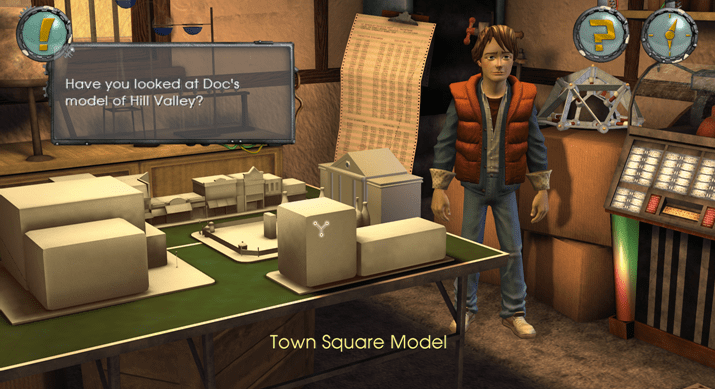
Player interactions seems more of an emphasis than in other Telltale Games.

Interestingly, Back to the Future: The Game plays very differently from the Telltale Titles I’ve played before; unlike titles like Batman: The Telltale Series (Telltale Games, 2016), Back to the Future features much more emphasis on exploration and player movement over quick-time events or altering the story through a variety of responses. Sadly, though, the game’s controls are quite stiff and clunky; Marty plods around like wading through thick sludge and, while you can hold B to “run”, you’ll never move much faster than a sluggish pace. Considering the game is a glorified point-and-click adventure rather than an action-packed game, this isn’t a massive issue except that the game’s dodgy camera and some awkward map layouts can make it more of a chore to control Marty than it needs to be and I found myself getting unnecessarily turned around or confused thanks to the camera’s positioning or stuck on parts of the environment.
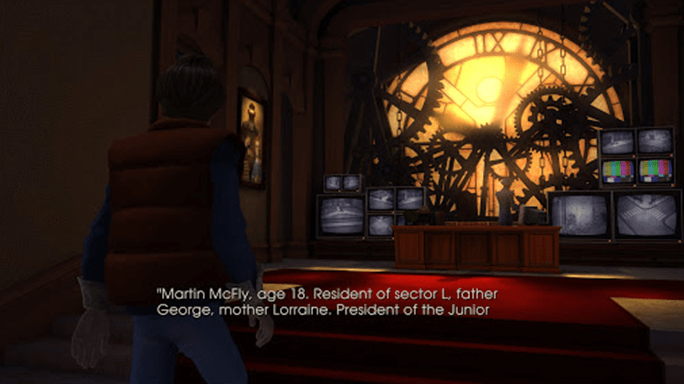
Sadly, you can’t skip cutscenes, which can make repeated playthroughs tedious.

As the game was originally released in five separate chapters, this collected edition is similarly divided in such a way; from the main menu, you can select any chapter at any time and begin a new game as you wish but you’ll need to make liberal use of the game’s save function if you want to earn all of the game’s Achievements with a minimum of fuss as there’s no way to jump to different parts of each chapter. This also affects the game’s replayability as there’s no way of skipping cutscenes or quickly advancing through story elements, which can make subsequent playthroughs far more tedious than they need to be and make gameplay frustrating when you’ve made a mistake and have to sit through entire cutscenes or lines of dialogue with no way of skipping them.
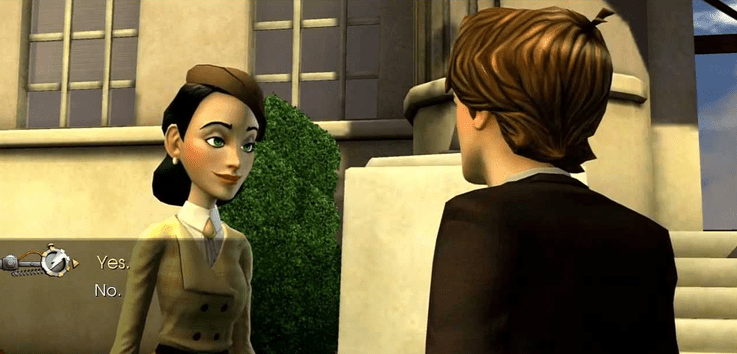
It can be amusing to try out different dialogue options and items just for the hell of it.

As far as I can tell,  unlike other Telltale Games, there’s no way to really “lose” when playing Back to the Future: The Game; even if you fail to figure out some puzzles or events, you won’t get a traditional game over screen and can simply continue until you get the right sequence or choose the right dialogue option. It can be amusing to select the wrong option and see how characters react or to try and use various items on other characters or parts of the map as Marty, or other characters, will generally have something funny to say or will chew you out for being stupid. The bulk of Back to the Future: The Game’s “action” is made up of character interactions and interacting with the various detailed environments you find yourself in. You can talk to and interact with pretty much everything, learning more about these familiar and new characters and the various timelines Marty ends up in, which can be fun and interesting. Generally, you’ll pick up subtle hints and tips by talking to certain characters but you can also enable or disable in-game hints and mission objects to give you a vague idea of where you need to go and what you need to do. Because of this, it can sometimes be a little difficult to figure out exactly what it is you need to do; you can take your time and explore multiple options at your leisure but, if you’re chasing Achievements, you might want to use a guide as there are a lot of missable Achievements in this game and it can be tiresome having to play through the majority of one of the game’s five chapters just to get to the part you need.
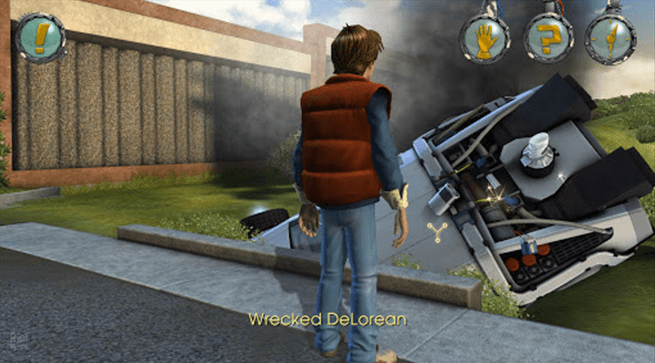
It can be awkward to target people and items with the game’s clunky controls.

Compounding the issue is that the game’s interface is quite clunky at times; you can access your inventory at any time with X. From here, you can examine items and place them into your hands to use on other characters or your environment but, oddly, items will automatically remove themselves from your hands after a few seconds, which gets very annoying as you might find an item you need to use has randomly vanished from your hands right as you need to use it. Similarly, it can be difficult to interact with characters and other elements thanks to the game’s clunky “targeting” system; as you wander around, points of interest will be automatically highlight so you can interact with them but your point of interest might suddenly switch as you get closer, meaning you talk to the wrong person at the wrong time. By holding down the R trigger, you can see every element in the immediate area highlighted and use the right analogue stick to select the one you want but I found this to be equally awkward and clunky and that it was generally easier to just position myself near where I needed to be and edge myself closer to my intended target.
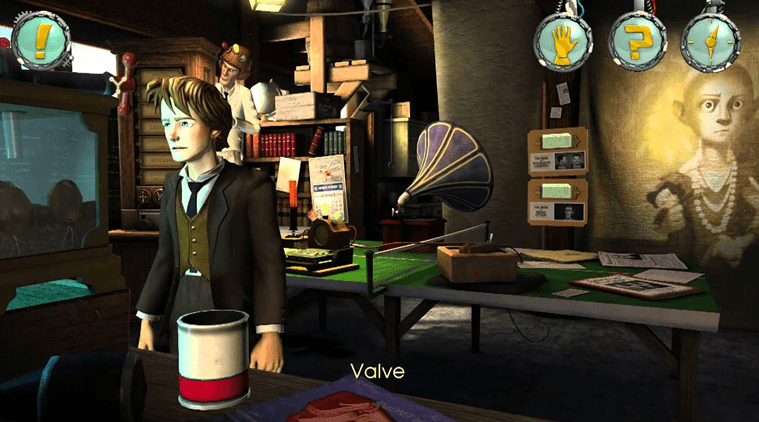
Some of the game’s puzzles are needlessly obtuse and annoying.

Even without these issues, some of the game’s puzzles can be needlessly frustrating; most are a simple case of talking to the right people to learn what you need or where to go but others involve pressing panic switches at the right time, selecting items around your environment to distract other characters, or finding certain items to convince a character to help you. While most of them boil down to a simple case of trail and error, and some are quite fun (like getting into a play-off against Marty’s rival and recreating his iconic and elaborate guitar performance from the first film), others are extremely complex or annoying. In particular, you’ll be required to listen out for certain code words from Doc’s younger self to correctly make rocket fuel (which must be done flawlessly to earn an Achievement), tediously manipulate your environment to create an incriminating Mind Map, or rescue your younger father with as little disruption as possible.

Graphics and Sound:
Like all Telltale Games, Back to the Future: The Game utilises a distinctly cartoony visual aesthetic that takes the general likeness of the franchise’s iconic characters and transforms them into amusing and charming caricatures of themselves. It’s a unique aesthetic, to be, sure and, while it does work for this style of game, characters can tend to look a little…off, at times, plodding and jerking around like marionettes and looking quite basic. I also noticed a few oddities and graphical glitches at times, such as items not breaking like you might realistically expect, background elements glitching out, or items and graphics randomly vanishing from cutscenes.
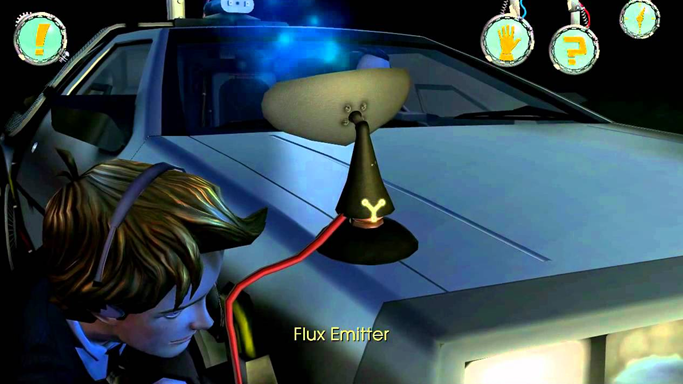
The graphics and aesthetic are decent if a bit bland at times.

The game’s environments can be quite bland, at times, but all the iconic locations you remember from the films are here: Marty’s house, Doc’s lab, and, of course, the iconic clock tower and town square. While the maps and environments aren’t especially large, they are varied in that you can enter different buildings in different chapters to learn more about different characters, and there’s generally a lot to do, see, and interact with despite how empty and lifeless some of the locations can be. It’s simple but largely very effective and, thanks to the game visiting new time periods (mainly 1931 and another alternative timeline), adds new wrinkles to the lore of the franchise.
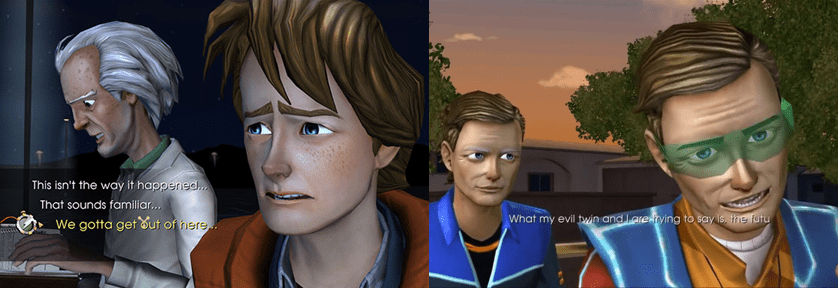
The game’s soundtrack and voice acting elevate it and add to its appeal.

Honestly, my only real complaint with the game’s visual style is that Marty takes his appearance largely from the first movie; I don’t know why it is that so much Back to the Future merchandise only ever seems to recreate his attire from the first film rather than giving him a new look but it’s a little disappointing so I was glad to see him dress in period-appropriate clothing as the story progressed. Of course, what really makes Back to the Future: The Game an attractive prospect is the top-notch voice acting (A.J. Locascio does a great Michael J. Fox impression, Lloyd is fantastic as always as Doc (if noticeably aged in his gravelly delivery), and Fox himself even crops up in the game’s final chapter for a voice cameo) and the soundtrack, which is largely comprised of Alan Silvestri’s iconic score from the movies. It’s just a shame, then, that a lot of the game’s dialogue is muted or drowned out by the music or sound effects, meaning you may need to adjust the audio settings from the main menu.

Enemies and Bosses:
Given the nature of the game, there aren’t traditional enemies or bosses as in other videogames; instead, as per the plot, you will be stopped or obstructed by numerous characters who require you to say the right thing, bring them certain items, or you to perform a certain action before they will help you or let you pass. As you might expect, you’ll run into Biff Tannen and his various ancestors and incarnations throughout the game’s story. His father, mobster Irving “Kid” Tannen is one of the game’s primary antagonists while you’re back in 1931. You’ll need to work with Marty’s father to get Kid arrested, lie to him about your credentials as a mobster, and set up an elaborate series of events to burn him out of a high-rise window as he shoots at you with a Thompson machine gun. After Marty and Doc inadvertently alter their future, you’ll also have a confrontation with Biff and his newly-acquired brothers, dodging swings from their baseball bats until you can get them all in position to be electrocuted.
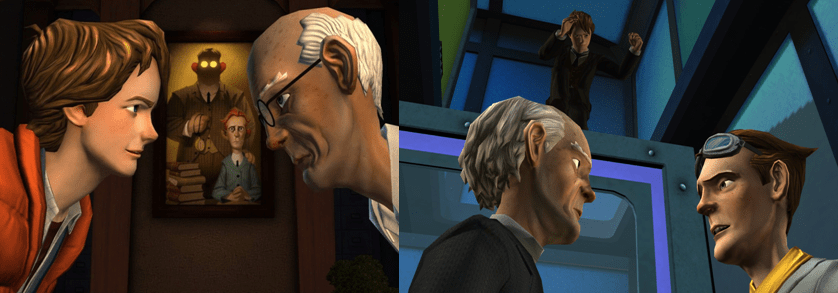
Citizen Brown is an antagonistic version of Doc who plots to keep his timeline intact.

After altering the past in 1931, Marty crash-lands in an alternative version of his present in which Hill Valley is a veritable utopia thanks to a stringent police state lorded over by none of than a heavily altered version of Doc, known as “Citizen Brown”. While Marty is able to win Doc over and make him see that his dreams have been perverted by his new wife, Edna Strickland, this version of Doc later grows directly antagonistic when he has second thoughts about restoring Marty’s timeline. This leads Marty into directly opposing his friend and mentor to ensure that Doc’s younger self stays on the path towards science rather and societal correction.

Edna comes in many forms and is the game’s primary antagonist and all-around pain in the ass.

As a result, the game’s primary antagonist turns out to be Edna Strickland, a seemingly harmless character in the game’s first chapter who ends up manipulating Doc’s brilliance into brainwashing the “hooligans” of Hill Valley into being more law-abiding and docile civilians. So committed against sin and vice is Edna that it leads her to not only burn down the local speakeasy, setting in motion the events of the game’s plot, but also stealing the time machine and accidentally erasing Hill Valley from existence. When Doc and Marty travel back to 1876 to confront her, they must manipulate her fragile state of mind to learn the date and time of her arson to set things right, which ultimately leads to the player having to set up an elaborate trap involving sand bags and a chandelier to end her misguided plot.

Power-Ups and Bonuses:
As an interactive movie, there aren’t really any power-ups in the traditional sense of the word to be found. Instead, as you interact with others and further the plot, you’ll acquire a variety of items to be used in specific situations. Some of these will need to be handed to Doc’s faithful dog, Einstein, to progress the story or set up distractions and events you need to move the plot along, others will need to be brought to specific characters to convince them to help you or otherwise alter their destinies.

Additional Features:
There isn’t really much else to Back to the Future: The Game; as mentioned, there are a number of Achievements to acquire, with a lot of them being easily missed without a guide, which is probably where the bulk of your next playthrough will be concentrated. Don’t get me wrong, the game’s story (essentially a new take on the familiar story beats of the original trilogy) and the voice acting is entertaining enough to warrant another playthrough but, as you can’t really affect characters in the same way as in other Telltale Games, there isn’t as much incentive to try different dialogue options as in the studio’s other releases. The 30th Anniversary Edition of the game also comes with a behind the scenes video…that can no longer be viewed as the servers and Telltale’s website have long been shut down. I would have expected this edition of the game to come with, at least, a gallery of concept and development art but apparently this was too much to ask for and you simply get a questionably improved version of the base game.
The Summary:
Your enjoyment of Back to the Future: The Game will most likely depend on how enjoyable you find glorified point-and-click adventures and your level of patience. It’s not an especially hard or lengthy title (each chapter takes maybe an hour or so, depending on how you get on with the game’s vague hints and fetch-quests), nor or is an especially attractive or complex game, but it’s a fun enough distraction for what it is, with far more required of the player than other Telltale Games I’ve played. What elevates the game is, of course, the voice acting and the level of fidelity it has to its source material. As a continuation of the trilogy’s storyline, the game works incredibly well, advancing each character’s story while still exploring new, unseen avenues into their pasts and characterisation. Like Ghostbusters: The Video Game (Terminal Reality/Red Fly Studio, 2009), Back to the Future: The Game is a worthy continuation of a beloved franchise that is let down only by some graphical and gameplay hiccups and, perhaps, the genre of game the films have been adapted into. Had the game, perhaps, mixed up some of its methodical pace and adventure aspects with a few more action-orientated sections (like actually driving the DeLorean or taking part in one of the iconic chase scenes) and had some actual branching pathways, it might have been even better but, as is, it’s an inoffensive and decent enough little game.

My Rating:

Rating: 2 out of 5.

Could Be Better

Did you ever play Back to the Future: The Game? If so, what did you think of it? Did you find any oddities or get scuppered by the odd camera and control scheme? What did you think of its plot and attempts to continue the Back to the Future trilogy? Which Telltale Game, or Back to the Future film, is your favourite and why? How are you celebrating Back to the Future Day today? Whatever you think about Back to the Future, feel free to share your thoughts in the comments below.


Game Corner: The Evil Within (Xbox One)

Released: 14 October 2014
Developer: Tango Gameworks
Also Available For: PC, PlayStation 3, PlayStation 4, Xbox 360

The Background:
Shinji Mikami joined Capcom in 1990 and worked on a number of successful handheld, 8- and 16-bit titles during his first six years with the company. In 1996, though, Mikami developed the first Resident Evil (Capcom, 1996) videogame, which not only popularised the “survival-horror” subgenre but was an incredible success upon release. Since then, Mikami spearheaded or was heavily involved in Resident Evil’s sequels and spin-offs, including taking over as director of Resident Evil 4 (Capcom Production Studio 4, 2005) and changing the direction of the franchise. However, by 2010, Mikami had left Capcom to develop new properties and titles under Tango Gameworks; the first of these was The Evil Within (known as Psycho Break in Japan), a title which Mikami aimed to return to the roots of the survival-horror genre, which had become increasingly actionorientated over the years. Despite some criticism regarding technical issues, The Evil Within was received rather favourably; while some struggled with the game’s difficulty and convoluted plot, the atmosphere and horror elements were notably praised. The game was also the second-best selling game in the United Kingdom upon release and earned an even more highly regarded sequel in 2017.

The Plot:
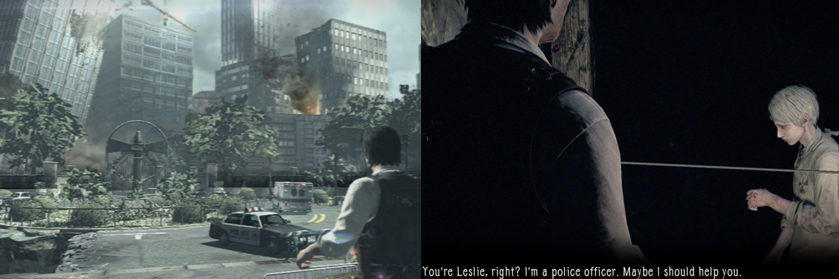
After arriving at a brutal massacre, Detective Sebastian Castellanos is pulled into a distorted world full of nightmarish locations and horrid creatures after pursuing a mysterious, seemingly supernatural hooded figure known as Ruvik. Trapped with limited resources and relentlessly hunted, Sebastian is left to fight for his survival and uncover the mystery of Ruvik and the horrific world Sebastian’s found himself trapped in.

Gameplay:
The Evil Within is a survival-horror videogame very much in the style of Resident Evil 4 in many ways; my experience with the Silent Hill franchise (Konami/Various, 1999 to 2014) is sadly limited but, from the bit I’ve played of the first game, The Evil Within is clearly heavily borrowing from the more nightmarish and twisted reality of Silent Hill than the virus-heavy narrative of the Resident Evil franchise. Like in Resident Evil 4, you have full 3600 control of your character and the camera rather than being restricted by tank controls and set camera angles, and you’re also given much more options in terms of combat. You can melee attack with Y using your fists or bottles, interact with the environment with A, burn bodies and pools of gasoline with your limited supply of matches with B, aim with LT and shoot your weapons with RT, reload with X, and spring with LB. you can’t hold the sprint trigger down for too long, though, as you’re hampered by a stamina meter and Sebastian will be left vulnerable and out of breath if you run for too long.

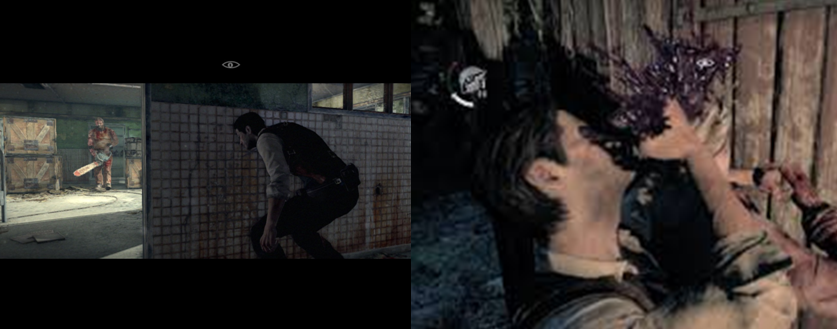
Sneak past enemies or creep up behind them to pull off an instant kill move.

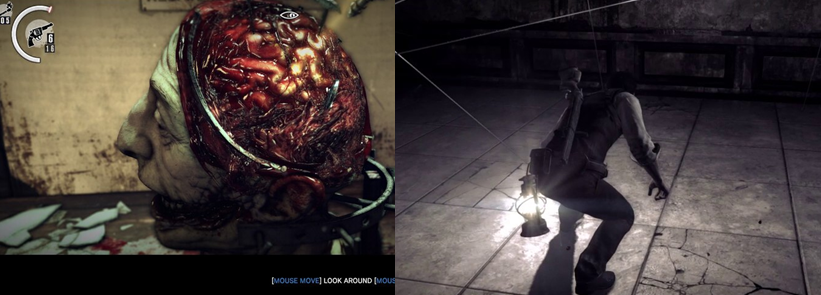
One of the big mechanics of The Evil Within is the sneaking and stealth-based gameplay that is pushed as a big thing in the first few chapters of the game’s story and then all but vanishes for the bulk of the gameplay as you’re given more ammo and weapons, before rearing up again near the finale of the game. You can use RB to sneak around when enemies are nearby and a helpful eye-themed “Enemy Alertness” icon will let you know when enemies are unaware of you or actively searching for you. When the eye widens, you should sprint out of site or hide inside a nearby locker or wardrobe until the danger has passed but be careful as enemies will pull you out of your hiding place if they see you try to hide. Still, if you manage to sneak up behind enemies, you’ll be able to pull off an instant kill move with a press of the A button but I found enemies become very aware of your presence even when you’re being super stealthy so this was often quite tricky to pull off. As much of the game is seeped in an unsettling darkness, you can also use your lantern by pressing in the left analogue stick to light the way but this will also attract nearby enemies (though, again, this becomes less of an issue hen you gain more resources).

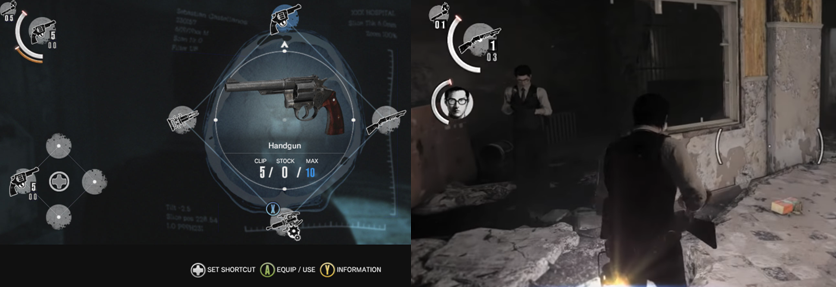
Set your weapons and healing items to the D-pad for quick use and take advantage of any backup.

Like all great survival-horror titles, The Evil Within excels in building a horrific, foreboding atmosphere thanks to its unsettling, often gruesome visuals and twisted, reality-bending narrative. To help with this, the heads-up display (HUD) is extremely sparse to increase your immersion in the game’s horrifying locations and narrative. You’ll see your health, stamina, and currently-equipped weapon and ammo and that’s about it unless you’re joined by one of Sebastian’s partners, like Joseph Oda, who often help you out with some additional firepower. If they’re attacked, you can fend off their attackers and heal them by holding down A (which helpfully doesn’t waste your own healing resources). You can set your weapons and healing items to the directional pad (D-pad), which helps you to quickly switch weapons or replenish your health without going into the inventory wheel, which slows the in-game action to a crawl but doesn’t pause it completely and can thus leave you vulnerable.

Puzzles are few and far between in The Evil Within but are suitably macabre (and a bit unfair, at times).

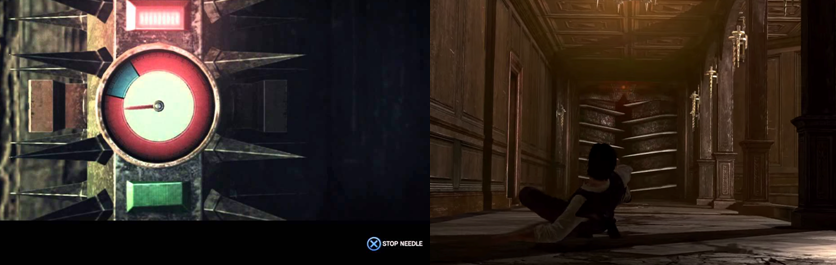
Interestingly, The Evil Within is surprisingly light on puzzles, labyrinthine environments, and the use of keys and other items to progress. Occasionally, you’ll have to acquire a key to open a door or work your way through a grim and grimy location avoiding instant death traps, fending off enemies, and running from Ruvik as you try to open a central door, but these moments are few and far between. Instead, The Evil Within is a much more linear game than its forefathers, meaning that you’re not afforded a map this time around. For the most part, this isn’t an issue but it wouldn’t have hurt to have a map available since a lot of the environments are a bit grey, dark, and look alike so it can be easy to get turned around sometimes. As a result, though, you never really have to worry about pushing statues or getting a bunch of extraneous items or combining them together and, instead, will be more focused on blasting enemies or bashing their heads in than worrying about jewels. However, when puzzles do crop up, they’re fittingly gruesome: you’ll have to insert probes into brains while looking at nearby diagrams and listening to audio tapes, press the right buttons on surgery tables to avoid being skewered and reveal a hidden exit, sneak past wire traps and rush through spiked traps, and shut off valves of steam or activate flames to get past certain areas, and turn a few dials here and there in order to progress, take out enemies, or free your comrades.

You’ll need to constantly watch out for traps and hazards that threaten to skewer or explode you.

During Chapter 11, though. you’ll also have to shoot down corpses hanging above the flooded streets in order to distract and swim past a monstrous creature, which can get pretty tense as your window of opportunity is very small, and you’ll also be chased by chainsaw-wielding berserker’s and suddenly ensnared in traps that you must shoot or run out of or face a grisly end. Indeed, traps and hazards such as these are one of the most recurring dangers in the game; these are dotted around every location, springing up on you when you least expect it and often skewing you or blowing you into bloody chunks with little warning. Many of these will result in instant death, requiring you to retry from your last save point, but others can be disarmed by holding A, sneaking up on them, or pressing A at the right time in a small mini game. Disarming traps such as these will net you additional junk (which you can also acquire by smashing crates and such), which is used in the game’s (thankfully) extremely limited crafting system to create ammo for your “Agony Bolt” crossbow. You’ll also find Green Gel in jars and bubbling on the floor after you defeat enemies; be sure to grab this whenever you see it as you’ll need it to upgrade Sebastian’s abilities and weapons in the game’s haunting save areas.

Graphics and Sound:
Honestly, The Evil Within is quite a bland game in many ways; much of the environments take place in such uninspired locations as a hospital, sewer, grimy caverns, and gothic laboratories, meaning that a lot of the colours are subdued and feature a lot of black, grey, and brown. However, the game excels in the use of lighting and a perverse, macabre atmosphere that really adds to the sense of dread and tension in every area. Things may look perfectly normal one minute and then, very quickly, become warped either by Ruvik, Sebastian’s apparently fragmenting mental state, or the presence of certain enemies.

Environments are forboding and ominous, if a bit drab and interchangeable at times.

Bodies, bloodstains, and gore are in abundance in almost every area you visit; you’ll find dismembered corpses, flickering lights, smashed up areas and some truly disturbing labs and operating theatres that more closely resemble torture chambers or slaughter houses. Sebastian’s journey takes him through a variety of locations, all of which are generally seeped in a thick, ominous darkness or carry an menacing sense of dread thanks to the carnage that surrounds him or the use of screams and ambient sounds (mostly haunting, almost taunting voices). There’s also some cool weather effects on display; rain splatters on the screen, wind blows through trees and grass, and environments twist and change as Ruvik bends them to his will with often devastating effects.

Much of the game draws visual inspiration from Resident Evil, Silent Hill, and other horror franchises.

When The Evil Within breaks free from restrictive corridors filled with barbed wire, wreckage, and corpses, it really starts to feel much more unique amongst other survival-horror videogames; you’ll wander through the castle-like ruins of weird mish-mash of cultures, venture through a city that is constantly shifting and changing and collapsing around you like something out of Inception (Nolan, 2010), but you’ll also recognise a number of the tropes and references to Resident Evil along the way. The hospital and laboratories of the game, for example, are very reminiscent of Umbrella’s facilities, as is the mansion you eventually explore; you’ll also spot a few familiar typewriters but the game also evokes imagery from Silent Hill through its narrative and horror franchises like The Ring (Various, 1991 to 2019) and Hellraiser (Various, 1987 to present) in its enemy designs.

Sebestian might not be the most compelling character but he’s thrust into some horrific situations.

While the game’s use of music and ambient sounds is pretty good, if uninspiring at times, it’s the lapses in sound and use of ominous groaning or wails of some unspeakable eldritch abomination that really add to the game’s unsettlingly atmosphere. The voice acting is okay, for the most part, but kind of reminds me of the B-movie delivery of games like The House of the Dead (SEGA AM1, 1996) and even the original Resident Evil while still treating the events of the game with a grim seriousness that further emphasises that its meant to be unsettling and disturbing rather than thrilling or cheesy. Sadly, thanks to the nature of the game’s narrative, the plot is all over the place; much of the narrative is focused on Sebastian trying to figure out the mystery of Ruvik while the world literally falls apart around him and questioning his sanity but it turns out to be this weird, pseudo-virtual reality environment of sorts that really isn’t elaborate don all that much in the game’s cutscenes or dialogue. Instead, you’ll have to root through the many mysterious and ominous documents and the comments of non-playable characters (NPCs) around you to get a better idea of what the hell is actually going on which, while creating a bit of a disconnect between me and Sebastian’s plight, I found did lend to the nightmarish appeal of the game as it was literally like playing through some ghastly nightmare where nothing makes sense and the world is full of shrieking, gabbling zombie-like creatures and unspeakable horrors and gore.

Enemies and Bosses:
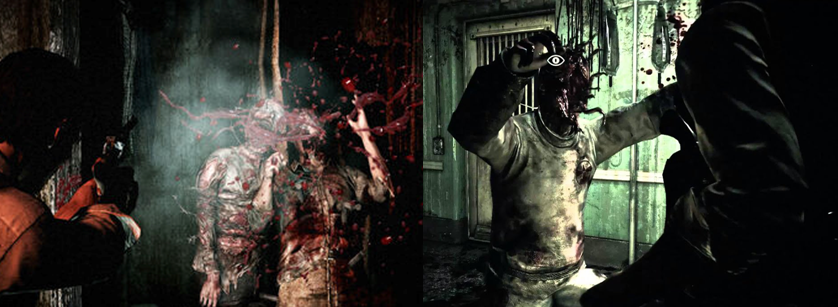
As you desperately plough your way through the game and try to figure out just what the hell is going on, you’ll find yourself besieged by a number of grisly creatures that literally come to life before your eyes as corpses stagger upwards, seemingly innocent blood stains burst free with screaming ghouls, and enemies burst apart into freakish abominations. The most common types of enemy you’ll encounter are known as “The Haunted”; these dishevelled reanimated corpses are like a cross between zombies, Cenobites, and the Las Plagas enemies of Resident Evil 4 and will stagger and rush at you in a blind fury looking to take a bite out of your neck. They’re also capable of attacking as a group and with weapons such as knives, crossbows, and even guns, and will eventually don body armour and wield machine guns, shotguns, Molotov cocktails, and can even activate traps by pulling levers. Thankfully, they go down relatively easily, especially after a few shots to the head, but you’re also encouraged to burn their bodies upon defeat to avoid them springing to life once more.

Ghastly, zombie-like enemies will rush at you and attack using edged weapons, explosives, and even firearms!

The haunted come in all shapes and sizes, including much bigger and more rotund enemies who can tank your shots, ones who rush at you in a suicide run, and even ones that appear invisible until the moment before they strike. You’ll also have to contend with some disturbing little baby versions of the Haunted that seep out through walls and drop from the ceilings, but these are easily dispatched with your melee attacks. You’ll also encounter far larger versions (who are best avoided rather than tackling directly unless you have some heavier weaponry on hand) and the disgusting AlterEgo variants who shamble about the place, take far more damage to defeat, and puke up viscera onto you when they got close to you!

The game’s bigger, more dangerous sub bosses will require your more powerful weapons to put down.

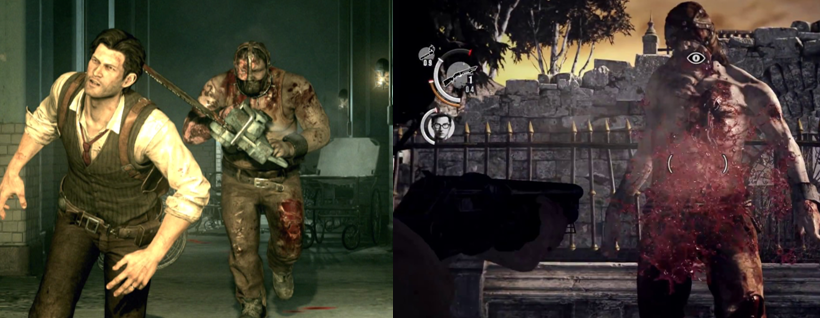
Such larger, more grotesque enemies serve as The Evil Within’s mini bosses; the first enemy you encounter, for example, is the chainsaw-wielding Sadist who cannot be harmed. Instead, you have to frantically run from him and sneak around him to avoid being sliced in two but, later in the game, you’ll encounter these brutes as mini bosses in increasingly confined areas; thankfully, by then you’ll be packing a shotgun and some explosive weaponry so they’re not too difficult to put down as long as you keep away from the wild swing of their chainsaws. Similarly, while exploring Cedar Hill Church, you’ll have to fight past the misshapen, monstrous formally conjoined twins Neun and Zehn, who rush at you and try to smash you into a bloody puddle in a confined area. Luckily, Joseph is on hand to offer support with a sniper rifle and you can use your more powerful weapons to slow them and finish them off one at a time.

The Keepers are similar to Pyramid Head but are much easier to put down…with the right weapons…

Another prominent sub boss, of sorts, is the Keeper; these hulking creatures wield meat cleavers and pursue you with a screen-distorting effect and dropping barbed wire mine traps on the floor. Because their heads are protected by a metal safe, the only way to kill these bastards is to aim for the ample chests but, quite often, killing one will simply cause another to spawn out of nearby safes, which can also spring to life and attempt to attach to your face. As a result, a mixture of stealth and tactics are advised when facing the Keepers, which can often be avoided altogether and mainly serve as a formidable distraction while you try to shut off steam valves and progress further.

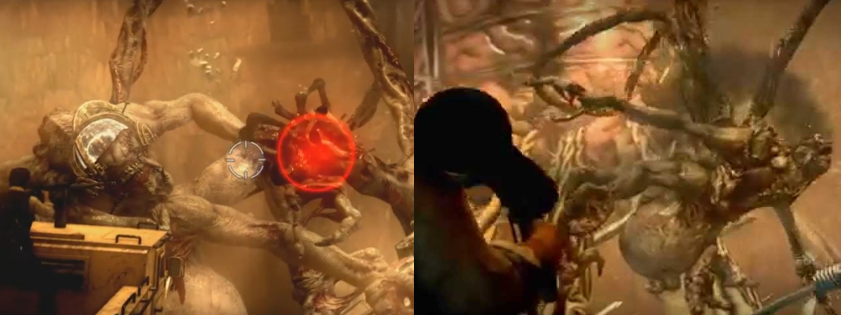
The Amalgam Alpha was a horrendous boss figh, especially when it enters its second phase and eats you!

As you might expect from the man behind Resident Evil, you’ll also have to battle a number of bizarre and monstrous creatures to progress; one, the Sentinel, is a giant wolf-like creature transformed into a hideous monstrosity and which likes to hide in nearby bushes before pouncing on you and trying to bite your face off. Another is Quell, a massive octopus-like creature that attacks you in the sewers and likes to hide in pipes and grab you with its tentacles; when it does, you have a small window to shoot its face to damage it and save yourself from a gruesome end. Easily the most prevalent and annoying, however, is the Amalgam Alpha creature, which appears to be an eldritch, nightmarish spider/scorpion hybrid that rampages through an underground car park and was, easily, the toughest and most annoying boss fight of the game. This thing is really big and its weak point (an eye on either its tail or within its gaping mouth) can be really tricky to hit; luckily, the car park is full of ammo and other resources but you’ll have to be quick on your feet to avoid its super frustrating instant kill move.

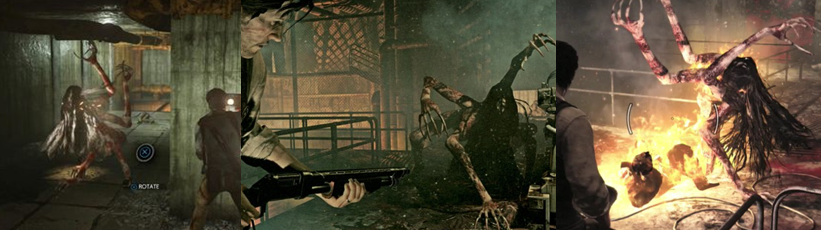
Laura is a shrieking, persistent threat best staved off with fire and avoided lest she pummel you to death!

As Ruvik remains elusive for most of the game, the most prominent antagonist you’ll face for most of the game is Laura, an onryō-like girl who emerges, shrieking and wailing, from bubbling bloodstains in certain parts of specific chapters and scuttles after you like a spider, instantly smashing your head in if she gets a hold of you. You’ll encounter Laura three times over the course of the game and she gets more aggressive and difficult to face each time: in the first encounter, you simply have to run around a corner and set alight a pool of gasoline to scare her off but you’re then forced to battle her in an incinerator room. Here, she demonstrates her ability to teleport and emerge from nearby corpses so you’ll have to make sure that you burn these and arm yourself with nearby torches to stave her off but the only way you’ll defeat her is to trick her into spawning inside of one of the incinerators and pulling the lever. The last battle against her is even worse as it has multiple stages that see you fending her off by shoot levers on pipes to spew fire at her and desperately making your way towards an elevator before she can grab you. While it is possible to do her in using nearby flame traps and your conventional weapons, it’s worth coming back after you’ve unlocked the rocket launcher to make these fights easier as she’s basically indestructible otherwise.

You’ll battle Ruvik’s monstrous final form without fear of exhausting your precious resources.

Finally, there’s the primary antagonist himself, the mysterious Ruvik, who is apparently the mastermind behind all of the game’s events. Occasionally, Ruvik will spawn into a location and begin to chase you; if this happens, my advice is to run as fast as you can and hide in a wardrobe or under a bed until he disappears as he’ll explode you into bloody chunks otherwise. Later, you’ll encounter Haunted who assume his guise, who can be easily put down without much trouble, and the entire final chapter of the game is dedicated towards making your way to a final confrontation with Ruvik. Here, he merges with the Amalgam Alpha to become the Amalgam, a Lovecraftian beast that you must run from as it chases you up the side of a building before commandeering a machine gun and a rocket launcher to finish him off for good. In this final boss fight, you don’t need to worry about expending your ammo or running around in a panic; you simply have to move to the left or right to avoid his claws, aim for his head, and try not to miss withy our rockets. Eventually, you’re given a split second to shoot the final bullet at Ruvik’s exposed head but it’s okay if you miss as the autosave point is right before this section so take your time and put an end to him for good by stomping on his exposed brain.

Power-Ups and Bonuses:
As you explore the many nightmarish environments of The Evil Within, you’ll find a lot of junk and helpful items to pick up, especially if you smash open crates and open up any drawers or cupboards. You’ll acquire syringes and medical kits to restore your health (these latter will also briefly extend your health at the cost of a few seconds of disorientation), ammo for your weapons, matches, and Green Gel. You’ll want to grab as much of these as you can (be sure to reload your weapons and cycle through your Agony Bolt variants to stockpile as much ammo as possible) in order to have the best chance of success in combat.

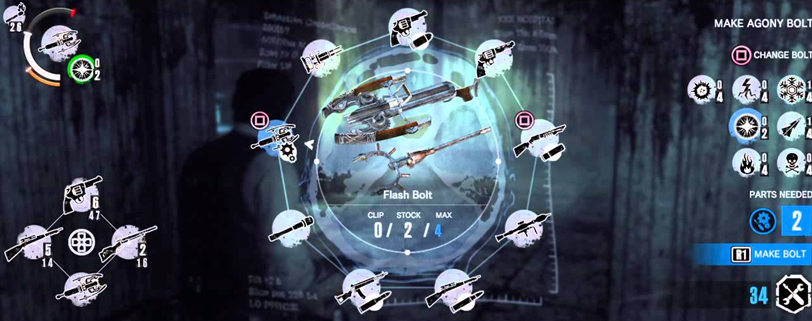
In addition to the usual firearms, your Agony Bolt can fire a number of different arrows.

Sebastian is afforded all the usual weapons you should expect from a survival-horror videogame; begins with a simple pistol but soon acquires a shotgun, the aforementioned Agony Bolt, a sniper rifle, and even a magnum as the game progresses. These can usually be found in attaché briefcases so be sure to explore your environments fully to get your hands on more weapons and ammo, and Sebastian can also make use of nearby bottles to throw at and bash enemies with, pipebombs, and explosive barrels (which he can also awkwardly kick around to best destroy enemies). In addition, the Agony Bolt can shoot multiple different types of arrows, from explosives to freezing blasts to stun shots, all of which can be either found in the environment or crafted with a simple press of a button from the inventory menu.

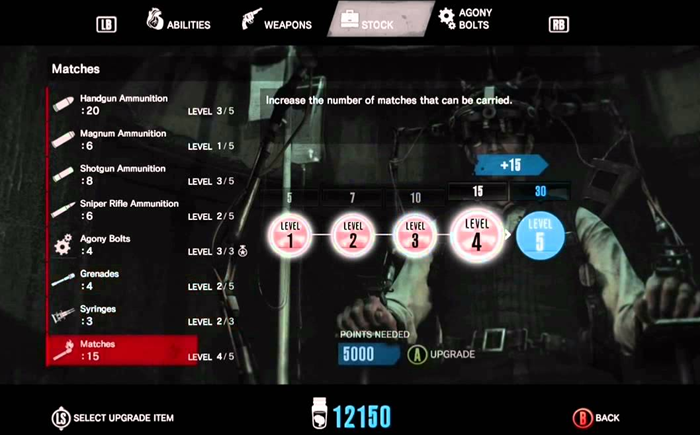
Find Green Gel to upgrade Sebastian’s abilities, ammo, and weapons.

At numerous points throughout each chapter, you’ll find mysterious cracked mirrors that transport you to the save room. Here, you can use any keys you find from breaking special statues to open up lockers and access some extra ammo and also use your Green Gel in a very ominous looking chair. This allows you to upgrade Sebastian’s abilities, such as his maximum health and stamina and melee damage output, and weapons, allowing you to increase your maximum ammo capacity, reload time, accuracy, and overall effectiveness for each weapon. It’s worth stockpiling Green Gel and spreading it wisely to increase Sebastian’s health and the amount of matches he can carry while also focusing on each weapon at a time; I favoured upgraded the shotgun and saved that for the more troublesome enemies but you may prefer to upgrade the Agony Bolt or sniper rifle.

Additional Features:
There are forty-one Achievements on offer in The Evil Within, many of which require a bit more strategy to unlock than simply clearing every chapter. Indeed, almost every chapter of the game has a specific requirement to unlock an Achievement, such as defeating a Sadist with a stealth kill, surviving an onslaught of enemies without Joseph being hurt, or killing Laura rather than simply outrunning her. You’ll also get Achievements for more mundane things, such as stealth killing five enemies in a row without being discovered, upgrading weapons and skills, or killing a certain number of enemies in specific ways, as well as finishing the game on higher difficulties or without any Green Gel upgrades.

Clear the game to unlock bonus weapons, new difficulty levels, or purchase the DLC for extra story content.

The game has four difficulty settings, with two available right from the start; while you can lower the difficulty at any time, you can’t raise it and, after finishing the game, you’ll unlock additional weapons to use in the ‘New Game+’ mode, which allows you to replay any chapter on the difficulty you cleared it on. You’re also given 50,000 Green Gel points to spend and unlock a model viewer but, annoyingly, your rocket launcher and machine gun have limited ammo, meaning you can’t just plough through the game’s chapters willy-nilly. Still, it does give you the edge in tracking down any statue key, map pieces, and documents you missed the first time through and working toward 100% completion. There are also a couple of expansion packs available to download that add an extra thirty Achievements to the game in addition to expanding upon the story with new playable characters and enemies to battle. I haven’t actually bought this, however, so it’s not my place to comment upon it but the game was appealing enough that I may explore this extra content later down the line (or if there’s a sale on).

The Summary:
The Evil Within certainly was a disturbing head-trip of a videogame; very little about it makes sense as you play it, with the events appearing to be the result of Sebastian slowly going insane but eventually being revealed to be the results of some bizarre experiment that, even now, I’m a bit unclear on. The result is a very unpredictable and gameplay experience full of unsettling imagery and enemies, gore, and ghastly creatures of all shapes and sizes that pull from a variety of other media and horror elements and mash them together in a truly nightmarish and ominous videogame that maintains a constant sense of dread and anticipation as you’re never quite sure what’s going to happen next as Sebastian is battered and tossed all over the place through a constantly shifting nightmare world.

While it can be annoying and tedious, the game does a great job of conveying a macabre and ominous dread.

Having said that, though, there were a few flaws in the game. It’s not always immediately clear where you need to go as environments tend to look the same (especially in chapters set within the hospital or similar locations), some of the boss battles and enemies were ridiculously unfair thanks to them having one-hit kill moves in their arsenal (something I’m always frustrated by), and expanding Resident Evil’s save rooms out to a whole area was a bit laborious at times when I just wanted to quickly save without having to trudge about in the slowly-dilapidating hospital foyer. Still, it was a harrowing experience, one that really conveyed a tangible sense of dread and horror; Sebastian might not be the most compelling or dynamic character but his “Everyman” persona worked well with the increasingly insane and macabre things he was faced with and it was nice to feel that sense of foreboding menace once again, even if the game does veer more towards action than survival-horror thanks to you have just enough ammo and resources to get through each chapter rather than having to constantly worry about inventory management.

My Rating:

Rating: 3 out of 5.

Pretty Good

Are you a fan of The Evil Within? Did you enjoy the game’s ominous atmosphere and mind trip of a story or was it too derivative for you? What did you think of Sebastian as a protagonist, his supporting cast, and Ruvik as the main antagonist? Did you enjoy all the allusions and references to other survival-horror videogames and horror media or do you feel like that got in the way of the game’s more unique qualities? Would you like to see more from the Evil Within franchise? Which survival-horror videogame or franchise is your favourite and why? Whatever your thoughts on The Evil Within, or survival-horror in general, drop a comment down below.

Game Corner [MK Month]: Mortal Kombat 11 Ultimate (Xbox One)


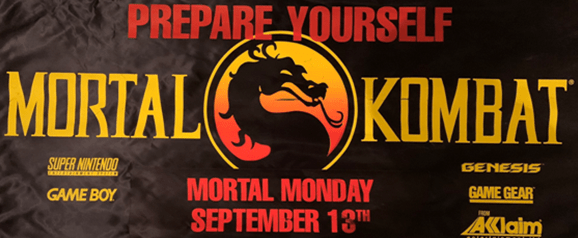
To celebrate the simultaneous worldwide release of Mortal Kombat (Midway, 1992) on home consoles, 13 September 1993 was dubbed “Mortal Monday”. Mortal Kombat’s move to home consoles impacted not only the ongoing “Console War” between SEGA and Nintendo but also videogames forever thanks to its controversial violence. Fittingly, to commemorate this game-changing event, I’ve been dedicating every Monday of September to celebrating the Mortal Kombat franchise.


Released: 17 November 2020
Originally Released: 23 April 2019
Developer: NetherRealm Studios
Also Available For: Nintendo Switch, PC, PlayStation 4, PlayStation 5, Stadia, Xbox Series X

The Background:
Mortal Kombat was a phenomenal success for Midway; thanks to its controversial violence and unique digitised graphics, the game stood out from the likes of Street Fighter II: The World Warrior (Capcom, 1991). While the franchise went from strength to strength during the 2D era of gaming, Mortal Kombat struggled to really stand out amidst a slew of revolutionary 3D fighters and, following the lacklustre release of Mortal Kombat vs. DC Universe (Midway Games, 2008), the series looked to be in serious trouble after Midway went bankrupt in 2010. Thankfully, Warner Bros. Interactive stepped in and the Mortal Kombat team was rebranded as NetherRealm Studios. Their first order of business was to get their violent franchise back on track, which they did with Mortal Kombat (NetherRealm Studios, 2009), a particularly well-received reboot of the surprisingly convoluted lore. This gritty, violent reboot again stirred controversy but sales of the game alone were enough to cover the costs of Midway’s acquisition and work on a follow-up soon began.

After the disappointing Mortal Kombat vs. DC Universe, Mortal Kombat made an impressive comeback.

Mortal Kombat X (ibid, 2015) instantly impressed and out-did its predecessor in every way, being both the most violent entry and having the biggest launch in the franchise’s long history at the time. Mortal Kombat X also scored very well and the success of the game earned it not just a host of additional downloadable content (DLC) but also an expanded version, Mortal Kombat XL, in 2016. Keen to capitalise on the good will they had earned back with these releases, NetherRealm announced the development of Mortal Kombat 11 at the Games Awards 2018, a game that saw the triumphant return of actor Cary-Hiroyuki Tagawa to the role of Shang Tsung and sold over eight million copies by October 2020. Like its predecessors, Mortal Kombat 11 received an expanded addition that included all of its DLC fighters and even additional story mode content and was met with favourable reviews, though some criticised the randomisation of the game’s unlockables and the overreliance on grinding, mechanics that, for me, affected the appeal of Injustice 2 (ibid, 2017).

The Plot:
After the defeat of Shinnok at the conclusion of Mortal Kombat X, Raiden has become corrupted by the Elder God’s amulet and, angered at the Thunder God’s repeatedly meddling in the fabric of space and time, the keeper of time (and Shinnok’s mother), Kronika, plots to rewrite history to erase Raiden from existence. With past versions of classic Mortal Kombat characters showing up all over the place, and Earthrealm’s most dangerous and long-dead enemies forging an alliance to usher in Kronika’s “New Era”, Earthrealm’s Special Forces and allies face a battle against time itself to keep the realms from being torn asunder.

Gameplay:
As you might expect by now, Mortal Kombat 11 Ultimate is a 2.5D fighting game in which players can pick from one of thirty-seven characters and battle through the game’s single-player story mode, fight one-on-one against another player or computer-controlled opponent, battle their way though a variety of arcade-style towers, or challenge other players to a variety on online battles. Battles take place in a best-of-three format and against a time limit, though you can alter these settings (and many others, including the difficulty of computer-controlled opponents) from the game’s comprehensive menu to speed up gameplay or make it more accessible.

One of the things I love about Mortal Kombat is that gameplay and combos are generally easy to pick up.

As in the other 3D Mortal Kombat fighters, fights in Mortal Kombat 11 are extremely accessible and easy to master. You can attack your opponent with punches with either X or Y, kicks with A or B, block with RT, throw (again, this is more like a grapple) with LB or X and Y and a directional input, and interact with the game’s environments when indicated with RB. You can also dash towards and away from your opponent, jump in or crouch down to attack or avoid projectiles, and string together combos by pressing the attack buttons and using directional inputs quickly. The game features a comprehensive tutorial mode that teaches you all of the basics and intricacies of the game’s combat, which gets deeper and more complex depending on your skill level and who you play as but is still extremely easy for even novice players to pick up and pull off a few simple combos.

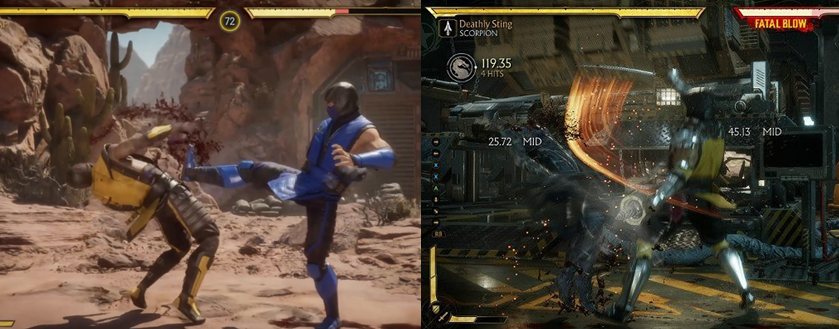
In addition to trademark special moves, characters can also pull off gruesome Fatal Blows.

Each character also boasts a number of special moves, also pulled off by a few simple button and directional inputs (back, forward, X, for example, or forward, down, B); these can be stringed together with combos and augmented with a well-timed press of RB (this will, however, drain a meter at the bottom of the screen but this will quickly refill in time). Unlike in the last two games, though, you can no longer build your meter towards a gruesome X-Ray move; instead, when your health is sufficiently depleted, you’ll have the option of pulling off a “Fatal Blow” once per fight (not per round) to mash your opponent into mush. While these are suitably impressive, violent, and gory, I have to say that I miss being able to build up to and pull off a momentum-changing special move whenever I want rather than when I’m near death. While special moves are pretty easy to perform, you can review them at any time from the pause menu and even “tag” team so they appear onscreen for easy reference, but I would have liked the option to pick and choose which ones are displayed for quick reference.

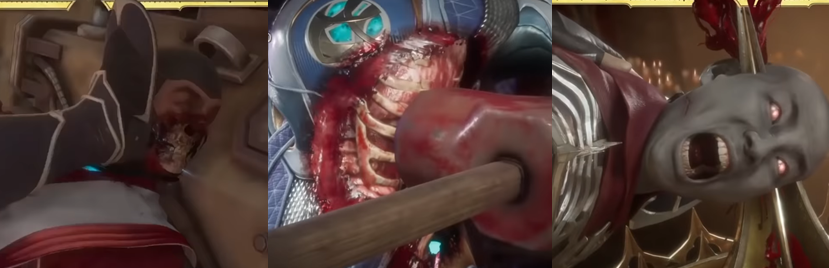
Fatalities are more visceral and gory than ever and see you dismembering and eviscerating your opponent.

As horrific as the Fatal Blows can be, though, the real star of the show is, once again, the game’s Fatalities, the trademark of the franchise. At the end of the deciding round (usually round two), you’ll be told to “Finish Him!!” (or her…) and given a short period of time to stand in a specific spot and enter another button combination to tear your opponent to pieces, usually resulting in their guts, brains, and eyes bursting from their body or them being shredded and blown apart. Every character has three Fatalities available to them: one that is readily available, one that is locked and must be unlocked in the Krypt (or looked up online…), and one that is assigned to pulling off special Fatalities in certain stages (“Stage Fatalities”, like the classic uppercut into an acid pit) and you can also find (or purchase) “Easy Fatality Tokens” to pull them off more easily and practice them in the Fatality Tutorial.

There’s more than one way to finish your opponent, including a couple of non-lethal options.

Fatalities aren’t the only way to finish your opponent, though; by following a specific set of instructions during a fight (such as not blocking or hitting a certain number of moves and ending the decisive round with a specific attack), you can once again end your foe with a “Brutality” (although, as Factions are no longer included, Faction Kills are also not present this time). You can also pull off a non-lethal “Friendship” if you don’t wish to eviscerate your opponent and even replenish a small portion of their health by showing “Mercy” to allow the fight to continue a little longer. There are benefits to finishing off your opponent, though, as this will award you Hearts, one of four different forms of in-game currency, additional Koins (the primary form on in-game currency), and contribute to your player level and allow you to unlock additional bonuses.

Once again, it’s going to take a lot of grinding to earn enough to unlock everything in the game.

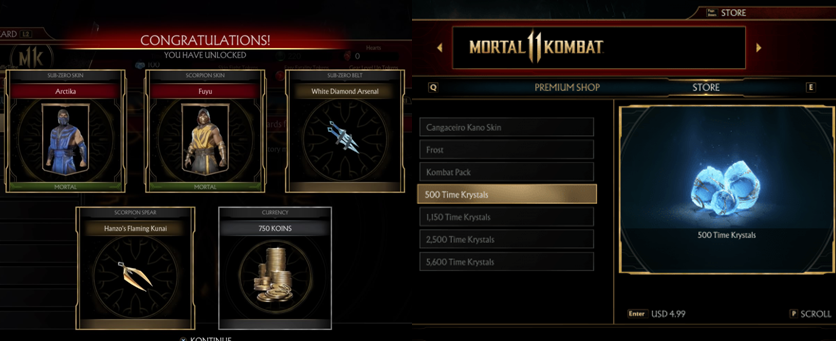
One of the biggest complaints I had about Injustice 2 was the sheer abundance of different in-game currencies and the unfortunate emphasis on grinding for levels and unlockables and the randomness of the game’s loot crates. Sadly, Mortal Kombat 11 carries a lot of this forward; there are numerous customisation options available to you, from backgrounds and icons for your gamer card to individual gear and skins for each character but pretty much all of them are locked behind the game’s time-consuming grinding system. You earn Koins, Soul Fragments, Hearts, and Time Crystals by playing every single one of the game’s modes; while each of these can be spent in the Krypt to unlock chests and release souls (which will net you additional currency, skins, gear, augments, and Konsumables), Time Crystals can be spent in the in-game shop but, as items in the shop at so expensive, you’re encouraged to spend real world money to unlock additional stuff.

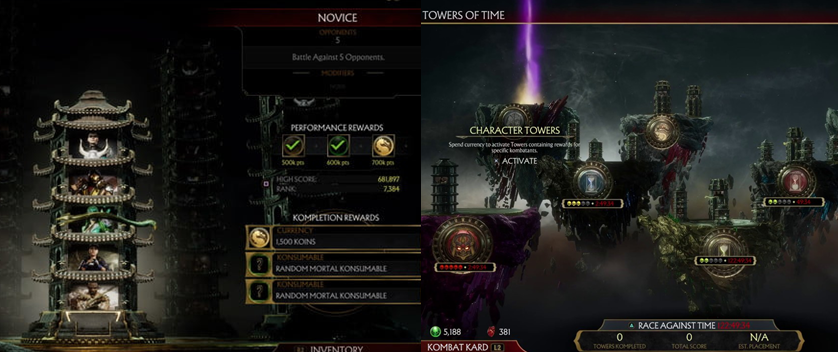
Battle through Klassic and online towers to earn rewards, see character endings, and unlock gear.

Unfortunately, while each character has a whole load of gear and skins and customisation options available to them, these are locked behind grinding; you can find many of these in the Krypt but others are unlocked by playing story mode, completing the character tutorials, or besting the game’s many towers. As in the classic 2D games, you can once again pick between three different towers (Novice, Warrior, and Champion); which tower you pick determines the amount of fighters you’ll face and the degree of the rewards you’ll earn from completion. You can also take on the Endless tower to face and endless number of opponents until you quit or are defeated and the Survival tower in which the damage you receive from each fight carries over to the next. Similar to Mortal Kombat X and Injustice 2, you can also challenge a number of different online towers, the “Towers of Time”; these provide you with a variety of challenges but are only available for a set amount of time before they’re replaced with a fresh challenge. However, you even access this mode you first need to clear a number of tutorials first, which seemed a bit redundant, and you will need to pay and also perform certain tasks (such as a certain amount of attacks or specials) to complete each character’s specific tower and unlock more gear and skins for them.

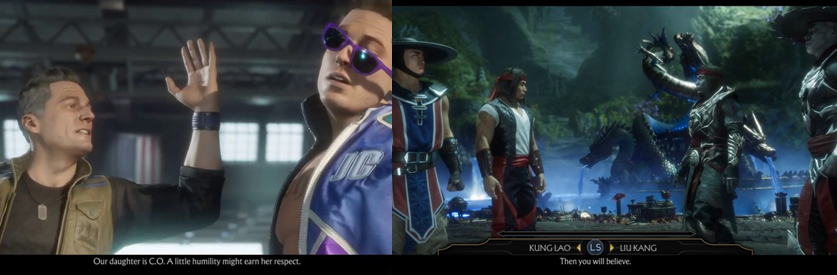
Timelines collide in the story mode, which occassionally asks you to pick between two fighters.

A big part of the game is its story mode; once again, the story is broken down into twelve chapters, with each chapter assigned to at least one character but, every now and then, you’ll be given the option of picking between two characters. It doesn’t really matter which character you pick, though, as you don’t even need to tick off all of these options to 100% the story mode and it hardly affects the narrative at all. Despite the fact that you can’t finish off and kill your opponents, the story mode is a great way to earn Koins and gear and get to grips with each character; the story sees characters from the past return to life as Kronika attempts to rewrite history, which effectively undoes a lot of the development done to the series in Mortal Kombat X but it’s a good excuse to have classic characters return to the series. You can set the difficulty setting for the story mode whenever you like but there are no Achievements tied to beating it or any of the other mode son higher difficulties but you do generally earn better rewards for taking on more difficult challenges.

Graphics and Sound:
Mortal Kombat 11 looks fantastic; character faces still look a bit shiny and odd at times (particularly the females) but there’s even less distinction between the in-game graphics and the many cutscenes you’ll see as you play through the story. Every character is full of life and little quirks, such as Liu Kang constantly hopping from foot to foot in true Bruce Lee style, Kano nonchalantly spitting on the floor, and Skarlet cutting herself open. If the winning fighter is too close to their fallen foe when a round ends, they’ll back away with their own unique animation and voice clips and taunts can be heard throughout each fight as you pull of special moves, combos, and gain victories. Unfortunately, as always, the developers continue to render the character’s different endings using a motion comic aesthetic and voice over rather than utilise the full motion CGI cutscenes used to great effect in the game’s story, which continues to be a disappoint for me and I’ve never really understood this choice.

While environmental interactions seem limited, they’re still a great way to deal some damage.

Where Mortal Kombat 11 fails a little bit is in the stages; stages are a big part of any fighting game but especially Mortal Kombat and NetherRealm Studios’ recent efforts since they introduced the concept of interacting with various parts of the environment. This returns again, allowing you to skewer opponents with spears, throw bodies at them, wall run out of harms way, or toss or wield a variety of weapons (such as a chainsaw and a sledgehammer) to deal additional damage. These will often finally utilise the gruesome x-ray feature that was a big part of the last two games (which can also be triggered with certain special moves and augmented specials) but it feels as though there are a lot less opportunities to interact with the background and pull off Stage Fatalities than normal, making environments look and feel very alive but being disappointingly light on interactive elements despite all of the cameos and interesting elements at work in the background.

The game goes to great lengths to recreate iconic environments and locations from the first two games.

One thing I did like, though, was the return of some classic stages from past Mortal Kombat games, such as the courtyard and the dead pool; the best stage for this is, easily, the Retrocade stage, which randomly generates pixel-perfect recreations of classic Mortal Kombat stages complete with music. The game also goes above and beyond to recreate Shang Tsung’s island in immaculate detail in the Krypt; not only does it feature every stage from the first Mortal Kombat but it also recreates scenes and locations from the brilliant Mortal Kombat (Anderson, 1995) and cameos and references to numerous Mortal Kombat characters, which makes it a fantastic area to explore that is sadly let down by how confusing the Krypt’s map system is. Not only that but Cary-Hiroyuki Tagawa lends his voice and likeness to Tsung once again, adding his unmatched gravitas to the character, and you can even buy a skin pack that adds skins for Sonya Blade, Johnny Blaze, and Raiden that adds three more likenesses and voices from the film.

As gruesome and visceral as the Fatalities are, the Fatal Blows are gloriously rendered in macabre detail.

While the game does excel in its many cutscenes and does a great job of telling its story with just the right level of cheese and seriousness, the main draw of the game is in its violence and gore and Mortal Kombat 11 certainly delivers in that respect. Skin is literally peeled from the bones, eyeballs fly in geysers of blood, bodies are dismembered, split into pieces, dissolved, and shredded, and limbs are torn apart in a variety of ghastly ways and it’s always a joy to see the horrifying ways characters are going to mutilate their opponents. The Fatal Blows are sometimes just as good, if not better, as any of the game’s Fatalities, with characters being stabbed, shot, and blasted in ways that would surely kill them only for the characters to hop right back up afterwards. While character’s clothes and accessories don’t rip or tear during the fights, they do seem to get stained by blood at times and skin can be seen baring wounds and scars from battle.

Enemies and Bosses:
As a fighting game, every single character in Mortal Kombat 11 is your enemy and you’ll be forced to do battle with all of them at least once, at some point, as you play through the story mode and arcade towers. Because every character controls and fights a little differently, with some focusing on ranged attacks or brawling while others emphasis slow but hard-hitting attacks, it’s best to sample each for yourself and to get an idea of your favourite character’s different abilities and variations in order to achieve success. Also crucial is mastering a handful of the game’s combos; many are as simple as X, X, Y or X, Y, X but others require directional inputs, longer button presses, and the co-ordinated stringing together of frame-perfect attacks and special moves. Luckily, though, every character usually has one or two simple combos for you to master so it’s simple enough for players of any skill level to pick up and play.

Your attack strategy may have to change depending on who you are fighting or playing as.

Some characters, though, play a little differently to others and this affects not only how you play but also how you fight them. Shang Tsung, for example, can not only steal the soul of his opponent, which not only drains their health but also has him assume their form and moveset for a short period, but can also morph into various masked ninjas from the franchise; Shao Kahn primarily attacks with his massive hammer, which can make his attacks slower; Jax Briggs can charge up his metal arms with punches and other attacks, which allows him to pull off his projectile attacks; and Erron Black can whip out a shotgun, which allows him to fire at and melee attack his opponent but also needs reloading and to be manually put away. Other opponents can be a lot cheaper than others; Noob Saibot, for example, is always a bit of a pain because of his vast array of teleporting attacks and the same applies to Mileena, who’s capable of quickly teleporting about the place and launching sais at you. There are also some returning favourites you’ll have to watch out for, such as Sub-Zero’s ice ball, Scorpion’s kunai spear, and Liu Kang’s lightning quick kicks and fireballs but the new characters have their own tricks to watch out for, too. Geras, for example, loves to spam his little sand pit trap and Certrion will spawn elemental hazards out of thin air to trap and hurt you.

Cyrax and Sektor can only be fought in the story and you’ll face tough boss battles in the Towers.

When playing through the game’s story mode, you’ll also have to fight a couple of familiar faces in the form of Cyrax and Sektor. These cybernetic ninjas sadly don’t make the cut this time around so they essentially fill the role of mini bosses, in a way, despite appearing quite early on in the story mode. In addition, there will also be time sin the story (and in certain towers) where you have to face two opponents in a handicap match very similar to the “Endurance” matches from the first game, which see your opponents automatically tag into battle once their comrade has fallen while you’re forced to continue with whatever health you have left. When taking on the Towers of Time, you’ll get to battle against a character that has been augmented to “boss” status; this means that you can’t use Konsumables and that your opponent will be super tough, requiring multiple players to take on the challenge while its active to help bring them down and earn rewards.

After Kronika is defeated you must choose between facing Fire God Liu Kang or Shang Tsung.

When you play the story mode or battle through one of the other towers, your final opponent will be Kronika, an unplayable boss character who presents a unique challenge compared to the likes of Shinnok and Shao Kahn. The battle against Kronika takes place in one round but is split between three fights against her and three different locations and time periods, with each phase seeing you having to battle a randomly generated opponent. Unlike other characters, Kronika cannot be thrown, staggered, or hit with a Fatal Blow; when you try any of these attacks and certain combos, she’ll take damage but you won’t see the usual animations play out, which can leave you open to one of her devastating attacks. Kronika likes to teleport around the arena and summon energy balls and projectiles but her most lethal attack is a time warp that renders you helpless and drains a massive chunk of your health bar, which basically means that it’s best to reach her final phase with as much health as possible or else you have to replay the entire fight from the beginning. At the conclusion of the Aftermath story mode, you have the choice of facing either Shang Tsung (who has usurped Kronika’s powers) or “Fire God” Liu Kang (a merged form of Liu Kang and Raiden) as your final opponent. Unlike Kronika, though, these are standard battles and subject to all the normal gameplay mechanics, meaning you’re free to hit your Fatal Blows and augmented special moves and combos without fear of being left vulnerable. Indeed, as long as you’re proficient enough with a few combos and special moves, these fights should be noticeably easier than the one against Kronika though be wary as Shang Tsung and Liu Kang are also much more versatile in their attacks than Kronika, who favours bursts of temporal energy over combo strings.

Power-Ups and Bonuses:
Like in Injustice 2, each character has a number of gear that can be equipped but, thankfully, unlike in that game, these do not affect the character’s stats or abilities and are merely cosmetic. As you battle with your character, their gear will level up and unlock up to three augment slots and you can then equip augments to their gear to increase their special attacks, defence, and other attributes to make them more efficient. Similar to Mortal Kombat X, each character has a number of variations available to them but, this time, it’s up to you to equip and assign these variations to each character; these are limited to three slots, which allow you to assign different special moves and abilities to each character to differentiate them (you can have Scorpion, for example, focus on flame or kunai attacks, or mix and match them). You can also assign different intros and outros for each variation (once you unlock these) and tweak their artificial intelligence (A.I.) stats to make them more focused on reversals or brawling, for example, or a more balanced fighter when taking part in A.I. Battles.

Equip Konsumables and augments to give you buffs and power-ups and make Towers a little easier.

To help you clear these modes, you can choose to have the computer battle through each tower on your behalf and also use up to four Konsumables to tip the odds in your favour. These allow you to flick the right analogue stick and call upon assistance from other characters or effects (such as a brief acid rain, missiles, or similar projectiles) and/or earn additional rewards from battle or performing finishers. Other times, especially in the Towers of Time, your opponents will have access to similar Konsumables and augments, which essentially recreates the Test Your Luck feature from Mortal Kombat (2009), and you’ll again have the option of teaming up with others to take on super tough boss battles.Each time you take on a tower, you’ll be asked to take on a number of “Dragon Challenges”; these appear at the bottom of the screen and ask you to do such tasks as switching stance, ducking, jumping, or performing (or not performing) a certain number of actions throughout the fight and the more you complete, the more additional Koins you can earn so I recommend drawing the fight out so that you can pull off as many as possible.

Additional Features:
There are fifty-eight Achievements on offer in Mortal Kombat 11 and, unlike most games, most of these are tied to repetitive actions rather than playing though the story mode. You’ll earn an Achievement for pulling off a certain number of Fatalities and Brutalities, one for performing two Fatalities with every character who isn’t a DLC fighter (which is a good way to test out each fighter), using a certain number of Konsumables, and opening a certain number of chests in the Krypt, for example. You’ll also earn Achievements for clearing the Klassic Tower with first one and then ten characters (why not all of them is beyond me), running five miles in the Krypt, and for taking part in A.I. and online battles and clearing half of (and all) of the main story mode.

All of the DLC is included as standard but, sadly, there are no additional Achievements tied to these.

Sadly, however, the Achievements do not extend to any of the DLC fighters or story content; there are no Achievements to be earned from clearing Aftermath or specifically tied to any of the DLC fighters, which is a real shame when you’ve got RoboCop and the Terminator in your game and when you consider that Mortal Kombat XL had sixty Achievements to earn, with an extra thirteen added with its DLC fighters. On the one hand, this does mean that it’s a lot easier to get Achievements in Mortal Kombat 11 since there are far less devoted to online play but, on the other, I was disappointed that the Achievements didn’t encourage more replayability and variety; instead, it’s all repetitive actions and nonstop grinding and I’d be pretty pissed off to have paid £40-odd for the Aftermath DLC and all those fighter packs only to find that they don’t come with any extra Achievements.

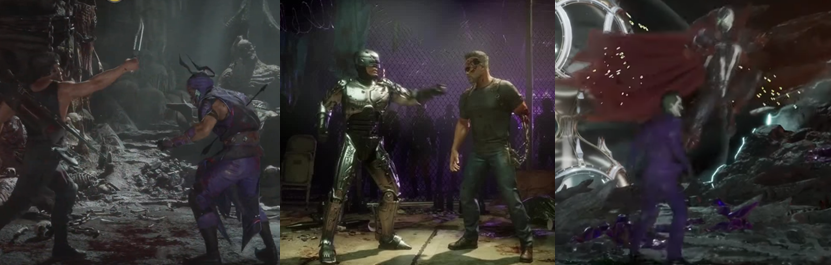
Some familiar faces and movie icons feature as guest fighters…and also the Joker, who I could live without.

Speaking of which, Aftermath and all of the DLC fighter packs and skins are included in Mortal Kombat 11 Ultimate (…except for those released after the game) but you should be aware that your previous save data from the base Mortal Kombat 11 is not compatible with Ultimate. This means that you can play Aftermath right away, if you want, and thus complete the actual story since the main story just kind of ends unresolved. The additional fighters include the likes of Spawn, RoboCop, the Terminator, and even John Rambo (with Keith David, Peter Weller, and Sylvester Stallone all lending their voice talents (and likeness, in Rambo’s case) to the game. You can also play as returning characters such as Sindel, Fujin, and one of my favourites, Rain though I question the inclusion of the Joker as I really think Pennywise the Dancing Clown would have fit a lot better. There are also a number of cheeky DC Comics skins and gear to equip that turn Cassie Cage into Harley Quinn, Geras into Darkseid, Kitana into Catwoman, and Baraka into Killer Croc and you can even dress Jacqui Briggs up in Spawn’s costume.

The Krypt is full of Easter Eggs and references to both the 1995 movie and the franchise’s long histor.y

Aside from fighting, much your time is also spent exploring the Krypt and spending all of your hard-earned currency on skins, gear, augments, and the like. The Krypt is the biggest it has ever been, encompassing the entirety of Shang Tsung’s island and is full of treasure chests, death traps, and references to the videogames and movies. Unfortunately, though, as great as the Krypt is for Easter Eggs and such, it’s a bitch to navigate; you can create shortcuts by smashing through walls and pulling levers and such but the map is dreadful and it can be extremely difficult to get to where you need to be as it relies on an awkward coordinate system. It’s also ridiculously expensive to open the chests, which can lead to you spending over 10,000 Koins just for some useless icons and concept art and it’ll cost you 100 Soul Fragments and 250 Hearts every time you want to open one of those chests. There’s a lot to see and do, though, with new areas to stumble across and fun little Easter Eggs to find but, again, no Achievements really tied to this; when I find the statue of Reptile’s reptilian form from the movie or examine Drahmin’s mask or find Goro’s corpse, I’d expect at least a fun little 5G Achievement but…nope.

The Summary:
I knew that we would eventually be getting Mortal Kombat 11 Ultimate and specifically held off from purchasing the base game or Aftermath while waiting for this release, which bundles 99% of the game’s content all onto one disc (well…technically it’s two…) for you to play at your leisure (after the lengthy download and installation process, of course). In many ways, I wasn’t disappointed; Mortal Kombat has never looked better, with blood and guts and gore being rendered in exquisitely visceral detail and the recreation of Shang Tsung’s island for the Krypt is stunning, full of little details and references that really reward my many years of fandom. Equally, the story mode and fights are brought to life fantastically and the scaled back approach to gear and customisation is appreciated since it means I don’t have to worry about my character being underpowered if they look how I want.

Mortal Kombat has arguably never looked better but the emphasis on grinding lets the game down.

Unfortunately, though, there are a few things that let it down. The Fatal Blow system is great but seems catered more to new players and a defensive playstyle; tying so much of the game to online servers results in a lot of dodgy slowdown and loading on the menus at times; locking everything behind the towers and such is fine but forcing players to grind for in-game currency to spend on even challenging those towers is not; the handful of Achievements might be pretty simple to get but there’s not a lot of variety or fun to them; and I question some of the choices made for the roster. First of all…why thirty-seven fighters? Why not go all-in and bring it up to a nice, even forty? Where are Takeda Takahasi and Kung Jin, the actual descendant of the Great Kung Lao? They weren’t exactly my favourite characters from Mortal Kombat X but they were just as important to the “new generation” of fighters as Cassie and Jacqui but they’re missing yet that lumbering oaf Kotal Kahn is still there. In the end, there’s a lot of fun to be had in Mortal Kombat 11 but it’s notably more finite and time-consuming than in the last two Mortal Kombat games; it’s not as bad with the randomness and loot boxes as Injustice 2 but some of the better skins and gear and such is still annoying locked away and will take a lot of time and effort to unlock, which is especially aggravating when the game uses four different types of in-game currency and yet your options for actually purchasing new stuff in-game are severely limited.

My Rating:

Rating: 3 out of 5.

Pretty Good

What are your thoughts on Mortal Kombat 11: Ultimate? Did you wait for this version to come out or did you buy the base game and DLC separate? Either way, do you think there was enough value for your money or, like me, were you disappointed to find the DLC didn’t have any new Achievements to earn? Which fighter in the game (or the franchise) is your favourite and why? What did you think to the story mode and the use of competing timelines to bring back classic characters? Were there any characters or features missing from the game for you? What did you think to the online options and the different towers the game had to offer? Which Mortal Kombat game, movie, comic, or other piece of media is your favourite? Whatever your thoughts on Mortal Kombat 11, or Mortal Kombat in general, leave a comment down below.

Game Corner [MK Month]: Mortal Kombat XL (Xbox One)


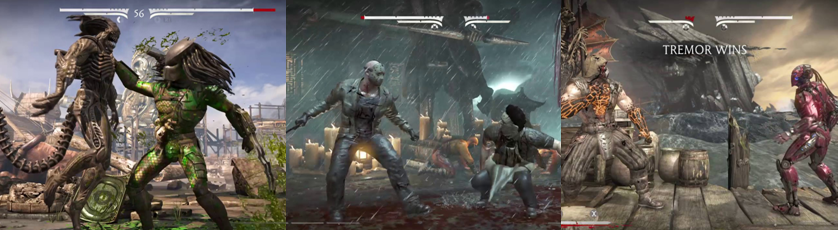
This image has an empty alt attribute; its file name is mortalmonday.png

To celebrate the simultaneous worldwide release of Mortal Kombat (Midway, 1992) on home consoles 13 September 1993 was dubbed “Mortal Monday”. Mortal Kombat’s move to home consoles impacted not only the ongoing “Console War” between SEGA and Nintendo but also videogames forever thanks to its controversial violence. Fittingly, to commemorate this game-changing event, I’ve been dedicating every Monday of September to celebrating the Mortal Kombat franchise.


Released: 1 March 2016
Originally Released: 13 April 2015
Developer: NetherRealm Studios
Also Available For: PlayStation 4 and Xbox Series X (XL Edition); PC and Mobile (Standard Edition)

The Background:
After gaining equal parts success, popularity, and controversy thanks to its peerless use of gore and violence and unique digitised graphics, the Mortal Kombat franchise (Various, 1992 to present) offered not only the first real competition for Street Fighter II: The World Warrior (Capcom, 1991) but also redefined videogames (especially fighting games) for years to come. After the series hit its peak in the mid-to-late nineties, Mortal Kombat struggled to find a footing in the emerging 3D fighter arena; however, after recovering from the poor reception of Mortal Kombat vs. DC Universe (Midway Games, 2008) and bankruptcy, Midway was bought by Warner Bros. Interactive, rebranded to NetherRealm Studios, and successfully got their ultra-violent fighting game franchise back on track after Mortal Kombat (NetherRealm Studios, 2011) was very well-received for its “back to basics” approach.

After MK9 breathed new life into the franchise, Mortal Kombat X took the story in a new direction.

Production of the next game in the series began in 2012 and much of the hype and marketing focused on the game featuring the most brutal and gruesome Fatalities in the series to date. Mortal Kombat X expanded upon not only the mechanics and story of its predecessor but also the content, featuring a wealth of new online modes that would come to be a signature of NetherRealm Studios, alongside far more downloadable content (DLC) than its predecessor. Sales and reviews of the game were incredibly strong, leading to the release of the XL version of the game about a year later; this version included all of the DLC and additional content released and continuing the game’s strong critical response and all but guaranteeing the production of the eleventh entry in the series.

The Plot:
Although Shao Kahn and his Outworld forces were defeated in Mortal Kombat (2009), much of Earthrealm’s forces were killed and enslaved by Quan Chi’s dark sorcery and put in service of his master, the fallen Elder God Shinnok. After Johnny Cage uses his mysterious latent powers to defeat Shinnok and many of their friends and allies are restored, a new generation of Earthrealm warriors are forced to put aside their egos and arrogance in order to prevent Shinnok’s resurrection and continue the uneasy truce Earthrealm has forged with Outworld.

Gameplay:
Like its predecessor, Mortal Kombat XL is a 2.5D fighting game in which players select one of thirty-three characters and take on the game’s single-player story mode, battle one-on-one against another player or computer-controlled opponent, or challenge a variety of arcade-style towers or other players in a variety of online battles. As is the Mortal Kombat tradition, fights take place in a three round format and against a time limit, though you can customise these settings (and many others, such as the difficulty of computer-controlled opponents) from in game’s options to speed up gameplay or make things more accessible.

While the controls stay the same, the overall fighting mechanics have been improved upon considerably.

Essentially, the game’s fighting mechanics are exactly the same as in the last game but tweaked and improved in numerous ways. You can throw punches with either X or Y, kicks with A or B, hold RT to block, perform a grapple-like throw with LB (or X and Y and a directional input), dash towards or away from your opponent (or hold RT to run, though this consumes the new stamina meter), jump in or crouch to attack or avoid projectiles, and string together combos by pressing the attack buttons and using directional inputs quickly. The game also expands on the tutorial of its predecessor to teach you the basics of the in-game combat, which gets deeper and more intricate as you learn more about the game’s combo system and stringing together basic attacks, combos, and special moves but, thanks to a refined and simplified control scheme and a much more user-friendly move list that is accessible by pausing a fight at any time, it’s very easy for even new players to perform a few simple combos and succeed in most fights.

You can now select three different fighting styles and X-Rays are more brutal than ever!

With a few simple directional and button inputs, you can also pull off a number of special moves, ranging from projectiles to grapples and elemental or telekinetic slams. This time around, though, every character has at least three different “variations” that alters their special moves and fighting style; this adds a great deal of variety to the game’s fights and means that you can focus on ranged attacks, grapples, or even summon minions to provide a modicum of assistance and can help make each character accessible to your fighting style. As you perform combos, special moves, and absorb damage, you’ll once again fill up the Super Meter at the bottom of the screen; this meter fills much faster than in the last game, allowing you to enhance your special moves with RT and pull off combo breakers much faster and more frequently. Once it’s completely full, you can once again pull off a devastating X-Ray move but, this time, you also have the option of enhancing your moves further with another tap of RT (though this will burn up your meter) and perform reversals and “block breakers” without draining your meter.

Grab an interactable object to put beat your foe and then rip their head off in gruesome fashion.

While the tag team system has been completely abandoned in Mortal Kombat XL, there are numerous opportunities in every stage for you to interact with the environment with a press of RB. This allows you to swing from vines, flip up walls, throw innocent bystanders, or use weapons to avoid incoming attacks or dish out a bit more damage to your opponent. Most stages have at least three of these but some have more, or less, and you can even set the game up to give you an audio indication of when you can interact with the environment or turn them off completely (though I don’t get why you’d do that). Of course, once you’ve drained your opponent’s health bar completely and won the decisive round of the fight, you’ll be given the chance to finish off your foe; by positioning yourself correctly and inputting some directional inputs and button presses fast enough, you’ll pull off a gruesome Fatality that will leave your opponent dismembered (usually with their brains, eyes, and/or other organs spilling from their remains).

Brutalities and Faction Kills offer new and horrific ways to leave your opponent a mangled corpse.

Every character has at least two Fatalities (in addition to special “Stage Fatalities” that can be performed on certain stages) available to them and, while you’ll have to unlock their inputs in the Krypt or look them up online in order to pull them off, you can view them at any time from the pause menu, practice them in the Fatality Tutorial mode, and earn (or buy) “Easy Fatality Tokens” to assist you. While “Babalities” (and all silly elements) are no longer present, Mortal Kombat XL sees “Brutalities” return to the franchise; by following a specific set of instructions during a fight (such as ending the fight with a throw or a stage interaction or performing a certain number of attacks during the final round), you’ll mutilate your foe with a sudden, vicious kill move. Another new addition to the game is that you’ll be asked to join one of four “Factions” for the purposes of online play; as part of this, you’ll also be able to pull off one of five “Faction Kills” by standing a jump distance away from your opponent during the “Finish Him/Her!!” command, holding block, and entering specific directional inputs.

Mortal Kombat XL expands upon your options for on- and offline play to add a lot of variety.

Every time you win a fight, you’ll earn Koins to spend in the Krypt, experience points (XP) to level up your user profile (which can also be customised with unlockable icons and backgrounds by winning fights, exploring the Krypt, and completing simple daily challenges), and points to aid your Faction. This allows you to increase your rank in your Faction, unlock access to more Faction Kills, and help your Faction to beat the others in an ongoing struggle for dominance. This is further aided by full on Faction War through a variety of towers and the regular Invasion of a super tough boss character that everyone in your Faction has to work to whittle down for more rewards, and you can change your Faction at any time to explore their different Faction Kills. Towers themselves are greatly expanded this time around; the traditional arcade ladder still has you tackling eight random opponents before battling Goro and Shinnok and unlocking your character’s ending but you can also take on daily, hourly, and premium challenge towers, and Test Your Might returns (though the other “Test” mini games are absent) in the tower mode as well. You can also tackle an Endless tower and a Survival mode that sees any damage you take carry over to the next fight and you can even create Tower Challenges for your friends to try out.

The story is a generational tale of new warriors rising up to combat the resurrected Shinnok.

Mortal Kombat (2009) sought to revitalise the franchise by retelling the events of the first three games in a cohesive way and making big changes for the series and Mortal Kombat XL’s story expands upon this greatly. Essentially a retelling of the events of Mortal Kombat 4 (Midway Games, 1997), the story deals with the emergence of a new generation of fighters and the building of inter-realm relations between Earthrealm and Outworld. Divided into twelve chapters, the story again has you playing as one character for each chapter, which continues to be an effective way of getting to grips with a wide variety of the game’s roster (though, again, you still can’t perform Fatalities in the story mode), and you can replay them at any time. While you won’t have to worry about fighting two characters at once this time, you will have to be on your toes as you’ll be asked to perform a handful of quick-time events (QTEs) during the story, which also features cameos not only from unplayable characters like Sareena, Li Mei, and Smoke but DLC characters like Tanya and Bo’ Rai Cho. Because the last game left many of the series staple character undead minions of Quan Chi, much of the story’s focus is on Johnny Cage rather than Liu Kang and the new generation of fighters (Cassie Cage, Kung Jin, Takeda Takahasi, and Jacqui Briggs) but, sadly, a lot of the unique appeal of these new characters is somewhat undermined by the inclusion of their parents (the more popular series staples like Johnny, Sonya Blade, and Jax). Equally, the story immediately backpedals on a lot of the changes made in the last game; Sub-Zero is no longer a cyborg, Scorpion is human now, and both of them (and Jax) have been freed from Quan Chi’s influence, which is a shame as it would have been cool to see a streamlined design for Cyber Sub-Zero but it is cool seeing Scorpion’s human form.

Graphics and Sound:
As great as Mortal Kombat (2009) looked, Mortal Kombat XL is a massive step forwards in terms of its graphics, presentation, and gore; character faces can be a bit shiny and unnerving in the story mode cutscenes but you won’t really notice this minor issue when locked in combat. Similarly, there’s basically no distinction between the cutscenes and in-game graphics, with only a change of lighting and camera positioning separating the two.

Mortal Kombat has never looked better but these improvements still don’t carry over to the endings.

This means that the game is presented so convincingly that it’s basically like playing a high quality CG cutscene and the character’s little quirks and mannerisms are emphasised even further; the winning character will back away from their fallen opponent between rounds, characters spit taunts after landing combos and special moves, and each one is injected with a high degree of personality to make them shine (Ferra and Torr, being two characters fighting in tandem with each other, are the perfect example of this but you’ll also get little moments like characters reloading or straightening their outfit). Even better is the fact that pre-fight introductions have been greatly expanded; characters will now trade dialogue with their opponent, which changes depending on who you’re facing and leads to some interesting references to previous games and rivalries. It thus remains a shame that NetherRealm Studios continue to offset all these impressive graphics with the motion comic-like sequences used to convey each character’s ending.

Stages come to life through numerous interactable elements, which also offer more unique Stage Fatalities.

Mortal Kombat XL’s stages are equally far more detailed and full of even more life than ever before thanks to the wide variety of stage interactions on offer. Aside from the returning Pit stage (which still has random fighters battling it out in the background), stages in Mortal Kombat XL are both new and immediately familiar; the Dead Woods and Sky Temple stages recall the Living Forest and the Courtyard, respectively, for example. You’ll also battle on a boat in the middle of a tumultuous storm as bodies rise and fall with the waves in the background, outside of the Lin Kuei palace, in the middle of a dense jungle, and even before the very life force of Earthrealm itself. Each stage has a fantastic field of depth and brought to life through the different interactions and Stage Fatalities on offer, which allow you to bash your foe’s skull in, toss hot coals at them, uppercut them into the sights of a machine gun, or feed them to a hungry kraken. 

X-Rays and Fatalities are more gruesome and disgusting than ever and emphasise dismemberment.

Characters still carry cuts and the wounds from their battle but their clothing no longer rips or tears as fights progress. However, the game’s graphical upgrade does mean more gore and more brutal Fatalities and X-Ray moves. X-Rays now lose the distorting x-ray effect and clearly show bones, muscles, and arteries snapping and splitting in gruesome, over the top detail as characters stab their foe through the eyes and deliver bone-breaking shots to their limbs. Similarly, Fatalities are much longer and gorier than ever and make Mortal Kombat (2009)’s look tame in comparison: Kung Lao forces his opponent face-first into his razor sharp buzzsaw-like hat, Kenshi cuts them into little bloody chunks with his telekinetically-controlled sword, Takeda and Ermac uses their whip and psychic powers, respectively, to rip out their opponent’s insides, and Reptile dissolves his foe in pools of acid. The game takes full advantage of its greater processing power to show guts and brains plopping out from their dismembered remains and characters being torn apart in explicit, sickening detail and there’s a definite sense that Mortal Kombat XL’s Fatalities were purposely designed to be as entertainingly disturbing as possible.

Enemies and Bosses:
As before, every character in Mortal Kombat XL will be your enemy at some point as you play through the story mode and many different towers; this time around, though, you don’t just need to worry about the fact that every character plays and controls a little differently but also has a variation that can fundamentally alter the way they fight. You might be expecting Scorpion, for example, to fight with his trademark kunai and fire breath but one of his variations adds additional sword attacks and another allows him to toss demons at you or hold you in place. This means that you’re asked to adapt your playstyle on the fly and experiment not only with different characters but their different variations as well; Kotal Kahn might be a lumbering, unwieldy lug but his War God variation affords him greater reach with his sword and D’Vorah might be a massive pain in the ass of a character but her different variations give her different rush and projectile attacks. It’s all about experimenting and seeing which variation of which character best suits your play style and finding ways to counteract the different moves and abilities afforded by your opponent’s variations.

The new characters are okay, if a little redundant and underwhelming, with Takeda shining the most.

Of course, there are quite a few new characters on offer in Mortal Kombat XL but, as unique as characters like Erron Black and Takeda are thanks to their long-range weaponry and whips, respectively, characters like Cassie and Jacqui are merely faster, weaker shadows of their parents (Johnny, Sonya, and Jax). Personally, as much as I like Johnny, Sonya, and Jax, I feel like the game missed a trick by not removing them from the roster and simply having their moves represented solely in the variations of their kids as it would help them stand out more but, as it is, I’d always pick to play as the iconic and capable Johnny than Cassie. Kung Jin, despite being related to Kung Lao, is basically a new version of Nightwolf, which hurts him a little, and Ferra/Torr (despite their unique symbiotic gameplay) are little more than an ape-like beast. Of all the new characters, Takeda was my favourite to play as thanks to how overpowered and versatile his whips were but the four generational characters left a lot to be desired in terms of their design and attire (but then, to be fair, Johnny also gets a pretty disappointing default attire this time around).

While there aren’t any secret fighters, Goro has been tweaked to be less of a cheap spam artist.

When playing the story mode, you’ll have to battle against Tanya at one point, which was the first hint towards some of the DLC characters that would round out the game’s roster. Similarly, originally, Goro was only available as a pre-order bonus and would await you as the penultimate boss in the traditional arcade ladder. Thankfully, Goro is nowhere near as cheap or as tough as in Mortal Kombat (2009); a far more balanced character, he still tanks your attacks with armour and is capable of dishing out a great deal of damage but it doesn’t feel like the game (and the character) has suddenly been ramped up when you face him (you can even perform finishing moves on him this time around). Fighting Goro really helps to emphasise how much fairer Mortal Kombat XL is over its predecessor; Breakers and parry moves are still a pain in the ass but the computer no longer hides behind their blocks and is nowhere near as cheap and frustrating as in Mortal Kombat (2009).

Even in his most demonic form, Shinnok is no Shao Kahn, which a good thing as the fight is actually fair!

At the conclusion of the story mode (and waiting at the end of the classic tower) is Shinnok (who is, unlike Shao Kahn in the last game, also a playable character). The fight against Shinnok is a standard two round affair that is far easier than battling Shao Kahn; first of all, you don’t have to worry about Shinnok hiding behind armour and spamming moves that drain half or all of your health in a few attacks and can freely jump in and attack Shinnok with a string of combos rather than camping out at the far edge of the screen and spamming your projectiles. Defeat him, however, and he transforms into the boss-exclusive “Corrupted Shinnok”, a demonic form that looks far more intimidating than it actually is. You are still free to attack at your leisure and however you prefer, which makes beating the arcade ladder much easier and far less frustrating than in the last game. Sadly, though, there are no secret or hidden fights to be found this time around, which is a shame.

Power-Ups and Bonuses:
Although it scales back on the available mini games and distractions, Mortal Kombat XL sees the return of the Test Your Might mini game and the Test Your Luck mode. Test Your Might is now confined to the towers and has you, once again, mashing buttons until the targeting reticule is in optimum position so you can hit LT and RT to smash a variety of materials. This quickly becomes incredibly difficult, though, and sees you frantically mashing buttons only to fail and see your character being killed as a result. Test Your Luck allows you to have up to seven different modifiers that will randomly select your opponent and cause a number of positive and negative effects to alter the fight; this can cause acid to rain down, Cyrax’s bombs to fly into the fight, dashing, blocking, or Breakers being disabled, an instant boost for your Super Meter or health, or characters to randomly fall asleep among many others. It remains a very fun and entertaining additional mode that adds a lot of chaos and variety to the game and there’s even a whole tower dedicated to this mode to really spice up your fights.

Test Your Luck and Dragon Challenges help to spice up fights considerably with random elements.

When tackling the Living Towers (either as part of a Faction or the timed tower challenges), you’ll also be tasked with completing a “Dragon Challenge” as indicated by an ethereal dragon flying around your next fight. This gives you the option of performing a specific task (such as landing certain attacks or not blocking) during the fight to earn additional Koins, XP, and points for your Faction. When tackling the Living Towers and Faction Towers, you’ll also find that your opponents are far more capable than in the regular arcade ladder on the easiest setting and that fights are often subject to Test Your Luck-style modifiers and, though Kombat Kodes are no longer a thing, you can evoke the spirit of those codes using the Kustom Kombat mode to set modifiers and fight-altering effects when fighting against a friend.

Additional Features:
Mortal Kombat XL offers sixty Achievements for you to earn, with only two being directly tied to the completion of the story mode. The others encourage you to experiment with all the different characters, variations, and game modes on offer, giving you Achievements for winning fights with every character variation, completing towers, performing jumps, throws, and Fatalities, and battling online. Best of all, the developers added thirteen additional Achievements when they released the DLC packs, with many of these directly tied to the DLC fighters, though a great deal of the game’s Achievements are tied to battling online, which can be tricky given how stupidly good players always seem to be online.

Mortal Kombat XL‘s guest fighters were a mixed bag but included some fun, smart, and fitting choices.

As in the last game, the DLC characters unfortunately don’t come with additional costumes but their appearance does change when you select their variations (Alien has a variation that spawns Baraka’s trademark arm blades, for example; both Jason Voorhees and Leatherface’s appearances alter to reflect their looks in different movies, and you can even choose to play as Cyber Sub-Zero by pressing up twice when selecting Triborg’s variation). The DLC fighters are an…interesting bunch; on the one hand, the game offers what I would consider to be underwhelming characters like Tanya and Bo’ Rai Cho (I seriously don’t get why Rain wasn’t upgraded to the main roster after the last game) while also bringing back an obscure character like Tremor and making the brilliant decision of combining the cybernetic ninjas into one character. Then there are the guest fighters; Predator was an awesome, inspiring inclusion (as was the skin packs that accompanied him) and including Alien was a logical choice but, as great as Jason is (one of his variations has him returning to life with a small bit of health after being defeated), it feels like a missed opportunity to have him in a game where Freddy Krueger is absent. Leatherface is a decent enough inclusion, to be sure, but hardly conjures the same visual as Freddy when set against Jason.

Explore the bigger, more detailed Krypt to spend your Koins on finisher inputs, concept art, and more.

Thankfully, though, the DLC characters aren’t completely mute this time around and there were loads of additional skins released for the game (some that were only unlockable by linking up to the mobile game) that include classic outfits (and Fatalities) and character cosplay. All of these are included as part of the XL version of the game but NetherRealm Studios did release a few additional skins after the XL edition released so, while it is the definitive, most complete version of the game, it’s not got 100% of the content as a result. Returning from Mortal Kombat (2009) is the Krypt, which is now a far more elaborate first-person jaunt through spooky, gothic environments; this time, you can also acquire a number of iconic items (such as Reptile’s Claw, Scorpion’s Spear, and Raiden’s Staff) to open up new areas and explore further. In the Krypt, you’ll be able to spend your Koins opening a whole bunch of chests to unlock concept art, finishing moves, and other goodies but, if that’s all too much work for you (and, honestly, it can be), you can pay real-world money to unlock everything in the Krypt.

There’s a lot of variety on offer thanks to Factions, online modes, and ever-changing towers.

Otherwise, you’ll earn rewards and Koins the old-fashioned way: grinding. Lots and lots of grinding. You’ll do this primarily by besting the game’s many towers with each fighter, performing finishing moves, and battling online. Online fights include standard one-on-one affairs and the “King of the Hill” mode where you sit and watch other players fight until it’s your turn and offer (and receive) “Respect” points. Sadly, however, I found online play far too difficult to be enjoyable; I don’t know what it is but online players always seem to move at lightning speed, stringing together nearly endless combos and attacking with an aggression that makes it almost impossible for you to win without a bit of luck and a lot of spamming. There is some attempt to encourage collaboration through the Faction mechanic but it’s tentative, at best; when an Invasion Boss becomes available, you’ll battle them alone rather than directly alongside other players and your Faction can easily win (or lose) without you being involved in any of the decisions at all.

The Summary:
Mortal Kombat XL takes everything that worked in Mortal Kombat (2009) and ramps it up to eleven; not only are the graphics leaps and bounds beyond the last game, the gameplay mechanics have been tweaked and adjusted and expanded upon to make the game far more accessible and enjoyable. The inclusion of intractable stage elements adds an additional layer to every fight and increases your immersion in the game and, thanks to the Super Meter filling faster and the wide array of offensive and defensive options available to you, fights are faster and more entertainingly gruesome than ever. Best of all, even with the continued inclusion of Breakers, parries, and having to hold block to press up for some finishing moves, the computer-controlled opponents are far less likely to hide behind their block or just smack you out of the air so fights are much more fun rather than becoming frustrating or annoying.

For me, Mortal Kombat XL is the best of NetherRealm Studios’ revived Mortal Kombat titles by far.

There’s very little at fault in Mortal Kombat XL for me; of all the NetherRealm Studios Mortal Kombat games, it’s easily my favourite and expands the story into new territory. While it’s a shame that some story elements were abandoned and a lot of the new characters are a bit underwhelming, the benefits on offer far outweigh the negative. Mortal Kombat XL also comes before NetherRealm Studios got greedy and locked everything behind numerous in-game currencies, grinding, and real-world purchases; the DLC was really well done and actually included additional Achievements, I enjoyed all of the different skins, and the game expands upon the Challenge Tower of the last game into a wide variety of different gameplay modes to keep you coming back for more (as if the horrific Fatalities weren’t enough).

My Rating:

Rating: 5 out of 5.

Fantastic

What did you think to the XL edition of Mortal Kombat X? Did you buy the base game and all the DLC packs separately or, like me, did you wait for this complete edition to release before buying the game? What did you think to the DLC characters this time around and the additional Achievements and skins made available? What did you think to the game’s story; did you like it as a retelling of Mortal Kombat 4 and an expansion into new territory or were you disappointed by the new fighters? What did you think to the new features, like the variations, Factions, and Living Towers, and which Faction was your preference? Were there any characters or features missing from the game for you? Which Mortal Kombat game, movie, comic, or other piece of media is your favourite? Whatever your thoughts on Mortal Kombat XL, or Mortal Kombat in general, leave a comment down below.
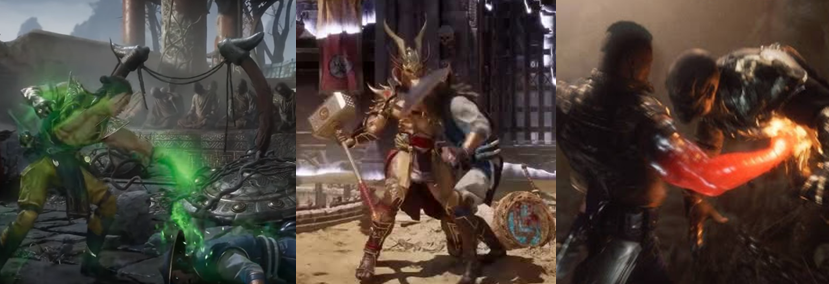
Game Corner [Sonic CDay]: Sonic the Hedgehog CD (Xbox One)


Sonic the Hedgehog CD (Sonic Team, 1993) released on this day back in 1993. Produced alongside the blockbuster Sonic the Hedgehog 2 (SEGA Technical Institute, 1992), Sonic CD expanded upon the Blue Blur’s original debut title with lush graphics, a time travel mechanic, gorgeous anime cutscenes, and introduced players to Metal Sonic (one of Sonic’s most popular and enduring rivals) and Amy Rose. Considered by many to be one of the best of the classic Sonic titles, Sonic CD might not be one of my favourites but it’s still a classic in it’s own right and it’s worth looking back on today of all days.


Released: 14 December 2011
Originally Released: 23 September 1993
Developer: Christian Whitehead
Original Developer: Sonic Team
Also Available For: GameCube, Mega-CD, PC, PlayStation 2, SEGA Mega Drive Mini II (Original); Mobile, PlayStation 3, PlayStation 4, PlayStation 5, Xbox 360, Xbox Series S/X (Remaster)

The Background:
Sonic the Hedgehog (Sonic Team, 1991) was specifically created and marketed as SEGA’s Nintendo-beater and, thanks to selling over 15 million copies, succeeded in its goal. Naturally, SEGA were eager to produce a sequel but, rather than create one game, they ended up making two! With Sonic creator Yuji Naka having moved to America to work on Sonic 2, Sonic’s designer, Naoto Oshima, spearheaded an entirely separate title built on the bones of the first game that would be exclusive to SEGA’s ill-fated CD add-on for the Mega Drive.

Sonic CD is largely known as one of the best Sonic games and was made widely available in 2011.

With Sonic 2 more focused on speed, Oshima placed Sonic CD’s focus more on platforming and exploration with its speed-based time travel mechanic (which was cut from Sonic 2) and included gorgeous anime cutscenes from Toei Animation (which would later be the basis for the feature-length original video animation). Artist Kazuyuki Hoshino designed Sonic’s metallic doppelgänger and biggest fan, Amy Rose (though that character actually debuted, in a slightly different form, in a 1992 manga), both of which were as pivotal to the game as the time travel elements. Despite the game’s U.S. release being delayed for an entirely new soundtrack, Sonic CD was met with widespread critical acclaim but, for many such as myself, the game was somewhat elusive since no one I knew had a Mega-CD and it just wasn’t the same playing the PC version. I first played the game properly when it was included in Sonic Gems Collection (Sonic Team, 2005) but jumped at the chance to play the HD remaster when it first dropped on the PlayStation 3. Developed by Christian Whitehead, this new version of the game was widely available, included Achievement support, numerous bug fixes, and a whole host of new elements that make it the definitive version of this cult classic entry in the franchise.

The Plot:
When the mysterious Little Planet has makes its annual appearance, Sonic travels to Never Lake but finds the planet has been overtaken by Doctor Eggman’s Badniks! When Sonic’s number one fan, Amy Rose, is kidnapped by his robotic doppelgänger, Metal Sonic, Sonic must race across time itself to keep Eggman from polluting the past, recover the seven Time Stones, and ensure a good future for Little Planet!

Gameplay:
Sonic CD is a 2D, sidescrolling action platformer that once again sees you guiding the titular blue hedgehog across seven stages (known as “Zones”), each split into three parts (simply called “Zone 1” to “Zone 3” rather than being called “Acts”). At the end of each third Act, Sonic must battle Eggman in one of his contraptions but there’s quite a twist this time around. This time, as well as passing Lampposts to create a checkpoint, Sonic will also run past special signposts; once one of these has been triggered, Sonic will begin to sparkle as he runs and, if he builds up enough uninterrupted speed, he will travel to the past or the future depending on which post he activated. While the general layout of the Zone remains the same in the past, present, and future, there are numerous aesthetic and difficulty differences in each one. The past is generally much more lush and vibrant, lacking many of Eggman’s traps and Badniks; the present is a standard-fare Sonic stage; and the future is a pollution and hazard-infested mechanical hell. When in the past, Sonic must search high and low for a Robot Transporter and a holographic projection of Metal Sonic; destroying both in Zone 1 and 2 ensures that Zone 3 earns a good future, which strips it of all Badniks and hazards and even makes the boss battles noticeably easier.

Sonic CD‘s biggest gimmick is the speed-based time travel mechanic.

If you’ve played the first Sonic game then you’ll be immediately familiar with Sonic’s controls and physics. Sonic’s speed, jumping power, and abilities all carry over, making him as tight and responsive as ever, but he is afforded two new abilities. One is a variation on the Sonic 2 Spin Dash (it’s not quite as useful or as fast as in that game, though) and the other is Sonic’s Super Peel-Out manoeuvre, which sees Sonic rev up his legs until they become little more than a blurry figure eight and then rocket ahead at full speed, which is perfect for the few instances where you have the room to travel fast enough to time travel. Sadly, there’s not always the opportunity to do this; like in the first game, Sonic has to earn his breakneck speeds and, all too often, you’ll go running or rolling ahead in a blur of spikes only to slam head-first into a wall, a pit, a bumper, or poorly-placed enemies and hazards. This makes the time travel much harder to pull off than it needs to be as you’ll constantly be fighting to find a long enough stretch of ground or the right opportunity to build up your speed only to accidentally screw up the attempt at the last minute. Similarly, there’s a much greater emphasis on exploration and platforming this time around; every Zone feels like a mixture of speed, loops, and obstacles and the level design is questionable at best and haphazard at worst, with Golden Rings floating inside of the environment and your progress to the many alternate paths either blocked or protected by dead-ends and endless loops. As a result, when you travel back to the past, it can be extremely difficult to navigate through the Zones to find the Robot Transporters and projectors even in the more linear Zones; the bigger, more complicated Zones like Wacky Workbench and Metallic Madness make it nearly impossible to do without a guide or copious amounts of trial and error.

There’s still plenty of opportunities to be bounced around despite the many stage hazards.

Still, speed is a prominent factor in the game; thanks to the Super Peel-Out and new gameplay mechanics, Sonic is much faster than he was in the first game and is still bounced all over the place like a pinball in Zones like Collision Chaos. Indeed, there are technically two ways to play; the slow, methodical Sonic CD way which has you hunting down objects in the past or the faster, more Sonic 2 way which has you racing through Zones as fast as possible and completing them holding fifty Rings or more to enter the game’s Special Stages. Once again, Golden Rings act as your protection from damage; they’ll scatter everywhere when you’re hit and, as always, Sonic is in danger of drowning when underwater in the distinctly Labyrinth Zone-like Tidal Tempest but, thankfully, you don’t seem to spend anywhere near as much time underwater in this Zone. As is to be expected, every Zone has different gimmicks (such as moving or crumbling platforms, tubes, conveyor belts, bumpers, and the like) but these actually change when you travel through time, meaning different routes become accessible in each time period. Zones also take on more and more gimmicks (most of them very dangerous) as you progress but even the first Zone, Palmtree Panic, is crammed full of different ways to navigate. As a result, you’ll be bouncing all over the place in Wacky Workbench but fighting against treadmills and cogs in Quartz Quadrant, racing along tunnels and vast stretches of ground in Stardust Speedway, and dodging spikes, buzzsaws, and a bevy of hazards in Metallic Madness (which also features a unique shrinking mechanic). Thankfully, bottomless pits are a rarity in Sonic CD but crushing weights, sudden spikes, electrified coils, and falling boulders and stalactites more than make up for that! Also, Sonic CD is as difficult as you make it be; if you choose not to try and take the higher, easier, and faster routes or purposely visit the bad futures, then you’re going to have a much tougher time of it than if you actively try and create a good future. This places much more emphasis on your actions actually having consequences as, normally, you only restore (or fail) the world when you lose all of your lives or fail to collect all the jewels but, in Sonic CD, you can actively affect and improve each Zone on a case-by-case basis by collecting the Time Stones or destroying Eggman’s machinery in the past.

Graphics and Sound:
Thanks to the graphical enhancements of the Mega-CD, Sonic CD may very well be one of the most visually striking and vibrant games in the franchise, especially amongst the classic titles. Every Zone is awash with colour and life and full of little details and background elements; every time you travel to the past or future, the Zone gets a complete facelift and takes a much more verdant or ominous light depending on how well you play which really adds to the replayability of the game as every Zone has, essentially, four parts to it (past, present, good future, and bad future) that all present a different aesthetic and challenge while still maintaining the basic structure of the Zone.

Zones are packed full of details and vibrant colours but can look a little busy at times.

Zones have a real depth to them, allowing you to see into the distance and take in just how badly Eggman has affected each environment. You might see a vast sea full of ruins in the past of Palmtree Panic but all you’ll see is pollution and machinery in the bad future; similarly, Tidal Tempest is an unblemished cave in the past but has been transformed into a mechanical base in the future. Zones are also full of interesting and unique graphical mechanics, such as the pseudo-3D ramp at the start of Palmtree Panic, the Mode-7-like Special Stages, how a certain tube in Palmtree Panic will send Sonic smashing through the background and leave a Sonic-shaped hole in his wake, and the way graphics change size as you bounce and run all over the place. Unfortunately, though, I often find Sonic CD’s Zones to be a little too busy; there’s a lot going in the background and foreground, a lot of competing, clashing colours (especially in the garish pink of Collision Chaos), and it can be difficult to keep track of where you are and what’s going on sometimes.

The power of the Mega-CD makes for some gorgeous and well-animated sprites.

The sprites have, however, benefitted greatly from the graphical upgrade; Sonic has more animation frames and a more dynamic moveset and seems far more lively and energetic despite the majority of his assets being lifted from the first game. Sonic also speaks a little bit, shouting out “Yes!” when he grabs and extra life and “I’m outta here!” when left idle for a few minutes (which causes an instant game over). Other sounds, however, are not quite as appreciated, such as the sound Sonic makes when he jumps (which is decidedly squeakier and much more annoying and it also bugs me when it is recycled in both fan-made and official Sonic games). The bosses, too, are bigger and more elaborate than in the first game, requiring actual strategy on your part to defeat and even Amy Rose gets a lot of personality as she follows Sonic around like a love-sick puppy, desperately trying to hug him while love hearts adorably fly from her head.

The anime sequences really bolster the game’s appeal and capture Sonic’s essence.

Of course, you can’t talk about Sonic CD without mentioning the anime cutscenes and the soundtrack. The opening and ending of the game features gorgeously animated anime sequences that showcase Sonic at his best, in my opinion; I loved that these were expanded upon in Sonic the Hedgehog (Ikegami, 1999) and I would absolutely be over the moon if they were brought back for future Sonic games. Sonic CD’s soundtrack is also one of the most beloved and contested in the franchise; many prefer the original Japanese soundtrack and, while that is good, it’s much more peppy and vibrant and happy-go-lucky than Spencer Nilsen’s version for the U.S. As a result, while I prefer some tracks from the Japanese soundtrack, overall I prefer the U.S. one; the invincibility music is better, the boss theme is better, and the U.S. soundtrack is much more in the style of rock and metal than anything else, which I prefer.

Enemies and Bosses:
Once again, Sonic must contend with Eggman’s Badniks; unlike in the majority of the classic Sonic titles, Badniks don’t drop cute woodland critters and, instead, blossom flowers upon defeat (again tying into the game’s overall theme of restoring Little Planet to health) and, honestly, they’re far less prominent than in other 2D Sonic titles. Indeed, Sonic CD’s Badniks mainly exist to screw up your run-up to a time travel attempt and cost you your hard-earned Rings right before the goal and they’re probably some of the most unremarkable in the original games. Eggman’s theme this time around is definitely geared more towards bugs than anything else as needle-nosed Mozzietrons try to skewer you from above, Arachnisprings jump out at you, Damsiltron and Buzz Bomber 2s hover overhead and take shots at you, and Poghoppers bounce around the place on their springy bases. Probably the worst enemies are the Snail-Spikers due to their spikes, Motherbombs (which are invulnerable to your attacks and explode into a shower of projectiles), and the Flashers, which must be hit at just the right time to avoid taking damage from their laser beams. Your main opponent, though, will be the abundance of spikes, springs, bumpers, and other obstacles that mess up your momentum and cost you valuable Rings.

The first boss is, quite possibly, the easiest of any of the classic Sonic videogames.

The bosses, though, are a completely different story. Sonic CD features some of the biggest and most unique and interesting boss battles of all the classic games and, while each boss only takes three hits to defeat, they all require different strategies on your part and are affected by whether you battle them in a good or bad future. The first time you battle Eggman, he’s inside of his EGG-HVC-001 mech, which is either a striking pink or an ominous red and sports spikes on the feet. Eggman protects himself from attacks with two bumpers but, after a couple of hits/bounces, these will break off and allow you to land the decisive blow. It’s, quite possibly, the easiest first boss in any Sonic game as even Sonic 2’s Eggmobile took eight hits to defeat.
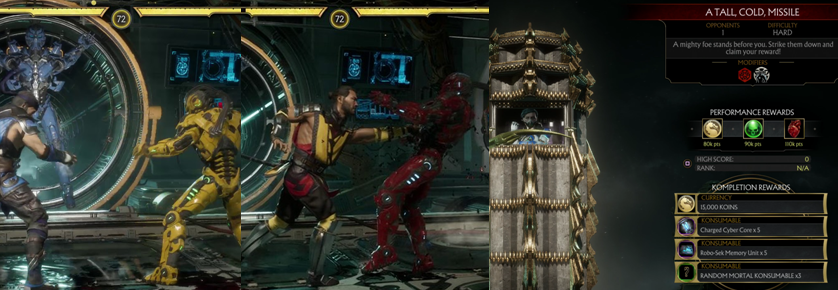
Bosses require a bit of strategy on your part but are extremely fragile once you get your hits in.

In Collision Chaos, Eggman hides at the top of a giant pinball table and drops weighted balls down at you that can force you to drop down to the lowest level or into some annoyingly-placed spikes. The whole battle is structured very similar to the Star Light and Casino Night Zones and is a clear precursor to Sonic the Hedgehog Spinball (SEGA Technical Institute, 1993) in that players must make use of the flippers to bounce Sonic up each level of the arena, ricocheting off of bumpers and such to ram into Eggman’s machine three times. Your enjoyment of this boss may vary as it all depends on how well you get on with the pinball-based Zones and mechanics of Sonic games; for me, this meant it was quite an annoying boss as it can be tricky to get the angle of your trajectory right to go where you need to. At the end of Tidal Tempest Zone 3, you’ll have to chase Eggman around a short maze similar to the end of Labyrinth Zone; unlike in that encounter, though, this time it’s a simple loop that repeats until you land a few hits and you don’t need to worry about spikes or other hazards. Also, after Eggman flees, he floods the area and surrounds his craft with air bubbles and shoots projectiles at you; in order to finish Eggman off, Sonic has to suck up a couple of the bubbles to make a gap in his defences, which is certainly a unique spin on Sonic’s notorious underwater mechanics.

Compared to some of the other bosses, the final battle is a walk in the park!

Probably one of the more frustrating bosses is encountered in Quartz Quadrant; here, Eggman hides behind a giant piston and Sonic is forced to perpetually run on a treadmill lest he be skewered by spikes on the far left of the arena. Unlike the other Eggman bosses in Sonic CD, this boss isn’t about attacking but surviving as Eggman drops bombs onto you, which must be avoided, and you have to wait for the friction of the treadmill to destroy Eggman’s machine and defeat him. Because of how difficult it can be to maintain your speed and footing when avoiding the bombs and their projectiles, this can be a particularly challenging boss for your patience, if nothing else. In comparison, the final boss is a fairly anti-climatic and simple affair; Eggman surrounds his craft with four blades and hovers in a slow pattern around the arena, shooting them at you or occasionally spinning your way. However, it’s ridiculously easy to attack between the blades and, each time you land a hit, he loses one of them so, even though he speeds up and becomes more erratic, he’s made more vulnerable to attack and, honestly, this final boss is easier than the one in the first game!

The race against Metal Sonic might be Sonic CD‘s most iconic, and annoying, boss battle.

Of course, the most iconic boss battle of Sonic CD comes in Stardust Speedway where you’re forced to race against Metal Sonic! This is a thrilling, if frustrating, experience as Eggman flies along behind you firing an instant-death laser and it can be difficult to get up a good run of speed because, again, of spikes, obstacles, and sudden drops or edges in the path. Metal Sonic is completely invulnerable to harm and will charge at you full-speed or electrify its body, which is helpful for breaking spikes and clearing a path for you. Because of the way the screen is locked, though, this isn’t quite the fast-paced experience it’s often thought and interpreted as and is, instead, a strangely-paced, annoying affair that generally comes down more to luck than anything else. The best thing to do is to stay ahead where you can, jump over Metal Sonic, and then blast past it at every opportunity so that you’re on the right side of that wall when it comes crashing down.

Power-Ups and Bonuses:
As is the standard for most Sonic games, a number of power-up monitors are scattered throughout the game’s Zones. Unfortunately, though, there are no new or exclusive items to be found in Sonic CD; instead, you’ll have to make do with either ten Rings, a shield that protects you from damage for one hit, an extra life, speed-up shoes, or a brief invincibility just like in the first two games.

Additional Features:
Sonic CD has twelve Achievements for you to earn, some of which are pretty simple; you’d be hard-pressed to play through the game without travelling through time, for example, and you’re guaranteed to get a hug from Amy after defeating Metal Sonic. Others, though, are a bit trickier, requiring you to collect two hundred Rings rather than the usual one hundred, or to find the upper goal signpost in Collision Chaos 2 and a hidden angel statue in Wacky Workbench. Probably the most troublesome Achievements, though, involve beating Metal Sonic without being hit and destroying all of the Robot Transporter and holograms in the past.

Conquer the seven psychedelic Special Stages to get the Time Stones and the best ending.

As in the first game, finishing every Zone except the third with fifty Rings or more allows you to enter a Special Stage by jumping through a Giant Ring. These Special Stages are much more elaborate than in the first game, though, and arguably a bit more forgiving than in the second; here, you must race around a flat area against a tight time limit, avoiding water and other obstacles as you hunt down and destroy a number of UFOs. If you land on water, or similar surfaces, your time will drain exponentially so be sure to avoid these at all costs but don’t go too fast on the booster pads as it can be very difficult to make tight turns. As you destroy UFOs, you can earn Rings and even a time bonus, which is helpful, but while fans can be used to float into UFOs, spiked grates will cost you valuable time. Depth perception is a real issue here as you have to be very precise with your jumps but, if you see your time is about to run about (when it hits, say, ten seconds), you can pause and quit to the main menu and then retry the Special Stage from your save slot, meaning you basically have unlimited tries at each Special Stage and can easily grab all seven Time Stones and get the best ending.

The Xbox Live version of the game includes a host of bonus features, including a playable Tails!

I mentioned before that this was the definitive version of the game and it’s true; you can pick from a variety of display options in the menu, choose between the U.S. and Japanese soundtracks (but can’t mix and match, unfortunately), choose which Spin Dash you want (I recommend the superior Sonic 2 one), and have access to four save slots. Unfortunately, these don’t work like in Sonic the Hedgehog 3 (SEGA Technical Institute, 1994), meaning you can’t pick and choose a Zone to replay, which is disappointing. You can, however, unlock a stage select, D.A. Garden (basically a sound test which you can also use to enter a variety of cheats, though Achievements can’t be earned this way), and “Visual Mode” (a gallery for viewing the anime scenes) by completing the “Time Attack” mode fast enough. Perhaps the most notable addition to this version of the game is that you unlock Miles “Tails” Prower after beating the game in any way; Tails controls exactly like he did in Sonic 3, meaning he can fly and swim, but Achievements are disabled when playing as Tails as it’d be too easy to get around Sonic CD’s more annoying level layouts.

The Summary:
Sonic CD is an absolutely gorgeous game; it took everything that worked about the first game and expanded upon it wonderfully, bringing a much greater sense of speed and liveliness to the core gameplay and really utilising the power of the Mega-CD to its fullest with its anime sequences, animations, music, and unique time travel mechanic. Yet, as much as I love how visually appealing the game is, I find it lacking in a lot of ways; it’s frustrating at times, the level layouts are massively annoying for a game whose main mechanic is based on speed, and the amount of exploration and trial-and-error needed can get annoying at times. Still, I love how every boss battle is unique and how your actions have actual, visible consequences as you play; it really invites multiple playthroughs to see what each Zone looks like in different situations but, similar to the first game, I find myself less excited to replay Sonic CD and more aggravated as it can be a chore at times. When it shines, it shines brightly and I’d love to see more of this style of 2D Sonic in the future but its more irritating features and mechanics definitely need polishing up first.

My Rating:

Rating: 4 out of 5.

Great Stuff

Did you enjoy Sonic CD? Did you own this, and a Mega-CD, back in the day or did you first experience it on PC or through some other port? What did you think to the game’s presentation and which of the two soundtracks is your favourite? Were you a fan of the level layouts and time travel gimmick or, like me, do you think they could have been better implemented? Which of the game’s Zones and bosses is your favourite? Are you a fan of Metal Sonic and Amy Rose? How are you celebrating Sonic CD’s anniversary this year? Whatever your thoughts on Sonic CD, or Sonic in general, feel free to leave a comment below.

Game Corner: Terminator: Resistance (Xbox One)

Released: 15 November 2019
Developer: Dlala Studios and Rare
Also Available For: PC, PlayStation 4, and PlayStation 5

The Background:
The Terminator franchise (Various, 1984 to 2019) has quite a long history with videogame adaptations; every film in the franchise has been adapted to at least one videogame over the years and the franchise even crossed over with RoboCop (Verhoeven, 1987) back in the day. Just as the movie rights continually get shopped around Hollywood, so too have the videogame rights done the rounds in the industry; in 2013, though, Reef Entertainment purchased the Terminator rights and their original plan was to create a videogame tie-in to the classic Terminator 2: Judgment Day (Cameron, 1991). Poland-based developers Teyon came onboard to develop the game which, after a delayed North American release, was met with generally unfavourable reviews.

The Plot:
On August 29th, 1997, computer defence system Skynet became self-aware and initiated a massive nuclear strike against humanity, who form a fragmented resistance under the command of John Connor. After his entire unit is wiped out by a mysterious new infiltration unit, a T-800 Terminator, Resistance fighter Private Jacob Rivers is forced to ally himself with scavengers to survive and reunite with the Resistance and continue opposing their mechanical enemy.

Gameplay:
Terminator: Resistance is a first-person shooter (FPS) in which you are placed in the role of Private Jacob Rivers, a Resistance fighter in the war against the machines in a war-ravaged future. Unlike many FPS protagonists, Rivers can actually talk, which greatly helps to flesh out the story and his characterisation, which is also dictated by the choices you make during the story. In terms of controls, it’s all pretty standard FPS fare: A allows you to jump (which is mainly to clear some low obstacles or to hop out of some glitchy parts of the environment), B puts you into a stealthy crouch, Y sees you swinging a metal pipe in a melee attack, and you can press in the left analogue stick to run indefinitely. It takes some time for you to acquire a firearm but, once you do, you can hold the Left Trigger to aim, press in the Right Trigger to fire, and use Y to reload and, in a nice change of pace, you can hold up to four weapons at any one time. You can also throw a variety of explosives and other weapons by pressing the Right Bumper and bring up the weapon wheel with the Left Bumper to switch weapons on the fly (though be warned as this doesn’t pause the in-game action so it does leave you vulnerable).

Combat and controls are all pretty standard FPS fare, though you can hold more than two weapons.

The first portion of the game is extremely light on combat and is focused more on stealth, survival, and scavenging; Rivers can pick up a whole bunch of junk (or “Trade Resources”) and other items that are used in the game’s rudimentary crafting system to create explosives, Medkits, ammo, and other items but, while it is worth searching high and low and all around to find these items, you can only carry so many in your inventory and, to be honest, I never really found myself lacking for ammo and Medkits and such. In the early going, though, your greatest ally (besides your trust metal pipe) is your ability to stay out of sight; Skynet’s machines will detect you if they spot or hear you, so you must sneak around them and keep an eye on the Motion Detector bar if you don’t want to get into a fight. It’s easy enough to pick off the small Spider Scouts but, when the T-800s come onto the scene, you won’t stand a chance and they’ll hunt you down relentlessly, smashing through doors and choking the life out of you if you’re not careful.

The Ultravision Goggles and comprehensive in-game map help you to track your objectives.

To aid you in getting about during these vulnerable times, you can press in the right analogue stuck to use the Ultravision Goggles, which let you see through walls to a limited extent, point our nearby machines, and show you their health and current weapon (though, annoyingly, you can neither attack or run while using these goggles). You can also enter vents to get around, close and barricade doors to slow the machines down, and toggle a torch (or “flashlight” for you Americans) by pressing down on the directional-pad (D-Pad). A helpful mini map is located in the very clean and limited heads-up display (HUD) and you can bring up a bigger map of the immediate area, and a list of your current objectives and side quests and such, by pressing ‘Select’. Eventually, you do acquire firearms which, like the enemies you encounter, start small and ramp up as the game progresses; you start off with a pistol and a shotgun battling smaller machines or drones, before eventually acquiring the iconic Phase Plasma Rifle and battling variations of the T-800s. Every time you destroy a machine, complete side quests or missions, or find notes and Skill Books you can increase your skills by spending experience points (XP) on one of three skill trees: Combat (which increases your stealth and allows you to utilise better, more powerful weapons), Science (where you can increase your lockpicking, crafting, and hacking skills), and Survival (which increases the size of your inventory, your health bar, and how quickly you level-up). The maximum level you can reach is twenty-eight and you’ll need to reach level twenty-four to unlock everything but, as long as you stay the course and engage enemies and complete your quests, that’s pretty easy to do.

A couple of mini games help to break up the sneaking and shooting mechanics.

Once you become better equipped, your combat options become much more versatile and you can be much more proactive against the machines. Still, you can’t just go in all guns blazing against rooms full of T-800s and may have to content with multiple different enemies in a single environment, meaning you’ll have to switch between staying out of sight of HK-Aerials, picking off Silverfish with your sound decoys, and blasting T-800s in the face from behind or around cover. If worst comes to worst, though, you can always try to run past enemies but a lot of the time your objectives are directly tied to clearing areas of enemies. Luckily, other Resistance fighters are often on hand to offer back-up (or be invulnerable human shields) but make sure they don’t steal your kills (and, thus, your XP in the process). It’s not all sneaking about and combat, though; often you’ll need to use a lockpick to open doors. Lockpicks can be found and crafted and you’ll need a lot of them as they tend to break on the harder games and because the controls are so finicky; basically, you have to rotate each analogue stick to find the sweet spot, which can be tough the first few times but then either you eventually get into the rhythm or the game just decides to let you win (though you can also try to force the lock, which is generally easier despite the higher risk of the pick breaking). You’ll also make use of a hacking device to hack turrets (which is super useful as they’ll attack other machines on your behalf) or open doors, especially in Skynet bases and facilities; these mini games are basically a horizontal version of Frogger (Konami, 1981) and see you moving a small, 8-bit dot across moving pathways while avoiding collisions.

There’s a heavy emphasis on character interactions, which will determine events and endings.

One of the big mechanics of Terminator: Resistance is the emphasis on story and character interactions; you’ll talk to a wide variety of non-playable characters, from scavengers to children and other Resistance fighters and commanders, all of whom have their own stories and opinions. Often, you’ll be asked to pick from a couple of options and what you choose depends on how close your relationships with these characters grow and the endings you’ll get. As there are no Achievements tied to these interactions, you can simply skip through all the dialogue and pick whatever you want and the only real consequence will be that some characters live, die, or fuck you depending on how well you do. These NPCs will also set you optional side quests, which are generally easy enough to accomplish so it’s worth taking the time to complete them if only to take in more of the game’s environments and earn some more XP; in fact, there’s only one point where you absolutely will fail one of two side quests as you’re given the option of killing a man or sparing him, which is a bit of a black mark on your record.

Graphics and Sound:
In many ways, Terminator: Resistance does a fantastic job of recreating the look, feel, and atmosphere of the Future War scenes of the first two Terminator movies; environments are a mess, with bodies, skulls, debris, wreckage, and smashed up cars and buildings all over the place. Every area is a bleak, desolate location where humanity is holding on by the skin of its teeth, with rundown interiors, gaping holes, exploded buildings, and all kinds of post-apocalyptic horror strewn all over the place. In a common issue with the Terminator films, though, it’s odd how many buildings are still standing, vehicles still work, and technology that still operates with little issue but, for the most part, it definitely sets the mood for the game and works best in the night-time sequences.

The game includes some welcome, and surprising, faithful references to the first two films.

The best thing about this is when the game includes references to the first two films; you’ll spend a lot of time in Pasadena, a common location from the films, including paying a visit to Big Jeff’s (Big Buns is even standing right outside of it) and what appears to be Miles Dyson’s house, and, while Arnold Schwarzenegger doesn’t make an appearance, a body in the hospital bares more than a little resemblance to Robert Patrick’s T-1000. The desolation of the world is juxtaposed with Skynet’s smooth, shiny, horrific technology; Skynet encampments can be infiltrated here and there and large mechanical prisons and structures are all over the place, all of which are highly technologically advanced and stand out from the misery and suffering of other recognisable environments, such as the Resistance base.

Sadly, as good as the machines look, the human character models leave a lot to be desired.

Sadly, though, while a lot of the environments look great, they’re very drab and grey and, while the T-800s and other machines are faithfully recreated, character models look absolutely dreadful; they, and the game in general, resemble something more suitable for the Xbox 360 and I can imagine people who paid full price for the game were quite disappointed with these graphical features. Since story and character interaction is a big part of the game, it’s very noticeable during gameplay even with the comparative lack of cutscenes and no amount of awkward first-person sex scenes can really save that. I also noticed a fair amount of graphical issues, such as renderings and items popping up and a delay in them loading properly and, as if some long load times weren’t bad enough, I also had a weird moment where the game crashed on me. There are also some odd grammatical errors in a lot of the dialogue sequences (“you’re” instead of “your”) but where the game excels is not only recreating the bleak Terminator mood and allowing you to take part in the penultimate campaign against Skynet’s defence grid but also in the use of music and sound effects ripped straight from the films. The ominous T-1000 theme, especially, stood out to me as a highlight during the more action-packed moments and the iconic “duh-duh-dun-da-dun” plays frequently throughout the game, which never gets old, though I found the user interface to be a little too boring and simplistic.

Enemies and Bosses:
One thing I really enjoyed about Terminator: Resistance is that, unlike some other games I could mention, you never had to fight against human enemies (though you can kill any of the really shittily animated rats you find for a Trade Resource); it’s fitting that, even though the human survivors don’t always agree or even like each other, they’re still united against the common, prevailing threat Skynet poses. Instead, you’ll battle a range of mechanical enemies; the first you’ll encounter are the Spider Scouts, which are small spider-like machines that zap you with an electrical blast if you come too close but are easily smashed into junk with your lead pipe or some pistol bullets. Scout Drones hover overhead and protect their vulnerable “eye” with their armoured flaps and Armoured Spiders scuttle about and blast at you from their twin guns; again, the key here is to target the red eye when it’s exposed and shoot from behind nearby cover. Silverfish pose a bit more of a problem as they pop out of their metal hidey-holes and roll at you in a suicide run (you can coax them into destroying themselves, though, with a sound decoy and they’re easy enough to pick off with a shotgun).

At first, you’ll need to hide from the T-800s but, by the end, you’ll be blasting them to smithereens.

Eventually, of course, you’ll come up against the Plasma Rifle-wielding T-800s; these horrific mechanical endoskeletons patrol around and relentlessly clomp after you to blast you to smithereens or crush you to death and must, initially, be evaded or put down with pipebombs until you acquire Plasma Rifles of your own. You’ll also encounter slightly different variants of these machines which utilise flamethrowers, more powerful Plasma Rifles, or even dual-wield weapons, though they’re often indistinguishable from each other beyond the number of weapons they use and the colour of their laser blasts. Terminator: Resistance is surprisingly light on boss battles; you’ll have to hack into and destroy Skynet outposts by overloading the main console and will come up against larger versions of the T-47 Walker every now and then. These like to fire rockets or plasma blasts at you but, because they’re so big and clunky, it’s pretty easy to pick them off from a distance and from behind nearby cover and it’s definitely worth doing for the XP and to take them off the battlefield. Later on, though, you’ll have to battle them alongside other machines and multiple Walkers at once, though your more powerful weapons and explosives will turn the tide in your favour.

The T-850 infiltrator is a far more formidable killing machine, but easily duped.

You’ll also do battle against the T-850, which is the infiltrator model of the T-800, covered in human flesh, and wields a far more powerful Plasma Rifle. The T-850 can also absorb a great deal of punishment (with more and more of its exterior suffering damage as the fight goes on), retreats behind cover and out of range, and even throws pipebombs at you from a distance. Eventually, you’re left to finish it off by yourself, which can be a daunting battle but it’s also ridiculously easy to trick it into going around in circles around parts of the environment. Later in the game, you’ll be stuck in a narrow corridor with only a few pillars for cover and trapped in the burning remains of the Resistance base but, in both cases, you’ll have access to far more powerful weapons to make short work of the T-850.

The final mission sees you storming the defence grid in a massive campaign against Skynet.

A persistent threat in many of the game’s missions is the iconic HK-Aerial; similar to when you first encounter the T-800, at first all you can do is hide when this flies overhead and you can only bring them down when you get your hands on a rocket launcher and the game’s more powerful plasma weapons. One of the standout boss battles is against the titanic HK-Tank; though completely stationary, it will unleash a barrage of plasma shots at you if it spots you and you’re forced to desperately run around the ruins of the environment, grabbing rockets and stunning it with shots to its head to score a damaging blow at its exposed generator. It’s quite a harrowing battle, made all the more tense by waves of different machines that distract you from your main objective. Terminator: Resistance is at its most enjoyable when you’re out in the field trading shots against a variety of metallic machines and the game’s final mission is all about that. Loaded up with the most powerful weapons, with a Resistance-piloted HK-Tank at your back, you’ll blast down every single variant of Skynet’s forces as you help to smash through the defence grid, including T-800s, T-850s, HK-Aerials, and another HK-Tank, all of which are reduced to mere cannon fodder by this point thanks to the weaponry at your disposal and makes for a thrilling conclusion to the game.

Power-Ups and Bonuses:
As you explore the game’s various bleak or ruined environments, you’ll pick up all kinds of junk and other items that can either be used to craft useful resources or traded with other survivors for ammo and weapons. When you destroy machines, you’ll be able to loot them for weapons, ammo, items, and chips; these can be grafted to the Plasma-based weapons to power them up, increasing their fire rate, ammo capacity, handling, and damage output, but must be placed in a specific order so that they actually work. Weaponry is largely tied to your current level, the progression of the story, and how you unlock upgrades through the skill tree. At first, you’ll have your lead pipe, pistol, shotgun, and rapid fire weapons like the uzi and machine gun but, eventually, you’ll be able to wield a far more powerful Plasma Rifle that will even the odds against T-800s and Skynet’s more powerful machines.

Your standard firearms soon get replaced by heavy-duty plasma weapons to deal serious damage.

A major plot point of the story is the acquisition of the VSB-95 plasma minigun (as seen in the first film) and, while you can eventually wield this beast of a weapon, you can also acquire other plasma-based weapons, such as a sniper rifle-esque gun and more powerful plasma weapons. The most powerful of these don’t require reloaded but will overheat if overused, which adds an extra dimension to combat as you’ll be left vulnerable while waiting for the weapon to cool down but can blast the machines to smithereens in seconds on the flip side. Rivers can also utilise a number of sub weapons, such as pipebombs like in the first film, decoys to take out Silverfish, and more powerful explosives. You can also pick up and craft Medkits to replenish some, or all, of your health and also acquire (or, again, craft) a series of stimulants that will give you an edge in combat by temporarily slowing down the action or increasing your attack and defence. Then there’s the so-called “Termination Knife”, a specially crafted electrical shiv that will instantly dispose of a Terminator if you manage to sneak up behind them for an instant kill move.

Additional Features:
Terminator: Resistance features twenty-five Achievements for you to earn, most of which are tied into story progression. Although there are four difficulty modes, no Achievements are tied to them so you may as well play through on ‘Easy’ to sweep them up, but I’d advise upgrading your lockpicking skills to the maximum as quickly as possible as you can miss the ‘No Hope’ Achievement otherwise. Other Achievements include setting off a boombox to annoy an NPC, destroying the T-47 in Pasadena, and simple things like hacking a device or crafting items so it’s pretty easy to get all of the Achievements on offer. Sadly, there’s no a lot of incentive to replay the game beyond reliving some of its more entertaining moments; when you finish it, there’s no ‘New Game+’ mode and, while you can reload previous chapters to try out different dialogue options, endings, and grab a few missed Achievements, none of your skills or weapons carry over. There’s also no multiplayer option but a later update does allow you to download “Infiltrator” mode that puts you in the shoes of the iconic T-800 and sets you against the human resistance. Unfortunately, there are no save points, no new Achievements, and you have to plough through the mode in one sitting, with few opportunities to replenish your health and a surprisingly fragile T-800 at your command.

The Summary:
Terminator: Resistance is probably the best and most accurate Terminator videogame ever made; it perfectly captures the atmosphere and mood of the first two movies and recreates some of the dread and tension of the first film alongside the action and desperation of the second film. Numerous references and allusions to the first film help to emphasise the legitimacy of the title, which does a much better job of continuing the franchise than the last movie, and the game does a great job of bringing the machines to life even without some of the more iconic celebrity licenses. Sadly, though, the game’s graphics, character models, and glitchier moments let it down; it feels like a step back, technologically speaking, and, while it’s not a game-breaker, it was noticeable. It’s also little more than a fairly bog standard FPS; the stealth elements and tenser moments of the early going were an interesting change of pace and I was happy to see that the crafting system was nice and simple, but there’s a lot of extraneous collecting and some wasted potential here and there (particularly in the branching story paths) that also bring the game down a bit. Without the Terminator name attached to it, it would be little more than another unremarkable FPS title but, as it is, it’s enjoyable enough if you pick it up cheap.

My Rating:

Rating: 2 out of 5.

Could Be Better

Have you ever played Terminator: Resistance? If so, what did you think of it and how do you think it holds up against other Terminator games and FPS titles? What did you think about the game’s graphics and its attempts to recreate the look and feel of the Future War? Did you enjoy the stealthier sections or are you more a fan of the more action-orientated parts of the game? Do you feel like it failed to properly live up to its potential or do you think it’s decent enough for what it is? Would you like to see more Terminator games in the future and which Terminator videogame is your favourite? Whatever your thoughts on Terminator: Resistance, feel free to leave a comment below and be sure to check back in next Sunday as I’ll be celebrating Judgment Day!

Game Corner: South Park: The Stick of Truth (Xbox One)

GameCorner

Released: 13 February 2018
Originally Released: 4 March 2014
Developer: Obsidian Entertainment
Also Available For: Nintendo Switch, PC, PlayStation 3, PlayStation 4, Xbox 360

The Background:
Back in 1992, Matt Stone and Trey Parker took some glue, construction paper, and an old 8 mm film camera and created The Spirit of Christmas, a short animated film in which four young boys accidentally bring to life a killer snowman. A Fox Broadcasting Company executive then commissioned the duo to create a follow-up short, Jesus vs. Santa, in 1995, which quickly became one of the first viral videos and led to the commission of a full series airing on Comedy Central. Originally entirely hand-animated, the duo (now joined by team of around seventy employees) soon switched to replicating their cardboard cut-out aesthetic using computers and managed to produce episodes within just a few days to stay right on the pulse of current events. Since then, South Park has expanded not just in its animation and cast but also into a whole host of other media, however South Park’s history with videogames has been…tumultuous, to say the least. Unlike previous games inspired by the show, The Stick of Truth was created with the direct involvement of Stone and Parker, who insisted that this new title actually mirrored the look of the show and would be a role-playing adventure game that utilised the duo’s script and ideas.

South Park had a number of videogame spin-offs, most of them ugly and pretty bad.

Unfortunately, however, the game ran into difficulties after THQ (who had agreed to help work on the game) filed for bankruptcy in 2012; the rights to the game were then bought by Ubisoft, who delayed the game’s release date to make significant changes to its direction. South Park: The Stick of Truth finally released in March 2014; although the game was heavily censored in Europe, it became the best-selling game available within its first week of release here in the United Kingdom and, by February 2016, had shipped over five million copies. Reviews were generally favourable, despite some criticism of the game’s mechanics, but the game performed well enough to earn a sequel in 2017. I, personally, first played through The Stick of Truth on the PlayStation 3 and loved its simple, yet surprisingly deep mechanics, its graphical fidelity to the source material, and its outrageous sense of humour so I jumped at the chance to cash-in a free download code for the Xbox One version to relive the original title in all its sardonic glory.

The Plot:
A new kid has moved to South Park and quickly finds himself drawn into a fantasy role-playing game the kids are playing involving control of the all-powerful “Stick of Truth”. However, after an alien spacecraft crash-lands in the small mountain town and toxic waste from the ship begins infecting citizens and wildlife, the new kid and his newfound friends suddenly find themselves embroiled in a very real fight for their very lives!

The Gameplay:
South Park: The Stick of Truth is a 2.5D, sidescrolling action/adventure game with heavy elements of role-playing mechanics and an emphasis on story, character interactions, side quests, and acquiring new weapons, armour, and buffs. When you first start the game, you’re tasked with creating your avatar, the otherwise-entirely-silent “New Kid”; here, you’re given a few options to customise the New Kid’s hair, skin tone, clothing, and other elements before you’re thrust into the game’s story and tasked with exploring the quiet little mountain town of South Park.

Customise your avatar and choose from four classes, each with their own unique abilities.

Luckily, you live next door to one of my favourite characters in the series, Butters Stotch, who introduces you to Eric Cartman and the game the kids are playing; a role-playing fantasy game very much inspired by the likes of Dungeons & Dragons. As a result, you’re quickly asked to pick from one of four classes: Fighter, Thief, Mage, and Jew. While each has its own specific abilities, positives, and negatives, weapons and armour and such aren’t limited to each class so you can pick a Fighter and still focus on Mana-based attacks like a Mage if that’s your bag. However, unlike in the sequel, you cannot switch or mix and match classes in this game so, once you pick a class, you’re locked into it for the rest of the game.
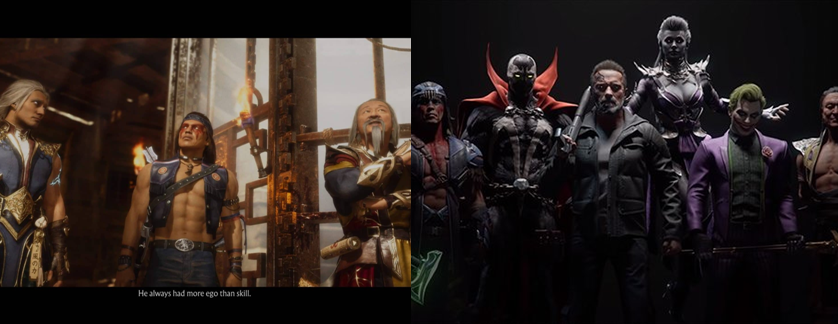
Be sure to explore thoroughly before a new day starts or else you might miss collectables.

Stick of Truth divides its story up into days, rather than chapters; you’re free to explore the town as much as you wish but certain areas and houses and such are either locked or barred off until you complete story quests, side quests, or learn new fart-based magic. As a result, it’s entirely possible to explore a good percentage of the town on the first day, meeting people and getting side quests going, uncovering loot and as much as you possibly can before night falls and you enter certain areas that can’t be revisited. This means it’s advisable to explore every inch of your environment in case you miss something because you might not be able to go back and grab it when the sun rises.

Combat is a simple, but surprisingly deep, affair.

The game has a difficulty slider for you to utilise but there are no Achievements associated with playing the game on a harder mode so the only reason you’d turn this is up is if you found the game’s combat too easy. And, to be fair, that’s entirely possible; as you explore, you’ll come up across fellow kids, rabid dogs, drunken vagrants, and Nazi zombies (you know, the usual) around town; you can easily bypass them but then you won’t earn experience points (EXP) or level-up. Luckily, though, you can strike them on the overworld to gain an advantage in combat. Battles take place on a traditional 2.5D battlefield and are entirely turn-based; you can wait as long as you like to take your turn without fear of being attacked, which is nice, and can select your character’s abilities or use an item as well as cast magic or attack, meaning you generally always have the advantage. Battles usually boil down to selecting an attack and pressing either A, X, Y, rotating the analogue stick, mashing buttons, or a combination of all of these elements to land attacks. Before you strike, your weapon will flash; pressing the right button at this time will unleash a stronger attack, or allow a combination of moves to be performed. It’s pretty simple to get the hang of and you can buff your attacks with equipment patches and farts to deal additional damage.

Each of your buddies has their own attacks and abilities to help you in and out of battle.

Generally speaking, though, combat comes down to how easily you adapt to the wheel-based menu (which can be a bit janky at times) and how accurate you are at pressing A; when an enemy attacks, you’ll have a small window to press A to defend yourself and reduce the damage done to you or keep yourself safe from status effects. This window can be very small at times so you’ll need to have your wits about you but, luckily, you are joined by a number of buddy characters in battle who have abilities and capabilities of their own (or act as a punching bag, if necessary). Butters, for example, can heal you without you having to waste an item, while Kenny McCormick continuously resurrects after death and Kyle Broflovski can increase your attack power. Additionally, you can switch your buddy at any time in battle at the cost of a turn, instantly allowing you to have a fresh buddy ready to lend a hand.

You can inflict multiple status effects on your enemies to aid you in battle.

Combat is simple to learn, easy to master, and fun to experience; with patches and perks, you can make your character incredibly overpowered in a very short period of time, dealing multiplier status effects to your enemies (such as bleeding, burning, and grossing them out), regenerating health (HP) or Power Points (PP), and dealing additional damage or upping your abilities or defences. It’s pretty easy to double up these effects with the natural abilities of your weapons to wipe out your enemies, even when they armour up or reflect and deflect your ranged or melee attacks.

Interact with your environment to take out enemies quickly and efficiently.

The New Kid has quite a few resources at his disposal to make things even easier as well; often, you can shoot or fart on objects in the overworld to either damage or defeat enemies and you can learn various types of fart-based magic to open up new areas or aid you in battle. These are sometimes cumbersome, however, as they require some tricky or imprecise movements of the right analogue stick to pull off and are made even more inconvenient by the fact that your Mana Meter doesn’t automatically refill after a battle like your HP and PP. This means that you have to buy and consume Mana-restoring food to keep it up (but not too high, lest you shit your pants in battle); luckily, though, as I said, HP and PP are restored and all status effects wiped away once a battle ends, allowing you to keep HP and PP restoring items for the more difficult boss battles.

Use your hard-found cash to buy weapons, armour, and other wares.

As you explore South Park, it’s recommended that you attack and interact with everything you see to find new armour, patches, weapons, items, junk, and cash. Fittingly, the game’s money is measured in small amounts; you’ll generally find a few cents lying around and resources only cost a few dollars or so but you can sell your useless junk or unwanted items to make more money. When you venture to Canada, though, you’ll have to contend with their higher prices and exchange rate but I never found myself strapped for cash or wanting for resources; if your inventory is full, you can usually return to the item chest or location and pick up whatever you couldn’t carry later on if you really want to.

The New Kid gains numerous abilities to help him progress further and access new areas.

The New Kid also gains access to a few additional abilities to help him out; when you’re abducted by aliens, you’ll get an anal probe inserted into you that allows you to access alien tech to open doors or teleport around the map. Later, when you meet the Underpants Gnomes, you’ll also gain the ability to shrink to access new areas, in addition to using the New Kid’s fart abilities and various buddies. This latter aspect was significantly expanded upon in the sequel and it can sometimes be unclear exactly what you need to do and with which buddy. The entirety of the town in accessible and faithfully recreated, though (except for Mephisto’s laboratory and the Mall…), which really adds to the game’s level of detail and fidelity and you can use Timmy to fast travel across the map (though I found myself running about the place more often than not to find more loot and level-up through battling).

Talk to, and befriend, everyone in South Park.

You’ll also gain EXP by completing the many and varied side quests that The Stick of Truth has to offer; at any one time, you can have as many as ten quests on the go at once, including those that are story-based, and you can keep track of these at all times using the New Kid’s phone and Facebook feed. Much of the game’s plot revolves around rallying others to your cause or making Facebook friends with the townsfolk so you’ll need to talk to everyone you see to gain followers and be given side quests to complete to earn EXP, get more followers, and even acquire certain iconic South Park characters as Summons to help you out in battle.

The story is as wacky and crude as you would expect from South Park.

The game’s hilarious and multi-faceted story, which involves all the familiar faces of the show and even recycles or addresses jokes and loose ends from the episodes, is just as wacky and insane as the show has become over the years; what starts as a simple (yet surprisingly elaborate) war between Cartman’s human forces and those of Kyle’s elf-kind quickly escalates into a battle against Nazi zombies and gun-toting government agents looking to destroy the town. After both groups are betrayed by Clyde, the New Kid has to travel to Canada to translate a message; this is where the game’s presentation takes a sudden and hilarious left turn as Canada is rendered through traditional 8-bit graphics, complete with an 8-bit rendering of “Blame Canada” and the Canadian national anthem. It’s a hilarious and mental detour that, sadly, doesn’t last as long as it could do (though, thankfully, you can return to Canada to fight Dire Wolves whenever you want). Ultimately, all of the kids you’ve befriended lay siege to Clyde’s elaborate dark tower and you end up having to disarm a nuclear bomb inside of Mr. Slave’s ass, battle a zombified Chef, and finally defeat Kenny after he claims the Stick as his own and transforms into a Nazi zombie himself.

Graphics and Sound:
The Stick of Truth is beautiful in its simplicity; in every respect, it looks exactly like an episode of the popular cartoon show, with the entirety of the town and its many houses, areas, and districts rendered in the finest cardboard cut-out-style 2.5D available. It’s literally like you’re playing an extended episode of the show as you’re able to visit the school, the houses of all the show’s popular characters, and the many businesses and iconic locations South Park has to offer.

The entirety of South park is recreated in stunning detail.

I honestly cannot gush about this presentation enough; too often, videogames based on cartoons (especially the South Park titles) slap an ugly, polygonal 3D effect on the presentation that ruins the game’s look and feel. Here, though, everything is just as crude and charming as in the cartoon; weapons and armour all look distinctly child-like, as though cobbled together by kids, and the way the game incorporates its more elaborate elements into the show’s aesthetic is impressive. Add to that the fact that the game not only uses music from the show but the voices of the entire cast and you’ve got a really special package and the result is a game adaptation that is more than 100% faithful to its source material, utilising so many jokes, characters, and words of dialogue that it’s actually quite mind-boggling.

Enemies and Bosses:
As you explore the town, you’ll get into fights with other kids and wild dogs in the game’s early going; these battles generally take place in a two-on-two format but you’ll face groups of about six at some points as well. Each of your enemies has similar abilities to you, meaning they can cast magic to slow you down, cause you to bleed, set you on fire, or gross you out but enemies will also enter a “Riposte” stance to automatically counter a melee attack or a “Reflect” stance to automatically parry ranged attacks. Enemies can also armour up and erect shields, which must be broken through with regular attacks before you can deal real damage, or have healers on hand to replenish their HP or remove status effects.

Enemies soon become hilariously ridiculous.

Later in the game, the townsfolk become infected with alien goo and become Nazi zombies; unlike other enemies, these guys will resurrect after a few turns, meaning you need to either end battles against them quickly our utilise attacks that hit multiple foes to clear their corpses from the field. When you reach Canada, you’ll have to contend with Dire Wolves, Bears, and Snakes, all of which are a bit more formidable than the town’s usual foes and can infect you with “Dire AIDs” if you’re not careful. Generally, though, battles against common enemies are pretty much a foregone conclusion; you’ll be so overpowered and have mastered the battle system so well that even groups of difficult enemies will be no match for you with the right setup.

Watch out for your Dad’s swinging balls when you’re battling the Gnome Warlock!

Of course, you’ll also have to take part in a number of more challenging boss battles throughout the game’s story. Stick of Truth’s boss battles involve a lot of variety compared to regular battles and have you performing slightly more complex actions, such as resisting the sleeping effects of Jimmy Valmer’s stuttering limericks, keeping the Hallway Monitor from calling your parents, and dodging the swinging testicles of your father as you battle the Gnome Warlock.

Al Gore is a serious pain the ass as both a character and a boss.

One of the game’s more difficult and annoying bosses is former Vice President of the United States Al Gore; after a long side quest involving Gore’s vendetta against “ManBearPig”, you’ll enter a lengthy and difficult battle against Gore and his bodyguards where the former Vice President will try to put you to sleep with a presentation on global warming, up his attack and regenerate his health, and bombard you with rapid slaps all while his constantly-respawning bodyguards take shots at you. It’s a tough fight but one that can be completely avoided (though you’ll lose out on Achievements if you do skip it) and made easier by having Jimmy as a buddy. You’ll battle Al Gore again later on, this time when he is under the guise of ManBearPig, but this is a walk in the park compared to the first fight.

Despite the censoring, Stick of Truth goes above and beyond to shock and entertain.

Things continue pretty smoothly until a breakout of the Nazi zombie virus as the Unplanned Parenthood facility; here, you’ll have to battle a gigantic Nazi zombie foetus, which has a staggering amount of HP and comes alongside an umbilical cord that leeches your HP. Because of this, it is absolutely essential that you destroy the umbilical cord first and remove it from the battlefield, avoid trying to gross the foetus out (as zombies are resistant to that), and focus on chaining bleeding and burning multipliers while swapping out your buddy.

The Sparrow Prince can present a real challenge.

Later, when you venture inside of Mr. Slave, you’ll have to face another annoying boss: the Sparrow Prince. As a spirit, the Sparrow Prince is immune to the bleeding status effect and is accompanied by constantly-respawning globs of Nazi zombie bacteria. It’s not an impossible battle with the right class type and setup but it can be frustrating since the Sparrow Prince’s attacks deal high amounts of damage and hit quite quickly, making it difficult to defend yourself in time.

In the finale, you’ll run a gauntlet against Nazi zombie versions of your friends and allies.

The game’s finale sees you run a gauntlet, of sorts, of tough enemies in Clyde’s fortified tower and then a number of bosses, the first being against a reanimated, Nazi zombie Chef. This isn’t much of a hassle, though, and you’ll eventually face off with Kenny in quite a long-winded battle that sees your damage carry over between Kenny’s different phases and you automatically swap between buddies as the story dictates. It’s not especially difficult (especially compared to Al Gore or the Sparrow Prince) but it can get frustrating as you’re right at the end of the game but Kenny keeps getting back up and regenerating until you fart on his balls and bring the game to an end.

Power-Ups and Bonuses:
As an RPG, you obviously have access to a wide variety of weapons, armour, and power-ups to aid you in your journey. Levelling-up generally allows access to battle abilities rather than affecting your stats and the game caps your level at fifteen, though by the time you hit that you will be massively over-powered if you have equipped the right gear.

Attack up close or from afar, buffing your weapons with various patches and abilities.

You have access to two weapons: a melee weapon (swords, staffs, crutches, dildos, and the like) and a ranged weapon (dodge balls, darts, crossbows, and so forth). As you explore, you’ll find more powerful variations on these weapons, or you can buy them from various merchants about town. Each weapon comes with various buffs (such as causing an opponent to bleed, leeching HP, or powering up your abilities) can be assigned up to two equipment patches to increase your buffs further (this can add additional damage, leeching, or regenerative properties, among other options).

Weapons and armour can all be powered up to make battles a walk in the park.

Similarly, your helmet, armour, and gloves can be equally powered up by equipment patches to make your avatar quite the formidable fighter; thanks to patches and buffs, you can combine status effects and other buffs to ensure you always have the edge in battle and you can even customise the colour scheme of your equipment with various dyes.

Learning new fart magic can be a tricky task to master.

Completing side quests also nets you the ability to use Summons; while these can only be used once per game day and are useless in boss battles, they can turn the tide further in your favour if you’re struggling against certain enemies. As the story progresses, you’ll also unlock additional fart powers to use in and outside of battle; these can be awkward to learn and to use in the field, requiring vague movements of the analogue sticks to pull off, and frankly are nowhere near as user-friendly or as prominent as in the sequel.

Additional Features:
South Park: The Stick of Truth comes with fifty Achievements for you to earn, the majority of which are pretty standard fare (defeating certain numbers of enemies, completing story-based tasks, using certain attacks and so forth) but others can be easily missed or will require a bit of preparation on your part. There’s one that requires you to wear a bald cap and a goatee or ginger freckles to battle certain enemies, for example, another for completing the game without selling any items or wearing certain outfits, and even one for finishing the game without a single buddy being knocked out.

You’ll need to search high, low, and all around to find all thirty Chinpokomon.

The game is absolutely packed full of content but, unfortunately, most of this is confined to the main game rather than the post-game; as many areas become inaccessible after you complete them, you may find you have to restart from a previous save (or start a new game entirely) to find everything you need or befriend everyone in town. Scattered throughout the game are thirty Chinpokomon for you to find, for example, and 121 people to become friends with on Facebook. Talk to the wrong people at the wrong time or fail to explore your surroundings properly and you may find that you miss your one and only chance to tick these off your to-do list, meaning you’ll have to start all over again.

Side quests will take you all over town and even to the chilly mountains of Canada.

There’s so much to do around town thanks to the game’s side quests; you’ll be finding kindergarteners in a game of hide-and-seek, tracking down Mr. Hankey’s lost pooplings, ferrying messages between South Park characters, attacking Mongolian children on behalf or Mr. Kim, and you can even have surgery performed to look like David Hasselhoff! Jimbo and Ned send you on a side quest that sees you battling a number of option bosses as well, such as a rabid dog, the iconic mouse-penis, and the Canadian Barking Spider of the Queefing Caverns.

The Summary:
South Park: The Stick of Truth is a great little RPG; it’s not especially difficult, and this will probably turn off hardcore RPG players, but there’s a surprising amount of depth to its simple presentation and battle system. There’s a lot going on in the game but it never feels like you’re overwhelmed or can’t remember how to do stuff; it’s very intuitive and user-friendly, for the most part, and the story is hilariously crude and quite long.

The game won me over with its many quests, outrageous humour, and fidelity to the show.

The game’s length is padded by the sheer amount of side quests and things to do, see, and collect; it’s easy to waste a lot of your time veering away from the main story mission to beat up homeless people on behalf of the Mayor or transport messages across the length and breadth of Canada. Battles are quick and fun, requiring a bit of strategy at times but nothing that’s going to cause you game-breaking frustrations (with the possible exception of learning the “Sneaky Squeaker” from Randy Marsh), and I never found myself bored while playing. Quite the contrary, in fact, as I constantly found myself being immersed in the South Park world thanks to the game’s toptier presentation. For as long as it is, though, the game is quite short but, thankfully, the sequel offers more of the same, expanding and improving upon it where necessary and, between the two of them, both games really exemplify the right way to adapt cartoons into a videogame.

My Rating:

Rating: 5 out of 5.

Fantastic

What are your thoughts on South Park: The Stick of Truth? Did you enjoy the game or do you prefer a bit more challenge in your RPGs? Which character class did you choose, and did you side with Cartman or with Kyle when the story asked? Which parts of the game were your favourite, or least favourite, and which of the two did you prefer? Perhaps you prefer a different South Park videogame; if so, what is it, and which South Park character or episode is your favourite? How are you celebrating South Park’s anniversary this year? No matter what your thoughts on South Park: The Stick of Truth, or South Park in general, I’d love to hear from you so feel free to leave a comment below.
Game Corner: Sunset Overdrive: Deluxe Edition (Xbox One)


Released: 28 October 2014
Developer: Insomniac Games
Also Available For: PC and Xbox Series S/X

The Background:
Sunset Overdrive was developed by Insomniac Games, who were best known at the time for their work on the Ratchet & Clank series (ibid/Various, 2002 to present); seeking to expand their portfolio, the developers drew inspiration from videogames like Jet Set Radio (Smilebit, 2000) to create an unusually vibrant title that would be the biggest game they had ever worked on at the time. Sunset Overdrive aimed to encourage players to be more aggressive in the way they played by emphasising momentum and featured a unique punk rock aesthetic to its post-apocalyptic world. Upon release, Sunset Overdrive’s tone and unique comedy was highly praised; reviews also praised the gameplay and the fun of exploring its zany world, and art style, though its multiplayer and more repetitive mechanics were criticised. Still, Sunset Overdrive was the second-best selling game in the United Kingdom upon release and the game was expanded upon with a range of downloadable content (DLC) that added new weapons, costumes, and story-based content to the game, all of which are included in this “Deluxe Edition” of the game.

The Plot:
In the year 2027, megaconglomerate FizzCo hosts a massive pre-release party in Sunset City for its new energy drink, OverCharge Delirium XT; however, as they rushed through the testing phase, the drink transforms people into violent, boil-covered mutants known as “Overcharge Drinkers” (or “OD”) and it is up to the player character to join the remnants of society in fighting back against the OD and bring down FizzCo.

Gameplay:
Sunset Overdrive is a third-person, open world action shooter with a heavy emphasise on parkour-style traversal; your avatar (named only as “Player” in the in-game subtitles) can grind, swing, bounce, and wall run all over Sunset City, easily chaining together different moves along with melee and projectile attacks to build up the “Style Meter” and amass greater kill combos.

Grind, bounce, and wall run your way across a bright and colourful city.

The Player’s skill set is relatively diverse and tailored towards these mechanics; X allows you to perform a dodge roll and grind on wires, rails, roof edges, and almost everything across the city following a jump. A, as always, jumps; pressing it right as you land on certain surfaces (such as cars, solar panels, and nets) will allow you to bounce higher and you can double tap A to vault over lower walls. You’ll also eventually learn to perform an air boost with the Right Bumper and, at certain times, you can press Y to interact with the environment to open doors, pick up mission items, or grab explosive barrels and you can also swing your crowbar with B to melee attack (which can also be performing while grinding).

Combat is fun but chaotic and seemingly never-ending at times.

As essential as all of these traversal options are, though, a large chunk of the game is made up of weapons-based combat; you press (and/or hold) the Right Trigger to fire, use the Left Trigger to strafe, and can bring up your weapon wheel by holding down the Left Bumper. Similarly, you’ll be able to select from a series of traps using the directional pad but, while the game does slow down to a crawl when the weapon wheels are open, there is a risk of you being attacked when selecting weapons and, while you can hold multiple weapons at once, it can be a bit tricky to select the weapon you want as the selection wheel feels a bit slippery at times. Weapons come in all sorts of bizarre shapes and sizes, with some being more effective against certain enemies (those that shoot out fire are more effective against OD, for example, while shock-based weapons are better for dispatching FizzCo’s robots), but ammo can often be in short supply. While you never have to reload and you’ll find more ammo by smashing crates and killing enemies, I often found that I burned through a lot of my ammo very quickly even after upgrading their ammo capacity, which means it’s best to switch between weapons as often as possible.

Sunset Overdrive‘s map system is cluttered but extremely detailed and helpful.

Sunset Overdrive is a pretty massive game; a mini map on the heads-up display always keeps you on track towards your objective and points out any enemies, friendlies, and pick-ups and secrets in the area. The game’s main map is accessed from the pause menu and, right from the beginning, is packed full of things to see, do, and pick-up. The game’s map system and large, diverse city reminds me of Grand Theft Auto V (Rockstar North, 2013) and has many of the same options; you can toggle between different objectives and views, set custom waypoints, and purchase special maps to highlight even more secrets. Despite how big the game world is and the sheer amount of stuff that you can find and collect in any given area, I never found myself getting lost or turned around as both the mini map and main map (and in-game dialogue) constantly keep you pointed in the right direction. You can also fast travel to certain points on the map, which is always appreciated especially in a game this big but I found it was actually better to travel manually as I could veer off to grab collectibles along the way.

It’s easy to get beaten down by your many enemies but the pop-culutre references make respawning fun.

What does get a bit manic, however, are the sheer amount of enemies you’ll have to contend with. OD are literally everywhere in Sunset City, crawling out of sewers, dumpsters, and clambering around rooftops and alleyways and their numbers only increase as the game progresses. The game barely ever lets up on the onslaught and, even after clearing the immediate area of enemies, more will soon spawn in if you linger too long. This means that you need to constantly be on the move; it’s not really recommended to battle enemies at ground level, where your movement options are more limited, meaning you’ll be grinding and hopping between different traversal points and constantly switching directions on the fly, which can make aiming and seeing where your shots are going a bit difficult. In this regard, the game reminds me of Infamous (Sucker Punch Productions, 2009) in its emphasis on movement-based combat, though the shooting mechanics are noticeably more refined and useful here; the more you move and mix up your attacks, the more your Style Meter will grow to activate any amplifiers (“Amps”) you have attached to your character. The Player, however, can be a bit fragile; you’ll need to pick up Green Crosses to replenish your health, which can be whittled away extremely quickly, and certain weapons and upgrades will increase your health and durability, but dying is pretty easy in Sunset Overdrive. Thankfully, after dying, you’ll simply respawn (through a number of amusing pop-culture references) near to where you fell and be able to carry on with what you were doing but, other times (generally when in the middle of a side quest) you’ll have to restart your current mission from the beginning, which can be a bit inconsistent and annoying.

There are a number of challanges available to you to earn cash and bonuses.

Gameplay is given a bit of variety from a number of non-playable characters (NPCs), all of whom are part of different factions and have a bunch of side quests for you to complete. These generally involve “busy work” such as clearing out OD, human Scabs, and/or FizzCo ‘bots, smashing certain machines or objects, collecting things, or dashing across the city completing errands. You’ll also find a number of challenges across the city which task you with racing through rings using your grinding, bouncing, and wall running skills, collecting points, battling swarms of enemies, smashing stuff up, or planting bombs. All of these have a time limit attached to them and will net you additional rewards based on your ranking (Bronze, Silver, or Gold), which can range from cash, Overcharge, and additional clothing items and it’s pretty easy to get sidetracked during your many missions to complete these tasks as you go.

Take to the skies in glider challanges and defend Overcharge against swarms of OD.

All of these missions and side quests are highlighted on your map and can be replayed at any time from the main menu, allowing you to try for more points and rewards. You’ll also get to pilot a glider at various points both in the game’s story and in challenges; this is a pretty simple affair that sees you flying over air currents to keep your ship powered up, performing barrel rolls to avoid enemy fire, and blasting at enemies and targets with homing rockets. Sadly, while these sections are fun, there’s no way to call a glider to you at any time to help traverse the city and these sections are a bit limited in their scope. You can also perform a dash over bodies of water by pressing X and the Player is, thankfully, fully capable of swimming, which is always a plus. Easily the most prominent additional mechanic you’ll take part in, however, are the handful of times when you’re tasked with laying traps and holding out against waves of OD while cooking up additional Amps in Overcharge canisters. These sections can be tricky thanks to the sheer amount of enemies that you’ll face but placing a variety of traps at various points around the fort and staying on the move will increase your chances of survival and, even when you have to defend multiple targets across more complicated forts, these aren’t massively challenging and can be quite exhilarating. Barricades help keep enemies at bay and you’ll be awarded additional energy to lay more traps as the sections progress, which is helpful, and, while it can get very chaotic as more vicious and varied enemies spawn in, the rewards are worth the effort.

Graphics and Sound:
Sunset Overdrive utilises exaggerated, comic book style, semi-cel shaded graphics to bring its characters and world to life. While the city is mostly semi-realistic, characters are larger than life and this really helps to sell the game’s zany narrative. You avatar can be completely customised, allowing you to pick between two different male and female body types and buy and equip a range of clothing items to make them unique to you. Options for hair, faces, and body types may be a bit limited but there are a lot of wacky outfits to choose from and these are easily unlocked or purchased using in-game currency, meaning you can constantly switch up your appearance.

Sunset City is huge and vibrant and packed full of things to collect and enemies to slaughter.

Sunset City is absolutely gigantic; cordoned off from the rest of the world by a convenient (and literal) invisible wall, the city is custom-built to take advantage of your traversal mechanics, meaning there are a lot of wires, lampposts, and walls to grind, swing, and run across. The city is full of different areas (such as Little Tokyo, high-rise apartments, bridges, a water treatment plant, a fairground, and shopping districts), all of which are crawling with seemingly-endless waves of enemies and full of things to collect. The downside, though, is that the game isn’t really built for vertical traversal; this means that if you fall or are knocked to ground level, it can be frustrating and difficult to work your way back up and out of the way because the Player is geared more towards horizontal movement.

The game’s exaggerated aesthetic really adds to its appeal, despite the odd glitch here and there.

The game’s story is absolutely bonkers and full of pop-culture references to movies and fourth wall breaking moments. It’s honestly one of the more unique and entertaining stories I’ve ever played through and really helps ease the frustration at the game’s more annoying moments; characters are all over the top and the humour is crude and self-referential, which is always fun, though you’re not always able to skip through cutscenes or certain moments and, while the soundtrack is suitably rocking and enjoyable, I did notice the music and sound effects cutting out abruptly at certain points. This was most noticeable when I was playing through the “Dawn of the Rise of the Fallen Machine” DLC, however, where the subtitles suddenly turned off and all music and most sound effects suddenly cut out completely and didn’t return until I quit and reloaded the game.

Enemies and Bosses:
The primary enemy of Sunset Overdrive are the OD, disgusting mutant humans who swarm all over the city and attack in large groups. Though easily dispatched, their sheer numbers, ferocity, and tenacity can be overwhelming as they’ll attack in hordes and rush at you, clawing and swiping and easily whittling your health down unless you stay on the move. You’ll also have to contend with different OD variants, such as “Poppers” (who charge at you and explode in a kamikaze attack), “Herkers” (larger OD who throw rocks and objects at you), “Gunkers” (who hop about from above and shoot gunk at you), and “Spawners” (who will continuously spawn more OD unless you put them down).

Human Scabs and deadly robots will also take pot shots at you and cause you serious headaches.

You’ll also have to contend with human enemies, the Scabs, who shoot at you and use cover-based mechanics to pick you off. Thanks to the sheer number of their projectiles, these can be incredibly annoying enemies and are easily able to overwhelm you. Similarly, FizzCo’s many different robots and mechs will also attack you throughout the story, even setting up little fortifications and turrets to cause you extra headaches. As the story progresses, you’ll battle groups of all of these enemies at once and, while they also attack each other, it can get a bit manic trying to take them all out as you have to constantly stay on the move and switch to different weapons to be at your most effective.

Bigger and more aggressive enemies will soon become the norm as the story progresses.

Still, these chaotic battles and the steady increase of different enemy variants aren’t to be sniffed at as traditional boss battles are few and far between in Sunset Overdrive. Rather than take on bigger, nastier bosses progressively to finish up a mission, you’ll encounter larger, more powerful enemies or new enemy variants as you perform missions or defend your forts. These include the “Wingers” (large, bat-like OD who fly around shooting fireballs at you), “Muggers” (bestial OD who leap about the place and aggressively pounce on you to attack with their claws), Blade Bots (who rush at you with electric swords), and Tank Bots (a heavily-armoured mech that bombards you with lasers, mines, and leaps about using hover jets). As you progress, you’ll have to battle swarms of regular enemies bolstered by these bigger forces or even two or more of them at once, which can be a real challenge at times, especially if you’re low on (or out of) the most appropriate ammunition.

Fizzie is the game’s most persistent, and pretty much only, boss.

That’s not to say there are no boss battles at all, though; You’ll frantically blast at the King Scab on a rollercoaster before derailing him with a massive dinosaur mask at one point and also battle a gigantic version of Fizzie, FizzCo’s annoying and enthusiastic mascot, twice during the game’s story. The first time you battle him, he’s a massive blimp and floats around blasting at you with his eye lasers and spitting out annoying explosive balloons. You must grind around high up in the air and bounce on pads to stun him, and then unload at his exposed weak point, but the battle becomes tougher as it progresses, with Fizzie shooting rockets at you at directly targeting your rails as you frantically try to keep from falling (which, thankfully, doesn’t deplete your health or result in failure) to blast his weak spot. Fizzie’s artificial intelligence also takes control of the FizzCo building for the game’s finale; before you can even reach this point, though, you must eradicate the FizzCo ‘bots alongside all of your colourful allies and then, when the fight begins, you’re given three minutes and thirty seconds to race across the city, avoiding devastating sky beams, and grind up the building’s tentacles while avoiding electrified currents, bouncing from pads, and trying not to be knocked away as you frantically blast at the building’s power core. You have to do this three times and each time the timer resets but Fizzie is a bit further away, a bit more heavily defended, and more aggressive in his attacks and defence strategies.

Power-Ups and Bonuses:
There are a wide range of weapons on offer in Sunset Overdrive, each one unique and kind of crude in its design and often cobbled together by the most random of items. You can melee attack with a crowbar but will eventually be able to purchase a baseball bat with your cash and, as part of the story, will be tasked with forging a massive sword to chop enemies up but you can also toss or attack barrels to destroy groups of enemies and you’ll also purchase and acquire a number of different guns.

The game’s weapons are absolutely bonkers and fun to swap between (when you can manage the weapon wheel).

These range from amusing variants on standard weaponry from shooter games, such as pistols, shotguns, machine guns, and grenade launchers; one of the most reliable weapons is the first one you get, the Flaming Compensator, which is great for turning OD to ash. The High Fidelity and Nothin’ But the Hits weapons fire vinyl records at high speed and are great for crowd control, while the Shield Buddy is a must-have for blowing enemies away and protecting you in a temporary energy shield and the Dirty Harry is great for dealing heavy damage to bigger enemies. You can also grab explosive weapons like the One-Handed Dragon, TnTeddy, and Multi-Lock Rocket Launcher to dish out heavy damage, lure enemies into a frenzy with the Captain Ahab or Rager, freeze them in place, or slowly deal damage over time with some of FizzoCo’s own weapons.

Amps and Overdrives provide a range of benefits to your weapons and skills.

As you use each weapon, it’ll gain experience points (XP) and level up to a capped level of five. This not only increases its damage output and effectiveness but also allows you to equip Amps to the weapon for additional effects; Amps can be unlocked and bought at forts and have a range of benefits, from cosmetic stuff like having enemies explode in a burst of flowers, to perks for the Player (causing enemies to drop additional health, money, Overcharge, or increasing the XP rate), and (my personal favourite) additional attacks (rockets, a small nuclear bomb, shock or fire damage, and many others) that can really help level the playing field when faced with swarms of enemies. Performing different tricks, moves, and killing certain enemies will also earn you Badges; Badges can then be cashed in from the main menu to buy Overdrives to equip to the Player. These will increase your health, ammo capacity, and allow you to deal (and take) more damage from certain enemies. You can also increase the damage output of your weapons, the effectiveness of your traversal mechanics and melee attacks, and many other little buffs that all add up to assist you during gameplay. There are also a number of different traps you can buy to place when defending your forts; some of these automatically activate but others require you to jump onto them (which you’ll get some practice with in certain missions) and you can purchase new Amps, weapons, and traps using Overcharge and by collecting the multitude of different collectibles and junk scattered all over the city.

Additional Features:
There are sixty-four Achievements to earn in Sunset Overdrive, with the bulk of these popping when you complete various story-based missions. Many others are tied to combat and pop when you kill a certain number of OD, or when killing enemies in certain ways (grinding and bouncing, for example), spend a certain amount of money, upgrade your weapons, and equip Amps and Overdrives. By far the most time-consuming Achievements are those that involve completing certain side missions or collecting the game’s many different items and junk; scattered all throughout the city are Fizzie balloons, neon signs, toilet paper, and smelly sneakers for you to collect to purchase new Amps and you’ll need to find every single one of these (as well as deface FizzCo signs, smash their vending machines, eavesdrop on conversations, and view city landmarks) to nab every Achievement.

There are numerous collectibles and side missions and even an online multiplayer component.

Each faction you encounter in the game has a number of side quests for you to complete; these include scouring the city for comic books, roasting pigeons, finding parts, rescuing or finding their allies, clearing out enemies, operating cranes, or smashing cars to cause a ruckus and it’s worth your while taking the time to complete as many (or all) of these side quests as it’ll net you more money and items. There’s honestly so much to do at any one time that it can be a little overwhelming but it definitely keeps the game from getting boring and you can easily begin or replay any mission at any time. Once you finish the game, your objectives automatically switch to any remaining side quests, which is really handy, and the game even comes with an online component (“Chaos Squad”) which you can activate at any time from convenient booths scattered across the city. While I wasn’t able to experience this, it is apparently an eight player co-operative mode that involves defending forts and completing missions and has a number of Achievements tied to it.

The two DLC campaigns add a significant amount of content to the game.

The game’s Achievements are further bolstered up to eighty-eight thanks to the game’s two story-based DLC missions, which introduce slight enemy variants, feature forty UFOS to collect, and bestow you with new weapons and items. In “Mystery of the Mooil Rig”, you’ll venture out to an oil rig, where you’ll have to battle oil-based OD and Scab workers while igniting oil to call for help. You’ll also have to make use of the game’s harpoon mechanic to bring a boat in safely, destroy egg clusters infecting the rig, and contend with the massive Cthulhu-like DL Sea Monster; to battle this monstrous creature, you must destroy its tentacles and then have your ally launch you into its gaping jaw so you can mash B to hurt it from the inside. The second story-based DLC, “Dawn of the Rise of the Fallen Machine”, is much trickier and more frustrating; this has you venture beyond the invisible wall and into the FizzCo robot factory, where you must find diaries to assemble a new weapon, impersonate a robot to access kill codes, and frantically roll around in an energy ball destroying certain ‘bots within a strict time limit. This culminates in a boss battle against B-WIN, the host of Sunset TV, who blasts at you with lasers and energy beams from behind multiple screens that protect his core. For this fight, you’ll need to make stringent use of cover and stay on the move to manoeuvre behind him to deal greater damage to his core before luring him over a pit of molten metal to finally finish him off.

The Summary:
I wasn’t sure what to expect from Sunset Overdrive; I’d heard of the game and that it was this fun, chaotic, action romp and it certainly delivered in that regard. There is so much to see and do in the game and, unlike some open world experiences, it never feels dull or repetitive because of the constant swarms of enemies and things to detour off and collect and side missions to complete. The game’s traversal mechanics can take a bit of getting used to but, before long, it’s pretty simple to chain together grinds and jumps with your shooting and to become more efficient at dispatching massive hoards of enemies with your various weapons, Amps, and Overdrives. While there are some frustrating elements to the game, such as how manic the action can be (the game literally never gives you a moment to pause and catch your breath) and how inconsistent and vague some of the mission objectives can be (made all the more annoying since the game largely holds your hand otherwise), the humour and over-the-top presentation is a massive stand out for me; also the gore and crude nature of the game, as well as its self-referential and pop-culture moments, made it a fun and exhilarating experience overall.

My Rating:

Rating: 4 out of 5.

Great Stuff

Are you a fan of Sunset Overdrive; if so, what did you think to it? Did you like the game’s over-the-top presentation and zany mechanics? What did you think to the parkour-style traversal system and the game’s many diverse weapons? Were you also a little overwhelmed by how many enemies attack at any one time and the sheer amount to do and collect or did you enjoy the experience of tracking down every last collectible? What did you think to the game’s story and selection of missions and bosses? Which faction or side mission was your favourite? Did you purchase the DLC and, if so, were you satisfied with the additional content or did you want more from the game? Would you like to see a sequel some time? Whatever you think about Sunset Overdrive, leave a comment down below.
Game Corner: Grand Theft Auto V: Premium Edition (Xbox One)

Released: 18 November 2014
Originally Released: 17 September 2013
Developer: Rockstar North
Also Available For: PC, PlayStation 3, PlayStation 4, PlayStation 5, Xbox 360, Xbox Series X/S

The Background:
The Grand Theft Auto (GTA) franchise (ibid/Various, 1997 to present) is an incredibly successful and well-regarded series of open world videogames that have the player pulling off a series of heists, robberies, and other illicit activities generally by stealing or making liberal use of vehicles and guns. The series began life as a top-down title on the PC and PlayStation and set the standard for how successful and controversial the series would become over the years thanks to its violent content.

My experience with the GTA series is quite limited as I’m not much of a fan…

My experience with the Grand Theft Auto series is quite limited; I’ve played the original and dabbled with both Grand Theft Auto: Liberty City Stories (Rockstar Leeds/Rockstar North, 2006) and Grand Theft Auto IV (Rockstar North, 2008) but these experiences were either extremely brief or boiled down to simply messing about with the game’s many infamous cheat codes. However, I was recently gifted GTA V and was determined to see it through to completion despite not really being a fan of the series; GTA V was developed to be the most graphically impressive of the series so far that would give players control of three distinct characters rather than just one and improve upon many of the studio’s gameplay mechanics. GTA V was released to widespread critical acclaim and went on to ship over 140 million copies and is largely regarded as one of the best videogames ever released at the time.

The Plot:
Nine years after faking his death and entering witness protection following a botched robbery, former career criminal Michael Townley has become a shell of his former self and is living a tumultuous life as a family man in Los Santos under the alias Michael De Santa. After crossing paths with the foul-mouthed gangbanger Franklin Clinton, Michael finds himself brought back into his old ways as he helps Franklin pull off more profitable heists and runs afoul not only of the city’s seedy underworld and his handlers at the Federal Investigation Bureau (FIB) but also draws the unwelcome attention of his psychotic former associate, Trevor Philips.

Gameplay:
As you might expect, given it’s the norm for the series ever since it jumped to 3D, GTA V is a third-person action/adventure game with a heavy emphasis on story, character interactions, violence, gun fights, and vehicles. The lengthy story and large city of Los Santos and its surrounding area will see you exploring a variety of locations (both seedy and legitimate), encountering many different non-playable characters (NPCs), and taking part in numerous side quests and activities to keep you busy. As you play the story, you’ll eventually gain access to all three playable characters, each of whom controls exactly the same but has a different “Special Ability” and has their strengths rooted in either driving, melee combat, or shooting.

Fight, steal cars, and shoot the place up in true GTA fashion using three different playable characters.

The game’s controls are different depending on your current situation; when on foot, you can use the Left Trigger to aim and lock on to enemies, and fire your weapons or use melee attacks with the Right Trigger. Weapons are selected from a weapon wheel with the Left Bumper while the Right Bumper allows you to duck behind and move away from cover during gun fights. You can also press LT and the X button to dodge or roll out of the way or in conjunction with the left directional pad (D-pad) button to toss a grenade. Pressing in the left analogue stick will have you crouch down to sneak up on enemies, while pressing in the right stick allows you to zoom in and you can also switch between different perspectives (including a first-person view) with the Navigation button. Y is used to enter (illegally or otherwise) and exit vehicles; B reloads your weapon and is also used for melee attacks; X performs a jump and allows you to hop up small walls or ledges; and you can hold down the A button to jog along. If you tap A, you’ll break out into a sprint but be sure to keep an eye on your health and stamina in the heads-up display (HUD) as sprinting for too long will drain both of these.

Cars are slippery and unwieldy at the best of times let alone when you’re trying to shoot as well!

When in a vehicles, the controls alter somewhat: LT is now used to brake, reverse, or descend when flying while RT is used to accelerate or ascend; RB is the handbrake or (in conjunction with LB) controls the rudder and you can switch to a “cinematic” camera angle with B or duck down to avoid incoming fire with A. You can cycle through weapons with X and use them by pressing LB to aim and RB to fire, however the controls for shooting whilst driving are extremely slippery and imprecise. Not only are you travelling at high speeds and having to adapt to the fact that every vehicle handles differently depending on its size and capabilities, but it’s also extremely easy to lose control, spin out, or crash when driving at the best of times, let alone when trying to gun down enemies. Thankfully, some missions will place two characters in the car and will even give you the option of switching between driving and shooting but, in the instances where you have to do both, I found it to be very imprecise, slippery, and needlessly frustrating.

Your phone has many uses to keep you on track and you can (mostly) switch characters at any time.

The D-pad also allows for a number of different functions depending on whether or not you’re in a vehicle; pressing up will bring up your character’s phone, which can be customised with backgrounds and ringtones and is where you’ll make and receive calls, texts, and e-mails about missions and such; pressing left allows you to detonate bombs on foot or access the in-game radio when in a vehicle; pressing right toggles the car headlights or folds/unfolds a convertible’s roof when in a vehicle or allows characters to interact when on foot; and holding down accesses the character wheel so you can switch to a different character. Primarily, you’ll be using the D-pad for your phone, though; from here, you can perform a quick save, browse websites, buy stock to earn money, and review your income or additional information about the current plot or missions.

Each character has a Special Ability that slows down time and gives them an edge in different scenarios.

As mentioned, each character comes with a different degree of stats and a Special Ability, which can be activated at any time by pressing both analogue sticks in at the same time and will last as long as the yellow bar in the HUD is full. As you run, drive, shoot, fight, and play, you’ll raise each stat (Stamina, Driving, Stealth, etc) higher; the higher your stats, the better you’ll perform, and each character’s stats are set to different levels to give them different proficiencies that tie into their Special Abilities. Being an up-and-coming car thief, Franklin’s ability allows him to slow time when in a vehicle, which makes it easier for him to avoid oncoming traffic or obstacles, perform better drifts, and make tighter, more precise turns. Michael, meanwhile, is more focused on melee combat and his Special Ability slows time when fighting to give you more time to dodge and land blows. Finally, Trevor is focused on shooting; when his Special Ability is activated, he’ll enter a kind of rage mode and deal additional damage during the slow down, which is great for taking out vehicles or clearing rooms quickly.

The map, and mini map, is super useful for navigation (when you’re on the road, at least…)

The in-game map and a variety of other game settings can, of course, be accessed using the Xbox’s Menu button; the map is shrouded in fog and will be revealed the more you explore but will also highlight a number of key locations, such as your safe house (where you can store vehicles, change clothes and sleep to save the game, replenish health, and pass time in the game to day or night), weapons shops, and a variety of other points of interest (such as barbers, tennis courts, airports, and other properties, mini games, and areas). From here, you can set a custom waypoint and the onscreen mini map (which you can freely zoom in and out) will show you the most efficient route to take to get to your destination as long as you’re in a road-based vehicle (when in a boat, aircraft, or on foot, you’ll have to make do with a smaller indicator). The mini map also shows you helpful dots that will lead you to objectives, side quests, or identify enemies (represented as red dots). If that wasn’t enough, the game also comes complete with an actual physical map, which is quite useful for finding areas not easily spotted on the in-game map.

Fighting the police is a no-win situation and you’re better off finding a quiet place to hide out.

Playing GTA V in a way to not attract attention is incredibly difficult; the streets of Los Santos and the surrounding area are full of drivers and pedestrians who will crash and bump into you at the worst possible moments. As mentioned, driving can be very slippery and difficult so it’s easy to hit pedestrians or go careening off a bridge or collide head-first with an oncoming vehicle but, sometimes, pedestrians and cars will pick a fight with you and you’ll have to decide on the best way to deal with this. Cause too much carnage or enter restricted areas and the cops will start chasing you. This is represented by a star rating in the top-right of the screen and flashing red and blue lights on the mini map; you’ll also pick up chatter from the police band on your radio and see a helpful cone on the mini map that will aid you in giving the cops the slip. Continue to cause trouble, though, and the rating will increase up to five stars; the cops will bust out the helicopters, become much more aggressive, set up roadblocks, try to push you off the road, and shoot at you and it can be very difficult to get past them even on a one star Wanted rating because of how awkward some vehicles are to control.

Take cover to avoid damage and try to not get killed or you’ll lose a chunk of cash.

Occasionally, you’ll pick up first-aid kits to restore your health but, if your health drops below halfway, it will regenerate back up to halfway if you manage to avoid damage for a short period of time. If your car flips over, you can right it by holding on the left analogue stick; cars and bikes will incur damage as they get bashed and shot at but you can repair (and upgrade) them at one of the many Los Santos Customs dealerships across town for a fee. However, if you take too much damage, you’ll eventually be killed (or “Wasted”) and find yourself respawning at a hospital and suffering a hefty loss of funds. Thankfully, you can quick save at any time when not on a mission so you can choose to reload to your last save to keep your money but, sometimes, the game will load you clear across town or on the far opposite end of the map, which is often more frustrating than being killed. When on a mission, there are some generous checkpoints in place and, if you die, you’ll respawn at the last checkpoint, which is much less annoying.

Make the plan, execute the plan, expect the plan to go off the rails, throw away the plan.

Right off the bat, GTA V gives you full control of where you want to go and what you want to do once you get past a few tutorials that are masquerading as story missions. You’re free to drive anywhere you want and interact with characters to start side quests but, if you want to progress the story, you’ll have to travel either to your character’s safe house or to a predetermined area on the map. Sometimes, it’s not clear when you have to do this or which character you need to be to progress the story but, with a bit of trial and error, it’s not too difficult to pick up. The game’s story primarily involves the planning and execution of a number of heists using Michael, Franklin, Trevor, and other crew members; these heists generally involve some preparation on your part, such as staking out the target area, gauging the police response time, and planning an escape route, all of which is clearly marked for you to do. Once the target is properly researched, the group’s planner, Lester Crest, will talk you through your options and you’ll be given two choices to pull the mission off (one is generally easier and safer and the other is usually louder and more dangerous). You then have to select additional crew to pull the heists off; these NPCs have different abilities (hackers, drivers, gunmen, etc) and different stats that correlate to how much of a cut of the profits they’ll need; if you want the best driver or hacker, for example, you’ll have to give them a higher percentage of the cut. However, the more you use the same crew members, the better their abilities will be and their cut won’t increase.

The heist missions were one of the most enjoyable parts of the game for me.

Honestly, these heist missions were the most interesting and entertaining part of the game for me; it’s fun seeing how the job is going to be pulled off and adds a lot of variety to the game as you’ll be posing as a dock worker, stealing fire trucks, knocking off armoured vans, and racing through abandoned tunnels as part of it all. It also adds some replayability to the game; after you complete a mission, you can choose to replay it from the main menu and see how the other options play out, which may see you flying an aircraft or using a drill to break into a bank rather than using subterfuge. The best part of these heists, though, is that they are the best way to earn a chunk of cash; you can earn money by doing side missions or buying properties but you’ll get a good chunk from these bigger heists and they’re generally quite fair and engaging so I definitely enjoyed them the most.

Side missions are a bit hit and miss, ranging from batshit crazy to incredibly mundane.

Of course, there are numerous side missions to undertake as well, many of which are tangentially related to the story or specific to each character. Franklin, for example, has to help out his drug-addled friend by towing cars; Trevor runs across an old British couple with an unhealthy obsession with celebrities; and Michael crosses paths with a cult who keep fleecing him for money. Later, Lester will also give Franklin assassination missions, which are fun to pull off; Trevor can also deliver arms packages in an aircraft; and Michael is forced to repair his damaged relationship with his wife and kids by doing yoga, rescuing his son after he falls in with some dangerous people, and attacking a talent show host who is taking advantage of his daughter. With enough cash, you can also buy properties like an aircraft hanger, docks, restaurants, a taxi firm, and so forth, which will provide you with a weekly income and also ask you to perform tasks like stopping robbers, cleaning up toxic waste, or picking up fares.

Graphics and Sound:
In terms of presentation, it’s hard to really find any fault with GTA V; the game world is huge, massive even, and full of things to do and see. Cars get into crashes or are chased by the cops, street muggings and violence occurs around you, day turns to night turns to day, and there’s even different types of weather and numerous districts and regions to see and visit, all with very, very minimal graphical pop up or load times. This is probably because just loading into the story, or reloading a save, takes forever but that long load time is worth it for a fast in-game experience; I noticed very little slowdown during my playthrough and even less instances of textures failing to load properly. The physics are a bit janky, at times, with characters ragdolling all over the place and vehicles either being extremely heavy or slippery as ice but a lot of this is part of the game’s aesthetic style so I can just about forgive it…it just took me some time to adapt to the vehicle controls.

Los Santos is a vast, bustling cityscape with lots to see and do.

GTA V’s game world is probably the biggest I’ve ever seen; you’ll spend the majority of your playthrough in the bustling metropolitan city of Los Santos, which is basically an exaggerated version of Los Angeles. Here, you’ll find skyscrapers, office buildings, a beach front and fairground, a massive airport, banks, and rundown ghetto-like neighbourhoods like Franklin’s alongside the more luxurious condos like the one Michael lives in. It’s very impressive how varied and alive the city is but, it has to be said, this can be a bit inconsistent; you can’t go into every building, for example, and the lively nature of the streets can cause you to jump to a two star Wanted level without even meaning to just because you ploughed into a bus or police car at an intersection or cut a corner wrong or spun out into a gaggle of pedestrians.

Head on up to Blaine County for a decidedly more…rustic experience.

Later in the game, the story switches to the desert-like outskirts of Blaine County where Trevor lives in a rundown trailer park. Out here, things are much less grandiose and far more lawless and you’ll be able to travel across mountains and explore vast, arid dry lands between pockets of civilisation. This effectively doubles the game’s world but also means that travel time is a significant factor in GTA V. You can jump in a taxi to fast travel to a destination, but it’ll cost you money unless you own the taxi firm. Helicopters, boats, and other aircraft make travelling vast distances much faster but can be difficult to control and come by and you have to be careful not to crash into buildings or drift into restricted airspace. Thus, most of the time, you’ll be driving; normally, this isn’t too bad but, sometimes, you’re tasked with driving all the way from Los Santos out to the badlands, which can take a lot of actual, real-world time and if you accidentally attract police attention, crash, or slip off a cliff along the way, you may end up having to reload and do it all over again or be suck on foot desperately waiting for a vehicle to drive past.

Character models hold up really well and the many radio stations allow for a diverse soundtrack.

Character models are surprisingly good for such a big game; the main characters obviously stand out the most but even the random NPCs you come across are all distinct and varied. Voice acting is equally good, with the three main characters all offering constant commentary when driving along and conversing over the phone but I have to say that I was more than a little uncomfortable with the sheer amount of racial slurs spat out by Franklin and his “homies”. Still, you’ll hear a lot of voice work in the game (Kenny Loggins is even a radio DJ, which is great), all of which adds depth to the characters and brings the world to life, and every single cutscene or cinematic is rendered using the in-game graphics, which are impressive. There are also a number of radio shows to switch through when in vehicles that offer a variety of musical styles and genres; sadly, there’s no way to create a custom playlist or radio station and you’ll constantly have to reset the radio to your favourite station when you switch cars but it’s always one of the best parts of these types of games and offers such iconic tracks as Taylor Dayne’s “Tell It to My Heart”, Starship’s “We Built This City”, and the aforementioned Loggins’ “Danger Zone”.

Enemies and Bosses:
As mentioned, your primary enemies in the game will be the police; you can avoid attracting their attention by not driving like a maniac or going on a killing or attacking spree but, sometimes, you can’t avoid this. If you can’t find a place to land, for example, you can skydive out of your aircraft and parachute to the ground, which is great but it’ll cause your craft to crash and attract the cops; if you wander onto the runway or over restricted airspace, the cops will come after you in full force; and if you hit or shoot too many people (sometimes it’s one, sometimes it’s more than three), the cops will start coming after you. You can choose to fight them off but their numbers are infinite so it’s better to race away down side streets and find a quiet place to hide until the heat dies down.

Everyone from rival gangs, mercenaries, and even triad members will be gunning for your blood.

You’ll also attract the attention of some of Los Santos’ undesirables; Franklin and his dumbass friend, Lamar Davis, attract attention from rival gangs in the city; Trevor immediately makes enemies of a local biker gang; and Michael is repeatedly asked to perform “favours” for the FIB once he comes out of retirement. Gangsters, gangbangers, street punks, and even triads will crop up throughout the story as things begin to escalate but one of the more recurring enemy forces is that of Merryweather, a private security firm who you incur the wrath of during your heists and hijinx. Generally, the only things really separating these enemies from each other are the colours they wear and the munitions available to them; Merryweather are far better equipped than the street gangs and will attack in force, forcing you to take cover, use sniping positions, and shoot at them from helicopters but the street gangs usually just chase after you in cars or can be gunned down without anything more elaborate than a pistol or shotgun.

Missions and heists will have you face more challenging enemies and armaments.

There are no traditional bosses in GTA V since the heists form the primary challenge of the game but you will have to contend with some noticeable enemies at various points throughout the story. A guy who is campaigning to legalise cocaine drugs you up so badly that you start shooting aliens, for example; Trevor has numerous side missions that put him in a state of pure rage and have him gunning down various factions in the streets; you’ll need to chase down motorcyclists to acquire story-specific items; and helicopters and even tanks will need to be shot down with rocket and/or grenade launchers. Later in the game, Michael is left to fend off a hoard of triads in a graveyard in a gruelling gauntlet and one of the game’s final missions sees all of the various forces you have wronged being led into a massive confrontation that requires you to switch between all three characters and take them out.

Choose the right path at the end and you’ll take out all of your enemies.

Finally, you’ll hunt down the figureheads behind all of your ills and put them down for good. These assassination missions, however, are mostly pretty easy; one has you gun down an associate of Franklin’s in a public basketball court, which is simple enough, but another has you assassinate an FIB agent who is riding a Ferris wheel. Your final target is protected by Merryweather agents but it’s a simple matter to pick a few off with your sniper rifle and gun down the others to acquire him, certainly a lot easier than some of Franklin’s assassination missions which can have him racing to locations across town against a time limit.

Power-Ups and Bonuses:
While the only literal in-game pickup you will find are the aforementioned first-aid kits, there are a number of weapons made available to you from the Ammu-Nation stores scattered across the game world. From here, you can purchase bulletproof vests (which degrade as you take damage), melee weapons such as knives and knuckle dusters, and, of course, guns. Guns range from pistols to shotguns and machine guns but you’ll also use sniper rifles, grenade launchers, gatling guns, and rocket launchers; many of these can be purchased and upgraded in the shop to improve their capacity and efficiency but some are mainly used during missions.

Upgrade and modify your weapons and cars to customise and enhance them.

You can also acquire a number of vehicles throughout the game; each of the three characters has a default vehicle but you can steal another whenever you like. It’s generally better to steal a vehicle that people are already in as it won’t set off an alarm but sometimes the slighted drivers will attack or chase after you and either option risks attracting police attention, especially if you do it too often. You can hop on bikes and drive a range of cars (from sports cars to trucks and buses), each of which handles differently and can be modified and customised at Los Santos Customs. Here, you can tint the windows and add armour plating and bulletproof tyres, for a fee, and you can stash any vehicles you’ve acquired in garages you can buy across town.

Take to the skies in an aircraft or race along the water in a boat or jet ski.

You can also steal a range of aircraft, from crop dusters to helicopters and military choppers. These can be stored at airfields but can be tricky to control and land properly since a slight error can mean the difference between a safe landing and you crashing in a fiery death. You’ll also get behind the controls of a submarine and various boats (such as water skis and speedboats); these can be quite fun but, again, either heavy or slippery to control. Jumping ship at sea also isn’t advised as, while you can swim, you’ll be at risk of being attacked by sharks but there are definitely a lot of transportation options available to you.

Additional Features:
There are sixty Achievements on offer in GTA V and they are, honestly, some of the more laborious Achievements I’ve ever come across. While you’ll naturally get an Achievement for completing the main story and its heists, many of the others are tied to a lot of busy work, such as finding fifty hidden items or buying expensive properties and performing a number of side missions. You’ll get some for upgrading a gun or modifying a car to the fullest extent, but others are tied to the stock market and arduous tasks that take literally hours of real-world time (such as playing the game in first-person for fifteen hours or one side mission that makes you wait ten real-world days!)

Go head to head against other players online or dick about in the Director Mode.

A great deal of the Achievements are also tied to the game’s online mode, which I wasn’t able to experience. However, the game also includes a “Director’s Mode” that lets you play as basically any character in the game (including animals) and freely roam throughout the game’s locations with a number of ridiculous modifiers activated (such as explosive bullets and invincibility). This seems to be tied in to the game’s ability to let you record clips of your gameplay and customise them for others to see but, honestly, I didn’t really spend any time in this mode beyond getting a couple of Achievements tied to it but I’m sure it’s fun to just mess around in.

Visit a strip club, customise your outfit, or play tennis amongst other things.

I’m not really sure what about this version of the game makes it the “Premium Edition” but, regardless, there are also a number of cheat codes you can enter to spice up the gameplay (though these will disable Achievements) and the bulk of your replay time will probably come from mopping up side missions or just going mental with your weapons. There are a lot of distractions available in GTA V; you can sit and watch TV, get your hair cut and buy new clothes, visit a strip club, play darts, go to a shooting range, hunt deer, get tattoos, take part in street races, play tennis, and take random NPCs home (or to a cult out in the wilderness if you feel so inclined). Most of these distractions are pretty pointless; you don’t really get anything out of it beyond maybe an Achievement and increasing your stats a bit but it does help to add some variety and liven up the world.

There are lots of side missions to do but many are just a chore to complete.

The game’s final mission gives Franklin three choices between killing Michael or Trevor or joining forces with them against their enemies. I chose this latter option (but, again, you can replay missions whenever you like) and, upon finishing the game, returned to the overworld with all three characters and able to mop up any outstanding side missions and Achievements. Sadly, I don’t really feel inclined to return to any of these loose ends any time soon; many of the side missions are tedious, you need quite a lot of money to buy everything the game requires you to, and my overall experience was so mediocre that I’m not very motivated to clear the map and be left with a vast game world where all that’s left to do is randomly run people over or completely mundane tasks I wouldn’t do in real life. Gameplay is nicely broken up in some missions, such as when you must torture a guy for information as Trevor or molest another guy with a piercing gun as Michael, and it can be fun and thrilling to be in the heat of a race or fire fight but once I’d cleared the story I just felt like my obligation was fulfilled.

The Summary:
For my first real GTA experience, GTA V  was certainly impressive; I can’t deny that the game looks amazing and is one of the biggest open worlds I have ever explored. The game performs incredibly well (once it loads…) considering how much is crammed into it at any one time and I really enjoyed Michael’s character and how batshit crazy Trevor was and the general unfolding of the story. The game gets a bit confounding at times when you’re not on a mission and it both bombards you with text, hints, and notifications while simultaneously leaving it up to you to figure out where you need to go at times but, once you’re on a heist, things really pick up and become focused and enjoyable.

An impressive game but quite underwhelming in a lot of ways.

Sadly, as great as the game looks and how enjoyable it can be, it was lacking in a lot of key areas for me. Driving, for one thing, is mostly horrendous; even with a fully supped up car and a character’s Driving skill at the max cars can be slippery and unwieldy, spinning out or crashing seemingly at random and I spent a lot of time struggling with the driving and flying controls more than anything else. There’s definitely a lot to do in the game and just playing the main story will take a good few days but I can’t say many of the side missions and distractions are that compelling; most are tedious busy work and I didn’t feel like my playtime was being rewarded enough with Achievements or in-game rewards to really want to return to these any time soon. I imagine hardcore GTA fans will absolutely love this game but, for me, it just felt a bit of a chore and not all that engaging or interesting; it was more like work than fun, a lot of the time, which was a real shame.

My Rating:

Rating: 2 out of 5.

Could Be Better

What did you think to Grand Theft Auto V? Are you a fan of the series and, if so, how did you find this one compared to its predecessors? Which of the three playable characters was your favourite and why? What did you think to the game’s driving, controls, and side missions? Which of the many activities was your favourite to be distracted by? What choices did you make in the heist missions, and in the game’s final mission? Did you play the online portion and, if so, what was it like? Have you achieved 100% completion on this game and, if so, how long did it take? Whatever your thoughts on Grand Theft Auto V, drop a comment below.

Game Corner [Sonic Month]: Sonic the Hedgehog (2007; Xbox One)


Sonic the Hedgehog was first introduced to gamers worldwide on 23 June 1991 and, since then, has become not only SEGA’s most enduring and popular character but also a beloved videogame icon. This year, the Blue Blur turns thirty and what better way to celebrate than by dedicating an entire month’s worth of content to SEGA’s supersonic mascot.

Check out my guest spot on The Reviews Brothers

GameCorner

Released: July 2007
Originally Released: June 1991
Developer: Sonic Team
Original Developer: Sonic Team
Also Available For: Arcade, Game Boy Advance, Gamecube, Game.com, iPod, Mega Drive, Mobile, Nintendo 3DS, Nintendo DS, Nintendo Switch, Nintendo Wii, PC, PlayStation 2, PlayStation 3, PlayStation 4, PlayStation Portable, SEGA Saturn, Xbox, Xbox 360, Xbox Series X

The Background:
You know the story by now: there was a time when videogames and home consoles ran rampant and, for a while, it was good. But, inevitably, the market became swamped with lacklustre releases and poorly conceived movie tie-ins; after the collapse of the videogame industry, Nintendo were there to pick up the pieces, dominating the market with the Nintendo Entertainment System (NES) and Super Mario Bros. (Nintendo EAD, 1985). Though they had successfully recaptured the flailing market and seemed unstoppable, one former slot machine developer dared to try and knock Nintendo from their perch. In 1990, SEGA ordered their developers to design a mascot and a title capable of leaving Mario in the dust and showcasing the power of their 16-Bit Mega Drive; after an internal contest produced numerous rejected designs (including a rabbit and an armadillo), SEGA soon settled on Naoto Ohshima’s design of a spiky hedgehog dubbed “Mr. Needlemouse”. With up-and-coming developer Yuji Naka, composer Masato Nakamura, and level designer Hirokazu Yasuhara also onboard, the character’s design was refined and defined, renamed to Sonic, and “Sonic Team” was born. Conceived to be as appealing as possibly, Naka wanted Sonic the Hedgehog to focus on speed and user-friendliness; unlike his rival, Mario, Sonic controlled with only the directional pad and one button and his gameplay was based on physics, momentum, and an emphasis on action and speed. Thanks largely to an aggressive marketing campaign and copies of the game being bundled in with SEGA’s brand new console, Sonic the Hedgehog was an immediate success, selling over 15 million copies in this format alone and kick-starting the “Console War” between SEGA and Nintendo that would dominate the nineties. Since then, Sonic has become an enduring icon; he’s had a slew of critical and commercial hits alongside a number of unfortunate and very disappointing hiccups and yet his character and brand remain strong and he is still an iconic character in both videogames and other media to this day.

The Plot:
South Island is under siege! The maniacal Doctor Eggman (widely known as “Robotnik” during the game’s original release) has been capturing the island’s animals and turning them into robotic Badniks! With Eggman’s machinery and pollution threatening the entire island, only one super-fast, super-cool hedgehog can stop him!

Gameplay:
Sonic the Hedgehog is a 2D, sidescrolling action/platformer in which you control the titular blue hedgehog. Sonic must journey across six stages (known as “Zones”), each split into three “Acts”; at the end of each Zone’s third Act, Sonic must battle Eggman in one of his contraptions and, upon clearing all six Zones, face the diabolical doctor in the game’s Final Zone. Sonic is a smooth and responsive character to play as; slightly weighty, his speed and agility are dependant upon you building momentum and using the game’s level layout and gimmicks to your advantage. When you move Sonic, he quickly breaks from a trot, to a jog, to a run that is so fast his legs appear as little more than a rubber band of red, white, and blue but, in order to reach Sonic’s top speeds, you’ll need to make use of slopes, curves, the game’s signature loop-de-loops, and Sonic’s rolling mechanics.

It’s not all high-speed Badnik bashing; Sonic will also have to pull off some slower platforming.

Any time you press a button, Sonic jumps into a blazing spinning ball of spikes known as the “Super Sonic Spin Attack”. You can use this to destroy Badniks and bounce off of them, springs, and monitors to increase your height, momentum, and speed. Additionally, pressing down whilst running will see Sonic roll along for a similar effect. In the original release of the game, Sonic couldn’t utilise his patented Spin Dash as this wasn’t introduced until the bigger, better sequel but subsequent re-releases and ports have seen this function added in, which can be extremely helpful in moving Sonic along (unfortunately, though, it’s not available in this version of the game). And that’s a noteworthy point as, unlike in the sequels, Sonic is painfully slow in his debut title; the game’s first stage, the iconic and massively over-used Green Hill Zone, is a perfect playground for getting to grips with Sonic’s speed and abilities. You’ll blast through this Zone in no time at all, feeling the rush of adrenaline and action-packed speed, only to literally run into a brick wall with the next stage, Marble Zone, which slows the game down to a crawl so Sonic can navigate precarious platforms, push blocks, activate switches, and simply wait for the game to allow him to continue.

The game’s slower sections betray its marketing as a non-stop action platformer.

That’s not to say that speed doesn’t become a recurring factor in Sonic’s gameplay; both Spring Yard Zone and Starlight Zone give you a chance to stretch your legs again but the pinball mechanics of the former and the obstacle-course-like layout of the latter were definitely refined in the sequel. As a result, most of your time is spent using more traditional platforming skills to progress forward rather than simply blazing through as the game’s marketing would have you believe. This means jumping from platform to platform, navigating maze-like areas, activating switches, and hopping to disappearing, crumbling, or spinning platforms. In Starlight Zone, you’ll also have to use some see-saws to bounce up to higher areas and navigate a bottomless void while Scrap Brain Zone includes teleportation tubes and speed-sapping conveyor belts to screw up your momentum and sense of direction. You’ll also have to watch the in-game timer as well; if you take too long to finish an Act, you’ll lose a life, so it pays to keep moving but, fortunately, none of the game’s Zones or Acts are that long or difficult to get through within the required time limit.

There are many ways to keep Sonic alive and kicking.

Luckily, Sonic is a relatively sturdy videogame character, especially compared to Mario; collecting the many Golden Rings scattered throughout the game’s Zones allows you to survive a single hit. You’ll lose all of your Rings but you won’t lose a life unless you get squashed, fall into one of the game’s many bottomless pits, get hit without a Ring or a shield, or drown. Sonic’s momentum becomes sluggish and awkward when underwater and, unlike his rival, he cannot survive for long in the murky depths of the Labyrinth Zone; linger too long and an ominous, heart-pounding countdown will begin and, if it reaches zero, you’ll drown and lose a life. Fortunately, just as you can collect dropped Rings, you can save yourself from this fate by finding air bubbles. Sonic can also earn an extra life if he collects one hundred Rings or earns a high enough score and you’ll also be given a chance to continue should you lose all of your lives. You can earn extra continues in the game’s Special Stages but you’ll also lose your current accumulated high score if you have to use a continue. Sonic gains points for destroying Badniks, defeating Eggman, and clearing Acts; once you reach the end of Act signpost or break open the prison capsule, you’ll be awarded bonus points for your current score, the time you took to clear the Act, and the amount of Rings you were holding when you did so. As a result, you are actively encouraged to blast through Acts as quickly as possible as this will net you a higher score and more lives and continues.

Labyrinth Zone more than lives up to its name thanks to being far more vertical and maze-like.

Sonic the Hedgehog’s Zones are thus laid out in such a way to allow you to experiment to find the fastest routes; typically, the higher path is the most dangerous but also the fastest compared to the middle and lower paths. This isn’t always the case, however, and this mechanic is not as refined as in later games; some Zones, such as the aforementioned Labyrinth and Spring Yard, are more vertically constructed, meaning that your completion speed will be directly tied to your level of skill and precision with controlling Sonic. For the most part, this isn’t a problem but, unfortunately, Sonic the Hedgehog does suffer from a few noticeable issues that can unfairly impede your progress; early copies of the game featured an infamous glitch whereby, upon landing on a bed of spikes, Sonic would lose his shield, Rings, and then a life all without the usual few seconds of invincibility frames to save him. Other times, especially in Spring Yard Zone, you may find yourself crushed by blocks even though you’re not actually beneath them; Sonic also has a curious animation glitch where he will jump while running in the air if you try to jump to close to obstacles or items, though these issues are, admittedly, rare and minor. Sonic the Hedgehog isn’t an especially difficult game; there are no difficulty settings to choose from so the game’s difficulty is supposed to gradually increase as you progress from Zone to Zone. As you race through Zones, you’ll automatically activate Lampposts as you run past them, which acts as a checkpoint should you die in the Zone, however your skill is tested by the way the game requires you to finish every Act that doesn’t feature a boss battle holding fifty Rings or more in order to try for the game’s six Chaos Emeralds.

Graphics and Sound:
Sonic the Hedgehog is still one of the most impressive and visually appealing games of its kind. Everything from the sprites to the background art pops out in gorgeous colours and the game’s Zones are full of life and character, despite being largely cliché in hindsight. You’ll race through verdant fields, explore lava-filled ruins, slog through the sunken remnants of an ancient civilisation, careen around a bonkers pinball-inspired obstacle course, and face a myriad of deadly hazards in Scrap Brain Zone, the heart of Eggman’s operation on South Island.

As much as I like Starlight Zone, it’s quite empty compared to other Zones in the game.

Just about the only Zone that isn’t interesting or fun is Starlight Zone and I say this with a heavy heart as it’s actually one of my favourite Zones in the game and a welcome return to the more speed-orientated gameplay after the annoyance of Labyrinth Zone. However, Starlight Zone is largely empty and lifeless; the wind-based mechanic is clunky, the bottomless pits are insufferable, and the Badniks are far harder to destroy than in other Zones.

Leave Sonic idle and he’ll grow impatient, something videogame avatars have aped ever since.

What saves Starlight Zone, however, is its music; in fact, Sonic the Hedgehog has some of the best and most memorable music in videogame history. From the catchy title theme to the iconic sounds of Green Hill Zone, every Zone has an excellent, jaunty, and fitting theme to go with it. This is also true of the game’s boss battles, which all feature the same ominous-yet-lively tune that let you know Eggman is inbound. The game doesn’t feature any cutscenes or story-telling elements; this isn’t entirely unexpected as a lot of games released around this time didn’t and, to be fair, the game’s story is pretty simple to pick up either through association (the Zones change from lush and vibrant to polluted and desolate and woodland critters bounce around the Zones after being freed from captivity) or from the game’s manual. One thing that the game does excel at, though, is giving Sonic a distinct personality; if you leave him idle, he’ll turn to the screen and impatiently tap his foot, a quirk that has been aped and emulated but almost every videogame avatar since.

Enemies and Bosses:
In each Zone of the game, Sonic will face opposition from Eggman’s Badniks; these mechanical monsters may look cute and quirky but they can be extremely deadly. Mostly themed after animals, Badniks will fly across the screen shooting fireballs at Sonic, slink along the floor and break into spiked balls upon defeat, toss bombs at his head, and even explode in his face, among other things. Generally, Badniks are exclusive to each Zone but there is some crossover in later stages. While most of these Badniks aren’t too much bother, their placement in the Zones can be frustrating; others, like Roller and Burrobot, can be a pain due to the speed and surprise of their attacks while Badniks like Spike and Orbinaut cause issues due to their spiked defences.

Eggman may have a lot of different attachments for his craft but he’s not much of a challenge.

At the end of each Zone’s third Act, you’ll battle Doctor Eggman in his Egg-O-Matic hovercraft; each time you face him, he has a new, deadly appendage attached to his craft but his attack pattern remains generally the same. He’ll come puttering in, flying from right to left, and trying to attack with his appendage all while remaining a large, open target for Sonic’s Spin Attack. Unfortunately, while Eggman’s wrecking ball is simple to get around, his later appendages become more dangerous thanks to the presence of other hazards; in Marble Zone, he’ll drop fireballs that briefly render the ground too dangerous to stand on but there’s also a pit of lava to watch out for, for example. Attack too fast in Spring Yard Zone and you might drop to your death as Eggman uses his spike to remove parts of the platform you’re standing on. Labyrinth Zone’s boss battle is more of a race than a fight as, no matter how often you hit Eggman, he won’t be defeated; instead, you need to jump up the flooded vertical shaft dodging spikes and fireballs and desperately hoping to reach the top before you drown.

The final boss battle is pretty disappointing and stupidly easy.

Once you’ve cleared all six Zones, you’ll reach the Final Zone; in this final showdown with Eggman, you’re stuck in a room with no escape and no Rings as Eggman tries to crush you with four weights and fry you alive with electrical balls. Fortunately, however, there is always a gap between these sparkling orbs for you to safely jump through and, by simply waiting at the far right of the screen, you can just take your time and ram Eggman whenever he pops up. Compared to the final boss battles of later Sonic games, this one is a bit of a joke, to be honest, and ends the game not with a bang but with a kind of shrug.

Power-Ups and Bonuses:
To help tip the odds in your favour, you’ll find a number of computer monitors scattered throughout the game’s Zones. Breaking these open will award you with such gifts as an instant hit of ten Rings, a shield that protects you from losing Rings or a life for one hit, or even an extra life. You can also find monitors containing Power Sneakers, which immediately increase Sonic’s running speed for a short time, or an invincibility, which coats Sonic in a sparkling protective aura. Combine these two together and you’re basically unstoppable unless you run head-first into a bottomless pit.

Additional Features:
Playing Sonic the Hedgehog on the Xbox One allows you to earn some pretty simple and easy Achievements; if you’ve played Sonic before, it should be no challenge at all to reach the game’s later Zones, collect one hundred Rings, or complete the game. As I mentioned above, finishing every Act except Act 3 with fifty Rings or more allows you to enter a Special Stage (why they’re not called “Special Zones” I don’t know…); these are accessed by Giant Rings that appear when you pass the end of Act signpost, so jump in quickly before you miss your chance!

Collect all six Chaos Emeralds to earn the game’s best ending.

The Special Stages are a psychedelic maze-like area filled with bright colours and weird effects; here, you’ll have to bounce and roll Sonic (who is in a constant spin) around the arena trying to avoid the flashing “Goal” lights. Touch these and you’re instantly ejected from the Special Stage with nothing to show for it but, if you manage to avoid them, you’ll find a Chaos Emerald hidden within each Special Stage. Collect all six of these and you’ll be awarded with the game’s true ending; without them, Eggman will mock you for failing to collect them all but, aside from seeing flowers blooming in Green Hill Zone and an Achievement, there’s little incentive to collect all six as you don’t unlock anything else. Sadly, thanks to the way Sonic the Hedgehog works on the Xbox One, there’s no way to enter the iconic cheat codes from the original game and, while a save state system is included, it only allows you to save to three separate slots. You can, however, access online leaderboards to compare your score, time, and progress with other players, if that’s your thing.

The Summary:
Sonic the Hedgehog will forever be an iconic, classic platformer; its place in the echelon of videogame history was cemented upon its bombastic release and, even to this day, it remains as a solid action/platformer. Unfortunately, years of enjoying the bigger, better, much improved sequels somewhat dampens the appeal of Sonic the Hedgehog. Playing the game in hindsight, you can see how the developers took the very best aspects and elements of this game and improved upon them in the sequel, removing the slower, clunkier elements and focusing more on action and speed. The game’s marketing made Sonic out to be this superfast character with a radical attitude but the actual game is quite slow, for the most part, and elevated above its peers thanks to its eye-catching graphics, distinct personality, and catchy music. It’s still a great game and obviously laid the foundations for even better things to come but is far less impressive than its sequels.

My Rating:

Rating: 3 out of 5.

Pretty Good

What did you think about Sonic the Hedgehog? Where do you rate it against the other games in the franchise? Did you purchase a Mega Drive simply to play Sonic? Which port or re-release of the game is your favourite? Are you as annoyed as I am that the excellent mobile version of the game isn’t available to play on the Xbox One? How are you celebrating Sonic’s thirtieth anniversary? Whatever you think, feel free to share your thoughts and memories regarding Sonic below.