Game Corner [Sci-Fanuary]: Mega Man (Xbox Series X)


January celebrates two notable dates in science-fiction history, “National Science Fiction Day” on January 2 and Arthur C. Clarke’s HAL 9000’s birthday on January 12. Accordingly, I’m dedicating January to celebrating sci-fi with an event I call “Sci-Fanuary”.


Released: 24 August 2015
Originally Released: 17 December 1987
Developer: Digital Eclipse
Original Developer: Capcom
Also Available For: GameCube, Mobile, Nintendo 3DS, Nintendo Entertainment System (NES), Nintendo Switch, Nintendo Wii, Nintendo Wii U, PlayStation, PlayStation 2, PlayStation 4, PlayStation 5, Xbox, Xbox One, Xbox Series S

The Background:
Prior to 1987, Capcom was primarily known for their arcade titles and Mega Man (or “Rockman” as it was known in Japan) was specifically conceived to be their first venture into the home console market, which was seeing a resurgence thanks to Nintendo’s efforts. Inspired by Astro Boy (Tezuka, 1952 to 1968), artist Keiji Inafune designed Mega Man’s iconic, chibi­-style look that was absolutely butchered when Mega Man released in the United States. Mega Man was developed by a team of only six people and incorporated a “rock, paper, scissors” methodology to its bosses, which would be vulnerable to specific weapons. Despite its reputation as one of the hardest videogames of its era, Mega Man received critical acclaim. It’s widely regarded as one of the all-time NES classics, largely because of the challenge involved, and spawned a popular and sprawling series of videogames, comic books, and cartoons over the following decades. Over the years, Mega Man has been re-released several times: it was completely remade for the SEGA Mega Drive in 1994, rebuilt into a 2.5D PlayStation Portable-exclusive title in 2006, and finally came to modern consoles alongside its first five sequels with this Legacy Collection release, which included quality of life features and additional bonuses to celebrate the long-running series. 

The Plot:
In the year 20XX, the kindly Doctor Thomas Light’s robots are turned into malevolent “Robot Masters” by Dr. Light’s rival, Doctor Albert Wily. In response to this threat, Dr. Light’s assistant, Rock, volunteers to become the fighting robot Mega Man, defeat the Robot Masters, and confront Dr. Wily in his dangerous robot factory. 

Gameplay and Power-Ups:
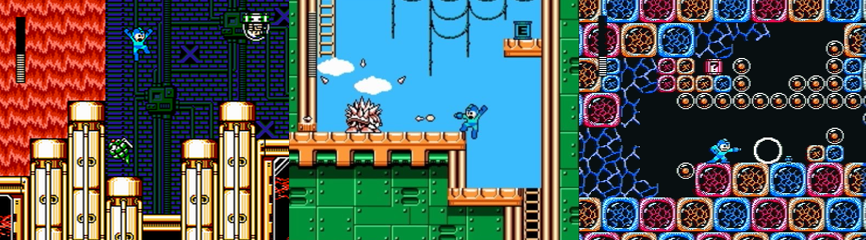
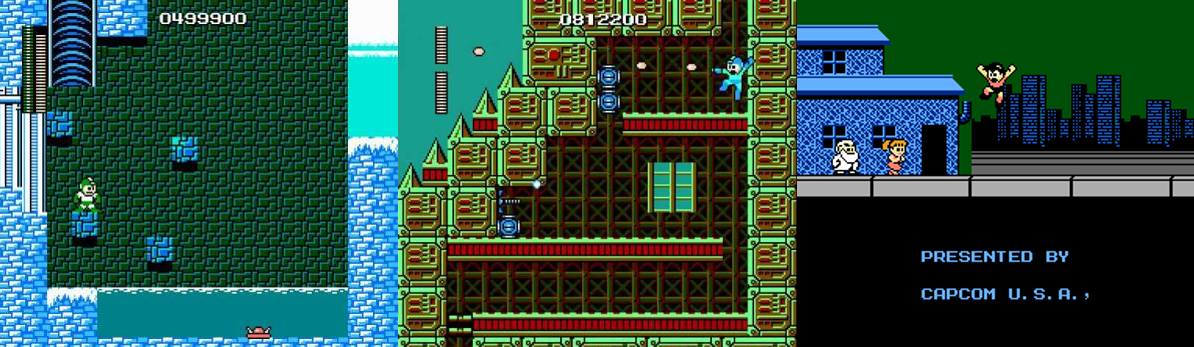
Mega Man is a 2D, sidescrolling run-and-gun action platformer in which players assume the role of the chibi­ fighting robot Mega Man (despite what the atrocious American box art would have you believe) and blast your way through six levels to track down and defeat the six Robot Masters. You can freely select the order you want to play these levels, but you’ll have a much easier time if you consult an online guide (or the handy cheat sheet that comes with this Legacy Collection version of the game) and tackle the stages in a specific order as Robot Masters are extremely vulnerable to certain weapons so it makes the game a lot easier if you plan out which order you’re going to tackle its levels. The Legacy Collection release lets you pick between the Mega Man and Rockman versions, speed up the gameplay, and freely configure the button layout, but the basic setup is perfectly fine for gameplay. By default, A jumps, X fires your currently equipped weapon, Y enables an autofire function that’s more like a rapid-fire mode, and B does nothing. The Right Bumper brings up the in-game pause menu where you can select different “Special Weapons” to equip to Mega Man’s Mega Buster arm cannon, the Left Bumper allows you to rewind the game if you make a mistake, and you can manually save at any time from the main pause menu. Mega Man is a little limited in his abilities here; you can run, shoot, and jump and shoot and that’s about it. There’s no slide, dash, or wall jumping here, just the basics, but that’s enough to get through most levels if you’re skilled and patient enough. 

Blast and platform through stages using versatile Special Weapons.

However, Mega Man’s abilities increase as you clear stages and defeat the Robot Master. Each victory adds the Robot Master’s signature ability to your Special Weapon list, providing additional means to traverse stages, defeat enemies, and easily dispatch subsequent Robot Masters. Unlike the Mega Buster, the Special Weapons have finite ammo; each has a bar that depletes upon use and you’ll need to pick up blue Weapon Energy capsules to partially or fully refill the meter. Since each Special Weapon has its own ammo, you’ll need to switch between them to fill each up, though smaller Weapon Energy capsules are often dropped by enemies easily defeated with the Mega Buster. Enemies also drop Life Energy cells to refill your health, and you’ll find larger variants of both and the odd extra life hidden in each level, usually near a death trap. Still, six Robot Masters means six Special Weapons: Cut Man’s Rolling Cutter sees you toss out a pair of boomerang-like scissor blades, Elec Man’s Thunder Beam fires electrical bolts above and ahead and is great for clearing large blocks out of your way, and Ice Man’s Ice Slasher fires arrow-shape ice projectiles that can freeze enemies and flame bursts to create temporary platforms. Fire Man’s Fire Storm blasts out a fireball and temporarily protects you with a flaming shield, Bomb Man’s Hyper Bomb sees you throw a large bomb that’s slow and takes a while to explode but deals heavy damage, and Guts Man’s Super Arm allows you to pick up and throw certain blocks. There’s also an additional power-up hidden in Elec Man’s stage; once you have the Thunder Beam or Super Arm, you can clear away the blocks to snag this item, which creates temporary energy platforms. Luckily, you can replay any level at any time to challenge the bosses again or acquire this item if you missed it the first time, and you’ll absolutely need it to clear Dr. Wily’s stages. 

The game is notorious for its punishing difficulty and testing your platforming skills.

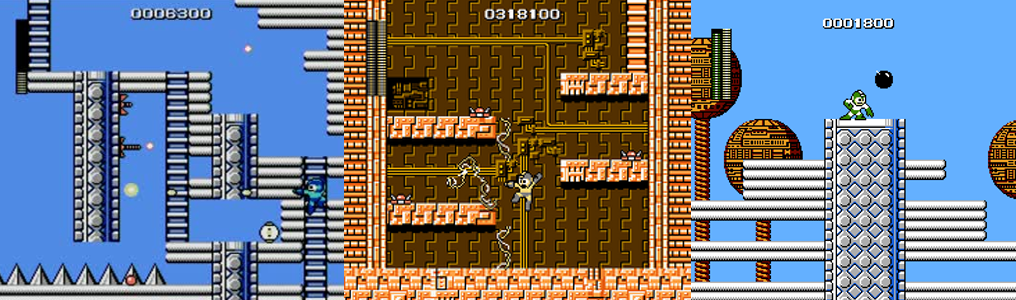
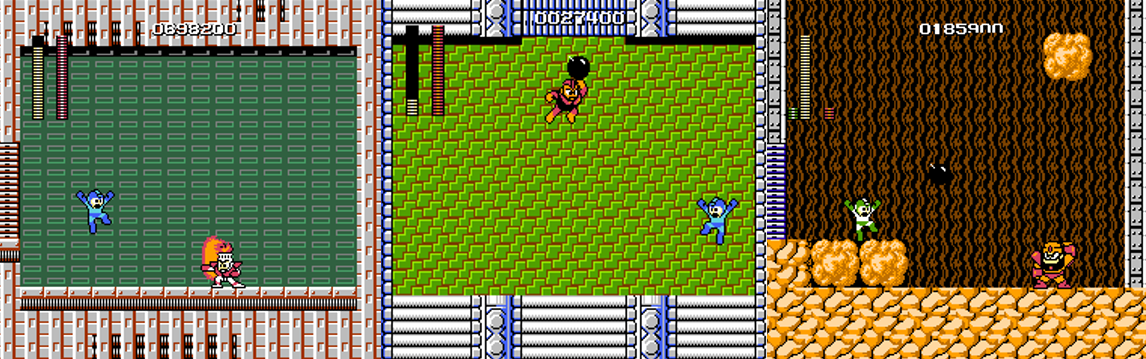
Mega Man is not a game to be taken lightly; every stage is full of bottomless pits, tricky jumps, annoying enemies with erratic attack patterns that respawn the moment you edge off the screen, and other hazards designed to sap your health or whittle away your lives. Every enemy you defeat awards you points, though these appear to be completely useless. If you exhaust all your lives, you can choose to continue as often as you like or return to the stage select screen with all your progress saved, which is helpful, though I’m sure it was exhausting back in the day having to replay the tougher stages right from the start. The Legacy Collection’s rewind feature circumvents that but Mega Man is still tough. You’ll be climbing up and down ladders, hopping to blocks that vanish almost immediately, dropping down shafts and avoiding instant death spikes, and taking out flying enemies to buy yourself enough time to make a jump before the next one pops up. Wall and ceiling turrets, slippery ice in Ice Man’s stage, flame bursts in Fire Man’s stage, electrical currents in Elec Man’s stage, flying platforms that also shoot projectiles, and riding broken tracks on platforms that drop under you in Guts Man’s stage can all be difficult challenges to overcome. Pretty much all these gimmicks are then recycled in Dr. Wily’s gauntlet at the end of the game. Here, you’ll have to plough through four additional stages, each with an abundance of instant death pits and hazards and rematches against the Robot Masters (and battles against other bosses) in even more restricted arenas, which all put your skills to the test. Truthfully, I was always intimidated by Mega Man because of its notorious difficulty, but it wasn’t as bad as I thought, though I wholeheartedly put this down to me making liberal use of the rewind feature. 

Presentation:
Obviously, you’re going to need to temper your expectations for Mega Man; it’s an 8-bit title that originally released on the NES, a console not exactly known for its processing power. Still, everything is bright and colourful here; backgrounds aren’t always the most detailed and Mega Man is a pretty simplistic character sprite, but simple often works best in these types of games. Mega Man has a great deal of personality with his exaggerated head and arm cannon, blinking when left idle, wearing a look of agony when hit, and dramatically exploding into a shower of pixelated circles when killed. Every time you equip a Special Weapon, Mega Man’s sprite changes colour so you know what you have equipped (red for Fire Storm, yellow for Thunder Beam, etc) and he hops around with just the right level of control and dexterity, only really being unwieldy when skidding about in Ice Man’s stage. His hit box is quite large, though, as are those of his enemies, so there’s very little margin for error when battling enemies up close. Additionally, the game struggles a bit when there are a lot of sprites on screen. Screen tearing, sprite flickering, and collectibles quickly disappearing are commonplace and the action will slow down if too many sprites appear at once even with the Legacy Collection’s performance boosters.  

Mega Man sports a colourful, if garish, anime-inspired aesthetic.

While each level is aesthetically very similar, primarily being composed of a series of mechanical platforms and surfaces, they do have unique elements and colour palettes to separate them. Elec Man’s stage focused more on vertical progression, for example, with different ladder-based routes offering different enemies and hazards to bypass, while Guts Man’s stage takes place in a mine, with mine tracks and a rocky aesthetic punctuating this. Ice Man’s stage is fittingly covered in slippery snow and ice and even features water-based sections where your movement speed is dramatically hampered, and Bomb Man’s stage features large gold spherical buildings in the background. Dr. Wily’s stages are probably the most impressive, with lots of blinking lights and mechanical trappings emphasising the danger of his lair, while boss battles take place in enclosed arenas fitting for their inhabitants. Mega Man’s story is only related in the ending, which shows Mega Man returning home to Dr. Light and shedding his armour, though it includes some of the catchiest bit-tunes of its era, so it’s nice that the Legacy Collection includes the complete soundtrack on the disc. 

Enemies and Bosses:
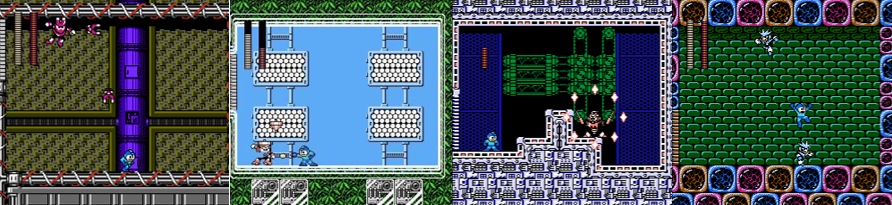
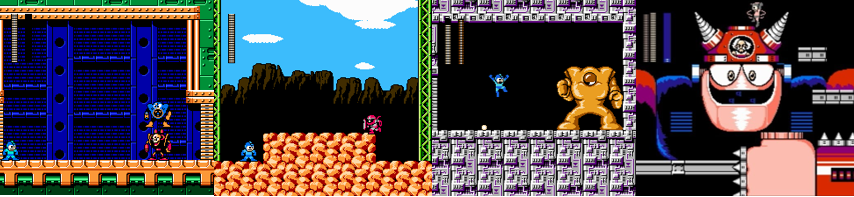
A whole host of robotic minions will dog your progress in Mega Man, many of which spit projectiles either right at you, in a spread, or in an explosive burst, and some of which even shield against your attacks or can only be destroyed with specific Special Weapons. Enemies like the Bunby Helis, Kamadomas, Mambus, penguin-like Pepes, and Bullet Bill-like Killer Bombs will fly, float, and rocket across the screen to screw up your jumps, turrets sit on walls and ceilings, and the Adhering Suzies make traversing narrow corridors a massive pain as they wander back and forth and up and down. Mega Man so debuts some of the franchise’s most recognisable enemies, the Metall, a little robot who hides under a construction helmet and peeks out to spit projectiles at you, and Sniper Joe, a pistol-firing marksbot who hides behind a shield and requires the use of the Hyper Bomb to defeat. The Hammer Bros.-like Pickelman also carries a shield but tosses an endless supply of pickaxes at you, often hopping between platforms to up their annoyance factor, while spherical Watchers slowly float up and down, shooting projectiles and knocking you from ladders on Elec Man’s stage. Ice Man’s stage is also home to the wacky Crazy Razy, a robot who can detach its head from its body! Many stages also include a sort of mini boss, the Big Eye, a large robot that jumps about trying to crush you. Multiple versions of this enemy are found in Dr. Wily’s stage and they can take a lot of hits to defeat for very little reward, so it’s easier to simply run underneath them when they do a big hop and avoid them entirely. 

Each Robot Master has a specific weakness and yields a powerful Special Weapon.

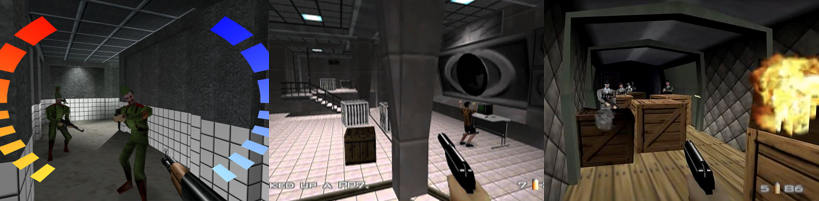
Each stage culminates in a battle against one of the six Robot Master’s. Before battling them, you usually have to bypass a Big Eye and a corridor full of enemies, hazards, and a few power-ups before you’re locked into an arena, the awesome boss them kicks in, and the bosses health meter appears onscreen. The difficulty of the Robot Masters is entirely based on what Special Weapons you have on hand. f you don’t have the weapon they’re weak to, they can be quite tough but, with the right weapon equipped, they become a joke. With this in mind, the first Robot Master I fought was Cut Man, who runs and jumps about tossing his boomerang-like scissor blades at you. You can easily avoid this and defeat him with the standard Mega Buster, and then use the Rolling Cutter to decimate Elec Man, whose three-way Thunder Beam is as nothing to this weapon. Similarly, while Ice Man fires three freezing arrow-like projectiles, the Thunder Beam will do him in in no time. His Ice Slasher makes quick work of Fire Man (though he’s still quite tricky thanks to his erratic movements and flaming shield), and the Fire Storm is the best way to take out Bomb Man, who jumps across the arena tossing large bombs. Bomb Man’s Hyper Bomb is the key to taking out Guts Man, who’s probably the most difficult of the six Robot Masters. He causes the screen to shake when he stomps, leaving you stunned, and tosses massive boulders at you, and the Hyper Bomb takes so long to go off that it’s easy to miss your target. All six Robot Masters are fought again in Dr. Wily’s stage, in new arenas with less room to manoeuvre, though you can simply use the same tactics to defeat them. 

Dr. Wily stacks his greatest creations against you in the tough-as-nails finale.

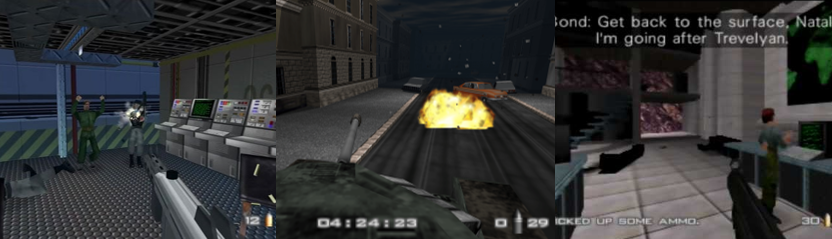
Alongside facing off with the six Robot Masters in Dr. Wily’s stage, you’ll also battle three other boss robots before confronting the mad scientist himself. The first of these is the now iconic Yellow Devil, a massive blob-like monstrosity that can dismantle itself to appear on either side of the arena. These blocks can be difficult to avoid, even with the rewind feature, and you only get a split second to attack its one, small weak spot (the eye, which also fires shots at you) before it dismantles itself again. Thankfully, there’s a brilliant exploit where you equip the Thunder Beam, fire it at the Yellow Devil’s eye, and rapidly pause and unpause the game as the shot hits its target, which will obliterate this boss in record time. Next, you must face an exact duplicate of Mega Man, who copies whatever weapon you have equipped and has all the same abilities as you. I found the best method was to equip the Fire Storm, hop over his attacks, and blast away, whittling down the doppelgänger’s health with the weapon’s shield ability. Finally, you’ll battle a series of CWU-01P robots underwater; these appear from one of three parts of the arena, rotate in a clockwise pattern, and are shielded by a bubble. You’ll need to jump over them and blast at their central cores to destroy them, though they get faster and faster the more you destroy. Once you’ve triumphed, you’ll face off with Dr. Wily, who attaches his flying saucer to a gigantic machine that slowly lumbers side to side firing projectiles in an arc that can be as hard to avoid as the machine’s hit box. Equip Fire Storm again and attack the giant gun arm on the front to expose Dr. Wily and begin the second phase, where the machine fires balls of energy in a spiral pattern. The weak spot is now on the top of the craft, so equip the Thunder Beam and blast away, doing your best to not get boxed into a corner, and you’ll soon have Dr. Wily begging for mercy. 

Additional Features:
There are twenty-four Achievements available in Mega Man Legacy Collection, with one awarded specifically for beating this game. In addition to different display options (including borders and filters), the Legacy Collection allows you to view a character database and production art and take on a series of tough, time-based challenges for additional Achievements. “Challenge Mode” gives you six minutes and thirty seconds to conquer remixed stages from this game, five minutes and thirty seconds to defeat the Yellow Devil, and battle all six Robot Masters in a boss rush without the use of Special Weapons. The more challenges you complete, the more you’ll unlock, including additional remixes of Mega Man’s stages and even gauntlets where you play through multiple Mega Man titles and against the game’s bosses against stricter time limits. Otherwise, there’s not much else to return to in the base game. There’s no high score table so it’s a bit pointless to try and outdo your higher score, though it’s a fun enough game to play through again so you can always come back for that (and for the nostalgia factor). 

The Summary:
I’ve always had a soft spot for the Mega Man series, despite never really playing any of the games. Until I got the Legacy Collection games, I’d only finished one Mega Man title and I’d always wanted to play more but was put off by the difficulty factor. Thankfully, the Legacy Collection includes a rewind and save state feature, making Mega Man much more accessible to someone like me, who grew up playing SEGA’s consoles and largely avoided some of Nintendo’s more infamously difficult titles. I’m happy to say that I really enjoyed Mega Man; I can see how it would be frustrating and tricky to play through without modern quality of life features, though the infinite continues and various hidden checkpoints throughout the stages is a benefit. While the levels are mainly defined by a few gimmicks and their steadily increasing difficulty, I liked the freedom of choice on offer. You can make the game much harder or easier depending on which order to take on the Robot Masters and nothing ever felt spitefully unfair, with hazards and enemies being a question of trial and error more than aggravation. Mega Man is a visually appealing character and I enjoyed utilising his Special Weapons, especially to cut through the Robot Masters, who also exhibit a lot of personality in their little introductory cutscenes. Dr. Wily’s final barrage of stages and bosses is a definite uphill battle but exploits and memorisation definitely swing things in your favour, and I was really enjoying the jaunty tunes that peppered the game’s stages. There’s some additional challenge and replay value added in the Legacy Collection version with the time trials and boss gauntlets, which will test seasoned players, so I’d absolutely recommend picking up this collection to experience the most accessible version of this original game. 

My Rating:

Rating: 3 out of 5.

Pretty Good

Was Mega Man a staple of your NES library back in the day or did you first play it on a different console? Which order did you tackle the game’s stages in and did you also have to replay Elec Man’s stage for the Magnet Beam as I did? Which of the Robot Masters and Mega Man’s Special Weapons was your favourite? What did you think to the difficulty of the game and the quality of life features included in this version? Which Mega Man game is your favourite and would you like to see more titles released in the franchise? How are you celebrating all things science-fiction this month? Whatever your thoughts and memories of Mega Man, feel free to leave them below and be sure to check out my other Mega Man reviews across the site!

Game Corner [00-Heaven]: GoldenEye 007 (Xbox Series X)


To celebrate the release of Dr. No (Young, 1962), the first of the James Bond movies (Various, 1962 to present), October 5th is known as “Global James Bond Day”. This year, I’ve been spending every Saturday commemorating cinema’s longest-running franchise, and one of the most recognised and popular movie icons.


Released: 27 January 2023
Originally Released: 23 August 1997
Developer: Rare
Also Available For: Nintendo 64, Nintendo Switch, Xbox One, Xbox Series X

The Background:
It was tough to get any better than a game of four-player GoldenEye 007 back in the day. The endlessly accessible and enjoyable first-person shooter (FPS) was a staple at many a sleepover in my youth and was directly responsible for making me the James Bond fan I am today. Popularised by Sean Connery’s immortal portrayal, Ian Fleming’s super spy was in a bit of a drought in the late-nineties thanks to legal issues and Timothy Dalton resigning from the role. The iconic British institution came back with a bang, however, with Pierce Brosnan’s critical and commercial debut, which was followed by a tie-in game for the Nintendo 64 some two years later. Developed by British studio Rare under the direction of Martin Hollis, the game was originally conceived of as a 2D platformer for the Super Nintendo Entertainment System and as a rail-shooter before the developers got to grips with the Nintendo 64 hardware. After a year of development, David Doak joined the team and implemented stealth mechanics using a radius test. Successive gunfire would attract nearby enemies and players were encouraged to spy on enemy characters using the game’s two-way mirrors. Six months before the release date, programmer Steve Ellies added the now iconic multiplayer mode, though the likeness of former Bonds and the names of certain weapons were changed for legal reasons. The developers also toned down the violence to appease Nintendo’s concerns and included a number of unlockable cheats. In a world where videogame tie-ins are notorious for being rushed, bugged, and unfulfilling affairs, GoldenEye 007 proved the exception. Not only was it one of the best-selling Nintendo 64 games but the game was met with unanimous (and continuous) praise for its gameplay, mission-based mechanics, and multiplayer. Although Rare soon lost the James Bond license, GoldenEye 007’s legacy continued to be felt not just with its spiritual sequel, Perfect Dark (Rare, 2000), and in other FPS titles, but throughout subsequent James Bond tie-in games. There were rumours and clamouring for a re-release for decades, though rights issues always saw these stall. In 2010, Eurocom released a reimagining of the title to mixed reviews but hopes were raised when leaks of an Xbox One version appeared online. On the eve of the game’s 25th anniversary, these rumours were officially announced to be true when it released exclusively on the Xbox One and Nintendo Switch series of consoles and featuring a number of enhancements. So beloved is the original game that this enhanced version of GoldenEye 007 was equally lauded, especially for its nostalgia factor, though some were disappointed that the Xbox version didn’t include online multiplayer.

The Plot:
Renowned super spy James Bond/007 in drawn into a globe-trotting adventure as he races to stop a rogue 00 agent Alec Trevelyan (now a terrorist known as “Janus”) from causing a global financial meltdown with a satellite weapon known as “GoldenEye”.

Gameplay:
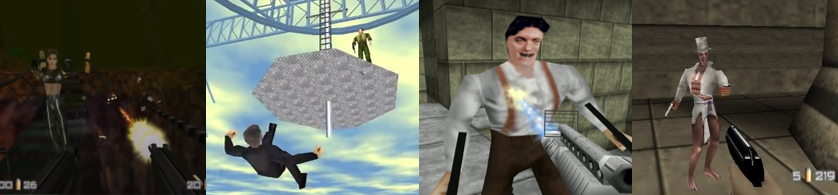
GoldenEye 007 is a first-person shooter in which players are placed into the shoes of world-renowned super spy James Bond and charged with completing various objectives across eighteen stages (referred to as “Missions”) taken from the movie of the same name, and two bonus Missions that loosely adapt elements and events from classic Bond films Live and Let Die (Hamilton, 1973), The Man with the Golden Gun (ibid, 1974), The Spy Who Loved Me (Gilbert, 1977), and Moonraker (ibid, 1979). Unlike FPS classis like Doom (id Software, 1993) and rail-shooters like Time Crisis (Namco, 1995), GoldenEye 007 offers a range of movement and control options, making Bond a far more versatile and capable FPS character compared to some of his counterparts. This new version of the game improves things even more thanks to modern controllers having two control sticks, but there are a range controls available and players can even customise them if they wish. The default controls see you firing Bond’s current weapon with the Right Trigger, activating consoles, opening doors, and disabling alarms and such with A, crouching to avoid incoming fire or enter vents with B, and aiming with the Left Trigger. You can also press Y and the Left and Right Bumpers to cycle through your available weapons, or manually select them by pausing the game, which brings up Bond’s fancy gadget watch. This also allows you to read up on your mission objectives, gives you the option of switching to different control schemes (each named after a different Bond Girl and with one even allowing an awkward two-player mode where only player moves while another one shoots), select gadgets like a key decoder or Bond’s laser watch, and quit the current Mission. On the original Nintendo 64 version, strafing was accomplished with the C-buttons and allowed you to rapidly dart across environments at higher speeds. Here, you can use the left analogue stick to accomplish this same task, and you’ll also find that your aim benefits from a slight auto-aim function.

Take on the role of 007, gun down enemies, and complete various objectives.

Unlike in modern FPS games, Bond is surprisingly vulnerable and will not regenerate health when taking cover from enemy fire. In fact, most things you take cover behind will explode in your face, so it’s better to keep moving and make use of the game’s controls to peek around corners or use silenced weapons or Bond’s handy karate chop to knock enemies unconscious without raising alarm. When taking damage, Bond will react accordingly, which can throw off your aim and see you being bounced about in a crossfire. Explosions are usually an instant death sentence as well so be sure to avoid grenades, rockets, and exploding crates whenever possible. While you can’t replenish Bond’s health, you can pick up body armour strewn across the environment to add an extra bit of protection, but there are no checkpoints in GoldenEye 007 so once you see that blood filling the screen or the “Mission Failed” notification, you’ll have to start over from the beginning. The game offers three difficulty settings (“Agent”, “Secret Agent”, and “00 Agent”), with a fourth being unlocked that allows you to customise various difficulty options, and the difficulty setting you play on directly impacts the behaviour of the game’s enemies, the bonuses you unlock, and the mission objectives you’re given. For example, when playing on “Agent”, you’re generally only given a couple of mission objectives. “Runway” on this mode simply asks you to acquire a key and escape in a plane, but higher difficulties have you destroying anti-aircraft guns first. Later Missions can become extremely complex and difficult because of this. Each Mission is preceded by a number of dossiers in which M, Q, and Miss Moneypenny will explain the specifics of each objective, often with pictures, so you have to be mindful about going in all-guns blazing as you don’t want to accidentally destroy a vital piece of machinery or gun down an ally. Because of this, many 00 Agent Missions require better use of stealth, such as attacking with short bursts of fire or while unarmed, enemies will be noticeably more formidable, and you’ll need to explore more of the environment and have less access to body armour, dramatically increasing the challenge.

Each Mission and difficulty setting offers unique objectives and mechanics.

Mission objectives are quite varied, but also shared across the game;. You’ll be deactivating alarms and consoles (sometimes by interacting with them, other times by blowing them up), acquiring keys, key cards, and documents, and meeting with allies like Doctor Doak, Valentin Zukovsky, and Dimitri Mishkin. Environments are often littered with cameras and alarm systems that will attract enemies to your location or even lock you out of rooms if you’re not quick to disable them, and enemies can sometimes be holding hostages who you’ll need to free without killing the innocent. This can be easier said than done, especially on missions that require you to protect, escort, or work alongside Natalya Simonova. All of the game’s non-playable characters (NPCs) tend to run in front of your bullets but Natalia is the worst, running around in a mad panic amidst a gunfight or leaving herself an open target while messing about with computers. Things quickly become quite obtuse and tricky as you’re tasked with destroying weapons caches, calling for back-up (without destroying the radio equipment), re-aligning an antenna cradle, and wandering around a statue park to meet with the mysterious Janus. Many mission objectives require the acquisition and use of Bond’s gadgets, such as using his laser watch to cut through grates, attracting keys with his magnet, planting tracking devices, and photographing objects, sometimes while racing against a time limit. Gameplay is somewhat broken up in the two instances where you can hop into an armoured tank, with it being mandatory to barrel through the streets of Saint Petersburg in said tank while trying not to run down too many innocent civilians. If you fail even one objective, the entire Mission is a bust, but you can continue playing if you want. This can be a good way to get an idea of the layout of the environment and find other mission objectives for your next playthrough to get a faster completion time, something that’s necessary to unlock all of the game’s cheat options. In addition to your time, your accuracy, shots fired, and kills are all tracked after a Mission is completed, meaning you can always try and improve your approach to a Mission.

Graphics and Sound:  
Even back on the Nintendo 64, GoldenEye 007 did a pretty good job of recreating scenes and characters from the movie. Sure, the character models are blocky and their faces hideous and many environments are a little too bland, polygonal, and swamped with fog, but they managed to capture the essence of the film really well, expanding upon minor elements and areas, especially in the first few Missions, and making them fully-fledged locations. The only issue I had was that the developers included two versions of Surface and Bunker. I would have preferred to see a Casino and Paris stage used instead to add a bit more variety to the early game, but at least there are differences between the two stages to both differentiate them and showcase the passage of time. There are even entirely new environments that weren’t seen in the film, like Silo, Depot, Caverns, and stages based on small parts of the film (like Dam, Runway, Frigate, and Train) are expanded on with additional mission objectives and aesthetic quirks. Of course, the most memorable location remains Facility, which lovingly recreates and expands upon the opening scenes of the film and remains the quintessential map for multiplayer skirmishes. My least favourite stages were always Statue, Jungle, and Cradle as they’re quite difficult to navigate and full of dense fog and hazards, to say nothing of the tougher enemies dwelling within.

While the graphics are dated, nostalgia means the game retains its visual appeal.

Every Mission begins with a bit of an overview of the location before the camera pans around and into Bond’s head, literally placing you in the role of the world’s most famous spy. Cutscenes, in the traditional sense, are few and far between and limited to these opening camera pans and a little animation of Bond looking all cool as he exits the stage, with the majority of the game’s story being relayed through the mission dossiers and onscreen dialogue. There are occasions where you can continue on and this dialogue will still play out, but if you try and rush Janus in Statue or don’t heed his advice to holster your weapon then you’ll fail the Mission. There are some graphical limitations to GoldenEye 007 that definitely date it, as well. There’s no reloading animation (guns simply disappear and reappear with a reloading sound effect), enemies have repetitive animation cycles (though they do kneel down, roll, cross their arms when dual-wielding, and react when shot in the ass), and there can be a bit of slowdown when too many explosions fill the screen. Still, little details like bullet holes, splashes of blood on clothing, and screams of pain help to keep things very immersive. Additionally, the soundtrack is incredible; composed by Rare stalwarts Graeme Norgate, Grant Kirkhope, and Robin Beanland, the soundtrack is both recognisably Bondian and unique, harkening back to Éric Serra’s movie score and the Bond themes made so famous by John Barry.

Enemies and Bosses:
Bond’s mission is impeded by the finest polygonal soldiers and grunts money can buy. While there’s not much to differentiate them in terms of animation, the game’s enemies all don different attire depending on the Mission (sporting parkas in Surface, camo gear in Jungle, and tactical outfits in Caverns) and wield various weapons. Many carry the KF7 Soviet or Klobb, two notoriously inaccurate weapons; others bust out the DD44 Dostovei or dual-wield the ZMG (9mm). The challenge posed by the game’s enemies directly relates to the difficulty setting you’re playing on and the Mission you’re playing. Enemies are pretty clueless in Dam but wander around the Caverns carrying super-powerful US AR33 Assault Rifles and blast at you with Moonraker lasers in Aztec. Janus’s special forces, and some guards aroused by alarms, will also carry shotguns or toss grenades, and you’ll also have to keep an eye out for high-impact turret placements that can shred your life meter in seconds. Enemies are quite vulnerable, even on “Secret Agent”, dropping after a few good torso shots or a headshot, but sometimes their guns can block your bullets and the sheer number of enemy bodies can make it difficult to land decent shots, in which case it’s best to target explosive parts of the environment to send them flying.

In addition to the movie’s baddies, you’ll encounter some classic Bond villains here,

Although boss battles aren’t commonplace in GoldenEye 007, there are a few instances where you’re tasked with killing one of Janus’s henchpeople in a firefight. The first of these you’ll encounter is Colonel Arkady Grigorovich Ourumov, who cannot (easily) be killed in the first few encounters. Ourumov fires at you from a distance in Silo, you pursue him in Streets, and then you finally gun him down at the end of Train, just like in the movie. Shooting Xenia Onatopp in Train will buy you some much-needed extra time with the floor grate, but she puts up a far greater fight when you confront her in Jungle. She’s armed with both a super-powerful RC-P90 and a grenade launcher and can be difficult to hit thanks to the fog, the explosions from her grenades, and her armour-piercing shots. Your best bet is to hang back, firing from a distance, or get up nice and close and fill her face with AR33 fire. This method of staying back serves you well in the final Mission of the main game, Cradle, where you go head-to-head with rogue MI6 agent Alec Trevelyan/Janus. In this Mission, you must realign the antennae, fending off Janus’s elite guard and the sentry guns set up about the place, blasting at Trevelyan as he fires his AR33 and tosses grenades to cover his escape. Trevelyan can absorb a great deal of damage but, once you’ve hurt him enough, he’ll dash to a specific area of the map and drop down to a small platform, just like in the film’s finale, where you’re given precious seconds to reorientate yourself and deliver the final blow. When you unlock the bonus missions, Aztec and Egyptian, you’ll face off with classic Bond villains Jaws and Baron Samedi. The former carries two AR33s and is a veritable bullet sponge, though he’s a big target and shots to the face are recommended. The latter mysteriously resurrects and wields a different weapon each time as you search through the pyramid for Francisco Scaramanga’s fabled Golden Gun, which can kill any enemy, including the supernatural Samedi, in one hit.

Power-Ups and Bonuses:
Naturally, there’s quite a bit you can find throughout each Mission to aid your progress. Body armour allows you to take a few more hits and effectively acts as a secondary health bar and you can pick up any weapons dropped by downed enemies. Green crates can often be found which contain new weapons or ammo, and you’ll also be able to swipe keys and key cards from guards and NPCs alike to acquire mission-specific items or additional toys. Bond can karate chop enemies without expending ammo, but this leaves him extremely vulnerable so it’s best to use this from behind. Similarly, the sniper rifle butt can be used to hit and defeat enemies when up close. He’s also afforded numerous weapons, including his iconic Walther PPK (known as the PP7), which also comes with a silenced variant, and his trusty watch, which cuts through grates and enemies alike with its laser. Bond can also dual-wield for additional damage (and ammo expenditure) and you can even have him hold two different weapons if you’re quick at cycling through them. A variety of machine guns are on offer, from the near-useless Klobb to the simplicity of the D5K Deutsche and the burst fire of the RCP-90. You can also grab high-explosive weapons, such as grenades, grenade and rocket launchers, and three types of mines (remote-activated, proximity triggered, and timed), but be sure to avoid the blast zone. Throwing and hunting knives can also be used for a more personal touch, but I like the power and accuracy offered by the two shotguns and the Couger Magnum. The game’s best weapon is the one-shot Golden Gun and the faster variants unlocked through cheats, but you can also make use of the tanks cannon to blast at soldiers and anti-aircraft guns and zap enemies with lasers when you acquire the Moonraker laser.

Additional Features:
There are fifty-five Achievements on offer in GoldenEye 007, with twenty being awarded simply for clearing each of the game’s Missions on any difficulty setting. You’ll get three separate Achievements for finishing the entire game on each of the three difficulty settings, and 10G each time you finish a Mission in a specific time frame on a specific difficulty and unlock a cheat option. Yes, blasting through Missions as quickly as possible on each of the difficulties will unlock a wide variety of cheats, from invincibility, invisibility, all guns, infinite ammo, and even options for a hilarious “big-head mode” and to speed up or slow down the in-game action. Achievements are also earned by playing the game’s multiplayer mode. Although the Xbox version doesn’t allow for online multiplayer, you and your friends can still get together in person to battle head-to-head, or in teams, across a variety of repurposed maps.

The game’s replay value is bolstered by fun cheats, a banging multiplayer, and various unlockables.

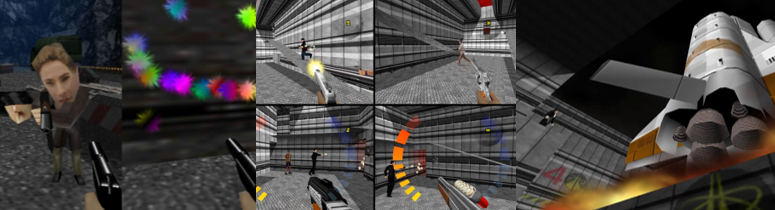
You can battle simply for points, set limits on how many lives and time you have to play, set weapons to be one-hit kill, battle for control over the mythical Golden Gun, and play a capture the flag scenario, with each option named after a classic Bond film. All of the game’s characters, major and minor, are available to pick from alongside two classic Bond villains, Oddjob and Mayday, with the former (and Jaws) offering different challenges based on their height. Completing the game on Secret Agent and 00 Agent will also unlock two bonus Missions: Aztec and Egyptian. In Aztec, you’re placed in a fantastic recreation of Hugo Drax’s missile command centre from Moonraker and must confront Jaws, escape a rocket’s test fire, and then sabotage the Drax shuttle before it takes off. In Egyptian, you’re tasked with navigating a maze-like pyramid in search of the Golden Gun and hounded by Baron Samedi, who returns three times to cause you trouble but the biggest challenge here is remembering the sequence to reach the aforementioned Golden Gun as you’ll be cut down by sentry guns if you step on the wrong tiles. Some additional weapons can also be used when utilising the All Guns cheat, which can make it fun to revisit previous Missions, and you can even tweak the enemy behaviour, strength, and awareness when you unlock 007 Mode to make the game even easier or harder depending on your preference.

The Summary:
Obviously, nostalgia is a huge part of GoldenEye 007’s appeal. Graphically, the game hasn’t aged very well, and it’s definitely been superseded by other Bond games and FPS titles in terms of presentation, gameplay mechanics, and content but there’s something very appealing to GoldenEye 007’s simplicity. It’s nice to be placed in a surprisingly large number of polygonal environments and simply head to a goal, with additional objectives adding relay value and challenge to the game, meaning GoldenEye 007 can be surprisingly complex that more you play on higher difficulties. The game is full of fun little Easter Eggs as well, from character animations and dialogue to oddities placed in each environment, and I enjoyed how NPCs on one difficulty suddenly become vital objectives in the next. There’s a lot to do here as the game challenges you to play on harder difficulties and find the fastest, most efficient way of beating its Missions to unlock everything. There’s also a nice variety of weapons that can all be held at once, meaning you can easily mix and match your gameplay style on the fly, and a fun assortment of objectives that often encourage stealthier gameplay but give you the tools to engage in a manic firefight. The multiplayer is as enjoyable as ever, too; I’m not fussed about the lack of online functionality as I don’t play online and it’s great to be able to jump in and mess about like in the old days. After decades of GoldenEye 007 being restricted to an old console, it’s simply astounding to see it made available once again. It’d be great if more licensed games got the same treatment but I’m happy to say that GoldenEye 007 is just as much of a blast to play through now as it was all those years ago.

My Rating:

Rating: 4 out of 5.

Great Stuff

Was GoldenEye 007 a favourite of your youth? What did you think to this re-release and were you surprised when it was finally announced? How do you think the game holds up today? Did you ever finish it on 00 Agent and unlock everything? Which Mission, weapon, or location was your favourite? Do you have fond memories of playing the multiplayer? What’s your favourite James Bond videogame? I’d love to know your thoughts and memories of GoldenEye 007 so please leave them in the comments and go check out my other Bond reviews.

Game Corner: Resident Evil 4: Gold Edition (Xbox Series X)

Released: 8 March 2024
Originally Released: 24 March 2023; 11 January 2005
Developer: Capcom
Also Available For: PC, PlayStation 4, PlayStation 5, Xbox One, Xbox Series S

The Background:
Headed by Shinji Mikami, Resident Evil’s (Capcom, 1996) focus on atmospheric horror and limited resources popularised the “survival-horror” subgenre. Despite its blocky graphics, clunky controls, and cringe-worthy voice acting, Resident Evil was a critical and commercial success, kickstarting an entire franchise that continued to tweak the gameplay mechanics, expand the lore, and prove equally successful. During the sixth-generation of the gaming industry, Mikami (after a lengthy development process) spearheaded Resident Evil 4 (Capcom Production Studio 4, 2005). The game reinvented the series by shifting away from tank controls and restrictive angles to an over-the-shoulder perspective and a greater emphasis on player control and action. Resident Evil 4 became the second best-selling Resident Evil title and is universally regarded as one of the best (if not the best) entries in the franchise. Despite receiving a high-definition port in later years, the success and popularity of the game saw Capcom prioritise a modern remake over other Resident Evil titles, especially as they’d seen considerable success with remakes of previous entries. The project was not one that directors Kazunori Kadoi and Yasuhiro Anpo took lightly. Although they wished to capture the spirit of the original, the developers minimized the use of quick-time events (QTEs), expanded the narrative and capabilities of the notoriously annoying Ashley Graham, and placed greater emphasis on knife attacks and parrying. Like its predecessor, Resident Evil 4 was met with widespread critical acclaim. Reviews praised the updates to the graphics and mechanics, the expanded characterisations, and the brutal gore, though some criticised the retention of some of the original’s weaker moments. Regardless, Resident Evil 4 sold over five million units by July 2023 and was subsequently bolstered by some downloadable content (DLC). “The Mercenaries” mini game was made available for free from April 2023, microtransactions were added to speed up weapon upgrades, and a remake of the “Separate Ways” side story was released to high praise in September 2023. All this DLC was then re-released alongside the base game as this physical Gold Edition in early 2024.

The Plot:
After escaping Raccoon City, Leon S. Kennedy, now a government agent, is sent to rescue Ashley Graham, the daughter of the United States President, from a mysterious cult in a rural Spanish village. There, he encounters hostile villagers pledged to Los Iluminados and infected by a mind-controlling parasite known as Las Plagas.

Gameplay:
Resident Evil 4 is one of the all-time classics not just of the Resident Evil franchise, but in all of gaming. It changed the survival/horror formula into a more action-oriented genre and directly influenced later remakes of similarly classic Resident Evil titles. However, I was disappointed when I heard it was getting the remake treatment, especially as the previous HD version still holds up really well (despite you not being able to move and shoot). I would’ve much preferred to see Resident Evil – Code: Veronica (Capcom Production Studio 4, 2000) brought up to modern standards but I guess I understand the logic behind prioritising one of the most profitable and popular games. Resident Evil 4 offers six different control types and a wealth of modern options to choose from. You can toggle aim assist, the run and crouch functions, the size of the aiming reticle (which largely replaces the laser sight from the original game), various camera settings, and the intensity of the heads-up display and damage indicators. The default controls see you aiming with the Left Trigger, readying your knife with the Left Bumper, shooting or stabbing with the Right Trigger, and running with the Right Bumper or by pressing in the left stick. Y brings up your inventory (still nicely arranged in attaché briefcases), X reloads, A interacts with the environment to pick up weapons, ammo, treasure, and files, and you can crouch through small gaps with B. You can use the left stick in conjunction with RB to perform a quick turn, hold A to pull certain objects (bookcases, filing cabinets, etc) when prompted, and switch weapons using the directional pad. Two weapons can be assigned to each direction this time, which is great for mixing up your attack strategies and conserving ammo, though there’s no quick-heal option here.

Alongside more emphasis on the knife, Leon’s allies have had their roles greatly expanded.

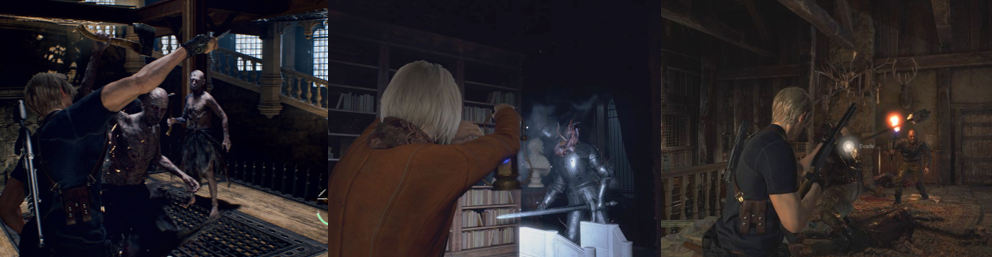
Resident Evil 4’s newest gimmick is placing increased emphasis on the knife. Before, you could cheese the knife to a ridiculous extent, stunning enemies and opening them up for Leon’s over the top melee attacks. While that’s still true here, Leon’s knife also parries certain attacks from the likes of the Chainsaw Ganado and other weapon-wielding enemies with LB. This will wound or stun enemies so you can run in to press A to hit a suplex, but you can also sneak up behind them or finish them off with your knife with a press of RB. Leon’s knife now has a durability meter; eventually, it’ll break and he’ll need to spend his hard-earned pesetas upgrading it at the mysterious Merchant. Weaker, disposable knives are often found dotted around the environment, in addition to stronger ones, and it really makes you think twice about going all gung-ho with your knife like before and opens up interesting ways to battle the likes of Major Jack Krauser since all the previous QTEs have been replaced by these new parry mechanics. In what’s now a franchise tradition, there is also a part where you lose your gear and must stealthily take out enemies to retrieve your stuff. As before, Leon will partner with some allies; suave ladies’ man Luis Sera has an expanded role here, helping you at key points and providing both ammo and extra gunfire when besieged by enemies or battling the troll-like El Gigantes, but your main partner is still Ashley Graham. Now wearing more sensible attire and with her bratty persona toned way down, Ashley is far more capable and useful than before. You command her to wait, hide, and follow you by pressing in the right stick, hiding her in the odd cabinet or cupboard and having her climb over walls to unlock doors or lower ladders. While she can die (and you can accidentally shoot her), you no longer have to worry about wasting your healing items on her and she typically just gets “incapacitated”. You can revive her and get her back on her feet, though you’ll still have to cover her as she helps solve puzzles and shoot enemies that try to spirit her away or else you’ll get a game over.

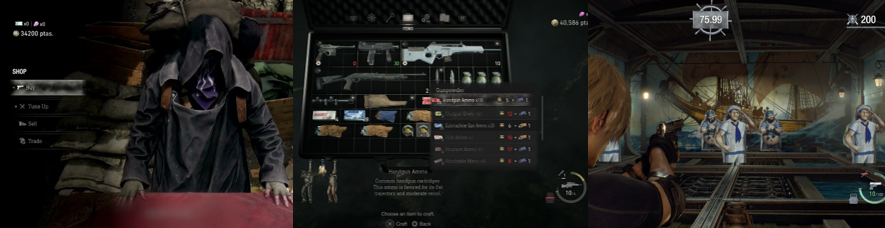
Purchase new items and upgrades, craft ammo, or just kill time at the shooting range.

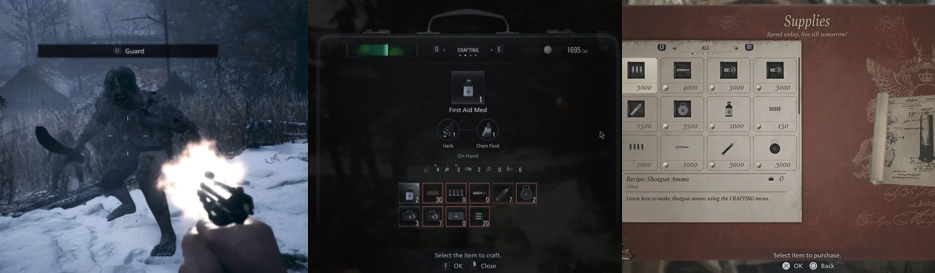
I actually felt like Ashley wasn’t even partnered with Leon as much as in the original game and, when she is, it’s so much easier to look after her. Her solo section has also been expanded somewhat, moving from a primarily stealth-based interlude to a more puzzle-based section where you stun Armaduras with her special lantern. Leon also has a few more combat options available to him: he can occasionally dodge bigger attacks with B, has more control over the boat he uses to cross the vast lake, and can again use giant cannons to splatter enemies and shatter doors. As is now the standard in Resident Evil titles, Leon can also craft ammo and health from the inventory screen. By picking up resources, gunpowder, herbs, and purchasing instructions from the Merchant, you can craft ammo and various coloured herbs that will partially, fully, or even extend your health. This has also been expanded to the treasures; you can increase the value of goblets and crowns and other large treasures by inserting coloured gemstones, which is great for earning extra cash. You once again save at typewriters with no fear of running out of ink (though the game has a generous autosave function), can use a limited Item Box when doing so, and can once again take a break from all the killing and horror at the many shooting ranges. Here, you test your marksmanship skills to earn letter grades and tokens to purchase charms for your briefcase that’ll give you certain buffs. The Blue Medallion system has also been expanded to include side missions set by the Merchant. These include shooting hidden Blue Medallions, disposing of rats, and confronting tougher enemies, all for greater treasures.

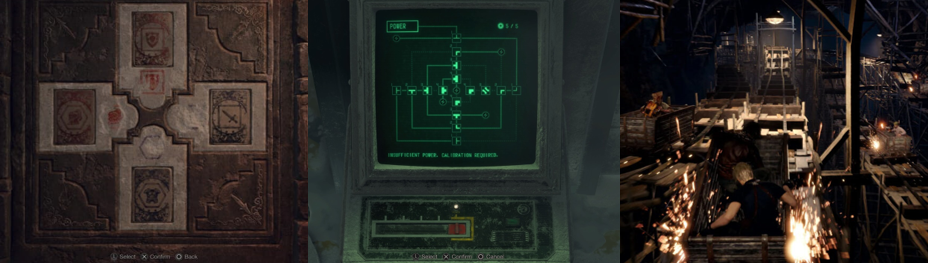
Classic puzzles and former QTEs have been reworked to offer a new, if familiar, challenge.

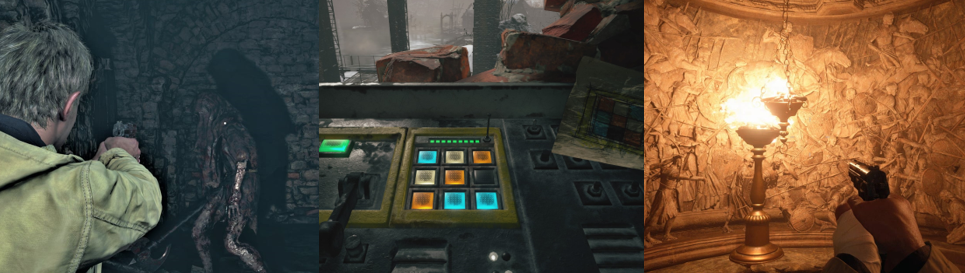
While much of Resident Evil 4 is familiar to anyone who’s played the original game, some of the puzzles and sections have been reworked. You’ll no longer run away from a giant stone version of Ramon Salazar or deal with that flame-filled room, for example, but these elements have been reworked into the tower section, meaning you not only have to avoid barrels coming down the spiral staircase but also take out Salazar’s giant stone visage to avoid being roasted alive. The light puzzle in the church is different, I’m pretty sure I don’t remember exploring a bunch of different caves to find shrines in the original, and I believe the dissection lab has a new power reroute puzzle that wasn’t there before. I do recognise some of the puzzles, though; you’ll still be traversing that damn hedge maze, still have to wait for the lift to come while fending off the Verdugo (now pulling levers to temporarily freeze it with liquid nitrogen and parrying it when it destroys these controls), and you’ll still have to watch your step when crossing rickety wooden bridges. You can still save a dog for an assist later on, still shoot lanterns to set enemies on fire, and still use explosive barrels to take out hordes of enemies. You and Ashley will sometimes have to turn wheels or levers or simultaneously pull switches or create new paths or open doors, or you’ll command her to do this while you explore further and protect her. You’ll be finding keys to unlock doors and drawers, taking the long way around to unbolt doors and create shortcuts, upgrading key cards, finding spheres that need to be rotated to form the Los Illuminados’ symbol, shooting gongs, sitting at the right tables as dictated by paintings, completing sword puzzles, and racing along on minecarts at breakneck speed, struggling to stay on the track, take out enemies, and avoid dead ends. If things get too tough for you (and it can get a bit hairy when you’re surrounded by enemies that only become stronger when you defeat them), you can lower the game’s difficulty. “Assisted” mode enables a health regeneration system and lowers the cost of items, but generally you can get by on “Standard” if you conserve ammo and make good use of the melee attacks, knife, and environmental aids dotted around the place.

Graphics and Sound:
While I was sceptical about remaking Resident Evil 4 since the previous version still holds up really well, it can’t be denied that the game has never looked better than here. The remake engine makes fantastic use of lighting and shadows to give everything a far creepier and more horrifying atmosphere. The level of detail at work throughout the game’s environments is astounding, with rain and water effects being a constant standout. Areas feel real and lived in, with blood trails and splatters, damage and debris, and little things like photographs, ticking clocks, and even enemies hiding in toilets and giant ovens all adding to the immersion. Leon, especially, benefits from the graphical upgrade; he can now move and shoot, dynamically reloads, and reacts to his environment, shielding himself from rain, resting against walls when low on health, and crashing through destructible objects with the same gusto as before. Character models, in general, are much improved here; Ashley has a more sensible wardrobe, Luis has never smoked a cigarette better, and even the diminutive Salazar looks far less comical here. Faces are still a bit unnerving at times, appearing a bit plasticky (especially when wet) but the level of detail is greater than ever before, so I can forgive it. This extends to the blood and gore, too; enemies can be blown to pieces, exploding in a splatter of guts and viscera, their bodies writhing on the floor, reanimating with renewed aggression, or their heads bursting open as horrific tentacles parasites writhe about. More of them appear than ever before, too, with their variants and mutations causing serious trouble when you’re low on health and ammo and must survive until the game decides to let you continue.

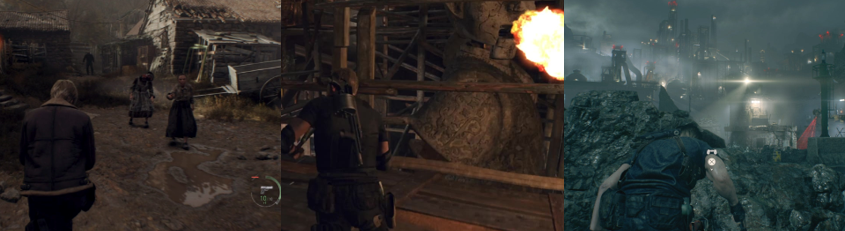
The graphical upgrade is astounding, making everything darker, grittier, and gorier.

All the key areas from the original game return here, including the main village, a sprawling castle, a network of dank caves and mines, and the fortified island the serves as the finale. You’ll visit graveyards, churches, houses (both abandoned and occupied), forgotten laboratories where bizarre genetic experiments lurk, medieval dungeons and hallways, and a veritable war zone in the end game as you navigate past barricades, narrow corridors, and ransacked areas where enemies lurk around every corner. Everything has a much higher level of detail; you can push obstacles out of the way as well as hop over or through them, files are scattered about to flesh out the local lore, and gameplay is frequently interrupted by exposition dumps from Ingrid Hunnigan or taunts from Saddler and his cohorts. Every cutscene and comms chat can be interrupted, which is great for subsequent playthroughs, and the sheer sense of foreboding atmosphere is unparalleled here as you’re never sure what’s lurking around even the most familiar corridors. Enemies can toss weapons at you, clamber up ladders, and will shout for help when they spot you. Later on, spider-like parasites will scuttle about and attach themselves to regular enemies, making them more formidable, and you’ll be constantly deactivating explosives, avoiding those ever-annoying bear traps, and redirecting gun turrets to clear your path. As ever, music plays a key role in alerting you to when there’s danger present; when it dies down or is more tranquil, you’re safe to explore and regroup. The dialogue and script has also been slightly tweaked; while Leon still has a lot of sass, some of the cheesier lines have been removed. There’s also an additional haunted quality to Leon as he struggles to reconcile the horrors he saw in Raccoon City and make amends for his mistakes with his newfound training.

Enemies and Bosses:
Like in the original game, there are no zombies here. Instead, you primarily fight the cult-like, parasite-infested minions of Los Illuminados. Ganados are far more intelligent than zombies, but no less durable; they can take multiple shots, even to the head, and keep going, utilising weapons like hatchets, pitchforks, and dynamite to cause you headaches. Thankfully, any nearby traps and hazards (and larger enemies) can hurt and kill them, but they are a real pain in the ass when they start wielding crossbows, hiding behind shields, and their heads burst to reveal disgusting tentacles and voracious parasites. The robed summoners will force this transformation and obscure your vision, so be sure to take them out quickly, while flash grenades are your best bet against the naked parasites or the armour-clad Armaduras. You’ll also battle Plagas-infested Novistadors, giant bugs that hover around, spawn from hives and can camouflage into the environment. Later, the Ganados better arm themselves and protect themselves with flak jackets helmets, and other military gear, making it even harder to score a good headshot.

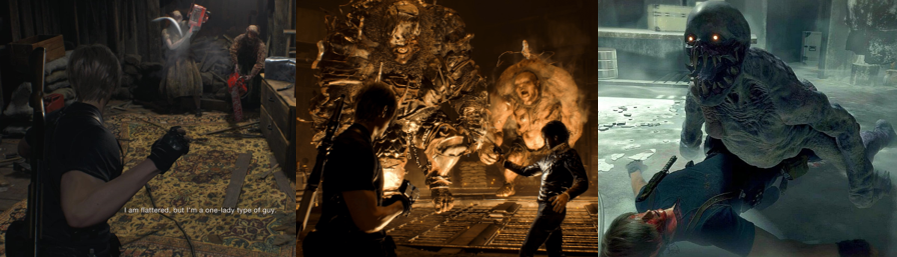
Bosses have been reworked to accommodate the new mechanics and modern graphics.

Larger, more monstrous enemies are also commonplace and act as mini bosses. The first you’ll encounter is the Chainsaw Ganada, a burlap-sack wearing madman who will lop your head clean off if you don’t make good use of the parry system. As if their sporadic appearances aren’t bad enough, you’re also forced to fight the Bella Sisters again, this time in an enclosed room (which actually makes it easier to track them), and the aggravating, claw-handed Garradors. Though brutish, heavily armoured, and extremely dangerous, Garradors are also slightly easier here as you’re not locked in a small cage and have more room to manoeuvre behind them to shoot the parasite on their back, stunning them for a more effective attack. Similarly, sledgehammer-carrying Brutes often show up, though their wild swings can just as easily wipe out nearby lesser enemies, as well as lumbering El Gigantes. This time, when you battle the two of them in the furnace, Luis is there to help; though he’s more of a distraction and hinderance as he needs to get clear before you can drop their asses into the molten steel. As ever, two of the more disturbing enemies-cum-mini bosses are the cackling, slug-like Regenerators and spiky Iron Maidens, two intimidating creatures that shrug off bullets and grenades, rapidly heal even when blasted in two, and pounce on you to try and eat your face and skewer you. The only way to effectively destroy them is by finding and equipping the Bioscope Sensor to your rifle so you can see and shoot the parasites lurking in their bodies, which can be easier said than done thanks to their erratic movements and extendable limbs. Another memorable boss encounter is, of course, the massive, mutated salamander Del Lago. You’ll need to use LB and RT to throw your unlimited supply of harpoons and the beast, avoiding the obstacles floating in the lake and chucking your spiked implements into its mouth when it leaps from the water. Thankfully, your encounters with the Verdugo are much more manageable this time; instead of running around a maze of shipping containers and fighting it in a cave, you must simply freeze it with liquid nitrogen and avoid or parry its lashing tail attacks when prompted.

No matter how big or monstrous the boss, your knife, parry, and dodge abilities will be the deciding factors.

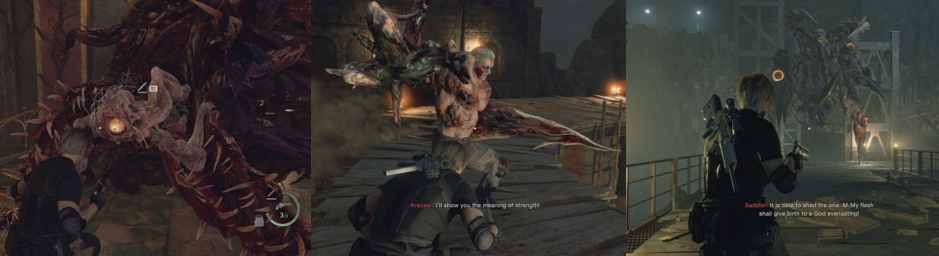
Bitores Mendez once again hounds Leon throughout the story, though you are spared him lumbering after you like a Mr. X or Nemesis figure. He’s still fought in a burning barn, assuming a scorpion-like mutated form where he swipes with his tentacles, requiring you to either dodge or parry his limbs to blast at his big, ugly eye. In the second phase, the fires rage out of control and can really eat away at your health, as can the barrels he tosses at you, but the key is staying in the safest place you can find, parrying when prompted, and hitting RT when he’s stunned to deal big damage. Ramon Salazar’s mutated plant form is more agile than I remember it. He scuttles about on the walls and ceilings, belching corrosive bile and explosive pods, and can eat you in one bite if he gets too close. You need to constantly stay on the move and not miss the opportunity to fire when the pod opens and reveals him, which will eventually stun him to the ground so you can use your knife, but I found this a particularly gruelling boss battle. Krauser is fought twice this time; the first is a straight-up knife fight where you must parry or dodge his attacks, landing slashes and melee attacks until he flees. This repeats in the ruins, but Krauser also fires at you, tosses flash grenades, and mutates a giant arm blade for the finale. The fight isn’t timed this time, but Krauser is extremely agile, so you’ll need to keep him in view, taking shots and using any nearby knives to parry his slashes while also getting around his bio-organic shield. Finally, Osmund Saddler transforms into a rampaging, tumour-filled arachnid monster that stomps about an unstable mining platform. For such a big creature, it’s difficult getting a good shot at the eye-like growths on his limbs but doing so leaves his main weak spot open. Repeat this a few times, watching out for the limited ground, and Ada Wong will eventually toss you a rocket launcher to finish him off after he envelops the entire arena in a mess of putrid limbs.

Power-Ups and Bonuses:
As you explore the game’s environments, you’ll find key items to progress and useful pick-ups to aid you. Small keys, cuboid blocks, medallions, and such access treasures, ammo, or healing items, or resources for crafting. Defeated enemies will invariably drop an assortment of supplies and you can smash open crates to acquire them, too (just watch out for snakes!) First-Aid sprays and herbs will restore your health, as ever, but you can also eat eggs and fish to do the same. You can combine green, red, and yellow herbs to recover more health and extend your health bar, which is always handy. Treasures come in many forms, from various jewels to ornate masks, clocks, and the like. The bigger ones house your smaller jewels to increase their value and you can also sell unwanted ammo, guns, and items to the Merchant for more cash. The Merchant’s stock is constantly changing, allowing access to new ingredients and weapons, so my advice is to wait for the more powerful weapons before you upgrade them to save your money and have stronger weapons later in the game. The Merchant also sells attaché case upgrades, allowing you to carry more and providing specific buffs, and degradable body armour to upgrade your durability. He also trades you special weapons, items, and add-ons for your arsenal if you complete his side missions. Leon uses many different weapons, from grenades and flash bombs to his trusty knife, pistols, and shotguns. You’ll eventually utilise heavier weaponry, like the assortment of submachine guns and assault rifles to single-use rocket launchers, as well as revolvers and magnums, sniper rifles, and a surprisingly handy bolt rifle. This is useful for destroying Blue Medallions, shooting rats, or finishing off enemies as you can recollect the bolts; you can also press the left stick to attach explosives, which is super handy in a tight pinch. These weapons can be upgraded to increase their power, ammo capacity, and reload time. Upgrade them fully (or acquire a special ticket) and you can unlock their special bonus ability, and you’ll also equip add-ons, such as stocks and scopes. Completing the shooting ranges earns you tokens to play for charms to attach to your briefcase; these increase how much ammo you craft, item drop rates, and provide other buffs, though you can only attach three at a time.

Additional Features:
There are thirty-nine Achievements on offer in Resident Evil 4 by default, with many unlocking simply by completing the story chapters, besting the monstrous bosses, and beating the various difficulty modes. While you won’t get an Achievement for aggravating Del Lago or looking up Ashley’s skirt, you will for rescuing her as she’s being carried away, for parrying incoming attacks, destroying all of a Regnerator’s parasites in a single shot, and selling an item for many times its usual value. Achievements also come from fully upgrading weapons, finding and destroying all of the Clockwork Castellan toys scattered throughout the game, escaping certain areas without taking damage, defeating certain bosses in specific ways, and finding every treasure (something greatly aided by purchasing the Merchant’s treasure maps). Not only are you graded on your time and performance at the end of the game, each chapter ends with a rundown of your accomplishments. These are tied to the Achievements and the in-game challenges that earn you Completion Points (CP) to spend in the “Extra Content” section. This is where you’ll unlock character models, concept art, and additional costumes and weapons. Beating the game on different difficulty modes unlocks various rewards, such as a dapper noir outfit for Leon, sunglasses and masks, the even harder “Professional” mode, and all your weapons, charms, and remaining treasures carry over to your next save file. Sadly, however, unlocking Ashley’s super useful suit of armour is much harder this time, requiring at least an A-rank completion of “Hardcore” mode. You’ll also need to destroy sixteen Clockwork Castellans to get an unbreakable knife, clear “Professional” mode for a bad-ass hand cannon, and shell out a whopping 2,000,000 pesetas for the infinite rocket launcher.

Battle for points in “Mercenaries” mode and experience Ada’s story in this revamped nightmare.

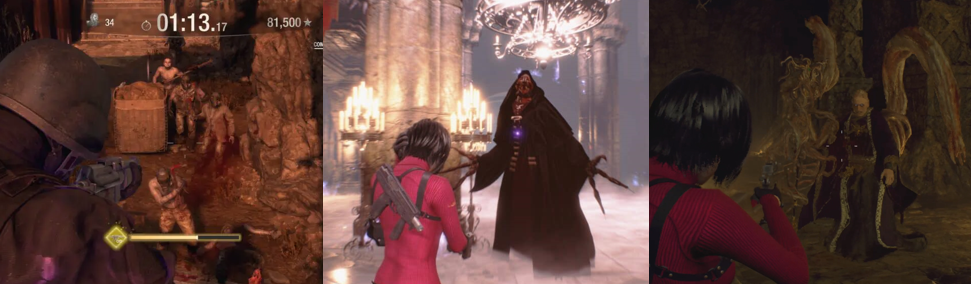
You can also play the “Mercenaries” mini game to dispatch as many enemies as possible against a time limit, building up your “Mayhem Meter” to unleash character-specific special moves and playing as either Leon, Luis, Krauser, or the returning HUNK, each with their own weapon loadouts and attributes. DLC packs also contain funky extra costumes, weapons, and even the original game’s soundtrack. Finally, there’s the Separate Ways side story that focuses on what Ada was up to during the main game and comes with seven additional Achievements. Separate Ways has been expanded upon in many ways. Not only does Ada have access to the same weapons, knives, items, crafting, treasure, and abilities as Leon (including the Merchant and her own melee attacks) but her grapnel gun now plays a significant part in her gameplay. You’ll often be prompted to grapple to (or find yourself traversing) the rooftops and upper levels in recycled locations, tapping RB to swing across gaps, launch to ledges, and even remove shields from enemies and fly in for a quick melee attack once upgraded. Separate Ways also expands upon Luis’s story, teaming him with Ada at various points, and she utilises her ocular I.R.I.S. implants to track footprints and reveal fingerprints for keycodes. Separate Ways also adds content back into the game, including the laser hallway sequence (a simple QTE where you tap B a few times and the RB at the end, finishing off a gigantic, toad-like boss at the same time) and U-3 boss fight. This returns as the final form of Ada’s clingy stalker, the gruesome Black Robe, which distorts the environment, teleports and creates duplicates, and is fought numerous times before it transforms into this scorpion-like form for a two-phase showdown in the caverns. Ada also battles Garradors, Regenerators and Iron Maidens (without the benefit of the infrared scope, that I could find), and boar-headed brutes with machine guns strapped to their arms. She also tackles an El Gigante (battling from atop destructible huts) and has a unique showdown with Saddler. This was the most frustrating part of Separate Ways for me. Saddler has a rush attack, bursts tentacles from the ground, fires bullets from his fingers, and can spam-lock you with tentacle combos. You must blast his face until the eyeball appears in his mouth and keep firing until you can melee attack him, but this took me quite a few tries. After that, you must grapple around the final stage as Saddler’s Lovecraftian mass attacks Leon, blasting the eye tumours in its tentacles to reach the rocket launcher and bring the side-game to a close. Separate Ways has the same difficulty settings as the main game and you can unlock additional costumes and accessories to wear in it, and the main game, as well as complete similar challenges when playing.

The Summary:
I love Resident Evil 4. It’s probably my second favourite in the franchise after the second (both/either version) and it was a blast playing through this top-notch modern reimagining of the title. Sure, I don’t think I’ll ever get over Capcom prioritising remaking this title, which has stood the test of time extremely well, over Code: Veronica, which is still stuck in the tank control days of the franchise, but they absolutely delivered with this game, to the point that it almost makes up for them dropping the ball on the remake of the third game. The new graphical overhaul makes the game darker, moodier, and gorier than ever. There’s just so much detail, so much happening in the environment and with lighting and shadows, and Leon and the others have never looked more detailed and human (or inhuman) than here. I think it’s a testament to how well-crafted the original game was that very little has been changed or discarded. A few boss battles and hazardous areas are omitted or heavily altered, sure, but everything from the original game is retained but with a more serious tone, a greater degree of movement, and far more options for you to upgrade your arsenal. I thought I’d hate the degradable knife and parry mechanics, but they were implemented really well, making me think twice whenever I used the knife since I wouldn’t want it to break at a pivotal moment. While I actually enjoyed the quick-time events of the original, I’m glad they were replaced by playable sections; it really added to the immersion of Leon’s bouts against Krauser. Expanding on Leon, Luis, and Ashley to make them more well-rounded characters while still retaining the edge, arrogance, and characteristics that previous defined them was a great idea, as was altering Ashley’s solo section into something more enjoyable and never-wracking. In the end, I’m forced to admit that remaking Resident Evil 4 was a fantastic idea as it resulted in this gorgeous, gore-soaked, super tense and exciting game. I really hope Capcom give the same treatment to Code: Veronica next but it does make me wonder if they can improve upon Resident Evil 4’s sequels just as well later down the line…

My Rating:

Rating: 5 out of 5.

Fantasic

Were you pleased with the remake of Resident Evil 4? Do you think it deserved the remake treatment so soon? What did you think to the new knife-based mechanics and the alterations to certain bosses? Did you like that Luis and Ashley’s roles were expanded and more flesh out? Did you ever find all of those Clockwork Castellans? Which Resident Evil videogame, character, monster, or spin-off is your favourite, and which game would you like to see remade next? Whatever you think, feel free to leave your thoughts down below.

Game Corner: Resident Evil Village: Gold Edition (Xbox Series X)

Released: 28 October 2022
Originally Released: 7 May 2021
Developer: Capcom
Also Available For: Nintendo Switch, PC/Mac, PlayStation 4, PlayStation 5, Stadia, Steam, Xbox One, Xbox Series S

The Background:
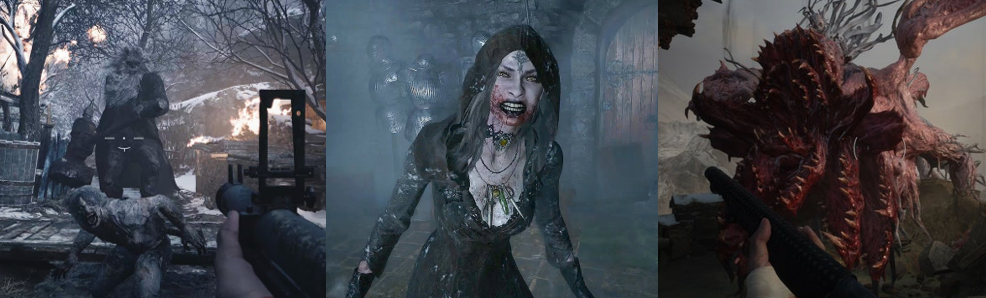
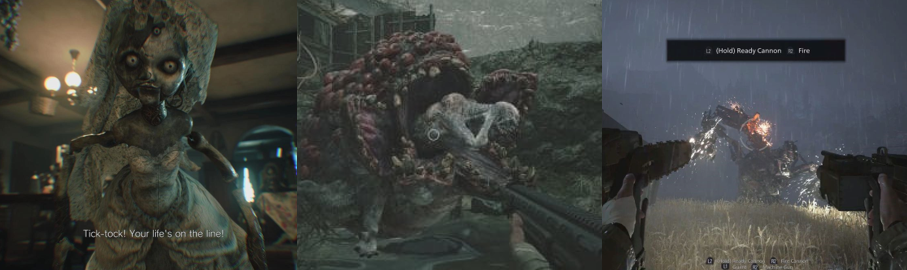
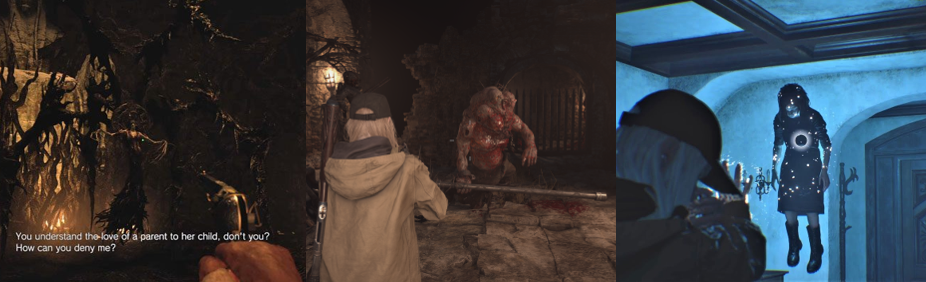
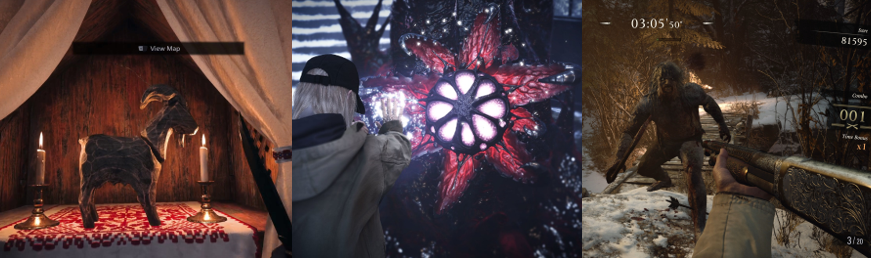
Helmed by Shinji Mikami, Resident Evil (Capcom, 1996) was a seminal title for the up-and-coming PlayStation, one whose focus on atmospheric horror and resource management popularised the “survival-horror” subgenre. A critical and commercial success, Resident Evil was quickly followed by a numerous sequels that continued to refine the gameplay, add to the lore, and be equally successful. After a troubled development, Mikami re-invented (and once again re-defined) the genre with the ridiculously successful Resident Evil 4 (Capcom Production Studio 4, 2005), though Capcom soon drew heavy criticism for over-relying on an increasingly action-orientated and over the top presentation. Thus, Capcom shook the franchise up again with Resident Evil VII: Biohazard (Capcom, 2017), which took the series in an all-new direction, featured an immersive first-person perspective, and introduced new mechanics and lore that would impact subsequent releases. Although Resident Evil VII was a critical and commercial success, development of an eighth instalment began about a year and a half before VII released. Inspired by Resident Evil 4, the developers purposely focused on a village as the central location and sought to create a balance between combat, exploration, and puzzle-solving. In addition to tying up the story of VII’s protagonist, Ethan Winters, the developers aimed to encourage exploration with an ever-shifting, more open-world environment and drew from gothic horror to design the game’s new werewolf-like enemies. Resident Evil VIII’s marketing heavily focused on Lady Alcina Dimitrescu, a towering, alluring, vampiric figure whose sex appeal helped boost interest in the game, which led to over three million copies being shipped within the first four days alone. The game’s new direction and ties to Resident Evil 4 were praised, as was the gameplay variety and emphasis on exploration, though the bosses and puzzles drew some criticism. Still, the game was a hit, more than justifying the release of additional downloadable content (DLC) within the following year. All of this DLC, which included additional gameplay modes and an epilogue story, was then made available on this Gold Edition release.

The Plot:
Three years after escaping the Baker family, Ethan Winters faces an all-new terror when his infant daughter, Rose, is kidnapped by Mother Miranda, the fanatical leader of a cult-like coven, after being seemingly betrayed by Chris Redfield.

Gameplay:
Like its predecessor, Resident Evil Village (stylised as Resident Evil VII.I.age) is a first-person survival/horror title in which players are again placed into the bland, faceless shoes of Ethan Winters, easily the franchise’s dullest character. Ethan has been fleshed out a little more this time around, though, to be fair. Between games, he and wife Mia have relocated, starting their lives anew with baby Rose; he has much more to say and far more agency this time around since he’s trying to rescue (and restore) his baby daughter; and he’s a little more competent after his experiences in the last game. If it’s been a while since you played Resident Evil VII, you can watch a helpful recap before setting up your subtitle, screen, and sound settings and, thanks to this Gold Edition of the game, you can play in third-person mode, which was my preference. Resident Evil Village offers four control setups, but the default is serviceable enough. You aim with the Left Trigger, guard against enemy attacks with the Left Bumper (with successful timing shoving enemies away), shoot with the Right Trigger, use a recovery item (such as First Aid Med) with the Right Bumper (a godsend in sticky situations), examine points of interest and pick things up with A, reload with X, and open your inventory with Y. By default, B does nothing except perform a quick turn in conjunction with the left stick, which can also be pressed in to break into a run. Pressing in the right stick allows you to crouch behind cover or through tunnels and small gaps, and you can switch weapons using the directional pad, with four different weapons able to be applied to this weapon “wheel”. There are also options to adjust aim assist, the intensity of the damage display, onscreen tutorials, and how much of the heads-up display is visible, allowing you to customise a more cinematic experience if you wish.

Craft health and ammo and purchase new items and upgrades from the Duke.

There are three difficulty settings to choose from at the start of the game, with a fourth, “Village of Shadows”, unlocked after beating the game on any difficulty. Naturally, the harder the difficulty, the tougher the enemies will be, with even basic foes tearing your throat out in a few hits on “Hardcore” difficulty. Unlike in the classic Resident Evil titles, there are no fourth dimensional Item Boxes here. You’ll need to combine and craft items to save inventory space, or spend the Lei dropped by enemies or found in destructible crates to expand your carry capacity. Yes, the crafting system is back; by finding items such as herbs and gunpowder, Ethan can craft recovery items, ammunition, and even explosives like pipe bombs and mines. New “recipes” can be purchased from the game’s rotund merchant, the mysterious Duke, who will happily purchase any treasure you’ve found, sell you ammo, weapons, and healing items, and also tunes up your existing weapons to make them more powerful. If you kill local wildlife, you can bring the meat to the Duke to cook food that increases your movement speed, maximum health, and reduces the damage you take while defending, though the Duke’s prices increase over time and he can even sell out of items, so it’s best to keep an eye out for craftable pickups. I’d also recommend caution with your weapon choices; eventually, better weapons will become available and you can only carry so much, so it’s easy to invest a lot of money tuning up your default handgun only to then have to sell it for the stronger upgrade. You can buy back any weapons you sell, but you can’t remove any charms or attachable tools (such as the scope for the sniper rifle or the extra magazines) from your weapons, so I definitely think it’s better to wait for the W870 TAC shotgun to become available and spend your money upgrading that as opposed to the first shotgun you find.

Alongside some challenging combat, you’ll solve rudimentary puzzles and acquire elaborate keys.

In addition to a decent weapon selection to choose from, Ethan can also use his environment to fight back against the lycan-like enemies that infest the titular village. Explosive barrels will blow enemies away and can hold A to barricade doors with furniture against enemies. You can shoot them off rooftops, sometimes you’ll need to rapidly tap A to escape an enemy’s grasp, and some larger enemies will even attack their smaller cousins. Even on the “Standard” difficulty, Resident Evil VIII is pretty tough. You often have just enough on hand to survive an enemy onslaught, after which you’ll be in dire need of resources to fend off the next enemy encounter, so it’s worth searching every drawer and cupboard, even if many of these are empty. Luckily, your map will indicate any missed items in the local area; it highlights treasures, locked doors, and missed items. You can then backtrack when you have the right keys or the environment has altered to grant you access, and you can still find helpful files that flesh out the game’s lore, Mother Miranda’s connection to the Mold and the Umbrella Corporation, and provide clues or solutions to the game’s puzzles. These may be as simple as finding bolt cutters to break chains, using a key to unlock a door, or finding and entering combination codes, but also become a wild goose chase as you search for masks, examine items for keys or add-ons for existing keys, insert glass eyes into holes, awkwardly swing flaming lanterns, and pull levers to open doors. As ever, you can save your progress at any time using a typewriter. You don’t need to worry about ink ribbons here, and the game also includes an autosave function so you’ll respawn from checkpoints when you die, but I’d recommend making a couple of save files so you can backtrack for missing items or optional side quests as you’ll eventually reach a point where you can’t return to the village that acts as a central hub, of sorts.

While the game peaks early, there’s enough variety and intrigue to keep you hooked throughout.

Resident Evil Village tasks Ethan with venturing to four distinct areas from the titular village, which alters (along with the title screen) as the game progresses, becoming infested with tougher enemies, set on fire, and ransacked by the Mold. Each of these areas presents a unique, but also familiar, challenge; Lady Alcina Dimitrescu’s castle, for example, is very reminiscent of the original game’s ornate mansion, and Lady Dimitrescu herself patrols the hallways, pursuing you throughout the estate like her predecessors, Mr. X and Nemesis. When trapped in House Beneviento, Ethan loses all his gear to the childlike Donna Beneviento and her malevolent puppet, Angie, who force you to complete a series of puzzles, including finding items to investigate a mannequin, rearranging film cells, and searching for fuses, to escape and reclaim your items. The toad-like Salvatore Moreau dwells in a mine, one infested with slime-like pustules, outside a massive lake strewn with wreckage that you must cross, lowering and raising temporary platforms, to power up the generators. Finally, the rebellious Lord Karl Heisenberg dwells in rundown factory populated by horrific cybernetic monstrosities. Here, you’ll use the smelting equipment to craft key items to progress, take a maintenance lift, and battle Heisenberg’s cyborg creations. After defeating Heisenberg, you’ll take control of the far more capable Chris for an all-action infiltration of the village and the catacombs beneath it. Chris has better weapons on hand, utilises ample supply drops, and calls in air strikes by holding down RT,  making short work of Mother Miranda’s Mold defences and the hammer-wielding Uriaș who plagues Ethan so often in the main story.

Graphics and Sound:
It’s almost astounding how good Resident Evil VIII looks; the environments, especially, are moody, dank, and claustrophobic while also being genuinely creepy and unsettling, and the use of ambient noise, distant scratching and screaming, and sporadic music really adds to the tension. The level of detail is incredible at times, with Ethan panting and showing visible pain when low on health, blood splattering on his weapons, snow and frost ransacking the village, bullets and blood alike marking doors, windows, and the environment, and heads sporadically exploding in a shower of gore. Playing in third-person allows you to finally see Ethan’s character model, though he’s still just a guy, one whose face is oddly obscured no matter how much you wriggle the camera. Interestingly, many of the character models (basically anyone who isn’t Chris, who’s been redesigned once again) sport a shiny, uncanny look that makes them seem not quite real. This is fine for the monstrous enemies, but makes human characters a little unsettling to look at in the wrong lighting (though, admittedly, this may be due to the brightness settings I chose). Resident Evil VIII ventures towards the supernatural for many of its enemies, depicting werewolves, witches, and shambling wretches alongside cyborg brutes fitted with drill arms! If these get too close to you, you’re gonna be in for a bad time and treated to some gruesome death scenes, but it’s equally satisfying seeing them be blown to pieces by a well-timed grenade round.

There are some creepy and visually impressive locations beyond the titular, ever-changing village.

As you might’ve guessed from the game’s title, the village plays a prominent role here. It’s your central hub you’ll return to time and again and have to explore and defend throughout the story, housing a church, graveyard, ruins, rivers, and more. Largely barren due to the events taking place, there’s a constant dread hanging in the village that’s mirrored by its adjacent locations. While some areas (stately homes, mostly) are guilty of recycling assets such as ornaments and furniture, others are more visually unique and unsettling, such as the cyborg factory and the creepy doll’s house-like House Beneviento. Resident Evil VIII continues to move away from the futuristic laboratories of Umbrella and takes more cues from Resident Evil 4, bringing an Eastern European flavour back to the franchise. I’m actually surprised it didn’t try to harken back to the backwater locations of the last game. However, these are partially evoked in your encounter with Moreau and when the Mold starts bursting from the ground and overtaking the village, but it’s a tenuous link, at best. The game’s story is engaging enough and mostly related through in-game cutscenes that retain the first-person perspective. You’ll be falling or sent crashing through floors and walls, have your limbs and organs cut off or ripped out, and be constantly interrupted by surprise attacks or jump scares. Everything’s played very seriously here, with very few glib remarks from the increasingly tested Ethan, with the exception of Mother Miranda and her lieutenants, who are almost as over the top as the crazed Baker family from the last game. Sadly, much of their personality is lost when they transform into gigantic, boil-infested monstrosities as per Resident Evil tradition.

Enemies and Bosses:
In place of zombies, bio-organic weapons, parasite-infected villagers, and Mould creations, players battle werewolf-like lycans upon first entering the village. These snarling brutes are nimble and voracious, lunging for you and trying to tear your throat out and taking a fair few shots to be put down. A larger, armour-clad variant is also encountered, one that is better shielded from headshots, and bigger, more monstrous Vârcolacs pose a significant challenge if you’re caught unprepared. The spirit of the classic games is evoked through the shambling, sword-wielding Moroaicǎ, hooded, gaunt figures that rise from shallow water and attack in groups, while bat-like Samcas nest on the rooftops of Castle Dimitrescu. While the mindless Haulers are little more than cannon fodder in Heinsberg’s factory, his cyborg Soldats aren’t to be trifled with. Sporting up to two drill-like appendages and a variety of cybernetic armour, these lumbering walls of muscle can only be put down by blasting the exposed core on their chests, a task easier said than done when they attack in groups and are protected by quasi-mech suits. Most of the game’s more formidable enemies, like the Vârcolacs and Soldats, are introduced as mini bosses, giving you a chance to sample their abilities before they become commonplace and are joined by even stronger variants as the game progresses.

Monstrous and grotesque abominations are the order of the day, however unfitting some of them are.

The first boss you encounter is the aforementioned Uriaș; although it is technically possible to defeat him when he first appears, this isn’t necessary, you just need to survive until the plot progresses. Uriaș shows up as a proper boss twice during the main campaign; first, Ethan fights him in a confined space full of pillars to take cover behind. You’ll need to stay well clear of Uriaș’ giant hammer and leaping attack, and fend off the lycans for resources, preferably blasting him with your shotgun or grenade rounds to put him down. Uriaș also shows up when playing as Chris, but this fight is much easier as you simply need to target him for a few air strikes, surviving until he’s put down once more. As if frantically avoiding Lady Dimitrescu’s appearances isn’t bad enough, her three witch daughters – Bela, Daniela, and Cassandra – also haunt Castle Dimitrescu, appearing as a swarm of bugs that will whittle your health down and then taking physical form to dash at you with scythes. These three can only be made vulnerable by pulling switches or breaking windows to let in a blast of cold wind, with you constantly strafing to keep them in the cold, or pulling levers to keep the pressure on, while blasting at them until they turn to ash. Lady Dimitrescu herself cannot be harmed or killed when she’s pursuing you, but will transform into a massive, dragon-like bat-thing for a boss battle that sadly loses much of her visual appeal. The mutated Dimitrescu will stomp, charge, and try to eat you on the castle rooftop. Luckily, there are lots of resources on hand and her head is wide open for your shotgun blasts. When she flies into the distance, you can use the sniper rifle to shoot her down, repeating this process even as she forces you to take refuge higher up.

There are some unique elements to the bosses, though the later ones lack the iconography of earlier foes.

Donna Beneviento prefers to toy with you than take you on directly; her game of hide and seek will increasingly freak you out as the lights flicker and go out, the environment changes, and a massive, slug-like foetus thing lumbers down the narrow hallways of her doll’s house. To defeat her, you’ll need to track her doll, Angie, three times, ending her threat in a cutscene. This intense, genuinely creepy encounter is juxtaposed by the battle against the mutated Moreau, who transforms into a monstrous aquatic creature that lumbers around a drained lake, spitting and raining acid and thrashing its tail at you. Fortunately, there’s a lot of convenient cover to avoid damage and Moreau pops out to taunt you, allowing you to blast at him, though he’s certainly not an easy target despite his size. In Heinsberg’s factory, you’ll constantly run from Sturm, an armour-clad brute with a propeller mounted to his head! When you eventually battle him, it’s a tense affair as he crashes through walls and shoots flame bursts as you desperately try to hit the vent on his back. Heinsberg proves one of the more formidable of Mother Miranda’s lieutenants purely because of his mental control of metal, which allows him to constantly get the drop on you throughout the game. When Ethan finally reaches him, he’ll construct a massive, spider-like form for himself out of scrap metal, forcing Ethan to man a tank gifted to him by Chris. This made for a fun, action-packed battle where you fire a massive cannon and machine gun at Heinsberg’s glowing weak spots, until Heinsberg destroys your tank. Then, you frantically run around looking for ammo to blast him in the face until he whips you up in a tornado, which allows you to fire one last shot from the tank’s cannon and finish him off.

Alongside also battling Mother Miranda, Rose has her own boss battles to contend with.

With all of her lieutenants defeated, Mother Miranda attacks the village with tentacles and tree-like constructs of Mold, forcing you into a final confrontation that is easily the toughest of the game. Even with the Duke stationed nearby and some resources appearing in the enclosed arena, this is an uphill battle as Mother Miranda causes Mold to burst from the ground, quickly dashes about and swipes at you, traps you in pitch black and attacks in the blink of an eye, and spews lava and fireballs to whittle you down. Your best defense is a good offense; blast at her with everything you have, taking cover when you can and crafting as need be, until a scripted event is triggered, which requires you to hit RT to cut yourself free and finish her off. Well, not entirely, as you’ll fight her again at the conclusion of the “Shadow of Rose” DLC story. Although Mother Miranda has a similar attack pattern, your strategy for defeating her is very different as Rose must absorb her projectiles with LB and then press towards and B to unleash a Mold attack that stuns Mother Miranda long enough for you to blast her. She also goes into a full-blown rampage as a gigantic Mold beast, requiring you to make liberal use of the dodge and a final power boost from Ethan to dispel her for good. Before Rose fights her, though, she’ll have to contend with the troll-like Amalgam, a grotesque beast who relentlessly pursues you before you face it in an enclosed dungeon, where it freely teleports around, summons minions, and spawns weak spots on different parts of its body. Rose has her own terrifying adventure in Beneviento as well, first fleeing from unsettling animated mannequins, then avoiding killer dolls (while shrunk down), before finally facing the vengeful spirit of Eveline in a psychic battle that sees you avoiding being blasted and corrosive Mold, and blasting the embittered wraith when she’s exhausted from hrr enraged attack.

Power-Ups and Bonuses:
As you explore high and low, you’ll find a bunch of treasures, ammo, items, and pick-ups scattered around. In Resident Evil Village, a herb is useless unless combined with chem fluid, so you’ll be relying on the crafting system to restore your health, unless you happen upon ready to use restoring items. Gunpowder is similarly used to craft ammo, though you’ll also find these in crates and drawers and such. You can also purchase these from the Duke, though his prices increase as the game progresses and he can even sell out of ammo and healing items. Generally, you’ll be gifted or will find your main weapons, such as the handgun and shotgun, as well as a few explosives, like throwable pipe bombs or proximity mines you can lay to take out groups of enemies. However, you can buy additional weapons from the Duke; the selection is nothing you haven’t seen in previous Resident Evil titles, including machine guns, a grenade launcher, and a magnum revolver, with upgrades available for most, and a knife for when all else fails. Ethan can utilise Chris’s weapons, and others, when you beat the game on other difficulty settings and accumulate points playing “The Mercenaries”, but things really take a twist when playing the “Shadow of Rose” story. Rose has some additional superhuman abilities that are unlocked as you play. When you find special flasks, Rose gains a meter that allows her to use RB to destroy Mold cores, opening new areas, and briefly freeze enemies, with this meter expanded by flasks and refilled with the new White Sage item. As a trade-off, Rose can’t use healing items with RB and has no need for Lei or the Duke’s services (he takes on a mysterious antagonistic role instead), but she can expend her meter with RB when grabbed to escape an enemy’s attack.  

Additional Features:
There are forty-nine Achievements up for grabs in Resident Evil Village, with a further seven included in the “Winters’ Expansion” DLC that’s included with this Gold Edition, bringing the total to fifty-six. You’ll get Achievements for finishing the game, and “Shadow of Rose”, on each difficulty setting, defeating the game’s bosses and reaching story-specific sections, and for simple stuff like using a lockpick, entering Photo Mode, and killing a wild animal. Other Achievements pop when you defeat three enemies with one attack, take down Uriaș early on, equip add-ons and upgrade your weapons, and far more tedious tasks, such as breaking every window in Castle Dimitrescu and opening every outhouse in the village. As you explore, you may come across little wooden goats that should be destroyed for additional Achievements. You’ll also get another Achievement for having 777, 7,777, or 77,777 Lei, using only a knife, or finishing the game in under three hours and/or with four or less recovery items.

Complete challenges, play Rose’s epilogue, or put your skills to the test in “The Mercenaries”.

Some of the Achievements align with the list of in-game challenges you can work through to earn Completion Points (CP). CP is spent in the ‘Bonuses’ menu to purchase new weapons, infinite ammo, concept art, and character models in the form of figurines. You can also acquire CP by playing “The Mercenaries”, a Resident Evil staple that sees you playing as either Ethan or Chris (plus Lady Dimitrescu and Heinsberg once you unlock them), each with different attributes and weapons, and clearing out all enemies across various maps. You’re working against a time limit here, so you must be quick and accurate and use the hourglasses to extend your time. You can also buff yourself and your weapons with power-up stations found on each map, which offer additional health or greater accuracy with specific weapons. It’s a fun little side-game, though you’ll need to have your wits about you as you’ll only unlock new maps and gain the best awards with an A-rank or more. Finally, you can play tilting ball games, hunt down rare treasure and wild beasts, and find the game’s files to go for 100% completion, which requires additional playthroughs and possibly multiple save files in case you miss stuff you can’t go back for, in addition to the “Shadow of Rose” epilogue. This sees you returning to some of the game’s key areas, now warped and nightmarish, as Rose follows a mysterious disembodied voice to rid herself of her strange powers. It’s a fun extra few hours of gameplay that’s spiced up just enough with her extra abilities, a few new and rearranged areas (including the super creepy mannequin section), and some new bosses and twists on existing enemies.

The Summary:
I put off Resident Evil Village for some time, specifically because I was waiting for this Gold Edition of the game so I could experience the entire thing in one go. Although I didn’t mind the jump to first-person horror, I immediately switched the game to third-person as that’s my preference and I feel this suits the game and its action much more. The immersion felt by first-person is outweighed by the frustration of never being able to see all around you, so the third-person option was a godsend for me. Gameplay-wise, there’s not much you haven’t seen from Resident Evil before here; everything is suitably creepy, tense, and incredibly well put together, with a fantastic level of grimy and gruesome detail given to the game’s environments. I was surprised by how much I came to enjoy revisiting the village; it’s not the most engaging hub world and I sometimes felt the narrative was a little too mission-based at times, but it changed enough to hold my attention and I liked how each area offered different gameplay challenges. It’s true, however, that the game peaks quite early; Castle Dimitrescu and House Beneviento were the most engaging areas of the game for me, and neither Moreau or Heisenberg had the same visual appeal or creep factor as Lady Dimitrescu and Angie, which was a shame. It was equally disappointing how often the antagonists degenerated into monstrous abominations; I know it’s a “thing” in Resident Evil, but I don’t think Lady Dimitrescu or Heisenberg needed transformations to be interesting or scary. Still, there’s a lot to enjoy here; Ethan, while still bland, is far more interesting this time around with his heartfelt desire to rescue his baby girl, and the franchise continues to evolve its story, even if the direction it’s going down is becoming increasingly bizarre. Best of all, there are plenty of reasons to come back to this one for additional playthroughs. The addition of playable antagonists to “The Mercenaries” is a goal to reach for, and the game itself a fun distraction from the main story, which was as gruesome and disgusting as we’ve come to expect from this long-running franchise.

My Rating:

Rating: 4 out of 5.

Great Stuff

What did you think to Resident Evil Village? Did you buy the game upon release, or did you wait for this Gold Edition, like me? Are you a fan of Ethan Winters and, if so, what did you think to his character progression? Which of the game’s areas and bosses was your favourite and what did you think to the new enemies on offer? Did you ever beat the “Village of Shadows” difficulty and find all those goats? Which Resident Evil game is your favourite and where would you like to see the franchise go next? Whatever your thoughts on Resident Evil, drop a comment below and be sure to check out my other Resident Evil content across the site.

Game Corner: Doom 3 (Xbox Series X)

Released: 4 August 2020 
Originally Released: 3 August 2004
Developer: id Software 
Also Available For: Nintendo Switch, Nvidia Shield, PC/Mac, PlayStation 3, PlayStation 4, PlayStation 5, Xbox, Xbox 360, Xbox One

The Background:
Although the first-person shooter (FPS) genre existed before Doom (ibid, 1993), it was definitely popularised by the online “Deathmatches” featured in this heavily ported and much celebrated title. Despite its controversial violence and Satanic imagery, Doom was so popular that it was banned from workplaces, met with widespread critical acclaim. and followed by a sequel just ten months later. Bigger and faster than the original, Doom II (ibid, 1994) was equally successful despite being a glorified expansion and was followed by numerous expansion packs, but it would take ten years for gamers to get their hands on a third entry. This was partially due to concerns within id Software that the company was too reliant upon their existing franchises. However, the success of Return to Castle Wolfenstein (Various, 2001) saw development of Doom 3 begin in earnest. Pitched as a reboot of the franchise, Doom 3 was always planned to be a more story-focused title, one that took advantage of then-modern technology to bring the concept to life. This included utilising dynamic lighting to create ambiance and realistic shadows in the game’s environments and increasing the focus on interacting with said environments, This contributed to Doom 3’s critical success; the game became id Software’s best-selling title at the time and proved a big hit for its claustrophobic atmosphere and gore-infested combat, despite some repetitive gameplay loops. Eight months after its release, it was followed by the Resurrection of Evil expansion pack that added twelve new missions alongside new weapons and enemies and with positively received, with the additional Lost Mission campaign added when it was re-released in the BFG Edition (id Software, 2012). All of this additional content was also included alongside the game, its predecessors, and the 2016 reboot in the Slayers Collection, a nifty compilation release that I played for this review.

The Plot:
In the year 2145, the Union Aerospace Corporation (UAC) conducts groundbreaking teleportation research on their Mars facility under the direction of Doctor Malcolm Betruger. However, when their experiments open a portal to Hell and unleash a horde of demons throughout the facility, it’s up to one lone Marine to fend off the demonic forces and seal the Hellmouth. 

Gameplay:
Like its predecessors, Doom 3 is a third-person shooter in which you take control of an unnamed space marine and blast seven kinds of shit out of the hordes of Hell on a futuristic Mars facility. However, given the huge gap between Doom II and Doom 3, many things have changed, primarily the fact that you can now utilise two control sticks for a greater range of movement, bringing the Doom franchise more in-line with what we now consider to be a modern FPS. One holdover I am grateful for is that the Marine can hold multiple weapons at once. You can fire these with the Right Trigger, cycle through them with the Left and Right Bumper (or use the inventory menu, though this won’t pause the game so you’ll still be vulnerable), manually reload them with X (yes, weapons now need to be reloaded), and select certain weapons (your bare fists, grenades, and others) using the directional pad. The Marine can also duck if you press in the right stick, temporarily run by pressing in the left stick (there’s a stamina meter on the heads-up display (HUD) that automatically refills), jump with A, and interact with the environment and non-playable characters (NPCs) with Y. There are also options to switch to a “Southpaw” playstyle, swap the jump and interact functions, toggle aim assist (though I recommend having it on), and toggle whether you automatically switch to newly acquired weapons or not. 

Unlike the previous games, Doom 3 has a strong survival/horror element to it.

Doom 3’s biggest change to the series is its course correction towards survival/horror. 90% of the game’s environments are dark, moody, claustrophobic, and full of poor or malfunctioning lighting, meaning you’re heavily reliant upon your torch (or “flashlight”). In the original release of the game, you had to pick between using the flashlight or using a weapon, a bizarre and ridiculous system that’s thankfully corrected here, though the flashlight can’t be used indefinitely as it’s tied to a cool-down meter. You can whip it out with the Left Trigger to light up areas, which is essential to finding your way around Doom 3’s many horrific, wrecked, and samey environments, and you’ll need to keep an eye on the meter so you’re not left being attacked in the dark. Another new mechanic is the Marine’s occasional jaunts out onto the Mars surface. In these brief sections, you’ll run and hop around, blasting enemies and collecting air cannisters to keep from suffocating before you reach the next airlock. These sections help to break up the monotony of the game and connect the many large military complexes of the UAC facility, but they’re sadly not utilised as often as I’d like or in massively interesting ways. You’ll need to turn to the Dead Space franchise (Various, 2008 to present) for more in-depth space and zero gravity gameplay. Although Doom 3 eschews the classic Doom mechanics of searching for coloured keys or artifacts to open doors, you’ll still be searching for key cards and access codes to download to your Personal Digital Assistant (PDA) to access new areas. You can bring up the PDA using the ‘View’ button; from here, you can switch weapons and read e-mails and listen to audio logs that help flesh out the game’s lore, provide hints, or give you codes open storage lockers for ammo and resources. 

Hazardous and demonic elements are as commonplace as health and resources.

Unlike in previous Doom games, there’s no map system in Doom 3. This isn’t a massive issue as the game is fairly linear, but it can be difficult to find your way around as a lot of the areas look the same and it can get quite dark so it can be tricky to spot doors, vents, and stairways. There’s also no compass system, so you better pay attention when the story objectives pop-up onscreen and NPCs tell you where to go (especially as there’s no way to remind yourself of either of these). Luckily, one easy way to know that you’re going in the eight direction is if enemies appear before you. These either shamble or pounce from the darkness or hidden cubbyholes or literally teleport in in a flash of lightning and demonic chanting. Whichever campaign you choose to begin here, you’ll start with only your fists or a pistol and have to acquire new weapons along the way. Ammo is dropped by gun-toting zombies, found in lockers, on eviscerated bodies, and scattered all around the environment, as are Med Kits, various armour, and healing stations used to top up your health until they’re depleted. Saving is a manual process, as ever, and I recommend making regular saves once you’ve cleared out a room or stocked up on health and ammo as it doesn’t take much to whittle your health and armour down to nothing. Environmental hazards like fire, high (or endless) drops, and flaming Hellpits are commonplace, and it can be easy to miss a jump during the game’s tricky platforming sections and plummet to your death. You’ll also need to be on the lookout for ladders, teleportation devices or rips in the fabric of reality, and elevators to take you to new locations, laboratories, or even the depths of Hell itself. There’s some light puzzle-solving present in Doom 3 that usually, involves a series of fetch quests as NPCs send you after key cards, access codes, or various power cells to open up new areas. Other times, you’ll be powering up or down reactors, security measures, and other futuristic equipment to progress, extending bridges and activating and riding monorails and moving platforms to traverse the sprawling facility.  

There are some minor, repetitive puzzles here, and helpful Sentry Bots to assist you.

You’ll also be activating cranes and grabbers to clear out toxic waste, deactivating gun turrets, extinguishing fires, and can even use security cameras to check out areas you’re heading to. Sometimes, you’ll be forced to fight off waves of enemies while waiting for lifts or other machinery to power-up, but mostly you’ll be skulking around every corner expecting a demon to pounce in your face. Thankfully, you can use exploding and flammable barriers to even the odds and there are many times when you’re accompanied by (or, more accurately, have to follow) a spider-like Sentry Bot to a new area. These scuttling little robots will urge you onwards and rain fire upon any enemies that appear before them, which is super helpful. Unfortunately, they’re not indestructible or infallible, so you’ll still have to keep your wits about you and make an effort to cover them to increase your chances of survival. Although Doom 3 is nowhere near as confusing or maze-like as its predecessors, it walks a fine line between action-orientated gameplay and ominous exploration. Whenever you enter an area that seems quiet and invites exploration, be sure to keep your finger ready over the trigger as it’s normal for enemies to pop out or teleport in and ruin your day. These aspects come to a head whenever you venture into Hell, where resources are limited and enemies come thick and fast, or when you explore the more desolate areas of the facility where even the health stations have been rendered inoperable. There are three difficulty settings available at the start of the game, with a fourth unlocked through gameplay, so don’t be ashamed to dial the difficulty down if you’re having trouble as Doom 3 is quite a tough and harrowing experience that basically sees you fighting to survive from one room to the next thanks to enemies constantly appearing all around you. 

Graphics and Sound:
Compared to its predecessors, Doom 3 is a quantum leap ahead. It’s astounding to think that the Doom series missed out on the early, polygonal 3D graphics era but it really benefits the presentation of this game as the last time we played a Doom game, everything was cleverly designed 2D textures rather than 3D graphics. In this regard, the game looks amazing. Areas are dark, desolate, and constantly foreboding; bodies, blood, ominous messages, and even oozing tentacles litter many of the game’s environments, especially as you venture closure to Hell. Pentagrams, candles, runes, sacrifices, and bloodbaths are commonplace, as are jump scares from bodies or enemies falling from ceilings or bursting from vents. Occasionally, you’ll be beset by demonic visions; the screen turns red and hazy, the demonic chanting intensifies, and you’ll even endure some poltergeist activity as furniture and bodies and wildly tossed around. Mostly, you’ll be exploring claustrophobic, futuristic corridors in low lighting. Doors will jam, machinery sparks and stutters with static, and voices come over the speakers to either direct or taunt you or create an unsettling ambiance. Sometimes, the environment will collapse around you as you cause meltdowns and explosions. Other times, you’ll be warped through a Hellmouth to the Malebolge itself. Even relatively normal looking areas quickly turn to shit as demons teleport in, the power goes out, or Hell’s influence seeps in. 

While samey at times, the environments are beautifully (and gruesomely) presented.

Unfortunately, many of these areas are extremely repetitive. You’ll travel through so many laboratories, industrial areas, warehouses, and offices that it’s easy to get bored of the aesthetic. Sure, these are often shaken up by gore, bodies, or flickering lights but it’s still the same assets being recycled again and again, which doesn’t help make each area all that distinctive. Sometimes you’ll see space or the surface of Mars out of windows, which adds a lot of scope to the game, but it’s usually painfully obvious when the game is masking loading times behind elevators and airlocks and other such doors. Your trips onto the Mars surface really help to break up this monotony, as do your ventures into Hell, which is a desolate, volcanic wasteland full of elaborate gothic ruins, castles, and titanic demonic skeletons, but sadly these sections don’t appear that often or are mainly saved for the finale, respectively. I would’ve liked to see you doing more on the surface, maybe acquire a more permanent upgrade to allow you to survive the vacuum for longer. As it is all you really do is move across the rocks or gantries to an airlock, occasionally activating consoles and such. In Hell, you mainly just explore the shifting stone architecture and fend off waves of powerful demons. There are no keys or puzzles to solve, it’s just a fight for survival, and thus, the majority of the action takes place in the UAC facility. While there are some fun distractions and elements, like arcade machines, various stages of disrepair and slaughter, and elaborate sights like the teleports, industrial lasers, and the like, it all gets very old very quickly and I found myself rushing through and making mistakes as a result. 

There’s a lot of emphasis on story and ghastly demonic creatures.

Doom 3 uses the power of its new graphical engine to greatly expand upon the narrative aspects of the series. Serving as a gritty, overbearingly serious reboot, the tense gameplay is broken up by unskippable cutscenes and overblown conversations with NPCs who beg for your help or threaten your life. Even your character (who I hesitate to call the “Doomguy”) is quite chatty throughout the game, though he has lost a lot of the charm of his predecessor as he just looks like a generic Jarhead, something not helped by the lack of a traditional Doom HUD. It also doesn’t help that the human character models are painfully stiff; while the voice acting is suitably over the top, the characters have that same plastic, action-figure-like look to them that dogged many games during this time. Thankfully, the enemies make up for this; enemies from previous Doom games have been given a gruesome makeover, appearing bloodier and more horrific than ever. You’ll see blood and gouges formed in their skin from your bullets, bodies bursting into flames and disintegrating into skeletal dust upon defeat, and even exploding into bloody chunks if you use the right weapons. I enjoyed the parts when enemies would teleport in and burst from the shadows, as frustrating as these aspects were, and the overall look of the environments despite how samey they could get, though the game’s soundtrack leaves a lot to be desired. While I appreciate it relying on ambient noise and ominous sounds of enemies, I miss the hard-rock infused tunes of the previous games. 

Enemies and Bosses:
Many classic Doom enemies make a ghastly reappearance in Doom 3, now more terrifying and gruesome than ever. You’ve got regular cannon fodder such as slow moving, moaning zombies who swipe at you (either with their hands or wrenches) and try to bite you, flaming and emaciated variants, and gun-toting bastards who hide behind cover or riot shields and can whittle your health down from afar. Also on the smaller end of things, spider-like Ticks and Trites will scuttle down webs or out from vents to swarm you, fairy-like Cherubs buzz about in your face, and those damn Lost Souls and Forgotten Ones will fly right at you from out of nowhere. Once all Hell (literally) breaks loose, you’ll be bombarded will all manner of demonic forces. The standard Hell grunt are the Imps who pounce at you and toss fireballs at your face, quadrupedal two-headed Maggots who rush at you, and bat-like Wraiths who can teleport about the place. You’ll also contend with bulbous Cacodemons, chainsaw- and Gatling gun-wielding zombies, and a brutish Commando variant who charges at you with a tentacle-like arm. You’ll initially be introduced to many of the more monstrous enemies in the form of a sub-boss battle. Demons like the Pinkies and Vulgars are given short cutscenes and enclosed areas in which you fight them before they pop up at random and in the worst places.  

Larger, horrific demons offer the greatest challenge ad require more than just endless shooting.

The massive, dog-like Pinkies charge at you, biting and slobbering, and seem threatening at first until you blast them point-blank with a shotgun. Resurrection of Evil’s Vulgars can also be formidable until you use the Grabber to reflect their projectiles back at time. Additionally, you’ll often run into the screaming Revenants; these skeletal demons fire rockets and can make your day go downhill fast when they appear alongside more melee-based demons. Be sure to prioritise Arch-Viles; while they can’t heal enemies like before, they can summon flames and even Hell Knights, making them a real pain in the ass. Also, keep your distance whenever a Bruiser or Mancubus appears; these huge demons blast at you with their massive cannons so hang back and use your rocket launcher, strafe around them with your Plasma Gun or Chaingun, or utilise the “bullet time” features of the Artifact when playing Resurrection of Evil. There are four bosses to face in Doom 3, with six more appearing in Resurrection of Evil and two being recycled for The Lost Mission. The first is the spider-like Vagary who scuttles about, slashes you, and tosses objects with telekinesis, but she’s simple to take down if you strafe and unload with the Chaingun. You’ll battle two Vagary’s at the end of the game and another in The Lost Missions; in this latter fight, she can’t use her telekinesis but is accompanied by Cherubs, but the arena is much bigger, making this fight even easier. Before you visit Hell, you’ll have to face two Hell Knights at once in a very claustrophobic area; because of the tight quarters, it can be difficult strafing and dodging their stomps and fireballs, and especially dangerous if using explosive weapons, meaning later encounters with these enemies are usually much easier. To escape Hell the first time, you’ll have to defeat the Guardian of Hell, a large crocodilian-type beast who stomps about trying to bite you and rains fireballs. It’s blind, so it sends out “Seekers” to pinpoint your location and destroying these is the only way to expose the Guardian’s weak spot, a blue sphere over its head. When you battle it again in The Lost Mission, it is no longer blind, doesn’t use the Seekers, and can be damaged more conventionally but is also a lot tougher than before. 

The massive, aggressive final bosses will test your skills with the game’s mechanics,

Fittingly, the bosses really ramp up at the end game. Sabaoth (the Marine’s demonically transformed superior officer) attacks you in the Primary Server Bank, his legs mutated into tank-like treads and his torso sporting heavy armaments such as the BFG9000! Thankfully, your victory over the Guardian of Hell awards you with the Soul Cube, which is crucial for defeating Sabaoth and his successor, the Cyberdemon. Sabaoth also makes use of four pillars, electrifying them (and you, if you’re close by) but he’s also slow and predictable so you can use the Soul Cube to deal massive damage to him. Blast his BFG shots before they can hurt you (the closer to him the better), and unload with your Chaingun or Plasma Gun to end him. The semi-cybernetic, minotaur-like Cyberdemon is an entirely different beast. Fought around a Hellmouth and assisted by infinite lesser demons, this brute unloads with its arm-mounted rocket launcher and can only be harmed, and killed, by you charging up and unleashing the Soul Cube four times, making this a gruelling bout at times. When playing Resurrection of Evil, you’ll need to defeat four demonic Hunters to acquire new abilities for the Artifact: the Helltime Hunter blasts about in flaming bursts and tosses fireballs that you must reflect back with the Grabber as this is the only way to hurt it. The Berserk Hunter leaps at you with slashes and spits fireballs and can only be damaged by targeting the beating heart in its chest, and you’ll need to open up and destroy four power cores to disable the Invulnerability Hunter’s shield, avoiding its electrical shockwaves and attacks. Resurrection of Evil concludes with a final showdown with Dr. Betruger, now transformed into a demonic bat, in what was the toughest fight of the game for me. This bastard flies around, blasts flames across the ground, rains fireballs and flaming meteors, and is both fast, extremely difficult to hit, and incredibly durable. A lack of ammo and health items and a fatal drop add to the difficulty, though you can use the Artifact to get a better lock on with your BFG before the fight abruptly and anti-climatically ends in a cutscene. 

Power-Ups and Bonuses:
It pays to explore every room, nook, and cranny when playing Doom 3. Be sure to crouch through vents and under stairs and tables to search out Med-Kits, armour shards, and ammo and check every desk and body for PDAs and other resources. Computer terminals and e-mails (and handy online guides) will provide locker codes and access to resource caches, which are invaluable at times, and be sure to make strategic use of any healing stations dotted about the place. As you explore and play, many familiar Doom weapons will become available to you, including the standards pistol, the always enjoyable chainsaw, and my personal favourite, the shotgun. Automatic weapons like the Machine Gun, Chaingun, and Plasma Gun are great for unloading on enemies, but you must factor in charge up and reload time, so be sure to make use of cover or quiet spots to reload. 

Classic Doom weapons get an overhaul and are joined by some weird, hell-spawned armamants.

You can also utilise grenades, a handy-dandy rocket launcher, and the series staple, the ultra-powerful BFG9000, but take care as these can often explode in your face if you’re not careful! When playing Resurrection of Evil and The Lost Missions, you’ll also get to use the Super Shotgun, a far more powerful version that fires two shots at once but takes twice as long to reload, and the Grabber, a gun-like appendage that can snag objects (even enemy projectiles) and blast them at enemies. It’s a clunky bit of kit that’s sadly underutilised andz while I’m glad there aren’t loads of annoying physics-based puzzles that use it, it does feel like a superfluous inclusion, unlike Resurrection of Evil’s other new mechanic, the Artefact. This beating Hell Heart is charged using human souls and allows you to slow down time, strengthen your attacks with a brief “Beserek” mode, and temporarily become invincible. Similarly, in the main game, you can charge up the Soul Cube by defeating enemies; when unleashed, it passes through all objects and instantly kills most enemies, restoring your health in the process. Finally, various armours boost your resistance to attacks, ammo belts and backpacks boost your ammo and you can temporarily buff yourself with various one-use items. Adrenaline affords you infinite stamina, Beserker renders you invulnerable and triples your attack power, while you can also make yourself invisible and invulnerable in multiplayer.  

Additional Features:
There are forty-five Achievements up for grabs in Doom 3, with many of them earned simply by completing the main campaign. You’ll get an Achievement for defeating each boss, for example, and for finishing the game on each difficulty setting (these stack, too, so you can earn multiple Achievements in one playthrough if you’re good enough). You’ll also get Achievements for earning a high score on the arcade machine, having two demons fight each other, acquiring the BFG9000, finding hidden secrets, defeating certain enemies with certain weapons, and finishing the game in ten hours or less. Interestingly, considering Doom pioneered multiplayer Deathmatches, there are no Achievements tied to the game’s multiplayer component, which allows you and you friends to go head-to-head on various game maps in traditional Deathmatches, tournaments, last man standing, and team-based campaigns. Scattered throughout each campaign are PDAs and lockers, all of which need to be found and accessed for Achievements. There’s no level select or New Game+ feature here, though, so you’ll need to make multiple saves or have a guide handy if you want to avoid replaying entire sections. In addition to the main campaign, you can play the two DLC campaigns, Resurrection of Evil and The Lost Mission, right off the bat; both recycle enemies and environments from the main game but introduce new elements, such as the Grabber, Artifact, and Vulgars, in addition to concluding the main story by including a showdown with Dr. Betruger. 

The Summary:
I’d been putting off Doom 3 for a long time. I first played it in the BFG Edition on PlayStation 3 but was put off by the claustrophobic environments, low lighting, and tense, frustrating combat mechanics. These elements remain nagging concerns in Doom 3; I never felt like I could relax or really enjoy myself as enemies would pop up or swarm at a moment’s notice and drain my health and ammo, meaning I was constantly on edge and became aggravated at being forced to kill more and more demons as they kept teleporting in. However, as a fan of the series and survival/horror games, it’s true that this sense of constant dread, worry, and anticipation about what lurks behind every door and around every corridor really added to the horror vibe of the game, and was surely the intention. It’s just a very different gameplay experience to the more straight-forward nature of the original games and more horror-themed FPS titles, so I recognise that this is very much a “me” problem rather than a fault of the game, which wants you to always feel endangered. The game plays well; gunplay is satisfying, and the gruesome aesthetic is truly macabre. I just wish it was more prevalent; there are only so many futuristic hallways and laboratories I can skulk down before I get bored, so I would’ve liked to see more blood, more of Mars, and more Hell-based locations sprinkled throughout the game. Having said that, the environments look amazing; the lighting (or lack thereof) and graphics do the game justice here, it’s just a shame that doesn’t translate to the human character models. I’m glad the game wasn’t a confusing labyrinth, but I did get turned around a bit without a map or compass and because of the samey environments and I felt the constant fetch quests dragged the pacing down a bit. When you’re fully armed and engaged with the game’s horrific enemies, Doom 3 shines. I loved the sense of dread and how formidable the enemies were, and the scale of the bosses, I just think a better balance between survival/horror, action, and puzzle solving was needed. Ultimately, it’s a decent enough game; a little too much like a bland FPS at times thanks to the gritty, military aesthetic but easily the most graphically impressive Doom for its time. However, I can’t say that I will throw it on for a quick burst of action like I do the originals as this is a game that insists upon your time and energy. 

My Rating:

Rating: 3 out of 5.

Pretty Good

Did you enjoy Doom 3? Did you think it was toomuch of a departure from the original games? Did you find the environments too repetitive? What did you think to the new looks for the demons and the new weapons? Were you glad that the gamewas changed to allow simultaneous use of the flashlight? Which boss was your favourite to fight, and would you have referred to see more of Hell? Whatever your thoughts on Doom 3, or FPS games in general, drop a comment below or let me know on my social media.

Game Corner [Sonic Month] Sonic Superstars (Xbox Series X)


Sonic the Hedgehog was first introduced to gamers worldwide on June 23 1991 and, since then, has become not only SEGA’s most enduring and popular character but also a beloved videogame icon and, in keeping with tradition, I have been dedicating the entire month to celebrating SEGA’s supersonic mascot.


Released: 17 October 2023
Developer: Arzest / Sonic Team
Also Available For: Nintendo Switch, PC, PlayStation 4, PlayStation 5, Xbox One, Xbox Series S

The Background:
After SEGA created a mascot viable enough to rival Super Mario, Sonic the Hedgehog expanded into mainstream popularity with Sonic the Hedgehog 2 (SEGA Technical Institute, 1992) and saw further success with subsequent sequels and his first 3D adventures, After later withdrawing from from console manufacture, SEGA brought Sonic to multiple platforms, but struggled to maintain consistent quality, with even their more enjoyable titles drawing notable criticism. Despite this, SEGA scored a hit when they brought in noted indie developers to work on Sonic Mania (Christian Whitehead/PagodaWest Games/Headcannon, 2017), a much-lauded throwback to Sonic’s heyday. Rather than capitalise on Sonic Mania’s success, SEGA opted to continue with hit-and-miss 3D adventures, primarily because Sonic Mania’s developers wanted to branch out from the Sonic franchise. Still, Sonic Team producer Takashi Iizuka saw the potential for a spiritual successor and convinced Sonic co-creator Naoto Ohshima to return to the series and help develop a new 2.5D adventure. While Ohshima’s studio, Arzest, develop the game’s environments, drawing from Sonic Mania and the classic 2D Sonic titles, Ohshima himself designed new character Trip the Sungazer to add to the classic cast and the developers not only added Amy Rose to the roster but finally brought back obscure bounty hunter Nack the Weasel Fang the Sniper Fang the Hunter after a decades-long absence. Sonic Superstars was also designed and marketed with co-op play in mind and the team expanded the gameplay mechanics by awarded players new abilities when they collected the mythical Chaos Emeralds. Unfortunately, Sonic Superstars released to mixed reviews; while it was praised as a throwback to Sonic’s classic titles and for its colourful visuals, critics disliked the level layouts, multiplayer features, and its unnecessarily aggravating boss battles. Still, the game was bolstered by some interesting downloadable content (DLC) that featured various skin packs and even included the rabbit concept that was ditched early in Sonic’s development!

The Plot:
When Doctor Eggman heads to the North Star Islands to transform their giant animals into a powerful Badnik army, Sonic the Hedgehog and his friends follow, only to find the mad scientist has enlisted the notorious Fang the Hunter and naïve local Trip the Sungazer to seek out the legendary Chaos Emeralds and weaponise the natural landscape!
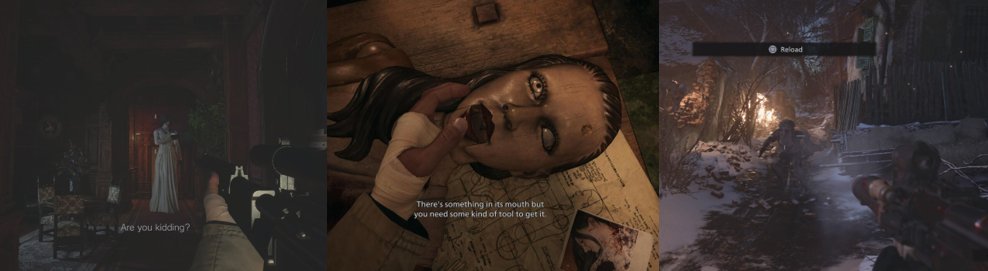
Gameplay:
Sonic Superstars doesn’t buck tradition; it’s a 2.5D, sidescrolling action platformer just like the classic 2D Sonic games and with all the traditional tropes you’d expect returning. You take control of one of four familiar faces and race through twelve colourful levels (known as “Zones”), each with anywhere from one to three stages (or “Acts”) within them, freeing woodland critters from Badniks, collecting Golden Rings to stave off death, pinballing all over the place on springs, bumpers, and boost pads, and striving to blast through Acts as quickly as possible. However, unlike in the classic games, you’re no longer penalised if you take more than ten minutes to finish an Act; the timer simply runs out and the game continues, which is good as some of the later bosses take at least ten minutes to battle against, so you’d be dying over and over to time outs if they were still a thing. Another noticeable change is the complete absence of a life system; you’ll hit Star Posts to create checkpoints across each Act and you’ll respawn at these when you inevitably die, but you won’t ever have to worry about running out of lives or continues or getting a game over, which again is good as some of the later Acts and bosses will see you crushed, zapped, or plummeting to your death to an almost spiteful degree. Otherwise, many of the same mechanics are here; you’ll suck in air bubbles to avoid drowning, run through loops, crash through walls, and take multiple paths through each Act, with the higher route usually being the fastest but most dangerous, to finish faster or find goodies. Like Sonic 3 & Knuckles (SEGA Technical Institute, 1994, Sonic Superstars uses save files for your playthrough (though, oddly, you can’t copy your save file) and, like Sonic Generations (Sonic Team, 2011), you can run around a limited hub world between Acts where you can access Acts, bonus Acts, switch characters, and play some tutorials to get to grips with the game’s new mechanics.

Team up with friends and use the gang’s classic abilities to conquer new, but familiar, Zones.

From the start, players can pick to play as Sonic the Hedgehog, Miles “Tails” Prower, Knuckles the Echidna, and, in what’s still a rare inclusion, Amy Rose. The basic controls for these characters are universal: A and B are your action buttons, allowing you to jump, perform the character’s special attack, or Spin Dash; X or Y (if configured) will activate the Emerald Power you select after using the Right Bumper to bring up the selection wheel, and that’s it for button commands. Each character performs the Super Sonic Spin Attack when jumping; holding down the button sees you jumping higher and pressing or holding it a second time in mid-air sees each character perform a signature special attack. Sonic performs the Drop Dash, which I finally found somewhat useful here (though I still miss the Insta-Shield), Tails can fly for a short time (and doggy paddle underwater), Knuckles can glide (and will cling to and climb most walls he glides into), and Amy will swing her hammer in her spin for a super useful double jump and flail it around for a ground attack if you hold the button. If you press down while running, you’ll roll into a ball; if you stand still and press down and A or B, you’ll charge up the Spin Dash for a burst of speed and, while there is no Super Peel-Out here, Sonic’s run greatly resembles it. Because of their individual abilities, you’ll have an easier time with the likes of Tails or Knuckles and even Amy thanks to their mid-air tricks, while Sonic often has to rely on the Emerald Powers to reach higher areas and find secrets. Mostly, the controls and physics work well; they’re not as slippery as some games and everything feels more akin to the classics, though there are still moments where characters slip from precarious footing and struggle to make jumps, but this isn’t helped by some badly placed enemies and hazards. Sonic Superstars can also be played in co-op with a group of friends, but I wouldn’t recommend it; it’s basically like playing Sonic 2 in co-op, with any players that are too slow or who get stuck or who take a different path disappearing from the main action and having to respawn in. There are also no team-up moves beyond Tails carrying a character, which is a shame, but it’s still nice to see it incorporated, even if it’s not very sustainable.

Autoscrolling sections, shoot-’em-up stages, and unique level-changing gimmicks are notable inclusions.

I mentioned the enemy and hazard placement just now and it’s true that Sonic Superstars suffers a bit from this, especially in later Zones, primarily because the camera is a little too zoomed in and the level designers seem to be taking inspiration from Sonic the Hedgehog CD (SEGA, 1993) at times by placing ceiling and wall spikes and Badniks just offscreen. Still, there are times when the mechanics are really fun; there’s some new additions here, such as being shot or blasted onto a background plane, running around loops, grabbing pulleys, or bouncing around inside rings for Ring bonuses, and even some autoscrolling sections. The one in Golden Capital Zone sees you dodging waves of lava, while the one in Frozen Base Zone is effectively a mash up of Sky Chase Zone and a remix of Fantasy Zone (ibid, 1986), with you piloting one of Dr. Eggman’s crafts and blasting at redesigned Fantasy Zone enemies and bosses with A and dropping bombs with B. While things start out very familiar, and many Zones include recycled gimmicks from classic Sonic titles (Lagoon City Zone, for example, recycles just about every underwater gimmick from the previous games and Pinball Carnival Zone and Sand Sanctuary Zone owe a lot to previous casino-theme Zones and Sandopolis Zone, respectively), I mostly enjoyed how these elements were implemented, even if they were very familiar. There are some really unique additions included here, too; Press Factory Zone sees a giant piston in the background smash into the ground and bump you about if you’re not grounded, while Act 2 sees Dr. Eggman’s hovering drone grow closer and closer to detonating every explosive device in the Act unless you find switches to briefly reset the counter. Speed Jungle Zone sees you creating bridges by hitting switches and using nearby butterflies to light up dark areas, Sky Temple Zone incorporates wind gimmicks using fans, Cyber Station Zone sees you travel on electrical currents and expands on Sonic CD’s shrinking mechanic by transforming you into pixelized animals to navigate past dangerous area (with the mouse lines being the most aggravating), and Egg Fortress Act 2 sees you running from the right to the left as the damaged space station is repaired thanks to Dr. Eggman’s time warping machine, which I thought was a really novel idea.  

Graphics and Sound:
Although I would’ve preferred to see a bigger, more colourful and adventurous sequel to Sonic Mania that continued to use charmingly detailed sprite art, Sonic Superstars may be the best of the 2.5D Sonic titles in recent years. The game perfectly translates the classic aesthetic of Sonic 1 and Sonic CD, especially, into a quasi-3D style, with characters all performing idle poses, victory celebrations, and exuding a lot of personality in the game’s fun, pantomime-like cutscenes. These primarily tell the story of the gang trying to catch up to Dr. Eggman or Fang, clumsy Trip’s efforts to impress her masters and change of heart after being befriended by Amy (you’ll carry Trip around in an Amy-focused bonus Act), and Fang’s delight at tormenting Knuckles. The Acts are also full of fun elements; sometimes, you’ll see other characters racing along in the background and not just baddies like Fang, but Sonic, Knuckles, and Amy, which adds a layer of scope to the game. The large animals of the North Star Islands often show up to help out, hang out in the background, or celebrate with you at the end of the Act, and they’ll pop up on the hub world as well to give a sense of progression. While some Acts can be a bit cluttered at times, with some clashing colour schemes and visuals making it difficult to know where’s safe and what’s a bottomless pit, I had no issues with the game’s visuals; even the various DLC costumes appear in cutscenes, which was a nice touch. To make things even better, the anime cutscenes made famous in Sonic CD and brought back in Sonic Origins (Sonic Team, 2022) return here, which is most welcome, though you can’t watch them back. As much as I like the visuals though, and little touches like the title screen and enemies encountered in Trip’s story changing as you play, I wasn’t impressed by the game’s soundtrack; it’s serviceable enough but failed to make much of an impact, with no tunes staying in my head after I finished, some haunting my nightmares as I struggled to clear the more aggravating bosses, and some actually cutting out due to odd glitches.

While some Zones are quite derivative, the game’s overall visual style is impeccable.

Sonic Superstars evokes the classic games in its Zones, even bringing previously discarded concept art from Sonic 1 to life for the first time, and mixing and matching classic gimmicks with new ones. The game begins with the classic Green Hill Zone archetype, one that incorporates waterfalls, floating boost pads, wall running, and swinging springs to try and mix things up a bit. Speed Jungle Zone owes a fair bit to Sonic’s often forgotten 8-bit adventure, incorporating vines and grinding into the gameplay, while Sky Temple Zone focuses more on tricky platforming on small, moving, or temporary platforms and trying to avoid enemy fire when you’re being blown about by the fans. Pinball Carnival Zone is about where I started to make the most apt comparison for Sonic Superstars’ Zones; they’re very similar to those seen in the Sonic the Hedgehog 4 games (Dimps/Sonic Team, 2010; 2012), mashing together classic gimmicks to try and create something new and giving us theme-park levels and snowy mechanical bases. Luckily, this is executed far better here but I wonder if this was a conscious decision to try and make good on some of Sonic 4’s better ideas or just coincidence and laziness, since Sonic games love to reuse the same tropes over and over. For me, this was most evident in Sand Sanctuary Zone, which is just Sandopolis Zone again, but it’s only one Act in the main story this time. Luckily, Press Factory Zone made up for this, being a mechanical obstacle course in Act 1 and a tense face against a fiery death in Act 2. Golden Capital Zone also impressed, despite initially appearing quite bland; there’s a fun rotation gimmick where you end up running on the ceiling with the ground above you and it switches to a lava-infested furnace for Act 2. While Cyber Station could also get very cluttered, I loved the pixelated visuals applied to the character and enemy models; everyone looks like LEGO here and it really made the Zone stand out (and make me wish we could play as those models as skins in other Zones). Frozen Base Zone saved itself from blandness with its random shoot-‘em-up mechanics in Act 2 and I did enjoy how Egg Fortress Zone crumbles around you in Act 1 and unwinds in Act 2, that was really fun, even if it led to some cheap deaths from crushing, spikes, and sudden pits.

Enemies and Bosses:
Many of Sonic Superstars’ Badniks are recycled from Sonic 1, Sonic CD, and Sonic 2 though some have been slightly tweaked; Buzz Bombers use sweeping lasers, for example. Choppers, Orbinauts, Slicers, and buzzsaw-wielding Robot Beetles pepper each Act but the most reoccurring classic Badnik is strangely the Batbrain, which appears in Zones that really don’t fit its aesthetic. Still, Sonic Superstars does have some new Badniks on offer; one of the worst, for me, were the Jellyfish Mechas, which float up and down with drill-like appendages on their tentacles. You’re supposed to attack them when these are pointing away, but I seemed to always mess up the timing, and they’re often found floating between bumpers and other gimmicks. I quite like the seahorse-like Soap Bubble Mecha, which is largely harmless but spits out bubbles you can use to boost your jumps to higher areas. The Elephant Mecha, Electrical Discharge Mecha, and Kanga Clangas and Barrel Throwers were all visually very fun, too; the Elephant Mecha is more like a blowtorch, the Electrical Discharge Mecha is a cloud that fires thunderbolts if you don’t destroy it quickly, and Kanga Clangas and Barrel Throwers are kangaroo and sea lion-themed robots that toss explosives and barrels at you. The Trampling Mecha was an odd on for me; this vulture-like Badnik rears up and tries to squish you, so you have to wait for it to appear on your level pane before you can attack, something that happens in many of the boss battles, too. Splats also makes a return here, alongside the Eggrobos in Trip’s story (now able to fire in multiple directions, and from offscreen, just to really wind you up), and you’ll come across multiple disposable Badniks, like Antons and Mole Mechas, that primarily serve as an annoyance but are also used as projectiles in certain boss battles. Speaking of which, while the bosses start out as expanded versions of those seen in Sonic CD and Sonic 3 & Knuckles, sporting multiple phases and attacks, they quickly become very tedious as you’re forced to loiter around, unable to attack, as you wait for your one opening and it can be laborious starting all over again if you make a mistake and fail thanks to the lack of checkpoints, making many of the bosses a rage-inducing chore to fight.

Giant robotic animals will expose the game’s lengthy boss battles.

Like in Sonic 3 & Knuckles, many Act 1’s end with a battle against one of Dr. Eggman’s larger mechanical monstrosities. The first of these is the Mosasaurus, though this is more of a chase; you can hit it when it leaps into the foreground, but just run to the right, avoiding pits, and it’ll crash into a wall, defeated. In Speed Jungle Zone, you face a giant mosquito-bot that can only be damaged by Spin Dashing up the chain it shoots at you. You’ll have to watch for spike pits, projectiles, and its charge attack near the end, too. Pinball Carnival Zone pits you against a maniacal clown merged with a giant bumper; this thing will float around dropping explosives and shielding itself with electricity, and the only way you can make it vulnerable is to jump at the tokens in the arena to flip it around, with these (and the hazards) increasing as the battle progresses. Lagoon City Zone’s robotic guardian is a giant jellyfish that spits out a bunch of minions to distract you, fires its tentacles at the floor, and then electrifies the water you’re standing on before trying to crush you. As you damage it, it’ll also fill the screen with projectiles and strike with multiple limbs. Press Factory Zone’s giant mechanical ape harkens back to Sonic 1’s Final Zone boss; when in the background, it causes giant pistons to come crashing down on you, so you need to find the safe spot to avoid being crushed then wait for it to finish jumping about in the foreground so you can ram it, not unlike the Flying Battery Zone boss battle. Golden Capital Zone’s robot pig can be a bit tricky as it sucks up all your Rings at the start of the fight but it’s actually pretty simple; just race around the rotating arena as it charges you until you can hit the big button on its back, something made ridiculously easy with Tails or Amy thanks to their greater air time. Finally, Frozen Base Zone sees you running along (and against) conveyer belts and battling a bird-like mech that spits targeted mines, ice cubs, and other Badniks that must be avoided before you desperately try to jump up and hit it before it disappears to the background again.

All the Emerald Powers in the world can’t save you from the tedious boss battles.

Speaking of Dr. Eggman, you’ll naturally battle him multiple times in various contraptions. In his first appearance at the end of Bridge Island Zone, Dr. Eggman pilots a massive mech suit that resembles him (a common occurrence in this game) and attacks by spinning its mace-like arms, firing its arms at you, and leaping at you, where it becomes vulnerable. After enough hits, parts of the mecha break away and the torso, now a UFO-like craft, tries to slam into you. Dr. Eggman encases himself in an impenetrable sphere in Speed Jungle Zone; not only does he try to crush you, but he also summons spear-like chains to try and skewer you, but you can lure these to attack his craft pretty easily. When it goes a bit mental and starts spinning around and firing projectiles, hit the blue ones to reflect them back and land an extra hit. Sky Temple Zone features a particularly annoying boss battle that sees you dodging Dr. Eggman’s many buzzsaw projectiles in free fall and hopping to floating debris, avoiding more projectiles, to land a single hit, all while a giant fan looms at the bottom of the screen, with the battle looping until Dr. Eggman tries a kamikaze attack! I never really figured out Pinball Carnival Zone’s boss; it appears to be a roulette-style battle where you need to dodge mines and electrical bursts and use momentum to reach Dr. Eggman, but I just used Amy’s double jump to cheese through his and I suggest you do the same. Sadly, there’s no cheesing the Lagoon City Zone boss; this battle takes place underwater, so you’ll need to grab air bubbles regularly to keep from drowning. First, you must jump up a vertical shaft avoiding projectiles and using the wake from Dr. Eggman’s drills to boost you higher. Soon, Dr. Eggman fires homing missiles and rotating lasers, then the battle shifts to a side-on view and you have to awkwardly avoid incoming attacks to hit Dr. Eggman’s craft, which now resembles a wall. While this one was tough, the Sand Sanctuary Zone boss is where I started to see how tedious the game’s bosses are. Here, Dr. Eggman fires giant stone stabs at you from the foreground and sends Badniks tunnelling towards you; hit the right ones at the right time (in mid-air) and you’ll reflect them back at him, and you can ram him when he pops up from the ground, but otherwise this is a lot of waiting around for a small opportunity to attack. In comparison, the Press Factory Zone boss is much preferable, despite the constant threat of being crushed by its giant piston. Simply avoid its projectiles, jump when the piston comes down to avoid being bounced about, Spin Dash through its legs, and ram the unprotected cockpit whenever you can.
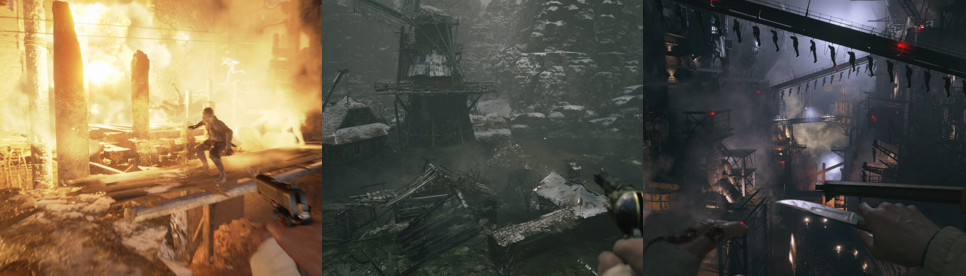
Encounters with Fang, the Metal Fighter, and the finale are particularly lengthy and aggravating.

Of course, Dr. Eggman isn’t the only baddie in Sonic Superstars; you’ll encounter Fang quite a lot, taunting you or firing missiles and lasers at you, completely out of reach until you reach Golden Capital Zone, where you battle him in an autoscrolling section. Piloting a weaponised version of the Marvellous Queen, Fang fires lasers at the ceiling and lava, causing debris to fall and lava to rise, fires three more lasers from drone-like appendages and shields himself with destructible hexagons. Between each encounter, you must dodge flame plumes and falling lava; Fang’s projectiles and dangers increase as the fight drags on, too, making this a hell of a chore. After a battle against Dr. Eggman’s prototype Metal Fighter (which is the “Battle Mode” avatar you created) that draws from the classic Metal Sonic battle from Sonic CD and the Death Egg Zone boss from Sonic 3 & Knuckles (but with more pits and less Rings), and a shoot-‘em-up battle against two redesigned Fantasy Zone bosses (one a cylindrical mech that spits bullets, the other a sphere resembling Dr. Eggman’s face that rains projectiles) and working your way back through Egg Fortress Zone, you’ll have a climatic two-stage battle against Dr. Eggman’s biggest mech yet. In the first phase, you run around a circular platform devoid of Rings dodging his missiles; run around the mech and hit the blue missiles to score a hit, but don’t bother from the front as it’ll block them. The mech also swipes at you with its buzzsaw-like arms and fires an energy wall that you can avoid by jumping through the gap and, after enough hits, it’ll switch to attacking from the foreground (again, like Sonic 3 & Knuckles’ Death Egg Robot). This is the toughest phase of the boss as you need to avoid falling, dodge his hand smashes, hide behind any nearby walls to keep from being trapped in his anti-gravity beam and roasted by his projectiles, and must to dodge the multiple giant lasers, all while striking at a precise moment to land a hit. This becomes especially frustrating as there are no Rings in the arena, no checkpoints between phases, and the fight drags on and on since it takes so long between each attack and before you can land a hit.

Power-Ups and Bonuses:
Since the game doesn’t use lives, there are no 1-Up monitors to be found; collecting 100 Rings grants you a Medal rather than an extra life and you’ll find similar Medals hidden in Acts and collected from Bonus Stages for use in the game’s Battle Mode. Monitors, however, are present and will grant you additional Rings, a temporary speed up or invincibility, and a shield that’ll protect you from one non-lethal hazard. The magnetic shield also returns but, while this still attracts nearby Rings to you, it oddly no longer protects you for a hit, severely reducing its appeal as a power-up. As you play, you’ll notice warps appear in Acts; jumping into these will take you to a freefall section where you float about grabbing a few extra Rings and then emerge nearby, effectively acting as a shortcut. Other times, you’ll rocket along grabbing Rings, smashing Badniks, and avoiding touching the environment, search for Fruit that you can cash in on the hub world to play bonus Act Fruit obstacle courses where you grab Rings, pop balloons, and hit tokens to win Medals, and each character also has their own Act to play that serves as a way to get to grips with their mechanics and expand the story. As in Sonic 3 & Knuckles, Giant Rings can be found in each Act; blue ones transport you to a Bonus Stage modelled after the Sonic 1 Special Stages, where you must navigate past warps, change the maze’s rotation, and swap the environment around to grab Medals, and gold ones that take you to the game’s Special Stages.

It’s cool that the Emeralds bestow powers, but most of them are pointless and circumstantial.

Completing a Special Stage awards you with a Chaos Emerald but, this time, these are actually a game-changing mechanic. Each Chaos Emerald bestows you with an Emerald Power, selected with RB and activated with X, which will last for as long as the meter lasts or until you take a hit and will be replenished at each Star Post. As cool as this idea is, I found the Emerald Powers to be more miss than hit; some are only useful in certain situations, like Water, which lets you swim up waterfalls or through underwater sections much more freely, or Vision, which reveals hidden platforms. An indicator will appear to let you know when it’s a good time to use these abilities, but a lot of them are redundant when playing as Tails, Knuckles, Amy, and Trip; Bullet and Ivy, for example, are only really useful for getting Sonic to higher areas outside his skills. The most useful Emerald Power, for me, was the first one you get, Avatar; this swarms to screen with a bunch of (at times distracting) duplicates of your character and can help get a free hit in on bosses. I never used Slow at all in the main game; it was much more prominent in Trip’s story, where you need to use it to slow down rapid hazards to pass by safely. Perhaps the most disappointing Emerald Power was Extra, which grants each character a new special ability, but I only found two to be of any use; Sonic gets a stunted Homing Attack, Tails swipes with his tails, Knuckles gets a projectile punch, Amy tosses her hammers like in Sonic Origins, and Trip throws bouncy fireballs, with these latter two being the only ones I found beneficial.

Additional Features:
There are thirty-eight Achievements in Sonic Superstars, with eleven awarded after clearing each Zone, seven awarded after using each Emerald power, one for clearing any Act with a friend, and one for collecting all seven Chaos Emeralds. You can earn five Achievements for destroying 100 enemies with each character’s special attack (so, 100 enemies with the Drop Dash, 100 while gliding, etc), one for finding and destroying the special Golden Badnik in each Act (though be warned as you’ll have to destroy it again, or restart the Act, if you lose a life after destroying it), one for collecting 100 Medals from Bonus Stages, and one for finishing Frozen Base Zone’s shoot-‘em-up section without taking damage. Your Medals can be spent in the game’s shop; here, you can purchase heads, torsos, arms, legs, and spray paint for your Metal Fighter, a custom robot you use in the game’s Battle Mode. While parts for metal versions of the five playable characters exist, the shop is really expensive, so you’ll need a lot of Medals to create classic characters like Metal Sonic and Metal Knuckles, and the Battle Mode isn’t that great. You battle friends or CPU-controlled robots in three arenas, either to the death, while avoiding missile bombardments, or collecting items to win, using X to attack with an electrical burst and being underwhelmed by the entire thing. Although you can access additional skins for this mode (and the main game) via DLC, there are no Achievements tied to the Battle Mode, so I’d just avoid it; there’s a Time Attack mode as well, but again there are no Achievements associated with this.

Snag the Chaos Emeralds, endure Trip’s ridiculously hard story, and take on the arduous true final boss.

As mentioned, you’ll warp to Special Stages by finding Giant Rings. These are pretty simple, unique bonus areas where you have to tap and hold A to latch on to glowing blue orbs, boost points, or Rings to chase after a Chaos Emerald. You can latch onto mines, too, but these will explode to slow you down and you’ll need to avoid crystalline structures and collect Rings for more time. While the later ones can get very challenging, it’s not too difficult to get all seven Chaos Emeralds, which unlocks the final Emerald Power, where you’ll turn Super after collecting 50 Rings and selecting the ability from the wheel. After clearing the main story, you’ll unlock Trip as a playable character and “Trip’s Story”, which picks up where the main story ends and sees Trip battle through remixed versions of each Act, encountering an army of Eggrobos led by a primary Eggrobo. Trip has all the same abilities as the other characters in addition to a double jump and the ability to cling to walls and ceilings, which is incorporated into her Acts. Her Super form is also a flying, fire-breathing dragon that absolutely breaks the game, but its advantages are offset by her story being so damn hard. Acts are redesigned to have more enemies, more hazards, and more bottomless pits, as well as required more Emerald Powers to bypass obstacles. Her bosses also seem tougher, with new attacks in their arsenal; the Eggrobo takes Dr. Eggman’s place until the end, where you must battle Fang in a gruelling final boss full of one-hit kills and frustrating sections that nearly had me rage-quitting! Complete “Trip’s Story” and you’ll get an Achievement and access to the true final boss, the Black Dragon, in a battle that’ll take at least ten minutes to complete. This sees you, as Super Sonic, smacking back blue comets, avoiding instant-death black holes, ramming the dragon’s chest, and tearing your hair out trying to hit five incoming projectiles with frame-perfect timing as the game suddenly introduces quick-time events! Not only does the boss constantly hide in the background, but its attacks are completely random, your opportunities to hit it are ridiculously limited, and you’ll burn through Rings if you keep tapping the Boost button. Rings randomly rain from the sky and Sonic’s friends will randomly appear to offer more, but this and the rage-inducing fight against Fang’s mech cast a dark shadow over the whole game for me that ruined the entire experience.

The Summary:
I was surprised when I first saw the announcement of Sonic Superstars; although disappointed that we weren’t getting Sonic Mania 2, I was cautiously optimistic, especially as it had that classic Sonic aesthetic, included a playable Amy and the welcome return of Fang, and incorporated the Chaos Emeralds in a new, more practical way. Sonic Superstars definitely makes a great first impression; it ticks all the nostalgia boxes and is fun to play, with lively, animated characters, bright and colourful Zones, and challenging (but not impossible) Special Stages. I loved seeing all the little details in the backgrounds, watching the hub world change, and seeing the story unfold; I even enjoyed the recycled gimmicks from old games, even if I was disappointed by the Badnik variety. Soon, though, cracks started to appear; Acts ran a bit too long or strangely short and bosses started to become a chore as I was left standing around, watching the timer run out, waiting for the game to let me attack. The main reason for this, of course, is that the Emerald Powers would decimate most bosses but I think a compromise could’ve been reached. At least speed up or tone down the waiting time between the boss’s attacks, or maybe even disable Emerald Powers altogether for the fights. But it was those final battles against Dr. Eggman and Fang’s giant mechs and that random-ass dragon that pulled the rug right out from Sonic Superstars. It’s bad enough that you must beat “Trip’s Story” to unlock the final boss; it’s bad enough that “Trip’s Story” is cheap as hell with its pits and hazards; but to put insta-deaths in the boss fight? Seriously, it can take five minutes to reach Fang’s second phase and you can die five seconds into it, meaning you have to do the whole thing all over again. The Black Dragon fight may be the worst Super Sonic fight I’ve ever played, as well, which is a shame as the game was doing so well until those final battles; I could even forgive the drawn out nature of the previous bosses if Sonic Superstars had stuck the landing but, sadly, it drops the ball right at the end, leaving a sour taste in the mouth. Yes, it’s a beautiful game with lots of fun elements, but that just makes its flaws all the more glaring; I really hope SEGA patch the bosses to make them more enjoyable, but I wouldn’t hold my breath on that.

My Rating:

Rating: 3 out of 5.

Pretty Good

What did you think to Sonic Superstars? Did you enjoy the new Emerald Powers or, like me, did you find them to be a missed opportunity? What did you think to Trip, her gameplay and her character arc? Did you also find the bosses arduous and aggravating? Does this game have the hardest, most unfair bosses of any Sonic title? Did you play the game’s Battle Mode? Would you like to see Trip make a return in a future game? How did you celebrate the Sonic franchise this month? Whatever your thoughts on Sonic Superstars, leave a comment below or on my social media and go check out my other Sonic content.

Game Corner [Dragon Ball Day]: Dragonball FighterZ (Xbox Series X)


DragonBallDay

When the Great Demon King Piccolo was released upon the world, he broadcasted a message on television declaring May 9th as “Piccolo Day”…and promptly celebrated by announcing his ownership over the planet. Since then, May 9th has been officially recognised as “Goku Day” but, to make things simpler, I’m using this as a good excuse to celebrate all things Dragon Ball,


Released: 26 January 2018
Developer: Arc System Works
Also Available For: Nintendo Switch, PC, PlayStation 4, PlayStation 5, Xbox One, Xbox Series S

The Background:
Akira Toriyama’s Dragon Ball franchise, particularly Dragonball Z, is no stranger to videogame adaptations. In 1990, the first Dragonball Z videogame released for the Family Computer (Famicom) and, since then, various titles based on the long-running manga and its popular anime counterpart have been released, generally as shameless rip-offs of Street Fighter II: The World Warrior (Capcom, 1991), tournament fighters or one-on-one beat-‘em-ups that retell the events of the anime over and over again. After Bandai Namco acquired the rights to the franchise in 2009, they routinely released new Dragon Ball titles on an annual basis, with the games now incorporating elements from the long-awaited Dragon Ball Super (2015 to 2018). Following the critical and commercial success of Dragon Ball Xenoverse 2 (Dimps, 2016), the publishers turned to Arc System Works, known for their Guilty Gear fighting games (ibid, 1998 to present), to develop a three-on-three fighter to address issues with power balances. Akira Toriyama designed a brand-new character to act as the game’s antagonist and the game was initially met with a great deal of enthusiasm. This was reflected in the sales, with Dragonball FighterZ becoming the fastest-selling Dragon Ball game at the time, and the reviews, which praised the anime-style visuals and explosive combat, with the game seen as one of the best in the franchise. While some criticised aspects of the gameplay, the game performed well enough to not only be bolstered be additional downloadable content (DLC) but also to receive an updated PlayStation 5 and Xbox Series S/X port.

The Plot:
The Red Ribbon Army continues to plague Son Goku and his allies when the hitherto-unknown Android #21 uses the Dragonballs to resurrect their fiercest foes. Their powers dampened by Android #21’s energy waves and faced with an army of puppet-like clones, the Z Warriors join forces with their worst enemies and a mysterious possessing soul to combat Android #21’s threat.

Gameplay:
Dragonball FighterZ is a 2.5D fighting game in which players initially pick from a roster of twenty-one characters from across the Dragonball Z and Dragonball: Super series’ to take part in fast-paced, cinematic bouts. From the moment you start the game, you’re bombarded with pop-ups, messages, and notifications and that’s before you even start to work out how to navigate the main hub, which is a chibi­-fied recreation of famous locations from the franchise, such as the World Tournament arena and Master Roshi’s island. Thankfully, you can either guide your chubby little avatar to various gameplay options, warp there with the Left Trigger, or bring up the options menu to take a look at the game’s controls. As you might expect, a practice and tutorial mode are included and tutorials are commonplace throughout the “Super Warrior Arc” of the game’s story mode so you can quickly get to grips with the fighting mechanics. Although you’re initially taught the basics in a one-on-one scenario and you have the option of fighting one-on-one (as well as customising the difficulty level of the computer-controlled opponents, setting the rounds and timer limits, and other options before fights outside of the story and Arcade modes), Dragonball FighterZ is primarily a team-based fighter. You pick three characters to form a team and can tag in and out in, which continues to be an aggravation for me as I’ve never really clicked with team-based fighters and find it to be an even more overplayed cliché than a Street Fighter II clone.

Rush in to pummel your foes with attacks or finish them in explosive fashion with your ultimate attack!

Thankfully, Dragonball FighterZ only takes inspiration from Street Fighter II; the fighting mechanics, while obviously similar given the presentation, are noticeably different and perfectly suited to reacting the anime’s explosive, high-intensity battles. X sees you throwing a light attack, Y a medium, and B a heavy (which can send you opponent flying away or through the environment for a “Destructive Finish” if timed correctly). Successive presses of each button pulls off different combo moves; you can mix and match, but the focus is more on mashing, say, Y as your character will automatically pull off a Super Move at the end of that simple combo string, negating the need to perform quarter-turns on the left stick or directional pad. A tosses out a ki blast; you can hold or rapidly tap it and press A after pushing towards your opponent to swat away their projectiles, just like in the anime. Although you can jump, dash, and sidestep towards and away from your opponent, the Right Trigger and Right Bumper allow you to dart at them with a “Dragon Dash” and “Dragon Rush”, respectively, allowing you to close gaps quickly, land a hit, and pull off a quick combo in mid-air or on the ground. These will also break your opponent’s guard, sadly executed by holding away from your foe just as they land an attack. I would much prefer a dedicated block and counter button as pushing back isn’t very reliable, though you can always press Y and B together to instantly teleport behind the opponent for an attack as long as you have at least one bar on your ki gauge.

You’ll need to call upon your allies to help withstand the barrage of attacks from your foes!

The ki gauge builds up as you dish out and take damage, but you can also manually power up by holding X and A together. The more bars you have, the stronger and more elaborate special moves you can pull off and, when you’re at maximum power, you can pull off your character’s ultimate attack using a simple input of a quarter-turn back or towards your opponent and pressing RT or RB afterwards. These ultimate moves certainly are visually impressive and are a great way to end a match, and they’ll also partially destroy the stage for maximum impact. As it’s a team-based fighter, you can call in an assist from one of your teammates at any time with the Left Trigger and Bumper; this allows you to string together massive two- or three-way energy attacks or dish out an even bigger combo, though be warned as you can easily get inescapably caught in your opponent’s team attacks as well. Holding either trigger allows you to switch to one of your team mates; this is essential as switching allows those not in play to regain a bit of health and some characters are better suited for different situations, such as larger characters like Nappa being slow and powerful and smaller characters like Teen Gohan being more agile and nimble. When playing the game’s story mode, the damage you take carries over between fights; you’ll regain some health (and downed characters will be revived) after a victory, but it’s best to switch often during the more intense battles to keep your health up. However, while you can set the difficulty of the computer in local play, arcade bouts become progressively difficult depending on which route you take. The easiest sees you fighting past three teams and the hardest has you battling seven and defeating each route unlocks a harder version for a greater challenge, and you can also play online or take part in a tournament.

As annoying as it is to have to navigate a map screen, the repetitious clone fighting is just as bad.

At first, Dragonball FighterZ seems intimidating but the story mode and practice options help guide you through the basics and the game initially plays very simply. Combos are easy to pull off with just a few mashes of the same button and it’s pretty easy to get into a rhythm of dashing at your opponent, pummelling them with a light combo, then focusing on medium combos with a super finish and calling in a team assist to speed things up. When playing the story mode, you’re actively encouraged to battle as many opponents as possible to grow stronger as, narratively, this unlocks your character’s full power. Each chapter presents a map and a set number of turns; your goal is to move around the map, taking out opponents and earning rewards, on your way to the boss fight. You cannot simply skip to a space and must actively move step by step around the map, which is either painfully linear or slightly more complicated, but always very restrictive and annoying. I never ran out of turns so I’m not sure what happens if you use them all up but I do know that you need to manually save on this screen as a game over mean replaying the entire map from the start, which can be very annoying in the later, more difficult arcs. Generally, fights aren’t very difficult and you’ll breeze through them; even higher-level bouts against Kid Buu or boss battles against the likes of Perfect Cell and Frieza can be painfully easy, but don’t let yourself become complacent. I fought every single opponent across the three arcs, finishing the story at around level forty, and eventually did have to take the battles more seriously as the computer upped its game. You’ll see this difficulty spike more prominently in the arcade mode where, after the first fight or two, you’ll get absolutely decimated if you don’t keep your wits about you. The “Super Warrior Arc” likes to pepper the map with tutorial fights; completing these will earn you extra rewards, and you’ll earn similar additional rewards if you fight Kid Buu when he appears, but otherwise it’s just a series of fights over and over with little variety apart from recuing a new character or the amount of opponents you face or characters you control, meaning it gets very repetitive very quickly.

Graphics and Sound:  
In terms of presentation, Dragonball FighterZ is on a whole new level! Of all the Dragon Ball videogames I’ve played, this is the one that most closely emulates the kinetic action of the anime. Everything from the character designs to the stages, cutscenes, music, and voice acting is all ripped straight from the anime and the attention to detail is really impressive. Unlike some cel-shaded Dragon Ball videogames, Dragonball FighterZ sticks to a 2.5D aesthetic so characters never appear award or blocky and the illusion of playing as hand-animated sprites is very convincing. You can pick to have Japanese or English voices, which I know is a big deal for some “purists”, and the English voice cast all return to tell the game’s interesting (if somewhat derivative) story. The story is basically just a mish-mash of familiar arcs from Dragonball Z but I appreciated that it was an original story for a change and not just retelling the same story over and over, though the game does pepper in some classic story moments if you meet the right criteria for a “Dramatic Finish”. Indeed, it’s the fights where the presentation really shines; sticking to the 2.5D plane is admittedly a little more restrictive than more 3D-orientated Dragon Ball videogames but it makes the action so much easier to follow and all the attacks, special moves, and ultimate attacks are beautifully animated, with the game employing cinematic perspectives and drawing from the anime for the more destructive energy attacks.

The game does a fantastic job of recreating the look and energy of the anime.

Sadly, the game’s stages don’t fare quite as well. There are numerous stages to pick from, all of them very familiar, such as the Supreme Kai’s world, Planet Namek, a futuristic city, the rocky wastelands, and even the depths of space. Some stages will react to your attacks, breaking and crumbling apart around you, and you can even transition to other stages by finishing your opponent with a heavy attack in some locations. Unfortunately, there’s not a lot happening in them; you can’t directly interact with anything, there are no stage hazards to worry about, and they’re simply just there for the characters to have somewhere to fight, which is fine but I like it when there’s a little extra to do. The hub world takes on a completely different visual style; you pick a chibi-style character to wander about with and access different modes, which is cute and a little different but initially a bit puzzling. The story mode’s cutscenes can all be advanced with the press of a button, or skipped entirely, but they’re enjoyable enough. It’s fun seeing Goku interact with Perfect Cell and Frieza and you’ll trigger unique dialogue and interactions the more characters you rescue and recruit, though some characters are reduced to simply being silent clones for you to fight. Outside of the story mode, you can select different colour schemes for your characters but this is disappointingly limited; rather than selecting different skins for characters, they just take on a different hue, with the only bit of creativity I found being that you can apply Vegeta’s original colour scheme. It would’ve been nice to see different gi for certain characters, maybe Yamcha’s bandit look or Adult Gohan’s “Great Saiyaman” persona or Vegeta’s “Majin” form, but sadly we just have to make do with them sporting ill-fitting alternate colours.

Enemies and Bosses:
There are twenty-one playable characters in Dragonball FighterZ; three more are unlockable and a further twenty can be purchased as downloadable content, meaning you’ll face forty-four different fighters from across the franchise between the different game modes. In the story mode, the vast majority of enemies you’ll face are cloned versions of the main roster; these guys sport a black colour scheme with red eyes (a look that is also missing from the colour options, I might add) but are otherwise indistinguishable in their fighting style. The game seems to categorise fighters in three ways: small and fast, balanced, and big, slow, and powerful. Thus, playing as Krillian is not exactly the same experience as playing as Tien Shinhan, which is also different from playing as Majin Buu, even though the button inputs remain largely the same for all characters. Sometime you’ll have to press down, down, A for a move; some characters have you pressing X more than A, and very rarely you’ll find they have unique aspects to their characters. Future Trunks, for example, uses his Z Sword and Frieza can temporarily transform into “Golden Frieza”.

While fighters can feel samey, there’s enough to distinguish them through their feel and specials.

This extends to even more unique traits at times. While both Kid Buu and Piccolo can extend their limbs, Majin Buu, Kid Buu, and Android #21 can turn their enemies into chocolates and sweet treats to deal massive damage and power themselves up. Some characters will even call on other recognisable faces to aid them in battle: Captain Ginyu, for example, sends the Ginyu Force to attack you in place of more traditional projectiles, Nappa spawns in Saibamen, and many of Android #18’s attacks see her working in tandem with her brother, Android #17, who appears only here and in cutscenes unless you shell out for the DLC. Consequently, while it’s useful to have an understanding of how the different fighters play and what they’re capable of, it’s rare that you have to alter your strategy too much, but it does factor into how you play. Android #16, for example, is slow and bulky but makes use of rocket-powered punches and grapples, piledriving you into the ground if you get too close; his ultimate move also sees him left with the tiniest slither of health, so that’s something to consider when fighting. Kid Buu can rain destruction across the arena with his “Human Extinction Attack”, Adult Gohan can power up to his “full potential”, and many characters, like Goku and Vegeta and their variants, make use of screen-filling energy attacks, sometimes even warping about for increased damage.

Alongside repetitive fights, you’ll face Kid Buu and Android #21 in more challenging encounters.

You’ll only encounter actual boss battles in the game’s story modes; here, you’ll battle some recognisable Dragonball Z villains and heroes in each arc, often recruiting them after victory. Generally, you’ll fight the same clones over and over and they don’t pose much challenge until later in the story, and the same is true of guys like Captain Ginyu, Perfect Cell, and Frieza. While they’re sold as formidable opponents, you often fight them with a three-on-one advantage so they can be complete pushovers, especially compared to other teams made up of ki­-spamming assholes like Vegeta and Yamacha. As ever in Dragon Ball videogames, I found that the weak human characters were more of a problem than God-tier enemies like Majin Buu; Yamcha, Tien, and Krillan always seem to cause me issues in these games, though I’m not sure if that’s an actual gameplay feature so they can go toe-to-toe with Super Saiyan God Super Saiyan Goku or if it’s just a mental block on my part. As you explore the various maps, additional battles will spawn in and Kid Buu will sometimes take over a spot. These battles are touted as being tougher since Kid Buu is a few levels higher than you, but don’t actually become more challenging until the last story arc and, by then, you’ve pretty much mastered the fighting mechanics and team-based combos. Thus, the only real “boss” of the story mode is Android #21, a hybrid of android and majin who acts as the final boss for each of the three story chapters. Although she’s capable of consuming foes for massive damage, slicing an explosive energy blade across the arena, and attacking in a flurry of super speed, her most dangerous trait is that she can absorb abilities from her foes using her “Connoisseur Cut” technique. Each time this lands, a bar fills up above her health meter and, when it’s full, she’ll pull off a new attack, one dependant on the type of character she’s facing. Still, while she’s always at a higher level and far more aggressive than other enemies, she only poses a real threat at the end of the “Android 21 Arc”, where you first have to battle her with your team and then alone as you control her “good” half in a battle to the finish.

Power-Ups and Bonuses:
In addition to building your ki gauge in battle, which allows you to pull off more elaborate special attacks, you can also power up your fighter and restore a little health by pressing RB and RT together once per match to enter a “Sparkling” state. By battling with specific fighters on specific stages and performing a specific attack, you can also recreate moments from the anime such as Goku obliterating Frieza on Planet Namek. Every battle earns you various rewards; primarily, you’ll earn Zeni, the currency of the Dragon Ball franchise, to spend in the shop, though there’s really not much worth buying in there. In the story mode, you’ll earn different Player Skills; up to three can be equipped at any one time and these will buff your attack, defence, regenerate health, or fill your ki gauge faster, amongst other perks. You’ll earn higher levels of Player Skills as you progress, but there’s no crafting, combination, or discard system here so it’s pretty basic. You’ll also earn experience points (EXP) in the story mode; earn enough and you’ll level-up, though I can only assume this raises your fighter’s stats as I never actually looked too deeply into it. Unfortunately, only fighters you play as earn EXP so you either need to mix up your team or stick with the same fighters to have the best chance as higher-level opponents definitely present more of a challenge; they’re faster, more aggressive, and string together greater combos and can easily down your lower-level fighters if you’re not careful. Each team member can be further customised to perform one of three assist actions when called into the fight and you will recruit more characters, though not every character will be playable and there are some restrictions based on the narrative. This isn’t the case in local or arcade fights, though you don’t need to worry about EXP or Player Skills or anything here, though you can acquire the seven Dragon Balls by pulling off combos outside of the story mode. Once you have all seven, another combo string will summon Shenron and allow you to pick from four wishes, including reviving an ally or regenerating your health, which is a fun bonus.

Additional Features:
Dragonball Fighter Z offers thirty-five Achievements for you to earn, three of which you’ll automatically earn just by completing the story mode, though you’ll inevitably snag a few more just by playing through it. Defeat Kid Buu, for example, and you’ll snag some G; another will pop for triggering a “special conversation sequence”, and a couple more once you level-up high enough. You’ll also earn Achievements for clearing each of the different arcade mode paths, completing combo challenges and tutorials, and for playing online, but there aren’t many fun ones to get here. There are no Achievements to earn from Destructive Finishes, for example, or recreating the Father/Son Kamehameha against Perfect Cell for a Dramatic Finish or for summoning Shenron, which is a shame. You can purchase items from the shop, but they’re pretty pointless; you mainly buy new chibi avatars, colours, and stickers for use online. You can unlock Android #21 by beating story mode and there are a couple of ways to unlock Super Saiyan God Super Saiyan Goku and Vegeta, from clearing harder arcade paths or the story mode or buying them, but note that you cannot have two of the same character in your team at once (so, you can’t have Vegeta > Future Trunks > and Super Saiyan God Super Saiyan Vegeta in the same team). You can also play online or against a friend in a local battle, saving replays and such, and there are twenty DLC characters to add to the roster, though no additional story modes or Achievements tied to them so it’s probably better to wait for a sale as the packs are quite expensive and I’m not sure I’m that desperate to play as Bardock!

The Summary:
I’d been waiting to play through Dragonball FighterZ for some time. I put it off not because I wasn’t interested in it, but because I wanted to wait to see if the game would be re-released with all the DLC included. Sadly, it wasn’t, so I bit the bullet and went for it, with only my lack of skill at Street Fighter II-style fighting games being a concern. Then it turned out to be a team-based fighter and my concerns grew; then the difficulty curve went all wonky, being ridiculously easy for most of the playthrough and then steeply rising as the story mode progressed or I tackled one of the arcade modes. As someone who is rubbish at “frame cancels” and all that nonsense, I really enjoyed how simple the game’s combat was; with just a few button presses, you can easily recreate the fast-paced, high-impact fighting style of the anime and I loved the big, explosive special moves and the voice acting on offer here. The game looks absolutely gorgeous, too; it’s easily the closest I’ve ever seen to playing the slick, action-packed anime. I also liked that it wasn’t just a retread of the same stories; while the original story might be a bit derivative, it’s still refreshing not to have to play the damn “Cell Games Saga” again! However, there’s a disappointing lack of content here; once you’ve beaten the story and arcade modes, there’s not much to come back to as the roster is pretty thin outside of the three unlockables and DLC characters, with no skins or variants to purchase or unlock. There’s also not much to the combat and gameplay beyond mashing buttons faster and making better use of your teammates; you can plough through most fights without issue and simply tank your way through others, but a little variety would’ve been nice, like maybe take a cue from the variables seen in Mortal Kombat X’s (NetherRealm Studios, 2015) Towers rather than just asking players to complete the same basic tutorials over and over. In the end, while it’s definitely the best looking Dragon Ball game I’ve ever played and I did really enjoy it, Dragonball FighterZ quickly outstayed its welcome with repetitive and mind-numbing fights akin to grinding and a lack of tangible rewards.

My Rating:

Rating: 3 out of 5.

Pretty Good

Did you enjoy Dragonball Z FighterZ? What did you think to the team-based mechanics and action-orientated gameplay? Who was your go-to team? What did you think to the original story and Android #21 as a villain? Were you also disappointed by the lack of skins and playable characters? Did you ever clear all of the arcade pathways? What is your favourite Dragon Ball videogame and how are you celebrating Dragon Ball day today? Whatever your thoughts on Dragonball Z FighterZ, or Dragon Ball in general, leave a comment below or on my social media and check out my other Dragon Ball content!

Game Corner: Doom II (Xbox Series X)

Released: 26 July 2019
Originally Released: 10 October 1994
Developer: Bethesda Softworks
Original Developer: id Software
Also Available For: Android/iOS, Game Boy Advance, MS-DOS, Nintendo Switch, PC/PC-98Mac, PlayStation, PlayStation 3, PlayStation 4, SEGA Saturn, Tapwave Zodiac, Xbox 360, Xbox One

The Background:
Although the first-person shooter (FPS) genre existed before Doom (ibid, 1993), it was largely defined by this heavily ported and much celebrated title, which popularised online “Deathmatches” and improved upon mechanics established by its forefather, Wolfenstein 3D (id Software, 1992). id co-founder and lead programmer John Carmack created the game alongside designer John Romero and lead artist Adrian Carmack; after a troubled development, Doom proved immensely popular (despite its controversial violence and Satanic imagery), so much so that it was banned from workplaces and met with widespread critical acclaim. As if Doom’s many ports weren’t enough, a sequel was released just ten months later; many of Doom II’s levels were designed by Sandy Petersen, and they proved far bigger than those of the first game. Additionally, Doom II was much faster and more focused on action, with more enemies appearing onscreen at any one time, and the developers even included one of gaming’s most notorious Easter Eggs when they hid an image of Romero’s decapitated head behind the game’s final boss, the “Icon of Sin”. Like its predecessor, Doom II was an incredibly successful title upon release; critics lauded the game for refining everything that worked in the first, featuring far better map designs, even if it was essentially a glorified expansion of the original. Speaking of which, Doom II was accompanied by two expansion packs, the “Master Levels” and “No Rest for the Living”, which added additional maps and challenges to the game, and also received its fair share of ports over the years. More recently, Romero created an entirely new level for the game in a bid to raise money for Ukraine following Russia’s abhorrent invasion.

The Plot:
After a secret Union Aerospace Corporation (UAC) teleportation experiment opened a portal to Hell, a lone marine (popularly known as the “Doomguy”) was able to stave off the invading demons. His victory is short lived, however, as the forces of Hell begin invading Earth and he’s forced to venture into the bowels of the underworld to save what’s left of humanity.

Gameplay:
Like its predecessor, and as you’re no doubt aware, Doom II is a first-person shooter. Unlike other FPS games, Doom II retains the exact same control scheme, mechanics, and limitations of the first game, meaning there’s no jumping or awkward first-person platforming required, no strafing options, no quick turn, auto healing, or cover-based mechanics, and you still can’t aim the crosshair anywhere except left and right. As before, this isn’t really an issue, however, as the crosshair will change from yellow to read when you’re in range of a viable target, no matter how high or low there are, and this version of auto-aiming is great for picking enemies off from a distance or while safely on the high ground. If you want to make things harder on yourself, or clean up the heads-up display (HUD), you can turn the crosshair off from the options menu, which also allows you to activate or deactivate the auto-run function (I recommend leaving it on, especially as Doom II is much faster and more action-packed than the last game). Otherwise, everything’s exactly the same as it was in Doom: you still don’t need to worry about reload times (with the exception of the game’s one new weapon, the Super Shotgun), and you can still carry multiple weapons at once, the Right Trigger fires your current weapon, the Right and Left Bumpers or directional pad cycle through your arsenal, Y brings up a basic wireframe map (which is still incredibly confusing but better than nothing), and A allows you to open doors or activate switches. There are five difficulty settings to choose from, all of which change the aggressiveness and number of enemies in a level, and you’re able to select any level you wish right from the start but you’ll only pop those Achievements if you play through each level in turn.  Unlike the last game, Doom II isn’t divided into individual story chapters in quite the same way; there’s no longer a central hub to worry about and the game’s different arenas are separated by story text, which is actually in your benefit as you’ll now keep your current health, armour, weapons, and ammo between chapters and only lose everything if you die in a level this time around. You can once again keep track of all these in the HUD, which also indicates when you’ve collected the coloured key cards or skulls you need to open certain doors, activate certain lifts, or remove certain pillars and blockades to progress.

Hell comes to Earth, necessitating a trip into the Nether to battle the hordes of demons head on!

You still don’t have to worry about doing any swimming, but poison, lava, crushing traps, and teleporters continue to be prominent stage hazards. Thankfully, enemies can still attack and kill each other, which is extremely useful and fun, and there’s still a lot of explosive barrels around to help take out larger groups of enemies. The bulk of your time will be spent exploring Doom II’s far bigger and more complex levels; areas are much more likely to take on a maze-like quality and it’s easy to get turned around since everything looks the same and it’s often not clear what switches have activated. You’ll need to make use of rising platforms, elevators, and extremely narrow pathways (usually over poison or lava pits) to progress, and traps and areas are often activated by you walking to a certain spot, which can make things confusing when you don’t go where you’re supposed to. Another big improvement in Doom II that’ll quickly become obvious to you is just how many enemies can now swarm the screen. Picking up keys or skulls or entering certain areas often triggers the spawning of dozens of imps and demons, and many enemies are now capable of teleporting in and around the immediate area to really get under your skin. Enemies will pop out from behind hidden walls or cages, and you’ll often encounter a far greater variety in far greater numbers than was ever possible in the first game. Since a lot of Doom II takes place on an Earth overrun with the hordes of Hell, you’ll find a few maps infused with urban trappings like buildings and libraries alongside the usual gothic castles and Satanic dungeons; this adds a decent amount of visual variety to the game, but also makes navigating a bit of a chore as it’s easy to just run around in circles with no idea of where you’re supposed to go. This time around, the game asks you to take running “jumps” to cross gaps or tiny platforms and crates to reach keys, and you’ll often go out of your way to grab a coloured key only for it to open a door to a virtual dead end. You’ll need to look for switches, some of which open secret areas but only for a short time, but some doors and switches need to be shot to activate and it’s not always clear when this is the case. Teleport puzzles, areas filled with explosive barrels, traversing dark corridors, and crossing lava and poison bodies are commonplace tasks the game throws at you, and you’ll find your exits soon change from doors and switches to holes that lead deeper and deeper into Hell.

Graphics and Sound:
Graphically, Doom II isn’t really doing anything new that wasn’t seen in Doom; the game runs faster, certainly, has bigger and more complicated level layouts for sure, and is capable of rendering way more enemies at once (with former sub-bosses regularly cropping up at the worst possible times). Like its predecessor, Doom II makes great use of lighting to create a tense, horrifying atmosphere; some areas are in pitch blackness, others are partially lit by flickering lights or candles (with these light sources doubling as arrows pointing the way), but many are fully lit, showcasing the advanced technology of UAC’s outposts and facilities. The Satanic imagery and demonic influence is stronger than ever since you venture deeper into Hell, resulting in eviscerated corpses hanging from hooked chains or splattered across the walls, beating hearts on alters, pentagrams and demon skulls painted everywhere, and even rivers and waterfalls of blood, poison, and lava amongst crooked trees and an ashen Hellscape. Sadly, other areas aren’t quite as impressive; the urban environments are very bland and simple, with exteriors appearing like something out of Minecraft (Mojang Studios, 2011). Doom II is at its best when rendering interior environments, especially when the walls are pulsating with flesh and viscera but, even then, you’ll come across these weird glitchy blue and red blocks and platforms that just look ugly.

Doom II‘s levels are much bigger, there’s a reload animation, and even some Wolfenstein 3D levels!

The soundtrack, while suitably foreboding and a fantastic expansion on the original game, is also more of the same; like everything in the game, it’s been supped a little but is, essentially, the same kind of thing you experienced from Doom. Similarly, enemies and objects continue to be comprised of 2D sprites to continue that diorama-like presentation of the first game, and still howl and snort from the darkness to keep the adrenaline pumping at all times. While the game gives the illusion of having far bigger areas, especially in urban environments, many of the assets are recycled from the first game and, due to the claustrophobic and similar nature of the game’s many levels, it’s easy to get lost since everything in a UAC facility, Hellscape, or urban environment looks the same. Darkened areas, hidden passageways, and twisting pathways only add to the game’s increasing maze-like layouts, though the gothic, Satanic dungeons and sheer number and variety of enemies make the game far more action-orientated as you’re often beset by huge lumbering demons while frantically searching for the next door or key. The HUD continues to be one of the game’s most entertaining features as a pixelated representation of Doomguy reacts when hurt or picking up power-ups, though the game’s story is still told entirely through text. Considering how simple Doom’s story is, it never fails to surprise me just how much text is spewed at the player between chapters and you’re not really missing much at all if you simply skip past these interludes.

Enemies and Bosses:
Those who have played the original Doom will be more than familiar with the vast majority of Doom II’s demonic enemies as everything you encountered in the first game makes a return here, with some of the larger and more formidable demons appearing as regular enemies across Doom II’s levels. Pistol and shotgun-toting zombie marines are plentiful, as are fireball-tossing Imps, monstrous Pinkies (which can also be invisible), bulbous Cacodemons, and the ever-annoying Lost Souls, flaming skulls that fly right in your face with a hideous screech! The hulking Barons of Hell and mechanically-enhanced Spiderdemons frequently crop up as regular enemies, often guarding keys or exits but also randomly tossed into wide open and enclosed areas or behind doors when you least expect it, and you’ll even find a more formidable version of the Cacodemon, the “Pain Elemental”, which spits and spews Lost Souls at you!

Some grotesque new enemies appear but you’ll only have to content with one monstrous boss this time.

It’s a good job these tougher enemies are so prominent as Doom II is disappointingly short on actual boss battles; instead, you’ll usually have to fight past some of these bigger, tougher enemies to reach the chapter’s exit and progress to the next, but there’s only really one actual boss battle in the whole game. To make up for this, Doom II does feature some new enemies: rotund grunts packing chainguns are commonplace, as are Hell Knights (weaker versions of the Baron of Hell), and you’ll often jump out of your skin when the armour-clad, skeletal Revenants scream from afar and fire missiles right at your face! The Mancubus is equally grotesque; this hideous, semi-cybernetic blob plods about blasting its arm-mounted flamethrowers at you, and you’ll also have to contend with the Arachnotrons (smaller, faster versions of the Spiderdemon) and the tall, eviscerated Arch-viles, which can heal nearby enemies and engulf you in flames. If you manage to find the game’s secret exits, you’ll also get to battle enemies from Wolfenstein 3D but the only boss in the entire game is the Icon of Sin, a titanic biomechanical demonic goat head set into a wall of flesh and wires. The Icon of Sin constantly spawns every enemy in the game to protect itself, meaning the arena quickly becomes awash with projectiles, roars, and danger, and the only way to damage and kill it is to fight your way to a switch to activate a central column. Ride this up, making liberal use of the invulnerability power-ups to protect yourself, and desperately fire rockets at the Icon of Sin’s small brain port to try and cause splash damage to the hidden sprite of John Romero’s severed head while monsters scream, fire, and backwards words erupt all around you in this thrilling, if a bit frustrating, boss encounter.

Power-Ups and Bonuses:
You might’ve guessed by now but everything that you had access to in the last game returns here; you start off with just a crappy pistol and your bare fists, but soon you’re nabbing my weapon of choice, the shotgun, a rapid-fire chaingun, a rocket launcher and plasma cannon, and you’ll of course find the iconic BFG-9000 to wipe out enemies on one burst of green energy. The only new weapon in the game is the Super Shotgun, a double-barrelled shotgun that uses twice the ammo, has twice the kick-back, and is the only weapon with an onscreen reloaded animation. Still, for close encounters, it’s tough to find much better than this bad boy. You’ll find stimpacks and medikits to restore your health, armours to increase your resistance to attack (and bonus jars and armour to take both beyond the 100% cap), special suits to let you safely walk over lava and poison for a limited time, the odd light amplification visors to light up dark areas, and the computer area map to uncover the entire map. As before, you can also pick up temporary power-ups like the Berserk, Invulnerability, Partial Invisibility (which never seems to work as enemies always attacked me regardless), Supercharge, and the one new power-up, the Megasphere (which maxes your health and armour to 200%) to cut through the hoards of enemies you’ll encounter at the cost of severely reducing your visibility with a glaring change of colour palette.

Additional Features:
There are nineteen Achievements to earn in Doom II, with three of these popping after successfully completing each themed chapter of the game and others being awarded for killing one of every enemy, getting one hundred chainsaw kills, killing yourself and an enemy with a rocket, or discovering first one and then all the secret levels. These secret levels are accessed through some elaborate means within specific levels of the game, which have you finding a secret exit and being transported to levels from Doom’s forefather, Wolfenstein 3D, which is a fun little inclusion. You’ll also get an Achievement for finishing every level on “Nightmare” difficulty in co-operative mode, and for killing your teammate in co-op, which makes a return here and can be a fun experience even with the odd split-screen presentation. Also returning is the famed deathmatch mode, which allows you and a bunch of friends to battle for supremacy on a variety of maps and with some customisable gameplay options. This version of Doom II also includes the twenty fan-created “Master Levels” add-on, which add a number of unique and creative additional levels to the game. These are accessed from a level select menu and are played in turn, meaning your weapons, health, and armour reset to the default at the start of each one and they can be very challenging as the layouts are much more complex and required liberal use of a guide on my part.

The Summary:
I found Doom II to present something of a quandary; on the one hand, it’s undeniably bigger and better than the original in every way, with more diverse levels and an impressive number of enemies swarming the screen at any one time. On the other hand, it offers very little improvements over Doom apart from being faster, bigger, and a more action-packed. One new weapon and one new power-up is kind of a disappointment, and the shift towards urban environments swarming with demons helps to mix up the sci-fi and Hell-based aesthetic but these levels are objectively some of the worst and most annoying in the game. The new enemies are a great addition, however, upping the ante considerably and making for an even more gory and twisted experience but the lack of big, engaging boss battles is a major drawback for me. Considering how many ports and revisions Doom got, it’s surprising how safe this sequel is; the game is more like another glorified expansion pack to Doom, offering a bunch of new maps to wade through and some new enemies to encounter and very little else. Adding a couple of extra new weapons and power-ups and maybe some new gameplay mechanics might’ve helped tip this one further up the pecking order in my eyes, but it looks, plays, and feels far too much like Doom to really rate much higher than the first game. On the plus side, the sheer size and action offered by Doom II make it technically more appealing than the first game and I’d absolutely recommend that you own this one if you could only own one of the classic Doom titles, but that’s simply because of how much faster it is and the impressive number and variety of enemies on show. Basically, Doom II is Doom plus one, if that makes sense; it’s everything you know and love from the first game, with some very minor new additions to spice things up, but maybe plays things a little too safe and therefore comes across as another expansion pack for the trend-setting original rather than being able to truly stand on its own merits.

My Rating:

Rating: 4 out of 5.

Great Stuff

Did you enjoy Doom II? How would you rate it compared to the original? What did you think to the new levels offered by the game and the larger numbers of enemies? Were you also disappointed by the lack of new weapons and power-ups? Do you have fond memories of playing deathmatches on this one or did you put more time into the original Doom? What did you think to the secret Wolfenstein 3D levels and the final battle against the Icon of Sin? Whatever your thoughts on Doom II, or FPS games in general, drop a comment below.

Game Corner [Sonic Month]: Sonic the Fighters (Xbox One)


Sonic the Hedgehog was first introduced to gamers worldwide on 23 June 1991 and, since then, has become not only SEGA’s most enduring and popular character but also a beloved videogame icon and what better way to honour SEGA’s supersonic mascot than by celebrating his birthday all throughout June.


This review has been supported by Chiara Cooper.
If you’d like to support the site, you can do so at my Ko-Fi page.

GameCorner

Released: 28 November 2012
Originally Released: June 1996
Developer: SEGA
Original Developer: SEGA AM2
Also Available For: Arcade, GameCube, PlayStation 2, PlayStation 3, Xbox 360

The Background:
As you’re probably aware, Sonic the Hedgehog (Sonic Team, 1991) was a massive success for SEGA; it catapulted them ahead of their rivals, Nintendo, and changed the face of the “Console Wars” forever. Sonic the Hedgehog 2 (SEGA Technical Institute, 1992) not only continued that success but also catapulted Sonic into mainstream popularity. SEGA were quick to capitalise on Sonic’s popularity, licensing the character out for comic books, cartoons, and all kinds of merchandise and producing a number of spin-off titles for all kinds of consoles and placing Sonic into many different genres, from racing games to puzzle games and, of course, a fighting game. Sonic the Fighters (also known as Sonic Championship) was developed by SEGA AM2 after the team were spotted dabbling with Sonic character models during the development of Fighting Vipers (SEGA AM2, 1995), whose game engine formed the basis of Sonic the Fighters. I was lucky enough to play Sonic the Fighters at SEGAWorld back in the day but, for many, their first experience with the game was when it was released as part of Sonic Gems Collection (Sonic Team, 2005). Although the game has been criticised for being nothing more than a basic fighting title, Sonic the Fighters was eventually brought to PlayStation 3 and Xbox Live as a digital title that not only gave the game a new coat of paint but also added additional characters and gameplay modes.

The Plot:
Doctor Eggman and his new version of Metal Sonic, Mecha Sonic Model. 29 (or “Rocket Metal”), have constructed a spherical battle station, the Death Egg II in orbit. Sonic, his allies and some disreputable types, are each in possession of one of the eight Chaos Emeralds but Miles “Tails” Prower’s Lunar Fox rocket ship can only seat one so they decide to hold a one-on-one tournament to determine who will fly up to stop Dr. Eggman.

Gameplay:
Sonic the Fighters is a 3D polygonal fighter in which you pick from one of eight playable characters and battle the other remaining fighters on a series of garish 3D planes, including a mirror match against a monochrome double of your character, before blasting up to the Death Egg II and battling Metal Sonic and Dr. Eggman. You can select from series staples Sonic, Tails, Amy Rose, Knuckles the Echidna, and Espio the Chameleon and some of the franchise’s more obscure characters Fang the Sniper (also known as Nack the Weasel), Bark the Polar Bear, and Bean the Dynamite. Whichever character you pick, you’ll be tasked with pulling off a variety of rapid-fire punches, kicks, and special attacks using the Y, B, and A buttons in co-ordination with other buttons and directional inputs. You can throw your opponent, duck and sidestep attacks, and raise a barrier by pressing X to block incoming attacks. If your opponent shatters this barrier, though, and you run out of barrier energy, you’ll be left stunned and vulnerable so it’s best to time the use of your barrier to when it’ll be at its most useful. You can also press back, Y, and B to expend some of your barrier’s energy and enter “Hyper Mode”, which will bestow you with some sparkles and increase your speed and attack stats.

Each character has a variety of special moves tailoured to their unique physical attributes.

As a 3D polygonal fighter, Sonic the Fighters allows for a series of basic combos and character-specific special attacks that are awkwardly pulled off using directional inputs and button presses or combinations and change depending on where you’re standing and the position of your opponent, meaning that it’s easy to enter a button combination and simply spam the same moves over and over again. Each character controls a little differently and focus on a slightly different method of attack: Sonic is all about his trademark Spin Dash, Tails can charge at opponents head-on using his twin tails like helicopter blades, Knuckles can glide across the screen, Amy wallops her foes with her Piko-Piko Hammer, Bomb tosses a variety of bombs, Fang uses his rapid-fire popgun, Espio tosses opponents around with his tongue, and Bark is all about the grapples and high-impact punches. Each is just different enough to add a bit of variety to the fast-paced and simplistic gameplay, with Amy favouring barriers, Bark being slower but hitting harder, and Espio being notably aggressive in his attack but you can easily just mash at the buttons and come out on top more often than not.

Sonic the Fighters is all about fast-paced, frantic, cartoony combat and very little else.

Perhaps fittingly, fights in Sonic the Fighters are extremely quick and frantic; health bars seem to drain extremely quickly, especially when you’re hit with a few frenzied punches or a throw or two, and it won’t take you longer than ten minutes or so to blast through the arcade ladder on the easiest setting. You can customise the difficulty of the single-player arcade mode, the length and number of rounds, and set the strength of attacks and number of barriers characters have from the main options menu, which can make the game easier and harder depending on your setup, but it’s a rapid fighting game that bombards you with colours, cartoony slapstick, and a quick burst of adrenaline rather than being a deep or complex fighter. Unlike a lot of fighters, there’s very little to break up the action in Sonic the Fighters; there’s no bonus stages or mini games to worry about and variety only comes into play in the garish and colourful stages and the brief little cutscenes that play in the game’s final stages. Every time you play the game, you’ll battle the same opponents in the same order in the same stages, which only adds to the game’s repetitive and predictable nature, and the only option you’re really given to try and spice up your fights is that you can press the Start button to switch the perspective to slightly behind your character (though I found this a bit disorienting for a one-on-one fighting game).

Graphics and Sound:
Characters are brought to life in the finest polygonal graphics the arcades had to offer; fighters are large, colourful, and extremely expressive, spewing Golden Rings every time they’re hit, squashing when hit with big moves, and reacting with an over-the-top, cartoonish slapstick that really adds to the game’s charm. And, honestly, it’s a good job that these aspects are present in Sonic the Fighters as these kind of graphics (while impressive and trend-setting at the time when the industry was swamped with traditional 2D fighters) really haven’t aged well at all. Seriously, games like Virtual Fighter (SEGA AM2, 1993), Soul Edge (Project Soul, 1995), and Tekken (Namco, 1995) might have shown what the next generation of home consoles and 3D polygonal graphics were capable of but they look pretty ass these days and Sonic the Fighters is no exception with its harsh edges and blocky textures. Still, the game is very bright and colourful and really pops out at you…well, I say “pops” but really it screams in your face with how vibrant and garish it can be. Every character stands out from even the most colourful backgrounds thanks to their large, blocky size, cartoonish expressions, and vivid, recognisable colour schemes (Sonic is a stunning blue, Fang is a unique purple, and Bark is a big cream-coloured polar bear, for example). The character designs really are spot on, with each character having their own unique little quirks and animations to help them stand out; Fang bounces on his tail like a pogo stick, Tails flails his arms around in a little flurry, and Bean haphazardly tosses his bombs with reckless abandon.

Stages are vivid and mostly based on the franchise but very restrictive and a bit bland at times.

The game’s final bosses only continue this, with Metal Sonic rendered beautifully in 3D (he is probably the most smooth and impressive of all the game’s characters) and even Dr. Eggman’s little mech looking both cute and perfectly in character (if a bit small). Each of the game’s eight characters has their own stage and the majority of these stages are based on recognisable Zones from across the Sonic franchise but, ironically, the four core characters (Sonic, Tails, Knuckles, and Amy) seem to have been slightly misplaced in these stages. You’d think that you’d face Sonic in the Green Hill-inspired South Island and Knuckles in Mushroom Hill but, actually, you face Knuckles in South Island and Espio in Mushroom Hill, which is a bit odd. Fang, Bean, and Bark and all perfectly placed in Casino Night, Dynamite Plant (which seems like an amalgamation of Chemical Plant, Oil Ocean, and Metropolis Zone), and Aurora Icefield, however. Stages are limited to a very small, restrictive 3D plane that, yes, you can freely navigate around using movements and sidesteps but they’re not very big. You won’t have to worry about ring outs, however, which is good, and you can smack your opponent into, and bounce them off of, the walls of each stage, which can produce comical sounds from the Sonic sound effects library. One area where the game really excels in its music; jaunty, upbeat, energetic tunes accompany the start, end, and duration of each round and it (like the game’s general aesthetic) reminds me of the look and sound of Sonic 3D: Flickies’ Island/Sonic 3D Blast (Traveller’s Tales/Sonic Team, 1996) and even the Sonic the Hedgehog original video animation (Ikegami, 1999). When you win a round, you’ll also view an instant replay of the last few moments of the fight, much like in Tekken, and a handful of quick, simple cutscenes (which utilise the in-game graphics) show Dr. Eggman copying your fighter for the mirror match and relay the general plot of the game as well as the dramatic ending that sees you battling against a strict time limit.

Enemies and Bosses:
As a one-on-one fighting game, you’ll be tasked with battling every character in the game in your quest to secure the eight Chaos Emeralds and take on Metal Sonic and Dr. Eggman. No matter who you pick, though, two things are guaranteed: one is that you’ll battle a monochrome double of yourself and the other is that you’ll face the same fighters in the same order every time, meaning you can prepare accordingly for the unique traits of each fighter without being taken by surprise, though it does make the single-player arcade ladder very predictable and repetitive. I played the game on the easiest difficulty and found that the first few fights were pretty much a walk in the park: Knuckles is extremely unaggressive and rarely even tries to launch an attack against you, Amy likes to hide behind her barriers to drag out the battle, and Bark, for all his size and power, is pretty easy to dominate with the faster characters. Things always seem to take a turn for me when I go up against Espio, who appears to be much more aggressive in his approach, and Fang, who is extremely cheap to both play as or fight against since his popgun just blasts projectiles with relentless abandon.

Once you get past the tough Metal Sonic, you’re given just fifteen seconds to take out Dr. Eggman.

Once you conquer all of the fighters and secure the eight Chaos Emeralds, you’ll rocket up to the Death Egg II and do battle with the game’s toughest opponent yet: Metal Sonic. Metal Sonic is a fast, aggressive move thief, busting out a version of Tails’ helicopter drop and Knuckles’ glide by rocketing across the screen like a torpedo. He can also blast out a large laser from his chest and drain your health bar with just a few combos and is easily the most frustrating opponent in the game made all the more annoying because of the game’s dodgy controls and requirements to properly pull off special moves. Once you finally take out Metal Sonic, though, the Death Egg II’s self-destruction sequence begins and Dr. Eggman comes stomping out in his little pincer mech and tries to keep you from escaping before the space station explodes. For this battle, you’ll automatically be placed into a permanent Hyper Mode but, on the flip side, you’ll also be given fifteen seconds to defeat Dr. Eggman in a single round fight and, if you fail, it’s game over. Thankfully, Dr. Eggman is no real threat (at least on the easiest setting) and you can simply trounce him in no time at all by spamming whatever attacks and combos you know before he even has a chance to unload his best attacks against you.

Power-Ups and Bonuses:
There’s no extraneous power-ups or onscreen collectibles to worry about in Sonic the Fighters; it’s about as bare bones as you can get for a fighting title and the only power-up you have at your disposal is the Hyper Mode, which can be activated for a few seconds at the cost of some barrier energy and can help turn the tide if you’re struggling. If you manage to reach Metal Sonic without losing a single round, and score the win in the first round against him, you can activate your Hyper Mode to transform into Super Sonic for the remainder of the game. Obviously, this only applies when you’re playing as Sonic and no other character gets this buff and, unfortunately, there’s no way to play as Super Sonic outside of this requirement but it’s pretty cool to wreck Metal Sonic and Dr. Eggman as a fully powered up Super Sonic if you’ve got the skills and luck to activate this form.

Additional Features:
There are twelve Achievements for you to earn in Sonic the Fighters and you should probably be able to get them all in one quick playthrough without any real difficulty. Seven of the Achievements are earned simply by completing the arcade mode on any difficulty; you’ll also nab another from playing arcade mode and battling your monochrome doppelgänger and, as long as you press the attack against a defending opponent, you’ll most likely grab another at the same time, too. The only ones that you might have to think a little harder about are ‘A Small Transformation’ (which requires you to get squashed by Amy’s hammer attack), ‘Perfect’ (which requires you to complete one round without being hit), and ‘Honey the Cat’ (which requires you to press Start when selecting Amy).

This version of the game adds three extra fighters to play as, which is a nice touch.

Speaking of Honey, this character was officially added to the game’s playable roster of fighters in this console port, which is very much appreciated. You can also play as Metal Sonic and Dr. Eggman by pressing Start when selecting Sonic or Bean, respectively, but you can only play as these two outside of the arcade mode, which is a bit of a shame. Equally disappointing is that other cut variants of the bosses were still inaccessible even in this game and that there’s no way to play a one-on-one fight against a computer-controlled opponent outside of the arcade mode. You can, however, fight against a friend in both couch co-op and online and compare your scores and winning streaks with others with the online leaderboards but, sadly, that’s it; there’s no gallery or character models or anything, which is a bit of a shame.

The Summary:
Sonic the Fighters is a fairly decent little blast of fun that should keep you satisfied for about, maybe, half an hour at the most. The arcade mode is a breeze to blast through in about ten minutes, depending on your skill level and the difficulty settings you set up, and there’s some fun to be had playing as each character and basking in their vibrant, animated 3D models. As an obscure entry in the Sonic franchise, you could do a lot worse and it’s great seeing Fang, Bean, and Bark brought to life in 3D and given a chance to shine. I’ll never understand why it took SEGA so long to bring these fantastically-designed characters back into the franchise and that, and my brief experience with the game at SEGAWorld, means I have a bit of a soft spot for this mostly forgotten entry in the franchise. However, it can’t be denied that Sonic the Fighters isn’t really that good of a gaming experience or a fighting game; it’s bright and vibrant and full of quirky, cartoonish charm but there are definitely better 3D fighters out there from the same time and the game is just too fast and too frantic for its own good, meaning it’s a disappointingly short and underwhelming experience that is only worth your time because it’s kinda cheap, the Achievements are dead easy to get, and you can breeze through it easily enough even when facing the game’s cheaper, more frustrating opponents.

My Rating:

Rating: 2 out of 5.

Could Be Better

Are you a fan of Sonic the Fighters? Which of the game’s roster was your favourite and why? What did you think to the game’s aesthetic and gameplay? Did you struggle with the controls and button inputs or did you discover a depth to the gameplay that I missed while madly mashing buttons? Did you ever play Sonic the Fighters out in the wild or did you first experience it when it was ported to home consoles? Would you like to see SEGA attempt a Sonic fighting game again sometime, maybe in the mould of the Super Smash Bros. series (HAL Laboratory/Various, 1999 to present)? Whatever your thoughts on Sonic the Fighters, leave a comment down below.

Mini Game Corner [Sonic Month]: Sonic Origins (Xbox Series X)


Sonic the Hedgehog was first introduced to gamers worldwide on 23 June 1991 and, since then, has become not only SEGA’s most enduring and popular character but also a beloved videogame icon and, in keeping with tradition, I will be dedicating the entire month to celebrating SEGA’s supersonic mascot.


This review has been supported by Chiara Cooper.
If you’d like to support the site, you can do so at my Ko-Fi page.

Released: 23 June 2022
Developer: Sonic Team
Also Available For: Nintendo Switch, PC, PlayStation 4, PlayStation 5, Xbox One, Xbox Series S

A Brief Background:
Sonic the Hedgehog is no stranger to ports and compilations; over the years, there have been more conversations and re-releases of Sonic’s many adventures than you can shake a stick at, which has often been a point of contention within the Sonic fan community. Sonic’s 16-bit adventures were first packaged together in Sonic Compilation (SEGA, 1997), but one of the most memorable collections of his classic titles was Sonic Jam (Sonic Team, 1997), which gave us our first taste of 3D Sonic, and his games (particularly his 16-bit ventures) have been featured in numerous collections for a variety of platforms over the years, to say nothing of being ported and enhanced with additional features. Following the success of Sonic’s live-action debut, Sonic Team’s head honcho, Takashi Iizuka, announced the development of a new release of his most famous 16-bit titles for modern consoles, one that would incorporate the new features seen in the Christian Whitehead ports. While some previously unreleased Sonic titles were still unfortunately missing, compromises had to be made regarding some of the original music, and fans were unhappy with SEGA’s choice to hide some features behind downloadable content (DLC), Sonic Origins was mostly met with positive reviews. Reviews praised the nostalgia evoked by the compilation and the additional modes and features on offer, though the price tag and the bare bones content were both heavily criticised. Some of these addressed were addressed, however, when it was revealed that the game and all its DLC would be getting a physical release alongside even more content, including a bunch of Sonic’s Game Gear titles and even the ability to play as Amy Rose.

The Review:
Sonic Origins is a high-definition re-release of four classic Sonic games: Sonic the Hedgehog (Sonic Team, 1991), Sonic the Hedgehog 2 (SEGA Technical Institute, 1992), Sonic the Hedgehog CD (SEGA, 1993), and Sonic the Hedgehog 3 & Knuckles (ibid, 1994), each of which I have previously covered in-depth. As ever, the controls and mechanics are simple and intuitive: you can bust open Doctor Eggman’s Badniks with the Super Sonic Spin Attack, dash along at high speeds with either the Spin Dash or Super Peel-Out, and can reach new areas with characters like Miles “Tails” Prower and Knuckles the Echidna, who can fly, swing, glide, climb walls, and bust through certain walls, respectively. Sonic is also afforded different abilities depending on the game; in Sonic CD, he can time travel by passing special signposts and picking up speed and in Sonic 3 & Knuckles he can pull off an Insta-Shield, flame burst, bubble bounce, or double jump by tapping the jump button again and when protected by an elemental shield. Sonic Origins adds some of these abilities, and others, to other games as well; for example, Sonic can perform his Drop Dash move from Sonic Mania (Christian Whitehead/PagodaWest Games/Headcannon, 2017) in every game and inputting the classic Sonic 1 cheat code will allow you to activate elemental shields in that game. Tails can also carry Sonic both in co-op and when playing solo; though his flight is limited, he can now fly in every game and can even be teamed with Knuckles in Sonic 2. As ever, players will find that each game offers different routes, aesthetics, and even different bosses (in Sonic 3 & Knuckles) when playing as Knuckles, though he’s sadly and inexplicably absent from Sonic CD. Although the core gameplay isn’t changed – players protect themselves from death by grabbing Golden Rings; 100 grants an extra life and monitors are strewn all over the levels (referred to as “Zones”) that offer speed ups, extra rings and lives, invincibility, and protective shields – the traditional life system has been abandoned when playing the game’s “Anniversary” mode. In this mode, when you die, you simply restart with no penalties and any monitors or life-granted bonuses now award you Coins to be spent unlocking music, artwork, and movies.

The collection brings together four classic Sonic games alongside all-new features and modes.

In the Anniversary editions of the games, all three characters can be played as with the exception of Sonic CD; games that allow you to team Sonic or Knuckles with Tails allow for co-op play, though this is often more of a hinderance. The Anniversary editions not only do away with the life system but also present the games in widescreen, though the classic editions are exactly as you remember them, 4:3 ratio, life system, and all. Each game is broken into a number of Zones with anywhere between one and three “Acts” per Zone; Zones are littered with Dr. Eggman’s Badniks (quirky mechanical animals that fire shots at you, roll into you, explode in a shower of spikes, or send blades spinning your way) and defeating them nets you points and either frees a cute little woodland critter or plants a beautiful flower. Zones are also filled with a variety of hazards, from spikes, flames, bursts of freezing cold, and instant death traps like bottomless pits and crushing weights. One of your biggest adversaries will be water; while Tails is able to doggy paddle for faster movement, none of the characters can breathe underwater, requiring you to grab an air bubble, elemental shield, or reach the surface before the ominous timer counts down. Generally, you’re required to do little more than race to the end of the Act to win but you’ll sometimes have to press switches, bounce around in pinballs, or use pulleys to progress, and you’ll only achieve 100% completion of Sonic CD by travelling back to the past and creating a Good Future. At the conclusion of a Zone (or Act in Sonic 3 & Knuckles), players will battle against one of Dr. Eggman’s mechanical creations or against the mad scientist himself. Dr. Eggman is generally piloting his Egg-O-Matic, which is a versatile killing machine that sports increasingly dangerous appendages, from a swinging wrecking ball to dumping chemical waste to a large mech with bumpers for arms and a heavily armoured pod that can only be damaged by his own spiked balls. Dr. Eggman’s creations are equally formidable; many different robots oppose you in Sonic 3 & Knuckles, including a earthquake-inducing drilling machine, an iceball-spitting robot, a massive stone guardian, and a one-eyed, laser spewing droid protected by erratic spiked platforms! You’ll also have to content with a number of metallic Sonic duplicates: the Mecha Sonic defends its master aboard the Death Egg in Sonic 2, you’ll race Metal Sonic to the death to rescue Sonic’s number one fan, Amy Rose, in Sonic CD, and Knuckles has to contend with Mecha Sonic Mk. II in Sonic 3 & Knuckles. Knuckles himself is also fought in this game in the Hidden Palace Zone when playing as Sonic and/or Tails, matching you blow for blow, and defeating these bosses generally allows you to score extra points from a falling sign post or free a whole bunch of captive animals.

Grab the Chaos and Super Emeralds and Time Stones to get the best endings and benefits for each game.

While it’s pretty simple to blast through the Zones and finish them in record time, an extra level of challenge awaits in the form of Special Stages; by collecting fifty Rings and finishing an Act in Sonic the Hedgehog and Sonic CD, passing a Starpost with fifty Rings in Sonic 2, and hopping into a Big Ring in Sonic 3 & Knuckles, you’ll be transported to a bizarre extra stage where you’re tasked with navigating a swirling maze, racing against a time limit to destroy UFOs, blasting along a surreal halfpipe, or collecting Blue Spheres to acquire either the Chaos Emeralds or the Time Stones. In Sonic the Hedgehog and Sonic CD, this simply results in you receiving the best ending but, in Sonic 2 and Sonic 3 & Knuckles, it’ll also allow you to power-up into your Super form, making you completely invincible to everything but bottomless pits and being squashed and giving a massive speed boost for as long as your Rings last. Using the Sonic 1 cheat code, you can input an additional Special Stage and Chaos Emerald into the original game, thus allowing you to access your Super form, and Sonic 3 & Knuckles again expands on this with the Super Emeralds, which allow Sonic and Knuckles to become even more powerful in their Hyper forms, and by requiring you to have at least the seven Chaos Emeralds to challenge the hidden final area, Doomsday Zone. You can also enter Bonus Stages in this game to earn extra lives, continues, and power-ups and there are opportunities to mess around a bit in each game, with Zones like Spring Yard, Casino Night, and Carnival Night offering lots of interactable gimmicks to rack up your score and Rings. Sonic 2 and Sonic 3 & Knuckles allow two players going head-to-head in a split screen mode, while Sonic CD offers time trials for you to test your skills; you can also freely play the Blue Spheres special stages at your leisure, unlock a Mirror Mode for each game that sees you playing in reverse, and all of the additional unlockables in Sonic CD are still available, though the developers saw fit to disable to cheat codes for Sonic 2.

Despite the odd DLC, there’s lots of extra content here, including a playable Sonic 2 Hidden Palace Zone!

So far, it’s all very familiar but Sonic Origins also offers a wealth of additional features. As mentioned, you can acquire Coins to unlock artwork, music, and movies; these include, much to my enjoyment, the animated Sonic Mania Adventures (Hesse, 2018) shorts, various promotional and development videos and artwork, and music from across all four games (and the entire series). Unfortunately, you’re unable to create custom playlists for any of the games, rendering the sound test more of a novelty than a feature; many of the tracks are also hidden behind paid DLC, which is a bit odd considering you can only listen to it and create a playlist for the menus. Each game is proceeded and followed by a gorgeously animated cutscene that adds new layers to the story, such as adding a seventh Chaos Emerald to the first game’s six, Tails being awestruck by Sonic as he races by, and the first meeting between Dr. Eggman and Knuckles; these are even more integral when you play the game in Story Mode, which sees you playthrough all four games back-to-back in one unbroken session. Other features inexplicably locked behind a paywall are additional animations for the gorgeous menu screens, which are arranged in 3D islands and will feature characters moving around in the background once purchased, and harder missions to tackle in the game’s Mission mode. These amount to a series of increasingly difficult obstacle courses and challenges in reconfigured areas of the games; you’re awarded Coins for beating them quickly, with an S-rank offering the highest reward, and will be tasked with such challenges as collecting a certain number of Rings, destroying or sparing Badniks, crossing moving or temporary platforms, finishing the area without any Rings, and more. These are, honestly, quite fun and a nice little distraction; it helps that you get to play as Tails or Knuckles to complete certain objectives and it can get pretty tough meeting the success criteria in time, with some missions asking you to travel through time multiple times, bounce off seesaws, keep Tails safe from harm, and battle tougher bosses. Also on offer is a boss rush mode, additional quality of life tweaks to the Anniversary editions (such as being able to quit and restart from the last checkpoint and spend Coins to retry Special Stages) and, best of all, the addition of a new ending graphic and the cut Hidden Palace Zone to Sonic 2! If you fall down the Mystic Cave Zone’s infamous pit, you’ll land in this fully playable Zone and even face off against an all-new boss battle, one that’s strangely difficult and more akin to the quirky bosses seen in Sonic CD. It’s a wonderful addition that I’m really grateful was carried over from the mobile version of the game, but I would have also liked to see Wood Zone included in some way as well.

While there definitely could’ve been more games included, this is still an impressive collection.

There are thirty-five Achievements on offer in Sonic Origins and they’re painfully easy to acquire, which is good if you like to quickly rack up your gamer score but a little disappointing for lifelong Sonic players like myself. I’ve mentioned this before, but Rare Replay (Rare, 2015) really set a high standard for Achievements in game compilations, one I haven’t seen any other game collection even come close to, especially SEGA’s titles. Here, you’re awarded an Achievement for clearing each and all of the main games, defeating enemies and collecting Rings, turning into Super Sonic, and clearing ten missions for each game with an S rank. There is no benefit to collecting all of the Chaos Emeralds or Time Stones in every game as there’s no Achievements tied to this; you also only need to load up a Mirror Mode or Boss Rush to grab Achievements for playing those, rather than finishing them, and there are precious few quirky ones to strive for. Like, you get an Achievement for winning the race against metal Sonic but not for defeating Knuckles, and there’s no Achievement for discovering Sonic 2’s Hidden Palace Zone or clearing the Story Mode, which is a bit of a shame. Still, there’s a lot for your Coins to unlock in the Museum, if you like that sort of thing, and the Mission Mode adds a nice bit of spice to the collection. For some reason, I found Sonic 2’s missions much harder than the other games’, especially the missions that asked you to avoid projectiles and collect Rings in a reconfigured Sky Chase Zone. There are some fun additions in Sonic 3 & Knuckles, too, especially when transitioning from Launch Base Zone to Mushroom Hill Zone. However, yes, Carnival Night, Ice Cap, and Launch Base Zone all have new themes in them and no, I can’t say they’re good replacements, but I’m happy to compromise just to be able to play the game on modern hardware. There’s a remixed Super theme in the game as well, which is a little punchier, and I swear I saw some new sprites and inclusions that weren’t in the original game (though it has been a while since I played it). Finally, additional features have since been made available to the game, including Game Gear titles and even a playable Amy Rose!

My Rating:

Rating: 4 out of 5.

Great Stuff

What did you think to Sonic Origins? Were you disappointed by the game selection and the DLC? Were you happy to see these classic titles remastered for modern consoles? What did you think to the new additions and quality of life improvements? Were you disappointed by some of the missing content and the simplicity of the Achievements? Which Sonic compilation is your favourite, and which of the classic Sonic games is your favourite? Would you like to see the 16-bit gameplay of the classic games make a comeback or do you prefer the 3D titles? Whatever your thoughts on Sonic Origins, feel free to share them below and check out my other Sonic content across the site.