Game Corner: Star Wars: The Force Unleashed (Xbox 360)

GameCorner
SWTFULogo

Released: September 2008
Developer: LucasArts
Also Available For: iOS, J2ME, N-Gage, Nintendo DS, PlayStation 2, PlayStation 3, PlayStation Portable, Nintendo Wii, PC, and Mac

The Background:
Before Disney bought the entire Star Wars (Various, 1977 to present) franchise and decided to reboot it with a bunch of questionable sequels, George Lucas was still firmly behind the wheel of his signature series. Development of a new Star Wars videogame began in 2004, around the time that Lucas was finishing up Star Wars: Episode III: Revenge of the Sith (ibid, 2005), and, eventually, the developers decided to work in close collaboration with Lucas in bridging the gap between that film and the seminal Star Wars: Episode IV: A New Hope (ibid, 1977). The decision was made to introduce the idea that Darth Vader had secretly been training an apprentice, known as “Starkiller”, to not only hunt down and destroy any remaining Jedi but also to assist him in overthrowing Emperor Palpatine. In service of this, Vader would use Starkiller to form the fledging Rebel Alliance, thereby effectively creating his own downfall. While these events would later be rendered non-canon after the Disney buyout, for a time they stood as the established origins of the Rebel Alliance. Personally, I haven’t really enjoyed a Star Wars videogame since Star Wars: Rogue Squadron (Factor 5/LucasArts, 1998) and have only dipped in and out of subsequent titles as the franchise has dabbled in almost every conceivably genre. I’d heard, however, that The Force Unleashed was a pretty decent title, if mired by some frustrating controls and gameplay elements. Nevertheless, distrustful of Electronic Arts and their shameless loot crates and being unwilling (read: poor) to shell out for Star Wars Jedi: Fallen Order (Respawn Entertainment, 2019) yet having a Star Wars itch, I decided to take the plunge with The Force Unleashed and see if it holds up after all this time.

The Plot:
During his mission to hunt down and destroy the remaining Jedi, Darth Vader stumbles upon the son of a Jedi, whom he takes as a secret apprentice. Trained in the Dark Side of the Force, Vader’s secret assassin, Starkiller, is sent out into the galaxy to purge the Jedi and lay the foundations for Vader’s coup against the Emperor.

Gameplay:
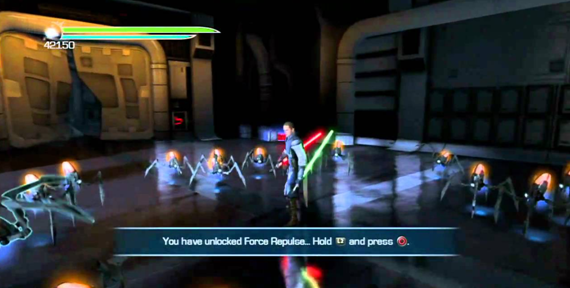
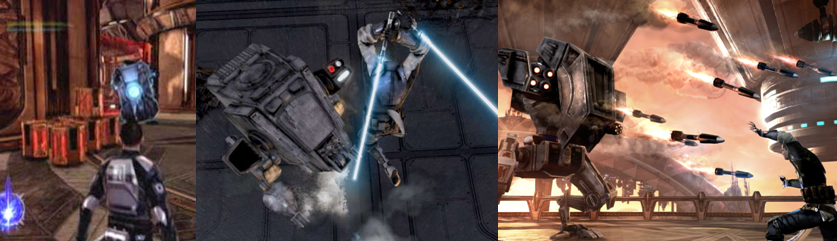
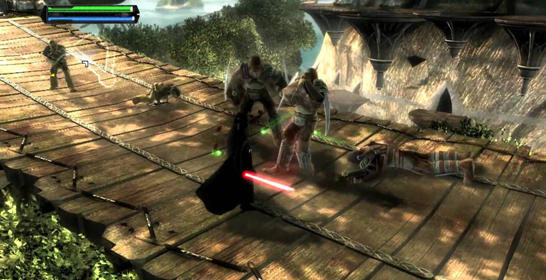
Star Wars: The Force Unleashed is, like many Star Wars videogames, a third-person action title in which the player controls Starkiller, a troubled and damaged young man who is strong with the Force and well-trained in the Sith arts. As a result, Starkiller wields a lightsaber and can use the Force in a variety of ways to strike down those before him. Combat is largely built around the execution of combos that string together successful lightsaber strikes with Force abilities. Starkiller can blast foes with Force Lightning, push or toss them (and objects) with Force Push and Force Grip, blast them away with Force Repulse, or envelop himself in a life-sapping Force Shield. As he cuts down Jedi and Stormtroopers alike, he earns experience points which can be used to unlock additional combos and improves his abilities. Luckily, there’s no crafting system and the skill tree is ridiculously easy; you can acquire crystals that will allow you to customise the look and abilities of Starkiller’s lightsaber and can improve the strength of his various attacks or regenerative abilities by spending Force Points.

SWTFUCrLightsaber
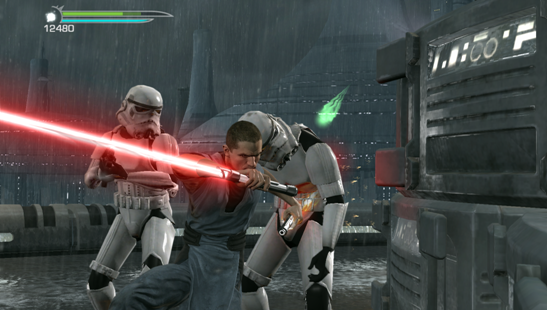
Starkiller holds his lightsaber like an absolute bad-ass.

Speaking of Starkiller’s lightsaber, you know he’s a bad-ass not just because he has a no-nonsense buzzcut or a near-permanent scowl but also because he holds his lightsaber backwards! What a rebel! Holding down L2 will allow Starkiller to block incoming blaster fire and attacks (and pressing it at the right moment will also allow him to parry), though he can also automatically send bolts back to his foes as he runs along. Lightsaber combat is simple and fluid; hitting X at the right moment will initiate a fancy flourish that can be chained with subsequent attacks to deal massive damage, and Starkiller can even hurl his lightsaber like a boomerang to take out ranged foes and charge it with his Force Lightning to electrocute his enemies. It’s not all combat and tossing fools to their death with the Force, though; you’ll have your reaction time tested in more than a few quick-time events (QTEs) and Starkiller generally navigates through a limited number of largely limited, if relatively-well-realised environments, jumping and dashing his way to a series of objectives. There’s some light platforming here that requires the use of a double jump and dash, and a few extremely basic puzzles that pretty much always boil down to using the Force to move something to either cross a gap or open a door (or, sometimes, both!)

SWTFUStarDestroyer
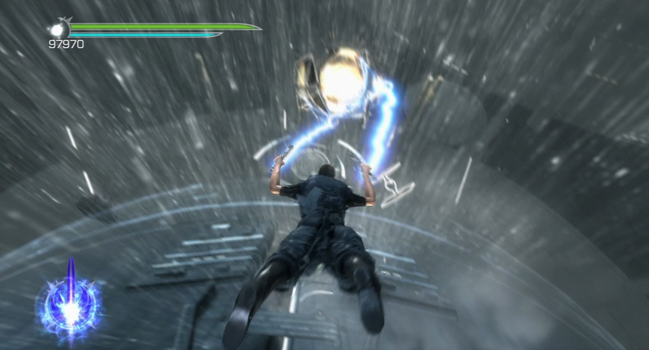
While impressive, this part is a pain in the ass.

While Starkiller controls very well, what will mess you up is the game’s wonky physics engine, unreliable camera, and janky controls; I struggled endlessly with the Force Grip, which either allowed me to suspend objects uselessly in mid air or sent them careening futilely against a wall and, as many have commented. This becomes a massive source of frustration during what should have been the game’s crowning achievement: pulling a Star Destroyer from the sky. While pulling the ship down wasn’t actually that difficult (though it is frustrating having to angle it into the right position), it’s the wave-upon-wave of TIE Fighters that make this so aggravating. Starkiller can’t deflect TIE Fighter fire and the only way to destroy them is to grab them with the Force and, I swear, it’s damn near impossible to get a grip on them.

SWTFULevels
Levels are very Star Wars but not very inspiring.

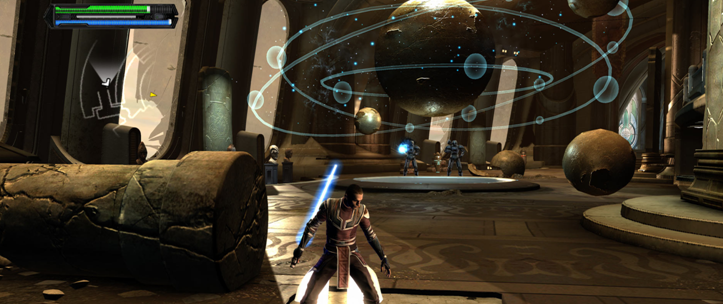
Compounding the matter is the fact that Starkiller is actually quite weak; you can upgrade his health and Force meter and the damage he can receive and dish out, but he bounces around the place like a puppet when he’s blasted with heavy weaponry and sometimes takes so long to jump back up that he can get blasted to death with very little effort. As a result, you’ll be constantly jumping and dashing about cutting down the regular Stromtroopers to refill your health and allow you to pummel away at the game’s tougher enemies. While the game is a decent length and tells a pretty engaging story about Starkiller’s eventual redemption and sacrifice, the level variety leaves a lot to be desired. Every environment feels very Star Wars and you’ll battle through a TIE Fighter factory, the woodlands of Kashyyyk, and even through the Death Star itself but the problem is that you basically revisit the same environments twice over. You begin the game as a fully-powered Vader slaughtering Wookies on Kashyyyk and later revisit this planet as Starkiller; Starkiller journeys to Raxus Prime to assassinate a Jedi and later returns there to rescue key figures of the Rebellion. Other environments, like Tatooine and Coruscant, appear as downloadable content (DLC) but it would have really helped to increase the game’s visual variety to have these levels be a part of the main story.

Graphics and Sound:
Graphically, the game is…okay. The computer-generated cutscenes are well-produced but, while the in-game graphics do a serviceable enough job of rendering the game’s handful of levels and environments, they don’t make for very attractive in-game cutscenes. It also seems like the developers were desperate to cram as many different physics engines into the game as possible, from Havok to Euphoria, in order to make the game “state of the art”. However, while the enemies have relatively decent levels of intelligence (Stormtroopers just blast away but the Purge Troopers and Felucian’s systematically attack you with blocks and co-ordinated attacks) and the environments are largely intractable and destructible, the game is riddled with rag-doll physics, glitchy platforms (Starkiller is just as likely to slide off a ledge as he is to land on it), and dodgy graphical elements (the backgrounds are teeming with life and action but then some barriers and trees just disintegrate into dust and fade away).

SWTFUMusic
You’ll really feel as though you are Darth Vader…for about ten minutes.

Yet, the game is filled with familiar Star Wars music and compositions based upon the works of the great John Williams. There’s something incredibly empowering about cutting Wookies down as Darth Vader while the iconic Imperial March plays and the music definitely lends a level of professionalism and quality to the game that is, generally, matched by the game’s recognisable environments.

Enemies and Bosses:
The Force Unleashed is filled with all manner of enemies; while you’ll wade through legions of Stormtroopers who go down with relative ease, you’ll also come up against some of the Empire’s more advanced troops who make use of cloaking technology, gatling guns, blast you with concussive bolts from jetpacks, or erect Force-resistant shields. Then there are the enemies who use energy shields or weapons to block and parry your attacks, the likes of the Purge Troopers who grapple Starkiller and want nothing more than to bash his brains in, or the always-annoying Sniper Troopers who pick you off from a distance. Starkiller will also battle Force-sensitive enemies, like the Felucians, or those like the Emperor’s Royal Guard who wield lightsaber-like staffs and weapons and require you to break through their defences to land a combo.

SWTFUBigEnemies
Larger enemies require a bit more strategy.

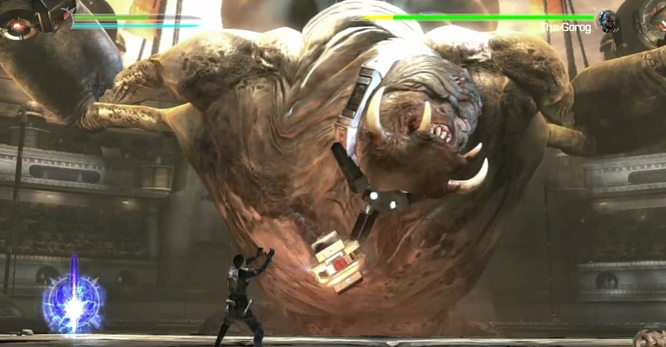
Sometimes you’ll have to target a specific enemy in order to “demoralise” the other troops; this is essential as, when your enemies are bolstered by these bastards, they can kill you in short order. Starkiller will also frequently come up against AT-STs and Rancors as well; these larger enemies are often flanked by waves of smaller enemies and can whittle your health down to nothing in no time with their powerful attacks so you’ll have to make use of Starkiller’s ranged Force abilities and combos and then win at a QTE to put them down for good.

SWTFUSarlaac
One boss battle takes place right next to a Sarlacc pit!

As for boss battles, these are pretty much all against Jedi, Sith, or similarly-Force-empowered individuals. While each of these encounters is largely the same (block or parry attacks while you wait for an opening, cut down cannon fodder to refill your health, use your Force powers to throw objects at the boss, and win a QTE), each takes place with slightly different environmental and additional hazards. You’ll duel with Shaak Ti beside a Sarlacc pit, for example, have to contend with Maris Brood’s Bull Rancor, and will have to battle simulations of not only the Jedi you’ve defeated before but also a recreation of Darth Maul when facing off with Starkiller’s droid, PROXY.

SWTFUSEmperor
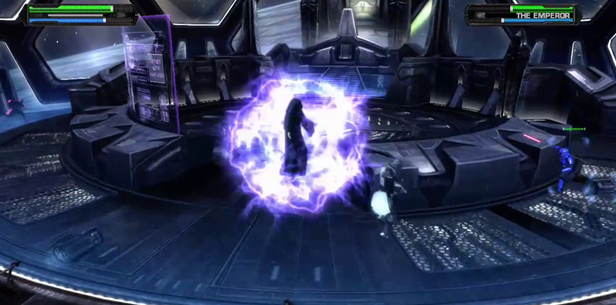
The Emperor will try your patience.

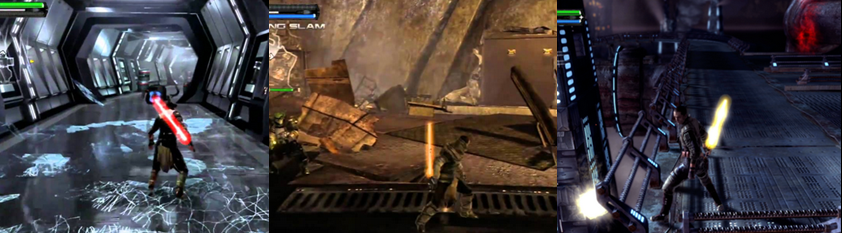
The finale of the game obviously sees you butting heads with Starkiller’s former master, Darth Vader; this is a three (or four, depending on your choice) stage fight that begins in a narrow hallway, progresses to a room where the floor is (almost literally) lava, and ends in the Emperor’s observation deck. Ironically, I found Vader to be less challenging than some of the game’s other bosses as, while he has a powerful Force blast and will choke you out of the air, it’s not actually too difficult to weather his attacks and wail on him with your best combos. After besting Vader, you’re presented with a choice to finish him off in a battle to the death (thus earning the Dark Side ending) or going one-on-one with the Emperor to achieve the Light Side ending. Rather than attacking with a lightsaber, Palpatine uses his Force Lightning to roast you alive, shields himself from your attacks, and throws lightning-charged objects at you (that also explode). This battle is more annoying than difficult as, with careful timing, you can bounce Palpatine’s lightning back at him and whittle him away with your combos as long as you can avoid or block his other attacks.

Power-Ups and Bonuses:
As mentioned, you can acquire, upgrade, and purchase new combos and abilities as you play through the game and level up; by the time you confront the Emperor, you can take quite a bit of punishment, your Force meter will refill faster, and your attacks will dish out far more damage thanks not just to being upgraded but also to the new combos available to you.

SWTFUUpgrades
Upgrade your abilities with Force points.

As you explore your environment, you can also pick up Jedi Holocrons, which will refill your health and Force meter, award Jedi points, and yield other awards (like new lightsaber crystals). With the right lightsaber crystal, your lightsaber can deal more damage or suck health from your opponents, and you’ll also unlock additional artwork, costumes, and other bonuses by finding all of the Holocrons. Starkiller can also increase his odds with one-time buffs by picking up Sith Holocrons; these will grant you with limited invincibility, refill your meters, bestow you with an aura that will drain the health from enemies, or give you an unlimited Force meter for a brief time. Against some of the game’s tougher enemies and mini bosses, these can be essential so make the effort to pick them up and take out the more annoying enemies.

Additional Features:
As mentioned, you can unlock a bunch of concept art and data files by playing the game and collecting Jedi Holocrons. There are also a large number of additional costumes available for use; none of these offer any benefit beyond being cosmetic changes but they do allow you to play as other Star Wars characters, including Obi-Wan Kenobi and even C-3PO! There are three DLC missions you can also play if you bought the extra content (or the Ultimate Sith Edition); one sees Starkiller undergo a series of trials in the Jedi Temple on Coruscant while the other two take place on Tatooine and Hoth and present an alternative scenario where Starkiller replaced Vader as the Emperor’s assassin and battles some familiar faces. As standard, there are a number of Achievements to unlock; most of these are earned through regular play, while other require you to kill a certain number of enemies in different ways or play on higher difficulty settings.

SWTFUConclusion

The Summary:
Star Wars: The Force Unleashed is, ultimately, an average experience; the combat is fast and frenetic and it’s fun to fry Stormtroopers with Force Lightning or cut AT-STs in half but the game quickly runs out of depth and steam and it isn’t long before you’ve experienced everything it has to offer. Starkiller was an interesting protagonist but the story of his redemption is, honestly, nothing we’ve never seen before in Star Wars movies or other media. It doesn’t help that he has to constantly travel through the same environments, fighting variations of the same enemies, and battling against some really dodgy physics and a camera that just loves to get stuck behind objects or jitter about the place at crucial moments. The game’s more frustrating elements really hamper the thrill of fighting through the Death Star laser cannon; battling Jedi and the iconic Sith duo is fun but also a laborious experience that generally comes down to dodging an attack and just mashing away at X like a madman until you win. Despite the fact that the game carries a large degree of sensory fidelity to the Star Wars movies and offers perhaps the best lightsaber combat I’ve experienced so far, it seems to be lacking a real polish to bring together is disparate elements into a cohesive and consistently engaging experience.

My Rating:

Rating: 2 out of 5.

Could Be Better

What were your thoughts on Star Wars: The Force Unleashed? Did you also struggle with the game’s wonky physics, camera, and controls or do you consider it to not actually be that bad? What is your favourite Star Wars videogame (or movie, or show, or book, or whatever), if any? Either way, leave a comment below and let me know.

Game Corner: Resident Evil – Code: Veronica X HD (Xbox 360)

GameCorner
ResiCodeLogo

Released: February 2019
Originally Released: February 2000
Developer: Capcom Production Studio 4
Also Available For: Dreamcast, PlayStation 2, GameCube, PlayStation 3, and Xbox One

The Background:
After redefining the survival/horror genre with Resident Evil (Capcom, 1996), Capcom were under pressure to release ports of their popular franchise onto consoles other than Sony’s PlayStation. Unable to get a port of Resident Evil 2 (ibid, 1998) for SEGA’s ill-fated Dreamcast off the ground, and with Sony claiming first-dibs on Resident Evil’s next numbered sequel, producer Shinji Mikami opted to develop two concurrent Resident Evil sequels. While Resident Evil 3: Nemesis (ibid, 1999) continued the story of Jill Valentine and was, largely, simply a side-story to Resident Evil 2, Resident Evil – Code: Veronica reunited Claire Redfield with her brother, Chris, and utilised the superior processing power of the Dreamcast to diverge what was quickly become a stale narrative formula into a more global story.

The Plot:
Three months after escaping the destruction of Raccoon City, Claire Redfield is captured and imprisoned on Rockfort Island while attempting to reunite with her brother, Chris. After an outbreak of the Tyrant-Virus (T-Virus), Claire soon finds herself teaming up with a fellow inmate, Steve Burnside, and once again battling through hoards of zombies and the malevolent Umbrella Corporation’s Bio-Organic Weapons (BOWs) in a desperate attempt to survive.

Gameplay:
Code: Veronica features exactly the same survival/horror gameplay as its predecessors; players once again utilise “tank controls” to navigate Claire, Steve, and Chris through a number of environments but, like in Nemesis, players can now pull back on the analogue stick while pressing A to perform a quick 180-degree turn, which makes dodging BOWs and attacks far easier.

ResiCodeMenu
Item management is key to your survival.

As is the tried-and-true Resident Evil formula, players must pick up files and notes to flesh out the game’s story and earn hints as well as collect and combine weapons, ammunition, key items, and healing times (herbs and first-aid sprays) in order to progress. It is crucial to your survival to be constantly aware of your environment and your resources as running out of ammo or herbs can be the difference between life and death. Players can store their items in Item Boxes, which are generally located in safe areas where players can restock and save their progress using an Ink Ribbon and a typewriter. You’ll need to make frequent use of these rooms in order to tackle the game’s puzzles, which can be as simple as moving crates and as complex as risking your life to crush a glass sphere under a massive weighted block.

ResiCodeSteve
You’ll get to play as this asshole a couple of times…

Unlike the first two Resident Evil’s, but almost exactly as in Nemesis, Code: Veronica sees players jump between different playable characters as they progress through the story. You begin as Claire trying to escape the zombie outbreak on Rockfort Island but also take control of the irritating Steve at one point, before switching to Chris about halfway through the game. Like in previous games, each have different skills that help them progress (Claire has a lock pick, for example) and players can choose to help out their sibling by clearing areas of enemies or leaving weapons or items behind for them to acquire.

Graphics and Sound:
Unlike its predecessors, Code: Veronica ditches the classic pre-rendered backgrounds for three-dimensional environments that are rendered in real-time; this means that, while there are still some examples of fixed-camera angles, Code: Veronica features the most dynamic and cinematic camera the series had ever seen at that point. This works fantastically with the game’s incorporation of new, foreign locations for its story; while many of the game’s environments will be familiar to Resident Evil veterans (mansions, underground facilities, sewers and the like), you’ll also travel to the frozen wastelands of Antarctica and visit some gothic-inspired locales, though the “HD” makeover isn’t anywhere near as extensive as it has been in recent Resident Evil renovations.

ResiCodeClaire
Claire is suddenly a bullet-time bad-ass…

Thanks to the power of the Dreamcast, Code: Veronica not only features a much higher level of detail in character models, faces, and zombie details but also steps up the game’s use of CG cutscenes, which specifically portray Claire in a far more capable and tougher light than she appeared in Resident Evil 2. Just as Leon S. Kennedy jumped from a relatively competent rookie street cop in Resident Evil 2 to a martial arts superspy in Resident Evil 4 (Capcom Production Studio 4, 2005) with little in-game explanation, Claire is suddenly dodging bullets (from a helicopter, no less!) and performing grandiose, bullet-time actions. The game also features a foreboding soundtrack that echoes those of its predecessors; a lot of the time, areas are devoid of music, meaning all you can hear is the shuffle of rotting feet, the moaning of zombies, or the ominous growling of some unspeakable mutation. Subtle, soothing tunes let you know when you’re in a safe area and the dramatic score kicks in as monsters attack and dies down once they’re defeated, which is all standard fair for these early Resident Evil titles.

Enemies and Bosses:
Code: Veronica features a lot of the standard enemies you’ve come to expect from a Resident Evil title; you’ll mainly encounter rotting, bloody zombies who shuffle about, claw along the floor, or burst through windows in their droves. There’s possibly the most variety in the zombies’ appearance here, though, as there’s reanimated corpses from a cemetery, naked zombies in a sauna, zombies with little worker hats, vomiting zombies, frozen zombies, and even zombies with glowing eyes like Albert Wesker. Speaking of which, Code: Veronica inexplicably returned Wesker to the series after he was skewered into ribbons of bloody flesh in the first Resident Evil; while you don’t get to fight Wesker here, he is heavily involved in the game’s plot, which revolves around Alfred and Alexia Ashford developing a new T-Virus strain.

ResiCodeWorm
I’m seeing a few similarities here…

The T-Veronica Virus offers a variety of additional BOWs for players to contend with; some will be familiar, like the deadly Hunters and giant spiders, and others are new, like the Tremors (Underwood, 1990) inspired Gulp Worm and Code: Veronica’s most persistent new enemy, the Bandersnatch, which can grab you from afar with its stretchy, clawed arms and will leap and haul tiself around the environment to get at you.

ResiCodeFinale
Good luck hitting this fucking thing!

You’ll also battle some messed up, multi-formed bosses that owe more than a small debt to John Carpenter’s The Thing (Carpenter, 1982); there’s a particularly gruelling close-quarters fight with a Tyrant in a plane, the blind, spider-limbed Nosferatu (who can swipe you right off a helipad and must be awkwardly shot at with a sniper rifle during a blizzard), Steve’s transformation into a hulking, axe-wielding frog-like creature that can only be ran from, and Alexia’s mutation from an insectile creature that flings flaming blood at you, bulges out into a grotesque, bug-spewing monstrosity, and finally ends up as a dragonfly-like annoyance that will take not only your best weapons (usually the Magnum) but also the unwieldy Linear Launcher to defeat.

Power-Ups and Bonuses:
In true Resident Evil fashion, you can find additional and more powerful weapons as you play and explore your environments; both Chris and Claire can obtain an assault rifle, dual-wield submachine guns, the go-to fan favourite shotgun, and a grenade launcher with four different types of ammo while also being able to upgrade their base pistol to a burst fire mode or improve its power, respectively.

Additional Features:
Players can unlock a couple of bonuses through gameplay. Completing the game unlocks “Battle Mode”, a time attack survival mode where you must battle hordes of enemies with infinite ammo and lets you pick between third- and first-person perspectives. You can unlock not only Steve but also Wesker for use in this mode and, as you might expect, finishing the game with an S-rank unlocks an infinite rocket launcher for your use. There’s also a handful of Achievements you can attain but, as this was originally an Xbox 360 title, they’re mostly tied to gameplay progression rather than Easter eggs or obscure actions on the player’s part.

ResiCodeSummary

The Summary:
Resident Evil – Code: Veronica X is about as classic a Resident Evil title as you can get; it hits all of the beats you would expect from Capcom’s survival/horror franchise while also expanding its scope beyond the confines of Raccoon City for the first time. Narratively, this is also where the series begins to kind of fall of a cliff as the plot suddenly becomes far more dense, layered, and convoluted and shifts towards a focus on Wesker’s evil ambitions and away from a faceless corporation’s machinations. Yet, for as good as it is, Code: Veronica doesn’t really offer anything new; despite the benefits offered by the Dreamcast, the game is firmly entrapped in the gameplay mechanics and restrictions of the series, meaning that it’s more a case of the same-old, same-old rather than offering the fresh take on the series we’d see in Resident Evil 4. However, for those (like me) who were disappointed with the brevity of Resident Evil 3: Nemesis and like jumping back into a traditional survival/horror title, there’s enough here to sustain your interest and engagement, though you’ll most likely soon forget the experience once you jump to one of its successor titles.

My Rating:

Rating: 2 out of 5.

Could Be Better

What are your thoughts on Resident Evil – Code: Veronica X? Did you play the original Dreamcast title or, like me, discover it through one of its many ports? Would you like to see an HD remaster of this title as well or do you think that it’s best left as it is? Sound off in the comments and come back for more Resident Evil content coming soon.

Game Corner: Sonic Generations (Nintendo 3DS / Xbox 360)

SonicGenerationsLogo

Released: 1 November 2011
Developer: Sonic Team
Also Available For: PlayStation 3, PC, Xbox One, and Xbox Series S/S

The Background:
It’s been said time and again, but Sonic had a tumultuous transition to 3D. While Sonic Adventure (Sonic Team, 1998) is generally regarded as a classic, it had a few issues that took SEGA some time to iron out in Sonic’s subsequent 3D titles. Despite some bizarre claims to the contrary, Sonic the Hedgehog (ibid, 2006) was a diabolical low point for the franchise. Sonic Team were desperate to make up for this with Sonic Unleashed (ibid, 2008), a critical and commercial success that saw the 3D games utilise a brand-new game engine to propel Sonic at breakneck speeds. This was further refined in Sonic Colours (ibid, 2010), another successful entry that but the franchise in a good position for its 20th anniversary. Sonic Generations was specifically developed as a love letter for long-time fans, with Sonic Team focusing exclusively on high-definition consoles and the unique 3D features of the Nintendo 3DS. The developers sought to recreate only the most popular and iconic stages from Sonic’s past and to make the game accessible to players of all ages, bolstering the release with a limited edition version and a touch of downloadable content (DLC). regarded as one of the best of Sonic’s 3D efforts, Sonic Generations was widely praised, despite its short length, for its colourful visuals and fast-paced gameplay; though the 3DS version was largely seen as inferior to the main console releases. regardless, Sonic Generations was a strong seller for SEGA thanks to being backwards compatible with new hardware and even got a whole new lease of life in 2024 with an equally celebrated . Shadow the Hedgehog-themed remaster.

The Background:
It was 2011 and SEGA were eager to celebrate the 20th anniversary of their iconic videogame mascot; after years of disconnect and complex additions to what had begun as a simple, one-button videogame, it’s fair to say that there was some…confusion regarding Sonic’s past, canon, and timeline. SEGA initially opted for a soft reboot, of sorts, with Sonic Adventure (Sonic Team, 1998), which clearly depicted Sonic and his cast of characters redesigned into a slightly older, more anime-inspired aesthetics in a world similar to ours, inhabited by both humans and anthropomorphic characters, and with a tenuous connection to the previous videogames. However, very quickly, this fell apart a bit as Sonic videogames became both incredibly dense and complex or laughably simple, especially in their narratives. After years of fans wanting a return to the traditional, 2D gameplay of the past, Sonic Team opted for a title that would combine not only the tried-and-true 2D gameplay of the past with the fast-paced 3D gameplay of what was, at the time, the present but also bring together two different generations of Sonic for the first time.

The Plot:
While celebrating Sonic’s birthday, Sonic and his friends are scattered through time by Doctor Eggman’s ferocious, mysterious beast, the Time Eater. Teaming up with a past version of himself, Sonic races through from his past to rescue his friends, retrieve the Chaos Emeralds, and put a stop to the Time Eater’s rampage.

Gameplay and Power-Ups:
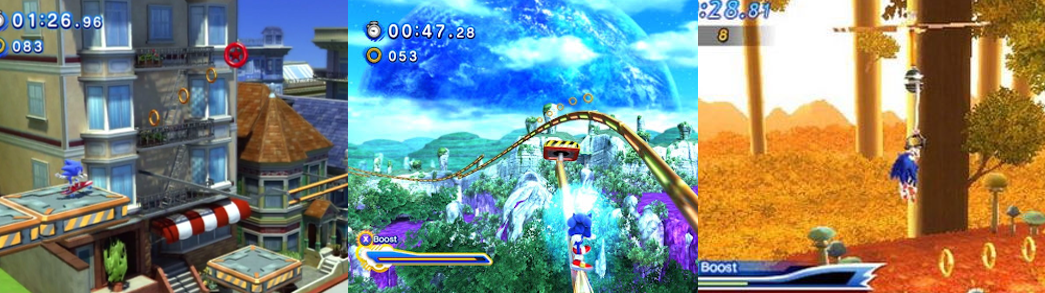
Sonic Generations takes the fast-paced, “Boost”-centric formula of Sonic Unleashed and Sonic Colours and further refines it, offering both 3D and 2.5D, high-speed action stages as players race through some of the most iconic stages (or “Zones”) in Sonic’s history. While Sonic remains the only playable character, there are now two of him: the “Classic” Sonic (who plays exclusively in 2.5D) and the “Modern” Sonic (who plays in 3D and 2.5D). There are nine Zones to playthrough in Sonic Generations, each with two levels (or “Acts”): Act One is exclusive to Classic Sonic and Act Two is tackled by Modern Sonic. Although you’ll pot a timer in the to-left of the screen, there are no time outs here’ instead, you get a letter grade a points for finishing Acts as fast as possible. You’ll want to stick to the higher paths, where available, and utilise rails, pulleys, and other shortcuts to cut down your time, but you’re basically guaranteed an “S” rank if you finish an Act without losing a life. Unsurprisingly, Golden Rings are your life source, protecting you from most attacks and granting an extra life for every increment of 100 you collect. Golden Rings also fuel Modern Sonic’s “Boost” gauge (which is also filled by performing tricks off ramps and bashing Badniks), allowing him to blast ahead at high-speeds and plough through any enemies and destructible objects in his way. While both Sonics have unique gameplay mechanics, they share some common controls: you jump with A or X, pressing it again in mid-air to attack nearby enemies or hit targets with Sonic’s Homing Attack. While this is exclusive to Modern Sonic, you can unlock the ability (or “Skill”) for Classic Sonic, too, and it becomes mandatory in the 3DS version. B sees you crouching to fit through small gaps, Y activates any Skills you have equipped, and the Right Trigger either blasts Modern Sonic off or quickly performs Classic Sonic’s Spin Dash. When Boosting, you can hold the Left and Right Triggers to drift and use the Left and Right Bumpers to quick step. As Modern Sonic, you can press B in mid-air to perform a stomp, wall jump off specific surfaces, and dash along a line of Rings by pressing Y.

Both Sonics have distinctive playstyles, though gimmicks are recycled and shared between both.

These controls are largely mirrored on the Nintendo 3DS, with players jumping and using the Homing Attack with A or B and Boosting with Y, though there’s no quick Spin Dash for Classic Sonic. Classic Sonic’s taught the Homing Attack early on, though he doesn’t really need it and ends up playing as a slower, clunkier version of his counterpart. While it might seem like Modern Sonic has more tricks at his disposal, each Sonic can be assigned Skills, unlocked by collecting Red Star Rings, completing additional Challenges, and spending points in the Skill Shop. Each Skill has a point value, and you can assign as many as you like to each Sonic until you hit the point cap of 100. A bunch of these are shared between both Sonics, giving each the ability to begin an Act with ten Rings, granting an additional extra life, giving them more movement options when underwater, and eliminating the recovery time after taking a hit. Classic Sonic can equip one of the elemental shields from Sonic the Hedgehog 3(SEGA Technical Institute, 1994), gaining a bounce, flame burst, and double jump and being able to breathe underwater, resist flames, and attract Rings, respectively. He can also equip the “Twin Spin Attack” (or “Insta-Shield”) from Sonic 3, start with a temporary invincibility, extend the Spin Dash, turn enemies into Rings, and even hop on a skateboard. Some of these abilities are available in Zones as well, such as the speed up and invincibility and skateboard, though you’re more likely to smash Ring monitors. Modern Sonic can also be assigned Skills to allow him to blast off at the start of an Act, perform faster Homing Attacks and wall jumps, and increase the length of his Boost gauge. When playing Planet Wisp or Tropical Resort, you’ll utilise the returning Wisps, with Classic Sonic using the Pink Wisp and Red Wisp to race across walls and ceilings and turn gears or burst through the sky and Modern Sonic rocketing up Dr. Eggman’s factory and smashing through barriers or ricocheting about with the Cyan Laser. Acts also contain the usual gimmicks and hazards, such as springs, spikes, flame bursts, ramps, and rails. You can jump through boost rings to blast through the air, fly off ramps to perform tricks and fill your Boost gauge, repeatedly hit bouncy springs to get higher, and even run on those awful Marble Garden Zone platforms to reach higher areas in Sky Sanctuary. When underwater, you’ll need air bubbles to keep from drowning; when leaping to platforms, you must watch for bottomless pits; and you’ll often press switches to activate or move platforms and blocks.

Sonic’s greatest hits and misses are revisited in each Zone and Challenge.

Interestingly, the Nintendo 3DS’s bottom screen is only used to track your progress in an Act, display the boss’s health bar, and to navigate the sparse hub world. Sonic Generations takes place in a simple hub world called “White Space”, a disappointingly barren void where stages from Sonic’s past have been dumped by the Time Eater. These are arranged in three areas corresponding to an era of Sonic’s history and guarded by a Boss Battle. To progress through the game’s brief and simple story, you must complete each Act to partially restore colour and life to the White Space, then acquire a Chaos Emerald from a Rival and Boss Battle. By and large, the game’s Acts aren’t particularly challenging, though there are some unfair bottomless pits and each Sonic seems to have lead in their sneakers, which can make precision platforming slippery and frustratingly difficult. The difficulty comes in the lengthy and haphazard variety of gameplay mechanics seen in the later, modern levels; unsurprisingly, Crisis City stands out as one of the game’s more frustrating stages thanks to the fire traps, lava pits, bottomless pits, and that Goddamn flaming tornado! The Nintendo 3DS version sees you flying through Mushroom Hill using propeller plants, bouncing around Casino Night, and racing from a destructive orca in Emerald Coast, though the additional Challenges are missing from the Xbox 360 version. Here, after clearing each area, you’ll unlock five additional Challenges for each Sonic; you’re required to clear at least one of these for each Zone to gain a Boss Key, battle the boss, and progress to the next area. These Challenges are considerably varied and can be anything from racing against a ghostly doppelgänger to finding Chao, to completing a stage with only one Ring. Sometimes, you’ll also race against, or team up with, one of Sonic’s friends; you’ll use Mile “Tails” Prower to hover over obstacles and gaps, knock musical notes back to Vector the Crocodile, and clear walls of flame with Blaze the Cat, for example. While you may call upon Sonic’s friends with Y in these Challenges, you’ll never control any character other than the two Sonics, which is quite disappointing. These Challenges can be frustrating but clearing them is the only way to completely restore each area and also unlock additional Skills, artwork, music, and character profiles in the Collection Room.

Presentation:
Graphically, Sonic Generations is still one of the brightest, most vibrant Sonic 3D titles ever made. Classic Sonic, especially, looks and animates really well and every stage is packed full of life, colour, and little details that will be recognisable to any Sonic fan. Both Sonics have idle poses and celebrate or lament their letter grade after each Act, though, strangely, Classic Sonic is completely mute. This means that Modern Sonic gets all he puns and one-liners and voice clips, while Classic Sonic simply pantomimes his feelings and relies on Classic Tails to talk for him. Sonic’s friends appear as non-playable characters (NPCs) in White Space, offering encouragement and hints after being restored to guide you towards Red Star Rings. White Space is very annoying for such a simple hub world, with the game forcing you to take boost pads, loops, and springs to reach Challenges (though you can cycle through Acts, at least). I’m glad the game isn’t bogged down by a huge open world, but White Space feels very cheap and half-assed at times, despite some fun Easter Eggs. Sonic Generations takes the original 2D and 3D environments and gives them an eye-catching visual makeover, though the screen’s a bit too zoomed in at times for Classic Sonic and it’s easy to just blast off into the void as Modern Sonic. Perhaps the pinnacle of Sonic Generations’ graphical achievement, though, is in the fantastically updated battle against Perfect Chaos, who has been turned from a choppy, flappy-mouthed monstrosity into a genuinely terrifying, bio-organic creature. However, when playing the Xbox 360, I did notice some blurriness to the images, some frame rate issues, and the game crashed on me three or four times, which was odd. It’s obviously graphically superior to the 3DS version, which offers the same headache as all 3DS titles and is extremely basic at times. You cans ee this in Mushroom Hill, which looks strangely bland, the cutscenes (which are simple 3D models with dialogue boxes), and the reduced Zone count.

A generational adventure that lovingly recreates Sonic’s classic stages.

Each of the game’s Zones are beautifully rendered and expanded upon with gameplay gimmicks from other games and even little extra things, like a celebration taking place in Rooftop Run and getting to visit Hidden Palace in Sky Sanctuary. While there are some obvious choices (Green Hill and Chemical Plant have since been overused to death), there are some odd inclusions, like Speed Highway from Sonic Adventure (I would have picked maybe Ice Cap or Red Mountain), and some disappointments, like Seaside Hill from Sonic Heroes (Sonic Team USA, 2003). I’m honestly surprised that Sonic Team didn’t include Casino Park instead, though I would’ve liked to see them mix it up with Egg Fleet or Frog Forest. There’s some real depth to the environments, with Chemical Plant’s factory exploding in the background, the Death Egg rising in Sky Sanctuary, and desolation as far as the eye can see in Crisis City. Things can be a bit cluttered at times and it’s not always clear which winding path you can take and which is part of the background, but I loved how faithfully Sonic Generations recreated each area and the little twists they toss in. Classic Sonic’s Seaside Hill is largely underwater, for example; the infamous truck wrecks the environment and rockets after you across walls in City Escape; and Dr. Eggman airship hounding you in Rooftop Run. The Nintendo 3DS version oddly adapts Zones from Sonic’s main console games rather than his handheld ventures, with the exception of Water Palace (and, I guess, Tropical resort), which was an odd choice and results in some janky, bland stages that are actually inferior to their Nintendo DS predecessors since the action’s limited to one screen. The Xbox 360 version features some really well done CG cutscenes; it’s just a shame that the game’s story is so criminally short that we don’t see more of these. When you free Sonic’s friends, they’ll make a comment while Sonic just stands there like a tool rather than properly interact with them. As for sound, Sonic Generations has you covered! Every area features a unique, remixed version of its original track and each Act has a different version to differentiate the two. On the Xbox 360, you can also unlock additional music tracks, including some great remixes by the likes of Cash Cash and Crush 40, and play these on any Stage, allowing for a lot of variety in the music you hear as you play.

Enemies and Bosses:
Given that it features stages from three eras of Sonic’s history, Sonic Generations also includes many recognisable Badniks and enemies from each time period being represented. You’ll smash apart the likes of Moto Bugs, Buzz Bombers, Crabmeats, Spinys, and Egg Robos from the classic games, with Egg Robos sporting missile barrages and giant Badniks even chasing you at certain points. Moving into the modern era, you’ll bop Eggpawns, Cop Speeders, robots from the Guardian Unit of Nations (G.U.N.), and flaming Iblis creatures. While most slow and easy to attack, they can still surprise you with bolts of energy or other attacks, such as the construction Egg Pawns on Planet Wisp tossing their pickaxes. Enemies are largely there to be bothersome, with the cannons surrounding Rooftop Run’s clock tower being particularly aggravating and the Egg Pawns in the barrel store being notably cheeky. Enemies also act as “bridges” between platforms, rails, and other areas, allowing you to Homing Attack or bop them to reach higher paths, cross lava, or avoid spike pits. The Nintendo 3DS version features a handful of unique enemies due to its different Zone selections, such as those mushroom-tossing moles, axe-wielding Egg Pawns, and even a massive Egg pawn that wrecks the ruins of Water Palace. Spikes are annoyingly commonplace, often waiting right where you land, as are crushing hazards, moving blocks, flame bursts, and missiles from the walls and ceilings. You’re chased by a gigantic truck in City Escape, one that now sports giant buzzsaws, have debris flung at you by a flaming tornado in Crisis City (which also whisks away the environment and the end goal for Classic Sonic!), and must watch for crumbling platforms when bouncy from clouds in Sky Sanctuary. Spiked obstacles also appear on rails, mines litter the ground, and you must quick step left and right to avoid being blasted by Dr. Eggman’s drones and airship. While warning signs alert you to bottomless pits, it’s very easy to plummet down them when moving so fast, or to clip through the environment, and Sonic can be quite slippery, which doesn’t help when trying to make trickier jumps.

Iconic bosses get a massive upgrade, adding extra gimmicks and attacks to their arsenals.

Six classic bosses return and are remixed in each version of Sonic Generations. On the Xbox 360, Classic Sonic first fights the Death Egg Robot on a narrow platform, dodging its extending, drill-like arms and running under it when it jumps to ram its butt. The fight the switches to a recreation of the Death Egg Zone and the mech exclusively attacks from the background, forcing you to lure it to attack bombs with its arms so you can run up and ram its head. The fight with Perfect Chaos is now a whole stage as you dodge its tentacles and jump on crumbling platforms to reach it, hitting springs and pulleys and blasting across the water on boost pads to race up its body. Perfect Chaos spawns twisters, fires energy beams, and unleashes its massive mouth laser, before erupting water geysers. This forces you to precariously hop to platforms, battling the awkward camera to land the final blow. The Egg Dragoon sees you blasting through a circular tunnel avoiding its freeze bolts and missiles and hopping to rails to ram the cockpit. When on a 2.5D plane, you must hang back and jump over shots then quickly wall jump up its arms, avoiding a downward shot, before diving after the falling mech, avoiding its drill arms to target its body. On the Nintendo 3DS, you battle one of my favourite bosses, the Big Arms, now avoiding its arm slams and palm slaps, then, oddly, battle the Biolizard. This is an annoying fight as you must awkwardly run from its gaping mouth or thrashing tail, grinding up to its core, avoiding high and low shots and bouncing off orbs to smack its core. Finally, you battle the Egg Emperor in an autorunner, desperately avoiding its energy waves, dodging its charge, and taking out the cannons to smack his big, stupid face.
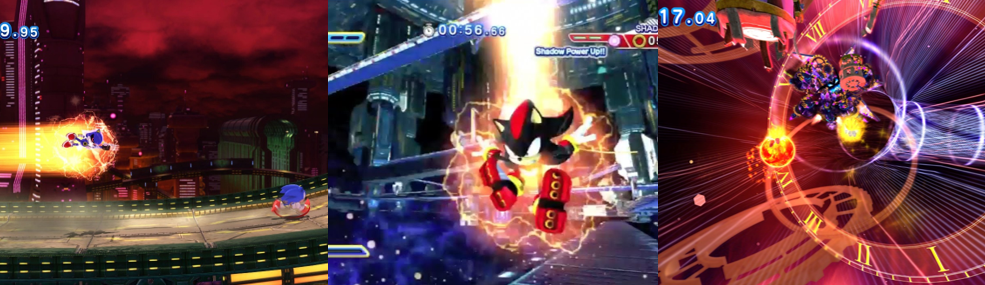
Best Sonic’s rivals to power-up and battle the aggravating Time Eater with two Super Sonics!

You’ll also compete against some of Sonic’s rivals in both versions, with the Xbox 360 fights yielding Chaos Emeralds. You’ll once again race across Stardust Speedway against Metal Sonic, hopping over its torpedo dash and avoiding its lasers and the debris it tosses at you to give it a smack. You’ll across the walkways of the Space Colony ARK against Shadow the Hedgehog, chasing down purple energy orbs to power-up and blast meteorites at him in a battle that’s ridiculously easy if you can speed after him fast enough. Finally, you return to Crisis City to battle Silver the Hedgehog, avoiding his telekinetic waves and targeting the debris he flings at you to wallop him, before scrambling over a huge wave of junk and racing towards the camera to finish him off. This rival fights are significantly downplayed on the Nintendo 3DS as you don’t fight Silver and both are reduced to races, with you hopping over obstacles and slowing Metal Sonic or Shadow with some lucky shots and desperately trying to avoid Shadow’s boost and Chaos Spear. Unfortunately, Sonic Generations and its bosses arefurther let down by the final battle with the Time Eater. Despite an impressive, ominous score, the unique design of both the creature and the bizarre vortex you battle it in. Despite the joy of seeing Classic and Modern Sonic turn Super Sonic to battle two versions of Dr. Eggman, this fight is a confusing mess. You hold down RT to charge head-first through a time/space distortion, dodging pieces of the Zones and the Time Eater’s arms and lasers, to ram its core. You can press Y to switch to the outside of the vortex and press X to fire the other Sonic to destroy incoming projectiles, all while Sonic’s friends constantly shout “advice”. You can barely see Golden Rings until they’ve flown past you, you have no idea if you’re holding or mashing buttons, and defeating this monstrosity is much easier on the Nintendo 3DS. You battle it on a 2.5D plane, with no attacks at your disposal and simply dodging its lasers and arm swipe until its core is exposed, then race towards it on a 3D plane. This can be tricky as it’s not easy to dodge its hand claps and it’s easy to run out of Rings, but at least you’re not bombarded by repetitive voice clips, and you can land hits a lot easier.

Additional Features:
There are forty-nine Achievements to earn in Sonic Generations, with one popping every time you clear both Acts in each area and defeat a rival and boss. Every Act as at least one Achievement tied to it (normally something involving going a specific route and collecting a specific Red Star Ring before completing the stage), you’ll get Achievements for performing tricks, acquiring Skills, and unlocking all collectibles. Every Act has five Red Star Rings to find, with each one unlocking artwork, music, and other extras; you’ll also get an Achievement if you find them all. As you complete Acts, Challenges, and collect Red Star Rings, you’ll unlock additional music tracks, cutscenes, artwork, and little character trophies that can all be viewed in a little gallery/museum at the far left of White Space. If you explore the Green Hill hub, you’ll find a SEGA Mega Drive and, for 7777 points, you can purchase a Mega Drive controller to play a port of the original Sonic the Hedgehog(Sonic Team, 1991)! You can also challenge the rivals and bosses on “Hard” mode (though there’s no Achievement for this), upload your fastest times to an online leaderboard, and play a pinball table themed on Casino Night Zone if you snagged the DLC. On the Xbox 360, you acquire the seven Chaos Emeralds by playing the main story, unlocking Super Sonic for the finale and as a 100-point Skill for both Sonics, but play Special Stages on the Nintendo 3DS. These are modelled after Sonic Heroes’ pipes, with you collecting orbs to power-up your boost and avoiding spiked mines in super easy challenges. You can also download additional missions using the handheld’s “StreetPass” feature, play an online versus mode (that appears to be a head-to-head race), customise a profile card, and play a time attack mode, though the Nintendo 3DS lacks the Skills and Red Star Rings of its counterpart.  

The Summary:
When I first played Sonic Generations on the PlayStation 3, I remember it being a fantastic experience; it was fun, fast paced, and chock full of nostalgia and little bits of fan service. Aside from the final boss, I had a blast breezing through everything the game had to offer and lamented the lack of follow-up downloadable content from Sonic Team, hence my excitement for the later remaster. I was therefore super exited to revisit Sonic Generations on the Xbox 360 and snag the Nintendo 3DS version, only to be put off by how zoomed in the camera was for the 2.5D sections. Nevertheless, I ploughed ahead, happy to be revisiting this slice of nostalgia and, very quickly, found myself quite frustrated by a lot of little things. The sheer uselessness of the regular jump both Sonics have, their tendency to spontaneously slip off platforms, the frustrating nature of a lot of the Challenges and, of course, the massive letdown of the final boss. All these years later and I’m still disappointed that the story wasn’t a bit more grandiose given that this was a celebration of Sonic’s 20th anniversary. White Space feels so empty and lifeless, the lack of other playable characters and extra stages was disappointing, and the barebones nature of the title makes it feels cheap and rushed at times. The Nintendo 3DS version is even more barebones, lacking so many features, characters, and even having a reduced Zone count, with the only consolation being simplistic Special Stags. Not adapting Zones from Sonic’s handheld past was a huge mistake, the Zones we do get are largely empty, and both Sonics play too similar for the game to compete with Sonic’s Nintendo DS library. Yet, by and large, Sonic Generations is still an enjoyable experience. I fear this playthrough may have been soured by me rushed through it as quickly as possible rather than taking my time and losing myself to the nostalgia. If you can do that, there’s a lot to like here from a visual and aural perspective, as well as the game being a fun, if all too brief, break-neck action romp through some of Sonic’s most iconic areas.

Nintendo 3DS Rating:

Xbox 360 Rating:

Rating: 2 out of 5.

Rating: 3 out of 5.

Could Be Better

Pretty Good

What did you think of Sonic Generations? Do you think it still holds up or, like me, do think that it was lacking in content and features? What did you think to the Zones featured in the game and the remixed boss battles? Were you disappointed by the lack of other playable characters? Which Challenge was the hardest for you and why was it Vector’s? What was your favourite Classic and/or Modern Sonic videogame? Share your thoughts in the comments, support me on Ko-Fi, and go check out my other Sonic content.