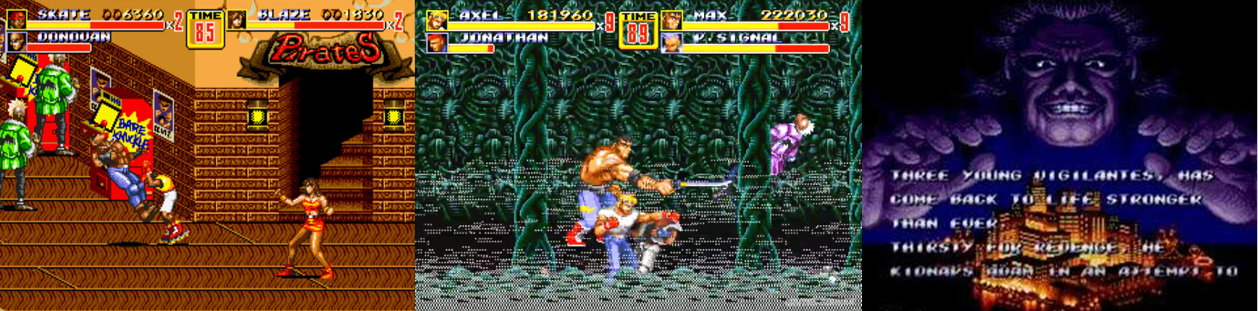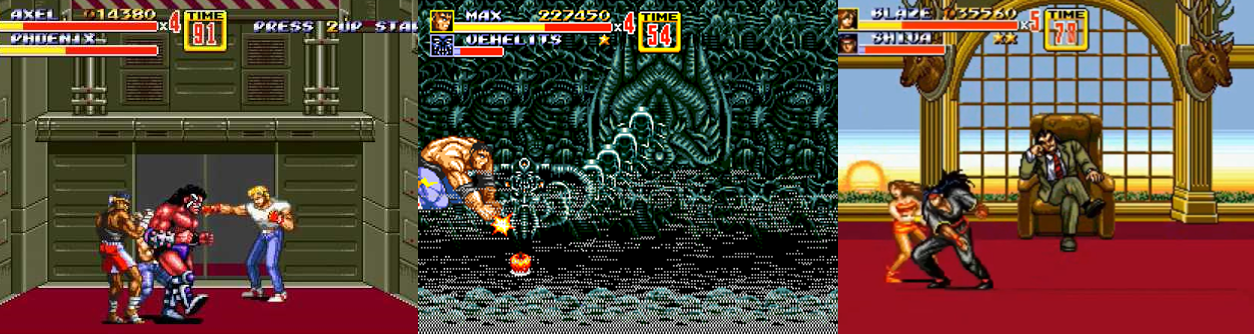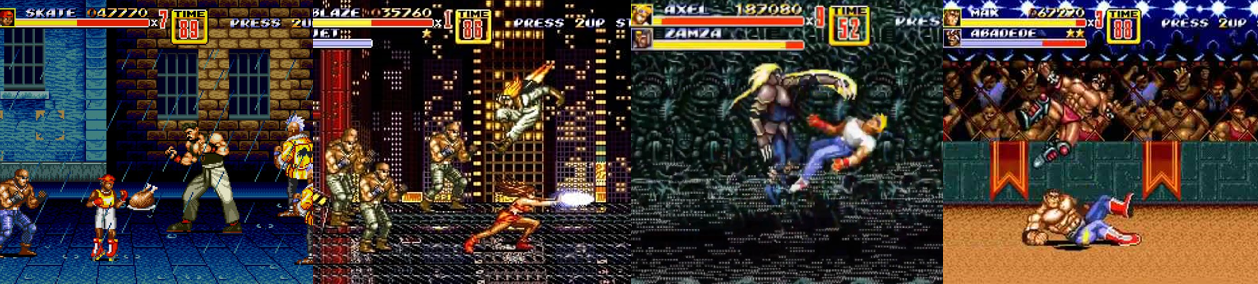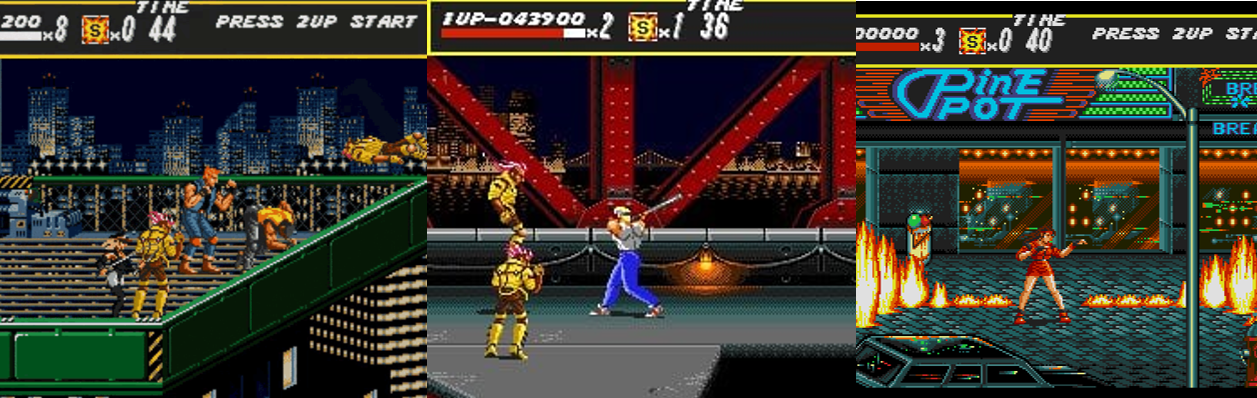
Game Corner [Brightest Day]: Green Lantern: Rise of the Manhunters (Xbox 360)


Although February 2014 was dubbed “Green Lantern Day” (because, by the American calendar, the date read as “2814”, the space sector assigned to Earth in DC Comics), the significance of this date has passed over time. Instead, I’m choosing to celebrate the debut of perhaps the most popular iteration of the character, Hal Jordan, who first appeared in October 1959.


Released: 7 June 2011
Developer: Double Helix Games
Also Available For: Nintendo DS, Nintendo 3DS, Nintendo Wii, PlayStation 3

The Background:
When Green Lantern first appeared in All-American Comics #16 in July 1940, it was as the superhero persona of of Alan Scott. However, in 1959, Julius Schwartz had writer John Broome and artist Gil Kane reinvent the character as space cop Hal Jordan, thereby creating what we now know as DC Comics’ resident intergalactic police force. After years of aborted attempts, Hal Jordan finally made his big-screen debut (alongside the Green Lantern Corps) in Green Lantern (Campbell, 2011), a critical and commercial failure that set back the formation of a DC cinematic universe a couple of years. However, one thing that came out of the movie was Green Lantern’s first (and, so far, only) solo videogame outing with this tie-in title, which was made by an amalgamated developer whose previous titles were also mostly videogame adaptations. Although featuring the likenesses and voices of many of the film’s stars and allowing players to utilise stereoscopic 3D during gameplay, Green Lantern: Rise of the Manhunters received mixed reviews; while some praised the various gameplay mechanics and the game’s presentation, others criticised the repetitive combat and lack of replayability. Since Green Lantern failed to produce a sequel, we’ve yet to see another solo videogame for the ring-slinger, which is a bit of a shame considering how much potential the character has in the near-limitless scope of the genre.

The Plot:
Before harnessing the green energy of willpower and creating the intergalactic peacekeepers known as Green Lanterns, the Guardians of the Universe employed androids called Manhunters. After being shut down for becoming too violent, the Manhunters suddenly return for revenge against their former masters, and Green Lantern’s Hal Jordan and Thaal Sinestro are just two of the emerald corpsmen dispatched to combat this threat.

Gameplay:
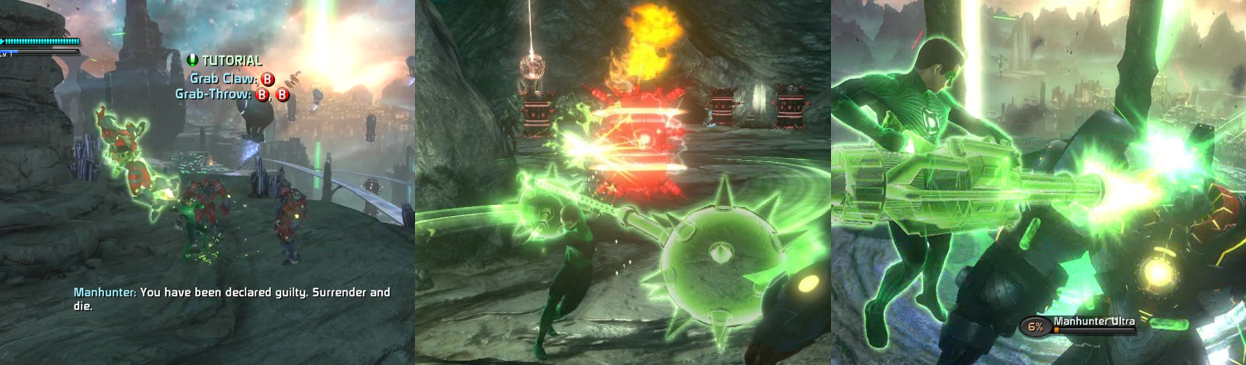
Green Lantern: Rise of the Manhunters is a third-person action/adventure game very much in the style of hack-and-slash brawlers like the God of War franchise (Various, 2005 to present). Players take on the role of Hal Jordan and fight their way through some pretty long and bland environments slashing about Manhunters with a variety of attacks generating by his Power Ring. If you have a friend, they can join the action at any time as Thaal Sinestro, though he’s basically just a skin and doesn’t have any unique dialogue or attacks and the camera becomes a bit restricted with two players on screen. Still, you have quite a few options available in terms of combat: X unleashes a fast attack with some sword swipes, Y delivers a strong attack that includes a fist and a hammer, B sees you grasping smaller enemies or objects with a claw, and the Right Bumper lets you blast ahead with a drill and chaining all of these together will allow you to pull off some basic combos to take out larger and multiple enemies pretty quickly.

Hal’s Power Ring affords him numerous options in combat and puzzle solving.

A allows you to jump but, unfortunately, you can’t fly unless you’re activating a Green Lantern logo to leap to a new area in a cutscene or dropped into one of the games shooting sections. You can evade, however, with the right stick and shield yourself from attacks with the Left Bumper. As you play through the story, you’ll unlock constructs to assign to the Left and Right Trigger; holding these down and pressing a button lets you pull off up to eight different Power Ring abilities that will drain your meter (though this refills over time and by collecting green orbs). Hal can blast enemies from afar with the Ring Blaster and Gatling Gun, smash them and activate pressure pads with the War Hammer, deploy and throw a Hover Mine to blow them up or destroy power cores, send them flying (and knock back projectiles) with the Baseball Bat, and swing around a couple of maces to devastate groups of enemies. Hal can also rapidly whip Manhunters, auto target and pummel them with the Rocket Punch, smash through enemy shields with the Piston Blitz, deliver targeted attacks to enemy weak points with the Missile Pack, and eventually dish out big damage with a Jet Fighter and a huge Mech Suit. The bigger and more powerful constructs will drain more of your Power Ring’s energy, but you can upgrade your Power Ring and your basic attacks by defeating enemies and smashing parts of the environment for Will Points (strangely still abbreviated to XP). The more XP you earn, the higher your level raises (up to a maximum of ten) and the more upgrades and additional constructs you’ll unlock, eventually allowing you to purchase Lantern’s Light to recharge your Power Ring with the directional pad at the risk of being left vulnerable. Finally, as you defeat enemies, you’ll build up your Ring Surge meter; once it’s full, press the Left and Right Bumper to activate a Ring Surge, which restores your health and Power Ring to full and powers up your attacks for a short time; the effectiveness of your Ring Surge can also be upgraded with XP.

QTEs, simple puzzles, and rail shooting sections add some variety.

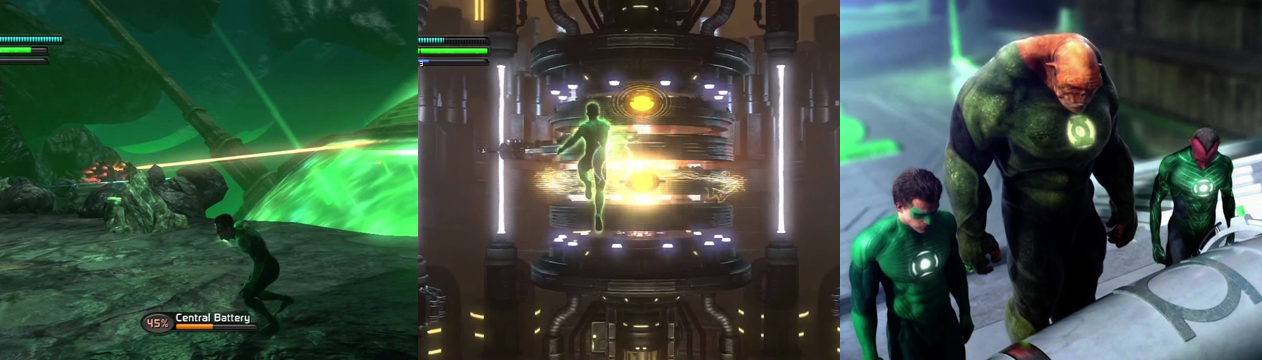
The bulk of your gameplay revolves around combat; near endless, mindless combat against Manhunters of all shapes and sizes. The game is incredibly linear, with no need for a map or directions since it’s pretty clear where you need to go, though there are inevitably times when it’s easy to get a little turned around since environments became very samey very quickly. When you’re not smashing apart endless Manhunter drones, you’re given a handful of additional missions, such as destroying mines, leaping to Siege Towers and destroying them by smashing open their armoured cores, and destroying teleport gates to stop enemies spawning in. One mission has you taking out a bunch of lasers before they destroy the Central Power Battery, sometimes you’ll need to press A and rotate the left stick to open doors or spawn in a battery, and other times you’ll be dodging electrified walls and floors to progress. These latter elements get mixed up you play through the story, requiring you to grab a battery and get it to a power node before it explodes or smashing Hover Mines into spinning holes as the floor tries to fry you. Later in the game, yellow Fear Energy nodes and enemies drain your Ring Energy meter and limit your constructs, and Queen Aga’po helps you out on Zamaron by lowering crystal barriers, where you’ll also need to destroy Boost Crystals to stop the Zamarons being powered up. Generally, puzzles are pretty simple, requiring little more than clearing out enemies, grabbing something to plug in somewhere else, either to match symbols or to destroy an energy core, and you’ll only really get a taste of some variety in the handful of rail shooter sections. In these, you use X or Y to fire (with no limits and a rapid-fire option) and can lock onto enemies with LT to fire off energy-draining missiles or become a Jet Fighter with your Ring Surge, making for some fun shooting sections. Additionally, you’ll occasionally have to perform some quick-time events (QTEs) to finish off some of the bigger enemies and bosses, and you can lower the difficulty level after you die if the game becomes too tough.

Graphics and Sound:  
Technically speaking, Green Lantern: Rise of the Manhunters looks, sounds, and plays pretty decently; I experienced a bit of a delay when activating my Ring Surge (though this could’ve been my controller) but there wasn’t really any slowdown, which is good as things can get a bit hectic at times. Ryan Reynolds returns to voice and lend his likeness to Hal, playing him a little more straight-laced now that he’s a fully-fledged Green Lantern, and he (and the other Green Lanterns) matches his much-maligned movie appearance very well. His constructs all look big and fun and imaginative, though they are a bit restrictive; his basic attacks change appearance as you upgrade them, which is a nice touch, and the developers even made the bizarre decision to include a function where Hall becomes dizzy if you rapidly spin the control stick.

The game evokes the aesthetic of its movie counterpart, for better or worse.

Sadly, the game’s environments and music aren’t much to shout about; you visit Oa twice, at the start and end of the game, and both times it recreates the look of the movie but is little more than a bizarre alien landscape under attack from various Manhunters. Zamaron is a rocky, mushroom-strewn alien world that is more bland than interesting, though it does include canyons and crystal mines and temples and such. The only other area in the game is Biot, a massive mechanical factory and processing plant for the Manhunters that’s full of gears and pistons and consoles and such, but there’s very little to interact with in any of the game’s locations and few rewards or incentive to explore as there aren’t really any collectibles. The game’s cutscenes work well enough, with the suit and the movie’s aesthetic actually translating pretty well to the action figure presentation of this era of gaming, and I liked how the story was a sequel to the movie, though it’s weird how there was no expansion on Sinestro’s decision to switch to a Yellow Ring.

Enemies and Bosses:
The vast majority of the enemies you’ll face are Manhunters, disposable tin cans that fly or teleport in and attack in some large numbers. You’ve got regular drones, ones with shields or blasters, and annoying bastards on these hoverboards that allow them to zip around and bombard you with laser fire. Sometimes you’ll be attacked by mines and laser cannons or Manhunter ships, which can be destroyed by smashing back their projectiles, and larger Manhunter variants will rush at you and grab you in a bearhug, draining your Ring Energy and forcing you to mash A to escape. On Zamaron, you’ll battle some different enemies, mainly mind controlled Zamarons who attack with staffs and such, but you’ll also encounter Willhunters, which drain your Ring Energy, and Manhunters also exhibit this ability on Biot and later in the game.

Only Zamaron offers a reprieve from the endless Manhunter variants.

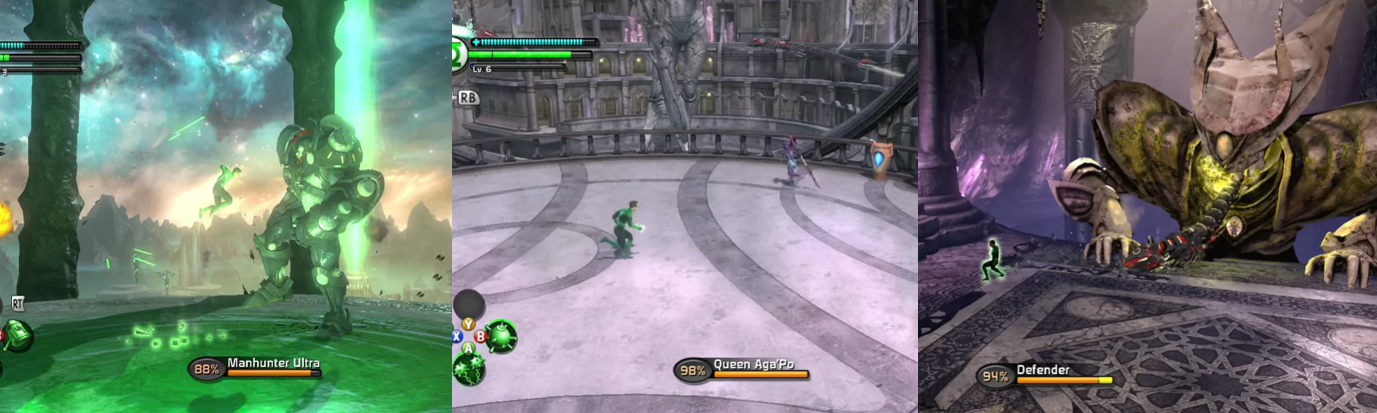
Bosses are primarily larger Manhunters, which then return as mini bosses or are strewn throughout shooting stages. The Ultra Manhunter is the best example of this; you’ll first battle it on Oa, where it stomps about firing lasers and shooting its fists at you but you can evade it, take advantage of the nearby Lantern power-up, and land some combos when it gets stuck on the ground. Ultra Manhunters reappear numerous times, often in twos and accompanied by a slew of other Manhunters; they later add a gravity bomb to their arsenal which sucks you in before exploding, but you can destroy these with your Hover Mines and you can put them down with a QTE after dealing enough damage and blast them to smithereens in the shooting sections. The Siphoner Manhunter, which bearhugs you, and the Willhunters are presented like mini bosses when you first encounter them but they quickly just become regular enemies. On Zamaron, you’ll battle Queen Aga’po after she’s corrupted by the Yellow Energy; she causes crystals to burst from the ground (which freeze you and enemies if you touch them) and sends her minions after you between attacks before attacking with her lance. After pursuing her in a shooter section and taking out another Ultra Manhunter, she sets the Zamaron Defender on you. This battle takes place on a 2.5D pane and sees you attacking its hands and the Willhunters it sends out, avoiding its swipes and the falling boulders, smashing back its projectiles and dodging its electrical barriers and shockwaves in easily the most annoying boss battle of the game so far (and you don’t even get the catharsis of finishing it yourself as Hal delivers the final blow in a cutscene).

After besting the Manhunters, you’ll face off against renegade Amon Sur.

Biot is full of Siphoners and Ultra Manhunters, Manhunters who exude Yellow Energy, and annoying reactor cores that you need to destroy with your Hover Mines. The mechanical hellhole culminates in a battle against the titanic Grandmaster, which is essentially an even bigger Ultra Manhunter and your Mech Suit comes in handy here, allowing you to go toe-to-toe with the armoured foe, who loves to blasts its fists at you and swing them around the arena to send you flying. Take it down and you get to battle the even bigger Highmaster afterwards, which is an even larger Ultra Manhunter that blasts out bigger versions of those gravity bombs and sends a massive laser beam from its hand to cut you down. The only way to damage this guy is to attack the glowing points on its knees, then run around behind it and awkwardly toss your Hover Mines into its knees so it drops to the floor, allowing you to attack the cockpit where Kilowog is being held captive. Repeat this three times, fending off the Manhunters and dodging its faster and more aggressive attacks, and you’ll progress to the final stage of the game. This sees you returning to Oa, where Amon Sur has become consumed by Yellow Energy and is leading a renewed Manhunter assault against the Guardians. You’ll need to dispatch his minions before engaging with him one-on-one, which sees Amon dashing at you with his scythe-like lance, conjuring skeletal hands, bombarding you with laser blasts, and protecting himself with an impenetrable shield. Deal enough damage and he also constructs a massive mech suit for himself, meaning the finale becomes a game of Rock ‘Em Sock ‘Em Robots as you throw slow punches at him, guard against his attacks, and stomp the ground to break his guard, completely negating all of the combat and gameplay you’ve endured and mastered and having the final boss come down to a QTE with obnoxious timing.

Power-Ups and Bonuses:
As you defeat enemies and smash pots and other parts of the environment, green, white, and blue orbs will refill your health and Ring Energy and grant you XP. Occasionally, you’ll find Lantern charge points in the environment which fully replenish your health and energy and allow you to pull off a Ring Surge, but that’s about it for in-game power-ups. New constructs are made available as the story progresses and as you level-up, which also unlocks upgrades for your attacks and Ring Meter so they become flashier, more powerful, and charge/last longer. You can assign Hal eight different constructs to use and can swap them out from the pause menu, but it’s best to keep a couple (like the War Hammer, Baseball Bat, and Hover Mine) in your arsenal since they’re useful for solving puzzles and defeating certain enemies. Other constructs, like the Jet Fighter and Mech Suit, may deal a lot of damage but they have a long charge time and drain more of your Ring Energy, though you can find and destroy coloured meteorites in each mission that will extend both of these meters.

Additional Features:
There are forty Achievements to earn in Green Lantern: Rise of the Manhunters, with eleven being awarded simply for clearing the game’s missions and story mode. You’ll also get Achievements for racking up high combos, acquiring and upgrading every construct and ability, defeating certain enemies with each construct, and fully expanding Hal’s health and energy. There are three difficulty levels for the game, with an additional Achievement awarded for beating it on the hardest setting, and two more for playing in co-op, making for some pretty simple to earn Achievements. Co-op mode is pretty good, though there’s a distinct lack of individuality to Sinestro, and you can replay any cleared mission from the main menu and even take advantage of a 3D functionality if you have one of those 3D TVs. Sadly, there really isn’t much to keep you playing; you can go back and look for things you’ve missed, but there are no collectibles, no concept art or gallery, and no skins to unlock, making for a pretty cheap and barebones experience.

The Summary:
Green Lantern: Rise of the Manhunters is a pretty decent hack-and-slash videogame; fans of the God of War franchise will be immediately familiar with the vast majority of the gameplay, but those who crave a little more depth to their games will be left wanting more from this tie-in title. The controls and combat are pretty good, but the stages are extremely restrictive and tediously drawn out, artificially extending the length of the game without really providing much visual variety. Combat quickly becomes tedious and you can easily mow through most enemies with the same button inputs or constructs without needing to mix things up and, while the rail shooting sections are fun, they’re few and far between and don’t really have a great deal of challenge to them. The enemies you battle get old very quickly, making things even more monotonous, and the few puzzles offered are ridiculously easy to solve and recycled over and over. Graphically, the game does a good job of emulating the style of the movie it’s based on and the story functions as a lacklustre follow-up to a mediocre film, but there’s very little replay value to be offered here. As a quick, cheap cash-in that rips off the gameplay of a more successful franchise, Green Lantern: Rise of the Manhunters does alright but there’s obviously better hack-and-slash titles out there and the only reason to really get this is if you see it cheap and you fancy adding some quick and easy Achievements to your gamer score. Overall, the game just lacks in imagination; Green Lantern is a character who can potentially do and conjure almost anything he desires but he feels needlessly handicapped here and the lack of skins, unlockables, or visual variety really drag this game down.

My Rating:

Rating: 2 out of 5.

Could Be Better

Have you ever played Green Lantern: Rise of the Manhunters? If so, what did you think to it? How do you feel the combat and constructs worked in the context of the game? What did you think to the plot and its status as a follow-up to the movie? Were you disappointed by the lack of variety in the enemies and locations? Which of the constructs was your favourite and were you a fan of Ryan Reynolds reprising the role? What did you think to the movie the game’s based on and would you like to see a new Green Lantern game in the future? Which Green Lantern character, villain, or story is your favourite and why? How are you celebrating this pseudo-Green Lantern day today? Whatever you think about Green Lantern: Rise of the Manhunters, and the Green Lantern comics books, feel free to leave a comment below.

Game Corner: Streets of Rage 3 (Xbox 360)

Released: 30 May 2012
Originally Released: 17 March 1994
Developer: M2
Original Developers: Ancient and SEGA
Also Available For: GameCube, Mega Drive, Nintendo Wii, PC, PlayStation 2, PlayStation 3, PlayStation 4, PlayStation 5, SEGA Mega Drive Mini 2, Steam, Xbox One, Xbox Series S/X

The Background:
Since sidescrolling beat-‘em-ups were popular in both arcades and home consoles back in the day thanks to the likes of Double Dragon (Technōs Japan, 1987) and Final Fight (Capcom, 1989), Noriyoshi Ohba and his small team of developers were smart to create the Bare Knuckle Streets of Rage series (SEGA, 1991 to 1994), which was initially exclusive to SEGA’s home consoles. Streets of Rage (ibid, 1991) was incredibly popular and highly praised, and the sequel was even more lauded for its many graphical and gameplay improvements. A bigger, even more improved third entry soon followed; originally, Streets of Rage 3 included motorcycle stages, which can still be played through hacking, and the game featured far more regional differences than its predecessors, including a reworked plot, recoloured sprites, less provocative enemy sprites, and the entire removal of a potentially offensive miniboss. Despite these alterations, Streets of Rage 3 was as highly praised as its predecessors; while the graphics and gameplay were seen as the best in the series so far, reviews did criticise the soundtrack, difficulty, and the stale nature of the franchise despite the new features. While we wouldn’t see another game for nearly thirty years, Streets of Rage 3 was re-released and ported to other consoles over the years before it, and its predecessors, were brought to the Xbox 360 as part of the SEGA Vintage Collection, with this version including modern quality of life perks like save files, a replay feature, and other bonus content.

The Plot:
Following his two previous defeats, Mr. X establishes the RoboCy Corporation and begins creating robots to replace important city officials and then has his criminal syndicate place bombs all over Wood Oak City! Eager to get revenge against Mr. X for turning him into a cyborg, Doctor Gilbert Zan contacts former police officers Axel Stone and Blaze Fielding and their young ally, Eddie “Skate” Hunter, and joins them in bringing down the syndicate once and for all!

Gameplay:
In keeping with the style of the series so far, Streets of Rage 3 is a sidescrolling 2D beat-‘em-up that lets players pick from one (or two, if you’re playing with a friend) of four playable characters and hit the mean streets of Wood Oak City one more time to take out a whole new batch of thugs across seven levels (referred to in-game as “Stages”). Just like last time, the game supports two-player co-op and a friend can jump in at any time, but there are now only three difficulty settings to pick from (“Easy”, “Normal”, and “Hard”). Not only that, but you won’t get to experience the full game if you play on “Easy” as the game will end at Stage 5 in this mode, meaning you need to play on at least “Normal” to have a shot at completing the whole game and even then this mode is notable harder than in the Japanese release. You can still manually set your stock of lives from the “Options” menu, however, and switch to another character after exhausting all of your lives and continues (of which you have three on “Normal”). Unlike the last two games, Streets of Rage 3 drops the time limit (with the exception of Stage 6 and the final boss), and the game is bigger and more fluid than ever. The control scheme, while fundamentally the same, has been expanded to include six-button control options, and is once again fully customisable in both the in-game menu and SEGA Vintage Collection settings. By default, A launches a combination of punches and kicks (and this can be set to rapid fire mode so you can simply hold down the button to pummel enemies), B lets you jump to hit one of three jumping attacks, and X unleashes one of two special moves to clear away groups of enemies at the cost of some health.

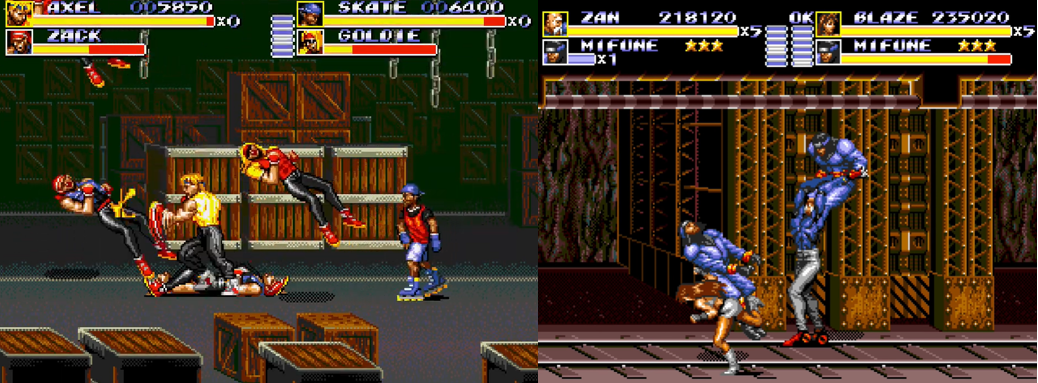
Characters are faster and more versatile than ever thanks to increased range of movement and combat options.

You can still perform a rear attack with A and B together (or assigning this to X, like I did) for better crowd control. You can also assign an “X Attack” (which appears to be a single, powerful attack from your combo) and you can still grab, pummel, toss, and slam enemies when you get close to them (and they can still do this to you, and can even perform co-op attacks and steal health items!) Streets of Rage 3 shakes up the roster once more; although Adam Hunter is still unplayable, he does make appearances in the game’s cutscenes, and lumbering oaf Max Thunder has been replaced by the cybernetic Zan. Axel, Blaze, Zan, and Skate continue to share the same basic attacks and controls and each again boast different skills according to five attributes (Power, Technique, Speed, Jump, and Reach). You can also see their height and weight listed in the character select screen, though I don’t think this really affects how the characters play; the other attributes certainly do, though, with Axel again being more of an all-rounder, Skate being the smallest, weakest, and fastest, and Zan having the best reach and able to zoom around on his rocket shoes but at the cost of having a shit jump and turning weapons into projectile attacks. As in the last game, each character is further separated by their different special attacks; Axel can still perform his flaming “Bare Knuckle” uppercut and spinning flaming fist, but Zan can electrocute enemies on contact and you can quickly pummel enemies with Blaze and Skate’s faster (but weaker) attacks. This time around, though, the game features a rechargeable meter; when full, your special attacks will be at their most powerful and won’t cost you any energy, and you’ll also gain a star under your life bar after accumulating high enough scores that will further power-up your special attacks. Every character can now not only dash ahead and perform a running attack (which also benefits from the star power-ups) but they can also vertically dodge out of the way with double taps of up or down, which is extremely handy when dealing with large groups of enemies.

Gameplay is given some much-needed, if frustrating, variety thanks to some timed sections.

If you’ve played either of the previous games (or any sidescrolling beat-‘em-up) then you’ll be acutely aware that your primary goal is to travel from the left side of the screen to the right dispatching enemies and smashing crates and such for objects and power-ups. Like the last game, each Stage is made up of multiple screens and areas, with transitions taking place to show characters smashing through doors or the time of day changing, and you’ll still be able to earn extra lives by adding to your score tally (with bonus points continuing to be awarded at the end of each Stage). Stages don’t seem as long as the last game, however, though each screen is longer, if that makes sense? You seem to spend more time in less screens, basically, and the game seems a little tougher this time around; I only found one 1-Up pick-up in my entire “Normal” mode playthrough and the sheer amount and variety of enemies onscreen can get a little frustrating. Enemies continue to be “shy” and linger offscreen, while also dropping down from the sky, emerging from the shadows, leaping from storage containers, hopping in from speedboats, and popping out from behind bushes to attack you, and it’s much easier to get surrounded by goons this time around. Not only that, but Streets of Rage 3 features the return of stage hazards; bottomless pits make a return in Stage 3 (though, thankfully, they’re not an instant-kill trap this time), barrels drop down from above, wind pushes you back, rising (and horizontal) platforms and elevator sections see you trapped with wave-upon-wave of enemies or tossing them to their doom, conveyor belts make movement and combat sluggish in Stage 7, and you’ll even have to dodge snare traps and laser turrets (though these can damage enemies, too). There’s actually a bit of gameplay variety thrown in here, too; not only do some Stages see you going to the left for a change, but you’ll need to smash through cinder blocks while fending off a digger machine in Stage 3, dodge hazards that fly at you along underground railroad tracks in Stage 4, and face a time limit in Stage 6. This is easily the most complex Stage in the game; you have fifty in-game seconds to clear out enemies, using an elevator to visit different floors, and destroy two control consoles before a lethal gas is emitted. If you take too long, the gas will not only whittle down your health, but cause the death of the captive police chief, Ivan Petrov, which will change the game’s ending accordingly.

Graphics and Sound:
I have to say that, while I enjoyed some of the tracks featured in Streets of Rage 3, the soundtrack is probably the weakest in the trilogy; Stages are punctuated by a thumping, techno beat that is just as likely to be catchy as it is a mess of garbled noise. The links to The Revenge of Shinobi (SEGA, 1989) continue to be found within the game, as well; while the cutscenes finally feature a unique font for the game, Revenge of Shinobi font, sound effects, and melodies are still found throughout (though, at this point, they’re probably more associated with this series of games so I can forgive it). The game’s presentation is better than ever; sprites are larger and more detailed (with Axel, Blaze, and Skate sporting new colour palettes) and enemies are more varied; while skin-heads, dominatrixes, and denim-clad goons still dog your progress, a whole bunch of new enemies are featured, each sporting a name and a health bar. Some even boast a life count of their own, which generally gives you a better indication of how tough the enemy is and how many tiers their health meter has, and weapons also sport their own health meters now and will break after consecutive use.

While the music’s a bit of a mess, the visual presentation and variety is the best in the trilogy.

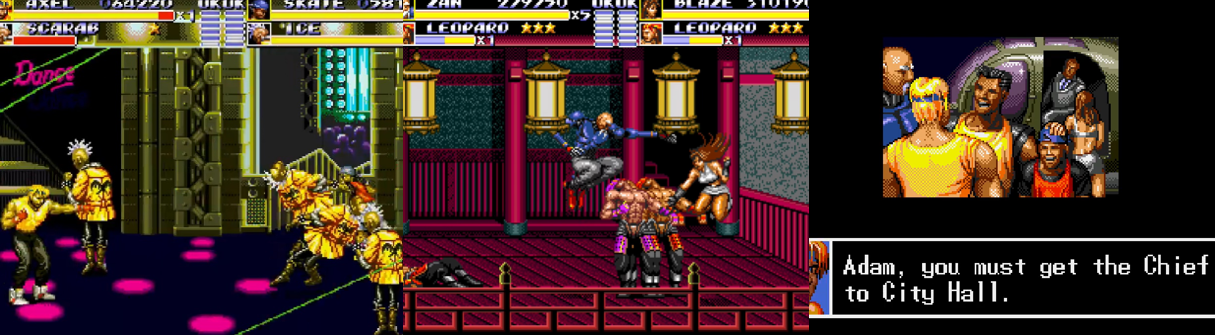
The environments are the biggest, most varied, and most detailed in the series yet, however. Little touches like chains shaking when you slam enemies to the ground, day turning to dusk, cats peeking out from bins, and wind blowing lanterns and rubbish about really help to make every Stage feel alive. There’s always a lot to catch your eye on the screen, from bushes rustling to indicate the arrival of a hidden enemy, to a bustling nightclub awash in strobe lights and dancing enemies, to glasses tumbling from bars, an aquarium in the background of the Stage 2 boss fight, and even an elaborate Japanese temple in Stage 5. Stage 5 also features a recreation of the final stage of the last game, once again having you fend off enemies in a rising elevator to Mr. X’s throne room, only this time it’s at night and the fight is notably different from the last two Mr. X boss battles and the big man himself is later revealed to be a brain in a jar within an underground laboratory! Everything is so much more detailed and varied this time around, which makes for an experience that finally captures the arcade-style aesthetic the series was going for with the first game, and this is even more evident in the heavier emphasis on story. Not only is there an introductory and ending cutscene, but cutscenes will also take place during and after certain Stages, with dialogue boxes appearing onscreen and different endings being shown depending on how you beat the final Stages of the game.

Enemies and Bosses:
Although long-time players of the series will be more than familiar with the vast majority of the enemies encountered in Streets of Rage 3, palette swapped variants are much more commonplace and they appear alongside some new additions to Mr. X’s syndicate. Denim-clam thugs, yellow-jacketed punks, skinheads, dominatrixes, bikers, and ninjas all make a return to charge at you with knives, slide at your shins, uppercut you out of the air, crack their whips at you, charge at you on their bikes, and flip about tossing throwing stars at you. Newcomers to the series are “Goldie” (a street thug not unlike Axel who can guard against your attacks), “Soozie” (a punk girl similar to Blaze who can pummel you with slaps and leaps at you with flying kicks), and “Zack” (a bandana-wearing goon who likes to grab you from behind). Rotund firebreathers and belly floppers like Ben Ben also make a comeback (and once again cause you damage when you try to slam them), but you’ll also contend with gun-packing Assassin Agents, jetpack-wearing Rockets, martial arts experts like Tiger, and even robotic, frog-like enemies who hop about, dash at you, fire projectiles at you, or explode and send shrapnel across the screen.

Shiva’s importance depends on which difficulty and region you’re in, though you’ll see a lot of recycled bosses.

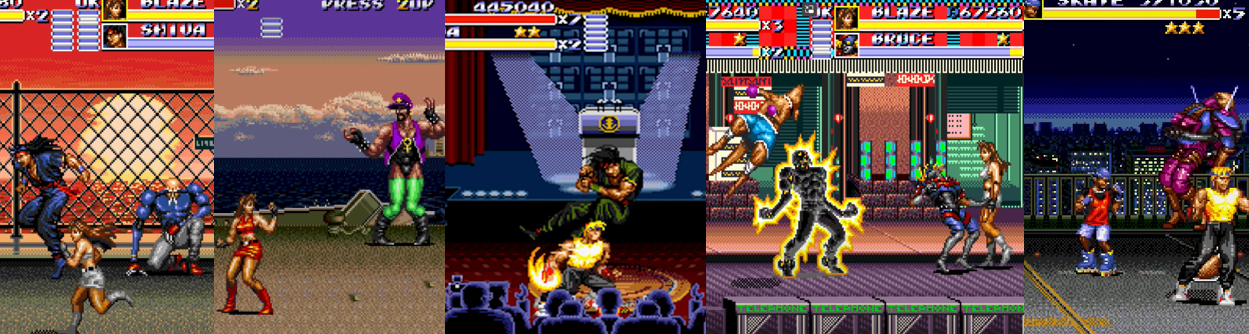
Streets of Rage 3 dramatically reduces the amount of sub-bosses you’ll have to face compared to the last game, with only two cropping up this time around; instead, certain regular enemies will receive a palette swap and an extended life bar to act as tougher mid-Stage enemies. Bosses will rarely be accompanied by an endless slew of thugs as well, which is definitely a plus, but three of them are recycled from Streets of Rage II and you’ll notice this right away when you reach the end of Stage 1 and face off with Shiva. Downgraded from a penultimate boss to the first boss of the game, Shiva isn’t quite as difficult as in the last game but still poses a challenge as he’s got a nasty leaping kick that can catch you off-guard after you knock him down. You won’t actually face Shiva in the Japanese version of the game, though; instead, you fight Ash, a stereotypically gay character who slaps you around, dances about, and can slam you to the ground. Both Shiva and Ash can be unlocked as playable characters after defeating them and holding B until the next Stage starts, but only Shiva actually makes a reappearance in the worst ending of the game where he serves as the final boss and is given a significant power boost alongside a new attire. Similarly, you can unlock the boxing kangaroo Roo if you take out his abusive handler, Bruce, in the sub-boss fight of Stage 2, after which you’ll battle the female tag team of Mona and Lisa once more who again prove to be slippery and annoying opponents as they continuously backflip away from your attacks and leap at you with kicks. Another returning boss is Jet, though he’s given a new look; he’s accompanied by Rockets, all of whom share his ability to swoop down at you and grab and slam you, but only Jet can blast you with flames from his thrusters. While you can land combo attacks on these guys, and grab and slam them, it’s still difficult to judge which plane they are on thanks to them constantly hovering about.

There are some tough bosses to contend with so it helps to play with a friend to dish out the damage.

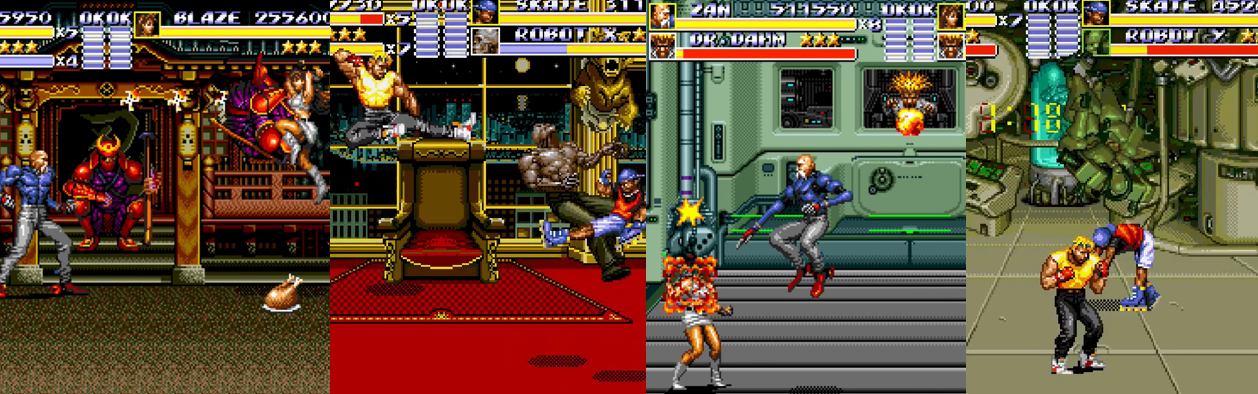
New bosses do appear in Streets of Rage 3, however. At the end of Stage 3, you’ll battle an exact copy of Axel; this duplicate has all of Axel’s abilities and special attacks, but changes colour and bursts into flames as you land hits and is eventually revealed to be a robot imposter upon defeat. One of the hardest bosses is Yamato, an armour-clad samurai who is actually three bosses in one. Each samurai will take it in turns to attack you, slashing across the screen with their katana, duplicating themselves, and performing a diagonal dash attack that can be hard to dodge. When you finally confront Mr. X, the game initially frames the confrontation as being exactly like in the last game but, after dispatching his goons, he’s also revealed to be a robot duplicate. Robot X dashes across the screen on rocket boots, fires at you from a wrist-mounted gun, and even shoots homing missiles at you! You’ll then encounter weaker versions of this boss as regular enemies in Stage 7, which also sees a unique boss battle as you’re placed on a vertical conveyer belt that constantly forces you towards an electrical barrier while Dr. Dahm tries to crush and electrocute you with his mechanical claw arm. While it can be tricky to land hits on this, and time your attacks to avoid being shocked, it’s nothing compared to the final encounter with Mr. X, in which his disembodied brain controls the heavily-armoured Robot Y. This hulking foe is made all the more threatening by its maniac attack patterns; it spins around the place, barely fazed by your attacks, and sports a four-tiered life bar and missiles. Not only can it shrug off your attacks and deliver big damage with its basic strikes, the bastard can even grab you out of the air and deliver a huge slam that can easily drain half your life bar. You’re also given just three in-game minutes to defeat it and get the game’s best ending, making for easily the most challenging boss battle not just in this game but in the entire trilogy.

Power-Ups and Bonuses:
As ever, you’ll find a whole bunch of destructible objects in the game’s Stages for you to smash to uncover apples and roast dinners to restore your health, bags of cash and gold bars to add to your high score, and weapons to use against your enemies. Weapons are a little more diverse this time around, but also notably different; not only do they each have a life bar of their own, as stated, but some are single-use only. Knives, for example, are now thrown by default, as are grenades, though you can throw every weapon with the press of a button. You can grab kunai blades, wooden planks, lead pipes, baseball bats, and swords to attack your enemies, but be warned as enemies can also acquire (and throw) these weapons, and even steal your health items if you’re not fast enough!

Additional Features:
There are four Achievements to earn in Streets of Rage 3, and two additional Achievements as part of playing all three games in the SEGA Vintage Collection. The four specific to this game require you to defeat the robot Axel as Axel, free Roo, save the Chief as Zan, and max out your special attack by acquiring three stars. As in the other two games, each of these (with the exception of the latter) are achieved by playing alone and there are no Achievements for playing alongside a friend, or finishing the game as each character, which remains a disappointment. Streets of Rage 3 has a number of endings that are dictated by your progress in the last two Stages and which difficulty you play; you won’t get Achievements for seeing all of these endings, though, and are required to just beat the game (and the other two) to earn 100G. The “Duel” mode from Streets of Rage II returns; now called “Battle”, this mode lets two players to go head-to-head as one of the four playable characters in a one-on-one fight (but, again, there are no Achievements tied to this). This version of the game comes with the same customisation options as the others, so you can set wallpapers, scan lines, and smoothing, listen to the soundtrack on the jukebox, switch between the Japanese, European, and North American versions of the game, save replays, and use save states to make things easier on yourself. Alongside the usual local and online co-op returns, you can still set a high score on the leaderboard and take on the “Trial” mode, which has you battling towards a high score on different difficulty stages against a time limit or extracting the Chief as fast as possible, with the lives you lose adding to your timer.

The Summary:
The question permeating all these reviews of the Streets of Rage games is: Which is better? Streets of Rage or Final Fight? While the first game fell quite short of matching its arcade counterpart, Streets of Rage II was much closer, and Streets of Rage 3 is right up there with some of the best arcade beat-‘em-ups. Everything about the game is bigger and better than the last two, expanding upon the gameplay and presentation to offer the best Streets of Rage experience yet. Reintegrating elements from the first game, such as stage hazards, and expanding upon the gameplay by removing the time limit but offering some variety in tense sequences that see you fending off a digger or desperately fighting to save the Chief really add to the overall experience and make things less monotonous. On the flip side, and what keeps Streets of Rage 3 from earning my coveted fifth star, the music isn’t as good as in the previous games and the difficulty spike is very noticeably, making for some frustrating moments as enemies have bigger health bars and the time offered to you to complete tasks is so tight that it’s easy to fail and be left with one of the bad endings. The gameplay mechanics have never been better, however; the additional of the power gauge for specials, new control options, and impressively detailed sprite work and backgrounds make the game slick to control and endlessly visually interesting, but the recycled boss battles are a shame, especially considering how much detail was packed into every Stage. Overall, I’d say Streets of Rage 3 is easily the best of the original trilogy, and would recommend it as the go-to title to play and own; bigger, better, with more variety, some fun bonus characters, and different endings to work towards, the only thing holding it back from five stars are a few minor missteps that can make it a little too challenging an experience.

My Rating:

Rating: 4 out of 5.

Great Stuff

Did you enjoy Streets of Rage 3? How do you think it compares to the original, its sequels, and other beat-‘em-ups? Did you enjoy Zan’s inclusion or did you stick to a character you were more comfortable with? What did you think to the energy gauge and the recycled bosses from the last games? Have you ever gotten the game’s best ending? Which beat-‘em-up game or franchise is your favourite and why and what is it you enjoy about the genre? To share your memories of Streets of Rage 3, leave a reply below or comment on my social media and be sure to check out my reviews of another classic beat-‘em-up titles.

Game Corner: Streets of Rage II (Xbox 360)

Released: 30 May 2012
Originally Released: 20 December 1992
Developer: M2
Original Developers: Ancient, H.I.C, MNM Software, SEGA, and Shout! Designworks
Also Available For: Arcade, Dreamcast, GameCube, Game Gear, Master System, Mega Drive, Mobile, Nintendo 3DS, Nintendo Switch, Nintendo Wii, PC, PlayStation 2, PlayStation 3, PlayStation 4, PlayStation 5, Xbox One, Xbox Series S/X

The Background:
Sidescrolling beat-‘em-ups were a popular genre in both arcades and home consoles back in the mid-nineties thanks to games like Double Dragon (Technōs Japan, 1987), Final Fight (Capcom, 1989), and Teenage Mutant Ninja Turtles IV: Turtles in Time (Konami, 1992). Noriyoshi Ohba and his small team of developers drew inspiration from this genre to create the first Bare Knuckle Streets of Rage (SEGA, 1991) title, which initially released exclusively on SEGA’s home consoles. Given that Streets of Rage was incredibly popular and highly praised, a sequel was released only a year later; to incorporate new features and improvements over the original release, the developers improved the Mega Drive’s cartridge specifications to allow for larger, more detailed sprites and increased enemy swarms. Ayano Koshiro designed and coded the new characters, their moves, and tweaked the gameplay experience to make things faster, more dynamic, and more capable of competing against Capcom’s brawlers on Nintendo’s consoles. All this work paid off as Streets of Rage II was one of the top five best-selling Mega Drive games upon release and was met with widespread critical acclaim; reviews praised the improvements and combat, Yuzo Koshiro’s soundtrack, and the gameplay in general was universally celebrated. After being re-released and ported numerous times over the years, all three Streets of Rage games came to the Xbox 360 as part of the SEGA Vintage Collection, with this version including additional modern quality of life elements such as save files, a replay feature, and bonus content.

The Plot:
One year after saving Wood Oak City from Mr. X’s crime syndicate, former police officers Axel Stone and Blaze Fielding join forces with professional wrestler Max Thunder and Eddie “Skate” Hunter, the younger brother of their comrade, Adam Hunter, when Mr. X makes a sudden return and kidnaps Adam!

Gameplay:
Like its predecessor, Streets of Rage II is a 2D, sidescrolling beat-‘em-up in which players pick from one of four playable characters and return to the mean streets of Wood Oak City to clear out a new batch of thugs across eight levels (now referred to as “Stages”). As before, you can choose to tackle this either alone or alongside a second player, who can jump in at any time, and can again pick from four difficulty settings (ranging from “Easy” to “Hardest”). This time around, you can manually set the amount of lives you have from the “Options” menu and, after losing all of your lives and continues (of which you have three on “Normal”), you can enter your initials on the high score board and then switch to a different character to continue playing as if you want. Each Stage is played against a generous time limit that is extended by clearing enemies from the screen, or if you lose a life. Compared to the last game, Streets of Rage II is much bigger, faster, and more responsive, with additional animations, combos, attack options and unique gameplay mechanics both shared and exclusive to the four playable characters. Once again, you have a simple three button control system that can be fully customised both in the in-game menu and using the SEGA Vintage Collection settings to allow for a rapid fire attack option. By default, A sees you attack with either a punch or a kick, B lets you jump to land one of two jumping attacks, and X lets you pull off one of two special moves to clear away groups of enemies at the cost of some health. You can switch up these buttons as you like in the main menu, and you can now pull off a rear attack by either pressing A and B together or by assigning this attack to another button (I used X) and pull off either a dash or a forward lunge attack by double tapping the directional pad and pressing attack. When you get up close to enemies, you’ll also grab them, allowing you to either pummel them, toss them behind you (and into other enemies), or slam them to the ground for big damage. Anything you can do, your enemies can do too, however, so you’ll need to make sure to avoid them grabbing and throwing you, overwhelming you from all sides, or sliding or charging at you. Although Axel, Blaze, Max, and Skate all share the same basic attacks and controls, each now has five different attributes that changes the way they play as they have more or less focus on Power, Technique, Speed, Jump, and Stamina. This means that Skate is the fastest but weakest character and Max is the most powerful but the slowest, and this extends to their attack options. For example, Axel can perform his “Grand Upper” to somewhat dash ahead, Blaze unleashes a short range fireball and Skate literally dashes ahead in a diving cannonball attack while Max does a limited shoulder charge and slide attack, so you really feel a difference when playing as each character as you trade off speed and jump height for attack power or defence.

The four playable characters all control a little differently and have unique special attacks.

Special attacks are much more varied this time around as well; rather than every character simply calling in backup, each one has a different health-sapping move to deal big damage to multiple enemies. One is performed by a simple press of the special attack button and the other is performed in conjunction with a directional input and, since they drain your health, you won’t have to worry about picking up specific power-ups to replenish them, though your health bar does drains down to the point where you can’t pull them off. This introduces a new layer of strategy to combat as you now must weigh the risk and reward of the abilities of your chosen character while also factoring in whether it’s better to lose a little health pulling off a special or risk losing more health by holding back and getting pummelled by enemies. As ever in these types of games, your goal is to travel from the left side of the screen and to the right and wade through enemies; however, this time around the screen occasionally scrolls diagonally downwards and upwards. Stages are also much longer and generally comprised of at least three areas, meaning when you reach the final part you’ll usually battle a sub-boss and then enter a building or a new area to take on more enemies, making each Stage (and, consequently, the game) much longer. Taking out enemies and grabbing pick-ups still awards you points, and you’re once again awarded bonus points at the end of each Stage depending on how much time and life you have left, which will eventually award you with an extra life. By default, each character is pretty durable, though some are tougher than others, and I found that raking up extra lives was much easier this time around. More enemies, and more varied combinations of enemies, fill each screen at any one time but the game feels less cheap than the last one and the new combat animations and mechanics make crowd control a lot easier. It also helps that onscreen hazards are now at a minimum; there are no death pits to fall down, no crushing weights or flames to worry about. While some enemies will toss grenades at you from the background, pop up from sewer holes, or leap in from offscreen, the only real onscreen hazard you come across are some conveyor belts. Enemies remain shy and like to linger just offscreen, which can be annoying when you’re trying to progress further, and some destructible objects do tend to explode, but these can also damage enemies as well, which is very helpful. Streets of Rage II also has not one, not two, but three elevator sections, none of which allow you to toss your foes off the side, and when you view your high scores you’ll be able to see stats like which Stage you got to and how many K.O.s you scored (which I assume is enemies beaten but it could also be the amount of lives you lost).

Graphics and Sound:
Streets of Rage II continues the tradition of the series by filling every Stage with a catchy, thumping soundtrack that really helps to make the monotonous gameplay fun since you’re just humming away as you go to town on waves of enemies. You still get a congratulatory melody after finishing a Stage, boss themes, and scream, grunt, and groan; it’s always obvious when you’ve grabbed an item or earned an extra life thanks to an audible jingle but, while many of the sounds and music are more elaborate and impressive than the first game, many are still recycled from The Revenge of Shinobi (SEGA, 1989). The overall presentation is much improved, however; the heads-up display is now no longer confined to an ugly black box at the top of the screen, meaning the locations are bigger and much more detailed; enemies now have (ridiculous) names and life bars of varying lengths (with sub-bosses and bosses having two- or three-tiered life bars), and there’s generally a lot more life in the sprites and environments.

The game is bigger and far more visually interesting than before, with an equally kick-ass soundtrack.

The sprites are much bigger and more detailed than before; their idle animations still generally amount to just breathing heavily and waiting for the next punch-up, but Skate glides along on his rollerblades in a very slick way and everything just has a little more polish this time around, which is only bolstered by a few new animation frames when grabbing and beating on enemies or performing your character’s combos. The story is once again told through text but the font is much clearer and longer, still images are used to recap the ending of Streets of Rage and show the ending sequence for this game, and Stages are way more varied than before thanks to going on longer. You’ll see lampposts and chain link fences in the foreground, cars and different views of the city in the background, fog and rain effects, smash your way through a bar and an arcade (where enemies are playing Bare Knuckle machines), explore a pier and fairground (where enemies sleep on bunches, a rollercoaster can be seen, and you end up in something ripped from the mind of H. R. Giger and a pirate ship), and battle your way into the SEGA Stadium where the green becomes a descending elevator section, You’ll cross a bridge held up by huge girders, traverse conveyer belts in a factory, battle through the foyer of Mr. X’s newest elaborate skyscraper, and even end up in a gladiator pit and in the back of a moving van where enemies and audiences cheer on your foes as they try to beat the life out of you. It’s all much bigger and more visually impressive, even though many of the Stages are reminiscent of the last game; little touches like fighting along the beach from the other perspective than in Streets of Rage (so now the sea is behind you) and progressing from the interior of a rocking ship up to the deck really show how the game is taking everything that worked in the first and improving upon it for a deeper, more visually engaging and exciting gameplay experience.

Enemies and Bosses:
While you’ll recognise the vast majority of the enemies you’ll encounter throughout Streets of Rage II from the last game, they now have names and life bars and palette swapped versions of them crop up right from the first Stage, which helps to make them seem more varied than they actually are. The denim-clad thugs and yellow-jacketed punks return, still charging at you with knives, sliding at your shins, or trying to throw you across the screen but they’re now joined by bald bastards who uppercut you out of the air at the worst possible moments. While the whip-cracking dominatrixes return, the martial artists have been replaced by Muay Thai kickboxers and ninjas who can guard against your attacks, flip about the place, and toss throwing stars your way, respectively. Bikers make their first appearance here, charging and leaping at you on their motorcycles, though you can kick them off and take them out with their own exploding bikes; their grenades will also damage other enemies, and you’ll now drop whatever weapon you’re carrying when you grapple with an enemy (and ninjas can even catch ones you throw at them!)

Sub-bosses and bosses return as regular enemies, except for the Vehelits and formidable Shiva.

As Stages are now longer, you’ll now have to contend with a number of sub-bosses as well as end of Stage bosses. As before, all of these reappear in later Stages as recoloured and renamed regular enemies, though slightly weaker and with some variations. The first sub-boss is Jack, a large punk with a flaming Mohawk and garbed in a ripped denim shirt and jeans. This guy’s packing knives, which he’ll stab or throw at you, but you can also pick them up and use them against him and any other enemies coming for you, which is handy when he reappears in his recoloured forms. Dominatrixes like Elektra often attack in pairs and are given extra attack range with their whips, which can also be electrified, but I found them pretty easy to take out before they could do any real damage. Hakuyo and his variants are muscular martial artists who literally drop in with flying kicks and jump attacks, while Big Ben is a returning, rotund enemy from the last game who will plod around trying to set you alight with his fire breath or try and crush you with a big belly flop (but, this time, you are able to throw and slam him without being hurt). One of the more unique sub-bosses is Vehelits, an animatronic alien head that pans across the screen to send you flying and is one of only three enemies you’ll fight just the one time in the entire game, which is fine as all the other sub-bosses and bosses crop up again in the later Stages. After running an enemy gauntlet, you’ll once again confront Mr. X; this time, rather than offer you the chance to join him, he orders his personal bodyguard, martial artist Shiva, to soften you up. Shiva is the closest you’ll get to a boss who is as versatile as you; he attacks with flying and sliding kicks, guarding against your attacks, and flying at you with flaming cartwheel kicks. While he cuts an intimidating figure, he’s actually not as hard as some of the game’s other sub-bosses, however.

While the first two bosses aren’t too difficult, things get tricky once Zamza and Abadede appear.

After fighting through the bar and into a rainswept alley, you’ll take on Barbon, the musclebound proprietor of the establishment you just wrecked who (alongside a bevvy of regular goons) throws spinning kicks, tosses you across the screen, guards against your attacks, and kicks you out of mid-air. When he reappears later, he’s actually one of the easier enemies, especially compared to Stage 2’s boss, Jet. This jetpack-wearing asshole constantly hovers overheard, swooping down or across the screen or grabbing you and sending you crashing to the ground. It can be a little tricky to land a hit on him, much less a combo, as it’s not always easy to judge what “level” of the background he’s on, which can make him a hell of an annoyance when he reappears as a regular enemy. Still, he’s a walk in the park compared to Zamza; this Blanka-like asshole attacks with clawed talons, spinning and jumping all over the place and flying at you with a cannonball attack, swiping you out of the air with a twirling uppercut, or delivering a massive German Suplex up close. His appearance on Stage 8 as “Nail” was a particular headache for me, and actually harder than the last bosses of the game since he’s so hard to keep track of and land decent hits on. In the gladiator pit, you’ll have a rematch with hulking wrestler Abadede; this Ultimate Warrior rip-off has expanded his repertoire to include an uppercut, a lariat strike, a flying body splash, a muscle flex that can send you flying, a big back suplex, and will even strike you with a wrench when he grabs you.

While the final boss is basically the same as before, there’s some interesting (if annoying) battles prior to this.

After fighting your way onto the deck of Stage 5’s ship, you’ll go toe-to-toe with the bulbous Rocky Bear; this guy’s also no joke as he hops about on his tiptoes, pummelling you with punches when he grabs you and easily cancelling your combos with a lunging fist, or comes flying at you with a butt stomp! He’s also accompanied by “Balloon”, a Big Ben variant, and he can be a real pain in the ass as you have to try your luck with a leaping kick, break free of his grab with your special, and dodge out of the way to do some real damage with a combo. Things get a little lazy at the end of Stage 6, however, as you have to fight a variant of Zamza and Jet (known as “Souther” and Stealth”) rather than a unique boss battle, though Stage 7 makes up for this with the tag team combo of robots Particle and Molecule. These cycloptic automatons jump about the place to avoid your attacks, swing their retractable mace-like appendages at you, and even fire projectiles from their eyes but they’re not especially difficult to deal with even when they immediately appear as regular enemies at the start of Stage 8. After dispatching Shiva, you’ll finally face off against Mr. X; unfortunately, this is basically exactly the same as in the last game as Mr. X wanders about trying to brain you with the butt of his rifle (which, to be fair, lands as a combination of hits this time) and haphazardly spraying bullets across the screen. Goons will file in to distract you, but they can also be hurt by Mr. X’s bullets, and as long as you focus on attacking him you’ll come out on top easily enough. I’m actually surprised the developers didn’t have an alternative version of Shiva (or Shiva himself) attack you in this final bout as it’s a pretty simple final fight, and the game is actually much fairer (on “Normal”, at least) than the last one, so it’s not inconceivable that you could get through this without too much difficulty, which is surprising considering how tough and cheap Zamza can be.

Power-Ups and Bonuses:
There are still plenty of destructible objects scattered around the various Stages for you to smash to uncover goodies; apples and roast dinners will restore some or all of your health, the occasional 1-up will grant you an extra life, and bags of cash and gold bars to add to your high score. This is also the main way (outside of disarming enemies) that you’ll acquire a melee weapon; interestingly, there’s only one new weapon in the game (the kunai blade dropped by the ninjas) and some (like the glass bottles) are actually missing. On the plus side, every character swings the metal pipe differently and weapons can be throw at the press of a button to become projectiles but, if you get hit and drop them enough, they still eventually disappear and you may also struggle to attack if you’re standing over a weapon as your character will try to pick it up instead of defending themselves. Since your special move is tired to your health bar, there’s no item to pick up to replenish your stock; you can perform each character’s unique special move as long as you have enough health, and there’s actually a reason to play as different characters this time since they control a little differently and have unique special attacks.

Additional Features:
There are two Achievements on offer in Streets of Rage II, and three additional Achievements as part of playing all three games in the SEGA Vintage Collection. The two specific to this game require you to defeat Zamza on Stage 3 as Skate and Abadede on Stage 4; there are no Achievements for playing with a friend, or for finishing the game as each character, which is a bit disappointing. Unlike the first game, Streets of Rage II only has one ending, further reducing the replay incentive somewhat, but it does come with a new game mode. “Duel” allows two players to go head-to-head as one of the four playable characters in a one-on-one fight; you can select a Stage to battle on, and whether or not special moves are active, but again there are no Achievements tied to this extra mode and no other characters to play as. This version of the game comes with the same customisation options as the last game, allowing you to set wallpapers, scan lines, and smoothing, listen to the soundtrack on the jukebox, switch between the Japanese, European, and North American versions of the game (which again amount only to cosmetic differences), save replays, and make use of save states to the game to make it dramatically easier. Local and online co-op also return, as do leaderboards and the “Trial” mode, which has you battling towards a high score on four different difficulty stages against a time limit or going against Zamza’s “Horror House Challenge”.

The Summary:
I concluded my review of Streets of Rage by saying that I would probably pick Final Fight over it since, while it was a great game and a good attempt at an arcade-style beat-‘em-up, it didn’t quite match up to the level of Final Fight. With Streets of Rage II, the call is much harder to make; with larger, more detailed and visually appealing graphics, new characters with unique ways of controlling and special moves, and longer and more diverse Stages, Streets of Rage II is clearly bigger and better than its predecessor in every way. The core gameplay remains the same, but everything is faster, slicker, and meatier than before; there’s so much more to see and combat is way more fun and the cheapness of the original’s difficulty curve has been toned down quite a bit. While you can argue that this makes Streets of Rage II easier, I’m okay with that; when it comes to arcade beat-‘em-ups, I want a simple pick-up-and-play experience that can be challenging but not unfair or frustrating, and Streets of Rage II was a great time from start to finish. It was a shame to see some weapons missing, some Stage themes repeated from the last game, and that there weren’t more Achievements added to this version of the game, but there’s no denying that Streets of Rage II is vastly superior to the first game in every way. It almost feels like the first game was a proof of concept for the engine and the mechanics as Streets of Rage II just refined everything into an experience that’s far closer to what one would expect from an arcade title, so I would definitely choose to pick this one over the first one and happily compare it to Final Fight in terms of quality and enjoyment.

My Rating:

Rating: 4 out of 5.

Great Stuff

What did you think to Streets of Rage II? How do you think it compares to the original, its sequels, and other beat-‘em-ups? Which of the four characters was your go-to and were you a fan of the new ones introduced here? What did you think to the longer Stages and additional sub-bosses? Have you ever beaten this game on the hardest difficulty setting? Which beat-‘em-up game or franchise is your favourite and why and what is it you enjoy about the genre? To share your memories of Streets of Rage II, sign up to leave a reply below or comment on my social media and be sure to check out my other reviews of the series!

Game Corner: Streets of Rage (Xbox 360)

Released: 30 May 2012
Originally Released: 2 August 1991
Developer: M2
Original Developer: SEGA
Also Available For: Arcade, GameCube, Game Gear, Master System, Mega Drive, Mobile, Nintendo 3DS, Nintendo Wii, PC, PlayStation 2, PlayStation 3, PlayStation 4, PlayStation 5, Sega CD, Xbox One, Xbox Series S/X

The Background:
Back in the mid-nineties, sidescrolling beat-‘em-ups were a popular fixture in arcades, and demanded little more than players hold right and mash buttons to take down waves of generic enemies and continually part with their hard-earned pocket money. Beat-‘em-ups were also prominent on home consoles thanks to the ports of Final Fight (Capcom, 1989) and Teenage Mutant Ninja Turtles IV: Turtles in Time (Konami, 1992), so it made sense for SEGA to develop the beat-‘em-up series, Bare Knuckle Streets of Rage (SEGA, 1991 to 1994). Essentially a rip-off of the Final Fight series, Streets of Rage was the brainchild of Noriyoshi Ohba and Hiroshi Momota and stood out from others in its genre by foregoing the arcades entirely. Having previously helmed The Revenge of Shinobi (SEGA, 1989), Ohba drew from Double Dragon (Technōs Japan, 1987) and Starsky & Hutch (1975 to 1979) to compete with the likes of Final Fight and he and his nine other developers managed to pull the first title in the series together in just six months. Streets of Rage was incredibly popular upon release; critics praised the colourful graphics, two-player gameplay, and range of attacks offered to players and Yozo Koshiro’s soundtrack was equally lauded. Having been re-released in various compilations over the years, Streets of Rage and its sequels made it to the Xbox 360 as part of the SEGA Vintage Collection, with this version including additional modern quality of life elements such as save files, a replay feature, and bonus content.

The Plot:
The once a peaceful and prosperous Wood Oak City has fallen into the hands of a crime syndicate led by the mysterious Mr. X. The Syndicate has absorbed the city’s government and even has the police department in their pocket, causing crime and violence to run rampant. Police officers Adam Hunter, Axel Stone, and Blaze Fielding decide to take matters into their own hands and take to the streets as vigilantes to put a stop to the Syndicate.

Gameplay:
Streets of Rage is a 2D, sidescrolling beat-‘em-up in which players pick from one of three playable characters and battle swarms of thugs on the mean streets of Wood Oak City across eight stages (referred to as “Rounds”). You can do this either alone or alongside a second player, and the game has four difficulty settings ranging from “Easy” to “Hardest” which dictates the amount of lives and continues you have and the aggressiveness of the game’s enemies. Each Round carries a time limit that can only be extended by clearing the current wave of enemies from the screen; if you fail to do this, you’ll get a time over and lose a life, but will respawn on the same screen with the time replenished. While the game has a slow, almost plodding pace and movement can be equally sluggish, you’re given a surprising range of attack options considering you only really need to press one button to attack. By default, A throws a punch, B lets you jump, and X calls in police backup to fire a screen-clearing missile from their squad car. You can switch up these buttons to your heart’s desire in the main menu, and even activate a rapid fire option so you simply hold down your chosen attack button to make mincemeat of enemies, but the only way you can move and attack at the same time is to pull off a flying kick. There are no dash or dash attack options here but, open getting close to enemies, you can stun them with a nifty combo, grab and pummel them, hop around behind them to pull off a slam or German Suplex, and toss them across the screen and into other enemies, down holes, or send them crashing through destructible objects. Enemies can also grab and throw you, however you can fend off their buddies when they’re holding you still and eventually throw them off if you hit the buttons fast enough.

While each character controls the same, they have different attributes to make their gameplay unique.

While Adam, Axel, and Blaze all essentially play the same, each has different attributes that changes the way they play; Adam is slower, for example, while Axel has a shorter jump and Blaze has a weaker attack but is much faster and dramatically speeds up the pace of the game, so it definitely changes the way you play depending on which character you pick. With the exception of two Rounds, your only goal is to travel from the left side of the screen and to the right, taking out larger and more varied groups of enemies as you progress. Defeating enemies and snagging pick-ups will award you points; you’ll also earn bonus points at the end of each Round depending on how much time and life you have left, and you’ll gain an extra life once you reach a certain increment in your score. While you’re quite durable, it’s easy to get overwhelmed and lose a life; if you do, you’ll respawn right where you died with your specials and time replenished and even send all onscreen foes flying as a bonus, but you can’t afford to get too cocky as it’s pretty easy to burn through lives, especially on later Rounds and bosses, and then have to rely on your small stock of continues. Streets of Rage’s challenge definitely increases the further you progress; enemies become more aggressive and numerous but are also quite shy and linger just offscreen to really run down the timer. You’ll also have to deal with instant-death holes, conveyor belts, and crashing hazards, though these can all be used against your enemies as well. As is the tradition in any sidescrolling beat-’em-up worth its salt, you’ll also have to contend with a vertical elevator stage in which a small platform will rise up the outside of a skyscraper and wave upon wave of enemies will shuffle in from different floors or drop from above, though you can easily make short work of them by tossing them over the side.

Graphics and Sound:
Streets of Rage features a very catchy, thumping beat of a soundtrack that really helps to make the monotony of its beat-‘em-up gameplay more appealing. Boss battles at accompanied by an ominous theme song and a congratulatory little melody plays upon completion of a Round. Characters will scream, grunt, and groan as they attack, are hurt, or die and you always know when you’ve picked up an item or earned an extra life or special thanks to an audible jingle. If you’ve played The Revenge of Shinobi before, however, you may recognise that the game’s font, heads-up display, and many of the sound effects are ripped from that game, which I always felt cheapened Streets of Rage a bit since no other Mega Drive game I’d played at the time did this unless it was a sequel or part of a franchise.

While many sounds are recycled, the game has a thumpin’ soundtrack and some impressive visuals.

Sprite work is pretty impressive here; the three protagonists and their enemies are a little small, but you can adjust the screen size in the options to make them a bit bigger (though this does pixelate them) and, when left alone, they have very minor idle animations to give them some personality. While the main story narrative is told only through text, the ending features some nice detailed sprite panels showing the trio emerging victorious, and you’re even presented with a dialogue box in the final Round of the game. Where the game really shines, though, are its locations; from the streets to the beach, a factory, and Mr. X’s penthouse suite, the environments are all very detailed and full of little things to see and graphical effects, such as enemies emerging behind shutter doors, rain, windswept rubbish, statues, and the looming lights of the city at various distances in the background. Foreground elements such as lampposts, cars, and the raging sea pop out at you, and you even end up on a boat at one point that rocks up and down from the current.

Enemies and Bosses:
Unlike other beat-‘em-ups of the time, enemies don’t display their names or individual life bars when attacked; life bars are reserved only for the game’s bosses, but it won’t take more than a few hits to take out the low-level scum you encounter in the first few stages. These are made up of denim-clad thugs who sometimes wield knives, yellow-jacketed punks who grab and throw you, and karate-kick throwing martial artists who hop about the place. Very quickly, you’ll encounter more aggressive, palette-swapped versions of these enemies who carry other melee weapons, can deal more damage, and seem to recover faster after being knocked down. You’ll also come across whip-cracking dominatrixes, jugglers who dance around the screen using fire-bombs and axes as makeshift shields and projectiles (that you can, thankfully, hit with your attacks) and even buffet carts that come hurtling at you from off-screen.

Large, hard-hitting bosses await at the end of the Rounds and even reappear as regular enemies.

Seven Rounds means seven bosses to contend with but you won’t be facing any of them just once as all of them will reappear as regular enemies in later Rounds, though without life bars. The first you’ll encounter is Antonio, a large man wearing denim and carrying a razor-sharp boomerang; Antonio will linger just off-screen, circle around the area, and either toss his boomerang your way or deliver a hefty kick when up close but is undeniably the easiest of the bosses despite being the first formidable enemy of the game. The second boss, Souther, is much more difficult and starts a trend of the bosses being accompanied by a gaggle of thugs to distract and annoy you. Souther sports two sets of metal claws for hands and drifts around the screen swiping at you or unleashing a fast-paced barrage of slashes that can easily tear through your life bar, so it’s best to try and stay on the move and anticipate where he’ll be so you can pummel him with your grapple attacks. The hulking Abadede awaits you at the end of Round 3; this Ultimate Warrior rip-off lumbers in from off screen with a charge or devastating uppercut but, despite his size and strength, can easily be taken down by quickly hitting jumping kicks rather than trying to match fists with him.

Bosses are soon accompanied by a swarm of thugs to really put a crimp in your day.

At the end of Round 4’s bridge, you’ll have your first encounter with Bongo, a rotund fire-breathing man who homes in on you to try and set you ablaze. While it can be difficult to avoid his flaming breath, you also need to avoid trying to throw or suplex this guy as, in a fantastic piece of attention to detail, you’ll end up taking damage and being crushed from his hefty weight. After battling through the boat and fending off recoloured versions of Abadede, you’ll have to fight two bosses at once: Mona and Lisa, easily the laziest bosses in the game as they appear to simply be palette swaps of Blaze. These gals are also extremely slippery devils as they’ll flip all over the place, try and throw kicks at your head, and send you flying with judo throws, so it can be really tricky just trying to land a hit on them in the first place. Two Southers await you at the end of Round 6 and, while you won’t face any bosses in Round 7, you do have to endure a gauntlet of enemies on the elevator and all of the previous bosses hounding you throughout Round 8. Round 8 concludes with a showdown with Mr. X; beforehand, he’ll offer you the chance to join his cause. If you answer “Yes” in two-player mode but your friend answers “No”, you’ll have to battle each other to determine who gets to take him on. The battle against Mr. X is fraught with a never-ending slew of thugs; the big boss himself wanders back and forth, spraying bullets across the screen and trying to brain you with the butt of his rifle, but actually isn’t too tricky to take out (on “Normal” mode, at least) despite Round 8 not allowing you to use specials.

Power-Ups and Bonuses:
Be sure to smash everything you see in each Round, from phone booths to tyre stacks and wooden crates, as these will yield apples or roast dinners that will restore some or all of your health. Very occasionally, you’ll find a 1-up or an extra special hidden in these too, or a bag of cash and gold bars to add to your high score and edge you closer to an extra life. These destructible elements, and enemies, can also hold a variety of melee weapons, from knives to pipes and baseball bats, to stun grenades, all of which can help turn the tide in your favour by adding extra range to your attacks and hitting multiple enemies at once. You can throw knives and the grenades, limiting their usefulness, but weapons won’t break upon use; if you get hit and drop them enough times, however, they will eventually disappear from the screen and, if you miss anything, you can’t go back and get it so just grab it when you see it or it’s safe to do so (which can be easier said than done, especially if a couple of weapons or pick-ups are staked next to each other). Finally, although there are three characters to select, each with their own attacks and gameplay variants, there’s only one special move which, while useful, is a little disappointing.

Additional Features:
There are four Achievements to earn in Streets of Rage, and two additional Achievements as part of playing all three games in the SEGA Vintage Collection. While two of these require separate playthroughs as Adam and Blaze alone, there are unfortunately no Achievements for playing as each character or alongside a friend, and the other two amount to simply tossing an enemy and recovering from a throw, which is a bit disappointing consider the game as multiple endings and opportunities for fun Achievements, such as crushing an enemy with a stage hazard or tossing a certain number to their deaths. This version of the game also comes with a variety of display options that allow you to set wallpapers, scan lines, and smoothing in addition to customising the controls to your liking. There’s also a jukebox that lets you listen to the game’s rockin’ beats, the ability to switch between the Japanese, European, and North American versions of the game (which seem to amount to cosmetic differences and little else, certainly no extra Achievements), and adds save states and replays to the game to make it dramatically easier. Probably the most significant additional feature is the “Trial” mode, which tasks you with achieving a high score on four different difficulty stages against a time limit or lasting out against enemies on the elevator Round (though, again, there are no Achievements to be gained from this). Finally, you can play with a friend locally and online, and the game includes at least two endings, one where you defeat Mr. X without question and a bad ending where you usurp him and become the new crime boss.

The Summary:
I do enjoy me a good sidescrolling beat-‘em-up and there’s a lot to like in Streets of Rage. Without a doubt the game, and the series, is one of the Mega Drive’s most prominent titles, and yet the series is often forgotten about these days and SEGA have been uncharacteristically reserved about churning out sequels and spin-offs or even featuring Streets of Rage characters in their other titles. If I had to pick between Streets of Rage and Final Fight, however, I’d pick the latter; for a console-exclusive beat-‘em-up the game does really well, but the sprites aren’t as big and detailed and the gameplay isn’t as fluid as an arcade title. The lack of a dash function and unique specials for each character are issues as well, as is the troublesome difficulty curve, though many of the game’s more tedious aspects were obviously refined in the sequels. As a first entry, it’s pretty basic and recycling music and sound effects from The Revenge of Shinobi doesn’t really help the game stand out too much but it’s certainly not an unplayable piece of trash. This version of the game greatly improves the original experience with save states and other bonus options, though it’s disappointing that more Achievements weren’t incorporated into it to add to the replay value. Overall, this is a pretty fun little beat-‘em-up with a surprising amount of attacks, some funky music, and some decent sprite work on offer though it can’t be denied that Streets of Rage was effortlessly eclipsed by its sequel/s.

My Rating:

Rating: 3 out of 5.

Pretty Good

Are you a fan of the original Streets of Rage? How do you think it compares to the sequels and other beat-‘em-ups? Which of the three characters was your go-to and which of the sequels was your favourite? Did you enjoy the additional features added to this version of the game and would you like to see more from the series in the future? Which beat-‘em-up game or franchise is your favourite and why and what is it you enjoy about the genre? To share your thoughts on Streets of Rage, sign up to leave a reply below or comment on my social media and be sure to check out my other retrogame reviews!

Game Corner: Final Fight: Double Impact (Xbox 360)

Released: 15 April 2010
Originally Released: 25 November 1989 (Final Fight) / 25 July 1990 (Magic Sword)
Developer: Proper Games
Original Developer: Capcom
Also Available For: PlayStation 3 (This version); Amiga, Amstrad CPC, Arcade, Atari ST, Commodore 64, CPS Changer, Game Boy Advance, Java ME, Mega-CD, Nintendo Switch, PC, PlayStation 2, PlayStation 4, PlayStation Portable, SEGA Mega Drive Mini II, Super Nintendo Entertainment System (SNES), X68000, Xbox, Xbox One, Xbox Series S/X, ZX Spectrum (Original, Ports and Re-Releases)

The Background:
The arcade scene was in a boom period during the late-eighties and early-nineties; coin-operated machines stole weekends and pocket money away from an entire generation as they frantically went head-to-head and traded secrets in the playgrounds. For me, two of the biggest names in arcade gaming were Konami and Capcom, both of which produced many of the most celebrated fighters and beat-‘em-ups of the era. Designed by Akira Nishitani and initially planned as a sequel to the modest arcade hit Street Fighter (Capcom, 1987), Final Fight was redesigned with an original premise and characters and took many thematic and narrative cues from movies. Despite switching from a one-on-one fighter to a sidescrolling brawler, Final Fight was a huge hit in arcades across the globe; although concessions and revisions had to be made for the home console release, these ports were also highly praised and the game spawned not only a number of sequels but was also absorbed into the Street Fighter canon. Although arguably far less well known, Magic Sword was also a popular arcade title; though the home console port was criticised, Magic Sword lived again when it was included alongside the more influential Final Fight in this digital bundle that included a host of additional features and even received an Xbox 360-exclusive physical release alongside some of Capcom’s other digital titles.

The Plot:
Crime runs rampant in Final Fight’s Metro City; Mayor Mike Haggar, a former pro wrestler, is forced to recruit expert fighters and martial artists Cody Travers and Guy when the Mad Gear Gang kidnaps his daughter, Jessica, as an intimidation tactic. Meanwhile, the world of Magic Sword is threatened by the dark lord Drokmar and only the Brave One and his allies have a hope of opposing him by scaling Drokmar’s hazardous fifty-floor tower, the Dragon Keep.

Gameplay:
It’s tough to get much better for pure, classic sidescrolling beat-‘em-up action than Final Fight and I say that as someone who’s never even played the game out in the wild; my experiences have all been through emulations and ports such as this collection, which I first owned on the PlayStation 3, and yet everything about Final Fight so perfectly encapsulates this genre of arcade game for me. A lot of that is due to the game setting many of the standards that its successors would build upon and improving upon the gameplay of its predecessors, making for a much faster and more action-packed experience than the comparatively slow and clunky Double Dragon (Technōs Japan, 1987). This simplicity is echoed in the controls; X and Y see you attack with a few punches and kicks that, upon landing, turn into a surprisingly complex and lengthy combination of attacks, and A and B let you jump. You can, of course, perform jumping attacks such as a flying kick when up high and a knee strike when in mid-air, and pressing an attack and a jump button together sees you perform a super attack at the cost of some health. There’s no dash function, unfortunately, but the game’s pretty brisk so you don’t really need it; you can alsograb and toss enemies to wipe out others when you attack up close and you can pick up and use a variety of weapons you find strewn over the streets.

Fight alongside a friend to bring law to the lawless with fun combos and special moves.

Final Fight can be played alone or alongside one other friend, either locally or online; players can pick from three characters – Guy, Cody, and Haggar – and each has their own strengths and weaknesses. Guy (my preferred choice) is a bit faster, throws short jabs and a lot of kicks, and seems to be a little weaker; Cody is much more of an all-rounder in comparison, and Haggar is a slow, powerful brute of a man who sends foes crashing to the ground with devastating wrestling moves. Your goal, as ever in this genre, is to get from the left side of the screen to the right, pummelling enemies and collecting loot for points as you go; you’ll also be battling a timer that counts down at the top of the screen, though the pacing of the game is such that you’re never dawdling in one area for too long. The game is made up of six stages (referred to as “Rounds”), with each one comprised of a number of screens to add some visual variety and onscreen hazards to watch out for; plumes of fire, Molotov cocktails, and “granades” will set you alight and rolling barrels will send you flying but, on the plus side, these hazards will also damage your foes. Naturally, there’s a section where you’re confined to a rising elevator and must battle enemies as they drop in; you’ll also be forced into a caged ring to battle a couple of the game’s tougher enemies, though you can take advantage of the nearby weapons to even the odds in both cases. Finally, there are two bonus stages to break up the action and rack up some extra points; the first sees you kicking the shit out of some poor dude’s car and the second has you smashing glass panels. The time limit is quite strict for both, but I particularly struggled with the latter; the panels simply rotated when I hit them and wouldn’t break so I’m not sure what I did wrong there. Although there’s no end of level scoreboard or anything, you’ll want to smash up crates, phone booths, and barrels to grab loot as you can earn yourself an extra life with enough points. You also get to enter your name on the high score table and upload your score to the online leaderboards, so you’ll want to get as many points as possible if that sort of thing is important to you.

Team up with AI allies to tackle fifty floors of medieval madness!

Although Magic Sword features the same basic controls and the premise of getting from one side of the screen to the other, the gameplay is quite different. X and Y still allow you to attack but a meter also allows you to unleash a magical projectile and you can of course attack while jumping with A and B or whilst crouching and press attack and jump together for a screen-clearing magic attack, again at the cost of some health. Magic Sword is like a more action-orientated and chaotic version of Ghosts ‘n Goblins (Capcom, 1985); though one hit won’t kill you, you are beset by an endless, constantly respawning swarm of medieval and fantasy enemies and asked to crack open chests for keys, loot, and the occasional power-up or hazard. Drokmar’s tower is full of locked doors generally holding an ally prisoner; freeing them sees them join your quest and there’s a decent variety of AI-controlled partners to follow you about, from spear-throwing knights, to winged gargoyles, wizards, and ninjas. They have their own life bar and unique attacks and will be replaced with whoever you free next, so if you find one you like it’s best to not open every door you come across (especially as some hide enemies). An ally will also join your side after you enter a credit to continue and they’ll often drop loot and health after you free them. A second player can also join in the fight, though they’re basically a palette swap; AI partners will also unleash stronger attacks depending on how full your magic meter is, and you can acquire items to provide temporary buffs. There’s also a basic level-up system; I didn’t pay that much attention to it but you are awarded a new sword after every boss, changing the appearance of your blade and the projectile it fires (replacing it with flames or lightning, for example), and you’ll grow in levels as you progress but I’m not sure how as I was too busy focusing on the action. Gameplay is more basic than Final Fight but also far more hectic; this is a game designed to eat up your pocket money as there’s so much danger happening all around you, but the levels are nice short, bite-sized chunks of action so there’s definitely an addictive element as you want to keep getting higher and higher.

Graphics and Sound:  
Of the two, Final Fight is definitely the graphically superior; sure, there’s more happening at any one time in Magic Sword and the game’s faster and has more visual appeal thanks to its fantasy aesthetic, but Final Fight favours quality over quantity. Magic Sword’s sprites aren’t onscreen for very long to have many frames of animation and the avatars are required simply to perform basic functions so, while they look great, they’re not exactly the most detailed, especially compared to Final Fight. Guy, Cody, and Haggar all have very distinct visual identities that tell you everything you need to know about how they play and fight just by looking at them; Cody might be extremely basic compared to the hulking Haggar and skilled Guy but the range of animation in his combos is impressive for such a simplistic game. Both games feature some very appropriate and bopping tunes, though again I favour Final Fight’s as the soundtrack perfectly matches the beat-‘em-up gameplay and switches mid-level, too, though that’s not to say that Magic Sword’s fantasy-themed soundtrack isn’t suitably appropriate, just that it’s easy to dismiss when you’re ploughing through floors so quickly. Both games utilise large sprite art and text/dialogue to tell their story, but only Final Fight sees your characters strapped to a chair before a stick of dynamite if they run out of lives and includes them walking back through the previous stages as the credits play (though I still don’t get why Guy attacks Cody at the end…) There’s essentially at least fifty rooms to Magic Sword; many don’t look much different but are still unique enough and contain hazards such as falling axes, flaming pits, damaging water, and deadly spikes. A helpful compass, of sorts, at the top of the screen shows you whether you need to go right or, shock of shocks, left towards the nearest exit; though there’s no onscreen timer and most floors are pretty short, there are a lot of enemies onscreen and a timer will appear if you dawdle.

Both games have fantastic presentation.

While there’s a fair amount of depth and attempt at variety in Magic Sword’s environments, there’s no getting around the fact that you’re stuck inside a stone tower for the entire game save for the start, where you battle through a village, parts where you’re on the outside of the structure, and the finale, where you face Drokmar in a surreal, cosmic room. Some rooms feature an impressive shimmering heat effect to sell the notion of the boiling hot flames, others are overrun by vegetation or have strange Lovecraftian monstrosities in the background, and others have more of an Aztec/Egyptian flavour to them, but most are simply palette swaps of the same stone blocks and platforms. It works because each floor is so brief but there’s only so much you can do with that aesthetic; the developers could have leaned more into the elemental themes for a few floors, had some take place underwater or completely in forests, but that would probably be a bit out of place in a stone tower so you have to settle for crashing waterfalls, flame pits, and what looks like blood rapids here and there. By contrast, there’s quite a lot of visual variety in Final Fight; ironically, you spend more time on the city streets than in SEGA’s home console counterpart and will battle through the desolate slums, the subway (complete with flickering lights and moving subway train), a busy and dangerous factory, a construction site, and the elaborate inner sanctum of Belger, head of the Mad Gear Gang. There’s always something happening in the background, from barking dogs to enemies emerging from doorways to graffiti on broken toilet doors and chandeliers dropping from the ceiling. It’s a far more urban aesthetic, to be sure, and one that has been done to death in the genre, but it really works here thanks to the multiple transitions to different areas in each Round.

Enemies and Bosses:
Every scumbag and roided-up thug in Metro City is out to get you in Final Fight; each one has their own name (many of them being named after rockstars like “Axl” and “Slash” and “Poison”) and life bar, with some defeated in a couple of hits and others taking a bit more punishment. The basic skinheads and punks aren’t much of an issue, but they’re often accompanied by more skilled fighters who stab and toss knives at you, annoying buggers who quickly appear just to toss Molotov cocktails, cartwheeling hookers who hit you with flipping kicks, and larger thugs who have an annoying tendency to guard against your attacks. You’ll also face larger, more rotund enemies who charge at you from off screen, though you can still toss these with ease, and members of the “Andore” family; these hulking brutes have all the grace, finesse, and power of the late wrestling legend André the Giant and will charge at you with a body strike, effortlessly toss you aside with their meaty hands, and often spam a jump splash to easily drain your health bar. In Magic Sword, Drokmar’s forces encompass a wide spectrum of supernatural and fantastical foes, most of whom are defeated in a single hit: lizard-like gargoyles fly about throwing spears at you, skeletons attack with swords, wizards cause rocks to fall, summon lightning, or surround themselves with flame-spitting skulls while teleporting about, bats, poisonous rats (who temporarily keep you from attacking), and Mummies are all over, as are elemental dragon-type enemies who leap out of fire and water alike. Wandering spirits, mace-wielding ogres, raging bears, and large stone golems also inhabit the near-endless tower, as do strange rock monsters modelled after the Easter Island heads and little dragons who flutter about the place. Unlike the enemies in Final Fight, who can be “shy” and stay offscreen, Magic Sword’s charge at you head-on and never stop coming; you also will need to be wary of your partner in Final Fight as friendly fire cannot be disabled, unlike in Magic Sword where co-operation is often key to survival.

Three of Final Fight‘s bosses can be tough customers to take on, especially with a friend!

Six Rounds means six bosses to contend with in Final Fight, though you will have to face two (or three in two-player mode) Andores at once in a cage halfway through Round 3. Each boss except for one is joined by a slew of regular enemies but this can actually be beneficial as you can toss them into the boss to do some much-needed damage. The first boss, Damnd, is the only one who actively calls for reinforcements with a wolf’s whistle, briefly taking a powder from the action to do so. Apart from his flipping about and the usual tendency of this game’s bosses to just tank through your attacks, he’s not especially difficult to beat down but the fight can drag a bit with him hopping away for a breather. After fighting through the subway, you’ll end up in an underground fighting ring where you’ll face the far tougher Sodom; this hulking armoured samurai wields two katana that he slashes at you. Though you can disarm him and use them against him, be sure to jump away (or in for an attack) after doing so or knocking him down as he has a pretty annoying dash attack that can be hard to dodge. Next, you fight Edi. E, a rotund police officer who looks like a reject from the Village People and who beats you senseless with his truncheon when up close and fires bullets from the hip from a distance. Probably the most annoying boss is Rolento, a super-fast military man who jumps and rushes all over the place, leaping at you with a diving kick and raining “granades” all over the arena. He also whacks you with his little stick-thing when up close and can be a real pain to land a decent hit or combo on due to his incredible speed. Battling Round 5’s Abigail isn’t all that different to fighting an Andore, making him the most disappointing boss; he does have the biggest life bar of any enemy you’ve faced up until the point, though. Finally, after battling through a gauntlet of the game’s enemies in his elaborate headquarters, you’ll get to fight Belger; oddly, he starts the fight in a wheelchair and with Jessica held hostage, though this is soon destroyed by your attacks. Belger will wander and jump about firing and raining arrows with his crossbow; luckily, you can hit these out of the air and he’s not too difficult to defeat as long as you can keep up with him and stave off the endless hoards.

While you’ll face a lot of repeating bosses in Magic Sword, Lord Drokmar poses a real challenge.

Although Drokmar’s tower boasts fifty floors, there are only eight bosses to face and you’ll battle two of them three times each, just with slightly different palette swaps and attack patterns. The first of these is Quimyra, a Chimera-like creature sporting three heads (a dragon, a lion, and a ram), wings, and hooves. While the Skull and Queen variants (who are referred to as Chimeras) are surrounded by skulls, the first one isn’t, and the battle goes pretty much the same for all three save for the arena differences (with spike pits and other enemies and hazards occurring in later bouts) and the Chimeras being capable of spitting fireballs in addition to relentlessly pouncing at you. You’ll also face three different dragons: the first, the Gold Dragon, swoops about an elaborate throne room shooting lightning while you’ll have to battle the Emerald variant without the aid of platforms and a weaker version even appears mid-way through one floor of the tower. The final dragon is actually a blue, two-headed hydra; it attacks in very much the same way, though in an ominous cathedral and with added speed and a swirling fire attack. Aside from these reskins, you’ll also have to contend with two Celestial Serpents; these monstrous, skeletal worms snake out from an asteroid in the background and can be tricky to dodge as they’re so big, but they share the same health bar and have no projectile attacks so they’re technically the game’s easiest bosses. Finally, at the end of the game, you’ll face the demonic Lord Drokmar himself; this vile demon floats around the swirling arena blasting lightning bolts from orbs and his hands to create walls of flames. His attacks only increase as you do damage, with him adding wheels of flame to his attacks, but once you defeat him he’ll offer you the chance to take his place as the King of Evil or bring peace to the land by destroying his magical Dark Orb. What you choose to do is entirely up to you…

Power-Ups and Bonuses:
Compared to Magic Sword, Final Fight is a little lacking in this area; both games see you picking up loot (gold, jewels, and the like) for points and various food items (roasts, fruit, and such) to replenish your health but only Magic Sword sees you acquire useful items from chests that can aid your journey. The King’s Crown will increase your ability to take damage, the gauntlet increases your attack power, the crystal ball allows hidden chests to appear faintly visible, and the diamond ring allows you to befriend certain enemies, among other useful buffs. You can also acquire additional shields from chests and will be awarded new swords from boss battles that change the nature of your projectile attack, though be warned as these can both be sent flying out of your hands by certain enemies and attacks. Some chests contain hazards, but others also destroy all onscreen enemies, so there can be a degree of chance at work whenever you open a chest. In Final Fight, you’re limited to your individual character’s special attack and the weapons you can use against your foes; you’ll find knives, pipes, and swords all over the place, all of which are great for some crowd control but be careful not to stand over a pile of them or you’ll leave yourself wide open for an attack as you endlessly swap or pick up weapons.

Additional Features:
There are twelve Achievements up for grabs in Final Fight: Double Impact; five for Final Fight, six for Magic Sword, and one tied to both games. You’ll earn Achievements for beating Final Fight as all three characters, for finishing all Rounds in co-op, and for between every level using less than eighteen continues. This latter is true for Magic Sword, where you’ll also earn some G for completing all levels (which you might need another run at as it’s possible to find secret exits and skip a floor or two), finishing any level without being hit or using your magic, and for seeing both endings, all of which are more than do-able. The last Achievement involves unlocking all of the concept art and bonuses in the game’s “Vault”; this is achieved by competing a number of in-game challenges for each title, such as finishing levels in a certain time or with certain characters or within a set number of lives. This is where Final Fight: Double Impact’s true challenge lies as some of these can be very demanding, but it’s fun seeing them pop up (even if they can obscure the gameplay) and looking through the concept art and such. Also on offer in this version are save states (though these are somewhat limited; once you finish a game, you cannot replay that save and they only save from the last checkpoint, usually the start of a level, rather than literally where you were when you saved the game), display and border options, leaderboards, and the ability to pick between the remastered and original music. I have to say I really dig the menu interface for these options, which is done up like an arcade cabinet, and there is an option in Magic Sword to start from certain floors to help with those challenges and Achievements.

The Summary:
Even now, years after I first played this collection on the PlayStation 3, I’m a little confused by it; why did Capcom pair Final Fight with Magic Sword and not, say, the other two Final Fight games? Don’t get me wrong, it adds some variety to the package but it’s a bit of an odd pairing, to say the least. Still, the number of options and unlockable bonuses on offer make this an attractive collection; the in-game challenges add a nice bit of replay incentive and the Achievements are largely nice and easy to earn, but all of that pales in comparison to the gameplay. For me, Final Fight set the standard for what an arcade beat-‘em-up should be; three distinct characters, an urban environment filled with disposable goons, bigger, tougher bosses, and some fun bonus stages to break up the action. It’s not too short and not so long that it outstays its welcome; it may be missing a dash attack, but the combo animations, super moves, and weapons are all the template for the genre, to say nothing of the thumping techno-rock soundtrack and large, detailed sprites. And then you get Magic Sword as a bonus, an addictive if quickly repetitive sword-and-sorcery adventure that stands out from similar games with its AI allies, basic level-up system, and floor-based mechanics. These would also crop up in other arcade titles, from Capcom and by others, but they’re implemented well here, even if the title’s not as memorable as Final Fight. Ultimately, fans of classic, 2D sidescrolling brawlers from the arcade heyday should find a lot to enjoy from this double pack and I certainly found it to be hugely enjoyable, mainly because of the simple and impactful gameplay of Final Fight, and it’s a shame that this particular version of the game isn’t as easily accessible any more, but thankfully Final Fight is still out there to play and you should absolutely seek it out if you get the chance.

Final Fight Rating:

Magic Sword Rating:

Rating: 5 out of 5.

Rating: 3 out of 5.

Fantastic

Pretty Good

Have you ever played Final Fight: Double Impact? How do you think it compares to other versions of Final Fight, and which of those versions do you have the most experience with? Which character was your go-to in Final Fight and which of Magic Sword’s allies did you prefer to fight alongside? Did you struggle with any of the bosses and levels in either game and, if so, which ones? Were you able to unlock everything in the game’s Vault? Why do you think these two were paired together for this collection and would you like to see more arcade titles re-released for modern consoles? What’s your favourite beat-‘em-up videogame from this era of gaming? To share your thoughts on Final Fight and Magic Sword, pop down to the comments or leave a reply on my social media and be sure to check out my reviews of SEGA’s answer to Final Fight next week.

Game Corner [Sonic Month]: Sonic the Hedgehog (2006; Xbox 360)


Sonic the Hedgehog was first introduced to gamers worldwide on this day back in 1991 and, since then, has become not only SEGA’s most enduring and popular character but also a beloved videogame icon and, in keeping with tradition, I have been dedicating the entire month to celebrating SEGA’s supersonic mascot.


This review has been supported by Chiara Cooper.
If you’d like to support the site, you can do so at my Ko-Fi page.

GameCorner

Released: 14 November 2006
Developer: Sonic Team
Also Available For: PlayStation 3

The Background:
It always surprises me how often I see people online touting the myth that Sonic the Hedgehog (henceforth Sonic ’06) is some under-rated classic and worthy of your time and attention but this really isn’t the case. As a life-long Sonic fan, I first played it on the PlayStation 3 and, while I enjoyed the cutscenes and the soundtrack, I was unimpressed with the many glitches, load times, and dreadful gameplay experience and haven’t returned to it since finishing the main campaigns some seventeen years ago. Sonic ’06’s development is an interesting story; intended to celebrate the franchise’s fifteenth anniversary, Sonic co-creator Yuji Naka was eager to reinvent Sonic for the then-current generation of high-definition consoles and even had the game take the simple title of Sonic the Hedgehog to indicate its status as a series reboot (despite its numerous narrative ties to previous Sonic games). Tools like the Havok engine allowed the developers to use new lighting options, a day and night system, and craft a far more realistic setting for Sonic and his friends, who were redesigned to better fit in with this aesthetic. Two characters whose gameplay greatly benefitted from the Havok physics engine were Shadow the Hedgehog, who was able to drive and pilot a variety of vehicles, and newcomer Silver the Hedgehog, whose telekinetic powers gave him more options for interacting with the environments. It wasn’t long, however, before Sonic ’06 ran into problems; Naka left the project, and Sonic Team, to form his own company, developing the cutscenes proved problematic, and the development team was split in two to develop a concurrent Nintendo Wii-exclusive Sonic title. Despite impressing with some pre-release footage, Sonic ’06 was met with universal derision upon release; while the graphics and music were seen as somewhat impressive, the level design and camera were heavily criticised, as was the awkward romance between Sonic and Princess Elise, and the game is generally seen as the worst in the franchise. Although it received a fair amount of downloadable content (DLC) following its release, Sonic ’06 was one of many sub-par Sonic games de-listed from online marketplaces for the longest time, and SEGA scrambled to make good on their next mainline Sonic title, which was the shot in the arm the franchise desperately needed after this travesty of a game.

The Plot:
Doctor Eggman kidnaps Princess Elise of Soleanna to harness the destructive “Flames of Disaster” within her, and only Sonic the Hedgehog can save her from his clutches. However, his quest is obstructed by the mysterious Silver the Hedgehog, who has travelled back in time to stop a disaster he believes Sonic causes, while Shadow the Hedgehog works to uncover the truth behind the evil spirit Mephiles, who has stolen his form.

Gameplay:
Sonic ’06 is a third-person, action/adventure platformer that divides its gameplay between three different main playable characters, three main story episodes, and largely attempts to focus on speed or action but also muddies its concept with janky physics, puzzle solving, and exploring a large hub world. Clearly taking inspiration from Sonic Adventure (Sonic Team, 1998), the game’s characters will wander around the large, mostly barren castle town of Soleanna, chatting to eerily lifelike non-playable characters (NPC) for hints or side missions when not taking on one of the nine main action stages. Also like in Sonic Adventure, you can only play as Sonic to start with and will unlock Shadow and Silver’s stories as you progress and encounter them and you’ll occasionally get to play as other characters during action stages and in the hub world as the story dictates, though this time you do get a rudimentary (often useless) compass to guide you around Soleanna and its other areas.

Run, grind, and spin about as Sonic but good luck controlling him in the awful Mach Speed sections.

Across the game’s three main characters and nine total playable characters, the controls are largely the same but each one has different abilities and play styles. Pressing A lets you jump or interact with characters, X will perform a special action, and you can use the Right Trigger to activate certain character abilities as dictated by a power meter that builds up as you defeat enemies (or stays constantly full if playing as Sonic). Sonic is, naturally, geared more towards speed; pressing A in mid-air will allow him to dash forwards towards the nearest enemy, spring, or other interactable object with the Homing Attack. Tapping X performs this super janky sweep kick and slide that allows you to slip under certain walls and often leaves you sliding about on your ass like an idiot, but holding X lets you charge up and release a Spin Dash. It’s worth noting that you cannot defeat enemies just by pressing A; even though Sonic’s in a ball as normal, this won’t inflict any damage and will cause you to lose Golden Rings, the life source of your characters. Sonic’s stages are full of dash pads, springs, loops, and other gimmicks designed to get him moving as fast as the sluggish game engine and messed up camera will allow; often, you’ll be battered about like a pinball and it’s usually better to simply relinquish control of Sonic or make very small inputs to the control stick or else you could miss a jump pad or just randomly fall through the environment. Sometimes, you’ll be told to “Jump!” and have to press A to hop from wall to wall to progress; other times, you can take a short cut on a rail, and you’ll soon acquire upgrades that let you dash along a trail of Rings with X (if the game actually registers your inputs) and perform a bounce move to gain extra height on your jump, along with other far more broken mechanics I’ll talk about later. Speaking of broke, though… Sonic has a unique gameplay feature wherein some stages will require him to “Speed up!” in a “Mach Speed” section. Here, Sonic will blast ahead at the speed of sound (or the closest approximation this sluggish engine allows), barely giving you any time to react to incoming obstacles and enemies. You’ll need to jump way ahead of time to clear these hazards, and sometimes the controls and camera will force you to run towards the screen or at an angle, practically guaranteeing that you’ll take damage, fall through the environment, or just be sent spiralling to your death. As a precursor to the later “Boost” mechanic, these are some broken, glitchy, messed up sections that can burn through your lives faster than the shit-ass collision detection and are easily one of the worst parts of Sonic’s gameplay.

Shadow’s geared more towards awkward combat and janky vehicle gameplay.

After clearing Sonic’s episode, I played Shadow’s story, which is kind of akin to the hard mode of the game (outside of the DLC). Shadow plays a lot like Sonic; he’s fast, performs a Homing Attack and Spin Dash, hops on the same rails and boost pads and uses the same gimmicks as Sonic, such as flying on an eagle and riding water currents. Unlike Sonic, Shadow’s gameplay is geared more towards activating switches, destroying stuff, and combat; kind of like in the under-rated Shadow the Hedgehog (SEGA Studios USA, 2005), Shadow can perform the Chaos Spear in mid-air by pressing X (or holding X to charge it up), which will stun nearby enemies, and you can mash A after a Homing Attack to do a little combo. More often than not, this will either miss or see you attacking thin air; while this often still damages enemies, so broken is this game, it usually leaves you vulnerable. Shadow can also perform the Light Speed Dash and he also has a meter that builds up as he defeats enemies; once full, he can pull off a “Chaos Boost” with RT that smashes certain rocks and seems to increase his attack power (but not his durability), and this can be upgraded with Memory Shards you purchase from shops. Although Shadow doesn’t pick up and use guns and weapons like in his solo title, he can hop into a number of vehicles; you’ll take the controls of buggies, motorcycles, hovercrafts, and gliders either as an option or by choice in order to progress. You can press Y to hop in and out, A to accelerate, X to reverse, and use the vehicle’s weapons with RT, though you can’t be too trigger happy as weapons will need to cool down or reload over time. When in the hang glider, the game switches to a kind of auto scrolling shooter and has you blasting enemies and obstacles and dodging hazards to not get hurt; the hovercraft allows you safe passage over quicksand and instant death water, but they can both be tricky to control and it’s not always clear where you need to go, with Dusty Desert requiring you to pass through a series of stone columns to open a door. Other vehicles, like the buggy and motorcycle, are more optional and often ill advised; it’s better not to have to contend with the buggy’s janky collision detection and tumbling physics in Crisis City but the motorcycle can help you to catch up to Dr. Eggman’s speeding train…if you can control its breakneck speed, of course!

Silver’s far slower and has to endure frustrating platforming and puzzles.

Last of all, I played as newcomer Silver, who’s this naïve little telekinetic hedgehog from a wrecked future who’s come back in time to kill Sonic. He’s basically Future Trunks but far more gullible. Of the three main characters, Silver is the slowest; he trots along like he has rocks in his boots and can neither Spin Dash or roll into a ball when jumping, though he can still bounce on springs and be propelled along (and through the environment…) by dash pads. His gameplay is significantly different thanks to his telekinesis, which allows him to float by holding A, grab incoming projectiles or nearby crates and objects with RT, and hurl them back at enemies or towards destructible targets with X. These powers are tied to his meter, which refills automatically as long as you’re not jumping, and Silver can also create paths, construct bridges, or turn girders and such into springs to progress onwards by holding RT on special glowing circular spots. Silver’s gameplay is much slower and more deliberate and more focused on exploration, platforming, and puzzle solving; side quests see him navigating through rings in platforming challenges, for example, or moving or tossing objects with his mental powers, and action stages are reconfigured to allow him to charge certain platforms to spring himself upwards, carry him across gaps, balance weights with boxes, or guide large balls of magnesium through laser traps. One of his most frustrating gimmicks crops up in Dusty Desert; here, you must use Silver’s telekinetic push (which can be used with a tap or charge of X) to knock giant billiard balls into holes within ten moves. Later, you have to hit one such ball down a narrow, winding corridor trying to avoid holes and such, which can be very tricky, and Silver’s piss-poor jump and expendable meter can make platforming across temporary and sliding platforms a chore in later stages.

You can briefly also control a bunch of slippery supporting characters who can break the game.

As you play through each episode, you’ll get the chance to switch to one of the other three playable characters mid-way through certain action stages as their paths cross, and each character is supported by two allies who occasionally follow them across Soleanna and throughout the action stages. Sonic teams up with Miles “Tails” Prower and Knuckles the Echidna, Shadow is joined by Rouge the Bat and E-123Ω “Omega”, and Silver falls in with Amy Rose and is supported by Blaze the Cat. Each of these has their own unique playstyles, though some are shared. Knuckles and Rouge can both glide and climb walls (though good luck detaching from some walls and fighting against the camera, which tends to freak out while following you) and can attack with punches and kicks (though not with their glide…), Tails can toss Dummy Ring Boxes at enemies with X and “snipe” at them by holding the button, which Rouge can also do with her bombs (though she can also place these on walls). Tails can also fly for a short time and will get a boost by flying through mid-air rings like in Sonic Adventure, while Omega can float along and awkwardly boost up to platforms with his jetpack, target multiple enemies by holding X or perform a big power shot by pressing X in mid-air. Amy uses her signature Pike-Piko Hammer to smash enemies, but its range is so short and broken that it’s hard to avoid taking damage; she also has a pretty broken double jump but is largely a shadow of her former Sonic Adventure self. Blaze is also pretty broken; she has this homing tornado attack that sees her just dart about like she’s possessed and can also perform a flaming twirl; she’s okay as long as you keep the reigns tight with her but she (and all of these “amigos”) are very slippery and unwieldy. Generally, you switch to them to platform across a small area, take out enemies, and hit switches but you’ll also switch to controlling them in the hub world for side quests and take on easily the most frustrating stages in the game in the final chapter. When playing as Sonic, you’ll also have to carry Princess Elise to safety a few times; in these stages, she’s constantly in your arms but you can still perform a version of your Homing Attack and she’ll even shield you from quicksand and water when you hold RT, though this is dependent on your meter.

Graphics and Sound:  
One of the best things Sonic ’06 has going for it is it’s awesome soundtrack; Sonic games have always had great soundtracks but, ever since the pop/punk-rock direction of Sonic Adventure, the 3D games just went from strength to strength during this time. The main theme, “His World”, is a suitably catchy tune from  Ali Tabatabaee and Matty Lewis of Zebrahead, while long-time Sonic collaborators Crush 40 performed an awesome cover of “All Hail Shadow” as Shadow’s theme. Even Silver’s disco-infused jive, “Dreams of an Absolution”, is pretty great and there’s even a sappy lyrical cover of Dreams Come True’s “Sweet Sweet Sweet” by Akon included. While the hub worlds don’t exactly impress in the music department, the action stages and boss battles all fare pretty well, with the music (like much of the game’s presentation) again harkening back to Sonic Adventure. Where the game falters, however, is in the voice acting; once again, the Sonic X (2003 to 2005) cast return and, once again, I remain unimpressed by Jason Griffith’s stilted, unenthusiastic portrayal of the character. Every word out of his mouth is lacking in emotion or passion and just sounds like someone reading a script, and Amy Palant is at her most grating as Tails but, to be fair, the script is absolutely awful at times with such cringe-worthy lines as “It looks like the princess has been moved to another location”, words not matching the subtitles, and even a botched take included. Thankfully, Mike Pollock is still great as Dr. Eggman and even Dan Green does a decent, if over the top, job as the unnecessarily dark Mephiles.

Despite the high-quality cinematics and music, this game is a laggy, buggy, glitched mess.

Graphically, the game is an equally mixed back; the high-quality cinematics are fantastic and another of the game’s few highlights, showcasing Sonic and his friends and enemies in all their glory. The cutscenes that use the in-game engine, however, aren’t quite as impressive; characters plod about like puppets, the physics are as all over the place as during gameplay, and there’s a distinct lack of polish to these. The NPCs are even worse, flailing their arms about and yapping their mouths just to say “Thank you” and very few of them make an impression beyond the agonising load times. Any time you want to start a side quest, you need to talk to an NPC; accept their mission and you get a load screen, then the NPC says something like “Go for it!” and you get another load screen. Clear or fail the mission and you get another load screen, then another dialogue box, then the results screen…and then another load screen. Loading screens even interrupt the action stages as well, with new areas needing to be loaded in mid-way through and this can even screw up your run as you can be dropped into the action without warning, which can cause you to miss dash pads or get hit by enemies. While the gameplay is generally okay, the controls, overall, are as slippery and finnicky as the camera; the camera never seems to be where you want it, freaks out for no reason, and is a constant source of frustration but sometimes the game just won’t register your inputs, or randomly decides it doesn’t need any inputs…until it does…or you just run head-first into an obstacle or through the environment and to your death. There are times where characters glitch out, erratically flailing all over the place, times when you can walk on vertical surfaces or ceilings, and times when the ground suddenly loses its collision detection. Collision detection, on the whole, is broken to all hell in Sonic ’06; you’ll pass right through objects, enemies can fire at you through walls and doors, and the entire game’s performance suffers as bad as an 8-bit title sometimes when too much is happening on screen.

Stages are varied, but nothing new and basically rip-offs from Sonic Adventure.

Sonic ’06 is also a bit weird in terms of its environments; taking the real-world-meets-fantasy premise of Sonic Adventure and really running with it, the game takes place in a castle town that’s similar to Venice or Europe but, while Soleanna looks pretty, it’s very lifeless and there’s not much to see or do. Action stages are accessed using mirror gates, which is a step down from Sonic Adventure, and many are just poor recreations of gimmicks from that game; we’ve got a beach (complete with killer whale), a snowy mountain (complete with snowboarding section and giant snowball), a volcano level (which includes a frustrating light puzzle that you’ll be doing at least three times), and even the Egg Carrier shows up again (though you don’t get to visit it here). You’ll also cross a desert (complete with instant death, barely tangible quicksand), a swamp-like jungle filled with ruins and featuring springboard lilies and turtles to ride, and storm through Dr. Eggman’s underwater base, which is full of annoying bubbles of magnesium and glass doors but does have some interesting visuals in its aquarium motif. Two of the worst stages in the game are Kingdom Valley, a ruined castle-like environment full of water and collapsing columns, and Crisis City, an apocalyptic city full of fire traps and besieged by a raging tornado. For the most part, the visuals actually aren’t too bad; the level of detail in Crisis City’s destruction is a stark contrast to the bright, cheery joy of Wave Ocean, and there are a few unique gimmicks in each stage; sometimes you’ll be jumping over mace-filled sand waves, or springing from ropes, or racing across the surface of the water desperately hoping that the game will stay stable, but mostly you’re just charging to the finish, ranking be damned, and trying not to die.

Enemies and Bosses:
For the most part, Sonic ’06 does away with the traditional Badniks and replaces them with very Sonic X-esque mechs; these military-style robots drop from the sky and hobble about shooting missiles, bullets, and plasma shots at you and, upon destruction, will fill your meter and award you points for your score ranking. Some hover in the air shooting lasers, some are smaller and more akin to Badniks and can be destroyed by targeting their leader, and some are much bigger, shooting their arms at you and requiring that you knock them down to target their power core. As the story progresses (or sooner, depending on who you play as), you’ll also battle Iblis Monsters that are very similar to the Black Arms from Shadow the Hedgehog; there’s leaping and fire-breathing lizards, flaming bats that swoop down at you, big projectile-spitting worms that burst up from the ground at the worst moments, and large magma-like titans who hurl rocks at you. Sonic and Shadow can chain together successive Homing Attacks to get past all of these, each of which slows the action down with a life bar, but Silver and Tails and the like will have to resort to throwing stuff at them. For the most part, they’re just obstacles, as annoying and inconvenient as the spikes and spike walls and flame plumes, but they’re incredibly generic for Sonic enemies and get repetitive very quickly.

Dr. Eggman’s contraptions are sadly few and far between, and quite repetitive.

There are eleven bosses in Sonic ’06; three are fought by all three main characters in slightly different locations in the story, two are rival battles, four are exclusive fights, and one is, obviously the final boss. First, let’s talk about Dr. Eggman’s massive mechanical monstrosities, the Egg-Cerberus and the Egg-Genesis, though neither are much of a threat. The Egg-Cerberus races around the arena smashing down columns and towers, occasionally pouncing at you, and emitting a destructive shockwave that you need to jump over. Sonic and Shadow must avoid these attacks and then grind up the robot dog’s tail to Homing Attack the control antenna on its head, then you need to awkwardly direct the machine to run into a wall to damage itself. When you’ve dealt enough damage, it’ll jump to the background and let Egg Gunners shoot at you before trying to squash you, and the fight is made trickier with Shadow as he has that janky melee function. The Egg-Genesis is much easier by comparison; this floating battleship fires missiles, Egg Fliers, and Egg Gunners at you and can only be damaged by attacking the glowing core underneath it (as Sonic) or by sending missiles and objects flying at its arms and core as Silver, Omega also battles this boss in the DLC, though this is even easier thanks to his greater arsenal of weapons, however you do have to be careful to avoid its high-powered homing laser attack and its suicide run when it’s health is drained. The only time you’ll battle Dr. Eggman one-on-one is in Sonic’s story in a variation of the Egg Viper boss from Sonic Adventure; floating amongst the clouds outside the crumbling Egg Carrier, Dr. Eggman will attack you from the Egg-Wyvern, swooping by and firing projectiles at you, blasting a big homing shot, and destroying your platforms with its harpoons. When it swoops over the gantry, you need to quickly Homing Attack the antenna and try and cause it to fly into some debris; Dr. Eggman will then send out some pods you can attack to hit him directly but, again, he’ll try and obliterate you with a suicide run near the end so be on your toes.

Iblis comes in many monstrous, frustrating forms, though Mephiles is ridiculously easy.

Another recurring boss is the flaming demon who has ravaged the future, Iblis. Essentially the fire counterpart to Chaos, this mindless beast is encountered in three different forms, with Silver having to battle two that are exclusive to him. Sonic and Shadow will battle Iblis’s second form inside a volcano after clearing Flame Core; this is a slow and boring battle that can get very annoying as you basically have a few rock platforms to jump to and Iblis will routinely cause more to drop from the ceiling while also destroying some in its attempts to attack you, which almost always manages to hurt you. Hop over the platforms to one of the three orbs and wait for Iblis to prep for its jump, dodging any flaming projectiles it sends your way. When it’s about to jump, activate the orb with a Homing Attack and Iblis will get stuck, allowing you to attack its weak spot on its head, and then the whole thing repeats with Iblis’s attacks becoming more aggressive and it even trying to ram you for the final hit. Silver battles Iblis’s first and third form at the start and end of his story and on a 2.5D pane; in the first encounter, Iblis blasts flaming rocks at you and tries to crush you with entire buildings, but you can simply avoid these attacks and telekinetically toss its projectiles back at it to break away its rocky outer shell. The last battle is a bit trickier; Iblis is constantly moves towards you, again raining projectiles across a small stone platform that it will chip away at until it’s completely destroyed. Iblis also sends out flaming shockwaves that you either need to jump over or stand under and conjures a massive flaming comet to throw at you. However, don’t be intimidated by its size; simply catch it with your telekinesis and send it back to the creature along with any other projectiles you can; eventually, it’ll collapse near your platform and you can float over to use the psychokinesis pad to deal big damage. Shadow also gets two exclusive battles against Iblis’s other half, Mephiles; in the first fight, you need to continuously attack his mini shades until you can perform a Chaos Boost, which will draw him out from your shadow and allow you to land Homing and melee attacks. After enough damage is dealt, you’ll switch to Omega and finish him off with the robot’s massive cannons, but you won’t have any help in the second battle. This time, Mephiles is protected by a shield and conjures large, laser-firing shadow monsters that you must defeat to build up your meter. Activating Chaos Boost again draws Mephiles out so you can attack him, though he darts about to make himself a harder target, commands his shades to swarm you, and fires a massive energy ball at you before forcing you to chain together Homing Attacks to reach him for the final hit.

After struggling through the rival fights, all three hedgehogs power-up to defeat Solaris.

Like in Sonic Adventure, you’ll also have to take on rival battles against Sonic, Silver, and Shadow. The first of these is probably Sonic ’06’s most infamous legacy; when you face Silver in Soleanna, he’ll throw shit at you and, if you attack him directly or even face him, he’ll grab you with his telekinesis and send you flying with a cry of “It’s no use! Ta-ake this!” Literally nine times out of then, you’ll get locked in a vicious cycle where he does this over and over either until you’re dead or you have to restart as you keep collecting one Ring upon damage, but you can get around this. Basically, you need to grab some Rings and run around and far away like an idiot; you won’t be able to see Silver because the camera is awful but, eventually, you’ll here him cry “How about this!”, which is when he gathers up projectiles to throw at you; this is your chance to attack him but for God’s sake dash away immediately after or else he’ll grab you. This is slightly harder with Shadow as you can’t easily chain Homing Attacks, meaning you’ll end up attacking the air instead of escaping, and Silver tends to blast you upwards as well. When playing as Silver, these battles are much easier but can still be annoying; both Sonic and Shadow can attack from afar with their Homing Attacks and you’ll have to run around like a moron waiting for projectiles to pop back in for you to throw at them. If you’re able to keep from rage quitting when playing through the ridiculously hard final stage, with its instant-death time rips and wonky physics, you’ll take on Solaris in the final battle. Here, Super Sonic, Super Shadow, and Super Silver have to take it in turns to attack the raging Sun God; you can switch between them with Y (the other two will “collect Rings” in the mean time so you shouldn’t ever run out of power) and attack with X (Super Sonic charges ahead, Super Shadow launches and charges Chaos Spear, and Super Silver captures projectiles with LT and tosses them at Solaris). It’s not massively clear (ironically, unlike other Sonic games, the supporting cast doesn’t give you clear direction) but, to start with, you need to destroy Solaris’s arm with Super Silver, then the other arm with Super Shadow, and finish it off with Super Sonic all while it throws projectiles and screen-filling lasers at you. In its second phase, Solaris is much more aggressive but it’s pretty simple to stay out of range of its lasers and switch to whichever hedgehog it’s not shielding against to defeat (and probably for an S-Rank as well).

Power-Ups and Bonuses:
As in pretty much every Sonic game, Golden Rings are your life source; as long as you have at least one, you’ll survive most attacks and, with a hundred, you’ll earn an extra life. As ever, you’ll also find Item Boxes strewn around the action stages that’ll grant you a speed-up (practically a death sentence with this game’s wonky physics!), the rare invincibility, an extra life (which annoyingly won’t respawn if you die after a checkpoint), a bunch of rings (either five, ten, or twenty), or fill your meter so you can perform Chaos Boost or telekinesis. You’ll also spot rainbow rings around the place, which will give you a score boost and act as shortcuts, and there are a decent number of checkpoints (though sporadically; some stages need more, some don’t need any). When you finish a mission or action stage, you’ll receive a ranking based on your score, time, and performance; the higher your ranking, the more Rings you earn and can then spend at shops around Soleanna. This allows you to buy upgrades for Sonic, Shadow, and Silver, such as the Light Speed Dash, bounce, and Chaos Boost, but you’ll also be able to perform more powerful attacks as Shadow and Silver to stun nearby enemies. Sonic’s upgrades take the form of gems and change the colour of his shoes; you can switch between these with the directional pad and activate them with RT for some truly bizarre and game-breaking effects. Sonic can toss an emerald and teleport to it, stop in mid-air to charge his Homing Attack, blast ahead with Mach Speed at any time, shrink, create a magnetic shield to attract Rings, and whip up a tornado to deal damage though, honestly, I never used any of these and found most of them were either useless or didn’t work as intended.

Additional Features:
There are twenty-three Achievements up for grabs in Sonic ’06 and they’re all pretty rubbish. You get an Achievement for clearing each episode, and then finishing the last story, and another three Achievements for fully upgrading each of the three playable characters. You’ll also get Achievements for finishing the story on Hard mode, completing every side mission (easily accessible from the main menu, thankfully), and for finding and earning every Silver and Gold Medal in the game, meaning you need to complete every mission and stage with an S-Rank. Silver Medals are scattered throughout the stages and Gold Medals are awarded for clearing stages and, as I said, getting S-Ranks so good luck in obtaining all of them with this dodgy game! Sonic ’06 was also bolstered by some DLC, which includes an even harder difficulty setting, a boss rush, and the “Team Attack Amigo” pack. This is somewhat similar to the last stage of the game and has you playing through short sections of the main story as the supporting characters (Tails, Rouge, etc), culminating in a boss fight against the Egg-Genesis as Omega.  You’ll also unlock a sound test and movie theatre and can play a rudimentary multiplayer mode similar to the one seen in Sonic Adventure 2 (Sonic Team USA, 2001) in which two players either work together to find Chaos Emeralds or race against each other, but I can’t imagine anyone wanting to play this mess of a game with you.

The Summary:
This is the first time I’ve played Sonic the Hedgehog (2006) since I first finished it on the PlayStation 3 and there’s a damn good reason for that. Yes, surprise surprise, I do not hold Sonic ’06 in high esteem; for me, this is one of the absolute worst Sonic games ever made, and one of the worst videogames ever made, and nothing and no one will ever convince me otherwise. The potential is there, and that actually makes things worse; the high-quality cutscenes, the soundtrack, even some of the new characters and concepts are all very appealing. The call-backs to Sonic Adventure are fun…on paper, but the whole game feels like a downgrade and a poor imitation of that far superior and varied classic 3D Sonic title. But what really kills the game is the gameplay; Sonic ’06 is just all over the place, juggling too much and stretching itself too thin, and the game engine cannot handle it. Slowdown, glitches, and diabolical hit detection combined with ridiculous load times and an absolutely atrocious camera are enough to drag this game down but when you factor in the almost unplayable Mach Speed sections, the janky vehicle combat, and Silver’s slow, frustrating gameplay then you hardly have a winning formula. I give the game props for having other characters be playable, even in supporting roles, but they’re poorly implemented and it’s a missed opportunity to not allow the “Amigos” to be playable in every stage and mission. A lack of boss variety, unclear objectives, and some game-breaking shit like the Silver boss and Sonic’s upgrades only exacerbate the game’s issues; the side missions basically amount to defeating enemies or passing through rings and there’s just not much on offer to keep you coming back. Sonic ’06 is more than a slog; it’s like stumbling through quicksand and it throws some ludicrous roadblocks in your way, from racing to stop or destroy a train to desperately trying to dodge instant-kill hazards. To me, there’s little saving grace to this game; it certainly wasn’t the big reboot or return to form the franchise needed and was, instead, a slap in the face to gamers everywhere and a massively rush, missed opportunity for SEGA’s high-speed mascot.

My Rating:

Rating: 1 out of 5.

Terrible

Can you think of anything good about Sonic ’06 that isn’t the soundtrack or cutscenes? What did you think to Silver and the three different gameplay styles on offer? Which was your favourite and did you enjoy playing as the likes of Tails and such? What did you think to the story, Mephiles, and the never-ending quest to rescue Princess Elise? Did you ever find all the Medals? What’s your favourite Sonic game, good or bad? How are you celebrating Sonic’s anniversary today? Whatever your thoughts on Sonic ’06, share them down below or start the discussion on my social media.
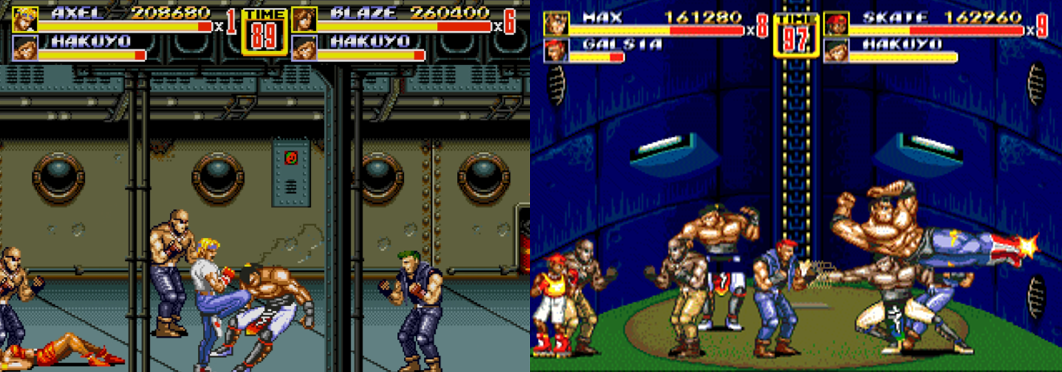
Game Corner [Superman Month]: Superman Returns (Xbox 360)


In 2013, DC Comics declared the 12th of June as “Superman Day”, a day for fans of the Man of Steel the world over to celebrate Clark Kent/Kal-El/Superman, the superpowered virtue of “Truth, Justice, and the American Way” who is widely regarded as the first ever costumed superhero. This year, I’m spending every Monday of June celebrating the Man of Steel as I expand Superman Day to “Superman Month“.


This review has been supported by Chiara Cooper.
If you’d like to support the site, you can do so at my Ko-Fi page.

Released: 22 November 2006
Developer: EA Tiburon
Also Available For: Nintendo DS, PlayStation 2, Xbox

The Background:
As I mentioned in my review of the film, Superman Returns (Singer, 2006) was supposed to be a pretty big deal for DC Comics, Warner Bros. and Superman in general. Absent from cinema screens since 1987, Superman had seen a fair amount of representation in videogames in the intervening years and ever since 1979, but the Man of Steel has had a difficult history with pixels and polygons and it’s not as if videogame tie-in to movies have an esteemed reputation. Add to that the fact that Superman Returns didn’t exactly impress critically and the videogame tie-in was off to a troublesome start before it even released. Developed by a subsidiary of Electronic Arts, EA Tiburon (who had developed a handful of sports-based games for the publisher) and incorporating a large open world version of Metropolis that required players to minimise collateral damage, Superman Returns received mostly negative reviews and Superman has continued to struggle with transitioning into a successful videogame adaptation.

The Plot:
Acting as part-prequel- part-midquel, and part-retelling of the events of the film, Superman leaves Earth to investigate the remains of his home planet, Krypton. There, he incurs the wrath of the tyrant Mongul and, upon returning to Earth after five years, finds his arch enemy, Lex Luthor, enacting a diabolical plot for revenge involving Kryptonian technology while also battling some of his most notorious villains.

Gameplay:
Superman Returns is an open-world action game that places players in the cape and tights of the Man of Steel, as portrayed by Brandon Routh in the movie of the same name. The main objective of the game is to defend the impressively-realised and expansive city of Metropolis from a variety of threats using Superman’s awesome powers, all of which are available to the player from the moment the game begins. By pressing Y, players can take to the skies and can even rocket away by holding the button down. While it is a bit disorientating once you’re in the air, it doesn’t take long to adjust to it and it can be quite a thrill to blast through the air and between skyscrapers at Superman’s full speed. By holding down the Left Bumper, you can speed through the sky, going faster and faster until everything around you becomes a blur and Superman breaks the sound barrier, however it can be very difficult to make tight turns and avoid flying head-first into buildings when going at full speed. You can land with Y and, when on the ground, sprint at superspeed by holding LB, which is equally unwieldy at times.

Rocket through the sky at breakneck speeds or blast enemies with Superman’s array of powers.

You can target enemies with the Left Trigger and attack enemies with, primarily, X; repeatedly pressing X and adding in presses of Y and A will see Superman pull off more elaborate combos to deal more damage, although there is a significant input delay when trying to perform combos (in a change from most games, it seems that you have to press each button deliberately rather than as quickly as possible). Superman also has the full scope of his superpowers available to use as well; these are assigned to the directional pad and activated with the Right Trigger and allow you to blast at enemies with heat vision, freeze them with Superman’s freeze breath, or put out fires with his superbreath. All of these can also be augmented by double-tapping the direction and can even be worked into your combos but be sure to keep an eye on the power meter, which will deplete as you use your superpowers and take some time to refill (though you can speed this up by flying up into the sky to bathe in the sun’s rays). One of the constant problems with Superman videogames is that, thanks to the prerequisite for character’s to have a health bar, the Man of Steel is often neutered or susceptible to damage and death rather than being the powerful, superhuman hero he is known to be. Superman Returns comes up with a truly inspired solution to this problem; not only are Superman’s powers restricted by a power meter, not only does he come up against powerful alien foes and robots that are able to bash him about like a ragdoll, but he must also ensure that Metropolis doesn’t suffer too much damage from the constant barrage of attacks that befall it.

In an ingenious twist, Metropolis takes damage in Superman’s place.

Enemies will attack civilians, set fire to buildings, and the environment is highly destructible, meaning that cars, trees, walls, and other objects and parts of the environment can be used as weapons or destroyed and, if the city is damaged too much, Superman will fail his mission and you’ll have to either restart the chapter or reload your last save. Replenishing Metropolis’ “health” can be quite a chore; you can pick up injured civilians (one at a time) and carry them to a specific ambulance to restore a bit of the city’s health but the best way to bump its health back up is to get rid of all the enemies or the threat in play or reload your last save. Unlike the vast majority of videogames, Superman Returns doesn’t appear to autosave after you complete objectives and missions; instead, you can/must manually save from the pause menu, which also lets you view Superman’s combos, statistics, and the experience points (XP) you’ve accumulated. XP is earned by defending Metropolis from incoming comets, burning buildings, and attacks from aliens, robots, and Cadmus’ monstrous creations; when you gain enough XP, Superman will level-up and his superpowers will automatically become more powerful as a result. Superman Returns features a nice little mini map on the bottom left of the screen that shows you where enemies and ambulances are located and Superman will pick up cries of distress and be able to see objective markers thanks to his super-senses. You can also view the entire city map by pressing the ‘Back’ button but this really isn’t all that helpful as no areas, secrets, or places of interest are highlighted and the only place you can fast travel to and from is the Fortress of Solitude.

Gameplay gets extremely tedious and frustrating very quickly.

Gameplay gets extremely repetitive very quickly and the game’s pace is all over the place; you cannot progress the story until you’ve defended Metropolis from a certain number of random attacks, which occur either so sporadically that you’re flying around aimlessly like an idiot or happen so often and have so many enemies that it becomes annoying. You cannot just fly away from these incidents and ignore them, either, as that’ll cause a game over but, even though you’re playing as frickin’ Superman, you often end up getting bashed all over the place by a barrage of attacks and are forced to mash buttons to get Superman’s useless ass back into the fight. A certain amount of strategy is required to take on enemies, who can race away across the city or are vulnerable to certain superpowers, but it all gets very frustrating and mind-numbing very quickly. Incidents where you have to blast meteors from the sky, put out fires, save citizens, or tackle incoming tornados help to break the monotony up a bit but they’re few and far between.

Graphics and Sound:
Similar to the movie it’s based on, Superman Returns makes extremely poor use of John Williams’ iconic Superman theme; in fact, the rousing “DUN-dun-dun-DUN-DUN” doesn’t appear at all in the game and is replaced by a very generic soundalike that really undermines the entire experience. Stars Brandon Routh, Kate Bosworth, and Kevin Spacey all return to lend their likenesses and voices but, sadly, like many videogame adaptations of movies, the game’s interpretation of the film’s events leaves out many of the characters and sub-plots from the source material and provides only a very basic recap of the film as story-based missions.

While the cutscenes look terrible, Superman’s character model is okay, especially when he’s flying.

Plus, while these actors do lend their likenesses, only Superman appears as an in-game character model. The game’s cutscenes are quite low-quality, very blurry, and extremely limited in their detail and length but, thankfully, Superman himself looks mostly okay. When you leave him standing around, he’ll strike a heroic pose (the camera even automatically changes position for the best possible shot) and NPCs will continuous be in awe of his presence, feats, or begging for his help. Superman looks best, however, when flying at high speeds; his head and neck seem a little disproportionate to his body and, like many Xbox 360 character models, he looks a bit more like a malformed action figure than an actual person with a logical skeletal structure. Superman ragdolls around when attacked and seems quite unwieldy at times as he’s both superfast but also clunky and his attacks are slow and have a limited range; additionally, there are some wonky instances of cape physics as well but, still, it’s probably the best rendition of the character in a solo videogame I’ve seen yet.

Metropolis may be big and impressive but it’s incredibly lifeless and empty.

Superman’s enemies aren’t exactly much to shout about either; indeed, it seems like the developers put all of their time and effort into creating a vast city for you to fly around in. However, considering how good a job Superman Returns does of recreating Metropolis, it’s quite a dull and uninspiring experience; although cars drive through the streets and non-playable characters (NPCs) wander around the place, the city feels extremely empty and lifeless and there really isn’t that much to do or see beyond iconic buildings like the Daily Planet and areas such as Suicide Slum. Metropolis may be very grey and barren at the best of times but you can damage and interact with a fair amount of it (which is actually to your detriment as it’ll cost the city health) and the environment does change at the start of the game, where you fight Mongul and his warriors on Warworld, and in the final chapters when the city is bathed in an ominous darkness and a tumultuous thunderstorm but you never get to go inside any buildings or freely visit other environments so it all becomes very underwhelming and boring very quickly.

Enemies and Bosses:
There are three types of enemies Superman will have to defend Metropolis against: the alien forces of Mongul, killer robots created and controlled by John Corben/Metallo, and the various monstrous clones created by Cadmus. As you play though the game’s story, you’ll encounter each of these, and their many variants, in successive fashion and, by the end of the game, entire groups of different enemies will attack the city and its inhabitants. For the most part, enemies fall into some recognisable tropes no matter their appearance, being susceptible to heat vision or freeze breath or more vulnerable against objects (such as cars and debris) being thrown at them. Some are smaller and faster, zipping around on the ground or flying through the air and firing Kryptonite lasers, energy blasts, or elemental plumes at you; others are larger, requiring more combos to damage or blocking your attacks; and others will directly attack the environment to distract you with fires and such.

Bosses like Overcast and Metallo eventually grow to gigantic proportions.

You’ll learn the basics of combat at the start of the game, where Mongul forces you to fight his minions, Phalanx and Overcast, before taking you on himself. This teaches you how to engage with multiple enemies, use the environment to deal damage to gigantic enemies, and the importance of holding B to block or pressing B to quickly dodge behind opponents. Each group of enemies you face from that point on is directly related to the main villain who serves as the recurring and final boss of that particular chapter; thus, when trying to put a stop to Metallo, you’ll first have to stop his robot minions from attacking the city. Complete enough of these missions, and Metallo will spawn into the map and you can fight him; similar to the enemies you battle on Warworld, Metallo attacks by pummelling you, blasting you with a massive Kryptonite laser, shielding himself like a bitch, and spawning in minions to distract you. Like Overcast, Metallo eventually grows to enormous proportions and begins trashing the city, forcing you to hurl cars at him. Once you deal enough damage, he’ll try to destroy the city with a missile, necessitating that you chase after it and complete a quick-time event (QTE) to stop it and bring him down once and for all.

Unless you use your powers in the right way, Bizarro and Riot can be a right pain in the ass.

Next, a breakout at Cadmus Labs sees a whole slew of vicious, demonic monsters roam rampant around the city, attacking blimps and causing massive damage with their big explosive attacks. As if that wasn’t bad enough, Superman’s flawed doppelgänger, Bizarro, is also running rampant; compared to Brainiac, Bizarro is a much easier fight as it’s much simpler to avoid his lumbering attacks and land some combos on him. To put him down for good, however, you’ll need to chase after him and ram into him to stop him destroying the city with his heat vision and complete another QTE in a test of heat vision, all while desperately trying to fend off swarms of flying monsters who pummel you relentlessly. That’s nothing, however, compared to fighting Frederick von Frankenstein/Riot, who duplicates himself every time you land a melee attack and can only be defeated by blasting him and his doubles with your freeze breath and then your heat vision, which can get very tedious.

After taking out Mongul, you’ll battle Superman’s ultimate nemesis: a giant tornado!

In the game’s final chapters, Mongul arrives on Earth looking for revenge, bringing with him an army of Phalanx warriors and Overcast, with all three spawning into the map at inopportune times to cause massive amounts of damage. Battling Overcast’s gigantic form while also juggling an endless swarm of Phalanx warriors and contending with Mongul is a hell of a tall order but, thankfully, you can (and totally should) focus on Mongul alone in order to compete this story mission and can worry about the rest later. The opening of the game teaches you that Mongul is a cheap bastard who likes to constantly block your attacks and that’s true in the endgame as well but he’ll also attack citizens and cars and spawns in more and more minions the more damage you do. Personally, I found it easier to just keep throwing cars at him until he goes down. Ultimately, the game concludes with a series of deadly tornados threatening the city; you must blow and freeze them away, put out the fires they cause, and rescue citizens from their path before contending with Superman’s most deadly and iconic foe…a giant tornado! To dispel this swirling mass of destruction, you must blast its core with either your heat vision or freeze breath all while cars and debris relentlessly slam into you but, with enough patience, it’s pretty simple to bring this chore of a game to a close.

Power-Ups and Bonuses:
There’s nothing. Seriously, you fly all over the city fighting bad guys and righting wrongs and there’s literally nothing. The only way you can replenish health is to rescue citizens, stop whatever the current threat is, or reload your save and the only tangible power-up you get is from levelling-up. Unlike most videogames, you can’t freely spend your XP upgrading Superman’s skills individually, though; instead, his powers increase automatically, taking all agency and effort out of your hands entirely.

Additional Features:
Superman Returns has a whopping eighteen Achievements for you to earn; six of these are directly tied to defeating the game’s villains and finishing the story, while there are others for fully powering Superman up, defeating enemies with cars, lifting a certain amount of weight, or playing the game for twelve hours total (as if you’re ever going to bother doing that…). Sadly, despite the size of the city, there aren’t any fun Achievements tied to, say, knocking the globe off the Daily Planet or finding all the Planet Krypton restaurants or even finding much of anything for that matter.

Rescue kittens, race against Mr. Mxyzptlk, or cause destruction as Bizarro!

That’s not to say that there isn’t nothing else to do in the game; there are a hundred kittens hidden throughout the city that you can find for an Achievement and, at various points around the map, you’ll encounter Mister Mxyzptlk who’ll challenge you to completing increasingly-challenging races against him. These are quite fun but by far the most entertaining side mission are the instances where you get to play as Bizarro and cause as much damage as possible in a time limit. You can input some cheat codes to make the game easier but you won’t earn any Achievements (except for a 0G one) if you do this. As you play and level-up and explore, you’ll also acquire trophies to view in the Fortress of Solitude and unlock a couple of additional suits for Superman, which is nice, but there’s really not much to entice you back to this game once you’re done trudging through this God-awful borefest.

The Summary:
Superman Returns may very well be the most accurate and impressive Superman game I’ve ever played; being able to fly through and across an impressively-rendered recreation of Metropolis is a real blast and giving the city a life bar instead of Superman was an ingenious solution to the problem of having Superman take damage or be killed when he really shouldn’t be. Sadly, though, these aspects are the only real saving graces of this game, which is clearly a rushed cash-in produced solely to tie-into the movie. The story is basically nonexistent, the combat and gameplay extremely repetitive and boring, and the presentation is wildly inconsistent as, while the city and Superman look pretty good, the cutscenes and music and dreadful. In the end, only die-hard Superman fans will really be able to enjoy this one and, for the rest of us, it’s just a quick game to plough through to increase your Gamer Score that is more monotonous and frustrating than fun and entertaining so I’d say that it’s best avoided.

My Rating:

Rating: 1 out of 5.

Terrible

Have you ever played the videogame adaptation of Superman Returns? If so, what did you think to it? Did you enjoy the wide, open world of Metropolis and the feeling of having Superman’s full abilities at your fingertips? Were you also disappointed by how empty the world is and how tedious the gameplay was? Which of the game’s villains was your favourite and why and what did you think to how the game expanded upon the plot of the film? What is your favourite Superman videogame and would you like to see something like this tried again but with a bit more time, effort, and money put into it? How did you celebrate Superman Day this year and what are some of your favourite Superman stories?

Game Corner [X-Men Day]: X-Men: The Official Game (Xbox 360)


To commemorate, the culmination of their long-running and successful X-Men movies, 20th Century Fox declared May 13th as “X-Men Day”, a day to celebrate all things Mutant and X-Men and celebrate Marvel’s iconic collection of superpowered beings who fight to protect a world that hates and fears them.


Released: 16 May 2006
Developer: Z-Axis
Also Available For: Game Boy Advance, GameCube, Nintendo DS, PC, PlayStation 2, Xbox

The Background:
Ever since Stan Lee and long-time collaborator Jack Kirby created the X-Men in 1963, Mutants have featured prominently in Marvel Comics and grew to greater mainstream prominence thanks to the influential animated series from the nineties, the success of which led to 20th Century Fox purchasing the film rights and producing a successful long-running live-action franchise. The X-Men have also have a storied history in pixels and polygons; the Mutant team first came to life on the Nintendo Entertainment System in what was essentially a vertical shooter, but the characters arguably saw the most success in their numerous arcade ventures and team-based brawlers. To coincide with the release of X-Men: The Last Stand (Ratner, 2006), publisher Activision was tasked with creating a tie-in videogame to be released across all available platforms and bridge the gap between X2: X-Men 2 (Singer, 2003) and the third entry. However, just as X-Men: The Last Stand was critically panned, X-Men: The Official Game failed to impress with its poor enemy A.I., repetitive gameplay, and for being little more than a shameless cash-in.

The Plot:
Still reeling from the death of Doctor Jean Grey, James “Logan” Howlett/Wolverine, Bobby Drake/Iceman, and Kurt Wagner/Nightcrawler battle radical terrorist group known as Hydra and their gigantic, Mutant-hunting Sentinels, encountering some of their worst enemies in the process.

Gameplay:
X-Men: The Official Game is a third-person action game with three distinct gameplay styles split across its three playable characters, Wolverine, Iceman, and Nightcrawler, who embark on an adventure that takes place soon after the events of X-Men 2 and fills the gap between that film and X-Men: The Last Stand to explain why Nightcrawler is missing from the team in the third movie. While the levels in X-Men: The Official Game are pretty linear, the developers furnished players with a helpful mini map which indicates friendly non-playable characters (NPCs), enemies, and points you in the direction of your next objective/s. There are a few branching paths you can sometimes take, either by smashing through walls and windows as Wolverine or teleporting to higher areas as Nightcrawler, but these generally just lead to a collectible and it is actually pretty easy to get turned around as everything looks very similar. Although each character has a distinct way of playing, there are some similarities between all three: both Wolverine and Nightcrawler can jump with A and dish out attacks and combos with X and Y, Nightcrawler and Iceman can both target foes with the Left Trigger, and all three will automatically heal from minor wounds (though Wolverine and Nightcrawler and able to dramatically speed this up by holding the Left Bumper or pressing the Right Bumper, respectively, whenever it’s safe to do so, though any movement at all will cancel out this healing boost).

Slice through enemies as Wolverine, teleport about as Nightcrawler, and slide around as Iceman.

Wolverine’s gameplay is very much that of a hack-and-slash brawler; however, fans of genre-defining titles like the God of War series (Various, 2005 to present) will be left disappointed as Wolverine is quite a clunky and limited character thanks to the presentation and camera angles offered by this game. With a tap of LB, Wolverine can sheath and unsheathe his claws (which is more of an Easter Egg than anything), which he can use to slash at the multitude of minions who come charging at him in any given level. Using combinations of X, Y, and B (which pushes enemies away), Wolverine can string together some basic combos; he can also block incoming attacks by holding the Left or Right Trigger (and you can flick the analogue stick while blocking to pull off an awkward dodge roll to try and get away from sticky situations), and successfully landing attacks will build up his “Fury Meter” which, when full, powers up your attacks and healing for a short time with a press of the Right Bumper. Nightcrawler has similar capabilities in combat, but his levels are much more focused on platforming with his signature teleport and a bit of semi-stealth. Nightcrawler can also string together punches and kicks for combos, but you’re best served using his relocation attack; pressing B sees him automatically teleport behind the nearest enemy to pummel them with X or smash them with Y, which is great for taking out groups of enemies quickly. RT allows Nightcrawler to teleport to a variety of surfaces, from pipes to bridges and walkways, and is great for quickly traversing areas and getting to consoles or control panels which need rewiring with X. Of the three, Iceman is the most unique as he’s constantly moving forwards on an ice slide and his levels play much more like chasers or dogfight simulators. Holding A lets Iceman boost ahead, while RT brakes and RB allows him to flip around quickly to retarget enemies. X unleashes an ice beam, which is great for freezing up pipes or putting out fires, while B tosses out his Hailstorm attack and Y puts up a temporary frost shield. You’ll need to constantly tap LT and B when faced with multiple targets, but Iceman’s levels are much more geared towards preventing catastrophes or reaching a goal and are often accompanied by an anxiety-inducing time limit.

Whether you’re fighting a gauntlet, repairing consoles, or facing a time limit, things get very tedious.

The game’s story mode is laid out in a linear mission-based structure; at various points, the narrative branches off to follow each of the three characters and, prior to starting a mission, you can pick from three difficulty settings: “Novice”, “Hero”, and “Superhero”. These will dictate how tough the enemies are, with enemies on “Superhero” able to whittle your health to nothing in just a few hits or under sustained gunfire, but there are perks to completing the mission on higher difficulties as you earn more “Mutation Evolutions” on these settings. These power-up each character’s stats, raising such attributes as their overall health, the damage their attacks deal, and their health and energy recovery, and the only way you’ll only be able to max out your abilities is by beating every mission on “Superhero” mode. This, however, is easier said than done; the game is very stingy with its checkpoints, meaning that failure to complete some of the game’s more monotonous tasks requires you to start the mission over right from the beginning. Following glorified training missions for each character, you’ll be thrust into the game’s story mode and, very quickly, will see everything X-Men: The Official Game has to offer. Wolverine will pretty much always be tasked with clearing away all enemies, with wave upon wave teleporting in or rushing in through doors, though he sometimes has to dodge hazards such as flaming vents and cages or destroy something in order to progress. Nightcrawler almost always has to teleport about the claustrophobic environments, activating panels or rewiring stuff, and occasionally luring exploding probes to power nodes or Sentinels to open doors. Iceman is either racing towards something or fending off attacks, often against a time limit; this means you’ll be dousing fires and cooling down nuclear reactors with your ice beam or chasing down an enemy or towards a goal before time runs out. Occasionally, another X-Men appears to help out; Ororo Munroe/Storm accompanies Wolverine and Nightcrawler you can have her instantly kill all enemies with her lightning by pressing in the left stick, while Nightcrawler also has to deactivate shields so that Piotr “Peter” Rasputin/Colossus can destroy some power generators, but Iceman has no such help when desperately trying to stop Giant Sentinels from marching on the downed X-Jet. Sometimes Iceman will have to slide through “nav points” (essentially glorified rings) and avoid laser hazards and mines, sometimes Wolverine’s locked in a room and forced to fight a gauntlet of enemies, and sometimes Nightcrawler has to destroy glowing crystals to keep enemies from spawning, but it’s all very repetitive and your objectives tend to be to do something once and then repeat it three or four times until the mission abruptly ends.

Graphics and Sound:  
In all honesty, X-Men: The Official Game doesn’t look all that bad; the in-game graphics are pretty decent, with stylistic versions of the film characters well represented for the most part, though the range of animation offered by the three is somewhat lacklustre. Of them all, Nightcrawler looks the best; I love his little coat and how he spins around on poles with a flourish and sometimes gallops on all fours, and it’s a stark contrast to Iceman, who is either relatively static due to his gameplay or ragdolling all over the place when knocked from his slide. Wolverine looks good, but his gameplay is tedious and clunky and severely hampered by the lack of a lunge attack, though he does gain some extra animation frames when in Fury Mode or trying to pounce on larger enemies. The game’s music is pretty decent; it’s mostly all ripped from X-Men: The Last Stand, and many of the film’s cast return to voice their respective characters. In fact, the vocal work may be one of the best things about this game; it’s great hearing Hugh Jackman and Patrick Stewart not only reprise their roles but do it without the lifelessness and boredom that so often accompanies videogame tie-ins.

While the game’s later locations become more visually interesting, the cutscenes are a cheap let down.

Sadly, the same praise can’t be levelled at the game’s environments and cutscenes. Cutscenes are accomplished using a motion comic aesthetic not unlike those employed at various points in games by NetherRealm Studios; these painted pictures have a very limited range of movement, no lip synching, and the cutscenes come off as cheap and rushed and quite unsightly as a result. The in-game environments are okay, but disappointingly bland; the whole game makes a clear effort to evoke the grey, grounded, semi-sci-fi aesthetic of Singer’s films but there’s generally not really much to see since areas are so linear and empty. You’ll get to fight on the Statue of Liberty in a call-back to the first film and revisit the surprisingly unflooded Alkali Lake facility from the second film and the Weapon X laboratory, all of which are very well realised interpretations of the film locations but are so grey and drab that even cheeky references to Wade W. Wilson/Deadpool can’t save them. Thankfully, once the game gets away from recreating areas from X-Men 2, locations become a bit more visually interesting; the Sentinel factory is great, with a massive Sentinel head looming in the background, as are the colourful levels that take Wolverine to an elaborate Japanese palace and garden grounds, but the game really shines once you get into the Master Mold’s control centre, a gigantic airship full of electrified wires and ominous dread that evokes the Borg Cube. Iceman’s chase through the streets of Hong Kong is similarly a visual spectacle thanks to the neon signs, bridges, and skyscrapers, all of which helps to really elevate the game’s presentation after the first few drab missions and despite the tedious gameplay.

Enemies and Bosses:
With such varied and colourful characters as the X-Men and the Brotherhood to work with, it’s no surprise that the developers chose to mainly have you wade through an endless supply of generic and boring Hydra thugs. These guys come packing machine guns, electrified axes and lances, and claws and can mostly be taken out with some quick combos but some will block your attacks. For Wolverine, things get a little more interesting as he gets to battle the Hydra “Wind Unit” (who are basically ninjas with two katana), while Iceman is often blasting at smaller Sentinels or fire dragons conjured by John Allerdyce/Pyro. Nightcrawler will also have to deal with Sentinels but he can only take them out by teleporting to them and luring explosive drones to them before the robots can blast him off with a shockwave. Later, Nightcrawler is placed in a nightmarish illusion by Jason Stryker and forced to battle off teleporting demonic entities, and you’ll also encounter Hydra goons packing bazookas and heavy cannons in some levels. For the most part, the enemy AI is pretty dumb; they’ll easily lose track of you and won’t think to go around certain obstacles, but in wider, more open areas they can be incredibly annoying and persistent, catching you in a crossfire or swarming around you to deplete your health in seconds while you desperately try to escape to safety.

No matter who Wolverine faces, the same hit-and-run tactics will always serve you well.

Each character also has to deal with a number of bosses, with some fought multiple times in different forms. During Wolverine’s first training mission, you’ll battle against Victor Creed/Sabretooth to learn the basics of combat; Sabretooth makes a return as the final boss of the game, too, where he’s fought within the decaying remains of the Master Mold facility and significantly more powerful even against your upgraded stats. Sabretooth charges at you with a shoulder barge, can hit slow but powerful combos, grabs and lunges at you, and even has his own Fury Mode that speeds him up and makes him more aggressive. Still, the best thing to do is to avoid his attacks, hit a quick combo, and then stay out of his reach to build up your Fury Meter before unleashing it (avoiding pressing Y as this lunge isn’t effective against him) to whittle down his health bar. Halfway through the fight, Sabretooth flees to a lower level, where debris is a concern for both you and him, and you’ll also have to worry about his health slowly replenishing if you take too long, but he’s not especially difficult to put down. Yuriko Oyama/Lady Deathstrike makes a return in this game and you’ll battle her a couple of times, too; the first time you fight her, it’s within the eye of a hurricane and you have to be careful of being blasted about by the winds while also pushing her into the hazard, and the second time is within a Japanese temple and forces you to fend off waves of enemies between rounds. Still, Lady Deathstrike may be faster and nimbler than Sabretooth, but the same hit-and-run tactics work well against her and it’s much easier to get her trapped in a corner and just go at her full pelt until she goes down. Wolverine’s toughest foe is easily the Silver Samurai; this hulking armoured bastard can teleport about, has great reach with his broadsword, doesn’t get stunned by your attacks, and can send out both energy blades and electrified shockwaves and forces you to fight his minions between bouts. Once again, simply run or dodge about to avoid the brunt of his attacks and build up your Fury Meter and then just tank him as he’s a bit of a damage sponge and can easily cut you down with just a few swipes of his sword.

Nightcrawler and Iceman generally have to fulfill other objectives while fighting their bosses.

Nightcrawler only gets one boss to fight against, but it’s one of the more frustrating ones in the game; while on the rainswept Brooklyn Bridge, he and Storm must fend off clones of James Madrox/Multiple Man while teleporting about the place and defusing his many bombs against a time limit. Afterwards, Nightcrawler has to battle him alone and more directly; the “prime” Multiple Man will occasionally set an explosive charge and, if enough of them go off, the bridge will be destroyed and you’ll lose the mission but try and disarm them and you’ll be beaten to death in seconds by his ceaseless doubles. Your best bet is to stay on the move, dashing to safety and healing when you can, and hoping that he doesn’t set any of these charges (or quickly interrupt him before he can). The hardest thing about this battle, though, is actually dealing damage to Multiple Man; he seems either impervious to your attacks or only hurt after you take out his clones, which can be hard to do as they swarm around you, making for a boss battle more about luck than anything. Iceman primarily battles against Pyro; first, Pyro tries to burn down and destroy a fission plant, then he tries to overload a nuclear reactor, and then he conjures  a gigantic fire serpent to target the toxic waste canisters. If enough of these are destroyed, the mission ends so make sure you’re rapidly switching target locks and throwing out your Hailstorms to take out the fire dragons. The serpent itself is also quite a damage sponge, and can set you ablaze if you get too close, but if you power-up Iceman’s Hailstorm attack that makes things a lot easier. Definitely his hardest challenge is stopping a seemingly endless army of Giant Sentinels from destroying the X-Jet in Hong Kong; these huge armoured hulks can only be destroyed by targeting six yellow power nodes, but the ones on the front are super hard to hit not just because of aiming difficulties but also because of their high-powered lasers. Destroy one, and another drops soon after, and another, and this was the first mission where I actively had to drop the difficulty down to “Novice” to get past it and even then it was a pain in the ass!

Power-Ups and Bonuses:
Unfortunately, there are no collectible power-us available here. Wolverine and Nightcrawler can built meters (either by landing attacks or waiting for it to charge, respectively) to speed up their healing but the closest Iceman gets is destroying Sentinels to gain extra time until fifteen are taken out. As mentioned, Storm and Colossus will accompany you for some missions; Storm can unleash her lightning, but you’ll need to wait for her meter to fill up too, and you’ll also need to get back to help Colossus fend off the Hydra goons before they deal too much damage to him.

Additional Features:
There are sixteen Achievements up for grabs here, with three insulting 0G Achievements awarded after clearing each character’s training mission, three more being rewarded for completing the story mode’s three vaguely defined acts, and three more earned after fully upgrading each characters Mutations. You’ll no doubt notice a few collectibles in each level of the game; every mission hides five Sentinel Tech files and one Weapon X file, and collecting all of these for each character will award another three Achievements and also unlock a bonus costume for each character and a “Danger Room Challenge” for each. Unfortunately, while these collectibles aren’t too difficult to find even without a guide, the rewards you get are pretty pathetic; the costumes are little more than street clothes variants and just having one each is more than a disappointment, it’s a travesty. The Danger Room Challenges amount to timed obstacle courses and challenges used to test your character’s gameplay and abilities, but you earn nothing for completing them so there’s no point in them even being there. Aside from all that, your only other option is to try and beat every mission on “Superhero” to fully upgrade every character, something you won’t really be motivated to do since the gameplay is so uninspiring that even the promise of cutting down goons dressed in Wolverine’s signature wife-beater won’t be incentive enough to ever play this game again.

The Summary:
I tend to go into movie tie-in videogames with pretty low expectations; while I’ve played a fair amount that are pretty good, there’s no denying that they’re generally very rushed, lacking in content, and don’t have a lot going for them. On the plus side, they can sometimes be quite cheap and have some easy-to-snag Achievements, and that’s basically what you’re getting here with X-Men: The Official Game. There’s some decent stuff on offer here; Nightcrawler, especially, is pretty fun to play as and I enjoyed teleporting about the place and pummelling enemies with his attacks, and even Iceman was quite fun in the few missions where you weren’t forced to battle against an arbitrary time limit. Sadly, and most confusingly, it’s Wolverine’s gameplay that really drags this one down; he’s very restricted in his offense and the lack of checkpoints really makes getting through some missions, but especially his tedious gauntlets, a frustrating chore. Awful cutscenes aside, the presentation is pretty good; the game makes a decent attempt at recreating iconic locations from the first two films while infusing a more comic book aesthetic and storyline into the movie timeline, but locations are far too bland and repetitive to really be all that interesting, even in the latter parts of the game. Bosses battles are equally uninspiring; thanks to Wolverine getting the bulk of them, they’re hardly a selling point of the game’s few strengths and, overall, there are far better superhero and action videogames out there for you to put your time into. A serious lack of options, unlockables, and replayability hamper this title; while it’s not too difficult to blast through it in about four to six hours, it’s unlikely you’ll be motivated to try and get everything you miss the first time around and, despite a few entertaining aspects, it remains a cheap cash grab designed solely to leech off the popularity of Fox’s X-Men films rather than actually trying to be an entertaining videogame experience in and of itself.

My Rating:

Rating: 2 out of 5.

Could Be Better

Did you enjoy X-Men: The Official Game? Which of the three characters was your favourite? Did you enjoy the game’s effort to bridge the gap between X-Men 2 and X-Men: The Last Stand? Which of the game’s missions and bosses was your favourite and do you feel like Sentinels are a little overdone in Marvel games? Did you ever fully upgrade the characters and find all the collectibles? Were you disappointed by the lack of options and unlockable extras? What’s the worst (or best) videogame tie-in you’ve ever played? Which X-Men videogame is your favourite and how are you celebrating X-Men Day today? Whatever you think about X-Men: The Official Game, and X-Men in general, feel free to share your thoughts below.

Game Corner [Crossover Crisis]: Mortal Kombat vs. DC Universe (Xbox 360)


In April 1985, the first issue of the ground-breaking Crisis on Infinite Earths (Wolfman, et al, 1986) released and saw the temporary destruction of the “Multiverse”. To celebrate this momentous event, I’m discussing multiversal crossovers all throughout April in an event I dubbed “Crossover Crisis”.


Released: 16 November 2008
Developer: Midway Games
Also Available For: PlayStation 3

The Background:
Mortal Kombat (Midway, 1992) stood out from the competition at the time with its focus on gore and violence and unique digitised graphics; the game was a massive success for Midway and the first real competition for Street Fighter II: The World Warrior (Capcom, 1991) in arcades and on home consoles. However, while the franchise went from strength to strength during the 2D era of gaming, Mortal Kombat struggled to find a footing in the emerging 3D fighter arena, leading to the developers desperately trying to be innovative and appealing in an increasingly competitive business. Since Capcom had seen some success with crossovers with Marvel Comics and other fighting game developers, Mortal Kombat co-developer Ed Boon scrapped plans for a back-to-basics reboot of his violent fighting series in favour of a crossover with DC Comics. While incorporating popular DC characters like Bruce Wayne/Batman and Clark Kent/Superman had the potential to broaden Mortal Kombat’s mainstream appeal, the license carried many restrictions for the developers; Mortal Kombat vs. DC Universe was hampered by a “Teen” rating, which substantially neutered the series’ trademark violence. This, as much as anything, greatly contributed to the game’s mediocre reception; while some found the title surprisingly enjoyable, despite its bonkers premise, others found the gameplay and variety frustratingly tedious. Although the game received a “Kollector’s Edition” release, this was Midway Games’ last project before they went bankrupt and plans for downloadable content were subsequently scrapped. Thankfully, this wasn’t the final nail in the coffin for the franchise; the association with DC’ s parent company, Warner Bros, saw Midway being purchased by Warner and restructured into NetherRealm Studios, and the ultra violent was not only soon back on track but the new studio also eventually found success with the DC license in a separate series of fighting games.

The Plot:
After Raiden and Superman repel invasions from both their worlds simultaneously in their separate universes, villains, Shao Kahn and Darkseid are unexpectedly merged into “Dark Kahn” and the two universes to begin merging, with catastrophic events. With characters from both universes wildly fluctuating in power, representatives from both worlds come together to stop the merger by any means necessary.

Gameplay:
Mirroring the style and presentation of its mainline series, Mortal Kombat vs. DC Universe is a 2.5D fighting game in which players pick from a roster initially comprised of twenty fighters of iconic characters from both franchise’s and battle through the game’s single-player story mode, fight one-on-one against another player or computer-controlled opponent, battle their way through an arcade ladder, or take on a series of increasingly difficult combo challenges. By default, fights take place in a best-of-three format and against a time limit but you can alter these settings (and many others, including the game’s difficulty and the use of blood) in the game’s main options menu to speed up gameplay or make it more accessible to you. Rather than employing different fighting styles and weapon combat like its predecessors, or properly incorporate different variations like in the later games, Mortal Kombat vs. DC Universe takes a very barebones approach to combat and gameplay options: controls are fully customisable but, by default, you can throw with X or Y, kicks with A or B, toss them aside with a generic throw with Left Bumper, block incoming attacks by holding the Right Trigger, dash towards (but not away from) your opponent, jump in or crouch down to attack or avoid incoming attacks, and string together combos by quickly pressing the attack buttons alongside directional inputs. The game includes a practice mode to help you get to grips with this, and a “Kombo Challenge” feature that helps you practice the game’s tricky combo system, but you can bring up your fighter’s moves at any time by pausing the game. It has to be said that combat is quite a hurdle here; you’ll sometimes jump or dash when you don’t mean to, even when using the directional pad, jumping punches can be very floaty and often miss, and the game seems weighted in the CPU’s favour even when playing on the easiest setting as they have no difficulty pulling off some of the ridiculous combos on offer here.

Unleash your Rage, pummel opponents in Free-Fall, or smash them through walls.

Each fighter can pull off a number of unique special moves with simple button and directional inputs (back, back, X, for example, or left, down, B); while these can be stringed together with combos, they can’t be enhanced like in subsequent games as your “Rage Meter” only allows you to pull of the ever-annoying breakers to interrupt combos and attacks when filled to the first tier and activate the game’s “Rage Mode” by pressing RT and LT at the same time. This will put you into “Rage” mode, which powers up your attacks and coats you in a glowing armour that weakens the damage you receive, shrugs off projectiles, and keeps you from being stunned or knocked over. This doesn’t last for very long but it can easily make short work of your opponent, and activating it will even see you unleash a burst of energy that knocks your foe away, so properly timing the burning of your Rage Meter can snatch victory from the jaws of defeat. The game also features a few unique gameplay mechanics: if you grab your opponent with the Right Bumper , you’ll activate “Klose Combat” mode, which sees you pummelling or breaking your opponent’s limbs with successive presses of the face buttons. They (and you) can counter these attacks by pressing the right button at the right time, and these quasi-quick-time events (QTEs) also crop up in the “Free-Fall Kombat” and stage transition moments. In some stages, you can send your opponent plummeting down to a new part of the arena; while in free fall, you can mash different face buttons to deal damage and finish them off with RB, but they’ll turn the tide against you if they hit the right buttons. Similarly, some stages allow you to charge your opponent through a way, whereupon you’re asked to “Test Your Might!” in a tug-of-way style button mashing sequence that inflicts more damage the more of the bar you manage to fill. These mechanics can be fun ways to spice up the somewhat lacklustre in-game combat and definitely open up the otherwise bland and empty arenas a bit more since you can literally smash your opponent to new areas, but they’re a far cry from the stage transitions seen in the Injustice series (NetherRealm Studios, 2013 to present).

While you can get up close and personal with foes, the dull finishing moves will leave you disappointed.

Sadly, that’s about it for in-game options; some stages very destructible elements you can smash into, and all of the game’s characters sport special moves befitting of them (Sub-Zero’s ice blast, for example, and Bruce Wayne/Batman’s Batarangs) but, since the game is hampered by a lower rating, there is very little blood and none of the gore you’d expect from a Mortal Kombat. That’s not to say that Fatalities aren’t present, however, they’re just…what’s the word..?…oh yes! Shit. Unlike in subsequent games, you can’t view your character’s finisher inputs from the pause screen, which makes finishing your opponent a real chore, but very few of these moves are even worth your time pulling off. All of the Mortal Kombat characters can execute two Fatalities that will see them murder their opponent in the most PG way imaginable; while some leave the opponent an exceptionally dry and clean skeleton, most boil down to you simply stabbing, shooting, or crushing them with very little bloodshed. The more morally pure DC superheroes will opt to finish their opponent with one of two “Heroic Brutalities”, though many of these would no doubt leave the foe severely crippled or dead since we see the likes of Clark Kent/Superman driving them into the ground and Barry Allen/The Flash pummelling them at superspeed. Unlike in previous (and subsequent) Mortal Kombat videogames, there are no mini games to distract you and is no in-game currency to earn, no player profile or fighter card to customise, and no Krypt to explore to send your coins. There aren’t even alternate skins for the fighters beyond a very minor palette swap when choosing the same character, and the best the game offers is allowing you to view bios, character models, and endings in the “Extras” menu, all of which makes for a very stripped down title even compared to its predecessor, Mortal Kombat: Armageddon (Midway Games, 2006).

While there’s not much to the arcade mode, the story mode is decent enough, if limited and tedious.

This also means that there are no challenge towers or option combat modes like “Test Your Luck” or tag-team combat to spice up multi-player gameplay; you can play locally or online (well, I assume you can’t do this latter any more) in ranked and “King of the Hill” style matches but the arcade ladder is a standard, ten-fight challenge where the extent of the game’s variety is offering you the choice between facing all Mortal Kombat or all DC Universe opponents or a mixture of the two. Mortal Kombat vs. DC Universe does, however, feature a single-player story mode but, strangely, it only allows you to play as up to eight characters from either side. After picking either the Mortal Kombat or DC Universe story, you’ll take control of a specific character and battle anywhere from three to five opponents as part of the campaign. This remains a great way to familiarise players with the vast majority of the game’s fighters and their unique combos and special moves, but you cannot perform finishing moves when playing the story mode. Although you can’t skip any of the cutscenes, or jump to specific chapters and fights after completion, you can save and quit…which is definitely something, though the game’s difficulty can become frustrating as the computer-controlled characters love to block your attacks, uppercut you out of nowhere, and jump-kick you out of the air, and can seemingly juggle you in an inescapable combo at will! Unlike in later NetherRealm Studios games, the story mode is as basic as it gets; the only time it actually tries anything remotely different is during Major Jackson “Jax” Briggs’ chapter as you’re forced to battle Diana Prince/Wonder Woman without your machine gun, which means you’re robbed of on of your ranged attacks. If you’re defeated, you have ten in-game seconds to choose between continuing and quitting, which is true of the arcade and two-player bouts as well. Unfortunately, winning or losing in two-player mode simply dumps you back to the fighter select screen and, as far as I could tell, there isn’t even a way to select your stage let alone input Kombat Kodes or activate anything interesting to make the fights less of a chore.

Graphics and Sound:
Mortal Kombat vs. DC Universe looks pretty good, for the most part; the character models are very similar to those seen in Mortal Kombat (NetherRealm Studios, 2011), meaning they hold up about as well, but some suffer more than others. Women, for example, look particularly off; sure, it’s great seeing Selina Kyle/Catwoman’s amply cleavage and Lieutenant Sonya Blade’s nipples poking through her top, but they’re all impossibly sexualised and their hair is very blocky and static. Unlike later NetherRealm Studios offerings, character’s don’t have unique intros or dialogue with each other before a fight; the camera simply pans the arena and zooms in to find the combatants ready to go and, while they do have little animations between rounds, these don’t seem particularly unique to any fighter. Post-fight animations are a little more unique, but there’s a definite lack of variety and character in each fighter which reminds me of the cut-and-paste job seen in Mortal Kombat: Armageddon (with the exception of the Joker, who dances and prances all over the place at every opportunity). On the plus side, characters do take battle damage; you’ll see their clothes rip, blood and bruises form on skin, and even uncover Scorpion’s skull as inflict damage on your opponent, which is fun, but the lack of any alternate attires or skins is a major tick in the “Con” column for this barebones title.

Stages are quite bland, but character models and cutscenes are okay, save for the poor endings.

There are some other notable little details on offer, however; when you toss Kano’s dagger at an opponent, it’ll stay stuck in their chest for a bit, you can sheath and unsheathe Baraka’s arm-claws with a press of B, you’ll see Sub-Zero’s icy breath, and there’s even a reference to Star Trek II: The Wrath of Khan (Meyer, 1982) thrown in for good measure. Another thing in Mortal Kombat vs. DC Universe’s favour, however, is that the CGI cutscenes are basically indistinguishable from the in-fight graphics; while the character models might be a little less detailed than in later games and have that action figure sheen that is common in this generation of games, it’s still impressive that there’s little distinction between the two, though the voice acting leaves a lot to be desired (the DC Animated Universe this is not!) and there’s very little to inspire you in the soundtrack, either. Similarly, stages are quite a let-down; the majority of them have this half-and-half theme going on where the DC Universe is split or merging with that of Outworld, NetherRealm, or Earthrealm but, even with that, there’s hardly anything to see or do and the stages are disappointingly bland and empty considering how big they are and the fat that you can navigate them in a 3D space. The likes of Oa, Themyscira, and the Fortress of Solitude probably stand out the most and have a few things to see in the background, but there’s a distinct and disappointing lack of Easter Eggs and visually interesting stages. Probably the most interesting one is the asteroid stage that sees you transitioning above and below thanks to the messed up gravity, but the game continues to bug me with presenting all these passable CGI cutscenes and relegating the arcade mode endings to a series of still pictures with narration.

Enemies and Bosses:
Since this is a fighting game, every character will inevitably be your enemy at some point so it can be useful to get an idea of what each one is capable of by playing through the story mode and completing their arcade ladders. However, there isn’t really too much to distinguish each character; you’ think the Flash would be faster and slippery to control compared to Liu Kang but he really isn’t and, while Jax and Billy Batson/Captain Marvel may utilise powerful grabs, they don’t feel any slower than someone like Kano or Hal Jordan/Green Lantern. Every character has a few simple combos that it’s best to learn so you can leap in, mash X three times or X, X, Y and then hit a special move or a throw to deal some decent damage, and they’re obviously made a bit more unique by their individual special moves. Characters will invariably have a projectile or some kind of range attack, a rush or grapple of some kind, and sometimes even disorientating gadgets like flash or smoke grenades. Some have more special moves on offer than others; Shang Tsung, for example, can toss flaming skulls across the screen and from above, suck his opponent’s health to fill his own, swap places (but not bodies) with them, and pull off a slide while other characters, like Batman, Sub-Zero, and the Joker, have parry moves in their arsenal that can interrupt attacks. Some characters are also a little more versatile than others; Superman can suck enemies in for a big punch, rush at them and smack them out of the air, fry them with his heat vision, freeze them with his breath, and perform flying attacks while Lex Luthor relies on his mech suit to fire missiles and blast away from danger. It’s when playing or fighting against the Mortal Kombat characters that long-time series fans will be at their most familiar: Liu Kang tosses his trademark fireballs and flying kicks, Jax grabs his foe and causes shockwaves, Kane launches himself like a cannonball, Scorpion throws his trademark spear, and Kitana uses her fans and dashes about in the air to be her usual annoying self.

Overcome the largely interchangeable fighters to chip away at the monstrous despots.

The lack of powered-up attacks, unique throws, and the generic effects of Rage Mode mean that you really don’t have to tailor your fighting style all that much against different opponents; Raiden’s abilities don’t really make him all that different from Slade Wilson/Deathstroke as both can be jumped over, ducked under, and attacked even if one has a dash and teleport and the other relies more on ranged attacks. You also won’t have to worry about any secret fighters cropping up in the arcade ladder; what you see is basically what you get but you do have to watch for characters like Sonya stringing together their multi-kick attacks in a cheap-ass combo. The exception to this comes in the form of the game’s big bad, Dark Kahn, who basically just looks like a slightly tweaked version of Blaze from Mortal Kombat: Armageddon and fights with a combination of moves from Shao Kahn and Darkseid. Dark Kahn awaits at the end of the story mode and arcade tower and is easily the biggest challenge you’ll face outside of the harder difficulties and opponents getting cheaper and more aggressive. A lumbering, monstrous foe, Dark Kahn can absorb a great deal of damage, gains armour and invincibility frames, and can drain your health bar to nothing in just a few basic swipes to say nothing of his energy barrier, shoulder charge, rising knee, and Warhammer attacks. Your best bet against him is to soften him up with ranged attacks and projectiles and stay moving; hop in, land a combo, and follow it up with a jump kick and then back away to avoid him stringing together his devastating moves in an inescapable barrage. The same is true of Shao Kahn and Darkseid, who act as sub-bosses in the arcade ladder; individually, they’re almost as formidable as their merged form, with both able to stun you with their hammer, fry you with their eye lasers, and smash you into the ground with a leaping attack. While you can’t play as Dark Kahn or perform your finishing moves on him, you can perform your finishing moves against Shao Kahn and Darkseid but, while both of these characters are unlocked after finishing the story mode (and, confusingly, pressing RB on the character select screen rather than adding them to the roster), neither of them have Fatalities of their own. Ultimately, while these three aren’t as impossible or as cheap as other Mortal Kombat bosses and sub-bosses, none of them really challenge your combat skills beyond relying on hit-and-run and spam tactics much like the previous two Mortal Kombat videogames that just ended with this hulking beast that could wreck you if given a chance rather than something that actually requires a bit more skill.

Power-Ups and Bonuses:
There’s absolutely nothing on offer in this regard in Mortal Kombat vs. DC Universe beyond the individual character’s special moves; this game is severely lacking even for a one-on-one fighter as there are no codes or options to spice up gameplay, no weapons to grab, barely anything to interact with in stages, and characters don’t even get buffs or anything with their special moves the closest they get is teleporting, surrounding themselves in a damaging aura for a bit, or tossing bombs or grenades either close, mid-range, or far away.

Additional Features:
There are fifty Achievements on offer in Mortal Kombat vs. DC Universe; many of these are obtained simply by playing through the story mode, with Achievements popping after certain chapters and completing each (and both) stories. Simpler ones are acquired by performing a ten-hit combat, initiating Klose- and Free-Fall Kombat, and performing one Fatality or Heroic Brutality. Things get a little more complicated and frustrating when you try to perform all of these moments as a handful of them require you to press up, which makes you jump and interrupts the sequence, and in trying to get the 5G Achievements from completing each character’s Kombo Challenge otherwise, you’ll get Achievements for finishing the arcade ladder with all characters and competing in online fights, which are probably impossible to get these days. These involved standard fare that you might expect, as mentioned, and you can fight locally, but beyond unlocking every character’s ending and trying to finish their Kombo Challenges, there really isn’t anything else on offer here once you’ve finished the story mode and a few arcade ladders. There’s no concept art, character models, or extras to unlock, no gear or skins or arenas to unlock, and no downloadable fighters on offer, making for an extremely barebones and lacklustre fighting title that struggles to compete against others in the genre or even its predecessors.

The Summary:  
There was a lot of promise in the concept of Mortal Kombat vs. DC Universe; after the success that Capcom had with their ventures with Marvel Comics, this could’ve been a great springboard to a more mainstream audience. Sadly the game is let-down at almost every turn: everything from the music to the visuals and the depths of the combat is just lacking, to say nothing of the additional features and options for replayability. It’s interesting revisiting this after playing Mortal Kombat ’11 since that game was supposed to be the franchise’s back-to-basics approach but it’s hard to get more barebones than Mortal Kombat vs. DC Universe. Even some of the 2D games had little extras, mini games or cheats or options to tweak the gameplay, but there’s absolutely nothing here, not even alternate skins for the fighters! The story mode is okay; it’s a paper thin excuse to mash these worlds together but it works, but I have no idea why it’s not a twenty-chapter mode that lets you play as each character from both sides. I’m actually a bit lenient on the lacklustre finishing moves; I get that the game couldn’t show spines being ripped out and flash being melted, but I think a little more effort could’ve gone into these and I really don’t like the term “Heroic Brutality”. The Free-Fall Kombat, Klose Kombat, and stage transitions are somewhat interesting, but the stages are so bland and empty that they’re completely wasted here. similarly, the lack of individuality to these colourful characters and the generic nature of their special moves and the Rage Mode really make this probably the most mediocre game in the entire franchise. Ultimately, this feels like a rushed, budget title that was hampered by pressing deadlines and financial pressure and a complete waste of the DC license. If you can get it cheap, give it a try and nab some easy Achievements, but otherwise you’re better off playing NetherRealm’s later games as this is just such a throwaway disappointment of a game.

My Rating:

Rating: 1 out of 5.

Terrible

What did you think to Mortal Kombat vs DC Universe? Were you disappointed by its use of the DC license? What were your thoughts on the game’s story and its depiction of these worlds merging? Which of the game’s fighters was your favourite and why? What did you think to the Free-Fall and Klose Kombat features? Were you disappointed by the lack of special features and the Rage Mode mechanic? Which characters or features would you have liked to see added to the game? Which Mortal Kombat and/or DC Comics videogame, movie, comic, or other piece of media is your favourite? Are you a fan of multiverse stories and crossovers? Whatever you think about Mortal Kombat vs DC Universe, eave a comment down below and be sure to check back in next Tuesday for more Crossover Crisis content!

Game Corner [Wolvie Wednesday]: X-Men Origins: Wolverine: Uncaged Editon (Xbox 360)


When readers were first introduced to the character of James Howlett, better known by the names “Logan” and “Wolverine”, it was in the pages of The Incredible Hulk. From his first full debut in issue 181 all the way back in November 1974 to him officially joining the X-Men in 1975, the character has become one of Marvel Comics’ most recognisable and enduring superheroes, regularly featuring in solo and team comics, cartoons, movies, videogames, and countless other merchandise.


Uncaged Edition

Released:  May 2009
Developer: Raven Software
Also Available For: Mobile, Nintendo DS, Nintendo Wii, PC, PlayStation 2 PlayStation 3 PlayStation Portable

The Background:
20th Century Fox profited greatly after acquiring the X-Men movie rights from Marvel Comics. Under their banner, the first three X-Men movies (Various, 2000 to 2006) made over $600 million and, eager to capitalise on that financial success and the popularity of their star, Hugh Jackman, they quickly began production of a spin-off film focusing solely on breakout star Wolverine. While X-Men: Origins Wolverine (Hood, 2009) proved a financial success, reviews ranged from mixed to scathing (unfairly, in my opinion) but the same couldn’t be said about the obligatory tie-in videogame. Developed by Raven Software, the game was a violent hack-and-slash adventure that expanded upon the film’s storyline using elements from the comic books and emphasised frenetic, gory violence very much like the God of War videogames (Santa Monica Studio/Various, 2005 to present). X-Men Origins: Wolverine: Uncaged Edition was highly regarded by critics and fans alike as one of the most enjoyable and entertaining videogame adaptations ever made.

The Plot:
Decades before he joined the X-Men, Logan (a Mutant with retractable bone claws, a superhuman healing factor, and heightened senses) was a part of William Stryker’s Team X and operated under the codename Wolverine. After many years working alongside his half-brother, Victor Creed, Logan walked away from his violent life only to be forced back into the fight (and to undergo a radical procedure to bond indestructible Adamantium to his skeleton) when Victor killed his lover.

Gameplay:
X-Men Origins: Wolverine is a hack-and-slash action brawler with very light platforming and puzzle elements that sees you cast into the role of the titular Mutant, who has the voice and likeness of X-Men star Huge Jacked-Man Hugh Jackman. The story can largely be summarised as taking “inspiration” from the movie, as the narrative constantly switches back to Africa to follow Wolverine’s final mission with Team X, and to the present day of the mid-1980s in a truncated and decidedly different, if similar, version of the events from the film. The gameplay is primarily geared towards slicing and dicing enemies with Wolverine’s bone or Adamantium claws in a variety of gruesome ways: Wolverine can attack with quick, light strikes with X, heavier attacks with Y (which can also be charged by holding the button), and string together successive presses of X and Y to pull off devastating combos (which you can review at any time from the pause menu) that turn Wolverine into a whirling dervish.

Lunge at enemies, unleash your Fury Attacks, and use Feral Senses spot environmental kill spots.

Wolverine can also jump with A, cling to ledges and climb certain walls, block, reflect, or counter incoming attacks with the Left Trigger, and grab enemies with B. Once grabbed, you can mash X to pummel them or toss them at other enemies (or into instant death environmental traps), or charge Y to perform a “Quick Kill”. Wolverine can also dash ahead with the Left Bumper but I found that this was a bit clunky and awkward as there is a delay between Wolverine stopping at the end of the dash and returning to a run, so it’s far better to press the Right Bumper and LB to perform a rolling dodge instead. One of Wolverine’s most useful skills, though, is his lunge attack. By holding RB to target enemies, you can then press LB to leap towards your target and attack them with X, B, or Y to quickly pounce across gaps and from target to target, which is endlessly satisfying when overrun by enemies. As you progress through the game, you’ll also unlock four Fury Attacks that can be unleashed when your Rage Meter is full and by pressing the Right Trigger and either A, B, X, or Y. Each of these can also be upgraded further and will see Wolverine fly into a berserker rage and becoming a spinning whirlwind of claws and death as you mash buttons to extend the duration of his onslaught. Wolverine also has the benefit of his heightened senses; by pressing up on the directional pad (D-pad), you’ll see the body heat of nearby enemies, climbable ledges and surfaces, footprints when tracking targets, and an ethereal blue light that points you in the right direction in a mechanic very similar to the Detective Vision from the Batman: Arkham games (Rocksteady Studios/Various, 2009 to 2015), though much more basic.

Puzzles are pretty simple and amount to little more than button mashing or powering up consoles.

While the environments you find yourself in are quite linear, they are also made up of a lot of dark, grey corridors, so Wolverine’s Feral Senses are helpful for keeping you on track and spotting opportunities to instantly kill your opponents. I’m not sure why but the developers also allowed you to sheath and unsheathe your claws by pressing down on the D-pad; this doesn’t really seem to do anything but I guess it adds to the immersion of being Wolverine and, very rarely, you’ll be able to instantly kill enemies by sneaking up behind him and pressing either B or X. A good 90% of the game is made up of mindless hack-and-slash combat, usually restricting you to a set area and fending off waves of enemies who can seem never-ending at times. Other times, though, you’ll need to pull off some tricky jumps and awkward platforming; mostly, this isn’t a problem, but that are times when you have to jump from platforms and ledges or ropes and it can be very difficult to make even simple jumps thanks to the dodgy camera and invisible barriers nudging you to your death. Wolverine will also have to zip down wires to cross gaps, precariously walk across balance beams and girders, and occasionally pull or push large objects (usually crates or jeeps) by holding B. Other times, you’ll need to mash A to turn a wheel to open a door or find a crank or power source and carry it to a power node by picking it up with B. It’s all very simple and puzzles generally don’t become more taxing than that, standing on pressure pads, or scaling towers. Given his Mutant abilities, Wolverine is extremely durable, able to sustain prolonged gunfire and attacks and continue fighting. Your health bar will automatically regenerate if you avoid attacks for a few seconds but you can still be “captured” if your bar is completely drained and your vital organs are damaged so, while you can largely leap head-first into situations and groups of enemies, it’s best to keep an eye out from spiked traps and avoid being set on fire or pummelled by larger enemies.

Gameplay is mixed up by a few different sections and mechanics, some more welcome than others.

Wolverine’s biggest danger in this regard is falling while trying to jump or navigating across bottomless pits or large chasms; if you fall, you’ll have to restart from your last checkpoint but, thankfully, checkpoints are quite numerous and generally always come right before a tricky situation. Gameplay is further mixed up by a few quick-time events (QTEs), mainly when opening doors, and slightly different camera angles and chase sequences, such as when Wolverine has to race down the spill well of the Alkali Lake facility and leap from jeep to jeep, dispatching enemies as a wall of water comes inexorably after him. Other times, helicopters will fire at you relentlessly and you’ll have to dart between platforms and cover to avoid fire or frantically run and jump across surfaces that crumble beneath your feet. In another mission, you have to lunge at enemies on speedboats down a racing river; if you fall in the water, you’ll have to restart but you eventually commandeer a machine gun turret and can fire wildly at your pursuers by holding RT. One particularly annoying mission has you dodging between metal shields as automatic turrets fire at you; you’ll need to activate a console to put the shields in place to stave off the heavy ordinance and use similar consoles to position teleporters around the sentinel facility.

Graphics and Sound:
Generally speaking, X-Men Origins: Wolverine looks pretty good; environments can be a bit bland and drab at times but you’re constantly hopping back to the jungles of Africa, which helps add a bit of visual variety to the game even if the environments remain quite linear and have very few opportunities for you to explore in a meaningful way. Character models are decent enough but the developers clearly put the most time and effort into the titular character; no other character from the movie save Victor Creed bares the voice or likeness of their actor, which is disappointing, and most of the enemies you encounter are largely generic soldiers with little to really make them stand out. As mentioned, Wolverine spends a lot of his time flashing back to Africa; here; you’ll run through the ruin-strewn jungle and encounter a number of machete-wielding natives and ancient booby traps and such. It’s a stark contrast to the boring, grey corridors of Alkali Lake (a location I could live with never having to see again) but the game claws back (no pun intended) some visual variety in the Sentinel facility and the casino where you pursue and battle Remy Lebeau/Gambit. These locations are much more interesting to look at, being a vast technological complex full of intricate machinery and Sentinel parts and a neon-drenched skyscraper that sees you climbing horizontally and vertically, respectively.

Environments can be dark, drab, and bland but some manage to stand out regardless.

It’s a shame, then, that the game doesn’t change the location of its finale, which sees you back in dull, concrete surroundings on Three Mile Island, but I did enjoy the visual of battling Wade Wilson/Weapon XI/Deadpool atop the cooling tower like in the movie. The game’s story is largely told during gameplay using the in-game graphics, often with Wolverine conversing with his superiors or allies via an earpiece (again, very similar to the Batman: Arkham games). There are some CG cutscenes here, though, which are quite blurry and muddy as you might expect from an Xbox 360 title. Similarly, the music isn’t really anything to shout about; it’s not exactly memorable or catchy and the only thing really salvaging the audio presentation is Jackman’s unparalleled work as the titular character. There was, however, quite a bit of slowdown whenever there was a lot happening onscreen and the game doesn’t do a very good job of masking its loading times; often, the game stops completely and you’re left with a “Streaming…” message while it loads the next area, which interrupted the flow of the game considerably at times. You’ll find some interesting audio logs and references to (and cameos from) some recognisable X-Men characters, though, and the final cutscene even places Wolverine in the “Days of Future Past” (Claremont, et al, 1981) timeline.

The game’s biggest appeal is in its graphic violence and gore in depicting Wolverine’s brutal nature.

Where the game excels, though, is in its unrelenting gore and violence; ironically, X-Men Origins: Wolverine is more violent and uncompromising than the film it’s based on, meaning that kids who enjoyed the film probably weren’t old enough to play the game at the time! As Wolverine takes damage, his skin and clothing is torn and shredded, revealing his Adamantium skeleton, which is both gruesome and fantastic to see. The wounds heal up over time but you’ll often be running around with a fully metallic arm or half a metal skull, which is something we really haven’t seen in the films yet. When attacking enemies, Wolverine can slice off limbs, impale them on the environment, and set them alight or electrocute them with environmental hazards and you’ll often see dismembered bodies writhing on the floor in agony and heads flying from their shoulders. One of the most brutal kills in the game comes when Wolverine rips a helicopter pilot out of his cockpit and forces him head-first into the blades! There’s no nonsensical censoring in this game; it’s bloody, violent action all the way through and this really helps to make the repetitive hack-and-slash gameplay more interesting and entertaining.

Enemies and Bosses:
As mentioned previously, the majority of the enemies you’ll encounter in the game are machine gun-toting soldiers; when in Africa, you’ll fight wild natives who wield machetes but you’ll also battle some rather generic-looking robots when breaching the Sentinel facility. It doesn’t take long for you to encounter more formidable variants of these enemies, such as the Machete Champion (who can set you ablaze), shield carrying soldiers (whose guard you must break with a charged heavy attack), soldiers packing grenade launchers (whose projectiles you must reflect back), and even invisible enemies (“Ghosts”) who carry shotguns and are be dispatched by grabbing them and tapping Y to blow their heads off. You’ll also come up against more monstrous enemies such as the lava-and-rock-covered Leviathan and the Weaponized Experiment Neurodindritic Incident Gamma Zero (W.E.N.D.I.G.O.) prototypes; these are best attacked with your Fury Attacks as they charge at you, deliver big damage with their swings, and can catch you in mid-air as you lunge if you don’t get around behind them. As you damage the Leviathan, it’ll protect itself with tougher rock and start tossing and smashing boulders at you so you’ll have to lunge at it whenever possible and you’ll soon be faced with two to four of these enemies at a time so it’s best to get a rhythm on.

You’ll be leaping at a lot of helicopters but especially to bring down the sharp-shooting Agent Zero.

You’ll also have to fight “Jungle Mutants” like Shifter, a blue energy being who teleports about the place, traps you in electrical prisms of light, and can duplicate itself (but is, thankfully, easily dispatched with environmental kills). The first time you encounter these enemies, they act as sub-bosses but quickly become regular enemies and you’ll often be faced with a variety of different opponents and forced to adapt to each on the fly. A recurring element in the game are the helicopters that are sent to bring you down; at least three times you’ll have to outrun these pursuers and then lunge at them, moving the left analogue stick to avoid being shot at and smashing your way into the cockpit with X or Y to bring them down. There’s a particularly gruelling battle that has you dodging helicopter fire as four W.E.N.D.I.G.O.s attack you at once but, thankfully, enemies can damage each other so you can position the beasts into each other’s attacks and the bullets from the helicopter. Prior to this battle, you’ll also have to contend with a pretty unique switch in perspective as David Nord/Agent Zero takes shots at you with his sniper rifle and you control Wolverine from the perspective of Nord’s sniper scope.

Creed is a far less pivotal or threatening figure in the game despite being fought twice.

The first real boss you’ll battle is Victor, Logan’s stepbrother (though this plot point, like a lot of plot points from the film, is nowhere near as relevant or emphasised as in the movie). You’ll fight Victor twice throughout the game, with the first bout taking place in and outside of a bar and the second inside of Stryker’s island base, just like in the film. Victor mirrors many of your own abilities and can lunge, swipe, and claw at you; he can also grab you to deliver combos and you’re in just as much danger of being impaled on the environment throughout the game as he and your other enemies are. Still, Victor isn’t much of a threat; although he boasts the same healing factor as Wolverine, I never actually noticed his health regenerating in either fight and it’s pretty simple to lunge at him, block and counter his attacks, and either use the environment or your Fury Attacks to whittle his health down and defeat him in both battles.

The Sentinel poses a formidable threat and must be attacked both on the ground and in mid-air!

As you might expect given that you end up in a Sentinel facility, you’ll have to battle with a Sentinel prototype as well. The first time you encounter the Sentinel, it’s in pieces and you have to solve a bit of a track puzzle to position its hand in place to attack its head but, despite your efforts, Bolivar Trask activates the prototype and you have to fight it outside the facility. The Sentinel is suitably massive and stomps around the place, leaps at you to cause shockwaves, fires laser blasts from its hand, and grabs you to blast you with its eyebeams in a homage to that iconic “Days of Future Past” cover art. To battle the Sentinel, you need to attack its feet and hands; this is best done by luring it towards the electrified panels on the floor, which will stun it for longer (though it’s difficult to tell that you’re actually dealing damage to it because of its high health bar). Once you damage it enough, it’ll take off and you’ll have to freefall down to it, dodging or ploughing through debris and guiding Wolverine to its thrusters. Eventually, you’ll do enough damage that Wolverine targets its main power source, which requires you to mash B to rip open its chest plate before it can blast you.

While the Blob is simple, Gambit leads you on an elaborate chase and is the most frustrating boss.

Immediately after felling the Sentinel, you’ll fight with Fred Dukes/The Blob; unlike in the movie, this fight takes place in a supermarket full of destructible elements. The Blob is very similar to the Leviathan and W.E.N.D.I.G.O. enemies and will charge at you and repel your lunges with his drum-like belly. Once you damage him enough, though, he’ll try to squash you with a belly flop, which stuns him long enough for you to lunge or mount him and claw at him and force him into walls to bring him down. Immediately after that fight, you’ll have to battle what was, for me, the most annoying, frustrating, and long-winded boss of the entire game: Gambit. Gambit attacks with his staff and kinetically-charged playing cards, which must be countered and reflected back, respectively, to stun him. What makes this boss so annoying, though, is that you fight him a whole bunch of times and are forced to chase through up and through a skyscraper. Eventually, you battle him on giant neon letters, lunging at him when he charges and destroys them and mashing A when he tosses you over the edge. This was, honestly, the most exasperating part of the entire game as each fight with Gambit just went on and on and it seemed never-ending; of all the characters and Mutants in the game, I never would have expected Gambit to be so versatile, resilient, and challenging!

Deadpool will push your button mashing skills to breaking point!

After the finale battle with Victor, you are forced to battle Deadpool at Three Mile Island. If you haven’t seen the film, you might be a bit confused about who Deadpool is since he barely appears at all in the game’s story but he’s a pretty formidable boss in his own right. Fighting him is, essentially, the same as fighting Victor except that you’ll damn near break your wrist trying to mash A following a counter of his blades and it’s a two-stage boss fight. In the first, you fight him in an ordinary area of the island, avoiding his spinning blades and jumping attacks and whittling his health down with your Fury Attacks but, in the second, you battle him atop a cooling tower. Here, he demonstrates his ability to teleport and will blast at you with optic blasts that can destroy parts of the environment. Still, he’s pretty easy to defeat; you simply block his attacks, unleash your Fury Attacks, and lunge at him after he fires his eye beams. When you’ve dealt enough damage, the QTE becomes easier to pull off and is a great way to deal additional damage; while Deadpool’s health doesn’t regenerate during the fight, it will fill up at least once, which can make this rather long-winded and frustrating but it’s nothing compared to fighting Gambit!

Power-Ups and Bonuses:
As you battle enemies and destroy crates, you’ll earn red Rage Orbs to fill up your Rage Meter and experience points (XP) that will see you level-up in time. Levelling up increases your health meter and earns you Skill Points, which you can spend in the “Character” sub-menu. Here, you can increase your maximum health, Rage Meter, and the damage and duration and effectiveness of your Fury Attacks. Each one will cost you more Skill Points as you upgrade them, though, so it’s best to either stock up or focus on one attribute to upgrade at a time. You can also boost your health and earn additional Skill Points by finding power-ups hidden in each environment, generally just off to one side or the opposite way from where you’re being directed to go. Every time you fight and defeat enemies, you’ll also fill up a “Reflex” meter in the Character sub-menu; when each of these is mastered, you’ll find that you deal more damage to, and have a greater defence against, the game’s enemies, which adds an extra incentive to combat. Finally, you’ll also find “Mutagens” hidden throughout the game; up to three of these can eventually be equipped and each one can also by upgraded further to increase you damage, Fury Attacks, or regenerative capabilities as well as boosting the speed which you build up your Reflexes.

Additional Features:
There are fifty Achievements for you to earn throughout the game, the majority of which you’ll get just by playing through the story mode. You get Achievements for killing up to 2000 enemies, performing lunges and Quick Kills, tossing enemies from high ledges, and clearing each chapter of the main story. As you explore your environment, you’ll also find dead bodies and acquire Dog Tags for XP and which count towards Achievements and you’ll need to venture off the beaten path a little bit or attack enemies and bosses in specific ways to get some of the more obscure Achievements but you can track your progress towards them at any time from the “Statistics” menu. When you first start the game, you can select to play on “Easy” or “Normal” difficulty; you may as well pick “Easy” as the only difficulty-based Achievement comes after you clear the game and unlock “Hard” mode. Once you beat the game, though, you can replay any mission you like and pick a costume to wear beforehand but you’ll lose all of your saved progress and upgrades if you want to get the “Walking Death” Achievement so I’d recommend clearing the game and mopping up any Achievements you’ve missed tied to kills and Dog Tags and such before playing on Hard.

Unlock some cool classic costumes and beat the game to access a harder difficulty mode.

Also hidden throughout the game are a number of different Wolverine action figures; finding enough of these will unlock a special challenge from the main menu. Here, you’re pitted against three different Wolverines and, when you defeat them, you’ll unlock a new costume to wear including Wolverine’s classic brown-and-tan outfit, his yellow-and-blue spandex, and his awesome black-and-grey X-Force outfit. There are actually more action figures than you need but collecting them only awards you an XP boost rather than the likes of Wolverine’s Weapon-X outfit or movie costume, and there is a fourth challenge available but it seems that this was a Gamestop exclusive unlockable that would give you access to the X-Men’s Danger Room and it doesn’t appear to be accessible now. Sadly, that’s about it as far as bonus content goes; you can enter some codes to make the game easier but you won’t be able to get Achievements with these activated and it’s a shame that there aren’t more costumes to unlock.

The Summary:
I was very much looking forward to playing X-Men Origins: Wolverine; I’d heard time and time again that it was one of the best licensed videogames out there and actually better than the movie (which I have always considered to be pretty enjoyable and under-rated). However, I was surprised to find that all of the praise I had heard about the game didn’t relate to it doing a very good job of recreating the events of the movie. To be fair, a lot of licensed videogames falter a bit in this regard but X-Men Origins: Wolverine does a pretty lacklustre job of rushing through the film’s story, glossing over Team X and Wolverine’s relationship with the team and his brother, and simultaneously paying lip service to the film’s narrative while also awkwardly staying beholden to it in other ways. The game excels when it veers from the film’s plot, to be honest, and I can’t help but think it would have been better for it to act as a prequel and sequel to the movie rather than actually including events from the film. The sections in Africa are much more visually interesting than those in Alkali Lake (even though the developers tried to mix things up a bit by stripping you of your powers here) and I’d rather infiltrate a Sentinel production plant than visit Stryker’s bland island. This would also have given the developers the opportunity to include more characters, enemies, and elements from the comic books; they hint at this with the final cutscene but fall back on disposable grunts and characters from the movie rather than the likes of Mister Sinister or Omega Red. Thanks to its gore, violence, and frenetic gameplay, X-Men Origins: Wolverine is definitely a fun, if monotonous, experience; it’s probably the best and most accurate videogame portrayal of Wolverine ever made and is worth a play if only to see him hack up enemies and be stripped to his metal skeleton but there’s not a lot in terms of replayability and will probably be a mediocre distraction for fans of the hack-and-slash genre.

My Rating:

Rating: 3 out of 5.

Pretty Good

Are you a fan of the videogame adaptation of X-Men Origins: Wolverine? Did you prefer it to the movie? How do you feel it compares to other hack-and-slash videogames? Were you a fan of the gratuitous violence and gore? What did you think to the game’s interpretation of the film’s plot; were you also a bit perturbed by the truncated narrative or did you prefer the alterations presented in the game? Which of the bosses was your favourite or most frustrating? Which of Wolverine’s costumes was your default? Which X-Men or Wolverine videogame is your favourite and why? How are you celebrating Wolverine’s debut this month? Whatever your thoughts on X-Men Origins: Wolverine, or Wolverine and the X-Men in general, drop a comment down below.