Interplay: Killer Heroes

Interplay

Before I earned my PhD writing about adaptations of videogames, I studied towards a Master’s degree in the same subject only, for my Master’s dissertation, I wrote about adaptations of comic books and superheroes. As many of you are probably aware, movies based on the likes of DC Comics and Marvel Comics costume-clad crimefighters are a prevalent subgenre in cinema these days but, back then, the boom was still reaching its apex; Marvel’s The Avengers/Avengers Assemble (Whedon, 2012) was still a year or two away from changing the genre, and cinema, and The Dark Knight (Nolan, 2008) had just been released. It was an exciting time not just for move lovers but also for comic book fans; superheroes and comics have long been the basis of movies, cartoons, videogames, toys, and other media and have always been ripe for adaptation but, in the last ten years especially, they have really emerged as a successfully subgenre of cinema to dominate box offices and, thanks to the interconnected movies of the Marvel Cinematic Universe (MCU), change the way movie studios approach not just comic book movies but movies in general.

However, as with all adaptations, we’ve seen some changes to the source material during the act of taking these beloved characters from the restrictive panels and plash pages of comic books and transferring them to the big screen. The first thing you learn when studying adaptations is the inevitability of this change yet even when knowing this, those who critique adaptations do so to test their faithfulness and equivalence to a source material that is, by comparison, awarded primacy and authority simply because it “came first” (Hutcheon, 2006: 16).  Similarly, Dicecco (2015: 164) observed that adaptation theorists are generally exhausted with the concept of “fidelity” and the subsequent rejection of fidelity as constructive analytical discourse has been described as essential to adaptation theory as it “does not make sense as a critical framework because literal reproduction, which may or may not even be a formal possibility, is actually a relatively uncommon motive for adapters” (ibid, referencing Hutcheon and Leitch). Indeed, the very act of discussing fidelity is to express personal disappointment when an adaptation “fails to capture what we see as the fundamental narrative, thematic, and aesthetic features of its literary source” (ibid, quoting Stam), none of which is generally viewed as constructive to adaptation theory.
InterplayKillHeroChanges
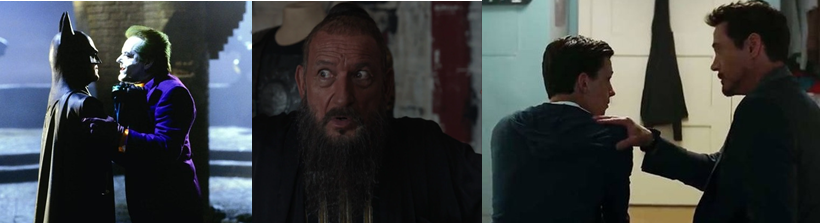
No matter how good or faithful the adaptation, changes are inevitable.

And yet, for those of us who are particularly close to the source material and heavily invested in it, it can be difficult to accept when a movie changes something fundamental about our beloved characters; from having Jack Napier/The Joker (Jack Nicholson) be responsible for killing Bruce Wayne/Batman’s (Michael Keaton) parents, to the Mandarin (Ben Kingsley) being little more than a drunken actor playing us all for fools, to Peter Parker/Spider-Man (Tom Holland) being the idealistic protégé of Tony Stark/Iron Man (Robert Downey, Jnr), comic book fans often lament startling changes and, with the internet and social media giving them the perfect platform to vent their frustrations, are never shy about letting others know exactly how they feel when movies alter their favourite comic book characters.
InterplayKillHeroLogo

But perhaps the biggest and most enduring debate amongst the superhero fan community is the question of whether or not their favourite heroes should be depicted as killers. It seems like every other day my Twitter feed comes alive with people raging endlessly about whether Batman should kill, protesting that Clark Kent/Superman (Henry Cavill) snapped General Zod’s (Michael Shannon) neck in Man of Steel (Snyder, 2013), and generally raging endlessly whenever someone dares to suggest otherwise. Honestly, it gets very old and aggravating; it’s almost as annoying and insulting as when these same fans decry superhero costumes in movies and television shows (no matter how faithful the design is to the source material, they still find something to complain about). So I figured that I’d go back to my Master’s dissertation and throw my two pennies into the well; however, as this debate could honestly go on forever and contain numerous example, I’m going to try and limit it to a couple of choice franchises: Batman, Superman, Spider-Man, the Avengers, and Star Wars.
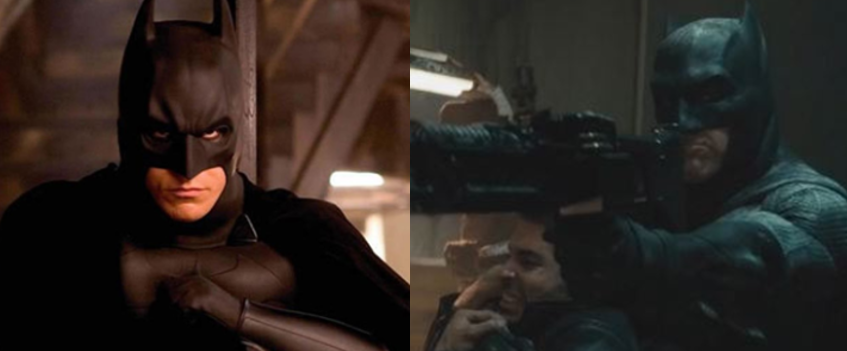
While Bale’s Batman refused to kill, Affleck’s had no such qualms.

When I wrote my Master’s dissertation, the first chapter was all about Batman; his origins, his code, his various intricacies and how these had been summarised, distilled, and changed by the adaptation process when the character was brought to life in movies. At the time, the Christopher Nolan films were at their peak and it was generally understood that Batman (Christian Bale) had one simple rule: he would not kill, no matter the circumstances. Fast-forward to sometime later, after the release of Batman v Superman: Dawn of Justice (ibid, 2016) and I revisited this piece in an attempt to get it published in a journal. However, when I came back to it, my entire argument had changed; having seen the way Batman (Ben Affleck) was portrayed in Batman v Superman, and actually being perfectly fine with a Batman who killed, my original piece was suddenly completely contradicted and it is this contradiction that I want to tackle first and foremost. Personally, I feel Nolan’s movies hammered home Batman’s no-killing rule in a way that is massively exaggerated for the source material. Whenever the subject is raised, people inevitably point to examples from Batman’s earliest days of publication, back when he was little more than another gun-toting pulp vigilante in the spirit of the Shadow or the Phantom. The “Bat-Man” as originally depicted by Bob Kane and Bill Finger was very nonchalant about killing criminals; he would kick them into vats of chemicals, snap their necks, or hang them from the Batplane, all while spouting a cutting quip or dry comment.

InterplayKillHeroBatmanKills
Whenever talk about Batman killing crops up, these same panels appear.

However, examples of Batman killing in comics are few and far between and he is seen far more often opposing the killing of others than he is executing criminals. This was a driving force in the Under the Hood (Winick, et al, 2004 to 2006) in which Jason Todd, freshly returned to life, laments the fact that Batman would prefer to let criminal, murdering scum like the Joker live rather than end their threat once and for all. this idea of Batman resisting the urge to kill because it would be “too easy” and would start him on a downward path of death and destruction has been explored numerous times in Batman comics and is of particular relevance in Nolan’s films. In Batman Begins (Nolan, 2005) Bruce Wayne is fully prepared to avenge the death of his parents by shooting the man who killed them, Joe Chill (Richard Brake) right in front of entire host of witnesses. When the opportunity is taken from him, he becomes disgusted at himself for taking up the same weapon that brought such pain and loss to his life and, in that moment, literally and figuratively rejects such instruments of death. Later, when told that he must execute a murder to graduate from the League of Shadows, Bruce’s resolve remains steadfast (emphasis mine):

BRUCE (refusing the sword offered to him)
No. I’m no executioner.

DUCARD:
Your compassion is a weakness your enemies will not share.

BRUCE:
That’s why it’s so important. It separates us from them.

DUCARD:
You want to fight criminals? This man is a murderer!

 BRUCE:
This man should be tried.

DUCARD:
By whom? Corrupt bureaucrats? Criminals mock society’s laws! You know this better than most!

It’s a great scene, and a great moment, in which Bruce outright refuses to follow the League’s gospel to the letter and, instead, chooses to take their teachings and bring criminals to justice rather than end their lives. However, when faced with the choice of killing the man, Bruce takes drastic action and causes a fire to start in the League’s temple and ends up fighting with “Ra’s al Ghul” (Ken Watanabe); the fire causes the temple to become structurally unstable and, as a result, “Ra’s” is crushed to death by falling timber and, shortly after, the temple is rocked by a series of explosions. While Bruce risks his life to save his friend and mentor, Ducard (Liam Neeson, later revealed to be the true Ra’s), how many members of the League perished because of Bruce’s actions?
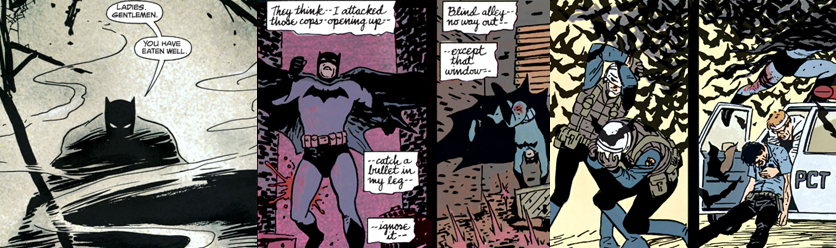
In Year One, Batman put himself at risk to save a falling criminal.

This scene is, structurally, reminiscent of a sequence in Batman: Year One (Miller, et al, 1987) in which a young, inexperience and exuberant Batman is so frightening that he causes a robber to almost tumble over a balcony and to his death. Despite the fact that Batman takes a great amount of punishment from the other criminals (he gets a television bashed over his head, and not one of our light-weight flatscreens!), Batman makes a concentrated, deliberate effort to save the man from falling. “Lucky,” he remarks afterwards, “lucky amateur”. However, despite all of this, Batman is faced with a choice at the conclusion of the movie: the Gotham monorail is out of control and heading right to Wayne Tower and cannot be stopped. It’s breaking apart around him and his only option is to escape and let the train crash, destroying Ra’s’ microwave emitter in the process and saving Gotham City. Yet, he’s not along: Ra’s is with him in this moment:

RA’S:
Have you finally learned to do what is necessary?

BATMAN:
I won’t kill you…but I don’t have to save you!

And, with that, Batman unfurls his cape and is flown clear of the train, and of danger, and Ra’s is left to accept his fate. So, explain to me how killing a man and letting a man die are two different things? Remember, Batman has an entire utility belt full of gadgets and gizmos, the most prominent of which is his gas-powered magnetic grapnel gun. Rather than gliding away, he could have swung them both to safety or, better yet, took Ra’s with him as he escaped but, instead, he let Ra’s die through his inaction. Had Ra’s made a move or a fatal error that Batman was powerless to stop, this debate wouldn’t exist; we saw something similar in Batman Beyond: Return of the Joker (Geda, 2000) where Batman (Kevin Conroy) was too injured to stop Tim Drake (Mathew Valencia) from killing the Joker (Mark Hamill) but he most like would have tried to interject had he been physically capable.
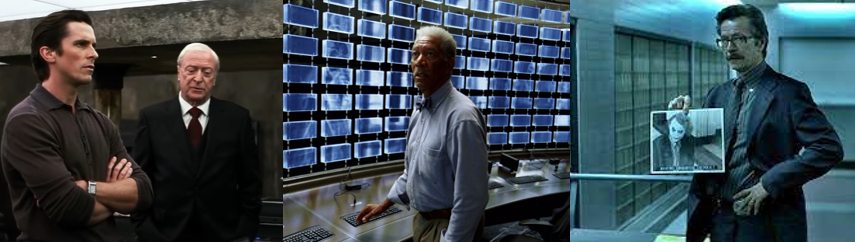
Alfred encouraged Bruce not to give in to the Joker even if it meant more would die.

In The Dark Knight, Batman’s code against killing is so widely known that not only does he rasp it at criminals at any given opportunity, but Gotham’s criminal underworld is “wise to [his] act”. Spurred on by Batman’s “morals” and his “mode”, the Joker (Heath ledger) wages a reign of terror across Gotham in an attempt to have Batman unmask and expose himself as a fraud. Interestingly, it is Bruce’s loyal butler and father-figure, Alfred Pennyworth (Michael Caine), who tries to talk Bruce out of complying with the Joker’s demands:

BRUCE:
People are dying, Alfred. What would you have me do?

ALFRED:
Endure, Master Wayne. Take it. They’ll hate you for it but that’s the point of Batman. He can be the outcast. He can make the choice that no-one else can make. The right choice.

This isn’t the first time Alfred has encouraged Bruce to accept that casualties are inevitable in his war on crime; in Batman Forever (Schumacher, 1995), Alfred (Michael Gough) actively encourages Bruce (Val Kilmer) to offer guidance to Dick Grayson (Chris O’Donnell) just as he encourages Grayson to follow his own path towards vigilantism: “One day, Robin will fly again” he tells the troubled youth and he not only not only is conveniently lax about keeping the secret entrance to the Batcave hidden from Grayson he also “[takes] the liberty” of creating an armoured Robin costume for his young master.

Bruce repeatedly tried to convince Dick not to kill Two-Face.

Batman Forever is an interesting example as, whether fans want to admit it or not, this movie is tangentially connected to the two prior Batman movies, both of which depicted Batman as fully capable of killing. By Forever, though, Bruce has become so lost in his crusade that’s actually forgotten a pivotal motivation behind becoming Batman in the first place: the vow to keep anyone from experienced what he had to as a child. When it becomes apparent that Grayson is fixated on tracking down and killing the man responsible for the death of his family, Harvey Dent/Two-Face/“Harvey Two-Face” (Tommy Lee Jones), it is Bruce, not Alfred, who tries to talk him out of it:

BRUCE:
So you’re willing to take a life.

DICK:
As long as it’s Two-Face.

BRUCE:
Then…it will happen this way. You make the kill. But your pain doesn’t die with Harvey, it grows and so you run out into the night to find another face. And another. And another. Until one terrible morning you wake up and realise that revenge has become your whole life…and you won’t know why.

Grayson, however, is unconvinced at the time and Bruce’s words don’t truly start to sink into him until much later in the film, when he’s suited up as Robin: “I can’t promise I won’t kill Harvey,” he says…and Batman accepts this, having completed his own character arc and learned that he can’t deter Grayson from his path, all he can do is help guide him. However, when he finally gets his hands on Two-Face, Robin stops short of killing him and, ironically, it is Batman who causes the villains demise, in that moment, the shot clearly lingers on Robin’s face as he gets the catharsis he so desperately desired from Two-Face’s death but is spared having to commit the act himself thanks to Batman.
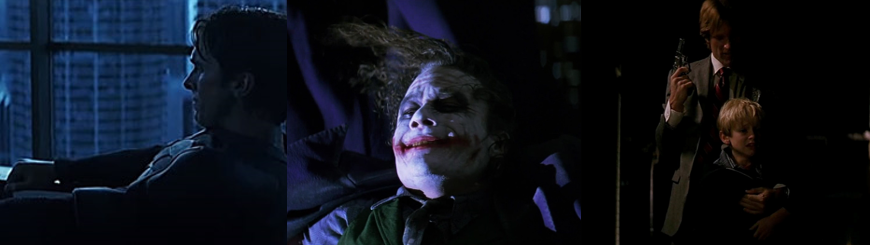
Dent died as a direct result of Batman tackling him off a building!

Batman’s willingness to get his hands dirty, to “plunge [his] hands into the filth” so that others can keep theirs clean, is a pivotal plot point of The Dark Knight Rises (Nolan, 2012). This film is a culmination of the idea that Batman, as a concept, is not a hero; he’s a legend, an icon, an inspiration to others. We saw this in The Dark Knight when Harvey Dent (Aaron Eckhart) believed so strongly in the Batman that he lied to the press and said that he was Batman right as Bruce was about to out himself to stop the Joker’s killings. We saw Bruce do a similar thing in Batman Forever where he didn’t hesitate to stand up and shout his secret identity to the world when Two-Face threatened the circus but, whereas his cries were drowned out by screaming Gothamites in that film, Dent is arrested and publicly believed to be Batman until he dies. And how did Dent die? Batman tackled him off a high ledge! Harvey fell and broke his neck on impact and, with their “White Knight” dead, Batman chose to take the fall for his crimes: “I killed those people. That’s what I can be […] Because I’m not a hero. Not like Dent”. Only Batman and Jim Gordon (Gary Oldman) know the truth and this truth, and guilt, is what drives Gordon to become a shell of his former self in The Dark Knight Rises. The Dark Knight ends with the prospect of Batman being hounded by the Gotham police, who believe him a murderer, as well as the galvanised criminals of the city but, instead, Bruce simply retires from the role due to the physical and mental impact it has on his body.
InterplayKillHeroCode
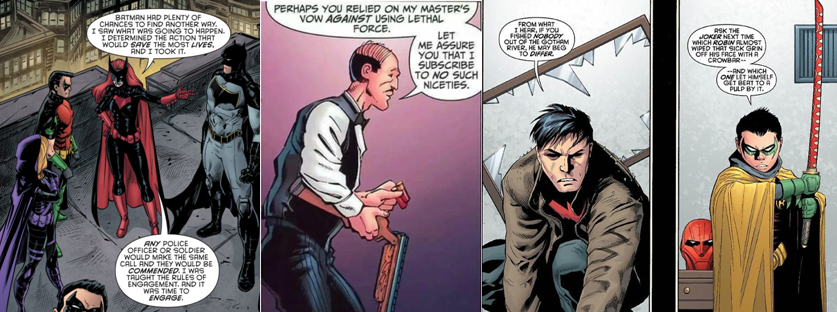
Batman’s got some nerve criticisng Batwoman considering some of the company he keeps.

When he finally returns to the cape and cowl, Batman picks up right where he left off, to his detriment. When he crosses paths with Selina Kyle/Catwoman (Anne Hathaway), he immediately discourages her from using guns or killing people; this is consistent with Batman’s methods in the comics where, despite referring to his crusade as a “war” and his protégés as “soldiers”, Batman constantly forbids members of his “family” from taking lethal action. This despite the fact that Batwoman, Kate Kane, is former military and has killed before, that Jason Todd/Red Hood regularly engages in gunplay and murder, that Batman’s own son, Damian Wayne/Robin, has killed before, and the fact that Alfred regularly patrols and defends the Batcave with either a shotgun or a musket! Furthermore, when Catwoman uses the cannons on his Bat-Pod to kill Bane (Tom Hardy), Wayne is still perfectly happy to retire from crimefighting with Selina by his side.

InterplayKillHeroBvSRobin
This simple shot says more than words ever could about Bruce’s mindset.

So you’ll forgive me if seeing Ben Affleck mowing down criminals with machine gun fire and breaking them in two doesn’t offend my opinion of Batman. Of course, Batman films are often regarded as being especially important to comic book fans because they depict “a supposedly definitive representation” of Batman, belonging to a “multi-national conglomeration and the global audience” who buy tickets and merchandise, “rather than to the dedicated comic book readers” (Brooker, 2001: 293). Honestly, I think one of the issues hampering Batman v Superman and the film’s portrayal of Batman is the fact that Snyder’s directing style tends to be very loud and bombastic and on the nose but, when it comes to Batman, he is uncharacteristically subtle. I’ve mentioned this before but Batman’s entire motivation in this film can be explained in that one lingering shot of him first looking at the Batsuit with a mixture of disgust and conviction and then gazing in anguish at the Robin suit left on display. I fully believe that the visuals tell us more than words ever could in this scene, which clearly shows that this is a broken, desolate Bruce who, after twenty years (twenty years!) of being Batman, has become so jaded by his crusade that he has given up all hope: he now freely kills criminals or brands them with his symbol, ensuring they will die in prison:

ALFRED (handing Bruce a newspaper):
New rules?

BRUCE (barely glancing at the headline: “Bat Brand of Justice!”):
We’re criminals, Alfred. We’ve always been criminals. Nothing’s changed.

Sadly, Alfred (Jeremy Irons) then elaborates that things have changed…because of the arrival of Superman and alien beings on their world, rather than because of recent events in Bruce’s life. Yet, nevertheless, this is a Bruce so jaded and lost in his crusade for justice, that’s willing to pre-emptively kill Superman in order to actually affect real change in the world. Perhaps if the film had included a more explicit line of dialogue or explanation regarding Bruce’s state of mind rather than relying on the audience filling in the gaps through subtext, audiences would have reacted a little better to Affleck’s portrayal (or, at least, understood it better). While the eventual change in his perspective is quite jarring, Bruce spends the remainder of the film and the entirety of Justice League (Snyder/Whedon, 2017) trying to make amends for his actions. Indeed, in Justice League, Batman is so devoted to forming a superhero team and bringing Superman back to life that he’s willing to die to see this through. Superman’s sacrifice galvanises Bruce and he sees how far he has fallen and believes he has to atone for his sins; however, the team worked too well and saved him from not only death but himself as well.
InterplayKillHeroSuperKill
This issue is also referred to whenever the subject of Superman killing comes up…

Speaking of Superman, every other day I see the debate raging on Twitter that killing should, under no circumstances, ever be a part of Superman’s nature. No matter what the situation is, Superman, as the pinnacle of “Truth, Justice, and the American Way” should always find another way to resolve the issue and never resort to killing.

Which, quite frankly, is utter rubbish.

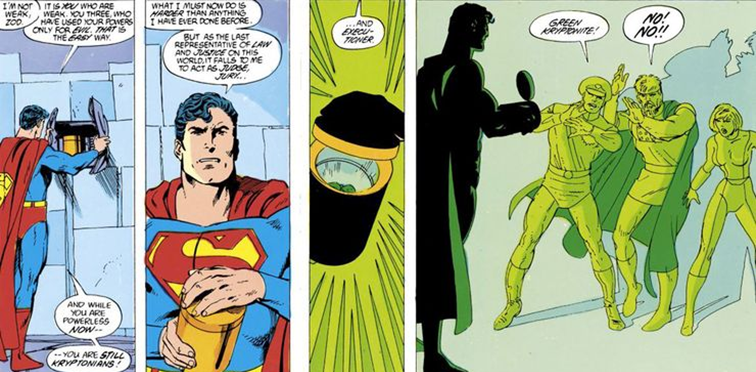
If Star Trek II: The Wrath of Khan (Meyer, 1982) taught us anything it’s that, sometimes, you’re in a no-win situation and there is no other way. To deny Superman, or any superhero, that kind of desperate situation is to deny us the chance to read interesting stories dealing with the fallout from that situation. If Superman always prevails and never has to address the fact that his actions may have fatal consequences, than surely that limits him as a character? In the comics, Superman has killed a few times, the same as Batman and other superheroes (even Spider-Man once accidentally killed a woman), but examples are far less prominent for the Man of Steel. One particular story that often gets brought up time and time again as an example of Superman killing is “The Price” (Byrne, et al, 1988), in which Superman is forced to execute some Kryptonian criminals with a chunk of deadly Kryptonite. This decision weighed heavily on Superman’s conscience for some time as he had taken an oath to never use his powers to kill and, as a result, tied into John Byrne’s over-arching goal of humanising Superman and making him more relatable to readers rather than him being some all-powerful, infallible demigod.

Never forget that Reeve’s Superman killed Zod as well.

Typically, though, Superman (like Batman and other superheroes) is generally depicted as killing one of the many parallel worlds that crop up in comics, with Superman generally becoming a merciless dictator once he starts down that path. In this story, though, one of the Kryptonians Superman killed in this story was none other than General Zod; of all the villains Superman has faced, Zod has perhaps met his ends at the hands of the Man of Steel more than any other. People forget that Superman (Christopher Reeve) threw Zod (Terrance Stamp) to his death after removing his Kryptonian powers, crushing his hand, and throwing him down a bottomless pit in Superman II (Lester, 1980). Sure, the Richard Donner Cut (Donner, 2006) showed that Superman was originally going to reverse time to restore Zod to life but, even if you consider this canon, he still killed Zod so how is this any better than what we see in Man of Steel?
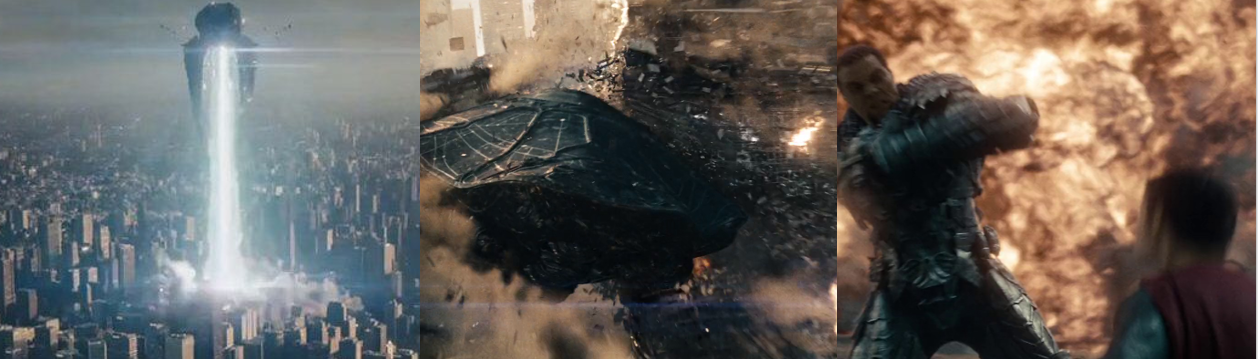
Superman and Zod’s fight caused untold devastation and, surely, death in Metropolis.

In this revised origin story, Clark has finally discovered his true heritage and only just put on his Super-Suit for the first time when, all of a sudden, General Zod arrives and demands that he surrender to him. He’s not had a chance to properly reveal himself as Superman, much less use his powers in a fight, and he’s suddenly forced to battle against a group of dangerous, highly-trained Kryptonians who threaten his mother. How would you react in that situation? Would you calmly assess the situation and try to think of a way around the issue or would you attack head-first in an emotional attempt to save the woman who raised you? Obviously, the ensuing battles are quite devastating in their impact; Superman trashes most of downtown Smallville and never once during his subsequent fight with Zod does he try to direct the fight away from Metropolis. While this is mainly due to Zod blocking his path or forcing the fight to stay on ground level, there is that one sequence where the fight ends up in outer space and the two come crashing down right on top of Metropolis like an Earth-splitting meteor. This was easily Superman’s best opportunity to direct the fight away from the city but, again, this is a Superman who hasn’t been in action longer than a day and is overwhelmed by his emotions so of course his solution is to try and end the fight through brute force.
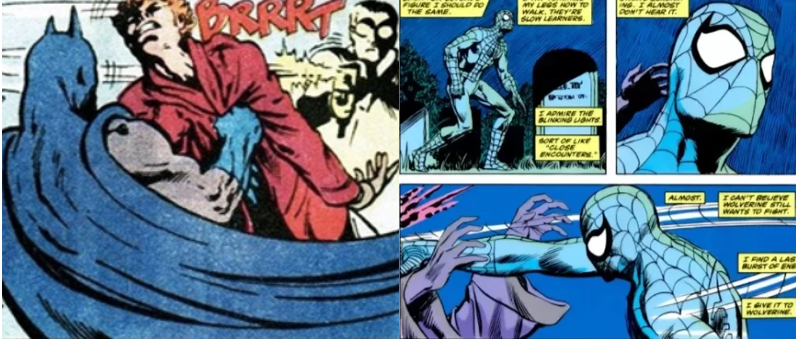
Sometimes, even the most righteous heroes have accidentally or indirectly killed.

Whether talking about Batman, Superman, or any other costumed hero, you have to factor in a degree of plausible realism; how likely is it that entire skyscrapers or cities would be evacuated when Doomsday comes crashing down into Metropolis? In the “Death of Superman” (Jurgens, et al, 1992 to 1993) story, Metropolis gets a great deal of advance warning before Doomsday rocks up, despite Superman’s best efforts to keep the creature from the city, and there are still countless civilians watching the fight and caught in the resulting destruction. We’ve also seen in comics before how, when dodging automatic gunfire, Batman has allowed others to be gunned down; is this not killing? By the logic of the internet, Batman should have taken those bullets and died right then and there rather than let someone die through his actions. As I briefly mentioned before, even Spider-Man has been guilty of this in the past; despite Peter Parker doing everything in his power to save lives, sometimes he fails to do so and, sometimes, his actions (or inactions) lead to yet more death and he is forced to deal with the consequences of that. Yet, apparently, according to some people, Superman doesn’t have to. In Sam Raimi’s Spider-Man trilogy (2002 to 2004), Peter Parker/Spider-Man (Tobey Maguire) is guilty of causing at least two deaths that we know of, intending to kill two others, and directly responsible for at least one death.
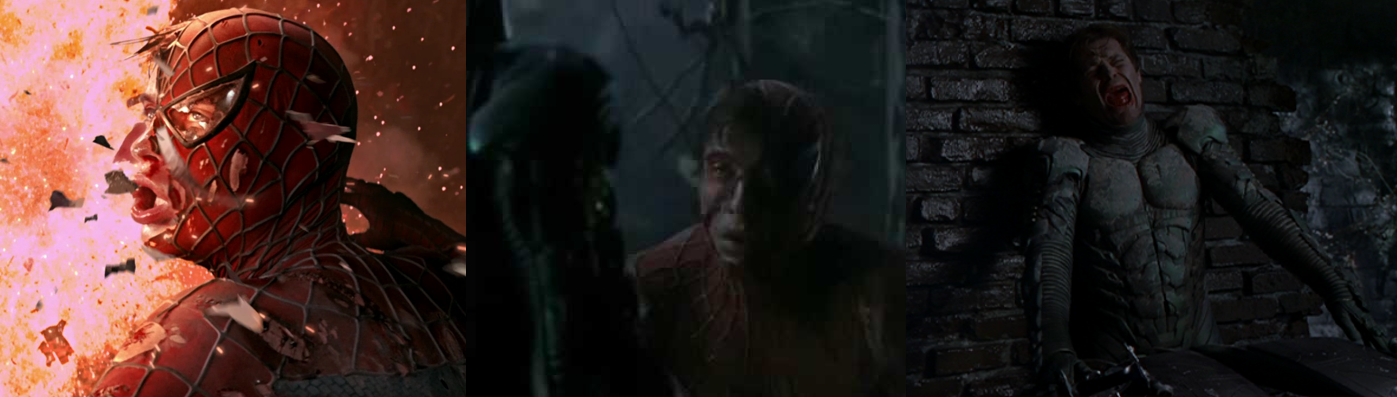
Could Spidey have done more? Maybe…and he’s haunted by that knowledge for the rest of the films.

In Spider-Man, enraged at the death of his beloved Uncle Ben (Cliff Robertson), Parker chases down the culprit, Dennis Carradine (Michael Papajohn), breaking his wrist and confronting him in a fit of anger. Peter demands answers from the murderer who, spooked by Peter’s enhanced strength and abilities, conveniently trips and falls to his death. Could Peter have saved him? Well…yes, of course he could have. He could have shot out his webbing and saved Carradine but, in the heat of the moment, he was powerless to stop the carjacker from falling to his death and, in the aftermath, vows to take his uncle’s words to heart and use his great powers responsible. And it works, for the most part, until he ends up locked in combat with Norman Osborn/Green Goblin (Willem Dafoe); beaten to a pulp by the chemically-enhanced madman, Peter is shaken when he discovers that the Green Goblin is the father of his best friend, Harry (James Franco) and, taking advantage of that distraction, the Goblin summons his rocket-powered glider to impale Spidey in the back, luckily, however, Peter’s spider-sense warns him of the danger and, acting purely on instinct, Peter flips out of the way and Norman is impaled by his own glider and dies. Should Peter have taken that fatal blow rather than saving himself? Could he have used his webs in mid-flip to knock the glider off course? Who can say, but the guilt of being directly responsible for Norman’s death haunts Peter throughout the next two movies.
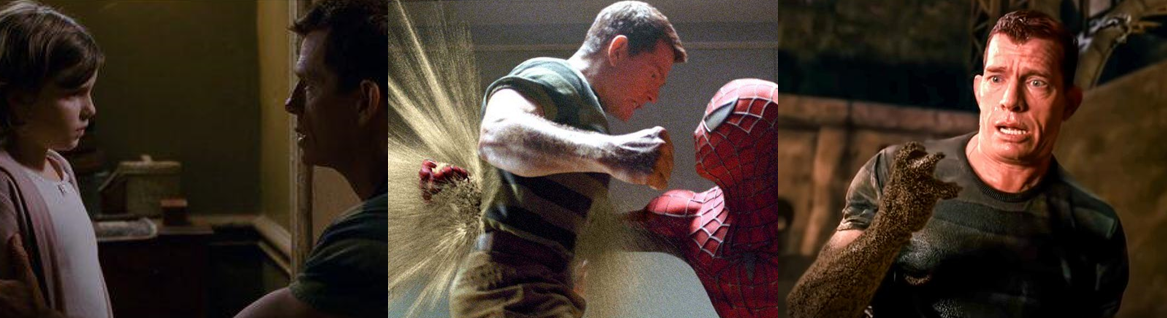
Black-suit Spidey fully intended to kill Sandman when they fought.

I’ll cut Spidey some slack for the conclusion of Spider-Man 2 (ibid, 2004) as I don’t think anyone can really pin the death of Otto Octavius/Doctor Octopus (Alfred Molina) on Spidey but, still, you could make the argument that Spidey could have swung in and saved the misguided scientist from his death, no matter how willingly Otto went to meet his fate. In Spider-Man 3, however, Peter again lets his rage consume him when he discovers that Flint Marko/The Sandman (Thomas Haden Church) is actually the man responsible for the death of Uncle Ben. Fuelled by the symbiotic black suit, Peter obsessively monitors police radio frequencies and, as soon as he gets a lead on Sandman, tracks him down and washes him away with a jet of water. The liquid dissolves Sandman into a mushy mess as Spidey remarks: “Good riddance!” Clearly, in this moment, Spider-Man believes Sandman is dead and is glad to have killed him; he later admits to his Aunt May (Rosemary Harris) that Spider-Man killed Marko and she is shocked:

            AUNT MAY (confused, shocked):
Spider-Man? I don’t understand…Spider-Man doesn’t kill people. What happened?

PARKER (clearly rattled):
I…uh…he was…I thought that…that you’d feel…he deserved it, didn’t he?

AUNT MAY:
I don’t think it’s for us to say whether a person deserves to live or die.

The revelation that Aunt May no longer wishes harm upon the man responsible for her husband’s death clearly knocks Peter for a loop and he questions his actions…but not enough to keep from tossing a pumpkin bomb right in Harry’s face when they fight later in the movie. Up until that point, the only person to survive such a blast was Spidey himself so, even if you want to make argument that Peter knew Harry’s enhanced strength would keep him from dying, he clearly set out to kill, or at least permanently maim, his childhood friend with that explosive.

InterplayKillHeroAliens
Aliens are, apparently, exempt from a superhero’s “no kill” rule.

Later still, having finally freed himself from the black suit’s corrupting influence, Peter prepares to kill once again; this time, his target is the alien symbiote itself, which he has contained within a bunch of vibrating bars. This is a common theme in superhero movies and comics where heroes like the Justice League and the Avengers are perfectly happy with killing sentient alien creatures; whether they’re part of an insect-like hive mind or mindless brutes, they’re still living creatures and the likes of Batman and Superman are more than happy to off them without a second’s hesitation. In this particular instance, though, Parker actually ends up killing Eddie Brock, Jnr (Topher Grace), who was so obsessed with the power and freedom offered by the symbiote that he leaps right into the blast and was summarily incinerated. Peter’s reaction? A look of shock, a scream of “EDDIE!!”, and he shrugs it off as just one of those things. The symbiote was a drug, after all, and Eddie couldn’t kick the habit and he paid for it. plus, to be fair, there was very little Peter could do to save Eddie in those final moments, certainly far less than he could have done to save Norman and Otto, and it’s obvious that he never intended for the bomb to kill Eddie but, still, a young man died as a direct result of Peter throwing that bomb.
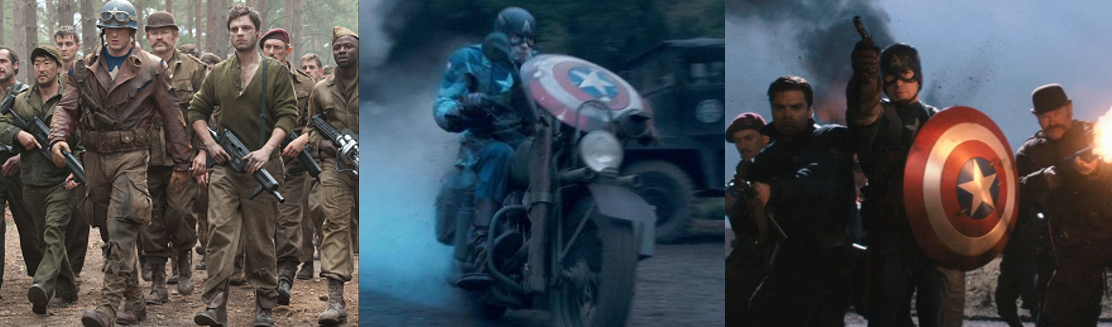
Cap has a sizeable body count in the MCU thanks to his time as a soldier.

I mentioned the Avengers earlier so let’s go back to them real quick; while everyone cries and gets all stressed and upset when Batman launches a crate right in a goon’s face and smashes his skull open, no one bats an eyelid when the Avengers make killing a routine habit of their day-to-day lives. Obviously, Steve Rogers/Captain America (Chris Evans) gets a pass though, right? He was a soldier in the war and we clearly see him gunning down Nazis and Hydra agents in Captain America: The First Avenger (Johnston, 2011) like any good soldier would be expected to do. Steve even says: “I don’t want to kill anybody” (emphasis mine) in his debut movie but it’s war: of course he’s going to and he does and nobody questions it. Yet Batman has the nerve to lecture Kate Kane about not using lethal force in DC Comics and Kate (Ruby Rose) even has a crisis of conscious when she kills in her self-titled television show (2020 to present)…which is doubly ridiculous when you consider that Oliver Queen/The Hood/The Arrow/Green Arrow (Stephen Amell) and his allies routinely went around killing criminals and goons in Arrow (2012 to 2020) and it was perfectly acceptable! Hell, it was even part of Ollie’s character arc as he swore off killing for a time but, when he returned to murdering bad guys, nobody questioned it so why is there this double standard when it comes to superheroes killing? Similarly, in Avengers Assemble, we clearly see Cap gunning down those under the influence of Loki (Tom Hiddleston); these men aren’t actually evil or deserving of death, they’re just under a magic spell, but Cap offs them anyway and never gets a lecture for it. similar, billionaire industrialist Tony Stark, who is so horrified and traumatised by his time as a prisoner of war and seeing his technology and weapons being used to kill American soldiers that he builds highly advanced suits of armour and flies halfway across the world to murder terrorists! The criminally under-rated and unfairly lambasted Iron Man 2 (Favreau, 2010) tries to explore the consequences of this but Tony simply laughs in the face of the American government…and is literally cheered for it!
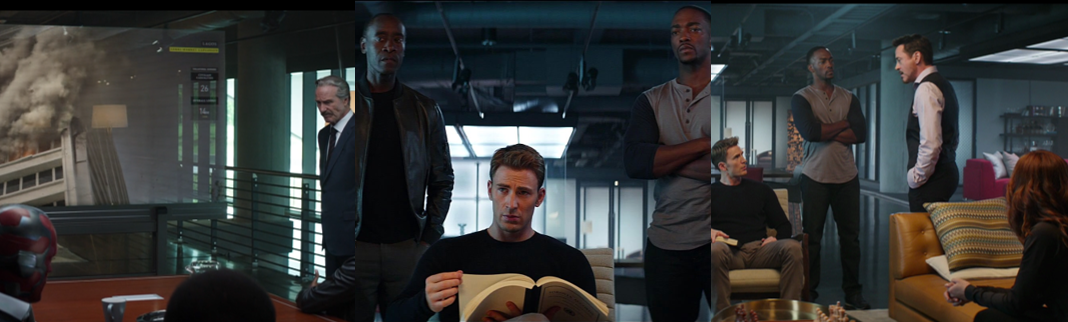
Secretary Ross wants the Avengers to be put on a leash to control what they do, when, and where.

For that matter, all of the Avengers are publicly lauded as heroes despite that fact that each and every one of them is a cold-blooded killer; Natasha Romanoff/Black Widow (Scarlett Johansson) is a former Russian spy with “red in her ledger” that she may never be able to erase no matter how much good she does, Clint Barton/Hawkeye (Jeremy Renner) was sent to assassinate Romanoff and, while he made a “different call”, he’s clearly trusted enough to perform such an action, and even Bruce Banner/The Hulk (Mark Ruffalo) was guilty of causing untold amounts of mayhem, destruction, and deaths when he was Edward Norton in his also-under-appreciated solo movie. Later in the MCU, Doctor Stephen Strange (Benedict Cumberbatch) reacts with horror when he kills a man even though it was a clear case of self-defence. Dr. Strange’s position is unique within the MCU; as a Doctor, he’s more accustomed to saving lives than taking them so his perspective on the matter, and approach to superheroics, is naturally very different to that of his fellow costumed peers. The consequences of collateral damage and the Avengers’ actions are explored in Captain America: Civil War (The Russo Brothers, 2016); here, the Avengers are placed under scrutiny when their largely unilateral actions result in a lot of innocent deaths. Up until this point, they have operated with “unlimited power and no supervision” and the decision is passed that, going forward, they should answer to the United Nations before jetting off to fight super criminals and terrorists, a decision which divides the team. Captain America’s outlook is very black-and-white and fitting for a soldier; he understands and sympathises with the guilt and shame Wanda Maximoff (Elizabeth Olsen) feels following her actions but doesn’t believe that it should spell the end of the Avengers’ effectiveness as an independent team:

STEVE:
People died. That’s on me. This job…we try to save as many people as we can. Sometimes that doesn’t mean everybody but, if we can’t find a way to live with that, next time…maybe nobody gets saved.

For Tony, the resultant Sokovia Accords are a means to alleviate some of his guilt and to show to his estranged girlfriend, Pepper Potts (Gwyneth Paltrow), that he’s willing to step away from his role as Iron Man and hold himself accountable for his actions. Up until this movie, though, Tony’s view and methods reflected Cap’s more pragmatic view on the matter, as did the rest of the Avengers; they generally identify who the enemy is, engage them, and subdue them by any means necessary. In the course of their battles, which natural escalate, collateral damage is not just expected but all-but-inevitable; Cap understands this and, yet, even in the midst of city-wide destruction, will direct his team (and emergency and public services) to take the time to minimise civilian casualties wherever possible. As a result, Cap and the Avengers are never seen killing criminals indiscriminately and make every attempt possible to contain and reduce damage and casualties, but are not only willing to kill when necessary but accept that causalities are bound to happen. We see this when Cap goes to talk sense into James Buchanan “Bucky” Barnes/The Winter Soldier (Sebastian Stan) and they end up having to fight off a riot squad; though he says he’s not going to kill anybody, Bucky, his head twisted by years of Hydra programming, is desperate to escape by any means necessary, is extremely aggressive towards his would-be-captors and Cap has to go out of his way to save them from serious harm and death. Cap recognises that these are the local authorities, not some Hydra goons, and therefore shouldn’t be killed or harmed at all, if possible, but has already showcased in the first Avengers movie that he’s used to seeing team-mates and innocents get caught in the crossfire during battle and has learned to compartmentalise that in such a way that allows him to continue function to save countless other lives whenever possible.

InterKillHeroDeadshot
Batman arrests Deadshot, kills random thugs, but lets the Joker live. It’s a bit inconsistent.

Let’s apply this to Ben Affleck’s Batman; despite popular believe, he isn’t some unhinged, murdering psychopath. He exists in a world where he’s perfectly happy to arrest the likes of Floyd Lawton/Deadshot (Will Smith) and where Harley Quinn (Margot Robbie) and the Joker (Jared Leto) remain alive and well; Batman v Superman implies that it’s only very, very recently that Batman has taken to taking more violent and extreme actions against criminals and he’s understandable a bit distracted by the oncoming battle against the forces of Apokolips but you have to believe that, if he wanted the Joker dead, he would be dead…but he’s not. Batman also doesn’t kill every criminal he crosses paths with; some are clearly only as maimed or injured as the countless goons Batman disables in the comics, while others are left completely unmolested. His methods are quite inconsistent but, for this Batman, the end goal is far bigger than just his city; in these movies, he’s concerned with the safety of the entire world and actually having a lasting impact outside of Gotham City. As a result, is approach seems to be one of sacrificing a few to save many, which isn’t a million miles away from Cap’s philosophy but, obviously, far more explicitly violent.
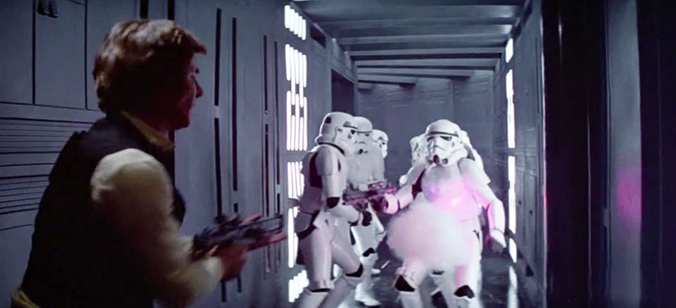
InterplayKillHanStormtroopers
Han wasn’t allow to shoot first but he could gun down countless Stormtroopers…

Finally, lets take a look at the characters of the Star Wars (1977 to present) movies. In Star Wars: Episode IV: A New Hope (Lucas, 1977), we’re introduced to two characters who would become staples of the franchise: the innocent, wide-eyed farm boy Luke Skywalker (Mark Hamill) who dreams of fighting space battles against the Galactic Empire and the rough-and-ready lovable rogue Han Solo (Harrison Ford), who wants little more than to be paid for his services. Famously, Lucas has butchered his original movie time and time again to alter the scene in which Han has a tense confrontation with Greedo (Paul Blake). Originally, Han blasted Greedo and killed him in a bad-ass moment that showed Han had no fucks to give but, feeling this made Han seem too cold-blooded, Lucas altered the scene again and again to have Han awkwardly “dodge” Greedo’s laser bolt and the two of them to shoot simultaneously. My question, as I’m sure many Star Wars fans also have, is…why? It seems completely redundant as, not long after this scene, both Han and Luke are blasting away at Stromtroopers without a care in the world. Is it somehow “better” because they’re being shot at? To me, it’s the same thing; killing is killing, the only question is how you can justify that killing and, in the case of Han murdering Greedo, he’s totally justified: Greedo confront Han with the specific intent on killing the smuggler so Han is simply defending himself by pre-emptively eliminating the immediate threat to his life.

InterplayKillLukeKills
How many innocents died when Luke blew up that Death Star?

Plus, like, Han is a galaxy-weary smuggler who has been around a while; he carries a blaster and is expecting trouble everywhere he goes so of course he would have had to have killed before so why Lucas chose to meddle with this scene but thought it was perfectly okay for bright-eyed and eternally optimistic Luke Skywalker to start murdering Stromtroopers (most of whom are simply following orders) with reckless abandon is beyond me. Oh, and let’s not forget the fact that Luke destroyed the Death Star! We know the Rebellion has spies within the Empire; how many of those were onboard those space stations when they blew? How many innocent lives were snuffed out? How sure are we that everyone on those battle stations was pure evil? Half of the Rebellion is made up of defected Imperial soldiers, for God’s sake! Even Han was an Imperial once and he ended up becoming a pivotal member of the Rebellion so who’s to say that a significant number of those hundreds of thousands of people actually “deserved” to die?

InterplayKillCasualties
There are bound to be casualties in war, no matter what your super powers are.

Again, though, it’s war so I guess that makes it “okay”, right? The fact that Batman often refers to his cruse as a “war on crime” never seems to factor in since it’s assumed that, obviously, there are different “types” of war. War is war; if you declare war, you’re at war and, in any war, there are casualties. Batman, of all people, should understand that. But don’t misunderstand me: I’m clearly not saying that Batman and every superhero should go out there and kill every criminal indiscriminately. That’s obviously not the point I’m making. What I am saying, though, is that if we’re to believe that a man dresses like a bat or an archer or wields incredible powers and regularly engages in city-wide battles or highly dangerous fights against armed foes, death is an inevitability. It should be avoided at all costs, sure, but it’s going to happen even if it’s just because our spandex-clad hero jumps out of the way of incoming gunfire. Hell, this was even a theme in the universally-maligned Batman & Robin (Schumacher, 1997) for God’s sake:

ALFRED:
For what is “Batman” if not an effort to master the chaos that sweeps our world? An attempt to control death itself?

BRUCE (contemplating, clearly affected by this):
But I can’t. Can I?

ALFRED (resolutely):
None of us can.

So what is it that makes killing acceptable for some characters but not others? Is it literally because these characters haven’t been so closely associated with not killing as Batman has (thanks, again, to the Nolan movies) or because Superman, with all his powers, should be capable of more? Okay, well, Thor (Chris Hemsworth) is an actual God and he kills people all the time during battle and when his back is against the wall so why shouldn’t Superman? Diana Prince/Wonder Woman (Gal Gadot) is obviously the better analogy as, like Thor, she’s this superpowered, God-like character from the pages of mythology and she kills so why is that okay but it’s not okay for Superman to snap a madman’s neck when he’s not only threatening to roast an innocent family alive but literally screaming about how he is genetically engineered to continue killing and causing as much destruction as it takes to resurrect Krypton? Of course, a lot of these examples are circumstantial; you could read an entire year’s worth of Batman comics and never see him kill, or through action or inaction allow someone to die, so it’s true that it’s hardly a normal, everyday occurrence for superheroes to kill (unless you’re talking about the likes of Spawn, Wolverine, or the Punisher, where it’s a given). Yet, it does still happen and, when adapting any character with as rich a history as the likes of Batman to the screen, writers and directors often tend to draw from the entirety of the character’s history, distilling their essence and reinterpreting the character in a way that hits all the familiar beats (and even introduces some new ones).

InterplayKillStories
Comics should never limit themselves in the stories they can tell.

Now, don’t get it twisted: I’m clearly not calling for these heroes to start killing their enemies indiscriminately but I’ve been a fan of all the superheroes and franchises I’ve talked about in this article for pretty much my entire life; I’ve seen Batman kill, abstain from killing, kill by coincidence, and lecture his fellow heroes on taking a strictly non-lethal approach and, yet, I am perfectly happy with either approach. Not minding (or even caring) when the likes of Batman kill doesn’t make me any “less” of a Batman fan; instead, it opens the door for deeper explorations of the character if you choose to look at the subtext of this approach and see what it does for the character. Personally, I am always open to the endless possibilities offered by comic books and their many adaptations and feel it is extremely short-sighted and limited to limit oneself to the types of stories they can tell. Use the pages to explore how killing this affects Superman and his faith in himself and his abilities; people always complain that Superman is too powerful to be relatable so any chance to humanise him and make us understand him better is an opportunity for a poignant tale without having him become some crazed dictator.  It’s the same for Batman; he’s always preaching and lecturing his protégés and extended family of vigilantes on the virtues of saving lives rather than taking them so what would it do to batman, to Bruce Wayne, if he were responsible for innocent lives being lost and caused a criminal to die? Would he quit, go on another voyage of self-discovery, change his tactics, go on a killing spree? Most stories tend to lean towards that latter and even the comics have basically said that, once Batman starts killing, he wouldn’t stop but…wouldn’t he? He didn’t kill every criminal in the Tim Burton or Snyder movies so is it really fated that he’d become a pseudo-Punisher once he took a life or could he, perhaps, have the strength of will to work through the knowledge that his crusade had led to someone losing their life and be a better, stronger character for it?

InterplayKillSHeroConclusion

I hesitate to ask you to leave your opinions on this matter as it’s a massively divisive can of worms, to say the least, but please do feel free to comment below on your opinions regarding this subject. Do you feel death is an inevitable part of a superheroes chosen career or do you think superheroes should be above that sort of thing? If so, why? Who is your favourite superhero? How would you feel if they took a life or, if your favourite superhero is already a killer, why do you feel it’s acceptable fort hem to kill but not others. Literally no opinion is “wrong” regarding this matter; it’s all a matter of interpretation so, whatever you think, leave a comment and, the next time you think about ranting about a superhero killing on twitter, stop and think about why it upsets you so much and maybe do a little research or dig a little deeper into the lore and the subtext before lynching those who disagree with your opinon.


Game Corner: Star Wars: The Force Unleashed II (Xbox 360)

GameCorner
SWFU2Logo

Released: October 2010
Developer: LucasArts
Also Available For: iOS, Nintendo DS, PlayStation 3, Nintendo Wii, and PC

The Background:
Despite its flaws, Star Wars: The Force Unleashed (ibid, 2008) was a commercial success; as a result, LucasArts rushed into production with a sequel to what was, at the time, the official bridge between the events of Star Wars: Episode III: Revenge of the Sith (Lucas, 2005), and Star Wars: Episode IV: A New Hope (ibid, 1977). My experience with The Force Unleashed was mired by the game’s dodgy camera, wonky physics, and repetitive levels and combat. When the game shined, it shined pretty brightly but even its best moments couldn’t overshadow the flaws in the engine and execution. The story, while interesting, had a few issues as well (even more so considering the games have long since been rendered non-canon by Disney), and was pretty well wrapped up with Darth Vader’s turncoat secret apprentice, Starkiller, dying a martyr to inspire and rabble the Rebel Alliance. But the franchise made money so, armed with the lamest excuse possible, LucasArts came back with this sequel but does it improve on its predecessor’s failings or is it more of the same?

The Plot:
After multiple failures, Darth Vader has finally perfected a clone of his secret apprentice, Starkiller. However, haunted by the memories, feelings, and motivations of his predecessor, the clone sets out to uncover the truth of his identity and reconnect with his lost love, Juno Eclipse.

Gameplay:
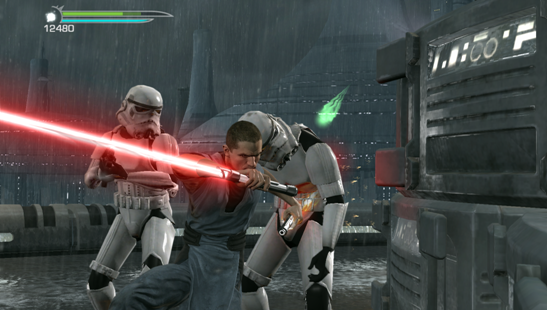
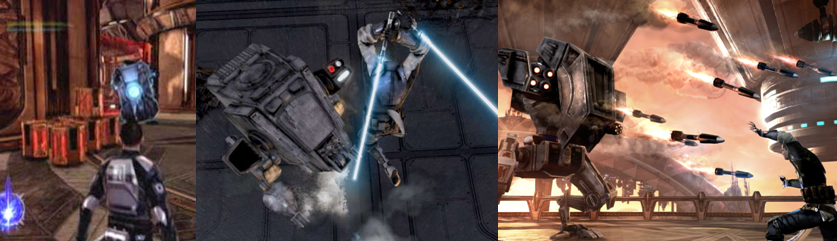
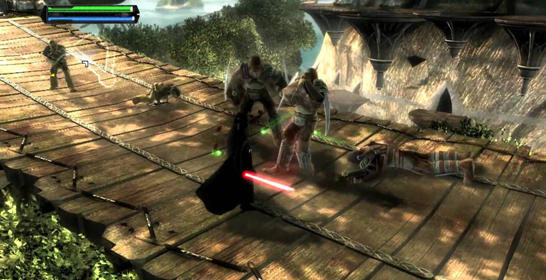
Like its predecessor, Star Wars: The Force Unleashed II is a third-person action title in which the player controls a clone of Vader’s secret apprentice, Starkiller. If you thought Starkiller was a damaged, edgy character torn between his divided loyalties, this clone ramps it up to eleven as duplicating Starkiller’s prowess with the Force also meant duplicating his memories and emotions. Nowhere is this more evident in the fact that Starkiller now wields duel lightsabers, holding them both behind him like an absolute bad-ass. As a result, the already frenetic combat of the original is dialled up in this sequel; whereas you could just mash away at the X button in The Force Awakens to cut down foes, it was also encouraged that you time your strikes to unleash an impressive flurry of damaging attacks. Here, though, the combo system is literally as simple as successively hitting X to turn Starkiller into a laser-sword blur of blades and attacks; regular enemies no longer have their own health bars, meaning you’re literally encouraged to just mash away until they’re defeated.

SWFU2Force
Starkiller’s Force powers are back, stronger than ever.

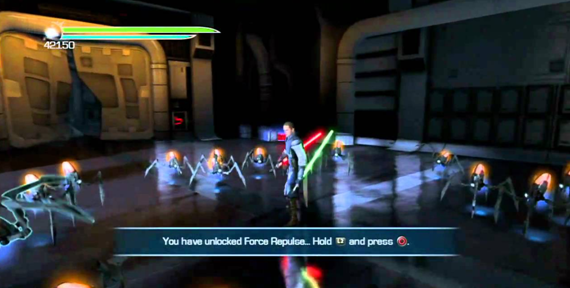
Most of Starkiller’s basic Force abilities make a return; you can fry Stromtroopers with Force Lightning, push or toss them (and objects) with Force Push and Force Grip, or blast them away with Force Repulse. The game also places far more emphasis on pressing Y or O during a lightsaber combo to deal additional damage with Force Lightning or Force Push, which is extremely useful for clearing out waves of enemies or dealing additional lightning damage. While the life-sapping Force Shield is absent, Starkiller can now use a Mind Trick to convince his enemies to turn on their comrades or leap to their deaths which, while handy (and pretty much mandatory in the game’s final battle against Vader), can be clunky; I found it either wore off too fast or enemies just shrugged it off when I applied it. as you cut down enemies, you’ll build up a meter in the bottom left of the screen; once fully charged, pressing down the two analogue sticks will send Starkiller into a “Force Rage”, which increases his attack power and resistance to injure for as long as the meter lasts (which, to be fair, is quite a while). As you cut down enemies, you’ll earn points that can be used to upgrade each of Starkiller’s abilities, similar to the last game but much simpler and more streamlined. Gone are the multiple of combos you had to purchase and you have no need to buy new Force abilities as Starkiller either remembers them or learns them as he progresses, meaning its far easier to power-up Starkiller’s abilities.

SWFU2Grip
The Force Grip is now, thankfully, much easier to pull off.

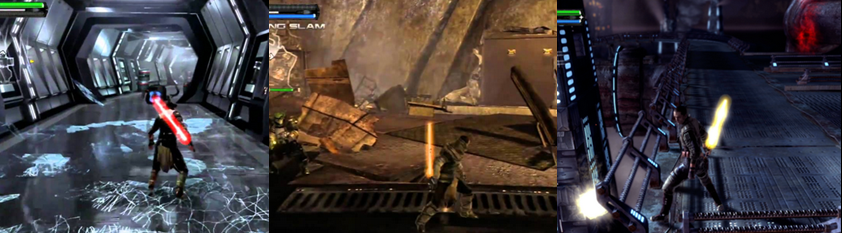
Also like in the first game, you can acquire crystals to customise the appearance and abilities of Starkiller’s lightsabers; you can mix and match the different blades for added effects and bonuses, though, unfortunately, there’s no way to customise your favourite blade colour with your preferred buff. While Force abilities are still a vital part of the game, and the combat system, I found they were mostly relegated to opening doors (which I still find difficult due to the game’s physics and hit detection) and tossing objects. Thankfully, gripping TIE Fighters and lobbing various bits of the environment at your enemies is much easier here; in the original, it felt like I was always fighting to get a grip on passing TIE Fighters and that they would just go flying wherever they wanted but, here, the system is much improved.

SWFU2Grapple
Grapple enemies to deliver massive damage.

Yet, for the most part, the game’s combat is focused almost exclusively on lightsaber combat. Perhaps because the clone is so emotionally unstable, combat is fast, brutal, and frenetic; Starkiller can grapple his foes to deliver either an instant kill or massive damage; he also lops off Stromtrooper’s heads and limbs this time around and can once again leave enemies open to a devastating parry with a well-timed press of the block button. Starkiller can still hurl his lightsabers at his enemies to cut them down from a distance, too, but I actually found myself using this far less in combat as it leaves Starkiller vulnerable as he waits for his weapons to return; instead, the game mostly focuses on using this ability to cut down platforms.

SWFU2Enemies
Don’t let enemies overwhelm you or you’ll have a bad time.

In addition to attacking with more power and proficiency than before, Starkiller also seems to be noticeably tougher; he can still lose health rapidly when pinned down or subjected to multiple attacks but his new combat style allows him to quickly cut down those before him to refill his health and force meter. You’ll need these skills as well as the game’s enemies seem much tougher and smarter this time around; snipers blast at you from the high ground in the distance or behind waves of regular Stromtroopers, who hunker down behind cover or buzz around on jetpacks. Even the bog-standard Stromtroopers can take a beating as well, meaning you should always go for overkill when engaging with hallways filled with enemies. Speaking of which, while the game is far more linear in its environments and level layout than its predecessor, I find it amusing, then, that the game ditches a traditional map and, instead, allows you to “sense” the way you need to do with the directional-pad as it’s highly unlikely that you’ll get lost in the game’s straight-forward environments. You’ll still be tasked with performing some mandatory platforming; Starkiller can double jump and dash on the ground and in the air to cross gaps but, more often that not, you’ll probably have to use the Force in some way to create makeshift bridges.

SWFU2Freefall
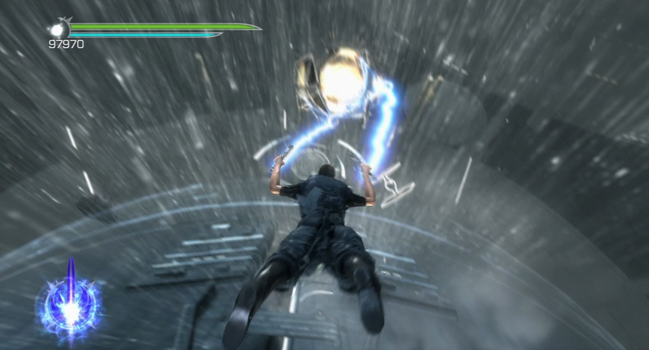
The Force Unleashed II loves these free-fall sections.

While platforming is light, it is mostly okay; Starkiller is nowhere near as slippery and janky as before and the game’s engine doesn’t seem to be struggling to render everything this time around, meaning you’re far less likely to slip or glitch off a ledge. The game does suddenly through a whole mess of tricky platforming at you when you storm Kamino’s cloning facilities in the final chapter, however, so it’s best you work on perfecting those jumps. Also as before, you’ll be tasked with performing a number of quick-time events (QTEs), especially against largely enemies and during boss battles. While these aren’t anything too complex beyond either pressing or mashing a button (or two buttons) at the right time, I found that the QTE indicators were harder to spot on the screen as they often appear at the edges of the display. There are also numerous moments where Starkiller dives through the air at high speed, dodging obstacles or blasting them (or enemies) with his Force abilities; while these are fun and exhilarating, the game maybe uses them a few too many times. Luckily, the poorly-conceived Star Destroyer section of the original is turned on its head here where Starkiller has to clear a path for a ship that is crashing through Kamino’s atmosphere, which is much improved.

SWFU2Glitch
My game glitched out on me, wouldn’t load this boss, and then crashed.

Luckily, the game’s stability has been noticeably improved over its predecessor; enemies no longer turn into stupid ragdolls when you defeat them or toss them around and I encountered far less glitches and issues with jumping or interacting with the environment. However, I did experience a few issues with slowdown, stuttering, and instances where the game didn’t load in the required environment or boss battle. This may have been because of the condition of my game disc, however as, after I cleaned it, the game continued to run fine but it was noticeable.

SWFU2Length
Before you know it, you’re facing off with Darth Vader and the game is over.

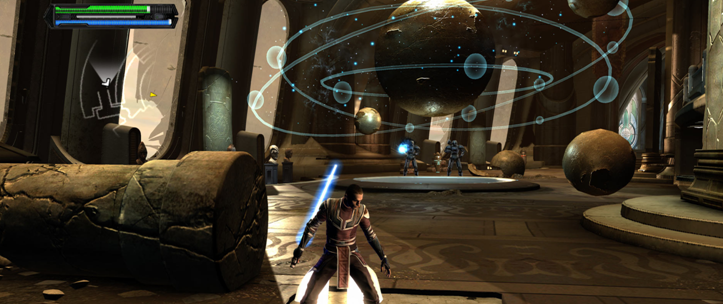
What really lets the game down, though, is its length and variety; I was annoyed that you revisited the same levels in The Force Unleashed and that, while the game evoked the spirit and aesthetic of Star Wars, it didn’t really do much to show us more of this sprawling, multi-cultural galaxy. For the sequel, you’ll battle through hallways-upon-hallways in many grey-coloured environments, whether it’s on a starship or the facilities on Kamino. The game tries to mix it up with some puzzle elements involving you powering up doors and visiting Cato Neimoidia (which is little more than a reskinned Geonosis) and briefly stopping by Dagobah but the majority of your time is spent exploring very similar-looking environments. Additionally, the game seems much shorter than its predecessor; I blew through the main story on the “Medium” difficulty and only missed one lightsaber crystal and with only a few Force abilities left to upgrade (easily remedied with a quick replay of some of the game’s other levels). The game’s length is so noticeably short, and its environment so conspicuously limited, that it almost feels like an extended add-on to the first game, like they took an idea for downloadable content (DLC) for The Force Awakens and simply padded it out to fill four to six hours of repetitive combat and gameplay.

Graphics and Sound:
Graphically, The Force Unleashed II isn’t much of an improvement over its predecessor, either; the cutscenes are of about the same quality and the in-game graphics only seem like they have been slightly tweaked and improved. I’ll give it this, though: the game really knows how to render the interior of a starship and the storm-swept landscape of Kamino; while this may mean that the game’s overall stability and quality is noticeably improved as the game isn’t trying to render or process loads of different elements all at once, it does make for a far blander and less interesting aesthetic experience as the game never reaches the heights of the original’s run through the Death Star laser cannon.
SWFU2QTEs
The game looks pretty decent, for the most part.

Once again, one of the best elements of the game is the incorporation of John Williams’ iconic Star Wars tracks. While you don’t get the same exhilaration as cutting down Wookies as Darth Vader while the Imperial March plays, the use of familiar Star Wars tracks once again works extremely well with the game’s visual fidelity to the movies to make it feel as though the game and its characters are deeply entrenched in Star Wars lore.

Enemies and Bosses:
For the majority of The Force Unleashed II, you’ll be cutting your way through swathes of Stromtroopers; we’ve got the generic minions, sniper and jetpack-wearing variants, and staff-wielding Riot Troopers. Despite the ease at which you can cut through these guys (the jetpackers, especially, go down much easier than in the first game), it does feel as though their intelligence, durability, and aggressiveness has been tweaked slightly to make them a bit more of a threat. Thankfully, the annoying Purge Troopers are no longer present; in there place, are a series of robotic enemies. The large variants wield shields that you must wrench off them with the Force and can attack with explosives, flamethrowers, or even carbonite sprays. You’ll also battle AT-MPs and AT-STs, both of which require to you reflect missiles back at them and, like these larger robots, can be destroying using QTEs.

SWFU2Gorog
The battle against the Gorog just keeps going on and on!

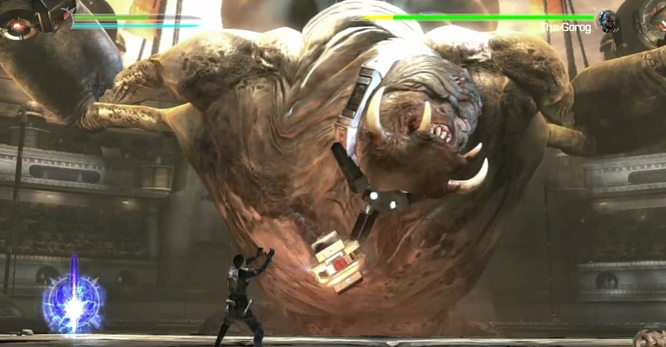
The game also brings back Force-sensitive and lightsaber-wielding foes, who are resistant to your lightsaber attacks and Force abilities, respectively, though the new grapple move is very useful for breaking through their guard. You’ll also battle spider-like terror droids (who can swarm you in an instant and must be destroyed en masse with Force Repulse) and enemies who are invisible and intangible until you stun them with Force Lightning, but, beyond Stormtrooper and droid variants, that’s about it for the game’s enemies. The Force Unleashed II is also a little thin on the ground when it comes to its bosses; at one point, it seems like the game is building up to a battle against Boba Fett but this never actually occurs, which is a shame. While the first game had far more boss encounters, though they were generally all variations on the same thing but, here, there are as few bosses as there are levels. The game tries to make up for it by making the few boss battles you do have to contend with last a long time; when battling the gigantic Rancor-eating Gorog, for example, you’ll have to dodge its massive claws, charge up its shackles with Force Lightning before attacking them with your lightsaber, and then mash the B button to Force Push the creature back into its restraints. Once you sap its health, you’ll then have to blast it with Force Lightning and attack it (and a few waves of Stromtroopers) from a higher gantry in order to sever the structure holding it in place and then you’ll dive after it at high speed, zapping and slashing at it before it can crush your ally, all of which can be an extremely exhaustive experience.

SWFU2Vader3
Eventually, the battle is decided by a QTE.

This exhaustion continues with the final bout against Darth Vader; unlike in the first game, where you could choose to battle Vader to the death or take on the Emperor at the end, The Force Unleashed II ends on an annoying multi-stage duel with the Dark Lord himself. Being so thoroughly bested by his apprentice in the first game must have really pissed Vader off, too, as he’s much more of a threat in this sequel; your Force abilities are all but useless against Vader here, requiring you to unleash your best combos against him on the rare occasions when his guard his down. Like the final duel of Star Wars: Episode I: The Phantom Menace (ibid, 1999) and the battle between Yoda (Frank Oz) and Palpatine (Ian McDiarmid) in Revenge of the Sith, this finale takes place on a vertical plane, with Starkiller and Vader having to leap to platforms across a bottomless chasm deep in Kamino’s cloning facilities. As the fight progresses, you’ll have to send debris and objects back at Vader to damage him and then use your Mind Trick to convince flawed Starkiller clones to distract and damage Vader enough for you to really open up on him. Finally, the fight ends out on a rain-soaking landing platform, similar to the fight between Obi-Wan Kenobi (Ewan McGregor) and Jango Fett (Temuera Morrison), where your Force Range will be fully powered and you’ll have to win a few QTEs to finally best Vader in combat and be able to, once again, choose between a Light Side ending and a Dark Side ending.

Power-Ups and Bonuses:
as in the first game, you can pick up Jedi and Sith Holocrons hidden throughout every level; these will either give you a bunch of additional points to upgrade Starkiller’s abilities or provide you with a crystal to customise your lightsaber. These Holocrons are far easier to spot than in the first game and there’s even two additional variants, green and blue, which expand Starkiller’s health and Force meter respectively. While you can no longer acquire in-game buffs that make you invincible or the like, the different lightsaber crystals allow you to drain health from enemies, increase the replenishment of your health or Force meter, or earn more points from combat. You can also customise the lightsaber to deal additional lightning damage, possibly set enemies on fire, or even have a chance to disintegrate them entirely with the mythical Darksaber. As you play through the game, you’ll unlock additional costumes for Starkiller; you can also unlock further costumes by succeeding in the game’s “Challenge” mode and, if you have a save file from The Force Unleashed on your hard drive, you’ll gain access to three additional costumes (including the awesome Sith Stalker costume).

Additional Features:
As in the first game, you can unlock concept art and data files by playing the game; you can also input various cheat codes that allow you to save you having to unlock costumes and skins such as Boba Fett, though most of the game’s best costumes are restricted to DLC. Also present is the aforementioned “Challenge” mode; as you play the game, you’ll unlock new maps and challenges to take on in this mode, which generally require you to survive against waves of enemies while staying on a platform or collecting Holocrons, all against a clock. Depending on how well you do, you’ll receive either a bronze, silver, or gold medal and unlock additional costumes. DLC is far less extensive in this game; unlike the first, there is only one additional mission available in DLC. This non-canon extension of the game’s Dark Side ending sees players assume the role of the dark clone of Starkiller, who is sent to kill Princess Leia (who has become a Jedi in this timeline) during the Battle of Endor and winds up drop-kicking Ewoks and killing both Han Solo and Chewbacca for good measure.

SWFU2Conclusion

The Summary:
For everything Star Wars: The Force Unleashed II improves from its predecessor, it has a near-equal number of failings as well. The game is far simpler; the interfaces are cleaner and easier to navigate, the plot is much more simplifier, and the combat has boiled down to a simply button masher. While this makes the game fast-paced, frenetic fun at times, it comes at the cost of the game’s length, difficulty, and replayability; the environments are even more limited than its predecessor, the plot is paper thin is the bare minimum excuse to produce a sequel, and it largely adds little to the first game or the overall Star Wars lore. Unfortunately, there’s probably less appeal in The Force Unleashed II than in the original; at least in that game, we got to see some familiar characters return and the formation of the Rebel Alliance be fleshed out but, here, we’re not really learning anything new. All this sequel shows us is that it was foolish for players to be emotionally invested in Starkiller and his new allies as even PROXY, who was clearly destroyed in the original, returns here (adding nothing to the narrative) and Juno, for all the importance the game places on her in Starkiller’s life, is little more than a damsel in distress and is never interacted with until the last moments of the game. Overall, The Force Unleashed II is far less frustrating than its predecessor but still an average gameplay experience. The developers definitely tidied up the combat and the physics but it doesn’t change the fact that this sequel is little more than an shameless cash-in n the success of The Force Unleashed. Were this game’s story condensed into a piece of DLC and its improvements and tweaks placed into The Force Unleashed, we could probably have had a really good Star Wars game but, instead, we got two lacklustre titles that, for all their potential, fail to really provide a coherent gameplay experience between them.

My Rating:

Rating: 2 out of 5.

Could Be Better

What did you think abouy Star Wars: The Force Unleashed II? Did you consider it to be superior to its predecessor or were you just as unimpressed with the game’s length and variety as I was? What is your favourite Star Wars videogame (or movie, or show, or book, or whatever), if any? Either way, drop a comment below and let me know.

Game Corner: Star Wars: The Force Unleashed (Xbox 360)

GameCorner
SWTFULogo

Released: September 2008
Developer: LucasArts
Also Available For: iOS, J2ME, N-Gage, Nintendo DS, PlayStation 2, PlayStation 3, PlayStation Portable, Nintendo Wii, PC, and Mac

The Background:
Before Disney bought the entire Star Wars (Various, 1977 to present) franchise and decided to reboot it with a bunch of questionable sequels, George Lucas was still firmly behind the wheel of his signature series. Development of a new Star Wars videogame began in 2004, around the time that Lucas was finishing up Star Wars: Episode III: Revenge of the Sith (ibid, 2005), and, eventually, the developers decided to work in close collaboration with Lucas in bridging the gap between that film and the seminal Star Wars: Episode IV: A New Hope (ibid, 1977). The decision was made to introduce the idea that Darth Vader had secretly been training an apprentice, known as “Starkiller”, to not only hunt down and destroy any remaining Jedi but also to assist him in overthrowing Emperor Palpatine. In service of this, Vader would use Starkiller to form the fledging Rebel Alliance, thereby effectively creating his own downfall. While these events would later be rendered non-canon after the Disney buyout, for a time they stood as the established origins of the Rebel Alliance. Personally, I haven’t really enjoyed a Star Wars videogame since Star Wars: Rogue Squadron (Factor 5/LucasArts, 1998) and have only dipped in and out of subsequent titles as the franchise has dabbled in almost every conceivably genre. I’d heard, however, that The Force Unleashed was a pretty decent title, if mired by some frustrating controls and gameplay elements. Nevertheless, distrustful of Electronic Arts and their shameless loot crates and being unwilling (read: poor) to shell out for Star Wars Jedi: Fallen Order (Respawn Entertainment, 2019) yet having a Star Wars itch, I decided to take the plunge with The Force Unleashed and see if it holds up after all this time.

The Plot:
During his mission to hunt down and destroy the remaining Jedi, Darth Vader stumbles upon the son of a Jedi, whom he takes as a secret apprentice. Trained in the Dark Side of the Force, Vader’s secret assassin, Starkiller, is sent out into the galaxy to purge the Jedi and lay the foundations for Vader’s coup against the Emperor.

Gameplay:
Star Wars: The Force Unleashed is, like many Star Wars videogames, a third-person action title in which the player controls Starkiller, a troubled and damaged young man who is strong with the Force and well-trained in the Sith arts. As a result, Starkiller wields a lightsaber and can use the Force in a variety of ways to strike down those before him. Combat is largely built around the execution of combos that string together successful lightsaber strikes with Force abilities. Starkiller can blast foes with Force Lightning, push or toss them (and objects) with Force Push and Force Grip, blast them away with Force Repulse, or envelop himself in a life-sapping Force Shield. As he cuts down Jedi and Stormtroopers alike, he earns experience points which can be used to unlock additional combos and improves his abilities. Luckily, there’s no crafting system and the skill tree is ridiculously easy; you can acquire crystals that will allow you to customise the look and abilities of Starkiller’s lightsaber and can improve the strength of his various attacks or regenerative abilities by spending Force Points.

SWTFUCrLightsaber
Starkiller holds his lightsaber like an absolute bad-ass.

Speaking of Starkiller’s lightsaber, you know he’s a bad-ass not just because he has a no-nonsense buzzcut or a near-permanent scowl but also because he holds his lightsaber backwards! What a rebel! Holding down L2 will allow Starkiller to block incoming blaster fire and attacks (and pressing it at the right moment will also allow him to parry), though he can also automatically send bolts back to his foes as he runs along. Lightsaber combat is simple and fluid; hitting X at the right moment will initiate a fancy flourish that can be chained with subsequent attacks to deal massive damage, and Starkiller can even hurl his lightsaber like a boomerang to take out ranged foes and charge it with his Force Lightning to electrocute his enemies. It’s not all combat and tossing fools to their death with the Force, though; you’ll have your reaction time tested in more than a few quick-time events (QTEs) and Starkiller generally navigates through a limited number of largely limited, if relatively-well-realised environments, jumping and dashing his way to a series of objectives. There’s some light platforming here that requires the use of a double jump and dash, and a few extremely basic puzzles that pretty much always boil down to using the Force to move something to either cross a gap or open a door (or, sometimes, both!)

SWTFUStarDestroyer
While impressive, this part is a pain in the ass.

While Starkiller controls very well, what will mess you up is the game’s wonky physics engine, unreliable camera, and janky controls; I struggled endlessly with the Force Grip, which either allowed me to suspend objects uselessly in mid air or sent them careening futilely against a wall and, as many have commented. This becomes a massive source of frustration during what should have been the game’s crowning achievement: pulling a Star Destroyer from the sky. While pulling the ship down wasn’t actually that difficult (though it is frustrating having to angle it into the right position), it’s the wave-upon-wave of TIE Fighters that make this so aggravating. Starkiller can’t deflect TIE Fighter fire and the only way to destroy them is to grab them with the Force and, I swear, it’s damn near impossible to get a grip on them.

SWTFULevels
Levels are very Star Wars but not very inspiring.

Compounding the matter is the fact that Starkiller is actually quite weak; you can upgrade his health and Force meter and the damage he can receive and dish out, but he bounces around the place like a puppet when he’s blasted with heavy weaponry and sometimes takes so long to jump back up that he can get blasted to death with very little effort. As a result, you’ll be constantly jumping and dashing about cutting down the regular Stromtroopers to refill your health and allow you to pummel away at the game’s tougher enemies. While the game is a decent length and tells a pretty engaging story about Starkiller’s eventual redemption and sacrifice, the level variety leaves a lot to be desired. Every environment feels very Star Wars and you’ll battle through a TIE Fighter factory, the woodlands of Kashyyyk, and even through the Death Star itself but the problem is that you basically revisit the same environments twice over. You begin the game as a fully-powered Vader slaughtering Wookies on Kashyyyk and later revisit this planet as Starkiller; Starkiller journeys to Raxus Prime to assassinate a Jedi and later returns there to rescue key figures of the Rebellion. Other environments, like Tatooine and Coruscant, appear as downloadable content (DLC) but it would have really helped to increase the game’s visual variety to have these levels be a part of the main story.
Graphics and Sound:
Graphically, the game is…okay. The computer-generated cutscenes are well-produced but, while the in-game graphics do a serviceable enough job of rendering the game’s handful of levels and environments, they don’t make for very attractive in-game cutscenes. It also seems like the developers were desperate to cram as many different physics engines into the game as possible, from Havok to Euphoria, in order to make the game “state of the art”. However, while the enemies have relatively decent levels of intelligence (Stormtroopers just blast away but the Purge Troopers and Felucian’s systematically attack you with blocks and co-ordinated attacks) and the environments are largely intractable and destructible, the game is riddled with rag-doll physics, glitchy platforms (Starkiller is just as likely to slide off a ledge as he is to land on it), and dodgy graphical elements (the backgrounds are teeming with life and action but then some barriers and trees just disintegrate into dust and fade away).

SWTFUMusic
You’ll really feel as though you are Darth Vader…for about ten minutes.

Yet, the game is filled with familiar Star Wars music and compositions based upon the works of the great John Williams. There’s something incredibly empowering about cutting Wookies down as Darth Vader while the iconic Imperial March plays and the music definitely lends a level of professionalism and quality to the game that is, generally, matched by the game’s recognisable environments.

Enemies and Bosses:
The Force Unleashed is filled with all manner of enemies; while you’ll wade through legions of Stormtroopers who go down with relative ease, you’ll also come up against some of the Empire’s more advanced troops who make use of cloaking technology, gatling guns, blast you with concussive bolts from jetpacks, or erect Force-resistant shields. Then there are the enemies who use energy shields or weapons to block and parry your attacks, the likes of the Purge Troopers who grapple Starkiller and want nothing more than to bash his brains in, or the always-annoying Sniper Troopers who pick you off from a distance. Starkiller will also battle Force-sensitive enemies, like the Felucians, or those like the Emperor’s Royal Guard who wield lightsaber-like staffs and weapons and require you to break through their defences to land a combo.

SWTFUBigEnemies
Larger enemies require a bit more strategy.

Sometimes you’ll have to target a specific enemy in order to “demoralise” the other troops; this is essential as, when your enemies are bolstered by these bastards, they can kill you in short order. Starkiller will also frequently come up against AT-STs and Rancors as well; these larger enemies are often flanked by waves of smaller enemies and can whittle your health down to nothing in no time with their powerful attacks so you’ll have to make use of Starkiller’s ranged Force abilities and combos and then win at a QTE to put them down for good.

SWTFUSarlaac
One boss battle takes place right next to a Sarlacc pit!

As for boss battles, these are pretty much all against Jedi, Sith, or similarly-Force-empowered individuals. While each of these encounters is largely the same (block or parry attacks while you wait for an opening, cut down cannon fodder to refill your health, use your Force powers to throw objects at the boss, and win a QTE), each takes place with slightly different environmental and additional hazards. You’ll duel with Shaak Ti beside a Sarlacc pit, for example, have to contend with Maris Brood’s Bull Rancor, and will have to battle simulations of not only the Jedi you’ve defeated before but also a recreation of Darth Maul when facing off with Starkiller’s droid, PROXY.

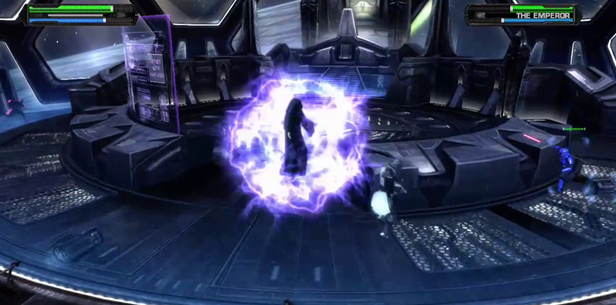
SWTFUSEmperor
The Emperor will try your patience.

The finale of the game obviously sees you butting heads with Starkiller’s former master, Darth Vader; this is a three (or four, depending on your choice) stage fight that begins in a narrow hallway, progresses to a room where the floor is (almost literally) lava, and ends in the Emperor’s observation deck. Ironically, I found Vader to be less challenging than some of the game’s other bosses as, while he has a powerful Force blast and will choke you out of the air, it’s not actually too difficult to weather his attacks and wail on him with your best combos. After besting Vader, you’re presented with a choice to finish him off in a battle to the death (thus earning the Dark Side ending) or going one-on-one with the Emperor to achieve the Light Side ending. Rather than attacking with a lightsaber, Palpatine uses his Force Lightning to roast you alive, shields himself from your attacks, and throws lightning-charged objects at you (that also explode). This battle is more annoying than difficult as, with careful timing, you can bounce Palpatine’s lightning back at him and whittle him away with your combos as long as you can avoid or block his other attacks.

Power-Ups and Bonuses:
As mentioned, you can acquire, upgrade, and purchase new combos and abilities as you play through the game and level up; by the time you confront the Emperor, you can take quite a bit of punishment, your Force meter will refill faster, and your attacks will dish out far more damage thanks not just to being upgraded but also to the new combos available to you.

SWTFUUpgrades
Upgrade your abilities with Force points.

As you explore your environment, you can also pick up Jedi Holocrons, which will refill your health and Force meter, award Jedi points, and yield other awards (like new lightsaber crystals). With the right lightsaber crystal, your lightsaber can deal more damage or suck health from your opponents, and you’ll also unlock additional artwork, costumes, and other bonuses by finding all of the Holocrons. Starkiller can also increase his odds with one-time buffs by picking up Sith Holocrons; these will grant you with limited invincibility, refill your meters, bestow you with an aura that will drain the health from enemies, or give you an unlimited Force meter for a brief time. Against some of the game’s tougher enemies and mini bosses, these can be essential so make the effort to pick them up and take out the more annoying enemies.

Additional Features:
As mentioned, you can unlock a bunch of concept art and data files by playing the game and collecting Jedi Holocrons. There are also a large number of additional costumes available for use; none of these offer any benefit beyond being cosmetic changes but they do allow you to play as other Star Wars characters, including Obi-Wan Kenobi and even C-3PO! There are three DLC missions you can also play if you bought the extra content (or the Ultimate Sith Edition); one sees Starkiller undergo a series of trials in the Jedi Temple on Coruscant while the other two take place on Tatooine and Hoth and present an alternative scenario where Starkiller replaced Vader as the Emperor’s assassin and battles some familiar faces. As standard, there are a number of Achievements to unlock; most of these are earned through regular play, while other require you to kill a certain number of enemies in different ways or play on higher difficulty settings.

SWTFUConclusion

The Summary:
Star Wars: The Force Unleashed is, ultimately, an average experience; the combat is fast and frenetic and it’s fun to fry Stormtroopers with Force Lightning or cut AT-STs in half but the game quickly runs out of depth and steam and it isn’t long before you’ve experienced everything it has to offer. Starkiller was an interesting protagonist but the story of his redemption is, honestly, nothing we’ve never seen before in Star Wars movies or other media. It doesn’t help that he has to constantly travel through the same environments, fighting variations of the same enemies, and battling against some really dodgy physics and a camera that just loves to get stuck behind objects or jitter about the place at crucial moments. The game’s more frustrating elements really hamper the thrill of fighting through the Death Star laser cannon; battling Jedi and the iconic Sith duo is fun but also a laborious experience that generally comes down to dodging an attack and just mashing away at X like a madman until you win. Despite the fact that the game carries a large degree of sensory fidelity to the Star Wars movies and offers perhaps the best lightsaber combat I’ve experienced so far, it seems to be lacking a real polish to bring together is disparate elements into a cohesive and consistently engaging experience.
My Rating:

Rating: 2 out of 5.

Could Be Better

What were your thoughts on Star Wars: The Force Unleashed? Did you also struggle with the game’s wonky physics, camera, and controls or do you consider it to not actually be that bad? What is your favourite Star Wars videogame (or movie, or show, or book, or whatever), if any? Either way, leave a comment below and let me know.

Movie Night: Star Wars: Episode IX: The Rise of Skywalker

StarWarsSkywalkerLogo

Released: December 2019
Director: J. J. Abrams
Distributor: Walt Disney Studios Motion Pictures
Budget: $275 million
Stars: Daisy Ridley, Adam Driver, Oscar Isaac, John Boyega, and Ian McDiarmid

The Plot:
When a threat of revenge is issued by the long-dead Emperor Palpatine (McDiarmid), Rey (Ridley) is drawn into another confrontation with Kylo Ren (Driver) in the search for an ancient Sith device that will reveal the location of the resurrected emperor and decide the fate of the entire galaxy,

The Background:
So, this is it; for better or worse, the “Sequel Trilogy” of Star Wars movies (Various, 1977 to present) comes to an end. For me, this has been a disappointment since Star Wars: Episode VII: The Force Awakens (ibid, 2015), which was little more than a retelling of better Star Wars stories but with better effects and writing, and only exacerbated by the dreadful Star Wars: Episode VIII: The Last Jedi (Johnson, 2017). Rather than show us a galaxy thriving under the leadership of Leia Organa’s (Carrie Fisher) New Republic alongside Han Solo (Harrison Ford) and Jedi Master Luke Skywalker’s (Mark Hamill) reconstituted Jedi Order, we inexplicably have a galaxy threatened by the First Order (who are somehow, consistently, more powerful than the Galactic Empire ever were despite all the losses from the Death Star and Starkiller base…) and being opposed, once again, by a rag-tag resistance group. The Last Jedi then pissed a lot of people off by dropping the ball on Rey’s origins, killing off Supreme Leader Snoke (Andy Serkis) without any fuss or fanfare, and doing away with Luke purely so that Rey could shine as the titular “last Jedi”. Somewhat spooked by reactions to The Last Jedi (and the two spin-off movies, despite the fact that I actually preferred both of them to the entire Sequel Trilogy), Disney roped J. J. Abrams back into the fold to get the Star Wars franchise back on course and, what we’re left with, is a hodgepodge of fan service, damage control, and desperation as he frantically tries to wrap up not just the Sequel Trilogy but the entire Skywalker Saga itself!

The Review:
The Rise of Skywalker kicks off with Ren immediately locating one of only two Sith wayfinders and travelling to the forgotten Sith planet Exegol where he encounters Palpatine, who wastes no time in providing half-assed explanations regarding his resurrection/survival, Snoke’s origins, and motivations for Ren reconstructing his helmet and getting back out their to kill Rey. The implication seems to be that Palpatine transferred his spirit into a clone body and was controlling Snoke like a puppet to convert Ren but…it’s not dwelled upon much at all, which really makes you feel like you’ve wasted your time watching any of the previous movies.

StarWarsSkywalkerRenFocus.PNG
Despite it all, Driver brilliantly showcases Ren’s duelling nature.

Plus, like, the emperor surviving really undermines the Rebellion’s victory and takes a lot of power and urgency away from Ren, who is otherwise portrayed fantastically by Adam Driver. Imagine if Anakin Skywalker (Hayden Christensen) had been as wonderfully torn between rage, indecision, and love; Ren is constantly on the edge, flipping between extreme focus, exploding in anger, and struggling with committing to the Light or Dark Side.

StarWarsSkywalkerBuddies
Thankfully, the chemistry between these guys is a highlight of the film.

As for Rey, she’s been spending her time training with Leia and studying the Jedi texts she obtained from Luke while Finn (Boyega) and Poe Dameron (Isaac) return with news of the emperor’s return. Thankfully, this leads to the three of them heading out to Pasaana to try and find the other wayfinder and end the emperor before he can launch his master plan (called “The Final Order”…which really should have been the title of the movie as the title is dogshit…). One of the strengths of Abrams’ Sequel Trilogy has been the writing and dialogue and Finn, Poe, and Rey have great chemistry together; they bicker and talk like real people and real friends, which is always refreshing after sitting through George Lucas’ stilted, robotic writing.

StarWarsSkywalkerLando.PNG
It’s always a pleasure to see Billy Dee Williams.

In all honesty, the plot of The Rise of Skywalker boils down to a glorified fetch-quest; the heroes bounce around the galaxy trying to track down the wayfinder and, eventually, find themselves teaming up with Star Wars staple Lando Calrissian (Billy Dee Williams) and exploring the remains of the second Death Star, where Rey’s super-duper true origins are finally revealed. Alongside such blatant fan service, The Rise of Skywalker is also gloriously peppered with epic space battles and some of the best lightsaber battles we’ve ever seen, all bolstered by some of John Williams’ best work. Unfortunately, I cannot get over the missteps the franchise has taken since The Force Awakens and the film feels a bit rushed and slapped together in places as Abrams desperately performs damage control to rush the film, the sequels, and, stupidly, the entire saga to a conclusive finish…and still ends with the door left so blatantly open for future films in the series.

The Nitty-Gritty:
So, if you hated Rey before, you’re probably going to hate her even more when it’s now revealed that her parents weren’t nobodies; instead, Rey is inexplicably Palpatine’s granddaughter…which raises so many questions like: when did Palpatine have a son? Who was his mother? Why would he ever left his progeny live? Why has it taken him so long to track them down and kill them? These questions are trumped by a far more pressing one, though, which is literally the question of why Palpatine is even alive at all. Obviously, this is a cheap move to ensure that audiences will flock in droves to see the film out of nostalgia but it really takes away from the victory on the second Death Star and Abrams did very little to justify it. I really feel like we needed a more blatant explanation of his survival and the nature of his relationship with Snoke but, instead, it’s hand-waved away in the laziest way possible.

StarWarsSkywalkerDestiny.PNG
The emperor’s threat is issued and destiny awaits…

Also, while he’s been rebuilding himself and his power, the emperor also build an entire fleet of Star Destroyers, all fully manned and armed with planet-killing weapons. Where did he get the resources and manpower for such an endeavour? Fucked if I know, but he did. Not only that, but Richard E. Grant is randomly in charge of the fleet as General Pryde, because I guess Colonel Sandurz was busy that day and I guess Adrian Edmonson was unavailable and Abrams saw how Johnson reduced the already pathetic General Hux (Domhnall Gleeson) into a whiny little cry baby. But it’s okay because it turns out Hux is so jelly of Ren that he’s been leaking information to the Resistance and, right when you think that means he’s going to do something interesting, he’s just shot dead by Pryde. Speaking of uninteresting, the fabled Knights of Ren finally make an appearance in this movie; they’re a handful of black-clad, anime-sword-wielding enforcers who…stand around doing nothing, beat up Ren for a bit, and then get killed like a bunch of punks! The big story here is the continued turmoil that Kyle Ren is going through; although he aligns with the emperor, he secretly (well….it’s not really a secret; he yells about it at almost every opportunity) seeks to turn Rey so they can team up, bump uglies, and usurp the emperor together. When Leia gives her life to distract Ren, he ends up having a heart-to-heart with a vision/memory/something of his father and rejecting his lightsaber. Reclaiming the name of Ben Solo, he helps Rey to defeat the emperor (and, by extension, the entirety of the Sith, it seems) but dies to bring Rey back to life, becoming one with the Force in the process. It’s a bit of a weak ending as it means the entire Organa/Solo/Skywalker bloodline is dead but Abrams tried to make up for it by having Rey travel to Tatooine (because God forbid we don’t go back there again!) and dramatically declare herself to be “Rey Skywalker”…despite having no claims to the name.

The Summary:
Star Wars: Episode IX: The Rise of Skywalker is clearly the best entry in the Sequel Trilogy but, as a finale to the entire Skywalker Saga, it fails in quite a few ways. Also, it’s hard to watch without the sour taste of its predecessors tainting the film, no matter how engaging the action is or how meaningful some of the film’s heartfelt moments are. Abrams throws all the fan service he possibly can at the film and you can almost see him plastering over the cracks in the film but it’s all at the detriment of telling an original story and nowhere is this more evident than in the credits of the movie. I get that Carrie Fisher and Mark Hamill are legends to this franchise but their roles are so minimal in this film yet they get top billing over Ridley, Driver, Isaac, and Boyega and that’s a bit of a joke, to be honest. In the end, I’m glad that this film has brought the main saga to an end. Hopefully, Star Wars can focus on its Disney+ shows, regroup, and, the next time someone decides to make a film trilogy, they will sit down and map out an actual plan rather than just picking out their favourite Star Wars moments and slapping them into a space/action drama and calling it a day.

My Rating:

Rating: 1 out of 5.

Terrible

Movie Night: Star Wars: Episode VIII: The Last Jedi

LastJediLogo

For those who have been living under a rock for the last forty years, Star Wars is one of the most successful and popular science-fiction media franchises of all time and, perhaps, one of the most beloved trilogies ever crafted. In 1999, series creator George Lucas began his Prequel Trilogy which, thanks to their abundance of CGI, questionable acting, and much-maligned narrative choices, left a sour taste in the mouths of many fans. When Disney purchased Lucasfilm in 2012, they immediately set to work in reinvigorating the franchise by beginning not just a new trilogy of movies, but also an entirely new series of spin-offs and multi-media merchandise. Excitement was high for Star Wars: Episode VII: The Force Awakens (Abrams, 2015), which saw the return of fan favourite characters Han Solo (Harrison Ford), Leia Organa (Carrie Fisher), Chewbacca (Joonas Suotamo/Peter Mayhew), and Luke Skywalker (Mark Hamill). For me, The Force Awakens had just as many positives as it had flaws; it had some great characterisation and action and was way more exciting and interesting than any of Lucas’ prequel movies. However it suffered from leaning maybe a bit too hard on nostalgia by mirroring very closely the plot of Star Wars: Episode VI: A New Hope (Lucas, 1977). This might have been a thematic choice but I feel that the massive time jump over the new renaissance of the revived Galactic Republic and Jedi Order in favour of a inexplicably overpowered Empire proxy, the First Order, and the renewed destruction of the Jedi.

ReyLuke
“I wonder if she means Old Luke Skywalker?…”

Anyway, The Last Jedi picks up immediately after the end of The Force Awakens; the traditional opening crawl is quite sparse as a result but, basically, the First Order apparently now reigns supreme and chaos has swept across the galaxy despite the destruction of their Starkiller base. Relentlessly pursued by the First Order’s fleet, the remnants of the Republic (now reverting to their original branding as Rebels), led by General Leia Organa, organises an evacuation of their base but they end up running low on fuel and being constantly bombarded by the slower First Order ships. Meanwhile, Rey (Daisy Ridley) has found former Jedi Master Luke Skywalker living in isolation on a hidden planet. Swamped by her own fears and uncertainties, she attempts to convince him to rejoin the Rebellion and to train her as a Jedi. Luke, however, is a broken shell of a man, haunted by his failure to keep Ben Solo/Kylo Ren (Adam Driver) from succumbing to the dark machinations of Supreme Leader Snoke (Andy Serkis).

PoeFinnRose
The Last Jedi is all about the new blood.

After Leia is injured from the First Order’s attack, hot-headed Poe Dameron (Oscar Isaac), former Stormtrooper turned Rebel hero Finn (John Boyega), and newcomer Rose Tico (Kelly Marie Tran) hatch a plan to locate a master hacker and sneak onto Snoke’s ship to disable their systems and allow the survivors can escape to safety. These three storylines weave in and out with the continued development of Kylo Ren, who continues to struggle with his legacy, his actions from The Force Awakens, and his attempts to tempt Rey to join his cause.

Sand
The Last Jedi is nothing if not visually stunning.

If The Force Awakens drew heavily from A New Hope, The Last Jedi is heavily influenced by Star Wars: Episode V: The Empire Strikes Back (Kershner, 1980) primarily in its juggling of multiple storylines happening concurrently and in topping the planet-destroying super weapon of their previous film with a more personal, intense storyline. Like the asteroid field chase from Empire, the Rebels end up in the slowest chase in history when they manage to stay just out of range of the First Order’s barrage, Rey’s training is as brief and vague as Luke’s, Finn and Rose are forced to turn to a rogue for assistance, and the Rebels end up in a desperate battle against Imperial walkers. There are also various obvious call backs to Star Wars: Episode VI: Return of the Jedi (Marquand, 1983); Snoke attempts to turn Rey similar to how the Emperor (Ian McDiarmid) tried to turn Luke, the Rebel forces get absolutely obliterated by the First Order similar to the one-sided Endor battle, and there’s some cute new critters used thankfully far more sparingly than the Ewoks to help boost sales of tie-in merchandise. The Last Jedi felt like a massive course correction and righted a lot of the wrongs I took away from The Force Awakens; I didn’t like that Snoke was a thing, I felt that it would be far more interesting and different to see Ren and General Hux (Domhnall Gleeson) at odds but in command of the First Order rather than repeating the tired “evil old wizard in command of the galaxy/pulling the strings” storyline we’ve seen for six previous Star Wars movies. As a result, I was happy to see Kylo kill Snoke and crown himself the new Supreme Leader of the First Order but, as a result, Snoke died before we ever learned anything about who he was or where he came from.

Snoke.png
Want to know more about Snoke? Well, too bad!

Also, while we get to see Poe develop from a trigger-happy, impulsive pilot to a competent leader, Finn’s side plot with Rose ended up just being a convoluted and largely insignificant addition that existed just to give him something to do, and his showdown with Captain Phasma (Gwendoline Christie) was a similarly minor moment in the grand scheme of the narrative. Phasma, with her chrome-plated look (and armour that actually reflects lasers), had the potential to be a stand out character but, in this sea of new characters and overlapping plot points, is basically a nothing when she really could have been Ren and Hux’s primary enforcer. Finn’s best moment comes when he resolves to sacrifice himself to save the Rebels from being blasted by the First Order’s “Death Star cannon” but even this is stolen away from him when Rose randomly jumps in to save him and, effectively, spell the destruction of the remnants of the Republic. As we all know, Carrie Fisher tragically passed away during the production of this movie; as a result, it seemed as though her character would receive a dramatic send off, possibly in a way of adding to Ren’s impressive resume of asshole actions. Instead, she manages to use the Force to survive being blown into space and, although she spends a great deal of time injured, returns to active duty to comfort Rey by the finale. In the meantime, her duties are taken over by Vice Admiral Amilyn Holdo (Laura Dern) who, for no other reason other than manufacturing tension, keeps vital information away from what remains of the Rebellion.

Luke.png
It’s fair to say that Luke is not in the best place, emotionally.

Turning to Luke, I felt this was a great performance by Hamill, who really showed the depth of his acting ability here. While I am annoyed at not getting to see Luke build and lead a new Jedi Order, and I find it hard to believe that he has become a mythical figure when he hasn’t really been away from the public eye for that long, it was great to see him as a broken old man who has isolated himself to die and end the Jedi’s place in the galaxy. Rey helps to nudge Luke back into action not only through her Force proficiency (revealed to be a by-product of her lineage, another plot thread just dumped on the floor), but also reminding him that he is, for many, the personification of hope and the Rebellion in the galaxy. After a few interactions with Kylo Ren through the Force, Rey decides to leave behind her Jedi training and attempt to turn Ren back to the good side and fill the role that Luke is refusing. Although Ren dramatically kills his master and teams up with Rey to fight Snoke’s praetorian guards, they ultimately reject each other’s arguments for turning away from their chosen paths. After a conversation with the Force ghost of Yoda (Frank Oz), who is lovingly realised as a CGI-enhanced puppet, Luke comes to realise that he has to face up to the (extremely uncharacteristic) mistakes he made with Kylo. After an initial fake-out, where it seems Luke is taking a page out of Obi-Wan Kenobi’s (Alec Guiness) book by giving his life to buy his allies time and teach Kylo a lesson in true power, it actually transpires that he was smart enough to project himself into that climactic battle, a feat which takes the last of his energy as he peacefully fades to the Force.

Kylo
Kylo’s “burn the past” mission statement appears to be Disney’s mantra when it comes to Star Wars.

Was The Last Jedi perfect? No, not really. It was probably about as good and bad as The Force Awakens, which basically means that, as much as I enjoyed the film, I still prefer Rogue One: A Star Wars Story (Edwards, 2016). Rogue One utilises nostalgia in a far more natural way as, being set before A New Hope, it makes sense that it’s using the traditional seventies aesthetic. This Sequel Trilogy, however, seem to be a mish-mash of nostalgia, tried-and-true Star Wars narratives, and an attempt to establish a new generation of characters. With the passing of Luke and the fate of Leia up in the air due to Carrie Fisher’s death, the central Star Wars narrative as a Skywalker tale is effectively over, with only Kylo Ren carrying that story forward. All unanswered questions from The Force Awakens are either waved away or dropped entirely; what could have been an interesting tale of a benevolent Galactic Republic being whittled away by the remnants of the Empire under the command of Kylo and Hux (or Grand Admiral Thrawn) is returned to the status quo of the rag-tag Rebellion fighting an oppressive Empire, and the promise of a rebuilding of the Jedi is side-stepped in favour of a new last of the Jedi in Rey. Having said all that, The Last Jedi is still a great film; it’s big on action, humour, and heart but there are some questionable decisions that, for me, keep it from being better than, say, The Empire Strikes Back. Obviously, nostalgia plays a lot into that and there are some parts of Empire that aren’t perfect but, in the end, I can’t get over some of the biggest plot points, such Rey’s parentage and Snoke’s origins, being given no resolution. It’ll be interesting to see where the narrative goes for Star Wars: Episode IX given how The Last Jedi concludes and that I get the sense that Disney are kind of making up each film as they go along.

My Rating:

Rating: 2 out of 5.

Could Be Better


Recommended: Sure; Star Wars and action/sci-fi fans will love this movie, I’m sure, and general audiences should be enthralled by the special effects.
Best moment: There were two for me; Kylo and Rey’s team up against the praetorian guards and Luke’s penultimate battle with Kylo.
Worst moment: The film dramatically slows down after the opening action scene, the awkward and frustrating personality of Vice Admiral Amilyn Holdo stands out, but definitely the entire side plot involving Finn and Rose, which ultimately ended up adding nothing to the larger narrative.