Movie Night: Kraven the Hunter

Released: 13 December 2024
Director: J. C. Chandor
Distributor: Sony Pictures Releasing
Budget: $110 to 130 million
Stars: Aaron Taylor-Johnson, Ariana DeBose, Alessandro Nivola, Fred Hechinger, and Russell Crowe

The Plot:
Saved from death as a boy by a voodoo serum, Sergei Kravinoff (Taylor-Johnson) hunts wrongdoers as “Kraven the Hunter”. However, when his past comes back to haunt him, Kraven must fight to rescue his cowardly younger brother, Dmitri (Hechinger), from a maniacal, half-human, wannabe mobster.

The Background:
Following the phenomenal success of Sam Raimi’s Spider-Man trilogy (2000 to 2007) and the sadly mediocre reception of Marc Webb’s reboot films, Marvel Studios finally achieved the impossible by striking a deal to include the iconic wall-crawler in their Marvel Cinematic Universe (MCU). After seeing the incredible success of Spider-Man: Homecoming (Watts, 2017), Sony were excited enough to greenlight a bunch of spin-offs that would focus on Spidey’s villains and side characters. After Venom (Fleischer, 2018) made bank, Sony not only signed off on a very profitable (if critically maligned) sequel, but also, inexplicably, solo projects for Roy Thomas and Gil Kane’sLiving Vampire”, Doctor Michael Morbius, Denny O’Neil John Romita Jr.’s, Cassandra Webb/Madame Web, and Stan Lee and Steve Ditko’s Sergei Kravinoff/Kraven the Hunter, a character best known for his memorable (if temporary) death in the celebrated “Kraven’s Last Hunt” (DeMatteis, et al, 1987) arc. Although a prominent villain in videogames and the 1990’s Spider-Man cartoon, Kraven’s journey to the silver screen was fraught with years of stop/start efforts. After committing to the idea of their own adjacent series of interconnected Spider-Man movies, production of a solo Kraven film began in earnest in August 2018. Screenwriter Richard Wenk shared that his screenplay was heavily influenced by “Kraven’s Last Hunt” and that he was experimenting with different directions for the character depending on Peter Parker/Spider-Man’s inclusion, all while MCU creators pitched including Kraven in their films. Aaron Taylor-Johnson joined the project and underwent an intense training regime to prepare for the title role, attracted to the film for its deeply interpersonal story. After a number of delays, Kraven the Hunter finally released to universally negative reviews and, as of this writing, the film hasn’t even made $30 million at the box office. Critics tore apart the obvious dubbing of scenes, the disastrous execution, and the tiresome concept of a Spider-Man-less Spider-Man movie. Though director J. C. Chandor was hopeful of a sequel and Taylor-Johnson was contracted for additional appearances, those hopes seem dashed not only by the film’s poor reception but Sony’s announcement that they’ll be refocusing their Spider-Man efforts.

The Review:
It’s baffling to me that Sony just forgot how to make decent Spider-Man movies. Apart from their animated ventures, all their Spider-Man spin-offs have been mediocre to terrible and completely directionless. I can almost understand making standalone Venom movies and it was surprising how well they worked without Spider-Man, but was anyone asking for solo movies for Spidey’s low tier villains and supporting characters? Maybe if there had some kind of plan, like linking all these spin-offs into a coherent, adjacent universe or bringing back Andrew Garfield for a series of showdowns with these characters then maybe, maybe, things would’ve been different. Instead, we live in a world where Sony legitimately thought people would pay to see Kraven the Hunter, of all people. To be fair, Aaron Taylor-Johnson certainly looks the part. He’s ripped and exudes a rugged charisma that certainly catches the eye and his Russian accent and dialect is commendable. He’s easily the best part of this film but that’s a bittersweet compliment as he’s completely wasted here instead of being put to better use in a film that’s not completely forgettable ten minutes in, let alone by the end. Kraven the Hunter opens with Kraven a fully-fledged manhunter; he infiltrates a Russian prison to assassinate crime lord and poacher Seymon Chorney (Yuri Kolokolnikov), an act that kicks off the central conflict of the movie. The film then jumps back in time sixteen years to introduce us to a young Sergei (Levi Miller) and Dmitri (Billy Barratt) and set up their shared and individual issues with their father, kingpin and avid game hunter Nikolai Kravinoff (Crowe).
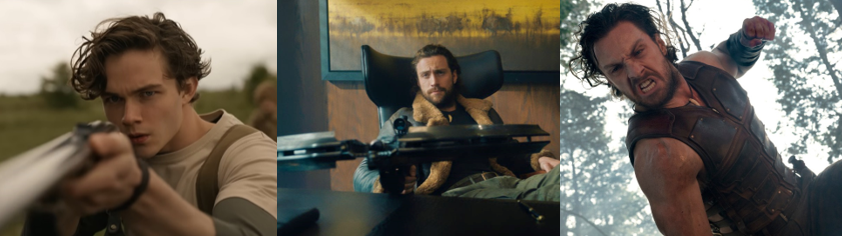
Following a vicious attack and mystical serum, Kraven becomes a renowned manhunter.

This extended flashback establishes that the Kravinoff boys fear and loathe their authoritarian father, who believes in survival of the fittest and refuses to show or tolerate any weakness in either himself, his vaguely defined criminal organisation, and his two boys. Resentful towards Nikolai for his treatment of their mother (Masha Vasyukova), who was mentally unwell and took her own life, the young Kravinoffs are nevertheless powerless to defy their father’s will and forced to accompany him to Tanzania for a hunting trip. While Nikolai favours Sergei, he’s critical and dismissive towards his bastard child, Dmitri, whom Sergei tries to defend at all costs. This drive sees Sergei leap to Dmitri’s defence when a gigantic lion approaches them in the wilds. Hesitating to shoot, Sergei is mauled and hauled away by the beast, leaving Dmitri in hysterics and Sergei close to death. Luckily for him, young Calypso Ezili (Diaana Babnicova) just happened to be vacationing in the area, coincidentally learned from her grandmother’s (Susan Aderin) tarot cards about Sergei’s fate, and carries a helpful voodoo serum which, coupled with the lion’s blood, not only saves Sergei’s life but bestows him with vaguely mystical animal powers. After fully recovering and lashing out at his father’s abhorrent ways, Sergei packs up and leaves, strangely leaving Dmitri behind, fleeing to his mother’s sanctuary (essentially a spherical greenhouse) in the far reaches of Russia. There, Sergei learns the extent of his new abilities: he’s fast like a cheetah, climbs skyscrapers and trees like an ape, is soft footed like a deer (to the extent that he apparently negates people’s peripheral vision), has eyes like a hawk, and superhuman hearing and durability. These gifts allow him to build a reputation as the world’s greatest hunter and he carves a name for himself as “Kraven”, hunting down crime lords like his father (but, oddly, not his father) and local poachers. In all that time, no one has ever pieced together that Kraven is Sergei Kravinoff and his name has become legend. He travels the world with his unseen pilot (whose scenes were clearly left on the cutting room floor) ticking names off his list. However, he riles up the criminal underworld when he kills Chorney as it leaves a power vacuum that both Nikolai and would-be kingpin Aleksei Sytsevich/The Rhino (Nivola) are eager to fill.
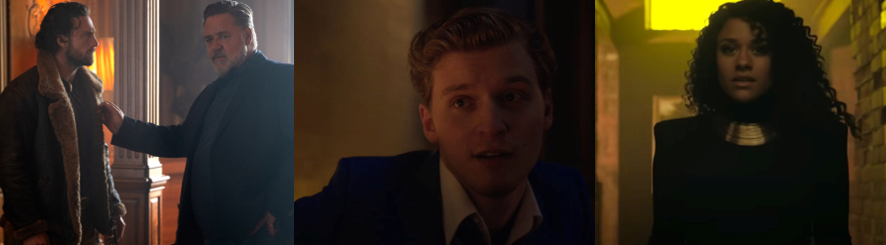
Kraven’s family issues see him make unlikely and underutilised allies.

As mentioned, I don’t get why Sergei left Dmitri behind. The boy lived in constant fear of his father and was desperate to earn his approval and respect, an uphill battle he was seemingly doomed to never win, even with his “chameleon” like talent to mimic voices and lovely singing voice. It seems like it would’ve made more sense for Sergei to take Dmitri and for him to be his pilot but, instead, Dmitri ends up kidnapped by the Rhino and held to ransom, forcing Sergei to reunite with Nikolai and begrudgingly work alongside his estranged father to rescue his troublesome little brother. Despite being renowned as the greatest hunter in the world, it takes Kraven sixteen years to track down the now adult Calypso (DeBose), now a lawyer living in London and jaded by the bureaucratic justice system. Though initially hesitant because of Kraven’s violent lifestyle, Calypso reluctantly agrees to help him track down the Rhino and warns him against pursuing dangerous crime lords, a caution that comes true when Dmitri is kidnapped and Calypso is also targeted by the Rhino in a bid to flush Kraven out. If there’s supposed to be a romantic subplot between Kraven and Calypso, this also seems to have been cut from the film. Calypso certainly looks the part and there are glimpses of chemistry between her and Kraven, but so much of her dialogue is clearly redubbed through ADR and it’s not only jarring but leaves much of her performance flat as a result. She just about manages to prove her worth, however, and she’s never held hostage like Dmitri. She also has contacts who provide Kraven with leads (even if they’re false ones courtesy of the Rhino’s slick henchman, “The Foreigner” (Christopher Abbott), a superhuman mercenary with unexplained hypnotic powers), and even saves Kraven’s life when he’s drugged and brought to the brink of death once more.
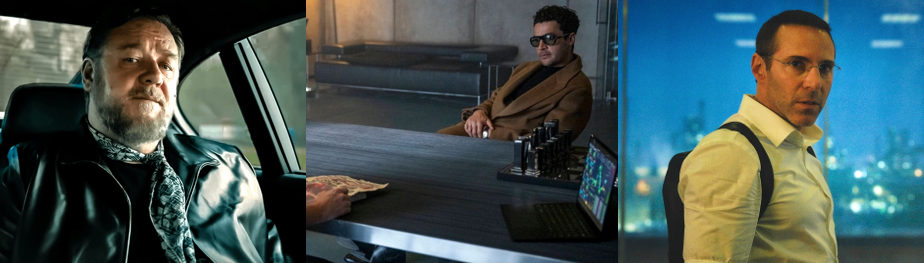
Aside form Nikolai, the film’s villains are bizarre and dull, poorly characterisaed antagonists.

Despite years of mistreatment, resentment, and hatred towards his father, Kraven purposely leaves Nikolai off his list because, for all his flaws, the crime lord is still the hunter’s father. Kraven reunites with his father and brother once a year for Dmitri’s birthday, growing more and more troubled by his brother’s obsession with pleasing the old man, and rebukes Nikolai when he refuses to pay Dmitri’s ransom to avoid showing weakness. Taking matters into his own hands, Kraven tracks down the Rhino and runs into the Foreigner, a mysterious assassin who, honestly, could’ve easily been cut from the film or supplanted with someone else. While we learn of his personal grudge against Kraven, we never learn the Foreigner’s real name, how he got his strange powers, or even what the extent of them are. He easily subdues and murders anyone in his path until he reaches Kraven, who he decides to drug, cripple, and beat up rather than go for a quick kill, which costs the Foreigner his life. Compounding matters is the use of the Rhino, of all people, as the film’s main antagonist. Reimagined as a neurotic, semi-maniacal would-be crime lord who craves attention and a “partner” to elevate him up the ranks, the Rhino is a strange, cartoonish villain just as apt to make bizarre noises as he is to monologue about his aspirations. After being disregarded by Nikolai for his physical weaknesses and needy demeanour, the Rhino turned to Doctor Miles Warren for both a cure for his condition and a means to become stronger. The result was some unexplained genetic tampering that turned Sytsevich’s skin into an impenetrable hide and bestowed him with incredible strength, much like his namesake, but also causes him such agony that he medically keeps the transformation at bay. Instead, he orchestrates a convoluted plot involving kidnapping and murder to try and fill the void left by Chorney and make a name for himself as the man who killed Kraven, or coerce the Kravinoffs into joining forces. This latter scheme is mirrored by Nikolai, who desires to rule the criminal underworld with his sons, leading to what’s essentially a war between rival mob gangs in a bid for greater glory. However, if you ask me, reimagining the Rhino into this role is a poor fit. I would’ve preferred to see Alonzo Lincoln/Tombstone in this role, with the Rhino replacing the Foreigner as his muscle/henchman, and possible have rewritten the script to weave Dr. Warren into the narrative more explicitly, but what do I know?

The Nitty-Gritty:
Kraven the Hunter is, fundamentally (somewhere beneath all the mess), a story about a son escaping the shadow of his abusive and totalitarian father. While part of young Sergei enjoyed his father’s approval, he was nevertheless disgusted by Nikolai’s treatment of Dmitri and his penchant for big game hunting. Having grown up emotionally and physically abused by his father, and having witnessed his brother get the same treatment or worse, Kraven is determined to not become the same kind of man as his father. To a degree, he accomplishes this (he becomes a morally grey vigilante, of sorts, rather than a ruthless crime boss) but his affinity for violence and desire to be seen as the Alpha Male among his peers echoes his father’s teachings. Naturally, Kraven rejects these comparisons and believes he’s doing good by taking out poachers and mob bosses, but his path inevitably intersects with Nikolai once more and he’s clearly disturbed by his similarities to his father. Dmitri couldn’t be more different from both men; he craves the approval Nikali shows Sergei and does everything he can to appease his father. Dmitri’s talents are in entertaining and mimicry rather than physical feats, wowing the patrons of his club with his pitch-perfect vocal talents and even earning a modicum of respect from his father, who appreciates Nikolai’s Tony Bennett impersonation. Despite a lifetime of abuse and mistreatment, and being beaten and having a finger cut off, Dmitri refuses to succumb to the Rhino’s torture or sell out his family to the irrational wannabe, though he’s stunned to learn that his brother is the fabled Hunter, which only adds to his insecurities and desire to carve his own legacy by the film’s end. Despite featuring many names associated with Spider-Man, Kraven the Hunter is very light on Spider-Man elements: the Daily Bugle appears a couple of times, Dr. Warren is name dropped, and it’s revealed that Kraven has an inexplicable and convenient and never explained fear of spiders. However, there’s no indication that a Spider-Man exists in this world or if it’s even connected to Sony’s other spin-off films.
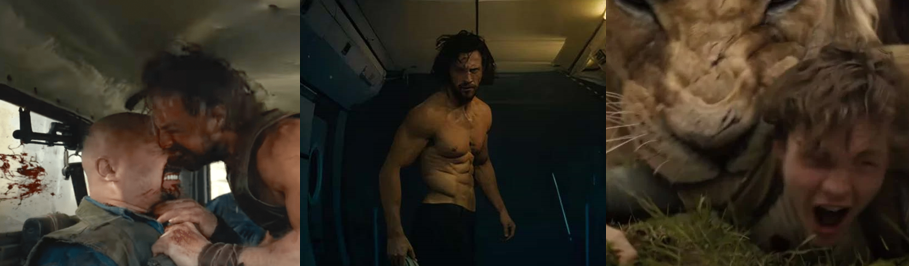
Sadly, all the bloody violence and delicious abs in the world can’t excuse the poor CGI and editing.

While Kraven the Hunter is often a mess of clunky, clearly rerecorded dialogue and overdone clichés, the action on display is pretty good at times. The film is, sadly, populated with some of the worst CGI animals I’ve ever seen; the gigantic lion and the leopard that attack Kraven at different points are the worst offenders by far. When Kraven leaps into action, the violence is fast, bloody, and brutal, with him stabbing foes, slicing their throats open, and clamping bear traps to their heads! At one point, he sets traps for his pursuers that sees one guy get ripped in half crotch first, another take a machete to the head, and blood splattering across a bleak Russian forest. Kraven beats guys to death with his bare hands, easily breaks bones and manhandles multiple, even armed foes, and his skilled with knives, blades, and spears is readily apparent. Believing it dishonourable to use firearms and any weapons not made of the land or meticulously crafted, Kraven keeps a cache of blades and weapons at his sanctuary and on his person, subduing targets with blow darts and poisons and easily clambering up sheer surfaces with an animal grace. I’m not the biggest fan of or expert on Kraven but I do believe he’s often imbued with animal senses, spirits, and ferocity and that’s on full display here. Kraven often gallops about on all fours, tackles jeeps like a rhino, clings to purchases like a monkey, and has senses so keen that he can hear, smell, and see things no normal human could. This all adds to his abilities as a manhunter and in a fight, with him being swift enough to avoid gun fire and carpet bombs, durable enough to take a beating, and apparently strong enough to survive being buried under a bunch of stones and debris. Somehow, he’s so fleet footed that he can remain completely undetected even when standing right behind his foes and his eyes often glow an ethereal orange to show he can see in the dark or across vast distances. He’s not completely invulnerable, however. He succumbs to the Foreigner’s poison like any other man and is beaten close to death by the malicious mercenary, his life only spared by the timely intervention of Calypso. Dmitri also proves to be a vulnerability, one the Rhino doesn’t hesitate to exploit, and Kraven’s emotions often get the better of him where his brother and family are concerned.
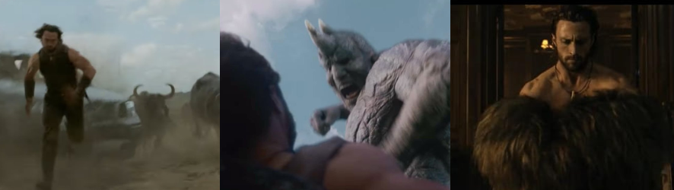
A lacklustre showdown with a ridiculous villain leaves Kraven set for a sequel that’ll never happen.

Despite Kraven’s lauded and feared reputation, he struggles to piece together the paper-thin plot taking place around him and needs Calypso and the intel offered by his dying targets to figure out what the hell’s going on. Already angered that security footage that identifies him is doing the rounds, Kraven’s desire to shut down those actively seeking him out is exacerbated when Nikolai’s life of crime seemingly causes Dmitri’s kidnapping by would-be rival kingpin, the Rhino. When Dmitri and Kraven shoot down the Rhino’s offer to join forces, the Rhino organises a strike against Kraven on his home turf, a ridiculously poorly thought-out operation that leaves all his ill-equipped troops dead and Sytsevic forced to allow his transformation to take full effect. Transforming into a hulking man-rhino that, despite being comic accurate, looks laughably cartoonish, the Rhino fights Kraven amidst a buffalo stampede. Thanks to his impenetrable skin and augmented strength, the Rhino easily shrugs off Kraven’s blows and knives and pummels the Hunter, beating the piss out of him and looking to throttle him to death. However, Kraven spots the medicine line on the Rhino’s thick hide and rams a role into his stomach, then has the stampede trample the weak-ass villain to death. Although Kraven talks Dmitri out of executing the Rhino, Kraven has not hesitation about confronting his father, who released the video footage to coerce his estranged son into eliminating his competition, a revelation that leaves Nikolai being mauled by a wild bear courtesy of Kraven. The film then ends with Kraven being aghast to learn Dmitri has taken control of their father’s operation and undergone some “unorthodox” surgery of his own to assume the face of anyone he wishes at will. How Dr. Warren did this isn’t explained and quite how the Chameleon thinks he’ll fool anyone with his short stature is beyond me. I think a better reveal would’ve been that Dmitri was posing as Nikolai and was a bad guy all along, manipulating events to seize power and using fake masks and practical augmentations rather than what I assume is either a nanotech or some vague bioengineered tampering to steal people’s identities. Oh, and Kraven gets his signature jacket, made out of the hide of the lion he failed to kill, as a parting gift from his father.

The Summary:
I wasn’t expecting much, if anything, from Kraven the Hunter. I’m really not a fan of the character and would have little interest if he showed up in a Spider-Man movie, so giving him a solo film seems moronic and pointless to me. Luckily, I can say that I enjoyed Kraven the Hunter more than Morbius or Madame Web, but not by much and that’s hardly a high bar to clear and the film’s flaws mean it’s still not getting higher than a generous two-star rating. This rating is based purely on Aaron Taylor-Johnson’s performance, which I did enjoy, and the brutal, bloody action sequences, which give the film an edge sadly not afforded to the Venom movies as swearing and strong, bloody violence would tip them into 18-rated affairs. Aaron Taylor-Johnson does look great in the role, and I did enjoy the depiction of Kraven’s powers; it seemed a lot of his actions and stunts were practical, too, which was appreciated. However, it made the poor CGI stand out even more. I obviously don’t expect the actors to be wrestling with real lions and such but surely CGI has progressed to the point where they can be rendered more convincingly? The Rhino suffers greatly from this, too. Clearly a rushed, last-minute inclusion, the Rhino is so awful here and looks so janky that I honestly prefer the mech-suit version we got previously; at least that’s somewhat believable! Add in pointless characters like the Foreigner, a strange and ill-fitting interpretation of the Rhino, and some horrendous and distracting ADR, and you have a film that feels like it was butchered by the budget and the editing process. It feels like many scenes were left on the cutting room floor, especially those featuring Calypso and Kraven’s life between hunts, making for an awkwardly paced and disjointed affair. It’s also disappointing that it’s not made clear where Kraven the Hunter fits in Sony’s spin-off films, if anywhere. However, even if the film had been better in these regards, I would still be unimpressed and annoyed at the idea of giving Kraven a solo movie. And, if it had been a Spider-Man film featuring Kraven, I would’ve been equally disappointed as I just don’t care about the character. Thus, Kraven the Hunter was doomed to fail for me and I cannot understand, for the life of me, who this mess was made for.

My Rating:

Rating: 2 out of 5.

Could Be Better

Did you enjoy Kraven the Hunter? If so…what’s the matter with you? What did you think to Aaron Taylor-Johnson’s performance and the depiction of Kraven’s powers? Do you agree that the film felt rush, especially regarding Dmitri’s story arc? What did you think to the Rhino and his eventual full reveal? Did you also think that the film felt butchered in the editing room? Are you a fan of the character in general (and, if so, again…why?) and would you like to see Kraven return in some capacity? What Spider-Man villain would you like to see get a standalone movie? I’d love to know your opinions of Kraven the Hunter, so leave them below and be sure to check out my other Spider-Man and Marvel content.

Back Issues: The Amazing Spider-Man #15

Story Title: “Kraven the Hunter!”
Published: 12 May 1964 (cover-dated: August 1964)
Writer: Stan Lee
Artist: Steve Ditko

The Background:
After his success with the Fantastic Four, Marvel editor and head writer Stan Lee created teenage superhero Peter Parker/Spider-Man, whose debut issue became one of Marvel’s best selling publications. Spider-Man’s popularity grew to the point that he headlined other comics, including being partnered up with other, less mainstream superheroes in the pages of Marvel Team-Up, and amassed one of the most colourful and memorable rogues galleries in all of comics. Sergei Kravinoff (better known as Kraven the Hunter) was created by Spider-Man co-creators Stan Lee and Steve Ditko and made his debut in this story, though he’s perhaps best known for his epic (if temporary) death in the celebrated story arc “Kraven’s Last Hunt” (DeMatteis, et al, 1987). Kraven has long hounded the web-slinger as part of the Sinister Six and across a variety of media, featuring in videogames and the 1990’s Spider-Man cartoon. Finally, after years of stop/start efforts to make it onto the silver screen, Kraven inexplicably made his live-action debut in 2024.

The Review:
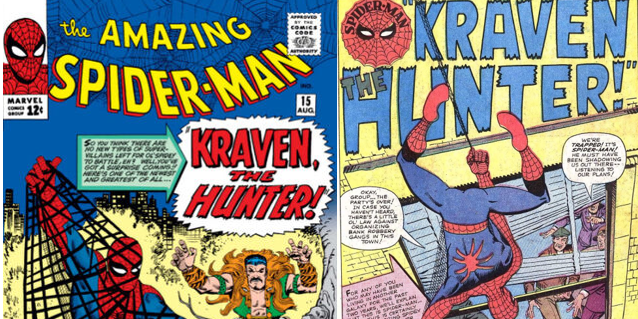
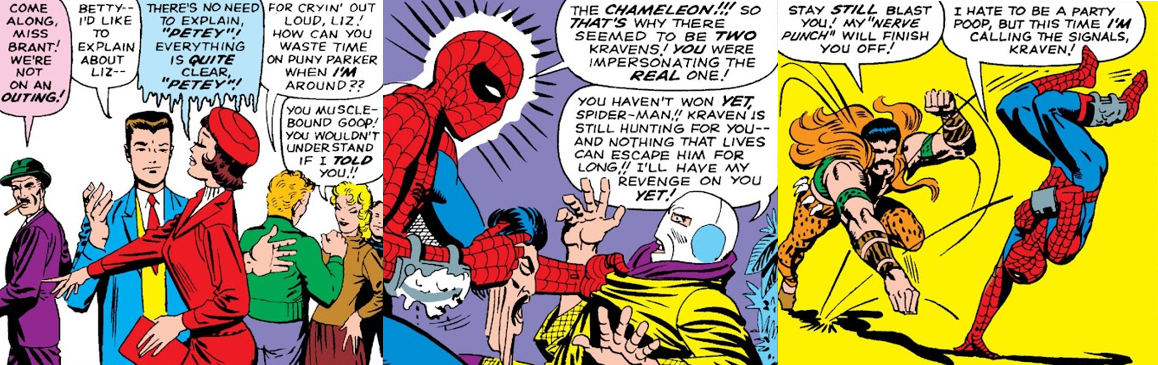
Our story begins in classic sixties Spider-Man fare, with Spidey dropping in on a bunch of crooks and breaking up their party. In a change of pace, though, Spider-Man doesn’t just beat them up with ease and grace while expositing how his super strength gives him the edge of New York City’s normal, everyday mooks. Instead, he shoots out a web to trap three of the would-be bank robbers but the fourth, who he presumes is their leader, makes a hasty exit out the window. The leader manages to give Spider-Man the slip by activating a special gas from the inside of his suit that instantly changes his appearance into a harmless old man and, when he gets back to his apartment, reveals his true identity as Dmitri Smerdyakov/The Chameleon, the man of many faces who was the very first supervillain Spider-Man ever encountered. Realising the threat Spider-Man poses, and bitter about being deported and exiled after their last encounter, the Chameleon decides to hire an “old friend”, Kraven the Hunter, to destroy the web-spinner once and for all! It turns out that Kraven has amassed a hell of a reputation as the world’s most accomplished hunter. His achievement of having trapped and defeated every type of animal with his bare hands is so impressive that even cantankerous Daily Bugle editor J. Jonah Jameson is in awe of the hunter’s prowess.

Kraven’s world-famous prowess initially sees him get the upper hand on Spider-Man.

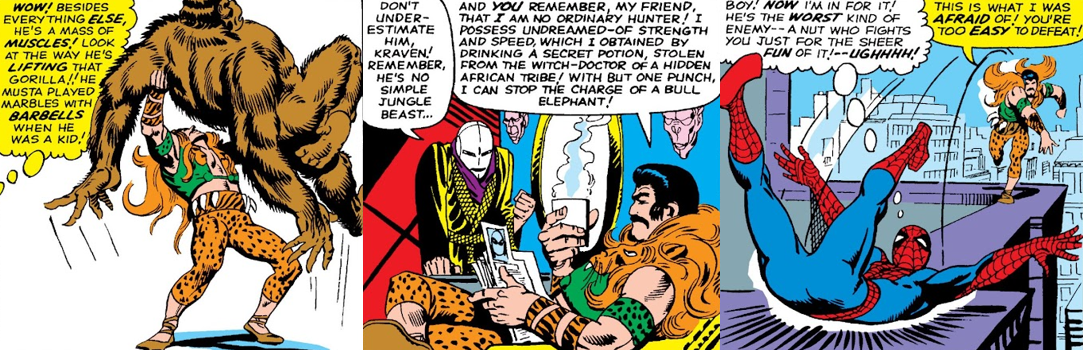
Seeing Kraven’s arrival in the United States as a big scoop, Jameson orders his secretary, Betty Brant, and his long-suffering freelance photographer, Peter Parker, to accompany him to the pier to get an exclusive. There, Betty is unreasonably salty when Peter arrives at the same time as Liz Allen and Eugene “Flash” Thompson but Kraven’s mere presence and physical stature are enough to turn their heads and put a stop to the relationship drama. Kraven turns down Jameson’s request for an exclusive with a dismissive bark, so determined is he to “hunt the most dangerous game of all”, and then gives Peter the shock of his life when he single-handedly rounds up the ship’s animal cargo with speed, strength, and wiles so honed that all Spidey can do is watch in amazement. So fantastic is Kraven’s display of power that Spidey completely forgets to take any pictures, angering Jameson. The newspaper editor’s vexation is replaced with intrigue, however, when Kraven lets slip that he’s there to hunt Spider-Man. Peter’s so stunned by this revelation that he’s speechless when Betty gives him the cold shoulder after Liz showers him with attention, which also riles up her muscle-bound flame, Flash. After all that drama, Kraven meets with the Chameleon to read up on his prey using the research and first-hand experience he has acquired, confidentially assuring his ally that the superhuman strength and reflexes he has been afforded by a witch-doctor’s secret potion will enable him to succeed where others have failed. To allow Kraven to stalk Spider-Man more effectively, the Chameleon hires some goons to cause a ruckus, which naturally attracts Spider-Man. Kraven watches with a begrudging respect for his foe’s power, agility, and cunning, impressed with how easily he fights, evades, and subdues multiple crooks, and then catches the web-spinner by surprise by waiting for him on a nearby rooftop.

Kraven’s potion and confidence cause undue stress to the troubled teenage superhero.

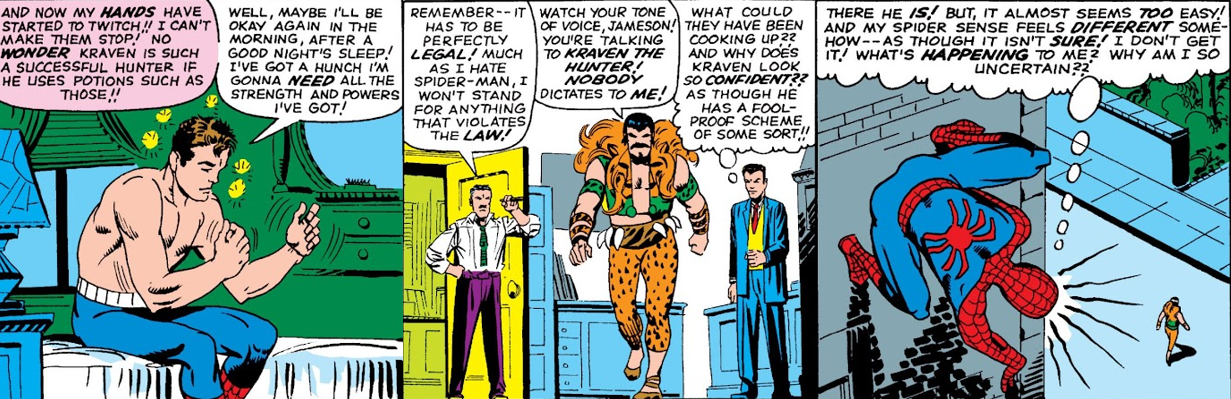
Kraven rushes his quarry, explaining that he’s motivated only by the hunt and the personal triumph that defeating Spider-Man will bring him. He immediately puts his enhanced abilities and research to good use by snatching Spidey out of mid-air and tossing him to the ground. Relentless, Kraven presses his attack with a “nerve punch” that Kraven boasts can “down a full-grown charging rhino”. Spidey takes the shot on the arm, which goes completely numb, and surprises Kraven by fending him off with just one arm. In desperation, the hunter resorts to pricking Spidey with one of his special potions, a concoction designed to sap his spider-strength. Kraven then makes a tactical retreat to allow the drug to do its work and Peter returns home, woozy and suffering from tremors as a result, while Kraven astonishes the Chameleon by revelling in the thrill of the encounter and the battle yet to come. Although Peter awakens back at full strength, he’s alarmed to find his hands are still twitching uncontrollably. He desperately tries to hide his condition from his doting Aunt May, who has arranged a blind date with him the niece of their neighbour, Anna Watson, and is relieved when the twitching dies down by the time he gets to the Daily Bugle. There, his exasperation with Betty’s unprovoked jealousy is quickly replaced by astonishment when Kraven comes barging out of Jameson’s office. Although Jameson hates Spider-Man with a vengeance, he refuses to endorse Kraven’s methods since there are laws against hunting human beings. Kraven’s confidence shakes Peter so badly that his hand tremors make a dramatic and embarrassing return while he’s in Science class, much to the amusement of his peers and the annoyance of his professor, Miles Warren. Peter’s condition is so bad that he can’t aim his webs straight and he’s forced to resort to leaping from building to building as Spider-Man as he aimlessly searches for any sign of his would-be hunter.

Kraven’s cunning and prowess ultimately fail to match with Spidey’s spider-sense.

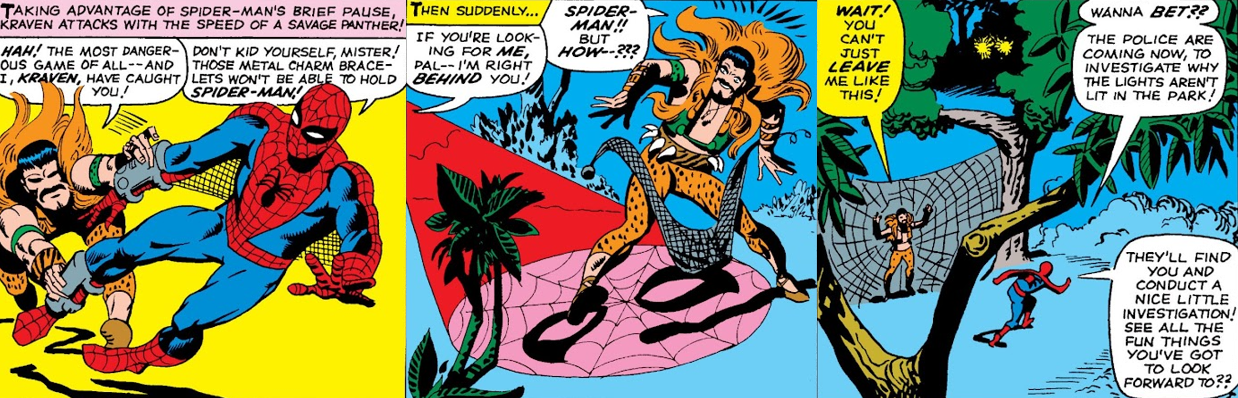
Fully aware that his prey would seek him out, Kraven arranges for the Chameleon to brazenly walk around town in disguise as the world-famous hunter and lure Spider-Man into Central Park to renew the hunt. Despite his suspicions and his blaring spider-sense, Spidey follows the fake and ends up briefly trapped beneath one of Kraven’s nets. Thankfully, exerting the full limits of his spider strength is enough to snap one of the connecting chains, but he’s so disorientated by one of the Kraven’s loudly beating a drum that he’s unable to stop the other Kraven from slapping metal braces to his right forearm and calf. Designed to “hold a hunger-mad tiger”, the manacles have a magnetic attraction so strong that it takes all Spidey’s incredible strength to keep them apart. They also jingle every time he moves to instantly alert Kraven to his presence, however. Relying on his superhuman reflexes and spider-sense, Spidey stays one step ahead of his hunter and buys enough time to spray the manacles with “liquid web fluid”, which successfully negates their properties. His uncanny sixth sense alerts him to someone hiding in the nearby bushes and Spidey is stunned to unmask the Chameleon as the fake Kraven. This victory reinvigorates the web-head, however, and he quickly turns the hunt against his foe, chasing Kraven deep into the woods using his spider signal. No matter where or how he tries to run and hide, Kraven is continually spotted by his foe and resorts to trying to sneak attack him with his nerve punch, only for Spidey’s spider sense and unmatched agility to keep him off-guard. Angered by Spider-Man’s mocking taunts and realising that he’s lost every advantage, Kraven again tries to make a tactical retreat, but this time runs head-first into one of Spider-Man’s webs. Spidey thus leaves him and the Chameleon there, beaten and humiliated, to be deported by the authorities (though, naturally, they both swear revenge). In the aftermath, Jameson is so elated by Peter’s photographs of the action that he allows Peter to have one of his secret stash of chocolate bars. However, the youngster’s relationship dramas continue to mount even after Mrs. Watson’s niece cancels their blind that as Betty gives him the brush-off and Liz goes out dancing with the hunky Flash.

The Summary:
Considering I don’t think much of Kraven and consider both him and the Chameleon to be two of Spider-Man’s bottom-tier foes, I actually enjoyed “Kraven the Hunter!” quite a bit. Steve Ditko continues to set the standard for how Spider-Man should move and fight in his comics and the action is fast and packs a hell of a punch whenever the two are trading blows or showing off their superhuman skills. I always enjoy the visual difference between Peter and Spider-Man, how being in the costume is such an exhilarating and freeing experience for the socially-inept photographer, and it was a neat twist to see him go toe-to-toe with someone not just seemingly as strong and agile as he, but also far more cunning and ruthless. As ever, Peter’s relationship and personal drama is a constant distraction from his current predicament. While I’m always glad when stories from this era don’t reduce females to babbling bimbos, Betty’s raging jealousy was a serious pain in the ass here. She gets mad at Peter simply because he arrives at the same time as Liz and Flash, assuming he “[came] with her” even though they’re not even near each other in the panel, and acting like a clingy, co-dependent brat just because Liz fixes his tie and calls him “Petey”. While it’s true that Betty probably should be worried about Liz, especially as she’s one of the few to admonish Flash for his attitude towards Peter, all she ends up doing is pushing him towards Liz, with comical results. This may very well have been the first of many hints towards Peter’s most famous love interest, Mary Jane Watson, though Peter’s actually relieved when she cancels their blind date as he already has enough troubles on his plate and isn’t optimistic about the state of Mrs. Watson’s mysterious niece.

Despite the relationship drama and the Chameleon’s presence, Kraven gets a good showing.

Although this issue features the return of the Chameleon, his presence is thankfully downplayed in favour of the far more visually and physically interesting Kraven. The two are depicted as close friends, which is a nice change as it’s not every day you see supervillains palling about so amicably. Naturally, the story goes out of its way to show that Kraven more than meets expectations. The ship’s animal cargo spontaneously getting loose is the perfect excuse to show how fast, smart, and strong he is and prove that he’s more than capable of subduing even the most dangerous of animals with his bare hands. Living for and relishing the thrill of the hunt, Kraven sees Spider-Man as the ultimate prey and goes to some lengths to get a sense of his prowess. I say “some” as Kraven only spends a few panels observing Spider-Man rather than days, which may have contributed to his downfall as he underestimated Spider-Man’s strength and tenacity and was forced to resort to one of his potions and a hasty retreat. Although Kraven’s potion causes Spider-Man some troubles, all it really does is take away his ability to shoot webs straight and in the end all Spider-Man needed to win was his extraordinary spider-sense and superhuman reflexes. Still, Kraven does match blows with Spider-Man and even briefly cripples one of his arms and is proven to be just as agile and physically strong as the web-spinner but, ultimately, he’s undone, in part, by his own hubris. This all made for a surprisingly enjoyable first appearance of Kraven the Hunter. I can’t say it’s changed my opinion of him, or his lame outfit, but it definitely made for a pretty entertaining villain-of-the month Spider-Man story.

My Rating:

Rating: 4 out of 5.

Great Stuff

What are your thoughts on Kraven’s debut? Are you a fan of the character and, if so, what are some of your favourite Kraven tales? Were you annoyed by the relationship drama in Peter’s life, or did you enjoy it as a character-building tool? What did you think to Kraven’s depiction, powers, and personality? Are you a fan of the Chameleon or, like me, do you find him disappointing? How excited were you for Kraven’s live-action debut? Feel free to leave your thoughts on Kraven below and be sure to check out my other Spider-Man content.
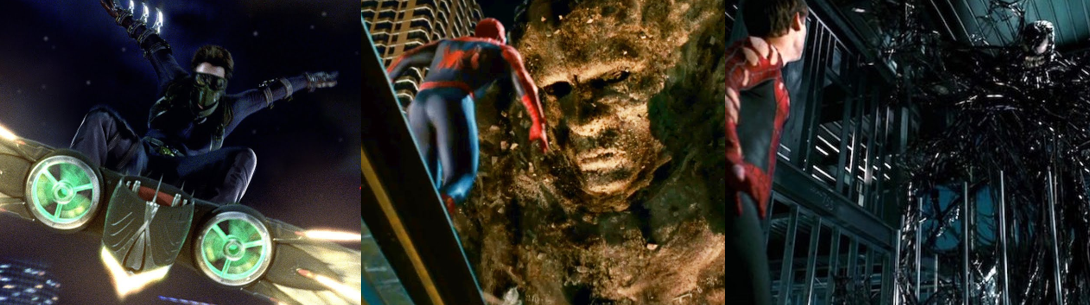
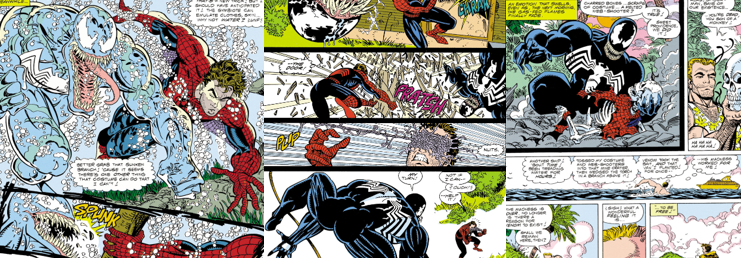
Back Issues [Venom Day]: The Amazing Spider-Man #346/347


To celebrate the release of Venom: Let There Be Carnage (Serkis, 2021), Sony Pictures declared September 27 “Venom Day”, a fitting date to shine the spotlight on one of my favourite anti-heroes, who made their first full debut in May 1988 and have gone on to become one of Marvel’s most iconic characters.


Writer: David Michelinie – Artist: Erik Larsen

Story Title: “Elliptical Pursuit”
Published: 12 February 1991 (cover-date: April 1991)

Story Title: “The Boneyard Hop!”
Published: 12 March 1991 (cover-date: May 1991)

The Background:
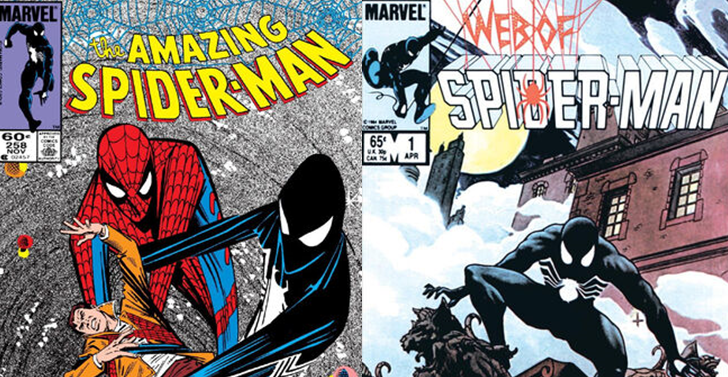
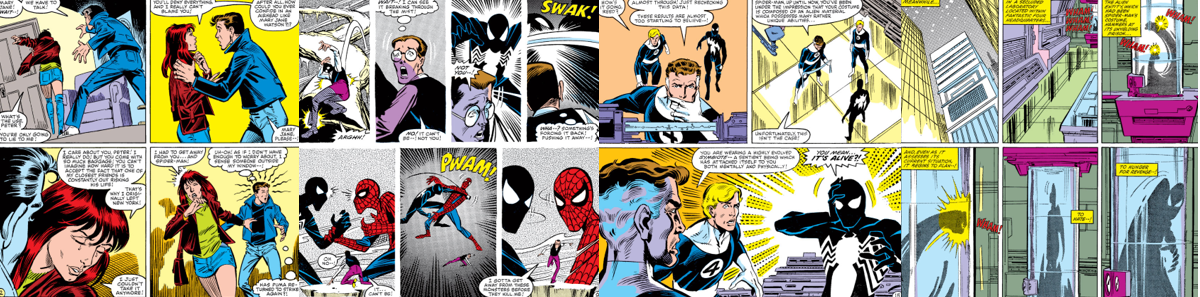
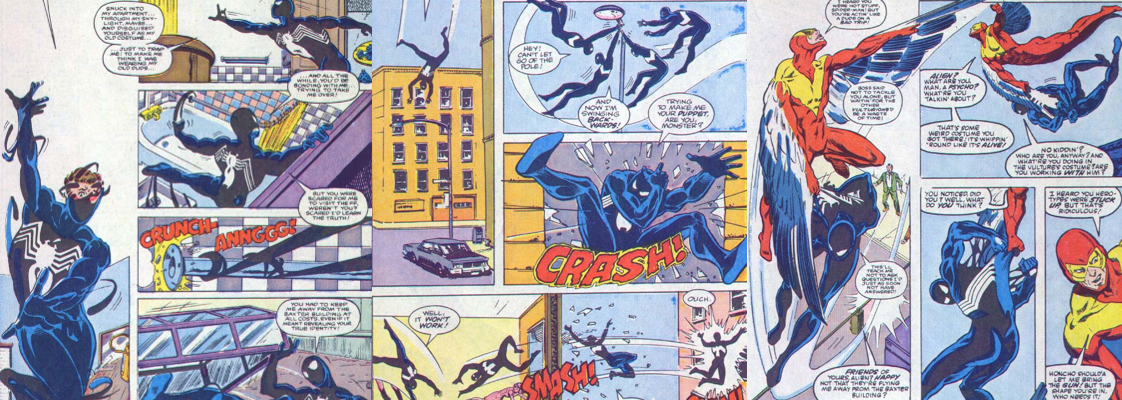
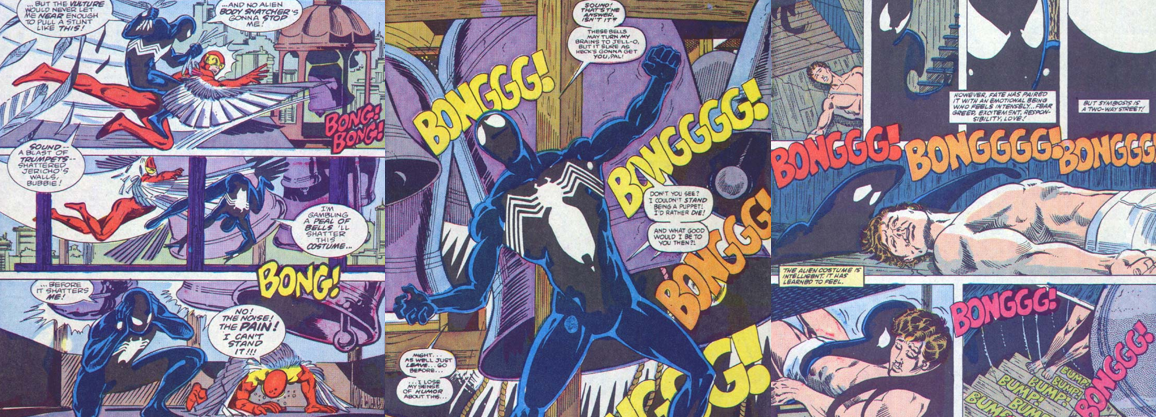
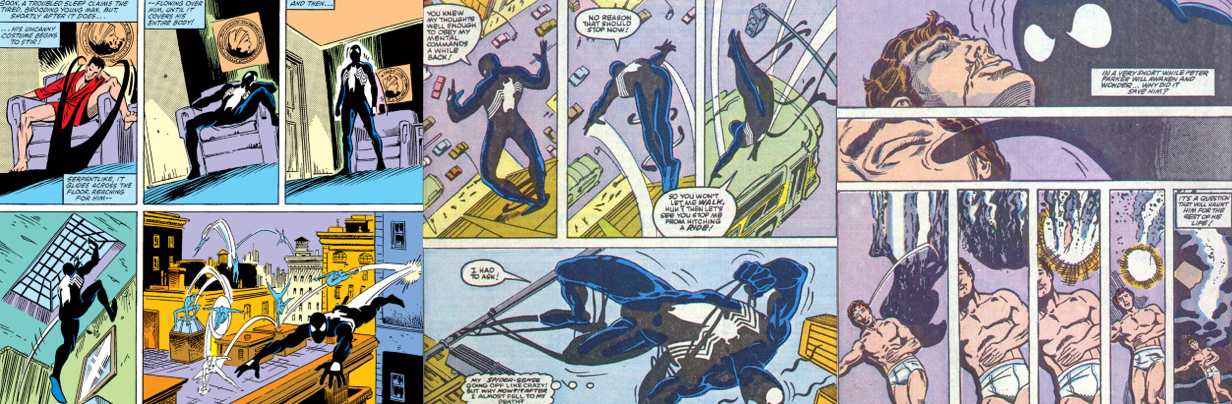
Back in 1982, Jim Shooter, then editor-in-chief for Marvel Comics, purchased Randy Schueller’s illustration of Peter Parker/Spider-Man in a slick black outfit for a cool $200. It was writer Tom DeFalco and artist Ron Frenz who made the costume a living organism and Spidey’s new duds appeared without explanation in The Amazing Spider-Man #252, with it later revealed that he picked up the suit in Marvel Super Heroes Secret Wars #8. Over the next year or so, Spidey revelled in the costume’s unique ability to form both clothing and organic webbing but was horrified when Doctor Reed Richards/Mister Fantastic revealed it was a living symbiote. Spidey summarily rid himself of the symbiote using a cacophony of church bells and switched to a cloth version, before eventually returning to his classic outfit. A mysterious assailant attacked and stalking Peter throughout 1988 it was revealed that the symbiote had bonded with disgruntled reporter Eddie Brock. Spider-Man’s dark doppelgänger was an immediate favourite of mine and many readers, eventually jumping to different hosts, with his sadistic, even more dangerous offspring, Cletus Kasady/Carnage, being teased in these issues.

The Review:
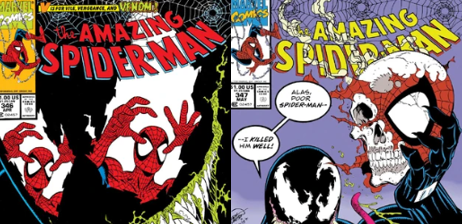
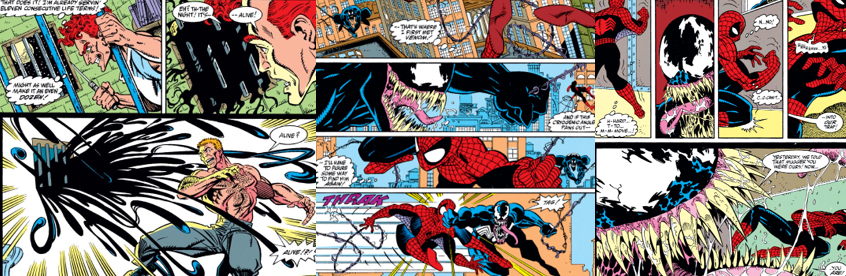
Although Venom’s second big appearance occurred in a two-part story in issues 346 and 346 of The Amazing Spider-Man, similar to their original first appearance, the character featured in a cameo in issue 345. Since it’s actually a pretty big cameo, I’ll quickly cover it before delving into the main story. “Gun from the Heart!” (Michelinie, et al, 1991) sees Spider-Man on the trail of noble, but misguided and violent, vigilante Elias Wirtham/Cardiac, with the added bonus of being promised $5000 by Silvija Sablinova/Silver Sable for apprehending him. The main reason this issue is important is two-fold: first, it shows Eddie Brock escaping from Ryker’s Island when his symbiote comes to bond with him once more. Second, it introduces readers to Brock’s cellmate, demented serial killer Cletus Kasady, who is unknowingly bonded with a small drop of the symbiote and would go on to become the sadistic Carnage. While Spider-Man fails to apprehend Cardiac in the main plot, the issue ends with Venom being reborn and swearing to avenge themselves against the wall-crawler. This perfectly sets us up for “Elliptical Pursuit”, which immediately re-establishes Venom’s warped moral code when they chastise fellow former reporter Sly Fenster for selling confidential files on the downlow before expressing regret when their webbing accidentally suffocates the corrupt reporter. The story then jumps over to Grand Central Station, where Peter’s wife, Mary-Jane Watson-Parker/M. J., is unimpressed at being spirited away to her sister’s. Having heard about Brock’s escape and the symbiote’s breakout from the Baxter Building, and fearing for M. J.’s safety, Peter convinces her to leave lest Venom targets the bombshell redhead like last time.

Venom returns with a vengeance, constantly blindsiding Spidey with their superior strength.

Despite knowing M. J’s safe, Peter’s thoughts dwell on Venom’s threat. Unwilling to put any of his allies in danger, even his former lover and part-time vigilante Felicia Hardy/The Black Cat, Peter resolves to face Venom alone, reasoning that it’s his responsibility since he technically created the creature and their hatred of him. He’s so lost in thought that he forgets that Venom doesn’t trigger his spider-sense and is caught off-guard when Brock accosts him at a coffee shop. Brock calmly convinces Peter to take a walk, expositing how his “other” survived an earlier confrontation with the cancer-inducing Styx and happy to settle their business down a back alley. However, they’re jumped by a mugger, who’s summarily dispatched (non-lethally this time) by Brock, though Peter uses the distraction to flee to a hotel for the night. A seemingly random phone call from Professor Evan Swann inspires Peter to swing on over to Empire State University and check out their cryogenics lab, hoping to find a weapon that can neutralise Venom similar to how extreme heat and sound defeated them before. Once again forgetting his reliance on his spider-sense, Spider-Man is blindsided mid-swing by Venom, who gleefully lays in a beating on the web-slinger. Experience and agility allow Spidey to create some distance, though Venom easily closes it by hurling a girder. With Venom distracted keeping innocent lives safe when their fight causes damage to the Bronx Zoo, Spider-Man goes on the offensive, giving Venom a taste of their own medicine and angering the unstable symbiotic pairing. However, Venom regains the advantage by using their uncanny ability to assume other forms, tricking Spider-Man into entering the cryogenic chamber, where the extreme cold forces the troubled superhero to blackout and be left at Venom’s mercy.

Overpowered, Spidey outwits his foe by faking his death.

In the next issue, Spider-Man slowly dethaws and awakens on a sweltering beach, confused to find himself trapped on a deserted island with (and courtesy of) his most lethal foe. Not willing to allow for any distractions or let innocent bystanders get in the way of their combat, Venom proposes a fight to the death to settle their grudge and relishes chasing his foe through the dense foliage. Though terrified by the creature’s threat, Peter desperately forces himself to adapt to and out-think his foe but is again blindsided by a clever sneak attack when Venom renders themselves invisible and attacks from a stream, nearly drowning Spidey before he fights his way free using a nearby tree branch. Venom’s abilities constantly give them the edge even when Spidey calls upon the Eagle Scout training his former bully-turned friend Eugene “Flash” Thompson tried to teach him and lay traps for his foe. Venom’s ability to blend into their surroundings forces Spidey to rely on his speed and agility instead. Even when Venom is caught in Spidey’s snare trap, the creature easily overpowers him but, when Venom hurls a truck at his hated enemy, he unwittingly causes Spidey to stumble upon an abandoned mine full of gas. After using the mine to escape Venom, Spidey tries to swim to a boat on the horizon, only to end up tangled in Venom’s living webbing. Tackling his way out of the situation with a desperate lunge, Peter stumbles upon some macabre shallow graves and finally realises that their conflict will only end with his death. Spidey thus lures Venom into the jungle with a flaming torch and goads them into hurling another truck, this time resulting in a spectacular explosion that leaves Spider-Man nothing but a shredded skeleton. Overjoyed at having finally defeated their foe, Venom resolves to live out the rest of their existence in peace on the island, blissfully unaware that they’ve been fooled by an obvious trick. Having dressed a skeleton in his costume, Peter faked his death and swam out another passing boat, breathing a sigh of relief knowing that Venom’s menace has forever been put to bed.

The Summary:
After a dramatic and horrifying first appearance, it was pretty exciting to see Venom return, more unhinged and psychotic than ever. What I love about Eddie Brock is that he’s convinced himself that everyone, especially Spider-Man, is to blame for his lot in life. He takes no personal responsibility for the actions that led to his downfall and has convinced himself that he’s on a righteous, God-given mission to protect the innocent and destroy Spider-Man. This twisted ethical code means he’s vehemently against the killing of innocents and will even be distracted from his vendetta to protect them, but also leads to him both knowingly and unknowingly using lethal force to get what he wants. Similarly, he’s not above threatening Peter’s loved ones, which is exactly why Peter sends M. J. away and refuses Felicia’s help since he doesn’t want to be distracted by protecting them or burdened by putting them in danger. Indeed, Peter acknowledges that others have aided him against Venom before and he’s now put himself in greater danger by going solo. This is exacerbated by just how dependent Spidey is on his spider-sense; normally, he can swing around mulling over his personal dramas and always rely on his spider-sense to warn him of danger. But Venom doesn’t trigger it, so they constantly gets the jump on Spider-Man, almost to the point of parody in just these two issues as Peter seemingly never learns to adapt to this, forgets about it, or cannot find a way to compensate for the loss of his spider-sense.

A brutal conflict ultimately results in Venom finding solace in believing they’ve killed their enemy.

Since Venom is bigger, stronger, and completely out of their mind, Spider-Man is forced to stay on the move and rely on his experience and agility. Time and again, this puts him on the back foot; even when he does reach the university labs, he’s easily fooled by Venom’s camouflage ability and rendered unconscious. I loved the island setting for their final confrontation, which essentially put them on even ground since there were no innocents to worry about or tall structures to swing from, but Venom had the advantage because of their familiarity with the island and their unique abilities. Luckily for Spidey, Venom likes to toy with their prey and relishes the chase, giving Peter multiple opportunities to think up plans to subdue and ultimately trick his psychotic foe. Essentially, these two issues are a prolonged chase and fight sequence; Erik Larsen is one of the quintessential Venom artists, closely emulating Todd McFarlane’s style and giving Venom their gruesome teeth and tongue, so the action is always kinetic and visually striking. It’s not enough to tide over the story, though; the sub-plots regarding Felica and M. J.’s worries about Peter, his beloved Aunt May’s romantic life, and the loose thread regarding Cardiac help break up the pace but distract from the main appeal of the stories. It would’ve been nice to see Venom do more to torment Peter, especially in the first issue. They work great as a creepy stalker and that aspect is only briefly touched upon before the two are trading blows between the city skyscrapers. Similarly, the island battle quickly becomes repetitive as Spidey goes on the run, gets blindsided, and goes on the run…only to be blindsided again. These issues seem to have been produced to put Venom’s threat to bed; they’ are content and happy believing they’ve killed Spider-Man. Michelinie even leaves a tease that a version of the symbiote will live on through Kasady, making me wonder if this was supposed to Venom’s last appearance. As is, it’s a decent enough sequel to Venom’s first appearance, most notable for being the first appearance of Kasady, that indirectly leads to one of Spider-Man’s most violent and tedious crossover events later down the line.

My Rating:

Rating: 3 out of 5.

Pretty Good

What did you think to Venom’s big return? Did you ever think Cletus Kasady would become one of Spider-Man’s most notorious rogues? What did you think to Venom’s characterisation as a self-righteous psychopath? Did you find the conflict tedious in Venom’s repeated blindsiding of Spidey? What is your favourite Venom story and how are you celebrating Venom’s dramatic debut? Whatever your thoughts on Venom, share them down below and be sure to check out my other Venom and Spider-Man content.
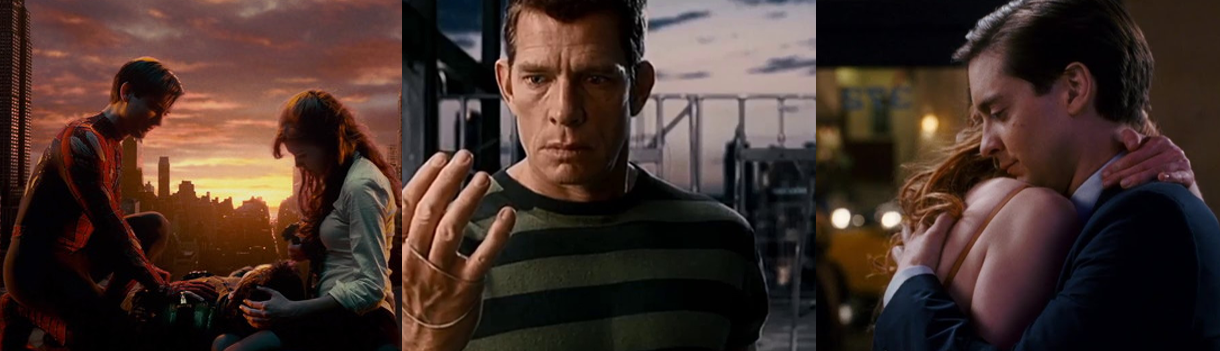
Game Corner [Spidey Month]: Spider-Man 3 (Xbox 360)


Easily Marvel Comics’ most recognisable and popular superhero, unsuspecting teenage nerd Peter Parker was first bitten by a radioactive spider and learned the true meaning of power and responsibility in Amazing Fantasy #15, which was first published in August 1962. Since then, the Amazing Spider-Man has featured in numerous cartoons, live-action movies, videogames, action figures, and countless comic book titles. To coincide with his debut and his very own day of celebration, I’ve been dedicating every Tuesday of August to talk about everyone’s favourite web-head!


Released: 4 May 2007
Developer: Treyarch
Also Available For: Game Boy Advance, Nintendo DS, Nintendo Wii, PC, PlayStation 2, PlayStation 3, PlayStation Portable (PSP)

The Background:
It seemed like every single cinema release was accompanied by a videogame adaptation back in the day, regardless of how necessary this was, and Peter Parker/Spider-Man is no exception to this. Considering his popularity, Spider-Man has a long and varied history with videogame adaptations across numerous platforms, but arguably hit an unexpected peak with developer Treyarch’s celebrated adaptation tie-in to Spider-Man 2 (Raimi, 2004). Widely regarded as one of Spider-Man’s greatest videogame outings, Spider-Man 2 (Treyarch, 2004) was followed by Ultimate Spider-Man (ibid, 2005), a cel-shaded reskin of sorts that acted as a companion piece to the Ultimate Spider-Man comics (2000 to 2011). This game expanded upon the web-slinging and combat of its predecessor while also offering two ways to play by including the hulking Eddie Brock/Venom as a playable character. Interestingly, though, this latter approach would not be included in Treyarch’s tie-in to Spider-Man 3 (Raimi, 2007), which instead simply reduced Venom’s inclusion to some new rage-empowered abilities for the titular wall-crawler. This time around, different villains featured in the different console versions of the game, but Spider-Man 3 ended up being almost as polarising as its source material. Reviews criticised the dull combat and repetitive gameplay, though the thrilling web-slinging and impressive size of the game world continued to be praised.

The Plot:
Peter Parker’s superhero life is turned upside down by a turf war in New York City that only escalates when his mentor transforms into a man-lizard, a crazed hunter comes to town, his former friend Harry Osborn seeks revenge, and a common crook is gifted extraordinary sand powers! Pushed to the edge, Peter is tempted by the power and allure of a mysterious black suit from space that greatly augments both his powers and his rage!

Gameplay:
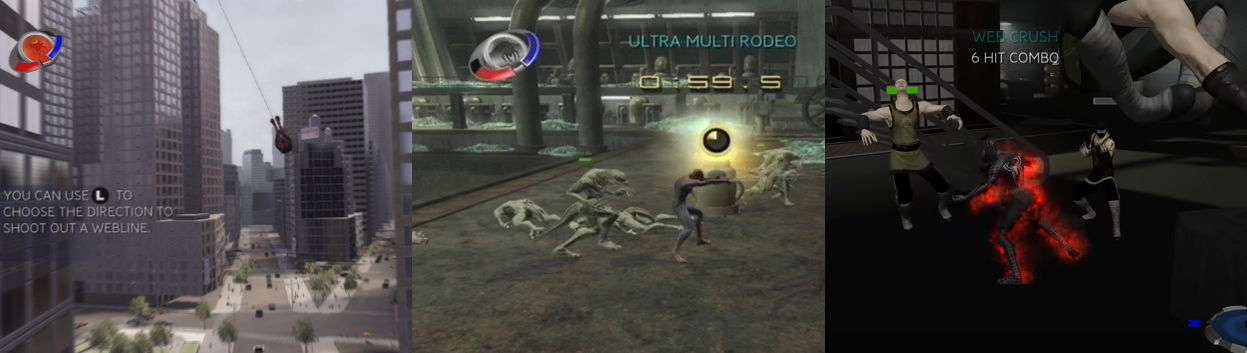
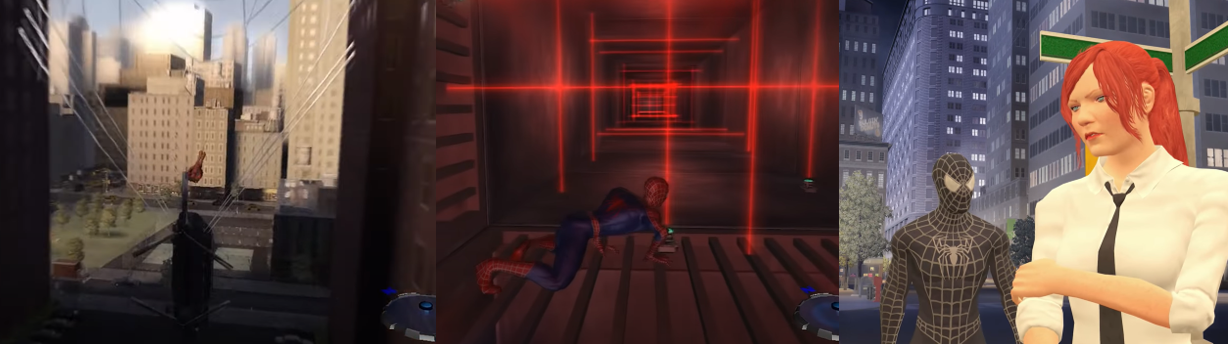
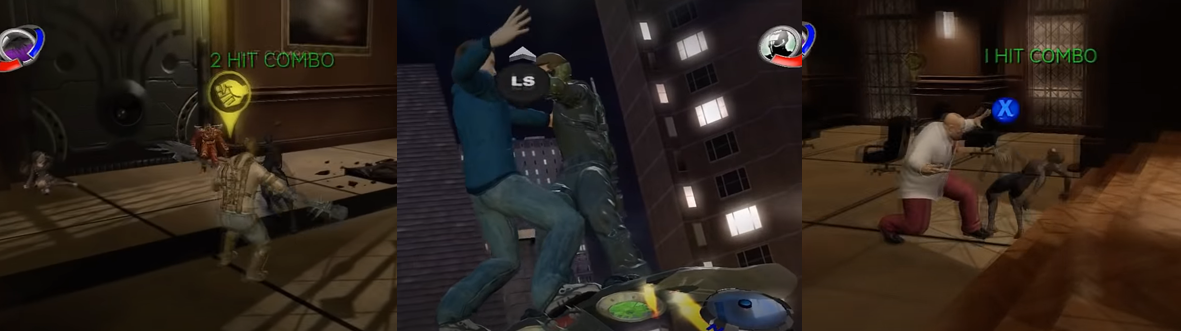
If you’ve played the highly-regarded Spider-Man 2 before, then Spider-Man 3 will be very familiar to you. Having perfected the art of open-world web-slinging, developers Treyarch haven’t strayed too far from their game engine here and once again present an expansive map of New York City filled with skyscrapers to swing from, random crimes to stop, and landmarks to visit. Accordingly, the control scheme and gameplay mechanics aren’t much different from Spider-Man 2, but there are some noticeable differences: you can attack enemies with X and Y, holding each button to charge up for a strike to deal more damage and break their blocks and mixing up these button presses (in conjunction with others) to deliver some fun combos that see Spidey webbing foes to lampposts, pinballing about the place, and kicking the crap out of punks in a whirlwind. B sees you webbing enemies, either pulling them in for a strike or temporarily subduing them if you hold the button, and you can press it at the end of a combo to fire a flurry of web balls. B is also used to stick to walls and ceilings, with the camera continuing to go all janky and mess up your perspective every time you do this, while A lets you jump. You can hold the button to charge a big jump and press it again in mid-air for a double jump, and at the end of a swing to gain extra height and distance when web-slinging. Unfortunately, there’s no way to lock-on to enemies or objects here and the camera can be very erratic, meaning you can easily end up punching thin air or getting turned about during chases and combat. However, you can press in the right stick to activate Spidey’s spider sense for a short time, which puts a greyscale filter over the environment to highlight enemies and points of interest.

Spidey’s web-slinging and combat are augmented by the rage-inducing black suit!

The web-slinging mechanics are similar to those in Spider-Man 2. You can start web-slinging by holding the Right Trigger, but Spider-Man will only comply if there’s a building or other tall structure nearby, so once again you’ll see him snapping off webs in a way that more accurately replicates his web-slinging from the films. You can hold down the Left Trigger to speed up your swing (this also allows Spidey to run and crawl faster) and will eventually unlock upgrades that let you swing from two webs by pressing LT and RT at the same time or quickly zip along flat surfaces by tapping RT. Another upgrade lets you climb up a web by pressing up on the directional pad (D-pad) with a ceiling above you (which is great for avoiding laser tripwires). Holding the Left Bumper activates Spider-Man’s “spider reflexes”, which slows down the game for as long as your blue meter lasts, effectively acting as “bullet time” and allowing you to dodge incoming attacks by wiggling the left stick and unleash a counterattack with X or toss missiles back at helicopters with B. This meter automatically refills over time, just as the red super meter fills as you land attacks. Once full, you can press the Right Button and A, B, X, or Y to unleash a super move, such as webbing up and swinging multiple enemies or performing a ground pound for crowd control. Later in the game, Spider-Man will be consumed by the symbiote, and his speed, defence, and strength will be augmented by his black suit. When wearing the black suit, you can tap RB to build up a rage meter and then rapidly tap it to enter an enraged mode that greatly enhances your regular and super attacks for a short time. As you complete missions, stop random crimes, and defeat enemies, you’ll increase your “crime fighter” rating and unlock upgrades to all of Spidey’s repertoire. These extend his health, add new combos to his arsenal, and upgrade his swinging speed, amongst others, and you can view these at any time from the pause menu.

There are many side missions and challenges, from fighting crime to photographing UFOs!

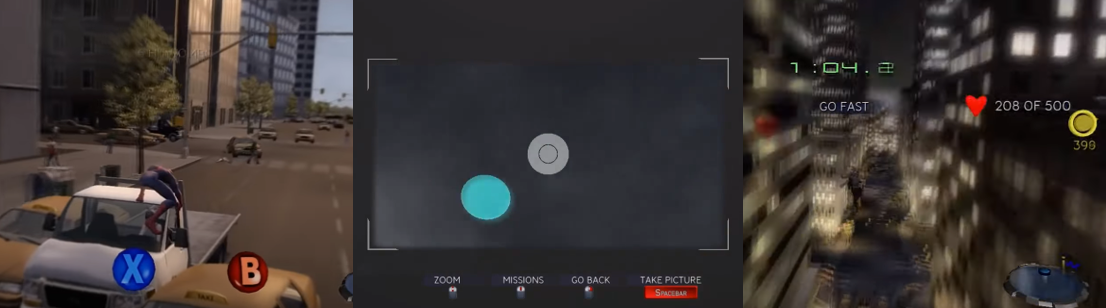
While the game includes a helpful onscreen compass that highlights points of interest, crimes in progress, and enemy placements, you can also view an overheard map of the city by pressing the ‘Back’ button. This time around, you can filter to see story missions, tasks such as time trials and skydiving challenges, and areas where random crimes will catch your attention, and you can also set waypoints to guide you to specific areas, which is extremely helpful. Side missions in Spider-Man 3 involve stopping runaway cars or fleeing criminals by leaping on top of their vehicles, pounding away with X, and then mashing X and B to disable the vehicle, whereupon you’ll invariably need to beat up any remaining goons. You’ll also be stopping bank robberies, encountering various gangs as they fight each other in the streets, hold up armoured vans, rob cash machines and civilians, and generally cause chaos. Thankfully, there are no balloons to recover or civilians in peril from falls here, though you’re still given time trials to reach destinations or track down hoodlums. Gangs will steal stuff and then make a getaway, and you’ll need to use your handy-dandy radar to track them down and recover the items, and you’ll sometimes need to carry civilians to safety, again while racing a time limit. One of the most prominent times you’ll do this is in the Mary Jane/M. J. “thrill ride” missions, where you need to swing fast, high, or low depending on her instructions to earn hearts. You can also collect hearts dotted along the route and these missions get trickier as the game progresses, with short times between locations and gangs scaring your girl, but you’ll also be charged with scaring her later when you aggressively carry her while in the black suit. Occasionally, some missions will see you joined by allies. Generally, these are just regular cops or inadvertent assistance from other gangs as they injure each other, but you’ll team up with MacDonald “Mac” Gragan/The Scorpion for one mission and boss fight and also tentatively work with Detective Jean DeWolfe to bust crooked cops. These missions, like those handed out at the Daily Bugle, generally require you to stay out of sight and photograph some evidence. You can do this by pressing down on the D-pad and the Daily Bugle assignments will see you snapping photos of man-sized lizards (both real and fake), gang wars, and a fake Spider-Man who you have to save from a fatal fall!

Alongside numerous button-mashing sections, the game is crammed full of QTE sequences!

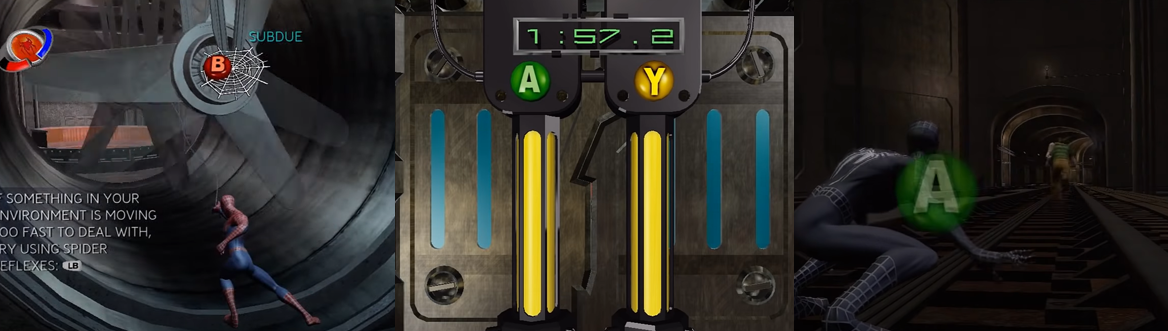
Perhaps the biggest new addition to the gameplay formula here is the inclusion of quick-time events (QTEs). Stopping a car? QTE! Finishing off a boss? QTE! Escaping a collapsing building? QTE! Disarming a bomb? Oh, you better believe that’s a QTE! For the most part, Spider-Man 3’s QTEs aren’t too bad but they definitely pop up at the worst possible times and the margin for error is basically zero. If you fail even once, you have to restart the entire sequence again. Failure also costs you some health so if you’re near death, the chances are that you’ll have to start an entire mission or boss battle over again since the game can be very stingy with checkpoints. Luckily, the button and stick movements required are the same every time so it’s easy to memorise them, but they get very tricky and much faster by the end of the game. You’ll also be using QTEs to stop a runaway subway chain, catch a crashing helicopter, mashing buttons to lift heavy debris off civilians (and even an enemy at one point), wrench open doors, or slingshoting great distances. One of the most prominent QTE sequences is the abundance of bombs you’ll be disarming throughout the course of the “Mad Bomber” missions. These include a little bit of everything, from rotating the right stick to unscrew panels, to re-routing currents, and even a bit of a rhythm mini game…as well as times when you just need to charge a kick to punt the bomb into the river! Other tasks are a little easier in execution but can still be aggravating, such as rescuing hostages (at one point you need to constantly ferry one to safety and even rescue J. Jonah Jameson from a fatal plunge!), activating levers and consoles, chasing helicopters and frantically webbing up their blades in mid-air with B, destroying generators, and defending antidote dispensers in the sewers. Missions can go awry very quickly, especially when there are lots of enemies about, and there’s no way to alter the game’s difficulty so you just need to keep at it until you succeed. There are a couple of fun moments where you take control of different characters, such as fighting off waves of enemies as the Scorpion or battling Flint Marko/The Sandman’s monstrous form as the New Goblin, which are a nice (if equally frustrating in their own way) change of pace.

Graphics and Sound:  
Beyond a pre-rendered opening cinematic, Spider-Man 3 relies wholesale on its in-game graphics and models for its cutscenes. It doesn’t even include any clips from the movie, which is very surprising for a tie-in videogame, and the game’s story barely even touches upon the events from the film since you’ll be spending more time helping Doctor Curtis “Curt” Connors with his Lizard problem than fighting the likes of the Sandman. This is good and bad in different ways; good in the sense that many sequences and plot threads from the film are actually executed far better here (Peter and M. J.’s argument and break-up, for example, and the complete absence of the Stacys), but bad because every film-related element is swept aside and rushed (Harry disappears from the game completely until the end after the New Goblin fight and Eddie Brock’s issues with Peter are even more rushed than in the film). These issues are compounded by Tobey Maguire’s continued lack of enthusiasm for voicing the titular web-slinger; in fact, all the movie’s returning actors do a lacklustre job and, with the exception of J. K. Simmons as Jonah Jameson, they all sound bored and wooden. This contrasts with how janky the game’s physics can be; while Spider-Man has only basic idle animations until he gets his black suit, he flails around the place like ragdoll and can easily be pummelled and bounced around. Although New York City is fully populated with pedestrians, none of them will react to you. The streets are filled with traffic that obediently follows traffic signals but also crashes into each other (and you!) at various points, and I noticed times when the game suffered from slowdown and odd glitches, like enemies not spawning or clipping through buildings.

As fun as web-slinging is, dull interior levels and atrocious in-game models really let the game down.

Once again, New York City is the focal piece of the game; the game map is vast, including all the peripheral islands and recognisable landmarks both real (like the Statue of Liberty) and fictional (like the Daily Bugle building). Opportunities to go inside are severely limited, which is great for keeping the sense of action and momentum, but it does make things a bit empty and repetitive at times. When you are inside, it’s mainly to explore the subway and sewers under the city, where you’ll have to watch out for speeding trains and wade through the dank sewage water as you investigate the Lizard’s nests. The Scorpion’s missions see you infiltrating the high-tech facilities of MechaBioCon, where the game emulates the first game by trapping you in claustrophobic, futuristic laboratories, hallways, and facilities. Missions see you swinging all over the city, stopping bombs at City Hall and battling psycho schoolgirls in the Natural History Museum and a church, or visiting Peter’s apartment and even a cool sequence where Spider-Man (in a cutscene) stops a helicopter with a giant web. Crimes pop up all over the place as you swing around, with some being more important and worthy of your attention than others. Full scale gang wars can break out, helicopters need to be chased, and day turns to night turns to day as you web around righting wrongs. Unfortunately, Spider-Man 3 still doesn’t include any of the iconic musical cues from the movie and nowhere near the amount of visual variety as the last game. Sure, there’s a mission where you have to photograph a UFO, lizard-men ran rampant in the streets and sewers, and you’ll even have to contend with giant mech suits at one point, but the game’s missing a lot of the bizarre comic book flair, even when the likes of Sergei Kravinoff/Kraven the Hunter and Calypso Ezili/Calypso show up to hunt the Lizard and wield strangely out of place magical abilities. Things do pick up for the final showdown, which includes a monstrous version of the Sandman and a raging sandstorm amidst a construction site, but there’s really nothing we haven’t seen in other Spider-Man videogames, or much to make this one stand-out visually speaking.

Enemies and Bosses:
New York City is in the midst of a turf war between three rival gangs: the Arsenic Candies, the Apocalypse gang, and the Dragon Tails. Each has a couple of different types of goons in them, from standard guys who punch, kick, and block to those with ranged weapons like pistols, machines guns, and grenades, to larger or more skilled variants. The Apocalypse gang are a bunch of punks who are often bolstered by larger guys carrying street signs or decked out like rejects from the Mad Max films (Various, 1979 to present). The Arsenic Candies are annoying schoolgirls who attack and block with umbrellas, and the Dragon Tails are martial artists who fly at you with kicks or swords. Even the standard punks can be an issue, but the elite members can be a real pain in the ass. They inexplicably block and dodge all your attacks, forcing you to use your spider reflexes and more elaborate combos to actually land a hit, and often you’ll be greeted by a sneak attack or an explosive to the face! Sometimes the gangs are bolstered by mech suits courtesy of Luke Carlyle/The Mad Bomber, hovering overhead and rapidly firing at or tagging you with delayed explosives, which is super annoying, and you’ll often have to face large groups of them while rescuing hostage, activating consoles, disarming bombs, or rescuing civilians. Thanks to Dr. Connors, New York’s streets (and, more prominently, its subways and sewers) are also over-run by lizard-men. These reptilian bastards like to leap out from the shadows or water, spit acid, and slash at you and will absolutely have you tearing your hair out when you try to defend the antidote capsules from them. You’ll also have to contend with trigger happy crooked cops, the wasp- and spider-like robotic defences of MechaBioCon, inept security guards dressed in riot vests, burning buildings, rocket-toting gang members, and heavily armed mercenaries who like to set bombs and take hostages.

The game takes a sharp, frustrating difficulty spike whenever you battle the QTE-ladened bosses!

As part of your efforts to quell the three gangs, you’ll inevitably come up against their tougher forces, from explosive-bear-toting Arsenic Candies, to well-armed helicopters, and full-on battles in ornate palaces. The brutish leader of the Apocalypse gang is fought down near the docks, you’ll wade through an unending horde of Arsenic Candies when you break up the shotgun wedding of their leader, Priscilla, and you’ll have to fight off the Dragon Tail’s elite fighters to tackle their samurai-like leader, who favours teleporting and forcing you to engage your spider reflexes to land a hit and avoid his sword swipes. All three of these are fought later in the game, in-between extremely frustrating fist fights with Wilson Fisk/The Kingpin. Unlike other fights in the game, the battles against the Kingpin are not ones you can win simply by mashing buttons and pummelling him with combos. Instead, you need to wait for him to strike and the dodge, counterattack, and get out of harm’s way to avoid him making mincemeat of you with a few ridiculously powerful sumo slaps, headbutts, or slams. Once you’ve built up your rage, you can get to button mashing your best combos, but this fight really is a sudden uphill battle compared to those that came before it, which is saying a lot considering how goddamn frustrating Spider-Man 3’s boss encounters are! Depending on how you tackle the game’s missions, you might not see this right away but I sure as hell did when I chose to engage the New Goblin mission. This boss fight sees Peter attacked in the street like in the film, but it’s made up of two phases: the first is a QTE sequence where you must time button and stick presses to avoid the New Goblin’s attacks, and the second sees you battling him at street level as he hovers about. You absolutely must ace the first phase; if you get hurt here or die in the second phase, do not select “Retry” as this drops you in the second phase of the fight with the New Goblin at full health! As Harry’s sword swipes and pumpkin bombs can decimate your health bar very quickly, it’s far easier to get a slight edge by winning the first phase and then spamming your spider reflexes and combos. However, don’t be too trigger happy as this fight (like all the boss fights in Spider-Man 3) ends in a QTE sequence and you can easily mess it up if you mash X too much!

Some of Spidey’s most recognisable C-list villains show up for some aggravating boss battles!

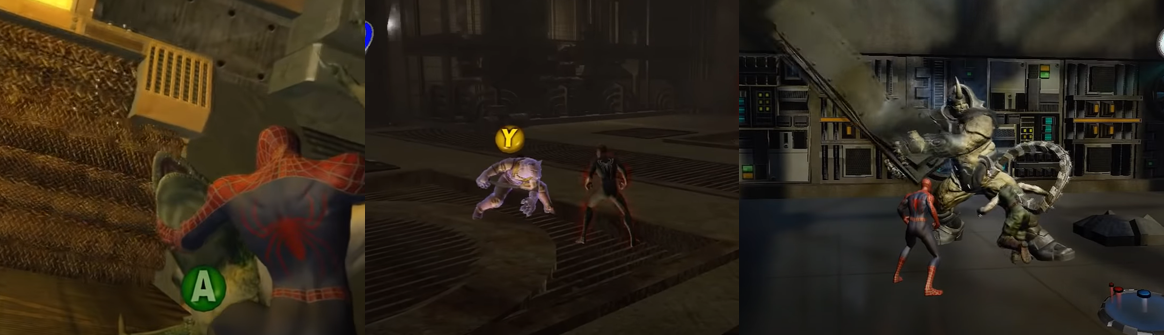
One boss battle that was a bit different is the showdown with the Mad Bomber’s heavily armed helicopter. You must dart behind cover to avoid the chopper’s missile barrage and gatling gun, then use your spider reflexes to send a missile back at it a few times to bring it down, all while the rooftop disintegrates around you and Jonah cowers nearby. Dr. Connors transforms himself into a lizard and, after tracking him and defeating his minions, you’ll battle him on some treadmills that lead into meatgrinder-like blades! You need to use your spider reflexes to counter the Lizard’s dodge and then mash A to flip him into the grinders a few times; after that, you’ll fight him on equal ground, avoiding his slashes and tail swipe and fleeing to safety when he flies into a rage. Later, Kraven and Calypso come to town to hunt the Lizard; fighting Kraven can be tough as his potions grant him bear-like strength, talon-like flight, and panther-like speed, to say nothing of his duplication, invisibility, and charge attacks. Once you defeat him, you tangle with the Lizard again, this time in a monstrous form; in the first phase, he can’t be harmed so you have to mess about webbing up his hands and swinging him by the tail into four generators like he’s fuckin’ Bowser to lower his shield, then you can go to town on him but watch for his chomping bite and wall leap! Another recurring foe is the Scorpion, who attacks with his hooked tail and claws. After chasing him across the city, you’ll also battle him on a bridge and need to subdue him long enough to forcibly use his tail lasers to destroy a shield array but he ends up becoming an unexpected ally when you fight Alexander O’Hirn/The Rhino. The Rhino is so tough and heavily armoured that he’s completely immune to a frontal assault. Instead, you need to avoid his earth-shattering slams and punches and attack from behind (or distract him so that the Scorpion can do this). The Rhino will charge around, destroying the area and swinging girders at you, but these attacks leave him momentarily dizzy and open to a double team attack from Spider-Man and the Scorpion. You can also hop on him and complete QTE sequences to ram him into walls, though this remains as aggravating as the other boss battles.

Spidey gets some help from the New Goblin to battle the monstrous Sandman and ravenous Venom!

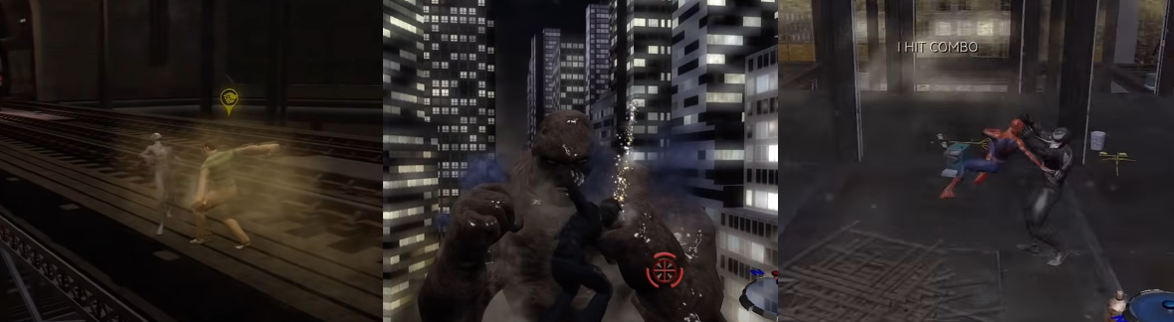
Finally, there are the other two villains from the movie, the Sandman and Venom. The Sandman is fought in the subway and acts as a kind of tutorial for your new black suit abilities. You need to avoid being hit by subway trains and dodge his mace and hammer-like arms to build up your rage meter and deliver a hefty beat down. The Sandman can form shields with his body and blast you with sand streams, and you’ll need to complete QTE sequences to both drop him further down the shaft and disintegrate him with a water jet like in the movie. The Sandman then disappears until the final showdown, where he’s approached by an embittered Eddie Brock; in this version of the story, Eddie is slighted when Spider-Man catches him faking pictures of him and threatens the Sandman’s family if he doesn’t help him kill Spider-Man. This final battle is similar to the one in the movie and involves three phases. The first sees Spider-Man fighting Venom in a partially-constructed skyscraper. Venom uses brute strength and cheap tactics to attack you; you’ll need to mash A when he tries to choke you with his webbing and avoid his web/uppercut combo. When he flies into a rage, smash some of the respawning pipes to stun him with noise and deliver a few combos but try to not be tossed from the site as it takes bloody ages to climb back up! The second phase sees Harry (who doesn’t get scarred or amnesia here) suit up as the New Goblin to help his buddy like in the film. The New Goblin can strafe, boost, attack with fast and heavy sword swipes, and toss pumpkin bombs with B and you’ll need to use these to take out the monstrous Sandman. Simply target his arms or his head and complete a QTE sequence, then douse him with water from a hydrant to actually do some damage. I found the best tactic to avoid being hit is to constantly strafe around him, mashing or holding B and using RB and X, Y, and B to unleash a barrage of bombs. You’ll then need to complete another QTE sequence before the fight switches back to Spidey and Venom, who are now surrounded by a raging sandstorm and at very low health. The strategy is the same, but made more difficult by Venom’s increased aggression, the sandstorm, and how annoying it is having to jump up to where the pipes are. Stun and beat on Venom a few times and you’ll initiate one last QTE sequence, the fastest and toughest of the game, that ends with Venom skewered on some spikes and apparently leaves Harry alive.

Power-Ups and Bonuses:
Spider-Man 3 is surprisingly light on in-game power-ups. Your health is restored every time you stop a crime or beat up some thugs (assuming you stick around long enough to collect the health that drops) and you’ll occasionally find health scattered throughout the game or hidden in crates, but I found this to be quite rare. You can extend your health and gain upgrades to your abilities by raising your crime fighter status, but this isn’t quite the same as gaining experience points. It simply goes up the more side quests and story missions you complete and that’s it; you don’t spend points and can’t customise your gameplay progression as you might expect. The only real tangible power-up is the black suit, which makes the game far more enjoyable. You’re faster, stronger, hardier, and have access to a rage meter than can make combat much more enjoyable, but you’ll naturally lose this as the story progresses.

Additional Features:
There are forty-three Achievements to snag in Spider-Man 3, eleven of which are awarded simply for beating the game and defeating the bosses. You’ll grab Achievements for swinging great distances, webbing up enemies, completing the different side missions, and one for riding around on a vehicle for five miles. Scattered across the city are gang tokens, time trials, combat tours, and skyscraper tokens. Finding and completing each of these nets you more Achievements, as does completing all the Daily Bugle assignments and random crimes that pop up across the city. Time trials are a test of your swinging skills and see you racing about through rings, combat tours have you webbing about to battle the various gangs against a time limit, there are bomb disarming challenges as well, and you’ll occasionally find collectible tokens on the city’s largest buildings. Unfortunately, there are no other difficulty modes to challenge, no comic book covers, concept art, or movie clips to unlock, and the only skin you get is the black suit. When you finish the game, you can switch to the black suit, which allows you to basically play a new game all the way through in Spidey’s symbiote attire and can switch back to your cleared save file at any time to mop up anything you’ve missed there. Sadly, that’s about it. There was some downloadable content that includes various banners and icons for the Xbox dashboard and the ability to play as the New Goblin and take on additional challenges, but there’s not much replay value to be had here, especially if you completed all the missions in your first play through.

The Summary:
Spider-Man 3 is an interesting beast. On the one hand, much of the gameplay and appeal of Spider-Man 2 has been recreated with some new bells and whistles to keep things fresh but, on the other hand, a lot of the game is a tedious and frustrating, sometimes even broken, mess of repetitive tasks and unfulfilling combat. While the city looks great, there’s some noticeably pop-up, lag, and glitches in the game world; the character models and voice acting are, by and large, atrocious and don’t seem to be much of a step up from the PlayStation 2 graphics. The villain selection is also very lacklustre; was anyone really crying out to see Kraven and the Scorpion again? And how many times have we seen the same old “Lizard builds a nest in the sewers/turns people into lizards” plot in Spider-Man games? I’m actually surprised the developers didn’t do more with the symbiote aspect of the story, such as having civilians be infected and forcing you to battle endless Venom clones. I basically hated every boss battle in the game, especially the ones against the New Goblin, the Kingpin and the Rhino, which were so frustrating that I was almost tearing my goddamn face off! You can power through, but why aren’t these more exciting and fun to play? Why are they such an uphill battle? Even the regular street punks put up quite a fight and Spider-Man just feels so weak and janky for much of the game that it was hard to find much enjoyment in the content. It doesn’t help that everything’s so repetitive; I lost count of how many speeding cars and bombs I disarmed, not to mention the copious and aggravating use of QTEs with no margin for error that just pop up out of nowhere, so you never get a second to rest! Ironically, I actually enjoyed (if not preferred) the few times game actually bothers with the movie’s story, which drops a lot of the worst parts of the film, but it wasn’t enough to save this. I think what’s happened here is the developers got a little lazy; maybe they were resting on their laurels, maybe they had run out of ideas. Either way, Spider-Man 3 just feels like more of them same but with a tedious focus on distracting you with boring side missions and dull villains rather than delivering a solid overall gameplay experience.

My Rating:

Rating: 2 out of 5.

Could Be Better

Have you ever played Spider-Man 3? What did you think to the open-world gameplay and Spidey’s symbiote abilities? Were you also frustrated by some of its more tedious features and focus on other villains? What did you think to the battles against the New Goblin, the Kingpin, and the Rhino and the inclusion of QTE sequences? Were you disappointed by the presentation, lack of unlockables, and padded gameplay? Which Spider-Man videogame or movie adaptation is your favourite? Head down below or over to my social media to share your thoughts on Spider-Man 3 and be sure to check out my other Spider-Man content.
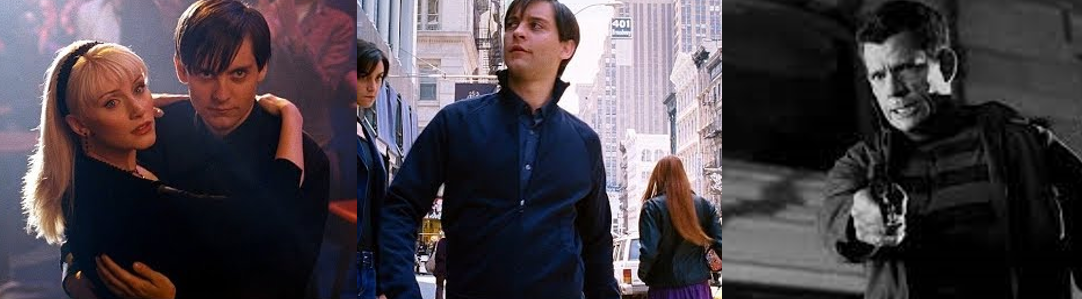
Movie Night [Spidey Month]: Spider-Man 3


Easily Marvel Comics’ most recognisable and popular superhero, unsuspecting teenage nerd Peter Parker was first bitten by a radioactive spider and learned the true meaning of power and responsibility in Amazing Fantasy #15, which was first published in August 1962. Since then, the Amazing Spider-Man has featured in numerous cartoons, live-action movies, videogames, action figures, and countless comic book titles and, in celebration of his debut and his very own day of celebration, I’ve been dedicating every Tuesday of August to talk about everyone’s favourite web-head!


Released: 4 May 2007
Director: Sam Raimi
Distributor: Sony Pictures Releasing
Budget: $258 to 350 million
Stars: Tobey Maguire, Kirsten Dunst, James Franco, Thomas Haden Church, Topher Grace, and Bryce Dallas Howard

The Plot:
Having finally gotten the girl of his dreams, Peter Parker (Maguire) finds his life on the upswing, but an attack by vengeful Harry Osborn (Franco), and the discovery that recently-superpowered thief Flint Marko (Church) killed his beloved uncle see Peter giving in to the power and allure of a mysterious black suit from space.

The Background:
Following his debut issue becoming one of Marvel’s best selling titles at the time, Spider-Man’s popularity saw him become their flagship character. Soon, the wall-crawler fronted numerous team-up comics, videogames, cartoons, and even a live-action series. Although his cinematic debut was constantly delayed by script and legal issues, Sam Raimi and Sony Pictures Entertainment landed a critical and commercial success with Spider-Man (Raimi, 2002) and followed this two years later with Spider-Man 2 (ibid, 2004), which is widely regarded as one of the greatest superhero movies ever made. There was never any question that a third film would follow and Raimi initially planned to explore Peter’s morality, the humanity of his villains, and themes of forgiveness; However, his wish to cast Ben Kingsley as Adrian Toomes/The Vulture was blocked by producer Avi Arad, who insisted that the more popular Eddie Brock/Venom be included instead. Although Raimi was initially hesitant, he acquiesced after relating to the character as a dark mirror of Peter, but soon found his script so bloated that he initially toyed with filming two films back-to-back. Spider-Man 3 upped the ante for its special effects; painstaking hours went into crafting the scene in which the Sandman reconstitutes himself, an amputee stuntman was brought in to bolster Spidey’s fight with the Sandman, and Spidey’s iconic black suit was redesigned to emphasis it corrupting his morals. Although it was the most financially successful of Raimi’s Spider-Man films, Spider-Man 3 divided critics; while reviews praised the action and drama and the mixture of humour and visual spectacle, many felt the film was overstuffed with villains and failed to live up to the expectations set by its predecessors. Though accompanied by a comic book tie-in and videogame adaptation, Spider-Man 3 would mark the end of Raimi’s time with the web-slinger. Although plans for a fourth film got as far as casting and storyboarding, they were ultimately scrapped in favour of a complete reboot, though Tobey Maguire and Thomas Hayden Church would later reprise their roles nearly twenty years later for the multiversal epic Spider-Man: No Way Home (Watts, 2021).

The Review:
These days, with superhero films dominating the box office, many of them involving one or more heroes teaming up and a variety of villains, it’s easy to forget both the impact that Sami Raimi’s first two Spider-Man films had and state of the genre back in 2007. Superhero films were cropping up more and more and they didn’t always stick the landing; often, they struggled with too many villains, a lack of fidelity to the source material, or just being a bit of a tonal and narrative mess as studios tried to cash-in on the success of Raimi’s films and 20th Century Fox’s X-Men movies (Various, 2000 to 2020). Still, anticipation was high for Spider-Man 3; Spider-Man 2 was well-regarded as one of the best superhero movies ever made and it ended with a lot of plot threads to carry over into the third film, primarily the inevitable clash between Peter and Harry and the question of whether Mary-Jane Watson/M. J. (Dunst) was truly ready to accept the responsibility of being Spider-Man’s girlfriend. Unfortunately, little else from Spider-Man 2 directly carries over to Spider-Man 3 and this is made evident right from the opening titles, which barely feature Doctor Otto Octavius/Dr. Octopus (Alfred Molina) or any plot points from the second film beyond those that involve Peter, Harry, and M. J. Regardless, things get off to a decent start; the tension between Peter and Harry is emphasised in the reveal that Harry not only stalks Peter at every opportunity but refuses to listen to his explanations regarding the death of his father, Doctor Norman Osborn/The Green Goblin (Willem Dafoe). Although Peter doesn’t really make that much of effort to absolve himself of Norman’s murder, Harry’s mind is clouded by rage and stubbornness, which directly lead to him subjecting himself to a version of his father’s Goblin formula to give him the power to go toe-to-toe with his former friend.

Peter’s attempts to propose are interrupted by his inflated ego and the influence of his black suit.

For Peter, life is pretty good; he’s finally found a balance between his dual identities, or at least feels less conflicted now that he has M. J.’s full support. It’s not made clear how much time has passed between the two films (honestly, given how well the actors have aged and the way Peter and Harry treat each other, it feels like it could only be a few weeks) but Peter’s so at peace with himself and the world that he plans to propose to M. J., despite him still living in a crummy apartment and being stiffed on his wages by the cantankerous J. Jonah Jameson (J. K. Simmons). After receiving his Aunt May’s (Rosemary Harris) blessing, Peter heads out to seal the deal, only to be suddenly attacked by Harry, how sporting sleek, Goblin-inspired armour and weapons of his own. Peter battles this…*sigh*…“New Goblin” through the city skies but is both horrified and relieved when Harry takes a nasty bump to the head and recovers with no memory of Spider-Man’s true identity. This brings even more joy to Peter’s life as he rekindles his brotherly relationship with Harry and basks in the adulation of the city as Spider-Man. In fact, Peter’s so blinded by his own success and happiness that he fails to notice that he’s being a bit self-absorbed and that M. J. is having her own issues, faults that cause him to make the bone-headed mistake of kissing Gwen Stacy (Howard) in front of an adoring crowd and completely disregarding M. J.’s struggles to make it as a successful Broadway actress.

Peter’s relationships suffer because of his actions, leading to a brutal brawl with his former best friend.

Despite the fact that she made it into the cast, to the point where she received top billing, M. J.’s producers aren’t happy with the reviews about her performance and summarily drop her from the play, rattling her confidence and digging up bad memories of her childhood under her abusive father. Although she tries to confide in Peter and understand that his superhero commitments make him very busy, a rift forms between them when Peter fails to recognise how upset she is and keeps focusing on his own success. This scuppers Peter’s carefully-planned proposal dinner and drives M. J. to seek comfort from Harry, who’s only too happy to make time for her now that he’s rediscovered his carefree personality. They grow so close that they even share a brief kiss, though M. J. quickly comes to her senses and leaves before anything else can happen. This humiliation is enough for Harry’s mind to snap once more; visions of his dead father restore his memories and he resumes his vendetta against Spider-Man. He targets M. J. and blackmails her into breaking up with Peter, breaking his heart, and then twists the knife in further by insinuating that he and M. J. are having a love affair. Although Harry plays this conniving, manipulative role well, he can’t resist revelling in Peter’s anguish, meaning Peter immediately figures out that Harry has been using M. J. against him but, by that point, Peter is not only consumed by rage and ego but also fuelled by the negative impulses of his black suit. When Peter confronts Harry in the Osborn home, a brutal fight to the death breaks out between them; previously, Peter simply tried to avoid and quell Harry’s rage but, this time, he unleashes the full extent of his power and easily manhandles his former friend. Stubborn to the last, Harry attempts to blow Peter up with a pumpkin bomb, only to have the explosive tossed back in his face, permanently scarring him and leaving him an embittered recluse.

The Sandman might do bad things with good intentions but his mistakes raise Spidey’s ire.

Peter’s good mood is shattered when he and Aunt May are randomly called into the office of police captain George Stacy (James Cromwell) and told that they’ve been sitting on evidence for the last few years that proves thief Dennis Carradine (Michael Papajohn) didn’t killed Peter’s beloved Uncle Ben (Cliff Robertson). Instead, Carradine is retroactively revealed to have been working with a partner, Flint Marko, who recently (somehow…) escaped from jail. Peter had already had a run-in with Marko not long before this, but by that point the crook had already conveniently fallen into a random particle accelerator and been molecularly altered into a living man of sand. Now able to shift and alter his appearance at will, becoming almost intangible and rock-hard, the Sandman easily robs armoured cars to steal the cash he needs to help his critically ill daughter, Penny (Perla Haney-Jardine), as well as fend off Spider-Man when he inevitably arrives to stop him. Now armed with the knowledge that the Sandman killed his uncle, Peter seethes and obsesses over tracking down the thug and make him pay out of a combination of guilt over the death of both Uncle Ben and Dennis Carradine and the aggression encouraged by his mysterious black suit. Although generally a sympathetic and reluctant villain in the comics, the Sandman is reconfigured into a tragic figure here; he’s painted as a good man driven to crime and hampered by poor choices, and carrying a sense of guilt and responsibility over the evils he’s done and his love for his sick daughter. However, Peter has little time for the Sandman’s sob story and willingly succumbs to the black suit’s influence when they fight in the New York subway. Spider-Man angrily confronts the Sandman over his murderous actions and attacks without quarter, eventually dissolving him into a gloopy, muddy mess with a dismissive “Good riddance!” As if this battle didn’t hammer it home enough, Peter’s discussion with Aunt May reveals that he fully intended to kill the Sandman to make him pay for what he’d done. However, despite being heartbroken by Ben’s loss, May makes it clear that revenge is never the answer and lays the groundwork for Peter finding the courage to forgive the Sandman for his misguided actions.

Peter’s personality is corrupted by the symbiote, which finds a willing host in demented Eddie Brock.

That takes a bit of time, though, as Peter is under the poisonous influence of a mysterious alien goo that randomly (and conveniently) crashed to Earth right by his scooter. Latching on to him in the midst of a terrible nightmare, the viscous substance (later identified by Doctor Curt Connors (Dylan Baker) as a “symbiote”) turns Peter’s colourful costume a deep black and enhances his abilities considerably, granting him a strength and sense of exhilaration beyond his usual web-slinging. However, it also feeds and enhances his negative emotions; anger, fear, and aggression are all heightened by the creature, but Peter is so captivated by the allure of the black suit that he can’t deny himself its power when he gets a lead on the Sandman. Like an addict who doesn’t know when to quit, Peter wears the black suit under his clothes, caressing and stroking it, and even alters his appearance to match the sense of confidence and power the suit inspires in him. After his confrontations with Harry and the Sandman, Peter fully gives in to this rush, parading himself down the street like a dork and believing he’s God’s gift to the world. He all-but-demands a permanent position at the Daily Bugle, takes Gwen to a jazz bar and performs an elaborate dance number to make M. J. jealous, and angrily confronts rival photographer Edward “Eddie” Brock Jr. (Grace) over his doctored pictures of Spider-Man. However, after lashing out at M. J. in a rage, Peter finally sees that the suit is turning him into a literal and metaphorical monster. Fleeing to a church, he tries to remove the suit and is shocked to find that it truly is a living organism. Although the symbiote desperately tries to defend itself, it’s driven off Peter’s body by the ringing of the church bell, leaving him guilt-ridden and despondent over his recent actions, but the creature finds itself a new host when it latches onto Eddie. A snivelling little creep of a man, Eddie is driven to begging the All-Mighty to avenge his recent slights after failing to win Gwen’s heart or cheat his way into a full-time job. This bitterness and borderline psychopathy is all the symbiote needs to birth the film’s third villain, a “strange black-suited figure” (because he’s never referred to as “Venom” onscreen), and immediately set about making Peter pay for his actions.

The Nitty-Gritty:
There’s a lot happening in Spider-Man 3; so much so that it’s difficult to watch and not think about how easy it would’ve been to streamline things. I get that Sam Raimi was basically forced to include Venom in the film and I can see how that might’ve clashed with his ideas for the final entry, but just doing another couple of script rewrites really would’ve helped tighten things up because, as is, there’s just too much crammed in here. This is one of the few times where I would’ve been happy to see the film split into two parts to actually do Venom justice, but a far easier solution would’ve been to omit Eddie Brock entirely and just have the symbiote attach itself to Harry. Yes, it goes against the comic lore, but I think it would’ve tied in perfectly with the film’s themes of obsession, revenge, and forgiveness. Plus, it’s not like the Venom mantle hasn’t been assumed by others before. I also think the Sandman should’ve either stayed dead after his fight with Symbiote Spider-Man or been revealed to be alive in a post-credits scene (either using him emerging from the sewer as seen in the film or by repurposing a cut scene with his daughter), which not only would’ve made the final fight between Spider-Man and Venom/Harry less of a cluttered mess but also would’ve shown that the symbiote’s influence had real consequences for Peter as he would’ve had to live with the guilt of killing another man (or, at least, assuming he had).

Some odd decisions, cringe-worthy scenes, and pointless retcons bog down an already bloated film.

However, there is a decent film in here somewhere, it’s just buried beneath odd decisions, bizarre sequences, and a whole mess of characters. Did we really need Gwen Stacy in this when she barely has any relevance to the plot, for example? She’s nothing like her comic book counterpart and is literally there to emphasise what a creep Eddie is. She doesn’t even have a rivalry with M. J. or factor into the climax, so it feels like she was shoe-horned in as fan service more than anything. Peter’s cornball demeanour once he gives into the black suit is also extremely cringey; many have come to defend this decision, claiming that Peter is living out his idea of what it means to be “cool” and I totally get that he would have this dorky perception of what’s “hip” and such. But it’s surreal to see him strutting down the street and then doing this cartoonish dance number in the jazz club that’s immediately juxtaposed with him smacking M. J. and being so wracked by guilt that he goes and broods in the rain on a church! Spider-Man 3 also commits the cardinal sin of retconning the character’s origin to awkwardly wedge Flint Marko in as the man who killed Uncle Ben. Just…why? People moaned to high heaven when this happened in Batman (Burton, 1989) and it just confuses things here. Spider-Man 3 has the perfect means to tell its story of forgiveness in the Peter and Harry story. It didn’t need to complicate matters by forcing a link between him and the Sandman, especially as Marko already had a perfectly understandable and relatable tragic motivation that’s barely touched upon no matter how many times he stares at that damn locket. And then there’s the weird side plot of Harry’s amnesia. Again, I get it, they wanted to show how deep the bond between Harry and Peter is and explore their relationship as brothers, but it just leads to more goofball scenes and unnecessary drama between Peter and M. J. I feel like a similar outcome could’ve been achieved by just having Harry play mind games with Peter throughout the movie, especially if he adopted some of Eddie’s comic book antics and used his knowledge of Peter’s identity against him. And don’t even get me started on this “New Goblin” crap. Just make him the damn Hobgoblin! They even made a damn mask!

Unfortunately, all the impressive visuals and action sequences can’t counterbalance the muddled plot.

Luckily, amidst all of this negativity, Spider-Man 3 has some of the best action sequences and special effects of the entire trilogy. The mid-air fight between Peter and Harry may suffer from a little too much obvious green screen, but it’s far more versatile and fluid compared to the battles between Spidey and the Green Goblin, which were a bit clunky and grounded at times. While I have little love for the Sandman and could take or leave his inclusion, he does allow for some more visually interesting fight scenes. Seeing Spidey punch right through Marko, blast him into particles, and be smashed by his rock-hard appendages makes for some fun sequences. Unfortunately, all this goodwill is undone in the climax where any personality and nuance the Sandman has is completely washed away as he adopts a gigantic, mindless, rampaging sand monster form that, while intimidating and a suitable escalation of his threat, pales in comparison to the surprising emotional depth he shows beforehand, particularly in the admittedly beautiful and heart-breaking scene where Marko first pulls himself together after his accident. As ever, the Spidey suit looks great but it looks even better in black. While I prefer the classic white logo for the symbiote suit, saving it for Venom was a great idea to help him stand out more (even if it doesn’t make much sense for him to randomly have a big-ass symbol) and I loved the twisted, torn webbing and claws used on Venom. Indeed, the fact that Venom barely appears in the film and only for the finale is a massive disservice to both the character and his look in the film. Venom may lack the bulk and plural identifiers, but he looks fantastic when he’s got his claws out and is adopting his ironic, drooling, fang-filled visage. As much as I rag on the film, I do enjoy the visuals of the climax; seeing the construction site covered in Venom’s twisted webbing, the monstrous Sandman looming, and Venom screeching and attacking from the shadows makes for a very different and intense finale. It’s just a shame it’s intercut with cringe-inducing performances from tertiary characters.

Through the sacrifice of his friend and letting go of his hate, Peter earns a bittersweet ending.

After shedding the symbiote, Peter is left trying to pick up the pieces of his fractured life; M. J. has rejected him and is ready to leave town, he’s tried to kill his best friend, and his reputation has been sullied somewhat by his poor decisions. Thankfully, Eddie easily tracks down the Sandman and convinces him to forge a partnership, one primarily based on Eddie avenging himself on Peter by humiliating him and taking away his true love. Unlike Peter, who realised the damaging influence of the symbiote, Eddie is only too happy to give into it’s power (“I like being bad. It makes me happy!”) and refuses to listen to reason since he’s so consumed by hatred and a twisted sense of injustice. Ultimately, he’s unable to resist the power and temptation offered by the symbiote and perishes (quite violently) in a grenade blast, a disappointingly weak ending for a disappointingly weak version of Venom. However, Eddie does leave a lasting impression on Peter by delivering a fatal blow to Harry, who heroically sacrifices his life to save his best friend. Unfortunately, as cool as it is to see Peter and Harry team up for the finale (and it really is an awesome feel-good moment with some great team-up attacks from the two), it comes after Harry’s entire philosophy and vendetta is reversed thanks to a pep talk by his family butler, Bernard Houseman (John Paxton), who decided to wait until the last minute to be honest. Although the result is seeing Harry and Peter set aside their differences and finally make peace as Harry dies in his friends’ arms, this random revelation really detracts from it and takes all the agency out of Harry’s character. The Sandman is equally rattled by all the death; he regrets his actions and tries to justify them, and it’s clear that a massive weight lifts from his shoulders when Peter forgives him (why he let him get away is beyond me, though). Unlike the last two Spider-Man films, Spider-Man 3 ends on an emotional note with Peter having learned valuable lessons about forgiveness and him and M. J. sharing an emotional embrace, apparently ready to start over, rather than ending on a high with the traditional final swing.

The Summary: 
Spider-Man 3 just can’t help but be a disappointment. There’s just way too much happening in it, too many missteps and odd decisions, and too much of that goodwill tossed aside to rate it much higher. It’s such a shame, too, as it could’ve been an emotional and intense finale to Sam Raimi’s trilogy if only another attempt had been taken at the script to tidy things up. I just can’t help but think it would’ve been so much better to drop Eddie Brock and have Harry become Venom as a nice compromise between the filmmakers because the desperation to do everything and please everyone just results in a disappointing effort. It’s doubly disappointing for me as I’m a huge Venom fan and Venom did look really fantastic for the few minutes he was onscreen, but they really deserved their own dedicated movie or to be incorporated better to justify including them. Although I didn’t really like the forced drama between Peter and the Sandman, I did enjoy how human and relatable Flint Marko was. Ultimately, though, he feels like a bit of an afterthought and the only reason you remember him is because they made an unnecessary retcon to the first film. The drama between Harry and Peter was honestly strong enough to carry the entire film but it’s lost between all the other moving parts and has its legs completely cut out from under it by the amnesia side plot and that damn butler! Sadly, all the effects and impressive visuals in the world can’t salvage this film, which will forever go down as one of the genre’s biggest missed opportunities no matter how hard people try and defend it.

My Rating:

Rating: 2 out of 5.

Could Be Better

Are you a fan of Spider-Man 3? Where does it rank for you against the many other Spider-Man movies? What did you think to Peter’s struggles with the temptation of the black suit? Were you also disappointed by the execution and screen time of Venom? What did you think to Harry’s character arc and were you sad to see him die a hero in the end? What changes would you have made to the film to try and salvage it? Whatever your opinion on Spider-Man 3, leave a comment and be sure to check out my other Spider-Man content.
Back Issues [Spidey Month]: Spectacular Spider-Man #200


Easily Marvel Comic’s most recognisable and popular superhero, unsuspecting teenage nerd Peter Parker was first bitten by a radioactive spider and learned the true meaning of power and responsibility in Amazing Fantasy #15, which was first published in August 1962. Since then, the Amazing Spider-Man has featured in numerous cartoons, live-action movies, videogames, action figures, and countless comic book titles and, in celebration of his debut and his very own day of celebration, I’m dedicating every Tuesday of August to talk about everyone’s favourite web-head!


Story Title: “Best of Enemies!”
Published: May 1993
Writer: J.M. DeMatteis
Artist: Sal Buscema

The Background:
In 1962, Marvel Comics legend Stan Lee followed up his success with the Fantastic Four with Spider-Man. His Amazing Fantasy #15 debut proved to be one of Marvel’s best selling titles and his resultant popularity led to a solo title barely a year later. Spider-Man quickly amassed one of the most colourful and memorable rogues galleries in all of comics, with easily his most hated and iconic nemesis being the Green Goblin. Though many have assumed this elf-like guise, the most famous face behind the mask is Norman Osborn, industrialist and father to Peter’s best friend, Harry, and he and Spidey would have their most memorable clash during these days after Norman caused the death of Peter’s long-time love interest, Gwen Stacy. Although this storyline appeared to end with Norman’s death, the Green Goblin concept lived on through his son. First introduced in 1965, Harry famously turned to abusing drugs following his father’s demise, which fractured his grip on reality as much as his relationship with Peter. This culminated in Harry exposing himself to a modified version of his father’s Goblin formula, taking up the mantle of the Green Goblin, and ultimately perishing in this tale. However, this wouldn’t be the last time the Osborns would plague Spider-Man. Both would be resurrected time and time again for some of the web-slinger’s most controversial stories, both played pivotal roles in Spider-Man’s animated and live-action ventures, and Harry, especially, has been noted as being perhaps Spidey’s most tragic villain due to his complex and destructive relationship with both his best friend and his maniacal father.

The Review:
Our story begins, in suitably dramatic fashion, with Harry Osborn/The Green Goblin closing in on Peter’s wife, actress and model Mary Jane Watson-Parker/M. J. As M. J. walks through Central Park, she spots the Green Goblin coming for her and tries to run, but ends up in his clutches. Across town, in Harry’s apartment, a desperate Peter confronts Harry’s wife, Liz Allan; unfortunately, she’s as deluded as their son, young Norman “Normie” Osborn, is apparently psychotic and has blinded herself to the truth that her husband, already a recovering drug addict, has lost his mind to his father’s Goblin formula. Peter leaves and swings across the city as Spider-Man, lamenting the psychological instability of his best friend and the hatred Harry feels towards both his alter egos for his part in the death of his father. The maniacal Green Goblin flies M. J. to the George Washington Bridge, the very same location where Peter’s former flame, Gwen Stacy, died at the hands of her lover thanks to Norman’s machinations. Although M. J. is sure that Harry has brought her there to recreate the infamous moment, he surprises her by unmasking and opening up to her. Showing his vulnerable side, he expresses his love for her and promises that no matter how bad things get between him and Peter, he would never harm her. Naturally, she finds this a little hard to believe considering he just kidnapped her and the fact that he flies into a rage at the mere suggestion of his father’s involvement in the death of one of his friends, but M. J.’s left with no choice but to try and appeal to his better nature and their friendship to try and convince him to stop before it’s too late.

Harry delights in tormenting Peter at every turn, threatening to reveal his secret identity.

Despite the desperate nature of his search, Spider-Man takes the time to intercept some punks robbing an apartment but chastises himself when he almost loses his cool and takes his anger out on the lowlifes. When Spider-Man returns to his apartment, he’s stunned to find M. J. there alongside an unmasked Green Goblin; assuming that Harry means to harm her, he lunges for his former friend and knocks him clean across the room, but M. J. intervenes before things go too far. Scowling, Harry accuses Peter of always thinking the worst of him and flies off, leaving the two in such a state that M. J. sparks up a cigarette and suggests that maybe it’d be better for Peter’s identity to be exposed and Peter so riled up by it all that he lashes out in anger. A sweaty, neurotic Harry returns home to his equally deluded wife to play “happy families”. Neither of them think it’s unusual that Normie has such a venomous hatred for Spider-Man, and Harry’s temperament is on a razor’s edge, switching between violent outbursts and tender affection. The next day, Peter mulls over his options and is startled when the Green Goblin appears before him in broad daylight simply to taunt him. The Green Goblin then pays a visit to cantankerous Daily Bugle editor J. Jonah Jameson to ask for his help in advertising the “Norman Osborn Foundation”, a charitable organisation in his father’s honour that he plans to debut in six weeks. Peter arrives but is powerless to do more than look on as Jonah cowers behind him and the Green Goblin delivers a vague threat to reveal some “juicy information” to the publisher if he co-operates. Over the next few days, Harry tours the city spreading the word of his intentions and Peter is enraged to find the notoriously fickle public are completely onboard with the idea and assume the Green Goblin attire is simple the “odd affectation [of] a millionaire philanthropist”. Irritated by the entire debacle and frustrated at trying to figure out Harry’s endgame, Peter doesn’t hesitate to attack the Green Goblin as Spider-Man when he next sees him. Spider-Man warns his former friend that he’s sick of all the games and wants to settle their differences then and there but the Green Goblin not only refuses to fight him until he’s ready but also threatens to tarnish his image forever by filing legal action against him if he gives in to his anger. Instead, Harry delights in torturing Peter; he promises that they will throw down, and that he will emerge victorious, but only after his perverse desires are satisfied and vows to destroy his life if Spider-Man tries to stop him.

Harry’s mania sees him fly into a rage and plot an explosive revenge against his father’s enemies.

Liz is delighted at Harry’s newfound project but worries that he’s pushing himself too hard getting things ready for the foundation’s big unveiling; although Harry suffers from frequent bouts of nausea, he shrugs them (and Liz’s worrying) off and resolves to stay strong for his father. Of course, things are far from well in the mind of poor Harry Osborn; he openly converses to a large, ominous portrait of his father and delights in sharing how he’s been driving Peter batty, forcing him and M. J. to move to a new apartment, and promises that the foundation gala will be his ode to his father’s memory, where he’ll make all the enemies to the Osborn name pay for their insolence by blowing them all to kingdom come! The next day, M. J. tries to talk sense into Liz, but her delusion is so complete that she won’t drop either her unnerving smiling façade or her belief that Harry is a good man doing good things after a lifetime of adversity. Later, M. J. tries the same thing with Harry, storming into his apartment, fag on the go, and begging him to let go of his vendetta and rekindle his friendship with Peter. However, Harry refuses to listen to reason not just because of the unbridled power the Green Goblin offers him, but also the opportunity it creates to show the world the man he really is. After also briefly considering facing the consequences of going public, Spider-Man happens upon the George Washington Bridge and resolves to stop Harry no matter what rather than risk losing the woman he loves all over again. However, when he arrives at Harry’s apartment, the deranged Osborn flies into a rage; in his mind, Peter and Spider-Man are the problem and the true enemy, and just the mere sight of him makes Harry snap, throw on his suit, and burst up through the skylight to confront his adversary as the Green Goblin.

Harry ultimately comes to his senses and sacrifices himself to save his friends and family.

Both launch at each other with everything they have, refusing to hold back any longer; the Green Goblin again boasts that he now has the power to crush Spider-Man and even brags that he’s improved upon it since Norman’s days and that he’s glad that his father never killed Spider-Man since it gives him the chance to do so now. Spider-Man counters by arguing that Norman Osborn was a crazed murderer and that he no longer cares if Harry reveals his identity since he’d rather be exposed than leave his family at the Green Goblin’s mercy. Spidey also avoids being skewered by the Green Goblins glider but, when Harry bursts free of Spidey’s webbing, the two stop their war of words and simply trade blows for a few panels. However, Spidey is forced to admit that Harry was right; the new Goblin formula makes them evenly matched, so he suggests they find another, less brutal way of settling their differences, only to be caught off-guard and poisoned into unconsciousness by a hidden syringe in Harry’s glove. Harry’s plan is for the two of them to go up in flames, ridding the world of their toxic influence, but he is horrified when he realises that, in his mania, he forgot that M. J. and Normie were still in the house! Since he’s too out of it to act, Spider-Man begs Harry to set aside his self-doubt instilled in him by his father and save his loved ones. Despite his hysteria, Harry is moved by Peter’s belief in him and rockets M. J. and Normie to safety; Spider-Man collapses, seemingly doomed, but M. J. begs Harry to go back for him and is grateful beyond measure when Harry chooses to rescue Peter at the last second. However, Harry collapses in a violent convulsion as the Goblin formula finally takes its toll on his body. After expressing his gratitude to Peter and recognising him as his best friend, Harry dies before Peter’s eyes, leaving Spider-Man, M. J., and Normie distraught in a series of dramatic and wordless panels.

The Summary:
I don’t normally say this but I’m really not a fan of the art in this one; I’ve read a few Spider-Man stories illustrated by Sal Buscema and they’re all as visually bad as each other. Spider-Man and the Green Goblin don’t look so bad, but everyone has this weird angular took to them, the colours are super muted and dull, and Sal Buscema can’t draw faces for shit. It’s a very ugly looking comic and it’s a same since it’s such a pivotal Spider-Man story that’s let down by this atrocious art style. Otherwise, this is a very emotionally-charged story; it’s not often that one of Spider-Man’s villains learns his secret identity and I liked how Harry tormented the web-slinger at every turn, stalking him in broad daylight and threatening to expose him if he gets out of line. One interesting twist was M. J.’s suggestion that Peter get ahead of it by publicly revealing his identity; of course, Peter balks at this this idea since it would only cause more troubled him himself and his loved ones, but it was intriguing seeing him briefly consider it since it would remove Harry’s leverage. Like a lot of Spider-Man stories involving the Green Goblin, “Best of Enemies!” features many references to Gwen Stacy, but I don’t mind that here as it’s thematically relevant. It seems as though Harry’s going to recreate that impactful moment with M. J. at the start of the tale and returning to the site of her death reinvigorates Spider-Man’s fighting spirit, showcasing that there’s nothing he wouldn’t do to protect his loved ones and bringing him to the brink of facing Harry to the death, even though his better nature still keeps him from crossing that line.

A pivotal and emotional Spider-Man story let down by some horrendous artwork.

Harry’s vendetta is also an alluring one; he’s consumed by revenge and hatred towards Peter since he believes that he killed his father and is so obsessed with living up to Norman’s expectations and avenging him that he’s willing to die alongside Spider-Man in the finale. Harry’s always been a complex character; Norman casts a long shadow and his mistreatment of his son led to Harry developing an inferiority complex and turning to drugs long before he exposed himself to the Goblin formula. As the Green Goblin, Harry is more than a physical match for Spider-Man; he has all of his father’s technology and tricks, but relies more on mind games, intimidation, and dirty tactics than pumpkin bombs and his glider. I really enjoyed seeing him rile Peter up into an unbridled rage and cause him misery, and the wordless panels of them beating the hell out of each other only to find they’re evenly matched. All throughout the story, Harry is portrayed as a maniacal, sweaty psycho who can barely keep his emotions in check; this has had an extraordinarily destructive influence on his wife and child, as well as his friendships, but also takes its toll on his body, reason, and sanity. By the end, he’s convinced himself that he and Spider-Man are a blight on the world and need to be removed to keep from “infecting” others, and it’s only when one of his oldest friends and his beloved son are placed in mortal danger that he chooses to shake off his father’s influence. I really liked the hesitation he showed just before going back for Peter and their emotional reconciliation right before he died, and the wordless panels help to emphasise the impact of Harry’s death on all involved, leaving Spider-Man alone and heartbroken by the loss of his best friend. In the end, despite the terrible art, “Best of Enemies!” remains one of Spider-Man’s most poignant stories. Harry’s downward spiral and final, heroic sacrifice were executed so well that it genuinely annoys me that Marvel chose to bring both him and Norman back again and again rather than try something new, but it doesn’t detract from how crucial this story is to the overall Spider-Man mythos.

My Rating:

Rating: 4 out of 5.

Great Stuff

What did you think to “Best of Enemies!”? Where would you rank it amongst Spider-Man’s many other stories and moments? Do you think I was too harsh on Sal Sal Buscema’s art style? What did you think to Harry as the Green Goblin and his descent into madness and mania? Did you enjoy seeing him torment Peter or would you have preferred to see them throw hands more often? What did you think to Harry’s heroic sacrifice and were you also annoyed to see him and Norman return later down the line? Which incarnation of the Green Goblin is your favourite and how are you celebrating Spider-Man this month? Whatever your thoughts on Spider-Man and the Green Goblin, go ahead and share them below or drop a comment on my social media and be sure to check out my other Spider-Man Month content!

Back Issues [Spidey Month]: The Amazing Spider-Man #258 / Web of Spider-Man #1


Easily Marvel Comic’s most recognisable and popular superhero, unsuspecting teenage nerd Peter Parker was first bitten by a radioactive spider and learned the true meaning of power and responsibility in Amazing Fantasy #15, which was first published in August 1962. Since then, the Amazing Spider-Man has featured in numerous cartoons, live-action movies, videogames, action figures, and countless comic book titles and, in celebration of his debut and his very own day of celebration, I’m dedicating every Tuesday of August to talk about everyone’s favourite web-head!


Story Title: “The Sinister Secret of Spider-Man’s New Costume!”
Published: 31 July 1984 (cover-dated November 1984)
Writer: Tom DeFalco
Artist: Ron Frenz

Story Title: “’Til Death Do Us Part!”
Published: April 1985
Writer: Louise Simonson
Artist: Greg LaRocque

The Background:
Considering Spider-Man’s debut almost didn’t happen, it’s pretty ironic that Stan Lee and Steve Ditko’s angst-ridden teenage superhero went on to become the flagship character of Marvel Comics. Over the years, Spider-Man has been at the forefront of some of Marvel’s most celebrated, and notorious, stories and the troubled wall-crawler is often depicted battling his own personal woes as often (if not more so) as his colourful rogues gallery. In 1982, an illustration from reader Randy Schueller that depicted Spider-Man in a smooth, black outfit with a large red spider motif across his chest caught the eye of Marvel Comics’ editor-in-chief Jim Shooter. After Marvel purchased the concept for a mere $200, writer Tom DeFalco and artist Ron Frenz conceived the costume being a living organism; Spidey’s new black suit debuted without explanation in The Amazing Spider-Man #252 before Marvel Super Heroes Secret Wars #8 revealed that the web-slinger acquired the suit during the “Secret Wars” event. Over the next year or so, Spidey revelled in the costume’s unique and helpful ability to form both clothing and organic webbing until these two issues revealed the costume’s true nature as a symbiote. Of course, this directly led to the debut one of Spidey’s most iconic enemies (and one of Marvel’s most popular anti-heroes), Eddie Brock/Venom, but Spidey’s issues with the black suit have been adapted into cartoons, movies, and videogames and it remains one of his most iconic alternative outfits.
The Review:
“The Sinister Secret of Spider-Man’s New Costume!” begins with Peter Parker, still reeling from defeat at the hands of crime boss Silvio Manfredi/Silvermane and the man-beast Thomas Fireheart/Puma, facing the shock of his life when he returns to his apartment and his former flame and close friend Mary Jane Watson/M. J. reveals that she knows he’s secretly Spider-Man! Peter’s naturally gobsmacked by this but M. J. doesn’t give him a chance to explain…or, as she puts it, to “lie to [her]”. Indeed, Peter’s shock is so total that he’s too distracted to hear that M. J. originally left New York City a while back because of this knowledge; not only did it hurt her that he didn’t trust an “airhead” like her with his greatest secret, but she couldn’t stand the thought of him constantly risking his life. Whatever chance Peter might’ve had of explaining things or perhaps retaining his secret identity then goes completely out of the window when Felicia Hardy/The Black Cat leaps in through his window looking for a fun night swinging through the city. M. J.’s heartache is only exacerbated by the Black Cat’s appearance, and she leaves in floods of tears, and Peter’s so distraught that he takes his anger out on the Black Cat, chastising her for bursting in unannounced. Naturally, the Black Cat’s none too pleased to be yelled at so she goes to leave, but they’re both startled when a strand of webbing instinctively and involuntarily shoots from Peter’s jacket to keep her from leaving. While the Black Cat takes this to mean that Peter truly loves her since he “didn’t even try to stop [M. J.]” when she left, Peter’s too surprised by the alien costume’s mysterious nature to deny her embrace. Later, after unsuccessfully trying to call M. J., the overwhelmed Peter succumbs to exhaustion. However, while he sleeps, the alien costume slinks across his apartment, attaches itself to him, and takes his slumbering body out on a joyride across the rooftops of the city.

Peter’s personal strife is compounded by the news that his alien suit is a living organism!

As he sleeps, Peter endures a horrific nightmare in which he finds himself (in his classic bookworm appearance) hounded by the ominous alien costume. Just as it closes in on him, his classic red and blue duds step in to battle the alien, with the screaming Peter literally caught in the middle! Peter awakens to find he’s missed an entire day and unnerved by his alien attire. To try and get some answers, he swings over to the Baxter Building to take up Doctor Reed Richards/Mister Fantastic on a previous offer to examine the suit. Following a series of intensive experiments on the gamut of the costume’s capabilities (producing organic webbing, assuming different appearances, and flowing on and off him at his mental command), Reed drops the bombshell that the costume isn’t just some amazing piece of advanced alien technology, but actually a living being that’s physically and mentally attached itself to the web-slinger! Spider-Man’s astonishment turns to horror when he tries to remove the suit at Reed’s suggestion, only to find it painfully attempting to permanently graft itself to him! With Spider-Man at risk of being crushed to death, Reed grabs his handy-dandy sonic cannon and blasts the alien, forcing it off of Spider-Man long enough for him to safely contain it. However, this does leave Spider-Man in just his underwear so, to preserve his secret identity and allow him to return home, Johnny Storm/The Human Torch provides him with a spare Fantastic Four uniform and a paper bag to cover his head, leading to him facing public humiliation when he steps in to help the police with a robbery. However, Peter’s pride and his shock at the revelation that his alien suit was a symbiote all along are pushed aside when a remorseful M. J. shows up to talk, though he’s unaware that the enraged symbiote lusts for revenge inside its cell…

Spidey’s so horrified by the symbiote suit that he barely notices the attacking Vulturions.

Peter returned to his traditional red and blue costume following this and incurred the anger and disappointment of his beloved Aunt May when he dropped out of his graduate studies in the time between The Amazing Spider-Man #258 and Web of Spider-Man #1. It was also during this time period that the symbiote managed to escape from its confinement and make its way back to Peter’s apartment, which is why “’Til Death Do Us Part!” begins with the alien costume lurking in Peter’s wardrobe. Peter’s so distracted by his recent breakup with the Black Cat and recapping how Reed revealed the costume’s true nature as a “symbiot” and helped rid him of it that he doesn’t even notice the parasitic alien attaching itself to his costume until it’s too late! Horrified, Spider-Man desperately flees his apartment and tries to get back to the Baxter Building, but the symbiote fights him the entire way; it sends out tendrils to ground him, throws off his webbing, detaches itself from walls, and forces him to do its bidding like a puppet. Refusing to obey his commands and sending him into a panic, the symbiote negates Peter’s spider sense and does everything it can to keep him grounded, and Spidey’s so caught up trying to fight off the alien and keep his cool that he doesn’t notice the Vulturions circling overhead. Comprised of hoodlums Gripes, Pigeon, Sugar Face, and Honcho, the Vulturions are a gang of low-level punks given a chance at stepping up their game when they repurpose Adrian Toomes/The Vulture’s technology and suits to their own ends. Their leader, Honcho, warned them about taking on Spider-Man alone and drawing undue attention to themselves, but Gripes can’t help but snag the writhing, babbling web-head when he spots him struggling with the symbiote during a scouting mission.

Spidey risks his life to rid himself of the symbiote, whose last act is to drag him to safety!

Spider-Man barely even acknowledges the presence of the Vulturions; even when he’s caught in Gripes’ talons, he rages and struggles against the symbiote. Gripes’ confusion at Spider-Man’s bizarre behaviour turns to horror when the symbiote’s tendrils lash out and attack him, and Spidey’s forced to use his own strength to fight off Gripes, Sugar Face, and Pigeon, sending the three plummeting into the sea and commandeering Honcho as a more reliable means of traversal. Realising that he might not make it to the Baxter Building in time to use Reed’s sonic blaster, Spider-Man redirects Honcho to a nearby bell tower. The loud ringing is already sending the symbiote into a frenzy but it’s in absolute agony when Spidey crashes into the tower and forces it to endure the ringing up close. The noise is apparently so loud that it threatens to kill Spider-Man as well; with his strength fading, Peter can’t help but think of his loved ones and all the people he’s leaving behind as he feels his life ebb away. The noise is so great that the symbiote is forced from Peter’s unconscious body; however, as the “emotionless being” slinks away, it can’t help but feel an obligation towards its former host. Chalked up to emotions inherited from its time joined with Peter, the symbiote pulls Peter to safety. It tentatively, lovingly, touches his face with a tendril one last time before promptly evaporating into dust, apparently destroyed from the cacophony of the bells and the exertion of saving Peter’s life.

The Summary:
If you’re a fan of Venom and Peter’s time in the black costume, these two stories are essential reading to understanding the complex relationship between Spider-Man and the symbiote. Unlike in other media (at least as far as I can remember), the symbiote didn’t actually negatively affect Peter’s mood or mannerisms; he didn’t go all emo or become aggressive, and I don’t think it really enhanced his strength or natural abilities beyond acting as infinite webbing and responding to his mental commands. Consequently, I believe that The Amazing Spider-Man #258 is the first time that the symbiote shows any signs of aggression or independent thought. Of course, it can be argued that the symbiote is simply reacting due to the massive revelations and pressure that bombard Peter in this story. Just the idea that M. J. knows his secret identity would be shocking enough, but quickly follow that with the Black Cat’s arrival and a bit of a love spat between the two and it’s no wonder that Peter’s emotions are all over the place. M. J.’s revelation would, of course, lead to her opening up to Peter about her own traumatic past and helped to not only flesh her out as something more than a gorgeous party animal but also galvanise their relationship, but here it’s a real curveball since Peter’s secret identity was such a sacred element to the character and not too many people were aware of it. Thus, finding out that M. J. had always known of his dual identity really helped her to stand out against Peter’s other love interests, even the likes of the Black Cat.

Spidey’s costume woes lead to the debut of the Bombastic Bag-Man!

As ever with Spider-Man stories, we get some drama and interludes to break up the action; the first story is broken up with interludes that show the Puma, in his public identity as a successful businessman, brooding over in New Mexico, hungry for his next encounter with Spider-Man, and Roderick Kingsley/Hobgoblin being recruited into Richard Fisk/The Rose’s campaign against Spider-Man, as well as hints towards M. J. having secrets of her own. The second story is largely concerned with establishing the Vulturions, painting them as thugs who mug old ladies in public and who have a contentious relationship with their boss because of this, and Peter’s recent falling out with Aunt May over his studies. Naturally, there are also some fun cameos from Mr. Fantastic and the Human Torch since Spidey needs the Fantastic Four’s help in figuring out what’s happening with his suit. I liked that Reed already strongly suspected that the suit was a living organism but still conducted a series of tests to be both absolutely sure and to satisfy his scientific curiosity. It’s lucky that Spider-Man has such a healthy relationship with the Fantastic Four as they’re the only ones with the technology and capability to study and contain the symbiote, but it’s doubly lucky for us as The Amazing Spider-Man #258 fetaures the debut of the Bombastic Bag-Man! Stuck in Fantastic Four suit with a paper bag over his head and a “Kick Me!” sign taped to his back, Spidey is humiliated before the press and public as part of a prank by the Human Torch, which makes for one of the best aspects of these two issues. It’s a rare moment of levity, especially considering not just all the personal strife Peter goes through here but also the startling revelation that his once seemingly amazing alien costume is actual a living, breathing organism that’s attempting to permanently bond with the web-slinger!

Peter’s natural reaction is to assume the symbiote is malicious, despite having no evidence of this.

This aspect is treated as a horrifying prospect as the symbiote is described as a “parasite” and Reed’s first advice to Spider-Man is to rid himself of it before the bonding process becomes permanent. It’s only natural, then, that the symbiote reacts to defend itself, refusing to budge from Spider-Man’s body and even causing him physical harm. There’s actually no suggestion or evidence to suggest that the symbiote has malicious intentions; Spider-Man reacts out of sheer panic and horror and Reed doesn’t hesitate to contain the creature and it’s only then that it becomes malevolent since it doesn’t appreciate being spurned. When it returns in Web of Spider-Man #1, notice how it doesn’t do anything aggressive except try to bond with him again; it only lashes out and takes control of Peter when he reacts in horror and tries to force it off, and there’s even a suggestion that it takes control of his sleeping body not to cause him harm but because it delights in his superhuman abilities. Still, Peter’s first instinct is to get rid of it and he’s so determined to do this that he even states he’d be willing to die than be a slave, again without any real evidence that the symbiosis would be anything malicious. To that end, he uses the ringing of the bell tower to drive the creature from his body and presumably destroy it but is rendered unconscious by the effort and completely misses the tragic truth of the symbiote. While the dialogue boxes hint that it’s an amoral creature, the symbiote sacrifices itself to get Peter to safety not just because of the emotions it learned of while bonded to him, but out of what is very clearly shown to be true love for Peter and his welfare. This aspect is expanded upon when the symbiote later returns with a vengeance as Venom, but it’s portrayed really well here and actually paints Peter (and Reed) in a bit of a bad light since his knee-jerk assumption was that the symbiote meant him harm but there’s nothing to say that’s the case. Because of this, these two issues are a really great launching pad for those wishing to get into reading some Venom stories; they contain some of the most iconic symbiote imagery (such as Peter’s nightmare and the bell tower sequence) and go a long way to giving the symbiote some characterisation long before it talks.
My Rating:

Rating: 4 out of 5.

Great Stuff

Have you ever read these two iconic Spider-Man stories? If so, what did you think to them and where would you rank the black costume era amongst Spider-Man’s many other stories and moments? What did you think to the black costume at the time and were you surprised to find that it was alive? Do you think Peter reacted poorly to this knowledge and that he should’ve tried to understand the symbiote’s true intentions? What did you think to the revelation that Mary Jane knew of Peter’s dual identity? How are you celebrating Spider-Man this month? Whatever your thoughts on Spider-Man and the symbiote, share them below and be sure to check out my other Spider-Man Month content!

Back Issues [Spider-Man Day]: The Amazing Spider-Man #4


Easily Marvel Comic’s most recognisable and popular superhero, unsuspecting teenage nerd Peter Parker was first bitten by a radioactive spider and learned the true meaning of power and responsibility in Amazing Fantasy #15, which was first published in August 1962. Since then, the Amazing Spider-Man has featured in numerous cartoons, live-action movies, videogames, action figures, and countless comic book titles and, following this celebration of his debut, I’ll be dedicating every Tuesday of August to talk about everyone’s favourite web-head!


Story Title: “Nothing Can Stop… The Sandman!”
Published: 11 June 1963 (cover-dated September 1963)
Writers: Stan Lee and Steve Ditko
Artist: Steve Ditko

The Background:
After debuting the Fantastic Four, Marvel Comics editor and head writer Stan Lee immediately sought to follow this with a teenaged superhero specifically created to appeal to younger readers. Inspired by a fly climbing up the wall of his office, Lee turned to artist Steve Ditko to settle on the character’s final design and, despite Marvel publisher Martin Goodman’s dislike of the concept, Spidey’s debut in Amazing Fantasy #15 became one of Marvel’s best selling titles and his popularity led to his own solo title barely a year later. Since then, Spider-Man has faced some of the greatest and most memorable villains in all of comics, with many of his most iconic villains being co-created by Stan Lee. Four issues into The Amazing Spider-Man, Lee and Ditko pitted the wall-crawler against Flint Marko/The Sandman, a regular crook transformed by atomic power who later went on to not only be part of the Sinister Six but also have a surprising amount of character growth over the years, to the point where he became a hero and ally of Spider-Man’s at times. The Sandman has also been a recurring villain outside of the comics, generally acting as a recurring boss in numerous Spider-Man videogames and made his contentious live-action debut in Spider-Man 3 (Raimi, 2007).

The Review:
“Nothing Can Stop… The Sandman!” opens in very much the same way as a lot of Spider-Man stories from this era: our web-slinging hero starts the tale lamenting the hate campaign that the cantankerous J. Jonah Jameson continues to wage against him (which has escalated to an ongoing series, “The Spider-Man Menace!”, in the Daily Bugle) when he spots three shady looking goons eyeing up a jewellery store and leaps into action. Unfortunately for the troubled teenager, Spidey webs the would-be criminals up too soon; they rightly point out that there’s no law against walking the streets, brand him a menace, threaten to sue him for assault and battery, and yell for the cops to come and help them. Realising what a fool he’s made of himself, the web-slinger promptly gets out of there, consoling himself only with the knowledge that he did technically stop the goons from robbing the jewellers. Spidey decides to drop in on Jameson to give him a piece of his mind, only to find the grouchy editor isn’t in his office. As Spidey leaves, however, he spots a bunch of cop cars searching the streets and (apparently having learned nothing from his previous error) immediately confronts a thuggish looking brute climbing to a rooftop across the street. Luckily for him, though, the thug introduces himself as the Sandman, a criminal Spidey is only too well aware of as he’s wanted by the police “from Maine to Mexico”.
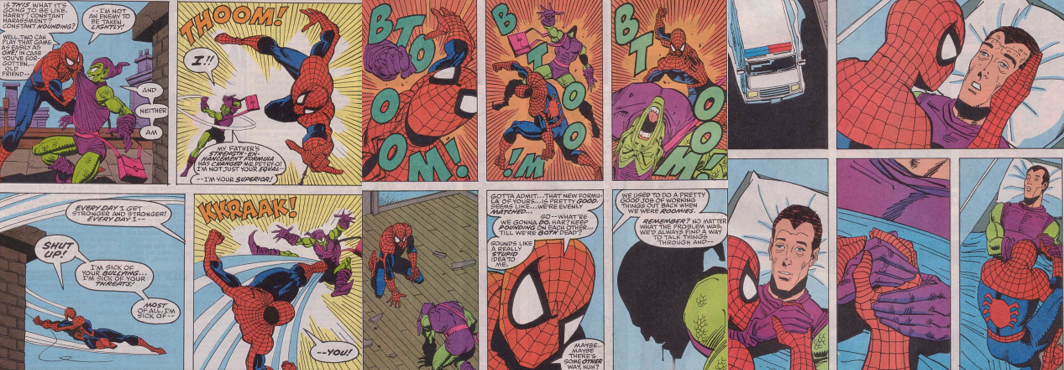
Spidey is stunned when he encounters the Sandman, a crook who can turn his body to...sand…!

Offended when the abrasive Sandman tries to brush him off like he’s nothing, Spider-Man moves to subdue the crook and is astonished when the Sandman literally slips through his fingers by turning his body into soft sand! The Sandman mocks Spider-Man as the wall-crawler’s punches go right through his body and when Spidey damn-near breaks his hand when the Sandman hardens his body to the consistency of iron, and his fully malleable body sends him reeling across the rooftop! Frustrated by the Sandman’s taunting and shape-shifting shenanigans, Spider-Man prepares to try his webbing on the crook but is startled to find that his mask has (somehow…) ripped during the fight. This sends his anxiety and paranoia into overdrive; Spidey envisions that capturing the Sandman will expose his secret identity, leading to an increased manhunt spearheaded by Jameson and the destitution of be beloved Aunt May. Of course, there’s nothing to suggest this would actually happen; there’s no way that the Sandman knows who Peter Parker is, after all, and he could just cobble together a substitute mask, but Spider-Man decides that the risk is just too great and flees before the Sandman can get a good look at him. This leaves the Sandman free to easily deposit himself at ground level, break into the bank by forming the exact shape of the key with his finger, and slip into the vault by turning his entire body into sand. Back at home, Peter frets about his sewing skills while watching a news report that’s conveniently expositing the Sandman’s bizarre origin story: career criminal Flint Marko escaped from solitary confinement in a maximum security prison on an island, swam to shore, and hid from the ensuring manhunt at an atomic device testing centre. There, he was caught in an atomic explosion and, rather than being immolated or suffering from gruesome cancer, his molecules were radioactively merged with that of the sand at his feet, transforming him into a veritably indestructible man of sand.

Peter’s social woes are exacerbated when the Sandman hides out in his school!

When his doting Aunt May comes knocking, Peter is forced to feign illness to cover up his costume and is unable to finish his work and get after the Sandman as she insists on mollycoddling him for the rest of the day and night. Consequently, the Sandman easily shrugs off the police’s gunfire, robs the bank, and eludes capture with his amazing abilities and Peter must wait until the morning (and being given a clean bill of health by his aunt) to finish up. Once he’s up and dressed (and armed with his umbrella and a promise not to exert himself), Peter heads over to the Daily Bugle, where Jameson’s mood has been soured by the little “gift” Spidey left for him the previous night (somehow, Spidey’s webbing managed to not dissolve after a few hours, but I don’t mind as it leads to Jameson standing around in his boxer shorts!) Unfortunately, Jameson is less than impressed by Peter’s lack of photos of Spider-Man and even more riled up when he dares to ask for an advance. Jameson berates Peter as an example of the entitled youth of the day and sends him packing, scuppering the webbing experiments Peter hoped to fund with the extra cash. Peter’s day just gets worse from there; distracted by the quandary of the Sandman, he’s forced to back out of a date with Liz Allen, earning him her ire and jeers from bully Eugene “Flash” Thompson, and he’s so disheartened by the drama of his dual life that even his teacher snaps at him for “daydreaming” in class. You wouldn’t believe it but the Sandman, annoyed at the constant attempts by the police to apprehend him, decides to duck into Peter’s high school until the heat dies down. He bumps into Principal Davis and, amazingly, demands that the teacher write him out a diploma so he can have an academic credit to his name! The kids are impressed when they see their principal standing up to the Sandman and even putting himself at risk to keep them safe but jump out of their chairs with excitement when Spider-Man leaps in to keep the Sandman from harming the elderly principal.

Though he triumphs over the Sandman, Spider-Man is slandered by Jameson’s hate campaign.

Realising that the kids are in danger and wary of the Sandman’s tricks, Spider-Man opts to hurl the brute out of the classroom when he hardens himself, but the Sandman quickly recovers and puts the pressure on Spidey by relentlessly trying to pummel him with his enlarged, hammer-like fists. Spider-Man lures the Sandman to the school gym, only for his webbing to fail him when the Sandman simply passes through it like…well…sand. The Sandman corners Spider-Man, who reacts on instinct and ends up with his arm trapped in Marko’s body. This allows the Sandman to repeatedly headbutt the web-slinger with his rock-hard head, forcing Spider-Man to desperately drive Marko into an iron stairway post to free himself and avoid being headbutted to death. The Sandman quickly reforms himself, ensnares Spidey’s ankles by turning his body into quicksand, and envelops the teenage hero with his entire body, encasing him within a ball of sand. Thinking fast, Spider-Man bounces his foe down to the school basement and slips free from his prison; he then plays to the Sandman’s arrogance by threatening him with an electric drill. Naturally, the Sandman simply turns his entire body into sand particles to render the tool harmless, but this is exactly what Spidey was hoping for; he quickly grabs a huge industrial vacuum cleaner and turns it on the Sandman, sucking him up and imprisoning him within a big metal capsule. Spidey then realises that he didn’t get a chance to snap any pictures of the fight for Jameson, so he fakes a few by snapping photos of himself tussling with some sand he tosses into the air! Jameson then inexplicably shows up at the school and starts barking orders at the cops with no care for the safety of the students inside. He angrily accuses Spider-Man of being in cahoots with the Sandman, so Spidey simply delivers Marko to the cops and changes back into Peter Parker. His joy at this victory is short-lived, however; not only does Jameson take the cost of developing his photos out of his pay, Liz and the others continue to berate him for being a coward and a bookworm, and Jameson uses Peter’s photos to further his vendetta against Spider-Man, leaving Peter despondent but nonetheless determined to continue using his powers for good.

The Summary:
Wow, Stan Lee really didn’t pull any punches in piling the pressure on young Peter Parker back in the day, did he? Peter has got to be the unluckiest guy in the world; it seems no matter what he does, the world is out to get him. It’s almost laughable at times, and especially in this story; Spider-Man’s busted up would-be crooks before and it’s never been a problem, but this time they threaten him with legal action as he jumps in too soon. Although he beats himself up over this, this mistake doesn’t stop him confronting the Sandman, which I think was a missed opportunity. If Spider-Man had spotted the Sandman and not intervened based on what just happened, Peter could’ve wallowed in self-pity not unlike the guilt he feels over Uncle Ben’s death when he later learned that the Sandman robbed that bank. Instead, we get this really random interlude where Spidey’s forced to run off because his mask rips (I still don’t see how that happened…) and he’s taken out of action by the suffocating affections of Aunt May. Then, rather than get out there and look for the Sandman, he’s scolded by his peers, subjected to abuse by the likes of Flash and the fickle Liz, and all his efforts to subdue the Sandman ultimately amount to nothing as Jameson is so determined to paint him as a menace. It’s really weird, though, as the kids at his high school are cheering him on and even the cops seem willing to give Spider-Man the benefit of the doubt, but the general public are easily swayed by Jameson’s biased opinions all so that Peter can be weighed down by depression and self-doubt. This already weighs so heavily on him that he totally overreacts when his mask rips and is immediately and irrationally convinced that it’ll mean the end of his life, even though the Sandman surely won’t know him from any other kid!

The Sandman’s powers are a highlight of the story, which beats Peter down at every turn.

Still, this interpersonal drama, as absurd as it often is in these older Spider-Man stories, is part of what makes Spider-Man so appealing; he always does the right thing and continues to fight against injustice even when most of the city wants to see him behind bars. In the Sandman, Spider-Man meets a formidable physical match; I really liked Marko’s characterisation here as a regular (if accomplished and notorious) crook who just happened to be granted amazing powers. His goals don’t extend much further than robbing banks for cash, but I really enjoyed that he demanded Principal Davis write him a diploma to realise his lifelong dream of graduating high school! At one point, Spider-Man compares the Sandman’s malleability to that of Doctor Reed Richards/Mister Fantastic, an analogy that’s not entirely unwarranted but I’d argue that the Sandman’s powers are even greater! He can basically make himself incorporeal, harden his entire body, stretch his limbs, make himself sticky, and form massive crushing appendages to attack Spider-Man and it’s his unpredictability more than his fighting prowess that throws off even Spidey’s famed spider sense since Spidey never knows what the Sandman is going to do next. I wasn’t a big fan of Marko’s unbelievable backstory (I’d love to know how he escaped from that prison…) but it’s fun seeing atomic power depicted in such surreal ways in comics and I liked that he was such a simplistic, and yet incredibly dangerous, adversary even if he barely scratched his potential here. Ultimately, I had a good enough time with this; while far from my favourite Spider-Man villain, the Sandman at least makes for a visually interesting baddie and the drama, while a bit too full-on at times, tied into Peter’s ongoing struggles with his duality. There are better Spider-Man stories from this era and things are wrapped up or rushed through a little too quickly, but it’s fun seeing Spider-Man being thrown for a loop by the Sandman’s fantastic powers and being forced to think of new ways to outsmart and overcome his latest villain.

My Rating:

Rating: 3 out of 5.

Pretty Good

What are your thoughts on the Sandman’s first appearance? Were you a fan of the villain and his unique powers or did you find him to be a bit daft and unbelievable? What did you think to Peter’s social woes and his panic over his ripped mask? Were you a fan of the Sandman’s simplistic motivations and bizarre powers? What are some of your favourite Sandman stories and moments? How are you celebrating Spider-Man Day today? Whatever your thoughts on Spider-Man and the Sandman, leave them below or drop a comment on my social media and be sure to check out my other Spider-Man content across the site!

Game Corner [National Superhero Day]: Marvel: Ultimate Alliance 2 (Xbox 360)


In 1995, Marvel Comics created “National Superhero Day” and, in the process, provided comics and superhero fans the world over with a great excuse to celebrate their favourite characters and publications.


Released: 15 September 2009
Developer: Vicarious Visions
Also Available For: Nintendo DS, Nintendo Wii, PC, PlayStation 2, PlayStation 3, PlayStation 4, PlayStation Portable (PSP), Xbox One

The Background:
Few videogame publishers are as closely associated with Marvel Comics than Activision, who have been spearheading adaptations of some of Marvel’s most popular characters since 2000. Of course, these weren’t all smash hits but some of their titles are counted as being among the best outings for the likes of Peter Parker/Spider-Man and the X-Men. In 2004, Activision teamed with Raven Software and achieved big success with X-Men Legends, a team-based brawler that mixed role-playing elements and co-op gameplay, and its sequel, so the two expanded to incorporate the larger Marvel universe with Marvel: Ultimate Alliance (Raven Software, 2006), a sadly delisted title that was met with generally favourable reviews. For the sequel, Activision turned to Vicarious Visions, who developed the game engine for the first game, and tweaked the gameplay to focus on team-based “Fusion” attacks to encourage players to experiment with different character combinations. Rather than tell an original story like the first game, or deliver on the many optional endings for Marvel: Ultimate Alliance, the sequel drew inspiration from the controversial “Civil War” story arc (Millar, et al, 2006 to 2007) that saw Marvel’s heroes divided over a governmental registration act, though the game was met with positive reviews. The action-packed gameplay and branching storyline were particularly praised, though some decried the stripped down roleplaying mechanics; the game was also delisted in 2020 and it would take just under ten years for another developer to produce a third entry.

The Plot:
After a series of devastating attacks on the United States, the American government passes the Superhero Registration Act (SRA), forcing all super-powered individuals to act under official regulation, to reduce the chaos that results from their battles. The superhero community is left divided; Tony Stark/Iron Man and his followers champion the Act while Steve Rogers/Captain America and his oppose it, but the two warring factions soon find themselves battling a new enemy that threatens global peace. 

Gameplay:
Like its predecessor, Marvel: Ultimate Alliance 2 is a team-based brawler with limited roleplaying mechanics, exploration options, and puzzle elements. Players can (eventually) assemble a team of four from a roster of around twenty-five characters, many of which return from the last game alongside some newcomers, though your options are limited by story-mandated restrictions and the decision you make partway through to side with the Pro-Registration side or the Anti-Registration side. Regardless of which character you pick, your basic combat and control mechanics remain the same: tapping A executes a light attack while B throws a heavy attack; you can hold B to charge up a stronger strike and mix these together to form basic combos, such as a pop-up attack to break an opponent’s guard. X lets you activate doors and consoles, grab anything from crates to cars to toss at enemies, pull shields off foes and even grab enemies to pummel or throw them to their doom. Y lets you jump; press an attack button in mid-air and you’ll crash to the ground with a slam and press Y again for a double jump or to web-sling, fly, or dart along on a glider or ice bridge depending on who you’re playing as. The Left Bumper allows you to block incoming attacks or dodge out of the way by wiggling the left stick at the same time; there are also times when you’ll need to hit LB to deflect incoming projectiles. The Right Bumper allows you to heal yourself or your allies or revive a fallen comrade as long as you have a Heal Token in stock; these are found scattered across each location, usually spawning in during boss encounters or after defeating enemies, and you can hold up to two at a time.

Characters boast new superpowers and can combine abilities in devastating Fusion attacks.

Although up to four players can play Marvel: Ultimate Alliance 2 simultaneously; you can also play alone with some competent A.I. companions and freely switch to another character using the directional pad when playing solo. You can press in the right stick for a handy arrow to point you to your next objective or bring up the game map from the pause menu. Each character as a life and stamina bar; the former is filled when you collect red Health Orbs or level-up and the latter fills automatically, and each character also comes equipped with their own Super Powers, which you activate by holding the Right Trigger and pressing A, B, X, or Y. Many of these are shared across characters, but with a unique flare to each; Spider-Man can web enemies towards him, for example, while Matt Murdock/Daredevil homes in with his grapple cane, but both can lash at foes with their whip-like weapons. Most characters tend to have a ranged attack (Johnny Storm/The Human Torch’s flaming projectiles, Iron Man’s Repulsor blasts, Ororo Munroe/Storm’s lightning strikes, etc) and a clearing attack (Doctor Bruce Banner/The Hulk’s ground pound, Doctor Reed Richards/Mister Fantastic’s tornado spin, and Remy LeBeau/Gambit’s kinetically-charged card barrage, etc), but some also have abilities that buff either their attacks or their team (Doctor Jean Grey/Phoenix can automatically revive characters or add fire damage to her attacks, Danny Rand/Iron Fist’s “Healing Hand” technique heals him, and Captain America can temporarily reduce the damage he takes, for example). Not only can these be improved by earning experience points (XP) and levelling-up and spending “Ability Points” (AP) in the character menu, but you can now combine powers for powerful “Fusion” abilities. As you dish out damage, you’ll build up the Fusion Meter and you can store up to two Fusion Stars at once and combine powers by holding the Left Trigger and pressing either A, B, X, or Y to team up with one of your allies. This produces various effects depending on the combination but, again, many of them are very similar and only made unique by the way the characters team up. For example, you can perform the iconic “Fastball Special” by combining James “Logan” Howlett/Wolverine, Daredevil, Iron Fist, and Mr. Fantastic with bruisers like the Hulk, Ben Grimm/The Thing, or Mac Gargan/Venom. Venom, Hulk, and the Thing can also do a dual stomping attack and you’ll be able to suck enemies in with tornados from the likes of Storm and Thor Odinson while adding elemental attacks to these twisters with the Human Torch and Phoenix.

Puzzles and objectives are simpler than ever and dialogue trees give the illusion of dramatic discord.

No matter the combination of characters, you’ll be prompted to tap A to increase the radius, target specific enemies, or hit successive foes to score extra points and unlock additional abilities and buffs for your characters. Tapping or holding X is also the most common way you’ll be solving the game’s puzzles; generally, you’re tasked with clearing out all nearby enemies and then activating a console or door with X, but sometimes you’ll need to push or pull amplifiers and giant batteries to power up (or down) generators or pass through barriers, rip off control panels, or destroy projectors. Other objectives include destroying anti-aircraft guns, defeating certain enemies, activating consoles in the correct order, and moving stone columns around to unlock doorways and paths, and some missions also contain optional objectives (such as destroying weapon stockpiles or teleporter pads) that net you additional rewards. Additionally, while you’re often told over your comms that you need to act quickly, only certain objectives actually carry a time limit (you’re given less than six minutes to defeat certain bosses, dispose of bombs, or escape collapsing facilities, for example) and you’re often given options to pick from in dialogue trees that will earn you buffs for being “aggressive”, “diplomatic”, or “defensive”. However, as near as I can tell, this doesn’t really alter the story or your character relationships like picking between Pro- and Anti-Reg, which will restrict the characters available to you and alter both the bosses and mission objectives you’re given (protecting or destroying a Strategic Hazard Intervention Espionage Logistics Directorate (S.H.I.E.L.D.) convoy, for example, or raiding or defending a S.H.I.E.L.D. base). Other missions will see you joined by an additional fifth character (technically not a non-playable character as many, like Captain America and Nick Fury, are playable) who will provide support; however, you can’t select them during gameplay, and you’ll still be met with failure if all four of your team are knocked out.

Graphics and Sound:  
There’s been a decent graphical upgrade between Marvel: Ultimate Alliance and its sequel, namely in the sense that the game is far less dark than before and environments are a little more varied, though the same issues with things becoming repetitive and visually dull persist despite how many additional destructible elements have been added. The game starts in Latveria and sees you infiltrating both the castle town, with its many statues of dictator Doctor Victor Von Doom, and Dr. Doom’s main castle, a location that featured in the last game and is now far more linear and less confusing. This is true of all of Marvel: Ultimate Alliance 2’s locations; it’s very rare that’ll you’ll need to explore off the beaten track, mazes and repeating areas are pretty much non-existent, and everything is much more straightforward this time around, which is great in the sense that levels tended to drag on a bit and be frustrating in the first game but disappointing as you don’t have much to do in, say, Wakanda, except follow a straight path taking out enemies and gun placements and simply walking past the waterfalls, jungles, and tribal trappings in the background. Additionally, Marvel: Ultimate Alliance 2 is way less fantastical; there are no trips to Atlantis, Asgard, or Hell here and, instead, you have to make do with such inspiring locations as…downtown, the rooftops of Hell’s Kitchen, train tracks, and high-tech facilities. Some, like Phineas Mason/The Tinkerer’s lab, T’Challa/The Black Panther’s throne room, and the Negative Zone prison are actually visually very interesting but, for the most part, this is a far more grounded affair, and the game loses a lot of its madcap appeal as a result since the focus is on the more grounded struggles of the Civil War.

While the characters and cutscenes look good, the game is noticeably less visually interesting than its predecessor.

This disappointment is also felt in the game’s soundtrack, which once again opts for very generic, military-esque tunes and rock-inspired beats that serve only to make the mindless gameplay all the more tedious. The voice acting and cutscenes are a lot better this time around; there’s still an obvious graphical difference between pre-rendered cutscenes and in-game graphics, but there’s more focus on character interactions and debating the merits of the SRA. Characters will continue to offer commentary during gameplay, with Wade W. Wilson/Deadpool regularly breaking the fourth wall and characters alerting you when they’re on low health, plus you sometimes get bonuses and additional dialogue if you have certain characters speak to each other. Character models seem better this time around, though; the animations used to bring their powers to life feel more unique and tailored to each hero, though it is disappointing (though, at the same time, understandable) that the same Fusion animations are recycled for certain team-ups. Once again, you’ll be operating out of various hub worlds, like Stark Tower and the White Star base, where you can chat to other characters and find collectibles, and performing certain deeds during gameplay will net you extra costumes (though, sadly, each character only has one this time around). Unfortunately, though, you won’t be treated to as many bizarre and wacky Easter Eggs or endings as before; you only really get one game-changing choice to make here, meaning there are only two endings to see, which is a shame as I really enjoyed all the different consequences of your actions in the first game and how it led to more replay value, whereas here you’re limited to picking Pro- or Anti-Reg.

Enemies and Bosses:
A slew of disposable goons will be set against you throughout Marvel: Ultimate Alliance 2, from Dr. Doom’s soldiers and robots to S.H.I.E.L.D. forces and the nanite-controlled minions of “The Fold”, a rogue A.I. that springs up in the game’s final act to reunite the warring superheroes. Regardless of who you’re fighting, you’ll come across the same recycled enemy tropes again and again: gun-toting soldiers, grunts with shields, ones who block your attack or inflict elemental statuses on you (such as burning, electrocution, and poisoning), and larger mechs. Helicopters will need to be taken out by tossing their grenades back at them, enemies will fire missiles and rockets at you; some have swords, some need to be stunned with your charged attack, some are shielded, and some toss explosive barrels your way. You’ll also have to watch for flame-spitting turrets, laser guns imbedded in walls, loose wires, and flaming hazards that’ll need a dose of coolant (or Bobby Drake/Iceman’s ice powers) to get past. It all gets very repetitive very quickly; the basic enemies aren’t much of a threat to you with your various powers and abilities but can quickly whittle your health down as they start mixing and matched and increasing in number, with more enemies onscreen than the last game and many of them being called in to boost or interrupt the many mini and main boss battles that you’ll have to contend with throughout the story. Like the last game, a who’s-who of Marvel’s most obscure and memorable villains are encountered throughout the game’s three acts, many of which crop up again, often in tandem with other villains.

The Tinkerer, Lucia von Bardas, and the damn Titanium Man represent a dramatic difficulty spike.

The first supervillain you’ll face is Max Dillon/Electro, who teleports around a church in a burst of electricity, performs an electrical blast attack, and can recharge his powers at the capacitors dotted throughout the area. After that, you’ll come up against Bentley Wittman/The Wizard and Steven Hudak/The Scorcher, with the former capable of erecting a shield and the latter roasting you with flame blasts, but your first real boss battle is against the Tinkerer. The Tinkerer stomps about in a large, spider-like tank mech that fires homing missiles, stamps the ground and sets it aflame, and sweeps that area with a laser blast. He’s also supported by an endless swarm of robotic minions, but you can use these to build up your Fusion Meter to target the Tinkerer’s legs and turn his mech into scrap metal. The Shocker/Herman Schultz’s stunning pulses must then be endured to rescue Carol Danvers/Ms. Marvel, then you’ll have your first of many encounters with the scythe-handed Eric Williams/Grim Reaper, one of the most recurring mini bosses who’s actually pretty tough thanks to his fast speed and quick, targeted slashes. Electro, the Scorcher, the Shocker, and the Wizard all reappear during the chaotic battle against cyborg Lucia von Bardas, which takes place on the deck of a ship. You’ll need to avoid her blasts and destroy the four cannons in each corner of the deck, which is easier said than done as Lucia defends three of them with flaming jets and you’ll have to contend with her supervillain bodyguards. Lucia also rains bombs from the sky, protects herself (and her minions) with energy shields, regularly hovers out of reach, and compounds the entire fight with a time limit. In the last part of the game’s first act, which takes part in Washington, D.C., you’ll have to do battle with Deadpool (who teleports about and riddles you with uzi bullets) and hit a bit of a brick wall when you go up against the mysterious Titanium Man. At first this isn’t so hard (he sends you flying, slows you with a pulse, and showers you with a laser spread) but things get much tougher in the second phase, where he turns invisible, is bolstered by minions and floating cannons, sends out loads of annoying vortexes, and there are no checkpoints during this battle, making it all the more frustrating.

While Bishop and Deathstrike can be aggravating, the Yellowjacket boss fight was actually pretty fun.

After this, you’ll be forced to pick a side and this alters the characters you pick and fight against; I went with Anti-Registration (because, frankly, the was the right choice all along) so I’ll primarily talk about those bosses. First up is a scuffle with Natalia Romanova/The Black Widow, who keeps you at bay with her pistols, cartwheel kicks, and grenades, and your first battle with Colonel James Rhodes/War Machine, who’s basically a mirror of Iron Man and attacks with a rocket-powered punch and missiles, though both are pretty easy fights here, especially compared to the one against Lucas Bishop. Your energy attacks will actually heal the grenade-toting Bishop, so try to focus on physical attacks, but you’ll deal the greatest damage against him if you attack and destroy the terminals he plugs himself into. This actually gets pretty tricky as you have to hit three power terminals to cause feedback, then hit four nodes on other terminals to stop him regaining health, and finally hit all six nodes when he draws energy from the middle of the terminals, all while avoiding his rushes and shockwave attacks. In comparison, Melissa Gold/Songbird is a bit of a joke since all you have to worry about are her pink sonic waves, but the difficulty ramps up again when you butt heads with Yuriko Oyama/Lady Deathstrike, who attacks with her Adamantium claws like a whirling dervish. Though the Thing saves your ass, you’ll have to contend with S.H.I.E.L.D.’s soldiers and robots in the second phase; Deathstrike will repair these mechs, so it pays to quickly take them out, but that’s not easy thanks to her speed and aggression. Thankfully, this is followed by a fun and visually interesting fight against Doctor Henry “Hank” Pym/Yellowjacket, who pounds and slaps at you in his gigantic form; you need to attack his massive fists to build up your Fusion Meter and stun him, only then can you unleash a Fusion attack to deal big damage to him, though you’ll have to watch for his double-fist slam and the minions who swarm the rooftops. When in the unstable chemical plant, you’ll have a quick run-ins with Bullseye (who I had no issues with despite his triple-shot projectile), Simon Williams/Wonder Man (who’s also not too hard despite teleporting about the place and sporting powerful melee attacks), and even an unexpected alliance between Jennifer Walters/She-Hulk and Mark Raxton/Molten Man that sees you avoiding the former’s jumping slams and the latter’s flame bursts.

You’ll face different bosses depending on which side you choose, which also impacts the game’s difficulty.

You’ll also contend with a more formidable version of War Machine and have a brief fight with Iron Man (who’s basically the same as War Machine but with fancier laser attacks) before he tags in Mr. Fantastic (who’s actually a bit of a pain thanks to his stretchy limbs bursting up from the floor and his tornado spin). Iron Man and Mr. Fantastic prove quite the double team when you battle them together; even with Captain America on hand to help and with victory coming by defeating Iron Man alone, this can be a tough fight as Mr. Fantastic sometimes glitches and perpetually spins in place and Iron Man flies around the arena sending energy projectiles your way. Finally, you’ll need to help Nick Fury dispose of some bombs while fending off a joint attack from Doctor Norman Osborn/The Green Goblin and Venom; the former flies around dropping grenades or tosses pumpkin bombs in your face while the latter attacks with their tendrils and even webs up the bomb disposal vent and commandeers the Goblin’s glider! On the Pro-Reg side, you’ll have to quell Eli Bradley/Patriot after your betrayal, fend off Jessica Drew/Spider-Woman rather than Black Widow and Hercules instead of Wonder Man, as well as tangle with Nathanial Summers/Cable, who proves highly resistant to damage, constantly teleports about the place, and forces you to rely on your standard attacks and super powers since there are no minions to help build up your Fusion Meter. Ritchie Gilmore/Prodigy, Angelica Jones/Firestar, Tandy Bowen/Dagger, Piotr Rasputin/Colossus, and Jamie Madrox/Multiple Man also crop up, with the latter being quite the obstacle if you don’t have the right teammates, while Tom Foster/Goliath takes Yellowjacket’s place. Instead of fighting War Machine, Mr. Fantastic, and Iron Man, you’ll take on Iron Fist, Luke Cage/Power Man, and Captain America, with this latter fight complicated by plumes of fire and the Cage and Cap being able to pull off Fusion attacks!

After battling numerous foes, you’ll need all your powers to defeat the nanite-infused Nick Fury.

Before you enter the Negative Zone prison,  Commander Maria Hill hands over a key card without issue and Robbie Baldwin/Penance is subdued and recruited after a brief fight. Terrance Sorenson/Equinox proved much tougher thanks to the nearby turrets and his health-draining elemental attacks, and you’ll battle the nanite-infected Grim Reaper, Bullseye, and Molten Man to rescue Luke Cage and Firestar. To escape the prison with the nanite samples, you’ll take on the combined might of David Cannon/Whirlwind, Karla Sofen/Moonstone, and Rachel Leighton/Diamondback; though Captain America and Iron Man help out, this can be a frustrating fight as Whirlwind is constantly spinning about and minions are always spawning in but focusing on one mini boss can help mitigate the danger. While in Wakanda, you’ll fight off Alexander Summers/Havok (whose concussive powers are bolstered by nearby vibrational pillars), the combined threat of Hulk-clone Rick Jones/A-Bomb and Vance Astrovik/Justice (who shields his nanite ally), and once again deal with the duo of Green Goblin and Venom, this time in the Black Panther’s throne room and with a wider, more versatile space for them to avoid your attacks (though having a flame-orientated character or buffs will help against Venom). Wonder Man and Spider-Woman guard the entrance to the Fold’s Iceland base, with both proving tougher than before, while She-Hulk, Firestar, Colossus, and Whirlwind await inside guarding amplifiers. You’ll also battle the Tinkerer again here; this time, he’s almost constantly shielded by the Fold’s enhanced elites, who you’ll need to destroy in order to deal damage to the mad inventor, though the sheer influx of enemies can make this a gruelling prospect. Finally, after battling on a rising elevator and reaching the top of the Fold’s amplifier tower, you’ll fight the nanite-infected Nick Fury. Using a coloured holographic projection, Fury emulates the powers of other characters and bosses to constantly keep you on your toes; he strikes with lightning, sends out energy pulses, rapidly moves and teleports all over the place, creates duplicates, absorbs and projects energy, blasts out a stream of light, and causes the ground to erupt in flames. Although a frustrating and long-winded bout, this was actually easier than some other bosses; switch characters to whoever’s closest, unleash your rapidly-filling Fusion Meter, and remember to deflect his projectiles when prompted and you should emerge victorious without having to expend a single revive, which is more than I can say for the damn Titanium Man!

Power-Ups and Bonuses:
As mentioned, combat yields XP that levels you and your team up; all characters level-up regardless of whether you use them or not, but levelling-up alone isn’t enough to power-up your team. You need to spend AP boosting their four superpowers and all four will only be unlocked by levelling-up; thankfully, AP is easily earned by beating enemies, rapidly tapping A during Fusion attacks, and smashing crates and other onscreen destructibles. Each character also has “Passive” abilities that can be upgraded in the character menu; many of these are locked to a specific side, so you’ll never have full access to all abilities in a single playthrough, and they provide buffs such as raising your chances of landing a critical hit, allowing more frequent use of your powers, regenerating health, reducing damage, and increasing the stamina you gain. Defeating mini bosses and bosses also rewards you with medals that provide additional “Boosts”; you can manually or automatically equip up to three of these at a time to increase your health, teamwork, resistance to or ability to inflict elemental attacks, and other similar bonuses. It also pays to utilise your comic book knowledge; if you make a team comprised entirely of X-Men or the Fantastic Four, for example, you’ll get an additional boost to aid you. Finally, extra rewards are on offer for performing three “Heroic Deeds” per character; these range from defeating fifty enemies, performing specific Fusion attacks, or using certain superpowers and will unlock a new costume or ability for each character, as well as being a fun aside.

Additional Features:
There are fifty Achievements to snag in Marvel: Ultimate Alliance 2, with sixteen being tied to the story mode alone, though you’ll need to do two playthroughs and experience both the Pro- and Anti-Reg missions to earn them all. You’ll also earn Achievements for completing missions in co-op mode, clearing the game on “Legendary” difficulty, performing ten Fusions with a friend, earning high scores from Fusions, unlocking costumes, collecting boosts, and finding the various dossiers and audio logs scattered throughout the game. You’ll unlock additional characters not just through the story mode, but also by collecting Asgardian Ruins, pieces of the M’kraan Crystal, and Gamma Regulators; some characters’ alternate costumes also act as skins, such as General Thaddeus “Thunderbolt” Ross/Red Hulk and Eddie Brock/Venom. You’ll also find simulator discs scattered about that once again let you take on special simulator missions from the game’s hub worlds, can put your Marvel knowledge to the test in various trivia games for more XP, and will be given the option of starting a new game, with all your unlocks and stats, but at the cost of your existing save file. There is no option to replay previous missions as far as I can tell so you’ll need to start over if you missed anything. I’d also advise making use of the manual save function as often as possible, especially before you pick a side so you don’t have to start right from the beginning to see the other side of the story. If you were lucky enough to own this game before it got delisted, you can also expand the roster with some downloadable characters, like Cletus Kasady/Carnage and Erik Lehnsherr/Magneto, though this feature is obviously unavailable these days; additionally, other versions of Marvel: Ultimate Alliance 2 include console-specific characters, like Eric Brooks/Blade.

The Summary:
I was always hesitant about getting into Marvel: Ultimate Alliance 2, simply because of my hatred for the diabolical Civil War storyline. Even with that bias to one side, I wasn’t impressed that the sequel stripped back the story and scope of the franchise so much; the first game arguably tried to do a bit too much and touch base with a bunch of different locations and characters in the Marvel universe, but at least it embraced the bonkers spirit of the source material and wasn’t as blinkered as the sequel. I really missed the unpredictability at the first game; here, the only replay value is in picking a different side, especially as all characters are available to you in the finale, so all you’re really left with is the new-fangled Fusion mechanic. Sadly, this isn’t as good as the game makes it out to be; once you’ve seen a handful of them, you’ve basically seen them all and they weren’t as impressive as I had hoped. I also wasn’t a big fan of some of the character choices and the lack of extra skins, though overall I think I preferred the gameplay and combat; it’s still mindless and tedious and gets old really quickly, but at least the different superpowers felt a little more dynamic this time. While I have no complaints about the game’s linearity since it made it faster to play, it is a shame that exploration has been cut way back this time around and that many of the level-up and customisation mechanics have been stripped down. Once again, the game’s biggest issue is cramming so much into it; it’s great for a Marvel fan but it does impact the enjoyment and memorability of the mini bosses since a lot of them are just the same thing over and over with the same tactics used to overcome them. Overall, I feel Marvel: Ultimate Alliance 2 is no better or worse than the first game: I miss the different gameplay mechanics and visual variety of the first game, but the sequel feels a bit more refined and focused; I don’t like how grounded and restricted it is, but the graphics and ability options are a step up. I think the best thing to do (if you can afford it) is have both and play them back to back for a complete experience but if I honestly had to pick which one was better, I’d go with the first one since I’m much more inclined to play it and see what wacky endings I can earn rather than seeing the SRA repealed or lessened by the end of this game.

My Rating:

Rating: 3 out of 5.

Pretty Good

Have you ever played Marvel: Ultimate Alliance 2? If so, how do you think it compares to the first game? Which side did you pick and who made it into your team? What did you think to the new Fusion mechanic and the changes to the roster? Were you disappointed that the boss battles were still mostly tedious exercises and that the scope was scaled so far back? Did you ever complete all the Heroic Deeds and simulator missions? How are you celebrating National Superhero Day today? Whatever your thoughts, leave a comment below or on my social media, and be sure to check out my other superhero and comic book content across the site!

Movie Night: Madame Web

Released: 14 February 2024
Director: S. J. Clarkson
Distributor: Sony Pictures Releasing
Budget: $80 million
Stars: Dakota Johnson, Tahar Rahim, Sydney Sweeney, Celeste O’Connor, Isabela Merced, and Adam Scott

The Plot:
After a near-death experience,.paramedic Cassandra “Cassie” Webb (Johnson) begins seeing glimpses of the future revolving around Ezekiel Sims (Rahim), a superpowered businessman determined to kill three teenagers before they can kill him in the future as Spider-Women, compelling Cassie to begrudgingly discover the truth of her past and protect the girls.

The Background:
After Sam Raimi’s Spider-Man trilogy (2000 to 2007) proved a phenomenal success, Marc Webb’s reboot films proved sadly mediocre and led to an unprecedented agreement between Sony Pictures and Marvel Studios that allowed the iconic wall-crawler to appear in the Marvel Cinematic Universe (MCU) and Sony to release tangentially-connected spin-offs featuring Spidey’s villains and side characters. Encouraged by the financial (if not critical) reception of their Venom (Various, 2018 to present) movies (and seemingly undeterred after the car-crash reception of Morbius (Espinosa, 2022)), Sony not only signed off on a solo project for Sergei Kravinoff/Kraven the Hunter, but also the enigmatic clairvoyant Cassandra Webb/Madame Web. Created by Dennis O’Neil and John Romita Jr., Madame Web first appeared in The Amazing Spider-Man #210 and significantly influenced Spider-Man’s battles against multiversal forces, but is perhaps best known for her inclusion in the Spider-Man animated series (1994 to 1998), where she was voiced by Joan Lee (wife of the legendary Stan Lee). Writing began on a Madame Web feature while Morbius was still in production and saw numerous rewrites, even after director S. J. Clarkson signed on and retooled it into Sony’s first female-centric Marvel film. Producer Lorenzo di Bonaventura expressed difficulties in adapting Madame Web’s clairvoyance to the screen and emphasising secrecy surrounding the project given her relative obscurity, a fact explicitly addressed by the inclusion of other, more recognisable Spider-Women. The cast appear to have been mislead as to the status of the film in the wider MCU; this may explain the bizarre marketing campaign that saw star Dakota Johnson seemingly openly criticise the film, though she wasn’t the only one. After numerous delays, Madame Web released to scathing reviews; the film made just shy of $100 million at the box office and critics attacked the poor dialogue and script, lacklustre special effects and pacing, and the blatant false advertising regarding three of the lead characters.

The Review:
So, if I had a whole bunch of negativity towards making standalone, Spider-Man-less films about the likes of Eddie Brock/Venom and Doctor Michael Morbius, you can be damn sure that I was baffled to the point of insanity by the decision to make a solo Madame Web movie. Not only is she an extremely obscure Spider-Man character, but her depiction is generally as a wizened, blind mentor who manipulates Spider-Man like a chess piece as part of Marvel’s on-again/off-again insistence on convoluting Spidey’s origins and mythos with semi-paranormal cosmic ideas of Spider Totems and “Webs of Fate”. It’s ironic, really, as the concept could have worked a little better if Madame Web had been depicted as a Professor Charles Xavier/Professor X-type figure, mentoring and recruiting Spider-Women to oppose the Inheritors, despite my dislike for them, because at least then the focus would be on the spider-powered women and not this thoroughly unlikeable paramedic who, despite choosing a carer where she’s sworn to protect lives and being depicted as a workaholic who rushes to do that very thing, is reluctant to help the three girls targeted by Ezekiel Sims. Much of Cassie’s reluctance stems from her lingering feelings of abandonment, confusion about her true self and past, and what’s framed as an unconventional upbringing since her mother, Constance (Kerry Bishé), died during childbirth and Cassie was raised in the foster system, left with only mementos of her mother, Constance’s research into the near-mythical spiders of the Peruvian jungles, and the mistaken, childish belief that Constance cared more about her arachnids than raising her daughter. Consequently, Cassie has a bit of an abrasive edge to her; while she tirelessly works to save lives alongside her friend and partner, Ben Parker (Scott), she’s uncomfortable with receiving gratitude for this, has no idea how to act around children, and would much rather spend time in her apartment with a local stray cat than socialise with her colleagues or even Ben’s pregnant sister-in-law, Mary Parker (Emma Roberts). Her anxiety and social awkwardness is only exacerbated after she nearly drowns and is sporadically bombarded by visions of the past and near future, all framed by a mysterious web-like pattern, though she initially dismisses these visions and it takes her a ridiculously long amount of time to realise that they’re not only true, but that the fates she is witnessing can be changed.

Three girls destined for greatness must rely on Cassie’s sporadic clairvoyance to survive.

Central to her visions are four individuals – a violent killer clad in a somewhat-familiar spider-themed costume and possessing superhuman strength and spider-like abilities, and three twenty-somethings teenagers that Cassie sees horribly murdered by this assassin time and again. As fate would have it, their destinies are all intertwined and lead Cassie to encounter the three girls individually to establish some surface-level characteristics for the three that are partially developed as the film chugs along. Julia Cornwall (Sweeney) is the quiet, shy girl who’s struggling with her parents’ divorce, Anya Corazon (Merced) is both book smart (she literally wears a t-shirt proclaiming her love of “math”) and dealing with fending for herself after her father’s deportation, and skater Mattie Franklin (O’Connor) is the streetwise rude girl with a chip on her shoulder since she comes from money. The three couldn’t be more different but quickly form a genuinely enjoyable sisterhood after they’re saved by Cassie; while initially distrusting of her, they eventually come to believe in her janky clairvoyance after she saves them from Ezekiel multiple times. However, Cassie is seemingly impulsively compelled to do this, and it takes her a while to realise the responsibility she has towards the girls; she routinely abandons them, chastises them, and even jets off to Peru to investigate her origins and undergo a spiritual journey that finally teaches her that she has an obligation to protect the three with her abilities. The three girls do their best with the materials, appearing fun and likeable and adding some pathos to their characters through their shared feelings of abandonment, but the script is rarely in their favour. The same is true for Cassie, who constantly narrates her life like an idiot and acts very irrationally for a paramedic, though eventually she settles into the role of a reluctant surrogate mother and protector to the girls.

Ezekiel targets the girls to save his own life, but is a pretty weak and one-note villain.

The girls are targeted by Ezekiel since he’s been plagued by visions of his death at their hands at some point in his future. Previously working alongside Constance, Ezekiel betrayed and killed her to get his hands on a mysterious spider that granted him his amazing powers, but also cursed him with the knowledge of his impending death. In the interim, he built a vast, indistinct corporate empire and has become obsessed with finding and killing the three Spider-Women who’ve haunted his nightmares, aided by his “girl in the chair”, Amaria (Zosia Mamet), who hacks into the police database and CCTV cameras all over the city to track the girls down. It’s not made clear why the Spider-Women would hunt down and kill Ezekiel in the future, or what he’s done that makes him such a diabolic villain except one confirmed kill, but boy does he like to mumble and grumble about how badly he wants them dead and his desire to ensure he lives on! As if having all the wealth and technology he needs at his disposal isn’t enough, Ezekiel also possesses spider-like powers; he can walk and climb on walls, leap vast distances, possesses superhuman strength and reflexes, and can poison his victims with a touch, eventually causing cardiac arrest. He also seems to display some degree of clairvoyance and psychic power to rival that of Cassie, communicating to her on the astral plane at one point, and dresses in an admittedly cool looking outfit when out on the prowl. How he changes in and out of this isn’t made clear either, however, as he’s often seen wearing the form-fitting suit in one scene and then fully in his business attire in the next with no explanation, and he’s routinely humiliated by Cassie since she can anticipate his actions ahead of time. While Cassie doesn’t demonstrate the same superhuman powers, the three girls do in the frantically-edited visions of the future, though it’s unclear how, when, or why they gained superhuman powers. Ezekiel does, however, share his powers with the mysterious Las Arañas, a secret Peruvian tribe who dress in makeshift jungle attire that’s very similar to Spider-Man’s and try to save Constance when she’s wounded, delivering Cassie and then later making her realise that her mother ventured into the jungle to save her, not because she didn’t care about her. Frankly, I find this whole aspect to be borderline insulting; I hate the idea of a tribe of Spider-People and of a spider species that can grant these powers as it diminishes Spider-Man’s uniqueness, though the depiction of the spider-powered people clambering and leaping about the place is pretty good and surprisingly horrific, especially when Ezekiel is tossing bodies around in Cassie’s visions.

The Nitty-Gritty:
There’s a shared feeling of abandonment between the four female leads; all of them feel like outsiders to some degree, isolated from others and even their families since they either don’t have a parental figure, or their parents don’t seem to care about them. While their individual personalities initially clash because of their different backgrounds and current social standing, they quickly bond once they realise how much they have in common, with the three girls, especially, forming a makeshift sisterhood due to their current circumstances. Although Julia is Cassie’s most vocal supporter, they initially believe she’s either crazy or just another adult they can’t rely on and decide to go against Cassie’s warnings and fend for themselves, an action that very nearly sees them all killed by Ezekiel before Cassie intervenes. She chastises them, angry at their irresponsible and reckless actions, but struggles to give them the answers they want and to properly care for them since he’s apparently so maladjusted that she can barely stand to be around her handful of friends, much less look after three scared teenagers. Thus, she turns to Ben to shelter the girls while she tries to find answers in Peru; this turns out to be a good decision since Ben is a much more emotionally stable individual. He deeply cares for his sister and is extremely excited about being an uncle, but is also devoted to his friend and partner, to the point where he resuscitates Cassie after she drowns, begs her to socialise with his family and their colleagues, and agrees to look after the girls even though he has no idea what kind of danger they’re in. As good as Adam Scott was in the role (I particularly liked the banter he shared with Cassie, which hinted at a former attraction, and his struggles to keep up with the girls), the only reason he’s here is for fan service: yes, he’s playing the future Uncle Ben and, through him, we even see the birth of his nephew (who ridiculously goes without a name) and get hints towards his future, despite Madame Web taking place in its own separate continuity from previous Spider-Man movies. There’s also something really weird about Julia, Anya, and Mattie all being older than Peter and the frustration of the three running around in normal street clothes instead of the awesome Spider-Women suits we barely get a glimpse of in their future.

In the absence of the Spider-Women, we’re left relying on Cassie’s visions and Ezekiel’s threat.

Yes, Madame Web is another great example of Sony lying to us; the trailers and posters showcased Julia, Anya, and Mattie as fully-empowered Spider-Women but this isn’t the case at all. I guessed that we wouldn’t see them suit up until the very end, but the truth is far worse; they only wear their costumes in fleeting visions, with no explanation of how they get their powers, and the film has the gall to setup a potential sequel that actually addresses these issues, but to me it’s a dropped ball that completely derails the movie. The bulk of Madame Web is focused on Cassie’s struggles to reconcile her past and understand her newfound powers; there are numerous scenes of her witnessing snapshots of the future, meaning we get a lot of time loops and confused looks from Cassie that border on the maniacal as she tries to understand what’s happening. Primarily, though, these visions are used as fake outs; almost every time, the scene will show Ezekiel coming in, wrecking fools, and killing his targets in an almost effortless manner, only to suddenly snap back to Cassie and show her taking action to avoid this fate. It’s all very reminiscent of the Final Destination films (Various, 2000 to present), which is fitting but kind of lowers a lot of the stakes since you can just assume every violent scene or action sequence is just a vision. When Ezekiel does get a chance to fight, he’s effectively peerless; none of the protagonists have the strength or ability to go toe-to-toe with him, meaning Cassie drives a lot of cars into him and catches him off-guard with her clairvoyant powers, leaving him perplexed and looking stupid. When the Las Arañas appear, it’s all shot with an unsettling, nightmarish shaky-cam filter that makes their appearances and abilities not only difficult to pin down, but also appear needlessly cartoonish.  There are some decent effects at times, such as when Cassie takes her spiritual journey and interacts with the Web of Fate and the lingering memory of her mother, and things are surprisingly grounded for a Sony Spider-Man-adjacent movie, with Ezekiel being unable to swing from webs and more reliant on his physical abilities. This, in conjunction with his intimidating costume, does paint him as a formidable figure; he’s almost like a slasher villain at times, draining the life from his victims, breaking their limbs, and pouncing like an animal, but this persona is awkwardly juxtaposed with his pandering civilian identity, where he may as well twirl an old-timey moustache as he spouts generic villain dialogue with little charisma or conviction.

Cassie accepts her fate to defeat Ezekiel and mentor the future Spider-Women.

So, all these recent revelations help Cassie make sense of her mother’s notebooks; while she previously resented Constance’s apparent fixation on her spider research, she realises that her destiny has been intertwined with Ezekiel’s since before her birth and takes herself to Peru to find answers. There, a Las Arañas, Santiago (José María Yazpik), helps her to realise that her mother was trying to cure her of some disease and that she has a greater destiny, one that will bestow her with “great power” once she accepts the “responsibility” that comes from her abilities. Before, she saved and sheltered the girls simply because it was the right thing to do; she had little interest in watching over them or bonding with them, or of their greater destinies as Spider-Women, but her spiritual journey motivates her to actively shield them from Ezekiel’s wrath, and gives her greater control over her future sight. After rescuing them and allowing Ben and Mary to get to safety, Cassie takes the girls to a fireworks warehouse and they finally set aside their differences to set a trap for Ezekiel, planting flares all over the place to cause a series of explosions. This actually causes quite a few issues for the protagonists, however, as the explosions destroy the helicopter Cassie called in to rescue them and eventually sees Julia, Anya, and Mattie separated and facing fatal falls. Luckily, Cassie masters her powers enough to…somehow…spiritually duplicate herself long enough to help the three to safety, incurring Ezekiel’s anger. Despite him being haunted by very specific visions of his death at the hands of the three Spider-Women, Cassie changes his fate and claims that she was always the one who was destined to end him (which doesn’t seem true, but okay) and lures him onto unstable ground, eventually causing him to plummet to his death and be crushed by debris. Cassie also takes a plunge but, luckily, she taught the girls CPR earlier and they’re able to revive her, though she’s not only inexplicably left paralysed with no explanation but also winds up blinded by a stray firework. Still, she’s not bothered by this; in fact, the film ends with her happier than ever since she can now, presumably, use the full extent of her psychic powers and clairvoyance to see and understand the future and is prepared not just to take on the three as their foster mother, but to mentor them into the Spider-Women they are destined to become…effectively ending the film where it really should’ve started! Like, why not have Cassie already be infirm but fully empowered and training, say, Julia, showing their origins through flashbacks and exposition, and have Julia be the point woman in recruiting Mattie and Anya when Ezekiel, an Inheritor assassin, targets them? It could’ve been Sony’s answer to the X-Men, in a way, and even take place in the same universe as their other pointless spin-offs, and might’ve been more enjoyable because then we would’ve gotten to see the gorgeous Sydney Sweeney in their slick, form-fitting Spider-Woman costume for a lot more of the runtime!

The Summary:
I went into Madame Web expecting it to be bad based on the trailer, the disaster that was Morbius, and my dislike for the concept in general. I tried to have an open mind, however; the cast, for example, intrigued me, as did the costume design, and to be fair there is the ghost of a semi-decent idea here, it just would’ve worked better as a side plot in a Spider-Man film or reworked to have Julia Carpenter/Spider-Woman at the forefront, with Cassie as a mentor figure. Any goodwill the film might’ve gotten from its Spider-Woman costumes is flushed down the toilet since we barely get a good look at these and the girls don’t even become Spider-Women in the movie; Ezekiel’s costume and action scenes somewhat make up for this, but he’s such an ineffectual and confusing villain that it’s hard to care when he’s onscreen. The relationship between the protagonists was somewhat enjoyable; I liked how the girls bonded, their shared feelings of abandonment, and them coming together as a surrogate family, but it’s executed so poorly and, although the girls do try, they’re all hampered by a really awful script. Dakota Johnson suffers from this the most, I think; she was some weird, awkward silences and quirks and is forced to spit out some really awful dialogue and nonsensical exposition. Add to that the fact that Cassie is a weird and pretty unlikeable character, abandoning and yelling at the girls even though she’s supposed to be a paramedic and you have a main character who’s hard to relate to, a villain as flat as a piece of paper, and three boisterous young girls who are completely wasted in this travesty of a film. It’s more than a step back for the genre; Madame Web harkens back to a time when superhero movies were not only afraid to use codenames and costumes, but outright ashamed of them, delivering cookie cutter dramas that falter at the first hurdle. It’s a sad state of affairs and I have lost all hope for Sony’s future Spidey-adjacent movies, and my expectations were already at the bottom of the barrel to begin with!

My Rating:

Rating: 1 out of 5.

Terrible

Did you enjoy Madame Web? If so…what’s the matter with you? What did you think to the performances and the dynamic between the four protagonists? Were you disappointed that the girls didn’t actually become Spider-Women in the film? What did you think to Ezekiel, his characterisation, and the nonsense about the Las Arañas? Do you think a Madame Web movie could ever work, or would you rather see a Spider-Woman take the forefront? Which Spider-Woman is your favourite? I’d love to know your opinion of Madame Web, so leave a comment below and be sure to check out my other Spider-Man and Marvel content.