Back Issues [Sonic CDay]: The Brotherhood of Metallix


Developed alongside the blockbuster Sonic the Hedgehog 2 (SEGA Technical Institute, 1992), Sonic the Hedgehog CD (Sonic Team, 1993) released on this day back in 1993. Expanding upon the Blue Blur’s debut title, Sonic CD introduced Metal Sonic (one of Sonic’s most popular and enduring rivals) and Amy Rose, and is considered by many to be one of the best of the classic Sonic titles.

Story Title: “The Brotherhood of Metallix (Part 1 to 4)”
Published: 1 September 1995 to 13 October 1995
Writer: Nigel Kitching
Artist: Richard Elson

The Background:
After Sonic the Hedgehog became a mainstream success and SEGA usurped Nintendo’s position at the top of the videogame industry, SEGA quickly capitalised on Sonic’s popularity not just with videogames but a slew of ancillary merchandise, including cartoons and comic books. About six months after Archie Comics started publishing a weird amalgamation of the Adventures of Sonic the Hedgehog (1993 to 1996) and Sonic the Hedgehog/SatAM (1993 to 1994) cartoons, United Kingdom publisher Fleetway Editions Limited started “Britain’s Official SEGA Comic”, Sonic the Comic (StC), a fortnightly publication that was a favourite of mine until its unfortunate end. Though StC pulled much of its lore from the now defunct Mobius and Doctor Ovi Kintobor storyline that was prevalent outside of Japan, StC quickly veered from the source material, portraying Sonic the a mean-spirited leader of a gang of Freedom Fighters comprised of videogame characters and anthropomorphic original characters. Like Archie’s comics, StC included some very loose adaptations of the videogames that truncated or adapted the source material to fit with its noticeably different lore. When StC adapted Sonic CD, they reimagined Metal Sonic as “Metallix” and told a self-contained time travel story. However, some years later, a second Metallix appeared and teased a “brotherhood” of Badniks, which was paid off in these issues and solidified Sonic’s robotic doppelgänger as one StC’s more dangerous and persistent secondary antagonists.

The Review:
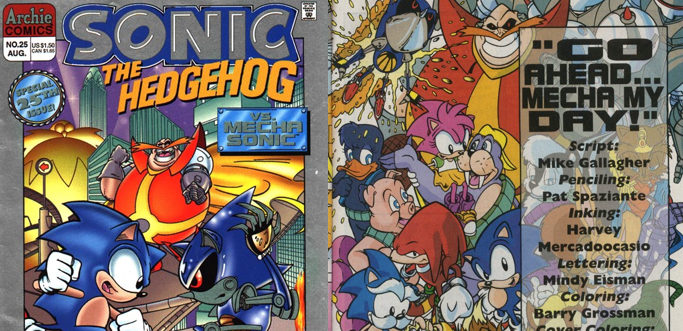
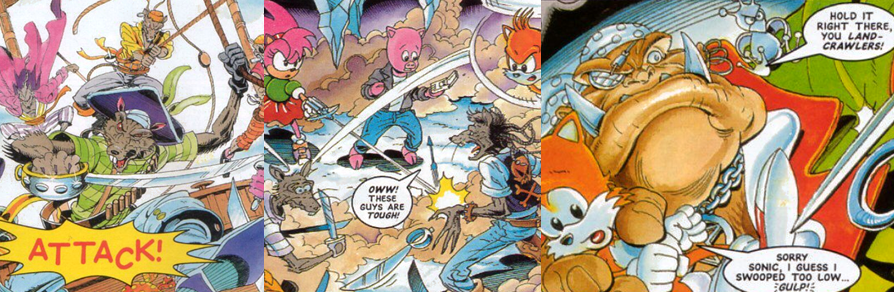
“The Brotherhood of Metallix” takes place in the middle of Doctor Ivo Robotnik’s merciless rule over the planet Mobius. Having conquered the entire world thanks to a time dilation, Dr. Robotnik has become all powerful save for the efforts of Sonic and his friends, who’ve been driven from their homes and roam the Zones disguised as Bob Beaky’s Travelling Circus. The story begins with Porker Lewis, the technical support of the team, activating a security field around their caravan while the Freedom Fighters investigate reports of a new Badnik in Metropolis City, which is essentially Dr. Robotnik’s headquarters. Expecting some all-powerful death machine, the cocksure Sonic is incredulous by the clown-like Mister Blobnik (a thinly veiled parody of British television icon Mister Blobby). A ludicrous Badnik who staggers about blowing bubbles and fumbling with its weaponry, Mr. Blobnik nevertheless proves more durable than regular Badniks and Troopers, withstanding a Sonic Spin Attack and trapping Sonic in a an inescapable bubble upon defeat. Having successfully fooled the Freedom Fighters with a variation of the “Drunken Fist” technique, Mr. Blobnik’s head detaches from its remains and carries Sonic to Citadel Robotnik. However, rather than being tortured, transformed into a Badnik, or executed, Sonic is stunned when a panicked Dr. Robotnik reveals he needs to join forces with Sonic to oppose the “Brotherhood of Metallix”. While Sonic battled Mr. Blobnik, Dr. Robotnik was shocked when a Metallix teleported into his citadel via a corrupt version of the Omni-Viewer (a sentient television screen that resides in the Special Zone) and kidnapped his long-suffering assistant, Grimer. After learning that the Metallix, who were set to automatically replicate and improve themselves in Dr. Robotnik’s abandoned Egg Fortress base in the Special Zone, have gained sentience and are now ruled over by a gigantic Emperor, Grimer’s forced to aid their scheme for true autonomy.
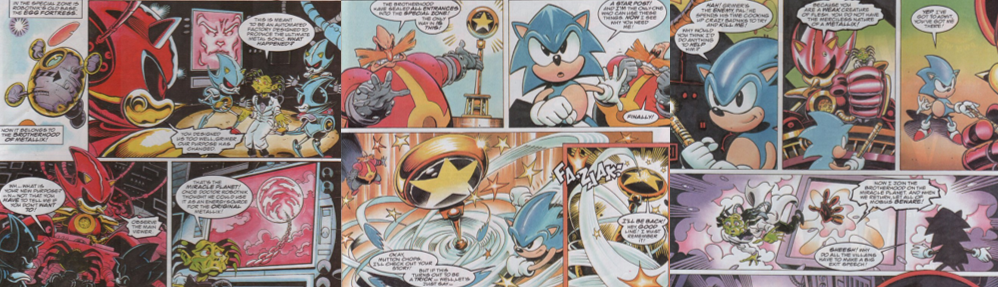
When the Metallix mysteriously return, Sonic’s forced to join forces with Dr. Robotnik to investigate.

Although Sonic’s sceptical of Dr. Robotnik’s claims, he remembers his last encounter with an upgraded Metallix mentioned a “brotherhood” and reluctantly agrees to use his super speed to enter the Special Zone via a Star Post and investigate. Sonic arrives to find the Egg Fortress heavily damaged and seemingly abandoned, until he explores further and witnesses Grimer handing the Emperor Metallix a mechanical staff, the “Alpha Device”. With this in hand, the Emperor Metallix and its troops prepare to teleport to the Miracle Planet via their Omni-Viewer, only for Sonic to attack, reasoning that the Badniks are obviously up to no good. The Emperor Metallix silently commands two minions to attack. While they land a few good blows on the Blue Blur, Sonic dispatches them far easier than their predecessors by tricking one into blowing its fellow up with its chest cannon and simply smashing the other into junk with a swing of the Alpha Device. Sonic’s victory is short-lived, however, when the Emperor Metallix takes Grimer hostage and threatens to crush the life out of him unless Sonic hands over the Alpha Device. With no choice but to acquiesce as he can’t allow even his enemy to be killed, Sonic can only watch as the Emperor Metallix departs. Luckily, since the Miracle Planet has arrived in orbit once again, Sonic and his friends follow the Brotherhood of Metallix using the massive magic chain that binds the planetoid to Mobius. Despite their temporary truce, Sonic refuses to allow Grimer or Dr. Robotnik’s forces or weaponry to go with the Freedom Fighters, meaning we’re denied a true team up between the long-term allies. Instead, the Freedom Fighters witness the Emperor Metallix preparing to usher in a “new age” for its brotherhood via the Alpha Device, which has been created to reshape the mysterious Miracle Planet into Metallix’s form and provide them with the near-limitless power to conquer the world.
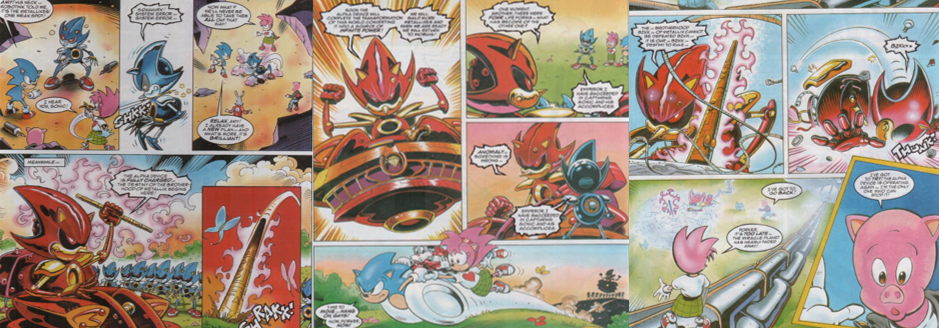
Thanks to Porker’s bravery and ingenuity, the Metallix are seemingly foiled on the Miracle Planet.

Detected by the Metallix, Sonic leads his friends into an immense network of caves (where, it’s revealed, he hid from Amy Rose for two days when they were trapped there some years ago). A Metallix stalks them through the tunnels and easily shrugs off Johnny Lightfoot’s attack. A Super Sonic Spin stuns the robot, however, allowing Amy Rose to take it out with a well-aimed crossbow to its neck (its one weak spot, as identified by Dr. Robotnik). The distraction is enough for the Emperor Metallix to enact its plan, however, and the Alpha Device begins transforming the Miracle Planet into a world of metal. The Emperor Metallix gloats when one of its troops arrives with Sonic, Johnny, and Amy, but is too late to notice that the unit has been tampered with by Porker Lewis. Porker presses a button on his remote and causes the Metallix to self-destruct, taking out all the emperor’s troops and severely damaging the big red overlord. For his efforts, Porker receives a kiss on the cheek from Amy Rose and even kudos from Sonic, traditionally a more hard-assed character in StC. Unfortunately, the Alpha Device is still functioning and rigged to explode if it’s tampered with. Thus, Porker steps up again, navigating the booby traps to shut down the Alpha Device and undo the damage being done to the Miracle Planet. With Mobius fading, Sonic ushers his friends down the magical chain, only for the Emperor Metallix to lurch to life and reactivate the Alpha Device before collapsing. With no other choice, Porker bravely returns to the Miracle Planet to shut the Alpha Device down once more, trapping himself on the magical world for a month and leaving Sonic with no choice but to wait and see if his friend was successful.

The Summary:
“The Brotherhood of Metallix” has one very obvious positive going for it right off the bat: it’s illustrated by Richard Elson, easily the best artist in Sonic the Comic’s all-too-short history. He brings Sonic and StC’s original characters to life with such a peerless flair and stories always felt more important when his name was attached to them. Unfortunately, it appears Elson was rushed during this particular story as I saw a lot of repetition in “The Brotherhood of Metallix”. Some panels during Sonic’s battles with the Metallix, for example, are directly lifted from Elson’s work in “The Sonic Terminator” (Kitching, et al, 1994) and many of Sonic’s poses looked familiar, too. It’s a minor thing and it’s not like every panel is like that, but it was noticeable and a little odd considering the detail seen in Mr. Blobnik and the Emperor Metallix. The story also suffers from promising a team up between Dr. Robotnik and Sonic and failing to deliver on almost every level. They don’t join forces or oppose the Metallix as a team; instead, Dr. Robotnik simply warns Sonic of the threat, tells him of the Metallix’s weak spot, and that’s it. It’s pretty disappointing as this could’ve been a longer, multi-part story where Sonic shuns his usual allies to team up with Dr. Robotnik instead, making his friends question his decision and having the mad dictator betray him to seize the Miracle Planet for himself. The cliff-hanger of Porker Lewis being left behind was resolved in a later story and expanded into a full-on nervous breakdown for the character, but it could’ve easily been Dr. Robotnik who rigged that Metallix to blow and was left trapped on the Miracle Planet. Consequently, as amusing as the Mr. Blobnik stuff was, I feel these panels were wasted and could’ve been better served showing a proper, awkward team up between Sonic and Dr. Robotnik where they battle at least one Metallix together.
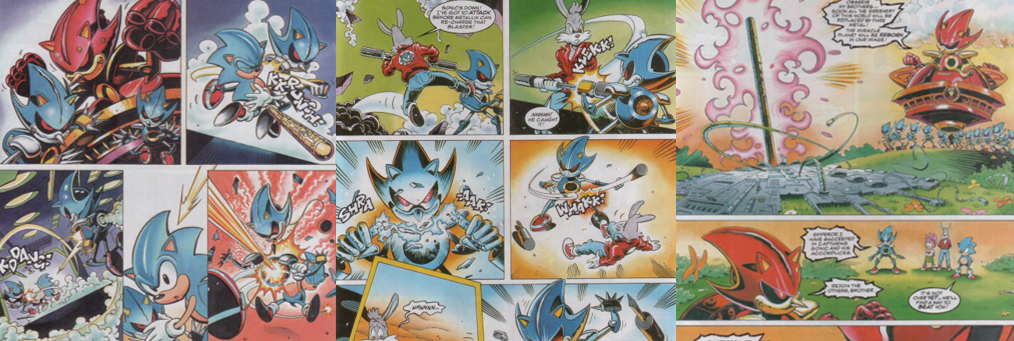
As great as the art is, Metallix is strangely inconsistent and the story squanders its potential.

Speaking of which, the Metallix are a bit hit and miss here. In his first encounter with his robotic double, Sonic struggled to compensate for Metallix’s super speed, power, and armaments. This was taken one step further in Sonic’s second encounter with the robot, which was so powerful that it made mincemeat of Knuckles the Echidna and Sonic was forced to transform into his demonic, unstoppable alter ego, Super Sonic, to destroy it. Metallix has always shrugged off Sonic’s best shots and has always been depicted as being, as the kids say, “built different” from Dr. Robotnik’s other creations. While that’s somewhat true here, it’s pretty inconsistent: sometimes they shrug off the Super Sonic Spin Attack, sometimes it stuns them, sometimes they barely flinch when struck and sometimes Sonic shatters them with a glorified pole! To make matters worse, Porker Lewis easily blows a bunch of them up with a single explosion, severely diminishing their threat despite one or two of them being framed as formidable and menacing robots when they’re pursuing the Freedom Fighters. I did enjoy seeing Metal Sonic Kai from Knuckles’ Chaotix (SEGA, 1995) reimagined as the brotherhood’s emperor. It’s a fantastic design and almost resembles Davros at times, with the gigantic emperor floating about in its throne and spearheading the creation of a Metallix army to take over the world. The Emperor Metallix’s plot is somewhat vague and generic – it wants to transform the Miracle Planet and use its mysterious energies to produce more troops – but it’s at least framed as a threat in its large and menacing stature…until it’s easily disabled by Porker’s explosion! In the end, this was a decent enough follow-up to “The Sonic Terminator” but didn’t live up to its full potential, in my opinion. We didn’t get to see anything new from the Miracle Planet, we lost out on a proper Sonic/Dr. Robotnik team up, and the whole story seems to be more set up for future stories rather than properly standing on its own two feet.

My Rating:

Rating: 2 out of 5.

Could Be Better

Have you ever read “The Brotherhood of Metallix”, or any issues of Sonic the Comic? If so, what did you think of the story and the return of this version of Metal Sonic? Were you also disappointed that we didn’t get a true team up between Sonic and Dr. Robotnik? What did you think to the Emperor Metallix and the depiction of the Metallix in this story? How are you celebrating Sonic CD’s anniversary this year? Whatever your thoughts on Sonic CD, or Sonic in general, feel free to leave a comment below, support me on Ko-Fi, and check out my other Sonic content.


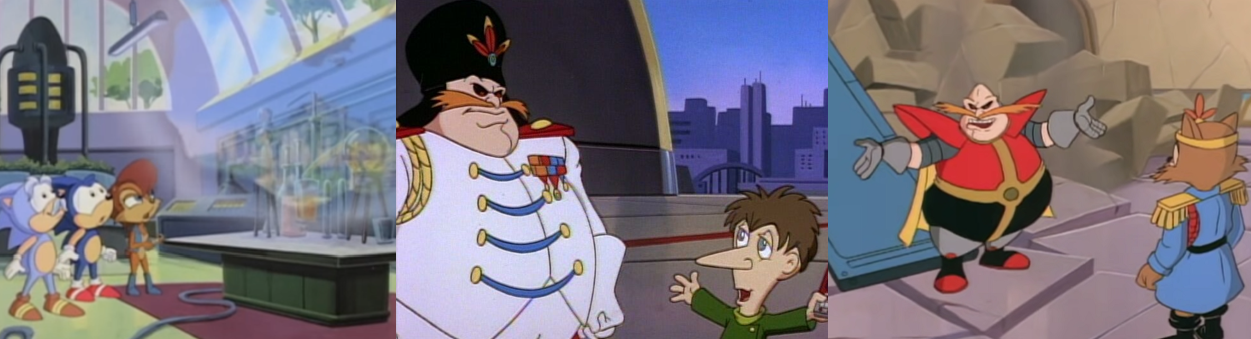
Screen Time [Sonic CDay]: Sonic the Hedgehog: “Blast to the Past” (S2: E17/18)


Developed alongside the blockbuster Sonic the Hedgehog 2 (SEGA Technical Institute, 1992), Sonic the Hedgehog CD (Sonic Team, 1993) released on this day back in 1993. Expanding upon the Blue Blur’s debut title, Sonic CD introduced Metal Sonic (one of Sonic’s most popular and enduring rivals) and Amy Rose, and is considered by many to be one of the best of the classic Sonic titles.


Season Two, Episode 17 and 18:
“Blast to the Past”

Air Date: 1 October 1994 and 8 October 1994
Director: Ron Myrick
US Network: ABC
UK Network: Channel 4
Stars: Jaleel White, Kath Soucie, Jim Cummings, Tahj Mowry, Lindsay Ridgeway, Tim Curry, and William Windom

The Background:
Sonic the Hedgehog took the videogame industry by storm thanks to SEGA’s aggressive marketing campaign. Sonic the Hedgehog (Sonic Team, 1991) was a huge success and Sonic’s popularity exploded after the release of Sonic the Hedgehog 2. Suddenly, Sonic was everywhere: not only was he included in the Macy’s Day Parade but he also made the jump to television with two concurrent cartoons. After seeing the success that DiC Entertainment had producing cartoons that were effectively little more than half-hour advertisements for Nintendo’s videogames, SEGA of America partnered with DiC to develop an animated series for their super-sonic mascot. To help sell their pitch to ABC, DiC signed Jaleel White for the title role but ABC believed their original slapstick pitch was unsuitable for a Saturday morning slot. Undeterred, producer Robby London simply developed an entirely separate Sonic cartoon for the prime Saturday morning slot, giving audiences two very different Sonic cartoons, each with their own tone and animation style. While Adventures of Sonic the Hedgehog (1993; 1996) emphasised over-the-top, memeworthy, slapstick humour, Sonic the Hedgehog (or “SatAM”) was a far darker take on the franchise. Though both cartoons awkwardly collided when Archie Comics published Sonic comic books, the majority of Adventures’ influence was eventually stripped away in favour of those from SatAM and Adventures is generally regarded less favourably than its darker counterpart. For many, SatAM was a defining aspect of their childhood and impressed with its more mature themes. Although it exhibited only questionable fidelity to the source material, SatAM did, occasionally, include elements from the videogames, with this two-part story being one of the most notable examples.

The Plot:
In a bid to stop Doctor Robotnik (Cummings) from conquering the Planet Mobius, Sonic the Hedgehog (White) and Princess Sally Acorn (Soucie) use the legendary Time Stones to travel back in time, only for an error to land them right in the middle of the dictator’s life-changing coup d’état.

The Review:
When I was a kid, I used to watch Adventures of Sonic the Hedgehog religiously. Every Sunday morning (as I recall; it might’ve been Saturday…), I would sit and watch it, usually record it, and delight in seeing Sonic’s slapstick antics. Then, one morning, something was different. The entire tone and cast of the show had changed; suddenly, Sonic wasn’t dressing up in ridiculous costumes and acting like a super-fast version of Bugs Bunny (Mel Blanc/Various) and Dr. Robotnik (Long John Baldry) wasn’t a comical, bumbling buffoon. Instead, Sonic was the point man in an outnumbered resistance movement against a far darker, semi-cybernetic dictator. Miles “Tails” Prower (Christopher Stephen Welch; Bradley Pierce) was completely absent in the first episode I watched, “Sonic Boom” (Sebast, 1993), and the bright, zany world of Adventures was replaced with a grim, polluted hellhole. It was a jarring change for me, but I loved Sonic so I quickly adapted. It helped that SatAM opened with an absolutely jamming theme song and that a lot of its presentation was very close to what was happening in Sonic the Comic (1993 to 2002) at the time, and that the visual style of the show and Sonic’s battle against this far more malevolent Dr. Robotnik were so compelling.
Desperate to defeat Dr. Robotnik, Sonic and Sally seek out the legendary Time Stones.

Although SatAM’s second season would later include concurrent narratives, and there was always an ongoing theme of the Knothole Freedom Fighters desperately opposing Dr. Robotnik’s regime, “Blast from the Past” is the only two-part story arc in the series. The first part opens, as many episodes do, with Sonic, Sally, and some unnamed Freedom Fighters on a covert mission in the polluted hellscape known as Robotropolis. Although a brash and reckless egomaniac, Sonic is instrumental to the Freedom Fighters; he’s classified as “Hedgehog: Priority One” by Dr. Robotmik’s SWATbots (Frank Welker), which immediately deviate from their regular patrols to chase him. While this creates enough of a distraction for their unnamed allies to sabotage Robotropolis’s main power grid, their friends are captured and taken to Dr. Robotnik’s citadel, and summarily roboticized. Although the jovial dragon Dulcy (Cree Summer) tries to alleviate the guilt Sonic and Sally feel for this loss by pointing out that all the planning and moxie in the world can’t oppose Dr. Robotnik’s resources or malice, Sonic can’t help but wish they’d fought back harder when Dr. Robotnik first took over, even though they were only five years old back then. Dulcy suggests that they use the legendary Time Stones to travel back in time and fulfil this wish. Sceptical, an exasperated Sally initially shoots down the plan as she believes the Time Stones and their equally mythological home, the Floating Island, are nothing more than a fantasy, to say nothing of the moral and scientific dangers of violating the time stream. However, Sally reluctantly agrees when the clumsy Dulcy reveals that she once crashed into the Floating Island, but she remains sceptical until Dulcy braves a tumultuous storm and crashes the three on the fabled island. Rather than being home to Knuckles the Echidna and the Master Emerald, the Floating Island is represented as a much smaller land mass that houses an ornate palace guarded by two stone gargoyles. Sonic outraces the guardians and causes them to vanish by running himself and Sally off the island. After being rescued by Dulcy, the two enter the palace and navigate a confusing M. C. Escher-esque labyrinth before being confront by the owl-like Keeper of the Time Stones (Curry). Despite Sonic’s blockheadedness, Sally solves the Keeper’s riddle (the answer is “time”) and the Keeper explains how to use the Time Stones’ power.

Unfortunately, Sonic and Sally are too late to stop Dr. Robotnik enacting a destructive coup d’état.

However, despite Sonic’s best attempts to focus only on the palace fountain in Mobotropolis circa 3224, his mind wanders to chili dogs, throwing off their arrival. The two are overwhelmed to find their home lush and verdant and alive, but even more stunned when their younger selves (Mowry and Ridgeway, respectively) wander by. It turns out that Sonic never really grew out of his childish, arrogant ways as his younger self delights in gobbling down chilli dogs and boasting of his super speed, much to the chagrin of the younger princess. Sonic and Sally go straight to Sonic’s beloved uncle, genius inventor, and loveable father-figure Sir Charles “Chuck” Hedgehog (Windom) and reveal the impending threat to the city. Back in this time, Sally’s father, King Maximillian Acorn (Curry), ruled a thriving, technologically robust city thanks to support from his Grand Vizier, Julian. Julian helped Mobotropolis win the “Great War” with his machinery, earning him a promotion to Minister of Science, though he secretly conspires with his long-suffering nephew, Snively (Charlie Adler), to take over Mobotropolis using not only the decommissioned war machines but Uncle Chuck’s Roboticizer machine. As shocked as Sonic and Sally are to discover that Uncle Chuck invented the nightmarish device, Uncle Chuck is horrified to learn this his invention (which was created to help old people “live longer”) is to be perverted into a tool for evil. Although they initially stay avoid their younger selves, they inevitably meet; introducing themselves as “Alicia” and “Juice” and presented as distant cousins, the Sallys despair of their childish antics and Sonic is stunned to find that his younger self is actually faster than him! However, their fun is interrupted by the realisation that they’ve arrived on the eve of Julian’s destructive coup d’état. Uncle Chuck has Sally’s nanny, Rosie (April Winchell), take the kids to safety in Knothole then introduces Sally to her father. Understandably emotional given that her father has been trapped in the “Void” for most of her life, their heartfelt reunion convinces King Acorn to trust Uncle Chuck’s warnings about Julian. Unfortunately, they’re too late to intercede; Julian reprograms the city’s robotic defences to recognise his commands and sends them to capture the inhabitants, including the young Sonic and his friends, before storming into the king’s throne room. Now garbed in his iconic red outfit, Julian rechristens himself Doctor Robotnik, and Mobotropolis “Robotropolis”, much to the anger and horror of Sonic and his friends.

Although they humiliate Snively, Sonic and Sally are faced with a race against time to salvage the timeline.

After a brief recap, part two picks up with Uncle Chuck disabling the SWATbots and causing a distraction so that Sonic can speed Sally to safety. However, they’re quickly imprisoned alongside their younger counterparts and forced to watch from their cell as Dr. Robotnik’s massive mechanical blimp, the Destroyer, spreads a polluting cloud over Mobotropolis that instantly kills all plant life, transforms the once idyllic landscape into a mechanical hell, just like before. Thanks to the schematics of Dr. Robotnik’s citadel on her pocket computer, Nicole (Soucie), Sally directs Sonic in burrowing them to safety, though Dr. Robotnik arrogantly dismisses the potential threat since he’s already imprisoned 80% of the population. Unfortunately, Sonic and Sally are too late to save their younger selves; since their very existence is threatened by this, the two buy themselves some time by having Nicole cause a brief power outage in the Roboticizer. To amuse himself in the meantime, Dr. Robotnik takes great pleasure in banishing King Acorn to the Void, an extradimensional portal where he once banished his rival, the sorcerer Ixis Naugus (Michael Bell). Luckily, the power outage allows Sally to download the machine’s schematics for future reference, but things are exacerbated when they spot the Destroyer heading for the Great Forest and threatening Knothole and, once again, their futures. Faced with a ticking clock, the two blast away to intercept the Destroyer, earning Snively’s ire by stripping him of his hair with a sonic boom and briefly stopping to rescue Dulcy’s mother, Sabina, from Dr. Robotnik’s forces.

Although they fail to save Mobius, Sonic and Sally’s jaunt isn’t a total loss and renews their fighting spirit.

Using a Power Ring for a speed boost and his anti-gravity sneakers, Sonic rockets himself and Sally up to the Destroyer, where even Sonic’s breezy demeanour is strained by Dr. Robotnik’s inexhaustible forces. Luckily, Sabina fends them off and brings the Destroyer crashing to the ground, so Sonic and Sally race back to Robotropolis to save their younger selves. Sadly, Sonic fails to prevent his defiant uncle’s roboticization, meaning his younger self has to endure the horror of watching the only family he has be transformed into a mindless robotic slave, though Sonic assures the grieving boy that Uncle Chuck will be restored in time. Sonic and Sally get the kids to safety and, in the process, Sonic earns Dr. Robotnik’s boundless fury by not only mocking and defying him, but also roboticizing his left arm. After teaching the younger Sonic a thing or two about trashing robots, the kids are brought to Rosie and spirited to the safety of Knothole. Before she goes, Sally makes Rosie promise to never leave the village to avoid her becoming another of Dr. Robotnik’s minions in the near future. With Dr. Robontik’s full force closing in, Sonic and Sally use the Time Stones to return to the future, infuriating the newly-crowned dictator. Although Sonic believes the entire escapade was a waste of time since they never changed the past like they intended, Sally is bolstered by the odds now that they have the Roboticizer plans, and Sonic is left nursing a migraine when he tries to understand how Rosie is still in Knothole…despite being right there when Sally told her not to leave.

The Summary:
I’ll be the first to admit that reviewing “Blast to the Past” as an adaptation of Sonic CD is a bit of a monumental stretch. To be honest, the tangential link was enough of an excuse for me to talk about SatAM, one of a handful of cartoons that defined my childhood. While, on the surface, there doesn’t appear to be much of a relation between the two, they actually have a fair amount in common: obviously, the Time Stones appear (though in a vastly different format) and Sonic travels through time (again, in a very different way to Sonic CD), but there’s also shared themes of pollution and time paradoxes at work in the episodes. Sonic and Sally travel to the past, where Mobius and Mobotropolis especially were free from pollution and war, in an attempt to stop Dr. Robotnik before he can rise to power. When they fail in this endeavour, the once lush and thriving landscape becomes a dark, grimy, mechanical hellhole (a “Bad Future”, if you will) and we clearly see the consequences of their time travel onscreen just like in Sonic CD’s gameplay. Again, that might seem like a stretch, but you have to remember how few inspirations SatAM took from the source material. While I was disappointed that we never got Knuckles, the Chaos Emeralds, Metal or Super Sonic in the series (especially the first two in these episodes), it was still fun to see gameplay elements adapted to fit the context of this dark and mature series.

While things get very bleak very quickly, the time travel plot showcases our hero’s vulnerable sides.

“Blast from the Past” is easily one of the strongest arcs of SatAM. For the first time, we get to see what life was like before Dr. Robotnik took over. We’re so used to seeing Knothole and the Great Forest being the one bastion of nature in an otherwise ransacked, almost post-apocalyptic world that it’s extremely poignant to see Sonic and Sally react in awe when they walk the streets of the thriving Mobotropolis once more. The episodes give both characters a chance to show some vulnerability; this wasn’t uncommon in SatAM given how bleak their situation was, but it’s heart-warming (and breaking) to see Sonic reunited with his unroboticized uncle and Sally finally reunited with her beloved and long-lost father. It was also quite fun seeing Sonic and Sally interact with their younger selves; their personalities haven’t changed much over the years, with Sonic being impulsive and Sally being more restrained, but the younger Sonic makes an impression by outpacing his elder (and even referring to Sonic as “old”) and breaking down in tears when his cherished uncle is roboticized before his eyes. Although characterised as a brash, headstrong, and snarky speedster, Sonic showcased some surprising emotional depth in SatAM and “Blast to the Past” emphasises that beautifully. We see his anger at Dr. Robotnik’s heinous actions, his desperation to save the future, and the guilt he feels at having potentially screwed up their best chance of saving the world before it goes to hell. Although functionally unstoppable and capable of physics-bending feats, Sonic isn’t beyond fatigue or weakness. Mainly, this is realised in his inability to sit still, focus, or think of or work to a plan, which is why he and Sally work so well together as she does the thinking and he does the fighting (though she’s perfectly capable of holding her own in a pinch, too).

Dr. Robotnik is at his most malicious in SatAM and this two-parter showcases his rise to power.

As ever with SatAM, the star of the show is the reprehensible Dr. Robotnik. Never before or since has the rotund dictator been portrayed as such a malevolent and spiteful force (well, maybe in Sonic the Comic and obviously in the Archie comics…). SatAM-Robotnik was a serious threat, even when he was doing more comical stuff or being humiliated by his foes. Thanks to his incredible resources and relentless craving for power and conquest, Dr. Robotnik delights in subjecting his captives to the Roboticizer and turning them into his mindless, obedient slaves. Abusive towards his long-suffering nephew, Dr. Robotnik cares only about himself and his insane lust for power. Despite his prominent position of trust and authority alongside King Acorn, Dr. Robotnik has grander designs for himself and easily takes what he wants by force, without any real resistance. This oppressive, suffocating malevolence makes battling Dr. Robotnik an uphill, almost unwinnable battle even when Sonic has the speed and power advantage, and even time on his side as in this two-parter. Ultimately, Sonic and Sally’s efforts to prevent Dr. Robotnik’s coup d’état are met with failure but they are bolstered enough to continue fighting after remembering what they’re fighting for. While Rosie ironically didn’t actually show up in future episodes, “Blast to the Past” led to the creation of the De-Roboticizer and the Freedom Fighters’ attempts to restore Dr. Robotnik’s victims to normal. So, yeah, while it may have almost nothing to do with Sonic CD and vastly reimagines the Floating Island, “Blast to the Past” is still an enjoyable and significant two-part arc. SatAM remains one of the most influential Sonic canons and is still heralded as one of the best cartoons of the nineties. While it wasn’t exactly true to the source material and has, in my view, since been surpassed, I can’t deny my love for the series, especially darker and more introspective episodes like these two, so I’m always happy to return to the series and relive my youth.

My Rating:

Rating: 4 out of 5.

Great Stuff

Did you enjoy “Blast to the Past”? Were you disappointed by how few elements from Sonic CD were present in the story or were you just happy to see videogame elements incorporated into SatAM? Did you enjoy SatAM as a kid? What did you think to the depiction of Dr. Robotnik’s rise to power? Which of SatAM’s original characters was your favourite and what did you think to Sonic’s characterisation in the show? How are you celebrating Sonic CD’s anniversary this year? Whatever your thoughts on Sonic CD, or SatAM in general, feel free to leave a comment below or on my social media.

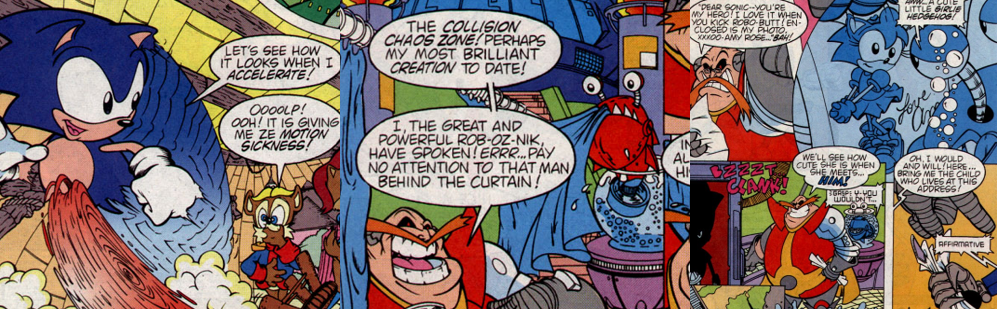
Back Issues [Sonic CDay]: Sonic the Hedgehog #25


Developed alongside the blockbuster Sonic the Hedgehog 2 (SEGA Technical Institute, 1992), Sonic the Hedgehog CD (Sonic Team, 1993) released on this day back in 1993. Expanding upon the Blue Blur’s debut title, Sonic CD introduced Metal Sonic (one of Sonic’s most popular and enduring rivals) and Amy Rose, and is considered by many to be one of the best of the classic Sonic titles.


Story Title: “Go Ahead…Mecha My Day!”
Published: August 1995
Writer: Mike Gallagher
Artist: Patrick Spaziante

The Background:
SEGA were quick to capitalise on Sonic’s popularity once he catapulted to mainstream success and helped them to usurp Nintendo’s position at the top of the videogame industry. Following Nintendo’s success with DiC, SEGA licensed a series of cartoons that were soon accompanied by a four-part miniseries published by Archie Comics. Archie’s Sonic the Hedgehog comics went on to become the longest-running videogame comic book ever and, amidst continuing the adventures of the Knothole Freedom Fighters, the Archie comics weaved in storylines, characters, and elements from the videogames, often changing them to fit their unique narrative. Although a mechanical version of Sonic had featured in Archie’s comics prior to this story (and many more would follow over the years), Sonic’s most recognisable robotic duplicate debuted in the comic’s twenty-fifth issue as part of a loose adaptation of Sonic CD and would go on to continuously plague the hedgehog and his allies even when IDW swept away Archie’s continuity in favour of their own.

The Review:
I didn’t grow up reading Archie’s Sonic the Hedgehog comics; as far as I know, there was no way for us to get hold of them here in the United Kingdom back in the day, so I’m not entirely sure I was even aware of them until late into my teens. I did watch Sonic the Hedgehog/SatAM (1993 to 1994) though and, like many kids from my generation I was, deeply invested in the series and frustrated when it ended on an unresolved cliff-hanger. Although the Archie comics never actually resolved this cliff-hanger and were more like a spin-off than a true continuation, they were the closest thing we’d ever get to an official follow-up to that successful cartoon and, in the years since, I’ve read through the entire Archie Comics run. It has its good points and many bad points, but I found myself enjoying it well enough, especially once they started to incorporate more elements from the source material and veer away from the comedic slapstick that muddled the narrative tone of the first fifty-or-so issues. I’ve already explored how awkward the incorporation of these videogame elements was to the series; the same was true of the UK’s Sonic the Comic (1993 to 2002) and is to be expected when you’ve gone off on your own pretty complex tangent and then have to shoe-horn in official canon into the narrative, but there’s an appeal to the series nonetheless thanks to nostalgia and my love for Sonic.

While Sonic tests Rotor’s new device, Dr. Robotnik plans to lure him into a deadly trap.

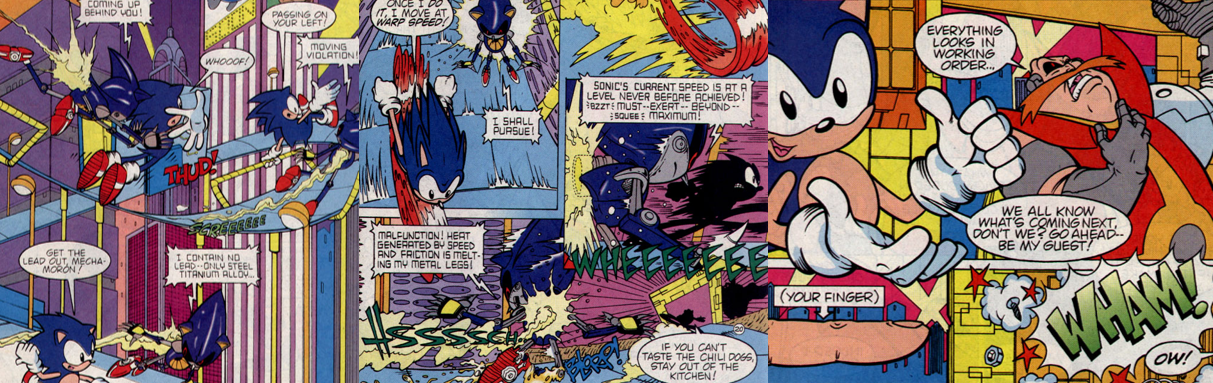
“Go Ahead…Mecha My Day!” (great pun, by the way) begins with Sonic impatiently enduring the hooking up of a video camera to his sneaker; developed by Knothole’s resident mechanic and tinkerer, Rotor the Walrus, the “Sonicam” sends a direct feed back to the Freedom Fighter’s computer so they can keep track of where Sonic is and any potential dangers they need to be aware of. Princess Sally Acorn, leader of the Knothole Freedom Fighters, is particularly pleased with this new technology given that a “new Zone portal” just opened up and is in need of exploration. Sally’s fears about this situation are well founded as it turns out that the Collision Chaos Zone is the creation of Mobius’s mad cybernetic dictator, Doctor Robotnik. However, while he looks like the SatAM Dr. Robotnik, at this point Archie’s version still has quite a bit of his bombastic and foolish variant from the Adventures of the Sonic the Hedgehog cartoon (1993); this means he breaks the fourth wall, chuckles maniacally to his bumbling Badniks, and lacks the grim menace of the SatAM version. However, there’s enough of that interpretation of the character in Dr. Robotnik to order his latest, most mysterious creation to kidnap Sonic’s number one fan, Amy Rose, and then issue a direct challenge to Sonic, daring him to test his speed and skill in his Collision Chaos Zone to rescue Amy. Naturally, Dr. Robotnik plans to stack the deck against Sonic by having his long-suffering, snivelling nephew and head minion, Snivley, struggle into an elaborate Robotnik costume and burn up the road behind Sonic to force him into an even deadlier trap.

Racing to save his friends, Sonic is confronted and challenged by his metallic doppelgänger.

Naturally, Sonic wants to leap into action right away; determined to prove himself and to rescue one of his greatest fans, he thinks nothing of jumping head-first into such an obvious trap, such is his confidence. However, Knothole is a democracy and, as a result, he’s forced to heed to Sally’s more level-headed orders; to get a better sense of what dangers lie ahead, Sally has Miles “Tails” Prower fly on ahead to scope out the area…and he’s immediately captured by Dr. Robotnik’s Swatbots. Fed up with waiting, Sonic races out to the Zone portal and, despite Dr. Robotnik struggling with his lines, is brought abreast of the escalating hostage situation; thanks to the Sonicam’s slow-motion function, Sally and Rotor are able to look in as Sonic races through the bizarre environment while Snively incinerates the path behind him, all to force Sonic into a confrontation with Mecha-Sonic (also referred to without the hyphen). Oddly, Mecha-Sonic’s dialogue seems to indicate that the two have met before, but this was the character’s first appearance; however, it wasn’t uncommon for the videogame’s events to happen off-panel and between stories throughout Archie’s run, even though that doesn’t really align with the narrative presented here, making this allusion confusing, at best. Anyway, Mecha-Sonic challenges his rival to prove his speed in a race through the Stardust Speedway Zone, with Tails and Amy as the prize and Snively pursuing them in Dr. Robotnik’s craft

Sonic’s speed is too much for Mecha-Sonic and Dr. Robotnik’s plot is easily foiled.

Of course, Sonic takes the bait and “engages” with Mecha-Sonic, much to Dr. Robotnik’s glee; while Amy wails at the engagement pun and Rotor scrambles to account for interference from the Stardust Speedway Zone, we’re treated to a nice two-page spread of the two rivals exchanging taunts and shoving past each other in a pretty neck-and-neck dash through the Zone, which is brought to life by the unrivalled Patrick “Spaz” Spaziante and is certainly faithful both to the level layout from the videogame and the anime sequences that accompanied it. However, Sonic has no idea that Dr. Robotnik has set up a failsafe at the finish line; a massive weighted door that will crush Sonic when he passes under it (which Dr. Robotnik demonstrates by crushing Crabmeat, though this doesn’t kill the woodland critter tapped within him since that wasn’t really a thing in this continuity). Although Sonic gains the lead, Mecha-Sonic uses holograms and environmental hazards to distract and trip him for an unfair advantage, meaning tensions are high as they race down the final stretch. Here, Sonic debuts his new “Figure Eight Super Peel-Out” for a burst of acceleration that pushes him into “warp speed” and Mecha-Sonic summarily melts itself in half by overexerting its thrusters. Sonic is even spared a gruesome end thanks to the timely intervention of Princess Sally but, when Dr. Robotnik throws a tantrum over the loss, volunteers to give the dictator a chance to squash him. When Sonic easily dodges out of the of the trap, he invites Dr. Robotnik to inspect the mechanism for faults and then encourages the reader (represented by a literal on-panel finger) to activate the trap and crush the cyborg madman beneath it. The comic the ends with Tails and Amy free, Dr. Robotnik squashed under his own trap, Mecha-Sonic left sparking on the racetrack, and the heroes celebrating the comic’s first twenty-five issues.

The Summary:
I went to great pains at the start of my review to try and prepare you for the fact that Archie’s Sonic comics weren’t exactly known for their 100% fidelity to the source material when they started adapting more elements from the videogames into their plot but, even considering that, “Go Ahead…Mecha My Day!” is even less of a Sonic CD adaptation than its Sonic the Comic counterpart. Both plucked only the most iconic elements of the videogame (Amy, Metal Sonic, and parts of the environments) and shoe-horned them into their unique narrative, choosing to focus more on the battle between Sonic and Metal Sonic than the time travel plot. While the Sonic the Comic adaptation benefitted slightly from being a multi-part story told over a few issues, both adaptations have about the same level of substance thanks to the first two parts of the story simply setting up for Sonic’s adventures on the Miracle Planet. This location doesn’t even appear here, however; instead, we get two of Sonic CD’s more recognisable areas (Collision Chaos and Stardust Speedway) but they’re presented as being “creations” of Dr. Robotnik, existing in another dimension, of sorts, rather than being on the Little Planet. The Time Stones are also completely absent, as are any elements of time travel or Dr. Robotnik’s plot to conquer the Little Planet, meaning the plot is all about the race between Sonic and “Mecha-Sonic” to rescue Amy (and Tails).

It’s a bit slapstick and barely has anything to do with Sonic CD but at least the art is nice.

Even when you get past the fact this this isn’t really an adaptation of Sonic CD, “Go Ahead…Mecha My Day!” is a bit weak overall; the story’s far too short, Dr. Robotnik lacks the menace of his SatAM counterpart, and there’s never really a sense of danger even when Mecha-Sonic makes its appearance. Like in the Sonic the Comic version, Mecha-Sonic can talk; here, it seems to have been programmed to ape Sonic’s snarky attitude as much as his speed as the two trade quips and grandeur during their confrontation. Though it demonstrates none of its videogame’s other powers, Mecha-Sonic is shown to be a wily antagonist and fully prepared to cheat to gain an advantage, but it’s ultimately handicapped by its mechanical construction and thus falls apart when it tries to match Sonic’s near-limitless speed. Still, the art used to render Mecha-Sonic and the race is impressive; Spaz was always Archie’s best artist when it came to Sonic and he does a great job on the title character, his robotic rival, and Dr. Robotnik. Given that it takes place in this quasi-SatAM continuity, the story also features appearances from the Knothole Freedom Fighters; Tails wasn’t yet the genius mechanic we know him today so Rotor fulfils that role and his Sonicam keeps them up to date with Sonic’s situation while Antoine D’Coolette is simply there to spout nonsense and oppose Sonic out of spite. Since she was always portrayed as Sonic’s equal in the field, it’s obviously Sally who drops in to lend a hand in the finale, emphasising the camaraderie that was so important to this interpretation of Sonic, though it’s made explicitly clear that he didn’t actually need any help. In the end, this was a decent enough story with lots of great art and fun, engaging action but it’s let down by its brevity, the awkward goofiness permeating throughout it, and the fact that it basically has nothing to do with Sonic CD beyond some extremely basic elements.

My Rating:

Rating: 3 out of 5.

Pretty Good

Have you ever read “Go Ahead…Mecha My Day!”, or any of Archie’s Sonic the Hedgehog comics? If so, what did you think of the story and the way its focus on the race between Sonic and Metal Sonic? Were you disappointed by the lack of any other elements from Sonic CD? Which of Archie’s original characters was your favourite and what did you think to their award-winning run? How are you celebrating Sonic CD’s anniversary this year? Whatever your thoughts on Sonic CD, or Sonic in general, feel free to leave a comment below.

Back Issues [Sonic CDay]: The Sonic Terminator


Developed alongside the blockbuster Sonic the Hedgehog 2 (SEGA Technical Institute, 1992), Sonic the Hedgehog CD (Sonic Team, 1993) released on this day back in 1993. Expanding upon the Blue Blur’s debut title, Sonic CD introduced Metal Sonic (one of Sonic’s most popular and enduring rivals) and Amy Rose, and is considered by many to be one of the best of the classic Sonic titles.


Story Title: “The Sonic Terminator (Part 1 to 5)”
Published: 29 April 1994 to 24 June 1994
Writer: Nigel Kitching
Artist: Richard Elson

The Background:
After Sonic the Hedgehog catapulted to mainstream success and helped SEGA to usurp Nintendo’s position at the top of the videogame industry, SEGA were quick to capitalise on Sonic’s popularity not just with videogames but also a slew of merchandise, including cartoons and comic books. About six months after Archie Comics began publishing a weird amalgamation of the Adventures of Sonic the Hedgehog (1993 to 1996) and Sonic the Hedgehog/SatAM (1993 to 1994) cartoons, United Kingdom publisher Fleetway Editions Limited began publishing “Britain’s Official SEGA Comic”, Sonic the Comic (StC), a fortnightly publication that I collected diligently until its unfortunate end. Though pulling much of its lore from the now defunct Mobius and Doctor Ovi Kintobor storyline that was prevalent outside of Japan, StC was its own beast entirely and quickly veered away from the source material to recast Sonic the a mean-spirited leader of a gang of Freedom Fighters made up of both videogame characters and anthropomorphic characters adapted from the videogames. Like the Archie comics, StC often included a few very loose adaptations of the videogames, though these were often truncated or took the very basic idea of the source material and adapted it to fit with its noticeably different lore. Their adaptation of Sonic CD was no different, renaming Metal Sonic to Metallix and introducing one of the comic’s more dangerous and persistent secondary antagonists.

The Review:
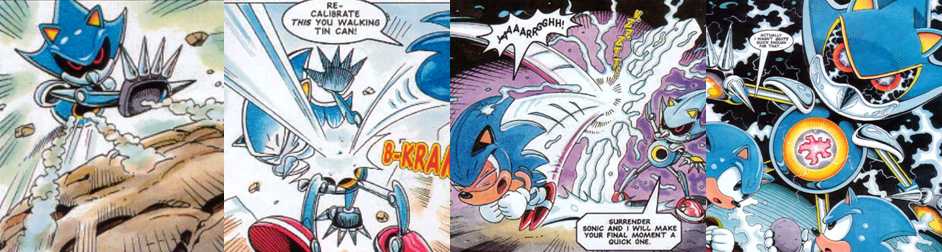
“The Sonic Terminator” begins with the dramatic and violent death of Sonic the Hedgehog! Not to worry, though, this is simply a “practice robot” that was trashed by a blindly fast, electrically-charged figure that is kept in the shadows and only vaguely hinted at. Both Doctor Ivo Robotnik (who, at this point, was directly modelled on the character’s look from Adventures of Sonic the Hedgehog) and his assistant, Grimer, are pleased as punch with the results of this final test and prepare to send their new creation out to kill the real Sonic. Speaking of whom, Sonic is currently in the Emerald Hill Zone, where Robotnik’s Troopers (basically StC’s version of Swat-Bots in that they are humanoid robots that Sonic is able to smash without holding back as, unlike Badniks, they’re not powered by woodland critters) are arresting an entire village. Despite the concerns of his fellow Freedom Fighters (Porker Lewis, Johnny Lightfoot, Amy Rose, and Miles “Tails” Prower), Sonic rushes in to save the villagers and the entire gang winds up captured as a result, much to Johnny’s chagrin. Sonic, however, retains his steadfast cocky attitude; even when they come face-to-face with Trusk, the captain of the prison ship, and are told that they are being taken directly to Robotnik’s Badnik processing plant at the Veg-O-Fortress, Sonic simply yawns with boredom.

The first two issues are more concerned with a side plot involving the Sky Pirates.

This turns out to be because Sonic has some formidable backup on hand in the form of Captain Plunder and his Sky Pirates, a group of mercenaries and…well, pirates…who Sonic encountered in the Mystic Cave Zone in a previous issue. Thanks to Captain Plunder, Trusk is captured and the prisoners are freed but Porker accidentally lets slip to Filch the Poltergeist where Sonic’s cache of Chaos Emeralds is hidden and the pirates speed off the steal the booty. However, Sonic and the gang are easily able to follow them to North Cave and a fight breaks out; although Sonic is able to incapacitate most of Captain Plunder’s crew using his Super Spin Attack and both Amy and Tails are able to fight them off with their crossbow and a rock, respectively, Captain Plunder gets the upper hand when he takes Tails hostage. This, of course, earns Tails Sonic’s exasperated disdain (not only is StC-Sonic incredibly arrogant, pig-headed, and rude, he also has a tendency to insult his closest friends and constantly degrades Tails with the nickname “Pixel Brain”. It’s actually pretty fantastic to see him be such a snarky asshole all the time) and he is forced to allow Captain Plunder to take the six Chaos Emeralds.

Metallix is immediately established as a fearsome and merciless opponent.
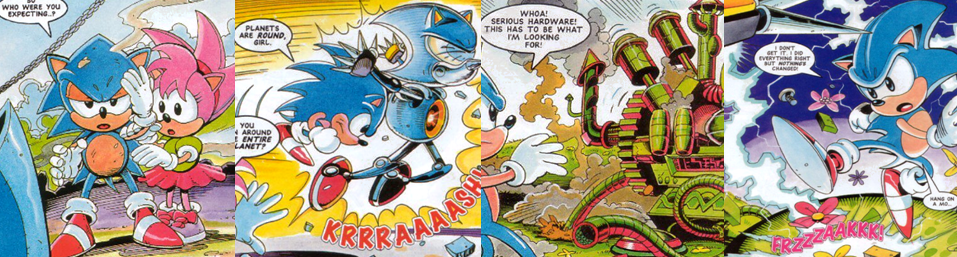
Amusingly, however, rather than the evil energy of the Chaos Emeralds augmenting the Sky Pirates’ disreputable demeanours, they actually have the opposite effect since they absorb evil rather than radiate it and, as a result, Sonic is easily able to retrieve the gems from the now docile (and hippy-like) thieves. This happy ending, however, is mired in the dramatic reveal of StC’s version of Metal Sonic, Metallix, which attacks the Emerald Hill Zone with destructive energy blasts from its stomach laser and demands Sonic’s presence for “extermination”. “Part 3” of the story continues this threat and finally gets around to actually adapting the story of Sonic CD by having Metallix kidnap Amy to lure Sonic the Never Lake; although Sonic is busy playing Marxio Brothers, and despite his grouchy nature, he immediately rushes over to Never Lake and is shocked to find the forest that is usually growing there is gone and that the Miracle Planet has been transformed into a mechanical hellscape. After rescuing Amy from atop a steep column of rock, he snaps at her to cut out the hero worship and tell him what’s been going on. She manages to tell him that Dr. Robotnik has chained the Miracle Planet to Never Lake and transformed it into his newest base before any further exposition is rudely interrupted by Metallix.

Metallix takes Amy to the Miracle Planet and they are trapped there, cut off from greater Mobius.

Over the course of a few action-packed panels, a fight breaks out between Sonic and his unusually loquacious doppelgänger. Metallix tosses boulders at Sonic, all of which he is able to expertly hop over and burrow through, but he is surprised by the robot’s chest laser. The two them battle so fast and so aggressively that neither Amy, nor the reader, are able to make out the action. In the aftermath, Metallix emerges from the dust and smoke as the apparent victor before collapsing into shutdown. Sonic, battered and weary, still finds the energy to insult Amy but, while he appears to have defeated his robotic counterpart, Metallix hits him with a cheap shot and takes Amy to the Miracle Planet as “live bait” and the unimpressed Sonic races off in pursuit. By the time the Freedom Fighters arrive to help, they’re already too late as the Miracle Planet disappears before their eyes, trapping all on its surface in another dimension for an entire month. On the miniature world, Sonic quickly reunites with Amy (much to his dismay) in what appears to be the Bad Future of Metallic Madness. Both characters question how Dr. Robotnik was able to convert the Miracle Planet so quickly, given that the previous month showed no signs of his influence, but their conversation (and the prospect of them being marooned there for a month) is soon interrupted by Metallix. Uncharacteristically, Sonic chooses to flee rather than fight but, as Metallix charges its laser to kill Amy, he comes flying back in with a big Spin Attack after running around the entire planet in a few seconds. Metallix, however, is able to draw additional power from the mechanical surface of the planet; this allows him to erect an electrical shield and charge up a kill shot for his prey after Sonic trips on a loose cable.
Thanks to time travel shenanigans, Metallix is soundly defeated…for now..

Sonic and Amy are saved, however, by the sudden appearance by another Sonic, this one diminutive in stature and holding a grey stone. Sonic #1 is immediately suspicious of the newcomer but Sonic #2 forces him into an energy beam that turns him into a midget as well. Sonic #2 is able to tell Sonic #1 about the grey object he’s holding; it’s the Time Stone, a relic able to transport the holder back into the past and, while Sonic #2 distracts the recovered (and now, from their perspective, gigantic) Metallix, Sonic #1 races off to the past. Arriving in what appears to be Palmtree Panic before Dr. Robotnik polluted the Miracle Planet with his machinery, Sonic’s shock over the sudden disappearance of the Time Stone gives way to his awe at the presence of a massive piece of mechanical hardware. This is StC’s version of the Robot Transporter from the game, which is in the process of transforming and polluting the environment; thanks to having been shrunk, Sonic is easily able to hop inside of the machine and remove its power source, the Time Stone. Having destroyed the machine, Sonic uses the Time Stone to travel back to the present and, in the process, becomes Sonic #2 as he saves his past-self from Metallix, gifts him the Time Stone, and orders him to race off just as he was directed in order to continue the time loop. Although Metallix attacks Sonic with all its power, the environment begins to change around them as his actions in the past catch up to the present; as a result, not only is Dr. Robotnik’s influence erased from the Miracle Planet and Sonic returned to his normal height but Metallix is wiped from existence and the story ends with Sonic facing an entire month alone with Amy.

The Summary:
Now remember, I read Sonic the Comic religiously as a kid; for me, it was one of three influential factors into my fandom for Sonic (the others being the cartoons and, of course, the games themselves) so there is not only a lot of nostalgia there whenever I revisit the comic but quite a bit of bias as I was a big fan of the original stories StC told, its characterisations, and the way they included some elements from the videogames. As a result, I remember enjoying “The Sonic Terminator” as a kid but, as an adaptation of Sonic CD, it’s definitely lacking in many areas. Perhaps the biggest drawback to the story is that it spends two issues messing about with a side plot involving Captain Plunder. At the time, each story in StC was about five pages long so right away the writers have wasted ten pages of story on something that has nothing to do with Sonic CD, though it also appears as though the writers and artists had very little to work with when putting this story together.

Metallix steals the show and comes across as a formidable new villain for Sonic.

Indeed, they must have seen the opening video and maybe a few screenshots and had a rudimentary understanding of the game but there is next to nothing from Sonic CD included beyond the absolute bare minimum. There is only one Time Stone, for example; hardly any locations from the game are used, no enemies or Badniks beyond Metal Sonic appear, and Dr. Robotnik is practically non-existent for the entire story. One benefit of this, however, is that it means Metallix takes centre stage as the primary antagonist. Unlike other interpretations of Metal Sonic, Metallix is very chatty; it taunts Sonic, constantly calculates the odds of success and failure, and comes across as a very threatening and formidable foe not only in its array of attacks and blinding speed but also in its durability. It’s not often in StC that Sonic is unable to trash his robotic foes in one hit and Metallix was certainly the most persistent enemy he has encountered at this point. Even though this story seems to spell the end of the character, Metallix would return with a vengeance later down the line as part of the Brotherhood of Metallix and would be a formidable recurring adversary for Sonic, his friends, and even Dr. Robotnik.

The story’s art is incredible and elevates it despite lacking fidelity to Sonic CD.

What really makes “The Sonic Terminator” shine is the excellent artwork from the always incredible Richard Elson. Elson was to StC what Patrick “Spaz” Spaziante was to the Archie comics and he always delivered on portraying Sonic and the other characters in such a dynamic way. His rendition of Metal Sonic is fantastic and the way he conveys Sonic’s speed is brilliant, allowing for some action-packed panels that really sell the gruelling nature of Sonic’s clash against his doppelgänger. While there isn’t much for the other Freedom Fighters to do, this is at least in keeping with the solo nature of Sonic CD and, while the story isn’t a direct one-to-one adaptation of the source material, StC pretty much never did this when producing the few adaptations they did do over the years. As a result, “The Sonic Terminator” is a great story in the StC canon and perfectly sets Metallix up as a frightening adversary (and therefore a significant story in the large StC lore) but is maybe not so great for those expecting a more literal adaptation of Sonic CD.

My Rating:

Rating: 3 out of 5.

Pretty Good

Have you ever read “The Sonic Terminator”, or any issues of Sonic the Comic for that matter? If so, what did you think of the story and the way it introduced its version of Metal Sonic? Were you disappointed by how few elements from Sonic CD were present in the story or were you just happy to see Sonic and Metallix go at it? Which of StC’s original characters was your favourite and what did you think to Sonic’s characterisation? How are you celebrating Sonic CD’s anniversary this year? Whatever your thoughts on Sonic CD, or Sonic in general, feel free to leave a comment below.

Game Corner [Sonic CDay]: Sonic the Hedgehog CD (Xbox One)


Sonic the Hedgehog CD (Sonic Team, 1993) released on this day back in 1993. Produced alongside the blockbuster Sonic the Hedgehog 2 (SEGA Technical Institute, 1992), Sonic CD expanded upon the Blue Blur’s original debut title with lush graphics, a time travel mechanic, gorgeous anime cutscenes, and introduced players to Metal Sonic (one of Sonic’s most popular and enduring rivals) and Amy Rose. Considered by many to be one of the best of the classic Sonic titles, Sonic CD might not be one of my favourites but it’s still a classic in it’s own right and it’s worth looking back on today of all days.


Released: 14 December 2011
Originally Released: 23 September 1993
Developer: Christian Whitehead
Original Developer: Sonic Team
Also Available For: GameCube, Mega-CD, PC, PlayStation 2, SEGA Mega Drive Mini II (Original); Mobile, PlayStation 3, PlayStation 4, PlayStation 5, Xbox 360, Xbox Series S/X (Remaster)

The Background:
Sonic the Hedgehog (Sonic Team, 1991) was specifically created and marketed as SEGA’s Nintendo-beater and, thanks to selling over 15 million copies, succeeded in its goal. Naturally, SEGA were eager to produce a sequel but, rather than create one game, they ended up making two! With Sonic creator Yuji Naka having moved to America to work on Sonic 2, Sonic’s designer, Naoto Oshima, spearheaded an entirely separate title built on the bones of the first game that would be exclusive to SEGA’s ill-fated CD add-on for the Mega Drive.

Sonic CD is largely known as one of the best Sonic games and was made widely available in 2011.

With Sonic 2 more focused on speed, Oshima placed Sonic CD’s focus more on platforming and exploration with its speed-based time travel mechanic (which was cut from Sonic 2) and included gorgeous anime cutscenes from Toei Animation (which would later be the basis for the feature-length original video animation). Artist Kazuyuki Hoshino designed Sonic’s metallic doppelgänger and biggest fan, Amy Rose (though that character actually debuted, in a slightly different form, in a 1992 manga), both of which were as pivotal to the game as the time travel elements. Despite the game’s U.S. release being delayed for an entirely new soundtrack, Sonic CD was met with widespread critical acclaim but, for many such as myself, the game was somewhat elusive since no one I knew had a Mega-CD and it just wasn’t the same playing the PC version. I first played the game properly when it was included in Sonic Gems Collection (Sonic Team, 2005) but jumped at the chance to play the HD remaster when it first dropped on the PlayStation 3. Developed by Christian Whitehead, this new version of the game was widely available, included Achievement support, numerous bug fixes, and a whole host of new elements that make it the definitive version of this cult classic entry in the franchise.

The Plot:
When the mysterious Little Planet has makes its annual appearance, Sonic travels to Never Lake but finds the planet has been overtaken by Doctor Eggman’s Badniks! When Sonic’s number one fan, Amy Rose, is kidnapped by his robotic doppelgänger, Metal Sonic, Sonic must race across time itself to keep Eggman from polluting the past, recover the seven Time Stones, and ensure a good future for Little Planet!

Gameplay:
Sonic CD is a 2D, sidescrolling action platformer that once again sees you guiding the titular blue hedgehog across seven stages (known as “Zones”), each split into three parts (simply called “Zone 1” to “Zone 3” rather than being called “Acts”). At the end of each third Act, Sonic must battle Eggman in one of his contraptions but there’s quite a twist this time around. This time, as well as passing Lampposts to create a checkpoint, Sonic will also run past special signposts; once one of these has been triggered, Sonic will begin to sparkle as he runs and, if he builds up enough uninterrupted speed, he will travel to the past or the future depending on which post he activated. While the general layout of the Zone remains the same in the past, present, and future, there are numerous aesthetic and difficulty differences in each one. The past is generally much more lush and vibrant, lacking many of Eggman’s traps and Badniks; the present is a standard-fare Sonic stage; and the future is a pollution and hazard-infested mechanical hell. When in the past, Sonic must search high and low for a Robot Transporter and a holographic projection of Metal Sonic; destroying both in Zone 1 and 2 ensures that Zone 3 earns a good future, which strips it of all Badniks and hazards and even makes the boss battles noticeably easier.

Sonic CD‘s biggest gimmick is the speed-based time travel mechanic.

If you’ve played the first Sonic game then you’ll be immediately familiar with Sonic’s controls and physics. Sonic’s speed, jumping power, and abilities all carry over, making him as tight and responsive as ever, but he is afforded two new abilities. One is a variation on the Sonic 2 Spin Dash (it’s not quite as useful or as fast as in that game, though) and the other is Sonic’s Super Peel-Out manoeuvre, which sees Sonic rev up his legs until they become little more than a blurry figure eight and then rocket ahead at full speed, which is perfect for the few instances where you have the room to travel fast enough to time travel. Sadly, there’s not always the opportunity to do this; like in the first game, Sonic has to earn his breakneck speeds and, all too often, you’ll go running or rolling ahead in a blur of spikes only to slam head-first into a wall, a pit, a bumper, or poorly-placed enemies and hazards. This makes the time travel much harder to pull off than it needs to be as you’ll constantly be fighting to find a long enough stretch of ground or the right opportunity to build up your speed only to accidentally screw up the attempt at the last minute. Similarly, there’s a much greater emphasis on exploration and platforming this time around; every Zone feels like a mixture of speed, loops, and obstacles and the level design is questionable at best and haphazard at worst, with Golden Rings floating inside of the environment and your progress to the many alternate paths either blocked or protected by dead-ends and endless loops. As a result, when you travel back to the past, it can be extremely difficult to navigate through the Zones to find the Robot Transporters and projectors even in the more linear Zones; the bigger, more complicated Zones like Wacky Workbench and Metallic Madness make it nearly impossible to do without a guide or copious amounts of trial and error.

There’s still plenty of opportunities to be bounced around despite the many stage hazards.

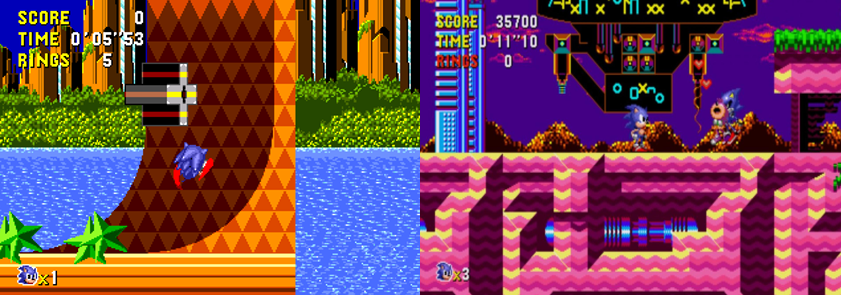
Still, speed is a prominent factor in the game; thanks to the Super Peel-Out and new gameplay mechanics, Sonic is much faster than he was in the first game and is still bounced all over the place like a pinball in Zones like Collision Chaos. Indeed, there are technically two ways to play; the slow, methodical Sonic CD way which has you hunting down objects in the past or the faster, more Sonic 2 way which has you racing through Zones as fast as possible and completing them holding fifty Rings or more to enter the game’s Special Stages. Once again, Golden Rings act as your protection from damage; they’ll scatter everywhere when you’re hit and, as always, Sonic is in danger of drowning when underwater in the distinctly Labyrinth Zone-like Tidal Tempest but, thankfully, you don’t seem to spend anywhere near as much time underwater in this Zone. As is to be expected, every Zone has different gimmicks (such as moving or crumbling platforms, tubes, conveyor belts, bumpers, and the like) but these actually change when you travel through time, meaning different routes become accessible in each time period. Zones also take on more and more gimmicks (most of them very dangerous) as you progress but even the first Zone, Palmtree Panic, is crammed full of different ways to navigate. As a result, you’ll be bouncing all over the place in Wacky Workbench but fighting against treadmills and cogs in Quartz Quadrant, racing along tunnels and vast stretches of ground in Stardust Speedway, and dodging spikes, buzzsaws, and a bevy of hazards in Metallic Madness (which also features a unique shrinking mechanic). Thankfully, bottomless pits are a rarity in Sonic CD but crushing weights, sudden spikes, electrified coils, and falling boulders and stalactites more than make up for that! Also, Sonic CD is as difficult as you make it be; if you choose not to try and take the higher, easier, and faster routes or purposely visit the bad futures, then you’re going to have a much tougher time of it than if you actively try and create a good future. This places much more emphasis on your actions actually having consequences as, normally, you only restore (or fail) the world when you lose all of your lives or fail to collect all the jewels but, in Sonic CD, you can actively affect and improve each Zone on a case-by-case basis by collecting the Time Stones or destroying Eggman’s machinery in the past.

Graphics and Sound:
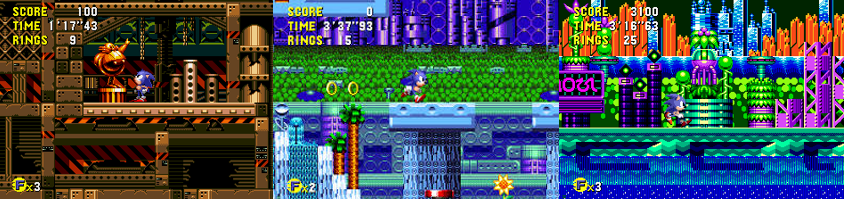
Thanks to the graphical enhancements of the Mega-CD, Sonic CD may very well be one of the most visually striking and vibrant games in the franchise, especially amongst the classic titles. Every Zone is awash with colour and life and full of little details and background elements; every time you travel to the past or future, the Zone gets a complete facelift and takes a much more verdant or ominous light depending on how well you play which really adds to the replayability of the game as every Zone has, essentially, four parts to it (past, present, good future, and bad future) that all present a different aesthetic and challenge while still maintaining the basic structure of the Zone.

Zones are packed full of details and vibrant colours but can look a little busy at times.

Zones have a real depth to them, allowing you to see into the distance and take in just how badly Eggman has affected each environment. You might see a vast sea full of ruins in the past of Palmtree Panic but all you’ll see is pollution and machinery in the bad future; similarly, Tidal Tempest is an unblemished cave in the past but has been transformed into a mechanical base in the future. Zones are also full of interesting and unique graphical mechanics, such as the pseudo-3D ramp at the start of Palmtree Panic, the Mode-7-like Special Stages, how a certain tube in Palmtree Panic will send Sonic smashing through the background and leave a Sonic-shaped hole in his wake, and the way graphics change size as you bounce and run all over the place. Unfortunately, though, I often find Sonic CD’s Zones to be a little too busy; there’s a lot going in the background and foreground, a lot of competing, clashing colours (especially in the garish pink of Collision Chaos), and it can be difficult to keep track of where you are and what’s going on sometimes.

The power of the Mega-CD makes for some gorgeous and well-animated sprites.

The sprites have, however, benefitted greatly from the graphical upgrade; Sonic has more animation frames and a more dynamic moveset and seems far more lively and energetic despite the majority of his assets being lifted from the first game. Sonic also speaks a little bit, shouting out “Yes!” when he grabs and extra life and “I’m outta here!” when left idle for a few minutes (which causes an instant game over). Other sounds, however, are not quite as appreciated, such as the sound Sonic makes when he jumps (which is decidedly squeakier and much more annoying and it also bugs me when it is recycled in both fan-made and official Sonic games). The bosses, too, are bigger and more elaborate than in the first game, requiring actual strategy on your part to defeat and even Amy Rose gets a lot of personality as she follows Sonic around like a love-sick puppy, desperately trying to hug him while love hearts adorably fly from her head.

The anime sequences really bolster the game’s appeal and capture Sonic’s essence.

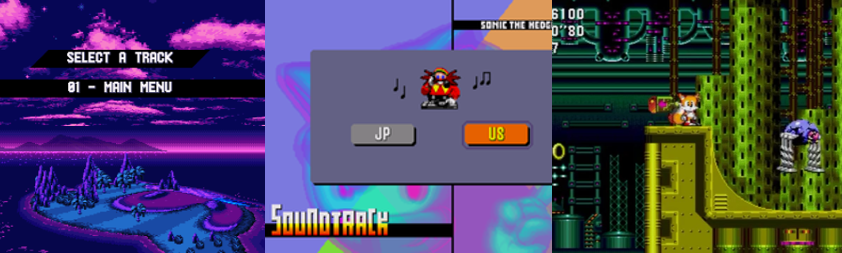
Of course, you can’t talk about Sonic CD without mentioning the anime cutscenes and the soundtrack. The opening and ending of the game features gorgeously animated anime sequences that showcase Sonic at his best, in my opinion; I loved that these were expanded upon in Sonic the Hedgehog (Ikegami, 1999) and I would absolutely be over the moon if they were brought back for future Sonic games. Sonic CD’s soundtrack is also one of the most beloved and contested in the franchise; many prefer the original Japanese soundtrack and, while that is good, it’s much more peppy and vibrant and happy-go-lucky than Spencer Nilsen’s version for the U.S. As a result, while I prefer some tracks from the Japanese soundtrack, overall I prefer the U.S. one; the invincibility music is better, the boss theme is better, and the U.S. soundtrack is much more in the style of rock and metal than anything else, which I prefer.

Enemies and Bosses:
Once again, Sonic must contend with Eggman’s Badniks; unlike in the majority of the classic Sonic titles, Badniks don’t drop cute woodland critters and, instead, blossom flowers upon defeat (again tying into the game’s overall theme of restoring Little Planet to health) and, honestly, they’re far less prominent than in other 2D Sonic titles. Indeed, Sonic CD’s Badniks mainly exist to screw up your run-up to a time travel attempt and cost you your hard-earned Rings right before the goal and they’re probably some of the most unremarkable in the original games. Eggman’s theme this time around is definitely geared more towards bugs than anything else as needle-nosed Mozzietrons try to skewer you from above, Arachnisprings jump out at you, Damsiltron and Buzz Bomber 2s hover overhead and take shots at you, and Poghoppers bounce around the place on their springy bases. Probably the worst enemies are the Snail-Spikers due to their spikes, Motherbombs (which are invulnerable to your attacks and explode into a shower of projectiles), and the Flashers, which must be hit at just the right time to avoid taking damage from their laser beams. Your main opponent, though, will be the abundance of spikes, springs, bumpers, and other obstacles that mess up your momentum and cost you valuable Rings.

The first boss is, quite possibly, the easiest of any of the classic Sonic videogames.

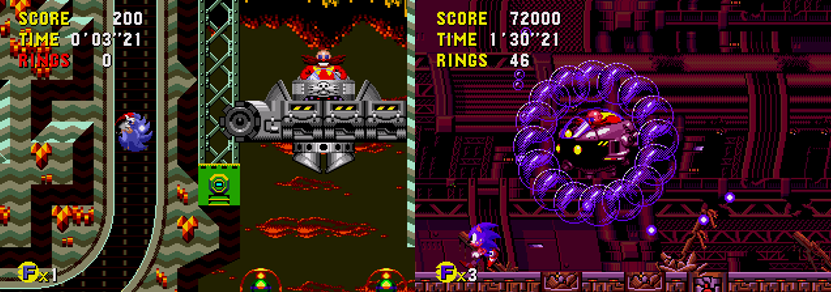
The bosses, though, are a completely different story. Sonic CD features some of the biggest and most unique and interesting boss battles of all the classic games and, while each boss only takes three hits to defeat, they all require different strategies on your part and are affected by whether you battle them in a good or bad future. The first time you battle Eggman, he’s inside of his EGG-HVC-001 mech, which is either a striking pink or an ominous red and sports spikes on the feet. Eggman protects himself from attacks with two bumpers but, after a couple of hits/bounces, these will break off and allow you to land the decisive blow. It’s, quite possibly, the easiest first boss in any Sonic game as even Sonic 2’s Eggmobile took eight hits to defeat.

Bosses require a bit of strategy on your part but are extremely fragile once you get your hits in.

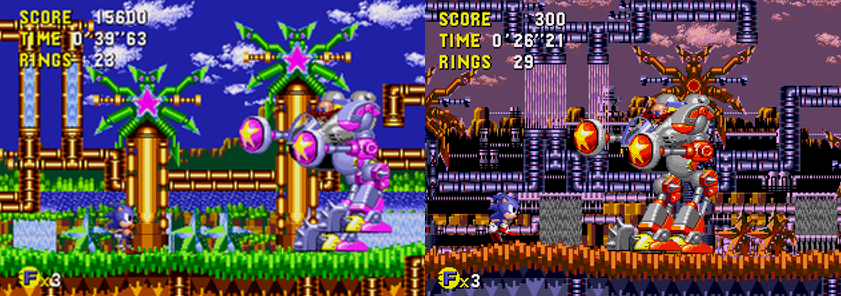
In Collision Chaos, Eggman hides at the top of a giant pinball table and drops weighted balls down at you that can force you to drop down to the lowest level or into some annoyingly-placed spikes. The whole battle is structured very similar to the Star Light and Casino Night Zones and is a clear precursor to Sonic the Hedgehog Spinball (SEGA Technical Institute, 1993) in that players must make use of the flippers to bounce Sonic up each level of the arena, ricocheting off of bumpers and such to ram into Eggman’s machine three times. Your enjoyment of this boss may vary as it all depends on how well you get on with the pinball-based Zones and mechanics of Sonic games; for me, this meant it was quite an annoying boss as it can be tricky to get the angle of your trajectory right to go where you need to. At the end of Tidal Tempest Zone 3, you’ll have to chase Eggman around a short maze similar to the end of Labyrinth Zone; unlike in that encounter, though, this time it’s a simple loop that repeats until you land a few hits and you don’t need to worry about spikes or other hazards. Also, after Eggman flees, he floods the area and surrounds his craft with air bubbles and shoots projectiles at you; in order to finish Eggman off, Sonic has to suck up a couple of the bubbles to make a gap in his defences, which is certainly a unique spin on Sonic’s notorious underwater mechanics.

Compared to some of the other bosses, the final battle is a walk in the park!

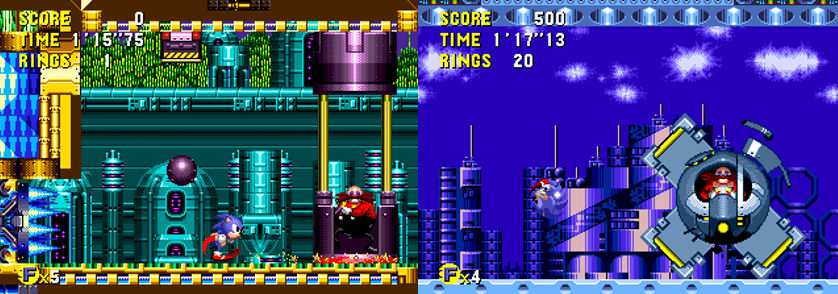
Probably one of the more frustrating bosses is encountered in Quartz Quadrant; here, Eggman hides behind a giant piston and Sonic is forced to perpetually run on a treadmill lest he be skewered by spikes on the far left of the arena. Unlike the other Eggman bosses in Sonic CD, this boss isn’t about attacking but surviving as Eggman drops bombs onto you, which must be avoided, and you have to wait for the friction of the treadmill to destroy Eggman’s machine and defeat him. Because of how difficult it can be to maintain your speed and footing when avoiding the bombs and their projectiles, this can be a particularly challenging boss for your patience, if nothing else. In comparison, the final boss is a fairly anti-climatic and simple affair; Eggman surrounds his craft with four blades and hovers in a slow pattern around the arena, shooting them at you or occasionally spinning your way. However, it’s ridiculously easy to attack between the blades and, each time you land a hit, he loses one of them so, even though he speeds up and becomes more erratic, he’s made more vulnerable to attack and, honestly, this final boss is easier than the one in the first game!

The race against Metal Sonic might be Sonic CD‘s most iconic, and annoying, boss battle.

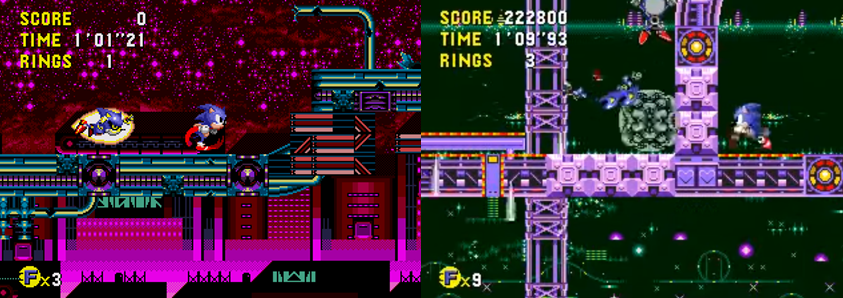
Of course, the most iconic boss battle of Sonic CD comes in Stardust Speedway where you’re forced to race against Metal Sonic! This is a thrilling, if frustrating, experience as Eggman flies along behind you firing an instant-death laser and it can be difficult to get up a good run of speed because, again, of spikes, obstacles, and sudden drops or edges in the path. Metal Sonic is completely invulnerable to harm and will charge at you full-speed or electrify its body, which is helpful for breaking spikes and clearing a path for you. Because of the way the screen is locked, though, this isn’t quite the fast-paced experience it’s often thought and interpreted as and is, instead, a strangely-paced, annoying affair that generally comes down more to luck than anything else. The best thing to do is to stay ahead where you can, jump over Metal Sonic, and then blast past it at every opportunity so that you’re on the right side of that wall when it comes crashing down.

Power-Ups and Bonuses:
As is the standard for most Sonic games, a number of power-up monitors are scattered throughout the game’s Zones. Unfortunately, though, there are no new or exclusive items to be found in Sonic CD; instead, you’ll have to make do with either ten Rings, a shield that protects you from damage for one hit, an extra life, speed-up shoes, or a brief invincibility just like in the first two games.

Additional Features:
Sonic CD has twelve Achievements for you to earn, some of which are pretty simple; you’d be hard-pressed to play through the game without travelling through time, for example, and you’re guaranteed to get a hug from Amy after defeating Metal Sonic. Others, though, are a bit trickier, requiring you to collect two hundred Rings rather than the usual one hundred, or to find the upper goal signpost in Collision Chaos 2 and a hidden angel statue in Wacky Workbench. Probably the most troublesome Achievements, though, involve beating Metal Sonic without being hit and destroying all of the Robot Transporter and holograms in the past.

Conquer the seven psychedelic Special Stages to get the Time Stones and the best ending.

As in the first game, finishing every Zone except the third with fifty Rings or more allows you to enter a Special Stage by jumping through a Giant Ring. These Special Stages are much more elaborate than in the first game, though, and arguably a bit more forgiving than in the second; here, you must race around a flat area against a tight time limit, avoiding water and other obstacles as you hunt down and destroy a number of UFOs. If you land on water, or similar surfaces, your time will drain exponentially so be sure to avoid these at all costs but don’t go too fast on the booster pads as it can be very difficult to make tight turns. As you destroy UFOs, you can earn Rings and even a time bonus, which is helpful, but while fans can be used to float into UFOs, spiked grates will cost you valuable time. Depth perception is a real issue here as you have to be very precise with your jumps but, if you see your time is about to run about (when it hits, say, ten seconds), you can pause and quit to the main menu and then retry the Special Stage from your save slot, meaning you basically have unlimited tries at each Special Stage and can easily grab all seven Time Stones and get the best ending.

The Xbox Live version of the game includes a host of bonus features, including a playable Tails!

I mentioned before that this was the definitive version of the game and it’s true; you can pick from a variety of display options in the menu, choose between the U.S. and Japanese soundtracks (but can’t mix and match, unfortunately), choose which Spin Dash you want (I recommend the superior Sonic 2 one), and have access to four save slots. Unfortunately, these don’t work like in Sonic the Hedgehog 3 (SEGA Technical Institute, 1994), meaning you can’t pick and choose a Zone to replay, which is disappointing. You can, however, unlock a stage select, D.A. Garden (basically a sound test which you can also use to enter a variety of cheats, though Achievements can’t be earned this way), and “Visual Mode” (a gallery for viewing the anime scenes) by completing the “Time Attack” mode fast enough. Perhaps the most notable addition to this version of the game is that you unlock Miles “Tails” Prower after beating the game in any way; Tails controls exactly like he did in Sonic 3, meaning he can fly and swim, but Achievements are disabled when playing as Tails as it’d be too easy to get around Sonic CD’s more annoying level layouts.

The Summary:
Sonic CD is an absolutely gorgeous game; it took everything that worked about the first game and expanded upon it wonderfully, bringing a much greater sense of speed and liveliness to the core gameplay and really utilising the power of the Mega-CD to its fullest with its anime sequences, animations, music, and unique time travel mechanic. Yet, as much as I love how visually appealing the game is, I find it lacking in a lot of ways; it’s frustrating at times, the level layouts are massively annoying for a game whose main mechanic is based on speed, and the amount of exploration and trial-and-error needed can get annoying at times. Still, I love how every boss battle is unique and how your actions have actual, visible consequences as you play; it really invites multiple playthroughs to see what each Zone looks like in different situations but, similar to the first game, I find myself less excited to replay Sonic CD and more aggravated as it can be a chore at times. When it shines, it shines brightly and I’d love to see more of this style of 2D Sonic in the future but its more irritating features and mechanics definitely need polishing up first.

My Rating:

Rating: 4 out of 5.

Great Stuff

Did you enjoy Sonic CD? Did you own this, and a Mega-CD, back in the day or did you first experience it on PC or through some other port? What did you think to the game’s presentation and which of the two soundtracks is your favourite? Were you a fan of the level layouts and time travel gimmick or, like me, do you think they could have been better implemented? Which of the game’s Zones and bosses is your favourite? Are you a fan of Metal Sonic and Amy Rose? How are you celebrating Sonic CD’s anniversary this year? Whatever your thoughts on Sonic CD, or Sonic in general, feel free to leave a comment below.

10 FTW: Dark Doppelgängers

10FTW

If there’s one thing any hero can count on it’s that, at some point in their illustrious career, they’re going to have to face off against themselves. Sometimes, like with the classic Demon in a Bottle (Michelinie, et al, 1979) this is a metaphorical battle against their own inner demons and foibles but. More often than not, it’s a literal battle against an evil version of the themselves. Sometimes they’re from another world or a parallel dimension, perhaps they’ve used stolen technology or been cloned from the hero; other times, they are of the same race or seek to replicate the hero’s powers and usurp them. Whatever the case, I’ve always enjoyed a good doppelgänger, generally because they’re just like the hero but dark and edgy or more violent and, being as I grew up in the nineties, I like that kind of stuff. An evil version of a hero can help to elevate the hero by allowing them to overcome their failings and, sometimes, will even edge out of villain territory and become either a full-fledged hero in their own right or a line-towing anti-hero. In either case, today I’m going to run through ten of my favourite dark doppelgängers; evil versions of heroes who are just cool through and through.

10DarkLink
10 Dark Link / Shadow Link

First appearing in Zelda II: The Adventure of Link (Nintendo EAD, 1987) this shadowy version of the heroic Link gets the number ten spot purely because he isn’t really much more than a glorified henchmen for main series villain, Ganon. In true Peter Pan (Barrie, 1902) fashion, Dark Link often takes the form of a pitch-black shadow or a dark, distorted reflection and is able to perfectly mirror all of Link’s attacks and abilities. In recent years, he’s appeared more as a phantom and been given more definition but he’s generally relegated to being a sub-boss for a game’s dungeon and never the true threat to the land of Hyrule.

9Wario
9 Wario

Debuting in Super Mario Land 2: 6 Golden Coins (Nintendo R&D1, 1992), this bloated, disgusting, twisted version of Mario is everything Nintendo’s cute and cuddly mascot isn’t: he’s rude, crude, mad, bad, and dangerous. Where Mario jumps on blocks and Koopa heads to save a delightful Princess, Wario barges through walls and tosses his enemies at each other to steal, loot, or recover treasure. Wario even has his own version of Luigi, Waluigi (who exists more for the sake of existing, I would argue) but, while he crashed onto the scene in a big way by taking over Mario’s castle, Wario has softened over the years. He’s transitioned from an anti-hero and begrudging ally to simply a master of ceremonies as Nintendo moved him away from being the star of his own series of unique games and more towards party games and mini games.

8 Black Adam

Created by Otto Binder and C. C. Beck, Teth-Adam was originally gifted the magical powers of the wizard Shazam and chosen to be his champion, Mighty Adam. After being bewitched and corrupted, however, Adam was stripped of his powers and withered away to dust but, centuries later, was reborn when his ancestor, Theo Adam kills Billy Batson’s parents to lay claim to Adam’s power. Black Adam possesses all of the same powers as Captain Marvel/Shazam but is also gifted with a pronounced mean streak and tactical genius; he briefly reformed for a time, even joining the Justice Society of America and building a family of his own, but his quick temper and deep-seated contempt for humanity generally always drives him into a murderous rampage that few heroes can hope to oppose.

7Janus
7 Alec Trevelyan / Janus

Appearing in what is still probably the best James Bond film ever made, GoldenEye (Campbell, 1995), Alec Trevelyan (masterfully portrayed by Sean Bean) was one of MI6’s top 00 agents. However, wanting revenge against the British government for the death of his family and comrades during World War Two, Trevelyan faked his death and formed a criminal organisation named after his new alias, Janus. Trevelyan makes the list because he’s everything James Bond (Pierce Brosnan) was but twisted towards villainy; he and Bond were close friends and partners and his “death” weighed heavily on Bond’s conscious for nine years, making his betrayal even more sickening. In facing Trevelyan, Bond not only faces his biggest regret and mistake but also himself and what he could easily become if the fates were different.

6Slash
6 Slash

First appearing in ‘Slash, the Evil Turtle from Dimension X’ (Wolf, et al, 1990), Slash was originally an evil violent mirror of the heroic Teenage Mutant Ninja Turtles who often appeared in Turtles videogames and merchandise as a sub-boss for the Turtles to fight. For me, his most iconic look is when he’s sporting a black bandana, some spiked apparel, razor-sharp, jagged blades, and a heavy, armour-plated, spiked shell. Slash’s look and characterisation have changed significantly over the years as he’s gone from a somewhat-eloquent villain, to a rampaging monster, to an ally of the Turtles depending on which version you’re reading or watching.

5TheMaster
5 The Master

Originally (and, perhaps, most famously) portrayed by Roger Delgado, the Master was a renegade Time Lord who rebelled against his overbearing masters to freely wander through time and space. While this closely mirrors the story of his childhood friend, the Doctor (Various), the Master was the Doctor’s exact opposite: evil where the Doctor was good, malicious where the Doctor was kind, and wanted nothing more than to extend his lifespan, conquer other races, and destroy (or break) his oldest rival. Though sporting a deadly laser screwdriver and able to hypnotise others, the Master gets the number five spot simply because he’s been overplayed to death in recent years. Time and time again we’ve witnessed the Master at the end of his regeneration cycle, or destroyed forever, only for yet another incarnation to appear and wreck more havoc. He’s even redeemed himself and turned good before, and yet still returns to his wicked ways to plague the Doctor even when his threat should long have ended.

4 Metal Sonic

Speeding onto the scene in Sonic the Hedgehog CD (SEGA, 1993), Metal Sonic stands head-and-shoulders above all over robot copies of Sonic the Hedgehog simply by virtue of his simplistic, bad-ass design. A fan favourite for years, Metal Sonic has made numerous appearances in multiple Sonic the Hedgehog (Sonic Team/Various, 1991 to present) videogames, comic books, and other media. Sporting a sleek, aerodynamic design, chrome plating, and a massive jet engine on his back, Metal Sonic did something no one had done at the time of his debut and not only matched Sonic’s speed, but outmatched it on more than one occasion. While Sonic CD is far from my favourite Sonic title, it’s hard to downplay the iconic race against Metal Sonic in Stardust Speedway or his impact on the franchise.

3ReverseFlash
3 Reverse-Flash

Versions of the Reverse-Flash have plagued DC Comics’ speedsters over the years, most notably Edward Clariss (The Rival), Eobard Thawne (Reverse-Flash), and Hunter Zolomon (Professor Zoom). Sporting a yellow variant of the classic Flash suit and shooting off sparks of red lightning, the Reverse-Flash is generally characterised as using his powers to torture the Flash out of a twisted desire to make him a better hero. Reverse-Flash’s threat is increased by his tendency to travel through time, evading death and plaguing different generations of the Flash; Professor Zoom was even able to manipulate the Speed Force to jump through time and appear to be faster than the Flash. Reverse-Flash has also been the cause of numerous agonies in the lives of multiple Flashes; he’s killed or threatened those closest to him (including Barry Allen’s mother) and delights in bringing the Flash to the brink of his moral code.

2JudgeDeath
2 Judge Death

Hailing from an alternate dimension where life itself is a crime (as crimes are only committed by the living), Judge Death is the dark counterpart to no-nonsense lawman Judge Dredd. First appearing in 1980 and created by John Wagner and Brian Bolland, Judge Death assumes the appearance of the Grim Reaper and uses his demonic powers to kill with a touch. Rocking a metal design (recently evoked by the Batman-Who-Laughs, another contender for this list), Judge Death takes Dredd’s uncompromising enforcement of the law and ramps it up to eleven. Alongside his fellow Dark Judges, he once slaughtered over sixty million citizens of Mega City One and, despite his corporeal form being destroyed or trapped, has returned time and time again to bring judgement upon the living.

1 Venom

Perhaps the most popular (or, at least, mainstream) of all dark doppelgängers is the alien symbiote who, when bonded to Eddie Brock (or others), is known as Venom. Created by David Michelinie and Todd McFarlane, Venom began life as a black alien costume that absorbed Spider-Man’s powers and abilities and sought to permanently bond with him. When Spidey rejected it, it turned to Brock and, through their mutual hatred of Spider-Man, Venom was born. Sporting a super simple design (pitch-black with a white spider logo, emotionless white eyes, deadly fangs and claws, and a long, drooling tongue), Venom plagued Spidey for years. Immune to Spidey’s Spider-Sense and sporting all his powers, but double the strength and viciousness, Venom has evolved from a sadistic villain, to an anti-hero, to all-out hero over the years but, thanks to their equally violent offspring, has been the source of much death and woe to Spider-Man since day one.

0CrimeSyndicate

What dark doppelgänger is your favourite? Were there any I missed off this list, or do you, perhaps, feel the evil copy is a played out trope? Drop a line in the comments and pop back for more lists and articles.