Back Issues [Sonic2sDay]: Sonic the Hedgehog’s Buddy: Tails


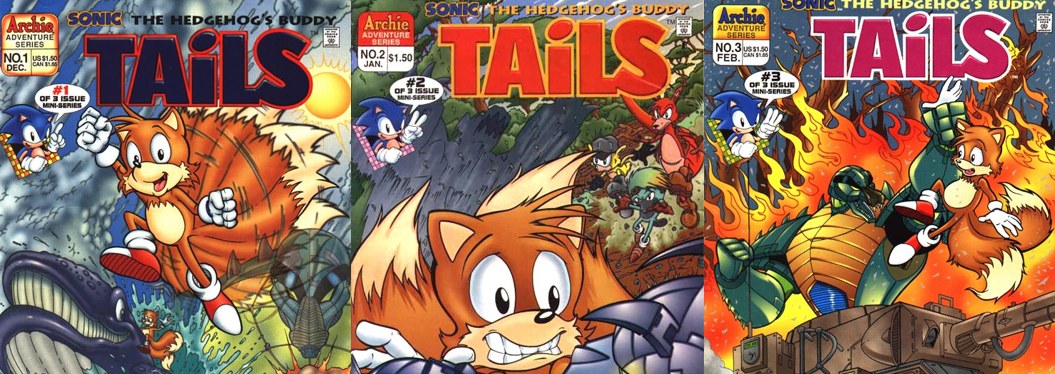
In anticipation of Sonic the Hedgehog 2 (SEGA Technical Institute, 1992), SEGA dubbed November 24, 1992 “Sonic 2sday”. Accordingly, this is a great excuse to celebrate Sonic’s faithful sidekick, Miles “Tails” Prower, who debuted in that title.


Writer: Michael Gallagher – Artists: Mike Gallagher and Dave Manak

Story Title: “Southern Crossover” (Part One to Three)
Published: October 1995 (cover-dated: December 1995) to December 1995 (cover-dated: February 1996)

The Background:
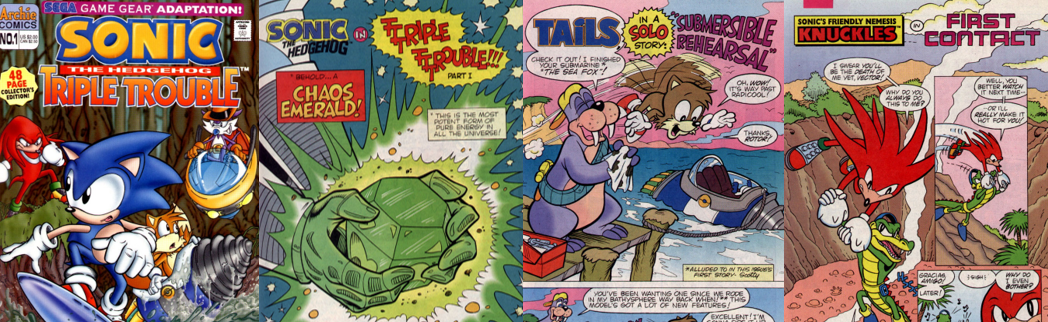
Thanks to an aggressive marketing campaign and being bundled with the all-powerful 16-bit Mega Drive, Sonic the Hedgehog was the blockbuster success SEGA needed to usurp Nintendo from the top of the videogame industry. Despite a tumultuous developmentSonic 2 surpassed this success, selling 400,000 copies in its first week, 6 million units during the Mega Drive’s lifespan, and increasing SEGA’s slice of the home console market by 40%Widely praised and highly regardedSonic 2 also debuted Tails, Sonic’s kid sidekick, who was created by Yasushi Yamaguchi. Resembling the mythical kitsune and devoted to his super-fast hero, Tails became a well regarded staple of the Sonic franchise, becoming one of the few of Sonic’s supporting cast to get his own divisive solo outings. He was also the second to receive a solo mini series published by Archie Comics, who produced the popular Sonic the Hedgehog comics in the United States, which were heavily based upon Sonic’s cartoon adventures. Though spinning off from Archie’s loose adaptation of Sonic the Hedgehog: Triple Trouble (Aspect, 1994), Tails’ three-issue miniseries set the groundwork for his greater role in Archie’s comics, which reimagined him as a character of great destiny.

The Review:
Tails’s one and only Archie-published miniseries begins with the young, two-tailed fox drawing by the docks. It seems Tails likes to write and draw his own comic books that paint him as a mild-mannered (and “handsome”) youngster who secretly operates as “Captain Super Fox-Man”, a superpowered “Avenger of Evil” who’s just as capable (if not more so) as his older Freedom Fighter cohorts. While filing his art, Tails thumbs past a list of supplies he acquired during a previous battle against the tyrannical Doctor Ivo Robotnik and his agent, Fiona, a “false fox” who betrayed him. His’ paperwork proves that Dr. Robotnik is building a satellite operation somewhere on Mobius and the fox cub is determined to find it by himself and prove how capable he is. Thus, Tails quickly hides the document from Princess Sally Acorn, leader of the Freedom Fighters and essentially his substitute mother. The two admire the Sea Fox, a nifty little one-man submarine built for Tails by Rotor the Walrus after Archie’s Triple Trouble adaptation. Although Sally forbids Tails from piloting the Sea Fox, he’s seemingly happy tinkering with it and playing make-believe but secretly fumes at being treated like an infant. Consequently, when Sally leaves for an important meeting, Tails takes the Sea Fox out to sea, having secretly filled the tank and embarked on solo ventures before, adamant to show that he’s not a helpless child. Elsewhere, the maniacal Dr. Robotnik oversees the final preparations on his gigantic blimp, trashing one of his SWATbots with his bare hands when the machine asks to check the ship’s inventory against the supply list stolen by Tails. Dr. Robotnik plans to fly supplies to his regional robo-underboss in the Southern Hemisphere (specifically, the nation of Downunda), as part of his grand plan for global domination, cloaking the dirigible to make it undetectable unless one is directly beneath it.

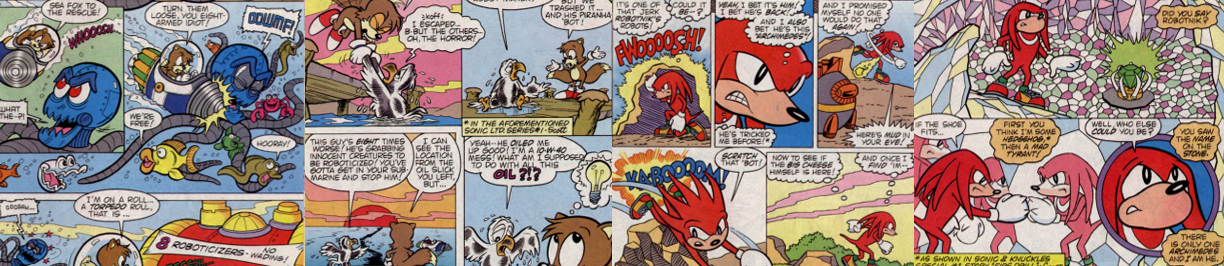
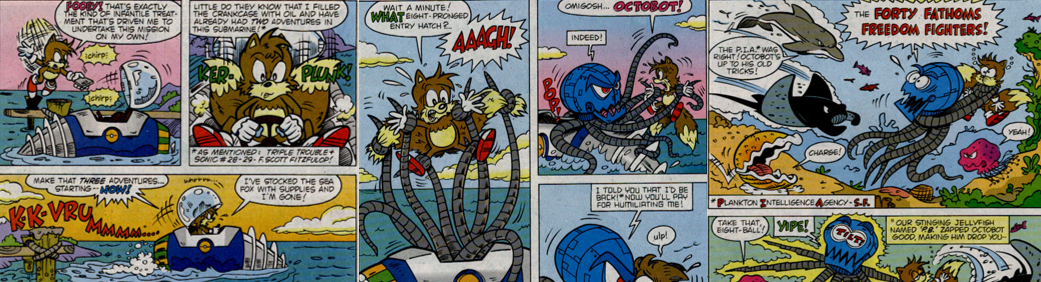
Determined to prove himself as a hero, Tails is overwhelmed  by the vengeful Octobot while at sea.

This odd flaw means Tails easily spots the blimp while searching the high seas for signs of the rotund dictator. While investigating a dark patch on the water’s surface, Tails is stunned to find his quarry is in the sky and flies up to investigate. After glimpsing the blimp’s destination, Tails is attacked by SWATbots, just barely recovering in time to trap them in a water vortex with his propeller-like twin tails. However, when Tails returns to the Sea Fox, he’s ambushed by Octobot, a mechanical octopus in charge of Dr. Robotnik’s underwater robotization factory and out for revenge after Tails humiliated him in the Triple Trouble special. After scuttling the Sea Fox, Octobot drags Tails into the dark depths, causing Tails to black out. Outraged that his blimp was so easily spotted, Dr. Robotnik chastises his forces and calls his robo-underboss, a mechanical crocodile named Crocbot, for an update. Thrilled that he’ll soon receive enough supplies to pollute the landscape, Crocbot orders his robotic winged dingoes to patrol in anticipation of the blimp, then loudly boasts of his plans to reprogram Dr. Robotnik’s SWATbots to aid him in overthrowing his master and conquering the world for himself! Luckily for Tails, he wakes up on the back of a massive blue whale named Fluke. His confusion is short-lived as a friendly manta ray named…well, Ray…fills him in on what happened. As Tails was being dragged underwater and nearly drowned, Octobot was suddenly attacked by the “Forty Fathoms Freedom Fighters” (Ray, P.B. the Jellyfish, Bottlenose the Dolphin, and Bivalve Clam). Despite Octobot fighting back by spraying ink, he was shocked by P.B., tackled by Bottlenose, and ultimately flattened by Fluke (though the Sea Fox was totalled). Grateful, Tails immediately enlists the Forty Fathoms Freedom Fighters in expediting his trip to Downunda, with Fluke and Ray only too happy to help and allow Tails to embellish the details in his comic books.
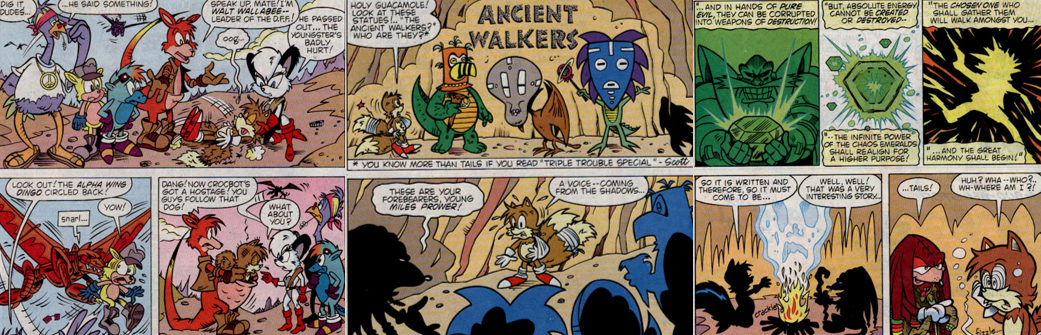
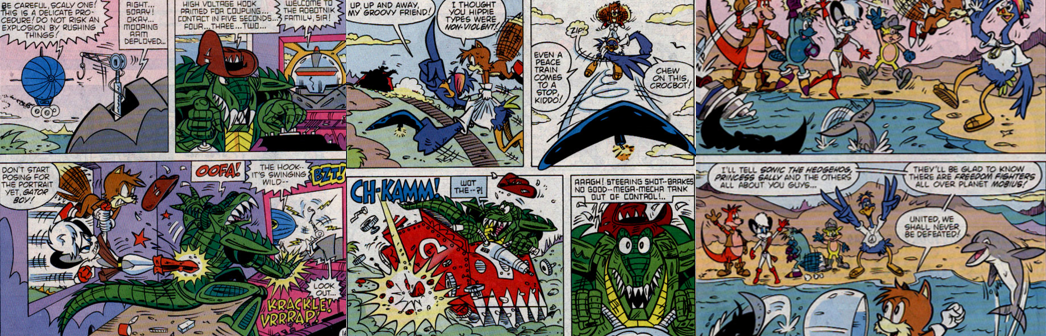
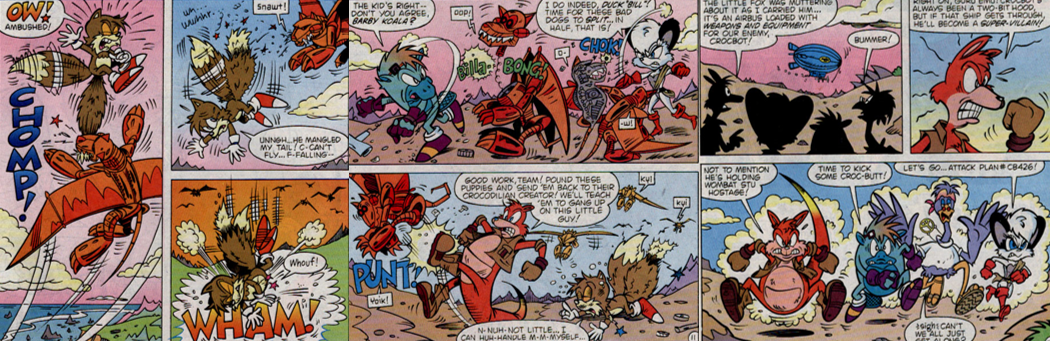
Rescued in Downunda, the injured Tails learns he’s been chosen for a higher, as-yet-unknown purpose.

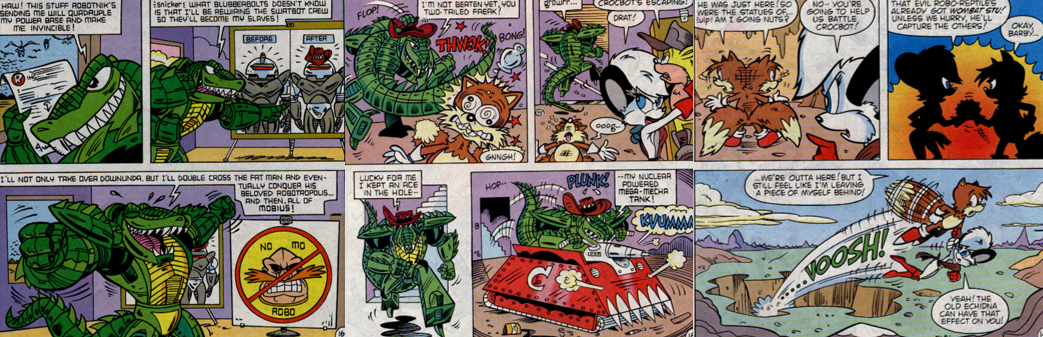
Upon arriving, Tails is immediately detected by Crocbot’s security systems, who dispatches his robotic Wing Dingoes to intercept him. Although Tails puts up a good fight and even takes a few of the robots out, he takes a bite to a tail and crashes to the ground, too injured to fly and barely staying conscious. Tails is thus rescued again, this time by the Downunda Freedom Fighters led by Walt Wallabee and Barby Koala, Wombat Stu, the peace-loving hippy Guru Emu, and Duck “Bill” Platypus. While they’re busy tending to the unconscious Tails, the group is ambushed by the Alpha Wing Dingo, who swoops in and kidnaps Wombat Stu! Walt quickly orders the others to pursue their teammate while he hops away with Tails in his pouch to get the young fox help. After halting communications with Dr. Robotnik to keep his master from seeing the state of his damaged Wing Dingoes, Crocbot initially lashes out in frustration and then gleefully clamps Wombat Stu to a torture rack. Crocbot then assures Dr. Robotnik that all is ready and ends the call, watching with relish as Wombat Stu’s allies approach his base (amusingly modelled after the Sydney Opera House) just as the blimp arrives. Walt rejoins his teammates and gives an update from Tails that catches them up with the plot and they race towards Crocbot’s base to keep him from being bolstered by Dr. Robotnik’s weapons. Tails wakes up at the Downunda Freedom Fighters’ base at the bottom of a giant crater, his tail bandaged and his arm in a sling, and discovers statues of the Ancient Walkers, mystical beings from Mobius’s past who Tails learned of in the Triple Trouble special. He’s then approached by Athair, the wizened and cantankerous great-grandfather of Knuckles the Echidna, who gives the injured fox cub a lecture on ancient history.

Tails and his new friends successfully thwart Crocbot’s ambitions and vow to defy Dr. Robotnik.

Generations ago, Athair’s echidna ancestors were so busy building elaborate, highly advanced cities across Mobius that they failed to spot a comet heading for their capital city, Echidnapolis, until it was too late. Though the echidnas levitated Echidnapolis and a chunk of their land to safety, creating what was then known as the Floating Island, the comet devastated Mobius. Though Tails tries to leave, frustrated with Athair’s riddles and eager to help his newfound friends, the Ancient Walkers come to life and insist he learn more. Thus, Tails learns of how life evolved on Mobius, how dinosaurs once ruled, and how the planet was struck by the Chaos Emeralds in prehistoric times. Many worshipped or tried to harness their powers over the millennia, often being corrupted by their desires. However, it’s said that a “Chosen One” would one day unite the many Chaos Emeralds to bring about the “great harmony”, a destiny Athair believes the Ancient Walkers have bestowed upon Tails! After coming out of a trance to find his wounds healed, Athair gone, and Barby crashing in after Crocbot’s gigantic C.D. Rom Ram attacks the Downunda Freedom Fighters, Tails reluctantly shrugs off his strange experience and goes to help. Although the massive robotic ram beats on the Downunda Freedom Fighters, it’s easily destroyed by one of Walt’s “bomberangs”, frustrating Crocbot and distracting him from helping the blimp to dock. When Tails and Barby attack him, Crocbot mangles the controls and the blimp dramatically goes down in flames along with his plans to usurp Dr. Robotnik. With Barby distracted rescuing Wombat Stu, Crocbot hits Tails with his mechanical tail and leaps into his “nuclear powered Mega-Techa Tank” to escape. Determined to end Crocbot’s threat, the normally pacifistic Guru Emu borrows a bomberang and, assisted by Tails, sends Crocbot careening down a canyon to an explosive end. After tearfully turning down an offer to join the Downunda Freedom Fighters, Tails is overjoyed when the Forty Fathoms Freedom Fighters return with his repaired Sea Fox. Though he’s sad to say goodbye to his new friends, Tails heads home emboldened by the knowledge that Freedom Fighters exist all over Mobius.

The Summary:
I’ve read every single Sonic and Sonic-adjacent comic published by Archie Comics and I’m starting to think that Michael Gallagher may be my least favourite artist, especially from these early days. His work, while capturing the same cartoonish vibe as the cartoons that influenced these comics, can’t compare to the likes of Patrick “Spaz” Spaziante, who had a hand in the miniseries’ covers, which promise a tale of excitement and adventure that sadly isn’t reflected in the pages. We’re still in that weird time when Archie’s comics were more slapstick and cartoonish, meaning we get painful puns, borderline plagiarism presented as homage (particularly in Tails’ comic book fantasises), and childish villains who spend more time shouting than being a threat. It’s a gripe of mine that Archie’s Sonic comics took so long to establish their identity and move away from simplistic stuff, like the Ancient Walkers being cartoonish statues in a bland cave, and nonsense original characters who, while visually interesting, can’t compete with SEGA’s iconic creations. Indeed, the two sets of Freedom Fighters Tails encounters in Downunda leave a lot to be desired and don’t live up to their potential. I feel the writers should’ve focused on the Downunda Freedom Fighters and fleshed them out more if they were going to have such a large role. Perhaps they could’ve been forced from Downunda by Crocbot and operated out of a seaside cave, biding their time to counterattack when they spotted Tails in danger and rescued him alongside Fluke. Then we could’ve seen these new guys in action sooner and learned more about them, something greatly needed since they totally steal Tails’ spotlight!

Sadly, Tails’ solo venture is usurped by forgettable (if visually interesting) original characters.

Not yet the young genius and tech-savvy inventor we know today, Tails is frustrated at being thought of as a helpless kid and regularly defies Princess Sally by taking the Sea Fox out on adventures. Sadly, we don’t get to see the Sea Fox in action as it’s scuttled by Octobot and Tails’ hopes of downing Dr. Robotnik’s blimp solo are quickly dashed when he’s constantly overwhelmed and is either close to drowning or unable to fly because he’s outnumbered, outpowered, and outmatched. Therefore, Tails must be rescued by two sets of largely forgettable Freedom Fighters, I like the visual variety of both groups and it’s always fun when the comics anthropomorphise unique creatures like jellyfish or wallabies, but I don’t know who any of these guys are. What’s their backstory? How did they get into the Freedom Fighter game? What are their personalities beyond wanting to protect the world and hating the dictator and his robotic minions? Honestly, this would’ve been a great opportunity to team Tails up with Ray the Flying Squirrel and even Mighty the Armadillo but, as I mentioned, the story would’ve greatly benefitted from trimming down these original characters. I would’ve had Walt, Barby, Stu, and Fluke, with Atahir as their wise mentor. Make Walt the pacifist who’s forced into violence, Barby the tactician, Stu the hot-head, and Fluke the laidback muscle who carries them across the ocean. Then, use these extra panels to contrast them with the Knothole Freedom Fighters, showing how they accept Tails and don’t mollycoddle him. Indeed, perhaps they’d be compelled to help Tails based on Athair’s foreknowledge of his apparent destiny as the “Chosen One”, perhaps even leading them to revere him as a messiah figure, thus making his decision to return home more of a struggle since Tails would’ve found acceptance and the chance at a greater destiny amongst them.

Strangely, the story’s more concerned with toppling Crocbot than exploring Tails’ destiny…

Instead, Tails is hurt, the Downunda Freedom Fighters take over, and we’re left with a dull history less about things that barely seem connected to Tails. Rather than waste time recapping the echidna downfall, why not focus on the Chaos Emeralds, their influence on others, and the “Chosen One” prophecy? Tails barely seems interested in Athair’s story and doesn’t dwell upon the Ancient Walkers’ words after leaving with Barby, making me question what the point of dedicating all that time to it was beyond sowing the seeds for future plot threads. I quite liked Crocbot, however; he’s got a fun, unique design and I liked how he spoke with an Australian accent and sought to usurp Dr. Robotnik. However, he barely does anything and leaves all the heavy lifting to his Wing Dingoes and flees at the first sign of trouble. Crocbot later returned to plague our heroes again, but he doesn’t get a good showing here as he wastes time monologuing to Wombat Stu rather than torturing him and breaks down in tears when he accidentally destroys Dr. Robotnik’s blimp, making for a particularly weak villain. Honestly, I think Sonic the Hedgehog’s Buddy: Tails missed a trick by not turning to his Game Gear games for inspiration. Tails Adventure (Aspect, 1995) released around the same time this miniseries so it might’ve been unrealistic to expect an adaptation, and Tails’ Skypatrol (Japan System House/SIMS, 1995) may have released earlier in 1995 but it was exclusive to Japan at the time. Still, Archie could’ve gotten design documents and some information on both from SEGA, certainly enough to cobble together an adventure that pitted Tails against Witchcart and/or the Battle Kukku Empire to at least use more game-accurate villains in his solo adventure. Still, this was decent enough and showed that Tails was definitely ambitious for his age, but I think it says a lot that young Miles never got another solo series from Archie Comics…

My Rating:

Rating: 3 out of 5.

Pretty Good

What did you think of Tails’s first and only solo miniseries from Archie Comics? Were you disappointed that so much of the story was dominated by original characters? Which of the two sets of new Freedom Fighters was your favourite? Would you have liked to see elements from Tails’s Game Gear titles incorporated instead? What did you think of Crocbot and the idea of Tails having a greater destiny? What are some of your favourite Tails moments from the Archie Comics? How are you celebrating Tails and “Sonic 2sday” this year? Whatever your opinion on Tails, or Sonic 2 in general, drop a comment below and go check out my other Sonic content.

Back Issues [Sonic CDay]: The Brotherhood of Metallix


Developed alongside the blockbuster Sonic the Hedgehog 2 (SEGA Technical Institute, 1992), Sonic the Hedgehog CD (Sonic Team, 1993) released on this day back in 1993. Expanding upon the Blue Blur’s debut title, Sonic CD introduced Metal Sonic (one of Sonic’s most popular and enduring rivals) and Amy Rose, and is considered by many to be one of the best of the classic Sonic titles.


Story Title: “The Brotherhood of Metallix (Part 1 to 4)”
Published: 1 September 1995 to 13 October 1995
Writer: Nigel Kitching
Artist: Richard Elson

The Background:
After Sonic the Hedgehog became a mainstream success and SEGA usurped Nintendo’s position at the top of the videogame industry, SEGA quickly capitalised on Sonic’s popularity not just with videogames but a slew of ancillary merchandise, including cartoons and comic books. About six months after Archie Comics started publishing a weird amalgamation of the Adventures of Sonic the Hedgehog (1993 to 1996) and Sonic the Hedgehog/SatAM (1993 to 1994) cartoons, United Kingdom publisher Fleetway Editions Limited started “Britain’s Official SEGA Comic”, Sonic the Comic (StC), a fortnightly publication that was a favourite of mine until its unfortunate end. Though StC pulled much of its lore from the now defunct Mobius and Doctor Ovi Kintobor storyline that was prevalent outside of Japan, StC quickly veered from the source material, portraying Sonic the a mean-spirited leader of a gang of Freedom Fighters comprised of videogame characters and anthropomorphic original characters. Like Archie’s comics, StC included some very loose adaptations of the videogames that truncated or adapted the source material to fit with its noticeably different lore. When StC adapted Sonic CD, they reimagined Metal Sonic as “Metallix” and told a self-contained time travel story. However, some years later, a second Metallix appeared and teased a “brotherhood” of Badniks, which was paid off in these issues and solidified Sonic’s robotic doppelgänger as one StC’s more dangerous and persistent secondary antagonists.

The Review:
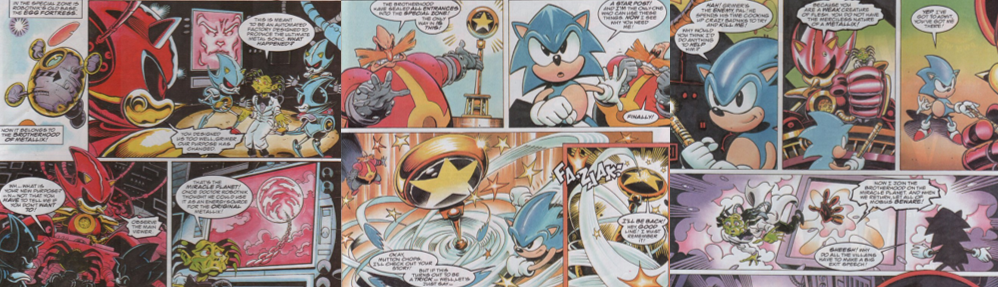
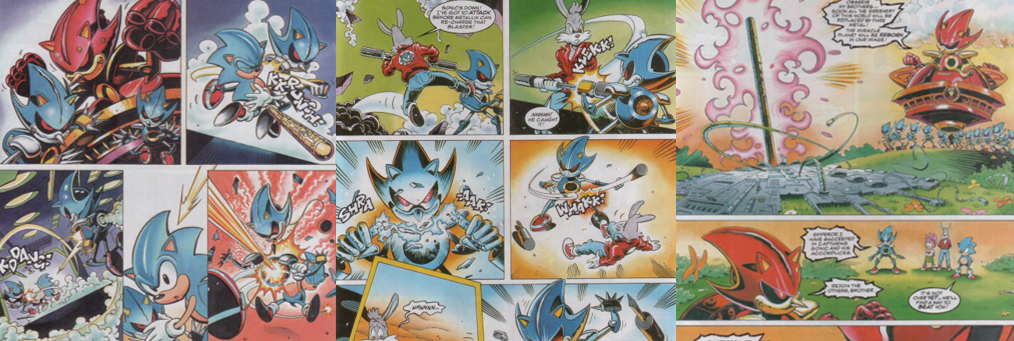
“The Brotherhood of Metallix” takes place in the middle of Doctor Ivo Robotnik’s merciless rule over the planet Mobius. Having conquered the entire world thanks to a time dilation, Dr. Robotnik has become all powerful save for the efforts of Sonic and his friends, who’ve been driven from their homes and roam the Zones disguised as Bob Beaky’s Travelling Circus. The story begins with Porker Lewis, the technical support of the team, activating a security field around their caravan while the Freedom Fighters investigate reports of a new Badnik in Metropolis City, which is essentially Dr. Robotnik’s headquarters. Expecting some all-powerful death machine, the cocksure Sonic is incredulous by the clown-like Mister Blobnik (a thinly veiled parody of British television icon Mister Blobby). A ludicrous Badnik who staggers about blowing bubbles and fumbling with its weaponry, Mr. Blobnik nevertheless proves more durable than regular Badniks and Troopers, withstanding a Sonic Spin Attack and trapping Sonic in a an inescapable bubble upon defeat. Having successfully fooled the Freedom Fighters with a variation of the “Drunken Fist” technique, Mr. Blobnik’s head detaches from its remains and carries Sonic to Citadel Robotnik. However, rather than being tortured, transformed into a Badnik, or executed, Sonic is stunned when a panicked Dr. Robotnik reveals he needs to join forces with Sonic to oppose the “Brotherhood of Metallix”. While Sonic battled Mr. Blobnik, Dr. Robotnik was shocked when a Metallix teleported into his citadel via a corrupt version of the Omni-Viewer (a sentient television screen that resides in the Special Zone) and kidnapped his long-suffering assistant, Grimer. After learning that the Metallix, who were set to automatically replicate and improve themselves in Dr. Robotnik’s abandoned Egg Fortress base in the Special Zone, have gained sentience and are now ruled over by a gigantic Emperor, Grimer’s forced to aid their scheme for true autonomy.

When the Metallix mysteriously return, Sonic’s forced to join forces with Dr. Robotnik to investigate.

Although Sonic’s sceptical of Dr. Robotnik’s claims, he remembers his last encounter with an upgraded Metallix mentioned a “brotherhood” and reluctantly agrees to use his super speed to enter the Special Zone via a Star Post and investigate. Sonic arrives to find the Egg Fortress heavily damaged and seemingly abandoned, until he explores further and witnesses Grimer handing the Emperor Metallix a mechanical staff, the “Alpha Device”. With this in hand, the Emperor Metallix and its troops prepare to teleport to the Miracle Planet via their Omni-Viewer, only for Sonic to attack, reasoning that the Badniks are obviously up to no good. The Emperor Metallix silently commands two minions to attack. While they land a few good blows on the Blue Blur, Sonic dispatches them far easier than their predecessors by tricking one into blowing its fellow up with its chest cannon and simply smashing the other into junk with a swing of the Alpha Device. Sonic’s victory is short-lived, however, when the Emperor Metallix takes Grimer hostage and threatens to crush the life out of him unless Sonic hands over the Alpha Device. With no choice but to acquiesce as he can’t allow even his enemy to be killed, Sonic can only watch as the Emperor Metallix departs. Luckily, since the Miracle Planet has arrived in orbit once again, Sonic and his friends follow the Brotherhood of Metallix using the massive magic chain that binds the planetoid to Mobius. Despite their temporary truce, Sonic refuses to allow Grimer or Dr. Robotnik’s forces or weaponry to go with the Freedom Fighters, meaning we’re denied a true team up between the long-term allies. Instead, the Freedom Fighters witness the Emperor Metallix preparing to usher in a “new age” for its brotherhood via the Alpha Device, which has been created to reshape the mysterious Miracle Planet into Metallix’s form and provide them with the near-limitless power to conquer the world.

Thanks to Porker’s bravery and ingenuity, the Metallix are seemingly foiled on the Miracle Planet.

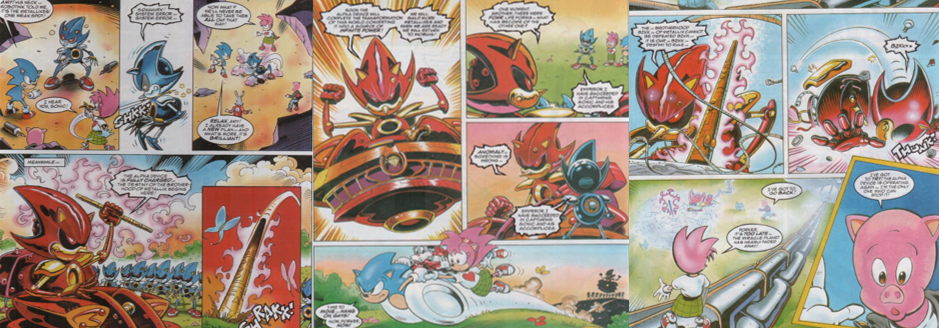
Detected by the Metallix, Sonic leads his friends into an immense network of caves (where, it’s revealed, he hid from Amy Rose for two days when they were trapped there some years ago). A Metallix stalks them through the tunnels and easily shrugs off Johnny Lightfoot’s attack. A Super Sonic Spin stuns the robot, however, allowing Amy Rose to take it out with a well-aimed crossbow to its neck (its one weak spot, as identified by Dr. Robotnik). The distraction is enough for the Emperor Metallix to enact its plan, however, and the Alpha Device begins transforming the Miracle Planet into a world of metal. The Emperor Metallix gloats when one of its troops arrives with Sonic, Johnny, and Amy, but is too late to notice that the unit has been tampered with by Porker Lewis. Porker presses a button on his remote and causes the Metallix to self-destruct, taking out all the emperor’s troops and severely damaging the big red overlord. For his efforts, Porker receives a kiss on the cheek from Amy Rose and even kudos from Sonic, traditionally a more hard-assed character in StC. Unfortunately, the Alpha Device is still functioning and rigged to explode if it’s tampered with. Thus, Porker steps up again, navigating the booby traps to shut down the Alpha Device and undo the damage being done to the Miracle Planet. With Mobius fading, Sonic ushers his friends down the magical chain, only for the Emperor Metallix to lurch to life and reactivate the Alpha Device before collapsing. With no other choice, Porker bravely returns to the Miracle Planet to shut the Alpha Device down once more, trapping himself on the magical world for a month and leaving Sonic with no choice but to wait and see if his friend was successful.

The Summary:
“The Brotherhood of Metallix” has one very obvious positive going for it right off the bat: it’s illustrated by Richard Elson, easily the best artist in Sonic the Comic’s all-too-short history. He brings Sonic and StC’s original characters to life with such a peerless flair and stories always felt more important when his name was attached to them. Unfortunately, it appears Elson was rushed during this particular story as I saw a lot of repetition in “The Brotherhood of Metallix”. Some panels during Sonic’s battles with the Metallix, for example, are directly lifted from Elson’s work in “The Sonic Terminator” (Kitching, et al, 1994) and many of Sonic’s poses looked familiar, too. It’s a minor thing and it’s not like every panel is like that, but it was noticeable and a little odd considering the detail seen in Mr. Blobnik and the Emperor Metallix. The story also suffers from promising a team up between Dr. Robotnik and Sonic and failing to deliver on almost every level. They don’t join forces or oppose the Metallix as a team; instead, Dr. Robotnik simply warns Sonic of the threat, tells him of the Metallix’s weak spot, and that’s it. It’s pretty disappointing as this could’ve been a longer, multi-part story where Sonic shuns his usual allies to team up with Dr. Robotnik instead, making his friends question his decision and having the mad dictator betray him to seize the Miracle Planet for himself. The cliff-hanger of Porker Lewis being left behind was resolved in a later story and expanded into a full-on nervous breakdown for the character, but it could’ve easily been Dr. Robotnik who rigged that Metallix to blow and was left trapped on the Miracle Planet. Consequently, as amusing as the Mr. Blobnik stuff was, I feel these panels were wasted and could’ve been better served showing a proper, awkward team up between Sonic and Dr. Robotnik where they battle at least one Metallix together.

As great as the art is, Metallix is strangely inconsistent and the story squanders its potential.

Speaking of which, the Metallix are a bit hit and miss here. In his first encounter with his robotic double, Sonic struggled to compensate for Metallix’s super speed, power, and armaments. This was taken one step further in Sonic’s second encounter with the robot, which was so powerful that it made mincemeat of Knuckles the Echidna and Sonic was forced to transform into his demonic, unstoppable alter ego, Super Sonic, to destroy it. Metallix has always shrugged off Sonic’s best shots and has always been depicted as being, as the kids say, “built different” from Dr. Robotnik’s other creations. While that’s somewhat true here, it’s pretty inconsistent: sometimes they shrug off the Super Sonic Spin Attack, sometimes it stuns them, sometimes they barely flinch when struck and sometimes Sonic shatters them with a glorified pole! To make matters worse, Porker Lewis easily blows a bunch of them up with a single explosion, severely diminishing their threat despite one or two of them being framed as formidable and menacing robots when they’re pursuing the Freedom Fighters. I did enjoy seeing Metal Sonic Kai from Knuckles’ Chaotix (SEGA, 1995) reimagined as the brotherhood’s emperor. It’s a fantastic design and almost resembles Davros at times, with the gigantic emperor floating about in its throne and spearheading the creation of a Metallix army to take over the world. The Emperor Metallix’s plot is somewhat vague and generic – it wants to transform the Miracle Planet and use its mysterious energies to produce more troops – but it’s at least framed as a threat in its large and menacing stature…until it’s easily disabled by Porker’s explosion! In the end, this was a decent enough follow-up to “The Sonic Terminator” but didn’t live up to its full potential, in my opinion. We didn’t get to see anything new from the Miracle Planet, we lost out on a proper Sonic/Dr. Robotnik team up, and the whole story seems to be more set up for future stories rather than properly standing on its own two feet.

My Rating:

Rating: 2 out of 5.

Could Be Better

Have you ever read “The Brotherhood of Metallix”, or any issues of Sonic the Comic? If so, what did you think of the story and the return of this version of Metal Sonic? Were you also disappointed that we didn’t get a true team up between Sonic and Dr. Robotnik? What did you think to the Emperor Metallix and the depiction of the Metallix in this story? How are you celebrating Sonic CD’s anniversary this year? Whatever your thoughts on Sonic CD, or Sonic in general, feel free to leave a comment below, support me on Ko-Fi, and check out my other Sonic content.

Back Issues: Shinobi

Writer: Alan McKenzie – Artist: Jon Haward

Story Title: “The Dark Circle”
Published: April / May 1993

Story Title: “The Fear Pavilion” (Part 1 to 6)
Published: 29 May 1993 to 7 August 1993

Story Title: “The Art of War” (Part 1 to 6)
Published: 5 February 1994 to 16 April 1994

Story Title: “Way of the Warrior”
Published: 23 April 1994

Story Title: “Power of the Elements” (Part 1 to 7)
Published: 4 March 1995 to 27 May 1995

The Background:
For a while there, back in the eighties and nineties, ninjas were a big deal in movies, comic books, cartoons, and videogames. Mysterious and deadly assassins often dogged comicdom’s most popular superheroes and these agile, well-armed martial artists also inspired some of the most difficult videogames of the era. In 1987, SEGA entered this arena with Shinobi, a challenging critical and commercial success that was later refined for its home console release. Director Noriyoshi Ohba pulled out all the stops for the sequel, The Revenge of Shinobi (SEGA, 1989), to showcase the capabilities of SEGA’s all-powerful Mega Drive. A notorious release praised for its visuals and gameplay variety and heralded as a Mega Drive classic, The Revenge of Shinobi spearheaded a brief period of relevancy for SEGA’s long-forgotten sub-series, with additional sequels and spin-offs released for their 8- and 16-bit consoles. These videogames also served as the basis for a series of comic strip adaptations exclusive to the United Kingdom. The first Shinobi strip appeared in the 1993 Sonic the Hedgehog Yearbook, the precursor to Sonic the Comic (StC), a fortnightly publication first debuting that same year and which I diligently collected as a kid until its unfortunate end in 2002. Joe Musashi featured in three multi-part adventures in the main comic over the course of three years, as well as a one-off appearance in the short-lived Sonic the Poster Mag, and his first six-part adventure was even collected in a trade paperback courtesy of Ravette Books. I have to admit, though, that I often skipped the Shinobi stories when I read StC as a kid so this will be my first time sitting down and giving them some attention for many years.

The Review:
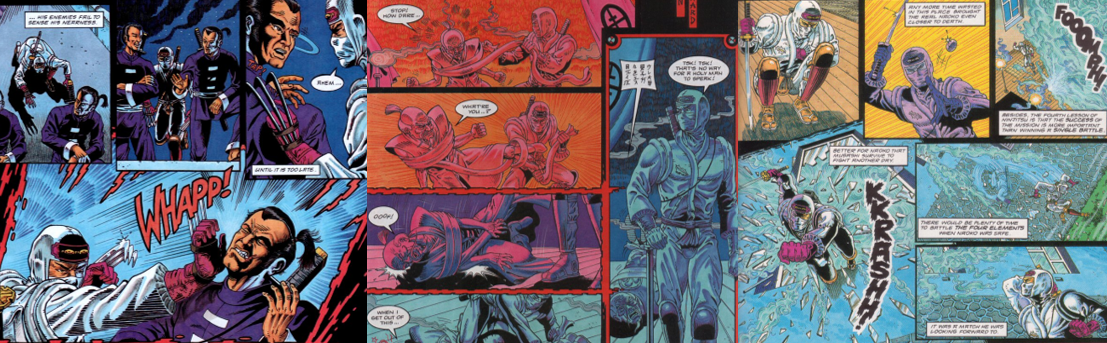
When we first meet Joe Musashi, the titular Shinobi, in the 1993 Sonic the Hedgehog Yearbook, he’s in Tokyo, Japan and hot on the trail of his lover, Naoko, who’s been abducted by Neo Zeed, the same malevolent ninja clan that murdered Musashi’s teacher (or “sensei”) in what is essentially the same setup as in The Revenge of Shinobi. Musashi easily identifies a Neo Zeed hideout and blasts his way in with a touch of plastic explosive, only to be met by rats and dust. Taking a moment to explore using the mystic art of haregai (billed as a “sixth sense” employed by highly trained ninja), Musashi moves to an elaborate foyer, the omniscient narrator downplaying rumours that Neo Zeed have begun dabbling in dark magic, only to be surprised by a gas bomb. A black-clad ninja assaults Musashi through the smoke, blinding his haregai and striking from behind. Even when the smoke clears and the assailant (somewhat analogous to the Shadow Dancer boss encountered in The Revenge of Shinobi) reveals himself, Musashi’s senses are dulled and Shinobi struggles to stay conscious from the vicious assault. Rallying his celebrated ninjitsu skill, Musashi wields his Oborozuki blade and matches the ninja blow for blown, eventually emerging the superior and opting to spare his opponent’s life since Musashi has pledged to take a higher path. Despite his investigation leading to a dead end, Musashi disappears into the night still determined to find his kidnapped lover. This is where we find him in his first multi-part story in StC, sneaking into a towering pagoda controlled by Neo Zeed that’s somewhat similar to the beginning of The Revenge of Shinobi. After easily subduing the clan’s attack dogs, Musashi clambers up the pagoda wall using a grappling hook and clawed appendages on his gauntlets, sneaking behind two unsuspecting guards and non-lethally taking them out. Musashi sneaks through the building, passing the clan’s deadly training areas, and catching another group of ninjas as they drink saké. Demanding to be taken to Naoko, Shinobi is inevitably drawn into battle with the group, easily deflecting their shuriken and whacking them with the hilt of his sword.

Musashi infiltrates Neo Zeed’s pavilion, only to walk into a trap and run a dangerous gauntlet.

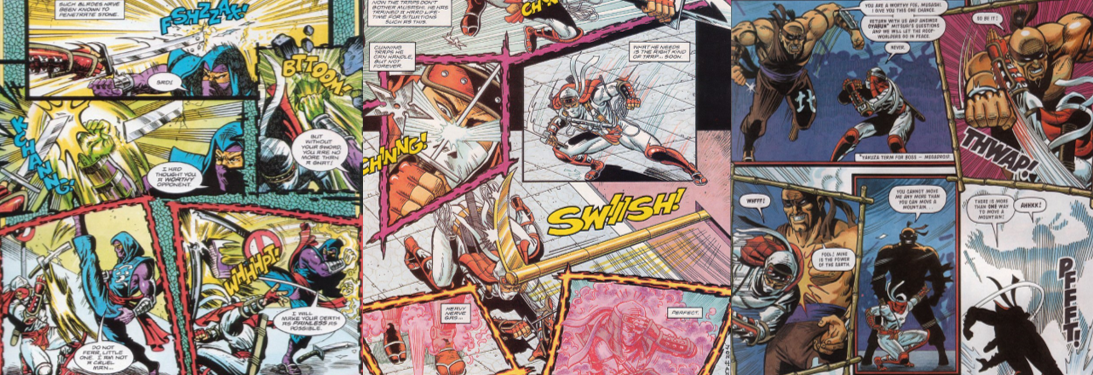
Despite their superior numbers and deadly weapons, Musashi triumphs but is frustrated when the final foe reveals Naoko isn’t in the pavilion and that he has been lured into a trap. Despite being warned of formidable martial artists awaiting him in the pavilion, Musashi descends downwards undeterred and meets an elderly warrior who presents himself as an ally and impresses Shinobi with his deft skill. Reagrdless of the threat, and the elder’s surprising speed, Musashi eventually ties the holy man up in his own robes, leaving him cursing on the floor. Next, Musashi comes across an elaborate stage and a Neo Zeed assassin painted like the Monkey King, a kabuki character renowned in Chinese opera for his kung-fu prowess. Attacking with a viciousness befitting of his clan and throwing Musashi off with his “monkey-style kung-fu”, the Monkey King proves a formidable threat…until Musashi rams the hilt of his sword into the foe’s gut, leaving him a winded and blubbering mess. On the next level of the titular fear pavilion, Musashi meets a muscular warrior who stomps about with stilts strapped to his legs. As if the additional power and reach offered by these appendages wasn’t enough, the fighter also mocks Musashi’s size and skill, breaking a few of Shinobi’s ribs, though Musashi cuts the warrior down to size and limps on. In the next room, Musashi is stunned to find Naoko waiting for him in an unguarded room, cautious despite his haregai not detecting any threat. His wariness turns out to be true as “Naoko” reveals herself to be “Water”, one of the legendary “Four Elements” who control Neo Zeed. Unprepared to face one of Neo Zeed’s daunting commanders and realising that he’s not only outmatched but that Naoko isn’t in the pavilion, Shinobi tosses a smoke bomb and flees from the hazardous pagoda, vowing to confront his enemy on equal ground later.

While his Sun Tzu needs some work, Musashi finally rescues his lover from Neo Zeed.

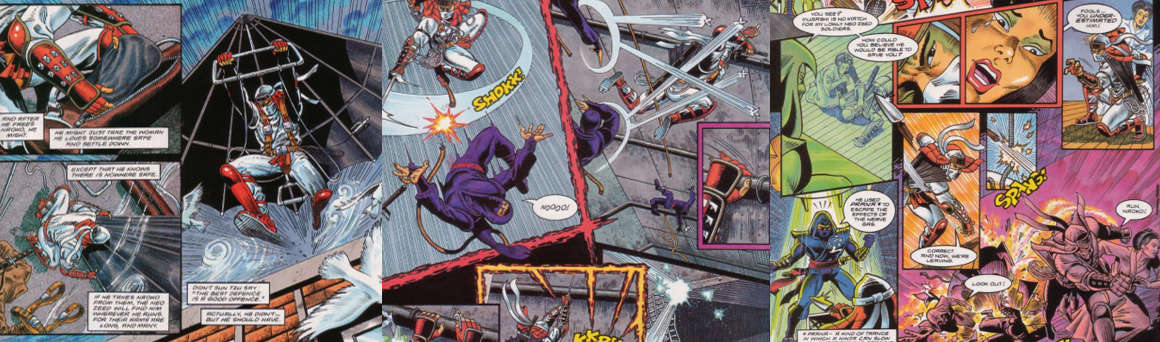
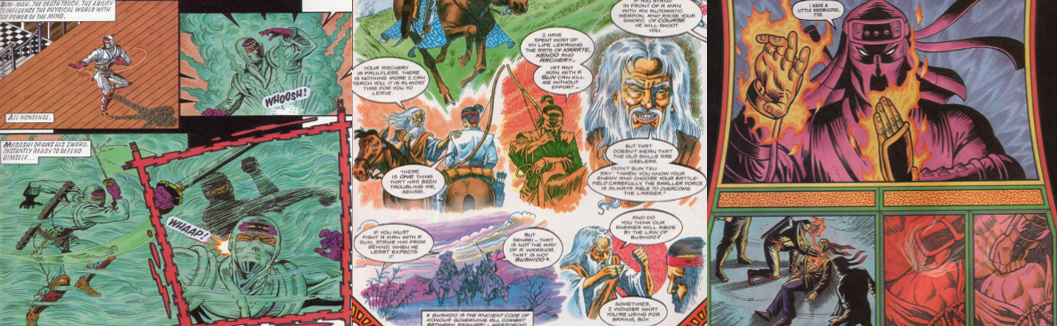
Sometime later, having recovered from his injuries, a disguised Musashi observes Neo Zeed’s corporate headquarters in downtown Tokyo. Seeing that the skyscraper is nigh-impenetrable and well-guarded, Musashi realises he needs to find another way inside and recalls not only the teachings of Sun Tzu but his training on Mount Hotaka five years previously. Back then, while Musashi’s skills impressed his sensei, he was chastised for his naivety regarding dishonourable methods, such as striking armed enemies from behind, since his foes will not adhere to the rules of Bushido. Musashi learned this the hard way as Neo Zeed poisoned the old man like cowards and kidnapped an innocent girl, so Musashi busts out a hang glider to cross to the skyscraper’s rooftop, reasoning that Neo Zeed wouldn’t anticipate such an attack. Again taking inspiration from Sun Tzu, Shinobi climbs down the building on a rope, slips inside via a conveniently open window, and accesses a computer terminal to better “know [his] enemy”. Musashi proves a master hacker, easily guessing Neo Zeed’s password and searching for Naoko. All too late, Musashi remembers how he honed his haregi through blindfold combat and equally learned that even this superhuman sense can be tricked, causing him to realise his actions have put the building on high alert. Although Shinobi easily subdues a heavily-armed guard, Neo Zeed’s ninjas pursue him down an elevator shaft and, facing a deadly plummet, seemingly breaks his no-killing rule before barely escaping through a ventilation shaft. Remembering his sensei’s teachings, which emphasised that winning is all that matters in a life-or-death confrontation, Musashi knocks out an amusingly inept ninja and assumes his identity only to walk into another trap! Musashi avoids flames, spikes, shuriken, and scythe-like blades but falls victim to a blast of knockout gas and is brought before the Void, Neo Zeed’s “supreme ninja”, who apparently has authority over even the Four Elements since he orders the hulking “Earth” around like a mere underling.

After humiliating the Void, Musashi makes chumps of the Yakuza and angers the Four Elements.

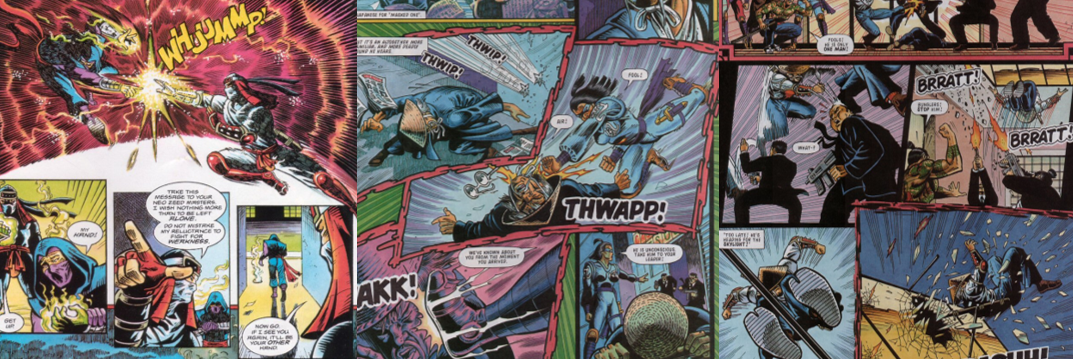
After finally reuniting with Naoko, Musashi springs up, fooling the Void’s minions with prana (death-like trance), and once again escapes rather than fight overwhelming odds. While Water is eager to pursue, the Void forces her to focus on the bigger picture; thus, Musashi and Naoko glide to safety and finally lovingly embrace. After returning Naoko home, Musashi pursues the Void to the Hakima industrial estate and, though he easily dispatches the supreme ninja’s underlings, Shinobi is overwhelmed by the grand master’s mystical power. Utilising the ancient “iron hand technique”, the Void not only physically overpowers Musashi, he also shatters his Oborozuki and leaves Shinobi desperate to come up with a counterattack that won’t violate his code against killing. Thus, Musashi utilises his prana again, focusing it through his body and into his hands to match the Void’s iron fist technique. While the supreme ninja mocks Shinobi’s efforts, their clash leaves the Void’s hand shattered and the Neo Zeed commander humbled. Spared by his foe, the Void has no choice but to slink away with Musashi’s warnings ringing in his ears. About a year later, the Four Elements, now directionless ronin, end up working for the Yakuza (the Japanese mafia) in downtown Tokyo, peddling drugs and gambling, and leading Musashi to track them to Yakuza boss Mitsugi’s casino. Frustrated at Mitsugi’s refusal to employ their unique talents and his ignorance about Musashi, the Four Elements gatecrash the boss’s poker night and demand satisfaction, which the heavily tattooed crime lord agrees to out of curiosity about Musashi. Thus, despite his clever disguise and dodging a barrage of shuriken, Musashi is easily subdued by “Air” and brought before Mitsugi. However, Musashi once again fools his foes with his prana, wounding Mitsugi with a kunai and the death of one of his minions (again, so much for that “no-kill” rule!) Seemingly wishing to see the Yakuza humbled, Water orders her cohorts not to interfere as Shinobi easily escapes their grasp with his patented somersault. Naturally, Mitsugi is displeased by Air’s deception since she knew that Shinobi wasn’t to be trifled with, but she emphasises that it was the only way to demonstrate Musashi’s threat and get approval to hunt Shinobi down.

After a hard fought battle, Musashi defeats the Four Elements but continues his vendetta against Neo Zeed.

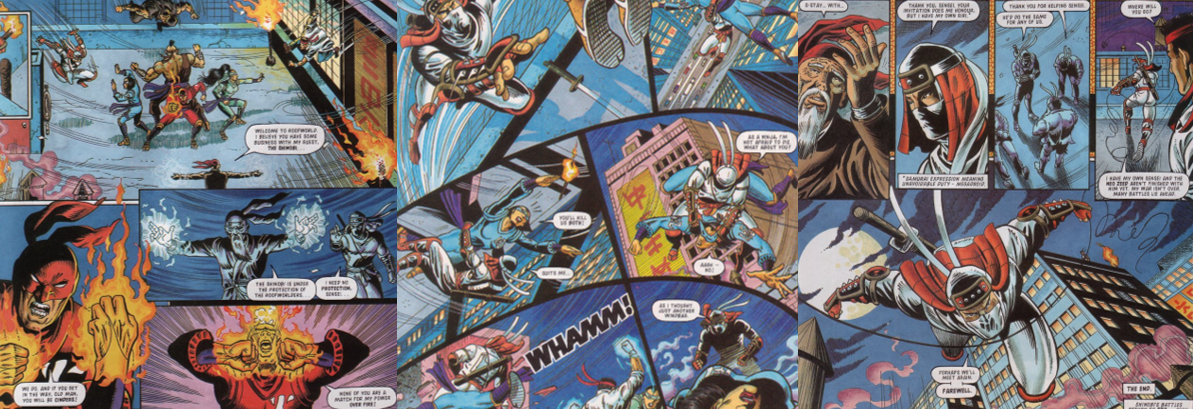
Fleeing across the city’s rooftops, the disguised Musashi is jumped by the “Roofworlders”, vagrants who dwell above to avoid the “jackals” on the streets. Their leader, Kotomi-Sensei, recognises Musashi’s garb and, regretful of the attack, invites Shinobi to stay with them. While touring their makeshift shanty town, Musashi learns that Kotomi-Sensei rescued his fellow homeless and taught them to defend themselves. Though Shinobi doesn’t want to endanger the Roofworlders’ sanctuary by bringing the Yakuza to their doorstep, Kotomi-Sensei insists that, together, they can repel the attackers. While the Yakuza scoff at Air’s superstitions, her intuitions turn out to be correct as Shinobi and his new allies blindside her and her goons. Despite having some backup, Musashi is still sent reeling by the mystical power of Earth, which shakes the ground, though he quickly counters by knocking Air unconscious and sending Earth tumbling to the ground below after blinding him with a magnesium pellet. Simultaneously, “Fire” and Water rush Kotomi-Sensei, believing the old man is no threat, only for Wind to fly into a rage when this underestimation sees Fire reeling in agony from a nerve strike. Disturbed, the Four Elements order a tactical retreat, and Shinobi is kept from pursuing when Kotomi-Sensei is wounded by gunfire. Luckily, not only is this merely a flesh wound but the old man knows a mystical technique to heal his injuries. After regrouping, Musashi and the Roofworlders prepare for the inevitable counterattack, striking from the shadows to subdue the Four Elements’ Yakuza cronies. Though Fire tries to roast Kotomi-Sensei, the old man shields himself with a mystical barrier and the other Roofworlders battle the other warriors while Air once again fights with Musashi. Thanks to her agility and flight, Air soon has Musashi hanging on for dear life but, when he makes a desperate leap, she’s sent crashing into a wall. Though Kotomi-Sensei generates a sword of pure chi to battle Fire, he’s hit with the “poison hand technique” and left facing a swift death, which rallies his comrades to overpower Earth and dispel Fire and Water. Luckily, Musashi applies some chi of his own to save Kotomi-Sensei, though he politely refuses to stay with the Roofworlders since his war against Neo Zeed is far from over.

The Summary:
Yeah… there’s a reason I often skipped the Shinobi stories when reading Sonic the Comic. It was honestly rare for any of the backup stories based on SEGA’s other properties to be any good and some, like the Decap Attack (Vik Tokai, 1991) strips, far outstayed their welcome, and I have to say that Shinobi falls into this category as well. On the plus side, the art and writing is very consistent, with the same duo working on all of Joe Musashi’s appearances, and the stories have a far more mature edge compared to StC’s norm. While Musashi naturally has a code against killing and thus isn’t slicing his opponents up with his sword, there’s a touch of blood across these stories, many references to death, a fair bit of violence (Musashi gets his ass kicked a lot and even suffers broken ribs), and there is that one panel where a Yakuza gets gunned down! The writing does fall apart under close scrutiny, however, with Musashi being an avid reader of Sun Tzu and yet constantly being tricked and falling into obvious traps. He often finds innovative ways to counterattack physically superior foes and isn’t averse to fighting dishonourably, but it’s odd seeing his vow against killing be repeated so often and to then watch him send a ninja plummeting down an elevator shaft without even a moment’s reflection. I did like the flashbacks to his training, where Musashi was a capable and formidable warrior in all aspects of combat and yet still somewhat naïve, reluctant to break the Bushido code and needing to learn that the rules must be bent in real-world conflicts. He still sees himself as walking a higher path compared to his enemies, sparing their lives whenever he can and always attacking with the hilt of his sword or opting to knock out his enemies. However, even Shinobi still has much to learn as Kotomi-Sensei exhibits mystical abilities that dwarf even his unreliable haregai and his overused prana.

Musashi is a talented and formidable ninja, but also flawed at times and with much to learn.

Indeed, even Musashi scoffs at mysticism throughout these stories, which is a bit odd considering he utilises magic in the Shinobi games and later draws strength from the prana to match the Void’s iron hand technique and utilises chi to counteract the poison fist technique. Portrayed as a cunning and talented swordsman, Musashi is also a master of disguise, dressing up as an old man to case out Neo Zeed’s headquarters and Mitsugi’s casino and even stealing a ninja’s uniform at one point. Sure, he’s regularly discovered, or his deception is anticipated, but I appreciated the effort, at least. Musashi also has a fair few tricks up his sleeve; he doesn’t have his surfboard or canine companion, but he does use a hang glider, smoke bombs, and flash grenades. Although the stories focus more on their own narrative, one heavily inspired by The Revenge of Shinobi, a few elements from the videogame appear. Musashi deflects shuriken like in the opening, slashes his sword as he does during combat, and performs his rolling somersault, though very few of the enemies he faces or the locations he visits are from the games. This is a bit of a shame as it would’ve been nice to see the bosses used in place of the Four Elements and the masked Ninja Master instead the Void. Musashi’s primary goal is rescuing Naoko and bringing down Neo Zeed, just like in the videogame, though he encounters no knock-off characters, supercomputers, or robots here. He’s pretty much exclusively fighting ninjas, as in the original Shinobi, and is generally depicted as being superior to every foe thanks to his Bushido skills. Musashi fights with grace and intelligence, rarely blundering in head-first and never letting his emotions overwhelm him. Occasionally, his resolve does falter, such as when Water masquerades as Naoko or Kotomi-Sensei is endangered, but even then Shinobi gathers his strength and senses to fight back or retreats to regroup and return all the stronger.

There’s no or force Mushashi can’t overcome if he just tries a little harder or gets creative.

While Neo Zeed’s ninjas are no match for Shinobi, Musashi faces an uphill battle since he takes on the ninja clan alone. In “The Dark Circle”, Musashi’s haregai is rendered mute against his assailant’s speed and smoke and, unlike Shinobi, Neo Zeed are happy to kill, with the Monkey Kong proving an especially aggressive and dangerous foe due to his wild fighting stile. The stilt fighter also causes Musashi trouble, as does the old man waiting in “The Fear Pavilion”, though Musashi’s quest always drives him to overcome pain, superior numbers, and even more powerful opponents. While Neo Zeed rigorously trains its members and their locations are filled with traps and martial arts masters, Musashi’s rarely on the backfoot and, even when he is, it’s always revealed to be a ruse by his prana. While the Void is portrayed as a significant threat and certainly has an imposing presence, bossing about the Four Elements and displaying mystical power, he’s left broken and humbled by Musashi simply fighting better. The Four Elements are equally spoken of in hushed tones and Musashi even flees when ambushed by Water, but they’re painfully one note and their threat diminishes over time. Air and Water are given more dialogue and chances to match skills with Shinobi, who tires of their antics, meaning the surprisingly lethal Fire and the hulking Earth toil in the background. Mitsugi is by far the worst villain, happily lording over his criminal empire in ignorance and eager to learn more about Musashi despite literally having the Shinobi tattooed on his chest! It’s telling that Mitsugi vanishes halfway through “The Power of the Elements”; maybe he was to return in a future Shinobi story, as hinted at in the final text box, or maybe he was just a weak ass crime lord who took space away from the visually more engaging Four Elements. While Shinobi had a decent run in StC and there are some enjoyable elements to these strips, I can’t say I missed his presence after the stories ended, despite the loose ends left hanging at the end. There are far better backup stories based on SEGA properties in StC, but at least SEGA bothered to license the character and try and keep him relevant, which is more than can be said of how he’s been treated since the nineties!

My Rating:

Rating: 3 out of 5.

Pretty Good

Did you enjoy Shinobi’s appearances in Sonic the Comic? Which of his stories was your favourite and why? What did you think to the way they adapted elements of The Revenge of Shinobi and would you have liked to see something closer to the videogames? Were you surprised by how mature and violent the strips were? What did you think to the characterisation of Shinobi and his enemies? Would you have liked to see more Shinobi stories in StC? What were some of your favourite non-Sonic stories in Sonic the Comic? Let me know what you think in the comments, support me on Ko-Fi, and go check out my other Shinobi reviews.

Game Corner: Shinobi III: Return of the Ninja Master (Nintendo Switch)

Released: 14 March 2018
Originally Released: 23 July 1993
Developer: SEGA
Also Available For: Mega Drive, Nintendo 3DS, Nintendo Wii, PC, PlayStation 2, PlayStation 3, PlayStation 4, PlayStation 5, PlayStation Portable (PSP), Xbox 360, Xbox One, Xbox Series S/X

The Background:
Ninjas were a big deal back in the day, whether they were mutated turtles, rainbow-coloured fighters, or mysterious assassins. Ninjas and videogames went hand in hand, resulting in titles so challenging that they defined a generation of players. Eager to have a piece of that pie, SEGA saw notable success with Shinobi (SEGA, 1987), a difficult but enjoyable arcade title later refined for home consoles. Director Noriyoshi Ohba aimed to make the sequel a technical showcase for the then-new Mega Drive hardware, one purpose-built for home consoles and which became notorious for including unlicensed appearances by pop culture icons. A widely praised release, The Revenge of Shinobi (SEGA, 1989) is now regarded as a classic of its generation and inspired not just a semi-recurring comic strip in the United Kingdom, but also a third game. Originally scheduled for release in 1992, Shinobi III: Return of the Ninja Master was vastly overhauled when the developers were dissatisfied with the original version, leading to a lot of content being cut and replaced with new mechanics. Though largely seen as being much easier than its predecessor, Shinobi III impressed with its refined gameplay mechanics and visual presentation, with many seeing it as the best of the classic Shinobi titles. This positive reception (and the lack of copyright issues compared to its predecessor) no doubt contributed to Shinobi III having a lucrative lifespan beyond the Mega Drive as the game was included in numerous SEGA collections, converted to 3D, and added to the Nintendo Switch’s online service in 2018, which eased the pain of how expensive an original copy can be.

The Plot:
When Neo Zeed returns under the command of the mysterious Shadow Master, the legendary Shinobi, Joe Musashi, fights to end their sinister bio- and cybernetic research.

Gameplay and Power-Ups:
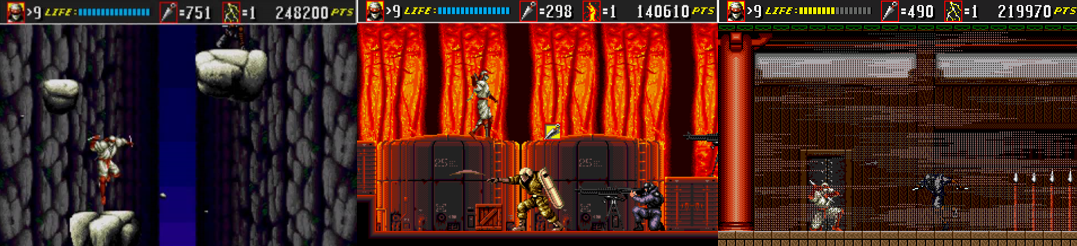
Shinobi III: Return of the Ninja Master is the last of the Shinobi titles released for the Mega Drive and, like its predecessor, is an action/platformer with a strong emphasis on projectile-based combat. Like in the last game, players take Joe Musashi through multiple levels (or “Rounds”), each with at least three stages, though this time there are only seven Rounds. As before, there are four difficulty settings to choose from, with the harder settings dramatically reducing your total life count, and players can continue their game a handful of times if they exhaust all their lives. Unlike in The Revenge of Shinobi, however, Shinobi III’s control scheme is locked to a preset that maps your jump to A, tosses shuriken with B, and activates your “ninjitsu” magic with Y. You can still set how many shuriken you start with, however, and you can still pull off a somersault by pressing A at the height of your jump. Press B when somersaulting to unleash a shuriken spread to take out multiple enemies or press down on the directional pad to pull off a flying kick. As before, Musashi can assume a “defensive pose” to deflect incoming projectiles, but this is now done manually by holding B and you can even do it while crouching and crouch-walking. Shinobi can also dash by quickly tapping left and right, dramatically speeding up the action, wall jump by…jumping off walls…and cross gaps and hazards or navigate stages while clinging to ceilings, pipes, and such by holding B. Various goodies are found by smashing crates, ranging from health-restoring hearts, rare extra lives and ninjitsu replenishments, to additional shuriken and the ever-annoying time bomb. Musashi is far faster and more versatile this time around, moving at a swifter pace and boasting a few additional tricks to make combat and gameplay smoother. It’s still tricky pulling off his somersault and the wall jump can be finicky, but I found Shinobi III far more forgiving than its predecessor and focusing more on action than platforming.

Musashi is faster and more deadly than ever, to say nothing of a master rider and surfer!

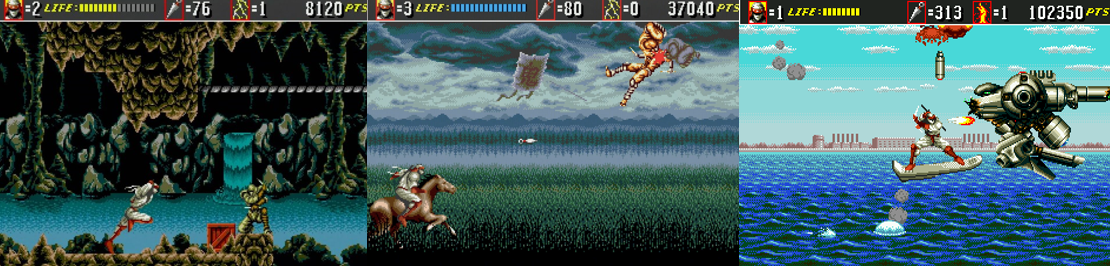
Players can once again collect “Power-Ups” to boost Shinobi’s attacks, adding his deadly sword to his melee attack and block and transforming his shuriken into flaming projectiles. Players also gain points for every enemy defeated and item collected, and the end of Round score tally also adds points depending on if you used your ninjutsu magic or your remaining health. By pausing the game, players select which ninjitsu technique to use with Y, with each functioning exactly like The Revenge of Shinobi: Jutsu of Ikazuchi temporarily protects Shinobi with an electrical shield, Jutsu of Kariu summons flaming pillars to damage all enemies, Jutsu of Fushin enhances your jumping speed and height, and Jutsu of Mijin has Shinobi self-destruct (costing him a life) to destroy enemies. Only one of these can be used per life but you gain additional uses by finding items, though I found less use for them this time around as Shinobi is largely grounded and the game encourages you to wall jump and spider-walk to clear gaps. Musashi gains two additional abilities, the first being a horse and the second some bitchin’ surfin’ skills! Round 2 sees you racing across a marsh-like field on horseback, jumping obstacles and taking out enemies with your shuriken or ninjutsu. Round 4 has you surging across the water, jumping off ramps to collect items and avoid mines while defeating waves of enemies, with both instances functioning like autoscrolling shooter. Round 6 also sees you in freefall down a canyon, forcing you to hop to falling boulders to keep from dropping to your doom, while many stages force you to clamber to higher levels by finding surfaces to cling to (which isn’t always obvious).

Though more forgiving, some new gimmicks and refined mechanics add to the challenge.

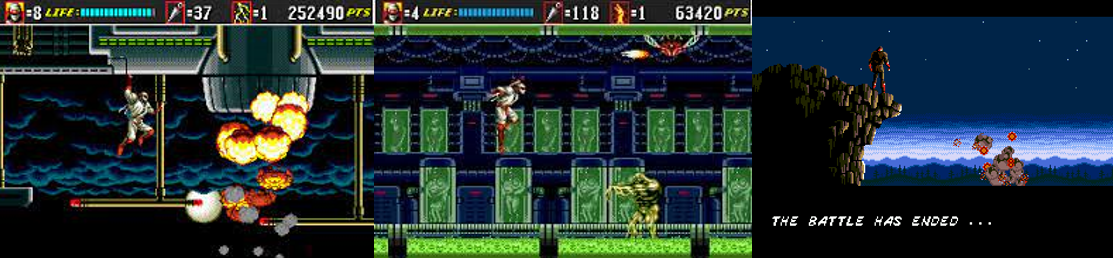
Shinobi III is much more challenging, overall, than its predecessor, throwing far more enemies and hazards at you but with the caveat that most stages keep you quite grounded and I found extra lives a touch more plentiful. Bottomless pits are commonplace, of course, and many times platforms will either be temporary or will require time bombs to destroy so you can progress, but insta-kill hazards are limited to crushing spikes rather than lava pits. Sometimes, you must time your wall jumps and spider-walk to avoid electrified walls and ceilings; others, you cling to or run across conveyers to progress. There are instances where you ride platforms either across a zig-zag-like track or directly upwards, with Round 2 featuring a vertical autoscroller that’ll see you crushed or left behind if you don’t pay attention. Round 3 dumps you in a disgusting, bio-organic nest where the sticky ground slows your movement and Round 4 sees you hopping to sinking barrels around an oil rig, leaping to firmer ground before you drown. Round 5 mimics a similar stage from The Revenge of Shinobi in that you can somersault over chain-link fences but, this time, you must also avoid hidden mines that eventually explode under your feet! Toxic goop, electrical sparks, and support beams hanging under Neo Zeed’s fancy blimp all make traversal an issue in their own way. Round 7 takes you inside the blimp, where drones attack as you ride a precarious moving platform, while the final area of this stage features platforming and skill-based challenges so troublesome that no enemies are required! As if tricky jumps weren’t bad enough, Round 6 puts you in a mist-filled pagoda where spikes jut from the ground and another damn door maze awaits! This was much simpler to figure out compared to the one in The Revenge of Shinobi (I simply guessed the route by taking the high ground), though made more challenging since enemies respawn each time you looped around!

Presentation:
Although Shinobi III is visually very similar to its predecessor, there have been a few improvements between the games. Musashi still doesn’t have an idle pose, but his sprite is much bigger, more detailed, and versatile thanks to his expanded move set. He now grabs the hilt of his sword when powered-up, cuts a mean pose when surfing, and blood splatters whenever he or his enemies take damage! While many sound effects are unchanged from The Revenge of Shinobi and enemies still explode in spectacular fashion, the soundtrack is overall inferior to the last game. Obviously, I have more nostalgia for The Revenge of Shinobi so I’m naturally biased towards that game, but Shinobi III really disappointed in its tracks, and in the less visually interesting enemies (especially compared to the beta version). However, larger enemies (such as samurai and various mechs) do appear more often, almost as mini bosses, and you’ll face far greater numbers and waves of enemies, with no visible slowdown or performance issues. I liked that the bombs now had a visual timer, the additional weather effects (such as rain, wind, and parts of the environment reacting to these elements), and the greater depth added to the backgrounds. Stages are far more detailed, lively, and have many more instances of parallax scrolling, making for a technically more impressive title. This is best felt in the expanded introduction (featuring a larger, more impressive, animated interpretation of Musashi), the new map screen, and the detailed artwork that pops up after you clear a Round. The game also features more story text at the start and end, and even end credits this time around (though there’s only one ending in Shinobi III).

The visuals and gameplay are vastly improved over the last game, resulting in a more impressive title.

Things start with a visual bang in Round 1’s dense forest, with grass and leaves rustling in the wind, which leads into a dank, dark cave filled with waterfalls and rippling water. I loved the marsh lands and docks that rush past in Round 2 and 4, respectively, which see clouds, kites, and tanks in the distance. The cyberpunk-like city of Round 2, the industrial factory/oil rig of Round 4, and the cybernetic research area seen in Round 5 were all worlds above the visuals offered in the last game, with foreground elements (mostly trees, pipes, and other machinery) bringing each area alive and never being too intimidating in how cluttered they were. While Round 6 was mostly relegated to a grey canyon, I loved the sense of speed as you fall to certain doom, though the night sky and full Moon are done far better in Round 7, where thick clouds rush past. Rounds 3 and 5 impressed me the most, however. Round 3 takes place in an ominous, high-tech bio-weapon facility where Neo Zeed’s bizarre abominations and brain-like experiments slumber or burst free from captivity. This leads to a revolting sewer where Neo Zeed dispose of their toxic waste and experiments, meaning the surfaces are teeming with sticky, biological sludges and malformed monsters lurk. Round 5 takes the military base from the last game and sets it against a raging inferno and explosive oil drums, then sees you slashing through another high-tech factory, this one with molten metal bubbling in the background and ominous, vaguely familiar mechanical dinosaurs waiting to be activated. The final battle occurs in a bizarre, cyberspace-like environment that really messes with your mind, while additional lighting effects and environmental details add a level of polish to the Shinobi formula that keeps it both traditional and bizarre and better showcases the Mega Drive’s power.

Enemies and Bosses:
Neo Zeed’s forces are once again primarily comprised of ninjas and soldiers, though these are noticeably cybernetically enhanced. Ninjas drop from trees, somersault over you, toss shuriken, and fly about on bat-like wings, as before, and come in different colours to indicate when you’re getting closer to the big bad. Larger samurai guard the tunnels in Round 1, slashing an energy wave and cutting with their large katana, though these are defeated as easily as the regular ninjas. The soldiers still fire machine guns, but now use mortals rather than grenades and there are no Marines bolstering their ranks, though red-clad female assassins still pop up. Ninjas now ride futuristic hoverbikes, pilot mechs, and are joined by odd, blowpipe-firing figures and floating kabuki-style warriors who emit flame bursts. Crawling brains and sludge monsters attack in the depths of Neo Zeed’s laboratory, soldiers wield laser rifles, shields, and boomerang-like projectiles, and mutated bugs, laser turrets, and persistent drones also await your presence. Steam bursts from vents, enemies crawl on ceilings like spiders, and more mini bosses appear during your playthrough. These include the return of the agile and Shadow Dancer (who now rains spears while jumping around), a gauntlet against an army of mutated brains as toxic goop bubbles nearby, large mechs that dash and attack with rapid-fire pulse cannons, and Karura, a lance-carrying bird man who attacks as you plummet in Round 6 and becomes invulnerable when seen as a whirring blur of feathers. You’ll also take on another supercomputer, though this one zaps you with an electrical field and fires explosive shells into the arena. Round 4 ends with a two-phase battle against an intimidating mech boss that begins as little more than a giant cannon in the water and soon takes to the air and requires you to blast away its cannon and shield before attacking its main body.

Some bizarre and gigantic bosses set the stage for the game’s formidable final challenge.

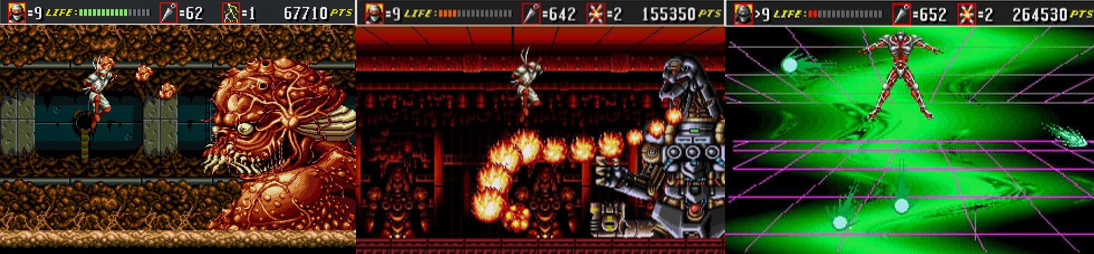
The first boss you face is another giant samurai, one mutated to sport four arms (two holding katana and two wielding a spear). Though you can’t hop to the high ground and this guy can dash, it’s easy enough to jump over him, use your somersault attack, or roast him with Jutsu of Kariu. Shinobi III takes a turn into the bizarre and macabre in Round 3, which sees Musashi targeted by a gigantic, malformed blob of mewling flesh while navigating the sewers and then facing off with the ghastly abomination. It lumbers in from the right or emerges from the disgusting ground, tossing chunks of flesh or swiping with its deformed hand, and noticeably degrades as you deal damage to its drooping eyes. While Shinobi III opts not to tow the line between parody and copyright infringement with its enemies and bosses, the developers couldn’t help but include an appearance from Mechagodzilla in Round 5. This gigantic, impressively detailed sprite emerges from the darkness and plods about in the background, breathing fire and raining debris. After destroying its head, it’ll unleash a barrage of projectiles from its chest, making this a tricky encounter even though touching it doesn’t hurt you. Round 6 ends with a rematch against Neo Zeed’s big boss, a squat, masked, demonic figure who whips his hair. This time, the fight occurs in a dark room full of doors that the masked fiend emerges from, tricking you with a duplicate. Though the fight is noticeably easier, it can be tough picking the right one and he becomes more aggressive, flinging a spread of darts after enough hits. This time, the final battle is against the Shadow Master, which is a two-phase affair fought in a psychedelic environment. The Shadow Master is super-fast and aggressive, leaping about, tossing kunai, teleporting, rushing at you with a sword, and delivering an explosive hit. After enough damage, he powers up and tosses energy projectiles, a flurry of blasts, and a charged shot from his arm.

Additional Features:
While Shinobi III is quite a challenge even on “Easy”, you can make things even more difficult by selecting harder difficulties, thus limiting your lives and continues. While you can accumulate points, there’s still no high score table to put your name on, though the “Options” menu has been expanded to include sound effects and voices. As in The Revenge of Shinobi, you can grant yourself unlimited shuriken with a simple trick but, even better, Shinobi III features an invincibility cheat activated by playing certain songs in the right order. Not that you really need that when playing this version of the game as the Nintendo Switch offers rewind and save state features to cut the challenge off at the knees. Finally, if you’re playing the version included in the SEGA Mega Drive Ultimate Collection (Backbone Entertainment, 2009), you get an Achievement for finishing the first stage without a continue and, in the SEGA Mega Drive Classics collection (SEGA/D3T, 2018), you get an Achievement if you beat any level without tossing a shuriken.

The Summary:
I never grew up playing Shinobi III: Return of the Ninja Master, so I don’t have the same level of nostalgia for it as for The Revenge of Shinobi. However, this did everything I’d expect from a sequel: it took what worked in the last game and expanded upon it. The visuals are greatly improved, with Joe Musashi being much faster and tighter to control. His additional moves and abilities were a welcome inclusion, mitigating my difficulties at mastering his somersault and adding an extra layer to the platforming and jumping challenges. I appreciated the added emphasis on fast-paced, hack-and-slash combat and the autoscrolling sections, which nicely broke up the gameplay and served as fun distractions. While the soundtrack was disappointing and I wasn’t blown away by the enemies, the bosses were a big step up from the last game. There are more of them, for starters, and the developers shied away from ripping off pop culture characters for some gruesome, intimidating, and fun affairs that better test your skills as a player. I did find the ninjitsu a bit wasted here, however, and it was a shame Musashi didn’t gain new magic or power-ups to use, but the visual variety offered by the stage design more than made up for it. I appreciated that the game veered more towards the surreal and science-fiction to try and mix things up, and that you were rewarded for playing well in stages. There are few cheap deaths and hazards here, and the game does get very challenging when you’re presented with small platforms, temporary ground, and tricky jumps. I can see this being aggravating on original hardware, but this version of the game makes it a breeze even without the invincibility code. Ultimately, while I would probably still choose to play The Revenge of Shinobi due to my nostalgia for that title, Shinobi III was a worthy follow-up that vastly improved almost every aspect of its sequel, making it equally good in my eyes.

My Rating:

Rating: 4 out of 5.

Great Stuff

What did you think to Shinobi III: Return of the Ninja Master? How do you think it compares to The Revenge of Shinobi and what did you think to Musashi’s new abilities? Were you also disappointed by the soundtrack and the lack of new ninjutsu magic? What did you think to the new bosses and how bizarre some of them were? Did you enjoy the autoscrolling sections and manage to beat the game on original hardware? Which Shinobi game is your favourite? Let me know your thoughts and memories of Shinobi III: Return of the Ninja Master in the comments, support me on Ko-Fi, and check out my other Shinobi reviews.

Mini Game Corner: Shadow Dancer: The Secret of Shinobi (Xbox Series X)

Released: 29 May 2018
Originally Released: 1 December 1990
Developer: SEGA
Also Available For: Mega Drive, Nintendo Wii, PC, PlayStation 2, PlayStation 4, PlayStation 5, PlayStation Portable (PSP), Xbox One, Xbox Series S

A Brief Background:
Back in the day, for a while there, ninjas were the latest craze, appearing as mutated turtles, rainbow-coloured fighters, or mysterious assassins, especially in videogames, where the challenge of ninja-based titles defined a generation of gamers. SEGA’s bid to get involved in the fad resulted in notable success with Shinobi (SEGA, 1987), a taxing but praised arcade title that was improved for home consoles. While its Mega Drive sequel, The Revenge of Shinobi (SEGA, 1989), was met with widespread praise, Shinobi’s first sequel was actually an arcade release just like the original game. Boasting improved graphics and teaming Joe Musashi with a canine companion, Shadow Dancer (ibid) released the same year as The Revenge of Shinobi and was largely praised, despite some aggravating mechanics. While a port was released for the Master System in some territories, the Mega Drive version was noticeably different, adding additional gameplay gimmicks while also being far more faithful to the arcade title than Shinobi’s previous home conversions. Well received at the time and standing the test of time as another classic title for the 16-bit powerhouse, Shadow Dancer was often included in subsequent collections, including the SEGA Mega Drive Classics collection that added a few quality of life mechanics to the game.

The Review:
I was all ready to do one of my regular lengthy reviews about Joe Musashi/Shinobi’s quest for revenge against the Union Lizard ninjas, only to find that Shadow Dancer adheres a little too closely to its arcade roots and therefore is too short to warrant a longer review. Like in the original arcade title, players run, jump, and toss shuriken though five levels (referred to as “Rounds”, with three stages each (the third being a boss battle). Players won’t need to worry about their health here as Musashi once again keels over and dies if he takes a single hit, though he can bounce and bump off enemies and some hazards so it’s only attacks that kill him. Like in The Revenge of Shinobi, players can set the game’s difficulty level, changing the title screen and increasing the number of enemies while decreasing the player’s continues, and will rescue hostages in each stage. Male hostages add to the player’s score, with a final tally adding additional points once a Round is cleared, while female hostages upgrade Musashi’s attacks and see him fling flaming projectiles and throw flaming kicks rather than using his sword for close-quarters combat. Players can add an additional challenge by disabling the shuriken (a death sentence if I ever saw one) and can pick from four different control types. I chose Type B, which mapped the jump to the A button, shuriken to the X button (with no rapid-fire option available), and Shinobi’s patented ninjutsu magic to the B button. Like in the original Shinobi, players are assigned different ninjutsu for each stage and only get one use per stage, earning a point bonus if they finish without using their magic. Musashi can conjure flaming pillars, whirling tornados, and a meteor storm to destroy all enemies, which is handy when you’re swarmed by ninjas. You’re also playing against a three-minute timer (though I always had plenty of time) and can occasionally collect extra lives by finding Union Lizard tokens.

Cut down repetitive ninjas alongside Shinobi’s near-useless canine companion in this challenging quest.

Though he lacks his somersault and shuriken spread and more versatile ninjutsu magic from The Revenge of Shinobi, Musashi can still duck, avoid projectiles using crates and boxes, and hop to higher ground or over fences by holding up and pressing the jump button. This is useful for evading enemies, finding hostages, and getting around some hazards and obstacles, though some enemies can follow you. The game’s big gimmick is the large white canine who fights alongside you. By holding the attack button, players charge a meter and, when released, Yamato pounces upon nearby enemies, distracting them so Shinobi can attack. If players don’t time the button press correctly, Yamato takes a hit and temporarily reverts to a useless puppy, though this mechanic was nowhere near as useful as it could’ve been. I found Yamato often wouldn’t attack and just yapped away uselessly. It would’ve been nice to see him have a more versatile move set, like giving you a jump boost, activating levers, collecting power-ups, or acting as a health bar of sorts so Shinobi can survive one measly hit! As ever, you must avoid bottomless pits and raging waters, though there are some interesting gimmicks that make Shadow Dancer stand out. Round 1-2 features a fun earthquake that splits the screen, for example, Round 3-2 takes place entirely on a rising elevator, Round 4-2 sees the environment and enemies obscured by sporadic shadows in a neat effect, and Round 5-1 is a multi-room gauntlet against swarms of the game’s toughest enemies. Shadow Dancer is incredibly unforgiving at times thanks to its one-hit-kill mechanic, with enemies circling and bouncing you around or knocking you down pits. However, you can hold the Left Trigger to rewind the game, hold “Home” to create or load a save state, and use the Right Trigger to fast forward the action. As in the original arcade Shinobi, a Bonus Round breaks up the action between Rounds. In this section, you frantically toss shuriken at ninjas as Shinobi dives from a skyscraper, earning additional points to claim a few more extra lives depending on how many you kill off.

Some cheap, weird-ass bosses block your path in this bizarre adventure.

Musashi battles a handful of enemies in his quest for revenge. Mercenaries fire laser pistols, taking cover to avoid your shuriken, while their larger commanders shield themselves and toss their shields at your head or shins. Four different coloured ninja grunts regularly throw punches, stab with knives, or carry spears. The claw-handed Iron Claws leap in and roll about, frog-like Geckos crawl around the environment, and an attack helicopter takes shots as you scale the Statue of Liberty. Colourful, nimble ninja also teleport in, wielding dual katana and somersaulting about, slashing at you and attacking in large groups, deflecting your shots and being tougher to kill depending on their colour (with black being the worst!) Each Round ends in a battle against the big bad Sauros’s “Aides” (though, ironically, the titular Shadow Master isn’t amongst them) not unlike those of the original Shinobi. Each appears in a flash of lightning, has a health bar, is fought in an enclosed arena, and players must fight without Yamato or Musashi’s powered-up attacks. Stomper is a giant, distinctly beetle-like samurai who, like Shinobi’s Ken-Oh, spits fireballs that are tricky to dodge. This is compounded by his massive hit box, the debris he rains down, and how tricky it can be to hit his helmet. Mirage is a nimble dominatrix who leaps off screen and tosses large buzzsaws, which she also uses to shield her vulnerable head. At the end of Round 3, Sauros brings a brick wall to life. This screaming monster randomly spawns across the background and attacks by extending and dropping its hands towards you, which are pretty difficult to avoid. Round 5 sees you battle Blade, a spinning, pentagram-like Catherine Wheel that circles your falling platform and tries to roast you, though you can easily spam your shuriken when it stays still. After battling past Sauros’s gauntlet, you face the main man reptile himself in a pretty anti-climactic confrontation. Sauros simply sits on his throne and spawns black ninjas to distract you, eventually detaching his helmet to rain fireballs into the throne room. This is your chance to attack the glowing orb that is his weak spot but be sure to position yourself between the flames!

A visually impressive but lacklustre and unfairly difficult arcade port.

Shadow Dancer looks pretty good, being about on par with The Revenge of Shinobi and featuring large, well detailed sprites. While Musashi doesn’t show much personality, Yamato helps add some visual variety, which the sprites need as there is only a handful of enemies and they’re constantly recycled. Things get off to a decent start with an impressive bit of sprite animation and story text. Each Round is introduced with a big, but partially obscured map and sees Shinobi leap into action, and players are initially dropped into a desolate, seemingly post-apocalyptic city. The background is in flames, the buildings are wrecked, ninja burst from the windows, fire spews from the sewers, and debris falls from the sky! Round 2 sees you first traversing a partially destroyed bridge and then battling across disused railroad tracks, hopping to a rail cart and over fences, while Round 4 takes place in a desolate cavern that tests your platforming skills. Although Round 5 is a largely unimpressive warehouse, Round 3 sees you scaling the Statue of Liberty, hopping up girders and supports, and taking a lift to the torch, with Lady Liberty and New York City in the background. The music is pretty upbeat and fitting for the action, though there’s nothing as memorable as in The Revenge of Shinobi, and players are treated to a bit of partially animated sprite art and ending text upon completion. This version of the game offers filters to recreate the good old 16-bit days, screen borders, a mirror mode for an additional challenge, and two special challenges. If you complete the first two stages without using your magic, you’ll get an Achievement and if you can beat a stage with Yamato in his puppy form, you’ll either earn another Achievement if that’s the first Challenge you completed or be one step towards another Achievement.

The Summary:  
Wow, I was so disappointed by Shadow Dancer: The Secret of Shinobi. I think I must’ve gotten the game confused with the far superior third game in the series as, while the game looks about on par with The Revenge of Shinobi, this is more like a visually improved version of the original, notoriously challenging arcade Shinobi. Joe Musashi lacks all of his improved moves and versatility from Revenge in favour of a cute canine who’s criminally underutilised. I barely used Yamato he was so useless, and it says a lot when your 16-bit, arcade-perfect videogame lacks mechanics that were included in the 8-bit port of Shinobi! Shadow Dancer would offer a decent challenge if not for the archaic and unfair one-hit-kills, which strangely carry over from the arcade version despite them being eliminated in other home console Shinobi games. While the game looks great and it can be fun searching for hostages, it’s pretty barebones, with only five Rounds and extremely limited ninjutsu magic, meaning you’re more likely to rely on your shuriken. Enemies were also painfully recycled, lacking any of the character and personality of those from The Revenge of Shinobi, and the plot is strangely bonkers, focusing on a lizard man with a ninja army? I’m not sure what the titular “secret” of Shinobi was supposed to be or why the game is called Shadow Dancer when that enemy doesn’t even appear, or why SEGA didn’t feel fit to enhance the arcade title to be more in line with the improvements made in The Revenge of Shinobi. If you’re going to play Shadow Dancer, this version is probably the best way since you can exploit the rewind and save state features, but this was a disappointingly hollow experience that didn’t do justice to what the Mega Drive – or the franchise – was capable of.

My Rating:

Rating: 2 out of 5.

Pretty Good

Did you enjoy Shadow Dancer: The Secret of Shinobi? How do you think it compares to the arcade version and other 16-bit Shinobi titles? Were you also disappointed that it included one-hit kills and greatly limited your options? What did you think to Yamato and how useful did you find him? Which of the bosses was your favourite and what do you think the “secret” of Shinobi was? Which Shinobi game is your favourite? Let me know what you think about Shadow Dancer: The Secret of Shinobi in the comments, send me some coppers on Ko-Fi, and go read my other Shinobi reviews.

Game Corner: The Revenge of Shinobi (Mega Drive)

Released: 2 December 1989
Developer: SEGA
Also Available For: Android, Mega/SEGA-CD, Mega-Tech, Nintendo Switch, Nintendo Wii, PC, PlayStation 2, PlayStation 3, PlayStation 4, PlayStation 5, PlayStation Portable (PSP), Xbox 360, Xbox One, Xbox Series S/X

The Background:
Back in the 1980s, ninjas were a big deal. Mysterious, agile, swift-footed martial artists tossed shuriken and took movies, comic books, cartoons, and videogames by storm. We had everything from silent assassins working for the US government, mutated turtles, a slew of rainbow-coloured warriors, and games so iconic and so challenging that they defined a generation of players. SEGA saw considerable critical and commercial success with Shinobi (SEGA, 1987), a tough but rewarding arcade title later refined for its home console conversion. For the sequel, director Noriyoshi Ohba wished to showcase the then-new Mega Drive hardware through a more story-driven title, one better suited to the home console market. Thus, Shinobi gained a life bar and was purposely given a steep difficulty curve to encourage player experimentation. To balance things out, Shinobi was given a finite magic system to help in trickier situations, as well as a handy double jump for improved platforming. Of course, the game became notorious for including unlicensed appearances by major pop culture icons, leading to numerous revisions and graphical tweaks to avoid a lawsuit! One of the defining Mega Drive experiences of my childhood, The Revenge of Shinobi has stood the test of time as a classic of its generation, impressing with its visuals and gameplay variety as much as it frustrated with its mechanics and difficulty curve, and even directly inspired a semi-recurring comic strip here in the United Kingdom. The Revenge of Shinobi has had a tumultuous life post-Mega Drive, occasionally omitted from retrogame collections in favour of its sequel, though a remaster did briefly appear on digital stores (alongside some Trophies and quality-of-life features) in 2012.

The Plot:
When the criminal organisation Neo Zeed murders Joe Musashi’s master and kidnaps his bride-to-be, Musashi once again dons his Shinobi garb and sets out to rescue her.

Gameplay and Power-Ups:
The Revenge of Shinobi is a sequel to the arcade, ninja-themed run-and-gun (more of a “walk-and-gun”, I suppose) Shinobi and, like its predecessor, is an action platformer that sees players guide Joe Musashi, the titular “Shinobi”, across eight stages (billed as “Rounds”), each with three parts (referred to as “Scenes” in the manual and comprised of two action stages and a battle against the game’s “Power Villains”). The Revenge of Shinobi incorporates a “continue” feature, limiting players to three continues per game, and allows players to choose from four difficulty settings (with the hardest settings limiting how many lives they have) and four control schemes. Personally, I prefer “Type 2”, which maps Musashi’s attack to the A button, jump to the B button, and “ninjitsu” magic to the C button. You can also customise how many shuriken Shinobi starts with, and I’d recommend setting it to the maximum amount as you’ll be chucking a lot of throwing stars in this challenging title. Musashi’s primary attack is to throw ninja stars, which he can do while walking, crouching, or jumping. When enemies get close, Musashi strikes with his Oborozuki blade or a kick, with most enemies literally exploding after just one hit. Musashi has a decent, if clunky jump that players can use to hop over simple obstacles (walls, crates, and junk cars) or onto moving platforms, but he can also perform a somersault to reach higher ground or flip over chain-link fences. Unfortunately, this somersault is extremely finnicky to perform as, rather than simply tapping B twice, players must awkwardly press B at the height of their jump, meaning the somersault is effectively useless in restrictive locations like hallways and interiors. This also means you can’t hop halfway across a gap and then activate the somersault; if you try this, you’ll plummet to your death. It’s worth pulling this move off, though, as you can press A when somersaulting to fire a spread of shuriken, though this quickly depletes your stock. Luckily, players can break wooden crates for more shuriken, health, and even extra lives. However, you must watch out for sneaky (often unfair) timed bombs that can whittle down your health or send you down a bottomless spit thanks to the game’s aggravating knockback.

Power up Musashi’s attacks or utilise his devastating ninja magic to clear out enemies.

Musashi can also collect “Power Packs” to increase the speed and power of his attacks, gaining his sword and changing his shuriken to flaming projectiles. When walking or crouch-walking while powered up, Shinobi holds his kunai before him to reflect projectiles, which is a handy feature. Defeating enemies and clearing stages also adds to your high score, with Musashi’s life bar increasing by two when players reach 100,000 points and earning extra lives whenever they clear a Round or reach first 50,000 and then 100,000 subsequent points. Pausing the game lets you select one of four ninjitsu techniques to use with the C button, with each having different pros and cons. Ikazuchi, the “Art of Thunder”, surrounds Shinobi with an electrical shield to protect him from damage and even seems to hurt enemies, though it fades after too many hits. Kariu, the “Art of the Fire Dragon”, summons great plumes of dragon-like fire to damage all enemies. Fushin, the “Art of Floating”, increases the speed, height, and length of your jumps and somersaults, allowing you to easily cross gaps. Though it lasts until the Scene ends and can be used alongside other ninjitsu, it can be unwieldy. Finally, Mijin, the “Art of Pulverising”, sees Shinobi self-destruct, costing a life but dealing big damage to enemies and bosses. You can use each ninjitsu twice per life and can earn additional uses by finding rare ninjitsu items in crates; if you perform the somersault attack, you may also find hidden items scattered through the environments. Unlike in the original game, there are no quasi-first-person sections in The Revenge of Shinobi and no hostages to rescue. You simply move from right to left, taking out any enemies and crossing deadly gaps, until you reach the exit or defeat a boss. However, you must occasionally step on switches to open doors or clear a path, crouch-walk through hidden passageways, Fushin-leap across gaps, and ride moving platforms or chains to bypass instant-death hazards.

A challenging title made all the more tricky thanks to some clunky controls.

The Revenge of Shinobi starts out quite fair, demanding little from players than to avoid projectiles and hazards, but quickly becomes a challenging title. Players must avoid being skewered by bamboo spikes, crushed by sliding crates, and scorched by bursts of fire. Molten steel, raging waters, and bottomless pits will cost you a life and you must also take care to not be sucked out of Round 3’s air locks. Fushin comes in handy when tackling Round 2’s waterfall, where you hop to dropping logs and high platforms, and your jumping prowess is tested when you hop to and from Round 5’s bridge avoiding speeding red cars. When in Round 3’s military airfield, players must somersault over the chain-link fence to avoid or take out the armed guards stationed there, while Round 5 sees you hopping to moving laser turrets to scale Neo Zeed’s skyscraper headquarters. When navigating the pier Scene in Round 7, you must hop to rubber dinghies, then avoid the massive turrets stationed in a similar Scene in Round 8. Some stages, like Round 2: Scene 2 and Round 6: Scene 1, see you using the rooftops to avoid enemies and pits, while Round 6: Scene 2 sees you ducking and jumping over hazards while plodding across a speeding train. While you’ll encounter enemies popping from hidden doors as early as Round 2: Scene 2, Round 8: Scene 2 presents a frustrating door maze, where you must choose the correct path, battling every enemy faced in previous stages, and thanking the gaming gods that The Revenge of Shinobi doesn’t have a timer and that online guides are a thing! Still, the game’s difficulty can be daunting at times. Musashi and his enemies have quite large hit boxes and Shinobi is a bit clunky to control, especially when jumping. You can’t scroll the screen up or down, making it easy to be blindsided by enemies; though, on the plus side, enemies don’t respawn. Those damn bombs also become a massive headache as you progress, to say nothing of enemies that deflect your shuriken or disguise themselves as nuns!

Presentation:
Although The Revenge of Shinobi was an early title for the SEGA Mega Drive, it’s still very impressive from a visual standpoint. Joe Musashi may not have any idle poses, but he strikes a dramatic pose with each ninjutsu, collapses in defeat when killed, and assumes a more aggressive stance when powered up. While the basic ninja enemies aren’t much to shout about, the samurai are far more detailed and I liked the agility of the Pink Dragon enemies, who fall to their knees after taking a few hits rather than exploding like Shinobi’s other enemies. These explosions are ridiculously fun and I liked how some enemies wield swords or other weapons that deflect your projectiles, forcing you to alternate between high and low attacks. While some stages can be a bit bland or cluttered at times and the game lacks the colourful, visual “pop” of the Mega Drive’s most popular titles, there’s a lot of detail in every area. Round 1: Scene 1 transitions from dusk to night, for example, waters rage in Round 7 and 8 (with the latter also including rain effects and a lighthouse in the background), and there’s some minor examples of parallax scrolling at work. The game’s introductory scene features a large, partially animated sprite of Sonny Chiba Musashi deflecting some shuriken and a still image of him holding his murdered sensei as the game’s plot appears in text. Between each Round, you’re treated to a world map that shows your progression and the game’s sound effects should be readily familiar to anyone who’s played the Streets of Rage trilogy (SEGA/Ancient, 1991 to 1994) since those games copied them, and some graphical elements, wholesale from The Revenge of Shinobi. The game is also a licensee’s nightmare, depending on which version you play, as Musashi encounters enemies clearly inspired by John Rambo (Sylvester Stallone) and bosses either inspired by or blatantly ripping off Doctor Robert Bruce Banner/The Hulk, the T-800 Terminator (Arnold Schwarzenegger), Peter Parker/Spider-Man, Bruce Wayne/Batman, and Godzilla! It’s surreal encountering these enemies, even if you’re playing a version that recolours or alters their sprites, as they’re decidedly at odds with he game’s more grounded aesthetic.

There’s some decent visual variety and crazy moments, but it can be cluttered at times.

To be fair, though, The Revenge of Shinobi may start out rather mundane and traditional, with Musashi exploring a bamboo forest and guarded pagoda before hopping to the nighttime rooftops, he’s soon storming a well-armed military airfield, awkwardly navigating the claustrophobic interior of a steampunk-like airship, and somersaulting through the neon-drenched skyline of Chinatown. Equally, while his enemies start out as simple ninjas appearing in puffs of smoke or from hidden doorways, he’s soon taking on assassins disguised as nuns and dodging laser blasts from automated turrets. While the game’s soundtrack is practically burned into my memory, particularly the intro music and opening Scene, it is disappointing that The Revenge of Shinobi repeats a few of its tracks, especially considering the variety packed into each Round. This can also be a double-edged sword, to be fair: the train Scene, for example, starts off in a really bland tunnel and then jumps to the extreme with a cluttered and confusing background (though I liked seeing passengers mingling in the carriages). I enjoyed the chaos of the steel mill, however, and the busy bridge (despite how difficult it can be to avoid enemies and cars and not plummet to your death), and especially liked the detail in splashing waters in the pier Scenes. These effects were far more effective than in the waterfall Scene, where it can be difficult spotting enemies and even Musashi’s sprite due to the clashing colours. While the game strangely lacks an end credits sequence, there are two endings depending on how quickly you defeat the final boss and whether or not you rescue Naoko. I also liked that the Power Villains changed colours to visually indicate that you were dealing damage (though sound effects also helped with this), and how they dramatically exploded upon defeat, with some even breaking apart for added effect. While the game performs pretty well, never taxing the Mega Drive’s hardware too much, there can be some instances of slowdown and sprite flicker when a lot of big, moving sprites are present.

Enemies and Bosses:
There are only a handful of enemies in The Revenge of Shinobi, but the game eventually mixes and matches their combinations and offers palette swapped variants who are a bit tougher and more aggressive in their attacks. One of the most common enemies you’ll face are Neo Zeed’s ninjas (or Omote), who appear in a puff of smoke or from behind hidden doors or even flying about on bat-like wings! These guys can jump, somersault over you, and toss shuriken of their own, but explode in one hit. They’re bolstered by samurai (or Kabuto), who deflect your shuriken with their katana and have a long reach, and attack dogs that pounce at you. Neo Zeed’s reach extends to the American military, meaning you’ll often face off with soldiers armed with rifles, tossing grenades, or stationed behind machine guns. These guys can also lie on the ground and come in pairs to fill the screen with machine gun fire and are often accompanied by “Gunners”, the Rambo-esque brutes that carry flamethrowers. Kasumi (who win top price in the Elektra Natchios lookalike competition) fool you by disguising themselves as nuns and then leaping with a flying kick and sai in hand. The game’s Bruce Lee-like martial artists also utilise flying kicks, while the White Phoenix enemies have incredible reach with their spinning, bladed nunchaku. I really liked the Pink Dragon enemies, robed dancers who elegantly spin around, deflecting your shuriken, and take multiple hits to defeat before crumbling to their knees rather than exploding (a detail not mirrored by the Kasumi). These enemies eventually start mingling and you’ll encounter them all in Round 8: Scene 2, which can be especially aggravating as their projectiles and sprites take up screen space and box you in. It’s also worth remembering that the Gunner’s flames and the many bombs you encounter linger onscreen for a few seconds, so you must either take your time or execute a somersault to avoid damage. Hazards like jet flames, pits, molten steel, turrets, and lasers are also present, though you can use some of these to help upwards in some Scenes.

Some totally legal cameos pop up alongside the colourful and bizarre bosses.

Each Round ends with a battle against a “Power Villains”. The first, the Blue Lobster, is a large samurai who shields himself and has fantastic reach with his Masamune-like blade. However, by utilising the arena walls, you can avoid his attack and execute the somersault spread to whittle him down. Next, Shinobi encounters the super agile Shadow Dancer in a kaleidoscopic nightclub. This guy is essentially a supped-up Omote but he’s quite challenging as he can only be damaged when on the ground, fires a shuriken spread, and turns pitch-black near death to make him even harder to spot! Round 3 pits you against a heavily-armoured super computer, protected by ceiling lasers, that can only by damaged by targeting its exposed brain. At the end of Round 4, you battle the “Master Attacker” in the junkyard. This hulking brute tosses cars and debris, has a shoulder charge, and turns out to be a kamikaze robot, but you can again use the high ground and somersault attack (or Kariu) to damage him. Next, you’ll clamber over a massive, missile-carrying vehicle, attacking the red orbs when they pop up and avoiding shots, the blue spark that travels across the ground, and falling to your death. Round 6 sees you ambushed by Spider-Man and Batman (or a spider-like ninja and a menacing vampire) in a two-stage battle. Spidey crawls along the ceiling firing webs and descending on a web line (that also makes him invulnerable), while Batman swoops at you and is surrounded by bats (though these, like Spidey’s webs, can be destroyed). As if that wasn’t bonkers enough, either Godzilla or a fire-breathing Brontosaurus await in Round 7’s final Scene. Either way, you must again use the high ground to attack the beast’s head, watching for its atomic breath and large tail, and hopping from one side to the other to avoid damage. Finally, Shinobi battles “The Boss” for Naoko’s life. This squat, kabuki-like crime lord is mostly stationary but protected by a mane of impenetrable hair that he whips and flings at you. You must stay close, firing at his exposed belly, and utilise Ikazuchi (since all other magic seems ineffective) to outlast his attacks and finish the fight quickly, otherwise Naoko will be crushed!

Additional Features:
As mentioned, there are multiple difficulty settings in The Revenge of Shinobi. So, if you somehow find the game too easy on “Easy”, you can give yourself a harder challenge by limiting how many lives you have. There’s no real benefit to this other than bragging rights, though, as the ending you receive relies solely only how first you defeat The Boss and if you can keep Naoko from being killed. If the game proves too challenging, you can set the shuriken count to 0 in the game’s “Settings” menu and wait a few seconds for the number to change into an infinity symbol, granting you unlimited projectiles. Hidden extra lives can also be farmed in some Scenes, though there’s oddly no high score table to aim for (you must record your score in the manual like some kind of caveman!) If you’re lucky enough to still own the seventh-generation remaster, there are twelve Achievements/Trophies to obtain, with one being awarded for using all ninjutsu attacks, one for beating the game without a continue, and others for oddball tasks like deflecting ten attacks or falling down a waterfall. Other modern re-releases are oddly missing Achievement support but do come with save states and, often, rewind features, which make this challenging title far easier and much more enjoyable to playthrough.

The Summary:
Like many kids back in the day, I’m sure, The Revenge of Shinobi was an essential title in my Mega Drive library. This was probably the most challenging game I owned back then, yet I kept it and often revisited it time and again despite often running into a brick wall around Round 7. Years later, I picked up the remaster for the PlayStation 3 and finally finished the game for the first time, and I’m still a bit regretful that I ended up selling that console and losing that version of the game. Thanks to re-releases, The Revenge of Shinobi is more accessible than ever but there’s something magically nostalgic about revisiting it on original hardware. The game holds up pretty well, especially the soundtrack and some of the sprite work. It can be clunky at times (Joe Musashi is very slow and his jump, particularly his aggravating somersault, are difficult to master) and the environments lack a lot of the detail and variety you’d expect from later Mega Drive titles, but I appreciate that the developers tried to make each Scene stand out in their own way. I still get a thrill hearing that Round 1: Scene 1 beat kick in and laugh every time those blatantly ripped off enemies crop up, and I love how Musashi can hop behind chain-link fences and bolster his attacks with ninjutsu magic. The Power Villains are all large and suitably impressive, testing your jumping skill and forcing you to think about when and how best to use your ninjutsu, while the stage variety always keeps you on your toes. I may not enjoy the bridge, train, or many of the platforming mechanics and that damn door maze might’ve driven me mad, but I’m glad that the game tried to be a bit ambitious and mix things up. It’s a shame that the developers didn’t rejig the first-person-esque sequences for the first game or the hostage rescue mechanics into mini games or gimmicks for some Rounds, and that the screen area is unnecessarily restricted at times, but this is still a classic mega Drive title. It was undoubtably surpassed by its sequels, but there’s a special kind of magic to the Revenge of Shinobi that still gives me the feels to this day and I’m always glad to boot it up again, though I admit this blatant nostalgia is the reason it gets an extra fourth star as the awkward controls, slow pace, and difficulty curve do bog it down.

My Rating:

Rating: 4 out of 5.

Great Stuff

Was The Revenge of Shinobi a staple of your Mega Drive library back in the day? How do you think it compares to the first game, and its sequels? Which of Musashi’s ninjutsu attacks was your favourite and did you also struggle with his somersault attack? What did you think to the stage variety and the soundtrack? Which version of the game did you own and what did you think to the crazy bosses? Did you ever defeat The Boss and rescue Naoko? Which of the re-releases is your favourite and would you like to see a Shinobi collection released for modern consoles? Share your memories and opinions on The Revenge of Shinobi down in the comments, go support me on Ko-Fi, and check out my other Shinobi reviews.

Mini Game Corner: Shinobi (Arcade)

Released: 16 November 1987
Developer: SEGA AM1
Also Available For: Amiga, Amstrad CPC, Atari ST, Commodore 64, IBM PC, Master System, MSX, Nintendo Entertainment System (NES), Nintendo Wii, PC Engine, PlayStation 3, Xbox 360, Xbox One, Xbox Series S/X, ZX Spectrum

A Brief Background:
For quite a while, between the seventies and mid-nineties, ninjas were all the rage. Sneaky, costumed martial artists wielded katana and tossed shuriken and appeared in numerous cartoons, comic books, movies and videogames. Games were treated to everything from ninja turtles, rainbow-coloured warriors, and games so challenging that they defined a generation. Since ninjas were so prevalent in the gaming industry, it wasn’t that surprising that SEGA built an arcade game around a skilled ninja warrior. Although vastly surpassed by its Mega Drive sequel, the original Shinobi was a commercial success whose demanding gameplay proved extremely popular. When Shinobi came to the Master System, it received a noticeable downgrade in graphics yet some welcome quality of life features, such as a health bar and the elimination of one-hit deaths, which led to it being equally lauded. Shinobi kicked off a successful side franchise for SEGA, one sadly left to the wayside for many years, and saw numerous ports to other consoles, though many were since delisted.

The Review:
Joe Musashi’s debut as the shuriken-throwing Shinobi is a 2D, sidescrolling affair that’s essentially a ninja themed run-and gun. Players can either go it alone or play alongside a friend to fight their way through five stages (known as “Missions”), with three to four rounds per Mission (with the final round being a boss battle). While you’re playing against a three-minute time limit on the arcade version, I never experienced any time outs and you’re given plenty of time to play as each round is quite short. The Master System version lacks the timer but is noticeably harder, even though Musashi can take multiple hits before dying, since the controls are much clunkier and players have no continues. On the arcade version, your game lasts as long as you have pocket change, though there are no checkpoints mid-round. However, the game throws you a bone by not requiring you to rescue hostages each time you lose a life. Yes, Musashi’s goal is to rescue a handful of hostages in each area, with the captives generally guarded by street thugs, ninjas, Mongolian swordsmen, and bazooka-wielding goons. Rescuing hostages awards points, with players earning extra lives with enough points and landing their initials on the high score table at the end of the game, and upgrades Musashi’s attacks. Rescuing them is mandatory on the arcade version, with the exit only accessible once they’re rescued, but is optional on the Master System version, where they also refill your health. By default, Musashi tosses shuriken with one button, though he’s limited to tossing them in the direction he’s facing or while crouching rather than in any direction or off a somersault. When enemies get close, Musashi kicks or punches them (providing he doesn’t take a hit and die), but this is upgraded to a sword slash (and a nunchaku and a ball and chain on the Master System version). Shinobi’s shuriken are swapped out for a missile-firing pistol (very discreet!) and even grenades on the Master System.

Hop about, employ magic, and toss shuriken to rescue hostages and take down the baddies.

Shinobi’s big gimmick is Musashi’s ability to leap onto walls and into the background by holding up and pressing the jump button. These inputs also allow him to drop back down as well, and players must switch back and forth between the foreground and background to rescue hostages, take out or avoid enemies, and progress across stages. It can be clunky at times, and difficult to see where you’re supposed to jump, and some enemies are obnoxiously placed to sap your lives and pocket money. Musashi can duck or jump over crates to avoid incoming fire or progress further, and utilise “ninjitsu” magic at the press of a button. Unlike in later games, this magic is severely limited and changes depending on which Mission and version you’re playing. I saw Musashi duplicate himself and dart around the screen with flying kicks, summon a lightning storm, and conjure tornados, though I couldn’t figure out how to do the magic on the Master System version. After clearing a Mission, players are awarded point bonuses to add to their high score and must take on a first-person bonus round (accessibly by rescuing hostages on the Master System). Here, you frantically toss shuriken at ninjas as they hop from the background, with the round ending in failure if they reach you. While most of Shinobi is geared towards simple run-and-gun action, you’re often tasking with hopping to pillars, wading in water, clambering up and down pipes, or clearing gaps to progress. This can be a tricky prospect as Musashi is incredibly sluggish, has a large hit box, and jumps like he has lead in his shoes, meaning you’re far more likely to plummet down a pit than reach your intended destination. Unlike in later games, though, there are no additional hazards or gimmicks to worry about here, though the sheer number of enemies and projectiles means Shinobi is an incredibly challenging title regardless.

The game’s hit and miss in terms of visuals, but definitely at its strongest on the arcade.

Despite being a SEGA kid, and owning a Master System, I never played Shinobi growing up. I played The Cyber Shinobi (SEGA, 1991) and The Revenge of Shinobi (ibid, 1989), but never this one. Consequently, I can’t help but be disappointed with how the game looks. Sure, there are some fun voice samples and grunts, the distinctly Oriental music was certainly fitting, and the title screen showcasing Musashi’s animated head was somewhat impressive, but the game is very basic compared to its sequels. On the arcade, Musashi and his enemies are large, colourful sprites with limited animations and annoyingly big hit boxes. Musashi is garbed in black and has his face exposed here, and lacks some of his later abilities, but still strikes a dramatic pose when using magic, which fills the screen with fun, varied effects. Each Mission begins with a briefing document showing the boss and your place on a crude map, and the locations are somewhat varied. You’ll battle on the city streets, against a background of Marylin Monroe posters and simplistic skyscrapers, across the docks and inside a large ship, hop across a rocky mountainside, most likely get a headache from the dense and mangled bamboo forest, and finally battle inside a pagoda full of ninjas. I did like the water effects when you’re outside the docks, with enemies casting a shadow so you can anticipate their appearance, and the large structures at the end of most stages, such as caves and Oriental buildings. Bosses are fought in enclosed arenas that are given some visual flair, taking place on a balcony looking out on treetops or against a dragon mural, and the large sprite art and sprite manipulation in the bonus stages was certainly impressive. While your only reward for beating the game is some text regarding the ending and your place on the high score table, that’s more than Master System players get, as the game abruptly ends on home consoles! The Master System version is also far uglier, with loads of sprite flickering, clunkier controls, and a truly awful visual downgrade from the arcade that’s only echoed in other inferior ports.

While some bosses are fun, others are ridiculously cheap thanks to the one-hit-kill mechanic.

Musashi is attacked by knife- and gun-wielding street punks, bazooka-firing troopers, and a slew of colourful ninjas. Some resemble Peter Parker/Spider-Man and pop from water, fly from the thick bamboo forest, or appear in a puff of smoke to flip about with katana. Kabuki-masked enemies toss bones, Mongolian warriors swing or throw their blades, weird little hunchbacks leap about, and bo-swinging monks hop between the foreground and background. Most are defeated in one hit, but their projectiles fire high and low, enemies are often perched right where you need to jump, and some deflect your shuriken. Ken-Oh, a hulking ninja garbed in black armour, is the first boss you face. He launches fires fireballs that can be extremely difficult to avoid as they fill the screen and easily sap your lives as you frantically try to jump and toss your shuriken at his helmet. The Black Turtle attack helicopter was much easier, despite its gatling gun and the ninjas it spawns. You can deal a lot of damage with your ninjutsu magic, and the helicopter even displays battle damage and goes down in an impressive explosion. The Mandara was a crippling step up in difficulty, however, being a two-stage boss battle that features an insta-kill wall of electricity and starts with an advancing troop of boddhisatvas that must be destroyed before they reach you. You must then avoid the Mandara Master’s bouncing projectiles and hit the jewel on its forehead to win. The Lobster, a massive, armoured samurai, was the easiest boss, providing you get your timing down. All this guy does is slowly advance and swing his sword, but he’ll stun-lock you if you’re not careful. To defeat him, you must time your jumps to hit his head, forcing him back and easily besting him if you’re quick enough. Finally, Musashi faces Nakahara, the “Masked Ninja”, in a four-phase challenge. First, the Masked Ninja jumps at you, leaping off the walls, and you must time your shots to land when his shield is briefly gone. Then, he turns into a tornado and flings blades at you, before hopping about while shadowed by duplicates, and finally rushing in to land melee attacks, all of which can be tough to avoid and it’s even hard to know if you’re done damage!

The Summary:
Despite my love and nostalgia for The Revenge of Shinobi, and my appreciation for the Master System, I’ve never been that enthused by the original Shinobi. I could tell just from screenshots and a bit of gameplay that it was a clunky and demanding experience, and my opinion has only been cemented after this playthrough. I played through both the arcade and the Master System version and, while there are subtle differences and some tweaks for the home console version, both were unforgiving at times and a chore to get through. Joe Musashi is ridiculously difficult to control, awkwardly leaping to and from the background and being far too big a target for this mission. Enemies are relentless, constantly spawning and tossing projectiles and causing cheap deaths thanks to the outrageous one-hit-kill system. This is mitigated on the Master System, but the game’s still an uphill battle thanks to the awful visuals and problematic controls. Musashi isn’t as spry as I’d like and drops like a stone when trying to clear gaps, and isn’t acrobatic enough to avoid the simplistic bosses’ attacks. His ninjutsu magic, while impressive, is incredibly limited and almost useless against bosses, and you’re barely given a chance to learn enemy patterns or level layouts before you’re pumping in more coins and replaying the same sections over and over. I liked the variety and aesthetic of the game, and the first-person bonus rounds, and that you have to rescue hostages, though these were better implemented in the home console ports. It’s amazing to me that Shinobi was as popular as it was at the time as I find it very difficult to believe anyone got very far in this unforgiving piece of jank, which punishes you at almost every turn, even when playing on the Master System (where some cheat codes ease the pain). I’m honestly glad I started with its superior 16-bit sequel, which outclasses this offering in every way.

My Rating:

Rating: 2 out of 5.

Could Be Better

Did you ever play Shinobi in the arcade, or own it on home console? Were you impressed with the game and its unique jumping mechanic? Did you also struggle with the one-hit kills and Musashi’s large hit box? Which of the bosses was the most troublesome for you and did you ever clear all the bonus rounds? Did you prefer the changes made for the home console release? Would you like to see a new Shinobi collection? Whatever your memories and experiences of Shinobi, share them in the comments, support me on Ko-Fi, and check out my other Shinobi reviews.

Game Corner: Sparkster: Rocket Knight Adventures 2 (Nintendo Switch)

Released: 11 June 2024
Originally Released: 23 September 1994
Developer: Konami
Also Available For: Mega Drive, PC, PlayStation 4, PlayStation 5

The Background:
The success of Sonic the Hedgehog (Sonic Team, 1991) saw anthropomorphic mascot platformers become a popular trope throughout the nineties, with a superpowered earthworm, an intergalactic adventurer, and a gun-toting jackrabbit making a rocket pack-wearing possum seem normal! The brainchild of Nobuya Nakazato, the man behind many Contra titles (Konami, 1987 to present), Rocket Knight Adventures (Konami, 1993) was one of the most popular and celebrated Mega Drive titles. Despite a port for the Super Nintendo being allegedly cancelled, Rocket Knight Adventures was followed by two sequels the very next year: one exclusive to the Super Nintendo and the other this notoriously expensive Mega Drive-exclusive title. Although not as well-regarded as its predecessor and seen as inferior to its Super Nintendo counterpart, Sparkster: Rocket Knight Adventures 2 was praised for its colourful gameplay and tweaked rocket pack mechanics. Sparkster: Rocket Knight Adventures 2 inspired a six-part story in Sonic the Comic (1993 to 2002) but the franchise was dead in the water until Climax Studios attempted a revival in 2010, to mixed reviews. However, the game, the other 16-bit Rocket Knight titles, finally received a modern re-release with this Re-Sparked! collection, a widely praised release that came with some fun bonus materials and quality of life features.

The Plot:
When King Gedol’s lizard forces invade the kingdom of Zephyrus and rogue Rocket Knight Axel Gear kidnaps Princess Cherry, Sparkster searches for seven magical swords to oppose the Gedol Empire and best his rival.

Gameplay and Power-Ups:
Just like the other 16-bit Rocket Knight games, Sparkster: Rocket Knight Adventures 2 is a 2D, sidescrolling action platformer. However, unlike the original game and its similarly titled Super Nintendo cousin, there are no run-and-gun elements to Rocket Knight Adventures 2 as Sparkster’s sword has been robbed of its sword beam. This significantly impacts the primary gameplay as you now rely on Sparkster’s bog-standard sword swings, which can fall a little short at times. You attack with Y and jump with B, executing a jump sword swing and clinging to poles using Sparkster’s paws and tail when you jump to them. Unlike in the other games, Sparkster’s rocket pack charges automatically and has different levels of effectiveness depending on how full the meter is. As long as the meter’s at least partially full, you can press A to rocket dash in the direction you’re facing, diagonally to take out turrets, and upwards to get higher. If you press A without a direction, Sparkster spins on the spot to attack enemies and, when the rocket pack is fully charged, Sparkster spirals in a “Screw Attack” (no relation), travels further, and bashes through destructible blocks and walls. While waiting for the meter to charge does take a lot of agency away from the player, it charges pretty quickly and you have far more control over Sparkster off a upwards boost, which greatly aids with reaching platforms. Sparkster can still ricochet off walls to get higher, though this is still underutilised, in my opinion, with Rocket Knight Adventures 2 focusing more on traditional platforming. Players still collect gems for points, though this time there are two types: regular blue ones and red ones that kick-start a slot machine for additional gems, health (now apples and chunks of meat), extra lives, or a rocket pack that instantly sends you flying in a Screw Attack. Naturally, these can all be found in the game’s stages, too, and you receive a score tally after clearing each stage for bonus points.

Sparkster’s sword is nerfed but his rocket pack and mech game are stronger than ever!

Sparkster can also grab the new power-up icon that gifts him a flaming sword to increase your attack power, though you’ll lose this when hit or advance to the next stage and I can’t say I noticed a significant difference, especially as many enemies die in one hit. Rocket Knight Adventures 2 has seven stages and four difficulty settings, with players only seeing the true ending by beating the game’s harder difficulties. Sadly, the shoot-‘em-up stages from the other two games are gone, replaced by three sections where you control Sparkster’s giant mech, the SparkRobo. Two of these are Rock ’Em Sock ’Em Robot battles with Axel Gear that are similar to that one boss from the first game, and the other is a sidescrolling autorunner where you blast enemies from the sky using the SparkRobo’s rocket punch (Y, which can also be charged) and jump over bombs tossed by enemies on the ground (also with Y). Sparkster doesn’t ride any minecarts or miniature mechs here and only has to deal with one autoscrolling section, where players dispatch enemies, destroy or jump to crates, and hop between train carriages to avoid a nasty spill. Spikes, flame plumes and lava, and insta-death traps are still present, however, with quicksand swallowing you, moving platforms ridden past spikes, and even a sand twister tossing you about atop a pyramid in Stage 2. This stage has a higher and lower path, which you may wish to switch between for different rewards and dangers, while Stage 5 features many switches to open doors, doors guarded by projectile-firing gargoyles, and conveyer belts. Stage 2’s pyramid gimmick differs from the Super Nintendo version, featuring a race from rolling balls and false doors that loop you back to the outside until you find the correct path. You’ll also cross lava on moving platforms and by clinging to overhead pipes, which gain destructible spiked hazards and even Gedol henchmen by Stage 5. Stage 3 sees Paeli, leader of Gedol’s lizard ninjas, bombard Sparkster and the blocks of the stage from his airship. This destroys the ground and forces you to take high-speed tubes up to the top of the ship to destroy barriers and drop the ship from the sky.

Presentation:
Sparkster: Rocket Knight Adventures 2 is a bit of a mixed bag, visually, something immediately evident from the lacklustre title screen (simply the game title against a moving sky background). This does pan down into the opening cinematic and mech battle against Axel Gear, however, a fight you can skip if you wish, which causes you to miss a collectible and displays an absolutely garish secondary title screen. Unlike in the Super Nintendo game, stage intros are back but they’re far less visually interesting than in the first game, and every sprite has been redesigned to give it a more anime flair. Although I miss the cute, squat Sparkster of Rocket Knight Adventures, he looks pretty good here and is far more animated. He bops about as if itching to get going, his rocket pack is almost constantly aflame, and he stands heroically when left idle. Sparkster also squeals when hit, reacts when piloting the SparkRobo, has more animation frames, and displays more personality than on the Super Nintendo thanks to Rocket Knight Adventures 2 including more pantomime-like, sprite-based cutscenes. These are similar to those of the first game, seeing Sparkster leap into action when Axel Gear kidnaps Princess Cherry and advance between stages, with elements from previous stages (such as Stage 1’s train) appearing in others. Unfortunately, like the Super Nintendo title, Rocket Knight Adventures 2 cannot live up to or surpass the original’s soundtrack. Things are jaunty enough, for sure, but nothing stuck in my head like the main from the first game. Interestingly, Rocket Knight Adventures 2 does replicate the slowdown from the first game, with the frame rate noticeably dipping when Gedol’s forces drive vehicles or too many sprites and explosion effects appear at once.

The visual overhaul is great for Sparkster but not so much for the enemies and environments.

Perhaps most unforgivably, Rocket Knight Adventures 2 appears far blander than the first game and its Super Nintendo counterpart. Stage 1’s forest section is disappointingly subpar compared to the first game, with the ground being a far more basic block of sprites and the background having little to distract you, even when the overgrown ruins creep into play. The train section adds some spice and variety, for sure, but it paled in comparison to the Super Nintendo title. Similarly, while both games include a desert, they’re rendered very differently. Stage 2 has a neat shifting sand and heat shimmer effect in the background, but its pyramid is blockier and more akin to ruins, making it far less visually engaging than SEGA’s competition. Stage 3 took place atop the pyramid’s ruins and in an airship, which was, again, a far cry from the steampunk-style battle craft from the first game, even with its fake doppelgängers of Princess Cherry and larger, blade-like propellers. Stage 4 was like a poor imitation of a similar city stage from Rocket Knight Adventures; sure, the SparkRobo looks cool (if a tad goofy), but the city lacks the detail and appeal of the first game. Things pick up in Stage 5, which takes place outside and inside King Gedol’s heavily fortified castle-cum-weapons factory. The background is a bit busy at times, but I liked all the moving parts, alternate routes, and the danger brought on by the turrets. While the mech battles against Axel Gear are in bland, dark caverns, you battle him in a traditional swordfight against a grandiose background and confront King Gedol in his opulent throne room. If you find all seven “Keys to the Seal” swords, you’re also treated to a great sprite-based cutscene of Sparkster becoming “Gold Sparkster”, a form he retains for the end credits and loses when he returns the combined magical sword in the game’s ending.

Enemies and Bosses:
Instead of fighting pigs or wolves, Sparkster tackles the lizard forces of the Gedol Empire, whose infantry leaves a lot to be desired. Sure, armoured lizard-men spontaneously appear from boulders or even gems, but it takes a long time before they attack with swords. In Stage 1, for example, they might get the drop on you, but they just charge at you while unarmed; they don’t even lose their armour when defeated, making them far less satisfying to kill. By Stage 5, they’re hiding in large, snake-themed turrets and you’ll battle more formidable forces, such as gun-toting lizards (who oddly explode when defeated) and sword-wielding snakes whose body parts can hit you. Gedol’s forces drive steampunk-style vehicles in Stage 1, flailing their buzzsaw-like arms and forcing you to strike and rocket to safety, and pilot chicken-like mech walkers and float on balloons in Stage 4. Their forces are bolstered by some robotic enemies, such as annoying spiked balls that home in on you in Stage 3 and the returning robotic owls who can screw up your jumps. Interestingly, not only are bosses far weaker when playing on the easier difficulties, but you’ll miss some additional screens and mini bosses if you play on “Easy”. Stage 1 sees you battle a disturbing living plant that can only be damaged by rocketing into its face, which it protects with its extendable arms. You’ll also get an assist from some possum helpers when facing an ugly-ass lizard, with the two of you bouncing about an enclosed arena and the boss tossing bombs or rolling into you. A sentient plume of lava awaits in Stage 2, one that spews a flamethrower and controls the lava and forces you to the rail above to rocket into is face. Finally, there’s a large, robotic lizard face that hounds you throughout Stage 5, dropping spiked enemies, summoning lightning walls and lizard minions, and screwing up your traction with a conveyor belt.

Large bosses can cause a headache with their wide-reaching attacks and limiting your attack window.

The first true boss is a variation of the Raccoon Robot enemy from the first game, this time integrated into a train. You must rocket away from its wide-reaching ball arm and avoid its projectiles, quickly striking the weak spot on the front of the train and dashing to safety as the arm flails wildly, which is quite taxing as the arm covers almost the entire screen and the projectiles can catch you off guard. Stage 2 ends with a gigantic, armoured snake whose only weak spot is its torso. You must dodge its claw arm, which it’ll fire out to reel you in and vigorously shake you, then chase it to the background. While hiding back there, it bursts its long, extendable tail, bursting from the ground and swishes it about, though you’ll also have to watch when it leaps across the tomb. King Gedol’s second-in-command, Paeli, is fought on the roof of his airship and seems to be a sorcerer or genie or something. He fires a flaming shot that both hurts and shrinks you, transforms into a genie-like form, then bursts into harmless miniatures that rain down as bombs and apples. One of these miniatures sparkles, so that’s your target; hit him and Paeli runs around in a panic like Captain Fleagle for you to deal real damage to him. Near the end of Stage 5, tall, spindly robots stomp about, spinning their long, stick-like arms, tossing bombs, and firing lasers. They’re easy enough to take down, even with the rails, conveyers, and enemies nearby, but you’ll then fall into a small arena and battle two of them. One fires pellets, lasers, and spins its arms but, upon defeat, is replaced by its green brethren, who leaps to the ceiling dropping bombs and drops to the floor to be finished off.

Match your skills against Axel Gear then power-up to Gold Sparkster to depose King Gedol.

As in the other Rocket Knight titles, your most persistent foe is the rival Rocket Knight Axel Gear, who you fight in a mech battle at the start. Though this is optional, you’ll miss a Key to the Seal sword and learning the SparkRobo’s controls for later on. You must avoid Axel’s punches and hold A to block when he throws a shot or a projectile. Though you don’t get a projectile attack, you can throw uppercuts with B or Y or hold one of these to charge a straight punch. While this battle is much easier than the top-down mech fight from the Super Nintendo game, it’s no less tedious. Axel constantly guards and backs away and there’s a noticeable delay between button presses that can catch you out. While you don’t necessarily have to win this first mech fight, you will have to in Stage 4. However, to get to this rematch you must race through the streets and avoid Axel’s missiles, hitting them back at him to cause him to flee to his mech. Best his mech (with patience and persistence) and you battle Axel in a sword fight. Axel summons lightning walls that you can ricochet off otherwise they’ll hurt you and Axel again sports the same attacks as you, rocketing about, spinning as a flaming dervish, and swinging his sword. He does tend to hover about doing nothing, leaving himself open, and drops the final Key to the Seal upon defeat. With all seven, Gold Sparkster gets a permanent rocket charge and is much faster, which is very useful in the final fight with King Gedol. This is a two-stage affair, with the lizard king blinding you with a flash and charging lightning bolts from above or spawning a meteor shower. You can only attack him during this charge animation and, after enough hits, he transforms into a gigantic form that takes up the entire background! In this phase, King Gedol fires eye lasers that travel across the floor, walls, and ceilings, ricochet about, or randomly fire in all directions. You must dodge these and rocket into the gemstone that appears on his forehead to finally put him down for good.

Additional Features:
Sparkster: Rocket Knight Adventures 2 has four difficulty settings that fundamentally change the nature of the game, altering the length and challenge of the stages and changing the ending depending on how hard a challenge you set for yourself. You can further adjust the game’s difficulty from the main “Options” menu, changing how many lives and continues you play with. The game also includes a password feature, allowing you to skip to later stages and easily acquire all seven Keys to the Seal. These magical blades are hidden in each stage, sometimes in plain sight and sometimes requiring a bit of exploration to find. You’ll need all seven to play as Gold Sparkster and get the best ending, encouraging a replay or two (though be sure to take out Axel’s mech at the start for the first sword!) This Re-Sparked version also comes with the American and Japanese versions of the game, boasts an awesome anime opening, allows you to apply filters and borders, and negates even the hardest difficulty with a rewind and save state feature. The collection also comes with a boss rush, advertisements and concept art, the box art and manual, and the entire soundtrack for all three games. Those playing the PlayStation 4/5 version can also earn nine Trophies, one for clearing the first five stages, one for beating the game on any difficulty, one for unlocking Gold Sparkster, one for achieving the true ending, and one for beating the boss rush.

The Summary:
I’ve played Sparkster: Rocket Knight Adventures 2 before thanks to the magic of emulation, but never got past the first stage because, as a big fan of the original and an avid Mega Drive collector, I always wanted to own a physical copy of the game. It took a while, but the Re-Sparked collection finally made that a reality, only to present me with a game that’s visually inferior to its predecessor and Super Nintendo cousin in many ways. While Sparkster looks great and there are some interesting effects in some stages, the environments just seem far blander and far less engaging compared to the other 16-bit titles. Honestly, the game made a bad impression from the start and never really recovered; the rocket gameplay is much improved, but the main enemies lack animation frames and personality. The locations lack the steampunk trappings of the other titles and are far more generic which, coupled with the bizarre downplaying of the rocket pack and ricochet gimmick and removing Sparkster’s sword beam, means Rocket Knight Adventures 2 is just another colourful platformer. It’s fun enough, for sure, and some stages have interesting gimmicks, such as zipping through the airship and piloting the SparkRobo, but where are the flying sections? Where’s the quirky humour? Where’s the memorable music? The bosses were decent enough and I liked that you face more of them on harder difficulties. The one-on-one with Axel Gear is probably the best version of that fight, it’s just a shame you have to sit through another tedious mech battle to get to it. Rocket Knight Adventures 2 is also far too linear at times and felt the easiest of the three 16-bit titles, with King Gedol being the simplest of the final bosses and the hardest part being tracking down those hidden swords. In the end, I enjoyed Sparkster: Rocket Knight Adventures 2 but nowhere near as much as I wanted to. It fails to live up to its predecessor, lacks the visual punch of the Super Nintendo title, and was a disappointing experience after years of pining for it.

My Rating:

Rating: 3 out of 5.

Pretty Good

Do you think I’m being too harsh on Sparkster: Rocket Knight Adventures 2? How did you think it compared to the first game and the Super Nintendo sequel? What did you think to the new rocket pack mechanics and the lack of sword beam? Were you disappointed to see the flying sections removed? Did you ever find all the Keys to the Seal and unlock Gold Sparkster? Would you like to see a new entry in the Rocket Knight series? Tell me what you thought to Sparkster: Rocket Knight Adventures 2 in the comments, support me on Ko-Fi, and go read my other Rocket Knight reviews.

Back Issues [Sonic Month]: Sonic the Hedgehog 30th Anniversary Special


Sonic the Hedgehog was first introduced to gamers worldwide on June 23 1991 and, since then, has become not only SEGA’s most enduring and popular character but also a beloved videogame icon. Thus, in keeping with tradition, I’m dedicating some time to celebrate SEGA’s supersonic mascot.


Story Title: “Seasons of Chaos”
Published: June 2021
Writer: Ian Flynn
Artists: Aaron Hammerstrom, Thomas Rothlisberger, and Tracy Yardley

The Background:
SEGA were quick to capitalise on Sonic’s surge of popularity once he was catapulted to mainstream success and finally (if briefly) knocked Nintendo from the top of the videogame industry. Following Nintendo’s success with DiC, SEGA soon spearheaded Sonic’s small screen debut with two concurrent cartoons, with most popular being Sonic the Hedgehog (1993 to 1994), or “SatAM”. SatAM’s darker tone made it stand out from the slapstick approach of its sister-series, though both styles were originally (and awkwardly) mashed together when Archie Comics began publishing a semi-continuation of both. Eventually bringing in more elements from the source material alongside their own convoluted lore, Archie’s Sonic the Hedgehog comics became the longest-running comic series based on a videogame. However, this achievement was sullied when a series of lawsuits forced not only major continuity changes but the eventual cancellation of the series after twenty-four years. In 2017, IDW Publishing picked up the license and an all-new series of Sonic comics hit shelves, one spearheaded by Archie Sonic writer Ian Flynn and artist Tyson Hesse and whose events and original characters were said to be canon to the videogames. To celebrate Sonic’s 30th anniversary in 2021, SEGA released a bunch of merchandise, including a new compilation for modern consoles and this one-shot publication, which was lauded as a fitting tribute for the Blue Blur and one of the greatest comic book outings for the character.

The Review:
“Seasons of Chaos” begins with Sonic the Hedgehog and his friends, Miles “Tails” Prower and Amy Rose (all beautifully rendered in their “Classic” forms) adventuring through Spring Valley Zone, whimsically smashing Badniks, before stumbling upon a Chaos Emerald out in the open. Just as Sonic moves to nab it for himself, the gem is stolen by none other than Metal Sonic! While Tails and Amy react in horror, Sonic gleefully prepares for a rematch against his metallic doppelgänger and is first sad and then enraged when Metal Sonic simply blasts away without a word. Eager to test his mettle against…Metal…Sonic gives chase and, following a hilarious misunderstanding with Amy when he asks for a “boost” and an assist from Tails, Sonic rockets into the sky and has to be saved from a fatal plummet by Knuckles. Knuckles relates how he was hanging out on Angel Island (exactly as depicted in the opening cutscene of Sonic & Knuckles (SEGA Technical Institute, 1994)) when one of the animals also found a Chaos Emerald, leading to am ambush by Metal Knuckles!  Though Knuckles fought valiantly against his metallic double, Metal Knuckles endangered the locals, forcing Knuckles to save their lives and allowing the robot to scarper with the Chaos Emerald. Naturally, Knuckles pursed his foe, which led him to Sonic. Realising that Metal Sonic and Metal Knuckles must’ve been sent by Doctor Eggman to retrieve the Chaos Emeralds for some nefarious scheme, our heroes waste no time in racing off to stop this plot…in fact, they’re so quick to run off that they leave Amy behind!

Amy ropes Mighty and Ray into helping her find the Chaos Emeralds, which are also sought by Fang.

Angered and despondent about being left out, Amy sadly wanders off with Tails’ Emerald Radar, oblivious to the robotic puppet spying on her. Her sadness turns to excitement when she bumps into Mighty the Armadillo and Ray the Flying Squirrel during their exercises. Interestingly, this is depicted as their first time meeting, though they have a mutual friend in Sonic. Realising the two are just the guys to help her out, Amy quickly convinces Mighty and Ray to join her in tracking down the Chaos Emeralds using Tails’ radar. Over in the Summer Falls Zone, Tails realises, to his dismay, that he’s lost his radar; luckily, the trio have an “expert treasure hunter” on hand and quickly find another Emerald. However, just as they go to grab it, they’re accosted by Fang the Hunter, Bean the Dynamite, and Bark the Polar Bear, three unscrupulous mercenaries who’ve been hired by Dr. Eggman to retrieve the Chaos Emeralds. While Knuckles matches brawn with the strong, silent Bark and Sonic tangles with the wacky, bomb-tossing Bean, Tails pursues Fang, awestruck by the hunter’s hover craft, the Marvelous Queen, which he sabotages to relieve Fang of his prize. However, Fang’s popgun leads to a game of hot potato as the teams vie for the gem, Bomb barely stopping himself from blowing it up, Sonic emulating another videogame icon, and the gem finally plummeting down a waterfall after Knuckles and Bark beat each other senseless trying to claim it. Realising that the thieves will find more Chaos Emeralds in the time it’ll take them to dive for this one, Sonic and his friends choose to get moving rather than waste their time, completely oblivious that the jewel has landed on Mighty’s head below! Ecstatic, Amy enthusiastically leads her new allies onwards, unaware that the Heavy King is monitoring not just their progress, but all the competing teams from its ominous control room through the eyes of its mechanical minions.

Sonic and his friends begrudgingly team up with their enemies to confront a common foe.

Running loops through the dense Autumn Forest Zone, Sonic and friends find themselves struggling with the dense foliage and troubled by Dr. Eggman’s aggressive pursuit of the Chaos Emeralds. Speaking of whom, they happen to spot Dr. Eggman pursuing Metal Sonic through the forest and, naturally, attack, easily disarming (literally) his Egg-O-Matic of its buzzsaw appendages. Nearby, Amy and the others find another Chaos Emerald and are challenged by Fang and his goons. Amy fills his friends in on the trio, noting that they’re all jerks except for the sullen Bark (who she thinks is just misled) and Mighty leads the three in an attack. True to Amy’s suspicions, Bark appears reluctant to fight and begrudgingly defends Fang from Mighty’s attack, stuffing him into a tree trunk. Bomb’s erratic explosives blast Ray and Amy from the sky and dislodge the Chaos Emerald, allowing the crazed duck to claim it, but Metal Knuckles suddenly steals it, leading the two teams to set aside their differences and give chase, Fang livid at the double-cross. They bump into Sonic, Tails, Knuckles, and the defeated Dr. Eggman, who explains that the rebuilt Heavy King turned against its master, reprogrammed Metal Sonic, Metal Knuckles, and Tails Doll and kicked Dr. Eggman from his base. Realising they share a common enemy, the group decides to work together to stop the Heavy King and heads to Dr. Eggman’s base in the Winter Caverns Zone, overcoming the natural landscape and the Heavy King’s defences through surprisingly effective teamwork. Sonic can’t help but mock Dr. Eggman’s embarrassing defences, leading to the doctor enjoying watching Metal Sonic blast Sonic while he’s distracted. While everyone works together to fight Metal Sonic and Metal Knuckles, Dr. Eggman and Tails reprogram Tails Doll to jam the Heavy King’s signal, returning the robots to Dr. Eggman’s control and forging another unlikely alliance. Not wishing to see his base suffer any further damage, Dr. Eggman simply remote opens the doors rather than let his newfound allies trash the place and they head inside to confront the Heavy King.

Sonic and friends defeat the Heavy King and split the Chaos Emeralds between them.

However, the Heavy King is nigh-untouchable thanks to having gathered all seven Chaos Emeralds. It channels their power through its staff, casting lighting bolts and energy balls that rain destruction upon its foes. The Heavy King relishes the conflict, plotting to restore the Hardboiled Heavies and conquer the world and easily shielding against or shrugging off their counterattacks. Realising they’re outmatched, Sonic uses himself as bait, focusing the Heavy King’s attention solely on him by insulting the maniacal robot. Sonic’s allies then steal the Chaos Emeralds and, rather than becoming Super Sonic and destroying the Heavy King, Sonic settles for easily toppling the now-powerless robot. It then begs forgiveness from Dr. Eggman, claiming to have been following its programming. Dr. Eggman commends his creation and forgives it, planning to install a software patch to keep it in check, and then orders his forces to attack. However, Sonic and the others have gone, along with the Chaos Emeralds, and Dr. Eggman’s forces are too weak and rundown from the assault to give pursuit, leaving Dr. Eggman sulking in his frozen base. In the aftermath, Bark meekly says goodbye to Amy and leaves with Fang, who claims a Chaos Emerald as his reward. Similarly, Knuckles leaves with another, planning to keep it as safe as the Master Emerald, and Mighty and Ray take two more, hoping to team up with Sonic again in the future. Sonic, Tails, and Amy also keep hold of a Chaos Emerald each, splitting the gems up to keep them out of Dr. Eggman’s hands in the future. To Amy’s glee, Sonic and Tails not only apologise for leaving her behind but also thank her for her help, leaving her as flustered as Bark. Sonic then races off into the sunset towards his next adventure.  

The Summary:
I absolutely adored “Seasons of Chaos”! after years, decades, of Sonic comics using art styles that were far removed from the original Japanese depictions of Sonic and his friends, it’s really refreshing to see a return to the classic art style, as beautifully brought to life in Sonic the Hedgehog CD’s (SEGA, 1993) anime sequences. Don’t get me wrong, I grew up with Richard Elson and Greg Martin’s renditions of Sonic and I love what Patrick “Spaz” Spaziante did with the characters, but Tracy Yardley always evokes the classic style so wonderfully and Sonic and his friends have never looked better than in “Seasons of Chaos”, in my opinion. Everyone looks ripped right out of the original Japanese artwork and strikes poses reminiscent of the videogames, to say nothing of the times the story switches to a side-view to recreate the kinetic, sidescrolling action of the videogames. Many Sonic comics focus more on drama and character moments and convoluted plots, and I can understand why. They’re comic book adaptations trying to keep readers coming back for more; simply showing Sonic smashing robots and dodging traps isn’t as engaging as it is in the games. However, there’s something to be said for the simplicity at work in “Seasons of Chaos”, which pays homage to the classic videogames by acting as a continuation of their events and could easily be slotted in as another post-Sonic Mania Plus (Christian Whitehead/PagodaWest Games/Headcannon, 2018) adventure. Interestingly, “Seasons of Chaos” opts for unique locations clearly inspired by the likes of Green Hill Zone, Angel Island Zone, and Robotnik Winter Zone. While it would’ve been nice to see familiar locations, I like that we got to see new environments that were similar and yet different enough as it tied into this story being a follow-up to Sonic Mania Plus, which also included a handful of new Zones clearly inspired by the classic videogames.

I cannot and will not ever stop gushing about how beautiful the art work is in this special!

“Seasons of Chaos” also references not just obscure Sonic titles but also the 3D adventures. Dr. Eggman chastises Metal Sonic’s brief hesitation when the Heavy King talks about becoming a “Metal Overlord”, for example, and the comic features Metal Knuckles as a primary antagonist, finally giving long-time Sonic fans a good look at its complex, armoured plated intricacies. I enjoyed the adventure set out in this story; it’s a classic race to retrieve the Chaos Emeralds but one that subverts expectations. Sonic is continually insulted and dismayed at Metal Sonic’s refusal to race, for example, and the Chaos Emeralds are scattered across the world, not unlike Sonic’s 8-bit adventures. “Seasons of Chaos” also brings back three of the franchise’s most obscure characters, Fang, Bean, and Bark, retaining them as a mercenary duo as depicted in previous American Sonic comics. I loved Fang’s depiction as an opportunistic, cowardly weasel who lets others do his fighting and is selfish and full of bluster (there’s a fun moment in the finale where Metal Sonic drags him back into the fight!) Bean retains the same crazed, pyromaniacal characterisation seen in the latter days of the Archie comics, while Bark is the strong, silent type who’s depicted as misled and reluctant but happy to match his strength against powerful foes. Similarly, the story also ropes in Mighty and Ray, two characters I never get tired of. I loved their brotherly dynamic (which is similar to the relationship between Sonic and Tails) and them making fast friends with Amy, forming a trio that acts as an early incarnation of Team Rose. Amy’s desire to prove herself and be useful is as infectious as her enthusiasm and the three bring a lot of levity to an already whimsical tale. Naturally, I adored the depiction of Sonic, Tails, and Knuckles as well. I loved the banter between Sonic and Knuckles, with Knuckles being oblivious to Sonic’s taunting and Sonic being a wise-cracking, adventurous spirit. While Tails felt like a bit of a background character, he stepped up to sabotage Fang’s craft and work with Dr. Eggman to reprogram Tails Doll, showing that these three have the perfect balance of skills to oppose Dr. Eggman’s plans.

A fantastically written and wonderfully illustrated celebration of the franchise.

In an interesting twist, Dr. Eggman isn’t the main villain. Instead, he’s the victim of another robot rebellion, humiliated and seeking revenge after the Heavy King took its programming a little too literally. Dr. Eggman’s depiction reminds me very much of his portrayal in Sonic the Hedgehog (Ikegami, 1996), being a prideful, grandiose, comical figure capable of malicious actions but largely a spiteful buffoon. Sonic routinely mocks his creations and easily trounces his machines and defences, Dr. Eggman reacts to the Heavy King’s betrayed with a childish tantrum, and he immediately sets his revived forces against his former allies the moment he regains control of them, only to find they’re too drained to fight. Every time I read “Seasons of Chaos”, I’m enamoured by the gorgeous colours and striking artwork. Everything has such a cute visual appeal that recalls a far less dramatic and more whimsical time in Sonic’s history, a time where the spirit of high-speed adventure was enough of an appeal for players and readers. I honestly wish IDW would publish a dedicated side series of classic Sonic adventures in this style as it’s truly beautiful and would be perfect for a five-page backup feature, at least, alongside whatever dramatic, world-ending plot is running through the main story. I loved how the comic recreated visuals from the videogames as fun Easter Eggs for long-time fans while crafting a fun, easy to follow adventure for these three teams. The action was bold and kinetic, with panels full of little details and quirks and humorous moments, from wild expressions to visual callbacks to the source material, and character defining moments for the likes of Amy, Mighty, and Ray, who both proved their worth and solidified their alliances with the main trio through this story. Ultimately, “Seasons of Chaos” was a fantastic celebration of Sonic’s 30th anniversary. The story and art did a great job of honouring the character’s past and rich history, weaving recognisable elements into a largely original story and casting a spotlight on the classic depictions of both iconic and obscure characters as only the comics can. I honestly wish the games leaned more towards this style, embracing what worked so well in the past and emphasising Sonic’s rich supporting cast and fun sense of adventure rather than focusing solely on Sonic alone as it made for a hugely enjoyable read.

My Rating:

Rating: 5 out of 5.

Fantastic

Did you enjoy “Seasons of Chaos”? Were you as captivated by the art style as I was? Did you like seeing Amy team with Mighty and Ray and the inclusion of Fang, Bean, and Bark? Were you disappointed that we didn’t get a Super Sonic finale? Would you like to see a spin-off comic in this style? What are some of your favourite stories and moments from IDW’s Sonic comics? How did you celebrate Sonic the Hedgehog this month? Whatever your thoughts, leave a comment below, consider supporting me on Ko-Fi, and go check out my other Sonic content.

Game Corner [Sonic Month]: Sonic Frontiers (Xbox Series X)


Sonic the Hedgehog was first introduced to gamers worldwide on 23 June 1991 and, since then, has become not only SEGA’s most enduring and popular character but also a beloved videogame icon and, in keeping with tradition, I have been dedicating an entire month’s worth of content to SEGA’s supersonic mascot.


Released: 8 November 2022
Developer: Sonic Team
Also Available For: Nintendo Switch, PC, PlayStation 4, PlayStation 5, Xbox One, Xbox Series S

The Background:
Although I hate to say it, Sonic has had a tumultuous time in his 3D ventures. One of the lowest points was, undeniably, Sonic the Hedgehog (Sonic Team, 2006) and Sonic Forces (ibid, 2017) was a close second, but Sonic Unleashed (ibid, 2008) and Sonic Colors (ibid, 2010) were largely celebrated as high-speed adventures. Following Sonic Forces, Sonic Team (specifically Takashi Iizuka) began exploring new approaches for the series in anticipation of its 30th anniversary. Looking to expand on feedback from previous 3D games, the developers sought to reinvigorate the gameplay with an open world environment. They aimed to infuse the 3D world with a mysterious tone, repeatedly testing the limits of Sonic’s speed to make exploration fun for players. The game put a lot of focus on combat and told a slightly darker story than normal and was bolstered by pre-order bonuses and post-launch downloadable content (DLC), Sonic Frontiers sold 3.5 million by May 2023 and was met with largely favourable reviews. Reviews praised the controls, visuals, and soundtrack but criticised the combat, repetitive battles, and various technical glitches.

The Plot:
When Doctor Eggman seeks the ancient secrets of Starfall Islands and traps Sonic’s friends in Cyber Space, Sonic searches for the legendary Chaos Emeralds and battles the robotic Titans to save them.

Gameplay and Power-Ups:
Sonic Frontiers is both a massive departure for the franchise and, in many ways, the natural evolution of gameplay mechanics and course corrections first introduced to the series in Sonic Adventure (Sonic Team, 1998). While Sonic Adventure introduced a greater focus on narrative and exploration within limited (but, at the time, impressive) sandbox environments, and subsequent games have included role-playing game (RPG) mechanics to level-up Sonic’s abilities, Sonic has never tackled a fully open-world before. and there may be a good reason for that as Sonic Frontiers is somewhat unbalanced in how it juggles open-world exploration with high-speed action platforming stages and mini games. After selecting the difficulty and tinkering with the game’s extensive options (which allow you to tweak Sonic’s speed and cornering and other options), players explore five islands, collecting Golden Rings to avoid being defeated by enemy attacks and hazards and staying out of large bodies of water to avoid drowning. Hints and tips and handy tutorials are commonplace and, while these can be toggled off, I found them useful as Sonic has more abilities than ever. By default, Sonic jumps with A (performing a double jump when you press it again), attacks enemies or flies at springs or destructible objects with X, crouches with B, and creates a “Cyloop” while running if you hold Y (once you’ve purchased this Skill). You hold the Right Trigger to boost for as long as your stamina wheel lasts, with Sonic gaining a max speed boost and a brief infinite wheel when at maximum Rings, and use the Left and Right Bumpers to quick step and dodge attacks. Although there are no item monitors to collect (meaning no shields or speed ups or invincibility), the life system is gone, meaning you simply respawn from your last checkpoint or autosave when defeated. Defeating enemies and breaking crates yields “Skill Pieces”, which unlock various new skills to expand Sonic’s combat repertoire and abilities.

Sonic’s speed and agility are showcased through a bevvy of impressive and exciting skills and attacks.

The first and one of the most useful is the aforementioned Cyloop. By holding Y, you create a ring of light that, when connected in a circle, spawns Rings (sometimes even Ten Rings), Skill Pieces, and other pickups. This essentially means you can continuously spawn Golden Rings when in the open-world to stay alive, and the Cyloop can even be upgraded to damage or stun enemies. Sonic’s stomp also returns, allowing him to damage enemies and break objects by pressing B in mid-air, as does the Drop Dash and the Spin Dash, performed by holding B in mid-air and while holding the Left Trigger, respectively. Pressing in the left stick lets you Light Speed Dash across trails of Rings while pressing in the right stick locks on to enemies, which is super handy when unleashing Sonic’s new and colourful attacks. By stringing together combos, you fill a meter that sees Sonic duplicate himself with “Phantom Rush” to deal additional damage, you can hold LT when attacking to fire a barrage of sonic booms or hold the Right Tigger and press Y to perform a homing shot, and batter enemies with super-fast kicks and flips. You can wiggle the left stick off certain ramps and springs to perform air tricks and earn additional Skill Points, unlock an auto combo option to make battles even easier, and earn three new special moves after rescuing Amy Rose, Knuckles the Echidna, and Miles “Tails” Prower. You hold LB and RB to parry incoming attacks (sometimes the only way to make enemies vulnerable), press A when hit to instantly perform a recovery smash attack, and further increase Sonic’s abilities by rescuing local Koco and finding Power and Defence Seeds (again, by defeating enemies, smashing crates, or performing Cyloops). Chat to one of the many Elder or Hermit Kocos scattered around each island to trade these in to increase Sonic’s maximum speed or Ring capacity (or swap them round). One of these guys is supposed to up your attack power and defence, but I never saw the option onscreen, and those stats just went up as I played, so I’m not really sure what’s happening there. You must also find “Memory Tokens” for Sonic’s friends and bring them to one of his allies to continue the story, learn more about Starfall Islands, or take on a minigame to earn a Chaos Emerald.

Rails, parkour sections, various mini games, and side missions pad out the game and test your skills.

As you explore islands, you’ll hit springs, ramps, boost pads, or special rings to be rocketed towards collectibles (Seeds, Skill Pieces, etc). Rails will also appear, often spawning after you perform tasks, allowing you to quickly grind across large areas or tackle platforming challenges up high. Sonic can jump from wall to wall with A and must hop between rails, hit springs, avoid spikes, time swings on poles, and run along or up walls to reach collectibles or his objective. Objectives are helpfully signposted on the onscreen compass, but you can also utilise the map screen to set custom waypoints or discover areas of interest. However, the map must be uncovered by completing various tasks, such as hopping or sidestepping to light platforms, sky dive through glowing rings, hitting spheres into rings (or catching them before they fall), using Cyloop to assemble tetrominos, lighting up or extinguishing fires, hitting certain switches, or racing to a pre-set position against a time limit. These are fun, if monotonous distractions that only reveal a small portion of each map, so it takes a while to uncover the entire area. Some of these can only be tackled at night, while others are simply races to collect orbs and yield a letter grade. Exploring, using Cyloop, and defeating the various gigantic robotic Guardians also awards “Portal Gears” and/or “Vault Keys”. You’ll need Portal Gears to activate certain ruins and enter Cyber Space, with at least seven of these stages being present on every island. Each one acts as a short obstacle course and will award you Vault Keys for finishing the stage, finishing in a certain time and with a set number of Rings, and for finding the five Red Star Rings in each stage. Once you have enough Vault Keys, you can unlock a Chaos Emerald, though some Chaos Emeralds are only acquired by beating minigames. These see you herding Koco towards one of Sonic’s friends while avoiding bombs, using Cyloop to do some weeding, or playing a hacking minigame that’s simply a top-down shooter that sees you switching between white and black ammo with the bumpers. You must also move giant mirrors to redirect light beams (or rotate tombstones in an aggravating section) and, at one point, must activate towers scattered across Rhea Island to progress the story.

The Cyber Space stages left a lot to be desired but the Super Sonic parts were thrilling.

When in the open-world, Sonic Frontiers is reasonably impressive and you’re constantly rewarded with collectibles, interactable elements, or fun challenges to test you speed and combat skills. However, the game can be directionless at times and you’ll often be frantically looking for Memory Tokens or struggling to find ruins to access Cyber Space stages. these see players running in either 3D, 2.5D, or a mixture of both through stages inspired by Sonic’s previous adventures. However, these stages are incredibly short and basically amount to high-speed obstacle courses, with players using boost pads, ramps, springs, and loops to blast ahead at breakneck speeds. You may recognise the layouts since they not only reuse assets from Sonic’s more recent 3D adventures but are directly inspired by his 3D games. Once you spot these similarities, the stages can be quite fun but it’s disappointing that the game recycles the same areas over and over. You’ll be racing across multiple paths in Green Hill and Chemical Plant, hopping to cloud platforms and teleporters in Sky Sanctuary, and smashing tanks and attack choppers in Eternal Highway. Blocks, bridges, and platforms rise, fall, or crumble under your feet, spikes jut from every surface, water threatens to drown you, and gliders, rockets, and pulleys fling you across the stages (usually to a grind rail or some mid-air rings). Bottomless pits are plentiful, as are balloons, springs, and Badniks that can be chained together to reach higher platforms. It pays to go slow and explore a bit the first time through to find those Red Star Rings, as you only need to collect them once, and to experiment with different paths to find the fastest route. Once you find all seven Chaos Emeralds, Super Sonic engages in a boss battle against the island’s resident Titan. This sees you fighting against the Ring counter as much as the boss as you lose your Super form when you run out of Rings, meaning it’s best to spam Cyloop before the fight and increase your Ring capacity as some boss fights don’t have Rings to collect.  

Presentation:
Sonic Frontiers is definitely ambitious, especially for a Sonic title, but I wonder if the developers bit off a little more than they could chew in trying to emulate the likes of The Legend of Zelda: Breath of the Wild (Nintendo EPD, 2017). I say this because of the game’s open worlds are disappointingly bland, despite each island trying to stand out with a different theme (Kronos Island is mostly forests and the coastline, for example, while Areas Island is darker, featuring a volcano and lava). The game includes a day and night cycle, impressive rain effects, and lots of different areas to explore on each island. There’s always something to do and find wherever you go, such as Dr. Eggman’s abandoned tech and bases, the ruins of the long-forgotten Ancient civilisation, pyramids, great stone bridges and archways, and canyons and rivers. Unfortunately, you’ll see the same ramps, rings, springs, and boost pads all around. You’ll be blasted into the sky to precariously hop between floating platforms or string together rails and spring jumps, run up walls (both static and moving), and battle robots that pop from the ground or wander between the ruins, all while a lacklustre and morose soundtrack plays. Indeed, with the exception of the main song, “I’m Here”, and some of the more rocking Titan boss themes, Sonic Frontiers really drops the ball with its soundtrack. You can play classic themes on the in-game jukebox, but these won’t play in the Cyber Space stages, which don’t even have the courtesy to feature remixed tracks from the stages they’re ripping off!

While the game’s visually impressive (if repetitive), it’s the darker, bleaker narrative that gripped me.

Sonic is a touch more mature here. He’s still a wisecracking, thrill-seeking hero, but he sounds older and takes his mission very seriously. He has many deep and meaningful discussions with Sage, Dr. Eggman’s newest AI and surrogate daughter, and Tails, with much of the dialogue directly referencing previous games. Talking with Knuckles even includes a brief flashback to their first encounter and the story delves into the Ancients, an alien tribe of water-based creatures who brought the Chaos Emeralds to Earth and directly reference Sonic Adventure. Sonic has a lot of life to him here, racing off at high speeds, performing a flurry of attacks, and having some idle poses, which is all fun. Unfortunately, I found the Cyber Space stage really disappointing. They’re just too short and there are too many of them, and they’re too damn hard to find at times, meaning I often tackled them out of order. When you finally get into one, you’re initially amazed at the depth and distortion effects applied to the backgrounds, which sees islands, loops, and even the Death Egg looming in the distance, but you quickly see everything every aesthetic variant has to offer. Sure, it’s fun playing recreations of Chemical Plant, City Escape, and Rooftop Run, but it’s ridiculously lazy to recycle four themes over and over. SEGA have the assets to these environments from previous 2D Sonic games so it’s asinine to not reuse them here, along with remixes of the original tracks, especially as Sonic explicitly talks about how the Cyber Space environments are conjured from his memories. Badniks don’t even release woodland critters, and these stages are clearly secondary to the wide open-world environments, intended to be as much of a distraction and break from the narrative as the minigames and platforming challenges scattered about the islands. The Guardians, Titans, and various disposable robots are at least visually unique, with each requiring different Skills to defeat one even stealing your Chaos Emeralds, though their design is so alien that they clash as awkwardly with Sonic’s more cartoony and whimsical aesthetic as the Black Arms did years ago.

Enemies and Bosses:
When tackling the Cyber Space stages, a bunch of classic Badniks will pop up to smack you about or act as makeshift bridges to higher ground. These include everything you’d expect from the classic Zones recreated here, such as Buzz Bombers, Crabmeats, and Eggrobos. Spinners, tanks and attack choppers from the Guardian Units of Nations (G.U.N.) appear alongside rocket-firing Eggrobo variants, Choppers, and Moto Bugs, with all of them easily destroyed with a simple Homing Attack. Each of the game’s islands is patrolled by various robotic enemies created by the Ancient. Despite the long-dead civilisation being benevolent, these robots attack Sonic since he’s been fooled into aiding their destroyer, the entity known only as “The End”. The most commonly encountered are the Soldiers, who often attack in large groups but are extremely weak. They have variants who’ll encase themselves in an impenetrable shield, however, requiring the Cyloop to stun them. Cyclones often float around each island, protecting themselves with an electrical barrier but unwittingly helping you to traverse mid-air sections. Wheel-like Bangers race after you on Kronos Island, exploding when defeated, alongside Bubbles (spherical enemies that protect themselves with destructible orbs, not unlike the Metropolis Zone boss), while Ouranos Island boasts the Balloon robot, who will drown you unless you stomp through its body. Occasionally, a Capture will steal your Chaos Emeralds, forcing you to chase them down, grind along their jet trail, and stomp them to retrieve them. Eagles swoop down on Chaos Island and must be parried before you grab their handrails and crash them into the environment, Hoppers appear on Ares Island and must also be stomped on to avoid being endlessly launched into the sky, and various, pillar-like Defensive Weapons must be chopped down to size before their Badnik-like protectors attack. By far the worst of the regular enemies, for me, was the Wolf. These robotic canines attack in a pack and rapidly circle you, quickly striking and giving you little room to parry. You must parry each of them to stun them and deal damage but will instantly lose if the circle shrinks small enough and I could never get the timing right, even though you can just hold LB and RB indefinitely.

The unique and inventive Guardians are the perfect way to test your mettle (and your patience).

Each island is also home to four Guardians, who attack when you get close and respawn during a “Starfall” event. On Kronos Island, you must avoid Asura’s huge arms and shockwaves and race up its limbs to attack the three spikes on its “head”, each one protected by lasers and energy balls. Ninja, Chaos Island’s Shinobi, and Ouranos Island’s Kunoichi and Master Ninja are faster, more agile foes who test your dodge and parry abilities. The Tower, Chaos Island’s Excavator, and its Red Pillar and Silver Hammer variants have you frantically dodging projectiles and racing up its “body” to chip away at its segments, then chasing it down as it flees. Squid emulated Sonic Unleashed’s bosses with a chase across an endless racetrack generated by the robot’s “tails”, dodging projectiles and ramming its “head” when you get close. On Ares Island, Sumo has you ricochet off boxing ring-like ropes to force it into the electrified walls. Shark lurks under the sand and takes you on a joyride before it flails about for a short time and, while Strider may be immense and boast devastating laser beams, it’s completely immobile and generates grindable rings for you to attack it. The Tank was one of the more aggravating Guardians as it whips up a sandstorm, spins around using jet thrusters, and fires a barrage of projectiles and a flamethrower, making stunning it with your Homing Attack as difficult as damaging its thick armour. Chaos Island sees you avoiding bombardments from Fortress, grinding after it while avoiding projectiles to attack its main core, and using Cyloop to attack Spider’s legs before skydiving onto its head. Like Tank, Ouranos Island’s Caterpillar draws you in with a vacuum and, like Strider, you must grind over rings. This time, you avoid red orbs and collect blue ones to spawn yellow orbs that you can Homing Attack to stun it. Then, you must frantically chase after it to attack the weak spot on its back, making this as annoying as fighting Tank. Ghost was even worse, though, as it constantly sucks the Rings from you and floats between statues, forcing you to make tricky jumps just to use Cyloop to cause it damage. Tougher, far more aggressive variants of the Master Ninja, Spider, and Tank are also fought in the free “Another Story” DLC.

As epic as the Super Sonic fights are, the final boss opts for a completely different gameplay mechanic.

Four gigantic Titans, each possessing a Chaos Emerald, pose the greatest threat in Sonic Frontiers, one so great the Sonic requires the seven Chaos Emeralds and his Super Sonic form to stand a chance against them. Giganto is the first, easily shrugging off your attacks and flinging you away until you return and climb it to retrieve the seventh Chaos Emerald. You must parry Giganto’s wild swing to avoid losing time and Rings and get a clear opening to attack its face, frantically tapping X in a quick-time event (QTE) to deflect its giant laser and avoid being eaten. Wyvern is equally untouchable at first, with Sonic fleeing its missile barrage before scaling a massive tower to hop onto its body and then racing across a light trail and avoiding hazards (like when fighting Squid) to power-up. This boss fight is essentially a chase through the skies of Ares Island, with Super Sonic parrying  its missiles and claw swipes, avoiding debris and energy rings, and completing QTEs to fend of missile barrages, dodging its charge, and forcing its ordinance down its throat. By far the most troubling Titan for me was the Knight, primarily due to the lack of Rings and the ground spikes it bursts up to send you flying. The Knight is incredibly fast, striking with a gigantic sword that’s difficult to parry and flinging a buzzsaw-like shield that you must commandeer with a QTE and parry to ricochet into it. Add to that the missiles, lasers, lack of Rings, and how finicky it is targeting the Knight, and this was the worst of the bosses for me. Supreme is far easier, despite packing a massive energy cannon and its annoying sentries that push you back with lasers. Attack them to close the gap and the Supreme fires homing shots, flies with energy wings, and unleashes its massive energy cannon, requiring you to win a QTE. You’ll only take on the true final boss, The End, when playing on harder difficulties; on “Easy”, you simply win a QTE and defeat it in a cutscene. On harder modes, the boss is fought in a top-down shooter format like the hacking minigames, essentially ending the game with a bullet hell shooter that’s hardly a culmination of all the skills you’ve mastered.

Additional Features:
There are forty Achievements up for grabs in Sonic Frontiers, with five awarded each time you defeat a Titan and take out The End, one for defeating a Guardian for the first time, and one for talking to the Elder and Hermit Koco. You’ll get another for upgrading all of Sonic’s Skills (which is super easy to do just through regular play), one for destroying 100 objects, one for scoring your first S-rank in a Cyber Space stage, and one for completing various tutorials. You’ll get Achievements for activating certain Skills during regular gameplay, experiencing a Starfall event, collecting 200 Koco, repairing all Portals, and uncovering the entire map. They’re very do-able Achievements, with none of them tied to the game’s different difficulty settings, meaning the only reason to play on harder difficulties is to battle the true final boss. As you explore the game’s islands, you’ll find musical notes to unlock new tracks for the jukebox, as well as Purple Coins. These are traded at fishing holes found on each map, where Big the Cat lets you hook fish, crabs, treasure chests, and various items from the Sonic franchise. You’ll get an Achievement if you land every item at a single fishing hole and earn tickets to trade for Koco, Seeds, and other goodies. This is a fun little distraction that’s easy to play (just press A when the rings line up), though it’s a bit barebones and the game doesn’t do much with it or the grilling mini game found within. Similarly, Starfall events were more annoying than anything. These see a meteor shower cover the land and activate an aggravating slot machine every time you pick up star pieces, which grants Purple Coins and other rewards.

Sonic’s friends help him conquer Trial Towers and gain a power boost to put the story to rest.

Finishing the game on at least “Easy” mode unlocks “New Game+”, which carries over all your unlocked Skills and Sonic’s stats but not his items, as well as “Arcade Mode”, “Battle Rush”, and “Cyber Space Challenge”. Arcade Mode allows you to replay any Cyber Space stage to aim for a better time and score, Battle Rush sees you take on waves of enemies against a time attack, and Cyber Space Challenge is a regular time attack. You can also return to your original saved game to mop up any missing Achievements and finishing exploring each island, or hop into a Ring Portal to tackle the “Another Story” mode. This sees you take control of Amy, Knuckles, and Tails, exploring Ouranos Island for Chaos Emeralds and tackling tougher Guardians. Amy, Tails, and Knuckles share many of Sonic’s Skills alongside ones unique to them. Amy attacks with her tarot cards (which also allow her to hover) and Piko-Piko Hammer, Knuckles glides, climbs walls, and unleashes devastating punch combos, and Tails flings wrenches and flies for a short time, utilising air boosts to reach new areas, and even spawn his mech walker to freely fly as long his stamina wheel lasts. Each time you reach a Chaos Emerald, you switch back to Sonic to climb Trial Towers (a feat in itself!) to tackle enemy waves and rematches against Guardians. The Cyber Space stages are also much tougher in this mode, featuring five Silver Rings, five number circles, and three Animal Friends to rescue in place of the usual five Red Star Rings and pitting you in races against Tails or precarious drops into the void. Finally, there’s some fun free and optional DLC to use, with Sonic dressing up in Monster Hunter (Capcom, 2024 to 2025) armour, him and his friends and Koco dressing up for Sonic’s birthday and Christmas, and even the island’s getting a (frankly distracting) celebratory facelift.

The Summary:
There’s a lot to admire about Sonic Frontiers. Sonic Team really pushed the boat out in presenting a series of large, open-world environments to explore and showcase Sonic’s speed and parkour skills. Technically, this may be the most ambitious Sonic game yet, presenting sprawling lands alive with real-time enemies and bosses and with loads of tricks and things to discover. It’s a shame, then, that I found the execution so lacking. The islands are large, but often barren and not very visually interesting. The loops and springs and boost pads and such get old pretty quickly and it’s not long before you’ve seen everything Sonic Frontiers has to offer. I found the maps confusing at times, leaving me wandering with little direction as I searched for Portals or forcing me to go back and forth chatting to NPCs. Sonic’s combat abilities were very flashy and fun, but I did find it difficult to remember how to do certain moves and which gauges to keep track of, to say nothing of my confusion regarding raising Sonic’s stats. The Cyber Space stages were also a huge letdown, being mere snippets of action that were over as soon as they got interesting. I’m really disappointed that new assets weren’t used to recreate the areas that inspired these stages, and that the same environments kept being reused. It made these stages feel like an afterthought and as much padding as collecting Vault Keys and Memory Tokens. I enjoyed the Easter Eggs peppered throughout the surprisingly grim and dark story and the Titan bosses were very impressive and epic. I liked playing as Super Sonic and that Sonic’s abilities were tested here, and by the Guardians. However, these also became annoying after a time (and there’s not much incentive to fight them once you’ve accessed every Portal) and it would’ve been nice to play as Sonic’s friends in the main game, perhaps in some Cyber Space stages, mini games, or side missions. Sonic Frontiers is a lot of fun, but I also found it a chore to play through and that the pacing was all over the place. I dare say it might’ve been better if the developers had stuck to the open-world and RPG themes and downplayed the Cyber Space stages, then maybe the side gimmicks could’ve had more time to cook, but it’s probably still worth your time if you’re a fan of the franchise.

My Rating:

Rating: 3 out of 5.

Pretty Good

Did you enjoy Sonic Frontiers? What did you think to the open-world gimmick and did you also find it a bit lacking? Were you also disappointed by how short and mundane the Cyber Space stages were? What did you think to Sage, her emotional connection to Dr. Eggman, and the lore of the Ancients? Which of the Guardians and Titans was your most or least favourite to fight? Did you ever collect everything scattered throughout the game and find all those Koco? Leave your thoughts on Sonic Frontiers down below, send me some love on Ko-Fi, and be sure to check out my other Sonic content!