
Released: 26 January 2006
Developer: Square Enix
The Background:
I think it’s fair to say that most gamers are aware of Final Fantasy VII (Square, 1997). The game won numerous awards and sold over ten million copies on the PlayStation, after all. Square Enix expanded upon Final Fantasy VII’s lore in 2003 with Compilation of Final Fantasy VII, a multimedia venture that included Final Fantasy VII: Advent Children (Nomura, 2005), a fantastic computer-generated movie, and multiple spin-off titles. Dirge of Cerberus, a PlayStation 2-exclusive follow-up to Advent Children, was one of these titles. Dirge of Cerberus represented a rare departure from the role-playing mechanics of the franchise, with producer Yoshinori Kitase conceiving an action/shooter revolving around fan favourite optional character, Vincent Valentine. Tetsuya Nomura returned to the franchise to help develop the game’s new villains and characters, with Japanese singer and actor Gackt lending his voice and likeness to the cast. When the game was localised outside of Japan, the developers took the time to address numerous issues with the original release; they focused on the single-player action, removed online functionality, and even omitted the “Easy” mode from the options. Unfortunately, despite selling well, Dirge of Cerberus was met with mixed reviews; critics were unimpressed by the gameplay, narrative, and level design and the game was knocked for being a poor imitation of similar hack-and-slash action/shooter hybrids like Devil May Cry (Capcom Production Studio 4, 2001).
The Plot:
After the events of Advent Children, the mysterious Vincent Valentine is drawn into a plot by terrorist organisation Deepground and their leaders, the Tsviets, to summon the most powerful WEAPON of all, Omega, and annihilate all life on the Planet.
Gameplay and Power-Ups:
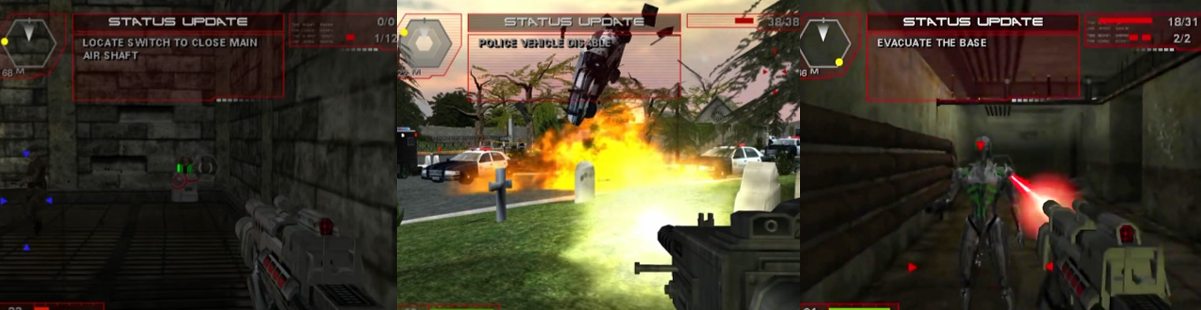
Dirge of Cerberus: Final Fantasy VII is a third-person, action/adventure game with a heavy emphasis on third-person shooting and which includes some very light role-playing mechanics. The game places you in the role of everyone’s favourite melancholy, wannabe vampire, Vincent Valentine. The story is divided into thirteen chapters that can be played on either “Normal” or “Hard” difficulty, with a third, even harder option unlocked after finishing the game on any difficulty. Unlike Final Fantasy VII, Dirge of Cerberus is much more akin to Devil May Cry than a traditional role-playing game and focuses solely on Vincent save for a brief section where you control Cait Sith. Consequently, Vincent’s abilities are very different from those he had in Final Fantasy VII and have been expanded upon almost as much as his backstory, which was largely marginalised since he was an optional character in his debut. You’ll use X to talk to non-playable characters (NPCs) and interact with the environment for some very light puzzle solving (literally just pressing switches to activate lifts or open doors) and also to jump, pressing it twice for a double jump. Unfortunately, Vincent’s movement is often restricted by the environment; rubble and impassable debris will block your path and platforming is basically non-existent, limiting the jump’s usefulness. Circle is for your melee attacks; Vincent attacks with swipes of his gauntlet and some fancy kicks, but is often left attacking the air since you can’t lock-on to enemies with this attack. Circle also lowers your currently equipped weapon, allowing you to move faster depending on your loadout. Square sees Vincent crouch, which is occasionally useful when taking cover and in the handful of instances where you creep through small gaps or vents, and also performs a near useless dash. Triangle opens the main menu, giving you access to a semi-useful map (a mini map would’ve been better), the item menu (where you manually refill Vincent’s health and magic meters), and customisation options for your guns. If you have one of the three elemental Materia equipped to your weapon, you can fire it with L1, though this depletes Magic Points (MP). You use L2 to toggle between your three weapon loadouts, R1 to shoot, and R2 to reload. Finally, you can press the directional pad up to bring up the map, left or right to use your assigned item, and use the left stick in conjunction with Square to roll out of harm’s way.
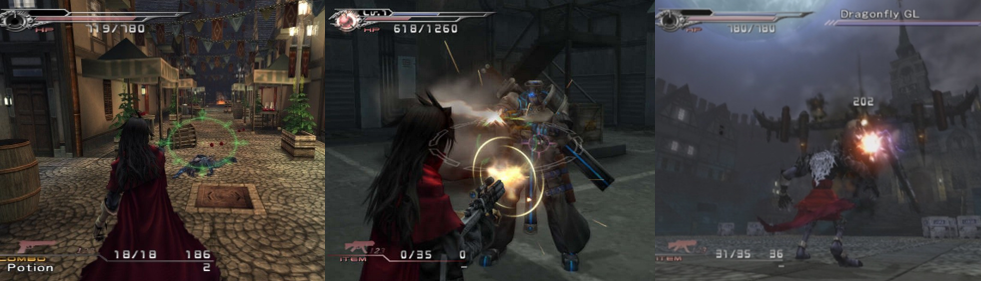
While the melee attacks are good for close quarters combat and to conserve ammo, your primary attack is Vincent’s various firearms. As you explore, opening chests and picking up attaché cases, you’ll find different barrels and accessories that you can use to create up to three loadouts. Vincent can fire a standard pistol, a sniper rifle, and a machine gun, with different barrels available to strengthen their stats. One stat to keep in mind is the weight of your gun; I built a sniper rifle for Vincent to pick enemies off from afar, but it was heavy and slowed his movement considerably. You can lighten weapons with other attachments, or increase their power and reload speed, but these slots are far more likely to be taken up by one of the three Materia. Fire impacts with an explosive effect to damage multiple enemies, Thunder fires straight ahead, and Blizzard has a homing element. These Materia can be levelled- and powered-up with other accessories and can be very handy against groups of enemies, enemies using Barrier to resist your shots, or bosses, but it’s weird that there’s no Cure Materia to equip. Instead, you’ll rely on the odd Mako Point to refill some MP and restorative items like Potions, Ethers, and Elixirs to fill some or all your MP and Health Points (HP). One item returning Final Fantasy players will recognise is the Phoenix Down, which resurrects Vincent upon defeat (but only if you manually activate it from the menu first). Vincent also has a powered-up form (or “Limit Break”) like in Final Fantasy VII, but this must also be manually activated. When active, Vincent transforms into a monstrous beast for a short time, firing homing fireballs with R1 and battering enemies with claw swipes with X. This is very handy against bigger, armoured enemies and bosses but leaves Vincent a large, cumbersome target (though activating the Limit Break does fully replenish HP). The Limit Break can be manually deactivated with L1 and R1, but it’s not like you get the Limit Breaker item back for doing this so I can’t see the benefit of ending it early. Finally, Vincent can man various turrets with X or while riding in an attack chopper. These sections don’t happen often, which is a shame as it’s fun mowing down waves of enemies and blasting attack planes out of the sky with a powerful mini gun that never overheats or needs to reload.
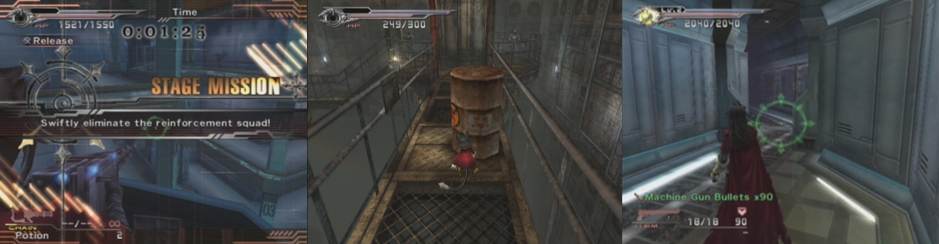
Defeated enemies drop various items or Gil, the currency of the Final Fantasy franchise. Gil is spent at jukeboxes or at the conclusion of each chapter, allowing you to purchase a limited quantity of items, Materia, ammo, and other resources. Completing each chapter (or being defeated mid-chapter) brings up the ranking screen, where you’re awarded points for your accuracy, kill chains, times defeated, and completing various optional missions. These equate to a letter ranking and award points that can be exchanged for Gil or experience Points (EXP). I chose EXP every time as this is the only way to make Vincent stronger and level him up. Each chapter has a primary goal (essentially to get to end and defeat a boss) but also throws secondary, optional objectives at you. Sometimes these carry a time limit or task you with completing them as quickly as possible; other times you’re searching for items with no idea of how many there are to find. Sometimes you’ll be assisting or escorting Vincent’s World Regenesis Organization (WRO) allies, other times you’ll be destroying certain enemies or deactivating mines. The more you do or complete, the better your ranking and the more Gil/EXP you’ll receive. Alongside one section where you’re blasting Guard Hounds from Reeve Tuesti’s attack chopper, you’ll also pick off pursuers on a high-speed train track and use explosive barrels to thin out enemy hordes. As mentioned, there’s one all-too-brief section where you sneak Cait Sith past enemies since his attack and defence are shit. Sadly, though Vincent’s other AVALANCHE allies show up in cutscenes, you won’t be controlling or fighting alongside any of Final Fantasy VII’s recognisable cast beyond this moment. Although things start out simple enough in Dirge of Cerberus: Final Fantasy VII, the game quickly becomes quite challenging. Environments are painfully linear for the most part, rendering the map almost useless for most of the game, but there are times when you’ll be running around in circles trying to figure out where to go.
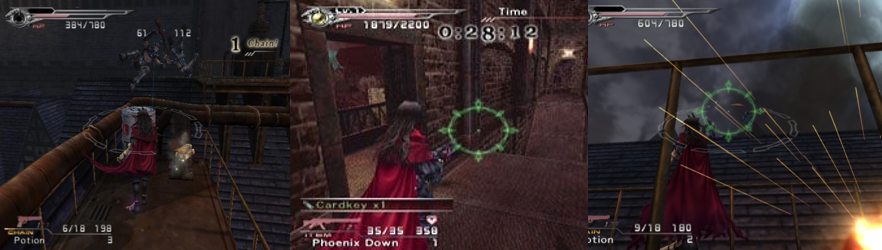
The Shinra Manor, desolate trainyard, and Shinra headquarters are great examples of this. Since the map only shows where you’ve come from and not your objective, it can be difficult heading in the right direction sometimes. This is compounded by how claustrophobic and restrictive levels are, so you’re not used to exploring all that much. Not that exploration really leads to much; locked doors and dead ends are plentiful and you rarely get rewarded for looking around. Mostly, you’ll be smashing crates, defeating enemies, and searching for key cards to lower energy barriers, which are often guarded by waves of enemies. Sometimes, WRO agents provide support or offer resources; other times, you’ll be rescuing civilians or exploring Mako Reactors to track down Deepground. Although you can temporarily save the game from the pause menu, your game won’t save until you reach specific points in each chapter. These checkpoints are serviceable but you’re sometimes stuck repeating long stretches because you died before a save point so it’s worth using your potions liberally since you should have enough Gil to buy more. While Vincent controls well for the most part, he seems very “heavy” and clunky. He doesn’t have much versatility in the air, has few defence options, and his melee attacks are more like the wild swings of a drunk boxer than the swift attacks of a super soldier. Vincent is also surprisingly weak; snipers and enemy groups quickly sap HP and it’s very frustrating being juggled by rocket-firing brutes since Vincent’s recovery options aren’t very good. This could’ve easily been solved with a proper lock-on feature (something that’d been around since 1997), restorative and defensive Materia like Cure and Barrier, and expanding Vincent’s melee abilities. It’s also far too easy to run out of ammo at times; some of the later bosses require many hits so you can easily end up running out of bullets, with no way to get more, and there’s no way to improve your shot power beyond levelling-up and attaching different barrels.
Presentation:
Dirge of Cerberus: Final Fantasy VII is a bit of a mixed bag in this regard. On the one hand, the pre-rendered, CG sequences look amazing and are largely on par with the visual effects of Advent Children. All returning characters sport the same looks and basically all the cast reprise their roles, with Steve Blum bringing his trademark melancholy gruffness to the perpetually sullen Vincent. While the in-game models and graphics obviously aren’t on par with the CG sequences, they are really good. Vincent, especially, looks amazing; his tattered cloak flows nicely and his gothic visage always stands out against the environments. Enemies are, largely, painfully bland, comprised mostly of Deepground soldiers and a handful of beasts and the WRO, though useful when they appear, are poor substitutes for the more recognisable members of AVALANCHE. Environments, while familiar, are painfully bland, muddy, and indistinct at times. Dirge of Cerberus doesn’t offer any brightness or contrast options, so I was left struggling to see in a lot of dull, murky, and repetitive environments. While some are recognisable, including Mako Reactors, the ruins of Midgar, Edge, and wandering around Cid Highwind’s latest Airship, others are just generic locations that don’t inspire the imagination. This means you’ll be wading through sewers, running around the grey corridors of the Shinra headquarters, and stumbling about in the steampunk blandness of Deepground’s lair. One standout location, however, was the Shinra Manor, which includes Vincent’s coffin room and an extensive cave network. It’s just a shame there are few rewards for exploring all these rooms and little to interact with beyond the usual pick-ups.
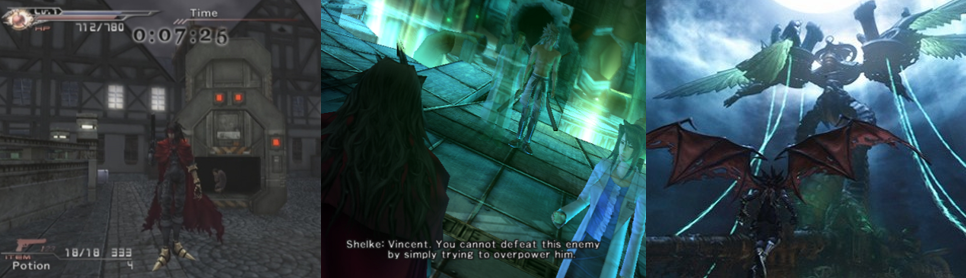
Although the in-game music is largely forgettable, comprised mostly of generic rock stylings and few remixes of traditional Final Fantasy jingles, Dirge of Cerberus saves its best for the end by bolstering the finale and the end credits with rockin’ efforts from Japanese rock star Gackt. The game does perform very well; I had no instances of glitching or slowdown during my playthrough, and you can even skip cutscenes by pressing Start and X during them. The action is frequently interrupted with numerous cutscenes as Dirge of Cerberus explores Vincent’s troubled past with the Turks, his relationship with Lucrecia Crescent, and the experiments performed on him by Professor Hojo. These are juxtaposed by the present day events, which see the ridiculously overdesigned members of Deepground slaughtering countless lives to summon Omega, the most powerful of the ancient WEAPON, to destroy the Planet. Vincent makes new allies in this quest, such as the disabled but determined Shalua Rui and her brainwashed, socially maladjusted little sister, Shelke, and all his old friends pop up to aid him in the many cutscenes. Honestly, the story sort of lost me mid-way through. I had trouble recognising this as the same world as Final Fantasy VII and the alterations made to the lore seemed forced. Vincent’s Limit Breaks, for example, are now due to the “Protomateria” within him and his final form, Chaos, is an uncontrollable state that acts as a natural counterbalance to Omega WEAPON. Or…something. There are sacrifices and revelations along the way, mostly involving Shelke and Vincent’s past, and it’s interesting to see that these characters continued fighting to save the Planet past Sephiroth’s threat, but it’s a very convoluted and, dare I say it, “Japanese” plot, with lots of existentialism and long winded exposition. As the first high-definition reimagining of Final Fantasy VII (in videogame form, anyway), Dirge of Cerberus does a decent job when it’s using recognisable environments and landmarks but the new elements are largely disconnected from the established world.
Enemies and Bosses:
Considering Final Fantasy VII was stuffed with bizarre and visually distinct enemies, from various monsters to bog-standard soldiers and ancient beasts, Dirge of Cerberus is painfully generic with its enemy selection. Mostly, you mow down Deepground’s soldiers, who fire machine guns from afar and smack you with their weapons up close. The Commander and Sergeant variants are tougher and a bit smarter, taking cover to avoid your shots, and snipers will occasionally appear on rooftops or in windows. Soldiers are often accompanied by Beast Soldiers, bipedal mutants who attack like dogs; these are similar to the Red XIII-like Guard Hounds that charge at you, jaws snapping. Deepground’s forces are bolstered by larger, brutish enemies wielding rocket launchers, Buster Sword-like blades, or manning rapid-fire turrets. You’ll also encounter various mechanical enemies, such as spider-like bots that stun you with electrical blasts and lumbering Sweepers, and a handful of monsters, such as the skittering Bizarre Bugs and the trident-wielding lizard men known as Sahagin. Some of these enemies act as mini bosses, especially the larger ones, while variants act as actual bosses. Deepgrounds troops swarm around you on hoverbikes at one point, for example, bashing into you and forcing you to pick them off one at a time. The Guard Hounds are bolstered by the larger Crimson Hound, jetpack-using Shrikes dart around in the skies and are as difficult to target as the teleporting, winged Gargoyles, and you’ll also battle SOLDIER troopers and elite operatives of Deepground who shield themselves with Barrier. Your tactic against most of these is simply to fire at them until they die, switching to your sniper rifle to pick them off from afar or mowing them down with the machine gun, but the elemental Materia can be very handy at wiping out large groups at once and I often had better luck with the melee attacks (when I had the targets in view, of course).
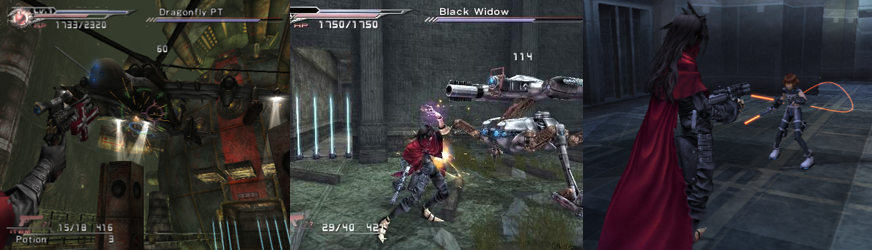
Vincent contends with Deepground’s heavily armoured vehicles at the end of each chapter, with the Dragonfly attack plane and Black Widow mech walker cropping up multiple times throughout the game. When you first face the Dragonfly, it fires with a machine gun and unloads with homing missiles, despotising soldiers into the arena and being felled by Fire without much difficulty. It then reappears as the damaged Dragonfly GL, which also charges at you from the sky, though I made short work of it with the Limit Breaker. It reappears a third and final time in Chapter 11 for the most tedious fight of all. Now joined by Gargoyles and little robots, which must be defeated to farm for resources, the Dragonfly PT constantly stays far out of reach and fires homing shots at you, sweeping around the central building to make for a frustrating target. Unfortunately, I had a lot of trouble dealing decent damage in this fight. Mako Points pop up as the fight goes on and you absolutely need them to pepper it with Fire and do better damage, but this was a slog of a fight made all the more annoying by the Gargoyles diving at me and the robots zapping me. The Black Widow first appears at the end of Chapter 5, bursting into the Shinra Manor and scuttling across the walls and ceilings. It charges at you, spits bombs, and fires a big laser that’s tough to avoid and is heavily armoured so it can take a while to put it down. Its second variant cannot climb walls as the encounter takes place outside the ransacked WRO headquarters, but it’s supported by Deepground’s forces and now fires missiles from a distance. Two Black Widow TWs are fought in the Shinra building, with one on the floor and one and the ceiling, though they lack their dash attack and are noticeably weaker this time around. Deepground’s elite squad, the Tsviets, are also fought numerous times during the game. The first you’ll battle is Shelke the Transparent, a young girl who attacks with lightsaber-like laser batons. She’s a fast, nimble fighter fought in a claustrophobic location, meaning it can be tricky landing hits and the Limit Breaker is of minimal use since Vincent loses a lot of speed in this form.
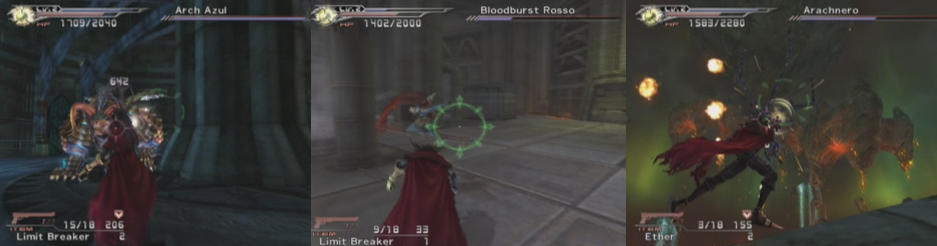
The hulking Azul the Cerulean is fought three times, with the first encounter coming right after your fight with Shelke and being comparatively easy. Though he wields a gigantic cannon, kicks you up close, and causes shockwaves, Azul is painfully slow, a huge target, and the arena is littered with explosive barrels that can whittle his health bar down. When fought in Chapter 9, “Neo Azul” isn’t much different except you’re fighting on an elevator and can use the central pillar for cover. Fire worked well against him here, though you should avoid taking direct hits from his cannon. Defeating him sees him transform into the far more formidable, Behemoth-like “Arch Azul”, a massive beast that charges you, whips with its tail, attacks with its claws, and fires out crystals. Arch Azul is invulnerable to your bullets, meaning you must trick it into smashing pedestals to reveal Mako Points or carry a healthy supply of MP restoring items to stand a chance. Rosso the Crimson is an overall more challenging boss since she’s far faster, the arena you fight her in is much larger, and she can land devastating combos with her lance-like blade. Luckily, a jukebox is on hand for you to replenish your resources and you’ll need them when she gets powered up into “Bloodburst Rosso” and adds a projectile attack to her arsenal, to say nothing of her annoying melee attacks. Though he cuts an intimidating figure, Nero the Sable was actually a bit easier in his first encounter. He flies about using his mechanical wings and fires dual pistols, chopping at your HP with a twirling blade attack and spawning duplicates. Another jukebox turns the tide in your favour and there’s plenty of cover to use to your advantage, and both Fire and the Limit Breaker made this a long but not too difficult fight. The same can’t be said of his horrific transformation into “Arachnero”; in this spider-like form, he’s shielded and fires devastating lasers from four crystals. These must be destroyed to make his shield vulnerable, but you must watch for flaming meteors and a fireball flurry than can basically one-shot you. There’s also no jukebox or resources here so you must stock up on ammo beforehand as you burn through a lot of it just making him vulnerable.
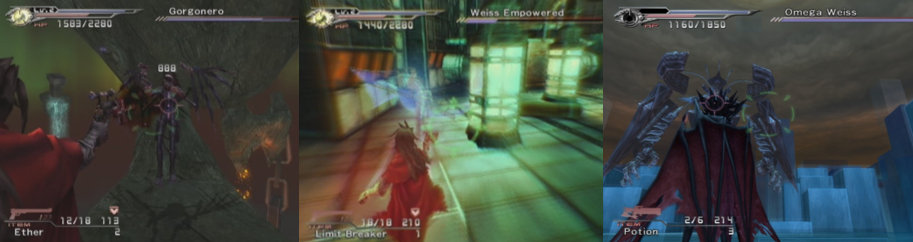
As if that isn’t bad enough, the battles continues right after, with Nero becoming “Gorgonero” and teleporting about the floating rocks of the surreal landscape. You’re stuck in one position, have a small window of opportunity to fire at Nero when he appears, and can only land one hit at a time. Be quick as then you can avoid being shot or being sliced with his spinning blade attack, making for a fight that isn’t as hard as Arachnero but can be troublesome if you’re low on ammo (which you probably will be). Upon reaching the finale, you’ll finally battle Deepground’s head honcho, Weiss the Immaculate (who’s actually Professor Hojo in a super-soldier body…or something…) At first, Weiss is totally invulnerable and the fight must be lost, so don’t bother wasting your resources. In the second, Weiss is fast and sports some powerful sword combos, and he is invulnerable when moving. Luckily, there’s a jukebox nearby and it’s not too hard to avoid him and whittle his health down, just tedious and long-winded. Despite Vincent’s best efforts, Omega WEAPON appears and the Planet is placed in mortal peril, forcing Vincent to combine with Chaos and attack the creature (which fuses with Weiss and Nero) head-on. These final sections see Chaos Vincent floating about a devastated landscape, blasting crystalline drones with his Death Penalty before flying through Omega’s innards, avoiding lasers and taking out more crystals. Eventually, you end up in a serene, surreal, water-like landscape where you must dodge transparent barriers and gun down crystalline drones, attacking the Omega Cocoon, which is simple enough. Finally, you’ll face Omega Weiss, a large, floating mess of stone limbs and appendages. Luckily, this fight is ridiculously easy. Simply fire at Omega Weiss, staying far back and avoiding its fists and gunning down its projectiles. Omega Weiss protects itself with a crystalline barrier that it fires at you, but you can simply dash behind it to continue your assault. Weiss even attacks in a ghostly form, but just ignore him and pour it on. Even Omega’s devastating Omega Meteor can be survived without too much trouble, making this a surprisingly anti-climactic final boss topped only by the abrupt ending.
Additional Features:
There are three “G” reports scattered throughout Dirge of Cerberus’ missions. They’re pretty well hidden, too, as I didn’t find a single one and couldn’t be bothered to follow a guide, mainly because all you get is a slightly extended ending where Genesis Rhapsodos appears for an unresolved cliffhanger. Aside from that, there are additional accessories and barrels for your weapons to be found that can change the way you play, and you’ll also unlock both “Extra Hard” mode after clearing the game and a mission select screen from the main menu. Playing through the game also unlocks the cinematics in the theatre mode, a character viewer, sound test, and art gallery. There’s also a tutorial mode to play through (recommended for first-time players) and additional timed missions to unlock (presumably by getting decent grades in the game’s main missions). These recycle the game’s environments and enemies and stick you with a pre-set loadout, which can make even simple missions tough when you’re used to playing with a more capable Vincent. You also get a final overall grade and the Japanese version includes an online multiplayer component, though I’ve no idea how this worked. Sadly, that’s about it. There aren’t any collectibles to find and there’s little incentive to replay missions unless you want to S-rank everything and earn a grand total of nothing for your efforts.

The Summary:
I’ve played Dirge of Cerberus: Final Fantasy VII before, back when I had a backwards compatible PlayStation 3, and I remember it taking me a long time to get through it and finding it visually engaging but a bit confusing and frustrating at times. These criticisms still ring true today, and it’s a shame as I am a big fan of Vincent Valentine and this genre of videogame. Unfortunately, the third-person elements aren’t implemented very well; the gunplay is weak and unsatisfying and Vincent’s melee attacks are wild and reckless. The game lacks the polish of a Devil May Cry, which was enjoyable to play largely because the combat was so slick and entertaining to engage with. Vincent is surprisingly ungainly, struggling to navigate his environments and handicapped by barriers and obstacles. The gunplay is subpar, for the most part, and made frustrating by the lack of ammo and reliance upon earning Gil to restock. The RPG elements are poorly implemented, too, with Vincent never really feeling that much stronger and the focus on weighing down weapons reducing your options considerably in stressful situations. While it’s great to see the Final Fantasy VII crew back in action, the story is absolutely bonkers. It seems simple enough but then you look at the Tsviets and hear them talk and every cutscene just gets further and further away from what made Final Fantasy VII so memorable. I enjoyed seeing flashbacks to Vincent’s past, though, and wonder if the game might’ve been better if you’d alternated between controlled Turk-Vincent and present day Vincent, scaling back the Tsviets and Deepground guys to focus on battling more familiar Shinra enemies. The game looks great when you can actually see what’s happening (an old school television may help with this) and Gackt’s offerings are great, but I think it was a mistake not to include more sections where you play as Vincent’s friends. Like, why not control Barret Wallace for the gunship section? I really wanted to enjoy Dirge of Cerberus more than I did but it was a bit of a chore to play. The moment-to-moment gameplay gets repetitive, enemies quickly become frustrating, and the manual nature of the mechanics gets tiresome, resulting in an experience that’s confusing, at best, and forgettable at worst.
My Rating:
Pretty Good
Did you enjoy Dirge of Cerberus: Final Fantasy VII? Is Vincent Valentine one of your favourite Final Fantasy VII characters? How do you think the game compares to the likes of Devil May Cry? Were you able to follow the story and what did you think to the Deepground newcomers? Did you beat the game on Extra Hard mode and unlock all the Extra Missions? Would you have liked to see the other Final Fantasy VII characters be playable here? Which game in the Compilation of Final Fantasy VII was your favourite? Whatever you thought to Dirge of Cerberus and Final Fantasy VII in general, comment below and then check out my other Final Fantasy content.






































 Dr. K's Waiting Room
You must be logged in to post a comment.