January sees the celebration of two notable dates in science-fiction history, with January 2 christened “National Science Fiction Day” to coincide with the birth date of the world renowned sci-fi writer Isaac Asimov, and HAL 9000, the sophisticated artificial intelligence of Arthur C. Clarke’s seminal 2001: A Space Odyssey (1968), being created on 12 January. Accordingly, I dedicated all of January to celebrating sci-fi in all its forms.
Released: 30 September 1998 Developer: DMA Design
A Brief Background: Developed by DMA Design, the team behind classics such as Lemmings (1991) and the original Grand Theft Auto (1997) and who would go on to be rebranded to Rockstar North to spearhead the subsequentGrand Theft Auto franchise, Body Harvest had a tumultuous development history. An early example of open-world gameplay, Body Harvest was initially planned as a launch title for the Nintendo 64. Unfortunately, the complex nature of the ambitious gameplay mechanics prevented that. Language barriers also caused issues for the Dundee-based team, who drew inspiration from B-movies and sci-fi classics when conceiving the time travel plot. Nintendo of Japan had many notes regarding this, wishing the narrative to be simplified, and the initial idea to incorporate role-playing mechanics was ditched in favour of a more mission-based structure. While Body Harvest received only average reviews, it’s been praised as a hidden gem for the console thanks to its many gameplay mechanics and replay value.
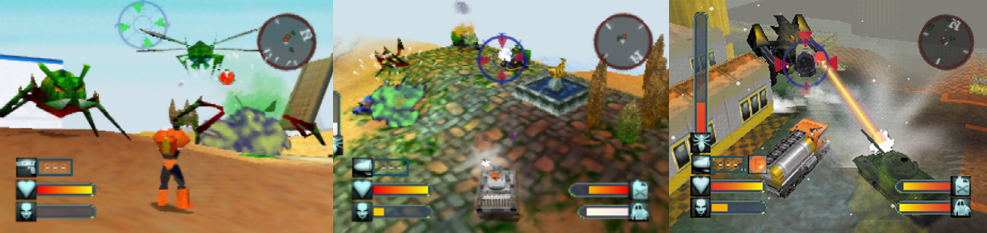
First Impressions: Body Harvest is one of the Nintendo 64’s more obscure and ambitious titles, primarily because it takes place in a very large (if, often, very empty) open world and affords you a great deal of freedom regarding exploration. As related through the open text and cutscene, you take control of genetically engineered soldier Adam Drake, who battles bug-like aliens who routinely return to Earth to harvest humans. With the aid of a time machine, Adam (and therefore the player) visits various historical locations over a 100-year period before confronting the enemy head-on on their artificially created comet. Body Harvest is a 3D, third-person shooter with puzzle solving elements and vehicular sections, and a lot of back and forth between locations sprinkled in as aliens teleport in and attack the area. Players can interact with their environment (open doors, pull levers, talk to non-playable characters (NPCs), check drawers and chests for goodies, light candles, etc) with A, fire their current weapon with Z, and hold the Right trigger to enter a targeting mode to better blasts alien bugs. While shooting in this mode, you can press C-Left or C-Right to dodge roll out of harm’s way or press C-Down for a complete turnaround. You can switch weapons by pressing up and down on the directional pad, take calls from Daisy (who alerts you to alien attacks and objectives), and view a larger (though surprisingly unhelpful) map from the pause menu. A mini map is also present but, while it shows you vehicles and enemies, it’s not the best at pointing you in the right direction so you’ll be doing a lot of jumping between active gameplay and the pause map to make sure you’re going in the right direction. Adam can swim, but not for long, and can replenish his health, ammo, and fuel by grabbing pick-ups dropped by enemies or found in people’s houses
Blast alien scum in this fun, but clunky and incredibly challenging, obscure N64 title.
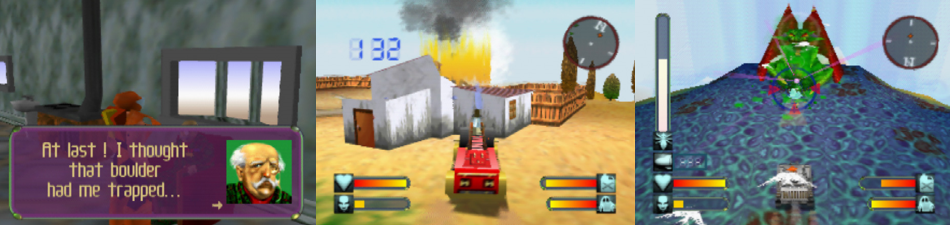
Adam starts the game with his default pistol (which has infinite ammo), but you can also grab a machine gun, shotgun, rocket launcher, and TNT for blowing up boulders blocking your way. Each level hides three Weapons Crystals and three Alien Artifacts; finding the crystals grants you a unique, powerful alien weapon and finding the artifacts allows you to replay the boss battle. You’ll also make use of the Sun Shield, another infinite ammo weapon that burns up bugs and lights torches, and hop in various vehicles with C-Down. Each vehicle handles differently, with trucks chugging along, motorcycles blasting away at breakneck speed, and tanks crashing through gates and trees. Most vehicles see you switching to the machine gun by default but tanks fire an infinite gatling gun or mortar cannon, though you must keep an eye on your fuel and vehicle health. You can also jump in fire engines to extinguish fires and, eventually, pilot various planes and even the all-powerful Alpha Tank. A degree of auto aim helps with the shooting sections, which are where Body Harvest shines. It can be hectic attacking bugs as they’ll attack buildings and eat or capture NPCs, forcing you to quickly take them out to add to your high score and keep from failing because the environment has been too badly damaged. Each stage is broken up into at least three sections, separated by a boss battle (against an alien “Processor”) and a shield wall. The only way you can save the game is by defeating these bosses, meaning you can lose a lot of progression very quickly if you don’t stay healthy. Adam (and the game’s vehicles) can be a bit clunky to control, moving very slowly and utilising “tank” controls. He’s also quite fragile, falling down dead from sustained attacks and even drowning if you stay in water for too long, with no lives, checkpoints, or respawn points to help you if you make a mistake.
Solve puzzles, save NPCs, and blow up large alien Processors to progress.
I played Body Harvest as a kid and loved it. Something about the graphics, as blocky and simple as they are, and the bug-blasting action really stuck with me, even though the game was always difficult. You get two difficulty settings (“Hero” and “Zero”), though the game cannot be completed on “Zero” and is pretty unforgiving at times no matter which one you pick. Adam is a big, lumbering target, vehicles struggle to turn and get up hills, and ammo isn’t exactly plentiful. There are some puzzles to deal with, too, like searching for keys or pulling levers to lower bridges. As long as you enter every building and chat with NPCs, you should figure these out but Daisy’s not much help at delivering specifics so an online guide is recommended. There are also some handy-dandy cheats to help you out; by naming one of your three save files ICHEAT, you can activate these with in-game button presses. These grant you all weapons, stronger firepower, weaken bosses, turn Adam into his dark doppelgänger, and even make him dance. Sadly, while you can fully replenish Adam’s health, there’s no invincibility, which really handicaps my ability to overcome Body Harvest’s immense difficulty curve. It’s not even really the difficulty; it’s the lack of check- and save points that really cuts the legs out from the game. Thus, unfortunately, I couldn’t even clear the first stage, which takes place in Greece in the 1900s. It didn’t help that the game’s thick with fog and slowdown, but I gave up shortly after beating the first Processor. Just getting to this had me wandering around the ruin-strewn valleys looking for a key to the military hanger, putting out fires, and being crushed by alien mechs. These all explode in a spectacular splatter of alien gore, which is very satisfying, but it’s not very fun when you’re at full health and then get clobbered down to nothing. I blew open the boulder, jumped in the Panzer tank, and defended the monastery and village from attacks, but got screwed by the mortar-firing Humber and died shortly after exploring an underground passage.
My Progression: I was determined to beat Body Harvest on at least the “Zero” setting but failed miserably. It’s just a very tough, obtuse, and clunky game. The map seems very big from the map screen, but the environments are quite small, which is actually helpful as you’ll be doing a lot of backtracking and exploring. Looking ahead on the Greece stage, it seems you eventually get a crash course in aviation, have your first run-in with Adam’s alien twin, and take control of a boat to reach new areas. I was screwing about trying to find a boat when I died on my last attempt, so I don’t think I was too far from the second Processor but my motivation for trying dwindled after this death. If the game employed a lives system, these issues would be immediately circumvented. Indeed, it’s very unusual to play a Nintendo 64 game that doesn’t have a lives system and it unfortunately makes Body Harvest unnecessarily difficult and inaccessible. You can use the ICHEAT and refill health code to help, but it’s not going to do you much good if the “human” damage bar fills up or you get caught in a crossfire, ending your run and forcing you to restart from the last save point (or, worse yet, the level’s start!)
Unfortunately, the game’s too difficult for me to experience the later stages and bosses.
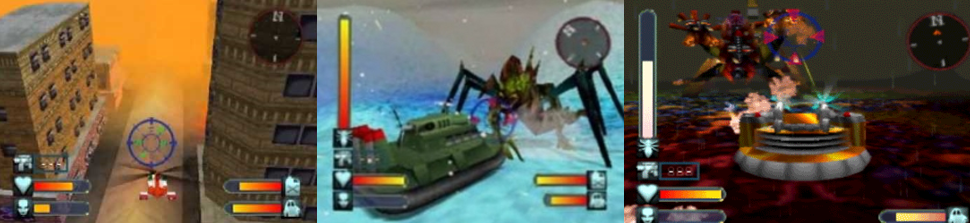
It’s a shame as there are some unique and fun looking stages later in the game. Players travel to the swamp-like Java, an American city, hop in a Scud missile launcher in frigid Siberia, and blast around the alien’s home comet in the all-powerful Alpha Tank. There, if you survive the onslaught of aliens and their projectiles, you’ll confront their mastermind, a brain in a jar, and Adam’s doppelgänger, who apparently transforms into a monstrous form. You’ll pilot a gun boat, test drive an experimental submarine, and commandeer a UFO to track down and destroy Black Adam’s (not that one) doomsday devices. It all sounds, and looks, very thrilling and I wish I could’ve experienced it with some kind of level skip or invincibility cheat, or if the game were a little more forgiving or had a lives system. Honestly, your best bet is to get a Gameshark or similar cheat device as Body Harvest is one of the toughest games ever, never mind on the Nintendo 64. It’s insane to me, honestly, that the game is so punishing. By the time Body Harvest came out, regular save points were well established on the system, either using the cartridge or a Memory Pak. There’s no excuse for not allowing manual saves or dropping in more save points to help players out but, again, simply having a lives system would’ve been enough. Start Adam with three lives and have him pick himself up or respawn after a life’s lost, then hide lives in buildings or behind score points. Instead, I’d wager very few players managed to get past Greece and, even then, were probably stunned to find the game ended prematurely on the “Zero” difficulty.
Body Harvest is at its best when you’re blasting aliens or driving around and blasting aliens. The on-foot sections and puzzles are clunky and boring, the environments don’t lend themselves to exploration, and the visuals are subpar considering some of the titles that were available at the same time. I’d love to see more of it but it’s too frustrating to keep me motivated to try so, sadly, it goes back on the shelf as a piece of nostalgia that I cannot crack. The alien bugs look great, as do the vehicles, but buildings and character models are very basic, blocky, and forgettable. Even Adam doesn’t impress with his plodding orange armour and inability to jump or control well. The sheer amount of wandering about, pulling levers and exploring, probably explains why the alien processor isn’t much of a fight, especially in the thick-hide of the Panzer tank. It just sits there, firing energy bolts, and blows apart after a few hits. If you collect the level’s unique alien weapon, these battles are apparently even easier, though I don’t think you can access the weapon in the first area alone. But perhaps you had better luck. Maybe you easily blasted through the levels despite the lack of save points. Perhaps you easily assembled the Weapons Crystals and took out Black Adam. If so, I’d love for you to tell me how in the comments.
January celebrates two notable dates in science-fiction history, “National Science Fiction Day” on January 2 and Arthur C. Clarke’s HAL 9000’s birthday on January 12. Accordingly, I’m dedicating January to celebrating sci-fi with an event I call “Sci-Fanuary”.
Released: 8 October 2021 Developer: MercurySteam / Nintendo EPD
The Background: Despite popularising the “Metroidvania” subgenre and the hefty praise heaped upon the franchise, it’s fair to say that the Metroid series (Various, 1986 to present) is one of Nintendo’s under-rated properties. The original release is known as one of the greatest games ever made, to say nothing of the universal acclaim shown to its 16-bit sequel and successful jump to 3D first-person shooting. After suffering a blow with the poorreception of Metroid: Other M (Team Ninja/Nintendo SPD, 2010) and Metroid Prime: Federation Force (Next Level Games, 2016), Metroidbouncedback with Metroid: Samus Returns (MercurySteam/Nintendo EPD, 2017), a remake of the divisiveMetroid II: Return of Samus (Nintendo R&D1, 1991) that was successful enough to see MercurySteam develop a new Metroid title. Conceived as a sequel toMetroid Fusion(Nintendo R&D1, 2002) and initially developed for the Nintendo DS, producer Yoshio Sakamoto wanted to place further emphasis on stealth gameplay but the project remained dormant for several years when initial prototypes failed to meet his standards. After much speculation, the project was eventually revived for the Nintendo Switch, largely thanks to MercurySteam’s work on Samus Returns. Returning to the series’ roots with a 2.5D perspective and forcing players to swiftly and silently avoid mechanical pursuers, Metroid Dread aimed to live up to its title by marrying the traditional exploration and combat mechanics of the series with a constant sense of dread. The result was a warmly received title that was praised for its return to form, vast exploration options, and challenging gameplay and bosses.
The Plot: The Galactic Federation dispatches versatile Extraplanetary Multiform Mobile Identifiers (E.M.M.I.) robots to investigate the X Parasites. However, when the E.M.M.I. go haywire, Samus is deployed, uncovering a sinister plot by rogue Chozo to exploit the Metroids.
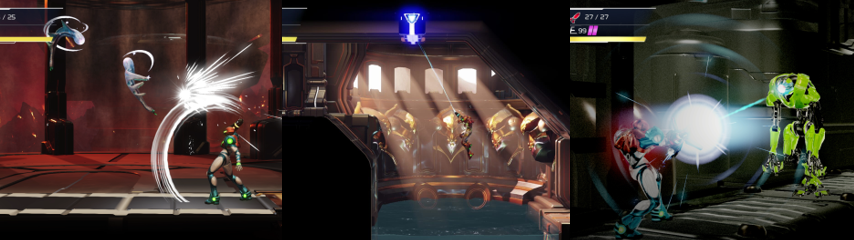
Gameplay and Power-Ups: Metroid Dread is a 2.5D action/adventure game very much in the style of Super Metroid (Nintendo R&D/Intelligent Systems, 1994) in which players once again assume the role of famed bounty hunter Samus Aran, fresh off Metroid Fusion, and navigate the many corridors, caves, and laboratories of the creatively named planet ZDR, picking up new items and upgrades and returning to previous areas to obtain even more items or progress further. As ever, Samus comes equipped with her arm blaster, which you fire with Y. Later upgrades allow you to charge up a more powerful shot by holding the button, and you can also switch to Samus’s missiles with the R trigger, holding it to fire and using the L trigger to freely aim with a laser sight. B allows you to jump; holding it lets you jump higher while the Space Jump and the Screw Attack allow infinite jumping and a spinning attack. Samus can slide under narrow gaps or past certain enemies with ZL, transform into her Morph Ball with the same button when standing still (or tilt the left stick down when crouching) and gains the ability to jump, place various bombs, and cling to certain surfaces while in this form with the Spider Magnet ability. Samus’s weapon and suit upgrades are managed from the + menu, where you view an expanded map, which is unlocked at various map stations (though the onscreen mini map is extremely useful). The + menu also allows you to view your mission log and place helpful markers on the map. You can enter a separate menu with – to alter in-game settings such as the rumble feature, use any compatible Amiibos, load previous checkpoints, or quit to the main menu.
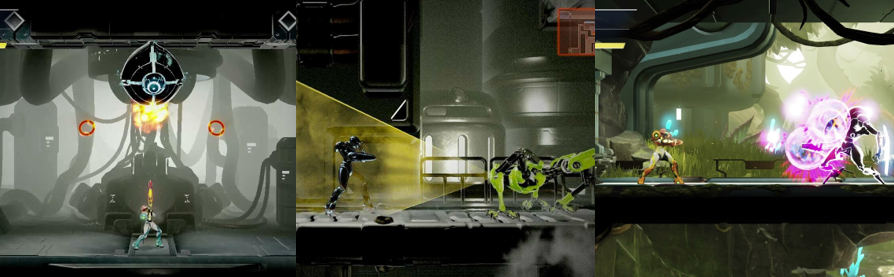
All Samus’s old and new abilities are nothing against the E.M.M.I, who require a special cannon.
All of Samus’s signature abilities make a return in Metroid Dread. They’re once again waiting at various Chozo Statues and will open up the game in various ways, such as allowing free movement when underwater and resisting extreme heat or cold. You’ll grab the Charge Beam for a stronger charged shot, the Wide Beam to fire three simultaneous shots to open certain doors, the Diffusion and Plasma Beam to fire through the environment and destroy tougher, metallic enemies, and the Grapple Beam to swing or hang from certain blocks and platforms and shunt blocks out of the way. Samus can also utilise various missiles, freezing enemies with the Ice Missile and targeting multiple enemies or weak spots at once with the Storm Missile. Unlike her beam shots, these use up ammo so you’ll need to defeat enemies to refill your stock or find upgrades to increase your maximum capacity. Samus’s newest weapon is the Omega Cannon, a situational, finite upgrade acquired by defeating various eye-like Central Units. This temporarily allows you to hold L and Y to fire a concentrated beam that eventually melts metallic shielding and hold L and R to charge the Omega Blaster, which you must then fire with Y to dispatch the aggravating E.M.M.I. robots encountered throughout ZDR. In multiple instances, Samus will enter an E.M.M.I. Zone and must stealthily avoid the clambering, relentlessly E.M.M.I. Until she gets the temporary Omega Cannon, her only hope of avoiding detection is the Phantom Cloak (which consumes Aeion energy to allow temporary invisibility by pressing in the right-stick) and the new Parry function. When E.M.M.I. or other enemies attack, there is a brief flash that’s your indication to tap X. This will Parry the attack, stunning the enemy and allowing you to one-shot them for additional resources, stun them, or deliver massive damage. It’s absolutely essential that you master this technique as some enemies are a chore to fight without it, though the timing required to stun the E.M.M.I. is so tight that you may never get it right. Samus can also find upgrades that allow her to run at super-fast speed, shift past sensors and across gaps (again at the cost of Aeion energy), scan her environment to uncover hidden blocks, and even obliterate enemies and obstacles in the final escape sequence of the game.
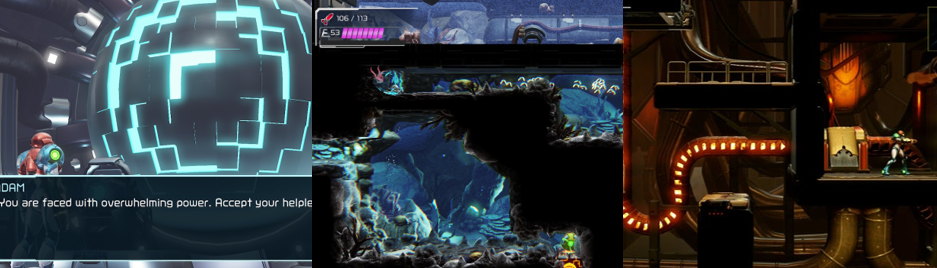
ADAM’s advice will direct you to the next area or terminal that needs activating.
As ever, you’ll grab ammo and health orbs from defeated enemies, who respawn when you leave the screen, and can find upgrades the increase your maximum health, missile, and Power Bomb capacity. You won’t find and upgrades for the Aeion meter as it automatically refills over time, but you can still find ammo and health restoration points all over ZDR, as well as interfaces where you are given hints and objectives by the initially condescending ADAM. This also allows you to manually save your game and a waypoint marker will appear on your map, with teleporters, elevators and other transports allowing for a degree of fast travel. However, you will be revisiting several areas of ZDR over and over again, particularly the elaborate halls of Ferenia, a once thriving Chozo temple. As you obtain new abilities, previously impassable ways open up. You can squeeze through gaps and blast around small tunnels with the Morph Ball, clamber up or cling to blue surfaces with the Grapple Beam, and blow up or run through blocks, and better navigate underwater. For such a large and interconnected map, Metroid Dread is surprisingly linear; areas are often impassable due to flaming obstacles or debris, forcing you to go a certain way, though you can acquire abilities and upgrades out of order if you’re persistent enough. Large areas are a death sentence without the temperature resistant suit upgrades, many areas are seeped in darkness and require you to power up generators, awakening enemies and hazards, and you’ll redirect thermal flows to reach new areas more than once. Other times, you’ll blast several targets to open doors, push or drag them out of the way entirely, or use temporary platforms or your Phase Shift ability to bypass gaps or breakable blocks. Typically, though, the game has a very clear structure that it rarely deviates from. You enter a new area, restore power or redirect thermal flow, maybe blow open a glass corridor or dodge flaming or buzzsaw hazards, and endure a gruelling E.M.M.I. Zone until you destroy the E.M.M.I. and gain a new ability to repeat this process in another area.
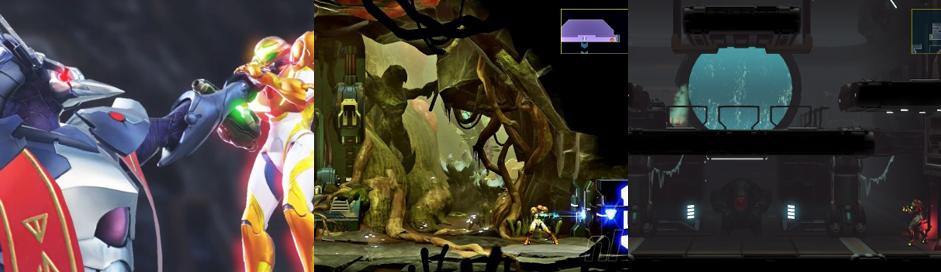
Presentation: Overall, Metroid Dread looks really good. The whole game has a dark, foreboding feel to it that’s reflected in its ominous soundtrack and the various environments, which are either dank or in disrepair or swarming with monstrous enemies. Samus herself looks both familiar and different; she’s had a bit of a glow up and doesn’t come to resemble her usual orange and red colour scheme for some time. Her suit changes colour and reflects the environment around her as you progress, which was a great way to add to the ambiance and visually show her becoming more powerful and capable. Though largely silent, taking in ADAM’s patronising tone and the exposition spouted by the likes of Raven Beak and Quiet Robe, she does utter a line at one point (though in the Chozo language) and screams in agony when defeated, her suit exploding and revealing her form-fitting costume beneath. Although the game doesn’t make a great first impression with its surprisingly plain title screen, motion comic-like opening, and long loading times, the pre-rendered cutscenes showcase Samus’s capabilities and wary nature through her body language and action-focused mentality. Each E.M.M.I. is introduced through a suitably ominous cutscene that showcases its different abilities, such as increased shielding or speed or climbing ability, and everything becomes very tense when you’re trapped in an E.M.M.I. Zone, desperately trying to escape to the nearest exit before it inevitably skewers you with its spiked appendage.
While the game looks and sounds great, it’s rare that areas make much of a visual impression.
While character and enemy models are very impressive and detailed, I wasn’t massively impressed with the variety in the game’s environments. Sure, there are some nice touches here and there, like rain and water raging outside Burenia, Chozo Soldiers scampering about in the background, various wildlife (from insects to writhing tentacles to disgusting slug-like barriers obstructing doors), and areas changing as they crumble and collapse around you, but there are often far too many dark, samey corridors and areas for my liking. While you’ll venture into dripping caves, explore flooded laboratories, wade through lava, and frantically flee from extreme cold, many areas are just the same dark, futuristic locations repeated over and over. You’ll quickly see a pattern of having to traverse these foreboding areas, repute with sparking power lines and small jump scares, and restoring power to them or redirecting thermal energy to access new areas, with little separating one area from the next. Similarly, the E.M.M.I. Zones are all largely indistinguishable, being very cold and grey and military in their appearance, with only more complicated layouts changing things up. Maybe there’s some water, or more E.M.M.I. probes, or you need to slide and destroy blocks a bit more, but the general look of each E.M.M.I. Zone doesn’t change much, which is odd considering the E.M.M.I. have different colour schemes. Thankfully, Ferenia and the Itorash are on hand to mix things up a bit. These ornate, gold-themed Chozo environments are filled with large Chozo statues, banners, windows, and a sense of grandeur that are in stark contrast to ZDR’s other more bland environments, though again you revisit Ferenia so often that each screen starts to become indistinguishable. I think it would’ve helped a lot to give each area a more prominent theme. Like, have a dark, dishevelled lab but just on one section of the map, lump the frozen and water sections together, combine the caves with the lava/red-hot sections, and maybe do a little bit more to make things feel more varied than they actually were.
Enemies and Bosses: ZDR is crawling with bug-like enemies for you to Parry away and blast with your arm cannon. Many are small and simple cannon fodder, like the slug-like Plys, amorphous blobs, squid-like creatures, spider-like Yampas, swarming eels, and various burrowing insectoids that chase you in narrow tunnels and fly out of the dark. While these are easily bested with your basic attacks, larger enemies (like the crab-like Muzbys and rock-encrusted Obsydomithons) require your Parry to stun and defeat. As you progress, robotic enemies become more prominent; large tetrapot robots blast at you with a powerful eye beam, the spherical Autclast causes flames to burst across the ground, and E.M.M.I. probes either float in place or explode when you get close, dealing damage and giving away your location. When exploring Ghavoran, you’ll encounter the whale-like Hecathon that slowly floats overhead, draining your health with its wide energy beam; a similar enemy awaits in Burenia, but even basic enemies become a formidable threat when Raven Beak unleashes the X Parasites. These gelatinous blobs infect any onscreen enemies, turning them into gooey zombies that absorb a great deal of shots and utilise additional attacks. While you can defeat them in much the same way as before, you must absorb the X Parasite that’s released to refill your health and/or ammo or else it’ll simply attach to another enemy or cause another foe to spawn, which can be quite a headache. Interestingly, though, neither the titular Metroids or the traditional Space Pirates appear as enemies in Metroid Dread.
Fights between the Central Cores, E.M.M.I.’s, and Chozo Soldiers quickly become laborious.
Easily the most persistent foes in Metroid Dread are the E.M.M.I. robots. There are six of these bastards to contend with, with each encounter being more difficult that the last. Similar to the SA-X from Metroid Fusion, Samus can only avoid the E.M.M.I. upon first entering an E.M.M.I. Zone since her weapons are useless against it. If it catches her, you can try and Parry its instant-kill attacks but the timing is so tight that I rarely managed to succeed. Instead, you must flee through the E.M.M.I. Zone until you find the Central Core. These eye-like mechanical spheres float overhead while numerous projectiles fly at you from the walls and ceilings. You must blast the Central Core with missiles and your charged shot to destroy it and temporarily gain the Omega Cannon, but even then it’s not so easy to put the E.M.M.I. down. Not only does the Omega Cannon take time to charge, the E.M.M.I. are ridiculously fast and often shielded, meaning you need to get some distance and use the Omega Spread before you can even fire your kill shot. E.M.M.I. are soon joined by probes that give away your location, scamper across walls and ceilings, squeeze through gaps, and can even freeze or outright kill you with their spotlight. The Phantom Cloak helps you avoid detection, but keep an eye on your Aeion meter and avoid touching the robots as it’ll instantly give you away. Over time, they become more aware of your presence, and you have less room to charge your shot, though it’s always a relief to blast them in the head and put them down for good. As if the dread caused by these persistent assholes isn’t bad enough, you’ll also be forced to battle numerous Chozo Soldiers, both mechanical and organic and sometimes faced with two at a time! These nimble, heavily armed and armoured warriors leap about the screen taking shots at you and charge with a lance, hiding behind a shield and crashing to the ground from above. Luckily, you can Parry their attacks if your timing’s right and use the Storm Missiles to deal a lot of damage very quickly, but you’ll have to watch out for a massive mouth laser and a wide goo attack when they become infected by the X Parasite and increase in their aggression.
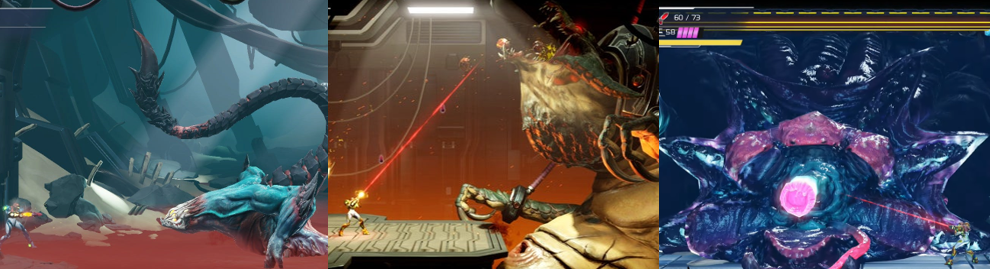
Monstrous bosses require all of your skills to get around and dish out damage.
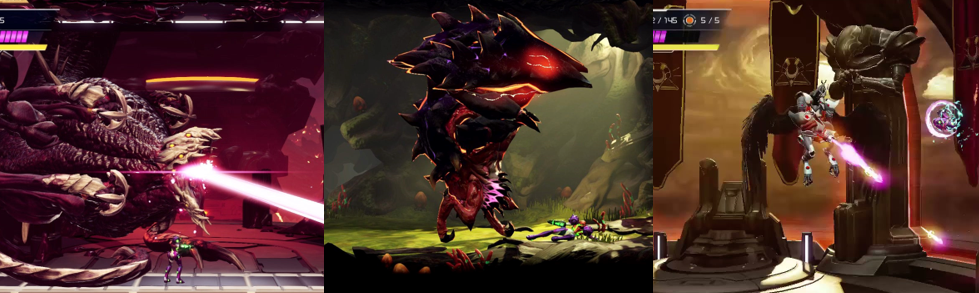
Other, more monstrous bosses also await on ZDR. Corpius (a horrendous mixture of a lizard and a scorpion) lashes with its tail, requiring you to jump or slide under it and pepper its ugly face with missiles or a charged shot. Corpius also boasts an acid spit and the ability to turn invisible, though a shining weak spot remains for you to target, and you must cling to the walls to avoid its acid belch. When it reappears, you have a small window to Parry its attacks and deal massive damage, provided you remember to keep hammering R during the Parry sequence, which is true for all subsequent boss battles. Metroid Dread also includes a rematch with the gargantuan Kraid. At first, he’s chained up and can only swipe at you or rain claws from above (which you can shoot for resources). Blast his head, avoiding his fireballs, and the battle descends to a lower level, where you must rain fire on Kraid’s bulging belly button, which spews purple blobs and splash damage. After enough hits, you must scramble up the temporary platforms to the magnetic strip above to hit his head, which is easier said that done given how much crap is on the screen (though you can make quick work of him if you grabbed the Morph Ball out of sequence). While in Burenia, you’ll battle the tentacled mollusc Drogyga. This takes place entirely underwater and sees you blasting Drogyga’s orbs and tentacles until a button lights up. You must quickly blast it to lower the water, then use the overhead grapple point to reach another and drain the water entirely, leaving Drogyga briefly vulnerable. You must repeat this multiple times and be quick to avoid its massive tentacle counterattack or Parry its attacks for additional damage, which is good practise for the more aggressive and versatile Escue. This enlarged, X-empowered winged beetle shields itself with an electrical field and lunges at you with an attack that can be tough to dodge. Escue also fires destructible orbs that either home in on you or cause massive splash damage, and even keeps up its attack when you whittle it down with missiles and charged shots, reducing itself to a hardened shell of X that spits out smaller parasites and must be bombarded with Ice Missiles.
As they become bigger, more aggressive, and tougher, bosses will test your mettle to the limit!
While exploring Cataris, you’ll’ve noticed the corpse of a massive, mutated spider-like creature in the background. You’ll fight one of these, Experiment No. Z-57, to defrost the region, with the battle taking place in multiple phases. At first, Experiment No. Z-57 lingers in the background, firing a massive mouth laser that briefly irradiates the floor and taking a massive swipe at you. The Space Jump and Storm Missiles are essential here, as is a successful Parry when Experiment No. Z-57 comes into the forefront to take a shot at you. Parrying initiates the second phase where you blast its limbs to keep it from charging a powerful shot, then frantically Space Jump to avoid screen-filling plasma waves and a double-sided claw swipe, before initiating another Parry sequence that should finish it off. Similar to Escue, Golzuna is an enlarged, X-empowered variant of a typical enemy, the Muzby, now completely invulnerable thanks to its rock-like hide save for a single weak spot on its rear. Due to its bulk, Golzuna is slow and difficult to jump over; it charges at you and fills the screen with explosive pink orbs, restricting your movements. Staying on the move is the key to this battle, which eventually reduces Golzuna to a hardened shell that, like with Escue, is destroyed with Ice Missiles. After several encounters, you’ll eventually confront the maniacal Chozo, Raven Beak, aboard the Itorash in a true test of your skills. In the first phase, Raven Beak is shielded by a golden aura and completely invulnerable. He’ll launch a devastating three-hit melee attack, bathe the arena in a health-sapping red beam, and spawn giant orbs that can be destroyed for resources, but take multiple shots to pop. When he stands at the far end, you must Parry his rush to deal damage; similarly, when he taunts, get in close and immediately Parry his attacks to move to the next phase. Here, Raven Beak is much faster and there is no health or ammo to help you. He spawns wings, darts at you (easily slid under), fires a big charged shot (easily dodged), or spews a stream of shots that you must desperately Space Jump to avoid in a circle motion, all while bombarding him with Storm Missiles. The final phase is much like the first, but Raven Beak sports faster, more powerful attacks and a barrage of energy waves. Again, you must hit your Parries and unload all your missiles and charged shots at least three times to win. With no checkpoints between phases and very little health and ammo, this is a gruelling final bout even with maximum health and ammo capacity.
Additional Features: While you require all of Samus’s weapon and suit upgrades to clear the game, many of the health and ammo-increasing power-ups can be missed. These are marked on your map and it’s highly recommended that you seek them out as you’ll need that extra ammo and health in the later stages, and Samus tends to take quite a bit of damage even with expanded health. If you look at your save file, you’ll see a percentage completion counter for the number of items you’ve found. Your map indicates where items can be found in each area and finding 100% in all areas unlocks art to view in the game’s ‘Gallery’ mode. As is usually the case for a Metroid title, you’ll see different endings and unlock different artwork depending on how fast you beat the game and on which difficulty. At the start, you can pick between “Rookie” and “Normal” mode, and you’ll unlock “Hard” mode after your first playthrough on “Normal”. This is selectable when beginning a new game, though your original save file can be returned to at any time, allowing you to seek out items you’ve missed. You can also unlock and play through a “Boss Rush” mode and grant yourself health and ammo refills using Amiibos. However, there are no other costumes to unlock, data files to scan, or hidden collectibles to find beyond the health and ammo upgrades.
The Summary: I was excited to get stuck into Metroid Dread. After largely enjoying four of the classic Metroid titles and being impressed by the detailed, moody 2.5D aesthetic, I was eager to get to grips with this more traditional Metroid adventure. Graphically, the game impresses; I may not have liked how samey many environments were or the repetitive gameplay loop, but the depth to each screen and the attention to detail in the ominous lighting, foreboding atmosphere, and detailed character models was very impressive. The controls are tight and responsive; I wasn’t a big fan of the aiming system at times, and the Parry mechanic became laborious as enemies became faster and more aggressive, but Samus has never controlled better, overall, than here, in my experience. I even enjoyed how comparatively linear the game was. I rarely felt like I was lost and enjoyed exploring, even if I potentially played out of sequence at times. Sadly, though, I did not enjoy the E.M.M.I. encounters, which quickly became a frustrating chore, with little variation except it getting harder to line up your shot. I also didn’t like how the E.M.M.I. basically killed you the moment they grabbed you. I liked the tension (the “dread”, if you will) at times, but I wonder if these sections might’ve been better if restricted to certain areas. Like, maybe you travel to Cataris and avoid an E.M.M.I. the entire time. Or if the encounters had been more varied and less restrictive, like maybe an E.M.M.I. stalks you throughout Ghavoran, causing cave-ins and changing the environment as you go. Similarly, the Central Core battles were all basically the same, which is a shame considering how varied the other bosses were. I think merging the E.M.M.I. and the X-Parasite concept might’ve worked better; maybe E.M.M.I. nanobots infect enemies instead of the X, just to mix things up. It’s hard not to be a little disappointed by the gameplay loop in Metroid Dread. It’s fun the first few times but there’s only so many times you can restore power, flee from and destroy an E.M.M.I., then fight a boss before it starts to feel repetitive.
My Rating:
⭐⭐⭐
Rating: 3 out of 5.
Pretty Good
What did you think to MetroidDread? Did you enjoy the E.M.M.I. encounters or did they start to become annoying for you as well? What did you think to the Parry mechanic and the more linear nature of the game? Which of the bosses and upgrades was your favourite? Did you ever get 100% completion? Which of the Metroid games is your favourite? Whatever your thoughts, feel free to leave a comment below and be sure to check out my other Metroid content across the site.
January celebrates two notable dates in science-fiction history, “National Science Fiction Day” on January 2 and Arthur C. Clarke’s HAL 9000’s birthday on January 12. Accordingly, I’m dedicating January to celebrating sci-fi in an event I call “Sci-Fanuary”.
Released: 19 June 2024 Originally Released: 9 February 2004 Developer: Nintendo R&D1 Also Available For: Game Boy Advance (Original); Nintendo 3DS, and Nintendo Wii (Virtual Console)
A Brief Background: Metroid(Nintendo R&D1/Intelligent Systems, 1986) owes its creation to Nintendo’s success with their industry-saving Nintendo Entertainment System (NES), producer Gunpei Yokoi and directors Satoru Okada and Masao Yamamoto collaborated on the title, andAlien(Scott, 1979). Alongside Castlevania (Konami, 1986), the game birthed a videogame subgenre dubbed “Metroidvania” and Metroid was praised for its challenging gameplay. Since being recognised as one of the greatest games ever made, Metroid spawned numerous sequels and spin-offs and was ported to many subsequent Nintendo consoles. Nintendo (and Metroid) veteran Yoshio Sakamoto oversaw the development of this Game Boy Advance remake, which came about when someone working on Metroid Fusion(Nintendo R&D1, 2002) suggested portingSuper Metroid (Nintendo R&D1/Intelligent Systems, 1994) to the console. The developers fittingly sought to return to the franchise’s roots, while still adding new elements to make the game feel fresh and modern. Principally, this involved placing greater emphasis on the story, allowing players to pick between difficulty settings, providing Samus with a new form-fitting suit, and adding an epilogue to the story. Reviews for the enhanced remake were largely positive; its content and features and refined controls were praised, though many complained of its short length and that newcomers would get more from it. Still, Zero Missionwas said to be one of the best Game Boy Advance titles and it finally found a life outside of its system once Nintendo made it available through their online consoles.
The Review: Metroid: Zero Mission is a Game Boy Advance remake of the original game, following essentially the same narrative structure (bounty hunter Samus Aran explores Zebes, conquering monstrous bosses to confront Mother Brain, leader of the Space Pirates) and offering the same power-ups, but with a decidedly 16-bit glow up that basically reimagines the original game as though it were a 16-bit title. Consequently, the game looks, sounds, and plays almost exactly like Super Metroid and Metroid Fusion, enhancing Samus’s abilities with moves like the Speed Boost, Spineshark, and ledge grab and allowing her to better dispatch her enemies with an expanded move set, one ripped entirely from those aforementioned games. You fire her trademark blaster arm with B or X (eventually acquiring power-ups that allow you to charge a shot, temporarily freeze enemies, and fire through enemies and obstacles), jump with A (again upgrading this to the iconic Screw Attack and Hi Jump Boots), hold the Left trigger to stand in place and aim in multiple directions, and quickly acquire the Morph Ball to squeeze through tunnels. As you’d expect, you can acquire upgrades that let Samus jump and lay bombs in this form and upgrade her suit to reduce the damage she takes or resist extreme heat and acid pools. Zero Mission adds not only a mini map to the main screen but a large, detailed map for each area of Zebes, expanded whenever you find a Map Room and easily allowing you to see where you need to go (thanks to Chozo Statues highlighting your next objective) and any hidden secrets to find or bosses to confront. Pausing the game lets you review this map, see Samus’s currently available weapons and upgrades, and enter sleep mode. From the main menu, you can select up to three save slots (manually saving in various save rooms) and choose to play on either “Easy” or “Normal” mode.
Alongside the 16-bit glow up, Samus sports some returning and new abilities.
Thanks to the graphical upgrade, Zero Mission is almost completely indistinguishable from the original Metroid and aesthetically has much more in common with Super Metroid and Metroid Fusion as a result. The basic layout is still there (go left at the start of the game and you’ll still find the Morph Ball, for example), with you still ploughing through hallways, dropping down vertical shafts, and riding elevators to explore Brinstar, Norfair, Kraid’s Lair, Ridley’s Lair, and Tourian, but each area is far more visually interesting compared to its 8-bit predecessor. Lava and acid bubbles beneath you, platforms crumble, enemies constantly spawn, and you’ll be backtracking and finding alternate routes as your abilities expand, as always, all while traversing various rocky, mechanical, and ominous environments. Backgrounds are given far more depth and detail, rain effects sweep across the terrain, volcanic caverns smoulder, and enemies are far more detailed (and much bigger) this time around. The game’s story is also given an upgrade with partially animated sequences, Samus’s inner monologue, and in-game graphics providing suitably dramatic cutscenes. The soundtrack has also been upgraded, featuring 16-bit versions of Metroid’s tracks and various remixes that work in tandem with the graphical improvements to again allow the game to stand side-by-side with its 16-bit counterparts. Areas also have new gimmicks, such as the Morph Ball Launcher (which blasts you to new areas), overhead zip liners, and power generators and Chozo Statues that require your Morph Ball and recharge your health and missiles. The Speed Boost is incorporated to break through walls and reach new areas, some doors are barred by grotesque eyes, you’ll occasionally have to unleash small bugs to clear out vine blockages, dead bodies, discarded carcasses, and creeping vegetation are commonplace. Indeed, the entire world seems much bigger and more alive and dangerous than ever thanks to the updated visuals and ominous soundtrack.
New bosses and Super Metroid inclusions basically make this an entirely new game.
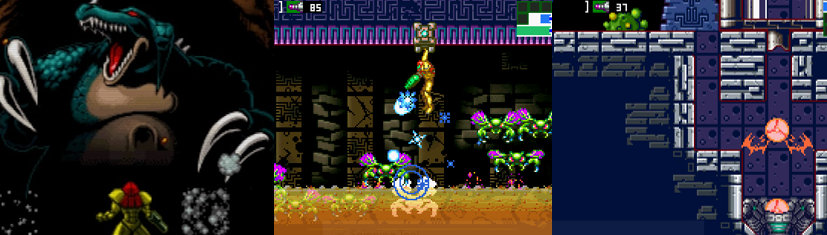
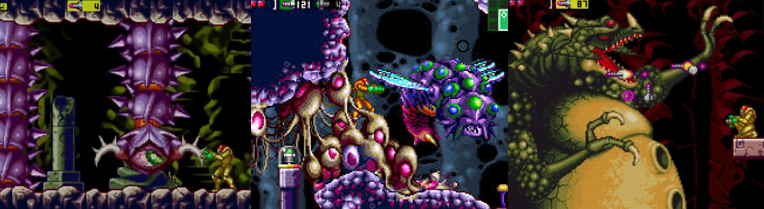
Those familiar with Metroid may also be surprised to find a few new enemies here: the hopping Barisutes act almost as mini bosses with their tough armour plated hides, larva-like Kiru Giru fill narrow tunnels and must be baited in to attack their underside with bombs (or shot from below), and Space Pirates shrug off even your strongest missiles. These appear alongside improved versions of the original enemies and Samus will have to hunt down, freeze, and explode every energy-draining Metroid in Tourian if she hopes to escape. Zero Mission also boasts five new bosses in the main portion of the game: two of these are gigantic, spiked, worm-like creatures that burst through the environment or up through acid, lunging at Samus and firing spores or spikes. The first, the Deorem, uses its spiked body to box you in and must be shot in its eye when it appears. The second, the Mua, lunges from an acid pit, giving you a small window to target its pulsating weak spot. Norfair itself later attacks by ensnaring a Kiru Giru in vines and unleashing spores. You must freeze the Rippers in the arena to hop to and attack the vines to send the enslaved creature crashing down. This monster lands in Ridley’s Lair, sheds its skin, and mutates into a grotesque wasp, the Imago, that flies around its nest, charging about and firing spikes from its stinger. You must use yourself as bait and then pelt the stinger with missiles to finally end it. Metroid’s classic bosses also appear in their respective areas, but they’re now reimagined duplicates of Super Metroid. Kraid is a gigantic, bulbous beast you must shoot in the head and mouth while hopping to temporary platforms, while Ridley flies about breathing fire, striking with his spiked tail, and trying to get his claws on you. Samus still braves a nightmare of projectiles and lava hazards when confronting Mother Brain, whose glass case must be shattered with missiles before you can attack her single eye, but her eye blast and the knockback from the swarming projectiles makes this a tricky affair.
A tense stealth section and all-new bosses await in the extended finale.
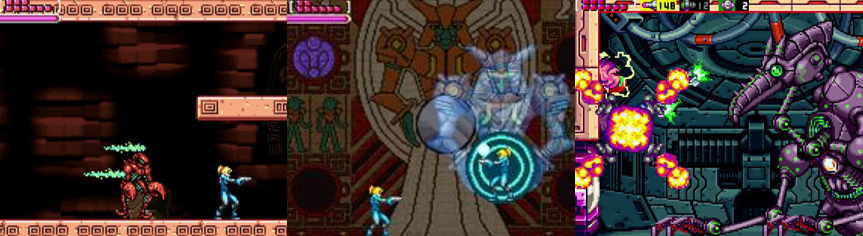
After making a desperate escape from Zebes, Samus’s ship is attacked and crash lands in the all-new Chozodia sector. Robbed of her armour and abilities, Samus has only her form-fitting Zero Suit and a crappy pistol on hand, meaning players must sneak past Space Pirates, laser traps, and spotlights, desperately running to safety when they inevitably trigger the alarm and only being able to briefly stun enemies. This is quite a tense and frustrating section; when you’re spotted, an alarm sounds, all doors lock, and Space Pirates chase you relentlessly. You can hide behind pillars or in dark corners, but it can be tough to find these when you’re in a panic and the Space Pirates sometime crawl through alternate paths or blast through destructible blocks to find you. Eventually, Samus makes it to the main bridges and the Chozo Ruins, where her mettle is tested by a holographic, lighting-casting projection. Make sure you don’t attack when the mirror of Samus is in the sphere as you’ll take damage. Instead, target the central sphere when images appear and you’ll regain all your abilities, and more. Previously, you’ll have explored different Chozo Ruins and acquired “unknown items” that were incompatible with your suit; these are enabled here. This allows you to plough through Space Pirates with ease with the Plasma Beam, continuously jump with finnicky Space Jump, and freely move through liquid with the Gravity Suit. You’ll also acquire the Power Bombs here and it’s advisable to backtrack to use these new abilities to uncover previously hidden expansions to your health and ammo. When you’re ready, you challenge Mecha Ridley which, though intimidating and powerful, is actually a pretty anti-climactic final boss. You can simply jump over its claw swipes, fireballs, and lasers and pummel the glowing core on its chest to defeat it with much less trouble than its biological counterpart. Samus then has five minutes to make it to an escape shuttle to finish the game, and players are of course treated to different ending images depending on how fast they made it to the end and how many power-ups they acquired. Completing the game also unlocks an additional gallery mode and, impressively, a fully playable port of the original Metroid.
The Summary: Given I much prefer Samus’s 16-bit adventures to her original game, I was pleasantly surprised by Metroid: Zero Mission. The game is similar enough, but different, featuring a far more visually appealing graphical style that perfectly matches its 16-bit counterparts and updates the original game to be comparable to its successors. If anything, I feel like more could’ve been changed; the Chozodia was a fun addition, but it was more of an unexpectedly epilogue that served as padding. Perhaps if each area featured stealth sections where Samus was reduced to her Zero Suit as part of a Chozo test it might’ve helped with the game’s pacing. The new bosses could’ve been fought at the end of these sections, with the “unknown item” power-ups being rewarded and allowing Samus to get progressively more powerful, as usual. It was a tense and surprising inclusion, though, one that fundamentally changed how you play. I just wonder if more could’ve been done with it, perhaps allowing players to try the whole game with the Zero Suit? The other changes were very welcome (except for the Spineshark; I’ll never enjoy that ability), especially to the returning bosses. Sure, seasoned Metroid players will have a distinct advantage but recreating the Super Metroid battles made these bosses far more intimidating and epic. It’s a shame Samus didn’t get any new abilities beyond the standard Super Metroid ones, which again I feel could’ve been addressed by emphasising the Zero Suit more, but Zero Mission does a fantastic job of bringing the original Metroid up to par with its successors. As if that isn’t enough, you unlock the original game, so anyone who doesn’t like the changes can just play the original game after!
My Rating:
⭐⭐⭐
Rating: 3 out of 5.
Pretty Good
Have you ever played Metroid: Zero Mission? How do you think it compares to the original game? Did you like the graphical upgrade and the changes to the bosses? What did you think to the Chozodia section, and do you agree the pacing was a little off? Did you ever get the best ending and play through the original Metroid? Which Metroid game is your favourite? Whatever your thoughts, feel free to leave a comment below and be sure to check out my other Metroid reviews.
January celebrates two notable dates in science-fiction history, “National Science Fiction Day” on January 2 and Arthur C. Clarke’s HAL 9000’s birthday on January 12. Accordingly, I’m dedicating January to celebrating sci-fi with an event I call “Sci-Fanuary”.
Released: 8 March 2023 Originally Released: 18 November 2002 Developer: Nintendo R&D1 Also Available For: Game Boy Advance (Original); Nintendo 3DS, and Nintendo Wii (Virtual Console)
The Background: Nintendo introduced gamers to Samus Aran in August 1986. Her debut title was celebrated for its challenging gameplay, is now regarded as one of the greatest games ever, and helped popularise the action/exploration “Metroidvania” subgenre. Nintendo followed Metroid with the Game Boy-exclusive Metroid II: Return of Samus(Nintendo R&D1, 1994), a contentious and divisive title whose narrative nevertheless directly influenced Samus’s jump to Nintendo’s ground-breaking 16-bit console. After two years in development, Super Metroid(Nintendo R&D1/Intelligent Systems, 1994) was universally praised for its impressive visuals and tight gameplay, becoming a must-have title for any Super Nintendo owner. Despite this, it would take over ten years for Samus to receive another solo title, with the first footage of “Metroid IV” being shown at the 2001 E3 convention. The team behind Super Metroidreturned forMetroid Fusion, introducing a mission-based structure to the gameplay to guide players towards objectives rather than them having to figure things out blindly as before. The developers also took the opportunity to revamp Samus’s appearance and the way she replenished her health and missiles, as well as simplify the controls compared to Super Metroid. Like Super Metroid, Metroid Fusion received critical acclaim; the gameplay, graphics, and mechanics were praised, though many were disappointed by its short length. While Metroidventured into the 3D arena after Fusion, a sequel came less than ten years later, and the game eventually became available outside the Game Boy Advance (albeit digitally) as Nintendo branched out into virtual consoles.
The Plot: While exploring planet SR388, bounty hunter Samus Aran is attacked by the parasitic “X” organisms. Though saved by a Metroid-based vaccine, Samus is physically altered. Despite this, she investigates a Biologic Space Laboratories (BSL) space station overrun by the X, now led by “SA-X”, an X parasite mimicking Samus at full power!
Gameplay and Power-Ups: Metroid Fusion is a 2D, action-orientated exploration title that takes a lot of inspiration from Super Metroid. As in that game, you (as Samus Aran) will be exploring a vast space station home to numerous elevators and hidden tunnels to various high-tech laboratories, caverns, flooded and lava-filled areas, and other regions, all infested by the X parasite. This time around, Samus’s abilities are restricted by her superiors, represented by a station computer that gives the player objectives, points you in the right direction, and offers advice about how to tackle each area. In this regard, Metroid Fusion is the most linear Metroid game so far; the station computer warns you of nearby hazards, says what weapon or upgrade you need to overcome them, and highlights your objective on the game’s map screen. That’s not to say you won’t be backtracking and searching high and low for secret passages and hidden power-ups, but it definitely helps to have an in-game system guiding you along. This, in conjunction with the helpful mini map and the larger full map (accessed with the + button), means it’s easier than ever to navigate the station’s different environments, at least at the start of the game. The + menu also allows you to review Samus’s current suit, abilities, and weapons, refresh yourself on your current objective, and enter sleep mode if you ever need a break. As always, Samus can only save at designated Save Stations (though you can make liberal use of the Switch’s save state and rewind feature to compensate for this) and she can replenish her health, and missile and bomb ammo, at various Recharge Stations. Defeated enemies will also replenish these, but things are a little different this time around. When defeated, enemies release an X parasite that must be collected to refill your health or ammo. If you linger too long, it’ll spawn another enemy, or a tougher variant, adding a level of anxiety that was missing from the previous games.
All of Samus’s abilities return, though she’s strangely light on new tricks.
Samus’s abilities are limited at the start of the game, narratively explained by her being fragile following her encounter with the X. To begin with, you can fire her trademark arm cannon with B or Y, holding the button to charge it and aiming in all directions. A allows her to jump, and she’ll jump higher the longer you hold the button, and you can enable precision aiming while holding down the Left trigger. As you explore the game’s locations and defeat bosses, you’ll gradually regain all her signature abilities. Samus will gain missile upgrades that deal additional damage, open different doors, and even freeze enemies, eventually allowing you to charge up a wider shot by holding the R trigger. She can also morph into a spherical ball to pass through vents and narrow tunnels, eventually dropping bombs and hopping to higher tunnels. Her arm cannon can be upgraded to increase her rate of fire and pass through enemies and walls, shredding enemies who normally take multiple shots to defeat. Her jumping ability can also be enhanced, allowing her to jump higher and continuously and adding her signature “Screw Attack”, though abilities like the Space Jump can be difficult to master due to the finnicky timing required to sustain her jumps. This is equally true of Samus’s aggravating wall jump, which is just as frustrating as in Super Metroid, though thankfully I found it wasn’t necessary to clear the game. Samus’s suit can also be upgraded to withstand extreme temperatures, allowing her to enter frozen areas, freely move through water, and even endure lava. While Samus’s suit will change with each upgrade, she doesn’t showcase anything new her with two exceptions: Samus can grab ledges, making platforming and entering tunnels much easier, and absorbs the different coloured X parasites to refill health and ammo. However, her maximum health, missile, and bomb count can still be expanded by searching around. While you’re told how to use all these abilities and the map even highlights when there’s something in each area, you’ll get no direction on how to use her wall jump or her “Shinespark” ability. The Speed Boster lets Samus crash through certain blocks, but you can press down when she’s at full speed to store that energy and then direct her to smash through higher blocks, which I found extremely aggravating and difficult. I still don’t know why simply jumping while running and pressing A at a wall isn’t enough to pull off these manoeuvres.
Activate consoles, clear areas of hazards, and stay far away from the SA-X!
The level layout of Metroid Fusion again owes a lot to Super Metroid, with long vertical shafts, bio-organic areas, and ominous facilities being the order of the day. Puzzles are generally solved using Samus’s abilities; you can uncover destructible blocks by blasting the environment or laying a Power Bomb, though sometimes you need to find an alternative route to access them. Lifts, doors and tunnels will take you to new areas, with the game’s bosses often wrecking the environment and forcing you to take a longer path around blockades or hazards. Samus will be constantly searching for Data Rooms, Navigation Rooms, security consoles, and the like to discover her objective, restore power to an area, or unlock coloured doors. Sometimes, these will remove obstacles such as water or encroaching darkness from an area, though her suit upgrades often circumvent these. Sometimes, you’ll need to drop Power Bombs to break open tubes; often, you’ll be climbing ladders or clinging to overhead rails; occasionally you have to race against a timer to solve overloads or escape areas; and you can again freeze enemies to make temporary platforms. Enemies respawn after you leave a screen, as ever, but the unique X parasites revive corpses or spawn new enemies while you’re on the screen. Some doors are barricaded by disgusting, energy-shooting eye growths that need to be destroyed, some blocks and platforms crumble under your feet, and some areas are veritable mazes that have their pathways hidden within the foreground. Easily the biggest edition to the game is the nigh-unstoppable SA-X, a twisted doppelgänger of Samus that occasionally stalks the corridors or wrecks the background. When the SA-X appears, take the computer’s advice and stay out of sight or run as it can drain your health in seconds with its advanced abilities. On the few occasions when you’re chased by the SA-X, you can use your Ice Missiles to (very) briefly freeze it, adding a great deal of tension to the game in these instances.
Presentation: Visually, the game also owes a lot to Super Metroid and its Aliens(Cameron, 1986) inspirations. The BSL space station is ominously empty, often devoid of music, and home to a huge docking bay (where Samus’s ship is parked), a series of large ventilation shafts, and elevators that take you to the station’s other areas. As you progress, you’ll return here a few times and explore new areas, such as the Sub-Zero Containment area that houses Ridley’s frozen husk, a teeming Habitation Deck (where Samus frees the friendly Dachoras and Etecoons from confinement), and the sprawling Reactor Silo, with Samus exploring each to tackle various issues with the space station. There are six “Sectors” to explore, all accessed by a main elevator system (though you can take alternative paths when this system fails or is inaccessible) and each with new areas to uncover as you expand Samus’s repertoire. You won’t explore these in numerical order, and you’ll also have to backtrack to them both as part of the story and to find all of Samus’s upgrades and power-ups. Sector 1 is a cavernous area, featuring rocky platforms spotted with vegetation, not unlike SR388, where Samus initially has to find and destroy atmospheric stabilisers to dispel the mist filling the area. Later, she ventures into mechanical hallways similar to Tourian, discovers Metroid husks in lava-filled caves, and battles Neo-Ripley in a large, cargo hold-like room. Sector 2 is like a Mayan temple, full of ancient ruins completely overtaken by foliage. Plants, vines, and flowers swarm the environment, creating a jungle-like feel and masking pathways, and these are married with a coral reef-like subsection. Sector 3 is both a sweltering laboratory and an arid desert, featuring a desolate, muddy aesthetic and a baking boiler room that threatens to destroy the entire station.
The surprisingly chatty Samus visits some interesting, if familiar, locations.
Sector 4 is basically an aquarium; it features a blue theme, lots of water, exposed power nodes that’ll sap your health, and beautifully detailed underwater sections full of anemones and a tranquil water effect. Sector 5 is a frozen laboratory filled with glass panels in the background and that’s eventually wrecked when an X-infused creature, the Nightmare, escapes captivity. Sector 6 is another cavern, but this time dank and dark, save for areas sporting vivid mushrooms. It’s also home to a restricted laboratory; Samus needs a beam upgrade to enter, where she’ll find various Metroids held captive. These are then unleashed when the SA-X arrives and blasts the environment, forcing Samus to make a desperate escape up a shaft while avoiding the panicked jellyfish. The SA-X and other bosses are prone to affecting the game’s environments; they’ll crash through walls, block off doors, and seal off some areas, forcing you to either escape, find alternative paths, or battle them in enclosed areas. Metroid Fusion focuses on story more than any previous game, featuring lovely cutscenes at the start and at various points throughout the story that showcase the SA-X’s power and Samus’s reaction to the events happening around her. This is further reinforced through various cutaways that detail Samus’s inner thoughts as she thinks of her former commander and ponders her newfound physiology. The game’s soundtrack is a further extension of Super Metroid; remixes of classic Metroid themes are featured, as are ambient sounds and suitably ominous tracks, but nothing really stood out to me as particularly new or memorable. Everything looks and sounds and plays really well, but the game owes so much to Super Metroid that it almost feels like a remake at times. I would’ve liked to see more variety in the locations and more effort put into the soundtrack, rather than playing it so safe.
Enemies and Bosses: The BSL space station and its six Sectors and various areas are teeming with all kinds of alien lifeforms that are all hostile to some degree thanks to the X. The theme here is bugs and vegetation, as every enemy is some kind of insect or mollusc or plant-life turned monstrous, with only a few exceptions. We’ve got scuttling bug-like Gemmers, slug-like Choots that spring up from the ground and lazily float down, crab-like Dessgeegas that jump at you sideways, weird coloured balls floating around pumping out toxic gas, the Xenomorph-like Genesis creatures pouncing from above and below, and the armoured Gerubus crabs that need missiles to be dispatched. Piranha-like fish, tiny snails, and even zombified corpses are all infected by the X and, occasionally, stronger versions will be spawned upon defeat or you’ll need to defeat enemies a certain way to open up doors. Some enemies will be more than familiar to players of Super Metroid: the crustacean-like Evirs swim about firing projectiles from their tails, worm-like Funes snap at you from walls, and the Space Pirates even make an appearance. Kind of. The Zebesians are functionally the same, clambering up walls, firing shots from their claws, and even resisting your shots unless you charge up a beam or blast them from behind with missiles. Each defeated enemy releases an X parasite that must be collected, but you’ll also encounter blue X parasites that damage you until you upgrade your suit. Metroids also make a brief appearance, though they’re more of an annoyance than a threat as they simply knock you back rather than causing damage.
The X parasites assume some monstrous forms to keep you from your full arsenal.
There are twelve bosses to battle in Metroid Fusion, though one is encountered twice. Many of the bosses will not only be familiar to Super Metroid players but are simply super-powered X parasites. Defeating them reveals their true form, the eye-like Core X, which floats around firing lasers or protecting itself with spikes or electricity. Defeating this restores your health and ammo and bestows a new ability, but their inclusion essentially means every boss fight is a two-stage affair. The first you encounter, the Arachnus X, is an armadillo-like creature that stomps around, rolls at you, slashes with its pinchers, or unleashes an energy wave attack. Luckily, there are small tunnels you can retreat into to avoid these, though you’ll need to be wary of its widespread fireball attack, and it’s only vulnerable from the front and to your missiles. Next, you’ll battle the weird, plant-like Zazabi X, a strange jellyfish-like tentacle that hops around and tries to squash you. While it’s overhead, you can shoot up to bombard it with missiles but be sure to move as it saps your energy if it envelops you. Serris X presents quite the challenge. This serpentine beast bursts from the ground and circles the screen, taking up a lot of real estate and getting faster the more damage you deal to its head. You’ll then have your first encounter with the Security Robot B.O.X., a crab-like walker that charges you and spits bombs that spew fire plumes. Luckily, there’s a rail overhead you can grab to fire missiles into its opening from above, which eventually causes it to flee. When you battle it again later, these overhead rails are essential to avoid the electrified water in the arena, and it now sports a missile barrage in its arsenal!
Gigantic, disgusting bosses will test you patience and skill.
Since you get a lot of experience battling Core X’s, targeting their eyes and dodging them as they float about, the Barrier Core X doesn’t pose much of a problem beyond being bigger, surrounded by smaller variants, and retreating to the water. The giant spider, Gedo X, is much more formidable; if this thing gets you in its mandibles, you’re in for a bad time! Luckily, you can retreat to the corners of the cargo bay in your Morph Ball to leave it bouncing around aimlessly. Gedo X also spits a spew of fireballs you’ll need to avoid and eventually starts dropping garbage on you, so you’ll need to dodge this as well as you frantically target its head with Super Missiles. Plant Core X reminded me of the Mother Brain battles from the first two games. This tangled mess of vines and thorns has infested a Chozo Statue and is protected by spore-spitting flowers and carnivorous plants. Pieces of the boss fall off and become hazards as you pepper it with Super Missiles and, while the spores eventually stop, the creature rears to life and blasts you with Plasma Beams! Like SA-X, Nightmare X’s threat is foreshadowed as soon as you venture into Sector 5 and see its shadow flying about it. Later, it wrecks the area and you’re forced to confront it, where it’s revealed to be this gigantic, bio-mechanical…thing that takes up most of the screen! Nightmare X hovers around erratically, fires a barrage of lasers from its arm/wing/things, and is only vulnerable to Super Missiles and the Charge Beam, and only in its mewling face. You must lure it to one side of the room and clamber up the ladders to attack it, marvelling as its face bleeds and degenerates as it takes damage, but your missiles will be useless when it engages it gravity-warping abilities so make sure to switch to the Charge Beam.
Some familiar faces, a formidable doppelgänger, and a ghastly Metroid beast await in the finale.
After a tense, manic escape from the Restricted Zone that sees you blast the SA-X into space, you’ll come face-to-face with an X masquerading as Samus’s archenemy, Ridley. Another gigantic sprite, Ridley flies about the place and charges at you, testing your reaction time and agility. It also breathes fire and tries to grab you. While this drains your energy, you can pummel it with Super Missiles to deal big damage, though it’s also recommended to use the Charge Beam. Eventually, the shrieking creature crumbles and you defeat one more Core X before finally facing SA-X. This X is a perfect copy of Samus in her classic suit and with all her abilities; it pops up throughout the game searching for you or chasing you down, decimating you with its Screw Attack and Ice Beam. You can finally settle the score in this fight but the SA-X is fast and powerful and you can only damage it with a fully charged Plasma Beam. Your Ice Missiles briefly freeze it but the window of opportunity is very small so be ready to Screw Attack to safety. After enough hits, it mutates into a monstrous form, one much easier as it simply tries to crush you, but it surprisingly saves you in the final fight when it sacrifices itself to empower you in the battle against the Omega Metroid. This gargantuan, insectile, alien monstrosity rips through the docking bay and is fought against a time limit. Initially, it’s invulnerable, but the SA-X’s Ice Beam lets you to damage it. However, you need to hit hard and fast and escape to safety. If its slashes land, you’ll be stun locked and killed in seconds or waste valuable time, so rush in, blast its head, and quickly retreat to end it. With the timer ticking down and the Omega Metroid’s huge hit box, this can be a frustrating test of patience and sadly lacks much strategy beyond shooting and retreating.
Additional Features: Scattered all around the space station and its Sectors are numerous power-ups that will increase your maximum health and the number of missiles and Power Bombs you can carry. These are invaluable as the game progresses and tougher enemies and specialised hidden blocks become more prominent. You’ll gain all of Samus’s weapon and suit upgrades by defeating bosses, Core Xs, or from the odd Chozo Statue, so you don’t have to worry about missing anything. Maps are automatically provided when you interact with the Navigation Room or activate consoles as well, and as ever you can utilise the Nintendo Switch’s save state and rewind feature to drastically reduce the game’s difficulty. You get three save slots with Metroid Fusion and each one tracks your completion percentage, which is tied to how many power-ups you’ve found as well as how quickly you’ve played through the game. These factors also impact the ending you get upon finishing the game, with five on offer in the North American and European versions and eleven in the Japanese version, ranging from seeing Samus pose in her suit to showing off her form-fitting blue suit. If this is incentive enough for you to challenge the game again and finish it faster, then by all means go ahead, but there is nothing else on offer here, which is a bit of a shame as it would’ve been nice to see an SA-X skin or Samus’s blue suit form unlocked.
The Summary: Although I’ve played a few Metroid games now, I still feel unaccustomed to the franchise. Nostalgia and a longing for Super Nintendo games means Super Metroid is probably my favourite of the series, so I was naturally very pleased with Metroid Fusion. As mentioned, the game has so much in common with Super Metroid that it’s basically a remake, with Samus’s abilities copied wholesale alongside many familiar locations and bosses. I didn’t expect the call-backs to Metroid II though, that was pretty neat, and I enjoyed seeing the game’s environments change as you explore the space station. There’s always something happening, be it an overload or a power drain or an escaped monster, and it’s a fun reason to backtrack and try out Samus’s new abilities. Pitting you against a ticking clock was a great way to break up the action, and adding an element of danger to defeating enemies with the X parasites was a neat touch, too. I also enjoyed the threat of the SA-X; this formidable double increases the tension and causes nothing but trouble throughout your adventure. Unfortunately, I don’t think it was utilised enough. There were some areas where the SA-X was entirely absent, and I think running from it, sneaking around it, or engaging with it multiple times would’ve helped the game stand out more from Super Metroid. Like, one of Samus’s power-ups could’ve been left lying in the open and be stolen by the SA-X and maybe you have to sneak around to retrieve it. Or you’d see it in the background or something. I would’ve liked to see more done to each area, too, to properly embrace each theme. All of them share similar high-tech features, just with different colours, which was a bit disappointing. Still, I imagine this was a great Metroid experience upon release as Super Metroid wasn’t available on the go like it is now and it still holds up really well as a companion piece to Super Metroid that does just enough to make it unique.
My Rating:
⭐⭐⭐⭐
Rating: 4 out of 5.
Great Stuff
Did you enjoy MetroidFusion? Did you like how similar it was to Super Metroid or would you have liked to see it stand out a bit more? What did you think to the SA-X and do you think more could have been done with the concept? Which of the areas was your favourite? Did you ever achieve 100% completion and Samus’s true form? Which Metroid game is your favourite? Whatever your thoughts, feel free to leave a comment below, and be sure to check out my other Metroid reviews across the site.
January celebrates two notable dates in science-fiction history, “National Science Fiction Day” on January 2 and Arthur C. Clarke’s HAL 9000’s birthday on January 12. Accordingly, I’m dedicating January to celebrating sci-fi with an event I call “Sci-Fanuary”.
Released: 7 June 2024 Originally Released: 22 July 1994 Developer: Minakuchi Engineering Also Available For: Game Boy and Nintendo 3DS
A Brief Background: Notorious for its high level of difficulty, Mega Man(Capcom, 1987) represented Capcom’s shift away from the arcade scene and into the burgeoning home console market, eventually establishing a franchise that expanded to the Game Boy in 1991. Capcom outsourced development to Minakuchi Engineering, whom they reunited with for the Blue Bomber’s subsequenthandheldventures after a brief collaboration with Thinking Rabbit left series artist Keiji Inafune allegedly disappointed by their efforts. Mega Man V was the last of these efforts, and was said to have taken the longest to develop of the Game Boy titles. Furthermore, Infaune struggled to create new designs for the game, particularly the debuting “Stardroids” and Mega Man’s newest robotic companion, Tango. Mega Man V was also one of the first games developed specifically to connect with the Super Game Boy peripheral, allowing players to experience the game in full colour on their televisions. Seen as one of the system’s most ambitious titles, Mega Man V is largely regarded as one of the best in the franchise’s handheld library, demonstrating better graphics, mechanics, and narrative elements. Although this didn’t lead to a collection of the portable Mega Man games, these were all eventually ported to Nintendo’s online shops and services.
The Review: Mega Man V retains the core gameplay mechanics of its predecessors and main console titles, charging players with battling through four initial stages and powering the fighting robot Mega Man up before heading into space to take on four additional stages and Robot Masters. Consequently, the controls remain unchanged (with one exception): B or X fires the Mega Buster, which can be charged to unleash a stronger shot. This time, Mega Man flings out his fist thanks to his creator, Doctor Thomas Light, upgrading his abilities since his usual charged shot won’t work against the game’s new Stardroids. However, the “Mega Arm” is functionally the same as the old charged shot except it deals additional when it flies back to Mega Man and it can be upgraded to snag items and pass through walls. B is for jumping, with Mega Man jumping higher when underwater or in outer space, and down and B performs a slide that’s useful for avoiding hazards and attacks. There’s no longer a recoil to the charged shot, which is a bit of a shame, but you’ll still collect P-Chips to trade in for upgrades at Dr. Light’s lab between stages. These allow you to buy those upgrades for the Mega Arm, refill some or all your weapon energy, replenish your health, or purchase a 1-up or E- and S-Tanks to refill your health and energy on the go. Enemies drop most of these items upon defeat, though your chances of getting them are again more restricted since they also drop P-Chips (which are mostly useless with the Switch’s rewind and save state features). These goodies may also be found in stages by taking alternative paths and destroying certain walls, and Mega Man’s little friend Eddie and mysterious brother Proto Man occasionally gift items. Mega Man’s robotic bird companion Beat is absent, so you won’t have to worry about collecting any letters, though four crystals are hidden in the later stages that will grant you the Power Generator, which halves the usage cost of your Special Weapons. Finally, if you exhaust all your lives and use a continue, you’ll gain the Turbo Accelerator for your Mega Arm to help you out.
Mega Man V mixes things up with some unique bosses, weapons, and items.
Brace yourself for a shock but…Mega Man V features all-new Robot Masters and Special Weapons! Yes, for the first time in Mega Man’s handheld career, the stages and bosses are all new (save for some inspirations from previous games). Like previous Robot Masters, Terra’s Stardroids are weak to specific Special Weapons, making the game more difficult depending on the order you challenge them. They’re all fought in enclosed arenas, as usual (though Mega Man V gives you more room to manoeuvre than the previous Game Boy games) and all fought again during the endgame. I started with Mercury, a Stardroid with liquid metal properties who transforms into blobs but who you can put down with the regular Mega Arm (or, later, Salt Water). Mercury grants you the Grab Buster, which leeches health from your target, though the Mega Arm alone was enough to take down Neptune, who simply hops about like a frog. Weak to Photon Missile and Electric Shock, Neptune bestows you with the Salt Water shot which, while slow, damages enemies with splash damage (a common mechanic in this game). Salt Water also gives you the edge over Mars, who fires the slow but very powerful Photon Missiles and even lays mines across the floor. Like the Crash Bomber, you must time Photon Missile shots to defeat Venus, who mostly just stomps about but gets some serious airtime when he’s filling the screen with explosive bubbles. The Bubble Bomb is one of the more useful Special Weapons thanks to it travelling upwards, making it perfect against Pluto when he pounces to the ceiling, and Jupiter since he’s always hovering overhead. Jupiter fires a concentrated beam of electricity and is invulnerable in this state, a weapon you can use to fry enemies up close. Saturn was next; a big target, he tosses a ring, slides at you, and sucks you in with his Black Hole attack, which Mega Man uses with explosive effect. Defeating Pluto nets you the Break Dash, which sees you charging across the screen to barge through enemies and walls. It’s also great against Uranus, who you fight in close quarters. Defeating him grants you the Deep Digger which, like the Super Arms, lets you toss certain blocks.
New mechanics and hazards make this the most unique of Mega Man’s portable games.
You’ll also obtain an additional Special Weapon by defeating Terra; the Spark Chaser is like the Gemini Laser in that it ricochets about and is best saved for the game’s true final boss. Beat may be gone but Rush is still here; unfortunately, you get Rush Coil and Rush Jet quite late in the game and they’re nowhere near as useful as before. Mega Man V finally addresses Rush’s potential by having you fly about in a sidescrolling shooter to approach and then blast into Doctor Albert Wily’s newest space station. Mega Man also gets a new robotic companion right from the start of the game. Tango is summoned with a charge attack and will spin about the screen to attack anything in range, though I honestly had little use for this and kept longing for the Rush Coil to reach out of reach goodies. While you’ll find many familiar hazards in this game, such as bottomless or spike-ladened pits, insta-kill spikes, moving and disappearing platforms, and rising tides, there are a fair few different obstacles to overcome. Mega Man spends some time either out in space or dealing with gravity mechanics inside, not unlike his encounter with Gravity Man. The floor threatens to crush you rather than the ceiling coming down, and you’ll do your fair share of tricky platforming up in the clouds. Water rushes at you and pipes vent steam, rocket-powered blocks drive you towards ceiling spikes, snow and ice make platforms slippery, and rocks and girders drop from above. Except for Metall’s new annoying shield and sniper variants, all the enemies in Mega Man V are new. There are robotic apes that hop up and down and toss bananas, bubble-shooting crabs that push you to your doom, fan-like owls, walking bombs, spiked turtles, and armoured foes who are invulnerable when charging. Many attacks feature splash damage, which is an additional hazard, though Mega Man V handles slowdown and screen tearing much better than its predecessors. Mega Man will also battle some bigger mini bosses, including an attack helicopter, a giant cannon, and a Sphinx-like wall that constantly threatens to drop you onto insta-kill spikes.
New bosses exhibit a lot of character and offer a new challenge.
Battling past the first four Stardroids sees you confront Terra in a strangely deserted base. Here, he sics an upgraded Yellow Devil, the “Dark Moon”, on you. While his body parts are still tricky to avoid, the battle is the same as in Mega Man in that you must time shots of the Photon Missile to hit his eye and the hardest thing about this fight is all the waiting around to land hits. Defeating the second set of Stardroids sees Terra finally face you in battle for “[mettling]” with his plans. Terra teleports about, fires his Spark Chase, and can briefly freeze you but, for all his hype, he’s easily defeated with the Deep Digger. Mega Man and Rush then blast at the exterior of Dr. Wily’s space station (something that’s tricky to do as you can only attack its laser-firing mouth) before Mega Man battles through a gruelling torture chamber within and encounters the four previous “Mega Man Killers”. While each is weak to one of Mega Man’s new Special Weapons, the fights are unchanged: you still fire at Enker when he holds his sword aloft, still target Punk’s head as he pogos about, still jump over or slide under Punk’s buzzsaw-like attack, and must still avoid Ballade’s Ballade Cracker. Still, it was nice to face them again and I liked the added touch of seeing copies of each held captive in the stage. With them defeated, you’ll take on Dr. Wily’s newest, biggest mech in a four-stage battle. The first two see you avoiding giant robotic fists, blasting its wrist eyes with the Grab Buster and avoiding its homing missiles. Next, you’ll find the Brain Crusher impervious to all your attacks. Instead, you must avoid its missiles and destroy the Pikashus before their gravity attacks drive you into the ceiling spikes, then fire at the walking bombs it spits out to deal damage. You’re then forced into a tight, spiked corridor and must hop over Dr. Wily’s ground shots and pummel his glass dome to finally put him down. However, in desperation he awakens the ultimate Stardroid doomsday weapon, Sunstar, who frequently destroys the ground and forces you to drop to lower areas. Weak to the Spark Chaser, Sunstar boasts a particularly devesting arm cannon, fires scattered shots and tiny sparks, and spins at you like a buzzsaw.
The Summary: Well, it took five games, but the developers finally gave Game Boy players something unique to get their teeth into. Mega Man V is the first of the handheld titles not to shamelessly recycle and reuses bosses, stages, and weapons from the previous games. Instead, it presents an all-new (if familiar) narrative pitting Mega Man against the planet-themed Stardroids and giving you new Special Weapons to play with. Unfortunately, as ever, I had little use for these outside of boss battles; you can use them to make stages easier, but I got along just fine with the Mega Arm. Similarly, it’s a shame Tango wasn’t used more; like, he could’ve let you climb certain walls and perhaps fulfilled the Grab Buster mechanic. However, I was glad to finally see a sidescrolling shooting stage implemented with Rush (including a boss battle, no less) and Dr. Light’s items were much more useful, giving me an incentive to collect at least some P-Chips. There’s a greater emphasis on story in Mega Man V, with many sprite-based cutscenes and dialogue boxes, which are bolstered by the best pixel art in the portable series. Unfortunately, while stages are more detailed than ever, there wasn’t much variety or logic to them. Like, Mercury could’ve been any other underwater base stage, Saturn had an Aztec theme, and Jupiter went with electricity instead of raging storms. Venus and Mars mixed things up with their weird, tumour-like enemies and spinning gears, respectively, but I feel the developers could’ve done a lot more with the space theme. Still, I really enjoyed Mega Man V, particularly the rematches with the Mega Man Killers and the new antagonists. Terra and Sunstar were a nice change of pace and even Dr. Wily’s presented a bit differently in his boss battles. Mega Man V is what we should’ve seen from some of the Blue Bomber’s previous handheld titles; familiar elements in a new setting. This, it feels less like you’re playing a downgraded version of the home console games and more like a unique experienced tailored to the Game Boy.
My Rating:
⭐⭐⭐⭐
Rating: 4 out of 5.
Great Stuff
Did you own Mega Man V back in the day? Were to happy to finally see some original content for the Game Boy? What did you think to Terra and the Stardroids? Were you disappointed that the developers didn’t do more with the planet theming? Which of the new Special Weapons was your favourite? How would you rank Mega Man’s portable adventures? What are your plans for celebrating the science-fiction genre this month? Whatever opinions on Mega ManV you have, leave them below and be sure to check out my other Mega Man reviews!
January celebrates two notable dates in science-fiction history, “National Science Fiction Day” on January 2 and Arthur C. Clarke’s HAL 9000’s birthday on January 12. Accordingly, I’m dedicating January to celebrating sci-fi in an event I call “Sci-Fanuary”.
Released: 7 June 2024 Originally Released: 29 October 1993 Developer: Minakuchi Engineering Also Available For: Game Boy and Nintendo 3DS
A Brief Background: After Mega Man(Capcom, 1987) allowed Capcom to stake a claim in the revitalised home console market, the franchise became a Nintendo staple known for its challenging difficulty. Capcom expanded their reach to the Game Boy in 1991 by outsourcing the franchise, resulting in the highly regardedMega Man: Dr. Wily’s Revenge (Minakuchi Engineering, 1991). When the quickly produced sequeldivided critics, series artist Keiji Inafune allegedly blamed the inexperience of developers Thinking Rabbit, leading to Capcom collaborating with Minakuchi Engineering once again for the for a third, betterregarded effort. For Mega Man IV, the developers again borrowed elements from the main console games, mixing and matching them into a bite-sized title that was largely praised for pushing the limits of the Game Boy and better emulating the main series titles. Unfortunately, like its predecessors, Mega Man IV was stuck as a Game Boy exclusive for many years as a collection of these games was cancelled, though this eventually changed when they were all ported to Nintendo’s online shops and services.
The Review: Mega Man IV continues the time-honoured tradition of the Blue Bomber’s handheld adventures by recycling and remixing elements from the franchise’s release on the Nintendo Entertainment System (NES), namely Mega Man 4(Capcom, 1991) and Mega Man 5(ibid, 1992). In many ways, these portable titles are delivering what I came to hope from the mainline series in that they’re combining elements of two games into one, and a common complaint I had about Mega Man’s console games was how redundant some of them are since the changes were so minimal. Without a doubt, Mega Man IV is the closest to the console games so far in terms of presentation, length, and gameplay mechanics. The basic setup is all here: Mega Man runs-and-guns through four initial stages, defeating Robot Masters to gain their Special Weapons, then battles through four additional stages in his quest to defeat Doctor Albert Wily. B and X fire your Mega Buster or currently equipped Special Weapon. Holding down the button charges a shot with either the Mega Buster or Pharoah Shot, with the added wrinkle that Mega Man’s basic charged shot now has a little recoil you’ll need to account for. B jumps, with Mega Man being lighter when underwater, and down and B slides beneath jumping enemies, projectiles, and through narrow tunnels. While enemies will still drop health and weapon energy, and the occasional 1-up, and you can still collect these and energy filling E-Tanks in stages, Mega Man IV introduces a new collectible. During your adventure, you’ll collect P-Chips; collect enough of these and, between stages, you can visit Doctor Thomas Light and purchase various single-use power-ups. You can fully refill Mega Man’s health or weapon energy, gain a 1-up, store an E-Tank (or purchase a small one to trade in for a large one), and refill one or all your weapons. Personally, I found this a bit tedious; the P-Chips simply meant more grinding for health or energy and the power-ups weren’t really worth the extra effort of collecting them.
A new shop mechanic adds additional power-ups to the formula but they’re not that special.
Mega Man’s robotic companions return in Mega Man IV, though Rush sadly doesn’t get much play. Rush Coil is primarily used to reach higher platforms containing goodies or the odd alternative path, while Rush Jet didn’t really factor into the game until I reached Dr. Wily’s space station and needed to fly over some insta-kill spikes. Beat also returns, with him summoned when you collect four letters to spell his name from the first four stages. I was actually able to accomplish this this time around, meaning I made use of Beat to chip away at the latest “Mega Man Killer”, Ballade. Eddie also pops up to offer you helpful power-ups and you can even take alternative paths to find Proto Man, who’s standing near some helpful pick-ups. Finally, you must collect the WILY letters from the second set of stages to access Dr. Wily’s newest stronghold, and you’ll gain a brand-new Special Weapon, Ballade Cracker, which tosses an explosive in all directions and is very handy when escaping Dr. Wily’s exploding base and battling the mad scientist. Otherwise, Mega Man’s Special Weapons are the same as in Mega Man 4 and Mega Man 5: you douse flames and hit all enemies with Rain Flush, freeze enemies (and Pharaoh Man) in their tracks with Bright Flasher, fire diagonally or charge an overhead energy ball with Pharaoh Shot, and toss a quick returning Ring Boomerang. Defeating the second set of Robot Masters adds the slow, explosive Crystal Eye, the bouncy explosive Napalm Bomb, the twirling Power Stone, and the sliding Charge Kick to your arsenal. As ever, these Special Weapons are best saved for use against specific Robot Masters and bosses, but they’re also useful for attacking aerial or tougher enemies and destroying certain walls. Though Rush Marine isn’t present, you can jump to propeller platforms to cross spike beds and ride slow moving, insta-kill drills to cross gaps.
Mega Man IV is the closest the portable games have gotten to recreating their NES counterparts.
Mega Man IV does a commendable job of recreating the stages from its NES counterparts and features more story than of the previous handheld Mega Man games. Dr. Light appears, as do frequent text boxes, and big pixel art is the order of the day; you even get a quick demonstration of Mega Man’s new abilities and a new stage introduction. Unfortunately, slowdown and sprite flickering are still a problem, particularly when using the Power Stone. Enemies constantly respawn and bottomless pits and various spikes are everywhere, but Mega Man IV feels fairer than the last game. The perspective hasn’t changed and sprites, though detailed, are still too big (like some hit boxes), but the difficulty was way more accessible for me this time around. Many gimmicks from the console games are faithfully recreated here, such as the light gimmick from Bright Man’s stage (where you must destroy Dompans or activate switches to light up the area), the quicksand from Pharaoh Man’s stage, and the zipping platforms from Ring Man’s stage. Crystal Man’s stage is full of glittering crystalline trappings and spikes, Napalm Man’s stage features destructible blocks and collapsible walkways, and Charge Man’s stage again takes place in and on top of a train, with the screen juddering to simulate the train’s movement. Magnetic hazards await prior to Ballade and you’ll blast at missiles across the deck of Dr. Wily’s ship before venturing inside, where a very detailed mechanical hellscape awaits you. Mega Man IV really pushes the Game Boy to the limit, featuring blinking lights, numerous medium-to-large enemy sprites, and a far more detailed enemy roll call at the end that shows Mega Man battling each Robot Master. The sprite-based cutscenes are entertaining to see on the handheld and the larger pixel art is impressive, it’s just a shame the hardware is still struggling to render everything that’s happening. Luckily, the rewind and save state feature can help you out, and the game still includes a password feature (which has also received a new coat of paint).
Dr. Wily’s newest creation and biggest mech yet make up for the recycled Robot Masters.
There’s far greater enemy variety in Mega Man IV, which faithfully recreates some of Mega Man 4 and Mega Man 5’s most recognisable foes. Crystal and Gunner Joes will dog you, Mummira’s appear from hidden doors and toss their heads, Metall’s drive little choo-choos or split into miniature versions of themselves, and tiger-like Sumatran pounce at you. Coccos sit in place and spawn little chicks, bombs and rocks are tossed at you, and four familiar, giant mini bosses also return. The large snail Escaroo again tosses bombs and its vulnerable eyes at you, the hippo-like Kabatoncue stays high up out of reach and spits homing missiles (it’s best to use Pharaoh Shot rather than waste time bringing him to the ground), a giant Metall shoots at you from a massive cannon (easily destroyed by hopping on the gun barrel and blasting his eyes), and you’ll want to use Bright Flasher to expose Whopper’s weak spot. The Robot Masters are much easier in this game thanks to the arenas being a little bigger, meaning you’re less likely to take damage from their massive hit boxes. Charge Man was an exception as he was tricky to jump over, but guys like Toad Man and Pharaoh Man are a joke thanks to the former just hopping around and the latter being powerless against Bright Flasher. You’ll fight Ballade twice, with his second form being a bit tougher, but he’s a big target for your charged shot. Dr. Wily’s base is protected by a large energy cannon and mechanised bridge, with the latter firing some of the Robot Masters’ attacks, as well as eyeball-like drones and the traditional rematch against the eight Robot Masters. Dr. Wily attacks in a machine so vast it is the background; he’ll punch you or slam the ground, causing debris to fall, and fire a shot from his central core. Simply avoid these hazards and time your Power Stone to knock out this first stage, then his bird-like cockpit lowers and fires electrical blasts from its antenna. In this phase, you must toss Ballade Cracker into the mech’s mouth and unload with the Mega Buster when it tries to crush you. Finally, Dr. Wily pulls the old disappearing trick in his UFO but with a twist; he drops bombs that’ll destroy sections of the ground, and you’ll need to chase after him, relentlessly tossing the Ballade Cracker until he’s begging for mercy!

The Summary: Well, it’s taken four games, but the developers finally brought something that closely mirrors Mega Man’s console outings to the Game Boy. Mega Man IV is a clear step up, visually, from its predecessors; the added focus on story and sprite- and pixel-based cutscenes alone speak to that. It’s also a lot bigger than its predecessors; the main content is about the same length, but the stages definitely feel longer and more challenging. Yet, the challenge is notably fairer than normal and the game’s way more forgiving than Mega Man III. I liked the little touches, like the recoil from Mega Man’s charged shot and the optional paths, which included cameos from Proto Man. While the developers haven’t played around with the format too much, the action was a lot smoother and less aggravating than before, with less cheap deaths and enemy and hazard placements, to the point where I was actually enjoying myself rather than tearing my hair out with the rewind function. It’s still a tough game and I still question how anyone completed it back in the day, but the margin for error is much wider this time around. This is best seen in the Robot Masters; while still big targets and difficult to avoid, I didn’t feel as much pressure to go in with full health and it felt satisfying offing them rather than a chore. The P-Chip system was a bit weird and unnecessary; Dr. Light doesn’t sell anything you can’t get with a bit of exploration ot pre-boss grinding and the mechanic just reduces the drop rate of health and energy. Like, why not purchase Proto Man’s shield or a passive item that instantly respawned you when you fall down a pit, or a rapid-fire power-up? Similarly, it’s a shame Rush was sidelined and that the Ballade Cracker was little more than a secondary explosive. Still, I liked the sidescrolling chaser sections where you have to outrun the exploding environment and the faithful recreation of some of Mega Man 4 and Mega Man 5’s more recognisable enemies and mechanics. It was still a short, shallow, and tricky experience, but Mega Man IV is much closer to the level of quality I’d expect from the series and therefore where your handheld Mega Man journey should start, in my opinion.
My Rating:
⭐⭐⭐
Rating: 3 out of 5.
Pretty Good
Was Mega Man IV a part of your Game Boy library growing up? Do you agree that it’s one of the better portable Mega Man adventures? Were you disappointed by the Ballade Cracker? Did you ever collect all the letters and utilize Beat? Which Robot Master was your favourite to fight? Do you have a favourite portable Mega Man game? How are you celebrating the science-fiction genre this month? Whatever opinions on Mega ManIV, leave them below and be sure to check out my other Mega Man reviews!
January celebrates two notable dates in science-fiction history, “National Science Fiction Day” on January 2 and Arthur C. Clarke’s HAL 9000’s birthday on January 12. Accordingly, I’m dedicating January to celebrating sci-fi with an event I call “Sci-Fanuary”.
Released: 7 June 2024 Originally Released: 11 December 1992 Developer: Minakuchi Engineering Also Available For: Game Boy and Nintendo 3DS
A Brief Background: Mega Man(Capcom, 1987) successfully saw Capcom graduate to the growing home console market and. by 1992, the Blue Bomber was a Nintendo staple thanks, in part, to the challenge offered by his titles. In 1991, Capcom outsourced the development of Mega Man’s Game Boy debut to Minakuchi Engineering, resulting in the highly regardedMega Man: Dr. Wily’s Revenge. Though it borrowed elements from Mega Man’s main console outings, the portable adventure was followed by a 1991 sequelso divisive even series artist Keiji Inafune allegedly believed the inexperience of developers Thinking Rabbit was to blame. Thus, Capcom reunited with Minakuchi Engineering for a third handheld title, one that was noted to have produced something much more akin to the mainline games. In keeping with its predecessors, reviews are somewhat mixed (despite notable improvements), especially concerning the limitations of the hardware and the recycling of elements over creating something truly unique to the series. While a collection of the Blue Bomber’s portable adventures was cancelled, Mega Man games continued to appear on the Game Boy and were later ported to Nintendo’s online shops and services.
The Review: Mega Man III takes its inspirations from Mega Man 3(Capcom, 1990) and Mega Man 4(ibid, 1994), maintaining many of the same gameplay mechanics as the previous two handheld adventures and deviating very little from the established formula. When you first start the game, you must battle past four stages and defeat the Robot Masters waiting at the end. As you’d expect from a Mega Man title, each Robot Master has a specific weakness so it’s best to tackle them in a certain order. I’d recommend this more than usual because Mega Man III is particularly unforgiving, even for a Mega Man game. The restricted screen space of the Game Boy and the large sprites and hit boxes remain a constant headache, but I also found the game to be full of far more insta-kill hazards (bottomless pits and various spikes) than usual, and that enemies were far less likely to drop health and weapon power-ups. By default, Mega Man is armed with his signature arm cannon, which you fire with B or X. For the first time in the handheld series, you can charge up a shot by holding either of these buttons and this is far more useful here for cutting through the constantly respawning enemies. B lets you jump and pressing down and B lets you slide under enemies and projectiles (a feat trickier than it sounds thanks to their large hit boxes), through tunnels, and under ceiling spikes. You can replay any stage until you reach Doctor Albert Wily’s new sea fortress and the game comes with the usual password feature, though the Nintendo Switch’s save states and rewind features make this redundant. They were, however, far more essential here than usual as the game is littered with enemies and hazards, with airborne robots, projectiles, and temporary platforms screwing up your jumps and dropping you to your doom.
A visual boost doesn’t relieve the aggravation of an outrageous difficulty spike.
Players of Mega Man 3 and Mega Man 4 will instantly recognise the stages on offer here, and Mega Man III does a commendable job of recreating its 8-bit counterparts. One positive I can definitely say is that the developers were becoming more familiar with the Game Boy’s limited hardware and adding more depth and detail to the backgrounds and foregrounds. Snake Man’s stage, for example, boasts rippling snake platforms and fireball-spitting turrets; Gemini Man’s stage features a catchy tune and a beautiful crystalline aesthetic; and Shadow Man’s stage begins set before a rushing waterfall. Each Robot Master is fought in a claustrophobic, enclosed arena that makes it near-impossible to avoid taking damage. Thus, it’s recommended you “farm” nearby enemies to bump up your health and weapon energy. Each one drops a Special Weapon that’ll defeat another, and they all function exactly as in their home console counterparts. The Search Snake sends little snakes slithering across the floor and up walls, the Gemini Laser ricochets about, the Shadow Blade can be directed, and the Spark Shot fires a powerful electrical blast. Battling the Robot Masters is compounded by the atrocious slowdown and sprite flickering at work here that crops up in stages with larger enemies, such as Jumbigs, Pickelman Dadas, and frustrating Skeleton Joes (who reassemble far too quickly for my liking). As before, besting the first four Robot Masters sees you taking on four additional ones in four more stages. You’ll battle through Dust Man’s junkyard, avoiding being sucked up by him, and acquire his slow but explosive Dust Crusher, navigate Skull Man’s boneyard stage and hop around his Skull Barrier to gain a temporary shield, test your platforming skills in Dive Man’s flooded damn and grab his useful homing Dive Missiles, and blast through Drill Man’s mine to fire the Drill Bomb, which can also be remote detonated.
The restrictive screen size is compounded by unforgiving stage designs and large bosses.
Dr. Wily’s personal defences are somewhat lacking this time around; you’ll battle the Giant Suzy twice, a fight I found extremely aggravating thanks to being stuck in a narrow corridor and the erratic robot attacking at random each time I rewound. Dr. Wily puts a lot of faith in his new “Mega Man Killer”, Punk, who makes a dramatic entrance and attacks by spinning at you like a buzzsaw and firing similarly themed projectiles. He’s not too tricky but also varies his high and low attacks, making him an unpredictable foe who I’m not how you’d defeat with the rewind feature. Dr. Wily attacks in a ridiculously large machine that hops about and fires diagonal missiles in its first phase. Thankfully, you can avoid damage completely by staying at the far left of the screen, but it can only be damaged with a well-timed, fully charged blast of your Mega Buster to its pupils (not the eyes; the pupils!) In its second phase, it stays still and spits out bouncy spheres at reflect your attacks. You must position yourself between them and chuck the Screw Crusher at the cockpit to reduce Dr. Wily to tears and destroy his base. Stages are the usual affair here, featuring many repurposed gimmicks such as ladders (with and without damaging clamps), vertical shafts (with and without spikes), lightbulbs that must be destroyed to light up dark areas, disappearing and reappearing blocks, long gaps that must either by leapt across or crossed using Rush Jet, higher areas you can only reach with Rush Coil, and a tense gimmick where the ceiling tries to crush you and you must blast blocks to reach safety. Dive Man’s stage was a standout for me thanks to the large Moby enemies and the rising/falling water gimmick recreated from Mega Man 4. Skull Man’s stage was also great because of the giant bones and skull theming, and I especially liked the swaying trees in Snake Man’s stage. Unfortunately, Mega Man III had a hell of a sharp difficulty curve, with some stages assaulting you with offscreen enemies right at the start. Tricky jumps, timed explosive platforms, and Hammer Joes were all placed in the worst locations and the margin for error is so frustratingly low thanks to the tiny screen size and the ridiculously large sprites (as impressive as they are).
The Summary: I’m not against a challenge as long as it’s fair and fun. In this day and age, with quality-of-life features like save states and rewinds, it seems hypocritical to complain about a game’s difficulty. But Mega Man III is quite possibly one of the cheapest games I’ve ever played. It’s easily up there as one of the hardest Mega Man games I’ve experienced, and not in a fun way. The number of times I had to rewind or reload a save state tells me that I probably wouldn’t even clear a single stage if I was playing “legitimately”. Three games into the Blue Bomber’s portable career and the developers still haven’t figured out to just zoom out a bit, or reduce the size of their fun, expressive sprites. Sure, they’re way more detailed and impressive than the home console sprites, but they take up far too much screen space. It was almost impossible to avoid taking damage, especially with the brutal slowdown and sprite flickering slowing the game to a snail’s pace. Enemies respawn way too quickly, flying and jumping at you in the smallest of spaces and eating away your health in the blink of an eye. Sure, you can find the odd E-Tank to refill it, but that’s not going to help you when a couple of enemies appear at just the right position to batter you into an explosion of pixels. The Special Weapons were more useless than ever; considering their energy drains so quickly, you don’t want to waste them on anything but the Robot Masters so you’re stuck charging your Mega Buster. The Robot Masters were more unfair than ever, clogging up the screen and peppering you with their signature shots; Gemini Man was the worst thanks to him duplicating, firing a regular shot, and bouncing his Gemini Laser around. The Game Boy just couldn’t handle all that and your movements and attacks so the battle was an aggravating one. Sure, the sprite art in the ending and between stages is impressive, as is the soundtrack and the impressive recreation of the home console games. But the Game Boy just can’t handle everything happening onscreen and Mega Man III suffers because of it. The difficulty spike is immediate no matter which stage you pick and playing this game was a chore as a result, making it one of my worst experiences with the franchise so far.
My Rating:
⭐⭐
Rating: 2 out of 5.
Could Be Better
Did you find Mega Man III a challenge and a half? Do you think the Game Boy’s screen size was too small for the action? Were you disappointed by the lack of other bosses? What did you think to Punk and Dr. Wily’s obnoxiously large final machine? Which of Mega Man’s handheld games is your favourite? How are you celebrating the science-fiction genre this month? Whatever your thoughts on Mega ManIII, share them below and be sure to check out my other Mega Man reviews!
January celebrates two notable dates in science-fiction history, “National Science Fiction Day” on January 2 and Arthur C. Clarke’s HAL 9000’s birthday on January 12. Accordingly, I’m dedicating January to celebrating sci-fi in an event I call “Sci-Fanuary”.
Released: 7 June 2024 Originally Released: 20 December 1991 Developer: Thinking Rabbit Also Available For: Game Boy, Nintendo 3DS, Nintendo Wii, Nintendo Wii U
A Brief Background: Capcom developed Mega Man(Capcom, 1987) to establish their name in the renewed home console market, landing themselves a popularfranchise known for its excessive difficulty. By 1991, Mega Man was a staple of the Nintendo Entertainment System (NES) thanks to its many sequels and, with the developers busy withMega Man 4(1994), Capcom outsourced Mega Man’s first Game Boy title and earned themselves another well regardedsuccess despite Mega Man: Dr. Wily’s Revenge(Minakuchi Engineering, 1991) recycling many elements from Mega Man’s NES titles. Capcom then doubled down and outsourced the franchise to another developer to release a second Game Boy title later that same year, a decision series artist Keiji Inafune apparently believed caused Mega Man II to differ somewhat from other games in the series. Despite a later compilation of Mega Man’s Game Boy adventures being cancelled, this lukewarm remix of a game represented another of the Blue Bomber’s lengthy outings on the Game Boy and has subsequently been ported to Nintendo’s online shops and services.
The Review: It’s interesting learning that Keiji Inafune believed Thinking Rabbit’s inexperience with the franchise led to Mega Man II feeling “different” from the other Mega Man titles as, for me, the game plays, looks, sounds, and feels exactly like a Mega Man game and is as different from Mega Man: Dr. Wily’s Revenge as Mega Man 3(Capcom, 1990) is to Mega Man 2(ibid, 1988). For example, Mega Man II is still a 2D, sidescrolling action/platformer; players can still pick one of four initial stages; and you’ll face a Robot Master (recycled from Mega Man 2) to acquire their signature Special Weapon. Not only that but the game’s controls are exactly the same as those of Dr. Wily’s Revenge, with A allowing you to jump, B or X firing your currently equipped weapon, and + bringing up the pause menu where you can equip a different Special Weapon or use an E-Tank (making their Game Boy debut) to restore your health. Health is again restored by picking up or finding restorative orbs, extra lives are gained from 1-Ups, and your Special Weapons can be recharged by collecting Weapon Energy pods. In addition to Mega Man 3’s password system also returning, Mega Man can now slide through narrow tunnels, beneath enemies and projectiles, and through gaps by pressing down and A. As in Mega Man 3, this feature is useful only in certain stages and circumstances and not explored much beyond taking different forks in paths or perhaps reaching hidden goodies. The same is true of certain ladders, which lead to power-ups or hazards depending on which path you take, though your slides often have to factor in drills, spikes, and potential pitfalls. As ever, you can circumvent much of the game’s difficulty with the Nintendo Switch’s rewind and save state features, though you still have to battle the knockback and large hit boxes that dogged Dr. Wily’s Revenge.
Mega Man’s repertoire has been expanded to include more of his NES abilities.
Anyone who’s played Mega Man 2 will recognise the four initial Robot Masters, their stages, their attack patterns, and their Special Weapons and battling them is no different to that game except the arena and screen is much smaller so it’s a lot harder to dodge their attacks. As always, you’re better off tackling each in a specific order to obliterate them with whichever Special Weapon is most effective against them, meaning I tackled Metal Man first to grab his Metal Blade, which cut down Wood Man despite his large Leaf Shield and leaf barrage, which in turn clogged up Air Man (despite his mini tornados filling the arena), which of course gave me the edge over “Clash Man”. This latter was probably the toughest fight as “Clash Man” doesn’t just jump around and damage you with his giant hit box like the others; he also drops a delayed explosive charge that can be tricky to dodge. Defeating Metal Man, Air Man, and “Clash Man” awards the three Rush “items” that debuted in Mega Man 2. These allow you to spring up to higher platforms, fly over bottomless spits or spike beds, or easily cut through underwater areas with Mega Man’s robotic canine, Rush. While these turn the game into a short sidescrolling shooter, you must keep an eye on your energy meter or you’re like to be sent plummeting mid-flight. After besting the first four stages, you’re transported to four more levels from Doctor Albert Wily’s space station, with these themed around stages and bosses from Mega Man 3. You’ll face Needle Man, Magnet Man, Hard Man, and Top Man, with each being exactly the same as in their NES title and bestowing the same Special Weapons (which, honestly, I only found useful for defeating their counterparts). Finally, you’ll battle Quint, an upgraded and corrupted future version of Mega Man who bounces around on Sakugarne, a pogo-stick-like item that is surprisingly useful against the final boss.
Stages are longer, more detailed, and more accurately reflect their NES counterparts.
The difference between Dr. Wily’s Revenge and Mega Man II isn’t readily apparent from the title screen alone, despite the noticeably jauntier music, but does become more obvious once you get into the game. Stages are longer and far more detailed, with gears, cogs, and a mess of drill-like platforms adorning Metal Man’s stage (alongside those conveyer belt-like platforms from Mega Man 2). Wood Man’s stage features a surprisingly detailed forest and tree trunk interior, Air Man’s stage is in the clouds and features girders and Mega Man 2’s “Goblin” platforms, and “Clash Man” resides in an ugly mess of pipes. As in the last game, Mega Man flies into space to confront Dr. Wily, though there’s now an additional cutscene where he drops you into a trap and you’re teleported to four additional stages rather than battling through different levels of Dr. Wily’s base. Needle Man’s stage has a large city in the background and essentially takes place on a construction site, while Magnet Man’s is also in the sky, with clouds obscuring enemies and you crossing gaps using the Mag Fly enemies. Hard Man’s stage is much more basic, being simple steel platforms and a plain background, while Top Man’s reminded me of a botanical garden with its glass tubes containing leaves. This latter stage, and Wood Man’s, contain underwater sections where you’re better off using Rush Marine than risk the floaty jumps. Disappearing/reappearing platforms make a return, as do insta-kill spikes, and you’ll be taking out Kaminari Goros to ride their cloud platforms across gaps. Large vertical shafts, different ladder designs (now with transparency), cannons, blind drops, and those rail-based platforms from Mega Man 2 all make appearances. When you explore Dr. Wily’s base, it sports a bizarre clock aesthetic and multiple narrow shafts and tunnels, while the ending cutscene again mirrors Dr. Wily’s Revenge by being in space and featuring a roll call of the game’s bad guys. Speaking of which, Mega Man II features far more enemy variety, recycling baddies from Mega Man 2 and 3 but I’ll take that over the handful of lame enemies seen in Dr. Wily’s Revenge.
Recycled Robot Masters are joined by a new foe and Dr. Wily’s newest three-stage weapon.
While Mega Man II performs much better than its predecessor and sports a greater number of large enemy sprites, there are still many moments where the game suffers from slowdown, screen tearing, and sprite flickering. It feels like a far bigger game thanks to you being transported to additional stages rather than straight to boss battles in Dr. Wily’s space station, though it still suffers from a lack of originality in its level design and a failure to better incorporate the various Special Weapons into each stage beyond using Rush Marine or Rush Jet to bypass certain obstacles. Drills, clamps, respawning enemies, rushing robot chickens, mechanical apes, and robots with fans in them dog your progress as much as totem poles, robotic birds, and giant mechanical cats. Bola-throwing Joes, spiked hedgehogs, and large spiked weights all make appearances alongside the usual bottomless pits, with some enemies positioned in ways that require your Special Weapons (though you’ll need all your energy for the Robot Masters). This game’s newest “Mega Man Killer” is Quint, but he’s a pretty lame penultimate boss despite his lack of a health bar. You simply slide under his pogo jump, watch for the rocks he kicks up, and blast him in the head. His Sakugarne is pretty difficult to control, but you can use it to land a lot of hits on Dr. Wily in the final confrontation, since his only weak spot is his cockpit. Dr. Wily battles you in three craft, flying between them in his little UFO vehicle, with the first being a mech walker that fires bouncy bombs and a low needle shot. Defeating that sees him switch to a tank-like vehicle and gain a cannon shot, while the third phase has him in a stationary dragon-like mech that drops missiles, rains enemy robots onto you, and tries to smash you with its extendable skull. If you’ve collected a bunch of E-Tanks, these battles are tough but mostly do-able. It helps that there’s not loads of projectiles and slowdown to deal with, though the rewind feature is obviously your saving grace.
The Summary: Mega Man II represents a bit of a step up from Dr. Wily’s Revenge, but not much. It’s literally the same as the differences between Mega Man 2 and Mega Man 3, with Mega Man II adding only one brand new weapon to your arsenal (the Sakugarne), though it does recycle Special Weapons and the Rush abilities from those two NES titles. Sadly, they’re not utilised all that much; again, I can forgive this given the restrictions and limited hardware of the Game Boy, but it would still be nice if the game had found some way to incorporate Rush more prominently. Although the Game Boy still struggles to render all the action, Mega Man II performs far better than its predecessor, is much bigger, and features far more detailed environments. Some of them might be an eyesore but it’s still impressive given the hardware, and I always enjoy seeing it render large enemy sprites (even if they are immobile). The enemy variety was also much appreciated and a big step up from the last game, even if they are all recycled, and the music was pretty catchy, too. The hit boxes remain a frustrating obstacle, but Mega Man II seemed more forgiving in this regard, though more challenging overall with its longer stages, greater hazards, and the inclusion of four additional stages prior to the additional Robot Masters. In many ways, it’s simply a repeat of the last game but with more to look at and accomplish, which is enough to bump the score up ever-so-slightly, but there’s still a lot of room for improvement for it to match-up to its NES counterparts.
My Rating:
⭐⭐⭐
Rating: 3 out of 5.
Pretty Good
Did you own Mega Man II back in the day? How do you feel it compares to Mega Man: Dr. Wily’s Revenge? Which order did you challenge the Robot Masters? Were you disappointed by Quint? What did you think to the inclusion of four additional stages in Dr. Wily’s space station? Which portable Mega Man game is your favourite? How are you celebrating the science-fiction genre this month? Whatever opinions on Mega ManII, leave them below and be sure to check out my other Mega Man reviews!
January celebrates two notable dates in science-fiction history, “National Science Fiction Day” on January 2 and Arthur C. Clarke’s HAL 9000’s birthday on January 12. Accordingly, I’m dedicating January to celebrating sci-fi in an event I call “Sci-Fanuary”.
Released: 7 June 2024 Originally Released: 26 July 1991 Developer: Minakuchi Engineering Also Available For: Game Boy, Nintendo 3DS, Nintendo Wii, Nintendo Wii U
A Brief Background: Mega Man(Capcom, 1987) represented Capcom’s bid to make their big debut in the growing home console market. Known as “Rockman” in Japan, Mega Man was a bighit despite its excessive difficulty and, by 1991, the Blue Bomber had (eventually) become a Nintendo staple with a handful of sequels. While Capcom were busy working on Mega Man 4(1994) for the Nintendo Entertainment System (NES), they outsourced the development of Mega Man’s Game Boy debut to Minakuchi Engineering, though long-time series artist and producer Keiji Inafune contributed by designing the newest Robot Master, Enker. Though limited by the Game Boy hardware, Mega Man: Dr. Wily’s Revenge was highly regarded at the time. Reviews praised its faithful recreation of the NES gameplay, though its difficulty and recycling of previous elements was criticised. Although a compilation of Mega Man’s subsequent Game Boy adventures was cancelled, the Blue Bomber had a healthy career on the Game Boy and his handheld adventures were later ported to Nintendo’s online shops and services.
The Review: Mega Man: Dr. Wily’s Revenge is a 2D, sidescrolling action/platformer in which players control the fighting robot Mega Man and run-and-gun their way across four initial stages, each themed around a returning Robot Master from Mega Man. Being a Game Boy title, the controls are as simple as you would expect: you control Mega Man with the directional pad, jump with A, and fire his currently equipped weapon with either X or B. You can pause the game and select a Special Weapon using the + button, though the Special Weapons Mega Man obtains drain an energy meter, which must be refilled by collecting Weapon Energy pods that are either dropped by the constantly respawning enemies or found in each stage. You can also find the odd 1-Up for an extra life and refills for your health bar, both of which are sorely needed as Dr. Wily’s Revenge is one challenging game. While Mega Man can take a fair few hits, hit boxes are large thanks to the Game Boy’s small screen and the surprisingly big sprites. Mega Man also gets knocked back when hit and you’ll constantly have to watch for insta-kill hazards like spikes, lava, and bottomless pits. Thankfully, the password system introduced in Mega Man 3 (Capcom, 1990) appears here and you can abuse the Nintendo Switch’s save state and rewind feature to your heart’s content, though it’s sometimes easier to lose a life and respawn from a checkpoint with full health than risk battling a boss with critically low health.
Mega Man uses recycled abilities to take on some familiar faces in a semi-new adventure.
If you’ve played the original Mega Man, you’ll be very familiar with the Special Weapons on offer here. You’ll get the Thunder Beam, Ice Slasher, Fire Storm, and Rolling Cutter from the four primary Robot Masters, with the Thunder Beam firing horizontally and vertically, Ice Slasher firing frigid arrows that temporarily freeze enemies, Fire Storm blasting a fireball and creating a brief shield, and the Rolling Cutter tossing a boomerang-like projectile. You can challenge the four Robot Masters in any order but, as each has a specific weakness, it’s better to go after them with the right Special Weapon on hand as you’re stuck in a claustrophobic arena and dodging their attacks is incredibly difficult thanks to those big hit boxes. Once you’ve gotten the fourth Special Weapon, you’ll also get the “Carry” weapon, which creates a temporary floating platform and is key to reach out of the way areas or crossing spike beds or bottomless pits. When battling through Dr. Wily’s fortress, you’ll encounter four Robot Masters lifted from Mega Man 2(Capcom, 1988) and gain four additional Special Weapons that again function exactly the same as before. The Time Stopper freezes all enemies until your meter drains and leaves you unable to attack, the Quick Boomerang tosses a few small boomerangs in quick succession, the Bubble Lead fires slow but powerful bubbles, and the Atomic Fire shoots flaming spheres that you can charge by holding X or B. Finally, defeating Enker earns you the Mirror Buster, which reflects projectiles if and when you can get the timing right. There is no slide ability here, no Rush, and very few opportunities to use your weapons in stages beyond using the Atomic Fire to destroy optional blocks in Dr. Wily’s stages.
Stages are surprisingly detailed, though the hardware struggles at times.
Despite being a Game Boy title and thus devoid of any colour, Dr. Wily’s Revenge surprised me in how detailed it is. There’s no intro or story to speak of, but the title screen is surprisingly vivid and all the sprites are big and cartoonish. Mega Man even blinks when left idle and the backgrounds are surprisingly not just plain voids, with you scrambling around on rooftops against a backdrop of clouds at times. You’ll clamber up ladders (sadly lacking transparency), hop to moving or temporary platforms, and dodge hazards such as blowing fans, electrical currents, plumes of fire, and the ever-annoying spikes. Each stage gives a sense of a theme, with Elec Man’s stage kind of being like a power plant, Ice Man’s being covered in snow that slows your movements and ice that sends you skidding to your doom, Fire Man’s stage featuring wooden ladders and rivers of flashing lava, and Cut Man’s stage being packed with girders and little buzzsaw enemies. Enemy variety is a little lacking; Metall and Sniper Joe are here, alongside little propeller enemies, loads of lame +-shaped robots, sentient scissor blades, and little birds that drop eggs full of smaller minions. Larger enemies like the Big Eyes and Hotheads act like mini bosses, slowing the action to a crawl and causing the sprites to flicker and the engine to struggle to render everything onscreen, and you must blast the Lightning Lords to ride their cloud mounts through the skies of Elec Man’s stage. Enemies respawn and can be “farmed” for goodies, but some (looking at you, Big Eye) are difficult to defeat without expending your Special Weapon energy. You’ll want to be fully powered up when you tackle the Robot Masters as, again, the game slows to a crawl once they start jumping or flying about and firing their projectiles, and the hit boxes are so big that it’s almost impossible to defeat them without taking at least a little damage, even with the right Special Weapon equipped.
Once you’ve bested the returning bosses, you’ll face Dr. Wily’s newest, cheap-ass creations.
Visually, the game does a decent job of recreating its NES counterparts. Sure, stages aren’t as colourful or varied and Mega Man’s sprite doesn’t change when he has Special Weapons equipped, but the same vertical shafts are here, many of the same gimmicks and mechanics are present, and the music holds up just as well as Mega Man 2’s. Larger sprite art is used to show Mega Man’s arsenal being upgraded, in-game graphics recreate Dr. Wily’s escape to his fortress and his humiliating defeat, and we still get a fun roll call during the credits. Naturally, beating the four stages isn’t enough and you’ll need to fight your way through Dr. Wily’s fortress, a mish-mash of every enemy, hazard, and gimmick seen before, including ice blocks that melt when you stand on them, flame bursts across the ground, and tricky platforming sessions (though now against the fun background of a space station!) Some of these hazards are used in tandem, such as fans pushing you back as you hop to platforms over a spike pit, or electrical bursts appearing in spiked shafts, or forcing you into shoot-outs with Sniper Joe on precarious platforms. After besting Enker (who can absorb and redirect your shots but its otherwise pretty easy to beat; literally just keep shooting and dodging), you’ll take on Dr. Wily’s newest death machine. This large, bird-like mech is completely stationary but initially spits buzzsaws that you must jump over or run under to attack with the Fire Storm. The second phase is much harder as Dr. Wily fires a semi-homing claw appendage and super-fast high and low projectiles. You need to find the space to avoid taking damage and use frame-perfect timing to reflect his shots with the Mirror Buster to win the day here, which can be very frustrating since everything is so hard to avoid given the restricted screen space.
The Summary: I was surprised by Mega Man: Dr. Wily’s Revenge. Given the restrictions and limited hardware of the Game Boy, I didn’t expect the game to look or sound as good as it did. The sprites and environments are nice and chunky and detailed, technically surpassing the first two NES titles in many ways, and the game does a great job of recreating the gameplay and gimmicks of its home console cousins. Mega Man controls exactly as I’d expect and the gameplay loop is the same, but distilled into a portable package. Yet, I give the game props for having you face different Robot Masters in the endgame rather than simply repeating the previous four boss battles. Unfortunately, the limitations do hold this game back. Screens are largely empty, with only a handful of sprites and hazards seen at any one time, because the Game Boy just cannot render it all. This leads to some of the worst slow down and screen tearing I’ve ever seen as sprites fade out of existence and the game struggles to chug along. I can somewhat forgive the recycling of elements from Mega Man and Mega Man 2 and commend the developers for recontextualising them in a new adventure but, at the same time, why not just port the first two games since you’re not doing anything really new with the concept? The game is also atrociously difficult, and not just because the hit boxes are so large. I have no idea how anyone beat this back in the day without rewind and save states because it was pretty tough to beat even with those features. Unfair and needlessly difficult at times thanks to the hardware limitations, Dr. Wily’s Revenge is a fair crack at offering a portable Mega Man adventure but ultimately has too much working against it to be as enjoyable as I’d like.
My Rating:
⭐⭐
Rating: 2 out of 5.
Could Be Better
Was Mega Man: Dr. Wily’s Revenge in your Game Boy library back in the day or did you first play it on Nintendo Switch? Which order did you tackle the game’s Robot Masters? Were you disappointed that the bosses and Special Weapons were recycled from the NES games? What did you think to the difficulty of the game? Which portable Mega Man game is your favourite? How are you celebrating all things science-fiction this month? Whatever your thoughts and memories of Mega Man, feel free to leave them below and go check out my other Mega Man reviews!
January celebrates two notable dates in science-fiction history, “National Science Fiction Day” on January 2 and Arthur C. Clarke’s HAL 9000’s birthday on January 12. Accordingly, I’m dedicating January to celebrating sci-fi in an event I call “Sci-Fanuary”.
Released: 25 October 2021 Originally Released: 27 April 1997 Developer: Nintendo EAD Also Available For: iQue Player, Nintendo 64, Nintendo Wii, Nintendo Wii U (Original); Nintendo 3DS (Remake)
The Background: In their effort to break into the 16-bit market, Nintendo forged a close relationship with Argonaut Software, leading to the ground-breaking creation of the “Super FX” chip and the Super Nintendo Entertainment System’s (SNES) ability to process 3D graphics. Nintendo and Argonaut drew inspiration from the original Star Wars trilogy (Various, 1977 to 1983) to showcase the chip with arcade shooterStar Fox(1993). However, despite becoming the fastest-selling videogame in North America and garnering ravereviews, a sequel was unceremoniously cancelled so Nintendo could focus on the more powerful Nintendo 64. Although gamers had to wait over twenty years for Star Fox 2 to be released, lead producer and series creator Shigeru Miyamoto spearheaded a Nintendo 64 entry that began as a port of the original game as the developers struggled to adapt to the Nintendo 64’s hardware. After six months of testing, Nintendo higher-ups were apparently unenthusiastic, though it took only a ten second demonstration at Shoshinkai 1995 for the project to be approved. Artist Takaya Imamura was heavily involved in many aspects of the game, from the art direction to gameplay mechanics, while Miyamoto sought to both build upon the existing mechanics and recycle some of the work that had gone into the cancelled Star Fox 2, specifically the multiplayer mode and branching paths. The developers created new craft for the Star Fox team to utilise (though on-foot sections were scrapped due to time constraints), and the game was the first in the Nintendo 64 library to use the Rumble Pak peripheral. Retitled to Lylat Wars in Europe, Star Fox 64 released to critical acclaim. The multiplayer and gameplay were highly praised, and it even initially outsold Super Mario 64(Nintendo EAD, 1996). Despite this, it would be another five years before there was another game in the franchise, though it did receive an equally successful 3DS remake in 2011 alongside numerous ports, and it’s highly regarded as one of the best in the series.
The Plot: Five years after being exiled for biological warfare, the mad scientist Andross attacks the Lylat system, causing General Pepper to hire the Star Fox team – Fox McCloud, Falco Lombardi, Slippy Toad, and Peppy Hare – to defend the worlds within.
Gameplay and Power-Ups: Star Fox 64 is an arcade-style, space-based shooter that largely takes place on-rails and with you back in control of an Arwing space craft. In many respects, the game is a remake of the original Star Fox, taking few elements from the cancelled Star Fox 2. You’re back controlling Fox alone with three AI-controlled wingmen helping you out, and there are no real-time strategy elements to think about (though the path you take and the missions you tackle will change depending on how you play). If you’re new to the game, you can get to grips with the controls in the “Training” mode, or jump right into the main story and take on seven stages (or “Missions”) to confront Andross’s forces. Players begin with two lives and a basic shield meter, which depletes as you take damage and can be refilled with silver rings, extended with gold rings, and replenished by passing through checkpoints. You blast enemy ships with A, holding the button to charge a homing shot that targets the nearest enemy, or destroy all onscreen enemies with one of your limited supply of Nova bombs with B. Y boosts you ahead, which is great for rushing past hazards, chasing down enemies, or outrunning ships on your tail. X brakes, which is also great for avoiding hazards and having pursuing craft fly past you, though this and the boost are tied to a small, replenishing meter to keep you from abusing their functionality. ZL and R allow you to bank, aiding in strafing and quickly sweeping enemy swarms. Double tapping either performs a “barrel roll” to evade and deflect incoming fire, and the left and right sicks execute a U-turn (though I struggled with this nine times out of ten).
Fox has more versatility, vehicles, and options than ever in this fun arcade shooter.
The right stick also switches to a cockpit view, if that’s your preference, though I was very impressed with how the game handled from the standard third-person viewpoint, especially compared to the last two games. The onscreen aiming reticule helps, for sure, as do the tighter, far more responsive controls that makes flying a breeze. Things get a little trickier when you enter “All-Range Mode”, where you’re confined to a set arena, generally to battle a boss or attack a central target. I found it a bit difficult to get my bearings in these situations, generally crashing into objects and being forced back into the fight by an invisible border, which my wingmen were quick to comment on. Yor wingmen offer advice encouragement, criticism, and require your help constantly. Generally, they’re pretty useful and will attack targets, but you can’t command them and they (Slippy, usually) are always getting into trouble or flying into your laser fire. It pays to keep them healthy, however; if they take too much damage and leave, you’ll lose out on Slippy’s analysis of bosses and the accompanying health meter, Peppy’s gameplay advice, and Falco’s alternative paths. Depending on which route you take, you’ll also be aided by Bill Grey or Katt Monroe, and ROB 64 will occasionally provide helpful pick-ups, as indicated by an onscreen notification to flick the right stick, or provide cover fire in the Great Fox. Players also take to the ground in the Landmaster tank and the sea in the Blue Marine, which have all the same capabilities as the Arwing except the Landmaster can’t fly (it can briefly hover, though I could never remember which shoulder buttons to press to do this) and the Blue Marine fires homing torpedoes. While there’s only one underwater mission, Landmaster missions are a nice change of pace but aiming can be a little trickier, something made even more troublesome by your Arwing-based wingmen still needing your help despite having the high ground. If you take too many hits, your ship will sustain heavy damage to its wings, which can be repaired with the Spare Wing pick-up. Your lasers can also be powered-up, and you’ll gain 1-Ups either by finding them or finishing a mission with a high kill count.
Missions, objectives, and the game’s difficulty all change based on how you play.
Your performance is graded at the end of every mission; your remaining wingmen and your health is tallied against your kill count, which increases your chances for a 1-Up. It’s advisable to avoid being too trigger happy as you’ll rob yourself of your backup while they go in for repairs, and General Pepper is billed for property damage at the game’s end. Generally, missions simply involve flying through a set course, defeating enemies, dodging hazards, and taking out a boss. However, even linear missions can hide secret paths; downing a set number of enemies, flying through certain alcoves, defeating rival team Star Wolf, and shooting switches can lead to alternate paths both in the mission and on the main map. The path you take dictates the game’s difficulty (with the top path being the hardest), though you can opt to change your path if you wish. Some missions task you with completing an objective in a time limit; others have you destroying shield generators, rushing through narrow corridors, or blasting through asteroid belts. When on Solar, your shield constantly drains from the intense heat; on Titania, you’ll bomb across the sand avoiding collapsing ruins in search of Slippy. Katina sees you defending a pyramid base from a swarm of enemy fighters alongside Bill, and Macbeth has you chase after a train, blasting boulders and defensive towers. Warp gates appear sporadically, allowing you to skip ahead, and you’ll face battleships, space stations, and swarming forces as you approach Venom, Andross’s home base. Walls, girders, fire plumes, space debris, and turrets will test your reaction times, and you’ll occasionally have to pick different paths and make tight turns as you race towards (and away from) Andross.
Presentation: I’ve always said one of the main things holding back Star Fox was the awful polygonal graphics. They might’ve been impressive at the time, but I never liked them and they really ruined my experience in a lot of ways. Thankfully, that’s not an issue here with the superior power of the Nintendo 64. The entire game is brought to life through polygons (with the exception of some background elements and such, I’m sure), with the correct textures and rendering making for a smooth and far more pleasant experience. The game’s story and character interaction are all fully voiced (a rarity even at the end of the Nintendo 64’s lifecycle let alone the start), and the cast all have distinctive personalities: Peppy is wise and seasoned, Slippy a pain in the ass, and Falco a stubborn jerk. Although most cutscenes relegate the crew to amusing flapping heads, each mission gets an intro and outro, generally showing the team checking in or setting the stage for the current conflict. The game’s sound effects and music are also top-notch, with stirring military themes, adventurous tunes, and ominous overtures adding to the increased stakes as stages get progressively difficult. Some interesting touches are included here and there, such as planets looming into view when you’re blasting through space, enemy tanks toppling columns, and the very architecture itself coming to life around you. As you’d expect from the Nintendo 64, there’s some pop-up and fog effects here, but it’s generally masked or incorporated into a level’s structure, or the action ramps up to compensate.
The technology has finally caught up with the concept to present a charming action romp.
There’s quite a bit of variety to the mission locations in Star Fox 64; you view your current path and its branches from a rotatable space map, encouraging experimentation to visit new worlds, with their objectives tweaked depending on your path. Things start off familiarly enough with the distinctly Earth-like Corneria, with its river-filled mountains and futuristic main city. Weather effects and seasons taint the remaining planets in the Lylat system: Fortuna is the icy home to one of Andross’s outer bases, Solar is quite literally a raging star, Titania is a desert world filled with ruins and beset by a raging sandstorm, and Aquas takes place in the ocean depths. When partaking in space missions, you’ll blast towards stars, constellations, and planets taking on vaguely Star Wars-like battleships, debris, asteroids, lumbering craft, and surprise attacks from swarming, Space Invaders-esque (Taito, 1978) ships. Even confined areas like Bolse can have a lot going on with their intricate mechanical textures, endless enemy swarms, and unique objectives. Sure, it’s all a bit quaint these days, with blocky polygons and out-dated graphics, but Star Fox 64 has agedfar better than the first game. The on-rails action keeps you moving, lasers and explosions and interesting obstacles are as constant as cries for help and warning notifications, and there’s always something to see, collect, shoot at, or avoid as you blast along. Although I found the stage aggravating and full of hazards, Macbeth was a great example of this as enemy ships fly overhead, the train trundles along firing concussive blasts and dropping boulders, and you’re constantly swerving to avoid obstacles and target everything in sight.
Enemies and Bosses: If there’s a downside to Star Fox 64, it’s mostly the enemies. Indistinct polygonal crafts of various sizes pop up, fly in, or swarm around each area, blasting at you or charging into you or chasing Slippy and forcing you to rescue her for the hundredth time. They’re easily shot down with your primary weapon but it’s recommended you charge a shot to take out multiple foes at once (and net yourself a power-up and a hit combo in the process). Turrets, mines (both land, sea, and space), towers, and bigger swarms become more frequent as you progress. Snake-like Moras weave throughout the Meteo asteroid field, whole swarms fill the screen with grid-like laser patterns, bee-like fighters dance about firing coloured rings, and winged craft rise from Solar’s burning depths. Some of the more interesting enemies are land-based, such as the Garudas (construction robots who topple buildings and toss girders at you) and the giant, crab-like walkers of Titania. Anime-like Shogun Troopers attack the Corerian fleet in Sector Y, disc-like defence station platforms and large battle cruisers act as both hazards and targets in Area 6, and you’ll be hard-pressed to destroy each section of the seemingly unstoppable train on Macbeth, especially while blasting tanks, towers, and through gates. As versatile as Andross’s forces are, often splitting apart and flying at you as horizontal and vertical hazards, his home world of Venom is rife with buzzing swarms, tight turns, explosive booby traps, and walls that sprout hazards at the command of the stone golem, Golemech.
The game’s not short on gigantic bosses to challenge your skills.
Each mission culminates in a boss battle, though some missions have more than one depending on how well you play or will add additional phases and challenges (such as a time limit) to bosses. It’s recommended that you keep Slippy alive as that’s the only way you’ll properly gauge your progress against the boss as she brings up their health bar, though pieces of them will break off as you attack. Many are also accompanied by or spawn smaller enemy craft or fire destructible projectiles, which are worth targeting if your shield or bombs are low. Finally, the general strategy against these bosses is to simply avoid their attacks and target their weak spot (often a glowing yellow target), though you will have to adapt to All-Range Mode and partake in some tricky dogfights in some missions. On Corneria, you’ll battle either an Attack Carrier or Granga’s Mech, with the latter being the harder option. The Attack Carrier’s weak spots are small but it’s dead simple to avoid its shots and blast its wings off, while Graga stomps about firing homing missiles and making his mech a hard target to track. When facing the Meteo Crusher, fire when the central metal plate rotates to expose the weak spot but watch for the big Death Star-like laser it fires and its second phase where it flips around to shoot from the front. The giant clam Bacoon awaits on Aquas, the heavily armoured Sarumarine on Zoness, and the crab-like Vulcain on Solar, with this latter swiping its pincers, crating lava tidal waves, spewing fie plumes, and spitting flaming boulders. There’s even a fun Independence Day(Emmerich, 1996) homage when you team up with Bill to attack a gigantic, saucer-like alien mothership on Katina. As mentioned, Macbeth really aggravated me the first time through as the Forever Train was a difficult battle. A winged mech detaches from it and rains spears onto the track, but it’ll also crash into you if you don’t take it out fast enough at the end. However, if you target eight switches dotted alongside the main train track, you can one-shot the boss with a cutscene!
After besting Star Wolf and all his forces, you’ll take on the monstrous ape-thing Andross!
After taking out the security facility on Boise, you’ll infiltrate Andross’s pyramid-like base and chase down Golemech, blasting away his sandstone hide to attack his mechanical innards. You’ll battle the Spyborg in Sector X, which launches its fists at you and fires projectiles from its head. Take too long battling it and it’ll swipe Slippy to Titania, forcing you to rescue her from Goras, which has Slippy hostage in one pincer and fires lasers with the other. Target the limbs first, then switch to the chest and heart to bring it down. To finish Sector Y, you’ll chase down and destroy some super-fast Shogun Troopers and the larger, chrome-plated Shogun who eventually (and conveniently) settles atop an attack carrier and makes itself an easy target. The Gorgon super laser in Area 6 proved quite a challenge; you need to destroy its extendable tentacles and attack craft, then the three energy spheres inside it, all to finally expose its inner core multiple times over to succeed, By far your most persistent foes will be rival team Star Wolf, who you’ll face numerous times. Sometimes you can ignore them in favour of other objectives, but if you engage then you’re in for a tough dog fight. Star Wolf and his team love to come at you from behind and chase down your wingmen, and their ships have the same capabilities as yours, making them formidable foes. I found the battle against them on Venom particularly frustrating due to the enclosed space, them sporting shields to negate your charge shot and bombs, and Andrew Oikonny being a douche and not getting off my ass! No matter which path you take, you’ll end up facing Andross alone with Fox, though this giant disembodied ape head only shows his true form (a giant brain!) on the hardest path. Andross attacks by swiping his hands, firing an electrical blast from his fingertip, and sucking you in to eat you. Target his eyes to briefly stun him, destroy each hand in turn, and drop a bomb in his mouth and you’ll soon encounter his second form, a mechanical devil head that chomps at you. Destroying this is enough for the easy and medium paths, but the final form sees you desperately flying around blasting first Andross’s eyes and then the grey matter on the back of his brain as he teleports about, then desperately following Fox’s father as he leads you to safety.
Additional Features: As mentioned, there are three paths to choose in Star Fox 64, though you really need to be paying attention in missions to figure out how to tackle the different levels and challenges. Rescuing Falco or ignoring Star Wolf or prioritising kills will put you on different paths and, while you can change to a lower path, you can’t change up to a higher one. You’ll get slightly different endings for each, with Andross only being properly destroyed on the hardest path, though this encourages replaying the game as much as the high score table. As if that wasn’t enough, if you accumulate enough kills and keep your allies alive, you’ll be awarded a medal. Get a medal on every mission to unlock the harder “Expert” mode and really challenge yourself. There’s also a Versus mode where you compete against friends for points, either working towards a set number of kills or against a time limit, which also allows you to play outside of a vehicle. Beyond that, you can mess about with the title screen, search for warp points, unlock artwork by beating Expert mode, and use the Nintendo Switch Online functionality to create save states.
The Summary: I’ve played Star Fox 64 before; I never had it on the Nintendo 64, but I downloaded it for the Nintendo Wii and I was even tempted to get the 3DS version. What put me off was my dislike of the original Star Fox, a clunky and ugly game that hasn’t aged well at all. This isn’t true of Star Fox 64, which retains the same charm and appeal as it had all those years ago. The technology has finally caught up with the concept here, providing slick, tight, action-orientated space battles that really bring the idea to life. I loved the presentation of the story, the way the vehicles controlled (Landmaster aiming notwithstanding), and the challenge on offer. It’s a bit cheap to not make it more explicit what you have to do to pick each path but the signs are there, guides exist, and it’s fun replaying and experimenting, especially as missions are altered each time. This means some missions that are quite easy can become much more difficult, your approach to Venom and reaching Andross changes, and you get slightly different endings for your troubles. Yes, constantly rescuing Slippy and the others is annoying but the on-rails action is really fun. There’s also a lot happening and everything runs really smoothly. All-Range Mode was a bit tricky for me, and some missions and boss battles (particularly against the powered-up Star Wolf) had me tearing my hair out at times, but this stress was mitigated by the Switch’s save state feature. I would’ve liked to see a free play mode, the ability to play as the other characters, a co-op mode, and a boss rush implemented but that’s all stuff I’d expect to see in a sequel or remake. As is, Star Fox 64 is the first entry in the franchise I really enjoyed playing. It wasn’t a chore to control or look at, the soundtrack is excellent, blowing up enemies was satisfying, the bosses were huge and engaging, and the game finally brought the characters and the action to life in a way I could enjoy.
My Rating:
⭐⭐⭐⭐
Rating: 4 out of 5.
Great Stuff
Are you a fan of Star Fox 64? Do you consider it the best of the classic Star Fox titles? Which vehicle and boss was your favourite? Did you ever best every mission and complete every path? What did you think to All-Range Mode and the branching path system? Do you have any memories of playing this with friends back in the day? Which Star Fox game is your favourite? Whatever your thoughts on Star Fox 64, please share them below and check out my other sci-fi content across the site!
You must be logged in to post a comment.