Game Corner [Sci-Fanuary]: Super Metroid (Nintendo Switch)


January sees the celebration of two notable dates in science-fiction history, with January 2 christened “National Science Fiction Day” to coincide with the birth date of the world renowned sci-fi writer Isaac Asimov, and HAL 9000, the sophisticated artificial intelligence of Arthur C. Clarke’s seminal 2001: A Space Odyssey (1968), being created on 12 January.


Released: 5 September 2019
Originally Released: 19 March 1994
Developer: Nintendo
Original Developer: Nintendo R&D1 Intelligent Systems
Also Available For: Nintendo 3DS, Nintendo Wii, Nintendo Wii U, Super Nintendo Entertainment System (SNES)

The Background:
In August 1986, Nintendo fans were introduced to Samus Aran, the bad-ass bounty hunter protagonist of the Metroid series (Various, 1986 to present). Well-received upon release for its challenging gameplay and now heralded as one of the greatest games ever made, Metroid helped popularise an entire sub-genre of gaming; “Metroidvania” titles became known for being action-orientated games that emphasised exploration and the acquisition of power-ups to progress. Metroid was followed by the Game Boy-exclusive Metroid II: Return of Samus (Nintendo R&D1, 1991), which was both my first experience of the franchise and a largely divisive title that nonetheless directly influenced, at least narratively, the franchise’s jump to Nintendo’s ground-breaking 16-bit console. Producer Gunpei Yokoi and much of the original team returned for Super Metroid, which took two years to develop and took advantage of the SNES’s greater processing power to allow Samus to fire in all directions and explore a far larger, interconnected environment with a detailed map system. This also allowed the team to pull off more diverse visual effects, including more cinematic cutscenes that allowed them to pay greater homage to the Alien franchise (Various, 1979 to present), alongside a team of young, hungry developers. The result was a game met with universal critical acclaim; despite disappointing sales in the United States due to a poorly-timed release, Super Metroid was lauded for its impressive visuals, tight gameplay, and balancing combat with exploration and a steep challenge. A quintessential title in any SNES library, Super Metroid was accompanied by a Nintendo Power comic and ported to numerous consoles, including the Nintendo Switch Online service soon after it launched, allowing new generations of gamers (and myself) to experience it for the first time.

The Plot:
After a Metroid larva is stolen from the Ceres space colony by the monstrous Ridley, bounty hunter Samus Aran returns to the planet Zebes to retrieve the sample and exterminate Ridley and his Space Pirates once and for all!

Gameplay:
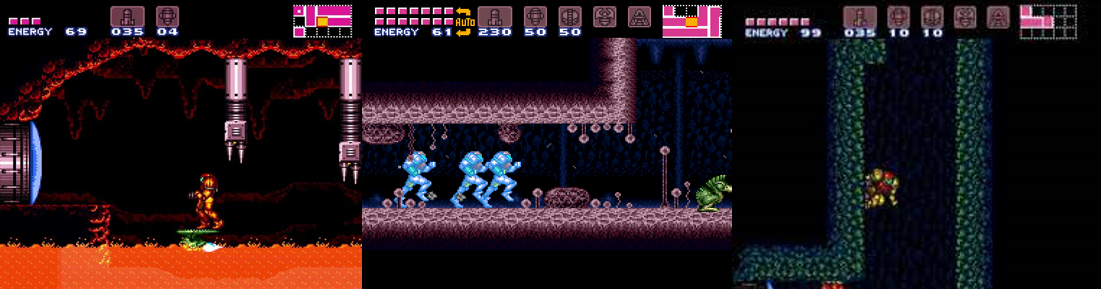
Super Metroid is a 2D action-adventure game in which the player once again assumes the role of Samus Aran, a highly capable bounty hunter, and sets off on a quest full of jumping, running, and backtracking (oh, so much backtracking) in order to eradicate the Space Pirates. Essentially, it’s a remake of Metroid in very much the same way Super Castlevania IV (Konami, 1991) is a remake of Castlevania (ibid, 1986); it takes many of the same mechanics, locations, and bosses of the first game and gives them a whole new, super sexy 16-bit makeover. Right away, the player can select between English and Japanese text and has access to three save files (though the Nintendo Switch’s save states and rewind functions negate a lot of this); the player can also customise the game’s controls and choose to turn Samus’s new “Moonwalk” ability (where she effortlessly slides backwards while shooting forwards) on or off. By default, Samus shoots her currently-equipped shot with X, jumps with A (the button can be held for a longer and higher jump), dashes ahead by holding B, and can switch weapons with the ‘Select’ button. Items can be cancelled with Y (though I found no use for this) and Samus can aim diagonally up and down using the L and R triggers. I found the default controls a little clunky so I swapped the jump to B, the shot to Y, and the dash to A, and even then I sometimes still got a little confused about whether I was shooting or jumping and found it annoying that there wasn’t an easier way to cycle between Samus’s different ammo.

Explore and upgrade Samus’s arsenal and skills to reach new areas.

Samus is gifted with infinite ammo for her basic arm cannon; the player can hold down the fire button for a rapid shot, but this later gets swapped out for a charged attack. However, the player can further customise Samus from the pause menu; here, you can equip and unequip the various weapon and armour power-ups Samus obtains, though I preferred to keep them equipped at all times. Unlike the previous games, a small, grid-based map appears onscreen at all times which makes exploration so much easier this time around. Using the pause menu, you can view the full map and better figure out your route, though you’ll need to access map terminals to unlock each location’s map. Pressing down on the control stick or directional buttons will see Samus curl up into a Morph Ball when she acquires the relevant power-up; this allows her to squeeze through small gaps and access areas that aren’t readily apparently. It’s worth shooting, placing bombs, and jumping to find hidden areas and alternative routes, too; the game gets very big and complicated very quickly so any shortcuts or additional resources are always a welcome bonus. Planet Zebes is a veritable maze of doors that must be shot open; they’re colour-coded so you always know which weapon to switch to, but you’ll also be asked to perform a fair amount of horizontal and vertical jumping. While Samus’s later techniques help with this, her wall jumping ability is absolutely nerfed; rather than simply jumping at a wall and hitting jump again, you need to awkwardly hold back and press jump with frame-perfect timing to actually execute the move, which can be needlessly frustrating at times.

Although Samus controls well, her wall jumping and vertical abilities can be frustrating.

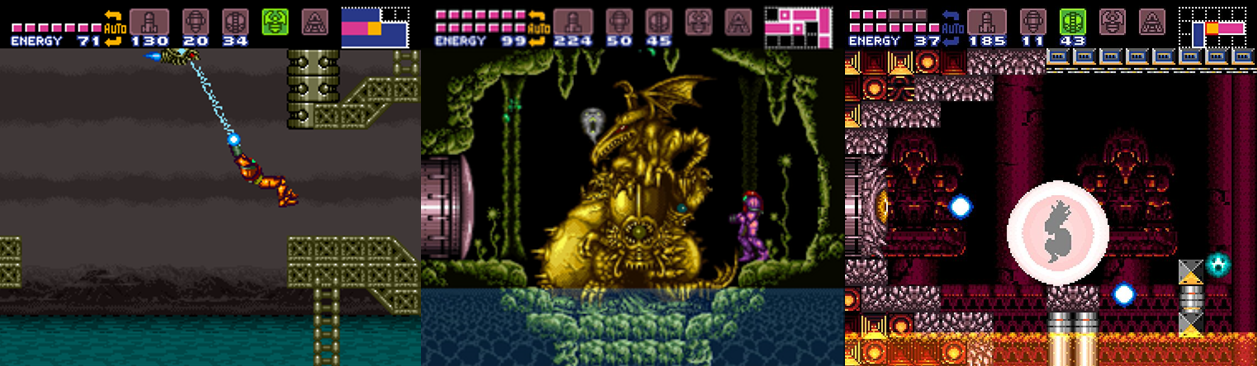
Similarly, Samus later acquires the Space Jump power-up; with perfect timing, this allows her to infinitely jump, cross wider gaps and reach higher areas, but the timing required is just too finnicky and random at times (it would’ve been so much easier to just keep hitting jump for a sustained effect). To make matters worse, enemies again respawn when you leave the screen; sometimes, smaller enemies will constantly spawn in certain screens, allowing you to “farm” health and ammo. You’ll also sometimes need to hop into the hands of a Chozo Statue while in your Morph Ball form to clear the path and you’ll find numerous helpful areas where you can catch your breath; save rooms, restore points to refill your health and ammo, and Chozo Statues gifting either new gear or upgrades to your existing equipment, total health, and total ammo. It’s well worth hunting these down as you’ll need your more powerful weapons to defeat the game’s bosses and more formidable enemies; both drop health and ammo when defeated but things are much easier if your maximum level is increased. Although well-equipped, Samus struggles against hazards like water, lava, acid and spike pits; suit upgrades allow her to negate some of these, and her Grapple Beam allows her to swing over hazards but, again, the timing required can be difficult to master. Super Metroid starts out fairly linear but you very quickly become restricted in where you can go, necessitating the acquisition of new power-ups; the more you obtain, the more you’ll need to remember cervices, destructible walls, and unreachable areas. You’ll be constantly backtracking, searching for new paths to the main four bosses, which may mean you’re over or under-equipped for certain encounters. Thankfully, the game is usually quite helpful and won’t leave you trapped in a room because you don’t have the High Jump Boots, but it can be a pain trying to figure out where you need to go and what you need to do.

Graphics and Sound:  
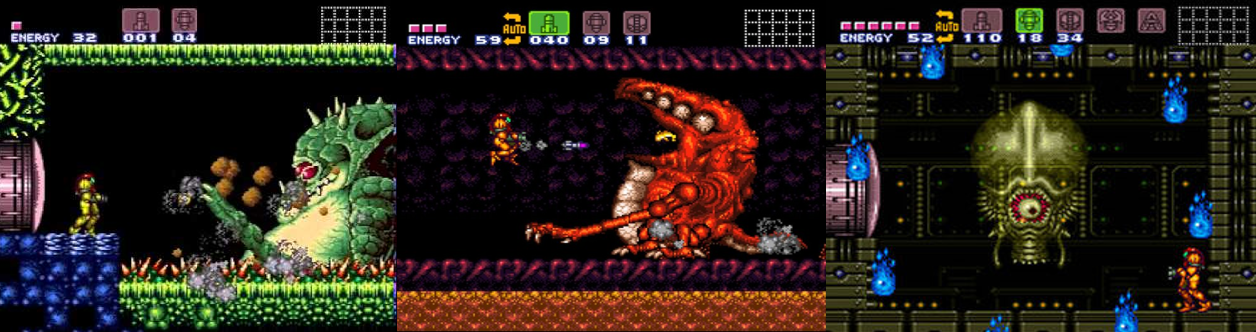
As a SEGA kid, I’ve long been envious of Super Metroid; for me, it’s one of the premier SNES titles and its visual appeal is a huge part of that. In fact, I admit that I was more excited to experience the game than I was to play it because of the difficulty involved in the constant exploration and the frustration of having to use a guide to find my way. Obviously, the game is a quantum leap ahead of its predecessors; Samus had never looked more colourful and lively before (and wouldn’t for many years aftwards), despite lacking much in the way of idle animations. She moves with a fluid grace that is both clunky when it needs to be and slick when she’s showing off her new abilities, spinning and curling and Moonwalking about as she blasts apart Space Pirates. The game’s story is told through text and simple to understand, cinematic cutscenes that utilise both the in-game graphics and a sprinkling of “Mode 7” for extra flair, with much of the ambiance and visual style influenced by the classic sci-fi action/horror Aliens (Cameron, 1986). Space colony Ceres and some levels of Zebes featured dead bodies scattered about, flickering lights at times, and rising bodies of water of varying danger, while the surface is rocked by a constant storm of acid rain not unlike the surface of LV-426.

The game is visually stunning, with a fantastic soundtrack and a strong aesthetic appeal.

While the game’s action is confined to Zebes, Super Metroid isn’t short on visual variety; this is used somewhat sparingly, and to great effect, so the rocky vegetation of Brinstar contrasts nicely with the sunken depths of Maridia and the lava-infested Norfair despite each location sharing similar layouts. Generally, Samus travels left to right from room to room but you’ll also be met by long vertical corridors and have to blast through the environment to progress. It’s not always clear which weapons or abilities you need to progress but there are some visual hints; blasting blocks or walls can reveal the symbol of certain weapons or arrows, indicating how to blow them open or to use your dash, or helpful little gremlins or dangerous digging machines can open new paths. Samus will discover a derelict ship that is plunged into darkness and lifeless until she restores the power; she can also break open glass tubes to further explore the depths of Maridia, blast and pass through certain blocks to drop into hidden areas, and even sink into sand to find new rooms. While there’s not always a lot happening onscreen, this allows each area to stand out all the more and the game to perform consistently, and each location expands and changes with your increased abilities, allowing you to make jumps you couldn’t before to navigate past hazards more effectively. The game also sounds fantastic; there’s a beautiful balance between silence, ominous ambient sounds, creepy tunes, and bolder, more blood-pumping music. Super Metroid ramps up the tension and adrenaline with its boss themes, especially when fighting Ridley and Draygon (who both sport Anguirus’ signature cry). Finally, the game is quite graphic at times; there’s the aforementioned dead bodies, Samus explodes in a similar fashion to Mega Man when killed, and Crocomire’s flesh melts from its bones upon being forced into a lava pit!

Enemies and Bosses:
Samus must blast her way through a slew of alien baddies to win the day, with many of them being variations of the standard, mantis-like Space Pirates. These insectoid aliens clamber on walls, march along the floor, and even hop overhead, firing jagged projectiles and often shielding themselves from your attacks with their claws, necessitating a weapon upgrade or a more convoluted attack pattern. Smaller enemies also pepper the game’s environments, ranging from wasp-like Zebbos, crab-like Scisers, and bat-like Skree, all of which are easy prey for you to farm some resources. Rippers can be temporarily frozen to act as platforms, Kilhunters will buzz about on their insectile wings, spiked Geemers slither about on small platforms, clunky Workrobots stamp about shrugging off your beams, and Evirs emerge from acid to fire projectiles at you. Enemies like the Beetoms and Metroids are a real headache as they can shrug off your regular shot and will latch onto you to drain your health, while Namihes and Funes spit fireballs from walls and guys like the Alcoon and Oum tend to burst out of nowhere for a surprise attack!

Samus faces some mammoth, formidable bosses, including long-standing nemesis Ridley.

As if that wasn’t bad enough, there are eleven bosses to battle here, with a couple being very similar battles fought in different circumstances. You’ll encounter Samus’s archenemy, Ridley, early on; confined to an enclosed arena, Ridley will swoop at you, spit fireballs, and swipe with his Xenomorph Queen-like tail, but you don’t actually need to defeat him here, just survive until he flies off with the Metroid larva. Ridley, returns, far more formidable, as the penultimate boss; this time, you’re confined to a small platform with health-sapping lava underneath and Ridley hides high above, swooping in to grab and squeeze the life out of you. He also breathes fire and becomes extremely aggressive as the fight goes on, though he is vulnerable to all of your weapons, with the charged Plasma Beam and Super Missiles being the most effective, but he’s certainly no pushover even with all your upgrades. Similarly, you’ll battle two malevolent Torizo Statues, one just after acquiring the Morph Bomb and one later on. You’ll need to make use of the Morph Ball in the first encounter to dodge its projectiles; both stomp about to smash into you and swipe with their claws, but the golden one will sidestep missiles and catch and toss your own Super Missiles back at you and was, honestly, one of the toughest bosses in the game for me! Another early boss encounter is against the Spore Spawn, a gigantic, genetically-engineered plant that bobs about, launching itself at Samus and causing small spores to rain across the screen. These can be blasted for ammo and health, which you’ll need as this alien plant can only be defeated by shooting its central core, which only opens up for a brief window. Defeating it earns Samus the Super Missile power-up and sees the environment wither and decay.

The game’s bosses are monstrous and require a bit of strategy on your part to best.

The first major boss of the game is against Kraid, now much bigger and even more imposing than before (though a smaller version is again encountered beforehand). Now taking up a good chunk of the screen, with the bottom littered with spikes, Kraid lunges at you, spits rocks, and causes boulders to rain from above. Kraid’s only weak spot is his eyes and, when you’ve dished out enough damage, he raises up and you need to make use of small platforms to avoid his projectiles and fire at his head whenever he roars. In the lava-soaked depths of Norfair, you’ll battle the all-but-invincible Crocomire; immune to all of your attacks, you need to force Crocomire   into a lava pit before it skewers you on a wall of spikes! Watch for its projectiles and its skeletal remains, which will burst through said wall in a last gasp attack! Whilst exploring the wrecked ship, you’ll be attacked by ghost-like aliens and eventually face off against their master, Phantoon, a giant, squid-like alien wraith that hovers around the room dropping blue flames, though you can dispense them with your shot to grab some resources. This guy also disappears and reappears about the arena and can only be damaged by shooting at its single, ugly eye, though neither it nor the worm-like Botwoon should cause you too much trouble if you keep your beam charged and have plenty of missiles on hand.

After besting her minions, Samus must do battle with the fearsome Mother Brain!

The same can’t be said of Draygon, which acts as something of a teaser for the later Ridley fight. Draygon will swoop down and grab you, slamming you against the wall if you’re not careful, requiring a unique strategy beyond just dodging and shooting. If you let it grab you, you can shoot your Grapple Beam at an electrified wall panel; you’ll take damage, but you’ll also toast Draygon in the process, leaving her insectoid children to mourn her corpse. I wouldn’t underestimate the Silver Space Pirates, either; this duo is fought in Ridley’s lair and are only vulnerable when they flash gold, making them an exercise in frustration as they flip and slice and kick to whittle you down. Once you’ve defeated the main bosses, you’ll be able to access Tourian, a metallic landscape where Metroids wander freely. Here, you’ll encounter the titular Super Metroid, which proves invulnerable and will drain your health to almost nothing before fleeing. Eventually, you’ll battle Mother Brain once more; like before, this massive brain sits in a jar and is protected by laser walls, a constant spread of projectiles, and a lava floor. Once you shatter her protective casing, she rears up into this monstrous bipedal monstrosity that stomps about in a claustrophobic area, spitting explosive breath and blasting you with laser beams from her eyes! When you deal enough damage, she’ll decimate you with an unavoidable rainbow laser; luckily the Super Metroid comes to your aid, sacrificing itself to restore your health and gift the Hyper Beam, which cuts down Mother Brain. Once she’s defeated, the whole planet crumbles around you and you have three minutes to escape to the surface, whereupon you’ll be granted a special image of Samus depending on how well you played.

Power-Ups and Bonuses:
Samus starts with ninety-nine units of energy and her regular arm cannon but it’s not long before you’re increasing her exploration abilities with the Morph Ball and upping her arsenal with the missile and Super Missile, which both deal far greater damage than her regular shot, and increasing her maximum energy with the fourteen Energy Tanks. You can also find four Reserve Tanks to have some health restored after death, can use the X-Ray Scope to search for these, and hidden paths, in the environment, and grab the Speed Booster to run through walls and enemies alike and the Grapple Beam to latch on to overhead blocks and certain walls (if you can get to grips with the controls). In addition to finding numerous energy recharge stations, you can also fully refill your ammo at similar stations, usually located near a save room, and you’ll find loads of power-ups to increase your maximum ammo for each bomb. Samus can also upgrade her suit to allow her to freely move underwater, increase her defence, and allow her to resist certain types of lava, all of which is essentially for exploring the entirety of Zebes, Samus’s main cannon can also be upgraded to allow her to charge a more powerful attack that’s great for inflicting big damage against bosses, temporarily freezes enemies to create extra platforms, and allows her to fire three beams at once that go through walls and enemies alike. You’ll also acquire the ability to drop balls when morphed (clearing obstructions in tighter spaces and boosting you over small ledges), a screen clearing Power Bomb, and the Spring Ball that lets you jump while morphed. The High Jump boots increase your jump height, the aforementioned Space Jump allows you to clunkily continuously jump, and the Screw Attack adds an electrical crackle to your jump spin to damage enemies.

Additional Features:
Upon finishing Super Metroid, you’re given a percentage showing how many of the game’s secrets you found. You can freely load up your save file to backtrack and hunt down anything you missed if you like, but the game’s endings are based on how much time you took not how much you found. You’ll only get to see Samus in her skin-tight under garments if you beat the game in under three hours; playing between three and ten will see her remove her helmet, and playing for more than ten hours sees her preserve her modesty behind her suit and you settling for a thumbs-up. In the final escape sequence, you apparently have the option of saving the trapped Dachoras and Etecoons, though I didn’t notice them in my playthrough and it appears to add nothing to the ending but personal pride. This version of the game naturally allows you to create a save state at any time and make use of the Nintendo Switch’s rewind function, which is perfect for the game’s many aggravating sections, and you can also take advantage of a special save state version of the game that lets you skip right to the end with all of Samus’s upgrades.

The Summary:
Of all the Metroid games I’ve played, I’ve played Super Metroid the most but I never managed to finish it before this playthrough. The game is absolutely gorgeous, with a visual appeal that’s matched by its soundtrack and massive, action-packed bosses and the appeal of its main character. However, the large-scale nature of the game and the copious backtracking were always intimidating for me as I really didn’t want to have to keep referring to a guide; luckily, I was able to get through Super Metroid without too much help in this regard, but it can be frustrating when you seem to have exhausted all your options only to have missed a destructible block tucked away. While Super Metroid is impressively put together, with some fantastic detail, variety, and challenge on offer, playing the game from start to finish has made me see flaws in the game’s controls; wall jumping is absolutely atrocious and techniques like the Space Jump are needlessly finicky, ruining a lot of the platforming sections and making me wonder how anyone ever managed to succeed at the game without the aid of save states. The bosses are equally challenging, even when Samus is fully armed and powered up, making for a tough but ultimately very rewarding gameplay experience. Had these control issues been tweaked to be simple button presses, it would’ve been a perfect five out of five but Super Metroid is still one of the quintessential SNES titles and is well worth investing your time and patience.

My Rating:

Rating: 4 out of 5.

Great Stuff

Did you enjoy Super Metroid? Would you agree that it’s one of the titles that defined the SNES era of gaming? Did you struggle with the controls at all and what did you think to the large, inter-connected game world? Which of the bosses and upgrades was your favourite? What did you think to the graphical upgrade and the level of detail on offer? Which Metroid game is your favourite? Whatever your thoughts, feel free to leave a comment below or on my social media, and be sure to check out my other sci-fi content across the site.

Game Corner [Sci-Fanuary]: Metroid II: Return of Samus (Nintendo Switch)


January sees the celebration of two notable dates in science-fiction history, with January 2 christened “National Science Fiction Day” to coincide with the birth date of the world renowned sci-fi writer Isaac Asimov, and HAL 9000, the sophisticated artificial intelligence of Arthur C. Clarke’s seminal 2001: A Space Odyssey (1968), being created on 12 January.


Released: February 2023
Originally Released: November 1991
Developer: Nintendo
Original Developer: Nintendo R&D1 Intelligent Systems
Also Available For: Game Boy, Nintendo 3DS, Nintendo Wii, Nintendo Wii U

The Background:
Brain-blasting bounty hunter Samus Aran shocked the gaming world when she was revealed to be a woman in the challenging Nintendo classic, Metroid (Nintendo R&D1 Intelligent Systems, 1986). Although highly praised and crucial to the popularisation of the “Metroidvania” sub-genre, Metroid’s sequel came not on the Nintendo Entertainment System (NES) like Nintendo’s other franchise characters, but on their revolutionary (and incredibly popular) handheld system, the Game Boy. Many of Metroid’s developers returned for the sequel, which separated itself from other Game Boy titles with graphics comparable to its 8-bit counterparts and expanding upon Samus’s abilities and narrative in ways that would influence future games. Not only was Metroid II my first experience of the franchise, but it also included a unique palette for when played on the Game Boy Color, though it largely divided critics upon release. Reviews praised the quality of life improvements and expansion upon the gameplay of its predecessor, while also criticising the music and limitations of the Game Boy hardware. Yet, Metroid II endured; a fangame remake was scuppered by Nintendo prior to them remaking the game for the Nintendo 3DS in 2017, with Metroid: Samus Returns (MercurySteam, Nintendo EPD) being largely well received. The original version of the game also found a home on Nintendo’s online services, including this Nintendo Switch Online version, to help keep this cult classic alive for new gamers.

The Plot:
Following her encounter with the Metroids, bounty hunter Samus Aran is sent to the Metroid home world, SR388, to destroy the entire species.

Gameplay:
Metroid II: Return of Samus is a run-and-gun adventure game with an emphasis on exploring the various alien landscapes of SR388, upgrading Samus’s suit and abilities, and hunting down forty Metroid variants to curb the malicious species. Players once again assume the role of the intergalactic bounty hunter Samus Aran, who sports the same abilities from the first game and more, most notably the ability to shoot upwards and while crouching, simple additions that make blasting aliens and destructible blocks so much easier. You’re given three save files to play with, which can be switched to or deleted from the main menu, though there are no options to reconfigure any game settings, like the controls or difficulty. However, since it was originally a Game Boy title, you’ll only make use of two buttons during gameplay: A lets you jump (and you can hold it to jump a little higher) and B lets you shoot (and you can hold it to continually fire at foes). Samus will compress into a spherical Morph Ball if you press down on the directional pad twice, and you can switch from her infinite gun arm to her finite supply of missiles by pressing the – button. The + button pauses the game, but you again won’t find a map screen, here, meaning exploration is still a chore, despite Metroid II being a slightly more forgiving and straightforward title.

Run, shoot, and roll your way through a confusing alien world hunting Metroids.

Unlike in the last game, players can make use of save stations to save their progress and sporadic refill pods for their health and ammunition, reducing how often you’ll blast away at enemies to farm for resources. As before, enemies will respawn whenever you enter an area, though this time around to you must alter the environment, clearing lava and other hazards so you can progress further. Puzzle solving isn’t really a thing in Metroid II; the closest you get are blasting certain doors with your missiles to open them and navigating deep chasms, some of which are somewhat maze-like and have hidden holes that drop you to lower levels, though you’ll sometimes have to use Samus’s Bomb power-up to blast away boulders. This game debuts the Spider Ball, which allows Samus to slowly crawl up walls and ceilings, and you’ll be using this a lot to scale cliffs and ruins, especially as the game progresses. However, your primary objective is to hunt down the forty Metroid variants hidden around SR388; you can keep track of how many remain using the game’s limited heads-up display, but you won’t be given any hints or direction about where to find them beyond hitting dead ends until you’ve acquired new power-ups. Occasionally, Samus will dive into water or must traverse sticky goop; spikes and lava pits are commonplace, as are destructible elements like weeds and sandstone, and you’ll also have to navigate a pitch-black area later in the game that’s incredibly frustrating as there’s no way to light your path. Mostly, though, you’ll be exploring long corridors, deep shafts, and crawling up walls and through narrow tunnels, blasting enemies and hoping the path leads to an upgrade or another Metroid.

Graphics and Sound:
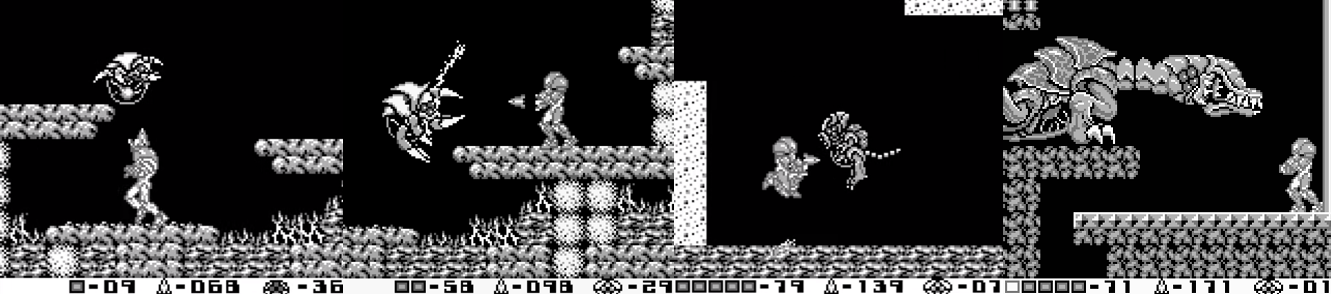
Releasing a couple of years after the debut of the Game Boy, Metroid II is quite a bland looking game, especially as far as the backgrounds are concerned. Backgrounds are largely completely blank, either white, black, or that weird green colour the Game Boy favoured, with very little in the way of foreground details, for the most part. Some areas are the exception to this rule, of course, with an abundance of overgrown stone ruins, rocky caves, and biomechanical areas peppered throughout the game so you know when you’ve transitioned from what could loosely be called the overworld to an area of some significance. Many areas contain lethal lava, dank water, or gloopy muck that restricts your movements but are largely indistinguishable from each other; sometimes the rocks look more like peanuts, sometimes they’re metallic, and sometimes they’re almost like bubbles, but the game becomes disappointingly and confusingly uniform very quickly. Caverns, ruins, and mechanical trappings signpost areas containing Metroids and power-ups, but it’s easy to think you’ve accidentally backtracked as SR388 isn’t exactly divided into elemental sections. Having the overworld be rocky and the main sections be distinctly water-, metal-, botanical-, or lava-themed would’ve helped to distinguish them but, as is, there’s only a handful of areas that impress when it comes to their aesthetics. While this is commonplace on the Game Boy, it’s not as if there weren’t games that were able to do a little more with the hardware, so it’s pretty disappointing here, especially as the game lacks a map.

As impressive as many of the sprites are, the backgrounds, locations, and music suffer.

On the plus side, Samus looks great, far better than she did on the NES and showcasing a surprising level of detail. While she doesn’t have any idle poses, her suit changes to reflect her upgrades and she has more poses to assume thanks to her expanded moveset. In addition to her iconic ship sat in the opening section, you’ll always know when a Metroid is nearby by the presence of a hatched Metroid egg, there are a couple of cutscenes showing the Metroids evolving into new, more powerful forms, the Chozo Statues are nice and big (with one even being destroyed), and there are usually some fun hidden paths to take towards goodies. Sadly, the music isn’t all that impressive, aiming for claustrophobic and ominous but being limited by the Game Boy hardware. However, the biggest disappointment for me was the complete lack of any story; there’s no story text, the title screen is incredibly bland, there’s no introductory cutscene, and the game just…ends, albeit with an impressive large sprite of Samus running alongside the credits that changes depending on how fast you beat the game.

Enemies and Bosses:
In addition to the indigenous Metroid population, SR388 is home to a whole host of alien lifeforms, from bug-like creatures to robotic forces and defences that I have assume were left behind by the Space Pirates. All of these will respawn after you exit an area and, while most can be defeated in one or two shots, others will be almost invulnerable until you acquire new power-ups or continually spawn and chase after you to bash you into spikes or lava. We’ve got floating slug-like enemies, laser turrets, hopping toad-like creatures, tiny bugs that drop from ceilings, weird flying proboscis-type things that drop you towards hazards, bat-like drones, and slug-like fish that slither around platforms. Speaking of which, the bone-armoured Motos resist your blaster and can only be taken out from behind or with the Screw Attack (though they often drop larger health orbs); they’re often found alongside Ramulken, who are similarly armoured but jump about the place, though most enemies can simply be blasted or outright avoided, especially if you’re close to a health point. The only boss-type enemy you’ll encounter that isn’t a Metroid variant is the armadillo-like Arachnus, which disguises itself as a Chozo Sphere and not only spits projectiles at you but completely resists your attacks when rolled up. However, it’s vulnerable to your bombs, so you can lay a bunch of those to take it out and pry the Spring Ball from its remains.

You’ll need plenty of missiles (and patience) to snuff out the various monstrous Metroids.

As in many Metroid games, the titular, jellyfish-like aliens will appear near the end of the game, latching onto you and draining your health and only being vulnerable when frozen by the Ice Beam and peppered with missiles. The forty other Metroids you battle in several mini boss encounters are evolved Metroids that take on an insectile, ant- or wasp-like form that allows them to fly. The most common of these are the “Alpha” variant, which are largely harmless and simply float about the place, meaning the “Gamma” variant is quite the sharp difficulty curve with its more monstrous appearance and lightning bolt appendages. They’re a joy compared to the “Zeta” Metroids, though, which frustratingly badger you from behind, spit fireballs, and can only be damaged when blasted in the face with missiles. Similarly, while the “Omega” Metroids are far slower, they spit electrical sparks that produce splash damage and float about the place, making them a difficult target despite their size. Each of these may also be fought in enclosed arenas, above spikes or lava, within sandstone, or in areas with small platforms or blocks to make avoiding damage even more troublesome. Once you’ve destroyed thirty-nine of them, nine more regular Metroids need to be dispatched before you face off with their monstrous, dragon-like queen. While technically a simple battle, requiring only that you use the Screw Attack to escape damage and blast the queen with missiles (you can even Morph Ball to safety to refill your health and ammo using a convenient tunnel), this is a laborious and dull fight thanks to the restricted area, the aggressiveness of the queen, and the fact that you need to hit her with 100 missiles! Apparently, there’s a way to Morph Ball into her mouth and lay a bunch of bombs in her, but I couldn’t manage that so it was a lot of tedious evading, blasting (missing), and rewinding when I took too much damage.

Power-Ups and Bonuses:
As ever, enemies will drop health orbs and missiles to refuel you but, this time around, you can also find larger, dedicated, and inexhaustible refuel stations to top these up in a pinch, and they’re not always hidden away either. Similarly, you can find Energy and Missile Tanks to expand your health bar and maximum ammo (though these are often hidden away or at the end of winding tunnels). As is often (if not always) the case, Samus mysteriously loses all the upgrades she got in the last game and needs to reacquire them from Chozo Statues hidden throughout SR388. You can upgrade her arm cannon to the Wave Beam (which increases accuracy), the Ice Beam (which temporarily freezes enemies), the Spazer Laser Beam (which fires a triple shot), and the Plasma Beam (the most powerful, which passes through objects and enemies), and will even get the chance to switch back to them at one point (with the Ice Beam being required for the final section). Samus’s jump can be extended with the High Jump Boots before allowing her to reach higher, further areas (through carefully timed taps of A) with the Space Jump, before becoming an offensive move with the iconic Screw Attack. Her Morph Ball can also be upgraded to drop bombs, bounce, and cling to walls, which, while slow, is basically a requirement in some areas.

Additional Features:
Sadly, there’s not much to Metroid II. Like I said, there are Energy and Missile Tanks to find that you could conceivably miss but that’s about it. The only reason you’d replay the game beyond enjoying wandering around a confusing handheld landscape is to try and beat the game in under three hours so you’ll be treated to seeing Samus in a bikini; otherwise, there are no bonus or extra features to speak of here. As ever, you can make liberal use of the Nintendo Switch’s rewind and save state features to make the game a lot easier, though it’s still a challenge at times.

The Summary:
I’m glad I finally played through Metroid II: Return of Samus; when I was a kid, I had the original cartridge for my Game Boy, but I remember getting stuck fairly soon into the game. Low and behold, I hit the same dead end here and quickly became reliant upon an online guide, which is not my preferred way of playing any game. Sadly, it’s basically required here as there’s no map system, which is weird as I definitely think a rudimentary map could’ve been inserted whenever you pause the game. Ultimately, this was a tough one for me; I liked how much the gameplay mechanics of the original were improved, even if only in basic ways, but I don’t think this kind of game works on the Game Boy; Metroid is all about exploration and backtracking and, while Metroid II is a bit more linear than others in the series, it still requires more than the Game Boy is capable of delivering. Yes, the sprite work looks good, but every area is too constricted and repetitive to stand out like they would on even the NES and it gets a bit boring facing the same batch of Metroids over and over again. There is a lot to like here, with some fun encounters and areas and the thrill of upgrading Samus’s suit and abilities, but I think Metroid II was trying to be a little too ambitious for the Game Boy. I’m tempted to see what the Nintendo 3DS remake is like to compare it but, sadly, it’s ridiculously expensive to get hold off so I’m left with this paradoxically technically impressive and technically limited entry in the series that felt too much like a chore to play through for mee to properly enjoy.

My Rating:

Rating: 2 out of 5.

Could Be Better

Are you a fan of Metroid II: Return of Samus? Did you own it on the Game Boy and, if so, how did you cope without a guide or the rewind features? Were you impressed with Samus’s new abilities and combat options? What did you think to the more linear mission and Metroid-hunting gameplay? If you’ve played the Nintendo 3DS remake, how does it compare to the original? Which Metroid game is your favourite? Whatever your thoughts, feel free to leave a comment below or on my social media, and be sure to check out my other Metroid reviews.

Game Corner [Sci-Fanuary]: Metroid (Nintendo Switch)


January sees the celebration of two notable dates in science-fiction history, with January 2 christened “National Science Fiction Day” to coincide with the birth date of the world renowned sci-fi writer Isaac Asimov, and HAL 9000, the sophisticated artificial intelligence of Arthur C. Clarke’s seminal 2001: A Space Odyssey (1968), being created on 12 January.


Released: 14 November 2018
Originally Released: 6 August 1986
Developer: Nintendo
Original Developer: Nintendo R&D1 Intelligent Systems
Also Available For: GameBoy Advance, GameCube, Nintendo Entertainment System (NES), Nintendo Wii, Nintendo Wii U

The Background:
It’s probably fair to say that, compared to Nintendo’s other heavy-hitters like Super Mario and The Legend of Zelda (Various, 1986 to present), the Metroid franchise (Various, 1986 to present) is maybe one of the company’s more under-rated properties. I actually have had very little experience with the series outside of the Super Smash Bros. series (Various, 1999 to 2018) and brief experiences with Metroid II: Return of Samus (Nintendo R&D1, 1991) and Super Metroid (Nintendo R&D1 Intelligent Systems, 1994), though this is mainly due to growing up as a SEGA guy. Metroid came about after Nintendo had seen success with their early titles for their industry-saving console, the NES. Producer Gunpei Yokoi and directors Satoru Okada and Masao Yamamoto collaborated on the title, which was heavily influenced by Alien (Scott, 1979). The developers sought to create an action-orientated game in which power-ups would be not only permanent, but necessary to completion, and with a strong emphasis on non-linear exploration. Metroid ended up being so successful in this regard that it, and Castlevania (Konami, 1986), spawned an entire videogame subgenre dubbed “Metroidvania”. Metroid was well-received upon release; reviews praised its challenging gameplay and it has since been recognised as one of the greatest games ever made. Metroid would spawn a number of sequels and spin-offs, and was ported to many subsequent Nintendo consoles either as an unlockable bonus or as a full-blown remake. Considering how popular and influential the series, and this first game, have become over the years, it’s no surprise that Metroid was included in the Nintendo Switch Online service soon after it launched, which also allowed me the chance to play it for the first time.

The Plot:
Bounty hunter Samus Aran journeys to the planet Zebes to retrieve the parasitic Metroid organisms from the malicious Space Pirates, who plan to replicate the Metroids by exposing them to beta rays and then use them as biological weapons in their mad plot for galactic conquest.

Gameplay:
Metroid is a 2D, sidescrolling, action/platformer with a strong emphasis on run-and-gun action, horizontal and vertical jumps, backtracking, and exploration. Players take on the role of Samus Aran, an armoured bounty hunter with a blaster for an arm, and must explore the planet Zebes, which is comprised of five relatively distinct areas all joined together in a huge game map. Samus begins the game able to shoot directly ahead or above and to jump, and you’ll quickly find that ground-based enemies are beyond your ability to destroy in the early going as Samus can’t shoot downwards or defeat enemies by jumping on them. You’ll also, literally, run face-first into a wall if you give into your gamer’s instinct and head to the right; instead, you should go left from the starting area, where you’ll find your first Chozo Statue and your first power-up, the Morph Ball, which lets you curl up into a ball by pressing down and thus slip into small tunnels and areas. From there, the sheer scope of your mission quickly becomes very daunting; not only do enemies respawn when you leave the immediate area (not the immediate screen, as you can scroll to the left and then go back to the right and your enemies will be back) but you’re missing the most crucial aspect a game like this needs: an onscreen map. I have absolutely no idea how gamers managed to play Metroid without this simple convenience, and have heard that they either drew their own maps or consulted magazines at the time just to get an idea of where the hell you’re meant to go. Since you acquire different upgrades along the way that help you access new areas, and a lot of the areas look very similar save for some different colours and flourishes, you’ll need a good memory and a lot of experimentation to figure out where you’re going and what you’re doing.

Explore a large, interconnected map finding upgrades to reach new areas.

Thankfully, you can at least hold down B or X for a rapid fire function and hold A to jump a little higher, and Samus is relatively durable; her health is measured in numerical units, and her default weapon has unlimited ammo, but you will have to deal with some difficult jumps (made all the more frustrating by some horrendous enemy placement and movements) and knockback damage that can send you dropping into lava or spikes, where your health will whittle away to nothing in no time at all. Metroid gives you just one chance to finish the game; if (well, when, really) you die, the game is over and you’re given a ludicrously long password to continue but, thankfully, the Nintendo Switch version allows for both save states and a rewind function if (again…when) you make a mistake. Health and ammo is dropped by enemies and there are numerous points where you can simply stand there, blasting at constantly respawning enemies to farm health or missiles, but take care as enemies can pounce from behind and more spawn in the moment you pick up your item. Your primary goal in Metroid is to find and defeat two bosses to create a bridge that leads to the final area, Tourian, to confront Mother Brain but, to reach these bosses, you’ll need to find new upgrades to open doors or reach new areas with a higher jump, temporary platforms, or dropping down through destructible blocks. Although areas start out pretty simple, it’s not long before you need to blast at stone blocks to create pathways and platforms (though you need to be careful as the blocks will damage you if you’re standing there when they spawn back in), hopping over tiny rocky platforms floating over lava, and dodging past tougher enemies. Luckily, there are no instant death hazards here, but you can easily get trapped in a dangerous position where enemies and hazards drain your health, or you’re left with such little health that you’ll die soon after anyway. All of this means that Metroid is a pretty touch experience, even with the quality of life features offered by the Nintendo Switch; it doesn’t take much for a simple mistake to lead to disaster, enemies can take quite a few hits before being dispatched, and it’s ridiculously easy to get turned around and completely lost. Luckily, there’s no time limit to worry about, and the game is much more enjoyable with a detailed map to help you out.

Graphics and Sound:
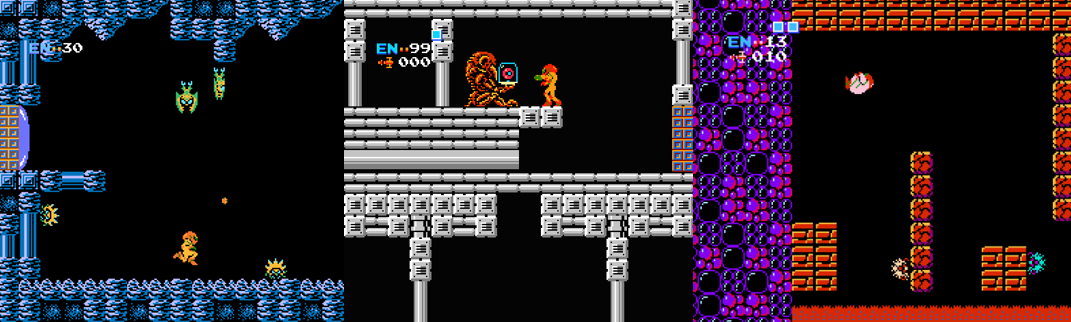
Given that it’s an 8-bit title, Metroid is quite the pixelated adventure; Samus, especially, stands out against all of the game’s dark backgrounds thanks to her orange armour but, as you might expect, doesn’t really have many frames of imagination. She ambles along at a decent pace, even able to shoot and run at the same time, but you’ll notice that the game suffers from severe slowdown when too many enemies or items are onscreen at the same time. Each area of Zebes is accompanied by a funky little tune, with the now-recognisable Metroid theme being the catchiest of them, but you won’t encounter any context or story-related text until the final moments of the game, meaning you’ll need the instruction manual to have any idea of what the hell’s going on.

While areas can be distinctive, there are many screens and sections that are confusingly similar.

Planet Zebes is split into five areas: Brinstar, Kraid’s Lair, Norfair, Ridley’s Lair, and Tourian, with each one connected by stone or mechanical tunnels and lifts that you can descend and ascend. Each area has a different colour scheme to help differentiate them a little (blue, green, grey, purple, etc) but they’re also very similar and feature nearly identical tunnels and screens in each area, meaning that it’s very easy to lose track of where you are. Some areas feature cloud platforms, stone columns, lava, bubble or monstrous platforms and ceilings, while others are long vertical shafts you need to make your way up. These long shafts can be safer spaces where you can restock on your supplies, but you’ll also need to make use of your Bomb to blow up blocks and descend downwards to give your Morph Ball a little boost to enter into seemingly impassable walls. While lava pits are best avoided, some are actually fake and lead to new areas; other times, you’ll need to navigate through tubes, avoiding or blowing up enemies and hoping you don’t end up being boiled alive. Little touches like moss, different types of stones or foreground elements, and minor visuals help to make some screens a little more distinct but it’s very easy to get confused as some screens are literally identical but at different points on the map and you’ll no doubt be driven made by the constant beeping when your health is low.

Enemies and Bosses:
Planet Zebes is host to all manner of alien baddies who will hop, swoop, and fly right at you without a second’s hesitation. While some of the smaller, weaker enemies can be destroyed in one shot, others take multiple shots and even the simplest of enemies can cause a major problem as they respawn constantly from all angles and it’s easy to get hit by one (and knocked into lava…) Spiked Zoomers are the easiest and most frequent enemy, though you’ll probably be farming pick-ups from Zebs quite often as well. Skree drop from the ceiling and will explode if you don’t destroy them quickly, Wavers, Rios, Multivolas, and Sidehoppers bounce around the screen erratically, Dragons spit fireballs at you in an arc from lava, and Rippers travel back and forth and make for useful temporary platforms oney you acquire the Ice Beam. In Tourian, you’ll encounter the titular Metroids, bug-like parasites that float around and home in on you to suck your energy away and which can only be destroyed with your limited supply of missiles.

After besting Ridley and Kraid, you’ll face your toughest challenge yet in Mother Brain’s defenses.

Considering the size of its map, Metroid only features three bosses; I assume you can theoretically tackle Kraid and Ridley in whatever order you like (assuming you take the right paths using a guide) but I fought Ridley first. This stubby little purple dragon hops up and down in the middle of the arena shooting projectiles at you. These also form a kind of protective shield that will block your shots, but can be destroyed with your weapons. Ridley doesn’t really need to do much else as he can absorb a huge amount of punishment before finally exploding, and the same can also be said about Kraid. Kraid is a little more formidable; he meanders back and forth across a platform surrounded by acid and constantly fires missiles and throws bladed projectiles at you, all of which you must dodge and shoot through in order to land the necessary multiple hits on the bulbous monster. There’s also a fake version of Kraid hiding in his lair, which will respawn upon defeat, and only by destroying the real Kraid can you complete the bridge and enter the game’s toughest and most unfair area by far. Mother Brain is a stationary brain inside a glass jar but is protected by an intricate and unrelenting arsenal of wall-mounted lasers, bubble-like projectiles, and barriers which you must blast through with your missiles. As if that isn’t bad enough, you’re given precarious platforms to stand on to shoot at her and must battle over a lava pit, constantly dodging and being pummelled by projectiles as you desperately try to fire your missiles at her through the narrowest of openings. Once she’s defeated, you’re then given about 999 in-game seconds to navigate up one final shaft and get to safety before the whole place explodes, making for a heart-poundingly tense and massively frustrating finale to an already challenging game.

Power-Ups and Bonuses:
Samus will find a wide variety of useful, permanent power-ups to gradually make her journey a little easier. It’s well worth taking the time to explore (or use a map…) to seek these out as you can increase her health by finding Energy Tanks (which will add another block of 99 health units to your total) and increase her maximum supply of missiles up to 255 with Missile Tanks. Since you need missiles to open doors and deal the maximum amount of damage to enemies, and will find yourself absolutely crucified in Tourian without these, these are both well worth seeking out. As mentioned, you’ll need the Morph Ball to progress past the first few screens, and soon acquire the Bomb to use in this form to destroy ground-based enemies or propel Samus into tunnels. The Long Beam will extend the range of Samus’s default weapon, which can also be upgraded to the Ice Beam (which, naturally, freezes enemies and turns them into temporary platforms but be warned as a subsequent shot will unfreeze them) and, eventually, the Wave Beam (which increases the firing range of your main attack). Samus can also find the High Jump Boots to extend her vertical jump, the Screw Attack to damage enemies with a spinning jump attack, and the Varia Suit to reduce the amount of damage she takes from enemies and hazards.

Additional Features:
As mentioned, the Nintendo Switch version allows for up to three save states and includes a rewind feature, both of which are incredibly useful for when you land in a sticky situation or want to take a break. If you fancy jumping ahead, you can also play an “SP” version of the game that bestows you with all the available equipment and upgrades and drops you right outside of the battle with Ridley. Unlike many videogames of its era, Metroid doesn’t feature a high score system but it does include multiple endings; the faster you finish the game, the more of Samus’s true form will be revealed in the ending. Additionally, after finishing the game, you’ll automatically start over in a new game with all of your power-ups (though without the additional Energy and Missile Tanks you acquired) or even garbed in a skin-tight outfit rather than armour.

The Summary:
I may not have ever properly played a Metroid game before, but I was fully aware of the franchise and its emphasis on backtracking and exploration. Consequently, I was a little intimidated to play through Metroid, especially as my limited experience with the series had left me struggling to find my way around. Although it is a real problem that Metroid doesn’t feature any kind of map (which is weird, as The Legend of Zelda (Nintendo R&D4, 1986) released earlier that same year and featured a rudimentary map system), it’s nothing you can’t solve with a quick Google search, meaning your only remaining hurdle is the challenge offered by the gameplay. While the controls are tight enough, Samus is a bit slippery and floaty at times, and her inability to fire in all directions makes things problematic, but nowhere near as annoying as the respawning, erratic enemies and tricky platforming sections. The various upgrades definitely help with this, and once you have a bit more health and a more powerful main attack and have gotten used to the repeating rooms and enemies, the game becomes a lot of fun. It’s definitely rough around the edges, though; when playing retro games on modern consoles, I always try to imagine how gamers coped back in the day and, in the case of Metroid, I can only assume they got through it with a great deal of patience and trial and error. Still, this was a decent experience and I’m glad that I finally played through it; it’s maybe a little too challenging and confusing at times for just a casual playthrough, though, so I’m interested to see if I find the later releases more appealing with their improved graphics and controls.

My Rating:

Rating: 3 out of 5.

Pretty Good

Have you ever played Metroid? If so, what did you think to it and how do you think it holds up today, both against its subsequent titles and other games from that era? Did you struggle to navigate the inter-connected game map? Which of the bosses and upgrades was your favorite? Have you ever finished the game without using modern enhancements, and what’s the best ending you’ve achieved? Which Metroid game is your favourite? Whatever your thoughts, feel free to leave a comment below or leave a reply on my social media, and be sure to check out my other Metroid reviews.

Game Corner [DK Day]: Donkey Kong Country (Nintendo Switch)


In 1981, Shigeru Miyamoto and his team at Nintendo R&D1 created Donkey Kong, an arcade title that was not only one of the earliest examples of the platform genre but also introduced gamers everywhere to two of Nintendo’s most recognisable characters: Mario and Donkey Kong. Mario, of course, shot to super stardom but today’s a day to celebrate everyone’s favourite King Kong knock-off and to say: Happy birthday, Donkey Kong!


Released: 15 July 2020
Originally Released: 18 November 1994
Developer: Nintendo
Original Developer: Rare
Also Available For: Game Boy Advance, Game Boy Color, Nintendo 3DS, Nintendo Wii, Nintendo Wii U, Super Nintendo Entertainment System (SNES), Super Nintendo Entertainment System (SNES), SNES Classic Edition

The Background:
After establishing themselves in the United States with the financial and critical success of Donkey Kong (Nintendo R&D1, 1981), Nintendo then captured the home console market with the Nintendo Entertainment System (NES) and their moustachioed mascot, Super Mario. Although Donkey Kong wasn’t completely forgotten during this time, featuring in sequels and spin-offs during the NES’s lifecycle, it was legendary British developers Rare who breathed new life into the cantankerous ape with their Donkey Kong Country series (Rare, 1994 to 1996) that pushed the SNES hardware to its limits with their revolutionary pre-rendered graphics. Rare impressed Nintendo back in the day with their ability to reverse-engineering the NES and publishing over sixty titles for the console, and by utilising Nintendo 64 workstations to produce SNES titles. Wishing to compete with SEGA’s Aladdin (Virgin Games USA, 1993), and seeing the long-dormant Donkey Kong franchise as low risk, Nintendo handed the character to Rare and they assembled a team of twelve developers (their biggest yet) to develop the title. Inspired by the level design of Super Mario Bros. 3 (Nintendo R&D4, 1988), Rare sought to make the game’s levels short bursts of challenging fun that tailoured to a player’s increasing skill level. Kevin Bayliss redesigned Donkey Kong to be more muscular and cartoonish to aid with animation and Rare were given license to completely redesign Donkey Kong Jr. into a brand-new character, Diddy Kong, to act as DK’s physical opposite. Donkey Kong Country was one of the first videogames to utilise pre-rendered 3D graphics; their computers ran night and day to decompile the 3D models into traditional 2D sprites and, although physically taxing for the team, the result was the third-bestselling game on the SNES. Reviews were overwhelmingly positive, with the game seen as a significant benchmark in the presentation of videogames; the visuals and soundtrack have stood the test of time and the game is still heralded as a classic. Donkey Kong Country re-established the popularity of the brand was followed by a couple of equally well-regarded sequels but has only been sporadically released on other hardware due to legal issues. Thankfully, it was later included in the SNES Classic Edition and to Nintendo Switch Online subscribers in 2020 and developers Retro Studios made the franchise relevant again with their 2.5D rebranding of this influential title.

The Plot:
When the greedy King K. Rool steals his beloved banana hoard, Donkey Kong and his nephew, Diddy Kong, set out to recover them from the king’s Kremling army.

Gameplay:
Donkey Kong Country is a 2D, sidescrolling action/platformer that, thanks to the benefit of its pre-rendered sprites and backgrounds, takes on a bit of a 2.5D aesthetic at times. Players take control of the titular ape, now reimagined as a tie-wearing, banana-obsessed scamp more likely to bop on a lizard’s head than toss a barrel at a plumber, but the game does support two players and offers two characters to control. You can go it alone, tagging between the brutish Donkey Kong and his nimbler nephew Diddy Kong with the A button, or play with a friend in simultaneous co-op not unlike Sonic the Hedgehog 2 (SEGA Technical Institute, 1992), or take it in turns to clear levels in a competitive contest mode. Both Donkey and Diddy Kong share many of the same abilities but are physically distinct in a number of ways: B allows your Kong to jump, Y sees Donkey roll into enemies and Diddy cartwheel into them and also allows both Kongs to pick up and throw a variety of barrels. Donkey Kong is slower, a far larger target, and has a bit of a stunted jump compared to his more agile nephew, though he can slap the ground by pressing down and Y, but you’ll probably want to switch to Diddy to make getting past larger obstacles a little easier or have more control when making jumps. Both Kongs can also squeeze through small gaps and act as the game’s health system; if you have both Kongs onscreen, a hit from an enemy or obstacle won’t kill you, but it will send your partner running off, though you can call them back by finding and tossing one of the many DK barrels scattered across the game’s environments.

The Kongs can use their allies, jumping abilities, and barrels to progress through levels.

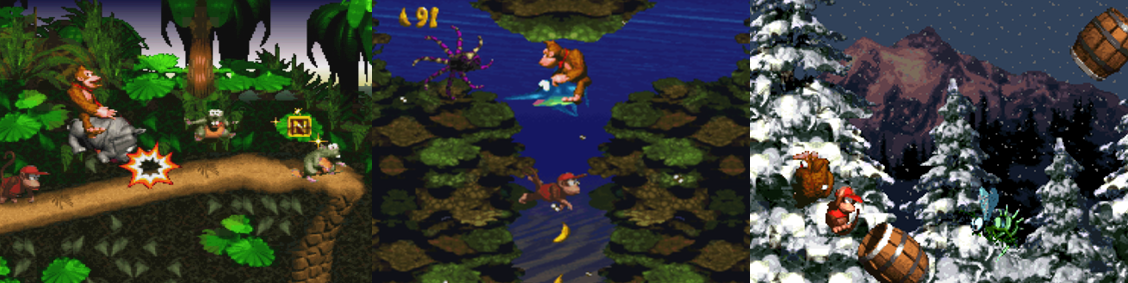
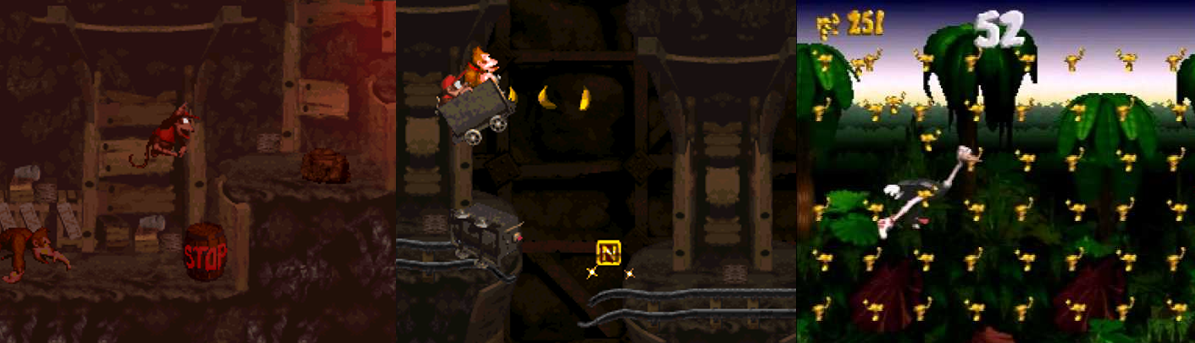
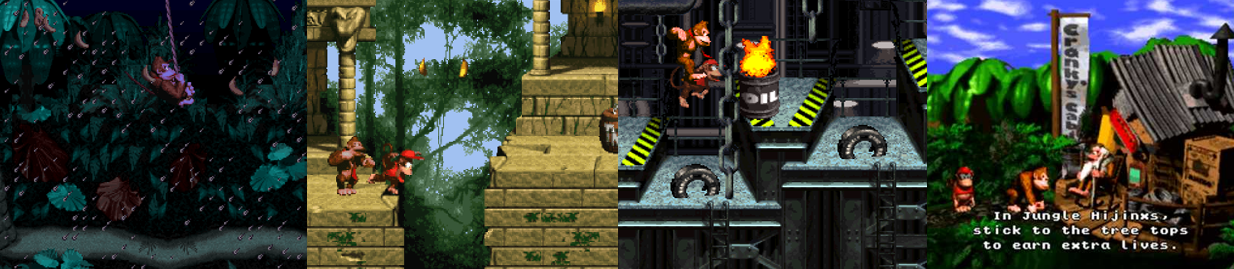
For the most part, Donkey Kong Country has you hopping across gaps (often with the aid of swinging ropes), bopping on enemies and collecting bananas. It’s not long before you’re jumping into barrels to clear greater distances and progress forwards; some of these rotate or move side to side and up and down, some automatically fire you and some are activated by a button press, with timing being key to avoiding a fall down a bottomless pit or damage from a spiky Zinger. Platforming quickly becomes trickier as the game progresses, with gaps becoming longer, requiring a roll or cartwheel into a jump for a longer jump, slanted platforms and greater hazards all testing your reaction times. Some stages require you to jump at special Stop & Go barrels to briefly light up the area or deactivate Rockkrocs so you can progress, others are set underwater and see you swimming about with no means of defending yourself unless you find one of the Kongs’ many animal friends, Enguarde. One of the most prominent stage designs are those set in the mines where you’re stuck in a runaway mine cart and must make split second decisions to jump over gaps, hazards, and from mine cart to mine cart to progress, which can be difficult with the low lighting and oncoming enemies. Level hazards soon play their part in the platforming as well, with snowy stages robbing you of your traction, Gnawties trying to crush you in giant wooden wheels, and flaming oil drums not only spitting out an endless supply of baddies but also charbroiling you when you hop to them as temporary platforms. As if falling and moving platforms didn’t make things difficult enough, there’s also a time where you’re forced to jump from a moving conveyor belt to grab fuel drums; you can’t afford to miss a single one or else your platform will fall and won’t come back so you need to make quick decisions about when to jump.

Use lighting, runaway mine carts, and animal buddies to progress and rack up those extra lives.

The game features forty levels, all accessed via a word map; between levels, you’ll automatically progress onwards into new areas, including jungles, rainforests, temples, mines, and caverns, and interact with the Kongs’ allies. Funky Kong allows you to fast travel across the island once you’ve visited at least two areas, Cranky Kong offers fourth-wall breaking advice that comes across more like bitter criticism, and Candy Kong allows you to save your progress (though you can obviously create a save state at any time using the Nintendo Switch’s menu options). The Kongs are also aided by allies within levels as well; they can ride Rambi, Enguarde, Expresso, and Winky to bash through enemies, charge through water, temporarily fly, and spring up even higher, respectively, while Squawks will light your way with a useful lantern. These buddies also act as another hit point and, if you’re hit or jump off them, you can often hop back onto them as they run around the environment, and you can use their abilities to find secret areas in each level. These lead to hordes of more bananas, balloons, or K-O-N-G letters. Collecting a hundred bananas, all four K-O-N-G letters, or a balloon awards an extra life and you’ll be stockpiling a fair amount of these without even trying, but you’ll also find golden buddy statues that will take you to bonus games where you control that animal and must collect as many bananas as possible within a time limit. This all adds to your completion percentage and injects a little gameplay variety to the title, but also encourages exploration as sometimes bananas floating just out of the way indicate a hidden barrel or tossing an explosive barrel at a wall will open up a new bonus area.

Graphics and Sound:  
If I’m being brutally honest, I never really thought too much of Donkey Kong Country’s visual presentation; even as a kid, seeing these pre-rendered 3D models pixelated down to 2D sprites looked a little messy and not quite as crisp as other 2D platformers of the time. However, having said that, I rarely had the chance to be hands-on with the game as a kid, or in the years since, so this is my first time actually playing it from start to finish and the visuals work really well when in motion. Donkey and Diddy Kong are full of life and personality, sporting idle animations and having distinctive movements and quirks when performing the same or similar moves. Their enemies are equally charming, sporting that exaggerated anthropomorphic quirkiness that Rare did so well back in the day, though their animations are noticeably less varied than the two protagonists. One thing I did enjoy was how clean the screen is; the heads-up display is absent until it’s actually required (appearing when you grab pick-ups or earn or lose a life), allowing you to really appreciate the variety of visuals on offer here. While you’re not going to see anything you’ve not seen in a hundred other platformers from Donkey Kong Country’s environments, the game presents them in a wholly unique way with its pre-rendered aesthetic. You’ll be swinging through jungles, jump to broken mine cart tracks in dank mines, and hopping to conveyer belts in a rusted factory all while some absolutely jamming tunes play throughout the game.

The pre-rendered graphics, while a little fuzzy, definitely add to the game’s visual appeal.

There are some opportunities for exploration and experimentation (try charging walls when on Rambi or jumping to bananas up above on Winky) and the game does a fairly decent job of recycling its level tropes with new hazards and such, like having Croctopi chase after you in later underwater sections rather than just spinning around or having you bounce on tyres on moving platforms to cross gaps and gain the extra height needed to avoiding enemies and obstacles. Even better, the game’s locations are bolstered by some environment effects; day turns to night, jungles are battered by thunder, lightning and rain, the frozen mountains become swamped by blizzards, and the mines and caves are seeped in low lighting. Often, there’s no lighting at all, with your sprites being the only things being visible onscreen until you free Squawks or activate a light-up barrel, and the use of lighting and foreground objects really helps to add to the tension when trying to avoid slipping off the edge of a platform and jump to another. Although the game is light on cutscenes, they story is effectively told using dialogue strings between the Kongs and their allies, though the focus here is very much on dropping you into the next action-orientated area to take on an ever-escalating challenge rather than trying to overcomplicate the simple plot. All you need to know is that the banana hoard has been stolen and Cranky is better than you.

Enemies and Bosses:
Donkey and Diddy Kong will face a number of King K. Rool’s most disposable pawns in their quest, from regular Kremlings like the Kritters to their more jumper variants, to voracious little crocodiles, sharks, and slippery snakes. Wasp-like Zingers will often be found hovering around in mid-air, usually surrounding a platform or a barrel you need to blast to; larger enemies will prove difficult for Diddy to take out without a barrel so you might want to switch to Donkey Kong if you’re having trouble, and orangutans will incessantly throw barrels at you in a fun call-back to the original Donkey Kong. Spiked wheels, hungry fish, and vultures will also cause a headache, especially the latter as you’re often asked to fire your Kong/s at a flock of vultures to bounce off them and reach out of the way platforms, which can be tricky to do as if you hold the directional pad for too long you could overshoot and if you don’t hold it long enough then you’ll undershoot.

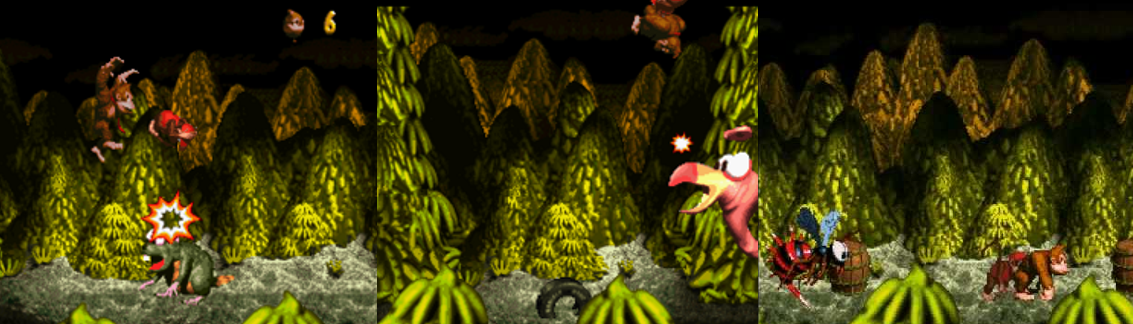
While Queen B. stands out, the repeats of Gnawty and Necky were disappointing to see.

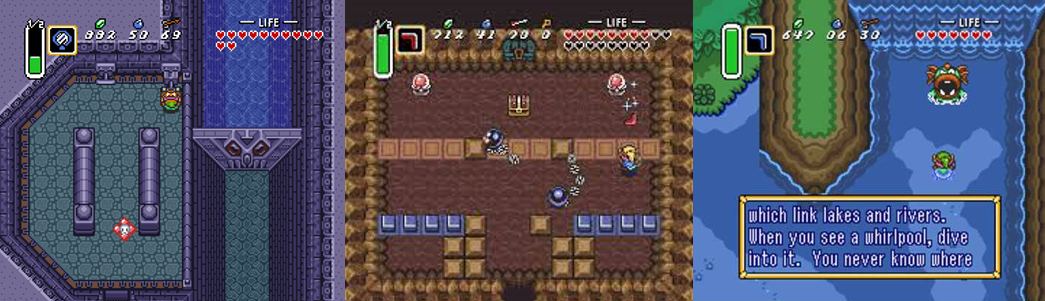
Each area of Donkey Kong Country houses a boss battle; victory against one of King K. Rool’s elite earns the Kongs a large, Nintendo-branded banana and allows them to progress onwards to the next area but, while you’ll fight seven bosses in the game, only three of them are unique and the others are, disappointingly, reskins and repeats of each other. The first boss you’ll take on is Very Gnawty, a giant beaver who hops about in a cavern full of the Kongs’ bananas; with each hit he takes, his jumps get a little faster, but it doesn’t take much at all to put him down. It’s thus disappointing when this same boss is repeated for the fourth battle, even though Really Gnawty jumps much higher and is noticeably much more aggressive in his attack patterns. The second boss you’ll fight is the Master Necky, a huge vulture who pops his head in from the left or right side of the screen to spit bouncy coconuts at you; thankfully, there’s a tyre conveniently placed in the centre of the boss room that you can use to avoid his projectiles and hop onto his head. This boss is recycled for the penultimate boss battle as well; again, Master Necky Snr. might have a different colour palette and be a bit more aggressive, but he’s essentially the same boss battle, which I can’t help but be a little let down by considering how good the game is otherwise. Thankfully, Queen B. mixes things up a little bit; this gigantic Zinger flies around the arena in a specific pattern, immune to all attacks except a barrel to the face. However, she becomes temporarily invulnerable and hyper aggressive after each hit, so you’ll need to position yourself in the right place to avoid her erratic swoops.

While Dumb Dum destroys itself, King K. Rool tricks you into thinking you’ve won…

Dumb Drum also stands out as a unique boss battle; a giant, sentient drum, this guy tries to crush you from above and spits out a number of enemies into the area that you’ll need to take out. You can’t damage Dumb Drum no matter how hard you try; you simply have to outlast it and it’ll take itself out from ramming the ground once too often. Finally, you’ll confront the Kongs’ mortal enemy, King K. Rool, onboard his pirate ship, which stands as the final area of the game. King K. Rool has two methods of attack; first, he’ll run from one side of the screen to the other and try to charge into you, then he stands on one side and tosses his crown at you as a projectile. When he does this, it leaves him vulnerable to attack so you can jump on his head and, after a few hits, he’ll fold like paper and the credits will roll. Well, the “kredits”, at least, and it turns out that this is a fake-out as King K. Rool pops back up for another round. This time, his charge is much faster, and he also causes bouncing cannonballs to rain down from above, which can be difficult to avoid unless you make use of Diddy’s smaller hit box. Otherwise, your strategy remains the same; jump over him, avoid his projectiles and hazards, and hop on his head until he’s done in for good and you get to enjoy the real credits sequence (and Cranky’s embittered criticism of your performance).

Power-Ups and Bonuses:
Your primary power-up in Donkey Kong Country will be those DK barrels; you’ll want to break these open every chance you get to have both Kongs at your disposal and stave off a death from your next hit but be sure to not accidentally break them if you don’t need them. Star-branded barrels acts as checkpoints and a number of other barrels (wooden, metal, and TNT ones) can be thrown as projectiles to take out one or a whole group of baddies in single throw. Otherwise, you’ll want to collect every banana you see and hunt down those K-O-N-G letters and red balloons to rack up some extra lives and keep an eye out for golden buddy statues or hidden rooms where you can earn more of them to access bonus stages. Finally, of course, there are the buddies themselves, with Enguarde being especially useful to making navigating those maze-like coral reefs that much easier.

Additional Features:
The ending you get (or, at least, the feedback you get from Cranky Kong) is directly tied to how many of the game’s secrets you uncover; this includes finding all of the K-O-N-G letters, hidden rooms, and bonus areas, all of which adds to the completion percentage seen on your save file. However, while you’re free to revisit and replay every level in the game and try to find every secret, it’s not actually necessary and you don’t get anything for it except for bragging rights. Thankfully, the Nintendo Switch Online version of the game allows you to make use of the save state and rewind features to make playing this game a breeze; now, if you make a mistake, you can just rewind or reload your game and try again, which is a God send in some of the game’s trickier sections.

The Summary:
It’s always exciting for me, a childhood SEGA boy, to finally play classic Nintendo titles. I’ve always had a fascination with the SNES and love to get my hands on the system’s most famous games whenever I can, and a full playthrough of Donkey Kong Country has been a long time coming for me. Despite my apprehension concerning the graphical style, the game holds up really well; environments pop through some fun and unexpected weather and lighting effects and Donkey and Diddy Kong never fail to impress when they’re onscreen, controlling and animating beautifully. Enemy and hazard placement becomes increasingly challenging, but not impossible, and I liked how many of the levels were short, sharp bursts of action that tested your reaction times. I can’t imagine playing the game on the original hardware without the aid of save states or the rewind feature, however, as I think it would’ve become quite frustrating quite quickly even though the game dishes out the extra lives like they’re going out of business. It’s a little disappointing that the game didn’t do more with its levels and bosses; repeating boss battles is always as much of a let down for me as a boss gauntlet, but I enjoyed the addition of ridable animal buddies, the hidden secrets and bonus rooms, and that trademark Rare humour that pushes you to find everything. In the end, I can see why Donkey Kong Country is so beloved; I’ve definitely played better 2D platformers but there’s so much more happening here than the unique visual style and it’s easily one of the best, basic platforming adventures of the 16-bit era.

My Rating:

Rating: 4 out of 5.

Great Stuff

What did you think to Donkey Kong Country? Did you own the game for the SNES as a kid and, if so, were you surprised by Donkey Kong’s dramatic visual overhaul? Did you find all of the game’s secrets and bonus rooms? Which of the animal buddies was your favourite to control and did you favour Donkey or Diddy Kong when playing? Were you disappointed that the boss battles weren’t more diverse and what did you think to the fake-out ending? Which of the Donkey Kong Country games is your favourite and why? How are you celebrating Donkey Kong’s anniversary this year? Whatever your thoughts on Donkey Kong Country, leave them below or share them on my social media.
Game Corner [Mario Month]: New Super Mario Bros. U Deluxe (Nintendo Switch)


So, for no better reason than “Mar.10” resembling Mario’s name, March 10th is widely regarded as being “Mario Day”, a day to celebrate Nintendo’s portly plumber, an overalls-wearing mascot who literally changed the videogame industry forever and shaped the home console market of the nineties.


Released: 11 January 2019
Originally Released: 18 November 2012
Developer: Nintendo EPD
Original Developer: Nintendo EAD
Also Available For: Nintendo Wii U (Standard Edition)

The Background:
After the videogame industry crumbled following an influx of numerous overpriced consoles and mediocre titles, Nintendo pretty much single-handedly saved the industry with the runaway success of Super Mario Bros. (Nintendo EAD, 1985) and, following the “Console Wars” of the mid-nineties, Nintendo and their famous mascot continued to be an innovative and reliable staple of the videogame industry. After a successful venture into the third dimension resulted in some of Mario’s most beloved titles, Nintendo decided to return Mario to his roots with the release of New Super Mario Bros. (Nintendo EAD, 2006) on the Nintendo DS, a 2.5D title that spruced up the platformer’s classic sidescrolling gameplay with new features and modes and which proved to be a hit. Two follow-ups soon followed, one for the Nintendo Wii and one for the 3DS, with both receiving high praise for their multiplayer functionality and addictive gameplay mechanics, and the development of a further follow-up for Nintendo’s unfortunate Wii U console soon began. The first Super Mario title to feature high-definition graphics, New Super Mario Bros. U was designed specifically with the Wii U GamePad in mind and emphasised single-player vertical exploration. The game was highly praised and sold over 4.8 million units; as part of the 2013 to 2014 “Year of Luigi” campaign, an expansion pack was created as both a separate physical release and downloadable content which featured shorter, tougher levels and focused on Luigi’s unique playstyle. After Nintendo bounced back in the home console market with the Nintendo Switch and achieved great success with Super Mario Odyssey (Nintendo EPD, 2017), this enhanced port of the game was developed for the console; containing all previously released material, and some additional features, New Super Mario Bros. U Deluxe was also met with positive reviews and become one of the best-selling games for the Switch.

The Plot:
Bowser, King of the Koopas, and his children (Bowser Jr. and the Koopalings) invade Princess Peach’s castle and hold her hostage, flinging Mario, Luigi, and two Toads far away. The portly plumber and his friends then resolve to travel across the land, defeating Bowser’s minions along the way, in order to rescue Peach and restore her castle to normal.

Gameplay:
Like the classic Super Mario games of the bygone 8- and 16-bit days, New Super Mario Bros. U Deluxe is a sidescrolling platformer but, in the style of the New Super Mario Bros. subseries, it’s a 2.5D title. The game allows up to four players to team up and travel across eight colourful, whimsical Worlds, hopping across platforms and on enemy’s heads in their quest to defeat Bowser’s minions. Each of the five playable characters controls a little differently and has slightly different power-ups and mechanics tied to them, meaning that the game’s difficulty is directly tied to which character you pick (Mario is an all-rounder, for example, while Luigi has poor traction, and Nabbit cannot be harmed by any enemies, making him the default “Very Easy” mode of the game). Each character has their own set of lives, but shares any collectibles they find along the way, and you can easily revisit and replay previous Worlds with whichever character you like from the overworld screen and the submenu. As is also the style of these kinds of Super Mario games, the controls are as simple as you could want: by default, the A and B buttons allow you to jump and you can hold the X and Y buttons to run, though you can swap these two sets of controls around if you like. Jumping three times in succession, especially while running, will allow you to pull off a triple jump to reach higher areas. When jumping, you can kick off walls to wall jump higher or potentially save yourself from falling down a pit (though you’re just as likely to accidentally wall jump off a platform or block and die if you’re not careful), press down to perform a block-smashing butt stomp, or press A, B, L, or R to perform a little twirl for a bit of extra height. You can also climb up and down ladders, press down when on a slope to slide down and kick any enemies out of your path, and tap the jump buttons when underwater to swim along. X and Y can also be used to hold certain items or characters, such as a Koopa shell or a Baby Yoshi, and you can release the button to throw these at enemies or to collect out of reach Coins.

Play alongside your friends with five different playable characters, each with slightly different mechanics.

Jumping, however, remains your primary method of attacking enemies; with well-timed jumps, you can clear gaps and entire sections of the game using the triple jump and gaining extra height by bouncing off an enemy’s head, but it pays to not be too complacent as some enemies either can’t be defeated by jumping on them or will hurt you if you try. Similarly, other enemies can only be dispatched by jumping at the blocks or platforms beneath them to either knock them off or tip them over, and you’ll also want to make use of the game’s many different power-ups and suits to help take out enemies faster. By default, each character begins the game with five lives and in their base form; this means that one hit will kill you, so be sure to search out a Super Mushroom or similar power-up as soon as possible to gain an extra hit point. When playing as Toadette, the Super Crown will transform her into “Peachette”, allowing her to float and double jump just like Princess Peach is known to do, while Nabbit doesn’t actually power-up from any of the items (but is immune to damage to compensate). When playing, you’re battling against a time limit, which alerts you when it counts down to the last 100 seconds and speeds the game’s music up accordingly to help push you forward. As if this, and the high number of hazards and projectiles you’ll eventually face, wasn’t bad enough, you also have to keep an eye out for the bevy of bottomless pits, which eventually expand to cover the majority of the ground in later Worlds. Handy checkpoints placed within Worlds will power you up and allow for a respawn point, but you still get kicked out of the World and have to manually re-enter, in your base form, to try again. Fail enough times and a “Super Guide” block will appear to help show you how to succeed, but the World will be flagged as incomplete until you finally reach that flagpole unassisted by this mechanic. Your main objective, unsurprisingly, is to head to the right of the screen, jumping over pits, hopping to platforms and blocks, and taking out any enemies in your way to reach the flagpole. Along the way, you’ll contend with such hazards as fog-spewing clouds, rising and falling platforms, swaying mushrooms, giant toppling heads, cannons, temporary platforms, and plumes of both water and sand.

There’s plenty of variety, and challenge, awaiting in the game’s different Worlds.

While gameplay is, by the nature of its presentation, quite linear, there are opportunities for exploration; paths are hidden behind the background, leading to Coins and blocks, you can spawn vines to reach upper platforms, and you can enter pipes to explore underground areas, again usually for Coins or to find one of the three Star Coins hidden in each World. Sometimes, you can wall jump beyond the boundaries of the screen to take shortcuts or reach Secret Exits, which create new paths (or bypass Worlds entirely) on the overworld map so you can reach the Koopaling’s castle for that World. Some Worlds feature autoscrolling sections, either horizontally or vertically, that force you to stay on the move to keep from being crushed or boiled by rising lava, and, after clearing World 2, the game will ask you to choose a path to tackle either World 3 or World 4 (though you can, and absolutely should, backtrack to play both of these Worlds regardless). These Worlds add a new wrinkle to the overworld map in the form of the haunted locations (usually mansions, but there’s a shipwreck, too) infested with Boos. Boos will only advance towards you when your back is turned, and these stages tend to feature confusing door mazes, temporary platforms formed by hitting P Switches to turn Coins into blocks, and light-based mechanics where you need to carry a Baby Yoshi to light the way and scare off Boos. Other Worlds favour tilting platforms, slippery ground, an abundance of pits and crushing hazards, and you’ll even find yourself jumping to and swimming in bubbles when progressing vertically through World 7. You’ll also have to watch out for bigger enemy variants, instant-death lava and poison, and weighted platforms that either require you to jump to keep them moving or will stop if too many enemies and items drift onto them. There’s a lot of fun, colourful variety on offer and your platforming and jumping skills will be progressively put to the test as you clear each World, with more and more hazards and gimmicks being thrown in your path; thankfully, the controls are tight and responsive enough to manage these, but it’s true that the jumping can tend to be a bit spotty at times and you can easily find yourself slipping off a platform or falling to your death when you didn’t mean to.

Graphics and Sound:
I’d played New Super Mario Bros. before, so I was well aware of how great Mario and his Worlds look in 2.5D but New Super Mario Bros. U Deluxe is absolutely gorgeous to behold; Mario, Luigi, and their friends have never looked better in 2.5D thanks to the Switch’s high-definition graphics, with each of them sporting cute idle animations and victory poses when finishing a World. This emphasis on adorable character models and animations even carries through to the enemies, who still hop and dance to the jaunty themes playing in the Worlds to not only give you an opening to attack but also to allow you to better time your jumps or anticipate enemy movements. As is often the case, there’s no spoken dialogue in the game and the characters largely rely on gibberish and pantomime and simple cries of “Yahoo!” and “Oh, no!” to make their point, which is fine by me, though you will encounter non-playable Toads who will offer encouragement, power-ups, and challenge you to mini games in their houses. There can often be a lot happening on the screen at any one time, between the enemies, moving platforms, obscured paths, and projectiles, but everything pops out and has a discernible pattern and it’s simply a matter of skill and timing to overcome the obstacles in your way.

The game shines in its visuals, making for probably the best looking 2.5D Super Mario title yet.

Similarly, the Worlds on offer here are just as vibrant and visually interesting as the character models; there’s a lot to see in the background and foreground, often to tease you into taking a risk on a hidden path or entice you into trying a different power-up to make a tricky jump. While the Worlds are pretty standard Super Mario fare, ranging from colourful fields to snowy landscapes and lava-ridden castles, there’s also some fun throwbacks to previous Mario games, like Soda Jungle (which features retracting vines, rotating logs over poisonous water, and enlarged enemies and blocks), and the haunted houses. You’ll also traverse a desert full of quicksand, shifting sand, and statues to jump from, a beach-front and coral reef where jets of water blast you along underwater, tricky jumps to chains and up and across the rocky landscape of the mines, and a whimsical but taxing trip through the clouds. Every World also features two castles, which adopt an ominous stone-and-magma aesthetic and feature crushing blocks, buzzsaws, and rotating platforms, and you’ll also have to endure a cannonball and Bob-omb filled obstacle course when whisked onto Bowser’s battleship.

Enemies and Bosses:
The vast majority of the enemies you’ll encounter in New Super Mario Bros. U Deluxe are returning baddies from previous other Super Mario videogames, such as the mushroom-like Goombas, green and red Koopas, Boos, Thwomps, Chain Chomps, Bullet and Banzai Bills (which are frequently invulnerable), Piranha Plants, and Monty Moles. Most of these are pretty harmless, wandering back and forth or in easily recognisable patterns, but they quickly fill up the screen in larger numbers and some of the more annoying enemies, like the Hammer Bros (and their fire, ice, and boomerang variants) and Dry Bones, can cause headaches with their arching projectiles and ability to respawn, respectively. Naturally, there are also some new enemies in the game as well, such as the squirrel-like Waddlewings (which often carry Super Acorns for your consumption), walrus-like Flipruses, the screen-filling Dragoneel, homing Targeting Teds, and the mischievous Nabbit, who steals Toad’s items and must be captured in a race against the clock in previous Worlds.

A number of mini bosses will constantly return to oppose you, changing size and tactics each time.

In addition to the seven bosses you’ll encounter, you’ll also have to contend with a couple of mini bosses along the way. Not only will your platforming skills be tested if you choose to go back and capture Nabbit (and you really should, if only to get him off the overworld and get his items), but six of the Worlds include a tower guarded by Boom Boom, a muscular Koopa who is afforded new abilities by Kamek as the game progresses. Primarily, Boom Boom will attack by flailing his pythons at you, either in a charge or a jumping, spinning attack, but he also grows in size and sprouts wings to dive down at you. While the arena you battle him in is often altered by cosmetic changes befitting the World (such as water and lava), the area you fight him in is never really a hazard and it’s actually beneficial to use the walls to get better height and bop him on the head three times, which is usually easier to do than with the Koopalings since Boom Boom doesn’t attack while protected by his shell. In World 6, the tower is defended by a Sumo Bro who is enlarged by Kamek; this hulking brute can’t be attacked from above and causes electrical shockwaves by stomping his feet, and can stun you with his jumps. To defeat him, you need to jump into the platform he’s standing on while beneath him to tip him onto his shell and then jump on his exposed belly three times to put him away. World 7’s tower is guarded by Kamek himself, who magically spawns in blocks containing enemies. You can hop around on these to try and jump on his head when he teleports in, but he’ll cause them to rain down and hurt you, or release their captives, and he also flings magical bolts at you that cause the ground to become temporarily unstable. Sticking to a set pattern and staying off the floor is your best chance at winning this battle, and it’s not too difficult to jump on his head when he teleports in nearby. You’ll also battle Bowser Jr. one-on-one twice in the game, once after clearing World 5 and then again after World 7. You need to traverse the cannons of Bowser’s battleship to reach him, and both battles are a little different. In the first, you’re underwater and must lure the Targeting Teds into his craft while avoiding the Bullet Bills that fire horizontally and vertically through the arena. The second battle is much tougher; you’re on a precarious metal-blocked platform and Bowser Jr. floats just out of reach, occasionally tossing Bob-ombs at you. His craft sports boxing gloves which can wreck and temporarily destroy the ground beneath you, or extend to shove you right off edge, but you can quickly hop on his head as he passes by or run up them to bonk him if you’re fast enough. Bowser Jr. also causes trouble in World 8, ramming into you, blocks, and platforms to try and hurt, kill, and force you into lava and also joins his father for the finale.

The Koopaling’s each guard a castle filled with death traps and have some tricks of their own to slow you down.

Before you can reach that climatic battle, however, you have to contend with the seven Koopalings, each of whom awaits after clearing a castle filled with death traps and hazards, and each of them will erratically spin at you in their spiked shells after you land a hit, which can be tricky to avoid. First up is Lemmy Koopa, who tosses progressively larger bombs at you, though you can hop onto these for an extra bit of hang time. Morton Koopa Jr. awaits in World 2 and knocks segments of a giant, caterpillar-like Pokey at you from across the arena that you need to jump over or duck under. This battle’s made a little tougher thanks to Morton shaking the ground with his stomps and the two gaping holes to a bottomless pit at either side of the platform, though you can use the walls to help avoid the Pokey projectiles. After this, you have a choice of your next destination; I chose to visit World 3 first so I battled Larry Koopa next; this pint-sized sucker fires bolts from his magic wand and can be tricky to hit thanks to the three water jets that burst up from the arena floor. The arena is similarly against you when you visit World 4, as Wendy Koopa skates about on the slippery ice and causes icicles to drop from the ceiling. The only way to reach Iggy Koopa is to find the Secret Exit in World 5; this leads you to one of the more troublesome boss battles as Iggy constantly runs away through the pipes, appearing on the floor and the ceiling, and fires bolts at you that can also cause up to two large Magmaarghs to pop up. His shell attack is also a pain as he’ll reverse direction, which can catch you off-guard and result in a hit, but once you figure out which pipe leads him to where you can anticipate his movements and hit him accordingly. Roy Koopa is a pretty simple and enjoyable fight; he fires Bullet Bills from a bazooka and hops up onto the stream of floating platforms to evade you, which means there’s a fall hazard in play here, but I found this the easiest boss of them all as you can just hop on his head, take the high ground, and instantly repeat without him getting off another shot. Finally, there’s Ludwig von Koopa, who hovers at the top of the arena, duplicating himself and filling the screen with diagonal projectiles that can be tough to avoid. Naturally, you need to hop on the head of the real Ludwig to score a hit, and the projectiles only increase with each successful blow.

After making it through the lava-filled final World, you’ll have a face off against a gigantic version of Bowser.

Finally, after beating all the other Worlds and crashing Bower’s airship, you’ll dispel the dark cloud surrounding Peach’s Castle and tackle the final, most aggravating World of the game. The once lush and verdant castle has been transformed into a stony, lava-filled hellhole; flaming meteors fall from the sky, lava rises and falls beneath your feet, and you must not only cross the sea of burning magma on a raft but also watch out for Bowser Jr.’s attempts to crush and boil you alive. Succeed, and you’ll reach the final battle, which begins familiarly enough with you ducking under and jumping over fireballs spat by the Koopa King himself. When faced with Bowser, you’ll need to jump over or duck under his fireballs and quickly run underneath him to hit the switch and cause the bridge beneath him to collapse, but this is only the appetiser to the game’s true finale. Enlarged by Kamek’s magic and joined by Bowser Jr., Bowser battles you to the end on the castle rooftop, again spitting high and low fireballs and jumping about the place. To defeat him, you need to dodge Bowser Jr.’s Bob-ombs and hop on his head after avoiding his craft slam; you can then commandeer the Junior Clown Car with B, tapping B to hover over Bowser’s head, and then hit R to crash onto him. Like his kids, Bowser becomes a spinning dervish after he’s hurt and you’ll need to run under his shell when you get the chance to avoid being hurt or killed, and then dodge the rain of fireballs he spits into the air to repeat the same cycle over, dodging more Bob-ombs and fireballs as you go but, as long as you have at least a Super Mushroom and are mindful of your jumps and hit box, this shouldn’t be too difficult to do.

Power-Ups and Bonuses:
Many of Mario’s most famous power-ups are here for the taking, including the Super Mushroom, 1-Up Mushroom (with extra lives also awarded with every 100 Coins you collect), Super Stars, and Fire and Ice Flowers. Super Stars are rare in the Worlds themselves but endlessly helpful as they make you invincible for a short time (and speed you up and add a nifty somersault to your jump) and successfully defeating a bunch of enemies in a row in this state will net you an extra life, but it won’t protect you from instant death hazards, unfortunately. The Fire and Ice Flowers let you shoot off a bouncing projectile with X or Y, with the iceballs temporarily freezing enemies to create platforms or allow you to throw them. Other power-ups include the Mini Mushroom, which grants you a moon jump, the ability to run up walls and enter tiny pipes, but costs you your ability to actually defeat enemies. POW Blocks will defeat all onscreen enemies, the aforementioned Super Crown lets Toadette become Peachette, and you can also hover through the sky with the Propeller Mushroom or slide along the ground or water (and fire off iceballs) with the Penguin Suit.

There are plenty of fun power-ups, old and new, to help you in your whimsical journey.

If you can knock Lakitu out of the sky, you can briefly take control of his cloud to fly over stages, and you’ll also come across the new Super Acorn power-up, which transforms you into a flying squirrel and allows you to glide, cling to walls, and perform an arch to gain a little extra height. You can also win P-Acorns from the various mini games which allow you to mid-air jump indefinitely, and you’ll find Yoshi eggs hidden in blocks throughout the game. Yoshis come in four styles, the regular green (which you ride as normal, using his tongue to eat and spit out enemies, chow down fruit for power-ups, and make use of his flutter jump to reach higher areas), and three Baby Yoshis: magenta (which swells up into a balloon to help you bypass hazards), blue (which spits out bubbles), and yellow (which can light up dark and/or haunted areas). Each of these baby Yoshis will also automatically eat up any enemies or projectiles that come your way and can be throw, but it’s usually better to keep them in hand. Every now and then, a Toad will offer you a power-up at the end of a World, and you can play mini games in their houses to collect Coins and earn more power-ups (though you’ll lose out if you get a Bowser tile), and you’ll also find power-ups on the overworld on occasion, too.

Additional Features:
There are 246 Star Coins to find in New Super Mario Bros. U Deluxe, three in every World, and collecting them will really test your patience and platforming skills as they can be well hidden or hanging in precarious positions. When you finish the game as any character, you’ll unlock the ability to save at any time on the overworld (previously, the game saved after towers and castles and you could only create a one-time save point), the Secret Island (a kind of pointless overworld inclusion that lets you view the credits and various other in-game records, and the Superstar Road. This is where those Star Coins will come into play as you can unlock eight new challenge stages by collecting every Star Coin in each of the game’s other worlds, which is easier said than done. Accomplishing all this adds another Star Stamp to your save file, which allows you to brag that you’ve finished the game to 100%, though finishing the game as the other characters doesn’t factor into this achievement. There are also some alternative paths on the overworld beyond the Secret Exits where moving to certain points causes you to collide with enemies and be warped to a special challenge (usually involving the Super Star) or be automatically taken to different Worlds.

New Super Luigi U adds a whole new level of challenge and difficulty to the game.

Being as it’s the most complete version of the game available, New Super Mario Bros. U Deluxe also features the New Super Luigi U content, which excises Mario from the playable roster, expands upon Luigi’s controls and physics to make him slippery and light as all hell, and reduces both the length and time limit of each World. Worlds are also full of references to Luigi, from statues to sprite work and silhouettes and an abundance of green, as well as being restructured into bite-size obstacle courses that will offer the greatest challenge of the game by far. With checkpoints gone and hazards everywhere, it’ll take every bit of skill and precision jumping to best this mode, which pushes you to use your triple jump, loose physics, and the game’s power-ups in new ways to bop off enemies, avoid death traps and hazards, and reach the goal flag. The game also offers a few additional challenge modes, including time trials and speed runs, Coin collections, and 1-Up collections, all of which deny you the use of power-ups, put you against a tough time limit and meeting criteria (like not touching the floor), and award you either a Bronze, Silver, or Gold Medal depending how well you do. Boost Rush allows you to take on rejigged versions of the World’s according to certain criteria (such as focusing on the balloon Yoshi, Penguin Suit, or Squirrel Suit) to nab Coins and speed up the tempo of the game and the enemies. Finally, you can go head-to-head against other players in Coin Battle, or put together your own courses using Coin Edit to challenge your friends, and all of the game’s modes can be played with other players, who will respawn in bubbles after losing lives.

The Summary:
Although I’ve never had the greatest relationship with Super Mario titles since I notoriously struggle with his classic titles and only really got into the franchise once it moved into 3D, I really enjoy these 2.5D throwback games and New Super Mario Bros. U Deluxe truly is an exemplary title that showcases the very best of this side of the franchise. Colourful, visually appealing, and bolstered by jaunty music and cute, cartoony attention to detail, the game impresses with its tight controls and a fantastic implementation of some of Mario’s 3D skills (such as the triple jump and wall jump). While it can be frustrating at times because of the precise nature of its platforming and how inconsistent the physics and wall jumps can be with some characters, this is purposely implemented as part of the game’s difficulty curve and, more often than not, any mistakes you make will be because of you rather than the game being unfair. Every enemy, challenge, and obstacle can be overcome with skill and patience, and you’ll find yourself using Mario’s power-ups (especially the new Squirrel Suit) to take risks that invariably pay off to launch you off enemies and towards the coveted flagpole. The inclusion of four additional playable characters, each with their own strengths and weaknesses, really helps to add some variety to the gameplay (though I would’ve preferred there only being one Toad and to have Peach be playable by default, no matter how little sense that makes) so that anyone of any skill level can pick this up and enjoy it, and the boss battles, while simple, were pretty fun thanks to the challenging castles you have to go through beforehand. Super Luigi U was a much-appreciated additional feature, if one I found far more harrowing and frustrating, and I enjoyed all the extra challenges and features to help extend the game beyond the main story. Overall, this is easily my favourite 2.5D Super Mario adventure by far; it takes everything that worked so well in Mario’s better 16-bit titles and infuses them with the Switch’s high-definition graphics and mechanics, and it was an extremely fun and challenging gameplay experience from start to finish.

My Rating:

Rating: 5 out of 5.

Fantastic

Did you enjoy Super Mario Bros. U Deluxe? How do you feel it compares other Mario titles, specifically the previous Super Mario Bros. games? Which of the playable characters was your favourite and why? Did you enjoy the new power-ups and the challenge offered by collecting the Star Coins? Which of the boss battles did you struggle with, and did you ever get all of the Star Stamps on your save file? What did you think to Super Luigi U? Which of Mario’s Switch games was your favourite and how are you celebrating Mario’s birthday this year? Whatever your thoughts on Super Mario Bros. U Deluxe, feel free to share them below or drop a comment on my social media and be sure to check back in for more Mario content throughout March!

Game Corner [Zelda Day]: The Legend of Zelda: Skyward Sword HD (Nintendo Switch)


On 21 February 1986, The Legend of Zelda (Nintendo EAD, 1986) was first released in Japan. The creation of legendary game designer Shigeru Miyamoto and Takashi Tezuka, The Legend of Zelda launched one of Nintendo’s most popular franchises, with its silent protagonist, Link, and his vast fantasy world of sword and sorcery not only enduring over time but constantly evolving and improving as the series progressed.


Released: 16 July 2021
Originally Released: 18 November 2018
Developer: Tantalus Media
Original Developer: Nintendo EAD
Also Available For: Nintendo Wii

The Background:
I’d like to think that even Nintendo couldn’t have predicted just how impactful the Legend of Zelda series’ (Nintendo EAD/Various, 1986) first foray into 3D was going to be; their attempts to follow up on the unprecedented success of The Legend of Zelda: Ocarina of Time (Nintendo EAD, 1998) resulted in one of the franchise’s darkest and most underappreciated entries, and Nintendo were keen to appeal to a wider audience with Ocarina of Time’s spiritual successor, The Legend of Zelda: Twilight Princess (ibid, 2006), which proved to be an the incredible success for Nintendo’s fledgling GameCube. Having turned the videogame industry on its head with the Nintendo Wii, producer Eiji Aonuma aimed to build upon the expansive nature of Ocarina of Time and Twilight Princess to present the biggest and most detailed Zelda gameworld to date by offering something new through the Wii’s unique motion controls, more elaborate sword combat, a greater focus on exploration, and providing an origin story for the Master Sword. Since I struggle a bit with the Wii’s ridiculous motion controls, I missed out on Skyward Sword when it first released, but it was a massive critical success; considering how widely praised the game was, it was perhaps inevitable that Nintendo would produce a high definition remake for the Nintendo Switch as part of the 25th anniversary of the Legend of Zelda series. The long-rumoured upgrade of the lauded title was developed by Tantalus Media and the gameplay mechanics were redesigned so players could use either the Joy-Cons or a more traditional control scheme, alongside numerous other quality of life improvements to the graphics, frame rate, and save feature. Preorders for Skyward Sword HD sold out on Amazon, and the game sold over 3.6 million units worldwide; however, while it was met with largely positive reviews, it did score less than the original version. Still, reviews praised the more focused gameplay mechanics compared to other, larger Zelda games, and its technical achievements, though faced some criticism for the dated motion controls.

The Plot:
Positioned as the first adventure in the Legend of Zelda timeline, Skyward Sword details the origins of the powerful Master Sword as Link, resident of the floating island of Skyloft, embarks on a quest to rescue Zelda, his childhood friend, after she is kidnapped and taken to the Surface, an abandoned land below the clouds, by the malevolent Ghirahim as part of a plot to awaken an ages-old darkness upon the world.

Gameplay:
The Legend of Zelda: Skyward Sword is a partially open world action/adventure in which players once again assume the role of an incarnation of Link, here a knight-in-training on an island above the clouds. Right away, players have two control options available to them that allows them to utilise motion controls much like the original Nintendo Wii release or to use a more traditional control scheme; however, while this latter option is more comfortable for me, it’s very different from how a Zelda game traditionally plays. A is now an action button that allows you to open doors and chests, talk to non-playable characters (NPCs), and pick up items; B is used to put your weapons away or can be help down while running or otherwise moving for a burst of speed (though you can’t hold it down indefinitely or you’ll drain your stamina wheel and be left defenceless as Link tries to catch his breath), X is mainly used to charge ahead when on your Loftwing, and Y isn’t really used at all. Consequently, sword combat is mapped to the right analogue stick; you can hold ZL to target enemies or interactable objects and flick the stick to unleash a sword attack (perhaps because of this, Link is now right-handed, as opposed to the traditional left). This actually took me a bit of time to adapt to as Link seems to swing his sword in the opposite direction you flick (swinging left with you flick to the right, for example), which can make activating certain switches and attacking some enemies tricky as you need to swing where there’s an opening.

Use motion controls, or the analogue stick, to attack and deflect and consult Fi for advice.

If you knock an enemy down, they’ll sometimes be left open for a “Fatal Blow” that allows you to leap at them for an instant kill, and Link and both perform is signature spin attack, jump swing, and also stab at enemies with his sword. Eventually, you’ll also learn the “Skyward Strike” which sees Link hold his sword aloft to charge it and then sending out an energy wave to damage enemies from a distance, which is a handy feature. Link can also defend himself with his shield by holding ZL and perform a shield bash, which doubles as a parry, by pressing in the left analogue stick. Unfortunately, the vast majority of the game’s shields can be burnt or broken, meaning you’ll either need to upgrade them to toughen them up, buy now ones, or complete a side quest to get a more durable shield. Like many 3D Zelda games, Link automatically jumps from ledges; he can also hang down, shimmy along, and climb vines, all of which will drain your stamina meter. Link can also swing from ropes to reach new areas, which can be a bit tricky to perform as you need to aim yourself with the left stick and flick the right stick up and down in just the right motion to get the momentum you need. Chatting with some NPCs will also offer you a few dialogue options, which don’t really factor into the plot or change their perception of you, but they do help to give Link a little bit more characterisation this time around. Once Link acquires the Master Sword, he also gains one of the most annoying travelling companions I’ve ever had the misfortune of being lumbered with as Fi, the spirit of the sword, acts as a guide, navigator, and tutorial to the player very much in the same way as Navi did back in the day. You can call upon Fi at anytime using the directional pad (D-pad) to gain insight into targeted enemies, remind yourself of your current objective, or get some advice, but she also pops up uninvited at various points to hold your hand or point out the obvious. She also helps you to search for objectives, treasure, and other items by using the sword’s “Dowsing” ability, which puts you into a first-person mode and guides you towards your set target.

Link can sour through the clouds, burrow underground, and must brave trials without the aid of his gear.

You can bring up the map using the – menu and set markers to also help guide you in the right direction, which is very useful as it can be easy to get turned around a bit. One thing to keep in mind here is that there are no manual saves; you need to find a Bird Statue to manually save your progress to one of three save files, though there is an autosave feature that effectively adds as a checkpoint system. Similar to The Legend of Zelda: The Wind Waker (Nintendo EAD, 2002), the game’s overworld is a series of islands and set areas connected by a large void, in this case the open sky; Link can fly to new destinations using his Loftwing, which replaces the traditional horse, by tapping A to ascend and B to slow down or charge into enemies using X. You’ll be utilising the Loftwing a lot to travel back and forth between the three main areas of the game, as well as Skyloft and the smaller items as the story demands, but you can five down to any Bird Statue in any area and exit dungeons (or teleport to the Sky) from these same statues, though you can’t fast travel between destinations using this system. Though Link takes fall damage, you’ll soon acquire a Sailcloth that lets you glide to the ground from high falls by holding ZR (though you can’t actually manoeuvre him while he’s descending). This also allows you to ride air currents upwards and you’ll eventually gain the ability to swim and even twirl through and jump out of the water very much like Zora Link in The Legend of Zelda: Majora’s Mask (ibid, 2000). Link also later acquires the Digging Mitts, which allow him to burrow underground and crawl through narrow caves, smashing boulders and activating switches to progress further, and also gets his hands on the Goddess’s Harp that lets him open up new areas by strumming the stings with well-timed movements of the right stick, which is a far cry from the ocarina playing or wind conducting from previous games. Link will also have to complete four trials in the “Silent Realm”; here, he loses all of his equipment and items and must race around collecting fifteen Sacred Tears across the map while avoiding the ghost-like Watchers and making sure you don’t touch the Waking Water or your Spirit Vessel doesn’t deplete as this will awakens the Guardians, who will hunt you down and eject you from the dimension upon impact, forcing you to begin all over again.

You’ll constantly be travelling back and forth between three areas in search of key items.

Although Skyward Sword looks like the biggest Zelda experience ever seen at the time, it really doesn’t actually feel that way; I’d argue that Twilight Princess felt much bigger and more connected thanks to actually having a large overworld with different routes and areas all linked together. In Skyward Sword, you’ll be spending most of your time travelling back and forth between the three main regions on the Surface (Faron Woods, Eldin Volcano, and the Lanayru Desert), Skyloft, and the Thundercloud up in the Sky. Each area is an isolated environment; you won’t find any routes or means to travelling from Faron Woods to Eldin Volcano beyond flying there on your Loftwing, but each of those regions does have a few other areas that you’ll explore as the game progresses. The Lanayru Desert, for example, is home to a treacherous desert, the Temple of Time, and a mine, all of which you’ll need to explore at various points. The main quest of the game asks Link to travel to each area thee times and acquire one of three different key items or meet three different objectives each time. At first, you’ll need to find three stone fragments form each region to access the Thundercloud; then, you need to find three Sacred Flames to power up the Master Sword. Then, you need to travel back again and find three pieces of the Song of the Hero and access the game’s final dungeon, all of which can get a bit repetitive even though the enemies and the environments do change which each revisit. Faron Woods becomes flooded, for example, and Eldin Volcano erupts, and you’ll find new regions opening up with your new gear and completing story-based tasks, such as Lake Floria just off Faron Woods, the ghostly Sandship and Rickety Coaster in Lanayru Desert’s Sand Sea (both of which are accessed by piloting a boat armed with a cannon), and at one point you’ll find yourself relieved of your weapons and gear and having to escape (and retrieve them) from Eldin Volcano without being spotting in an expansion of the Gerudo Fortress section of Ocarina of Time.

There are many puzzles here, from hitting switches, to crossing lava, and rearranging the environment.

Naturally, you’ll visit a number of dungeons in your quest, which (as is tradition) are realised as elemental-themed temples. Inside, you’ll find small keys to opens doors and a Dungeon Map (which now reveals Bird Statues, chests, and points of interest by default to replace the Compass) to help you progress, and you’ll need to clear rooms of enemies, activate switches and pressure pads, and take on sub-bosses to acquire the temple’s new weapon, which will allow you to progress further and tackle the boss. Sometimes you’ll need to move a weighted block onto a switch or out of the way to climb a ladder; other times, you’ll need to hit switches to raise or lower water and lava, cut through cobwebs, send eyeballs spinning, and shoot or hit faraway switches to open doors. Link will also need to hit plant bulbs (or carry them on the tip of his sword) to create temporary platforms in lava, grapple to floating plants or specific targets with the Clawshots, toss or guide bombs into baskets to create platforms over quicksand, and sever ropes to lower drawbridges. In Lanayru Desert, the majority of the puzzles are based around the “Timeshift Stones” which, when struck, will turn part of the immediate area from a desolate desert into a vibrant landscape, causing enemies, switches, equipment, and even land formations to form so you can progress. Many puzzles require you to carry a Timeshift Stone around or placing it in a specific area to lower one barrier while activating another, which is quite a unique and creative mechanic that really makes you think about how to tackle puzzles. All of these puzzle gimmicks and mechanics are revisited in the game’s final area, Sky Keep, which also features a unique and annoying gimmick that sees you rearranging the different rooms of the temple to open up new paths and acquire the three pieces of the Triforce.

Graphics and Sound:
The Legend of Zelda: Skyward Sword certainly looks impressive; this HD version of the game has potentially upscaled the graphics to make everything very vibrant and moody, when necessary, and the game employs an aesthetic style that merges the fantastical realism of Twilight Princess with the cartoony presentation of The Wind Waker. In addition to having dialogue options during some conversations, Link continues to showcase a variety of facial expressions to help flesh out his otherwise silent character, and you’ll be hearing a lot of gibberish (mainly from Fi) when talking to others. Otherwise, there is no voice acting here, as is to be expected from a Zelda title; some dialogue can be sped up by pressing B and you can skip some cutscenes entirely by pressing the – button, but it can mean you’re left a bit clueless afterwards. Although each region is populated by unique NPCs, many of which are new to the series (such as the Ancient Robots but, while Parellas replace Zoras, Gorons are still present in the game), you’ll find the vast majority in Skyloft. Here, you can chat to Headmaster Gaepora, buy, sell, and upgrade items in the market, and will come across Link’s obnoxious rival, Groose, whose pratfalls and antagonism eventually turns into heroism as he helps aid Link’s quest to rescue Zelda.

Areas have a lot of see and do, and even change as the story progresses.

The game also features an appropriately operatic score that includes new renditions of the iconic Legend of Zelda main theme and versions of memorable tunes such as “Zelda’s Lullaby”; when you engage with enemies, successive strikes also speeds up the tempo of the battle music to help keep the adrenaline pumping and each area is nicely punctuated by both ambiant sounds and a fitting soundtrack. Skyloft is an impressive starting area and a pretty large central hub; you’ll find rooms to sleep in to pass the time and replenish your health, the market, a graveyard, and a practice hall to work on your sword techniques. While the Sky is basically just a barren void, there are small islands and rocks floating around that you can visit to find chests, mini games, and a prominent side quest centred around the Lumpy Pumpkin establishment. Shafts of red, yellow, green, and blue light will point you towards the three main regions and wherever you’ve placed a marker, and you’ll need to dodge Octoroks spitting rocks at you and tornados that will blow you off your Loftwing. The inside of the Thundercloud is initially best by storms and lightning and home to both one of the more annoying push puzzles in the game and the decidedly Wind Fish-like Levias, a gigantic whale that flies through the sky and clears the air after you free him from the parasite that has infected him. Although it’s possible to advance and alter the time of day by sleeping in beds, this rarely factors into the main plot, but it does turn Skyloft from a safe, vibrant location to a dangerous area as enemies spawn in under the cover of darkness. Similarly, when taking on the four Trial Gates, the immediate area takes on a darker, more ethereal quality as shadows become more prominent and glowing magical barriers bar your progress.

Areas are quite large and varied, but not as connected as in other Zelda videogames.

The game’s three main regions are based around classic Zelda tropes such as the forest, volcano, and desert, while also incorporating themes like water, wind, and time into their later areas. You can create shortcuts in each but pushing logs and mine carts, blowing up rocks, or grabbing levers to open gates (and also using your new weapons), but the areas will fundamentally change as the story progresses. Faron Woods start off as a kind of confusing wooded area that leads onto a cliffside leading to the Skyview Temple, a water and bug-infested cave or sorts, is home to a great tree, and also leads to a flowing river that takes you to Lake Florina (which later floods the woods) and the Ancient Cistern, a kind of steampunk-like Temple whose golden Oriental aesthetic hides a scary underground area. Eldin Volcano is full of lava and steep hills for you to run up while avoiding boulders tossed by enemies; enemies also wait atop wooden columns that you can knock over with bombs, and you’ll run around on a spherical rock, lobbing bombs are walls and trying to not burn your ass in the Earth Temple. Later, the whole area is covered in ash as the volcano erupts and you need to sneak around and recover your gear, avoiding spotlights, and douse face statues with water to gain access to the Fire Sanctuary, where you’ll be digging through the dirt with the Mogma Mitts. Lanayru Desert sees you racing across quicksand, using the map and markers to avoid sinking, activating three power generators to raise the Mining Facility, an area which springs to life with the Timeshift Stones to reveal conveyer belts, wind-powered platforms, and all manner of mechanical obstacles. You’ll also use one of these Timeshift Stones to safely cross the Sand Sea and ride the Rickety Coaster’s insane mine cart, and awaken the long-dead dragon that resides in the Lanayru Gorge.

Enemies and Bosses:
Longtime fans of the franchise will recognise many of the enemies that crop up in Skyward Sword, most of which are tailored to the game’s new combat system; Deku Babas and Bokoblins, for example, need specific horizontal or vertical swipes of your sword to dispatch, and this is carried through to tougher enemies like the Lizalfos and Stalfos. While you can easily mow down the bat-like Keese and Chuchus with reckless abandon, you’ll have to factor in elemental variants that will electrocute or burn you, you generally can’t just swipe away at enemies; you’ll need to either cut down Beamos columns and stab them in the “eye” or shoot an arrow at them from afar to destroy them, reflect back Sentrobe missiles with well-timed swings of your sword, run up and over Moblin shields to attack them from behind, drag Furnix to the ground with your Whip, blow the spinning magnets atop the Armos’ heads with the Gust Bellows to expose their weak spot, and toss water on Magmanos to turn it to stone and chip away with your sword. Enemies become tougher and more prevalent as the game progresses, causing less dangerous areas to become more hazardous as shield-carrying Moblins wander about and archer Bokoblins take shots at you from above; these latter can also call in reinforcements with horns, carry bombs, and even take on a zombie-like appearance to cause even more bother.

While you’ll fight some of the sub-bosses ore than once, nothing’s more persistent than the Imprisoned.

Naturally, each of the game’s Temples is home to a sub-boss as well as the main boss. These are often newer, tougher enemies that soon become part of the regular ensemble you encounter, such as the Lizalfos, Moblins, and Moldorms. Lizalfos can be tricky to defeat as they swipe at you with their tails, guard against your attacks with their armoured arms, and breath fire, but you can parry their attacks to leave them open to your attacks, which is a system that serves you well for other sub-bosses like the Stalfos and its four-armed cousin, the Stalmaster. You can use a similar tactic against the two skeletal pirates, LD-0016 Scervo and LD-003D Dreadfuse, who swipe at you with a sword and hook hand and try to force you back into a spiked wall as you try to sever their limbs and force them off a narrow walkway. Easily the most recurring (and frustrating) sub-boss is “The Imprisoned”, a gigantic beast who you must defeat three times, with each battle getting harder and adding new wrinkles. The Imprisoned can only be hurt by attacking its toes; slice off all eight and you then have to frantically run around it to attack the sealing spike in its head, but it causes shockwaves with each step, crawls around in an invulnerable state, tries to climb upwards, and even flies in later encounters. Groose is on hand to help you in the latter two battles; you can switch to him to catapult bombs at the creature to stun it, and will need to perfectly fire Link at the creature’s head to finish it off for good before it can reach the Sealed Temple, which will cause a game over and force you to begin the fight all over again.

You’ll fight Ghirahim three times, with the final battle somehow easier than the first.

Another boss you’ll encounter numerous times throughout the main story is the game’s primary antagonist, Ghirahim the Demon Lord, who serves as the boss of the Skyview Temple, Fire Sanctuary, and the penultimate boss of the game. Ghirahim is perhaps one of the most frustrating boss characters I’ve ever fought as all of your weapons and tactics are useless and must be set aside for patience and well-timed strikes; Ghirahim can easily block, avoid, parry, and even steal your sword while tossing hard-to-avoid daggers at you, charging in for big damage, and teleporting all over the place. However, you’ll notice that he mirrors the position of your sword; so, if his hand is on the left, lure him in and strike from any direction other than left. When he teleports, roll or dash away and hell get stuck in the ground, leaving him open for a flurry, and you can utilise the same tactics as with Stalfos and the Stalmaster and strike at him wherever his swords aren’t positioned when he brings out his own blade. You can also interrupt his charging attack with a well-timed strike, but these can be pretty tough battles though, ironically, I actually found the final encounter with him to be the easiest of the three (potentially because I had actually figured out how to fight him by this point). This is a three-stage encounter against Ghirahim’s true form that you must wade through a hoard of enemies to even get to; you start off on a magical platform and must perform shield parries to expose the glowing jewel in his chest that can only be damaged with stabs. Hit a few to knock him down to the next platform and perform a Fatal Blow to deal damage and trigger the next phase, which sees him busting out his daggers, and his final phase where he shields himself with a gigantic sword. However, you can chop away at this with repeated swipes of the Master Sword to leave him defenceless and finally put him down for good soon after, which actually makes for a pretty exhilarating final battle against the so-called Demon Lord.

Bosses are large and quiet inventive, requiring interesting uses of your weapons to stun and defeat.

Outside of these fights with Ghirahim, you’ll also have to contend with some pretty inventive, if a bit aggravating, boss battles. The insectoid Scaldera awaits at the end of the Earth Temple and sees you rolling bombs into is rocky hide, and gaping mouth, while avoiding fireballs (and getting blown up yourself), to crack its outer shell and swipe at its exposed eye. Moldarch awaits in the Lanayru Mining Facility and Lanayru Shipyard; this giant scorpion clamps you in its pincers and swipes at you with its tail, but can be hurt by swiping at the eyes in its appendages. When it burrows under the sand, you’ll need to blow the sand away with the Gust Bellows to get it to emerge so you can stab it in the face. Koloktos guards the Ancient Cistern and is probably the first most visually interesting and mechanically engaging boss battle; you basically need to avoid the blades it tosses at you and dodge out of the way when it swings its swords at you, and then use your Whip to detach the arms and use one of the dropped swords to slash at its legs and main body. Eventually, it starts to attack more aggressively, meaning you’ll need to use the nearby columns for cover, and you’ll need to slash at its repeatedly with its own weapon to cut it down to size and finish it off. The Cthulu-like Tentalus attacks the Sandship, smashing its squid-like tentacles through the hull, flooding, and capsizing the boat and leading to a dramatic confrontation in the storm swept deck of the ship. You’ll need to run about avoiding the tentacles as they burst through the deck, or slice them in half with a Skyward Strike, then avoid being swatted by them to shoot an arrow into the beast’s eye to down it and slash at it with your sword. When Tentalus switches to the upper deck, it lashes at you with its Medusa-like hair, which you must wade through with sword slashes to get the final blow on the massive sea creature. After enticing out Levias with a massive cauldron of Pumpkin Soup, Link must chase after the gigantic whale on his Loftwing, charging into the eye-ball tentacles that sprout from its hide, before landing on its back and battling Bilocyte. This is easily the easiest boss battle in the entire game and simple requires you to reflect Bilocyte’s projectiles with swipes of your sword, then attack its head when it gets stunned.

Demise, a precursor to Ganon, challenges you to a relatively simple sword fight in the finale.

After defeating all of the game’s bosses, travelling back and forth, and collecting everything the plot requires you to get, Ghirahim kidnaps Zelda and flees through the Fate of Time to the past, where he sets a whole hoard of enemies against you that you must wade through before battling the Demon Lord for the last time. Even if you’re victorious though, the Imprisoned rises one last time and begins absorbing Zelda’s essence, allowing the demonic Demise to be reborn. After dispatching Ghirahim and reverting him to his natural form of a sword, the malevolent demon transports away to another dimension to await your final challenge. I recommend preparing yourself for this final battle, and saving your game, before following Demise and engaging with him in a one-on-one sword battle with two phase; first, you need to keep your guard up and parry Demise’s attacks to leave him momentarily vulnerable to a sword swipe. Demise will occasionally charge at you, but also keeps you on your toes with fake-out attacks, but the main issue you’ll have here is timing your parries properly and not letting your shield break. In the second phase, lightning strikes all around, charging both Demise’s sword and yours; holding the Master Sword aloft will let you charge it for a Skyward Strike, which will both counteract Demise’s own energy beam and stun him long enough for you to strike. Ultimately, it’s not a particularly difficult battle, but the atmosphere and music definitely help to make it quite engaging, it’s just a shame that it involves so much waiting and strategy. While there is no boss battle in the Sky Keep (beyond rematches with some of the sub-bosses), you can unlock a boss rush, of sorts, after resurrecting and restoring Lanayru the dragon. Lanayru allows you to battle every boss in the game (aside from Levias and Bilocyte) in succession, with only the items he held when he first fought them, or playthrough the Silent Realm challenges again in order to earn rewards such as Rupees, treasures, a Heart Piece, or the indestructible Hylian Shield.

Power-Ups and Bonuses:
As you embark on your epic quest, a wide variety of recognisable pick-ups and power-ups are at your disposal; slashing bushes, pots, rolling into trees, and defeating enemies will yield hearts to refill your health and Rupees, which can be spent buying new gear, potions, and upgrades for your gear. You’ll also find Stamina Fruit scattered all over the place, which will refill your stamina meter, and Goddess Cubes, which can be dispelled with a Skyward Strike and allow you to open special chests all over the place and gain more Rupees or treasures. I recommend scooping a fairy up in your bottle so you can restore six hearts upon defeat and you can buy potions for your empty bottles, which will replenish your health or stamina meter, but you can’t permanently upgrade the stamina meter, acquire new tunics, or learn any magic. Defeating bosses will yield a Heart Container, and you’ll occasionally find Heart Pieces all over the place, four of which will also increase your maximum health by one heart.

In addition to additional weapons and gear, you can also purchase upgrades for your items.

Each of the games dungeons includes a new weapon for you to add to your inventory: the Beetle allows you to pilot a little mechanical beetle to hit switches, defeat or stun enemies, and drop bombs; the Clawshots let you grapple to vines and specific targets (and even disarm enemies); the Whip lets you pull switches and swing from certain hooks; you can roll or toss bombs to blow upon certain rocks; the Digging and Mogma Mitts let you dig up collectibles or burrow underground; the Slingshot and Bow let you shoot at enemies and targets from a distance; and the Gust Bellows disorientates enemies and lets you move platforms or blow away sand. You can also buy new gear from the market, such as extra bomb bags and quivers to increase your maximum capacity, shields to defend yourself, and a Bug Net to capture bugs that can be sold in Skyloft. As you explore, you’ll find a variety of treasures that can be used to upgrade your gear in Skyloft to increase their damage or range. Furthermore, key items like the Water Dragon Scale and Fireshield Earrings allow you to swim and withstand extreme heat and you can also purchase expensive extras from Beedle to increase your adventure pouch, expand your wallet, and spawn additional health among other things.

Additional Features:
There are sixteen different treasures and twelve bugs to find throughout Skyward Sword, in addition to twenty-seven Goddess Cubes to activate, thus awarding yourself additional Rupees and gear. There are also twenty-four Heart Pieces to find, which will extend your maximum health to twenty hearts, and a number of side quests available to keep you busy. The owner of the Lumpy Pumpkin will have you ferrying hot soup, collecting pumpkins, and playing the harp with his daughter (both extremely tricky mini games) in order to make up for damaging his property, the Thrill Digger has you digging in specific spots for Rupees, and you can dive for Rupees after fixing up Fun Fun Island. You can also rapidly slice bamboo sticks with your upgraded sword and shoot arrows at pumpkins for additional awards, but the most prominent side quest is the pursuit of “Gratitude Crystals”. After finding a lost girl in Skyloft, the cursed   Batreaux asks you to help others to earn these crystals and bring them to him to receive big Rupee rewards, a Heart Piece, the biggest wallet available, and also restore him (as in Batreaux) to human. These crystals are earned from helping NPCs in various ways, such as bringing a scrap of paper to a mysterious man in a toilet, bringing medicine for a wounded Loftwing, and repairing the fortune teller’s crystal ball. After completing the game for the first time, you can create a new save file that allows you to play through in “Hero Mode” where the enemies are tougher and shuffled about and neither enemies or pots will drop hearts, making the game much more challenging (although the Skyward Strike does instantly charge).

The Summary:
After struggling to get to grips with, and properly enjoy, The Legend of Zelda: Breath of the Wild (Nintendo EPD, 2017), I was somewhat excited to finally get the chance to play Skyward Sword, a title I had long avoided as I have no desire to play any game, much less a Zelda game, using purely motion controls. Although it took me a little while to adjust to the analogue-based combat and camera controls, both of which are a little clunky due to the control mapping, I found a lot to enjoy in this game. The focus on using specific sword swipes to defeat enemies and bosses made this a very unique Zelda experience, but did make the combat a bit awkward at times, especially with the reversed controls. The visual presentation was very good, but I do feel like many of the areas are much too empty and restricted; since the game’s set in a world of disparate islands above the clouds and a surface accessible only from specific points, it didn’t really feel like a large, interconnected world and reminded me a little too much of the wide, largely empty ocean from The Wind Waker. Flying on the Loftwing was fun, and the boss battles were very engaging and inventive; even the battles against Ghirahim, despite being frustrating at times, were interesting as it required more than just slashing at them mindlessly but the game really lets itself down with the constant back and forth. I feel like it might’ve been better to have areas like Lake Floria as separate as the other regions, just so that the world felt a little bigger and had a bit more variety, but continuously having to revisit the three main regions again and again find something else in each area quickly became repetitive and disappointing, even when the areas visually changed. The lack of tunics and customisation options for Link was a shame, though I felt the game had a better balance between the stamina meter and destructible items compared to Breath of the Wild, which went way overboard in those aspects. Ultimately, there’s a lot to like here and it’s a perfectly enjoyable Zelda title, but, despite being visually superior, I think I still prefer Twilight Princess as it did a much better job of crafting a large, interconnected fantasy world with a lot of variety and a better mixture of new and old gameplay elements.

My Rating:

Rating: 3 out of 5.

Pretty Good

Have you played this HD version of The Legend of Zelda: Skyward Sword? How do you feel it compares to the original Wii release and were would you rank it amongst all the other Zelda titles? Were you a fan of the motion controls and the switch to a vast world above the clouds? Which of the dungeons and bosses was your most, or least, favourite? What did you think to the constant back and forth between the same areas? Which of the Silent Realm trials was the hardest for you? Were you able to find all of the bugs and treasures? Which Zelda game is your favourite and how are you celebrating the franchise today? Whatever your thoughts on Skyward Sword, sign up to leave a comment below, or let me know on my social media.

Game Corner: Luigi’s Mansion 3 (Nintendo Switch)

Released: 31 October 2019
Developer: Next Level Games

The Background:
In 1996, following their success in the “Console Wars” of the nineties, Nintendo entered the third dimension with Nintendo 64, a console that stood out against its competitors by continuing to use cartridges, coming readymade for multi-player player, and featuring a unique controller design. Having lost out to Sony’s new-fangled PlayStation, Nintendo sought to recoup their once-vaulted position as the premier entertainment option with the Nintendo GameCube, which finally saw the company switch to discs (albeit with a suitably “Nintendo” flair) and was also notable for Mario’s younger brother, Luigi, finally receiving his time in the spotlight with Luigi’s Mansion (Nintendo EAD, 2001), a game that focused more on exploration and puzzle solving as Luigi channelled his inner Ghostbuster to suck up ghosts infesting a hotel and rescue his brother. Although the game sold extremely well and was a critical success, it took twelve years for the game to get a sequel. Luigi’s Mansion: Dark Moon (Next Level Hames, 2013) released for the Nintendo 3DS and was also a best-selling title for the system and met with largely unanimous praise. After development of a third game for the Wii U was delayed, Next Level Games finally returned to the franchise six years after the release of the second game; developed for the Nintendo Switch, Luigi’s Mansion 3 saw the setting expand from a mansion to a high-rise hotel and also increased the game’s accessibility by including on- and offline multiplayer modes. Considering the success of its predecessors, it’s perhaps no surprise that Luigi’s Mansion 3 became one of the Switch’s best-selling titles and was regarded as Luigi’s best adventure yet.

The Plot:
Luigi, his pet ghost dog Polterpup, Mario, Princess Peach, and three Toads are invited to the luxurious Last Resort hotel for a vacation. Soon after arriving, Luigi awakens to find the hotel transformed into a haunted building and the others imprisoned in pictures by the hotel’s ghostly owner, Hellen Gravely, as part of a trap set by the nefarious King Boo. Arming himself with Professor E. Gadd’s newest Poltergust vacuum, Luigi hesitantly sets out to rescue his friends and suck up the hotel’s ghost infestation.

Gameplay:
Like its predecessors, Luigi’s Mansion 3 as an action/adventure game with a strong emphasis on exploration and puzzle solving. Players are played into the shoes of Mario’s younger, often unfairly overlooked brother, Luigi, who is robbed of his usual athletic abilities and must rely on a vacuum-cleaner like device, the Poltergust G-00, rather than his jumping prowess to dispose of the many ghosts that have infested the hotel. As you explore the many dark hallways and various themed floors of the hotel, you’ll need to use Luigi’s torch (or “flashlight” for any Americans out there) to stun nearby ghosts; you can do this by tapping or holding A, which will freeze most ghosts on the spot for a few seconds so you can suck them up by holding down ZR and filling up an onscreen circle by holding back on the left analogue stick. Once this is full, you can press A to perform a slam move that will deal greater damage to the ghost and speed up the process, but just sucking them up is enough to whittle down their health.

Stun ghosts and suck them up with your trusty Poltergust G-00.

You can also use ZL to send out a gust of air to push enemies back or fire certain items at ghosts as projectiles, or press ZR and ZL together to perform a quick burst akin to a jump that won’t let you reach higher platforms but will knock back enemies. All of these Poltergust functions are also useful for interacting with your environment; you can suck up curtains and sheets, blast furniture and chandeliers, and affect almost everything in every room either with the vacuum or by pressing X. This will reward you with loot, such as Golden Coins, gold bars, bills of money, and pieces of heart to refill your health, but can also uncover hidden ghosts. Some of these, such as shiny gold and blue-coloured variants, will reward you with additional loot and collectibles, so it’s well worth exploring every room you enter to see what you can uncover. You can use the left-hand circle pad (or directional pad, depending on which Switch you have) to call for Mario with left, right, and down, or enlarge the onscreen map by pressing up. The map can also eventually be accessed from the + menu, which allows you to view the floor you’re on, review your current objectives, and chat with E. Gadd for hints, though it’s generally pretty clear where you need to go and not only will Polterpup occasionally pop up to show you where you need to go but E. Gadd will communicate hints to you through the “Virtual Boo” if you struggle to solve puzzles.

Luigi can use his plunger or his gooey doppelgänger to solve puzzles.

As the story progresses, E. Gadd will furnish you with these additional upgrades, and others; eventually, you’ll gain the ability to fire plungers with Y, which you can suck up to destroy chests and other parts of the environment, activate switches and such, and remove protective items from certain ghosts. You’ll also acquire the “Dark-Light Device”, another torch-like appendage that lets you uncover hidden chests, doors, and other secrets, track Polterpup and the mischievous Polterkitty, and even defeat certain enemies by holding X to shine the dark-light around the environment. Your most useful ability, and the game’s big new gameplay mechanic, is “Gooigi”, a protoplasmic double of Luigi that E. Gadd eventually supplies you with and which you can send out of the Poltergust but pressing in the right stick. Doing so switches your control to the gooey double, who can slip through bars, vents, and grates and allow you to clear rooms and puzzles by activating switches or opening doors as one character and progressing as the other. Gooigi is quite fragile, having only twenty-five hearts to his name, and immediately dissolves upon touching water, and many of the game’s puzzles and bosses that involve him are geared specifically towards having a second player on hand. If you don’t have one, you’re forced to switch between the two on the fly using the right analogue stick, which can be tricky and frustrating at times and leaves Luigi vulnerable to attack while playing as Gooigi. Still, it’s an interesting mechanic and make you think a little harder about approaching each room, as your exploration may uncover a hidden vent that leads to a key or other loot.

You’ll need to make innovative use of Gooigi and the Poltergust to find the keys needed to progress.

Your primary objective in Luigi’s Mansion 3 is to rescue the three Toads, Mario, and Princess Peach from the magical paintings they’ve been trapped in. To do this, you’ll need to defeat a number of bosses to acquire the missing buttons for the hotel’s elevator; each boss you defeat awards a button, giving you access to another floor of the hotel, and many of the floors contain a specific theme that help them to stand out. Most of the time, you need to navigate through rooms clearing out all of the ghosts you encounter and exploring any hidden areas; other times, you’ll need to find a key to open doors, or find another way around if doors are blocked or barred, or use the two Luigis to activate switches and fans with their weight or Poltergusts. The game’s puzzles eventually become a bit more complex, and it’s not always immediately clear what you need to do: in one area, you need to roll and unroll carpets according to how they appear in a mirror; in another, you need to use the jump burst to uncover dangerous and painful laser traps; and other times, you need to blast Toad at breakable walls or use your plunger to pull down weights to activate lifts. Quite a few puzzles require you to shut off water streams so that Gooigi can reach a switch, or have you creating shortcuts using ladders, or blowing on windmills to rotate rooms and access hidden switches or keys. Probably the most complex puzzle is found on the eighth floor, which is a television studio; here, you need to warp between four different film sets using television sets and activate a film camera as one character while the other fends off ghosts to acquire an item, which must be then taken to another set and so on until you’re able to get the key item you require.

Graphics and Sound:
Luigi’s Mansion 3 retains both the charming, cartoony aesthetic of its iconic characters and also the gloomy, ominous surroundings of its predecessors. Luigi’s character model is fantastically expressive; his body shivers and his teeth chatter as he cautiously wanders the hotel’s hallways, and he jumps with fright at any sudden movements or sounds. I find it endlessly amusing that the developers continue to implement a specific button to have him call out for Mario in a terrified voice, and it’s a continual source of amusement to see how he comically reacts to scares, rooms, and even damage. Of all the other Mario characters seen in the game, the one you’ll interact with the most on a gameplay level is Toad; you have to rescue three of these little blighters, and they’ll follow you around, squealing with fear at every opportunity, and you can give them a little high-five or even shoot them as a projectile to progress further. You’ll also spend a great deal of time interacting with Professor E. Gadd, who sets up a laboratory in the hotel basement that you can quick travel to for upgrades, hints, and to view bonus materials, and all of these familiar characters are brought to life wonderfully using the power of the Nintendo Switch.

The Last Resort is full of rooms both bizarre and expected, and carries a comical horror throughout.

The Last Resort is quite a large and versatile environment; although it’s a hotel, it contains many areas and rooms that you might not expect. At first, you’ll explore such traditional areas as the basement, laundry room, and various bedrooms and dining rooms you would expect to find in a hotel. Each of these are infested with ghosts, of course, and filled with interactable objects, but things start to get incredibly bizarre as you explore the upper floors of the hotel. Here, you’ll enter the aforementioned television studio, a floor littered with magician’s tricks and apparel (including mirrors and upside-down rooms), a gymnasium, and an Egyptian-themed floor full of hieroglyphics, sand, and even a pyramid. You’ll also find a pirate-themed cavern, a beach, and explore rat-infested sewers and a boiler room, and scale a crumbling, wrecked staircase in the overgrown gardens. There are fifteen floors to visit and two basement levels to explore, with secrets and enemies increasing the further you progress; areas start to become more and more overrun with ghosts and different combinations of enemies, which constantly keeps you on your toes, and it’s continuously amusing to see what new surprises await you on the next floor as the hotel is crammed full of both surreal areas like the Unnatural History Museum and the comparatively normal master suite at the top floor.

The game’s presentation shines through, but especially in the pantomime-like cutscenes.

While the graphics and environments are impressive and full of a decent amount of variety, the music isn’t really all that interesting. The iconic Luigi’s Mansion theme plays sporadically throughout the game, and areas are mostly accompanied by bursts of lightning, skittering rats, chattering ghosts, and the sounds of Luigi’s terrified footsteps and whimpers. Ambient sounds and subdued musical cues help add to the game’s comical terror, and Polterpup’s inexhaustible enthusiasm is a welcome addition and, as is the standard for Mario games, characters speak using text boxes, gibberish, and a few choice voice clips, so you won’t have to worry about sitting through any overblown cutscenes here and can simply enjoy the characters employing amusing pantomime-like motions and spouting nonsense when they interact.

Enemies and Bosses:
As you might expect, given the franchise, your primary enemies in Luigi’s Mansion 3 are a series of ghosts who have taken residence in the hotel. These range from the standard blue-coloured Goobs (who are easily mopped up but sometimes shield themselves with shades and wield melee weapons like baseball bats), the yellow-coloured Oozers (who pop up from hiding spots to throw projectiles at you), and miniature versions of these enemies. You’ll also have to fend off rats, bats, and spiders (though these little critters can be easily dispatched with a burst of your flashlight), and possessed chests and bins that need to be blasted with projectiles or subjected to your dark-light. Soon enough, you’ll come across more formidable ghosts, however: the Hammers will try to crush you with their cube-like bodies and must be sucked up from behind, Slinkers will scare you and leave you vulnerable and also try to kidnap Toads, and Trappers require both Luigi and Gooigi to suck on their tongues to dispatch them. When in the Tomb Suites, you’ll have to knock over mummified ghosts with your jump burst and unravel their bandages to expose their ectoplasmic bodies, and larger and more diverse groups of enemies will eventually populate the hotel’s higher floors, causing you to mix and match your attack strategies.

The first few bosses slowly introduce mechanics that prove extremely useful for later battles.

Seventeen bosses must be fought in the game’s story, with fifteen of them being required to beat in order to access every floor in the mansion; while their attacks differ from each other and you’ll generally have to employ different strategies in each battle, they all mostly boil down to finding a way to stun the boss and then suck them up with the Poltergust. The first boss you’ll encounter is a ghostly steward, who shields himself from your flashlight with suitcases and then tosses them at you in the hotel’s basement. On the fifth floor, you’ll counter a particularly malevolent maid who disappears through the bedrooms of the RIP Suites and will cause Luigi to sneeze with her feather duster, and can only be sucked up after using your plunger to slam the briefcase stuck in her stomach. In the hotel’s mall, you’ll need to find a number of different keys to confront Kruller, a bulbous security guard who dissolves Gooigi with a water pistol and must have his shades sucked off so that he can be stunned, but also strikes with a rolling attack. While in the second floor kitchen, you’ll battle the first formidable boss of the game, Chef Soulfflé, who shields himself with a frying pan and unleashes a spinning attack with his knives. To defeat him, you’ll need to avoid the fishes he throws at you and stun him by firing melons at him to leave him vulnerable to your torch and Poltergust.

Soon, you’ll need to use your Poltergust in innovative ways to outwit and defeat the bosses.

Things start getting a little more complicated when you battle Amadeus Wolfgeist, a pianist who remains safely out of reach on the stage and causes chairs to fly at you, distracts you with ballerina ghosts, and then possesses his piano. In this form, he is invulnerable and hops around the theatre, but can be stunned when Amadeus pops out of the piano; you then need to try and shoot bombs into the piano lid to collapse it and drag Amadeus out with your plunger, which gives you the chance to properly damage him but you’ll also have to watch out for his flaming attacks and the piano keys he tosses at you. Another troublesome boss is King MacFrights, who’s fought in a medieval coliseum and can only be stunned when he charges at you for a lance attack while archers shoot arrows at you. After slamming him a few times, his armour will break and you’ll have to dodge his spinning attack and strike while he’s left dizzy and vulnerable. Just reaching Doctor Potter can be a chore as you have to weave through the wild gardens to get to him and, when you do, he sends his Venus flytrap at chomp away at you; avoid this, however, and it’ll get stuck on the environment, allowing you to cut it using a convenient buzzsaw, which leaves him vulnerable to your Poltergust. After helping Morty the ghostly director find his megaphone, he’ll force you to star in his latest production and battle a Goob inside a Godzilla-like costume; you must use the Poltergust, in conjunction with Gooigi, to force the monster’s fireballs back into its face in order to damage it. Once you destroy the suit, the Goob is easily sucked up, and you can also choose to suck up Morty as well by going into his office in you fancy it.

Later bosses make use of their environment to defend themselves and attack you!

In the Unnatural History Museum, you’ll be attacked by another monstrous enemy as the caveman-like Ug possesses a giant Tyrannosaurus rex skeleton, which can only be damaged by firing eggs first into its mouth and then into the glowing red orb in its rib cage. Once the T. rex is destroyed, Ug himself will come out to fight; while he’s a bit of a bruiser, as long as you stay away from his club and burst-jump over his shockwaves, you can stun and suck him when his club gets stuck in the floor. Clem awaits you in the boiler for a battle in a reservoir of water lined with spikes; he’ll attack you with a fan and send out landmines, which you must direct towards him to blast him out of the water and leave him vulnerable, meaning it’s best to leave Luigi floating in the water and have Gooigi on the outside ready to attack. After conquering the Tomb Suits’ puzzles and traps, you’ll battle Serpci, a pharaoh-like entity that protects herself with a mound of sand and strikes at you with cobras. Sucking at her sand and snakes will cause her to become exposed, then you must dodge the projectiles she fires to stun her, though her speed and unpredictability make her a particularly aggravating boss. A trio of magician ghosts, Nikki, Lindsey, and Ginny, await you in the Twisted Suites; this is actually good preparation for the final boss as the three fire playing cards at you from their magician’s hats and must be stunned with a jump-burst when they try and grind you up at close range and you must attack each ghost in turn, with decoy ghosts taking the place of each of the triplets as they’re captures.

After chasing down Polterkitty, you’ll need to make use of Gooigi to defeat the game’s later bosses.

One of the most recurring enemies you’ll face is Poltergkitty, a mini boss who steals a couple of the elevator keys and forces you to chase after it across the floors of the hotel. When you finally confront it, you need to face away from it and wait for it to creep up behind you; right as it’s rearing to strike, at the very last minute, you must turn around and stun it so you can suck it up and remove one of its tails until it’s defeated. Captain Fishook awaits you in the Spectral Catch; at first, you need to avoid his charge and the swing of his hook, stunning and sucking him up when he gets stuck in the deck of the ship, but things get much more harrowing when the shark possesses the ship itself, turning the wooden decking into a gnashing mouth that you must fire bombs into and avoid being tipped into it by the ship’s wild dipping. Johnny Deepend absolutely requires the use of both Luigi and Gooigi and is best fought with another player; Luigi must take cover and distract the boss so that Gooigi can slip around behind it and drain the water from the pool. After that, simply avoid his fists, remove his shades, and stun him with a water polo ball to suck him up, and you’ll then have to contend with DJ Phantasmagloria. First, you have to deal with the dancing Goobs, stunning the one who has the elevator button you need with a jump-burst, before the boss officially joins the battle. DJ Phantasmagloria teleports around the dance floor tossing vinyl records at you and you need to use the burst-jump to knock off her afro and leave her vulnerable to your flashlight so you can suck her up.

Fittingly, thanks get extremely challenging and chaotic for the final showdown with Hellen and King Boo.

When you finally reach the fifteenth floor of the hotel, you’ll have to face off against the hotel owner, Hellen Gravely, in another boss battle that is absolutely built to be conquered by two players. While Luigi must avoid the spinning lasers and coloured laser walls, Gooigi must head down into the lower levels to deactivate the aforementioned laser walls by pulling four switches. Removing all four walls makes trying to suck her up much easier but realistically you can probably do just as good a job of avoiding her attacks and going after her with one or two of the walls deactivated. As the battle progresses, you’ll have to avoid more lasers by either frantically running around the arena or jump-bursting over them, and water will flood the lower level, restricting which switches you can pull, though you can flash the green lights on the walls and the insects to replenish your health if necessary. Afterwards, you must head to the roof to do battle with King Boo, who tries to squash and rattle you by dropping down from above and causing shockwaves, spits a bunch of fireballs at you, tries to slam and swipe at you with his tongue, electrifies the roof tiles, and tosses bombs into the arena. You must quickly suck one of these up and fire them into his mouth, which is easier said than done given how tricky the aiming mechanics can be, and this only makes the battle harder as King Boo spawns first one and then two duplicates and vastly increases the aggression and number of its attacks. You’ll only gain victory by firing bombs into the right King Boo, but it’s actually easier to just blast as many bombs as possible at all the targets and hope for the best as things get very chaotic very quickly thanks to the time limit in the final phase.

Power-Ups and Bonuses:
At the start of the game, your options are limited to your flashlight but it doesn’t take long before you acquire the Poltergust G-00. However, once you have this, you’ve basically got everything you’ll need for the remainder of the game; sure, you get the dark-light, the plungers, and the Virtual Boo but there’s only really one prominent upgrade to the Poltergust, the Super Suction, and it’s only used once in the game, which is a little disappointing. You can earn additional upgrades for the device by meeting certain requirements, such as collecting all of the game’s gems or defeating all of the optional Boos, but none of the money you earn is used to upgrade your repertoire or even your health. When Professor E. Gadd sets up his shop, however, you can buy some helpful items, such as Gold Bones to have Polterpuppy resurrect you when your health is drained and sensors to alert you to nearby Gems and Boos, but that’s about it in terms of items and power-ups beyond the temporary use of a buzzsaw in the gardens.

Additional Features:
As alluded to, there are some rewards you can earn for meeting specific requirements, referred to as “Achievements”; these are directly tied to repetitive actions, such as riding the elevator, defeating specific numbers of ghosts, and interacting with certain objects in each environment. They’re also tied the game’s few collectibles; every floor has six hidden gems to find, with many requiring quite a bit of exploration and ingenuity to track down, and you’ll also be given the optional task of hunting down sixteen hidden Boos, who require a little more strategy than just stunning and sucking up as they like to play hide-and-seek, must be stunned with the dark-light, and can be difficult to pin down. When you complete the story, you’ll receive a letter grade and get to see a rebuilt version of the hotel that reflects how much money you have but, unlike in the first game, you don’t get to play through a mirrored version of the game on a new save file.

Hunt down hidden gems and Boos, and battle against friends in the game’s multiplayer modes.

You can view the ghosts you’ve defeated and the gems you’ve collected at Professor E. Gadd’s lab, but the majority of your additional playtime will probably be taken up with the game’s extra modes, which can be played either solo or alongside fellow players. The ScreamPark challenges you to collect Coins, defeat ghosts, or shoot at targets to score points for your team; the ScareScraper sees you defeating ghosts, rescuing Toads, and fulfilling other objects either alone or in teams while avoiding traps. At the end of those mode, you’ll battle the Boolossus, an even more formidable version of King Boo that adds a phasing attack to its arsenal and splits into a number of regular Boos after eating a bomb. If you fancy putting your hand in your pocket, you can also purchase some additional content (such as costumes, games, and ghosts) for these modes, though I have to say that I remain unimpressed with the lack of post-game content.

The Summary:
I remember enjoying the original Luigi’s Mansion back when I borrowed it for the GameCube when it came out, but being disappointed by the post-game content; there wasn’t too much on offer beyond the main game, despite there being a lot to see and do as you explore, and I can’t say that I was too interested in revisiting the franchise after that experience but I was won over by the game’s visual style and charm. Luigi’s Mansion 3 is basically more of the same; the gameplay and mechanics haven’t really changed all that much as far as I can tell, and the developers haven’t really complicated the premise with too many different mechanics. The addition of Gooigi is an interesting one that is tailor-made for two players (specifically an older and younger player) but perfectly acceptable to play solo as long as you can properly manage your characters thanks to the puzzles and areas being quite restricted to closed off areas. As visually impressive as the game is, and as expansive and diverse as the hotel is, however, there’s really not too much to occupy your time in the main game outside of bustin’ ghosts and ransacking the hotel for loot. There’s still no option to play as any other character, which I find endlessly disappointing, and while you suck up a lot of currency, there’s very few opportunities to really spend your money on anything beyond a few minor additions to your arsenal, and beyond the hidden gems and Boos there’s not really much incentive to explore or search around the hotel’s rooms. I imagine that the additional modes offer a lot of replay value, and that the game is more enjoyable in co-op mode, but I put all of my time into the single player story and, while I had a good time, I was hoping for a little more from it. A mirrored mode, purchasable upgrades and skins, and maybe the option to utilise Polterpup and/or Toad would have been nice but there’s definitely enough content and gameplay on offer to keep players (especially younger players) invested and challenged, I just think there could have been a little more spice added to the mix.

My Rating:

Rating: 3 out of 5.

Pretty Good

Have you played Luigi’s Mansion3? What did you think of it compared to the previous two games, and which was your introduction to the franchise? Are you a fan of the series and how different it is from the traditional Mario formula? Do you agree that there could have been a little more in-game content or were you satisfied with what was on offer? Which of the floors and bosses was your most, or least, favourite and did you ever play the game in co-op? What games are you playing this Halloween season? Whatever you think about Luigi’s Mansion, sign up to leave your thoughts or let me know on my social media.
Game Corner [Mario Month]: Super Mario Odyssey (Nintendo Switch)


So, for no better reason than “Mar.10” resembling Mario’s name, March 10th is widely regarded as being “Mario Day”, a day to celebrate Nintendo’s portly plumber, an overalls-wearing mascot who literally changed the videogame industry forever and shaped the home console market of the nineties. To commemorate Mario Day this year, March is once again “Mario Month” and I am spending every Thursday of this month celebrating everyone’s favourite Koopa-flattening plumber.


Released: 27 October 2017
Developer: Nintendo EPD

The Background:
After the videogame industry crumbled under the weight of numerous overpriced consoles and lacklustre titles, Nintendo basically single-handedly rebuilt the industry with the blockbuster success of Super Mario Bros. (Nintendo EAD, 1985) and, following the “Console Wars” of the mid-nineties, Nintendo and their portly plumber continued to be an innovative and reliable staple of the videogame industry. On 3 March 2017, Nintendo struck again with their first high-definition console, the Nintendo Switch, an inventive little machine that could be played on the go or “docked” to play on televisions, with gamers using detachable “Joy-Cons” (with the usual motion control trappings Nintendo is now known for) to play. Accompanying this new console was an all-new Mario title, one that was aimed squarely on Mario’s long-term fans and would emphasise dense, open-world exploration over linear gameplay. To mix things up, producer Yoshiaki Koizumi aimed to have the player travel across multiple worlds (known as “Kingdoms”) and collect Power Moons instead of Power Stars, and to bolster Mario’s move set with Cappy, a mechanic specifically designed to incorporate the Switch’s unique control schemes. Upon release, Super Mario Odyssey received critical acclaim as critics lauded the game’s addictive gameplay, and originality, and it became a best-seller for Nintendo’s powerful little system.

The Plot:
Bowser, the King of the Koopas, has once again kidnapped Princess Peach and his underlings, the Broodals, have laid waste to the Bonneteer’s Cap Kingdom. Mario teams up with a Bonneteer, Cappy, a sentient hat who joins him on his quest to power up the Odyssey airship and chase after Bowser before he can force Peach into marriage!

Gameplay:
Super Mario Odyssey is a 3D, semi-open world action/adventure with a heavy emphasis on platforming, exploration, and performing elaborate jump tricks to progress further and track down the game’s 880 (!) Power Moons. Although you only need 124 to finish the main story, and 500 to unlock every Kingdom in the game, you’ll quickly find that collecting Power Moons becomes an addictive and fun-filled adventure as you spend another ten, twenty, thirty minutes scouring the latest Kingdom for one more Power Moon. If you’ve played any of Mario’s 3D adventures before, you’ll be instantly familiar with Mario’s controls; for me, the game clearly draws inspiration from Mario’s moveset from Super Mario 64 (Nintendo EAD, 1996) and Super Mario Galaxy (Nintendo EAD Tokyo, 2007) and Mario features all of his athletic abilities from those games. Players press A or B to jump; pressing either button in consecutive order will see Mario perform a triple jump to reach higher platforms, and he can crouch with ZL to enter small spaces or perform a backflip by pressing B. If you press ZL and B while running, you’ll fly ahead with a long jump, and pressing ZL and Y in mid-air will see him dive ahead. You can also perform a ground pound to flatten enemies or uncover secrets by jumping and pressing ZL (you can even press B as Mario hits the ground to spring up for a boost jump), perform side jumps, wall jumps, pick up and throw items, and swim through water by tapping B. While you can rotate the left stick to spin around and knock back enemies, you’ll notice that Mario can no longer punch or kick enemies; instead, you need to hop on their heads to defeat them or press X/Y/flick the Joy-Con to toss Cappy at enemies.

In addition to his athletic abilities, Mario can now possess enemies using his cap!

This will allow you “capture” certain enemies; sometimes, you’ll need to knock a hat or other headwear off their heads first, and not every enemy can be captured (and you can sometimes capture inanimate objects such as boulders and trees), but this is the game’s big new mechanic. Cappy can be used to uproot posts, collect Golden Coins, activate switches, clear away poisonous gunk, open doors, smash and hit brick blocks and ? blocks, and extend Mario’s jumps by holding Y to spin it in place. However, you can capture Goombas to walk along slippery surfaces without fear (and even stack them up to reach higher areas), frogs to leap to higher platforms, a fireball to safely pass through lava, and capture a spark pylon to travel across powerlines as a bolt of electricity. You can even capture bigger creatures, such as Chain Chomps that let you bash through blocks and a Tyrannosaurus rex to barge across the landscape (though this latter puts a great strain on Cappy). Capturing Bullet Bills lets you fly across the Kingdom for a short time, as do Paragoobas (though you need to tap B to keep these aloft), while Glydons let you glide across the landscape, Cheep Cheeps let you swim without far of drowning, and Uproots let you extend up to new areas. Moe-Eyes are slow but let you see hidden platforms, Wigglers let you stretch across gaps like a xylophone, Gushens let you blast up and across the area with temporary jets of water, and you can capture Hammer Bros, Yoshi, and even Bowser in the finale! You can press ZL at any time to return to normal, and often get a jump boost at the same time, and the enemy will temporarily remain nearby if you need to capture it again, but the capture mechanic really helps to expand your abilities and is essential to solving puzzles, reaching new areas, and finding more Power Moons so be sure to toss Cappy at everything you see.

Use the map’s warps to quick travel and help hunt down those many, varied, and elusive Power Moons.

Once again, Mario’s health is measured by a pie chart; you’ll need to collect Power Moons or life hearts to replenish Mario’ health, and can temporarily extend it up to six hearts like in Super Mario Galaxy, and you can open up the map screen with the – button to read up on the Kingdom and warp around the map to the checkpoint flags you’ve activated. Mario can take three hits before failing, but the life system has been abandoned. When you fall, land in instant-death gunk, or lose all your health, Mario will lose a number of his accumulated Coins and respawn back at the last checkpoint flag. Coins are also used as in-game currency and can be spent at shops in each Kingdom to purchase additional hearts, Power Moons, and outfits for Mario to wear; each Kingdom also has its own unique currency in the form of Purple Coins that can be used to buy regional outfits, stickers, and souvenirs. If you’re having a hard time with the game, you can activate “Assist Mode” to have arrows guide you along and bounce you back after a fall, but the game really isn’t too difficult for the most part so you shouldn’t really need this as various non-playable characters (NPCs), menu screens, Cappy, and tutorials are available to keep you on track. When you reach a Kingdom, you’ll be encouraged to explore high and low for Power Moons, which you can collect multiples of without having to restart the Kingdom. Some of these are hiding in plain sight, others require a bit of wall jumping or platforming, others need you to race across or up temporary platforms (sometimes without the benefit of Cappy) against a time limit, and others are hidden underneath bridges, behind walls, or even underground and require a ground pound to spit out. You’ll also come across rabbits that need to be caught, find Captain Toad hiding out in each Kingdom, race against Koopas, open chests (sometimes having to open them in the right order), destroy blocks or pillars, enter pipes and cross spinning or moving platforms, blossom flowers, herd sheep, pace walk across arrows, and complete picture puzzles to collect additional Power Moons.

Power Moons are everywhere, and many require you to go old-school to track them down!

Power Moons can also be bought, assembled by collecting Moon Pieces, spawned by collecting musical notes against a time limit, navigating mazes, finding hidden areas using Cappy, activating scarecrows to take on timed platforming challenges, rocketing up to new areas, playing a Slots game, and clearing away snow, gunk, or enemies and blast open cages to find even more Power Moons. “P” switches will activate temporary platforms or bridges, the Switch will rumble when you’re over secrets to indicate a ground pound, and you’ll need to capture and stack up multiple Goombas to activate pressure pads. Sometimes a vulture will steal Cappy from you, meaning you’ll need to chase after it and lure it near to columns that you can raise up by ground pounding a neighbouring column to knock Cappy loose. You’ll also need to plant seeds to grow vines to reach new areas, enter pictures to warp to secret, far away areas of the game’s Kingdoms, and capture puzzle pieces to solve puzzles. Thankfully, there are no sections of the game that require the use of the Switch’s motion controls; you can even turn these off at the main menu, and the motion controls are nicely focused on giving the console a shake to boost Mario’s speed or attacks in certain situations. The story also quickly offers the choice to travel to different Kingdoms and back so you can explore and play the game at your own pace. The hunt for Power Moons will be where you’ll find the bulk of the game’s variety, as you’ll often have to capture a variety of enemies or objects or use your jumping abilities in interesting ways to clamber over the environment and find hidden areas. You can even enter the iconic Mario pipes and pop out in 2D areas that harken back to Mario’s 8-bit routes and see you hopping onto or over enemies and fireballs, traversing ledges and girders, and collecting Coins and Power Moons and bringing you out to new areas.

Graphics and Sound:
Super Mario Odyssey is easily the most colourful, charming, and graphically advanced Super Mario title I’ve played so far. As is always the case, cutscenes play out using a mixture of gibberish, limited sound bites, and subtitles but the body language of Mario, Bowser, and Peach make these perfectly adorable and there’s very little, if any, distinction between the in-game graphics and the few cinematic sequences. While there are some noticeable loading times, especially when travelling between worlds in the story mode, most of these seem to be purposely implemented as an excuse to have Cappy give players a quick rundown on Mario’s abilities as you can eventually skip these sequences with the + button. Mario, especially, looks at his very best; his cap lifts off his head when he jumps, he gets covered in ash when burned, and has a number of idle animations (falling asleep in most Kingdoms, sweating in others, or shivering when cold) and is full of life and charm, which is good as he’s the only character you’ll be playing as this time around. For a sentient cap, Cappy is surprisingly full of life as well; occasionally, he’ll hop off your head to deliver hints and his big, cartoonish eyes make him very expressive.

Each Kingdom is brought to life in stunning detail and has lots to see and do.

As you might expect from a Super Mario title, the game is full of unique and interesting locations to visit; you start off in the Cap Kingdom, which has been covered in ash from Bowser’s attacks and is full of large hat-like structures and a thick fog that masks a death pit. You’ll then travel to thirteen additional Kingdoms, each one sporting their own unique trappings, currency, and Power Moon designs; you’ll hop around waterfalls and prehistoric terrain in the Cascade Kingdom, cross a vast, scorching desert in the Sand Kingdom, and explore the depths of the coral-like Lake Kingdom in your search for Power Moons. In the Wooded Kingdom, you’ll find a great forest, dark undergrowth, and an overgrown factory while poisonous lakes and large tropical trees await you in the Lost Kingdom. You can also briefly travel to the upper atmosphere above the clouds in the Cloud Kingdom and battle Bowser’s vicious dragon in the medieval ruins of the Ruined Kingdom, brave an aggressive blizzard in the Snow Kingdom, and explore the beach at the Seaside Kingdom. Upon first visiting many of the Kingdoms, you’ll find the region in a state of chaos that must be addressed by defeating a boss; this will calm the blizzard in Snow Kingdom, for example, and restore power to Metro Kingdom.

The game’s visual style and presentation is top-notch and full of humour and colour.

Metro Kingdom is probably the area most familiar to people since it featured heavily in the game’s advertising; New Donk City is a massive city full of skyscrapers, construction sites, realistic NPCs, and numerous references to the Super Mario franchise and, more specifically, the Donkey Kong franchise (Nintendo R&D1/Various, 1981 to present). Not only does Pauline make a long-awaited return to the series but you can even race across an expanded 2D section that is a fantastic call-back to Donkey Kong (Nintendo R&D1, 1981) and many of the street names, business, and billboards directly reference characters or locations from the franchise. The Luncheon Kingdom is probably the game’s quirkiest area as it’s populated by anthropomorphic cutlery and a veritable explosion of vivid colours and giant foods, while Bower’s Kingdom is fittingly the largest and most dangerous area in the game and draws its aesthetic inspiration from Japanese temples. The finale takes place in the Moon Kingdom, where gravity is much lighter and allows you to jump much higher and fall much slower; while the surface of the Moon is a barren wasteland, you’ll find an ornate church there and battle your way through a lava-and-trap-filled cavern to reach your final confrontation with Bowser. After besting the Koopa King, you get to travel to the Mushroom Kingdom, which is both a loving recreation and an extension of the same area from Super Mario 64, featuring paintings, Toads galore, and even Power Stars replacing the Power Moons. Each area is further bolstered by remixes and recreations of classic Super Mario tracks, and even a catchy vocal tune, “Jump Up Super Star!”, by Kate Higgins.

Enemies and Bosses:
Long-time fans of the series can rejoice here as many of Mario’s most famous enemies make a return in Super Mario Odyssey, and can even be controlled thanks to Cappy; you’ll bounce off Goombas and Paragoombas, stretch across gaps as Wiggler, smash trough blocks with Chain Chomps, barge through obstacles as Chargin’ Chuck, and hop on Koopa Troopas and use their shells to smash apart blocks. There are also some new enemies to be found here, such as the Trapbeetle (which captures Cappy when he’s thrown at him and charges at you, but you can use this to clear blocks from your path), the Stairface Ogre (who tries to squash you with a giant mallet but leaves itself vulnerable and allows you to reach higher ledges), Sherms (tanks that are great fun to take control of), Pokios (needle-nosed birds that let you awkwardly climb up and across the walls of Bowser’s Kingdom), and Chinchos (mummy-like creatures that Cappy simply passes tough harmlessly). Many of these can be captured and used to your advantage, but many more will also respawn, especially if you need to capture them to progress, and while they’re all pretty goofy and simple to get around, you’ll also find them placed in precarious positions or in large numbers as the game progresses, which helps keep the game’s difficulty nicely balanced. To restore each Kingdom or solve problems for the NPCs, you’ll have to battle a few bosses; defeating these earns you a “Multi Moon” that counts as three Power Moons. Although each Kingdom features at least one boss, the game does reuse and recycle these for other Kingdoms and boss rushes, the most obvious cases being that of the Broodals.

You’ll battle the Broodals on multiple occasions, with the bouts being a bit tougher the next time around.

These mean little bunnies replace Bowser’s usual Koopalings and are each fought at three separate points throughout the game, with the battles getting tougher each time. Topper bounces around and is protected by his green top hats; you must throw Cappy at him to knock these off and avoid being hit by them as they ricochet around so you can bounce on his head. As the fight progresses, more hats come into play and Topper swings them around to try and hit you as well. Harriet’s head is protected by a spiked helmet and she tosses explosive maces at you that you can hit away with Cappy, but they leave temporary flaming puddle son the floor. When she tries to crush you with the maces on her pigtails, you can smack these back to stun her, and you can also knock her out of the air when she withdraws into her helmet by hitting the bombs she drops. Spewart protects himself by spraying poison gunk all over the place, but you can use Cappy to clean it up and stun him, and to knock him away when he retreats into his hat and leave a trail of the muck in his wake. Rango tosses his sawblade-like hat at you from afar, but you can flip them over with Cappy and use them as a trampoline to twirl onto his head; as the fight progresses, Rango tosses more hats and also hops around trying to hit you, and you’ll have to battle each of the Broodals again in Bowser’s Kingdom and in succession in a gruelling gauntlet on the Dark Side of the Moon Kingdom.

You’ll need to make use of Cappy’s capture abilities to take out the game’s large, colourful bosses.

You’ll encounter the Broodals’ mother, Madame Broode, in the Cascade Kingdom; this rotund bunny sends her golden Chain Chompkin after you, but you can easily avoid it, knock its hat off, and capture it to launch it back at her. Although she tries to swipe at you, and more hats are added to later bouts, it’s pretty easy to stay out of her way and knock her on her ass. In the Sand Kingdom, you’ll find Knucklotec, a statue-like head who tries to crush you with its fists. However, you can trick it into hitting ice so you can capture its fist and fly it right into its face, but you’ll have to watch out for the projectiles it shoots out to protect itself. Torkdrift, a large UFO, awaits in the Wooded Kingdom; luckily, there are Uproots nearby for you to capture and stretch up into Torkdrift’s glass underbelly, but you’ll have to dodge the shockwaves it sends out and the flaming lasers it fires, and smash through thick blocks to flip it over and deliver additional damage to it. After unsuccessfully trying to attack Bowser’s airship, you’ll fall into the Ruined Kingdom and face off with the Ruined Dragon, a massive beast that sends out rings of lightning; when it collapses from exhaustion, you have a brief window of opportunity to hop onto its head, remove the stakes from its skull, and ground pound its weak spot but its attacks will become more aggressive and harder to dodge as the fight goes on.

Bosses become very creative, and are made tougher when you fight them again in the Mushroom Kingdom.

The latter Kingdoms offer some of the more interesting boss battles; Metro Kingdom’s Mechwiggler clambers about on the side of a building firing energy bolts at you and charging at you through portals, but you can pilot a Sherm to blast its glowing weak spots and deal big damage to it, and you’ll have to battle two at once in the Mushroom Kingdom rematch. Similarly, you’ll need to capture a Gushen to chase after and defeat the Seaside Kingdom boss, Mollusque-Lanceur, a giant octopus that floats around the beach (or above the clouds in the rematch) firing torpedos and spiked bombs. However, he’s vulnerable on his head so you can jet after him with Y and gush water down onto him with B once you’re hovering over him. In the Luncheon Kingdom, you’ll do battle with Cookatiel in a giant stew pot; Cookatiel spits vegetables as projectiles, but also spews up a stream of vomit that you can travel up as a fireball to bounce on his head. Each of these bosses is fought again by jumping into paintings in the Mushroom Kingdom, and the battles are made harder by the presence of additional enemies and hazards, less health items, bottomless spits, and more aggressive attacks from the bosses.

Topple the Broodals’ mech, then put a beating on Bowser and take control of the Koopa King to save the day.

Before you can finally face off against Bowser, you’ll have to battle the Broodals once again, this time in a giant mech! To defeat the RoboBrood, you’ll need to avoid the bombs it throws out and capture a Pokio to hit them back at its feet, toppling it over and leaving it vulnerable for you to fling yourself up and attack each of the Broodals’ pods. The RoboBrood becomes temporarily invincible after each pod is destroyed, targets you more directly, and it gets harder to scale it with each hit as well. Bowser himself is also fought twice, once in the Cloud Kingdom and again in the Moon Kingdom (and a third time at the end of the super-hard Darker Side of the Moon Kingdom). Both times, you must toss Cappy at his top hat to flip it over and take possession of it; you must then hop over the shockwaves caused by his jumps, avoid or punch away the rocks he throws at you, and put a beating on him when he’s stunned. As the fight progresses, Bowser jumps faster, throws more projectiles, defends himself from your punches and tries to swipe at you with his tail, and spews out flames in anger, but he’s not particularly difficult to best in the main encounters. After defeating him, you’ll need to capture him to use his massive claws to escape, which is pretty fun (if harrowing because of the temporary platforms).

Power-Ups and Bonuses:
Mario’s primary power-up is his ability to capture enemies and other objects with Cappy; this allows you to leap higher, protects you from lava, activates switches, allows you to flip, fly, or travel to new areas, and is crucial to solving some of the game’s puzzles and tracking down the Power Moons. There are, however, other power-ups you can find in each Kingdom; bubbles will restore your air meter when swimming, Life-Up Hearts temporarily add three extra hits to your life meter, Keys unlock additional Power Moons, scooters and catapults will allow you to travel quickly across areas, and Rocket Flowers let Mario blast ahead, and up sharp inclines, with a burst of speed but at the cost of his manoeuvrability.

Purchase collectibles and new outfits using your Coins.

Although there are no extra life mushrooms, cap power-ups, leaves, or invincibilities in the game, you can capture Yoshi in the Mushroom Kingdom and use his flutter jump and long tongue to eat fruit, and you can also spend your Coins on stickers to adorn the Odyssey with, souvenirs to fill it with, and outfits to change Mario’s appearance. Each Kingdom has one door that is blocked to you unless you buy and wear the regional outfit, but otherwise these are purely cosmetic items to wear. However, the range of them is quite impressive: you can dress up as Doctor Mario, Luigi, Waluigi, Wario, and even Diddy Kong; wear Mario’s Hawaiian shirt, his spacesuit, and even be rendered as his polygonal model from Super Mario 64 or in blocky 8-bits. You can dress up in the Broodals’ outfits, wear Peach’s wedding dress, and even mix and match the head wear with the clothing to create bizarre combinations. Sadly, though, these are simply costumes rather than new skins and the only character you’ll ever play as is Mario, which is a shame considering Luigi was playable in Super Mario Galaxy.

Additional Features:
With nearly 900 Power Moons to collect, you’ll never be short on things to do in Super Mario Odyssey. After you defeat Bowser, you can travel to the Mushroom Kingdom to find more Power Moons (this time rendered as Power Stars), rebattle the game’s bosses, and be awarded additional Power Moons for completing Toadette’s objectives. You can also return to the previous Kingdoms to track down Princess Peach for another Power Moon and break open Moon Rocks and access tough platforming or puzzle sections for additional Power Moons, and cause even more Power Moons to be spread across each Kingdom. You can keep track of these in the – menu by reviewing your lists, and once you have powered up the Odyssey with 250 and then 500 Power Moons, you’ll unlock two new areas of the Moon Kingdom.

There’s still lots to do, find, and challenge yourself with after beating the main story.

Dark Side has you scaling a tower and battling the Broodals in a tough gauntlet with no checkpoints or health power-ups between or during the bout, and the Darker Side is home to the game’s most challenging, and frustrating, course as you must cross lava, avoiding spikes, fireballs, and all manner of hazards and obstacles in a true test of you skills. Furthermore, players can find Luigi in each Kingdom and take on the Balloon World mini game, which is basically an online version of hide-and-seek and has you racing to locate balloons and comparing your time and scores with other players. The game can also be played in a rudimentary two-player mode where one player controls Mario and the other controls a captured enemy, and you can also use Amiibos and the Switch’s snapshot feature to find additional hints or unlock costumes, respectively.

The Summary:
I was actually very surprised by how much I enjoyed Super Mario Odyssey. I had heard so much about the game since it first released, all of it nothing but praise, and it was getting to the point where the game felt a little overhyped to me. Once I got a Nintendo Switch, I knew that the game was going to be a must-have for my collection, but I was a little apprehensive as I have a bit of an odd relationship with Super Mario games. However, it didn’t take long for my worries to be completely set aside; Super Mario Odyssey harkens back to the days when games could be played in fun-filled little bursts and its addictive gameplay and eye-catching visuals make it a title that’s simple to pick up and hard as hell to put down. The game gets progressively more challenging as you progress and visit new Kingdoms, but it’s never unfair or punishing and any mishaps you might make simply come down to a mistake on your part rather than due to a janky camera or controls. Mario’s athletic prowess and the additional abilities afforded to him by Cappy mean that there is always another way, or multiple ways, to accomplish tasks, explore further, or obtain Power Moons and the sheer amount of options available to you is impressive, but never too daunting. Colourful, endlessly entertaining, and fun from start to finish, Super Mario Odyssey is a fantastic entry in the franchise; I loved the call-backs to Super Mario 64, particularly the rendition of the Mushroom Kingdom, and all the outfits available to you (though it was disappointing to only be able to play as Mario again). The Kingdoms were all fun and unique areas, finding Power Moons was a great little distraction, and the bosses were enjoyable little challenges that never outstayed their welcome. There’s something on offer here for players of all skill levels, from beginners to advanced players who fancy tackling the super-tough optional areas, and I found myself having a great time from start to finish.

My Rating:

Rating: 5 out of 5.

Fantastic

Have you every played Super Mario Odyssey ? If so, did you enjoy it and how do you think it compares to other 3D Mario titles? Which of the game’s Kingdoms was your favourite? What did you think to Cappy and the capture mechanic, and which enemy was your favourite to take possession of? Did you enjoy collecting Power Moons or were you a bit overwhelmed by the sheer amount to find? What did you think to the game’s bosses and the Broodals? Did you ever best the Dark and Darker Side of the Moon Kingdom? Which outfit was your favourite and would you have liked to see skins or other playabale characters? Whatever your thoughts on the Mario’s cap-based adventure, feel free to sign up and leave a comment below or leave a comment on my social media.
Game Corner [Zelda Day]: The Legend of Zelda: Link’s Awakening (Nintendo Switch)


On 21 February 1986, The Legend of Zelda (Nintendo EAD, 1986) was first released in Japan. The creation of legendary game designer Shigeru Miyamoto and Takashi Tezuka, The Legend of Zelda launched one of Nintendo’s most popular franchises, with its silent protagonist, Link, and his vast fantasy world of sword and sorcery not only enduring over time but constantly evolving and improving as the series progressed.


Released: 20 September 2019
Originally Released: 6 June 1993
Developer: Grezzo
Original Developer: Nintendo EAD
Also Available For: Game Boy, Game Boy Color, Nintendo 3DS Virtual Console (Original/DX release)

The Background:
As some of you may be aware, my very first introduction to the Legend of Zelda series (Nintendo EAD/Various, 1986) was with The Legend of Zelda: Link’s Awakening (ibid, 1993) on the original Game Boy. Beginning as an unsanctioned side project of programmer Kazuaki Morita and evolving from a desire to port the incredibly successful Legend of Zelda: A Link to the Past (ibid, 1991), it was genuinely impressive how the developers were able to cram so much into such a small cartridge. Link’s Awakening was critically acclaimed and is widely considered to be one of the best Game Boy titles ever released. The game received a slightly enhanced colour upgrade on the Game Boy Color in 1998, which was also received very well, but I was stunned when Nintendo announced an all-new, high definition remake for the Switch in 2019 as the game always felt like more of a cult favourite compared to other mainstream Zelda titles. The Switch remake of Link’s Awakening was spearheaded by Grezzo, the development team who had ported and enhanced Zelda’s Nintendo 64 efforts to the Nintendo 3DS, and the team immediately sought to separate the game from other Zelda titles by not only returning to the classic top-down perspective but adopting a quasi-isometric, diorama-inspired look that made the entire game appear to be constructed out of plasticine figures. Upon release, Link’s Awakening was met with glowing reviews as critics praised the visual presentation, music, and quality of life improvements; it was also the fastest-selling Switch game of 2019 and scored very highly across the board, assuring that Link’s Awakening was finally recognised as one of the best Zelda titles out there.

The Plot:
After defeating the dark wizard Ganon and rescuing Princess Zelda, Link embarks on a quest across the sea in search of enlightenment and ends up caught in a terrible storm and washing up on the shores of the mysterious Koholint Island. Link finds the island tormented by monsters who are the creation of the malevolent “Shadow Nightmares”, a dark entity who will do anything to keep the legendary Wind Fish from waking. However, Link takes up his sword and shield to oppose Nightmare, only to discover that not everything is as it seems on the all-too-familiar Koholint Island…

Gameplay:
The Legend of Zelda: Link’s Awakening is a top-down (well, more like a slightly isometric) action/adventure role-playing title in which players are placed into the familiar green hat and tunic of Link, the long-running protagonist of the series. As is the case in many Zelda titles, you can customise Link’s name at the file select screen; you get three save files (and a temporary autosave file) that you can personalise, and characters will refer to you by that name throughout the story. For those keeping track, this is the same Link who starred in A Link to the Past, making Link’s Awakening one of the rare Zelda titles to feature the same Link, and which possibly explains the many similarities between the two titles. Link begins the game with three hearts representing his health and stripped of his sword, shield, and all of his recognisable weapons but is quickly provided with his trusty shield, with is mapped to the ZR button and allows him to block incoming attacks and push through certain enemies. You’re then tasked with using the shield to head down to the beach and retrieve your sword, which is mapped to the B button; you can tap B to swipe at enemies or hold the button to charge up Link’s trademark Spin Attack, which sees him spin around in a circle and damage any nearby enemies once the button is released. Link can also pick up and throw certain items and objects (such as Cukkos and, later, pots), using the A button but he’ll need to journey to a whopping nine dungeons to retrieve the rest of his gear and further explore the mysterious Koholint Island.

After acquiring his sword, Link sets out on a new adventure fill with hijinx and dangers.

Along the way, Link will encounter a number of non-playable characters (NPCs), most of whom offer hints about where to go next, ask for specific items to be brought to them as part of the elaborate trading sequence, or comment on the events happening in the game or on the island in general. Some will actually follow you around, which becomes necessary to enter specific dungeons; a blue-hued rooster will follow you and allow you to fly over gaps to reach the Eagle’s Tower, for example, a ghost will start to follow you and eventually gift you an empty bottle, and Link’s saviour, Marin, will accompany him to move a walrus out of the way and let him access Yarna Desert. Not all NPCs are entirely harmless, though; attack Cukkos or dogs and they’ll hit you back, you’ll need to use a Chain Chomp to navigate through the Gopongo Swamp, and the shopkeeper will electrocute you to death and you’ll be branded a “THIEF” for the rest of the game if you steal from him. As mentioned, Link’s health is measured in hearts; as you explore, you may find Heart Pieces hidden in caves, buried underground, under water, or generally strewn around the environment. Collect four of these, and your maximum health will be refilled, and you’ll automatically gain an extra heart after defeating each dungeon’s Nightmare boss. Unlike a number of other Zelda games, players don’t need to worry about a magic gauge in Link’s Awakening; instead, there’s a greater emphasis on collecting Rupees, the currency in the Zelda franchise, in order to purchase additional items, objects for the trading sequence, and even collectibles such as Heart Pieces. Rupees are primarily found by slashing grass, defeating enemies, digging in the ground, and opening treasure chests and Link appears to be able to hold 9999 Rupees, so you don’t need to worry about upgrading his wallet or anything. I tend to spend my time in Zelda games furiously swiping at grass and defeating onscreen enemies, so I’m used to collecting as many Rupees as possible, but other players may find it a bit tedious, though it’s absolutely necessary if you want to progress because you need the shovel and the bow in order to access later areas and you’ll never collect everything the game has to offer without paying money for some of them first.

Koholint Island is huge and full of pick-ups, warps, NPCs, and enemies.

You can jump to the equipment subscreen at any time with the + button; here, you can view key items you’ve collected and assign two items from your inventory to the X and Y buttons, save or load your game, or flick over to the map screen (which can also be accessed with -) to plot a route to your next destination. The map is initially shrouded in fog but more of it is revealed as you explore, and you can use pins in to set reminders for yourself; Link can also review “memories” from this screen, which allow you to re-read advice from the mysterious Owl and certain previous conversations so you know where you’ve been and get some idea of where to go next. The Owl will appear in key areas across the overworld offering hints and encouragement, and you can call Ulrira in Mabe Village for further hints, but you’re basically free to explore at your leisure. You won’t be able to access certain areas without weapons or items from dungeons, though, and generally you need to tackle the dungeons in a specific order so that you can access the next, but your journey across Koholint Island eventually gets easier as you defeat the Nightmare bosses. Initially, you won’t be able to lift rocks, clear gaps, or swim, for example, but you’ll acquire the tools necessary to overcome these obstacles in the dungeons; similarly, you can activate fast travel warp points and, later, learn a song for your ocarina that will enable you to use these freely.

Dungeons are filled with puzzles, some simple like pushing blocks and others more frustrating.

Still, the game doesn’t make too much of an effort to hold your hand and it can be tricky to figure out where to go next, meaning that you have to be a little proactive to figure things out and experiment a bit. This is especially true in the game’s dungeons, which can be quite labyrinthine and see you travelling between different floors and acquiring small keys to unlock doors. Each dungeon has a compass and a map that will greatly assist with your progress; these allow you to see all possible routes and even indicate when there’s a chest or item in a room, but they’re often locked behind a series of puzzles. These may be as simple as stepping or pushing a block on a switch, pulling a pulley, pushing blocks together, or defeating all onscreen enemies but they get tougher as the game progresses. Sometimes you’ll have to defeat enemies in a specific order, or guide a pathmaker around to create temporary paths, or pick up and throw a weighted ball into columns, or toss some chess pieces in just the right way so they land in specific spots (a very frustrating mechanic, for sure). Sometimes, rooms and hidden passageways are hidden behind breakable walls (which must be exploded with bombs) or rocks (which must be lifted up) both in dungeons and on the overworld; other times, you’ll need to hunt down specific items or work through a looping maze in the right order, and you can even increase the game’s challenge by playing in “Hero” mode from the file select screen (which sees you taking twice as much damage and losing the benefit of enemies dropping hearts).

Graphics and Sound:
Honestly, screenshots do not do this game justice; the plastic figurine look used to bring this world to life is absolutely amazing and I find it such an adorable, whimsical stylistic choice that really makes everything vivid and charming to behold. The soundtrack is equally imaginative, composed primarily of woodwind instruments and flutes and such, and adds a lot of appeal to the game and even features a bit of the classic chip-tune music in the credits, which was a nice touch. You know things are kicking up a notch after Link acquires his sword and Koji Kondo’s iconic Zelda theme kicks in, but each area is brought to life as much by the music as the attractive visual style of the game and all of the characters and models are full of visual quirks and charming little animations that just make the game a joy to play and look at.

The game’s visual style and variety is charming and gorgeous, and it even includes some anime cutscenes.

Koholint Island is quite a large area for Link to explore and full of many of the usual Zelda environments and trappings; he begins in a quiet little village and journeys to a desert, a crumbling tower, a boulder-strewn mountain top, and a desolate swamp while traversing a vast field peppered with enemies, obstacles, and such sights as a graveyard, bridges, a castle, and a foggy forest. Contrary to the original title, and other top-down Zelda titles at the time, the entire overworld is connected without any screen transitions unless you enter a building or cave, which really helps speed traversal up and makes the world feel interconnected and alive. Some NPCs will relocate as the story progresses, which is fun, and you’ll often be required to take the long way around to reach some of the dungeons (especially in the first instance), though the interiors of the dungeons are often somewhat interchangeable. This isn’t always the case, of course; Bottle Grotto (fittingly) contains a lot of bottles), Catfish’s Maw and Angler’s Tunnel veer more towards water elements and puzzles, and Turtle Rock features and abundance of lava, and you’ll notice more and more maze-like elements as the difficulty of the dungeons progresses. Every dungeon also features at least one 2.5D sidescrolling area that sees you using ladders, moving platforms, and the Roc’s Feather to hop around in short platforming sections and the game is opened and ended by some beautiful (if very brief) anime cutscenes, and while there is no voice acting, sound bites and voice clips accompany both Link’s attacks and reactions and the in-game text boxes.

Enemies and Bosses:
Koholint Island is inhabited by a number of recognisable Zelda enemies and traps that will constantly try to impede Link’s quest; you’ll encounter stone-spitting Octorocs, spider-like Tektites, and annoying Zora’s will pop out of water to fire projectiles at you. Zols often appear in dungeons, with the red variants multiplying with each hit, bat-like Keese and the snake-like Ropes often appear in caves, and you’ll even encounter a number of enemies that can’t be traditionally bested. Most of your enemies can be dispatched with just one swipe of your sword, but others require a bit more strategy: the Moblins and Darknuts will defend against your attacks with their shields and must be stunned by deflecting their sword swipes, Spiny Beetles and Helmasaurs must have their rocks and masks removed to better attack them, and the Pols Voice can’t be damaged by your sword at all. Oddly, Link’s Awakening contains a number of enemies from the Super Mario franchise (Various, 1983 to present): Thwomps, Bob-ombs, Goombas, and Shy Guys are all over the place, and you’ll even come across an evil version of Kirby!

A number of mini bosses must be defeated to activate warp points ad acquire new weapons.

Each dungeon, and certain other areas in the game, features at least one mini boss; defeating these will activate a warp point in the dungeon and often leads to you acquiring the weapon or item necessary to defeating the Nightmare boss. These range from larger versions of regular enemies, such as the Moblin Chief and Armos Knight, and familiar Zelda enemies like the Master Stalfos (who must be damaged with bombs when reduced to a pile of bones) and Gohma (who can only be damaged by firing arrows into their open eyes. The most recurring of these is the golem-like Hinox, which will grapple you or throw bombs your way, but are easily defeated with your trusty sword, and you’ll sometimes have to battle more than one in the later dungeons. Often, these require a little more strategy than the average enemy; you need to jump over the Spike Roller’s spiked pole to get to him, toss bombs into the Dodongo Snakes’ mouths, and can only defeat Rover by throwing its weighted ball back at it, but you’re usually rewarded with a life-restoring fairy for your efforts (to say nothing of the extra weapons).

After a simple first boss, you’ll need to use Link’s new weapons and be adaptable to triumph.

Each dungeon contains a magical instrument that is guarded by one of eight Nightmares; often, the key to defeating the Nightmare will lie in the weapon you acquire in that dungeon, and each one gets progressively difficult as you journey on. The first boss, Moldorm, is a walk in the park: this worm-like creature randomly pulsates around the enclosed arena and can only be hurt by hitting the glowing weak spot on its tail, which will send it into a frenzy and cause it to become more and more aggressive as the fight progresses. In the Bottle Grotto, you’ll battle the clown-like Genie, who tosses fireballs at you and hides in his bottle to avoid your attacks. You’ll need to grab the bottle and throw it against the wall to crack and, eventually break it, then swipe at Genie when it becomes corporeal to finish it off. The Slime Eye at the end of Key Cavern requires use of the Pegasus Boots to split it in two so you can swipe at its eye, but the two gooey monsters will drop down from the ceiling to either land on you or stun you with a shockwave, making them tricky to land a hit on at times. The fearsome Angler Fish is fought in a 2.5D perspective and underwater, meaning that your movements are as limited as your attack options; you’ll need to swim your way past the debris it drops from the ceiling, fending off its smaller minions as you try and swipe at the glowing tendril on its head.

Bosses get increasingly tougher as the game progresses but are generally not too challenging.

Probably one of the more difficult bosses for me was the Slime Eel; this fight is complicated by a mace-like tentacle in the middle of the stage that you must jump over as you try and snag the boss’s head with your hookshot and expose its weak spot. Facade can also be a bit tricky; this gigantic face leers at you from the floor and causes tiles and pots to fly at you from all around the room and can only be damaged by placing bombs on it while watching for the holes it causes to form in the arena. When you finally manage to reach the top of Eagle’s Tower (easily one of the game’s more obtuse and annoying dungeons), you’ll battle the Evil Eagle; this giant bird hovers just out of reach and tries to skewer you with feathers, charges at you with its beak, and flaps its wings to try and force you from the platform and to the spikes below. Thankfully, it’s easy enough to shield against his attacks and toss your boomerang up at him, or fire off arrows and swipe at him as he flies past trying to attack you. The final dungeon is guarded by  Hot Head, an anthropomorphic fireball that emerges from a lava pit to blast molten rock at you, and which can only be damaged with the Magic Rod. Once you’ve blasted away its outer shell, it’ll bounce all around the arena trying to pummel you to death, but is easily finished off if you keep your wits about you.

The game’s final boss assumes many forms, with some representing the game’s toughest challenge.

Once you’ve acquired all of the magical instruments, you can scale Mount Tamaranch to play the “Ballad of the Wind Fish” on your ocarina and gain access to the Wind Fish’s Egg; however, this final dungeon is a looping maze that you’ll never be able to navigate without completing the trading sequence and acquiring the magnifying glass to read a book in the Mabe Village library that has directions to the final boss. Shadow Nightmares is easily, and fittingly, the toughest boss in the game and boasts six distinct forms: the first is a giant Zol that bounces and materialises around the arena and can only be damaged by sprinkling Magic Powder on it. Next, the boss assumes the form of Araghim from A Link to the Past and is battled in very much the same way; Araghim teleports around and fires two types of projectiles at you, one that explodes in your face and one a fireball that can be smacked back to damage him. Afterwards, the boss becomes a shadow version of Moldorm, which is a bit of a let-down, but it more than makes up for it by assuming the form of Ganon! Hands down the hardest fight in the game, Ganon twirls his trident and fires flaming bats at you before tossing his trident your way, giving you a very limited window to loop around behind him or charge into him with your sword. The next form is simply a Lanmola that cannot be damaged by your sword but only needs to be hit once with another weapon to force the boss into its final, truest form: Dethl. A large, shadow, pulsating mass sporting two mace-like tentacles, Dethl isn’t really too difficult to defeat; simply jump over its arms and fire arrows into its big green eye when it opens and the Shadow Nightmares will finally be destroyed, the Wind Fish will awaken, and Koholint Island will disappear forever.

Power-Ups and Bonuses:
As mentioned, it doesn’t take too long for Link to reacquire his traditional sword and shield, and as you progress through the game’s dungeons you’ll acquire a number of recognisable weapons and items to add to Link’s arsenal, such as the Power Bracelet to lift items (and the Powerful Bracelet to lift even larger items), the hookshot to stun enemies from a distance and cross certain gaps using stones and other specific parts of the environment, bombs to blast open walls and defeat groups of enemies, bottles to store life-restoring fairies, and an ocarina that is useful for accessing certain areas, warping across the map, and accessing the final boss.

Link can acquire some familiar weapons and even pick-up temporary power-ups.

Other pivotal items include the shovel (which is necessary for digging up collectibles), the traditional boomerang (which can only be acquired through the trading sequence), and the bow (which must be purchased). Magic Powder allows you to damage certain enemies and light fires (but becomes completely redundant once you acquire the Magic Rod), you can fire bomb arrows by equipping the bow and the bombs at the same times, the Mirror Shield lets you reflect lasers and certain projectiles, and the Roc’s Feather allows you to jump. The Pegasus Boots let you charge ahead (and can be used in conjunction with the Roc’s Feather to clear longer gaps), the flippers let you swim and dive under water, and you can sometimes find Secret Medicine to restore your health upon death. Additionally, you’ll sometimes come across temporary power-ups: the Guardian Acorn and Piece of Power will temporarily reduce the amount of damage you take and increase your attack power, respectively, which can be super useful in certain situations.

Additional Features:
There are thirty-two pieces of heart to find scattered throughout Koholint Island’s overworld, which will increase your health up to twenty hearts; sometimes you’ll dig these up or knock them out of trees, other times you can buy or find them in hidden caves or under water and such, and other times you can play for them in mini games. These include a mechanical claw game and a fishing game, both found in Mabe Village and costing you some Rupees to play; manoeuvring the claw and landing a big fish can be a bit tricky, but it’ll grant you an extra bottle, Heart Piece, ammo and Rupees, items for the trading sequence and a number of Secret Seashells. There are fifty Secret Seashells to find, and it’s well worth your time seeking them out with your shovel, lifting rocks, and exploring with your different weapons and items as they can be cashed in at the Seashell Mansion to gift you with a sensor that alerts you when they’re closer and a more powerful sword that fires out an energy beam when your hearts are full. As alluded to, there’s a lengthy trading sequence that’s necessary to acquire the boomerang and navigate to the final boss; this sees you acquiring specific key items (such as bananas, a Yoshi doll, and a magnifying lens) and bringing them to specific NPCs to swap for another item, which is a fun little distraction that gives you an excuse to talk to as many characters as possible.

Search for Seashells, switch to a new tunic, and create your own dungeons!

There are also figurines to collect and place on certain stands in houses (though I was only able to find two) and the Color Dungeon from the GameBoy Color version is also present. This optional, additional dungeon can be missed but it’s well worth your time seeking out as, once you best its enemies and puzzles, and defeat the gigantic Hardhit Beetle, you’ll be able to pick from either a blue or red runic to increase your defence or attack power, respectively (personally, I chose the red tunic as I’m a more offensive player). Finally, there’s a new addition to the game in the form of Chamber Stones; these must be brought to Dampé, who will challenge you to create custom dungeons by mixing and matching rooms, puzzles, sub-bosses, and bosses from the game’s existing dungeons. Each time you beat a regular dungeon, and Dampé’s tutorials, you’ll gain additional Chamber Stones, +Effect Panels, and collectibles and it’s quite a fun little addition since you can create your own dungeons to play through and challenge others to complete.

The Summary:
Even after all this time, I still adore The Legend of Zelda: Link’s Awakening; it was the first Zelda game I ever played and owned, and I used to enjoy playing through it on the old GameBoy brick even before I picked up the Virtual Console version of the GameBoy Color deluxe version, so I was super excited to hear that it was being completely rebuilt for the Nintendo Switch. This new version is everything the original game was but rendered in such gorgeous detail that it’s so much more than just a throwback to a simpler time of Zelda videogames; the plastic figurine aesthetic is charming and whimsical and I’d love to see it evoked for future recreations of older Zelda titles, and it may very well be the most visually appealing game I’ve played on the Nintendo Switch so far (and yes, that includes it’s bigger and more expansive cousin). It’s amazing how big Link’s Awakening is; it definitely feels like there’s more in this version of the game, but the developers didn’t add any new dungeons or areas or anything (which is a bit of a shame, to be honest). It’s just that big of a game, which just makes the original seem even more impressive in hindsight. There’s loads to do and keep you busy here, from backtracking to previous areas, to hunting down collectibles, to completing the trading sequence and, of course, tackling the game’s dungeons, and the game is just the right level of challenge; some puzzles and dungeons are trickier and tougher than others, but that’s par for the course of a Zelda title. Honestly, it’s worth picking up for the gorgeous graphical style and music as much as the engaging, classic Zelda gameplay and I can only hope that Nintendo revisit some of Link’s earlier adventures in the same way going forward.

My Rating:

Rating: 5 out of 5.

Fantastic

Have you played this new version of The Legend of Zelda: Link’s Awakening? How do you feel it compares to the original and its colourised counterpart and where would you rank it amongst all the other Zelda titles, specifically the 2D adventures? Were you a fan of the more surreal narrative elements in the game, and the difficulty and challenge it offered? Which of the dungeons and Nightmares was your most, or least, favourite? Were you able to navigate the Wind Fish’s Egg without directions? Did you ever steal from the shopkeeper? Were you able to find all of the Secret Seashells? Which Zelda game is your favourite and how are you celebrating the franchise today? Whatever your thoughts on Link’s Awakening, sign up to leave a comment below, or let me know on my social media.

Mini Game Corner [DK Day]: Donkey Kong (Nintendo Switch)


In 1981, Shigeru Miyamoto and his team at Nintendo R&D1 created Donkey Kong, an arcade title that was not only one of the earliest examples of the platform genre but also introduced gamers everywhere to two of Nintendo’s most recognisable characters: Mario and Donkey Kong. Mario, of course, shot to super stardom but today’s a day to celebrate everyone’s favourite King Kong knock-off and to say: Happy birthday, Donkey Kong!


Released: September 2018
Originally Released: 15 July 1983
Developer: Nintendo R&D2/Ikegami Tsushinki
Also Available For: Game & Watch, Game Boy Advance, GameCube (via Animal Crossing (Nintendo EAD, 2001)), Nintendo Entertainment System (NES), Nintendo Wii (Virtual Console)

A Brief Background:
Early into 1981, Nintendo had run into a bit of trouble; their plans to expand into North America with Radar Scope (Nintendo R&D2/Ikegami Tsushinki, 1980) had failed and then-president Hiroshi Yamauchi turned to young designer Shigeru Miyamoto to create a new arcade cabinet to turn their fortunes around. When plans to base this new machine on the popular comic strip character Popeye fell through, Miyamoto, inspired by Beauty and the Beast (Barbot de Villeneuve, 1740) and King Kong (Cooper and Schoedsack, 1933), retooled the concept into Donkey Kong, a classic tale of man versus ape that would see gamers guide the character of Jumpman across conveyer belts and up construction sites to rescue Lady from the clutches of a cranky, stubborn ape. Following some suggestions from Nintendo’s American distributors, “Jumpman” and “Lady” were renamed to “Mario” and “Pauline”, respectively, and Donkey Kong was released across the United States in July 1981 and became the financial and critical success Nintendo desperately needed to break into the U.S. Naturally, ports soon followed; versions of Donkey Kong showed up on the ColecoVision, Atari 2600, and Intellivision as well as other home systems like the ZX Spectrum and MSX. A modified, scaled-down version of the game was also released as one of the launch titles for the NES, the console which dragged the videogame industry out of its darkest hour, and it is this version of the game which was later released for the Nintendo Switch Online and which I’ll be discussing here.

The Review:
Donkey Kong is as 8-bit as 8-bit can be; stages consist of a stark, blank black background and are dominated by the iconic red girders and the large, looming, grinning features of the titular ape. While the arcade original was one of the first games to tell an onscreen story through the use of simple animations that we would, today, describe as cutscenes, the NES version omits these entirely but the game is charming enough to look at regardless. Donkey Kong’s genre is a bit difficult to define given that videogame genres hadn’t really been fully established back in the early eighties beyond space shooters and obscure puzzle games but it is, essentially, a vertical action/platformer in which an early iteration of Nintendo’s flagship character and mascot, Mario, must run and jump up and across a series of platforms while avoiding hazards in order to rescue Pauline from Donkey Kong’s clutches at the top of the screen. Generally, I find Mario to be quite a slippery and unwieldy character to play as but, in his debut appearance, he moves more like he has lead weights in his shoes; his default movement is a steady but weighty jog and his jumps constantly feel like he’s struggling against the pull of gravity. The game also employs little to no momentum-based physics, meaning it’s easy to clip hazards and lose a life as a result. Gravity continues to be the bane of your existence as Mario takes a ridiculous amount of fall damage in Donkey Kong; drop from any height, be it one platform above or from the top of the screen, and you’re going to die. Leaping from a moving conveyer to a small platform that’s slightly below you? Instant death. Accidentally fall down a hole when you remove the rivets from stage three? Dead. As a result, there’s little margin for error in Donkey Kong and, if you screw up, you’re gonna die; there are no second chances here.

The game’s three stages loop continuously, getting faster and harder with each playthrough.

As you play, you’ll notice a ‘Bonus’ score counter in the game’s limited heads-up display (HUD). This continuously counts down as you play, reducing the bonus score you’ll get upon completing a stage if you take too long. Also, if it reaches zero, guess what? Yep, you lose a life, making it a combination bonus score/time limit for additional pressure. Unlike the original arcade game, the NES version of Donkey Kong features only three stages: the first is a construction site, the second features conveyor belts, and the third and final stage has you removing rivets to bring Donkey Kong crashing to the ground. Each time you complete these three stages, the game continues on a loop, getting faster and harder with each subsequent playthrough, however there is no true end to the game; Mario simply keels over and dies once you reach stage twenty-two, meaning that your main incentive to play the game again and again is to beat your own personal high score. As you jump your way to rescue Pauline, you’ll be able to earn points by leaping over enemies (whatever you do, don’t jump on to them like you might expect Mario to do!) and collecting (what I assume are) Pauline’s parasol and purse from across the stages, Mario’s sole method of fighting back in this game is his trusty hammer; two hammers can be found in stage one and three (you’ll just have to fend for yourself in stage two) and collecting one will send Mario into barrel-and-fireball-bustin’ frenzy as a frenetic tune plays. The hammer will destroy anything it touches, allowing you to clear the way for your progress, but you cannot jump while holding it which, honestly, makes it kind of useless as hazards will have respawned by the time you’re ready to progress further.

Barrels, springs, and living fireballs are the game’s primary hazards and enemies.


Mario is an extremely simple and yet surprisingly expressive sprite; unlike other avatars like Pac-Man, he has clearly-defined features such as a prominent nose, moustache, and his signature overalls and cap meaning that he easily stands out against the game’s otherwise-limited colour palette. Pauline looks like a bit of a mess but, luckily, Donkey Kong makes up for it by being big and full of character despite his obviously-limited frames of animation. The game features some iconic and simple melodies, boasting such features as separate tunes for the title screen, each of the game’s three stages, and for completing a stage. It’s limited by the hardware of the time, clearly, but it’s enough to have you humming along as you play. Far from the Goombas and Koopas that would later plague Mario’s every waking hour, Donkey Kong mainly has you avoiding barrels tossed at you by the giant ape. These can roll along, drop off ledges, and fall down ladders seemingly at random, meaning you constantly have to be on your toes to make split-second decisions about when to jump or climb a ladder. These barrels can also bounce around the screen, drop down vertically, and take a dip into some oil to transform into anthropomorphic flames. In stage two, Donkey Kong will also toss bouncing springs at you; as the game speeds up, these can be extremely difficult to avoid as the window of opportunity is so small and the game’s hit boxes are deceptively big. In stage three, you’ll also have to watch out for more troublesome balls of fire that wander around the stage seemingly at random, going up ladders and suddenly changing direction to cost you a life. Of course, the game’s primary antagonist is Donkey Kong himself; should you brave his many hazards and attempt to tackle him directly, you’ll lose a life. As a result, the only way to defeat him is to get to the game’s third and final stage. Here, you’ll have to avoid the aforementioned fireballs while jumping over eight rivets. Once all eight are removed, the girders will vanish from beneath Donkey Kong and he will crash comically down onto his head so you can make love hearts with Pauline. Honestly, it’s probably the game’s easiest stage as the first two can get pretty hairy when the game speeds up, making the climax a little anticlimactic even for an 8-bit title.

The Summary:
I’ve played Donkey Kong before; I’m pretty sure I had it on the Amiga back in the day and I remember sucking at the version that was included as a mini game in Donkey Kong 64 (Rare, 1999) but this is the first time I’ve properly sat down and put some time into the game. It’s a simple bit of 8-bit fun and an enjoyable slice of nostalgia; gameplay is easy to get to grips with and the controls are responsive even if Mario does feel a bit weighty in his movements. The sprites and music and charming and indicative of their era and the game offers a fair amount of challenge thanks to it speeding up the more you play. Being an 8-bit title, the main motivation for playing is to achieve, or beat, a high score. The game does offer four gameplay modes: two for a solo player and two for two players but I don’t have anyone to play with so I was only able to play the one-player game. From what I can tell, though, the two-player mode is a case of each player taking it in turns to play rather than a simultaneous co-op mode. When playing Donkey Kong on the Nintendo Switch, you get a few extra options that dramatically reduce the game’s difficulty thanks to the Switch’s ‘suspend menu’ mode, which allows you can create a save point at any time and rewind the game back so you can correct any mistakes you might have made. It’s obviously limited in terms of its features and options, which does affect my rating of the game, but it’s a fun enough title that’ll keep you occupied for as long as you feel like playing (in my case…about half an hour or so).

My Rating:

Rating: 2 out of 5.

Could Be Better

Did you ever own Donkey Kong for the NES back in the day? Perhaps you played the arcade version out in the wild; if so, when and what was that like? Which port of Donkey Kong is your favourite? Which Donkey Kong videogame is your favourite and why? How are you celebrating Donkey Kong’s anniversary this year? Whatever your thoughts on Donkey Kong, feel free to leave a comment below.