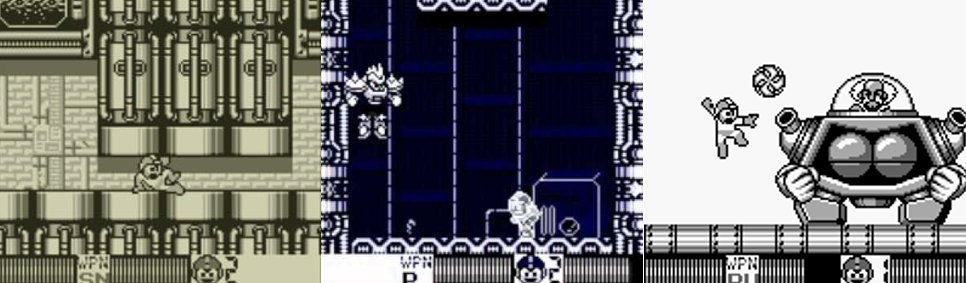
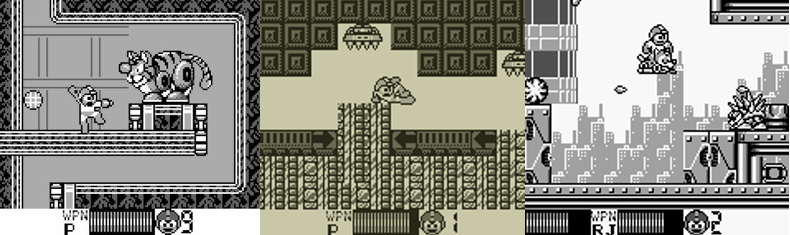
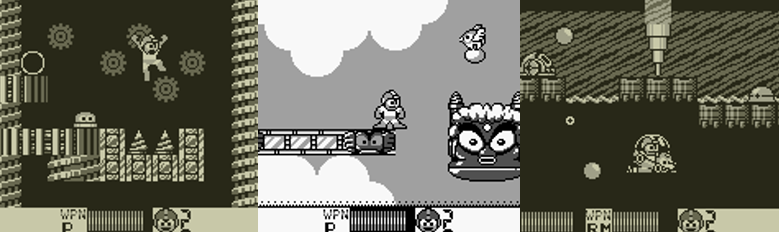
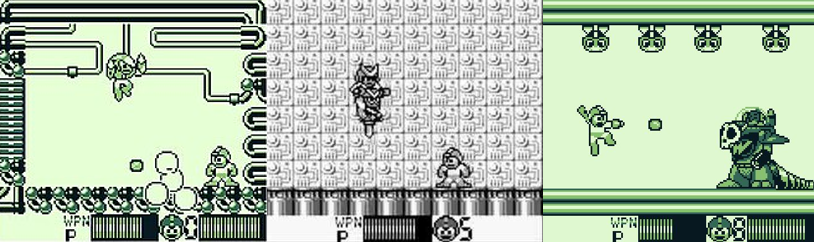
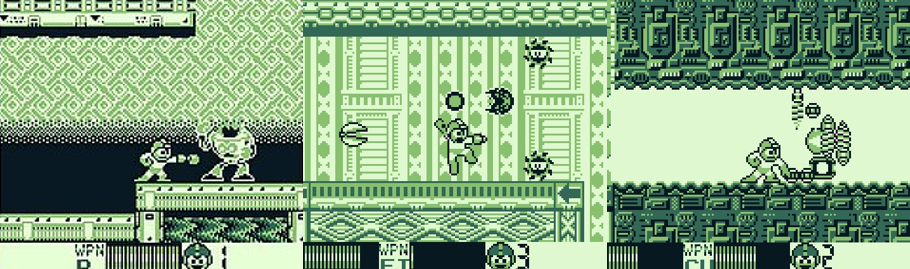
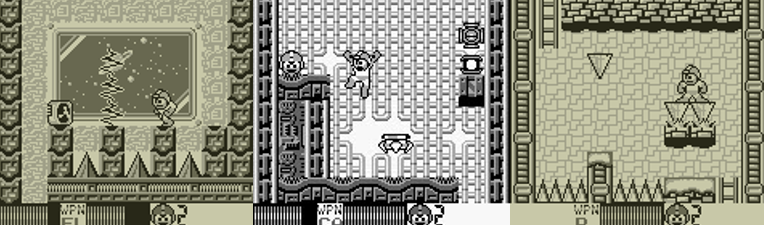
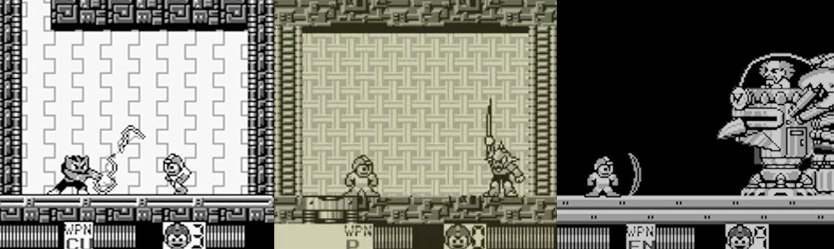
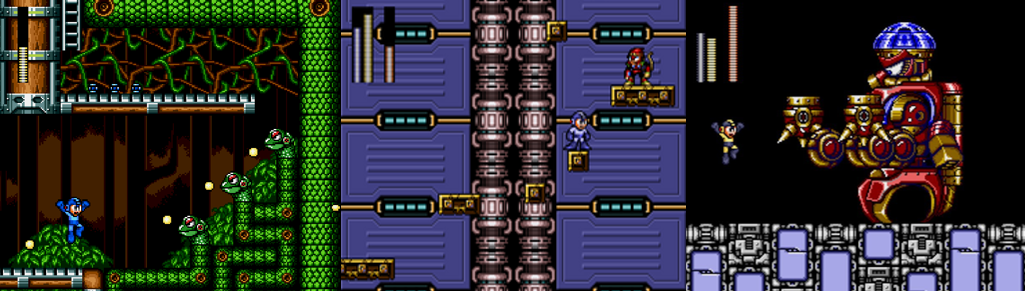
Mini Game Corner [Sci-Fanuary]: Mega Man: The Wily Wars (Nintendo Switch)


January celebrates two notable dates in science-fiction history, “National Science Fiction Day” on January 2 and Arthur C. Clarke’s HAL 9000’s birthday on January 12. Accordingly, I’m dedicating January to celebrating sci-fi with an event I call “Sci-Fanuary”.


Released: 30 June 2022
Originally Released: 21 October 1994
Developer: Minakuchi Engineering
Also Available For: Mega Drive, Mega Drive Mini, and the SEGA Channel

A Brief Background:
Before 1987, Capcom was mostly known for their arcade titles. The 1987 release of Mega Man (or “Rockman” in Japan) changed all of that. Widely regarded as an 8-bit classic, Mega Man was notorious for its difficulty and maintained this reputation across its many sequels and spin-offs. For decades, Mega Man was a Nintendo staple thanks to Capcom outsourcing the franchise to Minakuchi Engineering (and, briefly, Thinking Rabbit) for the Blue Bomber’s Game Boy ventures. Capcom also teamed with Minakuchi Engineering for Mega Man’s one and only Mega Drive appearance, which proved to be a nightmare because, as related by series artist Keiji Inafune, the developers struggled with the debugging procedure. Inafune stepped in to assist and also designed the new Wily Tower bosses for the game, whose North American release was first delayed and then cancelled due to technical issues. The Wily Wars eventually surfaced on the subscription-based SEGA Channel but it would take decades for it to be widely available to gamers. Those lucky enough to play it gave mostly positive reviews that praised the graphical overhaul and additional gameplay mechanics, though the sluggish control scheme and awkward hit detection was noted.

The Review:
I’ve already reviewed the first three Mega Man games (and a whole bunch of others) so it seems superfluous to go into great detail for this 16-bit remake collection. Essentially, The Wily Wars recreates Mega Man’s first three adventures from his Nintendo days in glorious, full-colour, 16-bit graphics. You get three save files to play with, that ability to switch around the game’s simple controls, and a sound and music test and that’s it. You play each game in turn, gaining an “All Clear” screen upon completing them, and each game stays true to their original mechanics. So, for example, you won’t be sliding, charging, or utilising E-Tanks in Mega Man, which is a bit of a shame as it would’ve been nice to see the later features incorporated to add a new challenge. By default, B fires your currently equipped weapon, A sees you jump, and you can pause the action and open the in-game menu with either Y or +. From here, you can select an E-Tank to refill your health when playing Mega Man 2 (Capcom, 1988) or Mega Man 3 (Capcom, 1990) and equip different Special Weapons. As in the original games, each Special Weapon is earned by defeating Robot Masters and each one has a finite amount of energy. Exploring stages and defeating enemies grants you small or large refills for your health and weapon energy; you’ll also find 1-ups, E-Tanks and, in Mega Man, can add to your high score by playing through the game.

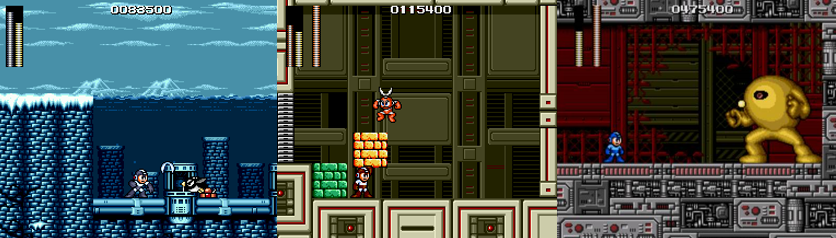
The 16-bit visuals make Mega Man pop like never before while retaining the core gameplay.

Naturally, I took on Mega Man first and the graphical overhaul is immediate right from the start. Mega Man looks great as a 16-bit sprite; he still only blinks when left idle but it’s nice to see him resembling his box art for a change. Stages are obviously far more impressive here, with elements like rocky grounds, mechanical platforms, and piping given far more detail. There are some instances where the background scrolls past in a version of parallax scrolling; mountains, clouds, and scenes of destruction can also be seen in the backgrounds. Ice Man and Fire Man get the biggest glow ups in terms of visuals, with their slippery, snowy ground and flash-frozen backgrounds and shimmering heat effect and rushing lava, respectively. You can still freeze fire plumes with the Ice Slasher and grab certain blocks with the Super Arm, and this is still the only way to get the Magnet Beam to navigate Doctor Albert Wily’s fortress. The action is a little zoomed out, giving you more room to manoeuvre; this is especially noticeable in boss arenas, where it’s easier than ever to avoid attacks thanks to the extra screen space. Sprites still have sizable hit boxes and enemies will still respawn over and over, but Mega Man has never looked or performed better, with no slowdown or screen tearing evident in my playthrough. Things are a little bland, though; Sonic the Hedgehog (Sonic Team, 1991) this is not and, frankly, the presentation doesn’t seem to match what the superior Mega Drive was capable of in 1994. The music has also been remixed and, similarly, has a decidedly tinny and grainy sound that isn’t up to Nintendo’s 8-bit standards let alone the Mega Drive’s higher sound quality. Still, we get some decent, partially animated sprite and pixel art and all the same Robot Masters and bosses return. As you’d expect, all the same strategies work just as well this time, with the exception of the Yellow Devil; you can no longer exploit the pause function to easily defeat him. Still, they all look very vibrant and dynamic even when you’re decimating them with their main weakness and it’s immensely satisfying seeing Dr. Wily beg for mercy in 16-bit glory.

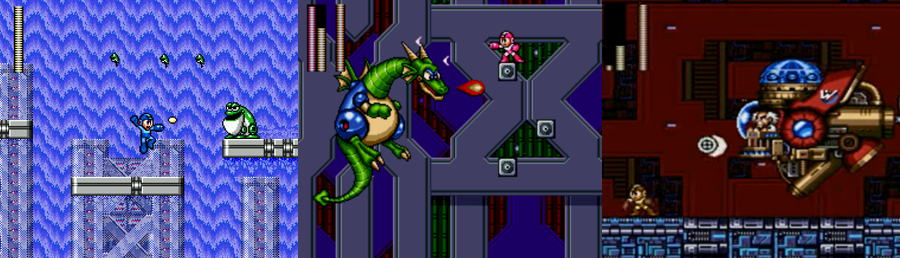
Mega Man 2‘s stages and final bosses greatly benefit from the graphical upgrade.

The visual upgrade continues in the game’s redesign of Mega Man 2 and is evident right from the start. However, while the game’s iconic title screen has been rendered in the same 16-bit art style, the city in the background does look a bit pixelated. This effect continues in Dr. Wily’s third stage and the Robot Master teleporter room is now a mess of animated panels, but most stages shine from the additional processing power. Bubble Man’s stage, for example, is awash with a very impressive waterfall effect that showcases some transparency effects; Wood Man’s forest has never been denser; you’ll hop behind big fluffy clouds like never before in Air Man’s stage; and Flash Man’s crystal mine is very beautiful with all its gleaming rocks and slippery crystal platforms. Mega Man 2 is further bolstered by big pixel art renditions of Mega Man receiving his upgrades; these are joined by incoming calls from Doctor Thomas Light that grant you the Items you’ll need to cross spike beds and navigate Dr. Wily’s stages. Large enemy sprites are better than ever here; there’s no slowdown when the Lantern Fish and Hot Dogs spawn in, no matter how many Shrinks and flame bursts they fire, and Quick Man’s stage still has its fading light gimmick and insta-death lasers. These are actually easier to avoid this time around; maybe it’s because of my past experience with the game but I relied on the Time Stopper far less this time around. A bit of parallax scrolling and an abundance of blinking lights and environment effects add to the visual appeal of this remake, though I will say that the stage designs could’ve been tweaked as there’s often a lot of empty space that feels wasted. The Robot Masters retain all their weaknesses, though their intros have bene reworked, but it’s the big bosses in Dr. Wily’s castle that benefit the most. Mecha Dragon, Guts Tank, and Dr. Wily’s machines are now fought against detailed backgrounds rather than a plain black void and you have more room to avoid their attacks. Mega Man did seem a touch slipperier in this game, I will admit, and the game seems to be deadlocked into its “Difficult” mode, meaning those damn Sniper Joes take a lot of hits or waiting around to destroy. Still, the visual glow up and the remixed soundtrack make this already great game even better and I loved the personalities of the quirky Robot Masters, which shined through much clearer thanks to the Mega Drive’s greater processing power.

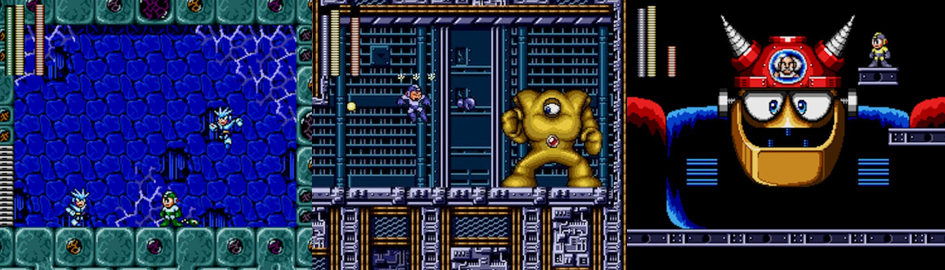
Despite the Mega Drive’s increased power, the system struggles at times in Mega Man 3.

Things are very much the same for Mega Man 3, though Mega Man can now slide by pressing down and A and his weapon select screen has been changed. It now appears at the bottom of the screen, which I found to be a bit clunkier. Otherwise, the same kind of semi-parallax scrolling can be found here, with backgrounds moving with you through windows in Top Man’s stage and layers of pipes and machinery in Spark Man’s stage. Background details in general are much more detailed than in the original games: lava flows and bubbles in Shadow Man’s sewer-like dwelling, Snake Man’s jungle is much denser, and Needle Man’s clear sky reveals a city in the distance. Some stages are cluttered by the additional background details, though: Spark Man’s, for example, is so lively and has so many clashing elements that it was easy to miss pits and hazards. Gemini Man’s crystal cave is a step down from Flash Man’s, though the coral-infested, tadpole-dwelling depths have never looked better. Proto Man’s sprite doesn’t quite match up with the upgrade given to Mega Man, Dr. Light, and the enemy sprites, though, appearing strangely small and simple. The game still handles far better than its 8-bit forefathers, with backgrounds appearing for all boss battles and larger enemies like Bikkys, the Giant Metall, Penpen Makers, and Tama appearing (with limited frames of animation) without any slowdown. However, the game does struggle when you battle Gemini Man as he duplicates himself and sends his Gemini Laser ricocheting about. The action also slows whenever you fire this weapon, which is a shame as The Wily Wars had coped with these issues really well up to this point. As in the previous games, there’s much more room to manoeuvre here, giving you more margin for error in boss battles, though the battle against the tedious Yellow Devil MK-II is just as annoying since you have to wait for him to assemble. He also looks super derpy here, though you can at least get a few more shots in with the Hard Knuckle. You’ll still revisit four previous stages and battle the Robot Masters from Mega Man 2, with the Doc Robot assuming their abilities, and fly over spike beds on Rush Jet. Dr. Wily’s crawling machine is easier to avoid thanks to the extra space, negating its large hit box, and the gigantic Gamma now looks gloriously cartoonish as a huge, detailed background image that smashes up the lower platform with its fists. You’ll also still battle Proto Man and be left clueless regarding his true identity, despite redrawn, sprite-based cutscenes where Dr. Light muses about his true motivations and the shield-carrying anti-hero still watches his brother from afar.

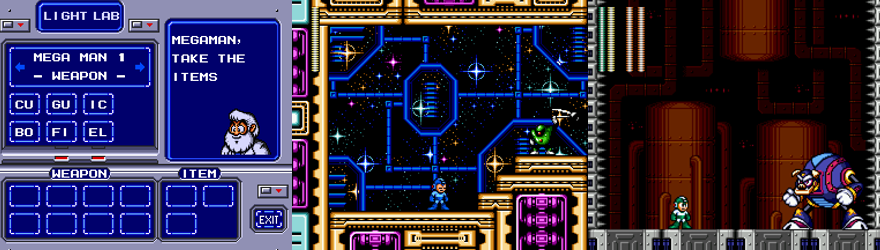
Customise Mega Man to your liking and challenge new stages and bosses in the Wily Tower.

Finishing all three games on the same save file unlocks an additional mode exclusive to The Wily Wars: The “Wily Tower”. This mode remixes bits and pieces from all three games, including enemies, hazards, and stage elements to present Dr. Wily’s latest challenge to his rival. The begin with, you can challenge one of three new “Genesis Unit” Robot Masters before taking on the titular tower itself (which is essentially Dr. Wily’s newest fortress). Before each stage, you get to equip Special Weapons, Items, and Rush abilities from all three games. You can mix and match up to eight Special Weapons and set three Item slots, allowing you to use, say, Rush Jet alongside Item-3. This is a really fun feature and one I honestly wish the developers had applied to the other three games; you’ll need a guide or something to help you pick the right loadout for each stage, though. This is because, while you can get by perfectly fine for the most part, you’ll open up alternative paths using the likes of the Crash Bomb, freeze flame bursts with the Ice Shooter, and of course reach different areas with Rush. The Genesis Units are also weak to specific Special Weapons, so it’s fun to mix and match and see what works. While stages remix elements from all three games in a fun way, there are a lot of Hammer Joes in each stage. Still, it’s fun seeing Snake Man’s stage suddenly emerge from the grassy hills, the layered island and water visuals of Mega Water S’s stage and seeing Jamacys emerge from pipes in Hyper Storm H’s stage. The three Genesis Units are all based on characters from Journey to the West (Cheng’en, 1592): Buster Rod G is modelled after Sun Wukong and attacks with an extendable lance and duplicates; Mega Water S is based on Sha Wujing and boasts a water shield and jet stream; and Hyper Storm H is based Zhu Bajie and sports two health bars! However, Hyper Storm H may look intimidating, and his stage may sport damaging spikes, but he’s the easiest of the three, with Mega Water S being the trickiest since he can force you into insta-death spikes and Buster Rod G being the most frustrating since he can deflect your shots and shield himself at the same time.

The Wily Tower will test your skills, though the final boss is a bit of a pushover.

Clearing these three stages sees you challenge the Wily Tower itself, the only part of this mode you can replay after clearing it. These stages recycle elements from Dr. Wily’s previous fortresses and other stages, as before, with you riding tracks like in Mega Man, battling Hot Dogs and riding Lighting Lord’s clouds like in Mega Man 2, avoiding turbines, hopping to spinning tops, and more. Naturally, Dr. Wily has some defences you must past to reach him. The first, Snakey, is a fire serpent that pops out of lava and breathes fire or leaps over you spitting fireballs. The hardest thing about this fight is not falling in the lava courtesy of the small, springy platform you fight on; if you have the Ice Slasher or Bubble Lead, though, it’s a joke. The Iron Ball is even easier, despite firing the Gemini Laser. This easily avoided sphere bounces about a bit and is only vulnerable when its face is exposed, but it’ll crumble from a few shots of the Thunder Beam. You’ll then battle Buster Rod G again, this time while freefalling on pieces of a destroyed walkway, which is very unique. He’s technically much easier here as he just fires shots at you while hopping to platforms, but he can be tricky to hit unless you have the Air Shooter or Metal Blade on hand. Your final challenge is Dr. Wily’s giant mech, a machine so big that we’re denied a background and you must first destroy its legs to attack its torso. In this first phase, it just stomps about and fires homing missiles, but you can use the rising blocks to blast the sphere at its hip with Crash Bomber, Spark Shot, or Thunder Beam. Its torso assumes a boxer’s stance and tries to smack you with its spiked fists, which you can hop on to pummel its face with Hard Knuckles while also freely chipping away with Metal Blades. Once destroyed, Dr. Wily resorts to his UFO once more, dropping time bombs that are easily avoided. Though he stays out of reach at the top of the screen, you can finish him off with the Thunder Beam to complete this mode. It’s a shame there’s no boss rush and you still can’t play as Proto Man, but I enjoyed the “Wily Tower” as an additional mode so much that I honestly would’ve liked to see its mechanics applied to the other games, at least after defeating this bonus mode, just to mix up the classics.

The Summary:
Mega Man: The Wily Wars is an interesting conundrum. On the surface, it sounds great! The first three Mega Man titles on one cartridge, with save files, a bonus game mode, and all brought to life by 16-bit visuals? Sign me up, right? Well, it’s a bit of a mixed bag, really. Graphically, yes, the games obviously look and run better than they did on the Nintendo Entertainment System. There’s no slowdown until you encounter the Gemini Laser, sprites and stages are far more detailed, and the layering and visual glow-up given to these 8-bit titles is immediate and eye-catching. Yet, I can’t help but feel like they fall short of what the Mega Drive was truly capable of. They remind me more of the James Pond games (Millennium Interactive, 1990 to 1993) which, while colourful and fun in their own right, aren’t exactly comparable, graphically, the Sonic games or Rocket Knight Adventures (Konami, 1993), which released a year prior to The Wily Wars. The action is a bit too zoomed out (a strange complaint given how frustrating Mega Man’s portable adventures were), reducing the detail in the sprites and arguably making the games easier by giving you more room to jump about. They’re still challenging titles, don’t get me wrong, but I think the developers missed a trick by not trying to do more than just improve the visuals. They copied the games so faithfully that they even included Mega Man’s useless score system, which is just baffling. I think it would’ve been better to look at the improvements the series had made by this point and apply them to all three games, sprucing up the interface and mechanics. Capcom would later do something like this with Mega Man Powered Up (2006), but it’s baffling to mee that Mega Man was up to his sixth game by this point and none of his then-modern mechanics (a charged shot, Rush’s other capabilities, and such) were included here. The Wily Wars’ main appealing factors are its visuals and its rarity; it’s a curio few got to play and thus worth a look, if only to challenge your skills in the enjoyable Wily Tower mode. However, I think I preferred playing the 8-bit versions, flaws and all, just because they had a charm and heart to them that was somewhat lacking here simply because The Wily Wars could’ve been so much more and it played things far too safe.

My Rating:

Rating: 3 out of 5.

Pretty Good

You didn’t own Mega Man: The Wily Wars back in the day so I won’t ask. But, when did you first play it? What did you think to the graphical overhaul given to the first three games? Were you disappointed that Mega Man didn’t sport more of his later abilities? Did you ever complete the Wily Tower? Would you have liked to see its mechanics applied to the other games? Which Mega Man game is your favourite? How are you celebrating sci-fi this month? Whatever you think about Mega Man, comment below and then check out my other Mega Man reviews!

Game Corner [Sci-Fanuary]: Star Fox 64 / Lylat Wars (Nintendo Switch)


January celebrates two notable dates in science-fiction history, “National Science Fiction Day” on January 2 and Arthur C. Clarke’s HAL 9000’s birthday on January 12. Accordingly, I’m dedicating January to celebrating sci-fi in an event I call “Sci-Fanuary”.


Released: 25 October 2021
Originally Released: 27 April 1997
Developer: Nintendo EAD
Also Available For: iQue Player, Nintendo 64, Nintendo Wii, Nintendo Wii U (Original); Nintendo 3DS (Remake)

The Background:
In their effort to break into the 16-bit market, Nintendo forged a close relationship with Argonaut Software, leading to the ground-breaking creation of the “Super FX” chip and the Super Nintendo Entertainment System’s (SNES) ability to process 3D graphics. Nintendo and Argonaut drew inspiration from the original Star Wars trilogy (Various, 1977 to 1983) to showcase the chip with arcade shooter Star Fox (1993). However, despite becoming the fastest-selling videogame in North America and garnering rave reviews, a sequel was unceremoniously cancelled so Nintendo could focus on the more powerful Nintendo 64. Although gamers had to wait over twenty years for Star Fox 2 to be released, lead producer and series creator Shigeru Miyamoto spearheaded a Nintendo 64 entry that began as a port of the original game as the developers struggled to adapt to the Nintendo 64’s hardware. After six months of testing, Nintendo higher-ups were apparently unenthusiastic, though it took only a ten second demonstration at Shoshinkai 1995 for the project to be approved. Artist Takaya Imamura was heavily involved in many aspects of the game, from the art direction to gameplay mechanics, while Miyamoto sought to both build upon the existing mechanics and recycle some of the work that had gone into the cancelled Star Fox 2, specifically the multiplayer mode and branching paths. The developers created new craft for the Star Fox team to utilise (though on-foot sections were scrapped due to time constraints), and the game was the first in the Nintendo 64 library to use the Rumble Pak peripheral. Retitled to Lylat Wars in Europe, Star Fox 64 released to critical acclaim. The multiplayer and gameplay were highly praised, and it even initially outsold Super Mario 64 (Nintendo EAD, 1996). Despite this, it would be another five years before there was another game in the franchise, though it did receive an equally successful 3DS remake in 2011 alongside numerous ports, and it’s highly regarded as one of the best in the series.

The Plot:
Five years after being exiled for biological warfare, the mad scientist Andross attacks the Lylat system, causing General Pepper to hire the Star Fox team – Fox McCloud, Falco Lombardi, Slippy Toad, and Peppy Hare – to defend the worlds within.

Gameplay and Power-Ups:
Star Fox 64 is an arcade-style, space-based shooter that largely takes place on-rails and with you back in control of an Arwing space craft. In many respects, the game is a remake of the original Star Fox, taking few elements from the cancelled Star Fox 2. You’re back controlling Fox alone with three AI-controlled wingmen helping you out, and there are no real-time strategy elements to think about (though the path you take and the missions you tackle will change depending on how you play). If you’re new to the game, you can get to grips with the controls in the “Training” mode, or jump right into the main story and take on seven stages (or “Missions”) to confront Andross’s forces. Players begin with two lives and a basic shield meter, which depletes as you take damage and can be refilled with silver rings, extended with gold rings, and replenished by passing through checkpoints. You blast enemy ships with A, holding the button to charge a homing shot that targets the nearest enemy, or destroy all onscreen enemies with one of your limited supply of Nova bombs with B. Y boosts you ahead, which is great for rushing past hazards, chasing down enemies, or outrunning ships on your tail. X brakes, which is also great for avoiding hazards and having pursuing craft fly past you, though this and the boost are tied to a small, replenishing meter to keep you from abusing their functionality. ZL and R allow you to bank, aiding in strafing and quickly sweeping enemy swarms. Double tapping either performs a “barrel roll” to evade and deflect incoming fire, and the left and right sicks execute a U-turn (though I struggled with this nine times out of ten).

Fox has more versatility, vehicles, and options than ever in this fun arcade shooter.

The right stick also switches to a cockpit view, if that’s your preference, though I was very impressed with how the game handled from the standard third-person viewpoint, especially compared to the last two games. The onscreen aiming reticule helps, for sure, as do the tighter, far more responsive controls that makes flying a breeze. Things get a little trickier when you enter “All-Range Mode”, where you’re confined to a set arena, generally to battle a boss or attack a central target. I found it a bit difficult to get my bearings in these situations, generally crashing into objects and being forced back into the fight by an invisible border, which my wingmen were quick to comment on. Yor wingmen offer advice encouragement, criticism, and require your help constantly. Generally, they’re pretty useful and will attack targets, but you can’t command them and they (Slippy, usually) are always getting into trouble or flying into your laser fire. It pays to keep them healthy, however; if they take too much damage and leave, you’ll lose out on Slippy’s analysis of bosses and the accompanying health meter, Peppy’s gameplay advice, and Falco’s alternative paths. Depending on which route you take, you’ll also be aided by Bill Grey or Katt Monroe, and ROB 64 will occasionally provide helpful pick-ups, as indicated by an onscreen notification to flick the right stick, or provide cover fire in the Great Fox. Players also take to the ground in the Landmaster tank and the sea in the Blue Marine, which have all the same capabilities as the Arwing except the Landmaster can’t fly (it can briefly hover, though I could never remember which shoulder buttons to press to do this) and the Blue Marine fires homing torpedoes. While there’s only one underwater mission, Landmaster missions are a nice change of pace but aiming can be a little trickier, something made even more troublesome by your Arwing-based wingmen still needing your help despite having the high ground. If you take too many hits, your ship will sustain heavy damage to its wings, which can be repaired with the Spare Wing pick-up. Your lasers can also be powered-up, and you’ll gain 1-Ups either by finding them or finishing a mission with a high kill count.

Missions, objectives, and the game’s difficulty all change based on how you play.

Your performance is graded at the end of every mission; your remaining wingmen and your health is tallied against your kill count, which increases your chances for a 1-Up. It’s advisable to avoid being too trigger happy as you’ll rob yourself of your backup while they go in for repairs, and General Pepper is billed for property damage at the game’s end. Generally, missions simply involve flying through a set course, defeating enemies, dodging hazards, and taking out a boss. However, even linear missions can hide secret paths; downing a set number of enemies, flying through certain alcoves, defeating rival team Star Wolf, and shooting switches can lead to alternate paths both in the mission and on the main map. The path you take dictates the game’s difficulty (with the top path being the hardest), though you can opt to change your path if you wish. Some missions task you with completing an objective in a time limit; others have you destroying shield generators, rushing through narrow corridors, or blasting through asteroid belts. When on Solar, your shield constantly drains from the intense heat; on Titania, you’ll bomb across the sand avoiding collapsing ruins in search of Slippy. Katina sees you defending a pyramid base from a swarm of enemy fighters alongside Bill, and Macbeth has you chase after a train, blasting boulders and defensive towers. Warp gates appear sporadically, allowing you to skip ahead, and you’ll face battleships, space stations, and swarming forces as you approach Venom, Andross’s home base. Walls, girders, fire plumes, space debris, and turrets will test your reaction times, and you’ll occasionally have to pick different paths and make tight turns as you race towards (and away from) Andross.

Presentation:
I’ve always said one of the main things holding back Star Fox was the awful polygonal graphics. They might’ve been impressive at the time, but I never liked them and they really ruined my experience in a lot of ways. Thankfully, that’s not an issue here with the superior power of the Nintendo 64. The entire game is brought to life through polygons (with the exception of some background elements and such, I’m sure), with the correct textures and rendering making for a smooth and far more pleasant experience. The game’s story and character interaction are all fully voiced (a rarity even at the end of the Nintendo 64’s lifecycle let alone the start), and the cast all have distinctive personalities: Peppy is wise and seasoned, Slippy a pain in the ass, and Falco a stubborn jerk. Although most cutscenes relegate the crew to amusing flapping heads, each mission gets an intro and outro, generally showing the team checking in or setting the stage for the current conflict. The game’s sound effects and music are also top-notch, with stirring military themes, adventurous tunes, and ominous overtures adding to the increased stakes as stages get progressively difficult. Some interesting touches are included here and there, such as planets looming into view when you’re blasting through space, enemy tanks toppling columns, and the very architecture itself coming to life around you. As you’d expect from the Nintendo 64, there’s some pop-up and fog effects here, but it’s generally masked or incorporated into a level’s structure, or the action ramps up to compensate.

The technology has finally caught up with the concept to present a charming action romp.

There’s quite a bit of variety to the mission locations in Star Fox 64; you view your current path and its branches from a rotatable space map, encouraging experimentation to visit new worlds, with their objectives tweaked depending on your path. Things start off familiarly enough with the distinctly Earth-like Corneria, with its river-filled mountains and futuristic main city. Weather effects and seasons taint the remaining planets in the Lylat system: Fortuna is the icy home to one of Andross’s outer bases, Solar is quite literally a raging star, Titania is a desert world filled with ruins and beset by a raging sandstorm, and Aquas takes place in the ocean depths. When partaking in space missions, you’ll blast towards stars, constellations, and planets taking on vaguely Star Wars-like battleships, debris, asteroids, lumbering craft, and surprise attacks from swarming, Space Invaders-esque (Taito, 1978) ships. Even confined areas like Bolse can have a lot going on with their intricate mechanical textures, endless enemy swarms, and unique objectives. Sure, it’s all a bit quaint these days, with blocky polygons and out-dated graphics, but Star Fox 64 has aged far better than the first game. The on-rails action keeps you moving, lasers and explosions and interesting obstacles are as constant as cries for help and warning notifications, and there’s always something to see, collect, shoot at, or avoid as you blast along. Although I found the stage aggravating and full of hazards, Macbeth was a great example of this as enemy ships fly overhead, the train trundles along firing concussive blasts and dropping boulders, and you’re constantly swerving to avoid obstacles and target everything in sight.

Enemies and Bosses:
If there’s a downside to Star Fox 64, it’s mostly the enemies. Indistinct polygonal crafts of various sizes pop up, fly in, or swarm around each area, blasting at you or charging into you or chasing Slippy and forcing you to rescue her for the hundredth time. They’re easily shot down with your primary weapon but it’s recommended you charge a shot to take out multiple foes at once (and net yourself a power-up and a hit combo in the process). Turrets, mines (both land, sea, and space), towers, and bigger swarms become more frequent as you progress. Snake-like Moras weave throughout the Meteo asteroid field, whole swarms fill the screen with grid-like laser patterns, bee-like fighters dance about firing coloured rings, and winged craft rise from Solar’s burning depths. Some of the more interesting enemies are land-based, such as the Garudas (construction robots who topple buildings and toss girders at you) and the giant, crab-like walkers of Titania. Anime-like Shogun Troopers attack the Corerian fleet in Sector Y, disc-like defence station platforms and large battle cruisers act as both hazards and targets in Area 6, and you’ll be hard-pressed to destroy each section of the seemingly unstoppable train on Macbeth, especially while blasting tanks, towers, and through gates. As versatile as Andross’s forces are, often splitting apart and flying at you as horizontal and vertical hazards, his home world of Venom is rife with buzzing swarms, tight turns, explosive booby traps, and walls that sprout hazards at the command of the stone golem, Golemech.

The game’s not short on gigantic bosses to challenge your skills.

Each mission culminates in a boss battle, though some missions have more than one depending on how well you play or will add additional phases and challenges (such as a time limit) to bosses. It’s recommended that you keep Slippy alive as that’s the only way you’ll properly gauge your progress against the boss as she brings up their health bar, though pieces of them will break off as you attack. Many are also accompanied by or spawn smaller enemy craft or fire destructible projectiles, which are worth targeting if your shield or bombs are low. Finally, the general strategy against these bosses is to simply avoid their attacks and target their weak spot (often a glowing yellow target), though you will have to adapt to All-Range Mode and partake in some tricky dogfights in some missions. On Corneria, you’ll battle either an Attack Carrier or Granga’s Mech, with the latter being the harder option. The Attack Carrier’s weak spots are small but it’s dead simple to avoid its shots and blast its wings off, while Graga stomps about firing homing missiles and making his mech a hard target to track. When facing the Meteo Crusher, fire when the central metal plate rotates to expose the weak spot but watch for the big Death Star-like laser it fires and its second phase where it flips around to shoot from the front. The giant clam Bacoon awaits on Aquas, the heavily armoured Sarumarine on Zoness, and the crab-like Vulcain on Solar, with this latter swiping its pincers, crating lava tidal waves, spewing fie plumes, and spitting flaming boulders. There’s even a fun Independence Day (Emmerich, 1996) homage when you team up with Bill to attack a gigantic, saucer-like alien mothership on Katina. As mentioned, Macbeth really aggravated me the first time through as the Forever Train was a difficult battle. A winged mech detaches from it and rains spears onto the track, but it’ll also crash into you if you don’t take it out fast enough at the end. However, if you target eight switches dotted alongside the main train track, you can one-shot the boss with a cutscene!

After besting Star Wolf and all his forces, you’ll take on the monstrous ape-thing Andross!

After taking out the security facility on Boise, you’ll infiltrate Andross’s pyramid-like base and chase down Golemech, blasting away his sandstone hide to attack his mechanical innards. You’ll battle the Spyborg in Sector X, which launches its fists at you and fires projectiles from its head. Take too long battling it and it’ll swipe Slippy to Titania, forcing you to rescue her from Goras, which has Slippy hostage in one pincer and fires lasers with the other. Target the limbs first, then switch to the chest and heart to bring it down. To finish Sector Y, you’ll chase down and destroy some super-fast Shogun Troopers and the larger, chrome-plated Shogun who eventually (and conveniently) settles atop an attack carrier and makes itself an easy target. The Gorgon super laser in Area 6 proved quite a challenge; you need to destroy its extendable tentacles and attack craft, then the three energy spheres inside it, all to finally expose its inner core multiple times over to succeed, By far your most persistent foes will be rival team Star Wolf, who you’ll face numerous times. Sometimes you can ignore them in favour of other objectives, but if you engage then you’re in for a tough dog fight. Star Wolf and his team love to come at you from behind and chase down your wingmen, and their ships have the same capabilities as yours, making them formidable foes. I found the battle against them on Venom particularly frustrating due to the enclosed space, them sporting shields to negate your charge shot and bombs, and Andrew Oikonny being a douche and not getting off my ass! No matter which path you take, you’ll end up facing Andross alone with Fox, though this giant disembodied ape head only shows his true form (a giant brain!) on the hardest path. Andross attacks by swiping his hands, firing an electrical blast from his fingertip, and sucking you in to eat you. Target his eyes to briefly stun him, destroy each hand in turn, and drop a bomb in his mouth and you’ll soon encounter his second form, a mechanical devil head that chomps at you. Destroying this is enough for the easy and medium paths, but the final form sees you desperately flying around blasting first Andross’s eyes and then the grey matter on the back of his brain as he teleports about, then desperately following Fox’s father as he leads you to safety.

Additional Features:
As mentioned, there are three paths to choose in Star Fox 64, though you really need to be paying attention in missions to figure out how to tackle the different levels and challenges. Rescuing Falco or ignoring Star Wolf or prioritising kills will put you on different paths and, while you can change to a lower path, you can’t change up to a higher one. You’ll get slightly different endings for each, with Andross only being properly destroyed on the hardest path, though this encourages replaying the game as much as the high score table. As if that wasn’t enough, if you accumulate enough kills and keep your allies alive, you’ll be awarded a medal. Get a medal on every mission to unlock the harder “Expert” mode and really challenge yourself. There’s also a Versus mode where you compete against friends for points, either working towards a set number of kills or against a time limit, which also allows you to play outside of a vehicle. Beyond that, you can mess about with the title screen, search for warp points, unlock artwork by beating Expert mode, and use the Nintendo Switch Online functionality to create save states.

The Summary:
I’ve played Star Fox 64 before; I never had it on the Nintendo 64, but I downloaded it for the Nintendo Wii and I was even tempted to get the 3DS version. What put me off was my dislike of the original Star Fox, a clunky and ugly game that hasn’t aged well at all. This isn’t true of Star Fox 64, which retains the same charm and appeal as it had all those years ago. The technology has finally caught up with the concept here, providing slick, tight, action-orientated space battles that really bring the idea to life. I loved the presentation of the story, the way the vehicles controlled (Landmaster aiming notwithstanding), and the challenge on offer. It’s a bit cheap to not make it more explicit what you have to do to pick each path but the signs are there, guides exist, and it’s fun replaying and experimenting, especially as missions are altered each time. This means some missions that are quite easy can become much more difficult, your approach to Venom and reaching Andross changes, and you get slightly different endings for your troubles. Yes, constantly rescuing Slippy and the others is annoying but the on-rails action is really fun. There’s also a lot happening and everything runs really smoothly. All-Range Mode was a bit tricky for me, and some missions and boss battles (particularly against the powered-up Star Wolf) had me tearing my hair out at times, but this stress was mitigated by the Switch’s save state feature. I would’ve liked to see a free play mode, the ability to play as the other characters, a co-op mode, and a boss rush implemented but that’s all stuff I’d expect to see in a sequel or remake. As is, Star Fox 64 is the first entry in the franchise I really enjoyed playing. It wasn’t a chore to control or look at, the soundtrack is excellent, blowing up enemies was satisfying, the bosses were huge and engaging, and the game finally brought the characters and the action to life in a way I could enjoy.

My Rating:

Rating: 4 out of 5.

Great Stuff

Are you a fan of Star Fox 64? Do you consider it the best of the classic Star Fox titles? Which vehicle and boss was your favourite? Did you ever best every mission and complete every path? What did you think to All-Range Mode and the branching path system? Do you have any memories of playing this with friends back in the day? Which Star Fox game is your favourite? Whatever your thoughts on Star Fox 64, please share them below and check out my other sci-fi content across the site! 

Mini Game Corner [Sci-Fanuary]: Star Fox 2 (Nintendo Switch)


January celebrates two notable dates in science-fiction history, “National Science Fiction Day” on January 2 and Arthur C. Clarke’s HAL 9000’s birthday on January 12. Accordingly, I’m dedicating January to celebrating sci-fi in all its forms in an event I call “Sci-Fanuary”.


Released: 12 December 2019
Originally Released: 9 September 2017
Developer: Nintendo EAD / Argonaut Software
Also Available For: Super Nintendo Entertainment System (SNES) Classic Edition

A Brief Background:
While working to enter the 16-bit market, Nintendo had a close relationship with Argonaut Software that saw the creation of the ground-breaking “Super FX” chip, which allowed the SNES to process 3D graphics. To best showcase the chip, the two companies took inspiration from the original Star Wars trilogy (Various, 1977 to 1983) and created Star Fox (1993), an arcade-style space shooter that became the fastest-selling videogame in North America. Despite this, and rave reviews, its sequel was unceremoniously cancelled so Nintendo could focus on the more powerful Nintendo 64. Prior to this, Star Fox 2 was reportedly 95% complete. Powered by the Super FX 2, the game boasted improved visuals and a degree of free-roaming gameplay, alongside additional playable characters and even a mech walker form for the Arwing craft. For decades, Star Fox 2 remained an elusive piece of lost media playable only through buggy, illegally leaked ROMS and emulators. However, thanks to Nintendo archiving the title, Star Fox 2 finally saw the light of day when it was included in the line-up of the SNES Classic, resulting in positive reviews that praised the ambitious gameplay and expanded mechanics while criticising its short length.

The Review:
Those reviews were right about one thing: Star Fox 2 certainly is a short game, perhaps even shorter than the first. Because of this, it didn’t seem worthwhile doing one of my usual long, in-depth reviews, though I did play enough of the game to share some thoughts. Fundamentally, Star Fox 2 is very much the same game as its predecessor, but with aspects changed or expanded and mechanics tweaked into something resembling a strange hybrid of an arcade shooter and a real-time strategy (RTS) game. This time around, you can pick which member of the Star Fox team to play as, with two new, never seen again characters tossed into the mix. Not only does each character have their own unique craft, but they have different stats, too, with some being faster, stronger, or taking less time to charge their weapons. You also pick two characters, a lead pilot and a wingman, and can switch between them by pressing – on the main map screen. I believe this allows you to send one character one way and the other in a different direction, and allows two player simultaneous co-op, but the craft simply followed each other in my playthrough. Star Fox 2 also offers four control schemes, with the default settings seeing A brake, B firing your primary blaster, X unleashing a limited supply of special weapons (a smart bomb, a shield, or replenishing your regular shields), and Y letting you boost towards targets. Holding B charges a more powerful shot, but this doesn’t home in on your target so I usually missed unless the target was stationary or flying right at me. Double tapping L or R lets you “barrel roll” out of harm’s way and, when on a planet’s surface, – will transform your Arwing into its mech walker mode.

The expanded dogfight gameplay is joined by odd RTS mechanics and a mech walker mode.

In this state, the controls change slightly. Now, A jumps and L and R are used to awkwardly spin around and your shots do seem to home in on targets. In this mode, you’ll mainly clomp about blasting enemies and stepping on switches to unlock doors, but it’s also the recommended state for destroy the heavily armed energy cores that lie in the centre of Andross’s bases. Another new aspect here is the aforementioned RTS mechanics. When on the map or engaging with Andross’s forces, cruisers, or bases, Corneria is under constant threat of attack. Missiles fire at the planet and Andross rocks up in his Star Destroyer-esque cruiser to fire a devastating shot, so you’ll need to intercept these and even quit out of stages to defend the planet. If Corneria’s damage percentage reaches 100%, it’s game over, which was honestly an aggravating mechanic as it interrupted the gameplay flow. By default, your forced into a first-person cockpit view; you can change this with + but the third-person view isn’t much better. There’s a lot of clutter on the screen, from arrows pointing you towards targets, the mini map, and the heads-up display, none of which can be turned off. You’re not on rails this time so it can be disorientating and difficult to fly about and focus on your target, especially if you don’t invert the controls. You no longer replenish your shield’s defences with rings; instead, you grab energy tanks and medals for a power-up. If you’re destroyed, you can choose to quit or switch to your wingman to carry on, effectively meaning you get two lives per game. There are also three difficulty settings available (though only “Normal” and “Hard” are selectable at the start), with enemy aggression and numbers increasing on harder difficulties.

Take out Star Wolf and Andross’s forces to confront the main man himself.

There’s a degree of chance at work in Star Fox 2. Andross randomly picks which worlds to establish his bases on and places his battle cruisers in different locations each game, eliminating the branching paths of the first game but ensuring no two playthroughs are ever the same. A simple gameplay loop quickly becomes apparent, however. You either intercept missiles to defend Corneria or engage with one of Andross’s cruisers, battling past the defences and flying inside its narrow corridors to destroy the core. This will give Corneria a reprieve, but you’ll only get to confront Andross directly after destroying his planetary bases. To do this, you’ll fly to a planet, open his base with the walker, and then fly or stomp through the same narrow corridors, blasting turrets and insectile craft to destroy the power core. Once you’ve cleared all Andross’s forces, you’ll warp to his main base for the final confrontation. In between this gameplay loop, additional challenges will arise: Andross’s mega powerful laser cannon, for one, or his projectile spitting Mirage Dragon for another. Yet, the bulk of the game’s challenge comes from rival space team Star Wolf. Its members lurk around the planets and asteroid belt and challenge you to a dog fight, a prospect that’s pretty daunting given how fast they are, their capabilities (which match yours), and how hard it is to track targets. Star Wolf himself challenges you right before you head to Andross’s base and these battles are even tougher on “Hard” mode. Andross’s base includes every hazard you’ve overcome so far (narrow hallways, tight corners, turrets, flame walls, and doors) and houses a disturbing Andross cube at its core. Destroying this is child’s play and no different to the other central cores, but you’re ejected into a psychedelic final battle battle against Andorss afterwards. Like before, he encases his cuboid core behind a projectile-spewing mask. You must fire at his eyes to drop his defences and then attack the cube as it spits out rectangular Andross projectiles, a prospect that’s far from challenging compared to the dogfights against Team Star Wolf. Once you’re victorious, you’ll get a rundown of the game’s enemies over the credits, a final score tally, and can challenge the next difficulty level if you like.

The Summary:
Star Fox 2 is a very strange game. Its very nature means you spend more time flying in the void of space or dodging asteroids as you desperately try to destroy missiles or enemy craft, which doesn’t make for the most inspired presentation. Similarly, the battle cruisers and Andross’s base are a mess of grey corridors and bland textures, and things are only slightly better when you’re clomping about on a planet’s surface. The planets themselves are far more restrictive this time, confining you to a small play area where your only objective is to activate switches. The music doesn’t fair much better, being nowhere near as memorable, though the game boast far more cutscenes are more detailed sprite art. The character variety is appreciated, as is the ability to avoid Slippy’s constant cries for help, but the screen is constantly bombarded by text from your wingman or arrows or other mess that clogs up the view. The RTS mechanics were an interesting inclusion; it kind of works to mix up the formula but adds unnecessary pressure to the admittedly shallow gameplay loop. If Corneria was spared danger when you were in a space battle, at least on “Easy” mode, that might’ve helped but, as presented, you’re encouraged to quit mid-mission to defend the planet, which interrupts the action. The polygonal models are as ugly as ever; they seem slightly improved, but they’re still a mess to look at and it makes it difficult to focus at times since the hardware seems to be struggling to bring the game to life. Ultimately, Star Fox 2 is just way too short. It lacks the epic boss battles of its predecessor and the final “choose your own adventure” mechanics and plays very much like an advanced tech demo for a Star Fox RTS spin-off rather than a capable sequel. It doesn’t expand upon what came before (and actually limits you more than you’d expect) and is more a curiosity than anything. It’s a shame as there was definite room for improvement over the original, but it seems the developers got ahead of themselves a bit by being too ambitious for their own good.

My Rating:

Rating: 2 out of 5.

Could Be Better

Have you played Star Fox 2? What did you think to the RTS mechanics? Which character was your go-to? Were you disappointed by the lack of big boss battles? Did you ever go to great lengths to emulate this game back in the day? Which Star Fox game is your favourite? Whatever your thoughts on Star Fox 2, please share them below orand check out my other sci-fi content across the site! 

Game Corner [Sci-Fanuary]: Star Fox (Nintendo Switch)


January celebrates two notable dates in science-fiction history, “National Science Fiction Day” on January 2 and Arthur C. Clarke’s HAL 9000’s birthday on January 12. Accordingly, I’m dedicating all of January to celebrating sci-fi in an event I call “Sci-Fanuary”.


Released: 6 September 2019
Originally Released: 21 February 1993
Developer: Nintendo EAD / Argonaut Software
Also Available For: Super Nintendo Entertainment System (SNES) and the SNES Classic Edition 

The Background:
In the early days of their successful foray into 16-bit gaming, Nintendo worked closely with Argonaut Software. This collaboration gave birth to the “Super FX” chip, a ground-breaking component that allowed the SNES to process 3D graphics and unique visuals. To best showcase the Super FX chip, the two developed the basic concept of Star Fox. Inspired by the original Star Wars trilogy (Various, 1977 to 1983), the game would be an arcade-style space shooter and its main characters were designed by Shigeru Miyamoto, Katsuya Eguchi, and Takaya Imamura, who were influenced by Japanese folklore. Argonaut’s developers were kept separated from Nintendo’s main office due to being outsourced developers. However, Miyamoto frequently checked on the game and helped tweak aspects of its design, though Star Fox was mainly seen as an experiment to see if a 3D game could sell. Still, Nintendo went to a lot of effort to market the game, allegedly sinking $15 million into advertising and even signing off on competitive showcases where players compete for merchandise and cash prizes. The result was a critical and commercial hit; Star Fox topped Japanese sales charts and became the fastest-selling videogame in North America, eventually selling over four million copies by 1998. Reviews gushed about the arcade-style gameplay and pioneering 3D graphics, and the game is fondly remembered as a 16-bit classic despite some notable flaws. While Star Fox may have been a hit and inspired a Nintendo Power comic strip, it didn’t see a port or re-release for nearly twenty-five years and the sequel was famously cancelled. Even the critical acclaim of Star Fox 64/Lylat Wars (Nintendo EAD, 1997) and the franchise’s prominent inclusion in the Super Smash Bros. series (Various, 1999 to 2018) couldn’t stop the series from suffering a decline over the years due to some odd decisions on Nintendo’s part.  

The Plot:
Fox McCloud and his fellow anthropomorphic mercenaries (known as “Star Fox”) are called in by General Pepper of the planet Corneria to pilot the experimental “Arwing” craft against the invading forces of the mad scientist Andross. 

Gameplay and Power-Ups:
Star Fox is a pseudo-3D rail shooter in which players assume the role of Fox McCloud and engage with the armies of Andross, which have invaded the Lylat System and can only be stopped by the firepower of your Arwing and with the assistance of your teammates. The game offers four control styles and you can test these out both in the control selection screen and in the game’s “Training” mode. Personally, I went with control style B as it maps the Arwing’s blaster to the B button but pick whatever you prefer! This setup sees you tapping B to fire; sadly, there’s no rapid fire option and you can’t hold the button to continuously fire or charge up a bigger attack). A fires one of your limited supply of Nova Bombs, using Y to brake and X to boost ahead for as long as your meter lasts, and holding the L or R triggers to fly sideways. You can also tap these, in conjunction with the control stick or directional pad, to “do a barrel roll” and avoid incoming fire. This is a necessity in the game’s later stages and against certain bosses, where incoming fire comes in a barrage and walls and hazards pop out of nowhere. You can also press – to switch between a third-person view and a first-person view from Fox’s cockpit. This latter option is automatically assumed in some of the space-based stages, but I found it too disorientating so I preferred to stick with the default out-of-cockpit camera position. 

Blast across numerous Stages and three different Courses, helping your wingmen as you go.

Although Fox isn’t alone in his campaign against Andross, you’re not allowed to play as anyone but the titular Star Fox, which is a bit of a shame and means the game does not different stats for the different characters, such as stronger defence for Falco Lombardi and a faster speed for Slippy Toad. However, your teammates provide encouragement and backup as you fly through the game’s stages. Often, each will inevitably require your help when they pick up a bogey, requiring you to rescue them in exchange for their gratitude (or admonishment in Falco’s case) and assistance with some firepower. On the flip side, it’s very easy to accidentally tag them with your blasts so check your fire as your final percentage grade will be affected by how healthy your team’s shields are. Also, if you lose a wingman at any point, they’ll be gone for the rest of the game, severely hampering your ability to get 100% completion. Additionally, Star Fox doesn’t use a traditional difficulty system; you pick from three paths (or “Courses”) containing seven Stages each. Some are shared across each path but with minor differences, such as containing different visual effects and bosses, and some lead to hidden areas, but the difficulty of the game depends on which Course you choose, with the top Course being the easiest and the bottom Course being the hardest. “Hard”, however, is somewhat relative. You may be attacked by more enemies, have to deal with more hazards, and encounter different bosses, but you’ll still find extra Nova Bombs, the odd extra life, and various sparkling circles to replenish your shield or alter your blaster fire. 

Things get more hectic and cluttered as you progress, but variety is at a minimum.

Fox’s Arwing is pretty tough and manoeuvrable, but it can only take so much damage. Fortunately, you can use silver and/or gold silver rings to replenish some or all of your shield. There’s also a power-up that temporarily renders you an invincible wireframe model, and upgrades that increase the strength and rate of your firepower. These are worth picking up, but are often placed near closing doors, pistons, columns, buildings, and other hazards, meaning you need to calculate the risk of acquiring them. The Arwing can also be a bit clunky at times; it’s got quite a large hit box and slips about when you roll, meaning it’s easy to crash into things and lose parts of the ship, and you’re not always given enough time to react to incoming hazards. Additionally, there are no other game modes available here and no other mechanics to challenge you. You simply fly along a set path, blast enemies, and defeat a boss, rinse, and repeat. Sometimes you’ll need to boost or avoid pistons, doors, and other crushing hazards; sometimes you’ll automatically fly through a tunnel or navigate tight hallways; and sometimes you’ll have to blast meteors, semi-sentiment columns, and destroy buildings. Ultimately, though, you’re simply flying along and destroying enemies until you reach the find of the stage. 

Presentation:
If there’s one thing Star Fox has going for it, it’s the music and sound design. Hajime Hirasawa brings the energy with some memorable, militaristic, and foreboding tunes that do a fantastic job of engaging you as you blast through Stages. Fox and his allies chatter in an amusing gibberish, but the game does feature English sound bites here and there, which is always impressive on 16-bit hardware. Yet, one of the reasons I’ve never really played Star Fox (beyond being a SEGA kid growing up) was because of the polygonal graphics employed to bring the ships and much of the environments to life. Even as a kid, I remember being unimpressed with these supposedly “ground-breaking” effects and they really haven’t aged very well today. Ships and buildings appear blocky, angular, and amateurish, featuring next to no textures or details, and really clashing against the more traditional sprite work on offer. The game tries to impress with its cinematic opening and shameless borrowings from the original Star Wars trilogy, but the models just don’t hold up and I can’t help but wonder if it would’ve been better to limit the polygonal effects to the bosses. As it is, I found it incredibly difficult to see what was happening when I was playing. As beautiful and varied as many of the environments are, the clash of styles makes it difficult to spot and target enemies (and the lack of an aiming reticule in third-person mode doesn’t help). Many of the hazards (from enemies to incoming missiles and even towers and cuboid blocks) tend to pop in out of nowhere because the SNES hardware is struggling to render the 3D graphics. 

The game’s polygonal graphics and atrocious pop-in effects age and ruin the gameplay.

It’s a shame as the sprite work is really good. The team pop up in animated dialogue boxes to offer hints, encouragement, and admonishment as you play, enemies will sometimes fly at the screen after their crafts are defeated, and the Mode 7 techniques for scaling and rushing across water and grass gives the game an epic scope and makes it fun to swoop around blasting at those awful polygonal ships. Environments are quite varied; you’ll fly through gates and past blocky skyscrapers on Planet Corneria, dodge pixelated asteroids and polygonal missiles in the various asteroid fields, desperately avoid rotating beams and space debris against a backdrop of stars and flaming nebula, and even blast through ice-, lava-, and storm-themed worlds full of mountains, flaming hazards, and rumbling storm clouds. Many times, you’ll automatically enter battleships, facilities, or the core of Andross’s homeward, Venom, where you’ll navigate tight corridors, blast doors, avoid pistons, and destroy power cores to succeed, often with the environment crumbling and exploding around you. However, I did notice a few graphical hiccups here and there. The pop-in is outrageous, one environment didn’t load properly, and the game’s bosses are a mess of crude polygons that can be difficult to battle since their weak points aren’t always immediately clear due to the awful 3D models. 

Enemies and Bosses:
As if Andross having an entire army at his disposal wasn’t bad enough, you’ll also have to watch out for various onscreen hazards. Asteroids, buildings, and cubes will dog your progress, as will spinning obstacles, rectangular plates, collapsing columns, and various debris all rotating or positioned to chip away at your shield. Andross’s forces are an eclectic bunch piloting various ships, from simple cannon fodder, tanks, and blaster turrets to larger walkers, spider-like robots, and co-ordinated attack craft that appear in formations. You’ll shoot down butterfly-like spacecraft, small frog-like ground troops, spheres that wait behind asteroids, blast missiles fired from enemy crafts or the surface of planets, mash L or R to shake off blob-like amoebas that stick to you, slowing your ship and draining your shield in Sector Y, and even encounter strange, mechanical animals such as a manta ray and a bird, the latter of which will warp you to the bizarre “Out of This Dimension” stage where you’ll encounter hostile paper plates! Larger ships can be found in some space Stages. These Star Destroyer-like craft can only be subdued by blasting the hexagonal panels on their sides or disabling their turrets, and you’ll then venture inside to take them out for good and even tackle one head-on in the form of the Great Commander boss. The path you choose at the start of the game determines which bosses you’ll face. Each (with one exception) has a helpful health bar and sports at least one glowing weak spot, and some are shared across the different paths but with altered strategies. Still, your best bet for almost all of them is to conserve your Nova Bombs to make short work of them since your teammates will conveniently abandon you before each battle.  

Each Course has its own bosses, but some are repeated, more aggressive, or plain bonkers.

At the end of Corneria, you’ll battle the Attack Carrier twice and the Destructor once. The Attack Carrier flies overheard to start, so keep low to the ground, opening hatches to unleash enemy fighters or missiles. On Course 2, the enemy fighters also fire missiles instead of lasers, but your strategy remains the same: destroy the hatches to then target the main body, avoiding plasma blasts as you go. The Destructor, fought in Course 3, is far more formidable. It’s a tank-like machine whose top pods split off to reveal bolt-firing turrets that will regenerate until the pods are destroyed. The more of the Destructor you destroy, the more aggressive it becomes, ramming you and firing more missiles from its underside. Finishing the Asteroid Belt will see you battle that Rock Crusher on the top two paths and the Blade Barrier on the lower path. While the Rock Crusher is relatively simple (destroy the hexagonal panels when they open up, avoiding its lasers and body parts as you attack), the Blade Barrier is not only invulnerable to your blasters but they actually bounce off it and can hurt you! It spins around, firing missiles and a web-like tractor beam that you’ll need to shake off with L and R, and can only be damaged after its fins are blown off and even then you have to watch for it smashing into you. Things really deviate on the third Stage; on the easiest Course, you’ll encounter the Atomic Base, which also appears in Sector Z on the lower Course. This is a rotating power core that’s protected by an impenetrable outer casing. You need to destroy the electric power nodes as they rotate around the core to expose its innards, but this is easier said than done due to the odd angle and some dodgy hit detection. 

Once you learn his limitations, final boss Andross offers less challenge than same prior bosses.

The Dancing Insector and Metal Smasher can cause issues, the former due to you being forced to target its legs and its surprisingly powerful flame burst when reduced to a saucer, and the latter since it sucks you in to crush you between its two halves. In comparison, I barely even registered Professor Hanger, a robotic drone that attacks from an overhead path and is easily destroyed, despite summoning fish-like enemies to pop up from the sea below. Star Fox also offers a taste of the surreal: you’ll encounter a giant slot machine that can only be bested by scoring a lucky seven, the unimpressive Spinning Core that spits iron balls at you, and a two-headed dragon/bird hybrid that hops about laying giant explosive eggs and forcing you to blast its head and butt! Yet, the Plasma Hydra is one of the toughest bosses, spinning and flailing tentacles, with its weak spot being at the end of these and it flying at you in a kamikaze run when near death. The Phantron was also a troublesome boss due to its incredible speed and duplication ability forcing you to hit the right double in order to deal damage, but later reappearing and transforming into a larger form with large, triangular “arms” for you to blast at.  No matter which path you choose, you’ll end up battling Andross, an unsightly polygonal head with no health bar and whose only attack is to spit a salvo of tiles at you and try to devour you. You need to destroy each of his eyes to reveal his true form, an erratic cube that must be attacked to win the game but, while Andross can become a malicious devil-like face that also fires plasma balls, he’s a joke once you learn to barrel roll through his attacks and target his weak points. 

Additional Features:
With no multiplayer, no other playable characters, and no native save features, Star Fox is a little light on replay value. Your main reason for replaying the game will be to try a different Course and discover the two secret areas, one of which includes the ridiculous slot machine boss and some unsettling clock faces and the other is a bizarre black hole filled with space debris. Otherwise, your main aim is to hit 100% for every Stage and Course, which requires you and your teammates to survive with as much health as possible. However, the appeal of this is somewhat diminished as there’s no high score system and this data isn’t recorded anywhere. Otherwise, this version of the game has all the quality of life features you’d expect, including save states and rewinds to help you get past the trickier sections, but these are also somewhat weakened by the lack of any unlockable features, like a stage select or boss rush. 

The Summary:
I’ve been hesitant about playing Star Fox for years. Not only was I basically unable to as I never had a SNES, been its Nintendo 64 follow-up largely passed me by despite sitting in the virtual library of my Nintendo Wii. It’s a little odd in some ways as I quite like the concept, which is essentially Star Wars with anthropomorphs. The game is packed full of fun, engaging, action-packed dogfights and big bosses with a fair degree of variety to them, and the environments. However, the biggest selling point of Star Fox are its visuals, which I’m sure impressed many at the time, but which have always appeared dated and cumbersome to me. In practise, the game struggles with its polygonal models, running at a slow pace and offering little gameplay variety. The visual clash between traditional sprites and 3D polygons also makes the game very messy at times. The music, characters, and the world are appealing, but not enough to make me consider this an under-appreciated 16-bit gem. Ultimately, while it’s good for a quick playthrough, Star Fox quickly becomes repetitive even with the multiple paths and the visuals just didn’t impress me enough to want to pick it up once I’d seen everything it had (which basically happens in one playthrough). A SNES classic, maybe, but one that hasn’t stood the test of time for me and was surpassed by its sequels. 

My Rating:

Rating: 2 out of 5.

Could Be Better

Have I ruined your childhood with my opinions on Star Fox? Were you impressed with the game at the time, and how do you think it holds up today? Which Course was your favourite to playthrough? Were you disappointed that you couldn’t play as the other characters, and did it annoy you having to save them all the time? What did you think to the bosses and the polygonal models? Which game in the Star Fox franchise is your favourite and would you like to see a new one? Whatever your thoughts on Star Fox, feel free to leave them below and check out my other sci-fi content across the site! 

Mini Game Corner [DK Day]: Donkey Kong 3 (Nintendo Switch)


In July 1981, Shigeru Miyamoto and his team at Nintendo R&D1 created Donkey Kong, an arcade title that was not only one of the earliest examples of the platform genre but also introduced gamers everywhere to two of Nintendo’s most recognisable characters: Mario and Donkey Kong. Mario, of course, shot to super stardom but July’s a good excuse to celebrate everyone’s favourite King Kong knock-off.


Released: 5 April 2019
Originally Released: 28 September 1983
Developer: Nintendo R&D2
Also Available For: Arcade, Family Computer Disk System (Famicom), Game & Watch, Game Boy Advance, Nintendo 3DS (Virtual Console), Nintendo Entertainment System (NES), Nintendo Wii, Nintendo Wii U (Virtual Console)

A Brief Background:
At the start of the eighties, Nintendo had run into some issues when their plan to expand into North America with Radar Scope (Nintendo R&D2/Ikegami Tsushinki, 1980) failed. Nintendo’s then-president Hiroshi Yamauchi thus tasked young designer Shigeru Miyamoto with creating a new arcade cabinet to get the company back on track. When his plan to base it on popular comic strip character Popeye fell apart, Miyamoto took inspiration from Beauty and the Beast (Barbot de Villeneuve, 1740) and King Kong (Cooper and Schoedsack, 1933) to create Donkey Kong (Nintendo R&D1/Ikegami Tsushinki, 1981). A financial and critical success that introduced players to “Jumpman” (now known as Nintendo’s mascot, Super Mario), Donkey Kong was followed by the equally successful (if obscure) Donkey Kong Jr. (Nintendo R&D2, 1982) the very next year. Based on this success, Donkey Kong 3 came the year after that, with the gameplay significantly altered; even Mario was gone, in favour of bug exterminator Stanley. Although allegedly successful in Japan, the videogame crash of 1983 stunted its release in North America and, while somewhat praised upon release, it hasn’t stood the test of time and effectively killed the franchise until the 16-bit era of gaming rolled around.

The Review:
Donkey Kong 3 deviates wildly from its predecessors in a few ways; first, Mario is strangely absent, replaced by Stanley the Exterminator and, secondly, it’s now a 2D shooter-type game not unlike Space Invaders (Taito, 1978) or Galaga (Namco, 1981). Secondly, Donkey Kong is now a central antagonistic figure, appearing in the vines atop each screen (or “Round”) and shaking beehives to spawn enemies that swoop in and take away your flowers (and your lives). Thirdly, the game has a traditional timer; you have a limited amount of time to fend off the enemies and Donkey Kong himself before you lose a life, but you also have to keep the pressure on Donkey Kong with your bug spray or else he’ll come crashing down and cost you a life. Once again, you can pick between two one-player games and two two-player games, with “Game B” offering a greater challenge, though the controls are a little more versatile. You fire your bug spray with A or B (sadly, there’s no auto- or continuous fire option), jump by pressing up on the control stick and drop down a level with down. Falling won’t cost you a life but Stanley is hard-pressed to jump over enemies; instead, you must drop down and move about to get underneath them and spray them. Very rarely (literally once per life), you’ll be able to make use of a super bug spray power-up that’ll make fending off Donkey Kong and defeating enemies much easier; this even carries over between Rounds, but its effects wear off after a few seconds. As before, defeating enemies awards you points; if you clear a Round with all flowers intact, you’ll get a point bonus, with an extra life being awarded for every 50,000 points you earn, though there’s still no high score table, so it’s all about maintaining the top score at the top of the screen.

Blast at bugs and a looming Donkey Kong with your bug spray to keep your flowers safe.

Donkey Kong 3 also deviates from its predecessors by sporting two screens that repeat in a perpetual loop until you lose all your lives or get bored and quit, though they are made a little more varied in the colour palettes changing, the platforms being trickier, and the number of enemies increasing as the loops recycle. The first Round is in the forest and sees you hopping up stone platforms to fend off Donkey Kong, and the second Round is in the treetops and sports vines that annoying worms crawl across to block your shots. Once you’ve played both screens, you’ve basically seen everything Donkey Kong 3 has to offer, and you can even clear Rounds in a couple of seconds if you’re quick enough. Sure, faster, more aggressive enemies appear later, darting at you or sending out stingers, and Donkey Kong will toss coconuts at you, and the trees might be red or green, but there’s even less visual variety here than in the last two games. Stanley doesn’t make as much of an impression as Mario and I found myself easily losing him against the stone platforms. His bug spray is weak and incredibly limited, he can’t jump over enemies, and there’s often so much onscreen that you’re guaranteed to lose a flower, if not a life. Although the music also isn’t all that much to shout about, being on the same level as the previous games, Donkey Kong is now a large, detailed, and animated sprite; he’s mischievous and daunting, grinning at you and always edging closer. Though there’s no true final showdown or end to the game, you can force him up the vines and trap his big, stupid head in a beehive, which I counted as a victory. As ever, you can use save states and rewind the game to address any mistakes, but it can be tricky to figure out your attack strategy as, unlike in the last two games, pausing the game inexplicably covers the in-game action with a black screen.

The Summary:  
I, like I suspect a lot of people, was not very familiar with Donkey Kong 3 before heading into it. In fact, I’m not sure I’d ever even seen a screenshot of it, let alone really knew it existed, and I have to say that it really isn’t worth your time. It borrows more elements from other games than it innovates and lacks even the mild appeal of Donkey Kong Jr. since Mario is entirely absent. It’s nice to see Donkey Kong back as a big, foreboding antagonist and there was some fun to be had in blasting him up the ass with bug spray, but that’s about where my praise ends. Even compared to the last two games, Donkey Kong 3 wears out its welcome pretty quickly; there’s just not enough variety to hold my attention and very little incentive to keep playing without a high score table. I liked that the palette changed as you progress, but the lack of visual variety really hurts the game. The enemies are little more than uninspired and annoying bugs, too, and the lack of other power-ups and mechanics just makes this a bland and forgettable title. It seems like Nintendo were trying to milk Donkey Kong a little too hard back in the day, including similar gameplay mechanics but adding one or two tweaks to try and keep things fresh, but I wonder if simply expanding on Donkey Kong, adding new mechanics and stages and such like in the Game Boy release, wouldn’t have been a better idea than releasing dull titles like this. These days, Donkey Kong 3 is all-but forgotten, and with good reason; just play the original or the 16-bit titles if you’re itching for some nostalgic ape action and leave this one in the dirt where it belongs.

My Rating:

Rating: 1 out of 5.

Terrible

Was Donkey Kong 3 in your NES library back in the day? How do you think it compares to the last two games? What did you think to Stanley and the new shooting mechanics? How far did you get in the game before you failed or quit? Which Donkey Kong videogame is your favourite and why? How are you celebrating Donkey Kong’s anniversary this year? Whatever your thoughts on Donkey Kong, feel free to leave a comment below or on my social media, and check out my other Donkey Kong content on the site.

Mini Game Corner: Donkey Kong Jr. (Nintendo Switch)

Released: 21 December 2018
Originally Released: 30 June 1982
Developer: Nintendo R&D2
Also Available For: Arcade, Atari, BBC Micro, Coleco Adam, ColecoVision, Family Computer Disk System (Famicom), Intellivision, GameCube (via Animal Crossing (Nintendo EAD, 2001)), Nintendo 3DS (Virtual Console), Nintendo Entertainment System (NES), Nintendo Wii, Nintendo Wii U (Virtual Console)

A Brief Background:
In early 1980, Nintendo were in a spot of bother; their plans to expand into North America with Radar Scope (Nintendo R&D2/Ikegami Tsushinki, 1980) had failed, so then-president Hiroshi Yamauchi tasked young designer Shigeru Miyamoto to create a new arcade cabinet to turn things around. After plans to adapt popular comic strip character Popeye fell apart, Miyamoto took inspiration from Beauty and the Beast (Barbot de Villeneuve, 1740) and King Kong (Cooper and Schoedsack, 1933) to create Donkey Kong (Nintendo R&D1/Ikegami Tsushinki, 1981), a financial and critical success that introduced players to “Jumpman”, who would go on to become Nintendo’s mascot, Super Mario. During Donkey Kong’s development, many of the team’s concepts had to be cut due to time and hardware constraints. As they worked to develop these further, and given Donkey Kong’s success, the team developed a follow-up title that was initially planned to star the cantankerous ape himself before a smaller, more manageable substitute was created. Although Donkey Kong Jr. is now one of Nintendo’s more obscure characters, having largely been supplanted in the 16-bit era, Donkey Kong Jr. was very successful in its native Japan. Reviews praised the colourful presentation and gameplay loop and the game became very popular in the competitive play arena.

The Review:
Donkey Kong Jr. is, essentially, more of the same game as its predecessor. Like Donkey Kong, players can pick from four game modes: two single-player options and two two-player options, with “Game B” being the more difficult of the two as it includes more onscreen enemies. Regardless of which mode you pick, Donkey Kong Jr. utilises the same simplistic control scheme as before, with A being the only button you need to press to jump over enemies, to vines, and across platforms. Donkey Kong Jr. has the rare distinction of being perhaps the only Mario-adjacent videogame where the portly plumber is an antagonist. Players now control the titular Donkey Kong Jr., a stout baby ape who slowly clambers up vines, quickly slides down them, and whose only method of attacking the many critters Mario sends out to obstruct him is to touch various fruits high up on vines; these will then fall, destroying any enemies beneath them. While Donkey Kong Jr. is a far more complex-looking sprite, with a humorous and over the top death animation and being slightly more animated overall, he’s no less clunky and actually less useful than Mario was in the last game as his hit box is bigger and he doesn’t get a hammer power-up. There is a spring on one screen, but it’s just as likely to send you plummeting to your death as it is to the next platform, so you’ll need to carefully time your jumps to avoid enemies and snag some points. But don’t take too long; like in Donkey Kong, the longer you take, the lower your bonus score will be upon completing a screen, which in turn impacts your high score. While you don’t seem to earn extra lives by accumulating points and there’s no high score table to display your best score, it is displayed at the top of the screen and is the only goal available to work towards so you may be somewhat protective of this.

Junior must clamber up vines, jump over hazards, and use keys to rescue his dad from Mario.

Donkey Kong Jr. is comprised of four screens that repeat in a nigh-never-ending loop until you finally die, with the enemies increasing in number and aggression the more you play. In three screens, your goal is to reach the top, acquire a key, and scare off Mario, and this culminates in a final showdown where you need to take down the devious plumber and rescue your kidnapped father. In the first screen, you simply navigate between vines being careful not to fall in the static water below or even drop a short distance as both will instantly kill you. In the second screen, you’ll bounce on the spring to smaller moving platforms and use a pulley to cross a gap and, in the third screen, you’ll hop over electrical hazards that erratically move back and forth across the platforms. Finally, you’ll climb up six chains, pushing six keys up to a bridge and avoiding bees and little alligators. Once you’ve pushed all six up to the top, the bridge is destroyed, Mario is defeated, and Donkey Kong is rescued and it all begins again until you either lose all your lives or quit from boredom. Although the game lacks the iconic music of its predecessor, each screen has some fun little jingles and sound effects but nothing especially innovative. Donkey Kong and his son are the most colourful and visually interesting sprites, with Mario only impressing due to him wielding a whip this time around, and the enemies are simply snapping alligators, egg-dropping birds, and electrical bolts. Naturally, this version allows you to create save states and rewind the game if you make a mistake, effectively destroying any difficulty curve it might’ve had and reducing the average playtime to around ten minutes.

The Summary:  
Donkey Kong Jr. reeks of cheap, money-grabbing desperation. Donkey Kong was an innovative and popular arcade release and it’s obvious that Nintendo simply wanted to capitalise on that with a “new title”, but there’s very little new about this game. Sure, moving to vines is different and having to time fruit-grabbing to defeat enemies adds a little more strategy and I quite liked the final showdown with the keys on the chains, but the gameplay experience is largely the same and lacks a lot of the nostalgia and charm of its predecessor as the setting is so weird. Even now, it’s bizarre seeing Mario as a whip-cracking antagonist. Donkey Kong Jr. has a lot of visual appeal, but I wonder if this game might’ve been better if Junior actively chased Mario across the stages? Or if a two-player mode saw one player as Junior and the other as Mario trying to intercept him? I feel like Nintendo could’ve bundled these two games together into one experience at the time, creating an eight-screen loop where you first track down and capture Donkey Kong and then switch to Junior to rescue him, but, as is, I can’t see myself choosing to play Donkey Kong Jr. over its more popular and nostalgic predecessor.

My Rating:

Rating: 2 out of 5.

Could Be Better

Did you ever own Donkey Kong Jr. for the NES back in the day, or play the arcade version out in the wild? How do you think it compares to Donkey Kong? What did you think to Junior and seeing Mario as an antagonist? How far did you get in the game before you failed or quit? Which Donkey Kong videogame is your favourite and why? How are you celebrating Donkey Kong’s anniversary this year? Whatever your thoughts on Donkey Kong, feel free to leave a comment below or on my social media, and check out my other Donkey Kong (and Mario) content on the site.
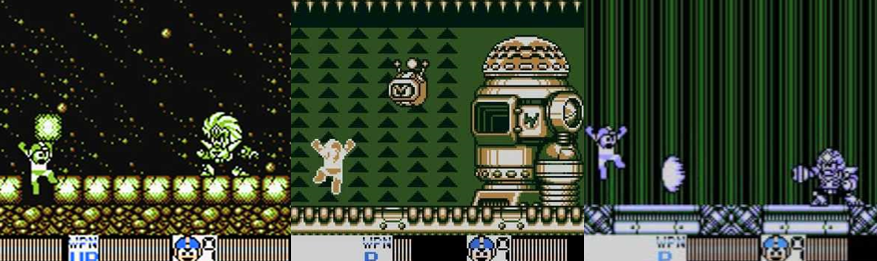
Game Corner [Mario Month]: Super Mario World (Nintendo Switch)


So, for no better reason than “Mar.10” resembling Mario’s name, March 10th is widely regarded as being “Mario Day”, a day to celebrate Nintendo’s portly plumber, an overalls-wearing mascot who literally changed the videogame industry forever and shaped the home console market of the nineties.


Released: 3 September 2020
Originally Released: 21 September 1990
Developer: Nintendo
Original Developer: Nintendo EAD
Also Available For: Game Boy Advance, Nintendo 3DS, Nintendo Wii, Nintendo Wii U, Super Nintendo Entertainment System (SNES) Classic Edition, SNES

The Background:
After the videogame industry crumbled under the weight of overpriced consoles and mediocre titles, Nintendo basically saved the industry with the runaway success of Super Mario Bros. (Nintendo EAD, 1985). Despite its bizarre development, Super Mario Bros. 2 (Nintendo R&D4, 1986) was also a highly praised best-seller, and Mario’s star only rose thanks to the unique marketing strategy behind Super Mario Bros. 3 (ibid, 1988) and that game also being a critical and commercial hit. In 1990, Nintendo were preparing to launch the 16-bit powerhouse that was the SNES and getting back into the thick of the “Console Wars”. Although the developers had to adapt to the new hardware, producer and Mario creator Shigeru Miyamoto was excited by the prospect of imaging new ideas, such as finally implementing a dinosaur companion for Mario. The goal was to refine Mario’s mechanics, impress gamers and critics with the SNES’s graphical capabilities, and deliver a fun, but challenging, gameplay experience to help sell their new console. Super Mario World exceeded in this goal; the award-winning game became the best-selling title for the SNES and has been inundated with widespread critical acclaim ever since its release. The game was adapted into cartoons and comics, resulted in an equally successful spin-off series for Yoshi, in addition to being ported and remastered to new consoles over the years. Its legacy is so strong that it was naturally included as a launch title for the Nintendo Switch Online service in 2020, which is the version I’m reviewing here.

The Plot:
When Mario, Luigi, and Princess “Peach” Toadstool visit Dinosaur Land, the princess is kidnapped by Bowser, King of the Koopas. Alongside their new dinosaur friend, Yoshi, the Super Mario Bros. must liberate the island from Bowser’s Koopaling progeny and confront Bowser in his castle to rescue the princess.

Gameplay:
Like its predecessors, Super Mario World is a 2D, sidescrolling platformer in which players play as ether Mario or Luigi and journey across seven levels (referred to as “Worlds”) and two bonus Worlds, hopping on Bowser’s minions, collecting power-ups, and grabbing Coins for points and extra lives, all while racing against a timer. As is also tradition, the game features two play modes; one where you go solo and one where you switch between the brothers after each level to allow two players to go head-to-head, taking different routes on the large, varied, interconnected overworld and lending extra lives if required. Unlike in previous 2D Super Mario games, you can’t change the control scheme here, so you’ll be pressing B to jump (ranging from a little hop to a higher jump the longer you press the button) and swim, A to perform the new spin jump (which allows you to defeat certain armoured enemies and break blocks beneath your feet) and holding X or Y to run. You can get quite a bit of speed this time, too, which allows you to glide and fly across levels when you’re powered up by the Cape Feather or run up walls in certain situations. You can also hold X or Y to grab items like Koopa shells, blocks, and keys; these can now be thrown upwards, increasing your range of attack options and opening up new areas to explore. Finally, you can look up, scroll the screen with the left and right triggers, and duck; if you run and duck, you can slip through small gaps and reach bonus areas and secret exits.

Traverse a colourful new land using Mario’s new companion and power-up!

Interestingly, I didn’t notice any difference between Mario and Luigi; Luigi doesn’t jump higher or have less traction, meaning the differences between the two are a simple palette swap, which is odd considering they played differently in Super Mario Bros. 2. The brothers are joined by a new companion in this game, Yoshi. If you hit enough blocks, you’ll eventually spawn in a Yoshi egg, from which this helpful little dinosaur will hatch. Players can ride Yoshi and press X or Y to extend his sticky tongue and eat fruit or enemies, the latter of which can either be swallowed, spat out as Koopa shells, allow Yoshi to breathe fire, and add a “flutter” motion to his jump. Yoshi allows players to do everything they normally can but with the added bonus of acting as a permanent shield; when hit while riding Yoshi, you won’t power down and can simply hop back on him to continue onwards, but you can’t use your Fire Flower abilities while riding him and Yoshi isn’t able to climb vines and won’t accompany you into fortresses or castles. Yoshi can also gain the ability to fly, easily allowing you to cheese through levels, and you can sacrifice him for a boost jump if you’re feeling sadistic. Some levels also include different coloured Mini-Yoshis; carry these until they eat five pieces of fruit or enemies or a single power-up and they grow into an adult Yoshi, and other levels see you riding atop bulbous Monty Moles to safely cross spiked hazards. Mario and Luigi can also use springs to get around, often needing to pick up and toss them to clear higher obstacles, and these are much easier to control than in Super Mario Bros.: The Lost Levels (Nintendo R&D4, 1986); swimming and autoscrolling levels also return, but again I had no issues in dealing with these as the game’s mechanics were so refined. Another new addition is the “Item Stock” in the heads-up display (HUD); if you’re already powered up, new power-ups you acquire are stored in this box and will automatically drop down when you take a hit (or press ‘Select’), which can be a life saver, though you can’t stockpile power-ups on the overworld anymore. Another new feature is the addition of checkpoints mid-way through levels, which I find interesting as these levels felt shorter and far less frustrating than Super Mario Bros. 3’s; hitting this while in your base form will also automatically power you up, too.

The game’s challenge is very fair, offering fun visuals and incentives to keep playing.

Super Mario World gives you three save files to play with and the chance to manually save at certain points, such as after toppling a Koopaling or visiting a Switch Palace. Every level has a secret exit, sometimes accessed via a key or by taking a different route; this allows access to new areas on the overworld and to secret levels and Switch Palaces, where you activate giant-coloured switches to make their corresponding-coloured blocks solid and thus protect you from hazards in levels. This opens the game up to some replay value as you explore each level looking for secrets and new paths, and you’re given some hints towards this through the Message Blocks that convey story text and helpful tips. As ever, you can hop into pipes to find shortcuts, bonus areas, and explore caves and flooded sections; you can take vines up to the clouds, ride platforms, hop off Koopa Paratroopers, and make use of temporary blocks and platforms. Many Worlds contain Ghost Houses that are filled with shy Boos and feature a maze-like element; you’ll need to find the correct door, often by generating temporary platforms or paths using a Switch Block, all while avoiding the ghostly enemies and bottomless pits within. Other levels are autoscrollers that force you to make split-second decisions with your jumps; castles and fortresses are filled with lava, narrow hallways, rotating spiked maces, and crushing Thwomps, often all at once and in close-quarters situations to test your mettle. You’ll need to awkwardly create paths using Control Coins, activate spotlights in Bowser’s Castle, and deal with pipes that now go up and down and blast you through the sky. The background can also move vertically, requiring you to quickly take refuge in safe areas, and you’ll even be climbing on fences, bashing enemies and flipping around to the other side to avoid dangers. Massive, spiked columns crushing trunks, suffocating tar, painful spikes, and bottomless pits increase in their abundance, but Super Mario World is quite generous with its lives; you can find hidden areas where you play mini games to earn a whole bunch of extra lives, in addition to 1-Up Mushrooms popping out from blocks, the background, and being awarded for collecting Coins and defeating enemies.

Graphics and Sound:
I was a SEGA kid growing up, so my exposure to the SNES came mainly from a friend who owned the console and a few games. Because of this, I’ve long been fascinated by the “other side” and, when I think of SNES, Super Mario World is one of the first games I think of because of its absolutely gorgeous presentation. This was a dramatic step up from Mario’s 8-bit adventures, featuring a colourful (and surprisingly unique) set of Worlds that really showcased the little things that made the SNES so impressive. Things like Mario’s cap flying back when he falls and bopping fruits on the trees to a touch of parallax scrolling, sprite zooming, and the ever-changing overworld mean Super Mario World remains the quintessential 2D Mario experience for me. Sure, there’s no difference between the brothers other than a palette swap but they’re much bigger and more detailed than ever before here; the addition of Yoshi also cannot be understated, especially as it wasn’t possible to include a character like this in Mario’s 8-bit adventures, and I loved how much quirky, cartoony humour was packed into the enemies, who swoop at you, are very expressive, and appear so much more versatile than simply wandering aimlessly around. Although Super Mario World recycles many of its music tracks for its various Worlds, this is the game I think of when I think of Mario music; every tune is so catchy and upbeat and stays in your head, and I relish hearing that end of level jingle and seeing Mario throw up the peace sign each time.

The game is deceptively big, colourful, and includes more story than ever before.

Super Mario World’s Worlds veer slightly away from elemental themes and more towards the fantastical; you’ll still be exploring thick forests, crossing bridges and bodies of water, venturing into caves, and hopping to mushroom-themed platforms, but there’s a fitting prehistoric bent to the majority of the game. Caves are filled with tar, glittering crystals, or frozen masses of ice; you’ll see hills and mountains in the backgrounds, cross plains filled with dinosaur-like enemies, and ride across lava on platforms made of skulls! Some Worlds are shorter than others, like the sky-themed Twin Bridges with its log platforms and track-based platforms guarded by saws, or contain unique overworld elements, like the Forest of Illusion, which requires you to explore to find the right exit and open up more of the map screen. Spooky levels like the Ghost Houses and the Sunken Ghost Ship impressed in their ambiance; there’s an ominous fog in the air, a creepy melody playing, and lightning flashing in the background, and I loved how the Sunken Ghost Ship was a wrecked recreation of the various Airships from Super Mario Bros. 3. The overworld changes as you find new exits, creating shortcuts and even changing seasons as you find more exits; this also allows you to take a shorter, far easier path to the final fight in the Valley of Bowser and avoid the pain of navigating the doorways and challenge of the longer path. Story is emphasised much more here, with text and fun little cutscenes pushing you onward after clearing each castle but, while Luigi’s sprite features in the cutscenes, the story text doesn’t change to reference him, which is a bit of a shame.

Enemies and Bosses:
Many of Mario’s common enemies make a return here, including Goombas, various Koopa Troopers, Boos, the always-annoying Lakitu, and Bullet Bills, but these also come in new variants, meaning you’ll see rings of Boos, Boos disguised as blocks, and Boos that aren’t as shy as their peers and attack from the shadows, Super Koopas that dive from above, and many of them fill the screen either as expected or floating along in bubbles. Super Mario World sees the debut of enemies such as Magikoopas (who teleport in to fire a magical blast and are immune to our regular jump), Wigglers (who get very mad when you hop on them), the screen-filling Banzai Bills and Big Boos, alongside large, weird green bubbles, a lava dinosaur, and other dinosaur-themed enemies who wander about, breathe fire, or take a couple of hits to defeat. By far the most aggravating new addition is Chargin’ Chuck, a turtle protected by American football gear who can charge at you (destroying any blocks in their way), duplicate themselves, toss various projectiles (from footballs to rocks), summon other enemies, and prove highly resistant to your attacks thanks to their padding. You’ll also have to watch out for the Amazing Flyin’ Hammer Brother, who swoops overhead tossing an endless supply of hammers at you, and Sumo Brothers, who spawn flaming pillars with their jumping stomp.

Although enjoyable and cartoonish, the boss battles are a little too repetitive and easy.

In the game’s fortresses, you’ll battle four Reznors, fire-spitting Triceratopses on small, rotating platforms stationed over a bridge that slowly disintegrates over a pool of lava. The only way to attack the Reznor’s is from beneath, which is pretty simple despite their many fireball projectiles. In the Donut Secret House, you’ll battle a Big Boo, one that doesn’t freeze when you face it and instead fades in and out; while Big Boo can’t hurt you, his regular Boo minions can, and you’ll need to grab the blocks conveniently placed underfoot to defeat him. Like in Super Mario Bros. 3, you’ll have to defeat Bowser’s children, the Koopalings; but, while they differ in their abilities since they no longer have magic wands, they’re no less disappointing since all but one of them recycle three specific attack patterns. Iggy and Larry Koopa are fought on a tipping platform in a lava pool where you must avoid their shell attack and fireballs and bop on them to force them into the lava, Morton and Roy run up the arena walls and try to drop on you from above, and Lemmy and Wendy O Koopa fire bouncing projectiles and decoys, but you can easily avoid these and hop on them when they pop out from the pipes. The only Koopaling with his unique attack strategy is Ludwig von Koopa, who spins about in his shell and spits fireballs, but none of the Koopalings present much of a challenge and they’re actually easier to beat than before! When you finally reach the Valley of Bowser, you’ll battle the Koopa King on the castle roof; while a unique battle since you can only damage Bowser by timing throws of his Mechakoopas, it also doesn’t present much of a challenge. Bowser hides in his Koopa Clown Car, floating out of reach and tossing Mechakoopas in the first phase; in the second, he tries to crush you with a massive ball, and the third sees him bounce around in desperation. Between each phase, fireballs will rain from the sky and Peach will toss you a Super Mushroom, making this battle even easier, and I was a bit disappointed that it didn’t require you to do anything other than toss stuff upwards so it hits Bowser’s head.

Power-Ups and Bonuses:
All of Mario’s signature power-ups return here, including the Super Mushroom, 1-Up Mushroom, the always-useful Fire Flower, and the invincibility-granting Super Star. Mario can again commandeer Lakitu’s cloud to briefly fly over levels, collect Coins for points and extra lives, and can even find rare Moon items that grant three extra lives. In addition to Yoshi, Super Mario World’s new power-up is the Cape Feather, which adds a cape to your sprite to swipe away enemies, slow your descent, and rocket you into the sky with a fun (if, at times, clunky) gliding/flying mechanic that can reach new areas and exits, cheese entire sections, and see you crashing into the ground for a massive area attack. You can also grab a Power Balloon to temporarily become inflated and cross gaps, collect five Yoshi-branded Dragon Coins in each level for a 1-Up, and grab random power-ups from Roulette Blocks.

Additional Features:
There are ninety-six exits to find in Super Mario World, with the total amount you’ve found being tracked on your save file; there are also four Switch Palaces to find, up to three secret areas for most levels, and a whole bunch of Dragon Coins to collect if you feel like giving yourself an extra challenge. Finding secret exits is the only way to warp to Star World, which not only offers additional platforming challenges but also acts as a fast travel point across the overworld. Clearing Star World unlocks the game’s greatest challenge, Special Zone, which boasts eight demanding levels that owe their difficulty to Super Mario Bros.: The Lost Levels. Although there are no additional or remixed bosses to fight here, you’ll need all your patience and platforming skill to get past their gaps and wild enemy placements. Clearing this World permanently changes the overworld to an autumnal theme and changes some of the enemy sprites to have comical Mario faces, and you can skip right to this state (and access all hidden levels) by selecting the “SP Version” of the game from the Nintendo Switch Online menu. Naturally, this version of the game includes helpful save states and rewind functions; you’ll also find additional cutscenes and gameplay changes (particularly to Luigi), and various unlockables and enhancements in the Game Boy Advance version.

The Summary:
I’ve played Super Mario World before, on original hardware, emulation, and the SNES Mini and I have beaten it in the past, but never in a proper, sit-down, focused playthrough like this. After struggling with 2D Mario, and being aggravated by Super Mario Bros. 3, I was worried that I was in for more of the same here, but it was pleasantly surprised by how much I enjoyed this gameplay experience. Mario and Luigi are so much better to control here now that they’re not slipping and sliding all over the place; the levels are fun, colourful platforming challenges with perfectly fair hazards and completion requirements; and the overall presentation is the best that 2D Mario has ever been, even accounting for the various 16-bit remakes. Although the game felt a little shorter and lacking in some features, it’s got some fun secret paths and invites exploration, as well as back-loading the adventure with some pretty challenging bonus levels. I really enjoyed how it carried over certain Mario tropes (the stone-and-lava castles, the whimsical nature, the underground and water sections, etc) without falling into the cliché of having elemental-themed Worlds. The dinosaur theme was fun and one I’d like to see revisited in a future game; Yoshi made for a fantastic new mechanic and companion, more than making up for the otherwise disappointing power-ups. While I was again let down by the bosses, I can’t fault Super Mario World; it just is SNES-era gaming to me and its many positives, particularly in the visuals, the soundtrack, the controls, and the level of challenge it offers, more than outweigh any concerns so I’m very happy to have finally given it the time and attention it deserves.

My Rating:

Rating: 5 out of 5.

Fantastic

Was Super Mario World in your SNES library back in the day? How do you feel it compares other Mario titles, specifically the 2D adventures? What did you think to Yoshi and the new cape power-up? Did you ever discover all the secret exits and beat the secret Worlds? Were you also disappointed by the boss battles? Would you like to see a return to Dinosaur Island? How are you celebrating Mario’s birthday this year? Whatever your thoughts on Super Mario World, feel free to share them below or drop a comment on my social media and be sure to check out my other Mario content!

Game Corner [Mario Month]: Super Mario Advance 4: Super Mario Bros. 3 (Game Boy Advance)


So, for no better reason than “Mar.10” resembling Mario’s name, March 10th is widely regarded as being “Mario Day”, a day to celebrate Nintendo’s portly plumber, an overalls-wearing mascot who literally changed the videogame industry forever and shaped the home console market of the nineties.


Released: 11 July 2003
Originally Released: 23 October 1988
Developer: Nintendo R&D2
Original Developer: Nintendo R&D4
Also Available For: Nintendo Entertainment System (NES), Nintendo Switch Online, Nintendo Wii, Nintendo Wii U, Playchoice-10, Super Nintendo Entertainment System (SNES) Classic Edition, SNES

The Background:
Following the infamous videogame crash after an influx of numerous overpriced consoles and mediocre titles, Nintendo were propelled to the forefront of the dying market by the unprecedented success of Super Mario Bros. (Nintendo EAD, 1985). Surprisingly, considering the game’s success and popularity, development of its sequel became one of the most bizarre stories in all of gaming. Since the difficulty of Super Mario Bros. 2 (Nintendo R&D4, 1986) caused concern for Nintendo of America, whimsical Mario clone Yume Kōjō: Doki Doki Panic was retooled into an official Super Mario Bros. sequel and, despite its vast differences, became a highly praised best-seller. After briefly toying with employing an isometric perspective for the third game, developer Shigeru Miyamoto sought to both return to Mario’s roots and vastly expand upon his world and repertoire through new power-ups and a gaggle of new mini bosses based both on his staff and famous classical musicians. A shortage of ROM chips saw the release of Super Mario Bros. 3 significantly delayed; however, Nintendo used this time to employ a unique marketing strategy by licensing their products to be included in the kids adventure film The Wizard (Holland, 1989), with Super Mario Bros. 3 featured as a centrepiece. This resulted not only in many watching The Wizard just to get a glimpse of Mario’s latest adventure but also in the game becoming a best-seller for the NES and being universally praised upon release. Super Mario Bros. 3 was so influential and celebrated that it formed the basis of a new Super Mario Bros. cartoon and the game has received several ports, including a 16-bit remaster for the SNES as part of Super Mario All-Stars (Nintendo EAD, 1993). This version of the game served as the basis for the later Game Boy Advance port, which was the fourth in the Super Mario Advance series of re-releases for the popular handheld. Featuring updated graphics and vocal performances from Mario voice actor Charles Martinet, Super Mario Advance 4 was also compatible with the short-lived e-Reader add-on (unless you lived in Europe) and the game was met with equally positive reviews that lauded the recreation of Mario’s classic gameplay and the expansion of his world and abilities, despite the smaller screen resolution and lack of additional content.

The Plot:
When the Koopalings, the children of the Koopa King Bowser, conquer each of the seven kingdoms of the Mushroom World by stealing magical wands from their kings, it’s up to the Super Mario Bros. to travel to each kingdom, retrieve the stolen wands, and confront Bowser his own realm, the Dark Land.

Gameplay:
As is generally the case for a classic 2D Super Mario videogame, Super Mario Bros. 3 is a 2D, sidescrolling action/platformer in which players must make their way through eight Worlds, each containing up ten Levels, running, jumping, and hopping from blocks and fantastical enemies to reach an end goal, this time in the form of a square that, when hit, will award an item card (collecting three of the same will award an extra life). This version of the game offers three save files and you can pick two ways to play, either as Mario alone or as Mario and Luigi, with you swapping between characters after losing a life or from the overworld map, and even being able to lend extra lives to the other player if they’ve run out. The controls are as simple as you could want from this type of game: A is for jumping and B is for running. However, holding A will see you jump higher and further, holding B for an extended time sees you build up the P Meter and break out into a sprint to cover greater distances (or even fly with certain power-ups), and you can also pick up blocks and certain enemies with B, similar to Super Mario Bros. 2, which can be tossed at other enemies or used to blow up or break through blocked walls. Pressing down will not only see you crouch to avoid projectiles but also allows you to slide down slopes to take out enemies or fit through small gaps when running, though I found it’s usually easier to use the character’s smaller base form to accomplish this. While both Mario and Luigi have the same capabilities, there are differences; Luigi is taller and has a little flutter jump to make him a superior jumper, but he’s also much slipperier to control and that’s really saying a lot considering how poor Mario’s traction is in this game!

Mario is back, bigger than ever and with a whole host of new abilities at his disposal!

Although it’s a shame to go from playing as four characters to just two, Super Mario Bros. 3 makes up for this by being absolutely massive! Each World has its own distinctive overworld, with different layouts, animations, and music accompanying them; you move across the map to access each Level or a Toad House to play a mini game, but you can also use pipes to warp around to different areas, access shortcuts, and take on optional battles against the likes of the Hammer Bros. for additional power-ups. While you’re not free to go wherever you like, there are options to skip Levels using these power-ups and other shortcuts, though you won’t get a “Perfect Clear” if you don’t conquer each Level and Fortress contained in each World. Levels are presented as short obstacle courses that gradually test your patience, platforming skills, and deductive reasoning; things start out simple enough, with you jumping to blocks, over gaps, and warping about using pipes against a variable time limit, knocking off enemies to increase your score and earn extra lives, but things quickly become very tricky once the hazards and requirements start to ramp up. Falling or temporary platforms, moving platforms, and projectile spitting enemies are commonplace here, as are respawning enemies, nigh-invincible enemies (unless you have a block or power-up handy), and you’ll often find yourself either trapped in a tight corner or sent plummeting to your death thanks to various hidden blocks popping up at the worst possible times! Sometimes, you’ll hit a block and a power-up will pop out; mostly, you’ll get Coins, but other times a climbable vine will lead to a secret power-up room, a P-Switch to grab some Coins, or the Level’s exit. Other times, you need to hop to erratic moving platforms, bounce off flying enemies for an extra boost, toss Bob-ombs to break through walls, or even grab a series of Starmen to make yourself invincible and bypass spikes, snapping piranhas, and flame bursts. Each World ends with you battling across the Koopaling’s Airships, dodging Bullet Bills, cannonballs, hopping across bolts, and avoiding jet flames as the screen bounces and tilts about. In World 8, you’ll also have to hop across tanks in a horizontal scroller, dodging many of the same obstacles, which naturally represent some of the hardest and most aggravating challenges in the game.

You’ll need all the help you can get to beat the rising difficulty and tricky platforming challenges!

While many of the game’s hazards and enemies will inevitably repeat, they are often used in creative and more difficult ways later in the game, from simple stuff like mixing different enemies into the Levels to more annoying inclusions, like constantly respawning enemies or platforms coming to life beneath your feet, or having to bounce perfectly off music note blocks and run across falling platforms. You’ll sometimes have to swim underwater, tapping A or making use of the Mario’s new Frog Suit power-up to more efficiently bypass Cheep-Cheeps and Bloopers; other times, the Levels autoscroll horizontally, vertically, and diagonally, putting your reaction times and platform skills to the test. There are also a number of looping mazes, often involving pipes or the lava-infested Fortresses, with some having exits so obscure that you’ll have no choice but to consult a guide (World 6-5, for example, traps you in an endless loop and forces you to awkwardly fly up a specific part of the stage using the Raccoon Suit while holding a Koopa shell to break through some blocks and reach the exit, none of which is very intuitive). As if the small platforms, singular blocks, and broken bridges aren’t bad enough, you’ll also have to contend with projectiles, blocks coming to life, timid ghosts who chase you when your back is turned, bottomless pits, instant-death lava, temporary moving platforms that you must jump on to change their direction to progress upwards, suffocating quicksand, leaps of faith, and treacherous platforming nightmares up in the clouds. Thankfully, you have infinite continues; when you lose all your lives, you can continue on with a fresh stock, though your score resets to zero. You’re prompted to save your game after clearing every Fortress and Airship, though you can manually create a temporary save at any time from the pause menu if you need to take a break. Gameplay is mixed at the Toad Houses, where you play various mini games for power-ups and extra lives; these reset after you lose all your lives and continue your game but can be really tricky. One sees you having to stop sliding tiles at just the right time, which I found all-but impossible; one sees you turning over cards to find doubles; the other has you picking from three chests; or you can fight a couple of Hammer Bros. to earn a chest containing a random power-up.

Graphics and Sound:  
This version of Super Mario Bros. 3 may very well be the best, visually speaking; while some changes were inevitably made to accommodate for the Game Boy Advance’s hardware and software specifications, the presentation is absolutely top-notch. The game pops with vibrant colours at all times, with some fun visuals in the backgrounds (such as big green hills, pyramids, clouds, and Bowser portraits), and a lot of visual variety even when some Levels recycle assets from others (the Fortresses, Airships, and most underwater Levels are the most obvious examples). Palm trees, icy platforms and slippery, snowy landscapes, unstable or incomplete bridges over water filled with ravenous fish or bubbling lava, and block- or cloud-based environments are commonplace, as you’d expect, but you can also venture underground into dank caves, crystalline mines, and sewage systems filled with a network of pipes and a wraparound screen feature similar to the original Mario Bros. (Nintendo R&D1, 1983). World 4 was one of my favourites as everything is gigantic here, including the pipes and enemies, turning even regular Koopas into monstrous foes, but I quite enjoyed the jaunts into the desert areas, even with that maniacal sun chasing after me! World 6 was one of my least favourites as everything’s covered in snow and ice, making a slippery game a hundred times more difficult to play, and the pipe mazes of World 7 also caused quite a headache. Things get suitably ominous in World 8, a lava-filled hellscape full of tanks, submarines, and airships; even the overworld is affected, restricting your vision until you clear certain Levels, and dropping you into darkened deserts and deep jungles filled with tricky platforming sections.

The game is whimsical and colourful, with some fun tunes and great visual variety.

One added benefit to being on the Game Boy Advance is the inclusion of voice samples; Mario and Luigi will shout with joy and wail in pain whenever they snag a power-up or lose a life, respectively, and the game is bolstered by some of the catchiest tunes in the entire franchise. While many of these are recycled across the game’s many Worlds, they never fail to be infectious and keep things whimsical, even when you’re tearing your hair out because you somehow slipped off a platform or weren’t quite pixel-perfect enough to make a jump. A couple of cutscenes also help punctuate the action; dialogue boxes have the Toads pleading for help when you reach each World’s castle and see the state of their king (there’s even a Yoshi cameo at one point); you’ll see the brothers hop onto the Airships and fall from the sky in triumph after securing each magic wand, and Princess Peach (and, later, Bowser) leaves letters for you containing words of encouragement and rare power-ups (or, in Bowser’s case, a final challenge). If you manage to get to the secret warp zone, you can skip ahead to different Worlds, which alters the order you play the game and also results in different cutscenes playing (such as seeing the Koopalings invade a castle beforehand) if you, for example, skip right to the final confrontation before besting the other Worlds. World 3 also has you control a little raft to get to different Levels and Toad Houses, World 2 contains pyramids for you to scale and conquer, and World 8 is littered with tanks and dangerous optional squares that pit you against some of the game’s toughest foes while hopping across a lava pit using precarious platforms! Although neither character has any idle animations, they can transform into a variety of super fun different forms with their different power-ups and everything runs very smoothly. This version of the game even includes a brand new opening cutscene, styled like a pantomime, in which Peach begs for help after the Koopalings attack, and you’ll even spot her screaming for help when battling your way through World 8.

Enemies and Bosses:
Unlike Super Mario Bros. 2, which featured entirely new and fantastical enemies, Super Mario Bros. 3 features the return of many of Bowser’s most recognisable minions: Goombas, Koopa Troopas, Bloopers, Bullet Bills, Cheep-Cheeps, Spinys, Piranha Plants, and the ever-annoying Lakitus are constant hazards across each of the game’s eight Worlds. Spinys will drop from the ceiling and dash at you, Koopas will re-emerge from their shells if you hold them too long, and both them and the Goombas can be seen fluttering around with wings this time. The Hammer Bros. also return, usually guarding the end of Level goal or as mini boss challenges on the overworld; boomerang and fire-flinging variants also crop up, as do larger Sledge Bros., who can stun you with a ground slam. The only enemy to return from Super Mario Bros. 2 is the Bob-ombs, who will be endlessly spat out of cannons or spawn into areas where you need to use them to break certain blocks, and Super Mario Bros. 3 sees the debut of Mario staples such as the Thwomps (massive, angry blocks that try to crush you), Boos (shy ghosts who freeze when you’re facing them), Big Bertha (a massive Cheep-Cheep who’ll swallow you whole if you get too close), Chain Chomps (ravenous Pac-Man-like mouths attached to chains), and Dry Bones (skeletal Koopas that reassemble after being jumped on). You’ll also have to try and dodge the annoying wrenches tossed by the endlessly respawning Rocky Wrenches on the Airship Levels, be aware of spikes and blocks tossed by smaller enemies, hop across gaps on giant cannonballs, quickly jump over laser-spitting Bowser Statues, and run for your life when the Angry Sun swoops out of the sky!

Considering how tough it is to get to them, it’s a shame there’s not more variety to the Boom Boom fights.

While you can challenge the Hammer Bros. and their variants by landing on them on the overworld, it is possible to skip these confrontations; when you battle them, it’s highly advisable that you have the Fire Flower power-up, which makes short work of their constant stream of projectiles, and defeating them can net you a nifty rare power-up and make traversing the overworld a little easier. These mini bosses might be optional, but if you’re going for 100% completion then you’ll definitely have to battle one at the end of World 8-Tanks and you’ll need to go head-to-head with Bowser’s primary henchman, Boom Boom, on numerous occasions. Boom Boom awaits at the end of every Fortress in the game and acts as a mini boss throughout World 8; generally, getting to him is tougher than the battle itself as Boom Boom waits at the end of lava-, fireball-, Thwomp-, and hazard-filled obstacle courses that can really test your endurance. Boom Boom himself is fought in an enclosed arena, sometimes with mid-air blocks that act as obstacles, sometimes with an icy floor to send you sliding right into him, and sometimes he takes to the sky with wings and dive bombs you. In each fight, the strategy is the same: Boom Boom will wander back and forth, occasionally leaping at you with his spiked shell or diving at you from the sky, and you must hop on his head three times (or blast him three times with a power-up) to be victorious. If you’re playing the Nintendo Switch version, or the Japanese version of this game with the e-Reaper feature, you’ll also battle two Boom Booms at once on the World-e map, but I have to say that fighting this guy over and over, sometimes up to four times for each World, quickly grew as tedious as the multiple encounters with Birdo in Super Mario Bros. 2 and it’s a real shame that more variety wasn’t included here (like giving Boom Boom different power-ups or having more hazards in the arena).

There’s not much to the game’s boss battles, with even Bowser being pretty simple to best at the end.

Sadly, this disappointment also extends to the Koopaling you encounter at the conclusion of each Airship. Each Koopaling wields a magic wand that fires a projectile into the cramped arena and jumps around, often retreating into their spiked shell to protect themselves, and can be defeated in three hits. While Wendy O. Koopa and Iggy Koopa can jump a little higher than others, which can mess up your attack strategy, Roy and Ludwig von Koopa can stun you by creating earthquakes, which leaves you vulnerable to their slow magic projectiles. Wendy and Lemmy Koopa are probably the most unique and memorable of the seven as Wendy fills the screen with candy rings that bounce all over the place and Lemmy rolls about on a magical ball firing smaller balls that can hurt you or be used as platforms to avoid his erratic rolling and bop him on the head. Again, though, while each of the Koopalings looks different and has slightly different attack patterns, they’re all basically the same; if you can reach them with a Fire Flower or Hammer Suit then you’re laughing, but the hardest thing about most of them is that you have the suffer through the entire Airship course all over again if you die fighting them. Their father, Bowser, appears only as the final boss of the game; after enduring some of the game’s hardest Levels, defeating more Boom Booms and dodging a whole host of enemies and hazards, you’ll reach Bowser’s Castle, a maze-like shrine to the Koopa King with branching and looping paths and lava pits. Bowser himself spits fireballs at you that you must duck or jump over and will leap into the air to crush you with a butt stomp; simply dash underneath him and cause him to destroy some of the blocks. Do this three times in the same area (or manage to blast him with enough projectiles) and he’ll plummet to his doom, leaving you to free Princess Peach and restore the peace to the land. You’ll also battle him twice more in World-e, with one battle being functionally the same and the second being made harder by the presence of unbreakable blocks included on the floor.

Power-Ups and Bonuses:
After being disappointed by the lack of power-ups in Super Mario Bros. 3, I’m happy to say the Super Mario Bros. 3 goes above and beyond with its power-ups! Staples such as the 1-Up Mushroom, Super Mushroom, and Fire Flower return, granting an extra life, an extra hit, and the ability to throw fireballs, respectively, alongside Coins that grant extra lives when 100 are collected and the Starman, which grants brief invincibility. Super Mario Bros. 3 also debuts some brand new power-ups that have since become franchise staples, such as the warp whistle and cloud that will teleport you across the overworld, Blue Coins (though they have no additional value), hammers to break overworld blocks, and a music box to send enemies to sleep in this same area. Mario and Luigi also have some new forms here, such as the Frog Suit (which allows greater movement when underwater at the cost of impeding land movement), the Hammer Suit (which lets you toss a bunch of hammers and protect yourself from projectiles and the cost of sliding down hills), and by far my favourite Mario power-ups: the Super Leaf and Tanooki Suit. These grant you cute little raccoon ears and a tail (or a full raccoon suit, respectively) that lets you attack with a tail swipe, flutter jump by tapping A, and fly through the sky after building up enough speed. Pressing down and B while wearing the Tanooki Suit also transforms you into a statue to avoid damage from enemies and projectiles, and you can fly indefinitely when awarded with a P-Wing, easily allowing you to soar over the game’s more troublesome sections. There’s also an additional, somewhat secret power-up in the game; if you defeat a the shoe-wearing Goombas in World 5-3 in just the right way, you can hop into the shoe and safely pass over spikes and defeat spiked enemies, all while retaining any other power-ups you already have.

Additional Features:
There are eight Worlds to explore in Super Mario Bros. 3, but that doesn’t mean you have to conquer every Level or Fortress found in each. The warp whistle and Lakitu’s Cloud items will let you skip entire Worlds and Levels if you wish, though you won’t be greeted with a “perfect” completion screen and the score on the save file menu won’t be at its maximum until you beat every Level in the game. There are numerous extra lands and shortcuts to find on the overworld that lead to Toad Houses where you can play mini games for extra power-ups, but some just lead to dead ends unless you beat Levels to unlock the gates or use a hammer item to smash the rock blocking your path. The NES and SNES versions of the game see players compete head-to-head to see who will challenge a Level, but this is entirely absent from this game as a traditional two-player mode is omitted. As mentioned, there is a whole extra World to explore included here, one that includes power-us, collectibles, and features from previous and subsequent Super Mario games, but it’s locked out from the European version of the game so the only way you can play World-e is to either import the game, cards, and e-reader or just play the re-release on Nintendo Switch Online. However, this version does still include a 16-bit remake of Mario Bros. that you can select from the main menu. This version of the game can be played with others and features all-new backgrounds, assets, and music; new POW Blocks, the Super Mario Bros. 2 power squat jump, and quality of life features have also been included, but there are no mirror mode, harder difficulty, or other unlockables included in this version of Super Mario Bros. 3.

The Summary:
I knew what I was getting into when I chose to play this version of Super Mario Bros. 3; I didn’t actually have to play the Game Boy Advance version as I could’ve made things a lot easier on myself and played the Nintendo Switch Online or SNES Mini version but I decided that I wanted to experience the game on real hardware, especially as I just so happened to own the Game Boy Advance cart. In the end, I was conflicted: on one hand, this is a massively enjoyable platformer, with some of my favourite tunes and power-ups and containing a sprawling, surprisingly varied gameworld. Super Mario Bros. 3 definitely set a new standard for the franchise, which would pretty much always include an overworld, multiple power-ups, shortcuts, and battles against the Koopalings. Levels are short, action-packed obstacle courses that will really test your skills as a player; there are a lot of opportunities to snag new power-ups, different ways to tackle each Level depending on what you have in your inventory, and I the overall presentation is whimsical and fanciful. However, on the other hand, Super Mario Bros. 3 can be hard as balls sometimes! Now, granted, I’m not the most accomplished 2D Mario player; I often struggle with the precision platforming, abundance of death pits and instant-death traps, and Mario’s notorious lack of traction, but I was frequently left frustrated with Super Mario Bros. 3’s repetitive and uninspired bosses, almost unfair level of challenge, and the unintuitive methods required to beat certain Levels. For a game as big as this is, it’s really a shame that so much gets recycled; I don’t understand why every World ends with an Airship when assets for a Tank and Submarine-based variant exist in World 8 and could’ve mixed things up a bit. I don’t get why every Fortress has to include a fight against Boom Boom when we could’ve fought a Sledge Bro or Big Bertha or given him some different power-ups. And the final battle against Bowser was pretty underwhelming, to the point where I was expecting a second phase and genuinely surprised when the ending cutscene played. In the end, this is easily the best of the NES Mario games; it’s large and packed full of stuff to do, but is mired by a difficulty curve that is just a little too frustrating for me at times (though probably well within the skills of a more accomplished Mario gamer).

My Rating:

Rating: 3 out of 5.

Pretty Good

Did you enjoy Super Mario Bros. 3? Which version of the game is your favourite and which console did you first play it on? Were you disappointed that there weren’t more characters to play as or did you feel like the new power-ups made up for this? Did you also struggle with the traction and platforming challenges on offer here? Were you disappointed by the repetitive stage design and bosses or did the sheer size of the game balance this out? Which power-up or World was your favourite, and did you ever play through World-e? How are you celebrating Mario’s birthday this year? Whatever your thoughts on Super Mario Bros. 3, feel free to share them below or drop a comment on my social media and be sure to check out my other Mario content across the site!

Game Corner [Mario Month]: Super Mario Bros.: The Lost Levels (Nintendo Switch)


So, for no better reason than “Mar.10” resembling Mario’s name, March 10th is widely regarded as being “Mario Day”, a day to celebrate Nintendo’s portly plumber, an overalls-wearing mascot who literally changed the videogame industry forever and shaped the home console market of the nineties.


Released: 10 April 2019
Originally Released: 3 June 1986
Developer: Nintendo
Original Developer: Nintendo R&D4
Also Available For: Famicom Disk System, Game & Watch, Game Boy Advance, Game Boy Color, Nintendo 3DS, Nintendo Wii, Nintendo Wii U, Super Nintendo Entertainment System (SNES) Classic Edition, SNES

The Background:
After the videogame industry crumbled following an influx of overpriced consoles and mediocre titles, Nintendo effectively saved the industry with the blockbuster success of Super Mario Bros. (Nintendo EAD, 1985). However, despite that game’s success, the development of its sequel is one of the most bizarre stories in all of gaming; Super Mario Bros. 2 (Nintendo R&D4, 1986) released in Japan a year later and was basically a remixed version of the first game, one that was much harder and therefore ran the risk of alienating Western gamers. Thus, Nintendo of America thought it more prudent to reskin whimsical Mario clone Yume Kōjō: Doki Doki Panic into an official Super Mario Bros. videogame and were rewarded with a critically acclaimed best-seller. As for the original Super Mario Bros. 2, it also proved a best-seller in Japan, one that became notorious for its high level of difficulty and obscurity as the “black sheep” of the franchise. It would be some seven years before Western gamers got to officially experience the game when it was re-branded as The Lost Levels and given a 16-bit makeover for Super Mario All-Stars (Nintendo EAD, 1993). Since then, the game as been included in subsequent ports and re-releases (including the Nintendo Switch Online service, which I’m reviewing here), but has never lost the stigma as being one of the most difficult games of its era.

The Plot:
The Mushroom Kingdom has been invaded by Bowser, King of the Koopas, and his Koopa Troopa army. After Bowser transforms the citizens into inanimate objects and kidnaps Princess Toadstool, Mario and Luigi set out across the hazardous Mushroom Kingdom to rescue the princess from his clutches!

Gameplay:
If you’ve played the original Super Mario Bros. then you’ll know exactly what to expect from The Lost Levels. Players are given four save files, two control schemes, and two characters to pick from, Mario and Luigi. You can’t swap between the two after picking one and their basic controls are what you’d expect: I chose control scheme “Type B”, which mapped jump to the A and Y buttons and the dash function to B and X. You can hold down the dash button to run faster, which enables you to clear greater gaps and even jump higher, something that’s absolutely necessary in this game since large, bottomless, instant death gaps are plentiful and you’ll need to make precise jumps with very little room to manoeuvre to blocks that are just out of reach. As ever in 2D Super Mario games, traction can be an issue; it’s not uncommon for Mario to simply slip off platforms and blocks to his doom because of his momentum and this issue is exacerbated when playing as Luigi, who slips all about the place but can also jump higher and further and fall slower than his big brother. Your basic goal is also exactly the same as in Super Mario Bros.: race against a timer towards a flagpole at the end of each World and battle against one of Bowser’s fakes in a suitably ominous and hazardous castle before having a final showdown with the Koopa King.

A greater level of challenge awaits in this glorified expansion.

So far, everything’s very familiar but you’ll notice the enhanced difficulty and skill required from the moment you start World 1-1; obstacles and enemies are far more plentiful compared to the first game and you’ll be required to perform all manner of frustrating actions, such as perfectly timing running jumps across death pits, ducking to slide under narrow passages, and avoiding a myriad of hazards, including fire bars (including much longer variants and ones crammed into cramped corridors), leaping Cheep-Cheeps, and the game’s newest hazards on the block, the Poison Mushroom and upside-down pipes containing hungry Piranha Plants. Platforms and blocks are often hovering over death pits and bodies of water, with many either collapsing beneath you, being much smaller than you’d expect, or tricky to jump to. You can make use of springs to rocket out of frame and cross larger gaps, and a wind gimmick for the same effect, but it’s incredibly difficult to judge how to use and control these mechanics, especially with all the enemies onscreen. You’ll also have to make use of Koopa Paratroopers and Bullet Bills to gain an extra boost to higher or further areas, navigate coral reefs full of enemies (including fire bars), and make use of shortcuts using vines and pipes to pick up Coins for extra lives that you most definitely will require to succeed. By far the worst aspect of much of the game’s platforming is how precise you need to be; you often need to dash and jump across multiple blocks and platforms, sometimes from a complete standstill, to progress, or awkwardly drop down to lower platforms or pipes, which is incredibly frustrating as you’re just continuously falling to your death over and over. Not only that but invisible blocks will often box you in or drop you to your death and many of the castle stages loop around, requiring you to somehow intuit (or guess through trial and error, or just use a guide like I did) that correct path, all while desperately trying to not get hit or killed before reaching the boss.

It’s going to take all of your skill (and patience) to overcome this frustrating game.

You’ll often be riding small platforms across wider gaps, bopping on enemies or hopping over blocks to continue onwards, or making use of weighted platforms to gain a bit of extra height for a tricky jump. Some Worlds contain a long stretch of broken bridges, with Cheep-Cheeps flying in all over the place to hurt or indirectly aid you with an extra boost. You’ll need to run and jump beneath Piranha Plants, duck at the last second and in tight corners to avoid being hit by fire bars, and even encounter enemies and hazards in bizarre places (like Bloopers being outside of the water and Koopa Troopas being in the water!) If you found Super Mario Bros. too easy, then The Lost Levels is the game for you! Almost every World plays like some kind of nightmarish debug mode or test stage, with every hazard and enemy in Mario’s then-limited library dotted haphazardly around every screen to sap you back to your base form or steal another of your lives. Mario can only take one hit before reverting to his small form, whether he has a Fire Flower or not, and extra lives aren’t exactly plentiful; because of the Poison Mushroom’s threat, you’re better off relying on Coins for extra tries but I am honestly astounded that anyone was able to play through this game back in the day without the benefit of the Switch’s save states and rewind features. Since you can’t go back (unless you’re in a looping level), you’re often stuck with very little room to charge up a jump and the sheer amount of trial and error required to beat even the earlier stages is almost laughably frustrating. You’ll need to hop from spring to spring, barely being able to judge where you’ll land and often just bouncing pathetically or slipping to your doom, get smacked in the face by a Hammer Bro or a Bullet Bill if you run too far ahead, and the amount of times I got stuck, the timer racing down, trying to hop up to blocks just out of reach was endlessly annoying. You really need to flawless with your jumps and the way you bounce off enemies; underwater, things are generally a lot easier as you just have to swim past hazards but even then you have to be careful not to get sucked below the screen, meaning The Lost Levels offers a challenge beyond what I think even the most hardened NES players were used to back in the day.

Graphics and Sound:
Thanks to the 16-bit coat of paint offered by Super Mario All-Stars, The Lost levels looks fantastic; there’s a whimsical, fairytale-like quality to everything and Worlds are bolstered by traditional Super Mario overworld, underground, underwater, and castle themes. Although Mario and Luigi can’t look up, their sprites are big and chunky so you never lose track of them and they always stand out against the backgrounds, which is where much of the game’s appeal came from for me. Worlds have been remixed not just in their difficulty and enemy and hazard placement, but their visuals as well; grass sprouts from the ground, snow covers the landscape, many Worlds now take place at night beneath a blanket of blinking stars, and you’ll see smiley faces on hills and clouds scrolling past lazily as you frantically avoid enemies and obstacles. It’s everything you’d expect from this era of Super Mario; flag poles raise as you reach your goal (Mario even throws up a peace sign to celebrate), coral weeds ripple underwater, and you always know when time is about to run out or you’ve picked up a power-up.

While the 16-bit overhaul makes it very nice to look at, many gimmicks and assets are recycled.

The variety on offer in the game’s Worlds is, however, sadly lacking; you’ll see the same handful of environments repeated again and again, just with different configurations of enemies. This means a lot of those night skies and snow, vaguely mushroom-shaped hills, and waterfalls and rapids beneath random assortments of platforms but it does mean you’ll encounter tougher and more annoying enemies like the Hammer Bros. and Bullet Bills in places you might not expect. The best environments, at least visually, are the castles; you’ll see portraits of Bowser, staircases, and big wooden doors in the backgrounds, flashes of lightning through the windows, and be assaulted by lava and other fire hazards. Another great environment is when you head up into the clouds, which is very whimsical, or the few occasions when you spot Goomba columns and looming castles in the background. The game runs nice and smoothly, meaning many of my pratfalls were down to my lack of skill, but is completely devoid of any story. However, to compensate for this, you’ll spot different enemies revealing themselves as posing as Bowser and rescue a bunch of different Toads in each castle, with their animations and skylarkings helping to numb the pain you feel each time you realise the princess is in another castle and you have another gauntlet to endure. When you do finally rescue Princess Toadstool, you’re rewarded with a nice bit of sprite art of Mario getting a kiss and then challenged to continue on to even harder Worlds, where the placement of enemies, platforms, and hazards becomes even more ridiculous!

Enemies and Bosses:
Every enemy for Super Mario Bros. returns here, but in new and surprising configurations that can make even basic enemies like Goombas and Koopa Troopas more dangerous. For example, these guys might spawn in on stairs or walk on destructible blocks above you, meaning you can accidentally drop them down to your level, often boxing you in with them, and they can appear near firebars, Bullet Bills, or other hazards and tricky areas to trip you up and act as additional boosts for your jumps. You need to be especially careful with Koopa Troopas as they will right themselves when hit or their shells will come flying back at you, but this is useful for taking out bigger groups of them and other enemies. Way more enemies appear onscreen at any one time here than in Super Mario Bros., as evident in the Worlds where Cheep-Cheeps constantly leap out from water or the void, Koopa Paratroopas fly about, and Lakitu hovers overhead. Lakitu is at his dirt worst here, dropping Spineys and getting in the way of your jumps and springs and you can’t even steal his cloud for an advantage. Buzzy Beetles also cause a problem as they can’t be defeated with your regular jump, Worlds are often littered with Bullet Bills firing both high and low to constantly keep you guessing and on your toes (or to act as a makeshift bridge across gaps, if you’re feeling brave) and I rarely saw a pipe that wasn’t hiding a Pihana Plant!

All the Hammer Bros. and fake Bowsers around can’t stand up to your Fire Flower!

The most prominent enemies you’ll encounter, though, are the excess of Hammer Bros. that now populate many of the Worlds; sometimes there’s just one, sometimes two or three, but they’re always annoying as they hop up and down blocks and toss a whole mess of hammers at you. If you have a Fire Flower or a Super Star then they’re much easier to deal with but, without these, you’ll need to strategically run underneath them and bump the block they’re standing on, risk a hit to just get away, or time your runs or jumps to get past them, which can be tricky. Additionally, you’ll also face Bowser at the end of each castle; however, these are all fakes except for the final boss of Worlds 8-4 and D-4. As ever, there are two ways to defeat Bowser and his fakes: either run under him when he jumps or jump over him when you can to hit the axe and drop him to his doom or plug away with fireballs if you have a Fire Flower. Bowser’s strategies are very predictable and repetitive, but no less dangerous; you’ll see his fireballs long before you encounter him and these can be tricky to avoid when there’s a fire bar, low ceiling, or blocks restricting the arena. Eventually, Bowser will toss hammers at you like a Hammer Bro, making him even tougher without a Fire Flower, and you’ll have to battle his fakes as sub-bosses in Worlds 8-4 and D-4, which can also be quite the challenge without a Fire Flower. Bowser’s sprite is also quite large, and he tends to hop about and move back and forth, meaning you might take a hit trying to get past him, but you can easily do that to defeat him with no trouble at all in almost every encounter.

Power-Ups and Bonuses:
Sadly, there’s nothing new on offer here; you can pick up Coins scattered throughout every World and hidden in “bonus” areas and grabbing 100 will grant you an extra life. Occasionally, you’ll find 1-Up Mushrooms in blocks to also get an extra try, but make sure you’re not fooled by the damaging Poison Mushroom. You can also find Super Stars to make yourself temporarily invincible, which is great for barging through waves of enemies, but your most useful power-up to have on hand is the Fire Flower. This makes the Hammer Bros. and bosses a breeze and gives you a much needed edge, but be careful not to accidentally blast a Koopa Paratroopa you need to reach a higher area. I have to say, though, that it’s a bit of a shame that there wasn’t at least one new power-up to go alongside with the Poison Mushroom and add a little more variety to the aggravating gameplay.

Additional Features:
At first glance, The Lost Levels is as barebones as Super Mario Bros.; there’s no two-player option here, despite Luigi’s presence, and your main option for experiencing a different game is to switch to the green-clad plumber. However, many Worlds continue hidden paths to bonus areas containing Coins and acting as shortcuts, and there’s even a few Warp Zones you can use to skip ahead to later Worlds. Although I was sometimes able to break through the ceiling and bypass some underground levels, I never actually found any Warp Zones in my playthrough, meaning I was dumped into World 9 after rescuing Princess Toadstool and tasked with taking on an even tougher challenge. What follows are five new Worlds (World 9 and World A to D) that contain even more random, hazardous, and downright despicable enemy and obstacle placements. If you manage to best the main game, these will push you to breaking point as you need to spring-jump over bodies of water, cross small elevator platforms, and make even more insane jumps to reach the flagpole. More Hammer Bros. and fake Bowsers await you here as well to really pile on the challenge and I was surprised by how the game just kept going and going! However, I have to say again that the Switch’s rewind and save state feature is the only reason I pressed forward; the amount of times I had to rewind certain jumps and sections showed me that I wouldn’t have a chance without these features so I honestly have no idea how anyone played this or the NES original back in the day as it’s just excruciating difficult!

The Summary:
I was really anxious about playing Super Mario Bros.: The Lost Levels. Of all the 2D Super Mario games, it’s the one I’ve played the least and considering how much I struggle with the gameplay and mechanics of the original Super Mario Bros., I wasn’t exactly relishing tackling a much harder challenge. I can totally understand why The Lost Levels didn’t make it out of Japan as Super Mario Bros. 2; not only is it insanely difficult compared to the first game, there’s just not enough different about it. For me, the game would work much better if it were scaled down a little and incorporated into Super Mario Bros. as the second, harder game mode for experienced players. I can imagine a lot of gamers might’ve been disappointed to find that this version of Super Mario Bros. 2 was just the first game remixed, recycled, and ramped up to be ball-breakingly hard and I’m glad that it’s become more of a curio than a staple of the series. The Lost Levels is a treat to look at; I love the 16-bit overhaul and the little touches here and there, but again I think more could’ve been done to make it a stronger alternative to other 2D Mario games, such as an additional power-up, maybe a bit more variety in the bosses and Worlds other than just re-skins, or just allowing players to swap between Mario and Luigi between Worlds. Ultimately, your enjoyment of The Lost Levels depends entirely on how good you are at Super Mario Bros. but I’d wager even competent players will struggle to beat the game’s maddening levels and hazards. Because of this, I definitely recommend playing a version of the game such as this with the quality of life safety nets they offer, but can’t really recommend it beyond that unless you feel like having your skill as a Mario gamer put to the ultimate test.

My Rating:

Rating: 2 out of 5.

Could Be Better

Are you a fan of Super Mario Bros. The Lost Levels? Do you prefer it to the US version of Super Mario Bros. 2? What did you think to the difficulty and challenge on offer here? Were you disappointed by the lack of new power-ups? Did you manage to beat the game without rewind or save state features? How are you celebrating Mario’s birthday this year? Whatever your thoughts on Super Mario Bros. The Lost Levels, feel free to share them below or drop a comment on my social media and be sure to check out my other Mario content!

Game Corner [Mario Month]: Super Mario Bros. 2 (Nintendo Switch)


So, for no better reason than “Mar.10” resembling Mario’s name, March 10th is widely regarded as being “Mario Day”, a day to celebrate Nintendo’s portly plumber, an overalls-wearing mascot who literally changed the videogame industry forever and shaped the home console market of the nineties.


Released: 3 September 2020
Originally Released: 14 July 1993
Developer: Nintendo
Original Developer: Nintendo R&D4
Also Available For: Arcade, Game Boy Advance, Nintendo Entertainment System (NES), Nintendo Wii, Nintendo Wii U, Satellaview, Super Nintendo Entertainment System (SNES) Classic Edition, SNES

The Background:
When the videogame industry crumbled following an influx of overpriced consoles and mediocre titles, Nintendo swooped in and effectively saved the industry with the runaway success of Super Mario Bros. (Nintendo EAD, 1985), which marked an early victory in the subsequent “Console Wars” of the mid-nineties. However, as successful and popular as that game was, development of its sequel is one of the most bizarre stories in all of gaming; Super Mario Bros. 2 (Nintendo R&D4, 1986) released in Japan a year later and was, essentially, a remixed version of the first game that included a higher challenge of difficulty. When Nintendo of America saw this, they were wary of alienating their players, especially as videogames were only just recovering from the industry crash of 1982, so they decided it would be better to reskin whimsical Mario clone Yume Kōjō: Doki Doki Panic into an official Super Mario Bros. videogame. Although the gameplay was noticeably changed from its predecessor, Super Mario Bros. 2 was both a best-seller and highly praised; when it came time for Nintendo to release their game-changing SNES, Nintendo not only developed a 16-bit remaster of Super Mario Bros. 2 for the Super Mario All-Stars (Nintendo EAD, 1993) compilation title, they also included a 16-bit version of the original version of the game, though retitled The Lost Levels (ibid). Another remastered version of Super Mario Bros. 2 was later released on the Game Boy Advance, and all versions of the game were made available on the Nintendo Switch Online service, which is the version I am looking at here.

The Plot:
While sleeping, Mario dreams of a staircase leading to Subcon, a mysterious dreamland facing invasion from the villainous frog tyrant Wart. When Mario awakens, he recruits his brother, Luigi, Toad, and Princess “Peach” Toadstool to help liberate Subcon from Wart.

Gameplay:
Like its predecessor (and the vast majority of the classic Super Mario Bros. videogames), Super Mario Bros. 2 is a 2D, sidescrolling platformer but that’s about where the similarities to Super Mario Bros. end. The game is made up of seven Worlds, each with three different levels (except for World 7, which has only two); the timer is gone, as is the player’s score, but players can still jump with A or B and run by holding either X or Y (these controls can also be slightly tweaked from the game select menu). You can use the dash to jump higher and further, but combat is made far more methodical and clunky by the fact that you can no longer defeat enemies by jumping on them. If you jump on an enemy’s head, you’ll simply stand on them as they wander or fly around or take damage and you can only defeat enemies by holding X or Y to pick them up (or pull up various vegetables, bombs, and other offensive items from grass patches) and then toss them at other enemies. While this is similar to the combat mechanics of one of my favourite Mario spin-offs, Wario Land: Super Mario Land 3 (Nintendo R&D1, 1994), it’s made all the more awkward as you need to time your throws carefully to knock out enemies and enemies respawn the moment the screen scrolls along, meaning it’s usually better to just avoid enemies altogether. Additionally, you can’t climb vines or ladders while holding throwable items, though there are times when the screen loops horizontally like in the original Mario Bros. (Nintendo R&D1, 1983), which can help you avoid enemies and hazards.

Mario and friends have new abilities but rely on tossing objects at their foes.

Another new mechanic is the charged jump ability shared between the four playable characters. By holding down on the directional pad, your character will duck and begin to flash; pressing A or B will then see them jump higher than normal, which is crucial to reaching out of the way platforms. This time around, players can pick from four different characters, each with slightly different gameplay mechanics. Mario is an all-rounder, with average speed and jumping abilities, and is the most familiar and easiest to control; Luigi is taller, has a higher jump, and can also perform a “flutter jump” for extra height and distance but is a bit slower and slipperier than Mario. Toad is the smallest but also the strongest, but his jumping ability is so bad that you’ll be relying on the charged jump to reach higher platforms; Peach is also quite tall and can glide along using her dress, but she’s also the weakest and the slowest of the four. You can pick your character at the start of every stage or after losing a life, and it can help to break up the gameplay to switch them up; you also might find it better to pick Luigi or Peach for stages that require more horizontal traversal or are focused more on platforming as their extra jumping powers can be useful here. There are no flagpoles to reach here; instead, your goal is to go from the left side of the screen to the right (except for one level where you need to ride an albatross to the left), defeat a mini boss (usually a coloured variant of Birdo) and grab a Crystal Ball to open the Mask Gate and complete the level.

While magic doors and vertical areas are common, there’s not much gameplay variety.

Another major change is the incorporation of a heart-based life meter; players start with five lives and can take two hits, though these can both be extended by finding Hearts, uprooting 1-Ups, or winning the bonus stages you play after clearing each level. If you only have two hearts and take a hit, you’ll shrink to a smaller form but will grow again upon replenishing your life bar and your life bar automatically resets to two at the start of every level. Another new mechanic is the use of secret doors; you’ll often uproot a bottle of Magic Potion that, when thrown, creates a door to “Sub-space”, a brief, inverted version of your current location where you can often find 1-Ups and Coins to play the bonus games. You’ll also be charged with retrieving keys to open locked doors; once you grab a key, Phantos will relentlessly chase you until you find and unlock the door, which can be harrowing and frustrating especially when trying to avoid other enemies. Bottomless pits are again commonplace, but you’ll also have to contend with spikes, conveyer belts, destructible walls and platforms, and occasionally have to commandeer an enemy (or a temporary magic carpet) to bypass gaps or quicksand. There are no underwater levels in Super Mario Bros. 2, but you’ll often be hopping across logs to get past waterfalls, digging through dirt while avoiding Shyguys in gameplay similar to Dig Dug (Namco, 1981), stacking up Mushroom Blocks to reach higher platforms, climbing chains, vines, and ladders to progress, and even hopping into the odd rocket ship to travel even higher.

Graphics and Sound:
Since this version of Super Mario Bros. 2 was remastered for the more powerful SNES, the graphical upgrade from the first game is immediate and obvious. However, you’ll still see an improvement in the sprite details, colours, and quality even if you play the original 8-bit version, where everything is far more vivid and defined compared to the basic pixel art of Super Mario Bros. However, as impressive as it is that we’re actually able to play as four relatively distinct characters, with their own strengths and weaknesses and detailed sprites, some corners have been cut; none of the characters has an idle animation and they can’t look up, for example, and the intelligence and presentation of the enemies leaves a lot to be desired (many simply wander in predictable patterns, often to their deaths, or constantly spawn in to cause you headaches). Although the game’s soundtrack is still limited to a few tracks, they’re very jaunty and memorable and, in my view, some of the more influential themes and sound effects in the early games. Another new feature here is the inclusion of text that actually explains the (admittedly weak and bizarre) story and the use of large, partially animated pixel art in the ending, which includes a somewhat questionable bestiary rather than developer credits.

Despite the colourful graphics, things disappointingly get very repetitive very quickly.

As disappointing and awkward as I found the combat to be, I was equally disappointed by the level variety on offer in Super Mario Bros. 2; like the first game, locations are limited, recycled, and generally just palette and asset swaps, which really limits the game. While there are many times when you can enter a jar or a door and travel to cave-like areas or enter large stone towers or pyramids to tackle vertical-scrolling platform challenges, you’ll mostly be going from left to right through the same plains, deserts, and waterfalls in every World. Occasionally, you’ll see something different in the background, like the starry night sky or mountaintops or pyramids, or you’ll be in an ice-themed world covered in snow and ice blocks, or venture into a pyramid filled with hieroglyphics, but it all gets very samey very quickly. Things only really get visually interesting in the boss rooms, which feature colourful LEGO-like blocks, and in Worlds 4 and 7, where you have to hop across whales and use their waterspouts to progress across the hazardous water and which takes place amongst the clouds, respectively.

Enemies and Bosses:
While Super Mario Bros. 2 features an entirely new set of enemies (the Goombas are completely absent and the only hint of Koopa Troopers is when you unearth shells to toss at enemies), it also introduces some of the most recognisable enemies to the franchise. Right at the forefront are the Shyguys, diminutive, masked baddies who wander to and fro, constantly spawn from pots, or hop up and down and spit projectiles at you. This game also marks the first appearance of the Bob-omb (an anthropomorphic bomb that wanders about until it explodes are can be tossed to defeat enemies or break open certain walls) and Pokey, a wriggly caterpillar-type enemy that you can use to ride over quicksand. Other enemies include the bird-like Tweeters, fireball-spitting Pansers, rideable enemies such as Pidgit and Ostro, Cobrats (snakes the ambush you from jars and spit at you) and you’ll even come across Shyguys rolling around on cannons! The Phantos are easily the most annoying enemy; these mask-like bastards come to life when you grab a key and chase you until you drop the key or unlock the door; they cannot be picked up and can only be defeated if you grab a Starman (and even then another one spawns in!)

There’s a startling lack of variety and challenge in the game’s repetitive bosses.

Although you’ll face a mini boss at the end of every level and each World is guarded by an actual boss, Super Mario Bros. 2 equally fails to impress in both departments. The most common recurring mini boss is Birdo, with a different-coloured variant fought in every first and second level and each one spitting more projectiles at a faster rate or being in a slightly more awkward position, such as on the high ground, on a conveyer belt, or in an enclosed area. Birdos will spit out eggs which you must jump on and toss back at them; occasionally, you’ll have to use Mushroom Blocks instead or even ride their eggs to clear large gaps, but you’ll always have to watch out for their fireballs and can defeat them with three hits. Fighting Birdo is basically preparation for each of the game’s bosses, with the first, Mouser, setting the bar low for the rest of the game. Mouser pops up three times and each time you need to intercept or pick up his bombs and toss them back at him to damage him, which can be tricky as the fuses are quite short and he tends to move about on his platform a lot. The hydra-like Tryclyde also appears twice; both times it spits a bunch of fireballs from its heads and you need to toss Mushroom Blocks at it to be victorious. Thankfully, things get a little more interesting (and challenging) when battling Fryguy, Clawgrip, and the Mask Gate; Fryguy will float about a bit harmlessly enough but splits into four smaller Fry Guys upon defeat, the crab-like Clawgrip throws rocks at you like he’s Donkey Kong in an interesting spin on the Mouser fight, and the sentient Mask Gate caught me completely off-guard as I wasn’t expecting the exit to come alive and start attacking me! Once you’ve bested all of these using the same tactic of grabbing items and throwing them at them until they keel over, you’ll battle Wart to decide the fate of Subcon. Unlike the other bosses, Wart is invulnerable except for when his mouth is open and he’s spitting a spray of bubbles into the arena; this is your brief opening to grab a vegetable from the Dream Machine in the background and toss one at him to score a hit. Successfully dodge his one attack and hit him six times and Wart will be defeated, liberating the land and waking Mario from his slumber.

Power-Ups and Bonuses:
Although players are far less reliant on power-ups to stay alive thanks to the new life bar system, some familiar power-ups do exist in Super Mario Bros. 2; you can uproot mushrooms to helpfully increase your maximum heart count, grab a 1-Up mushroom for an extra life, and snag Coins to play the bonus game and win a few more extra tries. As you play, you’ll also spot cherries dotted all over the place; while these appear to have no purpose, if you grab five in a row it’ll cause a Starman to spawn, which will grant you a brief period of invincibility. Similarly, when you defeat eight enemies in a row, a Heart will float up from the bottom of the screen so you can replenish your health. The POW Block also returns and will instantly defeat all onscreen enemies when thrown, and (after plucking four vegetables in a row) you’ll also unearth a stopwatch that will briefly freeze all enemies.

Additional Features:
There really isn’t much of anything extra to do or see in Super Mario Bros. 2; there’s no two player mode (though you can still take it in turns to tackle each level, I guess), no hard mode to unlock, and the only real replay value is in tackling different levels with different characters and exploring any areas of Sub-space you might’ve missed. When you finish the game, each character is given a “contributor” tally that I assume displays how often you picked that character, but it’s ultimately meaningless and there isn’t even a high score table for you to work towards. You can save and continue (or save and quit) from the pause menu at any time, but this is somewhat negated by the Switch’s save state ability and life-saving rewind function, which I am not ashamed to say I exploited at every opportunity to cheese past the game’s more frustrating sections or revert back to before I entered a dead end or down the wrong path.

The Summary:
I was really on the fence about playing through Super Mario Bros. 2; not only do I notoriously struggle with Mario’s early 2D adventures, but I also wasn’t looking forward to the awkward gameplay mechanics introduced in this game. I really don’t like that enemies suddenly can’t be defeated by jumping on them, which severely limits the game’s action-orientated gameplay and forces you to take things much slower and more cautiously as you pick up enemies or unearth vegetables to toss at foes, only to miss your target and be left either taking a hit or simply rolling your eyes and bypassing the enemy completely. While the visuals are colourful and fun, the lack of variety in the locations and bosses was really disappointing; I got very tired of seeing the same plains and backgrounds repeated over and over and battling Birdo more times than I could count. Similarly, while it seems fun and adds a little spice to have four slightly different characters available to you, I really only noticed a difference in gameplay when playing as slippery, unwieldy Luigi or Peach and I definitely felt the absence of some decent power-ups, like the Fire Flower. Similar to the dramatic left-turn Nintendo took with Zelda II: The Adventure of Link (Nintendo R&D4, 1987), Super Mario Bros. 2 is just too different from its predecessor; the use of a traditional life bar system and hampering Mario’s jumping abilities just makes this another bog-standard platformer and easily one of the most bizarre and forgettable pit stops in the portly plumber’s career, no matter how prominent some of its enemies and characterisations might’ve been for the franchise.

My Rating:

Rating: 2 out of 5.

Could Be Better

Did you enjoy Super Mario Bros. 2? How do you feel it compares other Mario titles, specifically the first Super Mario Bros.? Which of the playable characters was your favourite and why? Do you prefer this version over the Japanese version of Super Mario Bros. 2? Were you also disappointed by the lack of variety in the environments and boss battles? What did you think to Subcon and would you like to see Wart return to the franchise? How are you celebrating Mario’s birthday this year? Whatever your thoughts on Super Mario Bros. 2, feel free to share them below or drop a comment on my social media and be sure to check out my other Mario content!