
January celebrates two notable dates in science-fiction history, “National Science Fiction Day” on January 2 and Arthur C. Clarke’s HAL 9000’s birthday on January 12. Accordingly, I’m dedicating all of January to celebrating sci-fi in an event I call “Sci-Fanuary”.


Released: 6 September 2019
Originally Released: 21 February 1993
Developer: Nintendo EAD / Argonaut Software
Also Available For: Super Nintendo Entertainment System (SNES) and the SNES Classic Edition
The Background:
In the early days of their successful foray into 16-bit gaming, Nintendo worked closely with Argonaut Software. This collaboration gave birth to the “Super FX” chip, a ground-breaking component that allowed the SNES to process 3D graphics and unique visuals. To best showcase the Super FX chip, the two developed the basic concept of Star Fox. Inspired by the original Star Wars trilogy (Various, 1977 to 1983), the game would be an arcade-style space shooter and its main characters were designed by Shigeru Miyamoto, Katsuya Eguchi, and Takaya Imamura, who were influenced by Japanese folklore. Argonaut’s developers were kept separated from Nintendo’s main office due to being outsourced developers. However, Miyamoto frequently checked on the game and helped tweak aspects of its design, though Star Fox was mainly seen as an experiment to see if a 3D game could sell. Still, Nintendo went to a lot of effort to market the game, allegedly sinking $15 million into advertising and even signing off on competitive showcases where players compete for merchandise and cash prizes. The result was a critical and commercial hit; Star Fox topped Japanese sales charts and became the fastest-selling videogame in North America, eventually selling over four million copies by 1998. Reviews gushed about the arcade-style gameplay and pioneering 3D graphics, and the game is fondly remembered as a 16-bit classic despite some notable flaws. While Star Fox may have been a hit and inspired a Nintendo Power comic strip, it didn’t see a port or re-release for nearly twenty-five years and the sequel was famously cancelled. Even the critical acclaim of Star Fox 64/Lylat Wars (Nintendo EAD, 1997) and the franchise’s prominent inclusion in the Super Smash Bros. series (Various, 1999 to 2018) couldn’t stop the series from suffering a decline over the years due to some odd decisions on Nintendo’s part.
The Plot:
Fox McCloud and his fellow anthropomorphic mercenaries (known as “Star Fox”) are called in by General Pepper of the planet Corneria to pilot the experimental “Arwing” craft against the invading forces of the mad scientist Andross.
Gameplay and Power-Ups:
Star Fox is a pseudo-3D rail shooter in which players assume the role of Fox McCloud and engage with the armies of Andross, which have invaded the Lylat System and can only be stopped by the firepower of your Arwing and with the assistance of your teammates. The game offers four control styles and you can test these out both in the control selection screen and in the game’s “Training” mode. Personally, I went with control style B as it maps the Arwing’s blaster to the B button but pick whatever you prefer! This setup sees you tapping B to fire; sadly, there’s no rapid fire option and you can’t hold the button to continuously fire or charge up a bigger attack). A fires one of your limited supply of Nova Bombs, using Y to brake and X to boost ahead for as long as your meter lasts, and holding the L or R triggers to fly sideways. You can also tap these, in conjunction with the control stick or directional pad, to “do a barrel roll” and avoid incoming fire. This is a necessity in the game’s later stages and against certain bosses, where incoming fire comes in a barrage and walls and hazards pop out of nowhere. You can also press – to switch between a third-person view and a first-person view from Fox’s cockpit. This latter option is automatically assumed in some of the space-based stages, but I found it too disorientating so I preferred to stick with the default out-of-cockpit camera position.
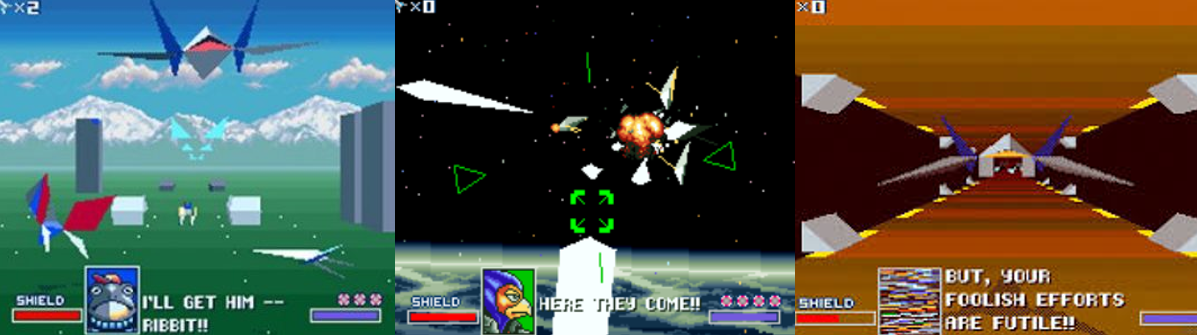
Although Fox isn’t alone in his campaign against Andross, you’re not allowed to play as anyone but the titular Star Fox, which is a bit of a shame and means the game does not different stats for the different characters, such as stronger defence for Falco Lombardi and a faster speed for Slippy Toad. However, your teammates provide encouragement and backup as you fly through the game’s stages. Often, each will inevitably require your help when they pick up a bogey, requiring you to rescue them in exchange for their gratitude (or admonishment in Falco’s case) and assistance with some firepower. On the flip side, it’s very easy to accidentally tag them with your blasts so check your fire as your final percentage grade will be affected by how healthy your team’s shields are. Also, if you lose a wingman at any point, they’ll be gone for the rest of the game, severely hampering your ability to get 100% completion. Additionally, Star Fox doesn’t use a traditional difficulty system; you pick from three paths (or “Courses”) containing seven Stages each. Some are shared across each path but with minor differences, such as containing different visual effects and bosses, and some lead to hidden areas, but the difficulty of the game depends on which Course you choose, with the top Course being the easiest and the bottom Course being the hardest. “Hard”, however, is somewhat relative. You may be attacked by more enemies, have to deal with more hazards, and encounter different bosses, but you’ll still find extra Nova Bombs, the odd extra life, and various sparkling circles to replenish your shield or alter your blaster fire.
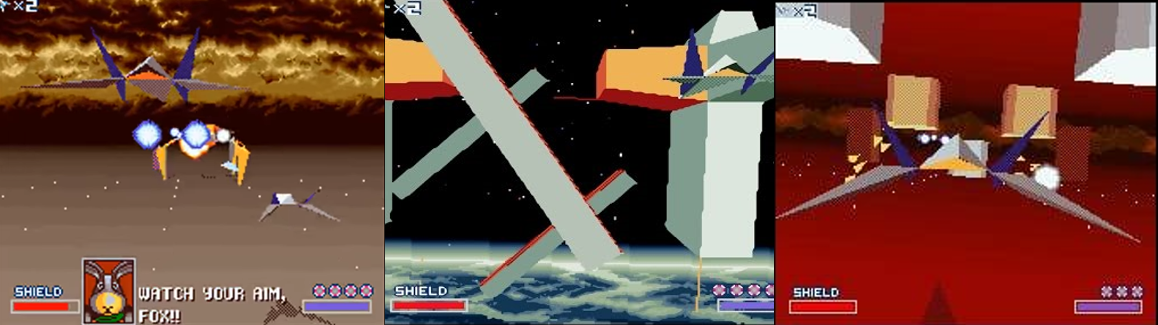
Fox’s Arwing is pretty tough and manoeuvrable, but it can only take so much damage. Fortunately, you can use silver and/or gold silver rings to replenish some or all of your shield. There’s also a power-up that temporarily renders you an invincible wireframe model, and upgrades that increase the strength and rate of your firepower. These are worth picking up, but are often placed near closing doors, pistons, columns, buildings, and other hazards, meaning you need to calculate the risk of acquiring them. The Arwing can also be a bit clunky at times; it’s got quite a large hit box and slips about when you roll, meaning it’s easy to crash into things and lose parts of the ship, and you’re not always given enough time to react to incoming hazards. Additionally, there are no other game modes available here and no other mechanics to challenge you. You simply fly along a set path, blast enemies, and defeat a boss, rinse, and repeat. Sometimes you’ll need to boost or avoid pistons, doors, and other crushing hazards; sometimes you’ll automatically fly through a tunnel or navigate tight hallways; and sometimes you’ll have to blast meteors, semi-sentiment columns, and destroy buildings. Ultimately, though, you’re simply flying along and destroying enemies until you reach the find of the stage.
Presentation:
If there’s one thing Star Fox has going for it, it’s the music and sound design. Hajime Hirasawa brings the energy with some memorable, militaristic, and foreboding tunes that do a fantastic job of engaging you as you blast through Stages. Fox and his allies chatter in an amusing gibberish, but the game does feature English sound bites here and there, which is always impressive on 16-bit hardware. Yet, one of the reasons I’ve never really played Star Fox (beyond being a SEGA kid growing up) was because of the polygonal graphics employed to bring the ships and much of the environments to life. Even as a kid, I remember being unimpressed with these supposedly “ground-breaking” effects and they really haven’t aged very well today. Ships and buildings appear blocky, angular, and amateurish, featuring next to no textures or details, and really clashing against the more traditional sprite work on offer. The game tries to impress with its cinematic opening and shameless borrowings from the original Star Wars trilogy, but the models just don’t hold up and I can’t help but wonder if it would’ve been better to limit the polygonal effects to the bosses. As it is, I found it incredibly difficult to see what was happening when I was playing. As beautiful and varied as many of the environments are, the clash of styles makes it difficult to spot and target enemies (and the lack of an aiming reticule in third-person mode doesn’t help). Many of the hazards (from enemies to incoming missiles and even towers and cuboid blocks) tend to pop in out of nowhere because the SNES hardware is struggling to render the 3D graphics.
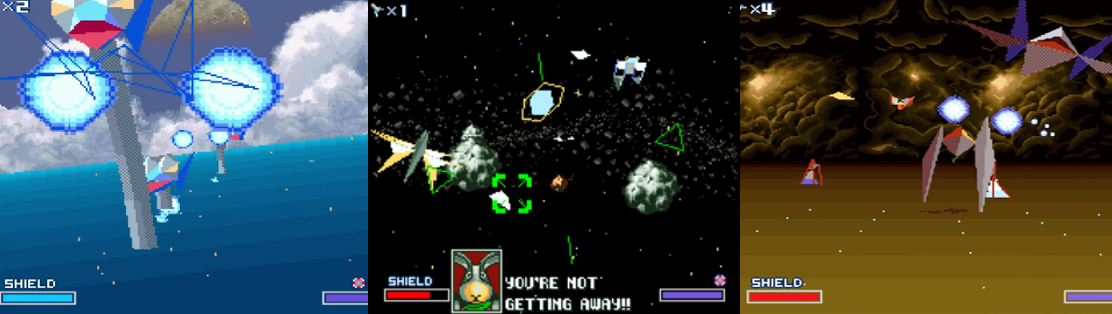
It’s a shame as the sprite work is really good. The team pop up in animated dialogue boxes to offer hints, encouragement, and admonishment as you play, enemies will sometimes fly at the screen after their crafts are defeated, and the Mode 7 techniques for scaling and rushing across water and grass gives the game an epic scope and makes it fun to swoop around blasting at those awful polygonal ships. Environments are quite varied; you’ll fly through gates and past blocky skyscrapers on Planet Corneria, dodge pixelated asteroids and polygonal missiles in the various asteroid fields, desperately avoid rotating beams and space debris against a backdrop of stars and flaming nebula, and even blast through ice-, lava-, and storm-themed worlds full of mountains, flaming hazards, and rumbling storm clouds. Many times, you’ll automatically enter battleships, facilities, or the core of Andross’s homeward, Venom, where you’ll navigate tight corridors, blast doors, avoid pistons, and destroy power cores to succeed, often with the environment crumbling and exploding around you. However, I did notice a few graphical hiccups here and there. The pop-in is outrageous, one environment didn’t load properly, and the game’s bosses are a mess of crude polygons that can be difficult to battle since their weak points aren’t always immediately clear due to the awful 3D models.
Enemies and Bosses:
As if Andross having an entire army at his disposal wasn’t bad enough, you’ll also have to watch out for various onscreen hazards. Asteroids, buildings, and cubes will dog your progress, as will spinning obstacles, rectangular plates, collapsing columns, and various debris all rotating or positioned to chip away at your shield. Andross’s forces are an eclectic bunch piloting various ships, from simple cannon fodder, tanks, and blaster turrets to larger walkers, spider-like robots, and co-ordinated attack craft that appear in formations. You’ll shoot down butterfly-like spacecraft, small frog-like ground troops, spheres that wait behind asteroids, blast missiles fired from enemy crafts or the surface of planets, mash L or R to shake off blob-like amoebas that stick to you, slowing your ship and draining your shield in Sector Y, and even encounter strange, mechanical animals such as a manta ray and a bird, the latter of which will warp you to the bizarre “Out of This Dimension” stage where you’ll encounter hostile paper plates! Larger ships can be found in some space Stages. These Star Destroyer-like craft can only be subdued by blasting the hexagonal panels on their sides or disabling their turrets, and you’ll then venture inside to take them out for good and even tackle one head-on in the form of the Great Commander boss. The path you choose at the start of the game determines which bosses you’ll face. Each (with one exception) has a helpful health bar and sports at least one glowing weak spot, and some are shared across the different paths but with altered strategies. Still, your best bet for almost all of them is to conserve your Nova Bombs to make short work of them since your teammates will conveniently abandon you before each battle.
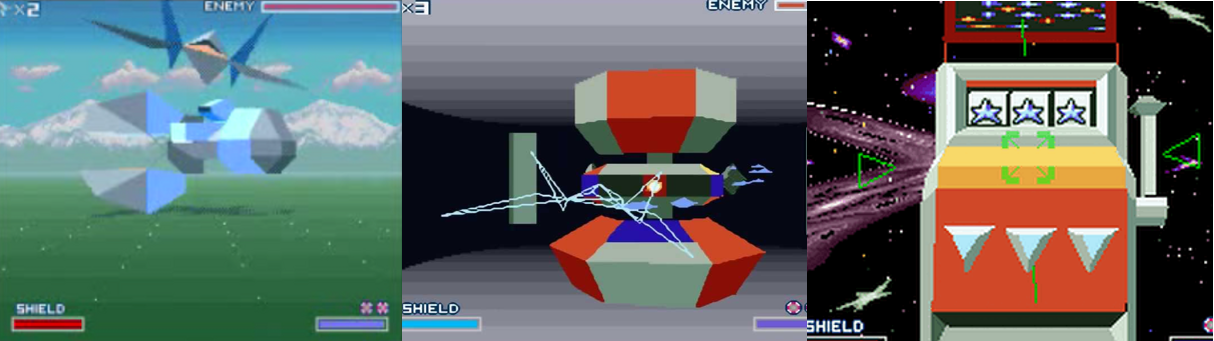
At the end of Corneria, you’ll battle the Attack Carrier twice and the Destructor once. The Attack Carrier flies overheard to start, so keep low to the ground, opening hatches to unleash enemy fighters or missiles. On Course 2, the enemy fighters also fire missiles instead of lasers, but your strategy remains the same: destroy the hatches to then target the main body, avoiding plasma blasts as you go. The Destructor, fought in Course 3, is far more formidable. It’s a tank-like machine whose top pods split off to reveal bolt-firing turrets that will regenerate until the pods are destroyed. The more of the Destructor you destroy, the more aggressive it becomes, ramming you and firing more missiles from its underside. Finishing the Asteroid Belt will see you battle that Rock Crusher on the top two paths and the Blade Barrier on the lower path. While the Rock Crusher is relatively simple (destroy the hexagonal panels when they open up, avoiding its lasers and body parts as you attack), the Blade Barrier is not only invulnerable to your blasters but they actually bounce off it and can hurt you! It spins around, firing missiles and a web-like tractor beam that you’ll need to shake off with L and R, and can only be damaged after its fins are blown off and even then you have to watch for it smashing into you. Things really deviate on the third Stage; on the easiest Course, you’ll encounter the Atomic Base, which also appears in Sector Z on the lower Course. This is a rotating power core that’s protected by an impenetrable outer casing. You need to destroy the electric power nodes as they rotate around the core to expose its innards, but this is easier said than done due to the odd angle and some dodgy hit detection.
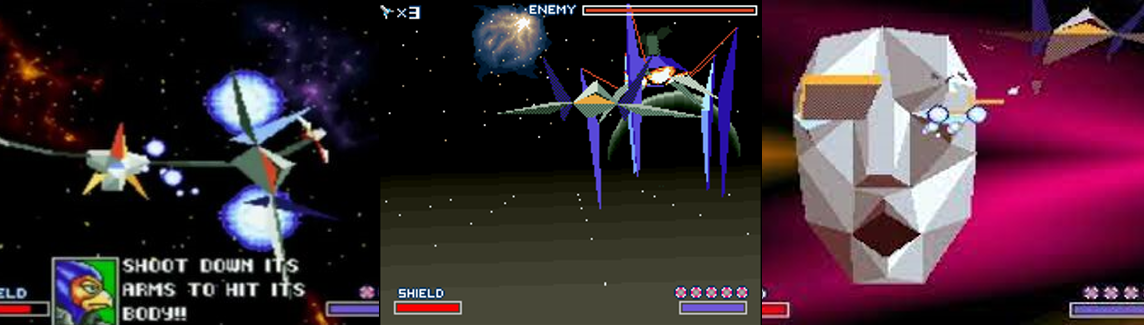
The Dancing Insector and Metal Smasher can cause issues, the former due to you being forced to target its legs and its surprisingly powerful flame burst when reduced to a saucer, and the latter since it sucks you in to crush you between its two halves. In comparison, I barely even registered Professor Hanger, a robotic drone that attacks from an overhead path and is easily destroyed, despite summoning fish-like enemies to pop up from the sea below. Star Fox also offers a taste of the surreal: you’ll encounter a giant slot machine that can only be bested by scoring a lucky seven, the unimpressive Spinning Core that spits iron balls at you, and a two-headed dragon/bird hybrid that hops about laying giant explosive eggs and forcing you to blast its head and butt! Yet, the Plasma Hydra is one of the toughest bosses, spinning and flailing tentacles, with its weak spot being at the end of these and it flying at you in a kamikaze run when near death. The Phantron was also a troublesome boss due to its incredible speed and duplication ability forcing you to hit the right double in order to deal damage, but later reappearing and transforming into a larger form with large, triangular “arms” for you to blast at. No matter which path you choose, you’ll end up battling Andross, an unsightly polygonal head with no health bar and whose only attack is to spit a salvo of tiles at you and try to devour you. You need to destroy each of his eyes to reveal his true form, an erratic cube that must be attacked to win the game but, while Andross can become a malicious devil-like face that also fires plasma balls, he’s a joke once you learn to barrel roll through his attacks and target his weak points.
Additional Features:
With no multiplayer, no other playable characters, and no native save features, Star Fox is a little light on replay value. Your main reason for replaying the game will be to try a different Course and discover the two secret areas, one of which includes the ridiculous slot machine boss and some unsettling clock faces and the other is a bizarre black hole filled with space debris. Otherwise, your main aim is to hit 100% for every Stage and Course, which requires you and your teammates to survive with as much health as possible. However, the appeal of this is somewhat diminished as there’s no high score system and this data isn’t recorded anywhere. Otherwise, this version of the game has all the quality of life features you’d expect, including save states and rewinds to help you get past the trickier sections, but these are also somewhat weakened by the lack of any unlockable features, like a stage select or boss rush.
The Summary:
I’ve been hesitant about playing Star Fox for years. Not only was I basically unable to as I never had a SNES, been its Nintendo 64 follow-up largely passed me by despite sitting in the virtual library of my Nintendo Wii. It’s a little odd in some ways as I quite like the concept, which is essentially Star Wars with anthropomorphs. The game is packed full of fun, engaging, action-packed dogfights and big bosses with a fair degree of variety to them, and the environments. However, the biggest selling point of Star Fox are its visuals, which I’m sure impressed many at the time, but which have always appeared dated and cumbersome to me. In practise, the game struggles with its polygonal models, running at a slow pace and offering little gameplay variety. The visual clash between traditional sprites and 3D polygons also makes the game very messy at times. The music, characters, and the world are appealing, but not enough to make me consider this an under-appreciated 16-bit gem. Ultimately, while it’s good for a quick playthrough, Star Fox quickly becomes repetitive even with the multiple paths and the visuals just didn’t impress me enough to want to pick it up once I’d seen everything it had (which basically happens in one playthrough). A SNES classic, maybe, but one that hasn’t stood the test of time for me and was surpassed by its sequels.
My Rating:
Could Be Better
Have I ruined your childhood with my opinions on Star Fox? Were you impressed with the game at the time, and how do you think it holds up today? Which Course was your favourite to playthrough? Were you disappointed that you couldn’t play as the other characters, and did it annoy you having to save them all the time? What did you think to the bosses and the polygonal models? Which game in the Star Fox franchise is your favourite and would you like to see a new one? Whatever your thoughts on Star Fox, feel free to leave them below and check out my other sci-fi content across the site!


2 thoughts on “Game Corner [Sci-Fanuary]: Star Fox (Nintendo Switch)”