Movie Night [Doomsday]: Deep Impact


Over the years, there have been many theories about when the world will end but one of the more prevalent was the mistaken belief that doomsday would befall us on December 21st 2012 based on the Mayan calendar ending on this day. Of course, not only did this not happen but it wasn’t even based on any actual fact to begin with. Nevertheless, I figured today was a good day to celebrate this popular concept.


Released: 8 May 1998
Director: Mimi Leder
Distributor: Paramount Pictures / DreamWorks Pictures
Budget: $80 million
Stars: Elijah Wood, Téa Leoni, Robert Duvall, Morgan Freeman, Ron Eldard, Leelee Sobieski, and Vanessa Redgrave

The Plot:
When journalist Jenny Lerner (Leoni) badgers United States President Tom Beck (Freeman) about a White House scandal, the world discovers that teenager Leo Beiderman (Wood) spotted a world-ending comet heading for Earth and veteran astronaut Captain Spurgeon “Fish” Tanner’s (Duvall) leads a mission to destroy it.

The Background:
The origins of Deep Impact can apparently be traced back to the late-seventies, when producers Richard D. Zanuck and David Brown proposed remaking When Worlds Collide (Maté, 1951) to Paramount Pictures, a project which stalled for many years. Things took a turn when they tried to get Steven Spielberg involved and he combined the idea with his hopes of adapting The Hammer of God (Clarke, 1993), though he was unable to direct due to his commitments to Amistad (Spielberg, 1997). By the time Mimi Leder took over as director, the film’s production and release coincided with that of Armageddon (Bay, 1998), a similarly-themed disaster movie that was directly compared to Deep Impact by the press. Author Arthur C. Clarke was left disgruntled when he was omitted from the film’s credits after influencing the concept, CNN apparently refused to be involved, leading to MSNBC lending their name to the narrative, and Leder claimed on the DVD commentary that the budget didn’t allow for the production to show perspectives from outside the United States. Real world scientists and astronauts were reportedly brought onboard as consultants and the film’s harrowing scenes of destruction were handled by legendary effects studio Industrial Light & Magic, who used both traditional miniatures and model work alongside cutting edge CGI water rendering to depict the comet’s disastrous impact. Deep Impact proved a commercial success with its near $350 million box office and held the record for the biggest opening weekend for a female-directed film for some ten years. Reviews, however, were mixed, with some praising the brooding tone and others criticising the wooden performances. Still, Deep Impact is generally regarded as being more scientifically accurate than Armageddon and has been considered to be the more nuanced and mature of the two productions.

The Review:
If I had £1 for every time Hollywood released a world-ending asteroid movie in 1998…I’d have £2. Which isn’t a lot, but it’s weird that it happened twice, right? On paper, Deep Impact and Armageddon have the same premise (the Earth is threatened by an extinction-level event) and a group of astronauts try to save it with nuclear weapons, but their presentation couldn’t be more different. For me, I’ve always preferred Armageddon and have always seen Deep Impact as a bit of a cheap knock-off so, spoilers, I don’t rate this one too highly. Unlike Armageddon, which largely takes place on the surface of its ridiculously oversized, planet-killing asteroid and in the control centre of the National Aeronautics and Space Administration (NASA), Deep Impact follows a handful of characters from different walks of life and showcases the comet’s threat from different perspectives. The first of these we’re introduced to is aspiring young astronomer Leo Beiderman, the first to spot the comet when it’s about a year away from reaching our solar system. Although his girlfriend, Sarah Hotchner (Sobieski), teases him that he’s simply misidentified an existing star, his discovery is verified as not only true but a significant threat by professional astronomer Doctor Marcus Wolf (Charles Martin Smith), who then promptly dies racing to alert the authorities to the danger. Quite how anyone learns of the comet in the year gap that then passes isn’t explained. It’s hinted that documents were recovered from the crash, though Dr. Wolf’s car went up in a massive ball of flames so I’m not sure how the government learned of the comet or came to the erroneous conclusion that Leo also died in the same accident. Still, the United States government spends the next year covertly preparing for the comet’s arrival, secretly colluding with the Russians to construct a space craft and nuclear bombs capable of deflecting it and also digging out caves in case the worst should happen. These contingency plans don’t bring much comfort to Secretary of the Treasury Alan Rittenhouse (James Cromwell), who resigns to be with his family and make his own preparations for what could potentially be the end of all life on Earth.

Ambitious and obnoxious reporter Jenny discovers the Earth is facing impending doom.

Rittenhouse’s resignation raises questions over at MSNBC, where ambitious journalist Jenny Lerner investigates the story, believing it to first be a dead-end gig compared to landing the coveted anchor chair and then a convoluted cover-up for an illicit scandal in the White House. However, after questioning Rittenhouse, Jenny’s puzzled to find him stockpiling food and referring to his assumed mistress, Ellie, as “E.L.E”. Though frustrated at being lumbered with the boring story and amazed at Rittenhouse’s ego, Jenny’s terrified when she’s suddenly accosted by the Secret Service and brought to the President himself, Tom Beck, a stern man who remains tight-lipped about what, exactly, the E.L.E. is but offers to advance her career by giving her a prime spot at the press conference where he reveals the truth. Desperate to be taken seriously, Jenny jumps at the chance, ignoring minor concerns like national security and public panic, but even she is left speechless at the announcement of an Extinction-Level Event (hence “E.L.E.”) and the plan to defend the planet. From there, Jenny earns herself the anchor spot and becomes the face of the Messiah’s mission, delivering bland, robotic addresses to the public as only the dull and lifeless Téa Leoni can. Jenny’s given some edge in her dramatic relationship with her parents. Her mother, Robin (Redgrave) later takes her own life after learning she’s ineligible for the cave sanctuary and donating all her worldly goods to the preservation project. Jenny’s estranged father, Jason (Maximilian Schell), starts the film elated to have just married Chloe (Rya Kihlstedt), a woman only two years Jenny’s senior, and desperate to reconnect with his daughter, only to then be accused of being a neglectful father and finally make peace with Jenny as she does something selfless for a change and gives up her spot in the cave to be comforted by her dad. As this comes in the face of the best moment of the film (the city destroyed tsunami), it’s a very emotional moment but I just don’t care for Téa Leoni. Jenny’s an insufferable character, focused only on her career and constantly lashing out like a child, which to be fair ties into her eventual growth when she realises the end is nigh, but her delivery is so wooden and she looks so bored all the time that I have a hard time buying her as this charismatic and developed news anchor.

While Leo’s a bit of a dud, President Beck is a commanding and surprisingly vulnerable presence.

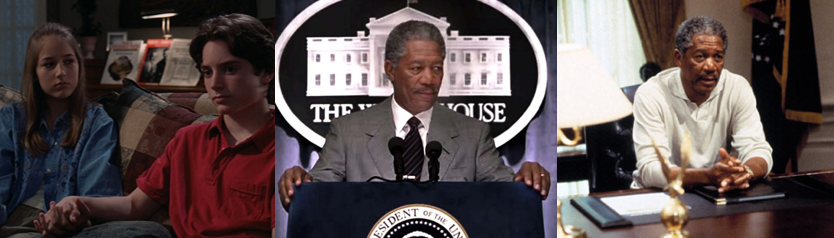
Sadly, Elijah Wood isn’t much better as Leo and seems out of his depth here. Leo is basically a blank slate, walking around in perpetual bewilderment at having a world-ending comet named after him and being celebrated as a hero at his high school. He doesn’t really do all that much until the third act, when he and his family are inexplicably selected to be taken to safety and he coerces Sarah into marrying him so her and her family can be saved, too. However, an administrative cock up sees the Hotchner’s names missing from the list, forcing Leo to journey all the way back to his hometown to rescue Sarah. As the smaller half of the comet, Beiderman, streams overhead and then crashes into the sea, Leo finds Sarah and her family and her parents, Vicky (Denise Crosby) and Chuck (Gary Werntz), force them to get their baby to higher ground. Leo provides more of a grounded perspective on the incoming comet, but the film doesn’t really follow him beyond the start and the third act, meaning he’s stuck with one-dimensional characterisation as a good kid who’s a little overwhelmed and desperate to get Sarah to safety. Instead, the Beidermans and the Hotchners are just another set of characters who spend their time anxiously watching Jenny’s news reports on the comet’s trajectory and the Messiah’s mission to intercept it. Indeed, much of Deep Impact focuses on people just staring at the television, which I guess speaks to the passive helplessness of the masses against this incredible external threat but doesn’t make for thrilling viewing. President Beck makes several addresses ensuring his citizens that “life will go on” and, thanks to Morgan Freeman’s peerless gravitas and delivery, comes across as a strong and trustworthy leader. He’s tough but fair, considers all viewpoints, and plans for both the best- and worst-case scenarios. At the same time, he has a vulnerability to him, one that becomes more evident as each mission meets failure. His attire becomes more formal, changing from a dress suit to a simple rolled up shirt, and his cadence becomes more severe as he prepares the nation for calamity. It’s a stirring performance that really belongs in a better film, and yet the cynic in me wonders what world leader would ever dare be so honest to his constituents!

The Messiah crew are the planet’s last hope to destroy the lacklustre comet.

Like Armageddon, Deep Impact also follows a group of astronauts in a specially built “rocket”. The mission is crewed not by hard and hardy oil drillers but by fully certified astronauts: Commander Oren Monash (Eldard) leads the mission, Andrea “Andy” Baker (Mary McCormack) is the pilot, Doctor Gus Partenza (Jon Favreau) is the chatterbox medical officer, and Mark Simo (Blair Underwood) is the navigator. They even have a token Russian cosmonaut, Colonel Mikhail “Mick” Tulchinsky (Aleksandr Baluev), who’s in charge of the explosives, and are joined by veteran astronaut Captain Spurgeon “Fish” Tanner. While the youngsters respect Fish, they see his appointment as a publicity stunt as he hasn’t been properly trained for the mission. However, Fish soon shuts them down since he’s the only one to log actual space flight time (he even walked on the Moon back in the day) as opposed to training on “videogame” flight simulators. While most of the crew are painfully one-note, they set aside their personal differences once the mission’s underway and perform their duties to a high standard. It’s just not particularly interesting and certainly nowhere near as dramatic as in Armageddon. The Messiah might appear more realistic and the space scenes are far less exaggerated, but it’s weird seeing the crew spend all their time in casual clothing rather than jump suits and their initial tactic is no less questionable than in Armageddon. Instead of one big bomb, the Messiah drills a series of nuclear warheads into Wolf- Beiderman but, as many have suggested, all this does is split the comet into two parts. They also take so long to set their explosives that they’re exposed to the Sun, blinding Oren, sending Gus flying into space courtesy of an explosive release of gas, and leaving the Messiah dangerously low on fuel. The crew are then largely forgotten until the final act, where they seek to outdo Bruce Willis and concoct a suicidal plan to vaporise the larger half of the comet which, again, is a surprisingly emotional scene but just lands flatter than Armageddon because the presentation is so tedious. Even the comet, Wolf-Beiderman, isn’t as visually impressive as Dottie. Sure, it’s more realistic (both visually and in terms of size) and looms in the background, getting closer and more dangerous as time passes, but it just looks like a big ball of ice and lacks any menacing character in its design.

The Nitty-Gritty:
Deep Impact approaches the end of the world as a story of hope and humanity. The aware of the comet, President Beck makes plans to knock it off course or destroy it as a priority and to prepare for the preservation of human life as a secondary (but equally important) objective. While Rittenhouse doubts the Messiah’s success, President Beck is confident in the mission succeeding. He’s equally confident that his strike missiles will deter the comet; and, finally, he’s even more confident that the million people he randomly selects to be brought to safety will rebuild human society. As pragmatic as President Beck is, his faith in these contingencies is flawed. The Messiah was never going to succeed by drilling so shallowly into the asteroid and his projections about how long it’ll take for the comet’s devastation to recede seem woefully optimistic. He (or rather, presumably, his advisors) estimate it’ll take just two years for the dust to settle and for the survivors to rebuild. For comparison, it took something like 300,000 years for the Earth to recover from the asteroid that wiped out the dinosaurs! He doesn’t seem to have factored in potential fallout, the shifting of landmasses, or the widespread destruction of resources. Instead, he’s literally built an underground Noah’s Ark and placed his faith in a higher power to guide them, which exposes chinks in his leadership armour. MSNBC present the mission from a purely factual approach, bringing in experts to talk with Jenny about specific aspects of the mission and what it means if it succeeds or fails. As the situation grows more dire, Jenny’s stoic mask finally slips when she reads Gus’s obituary and delivers the specifics on the lottery, which excludes older citizens like her mother. Rather than descending into abject fear and panic, everyone we see continues their lives as normal. MSNBC and the White House staff work right up into zero hour and only start evacuating just before Beiderman hits! While we see a mass exodus in the face of this danger, it’s obvious that most of these people are doomed. Jenny and Vicky react to this selflessly, giving up their safety and their child to ensure young life has a chance to survive, and President Beck’s first address after “the water’s [recede]” is one of hope and renewed appreciation for the planet.

The devastating destruction is the film’s biggest selling point and most impressive moment.

Like any good disaster movie, the main selling point of Deep Impact is the devastation caused by Beiderman’s impact. Unfortunately, whereas Armageddon opened with a meteor shower and destroyed both Paris and Shanghai, there is no Earthly destruction until the film’s final act. Before then, it’s all character drama and staring at television screens but we do get some tension when the Messiah crew touchdown on Wolf-Beiderman. Though the comet isn’t as hostile as Dottie, the crew only have a few hours to set their explosives before the Sun rises and combusts the comet’s surface. This leads to a distressing scene where Oren is blinded, Mark is injured, and Gus is blasted into space. While Mick pleads with Fish to go after their colleague, it’s ruled out since they don’t have the fuel for a rescue operation and Gus is left to suffer one of the worst fates imaginable. To make matters worse, the bombs don’t even work and instead cause a smaller section of the comet to split off. When the President’s missile strike fails to have any impact on the approaching threat, our Earth-bound protagonists can only watch in horror as Beiderman splashes down and kicks up a tidal wave large enough to suck the water from land masses and engulf entire cities. After finally reconciling with her father, Jenny faces this destructive torrent head on, comforted by Jason’s embrace, and the waters wash over the world. We only see the destruction of New York City, unfortunately, but man is it worth it. The wave ploughs through skyscrapers and national landmarks like the Twin Towers and the Statue of Liberty, obliterating anyone unfortunate enough to still be on the streets and wiping away forests, homes, and entire towns. Leo and Sarah are left running from the incoming waters, which wash away the gridlock of traffic (that includes Sarah’s parents) and drive them, exhausted and devastated, to higher ground. In the finale, President Beck gives an overview of the impact’s devastation, which also tore through the United States Capitol, but we sadly don’t see any other countries or cities affected by the wave. Still, the visual rendition of the impact and the destruction is distressing and easily the best part of the movie.

The Messiah‘s heroic sacrifice spares the world from total destruction…and the water’s receded.

After failing to destroy Wolf-Beiderman, the Messiah is left with two choices: risk suffocation or irradiation either coasting or rushing back to Earth. At Oren’s suggestion, they accelerate back home, only to find that they’re far from a high priority in the face of Beiderman’s arrival. Still, Fish runs some calculations and suggests detonating the remainder of their payload into the large chasm left behind when Beiderman separated from Wolf (something I feel they could’ve done a lot sooner, like when they were right by the comet!) Unfortunately, this is a one-way trip as they don’t have the time, fuel, or resources to land and deposit the bombs, and they all remorsefully agree to sacrifice themselves to give the world a chance. Luckily, they’re close to home so they successfully contact NASA flight director Otis “Mitch” Hefter (Kurtwood Smith), who’s also inexplicably still at his station, and arrange to say their goodbyes to their loved ones. Again, the similarities to Armageddon as astounding; instead of one heroic figure saying farewell to his daughter, we have a handful of them tearing up to their wives and newborns and Fish delivering a poignant goodbye to his late wife. The crew then strap in, acknowledge their appreciation for each other, and meet their end in the most anti-climatic way possible as Wolf simply shatters into tiny fragments upon impact. These then harmlessly burn up in the atmosphere and end the comet’s threat, though again I’m left disappointed by how visually unfulfilling this depiction is. Wolf also appeared a lot closer to Earth than Dottie, meaning a fair amount of nuclear fallout probably swept over the shattered remains of our world but it’s okay…the water’s receded! Lives and homes and entire nations were swept away but it’s okay…the water’s receded! The Earth suffers the greatest calamity in thousands of years and humanity is seemingly united in their efforts to rebuild, never mind how many resources were lost to the waters or how low a priority building the White House has to be. But it’s okay…the water’s receded.

The Summary:
I feel like I’m being way too harsh on Deep Impact. It’s not that I don’t enjoy the film…I just prefer Armageddon. Sure, Deep Impact is more realistic and the sets, the science, and the presentation are far more true to life than Michael Bay’s style over substance approach. However, while I’m not much of a Bay fan, at least his effort was visually engaging, and I never felt bored watching Armageddon. Deep Impact drags along at a snail’s pace, building tension and anticipation for its show stealing scenes of destruction but populating its runtime with dull, obnoxious, and forgettable characters. Téa Leoni is the worst of the bunch; I’ll give her props for making Jenny such an aggravating character, but watching Leoni is like watching grass grow. She’s so wooden and seems bored the entire time, meaning I just don’t care about anything she says or her character arc. Elijah Wood isn’t much better, unfortunately, relying on his doe-eyed charm to carry him through the film’s dramatic moments and failing to deliver a compelling character. Unsurprisingly, Morgan Freeman and Robert Duvall carry this film. President Beck may be the best example of a United States President we’ve ever gotten, being confidant and authoritative but also humane and vulnerable, while Fish brings vigour and expertise to his otherwise mediocre crewmates. Of course, the big wave is the main reason to watch Deep Impact and it really is worth it; splice this scene into Armageddon and you’d have the best of both worlds! I also enjoyed the more emotional moments and the poignant message off hope the film ends on, but Deep Impact is quite a chore for me and lacks the visual and dramatic punch of its bigger, louder, and ultimately more enjoyable counterpart.

My Rating:

Rating: 3 out of 5.

Pretty Good

Are you a fan of Deep Impact? How do you feel it compares to Armageddon and other disaster films? Did you prefer the film’s more realistic approach? Which of the characters was your favourite and what did you think to Téa Leoni and Elijah Wood’s performances? Were you impressed by the massive tidal wave? How important is scientific accuracy and realism to you in disaster films like this? How are you celebrating the end of the world today? Whatever you think about Deep Impact, disaster films, and overblown predictions of the end of the world, go ahead and drop a comment down below.

Movie Night [Friday the 13th]: Friday the 13th Part VI: Jason Lives


Long considered to be an unlucky day due to superstitions involving the number thirteen and religious connotations, Friday the 13th is perhaps equally as well-known as being the title for a long-running series of slasher movies. As a result, this is clearly the best opportunity to take a look at the Friday the 13th (Various, 1980 to 2009) horror series and to commemorate this unlucky and dreaded date.


Released: 1 August 1986
Director: Tom McLoughlin
Distributor: Paramount Pictures
Budget: $3 million
Stars: Thom Mathews, C.J. Graham, Jennifer Cooke, Renée Jones, Kerry Noonan, and David Kagen

The Plot:
After being released from a sanatorium, grown-up Tommy Jarvis (Matthews) attempts to cremate the body of deceased serial killer Jason Voorhees (Graham). However, an errant lightning bolt resurrects Jason and only Tommy holds the key to stopping him.

The Background:
After the success of John Carpenter’s Halloween(Carpenter, 1978), which basically gave birth to horror’s “slasher” sub-genre, Friday the 13th (Cunningham, 1980) proved a surprising box office success. Although producer/director Sean S. Cunningham distanced himself from the franchise, which was plagued by negative reviews, Friday the 13thPart 2 (Miner, 1981) and Friday the 13thPart 3 (ibid, 1982) were financial successes. Yet, Paramount executives were embarrassed by their association with the franchise and planned to close the book on Jason with Friday the 13th: The Final Chapter (Zito, 1984). A box office gross of $33 million made The Final Chapter a commercial success, meaning this “Final Chapter” was nothing of the sort. Although Friday the 13th: A New Beginning (Steinmann, 1985) seemed to be setting up a new killer, its disastrous critical reception and audience backlash convinced the producers to bring Jason back the following year. Director Tom McLoughlin was given free rein to accomplish this and took inspiration from the classic Universal Monster movies to reimagine Jason as an undead monster. He also consciously shied away from nudity, anticipated censorship struggles, and adopted more comedic slant. Despite this new direction, star John Shepard was approached to return as Tommy but turned it down, allowing horror alumni Thom Mathews to step into (and take over) the role. Initially, stuntman Dan Bradley was cast as Jason but he was replaced by former soldier C.J. Graham after the producers were dissatisfied with his performance. Ironically, despite returning Jason to the franchise, Jason Lives actually made less than A New Beginning, totalling $19.4 million worldwide, leading producers to consider a horror crossover for their next instalment. Incidentally, Jason Lives was also met with mixed reviews; while some labelled it as predictable and nonsensical, others have called it one of the best in the entire franchise.

The Review:
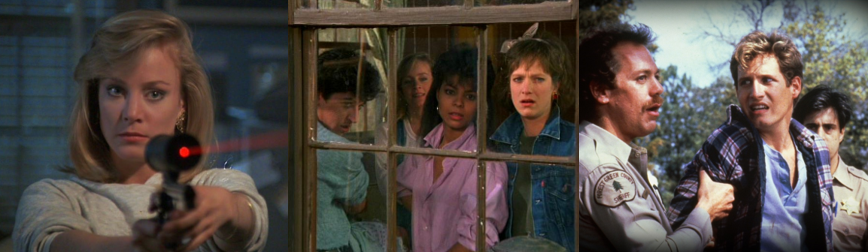
I’ve mentioned it before, but I was not a fan of horror movies as a child. I would hide behind my comics and often had nightmares after catching even a glimpse of the genre’s most iconic killers. Because of this, I was a late bloomer when it came to the Friday the 13th franchise and the first entry that I ever saw was Jason Lives, though I was acutely aware of Jason’s status as a mainstream horror icon. Jason Lives actually went a long way to helping desensitise me to horror, with its tongue-in-cheek presentation and over the top aesthetic that made it more entertaining than terrifying. However, I remember watching it with only the vaguest knowledge of the franchise and being a little confused by the opening sequence. At the time, I genuinely thought Tommy was remembering Jason murdering his family and that the echoing cries of “Die! Die! Die!” were from Jason rather than the young Tommy! Obviously, I now know better but I think that’s a fun anecdote, almost as much fun as the film’s opening sequence, which mirrors the opening of A New Beginning but expands upon it. It now takes place in canon, for one thing, against the background of a stormy night. For another, it has Tommy (now recast and reimagined to be far less volatile) be the one who digs up Jason’s grave. Like his predecessor (the canonicity of which is up for debate), Tommy is traumatised by his encounter with Jason but, while one could argue he’s a bit dull compared to John Shepard’s unstable ass-kicker, he exhibits an intense drive to not only confirm for himself that Jason is dead, but to destroy his body forever. To that end, he risks reincarceration to return to Crystal Lake (now rechristened Forest Green) alongside his reluctant and anxious friend, Allen Hawes (Ron Palillo), with Jason’s mask in his possession in order to cremate his remains and set his demons to rest once and for all.

Tommy desperately tries to make amends after accidentally resurrecting Jason.

Although it’s said that Tommy suffers from hallucinations of Jason, this isn’t an aspect we see here. Instead, Tommy hopes that destroying Jason’s body will stop the visions and his recurring nightmares, but he’s driven into rage upon the sight of Jason’s rotting corpse and reliving his childhood and stabs the worm-infested remains repeatedly with a metal fence pole. Unfortunately, Tommy accidentally provides Jason with the means to return to life (something he could’ve never predicted) and is thus responsible for the mayhem and murder Jason causes throughout the film. Although Tommy tries to get ahead of this by warning the local sheriff, Mike Garris (Kagen), he is met with hostility and scepticism because of his maniacal behaviour and background. Frustrated and branded a nut-job, Tommy can only sit in his cell and wait to be transferred back to his psychiatric hospital since Sheriff Garris is determined to help Forest Green move on from Jason, Crystal Lake, and the horrors associated with both. In a desperate attempt to prove his story, Tommy escapes custody when being escorted out of town, only to find the cemetery groundskeeper, Martin (Bob Larkin), has covered Jason’s body up. Tommy is even implicated in the murders that follow since Sheriff Garris refuses to believe that Jason has returned and finds it far more likely that Tommy is going on a killing spree. Burdened by guilt and desperate to atone for his actions, Tommy is frustrated at the lack of support he receives, especially considering his unique insight into Jason. Where John Shepard would attack anyone who provoked him with an explosive violence and was sullen and withdrawn, Thom Matthews presents Tommy as intelligent, flirtatious, and determined to put Jason down for good, by any means necessary, even if it means employing quasi-supernatural means to counter Jason’s otherworldly force. Although it’s disappointing that we didn’t see Tommy take over as the new killer, Jason Lives does play with this a little bit. Sheriff Garris is convinced that Tommy is behind the recent killings and even refers to him as Jason at one point, though Tommy remains the pure-hearted, if flawed, hero of the piece.

Ballsy Megan and some colourful supporting characters actually make me care about Jason’s victims.

While locked up, Tommy catches the eye of Sheriff Garris’s playful, rebellious, and provocative daughter, Megan (Cooke). One of the new breed of camp counsellors, Megan and her friends – responsible Paula Mott (Noonan), cackling Alice Cooper aficionado Carter “Cort” Andrews (Tom Fridley), and prankster Elizabeth “Sissy” Baker (Jones) – are left to look after the young kids who’ve arrived for summer camp. However, they have no clue what they’re supposed to do since head counsellors Darren Robinson (Tony Goldwyn) and Paula’s sister, Lizbeth (Nancy McLoughlin), fail to show up due to a slight case of death. Sheriff Garris isn’t immediately bothered by Megan’s plight and is more concerned with keeping her away from Tommy, who warns of Jason at every opportunity. Since she apparently likes a bad boy, Megan openly flirts with Tommy right in front of her father and willingly goes out of her way to assist him, even briefly hiding him for her dad by thrusting his head between her legs in her prized convertible. Megan was raised believing Jason was nothing but a legend but, while she and Sissy are intrigued by Tommy’s wild claims about Jason’s return, they find the idea of caring for the crop of screaming, cynical kids a far more pressing and terrifying threat. The teens try their best to entertain the kids but they struggle to impress or interest the pessimistic youngsters. It doesn’t help that they’re distracted by Darren and Lizbeth’s absence or that Cort takes off with the rambunctious Nicola “Nikki” Parsley (Darcy DeMoss). Still, while the wannabe counsellors are as painfully cliché as ever, I found them enjoyable. With the exception of Paula, they all exhibit a fair amount of personality, meaning it was genuinely distressing when Jason tore through them. I also enjoyed the cantankerous Sheriff Garris, who’s just trying to protect his daughter and maintain peace after years of bloodshed. His aggravation and aggression towards Tommy is perfectly reasonable, but I liked how he protected Megan from Jason in the finale, even though it meant his death. Finally, Jason Lives impresses by including a bunch of enjoyable (if disposable) tertiary characters to up the body count. The company executives paintballing in the woods are surprisingly entertaining with their banter and annoyance, Darren and Lizbeth exhibit an awareness of the genre and situation (though it does little to save them), and even Martin makes an impression by being a bitter, paranoid drunk.

Undead and more powerful than ever, Jason make a dramatic and entertaining return to form.

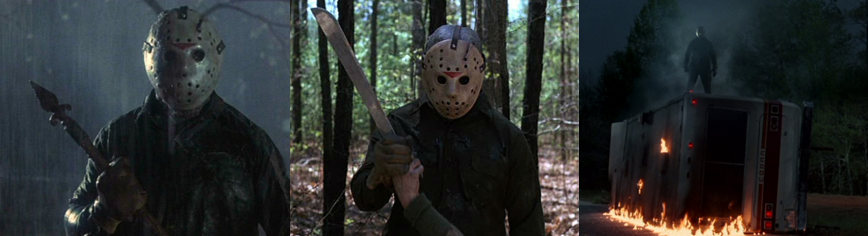
Although A New Beginning stated that Jason had been cremated, this is ignored (and the explanation was sadly excised) and Jason begins the film as a festering, ghastly corpse. While Jason exhibited superhuman strength, stamina, and dexterity in the previous films, to the point where he was an almost supernatural force, Jason Lives explicitly reimagines him as an undead and nigh-unstoppable killing machine. Resurrected by lightning, Jason immediately showcases his newfound, unnatural strength by ripping Hawes’ heart out and stalking the surrounding woodland with almost a brazen arrogance. In previous films, Jason’s appearance was often hidden or accomplished through first-person perspectives that built up to his eventual full reveal and dominance of the final act. While some aspects of this remain in Jason Lives, Jason gets far more screen time than ever before and is unquestionably positioned as the star. Jason Lives adds a surprising humanity to Jason, especially considering he’s a mindless, rage-filled zombie now. For the first time, the local summer camp is populated by little children but Jason never attempts to harm them. Young Nancy (Courtney Vickery) is terrified when she sees him, and Jason comes dangerously close to her, but he seems more curious and perhaps sympathetic towards them. Indeed, the only reason he even comes near them is when he’s pursuing his more traditional quarry and I liked the implication that he feels a kinship towards children, even though he was clearly trying to kill young Tommy in The Final Chapter. Although we never get a good look at his mangled, rotting visage, this is one of my favourite looks for Jason. He dons his iconic hockey mask and sports dirty, dishevelled attire that he progressively adds to throughout the film as he takes Tommy’s gloves and a tool belt from the ill-fated paintballers. I also appreciated that Jason used a variety of means to dispatch his quarry, including the metal pole Tommy stuck him with and his immense undead strength rather than relying solely on his trademark machete.

The Nitty-Gritty:
While I fully admit to being biased towards Jason Lives and consider it one of the best in the franchise, the film boasts perhaps the best score of all the Friday the 13th films. Harry Manfredini returns as the composer, delivering the classic “Ki-ki-ki-ma-ma-ma!” theme and bolstering it was a truly haunting, almost sing-song melody that creates a haunting atmosphere and some solid, impactful orchestral whenever Jason appears on screen to really give him a bombastic presentation. Jason Lives is full of cheeky nods to horror cinema: Jason’s resurrection evokes Frankenstein (Whale, 1931), as does “Karloff’s General Store”; there’s name-drops to Friday the 13th creator Sean S. Cunningham and the great John Carpenter, and little Nancy and her terrified prayer surely reference A Nightmare on Elm Street (Craven, 1984). Oddly, horror isn’t the only genre referenced in Jason Lives as the opening titles include a parody of the James Bond gun barrel sequence. Indeed, parody (or, at least, comedic metacommentary) is a prominent aspect of the film: Martin addresses the camera and comments on the youth of the day, the immortal Alice Cooper’s music features prominently throughout the film; and we get such amusing scenes as Jason slamming a victim into a tree and leaving a bloody smiley face in the bark and a desperate woman offering Jason cash and her American Express card floating uselessly in a puddle next to her body. There’s just a sense of playful self-awareness throughout the film that really leans into the idea of Jason being a mainstream icon. While you could argue that this diminishes Jason’s terrifying aura, there are plenty of shots and moments that frame him as a horrifying threat and it’s fun actually rooting for him rather than against him. He’s like the straight man to a handful of more ludicrous characters, which actually allows him to be more dangerous and unhinged than ever.

Jason’s newfound power results in some fun, unique, and brutal kills.

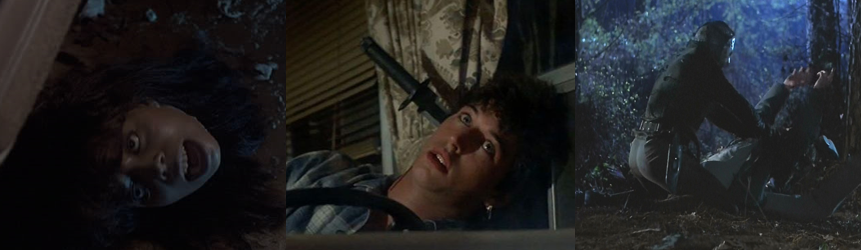
If there’s one downside to Jason Lives, it’s that it’s very light on sex and nudity. We get one scene where Cort is getting it on with Nikki but it’s extremely tame and Nikki doesn’t even take her shirt off. Luckily, the film makes up for it was some fun and surprisingly gory kills. Jason wastes no time asserting himself and making the most of his ridiculous new strength. He rips Hawes’ heart out within the first ten minutes and takes to the forest, metal pole in hand, encountering the lost counsellors, whom he first intimidates and then impales with his pole. Jason (played by Dan Bradley for this one scene) increases his body count considerably when he encounters five corporate executives paintballing the forest (with three of them already helpfully wearing bandanas that read “DEAD”). He rips angry sexist Burt Dennenbrough’s (Wallace Merck) arm off, acquiring his machete, scores three kills in one when he beheads Katie Rice (Ann Ryerson) and siblings Stan (Matthew Faison) and Larry Irving (Alan Blumenfeld) with one swipe. Of course, not every kill is as memorable as I’d like thanks, as always, to censorship. Sissy’s head twist and decapitation is sadly tame, and Martin and lovers Steven Halavex (Roger Rose) and Annette Edwards (Cynthia Kania) are offed in disappointingly lame fashion. Yet, on the plus side, bland Paula ends up splattered all over in the inside of a cabin. Cort and Nikki’s ends are equally impressive, with Nikki having her face rammed through the RV wall and Cort being stabbed right through the head, leading to a fantastic shot of Jason standing triumphantly atop the flaming wreckage. Easily the best kills come in the film’s final act where Jason crushes Officer Pappas’ (Michael Swan) head (thankfully with no lame-ass 3D eye popping effect) and then folds Sheriff Garris top to tail, snapping his spine and leaving him a mangled mess right before her daughter’s eyes.

With a great effort, Tommy and Megan manage to trap Jason beneath the lake and end his threat…

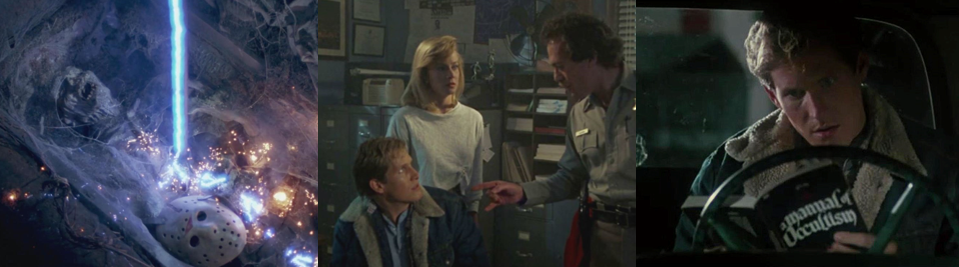
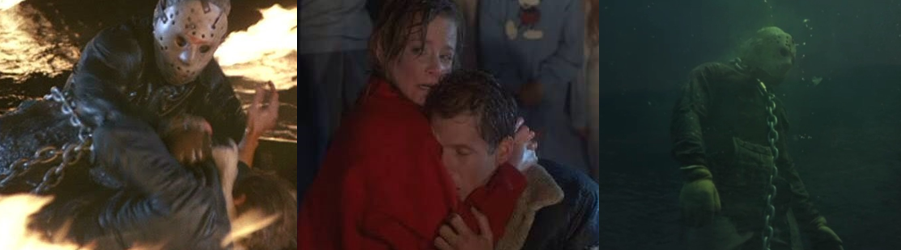
Since Jason has literally returned from the dead and is a walking zombie this time around, he’s even more impervious to physical harm than ever. He shrugs off a shovel to the back of the head, rips limbs from bodies, barely registers gunshots and easily pops right back up after being blasted by a shotgun. Thus, stopping Jason this time requires a far more unique approach than just hacking his head in, so Tommy researches the occult to figure out how to dispose of his nightmarish enemy. Despite constant opposition from Sheriff Garris, and being labelled as a psychotic murderer, Tommy receives help from horny, rebellious Megan and acquires the supplies he needs to enact his plan. Unfortunately, a large part of this plan involves luring Jason into the open, which puts both him and Megan in considerable danger. With all her friends dead, her father and his deputies dead, and the little kids terrified out of their minds, Megan almost meets her own end when Jason tries to crush her head with his bare hands. However, he quickly forgets about her when challenged by Tommy. Clearly recognising his enemy’s voice, Jason willing pursues him into the lake, where Tommy waits with a chain attached to a boulder and surrounded by a ring of fire. While this seems like an oddly practical and far less supernatural solution than Tommy’s reading implied, Tommy wraps the chain around Jason’s neck but not before the undead killer trashes the boat. Although weighed down by the rock, Jason drags Tommy under and throttles him, seemingly killing him, so Megan swims out to rescue him. Although she almost suffers the same fate, she gets the boat’s outboard motor running and (despite the inconsistencies between shots and the distance between Jason and the blade) slices the propeller into Jason’s neck, apparently killing him once more. Once back on shore, Megan desperately and haphazardly manages to revive Tommy (conveniently Jason didn’t crush his neck) and he breathes a sigh of relief knowing Jason is finally in Hell once more…unaware that the monster still lives, trapped beneath the lake, burning with hatred and waiting to rise once more!

The Summary:
As I said, I’m biased but Friday the 13th Part VI: Jason Lives is still one of my favourites in the franchise, alongside The Final Chapter and the surprisingly brutal remake. I love how meta the film is, how tongue-in-cheek it approaches the material, and how it unapologetically knows exactly what it is: mindless shlock horror made to appeal to the masses. Jason Lives really has fun with the traditional slasher formula, commenting and playing with it and never taking itself too seriously, which was the shot in the arm the series needed after not just the last film but also falling victim to repetition. It’s outrageous to think that this once grounded, semi-realistic horror series now features a full-blown zombie killer, but it really works. Jason’s new undead abilities allow him to take centre stage and be the horror icon everyone wanted to see, and the film is a celebration of his iconography after trying to kill and replace him in the last two films. While it’s still clearly been censored, Jason Lives features some fun and unique kills with a fair amount of blood and Jason is continually framed as both a feature and a terrifying villain, especially in the enraged brutality and renewed aggression of his actions and stature. While Thom Mathews is admittedly quite dull and Tommy loses much of the edge he had in the last film, I think he did a good job as Jason’s more pure-hearted opposite, and I liked how he was treated as a pariah and a poison rather than the only one capable of stopping further bloodshed. Add to that a rocking soundtrack courtesy of Alice Cooper, some surprisingly memorable supporting characters, fun parodies and Easter Eggs to horror cinema and other genres, and you have a bombastic return to form for cinema’s most notorious masked madman! Entertaining from start to finish, Jason Lives is the perfect horror to slap on with some mates, a few drinks and snacks, and just have fun celebrating this long-running franchise. It set a new standard for Friday the 13th movies, one that not many after were able to live up to, and remains an absolute favourite of mine to this day.

My Rating:

Rating: 4 out of 5.

Great Stuff

Are you a fan of Friday the 13thVI: Jason Lives? Do you consider it one of the stronger entries or were you put off by the change in direction? What did you think to Thom Matthews’ portrayal of Tommy and the way Jason returned? Which of the new characters was your favourite and which death scene entertained you the most? Do you think the series should’ve tried using Tommy as the killer or do you think it was the right decision to bring Jason back? Which Friday the 13th movie is your favourite? Do you consider Friday the 13th to be unlucky? Are you watching a Friday the 13th movie today? Whatever your thoughts on Friday the 13th (the movie, franchise, and day), go ahead and leave them down below.

Movie Night: Venom: The Last Dance

Released: 25 October 2024
Director: Kelly Marcel
Distributor:
Sony Pictures Releasing
Budget: $120 million
Stars:
Tom Hardy, Chiwetel Ejiofor, Juno Temple, Clark Backo, and Stephen Graham

The Plot:
Now a fugitive wanted for murder, Eddie Brock/Venom (Hardy) go on the run while being hounded by the vindictive General Rex Strickland (Ejiofor) while evading a monstrous being sent to hunt them by the ancient symbiote god, Knull (Andy Serkis).

The Background:
Fist appearing as simply a black costume acquired by Peter Parker/Spider-Man on an alien world, Venom would later take on a whole new lease of life when he bonded with the unhinged Eddie Brock to antagonise Spider-Man. Since then, Spidey’s dark doppelgänger has become a popular anti-hero and one of Spider-Man’s most recognisable foes. Venom’s popularity led to them appearing in videogames and cartoons prior to being shoe-horned into Spider-Man 3 (Raimi, 2008), though the idea of doing a live-action Venom film had circulated since 1997. This finally came to pass when Tom Hardy took on the role in a commercially successful solo film that, despite mixed reviews, led to an equally successful sequel in 2021 that was received a bit more favourably. With Hardy having signed on for three films from the start, a third was never in doubt, with Hardy and Venom: Let There Be Carnage director Andy Serkis both expressing interest in crossing over with Sony’s other Marvel films and the Marvel Cinematic Universe (MCU). Tom Holland was even open to appearing in a cameo but, in the end, writer Kelly Marcel took over as director and favouring the introduction of Knull, who she hoped would return as a prominent supervillain in later films. Although Serkis was unable to return to direct, he took on the Knull role and Hardy returned for a cool $20 million payday. The casting of Chiwetel Ejiofor and Rhys Ifans confused some and the trailers led to speculation about Venom’s place in the MCU, a sneaky tactic from Sony that no doubt contributed to the film’s box office of over $430 million. Reviews remained mixed, however, with many praising Hardy’s performance and the dynamic between Eddie and the symbiote while criticising the moronic plot and squandering his talents. Despite this, and the narrative presented in the film, Hardy remained open to the possibility of returning in some capacity later down the road.

The Review:
If you told me that we’d get an entire trilogy of Venom movies that didn’t involve Spider-Man, the guy who Venom owes their entire existence to, I’d say you were crazy. But then I’d remember that this is Sony we’re talking about, and this is exactly the kind of nonsense they’d sign off on these days. Yeah, spoilers: no version of Spider-Man appears in Venom: The Last Dance, despite the movie making the ridiculous decision to revisit one of the most pointless post-credits scenes in all of superhero cinema by showing Eddie at a bar in Mexico in the Marvel Cinematic Universe. He’s then unceremoniously transported back to his world not by a magical portal created by Doctor Stephen Strange, but seemingly by a similar portal generated by Knull, the long-imprisoned creator of the symbiotes who sits entombed in a dark prison in a far away galaxy. Once back in his world, Eddie is ravaged by a combination of a drunken headache, a hangover, and a migraine caused by the teleportation that renders him a confused, fatigued, and ultimately bizarre character for the duration of the film. As much as I love Tom Hardy, his portrayal of Eddie has always irked me. Once again, he adopts a weird accent, and he plays Eddie with this weird, twitchy, socially inept awkwardness that makes many scenes (particularly in this movie) difficult to watch. Despite once being a ballsy, confident reporter who took on mega-corporations without fear, Eddie is a paranoid, largely clueless, and often bumbling figure who constantly bickers with his dark passenger. The banter between Eddie and the symbiote is one of the highlights, as ever, and is put to greater effect here through the second act’s “road trip” format as the two randomly decide the best way to avoid the authorities is to head to New York City. However, the symbiote is a growling, gruff character who’s difficult to understand and continues to be childish and unreasonable at times. Impulsive and reckless where Eddie is measured and reserved, the symbiote still desires to bite off heads as a “lethal protector” while Eddie prefer to lay low, meaning their ideals continue to clash in a way that irks me as a Venom fan since the whole point is that they’re supposed to be united in their cause.

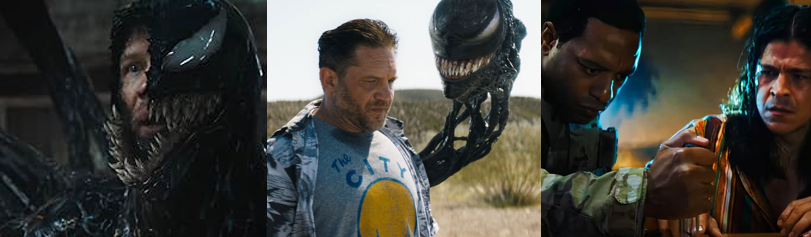
Hounded and branded a murderer, Eddie and the symbiote go on the run and reflect on their lives.

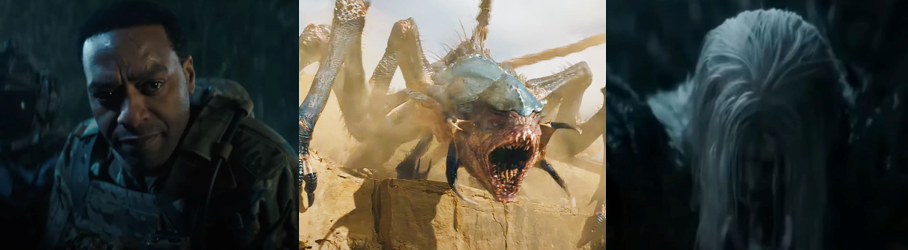
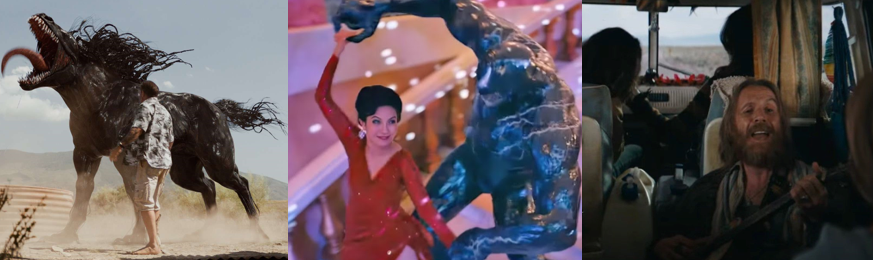
Still, it makes for some amusing moments, such as the symbiote impulsively knocked people out (much to Eddie’s dismay) to steal their clothes and his immediate addiction to gambling when they make a pit stop in Las Vegas. Eddie’s easily at his lowest point here. Thanks to the events of the last movie, he’s been branded a murderer and forced to go on the run, separating him from his lost love, Anne Weying (Michelle Williams), who’s sadly absent in this film. After being spotted on CCTV cameras, Eddie attracts the attention of General Rex Strickland, who mobilises his forces to capture Eddie on sight. At first, this is seemingly to arrest him for the murder of Detective Patrick Mulligan (Graham) and others, but in actual fact Strickland oversees both the decommissioning of Area 51 and the symbiote research centre, Area 55, located beneath it. Thus, his mission is more to obtain symbiote samples, if not entire symbiotes, for the “Imperium”, a shadowy government organisation that’s running vague experiments on the symbiotes. Once Strickland learns there’s more to Eddie than he expected, he puts together a crack squad to capture the symbiote and kill Eddie but doesn’t reckon with the two’s abilities and is driven into a vengeful rage when his men are killed in the act. Eddie’s stunned and bewildered to learn that the two of them now carry a “codex” after the symbiote resurrecting Eddie in the climax of Venom. This one-of-a-kind McGuffin is the key to releasing Knull from his prison, and therefore means the two are also hounded by the monstrous Xenophage. This insectile beast can instantly detect the codex whenever Venom fully transforms, meaning much of the film focuses on Eddie as it’s too dangerous for him to fully let Venom out. Unless they happen upon kindly shopkeeper Mrs. Chen (Peggy Lu) in Las Vegas. Then it’s perfectly fine for Venom to overtake Eddie and engaging in a dance sequence with Mrs. Chen to the tunes of ABBA. Except it’s not as, predictably, the Xenophage shows up, wrecks the hotel, and Eddie is both captured and consequently separated from the symbiote. Thus, we’re denied a lot of true Venom action, leaving the symbiote little more than a floating, frothing head, unless the film decides it needs to suspend what little logic it has for an action scene.

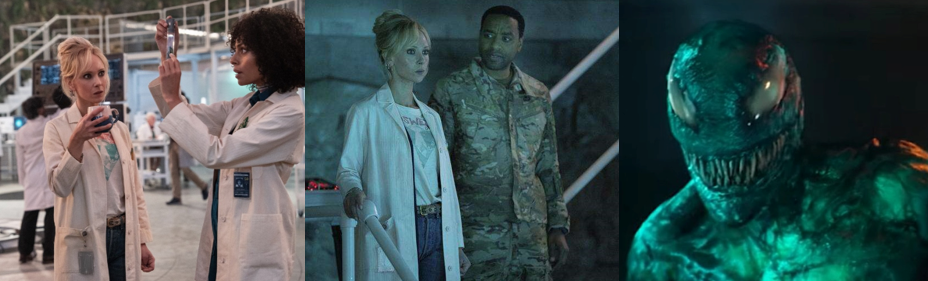
Teddy is fascinated by the symbiotes and determined to study them, no matter the risk.

Eddie and the symbiote are taken to Area 55, an underground laboratory where the United States military and a band of scientists – led by Doctor Teddy Payne (Temple) and Sadie Christmas (Backo) – research the symbiotes that landed in the first movie. Unlike the experiments performed by the Life Foundation, these seem to be largely unobtrusive and benign; Teddy is in awe of the alien lifeforms and wishes only to understand and communicate with them. Even Strickland doesn’t want to destroy them, only Venom (and that’s for personal reasons), and this strange turn of event sis only further compounded by the revelation that the symbiotes aren’t actually evil. Instead, they were fleeing from Knull’s wrath and came to Earth looking for safe haven. Quite how we’re supposed to believe this when every symbiote we’ve seen up to this point, including Venom, has been sadistic and violent and wished to either eat humans or drain their bodies completely is beyond me. such concerns are further compounded by the bizarre backstory given to Teddy. As a girl (Brooke Carter), Teddy and her brother (Fflyn Edwards) were inexplicably struck by lightning, which killed him but somehow left her with only a lame arm. since then, she’s dedicated herself to living her brother’s dream of investigating life beyond our world and is fascinated by the symbiotes. It’s thanks to Teddy that Mulligan’s life is saved as she bonds him with a symbiote and learns of Knull’s threat; yet, despite being explicitly told that the only way to stop Knull is for either Eddie or Venom to die, she vehemently opposes Strickland’s offensive against Venom since it would deprive her research. While Teddy is shoe-horned in and a poor substitute for Anne, she at least has some agency and a character arc. Sadie is just kind of there; her “thing” is she likes Christmas and is named Christmas and that’s about it. Then, in the final act, she suddenly gains prominence when a symbiote latches onto her and creates Lasher, who aids Venom in their battle with the Xenophages, while Mulligan and his symbiote are unceremoniously consumed before they can help. This bugged me as I would’ve preferred to see Eddie, Anne, and Mulligan (and maybe Teddy and Strickland) fight together with symbiote partners, but it’s doubly odd as the first movie established that a true symbiosis is very rare and yet Sadie shows no signs of being consumed by her symbiote.

Strickland’s bias almost leads to ruin when the Xenophage’s attack on Knull’s orders.

In place of Venom’s more familiar supporting cast, Eddie stumbles upon hippie Martin Moon (Rhys Ifans) and his family – equally hippie wife Nova (Alanna Ubach), his enthusiastic but scared son Lef (Dash McCloud), and his apathetic daughter Echo (Hala Finley) – who are on a road trip to Area 51 to realise Martin’s lifelong dream of seeing an alien. Though Eddie’s reluctantly to tag along with the Moons, the symbiote insists and, while enduring their cringey singing and crackpot quirks, the two dwell on how they’ve been denied a normal life. Again, I feel like it would’ve made much more sense for Anne and Doctor Dan Lewis (Reid Scott) to have maybe seen or sensed Venom’s danger on the news and come out to help him, especially as the Moons keep sneaking back into the plot simply to put some innocents in peril. What’s really weird is that Reid Scott does feature in a cameo as the shadowy head of Imperium, a man who authorises Strickland’s employment of “The Six”, which you’d think would be a troop of symbiote-infused soldiers but is simply just another strike team. Like Martin, Strickland is shameless stunt cast with an actor known for their previous Marvel work simply to trick people into thinking Venom: The Last Dance is somehow tied to the MCU’s Multiverse Saga. While it technically is, the casting amounts to a bait and switch and nothing more, though Chiwetel Ejiofor was enjoyably charismatic in the role. In contrast, Knull is a complete waste of time. Aside from dumping a bunch of clunky exposition in our laps at the start, he does nothing but send Xenophages after Venom. Why he can’t conjure a portal to release him from his prison is beyond me, and we never see him and Venom interact, meaning it’s up to the scary and surprisingly gory Xenophages to carry the main threat. This would be fine (and admittedly spares us the same nonsensical symbiote-on-symbiote action of the last two films), but the Xenophages are functionally invincible. They immediately heal from all wounds and devour their foes and are extremely aggressive, but immediately lose interest once they can’t see the codex, making them dangerous but also paradoxically dumb.

The Nitty-Gritty:
Venom: The Last Dance feels tonally confused. Like its predecessors, it lacks the gore and violence I’d expect from a Venom movie and tries to make up for it with a few s-bombs and even an unexpected “motherfucker!” from Martin. It also delivers some startling gore in depicting the Xenophages’ preferred method of attack, which is to eat their victims whole and spewy their bloody remains from vents on their back! Venom bites the heads off a few bad guys but is again a far cry from the “lethal protector” they wish to be, and I know from the comics. In this instance, it makes sense since Eddie’s on the run, but he makes some baffling decisions in trying to evade Strickland. He wanders around in plain view, constantly being spotted by CCTV, has a good old time in Las Vegas, and his end goal is to go to New York and blackmail a former editor into helping him. The middle part tries to be a road trip movie, but it doesn’t really work; the Moons quickly outstay their welcome and it’s ridiculously convenient that they’re heading towards where all the action’s about to take place. This is why I think Anne and Dan would’ve made just as much sense, if not more. It’s also odd that Eddie mentions he and the symbiote have only been bonded for a year. I find it difficult to believe that these three films take place over a single year and, if that is the case, that’s even more disappointing. The film also squanders any potential from the ending of the last movie; we never see Venom interact with Tom Holland’s Spider-Man and his jaunt into the MCU is nonsensical, at best. I’ve always hated the idea that these films take place in a separate universe when it would’ve been so easy for Sony and Disney to collaborate on a more cohesive spin-off series. They don’t even take place in the same universe as other Sony-Marvel films, or previous Spider-Man continuities, meaning any hope of a Venom/Spider-Man interaction is tossed out the window in favour of him easily evading the Xenophage and never even seeing Knull.

Venom moments are few and far between thanks to annoying side characters clogging up the runtime.

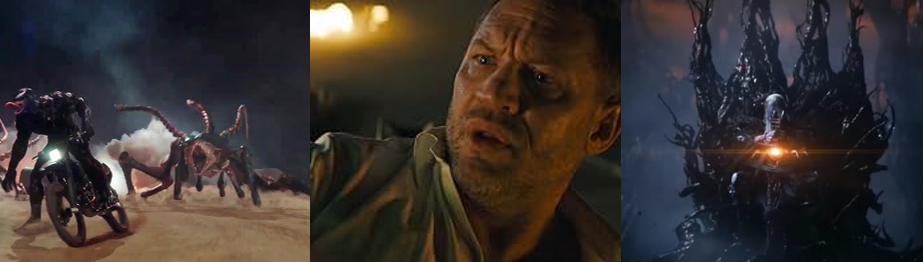
It’s a shame as the film does look really good. The symbiotes held captive at Area 55 look a little dodgy but, when they bond to a host, they look fantastic. Venom, especially, looks amazing whenever they full transform. I love how slick and oozing the symbiote skin is, how they have this impossible, exaggerated teeth, and the way their bodies are all distinct and unearthly. Mulligan’s symbiote, for example, is like water and radiates an awesome presence that rightfully captivates Teddy’s imagination and Strickland’s distrust. Lasher also stands out in the finale, simply because they adopt a Christmas tree colour pattern and are so prominent in fending off the Xenophages. Venom’s abilities are displayed quite well; Eddie makes a crack about the symbiote’s inability to fly so it attaches them to an aircraft to jet him along at supersonic speeds, which was fun. It also jumps to other animals, such as a fish, frog and, most prominently, a horse. However, this sequence is simply a retread of the motorcycle chase from the first movie, which also gets a callback in the finale. Because of this, and Venom simply taunting, manhandling, and beheading some Mexican lowlifes, Venom: The Last Dance doesn’t really gives us anything new in terms of Venom’s portrayal. The symbiote does show fear at the mere mention of Knull; it’s not really clear why but it does establish that Knull is this awesome threat. Sadly, while Knull cuts an intimidating figure with his emo hair, massive sword, and swirling prison of darkness, he’s essentially a non-factor. The Xenophages are the main threat, which again is at odds with the trailer, which suggested that the symbiote’s people were invading Earth. This plot point seems to have been dropped, along with any notion of Strickland employing symbiote soldiers, to tell a far more basic story. There are some decent moments between Eddie and the symbiote where they reaffirm their bond and their desire to live in peace, but they spend so much time at odds or goofing off or being forcibly separated that it falls a bit flat for me.

The symbiote makes the ultimate sacrifice to save its adopted world, though Knull survives the conflict…

Thanks to Eddie defending himself and the initial Xenophage, Strickland pursues Venom relentlessly, ultimately taking them by surprise after a Xenophage attack, separating Eddie from the symbiote, and bringing them to Area 55. Having learned from Mulligan’s symbiote about Knull’s threat and the codex, Strickland is happy to execute Eddie for the greater good, only for the Xenophage to track the two to the bae after the symbiote rebonds with Eddie to save him from a gunshot wound. In the battle, Mulligan is killed and the symbiotes are released, bonding with Sadie and other nearby scientists to assist Venom. This was odd as everyone knows how dangerous the codex is so I would’ve assumed at least some of his brethren would see the value in killing Venom over sacrificing themselves to save them. Regardless, more and more Xenophages arrive, slaughtering the symbiotes and their hosts, wrecking Area 51, and putting the Moons in mortal danger. Luckily, Venom and the symbiotes are on hand to save them, with Lasher chastising Strickland’s reckless use of a rocket launcher and finally convincing them that they’re all on the same side. However, no matter how many bullets and blade can stop the Xenophages, which simply stitch themselves back together, devour Sadie’s symbiote, and mortally wound Strickland. Pinned down with no way to win, Eddie and the symbiote realise that the only way to stop the Xenophages is to sacrifice themselves. Thus, Venom leads the Xenophages to the gigantic acid tanks Strickland was using to decommission Area 51, absorbing the Xenophages into their body and forcibly dragged them into position. Despite being prepared to die alongside his friend, Eddie is aghast when the symbiote spits him out and shields him from the acid shower and the resultant explosion that destroys the entire base. Thanks to having obtained a symbiote, Teddy rushes herself and Sadie to safety as Agony and can only watch as Strickland, the Xenophages, and the Venom symbiote are destroyed. In the aftermath, Eddie finally makes it to New York, now a free man, and gazes upon the Statue of Liberty while remembering the symbiote, unaware that Knull is still waiting in the dark void and determined to enact some kind of vague revenge. Oh, and a piece of Venom also survived. Not to mention the piece he left in the MCU, meaning there are ways for Venom to return and completely squander what’s sold as an emotional ending.

The Summary:
Honestly, I didn’t expect Venom The Last Dance to involve Spider-Man. Even if it had, I probably wouldn’t have been happy or impressed that it took three movies to see what should’ve been done in the first film. For me, the Venom movies should’ve been a two-part affair: one involving Spider-Man and the other involving Cletus Kasady/Carnage. Bringing in a more modern antagonist like Knull was a good idea on paper, but the movie doesn’t commit to it. Like, why not have Knull come to Earth leading a symbiote/monster army and have Venom team up with Anne, Mulligan, and other symbiotes to fight them off? The Xenophages were horrific alien creatures, sure, but they’re simply ravenous beasts. We never see Venom tangle with their master and that’s a huge missed opportunity, as is the chance to up the stakes with a world-ending threat. Instead, we have a much more reserved film, one that tries to explore the relationship between Eddie and the symbiote but instead meanders along, squandering any potential it might’ve had. The Imperium plot point goes nowhere, Area 55 is a cauldron of contradictions, and I didn’t really care about Teddy or her confusing characterisation. It’s disappointing that this series ends on such a flat note; it does nothing to earn its sombre conclusion, and I just feel robbed of what I really wanted to see from these characters. I like Tom Hardy, but his portrayal of Eddie is so weird and all over the place, the actual Venom action is disappointingly light, and it just feels like everyone’s going through the motions because they’re contractually obligated to. Add to that the fact that the film’s another example of Sony blatantly lying to audiences with its trailers and trying to trick people into thinking it’s something it’s not and you have an uninspiring end to a franchise that somehow worked when it never should’ve. I can only hope that we get a proper, accurate, and definitive version of Venom sometime in the future… though I’m also happy to let the character lie dormant for about ten years after these efforts.

My Rating:

Rating: 2 out of 5.

Could Be Better

Have you seen Venom: The Last Dance? If so, what did you think to it? Were you disappointed that Venom couldn’t fully transform or did you enjoy the new spin on their relationship? What did you think to new characters like Teddy and Strickland replacing Anne and Dan? Were you also annoyed that there wasn’t a showdown between Venom and Knull? Which of the other symbiotes was your favourite? What are some of your favourite Venom and/or Knull stories from the comics? Leave your thoughts on Venom: The Last Dance down below and go check out my other Venom content.

Movie Night [Godzilla Day]: Godzilla vs. King Ghidorah


Toho’s famous atomic beast, and easily the most recognisable kaiju in the entire world Gojira first emerged from the waters of outside of Japan to wreck the city of Tokyo on this day all the way back in 1954. In 2016, the day was declared “Godzilla Day” and, as a result, I am also appropriating November 3rd to shine a spotlight on the undisputed King of the Monsters.


Released: 14 December 1991
Director: Kazuki Ōmori
Distributor: Toho
Budget: $12 million
Stars: Kōsuke Toyohara, Anna Nakagawa, Megumi Odaka, Chuck Wilson, Yoshio Tsuchiyam, Kenpachiro Satsuma, and Hurricane Ryu

The Plot:
Time travellers offer to get rid of Godzilla (Satsuma), Futurians create the terrifying King Ghidorah (Ryu), leaving science-fiction writer Kenichiro Terasawa (Toyohara) and remorseful Futurian Emmy Kano (Nakagawa) to desperately revive Godzilla ensure Japan’s survival.

The Background:
When he made his big-screen debut in Godzilla (Honda, 1954), Gojira (more popularly known worldwide as Godzilla) represented very real lingering fears regarding the threat and consequences of nuclear war. However, it didn’t take long for Godzilla to be recast from Japan’s destroyer to its a saviour. While he often caused a great deal of destruction, Godzilla would often team up with other kaiju, such as Mothra and Rodan, to fend off a greater threat and cement his place as an iconic figure in pop culture. Perhaps Godzilla’s greatest nemesis is the three-headed dragon King Ghidorah (also known as “Ghidrah” and “Monster Zero”), a titanic winged beast created by Godzilla creator Tomoyuki Tanaka and inspired by the Lernaean Hydra and the Orochi of Japanese folklore. Initially depicted as an ancient alien monstrosity from Venus, King Ghidorah’s debut feature was so successful that he reappeared the following year and was a natural choice to recoup some of the studio’s losses after the disappointing box office of Godzilla vs. Biollante (Ōmori, 1989). Believing audiences wanted time travel plots given the success of Back to the Future Part II (Zemeckis, 1989), director Kazuki Ōmori specifically tailored the script to include this and place greater emphasis on developing the personalities of the monsters rather than the human characters. The movie reused the Godzilla suits from Godzilla vs. Biollante, but with some modifications that slightly altered Godzilla’s face and allowed actor Kenpachiro Satsuma a better range of movement when in water, and the redesigned King Ghidorah featured far more advanced wirework puppetry than its predecessor. Ultimately, Toho’s hopes of surpassing Godzilla vs. Biollante were not to be as Godzilla vs. King Ghidorah made noticeably less than its predecessor and the film is generally regarded as a visually impressive, if convoluted, entry in the franchise. The film also attracted controversy for its depiction of events from World War Two but this wouldn’t be the last Godzilla film, or the last we’d see of King Ghidorah. Godzilla was back in action a year later and his nemesis returned to do battle time and time again in many forms.

The Review:
I have been a massive Godzilla fan since I was a little kid, but my exposure to the scourge of Japan was actually quite minimal growing up. Godzilla films weren’t exactly commonplace on TV back in the day so I (and a lot of kids my age) really started getting into the franchise with the impending release of Godzilla (Emmerich, 1998). To celebrate the release of that film, I believe it was BBC2 that dedicated an entire night to Godzilla and other kaiju, and this evening of documentaries, quizzes, and comedy was capped off by the first Godzilla movie I ever watched, Godzilla vs. King Ghirodah. Godzilla had battled his most famous nemesis before, back in the “Shōwa Era”, but this was their first meeting in the “Heisei Era”, which began in 1984 and basically rebooted the franchise with bigger and better suits and new, ferocious monsters for the Big G to fight. This is also probably my favourite era of Godzilla movies since this is when I really started getting into the franchise, though I feel it’s only fair to also point out that I am watching the dubbed version of the film (because I can’t get enough of that “You bastards!” line delivery!)

Terasawa’s research into Godzilla coincides with the Futurians’ arrival from 2204.

Oddly enough, as if all the kaiju action wasn’t enough, Godzilla vs. King Ghidorah heavily features a time travel plot. The film begins in 2204A.D., where King Ghidorah is little more than a mutilated skeleton at the bottom of the ocean, before jumping ahead to the then-present day of 1992 where all of Tokyo is shocked by the sudden arrival of a strange spacecraft on Mount Fuji. The unidentified flying object (UFO) instantly makes headlines but science fiction writer Kenichiro Terasawa has grown weary of the genre that has made him a “rich man” for his employers, Super Mystery Magazine, and is more interested in writing a detailed history of Godzilla. To that end, he interviews a number of World War Two veterans, including wealthy businessman Yasuaki Shindo (Tsuchiya), who were present on Lagos Island when Japanese troops were unexpectedly protected from the United States forces by the Tyrannosaurs rex-like Godzillasaurus, which they revere as a benevolent, powerful, protective spirit. Consequently, they believe the same to be true of Godzilla, especially as the world’s most famous kaiju is the mutated form of this dinosaur following hydrogen bomb tests. As is often the case in Godzilla films, the human characters are divided into journalists like Terasawa and the Japan Self-Defense Forces’s (JSDF) desperate attempts to combat the kaiju threat. In their efforts to uncover more information about the UFO, the JSDF turn to Miki Saegusa (Odaka), a character who has the rare distinction of appearing in subsequent Godzilla movies and is something of Godzilla expert and a budding psychic (because that’s often a thing in these movies, too). Because of this, she’s part of a team of specialists selected to ensure Japan’s future after the Futurians – Grenchiko (Richard Berger), Wilson (Chuck Wilson), Emmy, and their android, M-11 (Robert Scott Field) – deliver a morbid warning to Japan’s government, headed by the Prime Minister (So Yamamura).

Thanks to time travel shenanigans, Godzilla is removed from history.

There, the seemingly benign Futurians completely disregard any sense of temporal paradoxes and time displacement to warn of a terrible future where Godzilla has decimated Japan following an unprovoked attack and devastating nuclear fallout. As proof, Emmy presents Terasawa’s book on Godzilla, thus bringing him into the JSDF’s investigation and confirming his theory that the Godzillasaurus became Godzilla. Thus, the Futurians propose travelling to Lago Island in 1944 and teleporting the Godzillasaurus to 1992, thereby sparing Japan’s social and economic future. Terasawa, Miki, and dinosaur expert Professor Hironori Mazaki (Katsuhiko Sasaki) join this expedition despite there being more qualified and experienced people, but Wilson hypocritically explains that this is because they can’t risk a temporal problem by sending, say, Shindo back to Lagos since he was already there as a young man (but changing the past by removing Godzilla is apparently fine…) Although Terasawa is disheartened to learn that his book didn’t make an impact in the future, he and the others are astounded by the Furtuians’ time ship. They travel through very Doctor Who-like swirls of colour to arrive in the past (spooking “Major Spielberg” (Daniel Kahl) in the process) and witness first-hand as the Godzillasaurus defends the brave and outnumbered Japanese troops. This is the first taste of kaiju action and it’s a little different from what we’re used to. Although it’s easily able to intimidate and crush the U.S. soldiers, the Godzillasaurus is far from the invincible titan we know and love and is easily felled by the Navy’s missiles. Badly wounded, the dinosaur is easily transported to 1992 by the Futurians, but they leave a substitute in its place: three small, winged Dorats that are hideously transformed by the nuclear radiation into a hydra-liked dragon!

A bigger, more violent Godzilla defeats King Ghidorah and then turns on Japan!

When Terasawa and the others return, expecting to face a more prosperous future without Godzilla (…though everyone still remembers Godzilla in another example of the film’s inconsistent time travel mechanics), they find Japan under attack by this three-headed mutate, the titular King Ghidorah. A screeching, golden-scaled, devil-like monstrosity, King Ghidorah mercilessly unleashes devastating lightning blasts upon Japan and the sight of it gliding through the skies and between skyscrapers is quite the nightmarish visage. Unrelenting and aggressive, King Ghidorah is controlled by the Futurians to wipe out Japan, which has actually become an economic superpower greater than the U.S., China, and even all of Europe. Feeling remorseful for her actions, and not wishing to see her home country annihilated, Emmy reveals the truth to Terasawa but their attempts to stop the government kick-starting the Godzillasaurus’s transformation into Godzilla with Shindo’s secret nuclear submarine fail when they’re intercepted by M-11. Thus, over forty minutes into the film, Godzilla and its iconic theme tune finally make an appearance as a newer, far bigger and far more hostile version of Godzilla is near-instantly created when it also absorbs the radiation from a crashed Russian submarine. It immediately clashes with King Ghidorah but not out of any sense of duty or to protect Japan as Shindo believes. This is purely a clash of territory and pride and Godzilla has no qualms about destroying parts of the city, and even obliterating Shindo himself, with its destructive atomic breath. Oddly, the two are said to be evenly matched, despite the fact that this new Godzilla is also said to be far more powerful than before thanks to being born from modern nuclear weapons. Godzilla thus topples its rival and lays waste to Tokyo, leaving Japan’s survival in the hands of Emmy and M-11, who jump to the future to augment King Ghidorah’s corpse and defend Japan against their violent attacker.

The Nitty-Gritty:
I mentioned up top that I purposely chose to watch the dubbed version of Godzilla vs. King Ghidorah. This is always my go-to viewing option for foreign-language films but it can’t be denied that the dubbing is pretty atrocious throughout the film, especially whenever the Futurians are speaking. Godzilla movies have always been deeply entrenched in the fallout from World War Two; the kaiju owes its existence to the War and is pretty much always surrounded by allegory of the dangers of conflict and nuclear power. However, it’s rare that a Godzilla movie actually tackles the Second World War directly and I believe that Godzilla vs. King Ghidorah was the first film in the franchise to actually depict events from the War and so many veterans from the conflict as being central to its story. Here, the U.S. is depicted as an invading, hostile force that overwhelmed the Japanese with ceaseless aggression. Though some American troops wish to see the conflict end, they do so under the shroud of victory for the stars and stripes rather than a more generalised end to the death and fighting. The Japanese forces are mercilessly cut down by their better equipped enemy and their final assault against the U.S. troops is framed as a brave and noble suicide run for the glory of the “motherland”, which is definitely a different perspective on the conflict and helps to humanise the Japanese forces.

While M-11 and the sci-fi effects look terrible, the suitmation scenes are explosion fun!

One of the major appealing factors of these Godzilla movies has always been the “suitmation” and practical special effects. Godzilla vs. King Ghidorah continues to evoke the Gerry Anderson aesthetic in its models, water scenes, and especially when depicting the UFO, which flails about unconvincingly compared to the awesome rubber kaiju suits. The UFO delivers such dated and questionable effects as a beaming technique and hologram effects that would put Star Trek: The Original Series (1966 to 1969) to shame and evokes the same concern and environmental message (and special effects) seen in The Day the Earth Stood Still (Wise, 1951), and offers a knock off of Skynet’s finest infiltrator units in M-11. Exhibiting superhuman strength, speed, and durability in ways that would make Colonel Steve Austin (Lee Majors) cringe, M-11 is perhaps their greatest weapon outside of their impressive teleportation device, which instantly transmits objects across both time and space. Thankfully, the film doesn’t rely on these dodgy optical effects and the rubber suits are soon out in full force. King Ghidorah is one of the franchise’s most technically impressive monsters, a combination of a man in a suit, animatronics, and puppetry that cuts through the sky, stomps around on elephantine feet, and constantly spews crackling electricity. Though far bigger and subjectively more powerful than Godzilla, King Ghidorah is hampered by the humans that control it, meaning it goes wild once Terasawa, Emmy, and the reprogrammed M-11 storm the Futurian time ship in a laser pistol fight. This allows Godzilla to blast off one of King Ghidorah’s heads and send it crashing into the ocean, leaving this aggressive and unfriendly Big G to rampage through Tokyo unopposed.

After a brutal scuffle, Mecha-King Ghidorah anti-climatically defeats Godzilla.

With Godzilla’s personality and aggression fundamentally altered and heightened, Japan has no hope of fending off her attacker with either conventional weaponry of the JSDF’s high-powered energy beams. Godzilla simply shrugs off attacks, topples skyscrapers and landmarks, and obliterates everything with its unmatched atomic breath. However, after a jaunt to the future, Emmy comes back piloting the cybernetically-enhanced corpse of King Ghidorah and battles with Godzilla to protect her beloved country. The humans we’ve been following become completely obsolete in this climatic and action-packed finale, which sees Grenchiko and Wilson atomised and the fate of Japan in the hands of Emmy and Mecha-King Ghidorah. Thus, the finale comes down to a rare case of a human piloting a mechanical kaiju-destroying creature rather than two wild monsters going at it. However, while Mecha-King Ghidorah is bolstered by future technology and armour, this new Godzilla is more powerful and aggressive than ever. It easily withstands Mecha-King Ghidorah’s boosted lightning and relentlessly attacks with its atomic breath, forcing Emmy to take a different approach, at great risk to herself. She grabs Godzilla in mechanical clamps and flies it to the ruins of Tokyo, dumping it in the sea. Though Mecha-King Ghidorah is destroyed, Emmy survives and reveals that she’s Terasawa’s ancestor (making the subtle attraction and flirtation between them a little awkward) before returning to the future. However, Godzilla soon reawakens at the bottom of the ocean but decides it would rather stomp away than resume its attack, making for an anti-climatic finish as it’s always disappointing when Godzilla is simply tossed aside rather than actually defeated.

The Summary:
I’m massively biased towards Godzilla vs. King Ghidorah since it was the first Godzilla movie I ever saw and got me hooked on the franchise, and there’s a lot to like here. The suits and monster-on-monster action are big, detailed, and very action-packed. King Ghidorah, especially, had never looked better prior to this film. While its design is a little clunky and bizarre since it lacks arms, its three heads, incessant screeching, and explosive lightning make for a formidable threat and it was pretty cool seeing it come back augmented with futuristic technology as Mecha-King Ghidorah. Godzilla is also pretty great in this film; while it takes a long time for it to show up, we get a revised origin for the kaiju and a return to its more aggressive personality as time travel shenanigans see it reborn as a hostile creature more akin to its original depiction. It is absolutely relentless in its rampage, spewing atomic breath all over the place and appearing more terrifying and formidable than ever. Sadly, the kaiju action takes way too long to kick in, leaving us with this bizarre time travel plot that’s full of temporal anomalies and reduces King Ghidorah to a puppet of these pantomime-like villains whose cringe-worthy lines and personality rob them of any menace. It was interesting, if a little unorthodox, to depict scenes from World War Two and explore an alternative origin for Godzilla, but the poor attempts to copy from better, big-budget science-fiction films really handicaps the overall plot. I feel like Godzilla vs. King Ghidorah overcomplicates and overstuffs things, making its human characters more inconsequential than usual as they don’t really get much to do except be stunned and betrayed. Also a disappointment is the film’s finale, which simply sees Godzilla dumped into the ocean…which is where it generally lives anyway so I’ll never understand how this is supposed to defeat it. Still, when the kaiju are actually going at it and when the dubbing is at its exaggerated best, the film is very enjoyable, but it does a drag a bit as the plot trips over itself to limp towards the titular clash of these two long-standing rivals.

My Rating:

Rating: 4 out of 5.

Great Stuff

What did you think to Godzilla vs. King Ghidorah? How did you feel about its time travel plot and the changes made to Godzilla’s creation? Did you like King Ghidorah’s revised origin and what did you think to Mecha-King Ghidorah? Were you also disappointed by the film’s inconsistent and nonsensical time travel shenanigans and poor attempts to rip-off other sci-fi films? What is your favourite Godzilla movie and why? How are you celebrating Godzilla Day this year? Whatever your thoughts on Godzilla vs. King Ghidorah, or Godzilla and kaiju films in general, feel free to leave them below.

Movie Night [Day of the Dead]: Shaun of the Dead


The Day of the Dead (or Dia de los Muertos) is a traditional Latin American holiday on which, every November 1st, the lives of deceased loved ones are celebrated with food, drink, parties, and a great deal of masquerade involving the calacas and calaveras (skeletons and skulls). For me, this seems like the perfect excuse to look back on the long-running and ever-changing zombie genre that was largely popularised by director George A. Romero, which I devoted a great deal of my PhD thesis towards and which has often been used as a parallel to various aspects of society and culture.  


Released: 25 October 2004
Director: Edgar Wright
Distributor: Universal Pictures
Budget: $6.1 million
Stars: Simon Pegg, Nick Frost, Kate Ashfield, Lucy Davis, Dylan Moran, Penelope Wilton, and Bill Nighy

The Plot:
Perennial loser Shaun (Pegg) is easily swayed from adult responsibilities by his oafish best friend, Ed (Frost). After Liz (Ashfield) ends their relationship, he resolves to win her back but awakens to find Crouch End under siege from a sudden zombie outbreak!

The Background:
Zombies have had a long and varied history in cinema. Originally, films like White Zombie (Halperin, 1932) depicted them more as voodoo slaves but director George A. Romero (who famously avoided the term “zombie”) popularised them as shambling, flesh-hungry corpses in Night of the Living Dead (Romero, 1968). This inspired an entire sub-genre of horror, particular in the sequel, Dawn of the Dead (ibid, 1978), widely regarded as one of the best and most influential zombie films ever made. Specifically, Romero and Dawn of the Dead were a key influence on long-time friends and collaborators Edgar Wright and Simon Pegg putting together this “rom-zom-com” after filming a precursor to the film as a gag for their sit-com Spaced (1999 to 2001). Wright believed so strongly in the project that he turned down further television work as he shopped the concept around before Working Title Films agreed to finance it and production could begin. Both were also huge fans of the Resident Evil videogames (Capcom/Various, 1996 to present) and liked the idea of setting a zombie outbreak in London, where people lack the heavy ordinance typically seen in American films, and focusing on two layabouts who are the last to know about the outbreak. The cast included not just long-time friends Pegg and Frost but many popular British comedians, the filmmakers were inundated with volunteers to fill in as extra zombies, and the film was littered with pop culture references and nods to prominent zombie and horror films. Shaun of the Dead’s $30 million worldwide gross made it a big hit upon release and this was reflected in the unanimous praise that accompanied the film. The film was heralded as an instant classic and its success ensured that Wright, Pegg, and Frost would reunite for other collaborations in the loosely-connected “Three Flavours Cornetto” trilogy.

The Review:
I was a bit late to the Spaced party; I didn’t watch the series until some time after seeing Shaun of the Dead, and I don’t think I saw that until a former friend of mine recommended it to me. One watch and I was instantly hooked and have been a fan of Pegg, Frost, and Wright ever since. The trio (and even two-group combinations of the group) have such a knack for crafting funny, believable, and incredibly relatable characters and stories even when things step into the fantastical and chaotic. As a Brit myself, I appreciate how they take the quaint, ordinary everyday mundanity of life in this little country of ours and satirise it, comment upon it and use it to show just how preposterous our nation can be at times. My love for zombie films may have dwindled over the years (watching and researching them non-stop for an entire year will do that to you) but I know which ones I like and count amongst the best, and Shaun of the Dead is definitely in the top-tier because of how wonderfully it utilises the shambling ghouls as figures of both horror and ridicule.

Shaun is at a crossroads in life where he’s not ready for adulthood, making for the unlikeliest of heroes.

As the title suggests, Shaun of the Dead is the story of Shaun, a twenty-nine-year-old manchild who lives in London and works in an electronics shop. Directionless and largely lethargic, he has fallen into an easy routine involving work, play, and simply hanging out at his local pub, the Winchester Tavern. As something of a manchild myself, I find Shaun’s attitude and predicament largely relatable. He has little to no job satisfaction, is still clinging to his more youthful days as a university student, and is generally just surviving his way through a humdrum existence. However, Shaun recognises that he is at an impasse even before Liz breaks up with him. He wants to do better and to do right by her, but is also fiercely loyal to Ed and can’t quite give up the carefree oaf’s influence on his life. Consequently, Shaun is a man who others see as having great potential but who lets himself get held back by excuses and by his friend. He only resolves to turn his life around after Liz is forced to break up with him, and he only comes to showcase his potential as an unlikely hero after he realises that London is in the middle of a zombie apocalypse. Even then, Shaun is largely making it all up as he goes along; his primary motivation is to get Liz and his mum, Barbara (Wilton), to safety. However, while he has lofty and noble intentions, he does make a bit of a balls-up of it along the way.

Though Liz breaks up with Shaun, she supports his plan to get everyone to safety and believes in him.

After Shaun fails to live up to his promise of trying to do better by her, and having finally had enough of his lackadaisical attitude, Liz is forced to break up with him to avoid being dragged into a sad, pointless existence where she wastes away at the Winchester rather than being out there and living life to the fullest. She doesn’t do this lightly; it’s clear that she’s very in love with Shaun and has a great deal of patience for, and belief in, him but she can only take so much of the same old routine day in and day out, night after night. Even after they’ve broken up, Liz still has a lot of faith in Shaun. She goes along with his plan to get everyone to safety, defends him from criticism regarding his plan (because, after all, at least he has a plan and is trying to do something helpful and proactive), and is generally very loving and supportive while also being level-headed, pragmatic, and calm even as flesh-eating zombies shuffle through the streets. Liz believes in Shaun’s potential to be and do better; all she wants is for him to grow up a little, sort his life out, and take charge of his own destiny rather than settling for a tedious existence that is beneath him. Shaun is thus fully aware that she’s the best and most positive influence of his life and continually puts himself in very real danger in order to win her back and keep her safe.

Perpetual manchild Ed is blamed for holding Shaun back but always has his back no matter what.

If Shaun is a manchild, then Ed is literally a child trapped in a man’s body. The quintessential slob, Ed is a jobless mooch who spends his days playing videogames, smoking fags and drinking beer, and selling a bit of weed on the side. He’s the definition of a moocher, living rent free at Shaun’s place and constantly encourages him to just “chill out” and waste their evenings at the Winchester. While others despair of Ed’s vulgar, unruly behaviour and demeanour, Shaun is fiercely loyal to his childhood friend and enjoys his company. He doesn’t see Ed as a drain or as holding him back, and simply enjoy having his best friend around because he’s fun to be around. In Ed’s defence, he does remind Shaun that he has to go to work and so can’t play videogames all morning, arranges for a lock-in so the two of them can have a few drinks and he can cheer Shaun up with his unique style of humour and crudeness after Liz dumps Shaun, and follows his friend’s lead without question when the zombie apocalypse hits. It’s Ed’s idea to head to the safety and familiarity of the Winchester, a plan that others (even Shaun) initially scoff at but actually has a lot of theoretical logic behind it (the pub has food and drink to sustain them and the windows, entrances, and exits could have been barricaded and boarded up to give them a decent chance at survival if the group was a little more competent). However, these flashes of unique brilliance are offset by Ed’s lack of urgency about everything. Ed sees the entire escapade as an adventure, one that gives him the chance to drive a Jaguar at high speeds and spend the day in the pub, which eventually aggravates even Shaun but the friendship and love between the two remains steadfast. The result is one of the most entertaining, and poignant, aspects of the entire film since they’re both incredibly devoted (and besotted) with each other.

Neither Pete or David much approve of Shaun and Ed’s antics, while Dianne’s mainly a mediator.

Contrasting Ed’s cheerful and apathetic attitude is Pete (Peter Serafinowicz), Shaun and Ed’s more responsible and strict roommate. Like Liz, Pete sees that Ed is a drain not just on Shaun but both of their lives (he doesn’t work, doesn’t tidy the house, and is generally slobbish and selfish) but, unlike Liz, Pete is far more direct in his dislike of Ed and his approach to get Shaun to grow up and take control of his life. Pete’s harsh, but he’s absolutely right, and his outburst is the final kick up the ass Shaun needs to resolve to turn things around, but Pete sadly falls victim to the zombie outbreak before this comes to fruition. Shaun faces similar criticism from Liz’s friend and roommate, David (Moran), who is dating Liz’s other friend and roommate, Dianne (Davis). Despite this, it’s pretty clear that David has feelings for Liz and he remains highly critical of both Shaun and Ed. While Shaun doesn’t agree with Pete’s assessment of Ed’s character, he acts a mediator between the two, but the same can’t be said of his relationship with David. The two have a mutual dislike of each other, which only exacerbates as David constantly berates and criticises Shaun’s plan for survival. This all comes to a head when Barbara reveals she’s been bitten and turns, leading to David almost killing Shaun with a rifle. Dianne is much calmer and more patient of the entire situation, but it’s clear that she’s on the verge of completely losing it at any moment. She proves herself adaptable and integral by putting her acting training to good use so they can comically stumble through the zombie hoards, and eventually snaps when David’s abrasive attitude reaches boiling point.

Everyday life is so dull, especially in Britain, that we’re already mindless zombies.

One of the fantastic things about Shaun of the Dead is how it depicts zombies. Zombies technically exist before the flesh-eaters even start walking the Earth as the opening credits show how Londoners are trapped in a lethargic cycle of sleepwalking their way through menial jobs and boring routines, and even Shaun resembles a shuffling ghoul when he drags himself out of bed in the morning. Nowhere is the depiction of the monotony of everyday life more prominent than in the parallel sequences that follow Shaun from his house and to the corner shop. Shaun is so blinded to what’s going on around him, and takes his life for granted so much, that he doesn’t even notice that things are wildly amiss the second time around. To him, it’s just another day in Crouch End, and he barely notices that the living dead are increasing around him until a blood-soaked ghoul wanders into his back garden. If you’ve seen a Romero film before, the zombies of Shaun of the Dead will be instantly recognisable to you. They’re the classic depiction of the living dead, being walking, bloodied corpses who attack the living on sight, ripping and tearing at their flesh until they’re satisfied and then turning their victims into shambling ghouls soon after. Though slow, they’re incredibly durable and dangerous in large groups, easily overwhelm their victims and can only being put down for good following heavy trauma or destruction of their heads. This proves difficult for the film’s protagonists as firearms aren’t easy to come by in the United Kingdom, meaning that Shaun largely relies on a cricket bat and other improvised weapons (such as vinyl records) before being stunned to find the rifle behind the bar is actually functional (though he’s naturally a “rubbish” shot).

The Nitty-Gritty:
Considering Shaun’s background as a DJ and his former youth spent in clubs and raving, it’s very fitting that Shaun of the Dead makes great use of music. The Specials’ “Ghost Town”, the Blue Wrath’s “I, Monster”, and Kerkraft 400’s “Zombie Nation” are all used to great effect as background music over scenes of life before the zombie outbreak, which only further emphasises the theme of ordinary, everyday life and media consumption turning us into zombies even before the outbreak sweeps the nation. Of course, the most memorable use of music is the fantastic use of Queen’s “Don’t Stop Me Now” when Shaun, Ed, and Liz attack the zombified owner, John (Steve Emerson), which perfectly parallels one of the most upbeat songs every performed with a scene of extreme, if ludicrous, violence.

Sight gags, repetition, and clever use of camera and editing all add to the film’s humour.

One of the most impressive, entertaining, and memorable aspects of Shaun of the Dead (and Edgar Wright films in general) is the unique and unexpected use of camera movements and jump cuts for comedic effect. Wright makes even mundane tasks like peeing and getting dressed for work appear exciting and humorous by filming them like action sequences and utilises a fun snap-cut to instantly turn night to day as Shaun passes out in the kitchen. Wright and Pegg’s writing is absolutely top-notch; the characters fun and relatable, while being vulnerable and desperately trying to adapt to the horrific events happening around them as best they can. The comedy is often based on repetition, references, and foreshadowing; Shaun’s plan to kill Philip and get to the Winchester, Ed’s suggestion to get drunk basically describes the events of the zombie outbreak the next day, and his videogame antics come back into play when defending the Winchester. Pete screams at Ed to “Go and live in the shed!”, which ends up happening in the epilogue, the tracking shot of Shaun’s morning perfectly captures how ignorant he is to the events happening around him, and when he flicks through  the TV channels, all the different sound bites perfectly describe what’s going on in a fun little moment.

Gore is used sparingly, but to great effect and heavily influenced by the likes of George Romero.

Fittingly, the film also contains a number of references and call-backs to popular zombie films. There’s a couple of nods towards Sam Raimi’s Evil Dead films (Raimi, 1981 to 1992) with Shaun referring to an “Ash” who is under the weather and his gasp of “Join us” when he first sees the zombified Pete. Fittingly, it’s Romero who has the most impact on the film; as in Romero’s movies, no definitive explanation is given for the zombie outbreak (the radio hints at a space probe crash, the newspaper headlines offer many different explanations, and the news reports that reports of “rage infected monkeys” are greatly exaggerated). As is often the case, finding the cause for the outbreak is largely inconsequential to actually surviving the chaos. The characters also discourage the use of a “ridiculous” term like zombies, a word never actually used in Romero’s films, and Ed directly quotes Night of the Living Dead with his declaration of “We’re coming to get you Barbara!” Perhaps the most striking and memorable homage to Romero is in David’s gruesome and gory death as he is literally torn to pieces by zombies in exactly the same way as Captain Henry Rhodes (Joseph Pilato) in Day of the Dead (Romero, 1985). Indeed, the film’s use of gore owes a lot to Romero and other “splatter horror” zombie films of the seventies and eighties. The film uses gore and blood sparingly but to great effect, delivering disturbingly mutilated zombies and such fun and disgusting moments as blood spurting from characters’ wounds, a zombie girl sickeningly pulling up after being impaled in Shaun’s garden, and Dianne leaping into the zombie hoard while brandishing her boyfriend’s severed limb!

Shaun is heartbroken when the outbreak forces him to kill his mother and even his stern stepdad.

As great as all of this gore is, a central aspect of the film, and Shaun’s character, is his strained relationship with his stepdad, Philip (Nighy), a stern and harsh patriarchal figure who Shaun resents for his condescending and disapproving attitude. Philip is the very embodiment of an overbearing authority figure and has long been a thorn in Shaun’s side as nothing he ever does, or has done, has ever been good enough for his would-be father figure. This is the exact opposite of his loving relationship with his mother, an eccentric and doting woman who just wants everyone to get along and doesn’t want to cause a fuss. This ranges from little things like being more concerned about making sandwiches for Shaun when he comes to rescue her, to hiding the bite she received from the others so as not to worry her beloved son. Having suffered two pretty horrific bites during their escape, Philip ultimately succumbs to his wounds and dies but, before turning, finally buries the hatchet with his step-son in a truly emotional scene. Philip admits that he also saw great potential in Shaun and did the best he could to push him to achieve that, but struggled as Shaun was already a pre-teen when they first met but, with his father-figure dying in his arms, Shaun finally puts his issues with his stepdad to rest. However, he’s absolutely heartbroken to find that his mum has also been bitten and leaps to her defence when David moves to execute her before she can turn. This causes the tensions between the two, and the entire group, to finally boil over and not only makes a traumatic moment even worse for Shaun but spells disaster for their makeshift fortification.

Shaun and Liz are the sole survivors but the country quickly recovers from the zombie outbreak.

Although Shaun bravely attempts to lead the zombie hoard away to cover his friends’ escape into the Winchester, they eventually find their way back to the pub, and the group fails to properly check and secure their stronghold for any resident evils. Thanks to David recklessly breaking a window so they can get inside rather than wait for Shaun to lead them to the back entrance, the zombies inevitably lay siege to the pub. After being bitten by Pete and other zombies, Ed is left bleeding out and doomed while Shaun and Liz find themselves trapped in the pub’s basement. After briefly considering killing themselves, they realise that they can make an escape using the keg lift, but Ed volunteers to stay behind rather than slow them down. In another of the film’s more poignant and moving moments, Shaun and Ed bid a heartfelt and tearful goodbye to each other and Shaun and Liz prepare to fight their way to safety on the infested streets…only to be suddenly saved at the last minute by the British military, led to them by Shaun’s friend and far more capable survivor, Yvonne (Jessica Stevenson). In this regard, the film veers away from the traditionally bleak endings of Romero’s films to give the couple a definitive and happy ending. In the aftermath, the film perfectly encapsulates how the UK recovered from “Z-Day” by turning the whole thing into a media circus: zombies appear on talk shows and gameshows, they are easily domesticated for menial work, and the entire event is largely glossed over as “just one of those things”. Crucially, Liz and Shaun find a happy medium where they go-exist as a slightly more adventurous (Shaun now takes two sugars in his tea!) couple while still having a regular routine. In many ways, Liz takes Ed’s place as Shaun’s best friend and most prominent influence, but she’s also fully supportive of him still spending time with his old friend, who is chained up in the shed so that the two can still enjoy videogames.

The Summary:
I tend to avoid reviewing comedies. I find trying to explain why something is funny a bit difficult at times since comedy is subjective and maybe not everyone will appreciate or fully understand some of the gags a film or why others find them so amusing. However, it’s an absolute pleasure to revisit Shaun of the Dead and to talk about it in detail as it’s legitimately one of my favourite horror, comedy, and zombie films of all time. Being a Brit, I totally relate to the depiction of our society and just how boring and dull everyday life can be, and having worked in retail for eleven years I can attest that it is one of the most soul-destroying jobs out there where you’re often encouraged to be little ore than mindless automatons…or zombies. I also fully relate to Shaun’s plight; he’s at that difficult crossroads where he’s not ready to become a fully-fledged adult, and it’s easy to fall back on hold habits and creature comforts at that time of life. I can totally buy the idea that he wants to do better but just isn’t sure how and is quite awkward in his attempts to do so because it’s such a big step for him. Toss in some entertaining and innovative camera movements and shots, jump cuts, and a fantastic use of music, and you’re already in line for a pretty entertaining romantic comedy but the addition of gory, voracious zombies only adds to the film’s appeal. It’s a true love letter to zombie maestro George Romero, but made all the more ridiculous and enjoyable because it’s set in London, of all places, and the characters are all so incredulous to the chaos happening around them. Consequently, there’s loads here for horror and zombie fans to enjoy but the film is peppered with surprisingly emotional moments as well, not to mention the perfectly executed comedy and character beats and the hilarious use of foreshadowing and repetition throughout that ensures every gag gets a fun payoff and characters are seen as both competent and incompetent when it comes to adapting to the sudden zombie apocalypse. Overall, this is a thoroughly enjoyable movie from start to finish and may still be the best of Wright, Pegg, and Frost’s “trilogy” of movies for just how expertly it juggles all of its different tones, characters, and themes, and I honestly couldn’t recommend it more to both die-hard fans and newcomers to the genre.

My Rating:

Rating: 5 out of 5.

Fantastic

Are you a fan of Shaun of the Dead? Did you enjoy the references and call-backs to other zombie films in the movie, especially the works of George Romero? Were you able to relate to the characters and, if so, which was your favourite and why? Are you a fan of Wright, Pegg, and Frost and their unique style of filmmaking and comedy? What do you think caused the zombie outbreak and how do you think you would react in such a scenario? What is your favourite zombie film and what do you think of the genre in general? How are you celebrating the Day of the Dead today? Whatever your thoughts on Shaun of the Dead, and zombie films in general, feel free to leave a comment below.

Movie Night [Halloween]: Halloween 4: The Return of Michael Myers


Starting life as the ancient Celtic festival of Samhain, when people would light bonfires and wear costumes to ward off ghosts, Halloween is largely associated not just with ghosts, ghouls, and confectionery but also a long-running series of horror movies. Beginning with John Carpenter’s Halloween (Carpenter, 1978), the franchise is largely credited with birthing the “slasher” sub-genre of horror films and has endured numerous remakes and reboots and is one of the most influential films in all of horror.


Released: 21 October 1988
Director: Dwight H. Little
Distributor: Galaxy International Releasing
Budget: $5 million
Stars: Donald Pleasence, Danielle Harris, Tom Morga and George P. Wilbur, Ellie Cornell, Beau Starr, and Karen Alston

The Plot:
Ten years after appearing to die in a fire, serial killer Michael Myers/The Shape (Morga/Wilbur) awakens from a coma and targets his young niece, Jamie Lloyd (Harris), who appears to have a psychic link with the killer, and only his mentally and physically scarred doctor, Sam Loomis (Pleasence), has a hope of putting an end to his rampage.

The Background:
Although critics mostly dismissed it upon release, John Carpenter’s Halloween’s box office gross of over $63 million made it one of the most successful independent films ever and it both popularised the clichés of the slasher genre and is now seen as one of the most influential horror movies. Thus, a sequel was inevitable, although writer/director John Carpenter wasn’t enthusiastic about this. Halloween II (Rosenthal, 1981) was a commercial success and the studio was eager for a third entry, which Carpenter only agreed to if it went in a different direction and became a horror anthology movie series. Unfortunately, Halloween III: Season of the Witch (Wallace, 1982) was a box office flop that was derided by critics, stars, and even the director so the decision was made to bring Michael back some six years later to reclaim his place as the star of the franchise. Initially, Carpenter and writer Dennis Etchison were attached to the project, but producer Moustapha Akkad decided a more back-to-basics approach was best and drafted writer Alan B. McElroy to craft a new script. Since her career had taken off since Halloween, star Jamie Lee Curtis refused to return to the film, which aimed to recreate much of the horror and suspense of the first. George Wilbur took over the Myers role, reportedly wearing hockey pads under his suit, and regularly put young co-star Danielle Harris at ease, though his mask appears inconsistent throughout due to the filmmakers altering the design mid-way through. With a $17.8million box office, Halloween 4 got the franchise back on track financially but was again slated by critics for abandoning the strengths of the original and being little more than a cheap knock-off of the first film, though some have defended it as one of the stronger Halloween sequels, though none of this stopped a fifth entry from being fast-tracked for release the following year.

The Review:
Halloween 4 takes place on October 30th and 31st, 1988, some ten years after the end of Halloween II. Michael’s been in a coma for ten years and his vegetative ass is being transferred back to Smith’s Grove Sanatorium, all of which we learn in the most ham-fisted way possibly from an overly chatty guard (Raymond O’Connor) and the callous Doctor E.W. Hoffman (Michael Pataki). Although he’s been content to lie dormant all this time, Michael bursts to life and starts killing his way back to Haddonfield when he happens to hear that he has a young niece living there. Since Laurie Strode (Jamie Lee Curtis) died between movies in a car wreck (a plot point I’m glad to see reversed later as that’s the lamest way to kill off a legacy character), Michael’s target is his niece, Jamie, who lives with her foster family. Richard (Jeff Olson) and Darlene (Alston) are doting, hardworking, and caring parental figures who recognise that Jamie needs all the support and love they can offer and their teenage daughter, Rachel (Cornell), does her best to make Jamie feel accepted within the family. Jamie is still struggling with the loss of her parents, who died only eleven months previously, and is very insecure about her place with the family and whether they really love and accept her. Jamie has had trouble sleeping thanks to nightmares and visions of Michael, who she might not recognise but is aware of since the unnecessarily cruel schoolkids tease her for being an orphan and for being related to the “Bogeyman”.

Michael’s presence haunts Jamie, who struggles to fit in with her peers and her family.

Because of this, Jamie is determined not to hide away and show that she is just as good as the other kids by going trick-or-treating in her very own costume and, as luck (or fate) would have it, she’s enamoured by a clown costume that’s nearly identical to the one worn by young Michael Myers (Erik Preston). This triggers another hallucination in which she sees first herself as the young, bloodstained Michael and is then attacked by the Shape himself…or so it seems. Undeterred, Jamie heads out with Rachel and not only enjoys herself getting candy but is even accepted by the same kids who were previously mocking her with such venom because her crappy clown costume is apparently that “cool”. Halloween 4 positions Rachel as a stand-in for Laurie; the two even have a connection since Laurie used to babysit Rachel when she was younger. Although Rachel isn’t perfect, she’s generally as attentive to Jamie’s needs as Laurie was to Tommy Doyle (Brian Andrews) and makes the effort to apologise to Jamie after accidentally upsetting her. Unlike Laurie, Rachel would like to enjoy herself with her boyfriend, Brady (Sasha Jenson), though she sets this aside to take Jamie trick-or-treating and protects her in the final act. Unfortunately, Rachel’s blow off upsets Brady, who was clearly eager to seal the deal with her that night. This means he goes elsewhere for some action and Rachel is humiliated when the kids knock on Sheriff Ben Meeker’s (Starr) door and Kelly (Kathleen Kinmont), his promiscuous daughter, answers wearing next to nothing and with Brady right there with her. Although Brady makes a pathetic attempt to defend himself, Rachel angrily brushes him off (and rightfully so) and he begrudgingly settles for just having his cake rather than eating it, too. Interestingly, Halloween 4 doesn’t include a gaggle of disposable bodies for Michael to wade through despite establishing characters like Rachel’s outgoing best friend, Lindsey (Leslie L. Rohland). However, the town’s youths do deliver one of the best and creepiest scenes when Dr. Loomis and Sheriff Meeker are surrounded by an army of Michael Myers clones. While this turns out to be an elaborate prank, both are momentarily perturbed by the sight and even more so when they return to the police station to find Michael has slaughtered everyone there.

Dr. Loomis is more scared and obsessed than ever, though this time he has the town’s support.

Thankfully, we have Donald Pleasance back as Dr. Loomis. Does it make sense that he survived the raging inferno that clearly immolated him and Michael in Halloween II? No. Do I appreciate that he has burn make-up, walks with a cane, and is clearly in physical discomfort from that incident? Yes. In the years since, Dr. Loomis’s reputation and authority have been largely stunted by his association with Michael. Unlike in the first film, he isn’t even present for Michael’s transfer since Michael was a federal prisoner and Dr. Hoffman regards Dr. Loomis very poorly, believing the tormented psychiatrist will struggle without Michael to obsess over. Dr. Loomis is incensed that Dr. Hoffman allowed “It” to leave the hospital and renews his crusade to hunt Michael down, once again spouting the same doomsaying speeches to anyone who’ll listen and again being seen as a madman until it’s too late. Dr. Loomis actually get s a rather tense confrontation with Michael early on. After stumbling upon Michael’s victims, Dr. Loomis pleads with him to stop and offers himself in place of further bloodshed but is enraged with Michael refuses to acknowledge him and simply continues on to Haddonfield in Dr. Loomis’ vehicle, forcing him to hitch a ride with God-fearing Reverend Jackson P. Sayer (Carmen Filpi). Upon reaching Haddonfield, Dr. Loomis immediately seeks out Sheriff Meeker to warn him of Michael’s presence. Although Meeker is sceptical of Dr. Loomis’ wild claims and chaotic reputation, he takes the threat as seriously (perhaps even more so, given what happened ten years previously) as his predecessor and mobilises his troops, though their efforts are hampered when Michael causes a town-wide blackout. Sheriff Meeker follows Dr. Loomis’ advice to enforce a lockdown, but this has the unintended side effect of inspiring a trigger-happy mob of angry townsfolk to take matters into their own hands once they learn that Michael is stalking the streets once more.

Michael is more dangerous, supernatural, and goofy-looking than ever in his big return.

And, finally, there’s the equally scarred Michael. This is the film where Michael really transitioned from a silent psycho in a mask with a high pain threshold to a quasi-supernatural force of nature, but with about as much explanation as he was given in the previous films. Indeed, while Michael had near-superhuman strength and patience in the first two films, his abilities are now almost on par with masked rival Jason Voorhees (Various), who was an unstoppable zombie at this time, meaning he has full mobility despite his injuries, no sign of muscle atrophy, and manhandles victims with ease. Although he briefly sports a new bandaged look, it’s not long before Michael’s back in his familiar overalls and mask. Well, I say “familiar” but Michael’s mask looks absolutely awful here. While the film makes a point to show that it’s an entirely new mask, it just looks…wrong. It’s too squat and white and lacks the personality of the original William Shatner mask, making Michael look more goofy then terrifying. Michael’s supernatural abilities are also expanded somewhat as the film has Jamie and Michael be linked by blood, meaning she is haunted by terrifying nightmares of him. However, this mainly serves to pepper the film with jump scares and their psychic connection would become much more prominent in the next film. Still, it has a profound impact on Jamie even here; though she’s terrified of the imposing, masked figure that’s constantly leaving bodies in his wake and trying to kill her and her sister, Jamie shows sympathy towards Michael after he’s lying prone on the ground in the final act. Perhaps out of morbid curiosity, perhaps because he’s the only “real” family and connection to her beloved mother she has left, Jamie briefly takes Michael by the hand before he’s blasted by the state police and is apparently left “touched” by his influence and evil as a result.

The Nitty-Gritty:
Considering how much Halloween 4 borrows from the first film, it’s surprising that it opts for a more ominous title sequence, one that is more bleak than atmospheric and even omits the iconic John Carpenter score. The score does make an appearance throughout, thankfully, and is as hauntingly impactful as ever but boy, does this film take a lot from Halloween. We’ve got Michael escaping custody, murdering a mechanic for some clothes, stalking Haddonfield while Dr. Loomis runs around like a wild man trying to warn people, we have a Laurie proxy in Rachel, and the film explicitly and thematically recreates the start of the first film for its shocking twist ending. While many, even John Carpenter, decry the decision to make Michael and Laurie related and add a familial motivation to his killings, I actually never really minded this and would argue that it had potential, but one squandered by poor execution in these movies. Michael only resumes his killing spree when he learns of Jamie, indicating very explicitly that his whole reason for being is to murder his bloodline and he’s simply a void (or “Shape”, if you will) without that. Like in the first film, Dr. Loomis openly comments on Michael and the nature of his evil, referring to him as “It” and delivering many of the same speeches, but with slightly altered verbiage, as in Halloween. Thanks to Pleasence’s unparalleled delivery and screen presence, this has the intended effect of painting Michael as the embodiment of evil and works perfectly as sound bites for a film trailer, but again it’s just all a repeat of what we’ve already seen.

Michael’s kills are a little more gruesome but largely derivative of the first film.

Although Halloween wasn’t really known for its nudity and debauchery, Halloween 4 sees Brady and Kelly’s sexy time in front of a roaring fireplace cut short when her dad arrives looking to protect Jamie and Rachel from Michael. Still, we don’t have to wait long for our first kill as Michael awkwardly crushes a male attendant’s (David Jansen) head with one hand and jams his thumb into his forehead within the first ten minutes. Michael leaves his ambulance a bloody wreck and impales an unassuming mechanic (Unknown) with a metal rod and leaves his corpse hanging from chains for Dr. Loomis to find and tosses a plant worker (Harlow Marks) into a transformer, frying him alive and causing a blackout. Initially, the kills are largely bloodless, or at least tame in their execution, just like in the first film, which used blood sparingly and to horrifying effect. I don’t necessarily mind this as I prefer Halloween as a more creepy and subdued horror franchise and find it a bit gratuitous when Michael starts hacking people up like Jason, but it’s again too derivative of the first film. Luckily, Michael is stronger than ever and more than capable of upping the ante from what came before it, as seen in the brief shot of various dismembered corpses at the police station and in Michael’s assault on the Meeker home. This moment is predicated by a relatively tense sequence as the film builds anticipation for Michael’s arrival and sees him recreate his famous pin-to-the-wall kill by ramming a shotgun into Kelly’s gut, leave Meeker’s last deputy (George Sullivan) a broken mess, crush (not snap, crush) Brady’s neck with ease, and leaves Rachel momentarily unconscious after she falls from the roof. In the finale, Michael viciously stabs a bunch of townsfolk who try to get Rachel and Jamie to safety and even partially tears through the skin and neck of poor Earl Ford (Gene Ross) in a precursor to his later, far gorier methods of killing.

Although Michael is seemingly killed, Dr. Loomis is horrified to see his evil reborn through Jamie.

Rather than stalking babysitters, Michael comes to Haddonfield specifically to track down and kill Jamie. Sure, he kills a handful of others but that’s mostly because they’re either in his way or the film needs to up the body count. Thanks to Jamie’s waking nightmares of the “Nightmare Man”, it’s often unclear whether Michael is actually there, and this paranoia is echoed by the lynch mob that roams the streets, armed to the teeth and blasting at anything that even resembles Michael Myers. Naturally, this results in them gunning down an innocent man but Sheriff Meeker is left relying on them to back him up after Michael butchers all his deputies. Initially, Meeker attempts to protect Jamie and Rachel but, when Michael ruins that plan, Dr. Loomis is forced to shelter Jamie in the school. Here, Dr. Loomis has a second, far more violent and physical confrontation with Michael (who’s inexplicably wearing a different mask in some shots) that sees Dr. Loomis tossed through a window. Luckily, Rachel arrives to rescue her; she also convinces the mob to get them to safety since the state police are en route. However, their saviours are summarily slaughtered when Michael attacks, having hitched a ride on the truck’s underside. Luckily, Sheriff Meeker and the state police arrive in time to pump Michael full of lead, causing him to disappear down an abandoned mine and Dr. Loomis to confidently declare him “dead…in Hell” despite the lack of a body. Dr. Loomis’s relief, and that of Jamie’s obviously traumatised family, is short-lived, however, when the film suddenly shifts to a first-person perspective, Halloween theme playing, to track an unseen killer through the Carruthers’ house. At the sound of Darlene’s scream, Dr. Loomis investigates and is horrified to the point of madness at the sight of Jamie, covered in blood, a pair of bloodstained scissors in her hands, an all-too-familiar blank stare in her eyes. Dr. Loomis even moves to shoot her, distraught to see Michael’s evil reborn in Jamie’s innocent form, but is stopped by Sheriff Meeker and the others, who can only look in horror as Jamie stands there, breathing heavily, apparently ready to continue her uncle’s work…

The Summary:
Although I’m not really a fan of Halloween III, I do enjoy anthology series and I think turning Halloween into an anthology series had some potential behind it, especially considering how dull and repetitive some of the sequels were. It’s possible that the idea would’ve had stronger legs if Halloween III hadn’t explicitly taken place in a separate universe; if it had been adjacent to and connected to the previous films, maybe it might’ve gone down better. Or, if they’d started the anthology idea with Halloween II instead of waiting for the third film…and if the third film had actually been good… In any case, I do understand the need to return to the tried and tested formula. Michael Myers is one of the most iconic horror villains and there was definitely some potential there, but the problem is that Halloween 4 really doesn’t try anything especially new with the character and basically acts as a remake of the first film, just with a few different characters. It’s a shame, too, as that final scene of Jamie standing there all ominous and Dr. Loomis shouting “No!” over and over is really chilling and I love the idea of Michael passing his evil on to a new host, but sadly this wasn’t meant to be as God forbid slashers try something new. Dr. Loomis was as great as ever here; the scars and injuries and increased madness add a desperate edge that made him almost as unhinged as Michael. Sadly, there’s just not much here that wasn’t in the first two films. Rachel’s personal drama isn’t as interesting or as well done as Laurie’s and it’s hard to care about most of Michael’s victims as they’re barely even side characters much less main ones. Ultimately, the film is simply a retread of the original. I get that this is probably to get the franchise back on track but I do think it might’ve been better if more emphasis had been placed on exploring Jamie’s link with Michael, the mob that hunts him, and Dr. Loomis’s increased desperation and obsession with putting him down (a better “death” for the Shape would’ve been appreciated, too, as this was ridiculously anti-climactic).

My Rating:

Rating: 2 out of 5.

Could Be Better

Did you enjoy Halloween 4: The Return of Michael Myers? What did you think to Michael’s return and were you happy, sad, or indifferent to see him come back? Were you annoyed that Laurie was killed off so unceremoniously? Are you a fan of Jamie’s and would you have liked to see her takeover as the franchise’s killer? Were you disappointed by the film’s kills and it just being a retread of the first one? How are you celebrating Halloween this year? Whatever your thoughts on Halloween, and the Halloween franchise, drop a comment below, oand have a spook-tacular Halloween!

Movie Night: The Crow: Salvation

Released: 23 January 2000
Director: Bharat Nalluri
Distributor: Dimension Films
Budget: $10 million (estimated)
Stars: Eric Mabius, Kirsten Dunst, Fred Ward, Grant Shaud, Tim DeKay, and Jodi Lyn O’Keefe

The Plot:
Alex Corvis (Mabius), wrongly executed for killing his girlfriend, Lauren Randell (O’Keefe), is resurrected by a supernatural crow to uncover the truth alongside her grieving sister, Erin (Dunst).

The Background:
The creation of James O’Barr as a means to cope with losing his fiancée, The Crow started out as a comic book published by Caliber Comics in 1989 and quickly became an underground success. With dark comic book narratives gaining popularity in Hollywood, the concept was adapted into a critically and commercially successful film despite the tragic on-set death of star Brandon Lee. Regarded as a cult hitThe Crow (Proyas, 1994) spawned numerous sequels; The Crow: City of Angels (Pope, 1996) released just two years later as a direct response to the original’s financial success. Studio meddling contributed to The Crow: City of Angels’ dismal box office and the film was (rightfully) slandered by negative reviews. Undeterred, series producers Edward R. Pressman and Jeff Most sought to continue the franchise, initially tapping rock star Rob Zombie to helm a more horror-centric approach. This clashed with the producers’ vision for the franchise, leading to frustrations and Zombie’s eventual departure, leading to Most shifting focus towards a younger avatar for the Crow mantle. Eric Mabius – who had auditioned for the lead in the first film – this finally got his chance to play the role. Released straight to video, The Crow: Salvation received lukewarm reviews, with most only able to praise it for being slightly better than the previous film. The dialogue, cheap presentation, and bland, charisma-less cast were all criticised, though some regard it as an under-rated entry. Ultimately, the film’s poor reception did little to sour the studio on producing another entry five years later, a film so reviled that it cast the franchise into Development Hell for nearly twenty years.

The Review:
I’ve been a big fan of The Crow since I was a kid and randomly discovered it recorded on one of our VHS tapes. I remember, at the time, a fair bit of intrigue surrounding The Crow: City of Angels; still photos mis-sold the film as a bad-ass action/revenge film, but it turned out to be an ugly mess that I struggled to comprehend, let alone enjoy. Still, I was intrigued by the third movie, which I’d heard was slightly better, so I picked it up on DVD a long time ago, watched it maybe two times, and then promptly discarded it simply because there was no need to clog my collection up with such sub-par movies. The film begins with young Alex Corvis a state-wide figure of controversy; having already been tried and convicted for murder, the braying, judgemental masses call gleefully for his execution, which has been held off for three years so he can be old enough to suffer his punishment. Though he’s maintained his innocence the entire time, pinning the blame on a mysterious man with a scarred forearm, the public and even the prison guards regard him as a reprehensible monster, largely because his victim suffered fifty-three stab wounds during the assault. Before he even returns as an undead wraith, Alex carries a tremendous amount of guilt and self-loathing for not only failing to protect Lauren but also failing to find her true murderer, powerful emotions that fuel his later thirst for revenge. Though he tries to maintain his composure, his resolve falters as he’s strapped to an electric chair, fitted with a gruesome helmet, and forced before not just the judgemental eyes of those in attendance – including Lauren’s younger sister and her father, Nathan (William Atherton) – but also (unbeknownst to him) the corrupt cops who screwed him over and, to his anger and horror, the scarred forearm that has tormented his days.

Youngster Alex returns from the grave to uncover the true culprit behind his girlfriend’s murder.

Unlike his predecessors, Alex gets no time to rest; moments after he’s unceremoniously wheeled into the morgue, a supernatural crow brings him back to life and he’s stripping the gloopy remains of his flesh from his face. I quite liked this aspect, that the helmet he wore scarred his face into the familiar Crow look, and it makes for a gruesome, gory sequence. Through Alex’s escape from prison, we witness him discovering his newfound powers: the crow seems to communicate or at least “push” him towards his goal, he sees visions through tactile contact, and his wounds almost instantly heal. This youngster revels in these abilities with a cocksure bravado but also demonstrates the truly bizarre ability to turn into a crow at will! As before, Alex and Lauren’s relationship is primarily related through flashbacks; amidst the usual lovey-dovey moments (though the inclusion of the “Only forever?” line is a nice touch), we see them arguing, Lauren acting erratically, and Alex’s frustration with her. This is all part of the mystery surrounding her death and makes up the evidence against him, but the crow leads him to the cops who testified against him. Lamenting his newfound unlife, Alex heads out with his literal kill list to discover the true murderer’s identity. Shown to be a more spiritual and reflective character, Alex is prone to waxing lyrical on the divine and Biblical rather than quoting Poe, which just comes across as shamelessly imitating Brandon Lee. I don’t mind Eric Mabius but he’s painfully generic; I appreciate that he has his own visual style, one spruced up when he acquires an overcoat, but he doesn’t cut an intimidating figure. Instead, he’s just a screwed up kid looking to confront those who wronged him, using Lauren’s murder weapon, no less. No one recognises him because of the scarring and Alex doesn’t immediately identify himself, making him more of an anonymous avenger at times. The only one who believed in his innocence is his lawyer, Peter Walsh (Grant Shaud). Peter vows to find the true culprit and is accosted by Detective Vincent Erlich (Dale Midkiff), one of the corrupt cops, when Alex starts ticking names off his list. Peter’s astonished when Alex appears to him and asks him to investigate Nathan’s dealings with the cops and a recurring company name, D.E.R.T., which directly leads to both Peter’s murder and Nathan to kill himself out of remorse.

Distraught Erin eventually supports Alex’s crusade against the corrupt cops.

While we don’t really learn anything about Lauren apart from seeing her as a sweet, playful girl, she gets a proxy in Erin. Much younger and expressing her grief through her hatred of Alex, Erin is confused and lost and initially hostile towards him until he brings her proof that her father was doing business with corrupt Detectives Madden (Bruce McCarty), Martin Toomey (Tim DeKay), Erlich, Stanley Roberts (Walton Goggins), and Phillip Dutton (Bill Mondy). Like Alex, Erin carries a great deal of guilt and pain, not just at because she’s lost her sister but also because she pointed them in the direction of where she might be when they came looking for her. When these emotions overwhelm her and make her wish she were dead, Alex forces Erin to experience Lauren’s terror and ordeal at the hands of the cops to show her what a fighter her sister was even as she was being stabbed to death, all to teach the distraught Erin that “life is worth living”. The dirty cops launder money through a strip club and engage in drug dealing and, when Lauren witnessed Roberts murder a man in cold blood, he and his cohorts went after her to silence her. When their base instincts took over, they all joined in with the stabbing and the killing after she dared to fight back. This is an interesting twist on the concept and allows The Crow: Salvation to stand out from its predecessors and presents us with morally corrupt lawmen whose testimony trumped that of a young, troubled kid. Alex’s first target is the sleazy Dutton, who delights in using his authority to sexually accost young, intoxicated women. Erlich takes a more authoritative role in the group, informing them of Dutton’s death, but his only defining character trait is his tendency to pull pranks on the group. Of them all, Roberts stands out the most thanks to being played with a squirmy glee by Walton Goggins. When he realises he’s next on the list, he accosts witness Tommy Leonard (David Stevens) and his family, killing him since he refuses to believe Alex has returned.

The Nitty-Gritty:
One of the main issues with The Crow: Salvation is similar to what dragged down the first sequel; while it’s shot far better and I’m not feeling nauseous due to disturbing mustard mist, everything just looks very cheap. The framing of shots, the quality of the film, even the crow’s-eye view scenes are all very direct-to-video and the movie even has the gall to recycle shots from the first film to imply it takes place in the same city. Structurally, it sticks very close to the same formula as the last two films; Alex really has no reason to work his way up the food chain of forgettable corrupt cops and could just go right to the source, but then the movie’s runtime would be much shorter and the filmmakers couldn’t rehash what worked so well in the original film. While interiors are perfectly serviceable, if unusually claustrophobic (again, seeming more like a television production), exteriors are painfully bland. The movie returns to the dump where Lauren died a few times and it’s a dull, lifeless location. The film lacks the gothic identity of even the second movie which, for all its obscuring fog and shadows, at least tried for a distinct visual identity. It doesn’t help that Alex is decked out not in leather and straps but his prison jumpsuit. Yeah, the coat helps but he looks like a kid playing dress-up, desperately trying to emulate Brandon Lee’s performance and failing miserably. Alex easily overpowers his victims; safe and even revelling in his invincibility, Alex freely stabs himself and walks into gun shots. He even blasts himself through the mouth to intimidate his prey, gleefully ending them out of frustration at their instance that there is no scarred man. Sadly, Alex’s mission is tainted by the budget; he tries to look badass by walking away from an explosion (that also destroys a police helicopter), but it’s painfully brought to life through dodgy rear projection.

The budget, visuals, and performances aren’t up to the task of equalling the gothic, moody first film.

Alex executes Dutton via gunshot to the head, drives Erlich into a bus and blows him up, and adds a twist to his venge-filled killings by using Lauren’s murder weapon, even inflicting the same fifty-three stab wounds and carving Lauren’s pet-name for Erin (“Daisy”) into Dutton’s forehead. He also continues the traditional of leaving the crow’s symbol and encourages a young stripper (Noname Jane) to give up her life of drugs and debauchery. Alex’s infiltration of the Key Club sees him first scurrying about the rafters to avoid a hail of gunfire and then forcing the gaggle of corrupt cops to expend all their bullets, though it does result in Roberts taking a pipe through the back, and Toomey being blown to pieces. The mystery of the true killer is built up right from the opening credits, where we see his trademark forearm scar, as well as his knowledge of/fascination with the supernatural crow in his macabre embalming hobby. All throughout the film, Alex is haunted by the image of that zig-zag scar and frustrated by his victims refusing to give him a name. Instead, they insist, even in the face of their death, that Corvis made the whole thing up. Even if he didn’t immediately reveal that he’s as corrupt as his detectives, you’d probably guess that Captain John L. Book is the true culprit simply because he’s played by the immortal Fred Ward. A gruff, uncompromising figure, Book exudes authority and elevates even this drab material just by Ward’s screen presence. Having “studied [the crow] phenomenon before”, Book is the only one not surprised to learn Alex has returned from the dead to seek revenge and is learned enough to know that Alex’s mission will be complete and his powers lost once he finds the man with the scar. Thus, he sets a trap at the Key Club, implanting the scar into Peter’s severed arm and tricking Alex into thinking he’s got his man.

Alex ultimately finds his man and avenges his losses in this cheap, dull imitation.

The fulfilment of his mission sends Alex into a disorientated daze; haunted by visions of Lauren, he loses his grip on reality and struggles to reacclimatising to feeling the pain of his wounds. When he returns to Peter’s office and finds Erin missing and that the Book is the man he’s been looking for, Alex immediately heads to the police station to confront him. However, despite knowing that he has a loose end to tie up and still being accompanied by the crow, Alex remains mortal and is brutally stabbed by Book. As he dies (again), Book taunts him and makes him doubt his innocence, twisting his memories and trying to ensure he doesn’t return anew. Erin, tied up and with her lips sewn shut (!), is forced to watch as Book, his unnamed woman (Kelly Haren), and Madden prepare to stuff and mount his corpse. However, the crow brings Alex Erin’s locket, reviving Alex, restoring his powers, and reminding him of the truth. Although Alex shrugs off Madden’s bullets, the crooked cop and the secretary have better luck by attacking the crow, whose pain Alex can feel, and he’s so distracted offing them that Book escapes with Erin in tow. When Erin stabs him and flees, Book is reduced to a crazed maniac in his pursuit of her, though Alex easily catches up to them. Finally getting his hands on his man, Alex takes Book to the electric chair and delivers a melancholy soliloquy regarding the painlessly of electrocution and revealing that it’s actually pure agony. Still, Book remains defiant to the end; cursing them both, he mocks Alex and Lauren’s relationship and vows to return to get his revenge. In the end, it’s Erin who pulls the lever and the two watch on as Book is incinerated by electricity. After finally witnessing Book’s prolonged and painful death, Alex bids farewell to Erin, returning him to happier times with Lauren and renewing the girl’s belief in life…and love.

The Summary:
The Crow: Salvation proves, beyond a shadow of a doubt, that the original film was lightning in a bottle. By moving so far away from a serious theatrical production and reducing the concept to a direct-to-DVD release, the movie dilutes and disrespects both the source material and the original film. It’s a shame because there are some good elements here. I like that the avatar is completely new, a younger character who exhibits different abilities and a different perspective on the powers. Alex isn’t a cool rockstar or an amateur magician/trained mechanic; he’s just a kid who’s been dealt a bad hand and now has the power to avenge himself. I liked the whodunit mystery and the suggestion that Alex might actually have been guilty; in some ways, I wonder if this might’ve been a better twist ending since it was obvious Fred Ward was the culprit once he appeared onscreen. I liked that Alex was going after corrupt cops, people in positions of trust and authority who abused their power, and that I could actually see what the hell was happening this time around. Sadly, the execution and performances are severely lacking; Fred Ward, William Atherton, and Walton Goggins are the only memorable or commendable performances. Kirsten Dunst is pretty, but woeful as an overly dramatic wreck, and Eric Mabius just doesn’t have the screen charisma or acting ability to captivate in the role. The film is also really cheap, using obvious jump cuts, recycled footage, and awful visual effects. To make matters worse, it’s still too similar to the original, repeating many of the same story beats and action moments but without the budget, passion, or care exhibited in the gothic cult classic. The Crow: Salvation just comes across as a cheap, bland cash-grab, one doomed to fail no matter what they did. However, for having actors who didn’t make me want to pull my teeth out and being visually more coherent than the last film, it gets one extra star but it’s ultimately a forgettable film that even die-hard Crow fans will have a hard time connecting with.

My Rating:

Rating: 2 out of 5.

Could Be Better

Did you enjoy The Crow: Salvation? If so…why? Do you think it was better, overall, than the second film? What did you think to Eric Mabius’s performance and Alex as a younger avatar? Did you guess who the true killer was or was the reveal a surprise to you? What did you think to the antagonists being corrupt cops? Were you disappointed by the low-budget production values? Which of The Crow’s sequels was your favourite, if any, and would you like the see the character return in some form or another in the future? How are you celebrating Devil’s Night tonight? Whatever you think about The Crow: Salvation, join the discussion below and check out my other Crow content on the site..

Movie Night: Spawn

Released: 1 August 1997
Director: Mark A.Z. Dippé
Distributor: New Line Cinema / Todd McFarlane Entertainment
Budget: $40 to 45 million
Stars: Michael Jai White, John Leguizamo, Martin Sheen, Melinda Clarke, and Nicol Williamson

The Plot:
United States Marine Force Recon Lieutenant Colonel and Central Intelligence Agency (CIA) operative Al Simmons (White) is betrayed and murdered by his employer, Jason Wynn (Sheen), and his enforcer, Jessica Priest (Clarke). After agreeing to lead Hell’s armies, Simmons returns heavily-scarred and bound to a symbiotic suit, but determined to avenge himself.

The Background:
After cutting his teeth in the comic book industry with Coyote, avid artist Todd McFarlane made a name for himself by revitalising The Amazing Spider-Man with his signature art style. However, McFarlane grew dissatisfied with his lack of creative control at Marvel and formed his own independent comic book publisher, Image Comics, alongside other Marvel creatives, in 1992. At the forefront of this was Spawn, a hellborn anti-hero first sketched by McFarlane as a teenager. Spawn #1 was an immediate hit; its 1.7 million sales set records and made it the most successful creator-owned comic of all-time. Naturally, Hollywood was eager to capitalise on this success, with McFarlane eventually selling the rights to New Line Cinema for a mere $1 in exchange for creative input and merchandising rights. New Line president Michael De Luca, himself a comic book fan, was eager to remain true to the source material while reaching a wider audience with a PG-13 rating and brought in Alan B. McElroy to pen the script. Attracted to Simmons’ tragic backstory, martial artist-turned-actor Michael Jai White eagerly signed on, enduring hours in the make-up chair and stuck in uncomfortable prosthetics. He didn’t suffer alone though as co-star John Leguizamo suffered from claustrophobia and heat exhaustion to be transformed into the Violator’s diminutive Clown form. Most of the film’s budget was naturally spent on digital effects, courtesy of Industrial Light & Magic, which included a digital rendition of Hell, digitally bringing Spawn’s living cape to life, and the creation of both an animatronic and CGI representation of the Violator’s true, demonic form. Unfortunately, a box office return of just over $87 million meant Spawn failed to match the success of the comic book. The movie was widely panned, criticised for its muddled plot and overreliance on special effects, though Leguizamo’s performance and some visual aspects have been praised. Michael Jai White was dissatisfied with the film, and a sequel was quickly halted. Since then, rumours of a reboot have persisted, with McFarlane constantly claiming that an R-rated reimagining is in the works, only to run into dead ends each time.

The Review:
Spawn immediately gets off to a bit of a bad start by presenting a chronological tale. One of the appeals of the original comic was its disjointed narrative; Simmons was dumped on Earth with fragmented memories and slowly pieced together his background over many issues. Hell, new revelations were being revealed and retconned in years after he first appeared, which added extra layers to his character and tragedy. Instead, Spawn spends some time with Simmons, a callous and deathly efficient CIA operative who meticulously and ruthlessly eliminates his targets. However, Simmons isn’t some cold-hearted killing machine; he has a conscience and is enraged when his latest mission causes the deaths of innocent bystanders. Later flashbacks show that his beloved wife, Wanda Blake (Theresa Randle), feared his life as a glorified assassin was slowly stripping him of his humanity and this, coupled with Director Jason Wynn’s increasing disregard for collateral damage, drives Simmons to bluntly state his intentions to resign his commission. While his rival, the sadistic Jessica Priest, scoffs at this and mocks Al’s decision, Wynn seemingly accepts his resignation on the condition that he completes one last mission for A-6, the counterterrorism offshoot of the CIA that Wynn commands. This mission sees Simmons sent to North Korea to destroy an extremely dangerous biological weapon. However, he finds the facility has already been rigged to blow and is blindsided by Wynn and Priest. Wounded and doused in flammable liquid, Simmons is helpless to keep the two from blowing the factory and spreading their pathogen to a nearby town, infecting and killing thousands to engineer “Heat-16”, a particularly aggressive virus that Wynn plots to use to manipulate the world’s governments into bowing to his every whim.

Assassin with a conscience Al Simmons is resurrected as a warrior for Hell.

In a flash of burning fire, Simmons awakens in a dank, filthy alley – Rat City – wracked with pain and covered in horrendous burns. Here, he’s immediately accosted by young Zack (Miko Hughes) and the mysterious Nicholas Cogliostro (Nicol Williamson). Confused and disoriented, Simmons heads home, only to discover that five years have passed and that Wanda is now married to his best friend, Terry Fitzgerald (Sweeney), who now acts as A-6 public relations correspondent. Wanda and Terry also have a young daughter, Cyan (Sydni Beaudoin), and have found a happiness that no longer includes Al. Tormented by heartbreak and agony, Simmons is hounded by the rancid Clown (Leguizamo), who delights in Al’s pain and takes great pleasure in jogging his memory by transporting him to his gravesite. Simmons learns he was burned alive and blown up by Wynn and, for his many murderous actions, sent to Hell. There, the gigantic demon, Malebolgia (Frank Welker), promised to “let [him] see Wanda again” if he agreed to lead Hell’s armies against the forces of Heaven. Desperate to be reunited with his love, Simmons readily agreed, only to miss out on five years and be bonded to a symbiotic, “Necroplasmic” armour. This painfully emerges from his scarified skin and sprouts chains, a ridiculously large CGI cape, and heals any wounds near instantly. Dubbed “Spawn”, Simmons is left festering with rage at Wynn’s betrayal and immediately arms himself to get revenge, despite Cogliostro warning that giving in to anger and Hell’s whims will only make things worse for him (and, indeed, the entire world). True to the source material, Simmons struggles to reconcile his newfound life. He angrily rejects Zack and Cogliostro (while also being disgusted by the Clown) and even accuses Terry of betraying him, only to eventually learn that he’s part of a far bigger (and unnecessarily convoluted) plot by Hell to bolster their forces. Michael Jai White does a decent enough job in the title role; he certainly looks the part, especially in his comic accurate suit. However, his line deliveries often leave a lot to be desired and the nature of the suit means he gets few opportunities to show off his fighting prowess, so Spawn’s fantastical abilities are often disregarded in favour of simple gunfights.

Spawn struggles to reconcile his past with his new cursed destiny.

Although he prefers to work alone in his vendetta, Spawn has some allies to both steer him in the right direction and appeal to what’s left of his humanity. Zack, a homeless child left scrounging through rubbish for rotting food alongside his abrasive father, Glen (Michael Papajohn), immediately offers Simmons aid and tries to befriend him. While Spawn repeatedly rebukes him, he defends Zack when Glen gets a bit too handsy and eventually opens up to the boy, entrusting him to care for his dog, Spaz, and is guilt-ridden when his battle with the Clown’s true demonic form, the Violator, causes Glen’s death (among others). Spawn is mentored by vague former Arthurian Knight turned Hellspawn, Cogliostro, a wise (if cryptic) old man who pleads with Simmons to let go of his anger, and his former life, and embrace his new destiny as Spawn, while also turning that hell-born power against his demonic creators. While he mainly observes and offers ambiguous advice, Cogliostro has enough Necroplasm left to conjure a sword and even fights alongside Spawn in the finale. Pained to see Wanda, Terry, and Cyan as a loving, happy family, Simmons largely distances himself from them both because of his horrific appearance and because he’s determined to kill Wynn. Still, he befriends Cyan, finding her sympathetic to his plight, and Terry aids him by association by using his high-ranking position to earn Wynn’s trust and obtain incriminating evidence regarding his Heat-16 plot. Still, Simmons is haunted by memories of and his love for Wanda; flashbacks portray them as a loving couple, and he literally sells his soul just to see her again. However, as attractive as Melinda Clarke is, she’s easily the weakest part of the film. In the five-year time skip, Wanda has been advocating to help the children affected by the incident in North Korea, but her address is so dry and her delivery so robotic that it impacts her relationships with other characters. Sydni Beaudoin is similarly cringe-worthy as Cyan but I can forgive a young child for struggling and, ironically, the relationship between Wanda and Cyan was the only one I believed in. She has little onscreen chemistry with Al or Terry, meaning the core emotional hook of Spawn’s journey fell flat for me and left me with an angry, stubborn soldier wielding incredible powers.

The forces of Hell hatch a convoluted plan to commit mass genocide.

Spawn’s target is Jason Wynn, the gruff, boisterous director of A-6 with designs for world domination. He colludes with the Clown to kill off Simmons, his best operative, and create Heat-16, a pathogen he uses to strong-arm governments into joining his “consortium” but which Hell plans to unleash to wipe the Earth clear for conquest. At Clown’s suggestion, Wynn has a heart monitor installed, ensuring that he cannot be assassinated without unleashing the virus, though he’s unaware that the Clown is purposely riling Spawn up specifically so that he’ll kill Wynn and set off the bomb. Why, exactly the Clown doesn’t kill Wynn or set off the bomb himself is beyond me but Wynn, for all his authority and intellect, unquestionably follows Hell’s orders, believing he’ll rule the world for his obedience. He’s joined by Priest, a highly killed assassin in her own right, but she’s quickly felled by Spawn when she defends Wynn. Thus, Spawn’s greatest physical challenge is the Clown, a belligerent and vile creature who constantly badgers Spawn, spitting threats that Simmons laughs off until the squat antagonist transforms into a towering, slobbering demon and attacks him in Rat City. Seemingly able to teleport and showcasing superior physical strength and durability, the Violator easily trounces Spawn, leaving him impaled on a railing, and promises to kill him if he ever steps out of line. The Clown is jealous of Spawn’s high standing in Hell’s army and wishes to prove himself superior in Malebolgia’s eyes, though acquiesces to his demonic overlord’s orders out of fear of reprisal, which only fuels his antagonistic relationship with Simmons. Leguizamo is the film’s highlight, relishing the Clown’s sadistic, spiteful demeanour with a devilish glee and chewing the scenery at every opportunity. Malebolgia is correctly positioned as the mastermind behind the film’s events, but has little direct influence on Earth; instead, he acts through the Clown, who in turn manipulates Wynn. While the Violator is the Devil’s primary agent on Earth, Simmons openly opposes and rejects Malebolgia. However, it takes him some time to realise that, while he thinks he’s acting independently in targeting Wynn, he’s actually playing right into Malebolgia’s hands and needs to choose a different path to make the most of his hell-given powers.

The Nitty-Gritty:
If, for some reason, you’re confused by Spawn’s premise, the movie has you covered. The unnecessarily mysterious Cogliostro is on hand to provide both an opening and closing narration, interludes, and even describe what’s happening onscreen at various points. Then, he and the Clown and even the Devil himself, constantly reiterate both the plot, the details of Spawn’s powers, and the deal Simmons made to be returned from the underworld. After a while, it feels a bit like padding and gets quite insulting. After all, the premise is extremely simple (former soldier is betrayed, murdered, sent to Hell, and returns with funky powers) so it baffles me that we need so much exposition. The film’s pacing is woefully disjointed; I can’t help but think the narrative would’ve been better served by telling the story out of sequence, like The Crow (Proyas, 1994). Skipping Cogliostro’s obnoxious narration and opening with Simmons awakening in Rat City, only to be tormented by fragmented memories of his former life and then experiencing more complete flashbacks as the film progresses, would’ve better captured the mystery so prevalent in the source material. The film is also shot like a music video; while the kinetic editing calms for exposition, the camera is all over the place during action scenes. Insufferable jump cuts and a barrage of demonic imagery are thrown at the viewer for scene transitions or tossed in whenever we need another reminder of what happened to Simmons and what his motivations are. Characters also not only routinely narrate their actions, but Terry even interacts with a touchscreen computer that helpfully displays and announces his surreptitious actions. Some scenes also appear to be missing from the final film, resulting in Spawn speeding through Cogliostro’s training without so much as a montage and Wynn inexplicably sporting a broken wrist for the finale.

Occasionally, the film brings McFarlane’s art to life with striking visual fidelity.

It’s a shame as there are some instances where the film really impresses, at least visually. Rat City is suitably desolate, rainswept, and gothic, perfectly capturing Spawn’s unkempt dwellings from the comic books. Spawn himself also looks fantastic and, thankfully, spends most of the film garbed in his slick, sticky armour. While he looks best when his glaring mask envelops his scarified face, the make-up effects used to bring Al’s burns to life are very impressive and make the actor barely recognisable. Unfortunately, as good as Spawn’s suit looks, its abilities aren’t featured all that much. Mostly, he sprouts spikes and chains as a defensive measure and his cape is entirely absent except in dire emergencies or to give us bad-ass (if dated) shots of Spawn brooding or sweeping into action. There are a few offhand warnings that draining his power will kill Spawn, but no visual indicator of how limited his abilities are like in the comics. Simmons breezes through Cogliostro’s training and quickly masters the suit, conjuring solid armour during his explosive motorcycle chase with the Clown rather than the suit instinctively hiding him or flying him from danger. When in Hell, Spawn unleashes a barrage of Necroplasmic lasers to eliminate most of Malebolgia’s forces and even uses eye beams to extract Wynn’s heart monitor, but it appears the effects budget ran out at this point as these are poorly executed. Similarly, Hell itself is an unsightly mishmash of flaming rocks, lava plumes, screaming Hellspawn hoards, and an absolutely abhorrent CGI rendition of Malebolgia that apparently replaced a far more impressive puppet. The Devil’s mouth doesn’t even move, for God’s sake, and the film just looks like an early PlayStation cutscene whenever the action shifts to Hell. Again, it’s a shame as the Violator looks fantastic (thanks, in part, to also having an animatronic counterpart). The Clown’s transformation is suitably gruesome and it’s clear more time, effort, and money went into animating the Violator, which looks like Todd McFarlane’s artwork come to life. Sadly, he’s only onscreen for one brief fight scene in the alley, a confusing acid trip of a Hell fight, and a surprise jump scare at the end.

Though triumphant, Spawn’s victory is tainted by some ugly-ass CGI.

So, yeah… Hell’s plot was to recruit Simmons before “the other side” since he somehow has the largest kill count in human history and is the perfect candidate to lead Malebolgia’s armies. Malebolgia then immediately ensured Spawn would defy him by screwing him over, then had Clown manipulate Wynn into creating a genocidal pathogen that they want Spawn to unleash by taking his revenge, for some reason. It’s all a bit confusing, needlessly so, but the thrust is that they’re trying to foster Spawn’s hatred and anger and strip him of his morality and humanity. Although he tethers on the edge of fulfilling this destiny, Spawn is pulled back from the brink by Cogliostro, Zack, and the happiness Wanda and Terry have found with Cyan. Still, his love for Wanda is so strong that he speeds to her house to save her from the Clown, who shows up with Wynn to take the Fitzgeralds hostage. There, Wynn threatens Wanda at knifepoint to force Simmons into reaffirming his allegiance to Hell and stabs her when he hesitates, causing Spawn to fly into a rage. Despite having seen the love of his life killed, Spawn opts not to kill Wynn and simply removes and destroys his heart monitor, ending his threat. However, it turns out to have been another double cross as the Clown was masquerading as Wanda and gleefully pulls Spawn and Cogliostro into Hell for a big, blurry CGI fight scene. There, the two Hellspawn fend off the Violator and Spawn finally rejects Malebolgia, eradicating most of his army and fleeing in a burst of Necroplasm, only for the Violator to appear one last time to try and bite Spawn’s head off. However, thanks to Cogliostro’s training, Spawn skewers the Violator and then beheads him with his chains, reducing the Clown to “a little head” and sending him back to Hell. Finally accepting that his old life is gone, Spawn seemingly agrees to take up Cogliostro’s fight, returning to Rat City and watching over the city like a dark protector, ready to oppose Hell should it ever try to resurface.

The Summary:
My first introduction to Spawn was when I was a pre-teen; a friend of mine randomly had a Violator action figure and the design obviously stuck with me because I recognised it in the Spawn trailer and was super excited to see the film at the cinema at the time. I remember enjoying the film as a kid and, for the longest time, I had a soft spot for it due to my deep love for the character, but Spawn hasn’t aged well at all. The visual effects are all over the place (and, I suspect, too ambitious even at the time), presenting a cartoonish version of Hell and a horrendous representation of Malebolgia that drags the film down considerably. This is juxtaposed with a fantastic recreation of Spawn’s suit and an impressive CGI and animatronic Violator. I can even defend Spawn’s terrible CGI cape, but none of these aspects make up for the shoddy CGI elsewhere. Even if the effects were up to scratch, the pacing and narrative is all over the place. Often resembling a frantic music video, Spawn is an almost insulting barrage of visuals and exposition that spells everything out to the audience like they’re children. The performances are similarly disjointed: John Leguizamo is the obvious standout, embodying the role with a rancid glee, and Martin Sheen desperately tries to elevate the material. But Michael Jai White falters as a leading man and Theresa Randle fails to impress as Wanda. I just didn’t buy into their chemistry or their relationship, which is the entire crux of Spawn’s motivation. It’s a shame as the film is a pretty accurate adaptation of at least the early days of the comic book and occasionally brings Todd McFarlane’s artwork to life with impressive fidelity. The rocking soundtrack fits with the quasi-gothic/urban setting and I enjoyed seeing Spawn in action but seeing him rely on toothless gunfire and stumble through what should be emotionally impactful moments hurts my enjoyment. In the end, it’s a decent effort but relies too much on nonsensical, explosive action, terribly dated CGI, and frantic, disjointed editing, bombarding the audience with clunky exposition and failing to hold together under close (or even cursory) scrutiny.

My Rating:

Rating: 2 out of 5.

Could Be Better

What did you think to Spawn? Were you a fan of the character back in the day? Did the constant exposition and barrage of visuals also put you off? Were you also disappointed by some of the performances? Do you think the plot was needlessly convoluted and muddied? What did you think to Spawn’s suit, the Violator effect, and John Leguizamo’s turn as the Clown? Do you think we’ll see a live-action reboot before the heat death of the universe? Whatever you think about Spawn share your thoughts in the comments and take a look at my other Spawn content.

Movie Night: Joker: Folie à Deux

Released: 4 October 2024 (Hey, that’s my birthday!)
Director: Todd Phillips
Distributor: Warner Bros. Pictures
Budget: $190 to 200 million
Stars: Joaquin Phoenix, Lady Gaga, Brendan Gleeson, Catherine Keener, and Harry Lawtey

The Plot:
Two years after killing Murray Franklin (Robert De Niro) on live television, Arthur Fleck/Joker (Phoenix) is incarcerated at Arkham State Hospital, experiencing musical madness through a shared delusion with Joker fan Harleen “Lee” Quinzel (Gaga).

The Background:
The Joker has been a staple of DC Comics for decades and is inarguably Bruce Wayne/Batman’s greatest foe. Created by Bill Finger and Bob Kane, the “Clown Prince of Crime” first appeared in 1940 and has been responsible for many tragedies in the Dark Knight’s life, including the death of Jason Todd/Robin and the crippling of Barbara Gordon/Batgirl. The Joker has also appeared in live-action many times: Cesar Romero famously refused to shave his moustache for the role in the sixties, Jack Nicholson set a new standard in Batman (Burton, 1989), Heath Ledger received a posthumous honour for his incredible turn in The Dark Knight (Nolan, 2008), and Jared Leto’s screen time was significantly cut from Suicide Squad (Ayer, 2016). A standalone Joker movie was initially planned to spin out from Suicide Squad before numerous blunders saw Warner Bros. shift towards an unrelated interpretation of the character. Filmed on a modest budget, Joker (Phillips, 2019) was the first “R” rated DC Extended Universe movie and an unprecedented critical and commercial success, despite its protesters and controversy. Though planned as a standalone and the first in a series of darker, more experimental DC films, star Joaquin Phoenix personally lobbied for a follow-up after dreaming up the premise of a musical sequel. After briefly considering a Broadway show and unanimously deciding against transforming Arthur Fleck into a traditional criminal mastermind, Phoenix and director Todd Phillips developed the musical concept further, bringing in Lady Gaga as a new version of Harley Quinn that required her to change her approach to singing. The musical numbers were performed live, which proved an editing nightmare for Philips, who was given an extraordinary level of autonomy over the project, which ultimately failed to replicate the financial success of its predecessor. Reviews were equally far more scathing this time around; indeed, while Phoenix ’s performance was praised and Lady Gaga was seen as underutilised, many questioned the use of musical numbers and criticised the pacing and tedious, plodding narrative. In the wake of James Gunn rebooting DC’s live-action ventures, it seems our time with this alternative Joker is over not just because of these factors but also because Phillips stated he was finished with the character and this fictional world.

The Review:
I’m proudly in the minority of people who didn’t care much for Joker. Even it had somehow been a decent film, in my opinion, I still would’ve found it annoying to have an alternative version of the Joker running around in a Batman-less Gotham City. As a psychological thriller that made you question the sanity and reliability of its narrator, it was okay; but I would still rather watch the vastly superior American Psycho (Harron, 2000) for that fix. Either way, Joker: Folie à Deux (ridiculous title, by the way) picks up two years after the first movie and finds a heavily emaciated, largely silent Arthur Fleck committed to Arkham State Hospital, where he’s routinely harassed, abused, and mocked by bullish guards like Jackie Sullivan (Gleeson). While Joker ended with the suggestion that some of the film’s events were part of Arthur’s twisted imagination, Joker: Folie à Deux confirms that he did kill five people (actually, it’s six, but it’s not common knowledge that he killed Penny Fleck (Frances Conroy), his overbearing and abusive mother), with Murray Franklin’s live execution inciting a riot and a gaggle of clown-themed protestors calling for Arthur’s release. Despite finding his true self and experiencing a euphoric empowerment by embracing his psychotic urges, Arthur is a broken shell of his former self. Lethargic and largely mute, he’s easily bossed around by the guards and kept under the whim of his daily medicines. Jackie and the others regularly taunt him, forcing him to kiss other inmates and rewarding him with cigarettes whenever he tells one of his bad jokes, but the strong, confident, self-assured Joker is absent in the early going of the film (and, truthfully, for much of it). Arthur’s so mellow that his lawyer, Maryanne Stewart (Keener), is working to convince him, a jury, newly elected assistant district attorney Harvey Dent (Lawtey), and basically anyone who’ll listen that the meek Arthur and his psychotic Joker are distinctly different personalities. Her goal in aiding him, in trying the change the public’s opinion of him as some crazed murderer or a martyr to the lower classes, isn’t to prove he’s innocent, of course, since he absolutely is guilty of murder. Instead, she wants to show the tragedy behind his childhood, the mitigating circumstances around his killings, and prove that he’s a disturbed individual who needs real medical help, not to be caged in a veritable torture chamber or sent to the electric chair for actions outside of his control.

A broken down Arthur is given new life as Joker through Lee’s musical influence.

Arthur is largely apathetic about all this. He endures his daily torment and routine without so much as a peep and does his best to go along with Maryanne’s plan, taking solace in his fantasy world where he imagines his life as a classic Warner Bros. cartoon, relives the trauma he suffered at the hands of others and his mother, and seemingly longs for the feeling of empowerment he felt when he embraced his Joker persona. All this changes, however, when he passes through B Wing, a low security section of Arkham housing non-violent inmates, and catches the eye of Lee Quinzel. When Jackie arranges for Arthur to participate in the same musical therapy class as Lee for good behaviour, Arthur finally opens up to this self-professed Joker fan. Instantly enamoured by Arthur and having been inspired by his actions, Lee claims to have struck out against her own abusive family and landed herself in the nuthouse after burning down her apartment building. The two grow closer as Lee professes her admiration and love for the ideal Arthur embodied when he killed Murray Franklin and Arthur, love starved and craving attention, falls head over heels for her in return. The two express themselves through song almost constantly, either in Arthur’s warped imagination or, seemingly, for real. As in the first movie, it’s not always clear when things are real or not, though many of the musical numbers take place in Arthur’s head. These imaginary sequences are also the only times Arthur shows his violent side, braining and beating people to death with footstools and mallets, and are seemingly his new way to work through his pain and frustration and emotion. Unlike Arthur’s obsession with his neighbour, Sophie Dumond (Zazie Beetz), Lee is quite real. Others see and acknowledge her, though it’s debatable whether she really did blag her way into his cell to seduce him and much of her character is called into question when Maryanne reveals that Lee lied about her past to get closer to Arthur. Indeed, rather than being a downtrodden and forgotten member of the lower classes like him, Lee comes from money, is studying psychiatry, and willingly committed herself to meet him, reframing the usual Joker/Harley dynamic as she’s the one subtly influencing him to coax out what she sees as his “true” self.

Faced with daily abuse and a death sentence, Arthur retreats into a musical fantasy.

Lee’s influence sees Arthur become bolder, more confident, regaining the spark that took Gotham’s crooks and destitute by storm. A parade of supporters surrounds the courthouse during his trial, which is broadcast live since he’s such a high-profile killer, and witnesses testify against Arthur’s mental state. Encouraged by Lee to embrace his status as a cult symbol, Arthur snaps and fires Maryanne and opts to represent himself, donning the Joker makeup and persona once more and strutting around the courtroom ranting about his shitty life. By his own admission, however, Arthur knows nothing about the legal system, resulting in him mocking his traumatised former co-worker Gary Puddles (Leigh Gill). These moments, and where Arthur is wailing or uncontrollably cackling in despair, are where Phoenix excels in the role. I’ve never liked the idea of a definitive origin for the Joker, but he certainly brings his A-game in personifying Arthur’s depressing bleakness and Joker’s manic insanity. For the most part, Lady Gaga does well enough as a heavily revised version of Harley Quinn. After she checks out of Arkham, we’re told that Lee campaigns on Arthur’s behalf and she slowly adopts more clown-ish makeup and mannerisms in support of him. When she’s not singing (and she sings all the damn time), she’s an intriguing character, one who I would’ve liked to see more from. She seems to want Arthur to embrace his Joker persona and lead his followers in some kind of revolution (to “build a mountain”, as they say) but it’s not clear why or what their ultimate goal is rather than simply sticking it to “The Man” and unapologetically being true to oneself. Arthur’s main antagonist is himself, as ever; he’s riddled with insecurity, feelings of abandonment and helplessness, and is thus depends on Lee for emotional support. However, while he relishes frolicking around like Foghorn Leghorn, Arthur’s outbursts and rantings see him anger Jackie and the other guards. While the Arkham inmates and Joker’s supporters cheer and applaud his antics, the guards mercilessly beat and seemingly sexually assault him, with Jackie even throttling Arthur’s fellow inmate, Ricky Meline (Jacob Lofland), for being a little too outspoken in his rambunctious support.

The Nitty-Gritty:
Despite some confusion in the marketing and various interviews, Joker: Folie à Deux is very much a musical. Even before Arthur meets Lee, his fantasies favour belting out Frank Sinatra and, after they get closer, this only increases, to the point where almost every conversation becomes a musical number. I like musicals; I’m not against the idea of a musical. I like the idea that Arthur’s warped imagination has evolved to where he retreats into musical fantasy. However, I don’t think it was executed well here and it became very tedious. It seems the only reason these musical numbers is because of Lady Gaga’s stunt casting as Harley Quinn (sorry, “Lee”), and I definitely feel it would’ve been more impactful to just have three or four of these numbers. Indeed, it bothered me that Arthur was suddenly so into singing when surely his fantasy should be being a stand-up comedian or a talk show host like his former idol? Either way, it was physically exhausting seeing mundane conversations turned into songs and it got tired very quickly. While the first half of Joker: Folie à Deux mostly examines a beaten-down Arthur as he shuffles through daily torment in Arkham and his blossoming relationship with Lee, the second half is a courtroom drama, where Arthur’s very presence causes controversy even before he’s prancing around in his clown makeup. Personally, I found the courtroom stuff more interesting, but it was also a joke. The idea that anyone would acquit Arthur when thousands of people saw him commit murder on live television is laughable, to the point where Dent seemingly only endures the circus to bolster his career using the publicity. Things seem to turn a corner when Arthur represents himself as Joker, finally standing tall as a taunting, unhinged figure and stirring up a fresh wave of support from the incels who worship him as a martyr. However, beneath the makeup and the façade is lowly old Arthur Fleck, a damaged man who struggles to live up to expectations. Dent argues that Arthur is faking his mental illness and Arthur’s brief euphoria at reassuming his Joker guise soon comes crashing down following Jackie’s assault, leading him to openly denounce his persona, admit to his wrongdoings, and essentially criticise not just those who support him, but the myriad audiences who hailed Joker a subversive hit.

Ultimately, Arthur fails to live up to Lee’s expectations and ends up shanked like a bitch.

Indeed, Joker: Folie à Deux appears to be taking all the goodwill of the first movie’s success and purposely flushing it down the toilet. Arthur is taken right back to square one, being pushed around and bullied like a feeble, pathetic child and his number one supporter, Lee, is shown to be a deluded, obsessed super fan who encourages Joker’s outbursts with no real end goal in mind. His anonymous supporters rally for him but mostly use the Joker persona as an excuse to lash out, attack the police and government, and commit petty crimes. They’re not trying to overthrow the elite or get equality; they just want an excuse to act like assholes. After seeing how traumatised Gary is and suffering Jackie’s malicious abuse, Arthur snaps again and the empowerment he rediscovered leaves him. His public denouncement of Joker sees Lee leave in disgust and either kill herself or bluntly reject him, depending on which scene you want to believe is real. As the jury delivers their unanimous guilty verdict, the courthouse is attacked, leaving Dent mildly wounded on one side of his face, and Arthur escapes. He’s briefly picked up by some Joker fanatics, who desperately try to shield him in hopes of inciting a revolution, only to be astonished when he flees in fear, wanting no part of their movement. After Lee rejects him, Arthur is immediately and easily apprehended and dragged back to Arkham, ending the film right where he started: a small, broken, screwed up little man facing the death penalty. However, when he’s called to see a visitor, Arthur is stopped by a fellow inmate (Connor Storrie), one of many who gleefully watched Arthur’s trial and supported his manic actions. Disgusted that the lauded Joker is nothing but a worthless nobody who doesn’t appreciate his following, the inmate spitefully tells Arthur a joke and then repeatedly shanks him, mutilating his own face with a Glasgow smile as Arthur bleeds out on the floor and, presumably, dies.

The Summary:
I didn’t care for Joker. I thought it was largely pointless and meaningless since we’d never see this version of the character in the larger DC extended universe and the idea of doing a Joker movie without Batman seemed like a waste of time to me. I’ll admit, it was a decent, gritty, psychological thriller but…it wasn’t the Joker. Joker: Folie à Deux hammers that home explicitly; by the end, it’s obvious that Arthur Fleck was never supposed to be the Clown Prince of Crime and was, instead, the catalyst for psychotic copycats to spread terror and discord. This wouldn’t be a bad concept if the movie was actually good. Maybe if it had taken some time to explore how Arthur’s actions influenced people, perhaps shown us more of Gotham from Lee and Dent’s perspectives and juxtaposed them with Arthur cackling it up in Arkham, I could’ve endured the obnoxious musical numbers. Alas, this isn’t the case and the film instead devotes itself to stripping away everything people loved about the first film except the performances, and even those are called into question by the tedious singing. I didn’t like the idea that Arthur regressed while in Arkham; he ended Joker on a high but it took the obsession of a woman to get him back in gear, which made him seem weak and lack agency. Lady Gaga may as well have been an entirely different character; she’s as removed from Harley Quinn as Arthur is from Joker. In that regard, the idea makes perfect sense but it’s hardly providing a quintessential adaptation of these two popular characters. What really bugs me about these Joker films is how some audiences will grow up or go around thinking that this is what Joker and Harley should be, when the actual intent seems to be the exact opposite. But, by messing with our expectations and presenting this weird, poorly paced, nonsensical musical, Joker: Folie à Deux wastes more of my time than I would’ve liked. It’s not clever or saying anything new; indeed, much of its runtime treads the same ground as the last film. The singing is annoying and gets in the way of the story, and any potential of seeing Arthur truly embody the Joker persona is done away in favour of trolling audiences. I’d love to know where the $200 million budget went on this titanic insult of a film. Still, hopefully now that Arthur is dead we’ve seen the last of his “Joker” and we’ll never have to worry about this terrible incarnation of the character ever again.
My Rating:

Rating: 1 out of 5.

Terrible

Did you enjoy Joker: Folie à Deux? If so…why? Name one thing you enjoyed; I dare you! What did you think to Lady Gaga’s version of Harley Quinn? Were you disappointed that Arthur didn’t truly embrace his Joker persona? What did you think to the musical numbers? Are you glad Arthur was shanked in the end or are you insane and think this is the best Joker ever? What are some of your favourite Joker-centric stories over the years? Whatever you think, good or bad, about Joker: Folie à Deux, drop a comment down below and let me know your thoughts.

Movie Night [Back to the Future Day]: Back to the Future Part III


In Back to the Future Part II (Zemeckis, 1989), Marty McFly (Michael J. Fox) travels to October 21, 2015, which is known asBack to the Future Day” to celebrate the franchise and science.
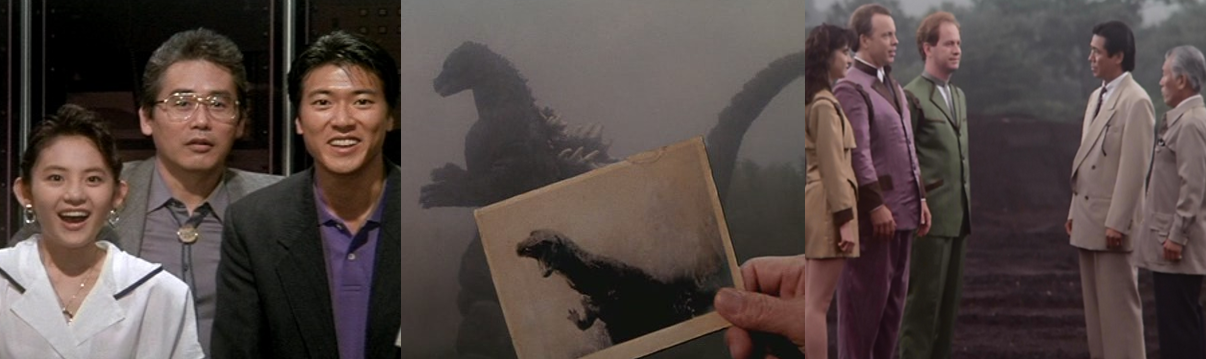

Released: 25 May 1990
Director: Robert Zemeckis
Distributor: Universal Pictures
Budget: $40 million
Stars: Michael J. Fox, Christopher Lloyd, Thomas F. Wilson, and Mary Steenburgen
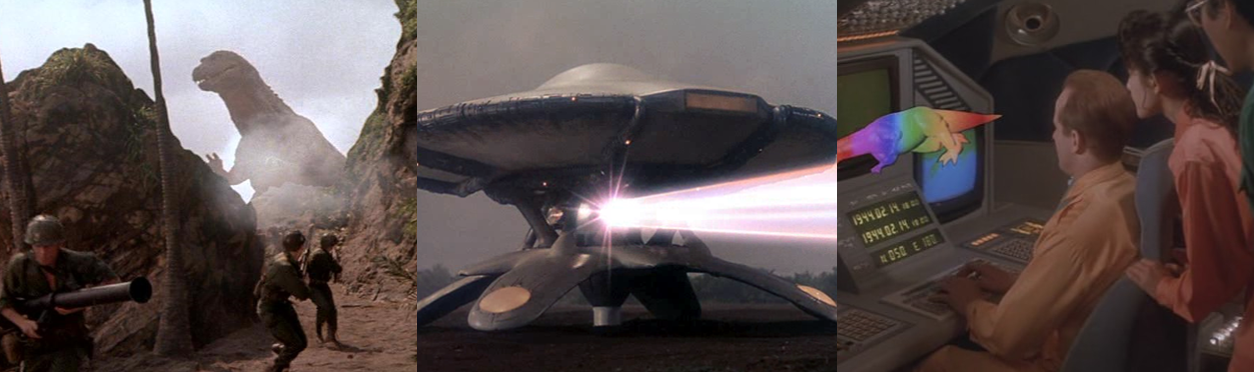
The Plot:
After witnessing his eccentric scientist friend, Doctor Emmett “Doc” Brown (Lloyd), forcibly transported to 1885 in his time-travelling DeLorean, high school student Marty McFly (Fox) travels to the Old West to save his friend from an untimely death, only to discover Doc endangering  the timeline by falling for schoolteacher Clara Clayton (Steenburgen).

The Background:
Back to the Future (Zemeckis, 1985) started as a passion project for long-time collaborators Bob Gale and Robert Zemeckis to recover from a few critical and commercial failures. After refining their script and securing Michael J. Fox for the lead, the duo succeeded in making the sleek and futuristic DeLorean an iconic cinema vehicle and a blockbuster commercial and critical success now recognised as one of the greatest science-fiction films of all time. As Zemeckis never planned for a sequel, the filmmakers faced script and cast issues but ultimately decided to film Part II (Zemeckis, 1989), also a critical, commercial, and influential release. It was apparently Fox who suggested setting Part III in the Old West, which involved constructing elaborate sets on location to depict the burgeoning Hill Valley. The film was not without its dangers: Thomas F. Wilson performed many of his own stunts and Fox almost died while filming the hanging scene! Industrial Light & Magic again worked on the film’s practical and visual effects, including an elaborate model train and track for the thrilling final sequence. With a box office of $245.1 million, it was the lowest-grossing movie in the franchise and yet is still highly regarded for bringing the trilogy to a satisfying close, the performances, and the new character dynamics introduced. With this film, Back to the Future is widely regarded as one of cinema’s best trilogies. While another film has been long rumoured, and the story has continued in comic books, videogames, and a short-lived cartoon, Zemeckis repeatedly stated that there would never be another entry as long as he’s alive.

The Review:
When I was a kid watching the Back to the Future trilogy for the first time, there was a clear hierarchy of preference for me: the second one was the best because of all the fun future stuff, the third was the second best as it had more action than the first, and the first took the bottom spot as it was a little slower and had less visual appeal for me. This was somewhat begrudgingly as I’ve never been a big fan of Westerns; I find them visually dull and narratively repetitive, so it helps when Westerns have a sci-fi or horror bent to them. Over the years, I’ve come to regard Back to the Future III even higher because of the satisfying and emotional way it repeats, continues, and wraps up these characters and the entire franchise to make for one of the most consistently strong trilogies in all of cinema. The film begins by once again replaying the final moments of the first film, in which Doc helps a time-displaced Marty return to 1985 by redirecting a lightning bolt into the time machine. Elated at seeing one of his inventions finally working, and by the prospect of the future to come, Doc celebrates in the street and prepares to head home, eager to get started on his greatest invention, only to be shocked when Marty suddenly reappears before him! This is, of course, a slightly different, older, and more experienced version of Marty, one who’s just seen Doc’s future self blasted back to the Old West by an errant lightning bolt after having revisited 1955 to fix his mistakes from the last film, but the sudden shock is enough to cause Doc to faint in the street.

After a shaky start, Marty eventually embraces and adapts to the Old West era.

Marty takes Doc back to his house and desperately tries to explain the situation to him. I like this scene as it recalls the disbelief and confusion Doc showed towards Marty in the first film (Doc even sarcastically calls Marty “Future Boy!”) However, thanks to Future Doc sending Marty a letter corroborating these events, Past Doc’s adventure with Marty, and the fact that the film needs to get moving, this confusion doesn’t last too long and the two are soon working together like before to unearth the time machine from an abandoned mine at the cemetery. While there, both are horrified to discover Doc’s tombstone stating that he was shot dead by Buford “Mad Dog” Tannen (Wilson) just one week after writing the letter, meaning he never got to enjoy the retirement he’d always dreamed of in Old West. After reading up on Tannen and confirming that the tombstone is real since Doc’s family line didn’t arrive in the United States until long after 1885, Marty resolves to take the repaired time machine and rescue his friend. Thanks to Doc’s detailed schematics, Past Doc makes the necessary repairs and uses his knowledge of fourth dimensional science to get Marty on his way. This is a recurring aspect that Marty struggles with in the film; he has to put his faith in Doc (“You’re the doc, Doc”) that he knows what he’s talking about since he doesn’t understand spatial or quantum physics. What he does know, however, is Westerns. He’s not impressed with the clown-like getup Doc dresses him in and even more embarrassed when his ancestor, Seamus McFly (Fox), helps him avoid social faux pas by gifting him a hat, neither of which fit his idea of Western icon Clint Eastwood. Indeed, Marty even uses the actor’s name as a pseudonym but, rather than being seen as a bad-ass, he’s routinely mocked by the locals. It therefore makes it all the more cathartic for him when he not only adopts a poncho and outfit resembling Eastwood’s “Man with No Name” but also borrows the same “bulletproof vest” trick from A Fistful of Dollars (Leone, 1964) to best Tannen.

Although Marty’s often the uncharacteristic voice of reason, he still has to overcome his vices.

Marty’s friendship with Doc is at the forefront of Back to the Future Part III. Before, Marty relied on the eccentric scientist to advise him and the youngster was mainly cleaning up messes that he’d made. This is still true here but Marty’s whole motivation for defying Doc’s wish to stay in the past is entirely predicated on him wanting to save his friend’s life. However, thanks to an errant arrow, the time machine suffers a fuel leak and the two are stranded in the past similar to the first film. With no gas stations and horses proving ineffectual, the two scramble to find a viable way to get the DeLorean to eighty-eight miles per hour before Tannen makes good on his threat to shoot Doc dead. Doc takes the threat very seriously and, while he’s happy to live out his boyhood dream working as a blacksmith in the Old West, immediately recognises the danger. However, things are further complicated when they happen upon an out of control carriage and rescue schoolteacher Clara Clayton from a fatal fall. Despite being a man of science, logic, and reason, Doc is immediately smitten by Clara and re-evaluates his situation accordingly. This has the unique knock-on effect of briefly switching Marty and Doc’s roles (Marty becomes the voice of reason and Doc becomes the irrational, emotional one), which is further emphasised when Marty also runs afoul of Tannen. Like the first film, this sees their actions impact the future and the tombstone depict the death of “Clint Eastwood” by Tannen’s hands. This comes about because of Marty’s refusal to back down to a challenge and him getting triggered whenever anyone brands him a “chicken” (or “yellah”, in this case). Marty is so riled up by accusations of his cowardice (a holdover from his previous life where his father was a snivelling coward and Marty’s attempts to avoid the same stigma) that he readily agrees to a shoot-out with Tannen, confident that he and Doc will have returned to 1985 by then. However, he’s both horrified to learn he could be forced into a fatal dual and angry at Doc’s suggestion that his pride has negative consequences in his future, something we saw in the second film but which Marty remains unaware of. Thus, Marty’s character arc here is listening to his friend and ancestor over the jeers and opinions of others and realising that it’s better (and braver) to turn the other cheek rather than to step up to an unwinnable fight just to prove himself to a bunch of strangers and assholes.

Love, for better and worse, and allows Doc to discover new aspects of life and himself.

Doc also undergoes some significant character growth here. Having devoted his entire life and fortune to science, Doc’s dreams of seeing the progress of mankind and understanding the nature of existence have been tarnished by witnessing the dangers of time travel. Thus, his instructions and intentions are explicitly clear: he wants the time machine destroyed once they’ve returned to 1985. It’s because of this that he’s perfectly happy living out the rest of his life as a blacksmith in the Old West. He’s quickly established a reputation in the small settlement of Hill Valley and has clearly been enjoying cobbling together steam-powered apparatus and would’ve gladly stayed there if not for the threat against his life. He’s completely caught off-guard, then, when he falls for Clara; initially dismayed to learn that they altered history by saving her, he’s quickly smitten by their shared love for science, astrology, and Jules Verne. Although he scoffs at the idea of love at first sight, Doc can’t deny his feelings for Clara, and he’s fully prepared to stay in 1885 with her but is left heartbroken when she angrily rebuffs him after he’s convinced by Marty to tell her the bizarre truth. In despair, he turns to alcohol and rambling about the future to the locals. After being sobered up by Marty, Doc re-commits himself to their elaborate train heist, having deduced that the only possible way to get the DeLorean to eighty-eight miles per hour is to hijack a train, strap the time machine to it, and boost the train’s engine with controlled explosions. I enjoyed the new wrinkles to Doc’s character here; unlike Marty, he’s comfortable in the Old West and he’s definitely come out of his shell, standing up to Tannen and socialising with the locals. I liked seeing him discover there’s more to life than just science, and his friendship with Marty was explored in new ways through this altered dynamic that saw Marty being the voice of reason for a change.

Buford lives up to his nickname and is a cruel gunslinger who needs taking down a peg.

Once again, Marty and Doc are opposed by one of the Tannen family. This time, it’s Biff’s (Wilson) surely and uncivilised ancestor Buford, who is also accompanied by cackling underlings and has a reputation as a cruel gunslinger and thief. Tannen makes his entrance as all in his line, by confronting a McFly in a bar, and regularly flaunts the law (represented by Marshal James Strickland (James Tolkan)) by dragging Marty through the streets and threatening to hang him as well as sneaking a gun into the town festival. While there is a lawmaster in town, Buford thinks nothing of publicly threatening those who he feels have wronged him and challenging them to a dual. While Buford is as dumb as previous Tannens, easily confused by words and phrases (even those not from beyond his time period) and numbers, he’s a ruthless and callous individual. Although he may hate the nickname “Mad Dog”, it’s entirely appropriate given his drooling, snarling, brutish disposition and he’s little more than a growling thug in a Stetson. Tannen believes Doc owes him $80 after his horse threw a shoe and refuses to be placated by reason since he believes he’s been slighted. When Marty openly defies him at the festival, saving Doc’s life in the process, Tannen shifts his aggression towards the youngster and challenges him to a morning shoot-out, much to the chagrin of Seamus and Doc. Marty, however, is confident he won’t have to think about drawing a gun but that doesn’t end up being the case. Although they have the DeLorean ready and a plan to escape, Doc’s heartbreak causes them to be late and forces Marty to face Tannen in the streets. However, Marty wisely chooses to fight smarter, not harder, once again outwitting the bullish gunslinger and sending him crashing into a pile of manure.

The Nitty-Gritty:
Back to the Future Part III continues the formula established by the last two film that time often repeats. This means we get a sweeping shot of Hill Valley and the clock tower (before still under construction), a McFly/Tannen confrontation in a bar, a chase through the streets, and ruminations on the dangers of messing with time travel. However, rather than being derivative, these are all re-framed in new and visually interesting ways. The Old West setting is an extreme reconfiguring of the 1955 setting of the first film, with Marty and Doc being hampered and severely limited by the technology and resources of the time, only things are way more dangerous now as everyone’s walking around with a gun on their hip and even things as simple as petroleum are impossible to come by. Like in the first film, time itself is a major antagonistic force here. Marty and Doc have less than a week to figure out how to get the DeLorean running and the photograph of the tombstone is a constant reminder of this ticking clock (though, strangely, they never once consider hopping on a train and leaving town for a bit. Considering Buford is later arrested for robbery, this might’ve actually worked!) This is only exacerbated when Buford grows restless for a gun fight and Doc falls into despair over Clara, which is naturally all in service of Marty again getting the better of a Tannen and a thrilling train heist for the finale.

While I enjoy the setting and the timeless effects, Clara’s character felt a bit weak to me.

Although it takes Marty a bit to adapt to the Old West, I’d argue both he and Doc acclimatise to 1885 much faster and better than either did to 2015. Both enjoy walking the streets in their era-appropriate getup, Doc revels in applying his scientific acumen in new ways as a blacksmith, and Marty definitely gets a kick out of parading around with a gun and calling himself Clint Eastwood. While Marty’s gunslinging was mocked in 2015, he impresses in 1885 and he still finds new ways to adapt to the times, such as tossing a Frisbee-branded pie plate and protecting himself with a furnace door. One of the reasons I dislike Westerns is because of how visually repetitive and boring they can be but that’s not the case here, largely because I’m so familiar with Hill Valley from the last two films and it’s fun seeing it reimagined as a dangerous and often disgusting smattering of wooden structures in a desert. While I prefer the fantastical technology of the future setting, I’ve grown to appreciate the simplicity of the Old West aesthetic and I liked seeing stuff like Marty’s Nikes and modern slang being completely lost on the locals. For me, Clara is a more prominent downside to the film. I never found her to be particularly interesting or charismatic and she seems oddly plain in a way that I find distracting. I like that she’s just an unassuming schoolteacher, a slightly insecure and mousy woman who is as uncertain about her newfound feelings as Doc, but I feel like she could’ve been given more to do. Mostly, she’s just kind of there and bolstered only by her convenient fascination with science and literature and she’s often in peril a little too much for my liking. I appreciate that she stands up to Buford, and her physicality in the finale as she rushes to reconcile with Doc, but I think it might have helped to see her at work in her profession or exhibiting a little more personality. On the plus side, this allows the new dynamic between Doc and Marty to shine brighter but I can’t help but feel like the romance between Doc and Clara is a little rushed and flat. The film tries to salvage this by stating that it’s unexplainable love at first sight and by Doc’s obvious inexperience with romance, but just a little more agency like she showed at the festival to make her seem like more of an equal would’ve gone a long way for me.

Although the DeLorean is destroyed, the future is left unwritten and hopefully for all.

As ever, Back to the Future Part III makes use of some fantastic practical and traditional effects and models shots. While the film isn’t as grandiose as the last one, the stunt and horse work on display is impressive and the costume design alone should be a selling point for any fan of Westerns. Marty cuts a resplendent, mature figure in his Clint Eastwood cosplay and it’s exhilarating seeing him and Doc frantically chase after the train on horseback. Once aboard, they clamber over the carriages and politely hijack the main engine, decoupling all the carts and attaching the DeLorean to the cow catcher. Thanks to some specially prepared explosives, Doc pushes the train’s speed and capabilities further than intended, but staggers the explosions so as not to destroy the train prematurely. However, Clara catches up with them, having heard of Doc’s distress over her and become convinced that he was telling the truth, and almost falls from the train in a bid to join them on their journey. Doc’s character growth comes full circle as he braves the trip back to get to her and Marty also puts aside his personal feelings to help save them by slipping them the hoverboard. His friends then glide to safety as the DeLorean finally hits eighty-eight and returns to 1985, the train crashing into a ravine thanks to a spectacular model shot. Fourth dimensional science sees Marty safely arrive in 1985 but his elation is short-lived as he has to quickly abandon the time machine and can only watch, with a mixture of despair and gratitude, as Doc’s wish comes true and the DeLorean is obliterated by an oncoming train. Marty immediately reconnects with his girlfriend, Jennifer Parker (Elizabeth Shue), not only finally telling her the truth but also altering his future when by refusing to race Douglas J. Needles (Flea). While mourning the loss of his friend, Marty is stunned when Doc suddenly arrives in a time travelling steam engine…alongside not only Clara but their young children, Jules (Todd Cameron Brown) and Verne (Dannel Evans). Although the film makes no attempt to explain how Doc built this contraption, this ridiculous oversight is secondary to the heartfelt farewell he and Marty bid to each other and Doc’s impassioned, enthusiastic speech about Marty and Jennifer being free to decide their own futures.

The Summary:
Even now, it’s hard to name a film trilogy that’s as consistent and enjoyable as the Back to the Future films. Each one has strengths and unique, enjoyable aspects that help to keep the themes fresh and engaging, and the story arc for Doc and Marty across the three movies is beautifully realised here. I loved how Marty was now much more confident and surer of himself in his new setting and how he took on the more adult voice of reaso. Him realising that he doesn’t have to answer every challenge to prove himself was also nicely resolved here to show that he’s really learned from his adventures. Similarly, I enjoyed that Doc found something else to live for besides science and his work. Although disillusioned with time travel, he discovers love for the first time, its highs and lows, and is a better person for it, with him and Marty become more well-rounded characters by learning from each other. While I would’ve liked to see more from Clara, she was serviceable enough and I think Buford may be the best and most dangerous Tannen we’ve seen yet. He’s a dog of a bloke and it’s great to see him bested once again. Add to that the visuals, thrilling action, and emotional finale and you have a film that wraps up the franchise in such a perfect way that it really would be a shame to spoil it with a remake (although I would’ve loved to see a re-quel with an older Marty dealing with a rebellious son). While I still prefer the imaginative visuals and high stakes of the second film, Back to the Future Part III has become a firm favourite of mine for how well it uses its Old West setting and its thematic and emotional conclusion to one of the best sci-fi stories (and cinema trilogies) of all time.

My Rating:

Rating: 4 out of 5.

Great Stuff

Are you a fan of Back to the Future Part III? How do you rate it compared to the other two films and which of the trilogy is your favourite? What did you think to the Old West setting and the pitfalls facing Doc and Marty? Were you a fan of the romance between Doc and Clara and the role reversal between Doc and Marty? Can you name a better cinematic trilogy? Where would you go if you had a time machine? How are you celebrating Back to the Future Day today? Whatever you think about Back to the Future Part III, feel free to share your thoughts below.