Movie Night: Olympus Has Fallen

Released: 18 March 2013
Director: Antoine Fuqua
Distributor: Millennium Films
Budget: $70 million
Stars: Gerard Butler, Aaron Eckhart, Rick Yune, Angela Bassett, Dylan McDermott, and Morgan Freeman

The Plot:
When a North Korean terrorist group led by Kang Yeonsak (Yune) storms the White House and takes President Benjamin Asher (Eckhart) and his cabinet hostage, their only hope is one man, Mike Banning (Butler), a former Secret Service agent forced to wage a one man rescue mission on the nation’s capital building.

The Background:
Ever since the commercial success of Die Hard (McTiernan, 1988), a number of knock-offs have permeated cinema that are, essentially, “Die Hard…but on a…”. We’ve seen Die Hard on a boat, on a train, in a plane, in a hockey stadium, in a skyscraper, and all kinds of variants but, in 2013, we got two movies that followed the basic theme of “Die Hard…but in the White House!” The more financially successful of these two movies was, of course, Olympus Has Fallen, which began life as a spec script and became the first in a whole franchise of action movies that really keeps the spirit of Die Hard alive in a time when such movies are rarely seen in cinema.

The Review:
Unlike many films featuring the President, Olympus Has Fallen opens with Asher not in some dull press conference but in a boxing ring with Mike; the entire opening sequence is a pretty effective, if overly dramatic and elaborate, way of showing the close relationship Mike has with the President and his family, especially Asher’s son, Connor (Finley Jacobsen). Mike is on friendly terms with Asher, calling him “Ben” when in private but being all business and a consummate professional when it comes to his safety. Meticulous and detail-orientated, Mike has even (conveniently for the film’s plot) taught Connor the value of always being aware of his surroundings and exits. Of course, no good action movie protagonist is any good without some significant trauma or drama and Mike’s is a doozie: while escorting the Asher’s to a fundraiser, they had a blowout and, though Mike was able to save the President, he couldn’t save his wife, Margaret (Ashley Judd).

Thankfully, Mike and Leah’s relationship has not been strained to breaking point by his guilt.

When we pick up with Mike eighteen months later, he’s a shell of his former self; now working at the Treasury Department, he’s doing the best he can to carry on and provide for his wife, Leah (Radha Mitchell), but is clearly affected by the guilt and consequences of his actions since he’s easily distracted by political news. Thankfully, the two have a very close and adorable relationship: they’re not at odds with each other or arguing, Mike’s not a drunk or abusive, and Leah is both sympathetic and supportive of him and just wants them to adjust to and accept the new normal. She doesn’t really get much to do beyond being Mike’s rock but we do get to see her doing good work at the hospital, staying busy and being supportive even in the face of the insurmountable odds stacked against Mike. Mike, however, is frustrated with his position; he maintains contact with his former director, Lynne Jacobs (Bassett), and wants back in but, while she reassures him that no one, not even Asher, blames Mike for what happened, she urges him to take some time to grieve and reflect on the accident and emphasises that Asher hasn’t given himself that time and is thus unable to see Mike every day without being reminded about what happened.

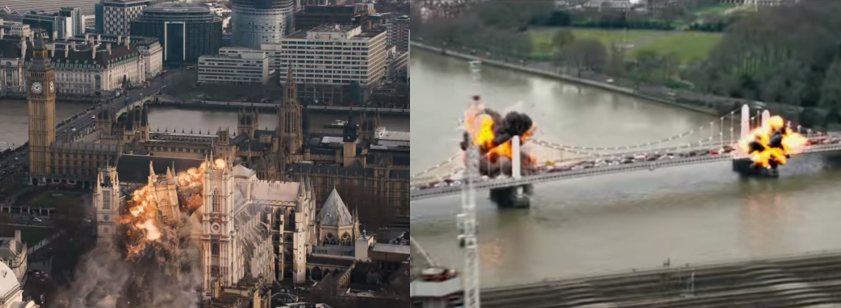
North Korean terrorists launch a devastating attack on the White House.

Although it’s obvious that things are very different not just for Mike but for Asher and Connor as well, everyone has been able to carry on as though it’s business as usual because of their commitments and, as a result, the President and his staff invite South Korean Prime Minister Lee Tae-Woo (Keong Sim) to the White House to discuss the threat of invasion from North Korean forces. However, shortly after Tao-Woo’s arrival, the White House comes under attack from the Koreans for United Freedom (KUF), a North Korean terrorist group led by Kang Yeonsak, who infiltrates the White House (which is given the completely subtle codename of “Olympus”, hence the title of the film) as one of Tao-Woo’s aides. This delivers quite an impactful sequence in which a gunship rains fire upon Washington, D.C. and the White House itself. Despite the White House’s impressive (and, frankly, unprecedented) array of weaponry (including anti-aircraft guns and hundreds of armed forces), the attack is nothing short of a massacre and the White House is captured with gratuitous use of violence and the destruction of iconic American landmarks.

Kang is a ruthless, sadistic villain willing to killing hundreds to prove his point.

Despite being held hostage, with no idea of the whereabouts or safety of his son, Asher remains defiant in the face of Kang’s threat, ordering the remnants of the government and military not to negotiate. Kang, however, is a cold, ruthless, and remorseless individual who takes the White House with an aggressive and efficient operation, setting up heavy weapons and numerous armed men throughout the White House to fortify his position. He is also more than happy to threaten, torture, and kill Asher’s aides for security codes to America’s “Cerberus” weapon, mercilessly beating Secretary of Defense Ruth McMillan (Melissa Leo) to within an inch of her life and outright executing Tae-Woo. To spare lives, Asher permits his aides to divulge their codes since he remains steadfast that he will never reveal his own code, which only drives Kang to further extreme methods.

Forbes’ betrayal aids Kang’s cause and positions him as Mike’s dark opposite.

Kang and his cohorts are reprehensible, merciless terrorists who gun down countless members of the White House security team in an unprecedented ground assault, completely taking everyone by surprise, and of which Mike ends up being, again, the sole survivor inside the now ravaged White House. Of course, it turns out that they were aided in their efforts by Dave Forbes (McDermott), a former Secret Service agent and trusted friend of Mike’s who sells out his country after losing his way. Forbes is positioned as Mike’s dark reflection, a corruption of the ideals he fights so hard to uphold, and their inevitable showdown is framed in a way to present Mike as fighting someone as trained as capable as he. Of course, Mike is able to overcome this challenge with grit and determination and, having delivered a clean, effective, mortal blow, offers Forbes the chance at redemption before he dies.

The Nitty-Gritty:
An interesting technique Olympus Has Fallen employs is not just the usual onscreen information like locations and times and such but also little titles for key characters in the Presidential office so we know who they are and what their position is. I’m not entirely sure I really need this context (it’s enough for me to see them conversing with the President to know that they’re important) but it’s certainly unique. Of course, not being an American, having no interest in politics, and not really being that patriotic, many of these aspects are wasted on me. However, the action in Olympus Has Fallen is suitably loud and over the top and the initial assault against the White House is scary in its potential, if a little undermined by the slightly dodgy CGI (most notably seen in the film’s various blood effects). For me, none of this detracts from the sequence or the action, though, since such scenes are full of frenetic cuts, fast-paced action, and numerous explosions and brutal kills that all sell the sudden violence of the campaign more than anything else.

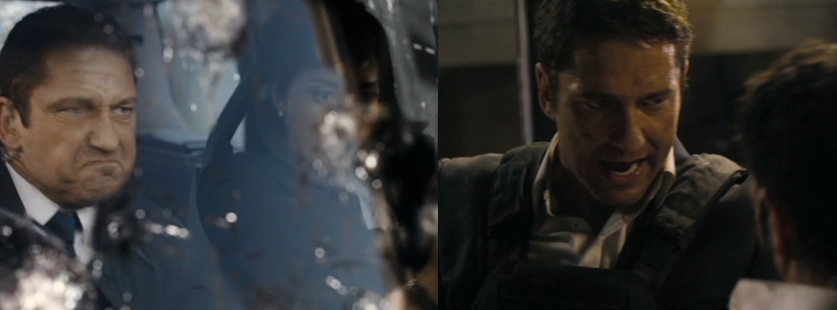
Mike’s training and knowledge of the White House makes him a force to be reckoned with.

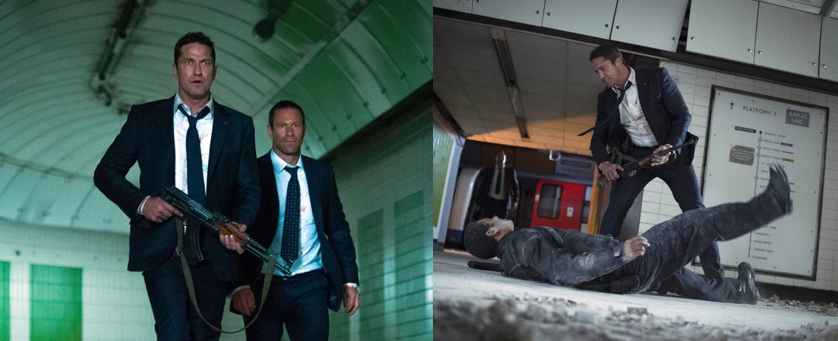
Once Mike enters the White House as the last man standing, the film truly reveals its Die Hard roots as Mike becomes a John McClane (Bruce Willis) figure: a lone man with few resources fighting impossible odds. Mike, however, as a former Army Ranger and Secret Service Agent, is arguably a lot better trained and equipped than McClane yet, as efficient and capable as he is, he’s still just one man and positioned as a vulnerable, desperate character. Mike’s adaptability comes not just from wise cracks (and he is extremely snarky when he needs to be) and desperate innovation but from his knowledge of the White House and governmental protocols, which he uses to his advantage to arm himself, find and rescue Connor, and launch a pre-meditated counterattack using the hidden passageways to avoid and take out Kang’s men one at a time. Of course, it’s not all action and excitement in Olympus Has Fallen; much of the film’s side plot revolves around the remaining governmental body, headed up by Speaker of the House Allan Trumbull (Freeman) who, along with military aides and other advisors, desperately try to hold the country together, debate Kang’s demands, and try to find a way to resolve the situation. Interestingly, I found that the film kind of suggests Trumbull as a red herring, someone perhaps in league with Kang in order to usurp Asher as the President, but..c’mon, it’s Morgan Freeman so of course he’s the cool-headed commander-in-chief who helps co-ordinate Mike’s efforts within the White House.

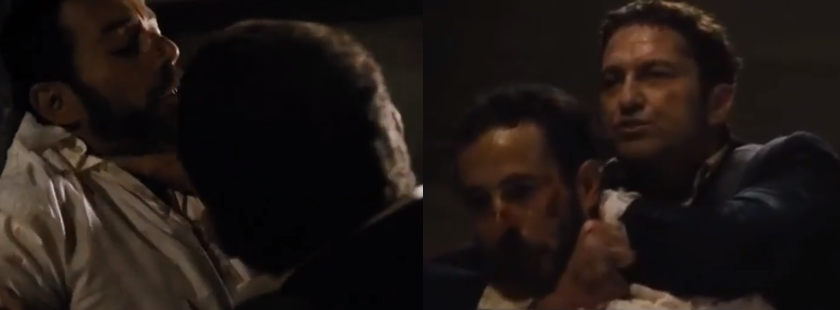
Despite Kang’s impressive physical skills, Mike is able to end him with brutal efficiency.

Thankfully, there’s only a momentary debate about Mike’s credentials and capabilities so, unlike McClane, he’s not entirely alone in the White House and has a degree of support, if nothing else. However, his warnings to as General Edward Clegg, (Robert Forster) regarding their attempts to retake the White House of course fall on deaf ears because those not stuck in the middle of the shitstorm always have to make uninformed and impulsive decisions so our “Everyman” hero can shine even brighter and have another chance to perform a daring attempt to save lives. Despite his earlier obvious feelings of guilt and uselessness, Mike reacts without thinking as soon as he spots the incoming attack on the White House, goes out of his way to try and save lives, and immediately slips right back into his scrupulous training to become a one man army. Mike is an efficient, hard-hitting combatant; there’s no prolonged fight scenes here, just quick, hard, well-timed strikes. He’s also, it turns out, an equally ruthless and dangerous individual; when questioning Kang’s men, he doesn’t hesitate to murder one with one quick, vicious stab and torture information out of the other. Whereas McClane struggled with most of the terrorists he was placed up against, Mike only really finds himself facing a challenge when fighting Forbes and in the final showdown with Kang. Still, despite Forbes’ deception and taking him by surprise, Mike is quickly able to adapt and put him down. By the time he reaches Kang, Mike is fatigued and wounded and thus on the backfoot at first, especially in the face of Kang’s superior martial arts ability. However, Mike represents America’s much-touted ideals of peace, freedom, and democracy and this only bolsters his indomitable will, allowing him to make good on his promise to “stick his knife through [Kang’s] brain” and win the day for America.

The Summary:
Olympus Has Fallen is an extremely intense and engaging action film; it walks a fine, blurry line between being massively over the top and being just a little too serious for its own good, never quite falling on one side or the other. This results in a decent amount of tension and excitement; Mike is an extremely capable, well-trained, and meticulous individual and yet, thanks to Butler’s rugged charisma and down-to-earth appeal, is still a vulnerable, flawed, and relatable character. He’s fighting an uphill battle and striking with a blunt efficiency but is still human, getting more and more fatigued and battered up as the film goes on. Kang, meanwhile, is a ruthless and nigh-emotionless sadist, the kind of villain who truly believes that the ends justify such vicious means, and Yune brings a quiet, despicable magnetism to the role that is fully paid off in his violent end. Strong supporting performances by the always-fantastic Morgan Freedom and Aaron Eckhart help bolster the film’s appeal and legitimacy and, despite some dodgy CGI in the opening moments, the film stays very true to the gritty, desperate spirit of films like Die Hard and is, in my opinion, a worthy successor to that series.

My Rating:

Rating: 4 out of 5.

Great Stuff

What did you think to Olympus Has Fallen? Did you find Mike Banning, and Gerard Butler, a compelling action hero? How did you find the execution of the film’s premise and the performances within? Did you find it an enjoyable romp or were you, perhaps, unimpressed with the film’s weaker aspects and arguably derivative nature? How do you think it compares to Die Hard and similar films and which of Die Hard’s many knock-offs is your favourite? Whatever you think about Olympus Has Fallen, leave a message below and come back next Sunday for my review of the sequel!

Movie Night: The Matrix

MatrixLogo

Released: March 1999
Director: The Wachowski Brothers
Distributor: Warner Brothers
Budget: $63 million
Stars: Keanu Reeves, Laurence Fishburne, Carrie-Anne Moss, Hugo Weaving, and Joe Pantoliano

The Plot:
Thomas A. Anderson (Reeves) is a nobody; by day, he sits in a cubicle and works a monotonous job as a software developer but, in his spare time, he has crafted a reputation under his hacker alias “Neo”. When he is targeted by Agent Smith (Weaving), Neo is brought to the enigmatic Morpheus (Fishburne) and offered both a startling truth and a destiny he could never have suspected.

The Background:
After managing to sell their script for Assassins (Donner, 1995) and the success of Bound (The Wachowski Brothers, 1996), Andy and Larry Wachowski (as they were known then) were able to sell Warner Brothers on another of their scripts: The Matrix. Featuring an impressive mixture of martial arts, philosophy, and science-fiction not often seen in major Hollywood releases and heavily influenced by manga and anime, particularly Ghost in the Shell (Oshii, 1995), The Matrix made an instant and lasting impression not just on the science-fiction and action genres but on cinema as a whole. The film both popularised the concept of “bullet time” and wire-assisted kung fu (or “wire-fu”) in movies and cemented Keanu Reeves as an action star. Suddenly, parodies were everywhere and movie heroes were all sporting long dark coats, shades, and flipping all over the place and it was all largely thanks to The Matrix. When I was a kid, The Matrix was a big, big deal. My friends and I watched the film constantly, eating up the action sequences and the cool aesthetic and soundtrack. Produced on a paltry budget of $63 million, The Matrix was a massive commercial and critical hit, making over nearly $500 million worldwide. So great was The Matrix’s success that is spawned not only two sequels but a whole slew of multimedia merchandise, including comic books and videogames. While the sequels may not have garnered quite the same critical reaction as the quasi-cult hit original, The Matrix’s important at the time (and today) cannot be understated and the later release of a fourth film proved that The Matrix still has an enduring legacy in cinema. Considering today is “National Science Fiction Day”, this seems the perfect opportunity to look back at this classic piece of cyberpunk cinema.
The Review:
The Matrix has a pretty simple concept, one that has been done before and since in cinema, but complicates it with musings on fate, destiny, and the sense of identity and reality. At its core, the plot is incredibly simple, though: the world as we know it is merely a computer-generated construct, a form of virtual reality in which we have been enslaved by a race of machines in a post-apocalyptic world. Amidst this, though, we have themes regarding providence, choice, and some of the most impression action and fight sequences put to cinema.

MatrixNeo
Apathetic to his everyday life, Anderson has far more prominence as “Neo”.

Our window into The Matrix is Thomas A. Anderson (or “Neo”, as he is known throughout the hacking community), a bored program developer who has lived most of his life with a feeling that there’s something not quite right with the world. Thanks to his illicit activities, he is acutely aware of the legendary Morpheus, a charismatic and prophet-like figure in Neo’s circles, and “the Matrix”, an undefined concept that is enough to rouse Neo’s curiosity. Keanu Reeves makes for a perfect audience surrogate; you instantly buy into the idea of him as an isolated, distracted hacker who is unfulfilled in his mundane life and eager for change but not quite confident enough to really buck the system more than showing up late for work or being generally apathetic. Once he meets Trinity (Moss), though, and is set on the path towards Morpheus and answers concerning the Matrix, Neo’s outlook begins to change; he was too afraid of plummeting to his death when trying to escape Smith and his cohorts but, once captured, is defiant enough to give them the finger and, after being reminded of the poor choices he’s made in life that have kept him stagnant, resolves to follow Trinity and her teammates towards an uncertain future.

MatrixSmith
Agent Smith is a chilling, complex villain.

Opposing Neo is the aforementioned Agent Smith; in this movie, he’s just one of a number of men in black who target our heroes and are meant to be indistinguishable from each other. As the de facto leader, and the most charismatic of the three, Smith’s personality is revealed over time and in layers; he goes from a monotonous, fittingly robotic agent of the system to being wracked with personal animosity for Neo and being overcome by his own pride and hubris. Weaving is excellent in the role, exuding both menace and charm with the subtlest of movements and the merest of words and seeing him break out of his shell and reveal just how layered Smith is beneath his cold exterior is both captivating and terrifying at the same time. We also have Cypher (Pantoliano), the more outspoken and neurotic of the crew who takes an instant dislike to Neo thanks to his largely jaded attitude. Cypher is, if his name and Pantoliano’s scenery-chewing acting didn’t make it clear, the ultimate betrayer of the crew as he has grown disillusioned with Morpheus’s teachings and the reality of the real world and therefore deceives his crewmates, killing three of them and leaving Morpheus in the hands of Smith and the other agents. Cypher’s motivations are entirely believable, however, as the real world isn’t all it’s cracked up to be but it’s still extremely cathartic to see that smug smile blown off his face after his heel turn.

MatrixTrinity
Trinity is a capable, if underwhelming, character.

Luckily, Neo is not alone in his journey; Trinity is his main link to Morpheus’s world and serves as his eventual love interest. Yet, while Carrie-Anne Moss is acceptable in the role and more than capable at holding her own in her fight scenes, I never really bought into the attraction between the two characters. People like to rag on Keanu for being “wooden” but I’ve always enjoyed his work and found him very charismatic and that’s no different in The Matrix, where’s he’s able to showcase a variety of emotions and character quirks. Trinity, however, is a very guarded and reserved character through and through; some of this is due in part to the way those awakened to the truth of the Matrix tend to be more emotionless and reserved, especially inside the Matrix, but it’s also because of her reluctance to admit her feelings to Neo out of the fear that he isn’t who she thinks he is and the fear that he is what she thinks, as it means a dramatic change for the world if true.

MatrixMorpheus
Morpheus is easily my favourite character (…after Neo, of course).

Morpheus, however, fully believes in Neo from start to finish and never once does his belief falter. Morpheus is the enigmatic captain of the Nebuchadnezzar and is regarded as a legendary figure not only by Neo but his crew as well. Years ago, the Oracle (Gloria Foster) prophesised the return of “the One”, a man born inside the Matrix who would be able to manipulate it in superhuman ways and spell the end of humanity’s subjugation, and Morpheus has dedicated his entire life to finding the One. For whatever reason (it’s not really explained how or why), Morpheus believes that Neo is the One and actively seeks him out, shows him the truth, and pushes him to break beyond what he has been conditioned to know. Never once does Morpheus’s conviction falter and Fishburne makes for a very fitting mentor and father figure; he anchors the film, offering exposition, and is the heart and soul of The Matrix. Subsequent sequels may have ruined (or spoiled) Morpheus’s mystique somewhat but it’s captivating in The Matrix as he seems so infallible and believable that you can’t help but be sucked in by his words. The rest of Morpheus’s crew is largely one-note and expendable; Switch (Belinda McClory) and Apoch (Julian Arahanga) are pretty forgettable and have maybe three lines between them and Mouse (Matt Doran) is the young, naïve crew member whose death is meant to be heartbreaking because of his youth but ends up falling a little flat as his characterisation amounts to “enthusiastic/annoying kid”. Tank (Marcus Chong) and Dozer (Anthony Ray Parker) stand out a little more thanks to Tank acting as the team’s operator (when inside the Matrix, he directs them, uploads additional training material and resources, and provides them with a way to dial out) and their status as brothers born naturally in the real world.

MatrixFights
The fights are varied and grow in intensity.

Of course, as good as the majority of the cast and characters are, the film’s main draw is its extensive action and fight scenes. Thanks to a combination of computer-generated imagery (CGI), wire work, and an extensive training regime, the film’s fights are high intensity and a spectacle to see; the film begins with Trinity performing that iconic leaping kick in slow motion as the camera pans around her, includes a playfully enjoyable sparring session between Neo and Morpheus, emphasises the aggression and nigh-unstoppable nature of the agents when Morpheus is effortlessly pummelled by Smith, and ends with a long, multi-layered fistfight between Neo and Smith. Unlike the majority of action films, The Matrix presented a world where characters don’t need to appear athletically competent to perform superhuman feats as knowledge and techniques are literally downloaded into their minds, instantly turning them into a master of the arts when plugged into the Matrix. Unfortunately, the special effects falter a bit in the real world; the sets and interiors are great, with the film favouring the “lived in” look of similar movies like Event Horizon (Anderson, 1997) and made popular by the Aliens movies (Various, 1979 to 2017), but the CGI elements haven’t aged too well. The squid-like Sentinels, especially, look particularly cartoony these days and most of the sequences involving them and the Nebuchadnezzar don’t quite hold up to the more practical effects of the film. Similarly, some fight scenes, particularly those using bullet time or other camera tricks, can result in the actors taking on a rubbery appearance but, when they’re inside the Matrix, I feel this effect actually works better and serves to highlight the falseness of that reality.

The Nitty-Gritty:
The Matrix still holds up very well to this day thanks to its enduring themes and the intensity of its otherwise over-the-top fight sequences. There are, of course, a few plot holes and questions raised by the film’s concept that are either not answered in subsequent sequels or poorly addressed. First and foremost for me is the question of how, exactly, child birth happens when humans are simply grown in endless fields. The idea of the fields themselves seems to suggest that the machines are cloning humans, but this isn’t really addressed; neither is how the awakened humans built their ship and other equipment, where their food and clothes come from, or how they don’t simply freeze to death under the scorched skies that blanket the real world.

MatrixBatteries
The machines grow and harvest humans to use them as a power source.

Most of these questions are left intentionally unanswered in this film; we’re told (briefly) about Zion, the last human city, and given snippets of information regarding their war against the machines but nothing concrete. This adds to the mystery of what exactly happened to turn the world into a post apocalyptic hellhole ruled by machines and is completely believable; if all of humanity were blasted to smithereens, why would we have any specific information some one hundred years later? Truthfully, the real world is of little consequence in The Matrix; it’s there and a stark contrast to the artificial world of the Matrix but is never portrayed as being preferable. Instead, the idea is that the truth and the concept of being free from the machines’ control is preferable to being a slave, a literal biological battery, to the will of the machines. As a result, any human awakened to the truth is immediately drafted into the resistance effort but Morpheus is explicitly honest about their chances:

MORPHEUS:
They are the gatekeepers. They are guarding all the doors, they are holding all the keys, which means that, sooner or later, someone is going to have to fight them.

The agents embody this philosophy; practically nameless and faceless, the agents are able to possess (more like overwrite) any person currently plugged into the Matrix, effectively allowing them to endlessly respawn even in the rare instances that they are defeated or incapacitated. Yet, Morpheus also states that everyone who has ever tried to fight an agent has died, which isn’t that surprising considering that, as computer programs, they are faster, stronger, and far more durable than a mere human.

MatrixTheOne
As the One, Neo effortlessly stops bullets and parries Smith’s attacks with one arm.

In a reflection of Morpheus’s conviction, though, he doesn’t hesitate to take on Smith in hand-to-hand combat to allow Neo to escape; Morpheus, previously portrayed as calm, collected, and a severely disciplined fighter, is absolutely dominated in this fight. His near infallibility is then tested to the limit when the agents subject him to a concoction of drugs, torture, and questioning to try and obtain access codes to the Zion mainframe. Morpheus resists, however, and retains enough of his strength (both physical and mental) to break his bonds once Neo and Trinity affect their action-packed rescue plan and, throughout the entire movie, maintains a quiet confidence that, in time, Neo will see the truth about himself. It is therefore heartbreaking when Neo is executed by Smith, leaving Morpheus so distraught that he doesn’t even care about living any more. In the wake of Neo’s death, Trinity finds the resolve to finally admit her feelings for him and, with a kiss, restores Neo to life. As cliché as this sounds, it’s actually one of the most affecting scenes in the film; previously, the Oracle said that Neo was “waiting for something”, specifically suggesting that “something” was his next life, and Neo’s resurrection sees him assume the confident, God-like status of the One at last. His wounds healed, the speed and power of Smith is as nothing; Neo easily blocks and parries Smith’s attacks with one arm, looking hilariously and awesomely bored by the conflict, and easily dispatches the agent by blasting him to pieces. Now able to view the complex code of the Matrix itself, Neo ends the film fully able to manipulate and alert the environment as he blasts off to the sky to the sounds of Rage Against the Machine (a fitting band if there ever was one).

MatrixFlaws
The film is not without a few logistical concerns regarding its world.

This ending is as exhilarating and cathartic as you could hope for; all throughout the film, Neo has struggled with the destiny Morpheus has laid out for him and seeing him grow in confidence and ability leads to some of the film’s more impressive action and fight sequences. The gunfight between him and Trinity and a bunch of guards is worth the price of admission alone but seeing Neo effortlessly take out Smith, especially after the gruelling physical battle they went through previously, never fails to get my blood pumping. That’s not to say that the film isn’t without a few flaws, though. Chief among them, for me, is the “bug” that Smith implants into Neo; it makes sense, as he wants Neo to lead him to Morpheus, and it’s a nightmarish sequence, but it’s rendered immediately mute when Trinity pulls it out of Neo in the very next scene. Ironically, if Smith had simply just waited outside Neo’s apartment building he would have been led right to Morpheus but…no, apparently the bug is more efficient. Additionally, the scene where Neo is awakened is a bit confusing; he swallows a pill to help the crew find him in the real world, randomly gets smothered by liquid glass with no explanation, and when he does wake up the Nebuchadnezzar isn’t even there to retrieve him until he is literally flushed away. Finally, while I like that the film addresses that Neo’s eyes and muscles would have suffered atrophy, I would argue that the plugged in humans would be next to useless in the real world, especially upon being unplugged.

The Summary:
The Matrix’s philosophical musings are far less as explicit as in its sequels; here, exposition is delivered in snippets that are easy to digest and understand. There’s no double talk or complicated words here; we’re simply told as much information as these characters know and even Morpheus explicitly says that he (and even the Oracle) doesn’t have all the answers for Neo’s (or our) questions. Clearly, the film is left with many questions still to be answered but, unfortunately, it didn’t really turn out that the Wachowski’s were capable of delivering interesting answers to those questions. As a result, as much as I enjoy the sequels, neither are on the same level as the original, which is still one of the most compelling and original movies ever made that never fails to deliver despite a few flaws. The Matrix still holds up really well even after all this time; sure, some of the effects aren’t as impressive as they once were and a lot of the tricks popularised in this film have been done bigger and better since then, but it’s still a great piece of cyberpunk cinema. The sequels may have somewhat tarnished the legacy of the first film, and retroactively raise more questions than answers, but the concept and action on display in The Matrix is just as exhilarating as ever. The film is also full of some strong performances; Keanu Reeves proved with this film that he was a competent leading man in Hollywood, Laurence Fishburne set himself up for similar mentor roles in the future, and the film all but launched Carrie-Anne Moss’s career and put Hugo Weaving on the map. It’s not a flawless film, or even a perfect one, but it’s still highly enjoyable from start to finish; effectively a live-action anime, The Matrix is a perfect example of a strong, original concept bringing new life into tried and tested ideas we’ve seen executed in previous films and media. Ahead of its time in many ways, The Matrix set the scene for the slew of action and superhero movies that followed and built upon many of the techniques on display here and its legacy still holds up to this day.

My Rating:

Rating: 5 out of 5.

Fantastic

What did you think of The Matrix when it first came out? Did you enjoy the sequels or do you feel they spoilt the concept of the first movie? Which of the film’s characters or many spin-offs was your favourite? Are you excited for the upcoming fourth movie or do you feel it’s maybe best to let the franchise lie? How are you celebrating National Science-Fiction Day? Whatever you think about The Matrix, or sci-fi in general, drop a comment below.

Movie Night: Pokémon: Mewtwo Strikes Back – Evolution

MewtwoEvolutionLogo

Released: July 2019
Director: Kunihiko Yuyama and Motonori Sakakibara
Distributor: Toho
Budget: $27 million
Stars: Sarah Natochenny, Michele Knotz, Bill Rogers, Ikue Ōtani, James Carter Cathcart, Michele Knotz, Dan Green, and Kōichi Yamadera

The Plot:
Cloned from the genetic material of the rarest Pokémon of all, Mew (Yamadera), and enraged at his mistreatment at the hands of humans, the Psychic Pokémon Mewtwo (Green) lures Ash Ketchum (Natochenny) and his friends to its island to witness its plan to enact revenge against all humanity.

The Background:
No doubt you are familiar with Pokémon (Nintendo/Creatures/Game Freak, 1995 to present), a role-playing videogame for Nintendo’s Game Boy and handheld consoles that, with no exaggeration, took the world by storm back in the late nineties. Everyone who was anyone rushed out to buy a copy of Pokémon: Blue Version or Pokémon: Red Version (ibid) back when they first released and, before long, kids everywhere were hooked on the seemingly never-ending stream of multimedia merchandise released by Nintendo. Chief amongst these was the still-ongoing Pokémon (1997 to present) anime series which, while somewhat removed from its videogame source material, nonetheless enthralled kids everywhere and, perhaps inevitably, led to the production of a feature-length animated movie, Pokémon the First Movie: Mewtwo Strikes Back (Yuyama, 1998). Then, for whatever reason, the decision was made, in the midst of a soft reboot to the Pokémon film series and anime alike, to remake this iconic movie entirely through the use of computer-generated imagery (CGI), resulting in this modern twist on what is, in my opinion, still the best Pokémon movie ever made thanks, largely, to the power of nostalgia.

The Review:
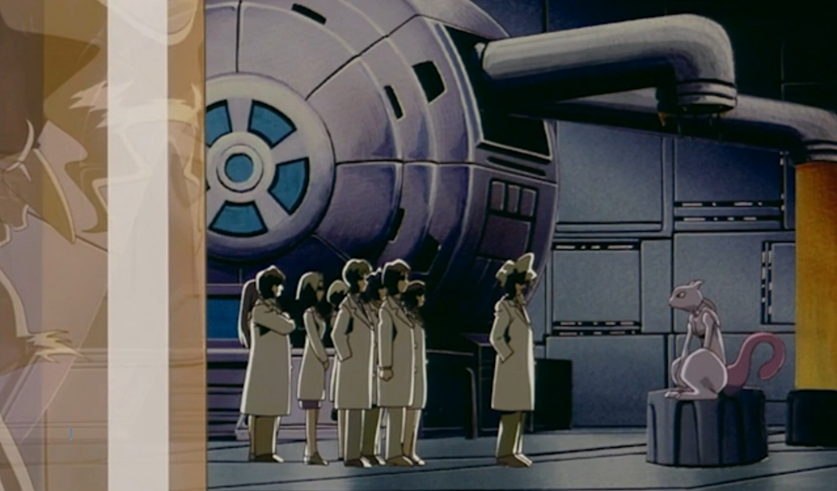
Basically, Evolution is exactly the same story as its predecessor but with a few noticeable changes; the most obvious is, of course, the CGI animation but other things, such as dialogue changes, narrative changes, and changes to the music, all help to freshen up the original movie. The opening scenes are largely the same (but, once again, the film skips the prologue that sees Mewtwo make friends with other clones who heartbreakingly die right before his eyes) as Mewtwo is cloned from a single cell of Mew and, unimpressed with the motivations behind his creation, destroys the facility in which it was created and kills all the scientists who birthed it.

MewtwoEvolutionRevenge
Mewtwo swears revemge against humanity.

Summarily manipulated by Giovanni (Ted Lewis), the evil leader of Team Rocket and the mastermind behind its creation, Mewtwo’s rage against humanity leads it to organise a Pokémon tournament in order to build an army of clone Pokémon to “strike back” against the world that treated him so badly. In the middle of their journey through Kanto, Ash, Brock (Rogers), Misty (Knotz), and Pikachu (Ōtani) receive an invitation to Mewtwo’s island and, after braving a storm it created, immediately take umbrage to Mewtwo’s twisted world view and rally a group of trainers, their Pokémon, and even their long-time enemies from Team Rocket, Jesse (Knotz), James (Cathcart), and Meowth (ibid), in opposing Mewtwo’s plans.

MewtwoEvolutionOppose
Ash vehemently opposes Mewtwo’s plans.

Let me state first of all that, unapologetically, I absolutely love Pokémon the First Movie; I still remember going out of my way to purchase a bootleg VHS tape of the film back in the day before finally getting a legitimate copy from a car boot sale. As much as I’ve enjoyed subsequent Pokémon movies, nothing beats the nostalgia of revisiting the original film. It may have some flaws, largely based around the numerous changes made when dubbing the film into English that made Mewtwo far less sympathetic, but I will defend it to this day simply because it came right at the peak of Pokémon’s popularity for me; Pokémon: Gold Version and Pokémon: Silver Version (Game Freak, 1999) were due to be released around that time and the hype was real concerning brand new Pokémon, to say nothing of finally seeing Mewtwo in all its glory (it had been teased in several episodes of the anime prior to the movie’s release), much less going head-to-head with Mew, which was the most elusive of game secrets at the time due to their being no legitimate way to catch it outside of Japan.

The Nitty-Gritty:
Thankfully, Evolution doesn’t really alter that much from the original film, meaning that the only thing you’re really missing out on is the gorgeous anime aesthetic from the original. The CGI looks good on the Pokémon but the human models look a little…off, like they’re made of plastic, which gets a bit distracting at times.

MewtwoEvolutionBattles
A lot of the battles have been improved and expanded upon.

Additionally, there were a few odd choices made here; dialogue is altered significantly, to the point where it feels much closer to the original Japanese dialogue (if that makes sense) but then, about halfway through, the dialogue changes and is almost exactly the same as in the original film (Mewtwo’s closing monologue, for example, is pretty much word-for-word). There’s also the criminal decision to supplant the original dub score with a new one (those who preferred the Japanese score will likely be thankful for this, however) and completely remove Blessid Union of Souls’ ‘Brother My Brother’ from the epic final clash.

MewtwoEvolutionTears
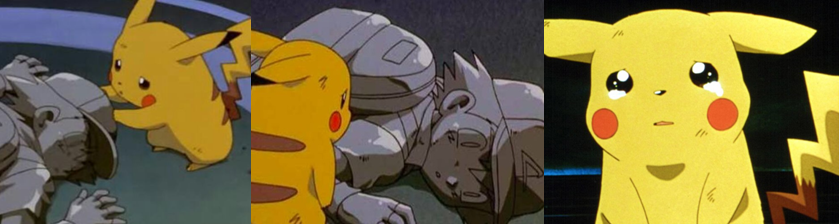
Ash’s sacrifice still hits in the feels…

One change I did appreciate, however, was the complete remove of the “tears of life” sub-plot; in the original, Ash and the others are fed a nonsense story about Pokémon tears being able to restore the dead to life, which was completely missing from the original Japanese version. While this did bring a lot more context to Ash’s resurrection in the film’s climax, it never sat well with me in the original as it always felt wedged in there.

MewtwoEvolutionChanges
Evolution features some welcome alterations to the original.

Similarly, Mewtwo’s mechanical suit gets on hell of a bad-ass upgrade, Team Rocket’s amusingly ridiculous disguise as Viking sailors, of all things, is removed completely (and for the better), and minor niggles like Pokémon being referred to incorrectly have been addressed. There are also some improvements made through this remake, as well; the ambiguity surrounding Mewtwo’s motivations that was explicit in the original Japanese release is far more prevalent here than in the original dub, for one thing. Some of the battles also receive a makeover, such as Ash’s initial battle during the iconic Pokémon theme song and the battles between the cloned start Pokémon and their biological counterparts.

MewtwoEvolutionSUmamry

The Summary:
In the end, Pokémon: Mewtwo Strikes Back – Evolution is a nice little update to a childhood favourite; it adds in a lot of subtle story beats that were missing, beefs up some of the battles and content, and adds a fresh coat of paint to a classic. Yet, at the same time, it feels incredibly redundant; beyond the CGI overhaul and a few of these alterations, there’s not much new happening here and, considering the fact that the Pokémon movies are completely removed from the anime, it feels a bit weird to have this suddenly released upon us. A big factor into my final score comes down to my unconditional love for the original movie but even I kind of feel like much of the same could have been accomplished by releasing a high-definition, digitally remastered version of the original movie with all of the cut content restored alongside the recording of a new dub and the option to watch in the original Japanese.

My Rating:

Rating: 4 out of 5.

Great Stuff

What did you think of Pokémon: Mewtwo Strikes Back – Evolution? Do you think it is a good tribute to Pokémon the First Movie: Mewtwo Strikes Back or do you, perhaps, not share my fondness for that movie? Whatever the case, feel free to share your Pokémon thoughts and memories in the comments.

Movie Night: Sonic the Hedgehog (2020)

SonicMovieLogo

Released: February 2020
Director: Jeff Fowler
Distributor: Paramount Pictures
Budget: $81 to 95 million
Stars: James Marsden, Ben Schwartz, Tika Sumpter, and Jim Carrey

The Plot:
Small town cop Tom Wachowski’s (Marsden) life is turned upside down when Sonic (Schwartz), a superfast hedgehog with an insatiable curiosity and the means to travel between worlds, is targeted by the megalomaniacal Doctor IvoRobotnik (Carry).

The Background:
Back in the nineties, in the middle of the escalating Console War between Nintendo and SEGA, the videogame industry was changed forever when Yuji Naka and Naoto Ohshima dreamed up the idea of the superfast hedgehog that would become their mascot and most profitable franchise for years to come. Sonic has seen his fair share of adaptations; he’s been a hot air balloon, on t-shirts, featured in comic books, and has, most prominently, had more than a handful of ventures into animation. Every time Sonic is adapted from one form of media to another (and, it seems, almost every time a new Sonic videogame is released) something is altered, however subtly, about his appearance, backstory, or mannerisms, making for one of the most iconic and, yet, convoluted videogame mascots ever made. Aside from the gorgeous original video animation (OVA), Sonic the Hedgehog: The Movie (Ikegami, 1996), Sonic has had to settle for cameos in movies until now. After a disastrous first trailer and initial design that saw Sonic look like some weird mutant human/monster hybrid thing, Jeff Fowler and Paramount delayed Sonic the Hedgehog to redesign the titular hedgehog for his first big screen, live-action debut.

The Review:
Raised in secret on a far away world, Sonic is forced to flee his home through the use of dimensional Golden Rings; arriving in Green Hills, Montana, where he spends the next ten years living in isolation out of the fear that his super speed will draw attention to him and force him to flee once again.

SonicMovieBlackout
Sonic accidentally draws attention to himself…

Sonic spends most of his time observing Tom Wachowski and his wife, Maddie (Sumpter), and longing to be a part of society and make a real friend. When his speed powers unintentionally cause a massive blackout in Green Hills, the US military bring in Doctor Robotnik to investigate the disturbance.

SonicMovieRoadTrip
Nothing like a good, old-fashioned road trip with a twist!

Spooked by the incident, Sonic reluctantly decides to leave his home but accidentally drops his bag of Golden Rings through a dimensional portal, where they land in San Francisco. Unable to find his way there, Sonic and Tom team up on a road trip to retrieve the Rings, all the while being pursued by Robotnik and his deadly robotic drones. Going into Sonic the Hedgehog, I wasn’t expecting anything more complicated than a by-the-numbers family-friendly kid’s movie; I was unimpressed that Paramount opted for a live-action/CGI hybrid film rather than a full-on CGI movie in the style of a Disney/Pixar production (or the amazing CGI cutscenes of modern Sonic videogames) and, upon seeing Sonic’s ruinous first design, I was ready to write the entire movie off, which was rather distressing for me given that I have been a life-long Sonic fan. Instead, Sonic the Hedgehog is a really fun (and funny) little romp; Sonic’s characterisation has been tweaked slightly and, rather than the “hedgehog with attitude” or the cocky, confidant superhero of the videogames, he is a lonely, curious, hyperactive little creature who longs to belong in a world and is struggling to control his great speed and with his desire to use his powers for a greater purpose.

SonicMovieHumans
Sonic’s human cast does a far better job than I expected.

His interactions with Tom are charming and whimsical. Marsden is no stranger to films or roles such as this and, yet, he is the perfect actor to portray an everyman character who longs for a greater challenge beyond his mundane, everyday life. To my great surprise and delight, the two quickly form an odd couple friendship that grows throughout the film and there isn’t one of those clichéd moments where they argue and fall out and have to rebuild their friendship.

SonicMovieRobotnik
Jim Carrey steals every scene he’s in, it’s fantastic!

Surprising no one, the real star of the show here is Doctor Robotnik; Jim Carrey is back at his scenery-chewing, maniacal best as he perfectly encapsulates the Doctor’s madcap, zany megalomania and slowly degenerates further and further into both madness and a more recognisable version of his videogame counterpart. Do I think he would have been just as good in a fat suit and acting alongside a cast of CGI characters? Sure, but that doesn’t stop his performance being a delight. Sonic the Hedgehog is part comedy, part road trip, part quasi-sci-fi/fantasy action; Sonic himself provides much of the jokes and action, but Carrey is no slouch in either department either thanks to his wacky personality and his incredibly adaptable machines. As with all Sonic adaptations, Sonic the Hedgehog weaves in numerous references to the source material; there’s a loving recreation of the character’s traditional home, South Island, nods to iconic Zone names, and even a few musical cues from the videogames. Arguably, the film could have gone further with these and weaved iconic boss themes into a motif for Robotnik but it definitely feels as though the movie was concentrating on establishing a new version of Sonic and bringing in additional videogame elements in a future sequel.

SonicMovieSonic
Sonic’s redesign looks great.

As it stands, though, Sonic the Hedgehog was a surprisingly good time; all the characters were fun and enjoyable and the film avoided a lot of the clichés that movies of this type often fall back on. It may not be the best videogame adaptation but it’s more than a worthy successor to Pokémon: Detective Pikachu (Letterman, 2019) despite featuring only one fully-realised CGI character largely through its whimsical charm and is surprising amount of restraint as it focuses on telling its own unique Sonic story rather than overloading the film with elements from the videogames.

The Nitty-Gritty:
As with most Sonic adaptations, Sonic the Hedgehog feels the need to include, and place special emphasis on, the Golden Rings that form the life energy of the videogames. Rather than being the source of Sonic’s power, or a power boost for him, here they act as dimensional gateways, which isn’t a million miles away from the function the Big Rings perform in Sonic videogames.

SonicMovieGags
There’s some charming humour at work here…

Going into the film, I was concerned that they were pushing the Rings as Sonic’s “super power” rather than his super speed but, luckily, that wasn’t actually the case. Instead, Sonic’s speed seems to have some mystery behind it. His childhood guardian, Longclaw (Donna Jay Fulks) seems to be hiding, and protecting, Sonic not just because of the power of the Rings (which seem to be her possession rather than his) but also because of his speed, which (alongside the way his super speed is presented as a quasi-power-up at dramatic times) makes me think we might see a connection between Sonic’s speed and the Chaos Emeralds in a future sequel.

SonicMovieRobotnik2
Robotnik only has time for machines…

Speaking of future sequels, and Longclaw, perhaps the biggest surprise for me was that, in the opening moments, Sonic and Longclaw are attacked by a group of masked echidnas after they spot Sonic using his super speed. This was a fun and unexpected inclusion and raises a lot of questions for future sequels, especially with Robotnik being marooned on a mushroom-filled planet and vowing revenge. Unfortunately, I had the big mid-credits reveal spoiled thanks to Twitter but, suffice it to say, Sonic’s long-time friend Miles “Tails” Prower (Colleen Villard) shows up looking for Sonic, setting up both future films and spin-offs in this world.

SonicMovieSummary


The Summary:
Sonic the Hedgehog was way better than it had any right to be. The overhaul of Sonic’s design alone makes the film worth the price of admission but, alongside that and some clever references to the videogames, the film is a fun, charming little family action/comedy that brings a new dimension to Sonic’s character and lore. Sonic and Jim Carrey are the clear stars of the show but there’s plenty here to enjoy. I feel that, if we do get a sequel, we will see the filmmakers take things a little further and delve a little deeper into Sonic’s more familiar mythology now that they’ve established their version of the character and I am honestly looking forward to seeing this version of Sonic (and, especially, Robotnik) return in the future.

My Rating:

Rating: 3 out of 5.

Pretty Good

Movie Night: Birds of Prey (and the Fantabulous Emancipation of One Harley Quinn)

BOPLogo

Released: February 2020
Director: Cathy Yan
Distributor: Warner Bros. Pictures
Budget: $82 to 100 million
Stars: Margot Robbie, Mary Elizabeth Winstead, Jurnee Smollett-Bell, Rosie Perez, Chris Messina, and Ewan McGregor

The Plot:
After separating from the Joker (Jared Leto), Harley Quinn (Robbie) incurs the wrath of the sadistic Roman Sionis/Black Mask (McGregor) and must team up with a rag-tag group of women who have also become targets of Sionis.

The Background:
Let’s not mince words: Suicide Squad (Ayer, 2016) was a bad film. It had so much potential and squandered it through sloppy editing and a questionable plot. However, two of the stand outs from that God-awful movie were Floyd Lawton/Deadshot (Will Smith) and Margot Robbie’s scene-stealing performance as Harley Quinn. Given the character’s cult-like following and increase in popularity, her return seemed all-but-inevitable but, in the odd, shifting, uncertain climate that surrounds the DC Extended Universe (DCEU) it was never a guarantee. However, Robbie, apparently, took it upon herself to put together a film that is not just a solo outing for Quinn but also provides a look at some of DC’s most iconic and bad-ass female characters. The result is a film as much about female empowerment and establishing your own legacy independent of others (especially abusive partners or male patriarchs) that takes everything that was good about Suicide Squad, sprinkles in more than a liberal borrowing from other violent, curse-filled superhero outings (like the Deadpool (Various, 2016 to present) films), and results in a pretty decent inclusion in an extended universe that seems to be increasingly losing sight of its direction.

The Review:
After being rescued by the Joker at the end of Suicide Squad, Harley Quinn has been unceremoniously dumped by the Clown Prince of Crime. Her first reaction to this is to, smartly, tell no one so she can continue to enjoy the fruits of being Joker’s main squeeze, which allows her to live a life of debauchery, drinking, and buying hyenas. However, once word gets out about the break-up, it becomes open season on Harley not in the least because Roman Sionis wastes no time in wanting to lay claim to her unique abilities. In the midst of fighting for her life, Harley runs into Cassandra Cain (Basco), a pick-pocket who picks the wrong pocket when she lifts a diamond out of the pocket of Roman’s top henchman, Victor Zsasz (Messina).

BOPBirds
To say these women mean business is an understatement…

Desperate to lay claim to the diamond in order to consolidate his stranglehold on Gotham’s criminal underworld, Sionis puts a hit out on Cassandra and, in trying to recover the diamond and buy her freedom, Harley crosses paths with disgraced and undervalued Gotham City Police Detective Renee Montoya (Perez), the vengeance-seeking, crossbow-wielding assassin Helena Bertinelli/Huntress (Winstead), and Dinah Lance/Black Canary (Smollet-Bell), a singer from Roman’s club with more than a few hidden abilities. First off, this is largely Margot’s show; she narrates the film, controls the narrative and timeline through some amusing fourth wall breaks, and is the central, strongest character in the film. Perfectly encapsulating Harley’s many and varied (and chaotic) character and personality quirks, Margot cements that she was the perfect choice to play this character and more than capable of standing on her own.

BOPTeam
The titular Birds help flesh out Harley’s character.

However, as we saw in Suicide Squad, Harley works best when bouncing and playing off of other characters, especially ones who are snarkier, more serious, or more sadistic than she is. Birds of Prey gives Harley a lot of these characters to work with and each one helps flesh her out in different ways: Cassandra helps her explore her protective, maternal side; Canary gives her a peer on equal footing as a fighter and a smart-talker; Huntress sets a standard off no-nonsense bad-assary that Harley wants to live up to; and Montoya gives her a foil, of sorts, to clash ideals with.

BOPSionis
McGregor is clearly revelling in his role as Black Mask…

And yet, amongst all these strong-willed women, is perhaps the most atrocious antagonist in the DCEU yet played with delightful glee by old Obi-Wan himself, Ewan McGregor. Black Mask seems like a simple, one-note sadist but, actually, he has a few layers to him that may not be immediately noticeable as, unlike most characters, he doesn’t really get a flashback or onscreen text to go through his backstory. Roman flip-flops alarmingly between a charismatic smooth-talker and an unhinged psychopath and Ewan is clearly having the time of his life in the role. Apparently, there’s been a lot of negativity surrounding Birds of Prey and it’s even had a slight title change (to Harley Quinn: Birds of Prey) to try and better capitalise on Harley’s popularity but I don’t really get why anyone wouldn’t like this movie. It’s fun, with some really brilliant (and vicious) action sequences, and is basically Deadpool but with some kick-ass women taking centre stage.

BOPMargot
Not really sure how anyone could miss that Harley was in this movie…

Maybe people are having issue with the film’s portrayal of strong, independent women but…it’s Birds of Prey, a superhero group founded by, and exclusively comprised of, women! People have also been criticising the title; apparently, some didn’t realise Harley Quinn was in this movie? Which is just…mind-blowing to me as she’s been central to all of the marketing I’ve seen (and there’s been a lot of marketing for this movie). Saying that, though, the title is a little misleading; it’s only really Birds of Prey by the conclusion and it may have been better to just title it The Fantabulous Emancipation of One Harley Quinn but none of that should stop you, or anyone else, checking this one out because it’s one hell of a good time.

The Summary:
Normally, I talk about some spoilers in my review (which I unhide when the film comes out on DVD) but there really isn’t much to spoil in Birds of Prey; it’s just a fun, entertaining, kick-ass little film that’s got a lot of action and humour in it and it really doesn’t deserve all the vitriol it’s been getting. Everyone looks like they’re having a blast throughout this movie and like they’re really happy to be there and the film does a pretty good job of giving everyone a chance to shine. I guess I can understand Cassandra Cain fans being a bit disappointed, though, as she is a far cry from her comic book counterpart but, overall, Birds of Prey has way more hits than misses (Cassandra is, in my view, the only real miss of the film) and I would say it is definitely worth your time and money.

My Rating:

Rating: 3 out of 5.

Pretty Good

Movie Night: Star Wars: Episode IX: The Rise of Skywalker

StarWarsSkywalkerLogo

Released: December 2019
Director: J. J. Abrams
Distributor: Walt Disney Studios Motion Pictures
Budget: $275 million
Stars: Daisy Ridley, Adam Driver, Oscar Isaac, John Boyega, and Ian McDiarmid

The Plot:
When a threat of revenge is issued by the long-dead Emperor Palpatine (McDiarmid), Rey (Ridley) is drawn into another confrontation with Kylo Ren (Driver) in the search for an ancient Sith device that will reveal the location of the resurrected emperor and decide the fate of the entire galaxy,

The Background:
So, this is it; for better or worse, the “Sequel Trilogy” of Star Wars movies (Various, 1977 to present) comes to an end. For me, this has been a disappointment since Star Wars: Episode VII: The Force Awakens (ibid, 2015), which was little more than a retelling of better Star Wars stories but with better effects and writing, and only exacerbated by the dreadful Star Wars: Episode VIII: The Last Jedi (Johnson, 2017). Rather than show us a galaxy thriving under the leadership of Leia Organa’s (Carrie Fisher) New Republic alongside Han Solo (Harrison Ford) and Jedi Master Luke Skywalker’s (Mark Hamill) reconstituted Jedi Order, we inexplicably have a galaxy threatened by the First Order (who are somehow, consistently, more powerful than the Galactic Empire ever were despite all the losses from the Death Star and Starkiller base…) and being opposed, once again, by a rag-tag resistance group. The Last Jedi then pissed a lot of people off by dropping the ball on Rey’s origins, killing off Supreme Leader Snoke (Andy Serkis) without any fuss or fanfare, and doing away with Luke purely so that Rey could shine as the titular “last Jedi”. Somewhat spooked by reactions to The Last Jedi (and the two spin-off movies, despite the fact that I actually preferred both of them to the entire Sequel Trilogy), Disney roped J. J. Abrams back into the fold to get the Star Wars franchise back on course and, what we’re left with, is a hodgepodge of fan service, damage control, and desperation as he frantically tries to wrap up not just the Sequel Trilogy but the entire Skywalker Saga itself!

The Review:
The Rise of Skywalker kicks off with Ren immediately locating one of only two Sith wayfinders and travelling to the forgotten Sith planet Exegol where he encounters Palpatine, who wastes no time in providing half-assed explanations regarding his resurrection/survival, Snoke’s origins, and motivations for Ren reconstructing his helmet and getting back out their to kill Rey. The implication seems to be that Palpatine transferred his spirit into a clone body and was controlling Snoke like a puppet to convert Ren but…it’s not dwelled upon much at all, which really makes you feel like you’ve wasted your time watching any of the previous movies.

StarWarsSkywalkerRenFocus.PNG
Despite it all, Driver brilliantly showcases Ren’s duelling nature.

Plus, like, the emperor surviving really undermines the Rebellion’s victory and takes a lot of power and urgency away from Ren, who is otherwise portrayed fantastically by Adam Driver. Imagine if Anakin Skywalker (Hayden Christensen) had been as wonderfully torn between rage, indecision, and love; Ren is constantly on the edge, flipping between extreme focus, exploding in anger, and struggling with committing to the Light or Dark Side.

StarWarsSkywalkerBuddies
Thankfully, the chemistry between these guys is a highlight of the film.

As for Rey, she’s been spending her time training with Leia and studying the Jedi texts she obtained from Luke while Finn (Boyega) and Poe Dameron (Isaac) return with news of the emperor’s return. Thankfully, this leads to the three of them heading out to Pasaana to try and find the other wayfinder and end the emperor before he can launch his master plan (called “The Final Order”…which really should have been the title of the movie as the title is dogshit…). One of the strengths of Abrams’ Sequel Trilogy has been the writing and dialogue and Finn, Poe, and Rey have great chemistry together; they bicker and talk like real people and real friends, which is always refreshing after sitting through George Lucas’ stilted, robotic writing.

StarWarsSkywalkerLando.PNG
It’s always a pleasure to see Billy Dee Williams.

In all honesty, the plot of The Rise of Skywalker boils down to a glorified fetch-quest; the heroes bounce around the galaxy trying to track down the wayfinder and, eventually, find themselves teaming up with Star Wars staple Lando Calrissian (Billy Dee Williams) and exploring the remains of the second Death Star, where Rey’s super-duper true origins are finally revealed. Alongside such blatant fan service, The Rise of Skywalker is also gloriously peppered with epic space battles and some of the best lightsaber battles we’ve ever seen, all bolstered by some of John Williams’ best work. Unfortunately, I cannot get over the missteps the franchise has taken since The Force Awakens and the film feels a bit rushed and slapped together in places as Abrams desperately performs damage control to rush the film, the sequels, and, stupidly, the entire saga to a conclusive finish…and still ends with the door left so blatantly open for future films in the series.

The Nitty-Gritty:
So, if you hated Rey before, you’re probably going to hate her even more when it’s now revealed that her parents weren’t nobodies; instead, Rey is inexplicably Palpatine’s granddaughter…which raises so many questions like: when did Palpatine have a son? Who was his mother? Why would he ever left his progeny live? Why has it taken him so long to track them down and kill them? These questions are trumped by a far more pressing one, though, which is literally the question of why Palpatine is even alive at all. Obviously, this is a cheap move to ensure that audiences will flock in droves to see the film out of nostalgia but it really takes away from the victory on the second Death Star and Abrams did very little to justify it. I really feel like we needed a more blatant explanation of his survival and the nature of his relationship with Snoke but, instead, it’s hand-waved away in the laziest way possible.

StarWarsSkywalkerDestiny.PNG
The emperor’s threat is issued and destiny awaits…

Also, while he’s been rebuilding himself and his power, the emperor also build an entire fleet of Star Destroyers, all fully manned and armed with planet-killing weapons. Where did he get the resources and manpower for such an endeavour? Fucked if I know, but he did. Not only that, but Richard E. Grant is randomly in charge of the fleet as General Pryde, because I guess Colonel Sandurz was busy that day and I guess Adrian Edmonson was unavailable and Abrams saw how Johnson reduced the already pathetic General Hux (Domhnall Gleeson) into a whiny little cry baby. But it’s okay because it turns out Hux is so jelly of Ren that he’s been leaking information to the Resistance and, right when you think that means he’s going to do something interesting, he’s just shot dead by Pryde. Speaking of uninteresting, the fabled Knights of Ren finally make an appearance in this movie; they’re a handful of black-clad, anime-sword-wielding enforcers who…stand around doing nothing, beat up Ren for a bit, and then get killed like a bunch of punks! The big story here is the continued turmoil that Kyle Ren is going through; although he aligns with the emperor, he secretly (well….it’s not really a secret; he yells about it at almost every opportunity) seeks to turn Rey so they can team up, bump uglies, and usurp the emperor together. When Leia gives her life to distract Ren, he ends up having a heart-to-heart with a vision/memory/something of his father and rejecting his lightsaber. Reclaiming the name of Ben Solo, he helps Rey to defeat the emperor (and, by extension, the entirety of the Sith, it seems) but dies to bring Rey back to life, becoming one with the Force in the process. It’s a bit of a weak ending as it means the entire Organa/Solo/Skywalker bloodline is dead but Abrams tried to make up for it by having Rey travel to Tatooine (because God forbid we don’t go back there again!) and dramatically declare herself to be “Rey Skywalker”…despite having no claims to the name.

The Summary:
Star Wars: Episode IX: The Rise of Skywalker is clearly the best entry in the Sequel Trilogy but, as a finale to the entire Skywalker Saga, it fails in quite a few ways. Also, it’s hard to watch without the sour taste of its predecessors tainting the film, no matter how engaging the action is or how meaningful some of the film’s heartfelt moments are. Abrams throws all the fan service he possibly can at the film and you can almost see him plastering over the cracks in the film but it’s all at the detriment of telling an original story and nowhere is this more evident than in the credits of the movie. I get that Carrie Fisher and Mark Hamill are legends to this franchise but their roles are so minimal in this film yet they get top billing over Ridley, Driver, Isaac, and Boyega and that’s a bit of a joke, to be honest. In the end, I’m glad that this film has brought the main saga to an end. Hopefully, Star Wars can focus on its Disney+ shows, regroup, and, the next time someone decides to make a film trilogy, they will sit down and map out an actual plan rather than just picking out their favourite Star Wars moments and slapping them into a space/action drama and calling it a day.

My Rating:

Rating: 1 out of 5.

Terrible

Movie Night: Terminator: Dark Fate

TerminatorLogo.PNG

Released: October 2019
Director: Tim Miller
Distributor: 20th Century Fox
Budget: $185 Million
Stars: Natalia Reyes, Mackenzie Davis, Gabriel Luna, Linda Hamilton, and Arnold Schwarzenegger

The Plot:
Three years after ensuring that malevolent artificial intelligence Skynet never comes into existence, jaded and emotionally repressed Terminator-hunter Sarah Connor (Hamilton) is brought back into the fight and forced to team up with the cybernetically-enhanced Grace (Davis), and confront her past once more, when an advanced Rev-9 model (Luna) is sent back through time to terminate the seemingly-innocuous Daniella Ramos (Reyes).

The Background:
The Terminator (Various, 1984 to present) franchise has had a hard time of it in recent years. It seems like every time a film studio acquires the rights (or some of the rights) to the series, they scramble about trying to find new ways to shoe-horn in the classic T-800 (Schwarzenegger) and desperately kick-start a new trilogy of films, only to fail time and time again. James Cameron scored a cult classic with the original 1984 Terminator film and then caught lightning in a bottle with one of the greatest sequels ever made, Terminator 2: Judgment Day (ibid, 1991). Since then, only the criminally underrated Terminator Salvation (McG, 2009) has dared to try something new to the franchise as both the laughable Terminator 3: Rise of the Machines (Mostow, 2003) and the mediocre Terminator Genisys (Taylor, 2015) simply chose to retell exactly the same story as T2 with only minor changes. Now, though, after Genisys failed to make the required box office impression, Cameron has been looped back into the production of yet another reboot to the franchise. Despite previously advocating Genisys as the “true Terminator 3, Terminator: Dark Fate ignores every film in the franchise except for T2 and, with stars Hamilton and Schwarzenegger also involved, aims to be the true, definitive Terminator 3.

The Review:
Terminator: Dark Fate ignores the massive cliffhanger from the end of Genisys and chooses to open three years after the end of T2 where Sarah Connor and her teenage son, John (Jude Collie, with Edward Furlong’s facial likeness) are relaxing in Guatemala. We then jump to 2020 where Grace and the Rev-9 arrive in Mexico City; Grace, who is cybernetically enhanced (a concept not unlike what we saw in Salvation’s Marcus Wright (Sam Worthington), has been sent back to protect the new saviour of the future, Daniella “Dani” Reyes, who is just a lowly factory worker at this point.

TerminatorGraceDani.PNG
Dani finds herself the target of the newest Terminator…

They soon run into the Rev-9, perhaps the most charismatic of all the future machines we’ve seen so far; the Rev-9 is able to simulate clothing, emotions, and appears far more human than any of its predecessors. It is also comprised of both a metallic endoskeleton and a liquid metal exterior not unlike Terminator 3’s T-X (Kristanna Loken) and Genisys’ T-3000 (Jason Clarke), though the Rev-9 favours shape-shifting and stabbing weapons like the T-1000 (Robert Patrick). While evading the Rev-9, Grace and Dani are saved by Sarah, now a world-weary, war-torn woman who has spent her years hunting down and eliminating Terminators thanks to tip-offs from a mysterious source. Facing the threat of a similar, yet fundamentally different, apocalyptic future and with nowhere left to turn, Grace brings the group to the source of Sarah’s intel, an aged T-800 and, together, the four formulate a plan to destroy the Rev-9 and maintain hope for the future. From the very beginning (and I mean this absolutely literally), Dark Fate is an immediate and egotistical punch to the gut. If, like me, you enjoyed Salvation (or, at least, wanted to see more of the future war in subsequent Terminator movies) or you were desperately hoping to see Genisys’ loose ends tied up, you’re going to be immediately disappointed. Hell, the few fans and defenders of Terminator 3 will likely to be disappointed, to say nothing of fans of The Terminator and Terminator 2.

TerminatorGraceRev9.PNG
Grace’s augments make her more than capable of fighting the Rev-9.

Once you desperately try to process Dark Fate’s maddening opening, you’ll be treated some fast-paced, frenetic action scenes; honestly, these are the best parts of the film beyond the actors’ performances and Dark Fate has some intense car chase sequences and confrontations with the Rev-9.I wasn’t too impressed with Gabriel Luna’s appearance when I first saw the trailers for Dark Fate but he does a great job of being cold and calculating but also eerily sinister and human; he’s like a chattier T-1000 at times, which conveys just the right degree of menace. Davis fits the mould of a battle-scarred soldier extremely well as well; her cybernetic enhancements ensure that she is a formidable protector but, thanks to her human physiology, she is also vulnerable as she must take regular does of medicine to stop her metabolism from burning up (…somewhat similar to the Uni-Sols from Universal Soldier (Emmerich, 1992)). Like last year’s poorly-titled and poorly-conceived Halloween (Green, 2018), one of the big selling points of Dark Fate is the surprising return of Linda Hamilton to her most famous role. Controversially killed off between T2 and Terminator 3 and all-but-absent from the franchise outside of the short-lived television show and Emilia Clarke’s portrayal in Genisys, seeing Hamilton lace up her boots again is a nice treat and her character takes some sudden and unexpected twists throughout the course of the movie. Jaded and emotionally stunted, she cares on about destroying every last trace of Skynet, causing her and Grace to have a frosty relationship upon first meeting.

TerminatorSarahDani.PNG
Sarah’s obsession leads her to protecting Dani from the Rev-9…

Dani is a likable and serviceable character as well; she has a fighting streak in her but, rather than being the completely useless damsel-in-distress Sarah was in The Terminator or the bad-ass soldier Sarah was in T2, ends up as a slightly-more-capable version of Terminator 3’s Kate Brewster (Claire Danes)…only with way better writing and characterisation. Finally, there is the T-800; like in Genisys, the T-800 (who is known as “Carl”) is aged and has been preparing for Sarah’s inevitable arrival. The T-800 adds some muscle to the group and it never fails to impress how easily Arnold slips back into his most iconic role but, in the end, due to Grace’s presence, it doesn’t really feel like there’s a lot for the T-800 to do and even less reason to truly justify its inclusion beyond Terminator being synonymous with Arnold.

TerminatorT800.PNG
While it’s great to see Arnold back, there isn’t much for him to do…

Instead, the T-800 sticks out a bit, especially given that Dark Fate is driven so strongly by three women who are very strong and capable in their own ways. Suddenly adding a male figure, even a machine one, to the mix seems to add a displeasing anti-feminist message that I’m sure will be the subject of many feminist essays, readings, and reviews for years to come. Unfortunately, a few fancy visuals and strong performances don’t change the fact that Dark Fate is the definition of “derivative”. Outside of one major change, there is literally nothing to see here that you can’t get from other Terminator movies. Apparently, Cameron and his writers watched all the other Terminator sequels before they hashed out the plot for Dark Fate but it seems that, rather than deliver something fresh and new, they instead jotted down all their favourites parts of the other movies and decided to do them all over again but now with “James Cameron’s seal of approval (as if that means anything given he was all for Genisys back in the day).

TerminatorT800Rev9.PNG
Despite some good action, Dark Fate is just too derivative…

As a result, while Dark Fate is exciting and does a good job of recreating the same kind of tone as The Terminator and T2, it seems a bit pointless to watch it as it’s extremely unlikely that the film will perform well enough to allow for any sequels (it’s currently only made $12.6 million and Genisys didn’t get a sequel despite making over $400 million against a budget similar to Dark Fate’s). add to that that we’ve literally seen everything Dark Fate has to offer in other Terminator films and I’m seriously struggling with a lot of the decisions Cameron and his team chose to make. I’ve been saying for years that the Terminator franchise needs to stop playing it so safe, stop recreating T2, and try and do something new and fresh but, every time they do, the films never really take off; every time they lean heavily into nostalgia, it leads to disappointing box offices and, now, whenever they try everything else they can to keep things similar but ever-so-slightly different, it still seems as though people just aren’t into the Terminator anymore and that there’s just nothing left for the franchise to do.

The Nitty-Gritty:
So, if you’ve been paying attention to the trailers and managed to read between the lines of my review, you’ll notice that John Connor is conspicuous by his absence. This is because Cameron’s bright idea to really hammer home that Dark Fate has nothing to do with any of the Terminator films but the first two is to have a T-800 walk up to John and shoot him with a shotgun within the first five minutes of the movie. Who would have thought that, after everything Sarah and John went through, it would literally be as easy as walking up to him and shooting him? Honestly, I cannot get over this asinine decision. I get why they did it but it’s so unnecessary and literally just the easy way out. Now it feels completely pointless to watch The Terminator and T2 as John just gets blown away with no fuss or fanfare; all that drama and emotional investment just pissed away. Honestly, you’d think Cameron would have learned from the fan outrage to the off-screen deaths of Hicks (Michael Biehn) and Newt (Carrie Henn) in Alien3 (Fincher, 1992) but apparently not.

TerminatorDarkFate
The future still needs protecting from killer machines.

With John dead, Sarah is an emotional wreck; her own release comes from alcohol (though this isn’t shown onscreen) and destroying Terminators. She is cold and emotionally closed off and her character is learning to let go of her anger and reconnect with her humanity by taking Dani under her wing. She does this by forging an alliance with the same T-800 that murdered John; having completed its mission, “Carl” ended up living with a woman and her child and, through raising a son and being a family “man”, somehow developed something resembling a conscience and a degree of free will (so much for not feeling “pity, or remorse”…I guess). Wanting to give Sarah purpose, it relates to her specific dates, times, and locations of future Terminators (how and exactly why Skynet would program it with this knowledge is anyone’s guess…) and jumps at the chance to make amends for its actions by assisting Sarah. This is a pretty big problem, though. Because we’re all familiar with Arnold and the T-800 as a self-sacrificing protector, you want to feel empathy for the T-800 and, when it ultimately sacrifices itself to destroy the rev-9 “for John”, it should be an emotional moment. Sarah’s reaction even indicates that she has forgiven the T-800 and let go of her hate…but her hate is what drove her and gave her purpose and it’s very difficult to truly sympathise with “Carl” because it murdered a teenage boy right in front of his mother! And not just any teenage boy; future saviour John Connor, who we were equally attached to after following his and Sarah’s story in the first two movies!

TerminatorRev9.PNG
The Rev-9 separates into a liquid metal and endoskeleton for twice the danger!

As I said above, Arnold really feels completely unnecessary to this movie. He’s literally only there because of Cameron and because of the assumption that a Terminator movie cannot be successful without him, but he doesn’t add anything to it. They could have just as easily made the same movie with Sarah and John being Terminators hunters and stumbling into this new dystopian future; Grace is more than capable of fighting the Rev-9 and Sarah could have given her life so that John could mentor Dani on how to be the world’s saviour. Hell, they could have just had Sarah say John is off the grid and safe in Mexico but reveal that she was so paranoid and afraid that the future might still go to shit that she cut him off and devoted herself to hunting Terminators. Instead, like I said, they took the easy way out, killing John like he meant nothing and then tossing a load of stuff we’ve already seen onscreen and acting like it’s “new” or somehow “better”. I have news for you, James Cameron: it’s not. In the end, Dark Fate was about as good as Genisys but loses so many points not just for killing John but also for being so derivative: liquid metal and an endoskeleton? Seen it. Old T-880 with paternal instincts? Seen it. Skynet now a slightly different A.I? Seen in. cybernetically-enhanced human? Seen it. Nothing in this movie is “different” or “new” except that they killed John and even that happened in the future in Terminator 3 and, even if it didn’t or you don’t count that, it’s still a terrible decision to make.

The Summary:
In the end, Terminator: Dark Fate is just too derivative and feels completely unnecessary. It has some decent action scenes and a bold, uncompromising feminist agenda but makes some truly deplorable decisions and isn’t given you anything you haven’t seen before. Honestly, it’s a massive disappointment as I was expecting James Cameron to bring some order and prestige back to the franchise; instead, they cut corners at every turn, took the easy way out at every opportunity, and have once again failed to live up to the lofty standards set by Terminator 2: Judgment Day. Here’s an idea for the future, though: try making something new rather than constantly recreating your biggest hit and, if you’re reading this, try actually liking something new. If more audiences had backed Terminator Salvation, we could have gotten one or two more gritty, science-fiction action/war movies that led naturally into The Terminator. Instead, we get derivative, disappointing, insulting stuff like this and I could not be more unimpressed.

My Rating:

Rating: 1 out of 5.

Terrible

Movie Night: Rambo: Last Blood

RamboLogo.PNG

Released: September 2019
Director: Adrian Grunberg
Distributor: Lionsgate
Budget: $50 million
Stars: Sylvester Stallone, Yvette Monreal, Paz Vega, Sergio Peris-Mencheta, and Óscar Jaenada

The Plot:
Eleven years after finally returning to America, Vietnam veteran John Rambo (Stallone) has devoted his life to his adopted daughter, Gabriela (Monreal). However, when Gabriela is kidnapped by human traffickers while in Mexico, Rambo must take up arms once more to bring her home.

The Background:
Unquestionably, Rambo is one of cinema’s all-time iconic action heroes; introduced in First Blood (Kotcheff, 1982) as a psychologically damaged soldier, the character has evolved into a hulking war machine to a disillusioned old man, all while carrying a haunting presence as he struggles to run from, or confront, his inner demons. The poorly-titled Rambo (Stallone, 2008) seemed to tie the franchise up nicely, with Rambo massacring basically the entire Burmese army and then finally returning home after a lifetime of war, drifting, and toiling away from the United States. However, Stallone appears to be in the middle of a kind of renaissance (or, perhaps, undergoing a farewell tour) as he revisits and retires his iconic characters and, as a result, we now have one more chapter in the life of old man Rambo.

The Review:
Going into Rambo: Last Blood, I was expecting something that was more like the (comparative) subtlety of First Blood mixed with the gritty, bloody violence of Rambo and, while that is generally the case, it also feels as though Stallone saw some modern action/thrillers like Taken (Morel, 2008) and the John Wick (Stahelski, 2014 to present) films and said: “What if that…but with Rambo?”

RamboFamily
Rambo has found peace with his family…but nothing lasts forever…

As a result, Rambo: Last Blood is, stylistically, a very different film to its predecessors and Rambo is, overall, a very different character. Having bonded with Gabriela and being close to her grandmother, Maria (Adriana Barraza), Rambo is at peace in a way he never has been in the past as he’s finally back with his family and away from conflict. However, Rambo has also filled his time with building an immense network on caves beneath his father’s ranch, which makes for an impressive and bloody finale to the movie, and is swallowing pills of some description to help curb his post-traumatic stress.

RamboMexico.PNG
Rambo’s mortality is a central theme throughout Last Blood…

However, when Gabriela takes off to Mexico to find her estranged father and doesn’t return, Rambo immediately jumps into his truck and heads down there without a second’s thought to find her and bring her home. Quickly locating the Martinez Brothers, Hugo and Victor (Peris-Mencheta and Jaenada, respectively), Rambo is viciously attacked and has his face scarred by the brothers and their gang of human traffickers. Nursed back to health by journalist Carmen Delgado (Vega), who also has a personal vendetta against the Martinez Brothers, Rambo soon finds himself preparing for war once more, this time to fight for his family first and foremost.

RamboTraps.PNG
Rambo prepares a series of gruesome traps for his victims…

Rambo: Last Blood is, honestly, a bit of a mish-mash of ideas; it ends with a fantastically brutal sequence where Rambo hunts down his prey one by one and murders them in unique and brutal ways, and there’s some intense scenes of him prowling the streets of Mexico chasing down leads and roughing people up for information, and there’s a heart and a tragedy at its core that are reminiscent of other Rambo movies. Yet, throughout it all, I couldn’t help but ask why this movie was deemed necessary; Rambo’s story was largely concluded in Rambo and this extended epilogue, of sorts, only serves to emphasise that this character will never be free from conflict and never be able to truly lay down his guns, which is a sombre and depressing post-script for a character that has, more so than many other action heroes, earned a rest from war.

The Nitty-Gritty:
So, I mentioned Taken above and this is perhaps the most fitting analogy as this film is basically Taken but with Rambo and with one other crucial, gut-punch of a twist…Rambo’s adopted daughter, Gabriela, succumbs to her wounds and drug intake and dies shortly after being rescued by her uncle. This leaves Rambo obsessed with bloody revenge, which he soon obtains when he brutally decapitates Victor off-screen and lures Hugo (alongside a whole slew of nameless, faceless cannon fodder) to his heavily-booby-trapped ranch in order to blow their fuckin’ heads off and literally pull Hugo’s heart from his chest.

RamboHaunting
Rambo is still struggling with his inner demons.

This over-the-top action and killing is a delicious coda to the film but, during the conflict, Rambo suffers a few gun shot wounds which threatened to leave him dead but, instead, he simply reflects on his fate in a rocking chair and then (literally) rides off into the sunset. So, at the end of Rambo, it seemed like Rambo was going to finally go home and leave war behind and reconnect with his father. Here, though, his father is nowhere to be seen (and, presumably, long dead) and Rambo suddenly, randomly, has an estranged brother (who’s a complete asshole), a gorgeous young niece/stepdaughter, and a Maria, all of whom help to humanise and settle Rambo’s demons. But, now, with Gabriela dead, Maria gone, and his childhood home decimated, Rambo is left as a drifter once again, riding off into an uncertain future.

RamboBow.PNG
Rambo is still a crack shot with a bow and arrow!

Personally, I feel like Gabriela should have survived, perhaps been left in a coma, and Rambo should he satiated this thirst for vengeance but perished in the process, having died fighting for something worthwhile for a change (basically, recreating the end of Logan (Mangold, 2017)…but with Rambo!) Instead, Rambo is left with literally no family to fall back on and no clear end to his story, which may set up for a future instalment later down the line but, in a way, kind of ruins the somewhat-happy ending that Rambo suggested for the character.

The Summary:
Rambo: Last Blood has a few flaws, mainly in trying to justify why it even exists, but it is undeniably a thrill to see the character back onscreen and just as brutal as ever; age may have caused Rambo to become more methodical but it has done nothing to dull his edge or his pit-bull-like fighting spirit, which is as strong as ever. Its just a bit of a shame that he’s been placed in a movie that isn’t really offering the character much more growth or offering anything new to the action/thriller genre, relying more on nostalgia and gruesome violence to prop up its unoriginal narrative.

My Rating:

Rating: 2 out of 5.

Could Be Better

Movie Night: Angel Has Fallen

AngelHasFallenLogo

Released: August 2019
Director: Ric Roman Waugh
Distributor: Lionsgate
Budget: $40 million
Stars: Gerard Butler, Morgan Freeman, Jada Pinkett Smith, Tim Blake Nelson, Danny Huston, and Nick Nolte

The Plot:
After United States President Allan Trumbull (Freeman) is attacked and nearly killed in an assassination attempt, decorated Secret Service agent Mike Banning (Butler) is framed for the plot and forced to go on the run in an attempt to clear his name and uncover a plot to usurp the interests of the US government.

The Background:
Olympus Has Fallen (Fuqua, 2013) was a surprising hit when it came out, make over $170 million worldwide against a $70 million budget; in it, Butler picked up the torch from John McClane (Bruce Willis) and became this generations new (or, perhaps, newest) “Everyman” action hero in what was, almost unashamedly, “Die Hard (McTiernan, 1988) in the White House”. London Has Fallen (Najafi, 2016) followed, upping the states by throwing Banning into a massive city-wide attack; London has Fallen also proved a financial success, making over $200 million on a $60 million budget so, by now, we’ve established that this Fallen franchise makes money by revisiting all the best, over-the-tope narratives and action tropes of the early-to-mid-nineties action movies.

The Review:
Angel Has Fallen scales the narrative and its over-the-top elements back for the most part to focus more on a character study of Banning, the man, rather than the stereotypical, invincible action hero. Banning, suffering from neck and spinal injuries and the onset of age, is confronted with his own mortality and the very real possibility that his time may soon be over as he trades field work for a desk job. Hiding the truth of his condition from his wife, Leah (now played by Piper Perabo), Banning opens the film struggling with giving up his action-orientated lifestyle, an issue exacerbated by his reunion with Wade Jennings (Huston), a former Ranger friend who has long since been relegated to the side due to age.

Amidst these issues, a devastating drone attack wipes out Banning’s entire security detail and leaves President Trumbull in a coma; when he awakens in hospital, banning finds himself in handcuffs and being grilled by FBI agent Helen Thompson (Smith). Evidence found at the scene implicates Banning for the attack so he is summarily arrested and disgraced; however, when the true culprits attempt to kill him, Banning manages to escape and is forced to turn to his long-estranged father, Clay (Nolte) for shelter while he tries to figure out who has framed him and how to stop further attempts on Trumbull’s life.

AngelHasFallenVulnerability
Banning is struggling with the wear and tear of age.

As I said, for the most part, this is a far cry from the bombastic action of the last two Fallen movies, trading over-the-top spectacle for a more sombre, grounded story; the focus is squarely on Banning and we see a more human, vulnerable side to him and explore his past and childhood far more than I was expecting. Of course, that’s not to say there aren’t a whole bunch of explosions and big action sequences it’s just, if you’re a fan of that sort of thing, you’ll have to wait for the last act of the movie for Banning to rediscover his place as an action hero as, after the initial assassination attempt, it’s more of a character deconstruction than a non-stop action thrill ride. This isn’t a bad thing; in fact it’s a pleasant surprise to flesh out Banning’s otherwise-stereotypical action hero persona and show him to be as vulnerable to the wear and tear of time and the job he does, rather than simply immune to it or ignoring it.

AngelHasFallenClay
Nolte is a fantatsic addition, though a bit underused by the finale.

Nolte is an interesting addition to the cast; he’s obviously quite old at this point, which makes it difficult to understand him, but he has some fantastic banter with Butler and he’s a really fun addition to the story, though he doesn’t really factor into the finale of the film too much, to the point where I nearly forgot he was in the movie for a moment. Another criticism I had revolved around the shaky, close-ups that featured prominently not just in action sequences but also in regular dialogue scenes; Butler’s face literally fills the screen at some points and it’s a bit jarring and unnecessary. Thankfully, this does take a backseat when drones are exploding and guns are firing but it returns for a lot of the close combat action sequences, which makes these scenes unfortunately difficult to follow.

The Nitty-Gritty:
If you’ve ever seen Danny Huston in a movie before, you know that he is the mastermind behind the attempt on the President’s life; annoyed that he’s no longer young and fit enough to be on the front line, he joins forces with Vice-President Martin Kirby (Nelson) to take out Trumbull, and Banning, in a misguided and arrogant attempt to restore strength and order to the United States. Having said that, Huston is a fantastic dark mirror to Butler and I bought them as former comrades and dug the twisted code of honour that Jennings has, as he would rather die in battle than wither away through old age, but it definitely would have meant a lot more if we had seen or heard of Jennings prior to this movie. Oddly, President Benjamin Asher (Aaron Eckhart) doesn’t feature in this movie and isn’t mentioned at all, which I found very jarring after two massive, over-the-top action pieces that specifically revolved around saving his life and ensuring his safety. It would have been nice to see him get a mention, be woven into the story, or maybe even have Trumbull take Kirby’s role and be the one trying to reignite war with the Russians.

The Summary:
Angel Has Fallen isn’t as big and stupid as its predecessors; for the most part, it’s a grittier, more grounded action affair. However, when the traditional bombastic Fallen elements do crop up, it compliments the film’s more introspective moments, making for a decent and enjoyable film. It might be a non-stop, over-the-top action spectacle like its predecessors (or even other action movies), but it’s puts a neat twist on the invincible action hero trope and was serviceable enough as a fitting end to this franchise.

My Rating:

Rating: 3 out of 5.

Pretty Good

Movie Night: Spider-Man: Far From Home

SpideyFarLogo

Released: July 2019
Director: Jon Watts
Distributor: Sony Pictures Releasing
Budget: $160 million
Stars: Tom Holland, Jake Gyllenhaal, Zendaya, Jacob Batalon, Samuel L. Jackson, and Jon Favreau

The Plot:
Following Avengers: Endgame (Russo Brothers, 2019), Peter Parker/Spider-Man (Holland) is struggling with the death of his friend, mentor, and father-figure, Iron Man/Tony Stark (Robert Downey, Jnr). However, he is once again forced to choose between living his life as a normal high school student and saving the world when he is recruited by Nick Fury (Jackson) to battle monstrous elemental creatures alongside the charismatic Quentin Beck/Mysterio (Gyllenhaal).

The Background:
Spider-Man: Homecoming (Watts, 2017) fleshed out Spider-Man’s role in the Marvel Cinematic Universe as a quirky, inexperienced-but-enthusiastic young superhero who longed to be an Avenger but, eventually, learned to keep his feet on the ground as a friendly neighbourhood Spider-Man. However, after his excursion into outer space and his efforts in standing against Thanos (Josh Bolin), it’s safe to say that a lot of things have changed for Spider-Man. As the first MCU movie post-Endgame, Far From Home serves not only as the final movie in Marvel’s third phase of movies but also the first step in an uncertain future for the MCU, where, seemingly, anything can happen.

The Review:
Spider-Man: Far From Home is, once again, a high school comedy first with a high-octane superhero film threaded through it; as a result, the film’s primary focus is on comedy and awkward moments, particularly involving Peter and his attempts to express his feelings for MJ (Zedanya) and his ongoing friendship with Ned Leeds (Batalon). While it could be argued that the MCU’s increasing focus on comedy undermines some of the more dramatic moments in their bigger, more cosmic-focused movies, it’s perfectly at home in a Spider-Man film as the character has always been about his snarky sense of humour.

SpideyFarKids.PNG
At its core, Far From Home is a high school comedy first.

That’s not to say that Far From Home doesn’t have its fair share of impressive action sequences, though. As in Homecoming, Marvel have taken one of Spidey’s lesser foes and not only cast a spectacular actor in the role but also improved the character by leaps and bounds by casting him as a potential replacement for Iron Man. Mysterio, who is decked out in a fantastically realised version of the character’s classic costume, is at the heart of the film’s action sequences as he goes toe-to-toe with the gigantic Elementals, creatures made of earth, wind, fire, and water that threaten to destroy entire cities. Additionally, Beck acts as a mentor and confidante to Peter, offering advice and understanding at a time when he is struggling with his identity and responsibility.

SpideyFarElementals.PNG
The Elementals threaten to destroy entire cities!

Seeking a brief hiatus from his duties as Spider-Man and the pressure of living up to Iron Man’s legacy, Peter jumps at the chance to go on a trip to Europe with his class. However, soon after landing, he is approached by Nick Fury and reluctantly recruited to help battle the Elementals. This brings the MCU Spidey much closer to his classic comic book portrayal as he is now forced to constantly choose between his desires and dreams and living a normal life and using his powers to do good while also struggling with the idea that he cannot live up to Stark’s expectations.

The Nitty-Gritty:
The moment I saw that Mysterio was the villain in this movie, I knew that he would turn out to be the bad guy; I mean, we all did, right? Beck claims to be from a parallel world, confirming a multiverse in the MCU, and appears to be a charismatic, confident, and well-honed superhero in his own right. Beck ticks every box for Fury and, especially, Peter, who is struggling to assume the role of Iron Man, and Peter is only too happy to hand over control of Stark’s A.I. to Beck…only for Beck to reveal his true nature as a complete and utter fraud.

SpideyFarStark.PNG
Peter is still reeling from Stark’s death.

A former Stark employee, Beck created the virtual reality technology we previously saw Stark showcase in Captain America: Civil War (Russo Brothers, 2016) and grew embittered when he was fired by Stark. Feeling used and undervalued, he teamed up with other resentful Stark employees to use drones and virtual reality tech to create a superhero so universally loved that he would not only become an Avenger but also get his hands on Stark’s limitless technology.

SpideyFarMysterio.PNG
Only the MCU could take something as lame as this and make it awesome.

As I said, I knew this twist would come but even I was starting to get fooled by the character, so great is Gyllenhaal’s performance; Beck not only defends and befriends Peter, he seems to have all the motivation and experience necessary to be a trusted and reliable hero. Once the turn is revealed, though, the character’s darker side starts to come through wonderfully, making for some fantastically nightmarish fight scenes. This is where the idea to use a lame villain like Mysterio is totally justified as the best part about using Mysterio is the potentially limitless visuals his illusion-tech offers, and Far From Home definitely delivered on that front. So far, I am really happy with the portrayal of Spider-Man’s villains in the MCU; if they can make his lesser villains this interesting and dangerous, imagine what they will do with his heavy-hitters!

SpideyFarPeterBeck.PNG
Who will be the next Iron Man…?

As per the trailer, it is revealed that MJ has figured out that Peter is Spider-Man; MJ is featured pretty strongly before this but actually has something to do and plays a small role in the finale once she reveals this knowledge. This also culminates in Peter and MJ officially hooking up, though the film’s first post credits scene may put some strain on that relationship going forward. So, with his illusions revealed and Spider-Man wading through an army of drones, Mysterio takes a stray bullet and dies, self-righteous to the end. Fury has accepted Spider-Man and given him props, Peter is finally with MJ, and everything seems to be tied up in a nice little bow…and then J.K. Simmons returns as J. Jonah Jameson to reveal that Beck used doctored footage to frame Spider-Man for his death and the drone attacks and to reveal Peter’s true identity to the world! It was amazing to see Simmons back in the role, though I am curious to see another actor’s take on Jameson, but the revelation of Spidey’s identity will no doubt cause him some serious issues in future Spider-Man movies.

The Summary:
Spider-Man: Far From Home
is a rollercoaster ride of action, comedy, and heart as Peter struggles with his relationships, the expectations placed upon him, and some potentially world-ending situations. Gyllenhaal shines as Beck and raises Mysterio’s profile wonderfully, providing a perfect substitute for Iron Man in Spidey’s life, and the dialogue, action scenes, and tone of the film are an exhilarating ride that takes everything that was good in Spider-Man: Homecoming and dials it up to eleven while still laying some interesting foundations for the future of the MCU.

My Rating:

Rating: 4 out of 5.

Great Stuff