Movie Night: Daredevil: Director’s Cut


Blind lawyer Matt Murdock first made his debut in Daredevil #1 in April of 1964 and was co-created by writer/editor Stan Lee and artist Bill Everett, with input from the legendary Jack Kirby. While perhaps not as mainstream as characters like Peter Parker/Spider-Man, Daredevil has become one of Marvel Comics’ greatest creations and has featured in a number of ancillary media and merchandise, included a questionably-received big-screen adaptation in 2003 and this critically-successful Netflix series.


Released: 30 November 2004
Originally Released: 14 February 2003
Director: Mark Steven Johnson
Distributor: 20th Century Fox
Budget: $78 million
Stars: Ben Affleck, Jennifer Garner, Michael Clarke Duncan, Colin Farrell, Jon Favreau, and Joe Pantoliano

The Plot:
After being blinded by radioactive waste as a child and discovering his other senses are superhumanly keen as a result, Matt Murdock (Affleck) works as a lawyer by day and devil-garbed vigilante by night. While falling in love with the mysterious and beautiful Elektra Natchios (Garner), Daredevil draws the ire of Wilson Fisk/The Kingpin (Duncan), who hires the assassin Bullseye (Farrell) to rid him of Daredevil’s interference once and for all.

The Background:
Following his creation in 1964, Daredevil has been no stranger to multimedia ventures; while Angela Bowie’s 1974 proposal for a television movie was never produced, the character made his live-action debut in The Trial of the Incredible Hulk (Bixby, 1989), portrayed by Rex Smith, and made occasional appearances in various Marvel cartoons, particularly in the nineties, and a live-action movie was in the works since as far back as 1997 but could never quite get off the ground thanks to Marvel Comics’ legal issues at that time. Development finally gained traction in 2000, with 20th Century Fox (who would also find success with another of Marvel’s properties, the X-Men, around this time) distributing the film and Mark Steven Johnson signed on to both write and direct. Taking inspiration from the “Guardian Devil” (Smith, et al, 1998 and 1999) storyline and Frank Miller’s celebrated work with on the character, Daredevil was poised to be one of the darker, grittier superhero films of its time. Despite turning a sizeable profit, making nearly $180 million in worldwide gross (and having a rocking soundtrack that propelled one of my favourite bands, Evanescence, into mainstream popularity), Daredevil was less-than-favourably received upon release, with even star Ben Affleck speaking out against the film after its release (despite all the positive comments he had made to market the film…) The “Director’s Cut” of the film (which restored an entire sub-plot, swear words, and was far more violent) released about a year later, is generally regarded by many (including myself) to be the definitive version of the film, however, though the critical and commercial failure of spin-off Elektra (Bowman, 2005) and Affleck’s refusal to revisit the role put an end to any hopes for a sequel and Daredevil would not reappear in live-action until Marvel Studios regained the rights to the character about ten years later.

The Review:
Daredevil was released at a time when superhero movies were just really starting to hit their stride; they weren’t the multimedia juggernaut they are today thanks to the efforts of Marvel Studios and Disney so, while there were many highly regarded and influential superhero films released in the early 2000s, not all of them were guaranteed smash hits and even the ones that were haven’t exactly aged well (or have been done better) since then. As a result, most superhero films tended to feature a major focus on the character’s origin, a lot of fast-paced and frenetic action scenes, and a plot that moved at a relatively brisk pace to cover a lot of ground as quickly as possible. They, like many other action films of the time, were also heavily influenced by (or blatantly ripping off) The Matrix (The Wachowski Brothers, 1999) so black leather, “wire-fu”, and CGI were plentiful during this time and, of all the superhero movies released in the early 2000s, perhaps nowhere are all these now-cliché elements more apparent than in Daredevil.
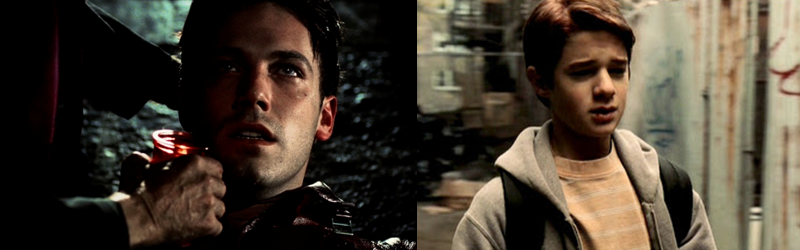
Daredevil is framed by a flashback to Matt’s childhood to tell his origin story.

Daredevil begins in medias res with the titular vigilante wounded, seemingly fleeing from the police, and seeking sanctuary at Father Everett’s (Derrick O’Connor) church. As he lays incapacitated and hurt, Murdock begins to narrate his childhood and life up until that point under the illusion that his life is flashing before his eyes as he dies; this flashback-heavy first portion of the film separated Daredevil from its contemporaries as, while the Spider-Man films (Raimi, 2002 to 2007) featured a bit of narration from the main character, most superhero films started at the beginning and progressed from there, with us following the hero along his journey and learning alongside him/them. This technique, though, means that we experience Daredevil from a uniquely different perspective, that being through the haunted, tumultuous memories of its main character.
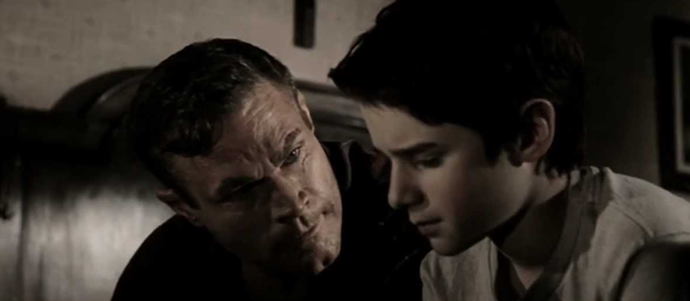
Jack discourages Matt from fighting and wants him to grow up to be a success.

We’re thus introduced to Murdock first as a battered and injured vigilante and then, very quickly as a young kid (Scott Terra) from Hell’s Kitchen who is constantly harassed by a gang of local youths. These bullies like to rag on young Matt because his father, Jack Murdock (David Keith), is not only an over-the-hill, washed up prize-fighter who once fought under the name “The Devil” and wore a devil-themed robe to the ring but has now taken to working as an enforcer for Fallon (Mark Margolis), a local mob boss. Matt, maintaining a staunch belief in his father’s glory days, accolades, and abilities, stands up to such bullies and trash talk and takes a beating as a result, much to the dismay of his father. Jack, however, wants more from Matt and discourages him from fighting, wishing instead for Matt to devote himself to his studies and to make something of himself and it is clear from their brief scenes together that the two have a very strong relationship, one built on mutual trust, respect, and dependency. Jack is determined to have Matt grow up unafraid, to be the best version of himself, and to not be a “bum like [him]” but this goes so far that he is too ashamed and too despondent to admit that he really has been forced to rough people up on Fallon’s behalf in order to provide for his family. The very next scene shows Matt witnessing this and, distraught and heartbroken, he flees from the sight only to end up narrowly avoiding a collision and being blinded by a biohazardous waste product as a result.
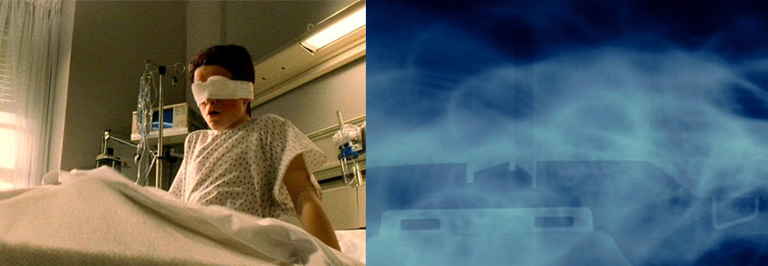
Blinded by toxic waste, Matt’s remaining senses are enhanced to near-superhuman levels.

Similar to Spider-Man, an elaborate CGI sequence shows us the effect this has on Matt’s DNA and, when he awakens in hospital, he is immediately bombarded with sensory overload as, while he has been rendered permanently blind, his remaining senses (particularly his hearing, which gets the most attention) have been augmented to near-superhuman levels. Unlike in the character’s debut appearance, where Matt barely flinched at being blinded, very little time was spent dwelling on how he or his father felt about it, and where Matt never once struggled to adapt to his new abilities, Daredevil adds a few wrinkles to this turn of events. Firstly, because Matt’s accident happened as a direct result of him running away from his father, Jack feels a tremendous amount of guilt and shame about the accident; secondly, Matt is overwhelmed to the point of terror at his newfound abilities and struggles to get them under control. However, the two have such a strong bond, love, and dependence upon each other that Matt doesn’t bare a grudge and the two resolve to redouble their efforts to overcome their limitations, with Jack getting back into training and back into the ring and Matt continuing his studies using Braille and discovering that his echolocation provides him with a version of sight. In experimenting with his newfound abilities, he loses all sense of fear as he easily traverses rooftops and overwhelms his tormentors (who “dare” him to fight them) with little more than his walking stick and his dexterity. Of course, Daredevil is still a superhero story and what superhero origin is complete without a dash of tragedy? It turns out that Fallon has engineered Jack’s comeback and threatens both him and Matt to coerce Jack into taking a dive in his next fight; with his son in the crowd and refusing to compromise his principals, Jack refuses and wins through heart, determination, and brute strength/force of will. However, Fallon’s goons jump Jack after the fight and beat him to a pulp before an unseen third assailant delivers the finishing blow, beating Jack to death and leaving a red rose on his bloodied corpse.
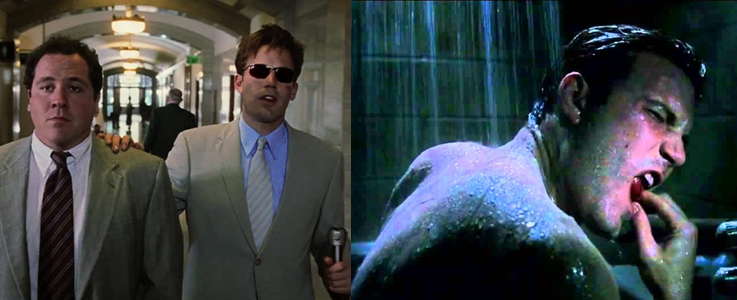
Matt plays the role of “unassuming blind man” well but suffers the consequences of his double life.

Tragically, Matt hears it all and is absolutely heartbroken when he comes across his father’s beaten and bloody body. He resolves to keep his promise to his father to help those that others wouldn’t and seek justice one way or another, with the film glossing over his time in college and law school and jumping ahead several years to find him fully grown into Ben Affleck. The older Murdock is a haunted, heavily conflicted individual; in order to block out the constant barrage of noises, he sleeps in a sensory deprivation tank and regularly chews a number of pills and painkillers to dull the constant pain from the many wounds he has suffered in his nightly jaunts. The effects of his double life can be immediately seen not only in his weary expression but also the multitude of scars, bruises, and injuries his body exhibits; though Matt’s abilities make him faster and stronger than the average man, he’s still human and we constantly see him suffering blows and injuries during his activities as Daredevil, taking hard shots to the ribs and even losing a tooth during the film’s first big action scene. I’m no fan of Affleck (largely because of the way he crapped all over this movie after professing to be such a big fan of the comics during its marketing) but he’s actually really great as Murdock; the special contact lenses he wears are only a small part of selling him as a blind man as Affleck assumes a slightly skewed posture and thousand-yard stare, always positioning himself in such a way that you can tell he’s lacking his sight. Additionally, Murdock uses Braille to identify his belongings, and even folds his notes in certain ways to recognise them (though it’s not entirely clear if he needs to do this, since we know he doesn’t, or if it’s all part of playing up his persona as a simple blind man), all of which go a long way to showcasing how a blind man might life his life.
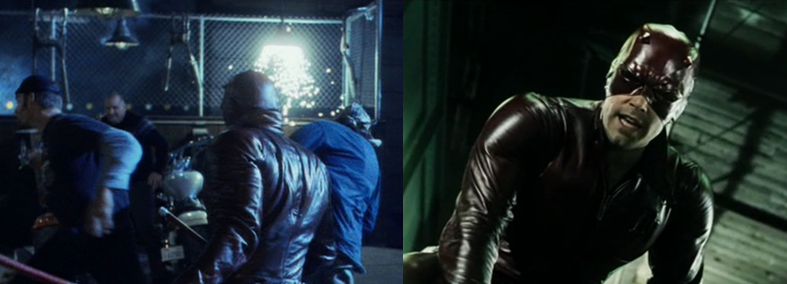
Matt is a brutal and resmorseless vigilante when he dons his Daredevil garb.

Affleck is also able to showcase a multitude of emotions with a surprising amount of nuance; Murdock is a pragmatic, yet passionate, bastion of the innocent in the court room, has a fantastically realised love/hate relationship with his friend and colleague Franklin “Foggy” Nelson (Favreau), and transforms into this violent, sardonic, brutal vigilante when donning the incredible blood-red leather outfit of Daredevil. It’s clear that Murdock is a man of many conflicting emotions and suppressed rage and that Daredevil is his outlet for those sensations; he takes deep offense to those who flaunt or break the law or who are under the clear influence of the mysterious Kingpin of Crime and takes it upon himself to bring such individuals to justice. His methods to achieve this are vicious and violent, involving the unrelenting beating of any law breakers and even more direct and indirect murder as he moves fast enough to avoid bullets that other thugs then take and not only willingly knocks Jose Quesada (Paul Ben-Victor), an obvious rapist and all-round bad person, to a gruesome death by train but even takes the time to mock him before his grisly dismemberment.
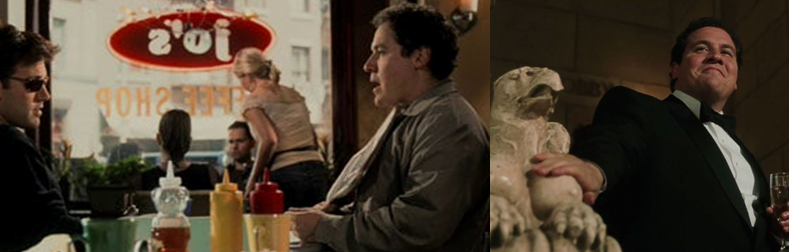
Favreau is great as the loveable, if goofy, Foggy Nelson.

Clearly a tortured, haunted individual, Matt keeps others at arm’s length and actively sabotages his relationships because of his unwavering commitment to bringing criminals to justice as Daredevil and his unresolved issues. Foggy makes this abundantly clear as he calls Matt out on his bullshit time and time again while still being in quiet awe of Matt’s adaptability, dedication towards helping those in need even when they receive very little payment (or payment in fluke or sports gear, which makes for an amusing running gag), and his capability in the court room. Their relationship is a real highlight of the film, with the two sharing banter, matching wits, pulling pranks on each other, and even using Matt’s disability to wind up strangers or to win the sympathy of the jury. Any time these two are onscreen together, it’s a joy to see; Favreau is instantly charming and likeable as the goofy Foggy and, while he was always able to stand out by questioning Matt’s approach to the women in his life, the Director’s Cut expands Foggy’s role and gives him a character arc where he is able to resolve Dante Jackson’s (Coolio) case and help lead the authorities to the Kingpin.
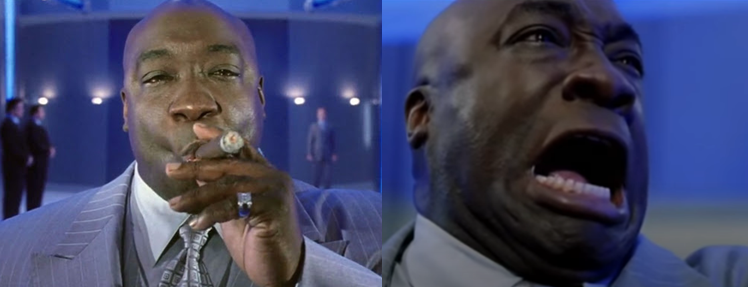
Duncan exudes an arresting aura and jumps from eloquent calm to unbridled rage!

Speaking of Wilson Fisk/The Kingpin…how amazing was Michael Clarke Duncan? The man had such a charisma and a presence not only because of his massive frame but also his charming smile and deep, dulcet tones. Though traditionally a white character, Duncan is a perfect fit for the role and exudes power, charisma, and a commanding respect from the moment he is introduced in the film garbed in a flashy suit and puffing away on a chunky cigar. Though the character was an eloquent and calculating individual in the theatrical cut, the Director’s Cut goes even further in establishing Fisk’s threat when he is seen viciously bludgeoning two of his underlings (one with his massive cane and the other by first throttling and then breaking his neck), which makes it all the more ominous when he later lays a seemingly innocent hand on the shoulder of Nikolas Natchios (Erick Avari) and gets his large hands on Daredevil in the film’s conclusion. The added runtime afforded by the Director’s Cut also adds further nuance to Fisk’s character; on the one hand, you could argue that we don’t really learn much about him and that he’s every typical, one-note criminal mastermind but, on the other, you can really see a number of layers to Duncan’s performance. Like Murdock, Fisk is keeping his raw, animalistic urges and primal rage at bay with a suit (literally a business suit); he explodes in a burst of rage and pure, unbridled power then immediately calms and composes himself and is so eager to put his abilities to the test against Daredevil for the climatic final fight that he all but invites the vigilante in to take him on man-to-man. Cold, calculating, but also articulate and oozing menace, Duncan portrays Fisk as a man at war with his clearly street-smart upbringing and the sophistication required of his role. Indeed, while he takes immense pleasure in the suffering of others, he also maintains that none of his actions have ever been personal; it’s with a glimpse of regret, maybe even sorrow, that he admits to Daredevil that his entire criminal enterprise has only ever been “business” and nothing more. Fisk’s “business” finds itself somewhat compromised not only by Daredevil but also the continued attempts by reporter Ben Urich (Pantoliano), whose speciality is urban legends, to expose the Kingpin. Fisk solves that problem by hiring Bullseye, a charming, animalistic, cold-hearted, sadistic, masochistic hitman, to kill Natchios. Unlike Murdock and Fisk, we learn very little about Bullseye save that he is a ridiculously good shot who talks little, kills on a whim, and has a flair for the dramatic. Like Fisk, Bullseye enjoys killing but takes a perverse pleasure out of it rather than revelling in his power like Fisk does; he’s also incredibly egocentric and takes it personally when Daredevil causes him to miss a shot, happily accepting an extended contract to take out both Daredevil and Natchios’ daughter, Elektra.
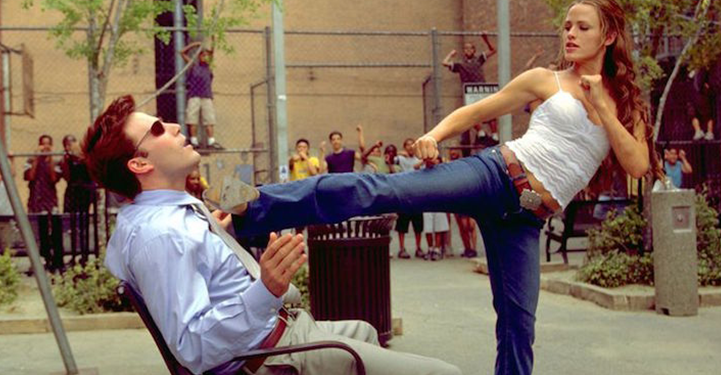
Matt and Elektra flirt but sparring in a playground. It’s not awkward at all…

Of the three main characters in the film, it’s Elektra who I feel brings the weakest performance; I’m not really a fan of Jennifer Garner and find her to be a bit of a blank slate who is sleepwalking through the film. She phones it in well enough to portray Elektra as a strong, independent, and forceful character when she needs to be but her romance with Matt is incredibly rushed and convenient. He basically becomes infatuated by her on scent alone and they have an absolutely cringe-worthy flight/flirt in a neighbourhood playground that seems more like Matt stalking and forcing himself upon her than a genuine attraction. However, she respects Matt’s ability to perform heavily choreographed wire-fu enough to give him her name and the time of day. To be fair, Elektra is a fairly layered character; she hates being under the constant supervision of her father and her bodyguards and wants her independence yet is incredibly devoted to him and her family. She is feisty and strong-willed but also lonely and you get the sense that her relationship with Matt is the first time she’s really been able to open up to someone. After her father is killed, though, she turns into a cold, venge-seeking individual, blanking out Matt’s pleas to turn away from vengeance and showcasing her formidable martial arts and sai-based combat skills in preparation to take out the man she believes responsible for her father’s death: Daredevil. All-in-all, Daredevil’s cast is pretty solid, ranging from top notch to mediocre performances that do a serviceable job given the film’s run time. And there is a lot happening in this film, especially in the extended Director’s Cut, yet the film’s pace is relatively speedy all throughout, glossing over such things as how Matt was able to construct his suit, multi-purpose cane, and the “Devil-Cave” compartments of his apartment and often padding out action scenes or stunts with some very dodgy CGI. I remember the effects not being that bad at the time but they really haven’t aged well now, with the CGI Daredevil, especially, looking particularly rubbery and cartoony as he ludicrously jumps from building to building or battles Bullseye up a ridiculously large church organ. The film is at its best when the action and fight scenes are simple, raw, and gritty, such as the one-on-one action between Daredevil and Elektra, Bullseye, and, especially, Fisk. Perhaps because of the success of Spider-Man, though, and definitely because of the popularity of The Matrix, Daredevil seeks to portray not just Daredevil but also Elektra and Bullseye as being capable of performing incredible, physics-bending stunts. While this is somewhat fitting for Daredevil, who is generally about as agile and adept as Spider-Man in the comics, it definitely feels like the film would have benefitted from downplaying the more nonsensical stunts and focusing on more dark and gritty action and fights.

The Nitty-Gritty:
In contrast to the beliefs of some, one of the best things about Daredevil, for me, has always been its soundtrack; sure, either the score or a host of licensed tracks are usually playing over every scene in the film but Daredevil boasts some rocking tunes and uses them to really help establish the mood or the character onscreen at the time. Murdock drowns out the sounds of the city with some Seether, for example; Nickleback’s “Learn the Hard Way” plays while Daredevil kicks the crap out of Quesada and his goons (who all need to “learn the hard way” that their actions have consequences), Fisk is introduced to the sounds of N.E.R.D.’s “Lapdance”, the appropriately-named “Man Without Fear” by Drowning Pool and Rob Zombie brings a manic energy to Bullseye’s elaborate motorcycle chase against Natchios, and, of course, the iconic “Bring Me to Life” and “My Immortal” by Evanscence feature prominently to set the stage for Elektra’s grief and her thirst for vengeance. Honestly, I don’t give a damn how much music is in the film because when a film’s soundtrack is as bad-ass as this one, all you can really do is sit back and rock out!
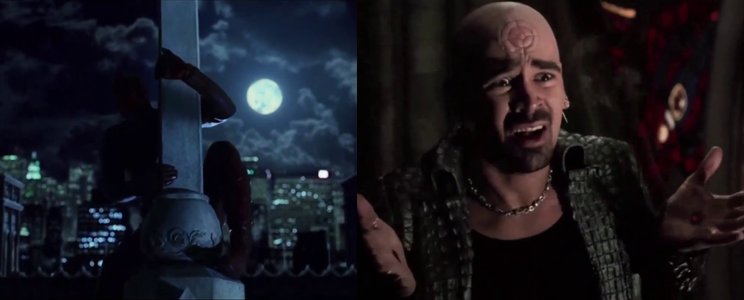
The film is full of explicit religious imagery.

Fittingly, Daredevil is also rife not only with references to some of the character’s most influential writers (John Romita, David Mack, Joe Quesada, Brian Michael Bendis all get name dropped, Frank Miller and Stan Lee pop up for brief cameos, and, most egregiously of all, Kevin Smith has the gall to appear as a coroner named “Jack Kirby”) but also with religious imagery; the opening of the film provides a perfect excuse to recreate that iconic shot of Daredevil clinging to a cross atop a church, Matt is only able to control his newfound abilities by focusing on the ringing of a church bell, the Director’s Cut features a handful of quasi-dream sequences where Matt is visited by a Nun (actually his deceased mother), Daredevil subdues Bullseye by causing a sniper’s bullet to pierce his hands in the style of the stigmata, and Matt frequently finds solace in Father Everett’s church. In the theatrical cut, Everett was the only other person who knew of Matt’s dual identity and he strived to turn Matt towards a more righteous path; here, this role is largely the same but slightly different as the film focuses more on Matt’s dark path and the violence of his life. We’re led to believe that this comes to a head when he spares the Kingpin but, arguably, Fisk deserved to die more than any of Matt’s other victims. Instead, Matt is happy (or, at least, willing) to kill small fry like rapists in the opening but not the primary crime lord of New York simply to serve a wonky character arc and to set up sequel bait.
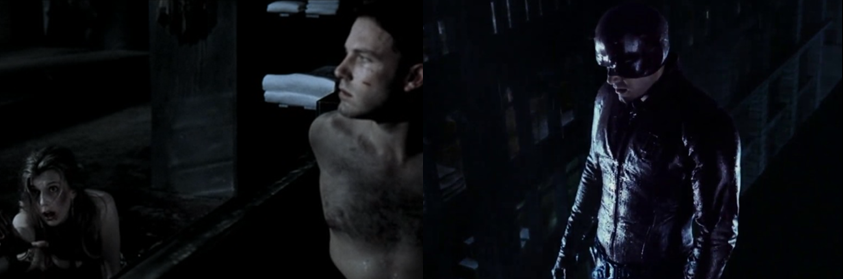
Matt is haunted by his past, his pain, his anger, and his struggle to reconcile his emotions.

One thing the Director’s Cut really brings to light is just how conflicted and full of anger Matt is; his violent double life is clearly at odds with his Catholic upbringing and is taking its toll on him, as expertly seen by a new scene where Matt is literally haunted by the screams and suffering of those he cannot help in the city. He lashes out at criminals when under the mask and takes his anger and frustration out on both them and his Devil-Cave when he is unable to save Natchios and, unlike in his original debut, Matt is a flawed and fundamentally broken character; he struggles with his newfound abilities at first and his quips are more like cruel taunts than light-hearted whimsy. There’s a sense that he does what he does out of a sense of duty to his father and because of his abilities but it’s also pretty clear that he’s using Daredevil to exert all of his emotions and rage; when he sees a child cower in fear of him, he is stunned and desperately tries to convince himself that he’s “not the bad guy”. Finding little solace in Father Everett’s talk of faith, Matt struggles to reconcile his actions and inner turmoil and he is noticeably tetchy and short with Foggy the next day as a result. This all goes to great lengths to explain why he was unable to get through to Elektra at the funeral since Matt is hardly a bastion of virtue. How can he hope to convince someone not to seek vengeance when he does it every night?
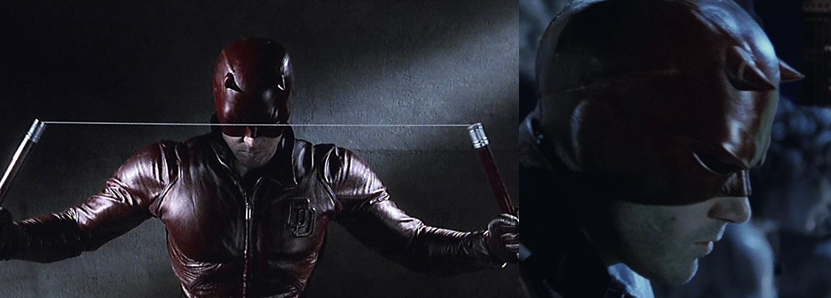
It might look impracticable and uncomfortable but Daredevil’s suit is straight up bad-ass!

Another thing I always enjoyed about Daredevil was its dark and gritty aesthetic and the costume design; when taking to the streets as Daredevil, Murdock dons a thick, uncomfortable-looking but super bad-ass leather outfit that is a fantastic blood-red and is one of the few live-action superhero suits to actually use lens over the eyes. The practicality of this suit might be in question but it sure looks awesome (…when it isn’t rendered in shitty CGI), though I do find myself questioning how Matt was able to make it and the many duplicates hanging in his Devil-Cave. Matt also, of course, wields his multi-purpose cane (seriously, it’s a baton, nunchaku, a grappling hook, and even an axe!) but I find it hard to believe he could do both to such a high standard and exactly how does Matt manage to change into Daredevil in the middle of the city? There’s no way he’s wearing that suit under his clothes and he can’t be that close to his apartment all the time so either it’s a convenience for the sake of keeping the film’s frenetic pace going or Matt has stashed spare costumes all over the city!
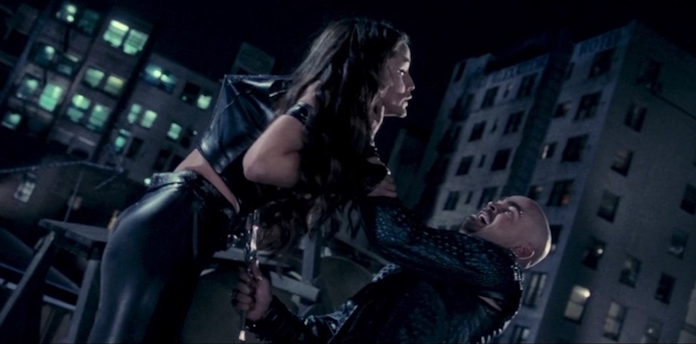
Despite all her abilities, Elektra is no match for Bullseye…

Bullseye and Elektra don’t fare quite as well as Daredevil on the costume front, unfortunately, with both opting for black leather and relatively simple attire despite Bullseye demanding a “fuckin’ costume” from Fisk. Still, Bullseye makes up for it with a preposterous bullseye scar on his forehead and an absolutely gorgeous Matrix-style trenchcoat that he even uses to disorientate and distract Elektra during their fight. This whole sequence is a bit of a let down, to be honest; earlier, in their civilian clothing, we saw Elektra and Matt go toe-to-toe and that they were largely evenly matched until Elektra got the better of him. Considering Matt’s augmented strength and reflexes, this is a pretty impressive feat and, overwhelmed by hatred and her desire for revenge and helped by the fact that Matt refuses to fight her, we see Elektra again able to best Daredevil in a fight, incapacitating him with a stab to the shoulder that, for all intents and purposes, leaves Daredevil seemingly near death! After discovering the truth about her father’s murder, though, she immediately redirects her anger towards Bullseye, a man we have seen exhibit absolutely not fighting prowess up until that point, and is summarily overwhelmed! Seriously, I get that Bullseye is agile and all about the misdirection and the perfect shots but he toys with Elektra all through their fight and kills her without barely breaking a sweat!
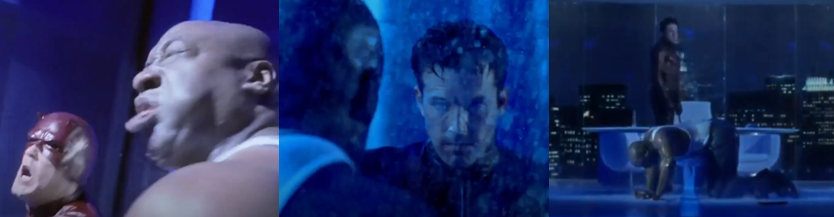
Daredevil and Kingpin settle their differences in a good, old-fashioned fist fight!

Daredevil’s fight against Bullseye isn’t much better as not only are they depicted as being physical equals (though at least Daredevil has the excuse of being badly wounded), the fight is hindered by the worst instances of CGI in the film that sees them leaping and hopping up about the place like in a videogame, Daredevil catching all of Bullseye’s shurikens with swift movements of his club, and Bullseye expertly snagging every single shard of broken stained glass and tossing them at Daredevil (who avoids them all with a superb series of well-timed backflips). It really hasn’t aged too well and is ridiculously over the top for what should have been a simple, brutal affair. Thankfully, the climactic fight between Daredevil and Kingpin makes up for this even more in the Director’s Cut; in the original version, this fight is depressingly short but, here, it’s noticeably longer and stands out from the rest of the film by beginning with the simple, raw sounds of the two adversaries kicking the crap out of each other. Thanks to his immense strength and Daredevil’s wounds, Fisk is able to subdue Daredevil with a concussion-induced blow to the head and a rib-breaking toss into a concrete pillar; like the bullies of Matt’s youth, Fisk is incredibly amused to find that his rival is “the blind lawyer from Hell’s Kitchen” but finds himself on the back foot when Matt uses the sprinkler system to focus his radar sense and brutally bring the Kingpin to his knees. Driven to the floor in pain and at Matt’s mercy, Fisk is spared and handed over to the police despite promising that he’ll get out, and tell others of Daredevil’s identity. Matt, however, is unfazed, believing that no one would believe Fisk’s story and vows to be ready for Fisk when he gets out, setting the stage for a rematch and an escalating conflict that, sadly, we never saw. Like when Matt threw Bullseye out of the church window and to what should have been his death (he survived but was left in a full body cast so I guess that makes it okay…?), this is treated as a heroic, character-defining moment as Matt finally choose the higher, more noble and heroic path…despite the fact that he’s killed before, both directly and indirectly, and leaving Fisk alive is arguably more dangerous to both him and the city.
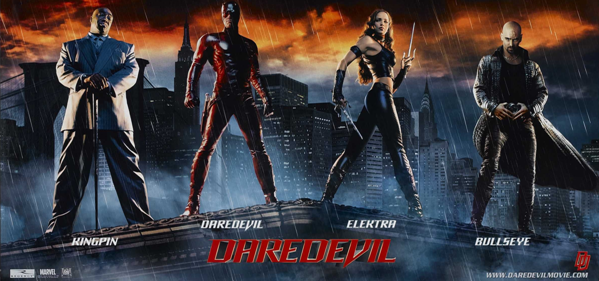
The Summary:
While many of the CGI shots and fight/action scenes haven’t aged too well, there’s actually a lot to like here; Daredevil’s suit is incredible and, while the costumes are very Matrix-y (as are the fights), they still work and allow each character to stand out from each other. The cast (with the exception of Elektra) is also really strong; Affleck may have talked shit about the role but he’s really good, shaking off a lot of his boy scout persona and really selling the idea that he’s a blind man and an emotionally tormented sole trying to do good through violent actions and getting lost down a dark path, and Duncan is phenomenal as the Kingpin. He has a real weighty presence, exuding power and intimidation but also layering the character with subtle nuances; it’s like he’s constantly keeping his anger and brutality in check through the veil of civilisation and decorum and is itching to let his emotions loose. Daredevil allows Matt to do this but Fisk has few opportunities to do it; the only one not hiding behind some kind of a mask is Bullseye, who is unapologetically sadistic through and through The soundtrack is also incredible; sure, music and songs fill nearly every scene but the hard rock, metal, and nu-metal tracks are a welcome inclusion for me. It’s not perfect; the plot is kind of all over the place, even in the Director’s Cut, and full of conveniences and contrivances but it does a really good job of establishing this world and it’s a shame we never got to see this cast all come back for at least one more film. Seriously, we got two mediocre Fantastic 4 movies (Story, 2005 and 2007) but we couldn’t get a sequel to Daredevil? As much as I loved the Netflix series, I still think that’s a real shame since the intention was clearly to do something akin to “Born Again” (Miller, et al, 1986) in the follow-up.

My Rating:

Rating: 3 out of 5.

Pretty Good

What did you think about Daredevil: Director’s Cut? How do you think it compares to the theatrical version? What did you think to Ben Affleck in the title role, and the film’s cast in general? Did you enjoy the film’s soundtrack or did you find the constant influx of songs distracting? How well do you think the film holds up compared to its modern equivalents? Perhaps you prefer the Netflix series (I mean, who doesn’t, right?); if so, why and what are some of your favourite moments from that? Do you have a favourite Daredevil character or storyline you’d like to see adapted into live-action? Whatever your thoughts on daredevil, feel free to leave a comment down below.


Movie Night: Deadpool

Released: 8 February 2016
Director: Tim Miller
Distributor: 20th Century Fox
Budget: $58 million
Stars: Ryan Reynolds, Morena Baccarin, Ed Skrein, T.J. Miller, Gina Carano, Brianna Hildebrand, and Stefan Kapičić/Andre Tricoteux

The Plot:
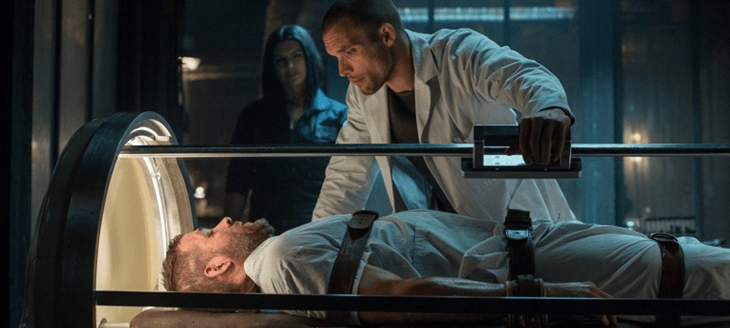
After mercenary for hire Wade Wilson (Reynolds) contracts terminal cancer, he turns to Francis Freeman/Ajax (Skrein), who subjects him to round-the-clock torture to activate his latent X-Gene. The experiment is a success, transforming Wade into a near-immortal Mutant but also horrifically disfiguring him and leading him on a bloody quest for revenge.

The Background:
Deadpool was created by Fabian Nicieza and Rob Liefeld back in 1991; originally an antagonist who featuring in the duo’s New Mutants comics, the self-styled “Merc With a Mouth” gained significant popularity over the years, especially once he became self-aware and began breaking the fourth wall. This popularity eventually led to his own solo title, a series of team-ups with other Marvel heroes, appearances in Marvel/X-Men-related videogames, and even a cameo appearance in the beloved X-Men animated series (1992 to 1997). Deadpool made his live-action debut in the much-maligned X-Men Origins: Wolverine (Hood, 2009); here, the character was expertly portrayed by Ryan Reynolds (who had been eyed for the role as far back as 2004) and his inclusion was intended to setup a solo spin-off for the character. After X-Men Origins was critically panned and following the poor reception of the Reynolds-led Green Lantern (Campbell, 2011), however, 20th Century Fox (who had bought the film rights to the X-Men franchise some time ago) got cold feet about producing an expensive superhero film full of violence and cuss words. Yet, after director Tim Miller’s early test footage mysteriously leaked online to an overwhelmingly positive response, Fox committed to releasing the film as the director and actor wished but with a much smaller budget than traditional superhero films. As it turned out, however, the studio was wrong to be apprehensive and right to produce the film on a tighter budget as Deadpool eventually brought in over $780 million in worldwide gross which, alongside it’s overwhelmingly positive critical reception, more than justified the greenlighting of a sequel and a continued investment in the character on their part.

The Review:
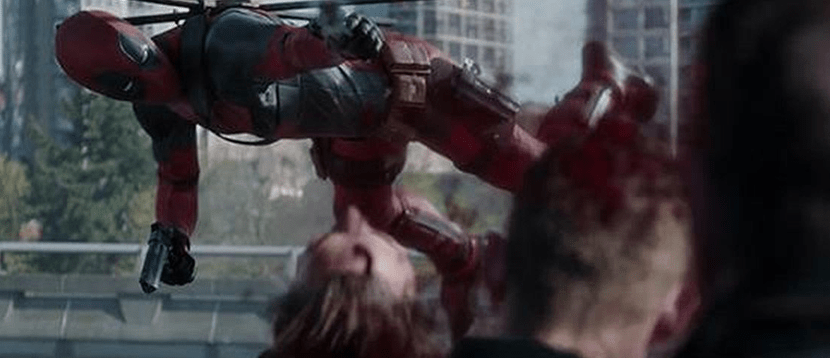
As described by Deadpool himself, Deadpool is, at its heart, a traditional love story of boy meets girl, boy contracts terminal cancer, boy acquires superhuman powers, boy gets girl. It’s the classic, age-old tale we’ve all come to know and love…just with more crotch shots and gratuitous violence than you might remember. Right off the bat, Deadpool opens with an impressive slow-motion shot right in the middle of Deadpool unleashing the carnage on a busy highway while Juice Newton’s “Angel of the Morning” plays and numerous sight and visual gags fill the screen (the majority of them poking fun and the cast and crew of the film and setting up Deadpool’s trademark crude humour). This highway sequence acts as a bridging device as Deadpool, directly addressing the camera and through the power of voiceover, explains his origin up to that point and we continuously return to the highway to see Deadpool blowing the brains out of Ajax’s men and skewering them with his blades.

Seriously, who wouldn’t fall in love with Morena Baccarin?

It turns out that Deadpool was just as childish and sadistic before he acquired his powers; as a mercenary for hire, Wade took on a variety of jobs issued to him by his kind-of-sort-of friend/business acquaintance Weasel (Miller). While he is characteristically coy about the exact specifics of his past, using dark humour to twist the exact truth of his background, he openly admits to having a “soft spot” and wishing to make some kind of small difference to people’s lives. It’s in the midst of this cavalier lifestyle that he meets Vanessa (Baccarin), an absolutely gorgeous woman who appears to be just as snarky and unhinged as he. The two immediately hit it off and spend an entire year doing little other than screwing like animals and falling in love. Right as Wade begins to feel alive again, though, he (literally) falls ill with terminal cancer and, unwilling to drag Vanessa into that “shit show” (as he calls it), packs up and leaves to die alone.

Thankfully, Ajax isn’t just another “guy in a suit”; he’s a sadistic bastard through and through.

For a character who is known for little more than cutting people’s heads off, spouting crude jokes and nonsensical one-liners, and engaging in mindless violence, Deadpool is a surprisingly tragic and relatable character even after he has become a nigh-unstoppable one-man-army. Reynolds excels in the role and I literally cannot imagine anyone else bringing as much humour, heart, and snarky bad-assery to the role. It’s easily the part he was born to play and you can tell that he relishes every last blood-soaked moment of it. Opposing Deadpool is Ajax, a role that demands little more from Ed Skrein than to be a stereotypical “British villain” but which he brings such a slimy arrogance to that you can’t help but want to see Deadpool get his hands on him. A former patient of the same facility Wade ends up in, Ajax’s mutation leaves him incapable of feeling pain (or anything else) and not only superhumanly strong but completely sadistic as well. As a result, he’s not only the perfect kind of amoral asshole but also a formidable threat in his own right since he can’t feel pain and Deadpool can heal from any injury, allowing the two of them to just go absolutely nuts on each other once they finally face off.

Negasonic Teenage Warhead is ballsy enough to match wits with Deadpool.

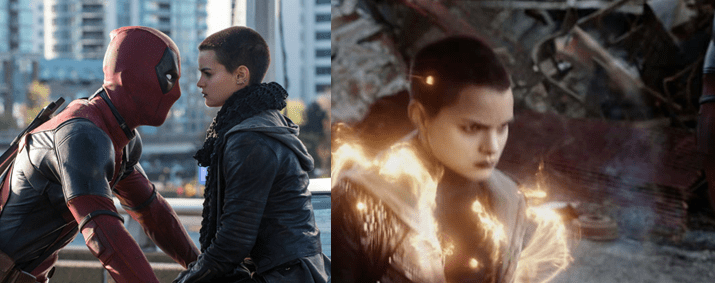
Ajax is joined by Angel Dust (Carano), a Mutant who is superhumanly strong; as is the crutch of the majority of the henchpeople in X-Men films, the role doesn’t really require much from Carano other than to stand around looking intimidating and bring the pain when required but it’s refreshing to see a woman in the role of the “muscle”. Her presence is inoffensive enough and she even manages to work in a few subtle character traits of her own here and there (she constantly chews on toothpicks and is even somewhat flustered in her fight against Piotr Rasputin/Colossus (Kapičić/Tricoteux)). Speaking of Colossus, this isn’t the underutilised character you know from previous X-Men films as portrayed by Daniel Cudmore; instead, Colossus is a colossal (pun intended) fully computer-generated character and always shown in his organic steel form. Sporting a true Russian accent and portrayed as a veteran of the X-Men, Colossus acts as Deadpool’s conscious and would-be-mentor figure as he attempts to persuade Wade away from the blood-soaking path he has put himself on and become a true hero as an X-Man. Joining Colossus is an entirely new character to these films, the preposterously-named Negasonic Teenage Warhead (Hildebrand); a typical moody, anti-social, and rebellious teenager, Negasonic mainly exists to be the butt of Wade’s numerous pop culture references, to spout equally-mean comments back to him, and to explode in atomic bursts for the film’s finale. While they could have used any other teenage X-Man for this role, the filmmakers specifically selected the character based on her striking name and had to negotiate with Marvel Studios in order to include her. While her powers may be different, she’s a decent enough character in her own right, especially coming into her own in the battlefield.

Deadpool‘s violence is just part of the film’s appeal.

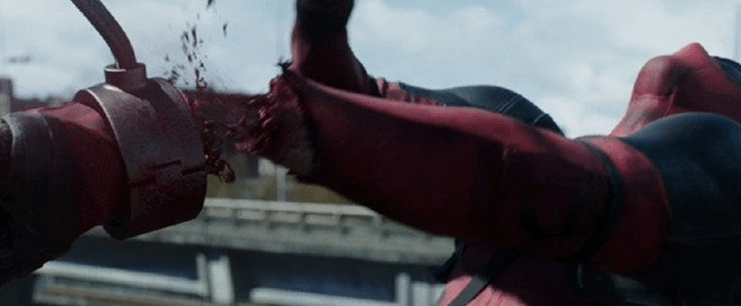
What separates Deadpool from other superhero films, though, is its presentation. Superhero films have been violent before; they’ve had swearing and killing and blood but they’ve never quite been like Deadpool. The film is an action/comedy, full of visual gags, constant one-liners and insults, and more violence than you can shake a stick at. Deadpool is relentlessly brutal in his methods, blowing brains out, splitting guys in two, and even cutting his own hand off to escape custody. He’s an insatiable killing machine, full of righteous anger but also with a surprising amount of pathos built into his character. While it’s hard to believe that the damage done to his face is enough to truly turn off any woman, much less one as devoted to him as Vanessa, the way his monstrous appearance affects his usual bold-as-brass confidence is affecting and it’s easy to buy into his quest for revenge against Ajax.

The Nitty-Gritty:
Deadpool is a brisk, non-stop action piece; the film hits the ground running and even in its slower, more poignant moments, it never drags or feels extraneous. Rather than worry itself with the disastrous continuity of the X-Men films, Deadpool exists instead in its own bubble that is adjacent to, and directly inspired by, the existing X-Men franchise but very much its own thing and it never shies away from poking fun at the films that have proceeded it or the mess Fox made of their continuity.

Deadpool is full of clever and entertaining references.

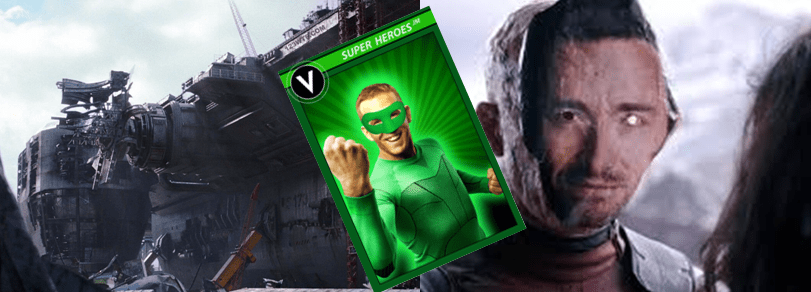
Speaking of which, the film goes out of its way to not only mock the treatment of Deadpool in X-Men Origins (Deadpool clearly acts as though that film never happened or was some kind of awful nightmare) but also Reynolds’ experiences on Green Lantern. Very little escapes the film’s humourous grilling, either; Deadpool references having to perform sordid act on Logan/Wolverine (Hugh Jackman) in order to get his own film, regards Brian Mills (Liam Neeson) as a bad father for always allowing his family to get taken, stages its entire finale on what is clearly the remains of a S.H.I.E.L.D. Helicarrier, and features two incredibly fun “cameos” from Jackman himself.

Deadpool‘s CGI and budget is put to good use and never overwhelms the film’s action or story.

Having a smaller budget really benefitted Deadpool; it meant that what little money it had had to be put to good use rather than on elaborate special effects and gratuitous CGI. It also allows the film to tell a far more grounded and focused story; the spotlight is on Deadpool the entire time, as it should be, and though it does include the X-Men they are used sparingly and in service of the film’s greater narrative rather than clogging the film’s runtime up with pointless cameos and fan service. Deadpool’s wise-cracking nature, jokes, and violent actions are fan service enough and, thankfully, remain the central hook for the film from start to finish.

The Summary:
I wasn’t really the biggest fan of Deadpool going into this film; I find X-Men comics very dense and nearly impenetrable so I hadn’t really read too much about him beyond what I saw online. This actually benefitted me in a lot of ways; it meant I wasn’t too bothered by how badly 20th Century Fox neutered the character in X-Men Origins: Wolverine and it meant that I would be seeing the film without high expectations. And, yet, Deadpool exceeds those expectations continuously the more I see it. I honestly find it difficult to talk about Deadpool; comedies are a difficult genre to really describe at the best of times, I find, and the only way you can really appreciate Deadpool’s humour and appeal is to just watch it for yourself. It really is an impressive and incredibly enjoyable action romp; even if the film hadn’t been full of gratuitous violence or swearing, there would still be loads left over to enjoy, I think, but the fact that the filmmakers just went in balls deep and decided to do an unapologetically true adaptation of Deadpool’s unique character is truly admirable. I honestly thought that the one-two-punch of Deadpool and Logan (Mangold, 2017) would open the doors for R-rated action films to once again be successful in Hollywood. That resurgence didn’t really come to pass, unfortunately, but we did get a pretty decent sequel out of it (I honestly struggle to pick my favourite of the two and often settle for just watching both back to back) and that doesn’t dilute the fact that Deadpool is an incredibly bad-ass and hilariously enjoyable experience from start to finish.

My Rating:

Rating: 5 out of 5.

Fantastic

What are your thoughts on Deadpool? Do you feel it did a better job of capturing the character’s essence than X-Men Origins: Wolverine or were there parts that disappointed you? What did you think of Ryan Reynolds’ portrayal and can you think of any other pitch-perfect castings in films? What was your first introduction to Deadpool and what do you think of him as a character? How are you celebrating Deadpool’s debut this month? Whatever your thoughts on Deadpool, and the X-Men, drop a comment below.

Movie Night: Pokémon: The First Movie: Mewtwo Strikes Back

Pokemon1stMovieLogo

Released: July 1998
Director: Kunihiko Yuyama
Distributor: Toho
Budget: $5 million
Stars: Veronica Taylor, Philip Bartlett, Rachael Lillis, Eric Stuart, Madeleine Blaustein, Ikue Ohtani, and Kouichi Yamadera

The Plot:
Cloned from the genetic material of the rarest Pokémon of all, Mew (Yamadera), and enraged at its mistreatment at the hands of humans, the Psychic Pokémon Mewtwo (Bartlett) lures Ash Ketchum (Taylor) and his friends to its island to witness its plan to enact revenge against all humanity.

The Background:
So, by now, you’re well aware of Pokémon (Nintendo/Creatures/Game Freak, 1995 to present), a role-playing videogame in which you capture, raise, and battle little monsters and which dominated playgrounds and friendships in the late nineties. After rushing out to purchase Pokémon: Blue Version or Pokémon: Red Version, kids soon became engrossed in every piece of Pokémon merchandise there was, and that included the still-ongoing Pokémon (1997 to present) anime series. Though somewhat removed from its videogame source material, the anime was popular enough to warrant the release of a feature-length animated movie that revolved around one of the most powerful and popular Pokémon, Mewtwo, and its ever-elusive biological counterpart, Mew. Mewtwo represented the ultimate challenge in the original videogames; capturing it meant you had easily the strongest Pokémon the game had to offer and the creature was seemingly tailor-made for the game’s Master Ball, which captured any Pokémon without fail. In comparison, Mew wasn’t actually available in the original videogames outside of Japan, resulting in a slew of wild theories on how to capture it and kids either breaking their games with glitches or buying a Game Genie to get their hands on the mysterious little critter. For me, Pokémon: The First Movie has never been matched by other Pokémon movies in terms of its spectacle and hype. This was peak Pokémon, when the games and anime were at their most popular for my generation (matched only by the release of the follow-up titles), and the appeal of Mewtwo and mystery surrounding Mew was at the forefront of my mind and the minds of my friends and peers. Best of all, hints and glimpses of Mewtwo had been peppered throughout the anime: Giovanni (Ted Lewis) had used it in a battle against Ash’s rival, Gary Oak (James Carter Cathcart), and we’d seen it escape from Giovanni’s headquarters in explosive fashion. Never again would the anime so explicitly tie into one of the movies and the hype for Pokémon: The First Movie was palpable as a result.

The Review:
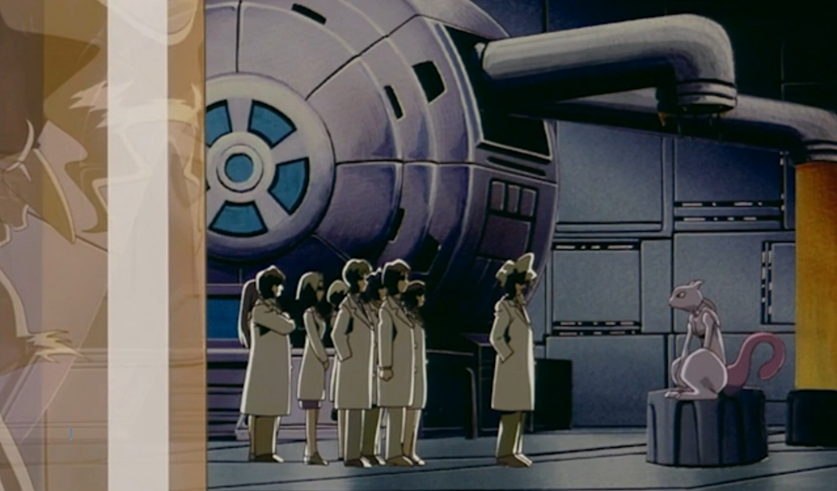
Pokémon: The First Movie opens with Mewtwo questioning its memories, its identity, and the reason for its creation. These issues haunt Mewtwo throughout the film and are the reason for its rage against, and hatred of, humanity; cloned from a single cell of the mythical Pokémon Mew, Mewtwo is tormented by visions from a life it doesn’t remember and feelings it can’t reconcile. Add to that its “awesome Psychic powers” and Mewtwo doesn’t waste any time in breaking out of its containment tube and demanding answers from the Team Rocket scientists that created it. Incensed at the their lack of care for its feeling or condition, Mewtwo flies into a rage, destroying the lab and killing everyone within. This opening sequence effectively sets the tone for what is to follow; although the film is rated U for everybody, it’s a far darker and more sombre affair than the usually fun-loving anime series thanks, largely, to the changes made to Mewtwo’s motivations by producer Norman Grossfeld. This involved cutting an entire opening sequence which made Mewtwo a far more sympathetic figure and changing the Pokémon from a more ambiguous and tragic figure and into one that is clearly evil and motivated by anger.

Pokemon1stMovieHatred
Mewtwo’s hatred for humanity makes it an aggressive and dangerous foe.

However, this doesn’t make it any less a tragic figure; Mewtwo suffers nothing but abuse and betrayal in its short life and its outrage is completely understandable. Determined to take revenge against the human world, Mewtwo organises a Pokémon tournament on its island; after winning a Pokémon battle against a random trainer (in unbelievable fashion), Ash, Brock (Stuart), and Misty (Lillis) are invited to attend but soon find themselves opposed by a sudden storm. This world-covering tempest is actually a result of Mewtwo; in the dub, Mewtwo causes a storm that threatens all life on Earth rather than to simply cloak its island and, while debating how to brave the storm, Ash and his friends hear a story that is also exclusive to the dub. They are told of a time long ago when a storm wiped out countless lives; so heartbroken by the devastation, the surviving Pokémon’s tears “somehow restored the lives lost in the storm”. Though it obviously has many holes, this ridiculous premise actually works to help justify what happens at the end of the film and simplifies the film’s events for the younger viewers that made up the majority of its audience. Regardless, Ash and his friends manage to reach Mewtwo’s island thanks not only to their Pokémon (despite them being described as being “too weak” to brave the storm) and, partially, to assistance from their long-time enemies from Team Rocket, Jessie (Lillis), James (Stuart), and Meowth (Blaustein), all of whom largely fulfil their usual roles as comic relief.

Pokemon1stMovieClones
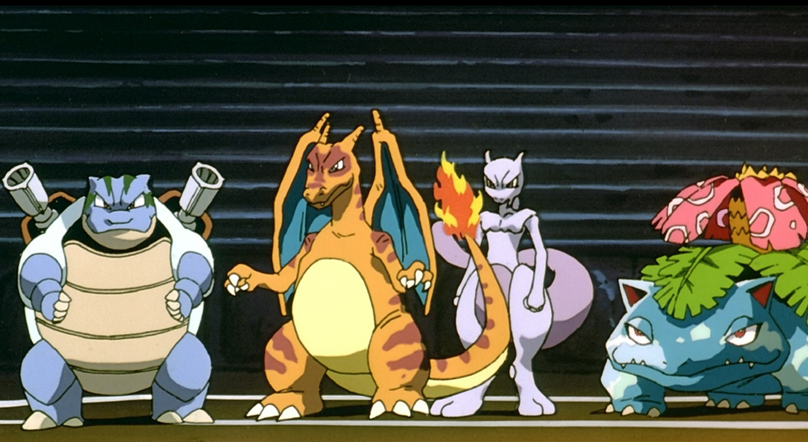
Mewtwo plans to replace life with its genetically superior clones.

Once they reach the island and encounter Mewtwo, Ash immediately opposes Mewtwo’s plot to wipe the planet clean of all life, human and Pokémon alike, and replace it with its genetically superior clone Pokémon. What follows is an inevitable conflict between the naturally born and trained Pokémon of the trainers present and Mewtwo’s clones and a debate about the merits of fighting and the difference between nature and nurture. Now, obviously, the dub makes these aspects so on the nose and in your face that you’d be hard-pressed to miss them; the characters literally have an entire conversation in the middle of a no holds barred fight between the clones and the originals where they simply repeat “fighting is wrong” over and over. As a kid, this was a frustrating experience as those who didn’t understand Pokémon or who thought it was stupid would criticise this moment as all Pokémon ever seem to do is fight but I would argue that there is a clear difference in the games, anime, and in this movie and its subsequent sequels between battling for sport and in the name of friendly competition and fighting to the death.

Pokemon1stMovieThemes
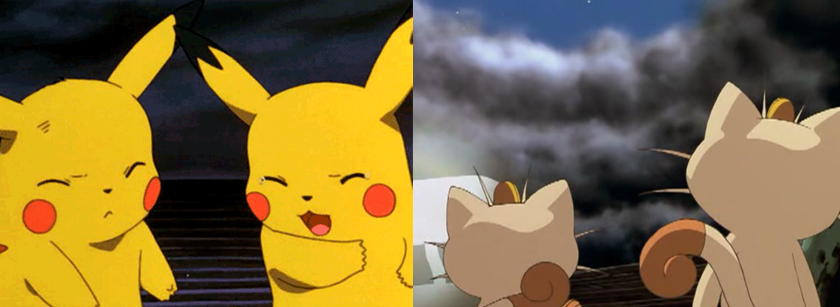
Both Pikachu and Meowth refuse to fight their clones.

No one exemplifies the refusal to take part in such a pointless fight more than Pikachu (Ohtani); seeing it pointedly refuse to fight its clone and getting smacked around as a result was utterly heartbreaking but it serves to drive the point home extremely well. Even Team Rocket come to realise the pointlessness of such conflict, with Meowth also refusing to fight its clone and musing that individuals have more in common than they might think. Of course, all this surprising character growth and development is then rendered completely mute when Mewtwo wipes all of their memories, meaning that the only one who really learns a lesson is Mewtwo but, given that it was hell-bent on destroying all life on Earth, I guess that’s preferable. Even after all this time, and despite some of its flaws, Pokémon: The First Movie is still a great film for me. Of all the Pokémon movies released, this, in my opinion, is still the best one; nostalgia obviously plays a large part in this but, while I enjoyed some of the later movies, none of them had quite the same appeal as this one. It introduced a few new Pokémon from the upcoming sequel games, showcased my favourite Pokémon (Mewtwo), and brought Mew into the spotlight for the first time. It’s telling that every single Pokémon movie that has followed has featured either a Psychic Pokémon or a Pokémon capable of speech/communicating and that they often have similar themes of an evil or misguided, stupidly powerful Pokémon having to be quelled. Pokémon: The First Movie did it first, and best, in my opinion, though.

The Nitty-Gritty:
I mentioned just now that the film has some flaws and, yeah, it would be ignorant not to address them. Compared to later movies in the series, Pokémon: The First Movie isn’t quite as crisp or as smoothly animated; indeed, the animation is clearly a step up from the regular anime but far from the gorgeously slick rendering of later films. While you could argue that the producers really didn’t need to replace certain aspects with computer-generated images (doors, some camera movements and effects and the like), I didn’t actually mind this; sure, it sticks out a bit but it’s harmless enough.

Pokemon1stMovieChanges
The dub changes Mewtwo’s motivations but it’s still a complex character.

Of course, the changes made to the script, specifically Mewtwo’s origin and motivations, irked many people but it was never really an issue for me; sure, I’d like to see it either redubbed or subtitled in the original Japanese format but I grew up with the dubbed anime and this version of the movie. It’s all I’ve ever known and I’ve always been happy with it despite how unapologetically the script hammers home its obvious themes. It is a bit weird, though, how the script makes a few errors in identifying Pokémon; it makes an ironic sense that lifetime bunglers like Team Rocket would mistake Sandshrew for Sandslash (even though they look very different) but it is a bit odd that a trainer would misidentify his own Pokémon. Mistakes like these are surprising but hardly a deal-breaker; it smacks of laziness and a lack of quality control but hardly derails the movie.

Pokemon1stMovieConflict
Mewtwo and Mew clash in a test of will and power.

Frankly, they could have screwed the names of all the Pokémon and I still would have been happy just to see the long-awaited fight between Mewtwo and Mew. Apparently evenly matched in terms of raw power, their fight disappointingly descends into them simply ramming into each other’s protective shields but it’s nonetheless quite brutal and exciting. It’s even quite surprising how vicious Mew is; it is portrayed the entire movie as this mischievous little pixie but, when push comes to shove, is more than happy to trade energy blasts with its monstrous counterpart and fight to prove its point.

Pokemon1stMovieDespair
Still a heartbreaking moment all these years later…

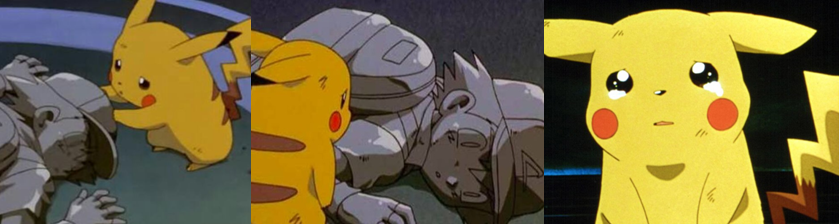
This, of course, brings me to one of the most heartbreaking moments you could experience as a kid; Ash, desperate to stop the fighting, leaps between the two and is inexplicably turned to stone. The moment is shocking (even for me…and I’ve never been that big a fan of Ash) but quickly becomes absolutely heartwrenching when Pikachu, confused and in despair, tries to rouse its master with little pushes and shock after shock. The fighting stops; friend and foe alike gaze in disbelief as Pikachu fails to awaken Ash and bursts into tears of grief. It’s absolutely heartbreaking even now just seeing Pikachu in such a desperate state. Luckily, that “tears of life” story pays off and the collective tears of all the Pokémon restore Ash but I never expected the movie to have this sudden, abrupt turn into the feels and it still gets me to this day. Pokémon: The First Movie was a rousing success, earning over $170 million at the box office and kick-starting a slew of movies to follow. The producers circled back around to Mewtwo a couple of times after this, first in the direct-to-DVD sequel, Pokémon: Mewtwo Returns (Sonoda, 2000), which answered a few lingering questions from this film, and then Mewtwo and Mew also appeared in Pokémon: The Mastermind of Mirage (Yuyama and Fujita, 2006). Mewtwo also featured in Pokémon the Movie: Genesect and the Legend Awakened (Yuyama, 2013), though that film inexplicably and quite ridiculously featured an entirely different Mewtwo, and Pokémon: The First Movie was remade entirely in CGI in 2019 around about in time for the first film’s twentieth anniversary and, of course, who else but Mewtwo would feature as the principal antagonist in Pokémon: Detective Pikachu (Letterman, 2019), a film that explicitly referenced Pokémon: The First Movie when discussing Mewtwo’s origins.

Pokemon1stMovieBanner

The Summary:
Never doubt the power of nostalgia; it can make even the crappiest polygonal graphics seem timeless and the most outlandish movies memorable. I still like Pokémon but I don’t really play the games anymore and am nowhere near as invested in the franchise as I was when Pokémon: The First Movie came out; I would scour magazines and comic books for glimpses of the film and the mysterious new Pokémon we knew nothing about and went out of my way to get a bootleg VHS of the movie just so I could watch it and see my favourite Pokémon in action. I admit that nostalgia plays a large part in my affection for Pokémon: The First Movie but it is still a really solid entry in the Pokémon movie series and a decent animated feature in its own right. It’s not as action-packed as the later entries and nowhere near as well animated or scripted but the hype was real and seeing Mewtwo and Mew go at it in this classic will never got old. It got me then and it still gets me now.

My Rating:

Rating: 5 out of 5.

Fantastic

What did you think of Pokémon: The First Movie? Where does it rank for you compared to the other Pokémon films? Do you think it still holds up to this day or do you think it’s seen better days? How are you celebrating Mewtwo’s birthday this year? Whatever you think about Pokémon: The First Movie, Mewtwo, and Pokémon in general, leave your thoughts in the comments below

Movie Night: London Has Fallen

Released: 4 March 2016
Director: Babak Najafi
Distributor: Focus Features
Budget: $60 million
Stars: Gerard Butler, Aaron Eckhart, Alon Moni Aboutboul, Waleed Zuaiter, Angela Bassett, and Morgan Freeman

The Plot:
When the world’s leaders arrive in London for the funeral of the British Prime Minister, a group of mercenaries led by Kamran Barkawi (Waleed Zuaiter) launch a co-ordinated attack on the city. Amidst the death and destruction, Secret Service Agent Mike Banning (Butler) is forced to traverse the war-torn streets of London in a desperate bid to keep United States President Benjamin Asher (Eckhart) safe and end the terrorist threat.

The Background:
Though Olympus Has Fallen (Fuqua, 2013) received largely mixed reviews, the film was a box office success, making over $170 million against a $70 million budget (which was about $50 million more than a similar, far more expensive film released at the same time). A sequel was put into production a few years later, though director Antoine Fuqua was unable to return and the film’s release was pushed back after the original date coincided with the tenth anniversary of the 7 July 2005 London bombings. Though London Has Fallen received far more mixed to negative reviews than its predecessor, it was also much more successful at the box office, making over $205 million and ensuring the production of a third entry in the franchise.

The Review:
While Olympus Has Fallen had many similarities to Die Hard (McTiernan, 1988), London Has Fallen actually has more in common with Die Hard with a Vengeance (ibid, 1995) in that it takes the bombastic, explosive action of the first film and expands it out into a desperate fight for survival across an entire city. Just as the last film’s unique selling point was the absolute decimation and hostile takeover of the White House, London Has Fallen makes the bold decision to place Mike, Asher, and all the returning characters in a completely different country, thus eliminating the home turf advantage Mike had in the first film.

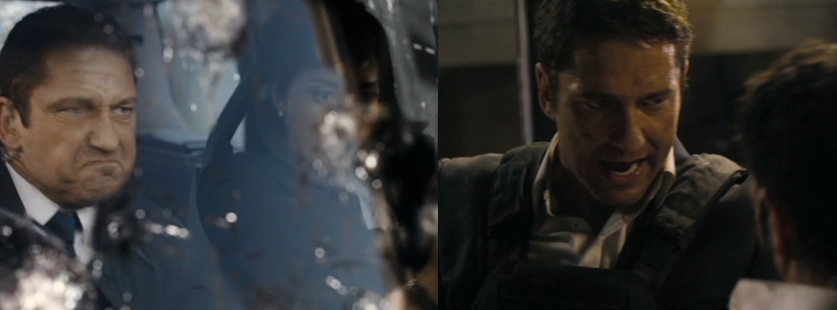
With fatherhood looming, Mike begins to consider retiring from active duty.

After the events of the last film, Mike is back to his old self; his relationship with President Asher is as strong and amicable as ever, his wife Leah (Radha Mitchell) is pregnant, and he’s contemplating resigning his commission in order to be closer to home and provide for his growing family. There’s a definite sense of growth for the character, who is no longer burdened by guilt or grief and is, instead, struggling with giving up his beloved position in the Secret Service in order to be a more attentive husband and father. Once again, there isn’t really anything for Leah to do except be Mike’s moral compass and supportive rock; because she’s pregnant, she can’t accompany him to London and is left to watch in horror when the city is aggressively attacked. Her primary reason for being in the film is to lend Mike some additional humanity and motivation, and this is doubled this time around since Mike is naturally apprehensive (and a little overly protective) about the prospect of being a father.

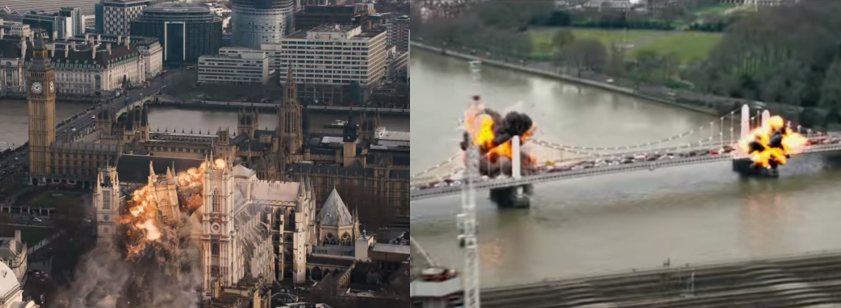
London falls victim to a devastating, co-ordinated terrorist attack.

This time around, our antagonists are Pakistani arms traffickers and terrorists led by Aamir Barkawi (Aboutboul); when the British military initiate a pre-emptive missile strike to take them out, Barkawi’s son, Kamran, leads a counterattack that sees London bombarded with a full-scale terrorist assault during the British Prime Minister’s funeral. Forty of the world’s governmental powers are in attendance for the funeral, the abruptness of which naturally puts Secret Service Director Lynne Jacobs (Bassett) on edge despite the reputation the British government has for security and routine. Mike is just as efficient and prepared as ever; the trip to London equally perturbs him because of how little time he has to prepare for it and a host of unknown factors but even he could never have prepared for the violence that suddenly erupts in the streets of London. Kamran arranges for car bombs and suicide bombers, has his men pose as emergency services and members of the Queen’s Guard to rain gunfire and grenades into the visiting delegates and crowd, and destroys a variety of iconic British landmarks.

Mike is forced to adapt on the fly and go on the defensive to keep Asher safe.

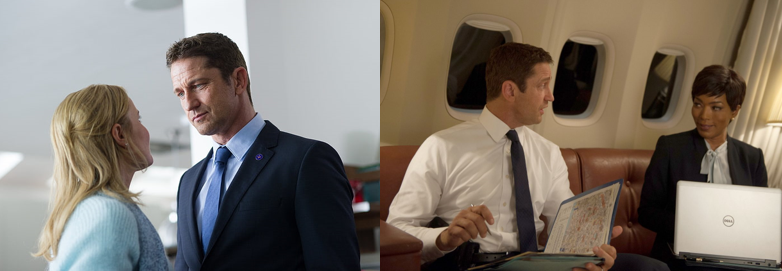
The initial attack results in Jacobs’ sudden and violent death and forces Mike to flee into the London Underground with Asher; with the two compromised and under the constant threat of attack, the film becomes more of a protracted escort mission for Mike, who must constantly think on his feet to find ways of keeping Asher safe. This means that there’s a lot more for Eckhart to do this time around; he’s no mere helpless politician and, though the attack and violence of not just the terrorists but also Mike shakes him, he still retains that same defiant attitude and moxie as before and even orders Mike to kill him rather than let him be captured and publicly executed. Many of the characters from the previous film return, including now Vice President Allan Trumbull (Freeman), Secretary of Defense Ruth McMillan (Melissa Leo), and General Edward Clegg (Robert Forster). These are joined by White House Deputy Chief of Staff DC Mason (Jackie Earle Haley) and a host of new characters from the British government, including Commissioner Sir Kevin Hazard (Colin Salmon), MI6 agent Jacquelin “Jax” Marshall (Charlotte Riley), and SAS Captain Will Davies (Bryan Larkin).

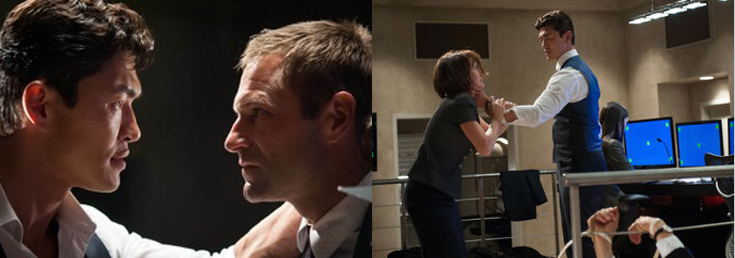
The odds are stacked even heavier against Mike this time around.

As in the previous film, everyone gets a little onscreen blurb so you know who they are and what their position and title is but it’s these latter two who get the most influential screen time as, while the governmental figures debate with Barkawi and co-ordinate with Mike, Jax is instrumental in tracking down their mole and Davies and the SAS team provide him with actual, practical support in his effort to reach the captured President. Compared to the terrorist forces of the previous film, Kamran and his cohorts aren’t quite as blunt and vicious but are no less premeditated in their approach. Through subterfuge and technological innovation as much as brute force, Kamran is not only able to bring London to its knees and position his mercenaries across the city in an effort to track down Asher to have him executed but also able to effectively neuter any possible large scale counterattack since his men are posing as emergency services. Like before, though, a traitor to the ideals of freedom and justice allows Kamran the foothold he needs to launch this devastating attack as it turns out that MI5 Counter-Intelligence Chief John Lancaster (Patrick Kennedy) has betrayed his country.

The Nitty-Gritty:
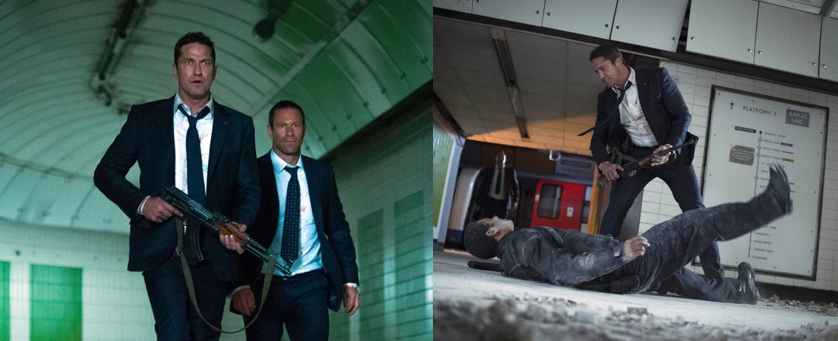
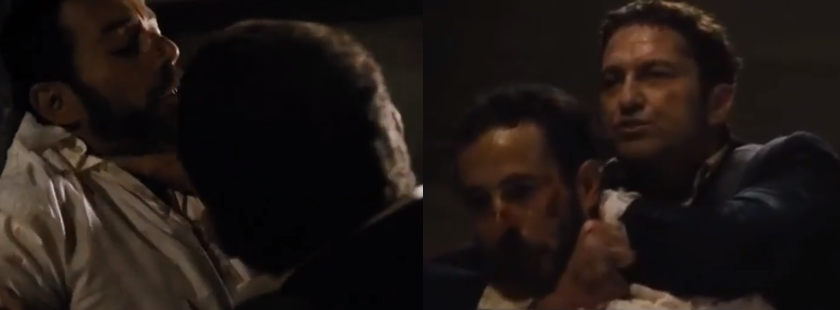
Given that its setting has moved from the confined hallways and rooms of the White House to one of the biggest and most confusing cities in the world, London Has Fallen has a much wider variety of action scenes than its predecessor. Accordingly, we get an exhilarating car chase through the busy streets (that sees Mike driving in reverse at high speed at one point), widescale destruction of iconic landmarks, a massive helicopter crash that kills Jacobs, and a full-scale firefight in the narrow streets of London between Banning and his SAS support team and Kamran’s forces. Once Mike is left in charge of Asher’s safety, we once again get to see how meticulous, strategic, and adaptable he can be as he brutally murders one of Kamran’s men (who is posing as a police officer) and relieves him of his weaponry to clear out the London Underground station he initially flees to. In the process, he viciously beats and tortures one of Kamran’s men, slowly killing him and forcing Kamran to listen.

Asher helps humanise Mike and gets much more to do this time around.

Mike’s brutality shakes Asher and Mike has to work to keep him focused and calm but remains a relentless, uncompromising machine when the shit hits the fan who never misses a trick (he has a knack for sensing when things are too quiet prior to an action sequence and even spots Kamran’s men by noticing that they’re not sweating). Having Asher with him allows Mike the chance to have someone physically there to talk to, which helps remind us of how flawed and relatable he is; he might be a cold, vicious killer who is able to meticulously beat, stab, and gun his enemies to death but he’s also very much an “Everyman” character, one who has concerns about fatherhood. Having Asher there gives Mike someone to build a rapport with in the heat of a pitched battle; he and Asher’s relationship if one of trust and respect and they share a brotherly bond, of sorts, that sees them trading quips and digs at each other to help relieve the stress of the situation. Asher is even able to pull his weight by shooting one of Kamran’s men to save Mike’s life rather than being a mere hostage this time around.

Mike’s indomitable will and unshakable patriotism once again wins the day.

Of course, he does eventually become a hostage and Mike is once again forced to rely on guerrilla tactics to keep himself and Asher safe. This culminates in a tense sequence shot in near pitch darkness where Mike picks off Kamran’s men one by one to get to the President; it’s much more of a gruelling gauntlet than the last film and requires a different level of adaptability on Mike’s part. He’s far better equipped this time around, though, thanks to Davies, which means that he’s far more likely to rely on firearms or knives than straight-up hand-to-hand combat. Though he does end up in a brawl with Kamran at the end of the film, it’s not much of a challenge for him even after he is stabbed up a bit since Mike’s iron will and patriotism make him an indomitable force to be reckoned with.

The Summary:
London Has Fallen is a much bigger, far grander story than its predecessor; by opening the film up and expanding its scope, it gives us the opportunity to see how well Mike adapts to different scenarios and showcases a slightly different side to his personality and nature. Although no longer hampered by grief, he’s nonetheless seriously considering retirement in the face of his impending fatherhood, but the entire experience galvanises his resolve to continue his commission and, even in the face of overwhelming odds, he remains steadfast and resolute. Again, the overall themes of patriotism are kind of lost on me but the film has slightly more appeal since it’s set in my home country and there’s plenty for action movie junkies to enjoy here, from Mike’s occasional dry sense of humour, to all-out firefights and explosive action, to some brutal melee combat. I’m not really sure why the film didn’t resonate with critics as well as the first one as it’s a decent escalation of the previous movie; maybe it’s the fact that it moves away from one man’s desperate, lone attempt at fending off terrorists to a much wider, urban environment or the far less compelling villain but I thought it was decent enough and may, actually, prefer it to the first film in some areas (specifically the most important parts: the action and the characterisations, especially of Mike and Asher).

My Rating:

Rating: 4 out of 5.

Great Stuff

What are your thoughts on London Has Fallen? Did you prefer it to the first film or did it not resonate with you in quite the same way? What did you think to Mike this time around and the way he was presented compared to the first film? Were you happy to see President Asher have a more proactive role or would you have preferred to see Jax or Davies get more screen time? What did you think to the terrorist threat and the depiction of widespread destruction in London, as opposed to America, and which of the Fallen trilogy is your favourite? Whatever your thoughts on London has Fallen go ahead and exercise your constitutional right to leave a comment down below.
Movie Night: Westworld

Released: 17 August 1973
Director: Michael Crichton
Distributor: Metro-Goldwyn-Mayer
Budget: $1.2 million
Stars: Richard Benjamin, James Brolin, Yul Brynner, and Alan Oppenheimer

The Plot:
Following a messy divorce, Peter Martin (Benjamin) is treated to a much-needed vacation by his friend, John Blane (Brolin). The two journey to Westworld, a Wild West-themed amusement park populated by sophisticated androids, and indulge in a number of fantasies. However, when the machines begin to not just break down but go on a murderous rampage, the two find themselves fighting for their lives against the machines, in particular the aggressive Gunslinger (Brynner).

The Background:
Many years before he came a household name thanks to Jurassic Park (Crichton, 1990), Michael Crichton had already achieved significant success as a writer and had even directed a television film. Wanting to break into the Hollywood mainstream, Critchton produced an original screenplay for his feature-film directorial debut. The result was Westworld, a film that was ahead of its time in many ways, being one of the first examples of a computer virus driving robots or machines into a murderous frenzy, and pioneered several unique filmmaking techniques despite the tight budget, rushed production schedule, and interference from the film studio. Still, Westworld went on to become Metro-Goldwyn-Mayer’s biggest box office success of that year; it also received high praise at the time, particularly for its effects and Brynner’s chillingly menacing performance. A favourite of mine since childhood, and a clear precursor to science-fiction greats like The Terminator (Cameron, 1984), Westworld inspired both a critically-panned sequel in 1976, an obscure television series that ran for five episodes in 1980, and, after years of speculation regarding a modern-day reboot, an extremely well-received and award winning HBO series that is part-reboot, part-sequel. Considering today is the day that HAL 9000 first came into being in Arthur C. Clarke’s seminal work 2001: A Space Odyssey (1968), this seems like a great opportunity to talk about other instances of A.I. and machinery gaining sentiency and running amok against their human masters.

The Review:
Personally, I’ve never been a fan of Westerns; I often find them to be slow and dull and boring to look at as there’s a lot of arid locations and I’ve just never really connected with them. Westworld, though, cuts through that bias thanks in large part to its infusion of science-fiction elements. The film spends quite a bit of time selling us on its premise, which was obviously very new and unique at the time, literally opening with quite a long-winded, if amusing, sequence wherein spokesman Ed Wren (Robert Hogan) introduces the concept of Delos and their android-populated theme parks. He interviews a few random visitors to sell the unique concept of highly sophisticated and realistic robots offering a fully immersive experience and the confidence Delos has in the excitement, safety, customer satisfaction, and appeal of their theme parks

Pete and John make for charismatic and likeable protagonists.

If you’ve seen any sci-fi film before, much of this will be easily absorbed but, while this opening scene may drag a little bit, it’s pretty effective at establishing that Delos is fully confident in their facilities and we’re soon introduced to our extremely likeable protagonists, Pete and John. Benjamin and Brolin are two immediately amiable guys who have good chemistry and believable banter together; John is the expert as he’s paid a thousand dollars a day to visit Westworld before but, as it’s his first time, Pete’s conveniently full of questions and scepticism. Clearly the more highly strung of the two, it takes Pete a little while to acclimatise himself to the whole experience, which annoys and frustrates John who just wants him to relax and have a good time, but it’s a great way to sell Pete as an audience surrogate since it’s our first time, too, and he quickly becomes immersed in the unique experience Westworld has to offer. While listening to Delos’ introductory video package, we are sold the idea that Delos’ attractions offer a completely immersive, but completely safe, experience; they’ve “spared no expense” to recreate each World and ensure the visitors that “There are no rules” and that “Nothing can go wrong” on a continuous loop which…well, if that’s not a pretty glaring red flag then I don’t know what is!

Westworld‘s machines are so realistic that it’s almost impossible to tell them apart from humans.

Delos has gone to immense lengths to recreate the details of each World down to the smallest detail, offering visitors period-specific costumes, weapons, and accessories. Their machines are so lifelike that it is pretty much impossible to tell them apart from humans or other lifeforms except for their hands, which “haven’t been perfected [yet]”. Accordingly, they talk, act, and even bleed like a human, making the experience all the more realistic.

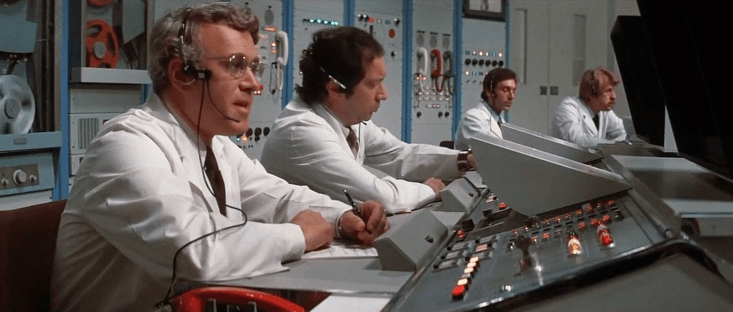
Delos’ technicians control every aspect of the resort from their sophisticated bunker.

To mix things up a bit, the film continuously cuts away to the engineers and puppet masters behind each World, who toil in a hot, highly sophisticated bunker of sorts. Using massively complicated computers, they control and dictate the routines and activities in each World, including the machines. They clean up the dead bodies once night has fallen (conveniently there’s apparently not much of an external nightlife in Delos’ resorts), program infidelity into the Queen (Victoria Shaw), cause bar fights to happen, and pretty much have their fingers in every aspect of the resort from their elaborate control room. Delos have, however been smart enough to program a safety feature into the revolvers of Westworld; they will only fire if the target has a low body temperature, ensuring guests don’t accidentally kill each other. How this works in the sword-based Medievalworld is not explained, however, and the virus that ends up spreading from machine to machine also ends up overriding this safety feature.

The bar fight scene is a particular highlight of the film’s humour.

If there’s one negative to Westworld, however, it’s the pacing; being a product of the seventies, the film isn’t exactly action-packed from the get-go and it likes to take its time explaining or establishing its concept and its world and acclimatising the audience to the fiction it is presenting. This isn’t really a bad thing; it’s much faster than 2001: A Space Odyssey (Kubrick, 1968) or Alien (Scott, 1979), for example, and it leads to some fun scenes like Pete’s liaison with a robot prostitute, a few looks at how Delos run their operation behind the scenes, and an extremely amusing and exciting bar fight where Pete and John lackadaisically sit and play cards until their game is ruined. Plus, once the robots start running amok and the film’s climactic chase kicks in, Westworld really steps up and becomes this incredibly tense and engaging quasi-horror film.

The Nitty-Gritty:
Delos’ Chief Supervisor (Oppenheimer) explains that their machines are so sophisticated that even the technicians don’t fully understand them; many of them are built by other machines and are so advanced that their internal mechanisms are something of a mystery. He is horrified when a robotic snake manages to injure John despite it (and, presumably, all the machines) being programmed not to cause physical harm to the guests. He suggests, to chagrin of his peers, that the machines could not only have a degree of autonomy outside of their control but also that a virus is spreading throughout the resort, affecting each machine in turn. These days, that’s a well-accepted concept but, here, it is met with ridicule and scorn and seen as a mysterious, unknown enemy threatening the safety and security of their facilities. Quite how it comes about isn’t explained and is somewhat irrelevant once the machines go crazy and start killing mercilessly until they eventual break/shut down.

No matter how many times he’s put down, the Gunslinger keeps coming back for more.

Pete first runs afoul of the Gunslinger while choking down a whiskey at the local bar; dressed exactly like Chris Adams, his famous character from The Magnificent Seven (Sturges, 1960), Brynner delivers a cold, inhuman performance and speaks in blunt, antagonistic tones. Pete easily bests him in their first encounter, only for the machine to be fixed up and return to accost John later in the film. Again, Pete is able to put him down and the Delos scientists equip him with a few experimental upgrades to improve his performance. It surely breaks the immersion, somewhat, to have the same machines return to the resort after being “killed” and it’s left somewhat ambiguous whether the Gunslinger has been programmed to seek revenge or whether he is doing so of his own free will since, of all the machines, save the Black Knight (Michael Mikler), the Gunslinger is the only one to hold a grudge and specifically target a particular guest. As a result, when the Gunslinger shows up after the machines have started running amok, he immediately confronts Pete and John once more rather than joining his fellow machines in their rampage. He guns down John in cold blood and a lengthy, intense chase scene takes up the majority of the film’s final act as the Gunslinger toys with Pete, chasing him across the resort and dragging out his kill while Pete stumbles across the dead bodies of other guests and the inert forms of the machines.

The Terminator clearly owes a debt to the Gunslinger’s relentless persistence.

This is where Brynner’s performance really shines; he exudes a stoic, fittingly-machine-like demeanour that clearly set the standard for performances in the Terminator movies (Various, 1984 to 2019). Relentless and persistent, the Gunslinger pursues Pete on horseback or at a measured, leisurely pace; terrified out of his mind, Pete is unable to compose himself enough to get a clean shot at the Gunslinger and is forced to turn to more practical means, such as tossing caustic acid in his face and finally setting him on fire. Seeing Brynner’s features melt and his human façade break away to reveal his gruesome metallic insides is a truly chilling moment and when the Gunslinger finally collapses in a smouldering heap of sparks and fire, it’s easy to feel the same sense of grief, relief, and shock that Benjamin’s expression and body language display. As mentioned, the Gunslinger isn’t the only mechanical menace in this film; one of the other guests (Norman Bartold) sets himself up as a Lord of the castle in Medievalworld and, as a result, is forced into a duel with the Black Knight. From what we see of the Delos technicians, this is a pretty standard storyline for Medievalworld as they program the fight to always go in favour of the guest and look forward to watching it go down. This time, however, the Black Knight lands a killing blow and the Chief Supervisor immediately orders all the machines to be shut down. By this point, however, it’s too late; the virus has progressed so far that not only are the machines beyond the control of the technicians but they are locked in their bunker as all the doors as magnetically sealed. As a result, for their hubris they are left to slowly suffocate and die, powerless to save themselves or the guests from the robot rampage occurring across the resort.

The Summary:
The idea of a themed resort where guests can indulge their every whim and which is populated by advanced robots is extremely unique and interesting and Westworld does just enough with the concept to sell you on the potential and scope of this world appearing, at first, to be little more than sci-fi buddy comedy/action film of sorts and then descending into a horrifying tale of man versus machine for its incredibly tense finale. Many of Westworld’s concepts have since been perfected elsewhere or improved upon by numerous other films, videogames, books, comic books, and television shows but none of that dilutes the impact that Westworld still makes thanks to the unique way it presents these elements. The idea of a computer virus making machines go nuts might have been new and somewhat awkward to convey at the time but the film does a masterful job of showcasing it without really having to delve into the exact specifics of how and why it occurs; it’s a mystery, one that quickly escalates to become so dangerous and deadly that the only thing that matters is surviving rather than trying to figure out the how and the why of it all. Even better is the fact that the film’s effects are obviously all achieved through practical methods; while they would obviously be perfected over the years, it’s still admirable to see the lengths Crichton went to render the machines’ thermal vision through early digital effects and the horrifying, skull-like, almost alien inner workings of the machines once the Gunslinger’s face is dislodged. Punctuating the film’s simple but effective cinematography and presentation is a pretty engaging soundtrack; from a suitably Western theme to a highly effective, pseudo-synthetic score that really sells the tension and desperation of the film’s big chase scene, Fred Karlin’s fantastic score is always used to great effect to sell whatever’s happening onscreen and, for me, really helps to keep Westworld as appealing today as it was when I first saw it all those years ago as a kid.

My Rating:

Rating: 5 out of 5.

Fantastic

Have you ever seen Westworld? What did you think of it and how do you feel it holds up today? Perhaps you’re more a fan of the recent television show; if so, what are some of your favourite moments? How are you celebrating the birth of HAL 9000 today? Whatever you think about Westworld, or if you have other examples of A.I. going rogue, feel free to drop a comment below.

Movie Night: Olympus Has Fallen

Released: 18 March 2013
Director: Antoine Fuqua
Distributor: Millennium Films
Budget: $70 million
Stars: Gerard Butler, Aaron Eckhart, Rick Yune, Angela Bassett, Dylan McDermott, and Morgan Freeman

The Plot:
When a North Korean terrorist group led by Kang Yeonsak (Yune) storms the White House and takes President Benjamin Asher (Eckhart) and his cabinet hostage, their only hope is one man, Mike Banning (Butler), a former Secret Service agent forced to wage a one man rescue mission on the nation’s capital building.

The Background:
Ever since the commercial success of Die Hard (McTiernan, 1988), a number of knock-offs have permeated cinema that are, essentially, “Die Hard…but on a…”. We’ve seen Die Hard on a boat, on a train, in a plane, in a hockey stadium, in a skyscraper, and all kinds of variants but, in 2013, we got two movies that followed the basic theme of “Die Hard…but in the White House!” The more financially successful of these two movies was, of course, Olympus Has Fallen, which began life as a spec script and became the first in a whole franchise of action movies that really keeps the spirit of Die Hard alive in a time when such movies are rarely seen in cinema.

The Review:
Unlike many films featuring the President, Olympus Has Fallen opens with Asher not in some dull press conference but in a boxing ring with Mike; the entire opening sequence is a pretty effective, if overly dramatic and elaborate, way of showing the close relationship Mike has with the President and his family, especially Asher’s son, Connor (Finley Jacobsen). Mike is on friendly terms with Asher, calling him “Ben” when in private but being all business and a consummate professional when it comes to his safety. Meticulous and detail-orientated, Mike has even (conveniently for the film’s plot) taught Connor the value of always being aware of his surroundings and exits. Of course, no good action movie protagonist is any good without some significant trauma or drama and Mike’s is a doozie: while escorting the Asher’s to a fundraiser, they had a blowout and, though Mike was able to save the President, he couldn’t save his wife, Margaret (Ashley Judd).

Thankfully, Mike and Leah’s relationship has not been strained to breaking point by his guilt.

When we pick up with Mike eighteen months later, he’s a shell of his former self; now working at the Treasury Department, he’s doing the best he can to carry on and provide for his wife, Leah (Radha Mitchell), but is clearly affected by the guilt and consequences of his actions since he’s easily distracted by political news. Thankfully, the two have a very close and adorable relationship: they’re not at odds with each other or arguing, Mike’s not a drunk or abusive, and Leah is both sympathetic and supportive of him and just wants them to adjust to and accept the new normal. She doesn’t really get much to do beyond being Mike’s rock but we do get to see her doing good work at the hospital, staying busy and being supportive even in the face of the insurmountable odds stacked against Mike. Mike, however, is frustrated with his position; he maintains contact with his former director, Lynne Jacobs (Bassett), and wants back in but, while she reassures him that no one, not even Asher, blames Mike for what happened, she urges him to take some time to grieve and reflect on the accident and emphasises that Asher hasn’t given himself that time and is thus unable to see Mike every day without being reminded about what happened.

North Korean terrorists launch a devastating attack on the White House.

Although it’s obvious that things are very different not just for Mike but for Asher and Connor as well, everyone has been able to carry on as though it’s business as usual because of their commitments and, as a result, the President and his staff invite South Korean Prime Minister Lee Tae-Woo (Keong Sim) to the White House to discuss the threat of invasion from North Korean forces. However, shortly after Tao-Woo’s arrival, the White House comes under attack from the Koreans for United Freedom (KUF), a North Korean terrorist group led by Kang Yeonsak, who infiltrates the White House (which is given the completely subtle codename of “Olympus”, hence the title of the film) as one of Tao-Woo’s aides. This delivers quite an impactful sequence in which a gunship rains fire upon Washington, D.C. and the White House itself. Despite the White House’s impressive (and, frankly, unprecedented) array of weaponry (including anti-aircraft guns and hundreds of armed forces), the attack is nothing short of a massacre and the White House is captured with gratuitous use of violence and the destruction of iconic American landmarks.

Kang is a ruthless, sadistic villain willing to killing hundreds to prove his point.

Despite being held hostage, with no idea of the whereabouts or safety of his son, Asher remains defiant in the face of Kang’s threat, ordering the remnants of the government and military not to negotiate. Kang, however, is a cold, ruthless, and remorseless individual who takes the White House with an aggressive and efficient operation, setting up heavy weapons and numerous armed men throughout the White House to fortify his position. He is also more than happy to threaten, torture, and kill Asher’s aides for security codes to America’s “Cerberus” weapon, mercilessly beating Secretary of Defense Ruth McMillan (Melissa Leo) to within an inch of her life and outright executing Tae-Woo. To spare lives, Asher permits his aides to divulge their codes since he remains steadfast that he will never reveal his own code, which only drives Kang to further extreme methods.

Forbes’ betrayal aids Kang’s cause and positions him as Mike’s dark opposite.

Kang and his cohorts are reprehensible, merciless terrorists who gun down countless members of the White House security team in an unprecedented ground assault, completely taking everyone by surprise, and of which Mike ends up being, again, the sole survivor inside the now ravaged White House. Of course, it turns out that they were aided in their efforts by Dave Forbes (McDermott), a former Secret Service agent and trusted friend of Mike’s who sells out his country after losing his way. Forbes is positioned as Mike’s dark reflection, a corruption of the ideals he fights so hard to uphold, and their inevitable showdown is framed in a way to present Mike as fighting someone as trained as capable as he. Of course, Mike is able to overcome this challenge with grit and determination and, having delivered a clean, effective, mortal blow, offers Forbes the chance at redemption before he dies.

The Nitty-Gritty:
An interesting technique Olympus Has Fallen employs is not just the usual onscreen information like locations and times and such but also little titles for key characters in the Presidential office so we know who they are and what their position is. I’m not entirely sure I really need this context (it’s enough for me to see them conversing with the President to know that they’re important) but it’s certainly unique. Of course, not being an American, having no interest in politics, and not really being that patriotic, many of these aspects are wasted on me. However, the action in Olympus Has Fallen is suitably loud and over the top and the initial assault against the White House is scary in its potential, if a little undermined by the slightly dodgy CGI (most notably seen in the film’s various blood effects). For me, none of this detracts from the sequence or the action, though, since such scenes are full of frenetic cuts, fast-paced action, and numerous explosions and brutal kills that all sell the sudden violence of the campaign more than anything else.

Mike’s training and knowledge of the White House makes him a force to be reckoned with.

Once Mike enters the White House as the last man standing, the film truly reveals its Die Hard roots as Mike becomes a John McClane (Bruce Willis) figure: a lone man with few resources fighting impossible odds. Mike, however, as a former Army Ranger and Secret Service Agent, is arguably a lot better trained and equipped than McClane yet, as efficient and capable as he is, he’s still just one man and positioned as a vulnerable, desperate character. Mike’s adaptability comes not just from wise cracks (and he is extremely snarky when he needs to be) and desperate innovation but from his knowledge of the White House and governmental protocols, which he uses to his advantage to arm himself, find and rescue Connor, and launch a pre-meditated counterattack using the hidden passageways to avoid and take out Kang’s men one at a time. Of course, it’s not all action and excitement in Olympus Has Fallen; much of the film’s side plot revolves around the remaining governmental body, headed up by Speaker of the House Allan Trumbull (Freeman) who, along with military aides and other advisors, desperately try to hold the country together, debate Kang’s demands, and try to find a way to resolve the situation. Interestingly, I found that the film kind of suggests Trumbull as a red herring, someone perhaps in league with Kang in order to usurp Asher as the President, but..c’mon, it’s Morgan Freeman so of course he’s the cool-headed commander-in-chief who helps co-ordinate Mike’s efforts within the White House.

Despite Kang’s impressive physical skills, Mike is able to end him with brutal efficiency.

Thankfully, there’s only a momentary debate about Mike’s credentials and capabilities so, unlike McClane, he’s not entirely alone in the White House and has a degree of support, if nothing else. However, his warnings to as General Edward Clegg, (Robert Forster) regarding their attempts to retake the White House of course fall on deaf ears because those not stuck in the middle of the shitstorm always have to make uninformed and impulsive decisions so our “Everyman” hero can shine even brighter and have another chance to perform a daring attempt to save lives. Despite his earlier obvious feelings of guilt and uselessness, Mike reacts without thinking as soon as he spots the incoming attack on the White House, goes out of his way to try and save lives, and immediately slips right back into his scrupulous training to become a one man army. Mike is an efficient, hard-hitting combatant; there’s no prolonged fight scenes here, just quick, hard, well-timed strikes. He’s also, it turns out, an equally ruthless and dangerous individual; when questioning Kang’s men, he doesn’t hesitate to murder one with one quick, vicious stab and torture information out of the other. Whereas McClane struggled with most of the terrorists he was placed up against, Mike only really finds himself facing a challenge when fighting Forbes and in the final showdown with Kang. Still, despite Forbes’ deception and taking him by surprise, Mike is quickly able to adapt and put him down. By the time he reaches Kang, Mike is fatigued and wounded and thus on the backfoot at first, especially in the face of Kang’s superior martial arts ability. However, Mike represents America’s much-touted ideals of peace, freedom, and democracy and this only bolsters his indomitable will, allowing him to make good on his promise to “stick his knife through [Kang’s] brain” and win the day for America.

The Summary:
Olympus Has Fallen is an extremely intense and engaging action film; it walks a fine, blurry line between being massively over the top and being just a little too serious for its own good, never quite falling on one side or the other. This results in a decent amount of tension and excitement; Mike is an extremely capable, well-trained, and meticulous individual and yet, thanks to Butler’s rugged charisma and down-to-earth appeal, is still a vulnerable, flawed, and relatable character. He’s fighting an uphill battle and striking with a blunt efficiency but is still human, getting more and more fatigued and battered up as the film goes on. Kang, meanwhile, is a ruthless and nigh-emotionless sadist, the kind of villain who truly believes that the ends justify such vicious means, and Yune brings a quiet, despicable magnetism to the role that is fully paid off in his violent end. Strong supporting performances by the always-fantastic Morgan Freedom and Aaron Eckhart help bolster the film’s appeal and legitimacy and, despite some dodgy CGI in the opening moments, the film stays very true to the gritty, desperate spirit of films like Die Hard and is, in my opinion, a worthy successor to that series.

My Rating:

Rating: 4 out of 5.

Great Stuff

What did you think to Olympus Has Fallen? Did you find Mike Banning, and Gerard Butler, a compelling action hero? How did you find the execution of the film’s premise and the performances within? Did you find it an enjoyable romp or were you, perhaps, unimpressed with the film’s weaker aspects and arguably derivative nature? How do you think it compares to Die Hard and similar films and which of Die Hard’s many knock-offs is your favourite? Whatever you think about Olympus Has Fallen, leave a message below and come back next Sunday for my review of the sequel!

Movie Night: The Matrix

MatrixLogo

Released: March 1999
Director: The Wachowski Brothers
Distributor: Warner Brothers
Budget: $63 million
Stars: Keanu Reeves, Laurence Fishburne, Carrie-Anne Moss, Hugo Weaving, and Joe Pantoliano

The Plot:
Thomas A. Anderson (Reeves) is a nobody; by day, he sits in a cubicle and works a monotonous job as a software developer but, in his spare time, he has crafted a reputation under his hacker alias “Neo”. When he is targeted by Agent Smith (Weaving), Neo is brought to the enigmatic Morpheus (Fishburne) and offered both a startling truth and a destiny he could never have suspected.

The Background:
After managing to sell their script for Assassins (Donner, 1995) and the success of Bound (The Wachowski Brothers, 1996), Andy and Larry Wachowski (as they were known then) were able to sell Warner Brothers on another of their scripts: The Matrix. Featuring an impressive mixture of martial arts, philosophy, and science-fiction not often seen in major Hollywood releases and heavily influenced by manga and anime, particularly Ghost in the Shell (Oshii, 1995), The Matrix made an instant and lasting impression not just on the science-fiction and action genres but on cinema as a whole. The film both popularised the concept of “bullet time” and wire-assisted kung fu (or “wire-fu”) in movies and cemented Keanu Reeves as an action star. Suddenly, parodies were everywhere and movie heroes were all sporting long dark coats, shades, and flipping all over the place and it was all largely thanks to The Matrix. When I was a kid, The Matrix was a big, big deal. My friends and I watched the film constantly, eating up the action sequences and the cool aesthetic and soundtrack. Produced on a paltry budget of $63 million, The Matrix was a massive commercial and critical hit, making over nearly $500 million worldwide. So great was The Matrix’s success that is spawned not only two sequels but a whole slew of multimedia merchandise, including comic books and videogames. While the sequels may not have garnered quite the same critical reaction as the quasi-cult hit original, The Matrix’s important at the time (and today) cannot be understated and the later release of a fourth film proved that The Matrix still has an enduring legacy in cinema. Considering today is “National Science Fiction Day”, this seems the perfect opportunity to look back at this classic piece of cyberpunk cinema.

The Review:
The Matrix has a pretty simple concept, one that has been done before and since in cinema, but complicates it with musings on fate, destiny, and the sense of identity and reality. At its core, the plot is incredibly simple, though: the world as we know it is merely a computer-generated construct, a form of virtual reality in which we have been enslaved by a race of machines in a post-apocalyptic world. Amidst this, though, we have themes regarding providence, choice, and some of the most impression action and fight sequences put to cinema.

MatrixNeo
Apathetic to his everyday life, Anderson has far more prominence as “Neo”.

Our window into The Matrix is Thomas A. Anderson (or “Neo”, as he is known throughout the hacking community), a bored program developer who has lived most of his life with a feeling that there’s something not quite right with the world. Thanks to his illicit activities, he is acutely aware of the legendary Morpheus, a charismatic and prophet-like figure in Neo’s circles, and “the Matrix”, an undefined concept that is enough to rouse Neo’s curiosity. Keanu Reeves makes for a perfect audience surrogate; you instantly buy into the idea of him as an isolated, distracted hacker who is unfulfilled in his mundane life and eager for change but not quite confident enough to really buck the system more than showing up late for work or being generally apathetic. Once he meets Trinity (Moss), though, and is set on the path towards Morpheus and answers concerning the Matrix, Neo’s outlook begins to change; he was too afraid of plummeting to his death when trying to escape Smith and his cohorts but, once captured, is defiant enough to give them the finger and, after being reminded of the poor choices he’s made in life that have kept him stagnant, resolves to follow Trinity and her teammates towards an uncertain future.

MatrixSmith
Agent Smith is a chilling, complex villain.

Opposing Neo is the aforementioned Agent Smith; in this movie, he’s just one of a number of men in black who target our heroes and are meant to be indistinguishable from each other. As the de facto leader, and the most charismatic of the three, Smith’s personality is revealed over time and in layers; he goes from a monotonous, fittingly robotic agent of the system to being wracked with personal animosity for Neo and being overcome by his own pride and hubris. Weaving is excellent in the role, exuding both menace and charm with the subtlest of movements and the merest of words and seeing him break out of his shell and reveal just how layered Smith is beneath his cold exterior is both captivating and terrifying at the same time. We also have Cypher (Pantoliano), the more outspoken and neurotic of the crew who takes an instant dislike to Neo thanks to his largely jaded attitude. Cypher is, if his name and Pantoliano’s scenery-chewing acting didn’t make it clear, the ultimate betrayer of the crew as he has grown disillusioned with Morpheus’s teachings and the reality of the real world and therefore deceives his crewmates, killing three of them and leaving Morpheus in the hands of Smith and the other agents. Cypher’s motivations are entirely believable, however, as the real world isn’t all it’s cracked up to be but it’s still extremely cathartic to see that smug smile blown off his face after his heel turn.

MatrixTrinity
Trinity is a capable, if underwhelming, character.

Luckily, Neo is not alone in his journey; Trinity is his main link to Morpheus’s world and serves as his eventual love interest. Yet, while Carrie-Anne Moss is acceptable in the role and more than capable at holding her own in her fight scenes, I never really bought into the attraction between the two characters. People like to rag on Keanu for being “wooden” but I’ve always enjoyed his work and found him very charismatic and that’s no different in The Matrix, where’s he’s able to showcase a variety of emotions and character quirks. Trinity, however, is a very guarded and reserved character through and through; some of this is due in part to the way those awakened to the truth of the Matrix tend to be more emotionless and reserved, especially inside the Matrix, but it’s also because of her reluctance to admit her feelings to Neo out of the fear that he isn’t who she thinks he is and the fear that he is what she thinks, as it means a dramatic change for the world if true.

MatrixMorpheus
Morpheus is easily my favourite character (…after Neo, of course).

Morpheus, however, fully believes in Neo from start to finish and never once does his belief falter. Morpheus is the enigmatic captain of the Nebuchadnezzar and is regarded as a legendary figure not only by Neo but his crew as well. Years ago, the Oracle (Gloria Foster) prophesised the return of “the One”, a man born inside the Matrix who would be able to manipulate it in superhuman ways and spell the end of humanity’s subjugation, and Morpheus has dedicated his entire life to finding the One. For whatever reason (it’s not really explained how or why), Morpheus believes that Neo is the One and actively seeks him out, shows him the truth, and pushes him to break beyond what he has been conditioned to know. Never once does Morpheus’s conviction falter and Fishburne makes for a very fitting mentor and father figure; he anchors the film, offering exposition, and is the heart and soul of The Matrix. Subsequent sequels may have ruined (or spoiled) Morpheus’s mystique somewhat but it’s captivating in The Matrix as he seems so infallible and believable that you can’t help but be sucked in by his words. The rest of Morpheus’s crew is largely one-note and expendable; Switch (Belinda McClory) and Apoch (Julian Arahanga) are pretty forgettable and have maybe three lines between them and Mouse (Matt Doran) is the young, naïve crew member whose death is meant to be heartbreaking because of his youth but ends up falling a little flat as his characterisation amounts to “enthusiastic/annoying kid”. Tank (Marcus Chong) and Dozer (Anthony Ray Parker) stand out a little more thanks to Tank acting as the team’s operator (when inside the Matrix, he directs them, uploads additional training material and resources, and provides them with a way to dial out) and their status as brothers born naturally in the real world.

MatrixFights
The fights are varied and grow in intensity.

Of course, as good as the majority of the cast and characters are, the film’s main draw is its extensive action and fight scenes. Thanks to a combination of computer-generated imagery (CGI), wire work, and an extensive training regime, the film’s fights are high intensity and a spectacle to see; the film begins with Trinity performing that iconic leaping kick in slow motion as the camera pans around her, includes a playfully enjoyable sparring session between Neo and Morpheus, emphasises the aggression and nigh-unstoppable nature of the agents when Morpheus is effortlessly pummelled by Smith, and ends with a long, multi-layered fistfight between Neo and Smith. Unlike the majority of action films, The Matrix presented a world where characters don’t need to appear athletically competent to perform superhuman feats as knowledge and techniques are literally downloaded into their minds, instantly turning them into a master of the arts when plugged into the Matrix. Unfortunately, the special effects falter a bit in the real world; the sets and interiors are great, with the film favouring the “lived in” look of similar movies like Event Horizon (Anderson, 1997) and made popular by the Aliens movies (Various, 1979 to 2017), but the CGI elements haven’t aged too well. The squid-like Sentinels, especially, look particularly cartoony these days and most of the sequences involving them and the Nebuchadnezzar don’t quite hold up to the more practical effects of the film. Similarly, some fight scenes, particularly those using bullet time or other camera tricks, can result in the actors taking on a rubbery appearance but, when they’re inside the Matrix, I feel this effect actually works better and serves to highlight the falseness of that reality.

The Nitty-Gritty:
The Matrix still holds up very well to this day thanks to its enduring themes and the intensity of its otherwise over-the-top fight sequences. There are, of course, a few plot holes and questions raised by the film’s concept that are either not answered in subsequent sequels or poorly addressed. First and foremost for me is the question of how, exactly, child birth happens when humans are simply grown in endless fields. The idea of the fields themselves seems to suggest that the machines are cloning humans, but this isn’t really addressed; neither is how the awakened humans built their ship and other equipment, where their food and clothes come from, or how they don’t simply freeze to death under the scorched skies that blanket the real world.

MatrixBatteries
The machines grow and harvest humans to use them as a power source.

Most of these questions are left intentionally unanswered in this film; we’re told (briefly) about Zion, the last human city, and given snippets of information regarding their war against the machines but nothing concrete. This adds to the mystery of what exactly happened to turn the world into a post apocalyptic hellhole ruled by machines and is completely believable; if all of humanity were blasted to smithereens, why would we have any specific information some one hundred years later? Truthfully, the real world is of little consequence in The Matrix; it’s there and a stark contrast to the artificial world of the Matrix but is never portrayed as being preferable. Instead, the idea is that the truth and the concept of being free from the machines’ control is preferable to being a slave, a literal biological battery, to the will of the machines. As a result, any human awakened to the truth is immediately drafted into the resistance effort but Morpheus is explicitly honest about their chances:

MORPHEUS:
They are the gatekeepers. They are guarding all the doors, they are holding all the keys, which means that, sooner or later, someone is going to have to fight them.

The agents embody this philosophy; practically nameless and faceless, the agents are able to possess (more like overwrite) any person currently plugged into the Matrix, effectively allowing them to endlessly respawn even in the rare instances that they are defeated or incapacitated. Yet, Morpheus also states that everyone who has ever tried to fight an agent has died, which isn’t that surprising considering that, as computer programs, they are faster, stronger, and far more durable than a mere human.

MatrixTheOne
As the One, Neo effortlessly stops bullets and parries Smith’s attacks with one arm.

In a reflection of Morpheus’s conviction, though, he doesn’t hesitate to take on Smith in hand-to-hand combat to allow Neo to escape; Morpheus, previously portrayed as calm, collected, and a severely disciplined fighter, is absolutely dominated in this fight. His near infallibility is then tested to the limit when the agents subject him to a concoction of drugs, torture, and questioning to try and obtain access codes to the Zion mainframe. Morpheus resists, however, and retains enough of his strength (both physical and mental) to break his bonds once Neo and Trinity affect their action-packed rescue plan and, throughout the entire movie, maintains a quiet confidence that, in time, Neo will see the truth about himself. It is therefore heartbreaking when Neo is executed by Smith, leaving Morpheus so distraught that he doesn’t even care about living any more. In the wake of Neo’s death, Trinity finds the resolve to finally admit her feelings for him and, with a kiss, restores Neo to life. As cliché as this sounds, it’s actually one of the most affecting scenes in the film; previously, the Oracle said that Neo was “waiting for something”, specifically suggesting that “something” was his next life, and Neo’s resurrection sees him assume the confident, God-like status of the One at last. His wounds healed, the speed and power of Smith is as nothing; Neo easily blocks and parries Smith’s attacks with one arm, looking hilariously and awesomely bored by the conflict, and easily dispatches the agent by blasting him to pieces. Now able to view the complex code of the Matrix itself, Neo ends the film fully able to manipulate and alert the environment as he blasts off to the sky to the sounds of Rage Against the Machine (a fitting band if there ever was one).

MatrixFlaws
The film is not without a few logistical concerns regarding its world.

This ending is as exhilarating and cathartic as you could hope for; all throughout the film, Neo has struggled with the destiny Morpheus has laid out for him and seeing him grow in confidence and ability leads to some of the film’s more impressive action and fight sequences. The gunfight between him and Trinity and a bunch of guards is worth the price of admission alone but seeing Neo effortlessly take out Smith, especially after the gruelling physical battle they went through previously, never fails to get my blood pumping. That’s not to say that the film isn’t without a few flaws, though. Chief among them, for me, is the “bug” that Smith implants into Neo; it makes sense, as he wants Neo to lead him to Morpheus, and it’s a nightmarish sequence, but it’s rendered immediately mute when Trinity pulls it out of Neo in the very next scene. Ironically, if Smith had simply just waited outside Neo’s apartment building he would have been led right to Morpheus but…no, apparently the bug is more efficient. Additionally, the scene where Neo is awakened is a bit confusing; he swallows a pill to help the crew find him in the real world, randomly gets smothered by liquid glass with no explanation, and when he does wake up the Nebuchadnezzar isn’t even there to retrieve him until he is literally flushed away. Finally, while I like that the film addresses that Neo’s eyes and muscles would have suffered atrophy, I would argue that the plugged in humans would be next to useless in the real world, especially upon being unplugged.

The Summary:
The Matrix’s philosophical musings are far less as explicit as in its sequels; here, exposition is delivered in snippets that are easy to digest and understand. There’s no double talk or complicated words here; we’re simply told as much information as these characters know and even Morpheus explicitly says that he (and even the Oracle) doesn’t have all the answers for Neo’s (or our) questions. Clearly, the film is left with many questions still to be answered but, unfortunately, it didn’t really turn out that the Wachowski’s were capable of delivering interesting answers to those questions. As a result, as much as I enjoy the sequels, neither are on the same level as the original, which is still one of the most compelling and original movies ever made that never fails to deliver despite a few flaws. The Matrix still holds up really well even after all this time; sure, some of the effects aren’t as impressive as they once were and a lot of the tricks popularised in this film have been done bigger and better since then, but it’s still a great piece of cyberpunk cinema. The sequels may have somewhat tarnished the legacy of the first film, and retroactively raise more questions than answers, but the concept and action on display in The Matrix is just as exhilarating as ever. The film is also full of some strong performances; Keanu Reeves proved with this film that he was a competent leading man in Hollywood, Laurence Fishburne set himself up for similar mentor roles in the future, and the film all but launched Carrie-Anne Moss’s career and put Hugo Weaving on the map. It’s not a flawless film, or even a perfect one, but it’s still highly enjoyable from start to finish; effectively a live-action anime, The Matrix is a perfect example of a strong, original concept bringing new life into tried and tested ideas we’ve seen executed in previous films and media. Ahead of its time in many ways, The Matrix set the scene for the slew of action and superhero movies that followed and built upon many of the techniques on display here and its legacy still holds up to this day.

My Rating:

Rating: 5 out of 5.

Fantastic

What did you think of The Matrix when it first came out? Did you enjoy the sequels or do you feel they spoilt the concept of the first movie? Which of the film’s characters or many spin-offs was your favourite? Are you excited for the upcoming fourth movie or do you feel it’s maybe best to let the franchise lie? How are you celebrating National Science-Fiction Day? Whatever you think about The Matrix, or sci-fi in general, drop a comment below.

Movie Night: Pokémon: Mewtwo Strikes Back – Evolution

MewtwoEvolutionLogo

Released: July 2019
Director: Kunihiko Yuyama and Motonori Sakakibara
Distributor: Toho
Budget: $27 million
Stars: Sarah Natochenny, Michele Knotz, Bill Rogers, Ikue Ōtani, James Carter Cathcart, Michele Knotz, Dan Green, and Kōichi Yamadera

The Plot:
Cloned from the genetic material of the rarest Pokémon of all, Mew (Yamadera), and enraged at his mistreatment at the hands of humans, the Psychic Pokémon Mewtwo (Green) lures Ash Ketchum (Natochenny) and his friends to its island to witness its plan to enact revenge against all humanity.

The Background:
No doubt you are familiar with Pokémon (Nintendo/Creatures/Game Freak, 1995 to present), a role-playing videogame for Nintendo’s Game Boy and handheld consoles that, with no exaggeration, took the world by storm back in the late nineties. Everyone who was anyone rushed out to buy a copy of Pokémon: Blue Version or Pokémon: Red Version (ibid) back when they first released and, before long, kids everywhere were hooked on the seemingly never-ending stream of multimedia merchandise released by Nintendo. Chief amongst these was the still-ongoing Pokémon (1997 to present) anime series which, while somewhat removed from its videogame source material, nonetheless enthralled kids everywhere and, perhaps inevitably, led to the production of a feature-length animated movie, Pokémon the First Movie: Mewtwo Strikes Back (Yuyama, 1998). Then, for whatever reason, the decision was made, in the midst of a soft reboot to the Pokémon film series and anime alike, to remake this iconic movie entirely through the use of computer-generated imagery (CGI), resulting in this modern twist on what is, in my opinion, still the best Pokémon movie ever made thanks, largely, to the power of nostalgia.

The Review:
Basically, Evolution is exactly the same story as its predecessor but with a few noticeable changes; the most obvious is, of course, the CGI animation but other things, such as dialogue changes, narrative changes, and changes to the music, all help to freshen up the original movie. The opening scenes are largely the same (but, once again, the film skips the prologue that sees Mewtwo make friends with other clones who heartbreakingly die right before his eyes) as Mewtwo is cloned from a single cell of Mew and, unimpressed with the motivations behind his creation, destroys the facility in which it was created and kills all the scientists who birthed it.

MewtwoEvolutionRevenge
Mewtwo swears revemge against humanity.

Summarily manipulated by Giovanni (Ted Lewis), the evil leader of Team Rocket and the mastermind behind its creation, Mewtwo’s rage against humanity leads it to organise a Pokémon tournament in order to build an army of clone Pokémon to “strike back” against the world that treated him so badly. In the middle of their journey through Kanto, Ash, Brock (Rogers), Misty (Knotz), and Pikachu (Ōtani) receive an invitation to Mewtwo’s island and, after braving a storm it created, immediately take umbrage to Mewtwo’s twisted world view and rally a group of trainers, their Pokémon, and even their long-time enemies from Team Rocket, Jesse (Knotz), James (Cathcart), and Meowth (ibid), in opposing Mewtwo’s plans.

MewtwoEvolutionOppose
Ash vehemently opposes Mewtwo’s plans.

Let me state first of all that, unapologetically, I absolutely love Pokémon the First Movie; I still remember going out of my way to purchase a bootleg VHS tape of the film back in the day before finally getting a legitimate copy from a car boot sale. As much as I’ve enjoyed subsequent Pokémon movies, nothing beats the nostalgia of revisiting the original film. It may have some flaws, largely based around the numerous changes made when dubbing the film into English that made Mewtwo far less sympathetic, but I will defend it to this day simply because it came right at the peak of Pokémon’s popularity for me; Pokémon: Gold Version and Pokémon: Silver Version (Game Freak, 1999) were due to be released around that time and the hype was real concerning brand new Pokémon, to say nothing of finally seeing Mewtwo in all its glory (it had been teased in several episodes of the anime prior to the movie’s release), much less going head-to-head with Mew, which was the most elusive of game secrets at the time due to their being no legitimate way to catch it outside of Japan.

The Nitty-Gritty:
Thankfully, Evolution doesn’t really alter that much from the original film, meaning that the only thing you’re really missing out on is the gorgeous anime aesthetic from the original. The CGI looks good on the Pokémon but the human models look a little…off, like they’re made of plastic, which gets a bit distracting at times.

MewtwoEvolutionBattles
A lot of the battles have been improved and expanded upon.

Additionally, there were a few odd choices made here; dialogue is altered significantly, to the point where it feels much closer to the original Japanese dialogue (if that makes sense) but then, about halfway through, the dialogue changes and is almost exactly the same as in the original film (Mewtwo’s closing monologue, for example, is pretty much word-for-word). There’s also the criminal decision to supplant the original dub score with a new one (those who preferred the Japanese score will likely be thankful for this, however) and completely remove Blessid Union of Souls’ ‘Brother My Brother’ from the epic final clash.

MewtwoEvolutionTears
Ash’s sacrifice still hits in the feels…

One change I did appreciate, however, was the complete remove of the “tears of life” sub-plot; in the original, Ash and the others are fed a nonsense story about Pokémon tears being able to restore the dead to life, which was completely missing from the original Japanese version. While this did bring a lot more context to Ash’s resurrection in the film’s climax, it never sat well with me in the original as it always felt wedged in there.

MewtwoEvolutionChanges
Evolution features some welcome alterations to the original.

Similarly, Mewtwo’s mechanical suit gets on hell of a bad-ass upgrade, Team Rocket’s amusingly ridiculous disguise as Viking sailors, of all things, is removed completely (and for the better), and minor niggles like Pokémon being referred to incorrectly have been addressed. There are also some improvements made through this remake, as well; the ambiguity surrounding Mewtwo’s motivations that was explicit in the original Japanese release is far more prevalent here than in the original dub, for one thing. Some of the battles also receive a makeover, such as Ash’s initial battle during the iconic Pokémon theme song and the battles between the cloned start Pokémon and their biological counterparts.

MewtwoEvolutionSUmamry

The Summary:
In the end, Pokémon: Mewtwo Strikes Back – Evolution is a nice little update to a childhood favourite; it adds in a lot of subtle story beats that were missing, beefs up some of the battles and content, and adds a fresh coat of paint to a classic. Yet, at the same time, it feels incredibly redundant; beyond the CGI overhaul and a few of these alterations, there’s not much new happening here and, considering the fact that the Pokémon movies are completely removed from the anime, it feels a bit weird to have this suddenly released upon us. A big factor into my final score comes down to my unconditional love for the original movie but even I kind of feel like much of the same could have been accomplished by releasing a high-definition, digitally remastered version of the original movie with all of the cut content restored alongside the recording of a new dub and the option to watch in the original Japanese.

My Rating:

Rating: 4 out of 5.

Great Stuff

What did you think of Pokémon: Mewtwo Strikes Back – Evolution? Do you think it is a good tribute to Pokémon the First Movie: Mewtwo Strikes Back or do you, perhaps, not share my fondness for that movie? Whatever the case, feel free to share your Pokémon thoughts and memories in the comments.

Movie Night: Sonic the Hedgehog (2020)

SonicMovieLogo

Released: February 2020
Director: Jeff Fowler
Distributor: Paramount Pictures
Budget: $81 to 95 million
Stars: James Marsden, Ben Schwartz, Tika Sumpter, and Jim Carrey

The Plot:
Small town cop Tom Wachowski’s (Marsden) life is turned upside down when Sonic (Schwartz), a superfast hedgehog with an insatiable curiosity and the means to travel between worlds, is targeted by the megalomaniacal Doctor IvoRobotnik (Carry).

The Background:
Back in the nineties, in the middle of the escalating Console War between Nintendo and SEGA, the videogame industry was changed forever when Yuji Naka and Naoto Ohshima dreamed up the idea of the superfast hedgehog that would become their mascot and most profitable franchise for years to come. Sonic has seen his fair share of adaptations; he’s been a hot air balloon, on t-shirts, featured in comic books, and has, most prominently, had more than a handful of ventures into animation. Every time Sonic is adapted from one form of media to another (and, it seems, almost every time a new Sonic videogame is released) something is altered, however subtly, about his appearance, backstory, or mannerisms, making for one of the most iconic and, yet, convoluted videogame mascots ever made. Aside from the gorgeous original video animation (OVA), Sonic the Hedgehog: The Movie (Ikegami, 1996), Sonic has had to settle for cameos in movies until now. After a disastrous first trailer and initial design that saw Sonic look like some weird mutant human/monster hybrid thing, Jeff Fowler and Paramount delayed Sonic the Hedgehog to redesign the titular hedgehog for his first big screen, live-action debut.

The Review:
Raised in secret on a far away world, Sonic is forced to flee his home through the use of dimensional Golden Rings; arriving in Green Hills, Montana, where he spends the next ten years living in isolation out of the fear that his super speed will draw attention to him and force him to flee once again.

SonicMovieBlackout
Sonic accidentally draws attention to himself…

Sonic spends most of his time observing Tom Wachowski and his wife, Maddie (Sumpter), and longing to be a part of society and make a real friend. When his speed powers unintentionally cause a massive blackout in Green Hills, the US military bring in Doctor Robotnik to investigate the disturbance.

SonicMovieRoadTrip
Nothing like a good, old-fashioned road trip with a twist!

Spooked by the incident, Sonic reluctantly decides to leave his home but accidentally drops his bag of Golden Rings through a dimensional portal, where they land in San Francisco. Unable to find his way there, Sonic and Tom team up on a road trip to retrieve the Rings, all the while being pursued by Robotnik and his deadly robotic drones. Going into Sonic the Hedgehog, I wasn’t expecting anything more complicated than a by-the-numbers family-friendly kid’s movie; I was unimpressed that Paramount opted for a live-action/CGI hybrid film rather than a full-on CGI movie in the style of a Disney/Pixar production (or the amazing CGI cutscenes of modern Sonic videogames) and, upon seeing Sonic’s ruinous first design, I was ready to write the entire movie off, which was rather distressing for me given that I have been a life-long Sonic fan. Instead, Sonic the Hedgehog is a really fun (and funny) little romp; Sonic’s characterisation has been tweaked slightly and, rather than the “hedgehog with attitude” or the cocky, confidant superhero of the videogames, he is a lonely, curious, hyperactive little creature who longs to belong in a world and is struggling to control his great speed and with his desire to use his powers for a greater purpose.

SonicMovieHumans
Sonic’s human cast does a far better job than I expected.

His interactions with Tom are charming and whimsical. Marsden is no stranger to films or roles such as this and, yet, he is the perfect actor to portray an everyman character who longs for a greater challenge beyond his mundane, everyday life. To my great surprise and delight, the two quickly form an odd couple friendship that grows throughout the film and there isn’t one of those clichéd moments where they argue and fall out and have to rebuild their friendship.

SonicMovieRobotnik
Jim Carrey steals every scene he’s in, it’s fantastic!

Surprising no one, the real star of the show here is Doctor Robotnik; Jim Carrey is back at his scenery-chewing, maniacal best as he perfectly encapsulates the Doctor’s madcap, zany megalomania and slowly degenerates further and further into both madness and a more recognisable version of his videogame counterpart. Do I think he would have been just as good in a fat suit and acting alongside a cast of CGI characters? Sure, but that doesn’t stop his performance being a delight. Sonic the Hedgehog is part comedy, part road trip, part quasi-sci-fi/fantasy action; Sonic himself provides much of the jokes and action, but Carrey is no slouch in either department either thanks to his wacky personality and his incredibly adaptable machines. As with all Sonic adaptations, Sonic the Hedgehog weaves in numerous references to the source material; there’s a loving recreation of the character’s traditional home, South Island, nods to iconic Zone names, and even a few musical cues from the videogames. Arguably, the film could have gone further with these and weaved iconic boss themes into a motif for Robotnik but it definitely feels as though the movie was concentrating on establishing a new version of Sonic and bringing in additional videogame elements in a future sequel.

SonicMovieSonic
Sonic’s redesign looks great.

As it stands, though, Sonic the Hedgehog was a surprisingly good time; all the characters were fun and enjoyable and the film avoided a lot of the clichés that movies of this type often fall back on. It may not be the best videogame adaptation but it’s more than a worthy successor to Pokémon: Detective Pikachu (Letterman, 2019) despite featuring only one fully-realised CGI character largely through its whimsical charm and is surprising amount of restraint as it focuses on telling its own unique Sonic story rather than overloading the film with elements from the videogames.

The Nitty-Gritty:
As with most Sonic adaptations, Sonic the Hedgehog feels the need to include, and place special emphasis on, the Golden Rings that form the life energy of the videogames. Rather than being the source of Sonic’s power, or a power boost for him, here they act as dimensional gateways, which isn’t a million miles away from the function the Big Rings perform in Sonic videogames.

SonicMovieGags
There’s some charming humour at work here…

Going into the film, I was concerned that they were pushing the Rings as Sonic’s “super power” rather than his super speed but, luckily, that wasn’t actually the case. Instead, Sonic’s speed seems to have some mystery behind it. His childhood guardian, Longclaw (Donna Jay Fulks) seems to be hiding, and protecting, Sonic not just because of the power of the Rings (which seem to be her possession rather than his) but also because of his speed, which (alongside the way his super speed is presented as a quasi-power-up at dramatic times) makes me think we might see a connection between Sonic’s speed and the Chaos Emeralds in a future sequel.

SonicMovieRobotnik2
Robotnik only has time for machines…

Speaking of future sequels, and Longclaw, perhaps the biggest surprise for me was that, in the opening moments, Sonic and Longclaw are attacked by a group of masked echidnas after they spot Sonic using his super speed. This was a fun and unexpected inclusion and raises a lot of questions for future sequels, especially with Robotnik being marooned on a mushroom-filled planet and vowing revenge. Unfortunately, I had the big mid-credits reveal spoiled thanks to Twitter but, suffice it to say, Sonic’s long-time friend Miles “Tails” Prower (Colleen Villard) shows up looking for Sonic, setting up both future films and spin-offs in this world.

SonicMovieSummary


The Summary:
Sonic the Hedgehog was way better than it had any right to be. The overhaul of Sonic’s design alone makes the film worth the price of admission but, alongside that and some clever references to the videogames, the film is a fun, charming little family action/comedy that brings a new dimension to Sonic’s character and lore. Sonic and Jim Carrey are the clear stars of the show but there’s plenty here to enjoy. I feel that, if we do get a sequel, we will see the filmmakers take things a little further and delve a little deeper into Sonic’s more familiar mythology now that they’ve established their version of the character and I am honestly looking forward to seeing this version of Sonic (and, especially, Robotnik) return in the future.

My Rating:

Rating: 3 out of 5.

Pretty Good

Movie Night: Birds of Prey (and the Fantabulous Emancipation of One Harley Quinn)

BOPLogo

Released: February 2020
Director: Cathy Yan
Distributor: Warner Bros. Pictures
Budget: $82 to 100 million
Stars: Margot Robbie, Mary Elizabeth Winstead, Jurnee Smollett-Bell, Rosie Perez, Chris Messina, and Ewan McGregor

The Plot:
After separating from the Joker (Jared Leto), Harley Quinn (Robbie) incurs the wrath of the sadistic Roman Sionis/Black Mask (McGregor) and must team up with a rag-tag group of women who have also become targets of Sionis.

The Background:
Let’s not mince words: Suicide Squad (Ayer, 2016) was a bad film. It had so much potential and squandered it through sloppy editing and a questionable plot. However, two of the stand outs from that God-awful movie were Floyd Lawton/Deadshot (Will Smith) and Margot Robbie’s scene-stealing performance as Harley Quinn. Given the character’s cult-like following and increase in popularity, her return seemed all-but-inevitable but, in the odd, shifting, uncertain climate that surrounds the DC Extended Universe (DCEU) it was never a guarantee. However, Robbie, apparently, took it upon herself to put together a film that is not just a solo outing for Quinn but also provides a look at some of DC’s most iconic and bad-ass female characters. The result is a film as much about female empowerment and establishing your own legacy independent of others (especially abusive partners or male patriarchs) that takes everything that was good about Suicide Squad, sprinkles in more than a liberal borrowing from other violent, curse-filled superhero outings (like the Deadpool (Various, 2016 to present) films), and results in a pretty decent inclusion in an extended universe that seems to be increasingly losing sight of its direction.

The Review:
After being rescued by the Joker at the end of Suicide Squad, Harley Quinn has been unceremoniously dumped by the Clown Prince of Crime. Her first reaction to this is to, smartly, tell no one so she can continue to enjoy the fruits of being Joker’s main squeeze, which allows her to live a life of debauchery, drinking, and buying hyenas. However, once word gets out about the break-up, it becomes open season on Harley not in the least because Roman Sionis wastes no time in wanting to lay claim to her unique abilities. In the midst of fighting for her life, Harley runs into Cassandra Cain (Basco), a pick-pocket who picks the wrong pocket when she lifts a diamond out of the pocket of Roman’s top henchman, Victor Zsasz (Messina).

BOPBirds
To say these women mean business is an understatement…

Desperate to lay claim to the diamond in order to consolidate his stranglehold on Gotham’s criminal underworld, Sionis puts a hit out on Cassandra and, in trying to recover the diamond and buy her freedom, Harley crosses paths with disgraced and undervalued Gotham City Police Detective Renee Montoya (Perez), the vengeance-seeking, crossbow-wielding assassin Helena Bertinelli/Huntress (Winstead), and Dinah Lance/Black Canary (Smollet-Bell), a singer from Roman’s club with more than a few hidden abilities. First off, this is largely Margot’s show; she narrates the film, controls the narrative and timeline through some amusing fourth wall breaks, and is the central, strongest character in the film. Perfectly encapsulating Harley’s many and varied (and chaotic) character and personality quirks, Margot cements that she was the perfect choice to play this character and more than capable of standing on her own.

BOPTeam
The titular Birds help flesh out Harley’s character.

However, as we saw in Suicide Squad, Harley works best when bouncing and playing off of other characters, especially ones who are snarkier, more serious, or more sadistic than she is. Birds of Prey gives Harley a lot of these characters to work with and each one helps flesh her out in different ways: Cassandra helps her explore her protective, maternal side; Canary gives her a peer on equal footing as a fighter and a smart-talker; Huntress sets a standard off no-nonsense bad-assary that Harley wants to live up to; and Montoya gives her a foil, of sorts, to clash ideals with.

BOPSionis
McGregor is clearly revelling in his role as Black Mask…

And yet, amongst all these strong-willed women, is perhaps the most atrocious antagonist in the DCEU yet played with delightful glee by old Obi-Wan himself, Ewan McGregor. Black Mask seems like a simple, one-note sadist but, actually, he has a few layers to him that may not be immediately noticeable as, unlike most characters, he doesn’t really get a flashback or onscreen text to go through his backstory. Roman flip-flops alarmingly between a charismatic smooth-talker and an unhinged psychopath and Ewan is clearly having the time of his life in the role. Apparently, there’s been a lot of negativity surrounding Birds of Prey and it’s even had a slight title change (to Harley Quinn: Birds of Prey) to try and better capitalise on Harley’s popularity but I don’t really get why anyone wouldn’t like this movie. It’s fun, with some really brilliant (and vicious) action sequences, and is basically Deadpool but with some kick-ass women taking centre stage.

BOPMargot
Not really sure how anyone could miss that Harley was in this movie…

Maybe people are having issue with the film’s portrayal of strong, independent women but…it’s Birds of Prey, a superhero group founded by, and exclusively comprised of, women! People have also been criticising the title; apparently, some didn’t realise Harley Quinn was in this movie? Which is just…mind-blowing to me as she’s been central to all of the marketing I’ve seen (and there’s been a lot of marketing for this movie). Saying that, though, the title is a little misleading; it’s only really Birds of Prey by the conclusion and it may have been better to just title it The Fantabulous Emancipation of One Harley Quinn but none of that should stop you, or anyone else, checking this one out because it’s one hell of a good time.

The Summary:
Normally, I talk about some spoilers in my review (which I unhide when the film comes out on DVD) but there really isn’t much to spoil in Birds of Prey; it’s just a fun, entertaining, kick-ass little film that’s got a lot of action and humour in it and it really doesn’t deserve all the vitriol it’s been getting. Everyone looks like they’re having a blast throughout this movie and like they’re really happy to be there and the film does a pretty good job of giving everyone a chance to shine. I guess I can understand Cassandra Cain fans being a bit disappointed, though, as she is a far cry from her comic book counterpart but, overall, Birds of Prey has way more hits than misses (Cassandra is, in my view, the only real miss of the film) and I would say it is definitely worth your time and money.

My Rating:

Rating: 3 out of 5.

Pretty Good