Movie Night: Eternals

Released: 5 November 2021
Director: Chloé Zhao
Distributor:
Walt Disney Studios Motion Pictures
Budget: $200 million
Stars:
Gemma Chan, Richard Madden, Kumail Nanjiani, Lia McHugh, Brian Tyree Henry, Lauren Ridloff, Barry Keoghan, Don Lee, Angelina Jolie, Salma Hayek, Bill Skarsgård, and Kit Harington.

The Plot:
Over 7,000 years ago, the God-like Celestials charged their superpowered, immortal creations, the Eternals, with defending the fledgling planet Earth from their evil counterparts, the Deviants. After destroying the Deviants, the Eternals lived among humanity and went their separate ways; however, when the Deviants re-emerge following the return of half the world’s population, reunite to protect humanity from this monstrous threat.

The Background:
Jeez, okay…this is a tough one for me. So, after the legendary Jack Kirby left Marvel Comics in 1970, he created a race of cosmic, God-like beings called the New Gods and intended to tell a finite story with his creations before the comic book was cancelled. When he then returned to Marvel, he developed a startling similar concept initially titled “The Celestials” before being legally advised to change the title. Although The Eternals was cancelled, Kirby’s plotlines were later resolved in other Marvel publications and the characters and their mythology played a pivotal role in the wider Marvel universe. Although I am mildly aware of the Celestials and Thanos’ status as a Deviant, however, I can’t say that I have ever encountered the Eternals in all my years of reading comics so I was intrigued when the team was announced as being part of the fourth phase of the Marvel Cinematic Universe (MCU), which director Chloé Zhao aimed to further expand the scope of the MCU. Featuring a diverse cast of characters and story spanning several centuries, MCU maestro Kevin Feige was eager to delve further into the MCU’s cosmic history and introduce a new ensemble of characters to their ever-growing series of interconnected films. Although Eternals was delayed due to the COVID-19 pandemic, the visual effects team continued to work remotely and the film was finally released to largely mixed reviews. After being review-bombed by bigots, critics praised the visuals of the film while also questioning the pace and characterisation; others questioned Marvel’s attempts to branch out from their usual formula while praising the deconstruction of the superhero genre, though Eternals’ worldwide gross of over $171 million would point to it being a relative financial success.

The Review:
So, as I mentioned, I had no expectations for Eternals; I know absolutely nothing about the characters and have never encountered this group in all my years of reading comics, but I often find that this actually helps with my perception of a movie (I wasn’t really familiar with the Guardians of the Galaxy and I loved those films). Still, it seems like we’re only really getting this movie because Inhumans (Various, 2017) failed to impress as there was a time when Marvel where really pushing the Inhumans to the forefront of their comics. In fact, I believe the Inhumans are tangentially related to the Eternals in the comics, but it definitely seems like Marvel Studios are abandoning tackling the Inhumans and have turned to the Eternals in their stead. Introducing the Eternals means expanding the cosmic scale of the MCU beyond even the scope of the Thor movies (Various, 2011 to present) as these characters, and their creators, came into existence before even the Infinity Stones were created, meaning that they’re not just akin to Gods but also responsible for inspiring humanity’s evolution, innovation, and mythology.
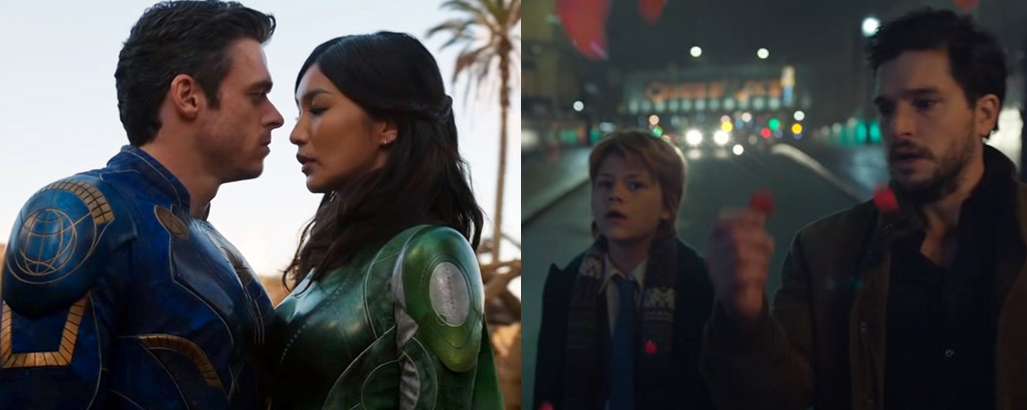
The film doesn’t spend much time dwelling on the romantic drama between these characters.

Even more than the Guardians of the Galaxy films (Gunn, 2014 to present), Eternals is an ensemble film and, more so than any other MCU movie so far, the film’s characters are a tight-knit group of superhuman character. Before Eternals, the MCU’s teams have been a mishmash of egos and personalities who struggled to get along, but the Eternals are more like a family of God-like beings who are initially heartbroken when they go their separate ways. Sersi (Chan) is the closest thing we have to a main character; an empathetic Eternal who’s able to transmutate matter upon physical contact and who has a strong connection with humanity. For centuries, Sersei was engaged in a romantic relationship with Ikarus (Madden), the most powerful of the Eternals; while all of the Eternals exhibit superhuman strength and durability, Ikarus can fly and fire lasers from his eyes and yet, despite his great power, he isn’t chosen to lead the team: the honour falls to the conflicted Sersei. Left heartbroken after their relationship ended with little explanation, Sersei has been living as museum curator and dating Dane Whitman (Harrington), who actually barely appears in the film; I expected Dane to be the audience surrogate but he only really bookends the film and we simply learn what’s happening alongside the Eternals as they reunite. This means that their isn’t really a love triangle between Sersei, Dane, and Ikarus, though a mild one does exist thanks to the presence of Sprite (McHugh), an Eternal cursed to remain a child and who can conjure illusions at will, who carries a torch for Ikarus.
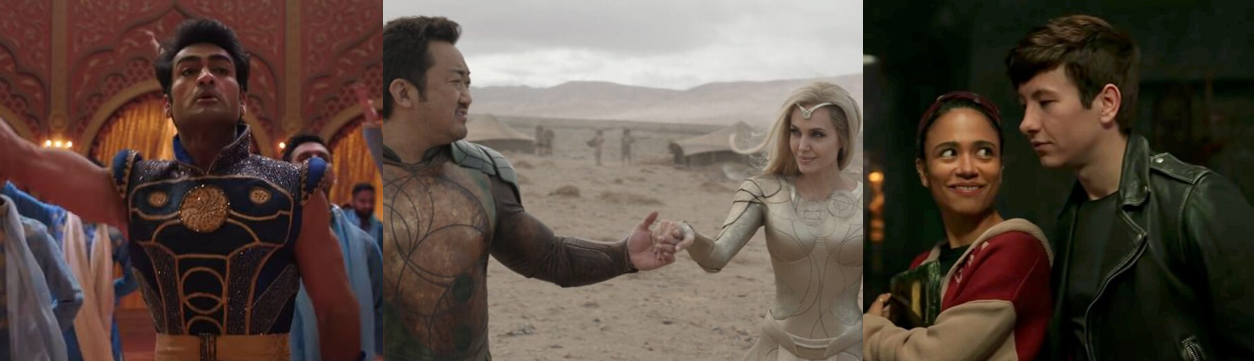
The Eternals have gone their separate ways and lived amongst us in secret for centuries.

When the Deviants suddenly appear, Sersei, Dane, and Sprite are saved by Ikarus and, since the Eternals were charged with destroying these monstrous beings, they quickly realise that they need to reunite with their comrades. Naturally, they seek out their spiritual leader Ajak (Hayek), who not only has the ability to heal their injuries but can also commune with their creator, the titanic Celestial Arishem (David Kaye), and communicates His will to the team. However, they discover Ajak dead, slaughtered by the Deviants, and this responsibility passes to Sersei and, in the process, she learns a terrible truth about the Eternals’ origins and the true nature of their mission on Earth. This only spurs her to reunite with her follow Eternals, which leads them to India, where they find Kingo (Nanjiani) revelling in fame as a popular Bollywood star. Easily one of the most entertaining characters in the film, Kingo can fire bolts of cosmic energy from his fingers and brings along his valet, Karun (Harish Patel), to document the trip and, in the process, provide not only an audience surrogate but another highlight of the film. As powerful as Ikarus is, he is matched perhaps only by Gilgamesh (Lee) and Thena (Jolie), who retired to Australia hundreds of years ago after the battle-hungry Thena began to suffer from the “Mahd Wy’ry”, a condition that causes her to remember her past conflicts and drives her into a mindless aggression against her fellow Eternals. While Thena is able to conjure weapons from thin air and lives for battle, Gilgamesh turns his cosmic powers into his hands to boost his physical strength ever further. This comes in handy when the group braves Druig’s (Keoghan) sanctuary and defend it from Deviants; able to manipulate the minds of others at will, Druig was the first of the group to question their mission and Arishem’s decree that they not interfere in human conflicts unless Deviants are involved, and chose to separate himself not just from his fellow Eternals, but the wider world itself in order to protect generations of people. While Druig is initially sceptical, he’s soon convinced to rejoin his comrades by the scale of the threat they face and after being reunited with Makkari (Ridloff), an Eternal with superhuman speed and who can only communicate through sign language.
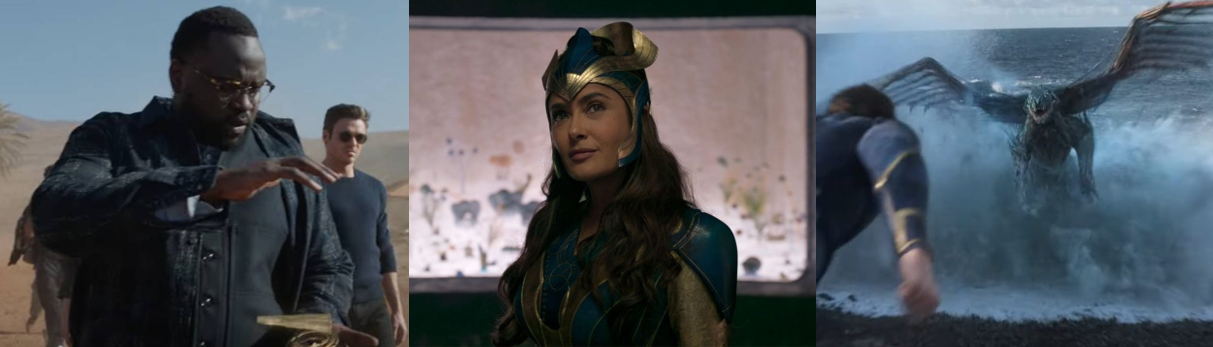
Easily Marvel’s most diverse movie yet, though the main antagonists were largely forgettable.

At this point, you’ve probably noticed that Eternals is packed full of diversity and representation; each character looks and sounds different and Marvel are definitely widening the scope of their fictional world with this team. Nowhere is this more prevalent than in the depiction of Phastos (Henry) as not only being openly gay, but in a same-sex relationship and raising a young boy, giving us the MCU’s first male-on-male kiss. Like Druig, Phastos is initially reluctant to reunite with his fellow Eternals; a master builder, he lost faith in humanity after his technological innovations eventually led to the creation of nuclear weapons and further conflict. However, his love for his family and desire to protect them spur him forward and the group is finally reunited…only to find that the Deviants have changed significantly over the years. Amongst their number stands an alpha, Kro (Skarsgård), who starts off as the largest and most intimidating of his monstrous brethren and eventually evolves into a sentient, humanoid form after absorbing the powers and lifeforce of a few of the Eternals. This gives him the ability to speak, heal his wounds, wield similar cosmic energy as the Eternals, and alter his fellow Deviants into far more grotesque and versatile forms. This means the Deviants can fly, attack with razor-sharp claws, and chomp down on their prey; they’re also incredibly durable and aggressive, but actually don’t appear all that much in the film. Kro, especially, doesn’t reach his humanoid form for some time and then vanishes for a huge hunk of the movie, only reappearing very briefly in the finale, as the Deviant threat is soon usurped by another, far more personal and dangerous menace.

The Nitty-Gritty:
It actually kind of sickens me to see so many bigots and haters dump on this film just because it features a lot of diversity; sure, there’s quite a lot packed in here all at once but we live in a world where diversity is the norm. just look around your office, or school, or local supermarket; everyone looks and sounds different, so why shouldn’t that be the case in superhero movies? Eternals was, in many ways, a great way to highlight diversity in the MCU for the first time and, since I’m unfamiliar with these characters, I really don’t care if this means their gender, skin colour, or sexual orientation has changed. Take Kingo, a recognisably Indian and very spiritual Eternal; he’s easily a stand-out character in the film thanks to his egotistical attitude and him revelling in his celebrity status, and Karun helps to add a real heart to the film since he is in awe of the Eternals. Then there’s Makkari, the MCU’s first deaf character, who exhibits a fantastic sense of enthusiasm and personality through her sign language, and the fact that all of the characters have distinct and interesting accents to help them standout from the rest of the MCU. Eternals is also a visually impressive movie; it’s clear that the MCU is definitely going for more visually distinct and experimental films in Phase Four and Eternals is probably the most beautiful MCU movie to date. The film constantly jumps to different eras and moments in human history, and different locations across the globe, as well as bombarding the viewer with some surreal cosmic imagery and some incredible costume design for the titular group.
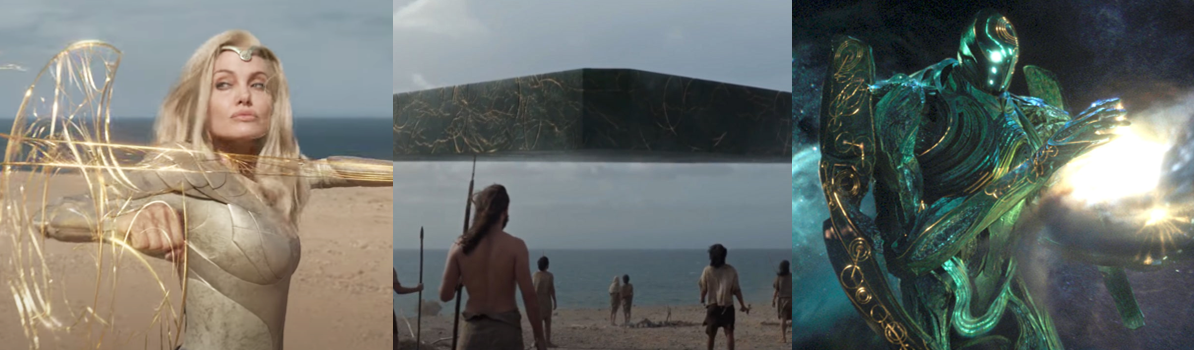
While the film is incredibly visually appealing, its hampered by a bloated cast and some redundancies.

The Eternals’ powers and technology are equally intriguing; there’s a real Stargate (Emmerich, 1994) vibe to the presentation of their ship and influence upon humanity, and their cosmic powers are augmented by distinct, gold-laced CGI that’s comprised of suitably Kirby-esque swirls and patterns. Their costumes, though sadly absent for a great deal of the film, are equally impressive; unlike any other costumes in the MCU, the Eternals are garbed in a form-fitting, regal attire that is sleek, sexy, and colourful while still appearing comfortable and practical. Everything looks great until Kro takes on his human form; then the CGI takes a noticeable hit and he appears extremely out of place and cheap-looking, which is a shame as the Deviants didn’t look too bad for the most part (even though they were just big, generic monster-things). Thankfully, the film excels in the depiction of the Celestials and when fleshing out the cosmic history of the MCU; we’ve seen hints to this before, and even some brief scenes of Celestials here and there, but Eternals goes all-in with depicting these God-like beings in full and basically positioning them as being responsible for life on Earth and countless other worlds and integral elements of the wider cosmic balance. It has to be said, though, that the film does suffer from being a bit bloated; there are ten main characters, each of whom only exhibit the one power, and while the cast is very charismatic and does a pretty good job of standing out and making the most of their screen time, it definitely feels like six or maybe eight characters would have been more manageable. Like, Makkari was fine but probably could have been removed completely, and Gilgamesh could probably have been cut as well, and Ajak’s personality traits probably could have been merged into Thena to give her a bit more to do beyond just going crazy here and there.
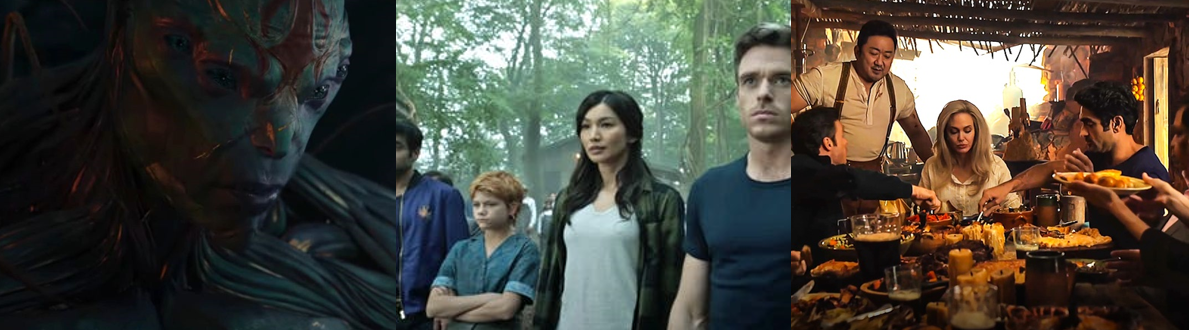
Kro’s effects are a bit of a letdown and there’s a lot of exposition to sit through here.

Similarly, there are some other areas where Eternals also fails to hit its mark; although there is a great deal of action and the trademark MCU snark in the film, there’s noticeably far les than in other MCU movies. That’s not necessarily a bad thing; not every movie, even if it’s a superhero movie, needs to be full-on mindless action all the time, but there isn’t really anything on show here to separate this from other MCU movies where we’ve seen similar powers and abilities done far better. Eternals is, however, a much more deliberate and meditative entry in the MCU; the debates between the Eternals regarding whether to weigh the lives of one world against countless others in the vast cosmos is intriguing, and the Eternals are quite a complex group of characters; created to do Arishem’s bidding, they follow Arishem’s word without question and regard Him with the reverence we reserve for our Gods. Over time, some of them question Arishem’s design for them and the world, while others remain steadfastly loyal to the will of Arishem to a fault, which infuses the film’s narrative with a fascinating religious undercurrent. However, Eternals falls into a trap that plagues many movies that need to explain a lot of lore; it’s the first MCU film to feature opening text explaining the background of the Eternals, but then Sersei relates some of it to Dane, and the others bring Kaurn up to speed, and then there’s a long piece of exposition between Arishem and Sersei that she then tells the others about. For me, that’s a lot of redundant exposition; I feel it might have been better to veer more towards a more visual and implied narrative and then spread the exposition out a bit, but I also suspect that the opening text was added in just to make sure audiences understand what’s going on.
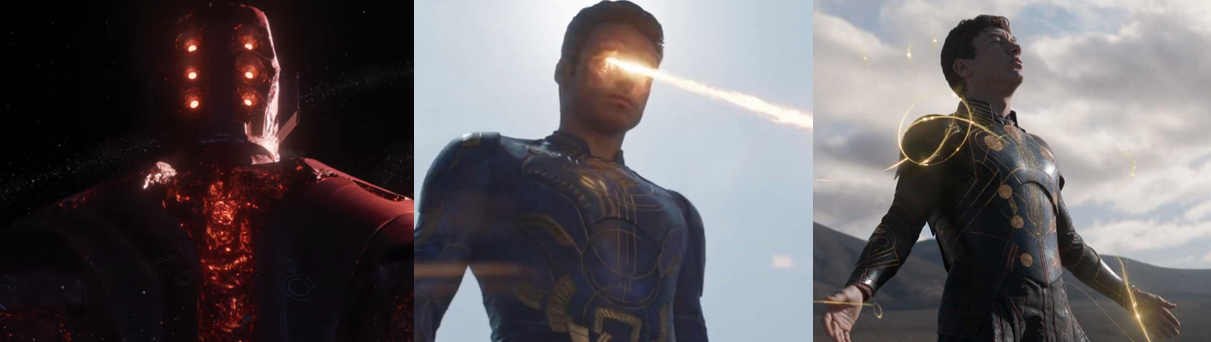
The Eternals are rocked to learn the truth behind their origins and mission.

I suppose it’s not too surprising that the Deviants and Kro fail to make much of an impression as antagonists in the film as their threat is completely overshadowed by Ikarus. Initially a devout follower of Arishem, Ajak grows to truly care for the Earth and sees the vast potential of humanity after they reversed the effects of the Snap, which leads her to planning to oppose Arishem’s true design for the Eternals. It turns out that they’re not there to protect the world, but are actually there to help foster the planet’s population to feed a young Celestial, Tiamut, who’s growing in the centre of the Earth and will destroy the world upon awakening. Ikarus is so devoted to Arishem that he allows Ajak to be killed by deviants and then actively fights against his friends and family, and even his beloved Sersei, to bring their mission to an end so that their memories can be erased and they can be sent to another world, as has happened over and over throughout the ages. It has to be said, though, that there are some flaws in this twist; it turns out that the Eternals are basically akin to robots, creations of the Celestials that are programmed “not to evolve” (even though they clearly do, emotionally at least), so why wouldn’t the Celestials just recall them after the Deviants are wiped out and only dispatch them when the creatures return? It also seems extremely unlikely that the Eternals wouldn’t have rebelled against their master’s grand plans in the past, so a bit strange that Arishem wouldn’t do a more thorough job of wiping their memories. The emergence of the Deviants is also more of a coincidence than anything else, and Tiamut’s awakening has only been hastened by the Snap, and Kro’s potential as a character and an antagonist is completely stunted by Ikarus’ mid-way heel turn and I almost feel like it might’ve been better to have him and Sprite teaming up from the start and have the Deviants the Eternals face be mere illusions. Regardless, Sersei and the others are determined to save the world and spare Tiamut’s life so that thousands of lives can be created by His powers; initially, they plan to do this by creating the “Uni-Mind” and vastly augmenting Druig’s power to put Tiamut to sleep. However, Ikarus’ fanatical devotion to awakening the Celestial leads Sersei with no choice but to turn the emerging Celestial to marble, freezing it in place, and Ikarus is so remorseful for his actions that he willingly commits suicide by flying into the centre of the sun. In the aftermath, Druig, Thena, and Makkari head out into the galaxy to find the other Eternals and inform them of the truth, while Arishem dramatically arrives to abduct Sersi, Phastos, and Kingo and judge whether humanity is worthy of saving and Dane is so rattled by the experience that he prepares to take up the cursed sword of his ancestors…

The Summary:
As I said, I went into Eternals with little no expectations; I saw the trailers and imagined that it would be a visually stunning and atmospheric entry in the MCU, and it definitely is that. Marvel are clearly taking some chances in Phase Four and experimenting with more diversity, variety, and unexpected directions going forward; it’s fascinating to see them go all-in with some of Marvel and Jack Kirby’s more surreal cosmic aspects and really opens the franchise up to an endless number of possibilities. This is juxtaposed by the same grounded, realistic approach to the subject matter that we saw in the likes of Thor (Branagh, 2011) that helps to introduce these wild concepts by framing them against real-world events, technology, and mythology to show how this fictional world has been influenced by these demigods. When the action does kick in, it’s pretty impressive and I like how each of the Eternals looks, sounds, and feels distinct and exhibits unique powers that make them formidable in their own right but almost unstoppable when their united against their monstrous enemies. However, Eternals is far more interested in world-building, moral discussions, and character analysis in a bid to present something of a deconstruction of the typical superhero movie. This may or may not land for you; for me, it did for the most part, but I felt the exposition could have been paced out better and the film would have benefitted from a little less hand-holding and veering more towards abstract visuals, but there’s no denying that it did an exceptional job of bringing a fresh group of sexy and powerful characters into the MCU which I imagine will have a significant impact on the franchise going forward.

My Rating:

Rating: 3 out of 5.

Pretty Good

Have you seen Eternals? If so, what did you think to it and where would you rank it against the other films in the MCU? Which of the characters was your favourite? What did you think to the diversity and variety on offer in the film? Do you like seeing the cosmic scope of the MCU or do you prefer their more grounded and relatable stories? Are you familiar with the Eternals and, if so, how do you think the film worked as an adaptation? Whatever you thought about Eternals, sign up to leave a reply down below or drop a comment on my social media.

Movie Night: Halloween Kills

Released: 15 October 2021
Director: David Gordon Green
Distributor: Universal Pictures
Budget: $20 million
Stars: Jamie Lee Curtis, Judy Greer, Andi Matichak, Anthony Michael Hall, and James Jude Courtney/Nick Castle

The Plot:
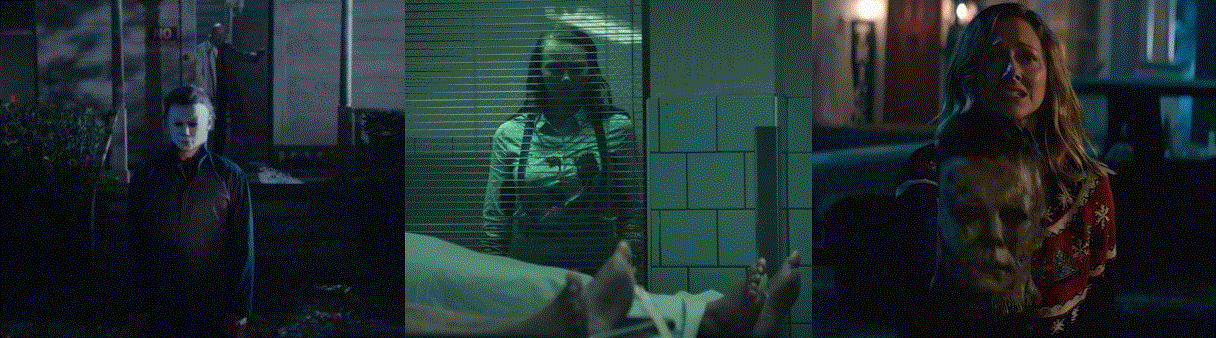
Minutes after Laurie Strode (Curtis), her daughter Karen (Greer), and granddaughter Allyson (Matichak) left masked killer Michael Myers/The Shape (Courtney/Castle) caged and burning in Laurie’s basement, Laurie is rushed to the hospital with life-threatening injuries, believing she finally killed her lifelong tormentor. However, when Michael frees himself and continues his relentless killing spree, Tommy Doyle (Hall), a former victim of Michael’s, rallies all of Haddonfield to rise up against the unstoppable monster.

The Background:
In 2018, director David Gordon Green’s direct sequel to John Carpenter’s seminal horror classic was released to largely positive reviews and amassed a startling $255.6 million box office against a $10 to 15 million budget. Initially, Green and co-writer Danny McBride pitched the idea of filming two movies back-to-back and, after their “requel” proved to be a success, the two briefly revisited this concept for the follow-up. However, while Halloween Kills is the first of two sequels, this plan was abandoned to focus on one film at a time. In addition to the returning Jamie Lee Curtis and Nick Castle, the film sees the return of many characters from Carpenter’s original and filmmakers even initially approached Paul Rudd to reprise a new version of his role as Tommy Doyle but (wisely, in my opinion, given how convoluted Halloween’s timeline is now) cast Anthony Michael Hall since Rudd’s schedule wouldn’t allow him to sign on. After the COVID-19 pandemic saw the film’s release to be delayed by a year, Halloween Kills eventually received somewhat mixed and confused reviews that nonetheless praised the kills and atmosphere, and fell a bit short of matching its predecessor’s success with its $131.6 million box office.

The Review:
Honestly, I wasn’t the biggest fan of Halloween (…the 2018 one, not the 2007 one…or the 1978 one…); if I had to sum it up in one word, it would be: redundant. The film really didn’t provide anything we haven’t seen before in any of the many Halloween sequels and reboots and I maintain that, for all its flaws, Halloween H20: 20 Years Later (Miner, 1998), did a much better job of tying up Laurie’s lingering issues with Michael Myers. Halloween decided to scrub away everything after John Carpenter’s original, which is fine, but went so far out of its way to dump on the other films and the established lore that it was honestly distracting. It also injected a bunch of new lore and characters that just felt a bit shoe-horned in and spent a great deal of time focusing on the nature and motivation of Michael Myers without actually addressing it; I get not liking the old revelation that Michael and Laurie are siblings and wanting to erase it from continuity, but what’s the point of doing that and doing away with that established motivation if all you’re going to do is dance around what motivates him? I don’t particularly want to know, and think it’s much scarier for him to be this random force of nature, but the film kept pretending like it had more to say about this and it just didn’t.

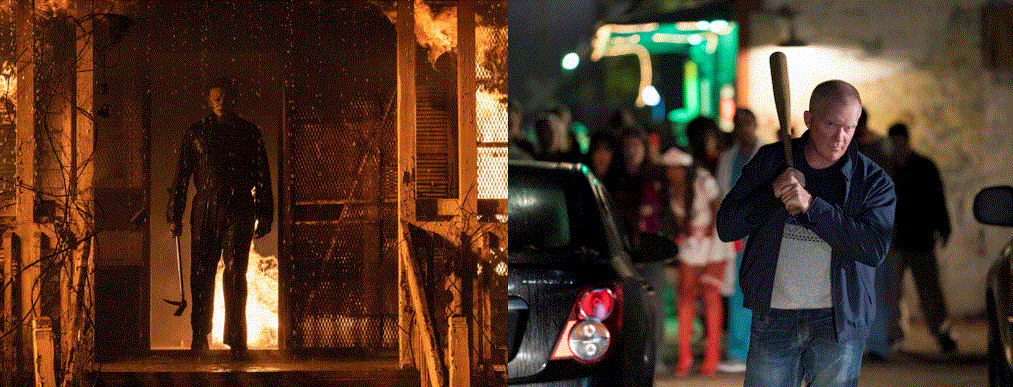
Michael goes on a new killing spree, inciting a full-blown mob determined to stop him.

Sadly, much of the same issues plague Halloween Kills (terrible title, by the way), which definitely suffers from scrambling to find ways to continue what should have been a definitive end for the infamous killer and then filling it runtime with busy work because the filmmakers are determined to make a third entry in their new trilogy. If you’ve seen the trailer, it’s pretty clear that Michael survives the fire at Laurie’s booby-trapped home; firefighters arrive on the scene to fight the blaze but end up getting absolutely decimated by Michael, who hid from the flames behind a convenient shutter in Laurie’s basement rather than thanks to any kind of supernatural powers. Sporting a burnt and wrecked mask and suit, as well as still carrying the damage he received in the previous film (including his missing fingers), Michael certainly cuts a fearsome, monstrous figure this time around and definitely isn’t messing around as he attacks his prey with an aggressive fury that is a far cry from his usual, more methodical strategies. Michael’s return sparks fear and outrage throughout Haddonfield, particularly in Tommy Doyle, Lonnie Elam (Robert Longstreet), Lindsey Wallace (Kyle Richards), and Marion Chambers (Nancy Stephens), all returning characters (and, in some cases, cast members) from John Carpenter’s original film who were left traumatised by Michael’s original killing spree. Tommy’s determination to pay reverence to Michael’s victims and Laurie’s survival turns to a desire to hunt Michael down and end his threat once and for all, and he becomes the rally force behind getting all of Haddonfield up in arms and on the lookout for Michael. Tommy’s transformation from a terrified little kid into this wannabe bad-ass is a little jarring, to say the least; the film’s marketing heavily pushed Laurie as being the one to bring Haddonfield together but it’s actually Tommy, who grabs a baseball bat and repeatedly offers advice and insight into Michael’s abilities, motivations, and methods, which just didn’t work for me as I had a hard time buying him as any kind of expert on the iconic killer just because he happened to be scared shitless by Michael as a little kid.

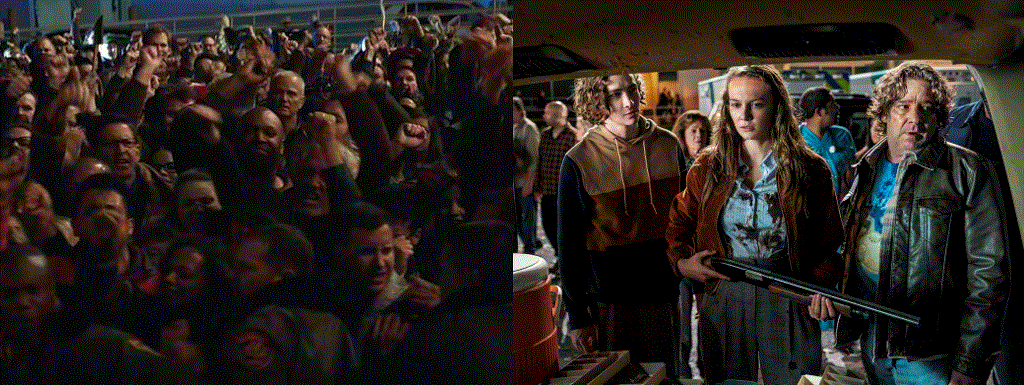
Returning cast and characters join the mob, who only cause more chaos and bloodshed.

Marion and Lindsey may as well have not even been in the time for how little they do; they seem to primarily be there so that the filmmakers can make a big deal about bringing these actors and characters back, and to spout overly enthusiastic diatribe about how “Evil dies tonight!” and to appear as hopelessly outmatched as the rest of Haddonfield. Lonny plays a slightly larger role as it turns out that he’s the father of Cameron Elam (Dylan Arnold), who you may remember was Allyson’s scummy boyfriend in the last film. Cameron and Allyson come back together to join Tommy’s increasingly aggressive and mindless mob, united in their grief over Michael murdering their friends and family, much to the chagrin of Karen, who is perfectly happy for the authorities to handle the matter and under the belief that Michael will eventually make his way to Haddonfield Memorial Hospital to finish off her mother. Haddonfield, however, has been driven to the brink by the continued spectre and threat of Michael Myers and are whipped into an absolute frenzy by Tommy, who openly defies the local police department and determines that mob rules are the best and only way to put Michael down once and for all. The result is an unwieldy, paranoid gaggle of terrified, angry townsfolk grabbing whatever weapons they can and desperately hunting Michael down. Their exuberance leads to them targeting another escaped mental patient (Ross Bacon), whom they mistakenly (and stupidly) believe to be Michael (despite the fact that he wears completely different clothes, is obviously shorter and squatter, and runs around unmasked, which are all decidedly non-Michael Myers traits but, apparently, an “expert” like Tommy doesn’t consider these facts) and results in his death. The sudden narrative switch towards mob mentality makes Halloween Kills easily one of the most political in the entire series; the message of the film is the dangers of fear and anger on an increasingly large group of people as the mob tramples over each other and is literally frothing at the mouth to get their hands on Michael no matter what, which ultimately only results in further chaos and bloodshed.

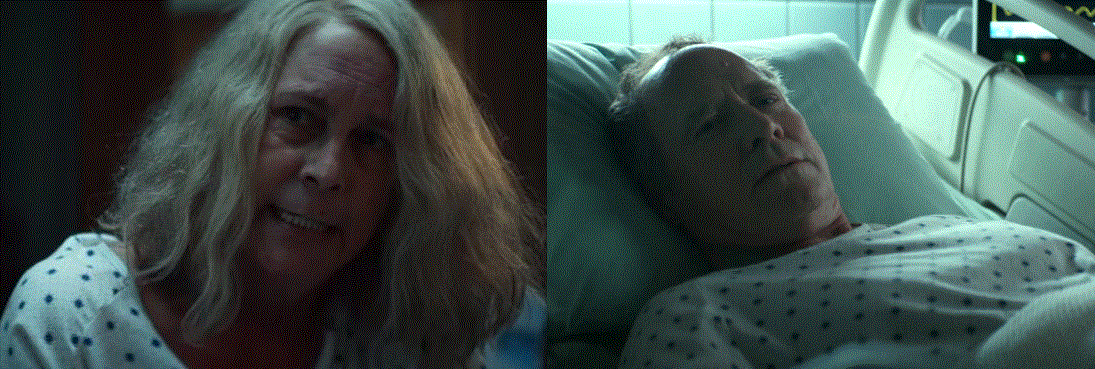
Laurie and Frank find themselves bed-ridden in hospital and powerless to act against Michael.

You might be wondering where Laurie is during all of this, and why I’ve barely mentioned her. Well, despite receiving to billing, Jamie Lee Curtis is pretty much benched throughout this entire film as, just like in the God-awful Halloween II (Rosenthal, 1981), she is bed-ridden with serious injuries and confined to a hospital for the entire movie. At first, she’s overwhelmed at the knowledge that Michael is finally dead but she quickly insists on getting back into the fight, despite her injuries, when she learns of his survival, however her injuries are exacerbated by the unruly mob and she just heads back to bed and taps out of the rest of the film to ponder Michael’s mindset and the nature of his evil rather than actually doing anything. Surprisingly, Deputy Frank Hawkins (Will Patton) is revealed to have survived his clearly fatal wounds from the last film and, like Laurie, is equally determined to kill Michael once and for all since (as flashbacks show) he is the one who kept Michael from being outright executed back in 1978 but, despite him being extremely motivated to make up for this mistake, he also spends the entire movie recovering in a hospital bed and I question why the filmmakers even bothered to have him survive since he doesn’t factor into the plot at all beyond ruminating on Michael’s evil. Similarly, Karen really doesn’t have anything to do beyond beg Allyson not to join the mob and plead with hospital staff to prepare for Michael’s arrival, though both she and Allyson do finally factor into the final showdown with Michael but, by then, I had honestly checked out.

The Nitty-Gritty:
One aspect where Halloween Kills does really well is in the music, sound design, and presentation; there’s a dark, gritty brutality to the film that really ties into the escalating terror and paranoia of the local mob and the various remixes of the classic Halloween theme do a great job to help punctuate the tension and the kills. There’s a decent attempt to build some tension and a sense of dread here, especially as Michael is now a very publicly acknowledged figure rather than being just a local bogyman for people to deny or laugh off. There’s a definite sense that the people of Haddonfield have had enough of his shit and are determined to put him down once and for all, but they’re a disorganised and rowdy bunch who are much better at shouting and getting all worked up than they are at actually chasing the killer down or holding their own against him. I definitely enjoyed all the throwbacks and the returning characters and actors, and the film even opens with and includes a couple of flashbacks to Halloween night, 1978, to absolutely, emphatically, unequivocally erase Halloween II from continuity and replace it with what basically amounts to a far more-populated remake of that film.

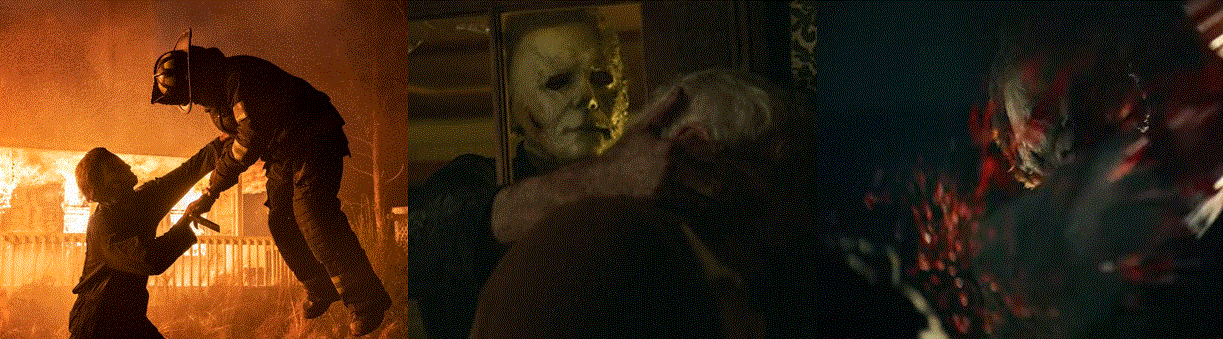
All subtlety has been tossed aside as Michael is at his most brutal and vicious here.

Easily the best part of Halloween Kills are the kills; Michael is at his most brutal here, ramming broken light tubes into people’s throats, smashing in skulls with axes, gouging eyes out with his bare hands, stabbing people in the brain through the eye, and causing his attackers to look like complete idiots at every turn as he’s easily able to shrug off their attacks and even cause them to kill themselves in almost comical fashion. All sense of subtlety and quiet menace have been completely lost here as Michael brutalises his victims in gruesome and gratuitous fashion; sure, he stalks most of them and there are some creepy moments where you’re never sure where he is (or you do know where he is but character’s are hiding in fear and waiting for him to move on), but Michael generally attacks with a sudden and ruthless spite that sees many of his victims suffering terribly as they bleed out from spurting wounds and are forced to watch Michael bludgeon their loved ones and be placed in ghastly positions for others to find. As impressive and gory as the kills are, however, they definitely seem to have been ramped up to make up for the film’s middling plot; it’s not that Halloween Kills is poorly paced or necessarily too slow, but its plot definitely seemed to run out of steam  pretty quickly, so I was left watching random characters doing weird stuff while the mob grew more and more unruly until Michael finally got around to murdering these oddballs just to add to the film’s kill count.

Halloween Kills returns to the question of the nature of Michael’s evil and motivations.

A great deal of Halloween Kills returns to the question of Michael’s nature, but these new movies seem to be struggling to fill the void left by eliminating his familial link to Laurie. Originally, Michael was just this murderous force of nature; compelled by some dark urge to be this remorseless, near superhuman killer who embarked on a seemingly random killing spree. It was disturbingly simple and chilling in its premise as you were never really sure if he was a man or something more, but sequels and remakes subsequently convoluted Michael’s backstory and motivations by adding the familial link to Laurie and all this shit about runes and a cult or whatever. Halloween altered that by finally doing away with the idea of Laurie and Michael being siblings and replaced it with this desperate desire to learn what motivates Michael and to try and figure out, or get him to say, what’s going through his dark mind. Halloween Kills mostly continues this; Michael has become this local legend and a figure of fear in Haddonfield, a force whose presence weighs heavily on the town and forces them to take up arms against him since he is, after all just a man. And, yet, he’s not; bullets don’t stop him and he exhibits a superhuman strength and durability to makes him more than a man, and Laurie speculates that the fear of Michael is what makes him such a terrifying figure. Halloween Kills does a pretty good job at infusing Michael with this kind of intangible, unhinged, completely random murderous intent while still dancing around the idea that there has to be more to him without actually saying what that is, but I can’t help but feel like it fails to properly stick the landing with any of its themes and messages and is fully aware of this, hence all the senseless gore and violence.

The Summary:
I had pretty low expectations going into Halloween Kills; I was still sour about the last movie, which nonsensically ignored all previous continuity again to tell a redundant story of Laurie having a showdown with the iconic killer many decades later, which he’d already seen done much better (in my opinion) in Halloween H20. Halloween Kills also feels incredibly redundant because it’s just full of bloody violence and busy work to allow the filmmakers to make a trilogy of new films. It doesn’t take long for the films’ disparate narratives to completely lose steam: we’ve got Tommy and his friend son a bit of a side quest that’s not very interesting, Laurie and Frank laid up in hospital as a mob grows around them, and Michael out and about offing random weirdos in increasingly gruesome fashion and none of these elements are really that engaging so I found myself just kind of tuning out about halfway through. The film is, essentially, another go-around at a Halloween II and, while it’s nowhere near as bad as that film is, it probably is just as redundant; Halloween really seems to struggle when it comes to sequels and I can’t help but think that the franchise would have been better off if we’d never seen a follow-up to the original until some time later (be it ten, twenty, or forty years) as every sequel, remake, or reboot has struggled to find ways to continue the story as you kinda have to add a little more to Michael and his lore to do that and every time that happens it dilutes the random terror of Michael Myers. Here, Michael is clearly the best part of the movie and even he acts very out of character for me; never has Michael been so brutal and vindictive in his kills and it definitely feels like this was done because the other storylines just weren’t interesting enough to carry the story. Benching Laurie and Frank, who have the most motivation to go after Michael, and shoe-horning in this political statement about mob mentality was a bit of a mistake for me; I like the idea of Haddonfield rising up against Michael but they really didn’t do anything with this concept beyond the obvious message that angry mobs only make a terrible situation worse. Overall, I can’t say that the film did much to defy my expectations and instead ended up being a mean-spirited, redundant entry in the franchise (and the new trilogy) that exists simply to set the stage for what I hope will be the final entry in the series for a good long while.

My Rating:

Rating: 2 out of 5.

Could Be Better

Have you seen Halloween Kills? If so, what did you think to it and where would you rank it against the last film and the other entries in the franchise? Did you enjoy Michael’s newfound brutality and the grisly nature of the kills or did you find the violence a little too gratuitous? What did you think to the return of Tommy, Lonny, and other characters and actors form the original Halloween? Were you a fan of the mob-based aspects of the story and the ruminations on Michael’s nature? What did you think to Laurie taking a back seat in this entry and would you like to see the franchise come to an end in the next movie? Feel free to sign up and leave your thoughts down below and drop a reply on my social media to let me know what you thought about Halloween Kills.  

Movie Night: The Simpsons Movie

Released: 27 July 2007
Director: David Silverman
Distributor: 20th Century Fox
Budget: $75 million
Stars: Dan Castellaneta, Julie Kavner, Nancy Cartwright, Yeardley Smith, Harry Shearer, and Albert Brooks

The Plot:
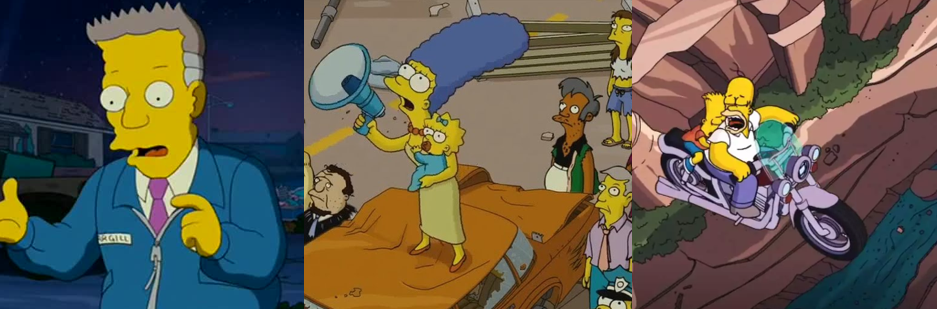
When Homer Simpson (Castellaneta) pollutes the lake in Springfield, Russ Cargill (Brooks), head of the Environmental Protection Agency (E.P.A.) imprisons the town under a giant dome. Although the Simpson family narrowly escape, they ultimately abandon Homer due to his selfishness and he is left to find a way to redeem his folly to help save the town and reunite with his family.

The Background:
Soon after the first episode of The Simpsons (1988 to present) aired, their iconic yellow visages were seemingly everywhere as “Bartmania” swept the nation. Creator Matt Groening and the other showrunners first considered a feature-length adaptation early into the show’s run, but these plans were scuppered by the show’s popularity and ratings. Work began in earnest on the venture in 2003, when The Simpsons was entering its fifteenth season, with the creators bringing in some of their most successful writers to work on the script, which went through over one hundred revisions and eventually included cameos from almost every character in the show’s long history. Following a unique marketing campaign, The Simpsons Movie finally released to mixed to favourable reviews. While the show has had an impressive run and been incredible popular, many felt that felt that movie (despite being a massive box office success and earning almost $540 million) failed to live up to the expectations set by the show’s peak and its years in development.

The Review:
The Simpsons Movie opens in true fourth-wall breaking fashion with the family (and, seemingly, the rest of Springfield) attending a screening of an Itchy & Scratchy movie, during which Homer openly criticises the stupidity of audiences everywhere for their willingness to “[pay] to see something [they] get on TV for free”. In many ways, this sets the tone for the story that is to follow since The Simpsons Movie is, basically, like an extended episode of the series rather than a true, one-of-a-kind cinematic experience like, say, Beavis and Butt-Head Do America (Judge, 1996) or South Park: Bigger, Longer & Uncut (Parker, 1999)m which took the concepts of their respective animated shows and expanded upon them using their new medium rather than simply repeating a lot of the same tropes and traditions from the show.

Despite Grandpa’s prophetic ramblings, the Simpson family have more immediate concerns.

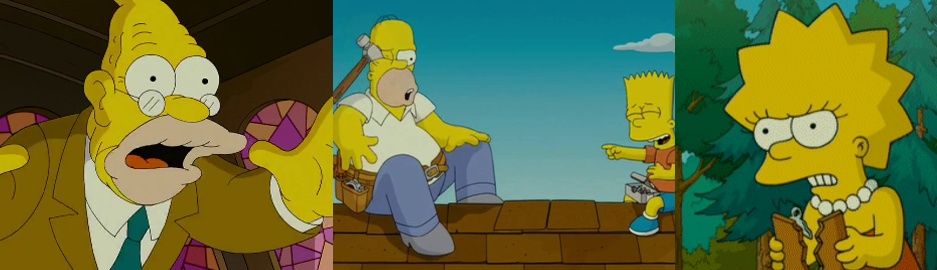
The story begins proper when the Simpsons (and, again, apparently the rest of the town), attend church and Grandpa Abe Simpson (Castellaneta) has a sudden and prophetic turn that greatly disturbs Marge (Kavner). The rest of the family, however, is happy to ignore Grandpa’s warnings of a “twisted tale, a thousand eyes, trapped forever, [and] eeepa!” to concentrate on more pressing concerns such as Homer’s many chores and Lisa’s (Smith) attempts to warn the town about the benefits of recycling and repairing their damaged environment (especially after the heavily polluted lake resulted in the untimely deaths of Green Day). While Marge is unable to drop the subject and spends the first half of the film trying to figure out what Grandpa’s words could mean, Homer dares Bart (Cartwright) to skateboard through the town naked (resulting in an amusing sequence where the film does everything possible to hide Bart’s junk and then just shows us it). When Homer refuses to take responsibility for Bart’s indecency, Bart begins to grow frustrated with his Dad’s shabby parenting and gravitates towards the support and caring nature of their long-time neighbour, Ned Flanders (Shearer).

Russ Cargill is determined to isolate and destroy Springfield to contain their pollution.

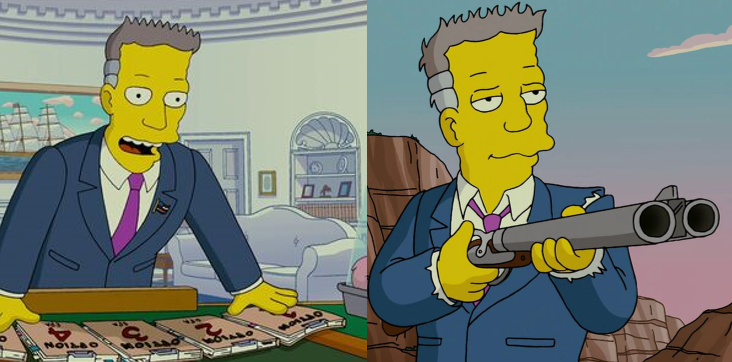
Indeed, Homer only exacerbates Bart’s ill feelings towards him by adopting, and showing more care and concern for, a pig. Homer’s selfish and reckless ways are a pivotal catalyst in many of the film’s events as they not only drive Bart further away from him (and, at one  point, literally to drink) but also earn him the ire of his entire family (especially the environmentally-conscious Lisa) and the town when he disobeys Mayor “Diamond” Joe Quimby’s (Castellaneta) mandate that all pollution of Springfield Lake must immediately stop by dumping Spider-Pig’s faeces into the lake and incurring the wrath of the E.P.A. Their representative is, of course, Russ Cargill (who sounds so much like Hank Scorpio (Brooks) that it may as well have been the same character), a somewhat-unhinged government official who is absolutely determined to first isolate and then wipe out Springfield. Cunning and power-mad, Cargill easily manipulates the incompetent President Arnold Schwarzenegger (Shearer), imprisons Springfield within an inescapable dome, and then plots to destroy the entire town to avoid his actions being exposed to the world. His mission borders on obsession and it’s implied that he’s simply gone mad with power but his fixation on Springfield (which eventually leads to him being willing to shoot Homer in the face) isn’t really explained all that much beyond him simply wanting to prove that he’s the best at what he does.

For me, the movie slows down and falls off the rails a bit once the family are driven away to Alaska.

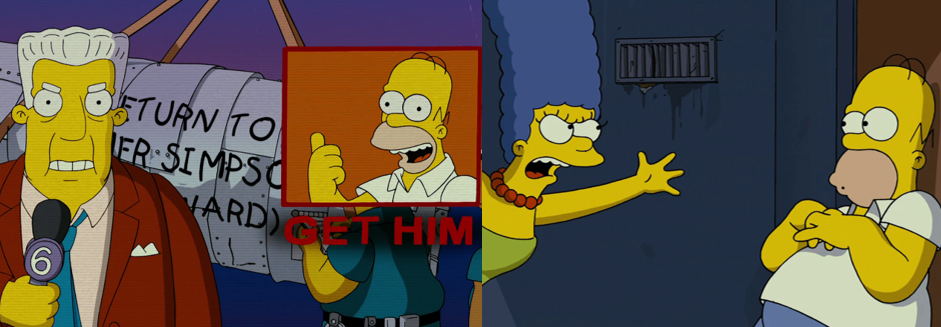
Honestly, for me, the best parts of the film are those that take place in Springfield; once the Simpsons are driven out of the dome and end up in Alaska, the film really loses its way and slows down a bit. Understandably, Homer’s actions cause a lot of friction and resentment in his family and his unwillingness to save their town from destruction provides Marge with yet another perfect excuse to leave Homer. It’s not the first time Homer and Marge have split up, broken up, or fallen out or the first time that the family have been driven from town by an angry mob and, honestly, these were tired tropes even then and the only real difference here is that they’re in Alaska so there’s a lot of snow about.

The Nitty-Gritty:
One major positive of The Simpsons Movie is the vast and immediately noticeable improvement in the animation quality; even little things like adding shadows to the characters makes them pop out more and appear more cinematic and there are far more elaborate and dynamic shots of the town and its citizens. Everything looks and feels much bigger and like more time, effort, and money has gone into making every scene as good as it possibly can be; it’s just a shame, then, that more of the film doesn’t actually take place in Springfield so we can really see the benefits of this. Indeed, while we get to see much of the town, a lot of key areas and locations are only briefly glimpsed and, similarly, some of the show’s more entertaining supporting characters are reduced to mere cameos or cut entirely.

Homer’s buffoonery and stupidity are unusually neglectful and selfish in the movie.

On the plus side, this does service the main focus of the plot, which is on the Simpson family; one thing that does separate The Simpsons Movie from most episodes of the show is its emphasis on drama and conflict within the family. This drives Marge not only to take the kids and leave Homer but also puts Homer on the path to self-discovery in the Alaskan wilderness; however, considering Homer’s actions are uncharacteristically selfish and his stupidity and self-serving ways and dialled up way past eleven this time around, it’s difficult to really root for him. This is troublesome for me as Homer is one of my favourite characters of the show; his bumbling ways are usually amusing and endearing but, here they’re just callous and foolhardy simply because the plot has to happen and the lessons he learns from the Medicine Woman (Tress MacNeille) are really ones he’s already learnt in the series and should already know.

Sight gags and physical comedy are a big part of The Simpsons Movie‘s humour.

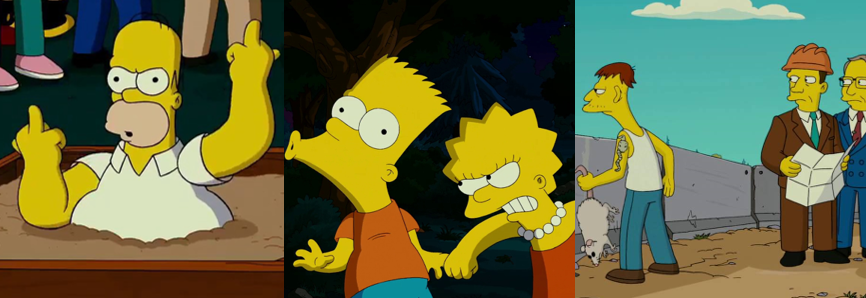
Of course, being that it’s The Simpsons, The Simpsons Movie also features a bevvy of jokes and humour; some of these are simple gags, such as Homer literally being stuck between a rock and a hard place, Drederick Tatum (Hank Azaria) attempting to punch his way out of the dome, Homer’s middle finger salute to the angry mob, and the aforementioned mob heading away from the Simpsons’ house in their mission to lynch the family. Other humorous moments I enjoyed included Cletus Spuckler (ibid) proving that Quimby’s idiot-proof barrier works, Homer urging Spider-Pig to drive away from the polluted lake and being fooled by his reflection in the dome, Marge stopping amidst the burning of their house to do the dishes, and Lisa punching out Bart when he taunts her.

While a lot of the jokes are great, not all of them land and I could’ve lived without the gorge scene.

Similarly, there’s some very funny lines in the film, such as when Cargill’s men admonish Bart for scratching the chains of his manacles, the gag at the service station when Bart randomly scribbles over the family’s wanted posted and a group who look just like his doodles walks in, the entire sequence at the government spy centre, Cargill’s mental rant about tough guys and soft guys, and Marge’s sudden and unexpected cry of “Somebody throw the Goddamn bomb!” Unfortunately, not every gag and reference works that well; there’s a particularly outdated reference to Titanic (Cameron, 1997) at the Green Day concert, probably one too many anti-gay jokes and gags, and I really could have done without another visit to Springfield Gorge (though it was funny to see the crashed ambulance was still there). Likewise, while the Spider-Pig song was amusing the first few times, it (like the pig itself) quickly becomes grating and annoying.

Sadly, the film had little lasting impact on the series, which rigidly stuck to the status quo.

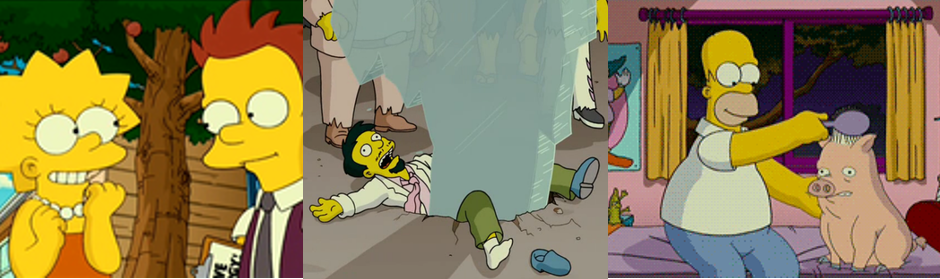
I think one thing that also disappoints about the film is that it could have been a really good opportunity to spice up the show after nearly twenty seasons (at the time) but introducing some actual changes and fallout from the movie. Instead, no real, lasting repercussions are ever really felt following the film’s conclusion; Colin (MacNeille) disappears despite how interesting it might have been to develop Lisa’s character with a boyfriend, Spider-Pig is reduced to mere cameos and a largely insignificant role despite how important he is to the film, and even Doctor Nick Riviera (Azaria), who appears to die, turns up alive and well in subsequent episodes. I get it, obviously; you don’t want to risk alienating long-term viewers with sudden unexplained changes but, surely long-time fans of the series saw the film and would understand any changes made to the show’s formula.

The Summary:
The Simpsons Movie was a long time in the making…maybe too long, judging by the quality of the story and the resulting film. It’s not an especially bad premise, to be fair, and results in some funny moments and gags but I can think of several episodes of the show that are funnier or could have been expanded, or combined, into an even more entertaining feature-length film. As a reflection on the film and their love/hate dynamic, it works; the film’s more dramatic elements are interesting and it’s clear that the filmmakers were trying to emphasis a few undeveloped aspects of the family, such as Bart’s relationship with Homer and Homer’s destructive ways, but, since the movie had no lasting repercussions on the show and their characterisations, it almost feels like a waste of time and potential. In the end, The Simpsons Movie is less of a celebration of everything that works about The Simpsons and more a blatant attempt to recapture some of the show’s earlier magic and failing just short of the mark. Rather than try and be a truly unique cinematic experience, the filmmakers played things way too safe and took what would have been a semi-interesting premise for an episode and blew it up to feature length rather than trying to craft something more unique and memorable and, while it’s amusing and entertaining enough, it ultimately fails to live up to its potential as a truly unforgettable experience.

My Rating:

Rating: 2 out of 5.

Could Be Better

Did you enjoy The Simpsons Movie? Do you think it was worth the long wait or were you, like me, somewhat disappointed with the end result, especially compared to feature-length versions of other animated shows? What did you think to Homer’s characterisation in the film, Bart’s sub-plot with Flanders, and Lisa’s sub-plot with Colin? Did you like Russ Cargill and the plot about the dome, and Homer’s voyage of self-discovery in Alaska? What were some of your favourite moments from the movie? Which member of the Simpson family, or the cast of the show, is your favourite? What are some of your favourite episodes and moments from the series? Perhaps you prefer a different animated series; if so, what is it? How are you celebrating Scotchtoberfest this month? Whatever your thoughts on The Simpsons Movie, or The Simpsons in general, drop a comment down below.

Movie Night: V for Vendetta

Released: 17 March 2006
Director: James McTeigue
Distributor:
Warner Bros. Pictures
Budget:
$50 to 54 million
Stars:
Hugo Weaving, Natalie Portman, Stephen Rea, Tim Pigott-Smith, Roger Allam, Stephen Fry, and John Hurt

The Plot:
In a world where the United Kingdom is subject to a neo-fascist totalitarian regime headed by High Chancellor Adam Sutler (Hurt), the unassuming Evey Hammond (Portman) find sherself caught up in masked anarchist and freedom fighter V’s (Weaving) attempts to ignite a revolution through elaborate terrorist acts themed after the legendary Guy Fawkes.

The Background:
V for Vendetta began life as a black-and-white serial written by the legendary Alan Moore and illustrated by David Lloyd and published in the short-lived UK anthology Warrior between 1982 and 1985 before being picked up, colourised, and completed, by DC Comics in 1989. Influenced by a variety of literary works, V for Vendetta was a bleak, uncompromising tale of a morally ambiguous anarchist rallying against a totalitarian government and is generally regarded as one of the more subversive and influential comic books ever made. The production of a live-action adaptation can be traced back to 1988, when producer Joel Silver acquired the rights, but didn’t begin to gain traction until the late-nineties when Andy and Larry Wachowski (as they were known then) became involved in the production. Actor James Purefoy famously walked out of the title role after six weeks of filming and Moore, of course, hated the script and the idea of an adaptation, but V For Vendetta was a decent box office success with a gross of over $130 million. Critically, the film was also quite well received and became an influential cult hit.

The Review:
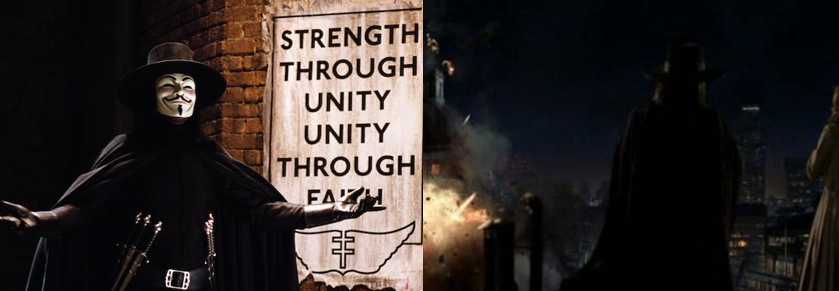
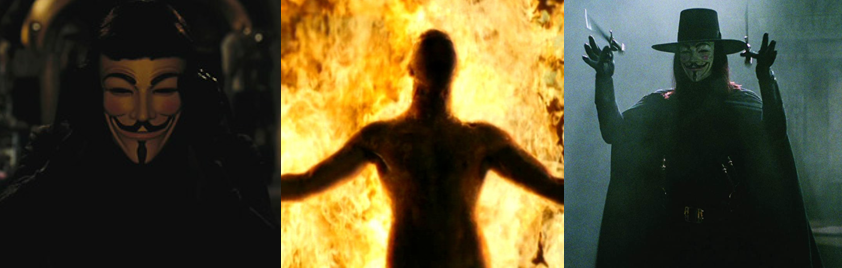
V for Vendetta immediately begins by emphasising the overall thrust of V’s crusade: that, while a man might be forgotten, killed, or mere flesh and blood, an idea can live forever to inspire others into acting. It’s this belief that permeates throughout the film alongside the oppressive governmental regime that dominates this alternative version of the United Kingdom. When we are first introduced to V, it’s on the eve of the beginning of his masterplan for revolution; garbing himself in a black outfit, cape, and eerily emotionless Guy Fawkes mask, he stumbles upon Evey being assaulted by Fingermen, the secret police of this world, and immediately beats them into submission while spouting eloquent quotations. V’s mystery is immediately apparent not only because his entire face and figure is obscured but also through the verbosity of his vocabulary; approaching his crusade like a dramatic role, he exudes a theatrical flair and polite, curious personality that immediately captivates Evey’s attention despite her better nature.

V is an enigmatic, anti-authoritative persona is a mixture of eloquence and violence.

V’s more melodramatic and articulate moments are offset by a disturbing unpredictability and ambiguity that makes him appear more than a little insane through his explosive methods, revolutionary opinions, and anti-authoritative stance. V destroys the Old Bailey using explosives, theatrical fireworks, and the sounds of Pyotr Ilyich Tchaikovsky’s ‘1812 Overture’. From there, V’s methods and agenda only escalate as he storms the office of the British Television Network (BTN) and forces them to broadcast a message of insurrection and revolution to take place in one year’s time, on the fifth of November, to take a stand against the oppressive government. V’s message affects the film’s characters in a variety of ways; Evey is awe-struck, families and viewers are puzzled and curious, and he is quickly branded a terrorist by the tyrannical government.

After rising to power, Norsefire continued to spread fear and oppression by controlling the media.
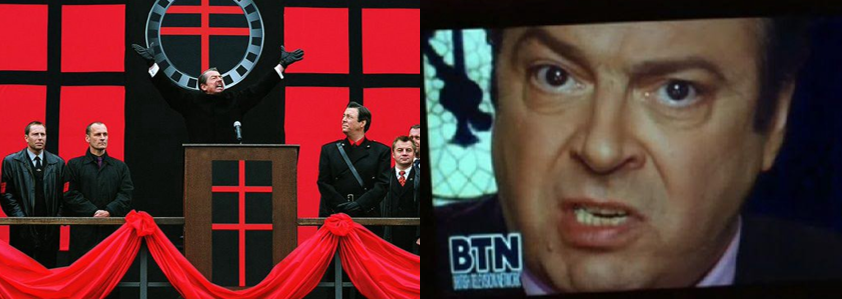
The Nordic supremacist and neo-fascist totalitarian regime that rules the UK, the Norsefire Party, spreads its God-fearing message primarily through the media in the form of Lewis Prothero (Allam); an extremely aggressive and spiteful individual, Prothero has an immense level of power and influence on the country as he spreads lies and messages of fear and hate to keep the populace under the rule of, and dependent upon, Chancellor Adam Sutler. Norsefire’s rise to power came after a series of orchestrated events that saw the country besieged by plague and death and, in their fear, they turned to Sutler and his promises of order, only to find that minorities, faiths, and sexualities were not only oppressed but cruelly ostracised, hunted, experimented upon, and killed by Sutler’s party.

Creedy is Sutler’s main force in removing insurgents and seeks to usurp Sutler’s authority.

Years later, the United Kingdom has become a bastion of law and order because of this fear; whereas former political powers like the United States are now little more than a “leper farm”, “England prevails” thanks to Sutler blacklisting music and arts, controlling the media, and having Creedy (Pigott-Smith) remove those who dare to oppose him. Creedy, a spiteful and cruel man, was the one who suggested Norsefire launch a viral attack on their own country to consolidate their power and takes his job very seriously; when insurgents rise up, he personally leads his men in breaking into their houses, beating them mercilessly, wrapping their heads in a black sack, and taking them away to be tortured and killed. His relationship with Sutler deteriorates over the course of the film when Sutler places the blame on V’s actions and elusiveness solely on Creedy’s inability to track him down and end him and V is able to manipulate Creedy’s aspirations to usurp Sutler’s position while still making him pay for his past crimes.

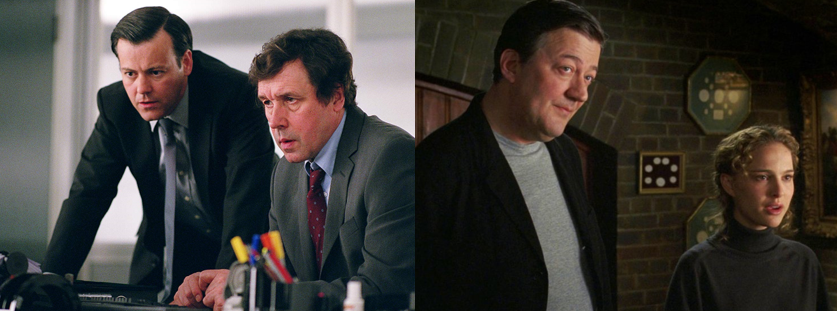
While Finch is horrified by the truths he uncovers, Deitrich is inspired to mock the government.

Equally perplexed by V’s crusade is Chief Inspector Finch (Rea), an Irish-born policeman who is horrified by V’s actions and broadcast but, in the course of trying to find him before Creedy can make him disappear, is horrified to uncover evidence that the Norsefire Party were responsible for a devastating plague and numerous deaths. His faith in the system already faltering at the beginning of the film, it is shaken to its core when he learns of V’s backstory and the horrifying experiments he and many others were subjected to, which turn him into something of a reluctant ally. V’s message strikes a chord with many others across the country, including Gordon Deitrich (Fry), a charismatic and entertaining talk show host who has been forced to live a lie his entire life since he is secretly gay and homosexuals are effectively outlawed. This leads to an amusing sequence in which he openly mocks Sutler on live television which, in turn, emphasises the tyrannical cruelty of the government when he is quickly bagged up and killed by Creedy. Other random members of the public are similarly inspired by V’s message and pay the price for it and, in turn, inspire others to take a more proactive stand against their oppressors.

Evey has been beaten down by her losses but is awestruck by the strength of V’s conviction.

V’s primary ally, however, is Evey; acting as the audience surrogate, we are introduced to V’s world (the “Shadow Gallery”) and learn about the specifics of his agenda through her; initially a timid and inconsequential character, she is captivated by V’s mystery, the strength of his conviction, and magnetic presence. Having suffered through many losses and tragedies, Evey is initially a product of the oppressive world in which she lives; she doesn’t like the rules, regulations, and actions of the government but feels powerless to do anything about it and prefers to stay out of politics. While she comes to bond with V even after his more questionable and violent actions, and feels an immense deal of pity and sympathy for him, she nonetheless attempts to escape and finds herself subjected to round the clock torture and isolation.

The Nitty-Gritty:
Conspiracy, revenge, and oppression are the name of the game in V for Vendetta; Norsefire went to extreme lengths to secure the vote and confidence of the public and covered everything up, from deleting military records and killing those who would expose or oppose them. The St. Mary’s virus devastated Ireland, and much of the UK, resulting in numerous deaths and was purposely released into the water supply by Norsefire to consolidate their power. Ever since, they’ve enforced strict curfews, rounded up homosexuals, people of colour, and all those with conflicting religious beliefs and lorded their superiority over those who were once their political betters. Hurt, who famously portrayed a contrary role in Nineteen Eighty-Four (Radford, 1984), demands nothing less than complete obedience, compliance, and results from his underlings; represented as a an aggressive, demanding voice shouting through a television screen for most of the film, his position and authority is never in question and he takes V’s actions and open defiance as a personal insult to him and everything he’s built.

Delia is the only one to regret her part in V’s suffering and welcomes her end at his hands.

Those within the Norsefire Party are deplorable and reprehensible individuals. Prothero was formally the commander of the detention camp that was responsible for producing the St. Mary’s virus and the suffering V and his fellow prisoners underwent; Bishop Lilliman (John Standing) is little more than a disgusting paedophile; and Creedy is a sadistic thug. The only real exceptions are Finch, who begrudgingly complies with the will of his superiors even before his faith is shaken, and Doctor Delia Surridge (Sinéad Cusack), the woman responsible for the experiments that led to the creation of V and the St. Mary’s virus and vaccine. Back during her time at the detention centre, she was a morally appalling woman who grew to hate the lethargic and miserable state of those she was experimenting on but, upon seeing her work go up in flames and coming eye-to-eye with a horrifically burned inmate, came to regret her actions. Changing her name and living in constant fear of reprisal, she accepts her fate at V’s hands willingly and is the only one of his tormentors to repent for her part in his suffering and to whom he shows a modicum of mercy.

V’s true face and identity remain a mystery as he is 100% committed to his vendetta and ideals.

V’s mission, for all his theatricality and grandstanding about brining down the government, boils down to simple revenge; referring to his actions as “justice”, he is driven by the desire to hunt down and punish those responsible for his suffering and the horrific scars he clear still carries from the fire. We never see V without his mask or without his face being obscured by shadow or some other disguise and his true identity is never fully revealed; clearly, he was some kind of genetic aberration to have been locked up and experimented on but there’s also more to him than simply being gay or a different creed or colour since he is able to endure unimaginable pain, exhibits near-superhuman levels of strength and durability, and is skilfully adapt with knives and in hand-to-hand combat.

V subjects Evey to round the clock torture to free her from the fear that has been holding her back.

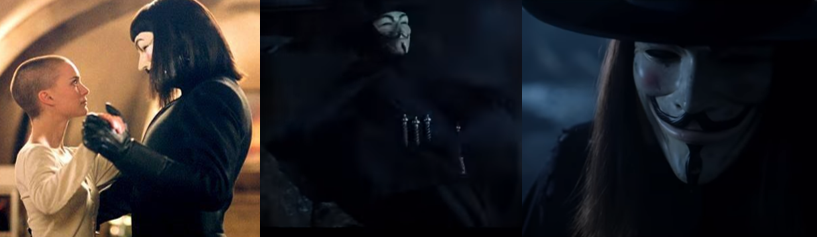
The mystery of V’s true nature and origin is left intentionally vague, as it is in the comic book, in favour of the idea of V being more important than his physical form. In an effort to teach Evey the same lessons he learned, he subjects her to round the clock torture and forces her to live a very similar life of isolation and desperation as he was subjected to so that she can both better understand his motives, see the world for what it really is, and be freed of the fear and lethargy that has held her back her whole life. While Portman’s English accent is a bit dodgy at times, she more than makes up for it during this horrific sequence where she has her beautiful curly locks shaved, is hosed down and interrogated over and over again, and left in a cold, dank, desolate cell with only a rat and the writings of a fellow prisoner for comfort. Enraged at V’s treatment, she nevertheless discovers a strength and resolve she never knew existed and honours her promise to return to him for his revolution; however, while he pulls the lever that will usher in V’s new age, she doesn’t assume his identity like in the comic book but remains a changed and resolute character nevertheless. V’s treatment of Evey adds to his questionable moral nature; he’s fully willing to maim and kill those who wronged him, or who get in his way, to say nothing of forcing Evey to endure constant torture and, yet, he is disgusted not just at his actions but at those who made him the man he is today.

Despite having fallen in love with Evey, V is committed to his idea of a world free from oppression.

Having turned his back on his humanity and committed himself to a bulletproof idea, his conviction is strong enough to allow him to endure multiple gunshots and to give his life for his cause, knowing full well that he won’t live to see the dawn of his new age and grateful for the end of his suffering. Through Evey, though, he finds a kindred spirit and she even offers him something else to live for, something more akin to a normal life for the two of them, but he adamantly refuses, despite his love for her, since he is so dedicated to his crusade. Arguably insane and blinded by his obsession, V’s message of revolution is the kick up the arse the British public need to shake them out of their apathy; this dystopian version of the UK is ruled by fear and hatred of other races, creeds, and sexualities even before the rise of Norsefire, who are little more than a Nazi regime. Until V came along, normal, everyday civilians merely went along with the ruling body, accepting it as the way things were and beaten down by submission and subjugation but, in the end, it is the normal, every British public who assume V’s guise and march through the streets of London, stand up to the government’s military might, and witness the dramatic destruction of the Houses of Parliament. In that moment, they all become V and witness the symbolic destruction of the ruling authority just as V’s actions remove the tyrants in power and give power, and truth, back to the people to do with as they wish. It’s a startlingly effective message to stand up to totalitarian rule, whether foreign or domestic, and the lengths to which governments will go to to control their people; in the end, it takes subversive, even terrorist acts to force people into action, though the film goes to great lengths to justify V’s actions and to only have those who are morally questionable label him as a terrorist.

The Summary:
When I first saw V for Vendetta, I hadn’t read the original comic book; based on how much I enjoyed the film, I was inspired to read the source material and, while there are a great deal of thematic and notable differences between the two, V for Vendetta is still a really solid adaptation and an effective film in its own right. Much of this is, largely, due to the incredible enigmatic performance of Hugo Weaving in the title role; despite his face being completely obscured by an unnerving visage, he exudes a multitude of emotions, from conviction to sympathy to self-righteous anger, and his eloquent delivery and dulcet tones bring as much characterisation as his dramatic body language and gestures. It’s a captivating performance, one sadly rarely replicated in comic book movies where actors constantly remove their masks, and is surpassed only by the political and emotional heart of the film. V for Vendetta’s world is one that seems to grow more and more relatable each day as cameras, surveillance, and control dominate our everyday lives more and more each day; governments become unreliable, their methods questionable, and the idea that apathy rules our society is powerfully relatable in an age were media controls us with carefully constructed messages and versions of the truth. The message is clear; V even says it himself in the film: “People shouldn’t be afraid of their government. Governments should be afraid of their people” and, while the comic’s more subtle and intricate means of depicting its messages are replaced by for more explicit Nazi iconography and action-packed moments, the film does a commendable job of bringing Moore’s work to life and it remains one of the more thought provoking comic book movies.

My Rating:

Rating: 4 out of 5.

Great Stuff

Are you a fan of V for Vendetta? How do you feel it compares to the source material? What did you think to Hugo Weaving and Natalie Portman’s performances and the themes and message of the film? What do you think V’s true origins were? How comfortable are you with the power of the media and the increased surveillance we are met with these days? Which of Alan Moore’s works is your favourite? How are you celebrating Bonfire Night tonight? Whatever your thoughts on V for Vendetta, or the works of Alan Moore, go ahead and leave a comment down below.

Movie Night [Godzilla Day]: Godzilla (1954) / Gojira


Toho’s famous atomic beast, and easily the most recognisable kaiju in the entire world, Gojira first emerged from the waters of outside of Japan to wreck the city of Tokyo on this day all the way back in 1954. In 2016, the day was declared “Godzilla Day” and, as a result, I’m only celebrating the undisputed King of the Monsters.


Released: 3 November 1954
Director: Ishirō Honda
Distributor: Toho
Budget: ¥100 million
Stars: Akira Takarada, Momoko Kōchi, Akihiko Hirata, Takashi Shimura, and Haruo Nakajima and Katsumi Tezuka

The Plot:
When a gigantic creature (Nakajima and Tezuka) born from nuclear radiation destroys a Japanese freighter, ransacks Odo Island, and rampages through Tokyo, Doctor Daisuke Serizawa’s (Hirata) experimental “Oxygen Destroyer” becomes the only hope of saving Japan!

The Background:
On August 6th, 1946, at the height of the Second World War, a nuclear weapon code-named “Little Boy” was dropped by the United States military on the Japanese city of Hiroshima, killing 70,000 people. A second bomb strike Nagaski three days later, killing a further 35,000 people, and in the Japanese Imperial Army summarily surrendered in aftermath of these devastating attacks. Since then, radiation and atomic fallout from the bombings have resulted in thousands of people falling sick and dying, and post-war Japan was gripped with fear regarding nuclear weapons and the threat of nuclear destruction. From this fear was born Gojira, the living embodiment of nuclear destruction, and was as inspirational to producer Tomoyuki Tanaka as King Kong (Cooper and Schoedsack, 1933) and The Beast from 20,000 Fathoms (Lourié, 1953) in Godzilla’s development. Director Ishirō Honda’s war-time experiences made him idea to the task of taking the concept seriously, while the titular creature went through a number of concepts before Teizo Toshimitsu, Akira Watanabe, and Eiji Tsuburaya settled on its final design.Combining elements of numerous dinosaurs, Tsuburaya initially planned to bring the creature to life using stop-motion animation but reluctantly utilised suitmation, resulting in a 220-pound suit that was so heavy, hot, and cumbersome that it took two stuntmen to wear it. Though the origin of the creature’s name is the subject of many tall tales, his iconic roar was the work of composer Akira Ifukube and Tsuburaya directed the film’s many complex models, miniatures, and special effects. In its original Japanese run, Godzilla was a modest financial success but was criticised for glorifying a real tragedy with an unbelievable, fire-breathing monster. Still, the film did well enough to receive an international release, where it was retitled Godzilla, King of the Monsters! (Morse and Honda, 1956) and featured a number of edits, including the insertion of Raymond Burr, where it made a further $2 million the original’s bleak themes. Since then, Godzilla spawned easily the greatest and most iconic monster movie franchise of all time and enjoyed a legacy that spanned over sixty years of invention, reinvention, and creativity and it all began here, with a metaphorical mediation on  the horrors of nuclear war.

The Review:
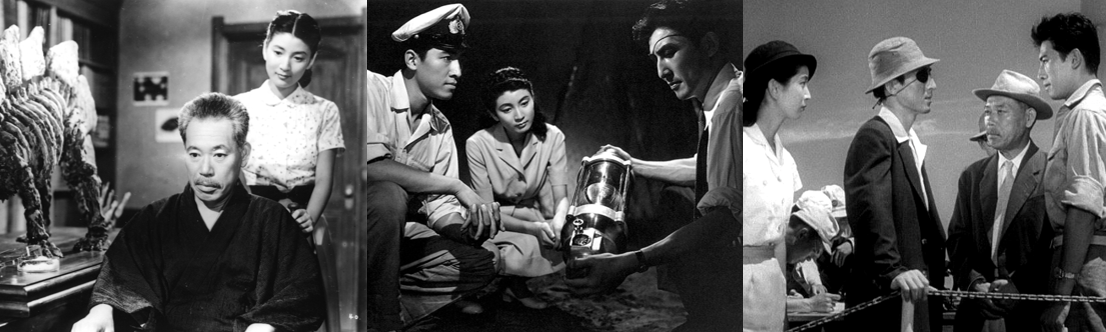
I can’t actually remember off the top of my head when I first became aware of Godzilla; I think it was just one of those cultural phenomenon’s that I had just picked up from references and homages in other media as I certainly don’t remember the movies being on television when I was a kid. I know I was fascinated by the creature, and the concept, in my pre-teen years and jumped at the chance to stay up late to watch a whole evening’s worth of content celebrating kaiju films, which included the first-ever Godzilla movie I ever watched from start to finish, Godzilla vs. King Ghidorah (Ōmori, 1991), which was all produced to coincide with the upcoming release of the 1998 American version of the film. After that, I was as hooked as I could possibly be and made a point to tape any subsequent Godzilla movies when they aired, and even went out of my way to get box sets from Australia to own the films (since hardly any of them are available here in the United Kingdom). Consequently, I’m more a fan of the Heisei and Millennium eras of the franchise, but I’m always up for a bit of black Showa action since that is where the series started, after all. The first thing to note about this review is that I am watching the original black-and-white version of the film with Japanese subtitles, meaning there’s no Raymond Burr and no hilariously bad dubbing; however, this isn’t actually my preferred way of watching Japanese films or anime and I’m perfectly fine with dubs over subtitled films. Still, it would be remiss of me to mention that the film quality hasn’t actually aged all that well; it’s quite grainy and dark, and actually seems inferior to even King Kong, but I’m hardly going to begrudge the film based on the technology and film quality of the time.

Japan’s islands are ravaged by a gigantic, radioactive creature who lives to kill… kills to live!

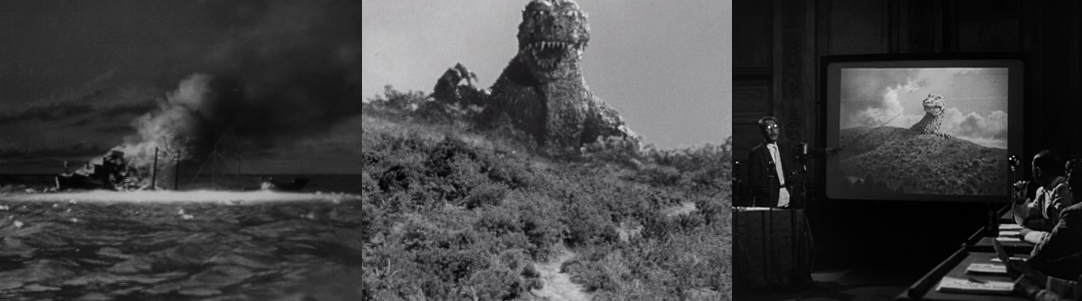
The film begins with a sudden and violent flash of light destroying the Japanese freighter Eiko-maru just outside of Odo Island; when the Bingo-maru is sent to investigate, it is also destroyed, the locals are thrown into a panic at the loss of life and the few survivors tell tales of the ocean simply exploding around them. Of course, the press catches wind of the story and speculation as to the cause of the accidents is only exacerbated after the natives of Odo Island find their fishing efforts ruined and stories of an ancient sea monster named “Godzilla” being blamed for it all by an elderly native (Kokuten Kōdō). Although these are initially dismissed, they turn out to be true when the island is ravaged by a fierce storm and a gigantic, dinosaur-like creature is briefly seen laying waste to the village. Traumatised by the devastation, the natives appeal for an investigation, which renowned palaeologist Doctor Kyohei Yamane (Shimura) agrees is the best course of action. Accordingly, he heads to the island to assess the damage and is accompanied by a team of scientists, his daughter Emiko (Kōchi), and Hideto Ogata (Takarada), a salvage ship captain who steers the boat. Amidst the wreckage on Odo Island, Yamane discovers that the village well has been contaminated by radioactive fallout and that massive radioactive footprints and extinct trilobites are littered throughout the village; the cause is immediately identified when the alarm bell rings and Godzilla is fully seen, and heard, for the first time, quite rightly sending everyone into a screaming panic! Although the creature disappears back into the ocean as soon as it emerges, Yamane has seen enough to postulate an original for the creature, believing that it is an ancient, sea-dwelling dinosaur of sorts that survived the extinction of its brethren to become the legendary creature the natives refer to as Godzilla and apparently disturbed from its long sleep at the depths of the ocean by recent atomic tests being conducted at sea.

The humans are decent enough, but as always the last thing you’re watching a Godzilla film for.

Although there is some debate about how public to make these events, the press print their story anyway, though few seem to take the impending threat of Godzilla seriously and find the idea of retreating to the safety of bomb shelters to be too much of an inconvenience. The military’s efforts to destroy the creature using depth charges are met with failure, and only cause further lives to be lost at sea when Godzilla retaliates, destroying both military and civilian vessels with its atomic breath. Yamane is distraught at the military’s efforts to kill Godzilla, as he wishes to study the creature further to discover the secrets of its biology and resistance to radiation, though he asserts that the creature is virtually indestructible since was able to absorb massive amounts of radiation and survive for millions of years without being harmed. One newspaper agrees one the scientific merit of the creature and sends a reporter, Hagiwara (Sachio Sakai), to interview Dr. Serizawa, a reclusive scientist horrifically scarred from and traumatised by the war, and to whom Emiko is engaged. Emiko agrees to take Hagiwara to see Serizawa since she wants to break off their engagement in favour of Ogata anyway, but he staunchly refuses to divulge any information on his latest research to Hagiwara. He does, however, provide a secret demonstration of his Oxygen Destroyer to Emiko, who is so traumatised by the devices ability to strip marine life to the bone through aggressive asphyxiation that she forgets all about mentioning their engagement. However, after Godzilla finally makes landfall and begins rampaging through first Shinagawa and then central Tokyo, shrugging off the fighter jets, missiles, and electrified fences erected to slow and stop its progress, she has no choice but to betray Serizawa’s confidence and goes to him with Ogata to plea for his help. Serizawa, however, is reluctant to employ the Oxygen Destroyer since he fears, and knows, that the military or other superpowers of the world will see its awesome destructive power as a weapon and force him to make more, but is spurred to assist after witnessing the sheer destruction caused by Godzilla.

The Nitty-Gritty:
As is to be expected from a Godzilla movie, much of Godzilla’s runtime is spent following a handful of human characters who react to the titular creature in different; thankfully, for a long-time Godzilla fan such as myself, the original film doesn’t actually set the template that so many others would follow and veers away from following reporters and/or soldiers and mostly focuses on Dr. Yamane, his concerned daughter, and her bland, would-be-lover. Yamane is different from every other character in the film in that he doesn’t want to see Godzilla destroyed; instead, he wishes to study the creature, to uncover the secrets of its strength and the potential benefits it could bring to mankind, and this even brings him into conflict with Ogata, who tries in vain to argue that the creature’s threat outweighs Yamane’s scientific curiosity. Were it not for the presence of Dr. Serizawa, Yamane would easily be the most interesting human character; while the reporters, soldiers, and government officials we do see are overwhelmed by Godzilla’s rampage, Serizawa is more concerned with the potential of others to pervert his research into something equally, if not more powerful, than nuclear weapons.

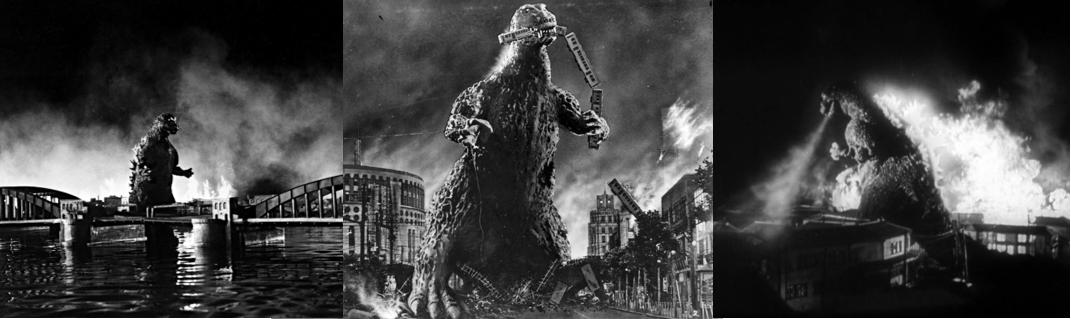
Godzilla is a fearsome force of nature who rampages through the city with an unquenchable fury.

Considering that Godzilla is the embodiment of nuclear terror and exudes radioactivity, the scientists don’t really do all that much to protect themselves from radiation; Yamane handles radioactive evidence with his bare hands and his team simply tell bystanders to stand back when they pick up signs of radiation, however once it makes landfall, its threat is taken very seriously. While the miniatures and model shots would improve over time (vehicles, such as helicopters, cars, and trains, suffer the worst in this film, though houses and structures tend to simply crumble and topple with ridiculous ease), the rear-projection effects are pretty ambitious for the time. Honestly, the entire film is bolstered by being in black-and-white and the graininess of the film stock; this, and the darkness that constantly bathes Godzilla, goes a long way to hiding some of the cruder effects and presenting the creature as a terrifying force of nature. I do have to commend the suit work, though; sure, it’s probably cheaper, easier, and less impressive than stop-motion effects but it definitely allows for a far ore versatile kaiju, one who can crash through a miniature version of Tokyo with ease and leave thousands either dead or slowly dying from radiation sickness. Of course, the star of the show, and the main reason that anyone watches this and any of the Godzilla films, is the Big-G himself. The film spends a great deal of time building anticipation to Godzilla’s full reveal, showing merely the flash of its atomic breath or the dark shadow of its leg as it topples buildings; even when we see its head and torso emerge over the mountains of Odo Island and out at sea, were still barely have an idea of what it actually looks like, which is a great way to paint it as this mysterious, fearsome, and almost mythological being. Long regarded as a creature of legend, Godzilla is like a living force of nature, easily shrugging off gunfire, missiles, and every attempt by the military to harm it. Seemingly without conscience, the creature emerges from the ocean and tramples its way through Shinagawa, killing untold numbers and causing devastation in its wake; while the military scrambles to organise mass evacuations and erect massive electrical fences, their efforts are entirely in vain (despite the incredibly speed that they’re able to put these defences together) and Godzilla easily tears its way into downtown Tokyo. The shot of the creature, seeped in darkness and with fire rage all around it as it roars in triumph and unleashes its destructive atomic breath, perfectly encapsulates everything that this original version of Godzilla represents: fear. Fear of the unknown, fear of the power of nature, fear of radiation, fear of nuclear fallout, and fear of our impending demise against forces we cannot possibly understand or hope to fight back against.

Godzilla shrugs off all of the military’s might but is finally killed by Serizawa’s Oxygen Destroyer.

You can make all the jokes you want about how ridiculous it is to see a man in rubbery suit flailing around and slapping at model buildings, but there’s a raw power to Godzilla in this film that is often forgotten in many of his interpretations; it’s not some cute, cuddly mascot or a benevolent creature looking to defend us from some greater evil, it’s all the fury of nature and man’s inhumanity to man given physical form, and nothing showcases the awesome ferocity of its nature than seeing it lay waste to one of the greatest and most prolific cities in the modern world. Although Dr. Serizawa is moved by Emiko and Ogata’s plea to help get rid of Godzilla, he is so determined to keep his Oxygen Destroyer from falling into the wrong hands or being perverted into a superweapon that he destroys all of his research notes and all evidence of the device save for the one he has created. Realising that he could be coerced into making another, but fully aware of the destruction and devastation being caused by Godzilla, he sees only one viable option: he must personally deliver the device to the bottom of Tokyo Bay, where Godzilla has retreated following its most recent rampage, and kill himself along with the creature to end two threats against the world in one blow. He does this willingly, despite Emiko’s (unconvincing) tears and Ogata’s insistence that he go in Serizawa’s place since the doctor has no experience using a diving suit; although Ogata insists on accompanying him to where the creature lies on the seabed, Serizawa refuses to leave and severs his lifeline to the ship after depositing the Oxygen Destroyer. The device has a near-instant and fatal effect, suffocating the creature and stripping it away to its bones, and sparing Serizawa’s loved ones from its threat. Those who are familiar with the multitude of Godzilla sequels and movies may be surprised to learn that Godzilla dies so conclusively (and, if we’re being honest, anti-climatically), but, while the crew and Serizawa’s friends salute his bravery, a troubled Dr. Yamane believes that another Godzilla may come into being if humanity is unable to learn from its mistakes and stop screwing around with nuclear weapons and technology.

The Summary:
Godzilla obviously isn’t going to appeal to everyone; I’ve known a lot of people who straight-up refuse to watch black-and-white films, let alone ridiculous kaiju movies featuring a man in a rubber suit smashing apart model buildings, but I think it’s still an important film for movie fans, especially, to check out for its message on the horrors of nuclear weapons if nothing else. The themes of fear and apprehension regarding nature and man’s destructive potential haven’t been diluted over time; if anything, they’ve only strengthen over the decades as global conflicts and arsenals have escalated, meaning that we’ve never been closer to blasting our world into oblivion than we are right now. Godzilla represents the fear of that threat; a literal beast that rises from the darkest depths of the ocean and punishes humanity for their stupidity and hubris, shrugging off all modern weapons and only being defeated by employing a weapon even more devastating than both it and the weapons that awoke and empowered it. While the human characters aren’t all that interesting and some of the effects haven’t aged too well, this is true of many kaiju movies from this period, and films in general from back in the day, and I think it’s better to concentrate on what does work about the film. The model shots, rear projection, and practical effects are all very ambitious and, arguably, allow the film to hold up a little better without the jerkiness of stop-motion animation. Characters like Dr. Yamame and Dr. Serizawa are clear standouts against the bland Ogata and the largely inconsequential Emiko; speaking out on the scientific potential of Godzilla and the harmful potential of scientific research, both characters help to drive home the primary themes of the movie (that war has brought about terrible consequences and that nature will punish us for our violent tendencies) as much as the titular creature, which makes an immediate impact as a ferocious and terrifying monster in its debut appearance.

My Rating:

Rating: 3 out of 5.

Pretty Good

Are you a fan of the original Godzilla? Which version do you prefer, the original Japanese movie or the American dub with Raymond Burr? What did you think to the build up to Godzilla’s appearance and the lore surrounding the creature? Were you a fan of the film’s characters and what did you think to the suitmation used to bring Godzilla to life? What is your favourite Godzilla movie and why? How are you celebrating Godzilla Day this year? Whatever your thoughts on Godzilla, or Godzilla and kaiju films in general, feel free to leave a comment below and be sure to check out my other Godzilla content!

Movie Night [Day of the Dead]: Dawn of the Dead (2004): The Director’s Cut


The Day of the Dead (or Dia de los Muertos) is a traditional Latin American holiday on which, every November 1st, the lives of deceased loved ones are celebrated with food, drink, parties, and a great deal of masquerade involving the calacas and calaveras (skeletons and skulls). For me, this seems like the perfect excuse to look back on the long-running and ever-changing zombie genre that was largely popularised by director George A. Romero, which I devoted a great deal of my PhD thesis towards and which has often been used as a parallel to various aspects of society and culture.  


Released: 25 October 2004
Originally Released: 19 March 2004
Director:
Zack Snyder
Distributor:
Universal Pictures
Budget:
$26 million
Stars:
Sarah Polley, Jake Weber, Ving Rhames, Mekhi Phifer, Ty Burrell, Lindy Booth, and Michael Kelly

The Plot:
When the world inexplicably descends into chaos and bloodshed following a sudden zombie outbreak, a handful of survivors are driven into the local shopping mall.

The Background:
Ever since White Zombie (Halperin, 1932), zombies have long been a staple of horror cinema but their status as reanimated corpses who incessantly feed on the flesh of the living was popularised by director George A. Romero (despite Romero’s films avoiding the term “zombie”) in Night of the Living Dead (Romero, 1968). Not only did Night of the Living Dead inspire a vast sub-genre of horror works, the first of its five sequels, Dawn of the Dead (ibid, 1978), is largely considered one of the best and most influential zombie films of all time. Plans for a remake of Romero’s classic allegory for consumerism began with producer Eric Newman, who acquired the rights to the film and aimed to reimagine it for a younger, modern audience. The remake was written by James Gunn and marked Zack Snyder’s directorial debut, and separated itself from the original by increasing the speed and ferocity of its flesh-eating ghouls. While many often decry remakes, many of the most popular and iconic films are remakes and Dawn of the Dead proved to be a commercial success by grossing over $100 million at the box office. Though some regarded the film unfavourably upon release, an extended director’s cut was released on DVD later that same year and the remake earned some notable cult success and is often regarded as being just as good as the original.

The Review:
Like any good, self-respecting zombie film, Dawn of the Dead offers the merest glimpse of life before the outbreak before everything mysteriously and hideously goes to hell. Ana Clark (Polley) is an underappreciated and overworked nurse who, fatigued by her long hours, is more concerned with going home to her husband, Louis (Louis Ferreira), and her nice, normal suburban life than worrying about bite victims being admitted to the intensive care unit and emergency news bulletins.

Ana wakes up to find her normal, everyday suburban life has descended into violence and chaos.

As a result, when she awakens the next day, Ana is horrified to find that a local neighbourhood girl, Vivian (Hannah Lochner) has become a rabid, animalistic cannibal; she viciously attacks Louis, taking a chunk out of his neck and, though Ana tries to stop the geyser of blood, she’s unable to get through to the hospital and Louis chokes to death on his own blood…only to immediately return to life and attack her! Distraught and running on pure adrenaline, Ana is able to scramble her way out of the house…only to find her peaceful little neighbourhood has descended into violence and anarchy; fires rage all over the area, car crashes, explosions, and wrecks are everywhere, and the equally desperate and terrified victims of these animalistic zombies pose just as much of a threat as the undead.

Rhames delivers a solid performance as the surprisingly complex Kenneth.

Stunned by a car crash and overwhelmed by shock and fear, Ana is little more than a zombie herself when she comes across the shotgun-toting Kenneth Hall (Rhames); a big, sombre man who is just looking to reunite with his brother. Although he joins up with the main group of survivors, Michael (Weber), Andre (Phifer), and his pregnant wife, Luda (Inna Korobkina), and accompanies them to the nearby mall (which offers a modicum of protection from the rabid undead and a whole host of creature comforts to sustain them), he initially wishes only to check on his brother but quickly realises that no one is coming to help them and that they must work together to survive. Of all the characters in the film, Kenneth is easily my favourite; an intimidating figure with a no-nonsense attitude and a deep, gravelly voice, Rhames is great in the role and is much more than mere muscle as his character has a real depth of emotion and a significant arc where he comes to view his fellow survivors as his surrogate family.

Michael plays peacemaker and offers logical, practical solutions to keep everyone safe.

However, the mall is currently claimed as sanctuary by three security guards – C.J. (Kelly), Bart (Michael Barry), and Terry (Kevin Zegers) – who aggressive oppose the taking in of additional bodies and a reluctant, frosty truce is force between the two groups Michael, a former television salesman, attempts to keep the peace and bring some kind of organisation to the group; he’s not looking to give orders or be a leader but merely comes up with logical suggestions for the others, which are generally adhered to for their practicality. Kenneth, at first, stoically rebukes him and he’s able to appeal to C.J.’s ego and sway him into helping them by coming up with good ideas and attributing them to him, thus positioning him as a paper leader. Constantly adaptable and something of a father figure, Michael becomes close with Ana but their attempts at romance are hampered by the greater problems facing the group. Though lacking in formal training and physical stature, Michael is pretty handy in a tight spot and, thanks to his will to survive and adaptability, is able to kill his fair share of zombies when the moment calls for it and is the first to actively stand up to C.J. during a tense confrontation on the roof.

C.J. goes from a stubborn antagonist to a pivotal ally willing to risk his life to get others to safety.

C.J. is, initially, the film’s secondary antagonist after the zombies; ruled by his fear of the undead and paranoia, he stubbornly holds on to his fragile authority and begrudgingly assists the other survivors on the understanding that they will leave the mall as soon as possible, even locking them up to keep them from stealing stuff. While Bart has a perverse fascination with the undead and follows C.J.’s orders to the letter, Terry is far more reluctant but, while C.J. is a hard-ass when the others first encounter him, he eventually becomes a trusted and valuable ally, covering their escape, putting himself at risk to save others, and even sacrificing himself so that the others can escape. While an obnoxious and detestable character when he’s first introduced, C.J. became another favourite of mine through his redemptive arc; after being decked my Michael and humbled by being locked up with Bart, his attitude shifts noticeably and he becomes a pivotal ally in the film’s chaotic third act. Soon, the group is joined by a number of other survivors: Andy (Bruce Bohne) is trapped on the roof of his gun shop across the road and slowly starving to death and communicates with the main protagonists using writing, leading to a brief bit of entertainment amidst the chaos where he plays chess with Kenneth and they shoot zombies who resemble celebrities. A truckload of other survivors upset C.J. when they crash into the mall, which brings a diverse quasi-society to the mall and, with the zombies kept at bay, the survivors begin to bond, with Terry and Nicole (Booth) sparking up a mutual attraction and Steve Markus (Burrell) acting as a tertiary antagonist with his pessimistic and cynical attitude. The others are little more than shellshocked cannon fodder who exist to share stories of their lives before the world fell apart, stories of their experiences of the outbreak, and fall victim to zombie bites and attacks.

The Nitty-Gritty:
As in Romero’s original films, there is no explanation given for the zombie outbreak and the word “zombie” is never used; newscasters and governmental and scientific minds are baffled by the sudden outbreak and the closest we get to an explanation for the horrific events that unfold is from a televangelist (Ken Foree in a welcome cameo) who believes that “when there is no more room in Hell, the dead shall walk the Earth”. Like most zombie films, the cause and prevention of the outbreak takes a backseat as the survivors concentrate mainly on just that: survival.

Zombies are fast, aggressive, and dangerous monsters driven purely by instinct and hunger.

Like the Infected in 28 Days Later (Boyle, 2002), the undead in Dawn of the Dead are fast-moving, aggressive, and animalistic creatures; although the source of the outbreak is unknown, the virus is transmitted through bites: a single bite will kill the victim and then almost immediately reanimate them into a near-mindless cannibals. The only way to stop the zombies is to shoot them in or otherwise destroy their head; anything less results in them relentlessly pursuing their prey or becoming what is known as a “Twitcher” (where they simply thrash around in manic spasms). The zombies work purely on instinct, seeking out warm, fresh meat and guided by vestiges of memory to places they frequented in life, such as the mall, though they show no signs of intelligence or problem solving and simply throw themselves ceaselessly at their victims until they succeed or fall down. Even a single zombie poses a significant threat thanks to their incredible speed, strength, and ferocity but they are even more dangerous in large groups, where they resemble little more than a sea of blood-stained, mangled corpses bent on feasting on living flesh.

The threat of a zombie’s bite is the source of much tragedy and suffering for the few survivors.

The inevitability of death from a zombie bite is a source of great tension and tragedy in the film; when Ana first theorises on the bite being the source of the infection, Michael pragmatically decides that it is best for any amongst them who have been bitten to be immediately executed, which brings him into brief conflict with Ana. Ultimately, he chooses not to kill Frank (Matt Frewer) in cold blood and instead allows him to die peacefully and be put out of his undead misery by Kenneth. Similarly, the revelation and horror of the bite’s potency drives Andre into a deep denial; he starts to brush off offers for help from Ana and the others and his obsessive desire to keep Luda safe, even when she’s succumbed to her infection, leads to his death when he desperately tries to keep his little monster baby from harm. While the original film was largely an allegory for consumerism and greed and held a mirror up to a society that was already a form of brainwashed zombies thanks to advertising and excess, the remake is more concerned with the survivors indulging in excess once they establish a delicate, makeshift society.

The remake is more action-packed and gruesome than the original but no less allegorical.

Tensions, paranoia, and fear are high because of the gruesome events unfolding around them but, with C.J. and Bart locked up and isolated from the group, the remaining survivors quickly bond and share their life stories and experiences. Eventually, C.J. becomes a part of the group when Bart is attacked and helps them to fortify a couple of buses to take them away from the mall when they realise that it’s just a matter of time before more of the zombies breach their defences. This is, primarily, where Dawn of the Dead separates itself from the original (for the better, in my opinion): it’s much more action-packed, the pace is much faster, and the gore is far more ghastly (Bart, for example, is attacked by a zombie that’s missing its legs and scrambles along an overhead pipe!) Nowhere is this seen more in their desperate escape from the mall in their spruced-up vehicles, which, for all their efforts, are nearly toppled over by the zombie hoards and one is easily overturned by the presence of a single zombie. Tension definitely ramps up when the group leaves the safety of the mall as, exposed out in the open, they are constantly at risk even when no zombies are around and, in the film’s last frantic minutes, they lose more of their group in their escape than they arguably would have if they had stayed put and tried to fortify the mall.

The Summary:
I’ve watched a lot of zombie films in my time; I’ve seen all of George A. Romero’s movies and researched the genre, and the concept, extensively for my PhD. However, as much as I respect and admire his influence on the genre, I can’t say that I’m really that big a fan of his films; yet, while I feel that they haven’t really aged all that well, the allegorical messages and subliminal horror of his zombie films remains as relevant as ever (if not more so given the state of the world these days), it’s just let down a bit by the pacing. As a result, I am a big fan of the Dawn of the Dead remake; it’s grittier, much more action-packed, and the effects are far more convincing and horrific. While zombie purists may decry the faster, more aggressive zombies, I actually much prefer it since it makes for a much more frightening and formidable creature; plus, they do shamble and shuffle along when converging on the mall and only explode in a burst of speed and ferocity when flesh is nearby. Best of all, the film retains Romero’s trademark bleak undertones not just in Andre’s macabre fate but also the conclusion of the film, which sees characters both beloved and obnoxious giving their lives so that the few that remain can survive only for them to meet what appears to be a horrific end during the end credits.

My Rating:

Rating: 4 out of 5.

Great Stuff

Are you a fan of Zack Snyder’s Dawn of the Dead? How do you think it compares to the original and other zombie movies? Do you like fast-moving, aggressive zombies or do you prefer the traditional, shambling, more allegorical depiction of the undead? What do you think caused the zombie outbreak and how do you think you would react in such a scenario? Which of the characters was your favourite and which death affected you the most, if any? What is your favourite zombie film and what do you think of the genre in general? How are you celebrating the Day of the Dead today? Whatever your thoughts on Dawn of the Dead, and zombie films in general, feel free to leave a comment down below.

Movie Night [Halloween]: John Carpenter’s Halloween


Starting life as the ancient Celtic festival of Samhain, when people would light bonfires and wear costumes to ward off ghosts, Halloween is largely associated not just with ghosts, ghouls, and confectionery but also a long-running series of horror movies. Beginning with John Carpenter’s Halloween (Carpenter, 1978), the franchise is largely credited with birthing the “slasher” sub-genre of horror films and has endured numerous remakes and reboots and is one of the most influential films in all of horror.


Released: 25 October 1978
Director:
John Carpenter
Distributor:
Compass International Pictures/Aquarius Releasing
Budget:
$325,000
Stars:
Jamie Lee Curtis, Nancy Kyes, P.J. Soles, Donald Pleasence, and Nick Castle

The Plot:
After murdering his sister on Halloween night, Michael Myers (Castle) escapes from a sanatorium to stalk babysitter Laurie Strode (Curtis) and her friends while his doctor, Sam Loomis (Pleasence), desperately tries to hunt him down before he can kill again.

The Background:
After being impressed with his work on Assault on Precinct 13 (ibid, 1976), producer Moustapha Akkad sought out writer/director John Carpenter to work on an idea he had for a horror film that revolved around a psychotic killer who stalked babysitters. It was Carpenter, however, who conceived of the idea to set the film on Halloween night and collaborated with long-term friend and colleague Debra Hill on refining the script. Although the film’s low budget meant that Carpenter was unable to attract veteran horror actors Peter Cushing or Christopher Lee, he was able to cast accomplished actor Donald Pleasence, who was the highest paid actor in the film. Michael Myers’ iconic, expressionless mask was the work of Tommy Lee Wallace, who famously altered a mask of Captain James T. Kirk (William Shatner) and Carpenter himself wrote the iconic score, which convinced producers of the film’s potential. This paid off at the time as a worldwide gross of over $63 million made Halloween one of the most successful independent films ever made, although Halloween was largely dismissed upon release for its graphic content and macabre narrative. Although movies like Black Christmas (Clark, 1974) laid the foundation for the “slasher” sub-genre, Halloween is now regarded as one of the most influential slasher movies and one of the greatest horror films ever made thanks to popularising the clichés of this popular sub-genre.

The Review:
Halloween has, perhaps, one of the most iconic and chilling openings in all of horror cinema; shot entirely from a first-person perspective, the film builds a great deal of tension as we follow an unseen character on a tour of the Myers house and brutally stab Judith Myers (Sandy Johnson) to death. It’s quite a long sequence but it effectively establishes a foreboding and unsettling ambience as the anticipation build and builds to a gruesome finale and, right as we’ve taken in the sight of Judith being stabbed to death, it’s dramatically revealed that the perpetrator was small child with an inhuman, unflinching look etched on his features. The randomness and brutality of this opening act is all the explanation we really need for Michael Myers in this first movie, where he’s portrayed more as a force of nature (evil in the shape of a man) than an actual person.

Loomis is horrified when Michael gets loose and determined to track him down.

Of course, nobody sells the horror and menace of Michael Myers more than his doctor, Sam Loomis, who is vehemently opposed to Myers being transferred from his facility and of the unwavering opinion that Michael is evil incarnate and a significant threat to all of those around him. Having worked with Michael over the course of fifteen years (eight spent trying to reach him and another seven spent committed to keeping him locked away), nobody knows Michael (whom Loomis refers to as “It” rather than “him”) better than Loomis and he is horrified to find that Michael has managed to escape. Fully aware that Michael will head straight to Haddonfield to kill again, Loomis’s first priority is to illicit the help of Sheriff Leigh Brackett (Charles Cyphers) but, while the Sheriff indulges Loomis, he remains incredulous since they find little evidence of Michael’s presence, all of which simply gives Loomis further excuse to exposit the danger that Michael poses through a series of outbursts.

Laurie might be quite unremarkable to begin with but she proves herself capable by the finale.

As one of the original “Final Girls” of slasher cinema, Laurie is, honestly, not all that spectacular a character but that’s kind of the point. The main crux of Halloween’s horror is that it takes place in a normal, everyday, boring suburban environment filled with normal, unextraordinary people and Laurie pretty much embodies that. Sure, she smokes a little weed at one point and has the hots for the elusive Ben Tramer but she’s a much more responsible and level-headed young woman than her friends Annie Brackett (Kyes) and Lynda Van Der Klok (Soles); she’s generally more of a bookworm and takes her duties as a babysitter much more seriously than  her friends and seems much less interesting as a result. However, as unremarkable as she seems at first, Laurie really comes into her own once all of her friends are dead and she’s left at the mercy of Michael Myers; here, she really comes into her own as she’s the only one of Michael’s victims to have the gumption to actually fight back as, while she does become an emotional wreck at times, her quick thinking and adaptability are key factors in keeping her alive.

Michael stalks Laurie throughout the day, seemingly appearing and disappearing at will.

Like Laurie, Annie and Lynda also do a bit of babysitting to help supplement their income; however, unlike her, they generally use this as a good excuse to hook up with their boyfriends and pay the price as a result. Annie, the Sheriff’s daughter, is the clumsier and ineffective of the three as she spills butter all over herself and is happy to simply let Lindsey Wallace (Kyle Richards) watch The Thing from Another World (Nyby, 1951), but is a bit of a rebel as she smokes pot behind her Dad’s back. Lynda, meanwhile, is a total rebel and a complete airhead as she cuts out the middleman completely and simply spends her night have sex with Bob Simms (John Michael Graham) and spouting her catchphrase, “Totally!”, at every opportunity. Each of them fall victim to Michael Myers in some way, shape, or form; Myers’ reputation in Haddonfield has become something of a neighbourhood legend as the kids believe his house is haunted and taunt Tommy Doyle (Brian Andrews) over his fear of the “bogeyman”, but very few seem to be aware of what happened all those years ago and even fewer mention Michael by name. He spends the entirety of his day first making his way down to Haddonfield (inexplicably fully able to drive, despite fifteen years in confinement), acquiring his now-iconic mask, and stalking Laurie. While Tommy runs across Michael at one point, the only one of the girls to constantly stop Michael stalking them is Laurie, who is disturbed at his ability to seemingly appear and disappear at will, but his presence is quickly felt by all three girls when night falls and he begins his killing spree in earnest.

The Nitty-Gritty:
Of course, one of the most horrifying and memorable aspects of Halloween is John Carpenter’s iconic score; a simple few notes of a piano are enough to send a chill down the spine as Michael suddenly appears onscreen or looms into view, always seen from a distance, the neck down, or bathed in shadow with only his mask standing out against the pitch darkness of night. It’s a fantastically simple and effective score that is perfectly used to build a sense of dread and tension and, by the conclusion, ramps up significantly to reflect Laurie’s growing fear and desperation as she frantically tries to escape from Michael’s wrath. Of course, few films are perfect and Halloween has a few dodgy moments; as chilling and effective as the opening shot is, the angle and perspective of the young Michael’s attack is a bit awkward (it looks like he stabs Judith in the stomach or leg but the blood is splashed over her ample bosom) and Haddonfield is very green for October.

Halloween is surprisingly light on kills and favours mounting tension over gory effects.

Compared to many of its sequels and contemporaries, Halloween is also relatively light on the gore; Michael wields a massive kitchen knife, which he uses to cut Annie’s throat and stab Bob through the stomach, but he also heavily relies on his brute strength to choke, strangle, and manhandle his victims. The body count and use of gore is quite low and limited but it actually adds to the film’s terror since it’s all very subdued and realistic rather than relying on gruesome and over the top effects. Michael is the forefather of all the hulking, masked, silent killers who came after him; while Leatherface (Gunnar Hansen) proceeded him, he was a far more mentally unbalanced and animalistic killer, whereas Michael is like a force of nature. Eerily silent and ominous, he stands perfectly still and watches his prey with all the patience in the world and every movement is premeditated and efficient, almost like a machine; at the same time, he exhibits a curious nature, cocking his head like a dog as he watches Bob choke to death on his own blood, and slowly, deliberately turning his head towards Laurie after sitting bolt upright from her assault. Seemingly impervious to pain, inexhaustible, and possessing superhuman strength (he’s able to life Paul clear off the floor with one arm), Michael is easily able to overwhelm his prey by taking them completely by surprise. He’s even got a flair for the dramatic and likes to toy with them as he dresses up like a ghost to get close to Lynda and goes to the trouble of stealing his sister’s gravestone and laying Annie’s corpse out before it for Laurie to stumble across (he also leaves the bodies of her other friends for her to find, which became a recurring trope in the finale of slasher films for years to come).

Though resembling a man, Michael’s exact nature (and ultimate fate) is left ambiguous.

According to Loomis, Michael is more like an animal, an inhuman perversion of a man, and we see this on numerous occasions, such as the revelation that Michael has been eating dogs for sustenance and the fact that that he’s fully capable of recovering from a coat hanger to the eye and being stabbed within a few seconds. Indeed, the only real proof we have that Michael even is a man is the fact that…well, he clearly is and he is heard breathing, which only adds to his horror as he simply stands, breathing deeply and heavily, and watches his prey. Loomis’s evaluation of Michael is that, somehow, all traces of emotion and empathy and humanity were stripped away and all that is left is pure malice and evil (showcased best not in the fact that he kills teenagers without a thought but also that he commits the ultimate sin by killing a dog!) Michael spends the entire film hidden behind an unsettling, expressionless mask; though we do get to see him unmasked for the briefest moment, it’s not an especially pretty sight and he quickly covers his face up again to reassume his true guise. The question of Michael’s supernatural nature is left ambiguous; he gets stunned and reacts to pain a few times and seems to be finished off by Loomis’ gunshots but, when he goes to check on him, Myers has mysteriously vanished and the film ends with his fate and true nature left uncertain.

The Summary:
Halloween is a classic piece of horror cinema that has stood the test of time purely through a masterful execution of its simple premise, an alluring and disturbing villain, and a chilling score. Michael’s evil is pure and uncomplicated in this original film; he is simply an inexorable and unrelenting force of nature who completely lacks anything in the way of humanity and empathy and lives only to kill. Michael’ motivations are a mystery, despite the theories and beliefs of Loomis, and are have little meaning anyway once his killing spree begins. While some of the performances are a little janky in retrospect, the film is elevated by Pleasance’s presence; he brings a real gravitas to the film and does a fantastic job of selling Michael’s threat and walks a fine line between paranoia and madness as his desperation to stop Michael, and warn others of his danger, becomes a frantic obsession. Halloween proves that slasher films don’t need to be complicated by complex lore or problematic conspiracies and supernatural events and can be as simple as a masked madman slowly stalking and murdering teenage girls while shrugging off physical pain and, arguably, the Halloween franchise peaked with this influential original for that fact alone. The legacy and influence of Halloween cannot be understated as, without it, the slasher genre and popularity of masked, silent killers would arguably be very different or non-existent. It’s slower, measured pace and lack of gruesome gore may not be for everyone but Halloween set the standard for the genre, establishing all the now-cliché tropes, and changed the horror genre forever and, while subsequent sequels and a myriad of reboots and one of the most screwed up timelines in all of cinema can’t change how influential John Carpenter’s seminal original was.

My Rating:

Rating: 4 out of 5.

Great Stuff

What are your thoughts on the original Halloween? Do you think it still holds up today, especially compared to its sequels and all the other horror franchises it inspired? What did you think to Michael Myers’ portrayal in this film; did the vague descriptions of his motivations work for you or do you prefer horror villains to have a more tangible backstory? Which of the girls was your favourite and what did you think of Laurie as the final survivor? Did the emphasis on tension work for you or would you have preferred to see more gore? What did you think to Dr. Sam Loomis and his unique relationship with Michael? Which of the Halloween films is your favourite and why? How are you celebrating Halloween this year? Whatever your thoughts on Halloween, and the Halloween franchise, drop a comment below and have a spook-tacular Halloween!

Movie Night [Asterix Anniversary]: Asterix: The Secret of the Magic Potion


Asterix the Gaul (and his best friend Obelix) first debuted on 29 October 1959 as a serial in the French/Belgium magazine Pilote. Since then, the plucky Gauls have gone on to have many adventures in comic books, videogames, and feature-length productions and Asterix himself has become a popular and enduring character in his native France and around the world as Asterix’s stories have been translated into over a hundred languages across the world. I may be a day early in celebrating this anniversary as it coincides with the release of the SEGA Mega Drive but I’ll take any excuse to talk about Asterix’s amusing escapades.


Released: 5 December 2018
Director:
Louis Clichy and Alexandre Astier
Distributor:
Société Nouvelle de Distribution/Altitude
Budget:
Unknown
Stars:
Ken Kramer, C. Ernst Harth, John Innes, Fleur Delahunty, and Michael Shepherd

The Plot:
In 50 B.C. ancient France (then known as Gaul), has been entirely conquered by Julius Caesar (Mark Oliver) and his army of Romans…except for one small village of indomitable Gauls given superhuman strength by the druid Getafix’s (Innes). However, when Getafix starts to worry about his mortality, he embarks on a quest across Gaul, accompanied by the village’s most powerful warriors, Asterix (Kramer) and Obelix (Harth), in search of an heir.

The Background:
Asterix was created by writer René Goscinny and artist Albert Uderzo in 1959 and first appeared in Pilote before being collected into a single volume. Since then, the duo produced volumes on an annual basis until 1997, when Goscinny tragically died; after continuing solo for a while, Uderzo eventually signed the rights over to a new generation of creators so that Asterix’s stories could continue. Since then, Asterix has been an incredibly popular character the world over, selling nearly 400 million books and has been adapted into a series of animated, and live-action, features. The first, Astérix the Gaul (Goossens, 1967), was produced with Goscinny and Uderzo’s input and the two were heavily involved in subsequent productions. Nine animated features were produced between 1967 and 2014, where the animation made the jump from 2D to 3D with Asterix: The Mansions of the Gods (Clichy and Astier, 2014), which was France’s highest-grossing animated film of that year. Asterix: The Secret of the Magic Potion followed about four years later; based on an original story by Astier, the film made over $2 million on its opening night and eventually grossed over $46 million.

The Review:
Asterix: The Secret of the Magic Potion begins with Getafix out in the forest cutting ingredients for his magic potion with a golden sickle; he’s a sprightly, lively old man, hopping and jumping all over the place and handling his sickle with an effortless pizazz. Unfortunately, his luck runs out and he takes a particularly nasty fall from a treetop. Having seriously injured his ankle, Getafix is despondent and angry at his stumble and decides to search out a young successor in order to pass down his greatest secret; since the secret can only be passed from one druid to another, this means Getafix must leave the village to seek out his heir. Getafix’s decision to seek out an heir worries both Asterix and the village chief, Vitalstatistix (Don Brown), as they’re concerned that Getafix is giving up too easily and that a new druid will misuse the magic potion. To allay their fears, Getafix suggests that Asterix and Obelix accompany him to ensure that his chosen successor uses the magic potion as wisely as he and that their village can continue to resist the Roman invasion.

Getafix’s injury causes him to a crisis of confidence, much to Asterix’s chagrin.

Getafix’s mission is opposed by the malevolent druid Demonix (Shephard), a practitioner of forbidden magic who greatly resembles Prolix from Asterix and the Soothsayer (Goscinny and Uderzo, 1972) and is capable of conjuring will-o’-the-wisps to hypnotise and manipulate others. His power is so frightful that he’s even able to freeze the mighty Obelix in his tracks like a statue Demonix is disgusted that Getafix has wasted his magic potion on his village and wishes to take the secret from himself to satisfy his desires for power and glory. To facilitate this, he strikes a deal with Caesar that will see him manipulate the promising young druid Cholerix (Michael Adamthwaite) in order to learn the secret of the magic potion. After forcing Cholerix to mage the potion, Demonix augments it further and consumes it, becoming a super-powered sorcerer and threatening not only the Gauls but the Romans as well with his vast powers.

Demonix’s plot to learn Getafix’s secret sees him manipulate the young druid Cholerix.

Getafix is dismayed to find that all the young druids he meets are either charlatans or incompetents and, as a result, he’s excited at the potential Cholerix. Although Cholerix initially rejects Demonix’s advice, he falters when standing before his peers and potential mentor and decides to conjure Demonix’s useless spell and, in the process, impresses Getafix. However, Cholerix is almost immediately dismayed at Getafix’s choice as he knows he basically deceived the druid and is forced to brew up the magic potion before Demonix’s eyes in order to save the village from being destroyed by the Romans.

Pectin impresses with her curiosity, gumption, and inventiveness.

Asterix is enraged to discover that a young girl from the village, Pectin (Delahunty), has stowed away in Getafix’s cauldron; despite women being forbidden from the Forest of the Carnutes, Getafix is impressed with Pectin’s ingenuity and craftsmanship and allows her to accompany him to the druids’ gathering in disguise as a boy. Her presence and curiosity is the perfect way to coax exposition out of the druids (in the form of a traditional, hand-drawn animation) regarding Getafix’s past with Demonix and she proves instrumental in thwarting Deominx after he consumes his augmented magic potion, proving herself to, potentially, be worthy of taking Getafix’s place someday.

The Nitty-Gritty:
Asterix: The Secret of the Magic Potion is full of little gags and slapstick comedy, mainly revolving around fights and the physical pratfalls the many characters get into; the routine of village life and the Roman garrisons is amusingly introduced to the tunes of Dead or Alive’s ‘You Spin Me Round (Like a Record)’, with characters performing their everyday actions in tune to the beat of the song. As is the case with many Asterix stories, there’s an ongoing rivalry and animosity between Unhygienix (Jason Simpson) and Fulliautomatix (Scott McNeil), a gang of pirates continuously run afoul of the Gauls even when they’re safely out at sea, the Romans are generally portrayed as being reluctant warriors who are in fear of the Gauls’ strength, and the Gauls using chickens to fly in and attack the Romans. There’s also a running gag in the film that the druids can speak and understand the snorts and grunts of boars; indeed, boars themselves play quite a large role in this animated and are far more prominent than they usually are, getting into all kinds of scrapes and hijinks similar to Scrat from the Ice Age films (Various, 2002 to present).

As there are a lot of characters in the film, some inevitably get reduced to mere comic relief.

There’s a great number of characters in the film, more so than usual since Gettafix’s search takes him all over Gaul. However, all the village men (except for Cacofonix (Cownden)), decide to follow along with the quest to add some additional comic relief to the film through their tendency to argue and brawl with each other at the slightest provocation. Although the village is left only in the care of the women and Getafix’s limited magic potion reserves, the Gaulish women are, as always, more than capable of holding their own against the Roman forces, who are ordered to attack again and again to exhaust their reserves. The druids also get a lot of play in the film; their gathering is little more than a piss-up and the druids misunderstand the boar’s message and think Getafix has just brought them all together for a big party and Getafix is stunned to discover that the druids’ age-old traditions of passing information only through word of mouth has given way to “crib notes”.

Rather than focus on Asterix and Obelix, the film is much more about Getafix and a group effort.

When Getafix’s search initially proves fruitless, Asterix loses his temper; he’s annoyed that Getafix has let such a simple stumble throw him so completely and, in an amusing outburst, hands his helmet, dagger, magic potion, and status as the village’s top warrior over to Geriatrix (Ron Halder) in order to make his point and storms away. This does, however, allow him to stumble upon Demonix’s plot to collaborate with the Romans but he basically disappears from a big chunk of the film after he’s helplessly bound and gagged. Even when he’s rescued, he’s just one part of an unsuccessful team effort between the Romans and the Gauls to take down the gigantic, invincible, and super-strong Demonix and, in the end, it is Getafix’s resourcefulness and magic that saves the day. It’s a bit unusual to watch an Asterix film where Asterix ends up having such a small role but the bulk of the story revolves around Getafix and his shaken self-confidence so I guess it makes sense but Asterix and the Big Fight (Grimond/Weiss, 1989) was a very Getafix-heavy film and that still placed Asterix in a prominent role in its narrative.

The Summary:
Asterix: The Secret of the Magic Potion is a very fun and entertaining little romp. While I preferred the traditional, 2D animation of the previous films, the computer-generated characters are gorgeous to look at, full of life and little details and character quirks that really make them lively and amusing. It’s not one of the more action-packed Asterix stories, and it’s a little disappointing how small a role Asterix and, especially, Obelix play in the plot but it’s got a lot of funny little moments and gags peppered throughout it and really captures the quirky spirit of the comic books. As a lifelong Asterix fan, it’s heart-warming to see the character is still so popular and beloved that he continues to be relevant in a crowded genre and there’s clearly been a lot of care and attention put into bringing these unique and memorable characters to life. The story is pure Asterix and feels reminiscent of many of the books but also manages to stand out on its own merits through its distinctive visual and narrative flair and I’d say it’s definitely worth a watch for fans of the source material and should keep both kids and parents sufficiently amused with its wackier moments.

My Rating:

Rating: 3 out of 5.

Pretty Good

Have you seen Asterix: The Secret of the Magic Potion? If so, what did you think to it? Are you a fan of the CGI Asterix films or do you prefer the traditional, 2D animated features? Which character, book, or movie is your favourite? How are you celebrating Asterix and Obelix’s birthday this year? Whatever your thoughts on Asterix, feel free to leave a comment below.

Movie Night: Wonder Woman 1984

Released: 16 December 2020
Director: Patty Jenkins
Distributor:
Warner Bros. Pictures
Budget:
$200 million
Stars:
Gal Gadot, Chris Pine, Kristen Wiig, Pedro Pascal, and Connie Nielsen

The Plot:
Decades after losing her former love, Steve Trevor (Pine), during the First World War, Princess Diana of Themyscira (Gadot) works at the Smithsonian Institution while covertly helping others in her guise as Wonder Woman. After befriending shy geologist and cryptozoologist Barbara Ann Minerva (Wiig), both Diana and her friend find themselves forever changed when business tycoon Maxwell Lorenzano/Max Lord acquires a mystical artefact, the “Dreamstone”, and begins bringing people’s deepest wishes to life.

The Background:
Following her creation by psychologist William Moulton Marston, Wonder Woman has been a firm staple of DC Comics and an influential feminist icon. Wonder Woman achieved mainstream success as a pop culture icon following Lynda Carter’s portrayal of the character in the 1970s and she finally proved to be a massive critical and commercial box office success with the release of Wonder Woman (ibid, 2017). Although the DC Extended Universe (DCEU) was in flux following the poor reception of Justice League (Whedon/Snyder, 2017), production of a Wonder Woman sequel was officially announced in 2017, with both stars Gadot and Pine and director Jenkins set to return. Rather than produce a direct sequel,Wonder Woman 1984 (or simply WW84) jumped ahead to another unexplored period in the character’s long history, the 1980s, to capitalise on the recent interest in the decade. The film’s release was hampered by the COVID-19 pandemic but WW84 finally saw the light of day at the end of 2020, where it was met with a lukewarm and underwhelming critical response. This, coupled with its limited release, meant the film massively underperformed and brought in only $166.4 million at the box office; however, while many criticised certain narrative elements of the film, Gadot’s performance was praised as a highlight and a third entry in the franchise is was greenlit soon after the film’s release.

The Review:
Like the first film, WW84 begins with Diana narrating a flashback to her childhood where, as a girl (Lilly Aspell) on the island of Themyscira, she competes in a gruelling obstacle course. Although she’s able to hold her own for the most part, she is knocked from her horse at a crucial moment and, in order to catch up, opts to take a shortcut and, as a result, is penalised and reprimanded by her aunt and mentor, Antiope (Robin Wright), who teaches her a valuable lesson that forms the basis for the film’s main theme: that she must be honest and true to herself and that she must have patience in order to succeed in life.

Despite claiming to have left the man’s world, Diana is covertly saving lives in 1984.

Despite claiming to have walked away from man’s world for a hundred years after Steve Trevor’s death, Diana is living and working in Washington, D.C. and we’re reintroduced to her as she performs various heroic deeds as Wonder Woman in an amusingly edited montage that is both bright and vibrant thanks to the excess of the eighties and comically exaggerated in a way that recalls Superman (Donner, 1978). Although Diana makes an effort to destroy security cameras and move quickly to largely avoid being seen, she does appear in full costume in the middle of a shopping mall in front of numerous witnesses, though the film does make a point to show that her identity is unknown. Still, regardless of the continuity blip this causes (it’s hard to imagine Bruce Wayne/Batman (Ben Affleck) wouldn’t have been somewhat aware of Diana before he first encountered her judging by this film’s events), it’s a fun and exciting way to be reintroduce to Diana that is immediately offset by the emotion of seeing that she’s largely closed off from the wider world.

The insecure and shy Barbara instantly idolises Diana.

Thanks to brief shots of photographs in her apartment, we see that Diana continued to maintain a friendship with Etta Candy (Lucy Davis) and ties with Steve Trevor but is, otherwise, quite a lonely individual. In this regard, she meets a kindred spirit in Barbara Minerva, a quirky, social inept, and insecure geologist who is largely ignored by her co-workers and those around her. Barbara is excited when Diana actually gives her the time of day and the two bond over their interest in history; the two quickly form a friendship, filling the gaps in each other’s lives, and Barbara comes to idolise Diana for being everything she wishes to be.

Max Lord is a charismatic con man obsessed with obtaining power and the Dreamstone.

After foiling a robbery in the film’s opening, Barbara is asked to examine an artefact that was recovered, which claims to be a wish-granted stone, the Dreamstone. Although both are sceptical about this, the stone’s powers turn out to be genuine when Barbara wishes to “be like” Diana and wakes up the next day to find herself suddenly noticed by others, slipping into sexier clothing, and her fortunes generally turning for the better. Sadly, however, her insecurities remain the same and she is easily tricked by the film’s main antagonist is Max Lord, into allowing him to steal the stone for himself. Lord, a prominent figure in DC Comics and, here, is portrayed as a charismatic and silver-tongued oil tycoon and enigmatic television personality who appears to be another corporate, suit-wearing industrialist. Behind his public façade, however, is a is a con man whose oil business is slowly falling apart around him, whose debts are being called in, and who desperately wishes to make his son, Alistair (Lucian Perez) proud of him.

Diana unwittingly wishes Steve back to life and the two pick up right where they left off.

Another consequence of Barbara’s wish is that she develops superhuman strength and agility, just like Diana has, while Lord does the natural thing and wishes to embody its powers, thus turning his fortunes around overnight. The stone’s powers also have a startling affect on Diana when she unknowingly wishes for Steve Trevor to be resurrected; the stone accomplishes this by having his spirit inhabit the body of another man (Kristoffer Polaha). Overjoyed at being reunited with him, Diana and Steve immediately pick up where they left off and, despite how awkward it is for Diana to be taking advantage of a random stranger, this allows the film to present the reverse of the first movie’s concept. Now, Steve is the fish out of water, confused and puzzled by “the future” he has returned to, and it is Diana who has to guide him through navigating the world and the garish style of the eighties.

The Dreamstone’s powers come at a price, weakening the character’s physical and mental health.

Perturbed by the stone’s powers, Diana and Steve set out to investigate it; while Barbara begins to revel in her newfound confidence, abilities, and popularity, possessing the stone’s powers turn Lord into an influential, Donald Trump-like figure and Diana is horrified to discover that the Dreamstone is a construct of the Gods, specifically Mendacius, the “Duke of Deception”. Like all good things, the stone’s powers come at a cost; Diana finds her superhuman abilities beginning to wane, Max’s mind and body starts to deteriorate from the immense power, and Barbara slowly loses her humanity until she eventually transforms entirely into the cat-like Cheetah. The only way to reverse the damage is for them tor enounce their wishes, something none of them are willing to do at first since it would mean losing everything they have desired for so long

The Nitty-Gritty:
WW84 is a much more character-driven film that it’s predecessor; much of the runtime is spent exploring Diana and Steve’s renewed relationship, acclimatising him to the then-modern world, and rekindling their passion. Thankfully, Gadot and Pine still make for a charismatic and engaging duo and the two gel really well together as equals but it can’t be denied that things would have been much less awkward if the stone had literally returned Steve to life rather than having him possess an unassuming stranger’s body Quantum Leap (1989 to 1993) style.

Diana is forced to let Steve go once again in order to put a stop to Lord’s carnage.

Still, on the one hand, spending so much time on Diana and Steve’s relationship does help to further develop her character; she’s clearly still grieving his loss, even after all these years, and doesn’t have much of a social life, though she still uses her abilities to help others as covertly as possible. She forms a real bond with Barbara, perhaps the first real friendship she’s had in some time, and is elated to be reunited with Steve. Her character arc in this film is learning to rediscover her humanity, somewhat, and to let go of the past, something we know from Batman v Superman: Dawn of Justice (Snyder, 2016) that she doesn’t really do after these events but it’s still wonderfully realised here as Diana applies the lesson she learned as a child to her current situation and, however reluctantly, renounces her wish to regain her strength and put the world to rights after Lord’s actions cause worldwide upheaval.

When the action does kick in, it’s exhilarating and thrilling.

This has a detrimental effect on Lord, who begins to suffer more and more physical pain and consequences for playing Wishmaster (Kurtzman, 1997); driven to desperation, he finds himself unable to stop granting wishes and tries to restore himself by absorbing the energy of others, plunging the world into chaos in the process. Ultimately, rather than engaging him in a fist fight, Diana is able to convince him to renounce his abilities after forcing him to relive his own unhappy childhood and reconnect with his son. That’s not to say that WW84 doesn’t have its fair share of action; the opening sequence in the mall is a lot of fun and Diana’s attempt to chase down Max Lord in Egypt seems to be a homage to the seventies show, and Diana’s lasso-based fight scene in the White House was very thrilling, but the scene-stealing sequence is the moment when Diana dramatically swings her way through the storm-swept sky by lassoing onto lighting!

Diana dons ceremonial armour to battle Cheetah in the film’s finale.

Diana’s journey in WW84 is one of gaining strength from these decisions; she demonstrates the ability to turn a jet invisible, acquires the golden armour of Asteria (Lynda Carter), and gains the ability to fly (to the stirring chords of “Adagio in D Minor”) after renouncing her wish and regaining her full powers. This comes in handy for her big showdown with Cheetah; earlier, Cheetah had been able to defeat Diana since her powers were fading, which helped to showcase Barbara as a physical threat to Diana. Drunk on the power and freedom offered by the stone’s powers, Barbara becomes a formidable and fierce adversary and a far cry from the meek character she was at the start of the film. Unfortunately, Cheetah kind of lets the film down a bit in the effects department; even though her fight with Diana takes place in the murkiness of night, the CGI is quite wonky, which is a shame as the practical effects look pretty good. Still, it’s a thrilling climax to the film, which even goes a long way to showing Diana’s compassion as she chooses to save Barbara and even Max rather than just kill them.

The Summary:
Wonder Woman 1984 is a curious film; rather than being bigger and better than the original, it opts to tell a more dramatic, character-based story that focuses more on Diana coping with her grief and loss and learning to let go of the past rather than being a bombastic, action-packed sequel. This is pretty good for Diana’s character development; it’s clear that she is overjoyed to have Steve returned to her and torn between wanting to be with him even if it means leaving the world to its fate and seeing her step into the role of a full-blown hero and saviour is very gratifying. The twist of Steve being the fish out of water this time around was interesting but, at the same time, could potentially have been handled differently or excised entirely in some ways, and I was surprised to find that Barbara’s “geeky, quirky, obsessed” character cliché wasn’t as annoying or aggravating as in other superhero films; it’s perfectly suited to Wiig’s strengths and she pulled off the character’s descent into villainy really well. Thanks to his charisma and magnetism, Pascal successfully walked the fine line between being a scenery chewing character and a cartoonish villain and it was great to see Pine and Gadot’s chemistry back in action. My only real gripes with the film were its length (and even that wasn’t that big a deal as I was interested throughout) and some continuity hiccups with the larger DCEU but, considering the mess the DCEU has become since then, I think I can forgive it and would say WW84 manages to be just as enjoyable as the first film while still mixing things up with its presentation and narrative.

My Rating:

Rating: 4 out of 5.

Great Stuff

What are your thoughts on Wonder Woman 1984? How do you feel it compared to the first film and were you disappointed by it? Were you happy to see Chris Pine return and what did you think to Diana’s character arc in this film? Were you a fan of Max Lord and Cheetah? What are your thoughts on WW84’s placement in the wider DCEU?What are some of your favourite Wonder Woman stories, characters, and moments? How are did you celebrate Wonder Woman Day this year? Whatever your thoughts on Wonder Woman, drop a comment down below.

Movie Night: Venom: Let There Be Carnage

Released: 15 October 2021
Director: Andy Serkis
Distributor:
Sony Pictures Releasing
Budget: $110 million
Stars:
Tom Hardy, Woody Harrelson, Michelle Williams, Naomie Harris, and Stephen Graham

The Plot:
After the events of Venom (Fleischer, 2018), investigative journalist Eddie Brock’s (Hardy) struggles to co-exist with the alien symbiote Venom. Their lives are further complicated when serial killer Cletus Kasady (Harrelson) gains his own symbiote and begins a reign of terror as the maniacal Carnage.

The Background:
Originally depicted as a simple black costume acquired by Peter Parker/Spider-Man on an alien world, Venom eventually became their own character when the costume was revealed to be alive and bonded with the unhinged Eddie Brock to torment Spider-Man. Since their debut, Spidey-Man’s dark doppelgänger has become one of Marvel Comics’ most popular anti-heroes and one of Spider-Man’s most recognisable foes. So popular are Venom that they’ve made regular appearances in Spider-Man videogames and cartoons and were awkwardly shoe-horned into Spider-Man 3 (Raimi, 2008) for an impressive, if rushed, big-screen debut. Although the idea of a live-action Venom film had been doing the rounds in Hollywood since 1997, the idea only gained significant momentum after this film and eventually culminated in the frankly unprecedented casting of Tom Hardy in the title role for what became a commercially successful solo film despite mixed reviews and questions as to its relations to the Marvel Cinematic Universe. Development of a sequel began in 2019; although Ruben Fleischer was unable to return, Andy Serkis took over directing duties and worked closely with Hardy to develop the film’s script. Although popular Venom antagonist Carnage was nixed as the main antagonist of the first film, Woody Harrelson appeared as the character’s human host as a tease for the sequel and took a gamble by signing on for the sequel before a script was even written. Although Venom: Let There Be Carnage was delayed several times due to the COVID-19 pandemic, Serkis aimed to use the additional time to help spruce up the film’s visual effects and Hardy confirmed that he was signed on for a third film. Upon release, Venom: Let There Be Carnage was met with mostly positive reviews that praised the madcap nature of the relationship between Eddie and Venom. Though some criticised the film’s over-the-top moments, Let There Be Carnage eventually grossed over $500 million worldwide, more than justifying a third entry in 2024.

The Review:
After coming to terms with his newfound relationship with the alien symbiote known as Venom, Eddie Brock ended Venom in a pretty good place: he was determined to get back to written journalism,  and win back the heart of his old flame, Anne Weying (Williams), and reached a compromise with the symbiote where the creature would be allowed to live within Eddie’s body on the provision that it only attacked, killed, and, crucially, ate bad guys. Venom: Let There Be Carnage walks the characters back a little bit and finds the two not operating as a lethal protector, but once again largely at odds with each other.

Eddie is burdened by Venom’s constant need to feed and desire to take out bad guys.

This is primarily because Eddie has been placating the symbiote with chocolate and live chickens rather than letting it ate the brains of bad guys; frustrated at being held back by Eddie’s morals, the symbiote frequently lashes out at him and demands to be let loose, but Eddie continues to exert his control over the alien parasite to avoid attracting undue attention. This gives the movie a very prominent “odd couple”/“buddy cop” feeling as Venom is basically an oversized toddler who just wants to go out and have a good time and doesn’t see why they have to hide themselves. A constant, nagging voice in Eddie’s head, Venom continually tries to give Eddie advice and push him into giving into his violent urges, which weighs heavily on Eddie; he seems to be absolutely burdened by the responsibility of housing and pacifying Venom, who represents his inner desires that he suppresses in order to live a simple life out of the spotlight. Venom resents Eddie’s hesitation in holding them back and wants to be out there, stalking bad guys and letting itself loose, rather than being cooped up in Eddie’s body and apartment. Still, Eddie’s concerns are largely validated; Detective Patrick Mulligan (Graham) is incredibly suspicious of Eddie, not just because he always happens to be in the wrong place at the wrong time and the unexplained events of the first film, but also because he’s the only person that notorious serial killer Cletus Kasady will talk to and Mulligan believes that Eddie is holding back information purely to bolster his own journalistic career.

Mulligan’s convinced Eddie’s holding out on him, while Eddie laments losing Anne.

Still a far cry from having his own, regular journalism show on television, Eddie endures Cletus’s repeated requests to talk to him primarily to help get his life back on track and to bring some relief to the families of Kasady’s victims. However, he comes across as being a selfish, self-serving reporter since to reveal the truth to Mulligan would mean his imprisonment, at best, and him and the symbiote being shipped off to some governmental facility somewhere. Venom’s near-perfect visual recall and artistic ability help Eddie to identify where Cletus has buried a number of his victims, instantly making Eddie an overnight celebrity and condemning Kasady to a lethal injection. Eddie’s exhilaration at his career turnaround is short-lived, however, when Anne reveals that she’s now engaged to the kindly Doctor Dan Lewis (Reid Scott); heartbroken at having lost his former love, tensions between Eddie and Venom finally come to boiling point, resulting in an amusing physical confrontation between the two that sees the symbiote separating itself from Eddie and heading out to live its own life. This results in a pretty amusing little side story where Venom jumps between multiple, unsuitable hosts, using them up one at a time as it tours through the colourful city streets and seeks out enjoyment. Being separated from Eddie causes Venom to slowly starve and realise how much it took Eddie for granted, while Eddie’s life generally improves without the symbiote weighing him down. This is where Anne plays her most prominent role; she doesn’t have as much to do as in the first film but makes for a great mediator between Edie and Venom, interjecting in their domestic dispute to bring them back together and force them to admit how much they need each other.   

Kasady and Shriek’s relationship is taken to the next level when he obtains his own symbiote.

The two are soon forced to make amends, however, when Kasady suddenly sprouts a symbiote of his own; an absolutely crackpot murderer, Kasady feels a connection with Eddie due to believing them to be very similar people, with comparable backgrounds. Heavily abused as a child and with a long history of violence, Cletus is seemingly out of his mind and completely unremorseful of his actions, which have condemned him to death. During his final interview with Eddie, Kasady suddenly snaps and takes a bite out of Eddie’s hand, consuming a part of the symbiote which violently bubbles to the surface while he’s receiving his lethal injection. Dubbing himself Carnage, Kasady goes on an absolute rampage throughout the prison, killing several guards and breaking free of his confinement; he quickly comes to an understanding with his newfound alien partner that sees them joining forces to destroy their “father” and to reunite Kasady with his old girlfriend, Frances Barrison/Shriek (Harris), a Mutant sporting an ear-piercing scream who was the one source of light in Kasady’s life as a child. Of course, like Venom in the first movie (and also this one), Carnage is somewhat hampered by the film’s 15 rating; in the comics, Kasady is one of the most extreme and brutal villains from the “Dark Age” of comic books, slicing and dicing people on a whim and causing… well, carnage…with no rhyme or reason and entirely for the thrill of it. The entire point of the character was to be a more extreme version of Venom so that the symbiote could shift into more of an anti-hero role but, in the movies, Eddie is a far more stable and much nicer guy than his comic book counterpart, and Venom repeatedly states its desire to protect people from bad guys, meaning that the two are already much softer than in the comics. Still, Kasady remains as nutty as his comic book counterpart, but also far more focused; he genuinely loves Frances and wants to not only reunite with her for a killing spree but also protect her from harm, a weakness not shared by his Marvel Comics incarnation. His motivation for targeting Eddie also stems from a need to feel a genuine connection with someone, which is a far cry from just desiring senseless slaughter, but the abilities of the symbiote certainly dial all of Kasady’s worst impulses up to eleven. While bloodshed is kept to a minimum and there’s little in the way of the slasher-villain antics of his comic book counterpart, Carnage quickly amasses a pretty impressive body count and certain looks completely unhinged thanks to some top-notch CGI and being augmented to be larger and more unhinged than its “father”. With Carnage going on a tear and endangering lives, Eddie and Venom are reunited by Anne and forced to once again realise that they need each other to survive and to be special, and come together once more to confront their progeny and establish themselves as a lethal protector.

The Nitty-Gritty:
Director Andy Serkis definitely ups the ante in terms of the film’s presentation and the balance between action and humour; flashbacks to Kasady’s past are rendered using both younger actors an crudely-drawn animations to depict some of the younger Kasady’s more violent acts, which all helps to add to the character’s unhinged state of mind. The banter and dialogue between Eddie and Venom is one of the highlights of the film; Venom is constantly popping out and threatening to eat people’s heads or berating Eddie for being “weak”, and its tentacles are often whipping around mashing together food or causing mischief, which was very amusing. Thanks to having spent the majority of Venom’s runtime establishing Eddie and Venom as characters, Venom: Let There Be Carnage doesn’t have to worry about being shackled by the restraints of an origin story for them and we get to see Venom in all their glory pretty soon into the movie, which is great but does result in a bit of a rushed beginning to the film where it seems like it’s going to be a mindless, jump-cut-heavy action film but, thankfully, Serkis soon gets the film’s pacing under control and focus on the evolving dynamic between Eddie and Venom.

The conflict between Eddie and Venom forms a central element of the film’s plot.

Since we know who these characters are, much of the time spent with them is focused on showing how tension between the two are growing. This is primarily so that Eddie can lose his “powers” midway through the film and the two can relearn just how dependant they are on each other, but also allows the film the time to flesh out Kasady’s character and backstory, something he sorely needed. I actually disliked how Kasady was just tacked onto the end of Venom as a mid-credits teaser; it kind of came out of nowhere and probably left a lot of audiences unfamiliar with the characters confused as to why Woody Harrelson was sitting in a cell and sporting a bizarre wig. Personally, I would have had a recurring element of Venom be Eddie trying to gain an audience with Kasady in order to turn his career around, and only be granted this by the end, just to help foreshadow their meeting a bit but Venom: Let There Be Carnage definitely makes up for this. Harrelson seems to be having the time of his life, chewing the scenery and stealing the show as the unhinged Kasady, a madman who writes postcards and letters in a bizarre script and brags about how many people he’s killed. He was a psychopath even before acquiring his symbiote, and joining with Carnage simple allows his sordid ambitions to be completely free from any mortal restraints.

The effects do a great job of bringing Venom and Carnage to life and making them visually distinct.

The relationship between Kasady and Carnage is as different from the comics as the one between Eddie and Venom, too; in the comics, Kasady and his symbiote form a perfect union, a symbiosis so complete that they refer to themselves as “I” instead of “we” and the symbiote even merged with Kasady’s blood, making them functionally inseparable. Here, the two converse independently like Eddie and Venom and come to a mutually beneficial arrangement very quickly, meaning that there is no conflict between the two like there is between Eddie and Venom, which allows the character to fulfil its criteria of being the most violent impulses of Venom dialled up to eleven and completely off the hook. Carnage’s threat is also accentuated by the fact that its actually bigger and much more versatile than Venom, which is also a welcome change; unlike Carlton Drake/Riot (Riz Ahmed) in the last film, Carnage is so much more visually distinct, being red, rippling with tentacles and malice, and sporting so many different abilities that even Venom is hesitant to go head-to-head with it because of how violent and dangerous the “red [ones]” can be. This results in some far more impressive and visually interesting action and fight scenes; indeed, Venom looks better than ever, all glossy and shiny and ferocious, and the effects used to bring the symbiote and its tentacles to life look much more impressive this time around. Carnage, especially, looks fantastic; I love how its so visually distinct from Venom, which really helps make their fight scenes easier to follow and far more vicious than in the last film; Kasady’s transformations are disturbing and violent as well, and just about the only thing I disliked about Carnage was that its voice was a little low (I always imagined Carnage to just shriek like a madman).

The Summary:
My expectations for Venom: Let There Be Carnage were quite low, to be honest; I enjoyed Venom but I think it was a major misstep to do the character’s story without involving some version of Spider-Man. The film just about pulled it off, but I still feel like critical elements of the character were (and continue to be) missing as a result; still, it was a pretty decent, if somewhat flawed, little action piece that was only hampered by its rating. I knew all along that Venom: Let There Be Carnage wouldn’t be rated any higher than a 15 as it just makes business sense to help it make the most money it possibly can, so I was fully prepared to see a more neutered version of Carnage but I was pleasantly surprised by how much I enjoyed this film. The odd couple dynamic between Eddie and Venom was brilliant, as was their banter and their tumultuous relationship in general, and it’s great seeing Tom Hardy’s physicality and dedication to these characters on show. The special effects were far better this time around as well; I may not like that Venom is lacking their iconic spider-symbol, but they look phenomenal here and there are far more scenes and action sequences of Venom this time around, which I greatly appreciate as a long-time fan of the character. Woody Harrelson absolutely stole the show as Cletus Kasady and Carnage, though; sure, the character is notably altered and he’s not tearing hapless innocents apart with reckless abandon, but I think this is the closest and most accurate portrayal of the character that we’re ever likely to get and they did a great job of accentuating Kasady’s madness and the ferocious nature of his symbiote. In the end, I expected Venom: Let There Be Carnage to be little more than just more of the same of the last film but it ended up being so much more and something far closer to the Venom I grew up reading in Marvel Comics.

My Rating:

Rating: 4 out of 5.

Great Stuff

Have you seen Venom: Let There Be Carnage? If so, what did you think to it? Did you like the relationship between Eddie Brock and Venom and their odd couple dynamic? What were your thoughts on Celetus Kasady and Carnage? Were you happy with the action and pace of the film and how do you feel it compares to the first movie? What did you think to the mid-credits teaser and where would you like to see the character go in the future? What are some of your favourite Venom and/or Carnage stories from the comics? Sign up to leave your thoughts on Venom: Let There Be Carnage down below or comment on my social media with your opinions.