Movie Night [Christmas Countdown]: Home Alone

Released: 16 November 1990
Director: Chris Columbus
Distributor: 20th Century Fox
Budget: $18 million
Stars: Macaulay Culkin, Joe Pesci, Daniel Stern, Catherine O’Hara, John Heard, and Roberts Blossom

The Plot:
When bratty eight-year-old Kevin McCallister (Culkin) acts out the night before a family trip to Paris, his mother, Kate (O’Hara), makes him sleep in the attic. After the McCallisters mistakenly leave without Kevin, he is left to defend his home from career burglars Harry (Pesci) and Marv (Stern).

The Background:
A serious contender for the greatest Christmas movie ever made, Home Alone was the brainchild of writer and producer John Hughes, who conceived of the general premise while on holiday. Hughes parlayed with both Warner Bros. and 20th Century Fox to give himself a safety net should the film go over budget, and turned to Chris Columbus to direct after the latter had a falling out with star Chevy Chase. Although Hughes pushed for Macaulay Culkin to be cast, Columbus auditioned over two hundred children for the lead role before finally agreeing that Culkin was the best fit, and filming of nighttime scenes was restricted to accommodate his age. Co-star Joe Pesci proved more troublesome to the shoot than the child actor, however, as he was angered by the early starts and struggled to keep himself from swearing. The severity of the film’s stunts also caused some tension during filming, which resulted in Culkin being permanently scarred and a real tarantula being placed on co-star Daniel Stern’s face. Home Alone was a ridiculous success at the time, grossing over $475 million at the box office and being met by largely positive reviews. While the plot and its elaborate traps were criticised, the heart-warming comedy, performances, and Culkin gained the most praise. Over the years, it’s been pegged as a Christmas classic, despite sequels diluting the premise with redundant retreads, and is a Christmas tradition more many, including myself, over the festive season.

The Review:
It’s difficult to think of a movie more synonymous with the Christmas season than this one; maybe Miracle on 34th Street (Mayfield, 1984) or Santa Claus: The Movie (Szwarc, 1985), but it’s a tough call. It’s one of those Christmas movies that’s always on every year and has become as much of a tradition as crackers and pigs in blankets. The film is a whimsical family comedy, but you wouldn’t really know that from the opening moments; when we’re introduced to the lavish McCallister family home, it’s the definition of chaotic, with screaming kids running everywhere, arguing, and their parents being just as bad. They’re all in a tizzy because they’re leaving for the airport in the morning for a luxurious Christmas getaway to France, and so preoccupied with their own problems that none of them notice (or question) the uniformed police officer desperately trying to get their attention. Although they don’t suspect a thing since this was a simpler time, the cop is actually Harry in disguise, covertly casing the neighbourhood to get a sense of its security precautions, something that McCallister patriarch Peter (Heard) really doesn’t seem all that bothered about. Peter’s happy to rely on his automatic lights and locks and such, which really goes a long way to show you how much this unexplainably rich family takes their home (and everything, for that matter) for granted. All the stress of packing and organising such a huge trip means that matriarch Kate (O’Hara) has even less patience for her youngest son’s bratty behaviour than usual; the smallest of his siblings, Kevin is ridiculed by brutish older brother Buzz (Devin Ratray) and snobby sister Linnie (Angela Goethals) for his helplessness since he’s so reliant on his mother that he can’t even pack his own suitcase for the trip.
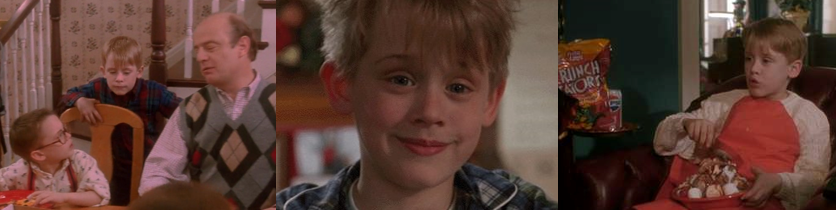
Fed up of his neglectful family, Kevin revels in finally having his freedom.

There’s a sense that Kevin is frequently forgotten or dismissed even without his extended family in the house; with them there, he hasn’t a chance of being attended to, loses his room to his tight-fisted and grouchy uncle Frank (Gerry Bamman), and is horrified at the prospect of sharing a bed with his young cousin, Fuller (Kieran Culkin), due to his bedwetting. In a house full of noise, Kevin’s only outlet is to be louder than everyone else; he brazenly backchats his mother, offers false apologies when he’s punished for acting out, and causes the ire of his entire family when he rightly lashes out at Buzz for eating his pizza. Despite there being plenty of blame to go around, it’s easier for Kate to punish Kevin by sending him up to the third floor, and Kevin spitefully protests this injustice by wishing that she (and all of them) would disappear and leave him alone. Of course, he has no idea that fate has conspired to make this wish come true; Kevin’s plane ticket was accidentally thrown away while cleaning up his mess, Peter accidentally unplugs the alarm clock and causes them to oversleep and rush around in a panic in the morning, and an annoying neighbourhood kid (Jeffrey Wiseman) throws off Heather McCallister’s (Kristin Minter) head count, meaning nobody notices that Kevin is missing until they’re halfway to Paris (and even then it’s a strange intuition Kate suddenly has for no real reason other than a mother’s instinct). Thus, Kevin’s stunned when he finds his house empty, but this turns to elation when he remembers all the awful things his family has said and done to him, and he immediately indulges his every whim. He robs Buzz’s “life savings” (accidentally trashing his room and setting his pet tarantula loose in the process), orders himself a cheese pizza, eats copious amounts of ice cream and junk food while watching trash TV, and generally has the time of his life, all while narrating to himself and occasionally calling out to his family to punish his behaviour. Of course, it’s not all fun and games for Kevin; he applies aftershave and ends up screaming in agony and is forced to go shopping for a new toothbrush and groceries, overpacking his bags and inadvertently shoplifting after being spooked by his neighbour, Old Man Marley (Blossom), whom he’s terrified of thanks to Buzz’s wild stories of his bloodlust.
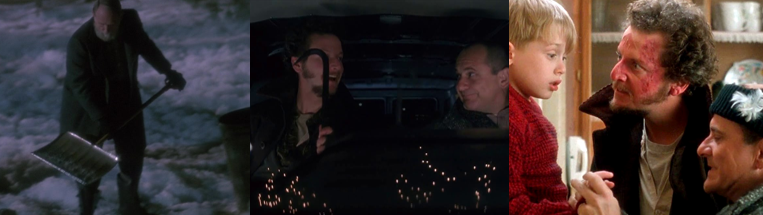
As if scary Old Man Marley wasn’t bad enough, Kevin must protect his home from the Wet Bandits.

Although continuously terrified by the old man’s grim façade, this fear is just the start of Kevin’s troubles; unbeknownst to him, Harry and Marv have systematically been robbing every house in the neighbourhood since everyone’s gone away for the holidays and left their homes vulnerable. Although far from an intelligent crook, Harry is clearly the brains of the operation; he cases out each house, evaluating their potential and noting when their security measures, and chastises the dim-witted Marv for his perverse fixation on flooding houses to earn them a reputation as the “Wet Bandits”. While Harry is methodical and meticulous, Marv is loud and bumbling, focused more on haphazardly filling his swag bag rather than searching for high value items. Harry pegs the McCallister’s as the “silver tuna” (mainly because they live in a palace!) and is astonished to find the house seemingly occupied when they go to enter it. Night after night they are dissuaded by Kevin’s elaborate deceptions, mannequins and pulleys to trick them into thinking the house is occupied. Obsessed with ransacking the house, Harry follows Kevin and quickly deduces that he’s home alone; confident that the two of them and their crowbars can handle one little boy, Harry resolves to use force but even doesn’t account for how adaptable (and cruel) Kevin is when backed against the wall. What follows is an absolute massacre that sees the two thieves beaten up, knocked about, and brutalised by Kevin’s homemade traps, each one driving Harry further and further over the edge. Pesci shines in his role as the bad-tempered thief, and you can really tell from his indistinct mumbling, garbled curses, and rising frustration that he was really living his character’s aggravation with this obnoxious little foe.
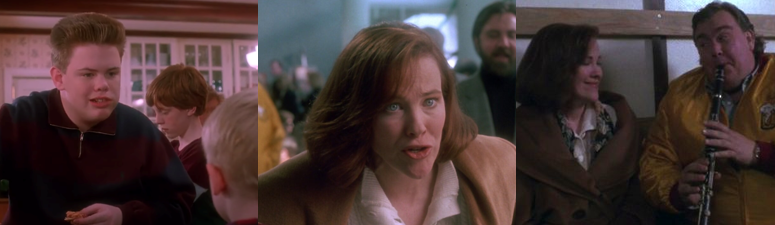
With their trip ruined, a distraught Kate desperately tries to get back home to her son.

As this is going on, the story continuously jumps over to the McCallister’s, whose Christmas vacation is effectively ruined by the realisation that they left Kevin behind; though Buzz and Frank aren’t concerned, the fun and excitement of the trip has been sucked out of everyone else, compounded by them being stuck in an apartment with nothing to do while Peter waits to hear about potential flights. Wracked with guilt and determined to make it back by any means necessary, Kate stays at the airport and wait for a cancellation after every attempt to call their neighbours and elicit the police’s assistance conveniently fails. Although Kate convinces a kindly old couple (Bill Erwin and Billie Bird) to trade some cash and valuables for a plane trip back to the United States, she’s forced to bounce around airports since she can’t get a direct flight back and naturally becomes frustrated from exhaustion and desperation. Luckily for her, friendly polka musician Gus Polinski (John Candy) takes pity on her; after rambling about his band, their success overseas, and their own transportation issues, he offers her a ride in their van, which she gratefully accepts. Although relieved to finally be on her way, and finding kindred spirits in the band since they’ve lost a lot of time with their families while on the road, she’s bombarded by upbeat polka music and endures Gus’s bizarre story of the time he left his own son in a funeral parlour. While this makes for good comedy and helps to humanise Kate after she was such a snappy bitch, I do feel there could’ve been more to this, I assume they were only able to get the late, great John candy for a day or two so he’s just a glorified cameo but I would’ve liked to see Kate spend more time reflecting on her relationship with Kevin with Gus and the band and less time screaming at airport employees. Speaking of humanising, Kevin is surprised to find that Old Man Marley isn’t the grouchy killer he’d been led to believe; while seeking solace in church after regretting taking his family for granted, Kevin speaks with Marley and learns he’s been branded by cruel lies and is actually a kindly old man who’s estranged from his family. The conversation helps Kevin to better understand his own relationship with his family, galvanises his fighting spirit, and sees Marley become an unexpected saviour in the finale, all while reinforcing the true meaning of Christmas: family.

The Nitty-Gritty:
Home Alone is certainly a product of its time and is far from perfect, but it has a quaint charm that only increases with time. Nowadays, this situation would be resolved in a heartbeat as Kevin could easily call or message his family, but that wasn’t really possible in 1990. It also doesn’t help that the power and phone lines are temporarily (and conveniently) knocked out in the opening scene, limiting Kate’s options, or that everyone in their neighbourhood also happens to be out of town at the same time. I can excuse this just by looking at the McCallister’s house and their neighbourhood; this is clearly a wealthy area, populated by the same kind of people as the McCallister’s, so it makes sense that the well-to-do would jet off over Christmas. However, one thing I’ve never been able to believe is that the McCallister’s were able to get up, get changed, load all their shit into the airport buses, get to the airport, and still make their flight in less than an hour! Even if they hadn’t overslept, I find it very difficult to believe that they’d even get to the airport on time; the lack of airport security is somewhat believable as things were different back then but, realistically, they would’ve been stuck in traffic, at the airport waiting for a later flight, or forced to head home anyway since they should’ve gotten there a good two hours early. Does this detract from my enjoyment of the film? Not at all. It’s a fun little eccentricity that, as I say, only gets more amusing the further we get from the antiquated nineties.
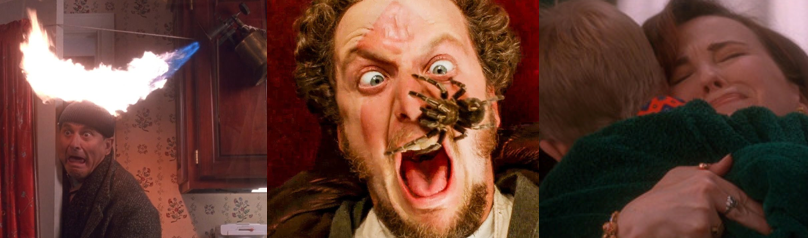
Thanks to his traps, Kevin fends off the thieves and gratefully reunites with his family.

Although he’s just a little boy who is apparently incapable of doing anything without parental guidance, Kevin proves to be a capable and adaptable defender thanks to his many toys, his vast imagination, and his devious and sadistic nature. In less than an hour, he draws up a battle plan that sees him planting a nail on the cellar stairs, flash freezing the stone pathways and steps, leaving broken Christmas ornaments by the window, rigging paint cans, irons, and other items to bash the crooks, and even scorches Harry’s head with a blowtorch! Kevin shoots his foes in the face and crotch, sets up Micro Machines to trip them, and even makes use of Buzz’s pet tarantula when in a tight pinch. It’s all very amusing and entertaining stuff but, while Harry and Marv suffer only superficial and comical injuries as the film turns into a live-action cartoon, the implications of these booby traps are staggering as many would surely be fatal in real life! Although Kevin rigs his house with all these traps and pratfalls, he’s smart enough to have a back-up plan that sees him lure the Wet Bandits into a trap after alerting the police, only for the two to intercept him, battered and hungry for revenge. Luckily, Old Man Marley saves Kevin’s bacon and the two are apprehended, easily charged with all their crimes thanks to Marv’s flooding obsession, but Kevin is still left all alone and morose at having apparently wished away his family. Hoping for a Christmas miracle he tidies and decorates the house only to wake up and find it still empty. This is, of course, a fake-out as Kate arrives soon after, mere moments before the rest of the family, and reconciles with Kevin. Even Buzz is impressed that Kevin didn’t burn the house down, briefly showing Him respect before he sees the state of his room, and Kevin has an emotional embrace with his mother that echoes Marley’s own reconciliation with his estranged family, ending the film on a heart-warming note.
The Summary:
Christmas isn’t Christmas without Home Alone, but I do admit that my affection for the film has waned as I’ve gotten older and more cynical. There’s something about live-action, feel-good family movies that just doesn’t age as well as animated films, particularly when it comes to Looney Tunes-style violence that turns what was a grounded (if whimsical) film into a live-action cartoon, somewhat lowering the stakes even when Harry and Marv get their hands on Kevin. It also doesn’t help that I’ve never been a big fan of Macaulay Culkin; sure, he’s just a little boy here and he definitely does well in the role, but his delivery is a bit cringey at times and Kevin is so unlikeable in the opening and obnoxious when left alone that I find it hard to root for him. I enjoy the wish-fulfilment aspects of the film, where Kevin just goes nuts around the house and with food and acting like a grown-up while still being a little kid, and it’s definitely heart-warming seeing both him and Kate (and the rest of the family) realise how much they mean too each other. But, for me, the appeal of the film is the Wet Bandits; Marv might be an idiot, but Harry is so alluring as a cantankerous, scheming thief whose patience is pushed to the limit by Kevin’s traps and antics. Seeing them fall afoul of Kevin’s booby traps is still the best part of the film, even if it does drastically shift the tone, and I enjoyed the imagination and mischievousness behind Kevin’s antics and traps, I just wish that we’d had some inkling of his ability to set these up beforehand. He goes from a bratty, underappreciated kid to a free-spirited child to setting potentially lethal traps pretty quickly, which I guess speaks to how everyone (even he) underestimates him, but I could’ve done with this being fleshed out a little since we were specifically told that he was Les Incompétents. Ultimately, these are minor gripes from a bitter and aging film nerd; kids and youngsters will still find plenty to enjoy here, even if the film is heavily dated in some aspects, and Home Alone is still a staple of the festive season despite its flaws.

My Rating:

Rating: 3 out of 5.

Pretty Good

What do you think to Home Alone? Is it a Christmas tradition of yours or do you prefer another Christmas movie; if so, what is it? What did you think to Macaulay Culkin’s performance? Did you enjoy seeing his bobby traps in action? What did you think to the Wet Bandits and Kate’s desperate attempts to get home to her son? Have you ever been left home alone? What did you think to the film’s sequels? Whatever your thoughts, leave a comment below and be sure to check out my other Christmas movie reviews!

Movie Night: The Marvels

Released: 10 November 2023
Director: Nia DaCosta
Distributor: Walt Disney Studios Motion Pictures
Budget: $270 million
Stars: Brie Larson, Teyonah Parris, Iman Vellani, Zawe Ashton, and Samuel L. Jackson 

The Plot:
Whilst investigating a universal threat as a favour to Nick Fury (Jackson), Captain Carol Danvers/Captain Marvel (Larson) discovers an anomaly in the fabric of space and time caused by venge-seeking Kree commander Dar-Benn (Ashton). Coincidentally interacting with the anomaly at the same time as Captain Monica Rambeau (Parris) and Kamala Khan/Ms. Marvel (Vellani) use their own cosmic powers, Danvers finds herself switching places with the two heroes and forced to join forces with them to prevent Dar-Benn from destroying the people dearest to her. 

The Background:
After a 1953 lawsuit regarding Fawcett Comics’ Billy Batson/Captain Marvel, Marvel Comics got to trademark and publish their own “Captain Marvel” stories. While Stan Lee and Gene Colan’s Kree warrior is mostly remembered for his death from cancer in 1982, Mar-Vell was followed by a numerous successors, including Carol Danvers, who overcame online trolls with her critical and commercial debut. Talk of a sequel began before Captain Marvel’s (Boden and Fleck, 2019) release, with star Brie Larson wishing to see Kamala Khan/Ms. Marvel included and MCU head honcho Kevin Feige stating that Marvel Studios had some exciting ideas for a follow-up. After Larson cameoed in adjacent spin-off Ms. Marvel (Various, 2022), which introduced Kamala to the MCU, and Teyonah Parris portrayed a grown-up and superpowered Monica Rambeau in WandaVision (Shakman, 2021), the stage was set for a team-up of the cosmically-empowered heroines, especially after director Nia DaCosta was announced to be helming the sequel and exploring new perspectives on these characters. When other MCU productions caused changes to the script, the filmmakers shifted to focus on the dynamic between the three main characters, with numerous special effects studios contributing to the film’s cosmic scope. Following several delays, The Marvels finally released to polarising reviews; many criticised the surreal moments and rushed narrative and branded it as the worst MCU film to date, while others praised the performances (specifically Iman Vellani) and its fun, kinetic action sequences, Still, as of this writing, The Marvels has barely cleared $165 million at the box office, had the lowest opening weekend of any MCU movie, and is on track to be a box office bomb, leaving the future for these characters murky.

The Review:
I really enjoyed Captain Marvel. At the time, I was fully expecting the film to dictate the next phase of Marvel movies, positioning Captain Marvel as a powerful force in the MCU and establishing the shape-shifting Skrulls as an ongoing threat to these colourful characters. Sadly, however, that didn’t really happen; the movie subverted expectations and cast the Skrulls in a sympathetic light and attempts to make them more antagonistic were questionable, at best. Indeed, the Skrulls barely feature in The Marvels except for a brief sub-plot where Dar-Benn arrives on Tarnax, where they have established a refugee colony under the leadership of Emperor Dro’ge (Gary Lewis), under the guise of a peace treaty simply to create an unstable jump point that strips Tarnax of its atmosphere and forces the Skrulls from their world once more. Despite Captain Marvel having helped settle the colony, and the assistance of her and her new allies in evacuating much of Tarnax and arranging safe refuge with King Valkyrie (Tessa Thompson), Emperor Dro’ge is seen to have lost faith in Captain Marvel, primarily because he believes she ruined a chance for the Skrulls to return to prosperity in the Kree Empire and resents her for inviting conflict. Captain Marbel also ended with the promise of Carol avenging herself against her warmongering Kree superiors, a plot point that sadly sets a precedent for The Marvels as it’s simply rushed through, brushed aside, and barely explored, especially considering Carol’s destruction of the now-comic-accurate Supreme Intelligence is the catalyst not just for the slow destruction of the Kree home world, Hala, but also Dar-Benn’s entire vendetta against Captain Marvel. It’s a shame as I would’ve liked to see Carol fighting to free her adopted people from the manipulation and influence of the Supreme Intelligence, but it feels as though there was a Captain Marvel 2 we never got that actually told this story, including a rematch with Yon-Rogg (Jude Law) and her former Starforce allies, as all of this is relegated to a quick flashback and a brief scene where Carol awkwardly expresses guilt over setting the paper-thin plot of this movie in motion. 

Carol and Monica finally reunite, brush past their issues, and join forces.

So, what are we left with instead? Well, Captain Marvel has effectively lost herself to her work; she’s so busy investigating and confronting cosmic threats and trying to atone for essentially dooming Hala to destruction that she’s largely closed herself off to others. The only person she regularly talks to is Fury and the closest thing she has to a friend is the cat-like Flerken, Goose (Nemo and Tango); her shame at being labelled the murderous “Annihilator” has kept her away from Earth and her surrogate niece, Monica, earning her the new-empowered Captain’s resentment. Though haunted by the gaps in her memory and anxious about opening herself up to others, Carol is nonetheless excited to reunite with the grown-up Monica, even more so when she sees that Monica’s not only gained light-based powers of her own that allow her to become intangible, fire bursts of energy, and (eventually) fly, but also followed in and surpassed the footsteps of her mother, Captain Maria Rambeau (Lashana Lynch) by joining Fury’s Strategic Aerospace Biophysics and Exolinguistic Response (S.A.B.E.R.) crew. New to, and resistant towards, the superhero game (she actively resists being labelled with a code-name), Monica struggles to reconcile her conflicting emotions towards her Aunt Carol; on the one hand, she’s glad to be with her again but, on the other, she begrudges Carol for leaving her to face her mother’s death and life after the Blip alone. Still, Monica acquits herself well in this fast-paced cosmic adventure; her powers may be strangely defined, but she takes a commanding role in the threesome and quickly embraces and enjoys teaming up with Carol and Kamala. Because Captain Marvel has definitely been shown to be one of the (if not the most) powerful characters in the MCU, it can be difficult to imagine her struggling against any enemy or ever requiring a team, even though we saw that she is far from an infallible, unstoppable one-woman army in Avengers: Endgame (Russo and Russo, 2019).  

Kamala is the adorable heart and soul of the film and awestruck by her hero.

Still, The Marvels gets around Carol’s incredible and unmatched power through a unique and enjoyable body-swapping mechanic. Thanks to Dar-Benn’s actions and the similarities in their cosmic, light-based powers, Carol, Monica, and Kamala switch places whenever they use their powers in unison; this causes a great deal of distress for the young Ms. Marvel, who suddenly finds herself dumped halfway across the galaxy and fighting Kree warriors and her family – overbearing Muneeba Khan (Zenobia Shroff), astonished Yusuf Khan (Mohan Kapur), and exasperated Aamir Khan (Saagar Shaikh) – threatened by those same forces. Still, Kamala is the shining light in this film; her adorable, infectious enthusiasm is a joy to see and she’s genuinely excited to meet, and team up with, her lifelong hero. When there’s tension between Carol and Monica, Kamala acts as the intermediary, dishing out sympathy, excitement, and hugs despite how in over her head she is. Since Dar-Benn possesses the other mystical bangle, Kamala becomes a target for the fanatical Kree, who wishes to have both so that she can enact the full extent of her diabolical plan, and Kamala is determined to prove herself to Carol, Monica, Fury, and her family. However, as thrilling as it is for Kamala to bond with Carol and Monica (and they do develop a true, charming sisterhood over a few montages), she also learns how dangerous and bleak the superhero life is. Carol’s actions are not always virtuous and she’s forced to make hard choices as often as she is to visit planets like Aladna, where the inhabitants can only communicate through song and dance, though the experience galvanises Kamala’s spirit and inspires her to seek out other young heroes to form a team of their own. Fury was also quite enjoyable here; although he doesn’t work alongside Carol in the same way as the first film, The Marvels repositions him as the principal figurehead for Earth/galaxy relations and he takes an active role in guiding the Marvels and evacuating S.A.B.E.R.’s inhabitants using a clowder of Flerkens in another of the film’s strangely bizarre sequences. 

The vengeful Dar-Benn is a disappointingly bland and forgettable villain.

While the relationship between the Marvels is naturally at the forefront here, and is easily the best element of the film, other aspects are underdeveloped and rushed; The Marvels is the shortest MCU movie to date and really ploughs through all its characterisations and plot, which means things like Monica’s relationship towards Carol and Carol’s shame at her actions are touched upon and then quickly cast aside. However, the real casualty of the film’s brisk pace is the lead villain. Essentially just Ronan the Accuser (Lee Pace) again, Dar-Benn even wields Ronan’s mallet-like staff (which strangely still glows and demonstrates the same properties it did when it had the Power Stone in it), which just lends further credibility to my argument that Ronan should’ve been a recurring threat in the MCU. Dar-Benn sadly ends up as a throwback to villains like Ronan and Malekith (Christopher Eccleston), underdeveloped, one-dimensional bad guys who do “bad guy stuff” simply because the movie needs a bad guy. Dar-Benn’s vendetta is based on Carol destroying the Supreme Intelligence, an act that…somehow…had cataclysmic ramifications for Hala, including destroying its atmosphere, oceans, and even its sun, driving Dar-Benn to use the vaguely-defined bangle to rip open holes in space and time to suck these resources from Carol’s adopted worlds in what is, essentially, the villainous plot from Spaceballs (Brooks, 1987). A driven, fanatical patriot, Dar-Benn is a hero by her people and poses a significant threat to the Marvels thanks to her bangle absorbing their blasts, the power of her mallet, and the confusion caused by them switching bodies, but is ultimately overwhelmed without much trouble and destroyed by her own obsession. She’s sadly far from a memorable villain, despite her posing a legitimate threat to the universe, and is just another aspect of the film that’s not given enough time to flourish onscreen; it’s a real shame as I thought we were past the age of unforgettable, wasted villains in comic book movies but here’s The Marvels to prove me wrong and harken back to lacklustre movies like Fantastic 4: Rise of the Silver Surfer (Story, 2007). 

The Nitty-Gritty:
There are some themes at work in The Marvels, but they’re severely rushed and take a backseat to keeping the narrative and the action moving ever forwards. It’s as though the film is afraid to linger too long on complex emotions and characterisations, or like a good hour or so of the plot was excised in favour of wacky nonsense that bogs down the otherwise intriguing relationship between the Marvels. Monica resents Carol for leaving her and prioritising work over her friends and family, something we learn is as much because of Carol’s humiliation at dooming Hala to destruction as it is because of her duties to the cosmos. Carol believed she was liberating the Kree when she destroyed the Supreme Intelligence but was horrified by the consequences of her actions, which see the Kree brand her as the feared “Annihilator” and target her allies in recompense. While fangirl Kamala is overjoyed to meet and fight alongside her idol, she quickly learns how dangerous the superhero life is when she’s placed in constant danger (much to the concern of her family) and sees that, sometimes, heroes can’t save everyone. Her enthusiasm remains boundless, however, and she’s very much the heart that binds the Marvels together and makes their training montages and interactions even more enjoyable, but The Marvels is handicapped by some truly bizarre sequences. They trio travel to Aladna to warn of Dar-Benn’s threat, a planet where Carol is revered as a princess and married to the forgettable Prince Yan (Park Seo-joon), and where the inhabitants communicate through singing and dancing, forcing a really surreal musical number into the film that feels more at home in Taiki Waititi’s Thor movies (2017; 2022).  

Some fun action mechanics and impressive visuals can’t atone for the film’s more surreal moments,

The Marvels may also alienate those who haven’t seen the Ms. Marvel Disney+ series. Although Kamala and her family are introduced to unaware viewers, they still kind of appear from nowhere for the uninitiated, not unlike the mentions of Westview in Doctor Strange in the Multiverse of Madness (Raimi, 2022). I firmly believe we’re at a point where MCU fans are digesting every product the MCU puts out, so there probably aren’t many people who are confused when the Disney+ shows are referenced or appear in the movies, but this could escalate into a bigger problem in the future. Still, the inclusion of Ms. Marvel adds to the film’s frantic action sequences; it’s fun seeing the three stumble about, suddenly deposited in different locations and having to quickly adapt to save themselves, and others, as the situation dictates. Through some fun montages and learning to communicate, the Marvels overcome the issue of their body swapping to form a cohesive unit that both allows them to overwhelm Dar-Benn and keeps the ultra-powerful Captain Marvel from simply ending every threat by herself. Cosmic, space-based action is kept to a minimum this time around, with most of the special effects reserved for planetary destruction and depicting rips in the fabric of reality. I will say, though, that Ms. Marvel’s powers look a little iffy at times, though the film’s costumes make up for this, with Carol sporting some snug, sexy uniforms and Kamala getting a nice upgrade that sees her gain a whip-like scarf, though I didn’t care for Monica rejecting adopting a code name and tearing off the disco-wings of her Aladna outfit as, again, I thought we were past the age of mocking superhero tropes. 

The Marvels work together to defeat Dar-Bonn, but Monica sacrifices her freedom to save the galaxy,

So, Dar-Benn’s revenge sees her scour the universe for the sister bangle to Kamala’s heirloom; when combined with Ronan’s staff, this allows her to create unstable jump points that suck air, water, and the sun from worlds that are close to Carol, with the goal of restoring the Kree home world and delivering a decisive blow to Carol. Although she has an army of loyal soldiers at her back, this doesn’t really factor into Dar-Benn’s plan and the Kree exist primarily as cannon fodder for the Marvels to beat up as they save lives and try to confront the head of the snake. This confrontation takes place, naturally, on Dar-Benn’s command ship as she arrives to suck the life out of Earth’s sun and sees the Marvels working in unison to overwhelm their foe, ultimately (and inadvertently) mortally wounding her. Carol echoes Kamala’s compassion for the fallen Kree and, on Monica’s suggestion, offers to reignite Hala’s sun to atone for her actions, which Dar-Benn seems to agree to but she ultimately can’t let go of her vendetta and destroys herself after creating a massive tear in the fabric of reality. Luckily, the Marvels surmise that Carol and Kamala can recreate the energy used to create this tear and use it to empower Monica so she can close it, an action that must be performed from inside the rift and ultimately results in Monica seemingly sacrificing herself to save the universe. Changed by the experiences, Carol decides to spend more time on Earth to wait for Monica’s inevitable return, and Kamala heads out to start her own superhero team, with Fury spearheading the repairs to S.A.B.E.R. to monitor future intergalactic threats. Of course, Monica isn’t dead as a mid-credits scene shows her waking up in a hospital, overjoyed and overwhelmed to find her mother at her side. However, this is a variant of Monica’s mother, one who has adopted the Captain Marvel powers and codename of Binary and works alongside Doctor Henry “Hank” McCoy/Beast (Kelsey Grammer) at the X-Mansion. This was a fun stinger since recent MCU products have laid the groundwork for the X-Men and I enjoyed the inspiration from the nineties’ cartoon, but Beast was an unsightly CGI creation and I remain incredulous to Marvel’s resistance towards recasting new actors as the X-Men, and the idea that Mutants need to step through a tear in reality to exist in the MCU. 

The Summary:
I had high hopes for The Marvels; I really enjoyed Captain Marvel, and Ms. Marvel, and was interested to see Carol and Kamala meet onscreen, and explore the relationship between Carol and Monica. These aspects were, thankfully, exceedingly well realised; the three had some great chemistry, obviously had fun working together, and formed a fun sisterhood that perfectly balanced their different characters and experiences (and inexperiences, in some cases). I don’t normally like body swap narratives (and, in truth, it started to wear out its welcome here in the early going) but, for the most part, it was a fun inclusion; it was a unique way to nerf Captain Marvel’s vast cosmic powers and show her the benefits of working with others, and to repair the rift between her and Monica and induct Ms. Marvel into the wider superhero community. Sadly, that’s about where my praise for The Marvels ends; Dar-Benn is in the running for weakest MCU villain of all time, the plot was slapdash and simple, and any nuance or intrigue laced into the narrative was breezed through to get to the next wacky sequence. It honestly felt like major cuts were made, or we missed an entire movie, and I didn’t care for the half-assed characterisation of Dar-Benn or the mockery of superhero tropes, which are both negative elements of the genre that I thought we had moved on from. On the one hand, I liked that the film didn’t outstay its welcome and had a brisk pace, but I think the overall plot and characterisations (outside of the titular trio) suffered because of it. This is definitely a miss-fire for me, ultimately coming across as a film that exists for the sake of existing and setting up future MCU products rather than delivering a solid follow-up worthy of the principal cast.  

My Rating:

Rating: 3 out of 5.

Pretty Good

Did you enjoy The Marvels? What did you think to the dynamic between the trio and which of the three is your favourite? Did you like the film’s brisk pace, or do you agree that certain elements were rushed? Were you also disappointed in Dar-Benn? Are you also annoyed that the X-Men are being introduced as part of the multiverse? Would you like to see the Marvels join forces in a future MCU movie? Whatever your thoughts on The Marvels, leave a comment down below.

Movie Night [Godzilla Day]: Ghidrah, the Three-Headed Monster


Toho’s famous atomic beast, and easily the most recognisable kaiju in the entire world, Gojira first emerged to wreck the city of Tokyo on this day all the way back in 1954 and, in 2016, the day was subsequently declared “Godzilla Day”.


Released: 20 December 1964
Director: Ishirō Honda
Distributor: Toho
Budget: Unknown
Stars: Haruo Nakajima, Yosuke Natsuki, Shoichi Hirose, Akiko Wakabayashi, Masanori Shinohara, and Takashi Shimura

The Plot:
An alien prophetess (Wakabayashi) predicts catastrophic attacks from Godzilla (Nakajima) and Rodan (Shinohara), leading to Mothra intervening to defend humanity. However, when the hydra-like space dragon King Ghidorah (Hirose) appears, the warring kaiju must set aside their differences to battle this devastating new foe.

The Background:
6th August 1946. The height of the Second World War. The Americans dropped two nuclear weapons on Hiroshima and Nagaski, killing tens of thousands of people and forcing the Japanese Imperial Army to surrender. The radioactive fallout saw thousands more dying, and post-war Japan was gripped with nuclear fear, a fear that birthed Gojira, the living embodiment of nuclear destruction. However, soon after this debut in Godzilla (Honda, 1954), the King of the Monsters turned from Japan’s destroyer to its reluctant saviour, defending the country from other kaiju attacks as a matter of principal. Following the commercial success of Godzilla’s last two movies, Ghidrah, the Three-Headed Monster was rushed into release; it included the return and redesign of fellow kaiju Rodan after a nearly ten-year absence, a recycled Mothra animatronic with marginal changes, and Toho’s most complex kaiju yet, the three-headed dragon King Ghidorah. Arguably Godzilla’s greatest nemesis, King Ghidorah was conceived by Godzilla creator Tomoyuki Tanaka and inspired by the Lernaean Hydra and the Orochi of Japanese folklore, and its debut feature was so successful that it reappeared in Toho’s next giant-monster film the following year.

The Review:
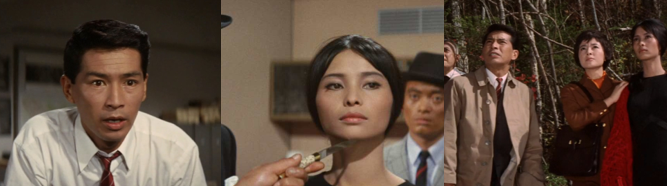
Our story opens with reporter Naoko Shindo (Yuriko Hoshi) visiting a communications centre that’s trying to contact extraterrestrials. Headed by their resident expert (Someshô Matsumoto), they truly believe that “flying saucer people” are out there, and wary of non-believers, so much that Naoko’s scepticism is blamed for their failure to communicate with the aliens. For a group of presumed scientists and academics, they’re oddly fanatical about this; since the world is experiencing an unseasonable heat wave, they’re concerned that a catastrophe is looming and believe the saucer people are their only chance of salvation and find Naoko’s ditzy disinterest to be insultingly narrow-minded…even though she’s simply there to do a job and desires proof. You know, the kind of evidence scientists strive to gather. A small meteor shower interrupts their meeting and draws Naoko’s friend, Professor Murai (Hiroshi Koizumi), and his team to investigate. They discover a large cocoon-like meteor that randomly emits magnetic waves and leaves them baffled. Naoko’s brother, Detective Shindo (Natsuki), likes to tease Naoko about her friendship with Murai; although grown adults, they still bicker like children, and she doesn’t appreciate his remarks or him getting in the way of her career. Shindo is stunned when he’s assigned to protect the visiting Princess Salno of Selgina (Wakabayashi), who’s facing assassination from her ruthless uncle (Shin Ôtomo), who desires her throne. Shindo is even more stunned when Salno appears to be killed when her plane explodes and she crops up as a doomsaying Prophetess who claims to be from Mars and warns that the world faces impending doom unless humanity changes their ways and takes better care of the environment, much to the jeers and doubts of the public.

Shindo and his sister are caught up with a mysterious woman who claims to be from Mars!
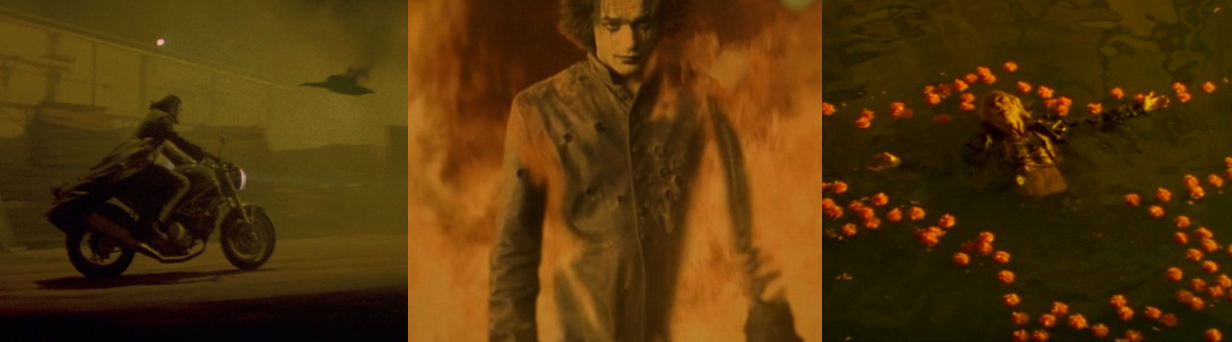
Assuming that Salno faked her death to escape her uncle’s assassin (Hisaya Ito), Shindo volunteers to bring her into protective custody, causing a brief conflict when he finds Naoko shielding her in hopes of getting an exclusive story. Drawn from her plane before the explosion by a disembodied alien presence that possesses her, psychiatrist Doctor Tsukamoto (Shimura) later reveals that the Prophetess is just one of a displaced, highly advanced alien race that fled to Earth and assimilate themselves into humanity, losing many of their fantastic abilities in the process, when the Red Planet was decimated by Ghidrah. One of the deadpan Prophetess’ remaining abilities is the ability to predict pending disasters that are repeatedly mocked and ignored; she warns people away from Mount Aso, where the prehistoric kaiju Rodan emerges from the volcano, and advises the fairy-like Shobijin (Emi and Yumi Itō) not to sail home to the benevolent Mothra on Infant Island, which they heed and are thus spared a violent death from Godzilla’s atomic breath. Despite the looming kaiju threat, the assassin and his cohorts continually hound the Prophetess, determined to kill her as per their orders, in a bizarre side-plot that honestly distracts from what we’re all here to see (but I guess it makes a change from following a soldier or a reporter as these films often do). Even with the three kaiju battling in the foreground, the assassin tries to complete his mission and yet somehow misses the easiest kill shot in the world! Although Shindo rushes to her aid and a brief firefight ensues, the assassin is ultimately crushed under falling rocks from the kaiju battle. In all the chaos, Shindo is wounded from a bullet and the Prophetess takes a grazing shot to the head and a nasty fall that conveniently sees the alien presence driven from her body…
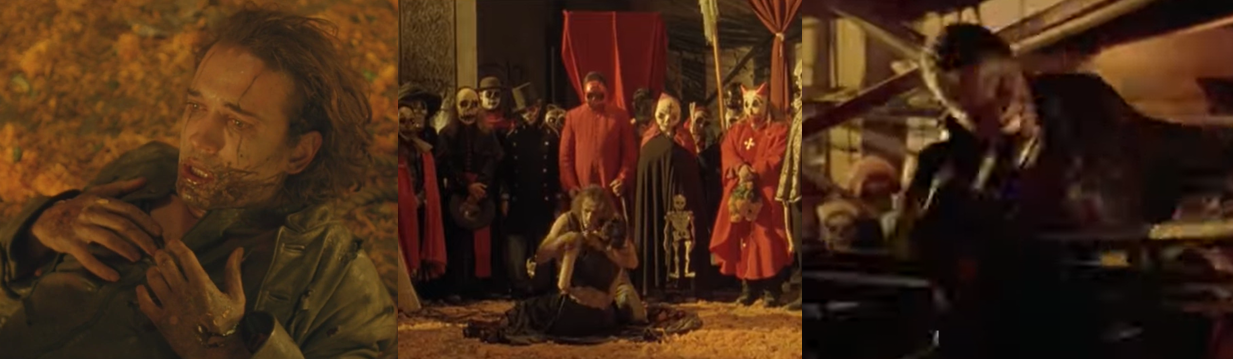
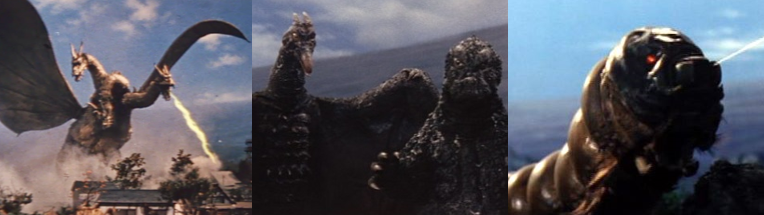
Mothra is asked to unite rivals Godzilla and Rodan when Ghidrah goes on a rampage.

By this film, kaiju are well established; despite them slumbering for great lengths of time and occasionally defending humanity, they’re generally regarded as unpredictable and dangerous. One of the most popular and benign is Mothra, who’s such a celebrity that his fairy companions appear on television to reveal that one of the Mothra larvae has died since the previous film and that the remaining larvae is worshipped as a God. Sadly, for a film that boasts four kaiju, it takes ages to see them onscreen, and over forty minutes for Godzilla to show up! Even worse, although Godzilla’s clearly enraged at Rodan’s presence and they awkwardly exchange blows, the film initially focuses on dull political debate and fades to black right as things are getting interesting. The meteor eventually yields the most visually striking aspect of the film, and Godzilla’s greatest nemesis, the titular Ghidrah, a three-headed dragon covered in golden scales. With the Japanese military refusing to employ atomic weapons, they turn to the Shobijin to plead for Mothra’s help. Unfortunately, the fairies admit that Mothra alone isn’t strong enough to battle Ghidrah and the only hope for victory is for the larvae to convince Godzilla and Rodan to team up against the demonic dragon. It takes some time for Ghidrah to cross paths with its foes; until then, the focus is on Godzilla and Rodan, who battle furiously with neither one having a clear advantage (Rodan’s fight allows it to keep Godzilla off-balance and even pick him up and dump him on some power lines, but Godzilla’s functionally indestructible and simply grows more enraged the longer the fight rages on). Their pig-headedness means Ghidrah causes havoc unopposed by either the kaiju or the miliary; indeed, the military don’t even mobilise their tanks or planes to engage Ghidrah and, instead, the ineffectual government places all their faith in Mothra and his desperate plan to join forces with Godzilla and Rodan.

The Nitty-Gritty:
You may have noticed a few inconsistences in my review; these are due to me watching the English dub, which has the Prophetess and her people originate from Mars rather than Venus, pronounces and spells Ghidorah’s name differently and drops its regal title, and changes the traditionally female Mothra to a male. While some purists may argue that the original Japanese audio and English titles are superior (and they’re often right), I usually always go with the dubbed version just to make things easier and because of the often-hilarious line delivery. The film contains an environmental message that echoes sci-fi classic The Day the Earth Stood Still (Wise, 1951); decades before global warming was the hot buzz word, Ghidrah, the Three-Headed Monster warns about such disastrous concerns as climate change and global warming. The Prophetess foretells that humanity is doomed if they don’t change their ways, but this message falls a little flat as her warnings are not actually about mankind directly and instead refer to the monstrous kaiju that threaten their world. While technically these creatures (with the exception of Ghidrah) could be said to be man-made, given they were mutated by radiation and such, they’re usually always more depicted as a force of nature. Godzilla, especially, is usually always the embodiment of nature’s wrath and man’s hubris taking destructive revenge upon the world, so it’s a little weird to say “you’re dooming yourselves” when actually you mean “a big-ass alien monster’s gonna wreck shit”.

The film is definitely ambitious with its suit effects, though maybe a little too ambitious at times.

Although it takes forever for Godzilla to finally make an appearance, he’s as impressive as ever; while the suit is bulky and incapable of blinking, it’s always a joy to see Godzilla trampling model buildings as people flee in terror. Emerging from its cocoon in a shower of sparks and animated lights, Ghidrah makes for an intimidating foe with its three screeching heads and chaotic lighting blasts; like Rodan, Ghidrah devastates everything in its path with a supersonic crash and, like Godzilla, it emits destructive energy beams, but in the form of wild and crackling lightning. Unfortunately, it does look incredibly ungainly with its bulbous body and lack of arms; while its three dragon-like heads go some way too make up for this handicap, biting and attacking with malicious intent, they also look a bit dodgy flopping and flailing all over the place and I really do think Ghidrah would be even more threatening if it had arms and talons to grab and attack with and just make its body look a little less comical. Unlike their counterparts, Rodan and Mothra are far less versatile and clunky; Rodan may still be a man in a suit but his flying scenes are realised through obvious wires and a powerful wind machine, while Mothra is purely a partially animatronic creature that bumbles about the place spitting silly string because, maddeningly, the filmmakers decided to keep Mothra in his larvae form rather than utilise the more visually interesting (if equally restrictive) moth form. Rodan’s flying scenes are, admittedly, pretty ridiculous; I admire the filmmakers for trying to inject some variety with their kaiju designs and have always had a soft spot for Rodan, but it’s laughable seeing the static model being strung along on wires (alongside a jet engine sound effect) and bashing into Godzilla. Godzilla still uses his atomic breath rather than a destructive beam of energy, meaning both are noticeably weaker than I’d usually expect from the King of the Monsters; Rodan can take the breath at point-blank range and even comically disorientates Godzilla by pecking him repeatedly in the head!

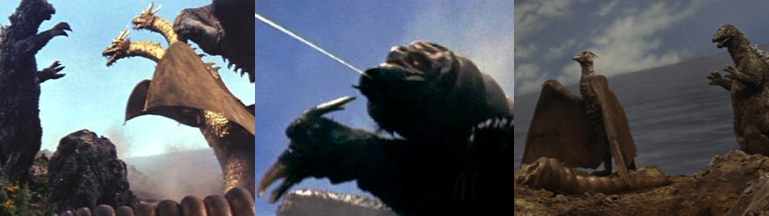
Eventually the three kaiju come together to scare Ghidrah off with ridiculous ease.

Honestly, the fight between Godzilla and Rodan is pretty ridiculous thanks to the filmmakers just being a little too ambitious; Rodan flies about, pecks at Godzilla and its tail, and pushes the Big G back with powerful wind blasts, and Godzilla mostly flails his little arms, whacks Rodan with his tail in a glorified slap fest, and sends rocks flying at his foe that fail to hit with any convincing impact. The two even play dead man’s volley with the boulders, which is presented as two Apex Predators looking to prove their might, and they’re only subdued when Mothra tangles them up in silly string to plead for their co-operation. The Shobijin are on hand to translate; despite their differences, Godzilla and Rodan agree that they have nothing to gain from helping humans and have no interest in getting involved and would rather fight each other. However, the two quickly change their minds when they see Mothra bravely taking on Ghidrah alone and be easily overwhelmed by its lightning bolts. Not that Godzilla or Rodan initially fare much better; Godzilla gets blasted into a bridge and engulfed in raging flames and Rodan injures itself more than its monstrous foe when it knocks Ghidrah out of the air. With Rodan forced to take cover from Ghidrah’s lightning, Godzilla literally drags Mothra back into the fray and goes back to his tried-and-true strategy of chucking and kicking rocks and gets blasted in the crotch for his troubles! Eventually, Godzilla, Rodan, and Mothra come together as best as they (and their cumbersome suits) allow to overwhelm Ghidrah; Godzilla wrestles with it, absorbing the brunt of its attacks, while Mothra nips at its tail and engulfs it with String Shot while being carried on Rodan’s back. Somehow, this is enough to force the hydra to flee, bringing the battle to an anti-climatic end. In the aftermath, Princess Salno exhibits no memories of her time as a Martian beyond a lingering gratitude for Shindo and Mothra heads back to Infant Island with the Shobijin, bidding a fond farewell to his new allies, who have set aside their grievances.

The Summary:
Geez, I may apologise for Godzilla movies a lot and cut them some slack, but this was a pretty awful movie to sit through! The tone is all over the place, emphasising the importance of respecting the world and avoiding global disaster on one hand and then having slapstick kaiju violence the next. While Ghidrah may look intimidating and is depicted as a crazed, destructive alien beast, it’s defeated with a pathetic amount of ease; the film makes a big deal about how Mothra isn’t strong enough to defeat the creature, yet all Godzilla does is hold it still and all Rodan does is carry Mothra so he can string it up! The bulk of the monster madness is focused on Godzilla and Rodan, which would be fine if the fights weren’t so laughably bad! This is only Godzilla’s fifth movie so I understand that all the kinks weren’t figured out yet, and I get that there’s only so much you can do with puppets and suitmation, but maybe the filmmakers should’ve set their goals a little lower and simply focused on Godzilla battling with Mothra and left Rodan out of this since it really didn’t do much against Ghidrah that couldn’t have been accomplished without it. The film also spends way too much time focusing on this batshit crazy Martian presence, or whatever, when it should’ve been focused on the mystery of the glowing meteor. I would’ve skipped the Prophetess and incorporated her environmental message into Shindo, rewritten him to be a scientist investigating the meteor, and had Naoko cover the emergence of the kaiju. Again, I get that we need to follow human characters, but they dominate the film’s runtime and just aren’t very interesting, especially compared to what should’ve been an epic assembling of four bad-ass kaiju with the fate of the Earth at stake. Instead, I never felt like humanity was threatened by Ghidrah and the kaiju action was severely lacking due to the imitations of the suits, meaning Ghidrah’s big debut film ended up being a dull and ultimately forgettable experience for me.

My Rating:

Rating: 2 out of 5.

Could Be Better

What did you think to King Ghidorah’s debut film? Were you also disappointed by the bonkers human sub-plot, or did you enjoy the alien narrative? What did you think to the build up to King Ghidorah’s appearance and powers? Did you also find the kaiju battles lacking? Which incarnation of King Ghidorah is your favourite? What is your favourite Godzilla movie and why? How are you celebrating Godzilla Day this year? Whatever your thoughts on Godzilla and King Ghidorah, feel free to leave a comment below and be sure to check out my other Godzilla and kaiju reviews across the site!

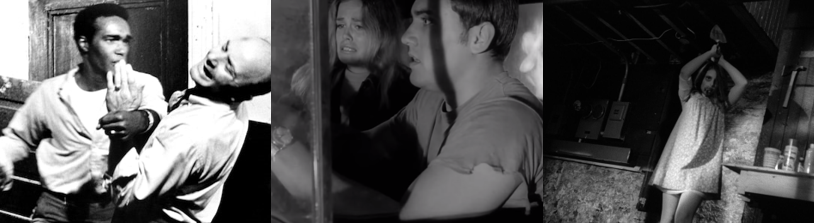
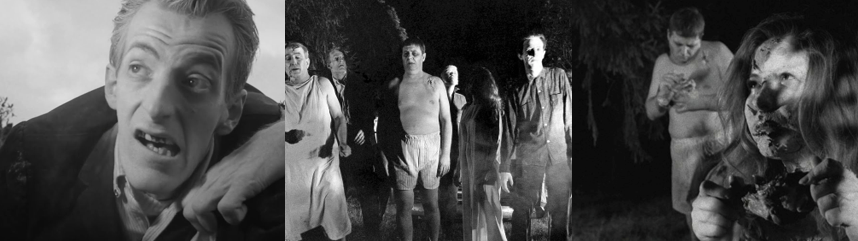
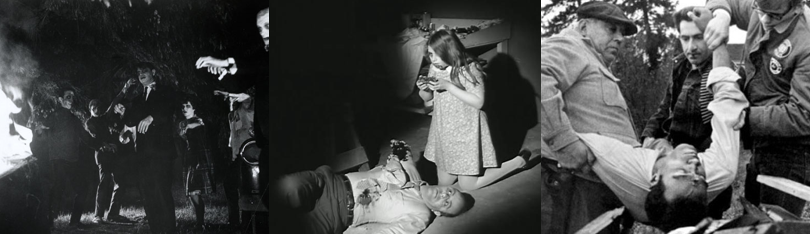
Movie Night [Day of the Dead]: Night of the Living Dead (1968)


The Day of the Dead (or Dia de los Muertos) is a traditional Latin American holiday on which, every November 1st, the lives of deceased loved ones are celebrated with food, drink, parties, and a great deal of masquerade involving the calacas and calaveras (skeletons and skulls). For me, this seems like the perfect excuse to look back on the long-running and ever-changing zombie genre that was largely popularised by director George A. Romero, which I devoted a great deal of my PhD thesis towards and which has often been used as a parallel to various aspects of society and culture.  


Released: 1 October 1968
Director: George A. Romero
Distributor: Continental Distributing
Budget: $114,000 to 125,000
Stars: Duane Jones, Judith O’Dea, Karl Hardman, Marilyn Eastman, and Kyra Schon

The Plot:
When the recently deceased suddenly return to life, traumatised Barbra (O’Dea) takes shelter in a farmhouse alongside pragmatic Ben (Jones) and antagonistic Harry Cooper (Hardman). With tensions rising and the walking dead closing in, the group struggles to survive, co-exist, and make sense of this strange phenomenon.

The Background:
Ever since the 1930s, zombies have appeared in movies in one form or another, either as mindless slaves, voracious cannibals, or in their most famous form: the shambling undead. After growing bored with directing television commercials, George A. Romero and his friends, John Russo and Russell Steiner, decided to capitalise on growing trends for more bizarre content and produce a horror movie. Initially conceived of as a horror comedy about adolescent aliens, it was Russo who decided the creatures being flesh-eating reanimated corpses, which Romero infused with heavy inspiration from the macabre revolutionary themes of I Am Legend (Matheson, 1954) and its first screen adaptation, The Last Man on Earth (Salkow and Ragona, 1964). Although the role of Ben was written as a Caucasian, Duane Jones impressed Romero in his audition and the script was revised based on his input; his casting and portrayal inspired numerous racial readings and made the film surprisingly progressive for the time. The low-budget impacted the options available to the filmmakers; chocolate syrup, entrails from butcher shops, and simple make-up effects brought the gore and ghouls to gruesome life and, while simplistic by today’s standards, proved shocking and outrageous at the time. Despite the controversy it caused, Night of the Living Dead was a massive hit with its box office gross of over $30 million; although critics dismissed it at the time, Night of the Living Dead has since been regarded as a horror classic, one of the best of its era, and it was preserved in the National Film Registry in 1999. The film was not only followed by subsequent sequels (both official and unofficial) and (thanks to an agreement between Romero and Russo) a similarly-named adjacent series) that expanded and refined the zombie concept, but heavily influenced the portrayal of zombies for decades. Remade in 1990 to recoup some profit after legal issues saw the original become public domain, Night of the Living Dead is also the most remade film in history.

The Review:
When I decided to spend a year of my PhD discussing the original Resident Evil movies (Various, 2002 to 2016), I found myself deeply entrenched in the rich and lengthy lore of zombie cinema, tracking their origins as voodoo slaves in White Zombie (Halperin, 1932), their vampire-like depiction in I Am Legend and the first of its many adaptations, The Last Man on Earth, and, of course, charting the history of Romero’s genre-defining depiction of the living dead. I found that zombies are one of the most enduring horror creatures not just in cinema, but in mainstream media; they’ve been as persistent as they appear in movies, changing from shambling ghouls to rage-filled savages, and continue to be popular inclusions in horror media thanks to how versatile they are. Honestly, though, this kind of research and in-depth exposure to zombie cinema kind of ruined my appreciation for zombie movies; many are low-budget, derivative affairs or simply repeat the same lessons established by Romero decades ago, meaning it can be hard to find quality zombie movies. Although well renowned as the grandfather of this sub-genre of horror, Romero’s first effort in bringing zombies to un-life is fraught with issues, ranging from the obvious low budget and stilted performances to inconsistences in the portrayal and behaviour of the titular living dead as these aspects wouldn’t be refined until the far more visually and philosophically interesting (but, blasphemously, still quite tedious, in my opinion) sequel. I also feel compelled to specify here that I’m looking at the black and white original rather than the many different re-releases or the bastardised colour version, simply to give my thoughts on Romero’s original vision as depicted so controversially decades ago.

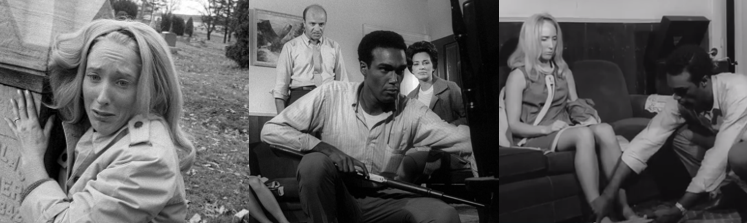
Unlike Ben, who takes charge as a resourceful leader, Barbra is little more than a traumatised mouse.

We open with Barbra and her brother, Johnny (Russell Streiner), reaching the end of a regular 200-mile round trip to place a wreath on their father’s grave at the behest of their mother. Johnny, exasperated at regularly having to waste his days commemorating a man he barely even remembers, just wants to get back home and stop throwing away good money for sentiment. While Barbra is happy to make the trip and thinks fondly of her father, Johnny has no time for lingering and amuses himself by teasing Barbra since she’s still scared by cemeteries. Indeed, Barbra’s previous resolve in chastising Johnny’s attitude falters when he starts bullying her, but they’re both horrified when a strange, shambling man (Bill Hinzman) suddenly attacks them. Although Johnny bravely (if awkwardly) tries to fight the man off, he ends up bashed into a gravestone, leaving Barbra fleeing in terror. After…somehow…crashing her car, Barbra is forced to take refuge in a nearby farmhouse; though she arms herself with a knife, she’s unable to call for help due to mysterious interference on the line but, luckily, Ben shows up and immediately takes charge. If you’re hoping for a strong, capable female lead then you’re out of luck, Barbra is so crippled by fear that’s practically catatonic, sleepwalking through the rest of the film and completely giving into despair while Ben is forthright and bravely tackles the ghouls with a tyre iron. Although he’s just as scared as her, his thoughts are on practical matters such as food, lights, and arming himself with a rifle; Barbra’s distressed state aggravates him, but he keeps his cool and puts her to work helping to secure the house against further attacks to await rescue. Eloquent, intelligent, and charismatic, Ben hides his fear and confusion behind productive tasks and narrating his observations and the horrors he’s seen aloud, something he’s forced to do since Barbra too shocked to be much conversation. When Barbra descends into hysteria, so desperate to save Johnny that she almost runs out into further danger, Ben’s forced to physically subdue her to keep her calm, allowing him to finish fortifying the house and glean insight into the crisis from a radio broadcast.

Tensions rise between the survivors, who are faced with a clash of ego and the undead.

Considering it takes Ben some time (presumably a couple of hours) to finish fortifying the house, it comes as a surprise to both them and the audience when other survivors emerge from the cellar. Naturally, Ben is incensed to learn that Harry, his wife and daughter, Helen (Eastman) and Karen (Schon), and lovers Tom (Keith Wayne) and Judy (Judith Ridley), chose to hide rather than investigate the screaming and commotion. Ben’s natural instinct is to help people, no matter the danger, whereas Harry reasoned it wasn’t worth risking their lives and their safety helping others. Having witnessed the strength and tenacity of the ghouls, Harry is adamant that they’re all safer in the cellar, regardless of the fortifications, and both make valid arguments since the cellar allows them to better fend off attacks, but the house gives them a fighting chance and more escape routes. Tom does his best to play peacekeeper, but Harry stubbornly refuses to listen to reason, primarily due to fear, his shame at feeling said fear, and a deep-seated need to protect his family. Although the ghouls briefly breaking through the windows seems to prove Harry’s point, he’s aggrieved when Ben refuses to share any of the upstairs food or resources; it seems Harry wants it both ways, but Ben firmly draws a line and delivers a stern ultimatum: “You can be the boss down there. I’m boss up here”, enraging the overprotective and stubborn father. Taking his chances upstairs, Tom has the anxious and caring Judy join them while Harry barricades himself and his family downstairs out of a pig-headed fixation on being “right”. Weary of his bullish ways, Helen echoes Ben’s remarks about Harry’s shortsightedness, which cuts them and their sick daughter off from information and potential rescue. Like Tom, she emphasises co-operation and compromise, allowing them to trade places with Judy to learn more about the crisis, though he continues to rile Ben up with his antagonistic and cynical attitude. Helen is encouraged by news of rescue centres nearby and Ben devises a plan to hold off the ghouls with flaming torches so they can refuel his truck and get medical help for Karen, but the plan goes horribly awry, resulting in Tom and Judy’s fiery deaths, and Ben unloads his rage onto Harry when he refuses to let him back into the house, leading to the two tussling for the rifle.

Night established and popularised many of the characteristics of zombie media.

In their first appearance, Romero’s living dead are noticeably different to what we’d see in his sequels and subsequent zombie media. The first thing to note, of course, is that the living dead are never referred to as “zombies”; this term would be as fastidiously avoided and mocked as Romero’s opinions on running zombie variants, meaning the living dead have more in common with Matheson’s interpretation of vampires than the brain-devouring zombie of mainstream imagination. Consequently, the living dead are referred to as anything but zombies; described as “ghouls”, “things”, “them”, and “assassins”, the living dead are also noticeably less gruesome than in later movies, potentially because the zombie outbreak is so recent and the undead so freshly turned. Similarly, Romero avoids explaining the sudden return of the living dead; a news report speculates radiation from an exploding space probe, but divine will is also implied (Johnny mocks Barbra’s prayer and admits to no longer attending church, and is the first to die). The zombie outbreak is treated as a sudden and confusing attack, almost like an epidemic; at first, characters ignore or mock the signs but they’re soon relying on radio broadcasts for scant information and how to combat the voracious ghouls. Night of the Living Dead establishes the basic rules of the undead: for whatever reason, the recently-deceased return in a near-mindless state, driven only by the need to consume human flesh. Rather than infecting people, their bites simply expedite the deaths of their victims; because of radiation from the Venus prove, anyone who dies will then reanimate with a taste for murder and cannibalism. Though slow and shambling and driven back by fire, the ghouls are incredibly persistent and dangerous in large groups; they can only be permanently put down with a blow to the head, destroying their brain, or removing the head entirely, and people are encouraged to forgo proper funeral procedures and immolate the corpses as soon as possible. Unlike most iterations of zombies, however, the ghouls are decidedly less monstrous here; many are more like entranced slaves or crazed maniacs, meaning they can use tools or rocks where brute strength fails and young Karen even uses a trowel to stab her mother to death rather than going for the jugular as you might expect.

The Nitty-Gritty:
There’s a certain classic charm to revisiting the old black and white horrors of yesteryear; everything has a distinctly old-timey and almost gothic atmosphere, which is only extenuated by the greyscale visuals. Yes, it does make some of the night-time action difficult to make out and it’s not for everyone, but I always appreciate this era of cinema as it evokes feelings of nostalgia and appreciation for these filmmakers, who did the best they could on a limited budget and with the technology of the time and, in many cases, pioneered filmmaking effects that we still see in cinema to this day. Even in this first tentative outing for the living dead, Romero positions the ghouls as social commentary; their mindless, savage, almost primal nature explicitly reflects the dichotomy between the survivors, particularly Ben and Harry, who constantly butt heads. There’s a startling message related to this through the simple depiction of the ghouls co-existing and even working together, despite being incapable of communication, to problem solve and better devour their prey; in contrast, the survivors are equally unable to communicate due to fear, tension, and ego and absolutely incapable of working together for these same reasons. It’s these emotional responses that see other survivors uniting against their monstrous foes as a paranoid, trigger-happy mob that’s as inhuman as the ghouls they target, creating a thematic parallel that begs the question who the real monsters are, us or “them”? Naturally, you can read into this even further thanks to Ben being a Black man; though the most level-headed and practical, he’s met with suspicion (even from Barbra, initially) and hostility, which opens itself up to racial prejudice due to his skin colour and Harry’s overly aggressive demeanour, and the ghouls are also framed as being this unknowable threat not unlike  foreign invader that “normal” folk struggle to understand and fight back against with extreme prejudice.

Despite surviving the horrifying night, Ben is callously shot dead as humanity blindly fights back.

Although Johnny’s death is disappointingly lame and bloodless, the suddenness and brutality of is where the true horror lies; still, Night of the Living Dead contains a fair amount of gore, including a partially mangled (presumably eaten) corpse in the farmhouse, some rudimentary decomposition effects, a surprising amount of flaming bodes, and sickening scenes of ghouls feasting on Tom and Judy’s entrails and chargrilled flesh. Still, Night of the Living Dead focuses more on tension and both internal and external threats. Although Harry covers their exit with Molotov cocktails, he takes advantage of the situation to claim dominion over the entire house. Unsurprisingly, given they’ve been measuring dicks the entire time, Ben fights him for control of the only gun, resulting in Harry being fatally shot due to his hubris. Having succumbed to her injuries, Karen reanimates and feasts on her father’s body before stabbing her mother to death. As she and the other ghouls close in, Barbra finally snaps out of her stupor, only to be dragged into the writhing masses by Johnny, and this irony is quickly followed by Ben, the sole survivor, being forced to take refuge in the cellar when his barricades fail. After putting down the reanimated Harry (which seems as much out of spite as it for survival) and Helen, Ben waits it out and survives the night; since the ghouls go down pretty easily when you have the right weapons, the danger seems to be mostly contained by the authorities and gun-toting locals, who pick the living dead off with ease. When they come to dispatch the ghouls near the farmhouse, Ben emerges from the cellar, attracted to the gunfire, but his caution proves his undoing; since he’s skulking around in the darkness, he’s mistaken for a ghoul and promptly executed on the spot. As the credits play, his body (and those of all the characters, ghouls and human alike) is dispassionately dumped onto a bonfire and burned in one of the bleakest endings in all of horror cinema.

The Summary:
There’s a reason Night of the Living Dead is considered a horror classic and the forefather of zombie media. A low-budget affair that made the most of its resources, the film is a bleak mediation on humanity; simple ideas such as co-operating, coming together in a crisis, and working together to overcome an aggressive foe are present and resonate even to this day, where we’re more likely to turn against each other than set aside our differences. Although not as explicit as in his later movies, the ghouls are clearly utilised as an allegory for these matters, and various others; the fear and inevitability of death, the danger of the unknown, the savage nature of man are all valid readings of Night of the Living Dead.  It’s also incredibly progressive in terms of Black representation; Ben is a keen, intelligent, and proactive survivor haunted by what he’s seen but determined to help others and make a fighting stand until rescue comes. While he can be as abrasive as Harry, his stubborn demeanour comes from a place of logic and reason and he’s constantly trying to increase their chances of survival, only to be met with pig-headed resistance. Harry might be an asshole, but you can see where he’s coming from; he’s scared and wants to protect his family, even if it means sacrificing others. Sadly, Helen (and women in general) don’t fare quite as well; portrayed as meek and generally useless, women just kind of get in the way or are oppressed and bossed about rather than contributing anything meaningful, though this does allow discussions about gender equality and machismo. Night of the Living Dead also established many of the “rules” for zombie cinema; although its ghouls aren’t as monstrous as later zombies and are more like entranced slaves, there’s a mystery and a danger to them when they gather in large numbers against vulnerable victims. However, it’s true that the film hasn’t aged very well; the performances and some themes are questionable, and there have been better zombie movies made since (by Romero himself, no less) that both overshadow this one and expose its flaws, though it remains recommended viewing for any fans of the genre, for sure,

My Rating:

Rating: 3 out of 5.

Pretty Good

Do you consider Night of the Living Dead a classic of the genre? Were you surprised to see a Black man take such a proactive role? What did you think to the tension and rivalry between Ben and Harry? How did you interpret the ghouls and what did you think to their characterisation here? What do you think caused the zombie outbreak and how do you think you would react in such a scenario? What is your favourite zombie film and what do you think of the genre in general? How are you celebrating the Day of the Dead today? Whatever your thoughts on Night of the Living Dead, and zombie films in general, feel free to leave a comment below or leave your thoughts on my social media, and check out my other zombie content across the site.

Movie Night [Halloween]: Halloween III: Season of the Witch


Starting life as the ancient Celtic festival of Samhain, when people would light bonfires and wear costumes to ward off ghosts, Halloween is largely associated not just with ghosts, ghouls, and confectionery but also a long-running series of horror movies. Beginning with John Carpenter’s Halloween (Carpenter, 1978), the franchise is largely credited with birthing the “slasher” sub-genre of horror films and has endured numerous remakes and reboots and is one of the most influential films in all of horror.


Released: 22 October 1982
Director: Tommy Lee Wallace
Distributor: Universal Pictures
Budget: $2.5 million
Stars: Tom Atkins, Stacey Nelkin, Brad Schacter, Dick Warlock, and Dan O’Herlihy

The Plot:
Doctor Dan Challis (Atkins) and Ellie Grimbridge (Nelkin), the daughter of a murder victim, uncover a terrible plot by small-town mask maker Conal Cochran (O’Herlihy) to mass murder of children on Halloween using an ancient Celtic ritual and a triggering device contained in a television commercial.

The Background:
Despite critics largely dismissing it at the time, John Carpenter’s Halloween’s box office gross of over $63 million against a paltry $300,000 to 325,000 budget made it one of the most successful independent films ever made. The film not only popularised the clichés of the slasher genre, but is also now regarded as one of the most influential movies of its genre, all of which meant that a sequel was all-but-inevitable. Writer/director John Carpenter wasn’t enthusiastic about this, or his final script, but (despite the usual critical mauling), Halloween II (Rosenthal, 1981) was a box office success, so the studio pushed for a third entry. Carpenter and his producer partner Debra Hill only agreed to deliver another film if it went in a different direction, one that didn’t focus on the iconic Michael Myers/The Shape (Various). They, and director Tommy Lee Wallace, instead wanted to create a horror anthology movie series, with yearly films focusing on different aspects of the season and this one drawing inspiration from the sci-fi classic, Invasion of the Body Snatchers (Siegel, 1956). The film’s creepy Halloween masks were created by special effects guru Don Post out of latex and the cast was comprised of character actors and former Carpenter collaborators (though veteran actor Dan O’Herlihy later admitted that he didn’t think much to the film), and Wallace later stated that he enjoyed the entire experience and was disheartened by the film’s negative response. Indeed, Halloween III: Season of the Witch brought in just $14 million at the box office and was met with largely negative reviews; critics disliked the execution, the nonsensical plot, and the ludicrous antagonists, with Michael’s absence being particularly noted for many. Although some regard the film as an under-rated horror classic, Carpenter’s experiment didn’t pay off and the decision was made to bring Michael back some six years later, and he’s been the star of the franchise ever since.

The Review:
This one’s a tough one for me. Unlike, say, the Friday the 13th series (Various, 1980 to present), which potentially could’ve lived on (at least for a film or two) with other killers donning the iconic hockey mask of Jason Voorhees (Various), I’m not entirely certain if Halloween was meant to involve anyone or anything other than Michael Myers. I think maybe if the second film hadn’t been a direct sequel then this anthology format might’ve had more legs, but it feels weird to do two Myers-centric movies and then suddenly veer into anthology territory. Honestly, more than anything I’m surprised it got made at all; the idea of producing a horror sequel without its main villain and with no ties to the previous movies seems unusual today but even more so back in the eighties, when horror franchises were churning out yearly films featuring their popular slasher villains. Although Myers was very clearly and definitively killed off in Halloween II, it took the bare minimum of handwaving to explain his return in subsequent films, and I’m genuinely baffled that the producers didn’t simply accelerate that logic for a Carpenter-less third movie and produce this film as a separate endeavour, but clearly it was an attempt to cash-in on Halloween’s success and placate John Carpenter, because why wouldn’t you want him around? The film begins in October, some eight days before Halloween, and finds shop owner Harry Grimbridge (Al Berry) pursued by mysterious, stoic men in suits. Exhausted, hurt, and clutching one of Silver Shamrock’s coveted Halloween masks, he’s barely able to escape and is taken to a hospital, where he’s placed under the care of Dr. Challis.

Dr. Challis and Ellie investigate the mysterious Silver Shamrock company and stumble upon a mad plot!

As if being consumed by a demanding and stressful job wasn’t bad enough, Dan’s relationship with his ex-wife, Linda (Nancy Kyes), is further strained by him being a borderline alcoholic. His attempts to be a good and doting father are admirable, but he’s constantly one step behind; he brings his kids, Bella (Michelle Walker) and Willie (Joshua Miller), Halloween masks but they already have two of the Silver Shamrock ones and he’s constantly being called back to work. Dan’s attempts to treat Harry are made more difficult by his ranting, which nobody notices is triggered by the Silver Shamrock commercials, and the arrival of one of the men in black, who cracks his skull through the eye sockets! For a doctor, Dan sure does enjoy extracurricular activities; while his flirtations towards Nurse Agnes (Maidie Norman) seem to all be in good fun and appreciated, it’s still inappropriate behaviour in the workplace and he seems very friendly with the assistant coroner, Teddy (Wendy Wessberg), which leads me to believe that his marriage broke down due to him being unfaithful. Indeed, after Harry is murdered and his killer immolates himself, all it takes is one look at Harry’s daughter, Ellie (Nelkin), and Dan abandons his patients and responsibilities and travels to the Silver Shamrock factory in Santa Mira, California to investigate further. Ellie is absolutely heartbroken and incensed at her father’s random and vicious murder; after spotting Dan at the funeral, Ellie tracks him down to find out more and he reluctantly reveals that Harry was paranoid that he was going to be killed. She takes him to her father’s store and shares her research into her father’s records, which points them towards Santa Mira, and Dan’s so moved by her plight that he passes up seeing his kids (much to Linda’s fury) to join her. She’s surprisingly happy to share a bed with him without much coercing (it must be the moustache because he looks old enough to be her father!…unless that’s what she’s into…) and to masquerade as potential customers to get a tour of Cochran’s factory, which is like something out of Roald Dahl. While she has a fair amount of spunk and is determined to get to the bottom of her father’s death, there’s not much to Ellie; she’s certainly not shy about her sexuality but, despite claiming to be “older than she looks”, she’s still prone to emotional outbursts and is thus easily captured by Cochran’s men, disappearing for a big chunk of the film and returning simply to be a pretty hostage for our surprisingly gung-ho male protagonist to rescue.

Despite his friendly persona, Cochran employs killer androids and plans to murder countless children!

Silver Shamrock made its fortune manufacturing toys; with Halloween fast approaching, they’ve embarked on an aggressive and aggravating marketing campaign for their special Halloween masks, which all the kids are dying to get their hands on. The company is headed by Irish entrepreneur Cochran, whose factory and business brings prosperity to Santa Mira; played with an alluring glee by expert villain Dan O’Herlihy, Cochran is a magnetic and generous old man who takes great pride in his work, his attention to detail, and the prosperity he’s brought to Santa Mira. Although he brought in his own workers from overseas and much of the town is made up of his fellow Irishmen, hardly anything happens in town without his say-so or involvement and he’s extremely eager to please his customers and investors with accolades and generosity. However, while he appears a friendly and courteous old man, Cochran hides a dark secret within his factory walls and, thanks to O’Herlihy’s presence, is constantly shrouded in a sinister cloud. Many of his workforce are mute, relentless android assassins who carry out his every whim without question; garbed in suits and pursuing their targets relentlessly, they are superhumanly strong, capable of gouging out eyes, ripping off heads, and enduring a great deal of punishment. In many ways, their silent implacability conjures memories of Michael Myers (fitting since the head android was played by the Shape himself, Dick Warlock), but even these unsettling minions are just a fraction of Cochran’s true intent. It turns out that his masks contain a special microchip that gruesomely kills whoever is wearing them and causes writhing snakes and bugs to burst from their heads!  This is all part of his insidious plot to evoke an ancient pagan ritual from his native Celtic lands of sacrificing children during the time of Samhain, a plot that requires a chunk of Stonehenge which he was somehow able to steal and transport to the United States without being detected!

The Nitty-Gritty:
You can tell that Halloween III is going for something completely different right away; gone is the haunting, atmospheric “Halloween” theme and unsettling pumpkin in the credits, replaced by an ominous synth theme courtesy of John Carpenter and Alan Howarth, basic credit text, and a decidedly eighties computer-generated credit sequence that merges the themes of Halloween and technology (specifically evoking the pixelated aesthetic of television and computer screens). The film also goes out of its way to make it clear that its events aren’t set in the same continuity as the previous films since a trailer for Halloween plays on a television at one point. However, while the score is fitting for what basically amounts to a techno/horror piece and evokes memories of John Carpenter’s The Thing (Carpenter, 1982) and The Terminator (Cameron, 1984), your days will be tormented forever more by the incessant Silver Shamrock jingle, which cheerily counts down the days until Halloween to the tune of “London Bridge is Falling Down”. The intention is pretty obvious, to capture kids’ attention with dancing images, a memorable song, and encourage them to buy the masks and it’s pretty evocative of the aggressive and shameless marketing campaigns of toys and videogames over the years, but the subtext is quite clever as well: it can’t be a coincidence or just a financial decision that “London Bridge is Falling Down” is used as the base tune since Cochran’s ultimate plan is the cause widespread death and destruction, after all.

Some gory scenes and bizarre events help make the film a little more memorable, as weird as they are.

If there’s one thing Halloween III has going for it, it’s a somewhat decent sense of atmosphere; when Dan and Ellie roll into Santa Mira, they’re met with suspicion and intrigue by the townsfolk since. For the most part, the film is a bit of a murder-mystery tale, with Dan and Ellie posing as a couple and trying to find out more about the company and investigating the strange town with its many surveillance cameras and even a curfew (which doesn’t stop Dan going out at night to an open liquor store, making you wonder why there’s a curfew in the first place…), and Dan proves to be quite the sleuth. Of course, his habitual lying and infidelity goes a long way to helping with his subterfuge; Linda is so fed up of his constant excuses and lies that she offers little support or compassion when he’s rattled by the deaths at the hospital and he gets so into his little charade with Ellie that it’s not long (barely a day) before they’re getting it on in their motel room. While they suspect that there’s more going on behind Silver Shamrock’s walls, they could never have guessed the truth but we get to see it in gory detail as one of Cochran’s androids trips the head off a hobo (Jon Terry) for daring to disparage the company’s name. Disgruntled buyer Marge Guttman (Garn Stephens) also indirectly feels Cochran’s wrath after she fiddles around with a mask and gets a mouthful of laser due to a “misfire” that leaves her a mutilated husk for creepy-crawlies to wriggle out of! After Ellie is kidnapped by Cochran’s androids, Dan is fights one off, punching right through its stomach and rendering it immobile, but the realisation that Cochran utilises life-like machines leaves him shellshocked and he’s easily apprehended by the toymaker. Instead of killing the nosy doctor, Cochran decides it’s far better to take him into the hidden laboratory beneath his toy factory and to explain his master plan in minute detail (well, except for explaining how the fuck he got that chunk of Stonehenge there, which he simply laughs off).

Although Dr. Challis destroys Cochran’s operation, it’s left ambiguous whether he stopped his evil scheme…

Fascinated and enamoured by the power of even a fragment of the ancient rock, Cochran delights in showing off exactly what his masks can do by forcing Dan to watch as his best seller and his family (Ralph Strait, Jadeen Barbor, and Brad Schacter) are subjected to the final Silver Shamrock commercial, which sucks the life out of the boy and sees him torn apart by bugs and snakes, which then attack his family. As kids all over the country eagerly await the “big giveaway” at nine, and Teddy is murdered via a drill to the head by one of Cochran’s androids (a scene that might’ve worked better if it had come earlier in the film before we knew for sure that they were androids…), Cochran straps Dan to a chair, fits him with a mask, and explains his motives: not only does he think it’s a lark, but he’s disgusted that people have forgotten Halloween’s roots and relishes bringing back the old ways of ritual sacrifice. With little more than an hour and ten minutes to go, Dan cuts himself free without much effort and escapes using a conveniently oversized ventilation shaft. His caricature of John McClane (Bruce Willis) continues as he sneaks across the factory roof and through the warehouse to rescue Ellie (…her door wasn’t even locked…) and he even reaches the control panel, figures out its controls, and activates the Silver Shamrock commercial without being spotted! He then dumps a load of the microchips over Cochran’s androids and equipment, shorting them both out and sending everything haywire, earning him a little appreciative applause from Cochran before he’s zapped by the rock. Fleeing from the horrendously rendered factory explosion, Dan races to interrupt the commercial, only to be attacked by Ellie, who turns out to be a robot duplicate (or…maybe she was a robot all along? Who even knows at this point!) Luckily, he avoids having his head ripped off and beheads her with a tyre iron, but we’ll never know if he succeeded in shutting off all the deadly commercials since the film dramatically cuts to the credits right as he’s desperately screaming at the television network to cut the feed…

The Summary:
I think everyone can agree that Halloween III: Season of the Witch is a bit of an anomaly; not only does it not include or even have anything to do with Michael Myers or the previous two films, it doesn’t even have anything to do with a witch beyond a brief reference to the pagan rituals of Samhain. I’d wager that this film is known for two things: not including the franchise’s masked killer and its surprisingly bleak ending, and only one of those points actually works in its favour. An altogether bizarre film from start to finish that awkwardly blends together technology and the supernatural, I think Halloween III was maybe trying a little too hard to be something different. Cochran’s plot might’ve been easy to swallow if it had fallen into one side or the other but having these lifelike android assassins existing alongside a magical piece of Stonehenge that he was…somehow…able to turn into killer microchips that spawn insects from Halloween masks and leave countless children dead is all very hodgepodge and none of it really feels like it fits together. It’s like the film was two scripts that got jumbled up and, while I applaud the attempt to try something different, the bleak ending, and the dark, sinister undertones (it’s rare that even horror films kill kids, after all), the final execution is quite sloppy. Tom Atkins does a decent job but he’s not much of a leading man; the visual of this middle-aged, womanising alcoholic being our unlikely protagonist doesn’t inspire much confidence, though I did enjoy his investigation into Silver Shamrock and his wife constantly admonishing him for being a lying, selfish asshole. Dan O’Herlihy’s captivating, menacing screen presence and some deliciously gory death scenes help this film limp along towards its memorably grim ending but, overall, you can easily skip this one in favour of any other horror film and have a far better time. I do believe that there was some potential in a Halloween anthology series, but the third film wasn’t the time to do that and this concept certainly wasn’t capable of matching its predecessors; I’d also wager that if this film didn’t have “Halloween” in its title then no one would have ever seen it and it’d be lost to the mists of time, which really tells you everything you need to know about this misfire of a movie.

My Rating:

Rating: 2 out of 5.

Could Be Better

Are you a fan of Halloween III : Season of the Witch? What did you think to the attempt to take the series in a new direction with an unrelated story? How clued up are you on Samhain and the pagan origins of the season? Did you enjoy the mystery element of the film and the gory kills? What did you think to Cochran’s plan and his execution? Were you a fan of the sudden, potentially bleak ending and do you think Dan was able to interrupt the broadcast? How are you celebrating Halloween this year? Whatever your thoughts on Halloween, and the Halloween franchise, drop a comment below, or leave a comment on my social media, and have a spook-tacular Halloween!

Movie Night: The Crow: City of Angels

Released: 30 August 1996
Director: Tim Pope
Distributor: Miramax Films
Budget: $13 million (estimated)
Stars: Vincent Pérez, Mia Kirshner, Richard Brooks, Thuy Trang, Iggy Pop, Thomas Jane, and Eric Acosta

The Plot:
Mechanic Ashe Corven (Pérez) and his young son, Danny (Acosta), are brutally murdered by zealot Judah Earl (Brooks) and his thugs. After being resurrected by a mysterious and supernatural crow, Ashe is guided by the aloof Sarah Mohr (Kirshner) and assumes the guise of a tragic clown to avenge his loss using his newfound superhuman abilities.

The Background:
Beginning as a comic book published by Caliber Comics in 1989, The Crow was the brainchild of James O’Barr. The main character, named simply “Eric”, was modelled after prominent rock musicians and brutally slayed those who killed him and his fiancée as a reaction to the pain and loss O’Barr felt after losing his own fiancée. The Crow became an underground success and, since dark comic book narratives were becoming popular in Hollywood, transitioned into a critically and commercially successful film adaptation despite the accidentally on-set death of star Brandon Lee. While The Crow (Proyas, 1994) is regarded by many as a cult hit, the same accolades can’t be said about its sequel, which came as a direct response to the financial success of the first film. Initially, director Tim Pope and writer David S. Goyer planned to take the sequel in a different direction to avoid copying or emulating the original movie. They pitched having Sarah become a female Crow (a concept later explored in the comic books) or setting the story in the 19th century before ultimately settling on another tale of urban vengeance. It was the producers, however, who most directly engineered the film to be more of a carbon copy of the first, dramatically cutting down Pope’s original 160-minute cut into a jumbled mess of muddy visuals and confusing plot points. Despite the popularity of the first film, The Crow: City of Angels failed to recapture the magic of its predecessor; it barely grossed over $25 million at the box office and has been met with scathing criticism for its awful execution, lacklustre lead actor, and woeful narrative and pacing. Despite this, Miramax continued producing Crow movies and spin-offs, and some have even argued that The Crow: City of Angels is an under-rated entry in the franchise. Spoiler alert: I am not one of them but, as The Crow is one of my favourite movies and tonight is “Devil’s Night”, I figured this would be a good opportunity to look back on this shambles of a film and see how it holds up.

The Review:
I’ve been a huge fan of The Crow ever since I was a kid and randomly stumbled upon it on one of our many VHS tapes; it took me a little while to be equally impressed with the bleak and harrowing comic book, but the film had a huge impact on me at a time when I was really getting into dark and gritty comic book comics, stories, and anti-heroes. While the story didn’t really lend itself to a sequel since everything was wrapped up nicely in the film and it seemed very self-contained, the concept leaves plenty of wriggle room for other avatars to be resurrected and seek justice (or revenge, depending on your perspective) for the wrongs they suffered in death. It’s not as if it should really be all that difficult, either; there was plenty of material in James O’Barr’s comic that hadn’t been used in the first film, or was left on the cutting room floor, that could’ve been worked into a new movie, or a reboot. In this regard, I’m okay with new actors taking on the iconic role as the Crow’s very nature allows legacy characters, and I can understand the studio wanting to try and emulate the look, feel, and narrative of the first film, and there’s even some interesting new wrinkles in the lore and concept of The Crow: City of Angels, but the final product and overall execution is lacking in almost every regard beyond the soundtrack and the general moodiness of the film. The first and biggest problem is the lead himself; while I had the faintest idea of who Brandon Lee was prior to The Crow thanks to a vague familiarity (at the time) with the legendary Bruce Lee, I have no idea who Vincent Pérez is and, frankly, still don’t. I have no idea why he, of all people, was cast in such an iconic role; it’d be hard for any actor to fill Lee’s shoes, especially after the tragedy he suffered during filming, but Pérez is incapable of matching Lee’s tortured, charismatic performance and comes across as a pale imitation in his attempts to channel the same mixture of grief, anger, and morose conviction of his predecessor.

Reborn from a violent death, Ashe embarks on a mission of vengeance with a manic theatricality.

Ashe is quite a different character to Eric Draven; rather than being a loved-up rockstar, he’s a mechanic and a single father living in Los Angeles, here rendered as a bleak, gritty, crime-infested hellhole swamped with drugs and rampant violence thanks to the fanatical Judah Earl. Though there are few places free from Judah’s influence; Ashe lived a simple, quiet life near the pier with his beloved son, Danny, but the two were brutally tortured and executed by Judah’s maniacal followers, primarily Kali (Trang) and “Curve” (Pop), after accidentally witnessing them murdering another drug dealer. Some time later (in the first film it was a year; here, we don’t really know, but it can’t be that long as Ashe’s garage/home is largely untouched since his death), the mysterious and semi-supernatural crow brings Ashe back from his watery grave to seek vengeance but, whereas the crow guided Eric and assisted in his similar quest, Ashe is primarily aided by Sarah Mohr (Kirshner), who is all grown up from the last film and working as a melancholic tattoo artist. While Eric rose in a state of confusion, he became committed to his cause after the crow helped him relive his traumatic death; Ashe similarly reawakens confused and disorientated, but is overwhelmed by his situation, as related by Sarah, and reacts with denial and hostility before reluctantly accepting that he’s now an undead spirit of vengeance after being bombarded with memories. Sarah uses Danny’s paints to make Ashe into an imitation of her former friend (even his make-up is a poor facsimile of Eric’s, however, with the white barely visible in the film’s poor lighting and the black only going around his lips rather than covering them) and he throws on a bad-ass trench coat, hops on an equally bad-ass motorcycle, and heads into the misty and filth-ridden streets to track down his killers. Thanks to the crow, Ashe is led to “Spider Monkey” (Vincent Castellanos), where he showcases his dramatic flair, performing sleight of hand and card tricks while toying with his prey, while also exhibiting just how corny and bad Pérez’s acting and line delivery is. This becomes a common theme, with his weird screaming, cackling countenance, odd appropriation of the “One for sorrow” nursery rhyme to now include crows, and desperate attempts to appear menacing only serving to make him appear unhinged. Whereas Eric somewhat revelled in the virtual invincibility and superhuman abilities afforded to him, Ashe wallows in the constant cycle of pain and healing his body goes through when he’s hurt (which, to be fair, is somewhat similar to the comic book Eric) and fluctuates between being violently, maniacally unbalanced when facing his killers, and miserable and brooding when with Sarah or contemplating his newfound afterlife.

Though seeking revenge for his son’s death, this new Crow is tempted to stay behind with Sarah.

While this is reminiscent of his predecessor, Ashe comes off as far gloomier and sullener than Eric, and it’s not like he makes up for it with any decent fight scenes. The few he does have are brief, poorly shot, and completely one-sided in his favour until the end, and we’re even denied decent shoot outs this time around as Ashe largely forgoes firearms (except for when hunting Curve), though he does evoke the crow imagery by stuffing a paper crow into “Nemo’s” (Thomas Jane) mouth, forming Kali’s blood into a crow upon her death, and leaving Curve surrounded by a crow outline of petals. Naturally, Ashe isn’t just out to avenge his death, but is primarily driven to avenge the brutal murder of his son; this causes him the most pain, as Danny was just an innocent, wide-eyed kid (a stupid one, but an innocent one nonetheless) and reliving his murder causes grief and rage to wrack Ashe’s body and, in many ways, makes his plight far worse than Eric’s but this tragedy really belongs in a better movie (or in the hands of a better actor). He goes out of his way to retrieve Danny’s corpse and give him a proper burial and is even visited by Danny’s spirt when he starts to lose his way. This wrinkle is added because, for whatever reason, Ashe develops a strong attraction to Sarah; surprising, as the two have very little chemistry and, while she seems fascinated to see another reborn by the crow and is sympathetic to him, I never got any romantic feelings from her. A snappy, somewhat feisty goth girl who partially narrates the film and has a familial bond with her boss, Noah (Ian Dury), Sarah’s influence over Ashe becomes so strong that he considers staying behind with her. This is juxtaposed by the Day of the Dead festival that’s being celebrated in the city, and through a conversation with a priest (Reynaldo Duran), who tells Ashe that wandering souls can get lost, believing themselves to be alive, and need guidance to achieve eternal rest. Honestly, the idea of a Crow wandering the Earth with no memory of how or why they got there is a fascinating one, and one I believe was strongly emphasised in the original cut of the film, where Ashe decides to stay behind rather than join his son, and Sarah, in death.

Some terrible performances stunt whatever menace Judah and his followers are meant to have.

Of course, this plot is barely notable in the finished film and is used more as motivation to keep Ashe fighting and help him overcome the loss of his powers, courtesy of Judah Earl. I hate to keep making comparisons, but Judah Earl is no Top Dollar (Michael Wincott); he exudes a decent menace and is a reprehensible and zealous figure in his own right, but Richard Brooks’ performance is all over the place as well, ranging from stoic and gravelly to over the top theatre as he proudly proclaims: “I’m your shadow, Ashe! […] I’ve tasted the blood of the crow and taken your power!” Like Top Dollar, Judah Earl is surrounded by a gaggle of cackling, shit-kicking underlings, none of which have any of the personality (however one-note and despicable) of Top Dollar’s and most of whom are constantly out of their minds on Judah’s tainted crack to be little ore than a knock-off combination of Skank (Angel David) and Funboy (Michael Massee). The most notable exceptions, beyond Nemo’s eccentricities, are Kali and Curve. Kali is a sadistic bitch who takes great pleasure in mocking and killing Danny; she also exhibits some martial arts prowess, giving Ashe his first real physical competition, and is one of three characters who I actually enjoyed seeing offed due to her aggravating nature. The other was Curve, played with manic abandon by rock icon Iggy Pop; I’m no fan of Iggy Pop’s music, or his acting, however, and Curve comes across as completely off his rocker, constantly raging about a tattoo Sarah gave him and assaulting the senses with his weird line delivery and atrocious acting (his “Do you think I’m afrai-i-id?” spiel is probably the worst performance I’ve ever seen). While Top Dollar seemed to have his hands in everything and was more about anarchy, Judah’s deal is drugs; he swamps the city with the stuff and has little concern over how badly his merchandise affects people. Once a product of the streets, Judah has taken to spending his time in his penthouse surrounded by the macabre and supernatural, and conveniently has a blind seer on hand Sybil (Tracey Ellis) to fill him (and us) in on the nature of the crow and how harming or killing it can hurt Ashe and render him mortal. Judah Earl takes this one step further, however, and drinks the crow’s blood to become “The Shadow”, a dark version of Ashe who gains all of his supernatural abilities for their final climatic showdown in the streets.

The Nitty-Gritty:
It’s so interesting and weird to think about the Crow franchise; the premise is incredibly simple and shouldn’t really be that hard to make a gritty, gothic, somewhat low budget film that’s a mixture of action, horror, and romance. It turns out, however, that The Crow was lightning in a bottle; not only did everything about its presentation work exceptionally well, but its reputation was bolstered by Brandon Lee’s tragic death, which has elevated the film above whatever shortcomings it might have to make it a monument to a young actor cut down in his prime. In that regard, you could argue that it didn’t make sense to follow it up, especially so soon after, but to do so with this knock-off, poor quality effort is a real insult to both Lee and O’Barr and comes across as a poor man’s attempt to recapture the magic. While the soundtrack is still pretty strong thanks to Graeme Revell’s haunting score (even if it is basically the same as last time) and some notable names, like White Zombie and Deftones, contributing to the film, the quality of acting takes a dramatic nosedive. Rather than a strong assortment of character actors and charismatic performers, The Crow: City of Angels features a bunch of one-dimensional, underdeveloped scumbags or aggravating performances from people who never should’ve been cast in the first place or actors who had yet to really hit their stride in their art.

Whatever visual appeal this film may have is lost beneath a muddy filter and poor special effects.

Easily the worst aspect of The Crow: City of Angels, though, is the presentation; this was legitimately the first film I’ve ever watched where I’ve criticised the direction and cinematography, and the look and feel of this film is a far cry from the harsh, rugged streets seen in the first film, which was almost a noir thriller in its aesthetic. The sequel swamps every scene in this grimy, mustard-yellow glare; mist and smoke covers everything, making the city appear to be either a poorly-constructed miniature or obscuring sets and real-world locations, and everything looks cheap and rushed, as though the filmmakers were trying to cover their inadequacies with this ugly, choking fog. Honestly, it looks like a homemade movie filmed on a soundstage or in a back garden, it’s that bad and, while the city occasionally seems like one of the worst places you can ever imagine, with its seedy underworld, sex clubs, and bars and such, everything just seems more fake and staged compared to the first movie, and this carries through to the action scenes. Sure, Ashe looks awesome cutting through the fog on his motorcycle, but he gets none of the rooftop-running action of Eric and doesn’t really acquit himself well in fight scenes. More often than not, Ashe simply slaps around and scuffles with his victim rather than threatening them with Poe or mutilating his body to intimidate his opponents, and the only physical challenge he’s presented with comes from Kali, whom he easily dashes out a window thanks to his invulnerability. Otherwise, Ashe’s mission of vengeance is an absolute mess of murky visuals, jerky camera moments, and awful acting; Pérez desperately tries to come off as intimidating when confronting Spider-Monkey but it’s a poor effort made worse by some dodgy CGI effects, and seeing him mock Nemo with a pouting countenance is more disturbing than menacing. Even Ashe’s big fight scene with Kali is ultimately disappointing, being a plodding affair with slow, awkward movements, erratic editing, and some weird contorted body language from Pérez, and his rundown of Curve ends up being a pitiable chase and confrontation thanks to such memorable lines as “Fuck you, bird dick!” and the down-right ugly visual presentation of the film.

Although rendered powerless and unable to save Sarah, Ashe is…somehow…able to destroy Judah Earl.

Fittingly, Ashe’s greatest physical challenge comes in the film’s conclusion; desiring to take the Crow’s power for his own, Judah Earl takes Sarah hostage and, after capturing the crow with a ridiculous amount of ease, has her witness a bizarre ritual where he kills the bird, inflicting Ashe with stigmata for a very on the nose Christ allusion and causing him to plummet from Judah’s high-rise dwelling and be rendered vulnerable. This fulfils Judah’s life-long fascination with death; his stoic demeanour and callous nature isn’t just to try and paint him as a malicious threat, but is because he’s completely numb to the concept of death since he has already experienced, and survived it, before. Having “liked what he saw” in his brief time in Hell, the only pleasure Judah has been able to take since is in the suffering of others, and the power of the crow allows him to indulge this to the fullest extent…however, while much of this is inferred and implied throughout the film, it really only becomes explicit when you know that, apparently, the original script went into greater detail about Judah’s near-death experience as a child. Regardless, thus empowered, Judah (or “The Shadow”, or whatever-the-fuck he’s supposed to be) easily manhandles Ashe, who’s completely helpless against Judah’s superior strength. The cruel zealot takes a sadistic pleasure in stringing Ashe up and lashing him before a raucous crowd but, when he goes to finish him off, Sarah intervenes and takes a knife to the stomach (without him even trying), dying in Ashe’s arms. Spurred on by Danny, who eagerly awaits his return, and enraged at Sarah’s death, Ashe skewers Judah on a piece of scaffold and…somehow…calls up a murder of (presumably) supernatural crows to tear the cruel kingpin into a mess of dodgy CGI. Again, quite how Ashe does this considering he has no powers at this point isn’t explained, nor is it really made clear exactly what the hell’s happening; it’s just another of the many drawbacks to huge chunks of the story being excised from the film, and this is only further reinforced in the rushed and vague ending, which suggests Ashe actually did stay behind rather than what the film is actually going for (which is that he rode off into the fog to be with Danny and, most likely, Sarah).

The Summary:
What happened to Brandon Lee on the set of The Crow was a tragedy. What happened to James O’Barr as a hopeful teenager was a tragedy. The Crow: City of Angels is a tragedy. The whole film is just an ugly, distorted, incoherent mess from start to finish; oh sure, there’s flashes of a somewhat decent sequel here, but everything that’s good about it is based on what worked in the first film and is a mere copy (a shadow, if you will) of it. Rather than taking the formula of its predecessor and expanding upon it, offering more action and bloodshed and more visually interesting fights and kills, The Crow: City of Angels ends up looking like a direct-to-video rush job that completely squanders not only its own premise, but everything that the first movie did so well. The idea of a father returning to enact revenge on those that killed his son is palpable, as is the concept of a crow avatar falling in love with a living female and resisting returning to the grave; hell, even the idea of a sadistic thug stealing the powers of the crow has some merit, but the execution of all of these ideas is ruined by muddy visuals, piss-poor performances, and an absolutely butchered narrative pacing. There’s some cool visuals of the Crow on his motorcycle and dramatically stalking and toying his prey or brooding in the dark, but Vincent Pérez is absolutely terrible here; he does the more melancholic aspects quite well, but his madcap buffoonery, grating accent, and stilted line delivery leave him a charisma-less void, especially compared to his predecessor. Iggy Pop desperately tries to hog every scene but he’s in way over his head here, and I doubt a better script or direction could’ve helped his tone-deaf performance, and Richard Brooks fails to exude any type of menace, even when he’s trying his hardest, thanks to his random descents into mania. Overall, it’s baffling to me that the studio managed to butcher a sequel to The Crow so badly; when its aping the first film, there’s some appeal here, but no one in their right mind would ever choose to watch this over the first movie and it does nothing but leech off of The Crow’s cult appeal in the laziest and most insulting ways possible, leaving us with a patchwork imitation of its predecessor that deserves nothing but scorn and derision.

My Rating:

Rating: 1 out of 5.

Terrible

Am I being too harsh on The Crow: City of Angels? Do you think the film had any chance of living up to the popularity and reputation of its predecessor? What did you think to Vincent Pérez’s performance and Ashe as the new Crow? Did you buy his romance with Sarah, or enjoy his flair for the theatrical? What did you think to Judah Earl and his crew? Did you enjoy the murky, foggy presentation of the film or was it also a struggle to endure? Which of The Crow’s sequels was your favourite, if any, and would you like to see the character return in some form or another in the future? How are you celebrating Devil’s Night tonight? Whatever you think about The Crow: City of Angels, join the discussion below or leave a comment on my social media.

Movie Night: The Cabin in the Woods

Released: 13 April 2012
Director: Drew Goddard
Distributor: Lionsgate
Budget: $30 million
Stars: Kristen Connolly, Chris Hemsworth, Anna Hutchison, Fran Kranz, Jesse Williams, Richard Jenkins, and Bradley Whitford

The Plot:
Five college students retreat to a remote forest cabin for a well-deserved break and find themselves stalked by a family of backwoods zombies. However, all is not as it seems as the group find themselves manipulated by technicians in an underground facility who are attempting to appease ancient, slumber deities with human sacrifices.

The Background:
The Cabin in the Woods was the result of an intense two-day writing session between noted filmmaker Joss Whedon and Drew Goddard, who had previously worked together on Whedon’s television projects. The film came from Whedon’s desire to revitalise the horror genre with a love letter to all of horror’s most enduring clichés. While much of the movie was shot in Vancouver, the film necessitated a great deal of designs and hands to bring to life the many and varied monsters and special effects for the film’s finale; these were handled by AFX Studios, who had nearly a thousand people turning in hundreds of creature designs for the film’s climax. When the initial studio suffered financial difficulties, the film was delayed until Lionsgate stepped in to save it, and it eventually released to positive reviews and came to be regarded as an instant cult classic despite barely clearing $66 million at the box office.

The Review:
If there’s one overused cliché in horror, it’s got to be the “cabin in the woods” formula of a bunch of twenty-somethings teenagers heading out into some desolate woods in the middle of nowhere to stay in a rotting cabin and be terrorised by zombies or ghosts. Don’t get me wrong, I’m a big fan of the Evil Dead franchise (Various, 1981 to present) and the concept has birthed some great horror films, but I always found the cliché to be really odd. Maybe it’s a “me” thing; I grew up in a village here in the UK and prefer my holidays or breaks to be somewhere hot, like the beach, or to at least be near to a city or civilisation. Buggering off to a shitty cabin with no real mod-cons seems like one of the worst getaways I can imagine, so I always find it odd how characters in these films are so gung-ho about going there. It must be a “thing” when you live in a massive city like those in the US; you just wanna reconnect with nature and get drunk without the cops kicking your door in. All this is to say that, on paper, The Cabin in the Woods sets itself up as being little more than a continuation of this tried-and-tested cliché; indeed, that ends up being the entire point and our main characters are even forced to assume traditional stock horror roles like “The Virgin” and “The Athlete” thanks to the machinations of those controlling the horrors in and around the cabin.

The Facility staff are desensitised to the violence and moral implications of their job.

Of course, this is all part of a carefully constructed scenario orchestrated by the mysterious “Facility” located on the grounds near the cabin. All throughout the film, the story cuts to technicians Gary Sitterson (Jenkins) and Steve Hadley (Whitford), two long-term employees of the Facility who have been manipulating youngsters and sacrificing them to appease the slumbering, malevolent  “Ancient Ones” so often that they’ve become completely desensitised to the lives that are frequently lost in their bizarre ritual. This is true of all employees of the Facility, save for newcomer Daniel Truman (Brian J. White), a security officer who is not only stunned by how routinely the technicians go about manipulating and killing their victims but disgusted to find they place bets on the monsters the kids unwittingly conjure to pursue them and who dies first, though technician Wendy Lin (Amy Acker) explains it’s their way of “letting off steam” to cope with the horror of their everyday lives. Presumably a government-sanctioned operation, the Facility is just one of many all over the world; the US branch has the second-best track record of success, while the Japanese is the most efficient at appeasing the Ancient Ones, though it’s suggested on numerous occasions that the rituals often fail and come down the US and Japanese branches, hinting that this isn’t exactly a fool proof or even competent system. This is only further reinforced by numerous barely noticed and easily ignored missteps throughout the film; the likes of Sitterson and Hadley have become so complacent and numbed to the routine of it all that they don’t treat serious flags like a failure to communicate changes or electrical glitches or the ineffectiveness of their drugs as an issue until its too late. Indeed, the Facility noticeably shakes numerous times to indicate the Ancient Ones’ displeasure but this is mistaken as them being satisfied by the kills, with Sitterson and Hadley and the others often prematurely celebrating the sacrifice of their victims without confirming an actual kill since they’re more concerned with perving on the girls, making fun of their “Harbinger”, Mordecai (Tim de Zarn), and hastily celebrating their victory with tequila.

Our heroes are forced into roles that don’t fit them thanks to the Facility’s influence.

Our group of unsuspecting victims are four college friends, with Dana Polk (Connolly) being our main protagonist and ultimate “Final Girl”. Although she’s pigeon-holed by the Facility as “The Virgin”, Dana’s actually more suited to the “Whore” role that they force upon her friend, Jules Louden (Hutchison), since Dana just got out of an illicit affair with a college professor, walks around in her undies, and is more than willing to partake of alcohol and pot. Jules, a pre-medical student who has recently unwittingly dyed her hair blonde using the Facility’s products to make her more promiscuous, is the girlfriend of sociology major Curt Vaughan (Hemsworth), a well-read and responsible young man who also happens to be on the college football team, so he’s designed “The Athlete” by the Facility despite his friend, Holden McCrea (Williams), being more suitable since he’s much more about the game. A newcomer to the group, Holden is manipulated into taking on more scholarly attributes to fit the Facility’s tropes but is there in the hopes that he and Dana will connect so she can move on. While there’s an obvious attraction (both can’t resist the temptation to make use of the two-way mirror between their rooms) and they become closer as the film (and the horrors) progress, Dana is still dealing with the abrupt end of her affair and there’s a third wheel in their would-be romance. Namely, Marty Mikalski (Kranz), a pot-head and conspiracy theorist who spouts observational philosophy that sounds ridiculous but actually makes him the first to notice that something isn’t quite right at the cabin. He’s probably the most amusing and memorable of the group since he’s not just baked out of his mind; he stands up for Jules when gas attendant Mordecai insults her and questions Facility-influenced decisions that split the group up or having them poking around with things they should leave well alone.

Of all the monsters, the victims unwittingly summon a family of undead rednecks.

Thanks to the Facility’s influence, our protagonists are easily re-routed from their intended destination by the organisation’s agents, such as Mordecai (who takes his job as the local doomsayer a little too seriously), and unable to escape thanks to both a rockfall sealing the only exit and a massive, semi-translucent electrical barrier trapping them in the area. The cabin (and, indeed, the entire grounds) is full of surveillance devices that allow the Facility to monitor their every move and manipulate them more effectively; pheromones, drugs, and other intoxicating influences subtly alter their personalities into their intended roles, increase their libido, and hinder their rational thinking (with Marty proving somewhat immune to this thanks to his special batch of pot). This pushes them to investigate the cabin basement, which is a treasure trove of bizarre objects and cursed memorabilia, each of which is tied to a specific monster held in an elaborate series of holding cells within the Facility. Where these monsters came from or how they were ensnared by the Facility is left intentionally vague (they’re said to be remnants of the “Old World” and the things that inspired our nightmares), but they’re evoked through such staples as medallions, musical boxes, obscure puzzles, and mirrors. However, it’s the diary of Anna Patience Buckner (Jodelle Ferland) that wins out; when Dana reads the diary aloud (encouraged by all except Marty), the zombified Patience and her family (Mathew (Dan Payne) and Father Buckner (Dan Shea)) rise from the grounds and attack the protagonists with trowels and hatchets. With a 100% clearance rate, the Buckners also represent the Facility’s last hope at appeasing the Ancient Ones when all their sister facilities meet with failure, even the much-lauded Japanese site.

The Nitty-Gritty:
The Cabin in the Woods is an extremely clever and interesting spin on the horror genre; laced with metatextual context and humour, the film is as much a commentary on the genre as it is a subversion and love letter to the tropes associated with it. Sitterson and Hadley stress that, while they may rig the “game”, the victims ultimately choose their own destiny: they could ignore Mordecai’s warnings, but they continue on; they don’t have to go down to the cellar, but are compelled to do so; and they have no idea that they’ll be conjuring a monster until it’s too late because free will is all part of the “system”. Similarly, the Ancient Ones are cleverly positioned as an allegory for film audiences and horror fans, who constantly want more of the same and expect clichés like drunken, horny teens swimming in the lake or getting it on in misty woods in the dead of night. Thanks to the Facility, Curt starts acting like a jock alpha male, Holden starts wearing nerdy glasses, and Jules becomes a promiscuous slut; Marty’s warnings go unheeded since he’s off his nut and they all end up to out of it to properly defend themselves, much to the delight of the Facility staff, who watch with gaping mouths as the group first becomes hornier and then suffers at the hands of the Buckners, though this redneck zombie torture family proves to be far less effectual than they would like.

The Facility’s monsters go on a blood-soaked rampage after being let loose!

As undead killers, the Buckners are unrelenting, zombie-like monsters; armed when jagged, rusty saws and hatchets, they attack Curt and Jules, beheading the latter and offering the first humble blood sacrifice to the Ancient Ones. The true intentions of the cabin and the Facility are hinted throughout from the early going; not only is imagery of ritualistic killings prevalent in the opening credits, but the cabin itself is filled with macabre pictures and stuffed animals representing hunting and sacrifice. There’s a lot to spot on the monitors in the Facility as other subjects are met with failure around the world, with the most prominent being the Japanese school girls imprison an onryō (Naomi Dane) in a frog, but the true extent of the monsters on show is delivered in spectacularly bloody fashion during the finale after Dana hits a convenient big red button that unleashes all the monsters so they can run rampant throughout the Facility. There’s so much to see here that you’ll probably spot something new on each watch: there’s giant snakes and bats and other insects, reptiles and animals; a killer clown (Terry Notary), a stoic hell monster with buzz saws imbedded in its face (Greg Zach), a family of masked psychopaths, rabid dogs, vampires, witches, werewolves, mutants, eldritch abominations, and even a unicorn! Many of these are based on popular horror movie monsters and all of them are extremely aggressive and tear the Facility’s staff apart without mercy. While all the staff bet on which monsters they want to see appear, Hadley is obsessed with having a merman (Richard Cetrone) take the win, only to suffer an extremely ironic and violent death when a merman waddles over and devours him, spewing his blood from the blow-hole like vent on its back!

With the rituals having all failed, the Ancient Ones rise to destroy the world.

This mass purging of the monsters comes after Dana and Marty avoid the Buckners, despite appearing to die on more than one occasion, thus unintentionally convincing the Facility that they’ve succeeded. After repeated failed escape attempts result in the spectacularly abrupt and explosive death of Curt (who arrogantly tries to jump a ravine on his motorcycle and collides with the forcefield as a result) and Holden is skewered through the throat, Dana and Morty stumble upon the Facility and realise they’ve been manipulate the entire time. Although they take their revenge by unleashing the monsters, they’re ultimately confronted by the Director (Sigourney Weaver), who explains the whole purpose behind the ritual sacrifice and demands that Dana kill Marty to spare the world the apocalypse the Ancient Ones’ awakening would bring. It’s easily one of the best gags in the film that the victory over the monsters is actually a bad thing as it brings humanity one step closer to oblivion so, while you’re rooting for these characters to survive (as per the “system”), it’s actually better if they fail so that the Ancient Ones will be appeased. Ultimately, while Dana seems to contemplate compliance, she is injured by a werewolf (Richard Cetrone) before she can go through with it; after the Director is killed by Patience, the two friends reconcile and decide that humanity isn’t worth saving after all. At the start of the film, Marty haphazardly shares his belief that society deserves to crumble in order to escape the control, pressure, and influence of outside sources; this is revisited in the end, when he and Dana are the last ones left alive and have no way of stopping the inevitable apocalypse, so they simply share a joint and watch as it happens.

The Summary:
At first glance, The Cabin in the Woods is every cursed cabin, zombie horror film you’ve ever seen; the characters fall into their intended roles simply enough and it’s not long before the drinks are flowing, tongue spit is being exchanged, and blood is splattering everywhere as the kids are whittled down and attacked in classic slasher fashion. However, it’s actually one of the cleverest subversions and deconstructions of the genre I’ve ever seen; similar to parody movies and self-aware, meta-heavy horror films like the Scream franchise (Various, 1996 to present), the film offers wry commentary on the clichés of horror, the expectations of those watching, and suggests that all horror is purposely manufactured to appease the masses (which, of course, it is). Featuring some fun performances and some really impressive practical effects, The Cabin in the Woods is bolstered by the sharp dialogue and gags and the absolute bloodbath that features in the darkly bleak ending. It’s easily one of the most unique and entertaining twists on the genre I’ve ever seen; I love the idea that our darkest imaginations and fictional nightmares are born from these eldritch horrors and how it expands upon the concept of rooting for the killer so prevalent slasher films so there’s a mixture of relief and resentment towards Dana and Marty for surviving. Above all else, the film is worth a watch for the blood-soaked finale and the absolutely pitch-black final shot, which offers the briefest glimpse of the Ancient Ones and the end of all humanity. Fans of horror will be well placated with all the allusions, references, and gore on offer here but I think this one’s worth a watch from even casual horror fans, and especially sceptics, for the way it analyses and subverts the genre.  

My Rating:

Rating: 4 out of 5.

Great Stuff

Are you a fan of The Cabin in the Woods? Which of the main characters was your favourite and what did you think to the staff at the Facility? Which of the monsters would you have put your money on? Did you enjoy seeing the monsters let loose at the end? Which was your favourite and what did you think to the Buckners? Did you enjoy the self-aware horror and commentary in the film? Would you like to see some kind of follow-up exploring what happened after the Ancient Ones rose? You can leave your thoughts on The Cabin in the Woods in the comments below or comment on my social media, and be sure to check back for more horror content!

Movie Night: Man-Thing

Released: 30 April 2005
Director: Brett Leonard
Distributor: Sci-Fi Pictures
Budget: $5 million
Stars: Matthew Le Nevez, Rachael Taylor, Jack Thompson, Steve Bastoni, and Conan Stevens

The Plot:
New Sheriff Kyle Williams (Le Nevez) arrives in the sleepy town of Bywater, only to find the area subjected to a series of gruesome murders. As he investigates, Kyle uncovers a plot to pollute and desecrate the sacred swamp waters, and the presence of a horrific swamp creature (Stevens) looking to enact revenge!

The Background:
Due to the implementation of the Comics Code Authority (CCA) in 1954 following widespread public concern, comic book publishers like Marvel had to dance around nonsensical rules to avoid corrupting vulnerable child readers from such horrors as violence, supernatural threat, and sexual content. Consequently, publisher Martin Goodman cancelled the none-CCA-approved Savage Tales after just one issue, though it released long enough to introduce Doctor Theodore “Ted” Sallis/Man-Thing. A creation of writers Stan Lee, Roy Thomas, Gerry Conway, and artist Gray Morrow (and entirely different from DC Comics’ Alec Holland/Swamp Thing), Man-Thing has had a not insignificant impact in Marvel since his debut but, it’s fair to say, is one of their more obscure monstrous characters so it was a little surprising to see him included in Marvel’s deal with Artisan Entertainment to produce at least fifteen adaptations of Marvel properties. Development of a Man-Thing movie can thus be traced back to 2000, where the project flip-flopped between a straight-to-video and a cinematic release before the then-recent success of superhero movies like Blade (Norrington, 1998), X-Men (Singer, 2000), and Spider-Man (Raimi, 2002) made a theatrical release more financially viable. Filming took place entirely in Sydney, Australia, which producer Avi Arad later blamed for the film’s failures as Marvel Studios were unable to properly micromanage and supervise the production to ensure a higher standard of quality. A low-budget production meant that the titular creature’s screen time was often rushed, causing the impressive practical effects and suit to become mired in sub-par CGI and, while the film had a very limited theatrical release, it eventually saw the light of day on the Sci-Fi Channel and home video. Consequently, Man-Thing made a paltry $1.1 million gross and was torn apart by scathing reviews that attacked everything but the special effects. Largely forgotten these days, the Man-Thing rights eventually reverted back to Marvel Studios and, after a few subtle allusions to the character, the Man-Thing officially joined the MCU in the Werewolf by Night special (Giacchino, 2022).

The Review:
If I’m being completely honest, I barely had any knowledge of the Man-Thing prior to this movie; I think he cropped up in an issue of Howard the Duck or a Hulk comic I once read as a kid, but it could’ve just as easily been someone like Taboo or Joseph Timms/The Glob. I was slightly more familiar with his DC Comics counterpart, Swamp Thing, thanks to watching (and being unimpressed by) Wes Craven’s 1982 movie and hazy memories of his short-lived cartoon from the nineties but, suffice it to say, I was not some die-hard Man-Thing fan, and in the years since I first picked up this movie the most I’ve really experienced of the character is this movie and his debut story. Still, back when this film came out, I was intrigued by the footage I’d seen; being a big fan of monster and horror films and gory practical effects, I was well on board for experiencing a different kind of comic book movie at a time when the genre was properly moving into a “safe zone” of family-friendly action spectacle. All of this means that I had relatively low expectations, couldn’t really get worked up about any changes made to the source material, and was mildly satisfied upon my first viewing and, even now, I often chuck Man-Thing on if I’m in the mood for a gore-fest that’s not something more mainstream.

Kyle Williams is new in town and beset by local issues and a string of grisly murders.

That’s not to say that Man-Thing is very impressive, by any means; it has a definite made-for-television presentation in the camera work and the quality of the actors, with the cast made up of mostly Australian television and bit-part players, which is fine for this kind of B-movie but keeps it from living up to the standards (however low they may be) for similar films released around this time, like Doom (Bartkowiak, 2005) and Hatchet (Green, 2006), which were both B-movie horrors that were bolstered by a bigger budget, bigger stars, or from being throwbacks to the slasher genre of old. Nowhere is this more evident than in our lead character; a kind of Ben Browder knock-off, Matthew Le Nevez does what he can, but his fish-out-of-water character is nothing we haven’t seen a million times. Looking for a fresh start and a chance to prove himself in a position of authority, the new sheriff is flustered to find his hideously departed predecessor has left him only one deputy, Eric Fraser (Alex O’Loughlin), and that the town is torn between preserving the sacred swamplands of Dark Water and welcoming the profits brought in by industrialist Frederick Schist (Thompson). Still, while Fraser is amicable enough towards Kyle, there’s a degree of distrust and scepticism levelled towards him not just because he’s new in town but also because of his youth and perceived lack of experience, especially considering the many missing people and gruesome deaths in the small town. Though he’s very much a by-the-book sheriff, Kyle’s also quite fair and humble; he doesn’t want to ruffle any feathers and is eager to ensure total co-operation with his department, but is equally sympathetic towards schoolteacher Teri Elizabeth Richards’ (Taylor) attempts to oppose the desecration and pollution brought by Schist’s operation. The feisty and moralistic Teri immediately clashes with Kyle, kicking him to the dirt and winning herself a stay in the cells for her disruptive actions; however, Kyle admires her fighting spirit and soon turns to her for assistance with the swamp and the legends that permeate it. Naturally, as the two most attractive characters in the film, a mutual attraction sparks up between the two as they’re both captivated by their shared sense of moral justice and desire to do what’s right, and they find a common cause to rally against once the extent of Schist’s violent nature becomes apparent.

Local industrialist Schist has no problem killing or rolling over those who threaten his operation.

Kyle’s most pressing concern, however, isn’t local politics or superstition, but the number of violent deaths that have recently occurred in Bywater and around the Dark Water swamp. Initially, the most obvious suspect (at least, according to Schist) is Mestizo extremist Rene LaRoque (Bastoni), who has been sabotaging Schist’s facilities. Schist resents the backlash from locals and the Seminole community of Bywater since he legally appropriated all of his land from Ted Sallis, the Seminole shaman and chieftain, who then disappeared after stealing the money for himself. However, in truth, LaRoque helped broker the deal to improve things for the tribe, while Sallis was vehemently opposed to it and, in an effort to make up for his greed, LaRoque has been disrupting Schist’s operations ever since. Schist is a force to be reckoned with, however; firmly seeing himself as nothing more than an industrialist, Schist is protected by his wealth and influence and the fact that all the paperwork says he hasn’t broken any American laws. With no time for mysticism or mumbo-jumbo, Schist is concerned only with profit and expanding his empire but, while Kyle is smart enough to initially be respectful and amicable to Schist, it’s pretty clear that he’s a shady character not just through his boisterous and somewhat condescending nature but also in the startling similarity between his company logo and the Nazi swastika. Since he’s a prominent entrepreneur and wealthy businessman, Schist holds a lot of sway in Bywater; he can influence the hiring and firing of sheriffs, encourages Kyle to play the game and pursue LaRoque, and even orders people to be arrested for disturbing his building and oil digging. Naturally, he’s also an extremely ruthless and shady character; bolstered by his son, Jake (Pat Thompson), and local thugs Wayne (John Batchelor) and Rodney Thibadeaux (Ian Bliss), Schist has no problem ordering LaRoque’s death, aggressively leaning on those who get in his way, or getting his own hands dirty since he killed Sallis and photographer Mike Ploog (Robert Mammone) when they threatened his empire.

Ted Sallis is transforming into a monstrous creature that slaughters anyone who threatens its swamp.

At first, all evidence points to LaRoque being behind the sabotage and even the strange events in town, no matter how bizarre they may be; despite Teri’s insistence that LaRoque is innocent of murder, Kyle has no choice but the venture into the swamp to find him to get to the bottom of what’s going on. Of course, Schist’s operation has a far bigger threat, one that’s caused the murky swamps of Bywater to become a hazardous land and violently takes lives, such as Fraser’s, with an inhuman brutality. The region, which is seeped in mysticism and dark supernatural power, is regarded by Native Americans like Peter Horn (Rawiri Paratene) to be the “Nexus of All Realities”, a place where a malevolent spirit dwells that brutally attacks any trespassers, especially those who taint its lands. This is the force that transforms Sallis after his murder at Schist’s hands; while the locals have long believed in a swamp guardian, it’s only after Sallis’s corpse is buried in the Dark Water that this actually comes to life in the form of a hulking swamp creature the obsessive and eccentric Ploog haphazardly dubs the “Man-Thing, man!” While many scoff at such local superstitions, they still actively avoid the swamp because of how dangerous it can be, but Horn knows full well the extent of the dark magic that dwells within it. Horn explains that the angered creature seeks blood to atone for the blood spilled on its sacred land, and has determined that everyone will die, though this is a bit misleading as the creature seems satisfied once Schist’s pump is destroyed in the finale (raising the question why the Man-Thing didn’t just destroy the pump itself, especially considering it was formed right in front of it!) Although the creature shows no real signs of intelligence or humanity, appearing more a force of nature (or supernatural wrath) than anything, it’s driven to slaughter those who venture into its waters, especially any that try to desecrate its swamp. It does this through increasingly brutal means, such as tearing its victims apart, causing roots and foliage to burst from their bodies, or pumping him full of Schist’s polluting oil. Those who know fear have no chance of burning at this Man-Thing’s touch as its whipping tentacles and huge, claw-like hands are far more likely to leave its prey little more than bloody, swamp-covered remains. Even people like Plooq and LaRoque, who routinely visit and live in the swamp, and Sallis’s friends and fellow Seminole aren’t safe from the Man-Thing’s rage; the monstrous being rids its swamp of all interlopers and violatiors, friend or foe and, to make matters worse, is functionally immortal and impervious to harm, even to ancient rituals and sacrifices designed to appease its wrath.

The Nitty-Gritty:
While Man-Thing might be a decidedly low-budget (and low-brow) affair, I have to give it props for going all-in with its genre and its premise. It’s fascinating re-watching these licensed properties from before the Marvel Cinematic Universe found a winning formula in family-friendly productions that only touch upon horror or violent elements, and Man-Thing is far more a throwback to the violent, carefree slashers and monster movies of the eighties than anything else. This is evident right from the beginning thanks to a raucous sex scene out on a canoe in the wilds of the swamp that leaves busty Sarah (Imogen Bailey) a screaming, bloody mess and the frequent, barking use of curse words and dark, sticky blood effects. As you might expect, the swamp is very much a big part of Man-Thing; a dark, murky, overgrown mess of withered trees, vines, gloopy muck, and full of alligators and bugs, the swamp is unsightly and hazardous place. While Teri regards it with a great deal of affection, Horn is filled with a respect for its dark power, and Schist just wants to plunder its natural resources, Kyle is completely out of his depth when he ventures into those dark and muddy waters and the film does a decent job of presenting it as a very ominous and mysterious place. Personally, however, I have no love for swamp settings; they’re invariably murky and suffer from low lighting and green filters, all of which is true here, but you can’t really make Man-Thing without a swamp and, considering the time the film takes in building up to the Man-Thing’s first full appearance, the swamp makes for a visually unsettling compromise.

The impressive Man-Thing monster takes its brutal revenge.

Still, if there’s one thing Man-Thing has going for it, it’s the impressive and ambitious special effects. The Man-Thing itself is introduced slowly, building tension and anticipation towards its big reveal, which comes about an hour into the film’s runtime when it stalks and slaughters the Thibadeaux’s before ripping Fraser apart like an insect. Before that, we get an idea of how the creature came into being in flashbacks that resemble the grisly horror of Hellraiser (Barker, 1987) and we see the gruesome aftermath of its unique methods of killing, with Fraser left sickened by the awesome brutality (though both Kyle and coroner Val Mayerick (Brett Leonard) are surprisingly nonplussed by the mangled corpses, which have long been chalked up the alligator attacks). The creature itself is an incredibly impressive combination of a practical suit enhanced by CGI, which is the perfect blend when creating a movie monster, and it’s pretty clear that a big chunk of the budget (if not all of it) went to bringing Marvel’s monstrous swamp-man to life. A hulking beast dripping with vile vines and oozing menace, the Man-Thing easily manhandles and rips apart even the likes of Pete Horn after he tries to sacrifice himself to quell its rage, glaring at its prey with burning eyes and pursuing Kyle and Teri relentlessly for trespassing in its swamp. Determined to track down and kill LaRoque, who seeks to destroy his drilling tower in the Dark Water, Schist ventures into the swamp only to find Kyle and Teri being chased by the Man-Thing in their own attempts to get to LaRoque. Although Schist confesses to killing Sallis and wounds both LaRoque and Kyle, he ultimately meets his grisly end when the Man-Thing impales him with vine-like tentacles and pumps Schist’s own oil back into his body for a fitting and gory demise. Devoid of all humanity and fixated only on eliminating intruders, the Man-Thing turns on Kyle and Teri, forcing LaRoque to sacrifice himself by blowing up the drilling tower, taking himself and the Man-Thing with it. The blast doesn’t actually destroy the beast, however; it simply absorbs the flames and then, after seeing that Schist’s destructive influence has been driven from the Dark Water, it is reclaimed by the swampland to slumber once more until needed, allowing the injured and stunned Kyle and Teri to gingerly make their way back to what passes for civilisation in those parts.

The Summary:
For many, Man-Thing will be little more than a low-budget, made-for-television B-level monster movie that pales in comparison to other films in its genre, especially those it owes much of its horror and imagery to. For fans of the titular character, many may also be put off by how different the film is from the source material, which casts the Man-Thing as an uncompromising force of vengeful nature rather than a more sentient and complex character like I assume it is in the comics. For me, though, as a fan of gory monster movies of this type, there’s a lot to like about Man-Thing; the atmosphere, the sense of dread and horror building throughout the film thanks to the near constant darkness and the disgusting murkiness of the swamp really give the film a foreboding ambiance. Of course, the main selling point is the Man-Thing itself; kept in shadow and blending in with the trees and vines of the gloomy swamp, the creature is an extraordinary and terrifying mixture of CGI and practical effects and impresses every time its on screen, which isn’t often, and always makes an impact. Unfortunately, the acting and overall presentation is very cheap and befitting of its made-for-television status; you don’t really watch a film like this for the performances or any kind of nuance beyond one-dimensional villains, gratuitous sex and violence, and somewhat capable lead characters, and Man-Thing definitely doesn’t try to deliver anything beyond these clichés. Overall, I do feel it’s an under-rated and often forgotten Marvel film that can be fun at times, but I can see why this didn’t really make much of an impact, though I am interested in seeing how the MCU utilises the Man-Thing going forward.

My Rating:

Rating: 2 out of 5.

Could Be Better

Have you ever seen Man-Thing? Were you a fan of the film or did it leave you disappointed? What did you think to Schist and his plot to besmirch the sacred land, and the lead characters and their performances? Were you impressed by the Man-Thing’s special effects and brutal kills? If you’re a fan of the source material, what did you think to this adaptation? Whatever your thoughts on Man-Thing, leave them below and go check out my other horror content!

Movie Night [Back to the Future Day]: Back to the Future Part II


In this sci-fi classic, Marty McFly (Michael J. Fox) travels to October 21, 2015, which is known asBack to the Future Day” to celebrate the franchise and science.


Released: 22 November 1989
Director: Robert Zemeckis
Distributor:
Universal Pictures
Budget: $40 million
Stars:
Michael J. Fox, Christopher Lloyd, Thomas F. Wilson, Lea Thompson, and Elisabeth Shue

The Plot:
Moments after undoing a mistake he made in the past, high school student Marty McFly is whisked away to the futuristic 2015 in a time-travelling DeLorean built by his eccentric scientist friend Doctor Emmett “Doc” Brown (Lloyd). However, while in the future, Marty inadvertently creates an alternate, dystopian version on 1985 and must return to 1955 to set the timeline straight.

The Background:
Back to the Future began life as a passion project for long-time collaborators Bob Gale and Robert Zemeckis, who were looking to bounce back after a few critical and commercial failures. And bounce back they did! After refining their script and securing their first choice for the lead, the duo not only made the sleek and futuristic DeLorean one of the most iconic vehicles in film history but also produced a massive commercial and critical success that is now recognised as one of the greatest science-fiction films ever made. Although Zemeckis never planned to make a sequel, a follow-up was all-but-inevitable given the first film’s success, which initially led to scripting problems as the director felt hampered by his decision to have Marty’s girlfriend, Jennifer Parker (now played by Elizabeth Shue), in the DeLorean with him and Doc. After settling on the basic plot, Zemeckis and Gale were then flabbergasted when star Crispin Glover demanded a pay rise to participate in the sequel, which directly led to his role being recast and greatly reduced. To save money on production costs and take full advantage of Fox’s extended break from Family Ties (1982 to 1989), the filmmakers made the then-usual decision to film Part II and Part III (Zemeckis, 1990) back-to-back, which put Zemeckis under a great deal of strain.

Though a box office success, Back to the Future wasn’t made with a sequel in mind.

In designing the look and technology of the then-far-off future of 2015, the duo chose to have some fun with the concept rather than produce another dystopian future, and many of their technological and sociological predictions for the future eerily came to be true. Industrial Light & Magic were behind the film’s groundbreaking practical and visual effects, which included digital compositing and motion control cameras to splice characters into events from the first film and even into the same scene, a purposely-bad holographic shark, all the slick futuristic conveniences, and refining the time travel effects. Although it fell a little short of its predecessor’s $388.8 million box office, Back to the Future Part II made just over $332 million and was widely praised for its humourous take on the future, time travel mechanics, and for its entertaining escapism. The film’s darker aspects, sidelining of Jennifer, and some make-up effects were criticised but, in the years since, Back to the Future Part II has rightly taken its place as both a cult hit and one of the best sequels ever made. Naturally, the third entry followed six months later and became the sixth-highest-grossing film of 1990, but Back to the Future Part II also lived on in the short-lived cartoon series, comic books, and videogames that followed and reused much of the technology and elements pioneered in this movie.

The Review:
I’ve long held the belief that Back to the Future Part II is not only superior to its predecessor, but also the best film in the entire trilogy; as much as I enjoyed Back to the Future, and as pivotal as it was to my childhood, Back to the Future Part II held so much more appeal to me as a kid. It had flying cars! Hoverboards! All kinds of nifty, visually interesting futuristic gadgets and technology, and that immediately made it far more appealing that the first, which was stuck replicating the 1950s and thus not as imaginative for a wide-eyed sci-fi fan such as myself. Not only that, but the film explored alternative timelines, offering an easily accessible explanation of this concept and delving into a darker version of the town and characters we’ve followed over the course of the films. Finally, it revisited the events of the first film from a new perspective, splicing current-day Marty into scenes from the past in a way that was mind-blowing at the time, and featured one hell of a cliff-hanger ending that had me salivating for more back when we first taped the movie off the TV. It’s one of those rare sequels that’s everything appealing about its predecessor, but more; everything that worked is expanded upon, the stakes are higher, the characters given more nuance, and all the visuals and action are improved by the noticeably bigger budget, resulting in what is legitimately one of my favourite science-fiction films of all time.

Marty’s a little more seasoned now, but a flash of selfishness creates a dystopian alternate timeline.

The movie begins with a complete recreation of Back to the Future’s finale; Marty has returned to 1985 from his hijinks in 1955 to find his life and family changed for the better and is just about to take his big, shiny new truck for a spin with his girlfriend, Jennifer Parker (Shue), when Doc literally bursts into the scene and whisks them away to 2015 to solve some drama with their future kids. Having already experienced time travel in the first film, Marty is no stranger to the DeLorean’s capabilities but even he is shocked to find that the plutonium reactor that powers the Flux Capacitor has been replaced by “Mister Fusion”, a waste processing system, and that the car can fly thanks to the future tech enhancements. Marty’s first priority, however, is Jennifer’s safety; giddy at the prospect of seeing their future life together, which she fully believes will be perfect and happy, Jennifer naturally has many questions and Doc is forced to render her unconscious to avoid her learning too much about the future. Though trusting in his eccentric friend, Marty struggles to wrap his head around their mission since Doc is reluctant to reveal too much information to him, but takes the place of his future son, Marty Junior (Fox), to keep him being arrested after being set-up by the bullish Griff Tannen (Wilson). Despite a few hiccups along the way, Marty is successful, and therefore has the time to explore the futuristic Hill Valley; he purchases a copy of the Gray’s Sports Almanac with the intention of profiting from the sports statistics contained within and is admonished by Doc for his behaviour. Remorseful for betraying Doc’s quest for scientific curiosity and knowledge, Marty is left devastated when the almanac falls into the hands of the elderly Biff Tannen (Wilson) and, after his own trip though time, results in a nightmarish alternate timeline (1985b) where his beloved father, George (Jeffrey Weissman), is dead, his mother, Lorraine (Thompson), is married to Biff, and Doc has been labelled clinically insane.

Though aware of how fragile the timeline is, Doc can’t help but interfere to sort out Marty’s future life.

Thanks to us following the present version of Doc throughout the film rather than his younger 1955 counterpart, Doc is also somewhat expanded upon; still an enthusiastic and energetic mad scientist with a passion for discovery and scientific curiosity, Doc is nevertheless driven to intervene in his young friend’s future after seeing how Marty Jnr’s mistake destroys their already fractured family. Intimately aware of the dangers of messing with causality, Doc plans to intervene in the least destructive way possible and to both keep the future vague and stress how interfering with the timeline can lead to temporal paradoxes that could unravel the very fabric of reality. While Doc built the time machine with the express purpose of exploring the depths of human knowledge and evolution and as a means to answer the universal question of “Why?”, Future-Biff’s perversion of the DeLorean (and the timeline) leads Doc to conclude that time travel is far too dangerous and resolves to dismantle the time machine to never again risk the safety of reality. Unfortunately this revelation comes when the timeline has already been horribly altered; aghast to find that his 1985b counterpart has been committed and his laboratory has been ransacked, Doc fervently tries to convince Marty that the only way to fix 1985 is to travel to the past when the timeline was skewed, since travelling to the future would only show them the inevitable conclusion of 1985b. While back in 1955, Doc provides advice and support to Marty via a walkie-talkie but is unable to directly assist since Marty’s forced to infiltrate the Enchantment Under the Sea dance at the high school, but he proves a dab hand and swooping in with the DeLorean for a last-minute save and excels at emphasising, overemphasising, and reemphasising the importance of their mission to retrieve the almanac from Biff.

Thanks to perverting the timeline, Biff manages to make himself a wealthy, tyrannical kingpin.

Although Marty’s adventures in the past left Biff a meek and humble car cleaner, Hill Valley’s most notorious bully remains a thorn in his side throughout his film. Future-Biff might be half-crippled by arthritis, but he remains a lecherous, cantankerous antagonist who routinely mocks Future-Marty’s failings and weasels out of anything resembling hard work. Having witnessed the DeLorean flying away at the start of the film, Future-Biff is intrigued when he overhears Marty and Doc’s conversation about the almanac and follows them to steal the time machine while they’re dealing with Jennifer. Travelling back to 1955, Future-Biff takes Marty’s plan to profit from sports events and perverts it, handing the almanac to his sceptical younger self and thereby altering the future, transforming Hill Valley into a dangerous, crime-infested hell hole where Biff reigns supreme as a tyrannical tycoon. Having amassed a fortune and a reputation as the “Luckiest Man of Earth” thanks to the almanac, the Donald Trump-like Biff sets up a toxic waste reclamation business, polluting the town, and builds a luxurious casino/hotel, corrupting politicians and the police department so he can do anything, even murder George McFly, without repercussions. Having forced Lorraine to marry him, Biff traps her in an abusive relationship where he makes her augment her body, slaps her about, and threatens to cut off and condemn her children to jail if she doesn’t do as he says. Narrowly escaping Biff’s wrath, Marty does everything he can to get the almanac out of 1955-Biff’s hands but the bigger, far stronger, and far more vicious bully is easily able to overpower the spritely McFly at every turn, and is even wily enough to take his future self’s warnings to heart and keep the almanac on him and at all times, and violently fights to keep Marty from getting it, even going so far as to attempt to kill the teenager during the film’s. climatic car case.

The Nitty-Gritty:
Back to the Future’s creators have mentioned more than once that they regretted having Jennifer along for the ride, and it’s pretty clear that they didn’t really know what to do with her, which is a bit of a shame. She could have acted as an audience surrogate for those who haven’t seen the first film but, while she spends big chunks of the film unconscious so Marty and Doc can have their futuristic adventure, she’s still quite important to the plot. After being discovered by some cops, they mistake her for her future self and take her to the McFly family home in 2015, where she’s stunned to see her future kids and dismayed to learn of Marty’s future troubles. This, however, is mainly for our benefit; Doc is aware of Marty’s future, but Marty doesn’t learn anything about it until mid-way through the next movie, meaning that Jennifer is mainly there to provide us a glimpse of just how depressing Marty’s current future is. Lorraine is similarly side-lined in the film; a central aspect of the first move, she’s turned from a rebellious teen and jaded mother to the victim of a cruel and controlling husband. Once again finding comfort in booze, Lorraine’s alternative self only has brief flashes of defiance; Biff’s physical and financial intimidation constantly keep her submissive, to the point where she defends him since he provides security for her children, and Marty cannot condone seeing her so mistreated and subservient. While I can fully understand the argument that the women get the short end of the stick, Lorraine did have a huge role in the first movie and the plot here is more concerned with following Marty and Doc’s desperate attempts to set the timeline right, which by its very definition means that we don’t need to spend extended periods of time with 1955-Lorraine and we’re told not to worry about Jennifer’s fate since their actions should ensure her safety, though I feel they both still serve an important role in motivating Marty to undo the damage he caused to the timeline.

Marty’s short temper costs him dearly, both in his current quest and in his possible future.

Marty’s character is greatly expanded upon here; before, he was a good-natured kid who was desperate to be a rock star and, while the same is true here, he’s also given a trigger point: whenever anyone accuses him of being “chicken”, he sees red and instantly rises to the challenge to prove he’s not a coward. This causes him to go off-script when impersonating his son, leading to a fist fight and a hoverboard chase across Hill Valley, and Jennifer is later distraught to learn that his future self ended up breaking his hand trying to prove himself to Douglas J. Needles (Flea) and consequently ended in a dead-end job and up a shell of his former self. Although he has two kids and is married to the love of his life, Future-Marty is a haggard man who’s lost his youthful zest; their house is a shambles and full of malfunctioning future tech and his kids aren’t particularly ambitious, and all because rising to the bait cost him his greatest passion (music) and caused a “chain reaction” that fundamentally altered his character. This trigger is also what screws up his elaborate and desperate attempts to retrieve the almanac from Biff in 1955; no matter how many times he tries to walk away, Marty is constantly compelled to confront anyone who accuses him of cowardice, no matter what’s at stake. This stems from his complicated relationship with George; as established in the last film, George was a career milksop who never stood up for himself and Marty was adamant to be the exact opposite, and that continues through to his character here, which makes sense since he hasn’t had a chance to acclimatise to the new life he made for himself after the last movie. Marty is thus understandably devastated to learn that his father was murdered in 1985b and his heartbreak is only exacerbated at seeing his mother reduced to a submissive tramp under the abusive thumb of the tyrannical Biff. Fiercely protective of his mother, Marty doesn’t hesitate to launch himself at Biff or to confront him directly over how he acquired the almanac in the first place, which gives him the hope and the lead he needs to undo the nightmarish alternate timeline he unwittingly created.

While 2015 isn’t quite the utopia it seems, it’s nothing compared to the hellscape of 1985b.

Although it probably seems quaint now, Back to the Future Part II offers a refreshing perspective on future society; rather than depicting 2015 Hill Valley as a dystopia, it’s actually pretty close to a utopia. The streets are clean, the air is clear, and people are serviced by many creature comforts and futuristic conveniences: there’s the flying cars, obviously, the automatons and holographic servers at fuel stations and diners, special glasses that easily allow one to view multiple television channels at once, pizzas that expand in the microwave to feed a family of six, video calls, and financial transactions and home entry is easily handled by a thumbprint. Of course, we see much of this in everyday life now, making Back to the Future Part II’s version of the future both startling similar and disappointingly separate from the modern world, but it’s not all sunshine and rainbows in the future. While the weather can be predicted down to the second, the skyways are hazardous and overpopulated with flying traffic and the once-affluent Hilldale is now a rundown place of squalor for “tramps, hobos, and zip-heads”. For those who enjoy a good dystopian tale, Back to the Future Part II has you covered; 1985b is a nightmarish town where crime, murder, and fear run rampant thanks to Biff’s reign of terror. Sirens wail, the chalk outlines of the dead line the filthy streets, the few decent people in town are forced to bolt their doors and defend themselves against Biff’s cronies and other undesirables, and the town is so overrun by bikers and punks that it’s barely recognisable. It’s thus a relief to return to the pristine world of 1955; in following Biff throughout the day, Marty sees new sides to his tormentor, indicating that his abhorrent behaviour is a result of his grandmother’s overbearing and abusive influence, while also getting to witness his father’s dramatic character moment (which he missed as he was locked in a car boot at the time). Though tempted to stand back and observe his big performance from the first film and witness his young parents express their love from his new perspective, Marty remains focused on retrieving the almanac; however, this is easier said than done as he has to go to elaborate means to avoid being spotted, but he proves to be nothing but adaptable in fulfilling this objective.

In addition to some brilliant visual effects, Back to the Part II ends with one of cinema’s best cliff-hangers.

This is accomplished through a fantastic use of cinematic techniques; Back to the Future Part II definitely upped the ante in terms of visual and practical effects, with the DeLorean regularly flying, hovering, and landing and the depiction of future technology like the holographic shark, the various hoverboards, and Marty’s snazzy future clothes but where it really impresses is the complex camera techniques to allow multiple characters, all played by the same actor, to seamlessly appear in the same scene. While some of these shots are more obvious than others, such as Future-Biff meeting 1955-Biff and Doc running across his 1955 counterpart thanks to a convenient obstruction separating the two composited shots, it’s still amazing to see Michael J. Fox portray his older self, his son, and his daughter around the dinner table in one unbroken shot. Similar methods are used to splice Present-Marty into footage old and new from 1955; he clambers on a gantry over the stage where his younger self is playing “Johnny B. Goode”, observes the dance (and, later, the final goodbye between Marty, George (Crispin Glover), and Lorraine), and takes out Biff’s cronies just as young Marty finishes his set. The film is certainly ambitious with its special effects and goes all-in with the hoverboard and flying car concept, first in the big chase across 2015 Hill Valley and in the finale, where Marty desperately tries to snag the almanac from Biff. Although he receives a few good punches to the face and is almost left a bloody smear on a tunnel wall, Marty ultimately succeeds and once again sends Biff ploughing into a manure truck. As Doc circles overhead, unable to land due to the lightning storm, Marty is elated to find that burning the almanac has changed the future for the better, but his joy is short-lived as the DeLorean is suddenly struck by lightning, apparently vaporising Doc. Thankfully, a letter immediately arrives from a mysterious Western Union employee (Joe Flaherty) that assure Marty (and the audience) that Doc is alive and well in the Old West, having been transported back to 1885 thanks to the screwy time circuits and the lightning bolt. Marty thus races to recruit the 1955 Doc in helping him rescue his friend and return to 1985, but the shock of seeing his young friend suddenly return after just sending him back to the future causes the younger Doc to faint, ending the film with one of cinema’s greatest cliff-hangers.

The Summary:
As I mentioned, I absolutely love Back to the Future Part II; for me, it’s better than the original in every way, and it remains my favourite entry in the trilogy for its fun depiction of future society and the bleakness of its dystopian second half. The original is a classic in its own right, and hugely influential, and definitely laid the groundwork for bigger and better things, but I can’t help but find it far more pedestrian compared to its far grander sequel. And it’s not even just that Back to the Future Part II throws all these impressive practical effects and complex camera techniques at you; it expands upon Marty’s character, giving him an edge and a quick temper that make him more than just a wide-eyed kid trying to undo a fantastical mistake. The exploration of Marty’s future is a fascinating look at how young dreams can be crushed by bad decisions and the inevitability of time and the toll it takes on even the most enthusiastic and determined individuals, to say nothing of the horrendous hellscape that Hill Valley becomes due to Marty’s brief flirtation with selfishness. 1985b showcases how dangerous and disruptive time travel can be and it’s only by revisiting the last film that the protagonists can get things back on track. These moments make for some of the most entertaining and visually engaging scenes not just in this film, but the entire trilogy; as much as I love exploring the conveniences and advances of the future, watching a slightly older, slightly more experienced Marty desperately trying to retrieve the almanac while avoiding being spotted and overcoming every obstacle makes for some tense and exciting scenes that outdo anything seen in the first movie. In the end, Back to the Future Part II takes everything that worked in the first film and expands on it wonderfully; the themes, messages, and even the events of that movie are both elaborated on and tackled from a unique new perspective. The sheer visual spectacle alone makes it the clear favourite for me, but throw in a desperate race to undo a disastrous alternative timeline, some of the trilogy’s most impressive and ambitious effects sequences, and a tense climax and you’re left with one of the most enjoyable sci-fi romps ever put to screen.   

My Rating:

Rating: 5 out of 5.

Fantastic

Are you a fan of Back to the Future Part II? How do you rate it compared to the other two films and which of the trilogy is your favourite? What did you think to the film’s depiction of the future and the advances made to the DeLorean? Did you enjoy the plot regarding the alternative 1985 and the way the movie revisited the events of the first film? If you had a time machine, what year would you travel to and why, and would you use it for financial gain? How are you celebrating Back to the Future Day today? Whatever you think about Back to the Future Part II, feel free to share your thoughts below.

Movie Night: Ghost Rider: Extended Cut

Released: 12 June 2007
Originally Released: 16 February 2007
Director: Mark Steven Johnson
Distributor: New Line Cinema
Budget: $110 million
Stars: Nicolas Cage, Eva Mendes, Wes Bentley, Donal Logue, Sam Elliott, and Peter Fonda

The Plot:
Motorcycle stunt rider Johnny Blaze (Cage) finds his past literally haunting him when the fiendish Mephistopheles (Fonda) calls upon a blood debt from Blaze’s youth. Transformed into the demonic Ghost Rider in the presence of evil, Blaze must hunt down Blackheart (Bentley), a rogue demon who seeks to acquire power to rival that of Mephistopheles!

The Background:
Created by Gary Friedrich, Roy Thomas, and Mike Ploog, Johnny Blaze/Ghost Rider made his Marvel Comics debut in the pages of Marvel Spotlight #5 in 1972. He graduated to his own self-titled comic about a year later and was at the forefront of many supernatural adventures in one form or another. In addition to cameo appearances in various Marvel videogames, Ghost Rider has popped up in other avenues outside of the comics; he cameod in Marvel’s nineties cartoons and an incarnation of the character later featured in a semi-prominent role in the fourth season of Marvel’s Agents of S.H.I.E.L.D. (2016 to 2017). However, development of a live-action adaptation of the Spirit of Vengeance can be traced back to 1992, when Marvel tried to shop the idea around Hollywood. In 1997, Gale Anne Hurd and Jonathan Hensleigh were attached to the project but things really took off in late-2000, when writer David S. Goyer, director Steven Norrington, and stars Jon Voigt and Johnny Depp were all associated or involved with the film in some capacity. By May 2002, Columbia Pictures had purchased the rights; all previous associates dropped out of the project and Shane Salerno was brought in to rewrite Goyer’s script, but eventual director Mark Steven Johnson did his own script soon after being hired to helm the film. Life-time superhero fan and nineties action star Nicolas Cage won the title role and chose to portray the character not as a hard-drinking bad-ass but more as someone desperately trying to come to terms with the curse hanging over his soul. The character’s visual effects were the work of Kevin Mack and Sony Pictures Imageworks, who painstakingly animated Ghost Rider’s flames on a shot-by-shot basis, with one of their most difficult and time-consuming sequences being the first horrific transformation and the digital transformation of the iconic “Hell Cycle”. With its final worldwide gross falling just shy of $230 million, Ghost Rider didn’t exactly set the world on fire (pun intended) and this was reflected in the reviews; critics were left disappointed by the film’s focus on humour rather than horror, with the dialogue and Cage’s performance drawing the most criticism, though the special effects were praised and some have since re-evaluated it as an under-rated comic book film. Despite being labelled as one of the worst films of the decade, Ghost Rider not only received this extended edition on home media but was actually followed by a sequelof sortsin 2011, that was a critical and commercial failure which, coupled with Cage’s disappointment with the role and franchise and the rights being reacquired by Marvel in 2013, dashed any plans for a third entry.

The Review:
Ghost Rider is another of those Marvel superheroes I’m not all that familiar with; unlike others like this, I can’t even say that I’ve been able to get a sense of the character and his incarnations and adventures as Marvel haven’t yet released one of their Marvel Platinum definitive collections for him and a lot of his classic collections are a bit overpriced for my tastes. I’ve always been drawn to the character, though, since he’s visually very striking and his powers and background really speak to me as a long-time fan of Al Simmons/Spawn, but the most I’ve experienced of him are his debut story and the Spirits of Vengeance: Rise of the Midnight Sons trade paperback (Cooper, et al, 2016), his appearances in Marvel cartoons and TV shows, and a few sporadic appearances in videogames. I’d love to read more of him, but I definitely wasn’t as clued up on the character as I usually am when I first went to see Ghost Rider. Hell, I wasn’t even (and still am not, really) a big fan of Nicolas Cage; I’d seen him in The Rock (Bay, 1996), Con Air (West, 1997), and Face/Off (Woo, 1997) but he never really clicked for me as an actor or personality because he always came across as being more than a little nuts. Thus, I originally went into Ghost Rider with quite low expectations; I was expecting an action-packed romp full of special effects and bonkers visuals and fights and that’s basically what the film delivers, though even I was hoping it’d lean a bit closer towards the dark connotations of the character and Ghost Rider’s more horror-themed elements.

Johnny’s deal with the Devil costs him his soul and his happiness that no amount of fame can assuage.

The film is immediately handicapped by an opening narration. I’ve talked about this a few times but this really is a cliché that’s hard to get right in cinema; it makes sense to want to clue the audience in early on to what’s going on and give some lore and context to the world being presented, but it ends up becoming redundant as Carter Slade/The Caretaker (Elliot) repeats it to Johnny later in the film so it’s just another example of narration for narration’s sake. Anyway, when we first meet Johnny Blaze, he’s just a kid (Matt Long) working as a carny stunt cyclist alongside his father, Barton (Brett Cullen). Although he enjoys the thrill of entertaining the masses with increasingly dangerous and ludicrous jumps (to the chagrin of his father, who chastises him for being a show off), Johnny is frustrated with the lifestyle and playing second fiddle to his father and is determined to leave it all behind and run away with his girlfriend, Roxanne Simpson (Raquel Alessi). When he spots a convenient letter detailing the seriousness of Barton’s cancer, however, Johnny hesitates; his concern and desperation for his father’s welfare are all the leverage Mephistopheles needs to convince Johnny into signing away his immortal soul to keep Barton from succumbing to his illness. Johnny’s elation at seeing his father rejuvenated is soon dashed when the slightest twitch from Mephistopheles causes Barton to die in a motorcycle stunt, leaving young Johnny wracked with guilt, devastated at losing the only family he has, and burdened by the debt he now owes to the conniving Devil, who promises to one day collect on his contract. Having lost everything and fearing for Roxanne’s safety, Johnny opts to abandon her and hit the road, eventually growing up into Nicolas Cage. The now-adult Johnny Blaze has become a media sensation; famous for his privacy and death-defying stunts, we catch up with him in the middle of a cross-country tour with his entourage, which includes best friend and impresario Mack (Logue). However, despite his best attempts to overcome his fear, Johnny is haunted by his past, which is annoyingly drummed home to us through constant flashbacks to events we just witnessed, as though we’d forget what happen less than a minute ago. Constantly questioning whether he’s actually as good as everyone says or whether it’s Mephistopheles’ influence keeping him successful and healthy, Johnny just about gives Mack an ulcer due to his insistence on pushing his stunts to the absolute limit to maintain his reputation as “Mister Invincible”

Johnny is cursed to transform into a flaming skeletal demon at night and in the presence of evil.

Though he forgoes alcohol and drugs, preferring to swig down cocktail glasses of jelly beans and sooth his anxiety with the Carpenters (amongst other weird traits), Johnny is a tortured soul who is forever trying to outrun the literal Devil. When he happens to cross paths with the grown-up Roxanne, he sees it as a sign that his days of living in fear are over; reinvigorated with a newfound zest for life, he regresses to a child in his attempts to impress and woo her and, despite being burned by him in the past and her better nature, the budding reporter agrees to give him a chance. However, right as he’s about to begin his new life, Johnny is approached by Mephistopheles once more; rather than claiming Johnny’s soul, Mephistopheles orders him to track down and kill his son, Blackheart, and imbues him with the power of the Ghost Rider to fulfil this mission with the promise of releasing him from his vow once the deed is done. Although Johnny has no interest in doing the Devil’s bidding, he’s horrifically transformed into a monstrous being, a leather-clad demon with a flaming skull for a head and a semi-sentient blazing motorcycle for transport. In a change of pace from most superhero movies, Johnny actually confesses to his curse and newfound duality to Roxanne but, naturally, she doesn’t believe him and he just comes across as a madman thanks to his awkward personality quirks and madcap nature. Ghost Rider is a tricky character, in many ways; a supernatural creature with near-unlimited power, it’s hard to put him in situations where he would be vulnerable, so the film lumbers him with the caveat that he can only appear at night and in “the presence of evil”. Even then, and when faced with other supernatural foes, the Ghost Rider is a formidable creature; practically impervious to pain and injury, his wounds heal abnormally fast, he exhibits superhuman strength and dexterity, and he can supernaturally ignite and extended his chain and conjure hellfire at will. His most powerful weapon is his “Penance Stare”, which forces a victim to relive all the pain and evil they’ve done and, presumably, be consumed by it. What’s not made immediately clear in the film, however, is whether or not the Ghost Rider is a separate entity from Johnny or if Johnny retains his personality when transformed. It seems like he does, and Johnny can fully recall everything he did while transformed, but other times the Ghost Rider talks and acts very differently, but there’s no mention of Zarathos in the film and the Ghost Rider doesn’t say much, so it’s a bit unclear as to what’s going on there. Even more ludicrous, however, is the part when Johnny just takes control of the “possessing spirit” after reading a single passage in one of his occult books and stating he wants control, which both skips over any kind of hardship he might have to face and undermines even the slightest but of duality between him and the Ghost Rider.

Neither Blackheart or his minions ever come across as a serious, monstrous threat.

Johnny (and the audience) are given some context through the Caretaker, a wizened and gruff old man whom Johnny stumbles upon after his first transformation. It’s the Caretaker who narrates the film and delivers the bulk of its exposition regarding Mephistopheles, Blackheart, the Ghost Rider, and the Contract of San Venganza, a binding note of a thousand damned souls which Mephistopheles covets and Blackheart seeks to acquire in order to gain the power necessary to overthrow his father. Mephistopheles is a bit of a contradiction as well; he can assume a human guise, affects the weather and environment around him simply by walking, can bargain for people’s souls, and grant unimaginable power to a human host…but is somehow rendered “powerless” to actively oppose Blackheart. Conversely, Blackheart has no such limitations; he can come and go as he pleases, lower the temperature through his sheer presence alone, drain the life and flesh from humans with a touch, and even enter hallowed ground without any consequences, to say nothing of being immune to his father’s influence while on Earth. Blackheart enlists the help of the Hidden, three Fallen Angels with elemental powers: Abigor (Mathew Wilkinson), Gressil (Laurence Breuls), and Wallow (Daniel Frederiksen), however we learn very little about them (or even Blackheart, for that matter, beyond his childish resentment towards his father and lust for power and conquest) and they mainly exist to give Ghost Rider someone to fight against. Indeed, despite Abigor being able to become practically intangible, Gressil transforming to earth and stone, and even Wallow having the advantage during an underwater skirmish with the titular Spirit of Vengeance, all three are dispatched by the Ghost Rider with relative ease (Johnny even offs Gressil mere moments after his first transformation, showing no hesitation or trouble with his newfound powers). Despite being fully aware of his father’s favouritism to the Ghost Rider, and showing a flicker of fear at the demon’s power, Blackheart is so arrogant that he expresses suprise when the Ghost Rider survives his futile attempts to kill him and bests his minions…even though he knows what the Ghost Rider is capable of so he should’ve known better. Blackheart puts up a bit more of a fight, but this is mainly because their final showdown happens at the onset of sunrise, thus dispelling the Ghost Rider curse, and because Blackheart “[has] no soul to burn”. Those who are familiar with the comic book versions of Blackheart and Mephistopheles will be left disappointed by their decidedly undemonic appearances; though both show signs of their true, monstrous nature and Blackheart eventually transforms into a dark-skinned demon referring to itself as “Legion”, neither appear as demonic forces, which is great for maintaining the actors’ likenesses and performances but not so good for matching the visually impressive Ghost Rider against similarly interesting enemies and leaves Blackheart resembling more of a try-hard emo than a menacing threat.

The Nitty-Gritty:
This extended version of the film adds a paltry nine minutes to the runtime, which mostly translates into further fleshing out Johnny’s youth and his relationship with his father but is most notable in an altered meeting between Mephistopheles and Blackheart, which changes the location and placement of the scene but basically serves the same purpose as in the theatrical cut. Even with these extra scenes, Ghost Rider doesn’t really seem to know what it wants to be; in its drive to avoid being too dark and scary, it veers way too much towards awkward comedy and bizarre inclusions. While many of these are exemplified by Cage’s weird take on the character, they’re not exclusive to him: Roxanne bizarrely takes a Magic 8 Ball to her date, but Eve Mendes fails to really impress as an interesting or forthright character and is mainly here to look hot, chew Johnny out, and be a hostage for him to rescue. To make things worse, the always-aggravating Rebel Wilson hams up her cameo like she’s the film’s comic relief (a role Mack fills wonderfully), and Blackheart’s minions are robbed of any sense of menace by their over the top performances and line delivery. Wes Bentley is equally guilty of this, with every line being delivered with a spitting, deliberate campness that completely destroys any allure and threat his character might (and should) have. However, it’s Nicolas Cage who absolutely tips Ghost Rider over the edge with his truly bonkers ideas and performance: I’ll admit, it’s refreshing to not see another alcohol-dependent, tortured character but Johnny’s reliance on sweets, pop music, and daft clips just make him seem like an absolute goofball…and he doesn’t need any help in that department! From his drawly Southern twang, his childish antics with Roxanne and the way he greets the paparazzi, to his over the top screams of anguish and joy when first transforming into the Ghost Ruder, it’s hard to really get a sense of who Johnny is since he just seems like a cartoon character on acid or hyped up on sugar, bouncing from mood to mood, dramatically pointing at people and growling “You!”, and chastising Mack for “steppin’ on Karen” or trying to talk him out of jumping over a field of helicopters. All I can say is thank God for Peter Fonda, Sam Elliot, and the underutilised David Roberts (whose Captain Jack Dolan is more of a nuisance than anything and the film arguably would’ve benefitted from replacing the police pursuit of the Ghost Rider with more development of Blackheart and his cronies); these three carry the film, playing the straight men in a glorified comedy and adding a gravitas to even the most ridiculous lines and concepts.

While the film struggles with its identity, at least the Ghost Rider’s special effects look great.

Thankfully, the film is also bolstered by its impressive special effects; although many of these suffer from a lack of polish (Blackheart’s arrival, for example, where he appears out of flaming rain and randomly screams at the camera for no reason, his minions, and the finale haven’t benefitted from age), it’s clear that all of the time, money, and energy was spent on making the Ghost Rider himself look absolutely top notch and bad-ass. Although there’s been some debate over whether Cage’s abs were real or not, Ghost Rider is easily one of the most visually impressive comic book characters on the page and on the screen; garbed in a spiked leather jacket, wielding a flaming chain, and having a flaming skull for a head, seeing him rocket down roads, leaving a trail of fire and devastation in his wake, is quite the spectacle and the flame effects still hold up pretty well. Probably as a consequence of how difficult the character was to conceive and animate, the Ghost Rider doesn’t talk much, and his action sequences tend to be very blunt; it’s all about ending things quickly, with as much visual and dramatic impact as possible, rather than having overly choreographed fight scenes or dragging things out. This works in context as the Ghost Rider certainly has the power to shrug off knives, blows, and even a truck to the face, to say nothing of leaving Gressil a charred mess of stones with a single lash of his whip. Easily one of the best parts of the film comes when Johnny is locked in a cell full of criminals, where he manhandles the lowlifes and reclaims his bike to race through the city streets in a blazing inferno while Dolan frantically tries to chase him down. This results in cool shots like Ghost Rider idling on top of the Southbank Pedestrian Footbridge, emerging from water completely ablaze, and racing up the side of a building to reel in a police chopper using his chain. This is also where he fights with Abigor; despite the fact that the Wind Elemental can become nigh-on intangible, even this creature is no match for the Ghost Rider, who easily immolates the Fallen Angel by whipping up a flaming tornado. The movie then makes a big show of revealing that the Caretaker was Carter Slade, the Ghost Rider who kept the Contract of San Venganza, and then completely squanders it by simply having him wander off to his death after accompanying Johnny to the ghost town rather than heroically die in battle with Blackheart, which kind of makes the entire reveal pointless beyond a cool shot of the two riding through the desert to a cover of “(Ghost) Riders in the Sky: A Cowboy Legend”.

Johnny bests Blackheart and then keeps the Ghost Rider power since that’s something he can do, apparently…

For all his immense power and his lofty dreams of domination, Blackheart ends up being little more than a petulant child; he’s dangerous, for sure, and even Mephistopheles fears his ambition, but he’s really only seen as a threat to humans. Although he increases Johnny’s personal stake in the plot (as if saving the world from untold eons of darkness wasn’t motivation enough) by killing Mack, Blackheart loses a lot of credibility by taking Roxanne hostage to bargain for the contract. This is especially egregious considering Carter hid the contract in the handle of his spade, so Blackheart had the means to acquire it all along and just…didn’t…because he wanted to toy with his prey rather than be a little more thorough. The movie tries to escalate things in the finale by forcing Johnny to retreat to the shadows to summon his powers, but it just ends up seeming like the filmmakers ran out of money and couldn’t render Ghost Rider in his full glory for the final showdown. Blackheart doesn’t fare much better, either; after absorbing San Venganza’s damned souls, he gains a moderately more monstrous appearance but is actually less of a threat as he’s now filled up with a thousand souls for the Penance Stare to run through, leaving him a useless, catatonic lump of wasted potential for Mephistopheles to take back to Hell and punish for being a naughty boy. Despite the fact that all Mephistopheles has done is lie, it’s surprising when the Devil actually makes good on his promise of releasing Johnny from his curse but, rather than finally be free and live the life he’s always wanted with Roxanne, Johnny inexplicably vows to wield the Devil’s power as the Spirit of Vengeance. While this is treated like some big dramatic character moment and Johnny finally embracing his destiny, it’s another of the film’s many head-scratching moments: Mephistopheles can bestow the Ghost Rider power against a person’s will but can’t remove it against their will? It’s almost as if the film’s implying that the Ghost Rider is more powerful than the Devil himself (and, in actual fact, he is since Mephistopheles couldn’t touch Blackheart on Earth!) Of course, the real reason for this nonsensical ending is to set-up a sequel, but I’d argue we could’ve still gotten that while also offering something a little bleaker. Like, have Mephistopheles betray Johnny and say he’s still bound by his contract, but Johnny could still vow to put his powers to good use and to oppose Mephistopheles wherever possible. Instead, it just seems like Mephistopheles is all bark and no bite as he just throws a temper tantrum (clearly where Blackheart gets it from…) and promptly disappears to allow his greatest and most powerful creation to wander the Earth outside of his control.

The Summary:
I think the biggest issue with Ghost Rider, even for someone like me who barely knows anything about the character, is that it’s just a bit of a disappointment from start to finish. It seems like the filmmakers thought the concept alone and Nicolas Cage’s star appeal would be enough for the film to compete against other blockbuster superhero franchises and didn’t really believe in the source material or the essence of the character’s horror roots. While I’m an advocate that 12/15-rated movies are more than suitable for most superhero properties, Ghost Rider definitely feels like it would’ve benefitted from being a smaller, more gritty horror vehicle rather than this bog-standard, over the top production. Considering the film is clearly pulling from classic horror movies like American Werewolf in London (Landis, 1981) and the Universal Horror movies, it’s a shame that it veers so far into the comedic and the absurd; everything from the acting, the soundtrack, and the overall corny nature of much of the movie constantly holds Ghost Rider back from being a more memorable picture, regardless of how good the titular character looks in the film. And he does look good, but the issue is the confusion regarding whether there’s any duality between him and Johnny, how ridiculously overpowered he is, and the vaguely defined powers of Mephistopheles and Blackheart. I can’t help but feel a smaller production, one more focused on Johnny Blaze struggling to cope with his monstrous curse, demonic alter ego, and his past mistakes while the Devil pulls his strings would’ve made for a darker, more unique horror piece but, instead, the film doubles down on its star power and visual effects rather than trying to give the Ghost Rider a tangible threat or tighten up the script. It’s definitely not the worst film I’ve ever seen, and has some fun and amusing and cool moments, but it’s far more akin to the disaster that was Spawn (Dippé, 1997) rather than a cross between The Crow (Proyas, 1994) and Constantine (Lawrence, 2005) or even something along the lines of Hellboy (del Toro, 2004), all far better movies that came out prior to this and which I feel are far more suitable to the tone of the Ghost Rider comics.

My Rating:

Rating: 2 out of 5.

Could Be Better

Did you enjoy Ghost Rider? If you’re a fan of the comics, how do you think it worked as an adaptation and what would you have changed? What did you think to Nicolas Cage’s performance in the film and the changes made to Johnny Blaze’s character? Were you a fan of the special effects, and what did you think to the villains and their minions? Can you explain why Mephistopheles has such inconsistent powers when on Earth? What are some of your favourite Ghost Rider stories and moments? Whatever your thoughts on Ghost Rider, share them below and be sure to check out my other horror-themed Marvel content!