Movie Night: Red Heat

Released: 17 June 1988
Director: Walter Hill
Distributor: Tri-Star Pictures
Budget: $29 million (estimated)
Stars: Arnold Schwarzenegger, James Belushi, Ed O’Ross, Larry Fishburne, and Peter Boyle

The Plot:
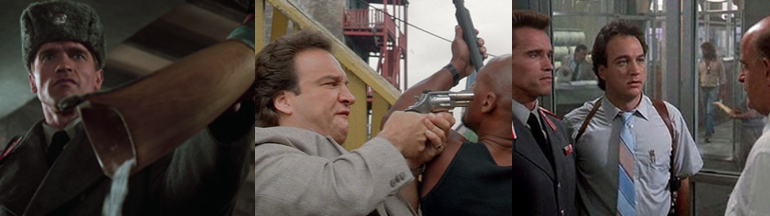
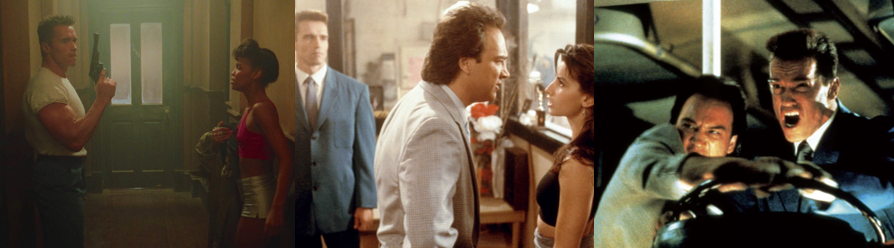
When drug kingpin Viktor Rostavili (O’Ross) kills Captain Ivan Danko’s (Schwarzenegger) partner and flees to the United States, Danko is partnered with Chicago police detective Art Ridzik (Belushi). Echoing the tensions between the US and the Soviet Union, the odd couple must set aside their differences to keep Rostavili from smuggling cocaine into Russia.

The Background:
Following the end of the Second World War, the United States and the Soviet Union frequently clashed in a “Cold War”, a nearly-fifty-year political stalemate in which the threat of all-out nuclear annihilation was high as tensions escalated between the two superpowers. Consequently, Russians were frequently vilified in Hollywood productions, characterised as stoic, almost machine-like, and cruel, with perhaps the most memorable fictional Russian being the ice-cold genetic freak Captain Ivan Drago (Dolph Lundgren). In 1987, Mel Gibson and Danny Glover saw critical and financial success as mis-matched police officers in Lethal Weapon (Donner, 1987), which inspired a slew of similar odd-couple, buddy cop action/comedies. With Arnold Schwarzenegger a hot commodity after the success of The Terminator (Cameron, 1984), writer/director Walter Hill combined these two elements into the basic premise of Red Heat and approached Schwarzenegger to star. Despite the lack of a complete script, Schwarzenegger agree to join the production based on Hill’s success with the buddy cop hit 48 Hrs. (Hill, 1982), and Hill purposely aimed to tone down Schwarzenegger’s bombastic persona in favour of a more realistic performance. Schwarzenegger was joined by comedy actor James Belushi, who saw the contentious relationship between their characters as the heart of the movie above all else. With a $34.9 million box office, Red Heat was a modest financial success; it briefly held the number one spot at the box office, but was met with mixed reviews. Many criticised the gratuitous violence and middling pace, though the film has since been seen as a cult classic. Since today is Arnold’s birthday, this is the perfect time to revisit the film and see if it’s worthy of being classified as an under-rated entry in Schwarzenegger’s filmography.

The Review:
Red Heat begins, appropriately enough, in the frigid yet architecturally stunning city of Moscow. There we find Yuri Ogarkov (Oleg Vidov) amidst a bunch of surly, beefed-up Russians and naked babes working out and relaxing in a gym; among them is Captain Ivan Danko, who seemingly fits right in with his intense, stone-faced expression and peak, Olympian physique. They’re there looking for a lead on drug baron Viktor Rostavili, but Danko is forced to take a more direct approach when he’s challenged by the other men. Luckily, Danko is more than capable, handling a boiling-hot stone without flinching and easily beating the shit out of his hulking attackers despite wearing nothing but a little shawl to cover his modesty. The fight spills to the outside where, in the freezing snow, Danko absorbs some comically enhanced shots and demands information on Viktor’s whereabouts, learning that he’s holed up at the Druzhba Café. After a tense confrontation and a shoot-out (that includes the amusing reveal that Rostavili’s underling is hiding cocaine in his artificial leg), Danko pursues and guns down Rostavili’s brother, Vagran (Gábor Koncz), but the man himself manages to slip away after surprising Yuri with a spring-loaded pistol attached to his wrist. Though impassive at his friend’s funeral, Danko is clearly seething and grateful to be given the chance to retrieve Rostavili from Chicago.

Ridzik’s hot-headed temperament clashes with Danko’s more subdued demeanour.

While Danko is introduced as a serious, focused man who’s all business on the job, the opposite is true of Art Ridzik, who we first meet ogling women, much to the exasperation of Lieutenant Charlie Stobbs (Fishburne) and Sergeant Max Gallagher (Richard Bright). A natural smart mouth who’s become somewhat disillusioned with the daily grind of the job, Ridzik’s outspoken and cynical nature rubs his superiors the wrong way since he’d rather make snappy quips than focus on the job. Although he facies himself a ladies’ man, Ridzik is beset by rejections at every turn, which he brushes off with a casual disinterest, though he’s frustrated by Stobbs’ low opinion of him (but, it has to be said, not enough to actually buck up his ideas, knuckle down, and be less snarky and lackadaisical). Ridzik almost immediately gets on the wrong side of Danko with his irritating curiosity and sarcastic nature; Ridzik sees chaperoning and being lumbered with Danko as a shitty deal, one akin to babysitting, which is a constant headache to his overly stressed superior, Commander Lou Donnelly (Boyle). Hot-headed and trigger happy, Ridzik is eventually shown to be incensed when Rostavili’s goons callously gun down Gallagher to rescue their boss and at being constantly left in the dark (and the lurch) by Danko’s standoffish nature. Although their personalities and methods clash and Ridzik is irritated at being stuck with “Gumby” and having to deal with his strait-laced, blunt attitude, Ridzik proves invaluable to Danko’s investigation. He takes him to visit the enigmatic, blind, drug dealer Abdul Elijah (Brent Jennings) in prison and learns that Rostavili has been working with the local street gangs to smuggle cocaine into Moscow. Unfortunately, whether because of cruel fate or his own abrasive behaviour and questionable methods, Ridzik is beset by misfortune no matter how hard he tries; he gets hot coffee splashed on his crotch, is forced to endure a tetanus shot, and is constantly being reprimanded even for things out of his control. However, he and Danko have more in common than they’d care to admit, which ultimately leads to them reaching a mutual respect and understanding when it comes to nailing Rostavili by any means necessary.

Danko’s blunt methods and standoffish personality bring major headaches for Ridzig.

Although Danko is generally portrayed as a stoic and almost emotionless machine (especially compared to his more emotional and bombastic peers in Chicago) and with an extremely strong sense of duty, he’s not above moments of levity and emotion. He owns a parakeet that he’s extremely protective of, is clearly rattled when his superiors blame him for Rostavili’s escape (even though he did nothing wrong), and shown to have a close relationship with Yuri, one that sees him both amused by his partner’s brand of banter and driven into an obsession towards Rostavili, whom he relentlessly pursues to make pay not just for the laundry list of crimes he’s perpetrated against the Soviet Union, but for Yuri’s death as well. Upon landing in Chicago, Danko doesn’t waste time or words getting right down to business; he bluntly greets his peers and impassively liaises with Donnelly and his officers simply to get his hands on Rostavili and reacts with stoic disinterest when Donnelly and even Ridzik challenge his aggressive methods and unlicensed firearm. Danko’s standoffish demeanour is exacerbated not just by the tensions surrounding the two nations but by his direct orders not to air Russia’s political and social problems in public, and his obvious embarrassment regarding the violent past of his country. It also doesn’t help that he’s largely disgusted by the decadent West and the excess of Capitalism; he despairs at their lack of discipline, the lawlessness of their streets, and their obsession with sex and debauchery. Danko’s has a very methodical approach to his job (even though all he has is a mysterious locker key to go on) and is granted license by Donnelly to continue his investigation since he’s a “loose cannon” that will either get results or take the fall through his actions, but not above being reprimanded when he pushes his luck too far. An extremely private individual, Danko reluctantly shares details of his life and career with Ridzik, revealing a morbid background that has hardened him into an instrument of uncompromising justice, yet even he shows sympathy towards deluded fitness trainer Catherine “Cat” Manzetti (Gina Gershon), just one of many women Rostavili has wooed into marrying him and acting as a patsy for his operations out of misguided devotion.

Rosta is a cruel manipulator with an underused gimmick who plots to spread cocaine throughout Moscow.

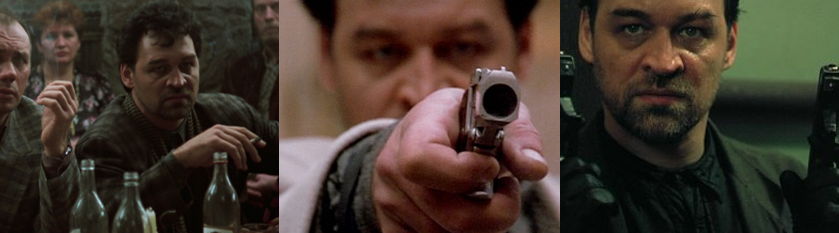
Rostavili (who has taken the clever alias Viktor Rosta) is depicted as a reprehensible and callous criminal, one who is seen as a poison to the great Soviet Union because he floods Moscow with drugs and threatens to upset the strict, carefully maintained balance of law and order. A snarling, embittered Georgian man who feels slighted by prejudice towards his people, Rosta has nothing but disgust for authority, especially the Moscow Militsiya, and delights in defying them both explicitly and in the peddling of cocaine. Rosta flees to Chicago after being outed in Moscow and immediately sets himself up as the newest crime boss in town; alongside his fellow Georgians, he establishes an intricate network of underworld contacts and associates and a simple system of communication using go-fers, telephone booths, and torn bills to peddle his wares with the aim of smuggling $5 million worth of cocaine into Moscow using local gangs and even a shame marriage, one he ends in brutal fashion after Cat tries to escape his clutches, revealing himself to be as calculating as he is cruel. Unfortunately, a disruption in his operation causes him to get a little sloppy and be arrested for speeding, alerting Moscow to his presence and causing Danko to pursue him with a vengeance. Although Rosta escapes custody, he loses the key to his drug stash in the process, and this naturally becomes his primary goal; he lures Danko into an ambush and attempts to first appeal to his patriotism and then bribe him into handing it over, to no avail, much to Rosta’s disgust. Rosta then has his assassin, Josip Baroda (Tengiz Borisoff), impersonate a nurse to murder his own man (Roger Callard) before he can talk, before using his gang buddies as bait to distract Danko so he can retrieve his key and callously murdering Cat, bringing major heat on both Danko and Ridzik.

The Nitty-Gritty:
As was often the case around this time, the depiction of the Soviet Union and Russians is greatly exaggerated for comedic effect. Well, I say that but for all I know Russians really were massive, surly, patriotic robots during this time, but just going by the bombastic soundtrack and the in-your-face presentation of Moscow and Russian culture as this uncompromising and ruthless society makes me assume that these elements were enhanced to paint them comedic opposites to the more laidback and carefree United States. This forms much of the film’s comedy; Danko’s peers and superiors mock America’s theatricality, Danko (regal in his pressed uniform) stands out like a sore thumb on the streets of Chicago, and then there’s the obvious contentious relationship between him and Ridzik. Given the genre of the film, it’s tempting to make parallels to Lethal Weapon, but they don’t really have much relevance here beyond some superficial similarities; for all his talk of “Miranda Rights” and due process, Ridzik isn’t exactly a by-the-book cop so seeing him chew Danko out for his more extreme and blunt methods is oddly hypocritical considering he openly plants incriminating evidence on “Streak” (Brion James). Some of the best moments in Red Heat are born from Danko’s inability to understand American slang and humour and his commentary on the decadent West compared to the more efficient (and brutal) nature of the Soviet Union when it comes to punishing criminals and dealing with politicians and drugs alike. With Schwarzenegger being at his physical peak, Danko’s punches land with comic book-style power and he’s shown to be extremely formidable. Even he isn’t impervious to damage, however, as seen when Rosta’s attack leaves him with a nasty concussion, but naturally he’s up and about before too long.

Despite their differences, Danko and Ridzik work together to stop Rosta and part as friends.

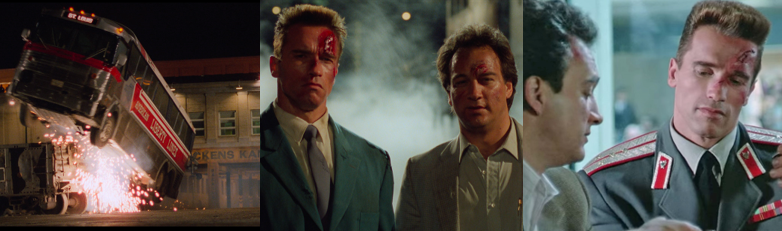
Of course, it wouldn’t be a buddy cop movie without some shoot-outs: Danko gets into violent gunfight at the beginning (somehow avoiding being shot despite being such a big target in a small space), but Ridzik’s bust of Salim’s (J.W. Smith) apartment is noticeably more frantic and involves a lot more guns and chaotic shouting. Danko also impresses with his massive Soviet cannon and .44 Magnum, gunning down Rosta’s goons in glorious ‘80’s fashion, complete with blood squibs and crashing glass. Uniquely, Red Heat concludes with a bus chase through the busy Chicago streets; this comes after Ridzik’s sleazy brother-in-law, Pat Nunn (Michael Hagerty), inadvertently solves the mystery of the locker key, which sees Ridzik and Danko confront Rosta at the bus station. Unfortunately, a conflict of opinion regarding which one of them gets to take him in allows Rosta to flee in a stolen bus, so the two commandeer one of their own to pursue him. This results in a surprisingly frantic chase considering the size and unwieldy nature of the buses and sees them careening through traffic and landmarks alike, all while Ridzik loudly curses in frustration. Ultimately, Danko and Rosta drive at each other, each one determined to see the other dead regardless of their own life. Luckily for Danko, Ridzik is on hand to force a last-second swerve, resulting in minor injuries for them and a final, blood-soaked showdown between Danko and Rosta that sees the despicable drug pusher gunned down. Despite their differences, Ridzik and Danko part as friends; they even exchange wrist watches in the time-honoured tradition of the Soviets (though Ridzik gets amusingly shafted on the exchange) and agree that, while their countries may have their differences, they’re “police officers, not politicians”.

The Summary:
Although I grew up watching Arnold Schwarzenegger films and I was (and still am) a massive fan of his, Red Heat is one of his movies I’m not as familiar with. I didn’t see it until I was much older, so I don’t have the same nostalgia for it as I do his other films. While this doesn’t mean I’m any less entertained by it, I can’t say I often choose to watch it over his other films or other, more enjoyable buddy cop flicks. Schwarzenegger is great in this role; it plays into the strengths that made him so memorable in The Terminator while also allowing him to showcase a different range of emotions, such as a subdued sense of duty and an implacable determination to get his man. I also really enjoyed Belushi here as the wise-ass jerk of the two, and I think they had real chemistry together, but I feel like the film never lives up to the potential this pairing has. It’s weird seeing Ridzik be such a smart-ass to everyone and yet lecture Danko on proper procedures even when he’s (as in Ridzik) brazenly breaking the rules; their relationship is made wildly inconsistent because of this and I think it would’ve been better if Ridzik had been the hot-headed loose cannon and Danko had been the by-the-books military man, with the two then learning from and understanding each other’s perspective across the film. Instead, while it seems to lean that way, Ridzik wildly jumps from doing things right, to defying his orders or openly insulting his superiors, and between criticising and admiring Danko from scene to scene, needlessly complicating their pursuit of Rosta. The action and gunplay was decent, and the film’s definitely leaning more into the cop drama aspects of Lethal Weapon rather than the comedy/action of its sequels, but I don’t think it really out-does Lethal Weapon in this regard. Its main unique aspect is the dichotomy between the US and Russia, with the US being mocked and criticised for its debauchery and Russia for being so uptight. It’s amusing, and I liked the clash of styles and methods, but it loses a lot of impact due to the aforementioned inconsistent tone and kind of feels like it was just an excuse to poke fun at the militant Russians. Ultimately, it’s a decent enough movie but there are better Schwarzenegger and buddy cop movies out there; it’s a quick watch (maybe too quick at times, resulting in a serious lack of screen time for Rosta) with some potential, but I can’t rate it much higher (despite the chemistry between the two leads) since it squanders a lot of that potential.

My Rating:

Rating: 3 out of 5.

Pretty Good

What do you think to Red Heat? How do you think the film holds up against other buddy cop movies and where would you rank it against Arnold’s other films? What did you think to Schwarzenegger’s portrayal of the stoic Danko and his banter with Ridzik? Do you feel the film had the right balance of action and comedy or were you also left a bit deflated by it? What did you think to Rosta and commentary on US and Russian society? Do you have any memories of the Cold War? How are you celebrating Schwarzenegger’s birthday today and what is your favourite Schwarzenegger film? Whatever you think, go ahead and leave your thoughts below or drop a comment on my social media.

Movie Night [Captain Picard Day]: Star Trek: Insurrection 


As amusing detail in the Star Trek: The Next Generation (1987 to 1994) episode “The Pegasus” (Burton, 1994) is that the crew and children of the U.S.S. Enterprise-D celebrate “Captain Picard Day” on Stardate 47457.1, which roughly translates to this day, the 16th of June. They do this by producing drawings, models, and paintings that the bewildered Captain Jean-Luc Picard (Patrick Stewart) must then judge. I, however, am using this as another good excuse to delve into some more Picard and Next Generation content.


Released: 11 December 1998
Director: Jonathan Frakes
Distributor: Paramount Pictures
Budget: $70 million
Stars: Patrick Stewart, F. Murray Abraham, Brent Spiner, Donna Murphy, Jonathan Frakes, Marina Sirtis, and Anthony Zerbe

The Plot:
When Captain Picard uncovers a Starfleet conspiracy to steal the rejuvenating properties of the peaceful Ba’ku, the crew of the U.S.S. Enterprise-E rebels to protect the functionally immortal adopted inhabitants from being forcibly relocated by corrupt Admiral Matthew Dougherty (Zerbe) and the warmongering Ahdar Ru’afo (Abraham).

The Background:
Once the popular Star Trek: The Next Generation series came to an end, the crew followed in their predecessors’ footsteps and moved on to the big screen. Although the highly anticipated meeting between Captain Picard and Captain James T. Kirk (William Shatner) failed to live up to the potential of its premise, it did well at the box office. However, while the sequel (one of my favourite Star Trek movies), Star Trek: First Contact (Frakes, 1996), outdid its predecessor considerably with its $30 million gross, Paramount wished to lighten to tone for the next film. After some deliberation, writer Michael Piller based the story around the quest for everlasting youth; one draft saw Lieutenant Commander Data (Spiner) killed off, and star Patrick Stewart was adamant that the script remain true to his arc from First Contact by fighting an ethical battle. Star Trek: Insurrection was the first Star Trek film to replace traditional model shots with CGI sequences, though fifty-five full sets were constructed to build the Ba’ku village and the Son’a were brought to life through extensive prosthetics and make-up effects. With a worldwide gross of over $117 million, Star Trek: Insurrection made a bit less than its predecessor and was met with mixed reviews. Critics noted that the film was little more than an extended episode of the TV series and a sluggish experience, though others were impressed by the performances and character moments. Of course, the Next Generation crew would return regardless for an unmitigated critical and commercial, leading to a franchise reboot in 2009 before the cast and crew finally reunited almost twenty years after their last adventure.

The Review:
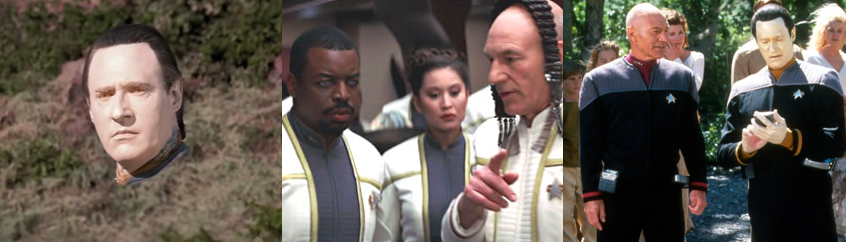
It’s a commonly held belief that all the odd-numbered Star Trek movies are bad, and all the even-numbered Star Trek movies are good; while this is naturally subjective (I prefer the fifth movie to the sixth, for example), I can’t deny that Star Trek: First Contact is one of my favourites in the franchise. After the snore-fest that was Star Trek Generations, First Contact delivered all the action and intrigue I’d expect from a Next Generation film so I was naturally excited to see what the crew would get up to in their next film. Imagine my disappointment to find that Star Trek: Insurrection was a more light-hearted, character-driven romp that was both a re-framing and a contradiction of the Next Generation episode “Journey’s End” (Allen, 1994). Don’t get me wrong, I fully understand that Star Trek is about much more than just space battles and action-orientated plots, but some of the worst episodes across the franchise are those that focus more on politics, philosophy, and slower, less engaging plots so I’ve often had a contentious relationship with this film. Ironically, Star Trek: Insurrection forgoes a lengthy title sequence and instead displays the titles while introducing us to the Ba’ku, who live a simple live free of technology. They’re people of the land who grow their own food and work together in peace and harmony, and have no idea that Starfleet are secretly monitoring them using special cloaked suits and a cloaked outpost. However, the Ba’ku are alerted to their presence when Lieutenant Commander Data suffers a sudden malfunction, attacking Starfleet’s officers and their Son’a allies, exposing them to the locals and terrifying children like Artim (Michael Welch).

When Data malfunctions, Picard investigates and uncovers a startling Starfleet conspiracy.

When we catch up with Data’s crewmates, they’re in the midst of welcoming a new, if technologically underdeveloped, race into the United Federation of Planets to help replenish the Federation’s losses at the hands of the Borg and the Dominion. This, sadly, just makes me wish that we’d had a Next Generation/Deep Space Nine (1993 to 1999) film that focused on the conflict with the Dominion. Not only was this a catastrophic and significant story in Star Trek lore, it also would’ve given the Deep Space Nine cast some time in the spotlight. Instead, we’re left with Picard’s awkward (if amusing) interactions with the relatively primitive Evora and an explanation for Lieutenant Commander Worf’s (Michael Dorn) presence that’s so weak the characters simply interrupt him rather than dwell on it. Luckily for Picard, Admiral Dougherty pulls him away from these diplomatic duties to request Data’s schematics; although Picard supplies this information, his concern for his friend and crewmate sees him disregard Dougherty’s suggestion to avoid coming in person because of “environmental concerns”. When they arrive, Data is said to have taken hostages and has stolen a Federation shuttle and Dougherty is under pressure from his Son’a ally, Ahdar Ru’afo, to destroy the android. Picard convinces the Admiral to let him and Worf attempt to shut Data down by distracting him with an amusing chorus from H.M.S. Pinafore; or, The Lass That Loved a Sailor (Sullivan and Gilbert, 1878), only to be embarrassed when Data’s “hostages” have been treated as guests by Anij (Murphy) and Sojef (Daniel Hugh Kelly). Picard is both disgusted to find that Starfleet have been wilfully disregarding the “Prime Directive” of non-interference by spying on the Ba’ku and surprised to find the Ba’ku are a warp-capable race with considerable knowledge of technology, they just choose not to employ it in favour of enjoying the tranquillity of their adopted world and the “metaphasic particles” that bestow rejuvenating effects upon them.

Both Picard and Data connect with the Ba’ku and strongly opposed Starfleet’s plans to relocate them.

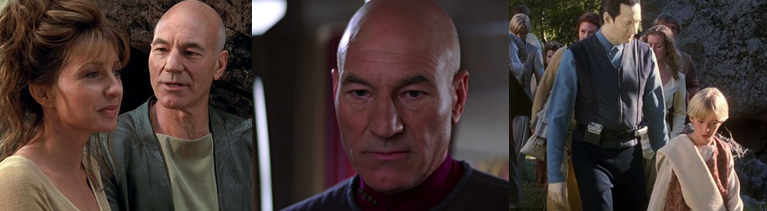
Picard feels a renewed vigour thanks to the Ba’ku and an intense admiration for the culture, alongside an obvious attraction to Anji that drives him to learn more about their people and their journey. Sojef reveals that the Ba’ku were once on the verge of self-annihilation and fled to establish a peaceful sanctuary some 309 years previously, and Picard is disgusted by the plot to relocate the Ba’ku, who refuse to take up arms and lower themselves to war. Thankfully, Picard is outraged by the blatant disregard for Starfleet’s guiding principles and is on-hand to fight for their continued survival. He’s in awe of their unique affliction, which enables them to live longer, healthier lives, continuing an ongoing theme of his advancing years and mortality that’s laced throughout the Next Generation movies. Although tempted to bask in the Ba’ku’s power, Picard’s knowledge of human history drives him to oppose Dougherty’s schemes; aghast by the Federation Council’s claim upon the Ba’ku, Picard has an impassioned, defiant confrontation with Dougherty and essentially goes rogue from Starfleet to prevent past atrocities happening gain. While initially somewhat hostile towards Picard, Anji is unique amongst her people in that she has a fascination for technology; she’s horrified to discover that the Federation are planning to covertly take her people off-world but warms to Picard after being amused by his curiosity. She encourages him to take the time to embrace the moment, to stop analysing and just give himself fully to life, a perception heightened by the Ba’ku and which allows them (and, eventually, Picard) to effectively slow down a single moment in time in order to appreciate life and survive fatal injuries. Although he’s now capable of expressing emotions, Data remains as curious and socially awkward as ever. Star Trek: Insurrection explores new layers of his humanity and character growth through his relationship with Artim, a Ba’ku boy both fascinated and afraid of the android’s capabilities since he’s grown up devoid of technology. Although it takes some effort for Data to convince Artim that he’s not a threat, Artim eventually teaches Data the value of playing and having fun, allowing Data to experience a degree of the light-hearted focus of the film despite not being affected by the metaphasic particles. Data also proves invaluable in setting the plot in motion since it’s his brief malfunction that attracts Picard to the Ba’ku, is instrumental in getting Picard and Anji to safety by acting as a flotation device, and he who exposed the Federation plot.

The rejuvenating effects of Ba’ku affects the crew in emotional and comedic ways.

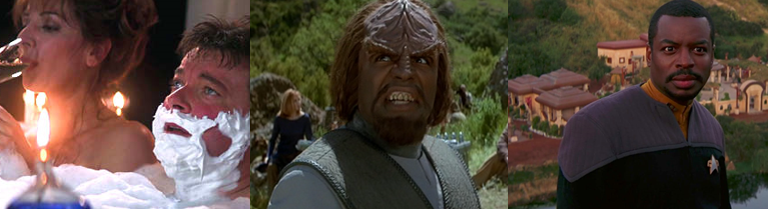
The Ba’ku’s metaphasic particles have a rejuvenating effect on the rest of the crew as well (strangely even before the Enterprise-E reaches Ba’ku), though it’s primarily played for laughs through Worf’s struggles withs Klingon boils and rising “aggressive tendencies” due to essentially suffering through Klingon puberty. The planet’s influence also gives Commander William Riker (Frakes) and Counsellor Deanna Troi (Sirtis) the chance to rediscover their passion for each other with carefree, adolescent playfulness. This not only sees Troi shave Riker’s trademark beard (in a sensual bubble bath, no less) after reacting with impish disgust to his facial hair and rekindle their romantic relationship, injecting a little flirtatious sexuality into the usually less romantically inclined Next Generation narrative. In addition to joining Picard’s rescue team, Doctor Beverly Crusher (Gates McFadden) reveals the extent of the planet’s rejuvenating effects to the captain through examinations of the crew, noting increased metabolism and energy from exposure to the metaphysic particles. She’s also the one who delivers crucial exposition into the Son’a, revealing that they and the Ba’ku are one and the same. Concerned for his friend’s welfare, Lieutenant Commander Geordi La Forge (LeVar Burton) puts his engineering expertise and knowledge of Data’s systems to work to discover that the android was damaged by a Son’a phaser after he discovered the elaborate holoship they plan to use to smuggle the Ba’ku off the planet. Throughout the film, Geordi struggles with his cybernetic optical implants, but sadly misses out on exploring the emotional potential of his restored eyes in any depth; however, Burton expresses profound emotion in conveying Geordi’s appreciation at seeing a sunrise with his own eyes for the first time in his life. Although Picard fully intends to go solo in his mission to defend the Ba’ku, Worf, Data, Troi, and Crusher rebel alongside him while Riker and Geordi appeal to the Federation Council. Although reluctant to rely on technology to safeguard his people, Sojef mobilises a mass evacuation to the tunnels in the surrounding mountains while Picard and his crew defend them from the Son’a attack

Dougherty allies with the Son’a, unaware that they wish to destroy their benevolent kinsmen.

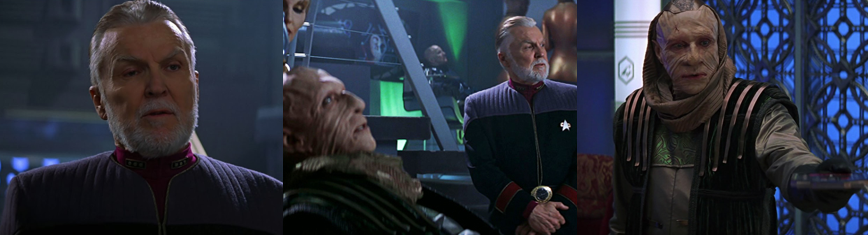
Dougherty has allied with the Son’a and their leader, Ahdar Ru’afo, in a bid to monitor and safely displace the Ba’ku so as to harness the metaphasic particles for wider use. This is an alliance of convenience since only the Son’a have the means to harvest the particles, but Dougherty sees Ba’ku as a chance to save and improve countless lives despite the fact that this will essentially leave the planet a barren wasteland. While Dougherty fully believes that he has every right to do this since the Ba’ku barely number six-hundred and aren’t indigenous to their world, he’s adamant that the mission falls within strict Federation procedures, meaning he values subterfuge and patience to avoid unnecessary attention and bloodshed. Ru’afo finds Dougherty’s insistence on rules and regulations first amusing and then increasingly aggravating since he believes it’s slowing things down when brute force would achieve the same means much faster. Riker and Troi’s research show the Son’a to an aggressive, oppressive, war-like race who conquer and subjugate others for riches and power, but Dougherty is forced to rely on their weapons and expertise since the Son’a are exiles from the Ba’ku people and thus offer unique insight into the planet’s metaphasic properties. Ru’afo’s frustration not only comes from his jealousy and desire to avenge himself on his former people, but also a desperate need to bask in the Ba’ku’s rejuvenating properties since he’s reached the limits of genetic manipulation and many of his people cannot afford to wait for the particles to naturally improve their condition. Ru’afo and his people are dangerous and driven, but essentially outcast adolescents lashing out at their parents; we see this in Ru’afo’s right-hand man, Gallatin (Gregg Henry), who begins to doubt their mission as Ru’afo’s mania increases. Played with an intense, psychotic glee by accomplished stage actor F. Murray Abraham, Ru’afo’s true nature is exposed as his aggravation increases. While he goes along with Dougherty’s plan to covertly relocate the Ba’ku, he convinces the Admiral to sign off on an attack on the Enterprise-E (in one of my favourite exchanges in the film) when they refuse to leave the area and violently ends their partnership when Dougherty and his “procedures” get in his way once too often, leaving Ru’afo free to harvest the metaphasic particles with destructive force.

The Nitty-Gritty:
I mentioned earlier about the themes of mortality; the idea of Picard’s days being numbered and time being against him permeates the Next Generation films and is a clear holdover from the Original Series movies, where the advancing age of these characters was often at the forefront. Star Trek: Insurrection gives the whole crew the chance to rediscover their youth; renewed by the Ba’ku, there’s a playful energy on the Enterprise-E that sees even Picard revelling in his newfound energy. Picard, who has spent most of his life in space going from mission to mission, is severely tempted to slow down and settle on Ba’ku, whose people are free from the burdens of responsibility, and feels more alive than ever thanks to the planet’s influence. This is in stark contrast to the Son’a; exiled from the planet after a destructive rebellion, the Son’a are bitter and twisted and clinging to life by any means necessary, desperate to avenge themselves on their parents like raging children. Finally, a huge aspect of Ru’afo’s frustration with Federation procedures is predicated on his belief (and that of many during this time) that Starfleet, like Dougherty, is “old”. Extremists such as he recognise that the Federation has suffered crippling losses recently and is losing support, allowing him to aggressively influence the Admiral’s reluctant approval for the Son’a to intercept the Enterprise-E.

What little space action there is here is, like many effects, spoiled by poor CGI.

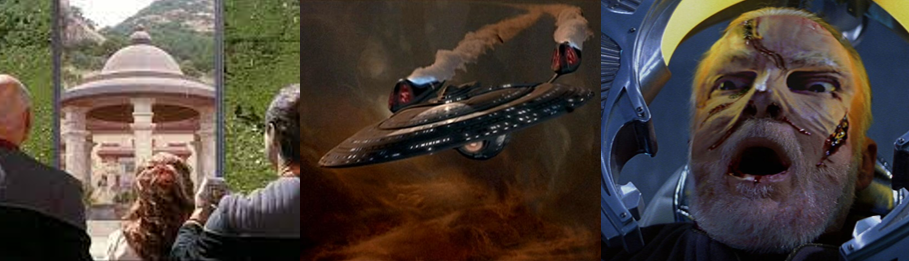
Star Trek: Insurrection does offer a few new visuals amidst its mostly middling plot; the opening sequence, in which Data attacks Starfleet personnel while partially cloaked, showcases some fun invisibility effects, as does the massive cloaked holoship that fascinates both Artim and Anji and reveals to Picard the blasphemous extent of Dougherty’s plan. However, I can’t help but notice that the ships and space action have taken a dramatic step back; CGI seems to have replaced all the traditional model shots and it looks down-right cartoonish at times, robbing Ru’afo’s flagship and its skirmishes with the Enterprise-E of a lot of their appeal. Once again Riker is left in command of the Enterprise-E and, once again, he’s hampered by environmental factors; the “Briar Patch” that surrounds Ba’ku makes space combat extremely dangerous, and the Son’a’s employment of a “subspace weapon” leaves Geordi with no choice but the eject the warp core to save the ship and Riker forced to manually highly volatile “metreon gas” to destroy the Son’a ships. However, most of  action sequences take place on the planet’s surface; Picard and Data have a brief shoot-out with a Son’a guard aboard the holoship but the most prominent action sequences come as Picard and the others desperately defend the Ba’ku. This sees the village bombarded by phaser shots as the Son’a target the transport inhibitors, has Picard and the others fending off Son’a drones that forcibly transport the Ba’ku, and leaves Anij near death from the Son’a attack. Conversely, the Son’a are presented as one of the more unsettling Star Trek species; without the rejuvenating effects of Ba’ku, the Son’a have taken on a decrepit, almost mummified appearance. They’re forced to rely on genetic tampering and surprisingly gruesome cosmetic surgery to prolong their lives, warping and stretching their skin to the point where they are almost unrecognisable from their people, the Ba’ku, and often suffer from splits and lesions when they become too emotional. Although the CGI used to render their skin-stretching technology leaves a lot to be desired (especially compared to the more practical effects used to achieve the same means), it does result in a gruesome death scene for Admiral Dougherty when Ru’afo forces him into the machine and tears his face apart.

Although tempted to stay after Ru’afo’s defeat, Picard chooses to continue fighting oppression.

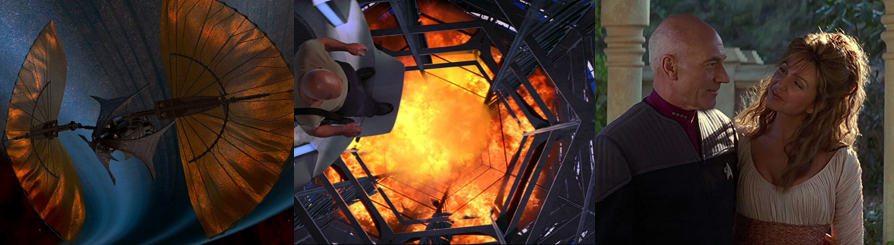
Despite Picard, Worf, and Data’s best efforts to get the Ba’ku to safety, most of them are abducted by the Son’a, including Anij and Picard, who’s more than ready to face a court martial if it means exposing Dougherty’s plot and reveals that the Admiral has gotten mixed up in a blood feud between the exiled Son’a. With the misguided Dougherty dead, Ru’afo orders the deployment of the “collector” (a set of sadly laughable CGI solar sails), despite Gallatin’s reservations about annihilating their former people. Picard appeals to Gallatin’s humanity and convinces him to aid him in opposing Ru’afo’s plan. Data then distracts Ru’afo with tachyon bursts to his flagship, forcing Ru’afo to reset their shield frequencies to avoid being destroyed by the “thermolytic reaction” the collector will produce. This creates an opening for an entertaining deception that sees the Son’a transported, en masse, to the holoship and momentarily fooled by a holographic simulation. Ru’afo quickly discovers the trick and is enraged; he transports himself directly to the collector to restart the process and Picard is forced to confront him, one-on-one, in the collector’s surprisingly sparse control room. After giving Ru’afo the runaround, Picard prepares to meet his end to destroy the collector and save the Ba’ku; luckily, the Enterprise-E arrives just in time to beam him to safety, leaving Ru’afo to go up in flames with his diabolical aspirations. Thanks to Riker, Starfleet halt the Ba’ku relocation plan and launch a full investigation and the remaining Son’a surrender, allowing Gallatin to bashfully reunite with his parents on Ba’ku. Although tempted to stay on the planet, and with Anij, Picard vows to continue protecting the universe from threats both foreign and domestic to ensure that the Federation doesn’t lose its way and repeat the worst mistakes of human history, and the crew return to the ship victorious, reinvigorated, and ready for their next adventure.

The Summary:
Even now, I remain conflicted about Star Trek: Insurrection: on the one hand, it’s a decent, surprisingly emotional adventure for the crew and a far more light-hearted escapade than the last film but, on the other hand, Star Trek: First Contact set a pretty high standard and Insurrection doesn’t come close to matching it. Fundamentally, they are two different films, however, just as different episodes of Star Trek told different stories and had different aspects that made them appealing. Some prefer the character-based stories; others the diplomatic stories or ruminations on age, humanity, and morality; and others prefer the more action-orientated episodes. For me, a Star Trek movie needs to hit all of those beats to have the most appeal and, while Star Trek: Insurrection does try to do this, it falls a little flat for me and comes across as a far too subdued production as a result. It’s a shame as there are some interesting elements here; the continued narrative of Picard’s age, for one thing, and the presentation of Starfleet as a less benevolent entity. Picard shines through his staunch defence of the Ba’ku but it’s interesting to learn that he had completely different stance on the same matter in “Journey’s End”. I liked seeing the crew be affected by the metaphasic particles, even if it is largely just played for laughs, and it’s mildly adorable to see Data explore what it means to be a child and Picard to consider settling down, even if neither of these plot points carry through to the next film. F. Murray Abraham was great as the conniving, desperate Ru’afo; I loved his frustration with Dougherty and his rules, but it’s not enough to salvage the film for me, especially when you remember the lacklustre special effects. Ultimately, it’s a more subdued and grounded Star Trek adventure but one I rarely find myself revisiting or really thinking about, so I’d still choose to watch Star Trek: First Contact any day.

My Rating:

Rating: 2 out of 5.

Could Be Better

What did you think to Star Trek: Insurrection? Where does it rank against the other Next Generation and Star Trek films for you? Do you prefer its more light-hearted, grounded story? What did you think to Ru’afo and the gruesome depiction of the Son’a? Did you enjoy seeing the crew be more playful and relaxed? What did you think to the idea that Starfleet would so brazenly abandon their principles? How are you celebrating Captain Picard Day today? Whatever your thoughts on Star Trek: Insurrection, or Star Trek in general, go ahead and share them below and be sure to check out my other Star Trek reviews.

Movie Night: The A-Team

Released: 11 June 2010
Director: Joe Carnahan
Distributor: 20th Century Fox
Budget: $100 to 110 million
Stars: Liam Neeson, Bradley Cooper, Quinton “Rampage” Jackson, Sharlto Copley, Jessica Biel, Brian Bloom, and Patrick Wilson

The Plot:
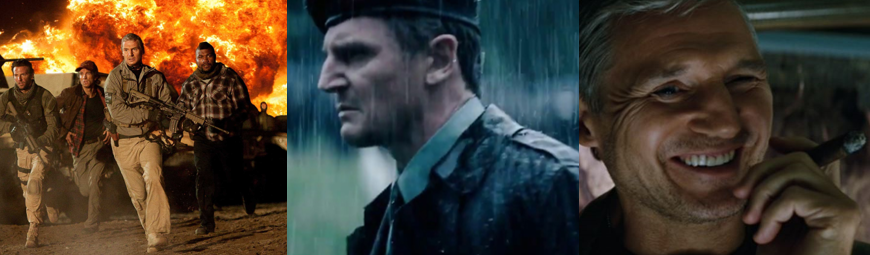
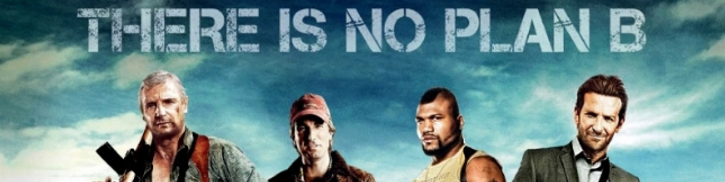
Colonel John “Hannibal” Smith (Neeson) and his crack Alpha Team (or “A-Team”) – narcissistic Lieutenant Templeton “Face” Peck (Cooper), former Army Ranger Sergeant Bosco “B.A.” Baracus (Jackson), and unstable pilot Captain H.M. “Howling Mad” Murdock (Copley) – are dishonourably discharged and imprisoned after being framed for murder. After escaping from their prisons and reuniting, these highly adaptable and skilled soldiers must uncover a plot by a corrupt CIA operate and clear their names in the process.

The Background:
Between 1983 and 1987, viewers were treated to the exploits of the A-Team, soldiers of fortune created by writers and producers Stephen J. Cannell and Frank Lupo as a spiritual successor to other action-packed television shows, but with Mr. T as a selling point. To the surprise of many, The A-Team proved a big hit and bolstered Mr. T’s career, and development of a feature film began as early as the 1990s. After a proposed Ice Cube-helmed production fell through in 2008, the film finally got underway with Liam Neeson and MMA fighter Rampage Jackson attached to star. Stars Bradley Cooper and Sharlto Copley rode in to the premiere on a real Army tank, but The A-Team was met with middling reviews and an unimpressive $177.2 million box office. With critics and even the cast of the TV series attacking the film’s incomprehensible plot and mindless action sequences, a proposed sequel was unceremoniously cancelled, but I’ve always had a soft spot for it and figured today was a good excuse to revisit it since it’s Liam Neeson’s birthday!

The Review:
Since I grew up in the nineties, I never actually got to watch The A-Team as a kid. The show’s initial broadcast was right around the time I was just a little baby, and I don’t remember seeing too many re-runs on television, so I wasn’t as aware of it as other shows from that time, like Knight Rider (1982 to 1986) and Quantum Leap (1989 to 1993) since re-runs and broadcasts of those shows were much more accessible. However, I knew of the show, its distinctive theme music and opening narration, and the mainstream iconography of star Mr. T but, even now, my primary experience of the franchise is through this movie. The film begins with an extended opening and action sequence that brings the titular team together and establishes some of their defining character traits. Hannibal begins in cuffs and mercilessly beaten and threatened by corrupt Mexican Federal officers, who mock his lack of foresight and underestimate his tenacity. Easily freeing himself and cuffing two attack dogs, the seasoned Colonel sparks up a trademark cigar and heads out to rescue Face, who’s facing a slow and painful death at the hands of the vengeful General Javier Tuco (Yul Vazquez). Along the way, providence strikes as Hannibal crosses paths with B.A., a dishonourably discharged Army Ranger who first aids him in rescuing Face and then proves instrumental in helping them liberate their pilot, Murdock, from an Army hospital for a daring escape back to American soil. This opening tells us that Hannibal always has a plan and is highly adaptable, Face is impulsive and often doesn’t understand his commander’s plans, B.A. is a tough-ass brute who hates flying, and that Murdock is absolutely out of his mind…and that these four comprise an almost superhuman Army unit when teamed together.

When his team is framed, Hannibal uses all his resources to fight to prove their innocence.

Thus, when the film jumps ahead to eight years, the A-Team has become well-established and well-respected. Essentially a dysfunctional family dynamic (with Hannibal as the patriarch and the others as his unruly “children”), they share the banter of siblings, chastising Murdock’s unpredictable nature but also finding it amusing when off-mission. While stationed in Iraq under the command of Hannibal’s old friend, General Russell Morrison (Gerald McRaney), Hannibal is approached by Central Intelligence Agency (CIA) Special Activities Division operative Vance Burress (Wilson), who operates under the codename “Lynch”, and offered a mission to recover United States treasury plates and over $1 billion from Iraqi insurgents. Though Defence Criminal Investigative Service Captain Charissa Sosa (Biel) tries to warn them off, Hannibal personally insists that they take point over glorified mercenaries Brock Pike (Bloom) and his private security firm, Black Forest, convincing Morrison to approve an elaborate black ops mission into Baghdad. It’s tough to think of a more competent and honourable leader than Hannibal; even after his team is framed for the theft of the plates, Hannibal tries to shoulder responsibility for the unsanctioned mission, but his men are so loyal that they refuse to be tried separately and thus all receive the same punishment. Experience has taught Hannibal to distrust the likes of Lynch and his CIA cronies due to their clandestine nature and he also doesn’t approve of the likes of Pike and Black Forest. Instead, Hannibal believes in the Army, specifically the Ranger division, since they have their boots on the ground and are doing all the fighting (and the dying) in the name of national security. A well-respected and decorated veteran, there’s little Hannibal hasn’t seen and done and he’s been in enough wars to know the value of planning; he meticulously plots out every detail of every engagement and follows the plan to the letter, even having backup plans prepared for the worst case scenario, so he is astonished and appalled when Morrison’s mission goes awry and the country he fought to protect turns against him so readily. Yet, even when dishonourably discharged and incarcerated, Hannibal is always thinking and planning; through his outside contacts and resources, he acquires better intel on Pike’s Arab backer than even Lynch and his entire motivation for throwing in with Lynch is predicated on the assurance that he and his team receive full pardons and their freedom.

Face strives to live up to Hannibal’s example while Murdock regularly throws caution to the wind.

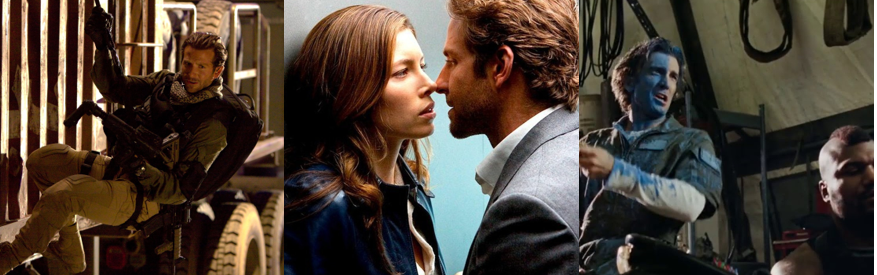
While Hannibal is clearly the brains of the group, Face is his charming, charismatic protégé; a fast talker and notorious womaniser, Face is mainly defined by his carefree nature, immaculate good looks, and snarky sense of humour even in the face of his own execution. However, while Face’s arrogance and wise-ass nature border on the insane at times, it’s clearly depicted as a façade; deep down, Face is wracked by insecurity since he admires Hannibal so much and aspires to follow his example but worries that he’s not good enough to formulate plans as intricately as his mentor. Face’s impulsive nature raises Hannibal’s ire, primarily because Hannibal knows his protégé has the potential to be better and because the Colonel places such emphasis on preparation and planning. Face’s womanising ways are also depicted as both an asset and a weakness; it allows him to seduce and charm his way through missions but caused him unexpected pain it comes to his relationship with Sosa, the one woman he ever considered getting serious with before she got scared off by the prospect. Now immune to his charms, Sosa has a contentious relationship with Face, one exacerbated after his actions cause her to be demoted to Lieutenant. While Sosa is determined to track down the A-Team, she’s equally driven to identify and expose the conceited Lynch, who degrades her (and all women, it seems) and tracks her progress to mitigate her interference. Because of this, Face is forced to go off-mission to protect her from Pike and plead his innocence as part of Hannibal’s elaborate plan. She begrudgingly aids Face and the others to expose Lynch and redeem herself in the eyes of her peers and Face sees this as an opportunity to reconnect with her, which opens his eyes to his potential as a leader rather than simply being the point man. If there’s a word to summarise Murdock, it’s definitely “insane”. Whether he’s mentally unstable or simply having a good time is up for debate, but his skills as a pilot are not. Thanks to some physics-defying CGI and bonkers scenarios, Murdock pulls off some crazy stunts in anything from a helicopter to a tank and his unpredictable flying skills are so outrageous that they cause B.A. to develop a fear of flying and often place his team in more danger due to Murdock’s suicidal nature.

While Murdock is on point, B.A. is hampered by a pacifist angle and Rampage’s inferior acting ability.

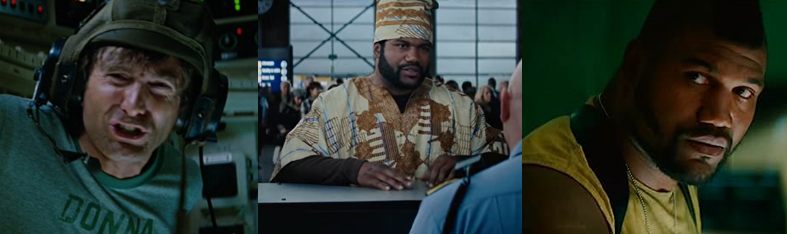
Despite his lunacy, Hannibal believes wholeheartedly in Murdock’s abilities and inspires him to fully commit to the A-Team and their mission, and Murdock is deceptively smart. He easily fools hospital orderlies, press staff, and even border patrol with his uncanny way with languages and assumed personas. While Murdock’s erratic nature makes him a dangerous asset, one just as likely to set his friends on fire for a laugh as he is to rescue them from tight situations, he’s an unparalleled pilot and more than willing to risk his life for the cause, something demonstrated to the fullest when he willingly takes a bullet to the head in the finale. As far as I can tell, the character most different from his television counterpart is B.A.; initially a brave and aggressive former Ranger forged in airborne combat, B.A. is hampered by a crippling fear of flying thanks to Murdock’s insane aerial manoeuvres and becomes a pacifist while in prison. While Rampage certainly looks the part, being a large, tough dude with a bad-ass mohawk and acquitting himself well in his few fight scenes thanks to his MMA background, he’s easily the weakest of the cast. I can’t help but think Ving Rhames or Michael Clarke Duncan would’ve been much better choices for the role as Rampage just doesn’t have the acting chops to stand alongside his peers. B.A. is an extremely loyal and prideful character; he adores his sadly underutilised GMC Vandura but is fully committed to Hannibal’s cause during his time with the A-Team. However, incarceration brought B.A. a clarity he had never known and, by the time he’s freed by his former teammates, he’s reached a state of enlightenment that means he’s willing to help but refuses to kill, thereby robbing B.A. of many of his defining characteristics. B.A. offers a different type of comic relief compared to the blunt Hannibal, slick Face, and madcap Murdock; his street-based slang and attitude makes him an expressive and amusing figure and it is funny seeing him being subdued and coerced into getting back in the air, but the film strangely decides to base much of B.A.’s comedic appeal around his newfound pacifism.

Lynch and Pike’s efforts to acquire the plates require Hannibal’s meticulous planning to stop.

The A-Team crafts a narrative that paints regular soldiers as daring men and women who risk their lives for the greater good; any authority figures or shady government types who appear on-base rather than in the thick of it are treated with suspicion and hostility, which extends to both Lynch and Pike. Both Morrison and Hannibal note that Lynch is simply another expendable government stooge who’s not to be trusted, and Hannibal has nothing but contempt for Pike and his mercenaries, who he sees as a “frat boys with guns”. Hannibal and the others are distraught when Morrison is killed before their eyes and Pike is seen destroying the plates and the money, but these threats are waylaid when the A-Team and arrested and dishonourably discharged for violating their orders since Morrison is unable to corroborate their story. The A-Team’s subsequent focus is on avenging themselves against Pike and clearing their names and they are again forced to make a deal with Lynch to facilitate this when Pike tries to sell the plates to an Arab backer. A smug, arrogant pen-pusher, Lynch has no code of honour and no military experience; he’s a man of secrets and subterfuge who operates behind the scenes. Although he agrees to clear their names, he leaves the specifics of Hannibal’s escape to him and can’t be seen to be directly involved with their mission, making him as much of a liability as Sosa, who makes it her mission to track down the A-Team and bring them back in since she’s convinced that they’re in league with Pike. Lynch’s sole motivation is to acquire the plates for the benefit of the CIA, but he secretly plotted with Pike to steal the plates for himself and was double-crossed by the mercenary and never had any intention of honouring his deals with Hannibal. Unlike Lynch, and despite Hannibal’s disrespect, Pike is well trained and capable; he might take shortcuts and be a glorified mercenary, but he knows how to uncuff himself, handle various firearms, and how to approach a combat situation. Thus, while Lynch panics when in conflict and is heavily reliant upon others, Pike is perfectly happy to wield a rocket launcher and get his hands dirty with some gunplay.

The Nitty-Gritty:
Perhaps unsurprisingly, The A-Team is distinctly pro-military. If you’re in the Army or a Ranger then I’d imagine you’d get a lot more out of the film (or maybe not, I can’t speak to the accuracy of the Army’s depiction) but the message is pretty clear: soldiers are to be celebrated and mercenaries like Black Forest and government stooges are not to be trusted. Hannibal’s reputation is so strong he’s able to talk his way onto an Army plane despite being dishonourably discharged and his men follow him out of a deep sense of loyalty, which really sells the bond these men have forged through combat and adversity. For the most part, The A-Team delivers some exhilarating, PG-13 action; there’s a lot of bullets and explosions and stunts but it seems that the filmmakers originally wanted to be a little more risqué. Twice the film uses an “Adios Mike Foxtrot” gag that gets interrupted by big boom-booms and even B.A.’s “Bullshit” is drowned out by a slamming gavel, neither of which are particularly clever methods of censorship and make me wish the lines had been re-dubbed to something more acceptable for the film’s rating. Long-term fans of the TV show may also be somewhat disappointed that the entire film is essentially an origin story and to set up for the status quo of show, where the team were soldiers of fortune rather than simply trying to prove their innocence.

The action is massively over the top, but that doesn’t mean it isn’t fun!

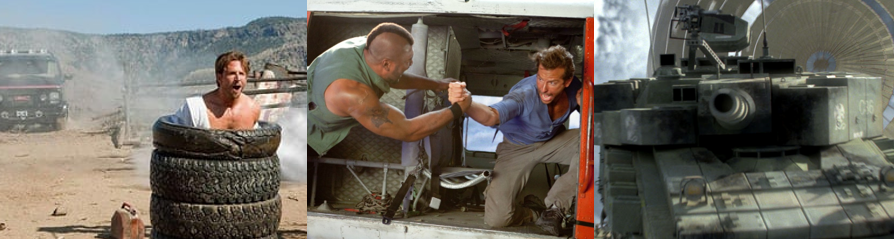
Still, the action is loud, bombastic, and frenetic; it largely harkens back to the 1980’s action films of old, but with a modern flair such as quick cuts and wonky CGI in places. Things kick off well with B.A. slamming his van into fools and Hannibal single-handedly cutting down Tuco’s forces while Face rolls around in flaming tyres. This is followed by a fun, if over the top, aerial escape that sees Murdock avoiding heatseeking missiles by purposely stalling a helicopter in mid-flight and B.A. clinging on for dear life against an obvious blue screen as the crazed pilot fights to restart the chopper and fly the team to their reinforcements across the border. From there, we’re treated to a montage as the team enacts Hannibal’s outrageous plan to steal the plates, which involves Face and Murdock posing as South African reporters to steal cameras and press passes, B.A. constructing a powerful magnet to fit into a camera, and the liberation of batteries and resources from Black Forest to cobble together the kit they need to intercept the convoy carrying the plates. Thanks to Hannibal’s meticulous nature, the plan goes off without a hitch but ends with them being double-crossed and dishonourably discharged; with six months to plan an escape, Hannibal fakes his own death (with a specially poisoned cigar that almost sees him roasted alive), liberates Face from his comfortable prison cell, retrieves B.A. from a prison bus, and literally busts Murdock out of a mental hospital. This leads to easily the most ridiculous (but no less entertaining) sequences of the film where the team are forced to escape from their plane in a tank! Plummeting in freefall, Face engages in a dogfight with some drones before Hannibal directs Murdock to fire some carefully aimed shots that, thanks to a complete disregard for physics, slows their descent and lands them safely in a lake. Thanks to his intel, Hannibal pinpoints an opportunity to reacquire the missing plates; this involves a daring skyscraper heist that sees the Arab tossed out a window and his parachute being snagged in mid-air by Murdock’s chopper and a zip-line gunfight between B.A. and Pike that requires Hannibal’s intervention since B.A. refuses to take a life.

With Morrisons’s deception revealed, it’s up to Face to plan the team’s payback against Lynch.

Still, the mission succeeds and Hannibal’s worst suspicions are realised when the Arab is unmasked as a disillusioned and embittered General Morrison in disguise, having faked his death to screw Lynch out of the plates alongside Pike. Fully aware of this, Lynch offers Hannibal his freedom in exchange for killing Morrison, but it’s merely another deception to stall him while he calls in an airstrike on their location. Although Morrison is killed in the attack and Lynch frees Pike from Sosa’s custody to help recover the plates, Hannibal lets Face take point on concocting a double-cross. Knowing that Lynch is listening to Sosa’s phone, the two arrange to hand over Morrison and the plates in return for their pardons, planning to distract and intimidate Lynch using theatricality and Murdock doubling for Morrison, his head hidden and protected by a heavily armoured helmet. This plan brings all the character’s individual personalities and arcs together: Hannibal places his faith in his young protégé, Face steps up with a plan of his own and overcomes his insecurities, B.A. realises that he needs to fight to have his freedom (which culminates in him crushing Pike’s neck to protect Face), and Murdock gets his closest “near-death experience” yet. While the finale is hampered somewhat by some dodgy CGI on the shipping containers, some frantic editing, and chaotic explosions, it’s suitably thrilling and goes exactly to plan. Lynch is completely thrown off by all the theatrics, forcing Pike to take charge with a rocket launcher. With no choice but to get his boots on the ground, Lynch proves relatively competent with his martial arts but is thrown off when “Morrison” stirs to life and ends up exposed and in the custody of another Lynch (Jon Hamm). Despite Sosa’s protestations, the A-Team are also arrested for escaping federal custody; however, a key slipped to Face through a kiss from the re-promoted Sosa allows the team to immediately escape and begin new lives as soldiers of fortune.

The Summary:
I feel like The A-Team doesn’t get talked about a whole lot; it came out at a time when the action stars of the 1980s were returning to cinema screens and team-based, explosive action films were as prominent as smaller scale, intense-action thrillers and the first entries of the Marvel Cinematic Universe, so it’s easy to see how it would’ve slipped under the radar a bit. This is a shame as it’s a pretty enjoyable action romp; the cast (with the exception of Rampage) are all solid and have a lot of chemistry, with a snarky wit laced throughout the script and characters like the smarmy Lynch and arrogant Pike. Even though I don’t rate Rampage as highly as his co-stars, I enjoyed the titular team’s interactions and chemistry; I believe they’re firm friends, almost like family, and it’s fun seeing them bounce off each other. The A-Team really shines in its use of elaborate plans and amusing, enjoyable montages; I like seeing the team use various flimsy disguises, sleight of hand, and subterfuge as much as when they perform death-defying stunts and it’s very engaging seeing Hannibal’s meticulous plans come together. Unfortunately, it is a little too over the top at times; the CGI and ridiculous sequences like the “tank flying” and Murdock’s piloting are almost cartoonish even for a bombastic action movie, but it’s all in good fun and I think it comes together quite nicely in the end. I wonder how long-time fans of the TV series reacted to the film but, as a lover of many of these actors and the action genre, there’s more than enough here to keep me coming back for more. It’s a shame we didn’t get to see a sequel that was maybe more in-line with the show, but that doesn’t diminish the appeal of The A-Team and I’d say it’s definitely worth a re-watch if you’ve previously disregarded it.

My Rating:

Rating: 3 out of 5.

Pretty Good

Did you enjoy The A-Team? Were you a fan of the TV show and, if so, how do you feel the film holds up compared to it? Which of the team was your favourite and what did you think to the cast, specifically Rampage? Did you enjoy the over the top action sequences or was it a little too much for you? Would you have liked to see a sequel or a revival of The A-Team? How are you celebrating Liam Neeson’s birthday and what is your favourite Liam Neeson film? Whatever your thoughts, feel free leave them below or drop a comment on my social media and check out my reviews of other Liam Neeson films across the site.

Movie Night [RoboCop Day]: RoboCop 3


To celebrate the release of the dismal RoboCop (Padilha, 2014) on home media, June 3rd was declared “RoboCop Day” in the city of Detroit. While that movie wasn’t too impressive and had nothing on the original RoboCop (Verhoeven, 1987), this does give us the perfect excuse to talk, and celebrate, all things RoboCop on a specific day each year.


Released: 5 November 1993
Director: Fred Dekker
Distributor: Orion Pictures / Columbia Pictures
Budget: $22 million
Stars: Robert Burke, John Castle, Remy Ryan, Bruce Locke, CCH Pounder, Jill Hennessy, and Nancy Allen

The Plot:
Cyborg law enforcer RoboCop (Burke) is torn between upholding his pre-programmed directives and assisting desperate civilians when Paul McDaggett (Castle) and his violent militia aggressively evict people on behalf of Omni Consumer Products (OCP) to begin construction of Delta City.

The Background:
In 1987, director Paul Verhoeven turned Edward Neumeier and Michael Miner’s satirical take on 1980s commercialisation and media into RoboCop. A modest critical and commercial hit, RoboCop was followed by a sequel in 1990. Unfortunately, not only was Frank Miller’s script judged “unfilmable” (though many aspects were later repurposed into a comic book and this third entry), but Irvin Kershner’s RoboCop 2 was met with mixed reviews and a reduced box office. Miller returned to write the third film and was again frustrated by the lack of influence he had on the production; he concluded that the only way to circumvent this was to become a director. Although RoboCop’s supporting cast returned for the third film (despite some reservations), star Peter Weller declined to appear in favour of joining the cast of Naked Lunch (Cronenberg, 1991). He was replaced by Robert Burke, who struggled with the impressive Robo-Suit since he was taller than his predecessor and the costume wasn’t altered to accommodate this. Although RoboCop 3 was completed by 1992, the film’s release was delayed almost an entire year due to Orion Pictures going bankrupt and to increase its odds at the box office. Consequently, not only was the plot revealed by the tie-in videogame ahead of schedule, RoboCop 3 also failed to reach $50 million at the box office. RoboCop 3 was also subjected to scathing reviews; critics targeted the film’s tone, derivative plot, and mindless narrative, and very few have anything positive to say about this toned-down entry in the series. Ironically, RoboCop continued to be marketed as a family-friendly franchise going forward and it would take over five years for anything even remotely resembling the violent satire of the original to be evoked in a new production.

The Review:
It goes without saying that RoboCop has earned its place as a classic sci-fi action flick; it’s perfect blend of social satire, gory violence, and endlessly entertaining action was expertly balanced with some top-notch special effects and a poignant message about humanity and identity. I might be alone in thinking this, but RoboCop 2 remains an under-rated entry in the franchise for me; sure, it regresses RoboCop’s character a bit and retreads some of the same narrative beats, but it’s still got that same tongue-in-cheek sense of humour and some impressive practical effects make it well worth a re-evaluation. Since both films were such a big part of my childhood, I remember being excited for a third entry and things get off to a decent enough start in RoboCop 3. Detroit is worse than ever now that OCP has finally started breaking ground on Delta City, with eviction notices being served to the poorest and most destitute areas of the city like Cadillac Heights, demolition crews flooding the streets with the homeless, and fascist ex-military Urban Rehabilitators (or “Rehabs”) forcing people from the city or simply out-right executing them.

Sporting some new toys, RoboCop protects the innocent despite being surprisingly fragile here.

When we’re first introduced to RoboCop, we’re once again back to square one. While RoboCop still retains some aspects of his former personality and exhibits human compulsions such as loyalty and independence, he’s still bound by his four Prime Directives and subject to the whims of his creators. He’s packing some new toys this time around, most prominently his new arm cannon that lets him blast perps with a machine gun, fire rockets, and blast out a flamethrower, but he later also makes use of a prototype flight pack that also doubles as a recharge point for him. All these bells and whistles are great, but they don’t make up for the fact that Peter Weller has been replaced by the far less capable Robert Burke. Burke does a decent job emulating Weller’s performance but it’s just not the same, especially in his stilted delivery. While RoboCop is tended to by newcomer Doctor Marie Lazarus (Hennessy), his independence riles up the OCP’s newest representative, Jeffrey Fleck (Bradley Whitford), a leering, slimy corporate stooge who’s so frustrated by RoboCop’s humanity that he orders his emotions be circumvented with a special chip. Luckily, Dr. Lazarus recognises that RoboCop’s instincts and Murphy’s lingering personality are essential to the cyborg’s humanity and destroys the chip, allowing RoboCop to continue his duties. This does, however, bring him into further conflict with OCP’s more totalitarian methods; the Rehabs conflict with RoboCop’s Prime Directives but, in the end, his morals and humanity win out and he chooses to defend the helpless and homeless from McDaggett, a choice that leaves him severely damaged and branded a murderous fugitive by OCP’s PR team. RoboCop ends up in a hell of a state; a single blast from McDaggett’s grenade launcher is enough to almost do him in and leaves him in the struggling hands of the city’s destitute, who are led by feisty and outspoken Bertha (Pounder).

Although his partner dies, RoboCop is supported by some new allies, including an affectionate little girl.

Things don’t go so well for Robo’s long-time friend and partner, Anne Lewis (Allen). Both Dr. Lazarus and Lewis care for RoboCop; they’re the closest things he has to friends and can tell that he’s clearly conflicted regarding OCP’s “urban rehabilitation” project, which brings up painful memories of his former wife and child. Although she’s able to hold her own against the “splatter punks” at the start of the film, Lewis makes the rookie mistake of forgetting her body armour when she rushes to help RoboCop track down the resistance. Out of loyalty to her partner and seeing the state of the displaced residents of Cadillac Heights, Lewis joins RoboCop in opposing McDaggett and is summarily gunned down for her troubles, dying in RoboCop’s arms. Though he inexplicably forgets this promise to avenge her, RoboCop immediately storms the Rehab base after being repaired by Dr. Lazarus, unopposed by Sergeant Warren Reed (Robert DoQui) and his fellow officers despite the warrant for his arrest, to confront McDaggett, only to learn that Coontz (Stephen Root), a disgruntled member of Bertha’s resistance, has sold them out to McDaggett. RoboCop arrives too late to help, leaving Bertha and most of her followers dead, and both Dr. Lazarus and young orphan girl Nikko Halloran (Ryan) taken as hostages. Yes, inexplicably RoboCop, the all-action cyborg who made his name blasting would-be rapists in the dick, is saddled with a bright-eyed kid who’s conveniently a genius hacker capable of reprogramming an Enforcement Droid-209 (ED-209) and who helps RoboCop rekindle his paternal instincts. After being separated from her parents, who are subsequently executed, Nikko is taken in by Bertha and the resistance and encourages them to shelter RoboCop after he’s damaged defending them. Although they’re woefully under-equipped, outgunned, and forced to hide out in the sewers, the resistance is surprisingly capable; they boobytrap manholes to keep out unwanted visitors, use gadgets to change traffic lights and cover their escape, and it only takes about four of them to carry RoboCop into their hidden base whereas it took a dozen or so men in the last film. Although Nikko is a tech-savvy Robo fan and Moreno (Daniel von Bargen) repairs RoboCop’s body work, the resistance have no hope of repairing the cyborg so Nikko goes to Dr. Lazarus for help.

Desperate to get Delta City underway, the CEO turns to the ruthless McDaggett and the Kanemitsu Corporation.

Although OCP are making major progress preparing Detroit for aggressive renovation, the malevolent company is deep in the red; close to bankruptcy and being bought out by the Japan-based Kanemitsu Corporation, the new OCP Chief Executive Officer (CEO) (Rip Torn) and returning aide Donald Johnson (Felton Perry) have no choice but to rely on McDaggett and his Rehabs. Thanks to OCP controlling the media, the Rehabs are sold as a gentle, peacekeeping force who have people’s best interest at heart but the truth couldn’t be more different. McDaggett and his mercenaries are cruel and violent and tear through Cadillac Heights like a bull in a China shop. McDaggett is easily the best part of the film, chewing the scenery at every opportunity, calling everybody “chum” with a snarky sneer, ruthlessly waging war against the destitute civilians, and exhibiting an open prejudice against RoboCop and the idea of him being assigned to the Rehabs. When Nikko broadcasts the truth about McDaggett to the world, OCP’s stock plunges and, unwilling to shoulder the blame or listen to the CEO’s blustering threats, McDaggett plots to recruit the city’s police force in stamping out the resistance once and for all. However, when Reed and the other cops give up their badges and pensions rather than compromise their moral integrity, McDaggett is just as happy to arm the splatter punks, leading to an all-out war on the streets pitting the cops and the resistance against McDaggett’s forces. Unable to make good on their debts and promises, OCP lose all favour with the Kanemitsu Corporation, who send their unnervingly human “Otomo” androids (Locke) to make up for the CEO’s blunders. As you might expect from Japanese-manufactured product, the Otomos are far more versatile and capable than RoboCop, who looks like a tinker toy in comparison. Although silent and stoic, the Otomos are not only more outwardly human (one even smokes!) but they’re more agile, adaptable, and mobile, meaning they’re easily able to best RoboCop in combat and re-endanger his life with just a few blows and only losing out to him due to Robo packing superior firepower.

The Nitty-Gritty:
RoboCop 3 once again retreads the same ground as the last two movies when it comes to RoboCop’s story arc. Still lacking the fully human personality he fought so hard to regain at the end of the first film, RoboCop is again portrayed as struggling to discover and showcase his humanity due to his stringent programming and directives. Although it’s been very well established that he’s just as human as he is a machine, and everyone in the precinct openly and affectionately refers to him as “Murphy”, RoboCop’s emotions are again questioned by OCP, who seek to suppress them to make him a cold, calculating machine. More than ever before, RoboCop openly defies his creators despite the conflict this causes his system; perhaps it’s his defiance of Directive Four (“Never oppose an OCP officer”) which explains why RoboCop is so damn weak in this film. It seems he’s constantly on the brink of death and is easily disabled by shots he would previously shrug off, though this frustrating element does add to his vulnerability as a character. This is further emphasised in his empathy for the resistance, particularly Nikko, who forms a fast bond with RoboCop out of sheer awe (she is a proper techno-geek, after all) and he awkwardly rediscovers his former paternal instincts through his relationship with her. Again, it ties into an exploration of RoboCop’s vulnerable humanity (and is certainly less questionable that the weird sequence where Dr Lazarus purges RoboCop’s Prime Directives…again…and it seems to imply he has romantic feelings for the women in his life) but it just doesn’t fit the tone of the franchise. Maybe the filmmakers wanted to appeal to the little kids who had inexplicably latched onto the character, maybe they wanted to emulate Terminator 2: Judgment Day (Cameron, 1991) but, whatever their reasons, all they ended up doing was subjecting audiences to an annoying little brat who’s too smart for her own good.

Despite some ambitious ideas, RoboCop 3 fails to impress with its toothless violence and weak effects.

And it’s a shame as RoboCop 3 has a few redeemable elements to it. Basil Poledouris returns with his rousing score and the suit looks better than ever, especially RoboCop’s fancy new arm attachment that he sadly doesn’t use often enough (probably because it’s ridiculously overpowered and that doesn’t fit the theme of the movie for fragile old RoboCop). The city is even more dangerous and depressing as ever; described as a “warzone”, riots and violence run rampant from all sides, leading to the police department and oppressed citizens joining forces to fight back against the tyrannical OCP. While the film definitely veers more towards family friendly content, RoboCop 3 continues to be violent and full of social satire; in this case, it’s a commentary on how big corporations can control the media to twist the narrative in their favour and the juxtaposition of the Rehabs’ squeaky-clean public face with the brutal reality of their actions. This is best evidenced not just in the returning Media Break sections but also in the amusing animated advertisement for “Johnny Rehab” apparel that seems to be a commentary on R-rated movies like RoboCop being sold to children as toys. Although ED-209 makes a reappearance here, it’s little more than a cameo that further demeans the unreliable ‘droid and we’re denied a rematch between it and RoboCop. Thanks to spending most of the movie close to death, RoboCop can’t simply gun down his enemies like usual, meaning anticipation is high for his battle against Otomo. Unfortunately, as great and under-rated as Bruce Locke is, this fight is hampered by the slow, sluggish RoboCop, who lacks the reflexes and range of movement necessary to match his faster, more competent rival. Luckily for RoboCop, the Otomos prove as weak as he is in this movie and are easily dispatched, but these fights are definitely a far cry from the cyborg-on-cyborg action from the aforementioned Terminator 2. RoboCop 3 tries to make up for it with RoboCop’s new jet-pack attachment, which allows him to swoop in and save the day in the final act, but sadly this only appears very briefly and the composite effect used to bring it to the screen is pretty poor, which is a shame considering how cool the idea of a flying RoboCop is and how good the fire stunt on RoboCop was in the opening scenes.

After aiding his allies, RoboCop rescues his friends and OCP is finally brought to its knees.

After being slandered in the media, RoboCop is branded a fugitive, allowing McDaggett to fulfil his ambition of destroying the cyborg officer, which both he and the CEO believes will dishearten the resistance and allow them to sweep through Cadillac Heights and salvage their reputation. When Johnson suggests recruiting the city’s cops to join the effort, Reed and the others walk out and add their numbers to the resistance, co-ordinating the rag-tag rebels in standing against the Rehabs and the crazed splatter punks. Although RoboCop loses his chance at nailing McDaggett following a comical car chase in a pimped out lowrider, McDaggatt gets the last laugh by massacring the resistance base and even betrays the CEO after colluding with Kanemitsu (Mako) to level Cadillac Heights to make room for their own designs for the city. After barely besting Otomo and levelling the playing field for the cops and resistance, RoboCop storms into the OCP tower to confront McDaggett. Though two Otomos attack him, Nikko is able to reprogram the two androids into targeting each other using her magic laptop. Despite him having gone “war wacky” and craving all-out conflict, McDaggett is incensed by this as the Otomos are rigged to self-destruct, spelling doom for everyone in the tower. Luckily, RoboCop latches onto his jet-pack and flies Dr. Lazarus and Nikko to safety, leaving McDaggett and everyone in the building to perish in the blast. In the aftermath, a humbled Kanemitsu bows to RoboCop out of respect and summarily fires the CEO for his incompetence since OCP’s stock is in the toilet and RoboCop resolves to return to duty policing the streets, now once again free from his restrictive Prime Directives and able to think for himself.

The Summary:
How the mighty have fallen! RoboCop 3 is such a massive disappointment because it comes so close to being a halfway decent entry in the franchise but fumbles its execution in almost every way possible. The score is back, the suit still looks amazing, and I really enjoy RoboCop’s new toys and gadgets, but the man in the suit is an uninspiring void who tries far too hard to emulate Peter Weller’s incomparable performance rather than putting his own stamp on the iconic cyborg. I enjoy the central premise of the film, which sees a desperate OCP using all their resources (and brutal violence) to speed up their development plans for Detroit, but any intrigue this plot may have is quashed by some strange attempts at humour. RoboCop 3 feels like a pale imitation of the previous films; it tries to be comparably violent but it’s a toothless execution, and any attempts at satire and social commentary land flat as it feels like everyone’s just phoning it in. It’s a shame as Lewis’s death is actually quite emotional, but the new cast just isn’t as inspiring or memorable; Nikko, especially, stands out as a particularly grating inclusion, one that showed just how far the franchise had fallen into impotency since the uncompromising first film. There is some decent action and special effects sequences, but they’re juxtaposed with RoboCop’s clunky ineffectiveness in a straight-up fight and some awful composite effects that really have me longing for the stop-motion techniques of the last two films. One saving grace is John Castle, who really hams it up as the despicable McDaggett, but even his performance can’t excuse Rip Torn’s bombastic turn as the CEO, which lacks any of the subtlety we saw from previous OCP executives. Ultimately, RoboCop 3 is a film geared more towards kids and young teenagers, those who aren’t quite old enough to watch the first two films but want to dip their toe in the franchise. Even so, I’d recommend simply waiting until they’re old enough to watch the first movie, or bite the bullet and show them that film ahead of time, and just skip this one completely as there’s very little on offer here beyond RoboCop’s new toys.

My Rating:

Rating: 1 out of 5.

Terrible

Did you enjoy RoboCop 3? Were you disappointed by the more toothless approach the film took? What did you think to RoboCop opposing his creators to defend the city’s oppressed citizens? Were you also annoyed to see him partner with a child? What did you think to the Otomos and RoboCop’s new toys? Which RoboCop movie is your favourite? How are you celebrating RoboCop Day today? Whatever you think about RoboCop 3, feel free to drop your thoughts below or leave a comment on my social media and be sure to check out my other RoboCop content!

Movie Night [Dinosaur Day]: Jurassic Park III


Sixty-five million years ago, dinosaurs ruled the Earth. These massive beasts existed for about 180 million years and came in all shapes and sizes, before finally going extinct following a cataclysmic event that forever changed our world and rendered these creatures mere fossils to be discovered and studied. Fittingly, “Dinosaur Day” is actually celebrated twice a year, giving dino fans the world over ample opportunities to pay homage to this near-mythical titans.


Released: 18 July 2001
Director: Joe Johnston
Distributor: Universal Pictures
Budget: $93 million
Stars: Sam Neill, William H. Macy, Téa Leoni, Trevor Morgan, Alessandro Nivola, and Laura Dern

The Plot:
When Paul (Macy) and Amanda Kirby’s (Leoni) son, Eric (Morgan), is stranded on Isla Sorna, the estranged couple enlist Doctor Alan Grant (Neill) to help them brave the genetically resurrected dinosaurs that reside there and rescue him.

The Background:
In 1993, legendary director Steven Spielberg teamed up with special effects wizards Stan Winston, Phil Tippett, and Dennis Muren to turn Michael Crichton’s bestselling Jurassic Park (ibid, 1990) into a pioneering blockbuster. Despite grossing over $1.030 billion at the box office and overwhelmingly positive reviews, both Crichton and Spielberg were reluctant to work on sequel. Ultimately, while The Lost World: Jurassic Park (ibid, 1997) broke box office records, it was met with mixed reviews and even Spielberg believed it failed to match expectations. Thus, he passed the director’s chair to his friend Joe Johnston since he felt the series needed fresh blood behind the camera. Initial ideas to have Dr. Alan Grant stranded on a dinosaur-infested island were scrapped, as was a sequence involving a motorcycle chase against a pack of Velociraptors, but the idea of characters being marooned on the island continued to persist. Star Sam Neill eagerly signed on, believing he could improve on his original performance, and Stan Winston and Industrial Light & Magic returned to provide the dinosaur effects. Various versions of the film’s newest dinosaur, the Spinosaurus, were created; it was purposely chosen as a more horrifying counterpart to the returning Tyrannosaurs rex and was so powerful that it tore the animatronic T. rex’s head off! Although Spielberg afforded Johnston complete creative freedom, he had a chair reserved for him on set and insisted that Pteranodons were included after the were cut from the last two films. With a box office gross just shy of $370 million, Jurassic Park III became the lowest-grossing film in the franchise and was subjected to near unanimous negative reviews that criticised the redundant narrative, muddled tone, and ridiculous moments. In time, Jurassic Park III has been re-evaluated and come to be regarded as the black sheep of the franchise, but this was far from the end for the series, which made a dramatic comeback in 2015 that (more or less) successfully revived the franchise.

The Review:
I think a lot of us take for granted just how big Jurassic Park was when it first released; undeniably, the film redefined what a modern blockbuster could be and brought cutting-edge CGI effects and animatronics to the forefront of cinema, to say nothing of the wave of “Dinomania” it unleashed. Although I have no love for the book or its literary follow-up, I, like pretty much my entire generation, was captivated by Jurassic Park and much of this enthusiasm meant that I was overly generous towards the sequel movie for the longest time. It made sense: I liked Jurassic Park, I liked Jeff Goldblum, so of course I had to like The Lost World. Unfortunately, time has not been kind to The Lost World, which fumbled in areas where the first film succeeded, but I definitely think that it pretty much tapped out the appeal and reach of the concept, especially once it showed dinosaurs in the outside world. All this is to say that I’ve always been disappointed by Jurassic Park III; sure, it features some new dinosaurs and even recycles sequences from the book into its content, but there’s a reason why it’s the shortest and most universally disliked of the franchise. In a word, the film is just unnecessary, and offers very little to entice fans of the original back, to the point where you may as well just watch Jurassic Park three times and you’d probably get more enjoyment than suffering through the surprisingly disappointing follow-ups.

Grant is horrified to find he’s been duped into fighting off his beloved dinosaurs once again.

The first indication that we’re simply retreading old ground is that the film immediately returns to Isla Sorna and the majority of it takes place in this setting. It makes sense; the unfamiliarity of an isolated island adds to the wonder and danger of the franchise, but we’d seen everything this setting could offer in the last two movies and Jurassic Park III really could’ve done with trying something different, especially after The Lost World established that dinosaurs were basically free to roam as they desired, within their capabilities. One way Jurassic Park III attempts to stand out is by addressing the scientific inaccuracies in the dinosaurs; even though the first film did cover this quite conclusively, Grant makes a point to clearly spell out that the island’s genetically-engineered dinosaurs were “theme park monsters” and that the real science is found in fossils, a sentiment that remains true today. However, the dinosaurs were real enough to haunt not only Grant’s scientific career but also his nightmares. While he remains awestruck at having seen close approximations to dinosaurs up close and personal, he has no desire to ever return to the island, much less encounter them again. But, as ever, he can’t turn down the chance to inject some serious cash into his Velociraptor research when Paul Kirby comes asking for his expertise in taking him and his wife on a tour of the island. Of course, this is all a ruse; the couple have no money to offer him and have simply tricked him into helping them navigate the island’s dangers to rescue their son, but Grant’s experience is immediately hampered by the fact that he’s never actually been to Isla Sorna before, to say nothing of the Kirbys’ foolishness when it comes to heeding Grant’s advice and warnings about the local wildlife.

Unlike their son, the Kirbys are woefully incompetent and in way over their heads.

Despite Paul being little more than a painter and decorator, he and his estranged wife somehow pull together the funds not just to fly to Isla Sorna, but to hire some unscrupulous characters to transport them and stave off the ravenous dinosaurs with some serious firepower. However, these would-be mercenaries prove as ill-equipped as the Kirbys, who are immediately in over their heads and realise that they’ve vastly underestimated the dangers of the island. It doesn’t help that Amanda is painfully idiotic; not only does she yell into a megaphone as soon as they land but she, more than any of the other characters, constantly ignores or disregards Grant’s expertise, putting herself and the others in danger when the carnivores come sniffing around for their next meal. Grant is incensed to learn the truth and even more perturbed when the survivors are stranded after the Spinosaurus destroys their plane and devours their satellite phone, but even then his main concern is reaching the safety of the coast rather than actively searching for the couple’s lost son, Eric (indeed, it’s heavily implied that Grant thinks the boy is dead). Following a Velociraptor attack, Grant is separated from the couple but runs across Eric, who has done a decent job of surviving by himself thanks to his adaptability, knowledge of dinosaurs from Grant’s research, and resources afforded by InGen’s abandoned facilities. Grant, now far more comfortable with children thanks to his experiences in the first film and his close relationship with former flame Doctor Ellie Sattler’s (Dern) infant son Charlie (Blake Bryan), is very impressed by Eric’s survival instincts over the last eight weeks. Eric uses tear gas and even Tyrannosaurs rex urine to keep the dinosaurs at bay but he’s more upset at the prospect of his estranged parents trying to work together than he is by the locals. However, their shared trauma and determination to find Eric brings the two closer together but their joy at being reunited is cut short when they’re separated by a massive fence, with the Spinosaurus hot on their heels, and driven into the dilapidated aviary. Once he’s back with his parents, Eric reverts back to being a scared kid and fades into the background; he consoles Grant over the apparent loss of his assistant, Billy Brennan (Nivola), but basically just becomes another screaming would-be meal for the Spinosaurus.

Trumping any other dinosaur, the Spinosaurus obliterates every threat and constantly dogs the humans.

As ever, the humans are under constant threat from the genetically-recreated dinosaurs; while there’s a sense of wonderment about herbivores like the Corythosaurus and Parasaurolophus, the Velociraptors remain a persistent danger to the group. Grant continues to be enamoured with the pack hunters, which now sport rudimentary feathers and an intelligence beyond even his expectations as they call to each other, signal for help, and even use live, injured humans as bait to lure in other victims. This time around, the Velociraptor threat is only escalated thanks to Billy secretly stealing their eggs to sell on the black market to help fund Grant’s research, which causes the creatures to furiously hunt them throughout. For the first time, winged dinosaurs play a key role in the events of the franchise; in one of Jurassic Park III’s better sequences, one ripped right out of the first book, the group stumble into the twisted, rusted remains of a Pteranodon aviary and the giant, bat-like creatures briefly carry Eric off to their young before Billy successfully rescues him in what appears to be redemptive act of self-sacrifice but which the would-be black marketeer inexplicably survives. The franchise’s most recognisable dinosaur and brand mascot, the Tyrannosaurs rex, also reappears but, sadly, it’s little more than a cameo; the T. rex is primarily here to show off the bigger, badder Spinosaurus, which not only makes an immediate impression by splattering Cooper (John Diehl) all over the Kirbys’ plane but easily bests the T. rex and snaps its neck in a startling show of power. Unfortunately, this means that we’re denied a proper battle between the two or a suitable opponent to slay or challenge the Spinosaurus in the finale, though the Spinosaurus’ threat lingers over the entirety of the film and recalls the constant sense of dread the characters faced from the T. rex in the first. Far larger, with a crocodile-like jaw and massive talon-like claws, the Spinosaurus is Isla Sorna’s undisputed apex predator, unhindered by any weaknesses and capable of fending off any obstacle, swimming through water, and even…somehow…sneaking up on its prey despite not only its massive size but the constant ringing of the satellite phone in its stomach!

The Nitty-Gritty:
Jurassic Park III tries so hard to emulate the epic wonder of the first film but there’s just not enough material left to support it. John Williams’ sweeping, iconic theme still permeates the picture despite him being replaced by composer Don Davis, and the awesome sight of seeing dinosaurs brought to life onscreen remains, but it’s undeniable that it’s just not as impressive as it was the first time around. These issues are only compounded by some absolutely detestable characters; Paul and Amanda Kirby are clueless, deceitful morons who are difficult to root for, especially in the case of the foolhardy Amanda, whose desperate need to rescue her son costs the lives of three other people and endangers them all on numerous occasions. Téa Leoni is easily the worst part of this film; she’s so wooden and rigid and just mumbles her way through the narrative, dragging every scene down and making Amanda a thoroughly unlikeable and moronic character. Paul is a spineless fool who’s in way over his head and I can absolutely understand Grant’s exasperation at being surrounded by such ridiculous characters, and his admiration for Eric at somehow breaking the chain and being a smart and capable young boy. Billy’s side plot where he plans to sell the Velociraptor eggs is an interesting wrinkle, but it really doesn’t go anywhere and is basically a scaled down version of the plot seen in The Lost World, plus it’s difficult to really care about Billy’s betrayal of his mentor or his apparent death because about he only thing Billy has going for him before his greed is revealed is that he has a “lucky backpack”.

Somehow, the effects have worsened and, with some exceptions, everything seems rushed and lazy.

As ever, the main selling point is the dinosaurs. While, for the most part, they still look as amazing as ever, it’s clear that the quality of the animatronics and CGI have taken a hit despite Jurassic Park II having the highest budget of the original trilogy. The animatronic dinosaurs, especially, look far less realistic than before; it’s almost as if the filmmakers got lazy or rushed the process, coasting on the influential effects of the first film and putting in less effort, with the brief appearance by the Ceratosaurus being a particularly poor effect, but a lot of the CGI is surprisingly awful. I can’t help but be disappointed at how unconvincing the ’raptor puppets are this time around; it might not have been so bad if the film didn’t choose to explore the depths of Grant’s trauma by having him experience a nightmare involving a talking ’raptor (though, admittedly, I do find this scene hilarious!) A ’raptor does make an impression when the characters are exploring the ruins of an InGen facility, chasing them through the dark corridors, scaling cage walls to reach its prey and even signalling for help, much to Grant’s horror and amazement, though this does result in a pretty lacklustre chase through a herd of herbivores that is, again, a pale imitation of the first film. Although the Spinosaurus often also looks cartoonish and its battle with the T. rex is disappointingly brief, it is truly horrifying. Clearly chosen for its fearsome appearance and for looming over even the T. rex with an ominous poise, the Spinosaurus is a nightmarish creature that really pushes Jurassic Park III into monster movie territory as it glares at its prey and stalks them with vicious purpose. Indeed, Jurassic Park III’s better moments are when it leans into horror; the Pteranodon attack is especially evocative of this, with the massive prehistoric bird/lizards looming and flapping through the mist like something out of a slasher movie, to say nothing of the terrifying way the Spinosaurus cuts through the water in the dead of night during a torrential downpour. Although the Jurassic Park films have often strived to be more than monster movies, these more terrifying and intense sequences are a definite highlight and demonstrate that there was still some gas left in the tank for the franchise, it was just sadly hampered by an overall poor execution.

After inexplicably scaring off Spiney and placating the ‘raptors, the survivors are saved by the Navy!

After narrowly escaping the Pteranodons, the survivors finally manage to retrieve Paul’s annoying satellite phone from a pile of Spinosaurus excrement (again evoking imagery from the first film) and Grant makes a frantic call for help to Ellie. The Spinosaurus attacks, however, while the group is sailing on a barge; since we were denied a proper T. rex vs Spinosaurus showdown, though, the franchise’s newest, most dangerous predator yet is simply scared off after Grant ignites some oil with a flare gun, making for a painfully unsatisfying final showdown with the vicious carnivore. Instead, as ever, Jurassic Park III falls back on the Velociraptors for one last scare; having tracked the humans and the eggs Billy stole, the Velociraptors corner them on the beach and appear ready to strike; however, Grant manages to confuse the pack by randomly blowing into a replica ’raptor larynx. Just then, the film simply comes to an end when Ellie was somehow not only able to understand that Grant was on the island but was also able to get the US Navy to storm the beach for a rescue, scaring off the raptors, who reclaim their eggs and run into the jungle. Just like in the first movie, Grant and the other survivors (even, inexplicably, Billy) are airlifted to safety and left to contemplate the beauty, awe, and danger of the long-extinct dinosaurs, but again this is simply the same ending as in Jurassic Park but with an additional bit of family drama slapped on top of it! The tension and horror of the island rekindles the relationship between the Kirbys, who are overjoyed to be reunited with their son, who is equally pleased to see his parents finally getting along, and all it took was a few lives and the threat of mortal danger to bring them back together. Although he isn’t going to get the funding he was promised, it seems as though Grant is content to have faced his fears, though I would argue that his experiences on Isla Sorna only galvanised his dislike for InGen’s genetically-engineered monstrosities.

The Summary:
It’s really hard to rate Jurassic Park II very high as the entire film just feels like an unnecessary cash-grab, one final desperate attempt to wring the life out of a franchise that, at the time, really only had enough gas for two movies (and even then, the second one was a questionable effort). Certainly, there’s enough material in Michael Crichton’s books and the prehistoric to be reconfigured into another movie, but Jurassic Park III plays things way too safe. It’s just a shorter, less fanciful, and far less thrilling retread of the first film: Grant is a grouchy traditionalist forced to adapt to a dangerous situation, he’s forced to bond and work alongside a kid, there are ill-prepared morons running around just looking to get eaten, and there’s a monstrous prehistoric predator stomping around looking to snap everybody up. Even the sub-plot about stealing the ’raptor eggs is half-baked and familiar, and the effects somehow look worse than in the original Jurassic Park despite the higher budget and what I would assume would be the refinement of those original techniques. Sam Neill puts in a great performance but even he can’t save this grating cast; Téa Leoni is always dreadful, and William H. Macy just lacks the charisma to be all that compelling. I did enjoy the sadly underutilised Pteranodons and the monstrous Spinosaurus, but the filmmakers really dropped the ball by not having a longer, more brutal fight scene between ol’ Spiney and the T. rex. Thankfully, the revived entries would correct this, and many of Jurassic Park III’s mistakes, but that doesn’t help wash the sour taste of this ill-conceived, rushed, and lazy entry out of the mouth. Just watch the first one again and then jump to the fourth, it’s the best way.

My Rating:

Rating: 1 out of 5.

Terrible

Are you a fan of Jurassic Park III? Do you think I’ve judged the film too harshly and that there are actually some positives to be found here? Were you happy to see Dr. Alan Grant return and what did you think to the Kirbys? What did you think to the Spinosaurus and would you have liked to see a more competitive fight between it and the T. rex? Do you agree that the film was too lazy and that the concept was tapped out by this point? Which of Jurassic Park’s sequels is your favourite or do you consider the first one to be the best? How are you celebrating Dinosaur Day this year? Whatever your thoughts on Jurassic Park III, and dinosaurs in general, leave them below or drop a comment on my social media.

Movie Night [Turtle Tuesday]: TMNT


The first issue of Kevin Eastman and Peter Laird’s Teenage Mutant Ninja Turtles (TMNT) was published in May of 1984. Since then, the TMNT have gone on to achieve worldwide mainstream success thanks not only to their original comics run but also a number of influential cartoons, videogames, and wave-upon-wave of action figures. Even now, the TMNT continue to be an influential and popular commodity, proving that some fads don’t die out…they just get stronger!


Released: 23 March 2007
Director: Kevin Munroe
Distributor: Warner Bros. Pictures / The Weinstein Company
Budget: $34 million
Stars: James Arnold Taylor, Nolan North, Mikey Kelley, Mitchell Whitfield, Patrick Stewart, Zhang Ziyi, and Mako Iwamatsu/Greg Baldwin

The Plot:
Since defeating Oroku Saki/The Shredder, the TMNT have drifted apart; leader Leonardo (Taylor) is training in Central America and hot-headed Raphael (North) is secretly busting heads as the masked vigilante the Nightwatcher. However, the brothers are forced to come together again when thirteen mythical creatures rampage through New York City as part of an ancient ritual.

The Background:
Created by Kevin Eastman and Peter Laird as a violent pastiche of comic book tropes, the TMNT were catapulted to mainstream success by the unbelievably popular 1987 cartoon. Perhaps naturally, this success led to a live-action feature film. Hiwey, although Teenage Mutant Ninja Turtles (Barron, 1990) proved to be a technically impressive financial success and the under-rated Teenage Mutant Ninja Turtles II: The Secret of the Ooze (Pressman, 1991) did well despite comparatively mixed reviews, Teenage Mutant Ninja Turtles III (Gillard, 1993) broke the cycle and both bombed at the box office and was widely derided as one of the lowest points in the franchise. After plans for a fourth film were scrapped and an attempt to produce an all-CGI revival in early-2000 fell through, production on a new TMNT project finally got underway after fifteen years away from cinema screens. The decision to go all-CGI was based on a desire to tell a more surreal story and the escalating budgets of the previous films. Director Kevin Munroe aimed to tell a darker story to appeal to a more mature audience while still staying true to the core appeal of the characters and the continuity established by the previous films. The animation was handled by Imagi Animation Studios, who looked to film noir and Hong Kong action movies to create the film’s visual style, and the movie was dedicated to screen legend Mako after he sadly died shortly after completing his work on the film. With a box office of $95.6 million, TMNT became the second-highest-grossing movie in the franchise but was met with largely negative reviews; critics questioned the overly serious tone, the focus on style over tangible substance, and the nonsensical plot, though the visual style was praised. Although accompanied by a five-issue prequel comic and a mediocre videogame tie-in, plans for a sequel were ultimately scrapped due to TMNT’s poor reception and the later collapse of Imagi Animation Studios, resulting in a completely unrelated live-action/CGI hybrid reboot in 2014 before returning to animation in 2023.

The Review:
It’s always surprising to me how a premise as bonkers as Teenage Mutant Ninja Turtles finds ways to go even further out there with its content and stories. As early as their initial issues, the TMNT were battling robots, travelling across the galaxy, and encountering strange semi-cybernetic alien lifeforms. As much as I prefer the street-level adventures of the TMNT, I have enjoyed their more bizarre escapades and enemies, which have come from different dimensions, timelines, and worlds and have long expanded the TMNT’s world beyond simply battling ninjas on the streets of New York City. However, for the most part, the TMNT’s cinematic adventures tend to be more grounded; this, as much as anything, made Teenage Mutant Ninja Turtle III stand out as quite the anomaly, but TMNT also offers up a surreal plot for the mutant brothers, though the differences between the two can be chalked up to their execution and tone. It helps that TMNT opens with a narration from the always-awesome Laurence Fishburne that not only positions this film into the loose canon of the existing movies (Splinter’s (Iwamatsu/Baldwin) trophy shelf also reinforces this, containing mementos from the previous films, even if the TMNT’s characters are slightly different) but also gives some insight into the legend of warlord Yaotl. Three thousand years ago, the warrior king and his brotherhood carved a path of destruction and conquest across the globe that culminated in him opening a portal into a parallel universe to gain immortality but at the cost of his generals being turned to stone and thirteen immortal monsters being unleashed from the rift, eventually serving as the inspiration for famous mythical monsters over the centuries.

While Leo has been off training, the TMNT have fractured and lost their camaraderie.

When we rejoin the titular turtles, they’ve been fractured; Leonardo has spent over a year in Central America on the orders of his master and father-figure, Splinter. Although Leo’s training ended some time ago, he feels he hasn’t yet fulfilled his mission to become a better leader and has come to believe his efforts to protect the locals as the “Ghost of the Forest” is more important than his duties back home. However, Leo is stunned when his old friend and former news reporter turned-antiquities-dealer April O’Neil (Sarah Michelle Gellar) arrives in Central America looking to source rare pieces for her boss, business tycoon Max Winters (Stewart), and tells him all about how Donatello (Whitfield) now “does machines” by working an exasperating job as a remote tech support, Michelangelo (Kelley) dresses up as “Cowabunga Carl” to act as a children’s entertainer, and Raphael (North) has largely ostracised himself from the group, sleeping all day to recover from his nightly jaunts as the armour-clad vigilante the Nightwatcher. Each of Leo’s brothers are aggravated by their situation in their own way; while Don appears content to let the past go and focus on contributing to their welfare, even Mikey, traditionally the most jovial of the bunch, expresses frustration at how boring their lives have become. While Mikey is in awe of the Nightwatcher, Don isn’t so convinced, believing he’s doing more harm than good, while Raph is obviously all for the vigilante filling the void his “has-been” brothers have left behind. Proud of his son for having grown stronger, Splinter encourages Leo to bring his brothers back together as a team before they return to vigilantism and encourages each of them to see their situation as a learning opportunity to acknowledge their flaws and grow stronger, though there’s a definite sense of scepticism amongst his sons even when Leo returns as they’ve gotten a little rusty working together.

Resentful of Leo’s leadership, Raph frequently clashes with his brother and lashes out in frustration.

Strangely, Leo is also unimpressed by the Nightwatcher’s efforts; while he accepts fellow vigilante Casey Jones (Chris Evans) as a trusted ally and the TMNT have their ninja training to fall back on, Leo believes the Nightwatcher is putting himself in unnecessary danger by meddling in crimefighting. While the others may be unaware of Raph’s nightly activities, Casey isn’t; constantly shirking his chores and missing appointments as April’s muscle thanks to his late-night excursions, Casey not only delights in busting heads alongside Raph but also opens up to him about his fears of a long-term commitment with April since he doesn’t feel mature enough to be the man she needs. Raph also opens up about his frustrations with Leo, which are surprisingly complex; he resents his brother for leaving, but also admits that he would probably do the same if he could only let go of his love for the noisy, violent city they call home. Despite Raph constantly criticising him, Leo tries his best to pull his brothers together but they’ve grown impulsive and immediately disregard his (and even Splinter’s) orders to avoid fighting, which results in them not only failing to subdue the Bigfoot but also taking quite a beating, too. Raph’s recklessness and loyalty to his friend later sees him drugged by a Foot dart and once again finds himself unconscious in April’s care. Luckily, he has one of the Stone Generals’ throwing stars stuck in his shell, and April’s knowledge of ancient lore allows her to piece together not just an explanation behind the monsters that’ve cropped up in the city but also Winters’ involvement in the plot.

Although he seems evil, Winters actually wants to atone for his past and end his immortality.

April is now capable enough to work with Don to calculate when and how the dimensional rift will open and also showcases enough ninja training to join her allies in the finale. April also assists Winters in obtaining the legendary petrified generals but, while he assumes the façade of a charming and affluent collector of ancient relics, Winters secretly hires the remnants of the Foot Clan, led by Shredder’s former lieutenant, Karai (Zhang), to capture the thirteen monsters and bring them to him. When inside Winters’ vast skyscraper, the film veers towards the absurd somewhat; Winters favours a distinct stone-and-marble aesthetic, one that’s made up of centuries of relics and an unnaturally long life amassing an impressive fortune, but that’s also home to an impossibly large, steampunk-themed facility specifically designed to siphon the interdimensional power of the rift by sacrificing the captured monsters. No mere businessman, Winters easily intimidates Karai and the Foot after awakening his old allies, General Aguila (Kevin Michael Richardson), General Serpiente (Paula Mattioli), and General Gato (Fred Tatasciore), imposing, nigh-immortal warriors who eventually conspire against Winters when they realise that his goal is no longer world conquest. Although thirteen monsters cause havoc throughout the city, only a handful feature prominently, and some are barely glimpsed. The first one seen is the gargoyle-like Succubor, which feasts on birds and Raph and Casey witness being captured by the Foot and the Stone Generals. However, the first monster that the TMNT encounters is the Bigfoot, a rampaging, ape-like yeti that manhandles the Foot atop a construction site before being captured by General Aquila. Through the power of a montage, the Foot and the Stone Generals subdue all but two of the legendary monsters in quick succession, meaning the most prominent monster is the diminutive, voracious Jersey Devil, which the Nightwatcher battles in a diner kitchen. After deciding to maintain their immortality and unleash a legion of monsters upon the world, the Stone Generals turn against Winters and substitute Leo for the final monster, reducing these visually interesting creatures to mere plot points.

The Nitty-Gritty:
As much as I enjoyed the first two TMNT movies and admire the excellent suits and animatronics used to bring them to life, there’s no doubt in my mind that going all CGI is a much better way to bring these bizarre characters to screen. In fact, the only downsides I have about the TMNT’s appearances in this movie are that they’re not as easy to tell apart as their predecessors and successors. Yes, they have different weapons, voices, and bandanas but they’re not as physically distinct; like, usually they have different colourings or Raph is bulkier, for example. Additionally, they’re a little too frog-like in their movements. I’m okay with this, however, as they move and fight with a kinetic, superhuman quality that results in some fun and fast-paced sequences. TMNT also gets extra points not just for evoking the original Mirage Comics in its visuals, especially when the TMNT are traversing the city at night, but in its violence. While there’s no blood or bodily dismemberment, there’s a surprising amount of explicit and implicit violence in TMNT; Leo is very heavily implied to have killed the soldiers who ransacked the village under his protection and the film opens with Yaotl and his brotherhood ruthlessly cutting down their enemies. Committing to an all-CGI production certainly allows TMNT to maintain a consistent visual style; while the TMNT and the various monsters are obviously fantastical creatures, this is a hyper-realistic animated world, where stick-thin characters like April co-exist alongside the absurdly broad-shouldered Winters. The entire film is steeped in a murky darkness that really adds to the atmosphere and again harkens back to the original Mirage Comics; Leo’s brutal confrontation with the Nightwatcher notably stands out due to the rain and storm effects adding to the emotional conflict. Although the city can appear a little barren at times, there are a few instances of armed street punks running afoul of the Nightwatcher to help give the location a bit of life.

Raph’s hot-headed attitude leads to him clashing with Leo and being forced to make amends.

It’s not uncommon for TMNT stories to focus on themes of family and brotherhood, but TMNT is the first movie to really delve into these aspects beyond just depicting a sense of camaraderie and rivalry between the four. The film begins with the family dynamic splintered (no pun intended) in a way we rarely see; Leo is in Central America, honing his ninja and leadership skills, leaving his brothers to fend for themselves with menial jobs and a general lack of excitement. Feeling abandoned by his brother and frustrated by being stuck in their underground lair all the time, Raph has taken to stalking the streets as the Nightwatcher; as ever, his hot-headedness and antagonistic attitude causes friction between him and Leo when the latter returns since Raph is slighted by Splinter’s apparent favouritism towards his brother. Thus, while Mike and Don are elated to be reunited with their brother, it’s clear that the group’s effectiveness has waned in his absence and a central aspect of the movie is about them learning to trust each other and work collectively as an ass-kicking unit once more. Raph’s resentment towards Leo eventually boils over, causing him to quit the team and his family. When Leo goes to make amends, he confronts the Nightwatcher and, unaware that it’s Raph under the helmet, tries to reason with him following a thrilling rooftop chase across the city. Leo easily dodges the Nightwatcher’s heavy chains but is stunned to find his hot-tempered brother beneath the helmet; the two have a heated exchange and, with their tempers and egos flared, they engage in a brutal scuffle to settle their differences. Although seemingly evenly matched, Raph comes out on top after breaking Leo’s katana but he’s so ashamed at how close he came to killing his brother that he flees into the rainswept night and is unable to keep Leo from being captured by the Stone Generals. Guilt-ridden, Raph confesses his shame to Splinter; after his father commends Raph’s strength of character, Raph resolves to work with his family and friends to storm Winters’ tower and rescue Leo in order to make amends for his recklessness.

After reuniting as a team and family, the TMNT bring Winters the peace he’s longed for.

The theme of family permeates further as it turns out that Winters’ entire motivation is not for conquest or power, but to rid himself and his generals of their immortality and remove the monsters from the world so they can all finally be at peace. As they have no desire to lose their immortality, the Stone Generals capture the monsters for their own ends and force Karai and the Foot Clan to swear allegiance to them. Thus, the TMNT and their allies are forced to fight through an entire legion of Foot Soldiers in a large-scale fight scene that’s far and away beyond anything we’ve seen in a live-action TMNT movie; even Splinter, April, and Casey get in on the action, easily fending off the Foot’s greater numbers to the infectious beat of P.O.D.’s “Lights Out”. With an intense sky beam acting as a ticking clock before the dimensional rift is reopened, the TMNT breaches the tower and successfully rescue Leo; Raph apologises, gifts Leo new katana, and finally recognises his brother’s place as their leader. To his credit, Leo also acknowledges Raph’s importance to the team and family dynamic, and the heroes are surprised to find Winters actually desire the same goal as them: to save the city, dispense of the monsters, and end his long centuries of agonising immortality. Remaining loyal to Winters out of a sense of honour, Karai forges a temporary truce with her enemies. While Casey and April join her and her ninjas in tracking down the final monster, the TMNT finally come together as an efficient and co-ordinated unit to oppose General Aquila and his stone brethren with Winters and Splinter try to contain the beasts from escaping the swirling vortex. Due to the Stone Generals’ immortality, it doesn’t matter how hard or well the TMNT fight but, luckily for them, the Foot and their allies find the last monster, dispel the portal, and finally free Winters of his immortality. Despite Karai threatening that she and the Foot will resume hostilities on their next meeting, the TMNT return to the city streets finally reunited and stronger than ever; Splinter adds a few more mementos to his collection and the brothers head out into the night ready to defend their city from injustice…together at last.  

The Summary:
I really enjoyed TMNT; when I first saw it, the “Heroes in a Half-Shell” had been absent from cinema screens for way too long and I was really digging the visual presentation of the film at the time. While the TMNT had returned to their darker, more violent roots in the intervening years, it always hits a little different when the TMNT make it to the big screen and push those boundaries a little further. While TMNT adopts a very different visual style, one that’s clearly very different from the previous films, it emulates the same tone and gritty atmosphere as the first film and works nicely as a semi-connected continuation of those movies. I really enjoyed the kinetic action and the animation style used to bring the TMNT to life; for the first time on film, they could hop about and perform all kinds of crazy moves that no suit performer could ever match and could encounter many visually interesting creatures. While it’s unfortunate that the monsters and even the Stone Generals aren’t spotlighted more, the focus on the family dynamic more than makes up for this; this wouldn’t be the first or last time that Leo and Raph would butt heads but it’s realised in an intriguing way here. Raph’s resentment towards Leo clashes with his begrudging respect for him, but he’s ultimately unable to contain his temper, leading to them having one of their most intense battles in the entire franchise. I enjoyed the sub-plot of Raph operating as the Nightwatcher and that there was a little more for April, Casey, and even Splinter to do in the finale, but the twist of the bad guy actually seeking to release himself and his family from their never-ending torment was greatly appreciated. I do think TMNT might have benefitted from playing things a little safer and focusing on Karai’s revenge against the TMNT, but I appreciate that the filmmakers tried to do something new and make the most of the revised genre to deliver a fun, mature, and apparently under-rated return to form for the fightin’ mad mutant turtles.

My Rating:

Rating: 4 out of 5.

Great Stuff

Are you a fan of TMNT? How do you think the film holds up against the other TMNT films? Did you like the all-CGI format or do you prefer the live-action/CGI hybrid format of the previous films? What did you think to the fractured relationship between the TMNT? Did you enjoy seeing Raph operate as the Nightwatcher and go at it with Leo? What did you think to Winters and were you disappointed by the brief screen time of the thirteen monsters? Which of the TMNT is your favourite and why? How are you celebrating the TMNT’s debut this month? Whatever your thoughts on the TMNT, leave a comment down below or share your thoughts on my social media, and be sure to check out the other TMNT content across my site.

Movie Night [Alien Day]: Alien³: The Assembly Cut


Audiences were first introduced to the horrific, biomechanical Xenomorphs in the classic science-fiction horror film Alien (Scott, 1979), in which an unsuspecting cargo crew investigates a beacon on the barren world of LV-426. Thus, the 26th of April is widely celebrated as “Alien Day”, a day to celebrate one of the greatest sci-fi/horror franchises ever created.


The Assembly Cut

Released: 2 December 2003
Originally Released: 22 May 1992
Director: David Fincher
Distributor: 20th Century Fox
Budget: $50 to 60 million
Stars: Sigourney Weaver, Tom Woodruff Jr., Charles S. Dutton, Charles Dance, Ralph Brown, Danny Webb, and Lance Henriksen

The Plot:
After facing her fears and escaping a planet full of hostile aliens, Lieutenant Ellen Ripley (Weaver) finds herself marooned on Fiorina “Fury” 161, a prison colony inhabited solely by violent male inmates who have found God. Ripley’s heartbreak at the loss of her adopted family soon turns to a desperate battle of survival when a bipedal Xenomorph (Woodruff Jr.) forces Ripley into a final confrontation.

The Background:
In 1979, Dan O’Bannon and Ronald Shusett’s “Jaws (Spielberg, 1975) in space” concept was given life by director Ridley Scott as Alien, an unexpected commercial success that is now widely regarded as one of the greatest movies of all time. Although the film was a financial success, it took seven years for a sequel to emerge; helmed by James Cameron, Aliens (ibid, 1986) weathered a troubled shoot to become an even greater critical and commercial success and perhaps the most influential entry in the franchise. Naturally, the studio was eager to capitalise with a third film but the franchise producers were so eager to avoid being repetitive that Alien³ became one of the most troubled productions in cinema history. They were so eager that the studio released a misleading teaser that implied Alien³ would be set on Earth, despite being unable to settle on a script. Ideas involved another action-orientated adventure and a planet made entirely of wood and home to a group of monks. Star Sigourney Weaver also had her own ideas about the direction and execution of the film, which was eventually helmed by up-and-coming director David Fincher, who came onboard without a script and had his vision continuously undermined by the studio. Since Stan Winston wasn’t available, the film’s visual effects were handled by Tom Woodruff Jr.’s Amalgamated Dynamics; per Fincher’s instructions, the Xenomorph was redesigned into a bipedal creature brought to life using a traditional suit and a rod puppet that was optically composited into the film. Considering how chaotic production was, it’s amazing that Alien³ performed as well as it did; it made just shy of $170 million at the box office but was met with mixed reviews. Many franchise names, and even the director, disowned the film, though this Assembly Cut has been regarded more favourably and it has since gained a cult following. Despite her best attempts, Alien³ wouldn’t be the end for Weaver or the franchise as sequels and spin-offs inevitably followed and Alien³ was also accompanied by a few videogame tie-ins and later dramatically re-envisioned in a comic book series that explored the unproduced screenplay ideas.

The Review:
It was certainly a tough task to follow-up the claustrophobic, atmospheric horror of Alien; switching things up into an action-oriented approach was a fantastic idea, and Aliens was still able to retain the same gritty, gory horror while delivering a surprisingly cathartic experience for the unlucky Ripley. As if waking up to find that she’s missed out on fifty-seven years of her life wasn’t bad enough, Ripley also awoke to find that her daughter had died in the interim and the desolate planet LV-426 had been terraformed into the perfect breeding ground for the nightmarish Xenomorphs. It’s often difficult for me to pick a favourite between Alien and Aliens, though I tend to favour the latter as I find I can just put Aliens on anytime and be easily satisfied whereas I think Alien demands a little more of your attention. I can certainly understand the divisive nature of Alien³; in many ways, the franchise could’ve comfortably ended at Aliens for some time, or spun off to include a different set of characters, and I remember not really being the biggest fan of the third entry when I was a kid. It was slow, dull, a bit boring, and difficult to look at and lacked the punch of the second film, but I’ll admit that my opinion of Alien³ has changed as I’ve gotten older, to the point where I now consider it to be an under-rated entry in the franchise.

Having lost everything, Ripley faces a prison full of violent men and another Alien menace!

Alien³ opens shortly after the end of Aliens, with Ripley and her adopted family safe and sound in cryosleep. Well…not quite “safe” as it turns out that, somehow, a Facehugger or two slipped aboard the Sulaco (presumably the Xenomorph Queen found the time to lay a couple of eggs before being blown out of that airlock…) and…also somehow…their acidic blood caused an electrical fire. To safeguard the sleeping crew, the ship’s computer ejected them, but the escape pod doesn’t exactly have the smoothest ride and crash lands so badly that all but Ripley are killed on impact. In keeping with her never-ending nightmare, Ripley thus awakens to find herself alone once again; her substitute daughter, Rebecca “Newt” Jorden (Danielle Edmond) drowns in her cryotube, Corporal Dwayne Hicks (Michael Biehn) is torn apart on impact, and the already heavily damaged android Bishop (Henriksen) is left little more than scrap metal. Shaken, injured, and sick from the sudden awakening, Ripley is absolutely devastated by these losses, but also deeply concerned when she spots an unmistakable acid burn in the escape pod. To the annoyance of the prison warden, Superintendent Harold Andrews (Brian Glover), and the curiosity of resident disgraced former surgeon Jonathan Clemens (Dance), Ripley insists on performing an autopsy to determine the cause of Newt’s death and tossing the bodies into the furnace to ensure her fears of Xenomorph infection are allayed. From there, Ripley’s left to pick up the pieces of her fractured life; she shaves her head to avoid lice and finds herself as the only woman in a facility inhabited entirely by unstable, God-fearing inmates. Thankfully, her battles against the Xenomorph have hardened Ripley to the point where she wanders the prison without fear and is more than capable of holding her own; having lost everything she loves, there’s also a sense that Ripley has all-but given up on caring for her own safety, but when her fears are realised and a new Xenomorph stalks the dark, dank corridors, she immediately reassumes her role as the driving force behind ending its threat.

The prison staff are next to useless, meaning Ripley must rely on volatile inmates for aid.

Once she learns of the Xenomorph’s presence, Ripley is frustrated to find little to no help from the facility’s staff; Andrews, already aggravated by her presence, angrily dismisses her claims of an alien’s existence and his right-hand man, the intellectually stunted Francis Aaron (Brown), lacks the authority, confidence, and intelligence to properly handle the threat once Andrews is killed in spectacular fashion. As the inmates are far outside normal jurisdiction and left to their own devices, without the distractions and temptation of a woman, Ripley naturally turns a few heads; Leonard Dillon (Dutton), the deeply religious figurehead of the inmates, is offended by the upset Ripley threatens within their carefully-maintained ecosystem, and yet doesn’t hesitate to defend her when some of his “brothers” attempt to attack and rape her despite him openly admitting to be a “murderer and rapist of women”. Left there to rot, the inmates turned to religion and have been anxiously awaiting salvation and judgement from their God; they take their religion very seriously, though Andrews maintains that they are still dangerous despite the fragile peace that exists there. Clemens is an exception among the inmates; formally a surgeon, he was incarcerated after becoming addicted to morphine and causing the deaths of several patients. When the others decided to stay, he also remained, believing he still had a penance to pay and having grown attached to the facility and its reprobates. He’s ordered by Andrews to keep an eye on Ripley and is constantly frustrated at her stubborn refusal to divulge the truth about the Xenomorph; while she may not trust him with her history, Ripley trusts his medical expertise and grows close enough to him to forego any messing about and share a bed with him, though he unfortunately falls victim to the Xenomorph the next morning and before he can learn the truth about her.

With her surrogate family dead, Ripley’s new allies are interchangeable, dangerous inmates.

Although we never learn the exact nature of many of their crimes, Fury 161 is said to be home to some truly reprehensible inmates. Unfortunately, due to poor lighting and them all having shaved heads and wearing similar attire, it can be difficult to tell the characters apart, especially once they start frantically blundering around in the prison’s dark corridors to lure the Xenomorph into a series of traps. One inmate who stands out, particularly in this version of the film, is Walter Golic (Paul McGann), a half-crazed mass-murderer who becomes obsessed with the Alien after encountering it in the tunnels. Believing it to be a divine dragon that speaks God’s will to him, Golic is driven to murder his fellow inmates in order to release the Xenomorph after they risk their lives to trap it, only to be unsurprisingly killed by the creature for his efforts. Another prominent inmate is Robert Morse (Webb), a selfish and cynical individual best known for his explosive reaction to Andrews’ death and for suddenly becoming a main character right at the end of the film when, with Dillon having become dinner for the Alien, he’s the only one left to help Ripley dispatch of the Xenomorph. While the inmates may be largely interchangeable and forgettable, their greasy, oily, disgusting appearances, leering glances, and volatile nature create a foreboding atmosphere, especially for Ripley, who can barely trust the few tentative allies she has let alone a bunch of desperate, unpredictable criminals. Thankfully, the remains of a friendly face are about to offer Ripley some answers and solace; she manages to get Bishop back online long enough to learn of the Alien’s presence on the Sulaco and that Weyland-Yutani are well aware of the creature, though this reunion is bittersweet as she forced to literally pull the plug to put her friend out of his misery.

It’s a shame the rod puppet looks so terrible as the Alien actually holds up quite well otherwise.

As Fury 161 is so rundown and the planet’s surface is so dangerous, there’s no hope of escape and little chance of survival since the facility is full of dark, maze-like corridors, rusted ventilation systems, and lacks any weaponry for the inmates to use, meaning Ripley has to fight just to mount any kind of offense against the Alien. Unlike its predecessors, this Xenomorph is smaller and more bipedal since it’s born from a dog (or ox, in this version of the film). It scuttles across walls and ceilings, spits acid, and attacks from the shadows like a wraith, lending credibility to it as a divine beast there to judge the convicts. Since the computer and surveillance systems are shot, Ripley has no way to track the creature; her experience with the species means she can take a wild guess at where it can be found and allows her to direct the terrified and ill-equipped inmates in luring the creature into a trap using torches, but their efforts to permanently entrap or dispose of it are constantly thwarted by either their fundamental lack of resources or the foolishness of inmates like Golic. This time around, however, Ripley is functionally immune to the Xenomorph threat since it turns out she was the one who was impregnated with a Chestburster while in cryosleep; and not just any Chestburster, but a Queen Chestburster, meaning the Alien refuses to attack her and largely ignores her. Unfortunately, this is nothing less than a living nightmare for Ripley; having fought the Xenomorphs for as long as she can remember, she’s now doomed to give birth to their next matriarch and is so rocked by this revelation that she practically begs Dillon to kill her to spare her the agony of the Alien’s birth. Despite the atrocities he’s no doubt perpetrated in the past, Dillion is a survivalist by nature and spares Ripley to utilise her expertise and immunity to increase their chances against the Xenomorph, though he promises to grant her a quick painless death once the “dragon” has been destroyed.

The Nitty-Gritty:
If there’s a word to describe Alien³ it’s definitely “bleak”. Three of the four characters we became invested with throughout Aliens are unceremoniously killed off right at the start, Ripley’s left bald and in constant danger, and the environment is so depressing and visually ugly that it’s easy to be put off by Alien³. It’s certainly a severe right-turn after the bombastic action/horror of the last film and the lived-in claustrophobia of the first, but that doesn’t mean it’s bad. I actually like that every time Ripley wakes up, she’s lost a little bit more and gotten further from home and is forced to adapt to a new situation to combat the never-ending nightmare of the Xenomorphs. This time, she’s clearly exhausted from the entire ordeal; she’s numb to conventional threats like tumultuous weather and dangerous inmates and seemingly ready to lay down and die even before she learns of the parasite she’s carrying. Although she only just adopted the role of a bad-ass warrior and mastered the art of handling the standard-issue Pulse Rifle, Ripley is frustrated by the lack of resources on Fury 161, which are barely capable of producing fire let alone offering them any kind of hope against the ravenous creature. Even worse, Ripley’s attempts to keep Weyland-Yutani from coming to the facility and finally getting their hands on a live Xenomorph are met with failure when Aaron refuses to warn them off in hopes of finally escaping the drudgery of his duties.

The Assembly Cut places added emphasis on the film’s bleak, dreary, claustrophobic atmosphere.

Fury 161’s desolate and worn-down appearance really lends a sense of desperation to the film; it’s technically not that different from the enclosed corridors and oppressive locations in the last two films, but I can understand how it might lack the same visual variety since so much of it has this rusty, industrial look that makes trying to tell one corridor from the other as difficult as figuring out the differences between the inmates. This version of Alien³ differs in a few ways from the theatrical version, mainly in the depiction of the Xenomorph’s birth, an extended sequences where the inmates manage to briefly capture it before Golic goes nuts, and a slightly revised ending, but the bulk of the content remains the same as what was shown in the cinema. For me, this is the superior version of the film as it feels meatier and hits a bit harder thanks to the extra scenes. Unfortunately, neither version of Alien³ can make up for the God-awful special effects used to bring the Alien to life; a lot of the time, it’s the traditional man in a suit but, more often than not, it’s an awful digital composite of a rod puppet shot against a blue screen. As a result, the Alien often seems to be poorly-dated CGI and sticks out like a sore thumb; its lighting is all wrong and it just looks far too cartoony to be scary and these effects really downgrade the film’s overall appeal. Thankfully, the filmmakers utilised a fisheye lens for many shots seen from the Xenomorph’s perspective so we’re spared this effect, but I find a first-person shot to be a pretty cheap compromise. It’s a shame, as there are some impressive effects on offer here; Bishop is brought to life using a highly detailed animatronic, there’s a particularly devastating explosion effect that thins out many of the inmates, and the Alien suit looks great, especially when it comes face-to-face with Sigourney Weaver, it’s just a shame that all these positives are undermined by some awful optical effects.

After killing the Alien, Ripley sacrifices herself to keep the creature out of the Company’s hands...

As sick as she was after recovering from the crash, Ripley’s condition only worsens as she pushes herself harder throughout the film; while the Xenomorph refuses to harm her, the Chestburster causes her constant pain and fatigue, and even her tentative immunity puts her at risk when the Alien is backed into a corner. With Weyland-Yutani breaching the prison with a containment team to take ownership of Ripley, the embryo inside her, and the ravenous Xenomorph, Ripley, Dillon, and Morse frantically lure the creature into the moulding facility so they can drown it in molten hot lead. Thanks to Dillon’s sacrifice, this plan actually works; the creature is drenched in lead and, after being exposed to water from the overhead sprinklers, explodes from thermal shock, finally ending its threat. Unfortunately, there’s no time for celebration as an exhausted Ripley is suddenly confronted by “Bishop II” (also Henriksen), who claims to be the designer of the Bishop android and attempts to talk Ripley into willingly surrendering to Weyland-Yutani in the hopes of safely extracting the Chestburster from her and the promise of a normal life. However, Ripley isn’t so easily swayed; convinced that the new Bishop is also an android and that the Company doesn’t have her best interests at heart, she rejects his offer and has Morse position her over the prison furnace. Although Bishop II appears to be human, Ripley isn’t convinced, even when Aaron is gunned down after finally finding his backbone, and willing submits herself to the fire. Unfortunately, this version of the film omits the Chestburster’s appearance and Ripley embracing it as she’s consumed by the flames but the emotional impact of the moment remains as poignant as ever. In her last moments Ripley chooses defiance and to meet her end on her own terms, denying the Company their goal and taking her hated enemy to the grave with her…for about two-hundred years, at least.

The Summary:
I completely understand the hate and vitriol aimed at Alien³; those who were hoping to see Ripley, Newt, Hicks, and Bishop working as a surrogate family against a new Alien threat, or being left alone to live a relatively happy life offscreen, would be understandably disappointed with this bleak, depressing tale of grief, loss, and desperation. As a kid, I also struggled with Alien³; it lacked the action-packed machismo and bombastic punch of the second film and the nerve-wracking horror of the first and was an ugly, desolate, mean-spirited piece of cinema that seemed to be going out of its way to twist the knife into long-time franchise fans. However, my opinion has changed over the years, especially after learning about how much trouble went on behind the scenes, and now I rate Alien³ quite highly. It’s still beneath the first two, and probably at the bottom end of the original four films, but I’ve come to really appreciate the grim tone and sense of despair that permeates this moody little slice of sci-fi horror. There are few characters to root for, some terrible special effects, and there’s a definite sense of confusion regarding the tone and direction of the piece, but it’s surprising how well Alien³ holds up despite all of this. This may very well by Sigourney Weaver’s best, most emotional performance as the tormented Ripley and served as an unexpected, definitive end for (this version of) the character. I really enjoy the new dynamic between her and the Alien, and seeing her being completely unfazed by other more mundane threats, as well as some of the more colourful, if reprehensible, supporting characters. I definitely think Alien³ is with re-evaluating, especially this far superior Assembly Cut of the movie; it might not be on par with its predecessors, but there’s definitely a lot to like here if you take it for what it is and consider it the final, dark chapter in Ripley’s long nightmare.

My Rating:

Rating: 3 out of 5.

Pretty Good

Are you a fan of Alien³? Which version of the film do you think is better and how do you think it holds up against the other entries in the franchise? Were you annoyed that Newt and Hicks were unceremoniously killed off? What did you think to the vile all-male population of Fury 161; were you able to tell the inmates apart? Did you enjoy the bleak tone and Ripley’s final battle against the Xenomorph? What did you think to the effects and the tone of the movie? Were you a fan of Ripley’s final sacrifice? Which of the Alien movies is your favourite and why, and how are you celebrating Alien Day this year? Whatever your thoughts, feel free to leave them below or drop a comment on my social media.

Movie Night [National Anime Day]: Death Note Relight 1: Visions of a God


15 April has been designated National Anime Day to celebrate the stylistic genre, which achieved mainstream success thanks to animators like Osamu Tezuka.


Released: 31 August 2007
Director: Tetsurō Araki
Distributor: Madhouse
Budget: Unknown
Stars: Brad Swaile, Alessandro Juliani, Brian Drummond, Shannon Chan Kent, and Chris Britton

The Plot:
In the Shinigami realm, the mischievous Ryuk (Drummond) regales his fellow Death Gods with tales of his time in the human world, specifically the complex game of cat-and-mouse between Light Yagami (Swaile), who used Ryuk’s killer notebook to punish criminals, and the eccentric “L” (Juliani), a detective determined to bring Light’s alter ego, “Kira”, to justice.

The Background:
Death Note (stylised as “DEATH NOTE”) was a manga created by author Tsugumi Ohba and illustrated by Takeshi Obata that began as a very broad and basic concept regarding Shinigami and a series of strict rules. Ohba and Obata developed a system where they would draft storyboards alongside their editor; Ohba visualised the panels during his downtime and Obata was apparently afforded a great deal of creative freedom for his artwork. Published in Weekly Shōnen Jump between 1 December 2003 and 15 May 2006, Death Note was incredibly successful and widely praised for its art, compelling characters, and complex plots and was so popular that it received an equally well-regarded thirty-seven episode anime between 3 October 2006 and 26 June 2007 and two highly praised live-action, Japanese adaptations. To coincide with the end of the anime, two feature-length specials were produced that retold the story, with new footage linking the condensed format. Many have criticised the films for simply existing as a recap of the anime and a shameless cash-grab, ones that might do a good job of telling a more concise story but ultimately have little appeal for those that have already watched the entire anime series.

The Review:
If you’re familiar with the anime version of Death Note, then Death Note Relight may hold few surprises for you; the bulk of the special’s runtime is made up of re-edited scenes and sequences from the anime, recontextualised into a condensed version of the story that acts as both a celebration of the anime and a fantastic way to digest its first twenty-six episodes or so. Death Note Relight is framed as a flashback, of sorts, a tale told by Ryuk to another, unnamed Shinigami (Unknown) who is bored of their realm and wishes to hear stories of Ryuk’s time on Earth before heading there himself. Although unimpressed by the Shinigami’s gift of a rotten apple, Ryuk agrees to share his tale and the story quickly introduces us to budding criminologist Light Yagami who, angered by the various injustices sweeping the world, vowed to stamp out crime and change society for the better using the titular Death Note, a notebook from the Shinigami world that allows the writer to kill and alter the lives of any names written in its pages, in order to become a God of a new world order.

Using Ryuk’s Death Note, Light executes criminals in order to establish a new world order as “Kira”.

A genius prodigy, Light found himself easily bored in classes and by his academic success; although his curiosity was aroused when the Death Note randomly fell from the sky to the campus grounds, he believed the notebook to be a sick prank but couldn’t help himself from trying it out based on the helpful instructions written inside. Realising that the notebook was legitimate, Light soon found himself consumed by a murderous need to punish evildoers everywhere, and quickly overcame his horror at Ryuk’s appearance, apparently ready to face the consequences of his actions with a blasé arrogance. However, even Light was stunned to find that Ryuk approached him not to punish him, but to enjoy the show, with the only consequences of using the notebook being that Ryuk himself would take Light’s life when the time came and the would-be God would be trapped in purgatory afterwards. Despite these warnings, Light continues to use the Death Note to punish those he deems guilty and quickly becomes renowned as a bringer of justice, with his followers dubbing him “Kira” and praising his actions and swift brutality. Although he isn’t happy with the pseudonym, Light can’t help but be pleased by the following he builds and the influence he’s already having, but his joy is short-lived when he’s publicly challenged by the secretive and equally intelligent private detective “L”. Slighted by accusations of his methods, Light doesn’t hesitate to try and kill L, switching from a twisted sense of moral justice to a manic desire to prove his superiority over his newfound rival, even if it means murdering lawmen or those who dare to speak out against his divine actions.

The eccentric L’s suspicions about Light are accurate but he’s frustrated by a lack of evidence.

Naturally, Kira’s actions quickly attract the attention of the International Criminal Police Organisation (ICPO), who were so confused and frustrated by the random series of heart attacks and murders of criminals that they quickly embrace L’s input despite his controversial methods and odd behaviour. An enigmatic figure whose deductive skills are as legendary as his arrogance, L both shocks his colleagues, including Light’s father, detective superintendent Soichiro Yagami (Britton), and impresses Ryuk with his ability to outsmart Light using body doubles, aliases, and distorted voices. Soichiro and his staff are stunned to find that L (who allows them to address him as “Ryuzaki”) is an emaciated, pale, soft-spoken young man with a penchant for sweet treats provided by his handler, Watari (French Tickner). Regardless, L exhibits near-superhuman insight into the Kira murders; simply by observing Kira’s methods, L accurately deduces Kira’s personality and basically everything about him except for how he executes his victims and his true identity. Naturally, volunteers are few and far between since many quit the case to avoid being targeted by Kira, leaving L with Soichiro and a handful of his most loyal officers at his disposal and L somewhat alienates even these men when he proposes closely monitoring them and their families since he suspects that Kira is closely linked to the police department. This leads to surveillance cameras being placed around the Yagami house and public messages being broadcast to try and flush Kira out but, thanks to Ryuk, Light is fully aware of this and goes to great lengths to continue his studies and his vigilante actions while appearing to be just a fastidious student. Though impressed by this, L remains convinced that there’s more to Light but is frustrated by a lack of evidence, and ultimately agrees to officially bring Light into the investigation when the even more dangerous “Kira II” appears.

Guided by Rem, Kira fanatic Misa will do anything, even kill and shorten her life, to earn Light’s love.

At first, Light is fairly routine in his approach to the Death Note and is content to allow his victims to die of simple heart attacks; however, once he learns of the police investigation into Kira, he starts to become more elaborate and complex in his methods. He threatens Federal Bureau of Investigation (FBI) agent Raye Penbar (Michael Adamthwaite) and his family with death to learn the names of every FBI agent assigned to the case (and then kills him anyway), which sets his fiancée, Naomi Misora (Tabitha St Germain), on a path of vengeance against Kira. A coincidence of fate sees Light cross paths with Naomi, whose attempts to protect herself with a fake name fail spectacularly when Light emotionally manipulates her into trusting him with her true name, thereby allowing him to compel her to kill herself through the Death Note’s power. Thanks to the Death Note’s ability to alter the lives and destinies of those written in it, Light covers his tracks and picks off both criminals and police officers alike to continue operating as Kira, but even he lacks the “Shinigami Eyes” that Kira II, beloved celebrity Misa Amane/Misa-Misa (Kent), possesses. A Kira fanatic who believes so strongly in his work that she’s willing to indiscriminately murder police officers and anyone who dares to speak against Kira, Misa owes her life to the diminutive Shingami Gelus (Michael Dobson), who broke a cardinal rule of his kind and saved her life at the cost of his own; out of loyalty to Gelus, Rem (Colleen Wheeler) guides and protects Misa on her quest to join forces with Kira. Thanks to the Shinigami Eyes, she’s able to seek out Light and pledges to follow his every word if he agrees to be her boyfriend, even entrusting him with her Death Note and happy for him to use her however he sees fit out of appreciation for him, as Kira, unwittingly punishing the man who killed her parents.

The Nitty-Gritty:
The Death Note Relight films are, so far, my only exposure to the anime version of the manga and, from what I’ve seen, there’s certainly enough visual impetus to check out the anime; in fact, the only reason I haven’t yet is simply due to lack of time. The animation and level of detail in Death Note Relight is truly astounding, however; the Shinigami realm, in particular, is a notable highlight. A realm of desolate darkness, gothic architecture, and a veritable bone graveyard as far as the broiling grey clouds allow you to see, the realm is a bleak, nightmarish landscape where the Shinigami sit around, toiling with boredom and unable to find a decent meal. The human world is equally impressive; there’s a fantastic use of lighting and shadows, especially whenever Ryuk appears or Light’s obsessive demeanour is explored, which effectively showcases that Light is seeping further and further into the darkness of the Shinigami world he more he experiments with the Death Note’s capabilities and the more his morality deteriorates. This is also emphasised in the constant framing of eyes; L’s are always half-open and shrouded in shadow, either due to poor natural light or his mop of hair, while Light’s dramatically change colour to an ominous purple-red whenever he’s conspiring to kill to revelling in his sadistic form of justice.

Even the impressive and aloof Shinigami end up subjected to Light’s malicious machinations…

As ever, the most visually impressive and thematically intriguing aspect of Death Note, for me anyway, are the Shinigami; Ryuk appears as a towering, gaunt, gothic figure, never blinking and with a permanent shark’s grin on his face. He observes and comments upon Light’s actions with an unbiased glee, delighting in Light’s murderous actions, and becomes deeply invested in the game of cat-and-mouse between him and L simply because it provides him with a source of amusement for the first time in ages. However, while Ryuk follows Light about, hovering over his shoulder unseen by anyone who hasn’t touched the Death Note, he certainly doesn’t play favourites; he can see the names and life span of others with his Shinigami Eyes but only offers to share this gift in exchange for half Light’s natural life, and rarely offers Light any assistance simply because he finds it amusing to see how Light deals with each obstacle in his path towards Godhood. However, Light coerces the omniscient Shinigami’s assistance in locating the surveillance devices placed throughout his house by threatening to deny Ryuk his beloved apples, which have the same addictive properties to Shinigami as alcohol and cigarettes, showcasing that even a God of Death isn’t beyond Light’s scheming. Ryuk is contrasted by Rem, the skeletal, androgynous (but clearly more recognisably female) Shinigami who has vowed to protect Misa in Gelus’s place. Unlike Ryuk, Rem is far more protective of her Death Note handler; she reluctantly wipes Misa’s memory when she’s held in captivity, threatens to kill Light if he doesn’t find a way to rescue her, actively intervenes to protect her when she infiltrates the Yotsuba Group, and reveals to L and the other officers that Light has been fooling them with fake rules. Rem is horrified both when Misa further shortens her lifespan by dealing with Ryuk and when she realises that Light has manipulated events to take her out of the equation, forcing Rem to kill to keep Misa alive, destroying herself as a result and galvanising Light’s sense of superiority over even the Shinigami.

The intriguing dynamic between Light and L remains despite the special rushing through certain events.

Due to Death Note Relight being comprised of snippets and key moments from the first twenty-six episodes of the anime, there are some issues with the special’s pacing; while I’m familiar with the general story thanks to the live-action films and anyone who’s watched the anime would be able to follow along without much issue, the uninitiated may be put off by how the special breezes through certain aspects of the story, jumping from beat to beat to recap the most narratively important aspects of the anime. Consequently, there’s a disconnect regarding Light’s character, for example; we don’t really get to see him before he acquires the Death Note, which means he appears far more malevolent and self-centered rather than tragic and morally corrupt. A lot of L’s initial mystery is quickly swept aside when Ryuzaki reveals himself so he can work more effectively with Soichiro’s task force, and even Misa’s introduction feels a little rushed considering how important she is to the second half of the story. Regardless, the essential intrigue of Light’s descent into egomaniacal obsession and his tense back and forth with L remain in Death Note Relight; both know so much about each other and yet so little, specifically their true identities, either of which would result in ultimate victory for the other. Light gains a significant advantage when he agrees to team with Misa, but his attempts to manipulate events so he can discover L’s real name are compounded by L’s suspicions about him, which means Light can’t just arrange L’s death without incriminating himself, and L’s incarceration of Misa since she’s far less adept at covering her tracks than Light.

Light’s manipulations put him on track to becoming the God of the new world.

This would spell victory for L if Misa didn’t willingly forfeit her ownership and memories of the Death Note in order to protect Light; however, L is baffled when Light willingly allows himself to be incarcerated and briefly succumbs to despair after his deductions seem incorrect. When Light suddenly changes his demeanour after giving up his own memories as part of a complex plot to manipulate events in his favour, a brief scuffle breaks out between the two that ends with Light being chained to L and uncovering a link between Kira and the Yotsuba Group, which has profited from the killings perpetrated by Light’s patsy, Kyosuke Higuchi (Andrew Kavadas). Higuchi plots to use the Death Note to take over Yotsuba and coerce Misa into marrying him and, when he’s apprehended following an action-packed car chase, L and the others finally learn about the Death Note and the presence of the Shinigami. L is so stunned by this that he completely misses that Light has undergone another dramatic change after reacquiring the Death Note; regaining all of his memories, Light revels in his victory and intellectual superiority, though his plot to murder L stumbles when Misa’s unable to recall L’s true name, forcing her to reduce her lifespan even further to earn Light’s love and respect. Just as L attempts to test the rules of the Death Note, he’s aghast when Watari suddenly dies of a heart attack and all their data is deleted thanks to Rem, who sacrificed her existence to ensure Misa’s safety. Rem also writes L’s name in the Death Note, killing the eccentric and tragic detective and awarding Light ultimate victory. Light plays the part of an enraged, grieving victim well but, once the mourners disperse from L’s grave, Light descends into maniacal laughter; he boasts of his triumph and superiority over his rival and promises to entertain Ryuk further with the creation of his new world. The special comes to an end with Ryuk ruminating over Light’s perceived Godhood and wishing the unnamed Shinigami well in his search for excitement on Earth after all his experiences with Light.

The Summary:
As I mentioned at the beginning of this review, I just don’t have the time or motivation to sit down and watch every episode of the Death Note anime, especially if I was to put together an in-depth review. So, for me, Death Note Relight 1: Visions of a God is a fantastic way to experience the general sense of the anime’s story in a relatively painless two hour stint. I make this distinction only because it can’t be denied that the story suffers a bit from the re-edit; if I were to go into this completely blind, I might find some of the characters a bit one-dimensional, the lore of the world a little undercooked, and the pacing a bit suspect as the story jumps between a series of barely-connected events without much cohesion. However, I am initiated so this isn’t a massive issue for me and all the things I love about Death Note are here, from Light’s unbearable smugness, L’s quirky demeanour, and the always impressive Shinigami. The moral implications of the Death Note and Kira’s actions aren’t delved into too deeply (he’s simply seen as a murderer who needs to be stopped, regardless of who he’s targeting), robbing Visions of a God of some of Death Note’s normal nuance, but the character study and dynamic between Light and L is still fascinating to watch. The sequences are all gorgeously animated as well, with fantastic use of atmosphere and a hard rock soundtrack to give even tense dialogue a bit of a punch, and it ends on a cliff-hanger that’s just enticing enough to encourage a watch of the second part. Overall, I think there’s a lot to like here for die-hard and casual Death Note fans alike but Visions of a God is a must-have for anyone who’s a fan of the series but doesn’t want to waste an entire weekend binge-watching the anime.

My Rating:

Rating: 4 out of 5.

Great Stuff

What did you think to Death Note Relight 1: Visions of a God? Did you think it was a bit pointless considering the entire story was told in the anime series or did you enjoy the condensed story? What did you think to Light, his campaign against crime, and his tense rivalry with L? Which of the Shinigami is your favourite and how would you use a Death Note? What was your introduction to anime and how are you celebrating National Anime Day today? Whatever your thoughts on Death Note, or anime in general, feel free to share them in the comments or on my social media.

Movie Night [Crossover Crisis]: Freddy vs. Jason


In April 1985, the first issue of the ground-breaking Crisis on Infinite Earths (Wolfman, et al, 1986) released and saw the temporary destruction of the “Multiverse”. To celebrate this momentous event, I’m discussing multiversal crossovers all throughout April in an event I dubbed “Crossover Crisis”.


Released: 15 August 2003
Director: Ronny Yu
Distributor: New Line Cinema
Budget: $30 million
Stars: Robert Englund, Ken Kirzinger, Monica Keena, Jason Ritter, Kelly Rowland, Chris Marquette, and Katharine Isabelle

The Plot:
Trapped in Hell and forgotten by the townsfolk of Elm Street, dream demon Freddy Krueger (Englund) resurrects the hulking, immortal killer Jason Voorhees (Kirzinger) to spread fear amongst Elm Street’s youngsters. However, Jason is not so easily controlled and the two supernatural mass murderers come into conflict, with a group of clueless teenagers caught in the middle!

The Background:
Hot on the heels of the forefather of the “slasher” genre, John Carpenter’s Halloween (Carpenter, 1978), Friday the 13th (Cunningham, 1980) proved to be an unexpected box office success despite its negative reviews. What followed was a slew of sequels, of varying critical and commercial success, and one of the best slasher franchises of all horror. However, Paramount executives became embarrassed with the films and eventually sold (some of) the rights to rival film company New Line Cinema, meaning the long-term hopes of seeing Friday’s iconic killer, Jason Voorhees (Various) go toe-to-toe with New Line’s Freddy Krueger could finally be realised. Production of such a crossover had been stuck in Development Hell for the better part of ten years; attempts to get the film off the ground stalled in 1988 and numerous proposals were submitted over the years before writers Damian Shannon and Mark Swift, with input from David S. Goyer, finally drafted a filmable concept. Horror alum Ronnie Yu was hired to direct, despite his unfamiliarity with either franchise; although Freddy actor Robert Englund signed on, long-time Jason actor Kane Hodder was recast in order to fit Yu’s vision for the silent killer and former Pamela Voorhees actress Betsy Palmer refused to cameo due to salary disputes. Special make-up effects designer Bill Terezakis designed a new demonic visage for Freddy, while a mixture of practical and digital effects were employed to bring to life Freddy’s nightmare environments and the bloody brawl between the two killers, though the heavier use of CGI drew some criticism. Reviews were generally split down the middle (no pun intended); some enjoyed the mindless smackdown and gory violence, while others criticised the brainless plot and uninspired performances. Still, with a box off gross of nearly $117 million, Freddy vs. Jason became the most profitable entry in either franchise, though plans for a sequel pitting horror icon Ashley “Ash” Williams (Bruce Campbell) against the two never came to pass except in comic books and the decision was made to reboot both franchises rather than bring them together again on film.

The Review:
It’s hard even for me to believe, but there was a time when I couldn’t stand horror movies; I was terrified of them and regularly left the room or hid behind a comic whenever we watched them as kids, and, even now, one of the scariest movies for me was A Nightmare on Elm Street (Craven, 1984). By 2003, I was still a reluctant horror fan but I distinctly remember Freddy vs. Jason helping to finally break through that mental block because of the sheer spectacle of seeing these two horror icons go at it. The premise is simplicity in itself (Freddy raises Jason from the grave to help inspire fear and return him to power) so you wouldn’t think that there would be much need for exposition but, oddly, you’d be wrong. Not only does the movie open with a demonic Freddy, trapped in Hell, directly addressing the audience, and talking us through a montage of his greatest hits and misses, there are at least two other points where the movie grinds to a halt so Freddy can repeat the plot to the audience. At one point, he randomly spits out his motivation to a victim, which would be fine if Mark Davis (Brendan Fletcher) shared this knowledge with his friends and they used it to aid with their later plan, but Freddy kills him moments later, making these constant reminders of the dead simple plot stand out like a sore thumb.

Wide-eyed Lori faces some shocking truths about her past when Freddy tries to regain his power.

Freddy vs. Jason sits in an awkward place within both franchise’s canon; the last time we saw Springwood, it was a traumatised town where no children lived thanks to Freddy’s escapades, and the last time we saw Jason he was being dragged to Hell by demons and Freddy himself. Now, Springwood is once again a prosperous suburb full of foolish and horny twenty-somethings teenagers; main character and “Final Girl” Lori Campbell (Keena) even lives in Nancy Thompson’s (Heather Langenkamp) house, which has since become closely associated with Freddy, though neither she nor her friends – borderline alcoholic tomboy Gibb Smith (Isabelle) and shallow, conceited Kia Waterson (Rowland) – and fellow teens know of Freddy. Thanks to a town-wide mandate and widespread use of the once-controversial dream-suppressant “Hypnocil”, Freddy has been effectively stamped out across Springwood; all records of him have been censored and the adults take his threat so seriously that they don’t dare to speak his name aloud, causing much confusion for Kia and the others when Gibb’s arrogant and demanding boyfriend Trey Cooper (Jesse Hutch) is brutalised in bed. Throughout the film, Lori learns that she has a closer connection to Freddy than she first thought; her mother was slaughtered by the Dream Demon years ago, her father, Doctor Campbell (Tom Butler), not only covered up the death but has been administering Hypnocil to Freddy’s victims at the nearby Westin Hills Psychiatric Hospital, and her childhood sweetheart Will Rollins (Ritter) was locked up after witnessing the murder, for which he was also made a patsy. Thus, the events of the film are doubly traumatic for Lori, who’s forced to realise everything she’s been told about her mother was a lie and that her father isn’t the man she thinks he is, to say nothing of her being eyed as Freddy’s latest target simply for living in the house of his former nemesis.

Unfortunately, most of the cast is pretty forgettable and painfully one-dimensonal.

Unlike the purehearted, virginial Lori, Kia is an outspoken and promiscuous young woman who is eager to push Lori out of the rut she’s been in since her mother’s death, party down and meet a guy instead of hiding herself away. Oddly concerned with her looks and never far from a harsh word, Kia’s bullish ways are quickly called out by perennial loser Charlie Linderman (Marquette), a shy and awkward high schooler who has a crush on Lori but inexplicably ends up earning Kia’s affections when he stands up to her. Despite Trey being a complete asshole, Gibb is rattled by his death, especially after finding him literally folded in half in bed, and turns to alcohol for solace; unfortunately, this makes her easy prey for Freddy, who toys with her in the dream world and ends up enraged when Jason beats him to his prey, effectively setting the stage for their inevitable clash. Rounding out the group is Jason Mewes knock off Bill Freeburg (Kyle Labine), a carefree stoner who joins the group after Jason cuts his way through a late-night rave and exists largely to offer some pretty genuine comic relief. This “Scooby Gang” of main characters is aided by Deputy Scott Stubbs (Lochlyn Munro), a newcomer to Springwood who’s also clueless about Freddy and whose claims that they’re dealing with a Jason copycat go unheeded by his superior, Sheriff Williams (Garry Chalk), to avoid unnecessary fear and panic. While Stubbs helps the kids break into Westin Hills to discover the horrifying fate of the kids who wouldn’t stop dreaming, and pick up more Hypnocil, he’s ultimately there to add to Jason’s body count and not much else.

Skeptical Will soon becomes a believer but puts in a questionable performance.

Far more significant to the plot are the aforementioned Will and his best friend Mark, two former Elm Street kids locked up in Westin Hills as patsys for Freddy’s kills. Regularly dosed up on Hypnocil and driven stir crazy by the unstable inmates, the two escape the high security with a ridiculous amount of ease after Will sees the news report of Trey’s death and rushes to check on his former flame. Although both are overjoyed to finally be reunited, Will’s time in the hospital has left him an eccentric, anxiety-ridden ball of impulsiveness; Ritter plays the role with a bizarre flair that sees him smirking even when faced with the two killers and whatever he was going for ultimately fails due to him lacking onscreen charisma. Unlike Mark, Will is completely sold on the story drip-fed by the hospital; he believes Lori’s father killed her mother and has no time for Mark’s tall tales of a Dream Demon. Mark, however, knows all-too-well that Freddy is real since his older brother, Bobby (Zack Ward), regularly spoke of him and his nightmares and was so terrified of both that he was driven to suicide. For much of the early going, Mark openly rants about Freddy, only to inadvertently cause more fear and panic that gives Freddy the strength to cut him up and burn an ominous message into him. Having witnessed this first-hand, Will instantly becomes convinced and works with the group to figure a way out of their predicament; however, his primary concern is protecting Lori, even in the face of supernatural killers, which leaves him bloody and injured and all their friends dead when Lori insists on making Freddy pay for all the pain he’s caused them.

Despite raking up an impressive kill count, Jason’s tragic past casts him as the lesser of two evils.

Of course, all these characters can be as forgettable and one-dimensional as necessary since no one is watching Freddy vs. Jason for anything other than the two killers, and none of these kids is as compelling a main protagonist as Jason! Thanks to his traumatic backstory and the abuse he suffered as a boy (Spencer Stump), Jason is positioned as the lesser of two evils; a rage-filled engine of destruction, he’s portrayed as a “big stupid dog who won’t stop eating” who is easily placated by the voice and appearance of his beloved mother, Pamela (Paula Shaw), and returning to the familiar hunting grounds of Camp Crystal Lake. At the start of the film, Jason is dead and buried and trapped in a never-ending cycle of violence in the darkest corners of his mind, but Freddy assumes Pamela’s form and gives Jason the motivation to regenerate and return to unlife to wreak havoc on Elm Street. However, as polite as it is of Jason to simply walk into Lori’s house and murder one victim before mindfully closing the door on his way out, Jason is more efficient and ruthless than Freddy expected. He builds up a hell of a kill count here, slicing and dicing anyone who gets in his way and pissing Freddy off since all the victims and fear Jason is stirring up are denied him. Thus, Freddy possesses Freeburg and renders Jason unconscious so he can put him down in the dream world; however, even though Freddy is functionally unstoppable in this realm, Jason remains cursed with immortality, forcing Freddy to probe his mind for an edge. This gives us the deepest glimpse into Jason’s fractured psyche than we’ve ever seen before; his thoughts dwell on Crystal Lake and the victims he’s claimed, and on his childhood, where he was left to drown in the lake. This is all the information Freddy needs to torment Jason, preying upon his hitherto-unknown fear of water to almost do the killer in before the teens intervene, setting the stage of their final showdown in the real world.

Freddy’s vicious, spiteful nature perfectly positions him as the clear antagonist.

Thus, Freddy is positioned clearly as the antagonist of the film. Jason may indeed get the blood, being responsible for every kill in the movie save for a couple perpetrated by Freddy, but it’s Freddy who is pulling the strings and targeting his victims with a spiteful purpose. Frustrated at being forgotten, Freddy finds himself powerless and unable to influence the real world; even when Jason’s actions spread fear of Freddy, the Dream Demon struggles to attack his victims in their dreams, but effectively regains much of his lost power simply through the teens’ fear of the unknown. This allows him to go through some of his greatest hits, such as drawing kids into his boiler room, leering through walls, and assuming a variety of outlandish forms to possess and torment his victims. Freddy’s power in the dream world is absolute, allowing him to easily regrow limbs and toy with Jason, who is confused and outmatched by Freddy’s dream powers, but even Freddy can’t kill Jason there and his influence on the real world is severely limited. Given that Jason is a mindless mute, Freddy taunts him and his other victims at every turn, mugging for the camera far too much for my tastes his overall presentation is much more in-line with his earliest incarnations, returning him to his darker and scarier roots but still allowing him to drop “bitch” lines and one-liners to terrify his victims. He is also more malicious; Jason may kill indiscriminately, but only Freddy would torment a terrified mongoloid boy by parading his mother’s severed head on a stick! Freddy also has an all-new form when in Hell or enraged; this is a far more demonic appearance that really emphasises how frustrated and angered he is at being forgotten, but all the scary forms and fancy dream powers in the world can’t help him when he’s forced into the real world and to go toe-to-toe with Jason to put the hulking killer down for good.

The Nitty-Gritty:
There’s a strange disparity at work in Freddy vs. Jason; the two franchise’s iconic themes are only heard once in the opening scene, replaced with an admittedly kick-ass metal soundtrack and soundalike score, and while Freddy gets a montage of clips from his previous films, Jason has to settle for recreating his modus operandi in a dream sequence. Still, to its credit, the film does make the effort of placing Jason on Elm Street and bringing Freddy to Camp Crystal Lake…it’s just a shame that the shot on Jason on the street doesn’t linger long enough and that the script ludicrously places Camp Crystal Lake within driving distance of Springwood despite them obviously being miles apart. Long-time Jason fans may also be baffled by his sudden fear of water; there’s a clear attempt here to associate Freddy with red and fire and Jason with blue and water, a thematic parallel that actually think works pretty well. Yes, neither has shown fear of either element before (Jason is constantly seen wading through or existing underwater, even in this film), but I think it gets a pass as we’re clearly seeing Freddy extract Jason’s deepest, darkest fear in a heightened, nightmare environment and turn it against him. Ultimately, though, neither element plays a big role in their destruction, rendering it an interesting concept that’s sadly not explored too deeply, probably because it might detract from Freddy screaming the plot at the audience!

Despite some awful CGI, many of the gory effects are enjoyable thanks to some fun brutality.

Sadly, these are the things we must suffer through to get to the good stuff in Freddy vs. Jason. For every scene showing Englund out of the make-up, grinning as he sticks pictures of his victims to a scrapbook with his own saliva, we have shit like the God-awful “Freddypillar”, a bong-smoking, worm-like monstrosity that looked terrible back then and looks even worse today. Thankfully, shoddy CGI isn’t a commonplace in Freddy vs. Jason and much of the effects are achieved practically, though they’re no less comical; after Blake (David Kopp) is spooked by Freddy, he’s horrified when his father’s (Brent Chapman) head pops off his shoulders courtesy of Jason, and he then attempts to shield himself from the same fate using his father’s severed head! There are also some odd moments of slowdown and blurry, shaky cam during the otherwise impressive rave scene and, as mentioned, some atrocious performances not just by Ritter and Keena, but even veteran actors Garry Chalk and Tom Butler seem to be hamming it up, though this doesn’t detract from how creepy that little eyeless girl (Joelle Antonissen) is or the comatose patients whisper to Freeburg. Indeed, it’s worth braving the film’s more frustrating elements and forgettable characters to get to the nightmare sequences and the kills. Freddy vs. Jason doesn’t try anything particularly ground-breaking with its nightmare scenes, preferring to largely return the horror to Freddy’s character outside of him comically bouncing Jason around like a pinball, but it certainly brings its A-game when it comes to gore. Things get off to a strong start when Jason bludgeons Trey with his trademark machete (which Jason not only carries on him at all times but almost constantly has in his hand, even when opening doors!) before folding him in two with the bed, and things only escalate from there. Jason gate-crashes a rave in a cornfield, snapping one dude’s neck in the blink of an eye and then splashing arterial spray even when set on fire in easily one of the best sequences of the movie. While Stubbs is simply electrocuted to death, poor Freeburg gets sliced clean in two, Kia gets swatted aside like she was nothing after giving Freddy some lip, and even Linderman goes out a hero as he downplays the seriousness of his injury before promptly bleeding to death.

Although their throwdown seems to end ambiguously, Jason was clearly the winner!

Indeed, the raw brutality of Freddy vs. Jason is almost as entertaining as seeing these two icons finally share the screen; there’s blood squibs and spray abound here, especially once Lori uses herself as bait to force Freddy into the real world and he goes one-on-one with Jason. Despite not having any of his supernatural powers in the real world, Freddy still puts up a hell of a fight, utilising speed and his wiles to dodge Jason’s wild swings. As fun as it was to see the two tangle in the dream world, the finale is really where all that nonsense really pays off; it’s a lot of fun seeing the two trade blows, Freddy take advantage of the various tools and toys at the construction site, and Jason grow more and more frustrated at his rival’s tenacity. Thanks to having mocked him with his mother’s form and forced him to relive his childhood trauma, Freddy faces a suitably enraged Jason; however, Freddy’s brains allow him to stay out of reach, rain pipes onto Jason, and even relieve him of his machete after slicing off his fingers. Momentarily helpless, Jason is mashed up by Freddy’s two-pronged assault and even ends up having his eyes gouged out by Freddy’s trademark glove, but Jason’s relentlessness sees him endure this assault, plunge his hand through Freddy’s torso, and even rip Freddy’s arm off before both are blown into the lake by Lori and Will. Freddy comes back, armless and half dead, ready to make Lori pay only to wind up impaled through the back by his own severed, razor-fingered glove. Sadly, this means that the final blow comes from Lori, who promptly hacks off Freddy’s head while Jason sinks into the lake, his rage and energy apparently spent from the battle. However, Jason rises again not long after, emerging from the lake and palming Freddy’s severed head, though Freddy does deliver a wink to the audience to basically lead the ultimate victor ambiguous (though Jason clearly won!)

The Summary:
I was so excited for Freddy vs. Jason back in the day; even as a tentative horror fan, I knew what a big deal this throwdown was and I remember glancing at some of the proposed scripts online in the years before it was officially announced and thinking how cool it would be to see the two finally go at it. The end result is, honestly, a bit of a mixed bag; on the one hand, Freddy vs. Jason spends way too much time with its teens, many of whom just aren’t that interesting, and endlessly repeating the plot to the audience like we can’t understand the simple concept of Freddy fighting Jason! On the other hand, you need victims for the killers to torment and slice up, so of course you expect them in a slasher movie and, while many of their performances are questionable and the characteristics are shallow, they’re serviceable enough in this regard, even if Monica Keena doesn’t quite fit the bill of the virginal Final Girl. Still, even if these were the greatest teen characters, the selling point is seeing the two killers go at it and, certainly, Freddy vs. Jason delivers. We have to sit through a lot of nonsense to get to it, but the film does a serviceable job of merging these two franchises into one without any major alterations of continuity, and it’s so worth it once the two throw down. While, yes, it is disappointing that the iconic Kane Hodder wasn’t involved, this is one of my favourite versions of Jason; he’s been slowed down a bit and his physicality accentuated, but the portrayal of him as this mindless killing machine who doesn’t know any better and is driven by rage really makes for a surprisingly tragic anti-hero to root for when faced with the more spiteful and malicious Freddy, thankfully returned to his darker roots and played with manic glee by Robert Englund. In the end, it’s Freddy vs. Jason; if you’re expecting something deeper and life-changing then you’re obviously in the wrong room. I paid to see these two chop the shit out of each other and slice up some hapless teens, and the film definitely meets this criteria with some fun and brutal gore, especially once the two start trading blows, ad the film is, overall, far better than it had any right to be given the premise and lengthy development period.

My Rating:

Rating: 4 out of 5.

Great Stuff

Did you enjoy Freddy vs. Jason? Which slasher were you rooting for and were you satisfied with the ending? What did you think to the merging of these two franchises and the constant repetition of the main plot? Which of the teens was your favourite and how important do you think these characters are in a slasher movie? What were your favourite kills in the film and did you enjoy seeing Freddy and Jason go at it? Would you like to see other horror icons have a showdown like this and, if so, who? Whatever you thought about Freddy vs. Jason and horror crossovers, leave a comment below or on my social media and check back my other Freddy vs. Jason content across the site!

Movie Night: Ghostbusters: Frozen Empire

Released: 22 March 2024
Director: Gil Kenan
Distributor: Columbia Pictures
Budget: $100 million
Stars: Mckenna Grace, Paul Rudd, Callie Coon, Finn Wolfhard, Dan Aykroyd, and Ernie Hudson

The Plot:
After embracing their family legacy as Ghostbusters, Callie Spengler (Coon) and her kids, Phoebe (Grace) and Trevor (Wolfhard), move into the team’s old firehouse headquarters in New York City with former teacher Gary Grooberson (Rudd). However, Ghostbusters old and new are forced to unite against a new demonic threat that threatens to blanket the city in an endless winter.

The Background:
Ghostbusters (Reitman, 1984) started out as a way for Dan Aykroyd to finally join forces with Eddie Murphy and close friend John Belushi, before director Ivan Reitman, writer/actor Harold Ramis, and comedian Bill Murray joined the project and produced a critical and financial success. This led to the under-rated Ghostbusters II (ibid, 1989), which sadly underperformed and was mostly met with negative reviews, and a muchmaligned 2014 reboot. in 2021, almost ten years later, Reitman’s son, Jason, revived the franchise with Ghostbusters: Afterlife, a direct continuation of the original films that depicted a new generation of Ghostbusters, grossed over $204 million worldwide, and was largely praised for its cast, atmosphere, and references to the first film. Bolstered by the film’s success, Aykroyd hoped to see multiple follow-ups, the first of which became a reality when director Gil Kenan signed on to direct, Jason Reitman returned as a producer and co-writer, and cast old and new signed on to return. This time around, the filmmakers drew inspiration from the popular Real Ghostbusters cartoon (1986 to 1991), returned the action to New York City, and was dedicated to Ivan Reitman, who sadly died between movies. Ghostbusters: Frozen Empire barely cleared $191 million at the box office and was met with largely mixed reviews. While critics praised the actors and nostalgia-ladened atmosphere, they also criticised the bloated cast and its derivative narrative, though the filmmakers remained hopeful that more movies would follow.

The Review:
I think it’s only fair to say that, despite being a lifelong Ghostbusters fan, I wasn’t all that enamoured by Ghostbusters: Afterlife. I didn’t like how the film wasted so much of its runtime catching us up (or reminding us of) the Ghostbusters’ past, or that everyone slagged Doctor Egon Spengler off until the final act, which suddenly celebrated him and the late Harold Ramis. It felt a bit too safe at times, repeating many elements of the original film, and spent a lot of time building up the new characters and their dynamics but not in a ghost busting context. However, it ended with the promise that the Ghostbusters would be back in action in New York City and, to be fair, Frozen Empire opens with that very much being the case. After a pretty terrifying opening flashback showing the power of the film’s newest demonic villain, the film jumps to the present day to find Gary Grooberson busting ghosts alongside his surrogate family – matriarch Callie Spengler and her teenage children, Trevor and Phoebe. Having relocated to New York in the interim, the new team not only use the old firehouse, car, and equipment but new gear like Ecto-1’s gunner seat and remote-controlled ghost traps. As exhilarating as their new profession is for them, however, the Ghostbusters still attract a fair amount of negative press; their reckless ways cost the city millions in repairs and earn them the ire of perennial Ghostbuster hated Walter Peck (William Atherton), now inexplicably the Mayor of New York City and wielding the power to threaten the Ghostbusters’ livelihood (despite the financial backing of former Ghostbuster Doctor Winston Zeddemore (Hudson)). While this later becomes a real threat to their operation, Peck initially makes good on his promise by forcing the team to bench Phoebe since she’s underage, a catalyst that kicks off a handful of the film’s many plot threads.

Despite her enthusiasm for ghost busting, Phoebe is sidelined and makes some odd decisions.

Despite her vast intelligence and enthusiasm for the job, Phoebe is effectively barred from ghost busting, driving a wedge between her and her mother and testing her already awkward relationship with Gary. While Gary is eager to be more than just the kids’ confidant and friend, he’s unsure of his boundaries in his strangely unaffectionate relationship with Callie; while she urges him to be a more assertive father figure, he struggles to fill that role out of fear of overstepping the mark. This could’ve been an intriguing plot thread and, indeed, the ghost (no pun intended) of its potential is weaved throughout the film and hastily paid off in the climax but, for the most part, neither Phoebe or Trevor seem all that bothered. They largely accept Gary and Phoebe only lashes out at him due to her frustrations about being benched and ostracised from what she sees as her legacy. She finds some solace when she befriends a ghost girl, Melody (Emily Alyn Lind), which almost explores the question of what it means to be a ghost, adds a humanising element to the spookers, and hints towards Phoebe’s sexuality but, again, these elements are strangely undercooked and boil down giving her a friends to talk to who she stupidly risks her life to grow closer to, only to be burned when Melody begrudgingly betrays her. Much of the film does revolve around Phoebe, which is great as she was the standout character of Afterlife and some of the best parts of Frozen Empire revolve around her investigating the demonic Garraka alongside Doctor Raymond “Ray” Stanz (Aykroyd). Truthfully, these elements should’ve had much more screen time, same as Winston’s Paranormal Research Center, which could’ve offered Phoebe an alternative to ghost busting but instead existed as a fantastical expansion on the firehouse’s eco-containment field and uncomfortably positioned new character Doctor Lars Pinfield (James Acaster) and the returning as Lucky Domingo (Celeste O’Connor) as glorified zookeepers who forcibly extract, imprison, and experiment on unquiet spirits.

The bloated cast bogs down the run time, but at least the old team have more to do this time.

Still, at least Phoebe has something to do here. The same can’t be said for Trevor, who’s primary arcs here involve whining about wanting to be treated as an adult and trying, in vain, to capture Slimer, who’s taken residence in the firehouse attic. His reunion with Lucky is barely a factor and I honestly wouldn’t have missed him if he wasn’t in the film as he really doesn’t do anything of note accept try to help capture ghosts, which is a shame considering him and Phoebe should really be at the forefront of this new generation of Ghostbusters. Similarly, Callie has very little to do here; so little, in fact, that Phoebe angrily attacks her position in the team, criticising her for not being a scientist and only being a member because of her last name. Her sole function is to push Gary to back her up and be a more assertive father figure; otherwise, she’s basically a non-factor. This is the same for Podcast (Logan Kim), which is, again a real shame as he’s got a lot of screen presence and charisma and the whole point of Afterlife was setting up these kids as the new team. Instead, he’s just kinda here because he was in the last film and could easily have been missing without the plot being impacted. On the plus side, Ray gets a lot more to do this time around; Phoebe affectionately refers to him as “Dr. Ray” and Aykroyd’s enthusiasm is infectious, making him a real highlight. Similarly, Winston also gets more play as a mediator between Peck and the Ghostbusters, and offering solutions to their storage and tech issues. In fact, one of the best scenes is him and Ray interacting where Winston chastises Ray for his recklessness given his age, though this also makes me wish we saw more of the old team as mentors to the newbies.

Bungling Nadeem is potentially the only one capable of stopping the demonic Garraka.

This, however, leads into one of Frozen Empire’s biggest issues: there’s just too many characters here and not a lot for them to do. Doctor Peter Venkman (Bill Murray) also shows up, but more as an obligation and a cameo, with Murray appearing bored and painfully aged compared to Ernie Hudson. Former Ghostbuster receptionist Janine Melnitz (Annie Potts) rounds out the old cast, and even suits up at the end, but again is just here as nostalgia bait and really doesn’t offer much to the movie. Add to that the aforementioned James Acaster and a brief appearance by Patton Oswalt and you have a painfully bloated cast that left me thinking many of these roles could’ve been trimmed down, excised, or replaced with other characters and the film’s pacing would’ve been much improved. The most egregious new role, for me, was Nadeem Razmaad (Kumail Nanjiani), an awkward and out of place comic relief in a horror comedy stuffed with comedic actors. Nadeem sells his grandmother’s possessions to Ray, unaware that he’s giving up his responsibility to protect the orb (which contains Garraka’s evil) from harm, and reluctantly learns it’s his destiny to help stop Garraka by mastering his innate pyrokinetic abilities. Sadly, he’s more annoying than funny and, while his firebending abilities help out in the end, I could’ve easily done with him being excised, the Ghostbusters simply finding the orb, and more time being spent on Phoebe outfitting the proton packs with brass to tackle Garraka. This demonic demigod is more of a looming threat than a tangible presence, only appearing in the flesh (so to speak) in the final act, and is truly a terrifying figure, with many awesome powers, but sadly loses a lot of the menace established in the chilling opening with his poor body count. It’s a shame as I liked the aspect that other ghosts were terrified of him, and that he can control them, but it’s not like he manipulates an army of ghostly minions and he shows up way too late, and is far too monstrous, to have much characterisation beyond being unknowably evil.

The Nitty-Gritty:
Given the presence of Callie and her kids and their newfound lives in the firehouse with Gary, a prominent theme remains family. As mentioned, Gary struggles to assume a more prominent role in the kids’ lives; he wants to be more than just a friend and co-worker and their mum’s boyfriend, but isn’t sure about how to go about that as he’s worried about overstepping the mark. As Phoebe becomes more outspoken and resentful, Gary gets some opportunities to be more assertive, but earns her respect and the “Dad” title by the conclusion simply by supporting her in the battle against Garraka. The familial theme is primarily supported by Phoebe and Gary, with Callie not showing any pressure about living up to her father’s legacy and Trevor more concerned with Slimer, so this fell a little flat for me. Another theme is of age; Winston chastises Ray for endangering himself and the kids by not letting go of his ghost busting ways, but not only continues to support the Ghostbusters but even suits up alongside them out of loyalty and nostalgia, unable to resist the call of adventure. Venkman also joins them and falls into this category, but simply by being present; he has no real arc in the film except being an ass who tries to steal the spotlight. Other notable themes include destiny, with Nadeem being sceptical and then astounded to learn of his birthright, and the question of what lies beyond, briefly explored in Phoebe’s interactions with Melody.

The nostalgia bait is strong in this one, but not enough to save the plodding pacing.

Even more so than Ghostbusters: AfterlifeFrozen Empire leans heavily on nostalgia; we’re back in New York City and in the firehouse, for starters, so many of the same locations are onscreen, most explicitly the New York Public Library, with convenient exposition basement. This doesn’t always land for me; it’s good to see Slimer back, even in a small role, but I could’ve done without seeing the Mini-Pufts as they weren’t really necessary and the “possessor” ghost could’ve filled that role. On the plus side, the outfits, equipment, and effects all look great; Ecto-1 has a lot of new features, like drones and remote control cars, we get to see Ecto-C (a motorcycle with sidecar and mounted proton pack), and some of the team don new red outfits and upgraded proton packs in the finale. The ghost effects are bolstered by CGI but seem to also include some traditional practical work, especially Slimer, though Garraka casts an intimidating figure whenever he’s onscreen, which just makes me wish we saw more of him. Actual ghost busting is few and far between here, which was disappointing for me considering it seemed like we’d see the Ghostbusters in full force. Instead, the film rehashes the overstuffed containment grid plot and spends more time exploring Phoebe’s burgeoning relationship with Many. However, I wasn’t sold on this; something about a human, talkative ghost raises some weird questions for me about the Ghostbusters’ work and I found it ludicrous that Phoebe, who’s basically a genius, would willingly have her spirit sucked out of her body to be closer to her new friend.

Ghostbusters old and new come together to take down Garraka and redeem the team’s reputation.

One aspect I did enjoy about Frozen Empire was that it at least had a new villain. Garraka may not’ve featured into the main plot as much as I’d like (though, to be fair, neither did the previous villains), but at least the film didn’t rehash Gozer again. Much of the film is focused on Garraka’s orb, its history, and the threat it poses if opened; so, naturally, Dr. Pinfield tries to extract its presence. However, it’s Phoebe who unwittingly unleashes the demon; tricky by a reluctant Melody, she leaves herself open to Garraka’s possession and speaks the incantation which unleashes him. He then promptly ushers in an unnatural ice age across the city and causes the containment unit to breach, which is said would give him an army of ghosts to control but this doesn’t actually happen; the spirits just fly off and we never see them do anything. The new and old Ghostbusters gather at the firehouse to fend of Garraka, only to find his power is so great that he can freeze their proton streams, leaving their fate in the hands of Phoebe and her brass-empowered proton pack and the bungling Nadeem. Luckily for them, Melody has a change of heart and gives Nadeem the flame necessary to weaken Garraka, which allows Phoebe and her family to ensnare him while the old Ghostbusters fiddly with the containment unit and suck him up. In the aftermath, Peck caves to the overwhelming public support and the Ghostbusters are celebrated as heroes once more and head out to round up the ghosts that escaped, presumably meaning the next movie will feature some actual ghost busting rather than a lot of exposition, nostalgia bait, and wasted characters. I just don’t get how Peck, a guy who worked for the Environmental Protection Agency, became Mayor of New York City. I don’t get why Dr. Pinfield and Doctor Hubert Wartzk (Patton Oswalt) needed to exist; I feel Ray, Peter, and/or Winston could’ve fulfilled their roles. I don’t get why Trevor, Lucky, and Podcast were sidelined, why there was little chemistry between Gary and Callie, or why the film played it so safe when it had a great opportunity to tell a new, fun story about a dysfunctional family of Ghostbusters who are mentored by their older (but no less spritely) superiors.

The Summary:
If it’s not clear, I was left bitterly disappointed by Ghostbusters: Frozen Empire. The film’s runtime is shorter than its predecessor’s and not much longer than the original films and yet it just dragged so much, especially in the middle and with all the exposition into Garraka. I get wanting to explain the new threat, but it just went on and on and then the payoff was really flat and lacked any stakes as we never saw any civilians in danger. The film’s just far too bloated with too many characters and plot lines; I get Phoebe being mad about being benched, but she could’ve found a new life in Winston’s lab, researching ghosts and such, and found solutions to their problems from there. The family dynamic was lacking for me; Callie and Trevor may as well have been absent as they didn’t do anything of note, which was really disappointing considering how important they were in Afterlife. I liked that Ray and Winston had bigger roles, but I believe that the old team should be relegated to cameos and supporting roles, especially if you’re trying to establish a new generation of Ghostbusters. It’s difficult for me as there was a lot to like here in the aesthetic and nostalgia bait, but something was missing for me and Frozen Empire just faltered midway through and failed to stick the landing, making for a disappointing and often dull viewing experience that could’ve been so much more.

My Rating:

Rating: 3 out of 5.

Pretty Good

What did you think to Ghostbusters: Frozen Empire? Were you also thrown off by the pacing and bloated plot threads or did the nostalgia bait balance this out for you? What did you think to Phoebe’s sub-plot and her relationship with Melody? Would you have liked to see more from Garraka, and were you a fan of the “Firemaster” element? Which Ghostbusters movie is your favourite? Whatever your thoughts on Ghostbusters and Ghostbusters: Frozen Empire, leave a comment below and go check out my other Ghostbusters content across the site.